Bad Monster Movies
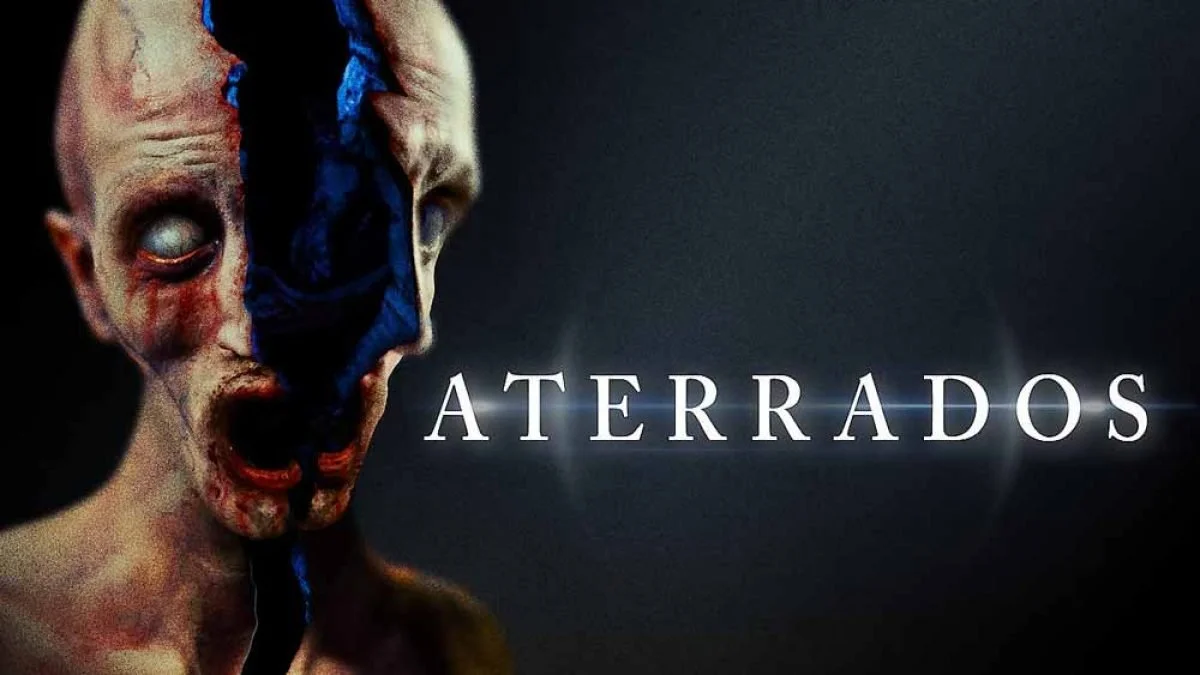
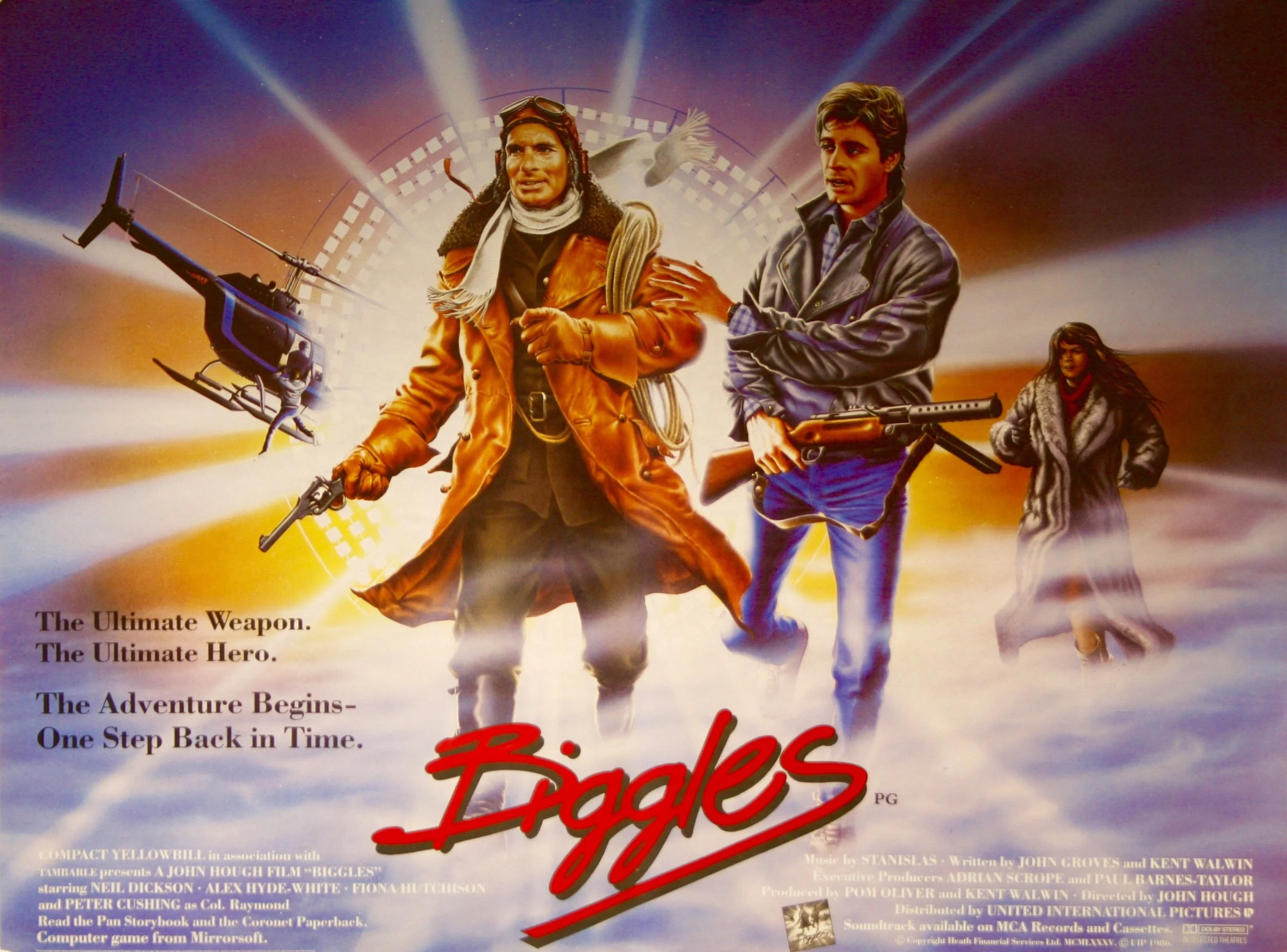
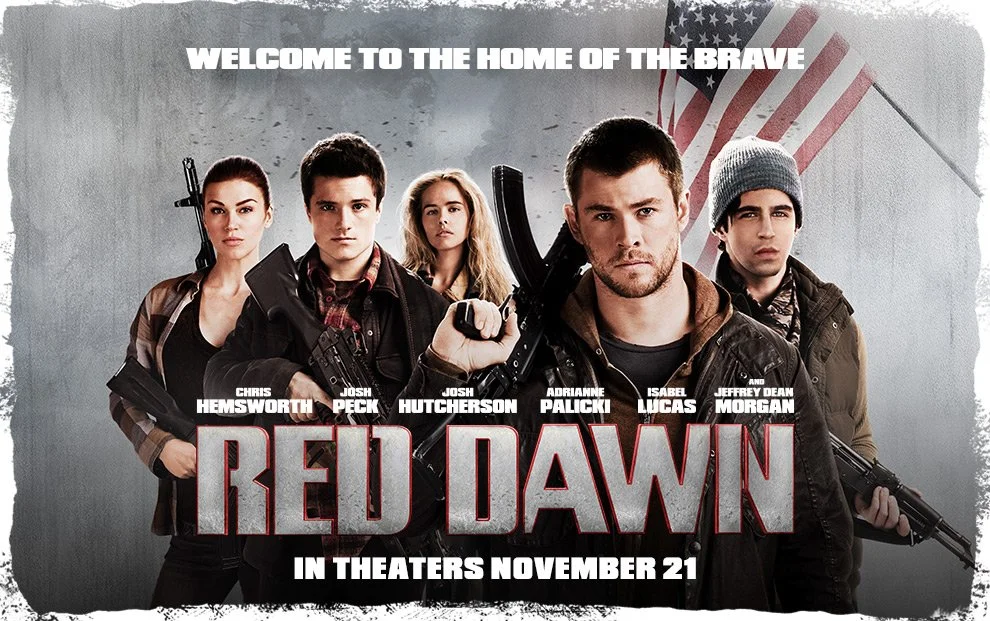
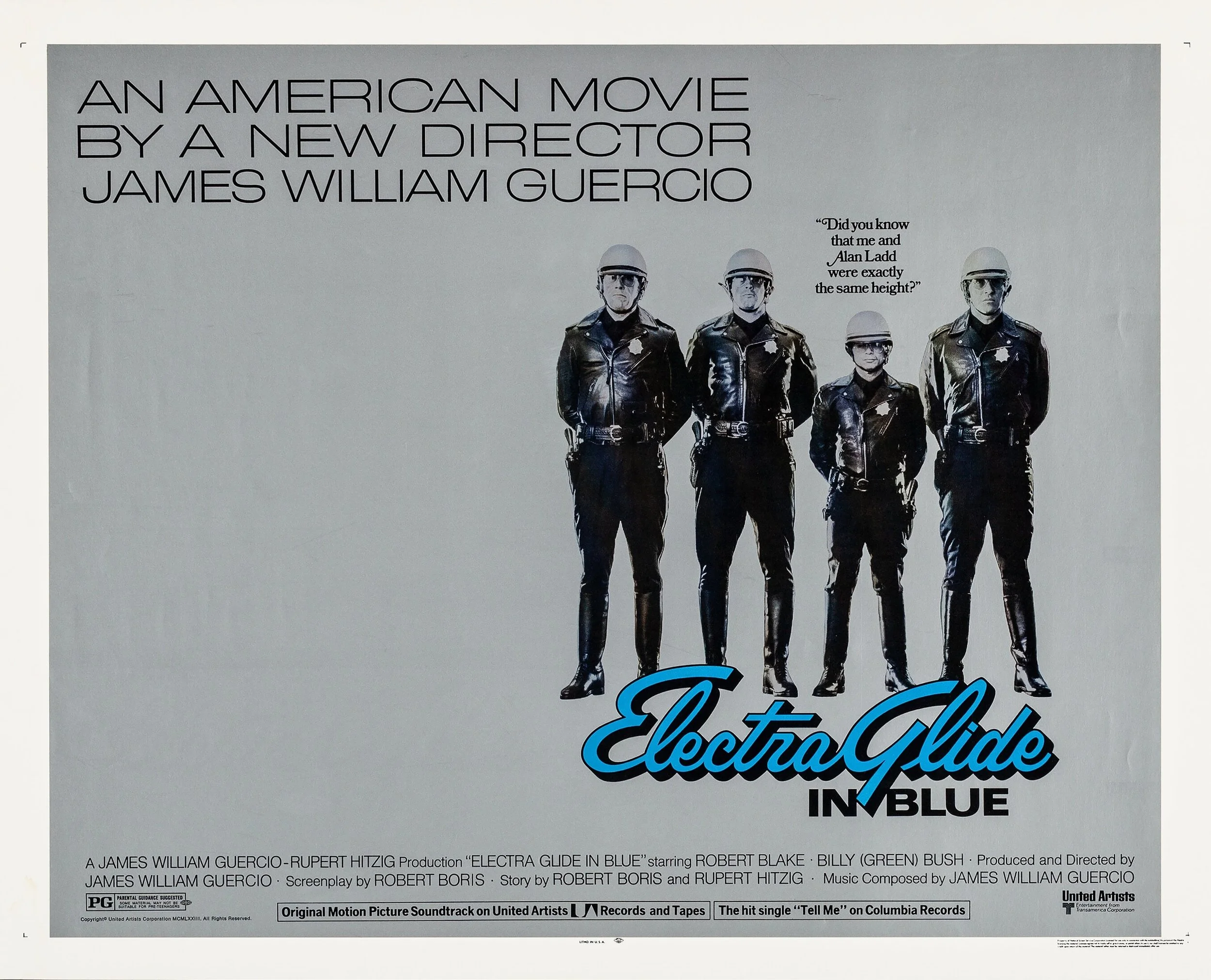
I was chatting with some friends recently about monster movies and creature features as they have been a mainstay of cinema for as long as the medium has existed. At it’s best, a good cinematic monster or monsters are a metaphor for examining a societal ill or it can also be a clever MacGuffin to explore the human condition. Clive Barker’s troubled film, Nightbreed being a prime example of this where the monsters are the persecuted protagonists and the humans are terrible creatures, lacking empathy. However, be your narrative deep or simple, if you’re going to have a monster in your film, then try to do it right. A poorly realised design or badly implemented, low budget visual effects can work against the credibility of your creature and there are no shortage of cinematic examples. So I thought it would be fun to list a few “bad” movie monsters. I try to provide some context with each example as to why each particular monster didn’t quite work. Naturally I have not in anyway created a definitive list and would be happy for readers' comments if they have other examples they’d care to share.
I was chatting with some friends recently about monster movies and creature features as they have been a mainstay of cinema for as long as the medium has existed. At it’s best, a good cinematic monster or monsters are a metaphor for examining a societal ill or it can also be a clever MacGuffin to explore the human condition. Clive Barker’s troubled film, Nightbreed being a prime example of this where the monsters are the persecuted protagonists and the humans are terrible creatures, lacking empathy. However, be your narrative deep or simple, if you’re going to have a monster in your film, then try to do it right. A poorly realised design or badly implemented, low budget visual effects can work against the credibility of your creature and there are no shortage of cinematic examples. So I thought it would be fun to list a few “bad” movie monsters. I try to provide some context with each example as to why each particular monster didn’t quite work. Naturally I have not in anyway created a definitive list and would be happy for readers' comments if they have other examples they’d care to share.
Watchers (1988). Here is a great title to start with, being a very poor adaptation of Dean R. Koontz novel of the same name. The subtleties and pathos of the original story have been replaced with eighties big hair courtesy of Corey Haim. On the plus side, Michael Ironside provides a characteristic performance of borderline psychosis. The downside being the OXCOM, the renegade government experiment at the centre of the story. It really is a shoddy example of uninspired animatronics and full body prosthesis.
Prophecy (1979). John Frankenheimer’s environmental thriller features a monster that Starburst magazine referred to as Smokey the Bear with acne. The creature created by the Burman studios, remains hidden or only partially glimpsed for most of the film’s running time. However, a few scenes do make it abundantly clear that it is nothing more than a man in a suit, diminishing the tension. The crew seemed to fail to grasp how to light and reveal the beastie effectively. A flambéd Yogi Bear has only so much shock value.
Conan the Destroyer (1984). Carlo Rambaldi’s Dagoth is interesting design, yet the physical execution is extremely poor to the point of being laughable. Even director of photography Jack Cardiff with all his skills cannot light or frame the scenes featuring this creature in such a way that improves them. It is curious that a film of this budget, with an otherwise handsome production design, tolerated such a poor effects sequence. Perhaps stop motion would have been a better option?
Contamination (1980). This Italian cash in of Alien features numerous sequences of people exploding after exposure to an extraterrestrial’s eggs. When it is finally revealed, the monstrous alien Cyclops is a rather uninspired and conspicuously static creature. Using the hypnotic power of its glowing eye, it lures badly dubbed actors to their death via it’s rubber proboscis. You expect poorly realised monsters in low-budget films, but there’s a fine line between poor and crap.
The Dark (1979). Originally intended as a zombie film to be directed by Tobe Hooper, the producers changed their mind halfway through shooting and decided to cash in on the Star Wars boom. Subsequently, after a change of director, The Dark became an alien entity on the rampage movie. This particular alien resembles a rather tall homeless person, with a poor complexion and lasers shooting from his eyes. Only watch this if you have a black belt in bad movie tolerance.
White Buffalo (1977). Wild Bill Hickok (Charles Bronson) and Crazy Horse (Will Sampson) join forces to defeat a mythical White Buffalo that has blighted their lives. Nice John Barry score, good performances from the lead actors in this odd cross genre western that was poorly marketed. The titular beastie, courtesy of Carlo Rambaldi (again), can be clearly seen on tracks. Much of the mechanical apparatus used to create the creature’s movements is also on display. With some better editing this could have all been avoided.
Slugs (1988). Loosely based on Shaun Hutson’s book, this low-budget horror features killer mutant slugs that have somehow evolved large pointy teeth etc. Most of the effects work consists of a rubber slugs applied to wound prosthetics and these scenes work well. However, on a few occasions the slugs are shown in close-up as the pictures above shows. Utterly ludicrous I’m sure you’ll agree. Pass the salt.
Rawhead Rex (1985). Clive Barker’s short story about an elemental pagan god and its subsequent rampage through an Irish Town, is intelligent and has many themes. All such subtleties are jettisoned in this low-budget horror exploitation film. The nine-foot beast from the source text is replaced by a tall man in ragged clothes with animatronic head. It all looks a bit silly, especially when he urinates on a priest. The monster’s technical shortcomings should have been left off camera as much as possible.
Island of Terror (1966). The “Silicates” featured in Island of Terror are a form of life based upon Silicon instead of Carbon. Spawn from an accident while trying to find a cure for cancer, these beasties digest human bone, leaving a shapeless corpse behind. They can also divide and multiply like any other kind of cell. Peter Cushing may well save the day in this unusual science fiction horror movie but he cannot distract us from the exceeding cheap and immobile creature effects.
I Am Legend (2007). The Vampires of Richard Mathesons’s original story are replaced by Darkseekers in this adaptation. These are emaciated quasi zombies that fear light. The film itself is a poor adaptation, by an uninspired director, starring a former box office star. It features unimaginative CGI created monsters that are devoid of any threat, substance or pathos. If you want a textbook example of a big budget monster movie that utterly fails to understand the genre, look no further.




Classic Movie Themes: Game of Death
Game of Death was Bruce Lee’s fourth Hong Kong martial arts movie. Due to the success of his previous films he found himself in a position where he could finally write and direct a project himself. Filmed in late 1972 and early 1973, the film was put on hold midway through production when Hollywood offered him a starring role in Enter the Dragon. He died shortly after completing the US backed movie that made him an international star, so Game of Death remained unfinished. Several years later the rights to the raw footage were sold and recycled for a new movie, that kept the name but bore little resemblance to Lee’s original vision. For most of Game of Death, Kim Tai-jong and Yuen Biao double for Bruce Lee and it is only in the final act that audiences actually get to see about 12 minutes of material that he shot himself. The 1978 release of Game of Death, directed by Robert Clouse, is a mess but remains a cinematic curiosity. The scenes which genuinely feature Bruce Lee are outstanding, even in an abridged form.
Game of Death was Bruce Lee’s fourth Hong Kong martial arts movie. Due to the success of his previous films he found himself in a position where he could finally write and direct a project himself. Filmed in late 1972 and early 1973, the film was put on hold midway through production when Hollywood offered him a starring role in Enter the Dragon. He died shortly after completing the US backed movie that made him an international star, so Game of Death remained unfinished. Several years later the rights to the raw footage were sold and recycled for a new movie, that kept the name but bore little resemblance to Lee’s original vision. For most of Game of Death, Kim Tai-jong and Yuen Biao double for Bruce Lee and it is only in the final act that audiences actually get to see about 12 minutes of material that he shot himself. The 1978 release of Game of Death, directed by Robert Clouse, is a mess but remains a cinematic curiosity. The scenes which genuinely feature Bruce Lee are outstanding, even in an abridged form.
Game of Death was marketed to capitalise on Lee’s international fame and appeal. Due to his iconic status it was packaged in a comparable idiom to a Bond film. Hence the opening credits to Game of Death are lurid and literal; very much like the work of Maurice Binder on the various James Bond movies. And then there is the score by John Barry that lends a certain classy ambience to the proceedings. The main theme is brassy, sumptuous and oozes style in the same way that Barry brought those qualities to the 007 franchise. Variations of this cue are subsequently used during all the major fight scenes in the film. Musically it works best with the footage in the film’s climax which was shot by and features Lee himself. The presence of such a noted film composer elevates the status of Game of Death, despite its many flaws. However, the Catonese and Mandarin dialogue versions of the movie feature an alternative soundtrack by Joseph Koo, who was an established composer in the Hong Kong movie industry.
The complete soundtrack for Game of Death was recently released by Silva Screen and also includes the score for Roger Vadim’s Night Games from 1980. The soundtrack contains all major cues featured in the film along with the song “Will This Be The Song I'll Be Singing Tomorrow” performed by Colleen Camp, who also starred in the film. I suspect it was hoped that this number would do well on the strength of the movie but it is far from memorable with its overly fastidious lyrics and melancholy tone. Here is the main title theme which underpins Game of Death. It is instantly recognisable as a John Barry compositions, as it exhibits all his musical hallmarks. It is far more grandiose in its scope than the quirky scores of Bruce Lee’s earlier work. If Lee had lived perhaps the Hollywood studios would have attempted to pigeonhole him into more sub Bond style movies as Game of Death strives to. Irrespective of such idle speculation, John Barry’s work remains as iconic as Lee himself and effortless reflects his charisma and physical prowess.






Ad Astra (2019)
In the near future, a series of mysterious power surges strike the Solar System, endangering all human life. Astronaut Major Roy McBride, is selected by U.S. Space Command (SpaceCom) to investigate their source near Neptune. The surges are linked to the "Lima Project", a failed experiment from 26 years earlier, that was intended to search for intelligent life outside of our solar system. The ship’s antimatter drive is potentially malfunctioning and responsible for the energy surges. Roy’s investigation is further complicated by the fact his Father H. Clifford McBride (Tommy Lee Jones), led the "Lima Project" and has not been heard from for 16 years after reaching Neptune. Having been told that Clifford may still be alive, Roy is joined by his father's old associate Colonel Pruitt (Donald Sutherland) whose loyalties remain ambiguous. Roy, who is noted for remaining calm under pressure, shows little emotional reaction to the news about his Father. As he and Pruitt travel covertly from Earth, to the moon and then onto Mars, it becomes clear that there is more to the mission than meets the eye. Will Roy remain emotionally detached or will old wounds impair his judgement?
In the near future, a series of mysterious power surges strike the Solar System, endangering all human life. Astronaut Major Roy McBride, is selected by U.S. Space Command (SpaceCom) to investigate their source near Neptune. The surges are linked to the "Lima Project", a failed experiment from 26 years earlier, that was intended to search for intelligent life outside of our solar system. The ship’s antimatter drive is potentially malfunctioning and responsible for the energy surges. Roy’s investigation is further complicated by the fact his Father H. Clifford McBride (Tommy Lee Jones), led the "Lima Project" and has not been heard from for 16 years after reaching Neptune. Having been told that Clifford may still be alive, Roy is joined by his father's old associate Colonel Pruitt (Donald Sutherland) whose loyalties remain ambiguous. Roy, who is noted for remaining calm under pressure, shows little emotional reaction to the news about his Father. As he and Pruitt travel covertly from Earth, to the moon and then onto Mars, it becomes clear that there is more to the mission than meets the eye. Will Roy remain emotionally detached or will old wounds impair his judgement?
Many critics felt that Ad Astra fell between two stools with its cold, clinical approach to space travel and its intermittent action scenes. I did not feel this way for the first third of the movie and accepted the lunar chase scene as relevant to the plot. Within the confines of the story, the Moon is colonised by multiple nations and there are territorial disputes. Hence violating borders could indeed provoke a military response. However the film contradicted its own adherence to science at the end of the first act to accommodate a most unusual, unexpected but ultimately superfluous suspense sequence. This somewhat jaded my view of Ad Astra for the remainder of its running time and I got the distinct feeling that perhaps there was studio pressure put upon writer and director James Gray to balance the existential self contemplation of the plot with some accessible action sequences for the less “intellectually invested” viewers. Furthermore the much anticipated ending in which Father and Son meet, lands wide of the mark, failing to meet expectations both narratively and philosophically.
One cannot fault the quality of the production with much of the technology and science on display in Ad Astra being credible and well realised. The 100 million dollar budget seems to have gone mainly into the films visual effects and production design. Performances from all involved are good, as you would expect from such an ensemble cast. But as Ad Astra progresses the ideas run out of steam and suddenly there is nothing to sustain the drama beyond the visuals and the hope that matters will be resolved in a satisfactory or at the least adequate fashion. And it is sadly the latter that is only achieved. For a movie that strives to deal with the near future in a Kubrickeques manner and explore the complexity of family relationships in an idiom similar to Greek Mythology, it fails to deliver at its dramatic climax. Furthermore, not only is the accurate depiction of science suspended when it finds itself at odds with the drama, so is narrative credibility. One scene where Roy is discovered illegally stowing away on a rocket, ends so abruptly and violently that it verges on the absurd.
However, despite losing its way Ad Astra does at least do something unusual that flies in the face of popular belief with one of the stories core themes. It postulates the idea that there is no other intelligent, sentient life in the universe and that we are as a species are just an anomaly that is utterly alone. Such a statement is very bold and thought provoking. But the Science fiction genre often works best when it is a MacGuffin for a human story. And there is a lot on offer in Ad Astra that could fuel that very process. Yet the production seems to have made the classic mistake of getting the cart before the horse and focusing more on the aesthetics and ambience of space travel, at the expense of the emotional heart of the story. But I will also give the film credit for having the best unnecessary primate attack and explosive decompression scene in any movie. It’s just a shame that it served no real purpose here than to add some contrived tension, in lieu of the genuine article.







Diary of a Podcaster Part 16
Life is often about the things we’d like to do or wished we had done, rather than the things we’ve actually achieved. My last post in this blog series was back in 2nd October 2018 and the last podcast that I published was in January 2019. Since then most attempts to produce more content of this kind have come to nought, as spare time for both recording and editing have been in short supply. However, I did manage to record some material on the 22nd of December with my long-time co-host Brian. The idea was to release the finished podcast as a surprise show at the end of the year. However, due to real world commitments, that deadline has not been met. Now there’s a surprise. I do intend to finish editing the show and may add some extra material to make it a little more topical. But overall, I am not too upset by this delay, because in the process of organising this podcast, I discovered a quick and convenient means of recording via Discord. Something that has been seen as Holy Grail of podcasting over the years.
Life is often about the things we’d like to do or wished we had done, rather than the things we’ve actually achieved. My last post in this blog series was back in 2nd October 2018 and the last podcast that I published was in January 2019. Since then most attempts to produce more content of this kind have come to nought, as spare time for both recording and editing have been in short supply. However, I did manage to record some material on the 22nd of December with my long-time co-host Brian. The idea was to release the finished podcast as a surprise show at the end of the year. However, due to real world commitments, that deadline has not been met. Now there’s a surprise. I do intend to finish editing the show and may add some extra material to make it a little more topical. But overall, I am not too upset by this delay, because in the process of organising this podcast, I discovered a quick and convenient means of recording via Discord. Something that has been seen as Holy Grail of podcasting over the years.
The two of the main obstacles that face anyone hoping to produce a podcast are scheduling guests and recording. Getting your co-hosts online at a mutually convenient time has always been a complex task, akin to herding cats. And then finding a simple and reliable recording package is also a challenge. I initially started recording podcasts back in 2010 and used Skype to facilitate the conversation and numerous third-party apps to record the proceedings. These were often created by gifted amateurs and would often break once Skype was updated. Eventually I started using Zencastr which offers a bespoke VOIP service and records each track individually. As a web-based solution this proved good although there were glitches every once in a while, as well as occasional syncing issues. And then I came across Craig, just before Christmas. You simply invite Craig to your Discord server and then use simple text commands in your chat channel to start and stop recording voice chat. Upon finishing your recording Craig will send you a Direct Message with links to download your files. There is a choice of formats available and each participant is on a separate track. The icing on the cake for me is downloading the files as an Audacity project, ready for editing.
Peter Cushing recording an early podcast
However, it is worth remembering when making a podcast, that irrespective of whether you have the best recording system in the world, it cannot compensate for those participants with cheap microphones who sit at the bottom of a well or out in the middle of busy traffic, while shaking Maracas or using a Belt Sander. Plus no amount of post-production editing can improve poor material. But I guess that those sorts of problems are for another blog post. I’m hoping that the technical success of my most recent podcast recording will kick start my productivity once again. Maybe I can press gang a few of my former podcasting colleagues into appearing as guest on future episodes. Because I still think there’s a lot of life in podcasting as a medium. And having a show that goes hand in glove with the website is good for brand continuity. We shall see. The New Year is a traditionally a time for aspirations and “plans”. Sadly, reality often has other ideas.















James Bond 007: Blood Stone
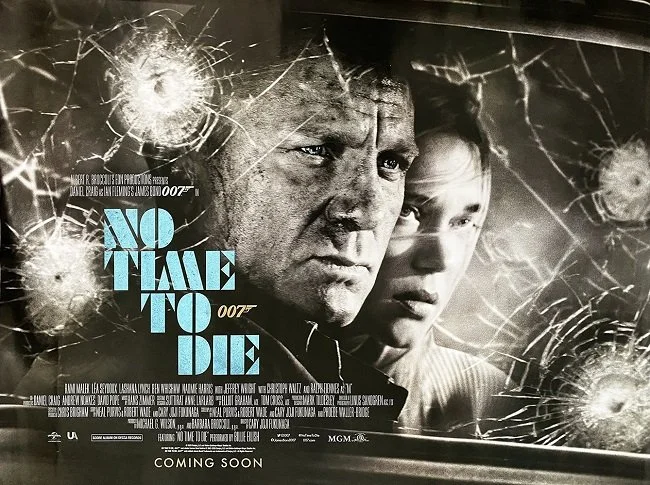
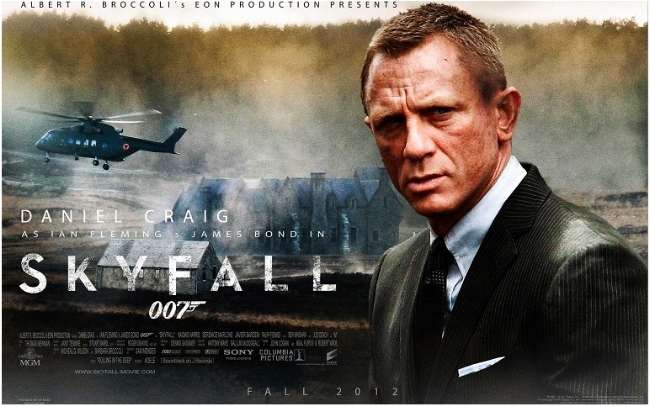
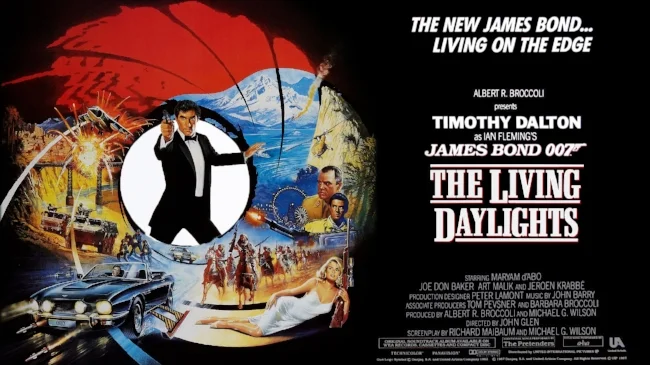
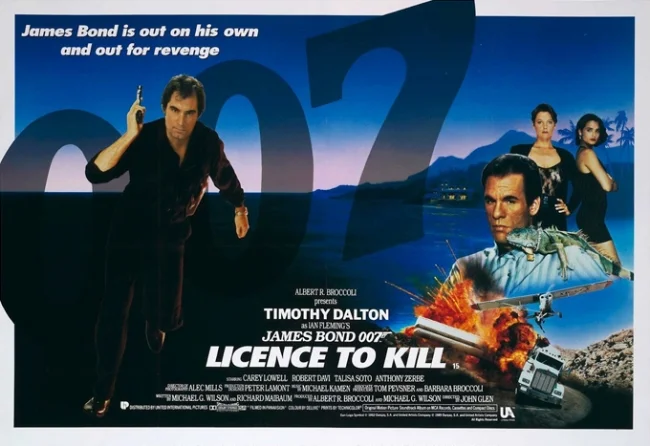
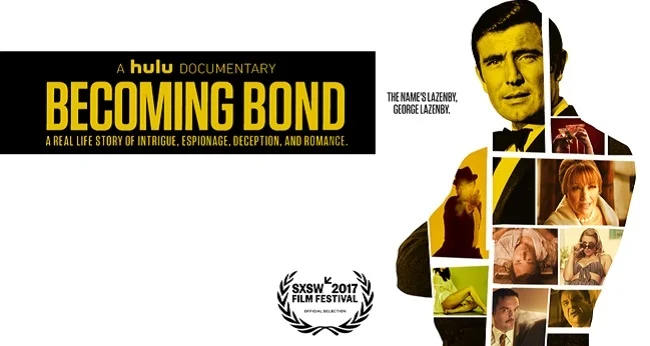
Over the Christmas Holidays, I inevitably watched a selection of James Bond movies because it is one of my seasonal rituals. As a child a Bond movie was always one of the TV highlights of Christmas or Boxing Day. Subsequently this habit has stuck with me over the years and so I dutifully watched On Her Majesty’s Secret Service, The Living Daylights and Licence to Kill. Naturally this raised my interest in all things Bond, so I decided to dust of the video game James Bond 007: Blood Stone. I originally bought this game upon release back in November 2010, unaware that the Bond franchise has always been an utter lottery when it comes to tie-in games. I initially played through it for a month or so, then deleted it from my hard drive. It was a classic example of me simply losing interest in a game and then removing it in one of my regular PC housekeeping exercises. To be fair I had a lot of other games on the go at the same time, so there was a good chance that I didn't give it the level of attention it deserved. So yesterday I decided to give it another go and re-installed the game via Steam. Thanks to the miracle of the internet, I downloaded the 9GB game in twenty minutes.
Over the Christmas Holidays, I inevitably watched a selection of James Bond movies because it is one of my seasonal rituals. As a child a Bond movie was always one of the TV highlights of Christmas or Boxing Day. Subsequently this habit has stuck with me over the years and so I dutifully watched On Her Majesty’s Secret Service, The Living Daylights and Licence to Kill. Naturally this raised my interest in all things Bond, so I decided to dust of the video game James Bond 007: Blood Stone. I originally bought this game upon release back in November 2010, unaware that the Bond franchise has always been an utter lottery when it comes to tie-in games. I initially played through it for a month or so, then deleted it from my hard drive. It was a classic example of me simply losing interest in a game and then removing it in one of my regular PC housekeeping exercises. To be fair I had a lot of other games on the go at the same time, so there was a good chance that I didn't give it the level of attention it deserved. So yesterday I decided to give it another go and re-installed the game via Steam. Thanks to the miracle of the internet, I downloaded the 9GB game in twenty minutes.
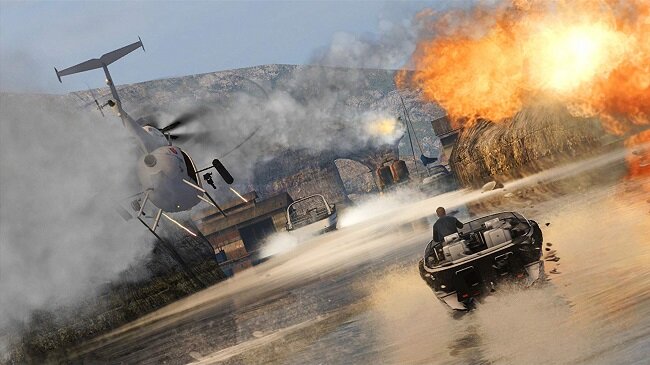
So, what does James Bond 007: Blood Stone have to offer, second time around? Well exactly the same frustrations that caused me to kick it into touch last time. The story is quite good for this sort of thing, being written by Bruce Feirstein who penned a few of the Pierce Brosnan movies. There is also voice acting from Daniel Craig and Judi Dench as well as a “Bondesque” soundtrack by Richard Jacques, which all do much to elevate the proceedings. The game is a third person cover based shooter with additional hand-to-hand combat and driving sequences. James Bond 007: Blood Stone features a focus aim system which allows players to lock onto targets after melee takedowns, providing guaranteed kills. The stealth kills are quite satisfying and look the part. Ben Cooke, who is Daniel Craig's stunt double in the films, provided the motion capture choreography for Bond's digital animation and is credited as the game's stunt coordinator. Like in recent Bond movies the vogue for gadgets in this game is far more subdued. There is a lot of hacking of electronic locks and computers via a smartphone, which mainly involves the use of quick time events. However, it also provides a means for highlighting waypoints, weapons and enemies as well as items that can be scanned for intel.
However, despite all these acceptable points, the game is a very clumsy console port. It has all the obvious hallmarks. First there’s the cartoon like cut scenes and a game engine that simply looks lacklustre on a decent PC. Then there’s the clumsy UI. However, the biggest failing and the main reason I ditched this title last time I played is the control system. The keyboard and mouse work fine for combat but are inadequate for steering vehicles. The PC version does support an Xbox controller but not simultaneously with the other input devices. So, whenever you reach a check point prior to a car chase, you have to wait for the chase to fail, then go into the game settings and change the input to a gamepad. Once that section is over, you then have to do the same again to return to the keyboard and mouse. This is frustrating to say the least and it doesn't take long for tempers to fray. I shall try to persevere with James Bond 007: Blood Stone but I can't make any promises as to whether I shall complete it. The whole thing just highlights the fact that Bond as a franchise has never really got the treatment it should have from the gaming industry. Apart from Goldeneye and Goldeneye Reloaded but they never got released on the PC platform anyway.
I would love to see a more complex and nuanced RPG, where you could play as Bond and have a story that has multiple endings. A game that as well as shooting sequences, offered other activities seen in classic Bond movies such as Skiing or Scuba Diving. A mini game based set in a Casino would also be a great addition. Perhaps setting the game in a specific time period to would add atmosphere and ambience, be it the suave sophistication of the sixties movies or the excess and grandiose scope of the seventies films. Games such as the The Witcher 3: Wild Hunt and Red Dead Redemption 2 have an excellent balance of narrative choice and action. This sort of game style and mechanic would be ideal for the world of James Bond with its focus on pithy dialogue and kiss-off lines. But I’m not particularly hopeful. Activision were the last licence holders for Bond video games and they struggled to do the franchise justice. James Bond 007: Blood Stone is a weak title which killed off its developer Bizarre Creations. Oddly enough the follow up game 007 Legends was even more of a dog’s dinner and also put pay to Eurocom, the studio that created it. For the present no one seems to want to tackle the possibilities presented with such an intellectual property, because it doesn’t immediately lend itself to live services or multiplayer gaming.

The Pace of Combat in MMOs
This is going to be a very subjective post because much of what I am about describe isn’t based upon measurable data (although I’m sure there are players who would do so) but more how something feels. Ironically, due to my nature I’m usually more disposed towards fact-based analyses but even I have to recognise that humans are driven by emotions and other esoteric factors. And with regard to this subject matter I hate to say it but how I feel greatly shapes my opinion. So let me begin by referring back to the MMO The Secret World, which has evolved into Secret World Legends. One of the main reasons I stopped playing the original version of the game was because the combat was tedious. By which I mean it took too long. I would use an assault rifle and blast away at a mob, only for it to pursue me as its health meter slowly went down. Hence, I would have to reverse while attacking and slowly back peddle until the mob died. As a method it worked but it was extremely unsatisfactory. The weapon felt under powered and the style of attack lacked grandeur. The revised iteration of the game failed to address this so I didn’t stick with playing that either.
This is going to be a very subjective post because much of what I am about describe isn’t based upon measurable data (although I’m sure there are players who would do so) but more how something feels. Ironically, due to my nature I’m usually more disposed towards fact-based analyses but even I have to recognise that humans are driven by emotions and other esoteric factors. And with regard to this subject matter I hate to say it but how I feel greatly shapes my opinion. So let me begin by referring back to the MMO The Secret World, which has evolved into Secret World Legends. One of the main reasons I stopped playing the original version of the game was because the combat was tedious. By which I mean it took too long. I would use an assault rifle and blast away at a mob, only for it to pursue me as its health meter slowly went down. Hence, I would have to reverse while attacking and slowly back peddle until the mob died. As a method it worked but it was extremely unsatisfactory. The weapon felt under powered and the style of attack lacked grandeur. The revised iteration of the game failed to address this so I didn’t stick with playing that either.
Although combat in MMOs is about damage, control and tactics there are also more nebulous factors involved. These being rhythm, pacing and a sense on being in control of your actions so you can read and adjust to the ebb and flow of the fight. There is a sweet spot somewhere between both the technical facets of combat and the more enigmatic matter of how it “feels”. When a game get’s it right, it often something you discern subconsciously first, rather than by number crunching your combat log. And when a game get’s it wrong fighting crosses the line from being a challenging but enjoyable task to simply being a drag. However, we have to temper this outlook with the fact that no two players share exactly the same view on what “feels” right. Let me further add that I always like to gear my characters in any MMO to be overpowered. I want every single buff, boost and boon I can get because to my mind why would you not want that? I don’t look at combat in this genre of games to be some sort of Marquess of Queensberry rules, even-handed, battle of skill to find out who is the better “chap”. No, I want to be able to crush all before me quickly and efficiently.
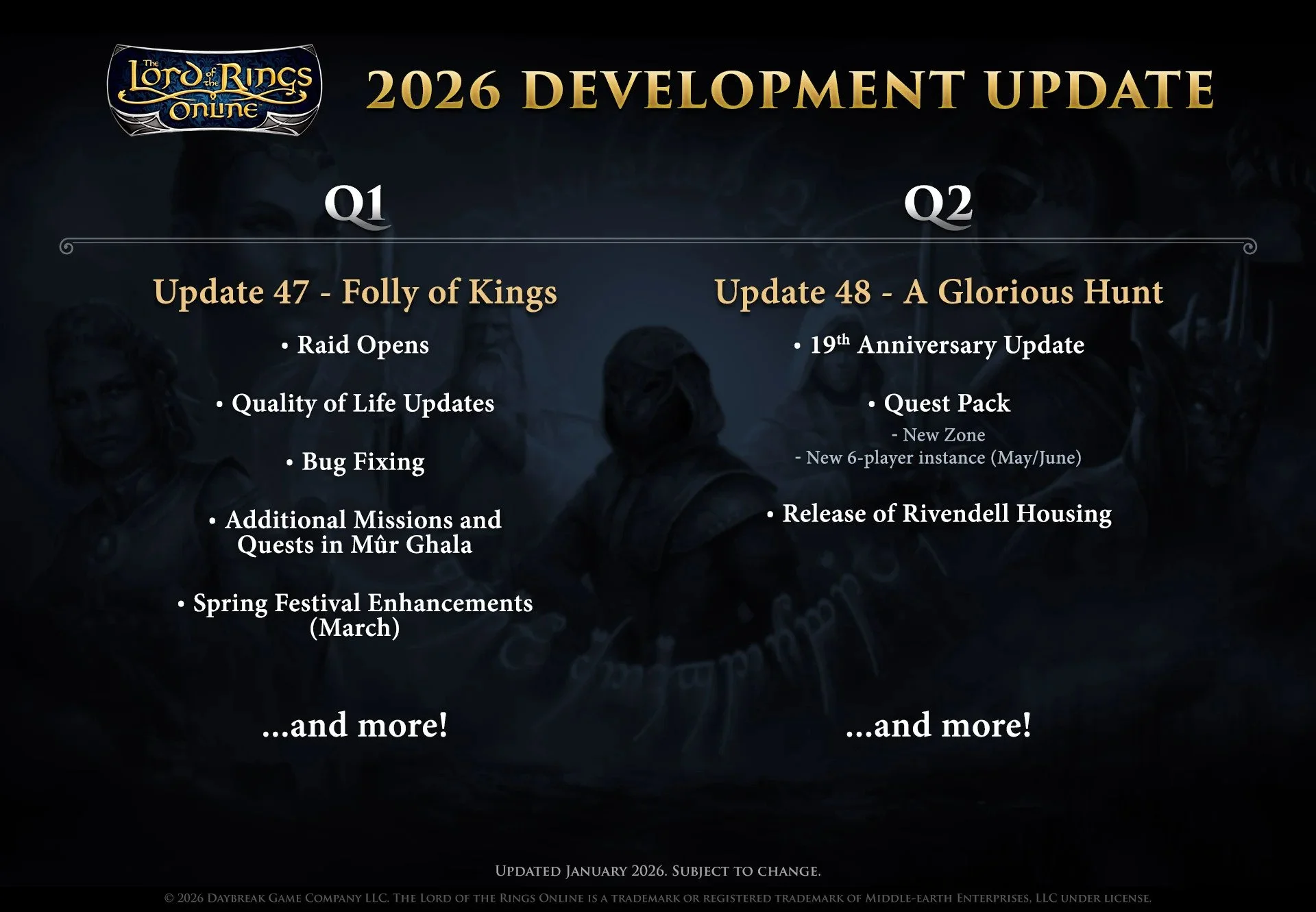
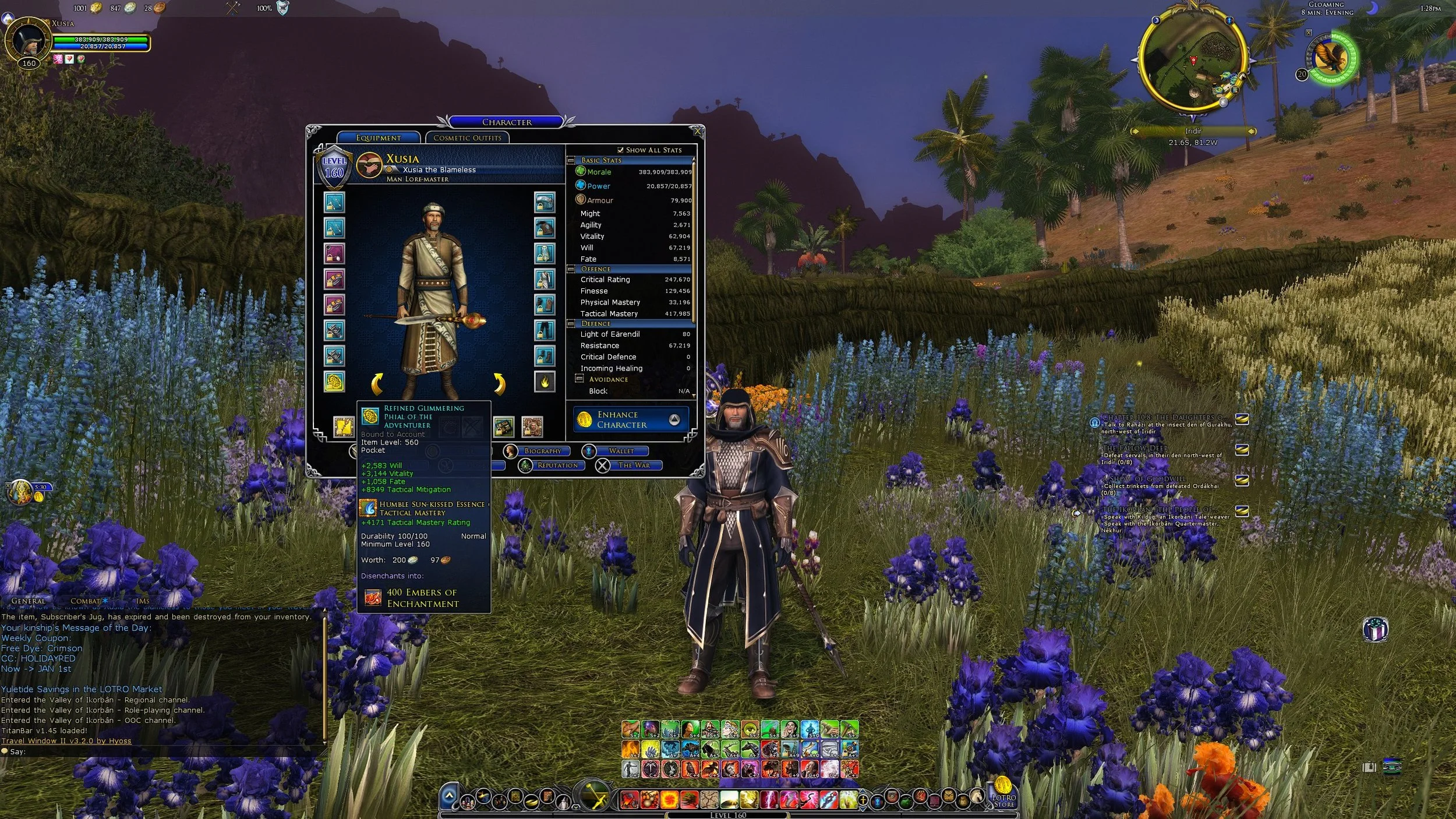
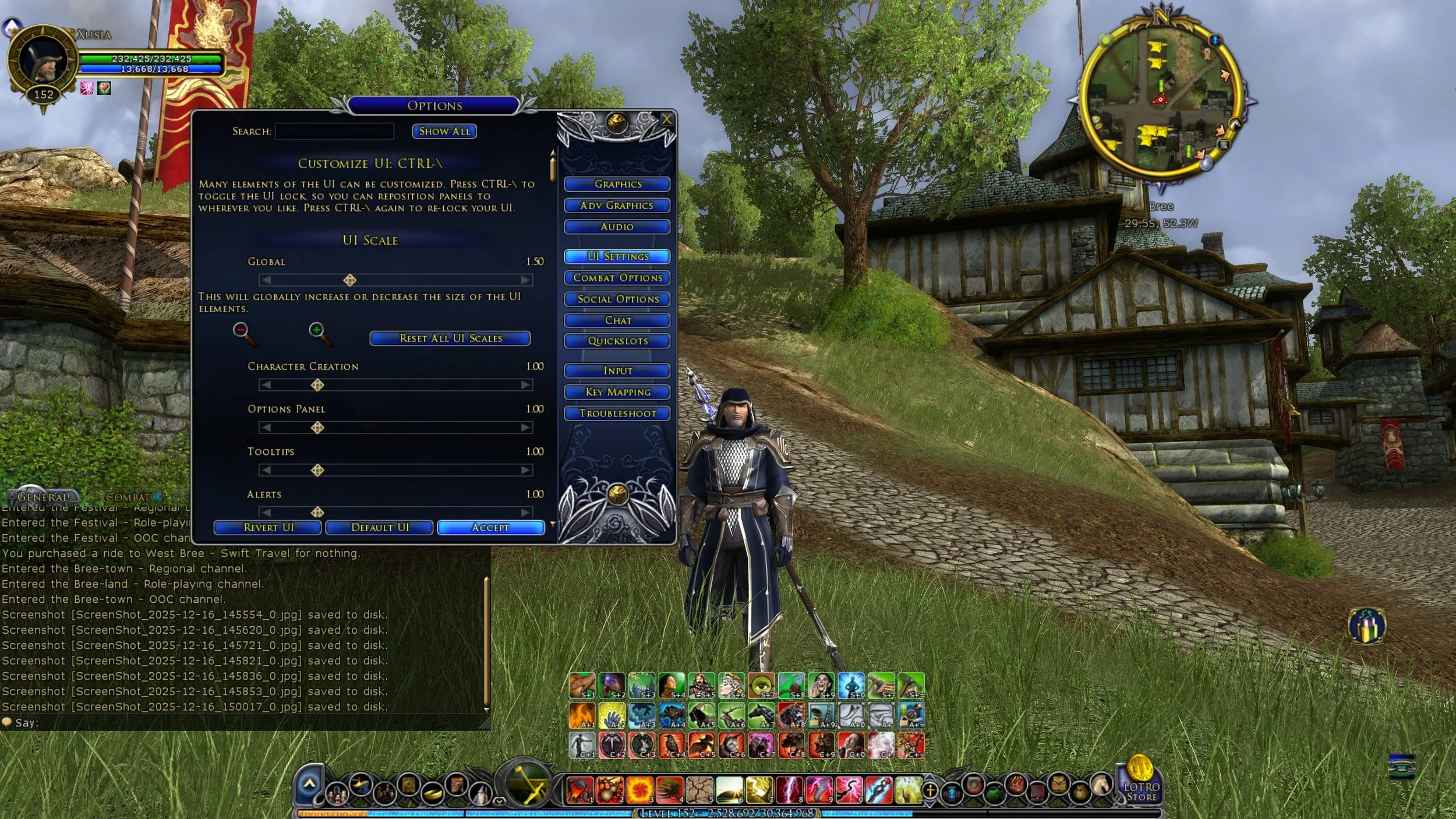
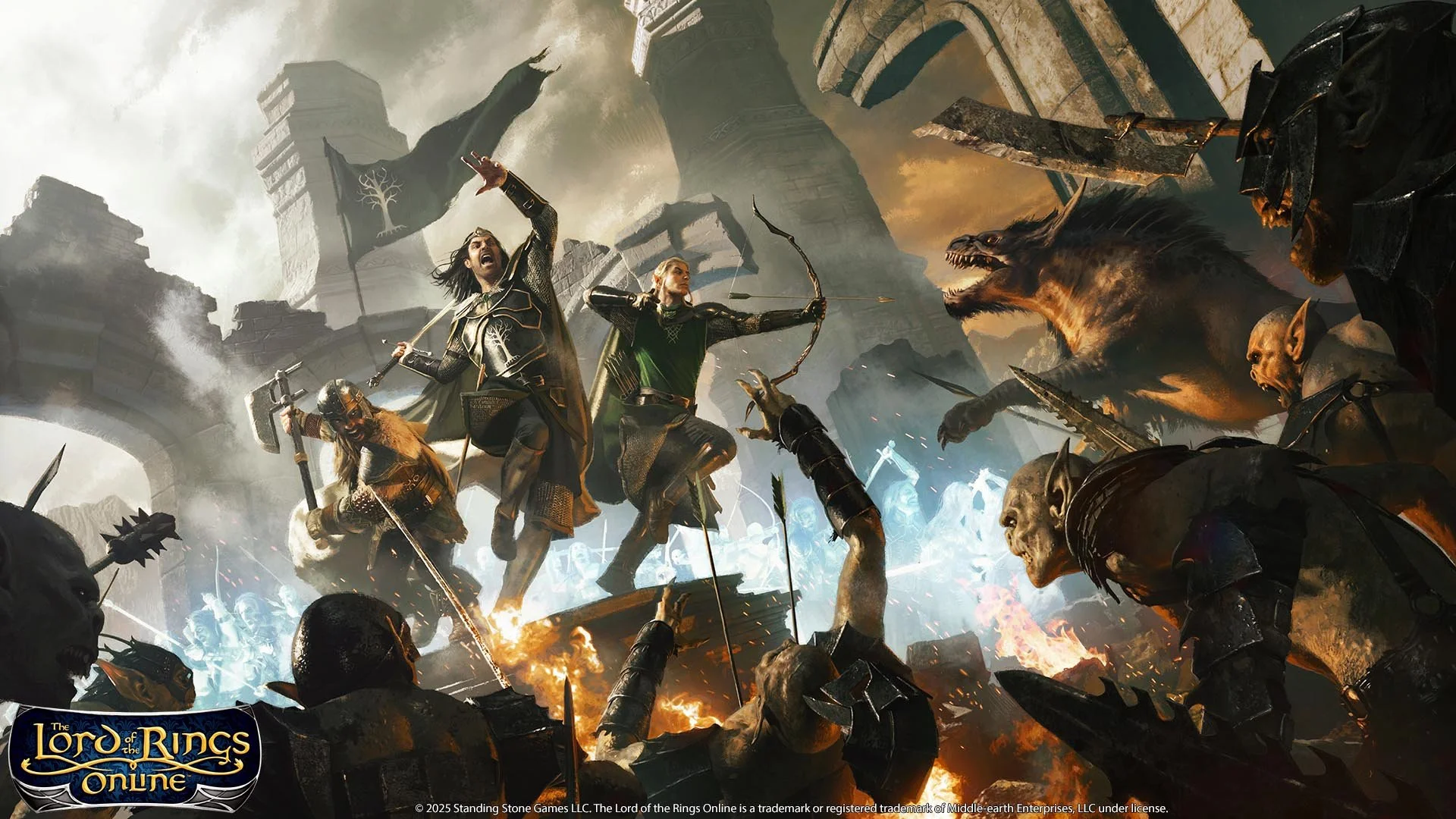
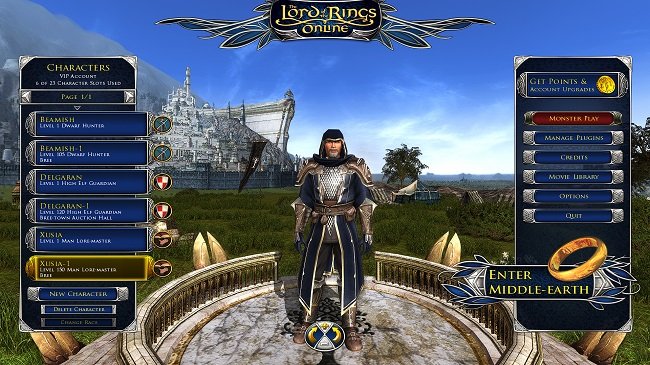
Which brings me nicely on to my current situation in The Lord of the Rings Online. I worked my primary character through Update 23: Where Dragons Dwell and came out the other side, well geared and able to hold my own in combat. I continued with Update 24: Vales of Anduin and had no issues making progress. And then along came the Minas Morgul expansion in November 2019 with an increase in level cap to 130 and new gear to grind. If you buy the expansion and follow the Epic story you will be provided with adequate gear from quest rewards to move forward. If however, you have not bought the expansion you will find that doing level 120 plus skirmishes or instances is tricky because you are now behind the gear curve. Also you may find that your Legendary Items are wanting and will need to acquire Anfalas Scrolls of Empowerment to unlock additional tiers on your LI legacies. Collectively these factors have conspired and I am now distinctly underpowered and struggling to progress through skirmishes and group content due to being gimped by not purchasing the latest expansion. Combat is now a slog to wear down mobs. For me this goes beyond challenging and strays into the realm of the tedious.
I did some calculations today and I need about 140-150 Anfalas Scrolls of Empowerment to keep my LI viable and unlock all possible upgrades. I can either grind these items via the game, buy them on Auction House or purchase from the in-game store. The latter will cost about £150 so that is not an option. Neither is grinding towards a goal. It will take between one and two months and I don’t relish doing the same old quests for that period of time. I do not have the gold required to buy these items from the in-game auction, so the immediate future is one of performing under requirement. This makes combat slow and ponderous which brings me neatly to my original point about once combat ceases to be “fun”, it pretty much kills my interest in a game. This also highlights a problem with a lot of the older MMOs that still exist. To play in an optimal fashion you have to be wedded to the game, play through all content regularly and ensure that you keep on top of all new systems and mechanics. If you in any way take time out and fall behind, then you are potentially disadvantaging yourself. This is not something that occurs in more recent MMOs such as The Elder Scrolls Online.
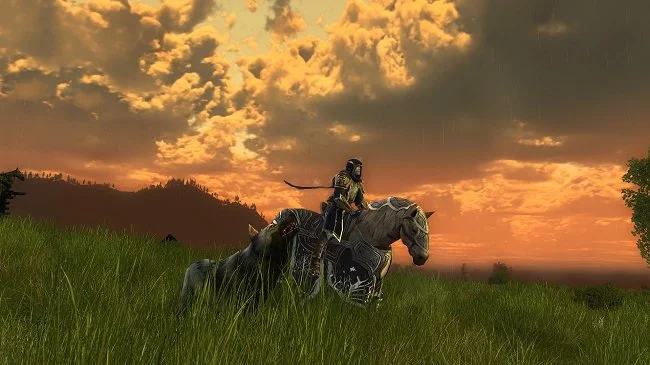
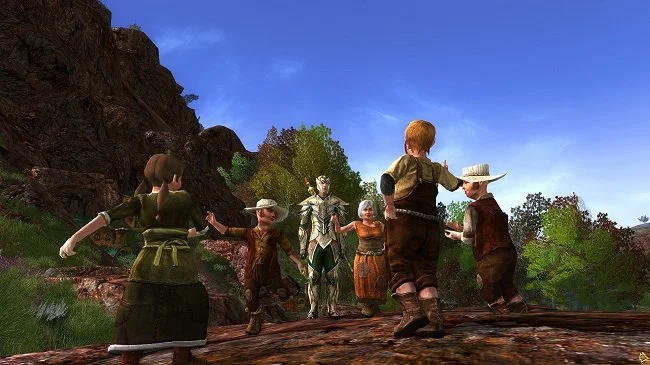
Despite my grumblings at perceived shortcomings in LOTRO, I have a strong connection to the game as it was my point of entry to this genre. Therefore I shall persevere with the situation and see if I can devise a plan to re-equip my character by the path of least resistance. I am also fortunate to be in a kinship that is very generous and resources are often shared. However, it is interesting that I find myself in exactly the same position as I was when the Mordor expansion launched and I arrived late to that particular party. I believe it proves my theory that LOTRO requires a degree of fidelity and regular participation to be experienced in the best way in terms of gear, jewellery and effective DPS. I see now why many players choose to avoid this “trap” by continuously rolling new alts and restricting their game play to specific content, as to not find themselves in the position of having to continuously chase end content. Of course I could make this problem go away by just buying the latest expansion and playing though it but that flies in the face of the old school MMO philosophy of doing things your own way. Perhaps the reality is that’s just not a thing anymore



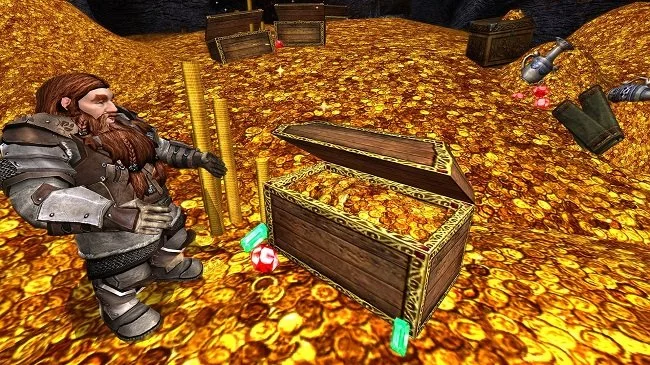
Goodbye 2019
Last year I tried to write a measured and balanced post about the passing of the year. Sadly this time round my attitude toward the departing 12-month period is somewhat binary. Yes there were a couple of highlights to 2019 but most of it was an uphill struggle and therefore not worth celebrating. It can frankly sod off and won’t be missed. The two high points were my son’s wedding in August and my renewed enthusiasm for blogging that came about due to the Blaugust writing event. But overall 2019 was a repetitive and somewhat depressing grind having to continuously deal with multiple family illnesses, numerous hospital visits and then at the end of the year a bereavement. Yes, these are things that happened to us all eventually and there is no escaping them but I appear to be trapped in this facet of the “circle of life”. Furthermore, until certain situations resolve themselves, I cannot make or implement any long-term plans. 2019 has been in many ways about just treading water.
Last year I tried to write a measured and balanced post about the passing of the year. Sadly this time round my attitude toward the departing 12-month period is somewhat binary. Yes there were a couple of highlights to 2019 but most of it was an uphill struggle and therefore not worth celebrating. It can frankly sod off and won’t be missed. The two high points were my son’s wedding in August and my renewed enthusiasm for blogging that came about due to the Blaugust writing event. But overall 2019 was a repetitive and somewhat depressing grind having to continuously deal with multiple family illnesses, numerous hospital visits and then at the end of the year a bereavement. Yes, these are things that happened to us all eventually and there is no escaping them but I appear to be trapped in this facet of the “circle of life”. Furthermore, until certain situations resolve themselves, I cannot make or implement any long-term plans. 2019 has been in many ways about just treading water.
Sadly, I have no reason to think 2020 will be any different. My personal situation is still complex and filled with trepidation. Both my parents are disabled with deteriorating medical problems. The most one can hope for is to maintain the status quo. Other members of my family are also unwell with conditions that do not have a good prognosis. Beyond my own life I am far from happy with the political situation in the UK at present. I’ve been politically homeless for a while now and it’s very frustrating to be continuously offered a Hobson’s choice at elections and then forced to endure the iniquities of the First Past the Post voting system. As for this nonsense about the country coming together and healing, well that is most certainly not going to happen any time soon. People will have to endure the consequences of Brexit and a majority Conservative government. I do not expect things to go well, nor do I expect any sort of national reconciliation. If anything things will get more partisan and acrimonious.
I will therefore deal with 2020 as I did the previous year and just take it one week at a time. And just because I’m not especially enthused for the coming decade and my personal situation is not exactly how I’d like it to be, that doesn’t give me a license to be a full contact malcontent. There is no need to add fuel to the fire of assholery that abounds in Western culture at present. If anything quite the opposite is true. It is incumbent upon me to be civil, measured and flexible. Not just for the practical reason of greasing the wheels of society but to ensure that I maintain my own state of mental wellbeing. An existential approach to life may well indeed highlight the falsity and futility of so much of what we do but in recognising this there is a degree of peace and freedom. Plus I take great comfort in writing and conversing with my wonderful online friends who hail from all over the world including Purley. So upon reflection although I may not jubilantly declare “Happy New Year”, I am at least prepared for 2020 and ready to repel boarders, so to speak.

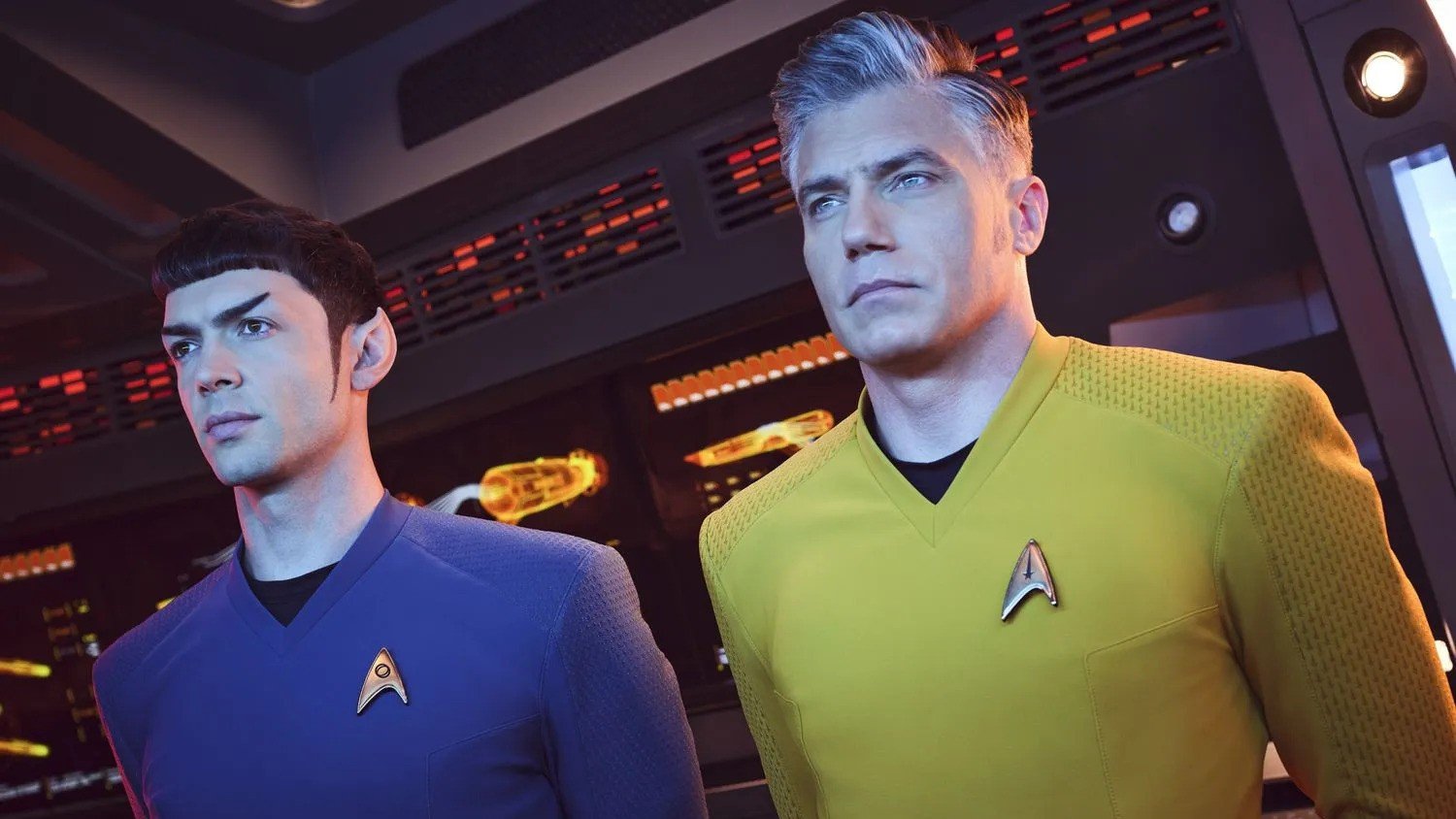




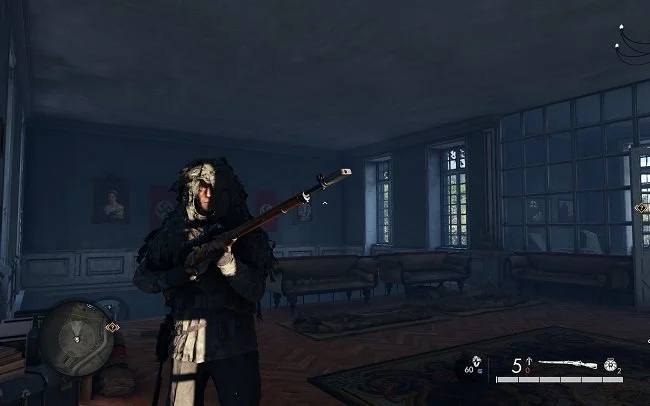










A Year in Gaming
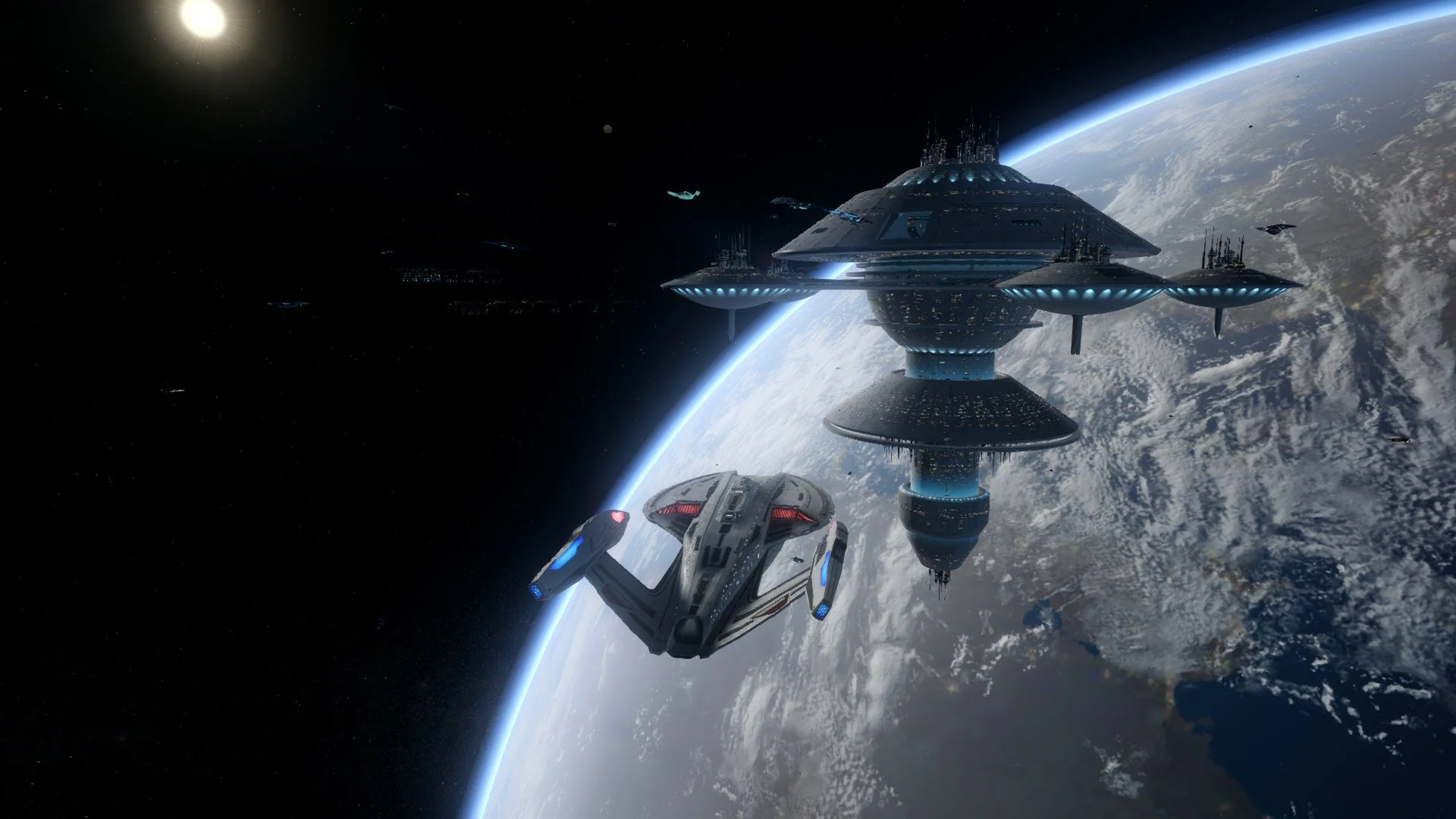
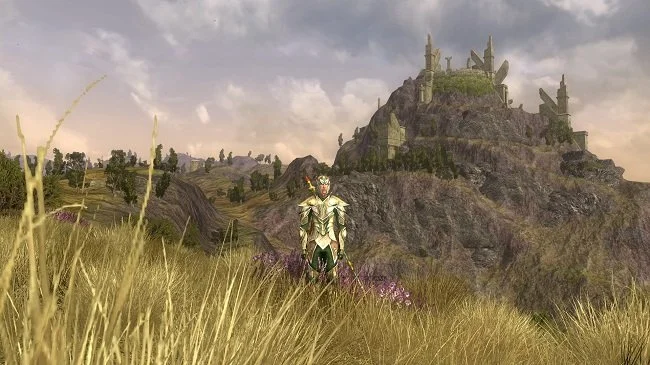
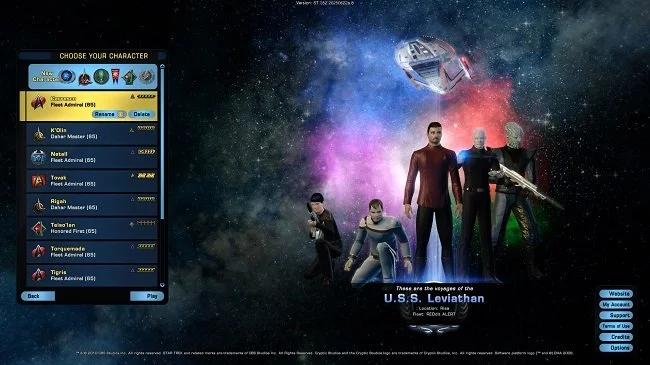
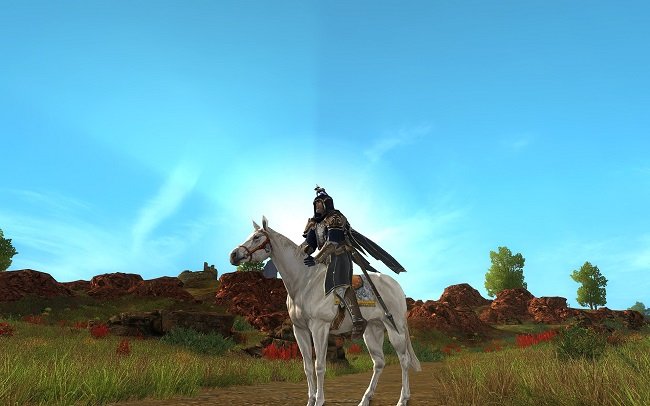
Life is often cyclical, if you don’t believe me go watch The Lion King. I started 2018 playing The Lord of the Rings Online and by writing a post about how gamers collectively seem to repeat the same mistakes. And as the year and indeed the decade ends, I find myself once again playing the Yule Festival in LOTRO and reflecting upon how some games that garnered criticism over their egregious business models, have ended up as huge hits. It would appear that gamers are their own worst enemy. I shall leave the psychological analysis of paradox to others. From my perspective, irrespective of the iniquities of the video game industry and certain quarters of the gaming community, it has been a good year, gaming wise. I have enjoyed my time playing MMOs such as Star Trek Online, The Elder Scrolls Online and the aforementioned LOTRO. These and other titles have entertained me, provided me with an opportunity to unwind as well as affording me some much-needed social interaction. I particularly enjoy Wednesday evenings when I log into my Discord server and then chat and play collaboratively with longstanding gaming friends.
Life is often cyclical, if you don’t believe me go watch The Lion King. I started 2018 playing The Lord of the Rings Online and by writing a post about how gamers collectively seem to repeat the same mistakes. And as the year and indeed the decade ends, I find myself once again playing the Yule Festival in LOTRO and reflecting upon how some games that garnered criticism over their egregious business models, have ended up as huge hits. It would appear that gamers are their own worst enemy. I shall leave the psychological analysis of paradox to others. From my perspective, irrespective of the iniquities of the video game industry and certain quarters of the gaming community, it has been a good year, gaming wise. I have enjoyed my time playing MMOs such as Star Trek Online, The Elder Scrolls Online and the aforementioned LOTRO. These and other titles have entertained me, provided me with an opportunity to unwind as well as affording me some much-needed social interaction. I particularly enjoy Wednesday evenings when I log into my Discord server and then chat and play collaboratively with longstanding gaming friends.
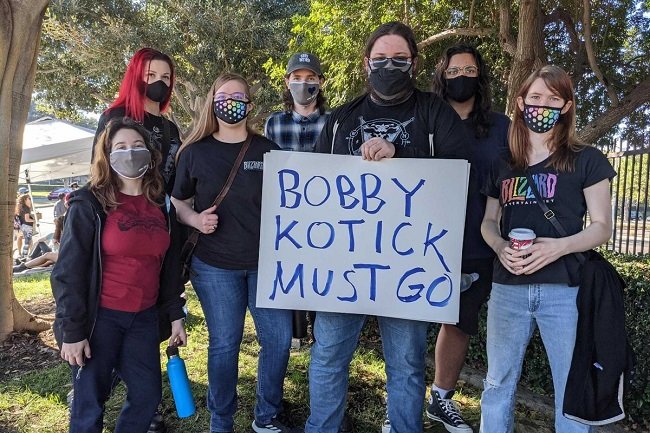
In many ways, 2019 was just the same as any other year. If I may quote myself, I wrote on January 1st "it does not seem unreasonable to expect more shitty video games and questionable business practises in 2019” and broadly that has proven true. The video game industry shovelled out yet more substandard products such as Mario Kart Tour, Tom Clancy's Ghost Recon Breakpoint and NBA 2K20. All of which are essentially the bare bones games with further content gated behind paywalls and microtransaction. Yet despite the inherent dishonesty of the “pay to start” business model, these titles sold and sold well, thus reminding us that people are the fundamental problem and as a result we get the gaming industry that we deserve. And as for the video game industry itself, it hardly covered itself in glory (again). The latest “trick” seems to be to release a game, get it reviewed and rated and then add an in-game store at a later date. Thus you can avoid any negative publicity during the initial launch window. And then of course there was the Blizzard debacle which raised the inherent dilemma in doing business with an authoritarian country such as China. Oh and “crunch” culture, institutionalised misogyny and general male centric douche baggery still seems to prevail in the industry.
However, 2019 wasn’t all doom and gloom. There are always good titles to be found if you look hard enough. The Untitled Goose Game was an utter joy and certainly seemed to touch a cultural never but in a good way. The Outer Worlds found popular acclaim and seemed to compensate for Fallout 76 as a spiritual successor to that franchise. I personally was very pleased by the arrival of Red Dead Redemption 2 on the PC. Yes, the launch was somewhat farcical and I had to downgrade my PC’s BIOS to play the damn thing but the game certainly lived up to my expectations, with its complex and nuanced narrative. And not all video game developers are corporate monstrosities. Compare 2K or EA to Rebellion Developments and the contrast is obvious. The latter is a company that I don’t feel the need to take a shower after buying one of their games. Plus, 2019 proved that there are still plenty of game bloggers, streamers and podcasters who are interested in producing content in a thoughtful, constructive and engaging manner. Too many subreddits are insular, angry communities that “shit in their own watering hole”. Who needs that when you can find honest and genuine content from gamers who enjoy what they play, rather than recriminate over how they think the community and industry should be?
For me video games continue to provide an entertaining, social and economic leisure activity. They certainly dove tail neatly into my lifestyle and real-world commitments. And so as I await the arrival of 2020, I shall enter the new decade (when framed in such terms it sounds somewhat depressing) pretty much doing the same as I did twelve months ago. I see no reason to stop playing the three MMOs that have been the mainstay of my gaming activities for so long. They are functional and provide both long and short gameplay sessions as well as clear goals. As all these games are relatively healthy from a business perspective, there is regular new content throughout the year. No doubt I will try several single player games in 2020; some of which will be planned purchases where others will be bought on a whim. I may even investigate some of the free titles I’ve acquired from the Epic Store or some of the obscure games I’ve collected in discount bundles over the years. I’m certainly no expecting myself or the video game industry to have any sort of epiphany over the next twelve months. I shall just anticipate more of the same, which after all is life’s default position.
LOTRO: Levelling via the Yule Festival
As I haven’t yet bought the recently released Minas Morgul expansion for The Lord of the Rings Online, I am presently faced with the problem of looking for alternative ways to gain ten levels, now that the cap has been increased to 130. The most obvious answer is to play the various skirmishes that exist within the game, however I noticed that at level 120 I’m somewhat under geared and not doing as much DPS as I would like. Consequently, skirmishes have ceased for the present to be a cake walk and are more of a strategic undertaking, requiring attention to one’s skills rotation and a generally cautious strategy. I could also just return to the Vales of Anduin and clear some of the outstanding story quests but due to the time of year, I prefer shorter play sessions, rather than get bogged down in lengthy narrative chains. Hence, the current Yule Festival presents the most practical solution to my needs.
As I haven’t yet bought the recently released Minas Morgul expansion for The Lord of the Rings Online, I am presently faced with the problem of looking for alternative ways to gain ten levels, now that the cap has been increased to 130. The most obvious answer is to play the various skirmishes that exist within the game, however I noticed that at level 120 I’m somewhat under geared and not doing as much DPS as I would like. Consequently, skirmishes have ceased for the present to be a cake walk and are more of a strategic undertaking, requiring attention to one’s skills rotation and a generally cautious strategy. I could also just return to the Vales of Anduin and clear some of the outstanding story quests but due to the time of year, I prefer shorter play sessions, rather than get bogged down in lengthy narrative chains. Hence, the current Yule Festival presents the most practical solution to my needs.
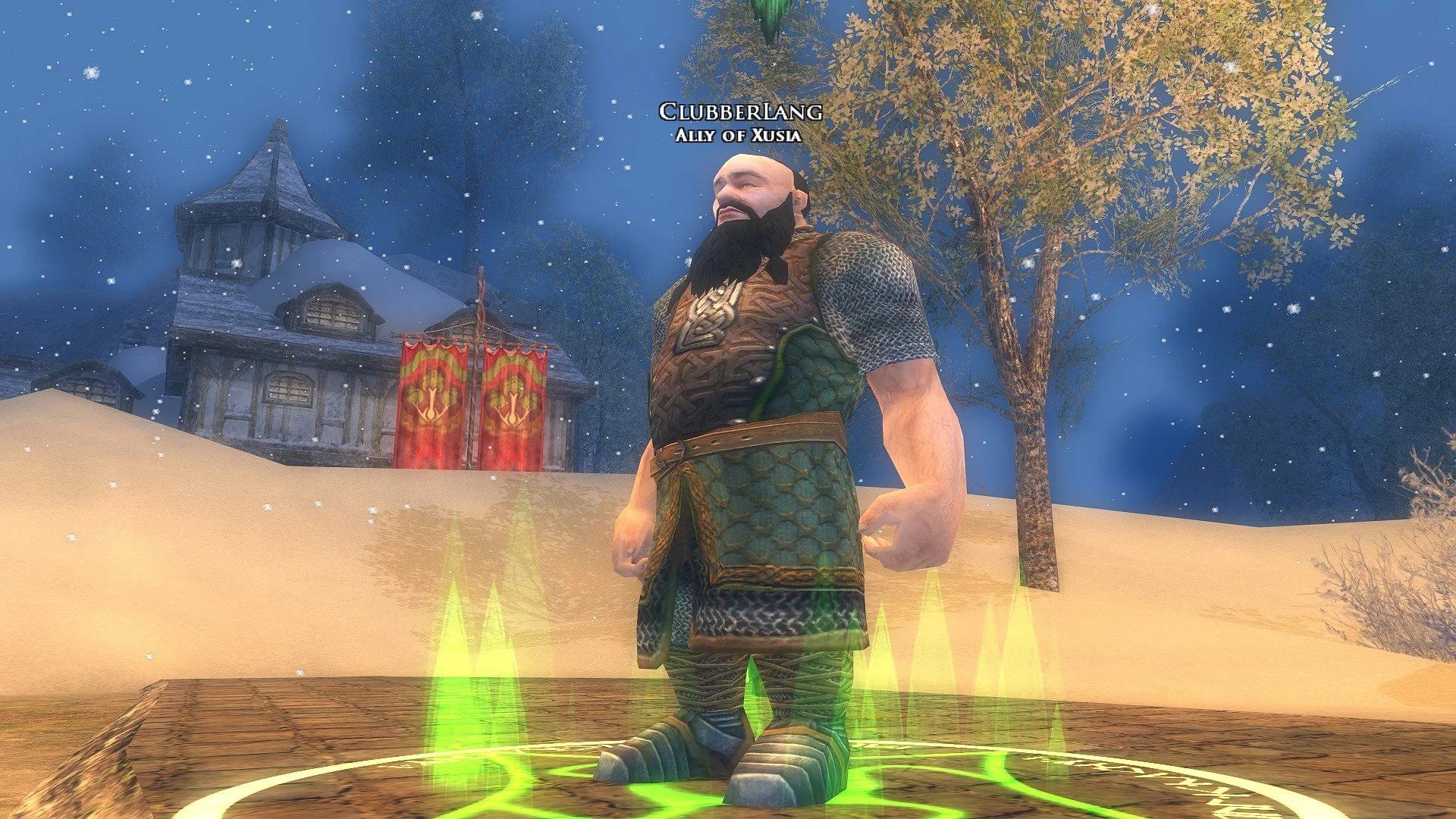
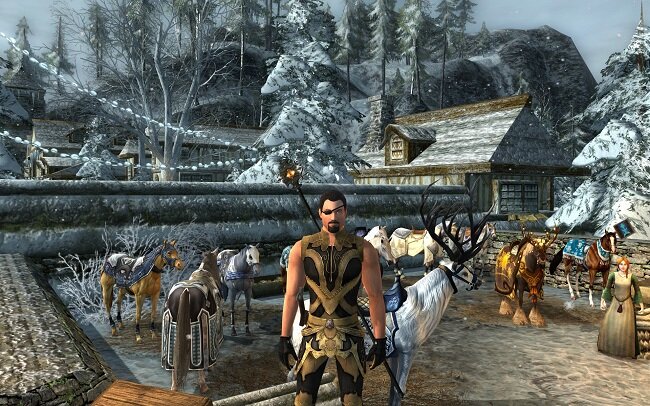
Frostbluff, where the LOTRO Yule Festival takes place, is an atmospheric, self-contained zone with a selection of repeatable quests. If you take the time and give the matter some thought, you can come up with an optimal rotation of quests that allows you to undertake them in the most efficient manner. I try to deal with all those based in the town first, then head West to collect the wood via the Wood-trolls, then East to deal with the Frost Grims and cheer the Snowbeasts. Finally I pick the mushrooms and head back into Frostbluff for the various hand ins. All of these quests can be completed within twenty minutes of so. If you choose a time of day when there are less players about, then you’ll not have to worry about queuing for NPCs to respawn and can possibly finish all these tasks in half the time. Furthermore, you soon learn where all the various items you need are and the entire process becomes second nature.
If you use XP boosters or take advantage of rested XP and other perks, you can receive a healthy amount of XP per quest. If you then undertake 10 repeatable quests each day, then the experience points soon racks up. I’m hoping that by the end of the Yule Festival on Thursday 9th January to have gained three to four levels and be somewhere around 124. I think I’ll then return to the Wolf-denes and finish all of the last update before finally considering buying and starting Minas Morgul. And then it will be back on the gear grind once again and unlocking further tiers on the Legacies of Legendary Weapon. I think my days of being at the cutting edge of LOTRO are now behind me as over for the last few years I’ve found myself playing catch up with most content. However, this is through my own choice. LOTRO is a known quantity and the gaming equivalent of a comfortable pair of shoes. It serves a purpose by scratching a very specific itch but I doubt if its going to reinvent itself in 2020.
Yet Another New Phone
My phone contract used to be a yearly affair. Every twelve months I’d have the option to upgrade to a shiny new handset. At one point this was something to look forward too. As I’ve written in the past, I was greatly enamoured with new technology in my youth and always wanted to be on the cutting edge. Mercifully, age and wisdom has tempered this passion greatly. Plus there came a point about four or five years ago when the technological improvements offered by new phone models began to decrease. Upgrades ceased to offer any significant benefits. Nowadays, my contract with my service provider runs for two years. Furthermore the “free upgrade” is no longer free and requires an upfront contribution towards the cost of the new phone. But this is hardly surprising, as the retail price of the latest iPhone or Android handsets are now ridiculously high. However the two-year contract does mean that upgrades can once again offer some improvements in phone functionality.
My phone contract used to be a yearly affair. Every twelve months I’d have the option to upgrade to a shiny new handset. At one point this was something to look forward too. As I’ve written in the past, I was greatly enamoured with new technology in my youth and always wanted to be on the cutting edge. Mercifully, age and wisdom has tempered this passion greatly. Plus there came a point about four or five years ago when the technological improvements offered by new phone models began to decrease. Upgrades ceased to offer any significant benefits. Nowadays, my contract with my service provider runs for two years. Furthermore the “free upgrade” is no longer free and requires an upfront contribution towards the cost of the new phone. But this is hardly surprising, as the retail price of the latest iPhone or Android handsets are now ridiculously high. However the two-year contract does mean that upgrades can once again offer some improvements in phone functionality.
I became eligible for a new mobile phone on the 15th of December. My much loved and heavily used Samsung Galaxy S8 has seen better days. It doesn’t hold a charge as well as it used to and there is some screen burn-in (something the manufacturers claimed wouldn’t happen upon its release). Therefore a new handset has been eagerly anticipated. As ever there are several practical criteria involved in choosing a new phone. The first and most obvious is the size. Handsets have been getting bigger and bigger, so the most obvious consideration is that I need to be able to fit my phone into my right-hand front jeans pocket and be able to sit down without doing myself an injury. Battery life is the next major consideration. I use multiple apps on my phone, all of which take a toll on power consumption. And then there is internet connectivity. Fortunately, living in South East London means that there is robust phone and internet coverage. Any new handset has to be able to take advantage of this.
After perusing the Vodafone store online, I found a good deal on a Samsung Galaxy S10 5G with a tariff that really suits my phone use and browsing habits. To cut a long story short I managed to use my 20 years good standing as a customer to negotiate a further discount in the price. Having learned the hard way, I have also invested in a shock absorbent case for the phone. Luckily my existing wireless phone charger still works with this model, which just about fits on the stand intended for an earlier handset. I received the new phone within 48 hours of my order and subsequently spent several hours migrating data and tweaking various apps. Google does do well with facilitating comprehensive data backups and subsequent restorations. However, I have four separate banking apps that all had to be re-verified with this phone. Luckily, I invested in a full version of LastPass a few years back and it is invaluable for quickly inputting obscure passwords that are seldom recalled.
So far, I am very happy with my Samsung Galaxy S10 5G. It provides a robust working platform for my smartphone needs. As well as making and receiving a high volume of calls and text messages, I rely on WhatsApp for a lot of day to day communications. I do much of my own and my parents banking via my phone. I also make a lot of ad hoc purchases from Amazon Prime. The calendar and reminder facilities that Android provide are invaluable. Due to frequent appointments to outpatient clinics and hospitals, I rely on Google Maps and often book taxis on the fly. My phone is my main portal on most social media platforms and I even use it to monitor traffic for this very blog. Gone are the days of my phone being a fashion accessory or status symbol. I chose the Samsung Galaxy S10 5G as it is a powerful tool and it should serve me well over the next two years. Let us hope it doesn’t end up in the Prime Minister’s pocket.


















Star Wars: The Rise of Skywalker (2019)
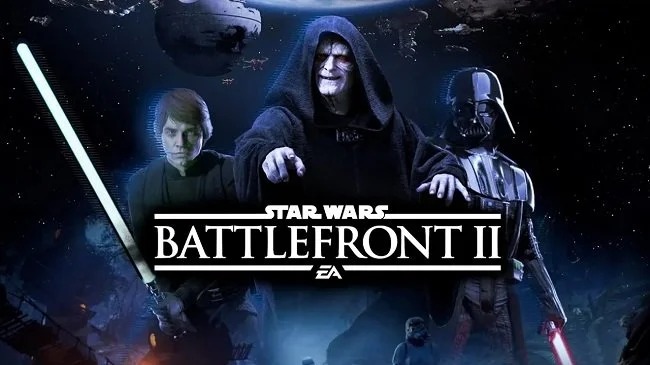
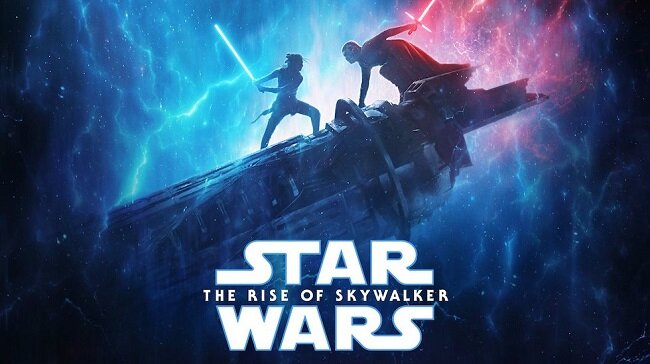
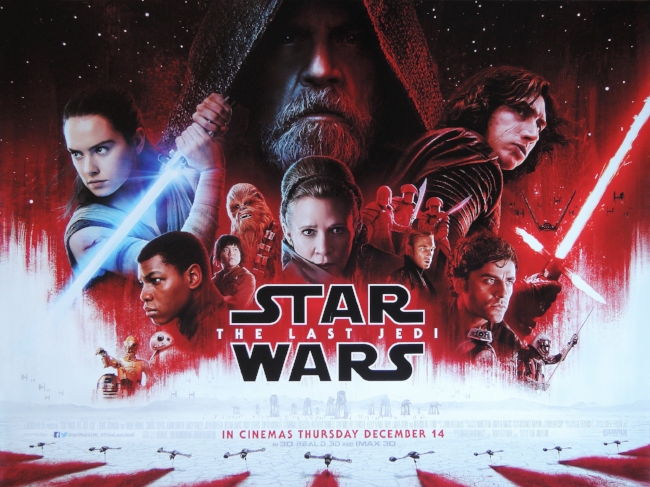
Two years ago The Last Jedi was released to mixed reviews. A vocal percentage of fans complained bitterly about various aspects of the movie. Some of their assertions such as the episodic pacing of parts of the story had merit. While other criticisms regarding diversity and gender categorically did not. However, Disney were cognisant of the fact that Star Wars fans were not universally enthralled by the movie although it turned a healthy profit. And then the following Easter Solo “underperformed” at the box office and journalists started talking about how the franchise had overreached itself and was in decline. Alarm bells obviously went off at board level and something had to be done. It would appear that The Rise of Skywalker is very much a movie designed to put the franchise back on track and wrap up the narrative proceedings of the last 42 years. However, there is a cost in offering such a colossal “fan service”. The latest instalment starts at a breakneck pace and continues in that idiom for over two hours. Action scenes, canonical references and homages are piled on, one after another. But narratively things are somewhat thin, recycling ideas and concepts from earlier movies. Some of the plot devices are never explained and therefore seem somewhat contrived. The Rise of Skywalker is most certainly entertaining. But it requires its core audience to be forgiving and to a degree complicit in its indulgences and failings.
Two years ago The Last Jedi was released to mixed reviews. A vocal percentage of fans complained bitterly about various aspects of the movie. Some of their assertions such as the episodic pacing of parts of the story had merit. While other criticisms regarding diversity and gender categorically did not. However, Disney were cognisant of the fact that Star Wars fans were not universally enthralled by the movie although it turned a healthy profit. And then the following Easter Solo “underperformed” at the box office and journalists started talking about how the franchise had overreached itself and was in decline. Alarm bells obviously went off at board level and something had to be done. It would appear that The Rise of Skywalker is very much a movie designed to put the franchise back on track and wrap up the narrative proceedings of the last 42 years. However, there is a cost in offering such a colossal “fan service”. The latest instalment starts at a breakneck pace and continues in that idiom for over two hours. Action scenes, canonical references and homages are piled on, one after another. But narratively things are somewhat thin, recycling ideas and concepts from earlier movies. Some of the plot devices are never explained and therefore seem somewhat contrived. The Rise of Skywalker is most certainly entertaining. But it requires its core audience to be forgiving and to a degree complicit in its indulgences and failings.
If you have seen any of the marketing and advertising material associated with The Rise of Skywalker, then you will already know one of the key plot points of the film. Emperor Palpatine survived the destruction of the second Death Star and is “recovering” on the Sith home world of Exegol. When tracked down and confronted by Kylo Ren, Palpatine reveals that he was behind the creation of the First order and manipulated Supreme Leader Snoke. The Emperor then offers Ren a secret fleet of Star Destroyers along with complete control of the galaxy, if he hunts down and kills Rey. Meanwhile, a spy within the First Order informs the Resistance of Kylo Ren’s activities. Rey, Poe, Finn and Chewbacca subsequently embark on a search for Exogel, using Luke Skywalker’s notes on Jedi texts. Will Kylo Ren carry out the Emperor’s wishes and betray Rey? Will Rey give in to the dark side of the force and discover her true destiny? Will the Resistance fight alone or will the oppressed citizens of the galaxy rise up and fight the First Order in one final struggle?
The Rise of Skywalker is a finely tooled but somewhat arbitrary conclusion to the Star Wars franchise. Director J. J. Abrams turns the action and pacing up to eleven, offering a cavalcade of digital set pieces and bombastic spectacles. The weightier plot elements raised by The Last Jedi have been jettisoned in favour of action, melodrama and keeping core fans happy. Where Rian Johnson reflected upon the hubris of the Jedi and how they were the architects of their own demise, Abrams is more content to shoehorn in as many cameos possible into the movies 142-minute running time. Furthermore, the object lesson that General Leia taught Poe Dameron about the nature of command, which was so well written by Rian Johnson, has now been forgotten in this instalment. Poe has reverted back to a headstrong character who rashly rushes into situations. The film parallels several iconic scenes from both The Empire Strikes Back and Return of the Jedi. It is debatable as to whether this is a cunning plot device showing history between Jedi and Sith repeating itself, or whether it is simply lazy writing designed to get the story out of the corner it has painted itself into.
As you would expect with this franchise, the quality of the production is outstanding. The scope of many of the digital action scenes are breath taking and there is also a lot of great physical effects and old school stunt work. As ever the Star Wars universe looks and feels very credible and lived in. Yes, the science behind many ideas is way off base but that was never what this series was about. Star Wars has always been and remains science fantasy and high adventure, as opposed to pure science fiction. Dan Mindel’s cinematography is very creative and often it’s the minor attention to detail that makes a scene. For example, there’s a wonderful reverse tracking shot where Poe and Finn advance along a corridor picking off Stormtroopers who fall dead, into the frame. The obvious physical humour of the previous movie has gone and the emphasis is once again on dry quips and asides. This is much more like A New Hope and is far less of a distraction. As ever I cannot praise enough, the artistry of the great John Williams. Once again, his score permeates every aspect of the film and is a living character, providing the emotional heart and soul of the proceedings. And as far as I’m concerned, whenever an actor from the classic trilogy was on screen, The Rise of Skywalker really hit its stride. Yes you can argue the Lando Calrissian was an underdeveloped character to begin with but Billy Dee Williams has a presence and a natural charisma. It was great to see him fly the Millennium Falcon one more time.
Although I will happily admit that The Rise of Skywalker is very entertaining and winds up the story suitably, I can’t help but feel I’ve been shamelessly manipulated; in the same way as watching a renown illusionist do a show at Las Vegas. It’s all great fun but you know that everything is a contrivance and a deliberate misdirection. Key cast members are sent to classic locations and iconic structures have conveniently survived catastrophic events. The story also feigns the death or imperils much loved characters, only to reveal these events to be bluffs later on. And too many of the major plot twists and turn just defy established lore for the sake of narrative convenience. I was often reminded while watching The Rise of Skywalker, of the classic Simpson’s episode “When You Dish Upon a Star” during which Homer pitches a movie screenplay about “"killer robot driving instructor that travels back in time for some reason". Every time something implausible, contradictory or convenient happens in The Rise of Skywalker, I would just think “for some reason” and it pretty much summed things up every time.
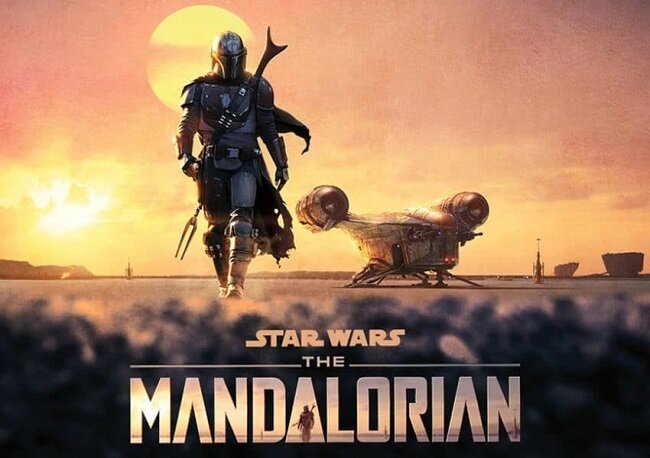
I suspect that for many Star Wars fans, the fundamental flaws inherent in The Rise of Skywalker will be outweighed by the cameos, homages and overall fan service that Disney have produced. I did just that and accepted the movie for what it is and broadly I enjoyed it. For example, exactly why Dominic Monaghan had such an obvious guest appearance, I’m not quite sure. But as C-3PO once said “It’s nice to see a familiar face”. As for the staggering crass expositionary dialogue that crops up from time to time, you have to remember that event movies such as this bring a lot of casual viewers and non-fans to the movie theatre. Plus the last instalment in any major, much beloved franchise is always a tough gig to undertake. However, there will be those who will not be at all pleased about this movie and I fully expect an internet outrage at some point soon. Once again, if a film is poorly made or under written, then these are legitimate grounds for criticism and complaint. If you’re peeved because a film didn’t pan out the way you wanted it to, then tough luck. Frankly it is good that the original Star Wars story arc has come to an end. Its broadly been a fun ride but the franchise has attained too much pop culture baggage. I personally think that the standalone movies about classic characters and scenarios are the way forward. I really like Rogue One and I’m currently enjoying The Mandalorian. As for classic Star Wars, I’ll settle for this ending on the understanding that it’s now time to part company.








What's My Age Again?
Before I start, let me clarify that this blog post is about the subject of age, as opposed to the song by Blink 182. Now that we have that out of the way, today is my birthday. I am 52 years old. It is a source of constant amazement to me, that I have been kicking about this mortal coil for over half a century. When considered in such terms it does give one pause for thought. I also find it interesting that I according to The Office for National Statistics, at present the average life expectancy for men in the UK is 79.2 years. I could therefore be around for at least another 27 years. As I’m in relatively good health at present and both my parents come from hardy stock who have propensity for longevity, maybe I’ll live beyond that statistic. I could make it into my nineties like my Father and Aunt. And let us not forget how medical science is continuously improving which further contributes to greater life expectancy. The UK has an ageing population and at present nearly 12 million people are aged 65 or above.
Before I start, let me clarify that this blog post is about the subject of age, as opposed to the song by Blink 182. Now that we have that out of the way, today is my birthday. I am 52 years old. It is a source of constant amazement to me, that I have been kicking about this mortal coil for over half a century. When considered in such terms it does give one pause for thought. I also find it interesting that I according to The Office for National Statistics, at present the average life expectancy for men in the UK is 79.2 years. I could therefore be around for at least another 27 years. As I’m in relatively good health at present and both my parents come from hardy stock who have propensity for longevity, maybe I’ll live beyond that statistic. I could make it into my nineties like my Father and Aunt. And let us not forget how medical science is continuously improving which further contributes to greater life expectancy. The UK has an ageing population and at present nearly 12 million people are aged 65 or above.
However, due to my personal philosophy and world view, I do not agree with the concept of “life at any cost”. For me it is all about the quality of one’s life. Therefore, I do not fear aging as long as it goes hand in hand with good health. My worst fear is to be debilitated by illness and robbed of my mobility or faculties. The idea of having to endure decades of diminished life where I am unable to be independent, utterly terrifies me. Which is one of the reasons I had an NHS Health Check earlier in the year. I felt that if I had any potential issues, I’d rather get on top of them now. Thankfully, that was not the case. Sure, like most people it wouldn’t hurt to shed a few pounds, but my heart, lung, liver and kidney function are doing okay. However, although it is often considered a cliché, I have developed some minor ailments in recent year. My joints ache and I find bending down as well as getting up and down off the floor is more of an effort. I also get cramp in my feet and calves, often for no discernible reason. Getting older also brings the indignity of an increase in superfluous body hair. Something I abhor.
Yet conversely, despite age bringing a degree of physical diminishment, I have never felt more robust mentally and emotionally. I have a sense of measured confidence that I sorely wish I’d had when I was in my twenties. I try to keep calm in stressful situations, think before I speak, endeavour to be patient and generally not contribute to the ongoing stupidity that abounds in the world today. I am happy to speak in public, share my thoughts if asked to do so, praise others when it’s due and admonish those who are thoughtless and inconsiderate to others. I can still learn new skills quite quickly and I’m happy with my writing abilities. Being in my fifties, I have shed a lot of concerns and worries that plagued me in my youth. For example, I don’t feel the need to worry about my appearance or the way I dress. Clothes are now chosen on grounds of convenience and practicality, rather than style. I keep my hair short as such a length is low maintenance. Overall, I am comfortable in my own skin and not unduly concerned by other people’s opinion about me or how I lead my life.
I certainly think that when it comes to ageing, men get a much easier ride than women. According to the tabloid press, when a man’s hair goes grey or white, it is “distinguished”. Sadly, such a thing is not deemed favourable for ladies, who are continuously judged by the cult of youth and pressurised to fight against any signs of age. I am also aware that at 52 I am perceived differently by various age groups. My parents finally see me as an “adult” which amuses me no end. To young people in their teens I’m just another parent; neither threatening nor venerable. And some of my peers who are of a comparable age to me, still think that they can conduct themselves exactly as they did two decades ago. I sincerely hope that I don’t do this. As the saying goes “there’s no fool like an old fool”. Overall, I do not think we should be totally defined by our age. Yet it is a mistake to write it off as “simply a number”. For me, the compromise is to maintain a contemporary outlook, move with the times and something about being “young at heart”. But if your body tells you to take a break after a long walk, then it is wise to listen. Also Gin cures a multitude of ailments















Login Incentives in MMORPGS
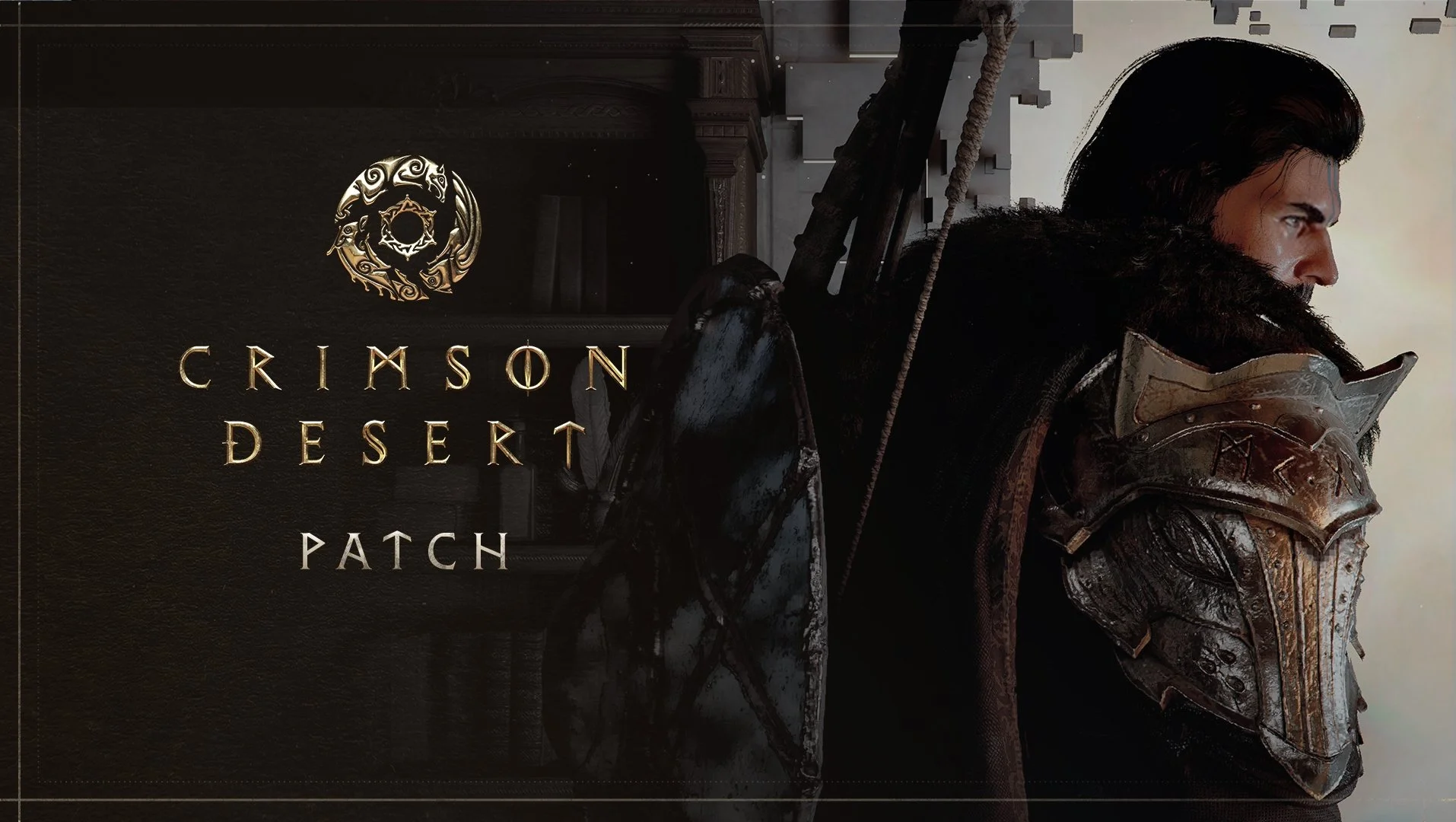
A major challenge for any MMO is to keep players logging in to the game. Obviously, regularly adding content and ensuring that there are sufficient quests, activities and tasks for players to undertake is essential. However, experience has shown that no matter how much content developers add to an MMORPG, players will always veraciously consume it and want more. Hence you need an additional “carrot on a stick”. Something that get’s player sufficiently interested to log into a game, even when they don’t have anything especially compelling to do. Login incentives are designed to do exactly that. They offer of some bauble or trinket that motivates you to log into a game once a day. Hopefully once you login, you may then find something to occupy yourself, either on your own or with fellow guild members. And of course the player who is actively playing may well even purchase something from the in-game store. At the very least, a successful login incentive contributes towards active player statistics. If those figures are presented in the right fashion on paper, they can bolster a declining population.
A major challenge for any MMO is to keep players logging in to the game. Obviously, regularly adding content and ensuring that there are sufficient quests, activities and tasks for players to undertake is essential. However, experience has shown that no matter how much content developers add to an MMORPG, players will always veraciously consume it and want more. Hence you need an additional “carrot on a stick”. Something that get’s player sufficiently interested to log into a game, even when they don’t have anything especially compelling to do. Login incentives are designed to do exactly that. They offer of some bauble or trinket that motivates you to log into a game once a day. Hopefully once you login, you may then find something to occupy yourself, either on your own or with fellow guild members. And of course the player who is actively playing may well even purchase something from the in-game store. At the very least, a successful login incentive contributes towards active player statistics. If those figures are presented in the right fashion on paper, they can bolster a declining population.
Hobbit Presents were added to The Lords of the Rings Online as part of Update 11: Treachery of the White Hand in May of 2013. Like any other login incentives, they do guarantee that players actively play the game but they provide another reason for LOTRO players to at least login and collect their “reward”. Broadly speaking these rewards are adequate. Silver presents are available daily and gold rewards once every seven days. Upon clicking on the Hobbit Presents interface, players receive a random in-game item. This can range from food, potions, XP, reputation and slayer deed buffs all the way to high-end armour and jewellery. All rewards are account bound so boxes containing level appropriate items can be transferred among players various alts. More often than not, most of the regards are trivial especially for level cap characters. However, they can be sold to vendors, so at the very least they can provide a small stream of revenue on a daily basis. Sometimes items such as the Universal Toolkit can be very beneficial.
Similarly, Daily Rewards were added to The Elder Scrolls Online with Update 18 in May 2018. At the start of each month, a calendar displaying rewards for each day becomes available and items can be claimed in chronological order. Again most of the items tend to be food and other consumables that provide a buff. There are also XP scrolls and modest stipends of the games various currencies. However, non-combat cosmetic pets are also included and there are usually free samples of the latest Crown Crates. These contain a broad spectrum of rewards and on several occasions, I have obtained a new mount just by using these free samples. The gold stipends are also a welcome top up to one’s overall in-game currency reserves. Like other MMOS these free rewards are not character bound so can be swapped between alts or they go into an account shared currency wallet. The Daily Rewards, like Hobbit Presents, can only be claimed by one alt a day.
The question remains, are these login incentives genuinely sufficient to get an indifferent player to log into a game? If you have become burnt out on a particular MMORPG, then I’d say no. I think you have to have some sort of ongoing commitment to a game to begin with. Then such incentives can be enough to give you a little nudge and sign into a game. Of the two systems I have mentioned, I personally prefer that found in ESO. I prefer to know in advance what rewards are available for the entire month. At present the December schedule shows that there are some free Crown Crates available on December 21st. I must therefore not skip too many days of logging in, or else I’ll find that the reward is inaccessible. If you fail to login each day, a reward is deducted from the end of the monthly schedule. The random nature of Hobbit Presents in LOTRO is less compelling system. The allocation of rewards is a lottery. However, there is potential to win something of note, so there is still a degree of motivation to login. Yet regardless of the quality of login incentives, they are still no substitute for having tangible activities to do in a game and should never bee seen as anything more than what they are.

A Solution to the Single Games Launcher Conundrum
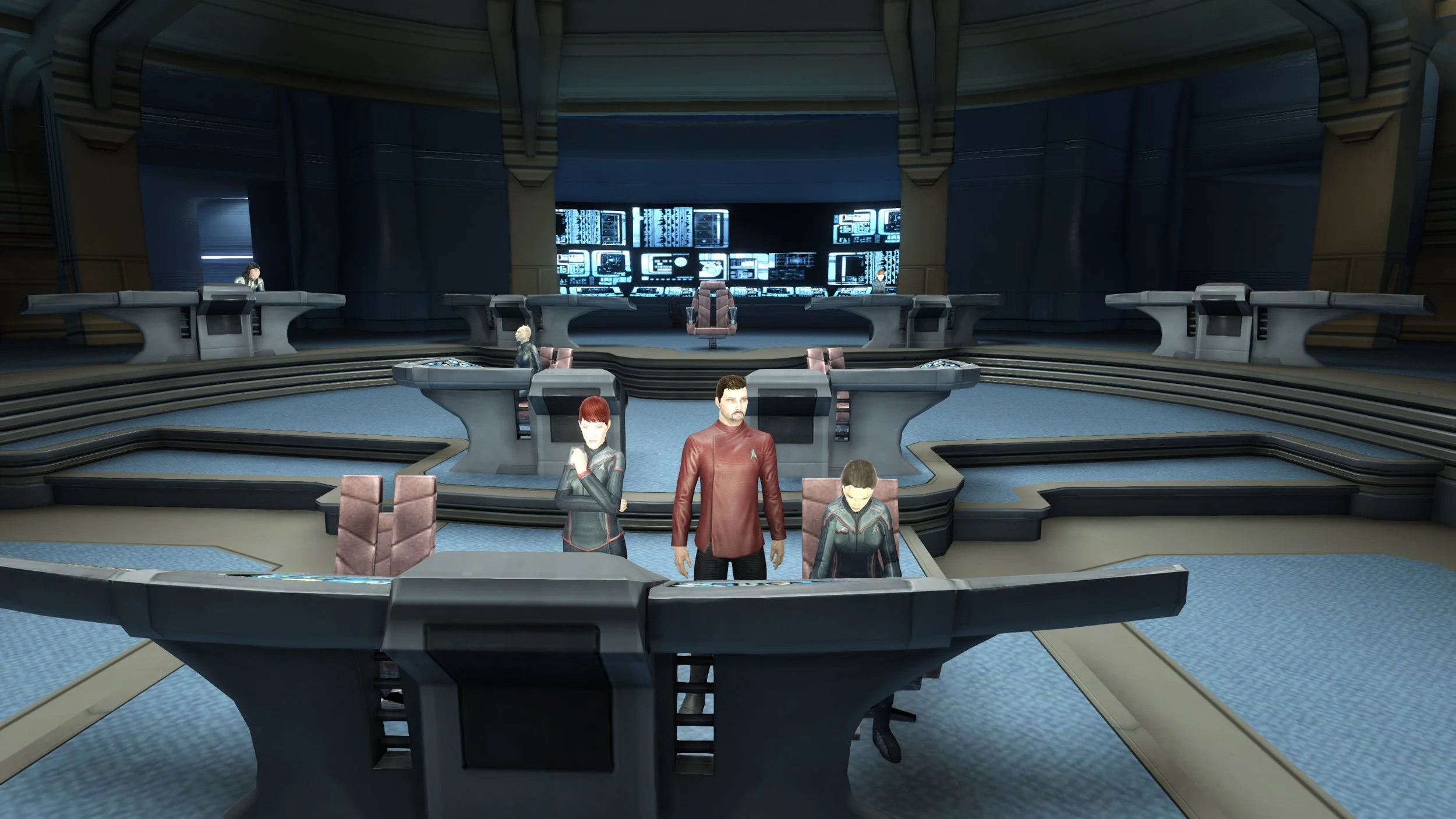
Back in April I wrote about the proliferation of video game launchers and how more and more companies are offering their own. The dream of Steam being a one stop platform for gaming has long gone and gamers now have to install multiple clients to access their various game libraries. As I indicated in that post, I’m personally not that outraged or inconvenienced by having to use different game launchers. There are far bigger problems facing the video games industry at present, such as aggressive monetisation, the decline of game ownership in the traditional sense and growth of “live services” and the associated bullshit that goes with such business models. Having to use separate launchers (I have 10 installed at the last count) is therefore lower on the list of transgressions and sins. However, that doesn’t mean that I’m averse to a solution if one presents itself and it looks like one may have just done so.
Back in April I wrote about the proliferation of video game launchers and how more and more companies are offering their own. The dream of Steam being a one stop platform for gaming has long gone and gamers now have to install multiple clients to access their various game libraries. As I indicated in that post, I’m personally not that outraged or inconvenienced by having to use different game launchers. There are far bigger problems facing the video games industry at present, such as aggressive monetisation, the decline of game ownership in the traditional sense and growth of “live services” and the associated bullshit that goes with such business models. Having to use separate launchers (I have 10 installed at the last count) is therefore lower on the list of transgressions and sins. However, that doesn’t mean that I’m averse to a solution if one presents itself and it looks like one may have just done so.
One of the game launchers and online stores I already have installed is GOG Galaxy. Good Old Games is part of CD Projekt and as this Polish developer has produced some good titles (the Witcher franchise) and broadly acts in an ethical fashion, I am reasonably well disposed towards them as a consumer. They are currently developing GOG Galaxy 2.0 which is being beta tested at present. I was recently invited to try this product and was impressed to see that it has a facility to link accounts from other game launchers. Alternatively you can manually add a game to your library that is installed outside of GOG Galaxy 2.0. Now I’m sure some of you will be thinking “doesn’t Steam do that already?” and the answer is indeed “yes”. However, the Epic Store blocks Steam from doing this with any of its titles, so you cannot use Steam as a “one stop solution”. GOG Galaxy 2.0 effectively allows you to access all your games from a single platform, be they installed via Origins, UPlay, Steam or even the Epic Store. Furthermore, there is ongoing support for 3rd party addons that can facilitate linking to smaller and more bespoke platforms.
Now the solution that GOG Galaxy 2.0 is seeking to offer does not eliminate all the inconveniences that stem from having to install and run multiple game launchers. For example it cannot unify friends lists and custom social groups. And often all GOG Galaxy 2.0 can do is start another launcher that allows you to access the game you wish to play. But it is at least it is a start and offers the most functionality compared to its rivals. If you wish to try and manage as much as you can from a single app, then GOG Galaxy 2.0 seems to be the best option around at present. It should also be noted that at present, the beta test is by invite only. But if you have version 1.0 of GOG Galaxy installed and have expressed an interest in the next version, an email should be forthcoming with download instructions. It will be interesting to see how well GOG Galaxy 2.0 fares in an increasingly protectionist video games market. Will the current functionality of the beta build make it into the final release or will market forces end up blocking cross platform access? Time will tell.
A Christmas Carol (1997)
It’s interesting that so many adaptations of Charles Dickens’ iconic seasonal story are brought to us via the medium of animation. Naturally, this is a far more economical means of depicting the story with its period detail and supernatural elements, compared to a live action production. However, for an animated version of A Christmas Carol to work successfully, it needs three things. An innovative and striking production design, robust voice acting and a screenplay that keeps the core themes while offering significance difference compared to prior adaptations. You’ll find all of these elements in Richard Williams’ 1971 animated short. Sadly they’re conspicuously absent from the 1997 version. Despite the presence such talents as Tim Curry, Ed Asner and Whoopi Goldberg, this is a distinctly arbitrary animated film. Considering that the screenplay was written by Jymn Magon who has years of experience working for Disney, I had hoped this would be better endeavour.
It’s interesting that so many adaptations of Charles Dickens’ iconic seasonal story are brought to us via the medium of animation. Naturally, this is a far more economical means of depicting the story with its period detail and supernatural elements, compared to a live action production. However, for an animated version of A Christmas Carol to work successfully, it needs three things. An innovative and striking production design, robust voice acting and a screenplay that keeps the core themes while offering significance difference compared to prior adaptations. You’ll find all of these elements in Richard Williams’ 1971 animated short. Sadly they’re conspicuously absent from the 1997 version. Despite the presence such talents as Tim Curry, Ed Asner and Whoopi Goldberg, this is a distinctly arbitrary animated film. Considering that the screenplay was written by Jymn Magon who has years of experience working for Disney, I had hoped this would be better endeavour.
A Christmas Carol presents a very non-specific realisation of Dickensian London. The costumes seem more Edwardian in style and the city is a little too contemporary in design. Scrooge (Tim Curry) is depicted in a very generic way, complete with long nose, angular features and balding head. He also has a canine companion named Debit who acts as a comic foil and tempers some of the more sinister elements of the story. The film sports a rather lurid colour scheme, with characters wearing lots of bright red and green. The various spirits that visit scrooge deviate from the source text in their depiction. The Ghost of Christmas Past is presented as a street urchin, which I thought was quite a creative touch. The Ghost of Christmas Present is voiced by Whoopi Goldberg so the spirits gender and ethnicity reflect those of the actor. And then there are the songs. Yes, this is yet another musical adaptation filled with indifferent songs that simply fill the gaps in the proceedings. None of them stay with you.
At 72 minutes this version of A Christmas Carol does not outstay its welcome. Despite being rather uninspired it is broadly tolerable, although I appreciate that such a statement is damning with faint praise. Occasionally there are some minor details lifted directly from the source text, which I always look to see. This time round it is Jacob Marley’s face appearing in the painted tiles that surround the fireplace in Scrooge’s lodgings. The film also has a few creative ideas, such as a Jacob Marley that looks more like Theodore Roosevelt than a ghost. I also liked that Scrooge finds common ground with Tiny Tim through their finding escape through books and mutual love of the novel Robinson Crusoe. If you can tune out the songs and concentrate on the animated sequences that accompany them, as well as overlook the rather pointless inclusion of the dog Debit, then this version of A Christmas Carol may be of interest to fellow completists. Casual viewers will be better off seeking out a more accomplished adaptation.
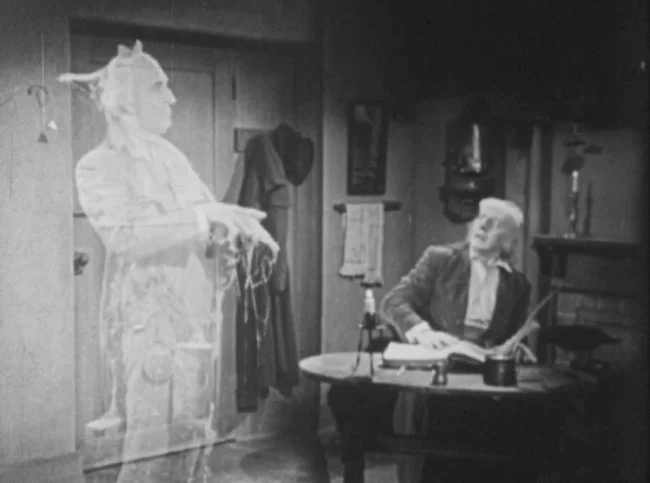
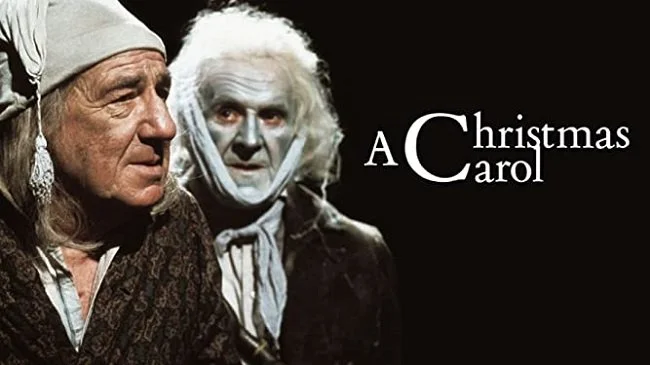
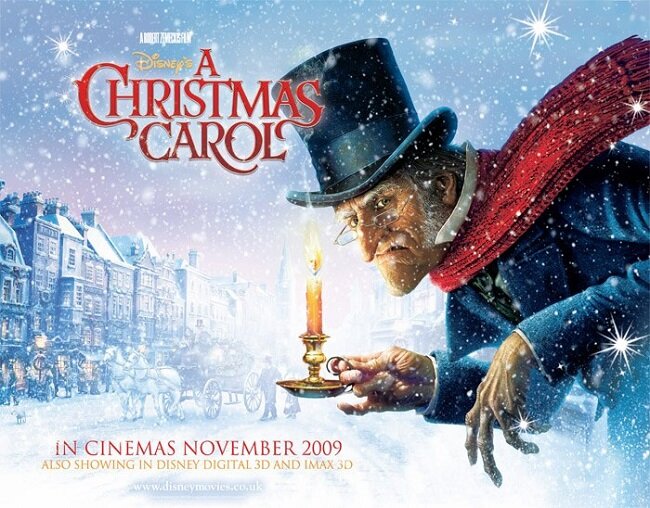


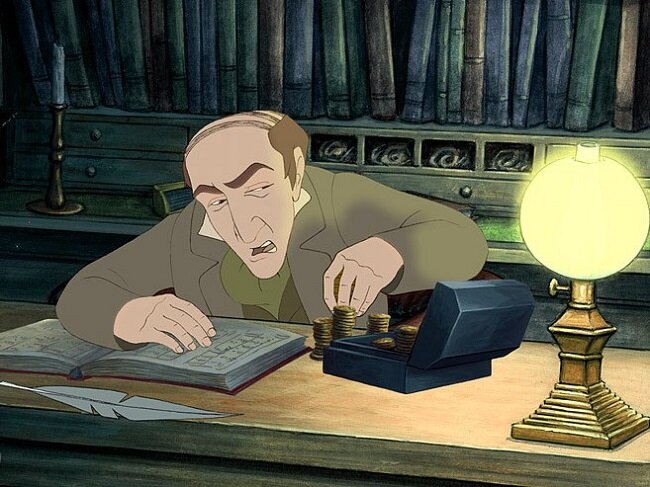
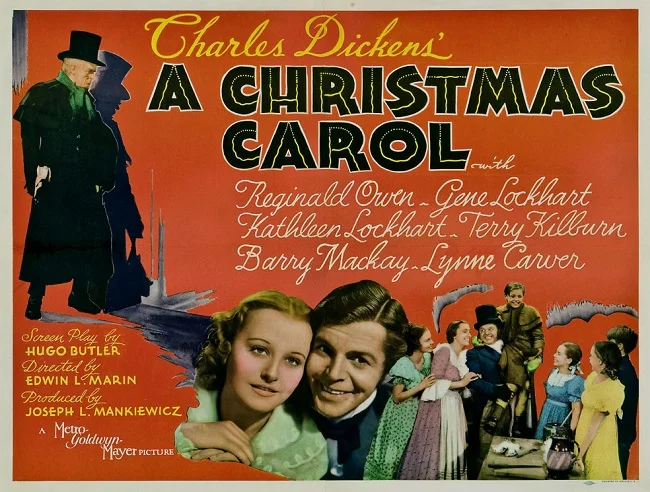


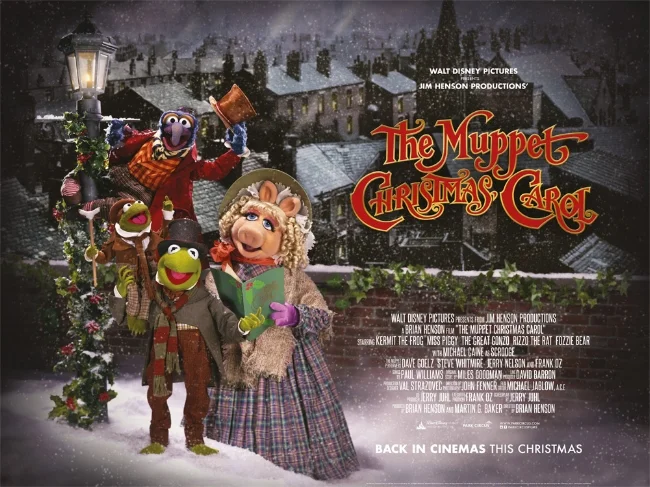

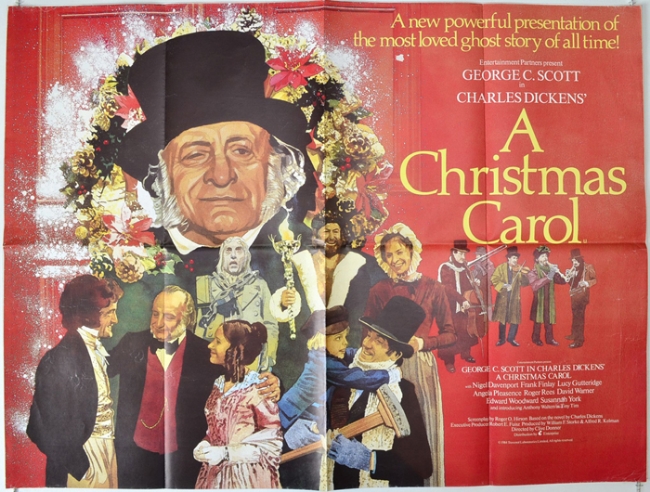
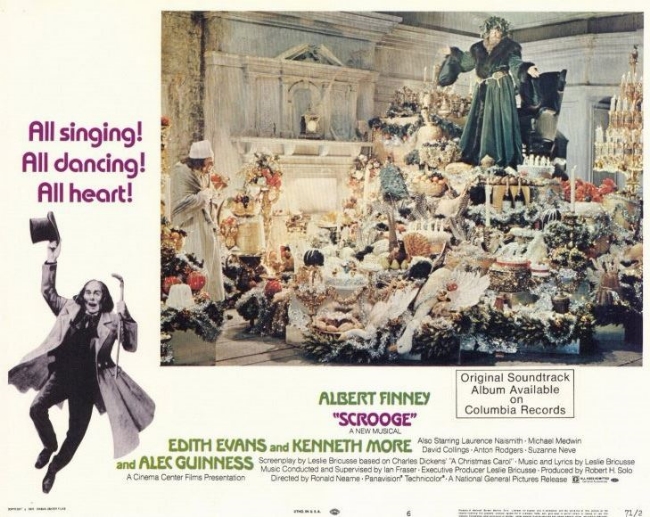
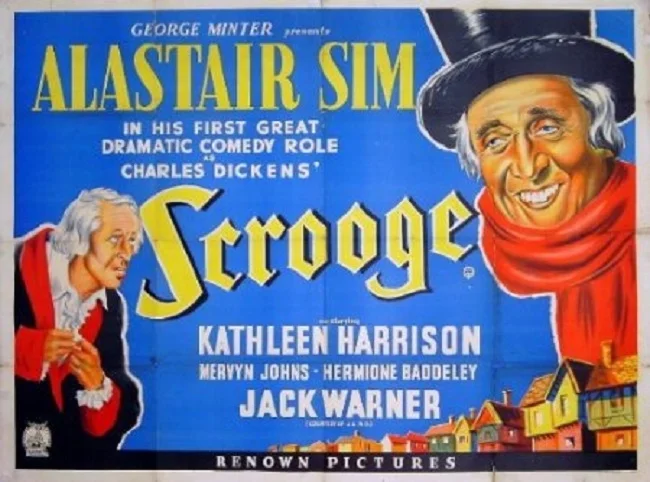
The Esoteric Nature of Crafting in MMORPGs
I was initially going to call this post “crafting can fuck right off” but I felt that was a somewhat bellicose opening gambit and a little hyperbolic. So I’ve toned it down to “the esoteric nature of crafting in MMORPGS”. Now to begin with, I tend not to craft when playing MMORPGs. The effort to reward ratio is often insufficient and I have yet to find a crafting system that is engaging and fun. However, for me the biggest sin that crafting can commit is being deliberately arcane and obtuse “with malice of forethought”, if I may invoke legal analogy. Don’t get me wrong, I have no problem with game systems and mechanics being complicated. Intricacy can be both intriguing and rewarding if presented correctly. However, all too often game developers cross over the line, stepping from “complexity” to “fucking annoying”. For example some card games such as Poker can have complex rules but mastering them transforms the proceedings from random chance into a game of skill. But at the other end of the spectrum there’s Fizzbin, which was invented purely to be frustrating due to its arcane nature. I frequently find that crafting in MMOs is just like Fizzbin. Except they’re not amusing or ironic, just tedious and irritating.
I was initially going to call this post “crafting can fuck right off” but I felt that was a somewhat bellicose opening gambit and a little hyperbolic. So I’ve toned it down to “the esoteric nature of crafting in MMORPGS”. Now to begin with, I tend not to craft when playing MMORPGs. The effort to reward ratio is often insufficient and I have yet to find a crafting system that is engaging and fun. However, for me the biggest sin that crafting can commit is being deliberately arcane and obtuse “with malice of forethought”, if I may invoke legal analogy. Don’t get me wrong, I have no problem with game systems and mechanics being complicated. Intricacy can be both intriguing and rewarding if presented correctly. However, all too often game developers cross over the line, stepping from “complexity” to “fucking annoying”. For example some card games such as Poker can have complex rules but mastering them transforms the proceedings from random chance into a game of skill. But at the other end of the spectrum there’s Fizzbin, which was invented purely to be frustrating due to its arcane nature. I frequently find that crafting in MMOs is just like Fizzbin. Except they’re not amusing or ironic, just tedious and irritating.
I tried crafting in The Lord of the Rings Online fairly recently after playing for 11 years. Initially it was simply a case of gathering raw material, refining them and gaining XP in the appropriate skill. But after a while additional resources were needed to progress and advancement became ponderous. Hence, I quickly abandoned this aspect of the game. Sadly, I did not learn my lesson. While recently playing The Elder Scrolls Online, I discovered several Crafting Motif Books that allow you to cosmetically augment your gear. However, my hopes and dreams of looking dapper and stylish in-game were quickly dashed. The use of these books are dependent upon having certain crafting skills at a specific level. For example, Crafting Motif 13: Primal Style “Requires Rank 6 or greater of any one of the Metalworking, Tailoring or Woodworking passives”. Now at first glance I thought this meant that the I had to have any one of those three skills at level 6. Turns out that is not the case. Ranking is not equivalent to level. There are 50 levels and 10 ranks. Rank 6 is level 25. Now some of you may be asking at this point, “what’s the problem here”? Well, how about the fact that none of this information regarding skill levels and rankings is immediately available in the game? Turns out if you wish to comprehensively learn about crafting in ESO, you have to do so outside of the game.
“I am no one to be trifled with”
Now call me old fashioned but I have always thought that if a game makes you tab out while you’re actively playing, to find something out via a third-party website, then it is doing itself a major disservice. And that is putting it mildly. It is an abject failure by the game developers. It is also fucking annoying. So far, my experience with crafting in ESO can be filled under such. However, I am no one to be trifled with so I have doggedly worked on increasing my Blacksmithing skill. I am currently bankrupting myself in-game by buying purple heavy armour and two-handed weapons and deconstructing them. The XP gained has so far got me to level 15 but it has also cost about 25,000 gold. It may be financially more practical to farm Dolmen and deconstruct the various weapons drops, although this may well take longer as loot is random and not always of the type required. But I intend to use my Crafting Motifs, come hell or high water. And ZeniMax Online Studios can go piss up a rope, as can crafting per se in the MMO genre. I will not be prevented from looking fabulous in this or any other game due to the whims and caprices of those who don’t know the subtle difference between complex and esoteric.
International Picture Posting Month: The Lord of the Rings Online
The Lord of the Rings Online is unique in so far as there are no other Tolkien based MMORPGs available at present (although another is currently in development). I have played LOTRO since 2008 and what I have discovered during that time, is that although the game attracts MMO players, it also attracts dedicated Tolkien aficionados. Many of those who play LOTRO do not play other games or even consider themselves as gamers. The intellectual property is a magnet for fans and frequently a steppingstone into the world of gaming. Hence you have a player base that is heavily invested and forgiving, because of their affection for the source material. Few other MMOs have this sort of community. LOTRO offers an opportunity to immerse yourself in Middle-earth. For many, the game’s vision of Tolkien’s world is superior to Peter Jackson’s movie adaptations. LOTRO has its own original aesthetic and style. Furthermore, after twelve years there is a prodigious amount of Middle-earth to explore. No other MMO can offer players access to The Shire, or Rohan or the Dead Marshes. So, in many respects LOTRO is an MMO occupying a unique niche in the video games market.
The Lord of the Rings Online is unique in so far as there are no other Tolkien based MMORPGs available at present (although another is currently in development). I have played LOTRO since 2008 and what I have discovered during that time, is that although the game attracts MMO players, it also attracts dedicated Tolkien aficionados. Many of those who play LOTRO do not play other games or even consider themselves as gamers. The intellectual property is a magnet for fans and frequently a steppingstone into the world of gaming. Hence you have a player base that is heavily invested and forgiving, because of their affection for the source material. Few other MMOs have this sort of community. LOTRO offers an opportunity to immerse yourself in Middle-earth. For many, the game’s vision of Tolkien’s world is superior to Peter Jackson’s movie adaptations. LOTRO has its own original aesthetic and style. Furthermore, after twelve years there is a prodigious amount of Middle-earth to explore. No other MMO can offer players access to The Shire, or Rohan or the Dead Marshes. So, in many respects LOTRO is an MMO occupying a unique niche in the video games market.
Another aspect of LOTRO in which the game excels is the story structure and quest lines. All are driven by strong narratives and couched in the lore of Middle-earth. The writers have always shown an abiding love for the work of Professor Tolkien and this is reflected in both the main epic storyline, right down to the smallest regional quest. You’ll often find references both big and small to various events found in the original books, as well as links to tales dating further back in the history of Middle-earth. For example, there’s a minor quest in the South Farthing of The Shire, in which a young Hobbit falls asleep onboard a small covered wagon. He subsequently recounts a tale of travelling to a tower in a circle of rock and a scary old man dressed in white. It would appear that he has unwittingly hitched a ride to Isengard, via one the supply wagons Lotho Sackville-Baggins is sending to Saruman. It is minor asides such as these that embellish LOTRO and delight those who enjoy the source texts upon which they’re based.
Although some may argue that the halcyon days of the MMORPG are gone, there are still several enduring titles that can offer new players an engaging virtual world to explore and quest in. LOTRO is definitely one of these. Not only can it satisfy your MMO itch but also provide a franchise specific experience that no other game can directly compete with. Furthermore, after celebrating its twelfth anniversary this year, the developers have plans to expand the game further, adding yet more of Middle-earth to the game. Mount Gundabad is currently in development and will be available in 2020. So, if you’re looking for an original and immersive depiction of Tolkien’s world, with a narrative driven story and a welcoming community, then look no further than LOTRO. Just remember the wise words of Bilbo Baggins. “It's a dangerous business, going out your door. You step onto the road, and if you don't keep your feet, there's no knowing where you might be swept off to.”
In addition to the pictures in this post, here is a link to a gallery of screenshots from LOTRO via Google Photos. All are available at the original screen resolution of 1920 x 1200.
Strictly Come Dancing: The Judges versus the Public
Rather than continue to analyse each week’s show, which after all is a somewhat over saturated field, I thought it would be more interesting to write about the different facets of Strictly Come Dancing. The one I particularly wish to focus upon this time is the voting system and how it often highlights a differing of opinion between the professional judges on the show and the British public. For the past two weeks now there have been several celebrity dancers in the dreaded dance off who are far from the weakest performers. This has led to competent individuals leaving the show unexpectedly early. In many ways the voting system and the fact that no one can be considered safe is one the key factors that keeps Strictly popular and in the media spotlight. However, it also provides some pause for thought. The judges broadly mark and assess the celebrity dancers based upon their talent and performance. If they do not like a routine but still appreciate its technical merits, then they reflect that in their scores. However, the public seem to approach things quite differently.
Rather than continue to analyse each week’s show, which after all is a somewhat over saturated field, I thought it would be more interesting to write about the different facets of Strictly Come Dancing. The one I particularly wish to focus upon this time is the voting system and how it often highlights a differing of opinion between the professional judges on the show and the British public. For the past two weeks now there have been several celebrity dancers in the dreaded dance off who are far from the weakest performers. This has led to competent individuals leaving the show unexpectedly early. In many ways the voting system and the fact that no one can be considered safe is one the key factors that keeps Strictly popular and in the media spotlight. However, it also provides some pause for thought. The judges broadly mark and assess the celebrity dancers based upon their talent and performance. If they do not like a routine but still appreciate its technical merits, then they reflect that in their scores. However, the public seem to approach things quite differently.
When discussing Strictly with fellow fans, our personal favourite couples often come up. Hence it can be assumed (erroneously) that if someone enjoys say Karim or Alex’s dancing, then they regularly vote for them and offer them ongoing, unqualified support. However, a little research shows that this is not the case. The most obvious fact that supports this theory is that a celebrity can be riding high on the leaderboard due to the judges’ marks. But when the public vote is added to their score, they find themselves in the dance off, indicating that what pleases the likes of Craig, Motsi, Shirley and Bruno does not necessarily fly with the home audience. Karim had a judges’ score of 38 on Saturday night with his Couple’s Choice Contemporary routine. Yet he still found himself in the dance off. A similar fate befell Michelle Visage a week earlier with her similarly non-traditional routine. Unlike Karim, she did not survive the dance off. So it would seem that there is potential for a perfectly capable celebrity to perform a dance that means a lot to them but doesn’t chime with viewers and for that to result in a distinct lack of votes.
Another incorrect assumption is that of “fan bases”. Saffron Barker may well have a legion of fans on social media but that patently did not translate into votes on Saturday night. Hence, she found herself yet again in the dance off with Karim and the rest is history as the expression goes. Perhaps the problem in this instance resides with a fanbase that is predominantly online, as opposed to actively watching an older form of media such as television. There has also been discussions in previous years that Strictly viewers are more likely to vote for those celebrities that they can immediately relate to. This then raises contentious matters such as race, class and other spurious social markers. And lets us not forget the Great British tradition of supporting the perceived “underdog”. Strictly viewers will happily keep a talentless, time wasters embarrassing themselves on national TV each week until they tire of them. Such is the enigma of public voting. There are times when you can deduce how people are thinking and who they may keep on the show. And then there are other occasions when it can be a total lottery. I suspect that this year’s final may be subject to the latter and not the former.













Rambo: Last Blood (2019)
The enduring appeal of the character John Rambo in First Blood comes from the fact that he is a traumatised ex- service man who keeps himself to himself as he drifts from job to job, trying to come to terms with his wartime experiences. His poor treatment at the hands of a small-town Sheriff is a succinct metaphor for the social and political indifference that Vietnam veterans were shown upon their return to the US. He’s a man with a code in a world that no longer has any use for him. His simple and honest patriotism is not returned and he is in fact viewed with shame by many from the nation he loves. Furthermore, the first movie does not paint him as a cold-blooded killer. Despite provocation he is not the first person to shoot to kill. Rambo is in many ways a victim. A broken man, who society has asked to do unspeakable things. Now society wants nothing to do with him and fears the “monster” they created. Although clearly an action movie, First Blood had narrative depth and a flawed but sympathetic protagonist. 37 years and four movies later, such dramatic themes have long left the franchise. The central character is indeed a caricature of its former self.
The enduring appeal of the character John Rambo in First Blood comes from the fact that he is a traumatised ex- service man who keeps himself to himself as he drifts from job to job, trying to come to terms with his wartime experiences. His poor treatment at the hands of a small-town Sheriff is a succinct metaphor for the social and political indifference that Vietnam veterans were shown upon their return to the US. He’s a man with a code in a world that no longer has any use for him. His simple and honest patriotism is not returned and he is in fact viewed with shame by many from the nation he loves. Furthermore, the first movie does not paint him as a cold-blooded killer. Despite provocation he is not the first person to shoot to kill. Rambo is in many ways a victim. A broken man, who society has asked to do unspeakable things. Now society wants nothing to do with him and fears the “monster” they created. Although clearly an action movie, First Blood had narrative depth and a flawed but sympathetic protagonist. 37 years and four movies later, such dramatic themes have long left the franchise. The central character is indeed a caricature of its former self.
After the events of Rambo (2008) John Rambo (Sylvester Stallone) returns to his home in Arizona, where he lives raising and selling horses which he manages with his Father’s old business partner Maria Beltran (Adriana Barraza), and her granddaughter Gabriela (Yvette Monreal). This surrogate family has provided John with stability and hope for the last decade and helped him face his inner demons. However, PTSD still plagues John and he often sleeps in a series of tunnels that he’s dug under his ranch as a form of self-therapy. Despite advice to the contrary, Gabriela goes to Mexico looking for her estranged Father. After meeting with an old school friend, Gizelle (Fenessa Pineda), a meeting is arranged but her Father rejects her. Upset by events, Gabriela goes to a nightclub with Gizelle to drown her sorrows. She is subsequently betrayed by her friend and falls into the hands of a human trafficking gang run by the Martinez Brothers. John comes looking for Gabriela and quickly has a run in with the violent gang. His actions have far reaching consequences leading to a show down at John’s heavily fortified ranch.
Rambo: Last Blood is curious hybrid genre film, sitting somewhere between Taken, Death Wish and a Friday the 13th movie. It’s quite different from previous instalments in both style and format. There are no covert missions, no skirmishes with foreign military forces and no schoolboy commentary on geopolitics. Instead director Adrian Grunberg (Get the Gringo) initially tries to focus on John Rambo coming to terms with his place in the world as he lives out his “retirement” on his Father’s ranch in quiet self-contemplation. The international version of the movie starts with an interesting prologue in which Rambo uses his tracking skills to try and rescue some tourist lost in a storm. His inability of save all of them triggers his PTSD. However, these scenes do not appear in the US and UK version of the movie. Furthermore, their relevance in the longer edit is soon lost as the movie quickly gives way to standard action movie and revenge tropes. From then on, we are subject to a generic kidnap and revenge fantasy, populated by decidedly two-dimensional characters. If you want copious amounts of action and gore then you have to wait 75 minutes for the final act, although there are a smattering of extreme unpleasantries along the way.
If Rambo: Last Blood had actually abandoned the premise of an action movie and instead been a character drama about John’s redemption through his adopted family, then this may well have been a far better film. But fans simply wouldn’t have supported such a radical change of direction and so we are subject to this tired and frankly uninspired undertaking. Although professionally made, it is best not to think too hard about narrative and themes of Rambo: Last Blood. Drug cartels and human trafficking are tough enough subjects to tackle in an intelligent and nuanced fashion. Even movies like Sicario struggle to dissect the complexities of these issues. Here they are simply just exploitation fodder, tinged with an undercurrent of racism. This is also a very mean spirited ending to John Rambo cinematic journey. Instead of finding some peace and a place in the world, he once again endures bereavement and a bleak future. As deluded right-wing revenge fantasies go this isn’t even a good one, because in winning he loses everything. Were both Stallone and Grunberg deliberately trying to make a statement that “wages of sin are death” and subvert the entire message of the franchise? No, I think they just painted themselves into a narrative corner due to the demands of fans and the producers to deliver what was expected.






Taxation and Wealth Distribution in the UK
There was a rather angry man on BBC Question Time on Thursday night who was somewhat upset over the tax proposals set out in the Labour Party manifesto. Labour intend to increase the higher rate of tax from 40% to 45% if they are elected. The person in question by their own admission earns £80,000 plus a year and he didn’t believe he was in the top 8% of UK earners. He therefore objected to the fact that under a Labour Government he would face a tax increase. Unfortunately this individual was mistaken. According to figures from HMRC, he is clearly one of 4.3 million people in the higher tax category. Perhaps what he found incongruous was the fact that he falls into a demographic that includes people on his salary all the way to multimillionaires. However, at a salary of over £80,000 a year, he is earning way above the UK average. I think this is what flummoxes people so much. There is an assumption that wealth is evenly distributed throughout the working age UK population and that any graph showing salaries is a gentle curve. Sadly, this is not the case as a little research will show.
There was a rather angry man on BBC Question Time on Thursday night who was somewhat upset over the tax proposals set out in the Labour Party manifesto. Labour intend to increase the higher rate of tax from 40% to 45% if they are elected. The person in question by their own admission earns £80,000 plus a year and he didn’t believe he was in the top 8% of UK earners. He therefore objected to the fact that under a Labour Government he would face a tax increase. Unfortunately this individual was mistaken. According to figures from HMRC, he is clearly one of 4.3 million people in the higher tax category. Perhaps what he found incongruous was the fact that he falls into a demographic that includes people on his salary all the way to multimillionaires. However, at a salary of over £80,000 a year, he is earning way above the UK average. I think this is what flummoxes people so much. There is an assumption that wealth is evenly distributed throughout the working age UK population and that any graph showing salaries is a gentle curve. Sadly, this is not the case as a little research will show.
First of all, here are the current UK Tax Rates for financial year 2019-20.
Personal allowance Up to £12,500 0%
Basic rate £12,501 to £50,000 20%
Higher rate £50,001 to £150,000 40%
Additional rate Over £150,001 45%
In 2018-19, an estimated 26.4 million individuals (82.4%) are Basic Rate taxpayers, 4.3 million individuals (13.8%) are Higher Rate taxpayers and 393,000 (1.3%) are Additional Rate taxpayers. That is a total of 31 million people paying taxes in the UK. However the working age population of the United Kingdom is 52 million. That means around 21 million people (43%) earn less than £12,500 a year and are below the Basic Rate tax threshold and therefore do not pay income tax. With these numbers in mind it then become very clear why the median annual income in the UK is £28,677 for full-time employees. There are many jobs that the public perceive as being well paid that in fact are not. Nurses, Policemen and Teachers are classic examples of public servants that fall into this category. The starting salary for all of these professions is between £22,000 and £24,000 per annum.
Once you start looking into subjects such as earnings, taxation and the distribution of wealth in the UK, it becomes very clear that there is a high level of economic inequality. One’s political perspective upon such matters is both personal and subjective but the facts are undeniable. Wealth in the UK remains primarily in the hands of the top 20% who have an income more than 12 times the amount earned by the poorest 20%. Those who are the least financially compensated for their work often find themselves having to supplement their income with such government benefits as Tax Credits. Sadly due to the increasing cost of living, especially with regard to rented accommodation, many families find themselves in poverty. Yet paradoxically the UK is sixth-largest national economy in the world measured by nominal gross domestic product (GDP), ninth largest by purchasing power parity (PPP), and twenty second largest by GDP per capita, comprising 3.3% of world GDP. It’s all very sobering and food for thought. Perhaps the irate man on BBC Question Time should reflect upon all this.