
A Christmas Carol (1954)
This 1954 adaptation of Charles Dickens’ A Christmas Carol is a distinctly studio bound US television production. It was in fact the fourth episode of an anthology variety show called A Shower of Stars. Originally filmed and broadcast in colour, only black and white prints now survive. The production boasts a script by noted American playwright Maxwell Anderson. Due to the 48 minute running time (without commercial breaks) the narrative is heavily abridged and often it is only the story’s most basic themes which are dramatically interpreted. It stars Fredric March who plays Scrooge as a cool and indifferent man, rather than the usual shrill old miser. However, despite his presence his performance cannot save the production. Most of the other cast members are far from accomplished and at times their acting borders on the amateur.
This 1954 adaptation of Charles Dickens’ A Christmas Carol is a distinctly studio bound US television production. It was in fact the fourth episode of an anthology variety show called A Shower of Stars. Originally filmed and broadcast in colour, only black and white prints now survive. The production boasts a script by noted American playwright Maxwell Anderson. Due to the 48 minute running time (without commercial breaks) the narrative is heavily abridged and often it is only the story’s most basic themes which are dramatically interpreted. It stars Fredric March who plays Scrooge as a cool and indifferent man, rather than the usual shrill old miser. However, despite his presence his performance cannot save the production. Most of the other cast members are far from accomplished and at times their acting borders on the amateur.
Music and song plays an integral part of this version. Although not a full blown musical, there is an itinerant group of carol singers that seem to grow in size, who regularly regale the viewers with expository songs. Plus many characters sing at some point. Others do not. It’s all rather inconsistent and confusing. The songs are mainly designed to underpin the story's themes. At times they are used as a means to bridge scenes or expedite the story without an excess of dialogue. Unfortunately the songs, also written by Maxwell Anderson, are weak and superfluous. Some are actually annoying. However, the orchestral score and incidental music by the great Bernard Herrmann is striking. At times it has a very eerie and foreboding quality, with its use of strings and choir vocalisation. But alas, there’s far too little of it.
There are very few original ideas featured in this adaptation. The Spirit of Christmas Past and The Spirit of Christmas Present look like Scrooge’s lost love Belle and nephew respectively. This is because they are played by the same actors. I initially thought this was a visual conceit used for narrative reasons but it is more than likely due to the budgetary restrictions. The screenplay attempts to focus on Scrooge’s failed relationship as the main cause of his abhorrent nature. Unfortunately, it dwells a little too long upon the matter. There’s an excruciating song that Belle and Scrooge sing at Fezziwig’s Christmas party. The Spirit of Christmas Yet to Come is not even shown. Scrooge merely “looks within himself” and has a revelatory vision of a graveyard with both his and Tiny Tim’s names upon the tombstones. This proves sufficient shock therapy to reform Scrooge’s nature.
Despite the presence of quality actors such as Fredric March and Basil Rathbone who plays Marley’s Ghost, this is a rather poor adaptation which is actually quite hard to sit through. Rathbone, covered in cobwebs, rambles through the poorly condensed dialogue. “I come out of torment. I come to help your soul avoid eternal misery”. Well, not watching this particular adaptation is possibly a good place to start. The contract TV actors chew the low budget scenery and incessantly assail you with tedious and never ending songs. And then to utterly mitigate the underlying theme of poverty, Scrooge invites himself to Bob Cratchit’s meagre Christmas Dinner. It is as illogical as it is risible. Hence, there is precious little to recommend about this version of A Christmas Carol. I would only suggest watching it if you are a completionist or a consummate fan of the two main leads. Casual viewers should seek out a more competent adaptation.
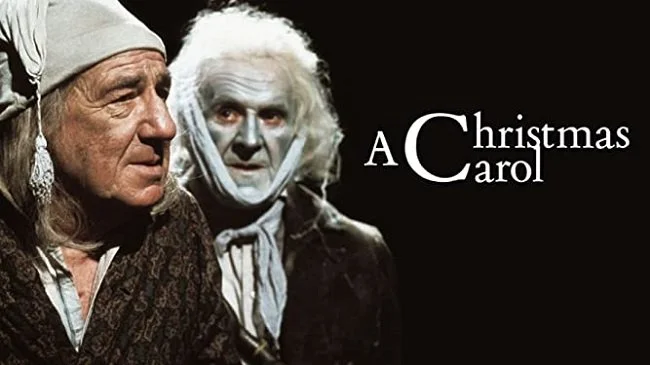
This BBC production from 1977 packs a lot into its 60 minute running time. Succinctly dramatised by Elaine Morgan, this adaptation focuses on the essential themes and key scenes of Dickens’ book. Shot on video, as many BBC dramas were at the time and confined entirely to studio sets, this low budget production makes use of chroma key visual effects. The snow bound countryside, the dark staircase in Scrooge’s apartment and the London skyline are all line drawings, with the cast composited in the foreground. Hence this version of A Christmas Carol feels like an episode of Doctor Who from the same decade. However, the production has one trump card to play with its robust cast of British character actors from the era. Fine performances from the likes of John Le Mesurier, Bernard Lee and Zoe Wanamaker more than compensate for the budgetary restrictions and short duration.
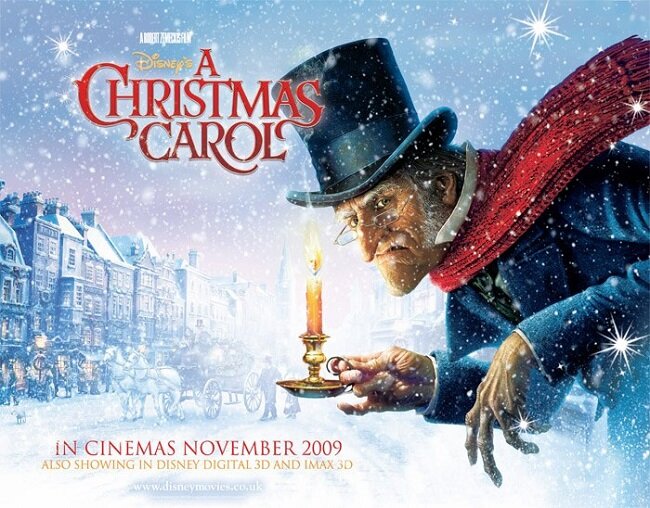
There are three key elements to Disney’s 2009 3D computer-animated adaptation of A Christmas Carol. Firstly, director Robert Zemeckis clearly seeks authenticity and hence includes a lot of original dialogue from the novel, as well as a bleaker depiction of the period. Secondly, he uses the digital production tools at his disposal to create sweeping vistas of 19th century London as well as highly stylised caricatures of the central characters. Thirdly, as this is a Disney production, there is an occasional lapse visual humour and levity that is required by their business model. Sadly all of these aspects of the production make for strange bedfellows that are at odds with each other. The result is a visually sumptuous film that loses its way as it lurches between bleak drama, odd humour and CGI driven spectacle.

Upon its theatrical release, Mickey’s Christmas Carol was the first animated film to star Mickey Mouse for thirty years. It was therefore accompanied with a large amount of hype and a wave of nostalgia. The US marketing stated “He’s Back. Mickey Mouse in his first new motion picture” which was somewhat misleading, as the actual animated film was just 26 minutes long. It was shown theatrically along with a re-release of The Rescuers in the US and The Jungle Book in the UK and other territories, in late December 1983. And despite his name being in the title, Mickey doesn’t have a lot of screen time as he plays Bob Cratchit. This is very much a vehicle for Scrooge McDuck as Ebenezer Scrooge. Overall, it’s a succinct distillation of the plot of Dickens’ A Christmas Carol, filled with cameo appearances by classic Disney characters. Naturally it is replete with the humour and sentiment that is inherent in the process known colloquially as Disneyfication. However, does this mitigate the book’s message?

At first glance, there is not much to distinguish this low budget production by Burbank Films Australia, from any of the other adaptations that were ubiquitous during the seventies and eighties. However, attentive viewers will discover a few details that lift this particular version above the mundane. Firstly, this is the second animated adaptation to feature the voice acting of Ron Haddrick as Ebenezer Scrooge. He had previously voiced the character in Air Programs International's shorter version of A Christmas Carol in 1969, thirteen years earlier. Secondly, despite the modest production values, there are a few additional scenes taken from the source text by Dickens, that don’t usually make it most film and TV adaptations. It is these minor embellishments that compensate for the simplicity of the animation (during the opening scene, some background characters do not move).

It’s interesting that so many adaptations of Charles Dickens’ iconic seasonal story are brought to us via the medium of animation. Naturally, this is a far more economical means of depicting the story with its period detail and supernatural elements, compared to a live action production. However, for an animated version of A Christmas Carol to work successfully, it needs three things. An innovative and striking production design, robust voice acting and a screenplay that keeps the core themes while offering significance difference compared to prior adaptations. You’ll find all of these elements in Richard Williams’ 1971 animated short. Sadly they’re conspicuously absent from the 1997 version. Despite the presence such talents as Tim Curry, Ed Asner and Whoopi Goldberg, this is a distinctly arbitrary animated film. Considering that the screenplay was written by Jymn Magon who has years of experience working for Disney, I had hoped this would be better endeavour.
There’s a degree of hubris implicit in such a definitive title. At the very least the inference is that this is a notable adaptation of Charles Dickens’ classic book. And at first glance, it is perfectly reasonable to assume just that. Jimmy Murakami was an animator of note with such unique movies as The Snowman and When the Wind Blows to his credit. Hence it is reasonable to expect a similar quirky and experimental treatment of this well know yuletide story. However, what audiences actually get is a rather bold adaptation that substantially embellishes upon the established narrative. Veering between sinister and borderline psychedelic imagery, this is a very inconsistent version that tries to be too many things at once. Just as you think you’ve got a handle on the film approach it takes an abrupt turn in the opposite direction. Comedy, drama and even power ballads are thrown into the mix. Sadly, all these elements do not hang well together.
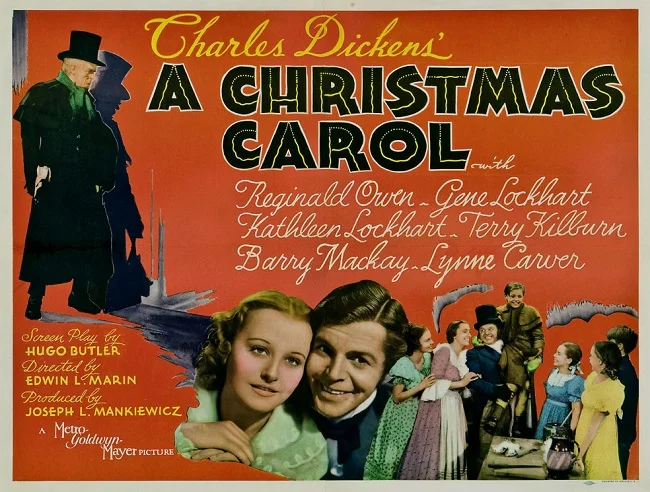
I have written previously about the versatility of Charles Dickens’ classic story and how it lends itself to multiple adaptations and interpretations. This 1938 film version tests that very theory as the reformation and redemption of Ebenezer Scrooge is presented through the medium of Golden Age Hollywood. A Christmas Carol sees the source text sanitised, infantilised and presented as a polished example of wholesome American film making. It has the high production values you’d expect from a studio such as MGM at the time, along with a cloyingly sentimental screenplay that dodges the politics of the book and renders the proceedings into an odd mixture of comedy and soft US Christian propaganda. It presents a very stylised depiction of Dickensian England and bears too many of the obvious foibles and tropes of the studio system that produced the movie.

This 1935 British adaptation of Dickens’ classic book was the first movie version of the story to have sound. Director Henry Edwards had to work creatively to stretch the productions modest budget. Subsequently the production is reliant on fog and snow shrouded sets, mainly to keep costs down. However, this does provide a veneer of authenticity in its depiction of a divided and polluted London. There are a few miniature shots showing the capital city at night and a handful of location shots inside various public buildings to establish the period setting. But mainly this is a set bound production and a sombre one at that. The underlying thrust of this adaptation is to highlight the class division as well as the contrasting wealth and poverty of the country at the time. It is this perspective that is used as the fulcrum of Scrooge’s redemption.

This version of Dickens novel is a very serious and somewhat sombre affair. Patrick Stewart not only stars in this 1999 TV movie but also has a producer credit. Anyone who is familiar with the actor will be aware of his long-standing passion for this tale, as he has starred in several one-man stage performances and narrated an audio book version. Stewart plays his Scrooge as more of an arrogant and aloof businessman. It’s a different Scrooge to that of George C. Scott or Alistair Sim. Here he is much more fearsome and bitter than he is cold and loathsome. Richard E. Grant is a touching, vulnerable Bob Cratchit, who looks decidedly poor and malnourished. There is a more tangible depiction of real poverty here than in other adaptations. The three ghosts are portrayed in a manner closer to the source text, although I could have done without the glowing eyes of the Ghost of Christmas Yet to Come.
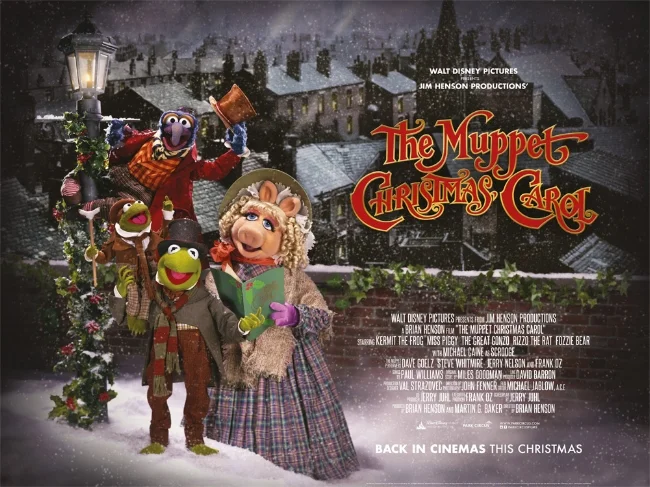
The Muppet Christmas Carol was the first Muppet feature film to be made after the death of Jim Henson. The production maintains his standards and style throughout, although due to the plot, this is a somewhat dark Muppet film. It’s also the one most affectionate of the Muppets movie. The plot follows Charles Dickens's original 1843 novel quite closely with the added bonus of The Great Gonzo playing Dickens himself as an ever-present narrator. Michael Caine provides an excellent performance as Ebenezer Scrooge that wouldn’t be out of place in serious adaptation. Caine attacks his role with his acting prowess and does not end up playing second fiddle to The Muppets themselves. As ever with Muppet movies, neither Caine or any other member of the cast ever question the fact that the Muppets aren’t human.

By 1988 Blackadder had run for three seasons in the UK and had seen the central character of Edmund Blackadder evolve from a seedy incompetent to a cunning, scheming, evil genius who was always frustrated at the last moment. Cleverly written by Richard Curtis and Ben Elton and superbly portrayed by Rowan Atkinson, Blackadder was very much at the cutting edge of British comedy of the time. It managed to mix physical humour, with verbal sparring, sarcasm, dry self-deprecation and irony. It was popular with a very broad spectrum of viewers.
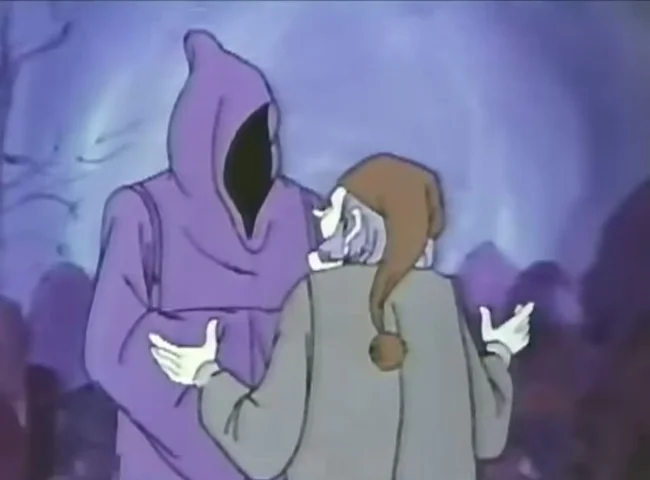
Over the last few years I’ve reviewed several adaptations of Charles Dickens seasonal story A Christmas Carol. As I stated previously one of the stories greatest strength is that it lends itself perfectly to multiple interpretations. I recently had the good fortune to rediscover the animated version from 1969 by Air Programs International. I remember seeing this animated short as a child but could not recollect sufficient details to allow me to track it down via the IMDB. Then by complete chance, I stumbled across it again on You Tube while doing some research.
I have a great deal of affection for Charles Dickens' A Christmas Carol, not only because it’s a fine piece of literature but because it lends itself so well to dramatisation. I therefore have a keen interests in all the respective adaptation, of which there are many. Over the years there has been a trend to focus excessively on the sentimental aspect of the plot, resulting in a rather nauseating Disneyfication of the story. Although the redemption of the main protagonist is central to the narrative, the poverty and deprivations of the time are still very pertinent themes, especially in today's economic climate. I was therefore very gratified to rediscover the 1971 version of Charles Dickens' classic story which was originally shown on ABC. This short 25 minute animated feature realises the story superbly, capturing the tone of the book and accurately reflecting the darker aspects. Remember that A Christmas Carol is fundamentally a ghost story.
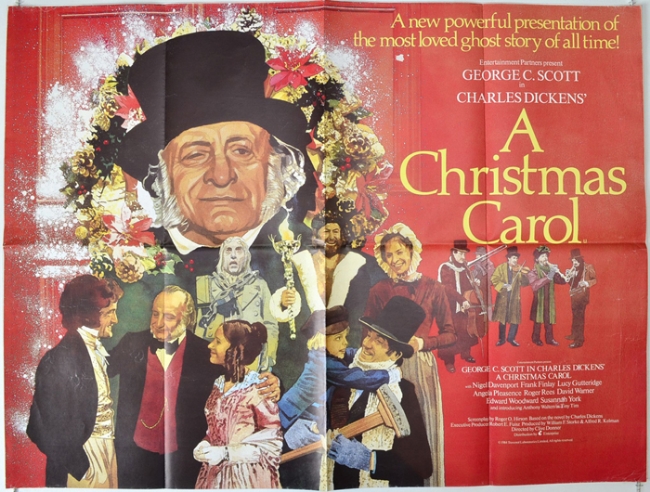
Clive Donner's 1984 version of the Dickens' classic "A Christmas Carol” is bold and different mainly because of the casting of George C. Scott as Ebenezer Scrooge. The story is told with precision and an eye to detail. In some respects it’s the most authentic adaptation, with credible performances from the ensemble cast. Alastair Sim's portrayal in the 1951 film has always been perceived as a benchmark and provided a template as to how the role should be interpreted. Scott replaces the traditional anger, bitterness and rage with a cold and utterly dispassionate demeanour. There is a strong sense of honesty in his Scrooge as the audience follows him on his emotional journey. The tears, the regret and the realisation that there is still hope are all present, yet explored in a very non-theatrical manner.
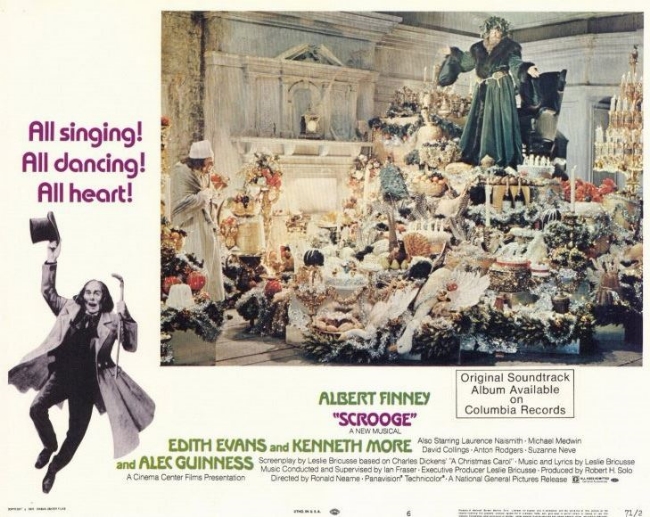
The all-star big screen musical was desperately striving to be different during the sixties and seventies, producing many hits and misses. Tommy, The Lost Horizon and The Wiz are prime examples of the experimentation made within the genre at the time. However, due to the success of Oliver! at the box office in 1968 it was thought that there was potential mileage to be had from Dicken's classic "A Christmas Carol". So the musical Scrooge was conceived. Unlike Oliver! it was not based on a existing stage adaptation but on a wholly original screenplay, although a theatrical treatment has since been adapted.
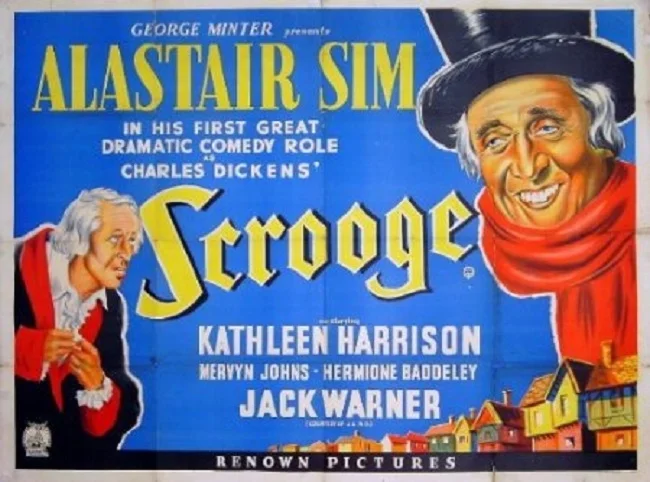
I am a great fan of Charles Dickens' "A Christmas Carol". There is something very special about the novella which is quite hard to quantify. It is a very unique book despite its central theme of redemption being universal. The text has for want of another phrase, a "power" to it. It is profoundly moving, insightful and true. Perhaps the key this story’s appeal lies with the central character, Ebenezer Scrooge. Not because Scrooge is a monster (which are so often fascinating) but because he's a man broken by circumstance. I think readers throughout the years have related to this and considered "There, but for the grace of God, go I". Cinema has found a rich vein of gold running through this tale, which is why it’s been revisited so often and interpreted so many ways.
A Christmas Carol (1977)
This BBC production from 1977 packs a lot into its 60 minute running time. Succinctly dramatised by Elaine Morgan, this adaptation focuses on the essential themes and key scenes of Dickens’ book. Shot on video, as many BBC dramas were at the time and confined entirely to studio sets, this low budget production makes use of chroma key visual effects. The snow bound countryside, the dark staircase in Scrooge’s apartment and the London skyline are all line drawings, with the cast composited in the foreground. Hence this version of A Christmas Carol feels like an episode of Doctor Who from the same decade. However, the production has one trump card to play with its robust cast of British character actors from the era. Fine performances from the likes of John Le Mesurier, Bernard Lee and Zoe Wanamaker more than compensate for the budgetary restrictions and short duration.
This BBC production from 1977 packs a lot into its 60 minute running time. Succinctly dramatised by Elaine Morgan, this adaptation focuses on the essential themes and key scenes of Dickens’ book. Shot on video, as many BBC dramas were at the time and confined entirely to studio sets, this low budget production makes use of chroma key visual effects. The snow bound countryside, the dark staircase in Scrooge’s apartment and the London skyline are all line drawings, with the cast composited in the foreground. Hence this version of A Christmas Carol feels like an episode of Doctor Who from the same decade. However, the production has one trump card to play with its robust cast of British character actors from the era. Fine performances from the likes of John Le Mesurier, Bernard Lee and Zoe Wanamaker more than compensate for the budgetary restrictions and short duration.
Michael Horden brings an element of befuddlement to his portrayal of Ebeneezer Scrooge. He is also petty, acerbic and somewhat cowardly. All of which feels very authentic and in the spirit of the source text. His interaction with Jacob Marley (John Le Mesurier) is very faithful to the book and Le Mesurier brings a genuinely weary element to his performance. The Ghost of Christmas Past (Patricia Quinn) is depicted very much as described in the text, with bright light emanating from them and carrying a hat similar to a candle extinguisher. She focuses on Scrooge’s abandonment at school and his failed engagement. Fezziwig is more of a footnote to this part of the story. Similarly the Ghost of Christmas Present (Bernard Lee) wastes no time and quickly highlights Bob Cratchit’s poverty and Tiny Tim’s ill health. Nephew Fred’s party is distilled down to its bare essentials. The Ghost of Christmas Yet to come is depicted as a traditional hooded figure. The cleaning woman and undertaker discuss Scrooge’s failing while his dead body is laid out on the bed, rather than at the pawnbrokers.
The time limitations of an hour mean that some elements of the story are lost. Yet despite the efficiency of this summarisation, some minor embellishments still make it to the screen. Marley’s face appears in the tiles surrounding the fireplace. We see Belle happily married years later on the night of Marley’s death. Mankind’s children, ignorance and want, are briefly depicted. And there’s a scene in which a family in debt to Scrooge learns of his death. All of which add to the character of this production and make it feel more than just another arbitrary adaptation. It is a shame that the commissioning editor did not see fit to make this a 90 minute production, so it could have taken a little more time to savour its emotional highs and lows. As it stands this is a quaint but engaging TV version, which may appeal more to the Dickens aficionado or those wanting a quick fix of the classic story.
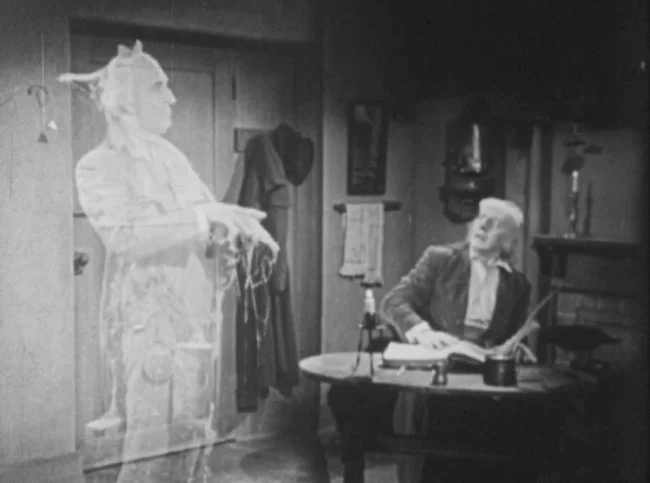
This 1954 adaptation of Charles Dickens’ A Christmas Carol is a distinctly studio bound US television production. It was in fact the fourth episode of an anthology variety show called A Shower of Stars. Originally filmed and broadcast in colour, only black and white prints now survive. The production boasts a script by noted American playwright Maxwell Anderson. Due to the 48 minute running time (without commercial breaks) the narrative is heavily abridged and often it is only the story’s most basic themes which are dramatically interpreted. It stars Fredric March who plays Scrooge as a cool and indifferent man, rather than the usual shrill old miser. However, despite his presence his performance cannot save the production. Most of the other cast members are far from accomplished and at times their acting borders on the amateur.
This BBC production from 1977 packs a lot into its 60 minute running time. Succinctly dramatised by Elaine Morgan, this adaptation focuses on the essential themes and key scenes of Dickens’ book. Shot on video, as many BBC dramas were at the time and confined entirely to studio sets, this low budget production makes use of chroma key visual effects. The snow bound countryside, the dark staircase in Scrooge’s apartment and the London skyline are all line drawings, with the cast composited in the foreground. Hence this version of A Christmas Carol feels like an episode of Doctor Who from the same decade. However, the production has one trump card to play with its robust cast of British character actors from the era. Fine performances from the likes of John Le Mesurier, Bernard Lee and Zoe Wanamaker more than compensate for the budgetary restrictions and short duration.
There are three key elements to Disney’s 2009 3D computer-animated adaptation of A Christmas Carol. Firstly, director Robert Zemeckis clearly seeks authenticity and hence includes a lot of original dialogue from the novel, as well as a bleaker depiction of the period. Secondly, he uses the digital production tools at his disposal to create sweeping vistas of 19th century London as well as highly stylised caricatures of the central characters. Thirdly, as this is a Disney production, there is an occasional lapse visual humour and levity that is required by their business model. Sadly all of these aspects of the production make for strange bedfellows that are at odds with each other. The result is a visually sumptuous film that loses its way as it lurches between bleak drama, odd humour and CGI driven spectacle.
Upon its theatrical release, Mickey’s Christmas Carol was the first animated film to star Mickey Mouse for thirty years. It was therefore accompanied with a large amount of hype and a wave of nostalgia. The US marketing stated “He’s Back. Mickey Mouse in his first new motion picture” which was somewhat misleading, as the actual animated film was just 26 minutes long. It was shown theatrically along with a re-release of The Rescuers in the US and The Jungle Book in the UK and other territories, in late December 1983. And despite his name being in the title, Mickey doesn’t have a lot of screen time as he plays Bob Cratchit. This is very much a vehicle for Scrooge McDuck as Ebenezer Scrooge. Overall, it’s a succinct distillation of the plot of Dickens’ A Christmas Carol, filled with cameo appearances by classic Disney characters. Naturally it is replete with the humour and sentiment that is inherent in the process known colloquially as Disneyfication. However, does this mitigate the book’s message?
At first glance, there is not much to distinguish this low budget production by Burbank Films Australia, from any of the other adaptations that were ubiquitous during the seventies and eighties. However, attentive viewers will discover a few details that lift this particular version above the mundane. Firstly, this is the second animated adaptation to feature the voice acting of Ron Haddrick as Ebenezer Scrooge. He had previously voiced the character in Air Programs International's shorter version of A Christmas Carol in 1969, thirteen years earlier. Secondly, despite the modest production values, there are a few additional scenes taken from the source text by Dickens, that don’t usually make it most film and TV adaptations. It is these minor embellishments that compensate for the simplicity of the animation (during the opening scene, some background characters do not move).
It’s interesting that so many adaptations of Charles Dickens’ iconic seasonal story are brought to us via the medium of animation. Naturally, this is a far more economical means of depicting the story with its period detail and supernatural elements, compared to a live action production. However, for an animated version of A Christmas Carol to work successfully, it needs three things. An innovative and striking production design, robust voice acting and a screenplay that keeps the core themes while offering significance difference compared to prior adaptations. You’ll find all of these elements in Richard Williams’ 1971 animated short. Sadly they’re conspicuously absent from the 1997 version. Despite the presence such talents as Tim Curry, Ed Asner and Whoopi Goldberg, this is a distinctly arbitrary animated film. Considering that the screenplay was written by Jymn Magon who has years of experience working for Disney, I had hoped this would be better endeavour.
There’s a degree of hubris implicit in such a definitive title. At the very least the inference is that this is a notable adaptation of Charles Dickens’ classic book. And at first glance, it is perfectly reasonable to assume just that. Jimmy Murakami was an animator of note with such unique movies as The Snowman and When the Wind Blows to his credit. Hence it is reasonable to expect a similar quirky and experimental treatment of this well know yuletide story. However, what audiences actually get is a rather bold adaptation that substantially embellishes upon the established narrative. Veering between sinister and borderline psychedelic imagery, this is a very inconsistent version that tries to be too many things at once. Just as you think you’ve got a handle on the film approach it takes an abrupt turn in the opposite direction. Comedy, drama and even power ballads are thrown into the mix. Sadly, all these elements do not hang well together.
I have written previously about the versatility of Charles Dickens’ classic story and how it lends itself to multiple adaptations and interpretations. This 1938 film version tests that very theory as the reformation and redemption of Ebenezer Scrooge is presented through the medium of Golden Age Hollywood. A Christmas Carol sees the source text sanitised, infantilised and presented as a polished example of wholesome American film making. It has the high production values you’d expect from a studio such as MGM at the time, along with a cloyingly sentimental screenplay that dodges the politics of the book and renders the proceedings into an odd mixture of comedy and soft US Christian propaganda. It presents a very stylised depiction of Dickensian England and bears too many of the obvious foibles and tropes of the studio system that produced the movie.
This 1935 British adaptation of Dickens’ classic book was the first movie version of the story to have sound. Director Henry Edwards had to work creatively to stretch the productions modest budget. Subsequently the production is reliant on fog and snow shrouded sets, mainly to keep costs down. However, this does provide a veneer of authenticity in its depiction of a divided and polluted London. There are a few miniature shots showing the capital city at night and a handful of location shots inside various public buildings to establish the period setting. But mainly this is a set bound production and a sombre one at that. The underlying thrust of this adaptation is to highlight the class division as well as the contrasting wealth and poverty of the country at the time. It is this perspective that is used as the fulcrum of Scrooge’s redemption.
This version of Dickens novel is a very serious and somewhat sombre affair. Patrick Stewart not only stars in this 1999 TV movie but also has a producer credit. Anyone who is familiar with the actor will be aware of his long-standing passion for this tale, as he has starred in several one-man stage performances and narrated an audio book version. Stewart plays his Scrooge as more of an arrogant and aloof businessman. It’s a different Scrooge to that of George C. Scott or Alistair Sim. Here he is much more fearsome and bitter than he is cold and loathsome. Richard E. Grant is a touching, vulnerable Bob Cratchit, who looks decidedly poor and malnourished. There is a more tangible depiction of real poverty here than in other adaptations. The three ghosts are portrayed in a manner closer to the source text, although I could have done without the glowing eyes of the Ghost of Christmas Yet to Come.
The Muppet Christmas Carol was the first Muppet feature film to be made after the death of Jim Henson. The production maintains his standards and style throughout, although due to the plot, this is a somewhat dark Muppet film. It’s also the one most affectionate of the Muppets movie. The plot follows Charles Dickens's original 1843 novel quite closely with the added bonus of The Great Gonzo playing Dickens himself as an ever-present narrator. Michael Caine provides an excellent performance as Ebenezer Scrooge that wouldn’t be out of place in serious adaptation. Caine attacks his role with his acting prowess and does not end up playing second fiddle to The Muppets themselves. As ever with Muppet movies, neither Caine or any other member of the cast ever question the fact that the Muppets aren’t human.
By 1988 Blackadder had run for three seasons in the UK and had seen the central character of Edmund Blackadder evolve from a seedy incompetent to a cunning, scheming, evil genius who was always frustrated at the last moment. Cleverly written by Richard Curtis and Ben Elton and superbly portrayed by Rowan Atkinson, Blackadder was very much at the cutting edge of British comedy of the time. It managed to mix physical humour, with verbal sparring, sarcasm, dry self-deprecation and irony. It was popular with a very broad spectrum of viewers.
Over the last few years I’ve reviewed several adaptations of Charles Dickens seasonal story A Christmas Carol. As I stated previously one of the stories greatest strength is that it lends itself perfectly to multiple interpretations. I recently had the good fortune to rediscover the animated version from 1969 by Air Programs International. I remember seeing this animated short as a child but could not recollect sufficient details to allow me to track it down via the IMDB. Then by complete chance, I stumbled across it again on You Tube while doing some research.
I have a great deal of affection for Charles Dickens' A Christmas Carol, not only because it’s a fine piece of literature but because it lends itself so well to dramatisation. I therefore have a keen interests in all the respective adaptation, of which there are many. Over the years there has been a trend to focus excessively on the sentimental aspect of the plot, resulting in a rather nauseating Disneyfication of the story. Although the redemption of the main protagonist is central to the narrative, the poverty and deprivations of the time are still very pertinent themes, especially in today's economic climate. I was therefore very gratified to rediscover the 1971 version of Charles Dickens' classic story which was originally shown on ABC. This short 25 minute animated feature realises the story superbly, capturing the tone of the book and accurately reflecting the darker aspects. Remember that A Christmas Carol is fundamentally a ghost story.
Clive Donner's 1984 version of the Dickens' classic "A Christmas Carol” is bold and different mainly because of the casting of George C. Scott as Ebenezer Scrooge. The story is told with precision and an eye to detail. In some respects it’s the most authentic adaptation, with credible performances from the ensemble cast. Alastair Sim's portrayal in the 1951 film has always been perceived as a benchmark and provided a template as to how the role should be interpreted. Scott replaces the traditional anger, bitterness and rage with a cold and utterly dispassionate demeanour. There is a strong sense of honesty in his Scrooge as the audience follows him on his emotional journey. The tears, the regret and the realisation that there is still hope are all present, yet explored in a very non-theatrical manner.
The all-star big screen musical was desperately striving to be different during the sixties and seventies, producing many hits and misses. Tommy, The Lost Horizon and The Wiz are prime examples of the experimentation made within the genre at the time. However, due to the success of Oliver! at the box office in 1968 it was thought that there was potential mileage to be had from Dicken's classic "A Christmas Carol". So the musical Scrooge was conceived. Unlike Oliver! it was not based on a existing stage adaptation but on a wholly original screenplay, although a theatrical treatment has since been adapted.
I am a great fan of Charles Dickens' "A Christmas Carol". There is something very special about the novella which is quite hard to quantify. It is a very unique book despite its central theme of redemption being universal. The text has for want of another phrase, a "power" to it. It is profoundly moving, insightful and true. Perhaps the key this story’s appeal lies with the central character, Ebenezer Scrooge. Not because Scrooge is a monster (which are so often fascinating) but because he's a man broken by circumstance. I think readers throughout the years have related to this and considered "There, but for the grace of God, go I". Cinema has found a rich vein of gold running through this tale, which is why it’s been revisited so often and interpreted so many ways.
A Christmas Carol (2009)
There are three key elements to Disney’s 2009 3D computer-animated adaptation of A Christmas Carol. Firstly, director Robert Zemeckis clearly seeks authenticity and hence includes a lot of original dialogue from the novel, as well as a bleaker depiction of the period. Secondly, he uses the digital production tools at his disposal to create sweeping vistas of 19th century London as well as highly stylised caricatures of the central characters. Thirdly, as this is a Disney production, there is an occasional lapse visual humour and levity that is required by their business model. Sadly all of these aspects of the production make for strange bedfellows that are at odds with each other. The result is a visually sumptuous film that loses its way as it lurches between bleak drama, odd humour and CGI driven spectacle.
There are three key elements to Disney’s 2009 3D computer-animated adaptation of A Christmas Carol. Firstly, director Robert Zemeckis clearly seeks authenticity and hence includes a lot of original dialogue from the novel, as well as a bleaker depiction of the period. Secondly, he uses the digital production tools at his disposal to create sweeping vistas of 19th century London as well as highly stylised caricatures of the central characters. Thirdly, as this is a Disney production, there is an occasional lapse visual humour and levity that is required by their business model. Sadly all of these aspects of the production make for strange bedfellows that are at odds with each other. The result is a visually sumptuous film that loses its way as it lurches between bleak drama, odd humour and CGI driven spectacle.
Produced via motion capture, a technique used in his previous films The Polar Express (2004) and Beowulf (2007), Zemeckis presents the viewer with a very traditional looking Scrooge, whose dour demeanour and gruff voice is effectively provided by Jim Carrey. Carrey also provides the voice acting for the Ghost of Christmas Past and the Ghost of Christmas Present. The story starts with Jacob Marley lying in his coffin and Scrooge quickly establishes his miserly credentials by taking the pennies off his late partner’s eyes. Due to the stylised nature of the character design, Bob Cratchit is diminutive and nephew Fred is rotund and ruddy cheeked. The story does much to highlight the social disparity between rich and poor. Oddly, despite attempting to explore and depict the events of the book in an authentic fashion, the emotional focus upon Tiny Tim is somewhat lacking in this adaptation and his character is used sparingly.
Yet despite a robust cast of fine voice actors, including Gary Oldman, Colin Firth and Bob Hoskins, they have very little to do. Hoskins as Fezziwig has no more than four lines. The early focus upon drama and providing a true reflection of the social injustices of the period, soon gives way to the most indulgent visual spectacle once the first spirit arrives. The viewer is presented with expansive recreations of the London skyline and the British countryside and the camera swoops and soars interminably through these virtual environments. Towards the end of the film there is also an tedious and utterly unnecessary chase scene involving Scrooge and a phantom hearse. One gets the impression that the director was a little too enamoured by the potential to craft such CGI creations and lost track of the central story. Or perhaps there was pressure from the studio to add some “action” to the film to pander to a wider demographics.
However, the use of motion capture and immersive 3D environments are not all overblown. There is a especially creative montage involving the Ghost of Christmas Present and mankind’s children, Ignorance and Want. The emaciated waifs morph into their potential future selves; one a violent robber and the other a drunken prostitute. It is quite a shocking scene and bold in its artists scope. But it also highlights the bleakness of this adaptation, which sits awkwardly with the Disney brand. Marley’s ghost is especially terrifying with his bottom jaw becoming unhinged at one point. And so to counter such ghoulish imagery, there are bouts of humour and thus Marley secures his jaw with a handkerchief but ties the knot too tight, thus preventing him from talking. Such japery tends to confuse rather than amuse.
This particular adaptation of A Christmas Carol was not a financial success at the box office and it is clear to see why. It tries to be too many things and by partnering with Disney Studios, Zemeckis is forced to make some concessions to the film that are a poor fit. Hence the story shifts tonally and does not have a coherent vision as to what it exactly wishes to be. The viewer is left with some dark scenes, frenetic chase sequences, an incessantly laughing Ghost of Christmas Present and a display of sentiment at the film’s conclusion that seems incongruous given Scrooge’s scant interaction with the Cratchit household and Tiny Tim. Furthermore, the final scene between Scrooge and the Ghost of Christmas Yet to Come is virtually identical to that in Mickey’s Christmas Carol. Overall, it may have been wiser to take the cast and the budget available and made a more traditional live action version of this classic tale, focusing on the story and atmosphere, rather than production design and visual effects.
This 1954 adaptation of Charles Dickens’ A Christmas Carol is a distinctly studio bound US television production. It was in fact the fourth episode of an anthology variety show called A Shower of Stars. Originally filmed and broadcast in colour, only black and white prints now survive. The production boasts a script by noted American playwright Maxwell Anderson. Due to the 48 minute running time (without commercial breaks) the narrative is heavily abridged and often it is only the story’s most basic themes which are dramatically interpreted. It stars Fredric March who plays Scrooge as a cool and indifferent man, rather than the usual shrill old miser. However, despite his presence his performance cannot save the production. Most of the other cast members are far from accomplished and at times their acting borders on the amateur.
This BBC production from 1977 packs a lot into its 60 minute running time. Succinctly dramatised by Elaine Morgan, this adaptation focuses on the essential themes and key scenes of Dickens’ book. Shot on video, as many BBC dramas were at the time and confined entirely to studio sets, this low budget production makes use of chroma key visual effects. The snow bound countryside, the dark staircase in Scrooge’s apartment and the London skyline are all line drawings, with the cast composited in the foreground. Hence this version of A Christmas Carol feels like an episode of Doctor Who from the same decade. However, the production has one trump card to play with its robust cast of British character actors from the era. Fine performances from the likes of John Le Mesurier, Bernard Lee and Zoe Wanamaker more than compensate for the budgetary restrictions and short duration.
There are three key elements to Disney’s 2009 3D computer-animated adaptation of A Christmas Carol. Firstly, director Robert Zemeckis clearly seeks authenticity and hence includes a lot of original dialogue from the novel, as well as a bleaker depiction of the period. Secondly, he uses the digital production tools at his disposal to create sweeping vistas of 19th century London as well as highly stylised caricatures of the central characters. Thirdly, as this is a Disney production, there is an occasional lapse visual humour and levity that is required by their business model. Sadly all of these aspects of the production make for strange bedfellows that are at odds with each other. The result is a visually sumptuous film that loses its way as it lurches between bleak drama, odd humour and CGI driven spectacle.
Upon its theatrical release, Mickey’s Christmas Carol was the first animated film to star Mickey Mouse for thirty years. It was therefore accompanied with a large amount of hype and a wave of nostalgia. The US marketing stated “He’s Back. Mickey Mouse in his first new motion picture” which was somewhat misleading, as the actual animated film was just 26 minutes long. It was shown theatrically along with a re-release of The Rescuers in the US and The Jungle Book in the UK and other territories, in late December 1983. And despite his name being in the title, Mickey doesn’t have a lot of screen time as he plays Bob Cratchit. This is very much a vehicle for Scrooge McDuck as Ebenezer Scrooge. Overall, it’s a succinct distillation of the plot of Dickens’ A Christmas Carol, filled with cameo appearances by classic Disney characters. Naturally it is replete with the humour and sentiment that is inherent in the process known colloquially as Disneyfication. However, does this mitigate the book’s message?
At first glance, there is not much to distinguish this low budget production by Burbank Films Australia, from any of the other adaptations that were ubiquitous during the seventies and eighties. However, attentive viewers will discover a few details that lift this particular version above the mundane. Firstly, this is the second animated adaptation to feature the voice acting of Ron Haddrick as Ebenezer Scrooge. He had previously voiced the character in Air Programs International's shorter version of A Christmas Carol in 1969, thirteen years earlier. Secondly, despite the modest production values, there are a few additional scenes taken from the source text by Dickens, that don’t usually make it most film and TV adaptations. It is these minor embellishments that compensate for the simplicity of the animation (during the opening scene, some background characters do not move).
It’s interesting that so many adaptations of Charles Dickens’ iconic seasonal story are brought to us via the medium of animation. Naturally, this is a far more economical means of depicting the story with its period detail and supernatural elements, compared to a live action production. However, for an animated version of A Christmas Carol to work successfully, it needs three things. An innovative and striking production design, robust voice acting and a screenplay that keeps the core themes while offering significance difference compared to prior adaptations. You’ll find all of these elements in Richard Williams’ 1971 animated short. Sadly they’re conspicuously absent from the 1997 version. Despite the presence such talents as Tim Curry, Ed Asner and Whoopi Goldberg, this is a distinctly arbitrary animated film. Considering that the screenplay was written by Jymn Magon who has years of experience working for Disney, I had hoped this would be better endeavour.
There’s a degree of hubris implicit in such a definitive title. At the very least the inference is that this is a notable adaptation of Charles Dickens’ classic book. And at first glance, it is perfectly reasonable to assume just that. Jimmy Murakami was an animator of note with such unique movies as The Snowman and When the Wind Blows to his credit. Hence it is reasonable to expect a similar quirky and experimental treatment of this well know yuletide story. However, what audiences actually get is a rather bold adaptation that substantially embellishes upon the established narrative. Veering between sinister and borderline psychedelic imagery, this is a very inconsistent version that tries to be too many things at once. Just as you think you’ve got a handle on the film approach it takes an abrupt turn in the opposite direction. Comedy, drama and even power ballads are thrown into the mix. Sadly, all these elements do not hang well together.
I have written previously about the versatility of Charles Dickens’ classic story and how it lends itself to multiple adaptations and interpretations. This 1938 film version tests that very theory as the reformation and redemption of Ebenezer Scrooge is presented through the medium of Golden Age Hollywood. A Christmas Carol sees the source text sanitised, infantilised and presented as a polished example of wholesome American film making. It has the high production values you’d expect from a studio such as MGM at the time, along with a cloyingly sentimental screenplay that dodges the politics of the book and renders the proceedings into an odd mixture of comedy and soft US Christian propaganda. It presents a very stylised depiction of Dickensian England and bears too many of the obvious foibles and tropes of the studio system that produced the movie.
This 1935 British adaptation of Dickens’ classic book was the first movie version of the story to have sound. Director Henry Edwards had to work creatively to stretch the productions modest budget. Subsequently the production is reliant on fog and snow shrouded sets, mainly to keep costs down. However, this does provide a veneer of authenticity in its depiction of a divided and polluted London. There are a few miniature shots showing the capital city at night and a handful of location shots inside various public buildings to establish the period setting. But mainly this is a set bound production and a sombre one at that. The underlying thrust of this adaptation is to highlight the class division as well as the contrasting wealth and poverty of the country at the time. It is this perspective that is used as the fulcrum of Scrooge’s redemption.
This version of Dickens novel is a very serious and somewhat sombre affair. Patrick Stewart not only stars in this 1999 TV movie but also has a producer credit. Anyone who is familiar with the actor will be aware of his long-standing passion for this tale, as he has starred in several one-man stage performances and narrated an audio book version. Stewart plays his Scrooge as more of an arrogant and aloof businessman. It’s a different Scrooge to that of George C. Scott or Alistair Sim. Here he is much more fearsome and bitter than he is cold and loathsome. Richard E. Grant is a touching, vulnerable Bob Cratchit, who looks decidedly poor and malnourished. There is a more tangible depiction of real poverty here than in other adaptations. The three ghosts are portrayed in a manner closer to the source text, although I could have done without the glowing eyes of the Ghost of Christmas Yet to Come.
Mickey's Christmas Carol (1983)
Upon its theatrical release, Mickey’s Christmas Carol was the first animated film to star Mickey Mouse for thirty years. It was therefore accompanied with a large amount of hype and a wave of nostalgia. The US marketing stated “He’s Back. Mickey Mouse in his first new motion picture” which was somewhat misleading, as the actual animated film was just 26 minutes long. It was shown theatrically along with a re-release of The Rescuers in the US and The Jungle Book in the UK and other territories, in late December 1983. And despite his name being in the title, Mickey doesn’t have a lot of screen time as he plays Bob Cratchit. This is very much a vehicle for Scrooge McDuck as Ebenezer Scrooge. Overall, it’s a succinct distillation of the plot of Dickens’ A Christmas Carol, filled with cameo appearances by classic Disney characters. Naturally it is replete with the humour and sentiment that is inherent in the process known colloquially as Disneyfication. However, does this mitigate the book’s message?
Upon its theatrical release, Mickey’s Christmas Carol was the first animated film to star Mickey Mouse for thirty years. It was therefore accompanied with a large amount of hype and a wave of nostalgia. The US marketing stated “He’s Back. Mickey Mouse in his first new motion picture” which was somewhat misleading, as the actual animated film was just 26 minutes long. It was shown theatrically along with a re-release of The Rescuers in the US and The Jungle Book in the UK and other territories, in late December 1983. And despite his name being in the title, Mickey doesn’t have a lot of screen time as he plays Bob Cratchit. This is very much a vehicle for Scrooge McDuck as Ebenezer Scrooge. Overall, it’s a succinct distillation of the plot of Dickens’ A Christmas Carol, filled with cameo appearances by classic Disney characters. Naturally it is replete with the humour and sentiment that is inherent in the process known colloquially as Disneyfication. However, does this mitigate the book’s message?
Part of the fun of watching Mickey’s Christmas Carol is trying to spot various iconic Disney characters, many of which are in minor roles in the background such as the Big, Bad Wolf and the Three Little Pigs. The larger roles are played by the likes of Donald Duck (Scrooge’s nephew Fred), Goofy (incongruously playing Marley’s ghost) and Jiminy Cricket (the Ghost of Christmas Past). The verbal and visual humour you expect from Disney is clearly front and centre. The scene where Scrooge climbs the stairs to his suite of rooms, followed by Jacob Marley’s spectral shadow, is a wonderfully contrived piece of animation and up to the high standard you’d expect from the studio. As ever there are a lot of innovative shots from aerial perspectives and sequences involving a lot of movement both in the foreground and background. All are lovingly drawn and painted by hand, imbuing the characters with a sense of personality and charisma.
Charm and overt sentimentality are in the very DNA of Disney productions. Hence any material that the studio adapts always has such content enhanced and amplified. This is Disney’s brand of entertainment. For younger, unsophisticated viewers, Mickey’s Christmas Carol plays as a simple but safe morality tale. Bob Cratchit’s poverty is hyperbolic and stylised (he carves a single pea to eat). Scrooge’s meanness and lack of empathy is a caricature, rather than an accurate case study. And so the darker elements of Dickens’ story are neutered due to the “Disneyfication” effect but does it mitigate the power of the story and its essential message? Not really, because the audience has elected to watch a Disney product, so they know in advance that they are not going to get a historically accurate depiction of 19th century deprivation. There is a minor concession to drama at the end, as Scrooge encounters his own hellbound grave which is tonally a little jarring. However, a more practical flaw in the film is making Scrooge essentially comic himself.
By Ebenezer Scrooge being played by Scrooge McDuck, an inherently witty and droll character, the viewer never really disapproves of him or finds him repellent. Hence his redemption at the story’s climax lacks any real impact. Compared to The Muppet Christmas Carol (1992) where Scrooge is played straight, with a cold and smouldering performance by Michael Caine, the comedy occurs around him highlighting his own emotional void. This different approach gives greater weight to the ending in the Muppet version. But I suppose it is critically redundant to apply such analysis to a short animated film that was never intended to be anything more than the sum of its parts. Mickey’s Christmas Carol is an entertaining half hour of family viewing, especially for those with young children still within Disney’s key age demographic. It provides the essential beats of Dickens’ tale along with all the key tropes of the studio that created it.
This 1954 adaptation of Charles Dickens’ A Christmas Carol is a distinctly studio bound US television production. It was in fact the fourth episode of an anthology variety show called A Shower of Stars. Originally filmed and broadcast in colour, only black and white prints now survive. The production boasts a script by noted American playwright Maxwell Anderson. Due to the 48 minute running time (without commercial breaks) the narrative is heavily abridged and often it is only the story’s most basic themes which are dramatically interpreted. It stars Fredric March who plays Scrooge as a cool and indifferent man, rather than the usual shrill old miser. However, despite his presence his performance cannot save the production. Most of the other cast members are far from accomplished and at times their acting borders on the amateur.
This BBC production from 1977 packs a lot into its 60 minute running time. Succinctly dramatised by Elaine Morgan, this adaptation focuses on the essential themes and key scenes of Dickens’ book. Shot on video, as many BBC dramas were at the time and confined entirely to studio sets, this low budget production makes use of chroma key visual effects. The snow bound countryside, the dark staircase in Scrooge’s apartment and the London skyline are all line drawings, with the cast composited in the foreground. Hence this version of A Christmas Carol feels like an episode of Doctor Who from the same decade. However, the production has one trump card to play with its robust cast of British character actors from the era. Fine performances from the likes of John Le Mesurier, Bernard Lee and Zoe Wanamaker more than compensate for the budgetary restrictions and short duration.
There are three key elements to Disney’s 2009 3D computer-animated adaptation of A Christmas Carol. Firstly, director Robert Zemeckis clearly seeks authenticity and hence includes a lot of original dialogue from the novel, as well as a bleaker depiction of the period. Secondly, he uses the digital production tools at his disposal to create sweeping vistas of 19th century London as well as highly stylised caricatures of the central characters. Thirdly, as this is a Disney production, there is an occasional lapse visual humour and levity that is required by their business model. Sadly all of these aspects of the production make for strange bedfellows that are at odds with each other. The result is a visually sumptuous film that loses its way as it lurches between bleak drama, odd humour and CGI driven spectacle.
Upon its theatrical release, Mickey’s Christmas Carol was the first animated film to star Mickey Mouse for thirty years. It was therefore accompanied with a large amount of hype and a wave of nostalgia. The US marketing stated “He’s Back. Mickey Mouse in his first new motion picture” which was somewhat misleading, as the actual animated film was just 26 minutes long. It was shown theatrically along with a re-release of The Rescuers in the US and The Jungle Book in the UK and other territories, in late December 1983. And despite his name being in the title, Mickey doesn’t have a lot of screen time as he plays Bob Cratchit. This is very much a vehicle for Scrooge McDuck as Ebenezer Scrooge. Overall, it’s a succinct distillation of the plot of Dickens’ A Christmas Carol, filled with cameo appearances by classic Disney characters. Naturally it is replete with the humour and sentiment that is inherent in the process known colloquially as Disneyfication. However, does this mitigate the book’s message?
At first glance, there is not much to distinguish this low budget production by Burbank Films Australia, from any of the other adaptations that were ubiquitous during the seventies and eighties. However, attentive viewers will discover a few details that lift this particular version above the mundane. Firstly, this is the second animated adaptation to feature the voice acting of Ron Haddrick as Ebenezer Scrooge. He had previously voiced the character in Air Programs International's shorter version of A Christmas Carol in 1969, thirteen years earlier. Secondly, despite the modest production values, there are a few additional scenes taken from the source text by Dickens, that don’t usually make it most film and TV adaptations. It is these minor embellishments that compensate for the simplicity of the animation (during the opening scene, some background characters do not move).
It’s interesting that so many adaptations of Charles Dickens’ iconic seasonal story are brought to us via the medium of animation. Naturally, this is a far more economical means of depicting the story with its period detail and supernatural elements, compared to a live action production. However, for an animated version of A Christmas Carol to work successfully, it needs three things. An innovative and striking production design, robust voice acting and a screenplay that keeps the core themes while offering significance difference compared to prior adaptations. You’ll find all of these elements in Richard Williams’ 1971 animated short. Sadly they’re conspicuously absent from the 1997 version. Despite the presence such talents as Tim Curry, Ed Asner and Whoopi Goldberg, this is a distinctly arbitrary animated film. Considering that the screenplay was written by Jymn Magon who has years of experience working for Disney, I had hoped this would be better endeavour.
There’s a degree of hubris implicit in such a definitive title. At the very least the inference is that this is a notable adaptation of Charles Dickens’ classic book. And at first glance, it is perfectly reasonable to assume just that. Jimmy Murakami was an animator of note with such unique movies as The Snowman and When the Wind Blows to his credit. Hence it is reasonable to expect a similar quirky and experimental treatment of this well know yuletide story. However, what audiences actually get is a rather bold adaptation that substantially embellishes upon the established narrative. Veering between sinister and borderline psychedelic imagery, this is a very inconsistent version that tries to be too many things at once. Just as you think you’ve got a handle on the film approach it takes an abrupt turn in the opposite direction. Comedy, drama and even power ballads are thrown into the mix. Sadly, all these elements do not hang well together.
I have written previously about the versatility of Charles Dickens’ classic story and how it lends itself to multiple adaptations and interpretations. This 1938 film version tests that very theory as the reformation and redemption of Ebenezer Scrooge is presented through the medium of Golden Age Hollywood. A Christmas Carol sees the source text sanitised, infantilised and presented as a polished example of wholesome American film making. It has the high production values you’d expect from a studio such as MGM at the time, along with a cloyingly sentimental screenplay that dodges the politics of the book and renders the proceedings into an odd mixture of comedy and soft US Christian propaganda. It presents a very stylised depiction of Dickensian England and bears too many of the obvious foibles and tropes of the studio system that produced the movie.
This 1935 British adaptation of Dickens’ classic book was the first movie version of the story to have sound. Director Henry Edwards had to work creatively to stretch the productions modest budget. Subsequently the production is reliant on fog and snow shrouded sets, mainly to keep costs down. However, this does provide a veneer of authenticity in its depiction of a divided and polluted London. There are a few miniature shots showing the capital city at night and a handful of location shots inside various public buildings to establish the period setting. But mainly this is a set bound production and a sombre one at that. The underlying thrust of this adaptation is to highlight the class division as well as the contrasting wealth and poverty of the country at the time. It is this perspective that is used as the fulcrum of Scrooge’s redemption.
This version of Dickens novel is a very serious and somewhat sombre affair. Patrick Stewart not only stars in this 1999 TV movie but also has a producer credit. Anyone who is familiar with the actor will be aware of his long-standing passion for this tale, as he has starred in several one-man stage performances and narrated an audio book version. Stewart plays his Scrooge as more of an arrogant and aloof businessman. It’s a different Scrooge to that of George C. Scott or Alistair Sim. Here he is much more fearsome and bitter than he is cold and loathsome. Richard E. Grant is a touching, vulnerable Bob Cratchit, who looks decidedly poor and malnourished. There is a more tangible depiction of real poverty here than in other adaptations. The three ghosts are portrayed in a manner closer to the source text, although I could have done without the glowing eyes of the Ghost of Christmas Yet to Come.
The Muppet Christmas Carol was the first Muppet feature film to be made after the death of Jim Henson. The production maintains his standards and style throughout, although due to the plot, this is a somewhat dark Muppet film. It’s also the one most affectionate of the Muppets movie. The plot follows Charles Dickens's original 1843 novel quite closely with the added bonus of The Great Gonzo playing Dickens himself as an ever-present narrator. Michael Caine provides an excellent performance as Ebenezer Scrooge that wouldn’t be out of place in serious adaptation. Caine attacks his role with his acting prowess and does not end up playing second fiddle to The Muppets themselves. As ever with Muppet movies, neither Caine or any other member of the cast ever question the fact that the Muppets aren’t human.
By 1988 Blackadder had run for three seasons in the UK and had seen the central character of Edmund Blackadder evolve from a seedy incompetent to a cunning, scheming, evil genius who was always frustrated at the last moment. Cleverly written by Richard Curtis and Ben Elton and superbly portrayed by Rowan Atkinson, Blackadder was very much at the cutting edge of British comedy of the time. It managed to mix physical humour, with verbal sparring, sarcasm, dry self-deprecation and irony. It was popular with a very broad spectrum of viewers.
Over the last few years I’ve reviewed several adaptations of Charles Dickens seasonal story A Christmas Carol. As I stated previously one of the stories greatest strength is that it lends itself perfectly to multiple interpretations. I recently had the good fortune to rediscover the animated version from 1969 by Air Programs International. I remember seeing this animated short as a child but could not recollect sufficient details to allow me to track it down via the IMDB. Then by complete chance, I stumbled across it again on You Tube while doing some research.
I have a great deal of affection for Charles Dickens' A Christmas Carol, not only because it’s a fine piece of literature but because it lends itself so well to dramatisation. I therefore have a keen interests in all the respective adaptation, of which there are many. Over the years there has been a trend to focus excessively on the sentimental aspect of the plot, resulting in a rather nauseating Disneyfication of the story. Although the redemption of the main protagonist is central to the narrative, the poverty and deprivations of the time are still very pertinent themes, especially in today's economic climate. I was therefore very gratified to rediscover the 1971 version of Charles Dickens' classic story which was originally shown on ABC. This short 25 minute animated feature realises the story superbly, capturing the tone of the book and accurately reflecting the darker aspects. Remember that A Christmas Carol is fundamentally a ghost story.
Clive Donner's 1984 version of the Dickens' classic "A Christmas Carol” is bold and different mainly because of the casting of George C. Scott as Ebenezer Scrooge. The story is told with precision and an eye to detail. In some respects it’s the most authentic adaptation, with credible performances from the ensemble cast. Alastair Sim's portrayal in the 1951 film has always been perceived as a benchmark and provided a template as to how the role should be interpreted. Scott replaces the traditional anger, bitterness and rage with a cold and utterly dispassionate demeanour. There is a strong sense of honesty in his Scrooge as the audience follows him on his emotional journey. The tears, the regret and the realisation that there is still hope are all present, yet explored in a very non-theatrical manner.
The all-star big screen musical was desperately striving to be different during the sixties and seventies, producing many hits and misses. Tommy, The Lost Horizon and The Wiz are prime examples of the experimentation made within the genre at the time. However, due to the success of Oliver! at the box office in 1968 it was thought that there was potential mileage to be had from Dicken's classic "A Christmas Carol". So the musical Scrooge was conceived. Unlike Oliver! it was not based on a existing stage adaptation but on a wholly original screenplay, although a theatrical treatment has since been adapted.
I am a great fan of Charles Dickens' "A Christmas Carol". There is something very special about the novella which is quite hard to quantify. It is a very unique book despite its central theme of redemption being universal. The text has for want of another phrase, a "power" to it. It is profoundly moving, insightful and true. Perhaps the key this story’s appeal lies with the central character, Ebenezer Scrooge. Not because Scrooge is a monster (which are so often fascinating) but because he's a man broken by circumstance. I think readers throughout the years have related to this and considered "There, but for the grace of God, go I". Cinema has found a rich vein of gold running through this tale, which is why it’s been revisited so often and interpreted so many ways.
A Christmas Carol (1982)
At first glance, there is not much to distinguish this low budget production by Burbank Films Australia, from any of the other adaptations that were ubiquitous during the seventies and eighties. However, attentive viewers will discover a few details that lift this particular version above the mundane. Firstly, this is the second animated adaptation to feature the voice acting of Ron Haddrick as Ebenezer Scrooge. He had previously voiced the character in Air Programs International's shorter version of A Christmas Carol in 1969, thirteen years earlier. Secondly, despite the modest production values, there are a few additional scenes taken from the source text by Dickens, that don’t usually make it most film and TV adaptations. It is these minor embellishments that compensate for the simplicity of the animation (during the opening scene, some background characters do not move).
At first glance, there is not much to distinguish this low budget production by Burbank Films Australia, from any of the other adaptations that were ubiquitous during the seventies and eighties. However, attentive viewers will discover a few details that lift this particular version above the mundane. Firstly, this is the second animated adaptation to feature the voice acting of Ron Haddrick as Ebenezer Scrooge. He had previously voiced the character in Air Programs International's shorter version of A Christmas Carol in 1969, thirteen years earlier. Secondly, despite the modest production values, there are a few additional scenes taken from the source text by Dickens, that don’t usually make it most film and TV adaptations. It is these minor embellishments that compensate for the simplicity of the animation (during the opening scene, some background characters do not move).
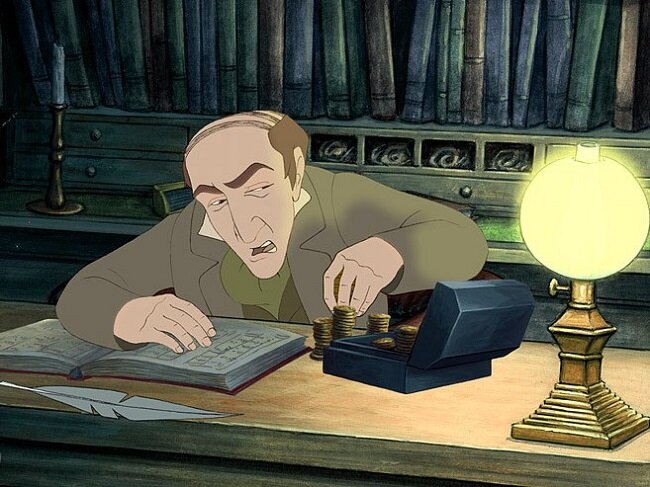
Artistically, this production follows a very formulaic depiction of London in the 19th century as well as the key characters of the story. Scrooge is a balding, hook nosed, old man with a rasping voice. Dogs flee from him and he works in a shabby and drab counting house. There’s a quite startling realisation of Marley’s ghost complete with black shadows around his eyes, making him look like a member of Kiss. His message of neglected social responsibility to Scrooge is presented as a montage, which is quite innovative and effective. The Spirit of Christmas Past is on this occasion is a teenager in a chiton. It’s a novel look. Overall the voice acting is efficient and steeped in stylised British tropes with Cockney street urchins and upper class business men. The score by Neil Thurgate composer is also quite different from the usual fare.
Despite the simplicity of the animation, no doubt due to restrictions of the budget, this adaptation uses large sections of the source text as dialogue. It also visually realises some minor scenes that often get overlooked in most versions of A Christmas Carol. There is a scene where the poor are queuing outside the Baker’s on Christmas morning to have to have their dinner’s cooked. Also there is a greater focus on his failed relationship with Belle including a scene where Scrooge sees a vision of his ex-fiancée with her family and husband. A family that could have been his under different circumstances. This adaptation also strives to add a further human dimension to Scrooge as he reminisces over his past mistakes and gives in to his feelings. Overall, all though not in any way a definitive version of Dickens’ classic tale, there is sufficient here to make it different from others.
This 1954 adaptation of Charles Dickens’ A Christmas Carol is a distinctly studio bound US television production. It was in fact the fourth episode of an anthology variety show called A Shower of Stars. Originally filmed and broadcast in colour, only black and white prints now survive. The production boasts a script by noted American playwright Maxwell Anderson. Due to the 48 minute running time (without commercial breaks) the narrative is heavily abridged and often it is only the story’s most basic themes which are dramatically interpreted. It stars Fredric March who plays Scrooge as a cool and indifferent man, rather than the usual shrill old miser. However, despite his presence his performance cannot save the production. Most of the other cast members are far from accomplished and at times their acting borders on the amateur.
This BBC production from 1977 packs a lot into its 60 minute running time. Succinctly dramatised by Elaine Morgan, this adaptation focuses on the essential themes and key scenes of Dickens’ book. Shot on video, as many BBC dramas were at the time and confined entirely to studio sets, this low budget production makes use of chroma key visual effects. The snow bound countryside, the dark staircase in Scrooge’s apartment and the London skyline are all line drawings, with the cast composited in the foreground. Hence this version of A Christmas Carol feels like an episode of Doctor Who from the same decade. However, the production has one trump card to play with its robust cast of British character actors from the era. Fine performances from the likes of John Le Mesurier, Bernard Lee and Zoe Wanamaker more than compensate for the budgetary restrictions and short duration.
There are three key elements to Disney’s 2009 3D computer-animated adaptation of A Christmas Carol. Firstly, director Robert Zemeckis clearly seeks authenticity and hence includes a lot of original dialogue from the novel, as well as a bleaker depiction of the period. Secondly, he uses the digital production tools at his disposal to create sweeping vistas of 19th century London as well as highly stylised caricatures of the central characters. Thirdly, as this is a Disney production, there is an occasional lapse visual humour and levity that is required by their business model. Sadly all of these aspects of the production make for strange bedfellows that are at odds with each other. The result is a visually sumptuous film that loses its way as it lurches between bleak drama, odd humour and CGI driven spectacle.
Upon its theatrical release, Mickey’s Christmas Carol was the first animated film to star Mickey Mouse for thirty years. It was therefore accompanied with a large amount of hype and a wave of nostalgia. The US marketing stated “He’s Back. Mickey Mouse in his first new motion picture” which was somewhat misleading, as the actual animated film was just 26 minutes long. It was shown theatrically along with a re-release of The Rescuers in the US and The Jungle Book in the UK and other territories, in late December 1983. And despite his name being in the title, Mickey doesn’t have a lot of screen time as he plays Bob Cratchit. This is very much a vehicle for Scrooge McDuck as Ebenezer Scrooge. Overall, it’s a succinct distillation of the plot of Dickens’ A Christmas Carol, filled with cameo appearances by classic Disney characters. Naturally it is replete with the humour and sentiment that is inherent in the process known colloquially as Disneyfication. However, does this mitigate the book’s message?
At first glance, there is not much to distinguish this low budget production by Burbank Films Australia, from any of the other adaptations that were ubiquitous during the seventies and eighties. However, attentive viewers will discover a few details that lift this particular version above the mundane. Firstly, this is the second animated adaptation to feature the voice acting of Ron Haddrick as Ebenezer Scrooge. He had previously voiced the character in Air Programs International's shorter version of A Christmas Carol in 1969, thirteen years earlier. Secondly, despite the modest production values, there are a few additional scenes taken from the source text by Dickens, that don’t usually make it most film and TV adaptations. It is these minor embellishments that compensate for the simplicity of the animation (during the opening scene, some background characters do not move).
It’s interesting that so many adaptations of Charles Dickens’ iconic seasonal story are brought to us via the medium of animation. Naturally, this is a far more economical means of depicting the story with its period detail and supernatural elements, compared to a live action production. However, for an animated version of A Christmas Carol to work successfully, it needs three things. An innovative and striking production design, robust voice acting and a screenplay that keeps the core themes while offering significance difference compared to prior adaptations. You’ll find all of these elements in Richard Williams’ 1971 animated short. Sadly they’re conspicuously absent from the 1997 version. Despite the presence such talents as Tim Curry, Ed Asner and Whoopi Goldberg, this is a distinctly arbitrary animated film. Considering that the screenplay was written by Jymn Magon who has years of experience working for Disney, I had hoped this would be better endeavour.
There’s a degree of hubris implicit in such a definitive title. At the very least the inference is that this is a notable adaptation of Charles Dickens’ classic book. And at first glance, it is perfectly reasonable to assume just that. Jimmy Murakami was an animator of note with such unique movies as The Snowman and When the Wind Blows to his credit. Hence it is reasonable to expect a similar quirky and experimental treatment of this well know yuletide story. However, what audiences actually get is a rather bold adaptation that substantially embellishes upon the established narrative. Veering between sinister and borderline psychedelic imagery, this is a very inconsistent version that tries to be too many things at once. Just as you think you’ve got a handle on the film approach it takes an abrupt turn in the opposite direction. Comedy, drama and even power ballads are thrown into the mix. Sadly, all these elements do not hang well together.
I have written previously about the versatility of Charles Dickens’ classic story and how it lends itself to multiple adaptations and interpretations. This 1938 film version tests that very theory as the reformation and redemption of Ebenezer Scrooge is presented through the medium of Golden Age Hollywood. A Christmas Carol sees the source text sanitised, infantilised and presented as a polished example of wholesome American film making. It has the high production values you’d expect from a studio such as MGM at the time, along with a cloyingly sentimental screenplay that dodges the politics of the book and renders the proceedings into an odd mixture of comedy and soft US Christian propaganda. It presents a very stylised depiction of Dickensian England and bears too many of the obvious foibles and tropes of the studio system that produced the movie.
This 1935 British adaptation of Dickens’ classic book was the first movie version of the story to have sound. Director Henry Edwards had to work creatively to stretch the productions modest budget. Subsequently the production is reliant on fog and snow shrouded sets, mainly to keep costs down. However, this does provide a veneer of authenticity in its depiction of a divided and polluted London. There are a few miniature shots showing the capital city at night and a handful of location shots inside various public buildings to establish the period setting. But mainly this is a set bound production and a sombre one at that. The underlying thrust of this adaptation is to highlight the class division as well as the contrasting wealth and poverty of the country at the time. It is this perspective that is used as the fulcrum of Scrooge’s redemption.
This version of Dickens novel is a very serious and somewhat sombre affair. Patrick Stewart not only stars in this 1999 TV movie but also has a producer credit. Anyone who is familiar with the actor will be aware of his long-standing passion for this tale, as he has starred in several one-man stage performances and narrated an audio book version. Stewart plays his Scrooge as more of an arrogant and aloof businessman. It’s a different Scrooge to that of George C. Scott or Alistair Sim. Here he is much more fearsome and bitter than he is cold and loathsome. Richard E. Grant is a touching, vulnerable Bob Cratchit, who looks decidedly poor and malnourished. There is a more tangible depiction of real poverty here than in other adaptations. The three ghosts are portrayed in a manner closer to the source text, although I could have done without the glowing eyes of the Ghost of Christmas Yet to Come.
The Muppet Christmas Carol was the first Muppet feature film to be made after the death of Jim Henson. The production maintains his standards and style throughout, although due to the plot, this is a somewhat dark Muppet film. It’s also the one most affectionate of the Muppets movie. The plot follows Charles Dickens's original 1843 novel quite closely with the added bonus of The Great Gonzo playing Dickens himself as an ever-present narrator. Michael Caine provides an excellent performance as Ebenezer Scrooge that wouldn’t be out of place in serious adaptation. Caine attacks his role with his acting prowess and does not end up playing second fiddle to The Muppets themselves. As ever with Muppet movies, neither Caine or any other member of the cast ever question the fact that the Muppets aren’t human.
By 1988 Blackadder had run for three seasons in the UK and had seen the central character of Edmund Blackadder evolve from a seedy incompetent to a cunning, scheming, evil genius who was always frustrated at the last moment. Cleverly written by Richard Curtis and Ben Elton and superbly portrayed by Rowan Atkinson, Blackadder was very much at the cutting edge of British comedy of the time. It managed to mix physical humour, with verbal sparring, sarcasm, dry self-deprecation and irony. It was popular with a very broad spectrum of viewers.
Over the last few years I’ve reviewed several adaptations of Charles Dickens seasonal story A Christmas Carol. As I stated previously one of the stories greatest strength is that it lends itself perfectly to multiple interpretations. I recently had the good fortune to rediscover the animated version from 1969 by Air Programs International. I remember seeing this animated short as a child but could not recollect sufficient details to allow me to track it down via the IMDB. Then by complete chance, I stumbled across it again on You Tube while doing some research.
I have a great deal of affection for Charles Dickens' A Christmas Carol, not only because it’s a fine piece of literature but because it lends itself so well to dramatisation. I therefore have a keen interests in all the respective adaptation, of which there are many. Over the years there has been a trend to focus excessively on the sentimental aspect of the plot, resulting in a rather nauseating Disneyfication of the story. Although the redemption of the main protagonist is central to the narrative, the poverty and deprivations of the time are still very pertinent themes, especially in today's economic climate. I was therefore very gratified to rediscover the 1971 version of Charles Dickens' classic story which was originally shown on ABC. This short 25 minute animated feature realises the story superbly, capturing the tone of the book and accurately reflecting the darker aspects. Remember that A Christmas Carol is fundamentally a ghost story.
Clive Donner's 1984 version of the Dickens' classic "A Christmas Carol” is bold and different mainly because of the casting of George C. Scott as Ebenezer Scrooge. The story is told with precision and an eye to detail. In some respects it’s the most authentic adaptation, with credible performances from the ensemble cast. Alastair Sim's portrayal in the 1951 film has always been perceived as a benchmark and provided a template as to how the role should be interpreted. Scott replaces the traditional anger, bitterness and rage with a cold and utterly dispassionate demeanour. There is a strong sense of honesty in his Scrooge as the audience follows him on his emotional journey. The tears, the regret and the realisation that there is still hope are all present, yet explored in a very non-theatrical manner.
The all-star big screen musical was desperately striving to be different during the sixties and seventies, producing many hits and misses. Tommy, The Lost Horizon and The Wiz are prime examples of the experimentation made within the genre at the time. However, due to the success of Oliver! at the box office in 1968 it was thought that there was potential mileage to be had from Dicken's classic "A Christmas Carol". So the musical Scrooge was conceived. Unlike Oliver! it was not based on a existing stage adaptation but on a wholly original screenplay, although a theatrical treatment has since been adapted.
I am a great fan of Charles Dickens' "A Christmas Carol". There is something very special about the novella which is quite hard to quantify. It is a very unique book despite its central theme of redemption being universal. The text has for want of another phrase, a "power" to it. It is profoundly moving, insightful and true. Perhaps the key this story’s appeal lies with the central character, Ebenezer Scrooge. Not because Scrooge is a monster (which are so often fascinating) but because he's a man broken by circumstance. I think readers throughout the years have related to this and considered "There, but for the grace of God, go I". Cinema has found a rich vein of gold running through this tale, which is why it’s been revisited so often and interpreted so many ways.
A Christmas Carol (1997)
It’s interesting that so many adaptations of Charles Dickens’ iconic seasonal story are brought to us via the medium of animation. Naturally, this is a far more economical means of depicting the story with its period detail and supernatural elements, compared to a live action production. However, for an animated version of A Christmas Carol to work successfully, it needs three things. An innovative and striking production design, robust voice acting and a screenplay that keeps the core themes while offering significance difference compared to prior adaptations. You’ll find all of these elements in Richard Williams’ 1971 animated short. Sadly they’re conspicuously absent from the 1997 version. Despite the presence such talents as Tim Curry, Ed Asner and Whoopi Goldberg, this is a distinctly arbitrary animated film. Considering that the screenplay was written by Jymn Magon who has years of experience working for Disney, I had hoped this would be better endeavour.
It’s interesting that so many adaptations of Charles Dickens’ iconic seasonal story are brought to us via the medium of animation. Naturally, this is a far more economical means of depicting the story with its period detail and supernatural elements, compared to a live action production. However, for an animated version of A Christmas Carol to work successfully, it needs three things. An innovative and striking production design, robust voice acting and a screenplay that keeps the core themes while offering significance difference compared to prior adaptations. You’ll find all of these elements in Richard Williams’ 1971 animated short. Sadly they’re conspicuously absent from the 1997 version. Despite the presence such talents as Tim Curry, Ed Asner and Whoopi Goldberg, this is a distinctly arbitrary animated film. Considering that the screenplay was written by Jymn Magon who has years of experience working for Disney, I had hoped this would be better endeavour.
A Christmas Carol presents a very non-specific realisation of Dickensian London. The costumes seem more Edwardian in style and the city is a little too contemporary in design. Scrooge (Tim Curry) is depicted in a very generic way, complete with long nose, angular features and balding head. He also has a canine companion named Debit who acts as a comic foil and tempers some of the more sinister elements of the story. The film sports a rather lurid colour scheme, with characters wearing lots of bright red and green. The various spirits that visit scrooge deviate from the source text in their depiction. The Ghost of Christmas Past is presented as a street urchin, which I thought was quite a creative touch. The Ghost of Christmas Present is voiced by Whoopi Goldberg so the spirits gender and ethnicity reflect those of the actor. And then there are the songs. Yes, this is yet another musical adaptation filled with indifferent songs that simply fill the gaps in the proceedings. None of them stay with you.
At 72 minutes this version of A Christmas Carol does not outstay its welcome. Despite being rather uninspired it is broadly tolerable, although I appreciate that such a statement is damning with faint praise. Occasionally there are some minor details lifted directly from the source text, which I always look to see. This time round it is Jacob Marley’s face appearing in the painted tiles that surround the fireplace in Scrooge’s lodgings. The film also has a few creative ideas, such as a Jacob Marley that looks more like Theodore Roosevelt than a ghost. I also liked that Scrooge finds common ground with Tiny Tim through their finding escape through books and mutual love of the novel Robinson Crusoe. If you can tune out the songs and concentrate on the animated sequences that accompany them, as well as overlook the rather pointless inclusion of the dog Debit, then this version of A Christmas Carol may be of interest to fellow completists. Casual viewers will be better off seeking out a more accomplished adaptation.
This 1954 adaptation of Charles Dickens’ A Christmas Carol is a distinctly studio bound US television production. It was in fact the fourth episode of an anthology variety show called A Shower of Stars. Originally filmed and broadcast in colour, only black and white prints now survive. The production boasts a script by noted American playwright Maxwell Anderson. Due to the 48 minute running time (without commercial breaks) the narrative is heavily abridged and often it is only the story’s most basic themes which are dramatically interpreted. It stars Fredric March who plays Scrooge as a cool and indifferent man, rather than the usual shrill old miser. However, despite his presence his performance cannot save the production. Most of the other cast members are far from accomplished and at times their acting borders on the amateur.
This BBC production from 1977 packs a lot into its 60 minute running time. Succinctly dramatised by Elaine Morgan, this adaptation focuses on the essential themes and key scenes of Dickens’ book. Shot on video, as many BBC dramas were at the time and confined entirely to studio sets, this low budget production makes use of chroma key visual effects. The snow bound countryside, the dark staircase in Scrooge’s apartment and the London skyline are all line drawings, with the cast composited in the foreground. Hence this version of A Christmas Carol feels like an episode of Doctor Who from the same decade. However, the production has one trump card to play with its robust cast of British character actors from the era. Fine performances from the likes of John Le Mesurier, Bernard Lee and Zoe Wanamaker more than compensate for the budgetary restrictions and short duration.
There are three key elements to Disney’s 2009 3D computer-animated adaptation of A Christmas Carol. Firstly, director Robert Zemeckis clearly seeks authenticity and hence includes a lot of original dialogue from the novel, as well as a bleaker depiction of the period. Secondly, he uses the digital production tools at his disposal to create sweeping vistas of 19th century London as well as highly stylised caricatures of the central characters. Thirdly, as this is a Disney production, there is an occasional lapse visual humour and levity that is required by their business model. Sadly all of these aspects of the production make for strange bedfellows that are at odds with each other. The result is a visually sumptuous film that loses its way as it lurches between bleak drama, odd humour and CGI driven spectacle.
Upon its theatrical release, Mickey’s Christmas Carol was the first animated film to star Mickey Mouse for thirty years. It was therefore accompanied with a large amount of hype and a wave of nostalgia. The US marketing stated “He’s Back. Mickey Mouse in his first new motion picture” which was somewhat misleading, as the actual animated film was just 26 minutes long. It was shown theatrically along with a re-release of The Rescuers in the US and The Jungle Book in the UK and other territories, in late December 1983. And despite his name being in the title, Mickey doesn’t have a lot of screen time as he plays Bob Cratchit. This is very much a vehicle for Scrooge McDuck as Ebenezer Scrooge. Overall, it’s a succinct distillation of the plot of Dickens’ A Christmas Carol, filled with cameo appearances by classic Disney characters. Naturally it is replete with the humour and sentiment that is inherent in the process known colloquially as Disneyfication. However, does this mitigate the book’s message?
At first glance, there is not much to distinguish this low budget production by Burbank Films Australia, from any of the other adaptations that were ubiquitous during the seventies and eighties. However, attentive viewers will discover a few details that lift this particular version above the mundane. Firstly, this is the second animated adaptation to feature the voice acting of Ron Haddrick as Ebenezer Scrooge. He had previously voiced the character in Air Programs International's shorter version of A Christmas Carol in 1969, thirteen years earlier. Secondly, despite the modest production values, there are a few additional scenes taken from the source text by Dickens, that don’t usually make it most film and TV adaptations. It is these minor embellishments that compensate for the simplicity of the animation (during the opening scene, some background characters do not move).
It’s interesting that so many adaptations of Charles Dickens’ iconic seasonal story are brought to us via the medium of animation. Naturally, this is a far more economical means of depicting the story with its period detail and supernatural elements, compared to a live action production. However, for an animated version of A Christmas Carol to work successfully, it needs three things. An innovative and striking production design, robust voice acting and a screenplay that keeps the core themes while offering significance difference compared to prior adaptations. You’ll find all of these elements in Richard Williams’ 1971 animated short. Sadly they’re conspicuously absent from the 1997 version. Despite the presence such talents as Tim Curry, Ed Asner and Whoopi Goldberg, this is a distinctly arbitrary animated film. Considering that the screenplay was written by Jymn Magon who has years of experience working for Disney, I had hoped this would be better endeavour.
There’s a degree of hubris implicit in such a definitive title. At the very least the inference is that this is a notable adaptation of Charles Dickens’ classic book. And at first glance, it is perfectly reasonable to assume just that. Jimmy Murakami was an animator of note with such unique movies as The Snowman and When the Wind Blows to his credit. Hence it is reasonable to expect a similar quirky and experimental treatment of this well know yuletide story. However, what audiences actually get is a rather bold adaptation that substantially embellishes upon the established narrative. Veering between sinister and borderline psychedelic imagery, this is a very inconsistent version that tries to be too many things at once. Just as you think you’ve got a handle on the film approach it takes an abrupt turn in the opposite direction. Comedy, drama and even power ballads are thrown into the mix. Sadly, all these elements do not hang well together.
I have written previously about the versatility of Charles Dickens’ classic story and how it lends itself to multiple adaptations and interpretations. This 1938 film version tests that very theory as the reformation and redemption of Ebenezer Scrooge is presented through the medium of Golden Age Hollywood. A Christmas Carol sees the source text sanitised, infantilised and presented as a polished example of wholesome American film making. It has the high production values you’d expect from a studio such as MGM at the time, along with a cloyingly sentimental screenplay that dodges the politics of the book and renders the proceedings into an odd mixture of comedy and soft US Christian propaganda. It presents a very stylised depiction of Dickensian England and bears too many of the obvious foibles and tropes of the studio system that produced the movie.
This 1935 British adaptation of Dickens’ classic book was the first movie version of the story to have sound. Director Henry Edwards had to work creatively to stretch the productions modest budget. Subsequently the production is reliant on fog and snow shrouded sets, mainly to keep costs down. However, this does provide a veneer of authenticity in its depiction of a divided and polluted London. There are a few miniature shots showing the capital city at night and a handful of location shots inside various public buildings to establish the period setting. But mainly this is a set bound production and a sombre one at that. The underlying thrust of this adaptation is to highlight the class division as well as the contrasting wealth and poverty of the country at the time. It is this perspective that is used as the fulcrum of Scrooge’s redemption.
This version of Dickens novel is a very serious and somewhat sombre affair. Patrick Stewart not only stars in this 1999 TV movie but also has a producer credit. Anyone who is familiar with the actor will be aware of his long-standing passion for this tale, as he has starred in several one-man stage performances and narrated an audio book version. Stewart plays his Scrooge as more of an arrogant and aloof businessman. It’s a different Scrooge to that of George C. Scott or Alistair Sim. Here he is much more fearsome and bitter than he is cold and loathsome. Richard E. Grant is a touching, vulnerable Bob Cratchit, who looks decidedly poor and malnourished. There is a more tangible depiction of real poverty here than in other adaptations. The three ghosts are portrayed in a manner closer to the source text, although I could have done without the glowing eyes of the Ghost of Christmas Yet to Come.
The Muppet Christmas Carol was the first Muppet feature film to be made after the death of Jim Henson. The production maintains his standards and style throughout, although due to the plot, this is a somewhat dark Muppet film. It’s also the one most affectionate of the Muppets movie. The plot follows Charles Dickens's original 1843 novel quite closely with the added bonus of The Great Gonzo playing Dickens himself as an ever-present narrator. Michael Caine provides an excellent performance as Ebenezer Scrooge that wouldn’t be out of place in serious adaptation. Caine attacks his role with his acting prowess and does not end up playing second fiddle to The Muppets themselves. As ever with Muppet movies, neither Caine or any other member of the cast ever question the fact that the Muppets aren’t human.
By 1988 Blackadder had run for three seasons in the UK and had seen the central character of Edmund Blackadder evolve from a seedy incompetent to a cunning, scheming, evil genius who was always frustrated at the last moment. Cleverly written by Richard Curtis and Ben Elton and superbly portrayed by Rowan Atkinson, Blackadder was very much at the cutting edge of British comedy of the time. It managed to mix physical humour, with verbal sparring, sarcasm, dry self-deprecation and irony. It was popular with a very broad spectrum of viewers.
Over the last few years I’ve reviewed several adaptations of Charles Dickens seasonal story A Christmas Carol. As I stated previously one of the stories greatest strength is that it lends itself perfectly to multiple interpretations. I recently had the good fortune to rediscover the animated version from 1969 by Air Programs International. I remember seeing this animated short as a child but could not recollect sufficient details to allow me to track it down via the IMDB. Then by complete chance, I stumbled across it again on You Tube while doing some research.
I have a great deal of affection for Charles Dickens' A Christmas Carol, not only because it’s a fine piece of literature but because it lends itself so well to dramatisation. I therefore have a keen interests in all the respective adaptation, of which there are many. Over the years there has been a trend to focus excessively on the sentimental aspect of the plot, resulting in a rather nauseating Disneyfication of the story. Although the redemption of the main protagonist is central to the narrative, the poverty and deprivations of the time are still very pertinent themes, especially in today's economic climate. I was therefore very gratified to rediscover the 1971 version of Charles Dickens' classic story which was originally shown on ABC. This short 25 minute animated feature realises the story superbly, capturing the tone of the book and accurately reflecting the darker aspects. Remember that A Christmas Carol is fundamentally a ghost story.
Clive Donner's 1984 version of the Dickens' classic "A Christmas Carol” is bold and different mainly because of the casting of George C. Scott as Ebenezer Scrooge. The story is told with precision and an eye to detail. In some respects it’s the most authentic adaptation, with credible performances from the ensemble cast. Alastair Sim's portrayal in the 1951 film has always been perceived as a benchmark and provided a template as to how the role should be interpreted. Scott replaces the traditional anger, bitterness and rage with a cold and utterly dispassionate demeanour. There is a strong sense of honesty in his Scrooge as the audience follows him on his emotional journey. The tears, the regret and the realisation that there is still hope are all present, yet explored in a very non-theatrical manner.
The all-star big screen musical was desperately striving to be different during the sixties and seventies, producing many hits and misses. Tommy, The Lost Horizon and The Wiz are prime examples of the experimentation made within the genre at the time. However, due to the success of Oliver! at the box office in 1968 it was thought that there was potential mileage to be had from Dicken's classic "A Christmas Carol". So the musical Scrooge was conceived. Unlike Oliver! it was not based on a existing stage adaptation but on a wholly original screenplay, although a theatrical treatment has since been adapted.
I am a great fan of Charles Dickens' "A Christmas Carol". There is something very special about the novella which is quite hard to quantify. It is a very unique book despite its central theme of redemption being universal. The text has for want of another phrase, a "power" to it. It is profoundly moving, insightful and true. Perhaps the key this story’s appeal lies with the central character, Ebenezer Scrooge. Not because Scrooge is a monster (which are so often fascinating) but because he's a man broken by circumstance. I think readers throughout the years have related to this and considered "There, but for the grace of God, go I". Cinema has found a rich vein of gold running through this tale, which is why it’s been revisited so often and interpreted so many ways.
Christmas Carol: The Movie (2001)
There’s a degree of hubris implicit in such a definitive title. At the very least the inference is that this is a notable adaptation of Charles Dickens’ classic book. And at first glance, it is perfectly reasonable to assume just that. Jimmy Murakami was an animator of note with such unique movies as The Snowman and When the Wind Blows to his credit. Hence it is reasonable to expect a similar quirky and experimental treatment of this well know yuletide story. However, what audiences actually get is a rather bold adaptation that substantially embellishes upon the established narrative. Veering between sinister and borderline psychedelic imagery, this is a very inconsistent version that tries to be too many things at once. Just as you think you’ve got a handle on the film approach it takes an abrupt turn in the opposite direction. Comedy, drama and even power ballads are thrown into the mix. Sadly, all these elements do not hang well together.
There’s a degree of hubris implicit in such a definitive title. At the very least the inference is that this is a notable adaptation of Charles Dickens’ classic book. And at first glance, it is perfectly reasonable to assume just that. Jimmy Murakami was an animator of note with such unique movies as The Snowman and When the Wind Blows to his credit. Hence it is reasonable to expect a similar quirky and experimental treatment of this well know yuletide story. However, what audiences actually get is a rather bold adaptation that substantially embellishes upon the established narrative. Veering between sinister and borderline psychedelic imagery, this is a very inconsistent version that tries to be too many things at once. Just as you think you’ve got a handle on the film approach it takes an abrupt turn in the opposite direction. Comedy, drama and even power ballads are thrown into the mix. Sadly, all these elements do not hang well together.
Christmas Carol: The Movie begins with an expanded prologue that creates a more substantial back story about Scrooge (Simon Callow) and his former fiancée Belle (Kate Winslet). Having bought the debt of a local children’s hospital, Scrooge proceeds to seizes its meagre assets and has the Doctor who runs it, thrown into debtors’ prison. Old Joe the Pawn Shop owner (Robert Llewellyn) is seen here to be the personal bailiff of Scrooge and Marley. Nurse Belle who works at the hospital writes a letter to her former fiancée imploring him not to let her down a second time. It is at this point that the traditional elements of the story broadly play out. One change of note is that Scrooge is haunted by a luminescent Marley’s Ghost (Nicolas Cage) at his office, rather than in his suite of rooms. Scrooge also tips a bucket of water over carol singers, one of whom is Tiny Tim who has only recently recovered from pneumonia. The focus of the story is more upon the ending of Scrooge’s engagement and his tumultuous relationship with his father. Belle in this instance is a friend of Fan, Scrooge’s sister.
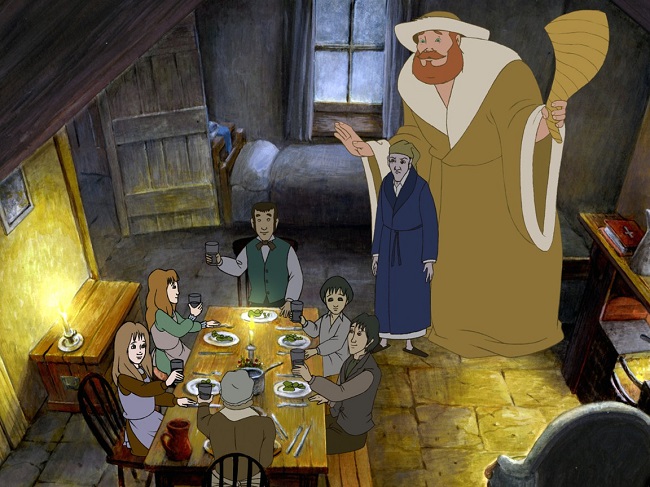
Another aspect of Christmas Carol: The Movie, along with the “expansion” of the story, that makes it stand out from other adaptations is its varied animation style. Each Ghost is accompanied by a distinct aesthetic. It is very noticeable in such scenes where the Ghost of Christmas Past transports Scrooge back to the time of this youth and when the Ghost of Christmas present spreads good cheer via his “horn of plenty”. These “trippy” sequences are dramatic and innovative, yet by this point in the proceedings, the film is tonally all over the shop. We’ve already veered from comedy mice (both Belle and Scrooge have a small murine companion), to insipient infant mortality, and then back to comedy evictions. Then we have the “ignorance and want” scene which has the skin shrinking on the emaciated face of “ignorance” until his skull shatters in a cloud of dust. One for the kids, I think. Also, in some editions of the movie the animated main story is framed between a live action sequence involving Dickens visiting the US and talking about A Christmas Carol to an avid theatre audience. Again, it makes for a very inconsistent piece of cinema.
The conclusion of the story see’s Scrooge reformed and reunited with Belle. He then undertakes the financing of a new hospital. Sadly, the movies lacks any emotional impact because it has tried too hard to be too many things in the proceeding seventy minutes. I can just about muster some praise for Jimmy Murakami for attempting to do something different with such a familiar story, but the film over reaches and cannot decide in what manner to commit itself. Thus, we are left with a rather odd but flawed adaptation that will only really be of interest to niche market film fans. Otherwise, Christmas Carol: The Movie is just something you’d have idly playing in the background over the Christmas holidays, because you’re too full of wine and mince pies to bother to change channel.
This 1954 adaptation of Charles Dickens’ A Christmas Carol is a distinctly studio bound US television production. It was in fact the fourth episode of an anthology variety show called A Shower of Stars. Originally filmed and broadcast in colour, only black and white prints now survive. The production boasts a script by noted American playwright Maxwell Anderson. Due to the 48 minute running time (without commercial breaks) the narrative is heavily abridged and often it is only the story’s most basic themes which are dramatically interpreted. It stars Fredric March who plays Scrooge as a cool and indifferent man, rather than the usual shrill old miser. However, despite his presence his performance cannot save the production. Most of the other cast members are far from accomplished and at times their acting borders on the amateur.
This BBC production from 1977 packs a lot into its 60 minute running time. Succinctly dramatised by Elaine Morgan, this adaptation focuses on the essential themes and key scenes of Dickens’ book. Shot on video, as many BBC dramas were at the time and confined entirely to studio sets, this low budget production makes use of chroma key visual effects. The snow bound countryside, the dark staircase in Scrooge’s apartment and the London skyline are all line drawings, with the cast composited in the foreground. Hence this version of A Christmas Carol feels like an episode of Doctor Who from the same decade. However, the production has one trump card to play with its robust cast of British character actors from the era. Fine performances from the likes of John Le Mesurier, Bernard Lee and Zoe Wanamaker more than compensate for the budgetary restrictions and short duration.
There are three key elements to Disney’s 2009 3D computer-animated adaptation of A Christmas Carol. Firstly, director Robert Zemeckis clearly seeks authenticity and hence includes a lot of original dialogue from the novel, as well as a bleaker depiction of the period. Secondly, he uses the digital production tools at his disposal to create sweeping vistas of 19th century London as well as highly stylised caricatures of the central characters. Thirdly, as this is a Disney production, there is an occasional lapse visual humour and levity that is required by their business model. Sadly all of these aspects of the production make for strange bedfellows that are at odds with each other. The result is a visually sumptuous film that loses its way as it lurches between bleak drama, odd humour and CGI driven spectacle.
Upon its theatrical release, Mickey’s Christmas Carol was the first animated film to star Mickey Mouse for thirty years. It was therefore accompanied with a large amount of hype and a wave of nostalgia. The US marketing stated “He’s Back. Mickey Mouse in his first new motion picture” which was somewhat misleading, as the actual animated film was just 26 minutes long. It was shown theatrically along with a re-release of The Rescuers in the US and The Jungle Book in the UK and other territories, in late December 1983. And despite his name being in the title, Mickey doesn’t have a lot of screen time as he plays Bob Cratchit. This is very much a vehicle for Scrooge McDuck as Ebenezer Scrooge. Overall, it’s a succinct distillation of the plot of Dickens’ A Christmas Carol, filled with cameo appearances by classic Disney characters. Naturally it is replete with the humour and sentiment that is inherent in the process known colloquially as Disneyfication. However, does this mitigate the book’s message?
At first glance, there is not much to distinguish this low budget production by Burbank Films Australia, from any of the other adaptations that were ubiquitous during the seventies and eighties. However, attentive viewers will discover a few details that lift this particular version above the mundane. Firstly, this is the second animated adaptation to feature the voice acting of Ron Haddrick as Ebenezer Scrooge. He had previously voiced the character in Air Programs International's shorter version of A Christmas Carol in 1969, thirteen years earlier. Secondly, despite the modest production values, there are a few additional scenes taken from the source text by Dickens, that don’t usually make it most film and TV adaptations. It is these minor embellishments that compensate for the simplicity of the animation (during the opening scene, some background characters do not move).
It’s interesting that so many adaptations of Charles Dickens’ iconic seasonal story are brought to us via the medium of animation. Naturally, this is a far more economical means of depicting the story with its period detail and supernatural elements, compared to a live action production. However, for an animated version of A Christmas Carol to work successfully, it needs three things. An innovative and striking production design, robust voice acting and a screenplay that keeps the core themes while offering significance difference compared to prior adaptations. You’ll find all of these elements in Richard Williams’ 1971 animated short. Sadly they’re conspicuously absent from the 1997 version. Despite the presence such talents as Tim Curry, Ed Asner and Whoopi Goldberg, this is a distinctly arbitrary animated film. Considering that the screenplay was written by Jymn Magon who has years of experience working for Disney, I had hoped this would be better endeavour.
There’s a degree of hubris implicit in such a definitive title. At the very least the inference is that this is a notable adaptation of Charles Dickens’ classic book. And at first glance, it is perfectly reasonable to assume just that. Jimmy Murakami was an animator of note with such unique movies as The Snowman and When the Wind Blows to his credit. Hence it is reasonable to expect a similar quirky and experimental treatment of this well know yuletide story. However, what audiences actually get is a rather bold adaptation that substantially embellishes upon the established narrative. Veering between sinister and borderline psychedelic imagery, this is a very inconsistent version that tries to be too many things at once. Just as you think you’ve got a handle on the film approach it takes an abrupt turn in the opposite direction. Comedy, drama and even power ballads are thrown into the mix. Sadly, all these elements do not hang well together.
I have written previously about the versatility of Charles Dickens’ classic story and how it lends itself to multiple adaptations and interpretations. This 1938 film version tests that very theory as the reformation and redemption of Ebenezer Scrooge is presented through the medium of Golden Age Hollywood. A Christmas Carol sees the source text sanitised, infantilised and presented as a polished example of wholesome American film making. It has the high production values you’d expect from a studio such as MGM at the time, along with a cloyingly sentimental screenplay that dodges the politics of the book and renders the proceedings into an odd mixture of comedy and soft US Christian propaganda. It presents a very stylised depiction of Dickensian England and bears too many of the obvious foibles and tropes of the studio system that produced the movie.
This 1935 British adaptation of Dickens’ classic book was the first movie version of the story to have sound. Director Henry Edwards had to work creatively to stretch the productions modest budget. Subsequently the production is reliant on fog and snow shrouded sets, mainly to keep costs down. However, this does provide a veneer of authenticity in its depiction of a divided and polluted London. There are a few miniature shots showing the capital city at night and a handful of location shots inside various public buildings to establish the period setting. But mainly this is a set bound production and a sombre one at that. The underlying thrust of this adaptation is to highlight the class division as well as the contrasting wealth and poverty of the country at the time. It is this perspective that is used as the fulcrum of Scrooge’s redemption.
This version of Dickens novel is a very serious and somewhat sombre affair. Patrick Stewart not only stars in this 1999 TV movie but also has a producer credit. Anyone who is familiar with the actor will be aware of his long-standing passion for this tale, as he has starred in several one-man stage performances and narrated an audio book version. Stewart plays his Scrooge as more of an arrogant and aloof businessman. It’s a different Scrooge to that of George C. Scott or Alistair Sim. Here he is much more fearsome and bitter than he is cold and loathsome. Richard E. Grant is a touching, vulnerable Bob Cratchit, who looks decidedly poor and malnourished. There is a more tangible depiction of real poverty here than in other adaptations. The three ghosts are portrayed in a manner closer to the source text, although I could have done without the glowing eyes of the Ghost of Christmas Yet to Come.
The Muppet Christmas Carol was the first Muppet feature film to be made after the death of Jim Henson. The production maintains his standards and style throughout, although due to the plot, this is a somewhat dark Muppet film. It’s also the one most affectionate of the Muppets movie. The plot follows Charles Dickens's original 1843 novel quite closely with the added bonus of The Great Gonzo playing Dickens himself as an ever-present narrator. Michael Caine provides an excellent performance as Ebenezer Scrooge that wouldn’t be out of place in serious adaptation. Caine attacks his role with his acting prowess and does not end up playing second fiddle to The Muppets themselves. As ever with Muppet movies, neither Caine or any other member of the cast ever question the fact that the Muppets aren’t human.
By 1988 Blackadder had run for three seasons in the UK and had seen the central character of Edmund Blackadder evolve from a seedy incompetent to a cunning, scheming, evil genius who was always frustrated at the last moment. Cleverly written by Richard Curtis and Ben Elton and superbly portrayed by Rowan Atkinson, Blackadder was very much at the cutting edge of British comedy of the time. It managed to mix physical humour, with verbal sparring, sarcasm, dry self-deprecation and irony. It was popular with a very broad spectrum of viewers.
Over the last few years I’ve reviewed several adaptations of Charles Dickens seasonal story A Christmas Carol. As I stated previously one of the stories greatest strength is that it lends itself perfectly to multiple interpretations. I recently had the good fortune to rediscover the animated version from 1969 by Air Programs International. I remember seeing this animated short as a child but could not recollect sufficient details to allow me to track it down via the IMDB. Then by complete chance, I stumbled across it again on You Tube while doing some research.
I have a great deal of affection for Charles Dickens' A Christmas Carol, not only because it’s a fine piece of literature but because it lends itself so well to dramatisation. I therefore have a keen interests in all the respective adaptation, of which there are many. Over the years there has been a trend to focus excessively on the sentimental aspect of the plot, resulting in a rather nauseating Disneyfication of the story. Although the redemption of the main protagonist is central to the narrative, the poverty and deprivations of the time are still very pertinent themes, especially in today's economic climate. I was therefore very gratified to rediscover the 1971 version of Charles Dickens' classic story which was originally shown on ABC. This short 25 minute animated feature realises the story superbly, capturing the tone of the book and accurately reflecting the darker aspects. Remember that A Christmas Carol is fundamentally a ghost story.
Clive Donner's 1984 version of the Dickens' classic "A Christmas Carol” is bold and different mainly because of the casting of George C. Scott as Ebenezer Scrooge. The story is told with precision and an eye to detail. In some respects it’s the most authentic adaptation, with credible performances from the ensemble cast. Alastair Sim's portrayal in the 1951 film has always been perceived as a benchmark and provided a template as to how the role should be interpreted. Scott replaces the traditional anger, bitterness and rage with a cold and utterly dispassionate demeanour. There is a strong sense of honesty in his Scrooge as the audience follows him on his emotional journey. The tears, the regret and the realisation that there is still hope are all present, yet explored in a very non-theatrical manner.
The all-star big screen musical was desperately striving to be different during the sixties and seventies, producing many hits and misses. Tommy, The Lost Horizon and The Wiz are prime examples of the experimentation made within the genre at the time. However, due to the success of Oliver! at the box office in 1968 it was thought that there was potential mileage to be had from Dicken's classic "A Christmas Carol". So the musical Scrooge was conceived. Unlike Oliver! it was not based on a existing stage adaptation but on a wholly original screenplay, although a theatrical treatment has since been adapted.
I am a great fan of Charles Dickens' "A Christmas Carol". There is something very special about the novella which is quite hard to quantify. It is a very unique book despite its central theme of redemption being universal. The text has for want of another phrase, a "power" to it. It is profoundly moving, insightful and true. Perhaps the key this story’s appeal lies with the central character, Ebenezer Scrooge. Not because Scrooge is a monster (which are so often fascinating) but because he's a man broken by circumstance. I think readers throughout the years have related to this and considered "There, but for the grace of God, go I". Cinema has found a rich vein of gold running through this tale, which is why it’s been revisited so often and interpreted so many ways.
A Christmas Carol (1938)
I have written previously about the versatility of Charles Dickens’ classic story and how it lends itself to multiple adaptations and interpretations. This 1938 film version tests that very theory as the reformation and redemption of Ebenezer Scrooge is presented through the medium of Golden Age Hollywood. A Christmas Carol sees the source text sanitised, infantilised and presented as a polished example of wholesome American film making. It has the high production values you’d expect from a studio such as MGM at the time, along with a cloyingly sentimental screenplay that dodges the politics of the book and renders the proceedings into an odd mixture of comedy and soft US Christian propaganda. It presents a very stylised depiction of Dickensian England and bears too many of the obvious foibles and tropes of the studio system that produced the movie.
I have written previously about the versatility of Charles Dickens’ classic story and how it lends itself to multiple adaptations and interpretations. This 1938 film version tests that very theory as the reformation and redemption of Ebenezer Scrooge is presented through the medium of Golden Age Hollywood. A Christmas Carol sees the source text sanitised, infantilised and presented as a polished example of wholesome American film making. It has the high production values you’d expect from a studio such as MGM at the time, along with a cloyingly sentimental screenplay that dodges the politics of the book and renders the proceedings into an odd mixture of comedy and soft US Christian propaganda. It presents a very stylised depiction of Dickensian England and bears too many of the obvious foibles and tropes of the studio system that produced the movie.
This movie deals in caricatures and archetypes. Reginald Owen portrayal of Scrooge is hamstrung immediately due to his comical stylised “age make up”. His performance is neither scary, embittered or intimidating. He simply comes across as rather grumpy old man who is just “put out” about contemporary life. His Nephew Fred (Barry MacKay) has an expanded role and an ongoing romantic interest via his fiancée. As for Bob Cratchit (Gene Lockheart), his is reduced to nothing more than a comic foil (who is sacked due to his participation in a snowball fight). His rotund build hardly convinces viewers of his poverty. Similarly, his home, children and wife are only “poor” in the Hollywood sense of the word. With such one-dimensional depictions, it is very hard to become overtly invested in the characters.
Moving on to Marley’s Ghost (Leo G. Carrol) and the three spirits, all of these characters are subsequently bastardised. Scrooge calls the night watchmen when Marley first appears, and the use of comedy again robs the subsequent scenes of any drama. The Ghost of Christmas past looks like she’s stepped straight out of a Broadway chorus line, complete with a star on top of her hat. The Ghost of Christmas Present is also saddled with humorous vignettes as he uses the spirit of Christmas to stop several contrived comedic fights. The final spirit follows the standard depiction of a hooded spectre, but its scenes are pure melodrama. The screenplay removes the more sinister and bleaker elements of the book, such as “ignorance and want”, along with the pawn shop meeting and Scrooge lying dead in his own bed. There are further frivolous scenes of Fred and his fiancée attending church to bolster their piety.
This is a far from subtle or nuanced adaptation. It is contrived and tonally somewhat childish with its continual veering from humour to melodrama. Scrooge’s redemption and subsequent visit to the Cratchits house to make amends is borderline nauseating and devoid of any genuine adult emotion. It’s all very highly polished and superficial. The only aspect of the story that is clear is the perfunctory handling of the Christian message, which is no more sophisticated in this instance than “don’t be mean to each other”. Plus, this film includes one of the healthiest Tiny Tim’s ever seen. A Christmas Carol may amuse and entertain those who are interested in seeing how classic Hollywood film making was a finely-honed process that always lead to a specific product. It may also be of interest to completists who wish to seek out as many versions of the book as possible. But for those who want a more robust, honest and sophisticated adaptation of Dickens, then look elsewhere.
This 1954 adaptation of Charles Dickens’ A Christmas Carol is a distinctly studio bound US television production. It was in fact the fourth episode of an anthology variety show called A Shower of Stars. Originally filmed and broadcast in colour, only black and white prints now survive. The production boasts a script by noted American playwright Maxwell Anderson. Due to the 48 minute running time (without commercial breaks) the narrative is heavily abridged and often it is only the story’s most basic themes which are dramatically interpreted. It stars Fredric March who plays Scrooge as a cool and indifferent man, rather than the usual shrill old miser. However, despite his presence his performance cannot save the production. Most of the other cast members are far from accomplished and at times their acting borders on the amateur.
This BBC production from 1977 packs a lot into its 60 minute running time. Succinctly dramatised by Elaine Morgan, this adaptation focuses on the essential themes and key scenes of Dickens’ book. Shot on video, as many BBC dramas were at the time and confined entirely to studio sets, this low budget production makes use of chroma key visual effects. The snow bound countryside, the dark staircase in Scrooge’s apartment and the London skyline are all line drawings, with the cast composited in the foreground. Hence this version of A Christmas Carol feels like an episode of Doctor Who from the same decade. However, the production has one trump card to play with its robust cast of British character actors from the era. Fine performances from the likes of John Le Mesurier, Bernard Lee and Zoe Wanamaker more than compensate for the budgetary restrictions and short duration.
There are three key elements to Disney’s 2009 3D computer-animated adaptation of A Christmas Carol. Firstly, director Robert Zemeckis clearly seeks authenticity and hence includes a lot of original dialogue from the novel, as well as a bleaker depiction of the period. Secondly, he uses the digital production tools at his disposal to create sweeping vistas of 19th century London as well as highly stylised caricatures of the central characters. Thirdly, as this is a Disney production, there is an occasional lapse visual humour and levity that is required by their business model. Sadly all of these aspects of the production make for strange bedfellows that are at odds with each other. The result is a visually sumptuous film that loses its way as it lurches between bleak drama, odd humour and CGI driven spectacle.
Upon its theatrical release, Mickey’s Christmas Carol was the first animated film to star Mickey Mouse for thirty years. It was therefore accompanied with a large amount of hype and a wave of nostalgia. The US marketing stated “He’s Back. Mickey Mouse in his first new motion picture” which was somewhat misleading, as the actual animated film was just 26 minutes long. It was shown theatrically along with a re-release of The Rescuers in the US and The Jungle Book in the UK and other territories, in late December 1983. And despite his name being in the title, Mickey doesn’t have a lot of screen time as he plays Bob Cratchit. This is very much a vehicle for Scrooge McDuck as Ebenezer Scrooge. Overall, it’s a succinct distillation of the plot of Dickens’ A Christmas Carol, filled with cameo appearances by classic Disney characters. Naturally it is replete with the humour and sentiment that is inherent in the process known colloquially as Disneyfication. However, does this mitigate the book’s message?
At first glance, there is not much to distinguish this low budget production by Burbank Films Australia, from any of the other adaptations that were ubiquitous during the seventies and eighties. However, attentive viewers will discover a few details that lift this particular version above the mundane. Firstly, this is the second animated adaptation to feature the voice acting of Ron Haddrick as Ebenezer Scrooge. He had previously voiced the character in Air Programs International's shorter version of A Christmas Carol in 1969, thirteen years earlier. Secondly, despite the modest production values, there are a few additional scenes taken from the source text by Dickens, that don’t usually make it most film and TV adaptations. It is these minor embellishments that compensate for the simplicity of the animation (during the opening scene, some background characters do not move).
It’s interesting that so many adaptations of Charles Dickens’ iconic seasonal story are brought to us via the medium of animation. Naturally, this is a far more economical means of depicting the story with its period detail and supernatural elements, compared to a live action production. However, for an animated version of A Christmas Carol to work successfully, it needs three things. An innovative and striking production design, robust voice acting and a screenplay that keeps the core themes while offering significance difference compared to prior adaptations. You’ll find all of these elements in Richard Williams’ 1971 animated short. Sadly they’re conspicuously absent from the 1997 version. Despite the presence such talents as Tim Curry, Ed Asner and Whoopi Goldberg, this is a distinctly arbitrary animated film. Considering that the screenplay was written by Jymn Magon who has years of experience working for Disney, I had hoped this would be better endeavour.
There’s a degree of hubris implicit in such a definitive title. At the very least the inference is that this is a notable adaptation of Charles Dickens’ classic book. And at first glance, it is perfectly reasonable to assume just that. Jimmy Murakami was an animator of note with such unique movies as The Snowman and When the Wind Blows to his credit. Hence it is reasonable to expect a similar quirky and experimental treatment of this well know yuletide story. However, what audiences actually get is a rather bold adaptation that substantially embellishes upon the established narrative. Veering between sinister and borderline psychedelic imagery, this is a very inconsistent version that tries to be too many things at once. Just as you think you’ve got a handle on the film approach it takes an abrupt turn in the opposite direction. Comedy, drama and even power ballads are thrown into the mix. Sadly, all these elements do not hang well together.
I have written previously about the versatility of Charles Dickens’ classic story and how it lends itself to multiple adaptations and interpretations. This 1938 film version tests that very theory as the reformation and redemption of Ebenezer Scrooge is presented through the medium of Golden Age Hollywood. A Christmas Carol sees the source text sanitised, infantilised and presented as a polished example of wholesome American film making. It has the high production values you’d expect from a studio such as MGM at the time, along with a cloyingly sentimental screenplay that dodges the politics of the book and renders the proceedings into an odd mixture of comedy and soft US Christian propaganda. It presents a very stylised depiction of Dickensian England and bears too many of the obvious foibles and tropes of the studio system that produced the movie.
This 1935 British adaptation of Dickens’ classic book was the first movie version of the story to have sound. Director Henry Edwards had to work creatively to stretch the productions modest budget. Subsequently the production is reliant on fog and snow shrouded sets, mainly to keep costs down. However, this does provide a veneer of authenticity in its depiction of a divided and polluted London. There are a few miniature shots showing the capital city at night and a handful of location shots inside various public buildings to establish the period setting. But mainly this is a set bound production and a sombre one at that. The underlying thrust of this adaptation is to highlight the class division as well as the contrasting wealth and poverty of the country at the time. It is this perspective that is used as the fulcrum of Scrooge’s redemption.
This version of Dickens novel is a very serious and somewhat sombre affair. Patrick Stewart not only stars in this 1999 TV movie but also has a producer credit. Anyone who is familiar with the actor will be aware of his long-standing passion for this tale, as he has starred in several one-man stage performances and narrated an audio book version. Stewart plays his Scrooge as more of an arrogant and aloof businessman. It’s a different Scrooge to that of George C. Scott or Alistair Sim. Here he is much more fearsome and bitter than he is cold and loathsome. Richard E. Grant is a touching, vulnerable Bob Cratchit, who looks decidedly poor and malnourished. There is a more tangible depiction of real poverty here than in other adaptations. The three ghosts are portrayed in a manner closer to the source text, although I could have done without the glowing eyes of the Ghost of Christmas Yet to Come.
The Muppet Christmas Carol was the first Muppet feature film to be made after the death of Jim Henson. The production maintains his standards and style throughout, although due to the plot, this is a somewhat dark Muppet film. It’s also the one most affectionate of the Muppets movie. The plot follows Charles Dickens's original 1843 novel quite closely with the added bonus of The Great Gonzo playing Dickens himself as an ever-present narrator. Michael Caine provides an excellent performance as Ebenezer Scrooge that wouldn’t be out of place in serious adaptation. Caine attacks his role with his acting prowess and does not end up playing second fiddle to The Muppets themselves. As ever with Muppet movies, neither Caine or any other member of the cast ever question the fact that the Muppets aren’t human.
By 1988 Blackadder had run for three seasons in the UK and had seen the central character of Edmund Blackadder evolve from a seedy incompetent to a cunning, scheming, evil genius who was always frustrated at the last moment. Cleverly written by Richard Curtis and Ben Elton and superbly portrayed by Rowan Atkinson, Blackadder was very much at the cutting edge of British comedy of the time. It managed to mix physical humour, with verbal sparring, sarcasm, dry self-deprecation and irony. It was popular with a very broad spectrum of viewers.
Over the last few years I’ve reviewed several adaptations of Charles Dickens seasonal story A Christmas Carol. As I stated previously one of the stories greatest strength is that it lends itself perfectly to multiple interpretations. I recently had the good fortune to rediscover the animated version from 1969 by Air Programs International. I remember seeing this animated short as a child but could not recollect sufficient details to allow me to track it down via the IMDB. Then by complete chance, I stumbled across it again on You Tube while doing some research.
I have a great deal of affection for Charles Dickens' A Christmas Carol, not only because it’s a fine piece of literature but because it lends itself so well to dramatisation. I therefore have a keen interests in all the respective adaptation, of which there are many. Over the years there has been a trend to focus excessively on the sentimental aspect of the plot, resulting in a rather nauseating Disneyfication of the story. Although the redemption of the main protagonist is central to the narrative, the poverty and deprivations of the time are still very pertinent themes, especially in today's economic climate. I was therefore very gratified to rediscover the 1971 version of Charles Dickens' classic story which was originally shown on ABC. This short 25 minute animated feature realises the story superbly, capturing the tone of the book and accurately reflecting the darker aspects. Remember that A Christmas Carol is fundamentally a ghost story.
Clive Donner's 1984 version of the Dickens' classic "A Christmas Carol” is bold and different mainly because of the casting of George C. Scott as Ebenezer Scrooge. The story is told with precision and an eye to detail. In some respects it’s the most authentic adaptation, with credible performances from the ensemble cast. Alastair Sim's portrayal in the 1951 film has always been perceived as a benchmark and provided a template as to how the role should be interpreted. Scott replaces the traditional anger, bitterness and rage with a cold and utterly dispassionate demeanour. There is a strong sense of honesty in his Scrooge as the audience follows him on his emotional journey. The tears, the regret and the realisation that there is still hope are all present, yet explored in a very non-theatrical manner.
The all-star big screen musical was desperately striving to be different during the sixties and seventies, producing many hits and misses. Tommy, The Lost Horizon and The Wiz are prime examples of the experimentation made within the genre at the time. However, due to the success of Oliver! at the box office in 1968 it was thought that there was potential mileage to be had from Dicken's classic "A Christmas Carol". So the musical Scrooge was conceived. Unlike Oliver! it was not based on a existing stage adaptation but on a wholly original screenplay, although a theatrical treatment has since been adapted.
I am a great fan of Charles Dickens' "A Christmas Carol". There is something very special about the novella which is quite hard to quantify. It is a very unique book despite its central theme of redemption being universal. The text has for want of another phrase, a "power" to it. It is profoundly moving, insightful and true. Perhaps the key this story’s appeal lies with the central character, Ebenezer Scrooge. Not because Scrooge is a monster (which are so often fascinating) but because he's a man broken by circumstance. I think readers throughout the years have related to this and considered "There, but for the grace of God, go I". Cinema has found a rich vein of gold running through this tale, which is why it’s been revisited so often and interpreted so many ways.
Scrooge (1935)
This 1935 British adaptation of Dickens’ classic book was the first movie version of the story to have sound. Director Henry Edwards had to work creatively to stretch the productions modest budget. Subsequently the production is reliant on fog and snow shrouded sets, mainly to keep costs down. However, this does provide a veneer of authenticity in its depiction of a divided and polluted London. There are a few miniature shots showing the capital city at night and a handful of location shots inside various public buildings to establish the period setting. But mainly this is a set bound production and a sombre one at that. The underlying thrust of this adaptation is to highlight the class division as well as the contrasting wealth and poverty of the country at the time. It is this perspective that is used as the fulcrum of Scrooge’s redemption.
This 1935 British adaptation of Dickens’ classic book was the first movie version of the story to have sound. Director Henry Edwards had to work creatively to stretch the productions modest budget. Subsequently the production is reliant on fog and snow shrouded sets, mainly to keep costs down. However, this does provide a veneer of authenticity in its depiction of a divided and polluted London. There are a few miniature shots showing the capital city at night and a handful of location shots inside various public buildings to establish the period setting. But mainly this is a set bound production and a sombre one at that. The underlying thrust of this adaptation is to highlight the class division as well as the contrasting wealth and poverty of the country at the time. It is this perspective that is used as the fulcrum of Scrooge’s redemption.
Seymour Hicks plays Ebenezer Scrooge. A distinguished actor from the Edwardian era his initial portrayal of iconic miser is both petulant and terse. Whereas Bob Cratchit (Donald Calthrop) is depicted as a dominated man who fears for his situation. Unlike other productions, this one spends more time focusing on the different social classes inhabiting the capital. We see Scrooge’s nephew Fred buying Christmas provisions and entering into the spirit of the season. This is then offset against Scrooge taking a lonely meal on his own. Bob Cratchits meagre yuletide provisions and his family’s poverty are then contrasted by the rich gathering at a Lord Mayor’s banquet. The screenplay also spends more time building up to Jacob Marley’s visit. This is quite a tense and atmospheric stretch of the film. It has a hint of gothic horror about it and is well contrived.
Sadly, possibly for budgetary reasons, Marley’s ghost can only be seen by Scrooge. We hear his voice but see only doors open and Scrooge addressing an empty chair. This approach does diminish the power of the scene. The next Ghost, the Spirit of Christmas Past is merely a glowing shape of a man. The screenplay then proceeds to abridge much of the source text and we see nothing of Scrooge’s school days or apprenticeship with Fezziwig. We simply go straight to the termination of Scrooge’s engagement. The Spirit of Christmas Present (Oscar Asche) is thankfully a physical being and sticks to the traditional depiction of the character. The Ghost of Christmas Yet to Come is shown as the silhouette of pointing hand. There are a few optical effects to embellish these later scenes. Again, at this stage of the story, the screenplay further condenses much of narrative. Scrooge himself becomes quite complaint by his second ghostly visit.
Yet despite the various omissions of certain iconic scenes, the script still keeps occasional snatches of dialogue direct from the book. Bob Cratchit jests about the possibility of someone climbing over the back wall and stealing the family’s Christmas pudding. We also get a montage of how everyday people celebrate the meaning of Christmas. We see both a ship’s crew at sea and two remote lighthouse keepers exchanging season’s greetings. The movie takes a second turn towards the sinister when the Housekeeper, the Washer Woman and Undertaker meet up at Old Joe’s pawn shop and hawk the wears they’ve plundered from a dead Scrooge. It is atmospheric and shot in a rather menacing and baroque fashion. It makes its point well. It should also be noted that this is one of a handful of adaptations that shows Bob Cratchit mourning over the actual body of a dead Tiny Tim. It is both a tragic and rather stark scene.
The climax of the film focuses very much on a joyous and genuinely happy Scrooge. The screenplay makes it very clear that this is about his spiritual salvation, rather than just an old miser discovering the joy of helping others. We see Scrooge visit his nephew, but the focus is more upon his compulsion to help Bob Cratchit. When he sees him at work the following day their redefined relationship culminates in a visit to church with an emphasis upon spiritual conversion. All of which would work fine as an ending, if Scrooge’s character transformation hadn’t had been so abrupt. The tipping point comes to early during the film and is made too clear, so therefore lacks nuance. However, the film is still of note for attempting to depict the fundamental inequalities made clear in original story. Scrooge is surprisingly bleak, tonally quite grim and doesn’t sanitise the notion of poverty.
NB. This movie has been in and out of the public domain for many a year. There is a truncated US version that runs just 63 minutes and the longer UK edit that I watched that runs 78 minutes. Many prints that are in circulation are in very poor condition. The US release is also available in a colourised edition. However, there was a full restoration undertaken by Renown Pictures in 2009 which is available on Amazon Prime in the UK. This version by far offers the best picture quality and is the one I would recommend people to watch.
This 1954 adaptation of Charles Dickens’ A Christmas Carol is a distinctly studio bound US television production. It was in fact the fourth episode of an anthology variety show called A Shower of Stars. Originally filmed and broadcast in colour, only black and white prints now survive. The production boasts a script by noted American playwright Maxwell Anderson. Due to the 48 minute running time (without commercial breaks) the narrative is heavily abridged and often it is only the story’s most basic themes which are dramatically interpreted. It stars Fredric March who plays Scrooge as a cool and indifferent man, rather than the usual shrill old miser. However, despite his presence his performance cannot save the production. Most of the other cast members are far from accomplished and at times their acting borders on the amateur.
This BBC production from 1977 packs a lot into its 60 minute running time. Succinctly dramatised by Elaine Morgan, this adaptation focuses on the essential themes and key scenes of Dickens’ book. Shot on video, as many BBC dramas were at the time and confined entirely to studio sets, this low budget production makes use of chroma key visual effects. The snow bound countryside, the dark staircase in Scrooge’s apartment and the London skyline are all line drawings, with the cast composited in the foreground. Hence this version of A Christmas Carol feels like an episode of Doctor Who from the same decade. However, the production has one trump card to play with its robust cast of British character actors from the era. Fine performances from the likes of John Le Mesurier, Bernard Lee and Zoe Wanamaker more than compensate for the budgetary restrictions and short duration.
There are three key elements to Disney’s 2009 3D computer-animated adaptation of A Christmas Carol. Firstly, director Robert Zemeckis clearly seeks authenticity and hence includes a lot of original dialogue from the novel, as well as a bleaker depiction of the period. Secondly, he uses the digital production tools at his disposal to create sweeping vistas of 19th century London as well as highly stylised caricatures of the central characters. Thirdly, as this is a Disney production, there is an occasional lapse visual humour and levity that is required by their business model. Sadly all of these aspects of the production make for strange bedfellows that are at odds with each other. The result is a visually sumptuous film that loses its way as it lurches between bleak drama, odd humour and CGI driven spectacle.
Upon its theatrical release, Mickey’s Christmas Carol was the first animated film to star Mickey Mouse for thirty years. It was therefore accompanied with a large amount of hype and a wave of nostalgia. The US marketing stated “He’s Back. Mickey Mouse in his first new motion picture” which was somewhat misleading, as the actual animated film was just 26 minutes long. It was shown theatrically along with a re-release of The Rescuers in the US and The Jungle Book in the UK and other territories, in late December 1983. And despite his name being in the title, Mickey doesn’t have a lot of screen time as he plays Bob Cratchit. This is very much a vehicle for Scrooge McDuck as Ebenezer Scrooge. Overall, it’s a succinct distillation of the plot of Dickens’ A Christmas Carol, filled with cameo appearances by classic Disney characters. Naturally it is replete with the humour and sentiment that is inherent in the process known colloquially as Disneyfication. However, does this mitigate the book’s message?
At first glance, there is not much to distinguish this low budget production by Burbank Films Australia, from any of the other adaptations that were ubiquitous during the seventies and eighties. However, attentive viewers will discover a few details that lift this particular version above the mundane. Firstly, this is the second animated adaptation to feature the voice acting of Ron Haddrick as Ebenezer Scrooge. He had previously voiced the character in Air Programs International's shorter version of A Christmas Carol in 1969, thirteen years earlier. Secondly, despite the modest production values, there are a few additional scenes taken from the source text by Dickens, that don’t usually make it most film and TV adaptations. It is these minor embellishments that compensate for the simplicity of the animation (during the opening scene, some background characters do not move).
It’s interesting that so many adaptations of Charles Dickens’ iconic seasonal story are brought to us via the medium of animation. Naturally, this is a far more economical means of depicting the story with its period detail and supernatural elements, compared to a live action production. However, for an animated version of A Christmas Carol to work successfully, it needs three things. An innovative and striking production design, robust voice acting and a screenplay that keeps the core themes while offering significance difference compared to prior adaptations. You’ll find all of these elements in Richard Williams’ 1971 animated short. Sadly they’re conspicuously absent from the 1997 version. Despite the presence such talents as Tim Curry, Ed Asner and Whoopi Goldberg, this is a distinctly arbitrary animated film. Considering that the screenplay was written by Jymn Magon who has years of experience working for Disney, I had hoped this would be better endeavour.
There’s a degree of hubris implicit in such a definitive title. At the very least the inference is that this is a notable adaptation of Charles Dickens’ classic book. And at first glance, it is perfectly reasonable to assume just that. Jimmy Murakami was an animator of note with such unique movies as The Snowman and When the Wind Blows to his credit. Hence it is reasonable to expect a similar quirky and experimental treatment of this well know yuletide story. However, what audiences actually get is a rather bold adaptation that substantially embellishes upon the established narrative. Veering between sinister and borderline psychedelic imagery, this is a very inconsistent version that tries to be too many things at once. Just as you think you’ve got a handle on the film approach it takes an abrupt turn in the opposite direction. Comedy, drama and even power ballads are thrown into the mix. Sadly, all these elements do not hang well together.
I have written previously about the versatility of Charles Dickens’ classic story and how it lends itself to multiple adaptations and interpretations. This 1938 film version tests that very theory as the reformation and redemption of Ebenezer Scrooge is presented through the medium of Golden Age Hollywood. A Christmas Carol sees the source text sanitised, infantilised and presented as a polished example of wholesome American film making. It has the high production values you’d expect from a studio such as MGM at the time, along with a cloyingly sentimental screenplay that dodges the politics of the book and renders the proceedings into an odd mixture of comedy and soft US Christian propaganda. It presents a very stylised depiction of Dickensian England and bears too many of the obvious foibles and tropes of the studio system that produced the movie.
This 1935 British adaptation of Dickens’ classic book was the first movie version of the story to have sound. Director Henry Edwards had to work creatively to stretch the productions modest budget. Subsequently the production is reliant on fog and snow shrouded sets, mainly to keep costs down. However, this does provide a veneer of authenticity in its depiction of a divided and polluted London. There are a few miniature shots showing the capital city at night and a handful of location shots inside various public buildings to establish the period setting. But mainly this is a set bound production and a sombre one at that. The underlying thrust of this adaptation is to highlight the class division as well as the contrasting wealth and poverty of the country at the time. It is this perspective that is used as the fulcrum of Scrooge’s redemption.
This version of Dickens novel is a very serious and somewhat sombre affair. Patrick Stewart not only stars in this 1999 TV movie but also has a producer credit. Anyone who is familiar with the actor will be aware of his long-standing passion for this tale, as he has starred in several one-man stage performances and narrated an audio book version. Stewart plays his Scrooge as more of an arrogant and aloof businessman. It’s a different Scrooge to that of George C. Scott or Alistair Sim. Here he is much more fearsome and bitter than he is cold and loathsome. Richard E. Grant is a touching, vulnerable Bob Cratchit, who looks decidedly poor and malnourished. There is a more tangible depiction of real poverty here than in other adaptations. The three ghosts are portrayed in a manner closer to the source text, although I could have done without the glowing eyes of the Ghost of Christmas Yet to Come.
The Muppet Christmas Carol was the first Muppet feature film to be made after the death of Jim Henson. The production maintains his standards and style throughout, although due to the plot, this is a somewhat dark Muppet film. It’s also the one most affectionate of the Muppets movie. The plot follows Charles Dickens's original 1843 novel quite closely with the added bonus of The Great Gonzo playing Dickens himself as an ever-present narrator. Michael Caine provides an excellent performance as Ebenezer Scrooge that wouldn’t be out of place in serious adaptation. Caine attacks his role with his acting prowess and does not end up playing second fiddle to The Muppets themselves. As ever with Muppet movies, neither Caine or any other member of the cast ever question the fact that the Muppets aren’t human.
By 1988 Blackadder had run for three seasons in the UK and had seen the central character of Edmund Blackadder evolve from a seedy incompetent to a cunning, scheming, evil genius who was always frustrated at the last moment. Cleverly written by Richard Curtis and Ben Elton and superbly portrayed by Rowan Atkinson, Blackadder was very much at the cutting edge of British comedy of the time. It managed to mix physical humour, with verbal sparring, sarcasm, dry self-deprecation and irony. It was popular with a very broad spectrum of viewers.
Over the last few years I’ve reviewed several adaptations of Charles Dickens seasonal story A Christmas Carol. As I stated previously one of the stories greatest strength is that it lends itself perfectly to multiple interpretations. I recently had the good fortune to rediscover the animated version from 1969 by Air Programs International. I remember seeing this animated short as a child but could not recollect sufficient details to allow me to track it down via the IMDB. Then by complete chance, I stumbled across it again on You Tube while doing some research.
I have a great deal of affection for Charles Dickens' A Christmas Carol, not only because it’s a fine piece of literature but because it lends itself so well to dramatisation. I therefore have a keen interests in all the respective adaptation, of which there are many. Over the years there has been a trend to focus excessively on the sentimental aspect of the plot, resulting in a rather nauseating Disneyfication of the story. Although the redemption of the main protagonist is central to the narrative, the poverty and deprivations of the time are still very pertinent themes, especially in today's economic climate. I was therefore very gratified to rediscover the 1971 version of Charles Dickens' classic story which was originally shown on ABC. This short 25 minute animated feature realises the story superbly, capturing the tone of the book and accurately reflecting the darker aspects. Remember that A Christmas Carol is fundamentally a ghost story.
Clive Donner's 1984 version of the Dickens' classic "A Christmas Carol” is bold and different mainly because of the casting of George C. Scott as Ebenezer Scrooge. The story is told with precision and an eye to detail. In some respects it’s the most authentic adaptation, with credible performances from the ensemble cast. Alastair Sim's portrayal in the 1951 film has always been perceived as a benchmark and provided a template as to how the role should be interpreted. Scott replaces the traditional anger, bitterness and rage with a cold and utterly dispassionate demeanour. There is a strong sense of honesty in his Scrooge as the audience follows him on his emotional journey. The tears, the regret and the realisation that there is still hope are all present, yet explored in a very non-theatrical manner.
The all-star big screen musical was desperately striving to be different during the sixties and seventies, producing many hits and misses. Tommy, The Lost Horizon and The Wiz are prime examples of the experimentation made within the genre at the time. However, due to the success of Oliver! at the box office in 1968 it was thought that there was potential mileage to be had from Dicken's classic "A Christmas Carol". So the musical Scrooge was conceived. Unlike Oliver! it was not based on a existing stage adaptation but on a wholly original screenplay, although a theatrical treatment has since been adapted.
I am a great fan of Charles Dickens' "A Christmas Carol". There is something very special about the novella which is quite hard to quantify. It is a very unique book despite its central theme of redemption being universal. The text has for want of another phrase, a "power" to it. It is profoundly moving, insightful and true. Perhaps the key this story’s appeal lies with the central character, Ebenezer Scrooge. Not because Scrooge is a monster (which are so often fascinating) but because he's a man broken by circumstance. I think readers throughout the years have related to this and considered "There, but for the grace of God, go I". Cinema has found a rich vein of gold running through this tale, which is why it’s been revisited so often and interpreted so many ways.
A Christmas Carol (1999)
This version of Dickens novel is a very serious and somewhat sombre affair. Patrick Stewart not only stars in this 1999 TV movie but also has a producer credit. Anyone who is familiar with the actor will be aware of his long-standing passion for this tale, as he has starred in several one-man stage performances and narrated an audio book version. Stewart plays his Scrooge as more of an arrogant and aloof businessman. It’s a different Scrooge to that of George C. Scott or Alistair Sim. Here he is much more fearsome and bitter than he is cold and loathsome. Richard E. Grant is a touching, vulnerable Bob Cratchit, who looks decidedly poor and malnourished. There is a more tangible depiction of real poverty here than in other adaptations. The three ghosts are portrayed in a manner closer to the source text, although I could have done without the glowing eyes of the Ghost of Christmas Yet to Come.
This version of Dickens novel is a very serious and somewhat sombre affair. Patrick Stewart not only stars in this 1999 TV movie but also has a producer credit. Anyone who is familiar with the actor will be aware of his long-standing passion for this tale, as he has starred in several one-man stage performances and narrated an audio book version. Stewart plays his Scrooge as more of an arrogant and aloof businessman. It’s a different Scrooge to that of George C. Scott or Alistair Sim. Here he is much more fearsome and bitter than he is cold and loathsome. Richard E. Grant is a touching, vulnerable Bob Cratchit, who looks decidedly poor and malnourished. There is a more tangible depiction of real poverty here than in other adaptations. The three ghosts are portrayed in a manner closer to the source text, although I could have done without the glowing eyes of the Ghost of Christmas Yet to Come.
In many ways, apart from Patrick Stewart’s presence, what makes this version of A Christmas Carol standout from others is its attention to detail and the inclusion of many minor details from Dickens story. For example, Scrooge travels with the Ghost of Christmas Present and visits people from all walks of life celebrating Christmas. This includes Lighthouse Keepers, Sailors, Coal Miners and even convicts in Prison. It’s an important aspect of the text that shows how Scrooge slowly begins to understand the wider meaning of Christmas and its significance to people. There’s also a greater focus upon Fred’s Christmas Day party which provides an explanation as to why he doggedly indulges his obnoxious Uncle year after year. We also get to see more of the escapades or Mr Topper, who is conspicuously single.
It’s a curious thing that for a production that spends so much time and effort, bringing such an accurate depiction of the story to the screen, it paradoxically makes quite a few changes to the original colloquial dialogue. Perhaps this was a conscious decision to try and make the film more accessible to contemporary audiences. Given the budgetary limitations, the film has quite a handsome production design although it can be a little studio bound at times. Overall this is a sufficiently different production that maintains one’s interest, despite being familiar with the story arc. If I were to venture one criticism of this version, it would be that it does feel at time more like a lecture on Dickens’ work, lacking in personal warmth. Yet it compensates for this with its level of detail.
This 1954 adaptation of Charles Dickens’ A Christmas Carol is a distinctly studio bound US television production. It was in fact the fourth episode of an anthology variety show called A Shower of Stars. Originally filmed and broadcast in colour, only black and white prints now survive. The production boasts a script by noted American playwright Maxwell Anderson. Due to the 48 minute running time (without commercial breaks) the narrative is heavily abridged and often it is only the story’s most basic themes which are dramatically interpreted. It stars Fredric March who plays Scrooge as a cool and indifferent man, rather than the usual shrill old miser. However, despite his presence his performance cannot save the production. Most of the other cast members are far from accomplished and at times their acting borders on the amateur.
This BBC production from 1977 packs a lot into its 60 minute running time. Succinctly dramatised by Elaine Morgan, this adaptation focuses on the essential themes and key scenes of Dickens’ book. Shot on video, as many BBC dramas were at the time and confined entirely to studio sets, this low budget production makes use of chroma key visual effects. The snow bound countryside, the dark staircase in Scrooge’s apartment and the London skyline are all line drawings, with the cast composited in the foreground. Hence this version of A Christmas Carol feels like an episode of Doctor Who from the same decade. However, the production has one trump card to play with its robust cast of British character actors from the era. Fine performances from the likes of John Le Mesurier, Bernard Lee and Zoe Wanamaker more than compensate for the budgetary restrictions and short duration.
There are three key elements to Disney’s 2009 3D computer-animated adaptation of A Christmas Carol. Firstly, director Robert Zemeckis clearly seeks authenticity and hence includes a lot of original dialogue from the novel, as well as a bleaker depiction of the period. Secondly, he uses the digital production tools at his disposal to create sweeping vistas of 19th century London as well as highly stylised caricatures of the central characters. Thirdly, as this is a Disney production, there is an occasional lapse visual humour and levity that is required by their business model. Sadly all of these aspects of the production make for strange bedfellows that are at odds with each other. The result is a visually sumptuous film that loses its way as it lurches between bleak drama, odd humour and CGI driven spectacle.
Upon its theatrical release, Mickey’s Christmas Carol was the first animated film to star Mickey Mouse for thirty years. It was therefore accompanied with a large amount of hype and a wave of nostalgia. The US marketing stated “He’s Back. Mickey Mouse in his first new motion picture” which was somewhat misleading, as the actual animated film was just 26 minutes long. It was shown theatrically along with a re-release of The Rescuers in the US and The Jungle Book in the UK and other territories, in late December 1983. And despite his name being in the title, Mickey doesn’t have a lot of screen time as he plays Bob Cratchit. This is very much a vehicle for Scrooge McDuck as Ebenezer Scrooge. Overall, it’s a succinct distillation of the plot of Dickens’ A Christmas Carol, filled with cameo appearances by classic Disney characters. Naturally it is replete with the humour and sentiment that is inherent in the process known colloquially as Disneyfication. However, does this mitigate the book’s message?
At first glance, there is not much to distinguish this low budget production by Burbank Films Australia, from any of the other adaptations that were ubiquitous during the seventies and eighties. However, attentive viewers will discover a few details that lift this particular version above the mundane. Firstly, this is the second animated adaptation to feature the voice acting of Ron Haddrick as Ebenezer Scrooge. He had previously voiced the character in Air Programs International's shorter version of A Christmas Carol in 1969, thirteen years earlier. Secondly, despite the modest production values, there are a few additional scenes taken from the source text by Dickens, that don’t usually make it most film and TV adaptations. It is these minor embellishments that compensate for the simplicity of the animation (during the opening scene, some background characters do not move).
It’s interesting that so many adaptations of Charles Dickens’ iconic seasonal story are brought to us via the medium of animation. Naturally, this is a far more economical means of depicting the story with its period detail and supernatural elements, compared to a live action production. However, for an animated version of A Christmas Carol to work successfully, it needs three things. An innovative and striking production design, robust voice acting and a screenplay that keeps the core themes while offering significance difference compared to prior adaptations. You’ll find all of these elements in Richard Williams’ 1971 animated short. Sadly they’re conspicuously absent from the 1997 version. Despite the presence such talents as Tim Curry, Ed Asner and Whoopi Goldberg, this is a distinctly arbitrary animated film. Considering that the screenplay was written by Jymn Magon who has years of experience working for Disney, I had hoped this would be better endeavour.
There’s a degree of hubris implicit in such a definitive title. At the very least the inference is that this is a notable adaptation of Charles Dickens’ classic book. And at first glance, it is perfectly reasonable to assume just that. Jimmy Murakami was an animator of note with such unique movies as The Snowman and When the Wind Blows to his credit. Hence it is reasonable to expect a similar quirky and experimental treatment of this well know yuletide story. However, what audiences actually get is a rather bold adaptation that substantially embellishes upon the established narrative. Veering between sinister and borderline psychedelic imagery, this is a very inconsistent version that tries to be too many things at once. Just as you think you’ve got a handle on the film approach it takes an abrupt turn in the opposite direction. Comedy, drama and even power ballads are thrown into the mix. Sadly, all these elements do not hang well together.
I have written previously about the versatility of Charles Dickens’ classic story and how it lends itself to multiple adaptations and interpretations. This 1938 film version tests that very theory as the reformation and redemption of Ebenezer Scrooge is presented through the medium of Golden Age Hollywood. A Christmas Carol sees the source text sanitised, infantilised and presented as a polished example of wholesome American film making. It has the high production values you’d expect from a studio such as MGM at the time, along with a cloyingly sentimental screenplay that dodges the politics of the book and renders the proceedings into an odd mixture of comedy and soft US Christian propaganda. It presents a very stylised depiction of Dickensian England and bears too many of the obvious foibles and tropes of the studio system that produced the movie.
This 1935 British adaptation of Dickens’ classic book was the first movie version of the story to have sound. Director Henry Edwards had to work creatively to stretch the productions modest budget. Subsequently the production is reliant on fog and snow shrouded sets, mainly to keep costs down. However, this does provide a veneer of authenticity in its depiction of a divided and polluted London. There are a few miniature shots showing the capital city at night and a handful of location shots inside various public buildings to establish the period setting. But mainly this is a set bound production and a sombre one at that. The underlying thrust of this adaptation is to highlight the class division as well as the contrasting wealth and poverty of the country at the time. It is this perspective that is used as the fulcrum of Scrooge’s redemption.
This version of Dickens novel is a very serious and somewhat sombre affair. Patrick Stewart not only stars in this 1999 TV movie but also has a producer credit. Anyone who is familiar with the actor will be aware of his long-standing passion for this tale, as he has starred in several one-man stage performances and narrated an audio book version. Stewart plays his Scrooge as more of an arrogant and aloof businessman. It’s a different Scrooge to that of George C. Scott or Alistair Sim. Here he is much more fearsome and bitter than he is cold and loathsome. Richard E. Grant is a touching, vulnerable Bob Cratchit, who looks decidedly poor and malnourished. There is a more tangible depiction of real poverty here than in other adaptations. The three ghosts are portrayed in a manner closer to the source text, although I could have done without the glowing eyes of the Ghost of Christmas Yet to Come.
The Muppet Christmas Carol was the first Muppet feature film to be made after the death of Jim Henson. The production maintains his standards and style throughout, although due to the plot, this is a somewhat dark Muppet film. It’s also the one most affectionate of the Muppets movie. The plot follows Charles Dickens's original 1843 novel quite closely with the added bonus of The Great Gonzo playing Dickens himself as an ever-present narrator. Michael Caine provides an excellent performance as Ebenezer Scrooge that wouldn’t be out of place in serious adaptation. Caine attacks his role with his acting prowess and does not end up playing second fiddle to The Muppets themselves. As ever with Muppet movies, neither Caine or any other member of the cast ever question the fact that the Muppets aren’t human.
By 1988 Blackadder had run for three seasons in the UK and had seen the central character of Edmund Blackadder evolve from a seedy incompetent to a cunning, scheming, evil genius who was always frustrated at the last moment. Cleverly written by Richard Curtis and Ben Elton and superbly portrayed by Rowan Atkinson, Blackadder was very much at the cutting edge of British comedy of the time. It managed to mix physical humour, with verbal sparring, sarcasm, dry self-deprecation and irony. It was popular with a very broad spectrum of viewers.
Over the last few years I’ve reviewed several adaptations of Charles Dickens seasonal story A Christmas Carol. As I stated previously one of the stories greatest strength is that it lends itself perfectly to multiple interpretations. I recently had the good fortune to rediscover the animated version from 1969 by Air Programs International. I remember seeing this animated short as a child but could not recollect sufficient details to allow me to track it down via the IMDB. Then by complete chance, I stumbled across it again on You Tube while doing some research.
I have a great deal of affection for Charles Dickens' A Christmas Carol, not only because it’s a fine piece of literature but because it lends itself so well to dramatisation. I therefore have a keen interests in all the respective adaptation, of which there are many. Over the years there has been a trend to focus excessively on the sentimental aspect of the plot, resulting in a rather nauseating Disneyfication of the story. Although the redemption of the main protagonist is central to the narrative, the poverty and deprivations of the time are still very pertinent themes, especially in today's economic climate. I was therefore very gratified to rediscover the 1971 version of Charles Dickens' classic story which was originally shown on ABC. This short 25 minute animated feature realises the story superbly, capturing the tone of the book and accurately reflecting the darker aspects. Remember that A Christmas Carol is fundamentally a ghost story.
Clive Donner's 1984 version of the Dickens' classic "A Christmas Carol” is bold and different mainly because of the casting of George C. Scott as Ebenezer Scrooge. The story is told with precision and an eye to detail. In some respects it’s the most authentic adaptation, with credible performances from the ensemble cast. Alastair Sim's portrayal in the 1951 film has always been perceived as a benchmark and provided a template as to how the role should be interpreted. Scott replaces the traditional anger, bitterness and rage with a cold and utterly dispassionate demeanour. There is a strong sense of honesty in his Scrooge as the audience follows him on his emotional journey. The tears, the regret and the realisation that there is still hope are all present, yet explored in a very non-theatrical manner.
The all-star big screen musical was desperately striving to be different during the sixties and seventies, producing many hits and misses. Tommy, The Lost Horizon and The Wiz are prime examples of the experimentation made within the genre at the time. However, due to the success of Oliver! at the box office in 1968 it was thought that there was potential mileage to be had from Dicken's classic "A Christmas Carol". So the musical Scrooge was conceived. Unlike Oliver! it was not based on a existing stage adaptation but on a wholly original screenplay, although a theatrical treatment has since been adapted.
I am a great fan of Charles Dickens' "A Christmas Carol". There is something very special about the novella which is quite hard to quantify. It is a very unique book despite its central theme of redemption being universal. The text has for want of another phrase, a "power" to it. It is profoundly moving, insightful and true. Perhaps the key this story’s appeal lies with the central character, Ebenezer Scrooge. Not because Scrooge is a monster (which are so often fascinating) but because he's a man broken by circumstance. I think readers throughout the years have related to this and considered "There, but for the grace of God, go I". Cinema has found a rich vein of gold running through this tale, which is why it’s been revisited so often and interpreted so many ways.
The Muppet Christmas Carol (1992)
The Muppet Christmas Carol was the first Muppet feature film to be made after the death of Jim Henson. The production maintains his standards and style throughout, although due to the plot, this is a somewhat dark Muppet film. It’s also the one most affectionate of the Muppets movie. The plot follows Charles Dickens's original 1843 novel quite closely with the added bonus of The Great Gonzo playing Dickens himself as an ever-present narrator. Michael Caine provides an excellent performance as Ebenezer Scrooge that wouldn’t be out of place in serious adaptation. Caine attacks his role with his acting prowess and does not end up playing second fiddle to The Muppets themselves. As ever with Muppet movies, neither Caine or any other member of the cast ever question the fact that the Muppets aren’t human.
The Muppet Christmas Carol was the first Muppet feature film to be made after the death of Jim Henson. The production maintains his standards and style throughout, although due to the plot, this is a somewhat dark Muppet film. It’s also the one most affectionate of the Muppets movie. The plot follows Charles Dickens's original 1843 novel quite closely with the added bonus of The Great Gonzo playing Dickens himself as an ever-present narrator. Michael Caine provides an excellent performance as Ebenezer Scrooge that wouldn’t be out of place in serious adaptation. Caine attacks his role with his acting prowess and does not end up playing second fiddle to The Muppets themselves. As ever with Muppet movies, neither Caine or any other member of the cast ever question the fact that the Muppets aren’t human.
In many respects, this is probably one of the most faithful film adaptation of the novel to date. Much of the dialogue is taken directly form the source text. With quotes such as "If they would rather die, they had better do it, and decrease the surplus population”, there is potential to scare younger viewers, yet it works very well. The script, production design and humorous tone balance well with the classic tales more sinister elements. The film's score composed by Miles Goodman with songs written by Paul Williams facilitate the stories subtler themes, making them accessible to younger viewers. "Doomed, Scrooge, you're doomed for all time, your future is a horror story, written by your crimes”, sing the ghosts of the deceased Marley brothers (AKA Statler and Waldorf) in a catchy expositionary ditty. I must admit over the years this soundtrack has really grown on me and I now enjoy such standout tracks as It Feels Like Christmas and Thankful Heart.
The Muppet Christmas Carol does well in tackling this classic tale’s darker elements. It tempers the best aspects of Dickens cautionary narrative with The Muppets signature brand of humour. However, this approach doesn’t negate the drama. "Should we be worried about the kids in the audience?" ask Rizzo Rat. "Nah," says Gonzo. "This is culture." I actually think presenting literary classics in such a fashion makes them more accessible to the audience and may encourage some to tackle the original books. For those who are less interested in the narrative pedigree of this adaptation and who just wish to be entertained, then The Muppet Christmas Carol hits the mark. There is a cornucopia of sight gags, background shenanigans and subtle references, on top of the usual upfront, zany humour from The Muppets. So, if you wish for a different spin on this classic season tale, why not give it a try. You may be surprised by how good an adaptation it is.
This 1954 adaptation of Charles Dickens’ A Christmas Carol is a distinctly studio bound US television production. It was in fact the fourth episode of an anthology variety show called A Shower of Stars. Originally filmed and broadcast in colour, only black and white prints now survive. The production boasts a script by noted American playwright Maxwell Anderson. Due to the 48 minute running time (without commercial breaks) the narrative is heavily abridged and often it is only the story’s most basic themes which are dramatically interpreted. It stars Fredric March who plays Scrooge as a cool and indifferent man, rather than the usual shrill old miser. However, despite his presence his performance cannot save the production. Most of the other cast members are far from accomplished and at times their acting borders on the amateur.
This BBC production from 1977 packs a lot into its 60 minute running time. Succinctly dramatised by Elaine Morgan, this adaptation focuses on the essential themes and key scenes of Dickens’ book. Shot on video, as many BBC dramas were at the time and confined entirely to studio sets, this low budget production makes use of chroma key visual effects. The snow bound countryside, the dark staircase in Scrooge’s apartment and the London skyline are all line drawings, with the cast composited in the foreground. Hence this version of A Christmas Carol feels like an episode of Doctor Who from the same decade. However, the production has one trump card to play with its robust cast of British character actors from the era. Fine performances from the likes of John Le Mesurier, Bernard Lee and Zoe Wanamaker more than compensate for the budgetary restrictions and short duration.
There are three key elements to Disney’s 2009 3D computer-animated adaptation of A Christmas Carol. Firstly, director Robert Zemeckis clearly seeks authenticity and hence includes a lot of original dialogue from the novel, as well as a bleaker depiction of the period. Secondly, he uses the digital production tools at his disposal to create sweeping vistas of 19th century London as well as highly stylised caricatures of the central characters. Thirdly, as this is a Disney production, there is an occasional lapse visual humour and levity that is required by their business model. Sadly all of these aspects of the production make for strange bedfellows that are at odds with each other. The result is a visually sumptuous film that loses its way as it lurches between bleak drama, odd humour and CGI driven spectacle.
Upon its theatrical release, Mickey’s Christmas Carol was the first animated film to star Mickey Mouse for thirty years. It was therefore accompanied with a large amount of hype and a wave of nostalgia. The US marketing stated “He’s Back. Mickey Mouse in his first new motion picture” which was somewhat misleading, as the actual animated film was just 26 minutes long. It was shown theatrically along with a re-release of The Rescuers in the US and The Jungle Book in the UK and other territories, in late December 1983. And despite his name being in the title, Mickey doesn’t have a lot of screen time as he plays Bob Cratchit. This is very much a vehicle for Scrooge McDuck as Ebenezer Scrooge. Overall, it’s a succinct distillation of the plot of Dickens’ A Christmas Carol, filled with cameo appearances by classic Disney characters. Naturally it is replete with the humour and sentiment that is inherent in the process known colloquially as Disneyfication. However, does this mitigate the book’s message?
At first glance, there is not much to distinguish this low budget production by Burbank Films Australia, from any of the other adaptations that were ubiquitous during the seventies and eighties. However, attentive viewers will discover a few details that lift this particular version above the mundane. Firstly, this is the second animated adaptation to feature the voice acting of Ron Haddrick as Ebenezer Scrooge. He had previously voiced the character in Air Programs International's shorter version of A Christmas Carol in 1969, thirteen years earlier. Secondly, despite the modest production values, there are a few additional scenes taken from the source text by Dickens, that don’t usually make it most film and TV adaptations. It is these minor embellishments that compensate for the simplicity of the animation (during the opening scene, some background characters do not move).
It’s interesting that so many adaptations of Charles Dickens’ iconic seasonal story are brought to us via the medium of animation. Naturally, this is a far more economical means of depicting the story with its period detail and supernatural elements, compared to a live action production. However, for an animated version of A Christmas Carol to work successfully, it needs three things. An innovative and striking production design, robust voice acting and a screenplay that keeps the core themes while offering significance difference compared to prior adaptations. You’ll find all of these elements in Richard Williams’ 1971 animated short. Sadly they’re conspicuously absent from the 1997 version. Despite the presence such talents as Tim Curry, Ed Asner and Whoopi Goldberg, this is a distinctly arbitrary animated film. Considering that the screenplay was written by Jymn Magon who has years of experience working for Disney, I had hoped this would be better endeavour.
There’s a degree of hubris implicit in such a definitive title. At the very least the inference is that this is a notable adaptation of Charles Dickens’ classic book. And at first glance, it is perfectly reasonable to assume just that. Jimmy Murakami was an animator of note with such unique movies as The Snowman and When the Wind Blows to his credit. Hence it is reasonable to expect a similar quirky and experimental treatment of this well know yuletide story. However, what audiences actually get is a rather bold adaptation that substantially embellishes upon the established narrative. Veering between sinister and borderline psychedelic imagery, this is a very inconsistent version that tries to be too many things at once. Just as you think you’ve got a handle on the film approach it takes an abrupt turn in the opposite direction. Comedy, drama and even power ballads are thrown into the mix. Sadly, all these elements do not hang well together.
I have written previously about the versatility of Charles Dickens’ classic story and how it lends itself to multiple adaptations and interpretations. This 1938 film version tests that very theory as the reformation and redemption of Ebenezer Scrooge is presented through the medium of Golden Age Hollywood. A Christmas Carol sees the source text sanitised, infantilised and presented as a polished example of wholesome American film making. It has the high production values you’d expect from a studio such as MGM at the time, along with a cloyingly sentimental screenplay that dodges the politics of the book and renders the proceedings into an odd mixture of comedy and soft US Christian propaganda. It presents a very stylised depiction of Dickensian England and bears too many of the obvious foibles and tropes of the studio system that produced the movie.
This 1935 British adaptation of Dickens’ classic book was the first movie version of the story to have sound. Director Henry Edwards had to work creatively to stretch the productions modest budget. Subsequently the production is reliant on fog and snow shrouded sets, mainly to keep costs down. However, this does provide a veneer of authenticity in its depiction of a divided and polluted London. There are a few miniature shots showing the capital city at night and a handful of location shots inside various public buildings to establish the period setting. But mainly this is a set bound production and a sombre one at that. The underlying thrust of this adaptation is to highlight the class division as well as the contrasting wealth and poverty of the country at the time. It is this perspective that is used as the fulcrum of Scrooge’s redemption.
This version of Dickens novel is a very serious and somewhat sombre affair. Patrick Stewart not only stars in this 1999 TV movie but also has a producer credit. Anyone who is familiar with the actor will be aware of his long-standing passion for this tale, as he has starred in several one-man stage performances and narrated an audio book version. Stewart plays his Scrooge as more of an arrogant and aloof businessman. It’s a different Scrooge to that of George C. Scott or Alistair Sim. Here he is much more fearsome and bitter than he is cold and loathsome. Richard E. Grant is a touching, vulnerable Bob Cratchit, who looks decidedly poor and malnourished. There is a more tangible depiction of real poverty here than in other adaptations. The three ghosts are portrayed in a manner closer to the source text, although I could have done without the glowing eyes of the Ghost of Christmas Yet to Come.
The Muppet Christmas Carol was the first Muppet feature film to be made after the death of Jim Henson. The production maintains his standards and style throughout, although due to the plot, this is a somewhat dark Muppet film. It’s also the one most affectionate of the Muppets movie. The plot follows Charles Dickens's original 1843 novel quite closely with the added bonus of The Great Gonzo playing Dickens himself as an ever-present narrator. Michael Caine provides an excellent performance as Ebenezer Scrooge that wouldn’t be out of place in serious adaptation. Caine attacks his role with his acting prowess and does not end up playing second fiddle to The Muppets themselves. As ever with Muppet movies, neither Caine or any other member of the cast ever question the fact that the Muppets aren’t human.
By 1988 Blackadder had run for three seasons in the UK and had seen the central character of Edmund Blackadder evolve from a seedy incompetent to a cunning, scheming, evil genius who was always frustrated at the last moment. Cleverly written by Richard Curtis and Ben Elton and superbly portrayed by Rowan Atkinson, Blackadder was very much at the cutting edge of British comedy of the time. It managed to mix physical humour, with verbal sparring, sarcasm, dry self-deprecation and irony. It was popular with a very broad spectrum of viewers.
Over the last few years I’ve reviewed several adaptations of Charles Dickens seasonal story A Christmas Carol. As I stated previously one of the stories greatest strength is that it lends itself perfectly to multiple interpretations. I recently had the good fortune to rediscover the animated version from 1969 by Air Programs International. I remember seeing this animated short as a child but could not recollect sufficient details to allow me to track it down via the IMDB. Then by complete chance, I stumbled across it again on You Tube while doing some research.
I have a great deal of affection for Charles Dickens' A Christmas Carol, not only because it’s a fine piece of literature but because it lends itself so well to dramatisation. I therefore have a keen interests in all the respective adaptation, of which there are many. Over the years there has been a trend to focus excessively on the sentimental aspect of the plot, resulting in a rather nauseating Disneyfication of the story. Although the redemption of the main protagonist is central to the narrative, the poverty and deprivations of the time are still very pertinent themes, especially in today's economic climate. I was therefore very gratified to rediscover the 1971 version of Charles Dickens' classic story which was originally shown on ABC. This short 25 minute animated feature realises the story superbly, capturing the tone of the book and accurately reflecting the darker aspects. Remember that A Christmas Carol is fundamentally a ghost story.
Clive Donner's 1984 version of the Dickens' classic "A Christmas Carol” is bold and different mainly because of the casting of George C. Scott as Ebenezer Scrooge. The story is told with precision and an eye to detail. In some respects it’s the most authentic adaptation, with credible performances from the ensemble cast. Alastair Sim's portrayal in the 1951 film has always been perceived as a benchmark and provided a template as to how the role should be interpreted. Scott replaces the traditional anger, bitterness and rage with a cold and utterly dispassionate demeanour. There is a strong sense of honesty in his Scrooge as the audience follows him on his emotional journey. The tears, the regret and the realisation that there is still hope are all present, yet explored in a very non-theatrical manner.
The all-star big screen musical was desperately striving to be different during the sixties and seventies, producing many hits and misses. Tommy, The Lost Horizon and The Wiz are prime examples of the experimentation made within the genre at the time. However, due to the success of Oliver! at the box office in 1968 it was thought that there was potential mileage to be had from Dicken's classic "A Christmas Carol". So the musical Scrooge was conceived. Unlike Oliver! it was not based on a existing stage adaptation but on a wholly original screenplay, although a theatrical treatment has since been adapted.
I am a great fan of Charles Dickens' "A Christmas Carol". There is something very special about the novella which is quite hard to quantify. It is a very unique book despite its central theme of redemption being universal. The text has for want of another phrase, a "power" to it. It is profoundly moving, insightful and true. Perhaps the key this story’s appeal lies with the central character, Ebenezer Scrooge. Not because Scrooge is a monster (which are so often fascinating) but because he's a man broken by circumstance. I think readers throughout the years have related to this and considered "There, but for the grace of God, go I". Cinema has found a rich vein of gold running through this tale, which is why it’s been revisited so often and interpreted so many ways.
Blackadder's Christmas Carol (1988)
By 1988 Blackadder had run for three seasons in the UK and had seen the central character of Edmund Blackadder evolve from a seedy incompetent to a cunning, scheming, evil genius who was always frustrated at the last moment. Cleverly written by Richard Curtis and Ben Elton and superbly portrayed by Rowan Atkinson, Blackadder was very much at the cutting edge of British comedy of the time. It managed to mix physical humour, with verbal sparring, sarcasm, dry self-deprecation and irony. It was popular with a very broad spectrum of viewers.
By 1988 Blackadder had run for three seasons in the UK and had seen the central character of Edmund Blackadder evolve from a seedy incompetent to a cunning, scheming, evil genius who was always frustrated at the last moment. Cleverly written by Richard Curtis and Ben Elton and superbly portrayed by Rowan Atkinson, Blackadder was very much at the cutting edge of British comedy of the time. It managed to mix physical humour, with verbal sparring, sarcasm, dry self-deprecation and irony. It was popular with a very broad spectrum of viewers.
Therefore, a one-off Christmas special was inevitable. However, unlike many other extended episodes of popular TV shows, Blackadder's Christmas Carol managed to maintain the high standard of previous episodes. The satirical reworking of Dicken's classic tale is the perfect vehicle for Blackadder and his foil Baldrick (Tony Robinson). The central conceit of the plot is having this particular incarnation of Blackadder, starting off as "kindest and loveliest" man in England. However, after a visit from the Spirit of Christmas (Robbie Coltrane) who shows him the misdeeds of his ancestors, it's not long before he concludes that "Bad guys have all the fun".
Blackadder's Christmas Carol packs a lot in to its forty-two minute running time. It manages to satirise the entire Dickensian idiom of writing, attack such sacred cows as British Royalty as well as allude to social issues such as the infant mortality rate and the chronic alcoholism that existed within the working class at the time. Despite the overriding cynical nature of British comedy, there is still a positive message to be gained from the proceedings. Edmund is ultimately cheated by his own misanthropy; however, the moral codicil is still delivered with a delicious sense of irony.
Following this Christmas special, Blackadder continued for a fourth season the following year and subsequently ended while at the peak of its success. Blackadder Goes Forth, set in World War I managed to raise the bar even higher, ending in a final episode that transcends comedy and makes a poignant statement about the nature of war. However, Blackadder's Christmas Carol serves as a suitable point of entry for those unfamiliar with the show. It is seasonally appropriate and a great parody of Dicken’s iconic novel.
This 1954 adaptation of Charles Dickens’ A Christmas Carol is a distinctly studio bound US television production. It was in fact the fourth episode of an anthology variety show called A Shower of Stars. Originally filmed and broadcast in colour, only black and white prints now survive. The production boasts a script by noted American playwright Maxwell Anderson. Due to the 48 minute running time (without commercial breaks) the narrative is heavily abridged and often it is only the story’s most basic themes which are dramatically interpreted. It stars Fredric March who plays Scrooge as a cool and indifferent man, rather than the usual shrill old miser. However, despite his presence his performance cannot save the production. Most of the other cast members are far from accomplished and at times their acting borders on the amateur.
This BBC production from 1977 packs a lot into its 60 minute running time. Succinctly dramatised by Elaine Morgan, this adaptation focuses on the essential themes and key scenes of Dickens’ book. Shot on video, as many BBC dramas were at the time and confined entirely to studio sets, this low budget production makes use of chroma key visual effects. The snow bound countryside, the dark staircase in Scrooge’s apartment and the London skyline are all line drawings, with the cast composited in the foreground. Hence this version of A Christmas Carol feels like an episode of Doctor Who from the same decade. However, the production has one trump card to play with its robust cast of British character actors from the era. Fine performances from the likes of John Le Mesurier, Bernard Lee and Zoe Wanamaker more than compensate for the budgetary restrictions and short duration.
There are three key elements to Disney’s 2009 3D computer-animated adaptation of A Christmas Carol. Firstly, director Robert Zemeckis clearly seeks authenticity and hence includes a lot of original dialogue from the novel, as well as a bleaker depiction of the period. Secondly, he uses the digital production tools at his disposal to create sweeping vistas of 19th century London as well as highly stylised caricatures of the central characters. Thirdly, as this is a Disney production, there is an occasional lapse visual humour and levity that is required by their business model. Sadly all of these aspects of the production make for strange bedfellows that are at odds with each other. The result is a visually sumptuous film that loses its way as it lurches between bleak drama, odd humour and CGI driven spectacle.
Upon its theatrical release, Mickey’s Christmas Carol was the first animated film to star Mickey Mouse for thirty years. It was therefore accompanied with a large amount of hype and a wave of nostalgia. The US marketing stated “He’s Back. Mickey Mouse in his first new motion picture” which was somewhat misleading, as the actual animated film was just 26 minutes long. It was shown theatrically along with a re-release of The Rescuers in the US and The Jungle Book in the UK and other territories, in late December 1983. And despite his name being in the title, Mickey doesn’t have a lot of screen time as he plays Bob Cratchit. This is very much a vehicle for Scrooge McDuck as Ebenezer Scrooge. Overall, it’s a succinct distillation of the plot of Dickens’ A Christmas Carol, filled with cameo appearances by classic Disney characters. Naturally it is replete with the humour and sentiment that is inherent in the process known colloquially as Disneyfication. However, does this mitigate the book’s message?
At first glance, there is not much to distinguish this low budget production by Burbank Films Australia, from any of the other adaptations that were ubiquitous during the seventies and eighties. However, attentive viewers will discover a few details that lift this particular version above the mundane. Firstly, this is the second animated adaptation to feature the voice acting of Ron Haddrick as Ebenezer Scrooge. He had previously voiced the character in Air Programs International's shorter version of A Christmas Carol in 1969, thirteen years earlier. Secondly, despite the modest production values, there are a few additional scenes taken from the source text by Dickens, that don’t usually make it most film and TV adaptations. It is these minor embellishments that compensate for the simplicity of the animation (during the opening scene, some background characters do not move).
It’s interesting that so many adaptations of Charles Dickens’ iconic seasonal story are brought to us via the medium of animation. Naturally, this is a far more economical means of depicting the story with its period detail and supernatural elements, compared to a live action production. However, for an animated version of A Christmas Carol to work successfully, it needs three things. An innovative and striking production design, robust voice acting and a screenplay that keeps the core themes while offering significance difference compared to prior adaptations. You’ll find all of these elements in Richard Williams’ 1971 animated short. Sadly they’re conspicuously absent from the 1997 version. Despite the presence such talents as Tim Curry, Ed Asner and Whoopi Goldberg, this is a distinctly arbitrary animated film. Considering that the screenplay was written by Jymn Magon who has years of experience working for Disney, I had hoped this would be better endeavour.
There’s a degree of hubris implicit in such a definitive title. At the very least the inference is that this is a notable adaptation of Charles Dickens’ classic book. And at first glance, it is perfectly reasonable to assume just that. Jimmy Murakami was an animator of note with such unique movies as The Snowman and When the Wind Blows to his credit. Hence it is reasonable to expect a similar quirky and experimental treatment of this well know yuletide story. However, what audiences actually get is a rather bold adaptation that substantially embellishes upon the established narrative. Veering between sinister and borderline psychedelic imagery, this is a very inconsistent version that tries to be too many things at once. Just as you think you’ve got a handle on the film approach it takes an abrupt turn in the opposite direction. Comedy, drama and even power ballads are thrown into the mix. Sadly, all these elements do not hang well together.
I have written previously about the versatility of Charles Dickens’ classic story and how it lends itself to multiple adaptations and interpretations. This 1938 film version tests that very theory as the reformation and redemption of Ebenezer Scrooge is presented through the medium of Golden Age Hollywood. A Christmas Carol sees the source text sanitised, infantilised and presented as a polished example of wholesome American film making. It has the high production values you’d expect from a studio such as MGM at the time, along with a cloyingly sentimental screenplay that dodges the politics of the book and renders the proceedings into an odd mixture of comedy and soft US Christian propaganda. It presents a very stylised depiction of Dickensian England and bears too many of the obvious foibles and tropes of the studio system that produced the movie.
This 1935 British adaptation of Dickens’ classic book was the first movie version of the story to have sound. Director Henry Edwards had to work creatively to stretch the productions modest budget. Subsequently the production is reliant on fog and snow shrouded sets, mainly to keep costs down. However, this does provide a veneer of authenticity in its depiction of a divided and polluted London. There are a few miniature shots showing the capital city at night and a handful of location shots inside various public buildings to establish the period setting. But mainly this is a set bound production and a sombre one at that. The underlying thrust of this adaptation is to highlight the class division as well as the contrasting wealth and poverty of the country at the time. It is this perspective that is used as the fulcrum of Scrooge’s redemption.
This version of Dickens novel is a very serious and somewhat sombre affair. Patrick Stewart not only stars in this 1999 TV movie but also has a producer credit. Anyone who is familiar with the actor will be aware of his long-standing passion for this tale, as he has starred in several one-man stage performances and narrated an audio book version. Stewart plays his Scrooge as more of an arrogant and aloof businessman. It’s a different Scrooge to that of George C. Scott or Alistair Sim. Here he is much more fearsome and bitter than he is cold and loathsome. Richard E. Grant is a touching, vulnerable Bob Cratchit, who looks decidedly poor and malnourished. There is a more tangible depiction of real poverty here than in other adaptations. The three ghosts are portrayed in a manner closer to the source text, although I could have done without the glowing eyes of the Ghost of Christmas Yet to Come.
The Muppet Christmas Carol was the first Muppet feature film to be made after the death of Jim Henson. The production maintains his standards and style throughout, although due to the plot, this is a somewhat dark Muppet film. It’s also the one most affectionate of the Muppets movie. The plot follows Charles Dickens's original 1843 novel quite closely with the added bonus of The Great Gonzo playing Dickens himself as an ever-present narrator. Michael Caine provides an excellent performance as Ebenezer Scrooge that wouldn’t be out of place in serious adaptation. Caine attacks his role with his acting prowess and does not end up playing second fiddle to The Muppets themselves. As ever with Muppet movies, neither Caine or any other member of the cast ever question the fact that the Muppets aren’t human.
By 1988 Blackadder had run for three seasons in the UK and had seen the central character of Edmund Blackadder evolve from a seedy incompetent to a cunning, scheming, evil genius who was always frustrated at the last moment. Cleverly written by Richard Curtis and Ben Elton and superbly portrayed by Rowan Atkinson, Blackadder was very much at the cutting edge of British comedy of the time. It managed to mix physical humour, with verbal sparring, sarcasm, dry self-deprecation and irony. It was popular with a very broad spectrum of viewers.
Over the last few years I’ve reviewed several adaptations of Charles Dickens seasonal story A Christmas Carol. As I stated previously one of the stories greatest strength is that it lends itself perfectly to multiple interpretations. I recently had the good fortune to rediscover the animated version from 1969 by Air Programs International. I remember seeing this animated short as a child but could not recollect sufficient details to allow me to track it down via the IMDB. Then by complete chance, I stumbled across it again on You Tube while doing some research.
I have a great deal of affection for Charles Dickens' A Christmas Carol, not only because it’s a fine piece of literature but because it lends itself so well to dramatisation. I therefore have a keen interests in all the respective adaptation, of which there are many. Over the years there has been a trend to focus excessively on the sentimental aspect of the plot, resulting in a rather nauseating Disneyfication of the story. Although the redemption of the main protagonist is central to the narrative, the poverty and deprivations of the time are still very pertinent themes, especially in today's economic climate. I was therefore very gratified to rediscover the 1971 version of Charles Dickens' classic story which was originally shown on ABC. This short 25 minute animated feature realises the story superbly, capturing the tone of the book and accurately reflecting the darker aspects. Remember that A Christmas Carol is fundamentally a ghost story.
Clive Donner's 1984 version of the Dickens' classic "A Christmas Carol” is bold and different mainly because of the casting of George C. Scott as Ebenezer Scrooge. The story is told with precision and an eye to detail. In some respects it’s the most authentic adaptation, with credible performances from the ensemble cast. Alastair Sim's portrayal in the 1951 film has always been perceived as a benchmark and provided a template as to how the role should be interpreted. Scott replaces the traditional anger, bitterness and rage with a cold and utterly dispassionate demeanour. There is a strong sense of honesty in his Scrooge as the audience follows him on his emotional journey. The tears, the regret and the realisation that there is still hope are all present, yet explored in a very non-theatrical manner.
The all-star big screen musical was desperately striving to be different during the sixties and seventies, producing many hits and misses. Tommy, The Lost Horizon and The Wiz are prime examples of the experimentation made within the genre at the time. However, due to the success of Oliver! at the box office in 1968 it was thought that there was potential mileage to be had from Dicken's classic "A Christmas Carol". So the musical Scrooge was conceived. Unlike Oliver! it was not based on a existing stage adaptation but on a wholly original screenplay, although a theatrical treatment has since been adapted.
I am a great fan of Charles Dickens' "A Christmas Carol". There is something very special about the novella which is quite hard to quantify. It is a very unique book despite its central theme of redemption being universal. The text has for want of another phrase, a "power" to it. It is profoundly moving, insightful and true. Perhaps the key this story’s appeal lies with the central character, Ebenezer Scrooge. Not because Scrooge is a monster (which are so often fascinating) but because he's a man broken by circumstance. I think readers throughout the years have related to this and considered "There, but for the grace of God, go I". Cinema has found a rich vein of gold running through this tale, which is why it’s been revisited so often and interpreted so many ways.
A Christmas Carol (1969)
Over the last few years I’ve reviewed several adaptations of Charles Dickens seasonal story A Christmas Carol. As I stated previously one of the stories greatest strength is that it lends itself perfectly to multiple interpretations. I recently had the good fortune to rediscover the animated version from 1969 by Air Programs International. I remember seeing this animated short as a child but could not recollect sufficient details to allow me to track it down via the IMDB. Then by complete chance, I stumbled across it again on You Tube while doing some research.
Over the last few years I’ve reviewed several adaptations of Charles Dickens seasonal story A Christmas Carol. As I stated previously one of the stories greatest strength is that it lends itself perfectly to multiple interpretations. I recently had the good fortune to rediscover the animated version from 1969 by Air Programs International. I remember seeing this animated short as a child but could not recollect sufficient details to allow me to track it down via the IMDB. Then by complete chance, I stumbled across it again on You Tube while doing some research.
This forty-six-minute-long adaptation was produced by an Australian animation company and has some curious and amusing regional embellishments. The voice acting lapses into Australian accents from time to time and there is an odd song dovetailed into Fred's visit to his Uncle Ebenezer. It's as if the production team where toying with the idea of making a musical and then had second thoughts. However, despite these foibles the functional animation and aesthetic style is grimly appropriate, capturing the grey and dreary Dickensian winter.
The most innovative aspect of this particular adaptation is the inventive depiction of Marley’s Ghost. Unlike other versions of the story that portray Marley as a spectral version of his former human self, here we have a very stylised ghost. His hair is more akin to naked flames which is a rather interesting interpretation of the source text. "The Ghost sat perfectly motionless, its hair, and skirts, and tassels, were still agitated as by the hot vapour from an oven". In addition, the sightless black sockets are rather ghoulish, making this one of the most sinister portrayals of the character.
Overall this is a functional adaptation that manages to convey the key elements of the story. To be honest the story is quite difficult to spoil, unless you are a particularly blinkered film maker. As this version was specifically designed to be pitched at younger audiences, there is some levity introduced into the proceedings. Scrooge continuously stifles a sneeze throughout the story, something that he cannot resolve until he is "redeemed". There are far worse adaptations of this classic tale, so for those who are curious or are just interested in the art of animation, here is the 1969 version for your enjoyment.
This 1954 adaptation of Charles Dickens’ A Christmas Carol is a distinctly studio bound US television production. It was in fact the fourth episode of an anthology variety show called A Shower of Stars. Originally filmed and broadcast in colour, only black and white prints now survive. The production boasts a script by noted American playwright Maxwell Anderson. Due to the 48 minute running time (without commercial breaks) the narrative is heavily abridged and often it is only the story’s most basic themes which are dramatically interpreted. It stars Fredric March who plays Scrooge as a cool and indifferent man, rather than the usual shrill old miser. However, despite his presence his performance cannot save the production. Most of the other cast members are far from accomplished and at times their acting borders on the amateur.
This BBC production from 1977 packs a lot into its 60 minute running time. Succinctly dramatised by Elaine Morgan, this adaptation focuses on the essential themes and key scenes of Dickens’ book. Shot on video, as many BBC dramas were at the time and confined entirely to studio sets, this low budget production makes use of chroma key visual effects. The snow bound countryside, the dark staircase in Scrooge’s apartment and the London skyline are all line drawings, with the cast composited in the foreground. Hence this version of A Christmas Carol feels like an episode of Doctor Who from the same decade. However, the production has one trump card to play with its robust cast of British character actors from the era. Fine performances from the likes of John Le Mesurier, Bernard Lee and Zoe Wanamaker more than compensate for the budgetary restrictions and short duration.
There are three key elements to Disney’s 2009 3D computer-animated adaptation of A Christmas Carol. Firstly, director Robert Zemeckis clearly seeks authenticity and hence includes a lot of original dialogue from the novel, as well as a bleaker depiction of the period. Secondly, he uses the digital production tools at his disposal to create sweeping vistas of 19th century London as well as highly stylised caricatures of the central characters. Thirdly, as this is a Disney production, there is an occasional lapse visual humour and levity that is required by their business model. Sadly all of these aspects of the production make for strange bedfellows that are at odds with each other. The result is a visually sumptuous film that loses its way as it lurches between bleak drama, odd humour and CGI driven spectacle.
Upon its theatrical release, Mickey’s Christmas Carol was the first animated film to star Mickey Mouse for thirty years. It was therefore accompanied with a large amount of hype and a wave of nostalgia. The US marketing stated “He’s Back. Mickey Mouse in his first new motion picture” which was somewhat misleading, as the actual animated film was just 26 minutes long. It was shown theatrically along with a re-release of The Rescuers in the US and The Jungle Book in the UK and other territories, in late December 1983. And despite his name being in the title, Mickey doesn’t have a lot of screen time as he plays Bob Cratchit. This is very much a vehicle for Scrooge McDuck as Ebenezer Scrooge. Overall, it’s a succinct distillation of the plot of Dickens’ A Christmas Carol, filled with cameo appearances by classic Disney characters. Naturally it is replete with the humour and sentiment that is inherent in the process known colloquially as Disneyfication. However, does this mitigate the book’s message?
At first glance, there is not much to distinguish this low budget production by Burbank Films Australia, from any of the other adaptations that were ubiquitous during the seventies and eighties. However, attentive viewers will discover a few details that lift this particular version above the mundane. Firstly, this is the second animated adaptation to feature the voice acting of Ron Haddrick as Ebenezer Scrooge. He had previously voiced the character in Air Programs International's shorter version of A Christmas Carol in 1969, thirteen years earlier. Secondly, despite the modest production values, there are a few additional scenes taken from the source text by Dickens, that don’t usually make it most film and TV adaptations. It is these minor embellishments that compensate for the simplicity of the animation (during the opening scene, some background characters do not move).
It’s interesting that so many adaptations of Charles Dickens’ iconic seasonal story are brought to us via the medium of animation. Naturally, this is a far more economical means of depicting the story with its period detail and supernatural elements, compared to a live action production. However, for an animated version of A Christmas Carol to work successfully, it needs three things. An innovative and striking production design, robust voice acting and a screenplay that keeps the core themes while offering significance difference compared to prior adaptations. You’ll find all of these elements in Richard Williams’ 1971 animated short. Sadly they’re conspicuously absent from the 1997 version. Despite the presence such talents as Tim Curry, Ed Asner and Whoopi Goldberg, this is a distinctly arbitrary animated film. Considering that the screenplay was written by Jymn Magon who has years of experience working for Disney, I had hoped this would be better endeavour.
There’s a degree of hubris implicit in such a definitive title. At the very least the inference is that this is a notable adaptation of Charles Dickens’ classic book. And at first glance, it is perfectly reasonable to assume just that. Jimmy Murakami was an animator of note with such unique movies as The Snowman and When the Wind Blows to his credit. Hence it is reasonable to expect a similar quirky and experimental treatment of this well know yuletide story. However, what audiences actually get is a rather bold adaptation that substantially embellishes upon the established narrative. Veering between sinister and borderline psychedelic imagery, this is a very inconsistent version that tries to be too many things at once. Just as you think you’ve got a handle on the film approach it takes an abrupt turn in the opposite direction. Comedy, drama and even power ballads are thrown into the mix. Sadly, all these elements do not hang well together.
I have written previously about the versatility of Charles Dickens’ classic story and how it lends itself to multiple adaptations and interpretations. This 1938 film version tests that very theory as the reformation and redemption of Ebenezer Scrooge is presented through the medium of Golden Age Hollywood. A Christmas Carol sees the source text sanitised, infantilised and presented as a polished example of wholesome American film making. It has the high production values you’d expect from a studio such as MGM at the time, along with a cloyingly sentimental screenplay that dodges the politics of the book and renders the proceedings into an odd mixture of comedy and soft US Christian propaganda. It presents a very stylised depiction of Dickensian England and bears too many of the obvious foibles and tropes of the studio system that produced the movie.
This 1935 British adaptation of Dickens’ classic book was the first movie version of the story to have sound. Director Henry Edwards had to work creatively to stretch the productions modest budget. Subsequently the production is reliant on fog and snow shrouded sets, mainly to keep costs down. However, this does provide a veneer of authenticity in its depiction of a divided and polluted London. There are a few miniature shots showing the capital city at night and a handful of location shots inside various public buildings to establish the period setting. But mainly this is a set bound production and a sombre one at that. The underlying thrust of this adaptation is to highlight the class division as well as the contrasting wealth and poverty of the country at the time. It is this perspective that is used as the fulcrum of Scrooge’s redemption.
This version of Dickens novel is a very serious and somewhat sombre affair. Patrick Stewart not only stars in this 1999 TV movie but also has a producer credit. Anyone who is familiar with the actor will be aware of his long-standing passion for this tale, as he has starred in several one-man stage performances and narrated an audio book version. Stewart plays his Scrooge as more of an arrogant and aloof businessman. It’s a different Scrooge to that of George C. Scott or Alistair Sim. Here he is much more fearsome and bitter than he is cold and loathsome. Richard E. Grant is a touching, vulnerable Bob Cratchit, who looks decidedly poor and malnourished. There is a more tangible depiction of real poverty here than in other adaptations. The three ghosts are portrayed in a manner closer to the source text, although I could have done without the glowing eyes of the Ghost of Christmas Yet to Come.
The Muppet Christmas Carol was the first Muppet feature film to be made after the death of Jim Henson. The production maintains his standards and style throughout, although due to the plot, this is a somewhat dark Muppet film. It’s also the one most affectionate of the Muppets movie. The plot follows Charles Dickens's original 1843 novel quite closely with the added bonus of The Great Gonzo playing Dickens himself as an ever-present narrator. Michael Caine provides an excellent performance as Ebenezer Scrooge that wouldn’t be out of place in serious adaptation. Caine attacks his role with his acting prowess and does not end up playing second fiddle to The Muppets themselves. As ever with Muppet movies, neither Caine or any other member of the cast ever question the fact that the Muppets aren’t human.
By 1988 Blackadder had run for three seasons in the UK and had seen the central character of Edmund Blackadder evolve from a seedy incompetent to a cunning, scheming, evil genius who was always frustrated at the last moment. Cleverly written by Richard Curtis and Ben Elton and superbly portrayed by Rowan Atkinson, Blackadder was very much at the cutting edge of British comedy of the time. It managed to mix physical humour, with verbal sparring, sarcasm, dry self-deprecation and irony. It was popular with a very broad spectrum of viewers.
Over the last few years I’ve reviewed several adaptations of Charles Dickens seasonal story A Christmas Carol. As I stated previously one of the stories greatest strength is that it lends itself perfectly to multiple interpretations. I recently had the good fortune to rediscover the animated version from 1969 by Air Programs International. I remember seeing this animated short as a child but could not recollect sufficient details to allow me to track it down via the IMDB. Then by complete chance, I stumbled across it again on You Tube while doing some research.
I have a great deal of affection for Charles Dickens' A Christmas Carol, not only because it’s a fine piece of literature but because it lends itself so well to dramatisation. I therefore have a keen interests in all the respective adaptation, of which there are many. Over the years there has been a trend to focus excessively on the sentimental aspect of the plot, resulting in a rather nauseating Disneyfication of the story. Although the redemption of the main protagonist is central to the narrative, the poverty and deprivations of the time are still very pertinent themes, especially in today's economic climate. I was therefore very gratified to rediscover the 1971 version of Charles Dickens' classic story which was originally shown on ABC. This short 25 minute animated feature realises the story superbly, capturing the tone of the book and accurately reflecting the darker aspects. Remember that A Christmas Carol is fundamentally a ghost story.
Clive Donner's 1984 version of the Dickens' classic "A Christmas Carol” is bold and different mainly because of the casting of George C. Scott as Ebenezer Scrooge. The story is told with precision and an eye to detail. In some respects it’s the most authentic adaptation, with credible performances from the ensemble cast. Alastair Sim's portrayal in the 1951 film has always been perceived as a benchmark and provided a template as to how the role should be interpreted. Scott replaces the traditional anger, bitterness and rage with a cold and utterly dispassionate demeanour. There is a strong sense of honesty in his Scrooge as the audience follows him on his emotional journey. The tears, the regret and the realisation that there is still hope are all present, yet explored in a very non-theatrical manner.
The all-star big screen musical was desperately striving to be different during the sixties and seventies, producing many hits and misses. Tommy, The Lost Horizon and The Wiz are prime examples of the experimentation made within the genre at the time. However, due to the success of Oliver! at the box office in 1968 it was thought that there was potential mileage to be had from Dicken's classic "A Christmas Carol". So the musical Scrooge was conceived. Unlike Oliver! it was not based on a existing stage adaptation but on a wholly original screenplay, although a theatrical treatment has since been adapted.
I am a great fan of Charles Dickens' "A Christmas Carol". There is something very special about the novella which is quite hard to quantify. It is a very unique book despite its central theme of redemption being universal. The text has for want of another phrase, a "power" to it. It is profoundly moving, insightful and true. Perhaps the key this story’s appeal lies with the central character, Ebenezer Scrooge. Not because Scrooge is a monster (which are so often fascinating) but because he's a man broken by circumstance. I think readers throughout the years have related to this and considered "There, but for the grace of God, go I". Cinema has found a rich vein of gold running through this tale, which is why it’s been revisited so often and interpreted so many ways.
A Christmas Carol (1971)
I have a great deal of affection for Charles Dickens' A Christmas Carol, not only because it’s a fine piece of literature but because it lends itself so well to dramatisation. I therefore have a keen interests in all the respective adaptation, of which there are many. Over the years there has been a trend to focus excessively on the sentimental aspect of the plot, resulting in a rather nauseating Disneyfication of the story. Although the redemption of the main protagonist is central to the narrative, the poverty and deprivations of the time are still very pertinent themes, especially in today's economic climate. I was therefore very gratified to rediscover the 1971 version of Charles Dickens' classic story which was originally shown on ABC. This short 25 minute animated feature realises the story superbly, capturing the tone of the book and accurately reflecting the darker aspects. Remember that A Christmas Carol is fundamentally a ghost story.
I have a great deal of affection for Charles Dickens' A Christmas Carol, not only because it’s a fine piece of literature but because it lends itself so well to dramatisation. I therefore have a keen interests in all the respective adaptation, of which there are many. Over the years there has been a trend to focus excessively on the sentimental aspect of the plot, resulting in a rather nauseating Disneyfication of the story. Although the redemption of the main protagonist is central to the narrative, the poverty and deprivations of the time are still very pertinent themes, especially in today's economic climate. I was therefore very gratified to rediscover the 1971 version of Charles Dickens' classic story which was originally shown on ABC. This short 25 minute animated feature realises the story superbly, capturing the tone of the book and accurately reflecting the darker aspects. Remember that A Christmas Carol is fundamentally a ghost story.
The TV special features Alastair Sim as the voice of Ebenezer Scrooge (a role Sim had previously performed in the 1951 live-action film Scrooge). Michael Hordern likewise reprised his 1951 performance as Marley's Ghost. Veteran animator Chuck Jones served as executive producer, while the great Richard Williams directed. This is a very distinguished pedigree for any animated production. The story is beautifully condensed considering the running time and captures the harsh winter environment of London in the 1843. The supernatural elements are intelligently realised, drawing directly from the source text. The scene where Marley's Ghost, removes the handkerchief that secures his jaw, so it drops to his chest terrified me as a child when I first saw it. The subsequent depiction of "Ignorance" and "Want" is also bleak and shocking.
Originally produced for television, A Christmas Carol won an Academy Award for best animated short subject in 1973; it remains the only film adaptation of the story to date to have done so. However, elements within Hollywood were unhappy that a TV show had won an Academy Award, which led to the Academy changing its policy, disqualifying any shorts that were shown on television first. Overall A Christmas Carol remains a benchmark for quality animations. The subtle line drawings and water colours bring Dicken's London to life wonderfully. The characters are vividly drawn and reflect a thoughtful design. The voice cast bring gravitas to the proceedings, resulting in a quality adaptation of the story. Unfortunately, this short animated film is not readily available. The VHS release is long obsolete and there is no mainstream DVD copy available. The film did feature on a limited edition DVD boxset of the work of Richard Williams. If you can track down a copy via the internet, then you will be well rewarded.
This 1954 adaptation of Charles Dickens’ A Christmas Carol is a distinctly studio bound US television production. It was in fact the fourth episode of an anthology variety show called A Shower of Stars. Originally filmed and broadcast in colour, only black and white prints now survive. The production boasts a script by noted American playwright Maxwell Anderson. Due to the 48 minute running time (without commercial breaks) the narrative is heavily abridged and often it is only the story’s most basic themes which are dramatically interpreted. It stars Fredric March who plays Scrooge as a cool and indifferent man, rather than the usual shrill old miser. However, despite his presence his performance cannot save the production. Most of the other cast members are far from accomplished and at times their acting borders on the amateur.
This BBC production from 1977 packs a lot into its 60 minute running time. Succinctly dramatised by Elaine Morgan, this adaptation focuses on the essential themes and key scenes of Dickens’ book. Shot on video, as many BBC dramas were at the time and confined entirely to studio sets, this low budget production makes use of chroma key visual effects. The snow bound countryside, the dark staircase in Scrooge’s apartment and the London skyline are all line drawings, with the cast composited in the foreground. Hence this version of A Christmas Carol feels like an episode of Doctor Who from the same decade. However, the production has one trump card to play with its robust cast of British character actors from the era. Fine performances from the likes of John Le Mesurier, Bernard Lee and Zoe Wanamaker more than compensate for the budgetary restrictions and short duration.
There are three key elements to Disney’s 2009 3D computer-animated adaptation of A Christmas Carol. Firstly, director Robert Zemeckis clearly seeks authenticity and hence includes a lot of original dialogue from the novel, as well as a bleaker depiction of the period. Secondly, he uses the digital production tools at his disposal to create sweeping vistas of 19th century London as well as highly stylised caricatures of the central characters. Thirdly, as this is a Disney production, there is an occasional lapse visual humour and levity that is required by their business model. Sadly all of these aspects of the production make for strange bedfellows that are at odds with each other. The result is a visually sumptuous film that loses its way as it lurches between bleak drama, odd humour and CGI driven spectacle.
Upon its theatrical release, Mickey’s Christmas Carol was the first animated film to star Mickey Mouse for thirty years. It was therefore accompanied with a large amount of hype and a wave of nostalgia. The US marketing stated “He’s Back. Mickey Mouse in his first new motion picture” which was somewhat misleading, as the actual animated film was just 26 minutes long. It was shown theatrically along with a re-release of The Rescuers in the US and The Jungle Book in the UK and other territories, in late December 1983. And despite his name being in the title, Mickey doesn’t have a lot of screen time as he plays Bob Cratchit. This is very much a vehicle for Scrooge McDuck as Ebenezer Scrooge. Overall, it’s a succinct distillation of the plot of Dickens’ A Christmas Carol, filled with cameo appearances by classic Disney characters. Naturally it is replete with the humour and sentiment that is inherent in the process known colloquially as Disneyfication. However, does this mitigate the book’s message?
At first glance, there is not much to distinguish this low budget production by Burbank Films Australia, from any of the other adaptations that were ubiquitous during the seventies and eighties. However, attentive viewers will discover a few details that lift this particular version above the mundane. Firstly, this is the second animated adaptation to feature the voice acting of Ron Haddrick as Ebenezer Scrooge. He had previously voiced the character in Air Programs International's shorter version of A Christmas Carol in 1969, thirteen years earlier. Secondly, despite the modest production values, there are a few additional scenes taken from the source text by Dickens, that don’t usually make it most film and TV adaptations. It is these minor embellishments that compensate for the simplicity of the animation (during the opening scene, some background characters do not move).
It’s interesting that so many adaptations of Charles Dickens’ iconic seasonal story are brought to us via the medium of animation. Naturally, this is a far more economical means of depicting the story with its period detail and supernatural elements, compared to a live action production. However, for an animated version of A Christmas Carol to work successfully, it needs three things. An innovative and striking production design, robust voice acting and a screenplay that keeps the core themes while offering significance difference compared to prior adaptations. You’ll find all of these elements in Richard Williams’ 1971 animated short. Sadly they’re conspicuously absent from the 1997 version. Despite the presence such talents as Tim Curry, Ed Asner and Whoopi Goldberg, this is a distinctly arbitrary animated film. Considering that the screenplay was written by Jymn Magon who has years of experience working for Disney, I had hoped this would be better endeavour.
There’s a degree of hubris implicit in such a definitive title. At the very least the inference is that this is a notable adaptation of Charles Dickens’ classic book. And at first glance, it is perfectly reasonable to assume just that. Jimmy Murakami was an animator of note with such unique movies as The Snowman and When the Wind Blows to his credit. Hence it is reasonable to expect a similar quirky and experimental treatment of this well know yuletide story. However, what audiences actually get is a rather bold adaptation that substantially embellishes upon the established narrative. Veering between sinister and borderline psychedelic imagery, this is a very inconsistent version that tries to be too many things at once. Just as you think you’ve got a handle on the film approach it takes an abrupt turn in the opposite direction. Comedy, drama and even power ballads are thrown into the mix. Sadly, all these elements do not hang well together.
I have written previously about the versatility of Charles Dickens’ classic story and how it lends itself to multiple adaptations and interpretations. This 1938 film version tests that very theory as the reformation and redemption of Ebenezer Scrooge is presented through the medium of Golden Age Hollywood. A Christmas Carol sees the source text sanitised, infantilised and presented as a polished example of wholesome American film making. It has the high production values you’d expect from a studio such as MGM at the time, along with a cloyingly sentimental screenplay that dodges the politics of the book and renders the proceedings into an odd mixture of comedy and soft US Christian propaganda. It presents a very stylised depiction of Dickensian England and bears too many of the obvious foibles and tropes of the studio system that produced the movie.
This 1935 British adaptation of Dickens’ classic book was the first movie version of the story to have sound. Director Henry Edwards had to work creatively to stretch the productions modest budget. Subsequently the production is reliant on fog and snow shrouded sets, mainly to keep costs down. However, this does provide a veneer of authenticity in its depiction of a divided and polluted London. There are a few miniature shots showing the capital city at night and a handful of location shots inside various public buildings to establish the period setting. But mainly this is a set bound production and a sombre one at that. The underlying thrust of this adaptation is to highlight the class division as well as the contrasting wealth and poverty of the country at the time. It is this perspective that is used as the fulcrum of Scrooge’s redemption.
This version of Dickens novel is a very serious and somewhat sombre affair. Patrick Stewart not only stars in this 1999 TV movie but also has a producer credit. Anyone who is familiar with the actor will be aware of his long-standing passion for this tale, as he has starred in several one-man stage performances and narrated an audio book version. Stewart plays his Scrooge as more of an arrogant and aloof businessman. It’s a different Scrooge to that of George C. Scott or Alistair Sim. Here he is much more fearsome and bitter than he is cold and loathsome. Richard E. Grant is a touching, vulnerable Bob Cratchit, who looks decidedly poor and malnourished. There is a more tangible depiction of real poverty here than in other adaptations. The three ghosts are portrayed in a manner closer to the source text, although I could have done without the glowing eyes of the Ghost of Christmas Yet to Come.
The Muppet Christmas Carol was the first Muppet feature film to be made after the death of Jim Henson. The production maintains his standards and style throughout, although due to the plot, this is a somewhat dark Muppet film. It’s also the one most affectionate of the Muppets movie. The plot follows Charles Dickens's original 1843 novel quite closely with the added bonus of The Great Gonzo playing Dickens himself as an ever-present narrator. Michael Caine provides an excellent performance as Ebenezer Scrooge that wouldn’t be out of place in serious adaptation. Caine attacks his role with his acting prowess and does not end up playing second fiddle to The Muppets themselves. As ever with Muppet movies, neither Caine or any other member of the cast ever question the fact that the Muppets aren’t human.
By 1988 Blackadder had run for three seasons in the UK and had seen the central character of Edmund Blackadder evolve from a seedy incompetent to a cunning, scheming, evil genius who was always frustrated at the last moment. Cleverly written by Richard Curtis and Ben Elton and superbly portrayed by Rowan Atkinson, Blackadder was very much at the cutting edge of British comedy of the time. It managed to mix physical humour, with verbal sparring, sarcasm, dry self-deprecation and irony. It was popular with a very broad spectrum of viewers.
Over the last few years I’ve reviewed several adaptations of Charles Dickens seasonal story A Christmas Carol. As I stated previously one of the stories greatest strength is that it lends itself perfectly to multiple interpretations. I recently had the good fortune to rediscover the animated version from 1969 by Air Programs International. I remember seeing this animated short as a child but could not recollect sufficient details to allow me to track it down via the IMDB. Then by complete chance, I stumbled across it again on You Tube while doing some research.
I have a great deal of affection for Charles Dickens' A Christmas Carol, not only because it’s a fine piece of literature but because it lends itself so well to dramatisation. I therefore have a keen interests in all the respective adaptation, of which there are many. Over the years there has been a trend to focus excessively on the sentimental aspect of the plot, resulting in a rather nauseating Disneyfication of the story. Although the redemption of the main protagonist is central to the narrative, the poverty and deprivations of the time are still very pertinent themes, especially in today's economic climate. I was therefore very gratified to rediscover the 1971 version of Charles Dickens' classic story which was originally shown on ABC. This short 25 minute animated feature realises the story superbly, capturing the tone of the book and accurately reflecting the darker aspects. Remember that A Christmas Carol is fundamentally a ghost story.
Clive Donner's 1984 version of the Dickens' classic "A Christmas Carol” is bold and different mainly because of the casting of George C. Scott as Ebenezer Scrooge. The story is told with precision and an eye to detail. In some respects it’s the most authentic adaptation, with credible performances from the ensemble cast. Alastair Sim's portrayal in the 1951 film has always been perceived as a benchmark and provided a template as to how the role should be interpreted. Scott replaces the traditional anger, bitterness and rage with a cold and utterly dispassionate demeanour. There is a strong sense of honesty in his Scrooge as the audience follows him on his emotional journey. The tears, the regret and the realisation that there is still hope are all present, yet explored in a very non-theatrical manner.
The all-star big screen musical was desperately striving to be different during the sixties and seventies, producing many hits and misses. Tommy, The Lost Horizon and The Wiz are prime examples of the experimentation made within the genre at the time. However, due to the success of Oliver! at the box office in 1968 it was thought that there was potential mileage to be had from Dicken's classic "A Christmas Carol". So the musical Scrooge was conceived. Unlike Oliver! it was not based on a existing stage adaptation but on a wholly original screenplay, although a theatrical treatment has since been adapted.
I am a great fan of Charles Dickens' "A Christmas Carol". There is something very special about the novella which is quite hard to quantify. It is a very unique book despite its central theme of redemption being universal. The text has for want of another phrase, a "power" to it. It is profoundly moving, insightful and true. Perhaps the key this story’s appeal lies with the central character, Ebenezer Scrooge. Not because Scrooge is a monster (which are so often fascinating) but because he's a man broken by circumstance. I think readers throughout the years have related to this and considered "There, but for the grace of God, go I". Cinema has found a rich vein of gold running through this tale, which is why it’s been revisited so often and interpreted so many ways.
A Christmas Carol (1984)
Clive Donner's 1984 version of the Dickens' classic "A Christmas Carol” is bold and different mainly because of the casting of George C. Scott as Ebenezer Scrooge. The story is told with precision and an eye to detail. In some respects it’s the most authentic adaptation, with credible performances from the ensemble cast. Alastair Sim's portrayal in the 1951 film has always been perceived as a benchmark and provided a template as to how the role should be interpreted. Scott replaces the traditional anger, bitterness and rage with a cold and utterly dispassionate demeanour. There is a strong sense of honesty in his Scrooge as the audience follows him on his emotional journey. The tears, the regret and the realisation that there is still hope are all present, yet explored in a very non-theatrical manner.
Clive Donner's 1984 version of the Dickens' classic "A Christmas Carol” is bold and different mainly because of the casting of George C. Scott as Ebenezer Scrooge. The story is told with precision and an eye to detail. In some respects it’s the most authentic adaptation, with credible performances from the ensemble cast. Alastair Sim's portrayal in the 1951 film has always been perceived as a benchmark and provided a template as to how the role should be interpreted. Scott replaces the traditional anger, bitterness and rage with a cold and utterly dispassionate demeanour. There is a strong sense of honesty in his Scrooge as the audience follows him on his emotional journey. The tears, the regret and the realisation that there is still hope are all present, yet explored in a very non-theatrical manner.
There is always a danger with so called "all-star" casts that the actor’s respective fame can swamp the story. This is not the case here and all acquit themselves well. Frank Finlay is the Ghost of Jacob Marley and adopts a somewhat sinister tone. Edward Woodward is affable as the Spirit of Christmas Present; complete with stilts to increase his eight. David Warner is spot on with his Bob Cratchit, maintaining a sincere performance. You feel for this man but never pity him. The production also hits the mark with Anthony Walters as Tiny Tim. His acting is credible and devoid of excessive sentimentality. Overall it is this measured approach that makes the production so unusual. The story's moral rectitude is present but the message is delivered in a subtle fashion.
The exterior locations shot in Shrewsbury are exquisite and bolster the authentic atmosphere of the production. Scrooge's grave can still be visited at St Chad's Church graveyard, where the churchyard sequence was shot. The production team left the gravestone in place once filming was completed. Originally commissioned to be shown on TV by CBS, A Christmas Carol was released theatrically in the UK. Scott's performance was subsequently nominated for an Emmy. It garnered positive critical reviews and has over the years, has built a deserved reputation for being a very robust and intelligent adaptation. It certainly has not been bettered by more recent adaptations.
This 1954 adaptation of Charles Dickens’ A Christmas Carol is a distinctly studio bound US television production. It was in fact the fourth episode of an anthology variety show called A Shower of Stars. Originally filmed and broadcast in colour, only black and white prints now survive. The production boasts a script by noted American playwright Maxwell Anderson. Due to the 48 minute running time (without commercial breaks) the narrative is heavily abridged and often it is only the story’s most basic themes which are dramatically interpreted. It stars Fredric March who plays Scrooge as a cool and indifferent man, rather than the usual shrill old miser. However, despite his presence his performance cannot save the production. Most of the other cast members are far from accomplished and at times their acting borders on the amateur.
This BBC production from 1977 packs a lot into its 60 minute running time. Succinctly dramatised by Elaine Morgan, this adaptation focuses on the essential themes and key scenes of Dickens’ book. Shot on video, as many BBC dramas were at the time and confined entirely to studio sets, this low budget production makes use of chroma key visual effects. The snow bound countryside, the dark staircase in Scrooge’s apartment and the London skyline are all line drawings, with the cast composited in the foreground. Hence this version of A Christmas Carol feels like an episode of Doctor Who from the same decade. However, the production has one trump card to play with its robust cast of British character actors from the era. Fine performances from the likes of John Le Mesurier, Bernard Lee and Zoe Wanamaker more than compensate for the budgetary restrictions and short duration.
There are three key elements to Disney’s 2009 3D computer-animated adaptation of A Christmas Carol. Firstly, director Robert Zemeckis clearly seeks authenticity and hence includes a lot of original dialogue from the novel, as well as a bleaker depiction of the period. Secondly, he uses the digital production tools at his disposal to create sweeping vistas of 19th century London as well as highly stylised caricatures of the central characters. Thirdly, as this is a Disney production, there is an occasional lapse visual humour and levity that is required by their business model. Sadly all of these aspects of the production make for strange bedfellows that are at odds with each other. The result is a visually sumptuous film that loses its way as it lurches between bleak drama, odd humour and CGI driven spectacle.
Upon its theatrical release, Mickey’s Christmas Carol was the first animated film to star Mickey Mouse for thirty years. It was therefore accompanied with a large amount of hype and a wave of nostalgia. The US marketing stated “He’s Back. Mickey Mouse in his first new motion picture” which was somewhat misleading, as the actual animated film was just 26 minutes long. It was shown theatrically along with a re-release of The Rescuers in the US and The Jungle Book in the UK and other territories, in late December 1983. And despite his name being in the title, Mickey doesn’t have a lot of screen time as he plays Bob Cratchit. This is very much a vehicle for Scrooge McDuck as Ebenezer Scrooge. Overall, it’s a succinct distillation of the plot of Dickens’ A Christmas Carol, filled with cameo appearances by classic Disney characters. Naturally it is replete with the humour and sentiment that is inherent in the process known colloquially as Disneyfication. However, does this mitigate the book’s message?
At first glance, there is not much to distinguish this low budget production by Burbank Films Australia, from any of the other adaptations that were ubiquitous during the seventies and eighties. However, attentive viewers will discover a few details that lift this particular version above the mundane. Firstly, this is the second animated adaptation to feature the voice acting of Ron Haddrick as Ebenezer Scrooge. He had previously voiced the character in Air Programs International's shorter version of A Christmas Carol in 1969, thirteen years earlier. Secondly, despite the modest production values, there are a few additional scenes taken from the source text by Dickens, that don’t usually make it most film and TV adaptations. It is these minor embellishments that compensate for the simplicity of the animation (during the opening scene, some background characters do not move).
It’s interesting that so many adaptations of Charles Dickens’ iconic seasonal story are brought to us via the medium of animation. Naturally, this is a far more economical means of depicting the story with its period detail and supernatural elements, compared to a live action production. However, for an animated version of A Christmas Carol to work successfully, it needs three things. An innovative and striking production design, robust voice acting and a screenplay that keeps the core themes while offering significance difference compared to prior adaptations. You’ll find all of these elements in Richard Williams’ 1971 animated short. Sadly they’re conspicuously absent from the 1997 version. Despite the presence such talents as Tim Curry, Ed Asner and Whoopi Goldberg, this is a distinctly arbitrary animated film. Considering that the screenplay was written by Jymn Magon who has years of experience working for Disney, I had hoped this would be better endeavour.
There’s a degree of hubris implicit in such a definitive title. At the very least the inference is that this is a notable adaptation of Charles Dickens’ classic book. And at first glance, it is perfectly reasonable to assume just that. Jimmy Murakami was an animator of note with such unique movies as The Snowman and When the Wind Blows to his credit. Hence it is reasonable to expect a similar quirky and experimental treatment of this well know yuletide story. However, what audiences actually get is a rather bold adaptation that substantially embellishes upon the established narrative. Veering between sinister and borderline psychedelic imagery, this is a very inconsistent version that tries to be too many things at once. Just as you think you’ve got a handle on the film approach it takes an abrupt turn in the opposite direction. Comedy, drama and even power ballads are thrown into the mix. Sadly, all these elements do not hang well together.
I have written previously about the versatility of Charles Dickens’ classic story and how it lends itself to multiple adaptations and interpretations. This 1938 film version tests that very theory as the reformation and redemption of Ebenezer Scrooge is presented through the medium of Golden Age Hollywood. A Christmas Carol sees the source text sanitised, infantilised and presented as a polished example of wholesome American film making. It has the high production values you’d expect from a studio such as MGM at the time, along with a cloyingly sentimental screenplay that dodges the politics of the book and renders the proceedings into an odd mixture of comedy and soft US Christian propaganda. It presents a very stylised depiction of Dickensian England and bears too many of the obvious foibles and tropes of the studio system that produced the movie.
This 1935 British adaptation of Dickens’ classic book was the first movie version of the story to have sound. Director Henry Edwards had to work creatively to stretch the productions modest budget. Subsequently the production is reliant on fog and snow shrouded sets, mainly to keep costs down. However, this does provide a veneer of authenticity in its depiction of a divided and polluted London. There are a few miniature shots showing the capital city at night and a handful of location shots inside various public buildings to establish the period setting. But mainly this is a set bound production and a sombre one at that. The underlying thrust of this adaptation is to highlight the class division as well as the contrasting wealth and poverty of the country at the time. It is this perspective that is used as the fulcrum of Scrooge’s redemption.
This version of Dickens novel is a very serious and somewhat sombre affair. Patrick Stewart not only stars in this 1999 TV movie but also has a producer credit. Anyone who is familiar with the actor will be aware of his long-standing passion for this tale, as he has starred in several one-man stage performances and narrated an audio book version. Stewart plays his Scrooge as more of an arrogant and aloof businessman. It’s a different Scrooge to that of George C. Scott or Alistair Sim. Here he is much more fearsome and bitter than he is cold and loathsome. Richard E. Grant is a touching, vulnerable Bob Cratchit, who looks decidedly poor and malnourished. There is a more tangible depiction of real poverty here than in other adaptations. The three ghosts are portrayed in a manner closer to the source text, although I could have done without the glowing eyes of the Ghost of Christmas Yet to Come.
The Muppet Christmas Carol was the first Muppet feature film to be made after the death of Jim Henson. The production maintains his standards and style throughout, although due to the plot, this is a somewhat dark Muppet film. It’s also the one most affectionate of the Muppets movie. The plot follows Charles Dickens's original 1843 novel quite closely with the added bonus of The Great Gonzo playing Dickens himself as an ever-present narrator. Michael Caine provides an excellent performance as Ebenezer Scrooge that wouldn’t be out of place in serious adaptation. Caine attacks his role with his acting prowess and does not end up playing second fiddle to The Muppets themselves. As ever with Muppet movies, neither Caine or any other member of the cast ever question the fact that the Muppets aren’t human.
By 1988 Blackadder had run for three seasons in the UK and had seen the central character of Edmund Blackadder evolve from a seedy incompetent to a cunning, scheming, evil genius who was always frustrated at the last moment. Cleverly written by Richard Curtis and Ben Elton and superbly portrayed by Rowan Atkinson, Blackadder was very much at the cutting edge of British comedy of the time. It managed to mix physical humour, with verbal sparring, sarcasm, dry self-deprecation and irony. It was popular with a very broad spectrum of viewers.
Over the last few years I’ve reviewed several adaptations of Charles Dickens seasonal story A Christmas Carol. As I stated previously one of the stories greatest strength is that it lends itself perfectly to multiple interpretations. I recently had the good fortune to rediscover the animated version from 1969 by Air Programs International. I remember seeing this animated short as a child but could not recollect sufficient details to allow me to track it down via the IMDB. Then by complete chance, I stumbled across it again on You Tube while doing some research.
I have a great deal of affection for Charles Dickens' A Christmas Carol, not only because it’s a fine piece of literature but because it lends itself so well to dramatisation. I therefore have a keen interests in all the respective adaptation, of which there are many. Over the years there has been a trend to focus excessively on the sentimental aspect of the plot, resulting in a rather nauseating Disneyfication of the story. Although the redemption of the main protagonist is central to the narrative, the poverty and deprivations of the time are still very pertinent themes, especially in today's economic climate. I was therefore very gratified to rediscover the 1971 version of Charles Dickens' classic story which was originally shown on ABC. This short 25 minute animated feature realises the story superbly, capturing the tone of the book and accurately reflecting the darker aspects. Remember that A Christmas Carol is fundamentally a ghost story.
Clive Donner's 1984 version of the Dickens' classic "A Christmas Carol” is bold and different mainly because of the casting of George C. Scott as Ebenezer Scrooge. The story is told with precision and an eye to detail. In some respects it’s the most authentic adaptation, with credible performances from the ensemble cast. Alastair Sim's portrayal in the 1951 film has always been perceived as a benchmark and provided a template as to how the role should be interpreted. Scott replaces the traditional anger, bitterness and rage with a cold and utterly dispassionate demeanour. There is a strong sense of honesty in his Scrooge as the audience follows him on his emotional journey. The tears, the regret and the realisation that there is still hope are all present, yet explored in a very non-theatrical manner.
The all-star big screen musical was desperately striving to be different during the sixties and seventies, producing many hits and misses. Tommy, The Lost Horizon and The Wiz are prime examples of the experimentation made within the genre at the time. However, due to the success of Oliver! at the box office in 1968 it was thought that there was potential mileage to be had from Dicken's classic "A Christmas Carol". So the musical Scrooge was conceived. Unlike Oliver! it was not based on a existing stage adaptation but on a wholly original screenplay, although a theatrical treatment has since been adapted.
I am a great fan of Charles Dickens' "A Christmas Carol". There is something very special about the novella which is quite hard to quantify. It is a very unique book despite its central theme of redemption being universal. The text has for want of another phrase, a "power" to it. It is profoundly moving, insightful and true. Perhaps the key this story’s appeal lies with the central character, Ebenezer Scrooge. Not because Scrooge is a monster (which are so often fascinating) but because he's a man broken by circumstance. I think readers throughout the years have related to this and considered "There, but for the grace of God, go I". Cinema has found a rich vein of gold running through this tale, which is why it’s been revisited so often and interpreted so many ways.
Scrooge (1970)
The all-star big screen musical was desperately striving to be different during the sixties and seventies, producing many hits and misses. Tommy, The Lost Horizon and The Wiz are prime examples of the experimentation made within the genre at the time. However, due to the success of Oliver! at the box office in 1968 it was thought that there was potential mileage to be had from Dicken's classic "A Christmas Carol". So the musical Scrooge was conceived. Unlike Oliver! it was not based on a existing stage adaptation but on a wholly original screenplay, although a theatrical treatment has since been adapted.
The all-star big screen musical was desperately striving to be different during the sixties and seventies, producing many hits and misses. Tommy, The Lost Horizon and The Wiz are prime examples of the experimentation made within the genre at the time. However, due to the success of Oliver! at the box office in 1968 it was thought that there was potential mileage to be had from Dicken's classic "A Christmas Carol". So the musical Scrooge was conceived. Unlike Oliver! it was not based on a existing stage adaptation but on a wholly original screenplay, although a theatrical treatment has since been adapted.
The creative foundation of this 1970 production is twofold. Firstly there is Leslie Bricusse's superb score and literate screenplay. Then there is Albert Finney's remarkable performance as Scrooge. Bricusse adapts Dickens novella superbly, including much of the original dialogue and subtleties of the story. The songs are very catchy and emotive, especially "Father Christmas" and "Thank You Very much". Both the musical numbers and the screenplay set the tone perfectly. Veteran director Ronald Neame manages to capture the warmth and sentimentality of the book. Once again this adaptation does not shy away from the fact that this is a ghost story and the sequence when Scrooge and Marley (Alec Guiness) take to the air and fly among the lost souls is rather creepy.
But it is Albert Finney's acting that dominates the movie during its well paced, two hour running time. Relying on the minimum of make-up and avoiding the use of prosthetics, Finney convinces the audience that he is a man of mature years rather than the 34 year old that he was at the time, by his demeanour, mannerism and gate. This is also possibly the most pitiable on screen portrayal of Scrooge, as the screenplay specifically emphasises the impact of his failed engagement. The production cost $5 million and although mainly set bound, boasts a very handsome production design. It catches the Dickensian spirit of London well, especially the hustle and bustle of the busy London markets.
Scrooge also features a wealth of British characters actors and benefits greatly from their talent. David Collings is an earnest Bob Cratchit and Anton Rodgers succinctly depicts one of Scrooge's debtors. But perhaps the most sublime casting is Kenneth Moore as the Ghost of Christmas Present. His larger than life personality and specific style of acting fits the role perfectly. Surprisingly he also manages to morally chastise Scrooge successfully without resorting to bluster. Moore was a truly underestimated actor and it is roles such as this that show his true range. With regard to Lawrence Naismith, let it suffice to say that the man was born to play Fezziwig.
Scrooge enjoyed only modest financial success upon its initial release. The critics praised Finney's performance but the box office was merely adequate and the public were split on both the songs and tone of the movie. The non-canonical scenes set in hell, seemed to be a stumbling block and were subsequently removed from TV prints of the film in future years. Forty Five years on the movie now has a much wider fan base and has become a seasonal institution for many. Critics have also revised their opinions deeming it a strong adaptation. For me it is one of those rare occasions where the source text and the medium of the musical combine to produce a movie of great emotional resonance. Dickens’ work seldom receives such treatment.
This 1954 adaptation of Charles Dickens’ A Christmas Carol is a distinctly studio bound US television production. It was in fact the fourth episode of an anthology variety show called A Shower of Stars. Originally filmed and broadcast in colour, only black and white prints now survive. The production boasts a script by noted American playwright Maxwell Anderson. Due to the 48 minute running time (without commercial breaks) the narrative is heavily abridged and often it is only the story’s most basic themes which are dramatically interpreted. It stars Fredric March who plays Scrooge as a cool and indifferent man, rather than the usual shrill old miser. However, despite his presence his performance cannot save the production. Most of the other cast members are far from accomplished and at times their acting borders on the amateur.
This BBC production from 1977 packs a lot into its 60 minute running time. Succinctly dramatised by Elaine Morgan, this adaptation focuses on the essential themes and key scenes of Dickens’ book. Shot on video, as many BBC dramas were at the time and confined entirely to studio sets, this low budget production makes use of chroma key visual effects. The snow bound countryside, the dark staircase in Scrooge’s apartment and the London skyline are all line drawings, with the cast composited in the foreground. Hence this version of A Christmas Carol feels like an episode of Doctor Who from the same decade. However, the production has one trump card to play with its robust cast of British character actors from the era. Fine performances from the likes of John Le Mesurier, Bernard Lee and Zoe Wanamaker more than compensate for the budgetary restrictions and short duration.
There are three key elements to Disney’s 2009 3D computer-animated adaptation of A Christmas Carol. Firstly, director Robert Zemeckis clearly seeks authenticity and hence includes a lot of original dialogue from the novel, as well as a bleaker depiction of the period. Secondly, he uses the digital production tools at his disposal to create sweeping vistas of 19th century London as well as highly stylised caricatures of the central characters. Thirdly, as this is a Disney production, there is an occasional lapse visual humour and levity that is required by their business model. Sadly all of these aspects of the production make for strange bedfellows that are at odds with each other. The result is a visually sumptuous film that loses its way as it lurches between bleak drama, odd humour and CGI driven spectacle.
Upon its theatrical release, Mickey’s Christmas Carol was the first animated film to star Mickey Mouse for thirty years. It was therefore accompanied with a large amount of hype and a wave of nostalgia. The US marketing stated “He’s Back. Mickey Mouse in his first new motion picture” which was somewhat misleading, as the actual animated film was just 26 minutes long. It was shown theatrically along with a re-release of The Rescuers in the US and The Jungle Book in the UK and other territories, in late December 1983. And despite his name being in the title, Mickey doesn’t have a lot of screen time as he plays Bob Cratchit. This is very much a vehicle for Scrooge McDuck as Ebenezer Scrooge. Overall, it’s a succinct distillation of the plot of Dickens’ A Christmas Carol, filled with cameo appearances by classic Disney characters. Naturally it is replete with the humour and sentiment that is inherent in the process known colloquially as Disneyfication. However, does this mitigate the book’s message?
At first glance, there is not much to distinguish this low budget production by Burbank Films Australia, from any of the other adaptations that were ubiquitous during the seventies and eighties. However, attentive viewers will discover a few details that lift this particular version above the mundane. Firstly, this is the second animated adaptation to feature the voice acting of Ron Haddrick as Ebenezer Scrooge. He had previously voiced the character in Air Programs International's shorter version of A Christmas Carol in 1969, thirteen years earlier. Secondly, despite the modest production values, there are a few additional scenes taken from the source text by Dickens, that don’t usually make it most film and TV adaptations. It is these minor embellishments that compensate for the simplicity of the animation (during the opening scene, some background characters do not move).
It’s interesting that so many adaptations of Charles Dickens’ iconic seasonal story are brought to us via the medium of animation. Naturally, this is a far more economical means of depicting the story with its period detail and supernatural elements, compared to a live action production. However, for an animated version of A Christmas Carol to work successfully, it needs three things. An innovative and striking production design, robust voice acting and a screenplay that keeps the core themes while offering significance difference compared to prior adaptations. You’ll find all of these elements in Richard Williams’ 1971 animated short. Sadly they’re conspicuously absent from the 1997 version. Despite the presence such talents as Tim Curry, Ed Asner and Whoopi Goldberg, this is a distinctly arbitrary animated film. Considering that the screenplay was written by Jymn Magon who has years of experience working for Disney, I had hoped this would be better endeavour.
There’s a degree of hubris implicit in such a definitive title. At the very least the inference is that this is a notable adaptation of Charles Dickens’ classic book. And at first glance, it is perfectly reasonable to assume just that. Jimmy Murakami was an animator of note with such unique movies as The Snowman and When the Wind Blows to his credit. Hence it is reasonable to expect a similar quirky and experimental treatment of this well know yuletide story. However, what audiences actually get is a rather bold adaptation that substantially embellishes upon the established narrative. Veering between sinister and borderline psychedelic imagery, this is a very inconsistent version that tries to be too many things at once. Just as you think you’ve got a handle on the film approach it takes an abrupt turn in the opposite direction. Comedy, drama and even power ballads are thrown into the mix. Sadly, all these elements do not hang well together.
I have written previously about the versatility of Charles Dickens’ classic story and how it lends itself to multiple adaptations and interpretations. This 1938 film version tests that very theory as the reformation and redemption of Ebenezer Scrooge is presented through the medium of Golden Age Hollywood. A Christmas Carol sees the source text sanitised, infantilised and presented as a polished example of wholesome American film making. It has the high production values you’d expect from a studio such as MGM at the time, along with a cloyingly sentimental screenplay that dodges the politics of the book and renders the proceedings into an odd mixture of comedy and soft US Christian propaganda. It presents a very stylised depiction of Dickensian England and bears too many of the obvious foibles and tropes of the studio system that produced the movie.
This 1935 British adaptation of Dickens’ classic book was the first movie version of the story to have sound. Director Henry Edwards had to work creatively to stretch the productions modest budget. Subsequently the production is reliant on fog and snow shrouded sets, mainly to keep costs down. However, this does provide a veneer of authenticity in its depiction of a divided and polluted London. There are a few miniature shots showing the capital city at night and a handful of location shots inside various public buildings to establish the period setting. But mainly this is a set bound production and a sombre one at that. The underlying thrust of this adaptation is to highlight the class division as well as the contrasting wealth and poverty of the country at the time. It is this perspective that is used as the fulcrum of Scrooge’s redemption.
This version of Dickens novel is a very serious and somewhat sombre affair. Patrick Stewart not only stars in this 1999 TV movie but also has a producer credit. Anyone who is familiar with the actor will be aware of his long-standing passion for this tale, as he has starred in several one-man stage performances and narrated an audio book version. Stewart plays his Scrooge as more of an arrogant and aloof businessman. It’s a different Scrooge to that of George C. Scott or Alistair Sim. Here he is much more fearsome and bitter than he is cold and loathsome. Richard E. Grant is a touching, vulnerable Bob Cratchit, who looks decidedly poor and malnourished. There is a more tangible depiction of real poverty here than in other adaptations. The three ghosts are portrayed in a manner closer to the source text, although I could have done without the glowing eyes of the Ghost of Christmas Yet to Come.
The Muppet Christmas Carol was the first Muppet feature film to be made after the death of Jim Henson. The production maintains his standards and style throughout, although due to the plot, this is a somewhat dark Muppet film. It’s also the one most affectionate of the Muppets movie. The plot follows Charles Dickens's original 1843 novel quite closely with the added bonus of The Great Gonzo playing Dickens himself as an ever-present narrator. Michael Caine provides an excellent performance as Ebenezer Scrooge that wouldn’t be out of place in serious adaptation. Caine attacks his role with his acting prowess and does not end up playing second fiddle to The Muppets themselves. As ever with Muppet movies, neither Caine or any other member of the cast ever question the fact that the Muppets aren’t human.
By 1988 Blackadder had run for three seasons in the UK and had seen the central character of Edmund Blackadder evolve from a seedy incompetent to a cunning, scheming, evil genius who was always frustrated at the last moment. Cleverly written by Richard Curtis and Ben Elton and superbly portrayed by Rowan Atkinson, Blackadder was very much at the cutting edge of British comedy of the time. It managed to mix physical humour, with verbal sparring, sarcasm, dry self-deprecation and irony. It was popular with a very broad spectrum of viewers.
Over the last few years I’ve reviewed several adaptations of Charles Dickens seasonal story A Christmas Carol. As I stated previously one of the stories greatest strength is that it lends itself perfectly to multiple interpretations. I recently had the good fortune to rediscover the animated version from 1969 by Air Programs International. I remember seeing this animated short as a child but could not recollect sufficient details to allow me to track it down via the IMDB. Then by complete chance, I stumbled across it again on You Tube while doing some research.
I have a great deal of affection for Charles Dickens' A Christmas Carol, not only because it’s a fine piece of literature but because it lends itself so well to dramatisation. I therefore have a keen interests in all the respective adaptation, of which there are many. Over the years there has been a trend to focus excessively on the sentimental aspect of the plot, resulting in a rather nauseating Disneyfication of the story. Although the redemption of the main protagonist is central to the narrative, the poverty and deprivations of the time are still very pertinent themes, especially in today's economic climate. I was therefore very gratified to rediscover the 1971 version of Charles Dickens' classic story which was originally shown on ABC. This short 25 minute animated feature realises the story superbly, capturing the tone of the book and accurately reflecting the darker aspects. Remember that A Christmas Carol is fundamentally a ghost story.
Clive Donner's 1984 version of the Dickens' classic "A Christmas Carol” is bold and different mainly because of the casting of George C. Scott as Ebenezer Scrooge. The story is told with precision and an eye to detail. In some respects it’s the most authentic adaptation, with credible performances from the ensemble cast. Alastair Sim's portrayal in the 1951 film has always been perceived as a benchmark and provided a template as to how the role should be interpreted. Scott replaces the traditional anger, bitterness and rage with a cold and utterly dispassionate demeanour. There is a strong sense of honesty in his Scrooge as the audience follows him on his emotional journey. The tears, the regret and the realisation that there is still hope are all present, yet explored in a very non-theatrical manner.
The all-star big screen musical was desperately striving to be different during the sixties and seventies, producing many hits and misses. Tommy, The Lost Horizon and The Wiz are prime examples of the experimentation made within the genre at the time. However, due to the success of Oliver! at the box office in 1968 it was thought that there was potential mileage to be had from Dicken's classic "A Christmas Carol". So the musical Scrooge was conceived. Unlike Oliver! it was not based on a existing stage adaptation but on a wholly original screenplay, although a theatrical treatment has since been adapted.
I am a great fan of Charles Dickens' "A Christmas Carol". There is something very special about the novella which is quite hard to quantify. It is a very unique book despite its central theme of redemption being universal. The text has for want of another phrase, a "power" to it. It is profoundly moving, insightful and true. Perhaps the key this story’s appeal lies with the central character, Ebenezer Scrooge. Not because Scrooge is a monster (which are so often fascinating) but because he's a man broken by circumstance. I think readers throughout the years have related to this and considered "There, but for the grace of God, go I". Cinema has found a rich vein of gold running through this tale, which is why it’s been revisited so often and interpreted so many ways.
Scrooge (1951)
I am a great fan of Charles Dickens' "A Christmas Carol". There is something very special about the novella which is quite hard to quantify. It is a very unique book despite its central theme of redemption being universal. The text has for want of another phrase, a "power" to it. It is profoundly moving, insightful and true. Perhaps the key this story’s appeal lies with the central character, Ebenezer Scrooge. Not because Scrooge is a monster (which are so often fascinating) but because he's a man broken by circumstance. I think readers throughout the years have related to this and considered "There, but for the grace of God, go I". Cinema has found a rich vein of gold running through this tale, which is why it’s been revisited so often and interpreted so many ways.
I am a great fan of Charles Dickens' "A Christmas Carol". There is something very special about the novella which is quite hard to quantify. It is a very unique book despite its central theme of redemption being universal. The text has for want of another phrase, a "power" to it. It is profoundly moving, insightful and true. Perhaps the key this story’s appeal lies with the central character, Ebenezer Scrooge. Not because Scrooge is a monster (which are so often fascinating) but because he's a man broken by circumstance. I think readers throughout the years have related to this and considered "There, but for the grace of God, go I". Cinema has found a rich vein of gold running through this tale, which is why it’s been revisited so often and interpreted so many ways.
I have my own personal favourites such a Richard William's superb animated version, which is quite shocking in its depiction of the supernatural. Then there is the musical version Scrooge, directed by Ronald Neame, from 1970. The film's musical score was composed by Leslie Bricusse and featured an outstanding central performance by Albert Finney who was only 34 at the time. I also have a soft spot for the 1984 TV movie version of A Christmas Carol, mainly due to George C. Scott's interesting take on the role of Scrooge. The characters traditional irascibility is replaced by a much colder and calculating demeanour.
However, I still find the 1951 adaptation of the story, filmed under the title Scrooge, to be a constant source of joy and fascination. The ensemble cast featuring such talents as Mervyn John, Ernest Thesiger, Michael Horden and Kathleen Harrison portray a very stark and foreboding vision of Dickensian times. Yet the acting never descends in to melodrama or excessive pathos. As for Alistair Sim's lead performance, it is simply sublime. The audience never once doubts the sincerity or credibility of his acting. His transformation at the movies climax is simply remarkable. The man seems to have changed in a tangible way that is clear to see, yet hard to define. That is the hallmark of the finest quality acting.
This modest production, deftly directed by Brian Desmond Hurst, exudes atmosphere. It is well paced and thorough. It also boasts handsome black and white cinematography by C.M. Pennington-Richards which captures the spirit of John Leech's original engraving from the first edition of the book. Art Director Ralph Brinton creates a very gloomy London, gripped in a bitterly cold winter. The location footage is minimal but very imposing, such as the use of the Royal exchange. The set designs have an authentic feel to them, especially Scrooge's dreary office. Unlike contemporary productions the story does not get bogged down or overshadowed by excessive effects work. The optical processing is simple and functional.
There is much to ponder after watching Scrooge. Viewers can consider the movie’s themes from a moral, religious or even a socio-political context, because it contains all those elements. Due to lapses in copyright the film has been released multiple times on numerous formats. Many copies are of poor quality. At present I would recommend the 2011 VCI Blu-ray release that featuring an excellent restored print of the film as well as superb commentary by the late George Cole. Despite being perceived as being a seasonal film Scrooge makes for thought provoking and entertainment year all year round. Perhaps more frequent viewing would encourage goodwill to all men all year round, rather than just as Christmas.
This 1954 adaptation of Charles Dickens’ A Christmas Carol is a distinctly studio bound US television production. It was in fact the fourth episode of an anthology variety show called A Shower of Stars. Originally filmed and broadcast in colour, only black and white prints now survive. The production boasts a script by noted American playwright Maxwell Anderson. Due to the 48 minute running time (without commercial breaks) the narrative is heavily abridged and often it is only the story’s most basic themes which are dramatically interpreted. It stars Fredric March who plays Scrooge as a cool and indifferent man, rather than the usual shrill old miser. However, despite his presence his performance cannot save the production. Most of the other cast members are far from accomplished and at times their acting borders on the amateur.
This BBC production from 1977 packs a lot into its 60 minute running time. Succinctly dramatised by Elaine Morgan, this adaptation focuses on the essential themes and key scenes of Dickens’ book. Shot on video, as many BBC dramas were at the time and confined entirely to studio sets, this low budget production makes use of chroma key visual effects. The snow bound countryside, the dark staircase in Scrooge’s apartment and the London skyline are all line drawings, with the cast composited in the foreground. Hence this version of A Christmas Carol feels like an episode of Doctor Who from the same decade. However, the production has one trump card to play with its robust cast of British character actors from the era. Fine performances from the likes of John Le Mesurier, Bernard Lee and Zoe Wanamaker more than compensate for the budgetary restrictions and short duration.
There are three key elements to Disney’s 2009 3D computer-animated adaptation of A Christmas Carol. Firstly, director Robert Zemeckis clearly seeks authenticity and hence includes a lot of original dialogue from the novel, as well as a bleaker depiction of the period. Secondly, he uses the digital production tools at his disposal to create sweeping vistas of 19th century London as well as highly stylised caricatures of the central characters. Thirdly, as this is a Disney production, there is an occasional lapse visual humour and levity that is required by their business model. Sadly all of these aspects of the production make for strange bedfellows that are at odds with each other. The result is a visually sumptuous film that loses its way as it lurches between bleak drama, odd humour and CGI driven spectacle.
Upon its theatrical release, Mickey’s Christmas Carol was the first animated film to star Mickey Mouse for thirty years. It was therefore accompanied with a large amount of hype and a wave of nostalgia. The US marketing stated “He’s Back. Mickey Mouse in his first new motion picture” which was somewhat misleading, as the actual animated film was just 26 minutes long. It was shown theatrically along with a re-release of The Rescuers in the US and The Jungle Book in the UK and other territories, in late December 1983. And despite his name being in the title, Mickey doesn’t have a lot of screen time as he plays Bob Cratchit. This is very much a vehicle for Scrooge McDuck as Ebenezer Scrooge. Overall, it’s a succinct distillation of the plot of Dickens’ A Christmas Carol, filled with cameo appearances by classic Disney characters. Naturally it is replete with the humour and sentiment that is inherent in the process known colloquially as Disneyfication. However, does this mitigate the book’s message?
At first glance, there is not much to distinguish this low budget production by Burbank Films Australia, from any of the other adaptations that were ubiquitous during the seventies and eighties. However, attentive viewers will discover a few details that lift this particular version above the mundane. Firstly, this is the second animated adaptation to feature the voice acting of Ron Haddrick as Ebenezer Scrooge. He had previously voiced the character in Air Programs International's shorter version of A Christmas Carol in 1969, thirteen years earlier. Secondly, despite the modest production values, there are a few additional scenes taken from the source text by Dickens, that don’t usually make it most film and TV adaptations. It is these minor embellishments that compensate for the simplicity of the animation (during the opening scene, some background characters do not move).
It’s interesting that so many adaptations of Charles Dickens’ iconic seasonal story are brought to us via the medium of animation. Naturally, this is a far more economical means of depicting the story with its period detail and supernatural elements, compared to a live action production. However, for an animated version of A Christmas Carol to work successfully, it needs three things. An innovative and striking production design, robust voice acting and a screenplay that keeps the core themes while offering significance difference compared to prior adaptations. You’ll find all of these elements in Richard Williams’ 1971 animated short. Sadly they’re conspicuously absent from the 1997 version. Despite the presence such talents as Tim Curry, Ed Asner and Whoopi Goldberg, this is a distinctly arbitrary animated film. Considering that the screenplay was written by Jymn Magon who has years of experience working for Disney, I had hoped this would be better endeavour.
There’s a degree of hubris implicit in such a definitive title. At the very least the inference is that this is a notable adaptation of Charles Dickens’ classic book. And at first glance, it is perfectly reasonable to assume just that. Jimmy Murakami was an animator of note with such unique movies as The Snowman and When the Wind Blows to his credit. Hence it is reasonable to expect a similar quirky and experimental treatment of this well know yuletide story. However, what audiences actually get is a rather bold adaptation that substantially embellishes upon the established narrative. Veering between sinister and borderline psychedelic imagery, this is a very inconsistent version that tries to be too many things at once. Just as you think you’ve got a handle on the film approach it takes an abrupt turn in the opposite direction. Comedy, drama and even power ballads are thrown into the mix. Sadly, all these elements do not hang well together.
I have written previously about the versatility of Charles Dickens’ classic story and how it lends itself to multiple adaptations and interpretations. This 1938 film version tests that very theory as the reformation and redemption of Ebenezer Scrooge is presented through the medium of Golden Age Hollywood. A Christmas Carol sees the source text sanitised, infantilised and presented as a polished example of wholesome American film making. It has the high production values you’d expect from a studio such as MGM at the time, along with a cloyingly sentimental screenplay that dodges the politics of the book and renders the proceedings into an odd mixture of comedy and soft US Christian propaganda. It presents a very stylised depiction of Dickensian England and bears too many of the obvious foibles and tropes of the studio system that produced the movie.
This 1935 British adaptation of Dickens’ classic book was the first movie version of the story to have sound. Director Henry Edwards had to work creatively to stretch the productions modest budget. Subsequently the production is reliant on fog and snow shrouded sets, mainly to keep costs down. However, this does provide a veneer of authenticity in its depiction of a divided and polluted London. There are a few miniature shots showing the capital city at night and a handful of location shots inside various public buildings to establish the period setting. But mainly this is a set bound production and a sombre one at that. The underlying thrust of this adaptation is to highlight the class division as well as the contrasting wealth and poverty of the country at the time. It is this perspective that is used as the fulcrum of Scrooge’s redemption.
This version of Dickens novel is a very serious and somewhat sombre affair. Patrick Stewart not only stars in this 1999 TV movie but also has a producer credit. Anyone who is familiar with the actor will be aware of his long-standing passion for this tale, as he has starred in several one-man stage performances and narrated an audio book version. Stewart plays his Scrooge as more of an arrogant and aloof businessman. It’s a different Scrooge to that of George C. Scott or Alistair Sim. Here he is much more fearsome and bitter than he is cold and loathsome. Richard E. Grant is a touching, vulnerable Bob Cratchit, who looks decidedly poor and malnourished. There is a more tangible depiction of real poverty here than in other adaptations. The three ghosts are portrayed in a manner closer to the source text, although I could have done without the glowing eyes of the Ghost of Christmas Yet to Come.
The Muppet Christmas Carol was the first Muppet feature film to be made after the death of Jim Henson. The production maintains his standards and style throughout, although due to the plot, this is a somewhat dark Muppet film. It’s also the one most affectionate of the Muppets movie. The plot follows Charles Dickens's original 1843 novel quite closely with the added bonus of The Great Gonzo playing Dickens himself as an ever-present narrator. Michael Caine provides an excellent performance as Ebenezer Scrooge that wouldn’t be out of place in serious adaptation. Caine attacks his role with his acting prowess and does not end up playing second fiddle to The Muppets themselves. As ever with Muppet movies, neither Caine or any other member of the cast ever question the fact that the Muppets aren’t human.
By 1988 Blackadder had run for three seasons in the UK and had seen the central character of Edmund Blackadder evolve from a seedy incompetent to a cunning, scheming, evil genius who was always frustrated at the last moment. Cleverly written by Richard Curtis and Ben Elton and superbly portrayed by Rowan Atkinson, Blackadder was very much at the cutting edge of British comedy of the time. It managed to mix physical humour, with verbal sparring, sarcasm, dry self-deprecation and irony. It was popular with a very broad spectrum of viewers.
Over the last few years I’ve reviewed several adaptations of Charles Dickens seasonal story A Christmas Carol. As I stated previously one of the stories greatest strength is that it lends itself perfectly to multiple interpretations. I recently had the good fortune to rediscover the animated version from 1969 by Air Programs International. I remember seeing this animated short as a child but could not recollect sufficient details to allow me to track it down via the IMDB. Then by complete chance, I stumbled across it again on You Tube while doing some research.
I have a great deal of affection for Charles Dickens' A Christmas Carol, not only because it’s a fine piece of literature but because it lends itself so well to dramatisation. I therefore have a keen interests in all the respective adaptation, of which there are many. Over the years there has been a trend to focus excessively on the sentimental aspect of the plot, resulting in a rather nauseating Disneyfication of the story. Although the redemption of the main protagonist is central to the narrative, the poverty and deprivations of the time are still very pertinent themes, especially in today's economic climate. I was therefore very gratified to rediscover the 1971 version of Charles Dickens' classic story which was originally shown on ABC. This short 25 minute animated feature realises the story superbly, capturing the tone of the book and accurately reflecting the darker aspects. Remember that A Christmas Carol is fundamentally a ghost story.
Clive Donner's 1984 version of the Dickens' classic "A Christmas Carol” is bold and different mainly because of the casting of George C. Scott as Ebenezer Scrooge. The story is told with precision and an eye to detail. In some respects it’s the most authentic adaptation, with credible performances from the ensemble cast. Alastair Sim's portrayal in the 1951 film has always been perceived as a benchmark and provided a template as to how the role should be interpreted. Scott replaces the traditional anger, bitterness and rage with a cold and utterly dispassionate demeanour. There is a strong sense of honesty in his Scrooge as the audience follows him on his emotional journey. The tears, the regret and the realisation that there is still hope are all present, yet explored in a very non-theatrical manner.
The all-star big screen musical was desperately striving to be different during the sixties and seventies, producing many hits and misses. Tommy, The Lost Horizon and The Wiz are prime examples of the experimentation made within the genre at the time. However, due to the success of Oliver! at the box office in 1968 it was thought that there was potential mileage to be had from Dicken's classic "A Christmas Carol". So the musical Scrooge was conceived. Unlike Oliver! it was not based on a existing stage adaptation but on a wholly original screenplay, although a theatrical treatment has since been adapted.
I am a great fan of Charles Dickens' "A Christmas Carol". There is something very special about the novella which is quite hard to quantify. It is a very unique book despite its central theme of redemption being universal. The text has for want of another phrase, a "power" to it. It is profoundly moving, insightful and true. Perhaps the key this story’s appeal lies with the central character, Ebenezer Scrooge. Not because Scrooge is a monster (which are so often fascinating) but because he's a man broken by circumstance. I think readers throughout the years have related to this and considered "There, but for the grace of God, go I". Cinema has found a rich vein of gold running through this tale, which is why it’s been revisited so often and interpreted so many ways.
This 1954 adaptation of Charles Dickens’ A Christmas Carol is a distinctly studio bound US television production. It was in fact the fourth episode of an anthology variety show called A Shower of Stars. Originally filmed and broadcast in colour, only black and white prints now survive. The production boasts a script by noted American playwright Maxwell Anderson. Due to the 48 minute running time (without commercial breaks) the narrative is heavily abridged and often it is only the story’s most basic themes which are dramatically interpreted. It stars Fredric March who plays Scrooge as a cool and indifferent man, rather than the usual shrill old miser. However, despite his presence his performance cannot save the production. Most of the other cast members are far from accomplished and at times their acting borders on the amateur.