
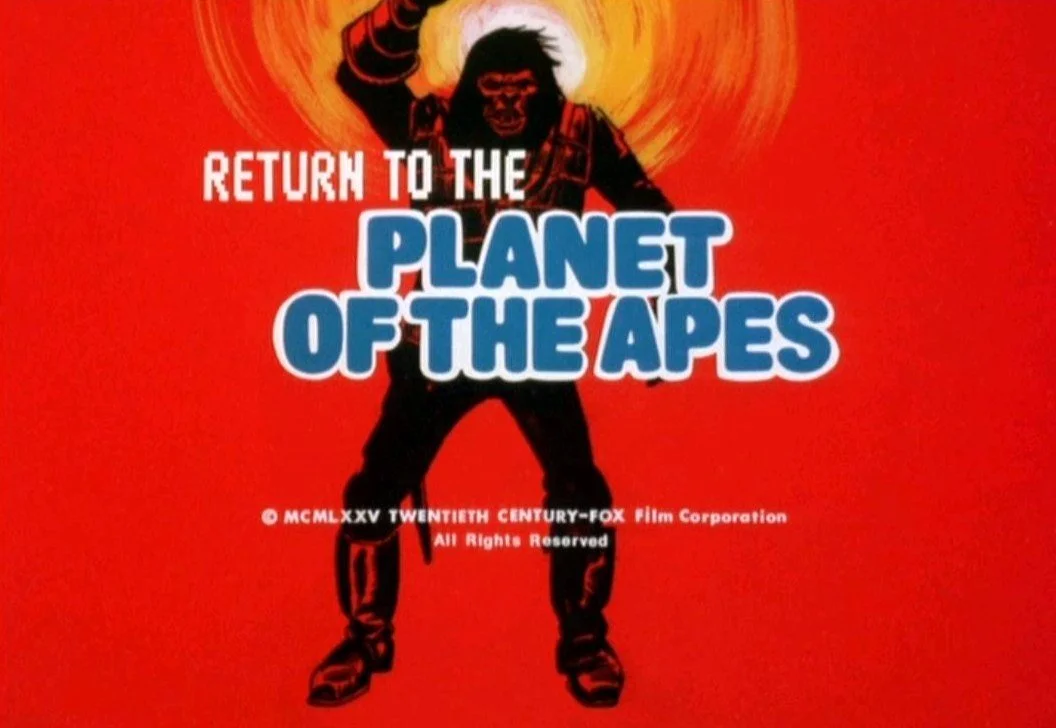
Return to the Planet of the Apes (1975)
I recently found a DVD boxset of Return to the Planet of the Apes in a charity shop which I bought for £4, which is a ridiculously cheap price. I considered it an interesting find because it was a Region 1, US copy. However, that is not so unusual these days as most DVD players are now region free and Amazon (UK) sells media from all over the world. As for the show in question, I vaguely remember Return to the Planet of the Apes being shown on UK network TV when I was a child, probably circa 1976. Back then it would usually take a year or so before US shows made it onto UK television. From a commercial perspective, the entire Planet of the Apes franchise was beginning to run out of steam. I was 8 years old at the time so had missed most of the film releases. However, I enjoyed the live action TV show hence an animated follow up had obvious appeal to a child of my age.
I recently found a DVD boxset of Return to the Planet of the Apes in a charity shop which I bought for £4, which is a ridiculously cheap price. I considered it an interesting find because it was a Region 1, US copy. However, that is not so unusual these days as most DVD players are now region free and Amazon (UK) sells media from all over the world. As for the show in question, I vaguely remember Return to the Planet of the Apes being shown on UK network TV when I was a child, probably circa 1976. Back then it would usually take a year or so before US shows made it onto UK television. From a commercial perspective, the entire Planet of the Apes franchise was beginning to run out of steam. I was 8 years old at the time so had missed most of the film releases. However, I enjoyed the live action TV show hence an animated follow up had obvious appeal to a child of my age.
50 years on and I could recollect very little of Return to the Planet of the Apes. Usually specific episodes stand out from the various TV shows of my youth. Yesteryear from Star Trek: The Animated Series being a prime example of this. Yet after wracking my brain I could not recall much from this show beyond superficial details. Upon watching Return to the Planet of the Apes again, the reason for this became immediately clear. Instead of favouring just a story of the week approach, as so many shows did back then, this animated production attempted to sustain a wider continuous story arc spread across all 13 episodes as well. Something that makes the show quite unusual. After watching all episodes, it became quite clear that Return to the Planet of the Apes is quite a different beast from other animated shows from this era. I suspect that is why it may have struggled to find an audience with its target demographic.
Produced by DePatie–Freleng Enterprises, Return to the Planet of the Apes was creatively overseen by Doug Wildey. Wildey was a comic artist and had been involved in the creation of numerous popular animated TV shows. With regard to the plot, Return to the Planet of the Apes draws heavily from themes from the original Planet of the Apes feature film and its sequel Beneath the Planet of the Apes. Being an animated production, the scope of the ape dominated world is greatly expanded. The feature films depicted ape society as being predominantly agrarian and their culture having grown in a limited way from a wider world decline. Here, ape society is more advanced and is depicted as being comparable to post WWII America. There are automobiles, radio and television, modern weapons and a broadly democratic society. Ape City is exactly that. All of which is much closer to author Pierre Boulle’s original source text.
The animated style is interesting. Backgrounds are detailed and often depict notable vistas. The camera often pans across these to substantiate plot points. Character animation is minimal, even by TV standards of the time. In many ways watching the show is more akin to reading a graphic novel or watching flash animations from the early days of the internet. However, this works well within the scope of the show. Thematically Return to the Planet of the Apes explores some interesting ideas and although accessible to children, has some quite dark and cerebral ideas contained with the ongoing plot. There are hints of a policy of genocide, driven by the Gorilla Military towards the residual human population. The Underdwellers, the cult of mutants who live in the Forbidden Zone, are depicted as religious zealots and it implied that the US was indeed the belligerent party that started the nuclear war that devastated the world.
The voice acting is adequate as is the musical score. A lot of the criticisms of Return to the Planet of the Apes at the time stemmed from the show’s modest budget, which imposed a great many restrictions upon the production. At first glance many viewers may simply see Return to the Planet of the Apes as being a cheap and cynical animated show, designed to squeeze whatever financial gain was left from a declining franchise. If you look a little harder, there is some creativity and innovation to be found over the 13 episodes. Sadly, the show was cancelled and the planned conclusion to the story arc was never produced. It allegedly explored the idea of rights being extended to humans within ape society which is a bold and somewhat adult concept to have in a children’s TV show. As it stands Return to the Planet of the Apes is an interesting curiosity and as such will appeal to those who find such things appealing.
It is not unusual for Disney to change film titles when marketing them outside of the US. In 2016 they renamed the animated feature film Zootopia to Zootropolis in the UK and Europe to avoid trademark conflicts with other existing businesses. For example there is a Danish zoo which already holds the “Zootopia” name. Similarly, in Germany there is a children’s book which caused copyright conflict, which led to the film being released under the title Zoomania. Such changes, although practical for legal reasons, can sometimes cause a degree of confusion. Especially as there are numerous, low budget productions companies that go out of their way to produce similarly titled “mockbusters” whenever there are big, tentpole, releases. So for clarity, Zootopia 2 has been released in the UK as Zootropolis 2.

With the proliferation of lore driven, franchise movies in recent years, a culture of analysis has developed online. Hence you will find a lot of YouTube videos that claim to “explain” the ending of specific films or provide clarification of their respective themes and subtexts. While critical debate and discussion about cinema is welcome, I think it is a mistake to always look for a specific meaning in cinema. Even clearly narrative films can be ambiguous. Art is ultimately a very subjective field of expression open to personal interpretation. Which brings me neatly to Flow, an animated feature film which tells a compelling story but raises more questions than it answers. It leaves the viewer to fill in a lot of the blanks themselves and the film is all the better for this approach. Flow is an extraordinary example of animation and a fascinating example of innovative, thought provoking filmmaking. Quite the rarity these days.
For those unfamiliar with Dav Pilkey’s graphic novel character Dog Man, he’s a half-dog, half-human police officer. This comic chimaera is the result of a surgical procedure carried out after Officer Knight and his trusty dog Greg are blown up while defusing a bomb. Greg’s head is grafted to Officer Knight's body. Post surgery, Dog Man (Peter Hastings) remains an officer of the law and continues to track his nemesis, Petey (Pete Davidson), an orange cat and criminal genius. However, despite positive media coverage and a high arrest rate, Dog Man incurs the ire of his Chief (Lil Rel Howery) who is jealous of his success. Furthermore, Dog Man becomes depressed due to the loss of his owner, girlfriend and former home. Meanwhile, Petey decides to clone himself in an attempt to find a worthy assistant and also plots to resurrect a deceased super villain, Flippy, who is an evil telekinetic fish.

I have always found it curious that there haven't been more feature films set in Middle-earth, after the success of Peter Jackson’s The Lord of the Rings trilogy. However, a little research shows a very complex set of rights regarding Tolkien’s work, with different material being controlled and administered by different bodies. Hence, the market has not been saturated with officially licensed material. Thus, when The Lord of the Rings: The War of the Rohirrim was announced to be in production, it aroused a great deal of curiosity both among fans and those with an interest in the wider film industry. To base an entire feature film on something that is effectively just a few paragraphs in the appendices of The Lord of the Rings is quite intriguing. The producers claimed it afforded them greater artistic freedom not to be constrained by an excess of lore. Industry pundits theorised that the film was being produced solely to ensure that wider rights were retained.
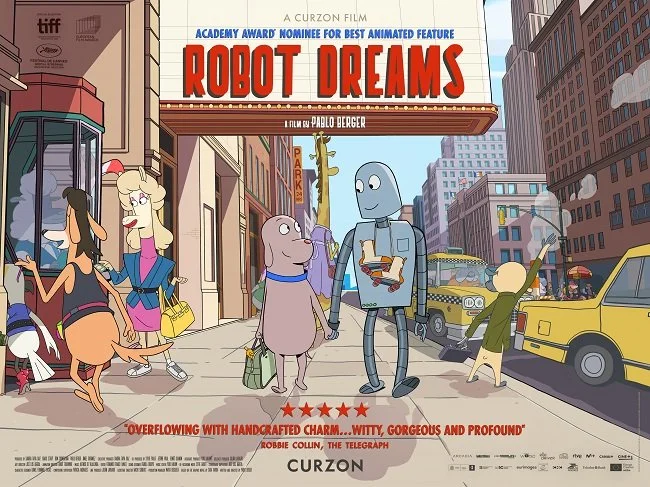
Whenever I feel that mainstream filmmaking is becoming increasingly bland and I grow despondent with it, along comes an animated film to prove that there is still greatness and art to be found through the medium of cinema. Robot Dreams begins as a tale of loneliness and then quickly becomes a eulogy to friendship and participating in life. The story then turns things on its head as it explores loss and finally concludes with a profoundly beautiful resolution, as it muses upon accepting change and new friends. Robot Dreams succeeds where so many other films fail by being honest, candid and sincere. Hence the emotions expressed by what is essentially a simple story are genuine and palpable. The film’s lack of dialogue is a blessing, with music doing a great deal of the narrative heavy lifting. This allows audiences to focus on the main characters without unnecessary distraction. The animation is uncomplicated but very specific in its style and setting. It utterly suits the tale being told.
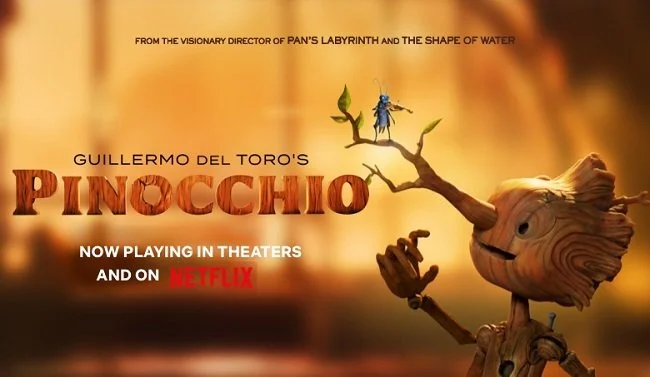
Guillermo del Toro's Pinocchio is a bold and inventive take on Carlo Collodi's classic story of the puppet that aspires to be a “real boy”. As you would expect from the director, it is a far cry from Disney’s 1940 version, taking a more bleak and sinister tone. Despite songs and exuberant set pieces, Guillermo del Toro's Pinocchio is an exploration of grief, death and even fascism. The screenplay by Guillermo del Toro and Patrick McHale also tackles the complexities of the relationship between parent and child. It is a remarkable example of stop motion animation and is visually very striking. However, it is a somewhat niche market adaptation and is not exactly easily accessible to children or the furiously hard of thinking. It comes as no surprise that this cinematic venture was green lit by Netflix, which appears to be the new home of the experimental, rather than a mainstream studio.

George A. Romero’s Night of the Living Dead is a true genre milestone that is praised not only by horror film fans but mainstream critics alike. If you are interested in watching an intelligent, well researched and entertaining documentary about the film’s provenance and cultural impact then I thoroughly recommend Birth of the Living Dead (2013) by Rob Kuhn. It tells you pretty much all you need to know about why this classic film is so important. As for Night of the Living Dead itself, it still holds up well after 53 years. It is the immediacy and relatability of the premise and overall story that still makes the film relevant. The zombies are purely a “MacGuffin” and the real focus of the plot is how people behave under pressure in life threatening situations. It’s a film about how we can react to the same situation differently and how cultural baggage and the need for people to be “right”, hinders co-operation and thwarts progress.

It would appear that there is a Minions 2, although it’s release around the world has been staggered due to the pandemic. So I thought I’d revisit the original movie for a second viewing. Spin-off movies can be a risky venture. Side characters may work well in a supporting role within a successful movie but may not necessarily find an audience in their own vehicle. However this is most definitely not the case with Minions. The movie is ninety one minutes of exquisitely crafted cinema. From the opening Universal fanfare (which the Minions sing-a-long to) to the post credit rendition of Revolution, the film is consistently funny and perfectly paced. The production design and overall aesthetic is beautifully realised and the central characters of Kevin, Stuart and Bob are thoroughly engaging. Actually, forget "engaging ''. They are genuinely loveable. Directors Pierre Coffin and Kyle Balda barely put a foot wrong.
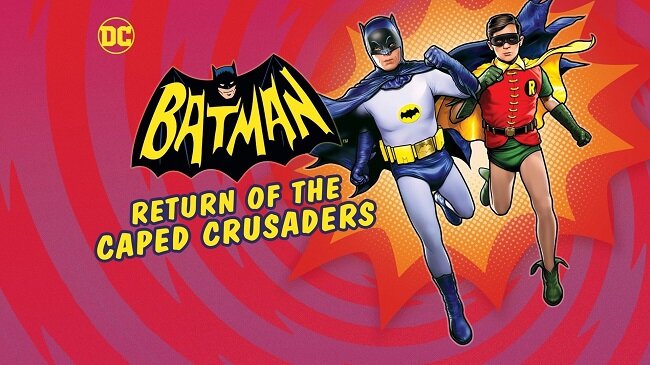
Although I have a passing interest in the franchise per se, I'm not a consummate fan of all things Batman. Hence a lot of content passes me by or I catch up with it years later. So it came as a great surprise when I discovered Batman: Return of the Caped Crusaders; a 2016 release in the ever growing catalogue of DC themed direct to DVD animated films. The movie is a de facto continuation of the sixties TV series, with the original actors reprising their roles (where possible). The cast includes Adam West as Batman, Burt Ward as Robin and Julie Newmar as Catwoman. Due to the death of actors Cesar Romero, Burgess Meredith and Frank Gorshin the voices for The Joker, The Penguin and The Riddler have been provided by Jeff Bergman, William Salyers and Wally Wingert. All of whom do their best to recreate the tone and idiom of the original artists.
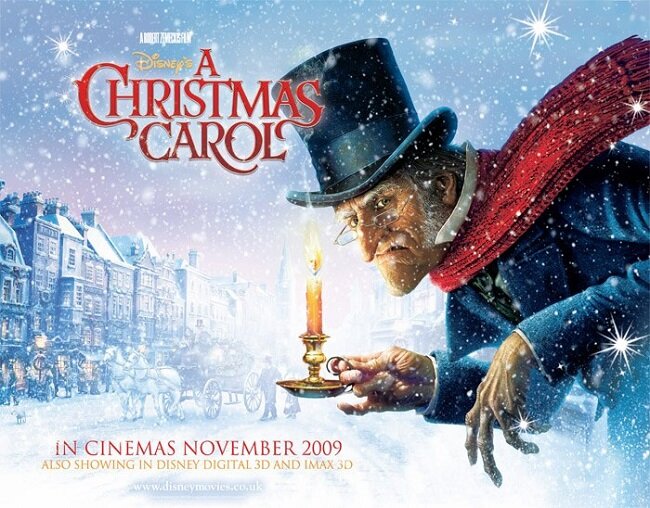
There are three key elements to Disney’s 2009 3D computer-animated adaptation of A Christmas Carol. Firstly, director Robert Zemeckis clearly seeks authenticity and hence includes a lot of original dialogue from the novel, as well as a bleaker depiction of the period. Secondly, he uses the digital production tools at his disposal to create sweeping vistas of 19th century London as well as highly stylised caricatures of the central characters. Thirdly, as this is a Disney production, there is an occasional lapse visual humour and levity that is required by their business model. Sadly all of these aspects of the production make for strange bedfellows that are at odds with each other. The result is a visually sumptuous film that loses its way as it lurches between bleak drama, odd humour and CGI driven spectacle.

Upon its theatrical release, Mickey’s Christmas Carol was the first animated film to star Mickey Mouse for thirty years. It was therefore accompanied with a large amount of hype and a wave of nostalgia. The US marketing stated “He’s Back. Mickey Mouse in his first new motion picture” which was somewhat misleading, as the actual animated film was just 26 minutes long. It was shown theatrically along with a re-release of The Rescuers in the US and The Jungle Book in the UK and other territories, in late December 1983. And despite his name being in the title, Mickey doesn’t have a lot of screen time as he plays Bob Cratchit. This is very much a vehicle for Scrooge McDuck as Ebenezer Scrooge. Overall, it’s a succinct distillation of the plot of Dickens’ A Christmas Carol, filled with cameo appearances by classic Disney characters. Naturally it is replete with the humour and sentiment that is inherent in the process known colloquially as Disneyfication. However, does this mitigate the book’s message?

At first glance, there is not much to distinguish this low budget production by Burbank Films Australia, from any of the other adaptations that were ubiquitous during the seventies and eighties. However, attentive viewers will discover a few details that lift this particular version above the mundane. Firstly, this is the second animated adaptation to feature the voice acting of Ron Haddrick as Ebenezer Scrooge. He had previously voiced the character in Air Programs International's shorter version of A Christmas Carol in 1969, thirteen years earlier. Secondly, despite the modest production values, there are a few additional scenes taken from the source text by Dickens, that don’t usually make it most film and TV adaptations. It is these minor embellishments that compensate for the simplicity of the animation (during the opening scene, some background characters do not move).
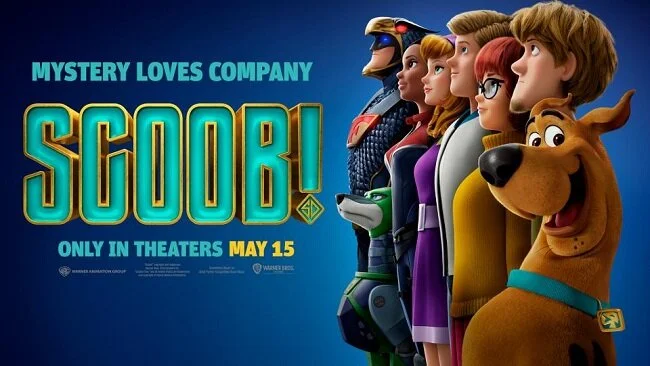
Scoob! is one of several movies that was slated for a theatrical release this summer but ended up being premiering on VOD instead due to the global pandemic. As a result, it is difficult to ascertain exactly how successful this animated film has been. A lot of trade newspapers have indicated that rentals have been high and that the film has proven more popular than Tom Hardy’s new movie Capone. Some industry sources have estimated a gross of $100,000,000 in a two week period. I suspect that the current lockdown has provided a market of children craving new entertainment and parents happy to pay for 90 minutes of peace and quiet. Hence Scoob! appears to have been in the right place at the right time. Whether that popular success would have happened if the movie had been released theatrically is another matter.
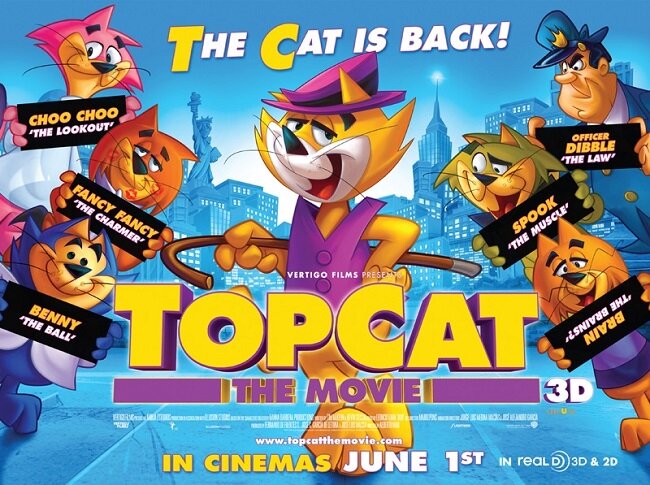
The first I found out about Top Cat: The Movie was when I received an email from an events company that was handling promotional screenings, prior to the film’s UK release in the summer of 2012. For some reason I missed the usual pre-production publicity that comes with the rebooting of a popular franchise. One of the benefits of this was that I didn't have time to fret or fuss about this reimagining of an integral part of my childhood. I must admit I was flummoxed that this 50-year-old franchise was subject to a makeover and was even more discombobulated to find out that the original show was a massive hit in Mexico and had garnered a huge cult following. This was why Warner Bros. subcontracted this production to Mexico's Anima and Argentina's Illusion studios. Subsequently Don Gato y Su Pandilla (Top Cat and His Gang) opened on 16th September 2011 in Mexico to weekend box office returns of 41m pesos ($2.9m). It subsequently became the highest-grossing independent animated films released in the United States that year.

It’s interesting that so many adaptations of Charles Dickens’ iconic seasonal story are brought to us via the medium of animation. Naturally, this is a far more economical means of depicting the story with its period detail and supernatural elements, compared to a live action production. However, for an animated version of A Christmas Carol to work successfully, it needs three things. An innovative and striking production design, robust voice acting and a screenplay that keeps the core themes while offering significance difference compared to prior adaptations. You’ll find all of these elements in Richard Williams’ 1971 animated short. Sadly they’re conspicuously absent from the 1997 version. Despite the presence such talents as Tim Curry, Ed Asner and Whoopi Goldberg, this is a distinctly arbitrary animated film. Considering that the screenplay was written by Jymn Magon who has years of experience working for Disney, I had hoped this would be better endeavour.
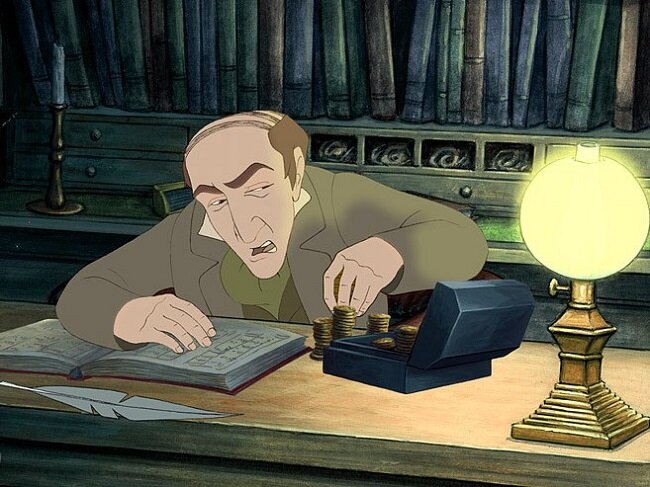
There’s a degree of hubris implicit in such a definitive title. At the very least the inference is that this is a notable adaptation of Charles Dickens’ classic book. And at first glance, it is perfectly reasonable to assume just that. Jimmy Murakami was an animator of note with such unique movies as The Snowman and When the Wind Blows to his credit. Hence it is reasonable to expect a similar quirky and experimental treatment of this well know yuletide story. However, what audiences actually get is a rather bold adaptation that substantially embellishes upon the established narrative. Veering between sinister and borderline psychedelic imagery, this is a very inconsistent version that tries to be too many things at once. Just as you think you’ve got a handle on the film approach it takes an abrupt turn in the opposite direction. Comedy, drama and even power ballads are thrown into the mix. Sadly, all these elements do not hang well together.

The Hobbit (1977) is a curious beast. It’s a made for television animated film, which despite its budgetary constraints, strives to comprehensively adapted one of the most beloved children’s books of the last century. I remember reading an article about this television adaptation of The Hobbit, in Starburst Magazine during the late seventies. There were rumours that this Rankin/Bass production, which had already premièred on US network television, would gain a European cinema release. This was presumably to cash in on the success of Ralph Bakshi's animated feature film adaptation of The Lord of The Rings. However, this never happened to my knowledge. In fact, The Hobbit was not commercially available in the UK until 2001, when Warner Bros. released it on DVD to capitalise on the success of Peter Jackson’s The Fellowship of the Ring.
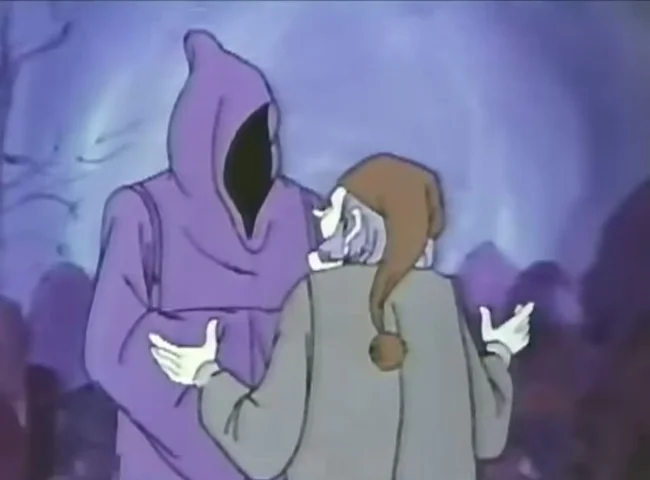
Over the last few years I’ve reviewed several adaptations of Charles Dickens seasonal story A Christmas Carol. As I stated previously one of the stories greatest strength is that it lends itself perfectly to multiple interpretations. I recently had the good fortune to rediscover the animated version from 1969 by Air Programs International. I remember seeing this animated short as a child but could not recollect sufficient details to allow me to track it down via the IMDB. Then by complete chance, I stumbled across it again on You Tube while doing some research.
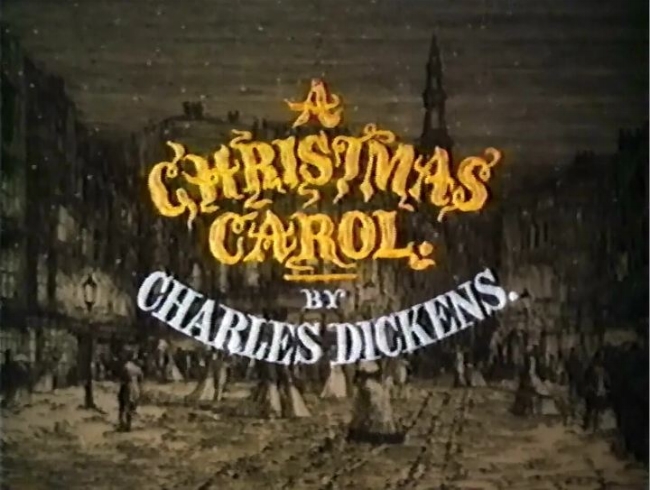
I have a great deal of affection for Charles Dickens' A Christmas Carol, not only because it’s a fine piece of literature but because it lends itself so well to dramatisation. I therefore have a keen interests in all the respective adaptation, of which there are many. Over the years there has been a trend to focus excessively on the sentimental aspect of the plot, resulting in a rather nauseating Disneyfication of the story. Although the redemption of the main protagonist is central to the narrative, the poverty and deprivations of the time are still very pertinent themes, especially in today's economic climate. I was therefore very gratified to rediscover the 1971 version of Charles Dickens' classic story which was originally shown on ABC. This short 25 minute animated feature realises the story superbly, capturing the tone of the book and accurately reflecting the darker aspects. Remember that A Christmas Carol is fundamentally a ghost story.
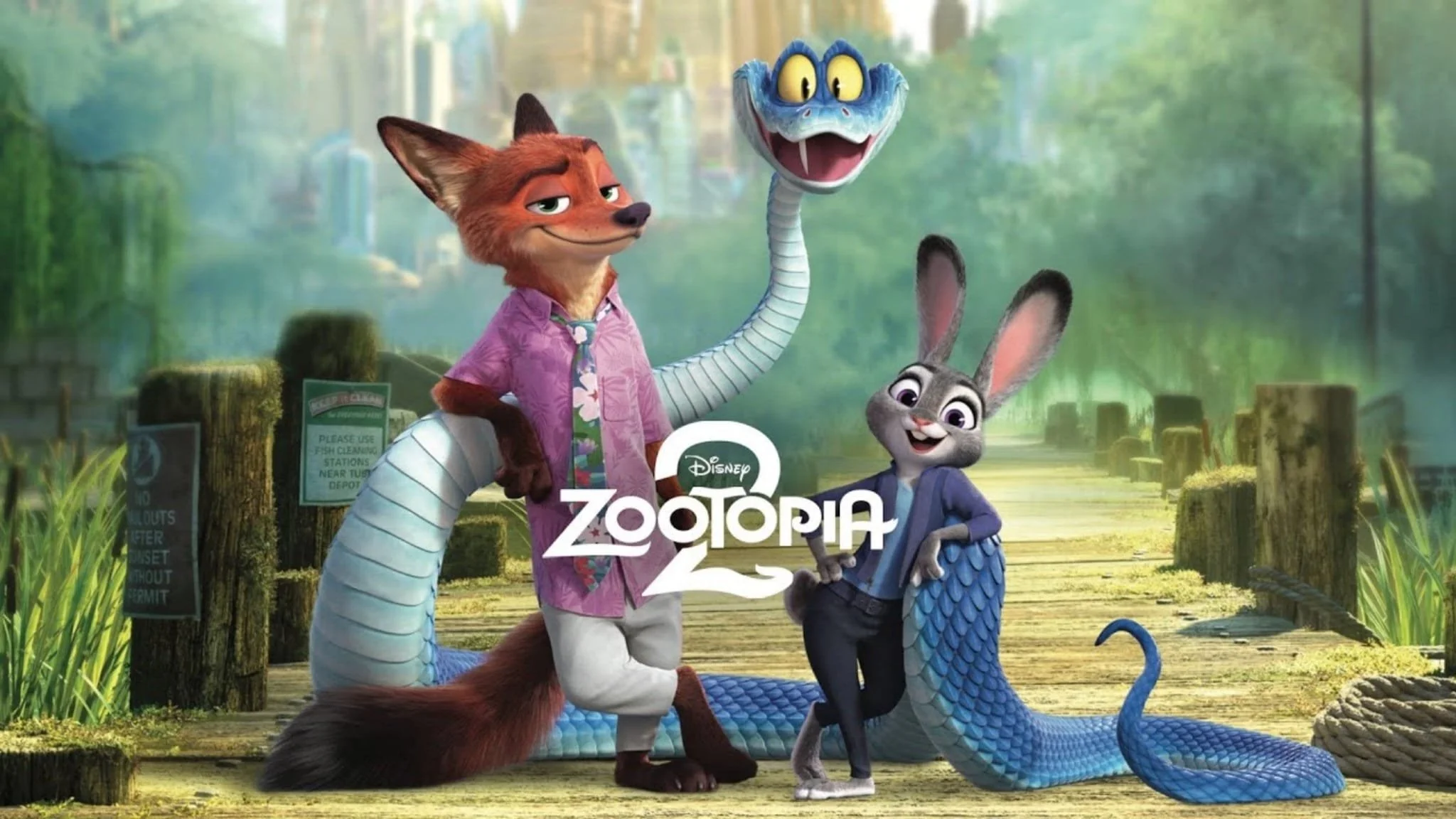
Zootopia 2 AKA Zootropolis 2 (2025)
It is not unusual for Disney to change film titles when marketing them outside of the US. In 2016 they renamed the animated feature film Zootopia to Zootropolis in the UK and Europe to avoid trademark conflicts with other existing businesses. For example there is a Danish zoo which already holds the “Zootopia” name. Similarly, in Germany there is a children’s book which caused copyright conflict, which led to the film being released under the title Zoomania. Such changes, although practical for legal reasons, can sometimes cause a degree of confusion. Especially as there are numerous, low budget productions companies that go out of their way to produce similarly titled “mockbusters” whenever there are big, tentpole, releases. So for clarity, Zootopia 2 has been released in the UK as Zootropolis 2.
It is not unusual for Disney to change film titles when marketing them outside of the US. In 2016 they renamed the animated feature film Zootopia to Zootropolis in the UK and Europe to avoid trademark conflicts with other existing businesses. For example there is a Danish zoo which already holds the “Zootopia” name. Similarly, in Germany there is a children’s book which caused copyright conflict, which led to the film being released under the title Zoomania. Such changes, although practical for legal reasons, can sometimes cause a degree of confusion. Especially as there are numerous, low budget productions companies that go out of their way to produce similarly titled “mockbusters” whenever there are big, tentpole, releases. So for clarity, Zootopia 2 has been released in the UK as Zootropolis 2.
After the events of the first film, Judy Hopps (Ginnifer Goodwin) and Nick Wilde (Jason Bateman) are now officially partners at the Zootopia Police Department (ZPD). However, after an operation goes awry, due to Hopps’ over eager nature, Chief Bogo (Idris Elba) sidelines them. After finding some shed skin, Judy begins to believe there might be a snake in Zootopia. Nick is sceptical as snakes and other reptiles have been exiled from the city since an incident at its founding. Further clues lead the pair to the Zootenial Gala, celebrating the centennial anniversary of the city’s founding. It soon becomes apparent that the founding family of Lynxes have a dark secret and that a grave miscarriage of justice has been covered up for years. However, Judy and Nick are framed and are forced to go on the run.
Despite a 9 year gap between the release of the first film and this sequel, Zootropolis 2 is immediately engaging mainly due to the strength and appeal of the central characters. The jokes come thick and fast, with plenty of slapstick humour and sight gags. As ever with animated films, action scenes are very frenetic and demand your concentration to see all that is going on. The screenplay by Jared Bush contains the usual pop culture references and clever asides for adult viewers. Hence we have clever homages to The Silence of the Lambs and The Shining. The voice cast is sumptuous and sprawling, ranging from artists such as Shakira and Ed Sheeran, Alan Tudyk, John Leguizamo and Jenny Slate. Guessing the identity of a celebrity voice actor is part of the fun of the film. It took me a few minutes to identify the ever excellent Danny Trejo, as Jesús, a plumed basilisk lizard.
The story, although entertaining, is a little drawn out with several lengthy set pieces unnecessarily expanding its running time. However, this is standard operational procedure these days for films of this kind. Although not as novel as the first film, Zootropolis 2 is engaging, funny and handles sentiment very well. It is interesting how a lot of mainstream Hollywood films are currently exploring traditional themes and focusing on subtexts of equality, inclusion and social cohesion. All of which seems to fly in the face and provide a counter narrative to aspects of contemporary US politics. As for the usual bi-partisan criticism and pushback that occurs when such material is present in mainstream entertainment, it has not harmed the box office returns for Zootropolis 2. The film has earned globally $1.475 billion, having cost $150 million to make. So much for “go woke, go broke”.
I recently found a DVD boxset of Return to the Planet of the Apes in a charity shop which I bought for £4, which is a ridiculously cheap price. I considered it an interesting find because it was a Region 1, US copy. However, that is not so unusual these days as most DVD players are now region free and Amazon (UK) sells media from all over the world. As for the show in question, I vaguely remember Return to the Planet of the Apes being shown on UK network TV when I was a child, probably circa 1976. Back then it would usually take a year or so before US shows made it onto UK television. From a commercial perspective, the entire Planet of the Apes franchise was beginning to run out of steam. I was 8 years old at the time so had missed most of the film releases. However, I enjoyed the live action TV show hence an animated follow up had obvious appeal to a child of my age.
It is not unusual for Disney to change film titles when marketing them outside of the US. In 2016 they renamed the animated feature film Zootopia to Zootropolis in the UK and Europe to avoid trademark conflicts with other existing businesses. For example there is a Danish zoo which already holds the “Zootopia” name. Similarly, in Germany there is a children’s book which caused copyright conflict, which led to the film being released under the title Zoomania. Such changes, although practical for legal reasons, can sometimes cause a degree of confusion. Especially as there are numerous, low budget productions companies that go out of their way to produce similarly titled “mockbusters” whenever there are big, tentpole, releases. So for clarity, Zootopia 2 has been released in the UK as Zootropolis 2.
With the proliferation of lore driven, franchise movies in recent years, a culture of analysis has developed online. Hence you will find a lot of YouTube videos that claim to “explain” the ending of specific films or provide clarification of their respective themes and subtexts. While critical debate and discussion about cinema is welcome, I think it is a mistake to always look for a specific meaning in cinema. Even clearly narrative films can be ambiguous. Art is ultimately a very subjective field of expression open to personal interpretation. Which brings me neatly to Flow, an animated feature film which tells a compelling story but raises more questions than it answers. It leaves the viewer to fill in a lot of the blanks themselves and the film is all the better for this approach. Flow is an extraordinary example of animation and a fascinating example of innovative, thought provoking filmmaking. Quite the rarity these days.
For those unfamiliar with Dav Pilkey’s graphic novel character Dog Man, he’s a half-dog, half-human police officer. This comic chimaera is the result of a surgical procedure carried out after Officer Knight and his trusty dog Greg are blown up while defusing a bomb. Greg’s head is grafted to Officer Knight's body. Post surgery, Dog Man (Peter Hastings) remains an officer of the law and continues to track his nemesis, Petey (Pete Davidson), an orange cat and criminal genius. However, despite positive media coverage and a high arrest rate, Dog Man incurs the ire of his Chief (Lil Rel Howery) who is jealous of his success. Furthermore, Dog Man becomes depressed due to the loss of his owner, girlfriend and former home. Meanwhile, Petey decides to clone himself in an attempt to find a worthy assistant and also plots to resurrect a deceased super villain, Flippy, who is an evil telekinetic fish.
I have always found it curious that there haven't been more feature films set in Middle-earth, after the success of Peter Jackson’s The Lord of the Rings trilogy. However, a little research shows a very complex set of rights regarding Tolkien’s work, with different material being controlled and administered by different bodies. Hence, the market has not been saturated with officially licensed material. Thus, when The Lord of the Rings: The War of the Rohirrim was announced to be in production, it aroused a great deal of curiosity both among fans and those with an interest in the wider film industry. To base an entire feature film on something that is effectively just a few paragraphs in the appendices of The Lord of the Rings is quite intriguing. The producers claimed it afforded them greater artistic freedom not to be constrained by an excess of lore. Industry pundits theorised that the film was being produced solely to ensure that wider rights were retained.
Whenever I feel that mainstream filmmaking is becoming increasingly bland and I grow despondent with it, along comes an animated film to prove that there is still greatness and art to be found through the medium of cinema. Robot Dreams begins as a tale of loneliness and then quickly becomes a eulogy to friendship and participating in life. The story then turns things on its head as it explores loss and finally concludes with a profoundly beautiful resolution, as it muses upon accepting change and new friends. Robot Dreams succeeds where so many other films fail by being honest, candid and sincere. Hence the emotions expressed by what is essentially a simple story are genuine and palpable. The film’s lack of dialogue is a blessing, with music doing a great deal of the narrative heavy lifting. This allows audiences to focus on the main characters without unnecessary distraction. The animation is uncomplicated but very specific in its style and setting. It utterly suits the tale being told.
Guillermo del Toro's Pinocchio is a bold and inventive take on Carlo Collodi's classic story of the puppet that aspires to be a “real boy”. As you would expect from the director, it is a far cry from Disney’s 1940 version, taking a more bleak and sinister tone. Despite songs and exuberant set pieces, Guillermo del Toro's Pinocchio is an exploration of grief, death and even fascism. The screenplay by Guillermo del Toro and Patrick McHale also tackles the complexities of the relationship between parent and child. It is a remarkable example of stop motion animation and is visually very striking. However, it is a somewhat niche market adaptation and is not exactly easily accessible to children or the furiously hard of thinking. It comes as no surprise that this cinematic venture was green lit by Netflix, which appears to be the new home of the experimental, rather than a mainstream studio.
George A. Romero’s Night of the Living Dead is a true genre milestone that is praised not only by horror film fans but mainstream critics alike. If you are interested in watching an intelligent, well researched and entertaining documentary about the film’s provenance and cultural impact then I thoroughly recommend Birth of the Living Dead (2013) by Rob Kuhn. It tells you pretty much all you need to know about why this classic film is so important. As for Night of the Living Dead itself, it still holds up well after 53 years. It is the immediacy and relatability of the premise and overall story that still makes the film relevant. The zombies are purely a “MacGuffin” and the real focus of the plot is how people behave under pressure in life threatening situations. It’s a film about how we can react to the same situation differently and how cultural baggage and the need for people to be “right”, hinders co-operation and thwarts progress.
It would appear that there is a Minions 2, although it’s release around the world has been staggered due to the pandemic. So I thought I’d revisit the original movie for a second viewing. Spin-off movies can be a risky venture. Side characters may work well in a supporting role within a successful movie but may not necessarily find an audience in their own vehicle. However this is most definitely not the case with Minions. The movie is ninety one minutes of exquisitely crafted cinema. From the opening Universal fanfare (which the Minions sing-a-long to) to the post credit rendition of Revolution, the film is consistently funny and perfectly paced. The production design and overall aesthetic is beautifully realised and the central characters of Kevin, Stuart and Bob are thoroughly engaging. Actually, forget "engaging ''. They are genuinely loveable. Directors Pierre Coffin and Kyle Balda barely put a foot wrong.
Although I have a passing interest in the franchise per se, I'm not a consummate fan of all things Batman. Hence a lot of content passes me by or I catch up with it years later. So it came as a great surprise when I discovered Batman: Return of the Caped Crusaders; a 2016 release in the ever growing catalogue of DC themed direct to DVD animated films. The movie is a de facto continuation of the sixties TV series, with the original actors reprising their roles (where possible). The cast includes Adam West as Batman, Burt Ward as Robin and Julie Newmar as Catwoman. Due to the death of actors Cesar Romero, Burgess Meredith and Frank Gorshin the voices for The Joker, The Penguin and The Riddler have been provided by Jeff Bergman, William Salyers and Wally Wingert. All of whom do their best to recreate the tone and idiom of the original artists.
There are three key elements to Disney’s 2009 3D computer-animated adaptation of A Christmas Carol. Firstly, director Robert Zemeckis clearly seeks authenticity and hence includes a lot of original dialogue from the novel, as well as a bleaker depiction of the period. Secondly, he uses the digital production tools at his disposal to create sweeping vistas of 19th century London as well as highly stylised caricatures of the central characters. Thirdly, as this is a Disney production, there is an occasional lapse visual humour and levity that is required by their business model. Sadly all of these aspects of the production make for strange bedfellows that are at odds with each other. The result is a visually sumptuous film that loses its way as it lurches between bleak drama, odd humour and CGI driven spectacle.
Upon its theatrical release, Mickey’s Christmas Carol was the first animated film to star Mickey Mouse for thirty years. It was therefore accompanied with a large amount of hype and a wave of nostalgia. The US marketing stated “He’s Back. Mickey Mouse in his first new motion picture” which was somewhat misleading, as the actual animated film was just 26 minutes long. It was shown theatrically along with a re-release of The Rescuers in the US and The Jungle Book in the UK and other territories, in late December 1983. And despite his name being in the title, Mickey doesn’t have a lot of screen time as he plays Bob Cratchit. This is very much a vehicle for Scrooge McDuck as Ebenezer Scrooge. Overall, it’s a succinct distillation of the plot of Dickens’ A Christmas Carol, filled with cameo appearances by classic Disney characters. Naturally it is replete with the humour and sentiment that is inherent in the process known colloquially as Disneyfication. However, does this mitigate the book’s message?
At first glance, there is not much to distinguish this low budget production by Burbank Films Australia, from any of the other adaptations that were ubiquitous during the seventies and eighties. However, attentive viewers will discover a few details that lift this particular version above the mundane. Firstly, this is the second animated adaptation to feature the voice acting of Ron Haddrick as Ebenezer Scrooge. He had previously voiced the character in Air Programs International's shorter version of A Christmas Carol in 1969, thirteen years earlier. Secondly, despite the modest production values, there are a few additional scenes taken from the source text by Dickens, that don’t usually make it most film and TV adaptations. It is these minor embellishments that compensate for the simplicity of the animation (during the opening scene, some background characters do not move).
Scoob! is one of several movies that was slated for a theatrical release this summer but ended up being premiering on VOD instead due to the global pandemic. As a result, it is difficult to ascertain exactly how successful this animated film has been. A lot of trade newspapers have indicated that rentals have been high and that the film has proven more popular than Tom Hardy’s new movie Capone. Some industry sources have estimated a gross of $100,000,000 in a two week period. I suspect that the current lockdown has provided a market of children craving new entertainment and parents happy to pay for 90 minutes of peace and quiet. Hence Scoob! appears to have been in the right place at the right time. Whether that popular success would have happened if the movie had been released theatrically is another matter.
The first I found out about Top Cat: The Movie was when I received an email from an events company that was handling promotional screenings, prior to the film’s UK release in the summer of 2012. For some reason I missed the usual pre-production publicity that comes with the rebooting of a popular franchise. One of the benefits of this was that I didn't have time to fret or fuss about this reimagining of an integral part of my childhood. I must admit I was flummoxed that this 50-year-old franchise was subject to a makeover and was even more discombobulated to find out that the original show was a massive hit in Mexico and had garnered a huge cult following. This was why Warner Bros. subcontracted this production to Mexico's Anima and Argentina's Illusion studios. Subsequently Don Gato y Su Pandilla (Top Cat and His Gang) opened on 16th September 2011 in Mexico to weekend box office returns of 41m pesos ($2.9m). It subsequently became the highest-grossing independent animated films released in the United States that year.
It’s interesting that so many adaptations of Charles Dickens’ iconic seasonal story are brought to us via the medium of animation. Naturally, this is a far more economical means of depicting the story with its period detail and supernatural elements, compared to a live action production. However, for an animated version of A Christmas Carol to work successfully, it needs three things. An innovative and striking production design, robust voice acting and a screenplay that keeps the core themes while offering significance difference compared to prior adaptations. You’ll find all of these elements in Richard Williams’ 1971 animated short. Sadly they’re conspicuously absent from the 1997 version. Despite the presence such talents as Tim Curry, Ed Asner and Whoopi Goldberg, this is a distinctly arbitrary animated film. Considering that the screenplay was written by Jymn Magon who has years of experience working for Disney, I had hoped this would be better endeavour.
There’s a degree of hubris implicit in such a definitive title. At the very least the inference is that this is a notable adaptation of Charles Dickens’ classic book. And at first glance, it is perfectly reasonable to assume just that. Jimmy Murakami was an animator of note with such unique movies as The Snowman and When the Wind Blows to his credit. Hence it is reasonable to expect a similar quirky and experimental treatment of this well know yuletide story. However, what audiences actually get is a rather bold adaptation that substantially embellishes upon the established narrative. Veering between sinister and borderline psychedelic imagery, this is a very inconsistent version that tries to be too many things at once. Just as you think you’ve got a handle on the film approach it takes an abrupt turn in the opposite direction. Comedy, drama and even power ballads are thrown into the mix. Sadly, all these elements do not hang well together.
The Hobbit (1977) is a curious beast. It’s a made for television animated film, which despite its budgetary constraints, strives to comprehensively adapted one of the most beloved children’s books of the last century. I remember reading an article about this television adaptation of The Hobbit, in Starburst Magazine during the late seventies. There were rumours that this Rankin/Bass production, which had already premièred on US network television, would gain a European cinema release. This was presumably to cash in on the success of Ralph Bakshi's animated feature film adaptation of The Lord of The Rings. However, this never happened to my knowledge. In fact, The Hobbit was not commercially available in the UK until 2001, when Warner Bros. released it on DVD to capitalise on the success of Peter Jackson’s The Fellowship of the Ring.
Over the last few years I’ve reviewed several adaptations of Charles Dickens seasonal story A Christmas Carol. As I stated previously one of the stories greatest strength is that it lends itself perfectly to multiple interpretations. I recently had the good fortune to rediscover the animated version from 1969 by Air Programs International. I remember seeing this animated short as a child but could not recollect sufficient details to allow me to track it down via the IMDB. Then by complete chance, I stumbled across it again on You Tube while doing some research.
I have a great deal of affection for Charles Dickens' A Christmas Carol, not only because it’s a fine piece of literature but because it lends itself so well to dramatisation. I therefore have a keen interests in all the respective adaptation, of which there are many. Over the years there has been a trend to focus excessively on the sentimental aspect of the plot, resulting in a rather nauseating Disneyfication of the story. Although the redemption of the main protagonist is central to the narrative, the poverty and deprivations of the time are still very pertinent themes, especially in today's economic climate. I was therefore very gratified to rediscover the 1971 version of Charles Dickens' classic story which was originally shown on ABC. This short 25 minute animated feature realises the story superbly, capturing the tone of the book and accurately reflecting the darker aspects. Remember that A Christmas Carol is fundamentally a ghost story.
Flow (2024)
With the proliferation of lore driven, franchise movies in recent years, a culture of analysis has developed online. Hence you will find a lot of YouTube videos that claim to “explain” the ending of specific films or provide clarification of their respective themes and subtexts. While critical debate and discussion about cinema is welcome, I think it is a mistake to always look for a specific meaning in cinema. Even clearly narrative films can be ambiguous. Art is ultimately a very subjective field of expression open to personal interpretation. Which brings me neatly to Flow, an animated feature film which tells a compelling story but raises more questions than it answers. It leaves the viewer to fill in a lot of the blanks themselves and the film is all the better for this approach. Flow is an extraordinary example of animation and a fascinating example of innovative, thought provoking filmmaking. Quite the rarity these days.
With the proliferation of lore driven, franchise movies in recent years, a culture of analysis has developed online. Hence you will find a lot of YouTube videos that claim to “explain” the ending of specific films or provide clarification of their respective themes and subtexts. While critical debate and discussion about cinema is welcome, I think it is a mistake to always look for a specific meaning in cinema. Even clearly narrative films can be ambiguous. Art is ultimately a very subjective field of expression open to personal interpretation. Which brings me neatly to Flow, an animated feature film which tells a compelling story but raises more questions than it answers. It leaves the viewer to fill in a lot of the blanks themselves and the film is all the better for this approach. Flow is an extraordinary example of animation and a fascinating example of innovative, thought provoking filmmaking. Quite the rarity these days.
In a forest, a black cat looks at their reflection in a puddle. A rabbit runs past being chased by a mixed pack of domestic dogs. The cat returns to an abandoned house, through a garden filled with wooden cat sculptures. A massive wooden cat statue overlooks the house from a hill. The house appears to be the former home of an artist. The next day the cat returns to the forest and is caught in a stampede of deer. A flash flood ensues and the cat manages to climb a tree branch and reach dry land. Returning to the house the cat is followed by a friendly labrador, who is part of the pack the cat saw previously. Both animals become aware that the water is rising and seek shelter. The labrador joins its pack in a oarless row boat, while the cat climbs to the top of the giant cat statue. Overwhelmed by the water the cat finds safety in a drifting sailboat, which contains a capybara.
Flow begins with a simple premise. A cat is adrift in a sailboat with a capybara during what appears to be an ecological apocalypse. Over the course of the film other animals seek safety onboard. The friendly labrador returns, there is also a kleptomaniac lemur and an enigmatic secretary bird. The animals squabble at times but cooperate, initially out of necessity and ultimately due to companionship. There is no dialogue and the story is not excessively didactic, although a lot of the imagery presented may appear symbolic and open to interpretation. The visual style is intriguing with the animators opting to use open-source software Blender and utilising a cel shaded aesthetic. Underpinning the onscreen journey is an enigmatic synths score that at times is reminiscent of the work of Vangelis and John Carpenter. The film is a succinct 84 minutes. No screen time is wasted but neither are events rushed.
If you have been raised exclusively on Disney animation, you will find Flow to be the antithesis of your expectations. Instead of being a product of a vast, monolithic commercial entertainment corporation, filtered through focus groups and market research, Flow is a labour of love and primarily an artistic endeavour. Written, directed and produced by Gints Zilbalodis, who also co-wrote the score and was the film’s cinematographer, Flow took over five years to make, gaining financial support and international distribution along the way. As a film it works on many levels. At its simplest, it is a timeless adventure in which a group of animals survive adversity through mutual help. As a work of art, Flow is open to a variety of interpretations. None of which are right or wrong. Some will see the film as a clear ecological warning, where others may see it as a faith based parable. It certainly raises many philosophical questions.
Sometimes, it is perfectly fine for a film to just “be”. After watching Flow and considering it, I’m not even sure what genre it is. However, although I spent some time reflecting upon some possible explanations to events and imagery in the film, I decided to abandon them. I prefer let the way the film made me feel, be its defining point. Flow is a unique production, unclouded and unspoilt by obvious contemporary commercial consideration. It is a beautiful, thought provoking piece of animation, proving yet again that the medium is not just a vehicle for children’s entertainment. It is profound and quite moving. Scarce qualities in filmmaking these days. If you look at viewer reviews on iMDb you will see a clear divide in opinion. Literalists may struggle with Flow. Such is their want. Those open to an experience driven more by feelings may fare better.
I recently found a DVD boxset of Return to the Planet of the Apes in a charity shop which I bought for £4, which is a ridiculously cheap price. I considered it an interesting find because it was a Region 1, US copy. However, that is not so unusual these days as most DVD players are now region free and Amazon (UK) sells media from all over the world. As for the show in question, I vaguely remember Return to the Planet of the Apes being shown on UK network TV when I was a child, probably circa 1976. Back then it would usually take a year or so before US shows made it onto UK television. From a commercial perspective, the entire Planet of the Apes franchise was beginning to run out of steam. I was 8 years old at the time so had missed most of the film releases. However, I enjoyed the live action TV show hence an animated follow up had obvious appeal to a child of my age.
It is not unusual for Disney to change film titles when marketing them outside of the US. In 2016 they renamed the animated feature film Zootopia to Zootropolis in the UK and Europe to avoid trademark conflicts with other existing businesses. For example there is a Danish zoo which already holds the “Zootopia” name. Similarly, in Germany there is a children’s book which caused copyright conflict, which led to the film being released under the title Zoomania. Such changes, although practical for legal reasons, can sometimes cause a degree of confusion. Especially as there are numerous, low budget productions companies that go out of their way to produce similarly titled “mockbusters” whenever there are big, tentpole, releases. So for clarity, Zootopia 2 has been released in the UK as Zootropolis 2.
With the proliferation of lore driven, franchise movies in recent years, a culture of analysis has developed online. Hence you will find a lot of YouTube videos that claim to “explain” the ending of specific films or provide clarification of their respective themes and subtexts. While critical debate and discussion about cinema is welcome, I think it is a mistake to always look for a specific meaning in cinema. Even clearly narrative films can be ambiguous. Art is ultimately a very subjective field of expression open to personal interpretation. Which brings me neatly to Flow, an animated feature film which tells a compelling story but raises more questions than it answers. It leaves the viewer to fill in a lot of the blanks themselves and the film is all the better for this approach. Flow is an extraordinary example of animation and a fascinating example of innovative, thought provoking filmmaking. Quite the rarity these days.
For those unfamiliar with Dav Pilkey’s graphic novel character Dog Man, he’s a half-dog, half-human police officer. This comic chimaera is the result of a surgical procedure carried out after Officer Knight and his trusty dog Greg are blown up while defusing a bomb. Greg’s head is grafted to Officer Knight's body. Post surgery, Dog Man (Peter Hastings) remains an officer of the law and continues to track his nemesis, Petey (Pete Davidson), an orange cat and criminal genius. However, despite positive media coverage and a high arrest rate, Dog Man incurs the ire of his Chief (Lil Rel Howery) who is jealous of his success. Furthermore, Dog Man becomes depressed due to the loss of his owner, girlfriend and former home. Meanwhile, Petey decides to clone himself in an attempt to find a worthy assistant and also plots to resurrect a deceased super villain, Flippy, who is an evil telekinetic fish.
I have always found it curious that there haven't been more feature films set in Middle-earth, after the success of Peter Jackson’s The Lord of the Rings trilogy. However, a little research shows a very complex set of rights regarding Tolkien’s work, with different material being controlled and administered by different bodies. Hence, the market has not been saturated with officially licensed material. Thus, when The Lord of the Rings: The War of the Rohirrim was announced to be in production, it aroused a great deal of curiosity both among fans and those with an interest in the wider film industry. To base an entire feature film on something that is effectively just a few paragraphs in the appendices of The Lord of the Rings is quite intriguing. The producers claimed it afforded them greater artistic freedom not to be constrained by an excess of lore. Industry pundits theorised that the film was being produced solely to ensure that wider rights were retained.
Whenever I feel that mainstream filmmaking is becoming increasingly bland and I grow despondent with it, along comes an animated film to prove that there is still greatness and art to be found through the medium of cinema. Robot Dreams begins as a tale of loneliness and then quickly becomes a eulogy to friendship and participating in life. The story then turns things on its head as it explores loss and finally concludes with a profoundly beautiful resolution, as it muses upon accepting change and new friends. Robot Dreams succeeds where so many other films fail by being honest, candid and sincere. Hence the emotions expressed by what is essentially a simple story are genuine and palpable. The film’s lack of dialogue is a blessing, with music doing a great deal of the narrative heavy lifting. This allows audiences to focus on the main characters without unnecessary distraction. The animation is uncomplicated but very specific in its style and setting. It utterly suits the tale being told.
Guillermo del Toro's Pinocchio is a bold and inventive take on Carlo Collodi's classic story of the puppet that aspires to be a “real boy”. As you would expect from the director, it is a far cry from Disney’s 1940 version, taking a more bleak and sinister tone. Despite songs and exuberant set pieces, Guillermo del Toro's Pinocchio is an exploration of grief, death and even fascism. The screenplay by Guillermo del Toro and Patrick McHale also tackles the complexities of the relationship between parent and child. It is a remarkable example of stop motion animation and is visually very striking. However, it is a somewhat niche market adaptation and is not exactly easily accessible to children or the furiously hard of thinking. It comes as no surprise that this cinematic venture was green lit by Netflix, which appears to be the new home of the experimental, rather than a mainstream studio.
George A. Romero’s Night of the Living Dead is a true genre milestone that is praised not only by horror film fans but mainstream critics alike. If you are interested in watching an intelligent, well researched and entertaining documentary about the film’s provenance and cultural impact then I thoroughly recommend Birth of the Living Dead (2013) by Rob Kuhn. It tells you pretty much all you need to know about why this classic film is so important. As for Night of the Living Dead itself, it still holds up well after 53 years. It is the immediacy and relatability of the premise and overall story that still makes the film relevant. The zombies are purely a “MacGuffin” and the real focus of the plot is how people behave under pressure in life threatening situations. It’s a film about how we can react to the same situation differently and how cultural baggage and the need for people to be “right”, hinders co-operation and thwarts progress.
It would appear that there is a Minions 2, although it’s release around the world has been staggered due to the pandemic. So I thought I’d revisit the original movie for a second viewing. Spin-off movies can be a risky venture. Side characters may work well in a supporting role within a successful movie but may not necessarily find an audience in their own vehicle. However this is most definitely not the case with Minions. The movie is ninety one minutes of exquisitely crafted cinema. From the opening Universal fanfare (which the Minions sing-a-long to) to the post credit rendition of Revolution, the film is consistently funny and perfectly paced. The production design and overall aesthetic is beautifully realised and the central characters of Kevin, Stuart and Bob are thoroughly engaging. Actually, forget "engaging ''. They are genuinely loveable. Directors Pierre Coffin and Kyle Balda barely put a foot wrong.
Although I have a passing interest in the franchise per se, I'm not a consummate fan of all things Batman. Hence a lot of content passes me by or I catch up with it years later. So it came as a great surprise when I discovered Batman: Return of the Caped Crusaders; a 2016 release in the ever growing catalogue of DC themed direct to DVD animated films. The movie is a de facto continuation of the sixties TV series, with the original actors reprising their roles (where possible). The cast includes Adam West as Batman, Burt Ward as Robin and Julie Newmar as Catwoman. Due to the death of actors Cesar Romero, Burgess Meredith and Frank Gorshin the voices for The Joker, The Penguin and The Riddler have been provided by Jeff Bergman, William Salyers and Wally Wingert. All of whom do their best to recreate the tone and idiom of the original artists.
There are three key elements to Disney’s 2009 3D computer-animated adaptation of A Christmas Carol. Firstly, director Robert Zemeckis clearly seeks authenticity and hence includes a lot of original dialogue from the novel, as well as a bleaker depiction of the period. Secondly, he uses the digital production tools at his disposal to create sweeping vistas of 19th century London as well as highly stylised caricatures of the central characters. Thirdly, as this is a Disney production, there is an occasional lapse visual humour and levity that is required by their business model. Sadly all of these aspects of the production make for strange bedfellows that are at odds with each other. The result is a visually sumptuous film that loses its way as it lurches between bleak drama, odd humour and CGI driven spectacle.
Upon its theatrical release, Mickey’s Christmas Carol was the first animated film to star Mickey Mouse for thirty years. It was therefore accompanied with a large amount of hype and a wave of nostalgia. The US marketing stated “He’s Back. Mickey Mouse in his first new motion picture” which was somewhat misleading, as the actual animated film was just 26 minutes long. It was shown theatrically along with a re-release of The Rescuers in the US and The Jungle Book in the UK and other territories, in late December 1983. And despite his name being in the title, Mickey doesn’t have a lot of screen time as he plays Bob Cratchit. This is very much a vehicle for Scrooge McDuck as Ebenezer Scrooge. Overall, it’s a succinct distillation of the plot of Dickens’ A Christmas Carol, filled with cameo appearances by classic Disney characters. Naturally it is replete with the humour and sentiment that is inherent in the process known colloquially as Disneyfication. However, does this mitigate the book’s message?
At first glance, there is not much to distinguish this low budget production by Burbank Films Australia, from any of the other adaptations that were ubiquitous during the seventies and eighties. However, attentive viewers will discover a few details that lift this particular version above the mundane. Firstly, this is the second animated adaptation to feature the voice acting of Ron Haddrick as Ebenezer Scrooge. He had previously voiced the character in Air Programs International's shorter version of A Christmas Carol in 1969, thirteen years earlier. Secondly, despite the modest production values, there are a few additional scenes taken from the source text by Dickens, that don’t usually make it most film and TV adaptations. It is these minor embellishments that compensate for the simplicity of the animation (during the opening scene, some background characters do not move).
Scoob! is one of several movies that was slated for a theatrical release this summer but ended up being premiering on VOD instead due to the global pandemic. As a result, it is difficult to ascertain exactly how successful this animated film has been. A lot of trade newspapers have indicated that rentals have been high and that the film has proven more popular than Tom Hardy’s new movie Capone. Some industry sources have estimated a gross of $100,000,000 in a two week period. I suspect that the current lockdown has provided a market of children craving new entertainment and parents happy to pay for 90 minutes of peace and quiet. Hence Scoob! appears to have been in the right place at the right time. Whether that popular success would have happened if the movie had been released theatrically is another matter.
The first I found out about Top Cat: The Movie was when I received an email from an events company that was handling promotional screenings, prior to the film’s UK release in the summer of 2012. For some reason I missed the usual pre-production publicity that comes with the rebooting of a popular franchise. One of the benefits of this was that I didn't have time to fret or fuss about this reimagining of an integral part of my childhood. I must admit I was flummoxed that this 50-year-old franchise was subject to a makeover and was even more discombobulated to find out that the original show was a massive hit in Mexico and had garnered a huge cult following. This was why Warner Bros. subcontracted this production to Mexico's Anima and Argentina's Illusion studios. Subsequently Don Gato y Su Pandilla (Top Cat and His Gang) opened on 16th September 2011 in Mexico to weekend box office returns of 41m pesos ($2.9m). It subsequently became the highest-grossing independent animated films released in the United States that year.
It’s interesting that so many adaptations of Charles Dickens’ iconic seasonal story are brought to us via the medium of animation. Naturally, this is a far more economical means of depicting the story with its period detail and supernatural elements, compared to a live action production. However, for an animated version of A Christmas Carol to work successfully, it needs three things. An innovative and striking production design, robust voice acting and a screenplay that keeps the core themes while offering significance difference compared to prior adaptations. You’ll find all of these elements in Richard Williams’ 1971 animated short. Sadly they’re conspicuously absent from the 1997 version. Despite the presence such talents as Tim Curry, Ed Asner and Whoopi Goldberg, this is a distinctly arbitrary animated film. Considering that the screenplay was written by Jymn Magon who has years of experience working for Disney, I had hoped this would be better endeavour.
There’s a degree of hubris implicit in such a definitive title. At the very least the inference is that this is a notable adaptation of Charles Dickens’ classic book. And at first glance, it is perfectly reasonable to assume just that. Jimmy Murakami was an animator of note with such unique movies as The Snowman and When the Wind Blows to his credit. Hence it is reasonable to expect a similar quirky and experimental treatment of this well know yuletide story. However, what audiences actually get is a rather bold adaptation that substantially embellishes upon the established narrative. Veering between sinister and borderline psychedelic imagery, this is a very inconsistent version that tries to be too many things at once. Just as you think you’ve got a handle on the film approach it takes an abrupt turn in the opposite direction. Comedy, drama and even power ballads are thrown into the mix. Sadly, all these elements do not hang well together.
The Hobbit (1977) is a curious beast. It’s a made for television animated film, which despite its budgetary constraints, strives to comprehensively adapted one of the most beloved children’s books of the last century. I remember reading an article about this television adaptation of The Hobbit, in Starburst Magazine during the late seventies. There were rumours that this Rankin/Bass production, which had already premièred on US network television, would gain a European cinema release. This was presumably to cash in on the success of Ralph Bakshi's animated feature film adaptation of The Lord of The Rings. However, this never happened to my knowledge. In fact, The Hobbit was not commercially available in the UK until 2001, when Warner Bros. released it on DVD to capitalise on the success of Peter Jackson’s The Fellowship of the Ring.
Over the last few years I’ve reviewed several adaptations of Charles Dickens seasonal story A Christmas Carol. As I stated previously one of the stories greatest strength is that it lends itself perfectly to multiple interpretations. I recently had the good fortune to rediscover the animated version from 1969 by Air Programs International. I remember seeing this animated short as a child but could not recollect sufficient details to allow me to track it down via the IMDB. Then by complete chance, I stumbled across it again on You Tube while doing some research.
I have a great deal of affection for Charles Dickens' A Christmas Carol, not only because it’s a fine piece of literature but because it lends itself so well to dramatisation. I therefore have a keen interests in all the respective adaptation, of which there are many. Over the years there has been a trend to focus excessively on the sentimental aspect of the plot, resulting in a rather nauseating Disneyfication of the story. Although the redemption of the main protagonist is central to the narrative, the poverty and deprivations of the time are still very pertinent themes, especially in today's economic climate. I was therefore very gratified to rediscover the 1971 version of Charles Dickens' classic story which was originally shown on ABC. This short 25 minute animated feature realises the story superbly, capturing the tone of the book and accurately reflecting the darker aspects. Remember that A Christmas Carol is fundamentally a ghost story.
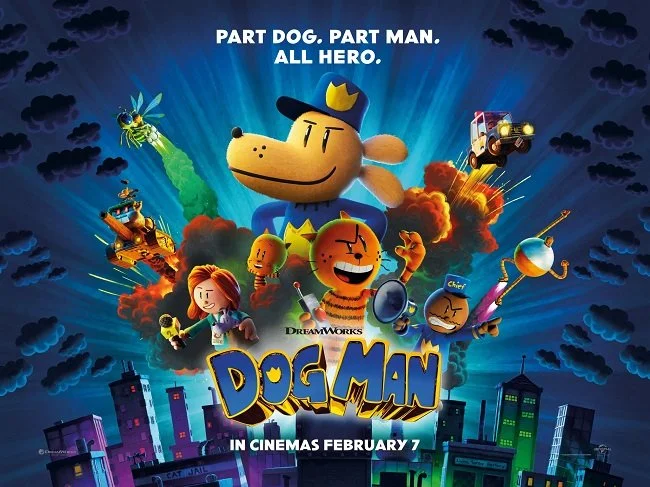
Dog Man (2025)
For those unfamiliar with Dav Pilkey’s graphic novel character Dog Man, he’s a half-dog, half-human police officer. This comic chimaera is the result of a surgical procedure carried out after Officer Knight and his trusty dog Greg are blown up while defusing a bomb. Greg’s head is grafted to Officer Knight's body. Post surgery, Dog Man (Peter Hastings) remains an officer of the law and continues to track his nemesis, Petey (Pete Davidson), an orange cat and criminal genius. However, despite positive media coverage and a high arrest rate, Dog Man incurs the ire of his Chief (Lil Rel Howery) who is jealous of his success. Furthermore, Dog Man becomes depressed due to the loss of his owner, girlfriend and former home. Meanwhile, Petey decides to clone himself in an attempt to find a worthy assistant and also plots to resurrect a deceased super villain, Flippy, who is an evil telekinetic fish.
For those unfamiliar with Dav Pilkey’s graphic novel character Dog Man, he’s a half-dog, half-human police officer. This comic chimaera is the result of a surgical procedure carried out after Officer Knight and his trusty dog Greg are blown up while defusing a bomb. Greg’s head is grafted to Officer Knight's body. Post surgery, Dog Man (Peter Hastings) remains an officer of the law and continues to track his nemesis, Petey (Pete Davidson), an orange cat and criminal genius. However, despite positive media coverage and a high arrest rate, Dog Man incurs the ire of his Chief (Lil Rel Howery) who is jealous of his success. Furthermore, Dog Man becomes depressed due to the loss of his owner, girlfriend and former home. Meanwhile, Petey decides to clone himself in an attempt to find a worthy assistant and also plots to resurrect a deceased super villain, Flippy, who is an evil telekinetic fish.
Dog Man is a visually impressive animated comedy that succeeds in being accessible to both children and adults. Kids will like the madcap humour and frenetic mayhem, where adults will smirk and guffaw at the abundant film references, pop culture humour and satire of commonplace cinematic tropes. Within the first seven minutes there is a homage to RoboCop and it is not an obvious one, clearly showing Peter Hastings’ (who also wrote and directed the film) movie literacy. There are continual sight gags, clever puns and good old-fashioned slapstick. The film has a bright colour palette and a very knowing style. It calls out its own use of a montage and continuously nods and winks at the audience. Dog Man is certainly well made and clever, especially with regard to the contrast between Dog Man’s boundless love and Petey’s cynical philosophy.
Despite all these good points, Dog Man starts to show its weaknesses after about 50 minutes. The fast pace of the story and the continuous barrage of jokes becomes a bit of a hindrance. The audience doesn’t get time to think or take stock. While you’re laughing at one gag, you potentially miss another. There’s also a celebrity voice actor cameo that doesn’t really add any value to the proceedings and stands out like a sore thumb. The secondary plot about Flippy feels like it’s a contrivance to get the plot from A to B, rather than a valid theme to be explored. Dog Man also feels like it’s lapsing into fan service at times. Hence, although there is much to enjoy both visually and narratively about this clever adaptation, the 90 minute running time can be quite taxing for adults. Children will probably have no issue with the fast pace and bombast.
I recently found a DVD boxset of Return to the Planet of the Apes in a charity shop which I bought for £4, which is a ridiculously cheap price. I considered it an interesting find because it was a Region 1, US copy. However, that is not so unusual these days as most DVD players are now region free and Amazon (UK) sells media from all over the world. As for the show in question, I vaguely remember Return to the Planet of the Apes being shown on UK network TV when I was a child, probably circa 1976. Back then it would usually take a year or so before US shows made it onto UK television. From a commercial perspective, the entire Planet of the Apes franchise was beginning to run out of steam. I was 8 years old at the time so had missed most of the film releases. However, I enjoyed the live action TV show hence an animated follow up had obvious appeal to a child of my age.
It is not unusual for Disney to change film titles when marketing them outside of the US. In 2016 they renamed the animated feature film Zootopia to Zootropolis in the UK and Europe to avoid trademark conflicts with other existing businesses. For example there is a Danish zoo which already holds the “Zootopia” name. Similarly, in Germany there is a children’s book which caused copyright conflict, which led to the film being released under the title Zoomania. Such changes, although practical for legal reasons, can sometimes cause a degree of confusion. Especially as there are numerous, low budget productions companies that go out of their way to produce similarly titled “mockbusters” whenever there are big, tentpole, releases. So for clarity, Zootopia 2 has been released in the UK as Zootropolis 2.
With the proliferation of lore driven, franchise movies in recent years, a culture of analysis has developed online. Hence you will find a lot of YouTube videos that claim to “explain” the ending of specific films or provide clarification of their respective themes and subtexts. While critical debate and discussion about cinema is welcome, I think it is a mistake to always look for a specific meaning in cinema. Even clearly narrative films can be ambiguous. Art is ultimately a very subjective field of expression open to personal interpretation. Which brings me neatly to Flow, an animated feature film which tells a compelling story but raises more questions than it answers. It leaves the viewer to fill in a lot of the blanks themselves and the film is all the better for this approach. Flow is an extraordinary example of animation and a fascinating example of innovative, thought provoking filmmaking. Quite the rarity these days.
For those unfamiliar with Dav Pilkey’s graphic novel character Dog Man, he’s a half-dog, half-human police officer. This comic chimaera is the result of a surgical procedure carried out after Officer Knight and his trusty dog Greg are blown up while defusing a bomb. Greg’s head is grafted to Officer Knight's body. Post surgery, Dog Man (Peter Hastings) remains an officer of the law and continues to track his nemesis, Petey (Pete Davidson), an orange cat and criminal genius. However, despite positive media coverage and a high arrest rate, Dog Man incurs the ire of his Chief (Lil Rel Howery) who is jealous of his success. Furthermore, Dog Man becomes depressed due to the loss of his owner, girlfriend and former home. Meanwhile, Petey decides to clone himself in an attempt to find a worthy assistant and also plots to resurrect a deceased super villain, Flippy, who is an evil telekinetic fish.
I have always found it curious that there haven't been more feature films set in Middle-earth, after the success of Peter Jackson’s The Lord of the Rings trilogy. However, a little research shows a very complex set of rights regarding Tolkien’s work, with different material being controlled and administered by different bodies. Hence, the market has not been saturated with officially licensed material. Thus, when The Lord of the Rings: The War of the Rohirrim was announced to be in production, it aroused a great deal of curiosity both among fans and those with an interest in the wider film industry. To base an entire feature film on something that is effectively just a few paragraphs in the appendices of The Lord of the Rings is quite intriguing. The producers claimed it afforded them greater artistic freedom not to be constrained by an excess of lore. Industry pundits theorised that the film was being produced solely to ensure that wider rights were retained.
Whenever I feel that mainstream filmmaking is becoming increasingly bland and I grow despondent with it, along comes an animated film to prove that there is still greatness and art to be found through the medium of cinema. Robot Dreams begins as a tale of loneliness and then quickly becomes a eulogy to friendship and participating in life. The story then turns things on its head as it explores loss and finally concludes with a profoundly beautiful resolution, as it muses upon accepting change and new friends. Robot Dreams succeeds where so many other films fail by being honest, candid and sincere. Hence the emotions expressed by what is essentially a simple story are genuine and palpable. The film’s lack of dialogue is a blessing, with music doing a great deal of the narrative heavy lifting. This allows audiences to focus on the main characters without unnecessary distraction. The animation is uncomplicated but very specific in its style and setting. It utterly suits the tale being told.
Guillermo del Toro's Pinocchio is a bold and inventive take on Carlo Collodi's classic story of the puppet that aspires to be a “real boy”. As you would expect from the director, it is a far cry from Disney’s 1940 version, taking a more bleak and sinister tone. Despite songs and exuberant set pieces, Guillermo del Toro's Pinocchio is an exploration of grief, death and even fascism. The screenplay by Guillermo del Toro and Patrick McHale also tackles the complexities of the relationship between parent and child. It is a remarkable example of stop motion animation and is visually very striking. However, it is a somewhat niche market adaptation and is not exactly easily accessible to children or the furiously hard of thinking. It comes as no surprise that this cinematic venture was green lit by Netflix, which appears to be the new home of the experimental, rather than a mainstream studio.
George A. Romero’s Night of the Living Dead is a true genre milestone that is praised not only by horror film fans but mainstream critics alike. If you are interested in watching an intelligent, well researched and entertaining documentary about the film’s provenance and cultural impact then I thoroughly recommend Birth of the Living Dead (2013) by Rob Kuhn. It tells you pretty much all you need to know about why this classic film is so important. As for Night of the Living Dead itself, it still holds up well after 53 years. It is the immediacy and relatability of the premise and overall story that still makes the film relevant. The zombies are purely a “MacGuffin” and the real focus of the plot is how people behave under pressure in life threatening situations. It’s a film about how we can react to the same situation differently and how cultural baggage and the need for people to be “right”, hinders co-operation and thwarts progress.
It would appear that there is a Minions 2, although it’s release around the world has been staggered due to the pandemic. So I thought I’d revisit the original movie for a second viewing. Spin-off movies can be a risky venture. Side characters may work well in a supporting role within a successful movie but may not necessarily find an audience in their own vehicle. However this is most definitely not the case with Minions. The movie is ninety one minutes of exquisitely crafted cinema. From the opening Universal fanfare (which the Minions sing-a-long to) to the post credit rendition of Revolution, the film is consistently funny and perfectly paced. The production design and overall aesthetic is beautifully realised and the central characters of Kevin, Stuart and Bob are thoroughly engaging. Actually, forget "engaging ''. They are genuinely loveable. Directors Pierre Coffin and Kyle Balda barely put a foot wrong.
Although I have a passing interest in the franchise per se, I'm not a consummate fan of all things Batman. Hence a lot of content passes me by or I catch up with it years later. So it came as a great surprise when I discovered Batman: Return of the Caped Crusaders; a 2016 release in the ever growing catalogue of DC themed direct to DVD animated films. The movie is a de facto continuation of the sixties TV series, with the original actors reprising their roles (where possible). The cast includes Adam West as Batman, Burt Ward as Robin and Julie Newmar as Catwoman. Due to the death of actors Cesar Romero, Burgess Meredith and Frank Gorshin the voices for The Joker, The Penguin and The Riddler have been provided by Jeff Bergman, William Salyers and Wally Wingert. All of whom do their best to recreate the tone and idiom of the original artists.
There are three key elements to Disney’s 2009 3D computer-animated adaptation of A Christmas Carol. Firstly, director Robert Zemeckis clearly seeks authenticity and hence includes a lot of original dialogue from the novel, as well as a bleaker depiction of the period. Secondly, he uses the digital production tools at his disposal to create sweeping vistas of 19th century London as well as highly stylised caricatures of the central characters. Thirdly, as this is a Disney production, there is an occasional lapse visual humour and levity that is required by their business model. Sadly all of these aspects of the production make for strange bedfellows that are at odds with each other. The result is a visually sumptuous film that loses its way as it lurches between bleak drama, odd humour and CGI driven spectacle.
Upon its theatrical release, Mickey’s Christmas Carol was the first animated film to star Mickey Mouse for thirty years. It was therefore accompanied with a large amount of hype and a wave of nostalgia. The US marketing stated “He’s Back. Mickey Mouse in his first new motion picture” which was somewhat misleading, as the actual animated film was just 26 minutes long. It was shown theatrically along with a re-release of The Rescuers in the US and The Jungle Book in the UK and other territories, in late December 1983. And despite his name being in the title, Mickey doesn’t have a lot of screen time as he plays Bob Cratchit. This is very much a vehicle for Scrooge McDuck as Ebenezer Scrooge. Overall, it’s a succinct distillation of the plot of Dickens’ A Christmas Carol, filled with cameo appearances by classic Disney characters. Naturally it is replete with the humour and sentiment that is inherent in the process known colloquially as Disneyfication. However, does this mitigate the book’s message?
At first glance, there is not much to distinguish this low budget production by Burbank Films Australia, from any of the other adaptations that were ubiquitous during the seventies and eighties. However, attentive viewers will discover a few details that lift this particular version above the mundane. Firstly, this is the second animated adaptation to feature the voice acting of Ron Haddrick as Ebenezer Scrooge. He had previously voiced the character in Air Programs International's shorter version of A Christmas Carol in 1969, thirteen years earlier. Secondly, despite the modest production values, there are a few additional scenes taken from the source text by Dickens, that don’t usually make it most film and TV adaptations. It is these minor embellishments that compensate for the simplicity of the animation (during the opening scene, some background characters do not move).
Scoob! is one of several movies that was slated for a theatrical release this summer but ended up being premiering on VOD instead due to the global pandemic. As a result, it is difficult to ascertain exactly how successful this animated film has been. A lot of trade newspapers have indicated that rentals have been high and that the film has proven more popular than Tom Hardy’s new movie Capone. Some industry sources have estimated a gross of $100,000,000 in a two week period. I suspect that the current lockdown has provided a market of children craving new entertainment and parents happy to pay for 90 minutes of peace and quiet. Hence Scoob! appears to have been in the right place at the right time. Whether that popular success would have happened if the movie had been released theatrically is another matter.
The first I found out about Top Cat: The Movie was when I received an email from an events company that was handling promotional screenings, prior to the film’s UK release in the summer of 2012. For some reason I missed the usual pre-production publicity that comes with the rebooting of a popular franchise. One of the benefits of this was that I didn't have time to fret or fuss about this reimagining of an integral part of my childhood. I must admit I was flummoxed that this 50-year-old franchise was subject to a makeover and was even more discombobulated to find out that the original show was a massive hit in Mexico and had garnered a huge cult following. This was why Warner Bros. subcontracted this production to Mexico's Anima and Argentina's Illusion studios. Subsequently Don Gato y Su Pandilla (Top Cat and His Gang) opened on 16th September 2011 in Mexico to weekend box office returns of 41m pesos ($2.9m). It subsequently became the highest-grossing independent animated films released in the United States that year.
It’s interesting that so many adaptations of Charles Dickens’ iconic seasonal story are brought to us via the medium of animation. Naturally, this is a far more economical means of depicting the story with its period detail and supernatural elements, compared to a live action production. However, for an animated version of A Christmas Carol to work successfully, it needs three things. An innovative and striking production design, robust voice acting and a screenplay that keeps the core themes while offering significance difference compared to prior adaptations. You’ll find all of these elements in Richard Williams’ 1971 animated short. Sadly they’re conspicuously absent from the 1997 version. Despite the presence such talents as Tim Curry, Ed Asner and Whoopi Goldberg, this is a distinctly arbitrary animated film. Considering that the screenplay was written by Jymn Magon who has years of experience working for Disney, I had hoped this would be better endeavour.
There’s a degree of hubris implicit in such a definitive title. At the very least the inference is that this is a notable adaptation of Charles Dickens’ classic book. And at first glance, it is perfectly reasonable to assume just that. Jimmy Murakami was an animator of note with such unique movies as The Snowman and When the Wind Blows to his credit. Hence it is reasonable to expect a similar quirky and experimental treatment of this well know yuletide story. However, what audiences actually get is a rather bold adaptation that substantially embellishes upon the established narrative. Veering between sinister and borderline psychedelic imagery, this is a very inconsistent version that tries to be too many things at once. Just as you think you’ve got a handle on the film approach it takes an abrupt turn in the opposite direction. Comedy, drama and even power ballads are thrown into the mix. Sadly, all these elements do not hang well together.
The Hobbit (1977) is a curious beast. It’s a made for television animated film, which despite its budgetary constraints, strives to comprehensively adapted one of the most beloved children’s books of the last century. I remember reading an article about this television adaptation of The Hobbit, in Starburst Magazine during the late seventies. There were rumours that this Rankin/Bass production, which had already premièred on US network television, would gain a European cinema release. This was presumably to cash in on the success of Ralph Bakshi's animated feature film adaptation of The Lord of The Rings. However, this never happened to my knowledge. In fact, The Hobbit was not commercially available in the UK until 2001, when Warner Bros. released it on DVD to capitalise on the success of Peter Jackson’s The Fellowship of the Ring.
Over the last few years I’ve reviewed several adaptations of Charles Dickens seasonal story A Christmas Carol. As I stated previously one of the stories greatest strength is that it lends itself perfectly to multiple interpretations. I recently had the good fortune to rediscover the animated version from 1969 by Air Programs International. I remember seeing this animated short as a child but could not recollect sufficient details to allow me to track it down via the IMDB. Then by complete chance, I stumbled across it again on You Tube while doing some research.
I have a great deal of affection for Charles Dickens' A Christmas Carol, not only because it’s a fine piece of literature but because it lends itself so well to dramatisation. I therefore have a keen interests in all the respective adaptation, of which there are many. Over the years there has been a trend to focus excessively on the sentimental aspect of the plot, resulting in a rather nauseating Disneyfication of the story. Although the redemption of the main protagonist is central to the narrative, the poverty and deprivations of the time are still very pertinent themes, especially in today's economic climate. I was therefore very gratified to rediscover the 1971 version of Charles Dickens' classic story which was originally shown on ABC. This short 25 minute animated feature realises the story superbly, capturing the tone of the book and accurately reflecting the darker aspects. Remember that A Christmas Carol is fundamentally a ghost story.
The Lord of the Rings: The War of the Rohirrim (2024)
I have always found it curious that there haven't been more feature films set in Middle-earth, after the success of Peter Jackson’s The Lord of the Rings trilogy. However, a little research shows a very complex set of rights regarding Tolkien’s work, with different material being controlled and administered by different bodies. Hence, the market has not been saturated with officially licensed material. Thus, when The Lord of the Rings: The War of the Rohirrim was announced to be in production, it aroused a great deal of curiosity both among fans and those with an interest in the wider film industry. To base an entire feature film on something that is effectively just a few paragraphs in the appendices of The Lord of the Rings is quite intriguing. The producers claimed it afforded them greater artistic freedom not to be constrained by an excess of lore. Industry pundits theorised that the film was being produced solely to ensure that wider rights were retained.
I have always found it curious that there haven't been more feature films set in Middle-earth, after the success of Peter Jackson’s The Lord of the Rings trilogy. However, a little research shows a very complex set of rights regarding Tolkien’s work, with different material being controlled and administered by different bodies. Hence, the market has not been saturated with officially licensed material. Thus, when The Lord of the Rings: The War of the Rohirrim was announced to be in production, it aroused a great deal of curiosity both among fans and those with an interest in the wider film industry. To base an entire feature film on something that is effectively just a few paragraphs in the appendices of The Lord of the Rings is quite intriguing. The producers claimed it afforded them greater artistic freedom not to be constrained by an excess of lore. Industry pundits theorised that the film was being produced solely to ensure that wider rights were retained.
Setting aside the provenance of the production, The Lord of the Rings: The War of the Rohirrim is a competent anime fantasy film directed by Kenji Kamiyama. Set 183 years prior to the events of The Lord of the Rings, the film depicts the reign of Helm the Hammerhand, King of Rohan. During a council meeting with the Lords of Rohan, Freca Lord of Adorn requests that Helm’s daughter, Héra, marry his son Wulf to unite the Rohan. Freca being of part Dunlending blood and considered by many in Rohan as an outlander. However, Helm rejects the offer and rebuffs Freca. A fight ensues between the two leaders and Helm kills Freca with a single punch. Wulf leaves, vowing revenge and subsequently raises an army among the Dunlendings. A surprise attack on Edoras forces the Rohirrim to retreat to the Hornburg. With the death of her two brothers and her father stricken with grief, it falls to Héra to rally her people and turn the tide of the war.
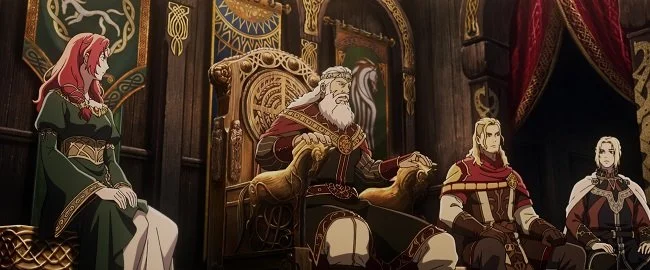
From a production perspective, there is much to praise about The Lord of the Rings: The War of the Rohirrim. The background art is sumptuous and vivid and there is a strong score by composer Stephen Gallagher. He cunningly uses classic themes by Howard Shore and further embellishes the soundtrack with solid material of his own. The animation is dynamic and doesn’t pull its punches. Limbs are severed and blood is spilt. The anime style works surprisingly well with the source material and certainly doesn’t look out of place. I am not a great fan of this medium but did not find it a deal breaker in any way. The voice acting is strong with the central characters having clear and distinct voices. The screenplay does not excessively diverge from established lore although it does make some changes for the sake of the narrative arc. Héra being an original character.
However, despite solid production values The Lord of the Rings: The War of the Rohirrim has two fundamental problems. The first is the story simply cannot sustain its two hour running time and the film could easily have been 30 minutes shorter. What is an interesting footnote in the source text, remains such as a feature film and nothing more. The second is the compulsion that new entries in a franchise often have, to try and directly link to events that occurred in a previous movie. For example there is a totally unnecessary action scene that is resolved by the appearance of a beast identical to the “watcher in the water” outside the West-gate of Moria. It doesn’t really hold up logically and seems very arbitrary. There are also several other clumsy references to both Orcs and Gandalf as the screenplay hamfistedly attempts to link to the forthcoming events of The Lord of the Rings.
Hardcore Tolkien fans may get more enjoyment from The Lord of the Rings: The War of the Rohirrim, than broader audiences. I found the film to be sufficiently entertaining but upon reflection it really doesn’t add much to the existing Tolkien cinematic universe. Also, as a Tolkien aficionado I can think of plenty of other stories referenced in the appendices of The Lord of the Rings, that would make a better feature film. I think The Lord of the Rings: The War of the Rohirrim would have fared better if it was part of a smaller scale television show called “Tales of Middle-earth” or something similar and the story was told over a more concise running time. As it stands, this 134 minute animated film falls between two stools. It is not bad but it is not anything more than adequate. When you consider the pedigree of the production and who is involved, you expect a lot more.
I recently found a DVD boxset of Return to the Planet of the Apes in a charity shop which I bought for £4, which is a ridiculously cheap price. I considered it an interesting find because it was a Region 1, US copy. However, that is not so unusual these days as most DVD players are now region free and Amazon (UK) sells media from all over the world. As for the show in question, I vaguely remember Return to the Planet of the Apes being shown on UK network TV when I was a child, probably circa 1976. Back then it would usually take a year or so before US shows made it onto UK television. From a commercial perspective, the entire Planet of the Apes franchise was beginning to run out of steam. I was 8 years old at the time so had missed most of the film releases. However, I enjoyed the live action TV show hence an animated follow up had obvious appeal to a child of my age.
It is not unusual for Disney to change film titles when marketing them outside of the US. In 2016 they renamed the animated feature film Zootopia to Zootropolis in the UK and Europe to avoid trademark conflicts with other existing businesses. For example there is a Danish zoo which already holds the “Zootopia” name. Similarly, in Germany there is a children’s book which caused copyright conflict, which led to the film being released under the title Zoomania. Such changes, although practical for legal reasons, can sometimes cause a degree of confusion. Especially as there are numerous, low budget productions companies that go out of their way to produce similarly titled “mockbusters” whenever there are big, tentpole, releases. So for clarity, Zootopia 2 has been released in the UK as Zootropolis 2.
With the proliferation of lore driven, franchise movies in recent years, a culture of analysis has developed online. Hence you will find a lot of YouTube videos that claim to “explain” the ending of specific films or provide clarification of their respective themes and subtexts. While critical debate and discussion about cinema is welcome, I think it is a mistake to always look for a specific meaning in cinema. Even clearly narrative films can be ambiguous. Art is ultimately a very subjective field of expression open to personal interpretation. Which brings me neatly to Flow, an animated feature film which tells a compelling story but raises more questions than it answers. It leaves the viewer to fill in a lot of the blanks themselves and the film is all the better for this approach. Flow is an extraordinary example of animation and a fascinating example of innovative, thought provoking filmmaking. Quite the rarity these days.
For those unfamiliar with Dav Pilkey’s graphic novel character Dog Man, he’s a half-dog, half-human police officer. This comic chimaera is the result of a surgical procedure carried out after Officer Knight and his trusty dog Greg are blown up while defusing a bomb. Greg’s head is grafted to Officer Knight's body. Post surgery, Dog Man (Peter Hastings) remains an officer of the law and continues to track his nemesis, Petey (Pete Davidson), an orange cat and criminal genius. However, despite positive media coverage and a high arrest rate, Dog Man incurs the ire of his Chief (Lil Rel Howery) who is jealous of his success. Furthermore, Dog Man becomes depressed due to the loss of his owner, girlfriend and former home. Meanwhile, Petey decides to clone himself in an attempt to find a worthy assistant and also plots to resurrect a deceased super villain, Flippy, who is an evil telekinetic fish.
I have always found it curious that there haven't been more feature films set in Middle-earth, after the success of Peter Jackson’s The Lord of the Rings trilogy. However, a little research shows a very complex set of rights regarding Tolkien’s work, with different material being controlled and administered by different bodies. Hence, the market has not been saturated with officially licensed material. Thus, when The Lord of the Rings: The War of the Rohirrim was announced to be in production, it aroused a great deal of curiosity both among fans and those with an interest in the wider film industry. To base an entire feature film on something that is effectively just a few paragraphs in the appendices of The Lord of the Rings is quite intriguing. The producers claimed it afforded them greater artistic freedom not to be constrained by an excess of lore. Industry pundits theorised that the film was being produced solely to ensure that wider rights were retained.
Whenever I feel that mainstream filmmaking is becoming increasingly bland and I grow despondent with it, along comes an animated film to prove that there is still greatness and art to be found through the medium of cinema. Robot Dreams begins as a tale of loneliness and then quickly becomes a eulogy to friendship and participating in life. The story then turns things on its head as it explores loss and finally concludes with a profoundly beautiful resolution, as it muses upon accepting change and new friends. Robot Dreams succeeds where so many other films fail by being honest, candid and sincere. Hence the emotions expressed by what is essentially a simple story are genuine and palpable. The film’s lack of dialogue is a blessing, with music doing a great deal of the narrative heavy lifting. This allows audiences to focus on the main characters without unnecessary distraction. The animation is uncomplicated but very specific in its style and setting. It utterly suits the tale being told.
Guillermo del Toro's Pinocchio is a bold and inventive take on Carlo Collodi's classic story of the puppet that aspires to be a “real boy”. As you would expect from the director, it is a far cry from Disney’s 1940 version, taking a more bleak and sinister tone. Despite songs and exuberant set pieces, Guillermo del Toro's Pinocchio is an exploration of grief, death and even fascism. The screenplay by Guillermo del Toro and Patrick McHale also tackles the complexities of the relationship between parent and child. It is a remarkable example of stop motion animation and is visually very striking. However, it is a somewhat niche market adaptation and is not exactly easily accessible to children or the furiously hard of thinking. It comes as no surprise that this cinematic venture was green lit by Netflix, which appears to be the new home of the experimental, rather than a mainstream studio.
George A. Romero’s Night of the Living Dead is a true genre milestone that is praised not only by horror film fans but mainstream critics alike. If you are interested in watching an intelligent, well researched and entertaining documentary about the film’s provenance and cultural impact then I thoroughly recommend Birth of the Living Dead (2013) by Rob Kuhn. It tells you pretty much all you need to know about why this classic film is so important. As for Night of the Living Dead itself, it still holds up well after 53 years. It is the immediacy and relatability of the premise and overall story that still makes the film relevant. The zombies are purely a “MacGuffin” and the real focus of the plot is how people behave under pressure in life threatening situations. It’s a film about how we can react to the same situation differently and how cultural baggage and the need for people to be “right”, hinders co-operation and thwarts progress.
It would appear that there is a Minions 2, although it’s release around the world has been staggered due to the pandemic. So I thought I’d revisit the original movie for a second viewing. Spin-off movies can be a risky venture. Side characters may work well in a supporting role within a successful movie but may not necessarily find an audience in their own vehicle. However this is most definitely not the case with Minions. The movie is ninety one minutes of exquisitely crafted cinema. From the opening Universal fanfare (which the Minions sing-a-long to) to the post credit rendition of Revolution, the film is consistently funny and perfectly paced. The production design and overall aesthetic is beautifully realised and the central characters of Kevin, Stuart and Bob are thoroughly engaging. Actually, forget "engaging ''. They are genuinely loveable. Directors Pierre Coffin and Kyle Balda barely put a foot wrong.
Although I have a passing interest in the franchise per se, I'm not a consummate fan of all things Batman. Hence a lot of content passes me by or I catch up with it years later. So it came as a great surprise when I discovered Batman: Return of the Caped Crusaders; a 2016 release in the ever growing catalogue of DC themed direct to DVD animated films. The movie is a de facto continuation of the sixties TV series, with the original actors reprising their roles (where possible). The cast includes Adam West as Batman, Burt Ward as Robin and Julie Newmar as Catwoman. Due to the death of actors Cesar Romero, Burgess Meredith and Frank Gorshin the voices for The Joker, The Penguin and The Riddler have been provided by Jeff Bergman, William Salyers and Wally Wingert. All of whom do their best to recreate the tone and idiom of the original artists.
There are three key elements to Disney’s 2009 3D computer-animated adaptation of A Christmas Carol. Firstly, director Robert Zemeckis clearly seeks authenticity and hence includes a lot of original dialogue from the novel, as well as a bleaker depiction of the period. Secondly, he uses the digital production tools at his disposal to create sweeping vistas of 19th century London as well as highly stylised caricatures of the central characters. Thirdly, as this is a Disney production, there is an occasional lapse visual humour and levity that is required by their business model. Sadly all of these aspects of the production make for strange bedfellows that are at odds with each other. The result is a visually sumptuous film that loses its way as it lurches between bleak drama, odd humour and CGI driven spectacle.
Upon its theatrical release, Mickey’s Christmas Carol was the first animated film to star Mickey Mouse for thirty years. It was therefore accompanied with a large amount of hype and a wave of nostalgia. The US marketing stated “He’s Back. Mickey Mouse in his first new motion picture” which was somewhat misleading, as the actual animated film was just 26 minutes long. It was shown theatrically along with a re-release of The Rescuers in the US and The Jungle Book in the UK and other territories, in late December 1983. And despite his name being in the title, Mickey doesn’t have a lot of screen time as he plays Bob Cratchit. This is very much a vehicle for Scrooge McDuck as Ebenezer Scrooge. Overall, it’s a succinct distillation of the plot of Dickens’ A Christmas Carol, filled with cameo appearances by classic Disney characters. Naturally it is replete with the humour and sentiment that is inherent in the process known colloquially as Disneyfication. However, does this mitigate the book’s message?
At first glance, there is not much to distinguish this low budget production by Burbank Films Australia, from any of the other adaptations that were ubiquitous during the seventies and eighties. However, attentive viewers will discover a few details that lift this particular version above the mundane. Firstly, this is the second animated adaptation to feature the voice acting of Ron Haddrick as Ebenezer Scrooge. He had previously voiced the character in Air Programs International's shorter version of A Christmas Carol in 1969, thirteen years earlier. Secondly, despite the modest production values, there are a few additional scenes taken from the source text by Dickens, that don’t usually make it most film and TV adaptations. It is these minor embellishments that compensate for the simplicity of the animation (during the opening scene, some background characters do not move).
Scoob! is one of several movies that was slated for a theatrical release this summer but ended up being premiering on VOD instead due to the global pandemic. As a result, it is difficult to ascertain exactly how successful this animated film has been. A lot of trade newspapers have indicated that rentals have been high and that the film has proven more popular than Tom Hardy’s new movie Capone. Some industry sources have estimated a gross of $100,000,000 in a two week period. I suspect that the current lockdown has provided a market of children craving new entertainment and parents happy to pay for 90 minutes of peace and quiet. Hence Scoob! appears to have been in the right place at the right time. Whether that popular success would have happened if the movie had been released theatrically is another matter.
The first I found out about Top Cat: The Movie was when I received an email from an events company that was handling promotional screenings, prior to the film’s UK release in the summer of 2012. For some reason I missed the usual pre-production publicity that comes with the rebooting of a popular franchise. One of the benefits of this was that I didn't have time to fret or fuss about this reimagining of an integral part of my childhood. I must admit I was flummoxed that this 50-year-old franchise was subject to a makeover and was even more discombobulated to find out that the original show was a massive hit in Mexico and had garnered a huge cult following. This was why Warner Bros. subcontracted this production to Mexico's Anima and Argentina's Illusion studios. Subsequently Don Gato y Su Pandilla (Top Cat and His Gang) opened on 16th September 2011 in Mexico to weekend box office returns of 41m pesos ($2.9m). It subsequently became the highest-grossing independent animated films released in the United States that year.
It’s interesting that so many adaptations of Charles Dickens’ iconic seasonal story are brought to us via the medium of animation. Naturally, this is a far more economical means of depicting the story with its period detail and supernatural elements, compared to a live action production. However, for an animated version of A Christmas Carol to work successfully, it needs three things. An innovative and striking production design, robust voice acting and a screenplay that keeps the core themes while offering significance difference compared to prior adaptations. You’ll find all of these elements in Richard Williams’ 1971 animated short. Sadly they’re conspicuously absent from the 1997 version. Despite the presence such talents as Tim Curry, Ed Asner and Whoopi Goldberg, this is a distinctly arbitrary animated film. Considering that the screenplay was written by Jymn Magon who has years of experience working for Disney, I had hoped this would be better endeavour.
There’s a degree of hubris implicit in such a definitive title. At the very least the inference is that this is a notable adaptation of Charles Dickens’ classic book. And at first glance, it is perfectly reasonable to assume just that. Jimmy Murakami was an animator of note with such unique movies as The Snowman and When the Wind Blows to his credit. Hence it is reasonable to expect a similar quirky and experimental treatment of this well know yuletide story. However, what audiences actually get is a rather bold adaptation that substantially embellishes upon the established narrative. Veering between sinister and borderline psychedelic imagery, this is a very inconsistent version that tries to be too many things at once. Just as you think you’ve got a handle on the film approach it takes an abrupt turn in the opposite direction. Comedy, drama and even power ballads are thrown into the mix. Sadly, all these elements do not hang well together.
The Hobbit (1977) is a curious beast. It’s a made for television animated film, which despite its budgetary constraints, strives to comprehensively adapted one of the most beloved children’s books of the last century. I remember reading an article about this television adaptation of The Hobbit, in Starburst Magazine during the late seventies. There were rumours that this Rankin/Bass production, which had already premièred on US network television, would gain a European cinema release. This was presumably to cash in on the success of Ralph Bakshi's animated feature film adaptation of The Lord of The Rings. However, this never happened to my knowledge. In fact, The Hobbit was not commercially available in the UK until 2001, when Warner Bros. released it on DVD to capitalise on the success of Peter Jackson’s The Fellowship of the Ring.
Over the last few years I’ve reviewed several adaptations of Charles Dickens seasonal story A Christmas Carol. As I stated previously one of the stories greatest strength is that it lends itself perfectly to multiple interpretations. I recently had the good fortune to rediscover the animated version from 1969 by Air Programs International. I remember seeing this animated short as a child but could not recollect sufficient details to allow me to track it down via the IMDB. Then by complete chance, I stumbled across it again on You Tube while doing some research.
I have a great deal of affection for Charles Dickens' A Christmas Carol, not only because it’s a fine piece of literature but because it lends itself so well to dramatisation. I therefore have a keen interests in all the respective adaptation, of which there are many. Over the years there has been a trend to focus excessively on the sentimental aspect of the plot, resulting in a rather nauseating Disneyfication of the story. Although the redemption of the main protagonist is central to the narrative, the poverty and deprivations of the time are still very pertinent themes, especially in today's economic climate. I was therefore very gratified to rediscover the 1971 version of Charles Dickens' classic story which was originally shown on ABC. This short 25 minute animated feature realises the story superbly, capturing the tone of the book and accurately reflecting the darker aspects. Remember that A Christmas Carol is fundamentally a ghost story.
Robot Dreams (2023)
Whenever I feel that mainstream filmmaking is becoming increasingly bland and I grow despondent with it, along comes an animated film to prove that there is still greatness and art to be found through the medium of cinema. Robot Dreams begins as a tale of loneliness and then quickly becomes a eulogy to friendship and participating in life. The story then turns things on its head as it explores loss and finally concludes with a profoundly beautiful resolution, as it muses upon accepting change and new friends. Robot Dreams succeeds where so many other films fail by being honest, candid and sincere. Hence the emotions expressed by what is essentially a simple story are genuine and palpable. The film’s lack of dialogue is a blessing, with music doing a great deal of the narrative heavy lifting. This allows audiences to focus on the main characters without unnecessary distraction. The animation is uncomplicated but very specific in its style and setting. It utterly suits the tale being told.
Whenever I feel that mainstream filmmaking is becoming increasingly bland and I grow despondent with it, along comes an animated film to prove that there is still greatness and art to be found through the medium of cinema. Robot Dreams begins as a tale of loneliness and then quickly becomes a eulogy to friendship and participating in life. The story then turns things on its head as it explores loss and finally concludes with a profoundly beautiful resolution, as it muses upon accepting change and new friends. Robot Dreams succeeds where so many other films fail by being honest, candid and sincere. Hence the emotions expressed by what is essentially a simple story are genuine and palpable. The film’s lack of dialogue is a blessing, with music doing a great deal of the narrative heavy lifting. This allows audiences to focus on the main characters without unnecessary distraction. The animation is uncomplicated but very specific in its style and setting. It utterly suits the tale being told.
Set in an alternate incarnation of 1980s New York City populated with anthropomorphized animals, Dog lives alone in a Manhattan apartment. Tired of being lonely he orders a robot companion after seeing a TV advertisement. Upon arrival, Dog assembles his new friend, Robot and the pair embark on a series of adventures throughout the city. Robot’s innocent excitement and wonder at the world kindles a love of life in Dog and the two become inseparable. However, a trip to the beach at Coney Island goes awry and ends with Robot stranded on the sand. Dog unable to move him on his own, intends to return the next day but the beach is closed and fate then conspires to keep the two friends separated. Dog tries to go about his life, trying to fill the emotional void. Meanwhile, Robot dreams about being reunited with Dog and wonders about his own fate.
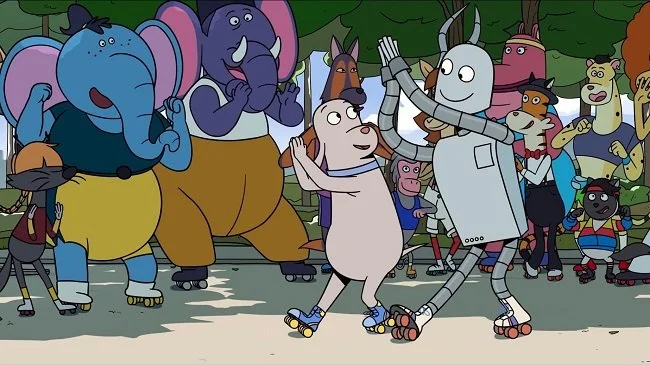
Based upon the 2007 comic of the same name by Sara Varon, director Pablo Berger executes his animated parable with aplomb and integrity. As well as being a superb piece of animation, Robot Dreams is also an extremely well observed love letter to the city of New York. Subtle details embellish every frame, from the period-specific graffiti to niche cultural references such as the inclusion of a VHS copy of The Wizard of Oz rented from Kim’s Video store. The choice of songs from Earth, Wind and Fire to Reagan Youth are very evocative of the era and there are clever homages to films of the time, as well as classics also set in New York. Watch carefully for references to A Nightmare on Elm Street and Manhattan. For a film that is in essence, very simple, there is a great deal of emotional and philosophical depth to Robot Dreams. It is never boring, consistently compelling and quite profound throughout its 98 minute running time. You may find yourself crying but in this case, that is a good thing.
I recently found a DVD boxset of Return to the Planet of the Apes in a charity shop which I bought for £4, which is a ridiculously cheap price. I considered it an interesting find because it was a Region 1, US copy. However, that is not so unusual these days as most DVD players are now region free and Amazon (UK) sells media from all over the world. As for the show in question, I vaguely remember Return to the Planet of the Apes being shown on UK network TV when I was a child, probably circa 1976. Back then it would usually take a year or so before US shows made it onto UK television. From a commercial perspective, the entire Planet of the Apes franchise was beginning to run out of steam. I was 8 years old at the time so had missed most of the film releases. However, I enjoyed the live action TV show hence an animated follow up had obvious appeal to a child of my age.
It is not unusual for Disney to change film titles when marketing them outside of the US. In 2016 they renamed the animated feature film Zootopia to Zootropolis in the UK and Europe to avoid trademark conflicts with other existing businesses. For example there is a Danish zoo which already holds the “Zootopia” name. Similarly, in Germany there is a children’s book which caused copyright conflict, which led to the film being released under the title Zoomania. Such changes, although practical for legal reasons, can sometimes cause a degree of confusion. Especially as there are numerous, low budget productions companies that go out of their way to produce similarly titled “mockbusters” whenever there are big, tentpole, releases. So for clarity, Zootopia 2 has been released in the UK as Zootropolis 2.
With the proliferation of lore driven, franchise movies in recent years, a culture of analysis has developed online. Hence you will find a lot of YouTube videos that claim to “explain” the ending of specific films or provide clarification of their respective themes and subtexts. While critical debate and discussion about cinema is welcome, I think it is a mistake to always look for a specific meaning in cinema. Even clearly narrative films can be ambiguous. Art is ultimately a very subjective field of expression open to personal interpretation. Which brings me neatly to Flow, an animated feature film which tells a compelling story but raises more questions than it answers. It leaves the viewer to fill in a lot of the blanks themselves and the film is all the better for this approach. Flow is an extraordinary example of animation and a fascinating example of innovative, thought provoking filmmaking. Quite the rarity these days.
For those unfamiliar with Dav Pilkey’s graphic novel character Dog Man, he’s a half-dog, half-human police officer. This comic chimaera is the result of a surgical procedure carried out after Officer Knight and his trusty dog Greg are blown up while defusing a bomb. Greg’s head is grafted to Officer Knight's body. Post surgery, Dog Man (Peter Hastings) remains an officer of the law and continues to track his nemesis, Petey (Pete Davidson), an orange cat and criminal genius. However, despite positive media coverage and a high arrest rate, Dog Man incurs the ire of his Chief (Lil Rel Howery) who is jealous of his success. Furthermore, Dog Man becomes depressed due to the loss of his owner, girlfriend and former home. Meanwhile, Petey decides to clone himself in an attempt to find a worthy assistant and also plots to resurrect a deceased super villain, Flippy, who is an evil telekinetic fish.
I have always found it curious that there haven't been more feature films set in Middle-earth, after the success of Peter Jackson’s The Lord of the Rings trilogy. However, a little research shows a very complex set of rights regarding Tolkien’s work, with different material being controlled and administered by different bodies. Hence, the market has not been saturated with officially licensed material. Thus, when The Lord of the Rings: The War of the Rohirrim was announced to be in production, it aroused a great deal of curiosity both among fans and those with an interest in the wider film industry. To base an entire feature film on something that is effectively just a few paragraphs in the appendices of The Lord of the Rings is quite intriguing. The producers claimed it afforded them greater artistic freedom not to be constrained by an excess of lore. Industry pundits theorised that the film was being produced solely to ensure that wider rights were retained.
Whenever I feel that mainstream filmmaking is becoming increasingly bland and I grow despondent with it, along comes an animated film to prove that there is still greatness and art to be found through the medium of cinema. Robot Dreams begins as a tale of loneliness and then quickly becomes a eulogy to friendship and participating in life. The story then turns things on its head as it explores loss and finally concludes with a profoundly beautiful resolution, as it muses upon accepting change and new friends. Robot Dreams succeeds where so many other films fail by being honest, candid and sincere. Hence the emotions expressed by what is essentially a simple story are genuine and palpable. The film’s lack of dialogue is a blessing, with music doing a great deal of the narrative heavy lifting. This allows audiences to focus on the main characters without unnecessary distraction. The animation is uncomplicated but very specific in its style and setting. It utterly suits the tale being told.
Guillermo del Toro's Pinocchio is a bold and inventive take on Carlo Collodi's classic story of the puppet that aspires to be a “real boy”. As you would expect from the director, it is a far cry from Disney’s 1940 version, taking a more bleak and sinister tone. Despite songs and exuberant set pieces, Guillermo del Toro's Pinocchio is an exploration of grief, death and even fascism. The screenplay by Guillermo del Toro and Patrick McHale also tackles the complexities of the relationship between parent and child. It is a remarkable example of stop motion animation and is visually very striking. However, it is a somewhat niche market adaptation and is not exactly easily accessible to children or the furiously hard of thinking. It comes as no surprise that this cinematic venture was green lit by Netflix, which appears to be the new home of the experimental, rather than a mainstream studio.
George A. Romero’s Night of the Living Dead is a true genre milestone that is praised not only by horror film fans but mainstream critics alike. If you are interested in watching an intelligent, well researched and entertaining documentary about the film’s provenance and cultural impact then I thoroughly recommend Birth of the Living Dead (2013) by Rob Kuhn. It tells you pretty much all you need to know about why this classic film is so important. As for Night of the Living Dead itself, it still holds up well after 53 years. It is the immediacy and relatability of the premise and overall story that still makes the film relevant. The zombies are purely a “MacGuffin” and the real focus of the plot is how people behave under pressure in life threatening situations. It’s a film about how we can react to the same situation differently and how cultural baggage and the need for people to be “right”, hinders co-operation and thwarts progress.
It would appear that there is a Minions 2, although it’s release around the world has been staggered due to the pandemic. So I thought I’d revisit the original movie for a second viewing. Spin-off movies can be a risky venture. Side characters may work well in a supporting role within a successful movie but may not necessarily find an audience in their own vehicle. However this is most definitely not the case with Minions. The movie is ninety one minutes of exquisitely crafted cinema. From the opening Universal fanfare (which the Minions sing-a-long to) to the post credit rendition of Revolution, the film is consistently funny and perfectly paced. The production design and overall aesthetic is beautifully realised and the central characters of Kevin, Stuart and Bob are thoroughly engaging. Actually, forget "engaging ''. They are genuinely loveable. Directors Pierre Coffin and Kyle Balda barely put a foot wrong.
Although I have a passing interest in the franchise per se, I'm not a consummate fan of all things Batman. Hence a lot of content passes me by or I catch up with it years later. So it came as a great surprise when I discovered Batman: Return of the Caped Crusaders; a 2016 release in the ever growing catalogue of DC themed direct to DVD animated films. The movie is a de facto continuation of the sixties TV series, with the original actors reprising their roles (where possible). The cast includes Adam West as Batman, Burt Ward as Robin and Julie Newmar as Catwoman. Due to the death of actors Cesar Romero, Burgess Meredith and Frank Gorshin the voices for The Joker, The Penguin and The Riddler have been provided by Jeff Bergman, William Salyers and Wally Wingert. All of whom do their best to recreate the tone and idiom of the original artists.
There are three key elements to Disney’s 2009 3D computer-animated adaptation of A Christmas Carol. Firstly, director Robert Zemeckis clearly seeks authenticity and hence includes a lot of original dialogue from the novel, as well as a bleaker depiction of the period. Secondly, he uses the digital production tools at his disposal to create sweeping vistas of 19th century London as well as highly stylised caricatures of the central characters. Thirdly, as this is a Disney production, there is an occasional lapse visual humour and levity that is required by their business model. Sadly all of these aspects of the production make for strange bedfellows that are at odds with each other. The result is a visually sumptuous film that loses its way as it lurches between bleak drama, odd humour and CGI driven spectacle.
Upon its theatrical release, Mickey’s Christmas Carol was the first animated film to star Mickey Mouse for thirty years. It was therefore accompanied with a large amount of hype and a wave of nostalgia. The US marketing stated “He’s Back. Mickey Mouse in his first new motion picture” which was somewhat misleading, as the actual animated film was just 26 minutes long. It was shown theatrically along with a re-release of The Rescuers in the US and The Jungle Book in the UK and other territories, in late December 1983. And despite his name being in the title, Mickey doesn’t have a lot of screen time as he plays Bob Cratchit. This is very much a vehicle for Scrooge McDuck as Ebenezer Scrooge. Overall, it’s a succinct distillation of the plot of Dickens’ A Christmas Carol, filled with cameo appearances by classic Disney characters. Naturally it is replete with the humour and sentiment that is inherent in the process known colloquially as Disneyfication. However, does this mitigate the book’s message?
At first glance, there is not much to distinguish this low budget production by Burbank Films Australia, from any of the other adaptations that were ubiquitous during the seventies and eighties. However, attentive viewers will discover a few details that lift this particular version above the mundane. Firstly, this is the second animated adaptation to feature the voice acting of Ron Haddrick as Ebenezer Scrooge. He had previously voiced the character in Air Programs International's shorter version of A Christmas Carol in 1969, thirteen years earlier. Secondly, despite the modest production values, there are a few additional scenes taken from the source text by Dickens, that don’t usually make it most film and TV adaptations. It is these minor embellishments that compensate for the simplicity of the animation (during the opening scene, some background characters do not move).
Scoob! is one of several movies that was slated for a theatrical release this summer but ended up being premiering on VOD instead due to the global pandemic. As a result, it is difficult to ascertain exactly how successful this animated film has been. A lot of trade newspapers have indicated that rentals have been high and that the film has proven more popular than Tom Hardy’s new movie Capone. Some industry sources have estimated a gross of $100,000,000 in a two week period. I suspect that the current lockdown has provided a market of children craving new entertainment and parents happy to pay for 90 minutes of peace and quiet. Hence Scoob! appears to have been in the right place at the right time. Whether that popular success would have happened if the movie had been released theatrically is another matter.
The first I found out about Top Cat: The Movie was when I received an email from an events company that was handling promotional screenings, prior to the film’s UK release in the summer of 2012. For some reason I missed the usual pre-production publicity that comes with the rebooting of a popular franchise. One of the benefits of this was that I didn't have time to fret or fuss about this reimagining of an integral part of my childhood. I must admit I was flummoxed that this 50-year-old franchise was subject to a makeover and was even more discombobulated to find out that the original show was a massive hit in Mexico and had garnered a huge cult following. This was why Warner Bros. subcontracted this production to Mexico's Anima and Argentina's Illusion studios. Subsequently Don Gato y Su Pandilla (Top Cat and His Gang) opened on 16th September 2011 in Mexico to weekend box office returns of 41m pesos ($2.9m). It subsequently became the highest-grossing independent animated films released in the United States that year.
It’s interesting that so many adaptations of Charles Dickens’ iconic seasonal story are brought to us via the medium of animation. Naturally, this is a far more economical means of depicting the story with its period detail and supernatural elements, compared to a live action production. However, for an animated version of A Christmas Carol to work successfully, it needs three things. An innovative and striking production design, robust voice acting and a screenplay that keeps the core themes while offering significance difference compared to prior adaptations. You’ll find all of these elements in Richard Williams’ 1971 animated short. Sadly they’re conspicuously absent from the 1997 version. Despite the presence such talents as Tim Curry, Ed Asner and Whoopi Goldberg, this is a distinctly arbitrary animated film. Considering that the screenplay was written by Jymn Magon who has years of experience working for Disney, I had hoped this would be better endeavour.
There’s a degree of hubris implicit in such a definitive title. At the very least the inference is that this is a notable adaptation of Charles Dickens’ classic book. And at first glance, it is perfectly reasonable to assume just that. Jimmy Murakami was an animator of note with such unique movies as The Snowman and When the Wind Blows to his credit. Hence it is reasonable to expect a similar quirky and experimental treatment of this well know yuletide story. However, what audiences actually get is a rather bold adaptation that substantially embellishes upon the established narrative. Veering between sinister and borderline psychedelic imagery, this is a very inconsistent version that tries to be too many things at once. Just as you think you’ve got a handle on the film approach it takes an abrupt turn in the opposite direction. Comedy, drama and even power ballads are thrown into the mix. Sadly, all these elements do not hang well together.
The Hobbit (1977) is a curious beast. It’s a made for television animated film, which despite its budgetary constraints, strives to comprehensively adapted one of the most beloved children’s books of the last century. I remember reading an article about this television adaptation of The Hobbit, in Starburst Magazine during the late seventies. There were rumours that this Rankin/Bass production, which had already premièred on US network television, would gain a European cinema release. This was presumably to cash in on the success of Ralph Bakshi's animated feature film adaptation of The Lord of The Rings. However, this never happened to my knowledge. In fact, The Hobbit was not commercially available in the UK until 2001, when Warner Bros. released it on DVD to capitalise on the success of Peter Jackson’s The Fellowship of the Ring.
Over the last few years I’ve reviewed several adaptations of Charles Dickens seasonal story A Christmas Carol. As I stated previously one of the stories greatest strength is that it lends itself perfectly to multiple interpretations. I recently had the good fortune to rediscover the animated version from 1969 by Air Programs International. I remember seeing this animated short as a child but could not recollect sufficient details to allow me to track it down via the IMDB. Then by complete chance, I stumbled across it again on You Tube while doing some research.
I have a great deal of affection for Charles Dickens' A Christmas Carol, not only because it’s a fine piece of literature but because it lends itself so well to dramatisation. I therefore have a keen interests in all the respective adaptation, of which there are many. Over the years there has been a trend to focus excessively on the sentimental aspect of the plot, resulting in a rather nauseating Disneyfication of the story. Although the redemption of the main protagonist is central to the narrative, the poverty and deprivations of the time are still very pertinent themes, especially in today's economic climate. I was therefore very gratified to rediscover the 1971 version of Charles Dickens' classic story which was originally shown on ABC. This short 25 minute animated feature realises the story superbly, capturing the tone of the book and accurately reflecting the darker aspects. Remember that A Christmas Carol is fundamentally a ghost story.
Guillermo del Toro's Pinocchio (2022)
Guillermo del Toro's Pinocchio is a bold and inventive take on Carlo Collodi's classic story of the puppet that aspires to be a “real boy”. As you would expect from the director, it is a far cry from Disney’s 1940 version, taking a more bleak and sinister tone. Despite songs and exuberant set pieces, Guillermo del Toro's Pinocchio is an exploration of grief, death and even fascism. The screenplay by Guillermo del Toro and Patrick McHale also tackles the complexities of the relationship between parent and child. It is a remarkable example of stop motion animation and is visually very striking. However, it is a somewhat niche market adaptation and is not exactly easily accessible to children or the furiously hard of thinking. It comes as no surprise that this cinematic venture was green lit by Netflix, which appears to be the new home of the experimental, rather than a mainstream studio.
Guillermo del Toro's Pinocchio is a bold and inventive take on Carlo Collodi's classic story of the puppet that aspires to be a “real boy”. As you would expect from the director, it is a far cry from Disney’s 1940 version, taking a more bleak and sinister tone. Despite songs and exuberant set pieces, Guillermo del Toro's Pinocchio is an exploration of grief, death and even fascism. The screenplay by Guillermo del Toro and Patrick McHale also tackles the complexities of the relationship between parent and child. It is a remarkable example of stop motion animation and is visually very striking. However, it is a somewhat niche market adaptation and is not exactly easily accessible to children or the furiously hard of thinking. It comes as no surprise that this cinematic venture was green lit by Netflix, which appears to be the new home of the experimental, rather than a mainstream studio.
In Italy during World War I, a carpenter Geppetto (David Bradley) in a small village loses his son, Carlo (Gregory Mann), during an aerial bombardment by Austro-Hungarian forces. Geppetto plants a pine cone near his grave and spends the next twenty years grieving. A cricket named Sebastian J. Cricket (Ewan McGregor) takes up residence in the pine tree that subsequently grows. One day, angered by his prayers to restore his son being ignored, Geppetto cuts the tree down in a fit of drunken rage and makes a new son out of the wood. He leaves the puppet unfinished when he passes out, but the blue Wood Sprite takes pity upon him and brings the puppet to life, christening him Pinocchio (Gregory Mann again). The Sprite encounters Sebastian who lives in Pinocchio’s chest and promises to grant him a wish if he acts as Pinocchio's guide and conscience.
Although the essential “beats” of both the original story and Disney’s adaptation are present in Del Toro’s film, there are elements of Frankenstein as well as nods to Spielberg’s AI: Artificial Intelligence (2001) and Clive Barker’s Nightbreed (1990). Pinnochio is the archetypal “monster” who ironically is more human than his antagonists. Del Toro eschews the rather clumsy metaphor of a physical transformation into a real boy and instead explores the theme as a spiritual and philosophical journey. He even manages to touch upon the allure of fascism to the young, when Italian authorities take an interest in Pinocchio due to his undying nature. As ever magic is a force of nature, neither entirely benign or evil and this is reflected in the two Sprites that feature in the story. Both boast a Chimera like appearance which Del Toro has explored in previous films and have flawed motives.
The production design and creative supervision are outstanding with the film drawing heavily upon such diverse visual influences as Norman Rockwell and Hieronymus Bosch. Composer Alexandre Desplat provides a melancholic and tragic soundtrack and Del Toro co-wrote the lyrics to the songs that punctuate the two hour running time. Again these are not the celebratory or validatory numbers one associates with mainstream animated films. These are far more forlorn and heartbreaking. Yet they work within the context of the film. Guillermo del Toro's unique approach to filmmaking manages to pull all these eclectic elements together. His recurring themes of life, death and difference underpin this imaginative and bold retelling of Pinnochio. Fans of his work will embrace it, as will lovers of quality cinema and animation. Casual viewers may well struggle with such a radical variation on a theme.
I recently found a DVD boxset of Return to the Planet of the Apes in a charity shop which I bought for £4, which is a ridiculously cheap price. I considered it an interesting find because it was a Region 1, US copy. However, that is not so unusual these days as most DVD players are now region free and Amazon (UK) sells media from all over the world. As for the show in question, I vaguely remember Return to the Planet of the Apes being shown on UK network TV when I was a child, probably circa 1976. Back then it would usually take a year or so before US shows made it onto UK television. From a commercial perspective, the entire Planet of the Apes franchise was beginning to run out of steam. I was 8 years old at the time so had missed most of the film releases. However, I enjoyed the live action TV show hence an animated follow up had obvious appeal to a child of my age.
It is not unusual for Disney to change film titles when marketing them outside of the US. In 2016 they renamed the animated feature film Zootopia to Zootropolis in the UK and Europe to avoid trademark conflicts with other existing businesses. For example there is a Danish zoo which already holds the “Zootopia” name. Similarly, in Germany there is a children’s book which caused copyright conflict, which led to the film being released under the title Zoomania. Such changes, although practical for legal reasons, can sometimes cause a degree of confusion. Especially as there are numerous, low budget productions companies that go out of their way to produce similarly titled “mockbusters” whenever there are big, tentpole, releases. So for clarity, Zootopia 2 has been released in the UK as Zootropolis 2.
With the proliferation of lore driven, franchise movies in recent years, a culture of analysis has developed online. Hence you will find a lot of YouTube videos that claim to “explain” the ending of specific films or provide clarification of their respective themes and subtexts. While critical debate and discussion about cinema is welcome, I think it is a mistake to always look for a specific meaning in cinema. Even clearly narrative films can be ambiguous. Art is ultimately a very subjective field of expression open to personal interpretation. Which brings me neatly to Flow, an animated feature film which tells a compelling story but raises more questions than it answers. It leaves the viewer to fill in a lot of the blanks themselves and the film is all the better for this approach. Flow is an extraordinary example of animation and a fascinating example of innovative, thought provoking filmmaking. Quite the rarity these days.
For those unfamiliar with Dav Pilkey’s graphic novel character Dog Man, he’s a half-dog, half-human police officer. This comic chimaera is the result of a surgical procedure carried out after Officer Knight and his trusty dog Greg are blown up while defusing a bomb. Greg’s head is grafted to Officer Knight's body. Post surgery, Dog Man (Peter Hastings) remains an officer of the law and continues to track his nemesis, Petey (Pete Davidson), an orange cat and criminal genius. However, despite positive media coverage and a high arrest rate, Dog Man incurs the ire of his Chief (Lil Rel Howery) who is jealous of his success. Furthermore, Dog Man becomes depressed due to the loss of his owner, girlfriend and former home. Meanwhile, Petey decides to clone himself in an attempt to find a worthy assistant and also plots to resurrect a deceased super villain, Flippy, who is an evil telekinetic fish.
I have always found it curious that there haven't been more feature films set in Middle-earth, after the success of Peter Jackson’s The Lord of the Rings trilogy. However, a little research shows a very complex set of rights regarding Tolkien’s work, with different material being controlled and administered by different bodies. Hence, the market has not been saturated with officially licensed material. Thus, when The Lord of the Rings: The War of the Rohirrim was announced to be in production, it aroused a great deal of curiosity both among fans and those with an interest in the wider film industry. To base an entire feature film on something that is effectively just a few paragraphs in the appendices of The Lord of the Rings is quite intriguing. The producers claimed it afforded them greater artistic freedom not to be constrained by an excess of lore. Industry pundits theorised that the film was being produced solely to ensure that wider rights were retained.
Whenever I feel that mainstream filmmaking is becoming increasingly bland and I grow despondent with it, along comes an animated film to prove that there is still greatness and art to be found through the medium of cinema. Robot Dreams begins as a tale of loneliness and then quickly becomes a eulogy to friendship and participating in life. The story then turns things on its head as it explores loss and finally concludes with a profoundly beautiful resolution, as it muses upon accepting change and new friends. Robot Dreams succeeds where so many other films fail by being honest, candid and sincere. Hence the emotions expressed by what is essentially a simple story are genuine and palpable. The film’s lack of dialogue is a blessing, with music doing a great deal of the narrative heavy lifting. This allows audiences to focus on the main characters without unnecessary distraction. The animation is uncomplicated but very specific in its style and setting. It utterly suits the tale being told.
Guillermo del Toro's Pinocchio is a bold and inventive take on Carlo Collodi's classic story of the puppet that aspires to be a “real boy”. As you would expect from the director, it is a far cry from Disney’s 1940 version, taking a more bleak and sinister tone. Despite songs and exuberant set pieces, Guillermo del Toro's Pinocchio is an exploration of grief, death and even fascism. The screenplay by Guillermo del Toro and Patrick McHale also tackles the complexities of the relationship between parent and child. It is a remarkable example of stop motion animation and is visually very striking. However, it is a somewhat niche market adaptation and is not exactly easily accessible to children or the furiously hard of thinking. It comes as no surprise that this cinematic venture was green lit by Netflix, which appears to be the new home of the experimental, rather than a mainstream studio.
George A. Romero’s Night of the Living Dead is a true genre milestone that is praised not only by horror film fans but mainstream critics alike. If you are interested in watching an intelligent, well researched and entertaining documentary about the film’s provenance and cultural impact then I thoroughly recommend Birth of the Living Dead (2013) by Rob Kuhn. It tells you pretty much all you need to know about why this classic film is so important. As for Night of the Living Dead itself, it still holds up well after 53 years. It is the immediacy and relatability of the premise and overall story that still makes the film relevant. The zombies are purely a “MacGuffin” and the real focus of the plot is how people behave under pressure in life threatening situations. It’s a film about how we can react to the same situation differently and how cultural baggage and the need for people to be “right”, hinders co-operation and thwarts progress.
It would appear that there is a Minions 2, although it’s release around the world has been staggered due to the pandemic. So I thought I’d revisit the original movie for a second viewing. Spin-off movies can be a risky venture. Side characters may work well in a supporting role within a successful movie but may not necessarily find an audience in their own vehicle. However this is most definitely not the case with Minions. The movie is ninety one minutes of exquisitely crafted cinema. From the opening Universal fanfare (which the Minions sing-a-long to) to the post credit rendition of Revolution, the film is consistently funny and perfectly paced. The production design and overall aesthetic is beautifully realised and the central characters of Kevin, Stuart and Bob are thoroughly engaging. Actually, forget "engaging ''. They are genuinely loveable. Directors Pierre Coffin and Kyle Balda barely put a foot wrong.
Although I have a passing interest in the franchise per se, I'm not a consummate fan of all things Batman. Hence a lot of content passes me by or I catch up with it years later. So it came as a great surprise when I discovered Batman: Return of the Caped Crusaders; a 2016 release in the ever growing catalogue of DC themed direct to DVD animated films. The movie is a de facto continuation of the sixties TV series, with the original actors reprising their roles (where possible). The cast includes Adam West as Batman, Burt Ward as Robin and Julie Newmar as Catwoman. Due to the death of actors Cesar Romero, Burgess Meredith and Frank Gorshin the voices for The Joker, The Penguin and The Riddler have been provided by Jeff Bergman, William Salyers and Wally Wingert. All of whom do their best to recreate the tone and idiom of the original artists.
There are three key elements to Disney’s 2009 3D computer-animated adaptation of A Christmas Carol. Firstly, director Robert Zemeckis clearly seeks authenticity and hence includes a lot of original dialogue from the novel, as well as a bleaker depiction of the period. Secondly, he uses the digital production tools at his disposal to create sweeping vistas of 19th century London as well as highly stylised caricatures of the central characters. Thirdly, as this is a Disney production, there is an occasional lapse visual humour and levity that is required by their business model. Sadly all of these aspects of the production make for strange bedfellows that are at odds with each other. The result is a visually sumptuous film that loses its way as it lurches between bleak drama, odd humour and CGI driven spectacle.
Upon its theatrical release, Mickey’s Christmas Carol was the first animated film to star Mickey Mouse for thirty years. It was therefore accompanied with a large amount of hype and a wave of nostalgia. The US marketing stated “He’s Back. Mickey Mouse in his first new motion picture” which was somewhat misleading, as the actual animated film was just 26 minutes long. It was shown theatrically along with a re-release of The Rescuers in the US and The Jungle Book in the UK and other territories, in late December 1983. And despite his name being in the title, Mickey doesn’t have a lot of screen time as he plays Bob Cratchit. This is very much a vehicle for Scrooge McDuck as Ebenezer Scrooge. Overall, it’s a succinct distillation of the plot of Dickens’ A Christmas Carol, filled with cameo appearances by classic Disney characters. Naturally it is replete with the humour and sentiment that is inherent in the process known colloquially as Disneyfication. However, does this mitigate the book’s message?
At first glance, there is not much to distinguish this low budget production by Burbank Films Australia, from any of the other adaptations that were ubiquitous during the seventies and eighties. However, attentive viewers will discover a few details that lift this particular version above the mundane. Firstly, this is the second animated adaptation to feature the voice acting of Ron Haddrick as Ebenezer Scrooge. He had previously voiced the character in Air Programs International's shorter version of A Christmas Carol in 1969, thirteen years earlier. Secondly, despite the modest production values, there are a few additional scenes taken from the source text by Dickens, that don’t usually make it most film and TV adaptations. It is these minor embellishments that compensate for the simplicity of the animation (during the opening scene, some background characters do not move).
Scoob! is one of several movies that was slated for a theatrical release this summer but ended up being premiering on VOD instead due to the global pandemic. As a result, it is difficult to ascertain exactly how successful this animated film has been. A lot of trade newspapers have indicated that rentals have been high and that the film has proven more popular than Tom Hardy’s new movie Capone. Some industry sources have estimated a gross of $100,000,000 in a two week period. I suspect that the current lockdown has provided a market of children craving new entertainment and parents happy to pay for 90 minutes of peace and quiet. Hence Scoob! appears to have been in the right place at the right time. Whether that popular success would have happened if the movie had been released theatrically is another matter.
The first I found out about Top Cat: The Movie was when I received an email from an events company that was handling promotional screenings, prior to the film’s UK release in the summer of 2012. For some reason I missed the usual pre-production publicity that comes with the rebooting of a popular franchise. One of the benefits of this was that I didn't have time to fret or fuss about this reimagining of an integral part of my childhood. I must admit I was flummoxed that this 50-year-old franchise was subject to a makeover and was even more discombobulated to find out that the original show was a massive hit in Mexico and had garnered a huge cult following. This was why Warner Bros. subcontracted this production to Mexico's Anima and Argentina's Illusion studios. Subsequently Don Gato y Su Pandilla (Top Cat and His Gang) opened on 16th September 2011 in Mexico to weekend box office returns of 41m pesos ($2.9m). It subsequently became the highest-grossing independent animated films released in the United States that year.
It’s interesting that so many adaptations of Charles Dickens’ iconic seasonal story are brought to us via the medium of animation. Naturally, this is a far more economical means of depicting the story with its period detail and supernatural elements, compared to a live action production. However, for an animated version of A Christmas Carol to work successfully, it needs three things. An innovative and striking production design, robust voice acting and a screenplay that keeps the core themes while offering significance difference compared to prior adaptations. You’ll find all of these elements in Richard Williams’ 1971 animated short. Sadly they’re conspicuously absent from the 1997 version. Despite the presence such talents as Tim Curry, Ed Asner and Whoopi Goldberg, this is a distinctly arbitrary animated film. Considering that the screenplay was written by Jymn Magon who has years of experience working for Disney, I had hoped this would be better endeavour.
There’s a degree of hubris implicit in such a definitive title. At the very least the inference is that this is a notable adaptation of Charles Dickens’ classic book. And at first glance, it is perfectly reasonable to assume just that. Jimmy Murakami was an animator of note with such unique movies as The Snowman and When the Wind Blows to his credit. Hence it is reasonable to expect a similar quirky and experimental treatment of this well know yuletide story. However, what audiences actually get is a rather bold adaptation that substantially embellishes upon the established narrative. Veering between sinister and borderline psychedelic imagery, this is a very inconsistent version that tries to be too many things at once. Just as you think you’ve got a handle on the film approach it takes an abrupt turn in the opposite direction. Comedy, drama and even power ballads are thrown into the mix. Sadly, all these elements do not hang well together.
The Hobbit (1977) is a curious beast. It’s a made for television animated film, which despite its budgetary constraints, strives to comprehensively adapted one of the most beloved children’s books of the last century. I remember reading an article about this television adaptation of The Hobbit, in Starburst Magazine during the late seventies. There were rumours that this Rankin/Bass production, which had already premièred on US network television, would gain a European cinema release. This was presumably to cash in on the success of Ralph Bakshi's animated feature film adaptation of The Lord of The Rings. However, this never happened to my knowledge. In fact, The Hobbit was not commercially available in the UK until 2001, when Warner Bros. released it on DVD to capitalise on the success of Peter Jackson’s The Fellowship of the Ring.
Over the last few years I’ve reviewed several adaptations of Charles Dickens seasonal story A Christmas Carol. As I stated previously one of the stories greatest strength is that it lends itself perfectly to multiple interpretations. I recently had the good fortune to rediscover the animated version from 1969 by Air Programs International. I remember seeing this animated short as a child but could not recollect sufficient details to allow me to track it down via the IMDB. Then by complete chance, I stumbled across it again on You Tube while doing some research.
I have a great deal of affection for Charles Dickens' A Christmas Carol, not only because it’s a fine piece of literature but because it lends itself so well to dramatisation. I therefore have a keen interests in all the respective adaptation, of which there are many. Over the years there has been a trend to focus excessively on the sentimental aspect of the plot, resulting in a rather nauseating Disneyfication of the story. Although the redemption of the main protagonist is central to the narrative, the poverty and deprivations of the time are still very pertinent themes, especially in today's economic climate. I was therefore very gratified to rediscover the 1971 version of Charles Dickens' classic story which was originally shown on ABC. This short 25 minute animated feature realises the story superbly, capturing the tone of the book and accurately reflecting the darker aspects. Remember that A Christmas Carol is fundamentally a ghost story.
Night of the Animated Dead (2021)
George A. Romero’s Night of the Living Dead is a true genre milestone that is praised not only by horror film fans but mainstream critics alike. If you are interested in watching an intelligent, well researched and entertaining documentary about the film’s provenance and cultural impact then I thoroughly recommend Birth of the Living Dead (2013) by Rob Kuhn. It tells you pretty much all you need to know about why this classic film is so important. As for Night of the Living Dead itself, it still holds up well after 53 years. It is the immediacy and relatability of the premise and overall story that still makes the film relevant. The zombies are purely a “MacGuffin” and the real focus of the plot is how people behave under pressure in life threatening situations. It’s a film about how we can react to the same situation differently and how cultural baggage and the need for people to be “right”, hinders co-operation and thwarts progress.
George A. Romero’s Night of the Living Dead is a true genre milestone that is praised not only by horror film fans but mainstream critics alike. If you are interested in watching an intelligent, well researched and entertaining documentary about the film’s provenance and cultural impact then I thoroughly recommend Birth of the Living Dead (2013) by Rob Kuhn. It tells you pretty much all you need to know about why this classic film is so important. As for Night of the Living Dead itself, it still holds up well after 53 years. It is the immediacy and relatability of the premise and overall story that still makes the film relevant. The zombies are purely a “MacGuffin” and the real focus of the plot is how people behave under pressure in life threatening situations. It’s a film about how we can react to the same situation differently and how cultural baggage and the need for people to be “right”, hinders co-operation and thwarts progress.
The legacy of Night of the Living Dead is far reaching. It turned zombies from a minor horror subset into an entire genre of their own and propagated the idea of the “zombie apocalypse”. A plot device that can be used to scrutinise and explore all the various facets of the human condition or to provide an endless litany of gore and body horror. The central premise of Romero’s film lends itself to reinvention and interpretation. It has already been officially “remade” in 1990 which added an interesting feminist angle to the story. And there have been numerous unofficial remakes and variations on the same theme from all over the globe. All add something to the basics of the story. Which brings me on to Night of the Animated Dead (2021). The title clearly sets out the film’s pitch. This is an animated feature film remake which closely follows the narrative structure of the original.
According to director Jason Axxin “This is a remake of the original movie. It’s essentially a way to make a classic more accessible to modern audiences. This is in color and there’s a lot more gore and violence. If you were ever hesitant to watch the original film, this is the version to see. It’s a fast-paced roller coaster ride of violence”. Frankly I find this statement and its premise somewhat spurious. Is Night of the Living Dead really outside of a modern audience's frame of reference? If so, that doesn’t say a lot for the average cinema goer. However, if we are to take Axxin’s comments in good faith, the only credible comparison I can come up with is that this version of Night of the Living Dead is intended to be the cinematic equivalent of a Reader’s Digest Condensed Books. A streamlined and somewhat lurid distillation of Romero’s vision. It is also devoid of any character and is possibly the most redundant film I’ve seen since Gus Van Sant’s remake of Psycho in 1998.
Despite having a competent voice cast, featuring Dulé Hill, Katharine Isabelle, Josh Duhamel, Nancy Travis, James Roday Rodriguez, Jimmi Simpson and Will Sasso, the animation style lacks any distinction or innovation. Classic scenes are lovingly recreated but the overall design slavishly adheres to that of the 1968 film and therefore fails to add anything new and say anything different. The minimalist style doesn’t really bring the story or themes into sharp relief and the character designs are somewhat lacking. The screenplay is credited to John A. Russo who wrote the original, as it is a verbatim summary of the 1968 version. The score by Nima Fakhrara is used sparingly and is evocative of the library music that Romero used. As for the “gore” it lacks any real impact due to its rather crude realisation. It comes off as a rather unnecessary embellishment.
I appreciate that there were probably budgetary restrictions that had an impact on the production. Setting aside such considerations, Night of the Animated Dead provides a simplified, less nuanced version of Night of the Living Dead. It hits all the essential beats of Romero’s classic but offers nothing beyond that other than its own inherent novelty. The animation is functional but far from accomplished. That said, Night of the Animated Dead is not an utter disaster. It manages to hold your interest. However, a film being mildly engaging due to its pointlessness is not really a great selling point. If you are a diehard horror fan who is curious to see an ill conceived project, then by all means watch Night of the Animated Dead. But I cannot recommend it in any way as a substitute to the original. At best it is just a minor footnote that serves to highlight the merits of the 1968 version and the talent of George A. Romero.
I recently found a DVD boxset of Return to the Planet of the Apes in a charity shop which I bought for £4, which is a ridiculously cheap price. I considered it an interesting find because it was a Region 1, US copy. However, that is not so unusual these days as most DVD players are now region free and Amazon (UK) sells media from all over the world. As for the show in question, I vaguely remember Return to the Planet of the Apes being shown on UK network TV when I was a child, probably circa 1976. Back then it would usually take a year or so before US shows made it onto UK television. From a commercial perspective, the entire Planet of the Apes franchise was beginning to run out of steam. I was 8 years old at the time so had missed most of the film releases. However, I enjoyed the live action TV show hence an animated follow up had obvious appeal to a child of my age.
It is not unusual for Disney to change film titles when marketing them outside of the US. In 2016 they renamed the animated feature film Zootopia to Zootropolis in the UK and Europe to avoid trademark conflicts with other existing businesses. For example there is a Danish zoo which already holds the “Zootopia” name. Similarly, in Germany there is a children’s book which caused copyright conflict, which led to the film being released under the title Zoomania. Such changes, although practical for legal reasons, can sometimes cause a degree of confusion. Especially as there are numerous, low budget productions companies that go out of their way to produce similarly titled “mockbusters” whenever there are big, tentpole, releases. So for clarity, Zootopia 2 has been released in the UK as Zootropolis 2.
With the proliferation of lore driven, franchise movies in recent years, a culture of analysis has developed online. Hence you will find a lot of YouTube videos that claim to “explain” the ending of specific films or provide clarification of their respective themes and subtexts. While critical debate and discussion about cinema is welcome, I think it is a mistake to always look for a specific meaning in cinema. Even clearly narrative films can be ambiguous. Art is ultimately a very subjective field of expression open to personal interpretation. Which brings me neatly to Flow, an animated feature film which tells a compelling story but raises more questions than it answers. It leaves the viewer to fill in a lot of the blanks themselves and the film is all the better for this approach. Flow is an extraordinary example of animation and a fascinating example of innovative, thought provoking filmmaking. Quite the rarity these days.
For those unfamiliar with Dav Pilkey’s graphic novel character Dog Man, he’s a half-dog, half-human police officer. This comic chimaera is the result of a surgical procedure carried out after Officer Knight and his trusty dog Greg are blown up while defusing a bomb. Greg’s head is grafted to Officer Knight's body. Post surgery, Dog Man (Peter Hastings) remains an officer of the law and continues to track his nemesis, Petey (Pete Davidson), an orange cat and criminal genius. However, despite positive media coverage and a high arrest rate, Dog Man incurs the ire of his Chief (Lil Rel Howery) who is jealous of his success. Furthermore, Dog Man becomes depressed due to the loss of his owner, girlfriend and former home. Meanwhile, Petey decides to clone himself in an attempt to find a worthy assistant and also plots to resurrect a deceased super villain, Flippy, who is an evil telekinetic fish.
I have always found it curious that there haven't been more feature films set in Middle-earth, after the success of Peter Jackson’s The Lord of the Rings trilogy. However, a little research shows a very complex set of rights regarding Tolkien’s work, with different material being controlled and administered by different bodies. Hence, the market has not been saturated with officially licensed material. Thus, when The Lord of the Rings: The War of the Rohirrim was announced to be in production, it aroused a great deal of curiosity both among fans and those with an interest in the wider film industry. To base an entire feature film on something that is effectively just a few paragraphs in the appendices of The Lord of the Rings is quite intriguing. The producers claimed it afforded them greater artistic freedom not to be constrained by an excess of lore. Industry pundits theorised that the film was being produced solely to ensure that wider rights were retained.
Whenever I feel that mainstream filmmaking is becoming increasingly bland and I grow despondent with it, along comes an animated film to prove that there is still greatness and art to be found through the medium of cinema. Robot Dreams begins as a tale of loneliness and then quickly becomes a eulogy to friendship and participating in life. The story then turns things on its head as it explores loss and finally concludes with a profoundly beautiful resolution, as it muses upon accepting change and new friends. Robot Dreams succeeds where so many other films fail by being honest, candid and sincere. Hence the emotions expressed by what is essentially a simple story are genuine and palpable. The film’s lack of dialogue is a blessing, with music doing a great deal of the narrative heavy lifting. This allows audiences to focus on the main characters without unnecessary distraction. The animation is uncomplicated but very specific in its style and setting. It utterly suits the tale being told.
Guillermo del Toro's Pinocchio is a bold and inventive take on Carlo Collodi's classic story of the puppet that aspires to be a “real boy”. As you would expect from the director, it is a far cry from Disney’s 1940 version, taking a more bleak and sinister tone. Despite songs and exuberant set pieces, Guillermo del Toro's Pinocchio is an exploration of grief, death and even fascism. The screenplay by Guillermo del Toro and Patrick McHale also tackles the complexities of the relationship between parent and child. It is a remarkable example of stop motion animation and is visually very striking. However, it is a somewhat niche market adaptation and is not exactly easily accessible to children or the furiously hard of thinking. It comes as no surprise that this cinematic venture was green lit by Netflix, which appears to be the new home of the experimental, rather than a mainstream studio.
George A. Romero’s Night of the Living Dead is a true genre milestone that is praised not only by horror film fans but mainstream critics alike. If you are interested in watching an intelligent, well researched and entertaining documentary about the film’s provenance and cultural impact then I thoroughly recommend Birth of the Living Dead (2013) by Rob Kuhn. It tells you pretty much all you need to know about why this classic film is so important. As for Night of the Living Dead itself, it still holds up well after 53 years. It is the immediacy and relatability of the premise and overall story that still makes the film relevant. The zombies are purely a “MacGuffin” and the real focus of the plot is how people behave under pressure in life threatening situations. It’s a film about how we can react to the same situation differently and how cultural baggage and the need for people to be “right”, hinders co-operation and thwarts progress.
It would appear that there is a Minions 2, although it’s release around the world has been staggered due to the pandemic. So I thought I’d revisit the original movie for a second viewing. Spin-off movies can be a risky venture. Side characters may work well in a supporting role within a successful movie but may not necessarily find an audience in their own vehicle. However this is most definitely not the case with Minions. The movie is ninety one minutes of exquisitely crafted cinema. From the opening Universal fanfare (which the Minions sing-a-long to) to the post credit rendition of Revolution, the film is consistently funny and perfectly paced. The production design and overall aesthetic is beautifully realised and the central characters of Kevin, Stuart and Bob are thoroughly engaging. Actually, forget "engaging ''. They are genuinely loveable. Directors Pierre Coffin and Kyle Balda barely put a foot wrong.
Although I have a passing interest in the franchise per se, I'm not a consummate fan of all things Batman. Hence a lot of content passes me by or I catch up with it years later. So it came as a great surprise when I discovered Batman: Return of the Caped Crusaders; a 2016 release in the ever growing catalogue of DC themed direct to DVD animated films. The movie is a de facto continuation of the sixties TV series, with the original actors reprising their roles (where possible). The cast includes Adam West as Batman, Burt Ward as Robin and Julie Newmar as Catwoman. Due to the death of actors Cesar Romero, Burgess Meredith and Frank Gorshin the voices for The Joker, The Penguin and The Riddler have been provided by Jeff Bergman, William Salyers and Wally Wingert. All of whom do their best to recreate the tone and idiom of the original artists.
There are three key elements to Disney’s 2009 3D computer-animated adaptation of A Christmas Carol. Firstly, director Robert Zemeckis clearly seeks authenticity and hence includes a lot of original dialogue from the novel, as well as a bleaker depiction of the period. Secondly, he uses the digital production tools at his disposal to create sweeping vistas of 19th century London as well as highly stylised caricatures of the central characters. Thirdly, as this is a Disney production, there is an occasional lapse visual humour and levity that is required by their business model. Sadly all of these aspects of the production make for strange bedfellows that are at odds with each other. The result is a visually sumptuous film that loses its way as it lurches between bleak drama, odd humour and CGI driven spectacle.
Upon its theatrical release, Mickey’s Christmas Carol was the first animated film to star Mickey Mouse for thirty years. It was therefore accompanied with a large amount of hype and a wave of nostalgia. The US marketing stated “He’s Back. Mickey Mouse in his first new motion picture” which was somewhat misleading, as the actual animated film was just 26 minutes long. It was shown theatrically along with a re-release of The Rescuers in the US and The Jungle Book in the UK and other territories, in late December 1983. And despite his name being in the title, Mickey doesn’t have a lot of screen time as he plays Bob Cratchit. This is very much a vehicle for Scrooge McDuck as Ebenezer Scrooge. Overall, it’s a succinct distillation of the plot of Dickens’ A Christmas Carol, filled with cameo appearances by classic Disney characters. Naturally it is replete with the humour and sentiment that is inherent in the process known colloquially as Disneyfication. However, does this mitigate the book’s message?
At first glance, there is not much to distinguish this low budget production by Burbank Films Australia, from any of the other adaptations that were ubiquitous during the seventies and eighties. However, attentive viewers will discover a few details that lift this particular version above the mundane. Firstly, this is the second animated adaptation to feature the voice acting of Ron Haddrick as Ebenezer Scrooge. He had previously voiced the character in Air Programs International's shorter version of A Christmas Carol in 1969, thirteen years earlier. Secondly, despite the modest production values, there are a few additional scenes taken from the source text by Dickens, that don’t usually make it most film and TV adaptations. It is these minor embellishments that compensate for the simplicity of the animation (during the opening scene, some background characters do not move).
Scoob! is one of several movies that was slated for a theatrical release this summer but ended up being premiering on VOD instead due to the global pandemic. As a result, it is difficult to ascertain exactly how successful this animated film has been. A lot of trade newspapers have indicated that rentals have been high and that the film has proven more popular than Tom Hardy’s new movie Capone. Some industry sources have estimated a gross of $100,000,000 in a two week period. I suspect that the current lockdown has provided a market of children craving new entertainment and parents happy to pay for 90 minutes of peace and quiet. Hence Scoob! appears to have been in the right place at the right time. Whether that popular success would have happened if the movie had been released theatrically is another matter.
The first I found out about Top Cat: The Movie was when I received an email from an events company that was handling promotional screenings, prior to the film’s UK release in the summer of 2012. For some reason I missed the usual pre-production publicity that comes with the rebooting of a popular franchise. One of the benefits of this was that I didn't have time to fret or fuss about this reimagining of an integral part of my childhood. I must admit I was flummoxed that this 50-year-old franchise was subject to a makeover and was even more discombobulated to find out that the original show was a massive hit in Mexico and had garnered a huge cult following. This was why Warner Bros. subcontracted this production to Mexico's Anima and Argentina's Illusion studios. Subsequently Don Gato y Su Pandilla (Top Cat and His Gang) opened on 16th September 2011 in Mexico to weekend box office returns of 41m pesos ($2.9m). It subsequently became the highest-grossing independent animated films released in the United States that year.
It’s interesting that so many adaptations of Charles Dickens’ iconic seasonal story are brought to us via the medium of animation. Naturally, this is a far more economical means of depicting the story with its period detail and supernatural elements, compared to a live action production. However, for an animated version of A Christmas Carol to work successfully, it needs three things. An innovative and striking production design, robust voice acting and a screenplay that keeps the core themes while offering significance difference compared to prior adaptations. You’ll find all of these elements in Richard Williams’ 1971 animated short. Sadly they’re conspicuously absent from the 1997 version. Despite the presence such talents as Tim Curry, Ed Asner and Whoopi Goldberg, this is a distinctly arbitrary animated film. Considering that the screenplay was written by Jymn Magon who has years of experience working for Disney, I had hoped this would be better endeavour.
There’s a degree of hubris implicit in such a definitive title. At the very least the inference is that this is a notable adaptation of Charles Dickens’ classic book. And at first glance, it is perfectly reasonable to assume just that. Jimmy Murakami was an animator of note with such unique movies as The Snowman and When the Wind Blows to his credit. Hence it is reasonable to expect a similar quirky and experimental treatment of this well know yuletide story. However, what audiences actually get is a rather bold adaptation that substantially embellishes upon the established narrative. Veering between sinister and borderline psychedelic imagery, this is a very inconsistent version that tries to be too many things at once. Just as you think you’ve got a handle on the film approach it takes an abrupt turn in the opposite direction. Comedy, drama and even power ballads are thrown into the mix. Sadly, all these elements do not hang well together.
The Hobbit (1977) is a curious beast. It’s a made for television animated film, which despite its budgetary constraints, strives to comprehensively adapted one of the most beloved children’s books of the last century. I remember reading an article about this television adaptation of The Hobbit, in Starburst Magazine during the late seventies. There were rumours that this Rankin/Bass production, which had already premièred on US network television, would gain a European cinema release. This was presumably to cash in on the success of Ralph Bakshi's animated feature film adaptation of The Lord of The Rings. However, this never happened to my knowledge. In fact, The Hobbit was not commercially available in the UK until 2001, when Warner Bros. released it on DVD to capitalise on the success of Peter Jackson’s The Fellowship of the Ring.
Over the last few years I’ve reviewed several adaptations of Charles Dickens seasonal story A Christmas Carol. As I stated previously one of the stories greatest strength is that it lends itself perfectly to multiple interpretations. I recently had the good fortune to rediscover the animated version from 1969 by Air Programs International. I remember seeing this animated short as a child but could not recollect sufficient details to allow me to track it down via the IMDB. Then by complete chance, I stumbled across it again on You Tube while doing some research.
I have a great deal of affection for Charles Dickens' A Christmas Carol, not only because it’s a fine piece of literature but because it lends itself so well to dramatisation. I therefore have a keen interests in all the respective adaptation, of which there are many. Over the years there has been a trend to focus excessively on the sentimental aspect of the plot, resulting in a rather nauseating Disneyfication of the story. Although the redemption of the main protagonist is central to the narrative, the poverty and deprivations of the time are still very pertinent themes, especially in today's economic climate. I was therefore very gratified to rediscover the 1971 version of Charles Dickens' classic story which was originally shown on ABC. This short 25 minute animated feature realises the story superbly, capturing the tone of the book and accurately reflecting the darker aspects. Remember that A Christmas Carol is fundamentally a ghost story.
Minions (2015)
It would appear that there is a Minions 2, although it’s release around the world has been staggered due to the pandemic. So I thought I’d revisit the original movie for a second viewing. Spin-off movies can be a risky venture. Side characters may work well in a supporting role within a successful movie but may not necessarily find an audience in their own vehicle. However this is most definitely not the case with Minions. The movie is ninety one minutes of exquisitely crafted cinema. From the opening Universal fanfare (which the Minions sing-a-long to) to the post credit rendition of Revolution, the film is consistently funny and perfectly paced. The production design and overall aesthetic is beautifully realised and the central characters of Kevin, Stuart and Bob are thoroughly engaging. Actually, forget "engaging ''. They are genuinely loveable. Directors Pierre Coffin and Kyle Balda barely put a foot wrong.
It would appear that there is a Minions 2, although it’s release around the world has been staggered due to the pandemic. So I thought I’d revisit the original movie for a second viewing. Spin-off movies can be a risky venture. Side characters may work well in a supporting role within a successful movie but may not necessarily find an audience in their own vehicle. However this is most definitely not the case with Minions. The movie is ninety one minutes of exquisitely crafted cinema. From the opening Universal fanfare (which the Minions sing-a-long to) to the post credit rendition of Revolution, the film is consistently funny and perfectly paced. The production design and overall aesthetic is beautifully realised and the central characters of Kevin, Stuart and Bob are thoroughly engaging. Actually, forget "engaging ''. They are genuinely loveable. Directors Pierre Coffin and Kyle Balda barely put a foot wrong.
Set in 1968, the Minions are in an emotional decline as they cannot find a master to serve. So Kevin, Stuart and Bob set off from home to find the biggest and baddest villain around with a view of becoming their henchmen. They chance upon international criminal Scarlet Overkill (Sandra Bullock) and due to good luck, inadvertently win her favour. If they can secure the Queen of England's crown for her, then Scarlet will find a home for them and restore them to their rightful role as henchmen. This broad plot lends itself to a wealth of sixties pop culture references and clever in-joke, along with continual slapstick humour. This is a movie that entertains on multiple levels which explains why the adults outnumbered the children in the screening I saw back in 2015.
During the course of their misadventures Kevin, Stuart and Bob drive through a movie set where Stanley Kubrick is faking the Moon Landing, get walked over by The Beatles at the Abbey Road zebra crossing and pull the sword Excalibur from the stone, thus claiming the throne of England. Minions is the sort of movie that requires multiple viewings to fully appreciate all it's throwaway gags and one liners. I spotted a great deal more second time round. The period setting also lends itself to a cornucopia of classic tunes by the likes of The Who, The Kinks and The Rolling Stones. Are they clichéd? Yes. Do they still work? Most certainly due to the way they superbly underscore the onscreen action.
I laughed continuously while watching Minions and was more than happy to surrender myself to its inherent stupidity and tangential narrative. The minions themselves are extremely likeable. There is no need for them to possess complex character traits or to have convoluted motivations beyond their Joie de vivre and penchant for bananas. This most certainly has been the funniest movie I've seen for a while and I felt immensely restored by seeing it. Laughter really does have curative properties and there is simply so much material to see here. Oh and if you do decide to watch Minions, stay right until the end and ensure you watch all the credits and beyond. You'll be well rewarded. Let us hope that the sequel delivers more of the same.
I recently found a DVD boxset of Return to the Planet of the Apes in a charity shop which I bought for £4, which is a ridiculously cheap price. I considered it an interesting find because it was a Region 1, US copy. However, that is not so unusual these days as most DVD players are now region free and Amazon (UK) sells media from all over the world. As for the show in question, I vaguely remember Return to the Planet of the Apes being shown on UK network TV when I was a child, probably circa 1976. Back then it would usually take a year or so before US shows made it onto UK television. From a commercial perspective, the entire Planet of the Apes franchise was beginning to run out of steam. I was 8 years old at the time so had missed most of the film releases. However, I enjoyed the live action TV show hence an animated follow up had obvious appeal to a child of my age.
It is not unusual for Disney to change film titles when marketing them outside of the US. In 2016 they renamed the animated feature film Zootopia to Zootropolis in the UK and Europe to avoid trademark conflicts with other existing businesses. For example there is a Danish zoo which already holds the “Zootopia” name. Similarly, in Germany there is a children’s book which caused copyright conflict, which led to the film being released under the title Zoomania. Such changes, although practical for legal reasons, can sometimes cause a degree of confusion. Especially as there are numerous, low budget productions companies that go out of their way to produce similarly titled “mockbusters” whenever there are big, tentpole, releases. So for clarity, Zootopia 2 has been released in the UK as Zootropolis 2.
With the proliferation of lore driven, franchise movies in recent years, a culture of analysis has developed online. Hence you will find a lot of YouTube videos that claim to “explain” the ending of specific films or provide clarification of their respective themes and subtexts. While critical debate and discussion about cinema is welcome, I think it is a mistake to always look for a specific meaning in cinema. Even clearly narrative films can be ambiguous. Art is ultimately a very subjective field of expression open to personal interpretation. Which brings me neatly to Flow, an animated feature film which tells a compelling story but raises more questions than it answers. It leaves the viewer to fill in a lot of the blanks themselves and the film is all the better for this approach. Flow is an extraordinary example of animation and a fascinating example of innovative, thought provoking filmmaking. Quite the rarity these days.
For those unfamiliar with Dav Pilkey’s graphic novel character Dog Man, he’s a half-dog, half-human police officer. This comic chimaera is the result of a surgical procedure carried out after Officer Knight and his trusty dog Greg are blown up while defusing a bomb. Greg’s head is grafted to Officer Knight's body. Post surgery, Dog Man (Peter Hastings) remains an officer of the law and continues to track his nemesis, Petey (Pete Davidson), an orange cat and criminal genius. However, despite positive media coverage and a high arrest rate, Dog Man incurs the ire of his Chief (Lil Rel Howery) who is jealous of his success. Furthermore, Dog Man becomes depressed due to the loss of his owner, girlfriend and former home. Meanwhile, Petey decides to clone himself in an attempt to find a worthy assistant and also plots to resurrect a deceased super villain, Flippy, who is an evil telekinetic fish.
I have always found it curious that there haven't been more feature films set in Middle-earth, after the success of Peter Jackson’s The Lord of the Rings trilogy. However, a little research shows a very complex set of rights regarding Tolkien’s work, with different material being controlled and administered by different bodies. Hence, the market has not been saturated with officially licensed material. Thus, when The Lord of the Rings: The War of the Rohirrim was announced to be in production, it aroused a great deal of curiosity both among fans and those with an interest in the wider film industry. To base an entire feature film on something that is effectively just a few paragraphs in the appendices of The Lord of the Rings is quite intriguing. The producers claimed it afforded them greater artistic freedom not to be constrained by an excess of lore. Industry pundits theorised that the film was being produced solely to ensure that wider rights were retained.
Whenever I feel that mainstream filmmaking is becoming increasingly bland and I grow despondent with it, along comes an animated film to prove that there is still greatness and art to be found through the medium of cinema. Robot Dreams begins as a tale of loneliness and then quickly becomes a eulogy to friendship and participating in life. The story then turns things on its head as it explores loss and finally concludes with a profoundly beautiful resolution, as it muses upon accepting change and new friends. Robot Dreams succeeds where so many other films fail by being honest, candid and sincere. Hence the emotions expressed by what is essentially a simple story are genuine and palpable. The film’s lack of dialogue is a blessing, with music doing a great deal of the narrative heavy lifting. This allows audiences to focus on the main characters without unnecessary distraction. The animation is uncomplicated but very specific in its style and setting. It utterly suits the tale being told.
Guillermo del Toro's Pinocchio is a bold and inventive take on Carlo Collodi's classic story of the puppet that aspires to be a “real boy”. As you would expect from the director, it is a far cry from Disney’s 1940 version, taking a more bleak and sinister tone. Despite songs and exuberant set pieces, Guillermo del Toro's Pinocchio is an exploration of grief, death and even fascism. The screenplay by Guillermo del Toro and Patrick McHale also tackles the complexities of the relationship between parent and child. It is a remarkable example of stop motion animation and is visually very striking. However, it is a somewhat niche market adaptation and is not exactly easily accessible to children or the furiously hard of thinking. It comes as no surprise that this cinematic venture was green lit by Netflix, which appears to be the new home of the experimental, rather than a mainstream studio.
George A. Romero’s Night of the Living Dead is a true genre milestone that is praised not only by horror film fans but mainstream critics alike. If you are interested in watching an intelligent, well researched and entertaining documentary about the film’s provenance and cultural impact then I thoroughly recommend Birth of the Living Dead (2013) by Rob Kuhn. It tells you pretty much all you need to know about why this classic film is so important. As for Night of the Living Dead itself, it still holds up well after 53 years. It is the immediacy and relatability of the premise and overall story that still makes the film relevant. The zombies are purely a “MacGuffin” and the real focus of the plot is how people behave under pressure in life threatening situations. It’s a film about how we can react to the same situation differently and how cultural baggage and the need for people to be “right”, hinders co-operation and thwarts progress.
It would appear that there is a Minions 2, although it’s release around the world has been staggered due to the pandemic. So I thought I’d revisit the original movie for a second viewing. Spin-off movies can be a risky venture. Side characters may work well in a supporting role within a successful movie but may not necessarily find an audience in their own vehicle. However this is most definitely not the case with Minions. The movie is ninety one minutes of exquisitely crafted cinema. From the opening Universal fanfare (which the Minions sing-a-long to) to the post credit rendition of Revolution, the film is consistently funny and perfectly paced. The production design and overall aesthetic is beautifully realised and the central characters of Kevin, Stuart and Bob are thoroughly engaging. Actually, forget "engaging ''. They are genuinely loveable. Directors Pierre Coffin and Kyle Balda barely put a foot wrong.
Although I have a passing interest in the franchise per se, I'm not a consummate fan of all things Batman. Hence a lot of content passes me by or I catch up with it years later. So it came as a great surprise when I discovered Batman: Return of the Caped Crusaders; a 2016 release in the ever growing catalogue of DC themed direct to DVD animated films. The movie is a de facto continuation of the sixties TV series, with the original actors reprising their roles (where possible). The cast includes Adam West as Batman, Burt Ward as Robin and Julie Newmar as Catwoman. Due to the death of actors Cesar Romero, Burgess Meredith and Frank Gorshin the voices for The Joker, The Penguin and The Riddler have been provided by Jeff Bergman, William Salyers and Wally Wingert. All of whom do their best to recreate the tone and idiom of the original artists.
There are three key elements to Disney’s 2009 3D computer-animated adaptation of A Christmas Carol. Firstly, director Robert Zemeckis clearly seeks authenticity and hence includes a lot of original dialogue from the novel, as well as a bleaker depiction of the period. Secondly, he uses the digital production tools at his disposal to create sweeping vistas of 19th century London as well as highly stylised caricatures of the central characters. Thirdly, as this is a Disney production, there is an occasional lapse visual humour and levity that is required by their business model. Sadly all of these aspects of the production make for strange bedfellows that are at odds with each other. The result is a visually sumptuous film that loses its way as it lurches between bleak drama, odd humour and CGI driven spectacle.
Upon its theatrical release, Mickey’s Christmas Carol was the first animated film to star Mickey Mouse for thirty years. It was therefore accompanied with a large amount of hype and a wave of nostalgia. The US marketing stated “He’s Back. Mickey Mouse in his first new motion picture” which was somewhat misleading, as the actual animated film was just 26 minutes long. It was shown theatrically along with a re-release of The Rescuers in the US and The Jungle Book in the UK and other territories, in late December 1983. And despite his name being in the title, Mickey doesn’t have a lot of screen time as he plays Bob Cratchit. This is very much a vehicle for Scrooge McDuck as Ebenezer Scrooge. Overall, it’s a succinct distillation of the plot of Dickens’ A Christmas Carol, filled with cameo appearances by classic Disney characters. Naturally it is replete with the humour and sentiment that is inherent in the process known colloquially as Disneyfication. However, does this mitigate the book’s message?
At first glance, there is not much to distinguish this low budget production by Burbank Films Australia, from any of the other adaptations that were ubiquitous during the seventies and eighties. However, attentive viewers will discover a few details that lift this particular version above the mundane. Firstly, this is the second animated adaptation to feature the voice acting of Ron Haddrick as Ebenezer Scrooge. He had previously voiced the character in Air Programs International's shorter version of A Christmas Carol in 1969, thirteen years earlier. Secondly, despite the modest production values, there are a few additional scenes taken from the source text by Dickens, that don’t usually make it most film and TV adaptations. It is these minor embellishments that compensate for the simplicity of the animation (during the opening scene, some background characters do not move).
Scoob! is one of several movies that was slated for a theatrical release this summer but ended up being premiering on VOD instead due to the global pandemic. As a result, it is difficult to ascertain exactly how successful this animated film has been. A lot of trade newspapers have indicated that rentals have been high and that the film has proven more popular than Tom Hardy’s new movie Capone. Some industry sources have estimated a gross of $100,000,000 in a two week period. I suspect that the current lockdown has provided a market of children craving new entertainment and parents happy to pay for 90 minutes of peace and quiet. Hence Scoob! appears to have been in the right place at the right time. Whether that popular success would have happened if the movie had been released theatrically is another matter.
The first I found out about Top Cat: The Movie was when I received an email from an events company that was handling promotional screenings, prior to the film’s UK release in the summer of 2012. For some reason I missed the usual pre-production publicity that comes with the rebooting of a popular franchise. One of the benefits of this was that I didn't have time to fret or fuss about this reimagining of an integral part of my childhood. I must admit I was flummoxed that this 50-year-old franchise was subject to a makeover and was even more discombobulated to find out that the original show was a massive hit in Mexico and had garnered a huge cult following. This was why Warner Bros. subcontracted this production to Mexico's Anima and Argentina's Illusion studios. Subsequently Don Gato y Su Pandilla (Top Cat and His Gang) opened on 16th September 2011 in Mexico to weekend box office returns of 41m pesos ($2.9m). It subsequently became the highest-grossing independent animated films released in the United States that year.
It’s interesting that so many adaptations of Charles Dickens’ iconic seasonal story are brought to us via the medium of animation. Naturally, this is a far more economical means of depicting the story with its period detail and supernatural elements, compared to a live action production. However, for an animated version of A Christmas Carol to work successfully, it needs three things. An innovative and striking production design, robust voice acting and a screenplay that keeps the core themes while offering significance difference compared to prior adaptations. You’ll find all of these elements in Richard Williams’ 1971 animated short. Sadly they’re conspicuously absent from the 1997 version. Despite the presence such talents as Tim Curry, Ed Asner and Whoopi Goldberg, this is a distinctly arbitrary animated film. Considering that the screenplay was written by Jymn Magon who has years of experience working for Disney, I had hoped this would be better endeavour.
There’s a degree of hubris implicit in such a definitive title. At the very least the inference is that this is a notable adaptation of Charles Dickens’ classic book. And at first glance, it is perfectly reasonable to assume just that. Jimmy Murakami was an animator of note with such unique movies as The Snowman and When the Wind Blows to his credit. Hence it is reasonable to expect a similar quirky and experimental treatment of this well know yuletide story. However, what audiences actually get is a rather bold adaptation that substantially embellishes upon the established narrative. Veering between sinister and borderline psychedelic imagery, this is a very inconsistent version that tries to be too many things at once. Just as you think you’ve got a handle on the film approach it takes an abrupt turn in the opposite direction. Comedy, drama and even power ballads are thrown into the mix. Sadly, all these elements do not hang well together.
The Hobbit (1977) is a curious beast. It’s a made for television animated film, which despite its budgetary constraints, strives to comprehensively adapted one of the most beloved children’s books of the last century. I remember reading an article about this television adaptation of The Hobbit, in Starburst Magazine during the late seventies. There were rumours that this Rankin/Bass production, which had already premièred on US network television, would gain a European cinema release. This was presumably to cash in on the success of Ralph Bakshi's animated feature film adaptation of The Lord of The Rings. However, this never happened to my knowledge. In fact, The Hobbit was not commercially available in the UK until 2001, when Warner Bros. released it on DVD to capitalise on the success of Peter Jackson’s The Fellowship of the Ring.
Over the last few years I’ve reviewed several adaptations of Charles Dickens seasonal story A Christmas Carol. As I stated previously one of the stories greatest strength is that it lends itself perfectly to multiple interpretations. I recently had the good fortune to rediscover the animated version from 1969 by Air Programs International. I remember seeing this animated short as a child but could not recollect sufficient details to allow me to track it down via the IMDB. Then by complete chance, I stumbled across it again on You Tube while doing some research.
I have a great deal of affection for Charles Dickens' A Christmas Carol, not only because it’s a fine piece of literature but because it lends itself so well to dramatisation. I therefore have a keen interests in all the respective adaptation, of which there are many. Over the years there has been a trend to focus excessively on the sentimental aspect of the plot, resulting in a rather nauseating Disneyfication of the story. Although the redemption of the main protagonist is central to the narrative, the poverty and deprivations of the time are still very pertinent themes, especially in today's economic climate. I was therefore very gratified to rediscover the 1971 version of Charles Dickens' classic story which was originally shown on ABC. This short 25 minute animated feature realises the story superbly, capturing the tone of the book and accurately reflecting the darker aspects. Remember that A Christmas Carol is fundamentally a ghost story.
Batman: Return of the Caped Crusaders (2016)
Although I have a passing interest in the franchise per se, I'm not a consummate fan of all things Batman. Hence a lot of content passes me by or I catch up with it years later. So it came as a great surprise when I discovered Batman: Return of the Caped Crusaders; a 2016 release in the ever growing catalogue of DC themed direct to DVD animated films. The movie is a de facto continuation of the sixties TV series, with the original actors reprising their roles (where possible). The cast includes Adam West as Batman, Burt Ward as Robin and Julie Newmar as Catwoman. Due to the death of actors Cesar Romero, Burgess Meredith and Frank Gorshin the voices for The Joker, The Penguin and The Riddler have been provided by Jeff Bergman, William Salyers and Wally Wingert. All of whom do their best to recreate the tone and idiom of the original artists.
Although I have a passing interest in the franchise per se, I'm not a consummate fan of all things Batman. Hence a lot of content passes me by or I catch up with it years later. So it came as a great surprise when I discovered Batman: Return of the Caped Crusaders; a 2016 release in the ever growing catalogue of DC themed direct to DVD animated films. The movie is a de facto continuation of the sixties TV series, with the original actors reprising their roles (where possible). The cast includes Adam West as Batman, Burt Ward as Robin and Julie Newmar as Catwoman. Due to the death of actors Cesar Romero, Burgess Meredith and Frank Gorshin the voices for The Joker, The Penguin and The Riddler have been provided by Jeff Bergman, William Salyers and Wally Wingert. All of whom do their best to recreate the tone and idiom of the original artists.
Bruce Wayne and Dick Grayson are watching their favorite show, Gotham Palace, when it is revealed that one of the bands playing has been replaced by the Joker, the Penguin, the Riddler, and Catwoman. Upon arriving at Gotham City Police Department, they receive a riddle from Commissioner Gordon and Chief O'Hara, which indicates that the villains are robbing the Acme Atomic Energy Laboratory. After a brief fight, the criminals manage to escape with the Replication Ray. Batman tracks the gang to an abandoned TV dinner factory. However, this is a trap as Catwoman plans to make Batman join the villains by scratching him with a substance called "Batnip". An altercation occurs and Catwoman uses her Batnip on Batman. It initially appears to have no effect but later Batman becomes more bellicose and fires Alfred. Using the recently recovered Replication Ray, Batman decides to duplicate himself to crack down on crime in Gotham. Mayhem ensues.
Batman: Return of the Caped Crusaders certainly captures the essence of the 1966 TV show. The character designs are all spot-on. The classic theme music is present and the overall score is composed in the idiom of Nelson Riddle’s original music for the show. And of course we get the onomatopoeia onscreen captions during various fist fights. The story and dialogue are very faithful to the source material with regular use of alliteration as well as Batman's penchant for imparting important life lessons to Robin at regular intervals. The first 20 minutes is very much like an episode of the TV series, with Batman and Robin pursuing their foes, engaging in fisticuffs and escaping contrived death traps. The plot takes an interesting change of direction in the second act, with Batman turning into an insufferable martinet. Overall, the screenplay manages to sustain the viewer’s interest and keep them onboard with the film’s central conceit.
Batman: Return of the Caped Crusaders works well because it isn’t a po-faced superhero action film. Writers Michael Jelenic and James Tucker lovingly poke fun at the source material and include numerous Batman related cameos and homages. Adam West even quotes several lines from Frank Miller's The Dark Knight Returns. No aspect of the original TV show is left unturned, throughout the film’s 78 minute running time. The fight scenes feature the “Dutch tilt”, Robin still has the ability to deduce Riddler's conundrums via the most incongruous logical gymnastics and Batman still sports the most incongruous selection of items on his utility belt. Not once does it feel that the source material is being mocked and the production’s affection for the original TV show is abundantly clear. Hence Batman: Return of the Caped Crusaders is a genuine homage and camp alternative to the somewhat dour, contemporary depictions of the Caped Crusader.
I recently found a DVD boxset of Return to the Planet of the Apes in a charity shop which I bought for £4, which is a ridiculously cheap price. I considered it an interesting find because it was a Region 1, US copy. However, that is not so unusual these days as most DVD players are now region free and Amazon (UK) sells media from all over the world. As for the show in question, I vaguely remember Return to the Planet of the Apes being shown on UK network TV when I was a child, probably circa 1976. Back then it would usually take a year or so before US shows made it onto UK television. From a commercial perspective, the entire Planet of the Apes franchise was beginning to run out of steam. I was 8 years old at the time so had missed most of the film releases. However, I enjoyed the live action TV show hence an animated follow up had obvious appeal to a child of my age.
It is not unusual for Disney to change film titles when marketing them outside of the US. In 2016 they renamed the animated feature film Zootopia to Zootropolis in the UK and Europe to avoid trademark conflicts with other existing businesses. For example there is a Danish zoo which already holds the “Zootopia” name. Similarly, in Germany there is a children’s book which caused copyright conflict, which led to the film being released under the title Zoomania. Such changes, although practical for legal reasons, can sometimes cause a degree of confusion. Especially as there are numerous, low budget productions companies that go out of their way to produce similarly titled “mockbusters” whenever there are big, tentpole, releases. So for clarity, Zootopia 2 has been released in the UK as Zootropolis 2.
With the proliferation of lore driven, franchise movies in recent years, a culture of analysis has developed online. Hence you will find a lot of YouTube videos that claim to “explain” the ending of specific films or provide clarification of their respective themes and subtexts. While critical debate and discussion about cinema is welcome, I think it is a mistake to always look for a specific meaning in cinema. Even clearly narrative films can be ambiguous. Art is ultimately a very subjective field of expression open to personal interpretation. Which brings me neatly to Flow, an animated feature film which tells a compelling story but raises more questions than it answers. It leaves the viewer to fill in a lot of the blanks themselves and the film is all the better for this approach. Flow is an extraordinary example of animation and a fascinating example of innovative, thought provoking filmmaking. Quite the rarity these days.
For those unfamiliar with Dav Pilkey’s graphic novel character Dog Man, he’s a half-dog, half-human police officer. This comic chimaera is the result of a surgical procedure carried out after Officer Knight and his trusty dog Greg are blown up while defusing a bomb. Greg’s head is grafted to Officer Knight's body. Post surgery, Dog Man (Peter Hastings) remains an officer of the law and continues to track his nemesis, Petey (Pete Davidson), an orange cat and criminal genius. However, despite positive media coverage and a high arrest rate, Dog Man incurs the ire of his Chief (Lil Rel Howery) who is jealous of his success. Furthermore, Dog Man becomes depressed due to the loss of his owner, girlfriend and former home. Meanwhile, Petey decides to clone himself in an attempt to find a worthy assistant and also plots to resurrect a deceased super villain, Flippy, who is an evil telekinetic fish.
I have always found it curious that there haven't been more feature films set in Middle-earth, after the success of Peter Jackson’s The Lord of the Rings trilogy. However, a little research shows a very complex set of rights regarding Tolkien’s work, with different material being controlled and administered by different bodies. Hence, the market has not been saturated with officially licensed material. Thus, when The Lord of the Rings: The War of the Rohirrim was announced to be in production, it aroused a great deal of curiosity both among fans and those with an interest in the wider film industry. To base an entire feature film on something that is effectively just a few paragraphs in the appendices of The Lord of the Rings is quite intriguing. The producers claimed it afforded them greater artistic freedom not to be constrained by an excess of lore. Industry pundits theorised that the film was being produced solely to ensure that wider rights were retained.
Whenever I feel that mainstream filmmaking is becoming increasingly bland and I grow despondent with it, along comes an animated film to prove that there is still greatness and art to be found through the medium of cinema. Robot Dreams begins as a tale of loneliness and then quickly becomes a eulogy to friendship and participating in life. The story then turns things on its head as it explores loss and finally concludes with a profoundly beautiful resolution, as it muses upon accepting change and new friends. Robot Dreams succeeds where so many other films fail by being honest, candid and sincere. Hence the emotions expressed by what is essentially a simple story are genuine and palpable. The film’s lack of dialogue is a blessing, with music doing a great deal of the narrative heavy lifting. This allows audiences to focus on the main characters without unnecessary distraction. The animation is uncomplicated but very specific in its style and setting. It utterly suits the tale being told.
Guillermo del Toro's Pinocchio is a bold and inventive take on Carlo Collodi's classic story of the puppet that aspires to be a “real boy”. As you would expect from the director, it is a far cry from Disney’s 1940 version, taking a more bleak and sinister tone. Despite songs and exuberant set pieces, Guillermo del Toro's Pinocchio is an exploration of grief, death and even fascism. The screenplay by Guillermo del Toro and Patrick McHale also tackles the complexities of the relationship between parent and child. It is a remarkable example of stop motion animation and is visually very striking. However, it is a somewhat niche market adaptation and is not exactly easily accessible to children or the furiously hard of thinking. It comes as no surprise that this cinematic venture was green lit by Netflix, which appears to be the new home of the experimental, rather than a mainstream studio.
George A. Romero’s Night of the Living Dead is a true genre milestone that is praised not only by horror film fans but mainstream critics alike. If you are interested in watching an intelligent, well researched and entertaining documentary about the film’s provenance and cultural impact then I thoroughly recommend Birth of the Living Dead (2013) by Rob Kuhn. It tells you pretty much all you need to know about why this classic film is so important. As for Night of the Living Dead itself, it still holds up well after 53 years. It is the immediacy and relatability of the premise and overall story that still makes the film relevant. The zombies are purely a “MacGuffin” and the real focus of the plot is how people behave under pressure in life threatening situations. It’s a film about how we can react to the same situation differently and how cultural baggage and the need for people to be “right”, hinders co-operation and thwarts progress.
It would appear that there is a Minions 2, although it’s release around the world has been staggered due to the pandemic. So I thought I’d revisit the original movie for a second viewing. Spin-off movies can be a risky venture. Side characters may work well in a supporting role within a successful movie but may not necessarily find an audience in their own vehicle. However this is most definitely not the case with Minions. The movie is ninety one minutes of exquisitely crafted cinema. From the opening Universal fanfare (which the Minions sing-a-long to) to the post credit rendition of Revolution, the film is consistently funny and perfectly paced. The production design and overall aesthetic is beautifully realised and the central characters of Kevin, Stuart and Bob are thoroughly engaging. Actually, forget "engaging ''. They are genuinely loveable. Directors Pierre Coffin and Kyle Balda barely put a foot wrong.
Although I have a passing interest in the franchise per se, I'm not a consummate fan of all things Batman. Hence a lot of content passes me by or I catch up with it years later. So it came as a great surprise when I discovered Batman: Return of the Caped Crusaders; a 2016 release in the ever growing catalogue of DC themed direct to DVD animated films. The movie is a de facto continuation of the sixties TV series, with the original actors reprising their roles (where possible). The cast includes Adam West as Batman, Burt Ward as Robin and Julie Newmar as Catwoman. Due to the death of actors Cesar Romero, Burgess Meredith and Frank Gorshin the voices for The Joker, The Penguin and The Riddler have been provided by Jeff Bergman, William Salyers and Wally Wingert. All of whom do their best to recreate the tone and idiom of the original artists.
There are three key elements to Disney’s 2009 3D computer-animated adaptation of A Christmas Carol. Firstly, director Robert Zemeckis clearly seeks authenticity and hence includes a lot of original dialogue from the novel, as well as a bleaker depiction of the period. Secondly, he uses the digital production tools at his disposal to create sweeping vistas of 19th century London as well as highly stylised caricatures of the central characters. Thirdly, as this is a Disney production, there is an occasional lapse visual humour and levity that is required by their business model. Sadly all of these aspects of the production make for strange bedfellows that are at odds with each other. The result is a visually sumptuous film that loses its way as it lurches between bleak drama, odd humour and CGI driven spectacle.
Upon its theatrical release, Mickey’s Christmas Carol was the first animated film to star Mickey Mouse for thirty years. It was therefore accompanied with a large amount of hype and a wave of nostalgia. The US marketing stated “He’s Back. Mickey Mouse in his first new motion picture” which was somewhat misleading, as the actual animated film was just 26 minutes long. It was shown theatrically along with a re-release of The Rescuers in the US and The Jungle Book in the UK and other territories, in late December 1983. And despite his name being in the title, Mickey doesn’t have a lot of screen time as he plays Bob Cratchit. This is very much a vehicle for Scrooge McDuck as Ebenezer Scrooge. Overall, it’s a succinct distillation of the plot of Dickens’ A Christmas Carol, filled with cameo appearances by classic Disney characters. Naturally it is replete with the humour and sentiment that is inherent in the process known colloquially as Disneyfication. However, does this mitigate the book’s message?
At first glance, there is not much to distinguish this low budget production by Burbank Films Australia, from any of the other adaptations that were ubiquitous during the seventies and eighties. However, attentive viewers will discover a few details that lift this particular version above the mundane. Firstly, this is the second animated adaptation to feature the voice acting of Ron Haddrick as Ebenezer Scrooge. He had previously voiced the character in Air Programs International's shorter version of A Christmas Carol in 1969, thirteen years earlier. Secondly, despite the modest production values, there are a few additional scenes taken from the source text by Dickens, that don’t usually make it most film and TV adaptations. It is these minor embellishments that compensate for the simplicity of the animation (during the opening scene, some background characters do not move).
Scoob! is one of several movies that was slated for a theatrical release this summer but ended up being premiering on VOD instead due to the global pandemic. As a result, it is difficult to ascertain exactly how successful this animated film has been. A lot of trade newspapers have indicated that rentals have been high and that the film has proven more popular than Tom Hardy’s new movie Capone. Some industry sources have estimated a gross of $100,000,000 in a two week period. I suspect that the current lockdown has provided a market of children craving new entertainment and parents happy to pay for 90 minutes of peace and quiet. Hence Scoob! appears to have been in the right place at the right time. Whether that popular success would have happened if the movie had been released theatrically is another matter.
The first I found out about Top Cat: The Movie was when I received an email from an events company that was handling promotional screenings, prior to the film’s UK release in the summer of 2012. For some reason I missed the usual pre-production publicity that comes with the rebooting of a popular franchise. One of the benefits of this was that I didn't have time to fret or fuss about this reimagining of an integral part of my childhood. I must admit I was flummoxed that this 50-year-old franchise was subject to a makeover and was even more discombobulated to find out that the original show was a massive hit in Mexico and had garnered a huge cult following. This was why Warner Bros. subcontracted this production to Mexico's Anima and Argentina's Illusion studios. Subsequently Don Gato y Su Pandilla (Top Cat and His Gang) opened on 16th September 2011 in Mexico to weekend box office returns of 41m pesos ($2.9m). It subsequently became the highest-grossing independent animated films released in the United States that year.
It’s interesting that so many adaptations of Charles Dickens’ iconic seasonal story are brought to us via the medium of animation. Naturally, this is a far more economical means of depicting the story with its period detail and supernatural elements, compared to a live action production. However, for an animated version of A Christmas Carol to work successfully, it needs three things. An innovative and striking production design, robust voice acting and a screenplay that keeps the core themes while offering significance difference compared to prior adaptations. You’ll find all of these elements in Richard Williams’ 1971 animated short. Sadly they’re conspicuously absent from the 1997 version. Despite the presence such talents as Tim Curry, Ed Asner and Whoopi Goldberg, this is a distinctly arbitrary animated film. Considering that the screenplay was written by Jymn Magon who has years of experience working for Disney, I had hoped this would be better endeavour.
There’s a degree of hubris implicit in such a definitive title. At the very least the inference is that this is a notable adaptation of Charles Dickens’ classic book. And at first glance, it is perfectly reasonable to assume just that. Jimmy Murakami was an animator of note with such unique movies as The Snowman and When the Wind Blows to his credit. Hence it is reasonable to expect a similar quirky and experimental treatment of this well know yuletide story. However, what audiences actually get is a rather bold adaptation that substantially embellishes upon the established narrative. Veering between sinister and borderline psychedelic imagery, this is a very inconsistent version that tries to be too many things at once. Just as you think you’ve got a handle on the film approach it takes an abrupt turn in the opposite direction. Comedy, drama and even power ballads are thrown into the mix. Sadly, all these elements do not hang well together.
The Hobbit (1977) is a curious beast. It’s a made for television animated film, which despite its budgetary constraints, strives to comprehensively adapted one of the most beloved children’s books of the last century. I remember reading an article about this television adaptation of The Hobbit, in Starburst Magazine during the late seventies. There were rumours that this Rankin/Bass production, which had already premièred on US network television, would gain a European cinema release. This was presumably to cash in on the success of Ralph Bakshi's animated feature film adaptation of The Lord of The Rings. However, this never happened to my knowledge. In fact, The Hobbit was not commercially available in the UK until 2001, when Warner Bros. released it on DVD to capitalise on the success of Peter Jackson’s The Fellowship of the Ring.
Over the last few years I’ve reviewed several adaptations of Charles Dickens seasonal story A Christmas Carol. As I stated previously one of the stories greatest strength is that it lends itself perfectly to multiple interpretations. I recently had the good fortune to rediscover the animated version from 1969 by Air Programs International. I remember seeing this animated short as a child but could not recollect sufficient details to allow me to track it down via the IMDB. Then by complete chance, I stumbled across it again on You Tube while doing some research.
I have a great deal of affection for Charles Dickens' A Christmas Carol, not only because it’s a fine piece of literature but because it lends itself so well to dramatisation. I therefore have a keen interests in all the respective adaptation, of which there are many. Over the years there has been a trend to focus excessively on the sentimental aspect of the plot, resulting in a rather nauseating Disneyfication of the story. Although the redemption of the main protagonist is central to the narrative, the poverty and deprivations of the time are still very pertinent themes, especially in today's economic climate. I was therefore very gratified to rediscover the 1971 version of Charles Dickens' classic story which was originally shown on ABC. This short 25 minute animated feature realises the story superbly, capturing the tone of the book and accurately reflecting the darker aspects. Remember that A Christmas Carol is fundamentally a ghost story.
A Christmas Carol (2009)
There are three key elements to Disney’s 2009 3D computer-animated adaptation of A Christmas Carol. Firstly, director Robert Zemeckis clearly seeks authenticity and hence includes a lot of original dialogue from the novel, as well as a bleaker depiction of the period. Secondly, he uses the digital production tools at his disposal to create sweeping vistas of 19th century London as well as highly stylised caricatures of the central characters. Thirdly, as this is a Disney production, there is an occasional lapse visual humour and levity that is required by their business model. Sadly all of these aspects of the production make for strange bedfellows that are at odds with each other. The result is a visually sumptuous film that loses its way as it lurches between bleak drama, odd humour and CGI driven spectacle.
There are three key elements to Disney’s 2009 3D computer-animated adaptation of A Christmas Carol. Firstly, director Robert Zemeckis clearly seeks authenticity and hence includes a lot of original dialogue from the novel, as well as a bleaker depiction of the period. Secondly, he uses the digital production tools at his disposal to create sweeping vistas of 19th century London as well as highly stylised caricatures of the central characters. Thirdly, as this is a Disney production, there is an occasional lapse visual humour and levity that is required by their business model. Sadly all of these aspects of the production make for strange bedfellows that are at odds with each other. The result is a visually sumptuous film that loses its way as it lurches between bleak drama, odd humour and CGI driven spectacle.
Produced via motion capture, a technique used in his previous films The Polar Express (2004) and Beowulf (2007), Zemeckis presents the viewer with a very traditional looking Scrooge, whose dour demeanour and gruff voice is effectively provided by Jim Carrey. Carrey also provides the voice acting for the Ghost of Christmas Past and the Ghost of Christmas Present. The story starts with Jacob Marley lying in his coffin and Scrooge quickly establishes his miserly credentials by taking the pennies off his late partner’s eyes. Due to the stylised nature of the character design, Bob Cratchit is diminutive and nephew Fred is rotund and ruddy cheeked. The story does much to highlight the social disparity between rich and poor. Oddly, despite attempting to explore and depict the events of the book in an authentic fashion, the emotional focus upon Tiny Tim is somewhat lacking in this adaptation and his character is used sparingly.
Yet despite a robust cast of fine voice actors, including Gary Oldman, Colin Firth and Bob Hoskins, they have very little to do. Hoskins as Fezziwig has no more than four lines. The early focus upon drama and providing a true reflection of the social injustices of the period, soon gives way to the most indulgent visual spectacle once the first spirit arrives. The viewer is presented with expansive recreations of the London skyline and the British countryside and the camera swoops and soars interminably through these virtual environments. Towards the end of the film there is also an tedious and utterly unnecessary chase scene involving Scrooge and a phantom hearse. One gets the impression that the director was a little too enamoured by the potential to craft such CGI creations and lost track of the central story. Or perhaps there was pressure from the studio to add some “action” to the film to pander to a wider demographics.
However, the use of motion capture and immersive 3D environments are not all overblown. There is a especially creative montage involving the Ghost of Christmas Present and mankind’s children, Ignorance and Want. The emaciated waifs morph into their potential future selves; one a violent robber and the other a drunken prostitute. It is quite a shocking scene and bold in its artists scope. But it also highlights the bleakness of this adaptation, which sits awkwardly with the Disney brand. Marley’s ghost is especially terrifying with his bottom jaw becoming unhinged at one point. And so to counter such ghoulish imagery, there are bouts of humour and thus Marley secures his jaw with a handkerchief but ties the knot too tight, thus preventing him from talking. Such japery tends to confuse rather than amuse.
This particular adaptation of A Christmas Carol was not a financial success at the box office and it is clear to see why. It tries to be too many things and by partnering with Disney Studios, Zemeckis is forced to make some concessions to the film that are a poor fit. Hence the story shifts tonally and does not have a coherent vision as to what it exactly wishes to be. The viewer is left with some dark scenes, frenetic chase sequences, an incessantly laughing Ghost of Christmas Present and a display of sentiment at the film’s conclusion that seems incongruous given Scrooge’s scant interaction with the Cratchit household and Tiny Tim. Furthermore, the final scene between Scrooge and the Ghost of Christmas Yet to Come is virtually identical to that in Mickey’s Christmas Carol. Overall, it may have been wiser to take the cast and the budget available and made a more traditional live action version of this classic tale, focusing on the story and atmosphere, rather than production design and visual effects.
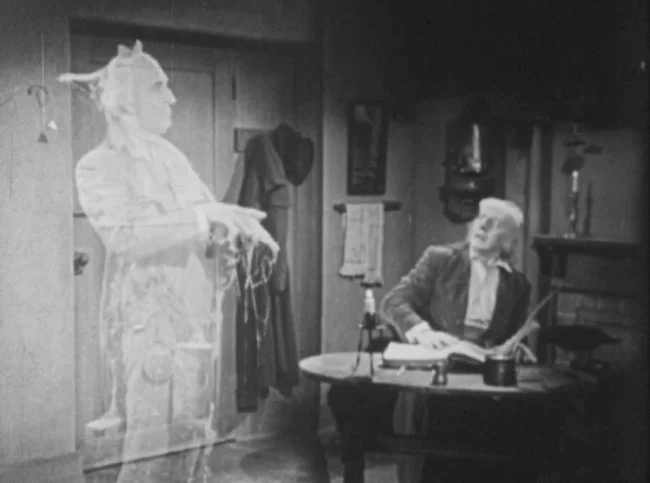
This 1954 adaptation of Charles Dickens’ A Christmas Carol is a distinctly studio bound US television production. It was in fact the fourth episode of an anthology variety show called A Shower of Stars. Originally filmed and broadcast in colour, only black and white prints now survive. The production boasts a script by noted American playwright Maxwell Anderson. Due to the 48 minute running time (without commercial breaks) the narrative is heavily abridged and often it is only the story’s most basic themes which are dramatically interpreted. It stars Fredric March who plays Scrooge as a cool and indifferent man, rather than the usual shrill old miser. However, despite his presence his performance cannot save the production. Most of the other cast members are far from accomplished and at times their acting borders on the amateur.
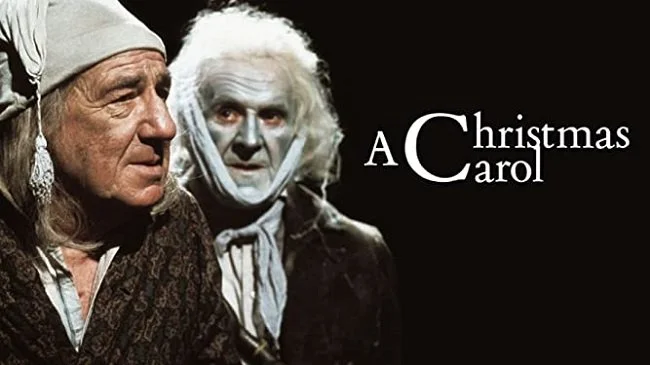
This BBC production from 1977 packs a lot into its 60 minute running time. Succinctly dramatised by Elaine Morgan, this adaptation focuses on the essential themes and key scenes of Dickens’ book. Shot on video, as many BBC dramas were at the time and confined entirely to studio sets, this low budget production makes use of chroma key visual effects. The snow bound countryside, the dark staircase in Scrooge’s apartment and the London skyline are all line drawings, with the cast composited in the foreground. Hence this version of A Christmas Carol feels like an episode of Doctor Who from the same decade. However, the production has one trump card to play with its robust cast of British character actors from the era. Fine performances from the likes of John Le Mesurier, Bernard Lee and Zoe Wanamaker more than compensate for the budgetary restrictions and short duration.
There are three key elements to Disney’s 2009 3D computer-animated adaptation of A Christmas Carol. Firstly, director Robert Zemeckis clearly seeks authenticity and hence includes a lot of original dialogue from the novel, as well as a bleaker depiction of the period. Secondly, he uses the digital production tools at his disposal to create sweeping vistas of 19th century London as well as highly stylised caricatures of the central characters. Thirdly, as this is a Disney production, there is an occasional lapse visual humour and levity that is required by their business model. Sadly all of these aspects of the production make for strange bedfellows that are at odds with each other. The result is a visually sumptuous film that loses its way as it lurches between bleak drama, odd humour and CGI driven spectacle.
Upon its theatrical release, Mickey’s Christmas Carol was the first animated film to star Mickey Mouse for thirty years. It was therefore accompanied with a large amount of hype and a wave of nostalgia. The US marketing stated “He’s Back. Mickey Mouse in his first new motion picture” which was somewhat misleading, as the actual animated film was just 26 minutes long. It was shown theatrically along with a re-release of The Rescuers in the US and The Jungle Book in the UK and other territories, in late December 1983. And despite his name being in the title, Mickey doesn’t have a lot of screen time as he plays Bob Cratchit. This is very much a vehicle for Scrooge McDuck as Ebenezer Scrooge. Overall, it’s a succinct distillation of the plot of Dickens’ A Christmas Carol, filled with cameo appearances by classic Disney characters. Naturally it is replete with the humour and sentiment that is inherent in the process known colloquially as Disneyfication. However, does this mitigate the book’s message?
At first glance, there is not much to distinguish this low budget production by Burbank Films Australia, from any of the other adaptations that were ubiquitous during the seventies and eighties. However, attentive viewers will discover a few details that lift this particular version above the mundane. Firstly, this is the second animated adaptation to feature the voice acting of Ron Haddrick as Ebenezer Scrooge. He had previously voiced the character in Air Programs International's shorter version of A Christmas Carol in 1969, thirteen years earlier. Secondly, despite the modest production values, there are a few additional scenes taken from the source text by Dickens, that don’t usually make it most film and TV adaptations. It is these minor embellishments that compensate for the simplicity of the animation (during the opening scene, some background characters do not move).
It’s interesting that so many adaptations of Charles Dickens’ iconic seasonal story are brought to us via the medium of animation. Naturally, this is a far more economical means of depicting the story with its period detail and supernatural elements, compared to a live action production. However, for an animated version of A Christmas Carol to work successfully, it needs three things. An innovative and striking production design, robust voice acting and a screenplay that keeps the core themes while offering significance difference compared to prior adaptations. You’ll find all of these elements in Richard Williams’ 1971 animated short. Sadly they’re conspicuously absent from the 1997 version. Despite the presence such talents as Tim Curry, Ed Asner and Whoopi Goldberg, this is a distinctly arbitrary animated film. Considering that the screenplay was written by Jymn Magon who has years of experience working for Disney, I had hoped this would be better endeavour.
There’s a degree of hubris implicit in such a definitive title. At the very least the inference is that this is a notable adaptation of Charles Dickens’ classic book. And at first glance, it is perfectly reasonable to assume just that. Jimmy Murakami was an animator of note with such unique movies as The Snowman and When the Wind Blows to his credit. Hence it is reasonable to expect a similar quirky and experimental treatment of this well know yuletide story. However, what audiences actually get is a rather bold adaptation that substantially embellishes upon the established narrative. Veering between sinister and borderline psychedelic imagery, this is a very inconsistent version that tries to be too many things at once. Just as you think you’ve got a handle on the film approach it takes an abrupt turn in the opposite direction. Comedy, drama and even power ballads are thrown into the mix. Sadly, all these elements do not hang well together.
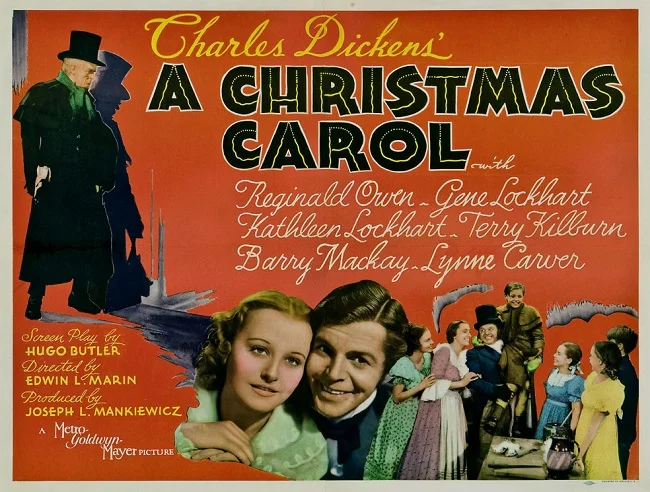
I have written previously about the versatility of Charles Dickens’ classic story and how it lends itself to multiple adaptations and interpretations. This 1938 film version tests that very theory as the reformation and redemption of Ebenezer Scrooge is presented through the medium of Golden Age Hollywood. A Christmas Carol sees the source text sanitised, infantilised and presented as a polished example of wholesome American film making. It has the high production values you’d expect from a studio such as MGM at the time, along with a cloyingly sentimental screenplay that dodges the politics of the book and renders the proceedings into an odd mixture of comedy and soft US Christian propaganda. It presents a very stylised depiction of Dickensian England and bears too many of the obvious foibles and tropes of the studio system that produced the movie.

This 1935 British adaptation of Dickens’ classic book was the first movie version of the story to have sound. Director Henry Edwards had to work creatively to stretch the productions modest budget. Subsequently the production is reliant on fog and snow shrouded sets, mainly to keep costs down. However, this does provide a veneer of authenticity in its depiction of a divided and polluted London. There are a few miniature shots showing the capital city at night and a handful of location shots inside various public buildings to establish the period setting. But mainly this is a set bound production and a sombre one at that. The underlying thrust of this adaptation is to highlight the class division as well as the contrasting wealth and poverty of the country at the time. It is this perspective that is used as the fulcrum of Scrooge’s redemption.

This version of Dickens novel is a very serious and somewhat sombre affair. Patrick Stewart not only stars in this 1999 TV movie but also has a producer credit. Anyone who is familiar with the actor will be aware of his long-standing passion for this tale, as he has starred in several one-man stage performances and narrated an audio book version. Stewart plays his Scrooge as more of an arrogant and aloof businessman. It’s a different Scrooge to that of George C. Scott or Alistair Sim. Here he is much more fearsome and bitter than he is cold and loathsome. Richard E. Grant is a touching, vulnerable Bob Cratchit, who looks decidedly poor and malnourished. There is a more tangible depiction of real poverty here than in other adaptations. The three ghosts are portrayed in a manner closer to the source text, although I could have done without the glowing eyes of the Ghost of Christmas Yet to Come.
Mickey's Christmas Carol (1983)
Upon its theatrical release, Mickey’s Christmas Carol was the first animated film to star Mickey Mouse for thirty years. It was therefore accompanied with a large amount of hype and a wave of nostalgia. The US marketing stated “He’s Back. Mickey Mouse in his first new motion picture” which was somewhat misleading, as the actual animated film was just 26 minutes long. It was shown theatrically along with a re-release of The Rescuers in the US and The Jungle Book in the UK and other territories, in late December 1983. And despite his name being in the title, Mickey doesn’t have a lot of screen time as he plays Bob Cratchit. This is very much a vehicle for Scrooge McDuck as Ebenezer Scrooge. Overall, it’s a succinct distillation of the plot of Dickens’ A Christmas Carol, filled with cameo appearances by classic Disney characters. Naturally it is replete with the humour and sentiment that is inherent in the process known colloquially as Disneyfication. However, does this mitigate the book’s message?
Upon its theatrical release, Mickey’s Christmas Carol was the first animated film to star Mickey Mouse for thirty years. It was therefore accompanied with a large amount of hype and a wave of nostalgia. The US marketing stated “He’s Back. Mickey Mouse in his first new motion picture” which was somewhat misleading, as the actual animated film was just 26 minutes long. It was shown theatrically along with a re-release of The Rescuers in the US and The Jungle Book in the UK and other territories, in late December 1983. And despite his name being in the title, Mickey doesn’t have a lot of screen time as he plays Bob Cratchit. This is very much a vehicle for Scrooge McDuck as Ebenezer Scrooge. Overall, it’s a succinct distillation of the plot of Dickens’ A Christmas Carol, filled with cameo appearances by classic Disney characters. Naturally it is replete with the humour and sentiment that is inherent in the process known colloquially as Disneyfication. However, does this mitigate the book’s message?
Part of the fun of watching Mickey’s Christmas Carol is trying to spot various iconic Disney characters, many of which are in minor roles in the background such as the Big, Bad Wolf and the Three Little Pigs. The larger roles are played by the likes of Donald Duck (Scrooge’s nephew Fred), Goofy (incongruously playing Marley’s ghost) and Jiminy Cricket (the Ghost of Christmas Past). The verbal and visual humour you expect from Disney is clearly front and centre. The scene where Scrooge climbs the stairs to his suite of rooms, followed by Jacob Marley’s spectral shadow, is a wonderfully contrived piece of animation and up to the high standard you’d expect from the studio. As ever there are a lot of innovative shots from aerial perspectives and sequences involving a lot of movement both in the foreground and background. All are lovingly drawn and painted by hand, imbuing the characters with a sense of personality and charisma.
Charm and overt sentimentality are in the very DNA of Disney productions. Hence any material that the studio adapts always has such content enhanced and amplified. This is Disney’s brand of entertainment. For younger, unsophisticated viewers, Mickey’s Christmas Carol plays as a simple but safe morality tale. Bob Cratchit’s poverty is hyperbolic and stylised (he carves a single pea to eat). Scrooge’s meanness and lack of empathy is a caricature, rather than an accurate case study. And so the darker elements of Dickens’ story are neutered due to the “Disneyfication” effect but does it mitigate the power of the story and its essential message? Not really, because the audience has elected to watch a Disney product, so they know in advance that they are not going to get a historically accurate depiction of 19th century deprivation. There is a minor concession to drama at the end, as Scrooge encounters his own hellbound grave which is tonally a little jarring. However, a more practical flaw in the film is making Scrooge essentially comic himself.
By Ebenezer Scrooge being played by Scrooge McDuck, an inherently witty and droll character, the viewer never really disapproves of him or finds him repellent. Hence his redemption at the story’s climax lacks any real impact. Compared to The Muppet Christmas Carol (1992) where Scrooge is played straight, with a cold and smouldering performance by Michael Caine, the comedy occurs around him highlighting his own emotional void. This different approach gives greater weight to the ending in the Muppet version. But I suppose it is critically redundant to apply such analysis to a short animated film that was never intended to be anything more than the sum of its parts. Mickey’s Christmas Carol is an entertaining half hour of family viewing, especially for those with young children still within Disney’s key age demographic. It provides the essential beats of Dickens’ tale along with all the key tropes of the studio that created it.
This 1954 adaptation of Charles Dickens’ A Christmas Carol is a distinctly studio bound US television production. It was in fact the fourth episode of an anthology variety show called A Shower of Stars. Originally filmed and broadcast in colour, only black and white prints now survive. The production boasts a script by noted American playwright Maxwell Anderson. Due to the 48 minute running time (without commercial breaks) the narrative is heavily abridged and often it is only the story’s most basic themes which are dramatically interpreted. It stars Fredric March who plays Scrooge as a cool and indifferent man, rather than the usual shrill old miser. However, despite his presence his performance cannot save the production. Most of the other cast members are far from accomplished and at times their acting borders on the amateur.
This BBC production from 1977 packs a lot into its 60 minute running time. Succinctly dramatised by Elaine Morgan, this adaptation focuses on the essential themes and key scenes of Dickens’ book. Shot on video, as many BBC dramas were at the time and confined entirely to studio sets, this low budget production makes use of chroma key visual effects. The snow bound countryside, the dark staircase in Scrooge’s apartment and the London skyline are all line drawings, with the cast composited in the foreground. Hence this version of A Christmas Carol feels like an episode of Doctor Who from the same decade. However, the production has one trump card to play with its robust cast of British character actors from the era. Fine performances from the likes of John Le Mesurier, Bernard Lee and Zoe Wanamaker more than compensate for the budgetary restrictions and short duration.
There are three key elements to Disney’s 2009 3D computer-animated adaptation of A Christmas Carol. Firstly, director Robert Zemeckis clearly seeks authenticity and hence includes a lot of original dialogue from the novel, as well as a bleaker depiction of the period. Secondly, he uses the digital production tools at his disposal to create sweeping vistas of 19th century London as well as highly stylised caricatures of the central characters. Thirdly, as this is a Disney production, there is an occasional lapse visual humour and levity that is required by their business model. Sadly all of these aspects of the production make for strange bedfellows that are at odds with each other. The result is a visually sumptuous film that loses its way as it lurches between bleak drama, odd humour and CGI driven spectacle.
Upon its theatrical release, Mickey’s Christmas Carol was the first animated film to star Mickey Mouse for thirty years. It was therefore accompanied with a large amount of hype and a wave of nostalgia. The US marketing stated “He’s Back. Mickey Mouse in his first new motion picture” which was somewhat misleading, as the actual animated film was just 26 minutes long. It was shown theatrically along with a re-release of The Rescuers in the US and The Jungle Book in the UK and other territories, in late December 1983. And despite his name being in the title, Mickey doesn’t have a lot of screen time as he plays Bob Cratchit. This is very much a vehicle for Scrooge McDuck as Ebenezer Scrooge. Overall, it’s a succinct distillation of the plot of Dickens’ A Christmas Carol, filled with cameo appearances by classic Disney characters. Naturally it is replete with the humour and sentiment that is inherent in the process known colloquially as Disneyfication. However, does this mitigate the book’s message?
At first glance, there is not much to distinguish this low budget production by Burbank Films Australia, from any of the other adaptations that were ubiquitous during the seventies and eighties. However, attentive viewers will discover a few details that lift this particular version above the mundane. Firstly, this is the second animated adaptation to feature the voice acting of Ron Haddrick as Ebenezer Scrooge. He had previously voiced the character in Air Programs International's shorter version of A Christmas Carol in 1969, thirteen years earlier. Secondly, despite the modest production values, there are a few additional scenes taken from the source text by Dickens, that don’t usually make it most film and TV adaptations. It is these minor embellishments that compensate for the simplicity of the animation (during the opening scene, some background characters do not move).
It’s interesting that so many adaptations of Charles Dickens’ iconic seasonal story are brought to us via the medium of animation. Naturally, this is a far more economical means of depicting the story with its period detail and supernatural elements, compared to a live action production. However, for an animated version of A Christmas Carol to work successfully, it needs three things. An innovative and striking production design, robust voice acting and a screenplay that keeps the core themes while offering significance difference compared to prior adaptations. You’ll find all of these elements in Richard Williams’ 1971 animated short. Sadly they’re conspicuously absent from the 1997 version. Despite the presence such talents as Tim Curry, Ed Asner and Whoopi Goldberg, this is a distinctly arbitrary animated film. Considering that the screenplay was written by Jymn Magon who has years of experience working for Disney, I had hoped this would be better endeavour.
There’s a degree of hubris implicit in such a definitive title. At the very least the inference is that this is a notable adaptation of Charles Dickens’ classic book. And at first glance, it is perfectly reasonable to assume just that. Jimmy Murakami was an animator of note with such unique movies as The Snowman and When the Wind Blows to his credit. Hence it is reasonable to expect a similar quirky and experimental treatment of this well know yuletide story. However, what audiences actually get is a rather bold adaptation that substantially embellishes upon the established narrative. Veering between sinister and borderline psychedelic imagery, this is a very inconsistent version that tries to be too many things at once. Just as you think you’ve got a handle on the film approach it takes an abrupt turn in the opposite direction. Comedy, drama and even power ballads are thrown into the mix. Sadly, all these elements do not hang well together.
I have written previously about the versatility of Charles Dickens’ classic story and how it lends itself to multiple adaptations and interpretations. This 1938 film version tests that very theory as the reformation and redemption of Ebenezer Scrooge is presented through the medium of Golden Age Hollywood. A Christmas Carol sees the source text sanitised, infantilised and presented as a polished example of wholesome American film making. It has the high production values you’d expect from a studio such as MGM at the time, along with a cloyingly sentimental screenplay that dodges the politics of the book and renders the proceedings into an odd mixture of comedy and soft US Christian propaganda. It presents a very stylised depiction of Dickensian England and bears too many of the obvious foibles and tropes of the studio system that produced the movie.
This 1935 British adaptation of Dickens’ classic book was the first movie version of the story to have sound. Director Henry Edwards had to work creatively to stretch the productions modest budget. Subsequently the production is reliant on fog and snow shrouded sets, mainly to keep costs down. However, this does provide a veneer of authenticity in its depiction of a divided and polluted London. There are a few miniature shots showing the capital city at night and a handful of location shots inside various public buildings to establish the period setting. But mainly this is a set bound production and a sombre one at that. The underlying thrust of this adaptation is to highlight the class division as well as the contrasting wealth and poverty of the country at the time. It is this perspective that is used as the fulcrum of Scrooge’s redemption.
This version of Dickens novel is a very serious and somewhat sombre affair. Patrick Stewart not only stars in this 1999 TV movie but also has a producer credit. Anyone who is familiar with the actor will be aware of his long-standing passion for this tale, as he has starred in several one-man stage performances and narrated an audio book version. Stewart plays his Scrooge as more of an arrogant and aloof businessman. It’s a different Scrooge to that of George C. Scott or Alistair Sim. Here he is much more fearsome and bitter than he is cold and loathsome. Richard E. Grant is a touching, vulnerable Bob Cratchit, who looks decidedly poor and malnourished. There is a more tangible depiction of real poverty here than in other adaptations. The three ghosts are portrayed in a manner closer to the source text, although I could have done without the glowing eyes of the Ghost of Christmas Yet to Come.
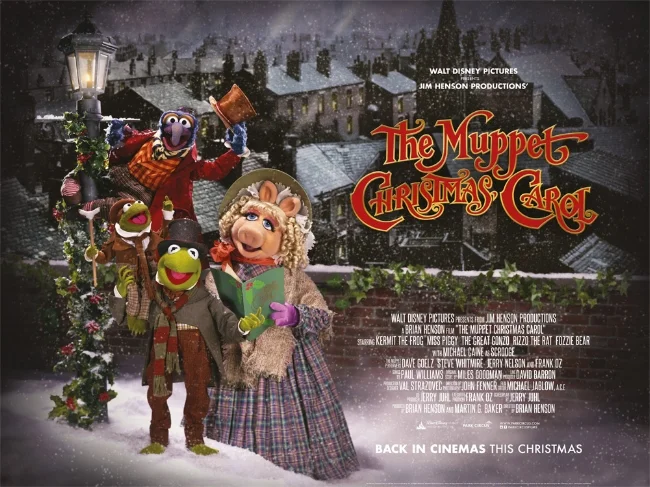
The Muppet Christmas Carol was the first Muppet feature film to be made after the death of Jim Henson. The production maintains his standards and style throughout, although due to the plot, this is a somewhat dark Muppet film. It’s also the one most affectionate of the Muppets movie. The plot follows Charles Dickens's original 1843 novel quite closely with the added bonus of The Great Gonzo playing Dickens himself as an ever-present narrator. Michael Caine provides an excellent performance as Ebenezer Scrooge that wouldn’t be out of place in serious adaptation. Caine attacks his role with his acting prowess and does not end up playing second fiddle to The Muppets themselves. As ever with Muppet movies, neither Caine or any other member of the cast ever question the fact that the Muppets aren’t human.

By 1988 Blackadder had run for three seasons in the UK and had seen the central character of Edmund Blackadder evolve from a seedy incompetent to a cunning, scheming, evil genius who was always frustrated at the last moment. Cleverly written by Richard Curtis and Ben Elton and superbly portrayed by Rowan Atkinson, Blackadder was very much at the cutting edge of British comedy of the time. It managed to mix physical humour, with verbal sparring, sarcasm, dry self-deprecation and irony. It was popular with a very broad spectrum of viewers.
Over the last few years I’ve reviewed several adaptations of Charles Dickens seasonal story A Christmas Carol. As I stated previously one of the stories greatest strength is that it lends itself perfectly to multiple interpretations. I recently had the good fortune to rediscover the animated version from 1969 by Air Programs International. I remember seeing this animated short as a child but could not recollect sufficient details to allow me to track it down via the IMDB. Then by complete chance, I stumbled across it again on You Tube while doing some research.
I have a great deal of affection for Charles Dickens' A Christmas Carol, not only because it’s a fine piece of literature but because it lends itself so well to dramatisation. I therefore have a keen interests in all the respective adaptation, of which there are many. Over the years there has been a trend to focus excessively on the sentimental aspect of the plot, resulting in a rather nauseating Disneyfication of the story. Although the redemption of the main protagonist is central to the narrative, the poverty and deprivations of the time are still very pertinent themes, especially in today's economic climate. I was therefore very gratified to rediscover the 1971 version of Charles Dickens' classic story which was originally shown on ABC. This short 25 minute animated feature realises the story superbly, capturing the tone of the book and accurately reflecting the darker aspects. Remember that A Christmas Carol is fundamentally a ghost story.
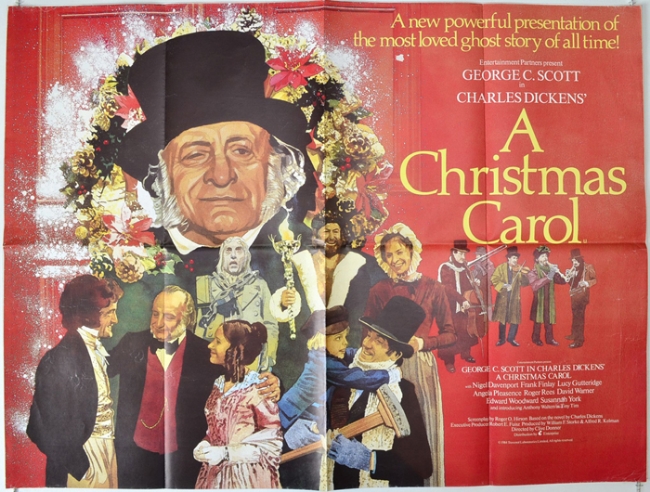
Clive Donner's 1984 version of the Dickens' classic "A Christmas Carol” is bold and different mainly because of the casting of George C. Scott as Ebenezer Scrooge. The story is told with precision and an eye to detail. In some respects it’s the most authentic adaptation, with credible performances from the ensemble cast. Alastair Sim's portrayal in the 1951 film has always been perceived as a benchmark and provided a template as to how the role should be interpreted. Scott replaces the traditional anger, bitterness and rage with a cold and utterly dispassionate demeanour. There is a strong sense of honesty in his Scrooge as the audience follows him on his emotional journey. The tears, the regret and the realisation that there is still hope are all present, yet explored in a very non-theatrical manner.
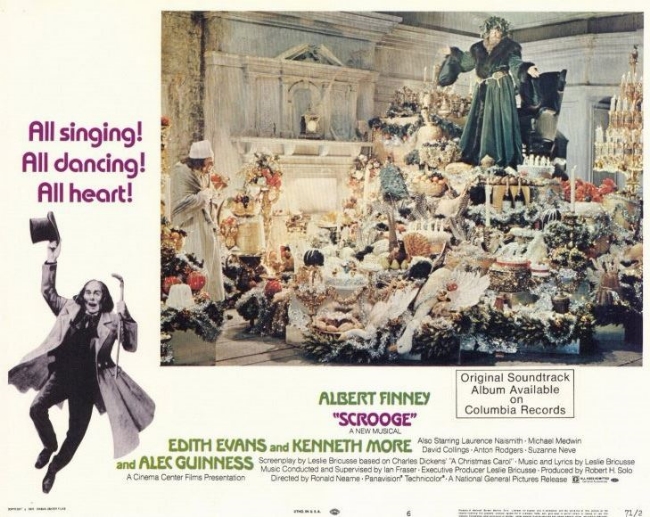
The all-star big screen musical was desperately striving to be different during the sixties and seventies, producing many hits and misses. Tommy, The Lost Horizon and The Wiz are prime examples of the experimentation made within the genre at the time. However, due to the success of Oliver! at the box office in 1968 it was thought that there was potential mileage to be had from Dicken's classic "A Christmas Carol". So the musical Scrooge was conceived. Unlike Oliver! it was not based on a existing stage adaptation but on a wholly original screenplay, although a theatrical treatment has since been adapted.
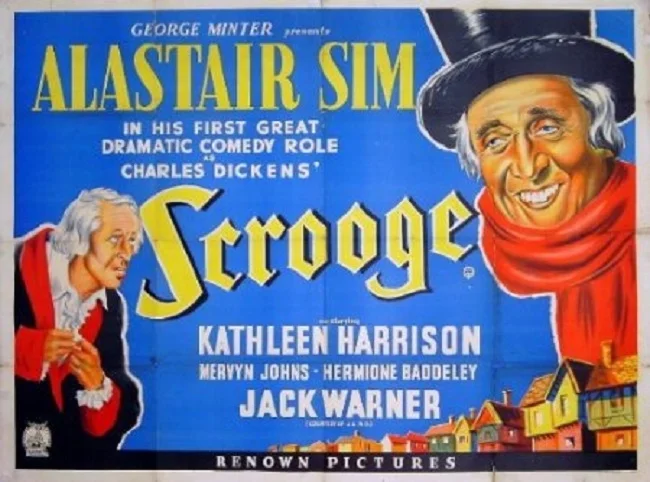
I am a great fan of Charles Dickens' "A Christmas Carol". There is something very special about the novella which is quite hard to quantify. It is a very unique book despite its central theme of redemption being universal. The text has for want of another phrase, a "power" to it. It is profoundly moving, insightful and true. Perhaps the key this story’s appeal lies with the central character, Ebenezer Scrooge. Not because Scrooge is a monster (which are so often fascinating) but because he's a man broken by circumstance. I think readers throughout the years have related to this and considered "There, but for the grace of God, go I". Cinema has found a rich vein of gold running through this tale, which is why it’s been revisited so often and interpreted so many ways.
A Christmas Carol (1982)
At first glance, there is not much to distinguish this low budget production by Burbank Films Australia, from any of the other adaptations that were ubiquitous during the seventies and eighties. However, attentive viewers will discover a few details that lift this particular version above the mundane. Firstly, this is the second animated adaptation to feature the voice acting of Ron Haddrick as Ebenezer Scrooge. He had previously voiced the character in Air Programs International's shorter version of A Christmas Carol in 1969, thirteen years earlier. Secondly, despite the modest production values, there are a few additional scenes taken from the source text by Dickens, that don’t usually make it most film and TV adaptations. It is these minor embellishments that compensate for the simplicity of the animation (during the opening scene, some background characters do not move).
At first glance, there is not much to distinguish this low budget production by Burbank Films Australia, from any of the other adaptations that were ubiquitous during the seventies and eighties. However, attentive viewers will discover a few details that lift this particular version above the mundane. Firstly, this is the second animated adaptation to feature the voice acting of Ron Haddrick as Ebenezer Scrooge. He had previously voiced the character in Air Programs International's shorter version of A Christmas Carol in 1969, thirteen years earlier. Secondly, despite the modest production values, there are a few additional scenes taken from the source text by Dickens, that don’t usually make it most film and TV adaptations. It is these minor embellishments that compensate for the simplicity of the animation (during the opening scene, some background characters do not move).
Artistically, this production follows a very formulaic depiction of London in the 19th century as well as the key characters of the story. Scrooge is a balding, hook nosed, old man with a rasping voice. Dogs flee from him and he works in a shabby and drab counting house. There’s a quite startling realisation of Marley’s ghost complete with black shadows around his eyes, making him look like a member of Kiss. His message of neglected social responsibility to Scrooge is presented as a montage, which is quite innovative and effective. The Spirit of Christmas Past is on this occasion is a teenager in a chiton. It’s a novel look. Overall the voice acting is efficient and steeped in stylised British tropes with Cockney street urchins and upper class business men. The score by Neil Thurgate composer is also quite different from the usual fare.
Despite the simplicity of the animation, no doubt due to restrictions of the budget, this adaptation uses large sections of the source text as dialogue. It also visually realises some minor scenes that often get overlooked in most versions of A Christmas Carol. There is a scene where the poor are queuing outside the Baker’s on Christmas morning to have to have their dinner’s cooked. Also there is a greater focus on his failed relationship with Belle including a scene where Scrooge sees a vision of his ex-fiancée with her family and husband. A family that could have been his under different circumstances. This adaptation also strives to add a further human dimension to Scrooge as he reminisces over his past mistakes and gives in to his feelings. Overall, all though not in any way a definitive version of Dickens’ classic tale, there is sufficient here to make it different from others.
This 1954 adaptation of Charles Dickens’ A Christmas Carol is a distinctly studio bound US television production. It was in fact the fourth episode of an anthology variety show called A Shower of Stars. Originally filmed and broadcast in colour, only black and white prints now survive. The production boasts a script by noted American playwright Maxwell Anderson. Due to the 48 minute running time (without commercial breaks) the narrative is heavily abridged and often it is only the story’s most basic themes which are dramatically interpreted. It stars Fredric March who plays Scrooge as a cool and indifferent man, rather than the usual shrill old miser. However, despite his presence his performance cannot save the production. Most of the other cast members are far from accomplished and at times their acting borders on the amateur.
This BBC production from 1977 packs a lot into its 60 minute running time. Succinctly dramatised by Elaine Morgan, this adaptation focuses on the essential themes and key scenes of Dickens’ book. Shot on video, as many BBC dramas were at the time and confined entirely to studio sets, this low budget production makes use of chroma key visual effects. The snow bound countryside, the dark staircase in Scrooge’s apartment and the London skyline are all line drawings, with the cast composited in the foreground. Hence this version of A Christmas Carol feels like an episode of Doctor Who from the same decade. However, the production has one trump card to play with its robust cast of British character actors from the era. Fine performances from the likes of John Le Mesurier, Bernard Lee and Zoe Wanamaker more than compensate for the budgetary restrictions and short duration.
There are three key elements to Disney’s 2009 3D computer-animated adaptation of A Christmas Carol. Firstly, director Robert Zemeckis clearly seeks authenticity and hence includes a lot of original dialogue from the novel, as well as a bleaker depiction of the period. Secondly, he uses the digital production tools at his disposal to create sweeping vistas of 19th century London as well as highly stylised caricatures of the central characters. Thirdly, as this is a Disney production, there is an occasional lapse visual humour and levity that is required by their business model. Sadly all of these aspects of the production make for strange bedfellows that are at odds with each other. The result is a visually sumptuous film that loses its way as it lurches between bleak drama, odd humour and CGI driven spectacle.
Upon its theatrical release, Mickey’s Christmas Carol was the first animated film to star Mickey Mouse for thirty years. It was therefore accompanied with a large amount of hype and a wave of nostalgia. The US marketing stated “He’s Back. Mickey Mouse in his first new motion picture” which was somewhat misleading, as the actual animated film was just 26 minutes long. It was shown theatrically along with a re-release of The Rescuers in the US and The Jungle Book in the UK and other territories, in late December 1983. And despite his name being in the title, Mickey doesn’t have a lot of screen time as he plays Bob Cratchit. This is very much a vehicle for Scrooge McDuck as Ebenezer Scrooge. Overall, it’s a succinct distillation of the plot of Dickens’ A Christmas Carol, filled with cameo appearances by classic Disney characters. Naturally it is replete with the humour and sentiment that is inherent in the process known colloquially as Disneyfication. However, does this mitigate the book’s message?
At first glance, there is not much to distinguish this low budget production by Burbank Films Australia, from any of the other adaptations that were ubiquitous during the seventies and eighties. However, attentive viewers will discover a few details that lift this particular version above the mundane. Firstly, this is the second animated adaptation to feature the voice acting of Ron Haddrick as Ebenezer Scrooge. He had previously voiced the character in Air Programs International's shorter version of A Christmas Carol in 1969, thirteen years earlier. Secondly, despite the modest production values, there are a few additional scenes taken from the source text by Dickens, that don’t usually make it most film and TV adaptations. It is these minor embellishments that compensate for the simplicity of the animation (during the opening scene, some background characters do not move).
It’s interesting that so many adaptations of Charles Dickens’ iconic seasonal story are brought to us via the medium of animation. Naturally, this is a far more economical means of depicting the story with its period detail and supernatural elements, compared to a live action production. However, for an animated version of A Christmas Carol to work successfully, it needs three things. An innovative and striking production design, robust voice acting and a screenplay that keeps the core themes while offering significance difference compared to prior adaptations. You’ll find all of these elements in Richard Williams’ 1971 animated short. Sadly they’re conspicuously absent from the 1997 version. Despite the presence such talents as Tim Curry, Ed Asner and Whoopi Goldberg, this is a distinctly arbitrary animated film. Considering that the screenplay was written by Jymn Magon who has years of experience working for Disney, I had hoped this would be better endeavour.
There’s a degree of hubris implicit in such a definitive title. At the very least the inference is that this is a notable adaptation of Charles Dickens’ classic book. And at first glance, it is perfectly reasonable to assume just that. Jimmy Murakami was an animator of note with such unique movies as The Snowman and When the Wind Blows to his credit. Hence it is reasonable to expect a similar quirky and experimental treatment of this well know yuletide story. However, what audiences actually get is a rather bold adaptation that substantially embellishes upon the established narrative. Veering between sinister and borderline psychedelic imagery, this is a very inconsistent version that tries to be too many things at once. Just as you think you’ve got a handle on the film approach it takes an abrupt turn in the opposite direction. Comedy, drama and even power ballads are thrown into the mix. Sadly, all these elements do not hang well together.
I have written previously about the versatility of Charles Dickens’ classic story and how it lends itself to multiple adaptations and interpretations. This 1938 film version tests that very theory as the reformation and redemption of Ebenezer Scrooge is presented through the medium of Golden Age Hollywood. A Christmas Carol sees the source text sanitised, infantilised and presented as a polished example of wholesome American film making. It has the high production values you’d expect from a studio such as MGM at the time, along with a cloyingly sentimental screenplay that dodges the politics of the book and renders the proceedings into an odd mixture of comedy and soft US Christian propaganda. It presents a very stylised depiction of Dickensian England and bears too many of the obvious foibles and tropes of the studio system that produced the movie.
This 1935 British adaptation of Dickens’ classic book was the first movie version of the story to have sound. Director Henry Edwards had to work creatively to stretch the productions modest budget. Subsequently the production is reliant on fog and snow shrouded sets, mainly to keep costs down. However, this does provide a veneer of authenticity in its depiction of a divided and polluted London. There are a few miniature shots showing the capital city at night and a handful of location shots inside various public buildings to establish the period setting. But mainly this is a set bound production and a sombre one at that. The underlying thrust of this adaptation is to highlight the class division as well as the contrasting wealth and poverty of the country at the time. It is this perspective that is used as the fulcrum of Scrooge’s redemption.
This version of Dickens novel is a very serious and somewhat sombre affair. Patrick Stewart not only stars in this 1999 TV movie but also has a producer credit. Anyone who is familiar with the actor will be aware of his long-standing passion for this tale, as he has starred in several one-man stage performances and narrated an audio book version. Stewart plays his Scrooge as more of an arrogant and aloof businessman. It’s a different Scrooge to that of George C. Scott or Alistair Sim. Here he is much more fearsome and bitter than he is cold and loathsome. Richard E. Grant is a touching, vulnerable Bob Cratchit, who looks decidedly poor and malnourished. There is a more tangible depiction of real poverty here than in other adaptations. The three ghosts are portrayed in a manner closer to the source text, although I could have done without the glowing eyes of the Ghost of Christmas Yet to Come.
The Muppet Christmas Carol was the first Muppet feature film to be made after the death of Jim Henson. The production maintains his standards and style throughout, although due to the plot, this is a somewhat dark Muppet film. It’s also the one most affectionate of the Muppets movie. The plot follows Charles Dickens's original 1843 novel quite closely with the added bonus of The Great Gonzo playing Dickens himself as an ever-present narrator. Michael Caine provides an excellent performance as Ebenezer Scrooge that wouldn’t be out of place in serious adaptation. Caine attacks his role with his acting prowess and does not end up playing second fiddle to The Muppets themselves. As ever with Muppet movies, neither Caine or any other member of the cast ever question the fact that the Muppets aren’t human.
By 1988 Blackadder had run for three seasons in the UK and had seen the central character of Edmund Blackadder evolve from a seedy incompetent to a cunning, scheming, evil genius who was always frustrated at the last moment. Cleverly written by Richard Curtis and Ben Elton and superbly portrayed by Rowan Atkinson, Blackadder was very much at the cutting edge of British comedy of the time. It managed to mix physical humour, with verbal sparring, sarcasm, dry self-deprecation and irony. It was popular with a very broad spectrum of viewers.
Over the last few years I’ve reviewed several adaptations of Charles Dickens seasonal story A Christmas Carol. As I stated previously one of the stories greatest strength is that it lends itself perfectly to multiple interpretations. I recently had the good fortune to rediscover the animated version from 1969 by Air Programs International. I remember seeing this animated short as a child but could not recollect sufficient details to allow me to track it down via the IMDB. Then by complete chance, I stumbled across it again on You Tube while doing some research.
I have a great deal of affection for Charles Dickens' A Christmas Carol, not only because it’s a fine piece of literature but because it lends itself so well to dramatisation. I therefore have a keen interests in all the respective adaptation, of which there are many. Over the years there has been a trend to focus excessively on the sentimental aspect of the plot, resulting in a rather nauseating Disneyfication of the story. Although the redemption of the main protagonist is central to the narrative, the poverty and deprivations of the time are still very pertinent themes, especially in today's economic climate. I was therefore very gratified to rediscover the 1971 version of Charles Dickens' classic story which was originally shown on ABC. This short 25 minute animated feature realises the story superbly, capturing the tone of the book and accurately reflecting the darker aspects. Remember that A Christmas Carol is fundamentally a ghost story.
Clive Donner's 1984 version of the Dickens' classic "A Christmas Carol” is bold and different mainly because of the casting of George C. Scott as Ebenezer Scrooge. The story is told with precision and an eye to detail. In some respects it’s the most authentic adaptation, with credible performances from the ensemble cast. Alastair Sim's portrayal in the 1951 film has always been perceived as a benchmark and provided a template as to how the role should be interpreted. Scott replaces the traditional anger, bitterness and rage with a cold and utterly dispassionate demeanour. There is a strong sense of honesty in his Scrooge as the audience follows him on his emotional journey. The tears, the regret and the realisation that there is still hope are all present, yet explored in a very non-theatrical manner.
The all-star big screen musical was desperately striving to be different during the sixties and seventies, producing many hits and misses. Tommy, The Lost Horizon and The Wiz are prime examples of the experimentation made within the genre at the time. However, due to the success of Oliver! at the box office in 1968 it was thought that there was potential mileage to be had from Dicken's classic "A Christmas Carol". So the musical Scrooge was conceived. Unlike Oliver! it was not based on a existing stage adaptation but on a wholly original screenplay, although a theatrical treatment has since been adapted.
I am a great fan of Charles Dickens' "A Christmas Carol". There is something very special about the novella which is quite hard to quantify. It is a very unique book despite its central theme of redemption being universal. The text has for want of another phrase, a "power" to it. It is profoundly moving, insightful and true. Perhaps the key this story’s appeal lies with the central character, Ebenezer Scrooge. Not because Scrooge is a monster (which are so often fascinating) but because he's a man broken by circumstance. I think readers throughout the years have related to this and considered "There, but for the grace of God, go I". Cinema has found a rich vein of gold running through this tale, which is why it’s been revisited so often and interpreted so many ways.
Scoob! (2020)
Scoob! is one of several movies that was slated for a theatrical release this summer but ended up being premiering on VOD instead due to the global pandemic. As a result, it is difficult to ascertain exactly how successful this animated film has been. A lot of trade newspapers have indicated that rentals have been high and that the film has proven more popular than Tom Hardy’s new movie Capone. Some industry sources have estimated a gross of $100,000,000 in a two week period. I suspect that the current lockdown has provided a market of children craving new entertainment and parents happy to pay for 90 minutes of peace and quiet. Hence Scoob! appears to have been in the right place at the right time. Whether that popular success would have happened if the movie had been released theatrically is another matter.
Scoob! is one of several movies that was slated for a theatrical release this summer but ended up being premiering on VOD instead due to the global pandemic. As a result, it is difficult to ascertain exactly how successful this animated film has been. A lot of trade newspapers have indicated that rentals have been high and that the film has proven more popular than Tom Hardy’s new movie Capone. Some industry sources have estimated a gross of $100,000,000 in a two week period. I suspect that the current lockdown has provided a market of children craving new entertainment and parents happy to pay for 90 minutes of peace and quiet. Hence Scoob! appears to have been in the right place at the right time. Whether that popular success would have happened if the movie had been released theatrically is another matter.
Scoob! is a computer-animated comedy mystery film produced by Warner Animation Group. Canonically, it’s both an origins movie and a soft reboot of the beloved Scooby Doo franchise. The film starts with a friendless young Norville "Shaggy" Rogers, adopting Scooby Doo as a pup. The two subsequently meet Fred Jones, Daphne Blake, and Velma Dinkley while out trick or treating on Halloween. Their subsequent exploration of a local haunted house leads to the unmasking of a local criminal. Hence the friends decide to form Mystery Inc. “I mean, like, how many scary monsters could there be?” Shaggy asks which ushers in possibly the highlight of the entire movie; a loving recreation of the original title sequence from Scooby Doo Where Are You! (Season 2). Sadly, it all goes rapidly down hill after this. Ten years later the gang splits after a business deal with Simon Cowell (yes you read that correctly) displeases Shaggy and Scooby. The pair are subsequently attacked by an army of small robots called “rottens” while bowling but are rescued by Dee Dee Skyes, Dynomutt, and the Blue Falcon. Scooby learns that he is being hunted by none other than Dick Dastardly who needs him to unleash Cerberus (from Greek mythology) from the underworld.
And therein lies the fundamental problem with Scoob! There seems to have been a lack of faith in the basics of the franchise. IE Scooby and the gang solving haunted house mysteries. Hence the production tries to crowbar in other Hanna-Barbera characters in an attempt to pander to the current cinematic vogue for superheroes. Then there’s Dick Dastardly (voiced by Jason Isaacs who is clearly having a lot of fun) and his comedy robot sidekicks which smacks of Gru from Despicable Me and his minions. Captain Caveman also makes an appearance for no real reason. So if you were expecting to see a back to basics reimagining of the adventures of Mystery Inc in Scoob! then you’re in for a “surprise”. Although in fairness, it should be noted that Scooby Doo did team up with the Blue Falcon and Dynomutt in the past but this was during the middle seventies and not during the classic original two seasons of Scooby Doo Where Are You!
The other major issue with Scoob! is the way the screenplay by Matt Lieberman, Adam Sztykiel, Jack Donaldson, Derek Elliott (yes it took four of them to write this) tries to throw a few jokes, references and homages to the adult viewers. It’s a common enough practise in animated films but the gags are somewhat varied and a few are even questionable. There’s a joke where Dick Dastardly’s crimes are discussed and not paying for Netflix is among them. If you read the list on the police database quickly you'll also find tripping old ladies in Lagos. These quips work well but others fall flat, often referencing the obscure. Plus hasn’t Simon Cowell’s notoriety now faded from popular culture? Wasn’t that all two decades ago? And of course Scoob! suffers from the inclusion of my personal cinematic bête noire; the overlong, excessively loud action sequence. Scooby Doo Where Are You! was all about comedic chases and not explosions.
So upon mature reflection and sobre analysis, I think it’s fair to say that Scoob! is a visually chaotic and tonally mixed viewing experience. It certainly won’t delight lifelong fans raised on reruns of the original incarnation of the show. The film smacks of a production driven by focus group and committee. The kind so brilliantly satirised in RoboCop 2. However, despite the qualms of adult fans and professional critics, it should be noted that I watched this movie (twice) with my 5 year old Granddaughters. They loved it. And that is possibly all that Warner Bros. Animation Group care about. I suspect that there’ll no doubt be a Scoob! 2, in the not too distant future. In the meantime, if you have small children that need to be entertained, then Scoob! will do just that. If you are a fan of the franchise then I’m sure I’m not the first to say Scooby Don’t.
I recently found a DVD boxset of Return to the Planet of the Apes in a charity shop which I bought for £4, which is a ridiculously cheap price. I considered it an interesting find because it was a Region 1, US copy. However, that is not so unusual these days as most DVD players are now region free and Amazon (UK) sells media from all over the world. As for the show in question, I vaguely remember Return to the Planet of the Apes being shown on UK network TV when I was a child, probably circa 1976. Back then it would usually take a year or so before US shows made it onto UK television. From a commercial perspective, the entire Planet of the Apes franchise was beginning to run out of steam. I was 8 years old at the time so had missed most of the film releases. However, I enjoyed the live action TV show hence an animated follow up had obvious appeal to a child of my age.
It is not unusual for Disney to change film titles when marketing them outside of the US. In 2016 they renamed the animated feature film Zootopia to Zootropolis in the UK and Europe to avoid trademark conflicts with other existing businesses. For example there is a Danish zoo which already holds the “Zootopia” name. Similarly, in Germany there is a children’s book which caused copyright conflict, which led to the film being released under the title Zoomania. Such changes, although practical for legal reasons, can sometimes cause a degree of confusion. Especially as there are numerous, low budget productions companies that go out of their way to produce similarly titled “mockbusters” whenever there are big, tentpole, releases. So for clarity, Zootopia 2 has been released in the UK as Zootropolis 2.
With the proliferation of lore driven, franchise movies in recent years, a culture of analysis has developed online. Hence you will find a lot of YouTube videos that claim to “explain” the ending of specific films or provide clarification of their respective themes and subtexts. While critical debate and discussion about cinema is welcome, I think it is a mistake to always look for a specific meaning in cinema. Even clearly narrative films can be ambiguous. Art is ultimately a very subjective field of expression open to personal interpretation. Which brings me neatly to Flow, an animated feature film which tells a compelling story but raises more questions than it answers. It leaves the viewer to fill in a lot of the blanks themselves and the film is all the better for this approach. Flow is an extraordinary example of animation and a fascinating example of innovative, thought provoking filmmaking. Quite the rarity these days.
For those unfamiliar with Dav Pilkey’s graphic novel character Dog Man, he’s a half-dog, half-human police officer. This comic chimaera is the result of a surgical procedure carried out after Officer Knight and his trusty dog Greg are blown up while defusing a bomb. Greg’s head is grafted to Officer Knight's body. Post surgery, Dog Man (Peter Hastings) remains an officer of the law and continues to track his nemesis, Petey (Pete Davidson), an orange cat and criminal genius. However, despite positive media coverage and a high arrest rate, Dog Man incurs the ire of his Chief (Lil Rel Howery) who is jealous of his success. Furthermore, Dog Man becomes depressed due to the loss of his owner, girlfriend and former home. Meanwhile, Petey decides to clone himself in an attempt to find a worthy assistant and also plots to resurrect a deceased super villain, Flippy, who is an evil telekinetic fish.
I have always found it curious that there haven't been more feature films set in Middle-earth, after the success of Peter Jackson’s The Lord of the Rings trilogy. However, a little research shows a very complex set of rights regarding Tolkien’s work, with different material being controlled and administered by different bodies. Hence, the market has not been saturated with officially licensed material. Thus, when The Lord of the Rings: The War of the Rohirrim was announced to be in production, it aroused a great deal of curiosity both among fans and those with an interest in the wider film industry. To base an entire feature film on something that is effectively just a few paragraphs in the appendices of The Lord of the Rings is quite intriguing. The producers claimed it afforded them greater artistic freedom not to be constrained by an excess of lore. Industry pundits theorised that the film was being produced solely to ensure that wider rights were retained.
Whenever I feel that mainstream filmmaking is becoming increasingly bland and I grow despondent with it, along comes an animated film to prove that there is still greatness and art to be found through the medium of cinema. Robot Dreams begins as a tale of loneliness and then quickly becomes a eulogy to friendship and participating in life. The story then turns things on its head as it explores loss and finally concludes with a profoundly beautiful resolution, as it muses upon accepting change and new friends. Robot Dreams succeeds where so many other films fail by being honest, candid and sincere. Hence the emotions expressed by what is essentially a simple story are genuine and palpable. The film’s lack of dialogue is a blessing, with music doing a great deal of the narrative heavy lifting. This allows audiences to focus on the main characters without unnecessary distraction. The animation is uncomplicated but very specific in its style and setting. It utterly suits the tale being told.
Guillermo del Toro's Pinocchio is a bold and inventive take on Carlo Collodi's classic story of the puppet that aspires to be a “real boy”. As you would expect from the director, it is a far cry from Disney’s 1940 version, taking a more bleak and sinister tone. Despite songs and exuberant set pieces, Guillermo del Toro's Pinocchio is an exploration of grief, death and even fascism. The screenplay by Guillermo del Toro and Patrick McHale also tackles the complexities of the relationship between parent and child. It is a remarkable example of stop motion animation and is visually very striking. However, it is a somewhat niche market adaptation and is not exactly easily accessible to children or the furiously hard of thinking. It comes as no surprise that this cinematic venture was green lit by Netflix, which appears to be the new home of the experimental, rather than a mainstream studio.
George A. Romero’s Night of the Living Dead is a true genre milestone that is praised not only by horror film fans but mainstream critics alike. If you are interested in watching an intelligent, well researched and entertaining documentary about the film’s provenance and cultural impact then I thoroughly recommend Birth of the Living Dead (2013) by Rob Kuhn. It tells you pretty much all you need to know about why this classic film is so important. As for Night of the Living Dead itself, it still holds up well after 53 years. It is the immediacy and relatability of the premise and overall story that still makes the film relevant. The zombies are purely a “MacGuffin” and the real focus of the plot is how people behave under pressure in life threatening situations. It’s a film about how we can react to the same situation differently and how cultural baggage and the need for people to be “right”, hinders co-operation and thwarts progress.
It would appear that there is a Minions 2, although it’s release around the world has been staggered due to the pandemic. So I thought I’d revisit the original movie for a second viewing. Spin-off movies can be a risky venture. Side characters may work well in a supporting role within a successful movie but may not necessarily find an audience in their own vehicle. However this is most definitely not the case with Minions. The movie is ninety one minutes of exquisitely crafted cinema. From the opening Universal fanfare (which the Minions sing-a-long to) to the post credit rendition of Revolution, the film is consistently funny and perfectly paced. The production design and overall aesthetic is beautifully realised and the central characters of Kevin, Stuart and Bob are thoroughly engaging. Actually, forget "engaging ''. They are genuinely loveable. Directors Pierre Coffin and Kyle Balda barely put a foot wrong.
Although I have a passing interest in the franchise per se, I'm not a consummate fan of all things Batman. Hence a lot of content passes me by or I catch up with it years later. So it came as a great surprise when I discovered Batman: Return of the Caped Crusaders; a 2016 release in the ever growing catalogue of DC themed direct to DVD animated films. The movie is a de facto continuation of the sixties TV series, with the original actors reprising their roles (where possible). The cast includes Adam West as Batman, Burt Ward as Robin and Julie Newmar as Catwoman. Due to the death of actors Cesar Romero, Burgess Meredith and Frank Gorshin the voices for The Joker, The Penguin and The Riddler have been provided by Jeff Bergman, William Salyers and Wally Wingert. All of whom do their best to recreate the tone and idiom of the original artists.
There are three key elements to Disney’s 2009 3D computer-animated adaptation of A Christmas Carol. Firstly, director Robert Zemeckis clearly seeks authenticity and hence includes a lot of original dialogue from the novel, as well as a bleaker depiction of the period. Secondly, he uses the digital production tools at his disposal to create sweeping vistas of 19th century London as well as highly stylised caricatures of the central characters. Thirdly, as this is a Disney production, there is an occasional lapse visual humour and levity that is required by their business model. Sadly all of these aspects of the production make for strange bedfellows that are at odds with each other. The result is a visually sumptuous film that loses its way as it lurches between bleak drama, odd humour and CGI driven spectacle.
Upon its theatrical release, Mickey’s Christmas Carol was the first animated film to star Mickey Mouse for thirty years. It was therefore accompanied with a large amount of hype and a wave of nostalgia. The US marketing stated “He’s Back. Mickey Mouse in his first new motion picture” which was somewhat misleading, as the actual animated film was just 26 minutes long. It was shown theatrically along with a re-release of The Rescuers in the US and The Jungle Book in the UK and other territories, in late December 1983. And despite his name being in the title, Mickey doesn’t have a lot of screen time as he plays Bob Cratchit. This is very much a vehicle for Scrooge McDuck as Ebenezer Scrooge. Overall, it’s a succinct distillation of the plot of Dickens’ A Christmas Carol, filled with cameo appearances by classic Disney characters. Naturally it is replete with the humour and sentiment that is inherent in the process known colloquially as Disneyfication. However, does this mitigate the book’s message?
At first glance, there is not much to distinguish this low budget production by Burbank Films Australia, from any of the other adaptations that were ubiquitous during the seventies and eighties. However, attentive viewers will discover a few details that lift this particular version above the mundane. Firstly, this is the second animated adaptation to feature the voice acting of Ron Haddrick as Ebenezer Scrooge. He had previously voiced the character in Air Programs International's shorter version of A Christmas Carol in 1969, thirteen years earlier. Secondly, despite the modest production values, there are a few additional scenes taken from the source text by Dickens, that don’t usually make it most film and TV adaptations. It is these minor embellishments that compensate for the simplicity of the animation (during the opening scene, some background characters do not move).
Scoob! is one of several movies that was slated for a theatrical release this summer but ended up being premiering on VOD instead due to the global pandemic. As a result, it is difficult to ascertain exactly how successful this animated film has been. A lot of trade newspapers have indicated that rentals have been high and that the film has proven more popular than Tom Hardy’s new movie Capone. Some industry sources have estimated a gross of $100,000,000 in a two week period. I suspect that the current lockdown has provided a market of children craving new entertainment and parents happy to pay for 90 minutes of peace and quiet. Hence Scoob! appears to have been in the right place at the right time. Whether that popular success would have happened if the movie had been released theatrically is another matter.
The first I found out about Top Cat: The Movie was when I received an email from an events company that was handling promotional screenings, prior to the film’s UK release in the summer of 2012. For some reason I missed the usual pre-production publicity that comes with the rebooting of a popular franchise. One of the benefits of this was that I didn't have time to fret or fuss about this reimagining of an integral part of my childhood. I must admit I was flummoxed that this 50-year-old franchise was subject to a makeover and was even more discombobulated to find out that the original show was a massive hit in Mexico and had garnered a huge cult following. This was why Warner Bros. subcontracted this production to Mexico's Anima and Argentina's Illusion studios. Subsequently Don Gato y Su Pandilla (Top Cat and His Gang) opened on 16th September 2011 in Mexico to weekend box office returns of 41m pesos ($2.9m). It subsequently became the highest-grossing independent animated films released in the United States that year.
It’s interesting that so many adaptations of Charles Dickens’ iconic seasonal story are brought to us via the medium of animation. Naturally, this is a far more economical means of depicting the story with its period detail and supernatural elements, compared to a live action production. However, for an animated version of A Christmas Carol to work successfully, it needs three things. An innovative and striking production design, robust voice acting and a screenplay that keeps the core themes while offering significance difference compared to prior adaptations. You’ll find all of these elements in Richard Williams’ 1971 animated short. Sadly they’re conspicuously absent from the 1997 version. Despite the presence such talents as Tim Curry, Ed Asner and Whoopi Goldberg, this is a distinctly arbitrary animated film. Considering that the screenplay was written by Jymn Magon who has years of experience working for Disney, I had hoped this would be better endeavour.
There’s a degree of hubris implicit in such a definitive title. At the very least the inference is that this is a notable adaptation of Charles Dickens’ classic book. And at first glance, it is perfectly reasonable to assume just that. Jimmy Murakami was an animator of note with such unique movies as The Snowman and When the Wind Blows to his credit. Hence it is reasonable to expect a similar quirky and experimental treatment of this well know yuletide story. However, what audiences actually get is a rather bold adaptation that substantially embellishes upon the established narrative. Veering between sinister and borderline psychedelic imagery, this is a very inconsistent version that tries to be too many things at once. Just as you think you’ve got a handle on the film approach it takes an abrupt turn in the opposite direction. Comedy, drama and even power ballads are thrown into the mix. Sadly, all these elements do not hang well together.
The Hobbit (1977) is a curious beast. It’s a made for television animated film, which despite its budgetary constraints, strives to comprehensively adapted one of the most beloved children’s books of the last century. I remember reading an article about this television adaptation of The Hobbit, in Starburst Magazine during the late seventies. There were rumours that this Rankin/Bass production, which had already premièred on US network television, would gain a European cinema release. This was presumably to cash in on the success of Ralph Bakshi's animated feature film adaptation of The Lord of The Rings. However, this never happened to my knowledge. In fact, The Hobbit was not commercially available in the UK until 2001, when Warner Bros. released it on DVD to capitalise on the success of Peter Jackson’s The Fellowship of the Ring.
Over the last few years I’ve reviewed several adaptations of Charles Dickens seasonal story A Christmas Carol. As I stated previously one of the stories greatest strength is that it lends itself perfectly to multiple interpretations. I recently had the good fortune to rediscover the animated version from 1969 by Air Programs International. I remember seeing this animated short as a child but could not recollect sufficient details to allow me to track it down via the IMDB. Then by complete chance, I stumbled across it again on You Tube while doing some research.
I have a great deal of affection for Charles Dickens' A Christmas Carol, not only because it’s a fine piece of literature but because it lends itself so well to dramatisation. I therefore have a keen interests in all the respective adaptation, of which there are many. Over the years there has been a trend to focus excessively on the sentimental aspect of the plot, resulting in a rather nauseating Disneyfication of the story. Although the redemption of the main protagonist is central to the narrative, the poverty and deprivations of the time are still very pertinent themes, especially in today's economic climate. I was therefore very gratified to rediscover the 1971 version of Charles Dickens' classic story which was originally shown on ABC. This short 25 minute animated feature realises the story superbly, capturing the tone of the book and accurately reflecting the darker aspects. Remember that A Christmas Carol is fundamentally a ghost story.
Top Cat: The Movie (2011)
The first I found out about Top Cat: The Movie was when I received an email from an events company that was handling promotional screenings, prior to the film’s UK release in the summer of 2012. For some reason I missed the usual pre-production publicity that comes with the rebooting of a popular franchise. One of the benefits of this was that I didn't have time to fret or fuss about this reimagining of an integral part of my childhood. I must admit I was flummoxed that this 50-year-old franchise was subject to a makeover and was even more discombobulated to find out that the original show was a massive hit in Mexico and had garnered a huge cult following. This was why Warner Bros. subcontracted this production to Mexico's Anima and Argentina's Illusion studios. Subsequently Don Gato y Su Pandilla (Top Cat and His Gang) opened on 16th September 2011 in Mexico to weekend box office returns of 41m pesos ($2.9m). It subsequently became the highest-grossing independent animated films released in the United States that year.
The first I found out about Top Cat: The Movie was when I received an email from an events company that was handling promotional screenings, prior to the film’s UK release in the summer of 2012. For some reason I missed the usual pre-production publicity that comes with the rebooting of a popular franchise. One of the benefits of this was that I didn't have time to fret or fuss about this reimagining of an integral part of my childhood. I must admit I was flummoxed that this 50-year-old franchise was subject to a makeover and was even more discombobulated to find out that the original show was a massive hit in Mexico and had garnered a huge cult following. This was why Warner Bros. subcontracted this production to Mexico's Anima and Argentina's Illusion studios. Subsequently Don Gato y Su Pandilla (Top Cat and His Gang) opened on 16th September 2011 in Mexico to weekend box office returns of 41m pesos ($2.9m). It subsequently became the highest-grossing independent animated films released in the United States that year.
Now apparently, when Top Cat was originally shown in Mexico, the show was re-scripted and re-dubbed extensively to suit the local market. Something about TC's irrepressible personality and his anti-authoritarian high jinks resonated with the audience and they took him to their hearts. The original show became a major hit and remained in syndication for years. This needs to be considered when watching Top Cat: The Movie, as it is a production that has been created specifically for the Latin American market and then rendered back into a English friendly product. It is therefore a little left field and not entirely identical to the source material. The story has a contemporary setting and animation is a mixture of 2D characters within a CGI environment. The style is very much in the idiom of contemporary shows that you see on the cartoon network. However, that is not a bad thing. There are three versions of the movie available. A Spanish dialogue version. A US version featuring additional voice acting from Rob Schneider and Danny Trejo and a UK version where these actors are not present.
As to the film’s plot, Top Cat and his gang are all present as is his foil, Officer Dibble. The voices are not radically different, although Choo Choo has become even camper and now appears to be pink. However, I chose to overlook these changes as he is one of the most enjoyable members of the cast. The story is odd to say the least, revolving around a rogue robot police force and the villainous commissioner. At one point Top Cat goes to Dog Prison which raises a wealth of questions. The humour veers from gags cribbed from the original show to more modern double entendres and nudge, nudge humour. There is also some love interest introduced to the plot, but it is poorly handled and is hardly going to do any favours for the representation of women in movies. Overall, the narrative is somewhat haphazard and all over the shop. Yet it avoids complete failure due to the inherent fact that Top Cat and his gang are likeable. Top Cat: The Movie also wins by default because in direct comparison to recent reboots of old cartoon franchises such as The Smurfs and Yogi Bear, it’s simply not as bad.
Undemanding children unfamiliar with the heritage of the show will more than likely find Top Cat: The Movie acceptable. There’s enough slapstick humour and frenetic chases to keep the uncritical eyes of the young occupied. Bizarrely enough I did not object to this reboot anywhere near as much as I thought I would. It is different and certainly not as I expected but when you consider the films pedigree and the fact that the concept has been translated from one culture to another and then back again, it still retains facets of the original show. Perhaps the essential dynamics of Top Cat, his gang and their timeless shenanigans are simply too strong to be eradicated even by current studio perceptions of audience tastes and postmodern sensibilities. If you are a dyed in the wool Top Cat purist, then avoid this movie. If you are curious and have an interest in animation then give it a go. Overall I still think the Top Cat: The Movie should be filed under odd.
I recently found a DVD boxset of Return to the Planet of the Apes in a charity shop which I bought for £4, which is a ridiculously cheap price. I considered it an interesting find because it was a Region 1, US copy. However, that is not so unusual these days as most DVD players are now region free and Amazon (UK) sells media from all over the world. As for the show in question, I vaguely remember Return to the Planet of the Apes being shown on UK network TV when I was a child, probably circa 1976. Back then it would usually take a year or so before US shows made it onto UK television. From a commercial perspective, the entire Planet of the Apes franchise was beginning to run out of steam. I was 8 years old at the time so had missed most of the film releases. However, I enjoyed the live action TV show hence an animated follow up had obvious appeal to a child of my age.
It is not unusual for Disney to change film titles when marketing them outside of the US. In 2016 they renamed the animated feature film Zootopia to Zootropolis in the UK and Europe to avoid trademark conflicts with other existing businesses. For example there is a Danish zoo which already holds the “Zootopia” name. Similarly, in Germany there is a children’s book which caused copyright conflict, which led to the film being released under the title Zoomania. Such changes, although practical for legal reasons, can sometimes cause a degree of confusion. Especially as there are numerous, low budget productions companies that go out of their way to produce similarly titled “mockbusters” whenever there are big, tentpole, releases. So for clarity, Zootopia 2 has been released in the UK as Zootropolis 2.
With the proliferation of lore driven, franchise movies in recent years, a culture of analysis has developed online. Hence you will find a lot of YouTube videos that claim to “explain” the ending of specific films or provide clarification of their respective themes and subtexts. While critical debate and discussion about cinema is welcome, I think it is a mistake to always look for a specific meaning in cinema. Even clearly narrative films can be ambiguous. Art is ultimately a very subjective field of expression open to personal interpretation. Which brings me neatly to Flow, an animated feature film which tells a compelling story but raises more questions than it answers. It leaves the viewer to fill in a lot of the blanks themselves and the film is all the better for this approach. Flow is an extraordinary example of animation and a fascinating example of innovative, thought provoking filmmaking. Quite the rarity these days.
For those unfamiliar with Dav Pilkey’s graphic novel character Dog Man, he’s a half-dog, half-human police officer. This comic chimaera is the result of a surgical procedure carried out after Officer Knight and his trusty dog Greg are blown up while defusing a bomb. Greg’s head is grafted to Officer Knight's body. Post surgery, Dog Man (Peter Hastings) remains an officer of the law and continues to track his nemesis, Petey (Pete Davidson), an orange cat and criminal genius. However, despite positive media coverage and a high arrest rate, Dog Man incurs the ire of his Chief (Lil Rel Howery) who is jealous of his success. Furthermore, Dog Man becomes depressed due to the loss of his owner, girlfriend and former home. Meanwhile, Petey decides to clone himself in an attempt to find a worthy assistant and also plots to resurrect a deceased super villain, Flippy, who is an evil telekinetic fish.
I have always found it curious that there haven't been more feature films set in Middle-earth, after the success of Peter Jackson’s The Lord of the Rings trilogy. However, a little research shows a very complex set of rights regarding Tolkien’s work, with different material being controlled and administered by different bodies. Hence, the market has not been saturated with officially licensed material. Thus, when The Lord of the Rings: The War of the Rohirrim was announced to be in production, it aroused a great deal of curiosity both among fans and those with an interest in the wider film industry. To base an entire feature film on something that is effectively just a few paragraphs in the appendices of The Lord of the Rings is quite intriguing. The producers claimed it afforded them greater artistic freedom not to be constrained by an excess of lore. Industry pundits theorised that the film was being produced solely to ensure that wider rights were retained.
Whenever I feel that mainstream filmmaking is becoming increasingly bland and I grow despondent with it, along comes an animated film to prove that there is still greatness and art to be found through the medium of cinema. Robot Dreams begins as a tale of loneliness and then quickly becomes a eulogy to friendship and participating in life. The story then turns things on its head as it explores loss and finally concludes with a profoundly beautiful resolution, as it muses upon accepting change and new friends. Robot Dreams succeeds where so many other films fail by being honest, candid and sincere. Hence the emotions expressed by what is essentially a simple story are genuine and palpable. The film’s lack of dialogue is a blessing, with music doing a great deal of the narrative heavy lifting. This allows audiences to focus on the main characters without unnecessary distraction. The animation is uncomplicated but very specific in its style and setting. It utterly suits the tale being told.
Guillermo del Toro's Pinocchio is a bold and inventive take on Carlo Collodi's classic story of the puppet that aspires to be a “real boy”. As you would expect from the director, it is a far cry from Disney’s 1940 version, taking a more bleak and sinister tone. Despite songs and exuberant set pieces, Guillermo del Toro's Pinocchio is an exploration of grief, death and even fascism. The screenplay by Guillermo del Toro and Patrick McHale also tackles the complexities of the relationship between parent and child. It is a remarkable example of stop motion animation and is visually very striking. However, it is a somewhat niche market adaptation and is not exactly easily accessible to children or the furiously hard of thinking. It comes as no surprise that this cinematic venture was green lit by Netflix, which appears to be the new home of the experimental, rather than a mainstream studio.
George A. Romero’s Night of the Living Dead is a true genre milestone that is praised not only by horror film fans but mainstream critics alike. If you are interested in watching an intelligent, well researched and entertaining documentary about the film’s provenance and cultural impact then I thoroughly recommend Birth of the Living Dead (2013) by Rob Kuhn. It tells you pretty much all you need to know about why this classic film is so important. As for Night of the Living Dead itself, it still holds up well after 53 years. It is the immediacy and relatability of the premise and overall story that still makes the film relevant. The zombies are purely a “MacGuffin” and the real focus of the plot is how people behave under pressure in life threatening situations. It’s a film about how we can react to the same situation differently and how cultural baggage and the need for people to be “right”, hinders co-operation and thwarts progress.
It would appear that there is a Minions 2, although it’s release around the world has been staggered due to the pandemic. So I thought I’d revisit the original movie for a second viewing. Spin-off movies can be a risky venture. Side characters may work well in a supporting role within a successful movie but may not necessarily find an audience in their own vehicle. However this is most definitely not the case with Minions. The movie is ninety one minutes of exquisitely crafted cinema. From the opening Universal fanfare (which the Minions sing-a-long to) to the post credit rendition of Revolution, the film is consistently funny and perfectly paced. The production design and overall aesthetic is beautifully realised and the central characters of Kevin, Stuart and Bob are thoroughly engaging. Actually, forget "engaging ''. They are genuinely loveable. Directors Pierre Coffin and Kyle Balda barely put a foot wrong.
Although I have a passing interest in the franchise per se, I'm not a consummate fan of all things Batman. Hence a lot of content passes me by or I catch up with it years later. So it came as a great surprise when I discovered Batman: Return of the Caped Crusaders; a 2016 release in the ever growing catalogue of DC themed direct to DVD animated films. The movie is a de facto continuation of the sixties TV series, with the original actors reprising their roles (where possible). The cast includes Adam West as Batman, Burt Ward as Robin and Julie Newmar as Catwoman. Due to the death of actors Cesar Romero, Burgess Meredith and Frank Gorshin the voices for The Joker, The Penguin and The Riddler have been provided by Jeff Bergman, William Salyers and Wally Wingert. All of whom do their best to recreate the tone and idiom of the original artists.
There are three key elements to Disney’s 2009 3D computer-animated adaptation of A Christmas Carol. Firstly, director Robert Zemeckis clearly seeks authenticity and hence includes a lot of original dialogue from the novel, as well as a bleaker depiction of the period. Secondly, he uses the digital production tools at his disposal to create sweeping vistas of 19th century London as well as highly stylised caricatures of the central characters. Thirdly, as this is a Disney production, there is an occasional lapse visual humour and levity that is required by their business model. Sadly all of these aspects of the production make for strange bedfellows that are at odds with each other. The result is a visually sumptuous film that loses its way as it lurches between bleak drama, odd humour and CGI driven spectacle.
Upon its theatrical release, Mickey’s Christmas Carol was the first animated film to star Mickey Mouse for thirty years. It was therefore accompanied with a large amount of hype and a wave of nostalgia. The US marketing stated “He’s Back. Mickey Mouse in his first new motion picture” which was somewhat misleading, as the actual animated film was just 26 minutes long. It was shown theatrically along with a re-release of The Rescuers in the US and The Jungle Book in the UK and other territories, in late December 1983. And despite his name being in the title, Mickey doesn’t have a lot of screen time as he plays Bob Cratchit. This is very much a vehicle for Scrooge McDuck as Ebenezer Scrooge. Overall, it’s a succinct distillation of the plot of Dickens’ A Christmas Carol, filled with cameo appearances by classic Disney characters. Naturally it is replete with the humour and sentiment that is inherent in the process known colloquially as Disneyfication. However, does this mitigate the book’s message?
At first glance, there is not much to distinguish this low budget production by Burbank Films Australia, from any of the other adaptations that were ubiquitous during the seventies and eighties. However, attentive viewers will discover a few details that lift this particular version above the mundane. Firstly, this is the second animated adaptation to feature the voice acting of Ron Haddrick as Ebenezer Scrooge. He had previously voiced the character in Air Programs International's shorter version of A Christmas Carol in 1969, thirteen years earlier. Secondly, despite the modest production values, there are a few additional scenes taken from the source text by Dickens, that don’t usually make it most film and TV adaptations. It is these minor embellishments that compensate for the simplicity of the animation (during the opening scene, some background characters do not move).
Scoob! is one of several movies that was slated for a theatrical release this summer but ended up being premiering on VOD instead due to the global pandemic. As a result, it is difficult to ascertain exactly how successful this animated film has been. A lot of trade newspapers have indicated that rentals have been high and that the film has proven more popular than Tom Hardy’s new movie Capone. Some industry sources have estimated a gross of $100,000,000 in a two week period. I suspect that the current lockdown has provided a market of children craving new entertainment and parents happy to pay for 90 minutes of peace and quiet. Hence Scoob! appears to have been in the right place at the right time. Whether that popular success would have happened if the movie had been released theatrically is another matter.
The first I found out about Top Cat: The Movie was when I received an email from an events company that was handling promotional screenings, prior to the film’s UK release in the summer of 2012. For some reason I missed the usual pre-production publicity that comes with the rebooting of a popular franchise. One of the benefits of this was that I didn't have time to fret or fuss about this reimagining of an integral part of my childhood. I must admit I was flummoxed that this 50-year-old franchise was subject to a makeover and was even more discombobulated to find out that the original show was a massive hit in Mexico and had garnered a huge cult following. This was why Warner Bros. subcontracted this production to Mexico's Anima and Argentina's Illusion studios. Subsequently Don Gato y Su Pandilla (Top Cat and His Gang) opened on 16th September 2011 in Mexico to weekend box office returns of 41m pesos ($2.9m). It subsequently became the highest-grossing independent animated films released in the United States that year.
It’s interesting that so many adaptations of Charles Dickens’ iconic seasonal story are brought to us via the medium of animation. Naturally, this is a far more economical means of depicting the story with its period detail and supernatural elements, compared to a live action production. However, for an animated version of A Christmas Carol to work successfully, it needs three things. An innovative and striking production design, robust voice acting and a screenplay that keeps the core themes while offering significance difference compared to prior adaptations. You’ll find all of these elements in Richard Williams’ 1971 animated short. Sadly they’re conspicuously absent from the 1997 version. Despite the presence such talents as Tim Curry, Ed Asner and Whoopi Goldberg, this is a distinctly arbitrary animated film. Considering that the screenplay was written by Jymn Magon who has years of experience working for Disney, I had hoped this would be better endeavour.
There’s a degree of hubris implicit in such a definitive title. At the very least the inference is that this is a notable adaptation of Charles Dickens’ classic book. And at first glance, it is perfectly reasonable to assume just that. Jimmy Murakami was an animator of note with such unique movies as The Snowman and When the Wind Blows to his credit. Hence it is reasonable to expect a similar quirky and experimental treatment of this well know yuletide story. However, what audiences actually get is a rather bold adaptation that substantially embellishes upon the established narrative. Veering between sinister and borderline psychedelic imagery, this is a very inconsistent version that tries to be too many things at once. Just as you think you’ve got a handle on the film approach it takes an abrupt turn in the opposite direction. Comedy, drama and even power ballads are thrown into the mix. Sadly, all these elements do not hang well together.
The Hobbit (1977) is a curious beast. It’s a made for television animated film, which despite its budgetary constraints, strives to comprehensively adapted one of the most beloved children’s books of the last century. I remember reading an article about this television adaptation of The Hobbit, in Starburst Magazine during the late seventies. There were rumours that this Rankin/Bass production, which had already premièred on US network television, would gain a European cinema release. This was presumably to cash in on the success of Ralph Bakshi's animated feature film adaptation of The Lord of The Rings. However, this never happened to my knowledge. In fact, The Hobbit was not commercially available in the UK until 2001, when Warner Bros. released it on DVD to capitalise on the success of Peter Jackson’s The Fellowship of the Ring.
Over the last few years I’ve reviewed several adaptations of Charles Dickens seasonal story A Christmas Carol. As I stated previously one of the stories greatest strength is that it lends itself perfectly to multiple interpretations. I recently had the good fortune to rediscover the animated version from 1969 by Air Programs International. I remember seeing this animated short as a child but could not recollect sufficient details to allow me to track it down via the IMDB. Then by complete chance, I stumbled across it again on You Tube while doing some research.
I have a great deal of affection for Charles Dickens' A Christmas Carol, not only because it’s a fine piece of literature but because it lends itself so well to dramatisation. I therefore have a keen interests in all the respective adaptation, of which there are many. Over the years there has been a trend to focus excessively on the sentimental aspect of the plot, resulting in a rather nauseating Disneyfication of the story. Although the redemption of the main protagonist is central to the narrative, the poverty and deprivations of the time are still very pertinent themes, especially in today's economic climate. I was therefore very gratified to rediscover the 1971 version of Charles Dickens' classic story which was originally shown on ABC. This short 25 minute animated feature realises the story superbly, capturing the tone of the book and accurately reflecting the darker aspects. Remember that A Christmas Carol is fundamentally a ghost story.
A Christmas Carol (1997)
It’s interesting that so many adaptations of Charles Dickens’ iconic seasonal story are brought to us via the medium of animation. Naturally, this is a far more economical means of depicting the story with its period detail and supernatural elements, compared to a live action production. However, for an animated version of A Christmas Carol to work successfully, it needs three things. An innovative and striking production design, robust voice acting and a screenplay that keeps the core themes while offering significance difference compared to prior adaptations. You’ll find all of these elements in Richard Williams’ 1971 animated short. Sadly they’re conspicuously absent from the 1997 version. Despite the presence such talents as Tim Curry, Ed Asner and Whoopi Goldberg, this is a distinctly arbitrary animated film. Considering that the screenplay was written by Jymn Magon who has years of experience working for Disney, I had hoped this would be better endeavour.
It’s interesting that so many adaptations of Charles Dickens’ iconic seasonal story are brought to us via the medium of animation. Naturally, this is a far more economical means of depicting the story with its period detail and supernatural elements, compared to a live action production. However, for an animated version of A Christmas Carol to work successfully, it needs three things. An innovative and striking production design, robust voice acting and a screenplay that keeps the core themes while offering significance difference compared to prior adaptations. You’ll find all of these elements in Richard Williams’ 1971 animated short. Sadly they’re conspicuously absent from the 1997 version. Despite the presence such talents as Tim Curry, Ed Asner and Whoopi Goldberg, this is a distinctly arbitrary animated film. Considering that the screenplay was written by Jymn Magon who has years of experience working for Disney, I had hoped this would be better endeavour.
A Christmas Carol presents a very non-specific realisation of Dickensian London. The costumes seem more Edwardian in style and the city is a little too contemporary in design. Scrooge (Tim Curry) is depicted in a very generic way, complete with long nose, angular features and balding head. He also has a canine companion named Debit who acts as a comic foil and tempers some of the more sinister elements of the story. The film sports a rather lurid colour scheme, with characters wearing lots of bright red and green. The various spirits that visit scrooge deviate from the source text in their depiction. The Ghost of Christmas Past is presented as a street urchin, which I thought was quite a creative touch. The Ghost of Christmas Present is voiced by Whoopi Goldberg so the spirits gender and ethnicity reflect those of the actor. And then there are the songs. Yes, this is yet another musical adaptation filled with indifferent songs that simply fill the gaps in the proceedings. None of them stay with you.
At 72 minutes this version of A Christmas Carol does not outstay its welcome. Despite being rather uninspired it is broadly tolerable, although I appreciate that such a statement is damning with faint praise. Occasionally there are some minor details lifted directly from the source text, which I always look to see. This time round it is Jacob Marley’s face appearing in the painted tiles that surround the fireplace in Scrooge’s lodgings. The film also has a few creative ideas, such as a Jacob Marley that looks more like Theodore Roosevelt than a ghost. I also liked that Scrooge finds common ground with Tiny Tim through their finding escape through books and mutual love of the novel Robinson Crusoe. If you can tune out the songs and concentrate on the animated sequences that accompany them, as well as overlook the rather pointless inclusion of the dog Debit, then this version of A Christmas Carol may be of interest to fellow completists. Casual viewers will be better off seeking out a more accomplished adaptation.
This 1954 adaptation of Charles Dickens’ A Christmas Carol is a distinctly studio bound US television production. It was in fact the fourth episode of an anthology variety show called A Shower of Stars. Originally filmed and broadcast in colour, only black and white prints now survive. The production boasts a script by noted American playwright Maxwell Anderson. Due to the 48 minute running time (without commercial breaks) the narrative is heavily abridged and often it is only the story’s most basic themes which are dramatically interpreted. It stars Fredric March who plays Scrooge as a cool and indifferent man, rather than the usual shrill old miser. However, despite his presence his performance cannot save the production. Most of the other cast members are far from accomplished and at times their acting borders on the amateur.
This BBC production from 1977 packs a lot into its 60 minute running time. Succinctly dramatised by Elaine Morgan, this adaptation focuses on the essential themes and key scenes of Dickens’ book. Shot on video, as many BBC dramas were at the time and confined entirely to studio sets, this low budget production makes use of chroma key visual effects. The snow bound countryside, the dark staircase in Scrooge’s apartment and the London skyline are all line drawings, with the cast composited in the foreground. Hence this version of A Christmas Carol feels like an episode of Doctor Who from the same decade. However, the production has one trump card to play with its robust cast of British character actors from the era. Fine performances from the likes of John Le Mesurier, Bernard Lee and Zoe Wanamaker more than compensate for the budgetary restrictions and short duration.
There are three key elements to Disney’s 2009 3D computer-animated adaptation of A Christmas Carol. Firstly, director Robert Zemeckis clearly seeks authenticity and hence includes a lot of original dialogue from the novel, as well as a bleaker depiction of the period. Secondly, he uses the digital production tools at his disposal to create sweeping vistas of 19th century London as well as highly stylised caricatures of the central characters. Thirdly, as this is a Disney production, there is an occasional lapse visual humour and levity that is required by their business model. Sadly all of these aspects of the production make for strange bedfellows that are at odds with each other. The result is a visually sumptuous film that loses its way as it lurches between bleak drama, odd humour and CGI driven spectacle.
Upon its theatrical release, Mickey’s Christmas Carol was the first animated film to star Mickey Mouse for thirty years. It was therefore accompanied with a large amount of hype and a wave of nostalgia. The US marketing stated “He’s Back. Mickey Mouse in his first new motion picture” which was somewhat misleading, as the actual animated film was just 26 minutes long. It was shown theatrically along with a re-release of The Rescuers in the US and The Jungle Book in the UK and other territories, in late December 1983. And despite his name being in the title, Mickey doesn’t have a lot of screen time as he plays Bob Cratchit. This is very much a vehicle for Scrooge McDuck as Ebenezer Scrooge. Overall, it’s a succinct distillation of the plot of Dickens’ A Christmas Carol, filled with cameo appearances by classic Disney characters. Naturally it is replete with the humour and sentiment that is inherent in the process known colloquially as Disneyfication. However, does this mitigate the book’s message?
At first glance, there is not much to distinguish this low budget production by Burbank Films Australia, from any of the other adaptations that were ubiquitous during the seventies and eighties. However, attentive viewers will discover a few details that lift this particular version above the mundane. Firstly, this is the second animated adaptation to feature the voice acting of Ron Haddrick as Ebenezer Scrooge. He had previously voiced the character in Air Programs International's shorter version of A Christmas Carol in 1969, thirteen years earlier. Secondly, despite the modest production values, there are a few additional scenes taken from the source text by Dickens, that don’t usually make it most film and TV adaptations. It is these minor embellishments that compensate for the simplicity of the animation (during the opening scene, some background characters do not move).
It’s interesting that so many adaptations of Charles Dickens’ iconic seasonal story are brought to us via the medium of animation. Naturally, this is a far more economical means of depicting the story with its period detail and supernatural elements, compared to a live action production. However, for an animated version of A Christmas Carol to work successfully, it needs three things. An innovative and striking production design, robust voice acting and a screenplay that keeps the core themes while offering significance difference compared to prior adaptations. You’ll find all of these elements in Richard Williams’ 1971 animated short. Sadly they’re conspicuously absent from the 1997 version. Despite the presence such talents as Tim Curry, Ed Asner and Whoopi Goldberg, this is a distinctly arbitrary animated film. Considering that the screenplay was written by Jymn Magon who has years of experience working for Disney, I had hoped this would be better endeavour.
There’s a degree of hubris implicit in such a definitive title. At the very least the inference is that this is a notable adaptation of Charles Dickens’ classic book. And at first glance, it is perfectly reasonable to assume just that. Jimmy Murakami was an animator of note with such unique movies as The Snowman and When the Wind Blows to his credit. Hence it is reasonable to expect a similar quirky and experimental treatment of this well know yuletide story. However, what audiences actually get is a rather bold adaptation that substantially embellishes upon the established narrative. Veering between sinister and borderline psychedelic imagery, this is a very inconsistent version that tries to be too many things at once. Just as you think you’ve got a handle on the film approach it takes an abrupt turn in the opposite direction. Comedy, drama and even power ballads are thrown into the mix. Sadly, all these elements do not hang well together.
I have written previously about the versatility of Charles Dickens’ classic story and how it lends itself to multiple adaptations and interpretations. This 1938 film version tests that very theory as the reformation and redemption of Ebenezer Scrooge is presented through the medium of Golden Age Hollywood. A Christmas Carol sees the source text sanitised, infantilised and presented as a polished example of wholesome American film making. It has the high production values you’d expect from a studio such as MGM at the time, along with a cloyingly sentimental screenplay that dodges the politics of the book and renders the proceedings into an odd mixture of comedy and soft US Christian propaganda. It presents a very stylised depiction of Dickensian England and bears too many of the obvious foibles and tropes of the studio system that produced the movie.
This 1935 British adaptation of Dickens’ classic book was the first movie version of the story to have sound. Director Henry Edwards had to work creatively to stretch the productions modest budget. Subsequently the production is reliant on fog and snow shrouded sets, mainly to keep costs down. However, this does provide a veneer of authenticity in its depiction of a divided and polluted London. There are a few miniature shots showing the capital city at night and a handful of location shots inside various public buildings to establish the period setting. But mainly this is a set bound production and a sombre one at that. The underlying thrust of this adaptation is to highlight the class division as well as the contrasting wealth and poverty of the country at the time. It is this perspective that is used as the fulcrum of Scrooge’s redemption.
This version of Dickens novel is a very serious and somewhat sombre affair. Patrick Stewart not only stars in this 1999 TV movie but also has a producer credit. Anyone who is familiar with the actor will be aware of his long-standing passion for this tale, as he has starred in several one-man stage performances and narrated an audio book version. Stewart plays his Scrooge as more of an arrogant and aloof businessman. It’s a different Scrooge to that of George C. Scott or Alistair Sim. Here he is much more fearsome and bitter than he is cold and loathsome. Richard E. Grant is a touching, vulnerable Bob Cratchit, who looks decidedly poor and malnourished. There is a more tangible depiction of real poverty here than in other adaptations. The three ghosts are portrayed in a manner closer to the source text, although I could have done without the glowing eyes of the Ghost of Christmas Yet to Come.
The Muppet Christmas Carol was the first Muppet feature film to be made after the death of Jim Henson. The production maintains his standards and style throughout, although due to the plot, this is a somewhat dark Muppet film. It’s also the one most affectionate of the Muppets movie. The plot follows Charles Dickens's original 1843 novel quite closely with the added bonus of The Great Gonzo playing Dickens himself as an ever-present narrator. Michael Caine provides an excellent performance as Ebenezer Scrooge that wouldn’t be out of place in serious adaptation. Caine attacks his role with his acting prowess and does not end up playing second fiddle to The Muppets themselves. As ever with Muppet movies, neither Caine or any other member of the cast ever question the fact that the Muppets aren’t human.
By 1988 Blackadder had run for three seasons in the UK and had seen the central character of Edmund Blackadder evolve from a seedy incompetent to a cunning, scheming, evil genius who was always frustrated at the last moment. Cleverly written by Richard Curtis and Ben Elton and superbly portrayed by Rowan Atkinson, Blackadder was very much at the cutting edge of British comedy of the time. It managed to mix physical humour, with verbal sparring, sarcasm, dry self-deprecation and irony. It was popular with a very broad spectrum of viewers.
Over the last few years I’ve reviewed several adaptations of Charles Dickens seasonal story A Christmas Carol. As I stated previously one of the stories greatest strength is that it lends itself perfectly to multiple interpretations. I recently had the good fortune to rediscover the animated version from 1969 by Air Programs International. I remember seeing this animated short as a child but could not recollect sufficient details to allow me to track it down via the IMDB. Then by complete chance, I stumbled across it again on You Tube while doing some research.
I have a great deal of affection for Charles Dickens' A Christmas Carol, not only because it’s a fine piece of literature but because it lends itself so well to dramatisation. I therefore have a keen interests in all the respective adaptation, of which there are many. Over the years there has been a trend to focus excessively on the sentimental aspect of the plot, resulting in a rather nauseating Disneyfication of the story. Although the redemption of the main protagonist is central to the narrative, the poverty and deprivations of the time are still very pertinent themes, especially in today's economic climate. I was therefore very gratified to rediscover the 1971 version of Charles Dickens' classic story which was originally shown on ABC. This short 25 minute animated feature realises the story superbly, capturing the tone of the book and accurately reflecting the darker aspects. Remember that A Christmas Carol is fundamentally a ghost story.
Clive Donner's 1984 version of the Dickens' classic "A Christmas Carol” is bold and different mainly because of the casting of George C. Scott as Ebenezer Scrooge. The story is told with precision and an eye to detail. In some respects it’s the most authentic adaptation, with credible performances from the ensemble cast. Alastair Sim's portrayal in the 1951 film has always been perceived as a benchmark and provided a template as to how the role should be interpreted. Scott replaces the traditional anger, bitterness and rage with a cold and utterly dispassionate demeanour. There is a strong sense of honesty in his Scrooge as the audience follows him on his emotional journey. The tears, the regret and the realisation that there is still hope are all present, yet explored in a very non-theatrical manner.
The all-star big screen musical was desperately striving to be different during the sixties and seventies, producing many hits and misses. Tommy, The Lost Horizon and The Wiz are prime examples of the experimentation made within the genre at the time. However, due to the success of Oliver! at the box office in 1968 it was thought that there was potential mileage to be had from Dicken's classic "A Christmas Carol". So the musical Scrooge was conceived. Unlike Oliver! it was not based on a existing stage adaptation but on a wholly original screenplay, although a theatrical treatment has since been adapted.
I am a great fan of Charles Dickens' "A Christmas Carol". There is something very special about the novella which is quite hard to quantify. It is a very unique book despite its central theme of redemption being universal. The text has for want of another phrase, a "power" to it. It is profoundly moving, insightful and true. Perhaps the key this story’s appeal lies with the central character, Ebenezer Scrooge. Not because Scrooge is a monster (which are so often fascinating) but because he's a man broken by circumstance. I think readers throughout the years have related to this and considered "There, but for the grace of God, go I". Cinema has found a rich vein of gold running through this tale, which is why it’s been revisited so often and interpreted so many ways.
Christmas Carol: The Movie (2001)
There’s a degree of hubris implicit in such a definitive title. At the very least the inference is that this is a notable adaptation of Charles Dickens’ classic book. And at first glance, it is perfectly reasonable to assume just that. Jimmy Murakami was an animator of note with such unique movies as The Snowman and When the Wind Blows to his credit. Hence it is reasonable to expect a similar quirky and experimental treatment of this well know yuletide story. However, what audiences actually get is a rather bold adaptation that substantially embellishes upon the established narrative. Veering between sinister and borderline psychedelic imagery, this is a very inconsistent version that tries to be too many things at once. Just as you think you’ve got a handle on the film approach it takes an abrupt turn in the opposite direction. Comedy, drama and even power ballads are thrown into the mix. Sadly, all these elements do not hang well together.
There’s a degree of hubris implicit in such a definitive title. At the very least the inference is that this is a notable adaptation of Charles Dickens’ classic book. And at first glance, it is perfectly reasonable to assume just that. Jimmy Murakami was an animator of note with such unique movies as The Snowman and When the Wind Blows to his credit. Hence it is reasonable to expect a similar quirky and experimental treatment of this well know yuletide story. However, what audiences actually get is a rather bold adaptation that substantially embellishes upon the established narrative. Veering between sinister and borderline psychedelic imagery, this is a very inconsistent version that tries to be too many things at once. Just as you think you’ve got a handle on the film approach it takes an abrupt turn in the opposite direction. Comedy, drama and even power ballads are thrown into the mix. Sadly, all these elements do not hang well together.
Christmas Carol: The Movie begins with an expanded prologue that creates a more substantial back story about Scrooge (Simon Callow) and his former fiancée Belle (Kate Winslet). Having bought the debt of a local children’s hospital, Scrooge proceeds to seizes its meagre assets and has the Doctor who runs it, thrown into debtors’ prison. Old Joe the Pawn Shop owner (Robert Llewellyn) is seen here to be the personal bailiff of Scrooge and Marley. Nurse Belle who works at the hospital writes a letter to her former fiancée imploring him not to let her down a second time. It is at this point that the traditional elements of the story broadly play out. One change of note is that Scrooge is haunted by a luminescent Marley’s Ghost (Nicolas Cage) at his office, rather than in his suite of rooms. Scrooge also tips a bucket of water over carol singers, one of whom is Tiny Tim who has only recently recovered from pneumonia. The focus of the story is more upon the ending of Scrooge’s engagement and his tumultuous relationship with his father. Belle in this instance is a friend of Fan, Scrooge’s sister.
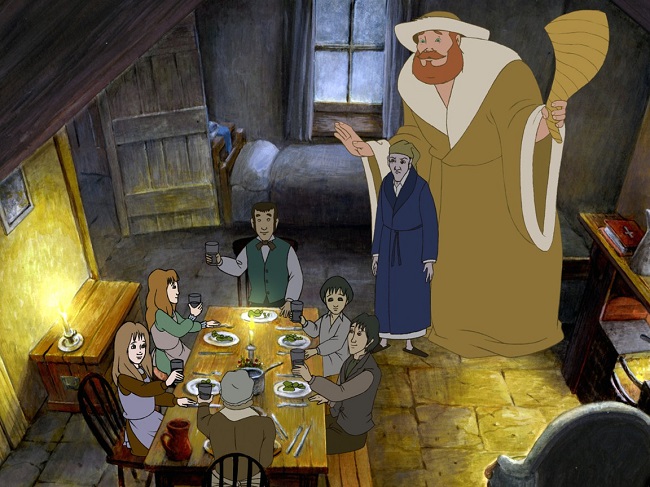
Another aspect of Christmas Carol: The Movie, along with the “expansion” of the story, that makes it stand out from other adaptations is its varied animation style. Each Ghost is accompanied by a distinct aesthetic. It is very noticeable in such scenes where the Ghost of Christmas Past transports Scrooge back to the time of this youth and when the Ghost of Christmas present spreads good cheer via his “horn of plenty”. These “trippy” sequences are dramatic and innovative, yet by this point in the proceedings, the film is tonally all over the shop. We’ve already veered from comedy mice (both Belle and Scrooge have a small murine companion), to insipient infant mortality, and then back to comedy evictions. Then we have the “ignorance and want” scene which has the skin shrinking on the emaciated face of “ignorance” until his skull shatters in a cloud of dust. One for the kids, I think. Also, in some editions of the movie the animated main story is framed between a live action sequence involving Dickens visiting the US and talking about A Christmas Carol to an avid theatre audience. Again, it makes for a very inconsistent piece of cinema.
The conclusion of the story see’s Scrooge reformed and reunited with Belle. He then undertakes the financing of a new hospital. Sadly, the movies lacks any emotional impact because it has tried too hard to be too many things in the proceeding seventy minutes. I can just about muster some praise for Jimmy Murakami for attempting to do something different with such a familiar story, but the film over reaches and cannot decide in what manner to commit itself. Thus, we are left with a rather odd but flawed adaptation that will only really be of interest to niche market film fans. Otherwise, Christmas Carol: The Movie is just something you’d have idly playing in the background over the Christmas holidays, because you’re too full of wine and mince pies to bother to change channel.
This 1954 adaptation of Charles Dickens’ A Christmas Carol is a distinctly studio bound US television production. It was in fact the fourth episode of an anthology variety show called A Shower of Stars. Originally filmed and broadcast in colour, only black and white prints now survive. The production boasts a script by noted American playwright Maxwell Anderson. Due to the 48 minute running time (without commercial breaks) the narrative is heavily abridged and often it is only the story’s most basic themes which are dramatically interpreted. It stars Fredric March who plays Scrooge as a cool and indifferent man, rather than the usual shrill old miser. However, despite his presence his performance cannot save the production. Most of the other cast members are far from accomplished and at times their acting borders on the amateur.
This BBC production from 1977 packs a lot into its 60 minute running time. Succinctly dramatised by Elaine Morgan, this adaptation focuses on the essential themes and key scenes of Dickens’ book. Shot on video, as many BBC dramas were at the time and confined entirely to studio sets, this low budget production makes use of chroma key visual effects. The snow bound countryside, the dark staircase in Scrooge’s apartment and the London skyline are all line drawings, with the cast composited in the foreground. Hence this version of A Christmas Carol feels like an episode of Doctor Who from the same decade. However, the production has one trump card to play with its robust cast of British character actors from the era. Fine performances from the likes of John Le Mesurier, Bernard Lee and Zoe Wanamaker more than compensate for the budgetary restrictions and short duration.
There are three key elements to Disney’s 2009 3D computer-animated adaptation of A Christmas Carol. Firstly, director Robert Zemeckis clearly seeks authenticity and hence includes a lot of original dialogue from the novel, as well as a bleaker depiction of the period. Secondly, he uses the digital production tools at his disposal to create sweeping vistas of 19th century London as well as highly stylised caricatures of the central characters. Thirdly, as this is a Disney production, there is an occasional lapse visual humour and levity that is required by their business model. Sadly all of these aspects of the production make for strange bedfellows that are at odds with each other. The result is a visually sumptuous film that loses its way as it lurches between bleak drama, odd humour and CGI driven spectacle.
Upon its theatrical release, Mickey’s Christmas Carol was the first animated film to star Mickey Mouse for thirty years. It was therefore accompanied with a large amount of hype and a wave of nostalgia. The US marketing stated “He’s Back. Mickey Mouse in his first new motion picture” which was somewhat misleading, as the actual animated film was just 26 minutes long. It was shown theatrically along with a re-release of The Rescuers in the US and The Jungle Book in the UK and other territories, in late December 1983. And despite his name being in the title, Mickey doesn’t have a lot of screen time as he plays Bob Cratchit. This is very much a vehicle for Scrooge McDuck as Ebenezer Scrooge. Overall, it’s a succinct distillation of the plot of Dickens’ A Christmas Carol, filled with cameo appearances by classic Disney characters. Naturally it is replete with the humour and sentiment that is inherent in the process known colloquially as Disneyfication. However, does this mitigate the book’s message?
At first glance, there is not much to distinguish this low budget production by Burbank Films Australia, from any of the other adaptations that were ubiquitous during the seventies and eighties. However, attentive viewers will discover a few details that lift this particular version above the mundane. Firstly, this is the second animated adaptation to feature the voice acting of Ron Haddrick as Ebenezer Scrooge. He had previously voiced the character in Air Programs International's shorter version of A Christmas Carol in 1969, thirteen years earlier. Secondly, despite the modest production values, there are a few additional scenes taken from the source text by Dickens, that don’t usually make it most film and TV adaptations. It is these minor embellishments that compensate for the simplicity of the animation (during the opening scene, some background characters do not move).
It’s interesting that so many adaptations of Charles Dickens’ iconic seasonal story are brought to us via the medium of animation. Naturally, this is a far more economical means of depicting the story with its period detail and supernatural elements, compared to a live action production. However, for an animated version of A Christmas Carol to work successfully, it needs three things. An innovative and striking production design, robust voice acting and a screenplay that keeps the core themes while offering significance difference compared to prior adaptations. You’ll find all of these elements in Richard Williams’ 1971 animated short. Sadly they’re conspicuously absent from the 1997 version. Despite the presence such talents as Tim Curry, Ed Asner and Whoopi Goldberg, this is a distinctly arbitrary animated film. Considering that the screenplay was written by Jymn Magon who has years of experience working for Disney, I had hoped this would be better endeavour.
There’s a degree of hubris implicit in such a definitive title. At the very least the inference is that this is a notable adaptation of Charles Dickens’ classic book. And at first glance, it is perfectly reasonable to assume just that. Jimmy Murakami was an animator of note with such unique movies as The Snowman and When the Wind Blows to his credit. Hence it is reasonable to expect a similar quirky and experimental treatment of this well know yuletide story. However, what audiences actually get is a rather bold adaptation that substantially embellishes upon the established narrative. Veering between sinister and borderline psychedelic imagery, this is a very inconsistent version that tries to be too many things at once. Just as you think you’ve got a handle on the film approach it takes an abrupt turn in the opposite direction. Comedy, drama and even power ballads are thrown into the mix. Sadly, all these elements do not hang well together.
I have written previously about the versatility of Charles Dickens’ classic story and how it lends itself to multiple adaptations and interpretations. This 1938 film version tests that very theory as the reformation and redemption of Ebenezer Scrooge is presented through the medium of Golden Age Hollywood. A Christmas Carol sees the source text sanitised, infantilised and presented as a polished example of wholesome American film making. It has the high production values you’d expect from a studio such as MGM at the time, along with a cloyingly sentimental screenplay that dodges the politics of the book and renders the proceedings into an odd mixture of comedy and soft US Christian propaganda. It presents a very stylised depiction of Dickensian England and bears too many of the obvious foibles and tropes of the studio system that produced the movie.
This 1935 British adaptation of Dickens’ classic book was the first movie version of the story to have sound. Director Henry Edwards had to work creatively to stretch the productions modest budget. Subsequently the production is reliant on fog and snow shrouded sets, mainly to keep costs down. However, this does provide a veneer of authenticity in its depiction of a divided and polluted London. There are a few miniature shots showing the capital city at night and a handful of location shots inside various public buildings to establish the period setting. But mainly this is a set bound production and a sombre one at that. The underlying thrust of this adaptation is to highlight the class division as well as the contrasting wealth and poverty of the country at the time. It is this perspective that is used as the fulcrum of Scrooge’s redemption.
This version of Dickens novel is a very serious and somewhat sombre affair. Patrick Stewart not only stars in this 1999 TV movie but also has a producer credit. Anyone who is familiar with the actor will be aware of his long-standing passion for this tale, as he has starred in several one-man stage performances and narrated an audio book version. Stewart plays his Scrooge as more of an arrogant and aloof businessman. It’s a different Scrooge to that of George C. Scott or Alistair Sim. Here he is much more fearsome and bitter than he is cold and loathsome. Richard E. Grant is a touching, vulnerable Bob Cratchit, who looks decidedly poor and malnourished. There is a more tangible depiction of real poverty here than in other adaptations. The three ghosts are portrayed in a manner closer to the source text, although I could have done without the glowing eyes of the Ghost of Christmas Yet to Come.
The Muppet Christmas Carol was the first Muppet feature film to be made after the death of Jim Henson. The production maintains his standards and style throughout, although due to the plot, this is a somewhat dark Muppet film. It’s also the one most affectionate of the Muppets movie. The plot follows Charles Dickens's original 1843 novel quite closely with the added bonus of The Great Gonzo playing Dickens himself as an ever-present narrator. Michael Caine provides an excellent performance as Ebenezer Scrooge that wouldn’t be out of place in serious adaptation. Caine attacks his role with his acting prowess and does not end up playing second fiddle to The Muppets themselves. As ever with Muppet movies, neither Caine or any other member of the cast ever question the fact that the Muppets aren’t human.
By 1988 Blackadder had run for three seasons in the UK and had seen the central character of Edmund Blackadder evolve from a seedy incompetent to a cunning, scheming, evil genius who was always frustrated at the last moment. Cleverly written by Richard Curtis and Ben Elton and superbly portrayed by Rowan Atkinson, Blackadder was very much at the cutting edge of British comedy of the time. It managed to mix physical humour, with verbal sparring, sarcasm, dry self-deprecation and irony. It was popular with a very broad spectrum of viewers.
Over the last few years I’ve reviewed several adaptations of Charles Dickens seasonal story A Christmas Carol. As I stated previously one of the stories greatest strength is that it lends itself perfectly to multiple interpretations. I recently had the good fortune to rediscover the animated version from 1969 by Air Programs International. I remember seeing this animated short as a child but could not recollect sufficient details to allow me to track it down via the IMDB. Then by complete chance, I stumbled across it again on You Tube while doing some research.
I have a great deal of affection for Charles Dickens' A Christmas Carol, not only because it’s a fine piece of literature but because it lends itself so well to dramatisation. I therefore have a keen interests in all the respective adaptation, of which there are many. Over the years there has been a trend to focus excessively on the sentimental aspect of the plot, resulting in a rather nauseating Disneyfication of the story. Although the redemption of the main protagonist is central to the narrative, the poverty and deprivations of the time are still very pertinent themes, especially in today's economic climate. I was therefore very gratified to rediscover the 1971 version of Charles Dickens' classic story which was originally shown on ABC. This short 25 minute animated feature realises the story superbly, capturing the tone of the book and accurately reflecting the darker aspects. Remember that A Christmas Carol is fundamentally a ghost story.
Clive Donner's 1984 version of the Dickens' classic "A Christmas Carol” is bold and different mainly because of the casting of George C. Scott as Ebenezer Scrooge. The story is told with precision and an eye to detail. In some respects it’s the most authentic adaptation, with credible performances from the ensemble cast. Alastair Sim's portrayal in the 1951 film has always been perceived as a benchmark and provided a template as to how the role should be interpreted. Scott replaces the traditional anger, bitterness and rage with a cold and utterly dispassionate demeanour. There is a strong sense of honesty in his Scrooge as the audience follows him on his emotional journey. The tears, the regret and the realisation that there is still hope are all present, yet explored in a very non-theatrical manner.
The all-star big screen musical was desperately striving to be different during the sixties and seventies, producing many hits and misses. Tommy, The Lost Horizon and The Wiz are prime examples of the experimentation made within the genre at the time. However, due to the success of Oliver! at the box office in 1968 it was thought that there was potential mileage to be had from Dicken's classic "A Christmas Carol". So the musical Scrooge was conceived. Unlike Oliver! it was not based on a existing stage adaptation but on a wholly original screenplay, although a theatrical treatment has since been adapted.
I am a great fan of Charles Dickens' "A Christmas Carol". There is something very special about the novella which is quite hard to quantify. It is a very unique book despite its central theme of redemption being universal. The text has for want of another phrase, a "power" to it. It is profoundly moving, insightful and true. Perhaps the key this story’s appeal lies with the central character, Ebenezer Scrooge. Not because Scrooge is a monster (which are so often fascinating) but because he's a man broken by circumstance. I think readers throughout the years have related to this and considered "There, but for the grace of God, go I". Cinema has found a rich vein of gold running through this tale, which is why it’s been revisited so often and interpreted so many ways.
The Hobbit (1977)
The Hobbit (1977) is a curious beast. It’s a made for television animated film, which despite its budgetary constraints, strives to comprehensively adapted one of the most beloved children’s books of the last century. I remember reading an article about this television adaptation of The Hobbit, in Starburst Magazine during the late seventies. There were rumours that this Rankin/Bass production, which had already premièred on US network television, would gain a European cinema release. This was presumably to cash in on the success of Ralph Bakshi's animated feature film adaptation of The Lord of The Rings. However, this never happened to my knowledge. In fact, The Hobbit was not commercially available in the UK until 2001, when Warner Bros. released it on DVD to capitalise on the success of Peter Jackson’s The Fellowship of the Ring.
The Hobbit (1977) is a curious beast. It’s a made for television animated film, which despite its budgetary constraints, strives to comprehensively adapted one of the most beloved children’s books of the last century. I remember reading an article about this television adaptation of The Hobbit, in Starburst Magazine during the late seventies. There were rumours that this Rankin/Bass production, which had already premièred on US network television, would gain a European cinema release. This was presumably to cash in on the success of Ralph Bakshi's animated feature film adaptation of The Lord of The Rings. However, this never happened to my knowledge. In fact, The Hobbit was not commercially available in the UK until 2001, when Warner Bros. released it on DVD to capitalise on the success of Peter Jackson’s The Fellowship of the Ring.
Rankin/Bass productions had a pedigree in bringing traditional and familiar children's material to the small screen, with such titles as Frosty the Snowman and Rudolph the Red-Nosed Reindeer, so it was not unusual for them to take on such a project. However, a lot of the animation was sub contracted to Japanese studios, which was a standard practise at the time. This subsequently had a major impact on the production design and the aesthetics of the film. Rankin/Bass productions often included songs in their commercial output as it had proven to be a major selling point in the past. Naturally, original Tolkien's work with its abundance of songs and verse, lent itself to this very well. As a result, The Hobbit has a wealth of vocal tracks sung by popular folk singer, Glenn Yarbrough. They’re not to everyone’s taste but they do work, and some do stick quite faithfully to the source text.
The adaptation of the story is very simple. Some of the more complex plot details have been lost, such as the Arkenstone of Thrain, the skin-changer Beorn and the scheming master of Lake Town. Tolkien wrote this story for children and that is the way the film’s screenplay is pitched. The character designs range from the adequate to the bizarre. Gandalf is represented pretty much as you would expect, sticking to the usual old man with a pointy hat trope. Bilbo and the Dwarves reflect a more juvenile friendly interpretation. However, the Trolls and Goblins are not especially scary and lack any real sense of threat. It is in the design of the Elves that this production really fumbles the ball. This race of near perfect creatures with their angelic qualities, are simply ugly and emaciated. Someone definitely failed to understand the source text in this respect. Gollum is also poorly conceived and looks a little like a large Bullfrog. And all I'll say about the dragon Smaug, is that his feline quality is "unusual".
With these shortcomings, are there any positive attributes regarding this production? Well the minimalist water colour backgrounds work well, often drawing on Tolkien’s illustrations themselves. The voice casting has some strong performers, such as John Huston as Gandalf. However, some of the minor characters are played by well-known voice artists Don Messick and John Stephenson. As a result, you do feel that you’re watching an episode of Scooby Doo or The Arabian Nights at times. So where does this leave us? Well it's difficult to be objective, as any adaptation of Professor Tolkien's work tends to be over shadowed by the success of Peter Jackson's two trilogies, which have established an aesthetic standard. Therefore, this older version of The Hobbit suffers as a result, as it flies in the face of this. Overall, it’s a low budget, basic adaptation, with a variety of good and bad animation. It will probably find its most appreciative audience, among children, for whom it was intended.

Sometime in August 1979, I was travelling with my father by train to London, when I first saw posters advertising the Ralph Bakshi animated version of J. R. R. Tolkien’s The Lord of the Rings. The film had been released in the US the previous November and I aware of its existence because I had read articles about it production in Starburst magazine. Even at the age of 11 I was interested in genre films and television, having been raised on Doctor Who and Ray Harryhausen’s back catalogue of fantasy movies. Furthermore, I was familiar with Tolkien’s first novel, The Hobbit, as my father had read it to me when I was younger. I was impressed by the poster in that way that only an 11 year old can be. Why was Gandalf do gigantic? Also the A rating was enigmatic. Most animated films were usually rated U. Yet despite my interest, I didn’t see The Lord of the Rings at the cinema during the summer holidays.
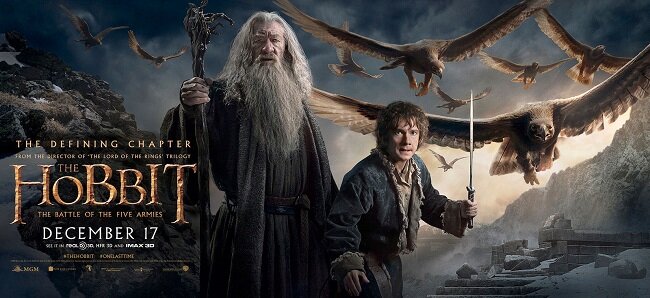
This December marks the 20th anniversary of the release of The Fellowship of the Ring, the first instalment of Peter Jacksons' adaptation of J.R.R. Tolkien’s iconic novel, The Lord of the Rings. To celebrate this occasion, I shall post new reviews of the extended edition of all three films, as well as those of The Hobbit trilogy, which were made a decade later.
The Battle of the Five Armies is noticeably shorter than it's two predecessors, mainly because there is insufficient narrative to sustain the proceedings. Even the extended edition which adds a further 20 minutes to the running time, increasing it to 164 minutes, is mainly driven by one ongoing action sequence which is the titular battle. After the somewhat languid pace of the first movie and the bloated excess of the second, this further change of pace seems somewhat perplexing. Despite the more economical running time, events occur very rapidly. Perhaps a little too rapidly. It can be cogently argued that it somewhat diminishes the impact of some of them. Perhaps the biggest issue being the demise of Smaug. It comes promptly at the start of The Battle of the Five Armies and although spectacular, it quickly negates a major plot element.
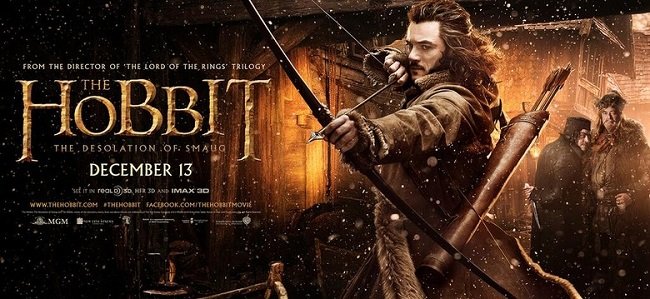
This December marks the 20th anniversary of the release of The Fellowship of the Ring, the first instalment of Peter Jacksons' adaptation of J.R.R. Tolkien’s iconic novel, The Lord of the Rings. To celebrate this occasion, I shall post new reviews of the extended edition of all three films, as well as those of The Hobbit trilogy, which were made a decade later.
I love the medium of film immensely. I like a wide range of genres and will happily watch weighty human dramas as well as the worst sort of trashy exploitation fodder. The key to reconciling such widely differing types of cinema is to judge them within their own context. Therefore don't compare the respective worth of Citizen Kane with The Golden Voyage of Sinbad, or Bicycle Thieves with The Medusa Touch. So because of the nature of Peter Jackson's adaptation of The Hobbit, I am prepared to make concessions to the fact that it is a big budget fantasy blockbuster franchise. Also the source material from which the film derives is quite sparse, often being nothing more than footnotes, or summations of history. Thus there is scope for a lot of "adaptation", artistic license and creativity. Jackson got a lot of this right with The Lord of the Rings trilogy, over a decade ago. I do not believe that to be the case this time round.
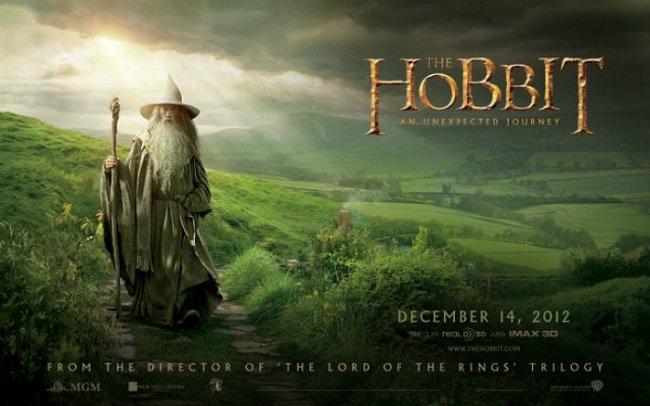
This December marks the 20th anniversary of the release of The Fellowship of the Ring. The first instalment of Peter Jacksons' adaptation of J.R.R. Tolkien’s iconic novel, The Lord of the Rings. To celebrate this occasion, I shall post new reviews of the extended edition of all three films, as well as those of The Hobbit trilogy, which were made a decade later.
Firstly let me start by saying I think the word unexpected is very apt in respect of the first instalment of Peter Jackson's three part adaptation of Tolkien's prequel to The Lord of the Rings. It is genuinely surprising how well parts of the narrative had been adapted and interpreted. Similarly there are other aspects that are less successful. Overall the good outweighs the bad but only the most ardent fanboy or girl would think the movie flawless. When one considers its problematic production along with the change of directors, this is quite an achievement. I wonder how much of Guillermo del Toro’s material survived into Peter Jacksons, Fran Walsh and Philippa Boyens revised screenplay? Secondly, a decade on from The Lord of the Rings, there has been a further move away from physical visual effects and filming on photographic film. Both of these changes are noticeable in An Unexpected Journey but the presence of Peter Jackson and his very specific style of filmmaking maintains a very strong sense of continuity.
The Hobbit (1977) is a curious beast. It’s a made for television animated film, which despite its budgetary constraints, strives to comprehensively adapted one of the most beloved children’s books of the last century. I remember reading an article about this television adaptation of The Hobbit, in Starburst Magazine during the late seventies. There were rumours that this Rankin/Bass production, which had already premièred on US network television, would gain a European cinema release. This was presumably to cash in on the success of Ralph Bakshi's animated feature film adaptation of The Lord of The Rings. However, this never happened to my knowledge. In fact, The Hobbit was not commercially available in the UK until 2001, when Warner Bros. released it on DVD to capitalise on the success of Peter Jackson’s The Fellowship of the Ring.

In 1989 Eclipse Comics produced a three-part adaptation of The Hobbit by Chuck Dixon, Sean Deming and illustrated by David Wenzel. A year later, due to public demand, this was subsequently re-issued as a single graphic novel that has remained in print ever since. The writers wisely chose to sensitively abridge Tolkien’s source text, rather than adapted the story and make any major changes. Hence this graphic novel version of The Hobbit retains much of the dialogue from the original novel and subsequently maintains the book’s inherent charm. There are no major plot omissions and the narrative flows well. The panel layouts are innovative and accommodate a wealth of written material without overwhelming the artwork.
There are and always will be books that have a clear political agenda or make a very particular statement. Orwell’s 1984 springs to mind as an obvious example. Then there are also books that attract political interpretations by the nature of their plot or the subjects that they explore. Whether the author intended such a debate about the work or not, is a secondary issue. I have always taken Tolkien’s work at face value and to be what he stated they were. Epic and intricate faux histories, free from allegory. Furthermore, I appreciate that the moral position and themes of his work stem from the authors world view, personal experiences as well as the prevailing social dogma of the time. I find it interesting how his work attracts praise and adulation from a wide variety of groups. Catholics will naturally gravitate towards Tolkien’s writings due to his faith and that is the prism through which they will critically view his work. There are of course other examples about how The Hobbit and The Lord of the Rings appeals to different people in different ways. It is a common aspect of fandom.
The theatrical edition of The Hobbit: The Battle of the Five Armies was light on plot and heavy on action sequences. As a result it had many unresolved story lines. The extended editions once again attempts to address these deficiencies but sadly out of the twenty minutes of additional material that has been added, most are extended action scenes. There are moments of substance buried within this ponderous expanded edition but they are few and far between. Compared to other entries in the extended trilogy, this is the weakest as it really doesn’t add any major plot or narrative improvements. It does however add a lot more orc based violence.
A Christmas Carol (1969)
Over the last few years I’ve reviewed several adaptations of Charles Dickens seasonal story A Christmas Carol. As I stated previously one of the stories greatest strength is that it lends itself perfectly to multiple interpretations. I recently had the good fortune to rediscover the animated version from 1969 by Air Programs International. I remember seeing this animated short as a child but could not recollect sufficient details to allow me to track it down via the IMDB. Then by complete chance, I stumbled across it again on You Tube while doing some research.
Over the last few years I’ve reviewed several adaptations of Charles Dickens seasonal story A Christmas Carol. As I stated previously one of the stories greatest strength is that it lends itself perfectly to multiple interpretations. I recently had the good fortune to rediscover the animated version from 1969 by Air Programs International. I remember seeing this animated short as a child but could not recollect sufficient details to allow me to track it down via the IMDB. Then by complete chance, I stumbled across it again on You Tube while doing some research.
This forty-six-minute-long adaptation was produced by an Australian animation company and has some curious and amusing regional embellishments. The voice acting lapses into Australian accents from time to time and there is an odd song dovetailed into Fred's visit to his Uncle Ebenezer. It's as if the production team where toying with the idea of making a musical and then had second thoughts. However, despite these foibles the functional animation and aesthetic style is grimly appropriate, capturing the grey and dreary Dickensian winter.
The most innovative aspect of this particular adaptation is the inventive depiction of Marley’s Ghost. Unlike other versions of the story that portray Marley as a spectral version of his former human self, here we have a very stylised ghost. His hair is more akin to naked flames which is a rather interesting interpretation of the source text. "The Ghost sat perfectly motionless, its hair, and skirts, and tassels, were still agitated as by the hot vapour from an oven". In addition, the sightless black sockets are rather ghoulish, making this one of the most sinister portrayals of the character.
Overall this is a functional adaptation that manages to convey the key elements of the story. To be honest the story is quite difficult to spoil, unless you are a particularly blinkered film maker. As this version was specifically designed to be pitched at younger audiences, there is some levity introduced into the proceedings. Scrooge continuously stifles a sneeze throughout the story, something that he cannot resolve until he is "redeemed". There are far worse adaptations of this classic tale, so for those who are curious or are just interested in the art of animation, here is the 1969 version for your enjoyment.
This 1954 adaptation of Charles Dickens’ A Christmas Carol is a distinctly studio bound US television production. It was in fact the fourth episode of an anthology variety show called A Shower of Stars. Originally filmed and broadcast in colour, only black and white prints now survive. The production boasts a script by noted American playwright Maxwell Anderson. Due to the 48 minute running time (without commercial breaks) the narrative is heavily abridged and often it is only the story’s most basic themes which are dramatically interpreted. It stars Fredric March who plays Scrooge as a cool and indifferent man, rather than the usual shrill old miser. However, despite his presence his performance cannot save the production. Most of the other cast members are far from accomplished and at times their acting borders on the amateur.
This BBC production from 1977 packs a lot into its 60 minute running time. Succinctly dramatised by Elaine Morgan, this adaptation focuses on the essential themes and key scenes of Dickens’ book. Shot on video, as many BBC dramas were at the time and confined entirely to studio sets, this low budget production makes use of chroma key visual effects. The snow bound countryside, the dark staircase in Scrooge’s apartment and the London skyline are all line drawings, with the cast composited in the foreground. Hence this version of A Christmas Carol feels like an episode of Doctor Who from the same decade. However, the production has one trump card to play with its robust cast of British character actors from the era. Fine performances from the likes of John Le Mesurier, Bernard Lee and Zoe Wanamaker more than compensate for the budgetary restrictions and short duration.
There are three key elements to Disney’s 2009 3D computer-animated adaptation of A Christmas Carol. Firstly, director Robert Zemeckis clearly seeks authenticity and hence includes a lot of original dialogue from the novel, as well as a bleaker depiction of the period. Secondly, he uses the digital production tools at his disposal to create sweeping vistas of 19th century London as well as highly stylised caricatures of the central characters. Thirdly, as this is a Disney production, there is an occasional lapse visual humour and levity that is required by their business model. Sadly all of these aspects of the production make for strange bedfellows that are at odds with each other. The result is a visually sumptuous film that loses its way as it lurches between bleak drama, odd humour and CGI driven spectacle.
Upon its theatrical release, Mickey’s Christmas Carol was the first animated film to star Mickey Mouse for thirty years. It was therefore accompanied with a large amount of hype and a wave of nostalgia. The US marketing stated “He’s Back. Mickey Mouse in his first new motion picture” which was somewhat misleading, as the actual animated film was just 26 minutes long. It was shown theatrically along with a re-release of The Rescuers in the US and The Jungle Book in the UK and other territories, in late December 1983. And despite his name being in the title, Mickey doesn’t have a lot of screen time as he plays Bob Cratchit. This is very much a vehicle for Scrooge McDuck as Ebenezer Scrooge. Overall, it’s a succinct distillation of the plot of Dickens’ A Christmas Carol, filled with cameo appearances by classic Disney characters. Naturally it is replete with the humour and sentiment that is inherent in the process known colloquially as Disneyfication. However, does this mitigate the book’s message?
At first glance, there is not much to distinguish this low budget production by Burbank Films Australia, from any of the other adaptations that were ubiquitous during the seventies and eighties. However, attentive viewers will discover a few details that lift this particular version above the mundane. Firstly, this is the second animated adaptation to feature the voice acting of Ron Haddrick as Ebenezer Scrooge. He had previously voiced the character in Air Programs International's shorter version of A Christmas Carol in 1969, thirteen years earlier. Secondly, despite the modest production values, there are a few additional scenes taken from the source text by Dickens, that don’t usually make it most film and TV adaptations. It is these minor embellishments that compensate for the simplicity of the animation (during the opening scene, some background characters do not move).
It’s interesting that so many adaptations of Charles Dickens’ iconic seasonal story are brought to us via the medium of animation. Naturally, this is a far more economical means of depicting the story with its period detail and supernatural elements, compared to a live action production. However, for an animated version of A Christmas Carol to work successfully, it needs three things. An innovative and striking production design, robust voice acting and a screenplay that keeps the core themes while offering significance difference compared to prior adaptations. You’ll find all of these elements in Richard Williams’ 1971 animated short. Sadly they’re conspicuously absent from the 1997 version. Despite the presence such talents as Tim Curry, Ed Asner and Whoopi Goldberg, this is a distinctly arbitrary animated film. Considering that the screenplay was written by Jymn Magon who has years of experience working for Disney, I had hoped this would be better endeavour.
There’s a degree of hubris implicit in such a definitive title. At the very least the inference is that this is a notable adaptation of Charles Dickens’ classic book. And at first glance, it is perfectly reasonable to assume just that. Jimmy Murakami was an animator of note with such unique movies as The Snowman and When the Wind Blows to his credit. Hence it is reasonable to expect a similar quirky and experimental treatment of this well know yuletide story. However, what audiences actually get is a rather bold adaptation that substantially embellishes upon the established narrative. Veering between sinister and borderline psychedelic imagery, this is a very inconsistent version that tries to be too many things at once. Just as you think you’ve got a handle on the film approach it takes an abrupt turn in the opposite direction. Comedy, drama and even power ballads are thrown into the mix. Sadly, all these elements do not hang well together.
I have written previously about the versatility of Charles Dickens’ classic story and how it lends itself to multiple adaptations and interpretations. This 1938 film version tests that very theory as the reformation and redemption of Ebenezer Scrooge is presented through the medium of Golden Age Hollywood. A Christmas Carol sees the source text sanitised, infantilised and presented as a polished example of wholesome American film making. It has the high production values you’d expect from a studio such as MGM at the time, along with a cloyingly sentimental screenplay that dodges the politics of the book and renders the proceedings into an odd mixture of comedy and soft US Christian propaganda. It presents a very stylised depiction of Dickensian England and bears too many of the obvious foibles and tropes of the studio system that produced the movie.
This 1935 British adaptation of Dickens’ classic book was the first movie version of the story to have sound. Director Henry Edwards had to work creatively to stretch the productions modest budget. Subsequently the production is reliant on fog and snow shrouded sets, mainly to keep costs down. However, this does provide a veneer of authenticity in its depiction of a divided and polluted London. There are a few miniature shots showing the capital city at night and a handful of location shots inside various public buildings to establish the period setting. But mainly this is a set bound production and a sombre one at that. The underlying thrust of this adaptation is to highlight the class division as well as the contrasting wealth and poverty of the country at the time. It is this perspective that is used as the fulcrum of Scrooge’s redemption.
This version of Dickens novel is a very serious and somewhat sombre affair. Patrick Stewart not only stars in this 1999 TV movie but also has a producer credit. Anyone who is familiar with the actor will be aware of his long-standing passion for this tale, as he has starred in several one-man stage performances and narrated an audio book version. Stewart plays his Scrooge as more of an arrogant and aloof businessman. It’s a different Scrooge to that of George C. Scott or Alistair Sim. Here he is much more fearsome and bitter than he is cold and loathsome. Richard E. Grant is a touching, vulnerable Bob Cratchit, who looks decidedly poor and malnourished. There is a more tangible depiction of real poverty here than in other adaptations. The three ghosts are portrayed in a manner closer to the source text, although I could have done without the glowing eyes of the Ghost of Christmas Yet to Come.
The Muppet Christmas Carol was the first Muppet feature film to be made after the death of Jim Henson. The production maintains his standards and style throughout, although due to the plot, this is a somewhat dark Muppet film. It’s also the one most affectionate of the Muppets movie. The plot follows Charles Dickens's original 1843 novel quite closely with the added bonus of The Great Gonzo playing Dickens himself as an ever-present narrator. Michael Caine provides an excellent performance as Ebenezer Scrooge that wouldn’t be out of place in serious adaptation. Caine attacks his role with his acting prowess and does not end up playing second fiddle to The Muppets themselves. As ever with Muppet movies, neither Caine or any other member of the cast ever question the fact that the Muppets aren’t human.
By 1988 Blackadder had run for three seasons in the UK and had seen the central character of Edmund Blackadder evolve from a seedy incompetent to a cunning, scheming, evil genius who was always frustrated at the last moment. Cleverly written by Richard Curtis and Ben Elton and superbly portrayed by Rowan Atkinson, Blackadder was very much at the cutting edge of British comedy of the time. It managed to mix physical humour, with verbal sparring, sarcasm, dry self-deprecation and irony. It was popular with a very broad spectrum of viewers.
Over the last few years I’ve reviewed several adaptations of Charles Dickens seasonal story A Christmas Carol. As I stated previously one of the stories greatest strength is that it lends itself perfectly to multiple interpretations. I recently had the good fortune to rediscover the animated version from 1969 by Air Programs International. I remember seeing this animated short as a child but could not recollect sufficient details to allow me to track it down via the IMDB. Then by complete chance, I stumbled across it again on You Tube while doing some research.
I have a great deal of affection for Charles Dickens' A Christmas Carol, not only because it’s a fine piece of literature but because it lends itself so well to dramatisation. I therefore have a keen interests in all the respective adaptation, of which there are many. Over the years there has been a trend to focus excessively on the sentimental aspect of the plot, resulting in a rather nauseating Disneyfication of the story. Although the redemption of the main protagonist is central to the narrative, the poverty and deprivations of the time are still very pertinent themes, especially in today's economic climate. I was therefore very gratified to rediscover the 1971 version of Charles Dickens' classic story which was originally shown on ABC. This short 25 minute animated feature realises the story superbly, capturing the tone of the book and accurately reflecting the darker aspects. Remember that A Christmas Carol is fundamentally a ghost story.
Clive Donner's 1984 version of the Dickens' classic "A Christmas Carol” is bold and different mainly because of the casting of George C. Scott as Ebenezer Scrooge. The story is told with precision and an eye to detail. In some respects it’s the most authentic adaptation, with credible performances from the ensemble cast. Alastair Sim's portrayal in the 1951 film has always been perceived as a benchmark and provided a template as to how the role should be interpreted. Scott replaces the traditional anger, bitterness and rage with a cold and utterly dispassionate demeanour. There is a strong sense of honesty in his Scrooge as the audience follows him on his emotional journey. The tears, the regret and the realisation that there is still hope are all present, yet explored in a very non-theatrical manner.
The all-star big screen musical was desperately striving to be different during the sixties and seventies, producing many hits and misses. Tommy, The Lost Horizon and The Wiz are prime examples of the experimentation made within the genre at the time. However, due to the success of Oliver! at the box office in 1968 it was thought that there was potential mileage to be had from Dicken's classic "A Christmas Carol". So the musical Scrooge was conceived. Unlike Oliver! it was not based on a existing stage adaptation but on a wholly original screenplay, although a theatrical treatment has since been adapted.
I am a great fan of Charles Dickens' "A Christmas Carol". There is something very special about the novella which is quite hard to quantify. It is a very unique book despite its central theme of redemption being universal. The text has for want of another phrase, a "power" to it. It is profoundly moving, insightful and true. Perhaps the key this story’s appeal lies with the central character, Ebenezer Scrooge. Not because Scrooge is a monster (which are so often fascinating) but because he's a man broken by circumstance. I think readers throughout the years have related to this and considered "There, but for the grace of God, go I". Cinema has found a rich vein of gold running through this tale, which is why it’s been revisited so often and interpreted so many ways.
A Christmas Carol (1971)
I have a great deal of affection for Charles Dickens' A Christmas Carol, not only because it’s a fine piece of literature but because it lends itself so well to dramatisation. I therefore have a keen interests in all the respective adaptation, of which there are many. Over the years there has been a trend to focus excessively on the sentimental aspect of the plot, resulting in a rather nauseating Disneyfication of the story. Although the redemption of the main protagonist is central to the narrative, the poverty and deprivations of the time are still very pertinent themes, especially in today's economic climate. I was therefore very gratified to rediscover the 1971 version of Charles Dickens' classic story which was originally shown on ABC. This short 25 minute animated feature realises the story superbly, capturing the tone of the book and accurately reflecting the darker aspects. Remember that A Christmas Carol is fundamentally a ghost story.
I have a great deal of affection for Charles Dickens' A Christmas Carol, not only because it’s a fine piece of literature but because it lends itself so well to dramatisation. I therefore have a keen interests in all the respective adaptation, of which there are many. Over the years there has been a trend to focus excessively on the sentimental aspect of the plot, resulting in a rather nauseating Disneyfication of the story. Although the redemption of the main protagonist is central to the narrative, the poverty and deprivations of the time are still very pertinent themes, especially in today's economic climate. I was therefore very gratified to rediscover the 1971 version of Charles Dickens' classic story which was originally shown on ABC. This short 25 minute animated feature realises the story superbly, capturing the tone of the book and accurately reflecting the darker aspects. Remember that A Christmas Carol is fundamentally a ghost story.
The TV special features Alastair Sim as the voice of Ebenezer Scrooge (a role Sim had previously performed in the 1951 live-action film Scrooge). Michael Hordern likewise reprised his 1951 performance as Marley's Ghost. Veteran animator Chuck Jones served as executive producer, while the great Richard Williams directed. This is a very distinguished pedigree for any animated production. The story is beautifully condensed considering the running time and captures the harsh winter environment of London in the 1843. The supernatural elements are intelligently realised, drawing directly from the source text. The scene where Marley's Ghost, removes the handkerchief that secures his jaw, so it drops to his chest terrified me as a child when I first saw it. The subsequent depiction of "Ignorance" and "Want" is also bleak and shocking.
Originally produced for television, A Christmas Carol won an Academy Award for best animated short subject in 1973; it remains the only film adaptation of the story to date to have done so. However, elements within Hollywood were unhappy that a TV show had won an Academy Award, which led to the Academy changing its policy, disqualifying any shorts that were shown on television first. Overall A Christmas Carol remains a benchmark for quality animations. The subtle line drawings and water colours bring Dicken's London to life wonderfully. The characters are vividly drawn and reflect a thoughtful design. The voice cast bring gravitas to the proceedings, resulting in a quality adaptation of the story. Unfortunately, this short animated film is not readily available. The VHS release is long obsolete and there is no mainstream DVD copy available. The film did feature on a limited edition DVD boxset of the work of Richard Williams. If you can track down a copy via the internet, then you will be well rewarded.
This 1954 adaptation of Charles Dickens’ A Christmas Carol is a distinctly studio bound US television production. It was in fact the fourth episode of an anthology variety show called A Shower of Stars. Originally filmed and broadcast in colour, only black and white prints now survive. The production boasts a script by noted American playwright Maxwell Anderson. Due to the 48 minute running time (without commercial breaks) the narrative is heavily abridged and often it is only the story’s most basic themes which are dramatically interpreted. It stars Fredric March who plays Scrooge as a cool and indifferent man, rather than the usual shrill old miser. However, despite his presence his performance cannot save the production. Most of the other cast members are far from accomplished and at times their acting borders on the amateur.
This BBC production from 1977 packs a lot into its 60 minute running time. Succinctly dramatised by Elaine Morgan, this adaptation focuses on the essential themes and key scenes of Dickens’ book. Shot on video, as many BBC dramas were at the time and confined entirely to studio sets, this low budget production makes use of chroma key visual effects. The snow bound countryside, the dark staircase in Scrooge’s apartment and the London skyline are all line drawings, with the cast composited in the foreground. Hence this version of A Christmas Carol feels like an episode of Doctor Who from the same decade. However, the production has one trump card to play with its robust cast of British character actors from the era. Fine performances from the likes of John Le Mesurier, Bernard Lee and Zoe Wanamaker more than compensate for the budgetary restrictions and short duration.
There are three key elements to Disney’s 2009 3D computer-animated adaptation of A Christmas Carol. Firstly, director Robert Zemeckis clearly seeks authenticity and hence includes a lot of original dialogue from the novel, as well as a bleaker depiction of the period. Secondly, he uses the digital production tools at his disposal to create sweeping vistas of 19th century London as well as highly stylised caricatures of the central characters. Thirdly, as this is a Disney production, there is an occasional lapse visual humour and levity that is required by their business model. Sadly all of these aspects of the production make for strange bedfellows that are at odds with each other. The result is a visually sumptuous film that loses its way as it lurches between bleak drama, odd humour and CGI driven spectacle.
Upon its theatrical release, Mickey’s Christmas Carol was the first animated film to star Mickey Mouse for thirty years. It was therefore accompanied with a large amount of hype and a wave of nostalgia. The US marketing stated “He’s Back. Mickey Mouse in his first new motion picture” which was somewhat misleading, as the actual animated film was just 26 minutes long. It was shown theatrically along with a re-release of The Rescuers in the US and The Jungle Book in the UK and other territories, in late December 1983. And despite his name being in the title, Mickey doesn’t have a lot of screen time as he plays Bob Cratchit. This is very much a vehicle for Scrooge McDuck as Ebenezer Scrooge. Overall, it’s a succinct distillation of the plot of Dickens’ A Christmas Carol, filled with cameo appearances by classic Disney characters. Naturally it is replete with the humour and sentiment that is inherent in the process known colloquially as Disneyfication. However, does this mitigate the book’s message?
At first glance, there is not much to distinguish this low budget production by Burbank Films Australia, from any of the other adaptations that were ubiquitous during the seventies and eighties. However, attentive viewers will discover a few details that lift this particular version above the mundane. Firstly, this is the second animated adaptation to feature the voice acting of Ron Haddrick as Ebenezer Scrooge. He had previously voiced the character in Air Programs International's shorter version of A Christmas Carol in 1969, thirteen years earlier. Secondly, despite the modest production values, there are a few additional scenes taken from the source text by Dickens, that don’t usually make it most film and TV adaptations. It is these minor embellishments that compensate for the simplicity of the animation (during the opening scene, some background characters do not move).
It’s interesting that so many adaptations of Charles Dickens’ iconic seasonal story are brought to us via the medium of animation. Naturally, this is a far more economical means of depicting the story with its period detail and supernatural elements, compared to a live action production. However, for an animated version of A Christmas Carol to work successfully, it needs three things. An innovative and striking production design, robust voice acting and a screenplay that keeps the core themes while offering significance difference compared to prior adaptations. You’ll find all of these elements in Richard Williams’ 1971 animated short. Sadly they’re conspicuously absent from the 1997 version. Despite the presence such talents as Tim Curry, Ed Asner and Whoopi Goldberg, this is a distinctly arbitrary animated film. Considering that the screenplay was written by Jymn Magon who has years of experience working for Disney, I had hoped this would be better endeavour.
There’s a degree of hubris implicit in such a definitive title. At the very least the inference is that this is a notable adaptation of Charles Dickens’ classic book. And at first glance, it is perfectly reasonable to assume just that. Jimmy Murakami was an animator of note with such unique movies as The Snowman and When the Wind Blows to his credit. Hence it is reasonable to expect a similar quirky and experimental treatment of this well know yuletide story. However, what audiences actually get is a rather bold adaptation that substantially embellishes upon the established narrative. Veering between sinister and borderline psychedelic imagery, this is a very inconsistent version that tries to be too many things at once. Just as you think you’ve got a handle on the film approach it takes an abrupt turn in the opposite direction. Comedy, drama and even power ballads are thrown into the mix. Sadly, all these elements do not hang well together.
I have written previously about the versatility of Charles Dickens’ classic story and how it lends itself to multiple adaptations and interpretations. This 1938 film version tests that very theory as the reformation and redemption of Ebenezer Scrooge is presented through the medium of Golden Age Hollywood. A Christmas Carol sees the source text sanitised, infantilised and presented as a polished example of wholesome American film making. It has the high production values you’d expect from a studio such as MGM at the time, along with a cloyingly sentimental screenplay that dodges the politics of the book and renders the proceedings into an odd mixture of comedy and soft US Christian propaganda. It presents a very stylised depiction of Dickensian England and bears too many of the obvious foibles and tropes of the studio system that produced the movie.
This 1935 British adaptation of Dickens’ classic book was the first movie version of the story to have sound. Director Henry Edwards had to work creatively to stretch the productions modest budget. Subsequently the production is reliant on fog and snow shrouded sets, mainly to keep costs down. However, this does provide a veneer of authenticity in its depiction of a divided and polluted London. There are a few miniature shots showing the capital city at night and a handful of location shots inside various public buildings to establish the period setting. But mainly this is a set bound production and a sombre one at that. The underlying thrust of this adaptation is to highlight the class division as well as the contrasting wealth and poverty of the country at the time. It is this perspective that is used as the fulcrum of Scrooge’s redemption.
This version of Dickens novel is a very serious and somewhat sombre affair. Patrick Stewart not only stars in this 1999 TV movie but also has a producer credit. Anyone who is familiar with the actor will be aware of his long-standing passion for this tale, as he has starred in several one-man stage performances and narrated an audio book version. Stewart plays his Scrooge as more of an arrogant and aloof businessman. It’s a different Scrooge to that of George C. Scott or Alistair Sim. Here he is much more fearsome and bitter than he is cold and loathsome. Richard E. Grant is a touching, vulnerable Bob Cratchit, who looks decidedly poor and malnourished. There is a more tangible depiction of real poverty here than in other adaptations. The three ghosts are portrayed in a manner closer to the source text, although I could have done without the glowing eyes of the Ghost of Christmas Yet to Come.
The Muppet Christmas Carol was the first Muppet feature film to be made after the death of Jim Henson. The production maintains his standards and style throughout, although due to the plot, this is a somewhat dark Muppet film. It’s also the one most affectionate of the Muppets movie. The plot follows Charles Dickens's original 1843 novel quite closely with the added bonus of The Great Gonzo playing Dickens himself as an ever-present narrator. Michael Caine provides an excellent performance as Ebenezer Scrooge that wouldn’t be out of place in serious adaptation. Caine attacks his role with his acting prowess and does not end up playing second fiddle to The Muppets themselves. As ever with Muppet movies, neither Caine or any other member of the cast ever question the fact that the Muppets aren’t human.
By 1988 Blackadder had run for three seasons in the UK and had seen the central character of Edmund Blackadder evolve from a seedy incompetent to a cunning, scheming, evil genius who was always frustrated at the last moment. Cleverly written by Richard Curtis and Ben Elton and superbly portrayed by Rowan Atkinson, Blackadder was very much at the cutting edge of British comedy of the time. It managed to mix physical humour, with verbal sparring, sarcasm, dry self-deprecation and irony. It was popular with a very broad spectrum of viewers.
Over the last few years I’ve reviewed several adaptations of Charles Dickens seasonal story A Christmas Carol. As I stated previously one of the stories greatest strength is that it lends itself perfectly to multiple interpretations. I recently had the good fortune to rediscover the animated version from 1969 by Air Programs International. I remember seeing this animated short as a child but could not recollect sufficient details to allow me to track it down via the IMDB. Then by complete chance, I stumbled across it again on You Tube while doing some research.
I have a great deal of affection for Charles Dickens' A Christmas Carol, not only because it’s a fine piece of literature but because it lends itself so well to dramatisation. I therefore have a keen interests in all the respective adaptation, of which there are many. Over the years there has been a trend to focus excessively on the sentimental aspect of the plot, resulting in a rather nauseating Disneyfication of the story. Although the redemption of the main protagonist is central to the narrative, the poverty and deprivations of the time are still very pertinent themes, especially in today's economic climate. I was therefore very gratified to rediscover the 1971 version of Charles Dickens' classic story which was originally shown on ABC. This short 25 minute animated feature realises the story superbly, capturing the tone of the book and accurately reflecting the darker aspects. Remember that A Christmas Carol is fundamentally a ghost story.
Clive Donner's 1984 version of the Dickens' classic "A Christmas Carol” is bold and different mainly because of the casting of George C. Scott as Ebenezer Scrooge. The story is told with precision and an eye to detail. In some respects it’s the most authentic adaptation, with credible performances from the ensemble cast. Alastair Sim's portrayal in the 1951 film has always been perceived as a benchmark and provided a template as to how the role should be interpreted. Scott replaces the traditional anger, bitterness and rage with a cold and utterly dispassionate demeanour. There is a strong sense of honesty in his Scrooge as the audience follows him on his emotional journey. The tears, the regret and the realisation that there is still hope are all present, yet explored in a very non-theatrical manner.
The all-star big screen musical was desperately striving to be different during the sixties and seventies, producing many hits and misses. Tommy, The Lost Horizon and The Wiz are prime examples of the experimentation made within the genre at the time. However, due to the success of Oliver! at the box office in 1968 it was thought that there was potential mileage to be had from Dicken's classic "A Christmas Carol". So the musical Scrooge was conceived. Unlike Oliver! it was not based on a existing stage adaptation but on a wholly original screenplay, although a theatrical treatment has since been adapted.
I am a great fan of Charles Dickens' "A Christmas Carol". There is something very special about the novella which is quite hard to quantify. It is a very unique book despite its central theme of redemption being universal. The text has for want of another phrase, a "power" to it. It is profoundly moving, insightful and true. Perhaps the key this story’s appeal lies with the central character, Ebenezer Scrooge. Not because Scrooge is a monster (which are so often fascinating) but because he's a man broken by circumstance. I think readers throughout the years have related to this and considered "There, but for the grace of God, go I". Cinema has found a rich vein of gold running through this tale, which is why it’s been revisited so often and interpreted so many ways.
I recently found a DVD boxset of Return to the Planet of the Apes in a charity shop which I bought for £4, which is a ridiculously cheap price. I considered it an interesting find because it was a Region 1, US copy. However, that is not so unusual these days as most DVD players are now region free and Amazon (UK) sells media from all over the world. As for the show in question, I vaguely remember Return to the Planet of the Apes being shown on UK network TV when I was a child, probably circa 1976. Back then it would usually take a year or so before US shows made it onto UK television. From a commercial perspective, the entire Planet of the Apes franchise was beginning to run out of steam. I was 8 years old at the time so had missed most of the film releases. However, I enjoyed the live action TV show hence an animated follow up had obvious appeal to a child of my age.