
Christmas Carol: The Movie (2001)
There’s a degree of hubris implicit in such a definitive title. At the very least the inference is that this is a notable adaptation of Charles Dickens’ classic book. And at first glance, it is perfectly reasonable to assume just that. Jimmy Murakami was an animator of note with such unique movies as The Snowman and When the Wind Blows to his credit. Hence it is reasonable to expect a similar quirky and experimental treatment of this well know yuletide story. However, what audiences actually get is a rather bold adaptation that substantially embellishes upon the established narrative. Veering between sinister and borderline psychedelic imagery, this is a very inconsistent version that tries to be too many things at once. Just as you think you’ve got a handle on the film approach it takes an abrupt turn in the opposite direction. Comedy, drama and even power ballads are thrown into the mix. Sadly, all these elements do not hang well together.
There’s a degree of hubris implicit in such a definitive title. At the very least the inference is that this is a notable adaptation of Charles Dickens’ classic book. And at first glance, it is perfectly reasonable to assume just that. Jimmy Murakami was an animator of note with such unique movies as The Snowman and When the Wind Blows to his credit. Hence it is reasonable to expect a similar quirky and experimental treatment of this well know yuletide story. However, what audiences actually get is a rather bold adaptation that substantially embellishes upon the established narrative. Veering between sinister and borderline psychedelic imagery, this is a very inconsistent version that tries to be too many things at once. Just as you think you’ve got a handle on the film approach it takes an abrupt turn in the opposite direction. Comedy, drama and even power ballads are thrown into the mix. Sadly, all these elements do not hang well together.
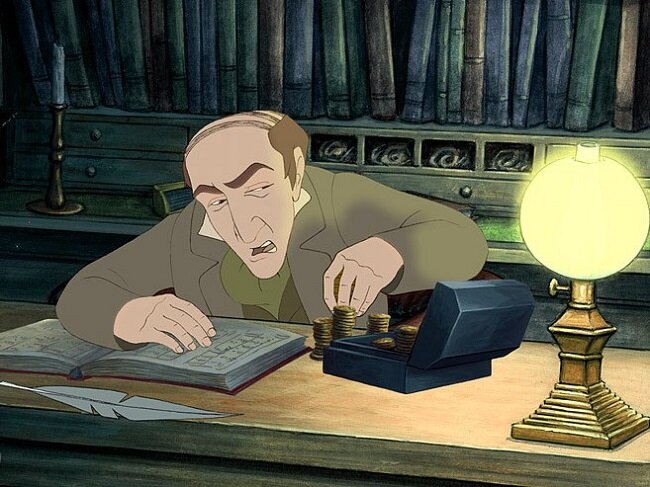
Christmas Carol: The Movie begins with an expanded prologue that creates a more substantial back story about Scrooge (Simon Callow) and his former fiancée Belle (Kate Winslet). Having bought the debt of a local children’s hospital, Scrooge proceeds to seizes its meagre assets and has the Doctor who runs it, thrown into debtors’ prison. Old Joe the Pawn Shop owner (Robert Llewellyn) is seen here to be the personal bailiff of Scrooge and Marley. Nurse Belle who works at the hospital writes a letter to her former fiancée imploring him not to let her down a second time. It is at this point that the traditional elements of the story broadly play out. One change of note is that Scrooge is haunted by a luminescent Marley’s Ghost (Nicolas Cage) at his office, rather than in his suite of rooms. Scrooge also tips a bucket of water over carol singers, one of whom is Tiny Tim who has only recently recovered from pneumonia. The focus of the story is more upon the ending of Scrooge’s engagement and his tumultuous relationship with his father. Belle in this instance is a friend of Fan, Scrooge’s sister.
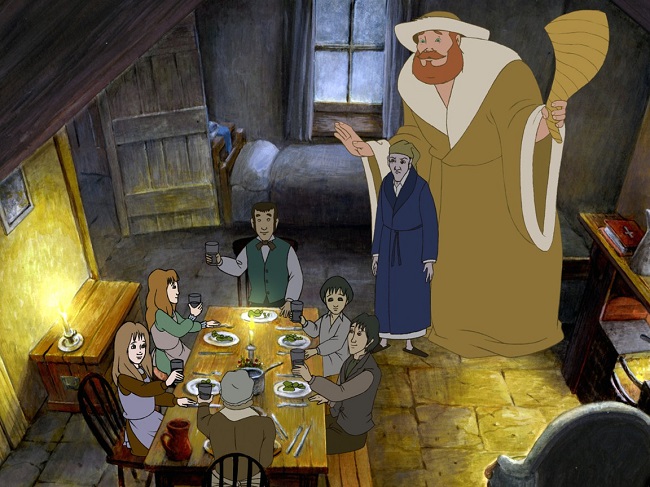
Another aspect of Christmas Carol: The Movie, along with the “expansion” of the story, that makes it stand out from other adaptations is its varied animation style. Each Ghost is accompanied by a distinct aesthetic. It is very noticeable in such scenes where the Ghost of Christmas Past transports Scrooge back to the time of this youth and when the Ghost of Christmas present spreads good cheer via his “horn of plenty”. These “trippy” sequences are dramatic and innovative, yet by this point in the proceedings, the film is tonally all over the shop. We’ve already veered from comedy mice (both Belle and Scrooge have a small murine companion), to insipient infant mortality, and then back to comedy evictions. Then we have the “ignorance and want” scene which has the skin shrinking on the emaciated face of “ignorance” until his skull shatters in a cloud of dust. One for the kids, I think. Also, in some editions of the movie the animated main story is framed between a live action sequence involving Dickens visiting the US and talking about A Christmas Carol to an avid theatre audience. Again, it makes for a very inconsistent piece of cinema.
The conclusion of the story see’s Scrooge reformed and reunited with Belle. He then undertakes the financing of a new hospital. Sadly, the movies lacks any emotional impact because it has tried too hard to be too many things in the proceeding seventy minutes. I can just about muster some praise for Jimmy Murakami for attempting to do something different with such a familiar story, but the film over reaches and cannot decide in what manner to commit itself. Thus, we are left with a rather odd but flawed adaptation that will only really be of interest to niche market film fans. Otherwise, Christmas Carol: The Movie is just something you’d have idly playing in the background over the Christmas holidays, because you’re too full of wine and mince pies to bother to change channel.
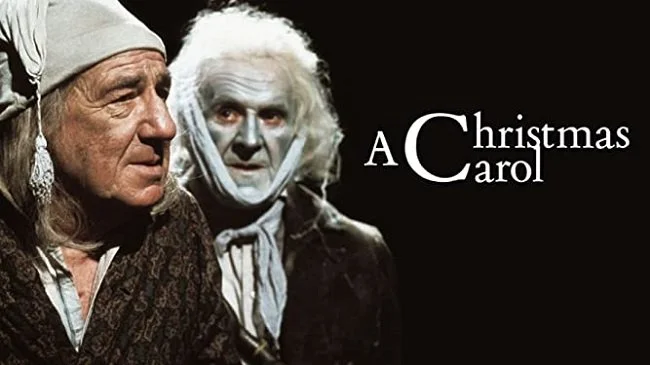





This 1954 adaptation of Charles Dickens’ A Christmas Carol is a distinctly studio bound US television production. It was in fact the fourth episode of an anthology variety show called A Shower of Stars. Originally filmed and broadcast in colour, only black and white prints now survive. The production boasts a script by noted American playwright Maxwell Anderson. Due to the 48 minute running time (without commercial breaks) the narrative is heavily abridged and often it is only the story’s most basic themes which are dramatically interpreted. It stars Fredric March who plays Scrooge as a cool and indifferent man, rather than the usual shrill old miser. However, despite his presence his performance cannot save the production. Most of the other cast members are far from accomplished and at times their acting borders on the amateur.