
Hot Fuzz (2007)
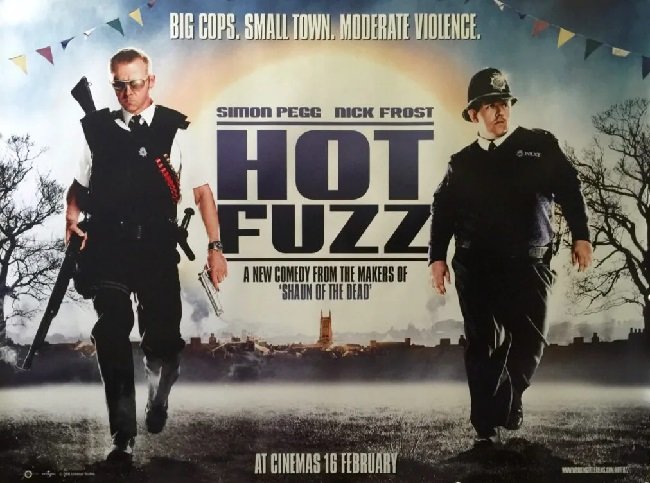
PC Nicholas Angel (Simon Pegg) is an exemplary Police Officer, with a strict adherence to the letter of the law. As a result of making the rest of the London Metropolitan Police look bad, he is transferred to the rural town of Sandford, Gloucestershire. On arrival, Angel finds that the local Inspector, Frank Butterman (Jim Broadbent), takes a far more laissez-faire approach to policing. His colleagues are incompetent and he is further hampered by the Neighbourhood Watch Alliance (NWA), who prioritise low crime statistics over law enforcement due to their desire to win the title of “Village of the Year”. Furthermore, Angel is partnered with the Inspector’s son, Constable Danny Butterman (Nick Frost), who is infatuated with “buddy cop” movies and is in awe of Angel’s London experience. “Have you ever fired two guns while jumping through the air?” However, a sudden spate of grisly accidents lead Angel to believe that there's more to the seemingly tranquil and picture-perfect community than meets the eye.
PC Nicholas Angel (Simon Pegg) is an exemplary Police Officer, with a strict adherence to the letter of the law. As a result of making the rest of the London Metropolitan Police look bad, he is transferred to the rural town of Sandford, Gloucestershire. On arrival, Angel finds that the local Inspector, Frank Butterman (Jim Broadbent), takes a far more laissez-faire approach to policing. His colleagues are incompetent and he is further hampered by the Neighbourhood Watch Alliance (NWA), who prioritise low crime statistics over law enforcement due to their desire to win the title of “Village of the Year”. Furthermore, Angel is partnered with the Inspector’s son, Constable Danny Butterman (Nick Frost), who is infatuated with “buddy cop” movies and is in awe of Angel’s London experience. “Have you ever fired two guns while jumping through the air?” However, a sudden spate of grisly accidents lead Angel to believe that there's more to the seemingly tranquil and picture-perfect community than meets the eye.
Hot Fuzz, co-written and directed by Edgar Wright, is at first glance a satire on the buddy cop and action genres that dominated Hollywood during the eighties and nineties. Upon closer scrutiny, it also has wry takes on the Agatha Christie “whodunit”, folk horror and slasher movies. Thematically, there are references, asides and homages to such classic films as Dirty Harry, The Wicker Man and multiple John Woo titles. Stylistically, Hot Fuzz uses many visual techniques common in the work of director Tony Scott. Edgar Wright cleverly takes these elements and effectively uses them in the incongruous setting of a rural UK town. It is the depiction of these US and Hong Kong action movie tropes through the lens of British comedy with its uniquely dry perspective that makes these conceits work so well.
Hot Fuzz is bolstered by an excellent cast of UK character actors, such as Timothy Dalton, Edward Woodward and Billie Whitelaw, many of whom are sending up former roles they are well known for. Dalton particularly relishes his role as a moustache twirling villain who runs the town’s supermarket. There is also a very clear chemistry between Simon Pegg and Nick Frost which helps them navigate the clever and knowing script. The humour is broad, including slapstick, wordplay and dark satire. Yet despite its tongue in cheek nature, the film manages to tread that fine line between homage and plagiarism. There is also a very intelligent score by David Arnold, that draws on the established overwrought idiom of the action genre.
Peter Jackson uncredited cameo
Due to the amount of detail found in Hot Fuzz, the film holds up well to multiple viewings. Pausing playback to read a sign in a shop window or some other minor detail will often yield a hidden gag. Sadly, the frenetic editing and the hand cranked camera work do become somewhat tiresome after a time. The film’s two hour running time could have been tightened to something ten minutes shorter. Due to the ubiquitous nature of the action movie genre, Hot Fuzz is just a little too on the nose at times, hence it doesn’t quite hit the mark as assuredly as Wright’s previous film, Shaun of the Dead. However, these are minor quibbles. If you’re in the market for a film somewhere between the Bad Boys franchise and Inspector Morse, then Hot Fuzz has much to offer. A convoluted plot, a cast shamelessly sending themselves and the genre up, car chases, shootouts and so many throw away lines. “He’s not Judge Judy and executioner”.



Bloodbath at the House of Death (1984)
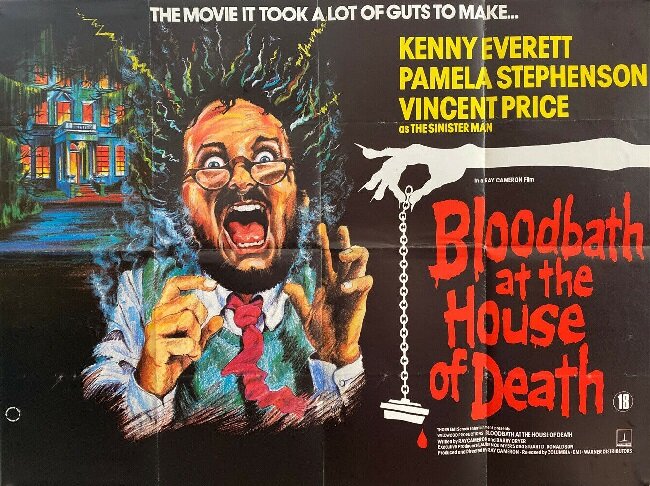
During the early eighties Kenny Everett was one of the most popular comedians on UK television. His mix of “zany” characters, slapstick and innuendo filled the gap between traditional comedians and their sketch show format and the anarchy of the new alternative comedy scene. Therefore his foray into feature films in 1984 was a logical progression of his growing success. Bloodbath at the House of Death was conceived as a satire on the Hammer Horror genre, although the script by Barry Cryer and Ray Cameron touched upon everything from An American Werewolf in London, Alien, The Amityville Horror, The Legend of Hell House and The Entity. Featuring a solid cast of British character actors and a cameo appearance by the great Vincent Price, on paper the film had all the trappings of a potential box office success. Sadly, it failed to meet expectations and was savaged by the UK press who used it as a means to attack Kenny Everett for his perceived transgressions.
During the early eighties Kenny Everett was one of the most popular comedians on UK television. His mix of “zany” characters, slapstick and innuendo filled the gap between traditional comedians and their sketch show format and the anarchy of the new alternative comedy scene. Therefore his foray into feature films in 1984 was a logical progression of his growing success. Bloodbath at the House of Death was conceived as a satire on the Hammer Horror genre, although the script by Barry Cryer and Ray Cameron touched upon everything from An American Werewolf in London, Alien, The Amityville Horror, The Legend of Hell House and The Entity. Featuring a solid cast of British character actors and a cameo appearance by the great Vincent Price, on paper the film had all the trappings of a potential box office success. Sadly, it failed to meet expectations and was savaged by the UK press who used it as a means to attack Kenny Everett for his perceived transgressions.
In 1975 Headstone Manor, a "businessman's weekend retreat and girls summer camp", is waylaid by a group of satanic monks who kill all 18 residents. Eight years later, Doctor Lukas Mandeville (Kenny Everett) and Doctor Barbara Coyle (Pamela Stephenson) are sent to investigate radioactive readings in the area that have been traced to Headstone Manor. The manor is known by locals as the House of Death. Along with fellow scientists Elliot Broome (Gareth Hunt), Stephen Wilson (Don Warrington), John Harrison (Jone Fortune), Sheila Finch (Sheila Steafel), Henry Noland (John Stephen Hill) and Deborah Kedding (Cleo Rocos), Mandeville and Coyle set up their equipment in the house and await any developments. Meanwhile the Sinister Man (Vincent Price), a 700-year-old Satanic priest, prepares a rite in the nearby woods to purge the house of its unwanted guests.
The most obvious flaw in Bloodbath at the House of Death is its poor script, which is a surprise considering the involvement of veteran writer and comedian Barry Cryer. A satire of this nature needs a constant barrage of visual and verbal gags, as well as the humour derived from the main story. Blazing Saddles achieves this perfectly. Here there just aren’t enough jokes and out of those on offer, many fail to land. There are a few scenes that show promise. Mandeville and Coyle visit a local pub which is very much in the idiom of The Slaughtered Lamb from An American Werewolf in London. He gets into an argument with the barmaid regarding exactly how many people were murdered at Headstone Manor. More and more people join in, calculators are used and the confusion grows. It all culminates in a drunken song in which the entire pub recounts the murders to the tune of The 12 Days of Christmas. Sadly these sort of well conceived vignettes are few and far between.
All too often Bloodbath at the House of Death falls back on easy gags. Doctor Coyle encounters an amorous poltergeist which provides an opportunity for some nudity. There are also some cheap gore effects which are presented more for amusement than shock, such as a decapitation by can opener. The presence of Vincent Price (telling one of his underlings to “piss off”) does a little to elevate the proceedings but he is gone too quickly. And of course, this being the eighties we have two upper class comedy homosexual scientists, because that is “funny” by default. Why Kenny Everett, a gay man himself, accommodated such a pointless embellishment is somewhat odd. The final twenty minutes of the film in which doppelgängers of all the scientists attempt to kill and replace the originals leads to a lot of confusion and at one point a major continuity error. The head of the BBFC at the time, James Ferman, thought the reels had been shown out of order.
Hence, with the greatest will in the world, Bloodbath at the House of Death cannot be held up as an overlooked classic. This low budget production seems to have been made rather quickly to capitalize upon Kenny Everett’s success and therein probably explains the lacklustre screenplay. However, as mentioned earlier, the film was pilloried by the UK press far beyond it’s obvious failings. This is due to Kenny’s appearance in 1983 at the Young Conservatives Conference, prior to the general election held later that year. Goaded by Michael Winner, Kenny made several quips that although funny, were not really appropriate for such an event. Poe faced members of the establishment then deliberately took them out of context and turned upon him. The film provided a further opportunity to continue this public scolding the following year. Thus, Bloodbath at the House of Death was quickly withdrawn from UK cinemas due to poor performance. It now serves as an interesting cinematic curiosity. An example of how success on TV doesn’t always translate to the big screen.











A Million Ways to Die in the West (2014)
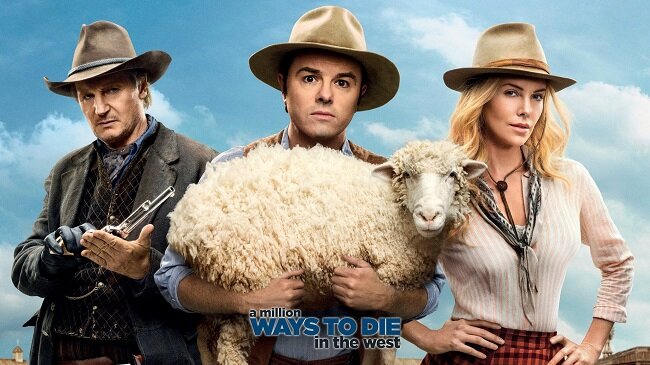
You could quite easily lose thirty minutes from A Million Ways to Die in the West. Tighter pacing would certainly shorten the gaps between the genuinely funny material. As it is, the movie is somewhat baggy and surprisingly middle of the road. Yes it has all of Seth McFarlane's usual hallmarks as far as extreme humour but it lacks the occasional moments of satire and social commentary that you see in Family Guy and in Ted (his best movie to date). The movie is very much aware of what it is and focuses a little excessively on observational humour based on traditional tropes and memes of the Western genre. You frequently get the feeling at times that it’s trying very hard to be “funny” in a “Seth McFarlane” idiom but it smacks a little of “art imitating art”.
You could quite easily lose thirty minutes from A Million Ways to Die in the West. Tighter pacing would certainly shorten the gaps between the genuinely funny material. As it is, the movie is somewhat baggy and surprisingly middle of the road. Yes it has all of Seth McFarlane's usual hallmarks as far as extreme humour but it lacks the occasional moments of satire and social commentary that you see in Family Guy and in Ted (his best movie to date). The movie is very much aware of what it is and focuses a little excessively on observational humour based on traditional tropes and memes of the Western genre. You frequently get the feeling at times that it’s trying very hard to be “funny” in a “Seth McFarlane” idiom but it smacks a little of “art imitating art”.
Perhaps it was a mistake for McFarlane to cast himself in the lead as the Sheep Farmer hero who's been recently dumped by his girlfriend (Amanda Seyfried). Charlize Theron carries a lot of the movie as the sharp-shooting wife of an infamous outlaw played by Liam Neeson. Quite why she takes a liking to McFarlane is mystery. It is fun to see Mr. Neeson send himself up, yet I was left with the feeling that there could have been much more done with his role. Neil Patrick Harris camps it up nicely as Seyfried’s new lover and the ongoing relationship between town prostitute (Sarah Silverman) and smitten virgin (Giovanni Ribisi) is a great idea but sadly loses momentum. Family Guy often wrestles with multiple story lines and random asides but still manages to carry them off well. It is exactly this ability which is missing from A Million Ways to Die in the West.
As ever with McFarlane's work, it is the incidental jokes and tangential humour that works the best. There's a droll cameo by Gilbert Gottfried as Abraham Lincoln and Christopher Lloyd makes an appearance as Doc Brown from Back to the Future. Keep an eye out for lots of other uncredited cameos. Another one of the directors strength's is with his musical acumen. The soundtrack by Joel McNeely is eminently suitable and compliments the movie nicely. The cinematography by Michael Barrett effectively captures the harsh environment of a frontier town. He also shows a keen awareness of how classic Westerns were shot.
Perhaps one of the reasons A Million Ways to Die in the West fails to live up to expectations is because it tries too hard to not be Blazing Saddles. However, if it had focused more on the way that seminal movies are constructed it may well have benefited. As it is A Million Ways to Die in the West is a mixed bag. It fared adequately at the box office but failed to find any popular consensus with both critics and fans alike. It may come as no surprise that Ted 2 was expedited to try and re-establish the commercial viability of the Seth McFarlane brand. Finally, I stumbled upon a curious piece of trivia connected to this film. There is an audio book of A Million Ways to Die in the West available, based on the movie's screenplay, read by Jonathan Frakes. WTF?
The Kentucky Fried Movie (1977)
Written by Jim Abrahams, David Zucker, Jerry Zucker and directed by John Landis, The Kentucky Fried Movie is an eclectic collection of skits, parodies and bogus commercials, lampooning what you’d see on seventies TV or in the movie theatres of the time. The sketches are fast paced and many feature well known faces from TV and cinema such as Bill Bixby, George Lazenby, Donald Sutherland and Henry Gibson. Some of the parodies may not “connect” with modern audiences who may not get the source references but for every skit that misses the mark, there are at least two others hit the target. Overall, it’s a litany of visual gags, stupid humour and endless puns and wordplay. Just what you’d expect from the team that went on to bring you Airplane! and Top Secret! The Kentucky Fried Movie is at its best when it satirises the movie industry, with such wonderful faux movies trailers as Cleopatra Schwartz; a blaxploitation action movie featuring a foxy African American vigilante and her devout Hasidic Jew partner.
Written by Jim Abrahams, David Zucker, Jerry Zucker and directed by John Landis, The Kentucky Fried Movie is an eclectic collection of skits, parodies and bogus commercials, lampooning what you’d see on seventies TV or in the movie theatres of the time. The sketches are fast paced and many feature well known faces from TV and cinema such as Bill Bixby, George Lazenby, Donald Sutherland and Henry Gibson. Some of the parodies may not “connect” with modern audiences who may not get the source references but for every skit that misses the mark, there are at least two others hit the target. Overall, it’s a litany of visual gags, stupid humour and endless puns and wordplay. Just what you’d expect from the team that went on to bring you Airplane! and Top Secret! The Kentucky Fried Movie is at its best when it satirises the movie industry, with such wonderful faux movies trailers as Cleopatra Schwartz; a blaxploitation action movie featuring a foxy African American vigilante and her devout Hasidic Jew partner.
There’s some rather broad humour in The Kentucky Fried Movie. But it also serves quite well as a reflection of cinema and public attitudes of the time. The trailer for the faux porno flick Catholic High School Girls in Trouble, not only crassly raises a wry smile ("More shocking than Behind the Green Door. Never before has the beauty of the sexual act been so crassly exploited!") but reminds us that pornography was on the fringes of becoming mainstream and was seriously analysed by some movie critics. And then there are some dry send ups of public service announcements. In United Appeal for the Dead Henry Gibson speaks at great length about how “death” is the number one killer in the United States and what his charity can do to help those who have died lead a normal life. That's Armageddon, featuring George Lazenby, parodies every Irwin Allen disaster flick made. There’s even an angry Gorilla sketch that includes an early Rick Baker ape costume. And let’s not forget Danger Seekers, the show that follows those intrepid men who live for the thrill of adventure and risk.
However, the movie's centrepiece, A Fistful of Yen, is by far the jewel in the crown. This spot-on parody of Enter the Dragon and the martial arts genre clocks in at thirty plus minutes. The UK government hires Loo (Evan C. Kim playing a Bruce Lee lookalike with an Elmer Fudd voice) to penetrate Dr. Klahn's (Han Bong-soo) mountain fortress and destroy his operation. Loo refuses the mission at first, but happily agrees once he is told “but you’ll have the chance to kill fifty, maybe sixty people”. The jokes are not only obvious takes on standard tropes of martial arts cinema but there’s also a clever deconstruction of the pseudo philosophy and dialogue inherent in the genre (“you have our gratitude”). This is the most obvious precursor to later Jim Abrahams, David Zucker and Jerry Zucker productions such as The Naked Gun. It should also be noted that the actual fight scenes in A Fistful of Yen are competently constructed and hold up quite well on their own.
The Kentucky Fried Movie is not in any way a sophisticated satire. The humour is far from nuanced or cerebral but it barrels along at a pace, throwing gag after gag at viewers. By the law of averages, whatever your taste in humour, some of them will land. If it’s watched on its own terms and with an eye on the context of the times (IE not being politically correct) then it will entertain. Both the writing team and the director went onto bigger and better things in the years after the movies’ release. But their style and many longstanding jokes were created and refined here. For example we see an early iteration of the See You Next Wednesday gag, common to many subsequent John Landis movies. Also Jim Abrahams, David Zucker, Jerry Zucker reference their abiding love for The Wizard of Oz at the end of A Fistful of Yen. A theme that later showed up in Top Secret!
The Big Bus (1976)
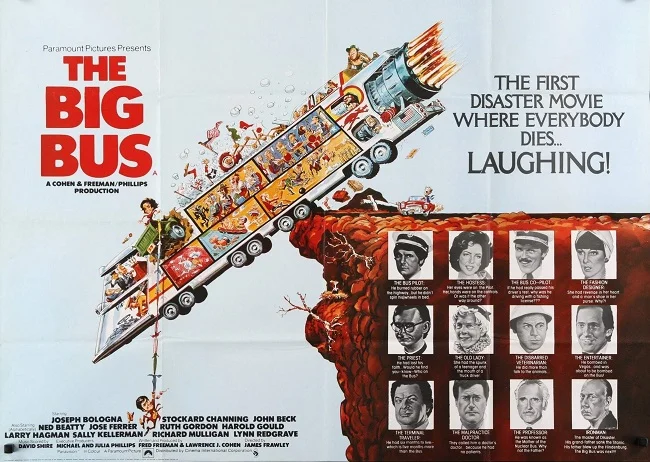
Being a child of the seventies I have a soft spot, cinematically speaking, for the various disaster films of that time. Iconic titles such as The Towering Inferno, The Poseidon Adventure and Airport franchise. The latter was superbly lampooned in the 1980 movie, Airplane! by Jim Abrahams, David Zucker and Jerry Zucker. The team of writer/directors went on to make numerous other comedies in a similar idiom. However Airplane! was not the first major spoof of this particular genre. Four years earlier, director James Frawley made The Big Bus which similarly sends up the standard tropes of all major disaster movies. Where Airplane! was right on the money, The Big Bus is a little more scattershot in its approach and takes a while to find its feet. But James Frawley had a background in TV comedy, having worked on The Monkees TV show, and he does much within the limitations of the films budget. The films greatest asset is that it keeps up the pace. If a gag doesn’t work then don’t worry, there’s another immediately afterwards.
Being a child of the seventies I have a soft spot, cinematically speaking, for the various disaster films of that time. Iconic titles such as The Towering Inferno, The Poseidon Adventure and Airport franchise. The latter was superbly lampooned in the 1980 movie, Airplane! by Jim Abrahams, David Zucker and Jerry Zucker. The team of writer/directors went on to make numerous other comedies in a similar idiom. However Airplane! was not the first major spoof of this particular genre. Four years earlier, director James Frawley made The Big Bus which similarly sends up the standard tropes of all major disaster movies. Where Airplane! was right on the money, The Big Bus is a little more scattershot in its approach and takes a while to find its feet. But James Frawley had a background in TV comedy, having worked on The Monkees TV show, and he does much within the limitations of the films budget. The films greatest asset is that it keeps up the pace. If a gag doesn’t work then don’t worry, there’s another immediately afterwards.
The titular bus is in fact a nuclear-powered articulated vehicle that can carry 100 passengers on a luxurious non-stop trip from New York to Denver. However, someone seems hellbent on sabotaging Coyote Bus Lines new flagship project and a bomb goes off at the lab where it is being prepped for its maiden voyage. Professor Baxter (Harold Gould), is seriously injured while the driver and co-driver are killed. Hence, Baxter’s daughter, Kitty (Stockard Channing), has to find new driver. Kitty turns to a former lover, Dan Torrance (Joseph Bologna), to drive the bus. Dan is currently in disgrace within the bus driver community, after a serious crash at Mount Diablo and allegations of eating the passengers. However, he accepts the job and recruits “Shoulders” O’Brien (John Beck) to be his co-driver, who unbeknownst to him is narcoleptic. The bus departs New York along with all-star cast including Lynn Redgrave, Richard Mulligan, Sally Kellerman, Rene Auberjonois, and Ruth Gordon. However, the real star is bus itself AKA “The Cyclops”. Which features a bar (with Murphy Dunne as lounge singer), a bowling alley and an exclusive captain’s dining room. However, the saboteur has no intention of giving up and plants another bomb onboard. Hilarity ensues along with a never-ending barrage of verbal and sight gags.
The Big Bus hits many of its marks as it dismantles a well-known genre. Many of the cast are exactly the sort of actors that would have appeared in genuine disaster movies. Character actors such as Ned Beatty, Larry Hagman, Bob Dishy, Jose Ferrer, and Howard Hesseman. And then there’s David Shires score which totally gets the musical idiom of these movies and delivers a suitably hyperbolic soundtrack. Like Airplane! there are many sight gags and a strong streak of absurdist humour. There’s a bar fight in which a milk carton is broken and used as a weapon and then there’s the recurring gag of “Shoulders” O’Brien constantly falling asleep at inopportune moments. I was not familiar with actor Joseph Bologna and his previous body of work but he gives a good performance as the flawed hero. It should also be noted that The Big Bus is a little more rating conscious and doesn’t stray as far into adult humour as Airplane! Plus there’s a lot of conspicuous product placement which obviously helped with the movies financing.
The Big Bus doesn’t outstay its welcome, clocking in at sensible 88 minutes. The ending is a little lacklustre compared to the first two acts and it seems that the writers Lawrence J. Cohen, Fred Freeman were a little lost as to how to wrap things up. However, there is still much to enjoy. There are several good physical stunts involving The Cyclops which would nowadays been done with CGI. The cast chews the scenery exactly as you expect them to. René Auberjonois is rather good as a priest on the brink of losing his faith. However, despite being very well intentioned, The Big Bus only did moderate box office upon release and received mixed reviews. Director James Frawley later directed The Muppet Movie and subsequently returned to television Over the years, The Big Bus has lost its crown to Airplane! which is a shame. It isn’t as polished or as accomplished as its predecessor but it certainly pioneered the zany parody genre. Furthermore, it can still raise a wry smile.

The Three Stooges (2012)
I had mixed feelings about whether The Three Stooges could be successfully re-imagined and revitalised for a modern audience. When the first trailer was released it seemed to highlight the major differences between the old school slapstick humour of the forties with the worldly adult style of present comedy movies. However, as more information came out regarding the production and it became clear that the Farrelly Brothers are consummate fans of the source material, I began to revise my expectations. After finally having caught up with the movie, six years after its theatrical release, I am afraid all my initial fears have proven true and that The Three Stooges falls into all the traps I anticipated it would. That is not to say that the film is not without merits, but overall it fails to deliver in a manner that pleases all parties.
I had mixed feelings about whether The Three Stooges could be successfully re-imagined and revitalised for a modern audience. When the first trailer was released it seemed to highlight the major differences between the old school slapstick humour of the forties with the worldly adult style of present comedy movies. However, as more information came out regarding the production and it became clear that the Farrelly Brothers are consummate fans of the source material, I began to revise my expectations. After finally having caught up with the movie, six years after its theatrical release, I am afraid all my initial fears have proven true and that The Three Stooges falls into all the traps I anticipated it would. That is not to say that the film is not without merits, but overall it fails to deliver in a manner that pleases all parties.
First off let me make it clear that the casting of Sean Hayes, Will Sasso and Chris Diamantopoulos as Larry, Curly and Moe is spot on and their performances are exceptional. They have successfully captured the style, idiom and physical technique of the original trio and are very funny in themselves. I cannot fault their work. However, the story that the actors have to hang their performance on, is weak, poorly paced and littered with asides that don't work. The depiction of the Catholic Church, nuns and orphanages is lazy and tired. To cater to contemporary tastes there is a degree of cruder material and sexual under current to a lot of the humour. The problem is that it seems out of place and doesn't fit well into the narrative. Therefore, there is a tonal tug of war between slapstick gags that you expect from this franchise and the earthier humour you find in other Farrelly Brothers movies.

I love comedian Larry David, but his character Sister Mary-Mengele has little to do and nowhere to go. Plus naming a nun after a Nazi war criminal really isn't exactly going to have the target audience rolling in the aisles is it? In fact, a lot of the humour centred around the antagonists and support characters seems out of place in a movie that is marketed heavily towards kids. For example, I laughed a lot at Larry (Sean Hayes) giving a dolphin a Heimlich Manoeuvre, but when the offending peanut is then shot out of its blow hole and into a Lion’s testicles, it become an embellishment of a very different nature. The final act which involves Moe appearing on a reality TV show fails as a concept. I can see why it was used as a plot device to try and bridge the cultural divides between prospective audience members, but it just doesn’t work.
The Three Stooges also has another major obstacle to overcome in so far as we now live in extremely litigious times, in a culture dominated by health and safety. The movie ends with a coda in which the directors, the Farrelly Brothers played by male models, explain that all of the Stooges physical hijinks are stunts and should not be imitated. It really does further derail an already flawed production. In the UK, the BBFC still expressed concern over some of the slapstick violence and as a result the distributors elected to re-edit the movie and remove some of the problematic scenes so they could secure a lower rating for theatrical release. The Blu-ray release for the United Kingdom is uncut, however.
The box office taking for The Three Stooges were not bad. The movie recouped its production costs and turned a profit. Whether this means we will see a second movie, I do not know for sure. However, because the lead actors are so good, I would not actually mind giving them a second chance, as long as a greater effort was placed on finding a suitable comedy vehicle for them. Therefore, if you do decide to watch The Three Stooges, then do curb your expectations and focus on the central performances. Try to tune out the wider comedy as it is very poor and at odds with central theme. Then you may then be rewarded with an enjoyable tribute act to Larry, Curly and Moe. However, a sequel will certainly need to be more than just a homage.
Where's That Fire? (1940)
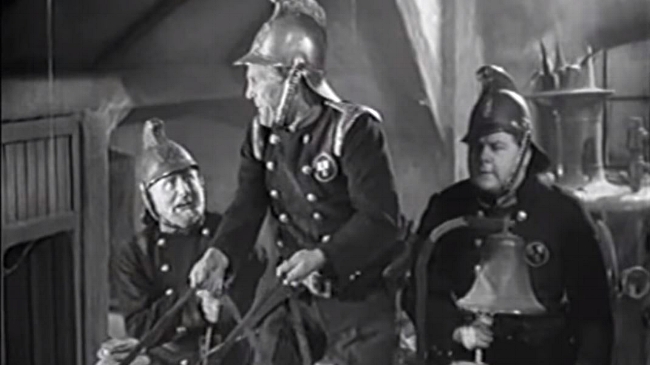
Until a copy was found by the BBC television in 1975, this was considered a lost film. Where's That Fire? is an often over looked comedy. Will Hay plays Captain Viking of the Bishop Wallop fire station in his usual seedy incompetent fashion. He and his trusty assistants Albert (Graham Moffatt) and Harbottle (Moore Marriott) run an antiquated Victorian fire tender but seldom put out any fires. After the Town Hall burns down they find that their jobs are on the line. Viking tries to solve their problems by inventing a new fire-retardant foam as well as renting the tender to a film production company, who may not be quite what they seem. It all ends in mayhem, with an attempted robbery of the Crown Jewels at The Tower of London.
Until a copy was found by the BBC television in 1975, this was considered a lost film. Where's That Fire? is an often over looked comedy. Will Hay plays Captain Viking of the Bishop Wallop fire station in his usual seedy incompetent fashion. He and his trusty assistants Albert (Graham Moffatt) and Harbottle (Moore Marriott) run an antiquated Victorian fire tender but seldom put out any fires. After the Town Hall burns down they find that their jobs are on the line. Viking tries to solve their problems by inventing a new fire-retardant foam as well as renting the tender to a film production company, who may not be quite what they seem. It all ends in mayhem, with an attempted robbery of the Crown Jewels at The Tower of London.
More ambitiously staged than most of the team's efforts, Where's That Fire? has several brilliantly orchestrated slapstick sequences. One has our trio trying to install their new firemen's pole, causing a traffic jam in the street, wrecking a china shop, bothering a man confined to bed with gout and finally demolishing his roof. Charles Hawtrey has an amusing cameo as a schoolboy “swot” who provides geometrical and linguistic advice. There is also an elaborate physical FX sequence when a local garage gets set ablaze. Harbottle mistakenly connects the fire hoses to the fuel pump instead of the water mains, with hilarious incendiary results.
Ultimately, the film succeeds because of the timeless characters that have been created. Some of the jokes may have dated somewhat, but the interaction between the three leads is still credible today. Hay's blustering inanity, Marriott's rambling Octogenarian and Moffatt's wide boy are all still accessible archetypes. The dialogue between them is loaded with that unique sense of British irony and sarcasm. Two visitors disbelieve that Hay is the Captain of the fire station. "Tell them what I am" he says to Graham Moffatt. "What? Out loud" he replies. Where's That Fire? is a wonderful piece of cinema, from a quieter, gentler time. Recommended to those seeking nostalgia and to those who may wish to familiarise themselves with the work of Will Hay.
Ask a Policeman (1939)
I was raised on old black and white films as a child. My parents age and personal tastes meant that I had exposure to a lot of material that people today may be oblivious to. This was especially true with regard to pre-war UK comic luminaries such as Arthur Askey, Old Mother Riley and Will Hay. I am very grateful in a way, as it has afforded me the opportunity to broaden my cinematic horizons and cultural references. Comedy is also an interesting social barometer of the times and can be quite a useful tool for historians. Its curious how something change there are certain comic tropes that are timeless. Often these are fundamental aspects of the human character but not necessarily the best ones.
I was raised on old black and white films as a child. My parents age and personal tastes meant that I had exposure to a lot of material that people today may be oblivious to. This was especially true with regard to pre-war UK comic luminaries such as Arthur Askey, Old Mother Riley and Will Hay. I am very grateful in a way, as it has afforded me the opportunity to broaden my cinematic horizons and cultural references. Comedy is also an interesting social barometer of the times and can be quite a useful tool for historians. Its curious how something change there are certain comic tropes that are timeless. Often these are fundamental aspects of the human character but not necessarily the best ones.
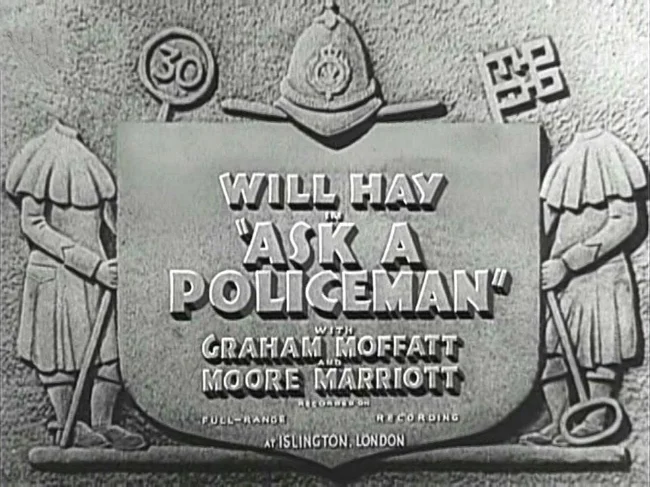
As a result of my youth, I am a consummate Will Hay fan. I find the seedy, incompetent characters that he created to be timeless. There often a lot of substance to his various incarnations, along with cynicism and moral ambiguity. Unlike US comedies of the time, there is also a conspicuous lack of sentiment. The humour is often linguistic, self-deprecating and sarcastic rather than physical and is more sedately paced, compared to the hard-hitting style of today. Although many consider Hay's finest work to be Oh, Mr. Porter! or My Learned Friend, I have a soft spot for the formulaic but enjoyable Ask A Policeman from 1939. It’s a very accessible example of Hay's work and exhibits many of the traits I have listed.
The first half of Ask A Policeman is vintage Hay, which concentrates on the superbly scripted verbal sparring between himself and his usual associates Graham Marriott and Moore Moffatt. The banter is very well observed, and its dry quality still makes it easily accessible. Take for example the following scene where Dudfoot and his two constables have made an arrest.
Sergeant Samuel Dudfoot: Did you search him?
Constable Albert Brown: One pocket book, one watch, one pen-knife and no money.
Sergeant Samuel Dudfoot: One pen-knife and no what?
Constable Albert Brown: No money.
Sergeant Samuel Dudfoot: Come on, turn out your pockets.
Constable Albert Brown: Oh, alright. One pen-knife and fifteen bob.
Sergeant Samuel Dudfoot: Blimey! Will you never learn to be honest? He's as much our prisoner as he is yours... Here you are, five bob each.
The story then broadens to encompass smugglers, headless horsemen, and a poorly conceived bus chase, which unfortunately bears to many similarities with Oh, Mr. Porter! However, these changes in pace and direction do not spoil the film overall and it still remains engaging during it's relatively short eighty-minute running time. I would recommend Ask A Policeman to those who have an interest in classic British comedy and vintage acts that have their roots in music hall and variety.
Oddly enough, the film was remade in 1982 by British comic duo, Canon and Ball, under the title The Boys in Blue. Unfortunately, it was rather poorly implemented and lacked the subtly of the original, mainly due to the stars somewhat limited comic abilities. Some folk have tenuously tried to link Edgar Wright's 2007 movie Hot Fuzz to the Hay original, but I believe that is stretching a point.
Paul (2011)
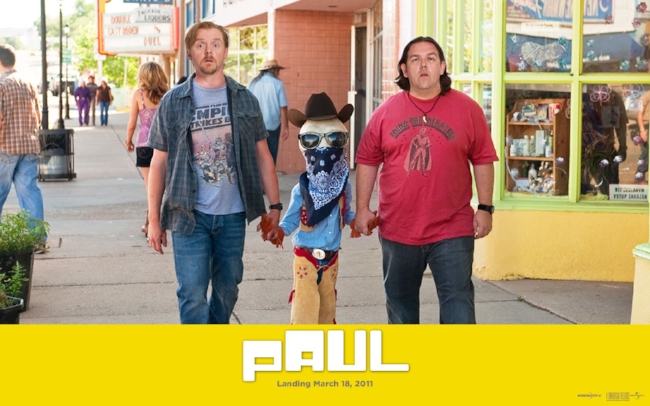
Critics were somewhat split over Paul when it was released in the UK in spring 2011. The absence of director Edgar Wright from the production, was cited as a weakness. Critics also felt the film was generally too mainstream and did not play sufficiently to Simon Pegg and Nick Frost's strengths. There were the usual claims of the whole premise being a self-indulgence. However, rather than cross reference Paul against similar films or compare it to material from the stars back catalogue of work, it should be judged on its own merit. On reflection, it is nowhere near as week as some claim it to be. You don’t often get big studio comedies that happily explores what is still considered a niche market genre. If approached with the right outlook, then Paul can be an entertaining diversion with plenty of laughs.
Critics were somewhat split over Paul when it was released in the UK in Spring 2011. The absence of director Edgar Wright from the production, was cited as a weakness. Critics also felt the film was generally too mainstream and did not play sufficiently to Simon Pegg and Nick Frost's strengths. There were the usual claims of the whole premise being a self-indulgence. However, rather than cross reference Paul against similar films or compare it to material from the stars back catalogue of work, it should be judged on its own merit. On reflection, it is nowhere near as week as some claim it to be. You don’t often get big studio comedies that happily explores what is still considered a niche market genre. If approached with the right outlook, then Paul can be an entertaining diversion with plenty of laughs.
Paul succeeds because it takes a very broad approach to its themes and subjects. Popular culture has absorbed enough sci-fi references to make a lot of the gags very accessible to the general public. Yet there is still much to satisfy the inner geek of the more hardcore fans. Frost and Pegg's natural chemistry together carries the film greatly, along with the traditional transatlantic culture clash. There are some clever references to convention culture and fandom itself, especially with a scene when our pair of heroes meets their favourite author. Paul himself is very well realised and perfectly voiced by Seth Rogen. He provides the sort of wise cracking cynicism audiences expect. The film's running time is ideal with seldom a lull in the pace. This is important with comedy as so many get it wrong.
Paul does have a few weaknesses though. There are more obvious concessions to the mainstream, such as clichéd gay jokes, generic car chases and a somewhat contrived and unconvincing romantic sub-plot. Luckily, these minor aspects are not enough to spoil the overall production and are minor quibbles rather than cardinal sins. Plus, a killer cameo performance by Sigourney Weaver, is more than enough to rectify and other deficiencies in the narrative. The visual FX are more than adequate, and the film looks fine for a mid-budget production. The final act is formulaic but not annoyingly so. You get pretty much what you expect from Paul and that’s not a bad thing. Sometime when viewing at home you want a easy choice and some undemanding viewing.
Ultimately, it is the basic plot device that is the films greatest asset. Paul an alien, finds himself reliant on two guys who are essentially aliens themselves within the country they're touring and society itself. The movie also explores the pros and cons of "geekdom" rather well and gently ribs the culture, rather than openly mocks. This is often a difficult thing to do, but director Greg Mottola gets the tone right. Paul certainly provides a platform for the English's love affair with profanity. Although it is not gratuitous, the choice words do come thick and fast at times. But overall, Paul proves to be a genuinely funny, well observed, accessible sci-fi comedy and I think that this film’s reputation will improve over the years to come.





Blackadder's Christmas Carol (1988)
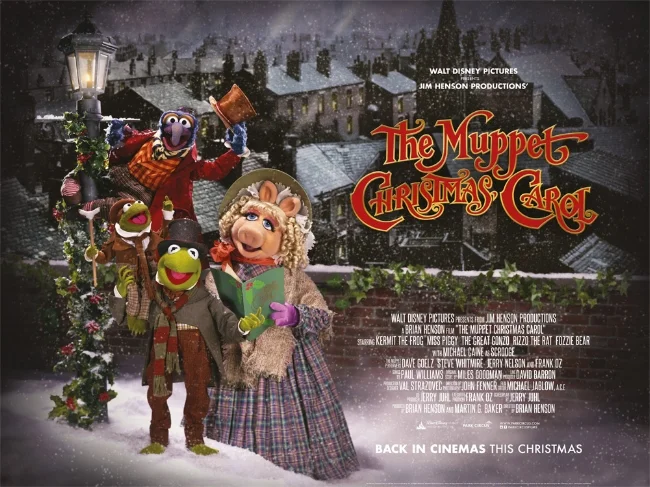
By 1988 Blackadder had run for three seasons in the UK and had seen the central character of Edmund Blackadder evolve from a seedy incompetent to a cunning, scheming, evil genius who was always frustrated at the last moment. Cleverly written by Richard Curtis and Ben Elton and superbly portrayed by Rowan Atkinson, Blackadder was very much at the cutting edge of British comedy of the time. It managed to mix physical humour, with verbal sparring, sarcasm, dry self-deprecation and irony. It was popular with a very broad spectrum of viewers.
By 1988 Blackadder had run for three seasons in the UK and had seen the central character of Edmund Blackadder evolve from a seedy incompetent to a cunning, scheming, evil genius who was always frustrated at the last moment. Cleverly written by Richard Curtis and Ben Elton and superbly portrayed by Rowan Atkinson, Blackadder was very much at the cutting edge of British comedy of the time. It managed to mix physical humour, with verbal sparring, sarcasm, dry self-deprecation and irony. It was popular with a very broad spectrum of viewers.
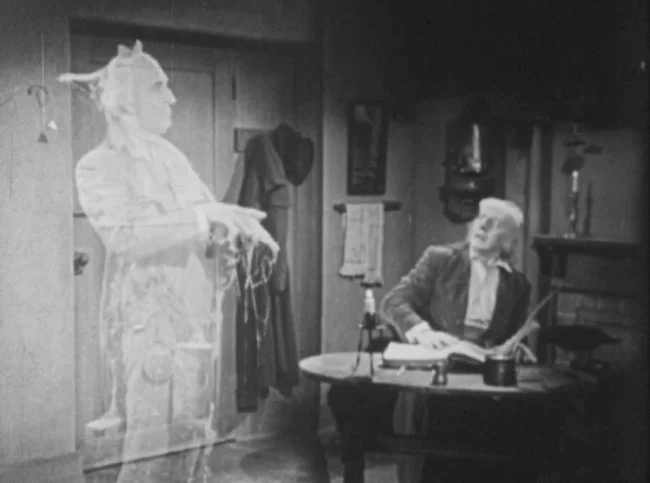
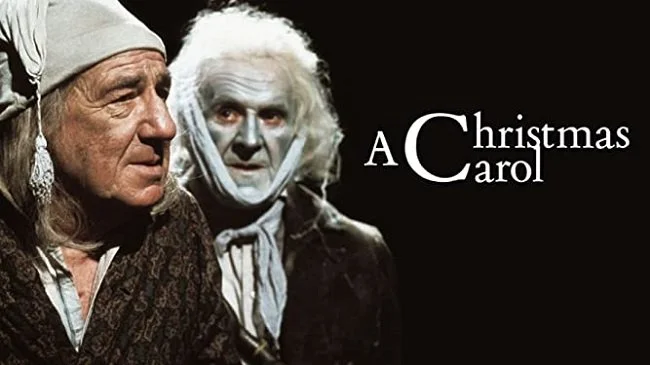
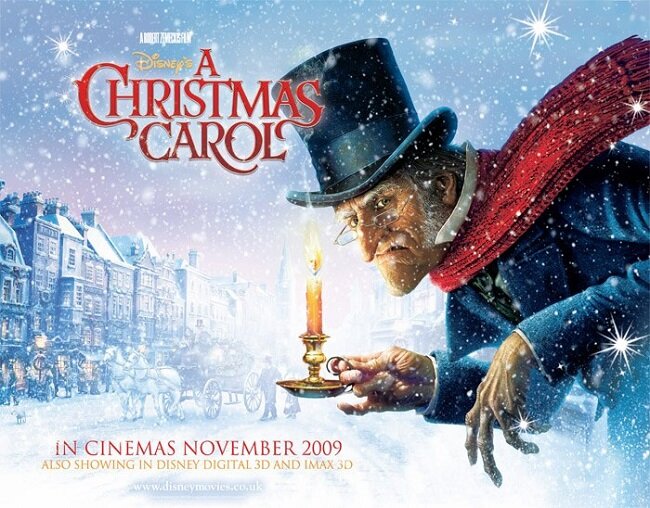
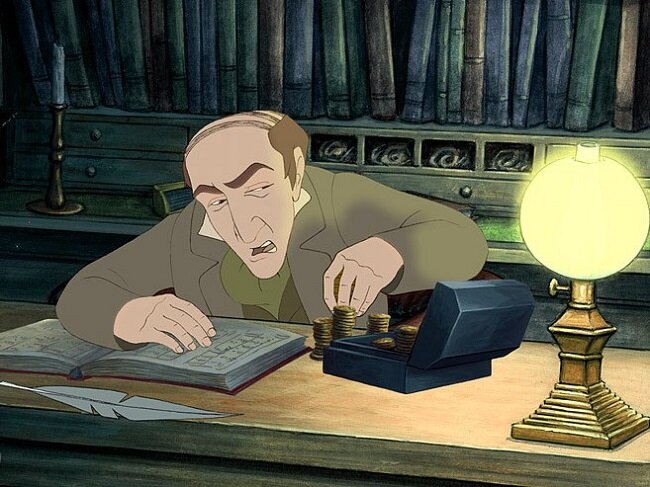
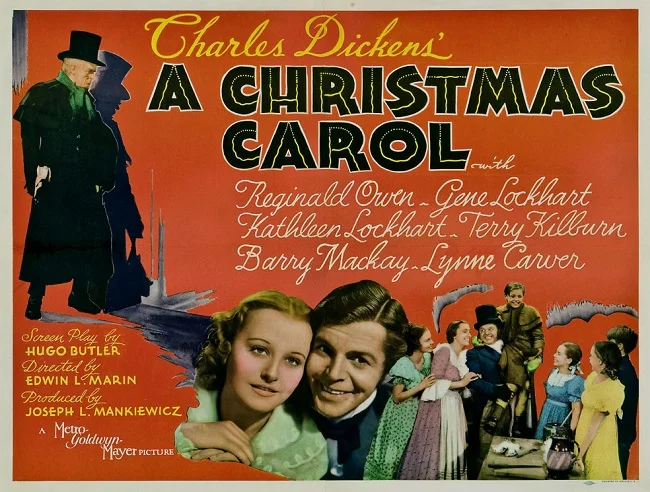
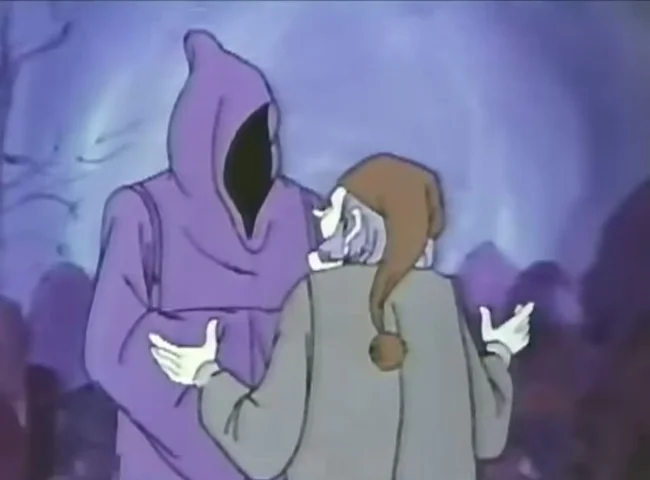
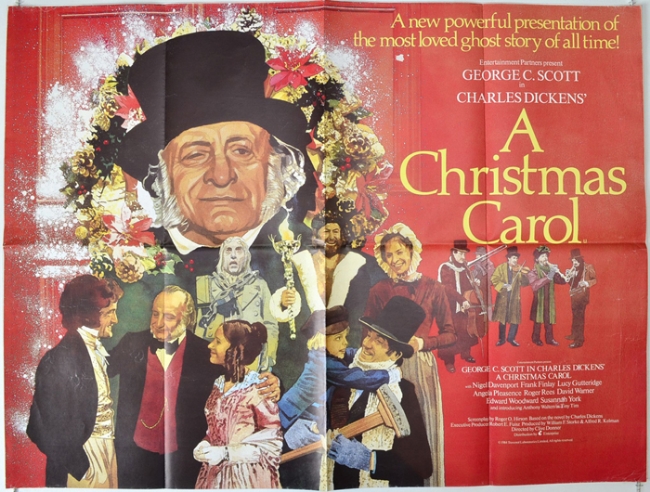
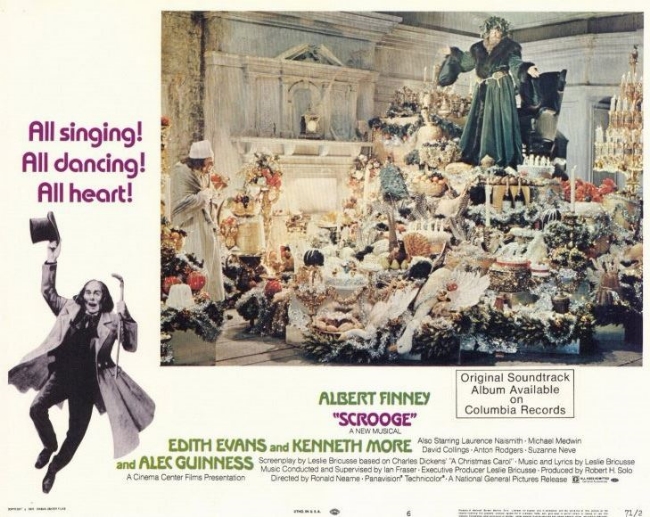
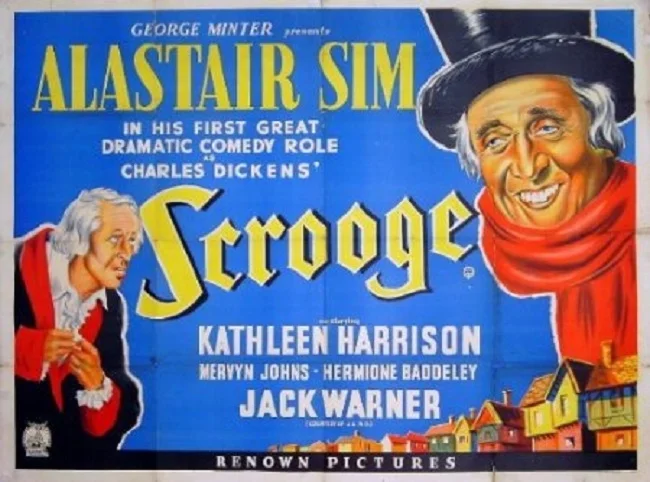
Therefore, a one-off Christmas special was inevitable. However, unlike many other extended episodes of popular TV shows, Blackadder's Christmas Carol managed to maintain the high standard of previous episodes. The satirical reworking of Dicken's classic tale is the perfect vehicle for Blackadder and his foil Baldrick (Tony Robinson). The central conceit of the plot is having this particular incarnation of Blackadder, starting off as "kindest and loveliest" man in England. However, after a visit from the Spirit of Christmas (Robbie Coltrane) who shows him the misdeeds of his ancestors, it's not long before he concludes that "Bad guys have all the fun".
Blackadder's Christmas Carol packs a lot in to its forty-two minute running time. It manages to satirise the entire Dickensian idiom of writing, attack such sacred cows as British Royalty as well as allude to social issues such as the infant mortality rate and the chronic alcoholism that existed within the working class at the time. Despite the overriding cynical nature of British comedy, there is still a positive message to be gained from the proceedings. Edmund is ultimately cheated by his own misanthropy; however, the moral codicil is still delivered with a delicious sense of irony.
Following this Christmas special, Blackadder continued for a fourth season the following year and subsequently ended while at the peak of its success. Blackadder Goes Forth, set in World War I managed to raise the bar even higher, ending in a final episode that transcends comedy and makes a poignant statement about the nature of war. However, Blackadder's Christmas Carol serves as a suitable point of entry for those unfamiliar with the show. It is seasonally appropriate and a great parody of Dicken’s iconic novel.




The Goon Show (1951-60)
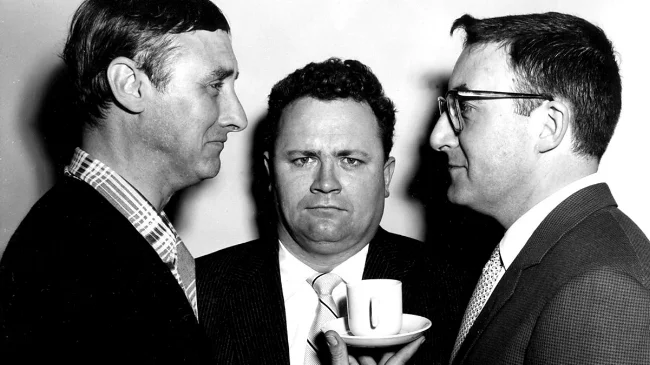
The Goon Show is one of a handful of comedy shows that had a profound and unique impact upon the UK comedy scene, both at the time of its broadcast and over the preceding two decades. The creative and comic genius of its three main stars, Spike Milligan, Peter Sellers and Harry Secombe re-invented radio comedy and introduced a new form of audio slapstick through its surreal imagery. This concept was then taken further by the Monty Python team and The Goons legacy is still apparent today in artists such as Eddie Izzard and Tim Vine. Despite some aspects of the show that are a little dated, such as the musical interludes and cultural references, there is still much that is fresh and pertinent.
The Goon Show is one of a handful of comedy shows that had a profound and unique impact upon the UK comedy scene, both at the time of its broadcast and over the preceding two decades. The creative and comic genius of its three main stars, Spike Milligan, Peter Sellers and Harry Secombe re-invented radio comedy and introduced a new form of audio slapstick through its surreal imagery. This concept was then taken further by the Monty Python team and The Goons legacy is still apparent today in artists such as Eddie Izzard and Tim Vine. Despite some aspects of the show that are a little dated, such as the musical interludes and cultural references, there is still much that is fresh and pertinent.
There are many reasons why these radio shows are so enduring. Take for example, the timeless characters such as the drunken, lecherous, money grabbing Major Dennis Bloodnok. Then there’s the duplicitous, ex-public school, closet homosexual, Hercules Grytpype-Thynne. The immense range of voices and vocal gymnastics, particularly those provided by the great Peter Sellers are outstanding, often fooling the listener into thinking this was a much bigger production with a larger cast. For me, perhaps the most important aspect of the show is the surreal universe that it created. A world where a saxophone could cure a life-threatening illness, or a room in a country estate could vanish and reappear in a Parisian hotel. This was so innovative and radical for the times, pushing radio to its limits.
The Goons also smuggled a great deal of adult humour and political satire past the BBC censors of the time. Gay characters, drunken politicians and sexual dalliances where often cunningly alluded to. Spike Milligan often padded his scripts with obviously diversionary material that he knew would be cut, taking the focus away from the very material he wanted left in. The shows also offer an interesting window upon post war Britain and a nation coming to terms with the end of its empire. As usual the self-deprecating nature that permeates so much of UK humour was ever present. In some respects, The Goon Show was an act of national catharsis.
There is an arc to the lifespan of The Goon Show which becomes quite noticeable when listening to them chronologically. At the height of their popularity during the mid-fifties, the shows are clearly structured and have a semblance of coherency. This seems most apparent when Milligan was writing with Eric Sykes and the scripts edited by other noted writers within the BBC. By the end of the decade the shows had become too self-indulgent and sprawling in nature. The cast seem a little too enamoured of their own esoteric catch phrases and Milligan particularly had to be reined in. Sellers would often provide verbal cues such as pronouncing a character’s name slightly differently, as an indicator for Milligan to show restraint.
One particular episode that I am fond of is "Lurgi Strikes Britain". This was seventh episode of the fifth Series, first broadcast on November 9th, 1954 and it was also my first introduction to the show. It is a tale of a strange epidemic, Doctor's in dustbins, the state of the drains in Hackney and the airlift of thousands of wind instruments. It is a good example of the show when it was at its height, has a clear narrative and broad representation of many of the best characters. Comedy can be a very interesting litmus test of each generations popular culture. The Goon Show is a great example of this as well as being just bizarre, idiotic and crazy fun.
PC Nicholas Angel (Simon Pegg) is an exemplary Police Officer, with a strict adherence to the letter of the law. As a result of making the rest of the London Metropolitan Police look bad, he is transferred to the rural town of Sandford, Gloucestershire. On arrival, Angel finds that the local Inspector, Frank Butterman (Jim Broadbent), takes a far more laissez-faire approach to policing. His colleagues are incompetent and he is further hampered by the Neighbourhood Watch Alliance (NWA), who prioritise low crime statistics over law enforcement due to their desire to win the title of “Village of the Year”. Furthermore, Angel is partnered with the Inspector’s son, Constable Danny Butterman (Nick Frost), who is infatuated with “buddy cop” movies and is in awe of Angel’s London experience. “Have you ever fired two guns while jumping through the air?” However, a sudden spate of grisly accidents lead Angel to believe that there's more to the seemingly tranquil and picture-perfect community than meets the eye.