
60 Years of Star Trek
Star Trek is slightly older than me by 14 months. I was born on December 18th 1967. Star Trek was first broadcast in the US on 8th September 1966. Hence this show has always been part of the prevailing pop culture that surrounded me, as I grew up. I first began watching Star Trek as a young child in the early seventies. It would be repeated on the BBC in the early evening on Fridays and it became a family ritual to sit down together and watch it. As a seven or eight year old, it left a great impression upon me and was in many ways, the television highlight of the week. Star Trek along with Doctor Who certainly started my interest in science fiction. Star Trek was also one of the first shows that introduced me to tie-in marketing. I remember seeing in a toy shop, near to my school at the time, a Dinky Klingon Battle Cruiser and was flabbergasted that such a thing existed. I immediately coveted it but sadly never obtained one.
Star Trek is slightly older than me by 14 months. I was born on December 18th 1967. Star Trek was first broadcast in the US on 8th September 1966. Hence this show has always been part of the prevailing pop culture that surrounded me, as I grew up. I first began watching Star Trek as a young child in the early seventies. It would be repeated on the BBC in the early evening on Fridays and it became a family ritual to sit down together and watch it. As a seven or eight year old, it left a great impression upon me and was in many ways, the television highlight of the week. Star Trek along with Doctor Who certainly started my interest in science fiction. Star Trek was also one of the first shows that introduced me to tie-in marketing. I remember seeing in a toy shop, near to my school at the time, a Dinky Klingon Battle Cruiser and was flabbergasted that such a thing existed. I immediately coveted it but sadly never obtained one.
When Star Wars proved a box office success, the major Hollywood studios rushed to produce films that could satisfy the public’s need for more science fiction. I can remember getting very excited when Star Trek: The Motion Picture was announced and the classic cast reassembled. Yet the film’s hard science fiction story which focused on ideas rather than action, left me somewhat underwhelmed when I finally saw it. I have subsequently revised my opinion of it as an adult but it is a somewhat incongruous entry into the Trek canon, being far more cerebral than the show it proceeded. I enjoyed immensely, it’s sequel, Star Trek II: the Wrath of Khan, although Spock’s death at the time, broke me. It is curious the parasocial attachments you can form with fictional characters.
When Star Trek: the Next Generation was announced, I can remember my Mother adopting a very scorched earth policy towards it, before she had even seen the show. She just thought the idea was heretical. I remember that the UK papers gave a lot of coverage to this story, mainly due to a British actor being cast in the lead role. Like most TV shows in the seventies and eighties, it took a while for TNG to be shown in the UK. Released in the US in the autumn of 1987, it was show on the BBC in 1990. However, the first season or two had been released on VHS tape which had two episodes. We rented these from Blockbuster and was disappointed by the extremely poor picture quality. TNG was shot on 35m film but then transferred to NTSC video format for editing. This when combined with a further transfer to PAL video format resulted in a terrible fluorescent picture with a soft image quality. This combined with the overall weak scripts of the first few season left me somewhat indifferent to TNG. However, the subsequent feature films rekindled my interest and I have revisited the show since and now think far better of it.
By the time Star Trek: Deep Space Nine was shown, I was an adult of 23. This was for me the era of peak Trek and this show epitomised why I liked the franchise. In many ways it was the first show to stray furthest from Gene Roddenberry’s original formula with a stand alone episode of the day and the unequivocal optimism about the rectitude of Starfleet and the future overall. DS9 dealt in ambiguity, politics versus ethics and the human cost of war. It had some great characters and it clealry define the franchise as being for grown ups in so far as what it was exploring. Due to adult life and real world commitments, I caught up with Star Trek: Voyager and Star Trek: Enterprise after their initial broadcasts. I liked them both and thought they did a good job or expanding the lore yet remaining true to the central themes of Trek.
Which brings me to what we shall call modern Trek which I think has been a varied endeavour. I actually didn’t have a problem with the new feature films from this era. The Kelvin Timeline by its very nature is a separate entity and as such can be totally ignored if its not found to your liking. I quite liked it and found it sufficiently entertaining in a big spectacle sort of way. Star Trek: Discovery was a much harder experience to adjust to. Characters like Saru were and remain great but lots of other elements of the show were wanting. I felt that DISCO leaned too far into modern sensibilities and rather than casually referencing them focused too muc upon them in a performative fashion. Hence I christened the show “Hug Trek”. However by season 3 the show got more interesting once it went into the 32nd century. Star Trek: Picard was a very enjoyable fan service that tied up some interesting loose ends. Star Trek: Strange New Worlds started with a lot of promise but for me, peaked in the third season and has dropped in quality recently. The writers seem to be a little too experimental and some of the idea are too off the wall and there’s not enough respect for cannon.
I have always enjoyed Star Trek as a franchise and like its themes of a collaborative exploration with Starfleet striving to be a benign quasi-military body. When compared to another popular sci-fi franchise (you can guess which one), I consider this far more cerebral. It deals with all the problems we have faced with modernity and real life from the sixties to the present, via the medium of genre fiction and it has consistently done it well. Trek has also done much to make pop culture and fandom mainstream. There was a time in the seventies where Trek was very much the face of fandom. As for what it has done for pop culture, well pretty much everyone knows who Captain Kirk is. I also consider Spock to be one of the finest fictional characters ever created, especially in his later years. You can write another blog post about how Trek has impacted upon technology. So many people who now work in such industries grew up watching the show.
Let us take a moment to be realistic. If history teaches us anything, it is that the future that we see in Star Trek is not going to happen, anytime soon. However, that does not mitigate the shows central themes. The merit of Star Trek resides in its message and how that message impacts upon people. Because Trek inspires hope and considers the possibility of humans at their best. When we watch the show in all its incarnations, we briefly feel positive about ourselves as a species. That makes viewers feel good about themselves at time when the wider world is the absolute opposite of Gene Roddenberry’s vision. I think that is important and something we should reflect upon now that the franchise is entering yet another new era now that its corporate ownership has changed. I sincerely hope that people will be celebrating Star Trek in another sixty years. Assuming we’re still here. Human, I mean. In the meantime, we will always have Galaxy Quest. “Never give up, never surrender”.
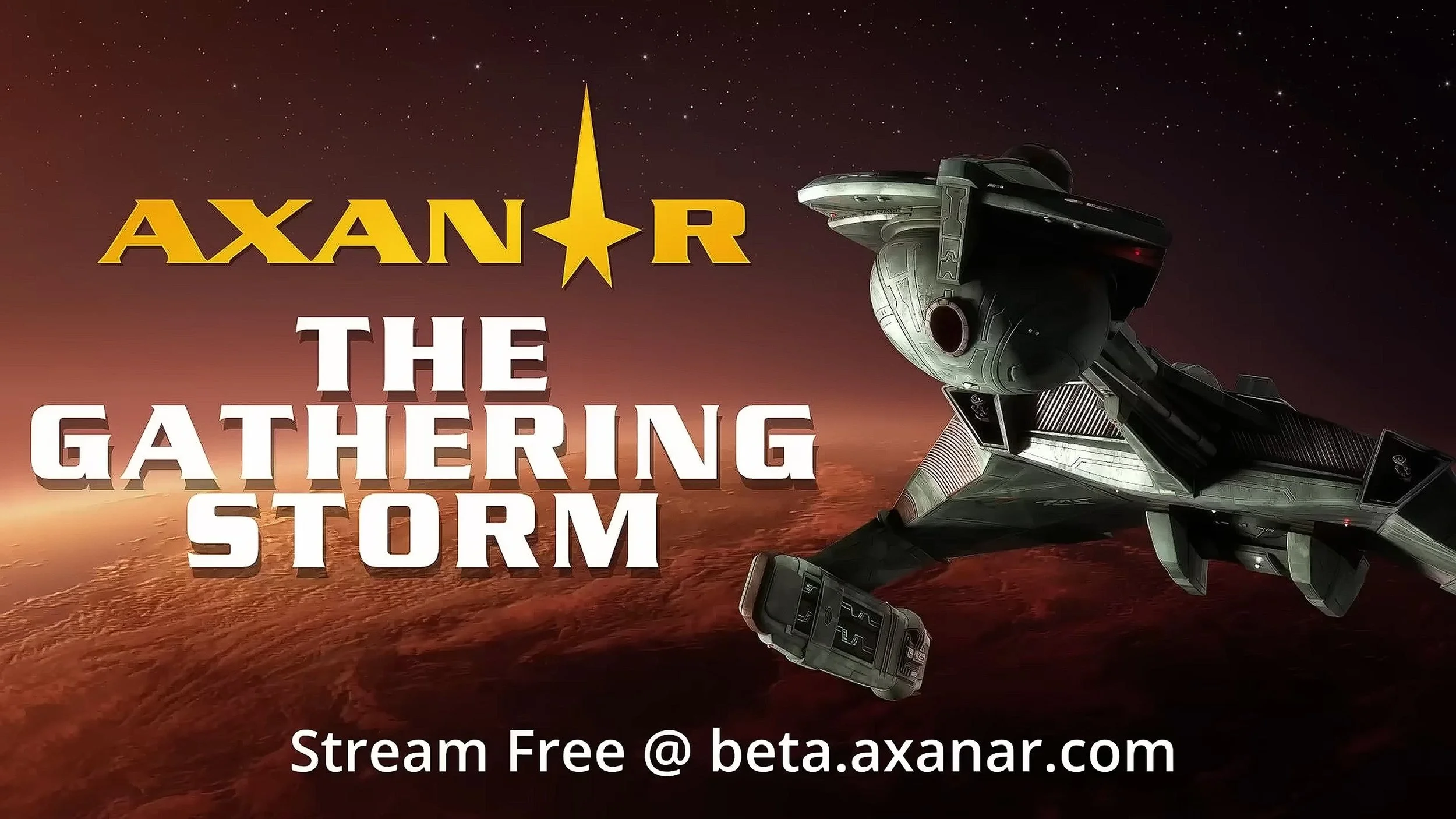
Star Trek Axanar is back in the news, twelve years on from the last controversy. For those unfamiliar with the original debacle, in 2014 Prelude to Axanar was released via YouTube. This Star Trek “fan-film” presented as a faux 21-minute, Starfleet documentary was very well received by fans and was intended by its makers as a proof of concept for a feature-length film. Set in the year 2245, during the final year of the Four Years War against the Klingons, Prelude to Axanar pushed the boundaries of what a fan film could be. The subsequent Kickstarter and Indiegogo campaigns raised more than $1.1 million. Prelude to Axanar was promoted as a professional-quality, “independent” Star Trek production, employing experienced actors and filmmakers and even established its own studio facilities. The presence of such actors as Richard Hatch, J. G. Hertzler, Kate Vernon, Tony Todd and Gary Graham (resuming his role as Vulcan Ambassador Soval) certainly made Prelude to Axanar distinct from other fan-films.
Thoughts on TV shows and my current viewing habits.
I last wrote a blog post in this series back in February 2022. Then for various reasons, I stopped. Possibly because my relationship with TV has changed in recent years. It’s fair to say at present that viewers are spoilt for choice. There are lots of very good shows around. Conversely, there is also a lot of bland, generic, filler as well. I appreciate that not every television series has to be an industry milestone and there are times when I’m content to watch undemanding content. However, I am very protective of how I spend my leisure time at present. I am not prepared to sink 6 or 8 hours into a show that is just “okay”. Hence I’m becoming very particular about what I watch. If something isn’t working for me in any fashion then I just abandon it and am happy to do so.
Jerry Goldsmith’s contribution to Star Trek is immense. Yet simply listing the films and TV episodes he wrote music for does not adequately encapsulate the significance of his contribution to the franchise. His majestic, thoughtful and uplifting musical scores provide an emotional foundation that reflects the core ethos of Star Trek. They also create an invaluable sense of continuity that spans multiple shows and movies. Perhaps the most obvious example of this is his iconic title music for Star Trek: The Motion Picture (1979) that was subsequently adopted as the theme tune for Star Trek: The Next Generation. His work was held in such high regard, when Star Trek V: The Final Frontier (1989) ran into production issues, it was thought that a Jerry Goldsmith soundtrack may well elevate the film. Sadly it didn’t but his work on that instalment was outstanding and among his best.
Star Trek documentaries are very much like Bruce Lee documentaries, in so far as they’re both a saturated market and more often than not, new content frequently ends up covering the same ground. However, fans tend to watch anything new in the hope that they will find a few new nuggets of information. Brian Volk-Weiss’ new 11 part series, The Center Seat: 55 years of Star Trek, not only covers established facts about the iconic show but also expands upon them as well as providing a wealth of new information. Volk-Weiss has previously explored popular culture with documentaries such as The Toys That Made Us and The Movies That Made Us. The Center Seat: 55 years of Star Trek is an in-depth chronological study of the Star Trek franchise, from its creation at Desilu Productions in 1965 all the way through to the latest iterations, Star Trek: Picard and Star Trek: Discovery.
I recently watched the first trailer for the new Obi-Wan Kenobi television show that is premiering on Disney + in May. I am interested in this latest instalment in the Star Wars franchise and curious as to whether Liam Neeson will make an appearance. I also watched a 20 minute fan video in which they “analysed” the entire trailer. They discussed the content of this 2 minute preview and then did a great deal of speculating about potential themes and characters that may feature in the show. They were clearly enthusiastic about what they had seen and were very knowledgeable about the subject. This resonated with me, as I like to be well versed about the things I enjoy. However, it is worth remembering that fandom can tip into obsession and gatekeeping. Hence I feel there is a subject to explore here.
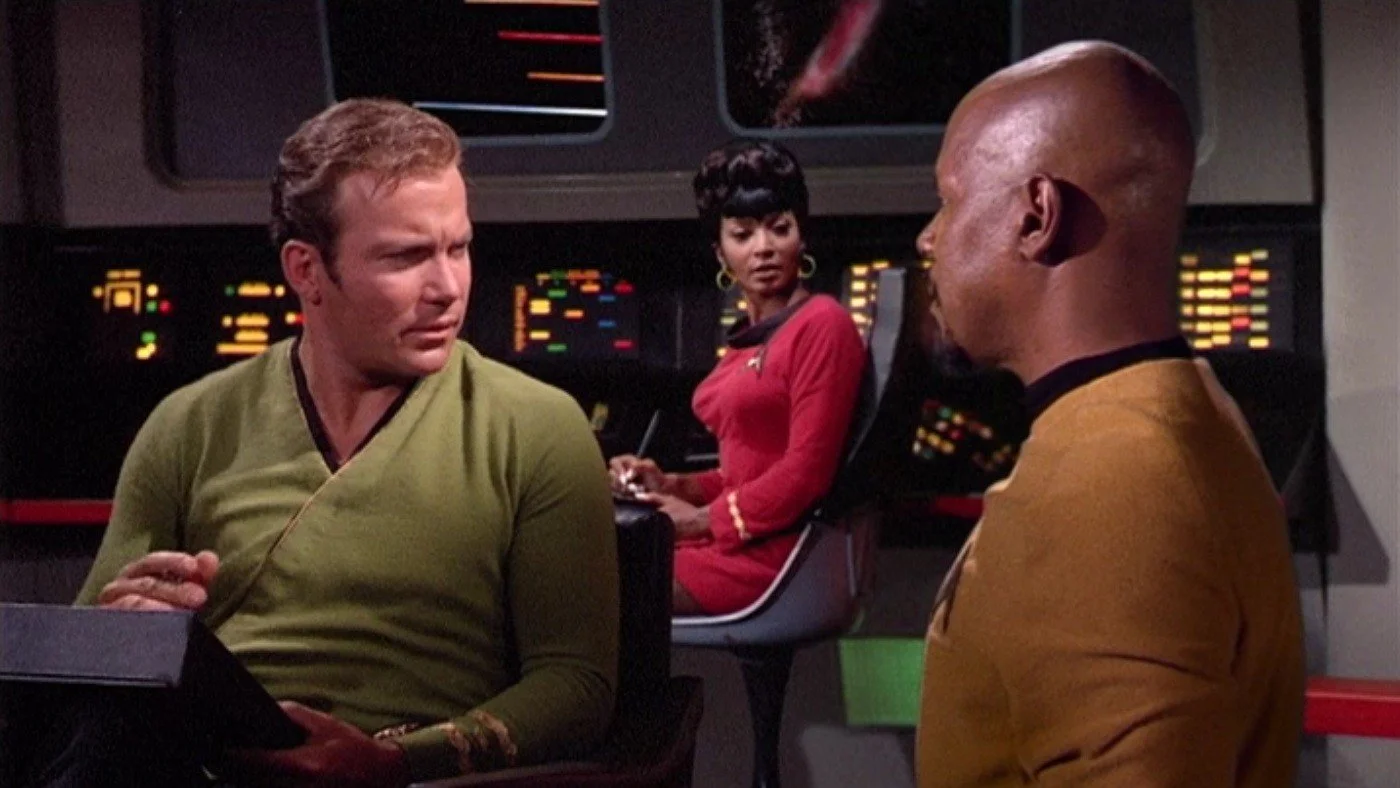
Before we start, no I am not writing about Alexander Courage’s classic main theme for the original Star Trek show. I can add nothing further to that particular discussion and it remains iconic and inspiring, even when distilled down to just the initial fanfare. In this post I want to draw your attention to another piece of music from Star Trek that has permeated its way into popular culture. A cue that when heard, if the listener is familiar with its provenance, will instantly conjure up images of flying drop kicks, ear claps and judo chops. A piece of music that can be added to pretty much any video footage and instantly make it more heroic. Yes, I am talking about what has become generically known as Star Trek “fight music”. Or more specifically, the "The Ancient Battle/2nd Kroykah" cue from Amok Time (S02E01) composed by Gerald Fried. The scene during the koon-ut-kal-if-fee ritual in which Spock fights Kirk on the planet Vulcan for complicated “reasons”.
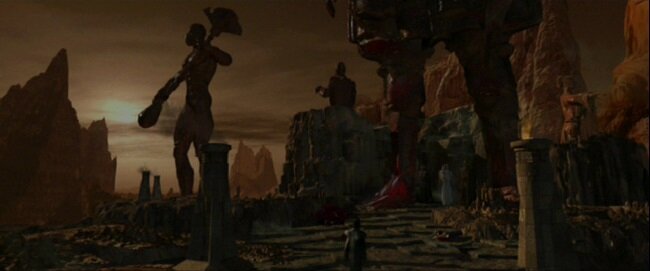
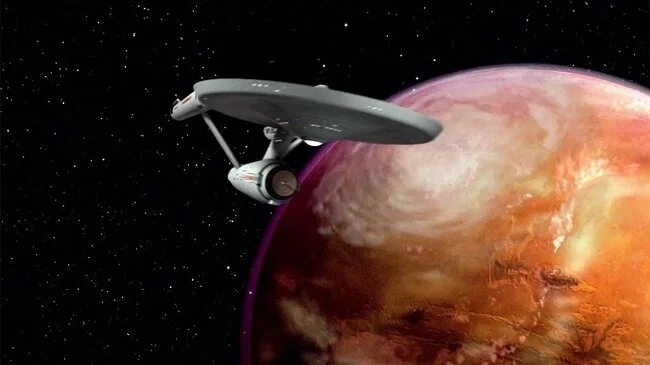
Star Trek: The Motion Picture is a wonderful paradox in the Star Trek cinematic pantheon. It is possibly the most hardcore science fiction story that the franchise has explored and is both simultaneously Trek-like and un-Trek-like. Director Robert Wise and the production team worked hard to deliver a completed film for the scheduled December 1979 release date. However, he felt that the theatrical version was only a “rough cut”. Hence in late 2001 he supervised a Director’s Edition of the film which runs 136 minutes (4 minutes longer than the theatrical release)and reinstates some additional scenes and replaces some of the optical effects with new CGI creations. Critics were divided as to whether the Director’s Edition improved the film overall but Wise felt that this version was much closer to his original vision. The Director’s Edition was released exclusively on DVD in standard definition.

Fan Edits are a curious film sub genre. Some simply reinstate deleted scenes to maximise the running time of a movie. Others will remove footage and seek to reorder events in the name of coherency. But a few are far more ambitious. Rather than just reshape what is there, they will shoot new footage to replace material deemed substandard and seek to totally reimagine a movie. On even rarer occasions a few manage to actually improve upon the original, rather than just offering an augmented version. Which leads me onto Star Trek: beyond the Barrier, an interesting and very enjoyable fan edit of Star Trek V: The Final Frontier by Anti-Matter from deLimited Productions. It attempts to repair many of the problems found in the theatrical release of the movie. Some would argue that such a task is a Kobayashi Maru test in itself. However, the results are surprisingly good and some tongue in cheek humour shows that the creator understands the nature of their task.
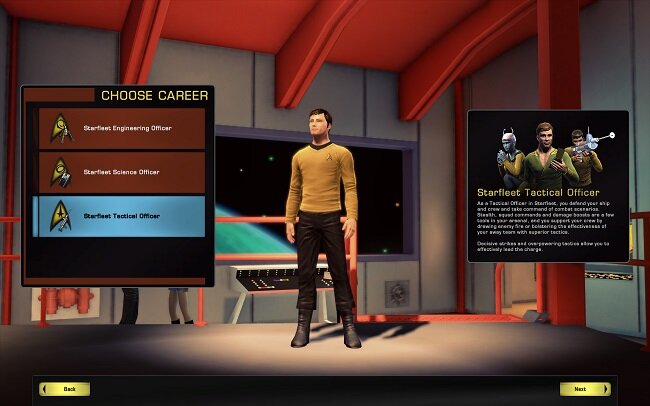
Welcome to the second part of my Star Trek Online: Beginners Guide. I thought it may be useful to write a series of posts, offering practical information for those who are just starting out in STO. Nothing fancy or in any way definitive. Just a few basic tips that may help orientate the new player. I’ve been playing STO since its launch in 2010 and this MMO has seen a lot of changes. The game features a lot of systems and mechanics that are not always immediately intuitive to grasp. So I’ll be doing my best to cover a selection of these in each post and try to provide a broad overview. Like a lot of advice, it can be subjective. Ultimately it comes down to each player how they wish to play. In this instalment, I shall be writing about career paths, factions and races.
Today is Star Trek Day. An officially sanctioned celebration of all things Star Trek. The date reflects the launch of the original television show, back in the sixties. Naturally, there are a multitude of events going on over at the official Star Trek website. And as ever, the MMORPG Star Trek Online is taking part in the celebrations. “On September 8th, 1966, the world first met a group of people, and a ship, that would change our lives forever. Pitched as “wagon train to the stars,” and brought to TV by the force of Lucille Ball’s will, Gene Roddenberry’s Star Trek hit tiny television screens around the world and immediately captured hearts and minds. Through three seasons, and decades in syndication, The Original Series started a movement that still lasts today, more than half a century later. We live in a time where there’s more new Star Trek than ever before, and we’re joining with the rest of our Star Trek Family to celebrate the franchise’s birthday”.

I’ve mentioned in the past that a lot of important information regarding the MMORPG Star Trek Online is centralised within the official subreddit. That’s fine if you enjoy using this platform but it’s not for everyone. I’ve always found Reddit somewhat esoteric and I don’t really like the way it visually displays information. I have to use a browser addon to make it more user friendly. Unlike other communities, STO does not seem to have that many fan produced blogs. However, I may be wrong regarding this, so feel free to correct me (and provide URLs). In the meantime, I thought it may be useful to write a series of simple guides, offering practical information for those who are new to STO. Nothing fancy or in any way definitive. Just a few basic tips that may help orientate the new player. This time we’re going to look at the business model for STO and the cost of playing the game.
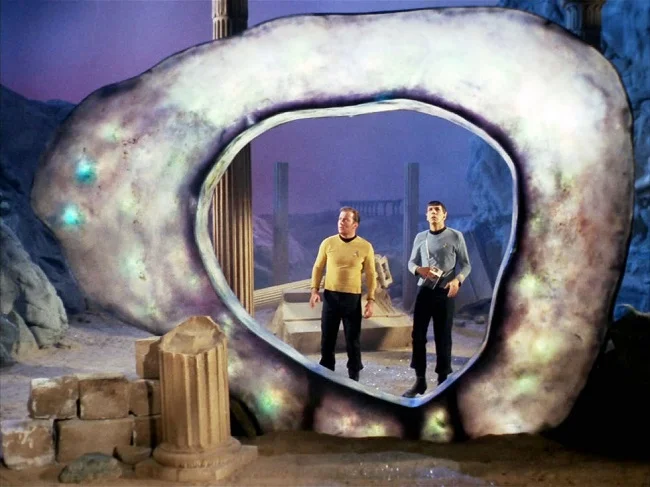
Out of the original seventy-nine episodes of Star Trek, one of the most respected and beloved is The City of the Edge of Forever. Written by Harlan Ellison the story is one of the more thoughtful and tragic in Trek Canon. It was also the first episode to feature a temporal plotline. Doctor Leonard McCoy (DeForest Kelley) accidently receives an overdose of medication and flees the Enterprise while in a delusional state. Beaming down to an alien planet he uses a temporal gateway (The Guardian of Forever) to travels back in time to earth during the Great Depression. By doing so he accidentally changes history. Captain Kirk (William Shatner) and Spock (Leonard Nimoy) follow him through the gateway to New York in hope of correcting the timeline. While awaiting the arrival of McCoy, Kirk falls in love with Edith Keeler (Joan Collins) who runs the 21st Street Mission. However he and Spock soon determine that to restore the timeline they must allow her to die.
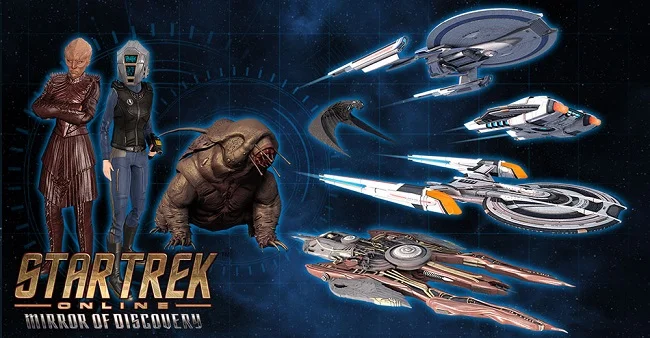
There has been a degree of controversy over the Discovery Operation Pack that has recently been made available for purchase in Star Trek Online. The bundle featuring ships, bridge officers, cosmetic items and more is displeasing some core players who feel that it is over priced and lacks anything relevant for Romulan and Klingon races. Personally, I’m only interested in two specific items from the pack, such as the Tier 6 Gagarin Miracle Worker Battlecruiser and the combat pet Tardigrade but at present they cannot be purchased separately. So, I shall not be parting with any money at present. The Gagarin Miracle Worker Battlecruiser is relatively similar to the Tucker Tactical Miracle Worker Cruiser, which I already own. However, it is an improvement aesthetically speaking (a subjective point, admittedly), so for me the obvious compromise is to purchase the fleet version and forgo the unique space trait and settle for an additional console slot. As I’m not a high-end player, the look and feel of a ship has as much appeal to me as its stats.
I have suffixed the title of this post “and stuff” so I can address several Star Trek Online related thoughts in a single blog post. Despite the fact that I frequently play STO it is does oddly get neglected in my writing. So, let us start with the issue of the ninth anniversary. As ever Q is back with the anniversary event and once again, we are stabilising Omega Molecules. This year’s reward is a Tier 6 Vulcan T’Pau Scout Ship. There are also emotes and sundry other items to earn during the duration of the festivities, but I more interested in the anniversary itself. Not many MMOs make it to nine years and if they do, they aren’t necessarily in as good shape as STO. The game has a stable and loyal playerbase and is currently tied-in to Star Trek: Discovery. Further established Trek actors are supplying voice acting and the game seems to be doing well across both PC and consoles. Like LOTRO, STO uses the IP well and seems to “fill in the gaps” in the existing lore as well as expand and extrapolate established canon. One of the best things about STO is that there’s always something to do in-game as well as new content in the pipeline. Perhaps this along with the handling of the IP is why the game endures.
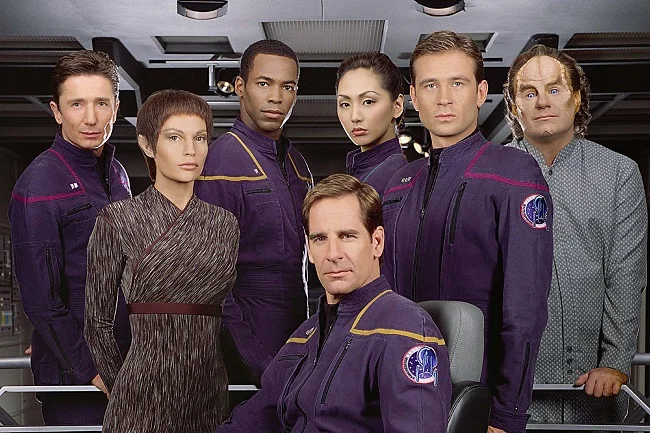
Star Trek: Enterprise was the first show in the Star Trek pantheon to have a song performed by an established artist play over the opening credits, rather than a traditional theme tune. Up until 2001, the franchise had maintained a more formal approach, established with the iconic introduction to the original series composed by Alexander Courage. Needless to say, such a radical departure from established practise brought about consternation and debate among fans. In some respects, you can argue that point about the entire show itself, but that as they say, is an entirely different blog post. Needless to say, the dislike and hatred that the song Where My Heart Will Take Me engendered in certain quarters, lead to a petition to have it removed. Needless to say, this movement failed, and the show continued using it for four seasons. Seventeen years on this particular debacle has now died down and the song is often just referenced ironically by fans as an amusing anecdote and piece of Trek trivia.
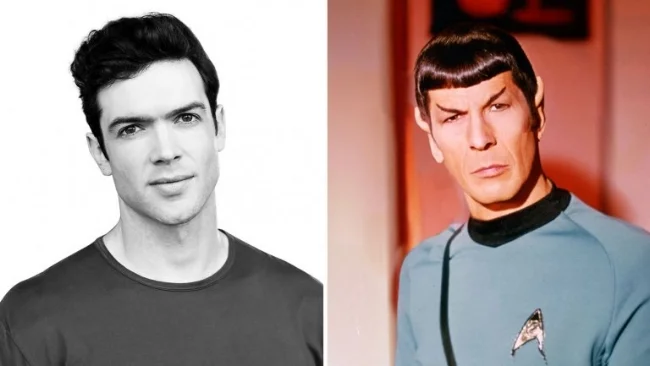
I’ve written in the past about the problems that can arise from untempered fandom. If enthusiasm and inspired love are not balanced by contextual reason and a healthy dose of reality, then it can get a little bit over zealous. Need I cite Star Wars fans and The Last Jedi as an example of unchecked fandom. However, I am now going to stray a little into the “Twilight Zone” of fandom myself, although I shall attempt to apply a healthy dose of realism into the proceedings. Because I want to discuss the fact that Ethan Peck has been cast to play one of the most iconic characters in popular culture. Yes, Gregory Peck’s grandson (and there’s plenty of “baggage” there) has been cast to play Spock in season two of Star Trek: Discovery. Furthermore, rather than be concerned, I am very excited by this development and I really look forward to seeing how this pans out.

After a prodigious marketing campaign and a great deal of internet speculation about one specific character, Star Trek Into Darkness was released to broadly strong reviews and solid box office returns in early May 2013. Finally, all the questions that had kept fans and website pundits endlessly theorising, were answered. For a second time running, Paramount Pictures managed to produce an action-filled blockbuster which still offered a strong plot, with complex and adult themes, explored by well-rounded characters. Batman Begins seems to have set a trend of framing material from a traditional pulp background, within broader intellectual parameters. Star Trek: Into Darkness managed to do this while cleverly re-imagining iconic material from its own lore. However, as with any substantial franchise movies, not everyone was satisfied or pleased. Many fans railed against the new Kelvin Timeline and continue to do so.

The reinvention of any popular franchise certainly comes with many risks. Twelve years ago, Casino Royale was hailed as a triumph in rebooting the 007 brand. It was hard edged, back to basics movie that made the spy genre relevant to a contemporary audience, without diluting its source material excessively. Yet this process went a step too far with Quantum of Solace, with a film that simply didn't feel Bond enough. Needless to say, the rights holders corrected this error. The success of the BBC's relaunch of Doctor Who hinged on making the formula accessible to modern viewers. Yet the new format of standalone episodes, celebrity guest stars and an emphasis on action over story, can be difficult to maintain and requires the involvement of top writers to keep the momentum going. Then of course there are the fans.
![Star Trek Discovery S01E01 The Vulcan Hello.mkv_snapshot_07.19_[2017.09.25_17.54.13].jpg](https://images.squarespace-cdn.com/content/v1/54e310f0e4b0f4a6ba3ac899/1506359625650-D976K1OBW47HSSSFN2S2/Star+Trek+Discovery+S01E01+The+Vulcan+Hello.mkv_snapshot_07.19_%5B2017.09.25_17.54.13%5D.jpg)
Finally, it’s arrived. The first new Star Trek TV show for twelve years. Star Trek: Discovery became available for Netflix UK customers to watch at 8:00 AM this morning. Needless to say, I cleared my schedule in advance so I could sit down and watch this much-anticipated show. Furthermore, I made it my business to avoid Twitter and the internet until I had finished viewing the first two episodes because I knew in advance that Star Trek: Discovery was going to be controversial and divide fans. Having now seen The Vulcan Hello and Battle at the Binary Stars and taken time to reflect upon both episodes, I have reached the following conclusion. From what we’ve seen so far, the spirit and emotional heart of Star Trek, is reflected in the new show. I found the characters to be interesting and well defined. Lead performances by Michelle Yeoh, Sonequa Martin-Green and Doug Jones were good and there’s an intriguing crew dynamic. The story has already touched upon numerous canonical themes and I am eager to learn more about the main characters and the universe they inhabit. I therefore shall continue to watch Star Trek: Discovery. However, not everyone feels the same, as my subsequent forays online have shown. Much has changed in this new iteration of Star Trek and as we know, some fans do not like change in any way, shape, or form.
Over the years I have been a participant in several fan based communities. These have ranged from running film clubs, to creating and publishing fanzines in the pre-internet days. More recently this has included running websites, blogging and creating podcasts. It’s a curious thing the way fandom is cyclical and one’s involvement with such communities seems to ebb and flow. It’s something I’ve been thinking about a lot of late. Several of the You Tube channels I enjoy have reduced their output or stopped due, to changes in advertising policy and monetisation. The Newbie Blogger Initiative failed to manifest itself this year and many of my immediate colleagues in blogging and podcasting have also begun to fade away or moved on to pastures new. The sad thing is, the true value of many community contributors is never really realised until after they’ve gone.

Fans are often a very creative and resourceful bunch. Star Trek fans especially so. At present, there’s a lack of new officially endorsed canonical content being produced. The movies set in the Kelvin Timeline are not universally embraced by Trekkies and usually take three years to produce. The new TV show Star Trek: Discovery has been subject to several production delays and still seems a long way off. So, the fans solution in recent years, has been to make their own original content. Hence there is a wealth of unofficial, independently made shows available online, set in various incarnations of the Star Trek universe. Although many of these productions are lovingly crafted and driven by passion, often they lack the professional polish of the genuine article. Frequently their weakness lies in the quality of the acting and writing. Then there is Star Trek Continues.
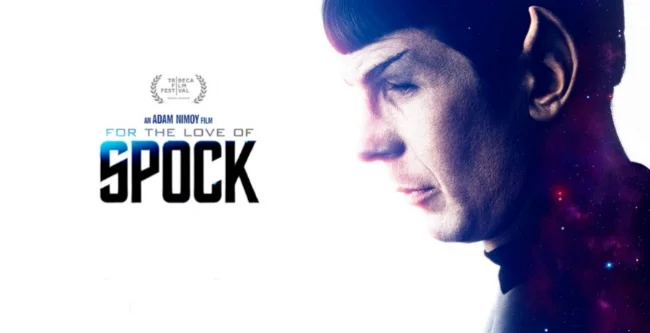
Adam Nimoy doesn’t paint a rosy picture of family life in his documentary about his father. The novelty of fame and popular acclaim soon wore off with it’s never ending photoshoots and long working hours that kept his father from ever being home. Yet among the anecdotes in this greatly condensed biopic there evidence of a lot of love and professional respect. Far from being comprehensive For the Love of Spock focuses on the matters that interest fans the most. So the documentary explores Nimoy’s relationship with Gene Roddenberry, his subsequent casting in Star Trek, his post Trek stage career and his return to the fold with the big screen movies.
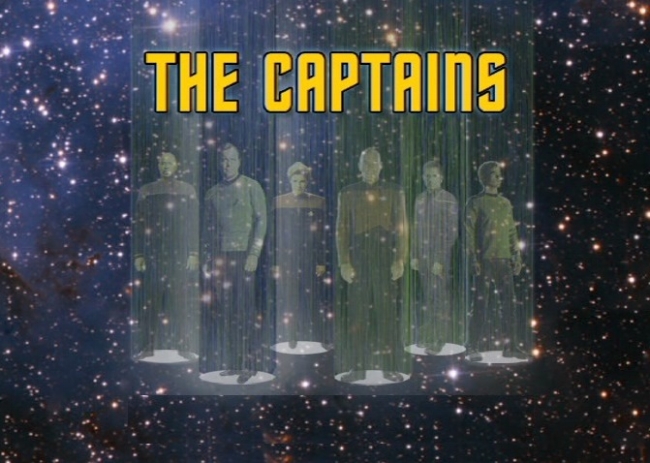
The Captains is a curious beast. If you’re expecting a traditional documentary where Bill Shatner simply indulges in a standard Q & A with other actors that have portrayed captains within the Star Trek franchise, then you will be disappointed. The Captains is a horse of a different colour entirely. Throughout its ninety minute duration, this documentary veers from personal reflections on acting, muses upon the nature of fame and even touches upon contemplating one’s own mortality. It certainly wasn’t what I was expecting and was subsequently a far more rewarding experience.
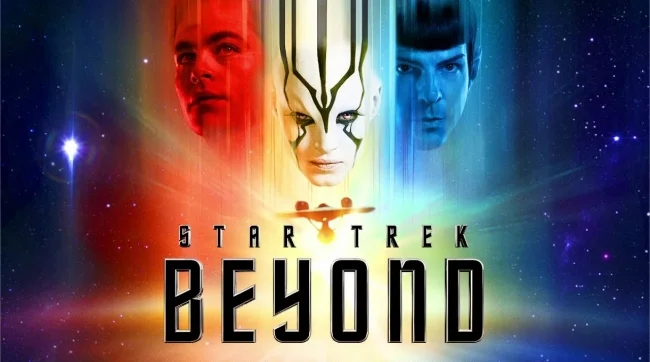
I am not a dogmatic fan. In fact as I get older, I become far more flexible and forgiving in my outlook. I certainly don’t buy into the concept that your “childhood can be ruined”. The only way something new can spoil the memories of something old that you hold dear, is if you allow it to. If you wish to explore this concept further, I’d suggest reading Marcus Aurelius. Back to the matter in hand. When I found out that Star Trek was to be rebooted via an alternative timeline plot device, I was content with this. I decided to ditch my personal baggage and try and be objective about the now named “Kelvin Timeline”. I make no bones about the fact I have liked the previous two Star Trek movies. Are they masterpieces? No. Are they entertaining? Yes. That is far more than some reboots have achieved.
The announcement that CBS has commissioned a new series of Star Trek is both a blessing and a curse. It’s a blessing in the sense that I have genuine affection for this franchise and therefore I welcome the prospect of a new incarnation of the show returning to TV. However I also consider this situation an absolute curse because well now have to endure at least eighteen months of idle speculation and an ongoing dissection of the entire production of a show before it is even released.
Trek Nation is a relatively straight forward documentary with a clear premise. It follows Eugene Roddenberry’s search to find out more about his father Gene and to understand the cultural phenomenon of Star Trek. Directed by Scott Colthorp the film endeavours to explore the enduring appeal of the franchise as Eugene discovers more about the father he didn't know and the show that passed him by. Through interviews with cast and crew members from all five Star Trek shows, as well as fans and celebrities who were influenced by the show while growing up, Trek Nation methodically follows a linear path. Yet this uncomplicated approach proves to very effective and surprising candid.
Star Trek Axanar: The Controversy Continues
Star Trek Axanar is back in the news, twelve years on from the last controversy. For those unfamiliar with the original debacle, in 2014 Prelude to Axanar was released via YouTube. This Star Trek “fan-film” presented as a faux 21-minute, Starfleet documentary was very well received by fans and was intended by its makers as a proof of concept for a feature-length film. Set in the year 2245, during the final year of the Four Years War against the Klingons, Prelude to Axanar pushed the boundaries of what a fan film could be. The subsequent Kickstarter and Indiegogo campaigns raised more than $1.1 million. Prelude to Axanar was promoted as a professional-quality, “independent” Star Trek production, employing experienced actors and filmmakers and even established its own studio facilities. The presence of such actors as Richard Hatch, J. G. Hertzler, Kate Vernon, Tony Todd and Gary Graham (resuming his role as Vulcan Ambassador Soval) certainly made Prelude to Axanar distinct from other fan-films.
Star Trek Axanar is back in the news, twelve years on from the last controversy. For those unfamiliar with the original debacle, in 2014 Prelude to Axanar was released via YouTube. This Star Trek “fan-film” presented as a faux 21-minute, Starfleet documentary was very well received by fans and was intended by its makers as a proof of concept for a feature-length film. Set in the year 2245, during the final year of the Four Years War against the Klingons, Prelude to Axanar pushed the boundaries of what a fan film could be. The subsequent Kickstarter and Indiegogo campaigns raised more than $1.1 million. Prelude to Axanar was promoted as a professional-quality, “independent” Star Trek production, employing experienced actors and filmmakers and even established its own studio facilities. The presence of such actors as Richard Hatch, J. G. Hertzler, Kate Vernon, Tony Todd and Gary Graham (resuming his role as Vulcan Ambassador Soval) certainly made Prelude to Axanar distinct from other fan-films.
However, CBS Studios Inc and Paramount Pictures Corporationregarded its scale, commercial activity and extensive use of Star Trek characters, terminology, uniforms, species and designs as having crossed the boundary normally tolerated for amateur fan films. They subsequently filed a joint copyright-infringement lawsuit on 29th December 2015 and the following year the media storm began. During 2016, J. J. Abrams publicly suggested that the studios intended to withdraw the legal action, but it continued. CBS and Paramount instead issued far stricter Star Trek fan-film guidelines, limiting productions to short, amateur and non-commercial works. In January 2017, a federal judge rejected the producers of Star Trek Axanar (as it was now colloquially known) fair-use defence, leaving it facing a jury trial and potentially substantial damages. However, the parties settled on 20th January 2017, shortly before the trial was scheduled to begin.
The settlement hinged upon the Star Trek Axanar producers and writer and actor Alec Peters acknowledgement that the original 21-minute film, as well as proposed feature film had crossed boundaries acceptable to CBS and Paramount. They agreed to make “substantial changes”. In return CBS and Paramount permitted the following. That Prelude to Axanar could remain on YouTube without advertising. That the planned feature was to be replaced by two further episodes of no more than 15 minutes each, distributed free and without advertising. Certain actors from Prelude to Axanar could return but without being paid. Finally, that any future productions by Alec Peters or the production team had to follow the official fan-film guidelines. The complete financial and contractual details were not initially disclosed but there was apparently no damages payment arising directly from the original lawsuit.
Unfortunately, the relationship between Axanar Productions, CBS and Paramount has remained contentious. In 2022 CBS and Paramount began arbitration over alleged breaches of the settlement. In September 2023, the arbitrator found in their favour and awarded approximately $292,373 in legal fees and costs against Peters and Axanar Productions. However, despite this incident and the ongoing acrimony between all parties, Axanar productions have continued with their planned two short film sequels. The next of which, The Gathering Storm, premiered at a small San Diego cinema and on YouTube on 26th July 2026. Within a 48 hour period the fan-film accumulated roughly 120,000 YouTube views. However, on 29th July, YouTube removed The Gathering Storm following a formal copyright-removal request from Paramount Pictures Corporation and CBS Studios Inc. This was therefore more serious than an ordinary Content ID claim, redirecting advertising revenue.
At the time of writing, neither studio has yet published a detailed explanation of exactly which settlement provisions it believes has been breached. The apparent areas of dispute could include the film’s approximately 21-minute total length, compared with the agreed 15-minute limit. The appearance of additional former Star Trek performers who were not part of Prelude to Axanar and therefore may not have been covered by the settlement’s exceptions, could also be a bone of contention. Whatever the reasons, Axanar Productions anticipated a possible removal and have now placed the film on its own website. There it remains available, along with Prelude to Axanar and other related short films as a free stream or download. Alec Peters has put out a statement on the Axanar YouTube channel, stating he intends to fight both CBS and Paramount for what he sees as a breach of the 2017 settlement.
At first glance, it is understandable why the copyright owners balked at what Axanar Productions have done. Can such a project legitimately be called a fan-film, when you consider it’s production pedigree? However, before we answer that question, let’s not forget Star Trek Continues. In many ways this fan-film series consisting of eleven episodes released between 2013 and 2017, had equally high quality production values and a similar cast of known actors, Yet despite transgressing the same rules as Alec peters’ production, this show seemed to get a free pass from the rights holders and suffered no legal action. Does an endorsement from Rod Roddenbery carry such weight? Hence, something seems off with the recent renewal of hostilities between Axanar Productions, CBS and Paramount. Let us see what happens between now and September when the final instalment of Star Trek Axanar is due to be released.
Star Trek is slightly older than me by 14 months. I was born on December 18th 1967. Star Trek was first broadcast in the US on 8th September 1966. Hence this show has always been part of the prevailing pop culture that surrounded me, as I grew up. I first began watching Star Trek as a young child in the early seventies. It would be repeated on the BBC in the early evening on Fridays and it became a family ritual to sit down together and watch it. As a seven or eight year old, it left a great impression upon me and was in many ways, the television highlight of the week. Star Trek along with Doctor Who certainly started my interest in science fiction. Star Trek was also one of the first shows that introduced me to tie-in marketing. I remember seeing in a toy shop, near to my school at the time, a Dinky Klingon Battle Cruiser and was flabbergasted that such a thing existed. I immediately coveted it but sadly never obtained one.
Star Trek Axanar is back in the news, twelve years on from the last controversy. For those unfamiliar with the original debacle, in 2014 Prelude to Axanar was released via YouTube. This Star Trek “fan-film” presented as a faux 21-minute, Starfleet documentary was very well received by fans and was intended by its makers as a proof of concept for a feature-length film. Set in the year 2245, during the final year of the Four Years War against the Klingons, Prelude to Axanar pushed the boundaries of what a fan film could be. The subsequent Kickstarter and Indiegogo campaigns raised more than $1.1 million. Prelude to Axanar was promoted as a professional-quality, “independent” Star Trek production, employing experienced actors and filmmakers and even established its own studio facilities. The presence of such actors as Richard Hatch, J. G. Hertzler, Kate Vernon, Tony Todd and Gary Graham (resuming his role as Vulcan Ambassador Soval) certainly made Prelude to Axanar distinct from other fan-films.
Thoughts on TV shows and my current viewing habits.
I last wrote a blog post in this series back in February 2022. Then for various reasons, I stopped. Possibly because my relationship with TV has changed in recent years. It’s fair to say at present that viewers are spoilt for choice. There are lots of very good shows around. Conversely, there is also a lot of bland, generic, filler as well. I appreciate that not every television series has to be an industry milestone and there are times when I’m content to watch undemanding content. However, I am very protective of how I spend my leisure time at present. I am not prepared to sink 6 or 8 hours into a show that is just “okay”. Hence I’m becoming very particular about what I watch. If something isn’t working for me in any fashion then I just abandon it and am happy to do so.
Jerry Goldsmith’s contribution to Star Trek is immense. Yet simply listing the films and TV episodes he wrote music for does not adequately encapsulate the significance of his contribution to the franchise. His majestic, thoughtful and uplifting musical scores provide an emotional foundation that reflects the core ethos of Star Trek. They also create an invaluable sense of continuity that spans multiple shows and movies. Perhaps the most obvious example of this is his iconic title music for Star Trek: The Motion Picture (1979) that was subsequently adopted as the theme tune for Star Trek: The Next Generation. His work was held in such high regard, when Star Trek V: The Final Frontier (1989) ran into production issues, it was thought that a Jerry Goldsmith soundtrack may well elevate the film. Sadly it didn’t but his work on that instalment was outstanding and among his best.
Star Trek documentaries are very much like Bruce Lee documentaries, in so far as they’re both a saturated market and more often than not, new content frequently ends up covering the same ground. However, fans tend to watch anything new in the hope that they will find a few new nuggets of information. Brian Volk-Weiss’ new 11 part series, The Center Seat: 55 years of Star Trek, not only covers established facts about the iconic show but also expands upon them as well as providing a wealth of new information. Volk-Weiss has previously explored popular culture with documentaries such as The Toys That Made Us and The Movies That Made Us. The Center Seat: 55 years of Star Trek is an in-depth chronological study of the Star Trek franchise, from its creation at Desilu Productions in 1965 all the way through to the latest iterations, Star Trek: Picard and Star Trek: Discovery.
I recently watched the first trailer for the new Obi-Wan Kenobi television show that is premiering on Disney + in May. I am interested in this latest instalment in the Star Wars franchise and curious as to whether Liam Neeson will make an appearance. I also watched a 20 minute fan video in which they “analysed” the entire trailer. They discussed the content of this 2 minute preview and then did a great deal of speculating about potential themes and characters that may feature in the show. They were clearly enthusiastic about what they had seen and were very knowledgeable about the subject. This resonated with me, as I like to be well versed about the things I enjoy. However, it is worth remembering that fandom can tip into obsession and gatekeeping. Hence I feel there is a subject to explore here.
Before we start, no I am not writing about Alexander Courage’s classic main theme for the original Star Trek show. I can add nothing further to that particular discussion and it remains iconic and inspiring, even when distilled down to just the initial fanfare. In this post I want to draw your attention to another piece of music from Star Trek that has permeated its way into popular culture. A cue that when heard, if the listener is familiar with its provenance, will instantly conjure up images of flying drop kicks, ear claps and judo chops. A piece of music that can be added to pretty much any video footage and instantly make it more heroic. Yes, I am talking about what has become generically known as Star Trek “fight music”. Or more specifically, the "The Ancient Battle/2nd Kroykah" cue from Amok Time (S02E01) composed by Gerald Fried. The scene during the koon-ut-kal-if-fee ritual in which Spock fights Kirk on the planet Vulcan for complicated “reasons”.
Star Trek: The Motion Picture is a wonderful paradox in the Star Trek cinematic pantheon. It is possibly the most hardcore science fiction story that the franchise has explored and is both simultaneously Trek-like and un-Trek-like. Director Robert Wise and the production team worked hard to deliver a completed film for the scheduled December 1979 release date. However, he felt that the theatrical version was only a “rough cut”. Hence in late 2001 he supervised a Director’s Edition of the film which runs 136 minutes (4 minutes longer than the theatrical release)and reinstates some additional scenes and replaces some of the optical effects with new CGI creations. Critics were divided as to whether the Director’s Edition improved the film overall but Wise felt that this version was much closer to his original vision. The Director’s Edition was released exclusively on DVD in standard definition.
Fan Edits are a curious film sub genre. Some simply reinstate deleted scenes to maximise the running time of a movie. Others will remove footage and seek to reorder events in the name of coherency. But a few are far more ambitious. Rather than just reshape what is there, they will shoot new footage to replace material deemed substandard and seek to totally reimagine a movie. On even rarer occasions a few manage to actually improve upon the original, rather than just offering an augmented version. Which leads me onto Star Trek: beyond the Barrier, an interesting and very enjoyable fan edit of Star Trek V: The Final Frontier by Anti-Matter from deLimited Productions. It attempts to repair many of the problems found in the theatrical release of the movie. Some would argue that such a task is a Kobayashi Maru test in itself. However, the results are surprisingly good and some tongue in cheek humour shows that the creator understands the nature of their task.
Welcome to the second part of my Star Trek Online: Beginners Guide. I thought it may be useful to write a series of posts, offering practical information for those who are just starting out in STO. Nothing fancy or in any way definitive. Just a few basic tips that may help orientate the new player. I’ve been playing STO since its launch in 2010 and this MMO has seen a lot of changes. The game features a lot of systems and mechanics that are not always immediately intuitive to grasp. So I’ll be doing my best to cover a selection of these in each post and try to provide a broad overview. Like a lot of advice, it can be subjective. Ultimately it comes down to each player how they wish to play. In this instalment, I shall be writing about career paths, factions and races.
Today is Star Trek Day. An officially sanctioned celebration of all things Star Trek. The date reflects the launch of the original television show, back in the sixties. Naturally, there are a multitude of events going on over at the official Star Trek website. And as ever, the MMORPG Star Trek Online is taking part in the celebrations. “On September 8th, 1966, the world first met a group of people, and a ship, that would change our lives forever. Pitched as “wagon train to the stars,” and brought to TV by the force of Lucille Ball’s will, Gene Roddenberry’s Star Trek hit tiny television screens around the world and immediately captured hearts and minds. Through three seasons, and decades in syndication, The Original Series started a movement that still lasts today, more than half a century later. We live in a time where there’s more new Star Trek than ever before, and we’re joining with the rest of our Star Trek Family to celebrate the franchise’s birthday”.
I’ve mentioned in the past that a lot of important information regarding the MMORPG Star Trek Online is centralised within the official subreddit. That’s fine if you enjoy using this platform but it’s not for everyone. I’ve always found Reddit somewhat esoteric and I don’t really like the way it visually displays information. I have to use a browser addon to make it more user friendly. Unlike other communities, STO does not seem to have that many fan produced blogs. However, I may be wrong regarding this, so feel free to correct me (and provide URLs). In the meantime, I thought it may be useful to write a series of simple guides, offering practical information for those who are new to STO. Nothing fancy or in any way definitive. Just a few basic tips that may help orientate the new player. This time we’re going to look at the business model for STO and the cost of playing the game.
Out of the original seventy-nine episodes of Star Trek, one of the most respected and beloved is The City of the Edge of Forever. Written by Harlan Ellison the story is one of the more thoughtful and tragic in Trek Canon. It was also the first episode to feature a temporal plotline. Doctor Leonard McCoy (DeForest Kelley) accidently receives an overdose of medication and flees the Enterprise while in a delusional state. Beaming down to an alien planet he uses a temporal gateway (The Guardian of Forever) to travels back in time to earth during the Great Depression. By doing so he accidentally changes history. Captain Kirk (William Shatner) and Spock (Leonard Nimoy) follow him through the gateway to New York in hope of correcting the timeline. While awaiting the arrival of McCoy, Kirk falls in love with Edith Keeler (Joan Collins) who runs the 21st Street Mission. However he and Spock soon determine that to restore the timeline they must allow her to die.
There has been a degree of controversy over the Discovery Operation Pack that has recently been made available for purchase in Star Trek Online. The bundle featuring ships, bridge officers, cosmetic items and more is displeasing some core players who feel that it is over priced and lacks anything relevant for Romulan and Klingon races. Personally, I’m only interested in two specific items from the pack, such as the Tier 6 Gagarin Miracle Worker Battlecruiser and the combat pet Tardigrade but at present they cannot be purchased separately. So, I shall not be parting with any money at present. The Gagarin Miracle Worker Battlecruiser is relatively similar to the Tucker Tactical Miracle Worker Cruiser, which I already own. However, it is an improvement aesthetically speaking (a subjective point, admittedly), so for me the obvious compromise is to purchase the fleet version and forgo the unique space trait and settle for an additional console slot. As I’m not a high-end player, the look and feel of a ship has as much appeal to me as its stats.
I have suffixed the title of this post “and stuff” so I can address several Star Trek Online related thoughts in a single blog post. Despite the fact that I frequently play STO it is does oddly get neglected in my writing. So, let us start with the issue of the ninth anniversary. As ever Q is back with the anniversary event and once again, we are stabilising Omega Molecules. This year’s reward is a Tier 6 Vulcan T’Pau Scout Ship. There are also emotes and sundry other items to earn during the duration of the festivities, but I more interested in the anniversary itself. Not many MMOs make it to nine years and if they do, they aren’t necessarily in as good shape as STO. The game has a stable and loyal playerbase and is currently tied-in to Star Trek: Discovery. Further established Trek actors are supplying voice acting and the game seems to be doing well across both PC and consoles. Like LOTRO, STO uses the IP well and seems to “fill in the gaps” in the existing lore as well as expand and extrapolate established canon. One of the best things about STO is that there’s always something to do in-game as well as new content in the pipeline. Perhaps this along with the handling of the IP is why the game endures.
Star Trek: Enterprise was the first show in the Star Trek pantheon to have a song performed by an established artist play over the opening credits, rather than a traditional theme tune. Up until 2001, the franchise had maintained a more formal approach, established with the iconic introduction to the original series composed by Alexander Courage. Needless to say, such a radical departure from established practise brought about consternation and debate among fans. In some respects, you can argue that point about the entire show itself, but that as they say, is an entirely different blog post. Needless to say, the dislike and hatred that the song Where My Heart Will Take Me engendered in certain quarters, lead to a petition to have it removed. Needless to say, this movement failed, and the show continued using it for four seasons. Seventeen years on this particular debacle has now died down and the song is often just referenced ironically by fans as an amusing anecdote and piece of Trek trivia.
I’ve written in the past about the problems that can arise from untempered fandom. If enthusiasm and inspired love are not balanced by contextual reason and a healthy dose of reality, then it can get a little bit over zealous. Need I cite Star Wars fans and The Last Jedi as an example of unchecked fandom. However, I am now going to stray a little into the “Twilight Zone” of fandom myself, although I shall attempt to apply a healthy dose of realism into the proceedings. Because I want to discuss the fact that Ethan Peck has been cast to play one of the most iconic characters in popular culture. Yes, Gregory Peck’s grandson (and there’s plenty of “baggage” there) has been cast to play Spock in season two of Star Trek: Discovery. Furthermore, rather than be concerned, I am very excited by this development and I really look forward to seeing how this pans out.
After a prodigious marketing campaign and a great deal of internet speculation about one specific character, Star Trek Into Darkness was released to broadly strong reviews and solid box office returns in early May 2013. Finally, all the questions that had kept fans and website pundits endlessly theorising, were answered. For a second time running, Paramount Pictures managed to produce an action-filled blockbuster which still offered a strong plot, with complex and adult themes, explored by well-rounded characters. Batman Begins seems to have set a trend of framing material from a traditional pulp background, within broader intellectual parameters. Star Trek: Into Darkness managed to do this while cleverly re-imagining iconic material from its own lore. However, as with any substantial franchise movies, not everyone was satisfied or pleased. Many fans railed against the new Kelvin Timeline and continue to do so.
The reinvention of any popular franchise certainly comes with many risks. Twelve years ago, Casino Royale was hailed as a triumph in rebooting the 007 brand. It was hard edged, back to basics movie that made the spy genre relevant to a contemporary audience, without diluting its source material excessively. Yet this process went a step too far with Quantum of Solace, with a film that simply didn't feel Bond enough. Needless to say, the rights holders corrected this error. The success of the BBC's relaunch of Doctor Who hinged on making the formula accessible to modern viewers. Yet the new format of standalone episodes, celebrity guest stars and an emphasis on action over story, can be difficult to maintain and requires the involvement of top writers to keep the momentum going. Then of course there are the fans.
Finally, it’s arrived. The first new Star Trek TV show for twelve years. Star Trek: Discovery became available for Netflix UK customers to watch at 8:00 AM this morning. Needless to say, I cleared my schedule in advance so I could sit down and watch this much-anticipated show. Furthermore, I made it my business to avoid Twitter and the internet until I had finished viewing the first two episodes because I knew in advance that Star Trek: Discovery was going to be controversial and divide fans. Having now seen The Vulcan Hello and Battle at the Binary Stars and taken time to reflect upon both episodes, I have reached the following conclusion. From what we’ve seen so far, the spirit and emotional heart of Star Trek, is reflected in the new show. I found the characters to be interesting and well defined. Lead performances by Michelle Yeoh, Sonequa Martin-Green and Doug Jones were good and there’s an intriguing crew dynamic. The story has already touched upon numerous canonical themes and I am eager to learn more about the main characters and the universe they inhabit. I therefore shall continue to watch Star Trek: Discovery. However, not everyone feels the same, as my subsequent forays online have shown. Much has changed in this new iteration of Star Trek and as we know, some fans do not like change in any way, shape, or form.
Over the years I have been a participant in several fan based communities. These have ranged from running film clubs, to creating and publishing fanzines in the pre-internet days. More recently this has included running websites, blogging and creating podcasts. It’s a curious thing the way fandom is cyclical and one’s involvement with such communities seems to ebb and flow. It’s something I’ve been thinking about a lot of late. Several of the You Tube channels I enjoy have reduced their output or stopped due, to changes in advertising policy and monetisation. The Newbie Blogger Initiative failed to manifest itself this year and many of my immediate colleagues in blogging and podcasting have also begun to fade away or moved on to pastures new. The sad thing is, the true value of many community contributors is never really realised until after they’ve gone.
Fans are often a very creative and resourceful bunch. Star Trek fans especially so. At present, there’s a lack of new officially endorsed canonical content being produced. The movies set in the Kelvin Timeline are not universally embraced by Trekkies and usually take three years to produce. The new TV show Star Trek: Discovery has been subject to several production delays and still seems a long way off. So, the fans solution in recent years, has been to make their own original content. Hence there is a wealth of unofficial, independently made shows available online, set in various incarnations of the Star Trek universe. Although many of these productions are lovingly crafted and driven by passion, often they lack the professional polish of the genuine article. Frequently their weakness lies in the quality of the acting and writing. Then there is Star Trek Continues.
Adam Nimoy doesn’t paint a rosy picture of family life in his documentary about his father. The novelty of fame and popular acclaim soon wore off with it’s never ending photoshoots and long working hours that kept his father from ever being home. Yet among the anecdotes in this greatly condensed biopic there evidence of a lot of love and professional respect. Far from being comprehensive For the Love of Spock focuses on the matters that interest fans the most. So the documentary explores Nimoy’s relationship with Gene Roddenberry, his subsequent casting in Star Trek, his post Trek stage career and his return to the fold with the big screen movies.
The Captains is a curious beast. If you’re expecting a traditional documentary where Bill Shatner simply indulges in a standard Q & A with other actors that have portrayed captains within the Star Trek franchise, then you will be disappointed. The Captains is a horse of a different colour entirely. Throughout its ninety minute duration, this documentary veers from personal reflections on acting, muses upon the nature of fame and even touches upon contemplating one’s own mortality. It certainly wasn’t what I was expecting and was subsequently a far more rewarding experience.
I am not a dogmatic fan. In fact as I get older, I become far more flexible and forgiving in my outlook. I certainly don’t buy into the concept that your “childhood can be ruined”. The only way something new can spoil the memories of something old that you hold dear, is if you allow it to. If you wish to explore this concept further, I’d suggest reading Marcus Aurelius. Back to the matter in hand. When I found out that Star Trek was to be rebooted via an alternative timeline plot device, I was content with this. I decided to ditch my personal baggage and try and be objective about the now named “Kelvin Timeline”. I make no bones about the fact I have liked the previous two Star Trek movies. Are they masterpieces? No. Are they entertaining? Yes. That is far more than some reboots have achieved.
The announcement that CBS has commissioned a new series of Star Trek is both a blessing and a curse. It’s a blessing in the sense that I have genuine affection for this franchise and therefore I welcome the prospect of a new incarnation of the show returning to TV. However I also consider this situation an absolute curse because well now have to endure at least eighteen months of idle speculation and an ongoing dissection of the entire production of a show before it is even released.
Trek Nation is a relatively straight forward documentary with a clear premise. It follows Eugene Roddenberry’s search to find out more about his father Gene and to understand the cultural phenomenon of Star Trek. Directed by Scott Colthorp the film endeavours to explore the enduring appeal of the franchise as Eugene discovers more about the father he didn't know and the show that passed him by. Through interviews with cast and crew members from all five Star Trek shows, as well as fans and celebrities who were influenced by the show while growing up, Trek Nation methodically follows a linear path. Yet this uncomplicated approach proves to very effective and surprising candid.
The Idiot Box
Thoughts on TV shows and my current viewing habits.
I last wrote a blog post in this series back in February 2022. Then for various reasons, I stopped. Possibly because my relationship with TV has changed in recent years. It’s fair to say at present that viewers are spoilt for choice. There are lots of very good shows around. Conversely, there is also a lot of bland, generic, filler as well. I appreciate that not every television series has to be an industry milestone and there are times when I’m content to watch undemanding content. However, I am very protective of how I spend my leisure time at present. I am not prepared to sink 6 or 8 hours into a show that is just “okay”. Hence I’m becoming very particular about what I watch. If something isn’t working for me in any fashion then I just abandon it and am happy to do so.
Thoughts on TV shows and my current viewing habits.
I last wrote a blog post in this series back in February 2022. Then for various reasons, I stopped. Possibly because my relationship with TV has changed in recent years. It’s fair to say at present that viewers are spoilt for choice. There are lots of very good shows around. Conversely, there is also a lot of bland, generic, filler as well. I appreciate that not every television series has to be an industry milestone and there are times when I’m content to watch undemanding content. However, I am very protective of how I spend my leisure time at present. I am not prepared to sink 6 or 8 hours into a show that is just “okay”. Hence I’m becoming very particular about what I watch. If something isn’t working for me in any fashion then I just abandon it and am happy to do so.
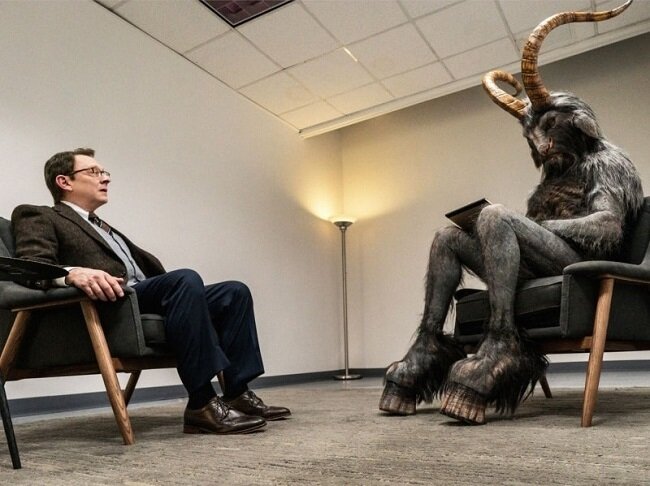
NCIS: Origins. The first season of this prequel to NCIS has been a proverbial breath of fresh air. Where NCIS has become a cartoonish caricature of itself, NCIS: Origins is the polar opposite. The characters are well defined, plausible and interesting. The cast is good and the stories are centred around everyday cases, rather than hyperbolic “let’s save the world” scenarios. It really is a case of less is more. Mercifully, CBS have had the sense to renew the show for a second season. As for NCIS, it continues its slow decline, as it gradually morphs from a military police procedural drama into something akin to Murder She Wrote.
Teacup. Loosely based upon the novel Stinger by Robert R. McCammon, Teacup centres around a group of neighbours in rural Georgia who are trapped on a farm and forced to confront a mysterious and deadly threat. As they struggle to survive, they must overcome rising tensions and uncover the truth behind the strange occurrences. Teacup has a strong start and then continues the pace over its subsequent 8 episodes. The shorter 30 minute episode format works to the show’s advantage. There are some solid jump scares and a fair amount of gore. I like the idea of a horror film turned into an episodic TV show but commissioning network Peacock obviously didn’t and cancelled the show.
Dept. Q. Every now and then, someone makes a police procedural drama which takes a different approach to the genre. Based on a series of books by Danish writer Jussi Adler-Olsen, Dept. Q relocates the stories from Copenhagen to Edinburgh. Detective Chief Inspector Carl Morck (Matthew Goode), a disliked but talented detective, returns to police work after being shot and is given a cold case unit to run. It is naturally a “poison chalice”, set up for political reasons. He is assisted by enigmatic, civilian employee Akram (Alexej Manvelov) who may have worked for the Syrian Police prior to moving to Scotland. This nine part Netflix drama is well written, with an involving plot and compelling characters. It doesn’t pull its punches and the language is ripe. Its inherent differences to standard genre fodder is what makes it such good viewing. Akram is also one of the most enigmatic characters I’ve seen in a drama for a while.
Bookish. Set in London after WWII, Bookish is a beautiful distillation of the classic detective and whodunnit genres. Blending Sherlock Holmes, Poirot and Miss Marple (and much more) Bookish is written and stars Mark Gatiss. In lesser hands this could have ended up a rather self congratulatory fan service but, here it is a multifaceted drama that blends the cosy, with the classic detective tropes. It also alludes to wider social commentary, with the lead character, Gabriel Book, being in "lavender marriage” with his wife Trottie. Beautifully shot in both the UK and Belgium and sporting an interesting modern take on period music, Bookish has all the hallmarks of a genuine hit show.
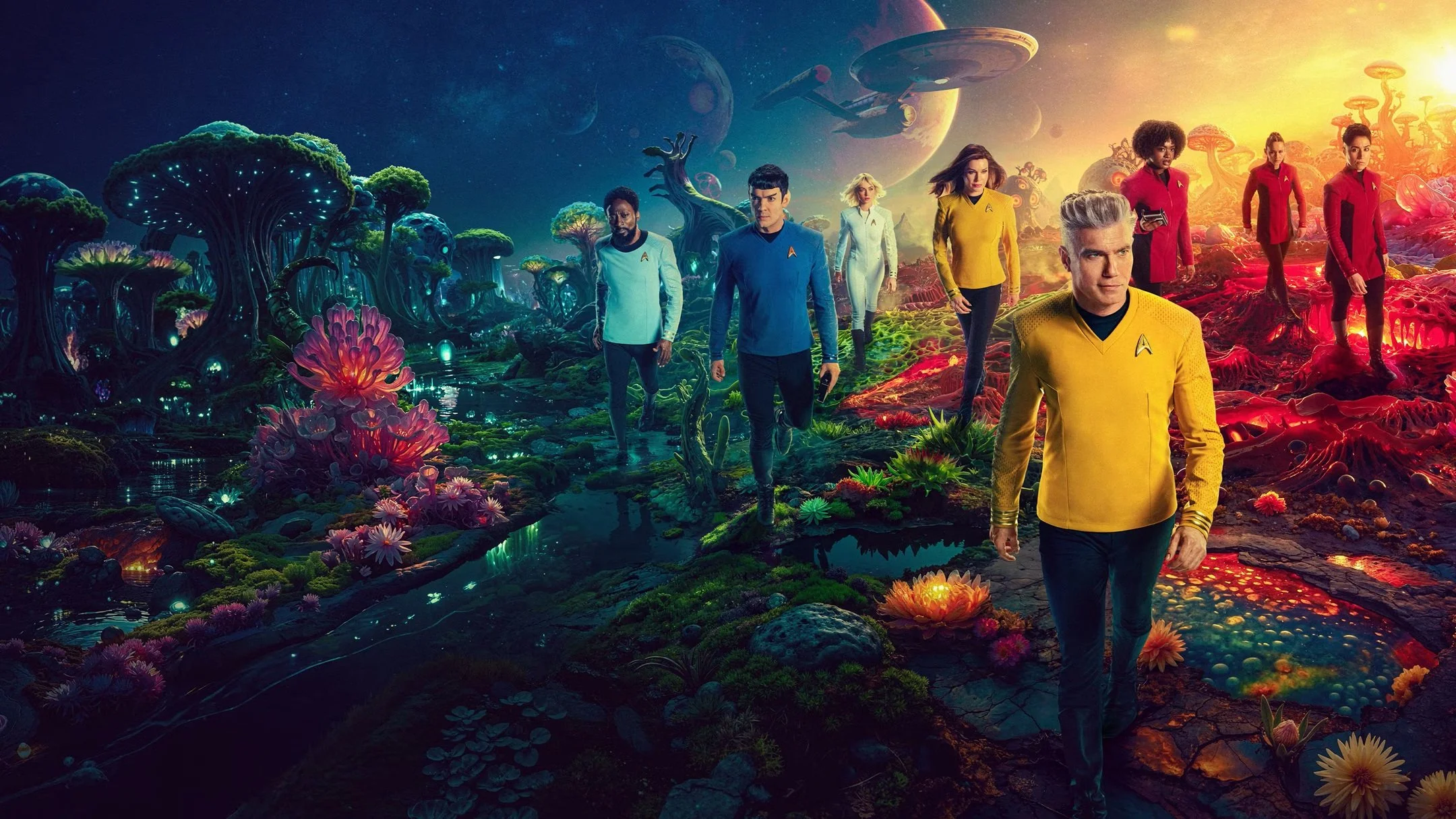
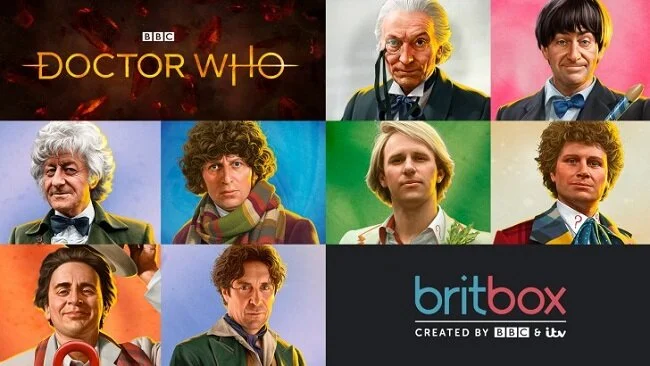
Star Trek: Strange New Worlds. I am very pleased to see this iteration of Star Trek return for a third season. It’s nearly been two years since the last episode was broadcast. Despite being set in a time period where large swathes of the existing, canonical lore can potentially hem the show in, it still manages to innovate and expand in a very creative way. Furthermore it does this without crossing too many lines with its retconning. There are several standout characters, especially Doctor M’Benga, played by the superb Babs Olusanmokun. I am also happy with the return of classic crew members such as Spock and Scotty and the opportunity to explore their past more. I feel this show totally eclipsed Star Trek: Discovery, from which it was a spinoff. I look forward to watching the remainder of the season.
Thoughts on TV shows and my current viewing habits.
This so-called recurring post is certainly becoming quite irregular, as It’s been over a year since I wrote the last instalment of The Idiot Box. I noted back then how I was watching less television and to be frank that hasn’t really changed. Although there are plenty of well written and entertaining shows out there, too often choosing to watch one effectively places you in an opened ended social contract. For example, I watched the first season of The Agency, which is a superior espionage drama. It ended with the main story completed and a few plot lines open for another season. A second season has just been released and I have learned from a blog post by Wilhelm Arcturus, that this season ends on a cliffhanger. Oh dear. Do I really want to get on another TV show treadmill? Nope. I like TV shows that have self-contained seasons. So I guess I’ll be skipping The Agency. Shame. I liked the Jack Black cover of a U2 song that they use on the title credits.
Thoughts on TV shows and my current viewing habits.
I last wrote a blog post in this series back in February 2022. Then for various reasons, I stopped. Possibly because my relationship with TV has changed in recent years. It’s fair to say at present that viewers are spoilt for choice. There are lots of very good shows around. Conversely, there is also a lot of bland, generic, filler as well. I appreciate that not every television series has to be an industry milestone and there are times when I’m content to watch undemanding content. However, I am very protective of how I spend my leisure time at present. I am not prepared to sink 6 or 8 hours into a show that is just “okay”. Hence I’m becoming very particular about what I watch. If something isn’t working for me in any fashion then I just abandon it and am happy to do so.
Thoughts on TV shows and my current viewing habits
Last November, CBS chose not to make season 4 of Star Trek Discovery available on Netflix. Netflix has been the home of this show outside of the US, for the past four years. This is due to Paramount + being launched in Europe sometime in 2022 and CBS wants to keep such a popular franchise on their own streaming platform. Naturally fans were unhappy. Then to add insult to injury CBS pulled all prior seasons of Star Trek Discovery from Netflix. However, due to the negative feedback, a last minute deal was made with Pluto TV; a streaming service which offers 110+ live TV channels on its UK platform and hundreds of on-demand films and TV episodes. It’s a free service supported by adverts and it lacks the polish and presentation of Netflix. I don’t consider it an optimal way to watch a show such as Star Trek Discovery. This is a timely reminder how licensed content can “vanish” from your platform of choice.
Thoughts on TV shows and my current viewing habits.
The last instalment of The Idiot Box was back in March. Since then Mrs P and I have watched several new shows and tried to diversify our viewing. She has had better luck than I. The issue for me is one of narrative complexity and genre saturation. Some popular shows are very straightforward in both their structure and their intellectual scope. A great deal of “police procedurals” fall into this category. The weekly stories essentially come down to “who is the murderer” with a side helping of the protagonist's ongoing “personal life”. I am currently watching the latest season of NCIS and it struck me how little credible investigative work the team now does. In the last episode that I watched, one of the central character’s mother-in-law was witness to a murder on a cruise ship. The plot was contrived, convoluted and more like that of a soap opera. Such content can be fun but it’s somewhat unsatisfying if viewed to excess.
Thoughts on TV shows and my current viewing habits.
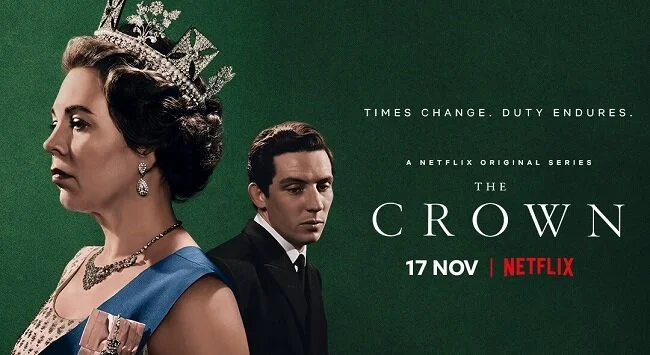
Things have not returned to normal here in the UK. The first lockdown ended last July but restrictions remained in place. Then we had lockdown 2.0 in November and are currently enduring a third which started in December. Hence I have watched a great deal more TV than usual and not at the expense of any other leisure activity. Mrs P even went so far as to catch up with 11 seasons of NCIS: Los Angeles. A prodigious feat. As ever there is a great deal of quality TV available to choose from. Thankfully, I am now perfectly comfortable in abandoning any show that doesn't keep me engaged. Hence what I’ve listed are shows that I’ve enjoyed and found entertaining. Furthermore, the extra viewing time I’ve had available has also allowed me to give a few shows a second chance.
Thoughts on TV shows and my current viewing habits.
The last instalment of The Idiot Box was back in February, just before the lockdown started here in the UK. Since then, like so many people, my leisure time has increased dramatically due to being confined at home and the constraints placed upon my real world activities. Hence our household has watched a lot more TV than usual as a means of occupying ourselves. In some respects this has been a boon, being presented with an opportunity to catch up with our viewing. All those miscellaneous programmes that you record on your DVR “for some particular reason” and swear blind that “you’ll get round to watching”, have finally been cleared. I’ve also started working my way through my “to do” list of movies and TV shows that I’m supposed to be reviewing. But there have also been some curious downsides as a result of the quarantine restrictions.
Thoughts on TV shows and my current viewing habits.
The last instalment of Idiot Box was back in September 2019. Despite the Christmas holidays and being very busy in general, I have managed to watch some good TV shows over the last five month. As ever, there has been plenty of quality material to choose from and I still have an ever growing “watchlist” for all the content I cannot currently accommodate. It is interesting to note that most of the shows I watch are via streaming services. Out of the various titles I discuss in this post, only one was viewed via digital terrestrial network television. Furthermore, we started watching an hour after the broadcast commenced, so that we could bypass the commercial breaks. Watching anything in this fashion is my least favourite means of viewing television and because it happens so infrequently, it is quite jarring when it occurs.
Thoughts on TV shows and my current viewing habits.
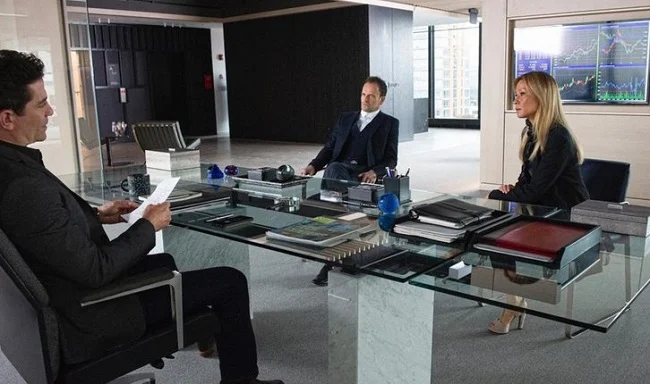
In August Elementary finally came to an end after seven years. The last season spanned a tighter than usual 13 episodes and introduced a new and very contemporary archnemesis; tech giant Odin Reichenbach (James Frain). Although it can be argued that the story arc was very formulaic, it also drew upon many elements of Conan Doyle’s original stories. Holmes realises that he may have to sacrifice himself to take down a foe and protect those nearest to him. Then there is the issues of his “death”. For many viewers such as myself, the final season wasn’t so much about a clever narrative but simply seeing what happened to all the major cast members. Broadly, it was all very satisfactory. Spoiler Alert. Captain Gregson retired and Marcus remained at the NYPD instead of taking his position with the US Marshal service. Joan finally adopted a child and Morland was killed while trying to broker one of his high-level deals. All story lines were brought to a neat and acceptable end. Furthermore the door was clearly left open for a future revival of the show if required.
Thoughts on TV shows and my current viewing habits.
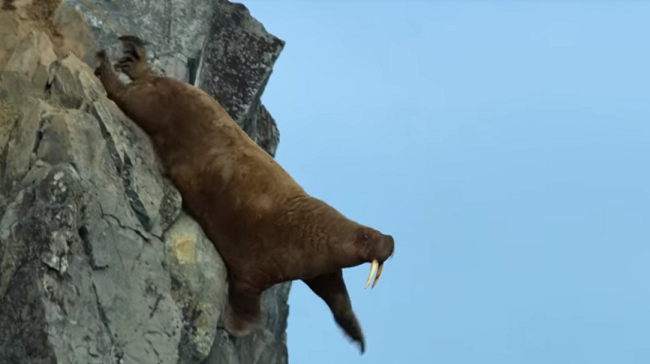
Our Planet is the first major wildlife documentary to be made by Netflix. Presented and narrated by David Attenborough the series is produced by Silverback Films, who also created BBC documentary series Planet Earth, Frozen Planet and The Blue Planet. As you would expect with such outstanding credentials, Our Planet is a visually impressive, thought provoking exploration of our world’s respective ecosystems and a damning indictment of how we as a species are causing immense damage. If you watch this show and are still in denial afterwards about climate change, then “you need your bumps felt”. The show doesn’t shy away from showing the reality of nature. Something that some viewers struggle to come to terms, due to the ongoing infantilization of our relationship with pets and wild life. Netflix went so far as to produce a list of scenes to skip for the feint hearted. However, the sight of the Walruses plummeting to their death from a cliff was genuinely shocking. However given the nature of the show and its underlying message, this was totally justified.
Thoughts on TV shows and my current viewing habits.
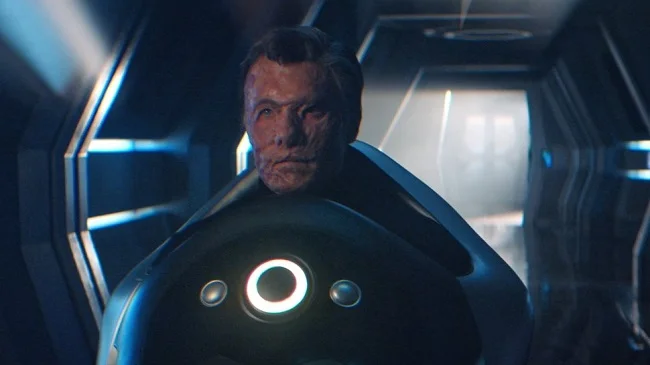
Broadly speaking I think season 2 of Star Trek: Discovery has been an improvement on season1, and I didn’t think that was a dog’s dinner. There were some very good ideas in the first series but it did stray a little too far canonically speaking in both some major and minor aspects of the production. The second season seems to be reining some of these issues in and I love the continuity the writers have shown with Captain Christopher Pike’s back story. There are times when the need to expedite the narrative comes at the expense of character development. For example it would have it would have been nice to have had an extra episode of two to get to know Airiam (Hannah Cheesman) a little better. It would have heightened the emotional impact of her death a little more. But this propensity to rush is hardly unique to Star Trek: Discovery. I am curious to see where the story is going as I like many other viewers suspect this may be an origin story for a major Federation nemesis. We shall have to see. I’m always cautious about plot devices that explain away an “enigma”. There is the risk that you rob it of its narrative potency.
Thoughts on TV shows and my current viewing habits.
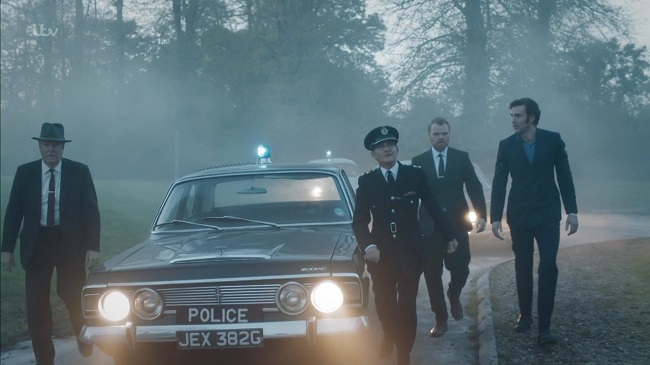
Tonight’s season finale of Endeavour was possibly the best episode to date. All the outstanding plot lines were resolved and despite my concerns that a tragedy may occur with regards to one of the central characters, the ending saw the prevailing status quo of previous seasons restored. This series has been exceedingly creative with regard to the subjects and themes it has explored and there have been some exceptional performances from Anton Lesser and Roger Allam. Writer Russell Lewis (a very interesting person in his own right) continues to embellish the proceeding with “metatextuality” which is always a source of joy for me. Recent references to Gordon Murray’s Trumpton, Camberwick Green and Chigley were exceeding droll, yet if the causal viewer missed them, there is still plenty of practical story and historical referencesfor all to get their teeth into. I also thought that the final episodes exploration of a tower block collapse was particularly brave and relevant, considering that the Grenfell Tower Inquiry is still proceeding.

There are many aspects of TV and film that I wish to discuss here on Contains Moderate Peril, but they don’t all require and in-depth post or detailed review. Therefore, it seems practical to create a recurring editorial piece in which I can address these more concise and conversational pieces. Hence you are reading “The Idiot Box” which is my new means to quickly summarise and touch upon what I’m currently watching. Because I do the bulk of my film viewing at home now via VOD and no longer that much at the cinema, this recurring post will deal with movies as well as television. I’ll still be producing long form reviews because I enjoy doing so and they also constitutes a substantial percentage of traffic to this site. This virtual column is more of a “friendly chat” about my viewing habits as well as what’s popular, as you would have with your friends down the pub. So, let us begin with a few thoughts about some of the shows I’m currently enjoying.
Classic Movie Themes: Star Trek First Contact
Jerry Goldsmith’s contribution to Star Trek is immense. Yet simply listing the films and TV episodes he wrote music for does not adequately encapsulate the significance of his contribution to the franchise. His majestic, thoughtful and uplifting musical scores provide an emotional foundation that reflects the core ethos of Star Trek. They also create an invaluable sense of continuity that spans multiple shows and movies. Perhaps the most obvious example of this is his iconic title music for Star Trek: The Motion Picture (1979) that was subsequently adopted as the theme tune for Star Trek: The Next Generation. His work was held in such high regard, when Star Trek V: The Final Frontier (1989) ran into production issues, it was thought that a Jerry Goldsmith soundtrack may well elevate the film. Sadly it didn’t but his work on that instalment was outstanding and among his best.
Jerry Goldsmith’s contribution to Star Trek is immense. Yet simply listing the films and TV episodes he wrote music for does not adequately encapsulate the significance of his contribution to the franchise. His majestic, thoughtful and uplifting musical scores provide an emotional foundation that reflects the core ethos of Star Trek. They also create an invaluable sense of continuity that spans multiple shows and movies. Perhaps the most obvious example of this is his iconic title music for Star Trek: The Motion Picture (1979) that was subsequently adopted as the theme tune for Star Trek: The Next Generation. His work was held in such high regard, when Star Trek V: The Final Frontier (1989) ran into production issues, it was thought that a Jerry Goldsmith soundtrack may well elevate the film. Sadly it didn’t but his work on that instalment was outstanding and among his best.
Jerry Goldsmith returned to the franchise in 1995, writing the dignified and portentous Star Trek: Voyager theme. Again this succinctly showed the importance the producer’s of the franchise attached to his work. Then in 1996 Goldsmith wrote the score for Star Trek: First Contact. Again his music demonstrates his ability to imbue the film’s narrative themes and visual effects with an appropriate sense of awe and majesty. Although contemporary in his outlook, with an inherent ability to stay current, Goldsmith had studied with some of the finest composers from the golden age of Hollywood. Hence, there are a few cues from First Contact where the influence of the great Miklós Rózsa are quite apparent and beautifully realised. Fans will argue that his score for Star Trek: The Motion Picture is his greatest work in relation to the franchise but I think that the soundtrack for Star Trek: First Contact has more emotional content.
The track “First Contact” which comes at the climax of the film is in many ways the highlight of the entire score. Goldsmith uses English and French horns as Picard and Data reflect upon the nature of temptation after defeating the Borg Queen. When the alien vessel lands and its crew disembarks to make first contact, the melody takes on a profoundly ethereal and even religious quality, especially when the church organ reiterates the theme. This reaches a triumphant peak when it is revealed that the first visitors to Earth are Vulcan. The cue then takes a melancholy turn as Picard and Lily bid a touching farewell. “First Contact” is a sublime six minutes and four seconds which demonstrates why Jerry Goldsmith was such a superb and varied composer. It not only highlights his legacy to Star Trek but also his status as one of the best film composers of his generation.
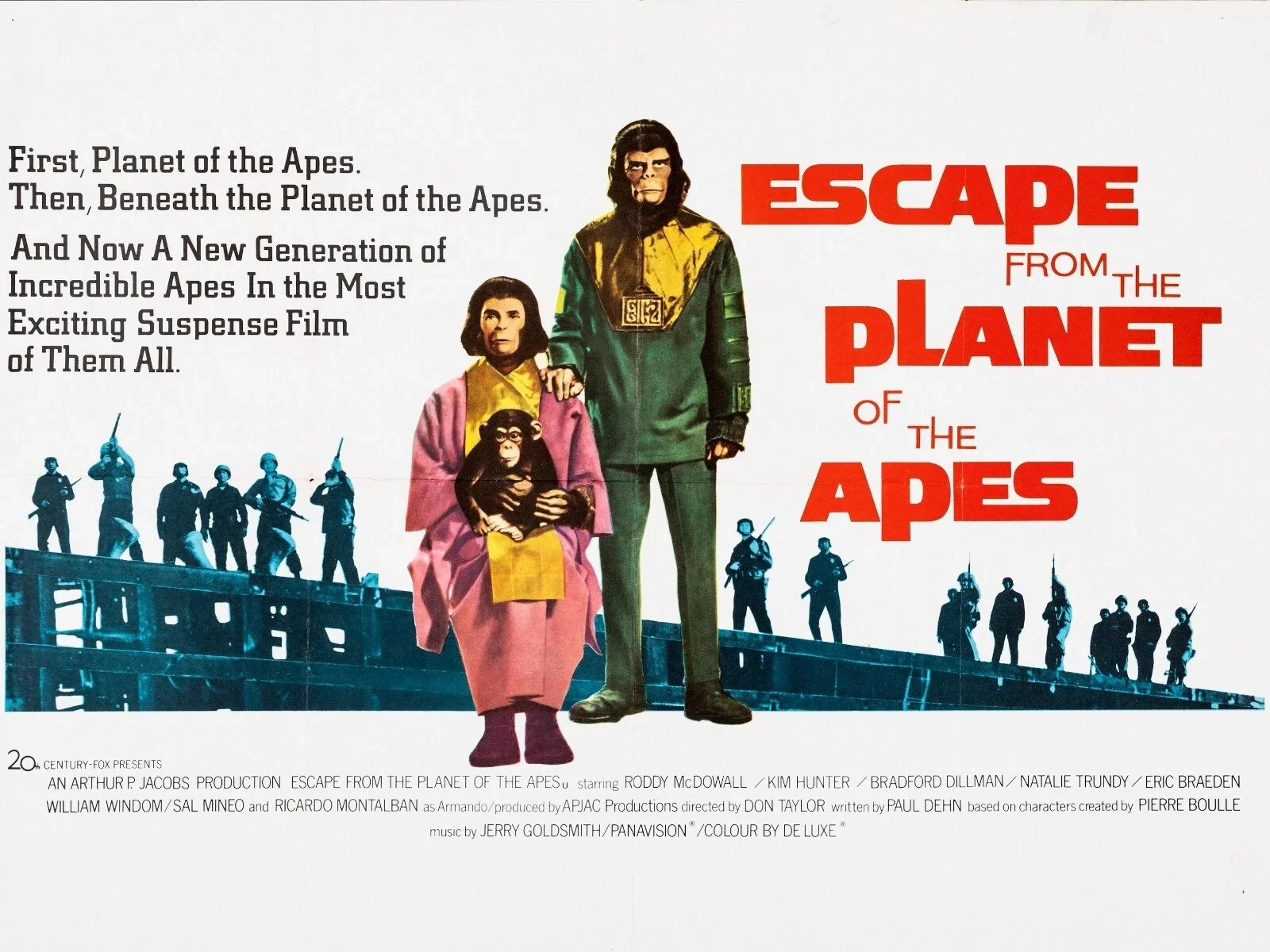
The Planet of the Apes movie franchise took a radical change of course with its third entry in the series. The first two films were set in the future and benefited from high production values to help realise a post apocalyptic earth. However, due to a substantial reduction of budget, Escape from the Planet of the Apes uses a time travel plot device to bring the ape protagonists to present day Los Angeles (1971 in this case). The result is a film with a much smaller narrative scope. However, although it lacks the science fiction spectacle of its predecessors, it features an interesting satirical exploration of celebrity culture and ponders what it is like to be deemed an enemy of the state. As ever, Roddy McDowell and Kim Hunter provide exceptional lead performances as the Chimpanzees Cornelius and Zira. Escape from the Planet of the Apes also captures the pop culture vibe of seventies America.
Ronald Erle Grainer (11 August 1922 – 21 February 1981) was a prolific Australian composer who is best remembered for his work in the United Kingdom during the sixties and seventies. He wrote numerous notable scores and theme music for several iconic television shows such as Doctor Who, Steptoe and Son and Tales of the Unexpected. He also composed the soundtrack for several major motion pictures such as Some People (1962), The Assassination Bureau (1969) and The Omega Man (1971). Grainer relocated to London from Australia in 1952 but it was not until 1960 that he gained critical success after writing the music for the popular TV show Maigret. He subsequently received an Ivor Novello award for “Outstanding Composition for Film, TV or Radio”.

The following is about a cultural change. That is not to say that it’s a value judgement or one of those posts you so frequently read by bloggers of a certain age, that essentially boil down to “things were better in my day”. It is merely an observation and like all observations it is not 100% universal. There will always be exceptions to the rule. I am simply painting with broad strokes a general truism for your consideration. My point being that people listen, experience and enjoy music differently these days compared to how they did three to four decades ago. I’m not talking about the science of hearing or anything complex like that. I am merely highlighting the change in the way we choose to experience music and how that has an impact upon its creation and presentation. So like Anne Elk, presenting her theory on the Brontosaurus, here is the axiom at the heart of this post.
Allonsanfàn (1974) is an Italian historical drama film written and directed by Paolo and Vittorio Taviani. The title of the film derives from the first words of the French Revolutionary anthem La Marseillaise (Allons enfants, IE “Arise, children”). It is also the name of a character in the story. Set against the backdrop of the Italian Unification in early 19th-century Italy, Marcello Mastroianni stars as an ageing revolutionary, Fulvio Imbriani, who becomes disillusioned after the Restoration and endeavours to betray his companions, who are organising an insurrection in Southern Italy. Allonsanfàn is a complex film that is not immediately accessible to those unfamiliar with the intricacies of Italian political history nor the arthouse style of the Taviani brothers. However, it is visually arresting and features a rousing score by Ennio Morricone.
Jerry Goldsmith’s contribution to Star Trek is immense. Yet simply listing the films and TV episodes he wrote music for does not adequately encapsulate the significance of his contribution to the franchise. His majestic, thoughtful and uplifting musical scores provide an emotional foundation that reflects the core ethos of Star Trek. They also create an invaluable sense of continuity that spans multiple shows and movies. Perhaps the most obvious example of this is his iconic title music for Star Trek: The Motion Picture (1979) that was subsequently adopted as the theme tune for Star Trek: The Next Generation. His work was held in such high regard, when Star Trek V: The Final Frontier (1989) ran into production issues, it was thought that a Jerry Goldsmith soundtrack may well elevate the film. Sadly it didn’t but his work on that instalment was outstanding and among his best.
Halloween (1978) is both a genre and cinematic milestone. It made stars of Jamie Lee Curtis and director John Carpenter as well as kickstarting the slasher genre that dominated the box office for the next 15 years. Unlike many of the inferior imitations that followed in its wake, Halloween is not a gorefest but a far more suspenseful and unsettling film. It’s shocks and sinister atmosphere are the result of sumptuous panavision cinematography by Dean Cundey and inventive editing by Tommy Wallace and Charles Bornstein. Another invaluable asset to the film’s effectiveness is John Carpenter minimalistic synth and piano score which perfectly embellishes the film with an air of menace. After 33 years and various re-arrangements in subsequent sequels, the original Halloween Theme is still as effective today as it was when the film was first released.
Tenebrae (1982) is probably Dario Argento’s most accessible “giallo” for mainstream audiences. Although violent, it is not as narratively complex as Deep Red (1975) or as bat shit crazy as Phenomena (1985). The story centres on popular American novelist Peter Neal (Anthony Fanciosa) who is in Rome to promote his latest book. Events take a turn for the worst when a series of murders appear to have been inspired by his work. The plot twists and turns, the director explores themes such as dualism along with sexual aberration and blood is copiously spattered across the white walled interiors of modernist buildings. It is slick, disturbing and has a pounding synth and rock score by former Goblin members, Claudio Simonetti, Fabio Pignatelli, and Massimo Morante.
An American Werewolf in London is a genre milestone and one of the few horror films that successfully manages to balance humour and suspense without mitigating the overall tone of the story. 40 years on from its theatrical release it still holds up well with its bitter sweet love story, tragic themes and ground breaking transformation effects by Rick Baker. Director John Landis never really bettered this concise and effective genre outing. It hits the mark in virtually every part of the production. However, there is one aspect of the film that does suffer as a result of the director’s personal choices. Whether it is to the detriment of the overall film is debatable. The point in question is the film’s soundtrack and the director’s focus upon the song Blue Moon by Richard Rodgers and Lorenz Hart.
Before we start, no I am not writing about Alexander Courage’s classic main theme for the original Star Trek show. I can add nothing further to that particular discussion and it remains iconic and inspiring, even when distilled down to just the initial fanfare. In this post I want to draw your attention to another piece of music from Star Trek that has permeated its way into popular culture. A cue that when heard, if the listener is familiar with its provenance, will instantly conjure up images of flying drop kicks, ear claps and judo chops. A piece of music that can be added to pretty much any video footage and instantly make it more heroic. Yes, I am talking about what has become generically known as Star Trek “fight music”. Or more specifically, the "The Ancient Battle/2nd Kroykah" cue from Amok Time (S02E01) composed by Gerald Fried. The scene during the koon-ut-kal-if-fee ritual in which Spock fights Kirk on the planet Vulcan for complicated “reasons”.

Classical music has often been used to great effect in cinema since the advent of sound. It has certain advantages over bespoke compositions, in that it can imbue a scene with a sense of gravitas and emotionally connect with viewers who may already be familiar with the piece being played. Legendary director Stanley Kubrick famously rejected Alex North’s score for 2001: A space Odyssey after finding the classical tracks he used for the temporary soundtrack complement the visuals perfectly. Over the years, some particular pieces of classical music have proven to be very popular and flexible, thus appearing in a wide variety of films across multiple genres. Hence, I have chosen two well known tracks that demonstrate this. I would also like to highlight contemporary classical music and have also selected one example that I feel demonstrates how the genre sublimely compliments cinema.
If you mention The Pink Panther (1963) I’d hazard a guess that most people will instantly think of Inspector Clouseau (and possibly throw in a quote in faux French about “Minkeys”) or hum or whistle the iconic theme tune. It’s blend of cool sixties Jazz and Lounge is both classy and evocative. Henry Mancini’s contribution to the Pink Panther franchise is commensurate to that of Peter Sellers and Blake Edwards. If you removed his musical scores from any of the films they would be greatly diminished. In fact one can argue that the movies made in the eighties after Sellers’ death are greatly bolstered by Mancini’s intelligent and accomplished musical accompaniment. The franchise may have run out of steam but Mancini never did so.
Back in August 2018, I posted seven of my favourite tracks from various video games that I’ve played over the years. I thought recently that it was high time that I did the same again. So here are a further five musical cues that I especially enjoy. All of which contribute greatly to the respective games that they feature in. Unlike film composers, musicians that write for video games do not always enjoy comparable exposure or attention. Yet often they have a more complex remit, having to write material for dozens of hours of content, rather than just two or three. Furthermore, the complete soundtrack to many video games often remain conspicuously absent, with fans having to data mine the game client to find the tracks that they love. Which is why it is important for those that enjoy video game music to show their support. Perhaps then more publishers will release full and comprehensive game soundtracks for digital download.
It was Friday the 13th yesterday, so I thought it was about time that I added Harry Manfredini’s iconic score to the annals of Classic Movie Themes. The 1980 slasher movie Friday the 13th has become as legendary in the pantheon of cinematic horror history as John Carpenter’s Halloween. Although there are marked differences between these two films, both use minimalist musical scores extremely effectively to punctuate the proceedings and embellish the overall atmosphere. However, Manfedini did not want to provide viewers with obvious audio cues during scenes of building tension. He preferred to focus his score upon the activities of the franchise's iconic killer, Jason Voorhees, and hence have strong musical cues when he was on screen. This approach meant that he had to use a unique musical motif to denote potential tension, without diminishing its effect on the audience by excessive use of obvious and melodramatic cues.

Game of Death was Bruce Lee’s fourth Hong Kong martial arts movie. Due to the success of his previous films he found himself in a position where he could finally write and direct a project himself. Filmed in late 1972 and early 1973, the film was put on hold midway through production when Hollywood offered him a starring role in Enter the Dragon. He died shortly after completing the US backed movie that made him an international star, so Game of Death remained unfinished. Several years later the rights to the raw footage were sold and recycled for a new movie, that kept the name but bore little resemblance to Lee’s original vision. For most of Game of Death, Kim Tai-jong and Yuen Biao double for Bruce Lee and it is only in the final act that audiences actually get to see about 12 minutes of material that he shot himself. The 1978 release of Game of Death, directed by Robert Clouse, is a mess but remains a cinematic curiosity. The scenes which genuinely feature Bruce Lee are outstanding, even in an abridged form.
The Long Good Friday not only launched then career of Bob Hoskins but remains a uniquely British take on the gangster genre. Featuring authentic performances and a credible plot, the screenplay touches upon many of the social and political issues of the time; police corruption, the IRA, urban renewal and the decline of industry, along with EEC membership and the free-market economy. It’s a gritty and unrelenting drama that is still relevant today. Furthermore, the film is filled with quotable dialogue and has several stand out scenes that showcase Bob Hoskins’ smouldering performance. It’s also offers of “who’s who” of British character actors and there is one sequence still has the power to shock even today.
A few years ago, I wrote a post about cult movie soundtracks and how many of these movies are often blessed with a high quality score from an established composer. The subject came up again recently when I was visiting the British Film Institute with friends, and several other examples were discussed. Hence, I thought it would be prudent to write a follow up post with another selection of material, as it continues to amaze me how often the most appalling films can still have outstanding soundtracks. With this idea in mind I've collated five films that are for various reasons are labelled “cult” and have suffered the “slings and arrows of outrageous fortune” over the years. All have scores of interests and note, though for different reasons. I have chosen a track from each soundtrack which I think highlights the musical excellence and integrity of the composers involved. The genres are varied as are the musical styles and nuances of each piece. All clearly demonstrate how a well-conceived score can embellish and enhance a movie, effectively becoming a character in its own right.
Lords of the Fallen is an action role-playing game from 2014, played from a third-person perspective. It is broadly in the same idiom to Darksiders and Dark Souls with the emphasis on complex and challenging combat. And it is for that reason that I didn’t get on with this title when I bought it in a Steam sale a few years ago. I felt that the long, protracted fights were an impediment to the narrative, which I quite enjoyed. However, the game was designed this way to appeal to the combat focused gamer and “git gud” culture. But I think that it’s important to try different genres of games from time to time and to step occasionally out of your comfort zone. I would cite the Hand of Fate series as a positive example of this. Both of those titles are from a genre I wouldn’t usually consider and playing them turned out to be a very positive experience
Alien is a unique genre milestone. It challenged the established aesthetic created by 2001: A Space Odyssey of space travel being pristine, clinical and high tech and replaced it with a grimy, industrial quality. The space tug Nostromo is also a conspicuously “blue collar”, civilian venture, underwritten by a large corporation. As for H. R Giger’s xenomorph, it redefined the depiction of extraterrestrial life in movies. Director Ridley Scott brought visual style and atmosphere to particularly unglamorous and dismal setting. He also scared the hell out of audiences at the time with his slow burn story structure and editing style that hints, rather than shows. Overall, Alien is a text book example of how to make a horror movie and put a new spin on a classic and well-trodden concept.

James Horner was a prolific, yet consistently good composer with a broad range of styles. Consider his score for 48 Hrs with its Jazz under currents and then compare it to his grand swashbuckling approach to Krull. They are radically different soundtracks, but both are extremely effective in embellishing their respective motion pictures. That was James Horner great talent. He knew when to be theatrical and bombastic but could also dial it back and be subtle, gentle and delicate. It made his body of work very diverse and memorable.
James Horner, although possessing a very broad and eclectic musical range, was in many respects a very traditional composer. He was certainly au fait with works of such giants as Miklós Rózsa, Korngold and Bernard Herrmann and it often manifested itself in his music through his use of the leitmotif. Perhaps the reason James Horner was so consistently good and crafted so many outstanding pieces of music, is because he never saw his profession as just a means to an end. As he said in an interview once, “I don’t look at this as just a job. I see music as art”.
Star Trek: Enterprise was the first show in the Star Trek pantheon to have a song performed by an established artist play over the opening credits, rather than a traditional theme tune. Up until 2001, the franchise had maintained a more formal approach, established with the iconic introduction to the original series composed by Alexander Courage. Needless to say, such a radical departure from established practise brought about consternation and debate among fans. In some respects, you can argue that point about the entire show itself, but that as they say, is an entirely different blog post. Needless to say, the dislike and hatred that the song Where My Heart Will Take Me engendered in certain quarters, lead to a petition to have it removed. Needless to say, this movement failed, and the show continued using it for four seasons. Seventeen years on this particular debacle has now died down and the song is often just referenced ironically by fans as an amusing anecdote and piece of Trek trivia.
According to Wikipedia “Hawk the Slayer is a 1980 British sword and sorcery adventure film directed by Terry Marcel and starring John Terry and Jack Palance. The film has developed a cult following”. That doesn’t do the movie justice by any reckoning. Hawk the Slayer is a quirky, low budget, high camp fantasy movie that compensates for its budgetary shortcoming by being so preposterously silly. It is loaded with hard boiled, fantasy steeped dialogue that parodies well known genre tropes. It treads a fine line between utter bilge and stupid fun. It is very much a product of its time and is also filled with British character actors. Some viewers will see nothing more than a cheap and cheerful cash-in on the eighties Sword and Sorcery boom. Others will delight at this inventive, stylised and silly fantasy orientated outing. Such is the nature of cult movies.
Film producer Julian Blaustein had a long-standing desire to make a film that addressed the fears and concerns of the post war Atomic Age. With the backing from Fox Studio Executive Darryl F. Zanuck, he hired screenwriter Edmund North to adapt the short story Farewell to the Master by Harry Bates. The screenplay provided a moral commentary about the ongoing arms race and featured an alien visitor with Christ like qualities who delivers an apocalyptic message. Veteran director Robert Wise was brought in head the project and a fine cast of established characters actors such as Michael Rennie, Patricia Neal Hugh Marlowe and Sam Jaffe was assembled. The finished movie has proven to be one of the greatest science fiction movies ever; it is The Day the Earth Stood Still made in 1951.
King Solomon’s Mines is a 1985 Cannon Films production based on the pulp works of H. Rider Haggard. It was quickly made to cash in on the ongoing success of Indiana Jones franchise, although the finished movie bears little resemblance to the classic original novel. Like most Cannon movies from that boom era, it was a cheap and fast enterprise that superficially sported a good cast, but ultimately didn’t do much with them. Veteran director J. Lee Thompson favoured a light and comic approach to the material, as the film’s budget could hardly sustain any major notable set pieces. Yet, it proved popular enough at the box office to warrant a sequel the following year. Allan Quatermain and the Lost City of Gold proved to be as equally silly but by then the public’s interest had waned.
A ten months ago, I wrote about the LOTRO soundtrack and listed some of my favourite tracks. This time round rather than just limit myself to music from one game, I thought it may be more interesting to broaden the remit. So, I have decided to upload seven of my favourite tracks and music cues from various games I have played over the last two decades. As with cinema, the soundtrack of a game plays a very important role. It can make a substantial impact on the players perceptions and enjoyment. The following tracks are examples that I feel have greatly enhanced a game. They’re also ones that I find particularly enjoyable. They are not in any order of preference.

Paul Verhoeven has seldom made a movie without some semblance of controversy associated with it, and his 1992 neo-noir Basic Instinct was no different. Even before its US release, Basic Instinct courted controversy due over its overt sexuality and graphic depiction of violence. It was strongly opposed by gay rights activists, who criticised the film's depiction of homosexual relationships and the portrayal of a bisexual woman as a homocidal narcissistic psychopath. The opening murder with an icepick is still shocking twenty six years later and is an excellent showcase for makeup FX artists Rob Bottin.

You can write pages on Gerry Anderson's 1968 Supermarionation series Joe 90. There's the morally ambiguous premise of giving an emotionally immature nine-year-old the experiences of an adult. Then the psychological effects of allowing him to kill at will. Then there's the perennial issue of scientists prostituting their skills to the intelligence community. One can also reflect upon the absence of any major female characters in the series and how that may impact upon Joe himself. Finally, when one finally arrives she's a gold-digging bitch who tries to exploit Joe’s Dad, Professor McClaine. Joe 90 is certainly a psychiatrist’s dream subject.

Despite the popularity of the TV show in 1965, the two spinoff Thunderbirds feature films were both box offices failures. This has often been attributed to the indifferently written screenplays that seem to have completely missed the sense of suspense that the fifty-minute episodes achieved. Both feature films feel rather slow and like extended episodes rather than big budget extravaganzas. They fail to do anything different with established characters and apart from showcasing more extensive miniature effects in a widescreen format, don’t really have much more to offer. It’s curious that the winning, character driven formula that worked on television was overlooked for these big screen outings.
I grew up during the seventies when network TV shows still put a lot of thought and effort into such things as their theme tune. It was a decade littered with memorable tracks that captured the essence of the shows they came from. Many have now become integral aspects of popular culture, leading to countless internet memes as well as becoming the ringtones of choice for many a fortysomething. However, things are very different now. You can have a staggeringly good theme for your show, but it can't possibly be longer than thirty seconds. And don’t think for a moment that viewers can listen to it again at the end, as it has now become standard practice to compress the credits into a third of the TV screen and preview what's coming next, while some link announcer spouts inanities. Mercifully, cable and streaming companies tend to treat their TV shows with greater respect. The lack of commercial advertising ensures a longer program duration and hence more focus on a theme tune. However, network TV still commands big audiences, yet hasn’t in recent years produced any TV show themes of note.
The Center Seat: 55 years of Star Trek
Star Trek documentaries are very much like Bruce Lee documentaries, in so far as they’re both a saturated market and more often than not, new content frequently ends up covering the same ground. However, fans tend to watch anything new in the hope that they will find a few new nuggets of information. Brian Volk-Weiss’ new 11 part series, The Center Seat: 55 years of Star Trek, not only covers established facts about the iconic show but also expands upon them as well as providing a wealth of new information. Volk-Weiss has previously explored popular culture with documentaries such as The Toys That Made Us and The Movies That Made Us. The Center Seat: 55 years of Star Trek is an in-depth chronological study of the Star Trek franchise, from its creation at Desilu Productions in 1965 all the way through to the latest iterations, Star Trek: Picard and Star Trek: Discovery.
Star Trek documentaries are very much like Bruce Lee documentaries, in so far as they’re both a saturated market and more often than not, new content frequently ends up covering the same ground. However, fans tend to watch anything new in the hope that they will find a few new nuggets of information. Brian Volk-Weiss’ new 11 part series, The Center Seat: 55 years of Star Trek, not only covers established facts about the iconic show but also expands upon them as well as providing a wealth of new information. Volk-Weiss has previously explored popular culture with documentaries such as The Toys That Made Us and The Movies That Made Us. The Center Seat: 55 years of Star Trek is an in-depth chronological study of the Star Trek franchise, from its creation at Desilu Productions in 1965 all the way through to the latest iterations, Star Trek: Picard and Star Trek: Discovery.
Part of what makes The Center Seat so enjoyable is that the 11 episodes, each running just under an hour, provides adequate time to explore the production history of each show and the various movies. The often overlooked Star Trek: The Animated Series gets an entire episode to itself as do each of the shows from the Rick Berman-era. The analysis of Star Trek: The Motion Picture is especially rigorous and does not shy away from the clash of egos between cast members, as well as the problematic writing process as Gene Roddenberry and Harold Livingston fought over the script. The show also takes the time to discuss the decision to have a title song, rather than a theme for Enterprise and the fact that to date, it still polarises opinion. Perhaps the most significant episode of The Center Seat is the first, which focuses on the importance of Lucille Ball. She used her industry leverage and wealth to get Star Trek made, backing not one but two pilot shows.
However, despite having 11 episodes at their disposal, there is still a lot of content missing from The Center Seat. There is a conspicuous lack of contemporary interviews with William Shatner, Avery Brooks and Scott Bakula. Although there is a lot of footage from all things Star Trek, the licensing arrangements seems to exclude music by any of the composers associated with the shows. It strikes me as remiss to have a documentary about such an iconic show and not mention Alexander Courage’s theme or the subsequent work by Jerry Goldsmith and James Horner. There is also some controversy over the inclusion of at least one Star Trek writer/historian whose accounts of events have been called into question for factual inaccuracies. The show also seems to be selective about which controversies it explores as well as which actors personal problems it focuses upon.
The Center Seat is an entertaining and fairly comprehensive exploration of the Star Trek franchise. This documentary series will probably best suit new fans or those who are not overly familiar with the associated history of the various shows. That being the case then it offers a broad overview and clearly shows that success and popularity is far from a smooth ride. Those who are well versed in the franchise's legendarium will probably be familiar with half or more of the show content. I found a lot of crossover between material in this show and the extras I’ve watched over the years on various DVDs I’ve owned. It is also worth noting that there are two versions of The Center Seat. One is obviously re-edited for syndication, consisting of 10 x 42 minute episodes. This version was shown on The History Channel. Then there is a longer 11 x 58 minute version. I watched the latter and this is the one that I recommend.
Star Trek is slightly older than me by 14 months. I was born on December 18th 1967. Star Trek was first broadcast in the US on 8th September 1966. Hence this show has always been part of the prevailing pop culture that surrounded me, as I grew up. I first began watching Star Trek as a young child in the early seventies. It would be repeated on the BBC in the early evening on Fridays and it became a family ritual to sit down together and watch it. As a seven or eight year old, it left a great impression upon me and was in many ways, the television highlight of the week. Star Trek along with Doctor Who certainly started my interest in science fiction. Star Trek was also one of the first shows that introduced me to tie-in marketing. I remember seeing in a toy shop, near to my school at the time, a Dinky Klingon Battle Cruiser and was flabbergasted that such a thing existed. I immediately coveted it but sadly never obtained one.
Star Trek Axanar is back in the news, twelve years on from the last controversy. For those unfamiliar with the original debacle, in 2014 Prelude to Axanar was released via YouTube. This Star Trek “fan-film” presented as a faux 21-minute, Starfleet documentary was very well received by fans and was intended by its makers as a proof of concept for a feature-length film. Set in the year 2245, during the final year of the Four Years War against the Klingons, Prelude to Axanar pushed the boundaries of what a fan film could be. The subsequent Kickstarter and Indiegogo campaigns raised more than $1.1 million. Prelude to Axanar was promoted as a professional-quality, “independent” Star Trek production, employing experienced actors and filmmakers and even established its own studio facilities. The presence of such actors as Richard Hatch, J. G. Hertzler, Kate Vernon, Tony Todd and Gary Graham (resuming his role as Vulcan Ambassador Soval) certainly made Prelude to Axanar distinct from other fan-films.
Thoughts on TV shows and my current viewing habits.
I last wrote a blog post in this series back in February 2022. Then for various reasons, I stopped. Possibly because my relationship with TV has changed in recent years. It’s fair to say at present that viewers are spoilt for choice. There are lots of very good shows around. Conversely, there is also a lot of bland, generic, filler as well. I appreciate that not every television series has to be an industry milestone and there are times when I’m content to watch undemanding content. However, I am very protective of how I spend my leisure time at present. I am not prepared to sink 6 or 8 hours into a show that is just “okay”. Hence I’m becoming very particular about what I watch. If something isn’t working for me in any fashion then I just abandon it and am happy to do so.
Jerry Goldsmith’s contribution to Star Trek is immense. Yet simply listing the films and TV episodes he wrote music for does not adequately encapsulate the significance of his contribution to the franchise. His majestic, thoughtful and uplifting musical scores provide an emotional foundation that reflects the core ethos of Star Trek. They also create an invaluable sense of continuity that spans multiple shows and movies. Perhaps the most obvious example of this is his iconic title music for Star Trek: The Motion Picture (1979) that was subsequently adopted as the theme tune for Star Trek: The Next Generation. His work was held in such high regard, when Star Trek V: The Final Frontier (1989) ran into production issues, it was thought that a Jerry Goldsmith soundtrack may well elevate the film. Sadly it didn’t but his work on that instalment was outstanding and among his best.
Star Trek documentaries are very much like Bruce Lee documentaries, in so far as they’re both a saturated market and more often than not, new content frequently ends up covering the same ground. However, fans tend to watch anything new in the hope that they will find a few new nuggets of information. Brian Volk-Weiss’ new 11 part series, The Center Seat: 55 years of Star Trek, not only covers established facts about the iconic show but also expands upon them as well as providing a wealth of new information. Volk-Weiss has previously explored popular culture with documentaries such as The Toys That Made Us and The Movies That Made Us. The Center Seat: 55 years of Star Trek is an in-depth chronological study of the Star Trek franchise, from its creation at Desilu Productions in 1965 all the way through to the latest iterations, Star Trek: Picard and Star Trek: Discovery.
I recently watched the first trailer for the new Obi-Wan Kenobi television show that is premiering on Disney + in May. I am interested in this latest instalment in the Star Wars franchise and curious as to whether Liam Neeson will make an appearance. I also watched a 20 minute fan video in which they “analysed” the entire trailer. They discussed the content of this 2 minute preview and then did a great deal of speculating about potential themes and characters that may feature in the show. They were clearly enthusiastic about what they had seen and were very knowledgeable about the subject. This resonated with me, as I like to be well versed about the things I enjoy. However, it is worth remembering that fandom can tip into obsession and gatekeeping. Hence I feel there is a subject to explore here.
Before we start, no I am not writing about Alexander Courage’s classic main theme for the original Star Trek show. I can add nothing further to that particular discussion and it remains iconic and inspiring, even when distilled down to just the initial fanfare. In this post I want to draw your attention to another piece of music from Star Trek that has permeated its way into popular culture. A cue that when heard, if the listener is familiar with its provenance, will instantly conjure up images of flying drop kicks, ear claps and judo chops. A piece of music that can be added to pretty much any video footage and instantly make it more heroic. Yes, I am talking about what has become generically known as Star Trek “fight music”. Or more specifically, the "The Ancient Battle/2nd Kroykah" cue from Amok Time (S02E01) composed by Gerald Fried. The scene during the koon-ut-kal-if-fee ritual in which Spock fights Kirk on the planet Vulcan for complicated “reasons”.
Star Trek: The Motion Picture is a wonderful paradox in the Star Trek cinematic pantheon. It is possibly the most hardcore science fiction story that the franchise has explored and is both simultaneously Trek-like and un-Trek-like. Director Robert Wise and the production team worked hard to deliver a completed film for the scheduled December 1979 release date. However, he felt that the theatrical version was only a “rough cut”. Hence in late 2001 he supervised a Director’s Edition of the film which runs 136 minutes (4 minutes longer than the theatrical release)and reinstates some additional scenes and replaces some of the optical effects with new CGI creations. Critics were divided as to whether the Director’s Edition improved the film overall but Wise felt that this version was much closer to his original vision. The Director’s Edition was released exclusively on DVD in standard definition.
Fan Edits are a curious film sub genre. Some simply reinstate deleted scenes to maximise the running time of a movie. Others will remove footage and seek to reorder events in the name of coherency. But a few are far more ambitious. Rather than just reshape what is there, they will shoot new footage to replace material deemed substandard and seek to totally reimagine a movie. On even rarer occasions a few manage to actually improve upon the original, rather than just offering an augmented version. Which leads me onto Star Trek: beyond the Barrier, an interesting and very enjoyable fan edit of Star Trek V: The Final Frontier by Anti-Matter from deLimited Productions. It attempts to repair many of the problems found in the theatrical release of the movie. Some would argue that such a task is a Kobayashi Maru test in itself. However, the results are surprisingly good and some tongue in cheek humour shows that the creator understands the nature of their task.
Welcome to the second part of my Star Trek Online: Beginners Guide. I thought it may be useful to write a series of posts, offering practical information for those who are just starting out in STO. Nothing fancy or in any way definitive. Just a few basic tips that may help orientate the new player. I’ve been playing STO since its launch in 2010 and this MMO has seen a lot of changes. The game features a lot of systems and mechanics that are not always immediately intuitive to grasp. So I’ll be doing my best to cover a selection of these in each post and try to provide a broad overview. Like a lot of advice, it can be subjective. Ultimately it comes down to each player how they wish to play. In this instalment, I shall be writing about career paths, factions and races.
Today is Star Trek Day. An officially sanctioned celebration of all things Star Trek. The date reflects the launch of the original television show, back in the sixties. Naturally, there are a multitude of events going on over at the official Star Trek website. And as ever, the MMORPG Star Trek Online is taking part in the celebrations. “On September 8th, 1966, the world first met a group of people, and a ship, that would change our lives forever. Pitched as “wagon train to the stars,” and brought to TV by the force of Lucille Ball’s will, Gene Roddenberry’s Star Trek hit tiny television screens around the world and immediately captured hearts and minds. Through three seasons, and decades in syndication, The Original Series started a movement that still lasts today, more than half a century later. We live in a time where there’s more new Star Trek than ever before, and we’re joining with the rest of our Star Trek Family to celebrate the franchise’s birthday”.
I’ve mentioned in the past that a lot of important information regarding the MMORPG Star Trek Online is centralised within the official subreddit. That’s fine if you enjoy using this platform but it’s not for everyone. I’ve always found Reddit somewhat esoteric and I don’t really like the way it visually displays information. I have to use a browser addon to make it more user friendly. Unlike other communities, STO does not seem to have that many fan produced blogs. However, I may be wrong regarding this, so feel free to correct me (and provide URLs). In the meantime, I thought it may be useful to write a series of simple guides, offering practical information for those who are new to STO. Nothing fancy or in any way definitive. Just a few basic tips that may help orientate the new player. This time we’re going to look at the business model for STO and the cost of playing the game.
Out of the original seventy-nine episodes of Star Trek, one of the most respected and beloved is The City of the Edge of Forever. Written by Harlan Ellison the story is one of the more thoughtful and tragic in Trek Canon. It was also the first episode to feature a temporal plotline. Doctor Leonard McCoy (DeForest Kelley) accidently receives an overdose of medication and flees the Enterprise while in a delusional state. Beaming down to an alien planet he uses a temporal gateway (The Guardian of Forever) to travels back in time to earth during the Great Depression. By doing so he accidentally changes history. Captain Kirk (William Shatner) and Spock (Leonard Nimoy) follow him through the gateway to New York in hope of correcting the timeline. While awaiting the arrival of McCoy, Kirk falls in love with Edith Keeler (Joan Collins) who runs the 21st Street Mission. However he and Spock soon determine that to restore the timeline they must allow her to die.
There has been a degree of controversy over the Discovery Operation Pack that has recently been made available for purchase in Star Trek Online. The bundle featuring ships, bridge officers, cosmetic items and more is displeasing some core players who feel that it is over priced and lacks anything relevant for Romulan and Klingon races. Personally, I’m only interested in two specific items from the pack, such as the Tier 6 Gagarin Miracle Worker Battlecruiser and the combat pet Tardigrade but at present they cannot be purchased separately. So, I shall not be parting with any money at present. The Gagarin Miracle Worker Battlecruiser is relatively similar to the Tucker Tactical Miracle Worker Cruiser, which I already own. However, it is an improvement aesthetically speaking (a subjective point, admittedly), so for me the obvious compromise is to purchase the fleet version and forgo the unique space trait and settle for an additional console slot. As I’m not a high-end player, the look and feel of a ship has as much appeal to me as its stats.
I have suffixed the title of this post “and stuff” so I can address several Star Trek Online related thoughts in a single blog post. Despite the fact that I frequently play STO it is does oddly get neglected in my writing. So, let us start with the issue of the ninth anniversary. As ever Q is back with the anniversary event and once again, we are stabilising Omega Molecules. This year’s reward is a Tier 6 Vulcan T’Pau Scout Ship. There are also emotes and sundry other items to earn during the duration of the festivities, but I more interested in the anniversary itself. Not many MMOs make it to nine years and if they do, they aren’t necessarily in as good shape as STO. The game has a stable and loyal playerbase and is currently tied-in to Star Trek: Discovery. Further established Trek actors are supplying voice acting and the game seems to be doing well across both PC and consoles. Like LOTRO, STO uses the IP well and seems to “fill in the gaps” in the existing lore as well as expand and extrapolate established canon. One of the best things about STO is that there’s always something to do in-game as well as new content in the pipeline. Perhaps this along with the handling of the IP is why the game endures.
Star Trek: Enterprise was the first show in the Star Trek pantheon to have a song performed by an established artist play over the opening credits, rather than a traditional theme tune. Up until 2001, the franchise had maintained a more formal approach, established with the iconic introduction to the original series composed by Alexander Courage. Needless to say, such a radical departure from established practise brought about consternation and debate among fans. In some respects, you can argue that point about the entire show itself, but that as they say, is an entirely different blog post. Needless to say, the dislike and hatred that the song Where My Heart Will Take Me engendered in certain quarters, lead to a petition to have it removed. Needless to say, this movement failed, and the show continued using it for four seasons. Seventeen years on this particular debacle has now died down and the song is often just referenced ironically by fans as an amusing anecdote and piece of Trek trivia.
I’ve written in the past about the problems that can arise from untempered fandom. If enthusiasm and inspired love are not balanced by contextual reason and a healthy dose of reality, then it can get a little bit over zealous. Need I cite Star Wars fans and The Last Jedi as an example of unchecked fandom. However, I am now going to stray a little into the “Twilight Zone” of fandom myself, although I shall attempt to apply a healthy dose of realism into the proceedings. Because I want to discuss the fact that Ethan Peck has been cast to play one of the most iconic characters in popular culture. Yes, Gregory Peck’s grandson (and there’s plenty of “baggage” there) has been cast to play Spock in season two of Star Trek: Discovery. Furthermore, rather than be concerned, I am very excited by this development and I really look forward to seeing how this pans out.
After a prodigious marketing campaign and a great deal of internet speculation about one specific character, Star Trek Into Darkness was released to broadly strong reviews and solid box office returns in early May 2013. Finally, all the questions that had kept fans and website pundits endlessly theorising, were answered. For a second time running, Paramount Pictures managed to produce an action-filled blockbuster which still offered a strong plot, with complex and adult themes, explored by well-rounded characters. Batman Begins seems to have set a trend of framing material from a traditional pulp background, within broader intellectual parameters. Star Trek: Into Darkness managed to do this while cleverly re-imagining iconic material from its own lore. However, as with any substantial franchise movies, not everyone was satisfied or pleased. Many fans railed against the new Kelvin Timeline and continue to do so.
The reinvention of any popular franchise certainly comes with many risks. Twelve years ago, Casino Royale was hailed as a triumph in rebooting the 007 brand. It was hard edged, back to basics movie that made the spy genre relevant to a contemporary audience, without diluting its source material excessively. Yet this process went a step too far with Quantum of Solace, with a film that simply didn't feel Bond enough. Needless to say, the rights holders corrected this error. The success of the BBC's relaunch of Doctor Who hinged on making the formula accessible to modern viewers. Yet the new format of standalone episodes, celebrity guest stars and an emphasis on action over story, can be difficult to maintain and requires the involvement of top writers to keep the momentum going. Then of course there are the fans.
Finally, it’s arrived. The first new Star Trek TV show for twelve years. Star Trek: Discovery became available for Netflix UK customers to watch at 8:00 AM this morning. Needless to say, I cleared my schedule in advance so I could sit down and watch this much-anticipated show. Furthermore, I made it my business to avoid Twitter and the internet until I had finished viewing the first two episodes because I knew in advance that Star Trek: Discovery was going to be controversial and divide fans. Having now seen The Vulcan Hello and Battle at the Binary Stars and taken time to reflect upon both episodes, I have reached the following conclusion. From what we’ve seen so far, the spirit and emotional heart of Star Trek, is reflected in the new show. I found the characters to be interesting and well defined. Lead performances by Michelle Yeoh, Sonequa Martin-Green and Doug Jones were good and there’s an intriguing crew dynamic. The story has already touched upon numerous canonical themes and I am eager to learn more about the main characters and the universe they inhabit. I therefore shall continue to watch Star Trek: Discovery. However, not everyone feels the same, as my subsequent forays online have shown. Much has changed in this new iteration of Star Trek and as we know, some fans do not like change in any way, shape, or form.
Over the years I have been a participant in several fan based communities. These have ranged from running film clubs, to creating and publishing fanzines in the pre-internet days. More recently this has included running websites, blogging and creating podcasts. It’s a curious thing the way fandom is cyclical and one’s involvement with such communities seems to ebb and flow. It’s something I’ve been thinking about a lot of late. Several of the You Tube channels I enjoy have reduced their output or stopped due, to changes in advertising policy and monetisation. The Newbie Blogger Initiative failed to manifest itself this year and many of my immediate colleagues in blogging and podcasting have also begun to fade away or moved on to pastures new. The sad thing is, the true value of many community contributors is never really realised until after they’ve gone.
Fans are often a very creative and resourceful bunch. Star Trek fans especially so. At present, there’s a lack of new officially endorsed canonical content being produced. The movies set in the Kelvin Timeline are not universally embraced by Trekkies and usually take three years to produce. The new TV show Star Trek: Discovery has been subject to several production delays and still seems a long way off. So, the fans solution in recent years, has been to make their own original content. Hence there is a wealth of unofficial, independently made shows available online, set in various incarnations of the Star Trek universe. Although many of these productions are lovingly crafted and driven by passion, often they lack the professional polish of the genuine article. Frequently their weakness lies in the quality of the acting and writing. Then there is Star Trek Continues.
Adam Nimoy doesn’t paint a rosy picture of family life in his documentary about his father. The novelty of fame and popular acclaim soon wore off with it’s never ending photoshoots and long working hours that kept his father from ever being home. Yet among the anecdotes in this greatly condensed biopic there evidence of a lot of love and professional respect. Far from being comprehensive For the Love of Spock focuses on the matters that interest fans the most. So the documentary explores Nimoy’s relationship with Gene Roddenberry, his subsequent casting in Star Trek, his post Trek stage career and his return to the fold with the big screen movies.
The Captains is a curious beast. If you’re expecting a traditional documentary where Bill Shatner simply indulges in a standard Q & A with other actors that have portrayed captains within the Star Trek franchise, then you will be disappointed. The Captains is a horse of a different colour entirely. Throughout its ninety minute duration, this documentary veers from personal reflections on acting, muses upon the nature of fame and even touches upon contemplating one’s own mortality. It certainly wasn’t what I was expecting and was subsequently a far more rewarding experience.
I am not a dogmatic fan. In fact as I get older, I become far more flexible and forgiving in my outlook. I certainly don’t buy into the concept that your “childhood can be ruined”. The only way something new can spoil the memories of something old that you hold dear, is if you allow it to. If you wish to explore this concept further, I’d suggest reading Marcus Aurelius. Back to the matter in hand. When I found out that Star Trek was to be rebooted via an alternative timeline plot device, I was content with this. I decided to ditch my personal baggage and try and be objective about the now named “Kelvin Timeline”. I make no bones about the fact I have liked the previous two Star Trek movies. Are they masterpieces? No. Are they entertaining? Yes. That is far more than some reboots have achieved.
The announcement that CBS has commissioned a new series of Star Trek is both a blessing and a curse. It’s a blessing in the sense that I have genuine affection for this franchise and therefore I welcome the prospect of a new incarnation of the show returning to TV. However I also consider this situation an absolute curse because well now have to endure at least eighteen months of idle speculation and an ongoing dissection of the entire production of a show before it is even released.
Trek Nation is a relatively straight forward documentary with a clear premise. It follows Eugene Roddenberry’s search to find out more about his father Gene and to understand the cultural phenomenon of Star Trek. Directed by Scott Colthorp the film endeavours to explore the enduring appeal of the franchise as Eugene discovers more about the father he didn't know and the show that passed him by. Through interviews with cast and crew members from all five Star Trek shows, as well as fans and celebrities who were influenced by the show while growing up, Trek Nation methodically follows a linear path. Yet this uncomplicated approach proves to very effective and surprising candid.
Complex Lore and Enigmatic Themes
I recently watched the first trailer for the new Obi-Wan Kenobi television show that is premiering on Disney + in May. I am interested in this latest instalment in the Star Wars franchise and curious as to whether Liam Neeson will make an appearance. I also watched a 20 minute fan video in which they “analysed” the entire trailer. They discussed the content of this 2 minute preview and then did a great deal of speculating about potential themes and characters that may feature in the show. They were clearly enthusiastic about what they had seen and were very knowledgeable about the subject. This resonated with me, as I like to be well versed about the things I enjoy. However, it is worth remembering that fandom can tip into obsession and gatekeeping. Hence I feel there is a subject to explore here.
I recently watched the first trailer for the new Obi-Wan Kenobi television show that is premiering on Disney + in May. I am interested in this latest instalment in the Star Wars franchise and curious as to whether Liam Neeson will make an appearance. I also watched a 20 minute fan video in which they “analysed” the entire trailer. They discussed the content of this 2 minute preview and then did a great deal of speculating about potential themes and characters that may feature in the show. They were clearly enthusiastic about what they had seen and were very knowledgeable about the subject. This resonated with me, as I like to be well versed about the things I enjoy. However, it is worth remembering that fandom can tip into obsession and gatekeeping. Hence I feel there is a subject to explore here.
Fantasy, science fiction and similar hybrid genres thrive on world building and lore. These facets give them credibility and breathe life into fictional worlds and people. They also provide parallels with our own lives which provides a means for us to connect to them. Star Wars, despite all the technology, offers a universe that looks used and lived in. Middle-earth is steeped in history and complex societies. Again despite obvious differences there are commonalities in the hierarchies, rituals and personal aspirations of the protagonists. And as well as lore, there are also enigmas. Fantasy and science fiction are often rife with things that are strange and ill defined. Often these are mystical and symbolic. The Force, Tom Bombadil and Jason Voorhees are prime examples of this. Successful fantasy and science fiction find the right balance between detailed lore and enigmatic themes.
Achieving this balance is very difficult. The original Star Wars trilogy handled the arcane and esoteric nature of the Force well. It was broadly defined as an energy field created by all life that connected everything in the universe. However, the specifics of this were vague and nebulous which played well with the concept that the Jedi were more of a religious and philosophical order than a paramilitary organisation. However, when the prequels introduced the concept of Midi-chlorians it somewhat diminished the enigma surrounding the Force and it suddenly just became yet more technobabble. It is interesting to note that this addition to the franchise’s lore was not well received by fans. It was subsequently not alluded to in later films and television shows, indicating that the producers and writers felt it was a mistake.
Another genre example of lore versus enigma is the difference in Klingon anatomy between the original series and the revival shows. The main reason is simple. There wasn’t a budget for complex prosthetics in the sixties show. However, from Star Trek: The Motion Picture onwards, Klingons acquired their forehead ridges as a way to make them more alien. This however left a lore contradiction, which was beautifully alluded to in the episode “Trials and Tribble-ations” of Star Trek: Deep Space Nine. Several crew members from the 24th century including Worf, find themselves on Deep Space Station K7 in the 23rd century, during the events of “Trouble with Tribbles”. Upon seeing the Klingons from the previous era, one of the crew asks Worf why there’s a physical difference. He enigmatically replies “We do not discuss it with outsiders”. This beautifully vague but droll answer works perfectly. Sadly it was ruined a few years later when an episode of Star Trek: Enterprise explained away the difference as a genetic experiment that went wrong.
However, it is not always an excess of lore that can quash the soul from a popular show or film. Sometimes being deliberately too vague, refusing to expedite the plot and simply replacing one mystery with two others can be very frustrating. It may also be due to the writers being out of their depth or making things up as they go along. Lost encapsulated this for me and the show’s manipulative narrative quickly killed my interest. Don’t get me wrong, I don’t like to be spoon fed stories and explanations and I don’t mind thinking when watching. The ending of John Carpenter’s The Thing is enigmatic and quite bleak but I consider it a perfect conclusion to the film. However, perhaps the television show that really stepped over the line for not making any real effort to explain itself and turning the enigma “up to 11” is The Prisoner. It’s still a great show to watch and is very thought provoking but the final episode doesn’t deliver a stone cold conclusion. Something that people who watched it originally still seethe over.
We live in a culture of binge watching TV shows which some viewers dissect and analyse. The interconnected nature of the Marvel Cinematic Universe is a prime example of this and it does it extremely well. But not all television shows and films are like this and do not require such scrutiny. I worry that some viewers are so invested in searching for what they think may be hidden or trying to pre-empt an unfolding narrative, that they miss being in the moment and simply enjoying the show as it happens. Excessive analysis often leads to disappointment. It is important to remember that what you’re watching is a writer(s) thoughts on how a narrative should move forward. They are not obliged to try to make what’s in your or my head. Therefore I see both lore and enigmatic themes as an embellishment to a good fantasy or science fiction show or film. Things to be enjoyed but not the “be-all and end-all” of the production. If either becomes the major focus of either the writers or fans then it will end up undermining the central narrative and themes.
Star Trek is slightly older than me by 14 months. I was born on December 18th 1967. Star Trek was first broadcast in the US on 8th September 1966. Hence this show has always been part of the prevailing pop culture that surrounded me, as I grew up. I first began watching Star Trek as a young child in the early seventies. It would be repeated on the BBC in the early evening on Fridays and it became a family ritual to sit down together and watch it. As a seven or eight year old, it left a great impression upon me and was in many ways, the television highlight of the week. Star Trek along with Doctor Who certainly started my interest in science fiction. Star Trek was also one of the first shows that introduced me to tie-in marketing. I remember seeing in a toy shop, near to my school at the time, a Dinky Klingon Battle Cruiser and was flabbergasted that such a thing existed. I immediately coveted it but sadly never obtained one.
Star Trek Axanar is back in the news, twelve years on from the last controversy. For those unfamiliar with the original debacle, in 2014 Prelude to Axanar was released via YouTube. This Star Trek “fan-film” presented as a faux 21-minute, Starfleet documentary was very well received by fans and was intended by its makers as a proof of concept for a feature-length film. Set in the year 2245, during the final year of the Four Years War against the Klingons, Prelude to Axanar pushed the boundaries of what a fan film could be. The subsequent Kickstarter and Indiegogo campaigns raised more than $1.1 million. Prelude to Axanar was promoted as a professional-quality, “independent” Star Trek production, employing experienced actors and filmmakers and even established its own studio facilities. The presence of such actors as Richard Hatch, J. G. Hertzler, Kate Vernon, Tony Todd and Gary Graham (resuming his role as Vulcan Ambassador Soval) certainly made Prelude to Axanar distinct from other fan-films.
Thoughts on TV shows and my current viewing habits.
I last wrote a blog post in this series back in February 2022. Then for various reasons, I stopped. Possibly because my relationship with TV has changed in recent years. It’s fair to say at present that viewers are spoilt for choice. There are lots of very good shows around. Conversely, there is also a lot of bland, generic, filler as well. I appreciate that not every television series has to be an industry milestone and there are times when I’m content to watch undemanding content. However, I am very protective of how I spend my leisure time at present. I am not prepared to sink 6 or 8 hours into a show that is just “okay”. Hence I’m becoming very particular about what I watch. If something isn’t working for me in any fashion then I just abandon it and am happy to do so.
There has been a resurgence of people playing Star Wars Battlefront II recently. Possibly because the game was discounted on many outlets on May 4th and may be due to the success of Andor season 2. There’s a lot more people streaming it as well as videos on YouTube. Whatever the reason, it is always good to see a deserving game enjoying a renaissance. Star Wars Battlefront II was blighted at launch, back in November 2017 by some egregious business decisions and it took nearly a year for the game to recover from the negative publicity and player animosity. Setting this historical debacle aside for one moment, there was always a handsome and engaging game to be found. One that used the licensed intellectual property well. Which is why I recently reinstalled the game and resumed playing its multiplayer mode.
Season 2 of Andor has received praise from both critics and fans alike. It finally seems to have put to bed the common argument that Star Wars as a franchise has traditionally been light on narrative depth, character development and the exploration of the themes that its main story is predicated upon. Andor shows the realities of opposing authoritarian regimes and exists within shades of grey, rather than purille, binary positions. Many have drawn parallels with the current state of geopolitics, especially that of the United States. I certainly found the second season of Andor to be engaging and thought provoking. I also enjoyed the performances of many of the British actors who by default are cast in all the major Empire roles. I thought Anton Lesser was especially noteworthy as a senior officer in the Imperial Security Bureau.

We all knew it had to happen sooner or later. According to reports, Lucasfilm is planning to reduce its Star Wars related output on Disney+. Specifically, from 2025 there will be only one live-action television series per year. For comparison, Disney+ commissioned three shows in 2022 and two shows in both 2023 and 2024. It should be noted that this reduced output doesn’t include animated shows. It would appear that senior management at Disney have finally figured out something most of us have known for a while. That saturating the market with content based upon a specific intellectual property, is ultimately detrimental to its popularity and financial viability. To use an old adage “familiarity breeds contempt”. At present, hardcore fans are “unhappy” with the way the IP is being developed, while casual fans are somewhat burned out by the excess of content and its varying quality.
Andor is not like other entries in the Star Wars canon. It explores the human, social and political consequences of rebelling against an oppressive, totalitarian regime. The writing is intelligent and well observed, choosing to focus on the average citizens of the Empire and the nature of their daily lives. Andor also explores the ineffectual politicians and the way the senate are self serving and ultimately impotent. The Emperor is remote and instead we see how Imperial colonialism works at a grassroots level. It is an all too familiar depiction, born out of historical fact, such as Vichy France during World War II. Petty thugs and aspiring psychopaths happily align themselves with their Imperial overlords and actively oppress their own people. As for the Empire, and in particular the ISB (Imperial Security Bureau) it is rife with infighting, personal fiefdoms and all the flaws of similar institutions from the real world.
Jerry Goldsmith’s contribution to Star Trek is immense. Yet simply listing the films and TV episodes he wrote music for does not adequately encapsulate the significance of his contribution to the franchise. His majestic, thoughtful and uplifting musical scores provide an emotional foundation that reflects the core ethos of Star Trek. They also create an invaluable sense of continuity that spans multiple shows and movies. Perhaps the most obvious example of this is his iconic title music for Star Trek: The Motion Picture (1979) that was subsequently adopted as the theme tune for Star Trek: The Next Generation. His work was held in such high regard, when Star Trek V: The Final Frontier (1989) ran into production issues, it was thought that a Jerry Goldsmith soundtrack may well elevate the film. Sadly it didn’t but his work on that instalment was outstanding and among his best.
Star Trek documentaries are very much like Bruce Lee documentaries, in so far as they’re both a saturated market and more often than not, new content frequently ends up covering the same ground. However, fans tend to watch anything new in the hope that they will find a few new nuggets of information. Brian Volk-Weiss’ new 11 part series, The Center Seat: 55 years of Star Trek, not only covers established facts about the iconic show but also expands upon them as well as providing a wealth of new information. Volk-Weiss has previously explored popular culture with documentaries such as The Toys That Made Us and The Movies That Made Us. The Center Seat: 55 years of Star Trek is an in-depth chronological study of the Star Trek franchise, from its creation at Desilu Productions in 1965 all the way through to the latest iterations, Star Trek: Picard and Star Trek: Discovery.
I recently watched the first trailer for the new Obi-Wan Kenobi television show that is premiering on Disney + in May. I am interested in this latest instalment in the Star Wars franchise and curious as to whether Liam Neeson will make an appearance. I also watched a 20 minute fan video in which they “analysed” the entire trailer. They discussed the content of this 2 minute preview and then did a great deal of speculating about potential themes and characters that may feature in the show. They were clearly enthusiastic about what they had seen and were very knowledgeable about the subject. This resonated with me, as I like to be well versed about the things I enjoy. However, it is worth remembering that fandom can tip into obsession and gatekeeping. Hence I feel there is a subject to explore here.

As of today, the final episode of The Book of Boba Fett has aired on Disney + and this spinoff show from The Mandalorian has finished its first season. It has been a curious seven part story and not at all what I was expecting. Initially focusing upon the trials and tribulations of the iconic Bounty Hunter Boba Fett as he fights for Jabba the Hutt’s former territory, the story creatively explained what happened to him after he was swallowed by the Sarlacc. However, the plot took an unexpected turn focusing upon the fate of Din Djarin and Grogu from The Mandalorian, before the climatic final instalment. It’s certainly been an entertaining ride but the show’s somewhat eclectic nature has been a little confusing. Having a dedicated story about Boba Fett and then undermining it by focusing upon other iconic characters seems somewhat contradictory. Thankfully, the final episode put both shows back on track.

In my youth, I took my fandom very seriously. I would brook no criticism of the various objects of my affection. I would robustly defend them in lengthy forum comments, filled with the sort of detail and lack of self awareness that only an ardent fan can bring to bear. Nowadays, it’s a different story altogether (insert Airplane gag here). I still enjoy Thunderbirds, Star Trek, The Lord of the Rings but I do not consider them unassailable, sacred cows. If other’s scorn them, that is their prerogative. Age not only brings you more keys and things that require charging, it also grants the realisation that it doesn’t matter what others think. Furthermore, reboots, reimaginings and revivals cannot harm your memories or “ruin your childhood”. Has Gus Van Sant’s ill conceived 1998 remake of Psycho harmed in any way Hitchcock’s classic original. Any answer other than “no” is at the least spurious and at worst naval gazing bullshit, served on a platter of hyperbole and attention seeking.
Before we start, no I am not writing about Alexander Courage’s classic main theme for the original Star Trek show. I can add nothing further to that particular discussion and it remains iconic and inspiring, even when distilled down to just the initial fanfare. In this post I want to draw your attention to another piece of music from Star Trek that has permeated its way into popular culture. A cue that when heard, if the listener is familiar with its provenance, will instantly conjure up images of flying drop kicks, ear claps and judo chops. A piece of music that can be added to pretty much any video footage and instantly make it more heroic. Yes, I am talking about what has become generically known as Star Trek “fight music”. Or more specifically, the "The Ancient Battle/2nd Kroykah" cue from Amok Time (S02E01) composed by Gerald Fried. The scene during the koon-ut-kal-if-fee ritual in which Spock fights Kirk on the planet Vulcan for complicated “reasons”.
Star Trek: The Motion Picture is a wonderful paradox in the Star Trek cinematic pantheon. It is possibly the most hardcore science fiction story that the franchise has explored and is both simultaneously Trek-like and un-Trek-like. Director Robert Wise and the production team worked hard to deliver a completed film for the scheduled December 1979 release date. However, he felt that the theatrical version was only a “rough cut”. Hence in late 2001 he supervised a Director’s Edition of the film which runs 136 minutes (4 minutes longer than the theatrical release)and reinstates some additional scenes and replaces some of the optical effects with new CGI creations. Critics were divided as to whether the Director’s Edition improved the film overall but Wise felt that this version was much closer to his original vision. The Director’s Edition was released exclusively on DVD in standard definition.
Fan Edits are a curious film sub genre. Some simply reinstate deleted scenes to maximise the running time of a movie. Others will remove footage and seek to reorder events in the name of coherency. But a few are far more ambitious. Rather than just reshape what is there, they will shoot new footage to replace material deemed substandard and seek to totally reimagine a movie. On even rarer occasions a few manage to actually improve upon the original, rather than just offering an augmented version. Which leads me onto Star Trek: beyond the Barrier, an interesting and very enjoyable fan edit of Star Trek V: The Final Frontier by Anti-Matter from deLimited Productions. It attempts to repair many of the problems found in the theatrical release of the movie. Some would argue that such a task is a Kobayashi Maru test in itself. However, the results are surprisingly good and some tongue in cheek humour shows that the creator understands the nature of their task.
Over the years, I have had what I would describe as an ever diminishing relationship with Star Wars as a franchise. I grew up with the original trilogy, seeing them all when they were originally released. Those three films were a wonderful, self-contained story. I also broadly enjoyed aspects of the Expanded Universe, as it was confined to other mediums such as books or comics. Hence it was an optional extra, as it were. Sadly, over the years, the additional film trilogies proved to be inferior products that suffered under the weight of their own ever expanding lore. The fetishisation of the hardware, actions scenes and overall aesthetic by both the filmmakers and the fans, came at the expense of good narrative content and character development. The one film that tried to take the franchise in a more mature and thoughtful direction, The Last Jedi, proved controversial and divisive. Overall it was the animated TV show Rebels that best showed an understanding of the franchise.
Welcome to the second part of my Star Trek Online: Beginners Guide. I thought it may be useful to write a series of posts, offering practical information for those who are just starting out in STO. Nothing fancy or in any way definitive. Just a few basic tips that may help orientate the new player. I’ve been playing STO since its launch in 2010 and this MMO has seen a lot of changes. The game features a lot of systems and mechanics that are not always immediately intuitive to grasp. So I’ll be doing my best to cover a selection of these in each post and try to provide a broad overview. Like a lot of advice, it can be subjective. Ultimately it comes down to each player how they wish to play. In this instalment, I shall be writing about career paths, factions and races.
Today is Star Trek Day. An officially sanctioned celebration of all things Star Trek. The date reflects the launch of the original television show, back in the sixties. Naturally, there are a multitude of events going on over at the official Star Trek website. And as ever, the MMORPG Star Trek Online is taking part in the celebrations. “On September 8th, 1966, the world first met a group of people, and a ship, that would change our lives forever. Pitched as “wagon train to the stars,” and brought to TV by the force of Lucille Ball’s will, Gene Roddenberry’s Star Trek hit tiny television screens around the world and immediately captured hearts and minds. Through three seasons, and decades in syndication, The Original Series started a movement that still lasts today, more than half a century later. We live in a time where there’s more new Star Trek than ever before, and we’re joining with the rest of our Star Trek Family to celebrate the franchise’s birthday”.
I’ve mentioned in the past that a lot of important information regarding the MMORPG Star Trek Online is centralised within the official subreddit. That’s fine if you enjoy using this platform but it’s not for everyone. I’ve always found Reddit somewhat esoteric and I don’t really like the way it visually displays information. I have to use a browser addon to make it more user friendly. Unlike other communities, STO does not seem to have that many fan produced blogs. However, I may be wrong regarding this, so feel free to correct me (and provide URLs). In the meantime, I thought it may be useful to write a series of simple guides, offering practical information for those who are new to STO. Nothing fancy or in any way definitive. Just a few basic tips that may help orientate the new player. This time we’re going to look at the business model for STO and the cost of playing the game.
Two years ago The Last Jedi was released to mixed reviews. A vocal percentage of fans complained bitterly about various aspects of the movie. Some of their assertions such as the episodic pacing of parts of the story had merit. While other criticisms regarding diversity and gender categorically did not. However, Disney were cognisant of the fact that Star Wars fans were not universally enthralled by the movie although it turned a healthy profit. And then the following Easter Solo “underperformed” at the box office and journalists started talking about how the franchise had overreached itself and was in decline. Alarm bells obviously went off at board level and something had to be done. It would appear that The Rise of Skywalker is very much a movie designed to put the franchise back on track and wrap up the narrative proceedings of the last 42 years. However, there is a cost in offering such a colossal “fan service”. The latest instalment starts at a breakneck pace and continues in that idiom for over two hours. Action scenes, canonical references and homages are piled on, one after another. But narratively things are somewhat thin, recycling ideas and concepts from earlier movies. Some of the plot devices are never explained and therefore seem somewhat contrived. The Rise of Skywalker is most certainly entertaining. But it requires its core audience to be forgiving and to a degree complicit in its indulgences and failings.
I will try and keep this post as brief as possible because rants and tirades aren’t as funny as many writers think they are. Rather than “frothing at the mouth” I think a more accurate description of my feelings can be summed up just by a deep sigh and a shake of the head. So, where to begin? Well during the course of the day, several memes, humorous quips and oblique references appeared in my Twitter timeline featuring the phrase “Maclunkey”. As the joke didn’t immediately become apparent and I couldn’t reference the phrase (I initially thought it was about the band Mclusky) I took to Google to find out what this was all about. I like to keep abreast as to what are the current talking points online and I don’t want to be that old guy who doesn’t understand “the kids of today” or “that there interweb”. Fortunately, a brief internet search provided a clear answer. I shall now attempt to distil the relevant facts for the benefit of those who are still in the dark.

Peter Mayhew was working as an Orderly in the radiology department of King's College Hospital, London in 1976 when he was “discovered” by George Lucas. Lucas was looking to find someone suitably tall to play the Wookie Chewbacca in Star Wars. Legend has it that Mayhew simply stood up from his seat to great Lucas and immediately clinched the part. The rest they say is history. Peter Mayhew went on to play the role in another five movies, and despite not gaining the immediate fame of regular actors, became a firm favourite among fans at conventions. He was also held in very high regard by his professional acting peers. As for the role of Chewbacca, he made it his own and approached the character seriously and with genuine love. Despite a lack of conventional dialogue, Mayhew imbued Chewbacca with a personality and a distinctive sense of style. No mean achievement for a man who never intended for any of this to happen.
Out of the original seventy-nine episodes of Star Trek, one of the most respected and beloved is The City of the Edge of Forever. Written by Harlan Ellison the story is one of the more thoughtful and tragic in Trek Canon. It was also the first episode to feature a temporal plotline. Doctor Leonard McCoy (DeForest Kelley) accidently receives an overdose of medication and flees the Enterprise while in a delusional state. Beaming down to an alien planet he uses a temporal gateway (The Guardian of Forever) to travels back in time to earth during the Great Depression. By doing so he accidentally changes history. Captain Kirk (William Shatner) and Spock (Leonard Nimoy) follow him through the gateway to New York in hope of correcting the timeline. While awaiting the arrival of McCoy, Kirk falls in love with Edith Keeler (Joan Collins) who runs the 21st Street Mission. However he and Spock soon determine that to restore the timeline they must allow her to die.
There has been a degree of controversy over the Discovery Operation Pack that has recently been made available for purchase in Star Trek Online. The bundle featuring ships, bridge officers, cosmetic items and more is displeasing some core players who feel that it is over priced and lacks anything relevant for Romulan and Klingon races. Personally, I’m only interested in two specific items from the pack, such as the Tier 6 Gagarin Miracle Worker Battlecruiser and the combat pet Tardigrade but at present they cannot be purchased separately. So, I shall not be parting with any money at present. The Gagarin Miracle Worker Battlecruiser is relatively similar to the Tucker Tactical Miracle Worker Cruiser, which I already own. However, it is an improvement aesthetically speaking (a subjective point, admittedly), so for me the obvious compromise is to purchase the fleet version and forgo the unique space trait and settle for an additional console slot. As I’m not a high-end player, the look and feel of a ship has as much appeal to me as its stats.
I have suffixed the title of this post “and stuff” so I can address several Star Trek Online related thoughts in a single blog post. Despite the fact that I frequently play STO it is does oddly get neglected in my writing. So, let us start with the issue of the ninth anniversary. As ever Q is back with the anniversary event and once again, we are stabilising Omega Molecules. This year’s reward is a Tier 6 Vulcan T’Pau Scout Ship. There are also emotes and sundry other items to earn during the duration of the festivities, but I more interested in the anniversary itself. Not many MMOs make it to nine years and if they do, they aren’t necessarily in as good shape as STO. The game has a stable and loyal playerbase and is currently tied-in to Star Trek: Discovery. Further established Trek actors are supplying voice acting and the game seems to be doing well across both PC and consoles. Like LOTRO, STO uses the IP well and seems to “fill in the gaps” in the existing lore as well as expand and extrapolate established canon. One of the best things about STO is that there’s always something to do in-game as well as new content in the pipeline. Perhaps this along with the handling of the IP is why the game endures.

I was perusing the net recently and came across a story about how a Star Wars fan film that had built up a head of steam online, has been slapped with a copyright strike from Disney. Nothing unusual there as the company is virtually legendary with respect to its litigious proclivities. However, someone over a Lucasfilm interceded and got the strike lifted, because the fan film creator had allegedly sought prior permission and supposedly received it. George Lucas has always maintained an equitable attitude towards fan usage of the Star Wars IP, something he tried to impress upon Disney when he sold the rights to them back in 2012. But it is very difficult to have a balanced discussion about George Lucas as the man is such a paradox. On one hand he is possibly one of the greatest contributors to twentieth century pop culture and has influenced a generation of film makers, writers and fans. On the other he is the man who single headedly has managed to queer his own pitch, with the way he has continuously tinkered with his body of work and appended it with supplemental material that many deemed substandard or to the detriment of the original. He is also still vilified in some quarters for his business arrangement with Disney.
Star Trek: Enterprise was the first show in the Star Trek pantheon to have a song performed by an established artist play over the opening credits, rather than a traditional theme tune. Up until 2001, the franchise had maintained a more formal approach, established with the iconic introduction to the original series composed by Alexander Courage. Needless to say, such a radical departure from established practise brought about consternation and debate among fans. In some respects, you can argue that point about the entire show itself, but that as they say, is an entirely different blog post. Needless to say, the dislike and hatred that the song Where My Heart Will Take Me engendered in certain quarters, lead to a petition to have it removed. Needless to say, this movement failed, and the show continued using it for four seasons. Seventeen years on this particular debacle has now died down and the song is often just referenced ironically by fans as an amusing anecdote and piece of Trek trivia.
I’ve written in the past about the problems that can arise from untempered fandom. If enthusiasm and inspired love are not balanced by contextual reason and a healthy dose of reality, then it can get a little bit over zealous. Need I cite Star Wars fans and The Last Jedi as an example of unchecked fandom. However, I am now going to stray a little into the “Twilight Zone” of fandom myself, although I shall attempt to apply a healthy dose of realism into the proceedings. Because I want to discuss the fact that Ethan Peck has been cast to play one of the most iconic characters in popular culture. Yes, Gregory Peck’s grandson (and there’s plenty of “baggage” there) has been cast to play Spock in season two of Star Trek: Discovery. Furthermore, rather than be concerned, I am very excited by this development and I really look forward to seeing how this pans out.
Classic TV Themes: Star Trek
Before we start, no I am not writing about Alexander Courage’s classic main theme for the original Star Trek show. I can add nothing further to that particular discussion and it remains iconic and inspiring, even when distilled down to just the initial fanfare. In this post I want to draw your attention to another piece of music from Star Trek that has permeated its way into popular culture. A cue that when heard, if the listener is familiar with its provenance, will instantly conjure up images of flying drop kicks, ear claps and judo chops. A piece of music that can be added to pretty much any video footage and instantly make it more heroic. Yes, I am talking about what has become generically known as Star Trek “fight music”. Or more specifically, the "The Ancient Battle/2nd Kroykah" cue from Amok Time (S02E01) composed by Gerald Fried. The scene during the koon-ut-kal-if-fee ritual in which Spock fights Kirk on the planet Vulcan for complicated “reasons”.
Before we start, no I am not writing about Alexander Courage’s classic main theme for the original Star Trek show. I can add nothing further to that particular discussion and it remains iconic and inspiring, even when distilled down to just the initial fanfare. In this post I want to draw your attention to another piece of music from Star Trek that has permeated its way into popular culture. A cue that when heard, if the listener is familiar with its provenance, will instantly conjure up images of flying drop kicks, ear claps and judo chops. A piece of music that can be added to pretty much any video footage and instantly make it more heroic. Yes, I am talking about what has become generically known as Star Trek “fight music”. Or more specifically, the "The Ancient Battle/2nd Kroykah" cue from Amok Time (S02E01) composed by Gerald Fried. The scene during the koon-ut-kal-if-fee ritual in which Spock fights Kirk on the planet Vulcan for complicated “reasons”.
Veteran composer Gerald Fried had written scores for Stanley Kubrick (The Killing and Paths of Glory) and had an established reputation for providing quality material for TV, having notably provided incidental music for numerous episodes of The Man from U.N.C.L.E. Fried wrote the music scores for five episodes of the first season of Star Trek. Over the years the "The Ancient Battle/2nd Kroykah" cue has gained a curious cult following. This may be because the music was re-used in many more episodes throughout the second season and became among the most memorable pieces of the entire show. It featured in the Jim Carrey film The Cable Guy and was further referenced again by Michael Giacchino in Star Trek Into Darkness in a fight between Spock and Khan Noonien Singh. It is also used in the Coliseum mission in Star Trek Online.
So here for your edification and enjoyment is the complete "The Ancient Battle/2nd Kroykah" cue by Gerald Fried. It is a very flamboyant piece of music with a very sixties idiom and arrangement (dig the Bass line). For those with a liking for memes, even when played over the most mundane and arbitrary video footage, it immediately elevates the status of that material. Hence you will find YouTube videos of cats fighting and people struggling to put out their bins, with this track playing in accompaniment. I personally like the cue for what it is. It always elicits fond memories of Star Trek TOS which was a staple of my youth. It also reminds me that music was a far more prominent aspect of TV shows back in the sixties and seventies and that a lot more time and effort was spent on writing a score. So grab a Lirpa, rip your T-Shirt at the shoulder and do some forward rolls. It’s time to fight!
The Planet of the Apes movie franchise took a radical change of course with its third entry in the series. The first two films were set in the future and benefited from high production values to help realise a post apocalyptic earth. However, due to a substantial reduction of budget, Escape from the Planet of the Apes uses a time travel plot device to bring the ape protagonists to present day Los Angeles (1971 in this case). The result is a film with a much smaller narrative scope. However, although it lacks the science fiction spectacle of its predecessors, it features an interesting satirical exploration of celebrity culture and ponders what it is like to be deemed an enemy of the state. As ever, Roddy McDowell and Kim Hunter provide exceptional lead performances as the Chimpanzees Cornelius and Zira. Escape from the Planet of the Apes also captures the pop culture vibe of seventies America.
Ronald Erle Grainer (11 August 1922 – 21 February 1981) was a prolific Australian composer who is best remembered for his work in the United Kingdom during the sixties and seventies. He wrote numerous notable scores and theme music for several iconic television shows such as Doctor Who, Steptoe and Son and Tales of the Unexpected. He also composed the soundtrack for several major motion pictures such as Some People (1962), The Assassination Bureau (1969) and The Omega Man (1971). Grainer relocated to London from Australia in 1952 but it was not until 1960 that he gained critical success after writing the music for the popular TV show Maigret. He subsequently received an Ivor Novello award for “Outstanding Composition for Film, TV or Radio”.
The following is about a cultural change. That is not to say that it’s a value judgement or one of those posts you so frequently read by bloggers of a certain age, that essentially boil down to “things were better in my day”. It is merely an observation and like all observations it is not 100% universal. There will always be exceptions to the rule. I am simply painting with broad strokes a general truism for your consideration. My point being that people listen, experience and enjoy music differently these days compared to how they did three to four decades ago. I’m not talking about the science of hearing or anything complex like that. I am merely highlighting the change in the way we choose to experience music and how that has an impact upon its creation and presentation. So like Anne Elk, presenting her theory on the Brontosaurus, here is the axiom at the heart of this post.
Allonsanfàn (1974) is an Italian historical drama film written and directed by Paolo and Vittorio Taviani. The title of the film derives from the first words of the French Revolutionary anthem La Marseillaise (Allons enfants, IE “Arise, children”). It is also the name of a character in the story. Set against the backdrop of the Italian Unification in early 19th-century Italy, Marcello Mastroianni stars as an ageing revolutionary, Fulvio Imbriani, who becomes disillusioned after the Restoration and endeavours to betray his companions, who are organising an insurrection in Southern Italy. Allonsanfàn is a complex film that is not immediately accessible to those unfamiliar with the intricacies of Italian political history nor the arthouse style of the Taviani brothers. However, it is visually arresting and features a rousing score by Ennio Morricone.
Jerry Goldsmith’s contribution to Star Trek is immense. Yet simply listing the films and TV episodes he wrote music for does not adequately encapsulate the significance of his contribution to the franchise. His majestic, thoughtful and uplifting musical scores provide an emotional foundation that reflects the core ethos of Star Trek. They also create an invaluable sense of continuity that spans multiple shows and movies. Perhaps the most obvious example of this is his iconic title music for Star Trek: The Motion Picture (1979) that was subsequently adopted as the theme tune for Star Trek: The Next Generation. His work was held in such high regard, when Star Trek V: The Final Frontier (1989) ran into production issues, it was thought that a Jerry Goldsmith soundtrack may well elevate the film. Sadly it didn’t but his work on that instalment was outstanding and among his best.
Halloween (1978) is both a genre and cinematic milestone. It made stars of Jamie Lee Curtis and director John Carpenter as well as kickstarting the slasher genre that dominated the box office for the next 15 years. Unlike many of the inferior imitations that followed in its wake, Halloween is not a gorefest but a far more suspenseful and unsettling film. It’s shocks and sinister atmosphere are the result of sumptuous panavision cinematography by Dean Cundey and inventive editing by Tommy Wallace and Charles Bornstein. Another invaluable asset to the film’s effectiveness is John Carpenter minimalistic synth and piano score which perfectly embellishes the film with an air of menace. After 33 years and various re-arrangements in subsequent sequels, the original Halloween Theme is still as effective today as it was when the film was first released.
Tenebrae (1982) is probably Dario Argento’s most accessible “giallo” for mainstream audiences. Although violent, it is not as narratively complex as Deep Red (1975) or as bat shit crazy as Phenomena (1985). The story centres on popular American novelist Peter Neal (Anthony Fanciosa) who is in Rome to promote his latest book. Events take a turn for the worst when a series of murders appear to have been inspired by his work. The plot twists and turns, the director explores themes such as dualism along with sexual aberration and blood is copiously spattered across the white walled interiors of modernist buildings. It is slick, disturbing and has a pounding synth and rock score by former Goblin members, Claudio Simonetti, Fabio Pignatelli, and Massimo Morante.
An American Werewolf in London is a genre milestone and one of the few horror films that successfully manages to balance humour and suspense without mitigating the overall tone of the story. 40 years on from its theatrical release it still holds up well with its bitter sweet love story, tragic themes and ground breaking transformation effects by Rick Baker. Director John Landis never really bettered this concise and effective genre outing. It hits the mark in virtually every part of the production. However, there is one aspect of the film that does suffer as a result of the director’s personal choices. Whether it is to the detriment of the overall film is debatable. The point in question is the film’s soundtrack and the director’s focus upon the song Blue Moon by Richard Rodgers and Lorenz Hart.
Before we start, no I am not writing about Alexander Courage’s classic main theme for the original Star Trek show. I can add nothing further to that particular discussion and it remains iconic and inspiring, even when distilled down to just the initial fanfare. In this post I want to draw your attention to another piece of music from Star Trek that has permeated its way into popular culture. A cue that when heard, if the listener is familiar with its provenance, will instantly conjure up images of flying drop kicks, ear claps and judo chops. A piece of music that can be added to pretty much any video footage and instantly make it more heroic. Yes, I am talking about what has become generically known as Star Trek “fight music”. Or more specifically, the "The Ancient Battle/2nd Kroykah" cue from Amok Time (S02E01) composed by Gerald Fried. The scene during the koon-ut-kal-if-fee ritual in which Spock fights Kirk on the planet Vulcan for complicated “reasons”.
Classical music has often been used to great effect in cinema since the advent of sound. It has certain advantages over bespoke compositions, in that it can imbue a scene with a sense of gravitas and emotionally connect with viewers who may already be familiar with the piece being played. Legendary director Stanley Kubrick famously rejected Alex North’s score for 2001: A space Odyssey after finding the classical tracks he used for the temporary soundtrack complement the visuals perfectly. Over the years, some particular pieces of classical music have proven to be very popular and flexible, thus appearing in a wide variety of films across multiple genres. Hence, I have chosen two well known tracks that demonstrate this. I would also like to highlight contemporary classical music and have also selected one example that I feel demonstrates how the genre sublimely compliments cinema.
If you mention The Pink Panther (1963) I’d hazard a guess that most people will instantly think of Inspector Clouseau (and possibly throw in a quote in faux French about “Minkeys”) or hum or whistle the iconic theme tune. It’s blend of cool sixties Jazz and Lounge is both classy and evocative. Henry Mancini’s contribution to the Pink Panther franchise is commensurate to that of Peter Sellers and Blake Edwards. If you removed his musical scores from any of the films they would be greatly diminished. In fact one can argue that the movies made in the eighties after Sellers’ death are greatly bolstered by Mancini’s intelligent and accomplished musical accompaniment. The franchise may have run out of steam but Mancini never did so.
Back in August 2018, I posted seven of my favourite tracks from various video games that I’ve played over the years. I thought recently that it was high time that I did the same again. So here are a further five musical cues that I especially enjoy. All of which contribute greatly to the respective games that they feature in. Unlike film composers, musicians that write for video games do not always enjoy comparable exposure or attention. Yet often they have a more complex remit, having to write material for dozens of hours of content, rather than just two or three. Furthermore, the complete soundtrack to many video games often remain conspicuously absent, with fans having to data mine the game client to find the tracks that they love. Which is why it is important for those that enjoy video game music to show their support. Perhaps then more publishers will release full and comprehensive game soundtracks for digital download.
It was Friday the 13th yesterday, so I thought it was about time that I added Harry Manfredini’s iconic score to the annals of Classic Movie Themes. The 1980 slasher movie Friday the 13th has become as legendary in the pantheon of cinematic horror history as John Carpenter’s Halloween. Although there are marked differences between these two films, both use minimalist musical scores extremely effectively to punctuate the proceedings and embellish the overall atmosphere. However, Manfedini did not want to provide viewers with obvious audio cues during scenes of building tension. He preferred to focus his score upon the activities of the franchise's iconic killer, Jason Voorhees, and hence have strong musical cues when he was on screen. This approach meant that he had to use a unique musical motif to denote potential tension, without diminishing its effect on the audience by excessive use of obvious and melodramatic cues.
Game of Death was Bruce Lee’s fourth Hong Kong martial arts movie. Due to the success of his previous films he found himself in a position where he could finally write and direct a project himself. Filmed in late 1972 and early 1973, the film was put on hold midway through production when Hollywood offered him a starring role in Enter the Dragon. He died shortly after completing the US backed movie that made him an international star, so Game of Death remained unfinished. Several years later the rights to the raw footage were sold and recycled for a new movie, that kept the name but bore little resemblance to Lee’s original vision. For most of Game of Death, Kim Tai-jong and Yuen Biao double for Bruce Lee and it is only in the final act that audiences actually get to see about 12 minutes of material that he shot himself. The 1978 release of Game of Death, directed by Robert Clouse, is a mess but remains a cinematic curiosity. The scenes which genuinely feature Bruce Lee are outstanding, even in an abridged form.
The Long Good Friday not only launched then career of Bob Hoskins but remains a uniquely British take on the gangster genre. Featuring authentic performances and a credible plot, the screenplay touches upon many of the social and political issues of the time; police corruption, the IRA, urban renewal and the decline of industry, along with EEC membership and the free-market economy. It’s a gritty and unrelenting drama that is still relevant today. Furthermore, the film is filled with quotable dialogue and has several stand out scenes that showcase Bob Hoskins’ smouldering performance. It’s also offers of “who’s who” of British character actors and there is one sequence still has the power to shock even today.
A few years ago, I wrote a post about cult movie soundtracks and how many of these movies are often blessed with a high quality score from an established composer. The subject came up again recently when I was visiting the British Film Institute with friends, and several other examples were discussed. Hence, I thought it would be prudent to write a follow up post with another selection of material, as it continues to amaze me how often the most appalling films can still have outstanding soundtracks. With this idea in mind I've collated five films that are for various reasons are labelled “cult” and have suffered the “slings and arrows of outrageous fortune” over the years. All have scores of interests and note, though for different reasons. I have chosen a track from each soundtrack which I think highlights the musical excellence and integrity of the composers involved. The genres are varied as are the musical styles and nuances of each piece. All clearly demonstrate how a well-conceived score can embellish and enhance a movie, effectively becoming a character in its own right.
Lords of the Fallen is an action role-playing game from 2014, played from a third-person perspective. It is broadly in the same idiom to Darksiders and Dark Souls with the emphasis on complex and challenging combat. And it is for that reason that I didn’t get on with this title when I bought it in a Steam sale a few years ago. I felt that the long, protracted fights were an impediment to the narrative, which I quite enjoyed. However, the game was designed this way to appeal to the combat focused gamer and “git gud” culture. But I think that it’s important to try different genres of games from time to time and to step occasionally out of your comfort zone. I would cite the Hand of Fate series as a positive example of this. Both of those titles are from a genre I wouldn’t usually consider and playing them turned out to be a very positive experience
Alien is a unique genre milestone. It challenged the established aesthetic created by 2001: A Space Odyssey of space travel being pristine, clinical and high tech and replaced it with a grimy, industrial quality. The space tug Nostromo is also a conspicuously “blue collar”, civilian venture, underwritten by a large corporation. As for H. R Giger’s xenomorph, it redefined the depiction of extraterrestrial life in movies. Director Ridley Scott brought visual style and atmosphere to particularly unglamorous and dismal setting. He also scared the hell out of audiences at the time with his slow burn story structure and editing style that hints, rather than shows. Overall, Alien is a text book example of how to make a horror movie and put a new spin on a classic and well-trodden concept.
James Horner was a prolific, yet consistently good composer with a broad range of styles. Consider his score for 48 Hrs with its Jazz under currents and then compare it to his grand swashbuckling approach to Krull. They are radically different soundtracks, but both are extremely effective in embellishing their respective motion pictures. That was James Horner great talent. He knew when to be theatrical and bombastic but could also dial it back and be subtle, gentle and delicate. It made his body of work very diverse and memorable.
James Horner, although possessing a very broad and eclectic musical range, was in many respects a very traditional composer. He was certainly au fait with works of such giants as Miklós Rózsa, Korngold and Bernard Herrmann and it often manifested itself in his music through his use of the leitmotif. Perhaps the reason James Horner was so consistently good and crafted so many outstanding pieces of music, is because he never saw his profession as just a means to an end. As he said in an interview once, “I don’t look at this as just a job. I see music as art”.
Star Trek: Enterprise was the first show in the Star Trek pantheon to have a song performed by an established artist play over the opening credits, rather than a traditional theme tune. Up until 2001, the franchise had maintained a more formal approach, established with the iconic introduction to the original series composed by Alexander Courage. Needless to say, such a radical departure from established practise brought about consternation and debate among fans. In some respects, you can argue that point about the entire show itself, but that as they say, is an entirely different blog post. Needless to say, the dislike and hatred that the song Where My Heart Will Take Me engendered in certain quarters, lead to a petition to have it removed. Needless to say, this movement failed, and the show continued using it for four seasons. Seventeen years on this particular debacle has now died down and the song is often just referenced ironically by fans as an amusing anecdote and piece of Trek trivia.
According to Wikipedia “Hawk the Slayer is a 1980 British sword and sorcery adventure film directed by Terry Marcel and starring John Terry and Jack Palance. The film has developed a cult following”. That doesn’t do the movie justice by any reckoning. Hawk the Slayer is a quirky, low budget, high camp fantasy movie that compensates for its budgetary shortcoming by being so preposterously silly. It is loaded with hard boiled, fantasy steeped dialogue that parodies well known genre tropes. It treads a fine line between utter bilge and stupid fun. It is very much a product of its time and is also filled with British character actors. Some viewers will see nothing more than a cheap and cheerful cash-in on the eighties Sword and Sorcery boom. Others will delight at this inventive, stylised and silly fantasy orientated outing. Such is the nature of cult movies.
Film producer Julian Blaustein had a long-standing desire to make a film that addressed the fears and concerns of the post war Atomic Age. With the backing from Fox Studio Executive Darryl F. Zanuck, he hired screenwriter Edmund North to adapt the short story Farewell to the Master by Harry Bates. The screenplay provided a moral commentary about the ongoing arms race and featured an alien visitor with Christ like qualities who delivers an apocalyptic message. Veteran director Robert Wise was brought in head the project and a fine cast of established characters actors such as Michael Rennie, Patricia Neal Hugh Marlowe and Sam Jaffe was assembled. The finished movie has proven to be one of the greatest science fiction movies ever; it is The Day the Earth Stood Still made in 1951.
King Solomon’s Mines is a 1985 Cannon Films production based on the pulp works of H. Rider Haggard. It was quickly made to cash in on the ongoing success of Indiana Jones franchise, although the finished movie bears little resemblance to the classic original novel. Like most Cannon movies from that boom era, it was a cheap and fast enterprise that superficially sported a good cast, but ultimately didn’t do much with them. Veteran director J. Lee Thompson favoured a light and comic approach to the material, as the film’s budget could hardly sustain any major notable set pieces. Yet, it proved popular enough at the box office to warrant a sequel the following year. Allan Quatermain and the Lost City of Gold proved to be as equally silly but by then the public’s interest had waned.
A ten months ago, I wrote about the LOTRO soundtrack and listed some of my favourite tracks. This time round rather than just limit myself to music from one game, I thought it may be more interesting to broaden the remit. So, I have decided to upload seven of my favourite tracks and music cues from various games I have played over the last two decades. As with cinema, the soundtrack of a game plays a very important role. It can make a substantial impact on the players perceptions and enjoyment. The following tracks are examples that I feel have greatly enhanced a game. They’re also ones that I find particularly enjoyable. They are not in any order of preference.
Paul Verhoeven has seldom made a movie without some semblance of controversy associated with it, and his 1992 neo-noir Basic Instinct was no different. Even before its US release, Basic Instinct courted controversy due over its overt sexuality and graphic depiction of violence. It was strongly opposed by gay rights activists, who criticised the film's depiction of homosexual relationships and the portrayal of a bisexual woman as a homocidal narcissistic psychopath. The opening murder with an icepick is still shocking twenty six years later and is an excellent showcase for makeup FX artists Rob Bottin.
You can write pages on Gerry Anderson's 1968 Supermarionation series Joe 90. There's the morally ambiguous premise of giving an emotionally immature nine-year-old the experiences of an adult. Then the psychological effects of allowing him to kill at will. Then there's the perennial issue of scientists prostituting their skills to the intelligence community. One can also reflect upon the absence of any major female characters in the series and how that may impact upon Joe himself. Finally, when one finally arrives she's a gold-digging bitch who tries to exploit Joe’s Dad, Professor McClaine. Joe 90 is certainly a psychiatrist’s dream subject.
Despite the popularity of the TV show in 1965, the two spinoff Thunderbirds feature films were both box offices failures. This has often been attributed to the indifferently written screenplays that seem to have completely missed the sense of suspense that the fifty-minute episodes achieved. Both feature films feel rather slow and like extended episodes rather than big budget extravaganzas. They fail to do anything different with established characters and apart from showcasing more extensive miniature effects in a widescreen format, don’t really have much more to offer. It’s curious that the winning, character driven formula that worked on television was overlooked for these big screen outings.
I grew up during the seventies when network TV shows still put a lot of thought and effort into such things as their theme tune. It was a decade littered with memorable tracks that captured the essence of the shows they came from. Many have now become integral aspects of popular culture, leading to countless internet memes as well as becoming the ringtones of choice for many a fortysomething. However, things are very different now. You can have a staggeringly good theme for your show, but it can't possibly be longer than thirty seconds. And don’t think for a moment that viewers can listen to it again at the end, as it has now become standard practice to compress the credits into a third of the TV screen and preview what's coming next, while some link announcer spouts inanities. Mercifully, cable and streaming companies tend to treat their TV shows with greater respect. The lack of commercial advertising ensures a longer program duration and hence more focus on a theme tune. However, network TV still commands big audiences, yet hasn’t in recent years produced any TV show themes of note.
Star Trek: The Motion Picture - Director's Edition HD Recreation v3 (1979)
Star Trek: The Motion Picture is a wonderful paradox in the Star Trek cinematic pantheon. It is possibly the most hardcore science fiction story that the franchise has explored and is both simultaneously Trek-like and un-Trek-like. Director Robert Wise and the production team worked hard to deliver a completed film for the scheduled December 1979 release date. However, he felt that the theatrical version was only a “rough cut”. Hence in late 2001 he supervised a Director’s Edition of the film which runs 136 minutes (4 minutes longer than the theatrical release)and reinstates some additional scenes and replaces some of the optical effects with new CGI creations. Critics were divided as to whether the Director’s Edition improved the film overall but Wise felt that this version was much closer to his original vision. The Director’s Edition was released exclusively on DVD in standard definition.
Star Trek: The Motion Picture is a wonderful paradox in the Star Trek cinematic pantheon. It is possibly the most hardcore science fiction story that the franchise has explored and is both simultaneously Trek-like and un-Trek-like. Director Robert Wise and the production team worked hard to deliver a completed film for the scheduled December 1979 release date. However, he felt that the theatrical version was only a “rough cut”. Hence in late 2001 he supervised a Director’s Edition of the film which runs 136 minutes (4 minutes longer than the theatrical release)and reinstates some additional scenes and replaces some of the optical effects with new CGI creations. Critics were divided as to whether the Director’s Edition improved the film overall but Wise felt that this version was much closer to his original vision. The Director’s Edition was released exclusively on DVD in standard definition.
To date, only the theatrical version of Star Trek: The Motion Picture has been released on Blu-ray. The main stumbling block regarding the Director’s Edition appears to be the CGI FXs that were created by Foundation Imaging. There is an ongoing debate over whether the source material still exists (allegedly it does) and whether it is at a sufficient resolution for use in a high definition format. Until these matters are resolved, the Director’s Edition remains conspicuously absent on regular Blu-ray and UHD. However, never underestimate the resourcefulness of fans. I recently discovered a fan edit called Star Trek: The Motion Picture - Director's Edition HD Recreation v3. Created by the delightfully named ElectricTriangle. This is a robust recreation of the Director’s Edition but in 1080p. Like most fan edits it is not intended for commercial sale and is therefore not widely available.
I was fortunate enough to see a Star Trek: The Motion Picture - Director's Edition HD Recreation v3 recently and it achieves exactly what it sets out to do. ElectricTriangle has primarily sourced their fan edit from HDTV, which uses the same transfer as the Director’s Edition. The HDTV version suffers from a degree of low detail and compression but it has superior grain and contrast than the current Blu-ray release. The unique footage from the Director’s Edition DVD has been upscaled and some material color-corrected. To recreate some of the specific changes in the Director’s Edition, ElectricTriangle had to combine HD and upscaled SD footage and create some additional animation to seamlessly join them. There are in fact two finished versions of Star Trek: The Motion Picture - Director's Edition HD Recreation v3. A primary version uses the DE DVD effects when appropriate but also uses the original theatrical unaltered effects to preserve HD quality. And then there’s a purist edition that includes most all of the shots altered for the DE DVD. These have been upscaled. Both versions contain the additional dialogue scenes featured in the DE DVD.
Until Paramount decides to pay for a restoration of the Director’s Edition in high definition, ElectricTriangles version remains the last word with regard to Star Trek: The Motion Picture, unofficially speaking. It is as near as damn it, identical to Robert Wise’s extended cut and looks very handsome in 1080p. However, it should be noted that irrespective of the changes that both Robert Wise and in this case ElectricTriangle have made, the film remains slow and dialogue driven. That’s just the way the film was made and you cannot edit this quality away. However, the sedate pace affords the viewer plenty of time to appreciate Jerry Goldsmith’s sumptuous score, which remains one of the film’s greatest assets. To paraphrase the tagline that accompanied the film upon its original release, “the human adventure is just beginning”. It’s just that it’s not in a hurry.
Star Trek: The Motion Picture is a wonderful paradox in the Star Trek cinematic pantheon. It is possibly the most hardcore science fiction story that the franchise has explored and is both simultaneously Trek-like and un-Trek-like. Director Robert Wise and the production team worked hard to deliver a completed film for the scheduled December 1979 release date. However, he felt that the theatrical version was only a “rough cut”. Hence in late 2001 he supervised a Director’s Edition of the film which runs 136 minutes (4 minutes longer than the theatrical release)and reinstates some additional scenes and replaces some of the optical effects with new CGI creations. Critics were divided as to whether the Director’s Edition improved the film overall but Wise felt that this version was much closer to his original vision. The Director’s Edition was released exclusively on DVD in standard definition.
Fan Edits are a curious film sub genre. Some simply reinstate deleted scenes to maximise the running time of a movie. Others will remove footage and seek to reorder events in the name of coherency. But a few are far more ambitious. Rather than just reshape what is there, they will shoot new footage to replace material deemed substandard and seek to totally reimagine a movie. On even rarer occasions a few manage to actually improve upon the original, rather than just offering an augmented version. Which leads me onto Star Trek: beyond the Barrier, an interesting and very enjoyable fan edit of Star Trek V: The Final Frontier by Anti-Matter from deLimited Productions. It attempts to repair many of the problems found in the theatrical release of the movie. Some would argue that such a task is a Kobayashi Maru test in itself. However, the results are surprisingly good and some tongue in cheek humour shows that the creator understands the nature of their task.
Back in 2008, I discovered a fan edit of George A. Romero’s iconic Dawn of The Dead and was very impressed with the way that enthusiasts can now re-edit and re-imagine any film of their choice, using commonly available tools. I subsequently spent some time looking into this entire sub-genre further and found that one of the most popular franchises to be fan edited was naturally Star Wars. One of the first fans edits of this kind I watched was a "Grindhouse" version of A New Hope that had been retitled The War of The Stars. It was fun and tried to be different but overall it was simply an amusing diversion. Something that could viewed as a in joke among fans. Not all of the fan edits out there are particularly good and as a genre it can be very uneven. Yet through word of mouth it became quite apparent that one particular Star Wars fan edit seemed to be getting a great deal of attention and praise from both the fan and wider community. Namely Star Wars Revisited by Adywan.
In the last few years I’ve become acquainted with the concept of fan edits. Fan edit are versions of a film that has been modified by a viewer. This involves the removal, reordering, or the addition of new material to create a new interpretation of the film. Fan edits include the removal of scenes or dialogue, replacement of audio and visual elements, as well as adding material from sources such as deleted scenes or even other films. Due to the easy access to pro-quality software and high definition source material, such editions are often very professionally realised. Naturally fan edits often fall foul of copyright law.
Star Trek: Beyond the Barrier (1989)
Fan Edits are a curious film sub genre. Some simply reinstate deleted scenes to maximise the running time of a movie. Others will remove footage and seek to reorder events in the name of coherency. But a few are far more ambitious. Rather than just reshape what is there, they will shoot new footage to replace material deemed substandard and seek to totally reimagine a movie. On even rarer occasions a few manage to actually improve upon the original, rather than just offering an augmented version. Which leads me onto Star Trek: beyond the Barrier, an interesting and very enjoyable fan edit of Star Trek V: The Final Frontier by Anti-Matter from deLimited Productions. It attempts to repair many of the problems found in the theatrical release of the movie. Some would argue that such a task is a Kobayashi Maru test in itself. However, the results are surprisingly good and some tongue in cheek humour shows that the creator understands the nature of their task.
Fan Edits are a curious film sub genre. Some simply reinstate deleted scenes to maximise the running time of a movie. Others will remove footage and seek to reorder events in the name of coherency. But a few are far more ambitious. Rather than just reshape what is there, they will shoot new footage to replace material deemed substandard and seek to totally reimagine a movie. On even rarer occasions a few manage to actually improve upon the original, rather than just offering an augmented version. Which leads me onto Star Trek: beyond the Barrier, an interesting and very enjoyable fan edit of Star Trek V: The Final Frontier by Anti-Matter from deLimited Productions. It attempts to repair many of the problems found in the theatrical release of the movie. Some would argue that such a task is a Kobayashi Maru test in itself. However, the results are surprisingly good and some tongue in cheek humour shows that the creator understands the nature of their task.
Star Trek V: The Final Frontier had a troubled production that is very well documented. The film’s Wikipedia page provides a lot of detail but to summarise, the budget was cut during production due to other studio projects under performing at the box office and the contracted effects company failed to deliver acceptable material. The screenplay lapses into self satire, possibly to compensate for the production deficiencies and it diminishes the story’s impact. However, despite these substantial issues, there are some good ideas and several key scenes involving the Trek Trinity (Kirk, Spock and McCoy) which are very good. As ever, Jerry Goldsmith’s score is sublime and does a lot of the “heavy lifting”, dramatically speaking. William Shatner’s direction is far from bad and he certainly got a raw deal on this production. This is what Anti-Matter deals with in Star Trek: Beyond the Barrier.
The theatrical release of Star Trek V: The Final Frontier is 106 minutes. Star Trek: Beyond the Barrier has a leaner running time of 93 minutes. The most noticeable content excised are the humorous scenes. Gone is Kirk falling from the El Capitan, Checkov and Sulu getting lost in Yosemite, Uhura’s “fan dance”, Scotty knocking himself out on a bulkhead and Uhura subsequently flirting with him. All these scenes undermine the characters and the plot. There are some subtle dialogue alterations making Spock’s references to Sybok being his brother more figurative. When the main protagonists finally meet the entity on Sha Ka Ree, some of the scenes are ordered differently. Along with these changes, much of the visual effects footage has been replaced with new CGI material. There are also some wholly original visual effects sequences briefly showing the true nature of the entity, along with its single minion.
Anti-Matter took a crash course in 3D animation to create his new content and although it is clearly generated on consumer software, it is superior to the sub par optical effects that were used in the theatrical release. Despite removing much of the humorous content from the film, he adds a new and rather unique sight gag. Let it suffice to say that Captain Klaa is now shooting at some rather different space junk. Although I like most of the changes they’ve made, I still think the ending is a little muddled. The twist that the entity is evil is now somewhat diluted. However, I like the new additional material inferring its escape along with its minion. Perhaps this edit's greatest success is the way it focuses upon the key scenes with Kirk, Spock and McCoy that work, emphasizing their dramatic power. Overall Star Trek: Beyond the Barrier does not fix all the problems of the theatrical release but it does present its best content more effectively. I therefore recommend it to Star Trek fans and those with an interest in fan edits per se.
Star Trek: The Motion Picture is a wonderful paradox in the Star Trek cinematic pantheon. It is possibly the most hardcore science fiction story that the franchise has explored and is both simultaneously Trek-like and un-Trek-like. Director Robert Wise and the production team worked hard to deliver a completed film for the scheduled December 1979 release date. However, he felt that the theatrical version was only a “rough cut”. Hence in late 2001 he supervised a Director’s Edition of the film which runs 136 minutes (4 minutes longer than the theatrical release)and reinstates some additional scenes and replaces some of the optical effects with new CGI creations. Critics were divided as to whether the Director’s Edition improved the film overall but Wise felt that this version was much closer to his original vision. The Director’s Edition was released exclusively on DVD in standard definition.
Fan Edits are a curious film sub genre. Some simply reinstate deleted scenes to maximise the running time of a movie. Others will remove footage and seek to reorder events in the name of coherency. But a few are far more ambitious. Rather than just reshape what is there, they will shoot new footage to replace material deemed substandard and seek to totally reimagine a movie. On even rarer occasions a few manage to actually improve upon the original, rather than just offering an augmented version. Which leads me onto Star Trek: beyond the Barrier, an interesting and very enjoyable fan edit of Star Trek V: The Final Frontier by Anti-Matter from deLimited Productions. It attempts to repair many of the problems found in the theatrical release of the movie. Some would argue that such a task is a Kobayashi Maru test in itself. However, the results are surprisingly good and some tongue in cheek humour shows that the creator understands the nature of their task.
Back in 2008, I discovered a fan edit of George A. Romero’s iconic Dawn of The Dead and was very impressed with the way that enthusiasts can now re-edit and re-imagine any film of their choice, using commonly available tools. I subsequently spent some time looking into this entire sub-genre further and found that one of the most popular franchises to be fan edited was naturally Star Wars. One of the first fans edits of this kind I watched was a "Grindhouse" version of A New Hope that had been retitled The War of The Stars. It was fun and tried to be different but overall it was simply an amusing diversion. Something that could viewed as a in joke among fans. Not all of the fan edits out there are particularly good and as a genre it can be very uneven. Yet through word of mouth it became quite apparent that one particular Star Wars fan edit seemed to be getting a great deal of attention and praise from both the fan and wider community. Namely Star Wars Revisited by Adywan.
In the last few years I’ve become acquainted with the concept of fan edits. Fan edit are versions of a film that has been modified by a viewer. This involves the removal, reordering, or the addition of new material to create a new interpretation of the film. Fan edits include the removal of scenes or dialogue, replacement of audio and visual elements, as well as adding material from sources such as deleted scenes or even other films. Due to the easy access to pro-quality software and high definition source material, such editions are often very professionally realised. Naturally fan edits often fall foul of copyright law.
Star Trek Online: Beginners Guide Part 2 - Careers, Factions and Species
Welcome to the second part of my Star Trek Online: Beginners Guide. I thought it may be useful to write a series of posts, offering practical information for those who are just starting out in STO. Nothing fancy or in any way definitive. Just a few basic tips that may help orientate the new player. I’ve been playing STO since its launch in 2010 and this MMO has seen a lot of changes. The game features a lot of systems and mechanics that are not always immediately intuitive to grasp. So I’ll be doing my best to cover a selection of these in each post and try to provide a broad overview. Like a lot of advice, it can be subjective. Ultimately it comes down to each player how they wish to play. In this instalment, I shall be writing about career paths, factions and races.
Welcome to the second part of my Star Trek Online: Beginners Guide. I thought it may be useful to write a series of posts, offering practical information for those who are just starting out in STO. Nothing fancy or in any way definitive. Just a few basic tips that may help orientate the new player. I’ve been playing STO since its launch in 2010 and this MMO has seen a lot of changes. The game features a lot of systems and mechanics that are not always immediately intuitive to grasp. So I’ll be doing my best to cover a selection of these in each post and try to provide a broad overview. Like a lot of advice, it can be subjective. Ultimately it comes down to each player how they wish to play. In this instalment, I shall be writing about career paths, factions and species.
Q: Which career is best for new players?
A: The answer to this conundrum really comes down to playstyle and personal choice. There is no optimal path as such in STO. Yes some builds can deliver higher DPS but game skill also plays a part. Having the so-called “best” doesn’t mean you’ll perform in a comparable fashion. So to begin with there are three career paths in STO. A Tactical Captain deals damage, an Engineering Captain is designed to absorb damage and is thus a tank and a Science Captain focuses on buffs, debuffs, energy drain, hold and heals. All three careers have their own strengths and weaknesses. However, these can be tempered by your choice of traits, skills, ground and space gear and ship. And this is where the enjoyment lies; creating your own hybrid build. IE an Engineer using a heavy cruiser to tank, or a Science Captain focusing on healing while using a fast tactical escort.
Q: What faction should I choose?
A: At present there are six factions in Star Trek Online.
Starfleet (the 25th century Federation faction).
Klingon Defence Force.
Romulan Republic.
TOS Starfleet (the 23rd century Federation faction).
Dominion.
DSC Starfleet (the 23rd century Federation faction, Discovery era and pre-TOS).
All of which offer levelling from 1 to 65 (the present level cap) apart from the Dominion which starts at 60 and extends to 65. Each faction has bespoke traits and offer an initially unique storyline for approximately a third of the game. There then comes a point when certain missions are completed, the main story becomes centralised and applicable to all factions. At this juncture, Dominion faction players and Romulan Republic players must decide whether to ally themselves with either Starfleet or the KDF. Once this choice is made, it cannot be changed. However, at this point, as the story is the same to all factions, the only major differences are the NPCs who bestow missions and more importantly what vessels you have access to. The latter is an important consideration.
Personally, I don’t think any faction has a superior story arc. All have been overhauled over the years and are now very well realised. I think most players choose a faction based upon their personal relationship with Star Trek. I was raised on reruns of Star Trek TOS, so the TOS Starfleet faction certainly provided a great “fan service”. If you love Klingon culture then the KDF faction is an ideal choice. Remember that STO has a wealth of voice acting from original cast members which greatly adds to the game’s ambience. It can be argued that the Dominion faction and DSC Starfleet faction storylines are a little shorter than others but such brevity may suit some players. It should also be noted that developers Cryptic have been pragmatic and created the most ships for the most popular faction in the game, which is Starfleet. There are not quite as many vessels available for some factions. However, the allegiance system has addressed this. Plus there are some unique crossfaction vessels.
Q: What species should I pick?
A: Again, there is no single species that has a definite advantage over others in STO, although some have desirable unique traits. But as I previously mentioned, there are many other factors that affect your build and its viability, so it is ultimately a matter of choice. Each faction has a variety of races available. Lore dictates that certain races cannot be accessed by certain factions but Cryptic have been quite inventive with regard to fudging this to a degree. At present the following species are available to the following factions.
Starfleet: Andorian, Bajoran, Benzite, Betazoid, Bolian, Caitian*, Cardassian*, Ferengi, Human, Klingon*, Liberated Borg**, Pakled, Rigelian, Saurian, Talaxian**, Tellarite, Trill, Trill (Joined)*, Vulcan, Alien.
Klingon Defense Force: Cardassian*, Ferasan*, Gorn, Klingon, Lethean, Liberated Borg**, Nausicaan, Orion, Talaxian**, Trill (Joined)*, Alien.
Romulan Republic: Romulan, Reman, Liberated Borg**, Alien
TOS Starfleet: Andorian, Human, Tellarite, Vulcan.
Dominion: Jem’Hadar, Jem’Hadar Vanguard*.
DSC Starfleet: Human, Vulcan, Alien.
* Purchasable from C-Store
** Requires lifetime subscription
If you cannot make up your mind or because of your choice cannot access a specific species, then consider picking “alien” as a race. It has the most visual customisation options available in the game and hence you can create an avatar that looks Human, Vulcan, Andorian etc. You can also create faux Cardassians and replicate a passable facsimile of many other races in the game. Another advantage of the “alien” is that it doesn’t have fixed racial traits and the player can choose an additional ground and space trait instead.
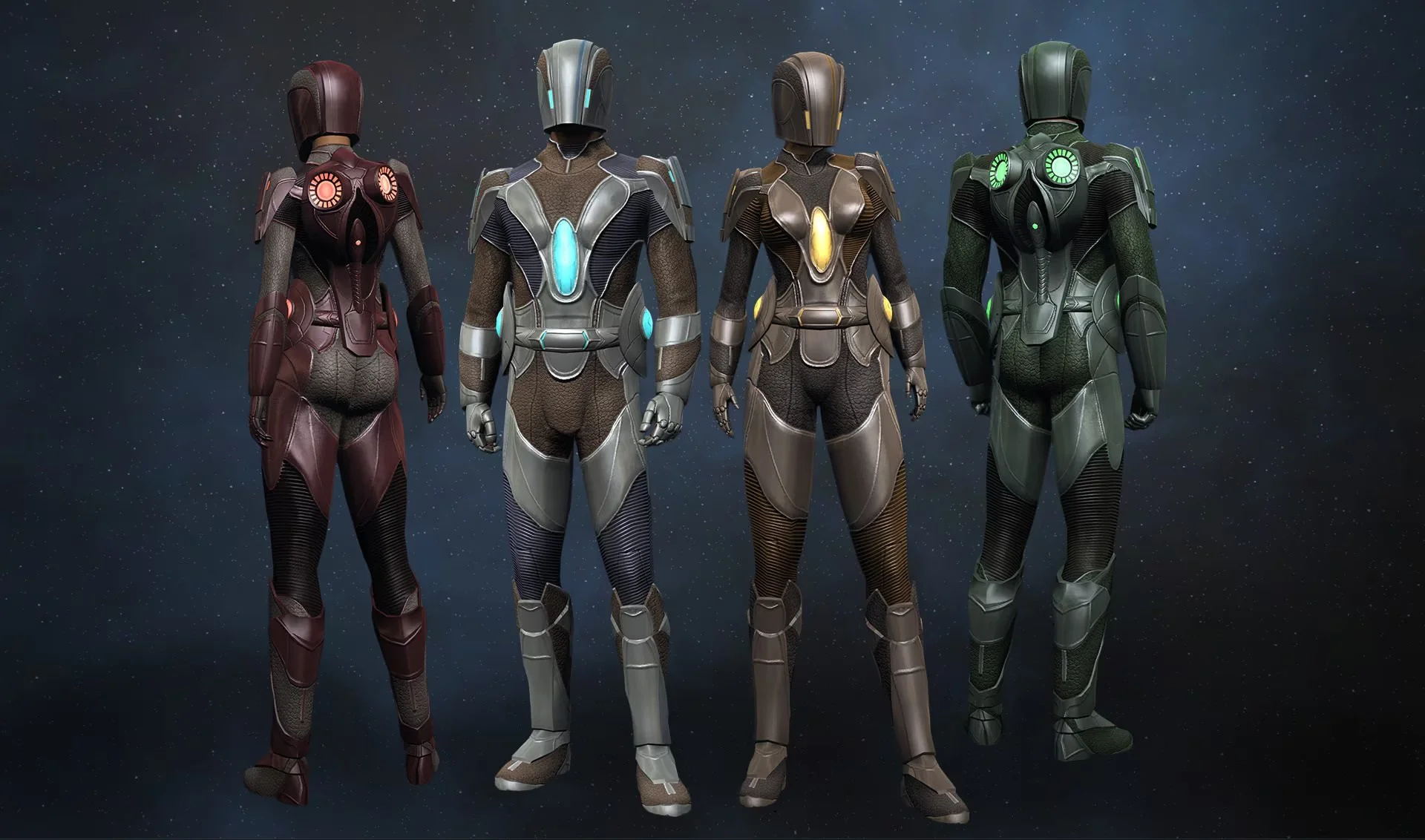
Star Trek Online has many in-game systems that are common to the MMORPG genre. The reputation system is one such example. In STO there are 13 reputation factions. Once a player has reached level 50 they may start progressing through the 6 reputation tiers of each one. Players gain progression through daily projects (20 hours in duration). Hourly projects are also available though they yield less reputation advancement and are limited to three times a day. Hence 20 hour projects are consider by default the most efficient way to gain rep. Projects require 30 Faction Specific Marks (earned via various activities in-game), 15,000 Energy Credits (standard in-game currency) and 2000 Expertise points. The most efficient way to tackle the reputation grind is to build up the necessary resources in advance and then at a designated time each day, start all 13 respective projects. Upon completion projects yield a player bound lockbox containing a random space or ground weapon, a console or Elite Marks which can be used to acquire faction gear.
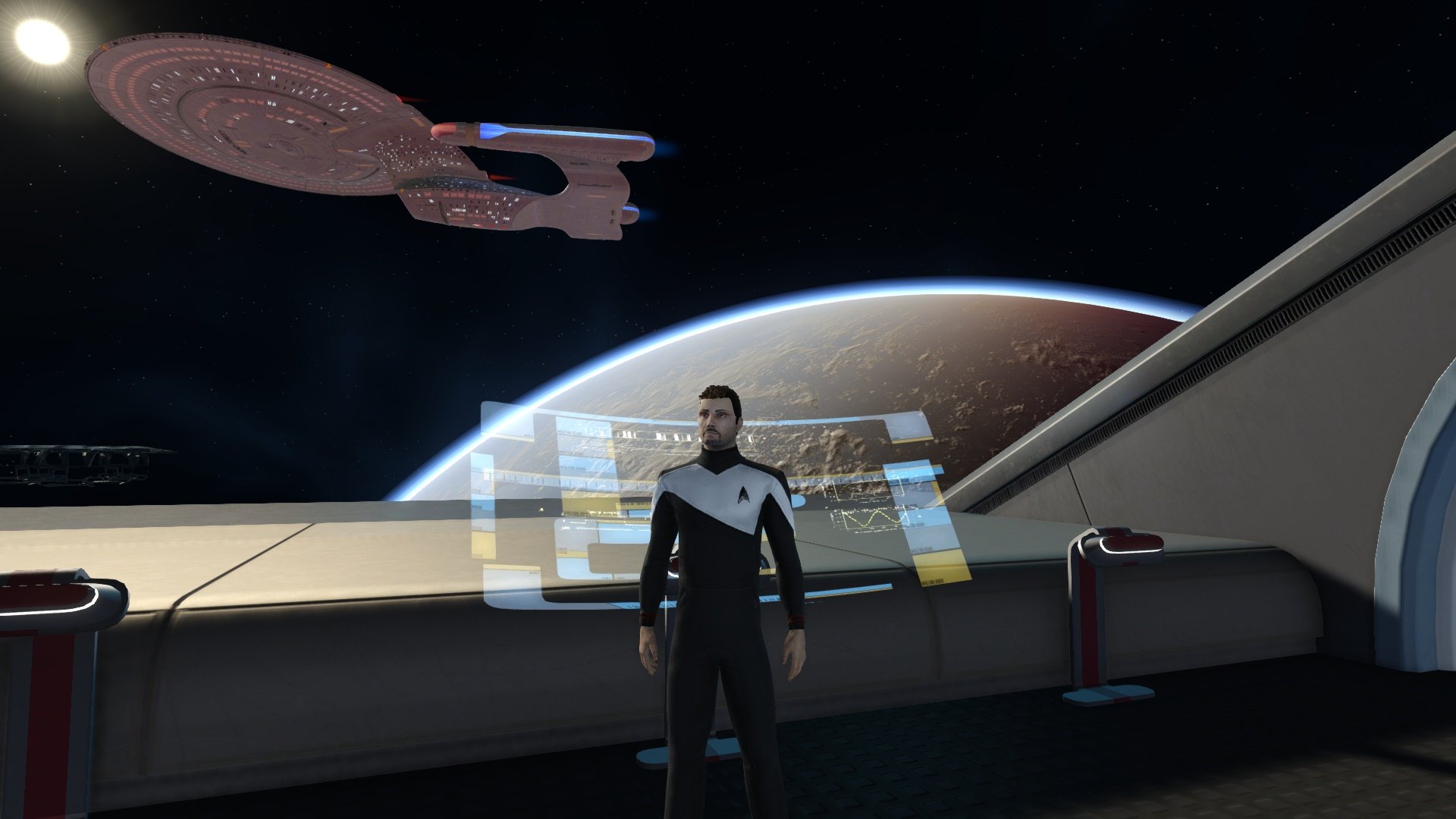
I was recently perusing my archive of old blog posts, when it struck me how much I’ve written about the MMORPG genre over the years. Naturally, there was far more material from between 2008 and 2012 as that was period when I immersed myself in the genre and was very enthusiastic about it. I was at a point in my life when I had the time to dedicate to such games and I was happy to participate in the social aspect of they offered. I would regularly play through group content and spend time socialising online with fellow guild members. My experience remains a textbook example of how online games can be more than the sum of their parts and that where you are at in your life has a major impact upon your overall enjoyment. As I read though various old posts it became clear that my experiences where specific to this particular part of my life and that they cannot be repeated. My relationship with the genre is very different now and that’s fine.
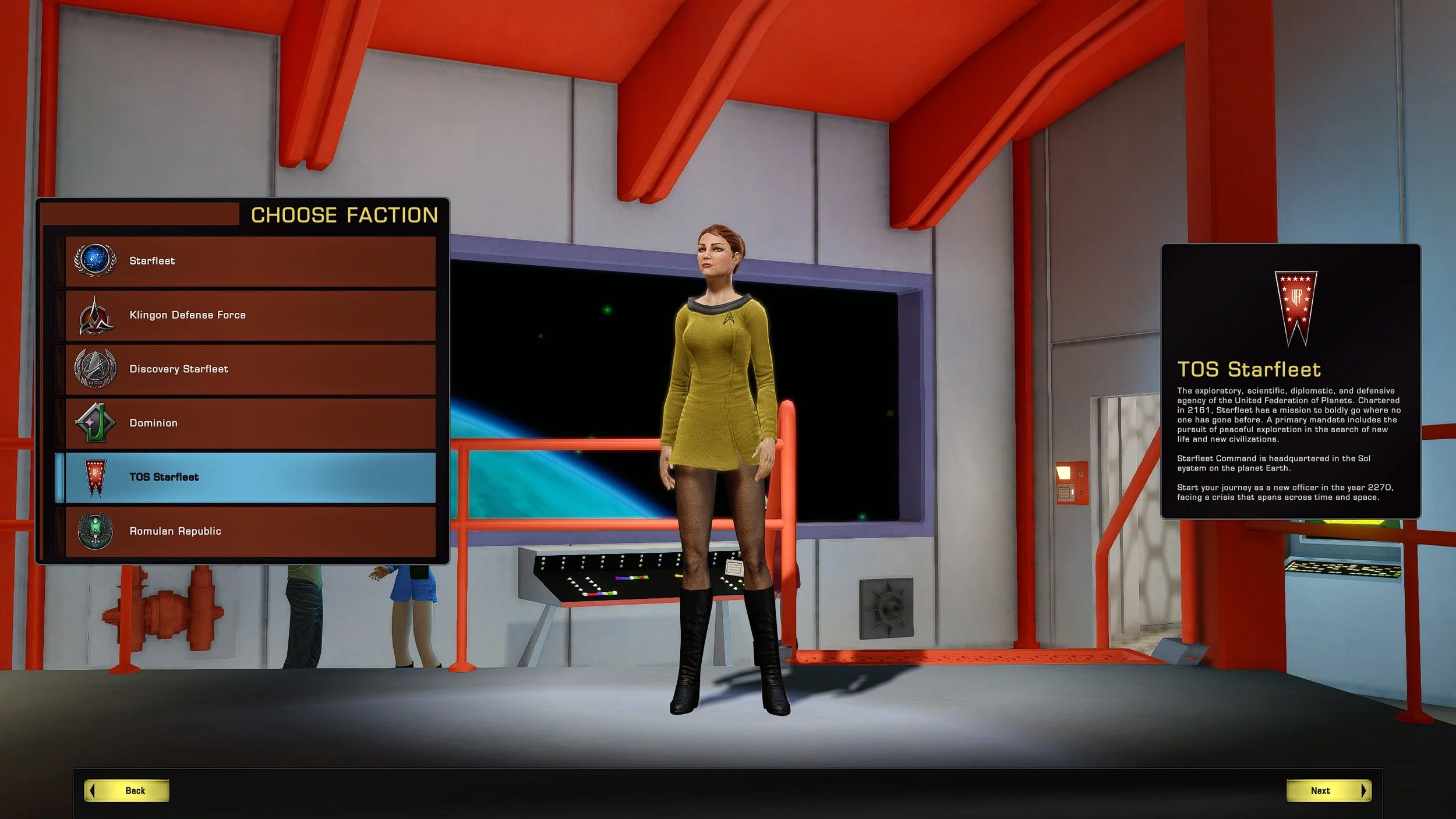
Creating alts is an integral aspect of the MMORPG genre. Many players will create a character of a specific class or faction, play it for a while, lose interest in it or they may decide that it is just not for them. Fortunately it is no effort at all to simply re-roll a new alt and set off once again. Furthermore, lots of players never reach level cap of the MMORPG that there playing. When the going get’s tough, so to speak, you can either soldier on for another 50 levels or simply create a new alt and return to the comfort of tried and tested content. Alts also give you the chance to secure an accolade or achievement that you previously missed. They are also of great benefit to the genres social aspects. Creating a new alt so you can play along with a friend who is just starting is great fun. Developer’s love them too as it means you’re still playing the game.
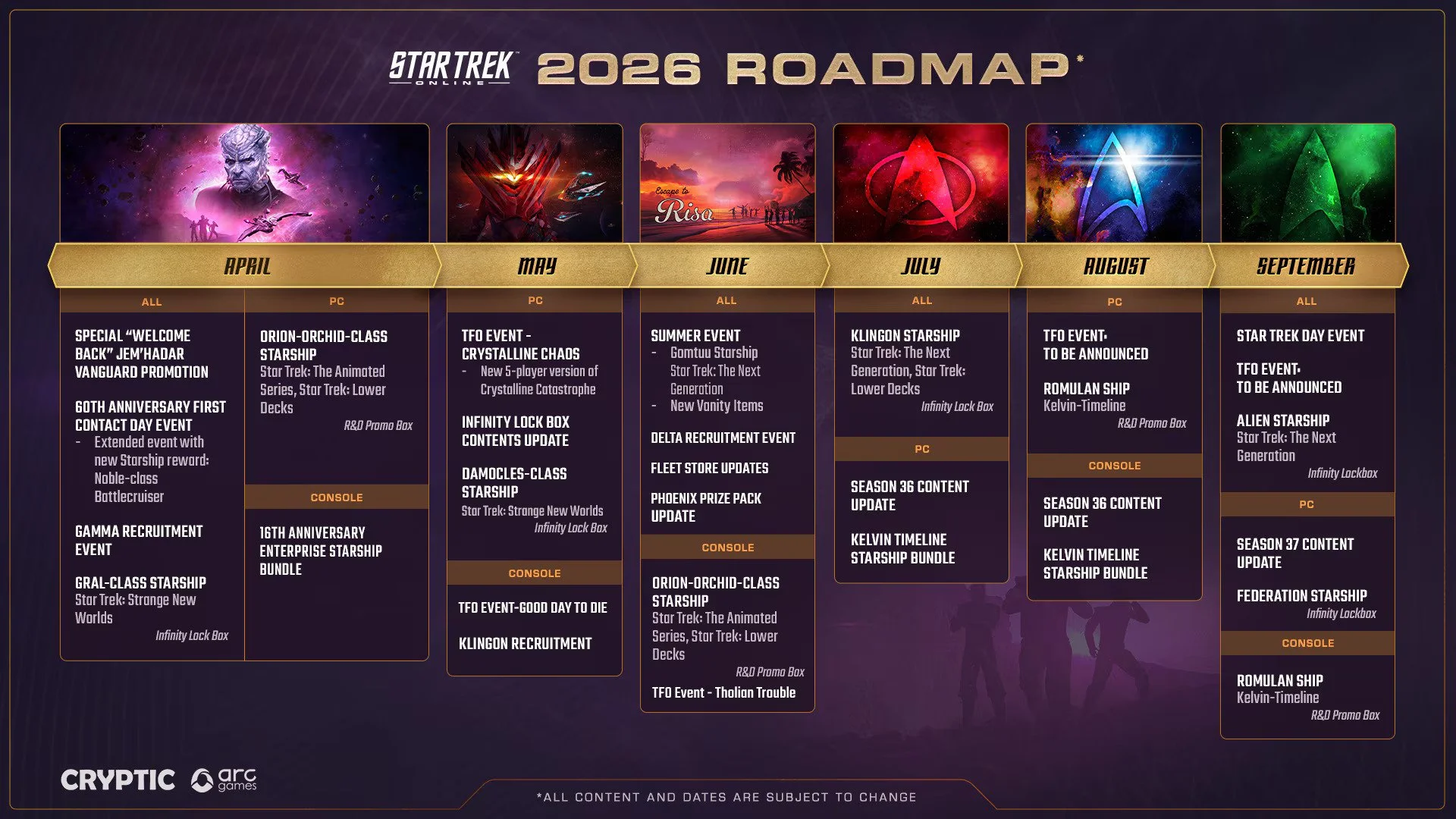
I recently took a break from Crimson Desert choosing instead to to play something familiar and easy going. As I’ve been logging into Star Trek Online daily to participate in the anniversary event, I decided to look through my various alts and see how far they had progressed through the game and what resources they had. At present I have twelve alts. My primary Captain was created in 2015 during the original Delta Recruit Event. I had previously played STO intermittently since its release in January 2010 but I never kept any of those characters. Hence this decade old Tactical Federation Captain has been my main focus when playing. The other eleven alts are the result of other recruitment events or whenever I wanted to try something different, such as playing a specific class or faction. I obviously played a lot of STO during the lockdown as several alts date from that period. Several had maximum reputation across all factions.
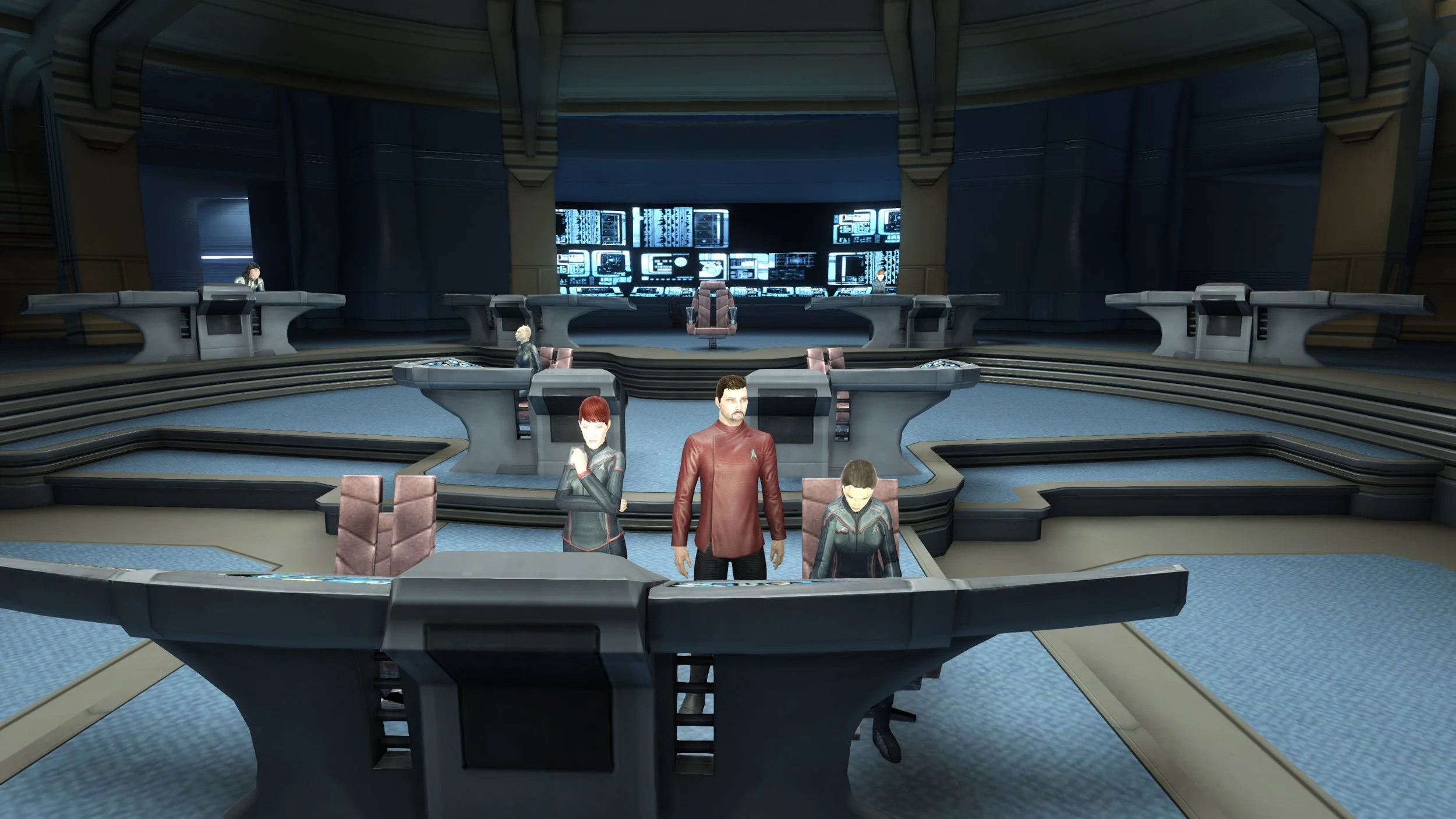
This year is the 60th anniversary of Star Trek. The original TV show was first broadcast in the US on September 8th 1966. If you search online you’ll find details of lots of related events. There are documentaries, conventions, new TV shows and even some video games in development. However, what you won’t find are any details regarding what will be happening with the MMORPG Star Trek Online. So far no road map for 2026 has been posted online by the developers but it is still quite early in the New Year. That being the case, I am not especially optimistic about there being any major plans waiting to be revealed. It is not as if DECA Games have demonstrated or stated any major ambitions for STO beyond keeping the endless events treadmill going and regularly adding content to the in-game store, during their development tenure. The ongoing story arc drags on inexorably and is as dull as ditchwater.
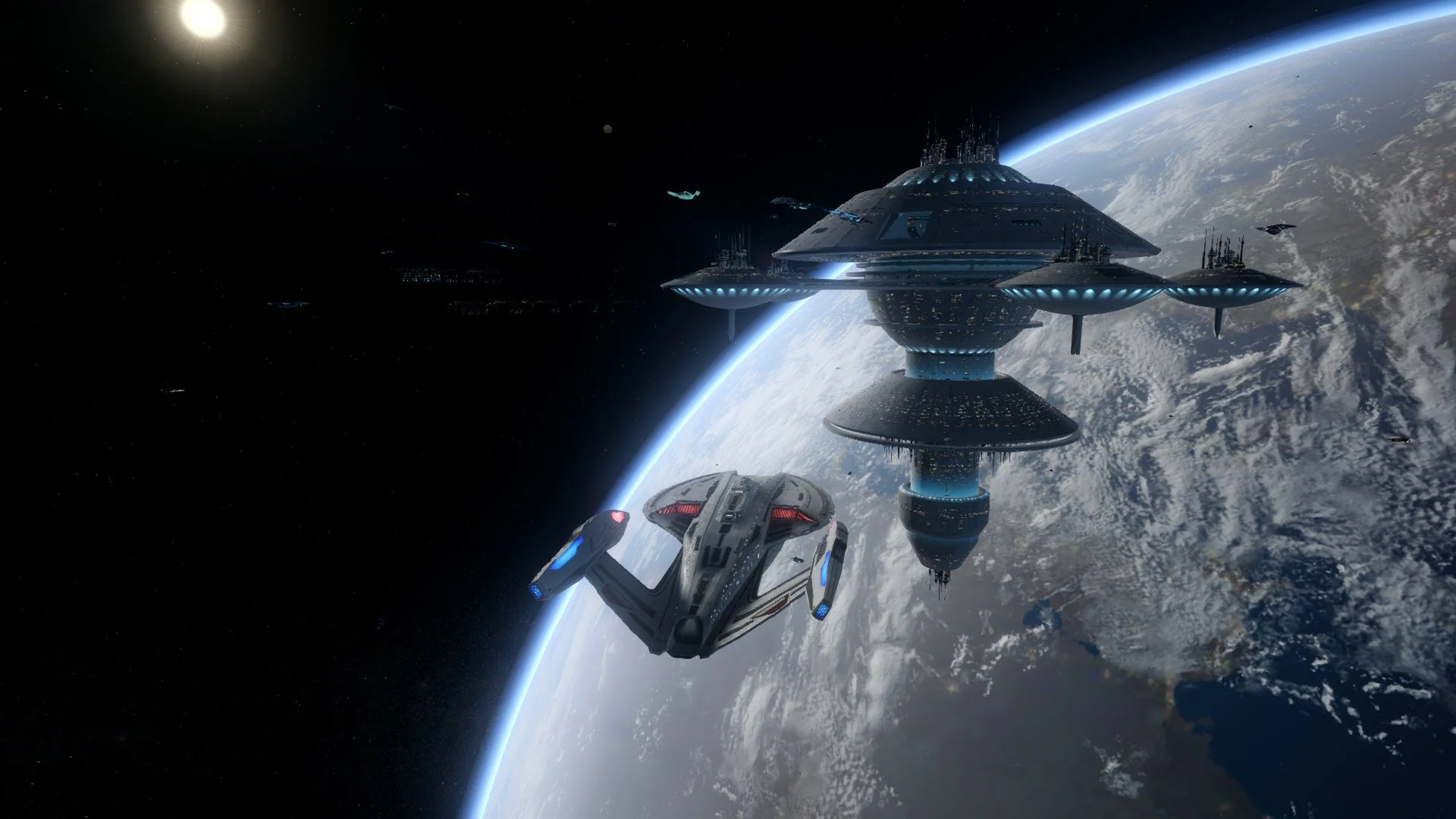
I recently read a post on Massively Overpowered about skills rotation in the MMORPG genre. I found the subsequent discussion in the comments fascinating. Mainly because I have never used a fixed rotation of skills in any of the MMORPGs that I play. I understand the reasoning behind such things and why some players want to optimise their combat performance. Using one’s skills in a specific order to maximise damage and manage their subsequent cooldown has a logical appeal. In Star Trek Online, some players go so far as to create keybinds for their rotations and assign it to a specific hotkey, which is then continuously pressed throughout combat. However, rotations are a blunt tool that lack flexibility, often being geared towards dealing with a single target or using an area of effect skill against a larger group. They may not be the optimal approach to combat when things do not go to plan.

If you check the Star Trek Online Wiki, you’ll find that there has been a steady stream of new content added to the MMORPG over the last 15 years. However, it doesn’t quite feel that way, mainly because more recent material seems weaker and less memorable. The last two major story arcs in STO have been somewhat lacklustre and demonstrably inferior to those that went before. Both Terran Gambit and Kings & Queens suffer from uninspired, repetitive ideas as well as an infrequent release schedule. Effectively weak stories have been dragged out over too much time. No doubt changes among the STO writing team have had an impact on content but it also seems that some of the newer stories have been tailored around whatever former Star Trek cast members that are available. As a result there has been a somewhat “square pegs in a round holes” aspect to both story arcs, where the pieces just don’t seem to fit together well.
In massively multiplayer online games (MMOs), alts (short for alternate characters), are new characters created by a player in addition to their primary character (often called the “main”). Alts are often encouraged by developers as a means to keep players engaged with their game(s). Sometimes an MMO will actively reward the creation of alts either with access to exclusive content, or with additional skills or items previously unlocked by primary characters. As the myth that an MMO really begins at endgame still persists in gaming culture, some games sell boosts that will instantly raise the level of an alt to that of the current level cap. Creating alts is such a key aspect of the MMO genre, that some games will sell additional character slots, so that players can create further alts beyond the default amount allowed. There are many reasons why players create alts. Let us consider some.
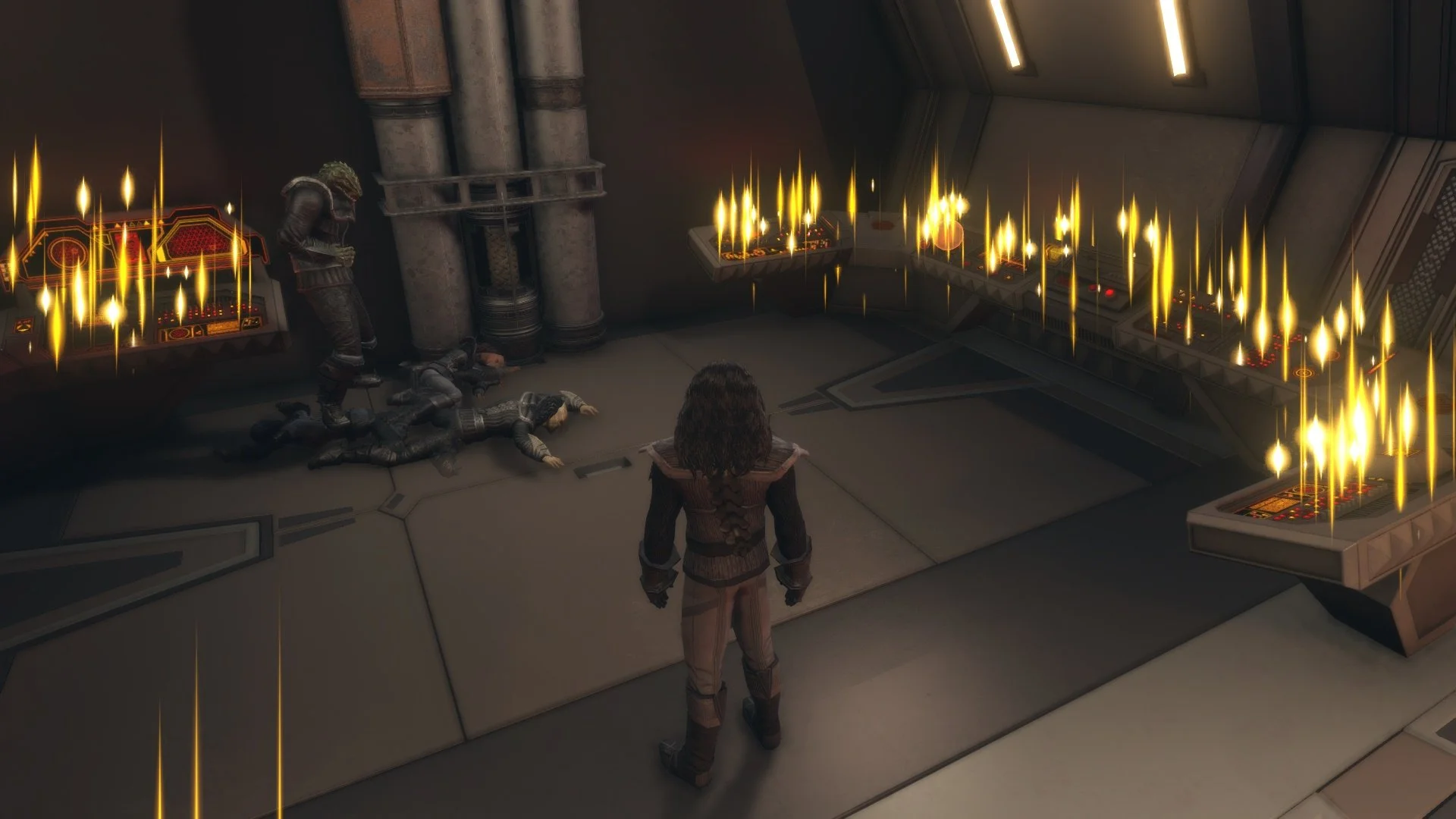
Star Trek Online is currently running its yearly Klingon Recruitment Event for PC players. Characters created from January 21st to February 11th gain additional rewards and account wide unlocks while levelling. It is a particularly useful way to orientate new and returning players. I created a Klingon Engineer during the 2021 Klingon Recruitment Event which I previously levelled to the current cap. However, I hadn’t taken this character through all the episodic missions, so I thought the current event would be a good time to resume their progress. Therefore today I resumed playing through the Romulan Mystery story arc. It was during the course of the final part of the episode, “Mine Enemy”, that I encountered a curious bug. It amused me sufficiently to prompt this blog post and make a lazy pop culture reference.
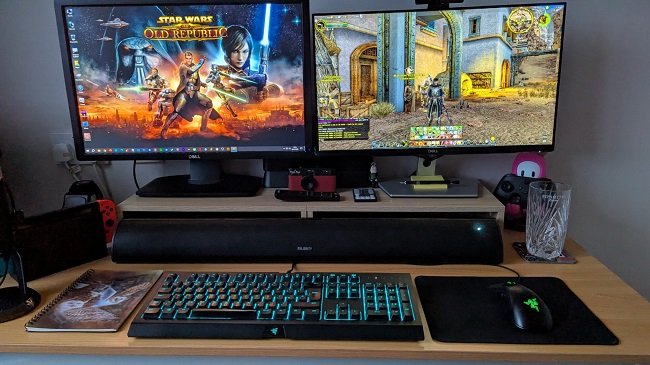
I have two monitors on my desk. The first (which is the primary monitor as far as my PC is concerned), is on the left and the second is on the right. The primary monitor is a 24 Dell U2412M, which has a resolution of 1920 x 1200. It therefore has an aspect ratio of 16:10 which adds a little extra desktop real estate, which I prefer when writing. The second monitor is a 24 inch Dell S2421H with a screen resolution of 1920 x 1080. It has an aspect ratio of 16:9 which is standard FHD. My chair is adjacent to the middle of my desk and I can turn according to each monitor I’m using. I tend to use the primary, larger monitor on the left for tasks such as writing via Google Docs and emails. The second monitor on the right is used for YouTube and gaming. This is because of its FHD format. I also have a Nintendo Switch connected to the second monitor for the same reason.
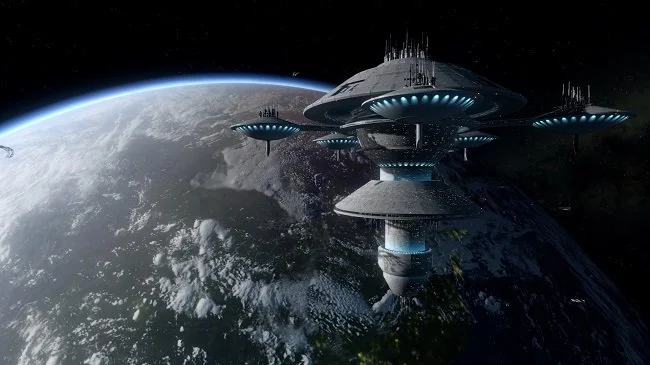
Yesterday the MMORPG Star Trek Online updated Earth Spacedock for the PC version of the game. The console version will be released a little later on. This replacement impacts upon Sol system space, the entire exterior model of ESD and elements of the interior. The outgoing model was somewhat old with several anomalies that linked to aspects of the game that have changed over the years. Perhaps the biggest reason for the change is a canon update to ESD as seen in the third season of Star Trek: Picard. The TV show features a new Earth Spacedock, also known as Probert Station, which boasts a larger superstructure designed to meet the demand of Starfleet in 2401. It would appear that this update is the first substantial release from the developers at DECA Games and may potentially indicate the quality of future content.
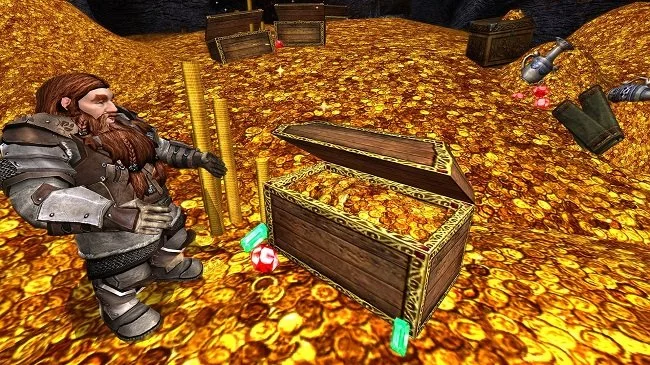
Bree Royce, editor-in chief at Massively Overpowered, recently asked the question “what is the most expensive MMORPG right now”. My first thought was to search through my old draft blog posts and track down an MMO cost analysis I wrote circa 2019. It includes data such as subscription rates and the price of current expansions. There was also information on what were the most popular cash shop items at the time. However, I then read some of the comments that had been left on Bree’s post and I quickly realised that this wasn’t just a matter of financial expenditure. Whether or not an MMO is expensive is also determined by one’s disposable income, respective wealth and personal relationship with money. The latter is perhaps the most important, irrespective whether you consider yourself rich or poor.
It is customary for me to write an end of year summary of my gaming activities but I suspect that on this occasion it will be somewhat short. For me, 2024 has really hammered home the notion of the ephemeral nature of video games as well as their commercial ubiquity. The moment a game fails to satisfy for whatever reason, rather than complain or worry about it, I just move on to something else. It’s not as if there’s a shortage of games out there. I have a substantial back catalogue of games that Epic and Amazon prime regularly giveaway. I have bought numerous discounted bundles in the past, in the pious hope that I’ll play one of the games included, at some point in the future. Games may well be enjoyable and engaging but many are also disposable. That’s not to say they’re bad. While playing them you are indeed “entertained”. However, when you’re “done”, it’s amazing how you quickly find another and forget what you were previously playing.
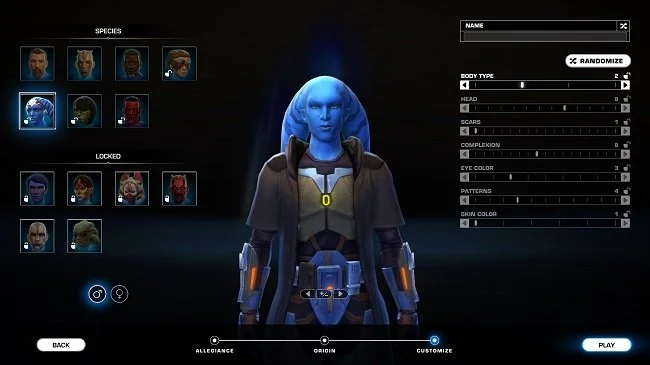
If you’ve ever played an MMORPG, then you have more than likely encountered this problem. Especially if you start playing a game that has been long established. You diligently create your character and spend time and effort customising them to suit your needs. All you’ve got to do next is choose a name, so you type in a pithy and droll title only to find that it has already been taken. So you quickly come up with another and that too is rejected. Next you try the same name but with some “alternative” spelling but the game resolutely tells you that even that permutation is already in use. I have found that even with a list of names that I’ve drawn up prior to playing the game, it can still take anything from 5 to 30 minutes to find one that is available. Naturally, this process is very frustrating, which is hardly the ideal user experience for a new player.

It would appear that one of the reasons potential new players avoid the MMORPG genre is due to the perception that they are all time sinks. I wouldn’t argue against this assumption because the reality is that it’s true. However any game that you enjoy, irrespective of genre, can become a time sink. That being said, the main difference between other genres and MMOs is as follows. A new player can jump straight into a FPS game and within minutes enjoy some multiplayer action, whereas in an MMO, a new player has to play through a tutorial and several hours of a starter zone before they start making headway in the game. This distinction does not have to be a deal breaker. An FPS can provide a quick fix of gaming and as such fulfils a need. MMORPGs can provide long term entertainment which scratches an ongoing gaming itch. Both are valid ways to enjoy gaming.
Cryptic Studios appear to have started a new round of layoffs, following those made last November. Although the developers of Star Trek Online and Neverwinter have not formally commented on the situation, it is more than likely that this is a continuation of their owners, the Embracer Group, ongoing restructuring program. So far, the Swedish company has laid off over 1,500 employees since June 2023, in an attempt to address its ill considered over expansion in recent years. At present development of Star Trek Online and other titles are being transitioned from Cryptic to DECA. The German developers are mainly known for mobile games and have recently positioned themselves as “breathing life into old games”. Their intent is to keep developing content for STO and to maintain a working relationship with the owners of the intellectual property.
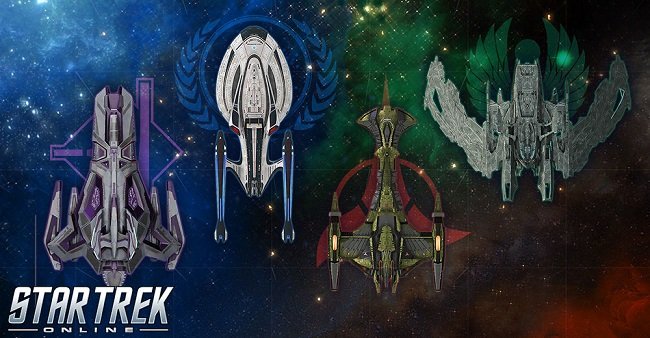
If you are a new player, then Star Trek Online has 14 years of content to play through. It is all story driven and is frequently couched in existing lore from the various Star Trek TV shows. It also benefits from many of the original actors reprising their respective roles within the game. This provides an additional air of authenticity to the proceedings as well as being a spectacular fan service. Furthermore, much of that content is faction specific, hence there is a great deal of replay value to be had from this MMO. Apart from The Lord of the Rings Online, I cannot think of another game that manages to successfully tap into the style and idiom of its source intellectual property. Simply put, Star Trek Online looks and feels “very “Star Trek”. Which is why it has a robust and loyal player base and still proves to be a viable financial asset to its owners, DECA Games.
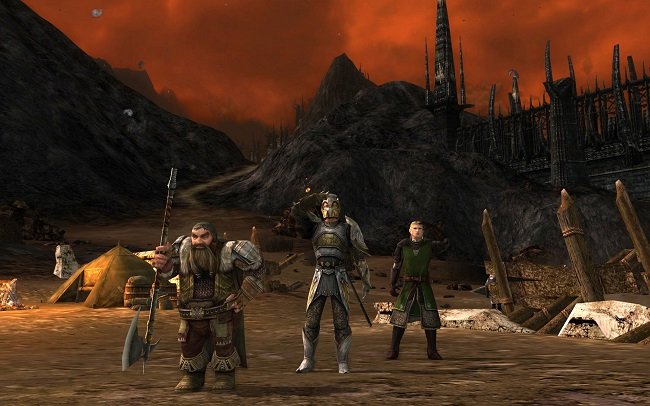
“The MMO genre is rife with its own set of tropes; recurring themes and motifs that have become established and ubiquitous. All of which are ideal material for a hastily produced, lazily conceived, recurring blog post”. One of the integral game mechanics of the MMORPG genre is the acquisition of loot. As you travel your virtual world of choice, committing random murder against all forms of flora and fauna, you acquire miscellaneous items by looting the corpses of the slain or stealing from houses and NPCs. Oh it’s a glamorous genre, the MMORPG. These random items can be crafting resources such as hides or ore. They may be food items or healing potions that provide some kind of statistical buff. If you’re fortunate, they may be gear that corresponds with your class or specific build, providing a much needed upgrade. Loot may also be the in-game currency, thus boosting your respective wealth. As you can see, loot comes in all shapes and sizes but how important is it?
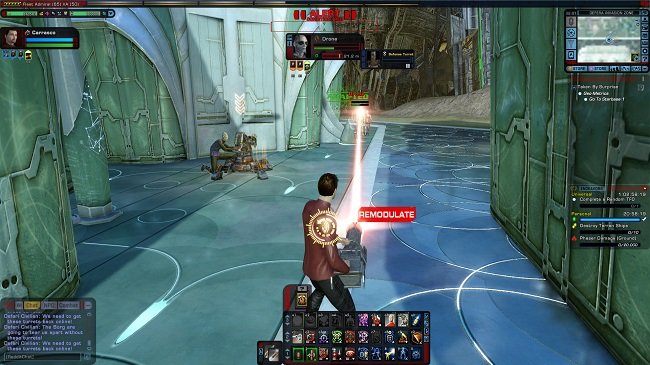
Ever since the Borg have been part of the MMORPG Star Trek Online, players have had to equip a Frequency Remodulator. The Borg adapt to damage from beam weapons after a few minutes and so players have to recalibrate their rifles or pistols, accordingly, using a Frequency Remodulator. This takes 5 seconds to perform and so has to be timed carefully to ensure that the player is not vulnerable to attack during this period. An upgraded version called a Fractal Remodulator, has been available from Federation and Klingon vendors in the Base Camp of the Defera Invasion Zone. It can be crafted for 50 Nanopower Capacitors, 50 Fibro-Neural Interface Cabling and 50 Cybernetic Armatures. It is quicker than the standard model, taking 3 seconds to apply new frequencies. Kinetic weapons do not require remodulation and the Borg cannot adapt to them.
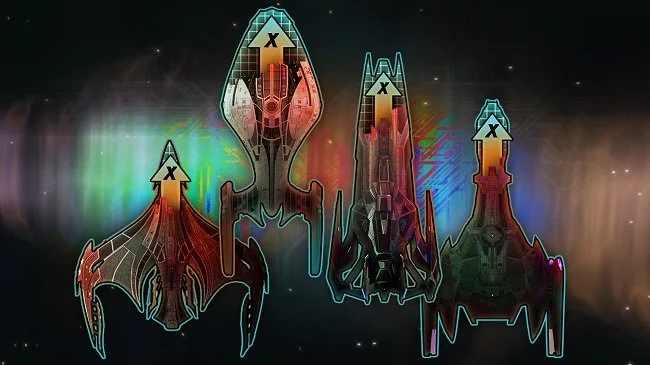
Cryptic used the same statement on their recent news release. Except they ended it with an exclamation mark whereas I’ve chosen a question mark instead. Because I really do question the wisdom of expanding the Experimental Ship Upgrade path and the benefits of applying additional tokens to your ships, unlocking further device, console and trait slots. This is a classic example of doing something because you can, as opposed because you should. Do players at level cap who have already upgraded their ship(s) from Tier 6 to Tier 6-X really need to augment it further? Beyond the immediate stats boost, does it offer any significant benefit to the player or the game in the long run? Or does this situation simply boil down to the fact that it’s another cynically contrived excuse for Star Trek Online developers, Cryptic, to sell you something. For the record, Experimental Ship Upgrade tokens are available for sale in the Zen Store (for money) or can be purchased via Phoenix Prize Pack (for dilithium).
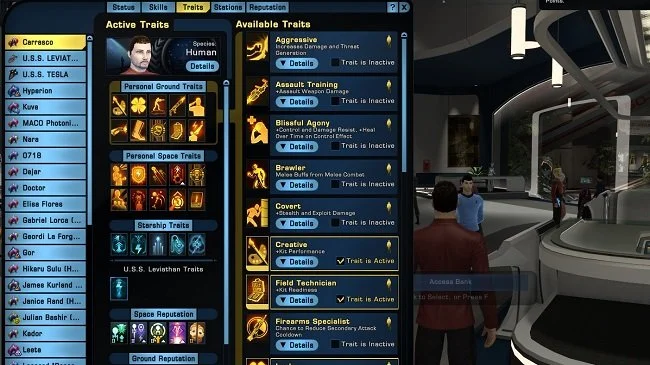
All MMORPGs have bugs. It is a certainty in life, just like death and taxes. However, some have more than others. I’m sure we could argue for hours as to which particular game has the most but I’ll leave that discussion to others. Star Trek Online has its share, many of which have persisted for years. But there is one that stands out, due to its longevity and sheer annoyance. To be specific, the “trait bug”. Like many MMO’s STO has a trait system that offers a range of passive or active buffs, skill boosts and statistical tweaks. STO is very much a number game, especially if you are chasing a high DPS output, which lots of players do. The trait bug is the random “unslotting” of some of your characters traits. It can affect any of the seven categories of traits but tends to most often happen to Personal Space Traits and Starship Traits. Unless you regularly check, most players will not immediately know this has happened.
“The MMO genre is rife with its own set of tropes; recurring themes and motifs that have become established and ubiquitous. All of which are ideal material for a hastily produced, lazily conceived, recurring blog post”. Dying in an Massively Multiplayer Online Role-Playing Game is a clear and unambiguous fail state. A means by which to teach the player that they’re doing something wrong and that they need to rethink their strategy. IE Don’t mess with the foul Marmydons unless you have back up and are wielding the Sword of Kagnazax. Dying is a reminder to not get overconfident and maintain situational awareness. It teaches us to ensure you have the right gear and consumables, to be au fait with the mechanics of any fight you’re about to get into and that winning is not a given. Any enterprise that offers a tangible reward will come with potential risks and consequences. If you’re playing in a group then death provides a timely reminder not to rely on Colin.
“The MMO genre is rife with its own set of tropes; recurring themes and motifs that have become established and ubiquitous. All of which are ideal material for a hastily produced, lazily conceived, recurring blog post”. I was in London recently, idly walking to the Natural History Museum in South Kensington, when a group of tourists started running for no discernable reason. Someone I was with asked “ I wonder why they’re running” and I replied “perhaps they think they’re in an MMO”. The quips fell on deaf ears but that is a cross I often have to bear. This anecdote highlights one of the points of this post. Namely, why do our avatars in the MMORPG genre run by default? I would also like to discuss the manner in which MMOs address the issue of travel around an ever expanding virtual world. Is fast travel lazy? Our mounts a boon or a bane?
Here we are again with another summary of my gaming activities in recent months. Or in this case since last September. It’s been a while but I’ve been on a blogging hiatus until recently. However, I’ve kept myself busy gaming wise and often I find the hunt for news video games, just as entertaining as I do playing them. Perhaps that could be a future blog post. Back to the matter in hand. Gaming wise, pretty much all things related to the MMORPG genre are currently on the back burner. I’ll give specifics later but I am taking a break from these for the present. I am currently looking at trying games outside my usual comfort zone and also trying to test whether you can or cannot teach an old dog new tricks. Fortunately, the answer appears to be yes you can. Enough summation, on to the specifics.
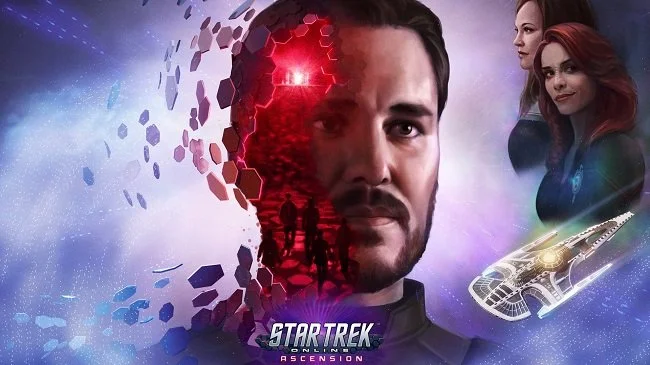
This afternoon Cryptic launched the latest season update, Ascension, for the MMORPG Star Trek Online. Furthermore, I’m sure it will not come as a shock to long term players that it was broken and an emergency patch had to be applied. Oh how we all laughed. Even after being “fixed” players are still experiencing bugs with the new content, especially the ground mission part of the update, but this sadly is just par for the course. Personally speaking, it is not the bugs that I have a problem with as they are just part of the overall gaming experience when playing STO. What I am saddened about is the actual gameplay found in Ascension. The space combat section of the game is simply “more of the same”. Destroy some specific vessels and once the goal has been met, watch the cutscene. But the ground combat is especially uninspired and repetitive, despite its interesting setting.
The Lord of the Rings Online was my first major MMORPG. I started playing in late 2008 and quickly discovered that there was a necessity to become familiar with the game world. Although the game provides quick travel options they were not ubiquitous at that point and often a player would simply travel on foot to travel costs down and to take the most direct route. Back in 2008 you could not own a mount until level 30. Hence I began “learning the maps” in the game and to this day still remember how to travel from one side of Moria, to another. The maps in the base game remain clear in my mind as they were so well trodden. Not so those in the regions. There are far more stables with fast mounts present in the game now and so convenience trumps any requirement to become so familiar with newly added zones. Nowadays Standing Stone Games designs new zones that tend to funnel players through them from quest hub to quest hub.
I’ve been playing Star Trek Online on and off for about 8 years. During that time I read a lot of Wikis and watched a lot of videos on YouTube that explore the game’s various systems and mechanics. I find a lot of the recommendations made by “expert” players to be impractical. The commonest being builds that include traits and consoles that you can only obtain from buying specific ships. Or using resources in quantities that take months of grinding to build up. This is hardly what I’d call handy advice for a new player. So I thought I’d give five tips of my own in no particular order, that I feel are useful. Some are glaringly obvious. Others not so. But hopefully they will prove useful to both new and returning players.
Cryptic are once again running the Temporal Agent Recruitment event in Star Trek Online from Tuesday 6th September 2022. Players who create a TOS (The original series) era character during this time are eligible for bonus dilithium, equipment and special traits as they play through the game. Progression also unlocks rewards for existing alts which can prove very useful. There are also unique tasks associated with Temporal Agents such as finding and unlocking Temporal Probes, which are hidden throughout the game’s story content. Once a player has created a 23rd century Starfleet character, completed the tutorial and received their special Temporal Agent transceiver device, they will gain the title Temporal Agent. The goals and bonus content associated with the event can be completed anytime, even after it ends on October 4th.
Star Trek Day
Today is Star Trek Day. An officially sanctioned celebration of all things Star Trek. The date reflects the launch of the original television show, back in the sixties. Naturally, there are a multitude of events going on over at the official Star Trek website. And as ever, the MMORPG Star Trek Online is taking part in the celebrations. “On September 8th, 1966, the world first met a group of people, and a ship, that would change our lives forever. Pitched as “wagon train to the stars,” and brought to TV by the force of Lucille Ball’s will, Gene Roddenberry’s Star Trek hit tiny television screens around the world and immediately captured hearts and minds. Through three seasons, and decades in syndication, The Original Series started a movement that still lasts today, more than half a century later. We live in a time where there’s more new Star Trek than ever before, and we’re joining with the rest of our Star Trek Family to celebrate the franchise’s birthday”.
Today is Star Trek Day. An officially sanctioned celebration of all things Star Trek. The date reflects the launch of the original television show, back in the sixties. Naturally, there are a multitude of events going on over at the official Star Trek website. And as ever, the MMORPG Star Trek Online is taking part in the celebrations. “On September 8th, 1966, the world first met a group of people, and a ship, that would change our lives forever. Pitched as “wagon train to the stars,” and brought to TV by the force of Lucille Ball’s will, Gene Roddenberry’s Star Trek hit tiny television screens around the world and immediately captured hearts and minds. Through three seasons, and decades in syndication, The Original Series started a movement that still lasts today, more than half a century later. We live in a time where there’s more new Star Trek than ever before, and we’re joining with the rest of our Star Trek Family to celebrate the franchise’s birthday”.
As of today in Star Trek Online, there is a special Starfleet Museum in orbit above Deep Space Nine and Earth Space Dock. The museum contains ten iconic ships from Star Trek movies, television, and the MMORPG. After receiving a message from Federation President Okeg, you undertake a mission to hail each ship. The ship responds with a quote from their respective Captains, along with some lore facts and behind the scenes information about the TV show, movie or game that featured them. Hailing all ten of the ships will complete an accolade and grant you a special title: Historical Documents Expert. It’s a simple but enjoyable mission that doesn’t take too long. It also serves as a reminder that the reach of Star Trek is truly global and spans over five decades. There have been times when Star Trek has been off the air and had a doubtful future. However, we find ourselves enjoying the opposite at present with multiple shows on offer.
Star Trek TOS was one of the first shows I remember sitting down and watching as a family. If memory serves it used to be shown mid-evening on the BBC when it was repeated in the early seventies. As a child the show left a major impression upon me. Obviously the action and special effects were a big selling point but I also recall how the friendship between Kirk, McCoy and Spock was a source of intrigue. They argued and often disagreed and yet they maintained a strong bond and obviously had a great deal of respect for each other. Although I didn’t express it in such terms at the time, there was an important social dynamic going on. Upon reflection I feel that their friendship is one of the most honest and credible you’ll find in popular culture. The fact that the show also depicted equality “at work” was not lost upon me. I greatly enjoyed Star Trek TAS as well in my youth and I’m pleased to see it is now considered canonical.
Sadly over the years we have not seen Gene Roddenberry’s vision of the future come to pass. Yes, a lot of the technology depicted in the show has begun to emerge and Star Trek has influenced multiple generations of viewers to follow their dreams and pursue a career in science, medicine and other professions. The film and TV industry is rife with creative talents who cite the show as a major influence. But the sad reality is that the dream of a united world that looks to the star for fulfilment is nowhere in sight. Our leaders tend to be the opposite of Jean Luc Picard or Kathryn Janeway. Measured diplomacy, tempered with wisdom and optimism is in short supply these days. Hence Star Trek remains a franchise about what some of us would like to see society become. Others however, prefer to look to the Romulan Star Empire for inspiration. However, despite my ever growing cynicism, I’m not done with Star Trek yet. I still see it as a force for good and positive change. May it continue to live long and prosper.
Star Trek is slightly older than me by 14 months. I was born on December 18th 1967. Star Trek was first broadcast in the US on 8th September 1966. Hence this show has always been part of the prevailing pop culture that surrounded me, as I grew up. I first began watching Star Trek as a young child in the early seventies. It would be repeated on the BBC in the early evening on Fridays and it became a family ritual to sit down together and watch it. As a seven or eight year old, it left a great impression upon me and was in many ways, the television highlight of the week. Star Trek along with Doctor Who certainly started my interest in science fiction. Star Trek was also one of the first shows that introduced me to tie-in marketing. I remember seeing in a toy shop, near to my school at the time, a Dinky Klingon Battle Cruiser and was flabbergasted that such a thing existed. I immediately coveted it but sadly never obtained one.
Star Trek Axanar is back in the news, twelve years on from the last controversy. For those unfamiliar with the original debacle, in 2014 Prelude to Axanar was released via YouTube. This Star Trek “fan-film” presented as a faux 21-minute, Starfleet documentary was very well received by fans and was intended by its makers as a proof of concept for a feature-length film. Set in the year 2245, during the final year of the Four Years War against the Klingons, Prelude to Axanar pushed the boundaries of what a fan film could be. The subsequent Kickstarter and Indiegogo campaigns raised more than $1.1 million. Prelude to Axanar was promoted as a professional-quality, “independent” Star Trek production, employing experienced actors and filmmakers and even established its own studio facilities. The presence of such actors as Richard Hatch, J. G. Hertzler, Kate Vernon, Tony Todd and Gary Graham (resuming his role as Vulcan Ambassador Soval) certainly made Prelude to Axanar distinct from other fan-films.
Thoughts on TV shows and my current viewing habits.
I last wrote a blog post in this series back in February 2022. Then for various reasons, I stopped. Possibly because my relationship with TV has changed in recent years. It’s fair to say at present that viewers are spoilt for choice. There are lots of very good shows around. Conversely, there is also a lot of bland, generic, filler as well. I appreciate that not every television series has to be an industry milestone and there are times when I’m content to watch undemanding content. However, I am very protective of how I spend my leisure time at present. I am not prepared to sink 6 or 8 hours into a show that is just “okay”. Hence I’m becoming very particular about what I watch. If something isn’t working for me in any fashion then I just abandon it and am happy to do so.
Jerry Goldsmith’s contribution to Star Trek is immense. Yet simply listing the films and TV episodes he wrote music for does not adequately encapsulate the significance of his contribution to the franchise. His majestic, thoughtful and uplifting musical scores provide an emotional foundation that reflects the core ethos of Star Trek. They also create an invaluable sense of continuity that spans multiple shows and movies. Perhaps the most obvious example of this is his iconic title music for Star Trek: The Motion Picture (1979) that was subsequently adopted as the theme tune for Star Trek: The Next Generation. His work was held in such high regard, when Star Trek V: The Final Frontier (1989) ran into production issues, it was thought that a Jerry Goldsmith soundtrack may well elevate the film. Sadly it didn’t but his work on that instalment was outstanding and among his best.
Star Trek documentaries are very much like Bruce Lee documentaries, in so far as they’re both a saturated market and more often than not, new content frequently ends up covering the same ground. However, fans tend to watch anything new in the hope that they will find a few new nuggets of information. Brian Volk-Weiss’ new 11 part series, The Center Seat: 55 years of Star Trek, not only covers established facts about the iconic show but also expands upon them as well as providing a wealth of new information. Volk-Weiss has previously explored popular culture with documentaries such as The Toys That Made Us and The Movies That Made Us. The Center Seat: 55 years of Star Trek is an in-depth chronological study of the Star Trek franchise, from its creation at Desilu Productions in 1965 all the way through to the latest iterations, Star Trek: Picard and Star Trek: Discovery.
I recently watched the first trailer for the new Obi-Wan Kenobi television show that is premiering on Disney + in May. I am interested in this latest instalment in the Star Wars franchise and curious as to whether Liam Neeson will make an appearance. I also watched a 20 minute fan video in which they “analysed” the entire trailer. They discussed the content of this 2 minute preview and then did a great deal of speculating about potential themes and characters that may feature in the show. They were clearly enthusiastic about what they had seen and were very knowledgeable about the subject. This resonated with me, as I like to be well versed about the things I enjoy. However, it is worth remembering that fandom can tip into obsession and gatekeeping. Hence I feel there is a subject to explore here.
Before we start, no I am not writing about Alexander Courage’s classic main theme for the original Star Trek show. I can add nothing further to that particular discussion and it remains iconic and inspiring, even when distilled down to just the initial fanfare. In this post I want to draw your attention to another piece of music from Star Trek that has permeated its way into popular culture. A cue that when heard, if the listener is familiar with its provenance, will instantly conjure up images of flying drop kicks, ear claps and judo chops. A piece of music that can be added to pretty much any video footage and instantly make it more heroic. Yes, I am talking about what has become generically known as Star Trek “fight music”. Or more specifically, the "The Ancient Battle/2nd Kroykah" cue from Amok Time (S02E01) composed by Gerald Fried. The scene during the koon-ut-kal-if-fee ritual in which Spock fights Kirk on the planet Vulcan for complicated “reasons”.
Star Trek: The Motion Picture is a wonderful paradox in the Star Trek cinematic pantheon. It is possibly the most hardcore science fiction story that the franchise has explored and is both simultaneously Trek-like and un-Trek-like. Director Robert Wise and the production team worked hard to deliver a completed film for the scheduled December 1979 release date. However, he felt that the theatrical version was only a “rough cut”. Hence in late 2001 he supervised a Director’s Edition of the film which runs 136 minutes (4 minutes longer than the theatrical release)and reinstates some additional scenes and replaces some of the optical effects with new CGI creations. Critics were divided as to whether the Director’s Edition improved the film overall but Wise felt that this version was much closer to his original vision. The Director’s Edition was released exclusively on DVD in standard definition.
Fan Edits are a curious film sub genre. Some simply reinstate deleted scenes to maximise the running time of a movie. Others will remove footage and seek to reorder events in the name of coherency. But a few are far more ambitious. Rather than just reshape what is there, they will shoot new footage to replace material deemed substandard and seek to totally reimagine a movie. On even rarer occasions a few manage to actually improve upon the original, rather than just offering an augmented version. Which leads me onto Star Trek: beyond the Barrier, an interesting and very enjoyable fan edit of Star Trek V: The Final Frontier by Anti-Matter from deLimited Productions. It attempts to repair many of the problems found in the theatrical release of the movie. Some would argue that such a task is a Kobayashi Maru test in itself. However, the results are surprisingly good and some tongue in cheek humour shows that the creator understands the nature of their task.
Welcome to the second part of my Star Trek Online: Beginners Guide. I thought it may be useful to write a series of posts, offering practical information for those who are just starting out in STO. Nothing fancy or in any way definitive. Just a few basic tips that may help orientate the new player. I’ve been playing STO since its launch in 2010 and this MMO has seen a lot of changes. The game features a lot of systems and mechanics that are not always immediately intuitive to grasp. So I’ll be doing my best to cover a selection of these in each post and try to provide a broad overview. Like a lot of advice, it can be subjective. Ultimately it comes down to each player how they wish to play. In this instalment, I shall be writing about career paths, factions and races.
Today is Star Trek Day. An officially sanctioned celebration of all things Star Trek. The date reflects the launch of the original television show, back in the sixties. Naturally, there are a multitude of events going on over at the official Star Trek website. And as ever, the MMORPG Star Trek Online is taking part in the celebrations. “On September 8th, 1966, the world first met a group of people, and a ship, that would change our lives forever. Pitched as “wagon train to the stars,” and brought to TV by the force of Lucille Ball’s will, Gene Roddenberry’s Star Trek hit tiny television screens around the world and immediately captured hearts and minds. Through three seasons, and decades in syndication, The Original Series started a movement that still lasts today, more than half a century later. We live in a time where there’s more new Star Trek than ever before, and we’re joining with the rest of our Star Trek Family to celebrate the franchise’s birthday”.
I’ve mentioned in the past that a lot of important information regarding the MMORPG Star Trek Online is centralised within the official subreddit. That’s fine if you enjoy using this platform but it’s not for everyone. I’ve always found Reddit somewhat esoteric and I don’t really like the way it visually displays information. I have to use a browser addon to make it more user friendly. Unlike other communities, STO does not seem to have that many fan produced blogs. However, I may be wrong regarding this, so feel free to correct me (and provide URLs). In the meantime, I thought it may be useful to write a series of simple guides, offering practical information for those who are new to STO. Nothing fancy or in any way definitive. Just a few basic tips that may help orientate the new player. This time we’re going to look at the business model for STO and the cost of playing the game.
Out of the original seventy-nine episodes of Star Trek, one of the most respected and beloved is The City of the Edge of Forever. Written by Harlan Ellison the story is one of the more thoughtful and tragic in Trek Canon. It was also the first episode to feature a temporal plotline. Doctor Leonard McCoy (DeForest Kelley) accidently receives an overdose of medication and flees the Enterprise while in a delusional state. Beaming down to an alien planet he uses a temporal gateway (The Guardian of Forever) to travels back in time to earth during the Great Depression. By doing so he accidentally changes history. Captain Kirk (William Shatner) and Spock (Leonard Nimoy) follow him through the gateway to New York in hope of correcting the timeline. While awaiting the arrival of McCoy, Kirk falls in love with Edith Keeler (Joan Collins) who runs the 21st Street Mission. However he and Spock soon determine that to restore the timeline they must allow her to die.
There has been a degree of controversy over the Discovery Operation Pack that has recently been made available for purchase in Star Trek Online. The bundle featuring ships, bridge officers, cosmetic items and more is displeasing some core players who feel that it is over priced and lacks anything relevant for Romulan and Klingon races. Personally, I’m only interested in two specific items from the pack, such as the Tier 6 Gagarin Miracle Worker Battlecruiser and the combat pet Tardigrade but at present they cannot be purchased separately. So, I shall not be parting with any money at present. The Gagarin Miracle Worker Battlecruiser is relatively similar to the Tucker Tactical Miracle Worker Cruiser, which I already own. However, it is an improvement aesthetically speaking (a subjective point, admittedly), so for me the obvious compromise is to purchase the fleet version and forgo the unique space trait and settle for an additional console slot. As I’m not a high-end player, the look and feel of a ship has as much appeal to me as its stats.
I have suffixed the title of this post “and stuff” so I can address several Star Trek Online related thoughts in a single blog post. Despite the fact that I frequently play STO it is does oddly get neglected in my writing. So, let us start with the issue of the ninth anniversary. As ever Q is back with the anniversary event and once again, we are stabilising Omega Molecules. This year’s reward is a Tier 6 Vulcan T’Pau Scout Ship. There are also emotes and sundry other items to earn during the duration of the festivities, but I more interested in the anniversary itself. Not many MMOs make it to nine years and if they do, they aren’t necessarily in as good shape as STO. The game has a stable and loyal playerbase and is currently tied-in to Star Trek: Discovery. Further established Trek actors are supplying voice acting and the game seems to be doing well across both PC and consoles. Like LOTRO, STO uses the IP well and seems to “fill in the gaps” in the existing lore as well as expand and extrapolate established canon. One of the best things about STO is that there’s always something to do in-game as well as new content in the pipeline. Perhaps this along with the handling of the IP is why the game endures.
Star Trek: Enterprise was the first show in the Star Trek pantheon to have a song performed by an established artist play over the opening credits, rather than a traditional theme tune. Up until 2001, the franchise had maintained a more formal approach, established with the iconic introduction to the original series composed by Alexander Courage. Needless to say, such a radical departure from established practise brought about consternation and debate among fans. In some respects, you can argue that point about the entire show itself, but that as they say, is an entirely different blog post. Needless to say, the dislike and hatred that the song Where My Heart Will Take Me engendered in certain quarters, lead to a petition to have it removed. Needless to say, this movement failed, and the show continued using it for four seasons. Seventeen years on this particular debacle has now died down and the song is often just referenced ironically by fans as an amusing anecdote and piece of Trek trivia.
I’ve written in the past about the problems that can arise from untempered fandom. If enthusiasm and inspired love are not balanced by contextual reason and a healthy dose of reality, then it can get a little bit over zealous. Need I cite Star Wars fans and The Last Jedi as an example of unchecked fandom. However, I am now going to stray a little into the “Twilight Zone” of fandom myself, although I shall attempt to apply a healthy dose of realism into the proceedings. Because I want to discuss the fact that Ethan Peck has been cast to play one of the most iconic characters in popular culture. Yes, Gregory Peck’s grandson (and there’s plenty of “baggage” there) has been cast to play Spock in season two of Star Trek: Discovery. Furthermore, rather than be concerned, I am very excited by this development and I really look forward to seeing how this pans out.
After a prodigious marketing campaign and a great deal of internet speculation about one specific character, Star Trek Into Darkness was released to broadly strong reviews and solid box office returns in early May 2013. Finally, all the questions that had kept fans and website pundits endlessly theorising, were answered. For a second time running, Paramount Pictures managed to produce an action-filled blockbuster which still offered a strong plot, with complex and adult themes, explored by well-rounded characters. Batman Begins seems to have set a trend of framing material from a traditional pulp background, within broader intellectual parameters. Star Trek: Into Darkness managed to do this while cleverly re-imagining iconic material from its own lore. However, as with any substantial franchise movies, not everyone was satisfied or pleased. Many fans railed against the new Kelvin Timeline and continue to do so.
The reinvention of any popular franchise certainly comes with many risks. Twelve years ago, Casino Royale was hailed as a triumph in rebooting the 007 brand. It was hard edged, back to basics movie that made the spy genre relevant to a contemporary audience, without diluting its source material excessively. Yet this process went a step too far with Quantum of Solace, with a film that simply didn't feel Bond enough. Needless to say, the rights holders corrected this error. The success of the BBC's relaunch of Doctor Who hinged on making the formula accessible to modern viewers. Yet the new format of standalone episodes, celebrity guest stars and an emphasis on action over story, can be difficult to maintain and requires the involvement of top writers to keep the momentum going. Then of course there are the fans.
Finally, it’s arrived. The first new Star Trek TV show for twelve years. Star Trek: Discovery became available for Netflix UK customers to watch at 8:00 AM this morning. Needless to say, I cleared my schedule in advance so I could sit down and watch this much-anticipated show. Furthermore, I made it my business to avoid Twitter and the internet until I had finished viewing the first two episodes because I knew in advance that Star Trek: Discovery was going to be controversial and divide fans. Having now seen The Vulcan Hello and Battle at the Binary Stars and taken time to reflect upon both episodes, I have reached the following conclusion. From what we’ve seen so far, the spirit and emotional heart of Star Trek, is reflected in the new show. I found the characters to be interesting and well defined. Lead performances by Michelle Yeoh, Sonequa Martin-Green and Doug Jones were good and there’s an intriguing crew dynamic. The story has already touched upon numerous canonical themes and I am eager to learn more about the main characters and the universe they inhabit. I therefore shall continue to watch Star Trek: Discovery. However, not everyone feels the same, as my subsequent forays online have shown. Much has changed in this new iteration of Star Trek and as we know, some fans do not like change in any way, shape, or form.
Over the years I have been a participant in several fan based communities. These have ranged from running film clubs, to creating and publishing fanzines in the pre-internet days. More recently this has included running websites, blogging and creating podcasts. It’s a curious thing the way fandom is cyclical and one’s involvement with such communities seems to ebb and flow. It’s something I’ve been thinking about a lot of late. Several of the You Tube channels I enjoy have reduced their output or stopped due, to changes in advertising policy and monetisation. The Newbie Blogger Initiative failed to manifest itself this year and many of my immediate colleagues in blogging and podcasting have also begun to fade away or moved on to pastures new. The sad thing is, the true value of many community contributors is never really realised until after they’ve gone.
Fans are often a very creative and resourceful bunch. Star Trek fans especially so. At present, there’s a lack of new officially endorsed canonical content being produced. The movies set in the Kelvin Timeline are not universally embraced by Trekkies and usually take three years to produce. The new TV show Star Trek: Discovery has been subject to several production delays and still seems a long way off. So, the fans solution in recent years, has been to make their own original content. Hence there is a wealth of unofficial, independently made shows available online, set in various incarnations of the Star Trek universe. Although many of these productions are lovingly crafted and driven by passion, often they lack the professional polish of the genuine article. Frequently their weakness lies in the quality of the acting and writing. Then there is Star Trek Continues.
Adam Nimoy doesn’t paint a rosy picture of family life in his documentary about his father. The novelty of fame and popular acclaim soon wore off with it’s never ending photoshoots and long working hours that kept his father from ever being home. Yet among the anecdotes in this greatly condensed biopic there evidence of a lot of love and professional respect. Far from being comprehensive For the Love of Spock focuses on the matters that interest fans the most. So the documentary explores Nimoy’s relationship with Gene Roddenberry, his subsequent casting in Star Trek, his post Trek stage career and his return to the fold with the big screen movies.
The Captains is a curious beast. If you’re expecting a traditional documentary where Bill Shatner simply indulges in a standard Q & A with other actors that have portrayed captains within the Star Trek franchise, then you will be disappointed. The Captains is a horse of a different colour entirely. Throughout its ninety minute duration, this documentary veers from personal reflections on acting, muses upon the nature of fame and even touches upon contemplating one’s own mortality. It certainly wasn’t what I was expecting and was subsequently a far more rewarding experience.
I am not a dogmatic fan. In fact as I get older, I become far more flexible and forgiving in my outlook. I certainly don’t buy into the concept that your “childhood can be ruined”. The only way something new can spoil the memories of something old that you hold dear, is if you allow it to. If you wish to explore this concept further, I’d suggest reading Marcus Aurelius. Back to the matter in hand. When I found out that Star Trek was to be rebooted via an alternative timeline plot device, I was content with this. I decided to ditch my personal baggage and try and be objective about the now named “Kelvin Timeline”. I make no bones about the fact I have liked the previous two Star Trek movies. Are they masterpieces? No. Are they entertaining? Yes. That is far more than some reboots have achieved.
The announcement that CBS has commissioned a new series of Star Trek is both a blessing and a curse. It’s a blessing in the sense that I have genuine affection for this franchise and therefore I welcome the prospect of a new incarnation of the show returning to TV. However I also consider this situation an absolute curse because well now have to endure at least eighteen months of idle speculation and an ongoing dissection of the entire production of a show before it is even released.
Trek Nation is a relatively straight forward documentary with a clear premise. It follows Eugene Roddenberry’s search to find out more about his father Gene and to understand the cultural phenomenon of Star Trek. Directed by Scott Colthorp the film endeavours to explore the enduring appeal of the franchise as Eugene discovers more about the father he didn't know and the show that passed him by. Through interviews with cast and crew members from all five Star Trek shows, as well as fans and celebrities who were influenced by the show while growing up, Trek Nation methodically follows a linear path. Yet this uncomplicated approach proves to very effective and surprising candid.
Star Trek Online: Beginners Guide Part 1 - The Cost of Playing
I’ve mentioned in the past that a lot of important information regarding the MMORPG Star Trek Online is centralised within the official subreddit. That’s fine if you enjoy using this platform but it’s not for everyone. I’ve always found Reddit somewhat esoteric and I don’t really like the way it visually displays information. I have to use a browser addon to make it more user friendly. Unlike other communities, STO does not seem to have that many fan produced blogs. However, I may be wrong regarding this, so feel free to correct me (and provide URLs). In the meantime, I thought it may be useful to write a series of simple guides, offering practical information for those who are new to STO. Nothing fancy or in any way definitive. Just a few basic tips that may help orientate the new player. This time we’re going to look at the business model for STO and the cost of playing the game.
I’ve mentioned in the past that a lot of important information regarding the MMORPG Star Trek Online is centralised within the official subreddit. That’s fine if you enjoy using this platform but it’s not for everyone. I’ve always found Reddit somewhat esoteric and I don’t really like the way it visually displays information. I have to use a browser addon to make it more user friendly. Unlike other communities, STO does not seem to have that many fan produced blogs. However, I may be wrong regarding this, so feel free to correct me (and provide URLs). In the meantime, I thought it may be useful to write a series of simple guides, offering practical information for those who are new to STO. Nothing fancy or in any way definitive. Just a few basic tips that may help orientate the new player. This time we’re going to look at the business model for STO and the cost of playing the game.
Q: What is the business model for STO?
A: STO is a free to play game. Unlike some other MMOs there are no major impediments to new players. Story based content is not locked behind any sort of paywall. Once a player has completed the tutorial and reached level 10 (which is easy to do) they can play the latest material. Some content is scalable. STO has several earnable in-game currencies; Energy Credits, Dilithium and Lobi Crystals. You can also purchase Zen for real money. This currency is used to buy in-game store items such as ships, character slots and bank space etc. If you don’t want to spend any real money, you can grind Dilithium and exchange it for Zen, legitimately within the game.
Q: Is there a subscription?
A: STO used to have a subscription option but this was removed from the game in December 2018. If you play for free, you have Silver account status. This applies a degree of limitations upon the game, such as an Energy Credit cap of 15 million and your overall number of character slots, bank slots, Bridge Officer and ship slots. None of these are a deal breaker for new players. If you enjoy the game and wish to create multiple alts or feel that you need more space, you can purchase all these additional resources via the store. Gold account status used to be gained by subscribing but now it is only available by the purchase of a lifetime account.
Q: Are there any essential items to purchase?
A: Although I wouldn’t define it as “essential” the Elite Services Starter Pack does offer a lot of benefits to a new player. It costs 1,000 Zen and can be found in the C-Store. It includes 36 bank slots and 36 inventory spaces, two Bridge Officer slots and three retrain tokens (for reallocating your skill points). If these items were bought separately it would cost the player 2,250 Zen. Hence, the Elite Services Starter Pack is a real bargain working out at less than $10. Again if you don’t want to buy any Zen with real money, you can grind Dilithium by playing game content and exchange it for Zen. It will take about one week to earn sufficient Zen for the Elite Services Starter Pack.
Q: Is the Lifetime subscription worth it ?
A: This very much depends on how often you play STO. I would not encourage new players to contemplate such a purchase until they have played STO for a while and determined how invested they are in the game. If it becomes your MMO of choice and you log on several times a week or more, then it does offer value for money. Upon purchase you immediately unlock Veteran Rewards which include unique ships, uniforms and other game rewards. But perhaps the biggest incentive is a monthly stipend of 500 Zen. A Lifetime subscription retails at $299 but there are often sales throughout the year when the price is dropped to $199.
Q: Should I buy a ship straight away?
A: Unless you have your heart set on a specific ship and are happy to pay real money, once again I would advise those just starting out to not do so. The game provides the player with 5 free ships as they progress through the game. This occurs at levels 10, 20, 30, 40 and 61. The ships are level specific. If you follow the story, then a free shuttle is also available. STO holds several events throughout the year which also allow players to earn a Tier 6 ship. However, part of the appeal of STO is its expansive collection of iconic ships. Developer’s Cryptic rely on the sale of these for much of their revenue. They recently made many Tier 6 ships scalable, so they can be used by new players and will level with them. So it ultimately comes down to your personal choice and budget. However, a free player will not be penalised for not spending money. They simply have less choice. Again, if you’re prepared to invest the time then you can earn the appropriate currencies to obtain a Tier 6 ship at no financial cost.
Star Trek Online has many in-game systems that are common to the MMORPG genre. The reputation system is one such example. In STO there are 13 reputation factions. Once a player has reached level 50 they may start progressing through the 6 reputation tiers of each one. Players gain progression through daily projects (20 hours in duration). Hourly projects are also available though they yield less reputation advancement and are limited to three times a day. Hence 20 hour projects are consider by default the most efficient way to gain rep. Projects require 30 Faction Specific Marks (earned via various activities in-game), 15,000 Energy Credits (standard in-game currency) and 2000 Expertise points. The most efficient way to tackle the reputation grind is to build up the necessary resources in advance and then at a designated time each day, start all 13 respective projects. Upon completion projects yield a player bound lockbox containing a random space or ground weapon, a console or Elite Marks which can be used to acquire faction gear.
I was recently perusing my archive of old blog posts, when it struck me how much I’ve written about the MMORPG genre over the years. Naturally, there was far more material from between 2008 and 2012 as that was period when I immersed myself in the genre and was very enthusiastic about it. I was at a point in my life when I had the time to dedicate to such games and I was happy to participate in the social aspect of they offered. I would regularly play through group content and spend time socialising online with fellow guild members. My experience remains a textbook example of how online games can be more than the sum of their parts and that where you are at in your life has a major impact upon your overall enjoyment. As I read though various old posts it became clear that my experiences where specific to this particular part of my life and that they cannot be repeated. My relationship with the genre is very different now and that’s fine.
Creating alts is an integral aspect of the MMORPG genre. Many players will create a character of a specific class or faction, play it for a while, lose interest in it or they may decide that it is just not for them. Fortunately it is no effort at all to simply re-roll a new alt and set off once again. Furthermore, lots of players never reach level cap of the MMORPG that there playing. When the going get’s tough, so to speak, you can either soldier on for another 50 levels or simply create a new alt and return to the comfort of tried and tested content. Alts also give you the chance to secure an accolade or achievement that you previously missed. They are also of great benefit to the genres social aspects. Creating a new alt so you can play along with a friend who is just starting is great fun. Developer’s love them too as it means you’re still playing the game.
I recently took a break from Crimson Desert choosing instead to to play something familiar and easy going. As I’ve been logging into Star Trek Online daily to participate in the anniversary event, I decided to look through my various alts and see how far they had progressed through the game and what resources they had. At present I have twelve alts. My primary Captain was created in 2015 during the original Delta Recruit Event. I had previously played STO intermittently since its release in January 2010 but I never kept any of those characters. Hence this decade old Tactical Federation Captain has been my main focus when playing. The other eleven alts are the result of other recruitment events or whenever I wanted to try something different, such as playing a specific class or faction. I obviously played a lot of STO during the lockdown as several alts date from that period. Several had maximum reputation across all factions.
This year is the 60th anniversary of Star Trek. The original TV show was first broadcast in the US on September 8th 1966. If you search online you’ll find details of lots of related events. There are documentaries, conventions, new TV shows and even some video games in development. However, what you won’t find are any details regarding what will be happening with the MMORPG Star Trek Online. So far no road map for 2026 has been posted online by the developers but it is still quite early in the New Year. That being the case, I am not especially optimistic about there being any major plans waiting to be revealed. It is not as if DECA Games have demonstrated or stated any major ambitions for STO beyond keeping the endless events treadmill going and regularly adding content to the in-game store, during their development tenure. The ongoing story arc drags on inexorably and is as dull as ditchwater.
I recently read a post on Massively Overpowered about skills rotation in the MMORPG genre. I found the subsequent discussion in the comments fascinating. Mainly because I have never used a fixed rotation of skills in any of the MMORPGs that I play. I understand the reasoning behind such things and why some players want to optimise their combat performance. Using one’s skills in a specific order to maximise damage and manage their subsequent cooldown has a logical appeal. In Star Trek Online, some players go so far as to create keybinds for their rotations and assign it to a specific hotkey, which is then continuously pressed throughout combat. However, rotations are a blunt tool that lack flexibility, often being geared towards dealing with a single target or using an area of effect skill against a larger group. They may not be the optimal approach to combat when things do not go to plan.
If you check the Star Trek Online Wiki, you’ll find that there has been a steady stream of new content added to the MMORPG over the last 15 years. However, it doesn’t quite feel that way, mainly because more recent material seems weaker and less memorable. The last two major story arcs in STO have been somewhat lacklustre and demonstrably inferior to those that went before. Both Terran Gambit and Kings & Queens suffer from uninspired, repetitive ideas as well as an infrequent release schedule. Effectively weak stories have been dragged out over too much time. No doubt changes among the STO writing team have had an impact on content but it also seems that some of the newer stories have been tailored around whatever former Star Trek cast members that are available. As a result there has been a somewhat “square pegs in a round holes” aspect to both story arcs, where the pieces just don’t seem to fit together well.
In massively multiplayer online games (MMOs), alts (short for alternate characters), are new characters created by a player in addition to their primary character (often called the “main”). Alts are often encouraged by developers as a means to keep players engaged with their game(s). Sometimes an MMO will actively reward the creation of alts either with access to exclusive content, or with additional skills or items previously unlocked by primary characters. As the myth that an MMO really begins at endgame still persists in gaming culture, some games sell boosts that will instantly raise the level of an alt to that of the current level cap. Creating alts is such a key aspect of the MMO genre, that some games will sell additional character slots, so that players can create further alts beyond the default amount allowed. There are many reasons why players create alts. Let us consider some.
Star Trek Online is currently running its yearly Klingon Recruitment Event for PC players. Characters created from January 21st to February 11th gain additional rewards and account wide unlocks while levelling. It is a particularly useful way to orientate new and returning players. I created a Klingon Engineer during the 2021 Klingon Recruitment Event which I previously levelled to the current cap. However, I hadn’t taken this character through all the episodic missions, so I thought the current event would be a good time to resume their progress. Therefore today I resumed playing through the Romulan Mystery story arc. It was during the course of the final part of the episode, “Mine Enemy”, that I encountered a curious bug. It amused me sufficiently to prompt this blog post and make a lazy pop culture reference.
I have two monitors on my desk. The first (which is the primary monitor as far as my PC is concerned), is on the left and the second is on the right. The primary monitor is a 24 Dell U2412M, which has a resolution of 1920 x 1200. It therefore has an aspect ratio of 16:10 which adds a little extra desktop real estate, which I prefer when writing. The second monitor is a 24 inch Dell S2421H with a screen resolution of 1920 x 1080. It has an aspect ratio of 16:9 which is standard FHD. My chair is adjacent to the middle of my desk and I can turn according to each monitor I’m using. I tend to use the primary, larger monitor on the left for tasks such as writing via Google Docs and emails. The second monitor on the right is used for YouTube and gaming. This is because of its FHD format. I also have a Nintendo Switch connected to the second monitor for the same reason.
Yesterday the MMORPG Star Trek Online updated Earth Spacedock for the PC version of the game. The console version will be released a little later on. This replacement impacts upon Sol system space, the entire exterior model of ESD and elements of the interior. The outgoing model was somewhat old with several anomalies that linked to aspects of the game that have changed over the years. Perhaps the biggest reason for the change is a canon update to ESD as seen in the third season of Star Trek: Picard. The TV show features a new Earth Spacedock, also known as Probert Station, which boasts a larger superstructure designed to meet the demand of Starfleet in 2401. It would appear that this update is the first substantial release from the developers at DECA Games and may potentially indicate the quality of future content.
Bree Royce, editor-in chief at Massively Overpowered, recently asked the question “what is the most expensive MMORPG right now”. My first thought was to search through my old draft blog posts and track down an MMO cost analysis I wrote circa 2019. It includes data such as subscription rates and the price of current expansions. There was also information on what were the most popular cash shop items at the time. However, I then read some of the comments that had been left on Bree’s post and I quickly realised that this wasn’t just a matter of financial expenditure. Whether or not an MMO is expensive is also determined by one’s disposable income, respective wealth and personal relationship with money. The latter is perhaps the most important, irrespective whether you consider yourself rich or poor.
It is customary for me to write an end of year summary of my gaming activities but I suspect that on this occasion it will be somewhat short. For me, 2024 has really hammered home the notion of the ephemeral nature of video games as well as their commercial ubiquity. The moment a game fails to satisfy for whatever reason, rather than complain or worry about it, I just move on to something else. It’s not as if there’s a shortage of games out there. I have a substantial back catalogue of games that Epic and Amazon prime regularly giveaway. I have bought numerous discounted bundles in the past, in the pious hope that I’ll play one of the games included, at some point in the future. Games may well be enjoyable and engaging but many are also disposable. That’s not to say they’re bad. While playing them you are indeed “entertained”. However, when you’re “done”, it’s amazing how you quickly find another and forget what you were previously playing.
If you’ve ever played an MMORPG, then you have more than likely encountered this problem. Especially if you start playing a game that has been long established. You diligently create your character and spend time and effort customising them to suit your needs. All you’ve got to do next is choose a name, so you type in a pithy and droll title only to find that it has already been taken. So you quickly come up with another and that too is rejected. Next you try the same name but with some “alternative” spelling but the game resolutely tells you that even that permutation is already in use. I have found that even with a list of names that I’ve drawn up prior to playing the game, it can still take anything from 5 to 30 minutes to find one that is available. Naturally, this process is very frustrating, which is hardly the ideal user experience for a new player.
It would appear that one of the reasons potential new players avoid the MMORPG genre is due to the perception that they are all time sinks. I wouldn’t argue against this assumption because the reality is that it’s true. However any game that you enjoy, irrespective of genre, can become a time sink. That being said, the main difference between other genres and MMOs is as follows. A new player can jump straight into a FPS game and within minutes enjoy some multiplayer action, whereas in an MMO, a new player has to play through a tutorial and several hours of a starter zone before they start making headway in the game. This distinction does not have to be a deal breaker. An FPS can provide a quick fix of gaming and as such fulfils a need. MMORPGs can provide long term entertainment which scratches an ongoing gaming itch. Both are valid ways to enjoy gaming.
Cryptic Studios appear to have started a new round of layoffs, following those made last November. Although the developers of Star Trek Online and Neverwinter have not formally commented on the situation, it is more than likely that this is a continuation of their owners, the Embracer Group, ongoing restructuring program. So far, the Swedish company has laid off over 1,500 employees since June 2023, in an attempt to address its ill considered over expansion in recent years. At present development of Star Trek Online and other titles are being transitioned from Cryptic to DECA. The German developers are mainly known for mobile games and have recently positioned themselves as “breathing life into old games”. Their intent is to keep developing content for STO and to maintain a working relationship with the owners of the intellectual property.
If you are a new player, then Star Trek Online has 14 years of content to play through. It is all story driven and is frequently couched in existing lore from the various Star Trek TV shows. It also benefits from many of the original actors reprising their respective roles within the game. This provides an additional air of authenticity to the proceedings as well as being a spectacular fan service. Furthermore, much of that content is faction specific, hence there is a great deal of replay value to be had from this MMO. Apart from The Lord of the Rings Online, I cannot think of another game that manages to successfully tap into the style and idiom of its source intellectual property. Simply put, Star Trek Online looks and feels “very “Star Trek”. Which is why it has a robust and loyal player base and still proves to be a viable financial asset to its owners, DECA Games.
“The MMO genre is rife with its own set of tropes; recurring themes and motifs that have become established and ubiquitous. All of which are ideal material for a hastily produced, lazily conceived, recurring blog post”. One of the integral game mechanics of the MMORPG genre is the acquisition of loot. As you travel your virtual world of choice, committing random murder against all forms of flora and fauna, you acquire miscellaneous items by looting the corpses of the slain or stealing from houses and NPCs. Oh it’s a glamorous genre, the MMORPG. These random items can be crafting resources such as hides or ore. They may be food items or healing potions that provide some kind of statistical buff. If you’re fortunate, they may be gear that corresponds with your class or specific build, providing a much needed upgrade. Loot may also be the in-game currency, thus boosting your respective wealth. As you can see, loot comes in all shapes and sizes but how important is it?
Ever since the Borg have been part of the MMORPG Star Trek Online, players have had to equip a Frequency Remodulator. The Borg adapt to damage from beam weapons after a few minutes and so players have to recalibrate their rifles or pistols, accordingly, using a Frequency Remodulator. This takes 5 seconds to perform and so has to be timed carefully to ensure that the player is not vulnerable to attack during this period. An upgraded version called a Fractal Remodulator, has been available from Federation and Klingon vendors in the Base Camp of the Defera Invasion Zone. It can be crafted for 50 Nanopower Capacitors, 50 Fibro-Neural Interface Cabling and 50 Cybernetic Armatures. It is quicker than the standard model, taking 3 seconds to apply new frequencies. Kinetic weapons do not require remodulation and the Borg cannot adapt to them.
Cryptic used the same statement on their recent news release. Except they ended it with an exclamation mark whereas I’ve chosen a question mark instead. Because I really do question the wisdom of expanding the Experimental Ship Upgrade path and the benefits of applying additional tokens to your ships, unlocking further device, console and trait slots. This is a classic example of doing something because you can, as opposed because you should. Do players at level cap who have already upgraded their ship(s) from Tier 6 to Tier 6-X really need to augment it further? Beyond the immediate stats boost, does it offer any significant benefit to the player or the game in the long run? Or does this situation simply boil down to the fact that it’s another cynically contrived excuse for Star Trek Online developers, Cryptic, to sell you something. For the record, Experimental Ship Upgrade tokens are available for sale in the Zen Store (for money) or can be purchased via Phoenix Prize Pack (for dilithium).
All MMORPGs have bugs. It is a certainty in life, just like death and taxes. However, some have more than others. I’m sure we could argue for hours as to which particular game has the most but I’ll leave that discussion to others. Star Trek Online has its share, many of which have persisted for years. But there is one that stands out, due to its longevity and sheer annoyance. To be specific, the “trait bug”. Like many MMO’s STO has a trait system that offers a range of passive or active buffs, skill boosts and statistical tweaks. STO is very much a number game, especially if you are chasing a high DPS output, which lots of players do. The trait bug is the random “unslotting” of some of your characters traits. It can affect any of the seven categories of traits but tends to most often happen to Personal Space Traits and Starship Traits. Unless you regularly check, most players will not immediately know this has happened.
“The MMO genre is rife with its own set of tropes; recurring themes and motifs that have become established and ubiquitous. All of which are ideal material for a hastily produced, lazily conceived, recurring blog post”. Dying in an Massively Multiplayer Online Role-Playing Game is a clear and unambiguous fail state. A means by which to teach the player that they’re doing something wrong and that they need to rethink their strategy. IE Don’t mess with the foul Marmydons unless you have back up and are wielding the Sword of Kagnazax. Dying is a reminder to not get overconfident and maintain situational awareness. It teaches us to ensure you have the right gear and consumables, to be au fait with the mechanics of any fight you’re about to get into and that winning is not a given. Any enterprise that offers a tangible reward will come with potential risks and consequences. If you’re playing in a group then death provides a timely reminder not to rely on Colin.
“The MMO genre is rife with its own set of tropes; recurring themes and motifs that have become established and ubiquitous. All of which are ideal material for a hastily produced, lazily conceived, recurring blog post”. I was in London recently, idly walking to the Natural History Museum in South Kensington, when a group of tourists started running for no discernable reason. Someone I was with asked “ I wonder why they’re running” and I replied “perhaps they think they’re in an MMO”. The quips fell on deaf ears but that is a cross I often have to bear. This anecdote highlights one of the points of this post. Namely, why do our avatars in the MMORPG genre run by default? I would also like to discuss the manner in which MMOs address the issue of travel around an ever expanding virtual world. Is fast travel lazy? Our mounts a boon or a bane?
Here we are again with another summary of my gaming activities in recent months. Or in this case since last September. It’s been a while but I’ve been on a blogging hiatus until recently. However, I’ve kept myself busy gaming wise and often I find the hunt for news video games, just as entertaining as I do playing them. Perhaps that could be a future blog post. Back to the matter in hand. Gaming wise, pretty much all things related to the MMORPG genre are currently on the back burner. I’ll give specifics later but I am taking a break from these for the present. I am currently looking at trying games outside my usual comfort zone and also trying to test whether you can or cannot teach an old dog new tricks. Fortunately, the answer appears to be yes you can. Enough summation, on to the specifics.
This afternoon Cryptic launched the latest season update, Ascension, for the MMORPG Star Trek Online. Furthermore, I’m sure it will not come as a shock to long term players that it was broken and an emergency patch had to be applied. Oh how we all laughed. Even after being “fixed” players are still experiencing bugs with the new content, especially the ground mission part of the update, but this sadly is just par for the course. Personally speaking, it is not the bugs that I have a problem with as they are just part of the overall gaming experience when playing STO. What I am saddened about is the actual gameplay found in Ascension. The space combat section of the game is simply “more of the same”. Destroy some specific vessels and once the goal has been met, watch the cutscene. But the ground combat is especially uninspired and repetitive, despite its interesting setting.
The Lord of the Rings Online was my first major MMORPG. I started playing in late 2008 and quickly discovered that there was a necessity to become familiar with the game world. Although the game provides quick travel options they were not ubiquitous at that point and often a player would simply travel on foot to travel costs down and to take the most direct route. Back in 2008 you could not own a mount until level 30. Hence I began “learning the maps” in the game and to this day still remember how to travel from one side of Moria, to another. The maps in the base game remain clear in my mind as they were so well trodden. Not so those in the regions. There are far more stables with fast mounts present in the game now and so convenience trumps any requirement to become so familiar with newly added zones. Nowadays Standing Stone Games designs new zones that tend to funnel players through them from quest hub to quest hub.
I’ve been playing Star Trek Online on and off for about 8 years. During that time I read a lot of Wikis and watched a lot of videos on YouTube that explore the game’s various systems and mechanics. I find a lot of the recommendations made by “expert” players to be impractical. The commonest being builds that include traits and consoles that you can only obtain from buying specific ships. Or using resources in quantities that take months of grinding to build up. This is hardly what I’d call handy advice for a new player. So I thought I’d give five tips of my own in no particular order, that I feel are useful. Some are glaringly obvious. Others not so. But hopefully they will prove useful to both new and returning players.
Cryptic are once again running the Temporal Agent Recruitment event in Star Trek Online from Tuesday 6th September 2022. Players who create a TOS (The original series) era character during this time are eligible for bonus dilithium, equipment and special traits as they play through the game. Progression also unlocks rewards for existing alts which can prove very useful. There are also unique tasks associated with Temporal Agents such as finding and unlocking Temporal Probes, which are hidden throughout the game’s story content. Once a player has created a 23rd century Starfleet character, completed the tutorial and received their special Temporal Agent transceiver device, they will gain the title Temporal Agent. The goals and bonus content associated with the event can be completed anytime, even after it ends on October 4th.
Star Trek Online: City on the Edge of Never
Out of the original seventy-nine episodes of Star Trek, one of the most respected and beloved is The City of the Edge of Forever. Written by Harlan Ellison the story is one of the more thoughtful and tragic in Trek Canon. It was also the first episode to feature a temporal plotline. Doctor Leonard McCoy (DeForest Kelley) accidently receives an overdose of medication and flees the Enterprise while in a delusional state. Beaming down to an alien planet he uses a temporal gateway (The Guardian of Forever) to travels back in time to earth during the Great Depression. By doing so he accidentally changes history. Captain Kirk (William Shatner) and Spock (Leonard Nimoy) follow him through the gateway to New York in hope of correcting the timeline. While awaiting the arrival of McCoy, Kirk falls in love with Edith Keeler (Joan Collins) who runs the 21st Street Mission. However he and Spock soon determine that to restore the timeline they must allow her to die.
Out of the original seventy-nine episodes of Star Trek, one of the most respected and beloved is The City of the Edge of Forever. Written by Harlan Ellison the story is one of the more thoughtful and tragic in Trek Canon. It was also the first episode to feature a temporal plotline. Doctor Leonard McCoy (DeForest Kelley) accidently receives an overdose of medication and flees the Enterprise while in a delusional state. Beaming down to an alien planet he uses a temporal gateway (The Guardian of Forever) to travels back in time to earth during the Great Depression. By doing so he accidentally changes history. Captain Kirk (William Shatner) and Spock (Leonard Nimoy) follow him through the gateway to New York in hope of correcting the timeline. While awaiting the arrival of McCoy, Kirk falls in love with Edith Keeler (Joan Collins) who runs the 21st Street Mission. However he and Spock soon determine that to restore the timeline they must allow her to die.
One of the most enjoyable elements of the MMORPG Star Trek Online, are the various game missions that reference plot lines and characters from all of the Star Trek franchises. One such mission is City on the Edge of Never which involves the player character travelling to the Gateway system and using the Guardian of Forever to travel through time to 2270 to stop Klingons intent on altering history. The episode has the Guardian projecting a time portal into space, allowing the player to take their vessel through to the past. It also features voice acting by Nimoy which adds further to the sense of nostalgia. City on the Edge of Never is a part of the Klingon War story arc and is certainly one of the more engaging missions. Due to its iconic nature it was well received by reviewers upon the release of STO back in 2010. Kotaku writer Mike Fahey said "This mission might have just made the entire game for me. Everything about it was simply perfect. If Star Trek Online fails for some reason, this mission will always be remembered”.
Sadly this mission, along with several others has been temporarily removed from the game as part of an ongoing content revamp. Cryptic mentioned in a previous Priory One podcast interview that the missions were supposed to get revamped before the end of 2018, but the developer who was undertaking the task is on leave. However, it was still their intention to see the content restored to the game. At present the absence of these missions, especially City on the Edge of Never, does have an impact upon the overall story arc of the Klingon War. The storyline is somewhat briefer and lacking in its original impact. For fans who feel that TOS era specific content is a little thin on the ground in STO, the swift return of these missions couldn’t come sooner. It would also be interesting if Cryptic could expand further upon use of the Guardian of Forever. Some additional scientific research missions under the Vulcan Science Council would be a welcome addition to the game and a pleasant addition to the non-combat related content.
Star Trek Online has many in-game systems that are common to the MMORPG genre. The reputation system is one such example. In STO there are 13 reputation factions. Once a player has reached level 50 they may start progressing through the 6 reputation tiers of each one. Players gain progression through daily projects (20 hours in duration). Hourly projects are also available though they yield less reputation advancement and are limited to three times a day. Hence 20 hour projects are consider by default the most efficient way to gain rep. Projects require 30 Faction Specific Marks (earned via various activities in-game), 15,000 Energy Credits (standard in-game currency) and 2000 Expertise points. The most efficient way to tackle the reputation grind is to build up the necessary resources in advance and then at a designated time each day, start all 13 respective projects. Upon completion projects yield a player bound lockbox containing a random space or ground weapon, a console or Elite Marks which can be used to acquire faction gear.
I was recently perusing my archive of old blog posts, when it struck me how much I’ve written about the MMORPG genre over the years. Naturally, there was far more material from between 2008 and 2012 as that was period when I immersed myself in the genre and was very enthusiastic about it. I was at a point in my life when I had the time to dedicate to such games and I was happy to participate in the social aspect of they offered. I would regularly play through group content and spend time socialising online with fellow guild members. My experience remains a textbook example of how online games can be more than the sum of their parts and that where you are at in your life has a major impact upon your overall enjoyment. As I read though various old posts it became clear that my experiences where specific to this particular part of my life and that they cannot be repeated. My relationship with the genre is very different now and that’s fine.
Creating alts is an integral aspect of the MMORPG genre. Many players will create a character of a specific class or faction, play it for a while, lose interest in it or they may decide that it is just not for them. Fortunately it is no effort at all to simply re-roll a new alt and set off once again. Furthermore, lots of players never reach level cap of the MMORPG that there playing. When the going get’s tough, so to speak, you can either soldier on for another 50 levels or simply create a new alt and return to the comfort of tried and tested content. Alts also give you the chance to secure an accolade or achievement that you previously missed. They are also of great benefit to the genres social aspects. Creating a new alt so you can play along with a friend who is just starting is great fun. Developer’s love them too as it means you’re still playing the game.
I recently took a break from Crimson Desert choosing instead to to play something familiar and easy going. As I’ve been logging into Star Trek Online daily to participate in the anniversary event, I decided to look through my various alts and see how far they had progressed through the game and what resources they had. At present I have twelve alts. My primary Captain was created in 2015 during the original Delta Recruit Event. I had previously played STO intermittently since its release in January 2010 but I never kept any of those characters. Hence this decade old Tactical Federation Captain has been my main focus when playing. The other eleven alts are the result of other recruitment events or whenever I wanted to try something different, such as playing a specific class or faction. I obviously played a lot of STO during the lockdown as several alts date from that period. Several had maximum reputation across all factions.
This year is the 60th anniversary of Star Trek. The original TV show was first broadcast in the US on September 8th 1966. If you search online you’ll find details of lots of related events. There are documentaries, conventions, new TV shows and even some video games in development. However, what you won’t find are any details regarding what will be happening with the MMORPG Star Trek Online. So far no road map for 2026 has been posted online by the developers but it is still quite early in the New Year. That being the case, I am not especially optimistic about there being any major plans waiting to be revealed. It is not as if DECA Games have demonstrated or stated any major ambitions for STO beyond keeping the endless events treadmill going and regularly adding content to the in-game store, during their development tenure. The ongoing story arc drags on inexorably and is as dull as ditchwater.
I recently read a post on Massively Overpowered about skills rotation in the MMORPG genre. I found the subsequent discussion in the comments fascinating. Mainly because I have never used a fixed rotation of skills in any of the MMORPGs that I play. I understand the reasoning behind such things and why some players want to optimise their combat performance. Using one’s skills in a specific order to maximise damage and manage their subsequent cooldown has a logical appeal. In Star Trek Online, some players go so far as to create keybinds for their rotations and assign it to a specific hotkey, which is then continuously pressed throughout combat. However, rotations are a blunt tool that lack flexibility, often being geared towards dealing with a single target or using an area of effect skill against a larger group. They may not be the optimal approach to combat when things do not go to plan.
If you check the Star Trek Online Wiki, you’ll find that there has been a steady stream of new content added to the MMORPG over the last 15 years. However, it doesn’t quite feel that way, mainly because more recent material seems weaker and less memorable. The last two major story arcs in STO have been somewhat lacklustre and demonstrably inferior to those that went before. Both Terran Gambit and Kings & Queens suffer from uninspired, repetitive ideas as well as an infrequent release schedule. Effectively weak stories have been dragged out over too much time. No doubt changes among the STO writing team have had an impact on content but it also seems that some of the newer stories have been tailored around whatever former Star Trek cast members that are available. As a result there has been a somewhat “square pegs in a round holes” aspect to both story arcs, where the pieces just don’t seem to fit together well.
In massively multiplayer online games (MMOs), alts (short for alternate characters), are new characters created by a player in addition to their primary character (often called the “main”). Alts are often encouraged by developers as a means to keep players engaged with their game(s). Sometimes an MMO will actively reward the creation of alts either with access to exclusive content, or with additional skills or items previously unlocked by primary characters. As the myth that an MMO really begins at endgame still persists in gaming culture, some games sell boosts that will instantly raise the level of an alt to that of the current level cap. Creating alts is such a key aspect of the MMO genre, that some games will sell additional character slots, so that players can create further alts beyond the default amount allowed. There are many reasons why players create alts. Let us consider some.
Star Trek Online is currently running its yearly Klingon Recruitment Event for PC players. Characters created from January 21st to February 11th gain additional rewards and account wide unlocks while levelling. It is a particularly useful way to orientate new and returning players. I created a Klingon Engineer during the 2021 Klingon Recruitment Event which I previously levelled to the current cap. However, I hadn’t taken this character through all the episodic missions, so I thought the current event would be a good time to resume their progress. Therefore today I resumed playing through the Romulan Mystery story arc. It was during the course of the final part of the episode, “Mine Enemy”, that I encountered a curious bug. It amused me sufficiently to prompt this blog post and make a lazy pop culture reference.
I have two monitors on my desk. The first (which is the primary monitor as far as my PC is concerned), is on the left and the second is on the right. The primary monitor is a 24 Dell U2412M, which has a resolution of 1920 x 1200. It therefore has an aspect ratio of 16:10 which adds a little extra desktop real estate, which I prefer when writing. The second monitor is a 24 inch Dell S2421H with a screen resolution of 1920 x 1080. It has an aspect ratio of 16:9 which is standard FHD. My chair is adjacent to the middle of my desk and I can turn according to each monitor I’m using. I tend to use the primary, larger monitor on the left for tasks such as writing via Google Docs and emails. The second monitor on the right is used for YouTube and gaming. This is because of its FHD format. I also have a Nintendo Switch connected to the second monitor for the same reason.
Yesterday the MMORPG Star Trek Online updated Earth Spacedock for the PC version of the game. The console version will be released a little later on. This replacement impacts upon Sol system space, the entire exterior model of ESD and elements of the interior. The outgoing model was somewhat old with several anomalies that linked to aspects of the game that have changed over the years. Perhaps the biggest reason for the change is a canon update to ESD as seen in the third season of Star Trek: Picard. The TV show features a new Earth Spacedock, also known as Probert Station, which boasts a larger superstructure designed to meet the demand of Starfleet in 2401. It would appear that this update is the first substantial release from the developers at DECA Games and may potentially indicate the quality of future content.
Bree Royce, editor-in chief at Massively Overpowered, recently asked the question “what is the most expensive MMORPG right now”. My first thought was to search through my old draft blog posts and track down an MMO cost analysis I wrote circa 2019. It includes data such as subscription rates and the price of current expansions. There was also information on what were the most popular cash shop items at the time. However, I then read some of the comments that had been left on Bree’s post and I quickly realised that this wasn’t just a matter of financial expenditure. Whether or not an MMO is expensive is also determined by one’s disposable income, respective wealth and personal relationship with money. The latter is perhaps the most important, irrespective whether you consider yourself rich or poor.
It is customary for me to write an end of year summary of my gaming activities but I suspect that on this occasion it will be somewhat short. For me, 2024 has really hammered home the notion of the ephemeral nature of video games as well as their commercial ubiquity. The moment a game fails to satisfy for whatever reason, rather than complain or worry about it, I just move on to something else. It’s not as if there’s a shortage of games out there. I have a substantial back catalogue of games that Epic and Amazon prime regularly giveaway. I have bought numerous discounted bundles in the past, in the pious hope that I’ll play one of the games included, at some point in the future. Games may well be enjoyable and engaging but many are also disposable. That’s not to say they’re bad. While playing them you are indeed “entertained”. However, when you’re “done”, it’s amazing how you quickly find another and forget what you were previously playing.
If you’ve ever played an MMORPG, then you have more than likely encountered this problem. Especially if you start playing a game that has been long established. You diligently create your character and spend time and effort customising them to suit your needs. All you’ve got to do next is choose a name, so you type in a pithy and droll title only to find that it has already been taken. So you quickly come up with another and that too is rejected. Next you try the same name but with some “alternative” spelling but the game resolutely tells you that even that permutation is already in use. I have found that even with a list of names that I’ve drawn up prior to playing the game, it can still take anything from 5 to 30 minutes to find one that is available. Naturally, this process is very frustrating, which is hardly the ideal user experience for a new player.
It would appear that one of the reasons potential new players avoid the MMORPG genre is due to the perception that they are all time sinks. I wouldn’t argue against this assumption because the reality is that it’s true. However any game that you enjoy, irrespective of genre, can become a time sink. That being said, the main difference between other genres and MMOs is as follows. A new player can jump straight into a FPS game and within minutes enjoy some multiplayer action, whereas in an MMO, a new player has to play through a tutorial and several hours of a starter zone before they start making headway in the game. This distinction does not have to be a deal breaker. An FPS can provide a quick fix of gaming and as such fulfils a need. MMORPGs can provide long term entertainment which scratches an ongoing gaming itch. Both are valid ways to enjoy gaming.
Cryptic Studios appear to have started a new round of layoffs, following those made last November. Although the developers of Star Trek Online and Neverwinter have not formally commented on the situation, it is more than likely that this is a continuation of their owners, the Embracer Group, ongoing restructuring program. So far, the Swedish company has laid off over 1,500 employees since June 2023, in an attempt to address its ill considered over expansion in recent years. At present development of Star Trek Online and other titles are being transitioned from Cryptic to DECA. The German developers are mainly known for mobile games and have recently positioned themselves as “breathing life into old games”. Their intent is to keep developing content for STO and to maintain a working relationship with the owners of the intellectual property.
If you are a new player, then Star Trek Online has 14 years of content to play through. It is all story driven and is frequently couched in existing lore from the various Star Trek TV shows. It also benefits from many of the original actors reprising their respective roles within the game. This provides an additional air of authenticity to the proceedings as well as being a spectacular fan service. Furthermore, much of that content is faction specific, hence there is a great deal of replay value to be had from this MMO. Apart from The Lord of the Rings Online, I cannot think of another game that manages to successfully tap into the style and idiom of its source intellectual property. Simply put, Star Trek Online looks and feels “very “Star Trek”. Which is why it has a robust and loyal player base and still proves to be a viable financial asset to its owners, DECA Games.
“The MMO genre is rife with its own set of tropes; recurring themes and motifs that have become established and ubiquitous. All of which are ideal material for a hastily produced, lazily conceived, recurring blog post”. One of the integral game mechanics of the MMORPG genre is the acquisition of loot. As you travel your virtual world of choice, committing random murder against all forms of flora and fauna, you acquire miscellaneous items by looting the corpses of the slain or stealing from houses and NPCs. Oh it’s a glamorous genre, the MMORPG. These random items can be crafting resources such as hides or ore. They may be food items or healing potions that provide some kind of statistical buff. If you’re fortunate, they may be gear that corresponds with your class or specific build, providing a much needed upgrade. Loot may also be the in-game currency, thus boosting your respective wealth. As you can see, loot comes in all shapes and sizes but how important is it?
Ever since the Borg have been part of the MMORPG Star Trek Online, players have had to equip a Frequency Remodulator. The Borg adapt to damage from beam weapons after a few minutes and so players have to recalibrate their rifles or pistols, accordingly, using a Frequency Remodulator. This takes 5 seconds to perform and so has to be timed carefully to ensure that the player is not vulnerable to attack during this period. An upgraded version called a Fractal Remodulator, has been available from Federation and Klingon vendors in the Base Camp of the Defera Invasion Zone. It can be crafted for 50 Nanopower Capacitors, 50 Fibro-Neural Interface Cabling and 50 Cybernetic Armatures. It is quicker than the standard model, taking 3 seconds to apply new frequencies. Kinetic weapons do not require remodulation and the Borg cannot adapt to them.
Cryptic used the same statement on their recent news release. Except they ended it with an exclamation mark whereas I’ve chosen a question mark instead. Because I really do question the wisdom of expanding the Experimental Ship Upgrade path and the benefits of applying additional tokens to your ships, unlocking further device, console and trait slots. This is a classic example of doing something because you can, as opposed because you should. Do players at level cap who have already upgraded their ship(s) from Tier 6 to Tier 6-X really need to augment it further? Beyond the immediate stats boost, does it offer any significant benefit to the player or the game in the long run? Or does this situation simply boil down to the fact that it’s another cynically contrived excuse for Star Trek Online developers, Cryptic, to sell you something. For the record, Experimental Ship Upgrade tokens are available for sale in the Zen Store (for money) or can be purchased via Phoenix Prize Pack (for dilithium).
All MMORPGs have bugs. It is a certainty in life, just like death and taxes. However, some have more than others. I’m sure we could argue for hours as to which particular game has the most but I’ll leave that discussion to others. Star Trek Online has its share, many of which have persisted for years. But there is one that stands out, due to its longevity and sheer annoyance. To be specific, the “trait bug”. Like many MMO’s STO has a trait system that offers a range of passive or active buffs, skill boosts and statistical tweaks. STO is very much a number game, especially if you are chasing a high DPS output, which lots of players do. The trait bug is the random “unslotting” of some of your characters traits. It can affect any of the seven categories of traits but tends to most often happen to Personal Space Traits and Starship Traits. Unless you regularly check, most players will not immediately know this has happened.
“The MMO genre is rife with its own set of tropes; recurring themes and motifs that have become established and ubiquitous. All of which are ideal material for a hastily produced, lazily conceived, recurring blog post”. Dying in an Massively Multiplayer Online Role-Playing Game is a clear and unambiguous fail state. A means by which to teach the player that they’re doing something wrong and that they need to rethink their strategy. IE Don’t mess with the foul Marmydons unless you have back up and are wielding the Sword of Kagnazax. Dying is a reminder to not get overconfident and maintain situational awareness. It teaches us to ensure you have the right gear and consumables, to be au fait with the mechanics of any fight you’re about to get into and that winning is not a given. Any enterprise that offers a tangible reward will come with potential risks and consequences. If you’re playing in a group then death provides a timely reminder not to rely on Colin.
“The MMO genre is rife with its own set of tropes; recurring themes and motifs that have become established and ubiquitous. All of which are ideal material for a hastily produced, lazily conceived, recurring blog post”. I was in London recently, idly walking to the Natural History Museum in South Kensington, when a group of tourists started running for no discernable reason. Someone I was with asked “ I wonder why they’re running” and I replied “perhaps they think they’re in an MMO”. The quips fell on deaf ears but that is a cross I often have to bear. This anecdote highlights one of the points of this post. Namely, why do our avatars in the MMORPG genre run by default? I would also like to discuss the manner in which MMOs address the issue of travel around an ever expanding virtual world. Is fast travel lazy? Our mounts a boon or a bane?
Here we are again with another summary of my gaming activities in recent months. Or in this case since last September. It’s been a while but I’ve been on a blogging hiatus until recently. However, I’ve kept myself busy gaming wise and often I find the hunt for news video games, just as entertaining as I do playing them. Perhaps that could be a future blog post. Back to the matter in hand. Gaming wise, pretty much all things related to the MMORPG genre are currently on the back burner. I’ll give specifics later but I am taking a break from these for the present. I am currently looking at trying games outside my usual comfort zone and also trying to test whether you can or cannot teach an old dog new tricks. Fortunately, the answer appears to be yes you can. Enough summation, on to the specifics.
This afternoon Cryptic launched the latest season update, Ascension, for the MMORPG Star Trek Online. Furthermore, I’m sure it will not come as a shock to long term players that it was broken and an emergency patch had to be applied. Oh how we all laughed. Even after being “fixed” players are still experiencing bugs with the new content, especially the ground mission part of the update, but this sadly is just par for the course. Personally speaking, it is not the bugs that I have a problem with as they are just part of the overall gaming experience when playing STO. What I am saddened about is the actual gameplay found in Ascension. The space combat section of the game is simply “more of the same”. Destroy some specific vessels and once the goal has been met, watch the cutscene. But the ground combat is especially uninspired and repetitive, despite its interesting setting.
The Lord of the Rings Online was my first major MMORPG. I started playing in late 2008 and quickly discovered that there was a necessity to become familiar with the game world. Although the game provides quick travel options they were not ubiquitous at that point and often a player would simply travel on foot to travel costs down and to take the most direct route. Back in 2008 you could not own a mount until level 30. Hence I began “learning the maps” in the game and to this day still remember how to travel from one side of Moria, to another. The maps in the base game remain clear in my mind as they were so well trodden. Not so those in the regions. There are far more stables with fast mounts present in the game now and so convenience trumps any requirement to become so familiar with newly added zones. Nowadays Standing Stone Games designs new zones that tend to funnel players through them from quest hub to quest hub.
I’ve been playing Star Trek Online on and off for about 8 years. During that time I read a lot of Wikis and watched a lot of videos on YouTube that explore the game’s various systems and mechanics. I find a lot of the recommendations made by “expert” players to be impractical. The commonest being builds that include traits and consoles that you can only obtain from buying specific ships. Or using resources in quantities that take months of grinding to build up. This is hardly what I’d call handy advice for a new player. So I thought I’d give five tips of my own in no particular order, that I feel are useful. Some are glaringly obvious. Others not so. But hopefully they will prove useful to both new and returning players.
Cryptic are once again running the Temporal Agent Recruitment event in Star Trek Online from Tuesday 6th September 2022. Players who create a TOS (The original series) era character during this time are eligible for bonus dilithium, equipment and special traits as they play through the game. Progression also unlocks rewards for existing alts which can prove very useful. There are also unique tasks associated with Temporal Agents such as finding and unlocking Temporal Probes, which are hidden throughout the game’s story content. Once a player has created a 23rd century Starfleet character, completed the tutorial and received their special Temporal Agent transceiver device, they will gain the title Temporal Agent. The goals and bonus content associated with the event can be completed anytime, even after it ends on October 4th.
New Ships, Keybinds and Voice Acting
There has been a degree of controversy over the Discovery Operation Pack that has recently been made available for purchase in Star Trek Online. The bundle featuring ships, bridge officers, cosmetic items and more is displeasing some core players who feel that it is over priced and lacks anything relevant for Romulan and Klingon races. Personally, I’m only interested in two specific items from the pack, such as the Tier 6 Gagarin Miracle Worker Battlecruiser and the combat pet Tardigrade but at present they cannot be purchased separately. So, I shall not be parting with any money at present. The Gagarin Miracle Worker Battlecruiser is relatively similar to the Tucker Tactical Miracle Worker Cruiser, which I already own. However, it is an improvement aesthetically speaking (a subjective point, admittedly), so for me the obvious compromise is to purchase the fleet version and forgo the unique space trait and settle for an additional console slot. As I’m not a high-end player, the look and feel of a ship has as much appeal to me as its stats.
There has been a degree of controversy over the Discovery Operation Pack that has recently been made available for purchase in Star Trek Online. The bundle featuring ships, bridge officers, cosmetic items and more is displeasing some core players who feel that it is over priced and lacks anything relevant for Romulan and Klingon races. Personally, I’m only interested in two specific items from the pack, such as the Tier 6 Gagarin Miracle Worker Battlecruiser and the combat pet Tardigrade but at present they cannot be purchased separately. So, I shall not be parting with any money at present. The Gagarin Miracle Worker Battlecruiser is relatively similar to the Tucker Tactical Miracle Worker Cruiser, which I already own. However, it is an improvement aesthetically speaking (a subjective point, admittedly), so for me the obvious compromise is to purchase the fleet version and forgo the unique space trait and settle for an additional console slot. As I’m not a high-end player, the look and feel of a ship has as much appeal to me as its stats.
Although not as bad as some MMOs, STO does suffer from a degree of skills bloat, which means that space combat can be somewhat of a “clickfest” at times. Therefore, a lot of players, especially those who pursue high DPS, use keybinds to facilitate the efficient activation of skills. There are third party tools that allow multiple abilities to be assigned to a single hotkey. Most people tend to use the spacebar for this, which can then be quickly used to activate each skill, one after the other. It certainly removes extraneous mouse movement and furious clicking but after some recent experimentation, I have decided return to the old school approach. Manually picking skills and making tactical decisions is half of the fun of space combat and automating this process robs the game of some of its allure, or at least for me it does. Oddly enough, while doing some research as to how to use keybinds and what software to use, I discovered that the console version of STO allows players to automate skills use, as well as weapons fire. On the PC version, only the latter is available. I wonder if Cryptic intend to address this disparity?
Finally, I read this week about allegations of sexual misconduct made against voice artists and actor Vic Mignogna. I am only familiar with the man through Star Trek Continues and his voice work in STO as Captain Isaac Garrett and was not aware that he was well known in the Anime community for his vocal talents. A few contributors to the STO subreddit have raised the question as to whether his dialogue should now be removed and replaced with an alternative actor. It certainly made me stop and think. I am by no means an advocate of kneejerk reactions, but I can also understand why companies, especially those based in leisure industries would want to distance themselves from such a situation until due process has run its course. It will be interesting to see what (if anything) developers Cryptic decided to do. Irrespective of Vic Mignogna’s respective innocence or guilt, the entire matter is escalating and potentially getting subsumed into the wider ongoing culture wars. #Animegate is sadly now a thing and as such I wouldn’t want to see that anywhere near STO or take root in its community.
Star Trek Online has many in-game systems that are common to the MMORPG genre. The reputation system is one such example. In STO there are 13 reputation factions. Once a player has reached level 50 they may start progressing through the 6 reputation tiers of each one. Players gain progression through daily projects (20 hours in duration). Hourly projects are also available though they yield less reputation advancement and are limited to three times a day. Hence 20 hour projects are consider by default the most efficient way to gain rep. Projects require 30 Faction Specific Marks (earned via various activities in-game), 15,000 Energy Credits (standard in-game currency) and 2000 Expertise points. The most efficient way to tackle the reputation grind is to build up the necessary resources in advance and then at a designated time each day, start all 13 respective projects. Upon completion projects yield a player bound lockbox containing a random space or ground weapon, a console or Elite Marks which can be used to acquire faction gear.
I was recently perusing my archive of old blog posts, when it struck me how much I’ve written about the MMORPG genre over the years. Naturally, there was far more material from between 2008 and 2012 as that was period when I immersed myself in the genre and was very enthusiastic about it. I was at a point in my life when I had the time to dedicate to such games and I was happy to participate in the social aspect of they offered. I would regularly play through group content and spend time socialising online with fellow guild members. My experience remains a textbook example of how online games can be more than the sum of their parts and that where you are at in your life has a major impact upon your overall enjoyment. As I read though various old posts it became clear that my experiences where specific to this particular part of my life and that they cannot be repeated. My relationship with the genre is very different now and that’s fine.
Creating alts is an integral aspect of the MMORPG genre. Many players will create a character of a specific class or faction, play it for a while, lose interest in it or they may decide that it is just not for them. Fortunately it is no effort at all to simply re-roll a new alt and set off once again. Furthermore, lots of players never reach level cap of the MMORPG that there playing. When the going get’s tough, so to speak, you can either soldier on for another 50 levels or simply create a new alt and return to the comfort of tried and tested content. Alts also give you the chance to secure an accolade or achievement that you previously missed. They are also of great benefit to the genres social aspects. Creating a new alt so you can play along with a friend who is just starting is great fun. Developer’s love them too as it means you’re still playing the game.
I recently took a break from Crimson Desert choosing instead to to play something familiar and easy going. As I’ve been logging into Star Trek Online daily to participate in the anniversary event, I decided to look through my various alts and see how far they had progressed through the game and what resources they had. At present I have twelve alts. My primary Captain was created in 2015 during the original Delta Recruit Event. I had previously played STO intermittently since its release in January 2010 but I never kept any of those characters. Hence this decade old Tactical Federation Captain has been my main focus when playing. The other eleven alts are the result of other recruitment events or whenever I wanted to try something different, such as playing a specific class or faction. I obviously played a lot of STO during the lockdown as several alts date from that period. Several had maximum reputation across all factions.
This year is the 60th anniversary of Star Trek. The original TV show was first broadcast in the US on September 8th 1966. If you search online you’ll find details of lots of related events. There are documentaries, conventions, new TV shows and even some video games in development. However, what you won’t find are any details regarding what will be happening with the MMORPG Star Trek Online. So far no road map for 2026 has been posted online by the developers but it is still quite early in the New Year. That being the case, I am not especially optimistic about there being any major plans waiting to be revealed. It is not as if DECA Games have demonstrated or stated any major ambitions for STO beyond keeping the endless events treadmill going and regularly adding content to the in-game store, during their development tenure. The ongoing story arc drags on inexorably and is as dull as ditchwater.
I recently read a post on Massively Overpowered about skills rotation in the MMORPG genre. I found the subsequent discussion in the comments fascinating. Mainly because I have never used a fixed rotation of skills in any of the MMORPGs that I play. I understand the reasoning behind such things and why some players want to optimise their combat performance. Using one’s skills in a specific order to maximise damage and manage their subsequent cooldown has a logical appeal. In Star Trek Online, some players go so far as to create keybinds for their rotations and assign it to a specific hotkey, which is then continuously pressed throughout combat. However, rotations are a blunt tool that lack flexibility, often being geared towards dealing with a single target or using an area of effect skill against a larger group. They may not be the optimal approach to combat when things do not go to plan.
If you check the Star Trek Online Wiki, you’ll find that there has been a steady stream of new content added to the MMORPG over the last 15 years. However, it doesn’t quite feel that way, mainly because more recent material seems weaker and less memorable. The last two major story arcs in STO have been somewhat lacklustre and demonstrably inferior to those that went before. Both Terran Gambit and Kings & Queens suffer from uninspired, repetitive ideas as well as an infrequent release schedule. Effectively weak stories have been dragged out over too much time. No doubt changes among the STO writing team have had an impact on content but it also seems that some of the newer stories have been tailored around whatever former Star Trek cast members that are available. As a result there has been a somewhat “square pegs in a round holes” aspect to both story arcs, where the pieces just don’t seem to fit together well.
In massively multiplayer online games (MMOs), alts (short for alternate characters), are new characters created by a player in addition to their primary character (often called the “main”). Alts are often encouraged by developers as a means to keep players engaged with their game(s). Sometimes an MMO will actively reward the creation of alts either with access to exclusive content, or with additional skills or items previously unlocked by primary characters. As the myth that an MMO really begins at endgame still persists in gaming culture, some games sell boosts that will instantly raise the level of an alt to that of the current level cap. Creating alts is such a key aspect of the MMO genre, that some games will sell additional character slots, so that players can create further alts beyond the default amount allowed. There are many reasons why players create alts. Let us consider some.
Star Trek Online is currently running its yearly Klingon Recruitment Event for PC players. Characters created from January 21st to February 11th gain additional rewards and account wide unlocks while levelling. It is a particularly useful way to orientate new and returning players. I created a Klingon Engineer during the 2021 Klingon Recruitment Event which I previously levelled to the current cap. However, I hadn’t taken this character through all the episodic missions, so I thought the current event would be a good time to resume their progress. Therefore today I resumed playing through the Romulan Mystery story arc. It was during the course of the final part of the episode, “Mine Enemy”, that I encountered a curious bug. It amused me sufficiently to prompt this blog post and make a lazy pop culture reference.
I have two monitors on my desk. The first (which is the primary monitor as far as my PC is concerned), is on the left and the second is on the right. The primary monitor is a 24 Dell U2412M, which has a resolution of 1920 x 1200. It therefore has an aspect ratio of 16:10 which adds a little extra desktop real estate, which I prefer when writing. The second monitor is a 24 inch Dell S2421H with a screen resolution of 1920 x 1080. It has an aspect ratio of 16:9 which is standard FHD. My chair is adjacent to the middle of my desk and I can turn according to each monitor I’m using. I tend to use the primary, larger monitor on the left for tasks such as writing via Google Docs and emails. The second monitor on the right is used for YouTube and gaming. This is because of its FHD format. I also have a Nintendo Switch connected to the second monitor for the same reason.
Yesterday the MMORPG Star Trek Online updated Earth Spacedock for the PC version of the game. The console version will be released a little later on. This replacement impacts upon Sol system space, the entire exterior model of ESD and elements of the interior. The outgoing model was somewhat old with several anomalies that linked to aspects of the game that have changed over the years. Perhaps the biggest reason for the change is a canon update to ESD as seen in the third season of Star Trek: Picard. The TV show features a new Earth Spacedock, also known as Probert Station, which boasts a larger superstructure designed to meet the demand of Starfleet in 2401. It would appear that this update is the first substantial release from the developers at DECA Games and may potentially indicate the quality of future content.
Bree Royce, editor-in chief at Massively Overpowered, recently asked the question “what is the most expensive MMORPG right now”. My first thought was to search through my old draft blog posts and track down an MMO cost analysis I wrote circa 2019. It includes data such as subscription rates and the price of current expansions. There was also information on what were the most popular cash shop items at the time. However, I then read some of the comments that had been left on Bree’s post and I quickly realised that this wasn’t just a matter of financial expenditure. Whether or not an MMO is expensive is also determined by one’s disposable income, respective wealth and personal relationship with money. The latter is perhaps the most important, irrespective whether you consider yourself rich or poor.
It is customary for me to write an end of year summary of my gaming activities but I suspect that on this occasion it will be somewhat short. For me, 2024 has really hammered home the notion of the ephemeral nature of video games as well as their commercial ubiquity. The moment a game fails to satisfy for whatever reason, rather than complain or worry about it, I just move on to something else. It’s not as if there’s a shortage of games out there. I have a substantial back catalogue of games that Epic and Amazon prime regularly giveaway. I have bought numerous discounted bundles in the past, in the pious hope that I’ll play one of the games included, at some point in the future. Games may well be enjoyable and engaging but many are also disposable. That’s not to say they’re bad. While playing them you are indeed “entertained”. However, when you’re “done”, it’s amazing how you quickly find another and forget what you were previously playing.
If you’ve ever played an MMORPG, then you have more than likely encountered this problem. Especially if you start playing a game that has been long established. You diligently create your character and spend time and effort customising them to suit your needs. All you’ve got to do next is choose a name, so you type in a pithy and droll title only to find that it has already been taken. So you quickly come up with another and that too is rejected. Next you try the same name but with some “alternative” spelling but the game resolutely tells you that even that permutation is already in use. I have found that even with a list of names that I’ve drawn up prior to playing the game, it can still take anything from 5 to 30 minutes to find one that is available. Naturally, this process is very frustrating, which is hardly the ideal user experience for a new player.
It would appear that one of the reasons potential new players avoid the MMORPG genre is due to the perception that they are all time sinks. I wouldn’t argue against this assumption because the reality is that it’s true. However any game that you enjoy, irrespective of genre, can become a time sink. That being said, the main difference between other genres and MMOs is as follows. A new player can jump straight into a FPS game and within minutes enjoy some multiplayer action, whereas in an MMO, a new player has to play through a tutorial and several hours of a starter zone before they start making headway in the game. This distinction does not have to be a deal breaker. An FPS can provide a quick fix of gaming and as such fulfils a need. MMORPGs can provide long term entertainment which scratches an ongoing gaming itch. Both are valid ways to enjoy gaming.
Cryptic Studios appear to have started a new round of layoffs, following those made last November. Although the developers of Star Trek Online and Neverwinter have not formally commented on the situation, it is more than likely that this is a continuation of their owners, the Embracer Group, ongoing restructuring program. So far, the Swedish company has laid off over 1,500 employees since June 2023, in an attempt to address its ill considered over expansion in recent years. At present development of Star Trek Online and other titles are being transitioned from Cryptic to DECA. The German developers are mainly known for mobile games and have recently positioned themselves as “breathing life into old games”. Their intent is to keep developing content for STO and to maintain a working relationship with the owners of the intellectual property.
If you are a new player, then Star Trek Online has 14 years of content to play through. It is all story driven and is frequently couched in existing lore from the various Star Trek TV shows. It also benefits from many of the original actors reprising their respective roles within the game. This provides an additional air of authenticity to the proceedings as well as being a spectacular fan service. Furthermore, much of that content is faction specific, hence there is a great deal of replay value to be had from this MMO. Apart from The Lord of the Rings Online, I cannot think of another game that manages to successfully tap into the style and idiom of its source intellectual property. Simply put, Star Trek Online looks and feels “very “Star Trek”. Which is why it has a robust and loyal player base and still proves to be a viable financial asset to its owners, DECA Games.
“The MMO genre is rife with its own set of tropes; recurring themes and motifs that have become established and ubiquitous. All of which are ideal material for a hastily produced, lazily conceived, recurring blog post”. One of the integral game mechanics of the MMORPG genre is the acquisition of loot. As you travel your virtual world of choice, committing random murder against all forms of flora and fauna, you acquire miscellaneous items by looting the corpses of the slain or stealing from houses and NPCs. Oh it’s a glamorous genre, the MMORPG. These random items can be crafting resources such as hides or ore. They may be food items or healing potions that provide some kind of statistical buff. If you’re fortunate, they may be gear that corresponds with your class or specific build, providing a much needed upgrade. Loot may also be the in-game currency, thus boosting your respective wealth. As you can see, loot comes in all shapes and sizes but how important is it?
Ever since the Borg have been part of the MMORPG Star Trek Online, players have had to equip a Frequency Remodulator. The Borg adapt to damage from beam weapons after a few minutes and so players have to recalibrate their rifles or pistols, accordingly, using a Frequency Remodulator. This takes 5 seconds to perform and so has to be timed carefully to ensure that the player is not vulnerable to attack during this period. An upgraded version called a Fractal Remodulator, has been available from Federation and Klingon vendors in the Base Camp of the Defera Invasion Zone. It can be crafted for 50 Nanopower Capacitors, 50 Fibro-Neural Interface Cabling and 50 Cybernetic Armatures. It is quicker than the standard model, taking 3 seconds to apply new frequencies. Kinetic weapons do not require remodulation and the Borg cannot adapt to them.
Cryptic used the same statement on their recent news release. Except they ended it with an exclamation mark whereas I’ve chosen a question mark instead. Because I really do question the wisdom of expanding the Experimental Ship Upgrade path and the benefits of applying additional tokens to your ships, unlocking further device, console and trait slots. This is a classic example of doing something because you can, as opposed because you should. Do players at level cap who have already upgraded their ship(s) from Tier 6 to Tier 6-X really need to augment it further? Beyond the immediate stats boost, does it offer any significant benefit to the player or the game in the long run? Or does this situation simply boil down to the fact that it’s another cynically contrived excuse for Star Trek Online developers, Cryptic, to sell you something. For the record, Experimental Ship Upgrade tokens are available for sale in the Zen Store (for money) or can be purchased via Phoenix Prize Pack (for dilithium).
All MMORPGs have bugs. It is a certainty in life, just like death and taxes. However, some have more than others. I’m sure we could argue for hours as to which particular game has the most but I’ll leave that discussion to others. Star Trek Online has its share, many of which have persisted for years. But there is one that stands out, due to its longevity and sheer annoyance. To be specific, the “trait bug”. Like many MMO’s STO has a trait system that offers a range of passive or active buffs, skill boosts and statistical tweaks. STO is very much a number game, especially if you are chasing a high DPS output, which lots of players do. The trait bug is the random “unslotting” of some of your characters traits. It can affect any of the seven categories of traits but tends to most often happen to Personal Space Traits and Starship Traits. Unless you regularly check, most players will not immediately know this has happened.
“The MMO genre is rife with its own set of tropes; recurring themes and motifs that have become established and ubiquitous. All of which are ideal material for a hastily produced, lazily conceived, recurring blog post”. Dying in an Massively Multiplayer Online Role-Playing Game is a clear and unambiguous fail state. A means by which to teach the player that they’re doing something wrong and that they need to rethink their strategy. IE Don’t mess with the foul Marmydons unless you have back up and are wielding the Sword of Kagnazax. Dying is a reminder to not get overconfident and maintain situational awareness. It teaches us to ensure you have the right gear and consumables, to be au fait with the mechanics of any fight you’re about to get into and that winning is not a given. Any enterprise that offers a tangible reward will come with potential risks and consequences. If you’re playing in a group then death provides a timely reminder not to rely on Colin.
“The MMO genre is rife with its own set of tropes; recurring themes and motifs that have become established and ubiquitous. All of which are ideal material for a hastily produced, lazily conceived, recurring blog post”. I was in London recently, idly walking to the Natural History Museum in South Kensington, when a group of tourists started running for no discernable reason. Someone I was with asked “ I wonder why they’re running” and I replied “perhaps they think they’re in an MMO”. The quips fell on deaf ears but that is a cross I often have to bear. This anecdote highlights one of the points of this post. Namely, why do our avatars in the MMORPG genre run by default? I would also like to discuss the manner in which MMOs address the issue of travel around an ever expanding virtual world. Is fast travel lazy? Our mounts a boon or a bane?
Here we are again with another summary of my gaming activities in recent months. Or in this case since last September. It’s been a while but I’ve been on a blogging hiatus until recently. However, I’ve kept myself busy gaming wise and often I find the hunt for news video games, just as entertaining as I do playing them. Perhaps that could be a future blog post. Back to the matter in hand. Gaming wise, pretty much all things related to the MMORPG genre are currently on the back burner. I’ll give specifics later but I am taking a break from these for the present. I am currently looking at trying games outside my usual comfort zone and also trying to test whether you can or cannot teach an old dog new tricks. Fortunately, the answer appears to be yes you can. Enough summation, on to the specifics.
This afternoon Cryptic launched the latest season update, Ascension, for the MMORPG Star Trek Online. Furthermore, I’m sure it will not come as a shock to long term players that it was broken and an emergency patch had to be applied. Oh how we all laughed. Even after being “fixed” players are still experiencing bugs with the new content, especially the ground mission part of the update, but this sadly is just par for the course. Personally speaking, it is not the bugs that I have a problem with as they are just part of the overall gaming experience when playing STO. What I am saddened about is the actual gameplay found in Ascension. The space combat section of the game is simply “more of the same”. Destroy some specific vessels and once the goal has been met, watch the cutscene. But the ground combat is especially uninspired and repetitive, despite its interesting setting.
The Lord of the Rings Online was my first major MMORPG. I started playing in late 2008 and quickly discovered that there was a necessity to become familiar with the game world. Although the game provides quick travel options they were not ubiquitous at that point and often a player would simply travel on foot to travel costs down and to take the most direct route. Back in 2008 you could not own a mount until level 30. Hence I began “learning the maps” in the game and to this day still remember how to travel from one side of Moria, to another. The maps in the base game remain clear in my mind as they were so well trodden. Not so those in the regions. There are far more stables with fast mounts present in the game now and so convenience trumps any requirement to become so familiar with newly added zones. Nowadays Standing Stone Games designs new zones that tend to funnel players through them from quest hub to quest hub.
I’ve been playing Star Trek Online on and off for about 8 years. During that time I read a lot of Wikis and watched a lot of videos on YouTube that explore the game’s various systems and mechanics. I find a lot of the recommendations made by “expert” players to be impractical. The commonest being builds that include traits and consoles that you can only obtain from buying specific ships. Or using resources in quantities that take months of grinding to build up. This is hardly what I’d call handy advice for a new player. So I thought I’d give five tips of my own in no particular order, that I feel are useful. Some are glaringly obvious. Others not so. But hopefully they will prove useful to both new and returning players.
Cryptic are once again running the Temporal Agent Recruitment event in Star Trek Online from Tuesday 6th September 2022. Players who create a TOS (The original series) era character during this time are eligible for bonus dilithium, equipment and special traits as they play through the game. Progression also unlocks rewards for existing alts which can prove very useful. There are also unique tasks associated with Temporal Agents such as finding and unlocking Temporal Probes, which are hidden throughout the game’s story content. Once a player has created a 23rd century Starfleet character, completed the tutorial and received their special Temporal Agent transceiver device, they will gain the title Temporal Agent. The goals and bonus content associated with the event can be completed anytime, even after it ends on October 4th.
Star Trek Online: Ninth Anniversary and Stuff
I have suffixed the title of this post “and stuff” so I can address several Star Trek Online related thoughts in a single blog post. Despite the fact that I frequently play STO it is does oddly get neglected in my writing. So, let us start with the issue of the ninth anniversary. As ever Q is back with the anniversary event and once again, we are stabilising Omega Molecules. This year’s reward is a Tier 6 Vulcan T’Pau Scout Ship. There are also emotes and sundry other items to earn during the duration of the festivities, but I more interested in the anniversary itself. Not many MMOs make it to nine years and if they do, they aren’t necessarily in as good shape as STO. The game has a stable and loyal playerbase and is currently tied-in to Star Trek: Discovery. Further established Trek actors are supplying voice acting and the game seems to be doing well across both PC and consoles. Like LOTRO, STO uses the IP well and seems to “fill in the gaps” in the existing lore as well as expand and extrapolate established canon. One of the best things about STO is that there’s always something to do in-game as well as new content in the pipeline. Perhaps this along with the handling of the IP is why the game endures.
I have suffixed the title of this post “and stuff” so I can address several Star Trek Online related thoughts in a single blog post. Despite the fact that I frequently play STO it is does oddly get neglected in my writing. So, let us start with the issue of the ninth anniversary. As ever Q is back with the anniversary event and once again, we are stabilising Omega Molecules. This year’s reward is a Tier 6 Vulcan T’Pau Scout Ship. There are also emotes and sundry other items to earn during the duration of the festivities, but I more interested in the anniversary itself. Not many MMOs make it to nine years and if they do, they aren’t necessarily in as good shape as STO. The game has a stable and loyal playerbase and is currently tied-in to Star Trek: Discovery. Further established Trek actors are supplying voice acting and the game seems to be doing well across both PC and consoles. Like LOTRO, STO uses the IP well and seems to “fill in the gaps” in the existing lore as well as expand and extrapolate established canon. One of the best things about STO is that there’s always something to do in-game as well as new content in the pipeline. Perhaps this along with the handling of the IP is why the game endures.
In October last year, Cryptic released a new Star Trek: Discovery themed “starting experience” that allows players to create characters from 2256. As ever there’s a fairly involved narrative which references Klingon lore from that era and the war with the Federation. There’s the added bonus of Jeffrey Combs playing Captain Thy'kir Shran, the great-grandson of Thy'lek Shran from Star Trek: Enterprise. However, due to the main story of STO being set in 2409, the writers have to once again fall back on that old tried and tested Trek “get out of jail card”, time travel. Hence, Agent Daniels makes a further appearance and uses more temporal shenanigans to bridge the timelines. It’s an acceptable plot device if you’re new to the game, but it’s already been previously used in 2016 in the Agents of Yesterday expansion. Plus, if you don’t create a new character and play through this specific tutorial, the follow up story set in the twenty fifth century that is available to established alts, is a little confusing to say the least.
Now I happen to enjoy Star Trek: Discovery and am therefore happy to have content from this era along with voice acting from Mary Wiseman added to the game. But there is a downside to this. In an attempt to streamline and coherently curate all the previous episodes of STO, Cryptic have had to alter their running order. Some stories have been taken out of the chronological sequence and categorised as Side Content: The Galaxy at Large. If you are a dedicated trek fan who starts playing the MMO from scratch, you may have to play a fair amount of content across multiple factions before everything falls into place. After nine years that game does seem to be sagging under its irregular narrative growth. But despite these occasional quirks the stories available do all have a strong Trek feel to them. Last summers Victory is Life expansion contained some of the best written material outside of the shows themselves. It certainly tapped into the best elements of Star Trek: Deep Space Nine. It’s a shame it is not officially canonical.
Another issue that Cryptic have been trying to address of late is encouraging players to participate more in the various group PVE missions or Task Force Operations as they have been renamed. This content provides among other rewards, rep tokens which are required for reputation faction advancement. In the past it would be difficult for players to find a group for some of the less popular TFOs, so the developers came up with the Universal Endeavor system. This offers daily TFO challenges along with bespoke rewards. They also added a facility to join a random TFO with enhanced loot. As of the 23rd January and the start of the 16th STO season, Personal Endeavors have been added to the game, offering three random tasks that can be completed by replaying missions, running TFO or visiting the various battlezones in the game. If you are presented with a task that is not to your liking, you can reroll another using tokens that are given as part of the Personal Endeavors rewards. The system also provides perk points that can be spent to unlock account-wide bonuses that apply to all characters equally. For the casual player this offers an enjoyable challenge, where the dedicated min-maxer will have yet a further set of options to tweak their build.
After a year of trying a variety of ships in STO I have returned to my Tucker Tactical Miracle Worker Cruiser. The prevailing game meta has changed once again and frankly I’m not quite au fait with the latest popular theories, so I have opted for a lore-based phaser beam weapons and selected gear for a standard Auxiliary to Battery build. Everything equipped is Mark XV and upgraded to Epic level. As I no longer have any DPs parsers installed and I’m not inclined to go down the rabbit hole, I have no idea what my “official numbers” are like, but stuff dies and dies quickly, and I no longer fly like a complete fool which helps a lot. Overall, I find myself well placed at present to enjoy STO. I bought the game on launch and it took both me and Cryptic a while to find our respective feet. I played the game on and off during it’s first four years and it wasn’t until the launch of the Delta Recruitment Event in May 2015 that it fully got a hold on me. By then a lot had been done to file down the rough edges. STO still has some that need attention but I’m glad that nine years on the game is still alive and kicking. I mean what other MMO has Horta combat pets or Gorn’s in Hawaiian shirts?
Star Trek Online has many in-game systems that are common to the MMORPG genre. The reputation system is one such example. In STO there are 13 reputation factions. Once a player has reached level 50 they may start progressing through the 6 reputation tiers of each one. Players gain progression through daily projects (20 hours in duration). Hourly projects are also available though they yield less reputation advancement and are limited to three times a day. Hence 20 hour projects are consider by default the most efficient way to gain rep. Projects require 30 Faction Specific Marks (earned via various activities in-game), 15,000 Energy Credits (standard in-game currency) and 2000 Expertise points. The most efficient way to tackle the reputation grind is to build up the necessary resources in advance and then at a designated time each day, start all 13 respective projects. Upon completion projects yield a player bound lockbox containing a random space or ground weapon, a console or Elite Marks which can be used to acquire faction gear.
I was recently perusing my archive of old blog posts, when it struck me how much I’ve written about the MMORPG genre over the years. Naturally, there was far more material from between 2008 and 2012 as that was period when I immersed myself in the genre and was very enthusiastic about it. I was at a point in my life when I had the time to dedicate to such games and I was happy to participate in the social aspect of they offered. I would regularly play through group content and spend time socialising online with fellow guild members. My experience remains a textbook example of how online games can be more than the sum of their parts and that where you are at in your life has a major impact upon your overall enjoyment. As I read though various old posts it became clear that my experiences where specific to this particular part of my life and that they cannot be repeated. My relationship with the genre is very different now and that’s fine.
Creating alts is an integral aspect of the MMORPG genre. Many players will create a character of a specific class or faction, play it for a while, lose interest in it or they may decide that it is just not for them. Fortunately it is no effort at all to simply re-roll a new alt and set off once again. Furthermore, lots of players never reach level cap of the MMORPG that there playing. When the going get’s tough, so to speak, you can either soldier on for another 50 levels or simply create a new alt and return to the comfort of tried and tested content. Alts also give you the chance to secure an accolade or achievement that you previously missed. They are also of great benefit to the genres social aspects. Creating a new alt so you can play along with a friend who is just starting is great fun. Developer’s love them too as it means you’re still playing the game.
I recently took a break from Crimson Desert choosing instead to to play something familiar and easy going. As I’ve been logging into Star Trek Online daily to participate in the anniversary event, I decided to look through my various alts and see how far they had progressed through the game and what resources they had. At present I have twelve alts. My primary Captain was created in 2015 during the original Delta Recruit Event. I had previously played STO intermittently since its release in January 2010 but I never kept any of those characters. Hence this decade old Tactical Federation Captain has been my main focus when playing. The other eleven alts are the result of other recruitment events or whenever I wanted to try something different, such as playing a specific class or faction. I obviously played a lot of STO during the lockdown as several alts date from that period. Several had maximum reputation across all factions.
This year is the 60th anniversary of Star Trek. The original TV show was first broadcast in the US on September 8th 1966. If you search online you’ll find details of lots of related events. There are documentaries, conventions, new TV shows and even some video games in development. However, what you won’t find are any details regarding what will be happening with the MMORPG Star Trek Online. So far no road map for 2026 has been posted online by the developers but it is still quite early in the New Year. That being the case, I am not especially optimistic about there being any major plans waiting to be revealed. It is not as if DECA Games have demonstrated or stated any major ambitions for STO beyond keeping the endless events treadmill going and regularly adding content to the in-game store, during their development tenure. The ongoing story arc drags on inexorably and is as dull as ditchwater.
I recently read a post on Massively Overpowered about skills rotation in the MMORPG genre. I found the subsequent discussion in the comments fascinating. Mainly because I have never used a fixed rotation of skills in any of the MMORPGs that I play. I understand the reasoning behind such things and why some players want to optimise their combat performance. Using one’s skills in a specific order to maximise damage and manage their subsequent cooldown has a logical appeal. In Star Trek Online, some players go so far as to create keybinds for their rotations and assign it to a specific hotkey, which is then continuously pressed throughout combat. However, rotations are a blunt tool that lack flexibility, often being geared towards dealing with a single target or using an area of effect skill against a larger group. They may not be the optimal approach to combat when things do not go to plan.
If you check the Star Trek Online Wiki, you’ll find that there has been a steady stream of new content added to the MMORPG over the last 15 years. However, it doesn’t quite feel that way, mainly because more recent material seems weaker and less memorable. The last two major story arcs in STO have been somewhat lacklustre and demonstrably inferior to those that went before. Both Terran Gambit and Kings & Queens suffer from uninspired, repetitive ideas as well as an infrequent release schedule. Effectively weak stories have been dragged out over too much time. No doubt changes among the STO writing team have had an impact on content but it also seems that some of the newer stories have been tailored around whatever former Star Trek cast members that are available. As a result there has been a somewhat “square pegs in a round holes” aspect to both story arcs, where the pieces just don’t seem to fit together well.
In massively multiplayer online games (MMOs), alts (short for alternate characters), are new characters created by a player in addition to their primary character (often called the “main”). Alts are often encouraged by developers as a means to keep players engaged with their game(s). Sometimes an MMO will actively reward the creation of alts either with access to exclusive content, or with additional skills or items previously unlocked by primary characters. As the myth that an MMO really begins at endgame still persists in gaming culture, some games sell boosts that will instantly raise the level of an alt to that of the current level cap. Creating alts is such a key aspect of the MMO genre, that some games will sell additional character slots, so that players can create further alts beyond the default amount allowed. There are many reasons why players create alts. Let us consider some.
Star Trek Online is currently running its yearly Klingon Recruitment Event for PC players. Characters created from January 21st to February 11th gain additional rewards and account wide unlocks while levelling. It is a particularly useful way to orientate new and returning players. I created a Klingon Engineer during the 2021 Klingon Recruitment Event which I previously levelled to the current cap. However, I hadn’t taken this character through all the episodic missions, so I thought the current event would be a good time to resume their progress. Therefore today I resumed playing through the Romulan Mystery story arc. It was during the course of the final part of the episode, “Mine Enemy”, that I encountered a curious bug. It amused me sufficiently to prompt this blog post and make a lazy pop culture reference.
I have two monitors on my desk. The first (which is the primary monitor as far as my PC is concerned), is on the left and the second is on the right. The primary monitor is a 24 Dell U2412M, which has a resolution of 1920 x 1200. It therefore has an aspect ratio of 16:10 which adds a little extra desktop real estate, which I prefer when writing. The second monitor is a 24 inch Dell S2421H with a screen resolution of 1920 x 1080. It has an aspect ratio of 16:9 which is standard FHD. My chair is adjacent to the middle of my desk and I can turn according to each monitor I’m using. I tend to use the primary, larger monitor on the left for tasks such as writing via Google Docs and emails. The second monitor on the right is used for YouTube and gaming. This is because of its FHD format. I also have a Nintendo Switch connected to the second monitor for the same reason.
Yesterday the MMORPG Star Trek Online updated Earth Spacedock for the PC version of the game. The console version will be released a little later on. This replacement impacts upon Sol system space, the entire exterior model of ESD and elements of the interior. The outgoing model was somewhat old with several anomalies that linked to aspects of the game that have changed over the years. Perhaps the biggest reason for the change is a canon update to ESD as seen in the third season of Star Trek: Picard. The TV show features a new Earth Spacedock, also known as Probert Station, which boasts a larger superstructure designed to meet the demand of Starfleet in 2401. It would appear that this update is the first substantial release from the developers at DECA Games and may potentially indicate the quality of future content.
Bree Royce, editor-in chief at Massively Overpowered, recently asked the question “what is the most expensive MMORPG right now”. My first thought was to search through my old draft blog posts and track down an MMO cost analysis I wrote circa 2019. It includes data such as subscription rates and the price of current expansions. There was also information on what were the most popular cash shop items at the time. However, I then read some of the comments that had been left on Bree’s post and I quickly realised that this wasn’t just a matter of financial expenditure. Whether or not an MMO is expensive is also determined by one’s disposable income, respective wealth and personal relationship with money. The latter is perhaps the most important, irrespective whether you consider yourself rich or poor.
It is customary for me to write an end of year summary of my gaming activities but I suspect that on this occasion it will be somewhat short. For me, 2024 has really hammered home the notion of the ephemeral nature of video games as well as their commercial ubiquity. The moment a game fails to satisfy for whatever reason, rather than complain or worry about it, I just move on to something else. It’s not as if there’s a shortage of games out there. I have a substantial back catalogue of games that Epic and Amazon prime regularly giveaway. I have bought numerous discounted bundles in the past, in the pious hope that I’ll play one of the games included, at some point in the future. Games may well be enjoyable and engaging but many are also disposable. That’s not to say they’re bad. While playing them you are indeed “entertained”. However, when you’re “done”, it’s amazing how you quickly find another and forget what you were previously playing.
If you’ve ever played an MMORPG, then you have more than likely encountered this problem. Especially if you start playing a game that has been long established. You diligently create your character and spend time and effort customising them to suit your needs. All you’ve got to do next is choose a name, so you type in a pithy and droll title only to find that it has already been taken. So you quickly come up with another and that too is rejected. Next you try the same name but with some “alternative” spelling but the game resolutely tells you that even that permutation is already in use. I have found that even with a list of names that I’ve drawn up prior to playing the game, it can still take anything from 5 to 30 minutes to find one that is available. Naturally, this process is very frustrating, which is hardly the ideal user experience for a new player.
It would appear that one of the reasons potential new players avoid the MMORPG genre is due to the perception that they are all time sinks. I wouldn’t argue against this assumption because the reality is that it’s true. However any game that you enjoy, irrespective of genre, can become a time sink. That being said, the main difference between other genres and MMOs is as follows. A new player can jump straight into a FPS game and within minutes enjoy some multiplayer action, whereas in an MMO, a new player has to play through a tutorial and several hours of a starter zone before they start making headway in the game. This distinction does not have to be a deal breaker. An FPS can provide a quick fix of gaming and as such fulfils a need. MMORPGs can provide long term entertainment which scratches an ongoing gaming itch. Both are valid ways to enjoy gaming.
Cryptic Studios appear to have started a new round of layoffs, following those made last November. Although the developers of Star Trek Online and Neverwinter have not formally commented on the situation, it is more than likely that this is a continuation of their owners, the Embracer Group, ongoing restructuring program. So far, the Swedish company has laid off over 1,500 employees since June 2023, in an attempt to address its ill considered over expansion in recent years. At present development of Star Trek Online and other titles are being transitioned from Cryptic to DECA. The German developers are mainly known for mobile games and have recently positioned themselves as “breathing life into old games”. Their intent is to keep developing content for STO and to maintain a working relationship with the owners of the intellectual property.
If you are a new player, then Star Trek Online has 14 years of content to play through. It is all story driven and is frequently couched in existing lore from the various Star Trek TV shows. It also benefits from many of the original actors reprising their respective roles within the game. This provides an additional air of authenticity to the proceedings as well as being a spectacular fan service. Furthermore, much of that content is faction specific, hence there is a great deal of replay value to be had from this MMO. Apart from The Lord of the Rings Online, I cannot think of another game that manages to successfully tap into the style and idiom of its source intellectual property. Simply put, Star Trek Online looks and feels “very “Star Trek”. Which is why it has a robust and loyal player base and still proves to be a viable financial asset to its owners, DECA Games.
“The MMO genre is rife with its own set of tropes; recurring themes and motifs that have become established and ubiquitous. All of which are ideal material for a hastily produced, lazily conceived, recurring blog post”. One of the integral game mechanics of the MMORPG genre is the acquisition of loot. As you travel your virtual world of choice, committing random murder against all forms of flora and fauna, you acquire miscellaneous items by looting the corpses of the slain or stealing from houses and NPCs. Oh it’s a glamorous genre, the MMORPG. These random items can be crafting resources such as hides or ore. They may be food items or healing potions that provide some kind of statistical buff. If you’re fortunate, they may be gear that corresponds with your class or specific build, providing a much needed upgrade. Loot may also be the in-game currency, thus boosting your respective wealth. As you can see, loot comes in all shapes and sizes but how important is it?
Ever since the Borg have been part of the MMORPG Star Trek Online, players have had to equip a Frequency Remodulator. The Borg adapt to damage from beam weapons after a few minutes and so players have to recalibrate their rifles or pistols, accordingly, using a Frequency Remodulator. This takes 5 seconds to perform and so has to be timed carefully to ensure that the player is not vulnerable to attack during this period. An upgraded version called a Fractal Remodulator, has been available from Federation and Klingon vendors in the Base Camp of the Defera Invasion Zone. It can be crafted for 50 Nanopower Capacitors, 50 Fibro-Neural Interface Cabling and 50 Cybernetic Armatures. It is quicker than the standard model, taking 3 seconds to apply new frequencies. Kinetic weapons do not require remodulation and the Borg cannot adapt to them.
Cryptic used the same statement on their recent news release. Except they ended it with an exclamation mark whereas I’ve chosen a question mark instead. Because I really do question the wisdom of expanding the Experimental Ship Upgrade path and the benefits of applying additional tokens to your ships, unlocking further device, console and trait slots. This is a classic example of doing something because you can, as opposed because you should. Do players at level cap who have already upgraded their ship(s) from Tier 6 to Tier 6-X really need to augment it further? Beyond the immediate stats boost, does it offer any significant benefit to the player or the game in the long run? Or does this situation simply boil down to the fact that it’s another cynically contrived excuse for Star Trek Online developers, Cryptic, to sell you something. For the record, Experimental Ship Upgrade tokens are available for sale in the Zen Store (for money) or can be purchased via Phoenix Prize Pack (for dilithium).
All MMORPGs have bugs. It is a certainty in life, just like death and taxes. However, some have more than others. I’m sure we could argue for hours as to which particular game has the most but I’ll leave that discussion to others. Star Trek Online has its share, many of which have persisted for years. But there is one that stands out, due to its longevity and sheer annoyance. To be specific, the “trait bug”. Like many MMO’s STO has a trait system that offers a range of passive or active buffs, skill boosts and statistical tweaks. STO is very much a number game, especially if you are chasing a high DPS output, which lots of players do. The trait bug is the random “unslotting” of some of your characters traits. It can affect any of the seven categories of traits but tends to most often happen to Personal Space Traits and Starship Traits. Unless you regularly check, most players will not immediately know this has happened.
“The MMO genre is rife with its own set of tropes; recurring themes and motifs that have become established and ubiquitous. All of which are ideal material for a hastily produced, lazily conceived, recurring blog post”. Dying in an Massively Multiplayer Online Role-Playing Game is a clear and unambiguous fail state. A means by which to teach the player that they’re doing something wrong and that they need to rethink their strategy. IE Don’t mess with the foul Marmydons unless you have back up and are wielding the Sword of Kagnazax. Dying is a reminder to not get overconfident and maintain situational awareness. It teaches us to ensure you have the right gear and consumables, to be au fait with the mechanics of any fight you’re about to get into and that winning is not a given. Any enterprise that offers a tangible reward will come with potential risks and consequences. If you’re playing in a group then death provides a timely reminder not to rely on Colin.
“The MMO genre is rife with its own set of tropes; recurring themes and motifs that have become established and ubiquitous. All of which are ideal material for a hastily produced, lazily conceived, recurring blog post”. I was in London recently, idly walking to the Natural History Museum in South Kensington, when a group of tourists started running for no discernable reason. Someone I was with asked “ I wonder why they’re running” and I replied “perhaps they think they’re in an MMO”. The quips fell on deaf ears but that is a cross I often have to bear. This anecdote highlights one of the points of this post. Namely, why do our avatars in the MMORPG genre run by default? I would also like to discuss the manner in which MMOs address the issue of travel around an ever expanding virtual world. Is fast travel lazy? Our mounts a boon or a bane?
Here we are again with another summary of my gaming activities in recent months. Or in this case since last September. It’s been a while but I’ve been on a blogging hiatus until recently. However, I’ve kept myself busy gaming wise and often I find the hunt for news video games, just as entertaining as I do playing them. Perhaps that could be a future blog post. Back to the matter in hand. Gaming wise, pretty much all things related to the MMORPG genre are currently on the back burner. I’ll give specifics later but I am taking a break from these for the present. I am currently looking at trying games outside my usual comfort zone and also trying to test whether you can or cannot teach an old dog new tricks. Fortunately, the answer appears to be yes you can. Enough summation, on to the specifics.
This afternoon Cryptic launched the latest season update, Ascension, for the MMORPG Star Trek Online. Furthermore, I’m sure it will not come as a shock to long term players that it was broken and an emergency patch had to be applied. Oh how we all laughed. Even after being “fixed” players are still experiencing bugs with the new content, especially the ground mission part of the update, but this sadly is just par for the course. Personally speaking, it is not the bugs that I have a problem with as they are just part of the overall gaming experience when playing STO. What I am saddened about is the actual gameplay found in Ascension. The space combat section of the game is simply “more of the same”. Destroy some specific vessels and once the goal has been met, watch the cutscene. But the ground combat is especially uninspired and repetitive, despite its interesting setting.
The Lord of the Rings Online was my first major MMORPG. I started playing in late 2008 and quickly discovered that there was a necessity to become familiar with the game world. Although the game provides quick travel options they were not ubiquitous at that point and often a player would simply travel on foot to travel costs down and to take the most direct route. Back in 2008 you could not own a mount until level 30. Hence I began “learning the maps” in the game and to this day still remember how to travel from one side of Moria, to another. The maps in the base game remain clear in my mind as they were so well trodden. Not so those in the regions. There are far more stables with fast mounts present in the game now and so convenience trumps any requirement to become so familiar with newly added zones. Nowadays Standing Stone Games designs new zones that tend to funnel players through them from quest hub to quest hub.
I’ve been playing Star Trek Online on and off for about 8 years. During that time I read a lot of Wikis and watched a lot of videos on YouTube that explore the game’s various systems and mechanics. I find a lot of the recommendations made by “expert” players to be impractical. The commonest being builds that include traits and consoles that you can only obtain from buying specific ships. Or using resources in quantities that take months of grinding to build up. This is hardly what I’d call handy advice for a new player. So I thought I’d give five tips of my own in no particular order, that I feel are useful. Some are glaringly obvious. Others not so. But hopefully they will prove useful to both new and returning players.
Cryptic are once again running the Temporal Agent Recruitment event in Star Trek Online from Tuesday 6th September 2022. Players who create a TOS (The original series) era character during this time are eligible for bonus dilithium, equipment and special traits as they play through the game. Progression also unlocks rewards for existing alts which can prove very useful. There are also unique tasks associated with Temporal Agents such as finding and unlocking Temporal Probes, which are hidden throughout the game’s story content. Once a player has created a 23rd century Starfleet character, completed the tutorial and received their special Temporal Agent transceiver device, they will gain the title Temporal Agent. The goals and bonus content associated with the event can be completed anytime, even after it ends on October 4th.
Classic TV Themes: Star Trek Enterprise
Star Trek: Enterprise was the first show in the Star Trek pantheon to have a song performed by an established artist play over the opening credits, rather than a traditional theme tune. Up until 2001, the franchise had maintained a more formal approach, established with the iconic introduction to the original series composed by Alexander Courage. Needless to say, such a radical departure from established practise brought about consternation and debate among fans. In some respects, you can argue that point about the entire show itself, but that as they say, is an entirely different blog post. Needless to say, the dislike and hatred that the song Where My Heart Will Take Me engendered in certain quarters, lead to a petition to have it removed. Needless to say, this movement failed, and the show continued using it for four seasons. Seventeen years on this particular debacle has now died down and the song is often just referenced ironically by fans as an amusing anecdote and piece of Trek trivia.
Star Trek: Enterprise was the first show in the Star Trek pantheon to have a song performed by an established artist play over the opening credits, rather than a traditional theme tune. Up until 2001, the franchise had maintained a more formal approach, established with the iconic introduction to the original series composed by Alexander Courage. Needless to say, such a radical departure from established practise brought about consternation and debate among fans. In some respects, you can argue that point about the entire show itself, but that as they say, is an entirely different blog post. Needless to say, the dislike and hatred that the song Where My Heart Will Take Me engendered in certain quarters, lead to a petition to have it removed. Needless to say, this movement failed, and the show continued using it for four seasons. Seventeen years on this particular debacle has now died down and the song is often just referenced ironically by fans as an amusing anecdote and piece of Trek trivia.
As for the song itself, it has quite an interesting history. It was originally called Faith of the Heart and was written by songwriter Dianne warren, who has a history of penning songs for the likes of Whitney Houston, Barbara Streisand and Aretha Franklin. Faith of the Heart was originally recorded by Rod Stewart and featured in the Robin Williams movie Patch Adams in 1999. It was subsequently covered by country artist Susan Ashton. Broadly both these versions were well received. English tenor Russell Watson then covered the song on his 2001 album Encore under the title Where My Heart Will Take Me. It is this version that is used on the first two seasons of Star Trek: Enterprise albeit in an edited version, reducing a 4.14-minute recording to a more appropriate 1:28-minutes to accommodate the opening credits. This version is very much a power ballad and very much wears its heart on its sleeve, candidly extoling the sort of sentiment and philosophy of Starfleet. The song is intended to be a metaphor for earth struggle to reach the stars and the challenges ahead. Curiously, from season three onwards, the song was re-recorded again with Russell Watson but with a more upbeat tempo. It is quite a different arrangement.
Executive producer, Rick Berman, praised Where My Heart Will Take Me, saying that it was a song "that's got a lot of hopefulness and uplifting qualities to it. And I like it. I've met a lot of other people who like it, but I've also heard a tremendous amount of banter about people who don't”. Enterprise co-creator Brannon Braga also defended the song, saying of the criticisms, "There are some people who love the song and there are people who think it's cheesy. They came with a petition with 1,000 signatures. But plenty of people find the song very uplifting”. Watson also said in response to the reaction to the song, "Something new happens, and people aren't quite sure of it. But they'll get used to it. By the time they've watched the 20th episode, they'll be thinking, well, it's not that bad after all".
After the strong themes from established artists used on previous shows, especially those from the iconic composer Jerry Goldsmith, was a song of this idiom a step too far? The medium of the power ballad has its place in musical styles and when done well can provide a unifying anthem, but was Star Trek an appropriate vehicle? When one considers the grandeur and dignity of previous themes (take for example the beauty and scope of the Star Trek: Voyager) was such a seismic shift a good choice? Replacing the subtle emotional resonance of an orchestral piece with the more arbitrary, less sophisticated manipulation of a power ballad designed to hit you hard in “feels”, does seem a little cheap. However, despite initially feeling this way, Where My Heart Will Take Me has indeed grown on me as Russell Watson surmised. Star Trek: Enterprise was itself quite a radical change in the franchise and the song does reflect the aspirations of an incipient Starfleet and the core themes of the show. It may not be the most nuanced of songs, but it certainly captures the essential principles of Star Trek with its optimism and hope. For that I kind of grudgingly respect it. However, some remain implacably opposed to it. Simon peg allegedly won’t watch the show due to theme, but it can be argued that some won’t watch the Kelvin Timeline movies due to his portrayal of Scotty. As for the song, perhaps the best thing to do is to decide for yourself.
The Planet of the Apes movie franchise took a radical change of course with its third entry in the series. The first two films were set in the future and benefited from high production values to help realise a post apocalyptic earth. However, due to a substantial reduction of budget, Escape from the Planet of the Apes uses a time travel plot device to bring the ape protagonists to present day Los Angeles (1971 in this case). The result is a film with a much smaller narrative scope. However, although it lacks the science fiction spectacle of its predecessors, it features an interesting satirical exploration of celebrity culture and ponders what it is like to be deemed an enemy of the state. As ever, Roddy McDowell and Kim Hunter provide exceptional lead performances as the Chimpanzees Cornelius and Zira. Escape from the Planet of the Apes also captures the pop culture vibe of seventies America.
Ronald Erle Grainer (11 August 1922 – 21 February 1981) was a prolific Australian composer who is best remembered for his work in the United Kingdom during the sixties and seventies. He wrote numerous notable scores and theme music for several iconic television shows such as Doctor Who, Steptoe and Son and Tales of the Unexpected. He also composed the soundtrack for several major motion pictures such as Some People (1962), The Assassination Bureau (1969) and The Omega Man (1971). Grainer relocated to London from Australia in 1952 but it was not until 1960 that he gained critical success after writing the music for the popular TV show Maigret. He subsequently received an Ivor Novello award for “Outstanding Composition for Film, TV or Radio”.
The following is about a cultural change. That is not to say that it’s a value judgement or one of those posts you so frequently read by bloggers of a certain age, that essentially boil down to “things were better in my day”. It is merely an observation and like all observations it is not 100% universal. There will always be exceptions to the rule. I am simply painting with broad strokes a general truism for your consideration. My point being that people listen, experience and enjoy music differently these days compared to how they did three to four decades ago. I’m not talking about the science of hearing or anything complex like that. I am merely highlighting the change in the way we choose to experience music and how that has an impact upon its creation and presentation. So like Anne Elk, presenting her theory on the Brontosaurus, here is the axiom at the heart of this post.
Allonsanfàn (1974) is an Italian historical drama film written and directed by Paolo and Vittorio Taviani. The title of the film derives from the first words of the French Revolutionary anthem La Marseillaise (Allons enfants, IE “Arise, children”). It is also the name of a character in the story. Set against the backdrop of the Italian Unification in early 19th-century Italy, Marcello Mastroianni stars as an ageing revolutionary, Fulvio Imbriani, who becomes disillusioned after the Restoration and endeavours to betray his companions, who are organising an insurrection in Southern Italy. Allonsanfàn is a complex film that is not immediately accessible to those unfamiliar with the intricacies of Italian political history nor the arthouse style of the Taviani brothers. However, it is visually arresting and features a rousing score by Ennio Morricone.
Jerry Goldsmith’s contribution to Star Trek is immense. Yet simply listing the films and TV episodes he wrote music for does not adequately encapsulate the significance of his contribution to the franchise. His majestic, thoughtful and uplifting musical scores provide an emotional foundation that reflects the core ethos of Star Trek. They also create an invaluable sense of continuity that spans multiple shows and movies. Perhaps the most obvious example of this is his iconic title music for Star Trek: The Motion Picture (1979) that was subsequently adopted as the theme tune for Star Trek: The Next Generation. His work was held in such high regard, when Star Trek V: The Final Frontier (1989) ran into production issues, it was thought that a Jerry Goldsmith soundtrack may well elevate the film. Sadly it didn’t but his work on that instalment was outstanding and among his best.
Halloween (1978) is both a genre and cinematic milestone. It made stars of Jamie Lee Curtis and director John Carpenter as well as kickstarting the slasher genre that dominated the box office for the next 15 years. Unlike many of the inferior imitations that followed in its wake, Halloween is not a gorefest but a far more suspenseful and unsettling film. It’s shocks and sinister atmosphere are the result of sumptuous panavision cinematography by Dean Cundey and inventive editing by Tommy Wallace and Charles Bornstein. Another invaluable asset to the film’s effectiveness is John Carpenter minimalistic synth and piano score which perfectly embellishes the film with an air of menace. After 33 years and various re-arrangements in subsequent sequels, the original Halloween Theme is still as effective today as it was when the film was first released.
Tenebrae (1982) is probably Dario Argento’s most accessible “giallo” for mainstream audiences. Although violent, it is not as narratively complex as Deep Red (1975) or as bat shit crazy as Phenomena (1985). The story centres on popular American novelist Peter Neal (Anthony Fanciosa) who is in Rome to promote his latest book. Events take a turn for the worst when a series of murders appear to have been inspired by his work. The plot twists and turns, the director explores themes such as dualism along with sexual aberration and blood is copiously spattered across the white walled interiors of modernist buildings. It is slick, disturbing and has a pounding synth and rock score by former Goblin members, Claudio Simonetti, Fabio Pignatelli, and Massimo Morante.
An American Werewolf in London is a genre milestone and one of the few horror films that successfully manages to balance humour and suspense without mitigating the overall tone of the story. 40 years on from its theatrical release it still holds up well with its bitter sweet love story, tragic themes and ground breaking transformation effects by Rick Baker. Director John Landis never really bettered this concise and effective genre outing. It hits the mark in virtually every part of the production. However, there is one aspect of the film that does suffer as a result of the director’s personal choices. Whether it is to the detriment of the overall film is debatable. The point in question is the film’s soundtrack and the director’s focus upon the song Blue Moon by Richard Rodgers and Lorenz Hart.
Before we start, no I am not writing about Alexander Courage’s classic main theme for the original Star Trek show. I can add nothing further to that particular discussion and it remains iconic and inspiring, even when distilled down to just the initial fanfare. In this post I want to draw your attention to another piece of music from Star Trek that has permeated its way into popular culture. A cue that when heard, if the listener is familiar with its provenance, will instantly conjure up images of flying drop kicks, ear claps and judo chops. A piece of music that can be added to pretty much any video footage and instantly make it more heroic. Yes, I am talking about what has become generically known as Star Trek “fight music”. Or more specifically, the "The Ancient Battle/2nd Kroykah" cue from Amok Time (S02E01) composed by Gerald Fried. The scene during the koon-ut-kal-if-fee ritual in which Spock fights Kirk on the planet Vulcan for complicated “reasons”.
Classical music has often been used to great effect in cinema since the advent of sound. It has certain advantages over bespoke compositions, in that it can imbue a scene with a sense of gravitas and emotionally connect with viewers who may already be familiar with the piece being played. Legendary director Stanley Kubrick famously rejected Alex North’s score for 2001: A space Odyssey after finding the classical tracks he used for the temporary soundtrack complement the visuals perfectly. Over the years, some particular pieces of classical music have proven to be very popular and flexible, thus appearing in a wide variety of films across multiple genres. Hence, I have chosen two well known tracks that demonstrate this. I would also like to highlight contemporary classical music and have also selected one example that I feel demonstrates how the genre sublimely compliments cinema.
If you mention The Pink Panther (1963) I’d hazard a guess that most people will instantly think of Inspector Clouseau (and possibly throw in a quote in faux French about “Minkeys”) or hum or whistle the iconic theme tune. It’s blend of cool sixties Jazz and Lounge is both classy and evocative. Henry Mancini’s contribution to the Pink Panther franchise is commensurate to that of Peter Sellers and Blake Edwards. If you removed his musical scores from any of the films they would be greatly diminished. In fact one can argue that the movies made in the eighties after Sellers’ death are greatly bolstered by Mancini’s intelligent and accomplished musical accompaniment. The franchise may have run out of steam but Mancini never did so.
Back in August 2018, I posted seven of my favourite tracks from various video games that I’ve played over the years. I thought recently that it was high time that I did the same again. So here are a further five musical cues that I especially enjoy. All of which contribute greatly to the respective games that they feature in. Unlike film composers, musicians that write for video games do not always enjoy comparable exposure or attention. Yet often they have a more complex remit, having to write material for dozens of hours of content, rather than just two or three. Furthermore, the complete soundtrack to many video games often remain conspicuously absent, with fans having to data mine the game client to find the tracks that they love. Which is why it is important for those that enjoy video game music to show their support. Perhaps then more publishers will release full and comprehensive game soundtracks for digital download.
It was Friday the 13th yesterday, so I thought it was about time that I added Harry Manfredini’s iconic score to the annals of Classic Movie Themes. The 1980 slasher movie Friday the 13th has become as legendary in the pantheon of cinematic horror history as John Carpenter’s Halloween. Although there are marked differences between these two films, both use minimalist musical scores extremely effectively to punctuate the proceedings and embellish the overall atmosphere. However, Manfedini did not want to provide viewers with obvious audio cues during scenes of building tension. He preferred to focus his score upon the activities of the franchise's iconic killer, Jason Voorhees, and hence have strong musical cues when he was on screen. This approach meant that he had to use a unique musical motif to denote potential tension, without diminishing its effect on the audience by excessive use of obvious and melodramatic cues.
Game of Death was Bruce Lee’s fourth Hong Kong martial arts movie. Due to the success of his previous films he found himself in a position where he could finally write and direct a project himself. Filmed in late 1972 and early 1973, the film was put on hold midway through production when Hollywood offered him a starring role in Enter the Dragon. He died shortly after completing the US backed movie that made him an international star, so Game of Death remained unfinished. Several years later the rights to the raw footage were sold and recycled for a new movie, that kept the name but bore little resemblance to Lee’s original vision. For most of Game of Death, Kim Tai-jong and Yuen Biao double for Bruce Lee and it is only in the final act that audiences actually get to see about 12 minutes of material that he shot himself. The 1978 release of Game of Death, directed by Robert Clouse, is a mess but remains a cinematic curiosity. The scenes which genuinely feature Bruce Lee are outstanding, even in an abridged form.
The Long Good Friday not only launched then career of Bob Hoskins but remains a uniquely British take on the gangster genre. Featuring authentic performances and a credible plot, the screenplay touches upon many of the social and political issues of the time; police corruption, the IRA, urban renewal and the decline of industry, along with EEC membership and the free-market economy. It’s a gritty and unrelenting drama that is still relevant today. Furthermore, the film is filled with quotable dialogue and has several stand out scenes that showcase Bob Hoskins’ smouldering performance. It’s also offers of “who’s who” of British character actors and there is one sequence still has the power to shock even today.
A few years ago, I wrote a post about cult movie soundtracks and how many of these movies are often blessed with a high quality score from an established composer. The subject came up again recently when I was visiting the British Film Institute with friends, and several other examples were discussed. Hence, I thought it would be prudent to write a follow up post with another selection of material, as it continues to amaze me how often the most appalling films can still have outstanding soundtracks. With this idea in mind I've collated five films that are for various reasons are labelled “cult” and have suffered the “slings and arrows of outrageous fortune” over the years. All have scores of interests and note, though for different reasons. I have chosen a track from each soundtrack which I think highlights the musical excellence and integrity of the composers involved. The genres are varied as are the musical styles and nuances of each piece. All clearly demonstrate how a well-conceived score can embellish and enhance a movie, effectively becoming a character in its own right.
Lords of the Fallen is an action role-playing game from 2014, played from a third-person perspective. It is broadly in the same idiom to Darksiders and Dark Souls with the emphasis on complex and challenging combat. And it is for that reason that I didn’t get on with this title when I bought it in a Steam sale a few years ago. I felt that the long, protracted fights were an impediment to the narrative, which I quite enjoyed. However, the game was designed this way to appeal to the combat focused gamer and “git gud” culture. But I think that it’s important to try different genres of games from time to time and to step occasionally out of your comfort zone. I would cite the Hand of Fate series as a positive example of this. Both of those titles are from a genre I wouldn’t usually consider and playing them turned out to be a very positive experience
Alien is a unique genre milestone. It challenged the established aesthetic created by 2001: A Space Odyssey of space travel being pristine, clinical and high tech and replaced it with a grimy, industrial quality. The space tug Nostromo is also a conspicuously “blue collar”, civilian venture, underwritten by a large corporation. As for H. R Giger’s xenomorph, it redefined the depiction of extraterrestrial life in movies. Director Ridley Scott brought visual style and atmosphere to particularly unglamorous and dismal setting. He also scared the hell out of audiences at the time with his slow burn story structure and editing style that hints, rather than shows. Overall, Alien is a text book example of how to make a horror movie and put a new spin on a classic and well-trodden concept.
James Horner was a prolific, yet consistently good composer with a broad range of styles. Consider his score for 48 Hrs with its Jazz under currents and then compare it to his grand swashbuckling approach to Krull. They are radically different soundtracks, but both are extremely effective in embellishing their respective motion pictures. That was James Horner great talent. He knew when to be theatrical and bombastic but could also dial it back and be subtle, gentle and delicate. It made his body of work very diverse and memorable.
James Horner, although possessing a very broad and eclectic musical range, was in many respects a very traditional composer. He was certainly au fait with works of such giants as Miklós Rózsa, Korngold and Bernard Herrmann and it often manifested itself in his music through his use of the leitmotif. Perhaps the reason James Horner was so consistently good and crafted so many outstanding pieces of music, is because he never saw his profession as just a means to an end. As he said in an interview once, “I don’t look at this as just a job. I see music as art”.
Star Trek: Enterprise was the first show in the Star Trek pantheon to have a song performed by an established artist play over the opening credits, rather than a traditional theme tune. Up until 2001, the franchise had maintained a more formal approach, established with the iconic introduction to the original series composed by Alexander Courage. Needless to say, such a radical departure from established practise brought about consternation and debate among fans. In some respects, you can argue that point about the entire show itself, but that as they say, is an entirely different blog post. Needless to say, the dislike and hatred that the song Where My Heart Will Take Me engendered in certain quarters, lead to a petition to have it removed. Needless to say, this movement failed, and the show continued using it for four seasons. Seventeen years on this particular debacle has now died down and the song is often just referenced ironically by fans as an amusing anecdote and piece of Trek trivia.
According to Wikipedia “Hawk the Slayer is a 1980 British sword and sorcery adventure film directed by Terry Marcel and starring John Terry and Jack Palance. The film has developed a cult following”. That doesn’t do the movie justice by any reckoning. Hawk the Slayer is a quirky, low budget, high camp fantasy movie that compensates for its budgetary shortcoming by being so preposterously silly. It is loaded with hard boiled, fantasy steeped dialogue that parodies well known genre tropes. It treads a fine line between utter bilge and stupid fun. It is very much a product of its time and is also filled with British character actors. Some viewers will see nothing more than a cheap and cheerful cash-in on the eighties Sword and Sorcery boom. Others will delight at this inventive, stylised and silly fantasy orientated outing. Such is the nature of cult movies.
Film producer Julian Blaustein had a long-standing desire to make a film that addressed the fears and concerns of the post war Atomic Age. With the backing from Fox Studio Executive Darryl F. Zanuck, he hired screenwriter Edmund North to adapt the short story Farewell to the Master by Harry Bates. The screenplay provided a moral commentary about the ongoing arms race and featured an alien visitor with Christ like qualities who delivers an apocalyptic message. Veteran director Robert Wise was brought in head the project and a fine cast of established characters actors such as Michael Rennie, Patricia Neal Hugh Marlowe and Sam Jaffe was assembled. The finished movie has proven to be one of the greatest science fiction movies ever; it is The Day the Earth Stood Still made in 1951.
King Solomon’s Mines is a 1985 Cannon Films production based on the pulp works of H. Rider Haggard. It was quickly made to cash in on the ongoing success of Indiana Jones franchise, although the finished movie bears little resemblance to the classic original novel. Like most Cannon movies from that boom era, it was a cheap and fast enterprise that superficially sported a good cast, but ultimately didn’t do much with them. Veteran director J. Lee Thompson favoured a light and comic approach to the material, as the film’s budget could hardly sustain any major notable set pieces. Yet, it proved popular enough at the box office to warrant a sequel the following year. Allan Quatermain and the Lost City of Gold proved to be as equally silly but by then the public’s interest had waned.
A ten months ago, I wrote about the LOTRO soundtrack and listed some of my favourite tracks. This time round rather than just limit myself to music from one game, I thought it may be more interesting to broaden the remit. So, I have decided to upload seven of my favourite tracks and music cues from various games I have played over the last two decades. As with cinema, the soundtrack of a game plays a very important role. It can make a substantial impact on the players perceptions and enjoyment. The following tracks are examples that I feel have greatly enhanced a game. They’re also ones that I find particularly enjoyable. They are not in any order of preference.
Paul Verhoeven has seldom made a movie without some semblance of controversy associated with it, and his 1992 neo-noir Basic Instinct was no different. Even before its US release, Basic Instinct courted controversy due over its overt sexuality and graphic depiction of violence. It was strongly opposed by gay rights activists, who criticised the film's depiction of homosexual relationships and the portrayal of a bisexual woman as a homocidal narcissistic psychopath. The opening murder with an icepick is still shocking twenty six years later and is an excellent showcase for makeup FX artists Rob Bottin.
You can write pages on Gerry Anderson's 1968 Supermarionation series Joe 90. There's the morally ambiguous premise of giving an emotionally immature nine-year-old the experiences of an adult. Then the psychological effects of allowing him to kill at will. Then there's the perennial issue of scientists prostituting their skills to the intelligence community. One can also reflect upon the absence of any major female characters in the series and how that may impact upon Joe himself. Finally, when one finally arrives she's a gold-digging bitch who tries to exploit Joe’s Dad, Professor McClaine. Joe 90 is certainly a psychiatrist’s dream subject.
Despite the popularity of the TV show in 1965, the two spinoff Thunderbirds feature films were both box offices failures. This has often been attributed to the indifferently written screenplays that seem to have completely missed the sense of suspense that the fifty-minute episodes achieved. Both feature films feel rather slow and like extended episodes rather than big budget extravaganzas. They fail to do anything different with established characters and apart from showcasing more extensive miniature effects in a widescreen format, don’t really have much more to offer. It’s curious that the winning, character driven formula that worked on television was overlooked for these big screen outings.
I grew up during the seventies when network TV shows still put a lot of thought and effort into such things as their theme tune. It was a decade littered with memorable tracks that captured the essence of the shows they came from. Many have now become integral aspects of popular culture, leading to countless internet memes as well as becoming the ringtones of choice for many a fortysomething. However, things are very different now. You can have a staggeringly good theme for your show, but it can't possibly be longer than thirty seconds. And don’t think for a moment that viewers can listen to it again at the end, as it has now become standard practice to compress the credits into a third of the TV screen and preview what's coming next, while some link announcer spouts inanities. Mercifully, cable and streaming companies tend to treat their TV shows with greater respect. The lack of commercial advertising ensures a longer program duration and hence more focus on a theme tune. However, network TV still commands big audiences, yet hasn’t in recent years produced any TV show themes of note.
Spock
I’ve written in the past about the problems that can arise from untempered fandom. If enthusiasm and inspired love are not balanced by contextual reason and a healthy dose of reality, then it can get a little bit over zealous. Need I cite Star Wars fans and The Last Jedi as an example of unchecked fandom. However, I am now going to stray a little into the “Twilight Zone” of fandom myself, although I shall attempt to apply a healthy dose of realism into the proceedings. Because I want to discuss the fact that Ethan Peck has been cast to play one of the most iconic characters in popular culture. Yes, Gregory Peck’s grandson (and there’s plenty of “baggage” there) has been cast to play Spock in season two of Star Trek: Discovery. Furthermore, rather than be concerned, I am very excited by this development and I really look forward to seeing how this pans out.
I’ve written in the past about the problems that can arise from untempered fandom. If enthusiasm and inspired love are not balanced by contextual reason and a healthy dose of reality, then it can get a little bit over zealous. Need I cite Star Wars fans and The Last Jedi as an example of unchecked fandom. However, I am now going to stray a little into the “Twilight Zone” of fandom myself, although I shall attempt to apply a healthy dose of realism into the proceedings. Because I want to discuss the fact that Ethan Peck has been cast to play one of the most iconic characters in popular culture. Yes, Gregory Peck’s grandson (and there’s plenty of “baggage” there) has been cast to play Spock in season two of Star Trek: Discovery. Furthermore, rather than be concerned, I am very excited by this development and I really look forward to seeing how this pans out.
As a fan of not only Star Trek but wider popular culture, I believe that specific iconic characters are extremely pertinent and in their own way, beacons of hope and cultural touchstones for good in contemporary society. I personally believe that Spock as a fictious character is a positive force in the world, comparable to the likes of Sherlock Holmes. These characters are inspirational, provide hope and area source of introspection and self-reflection. The genius of Star Trek and other science fiction vehicles is that they provide alien characters and culture as a medium to examine the human condition. Leonard Nimoy struggled with this complex conundrum throughout his life, but he ultimately reconciled himself to the positive aspects of embracing such a multifaceted character as Spock, and saw him as a force for good. I sincerely hope that Ethan Peck has a similar opportunity, because we really need the wisdom and “humanity” of Spock in the wider world at the moment.
I like many others, was initially flummoxed by the aesthetic changes that came with Star Trek: Discovery. However, after a while I adjusted to this shift and focused upon the narrative of the new show and soon found that it embraced much of what I consider to be the core values of classic TOS. Considering the timeline and the specific lore that this new show has chosen to explore, ignoring Spock Prime is not really an option and I had a gut feeling that the character would have to be brought into the narrative at some point. It’s a bold move considering the esteem in which Spock is held by fans and the fact that only two other actors have ever played the character as an adult. I personally am not au fait with Ethan Peck’s previous work as an actor. However, I am prepared to continence the fact that the showrunners of Star Trek: Discovery are not going to doing anything rash when it comes to casting such a key role in Star Trek lore.
So rather than wringing my hands and focusing on the negative, I am prepared as a Star Trek fan to take a calculated gamble and remain positive about not only the casting of Ethan Peck, but the fact that the current writers wish to explore this legendary character further. So, I shall be looking forward to season two of Star Trek: Discovery when it premieres at the end of the year. I’m sure that the exploration of Spock’s career, prior to him meeting James T. Kirk will be insightful and informative. I believe that the essential character of Spock still has much to teach us and that this significant period of his life, associated with Captain Christopher Pike will be an most illuminating. As for actor Ethan Peck, welcome to the Star Trek family and I hope that this iconic role that you’ve bravely accepted will be both challenging and rewarding.
Star Trek is slightly older than me by 14 months. I was born on December 18th 1967. Star Trek was first broadcast in the US on 8th September 1966. Hence this show has always been part of the prevailing pop culture that surrounded me, as I grew up. I first began watching Star Trek as a young child in the early seventies. It would be repeated on the BBC in the early evening on Fridays and it became a family ritual to sit down together and watch it. As a seven or eight year old, it left a great impression upon me and was in many ways, the television highlight of the week. Star Trek along with Doctor Who certainly started my interest in science fiction. Star Trek was also one of the first shows that introduced me to tie-in marketing. I remember seeing in a toy shop, near to my school at the time, a Dinky Klingon Battle Cruiser and was flabbergasted that such a thing existed. I immediately coveted it but sadly never obtained one.
Star Trek Axanar is back in the news, twelve years on from the last controversy. For those unfamiliar with the original debacle, in 2014 Prelude to Axanar was released via YouTube. This Star Trek “fan-film” presented as a faux 21-minute, Starfleet documentary was very well received by fans and was intended by its makers as a proof of concept for a feature-length film. Set in the year 2245, during the final year of the Four Years War against the Klingons, Prelude to Axanar pushed the boundaries of what a fan film could be. The subsequent Kickstarter and Indiegogo campaigns raised more than $1.1 million. Prelude to Axanar was promoted as a professional-quality, “independent” Star Trek production, employing experienced actors and filmmakers and even established its own studio facilities. The presence of such actors as Richard Hatch, J. G. Hertzler, Kate Vernon, Tony Todd and Gary Graham (resuming his role as Vulcan Ambassador Soval) certainly made Prelude to Axanar distinct from other fan-films.
Thoughts on TV shows and my current viewing habits.
I last wrote a blog post in this series back in February 2022. Then for various reasons, I stopped. Possibly because my relationship with TV has changed in recent years. It’s fair to say at present that viewers are spoilt for choice. There are lots of very good shows around. Conversely, there is also a lot of bland, generic, filler as well. I appreciate that not every television series has to be an industry milestone and there are times when I’m content to watch undemanding content. However, I am very protective of how I spend my leisure time at present. I am not prepared to sink 6 or 8 hours into a show that is just “okay”. Hence I’m becoming very particular about what I watch. If something isn’t working for me in any fashion then I just abandon it and am happy to do so.
Jerry Goldsmith’s contribution to Star Trek is immense. Yet simply listing the films and TV episodes he wrote music for does not adequately encapsulate the significance of his contribution to the franchise. His majestic, thoughtful and uplifting musical scores provide an emotional foundation that reflects the core ethos of Star Trek. They also create an invaluable sense of continuity that spans multiple shows and movies. Perhaps the most obvious example of this is his iconic title music for Star Trek: The Motion Picture (1979) that was subsequently adopted as the theme tune for Star Trek: The Next Generation. His work was held in such high regard, when Star Trek V: The Final Frontier (1989) ran into production issues, it was thought that a Jerry Goldsmith soundtrack may well elevate the film. Sadly it didn’t but his work on that instalment was outstanding and among his best.
Star Trek documentaries are very much like Bruce Lee documentaries, in so far as they’re both a saturated market and more often than not, new content frequently ends up covering the same ground. However, fans tend to watch anything new in the hope that they will find a few new nuggets of information. Brian Volk-Weiss’ new 11 part series, The Center Seat: 55 years of Star Trek, not only covers established facts about the iconic show but also expands upon them as well as providing a wealth of new information. Volk-Weiss has previously explored popular culture with documentaries such as The Toys That Made Us and The Movies That Made Us. The Center Seat: 55 years of Star Trek is an in-depth chronological study of the Star Trek franchise, from its creation at Desilu Productions in 1965 all the way through to the latest iterations, Star Trek: Picard and Star Trek: Discovery.
I recently watched the first trailer for the new Obi-Wan Kenobi television show that is premiering on Disney + in May. I am interested in this latest instalment in the Star Wars franchise and curious as to whether Liam Neeson will make an appearance. I also watched a 20 minute fan video in which they “analysed” the entire trailer. They discussed the content of this 2 minute preview and then did a great deal of speculating about potential themes and characters that may feature in the show. They were clearly enthusiastic about what they had seen and were very knowledgeable about the subject. This resonated with me, as I like to be well versed about the things I enjoy. However, it is worth remembering that fandom can tip into obsession and gatekeeping. Hence I feel there is a subject to explore here.
Before we start, no I am not writing about Alexander Courage’s classic main theme for the original Star Trek show. I can add nothing further to that particular discussion and it remains iconic and inspiring, even when distilled down to just the initial fanfare. In this post I want to draw your attention to another piece of music from Star Trek that has permeated its way into popular culture. A cue that when heard, if the listener is familiar with its provenance, will instantly conjure up images of flying drop kicks, ear claps and judo chops. A piece of music that can be added to pretty much any video footage and instantly make it more heroic. Yes, I am talking about what has become generically known as Star Trek “fight music”. Or more specifically, the "The Ancient Battle/2nd Kroykah" cue from Amok Time (S02E01) composed by Gerald Fried. The scene during the koon-ut-kal-if-fee ritual in which Spock fights Kirk on the planet Vulcan for complicated “reasons”.
Star Trek: The Motion Picture is a wonderful paradox in the Star Trek cinematic pantheon. It is possibly the most hardcore science fiction story that the franchise has explored and is both simultaneously Trek-like and un-Trek-like. Director Robert Wise and the production team worked hard to deliver a completed film for the scheduled December 1979 release date. However, he felt that the theatrical version was only a “rough cut”. Hence in late 2001 he supervised a Director’s Edition of the film which runs 136 minutes (4 minutes longer than the theatrical release)and reinstates some additional scenes and replaces some of the optical effects with new CGI creations. Critics were divided as to whether the Director’s Edition improved the film overall but Wise felt that this version was much closer to his original vision. The Director’s Edition was released exclusively on DVD in standard definition.
Fan Edits are a curious film sub genre. Some simply reinstate deleted scenes to maximise the running time of a movie. Others will remove footage and seek to reorder events in the name of coherency. But a few are far more ambitious. Rather than just reshape what is there, they will shoot new footage to replace material deemed substandard and seek to totally reimagine a movie. On even rarer occasions a few manage to actually improve upon the original, rather than just offering an augmented version. Which leads me onto Star Trek: beyond the Barrier, an interesting and very enjoyable fan edit of Star Trek V: The Final Frontier by Anti-Matter from deLimited Productions. It attempts to repair many of the problems found in the theatrical release of the movie. Some would argue that such a task is a Kobayashi Maru test in itself. However, the results are surprisingly good and some tongue in cheek humour shows that the creator understands the nature of their task.
Welcome to the second part of my Star Trek Online: Beginners Guide. I thought it may be useful to write a series of posts, offering practical information for those who are just starting out in STO. Nothing fancy or in any way definitive. Just a few basic tips that may help orientate the new player. I’ve been playing STO since its launch in 2010 and this MMO has seen a lot of changes. The game features a lot of systems and mechanics that are not always immediately intuitive to grasp. So I’ll be doing my best to cover a selection of these in each post and try to provide a broad overview. Like a lot of advice, it can be subjective. Ultimately it comes down to each player how they wish to play. In this instalment, I shall be writing about career paths, factions and races.
Today is Star Trek Day. An officially sanctioned celebration of all things Star Trek. The date reflects the launch of the original television show, back in the sixties. Naturally, there are a multitude of events going on over at the official Star Trek website. And as ever, the MMORPG Star Trek Online is taking part in the celebrations. “On September 8th, 1966, the world first met a group of people, and a ship, that would change our lives forever. Pitched as “wagon train to the stars,” and brought to TV by the force of Lucille Ball’s will, Gene Roddenberry’s Star Trek hit tiny television screens around the world and immediately captured hearts and minds. Through three seasons, and decades in syndication, The Original Series started a movement that still lasts today, more than half a century later. We live in a time where there’s more new Star Trek than ever before, and we’re joining with the rest of our Star Trek Family to celebrate the franchise’s birthday”.
I’ve mentioned in the past that a lot of important information regarding the MMORPG Star Trek Online is centralised within the official subreddit. That’s fine if you enjoy using this platform but it’s not for everyone. I’ve always found Reddit somewhat esoteric and I don’t really like the way it visually displays information. I have to use a browser addon to make it more user friendly. Unlike other communities, STO does not seem to have that many fan produced blogs. However, I may be wrong regarding this, so feel free to correct me (and provide URLs). In the meantime, I thought it may be useful to write a series of simple guides, offering practical information for those who are new to STO. Nothing fancy or in any way definitive. Just a few basic tips that may help orientate the new player. This time we’re going to look at the business model for STO and the cost of playing the game.
Out of the original seventy-nine episodes of Star Trek, one of the most respected and beloved is The City of the Edge of Forever. Written by Harlan Ellison the story is one of the more thoughtful and tragic in Trek Canon. It was also the first episode to feature a temporal plotline. Doctor Leonard McCoy (DeForest Kelley) accidently receives an overdose of medication and flees the Enterprise while in a delusional state. Beaming down to an alien planet he uses a temporal gateway (The Guardian of Forever) to travels back in time to earth during the Great Depression. By doing so he accidentally changes history. Captain Kirk (William Shatner) and Spock (Leonard Nimoy) follow him through the gateway to New York in hope of correcting the timeline. While awaiting the arrival of McCoy, Kirk falls in love with Edith Keeler (Joan Collins) who runs the 21st Street Mission. However he and Spock soon determine that to restore the timeline they must allow her to die.
There has been a degree of controversy over the Discovery Operation Pack that has recently been made available for purchase in Star Trek Online. The bundle featuring ships, bridge officers, cosmetic items and more is displeasing some core players who feel that it is over priced and lacks anything relevant for Romulan and Klingon races. Personally, I’m only interested in two specific items from the pack, such as the Tier 6 Gagarin Miracle Worker Battlecruiser and the combat pet Tardigrade but at present they cannot be purchased separately. So, I shall not be parting with any money at present. The Gagarin Miracle Worker Battlecruiser is relatively similar to the Tucker Tactical Miracle Worker Cruiser, which I already own. However, it is an improvement aesthetically speaking (a subjective point, admittedly), so for me the obvious compromise is to purchase the fleet version and forgo the unique space trait and settle for an additional console slot. As I’m not a high-end player, the look and feel of a ship has as much appeal to me as its stats.
I have suffixed the title of this post “and stuff” so I can address several Star Trek Online related thoughts in a single blog post. Despite the fact that I frequently play STO it is does oddly get neglected in my writing. So, let us start with the issue of the ninth anniversary. As ever Q is back with the anniversary event and once again, we are stabilising Omega Molecules. This year’s reward is a Tier 6 Vulcan T’Pau Scout Ship. There are also emotes and sundry other items to earn during the duration of the festivities, but I more interested in the anniversary itself. Not many MMOs make it to nine years and if they do, they aren’t necessarily in as good shape as STO. The game has a stable and loyal playerbase and is currently tied-in to Star Trek: Discovery. Further established Trek actors are supplying voice acting and the game seems to be doing well across both PC and consoles. Like LOTRO, STO uses the IP well and seems to “fill in the gaps” in the existing lore as well as expand and extrapolate established canon. One of the best things about STO is that there’s always something to do in-game as well as new content in the pipeline. Perhaps this along with the handling of the IP is why the game endures.
Star Trek: Enterprise was the first show in the Star Trek pantheon to have a song performed by an established artist play over the opening credits, rather than a traditional theme tune. Up until 2001, the franchise had maintained a more formal approach, established with the iconic introduction to the original series composed by Alexander Courage. Needless to say, such a radical departure from established practise brought about consternation and debate among fans. In some respects, you can argue that point about the entire show itself, but that as they say, is an entirely different blog post. Needless to say, the dislike and hatred that the song Where My Heart Will Take Me engendered in certain quarters, lead to a petition to have it removed. Needless to say, this movement failed, and the show continued using it for four seasons. Seventeen years on this particular debacle has now died down and the song is often just referenced ironically by fans as an amusing anecdote and piece of Trek trivia.
I’ve written in the past about the problems that can arise from untempered fandom. If enthusiasm and inspired love are not balanced by contextual reason and a healthy dose of reality, then it can get a little bit over zealous. Need I cite Star Wars fans and The Last Jedi as an example of unchecked fandom. However, I am now going to stray a little into the “Twilight Zone” of fandom myself, although I shall attempt to apply a healthy dose of realism into the proceedings. Because I want to discuss the fact that Ethan Peck has been cast to play one of the most iconic characters in popular culture. Yes, Gregory Peck’s grandson (and there’s plenty of “baggage” there) has been cast to play Spock in season two of Star Trek: Discovery. Furthermore, rather than be concerned, I am very excited by this development and I really look forward to seeing how this pans out.
After a prodigious marketing campaign and a great deal of internet speculation about one specific character, Star Trek Into Darkness was released to broadly strong reviews and solid box office returns in early May 2013. Finally, all the questions that had kept fans and website pundits endlessly theorising, were answered. For a second time running, Paramount Pictures managed to produce an action-filled blockbuster which still offered a strong plot, with complex and adult themes, explored by well-rounded characters. Batman Begins seems to have set a trend of framing material from a traditional pulp background, within broader intellectual parameters. Star Trek: Into Darkness managed to do this while cleverly re-imagining iconic material from its own lore. However, as with any substantial franchise movies, not everyone was satisfied or pleased. Many fans railed against the new Kelvin Timeline and continue to do so.
The reinvention of any popular franchise certainly comes with many risks. Twelve years ago, Casino Royale was hailed as a triumph in rebooting the 007 brand. It was hard edged, back to basics movie that made the spy genre relevant to a contemporary audience, without diluting its source material excessively. Yet this process went a step too far with Quantum of Solace, with a film that simply didn't feel Bond enough. Needless to say, the rights holders corrected this error. The success of the BBC's relaunch of Doctor Who hinged on making the formula accessible to modern viewers. Yet the new format of standalone episodes, celebrity guest stars and an emphasis on action over story, can be difficult to maintain and requires the involvement of top writers to keep the momentum going. Then of course there are the fans.
Finally, it’s arrived. The first new Star Trek TV show for twelve years. Star Trek: Discovery became available for Netflix UK customers to watch at 8:00 AM this morning. Needless to say, I cleared my schedule in advance so I could sit down and watch this much-anticipated show. Furthermore, I made it my business to avoid Twitter and the internet until I had finished viewing the first two episodes because I knew in advance that Star Trek: Discovery was going to be controversial and divide fans. Having now seen The Vulcan Hello and Battle at the Binary Stars and taken time to reflect upon both episodes, I have reached the following conclusion. From what we’ve seen so far, the spirit and emotional heart of Star Trek, is reflected in the new show. I found the characters to be interesting and well defined. Lead performances by Michelle Yeoh, Sonequa Martin-Green and Doug Jones were good and there’s an intriguing crew dynamic. The story has already touched upon numerous canonical themes and I am eager to learn more about the main characters and the universe they inhabit. I therefore shall continue to watch Star Trek: Discovery. However, not everyone feels the same, as my subsequent forays online have shown. Much has changed in this new iteration of Star Trek and as we know, some fans do not like change in any way, shape, or form.
Over the years I have been a participant in several fan based communities. These have ranged from running film clubs, to creating and publishing fanzines in the pre-internet days. More recently this has included running websites, blogging and creating podcasts. It’s a curious thing the way fandom is cyclical and one’s involvement with such communities seems to ebb and flow. It’s something I’ve been thinking about a lot of late. Several of the You Tube channels I enjoy have reduced their output or stopped due, to changes in advertising policy and monetisation. The Newbie Blogger Initiative failed to manifest itself this year and many of my immediate colleagues in blogging and podcasting have also begun to fade away or moved on to pastures new. The sad thing is, the true value of many community contributors is never really realised until after they’ve gone.
Fans are often a very creative and resourceful bunch. Star Trek fans especially so. At present, there’s a lack of new officially endorsed canonical content being produced. The movies set in the Kelvin Timeline are not universally embraced by Trekkies and usually take three years to produce. The new TV show Star Trek: Discovery has been subject to several production delays and still seems a long way off. So, the fans solution in recent years, has been to make their own original content. Hence there is a wealth of unofficial, independently made shows available online, set in various incarnations of the Star Trek universe. Although many of these productions are lovingly crafted and driven by passion, often they lack the professional polish of the genuine article. Frequently their weakness lies in the quality of the acting and writing. Then there is Star Trek Continues.
Adam Nimoy doesn’t paint a rosy picture of family life in his documentary about his father. The novelty of fame and popular acclaim soon wore off with it’s never ending photoshoots and long working hours that kept his father from ever being home. Yet among the anecdotes in this greatly condensed biopic there evidence of a lot of love and professional respect. Far from being comprehensive For the Love of Spock focuses on the matters that interest fans the most. So the documentary explores Nimoy’s relationship with Gene Roddenberry, his subsequent casting in Star Trek, his post Trek stage career and his return to the fold with the big screen movies.
The Captains is a curious beast. If you’re expecting a traditional documentary where Bill Shatner simply indulges in a standard Q & A with other actors that have portrayed captains within the Star Trek franchise, then you will be disappointed. The Captains is a horse of a different colour entirely. Throughout its ninety minute duration, this documentary veers from personal reflections on acting, muses upon the nature of fame and even touches upon contemplating one’s own mortality. It certainly wasn’t what I was expecting and was subsequently a far more rewarding experience.
I am not a dogmatic fan. In fact as I get older, I become far more flexible and forgiving in my outlook. I certainly don’t buy into the concept that your “childhood can be ruined”. The only way something new can spoil the memories of something old that you hold dear, is if you allow it to. If you wish to explore this concept further, I’d suggest reading Marcus Aurelius. Back to the matter in hand. When I found out that Star Trek was to be rebooted via an alternative timeline plot device, I was content with this. I decided to ditch my personal baggage and try and be objective about the now named “Kelvin Timeline”. I make no bones about the fact I have liked the previous two Star Trek movies. Are they masterpieces? No. Are they entertaining? Yes. That is far more than some reboots have achieved.
The announcement that CBS has commissioned a new series of Star Trek is both a blessing and a curse. It’s a blessing in the sense that I have genuine affection for this franchise and therefore I welcome the prospect of a new incarnation of the show returning to TV. However I also consider this situation an absolute curse because well now have to endure at least eighteen months of idle speculation and an ongoing dissection of the entire production of a show before it is even released.
Trek Nation is a relatively straight forward documentary with a clear premise. It follows Eugene Roddenberry’s search to find out more about his father Gene and to understand the cultural phenomenon of Star Trek. Directed by Scott Colthorp the film endeavours to explore the enduring appeal of the franchise as Eugene discovers more about the father he didn't know and the show that passed him by. Through interviews with cast and crew members from all five Star Trek shows, as well as fans and celebrities who were influenced by the show while growing up, Trek Nation methodically follows a linear path. Yet this uncomplicated approach proves to very effective and surprising candid.
Star Trek Into Darkness (2013)
After a prodigious marketing campaign and a great deal of internet speculation about one specific character, Star Trek Into Darkness was released to broadly strong reviews and solid box office returns in early May 2013. Finally, all the questions that had kept fans and website pundits endlessly theorising, were answered. For a second time running, Paramount Pictures managed to produce an action-filled blockbuster which still offered a strong plot, with complex and adult themes, explored by well-rounded characters. Batman Begins seems to have set a trend of framing material from a traditional pulp background, within broader intellectual parameters. Star Trek: Into Darkness managed to do this while cleverly re-imagining iconic material from its own lore. However, as with any substantial franchise movies, not everyone was satisfied or pleased. Many fans railed against the new Kelvin Timeline and continue to do so.
After a prodigious marketing campaign and a great deal of internet speculation about one specific character, Star Trek Into Darkness was released to broadly strong reviews and solid box office returns in early May 2013. Finally, all the questions that had kept fans and website pundits endlessly theorising, were answered. For a second time running, Paramount Pictures managed to produce an action-filled blockbuster which still offered a strong plot, with complex and adult themes, explored by well-rounded characters. Batman Begins seems to have set a trend of framing material from a traditional pulp background, within broader intellectual parameters. Star Trek: Into Darkness managed to do this while cleverly re-imagining iconic material from its own lore. However, as with any substantial franchise movies, not everyone was satisfied or pleased. Many fans railed against the new Kelvin Timeline and continue to do so.
After breaking the prime directive whilst rescuing Spock (Zachary Quinto), Captain Kirk finds himself demoted to first officer and the command of the Enterprise is returned to Christopher Pike (Bruce Greenwood). A Terrorist attack by a former section 31 agent, John Harrison (Benedict Cumberbatch), sees him promptly reinstated. Yet Kirk's propensity for headstrong decisions and his obstinate refusal to accept "no win" scenarios quickly puts his crew at risk. He soon finds out that there is more to John Harrison than meets the eye. And is the new science officer, Carol Marcus (Alice Eve) the daughter of Starfleet Admiral Marcus, to be trusted?
There are strong moral themes explored in Star Trek Into Darkness. Seeing the emotional growth of Jim Kirk is very intriguing as he learns first hand that there are direct consequences to his devil may care attitude. Spock also struggles with his human and emotional heritage, but this handled in a subtly different fashion to how it has been in the past. All other major characters are given roles to explore and broadly they work. Checkov seems to come off worst in this instalment but Simon Pegg's Scotty has improved no end. The friendship that exists between the classic trilogy is strengthened remains the foundation of the story. Spock’s brief interaction with his older self is intelligently explored and as ever a highlight of the movie. His love interest works surprisingly well with Uhura (Zoe Saldana). McCoy has as ever a monopoly on dry quips and Karl Urban delivers them with aplomb. His casting is truly sublime.
It is fair to say that a familiarity with the existing canon helps in getting the most from Star Trek Into Darkness. Where The Hobbit movies diluted their source material to make them accessible to a wider audience, Star Trek Into Darkness does the opposite and is aimed squarely at fans first. Although Benedict Cumberbatch fairs well as Khan there should have been a further exposition of the importance of character and his place in History. As it is, the situation does lead to some gaps the plot. Also references to Section 31 and its significance are glossed over. Perhaps, like so many movies these days, the narrative was pruned to accommodate a focus on action. There are certainly lines in all three trailers that are not in the final cut of the movie.
I believe the movies greatest asset is its ability to turn existing lore completely on its head, yet it does so in a manner that isn't disrespectful or undermines it. Towards the end of Star Trek Into Darkness the plot parallels some very iconic scenes from Star Trek II: The Wrath of Khan. Yet because we know what happened in that context, it cannot be replicated in this new time stream. Writers Roberto Orci, Alex Kurtzman and Damon Lindelof manage to come up with an innovative new spin on proceedings. They succeed in raising a wry smile and touching an emotional nerve simultaneously. It is this approach along with the traditional focus on character and story that elevates this second movie above standard multiplex fare.
It would be wrong of me not to mention Michael Giacchino's score, which is exceptionally good. The main theme that was introduced in the 2009 movie is back and works well with multiple arrangements. It stands on its own two feet and is the equal of Jerry Goldsmith's classic motif. It is also beautifully interwoven with Alexander Courage's original Star Trek theme over the end credits. The piano piece London Calling, played during the introduction of Thomas Harewood (Noel Clarke) and his sick child, is beautiful and underpins the silent montage perfectly. This is how cinematic scoring should be done and demonstrates its clear contribution to the movie.
For those looking forward to a major Klingon subplot, there may be some disappointment. Their involvement with the proceedings is brief but action packed. They have also been subject to a makeover of their traditional iconic appearance. It is changes such this as well as alterations to the Enterprise's design that purists balk at. The fact that director J. J. Abrams does not claim to be a fully-fledged fan boy but simply has a grounded appreciation of the franchise, has both positive and negative aspects to it. It gives him freedom to experiment but the potential to tread on toes as well. Yet all these matters of debate are mainly window dressing for core fans to argue over. Overall, I do not think any harm was been done to the central themes we expect from Star Trek.
Star Trek is slightly older than me by 14 months. I was born on December 18th 1967. Star Trek was first broadcast in the US on 8th September 1966. Hence this show has always been part of the prevailing pop culture that surrounded me, as I grew up. I first began watching Star Trek as a young child in the early seventies. It would be repeated on the BBC in the early evening on Fridays and it became a family ritual to sit down together and watch it. As a seven or eight year old, it left a great impression upon me and was in many ways, the television highlight of the week. Star Trek along with Doctor Who certainly started my interest in science fiction. Star Trek was also one of the first shows that introduced me to tie-in marketing. I remember seeing in a toy shop, near to my school at the time, a Dinky Klingon Battle Cruiser and was flabbergasted that such a thing existed. I immediately coveted it but sadly never obtained one.
Star Trek Axanar is back in the news, twelve years on from the last controversy. For those unfamiliar with the original debacle, in 2014 Prelude to Axanar was released via YouTube. This Star Trek “fan-film” presented as a faux 21-minute, Starfleet documentary was very well received by fans and was intended by its makers as a proof of concept for a feature-length film. Set in the year 2245, during the final year of the Four Years War against the Klingons, Prelude to Axanar pushed the boundaries of what a fan film could be. The subsequent Kickstarter and Indiegogo campaigns raised more than $1.1 million. Prelude to Axanar was promoted as a professional-quality, “independent” Star Trek production, employing experienced actors and filmmakers and even established its own studio facilities. The presence of such actors as Richard Hatch, J. G. Hertzler, Kate Vernon, Tony Todd and Gary Graham (resuming his role as Vulcan Ambassador Soval) certainly made Prelude to Axanar distinct from other fan-films.
Thoughts on TV shows and my current viewing habits.
I last wrote a blog post in this series back in February 2022. Then for various reasons, I stopped. Possibly because my relationship with TV has changed in recent years. It’s fair to say at present that viewers are spoilt for choice. There are lots of very good shows around. Conversely, there is also a lot of bland, generic, filler as well. I appreciate that not every television series has to be an industry milestone and there are times when I’m content to watch undemanding content. However, I am very protective of how I spend my leisure time at present. I am not prepared to sink 6 or 8 hours into a show that is just “okay”. Hence I’m becoming very particular about what I watch. If something isn’t working for me in any fashion then I just abandon it and am happy to do so.
Jerry Goldsmith’s contribution to Star Trek is immense. Yet simply listing the films and TV episodes he wrote music for does not adequately encapsulate the significance of his contribution to the franchise. His majestic, thoughtful and uplifting musical scores provide an emotional foundation that reflects the core ethos of Star Trek. They also create an invaluable sense of continuity that spans multiple shows and movies. Perhaps the most obvious example of this is his iconic title music for Star Trek: The Motion Picture (1979) that was subsequently adopted as the theme tune for Star Trek: The Next Generation. His work was held in such high regard, when Star Trek V: The Final Frontier (1989) ran into production issues, it was thought that a Jerry Goldsmith soundtrack may well elevate the film. Sadly it didn’t but his work on that instalment was outstanding and among his best.
Star Trek documentaries are very much like Bruce Lee documentaries, in so far as they’re both a saturated market and more often than not, new content frequently ends up covering the same ground. However, fans tend to watch anything new in the hope that they will find a few new nuggets of information. Brian Volk-Weiss’ new 11 part series, The Center Seat: 55 years of Star Trek, not only covers established facts about the iconic show but also expands upon them as well as providing a wealth of new information. Volk-Weiss has previously explored popular culture with documentaries such as The Toys That Made Us and The Movies That Made Us. The Center Seat: 55 years of Star Trek is an in-depth chronological study of the Star Trek franchise, from its creation at Desilu Productions in 1965 all the way through to the latest iterations, Star Trek: Picard and Star Trek: Discovery.
I recently watched the first trailer for the new Obi-Wan Kenobi television show that is premiering on Disney + in May. I am interested in this latest instalment in the Star Wars franchise and curious as to whether Liam Neeson will make an appearance. I also watched a 20 minute fan video in which they “analysed” the entire trailer. They discussed the content of this 2 minute preview and then did a great deal of speculating about potential themes and characters that may feature in the show. They were clearly enthusiastic about what they had seen and were very knowledgeable about the subject. This resonated with me, as I like to be well versed about the things I enjoy. However, it is worth remembering that fandom can tip into obsession and gatekeeping. Hence I feel there is a subject to explore here.
Before we start, no I am not writing about Alexander Courage’s classic main theme for the original Star Trek show. I can add nothing further to that particular discussion and it remains iconic and inspiring, even when distilled down to just the initial fanfare. In this post I want to draw your attention to another piece of music from Star Trek that has permeated its way into popular culture. A cue that when heard, if the listener is familiar with its provenance, will instantly conjure up images of flying drop kicks, ear claps and judo chops. A piece of music that can be added to pretty much any video footage and instantly make it more heroic. Yes, I am talking about what has become generically known as Star Trek “fight music”. Or more specifically, the "The Ancient Battle/2nd Kroykah" cue from Amok Time (S02E01) composed by Gerald Fried. The scene during the koon-ut-kal-if-fee ritual in which Spock fights Kirk on the planet Vulcan for complicated “reasons”.
Star Trek: The Motion Picture is a wonderful paradox in the Star Trek cinematic pantheon. It is possibly the most hardcore science fiction story that the franchise has explored and is both simultaneously Trek-like and un-Trek-like. Director Robert Wise and the production team worked hard to deliver a completed film for the scheduled December 1979 release date. However, he felt that the theatrical version was only a “rough cut”. Hence in late 2001 he supervised a Director’s Edition of the film which runs 136 minutes (4 minutes longer than the theatrical release)and reinstates some additional scenes and replaces some of the optical effects with new CGI creations. Critics were divided as to whether the Director’s Edition improved the film overall but Wise felt that this version was much closer to his original vision. The Director’s Edition was released exclusively on DVD in standard definition.
Fan Edits are a curious film sub genre. Some simply reinstate deleted scenes to maximise the running time of a movie. Others will remove footage and seek to reorder events in the name of coherency. But a few are far more ambitious. Rather than just reshape what is there, they will shoot new footage to replace material deemed substandard and seek to totally reimagine a movie. On even rarer occasions a few manage to actually improve upon the original, rather than just offering an augmented version. Which leads me onto Star Trek: beyond the Barrier, an interesting and very enjoyable fan edit of Star Trek V: The Final Frontier by Anti-Matter from deLimited Productions. It attempts to repair many of the problems found in the theatrical release of the movie. Some would argue that such a task is a Kobayashi Maru test in itself. However, the results are surprisingly good and some tongue in cheek humour shows that the creator understands the nature of their task.
Welcome to the second part of my Star Trek Online: Beginners Guide. I thought it may be useful to write a series of posts, offering practical information for those who are just starting out in STO. Nothing fancy or in any way definitive. Just a few basic tips that may help orientate the new player. I’ve been playing STO since its launch in 2010 and this MMO has seen a lot of changes. The game features a lot of systems and mechanics that are not always immediately intuitive to grasp. So I’ll be doing my best to cover a selection of these in each post and try to provide a broad overview. Like a lot of advice, it can be subjective. Ultimately it comes down to each player how they wish to play. In this instalment, I shall be writing about career paths, factions and races.
Today is Star Trek Day. An officially sanctioned celebration of all things Star Trek. The date reflects the launch of the original television show, back in the sixties. Naturally, there are a multitude of events going on over at the official Star Trek website. And as ever, the MMORPG Star Trek Online is taking part in the celebrations. “On September 8th, 1966, the world first met a group of people, and a ship, that would change our lives forever. Pitched as “wagon train to the stars,” and brought to TV by the force of Lucille Ball’s will, Gene Roddenberry’s Star Trek hit tiny television screens around the world and immediately captured hearts and minds. Through three seasons, and decades in syndication, The Original Series started a movement that still lasts today, more than half a century later. We live in a time where there’s more new Star Trek than ever before, and we’re joining with the rest of our Star Trek Family to celebrate the franchise’s birthday”.
I’ve mentioned in the past that a lot of important information regarding the MMORPG Star Trek Online is centralised within the official subreddit. That’s fine if you enjoy using this platform but it’s not for everyone. I’ve always found Reddit somewhat esoteric and I don’t really like the way it visually displays information. I have to use a browser addon to make it more user friendly. Unlike other communities, STO does not seem to have that many fan produced blogs. However, I may be wrong regarding this, so feel free to correct me (and provide URLs). In the meantime, I thought it may be useful to write a series of simple guides, offering practical information for those who are new to STO. Nothing fancy or in any way definitive. Just a few basic tips that may help orientate the new player. This time we’re going to look at the business model for STO and the cost of playing the game.
Out of the original seventy-nine episodes of Star Trek, one of the most respected and beloved is The City of the Edge of Forever. Written by Harlan Ellison the story is one of the more thoughtful and tragic in Trek Canon. It was also the first episode to feature a temporal plotline. Doctor Leonard McCoy (DeForest Kelley) accidently receives an overdose of medication and flees the Enterprise while in a delusional state. Beaming down to an alien planet he uses a temporal gateway (The Guardian of Forever) to travels back in time to earth during the Great Depression. By doing so he accidentally changes history. Captain Kirk (William Shatner) and Spock (Leonard Nimoy) follow him through the gateway to New York in hope of correcting the timeline. While awaiting the arrival of McCoy, Kirk falls in love with Edith Keeler (Joan Collins) who runs the 21st Street Mission. However he and Spock soon determine that to restore the timeline they must allow her to die.
There has been a degree of controversy over the Discovery Operation Pack that has recently been made available for purchase in Star Trek Online. The bundle featuring ships, bridge officers, cosmetic items and more is displeasing some core players who feel that it is over priced and lacks anything relevant for Romulan and Klingon races. Personally, I’m only interested in two specific items from the pack, such as the Tier 6 Gagarin Miracle Worker Battlecruiser and the combat pet Tardigrade but at present they cannot be purchased separately. So, I shall not be parting with any money at present. The Gagarin Miracle Worker Battlecruiser is relatively similar to the Tucker Tactical Miracle Worker Cruiser, which I already own. However, it is an improvement aesthetically speaking (a subjective point, admittedly), so for me the obvious compromise is to purchase the fleet version and forgo the unique space trait and settle for an additional console slot. As I’m not a high-end player, the look and feel of a ship has as much appeal to me as its stats.
I have suffixed the title of this post “and stuff” so I can address several Star Trek Online related thoughts in a single blog post. Despite the fact that I frequently play STO it is does oddly get neglected in my writing. So, let us start with the issue of the ninth anniversary. As ever Q is back with the anniversary event and once again, we are stabilising Omega Molecules. This year’s reward is a Tier 6 Vulcan T’Pau Scout Ship. There are also emotes and sundry other items to earn during the duration of the festivities, but I more interested in the anniversary itself. Not many MMOs make it to nine years and if they do, they aren’t necessarily in as good shape as STO. The game has a stable and loyal playerbase and is currently tied-in to Star Trek: Discovery. Further established Trek actors are supplying voice acting and the game seems to be doing well across both PC and consoles. Like LOTRO, STO uses the IP well and seems to “fill in the gaps” in the existing lore as well as expand and extrapolate established canon. One of the best things about STO is that there’s always something to do in-game as well as new content in the pipeline. Perhaps this along with the handling of the IP is why the game endures.
Star Trek: Enterprise was the first show in the Star Trek pantheon to have a song performed by an established artist play over the opening credits, rather than a traditional theme tune. Up until 2001, the franchise had maintained a more formal approach, established with the iconic introduction to the original series composed by Alexander Courage. Needless to say, such a radical departure from established practise brought about consternation and debate among fans. In some respects, you can argue that point about the entire show itself, but that as they say, is an entirely different blog post. Needless to say, the dislike and hatred that the song Where My Heart Will Take Me engendered in certain quarters, lead to a petition to have it removed. Needless to say, this movement failed, and the show continued using it for four seasons. Seventeen years on this particular debacle has now died down and the song is often just referenced ironically by fans as an amusing anecdote and piece of Trek trivia.
I’ve written in the past about the problems that can arise from untempered fandom. If enthusiasm and inspired love are not balanced by contextual reason and a healthy dose of reality, then it can get a little bit over zealous. Need I cite Star Wars fans and The Last Jedi as an example of unchecked fandom. However, I am now going to stray a little into the “Twilight Zone” of fandom myself, although I shall attempt to apply a healthy dose of realism into the proceedings. Because I want to discuss the fact that Ethan Peck has been cast to play one of the most iconic characters in popular culture. Yes, Gregory Peck’s grandson (and there’s plenty of “baggage” there) has been cast to play Spock in season two of Star Trek: Discovery. Furthermore, rather than be concerned, I am very excited by this development and I really look forward to seeing how this pans out.
After a prodigious marketing campaign and a great deal of internet speculation about one specific character, Star Trek Into Darkness was released to broadly strong reviews and solid box office returns in early May 2013. Finally, all the questions that had kept fans and website pundits endlessly theorising, were answered. For a second time running, Paramount Pictures managed to produce an action-filled blockbuster which still offered a strong plot, with complex and adult themes, explored by well-rounded characters. Batman Begins seems to have set a trend of framing material from a traditional pulp background, within broader intellectual parameters. Star Trek: Into Darkness managed to do this while cleverly re-imagining iconic material from its own lore. However, as with any substantial franchise movies, not everyone was satisfied or pleased. Many fans railed against the new Kelvin Timeline and continue to do so.
The reinvention of any popular franchise certainly comes with many risks. Twelve years ago, Casino Royale was hailed as a triumph in rebooting the 007 brand. It was hard edged, back to basics movie that made the spy genre relevant to a contemporary audience, without diluting its source material excessively. Yet this process went a step too far with Quantum of Solace, with a film that simply didn't feel Bond enough. Needless to say, the rights holders corrected this error. The success of the BBC's relaunch of Doctor Who hinged on making the formula accessible to modern viewers. Yet the new format of standalone episodes, celebrity guest stars and an emphasis on action over story, can be difficult to maintain and requires the involvement of top writers to keep the momentum going. Then of course there are the fans.
Finally, it’s arrived. The first new Star Trek TV show for twelve years. Star Trek: Discovery became available for Netflix UK customers to watch at 8:00 AM this morning. Needless to say, I cleared my schedule in advance so I could sit down and watch this much-anticipated show. Furthermore, I made it my business to avoid Twitter and the internet until I had finished viewing the first two episodes because I knew in advance that Star Trek: Discovery was going to be controversial and divide fans. Having now seen The Vulcan Hello and Battle at the Binary Stars and taken time to reflect upon both episodes, I have reached the following conclusion. From what we’ve seen so far, the spirit and emotional heart of Star Trek, is reflected in the new show. I found the characters to be interesting and well defined. Lead performances by Michelle Yeoh, Sonequa Martin-Green and Doug Jones were good and there’s an intriguing crew dynamic. The story has already touched upon numerous canonical themes and I am eager to learn more about the main characters and the universe they inhabit. I therefore shall continue to watch Star Trek: Discovery. However, not everyone feels the same, as my subsequent forays online have shown. Much has changed in this new iteration of Star Trek and as we know, some fans do not like change in any way, shape, or form.
Over the years I have been a participant in several fan based communities. These have ranged from running film clubs, to creating and publishing fanzines in the pre-internet days. More recently this has included running websites, blogging and creating podcasts. It’s a curious thing the way fandom is cyclical and one’s involvement with such communities seems to ebb and flow. It’s something I’ve been thinking about a lot of late. Several of the You Tube channels I enjoy have reduced their output or stopped due, to changes in advertising policy and monetisation. The Newbie Blogger Initiative failed to manifest itself this year and many of my immediate colleagues in blogging and podcasting have also begun to fade away or moved on to pastures new. The sad thing is, the true value of many community contributors is never really realised until after they’ve gone.
Fans are often a very creative and resourceful bunch. Star Trek fans especially so. At present, there’s a lack of new officially endorsed canonical content being produced. The movies set in the Kelvin Timeline are not universally embraced by Trekkies and usually take three years to produce. The new TV show Star Trek: Discovery has been subject to several production delays and still seems a long way off. So, the fans solution in recent years, has been to make their own original content. Hence there is a wealth of unofficial, independently made shows available online, set in various incarnations of the Star Trek universe. Although many of these productions are lovingly crafted and driven by passion, often they lack the professional polish of the genuine article. Frequently their weakness lies in the quality of the acting and writing. Then there is Star Trek Continues.
Adam Nimoy doesn’t paint a rosy picture of family life in his documentary about his father. The novelty of fame and popular acclaim soon wore off with it’s never ending photoshoots and long working hours that kept his father from ever being home. Yet among the anecdotes in this greatly condensed biopic there evidence of a lot of love and professional respect. Far from being comprehensive For the Love of Spock focuses on the matters that interest fans the most. So the documentary explores Nimoy’s relationship with Gene Roddenberry, his subsequent casting in Star Trek, his post Trek stage career and his return to the fold with the big screen movies.
The Captains is a curious beast. If you’re expecting a traditional documentary where Bill Shatner simply indulges in a standard Q & A with other actors that have portrayed captains within the Star Trek franchise, then you will be disappointed. The Captains is a horse of a different colour entirely. Throughout its ninety minute duration, this documentary veers from personal reflections on acting, muses upon the nature of fame and even touches upon contemplating one’s own mortality. It certainly wasn’t what I was expecting and was subsequently a far more rewarding experience.
I am not a dogmatic fan. In fact as I get older, I become far more flexible and forgiving in my outlook. I certainly don’t buy into the concept that your “childhood can be ruined”. The only way something new can spoil the memories of something old that you hold dear, is if you allow it to. If you wish to explore this concept further, I’d suggest reading Marcus Aurelius. Back to the matter in hand. When I found out that Star Trek was to be rebooted via an alternative timeline plot device, I was content with this. I decided to ditch my personal baggage and try and be objective about the now named “Kelvin Timeline”. I make no bones about the fact I have liked the previous two Star Trek movies. Are they masterpieces? No. Are they entertaining? Yes. That is far more than some reboots have achieved.
The announcement that CBS has commissioned a new series of Star Trek is both a blessing and a curse. It’s a blessing in the sense that I have genuine affection for this franchise and therefore I welcome the prospect of a new incarnation of the show returning to TV. However I also consider this situation an absolute curse because well now have to endure at least eighteen months of idle speculation and an ongoing dissection of the entire production of a show before it is even released.
Trek Nation is a relatively straight forward documentary with a clear premise. It follows Eugene Roddenberry’s search to find out more about his father Gene and to understand the cultural phenomenon of Star Trek. Directed by Scott Colthorp the film endeavours to explore the enduring appeal of the franchise as Eugene discovers more about the father he didn't know and the show that passed him by. Through interviews with cast and crew members from all five Star Trek shows, as well as fans and celebrities who were influenced by the show while growing up, Trek Nation methodically follows a linear path. Yet this uncomplicated approach proves to very effective and surprising candid.
Star Trek (2009)
The reinvention of any popular franchise certainly comes with many risks. Twelve years ago, Casino Royale was hailed as a triumph in rebooting the 007 brand. It was hard edged, back to basics movie that made the spy genre relevant to a contemporary audience, without diluting its source material excessively. Yet this process went a step too far with Quantum of Solace, with a film that simply didn't feel Bond enough. Needless to say, the rights holders corrected this error. The success of the BBC's relaunch of Doctor Who hinged on making the formula accessible to modern viewers. Yet the new format of standalone episodes, celebrity guest stars and an emphasis on action over story, can be difficult to maintain and requires the involvement of top writers to keep the momentum going. Then of course there are the fans.
The reinvention of any popular franchise certainly comes with many risks. Twelve years ago, Casino Royale was hailed as a triumph in rebooting the 007 brand. It was hard edged, back to basics movie that made the spy genre relevant to a contemporary audience, without diluting its source material excessively. Yet this process went a step too far with Quantum of Solace, with a film that simply didn't feel Bond enough. Needless to say, the rights holders corrected this error. The success of the BBC's relaunch of Doctor Who hinged on making the formula accessible to modern viewers. Yet the new format of standalone episodes, celebrity guest stars and an emphasis on action over story, can be difficult to maintain and requires the involvement of top writers to keep the momentum going. Then of course there are the fans.
Considering these points, the 2009 reboot of the Star Trek franchise was a substantial risk. Yet a recent third viewing has verified my initial assessment of a job well done. I personally thought that writers Roberto Orci and Alex Kurtzman, were quite inventive in finding a way to circumnavigate the enormous wealth of existing lore and sundry baggage associated with the iconic franchise. The alternative time line concept certainly allows future sequels to wipe the slate clean if they so choose. Yet reinventing the wheel can be a double-edged sword and although purist fans do not determine the box office success of a movie, they can prove to be a very vocal and negative group to deal with. Hence despite a worldwide gross of $385,680,446 and broad mainstream critical approval, Star Trek has a clear group of detractors.
J.J. Abram certainly succeeded in casting actors that do more than just mimic the performances of the original series. The cast find the right balance between homage to the original cast and defining their own roles and making their own mark. This aspect of the production seems the least disputed and has managed to satisfy a lot of fans expectations. I personally felt that Karl Urban's Leornard "Bones"McCoy, was perhaps the most successful performance getting the tone exactly right. Zachary Quinto was a solid match fro Spock and I could not fault his interpretation of the role. However, the late Leonard Nimoy still remains the focus of every scene he is in. I don't know if it because the man and the character have become so interwoven, or because Spock is simply one of the most intriguing, well written and iconic fictional creations of the last forty years.
One of the outstanding aspects of the previous films in the franchise has been the superb scores, by such great composers as Jerry Goldsmith and James Horner. Michael Giacchino new soundtrack is bold and different but compliments the film exceptionally. He defies the obvious pitfall of utilising Alexander Courage's iconic original theme, too frequently in the movie and chooses to use it at the end. His new main theme is both dignified and portentous. It reinforces the sense of starting anew. The audio design for the entire film is very modern, yet veteran sound engineer Ben Burt still managed to ensure that certain aspects maintained a retro quality.
Star Trek is an integral part of popular culture and it its remarkable that the franchise has been revived so successfully, when you consider how much scope there was to get it wrong. However, the frenetic style of modern cinema is quite evident and the there’s predilection towards resolving conflicts by violence, which potentially flies in the face of Gene Roddenberry's original ideology. But the underlying theme of relationships, friendships, discovering ourselves though others and finding our place in the world still remain. I'm sure in the weeks to come the internet will be filled with information, dissections and pondering over the latest entry in the series, currently being developed by Quentin Tarantino. In the meantime, I am very pleased that something I have always enjoyed has so far been treated with respect and has remained thoroughly entertaining.
Star Trek is slightly older than me by 14 months. I was born on December 18th 1967. Star Trek was first broadcast in the US on 8th September 1966. Hence this show has always been part of the prevailing pop culture that surrounded me, as I grew up. I first began watching Star Trek as a young child in the early seventies. It would be repeated on the BBC in the early evening on Fridays and it became a family ritual to sit down together and watch it. As a seven or eight year old, it left a great impression upon me and was in many ways, the television highlight of the week. Star Trek along with Doctor Who certainly started my interest in science fiction. Star Trek was also one of the first shows that introduced me to tie-in marketing. I remember seeing in a toy shop, near to my school at the time, a Dinky Klingon Battle Cruiser and was flabbergasted that such a thing existed. I immediately coveted it but sadly never obtained one.
Star Trek Axanar is back in the news, twelve years on from the last controversy. For those unfamiliar with the original debacle, in 2014 Prelude to Axanar was released via YouTube. This Star Trek “fan-film” presented as a faux 21-minute, Starfleet documentary was very well received by fans and was intended by its makers as a proof of concept for a feature-length film. Set in the year 2245, during the final year of the Four Years War against the Klingons, Prelude to Axanar pushed the boundaries of what a fan film could be. The subsequent Kickstarter and Indiegogo campaigns raised more than $1.1 million. Prelude to Axanar was promoted as a professional-quality, “independent” Star Trek production, employing experienced actors and filmmakers and even established its own studio facilities. The presence of such actors as Richard Hatch, J. G. Hertzler, Kate Vernon, Tony Todd and Gary Graham (resuming his role as Vulcan Ambassador Soval) certainly made Prelude to Axanar distinct from other fan-films.
Thoughts on TV shows and my current viewing habits.
I last wrote a blog post in this series back in February 2022. Then for various reasons, I stopped. Possibly because my relationship with TV has changed in recent years. It’s fair to say at present that viewers are spoilt for choice. There are lots of very good shows around. Conversely, there is also a lot of bland, generic, filler as well. I appreciate that not every television series has to be an industry milestone and there are times when I’m content to watch undemanding content. However, I am very protective of how I spend my leisure time at present. I am not prepared to sink 6 or 8 hours into a show that is just “okay”. Hence I’m becoming very particular about what I watch. If something isn’t working for me in any fashion then I just abandon it and am happy to do so.
Jerry Goldsmith’s contribution to Star Trek is immense. Yet simply listing the films and TV episodes he wrote music for does not adequately encapsulate the significance of his contribution to the franchise. His majestic, thoughtful and uplifting musical scores provide an emotional foundation that reflects the core ethos of Star Trek. They also create an invaluable sense of continuity that spans multiple shows and movies. Perhaps the most obvious example of this is his iconic title music for Star Trek: The Motion Picture (1979) that was subsequently adopted as the theme tune for Star Trek: The Next Generation. His work was held in such high regard, when Star Trek V: The Final Frontier (1989) ran into production issues, it was thought that a Jerry Goldsmith soundtrack may well elevate the film. Sadly it didn’t but his work on that instalment was outstanding and among his best.
Star Trek documentaries are very much like Bruce Lee documentaries, in so far as they’re both a saturated market and more often than not, new content frequently ends up covering the same ground. However, fans tend to watch anything new in the hope that they will find a few new nuggets of information. Brian Volk-Weiss’ new 11 part series, The Center Seat: 55 years of Star Trek, not only covers established facts about the iconic show but also expands upon them as well as providing a wealth of new information. Volk-Weiss has previously explored popular culture with documentaries such as The Toys That Made Us and The Movies That Made Us. The Center Seat: 55 years of Star Trek is an in-depth chronological study of the Star Trek franchise, from its creation at Desilu Productions in 1965 all the way through to the latest iterations, Star Trek: Picard and Star Trek: Discovery.
I recently watched the first trailer for the new Obi-Wan Kenobi television show that is premiering on Disney + in May. I am interested in this latest instalment in the Star Wars franchise and curious as to whether Liam Neeson will make an appearance. I also watched a 20 minute fan video in which they “analysed” the entire trailer. They discussed the content of this 2 minute preview and then did a great deal of speculating about potential themes and characters that may feature in the show. They were clearly enthusiastic about what they had seen and were very knowledgeable about the subject. This resonated with me, as I like to be well versed about the things I enjoy. However, it is worth remembering that fandom can tip into obsession and gatekeeping. Hence I feel there is a subject to explore here.
Before we start, no I am not writing about Alexander Courage’s classic main theme for the original Star Trek show. I can add nothing further to that particular discussion and it remains iconic and inspiring, even when distilled down to just the initial fanfare. In this post I want to draw your attention to another piece of music from Star Trek that has permeated its way into popular culture. A cue that when heard, if the listener is familiar with its provenance, will instantly conjure up images of flying drop kicks, ear claps and judo chops. A piece of music that can be added to pretty much any video footage and instantly make it more heroic. Yes, I am talking about what has become generically known as Star Trek “fight music”. Or more specifically, the "The Ancient Battle/2nd Kroykah" cue from Amok Time (S02E01) composed by Gerald Fried. The scene during the koon-ut-kal-if-fee ritual in which Spock fights Kirk on the planet Vulcan for complicated “reasons”.
Star Trek: The Motion Picture is a wonderful paradox in the Star Trek cinematic pantheon. It is possibly the most hardcore science fiction story that the franchise has explored and is both simultaneously Trek-like and un-Trek-like. Director Robert Wise and the production team worked hard to deliver a completed film for the scheduled December 1979 release date. However, he felt that the theatrical version was only a “rough cut”. Hence in late 2001 he supervised a Director’s Edition of the film which runs 136 minutes (4 minutes longer than the theatrical release)and reinstates some additional scenes and replaces some of the optical effects with new CGI creations. Critics were divided as to whether the Director’s Edition improved the film overall but Wise felt that this version was much closer to his original vision. The Director’s Edition was released exclusively on DVD in standard definition.
Fan Edits are a curious film sub genre. Some simply reinstate deleted scenes to maximise the running time of a movie. Others will remove footage and seek to reorder events in the name of coherency. But a few are far more ambitious. Rather than just reshape what is there, they will shoot new footage to replace material deemed substandard and seek to totally reimagine a movie. On even rarer occasions a few manage to actually improve upon the original, rather than just offering an augmented version. Which leads me onto Star Trek: beyond the Barrier, an interesting and very enjoyable fan edit of Star Trek V: The Final Frontier by Anti-Matter from deLimited Productions. It attempts to repair many of the problems found in the theatrical release of the movie. Some would argue that such a task is a Kobayashi Maru test in itself. However, the results are surprisingly good and some tongue in cheek humour shows that the creator understands the nature of their task.
Welcome to the second part of my Star Trek Online: Beginners Guide. I thought it may be useful to write a series of posts, offering practical information for those who are just starting out in STO. Nothing fancy or in any way definitive. Just a few basic tips that may help orientate the new player. I’ve been playing STO since its launch in 2010 and this MMO has seen a lot of changes. The game features a lot of systems and mechanics that are not always immediately intuitive to grasp. So I’ll be doing my best to cover a selection of these in each post and try to provide a broad overview. Like a lot of advice, it can be subjective. Ultimately it comes down to each player how they wish to play. In this instalment, I shall be writing about career paths, factions and races.
Today is Star Trek Day. An officially sanctioned celebration of all things Star Trek. The date reflects the launch of the original television show, back in the sixties. Naturally, there are a multitude of events going on over at the official Star Trek website. And as ever, the MMORPG Star Trek Online is taking part in the celebrations. “On September 8th, 1966, the world first met a group of people, and a ship, that would change our lives forever. Pitched as “wagon train to the stars,” and brought to TV by the force of Lucille Ball’s will, Gene Roddenberry’s Star Trek hit tiny television screens around the world and immediately captured hearts and minds. Through three seasons, and decades in syndication, The Original Series started a movement that still lasts today, more than half a century later. We live in a time where there’s more new Star Trek than ever before, and we’re joining with the rest of our Star Trek Family to celebrate the franchise’s birthday”.
I’ve mentioned in the past that a lot of important information regarding the MMORPG Star Trek Online is centralised within the official subreddit. That’s fine if you enjoy using this platform but it’s not for everyone. I’ve always found Reddit somewhat esoteric and I don’t really like the way it visually displays information. I have to use a browser addon to make it more user friendly. Unlike other communities, STO does not seem to have that many fan produced blogs. However, I may be wrong regarding this, so feel free to correct me (and provide URLs). In the meantime, I thought it may be useful to write a series of simple guides, offering practical information for those who are new to STO. Nothing fancy or in any way definitive. Just a few basic tips that may help orientate the new player. This time we’re going to look at the business model for STO and the cost of playing the game.
Out of the original seventy-nine episodes of Star Trek, one of the most respected and beloved is The City of the Edge of Forever. Written by Harlan Ellison the story is one of the more thoughtful and tragic in Trek Canon. It was also the first episode to feature a temporal plotline. Doctor Leonard McCoy (DeForest Kelley) accidently receives an overdose of medication and flees the Enterprise while in a delusional state. Beaming down to an alien planet he uses a temporal gateway (The Guardian of Forever) to travels back in time to earth during the Great Depression. By doing so he accidentally changes history. Captain Kirk (William Shatner) and Spock (Leonard Nimoy) follow him through the gateway to New York in hope of correcting the timeline. While awaiting the arrival of McCoy, Kirk falls in love with Edith Keeler (Joan Collins) who runs the 21st Street Mission. However he and Spock soon determine that to restore the timeline they must allow her to die.
There has been a degree of controversy over the Discovery Operation Pack that has recently been made available for purchase in Star Trek Online. The bundle featuring ships, bridge officers, cosmetic items and more is displeasing some core players who feel that it is over priced and lacks anything relevant for Romulan and Klingon races. Personally, I’m only interested in two specific items from the pack, such as the Tier 6 Gagarin Miracle Worker Battlecruiser and the combat pet Tardigrade but at present they cannot be purchased separately. So, I shall not be parting with any money at present. The Gagarin Miracle Worker Battlecruiser is relatively similar to the Tucker Tactical Miracle Worker Cruiser, which I already own. However, it is an improvement aesthetically speaking (a subjective point, admittedly), so for me the obvious compromise is to purchase the fleet version and forgo the unique space trait and settle for an additional console slot. As I’m not a high-end player, the look and feel of a ship has as much appeal to me as its stats.
I have suffixed the title of this post “and stuff” so I can address several Star Trek Online related thoughts in a single blog post. Despite the fact that I frequently play STO it is does oddly get neglected in my writing. So, let us start with the issue of the ninth anniversary. As ever Q is back with the anniversary event and once again, we are stabilising Omega Molecules. This year’s reward is a Tier 6 Vulcan T’Pau Scout Ship. There are also emotes and sundry other items to earn during the duration of the festivities, but I more interested in the anniversary itself. Not many MMOs make it to nine years and if they do, they aren’t necessarily in as good shape as STO. The game has a stable and loyal playerbase and is currently tied-in to Star Trek: Discovery. Further established Trek actors are supplying voice acting and the game seems to be doing well across both PC and consoles. Like LOTRO, STO uses the IP well and seems to “fill in the gaps” in the existing lore as well as expand and extrapolate established canon. One of the best things about STO is that there’s always something to do in-game as well as new content in the pipeline. Perhaps this along with the handling of the IP is why the game endures.
Star Trek: Enterprise was the first show in the Star Trek pantheon to have a song performed by an established artist play over the opening credits, rather than a traditional theme tune. Up until 2001, the franchise had maintained a more formal approach, established with the iconic introduction to the original series composed by Alexander Courage. Needless to say, such a radical departure from established practise brought about consternation and debate among fans. In some respects, you can argue that point about the entire show itself, but that as they say, is an entirely different blog post. Needless to say, the dislike and hatred that the song Where My Heart Will Take Me engendered in certain quarters, lead to a petition to have it removed. Needless to say, this movement failed, and the show continued using it for four seasons. Seventeen years on this particular debacle has now died down and the song is often just referenced ironically by fans as an amusing anecdote and piece of Trek trivia.
I’ve written in the past about the problems that can arise from untempered fandom. If enthusiasm and inspired love are not balanced by contextual reason and a healthy dose of reality, then it can get a little bit over zealous. Need I cite Star Wars fans and The Last Jedi as an example of unchecked fandom. However, I am now going to stray a little into the “Twilight Zone” of fandom myself, although I shall attempt to apply a healthy dose of realism into the proceedings. Because I want to discuss the fact that Ethan Peck has been cast to play one of the most iconic characters in popular culture. Yes, Gregory Peck’s grandson (and there’s plenty of “baggage” there) has been cast to play Spock in season two of Star Trek: Discovery. Furthermore, rather than be concerned, I am very excited by this development and I really look forward to seeing how this pans out.
After a prodigious marketing campaign and a great deal of internet speculation about one specific character, Star Trek Into Darkness was released to broadly strong reviews and solid box office returns in early May 2013. Finally, all the questions that had kept fans and website pundits endlessly theorising, were answered. For a second time running, Paramount Pictures managed to produce an action-filled blockbuster which still offered a strong plot, with complex and adult themes, explored by well-rounded characters. Batman Begins seems to have set a trend of framing material from a traditional pulp background, within broader intellectual parameters. Star Trek: Into Darkness managed to do this while cleverly re-imagining iconic material from its own lore. However, as with any substantial franchise movies, not everyone was satisfied or pleased. Many fans railed against the new Kelvin Timeline and continue to do so.
The reinvention of any popular franchise certainly comes with many risks. Twelve years ago, Casino Royale was hailed as a triumph in rebooting the 007 brand. It was hard edged, back to basics movie that made the spy genre relevant to a contemporary audience, without diluting its source material excessively. Yet this process went a step too far with Quantum of Solace, with a film that simply didn't feel Bond enough. Needless to say, the rights holders corrected this error. The success of the BBC's relaunch of Doctor Who hinged on making the formula accessible to modern viewers. Yet the new format of standalone episodes, celebrity guest stars and an emphasis on action over story, can be difficult to maintain and requires the involvement of top writers to keep the momentum going. Then of course there are the fans.
Finally, it’s arrived. The first new Star Trek TV show for twelve years. Star Trek: Discovery became available for Netflix UK customers to watch at 8:00 AM this morning. Needless to say, I cleared my schedule in advance so I could sit down and watch this much-anticipated show. Furthermore, I made it my business to avoid Twitter and the internet until I had finished viewing the first two episodes because I knew in advance that Star Trek: Discovery was going to be controversial and divide fans. Having now seen The Vulcan Hello and Battle at the Binary Stars and taken time to reflect upon both episodes, I have reached the following conclusion. From what we’ve seen so far, the spirit and emotional heart of Star Trek, is reflected in the new show. I found the characters to be interesting and well defined. Lead performances by Michelle Yeoh, Sonequa Martin-Green and Doug Jones were good and there’s an intriguing crew dynamic. The story has already touched upon numerous canonical themes and I am eager to learn more about the main characters and the universe they inhabit. I therefore shall continue to watch Star Trek: Discovery. However, not everyone feels the same, as my subsequent forays online have shown. Much has changed in this new iteration of Star Trek and as we know, some fans do not like change in any way, shape, or form.
Over the years I have been a participant in several fan based communities. These have ranged from running film clubs, to creating and publishing fanzines in the pre-internet days. More recently this has included running websites, blogging and creating podcasts. It’s a curious thing the way fandom is cyclical and one’s involvement with such communities seems to ebb and flow. It’s something I’ve been thinking about a lot of late. Several of the You Tube channels I enjoy have reduced their output or stopped due, to changes in advertising policy and monetisation. The Newbie Blogger Initiative failed to manifest itself this year and many of my immediate colleagues in blogging and podcasting have also begun to fade away or moved on to pastures new. The sad thing is, the true value of many community contributors is never really realised until after they’ve gone.
Fans are often a very creative and resourceful bunch. Star Trek fans especially so. At present, there’s a lack of new officially endorsed canonical content being produced. The movies set in the Kelvin Timeline are not universally embraced by Trekkies and usually take three years to produce. The new TV show Star Trek: Discovery has been subject to several production delays and still seems a long way off. So, the fans solution in recent years, has been to make their own original content. Hence there is a wealth of unofficial, independently made shows available online, set in various incarnations of the Star Trek universe. Although many of these productions are lovingly crafted and driven by passion, often they lack the professional polish of the genuine article. Frequently their weakness lies in the quality of the acting and writing. Then there is Star Trek Continues.
Adam Nimoy doesn’t paint a rosy picture of family life in his documentary about his father. The novelty of fame and popular acclaim soon wore off with it’s never ending photoshoots and long working hours that kept his father from ever being home. Yet among the anecdotes in this greatly condensed biopic there evidence of a lot of love and professional respect. Far from being comprehensive For the Love of Spock focuses on the matters that interest fans the most. So the documentary explores Nimoy’s relationship with Gene Roddenberry, his subsequent casting in Star Trek, his post Trek stage career and his return to the fold with the big screen movies.
The Captains is a curious beast. If you’re expecting a traditional documentary where Bill Shatner simply indulges in a standard Q & A with other actors that have portrayed captains within the Star Trek franchise, then you will be disappointed. The Captains is a horse of a different colour entirely. Throughout its ninety minute duration, this documentary veers from personal reflections on acting, muses upon the nature of fame and even touches upon contemplating one’s own mortality. It certainly wasn’t what I was expecting and was subsequently a far more rewarding experience.
I am not a dogmatic fan. In fact as I get older, I become far more flexible and forgiving in my outlook. I certainly don’t buy into the concept that your “childhood can be ruined”. The only way something new can spoil the memories of something old that you hold dear, is if you allow it to. If you wish to explore this concept further, I’d suggest reading Marcus Aurelius. Back to the matter in hand. When I found out that Star Trek was to be rebooted via an alternative timeline plot device, I was content with this. I decided to ditch my personal baggage and try and be objective about the now named “Kelvin Timeline”. I make no bones about the fact I have liked the previous two Star Trek movies. Are they masterpieces? No. Are they entertaining? Yes. That is far more than some reboots have achieved.
The announcement that CBS has commissioned a new series of Star Trek is both a blessing and a curse. It’s a blessing in the sense that I have genuine affection for this franchise and therefore I welcome the prospect of a new incarnation of the show returning to TV. However I also consider this situation an absolute curse because well now have to endure at least eighteen months of idle speculation and an ongoing dissection of the entire production of a show before it is even released.
Trek Nation is a relatively straight forward documentary with a clear premise. It follows Eugene Roddenberry’s search to find out more about his father Gene and to understand the cultural phenomenon of Star Trek. Directed by Scott Colthorp the film endeavours to explore the enduring appeal of the franchise as Eugene discovers more about the father he didn't know and the show that passed him by. Through interviews with cast and crew members from all five Star Trek shows, as well as fans and celebrities who were influenced by the show while growing up, Trek Nation methodically follows a linear path. Yet this uncomplicated approach proves to very effective and surprising candid.
Star Trek: Discovery
Finally, it’s arrived. The first new Star Trek TV show for twelve years. Star Trek: Discovery became available for Netflix UK customers to watch at 8:00 AM this morning. Needless to say, I cleared my schedule in advance so I could sit down and watch this much-anticipated show. Furthermore, I made it my business to avoid Twitter and the internet until I had finished viewing the first two episodes because I knew in advance that Star Trek: Discovery was going to be controversial and divide fans. Having now seen The Vulcan Hello and Battle at the Binary Stars and taken time to reflect upon both episodes, I have reached the following conclusion. From what we’ve seen so far, the spirit and emotional heart of Star Trek, is reflected in the new show. I found the characters to be interesting and well defined. Lead performances by Michelle Yeoh, Sonequa Martin-Green and Doug Jones were good and there’s an intriguing crew dynamic. The story has already touched upon numerous canonical themes and I am eager to learn more about the main characters and the universe they inhabit. I therefore shall continue to watch Star Trek: Discovery. However, not everyone feels the same, as my subsequent forays online have shown. Much has changed in this new iteration of Star Trek and as we know, some fans do not like change in any way, shape, or form.
Finally, it’s arrived. The first new Star Trek TV show for twelve years. Star Trek: Discovery became available for Netflix UK customers to watch at 8:00 AM this morning. Needless to say, I cleared my schedule in advance so I could sit down and watch this much-anticipated show. Furthermore, I made it my business to avoid Twitter and the internet until I had finished viewing the first two episodes because I knew in advance that Star Trek: Discovery was going to be controversial and divide fans. Having now seen The Vulcan Hello and Battle at the Binary Stars and taken time to reflect upon both episodes, I have reached the following conclusion. From what we’ve seen so far, the spirit and emotional heart of Star Trek, is reflected in the new show. I found the characters to be interesting and well defined. Lead performances by Michelle Yeoh, Sonequa Martin-Green and Doug Jones were good and there’s an intriguing crew dynamic. The story has already touched upon numerous canonical themes and I am eager to learn more about the main characters and the universe they inhabit. I therefore shall continue to watch Star Trek: Discovery. However, not everyone feels the same, as my subsequent forays online have shown. Much has changed in this new iteration of Star Trek and as we know, some fans do not like change in any way, shape, or form.
Two standout alterations that become very apparent after watching Star Trek: Discovery are its narrative format and visual aesthetics. This new show has opted for longer-form, serialised storytelling, rather than the traditional, self-contained, story per episode format. Star Trek has always had long term narrative arcs, especially in later shows such as Deep Space Nine and Enterprise but this is different. Star Trek: Discovery has chosen to take a different route, opting to pitch a single and hopefully multi-faceted narrative split over fifteen episodes. However, it is the decision to deviate from the established aesthetic style that is proving to be the biggest stumbling block for purist fans. The visual design of specific races, ships, uniforms and period technology has been clearly established and maintained since the eighties. Thus, fans have specific pre-existing notions of what this period in Star Trek history should look like. This is the era of Christopher Pike, Captain of the Enterprise a decade before James T. Kirk. However, all of this has been effectively jettisoned. Klingons have been redesigned and look far more alien now. The aesthetic of the ships and technology looks far more like that seen in the Kelvin Timeline, despite the new show being set in the prime universe.
![Star Trek Discovery S01E02 Battle at the Binary Stars.mkv_snapshot_21.38_[2017.09.25_18.01.26].jpg](https://images.squarespace-cdn.com/content/v1/54e310f0e4b0f4a6ba3ac899/1506359677594-87VFFU39Q5TUG5SO42RX/Star+Trek+Discovery+S01E02+Battle+at+the+Binary+Stars.mkv_snapshot_21.38_%5B2017.09.25_18.01.26%5D.jpg)
Star Trek: Discovery has had a troubled journey to our screens. Show runner Bryan Fuller left after a “difficult relationship” with CBS. The production was delayed and there have been constant rumours about arguments over what direction the story should take. Certain executives have balked at being restrained by the established canon and it would appear that they have won the argument because Star Trek: Discovery has a very different look. However, there is a counter argument to be had for creating a show with a broader appeal, so as to guarantee the future of the franchise. Core Star Trek fans are ageing. New blood can revitalise a declining show. Take Doctor Who for example. From what we’ve seen so far from Star Trek: Discovery it has certainly not set the barrier to entry to high. The show is accessible to those who are not overly familiar with the lore. In fact, I have spoken to several colleagues who have opted to watch out of curiosity. So far, their feedback has been overwhelmingly positive. However, it is unrealistic to expect those purist fans who are unhappy about the changes that have been made, to simply shrug their shoulders and leave quietly. There will be social media drama.
I have always enjoyed Star Trek in all its manifestations. However, as a fan of this and other genre franchises, I find myself becoming less zealous in towing the perceived status quo, the older I get. If I was given a preference, then I would have liked to have seen a new Star Trek show set after The Next Generation. But I wasn’t and so I’ll content myself with what’s on offer. I consider myself, sufficiently mature and emotionally literate to be able to accommodate the stylistic changes the producers wish to make. As long as their current vision of Star Trek stays true to Gene Roddenberry’s ideals, as well as the socio-political tone that the show established throughout the eighties and nineties, then I can be flexible. Jettisoning the established aesthetic is a big ask but ultimately for me it is not a deal breaker. Sadly, for some it will be. Once again, we return us to the thorny issue of fandom and whether it does have any moral claim of influence over an intellectual property. Should a new show be made with fans in mind first and then a wider audience second, or vice versa? The answers to these and other questions are ultimately dependent on what audience figures are like. If Star Trek: Discovery proves to be a critical and commercial success, then the complaints of naysayers will fall upon stony ground. If the show alternatively bombs, then the future of Star Trek may well be in jeopardy.
Star Trek is slightly older than me by 14 months. I was born on December 18th 1967. Star Trek was first broadcast in the US on 8th September 1966. Hence this show has always been part of the prevailing pop culture that surrounded me, as I grew up. I first began watching Star Trek as a young child in the early seventies. It would be repeated on the BBC in the early evening on Fridays and it became a family ritual to sit down together and watch it. As a seven or eight year old, it left a great impression upon me and was in many ways, the television highlight of the week. Star Trek along with Doctor Who certainly started my interest in science fiction. Star Trek was also one of the first shows that introduced me to tie-in marketing. I remember seeing in a toy shop, near to my school at the time, a Dinky Klingon Battle Cruiser and was flabbergasted that such a thing existed. I immediately coveted it but sadly never obtained one.
Star Trek Axanar is back in the news, twelve years on from the last controversy. For those unfamiliar with the original debacle, in 2014 Prelude to Axanar was released via YouTube. This Star Trek “fan-film” presented as a faux 21-minute, Starfleet documentary was very well received by fans and was intended by its makers as a proof of concept for a feature-length film. Set in the year 2245, during the final year of the Four Years War against the Klingons, Prelude to Axanar pushed the boundaries of what a fan film could be. The subsequent Kickstarter and Indiegogo campaigns raised more than $1.1 million. Prelude to Axanar was promoted as a professional-quality, “independent” Star Trek production, employing experienced actors and filmmakers and even established its own studio facilities. The presence of such actors as Richard Hatch, J. G. Hertzler, Kate Vernon, Tony Todd and Gary Graham (resuming his role as Vulcan Ambassador Soval) certainly made Prelude to Axanar distinct from other fan-films.
Thoughts on TV shows and my current viewing habits.
I last wrote a blog post in this series back in February 2022. Then for various reasons, I stopped. Possibly because my relationship with TV has changed in recent years. It’s fair to say at present that viewers are spoilt for choice. There are lots of very good shows around. Conversely, there is also a lot of bland, generic, filler as well. I appreciate that not every television series has to be an industry milestone and there are times when I’m content to watch undemanding content. However, I am very protective of how I spend my leisure time at present. I am not prepared to sink 6 or 8 hours into a show that is just “okay”. Hence I’m becoming very particular about what I watch. If something isn’t working for me in any fashion then I just abandon it and am happy to do so.
Jerry Goldsmith’s contribution to Star Trek is immense. Yet simply listing the films and TV episodes he wrote music for does not adequately encapsulate the significance of his contribution to the franchise. His majestic, thoughtful and uplifting musical scores provide an emotional foundation that reflects the core ethos of Star Trek. They also create an invaluable sense of continuity that spans multiple shows and movies. Perhaps the most obvious example of this is his iconic title music for Star Trek: The Motion Picture (1979) that was subsequently adopted as the theme tune for Star Trek: The Next Generation. His work was held in such high regard, when Star Trek V: The Final Frontier (1989) ran into production issues, it was thought that a Jerry Goldsmith soundtrack may well elevate the film. Sadly it didn’t but his work on that instalment was outstanding and among his best.
Star Trek documentaries are very much like Bruce Lee documentaries, in so far as they’re both a saturated market and more often than not, new content frequently ends up covering the same ground. However, fans tend to watch anything new in the hope that they will find a few new nuggets of information. Brian Volk-Weiss’ new 11 part series, The Center Seat: 55 years of Star Trek, not only covers established facts about the iconic show but also expands upon them as well as providing a wealth of new information. Volk-Weiss has previously explored popular culture with documentaries such as The Toys That Made Us and The Movies That Made Us. The Center Seat: 55 years of Star Trek is an in-depth chronological study of the Star Trek franchise, from its creation at Desilu Productions in 1965 all the way through to the latest iterations, Star Trek: Picard and Star Trek: Discovery.
I recently watched the first trailer for the new Obi-Wan Kenobi television show that is premiering on Disney + in May. I am interested in this latest instalment in the Star Wars franchise and curious as to whether Liam Neeson will make an appearance. I also watched a 20 minute fan video in which they “analysed” the entire trailer. They discussed the content of this 2 minute preview and then did a great deal of speculating about potential themes and characters that may feature in the show. They were clearly enthusiastic about what they had seen and were very knowledgeable about the subject. This resonated with me, as I like to be well versed about the things I enjoy. However, it is worth remembering that fandom can tip into obsession and gatekeeping. Hence I feel there is a subject to explore here.
Before we start, no I am not writing about Alexander Courage’s classic main theme for the original Star Trek show. I can add nothing further to that particular discussion and it remains iconic and inspiring, even when distilled down to just the initial fanfare. In this post I want to draw your attention to another piece of music from Star Trek that has permeated its way into popular culture. A cue that when heard, if the listener is familiar with its provenance, will instantly conjure up images of flying drop kicks, ear claps and judo chops. A piece of music that can be added to pretty much any video footage and instantly make it more heroic. Yes, I am talking about what has become generically known as Star Trek “fight music”. Or more specifically, the "The Ancient Battle/2nd Kroykah" cue from Amok Time (S02E01) composed by Gerald Fried. The scene during the koon-ut-kal-if-fee ritual in which Spock fights Kirk on the planet Vulcan for complicated “reasons”.
Star Trek: The Motion Picture is a wonderful paradox in the Star Trek cinematic pantheon. It is possibly the most hardcore science fiction story that the franchise has explored and is both simultaneously Trek-like and un-Trek-like. Director Robert Wise and the production team worked hard to deliver a completed film for the scheduled December 1979 release date. However, he felt that the theatrical version was only a “rough cut”. Hence in late 2001 he supervised a Director’s Edition of the film which runs 136 minutes (4 minutes longer than the theatrical release)and reinstates some additional scenes and replaces some of the optical effects with new CGI creations. Critics were divided as to whether the Director’s Edition improved the film overall but Wise felt that this version was much closer to his original vision. The Director’s Edition was released exclusively on DVD in standard definition.
Fan Edits are a curious film sub genre. Some simply reinstate deleted scenes to maximise the running time of a movie. Others will remove footage and seek to reorder events in the name of coherency. But a few are far more ambitious. Rather than just reshape what is there, they will shoot new footage to replace material deemed substandard and seek to totally reimagine a movie. On even rarer occasions a few manage to actually improve upon the original, rather than just offering an augmented version. Which leads me onto Star Trek: beyond the Barrier, an interesting and very enjoyable fan edit of Star Trek V: The Final Frontier by Anti-Matter from deLimited Productions. It attempts to repair many of the problems found in the theatrical release of the movie. Some would argue that such a task is a Kobayashi Maru test in itself. However, the results are surprisingly good and some tongue in cheek humour shows that the creator understands the nature of their task.
Welcome to the second part of my Star Trek Online: Beginners Guide. I thought it may be useful to write a series of posts, offering practical information for those who are just starting out in STO. Nothing fancy or in any way definitive. Just a few basic tips that may help orientate the new player. I’ve been playing STO since its launch in 2010 and this MMO has seen a lot of changes. The game features a lot of systems and mechanics that are not always immediately intuitive to grasp. So I’ll be doing my best to cover a selection of these in each post and try to provide a broad overview. Like a lot of advice, it can be subjective. Ultimately it comes down to each player how they wish to play. In this instalment, I shall be writing about career paths, factions and races.
Today is Star Trek Day. An officially sanctioned celebration of all things Star Trek. The date reflects the launch of the original television show, back in the sixties. Naturally, there are a multitude of events going on over at the official Star Trek website. And as ever, the MMORPG Star Trek Online is taking part in the celebrations. “On September 8th, 1966, the world first met a group of people, and a ship, that would change our lives forever. Pitched as “wagon train to the stars,” and brought to TV by the force of Lucille Ball’s will, Gene Roddenberry’s Star Trek hit tiny television screens around the world and immediately captured hearts and minds. Through three seasons, and decades in syndication, The Original Series started a movement that still lasts today, more than half a century later. We live in a time where there’s more new Star Trek than ever before, and we’re joining with the rest of our Star Trek Family to celebrate the franchise’s birthday”.
I’ve mentioned in the past that a lot of important information regarding the MMORPG Star Trek Online is centralised within the official subreddit. That’s fine if you enjoy using this platform but it’s not for everyone. I’ve always found Reddit somewhat esoteric and I don’t really like the way it visually displays information. I have to use a browser addon to make it more user friendly. Unlike other communities, STO does not seem to have that many fan produced blogs. However, I may be wrong regarding this, so feel free to correct me (and provide URLs). In the meantime, I thought it may be useful to write a series of simple guides, offering practical information for those who are new to STO. Nothing fancy or in any way definitive. Just a few basic tips that may help orientate the new player. This time we’re going to look at the business model for STO and the cost of playing the game.
Out of the original seventy-nine episodes of Star Trek, one of the most respected and beloved is The City of the Edge of Forever. Written by Harlan Ellison the story is one of the more thoughtful and tragic in Trek Canon. It was also the first episode to feature a temporal plotline. Doctor Leonard McCoy (DeForest Kelley) accidently receives an overdose of medication and flees the Enterprise while in a delusional state. Beaming down to an alien planet he uses a temporal gateway (The Guardian of Forever) to travels back in time to earth during the Great Depression. By doing so he accidentally changes history. Captain Kirk (William Shatner) and Spock (Leonard Nimoy) follow him through the gateway to New York in hope of correcting the timeline. While awaiting the arrival of McCoy, Kirk falls in love with Edith Keeler (Joan Collins) who runs the 21st Street Mission. However he and Spock soon determine that to restore the timeline they must allow her to die.
There has been a degree of controversy over the Discovery Operation Pack that has recently been made available for purchase in Star Trek Online. The bundle featuring ships, bridge officers, cosmetic items and more is displeasing some core players who feel that it is over priced and lacks anything relevant for Romulan and Klingon races. Personally, I’m only interested in two specific items from the pack, such as the Tier 6 Gagarin Miracle Worker Battlecruiser and the combat pet Tardigrade but at present they cannot be purchased separately. So, I shall not be parting with any money at present. The Gagarin Miracle Worker Battlecruiser is relatively similar to the Tucker Tactical Miracle Worker Cruiser, which I already own. However, it is an improvement aesthetically speaking (a subjective point, admittedly), so for me the obvious compromise is to purchase the fleet version and forgo the unique space trait and settle for an additional console slot. As I’m not a high-end player, the look and feel of a ship has as much appeal to me as its stats.
I have suffixed the title of this post “and stuff” so I can address several Star Trek Online related thoughts in a single blog post. Despite the fact that I frequently play STO it is does oddly get neglected in my writing. So, let us start with the issue of the ninth anniversary. As ever Q is back with the anniversary event and once again, we are stabilising Omega Molecules. This year’s reward is a Tier 6 Vulcan T’Pau Scout Ship. There are also emotes and sundry other items to earn during the duration of the festivities, but I more interested in the anniversary itself. Not many MMOs make it to nine years and if they do, they aren’t necessarily in as good shape as STO. The game has a stable and loyal playerbase and is currently tied-in to Star Trek: Discovery. Further established Trek actors are supplying voice acting and the game seems to be doing well across both PC and consoles. Like LOTRO, STO uses the IP well and seems to “fill in the gaps” in the existing lore as well as expand and extrapolate established canon. One of the best things about STO is that there’s always something to do in-game as well as new content in the pipeline. Perhaps this along with the handling of the IP is why the game endures.
Star Trek: Enterprise was the first show in the Star Trek pantheon to have a song performed by an established artist play over the opening credits, rather than a traditional theme tune. Up until 2001, the franchise had maintained a more formal approach, established with the iconic introduction to the original series composed by Alexander Courage. Needless to say, such a radical departure from established practise brought about consternation and debate among fans. In some respects, you can argue that point about the entire show itself, but that as they say, is an entirely different blog post. Needless to say, the dislike and hatred that the song Where My Heart Will Take Me engendered in certain quarters, lead to a petition to have it removed. Needless to say, this movement failed, and the show continued using it for four seasons. Seventeen years on this particular debacle has now died down and the song is often just referenced ironically by fans as an amusing anecdote and piece of Trek trivia.
I’ve written in the past about the problems that can arise from untempered fandom. If enthusiasm and inspired love are not balanced by contextual reason and a healthy dose of reality, then it can get a little bit over zealous. Need I cite Star Wars fans and The Last Jedi as an example of unchecked fandom. However, I am now going to stray a little into the “Twilight Zone” of fandom myself, although I shall attempt to apply a healthy dose of realism into the proceedings. Because I want to discuss the fact that Ethan Peck has been cast to play one of the most iconic characters in popular culture. Yes, Gregory Peck’s grandson (and there’s plenty of “baggage” there) has been cast to play Spock in season two of Star Trek: Discovery. Furthermore, rather than be concerned, I am very excited by this development and I really look forward to seeing how this pans out.
After a prodigious marketing campaign and a great deal of internet speculation about one specific character, Star Trek Into Darkness was released to broadly strong reviews and solid box office returns in early May 2013. Finally, all the questions that had kept fans and website pundits endlessly theorising, were answered. For a second time running, Paramount Pictures managed to produce an action-filled blockbuster which still offered a strong plot, with complex and adult themes, explored by well-rounded characters. Batman Begins seems to have set a trend of framing material from a traditional pulp background, within broader intellectual parameters. Star Trek: Into Darkness managed to do this while cleverly re-imagining iconic material from its own lore. However, as with any substantial franchise movies, not everyone was satisfied or pleased. Many fans railed against the new Kelvin Timeline and continue to do so.
The reinvention of any popular franchise certainly comes with many risks. Twelve years ago, Casino Royale was hailed as a triumph in rebooting the 007 brand. It was hard edged, back to basics movie that made the spy genre relevant to a contemporary audience, without diluting its source material excessively. Yet this process went a step too far with Quantum of Solace, with a film that simply didn't feel Bond enough. Needless to say, the rights holders corrected this error. The success of the BBC's relaunch of Doctor Who hinged on making the formula accessible to modern viewers. Yet the new format of standalone episodes, celebrity guest stars and an emphasis on action over story, can be difficult to maintain and requires the involvement of top writers to keep the momentum going. Then of course there are the fans.
Finally, it’s arrived. The first new Star Trek TV show for twelve years. Star Trek: Discovery became available for Netflix UK customers to watch at 8:00 AM this morning. Needless to say, I cleared my schedule in advance so I could sit down and watch this much-anticipated show. Furthermore, I made it my business to avoid Twitter and the internet until I had finished viewing the first two episodes because I knew in advance that Star Trek: Discovery was going to be controversial and divide fans. Having now seen The Vulcan Hello and Battle at the Binary Stars and taken time to reflect upon both episodes, I have reached the following conclusion. From what we’ve seen so far, the spirit and emotional heart of Star Trek, is reflected in the new show. I found the characters to be interesting and well defined. Lead performances by Michelle Yeoh, Sonequa Martin-Green and Doug Jones were good and there’s an intriguing crew dynamic. The story has already touched upon numerous canonical themes and I am eager to learn more about the main characters and the universe they inhabit. I therefore shall continue to watch Star Trek: Discovery. However, not everyone feels the same, as my subsequent forays online have shown. Much has changed in this new iteration of Star Trek and as we know, some fans do not like change in any way, shape, or form.
Over the years I have been a participant in several fan based communities. These have ranged from running film clubs, to creating and publishing fanzines in the pre-internet days. More recently this has included running websites, blogging and creating podcasts. It’s a curious thing the way fandom is cyclical and one’s involvement with such communities seems to ebb and flow. It’s something I’ve been thinking about a lot of late. Several of the You Tube channels I enjoy have reduced their output or stopped due, to changes in advertising policy and monetisation. The Newbie Blogger Initiative failed to manifest itself this year and many of my immediate colleagues in blogging and podcasting have also begun to fade away or moved on to pastures new. The sad thing is, the true value of many community contributors is never really realised until after they’ve gone.
Fans are often a very creative and resourceful bunch. Star Trek fans especially so. At present, there’s a lack of new officially endorsed canonical content being produced. The movies set in the Kelvin Timeline are not universally embraced by Trekkies and usually take three years to produce. The new TV show Star Trek: Discovery has been subject to several production delays and still seems a long way off. So, the fans solution in recent years, has been to make their own original content. Hence there is a wealth of unofficial, independently made shows available online, set in various incarnations of the Star Trek universe. Although many of these productions are lovingly crafted and driven by passion, often they lack the professional polish of the genuine article. Frequently their weakness lies in the quality of the acting and writing. Then there is Star Trek Continues.
Adam Nimoy doesn’t paint a rosy picture of family life in his documentary about his father. The novelty of fame and popular acclaim soon wore off with it’s never ending photoshoots and long working hours that kept his father from ever being home. Yet among the anecdotes in this greatly condensed biopic there evidence of a lot of love and professional respect. Far from being comprehensive For the Love of Spock focuses on the matters that interest fans the most. So the documentary explores Nimoy’s relationship with Gene Roddenberry, his subsequent casting in Star Trek, his post Trek stage career and his return to the fold with the big screen movies.
The Captains is a curious beast. If you’re expecting a traditional documentary where Bill Shatner simply indulges in a standard Q & A with other actors that have portrayed captains within the Star Trek franchise, then you will be disappointed. The Captains is a horse of a different colour entirely. Throughout its ninety minute duration, this documentary veers from personal reflections on acting, muses upon the nature of fame and even touches upon contemplating one’s own mortality. It certainly wasn’t what I was expecting and was subsequently a far more rewarding experience.
I am not a dogmatic fan. In fact as I get older, I become far more flexible and forgiving in my outlook. I certainly don’t buy into the concept that your “childhood can be ruined”. The only way something new can spoil the memories of something old that you hold dear, is if you allow it to. If you wish to explore this concept further, I’d suggest reading Marcus Aurelius. Back to the matter in hand. When I found out that Star Trek was to be rebooted via an alternative timeline plot device, I was content with this. I decided to ditch my personal baggage and try and be objective about the now named “Kelvin Timeline”. I make no bones about the fact I have liked the previous two Star Trek movies. Are they masterpieces? No. Are they entertaining? Yes. That is far more than some reboots have achieved.
The announcement that CBS has commissioned a new series of Star Trek is both a blessing and a curse. It’s a blessing in the sense that I have genuine affection for this franchise and therefore I welcome the prospect of a new incarnation of the show returning to TV. However I also consider this situation an absolute curse because well now have to endure at least eighteen months of idle speculation and an ongoing dissection of the entire production of a show before it is even released.
Trek Nation is a relatively straight forward documentary with a clear premise. It follows Eugene Roddenberry’s search to find out more about his father Gene and to understand the cultural phenomenon of Star Trek. Directed by Scott Colthorp the film endeavours to explore the enduring appeal of the franchise as Eugene discovers more about the father he didn't know and the show that passed him by. Through interviews with cast and crew members from all five Star Trek shows, as well as fans and celebrities who were influenced by the show while growing up, Trek Nation methodically follows a linear path. Yet this uncomplicated approach proves to very effective and surprising candid.
Star Trek is slightly older than me by 14 months. I was born on December 18th 1967. Star Trek was first broadcast in the US on 8th September 1966. Hence this show has always been part of the prevailing pop culture that surrounded me, as I grew up. I first began watching Star Trek as a young child in the early seventies. It would be repeated on the BBC in the early evening on Fridays and it became a family ritual to sit down together and watch it. As a seven or eight year old, it left a great impression upon me and was in many ways, the television highlight of the week. Star Trek along with Doctor Who certainly started my interest in science fiction. Star Trek was also one of the first shows that introduced me to tie-in marketing. I remember seeing in a toy shop, near to my school at the time, a Dinky Klingon Battle Cruiser and was flabbergasted that such a thing existed. I immediately coveted it but sadly never obtained one.