
So Many MMORPGs, So Little Choice
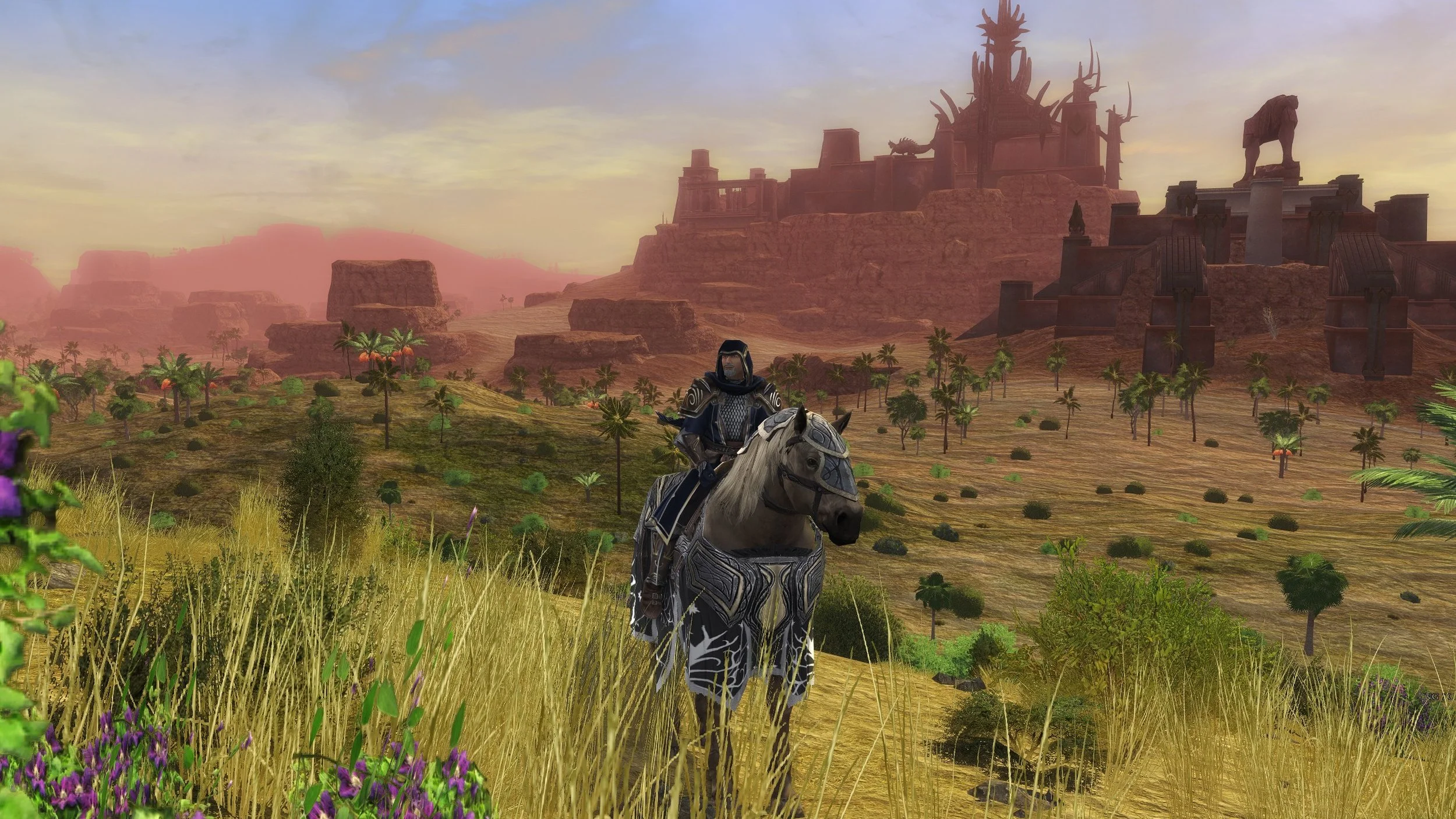
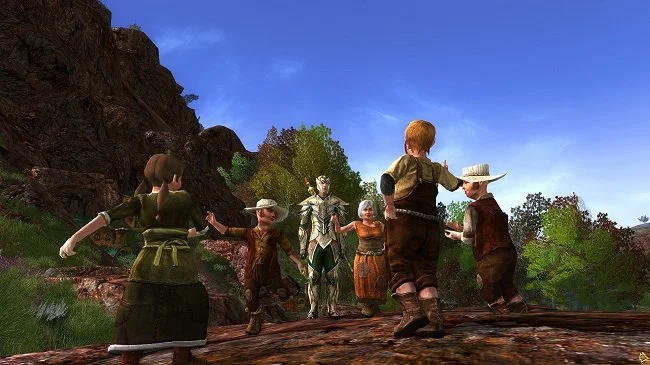
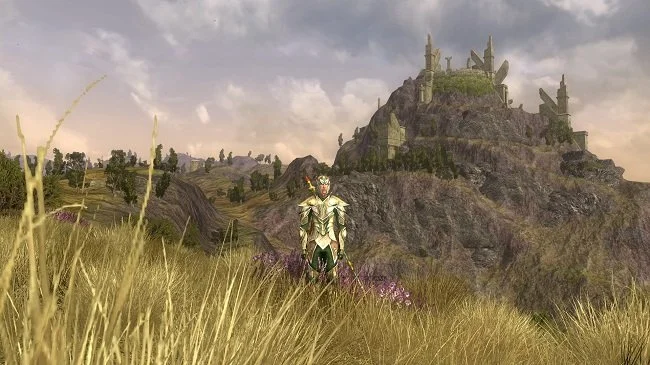
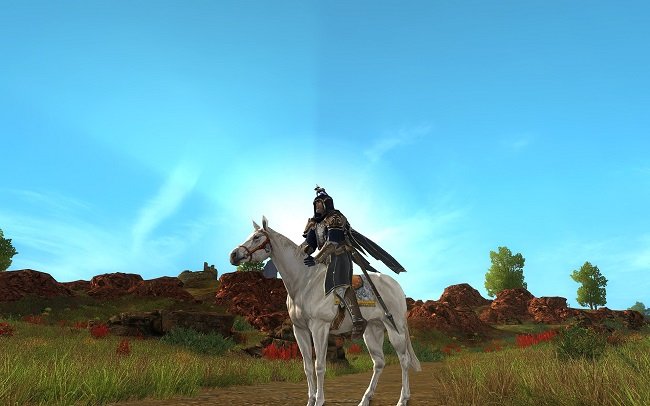
I recently considered whether or not I should find a new MMORPG to play. A cursory Google search showed that there were plenty of titles that I have not tried. Unfortunately, they are predominantly fantasy based games drawing upon the established tropes and themes of the dungeons and dragons genre and the wider sword and sorcery literature. This begs the question “why aren’t there more science fiction or non-fantasy based MMOs?” apart from the handful that currently exist? After a little research and a degree of thinking it becomes very apparent that the answer to this question is mainly a business decision made by publishers. Furthermore, that business decision is based upon several specific factors. All of which cumulatively tip the scales towards fantasy, rather than science fiction or some other complex but non fantasy based franchise.
I recently considered whether or not I should find a new MMORPG to play. A cursory Google search showed that there were plenty of titles that I have not tried. Unfortunately, they are predominantly fantasy based games drawing upon the established tropes and themes of the dungeons and dragons genre and the wider sword and sorcery literature. This begs the question “why aren’t there more science fiction or non-fantasy based MMOs?” apart from the handful that currently exist? After a little research and a degree of thinking it becomes very apparent that the answer to this question is mainly a business decision made by publishers. Furthermore, that business decision is based upon several specific factors. All of which cumulatively tip the scales towards fantasy, rather than science fiction or some other complex but non fantasy based franchise.
First off, let’s address the biggest factor. Fantasy is a much bigger and more popular genre, compared to science fiction. This is mainly due to the barriers to entry being relatively low. Its tropes are straightforward and recognisable. Hence, it is theoretically easier to create a fantasy themed MMORPG than a science fiction one. By this I mean, the world, the game mechanics, the assets and the underpinning narrative. Fantasy does not have to try as hard as science fiction to justify itself. Exotic skills and powers can simply be labelled “magic” and players won’t necessarily kick up a stink about their provenance or credibility. An original fantasy themed intellectual property doesn’t have to work within so many rules as an existing science fiction property that has an excess of lore. Fantasy is a self plagiarising genre by default and players are relatively comfortable with this concept. It’s essentially priced in.
From a writing perspective, a science fiction MMORPG is a potentially more complex proposition. Storylines need to be driven by a suitably plausible McGuffin or underpinned by complex lore. This impacts on game design making the final product more complex. A science fiction based game may not be limited to a single environment or world. There may be the need for multiple types of travel mechanics and therefore multiple types of combat. This complexity both in design and narrative may create a higher barrier to player entry. All of which makes such a game a far more niche market proposition. Which is why you’re more likely to find a fantasy MMORPG with science fiction elements blended into it. Consider the Asura in Guild Wars 2. Also, is Star Wars a pure science fiction franchise? No. This is by far the most common compromise that will happen.
However, possibly the biggest issue that prevents the development of a major science fiction themed MMORPG is copyright. If you wish to draw upon or specifically base your game upon an existing intellectual property, then there will be licensing costs. Often these can be complex and expensive. Furthermore, rights can change hands overtime and a game that has existed for a while and made a profit can subsequently find itself cut off at the knees, purely due to the withdrawal of a licence. This raises the question of why bother taking a risk with such material when you can create your own franchise based on an original IP. However, fans can be funny about such workarounds and particularly unforgiving when a game proves to be a pallid imitation of something they hold dear.
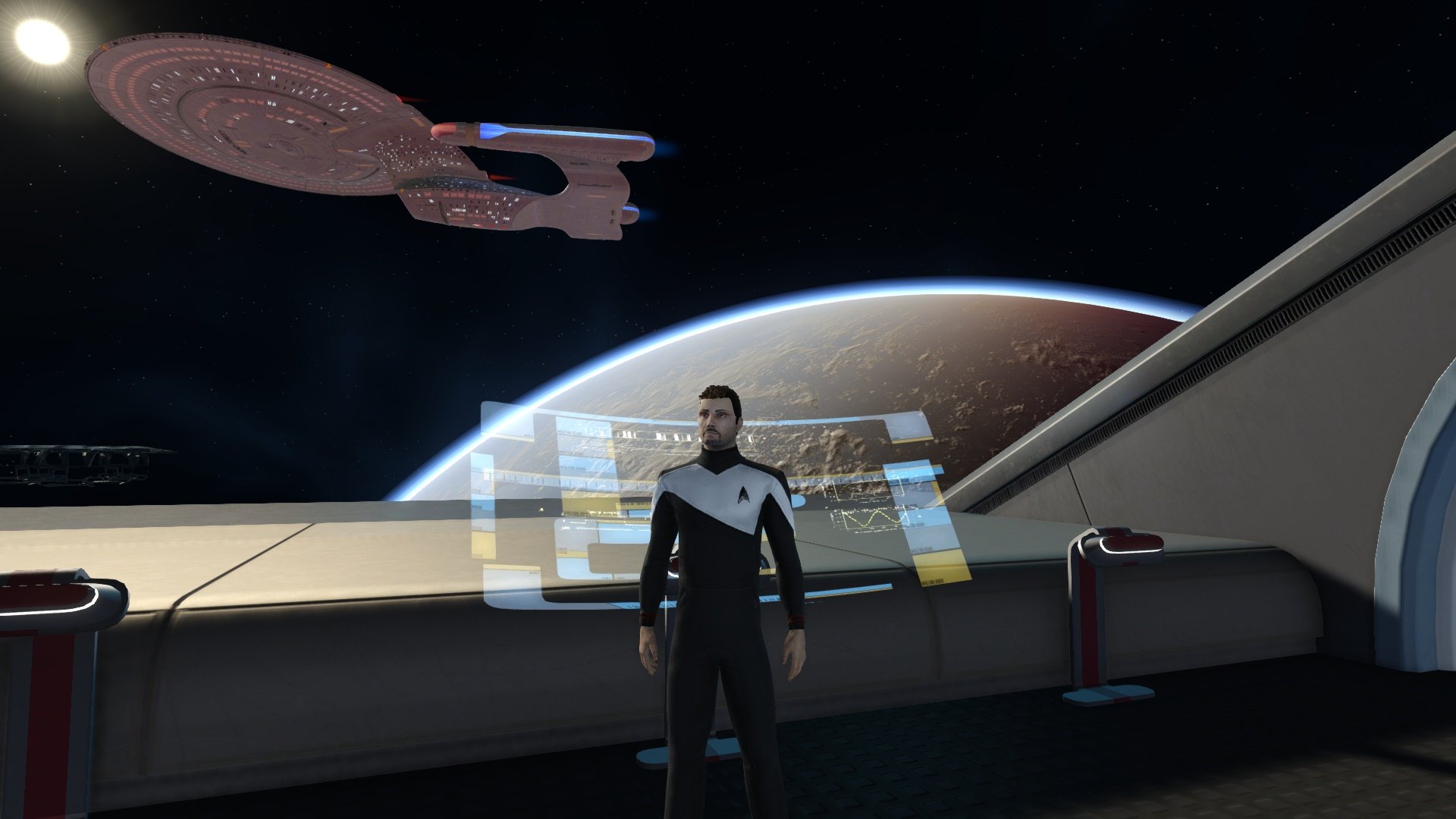
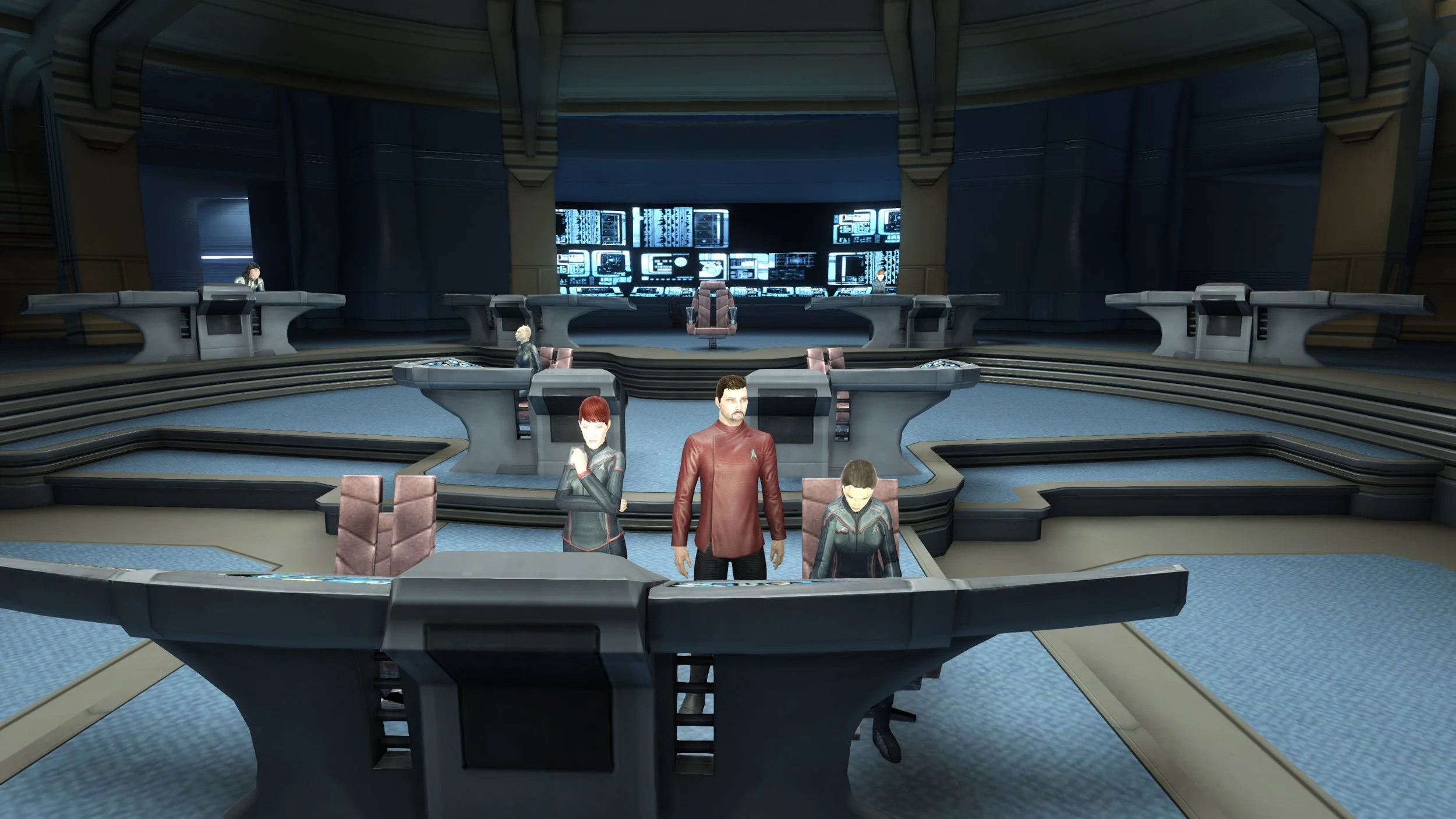
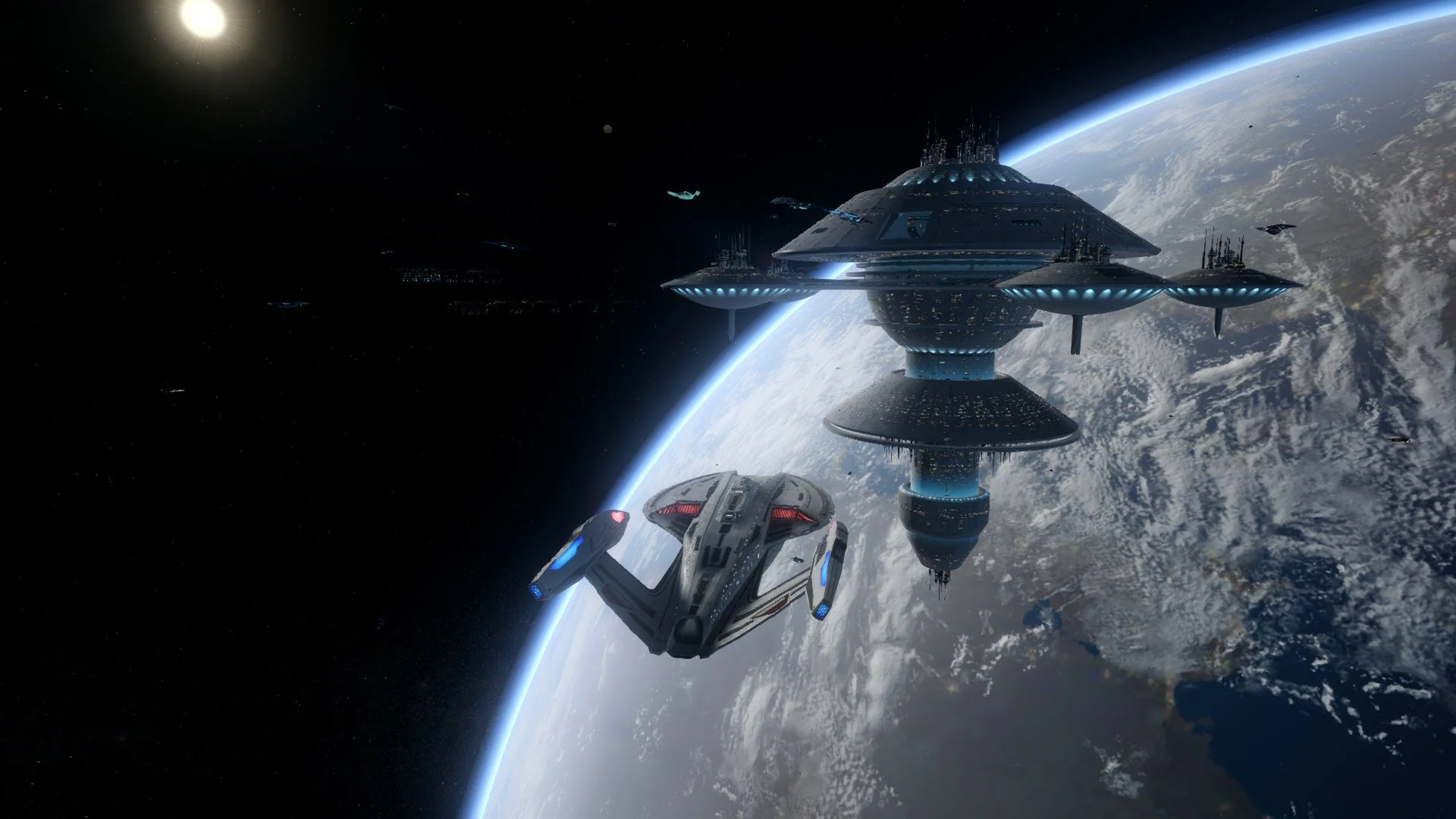
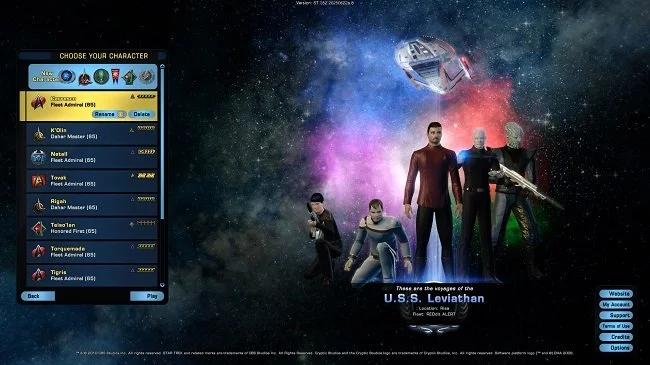
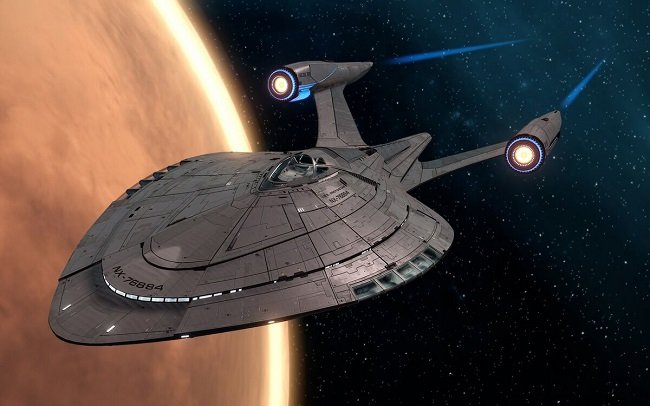
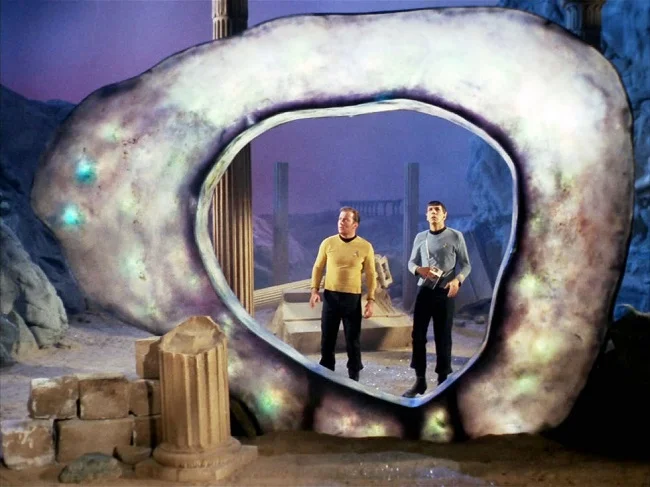
Despite these considerations, the video games industry is not totally averse to science fiction based MMORPGs. Star Trek Online has endured with a degree of success for 14 years, although its future is not looking especially good at present. I think the unique nature of the IP and the loyalty of its fanbase is the main reason that it was originally created and has survived so long. EVE Online is another perfect storm of a game. One whose success cannot easily be duplicated. As for Star Citizen, the jury is still out until we get something approaching a fully fleshed out game. Simply put, the video game industry is just like any other leisure business. Trends are followed, risk is eschewed and decisions are often dictated by the bottom line. Although I would love to see a radical, hard science fiction game based on the works of Arthur C Clarke or Isaac Asimov, it is highly unlikely that any major triple A studio would undertake such a project. They’d be too worried about sufficient return on investment. Cue “and this is why we can’t have nice things”.

Solomon Kane (2009)
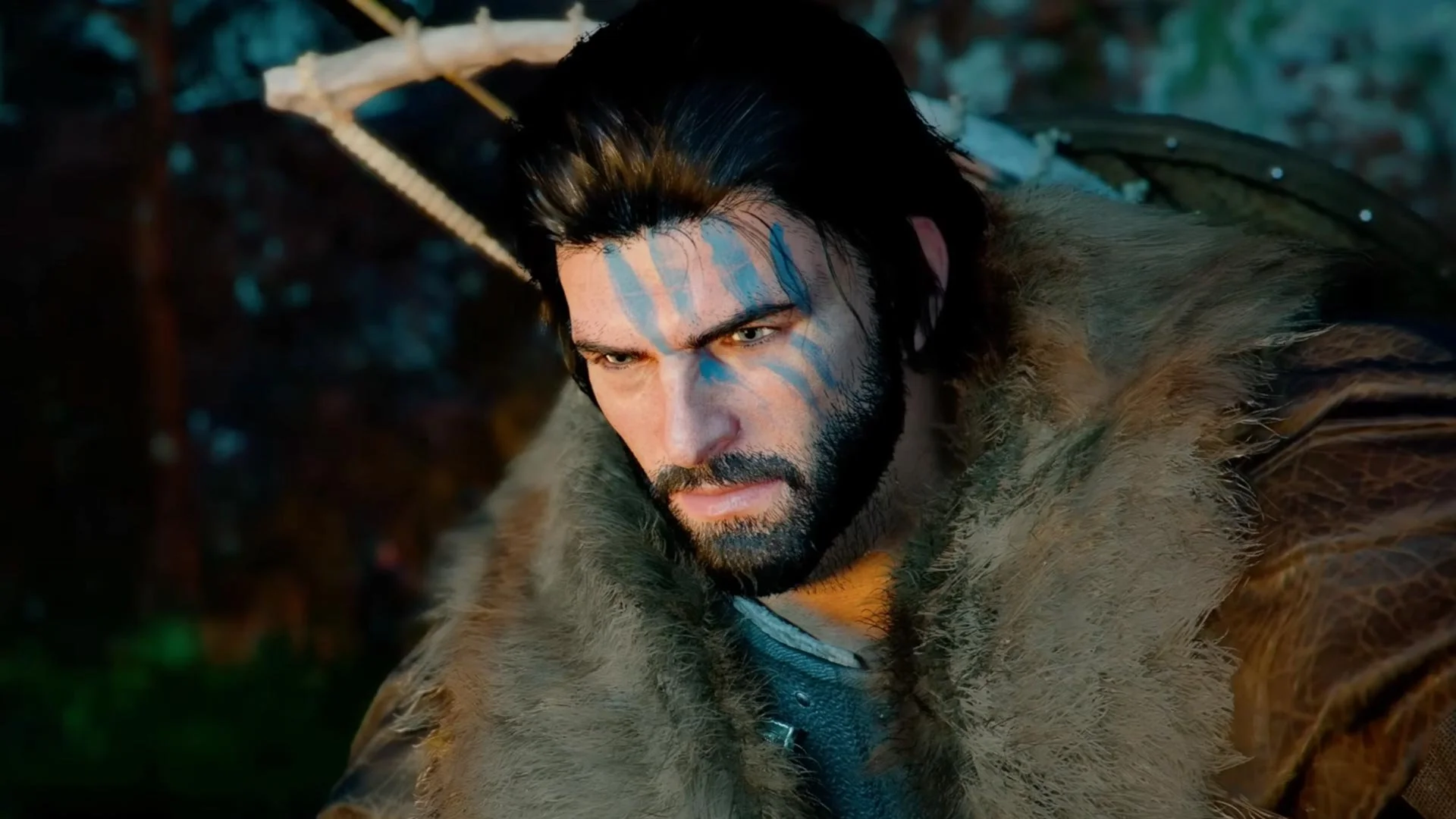
I had the pleasure of seeing Solomon Kane at the Empire Leicester Square upon its initial release. I remember at the time how I found it very refreshing to see an independent horror film that treated its underlying material with the respect it deserved. The genre was somewhat in the doldrums at the time, awash with soulless remakes and endless franchise sequels, produced by cynical studios that were ultimately contemptuous of the material they utilised and the fans that watched it. Although not a literal adaptation of the series of short stories by Robert E. Howard, Solomon Kane successfully captured their spirit and broadened their scope to accommodate both the horror and fantasy genres.
I had the pleasure of seeing Solomon Kane at the Empire Leicester Square upon its initial release. I remember at the time how I found it very refreshing to see an independent horror film that treated its underlying material with the respect it deserved. The genre was somewhat in the doldrums at the time, awash with soulless remakes and endless franchise sequels, produced by cynical studios that were ultimately contemptuous of the material they utilised and the fans that watched it. Although not a literal adaptation of the series of short stories by Robert E. Howard, Solomon Kane successfully captured their spirit and broadened their scope to accommodate both the horror and fantasy genres.
I have seen the film several times since then and my enjoyment for it has not abated. It still strongly reminds me of the heyday of the Hammer studios in the way that the production looks more expensive and sumptuous than it actually cost. Solomon Kane had a modest $40 million budget but at first glance you would not tell, with its striking gothic production design, beautiful locations and cinematography by Danish cinematographer Dan Laustsen (Crimson Peak, Brotherhood of the Wolf). The film has a very distinctive European look and feel. It sports a rich and memorable soundtrack by composer Klaus Badelt. This is why the horror genre can so often make a silk purse out of a sow’s ear, because it used what resources it has creatively and effectively.
M. J. Bassett directs efficiently and economically, as they did in their previous film Wilderness. The story is well paced and the narrative is relatively lean. There is a strong supporting cast including Pete Postlethwaite, Alice Krige and Max von Sydow. Their presence adds weight to the proceedings and covers some of the shortcomings of the somewhat concise screenplay. The action scenes are well choreographed, being violent but not excessively explicit. The CGI and other physical FX work are perfectly acceptable, although opinion is somewhat divided over final "demon" at the films conclusion. As far as I’m concerned it is functional and serves it purpose as a climatic and narrative "MacGuffin".
Many reviews at the time praised the production but were critical of what they saw as a very generic product. However true that may be of the story's central premise, the film is elevated by James Purefoy's strong lead performance. Seldom are characters this well fleshed out in genre movies. Ultimately Solomon Kane biggest asset is that it does exactly what it sets out to do and provides audiences with 109 minutes of fantasy/horror adventure. There are no postmodern one liners or annoying comic relief; just an honest old fashioned genre film made in an appropriate tone. It’s a shame that the movie never managed to kick-start the franchise that it was obviously hoping to create.










Treasure of the Four Crowns (1983)
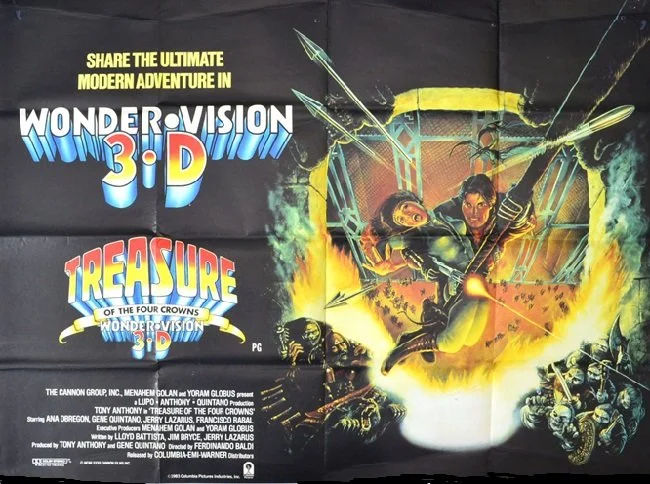
“In the universe there are things man cannot hope to understand. Powers he cannot hope to possess. Forces he cannot hope to control. The Four Crowns are such things. Yet the search has begun. A soldier of fortune takes the first step. He seeks a key that will unlock the power of the Four Crowns and unleash a world where good and evil collide”. So reads the Star Wars-esque opening crawl for the 1983 3D action movie, Treasure of the Four Crowns. It’s worth noting that when it appears on screen, this text is written in capitals and devoid of any punctuation. The movie is also a Cannon Films production. These facts may give viewers an inkling of what is to come over the next 100 minutes. It is certainly best to abandon expectations of linear, narrative filmmaking. Treasure of the Four Crowns is unique, batshit crazy and yet curiously entertaining.
“In the universe there are things man cannot hope to understand. Powers he cannot hope to possess. Forces he cannot hope to control. The Four Crowns are such things. Yet the search has begun. A soldier of fortune takes the first step. He seeks a key that will unlock the power of the Four Crowns and unleash a world where good and evil collide”. So reads the Star Wars-esque opening crawl for the 1983 3D action movie, Treasure of the Four Crowns. It’s worth noting that when it appears on screen, this text is written in capitals and devoid of any punctuation. The movie is also a Cannon Films production. These facts may give viewers an inkling of what is to come over the next 100 minutes. It is certainly best to abandon expectations of linear, narrative filmmaking. Treasure of the Four Crowns is unique, batshit crazy and yet curiously entertaining.
Soldier of Fortune, J.T. Striker (Tony Anthony), is hired by Professor Montgomery to assemble a group of professional thieves to retrieve gemstones which are hidden inside two ancient and Mystical Crowns. These crowns are a part of four. One is already in the Professor’s possession. The other was destroyed by the Moors when they attempted to access its “power”. Striker recruits professional thief Rick (Jerry Lazarus), as well as acrobats and circus performers Liz (Ana Obregon) and her Father Socartes (Francisco Rabal). They are joined by Striker’s friend and Professor Montgomeries agent Edmond (Gene Quintano). The team must infiltrate a heavily fortified compound in a small mountain village that is home to a religious cult. Its leader Brother Jonas (Emiliano Redondo) has the crowns protected by an advanced and deadly security system.
The aforementioned plot sounds fairly straightforward on paper, but what transpires is nothing of the sort. The film begins with Striker infiltrating an old Spanish castle to the strains of a wonderfully portentous soundtrack written by the great Ennio Morricone. There is no dialogue for the next twenty minutes as Striker is subject to a succession of attacks from vultures, wild dogs, rubber pterodactyls, floatings swords and crossbows, balls of fire, all while being mocked by ghostly jeers and cries emanating from the skeletal corpses of long dead knights. And when he finally escapes with a gold key, the entire castle explodes for some particular reason. It makes very little sense and nothing is explained as to why the castle is booby trapped, haunted or contains prehistoric flying reptiles. There are however more 3D effects in this opening sequence than there are in other entire 3D feature films.
The film then continues in the same vein. Scenes of exposition appear from time to time, linking a series of increasingly crazy 3D set pieces. The key appears to have supernatural powers causing at one point Rick’s cabin to erupt into mayhem. This includes teapots and dried food storage jars exploding in slow motion and showering the camera lens in beans and lentils. The dialogue desperately tries to be hard boiled but often comes off as rather sarcastic as if the very cast are passive aggressively trolling the very film they’re appearing in. When Brother Jonas finally appears he is presented as a Charles Mansonesque faith healer with a cult of armed followers, wearing a mixture of World War II partisan clothing and pig masks. In a scene where he allegedly heals a crippled follower to impress a group of new converts, the rather disturbing atmosphere is quickly mitigated when he clumsily winks at the afflicted to telegraph the fact that the entire ceremony is just an act.
The final act of Treasure of the Four Crowns sees the team assemble a series of cables, pulleys and ad hoc trapeze to bypass the security features in the hall where the crowns are kept. The ominous statue that houses them is inevitably booby trapped and triggers an alarm. Brother Jonas and his cohorts arrive, just as Striker grasps the magical jewels contained within the crowns. The film then strays into another genre as he is possessed, his head spins round and half of his face becomes monstrous. He then proceeds to unleash fire and pyrotechnics as Morricone score desperately tries to apply some musical dignity to the spiralling insanity. Viewers are then treated to several full burn stunts and the laser alarm system turns fatal and starts cutting Brother Jonas into pieces. It is a massive tonal shift that will either delight viewers or invoke their scorn at its preposterous nature.
Treasure of the Four Crowns is clearly designed to ride on the coattails of Raiders of the Lost Ark. 3D films were also a cinematic trend at the time and Cannon Films has already made the successful and equally silly film Comin’ at Ya! two years earlier. The production team behind Treasure of the Four Crowns were clearly only interested in a vehicle that could facilitate a plethora of action set pieces that showcase the 3D format. Like many Italian co-productions from this decade, the prevailing attitude is “never mind logic and continuity, throw everything in, bar the kitchen sink”. So the film goes large with the practical effects and culminates in a singularly bizarre cinematic postscript featuring a pulsing sac which spawns some sort of monster which leaps toward the camera. It is all quite mad and yet strangely compelling. Morricone’s score does much of the heavy lifting. Treasure of the Four Crowns is the very definition of a cult film. If you choose to watch it you’ll either love it or loathe it.


Complex Lore and Enigmatic Themes
I recently watched the first trailer for the new Obi-Wan Kenobi television show that is premiering on Disney + in May. I am interested in this latest instalment in the Star Wars franchise and curious as to whether Liam Neeson will make an appearance. I also watched a 20 minute fan video in which they “analysed” the entire trailer. They discussed the content of this 2 minute preview and then did a great deal of speculating about potential themes and characters that may feature in the show. They were clearly enthusiastic about what they had seen and were very knowledgeable about the subject. This resonated with me, as I like to be well versed about the things I enjoy. However, it is worth remembering that fandom can tip into obsession and gatekeeping. Hence I feel there is a subject to explore here.
I recently watched the first trailer for the new Obi-Wan Kenobi television show that is premiering on Disney + in May. I am interested in this latest instalment in the Star Wars franchise and curious as to whether Liam Neeson will make an appearance. I also watched a 20 minute fan video in which they “analysed” the entire trailer. They discussed the content of this 2 minute preview and then did a great deal of speculating about potential themes and characters that may feature in the show. They were clearly enthusiastic about what they had seen and were very knowledgeable about the subject. This resonated with me, as I like to be well versed about the things I enjoy. However, it is worth remembering that fandom can tip into obsession and gatekeeping. Hence I feel there is a subject to explore here.
Fantasy, science fiction and similar hybrid genres thrive on world building and lore. These facets give them credibility and breathe life into fictional worlds and people. They also provide parallels with our own lives which provides a means for us to connect to them. Star Wars, despite all the technology, offers a universe that looks used and lived in. Middle-earth is steeped in history and complex societies. Again despite obvious differences there are commonalities in the hierarchies, rituals and personal aspirations of the protagonists. And as well as lore, there are also enigmas. Fantasy and science fiction are often rife with things that are strange and ill defined. Often these are mystical and symbolic. The Force, Tom Bombadil and Jason Voorhees are prime examples of this. Successful fantasy and science fiction find the right balance between detailed lore and enigmatic themes.
Achieving this balance is very difficult. The original Star Wars trilogy handled the arcane and esoteric nature of the Force well. It was broadly defined as an energy field created by all life that connected everything in the universe. However, the specifics of this were vague and nebulous which played well with the concept that the Jedi were more of a religious and philosophical order than a paramilitary organisation. However, when the prequels introduced the concept of Midi-chlorians it somewhat diminished the enigma surrounding the Force and it suddenly just became yet more technobabble. It is interesting to note that this addition to the franchise’s lore was not well received by fans. It was subsequently not alluded to in later films and television shows, indicating that the producers and writers felt it was a mistake.
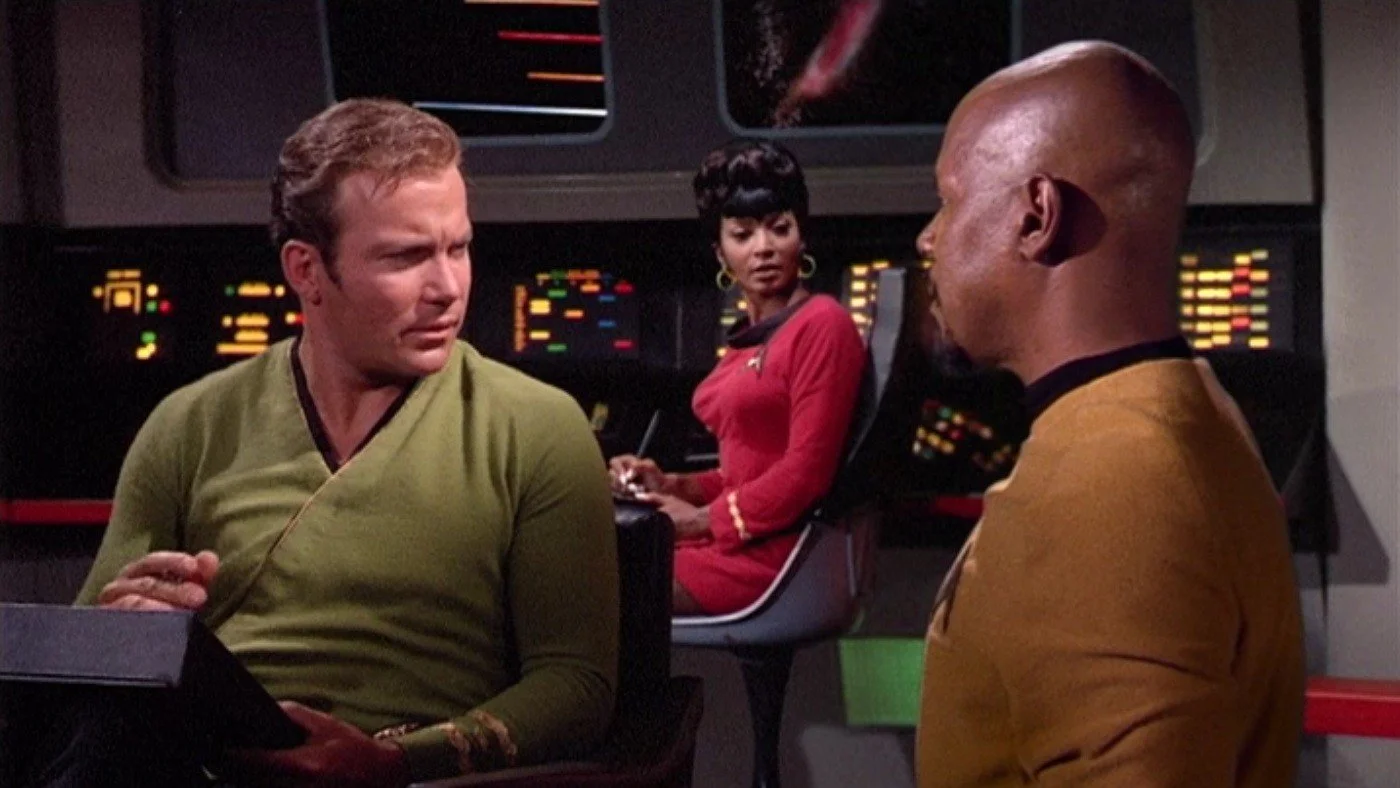
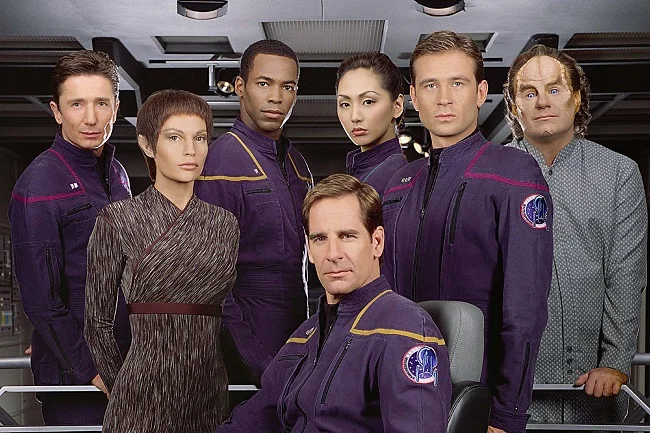
Another genre example of lore versus enigma is the difference in Klingon anatomy between the original series and the revival shows. The main reason is simple. There wasn’t a budget for complex prosthetics in the sixties show. However, from Star Trek: The Motion Picture onwards, Klingons acquired their forehead ridges as a way to make them more alien. This however left a lore contradiction, which was beautifully alluded to in the episode “Trials and Tribble-ations” of Star Trek: Deep Space Nine. Several crew members from the 24th century including Worf, find themselves on Deep Space Station K7 in the 23rd century, during the events of “Trouble with Tribbles”. Upon seeing the Klingons from the previous era, one of the crew asks Worf why there’s a physical difference. He enigmatically replies “We do not discuss it with outsiders”. This beautifully vague but droll answer works perfectly. Sadly it was ruined a few years later when an episode of Star Trek: Enterprise explained away the difference as a genetic experiment that went wrong.
However, it is not always an excess of lore that can quash the soul from a popular show or film. Sometimes being deliberately too vague, refusing to expedite the plot and simply replacing one mystery with two others can be very frustrating. It may also be due to the writers being out of their depth or making things up as they go along. Lost encapsulated this for me and the show’s manipulative narrative quickly killed my interest. Don’t get me wrong, I don’t like to be spoon fed stories and explanations and I don’t mind thinking when watching. The ending of John Carpenter’s The Thing is enigmatic and quite bleak but I consider it a perfect conclusion to the film. However, perhaps the television show that really stepped over the line for not making any real effort to explain itself and turning the enigma “up to 11” is The Prisoner. It’s still a great show to watch and is very thought provoking but the final episode doesn’t deliver a stone cold conclusion. Something that people who watched it originally still seethe over.
We live in a culture of binge watching TV shows which some viewers dissect and analyse. The interconnected nature of the Marvel Cinematic Universe is a prime example of this and it does it extremely well. But not all television shows and films are like this and do not require such scrutiny. I worry that some viewers are so invested in searching for what they think may be hidden or trying to pre-empt an unfolding narrative, that they miss being in the moment and simply enjoying the show as it happens. Excessive analysis often leads to disappointment. It is important to remember that what you’re watching is a writer(s) thoughts on how a narrative should move forward. They are not obliged to try to make what’s in your or my head. Therefore I see both lore and enigmatic themes as an embellishment to a good fantasy or science fiction show or film. Things to be enjoyed but not the “be-all and end-all” of the production. If either becomes the major focus of either the writers or fans then it will end up undermining the central narrative and themes.







The Hobbit: The Battle of the Five Armies Extended Edition (2014)
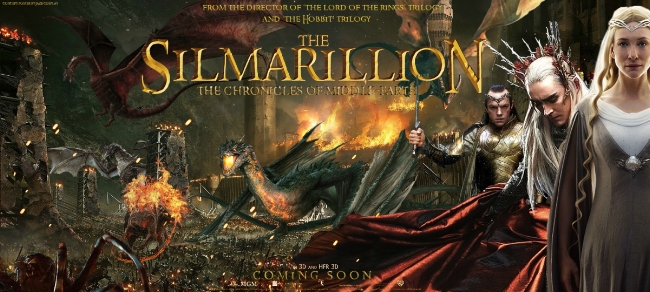
This December marks the 20th anniversary of the release of The Fellowship of the Ring, the first instalment of Peter Jacksons' adaptation of J.R.R. Tolkien’s iconic novel, The Lord of the Rings. To celebrate this occasion, I shall post new reviews of the extended edition of all three films, as well as those of The Hobbit trilogy, which were made a decade later.
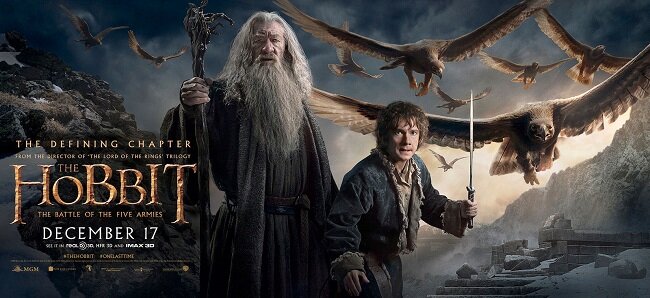
The Battle of the Five Armies is noticeably shorter than it's two predecessors, mainly because there is insufficient narrative to sustain the proceedings. Even the extended edition which adds a further 20 minutes to the running time, increasing it to 164 minutes, is mainly driven by one ongoing action sequence which is the titular battle. After the somewhat languid pace of the first movie and the bloated excess of the second, this further change of pace seems somewhat perplexing. Despite the more economical running time, events occur very rapidly. Perhaps a little too rapidly. It can be cogently argued that it somewhat diminishes the impact of some of them. Perhaps the biggest issue being the demise of Smaug. It comes promptly at the start of The Battle of the Five Armies and although spectacular, it quickly negates a major plot element.
This December marks the 20th anniversary of the release of The Fellowship of the Ring, the first instalment of Peter Jacksons' adaptation of J.R.R. Tolkien’s iconic novel, The Lord of the Rings. To celebrate this occasion, I shall post new reviews of the extended edition of all three films, as well as those of The Hobbit trilogy, which were made a decade later.
The Battle of the Five Armies is noticeably shorter than it's two predecessors, mainly because there is insufficient narrative to sustain the proceedings. Even the extended edition which adds a further 20 minutes to the running time, increasing it to 164 minutes, is mainly driven by one ongoing action sequence which is the titular battle. After the somewhat languid pace of the first movie and the bloated excess of the second, this further change of pace seems somewhat perplexing. Despite the more economical running time, events occur very rapidly. Perhaps a little too rapidly. It can be cogently argued that it somewhat diminishes the impact of some of them. Perhaps the biggest issue being the demise of Smaug. It comes promptly at the start of The Battle of the Five Armies and although spectacular, it quickly negates a major plot element.
Smaug is killed by Bard but his body falls on Lake Town leaving it in utter ruin. The survivors of Esgaroth are aided by the Wood Elves and both parties subsequently seek restitution from the Dwarves. The men of Lake Town hold the Dwarves accountable for their current situation and the Elves who harbour a longstanding grudge regarding outstanding debts that the Dwarves have not paid. However, Thorin refuses to help which leads to a diplomatic impasse. He summons his cousin Dain from the Iron Hills to provide reinforcements. In the meantime Azog then springs his trap and lays siege to Erebor and all camped outside, resulting in the battle between Dwarves, Elves, Men and Orcs. The film does resolve the major storylines, yet it does feel both a little rushed and contrived. Again the screenplay feels the need to reference and link to future events featured in The Lord of the Rings.
Lore purists will find The Battle of the Five Armies the hardest to stomach because Peter Jackson really does indulge his penchant for narrative simplification, restructuring events and the fetishization of weapons, armour and fantasy combat. The Fili, Tauriel, Legolas love triangle and associated fallout is simply too contrived and unengaging. The White Council's assault on Dol Guldur featuring a 92 year old Christopher Lee beating seven bells out of the Ringwraiths, although thoroughly amusing, does raise an eyebrow. The fact that you can conveniently ride from Lake Town to Mount Gundabad in a day and that Middle-earth is populated with Frank Herbert style giant worms, may also come as a surprise to the faithful. The less said about Beorn free falling from an eagle and turning into a Werebear on the way down, the better.
As I have mentioned in my previous reviews, the depiction of Thorin in these movies is woefully lacking, turning him into a broody, pouting, inaccessible caricature. This time round for want of a better description, Thorin goes a bit "Macbeth". I'll give credit where credit is due and state that Richard Armitage does provide a good performance. But the screenplay doesn't really do the character justice and the plot device about the "Dragon's sickness" is arbitrary to say the least. Yet every now and then, there are sequences and passages of dialogue that come directly from the book. Once again, for everything that Peter Jackson gets right, there's also something that is way off the mark. The pivotal point of the movie should have been Thorin's death but it lacks any emotional impact and is only saved by the presence of Martin Freeman.
Dain Ironfoot (Billy Connolly) makes an impressive entrance riding a War Boar and has an expanded role in the extended version. Beorn and Radagast appear briefly but serve no major purpose than to provide reinforcements to the climactic battle. And what on earth possessed Peter Jackson to kill off Stephen Fry so quickly in the story and yet keep Alfrid Lickspittle as some crass source of so-called comic relief? Mercifully, we still have stalwart performances from Martin Freeman and Sir Ian McKellen who do much of the heavy lifting. Lee Pace proves to be a more interesting character this time round, as Thranduil's motives prove to be less binary than those of Thorin Oakenshield. He tempers his desires for restitution when he sees the extent of the Elven dead and sees the folly of his actions.
As ever the set pieces are immaculately produced and push the violence levels for this kind of movie to the limit. They stay on the right side of the ratings board mainly because the bulk of the decapitations, impalements and bludgeonings happen to non-humans. The death of more central characters tend to be more discrete. The main problem with the frenetic action is that it strives to continuously outdo itself, resulting in scenes that tax the audience's credibility even for this genre of movie. For example Legolas climbs a flight of stone steps leading to a crumbling tower, literally as they fall away beneath him, proving that Elves are indifferent to the laws of physics. A better director would restrain themselves, rather than allow such self indulgence and excess. Also some of the mutilated Orcs and Trolls seem more at home in Clive Barker’s Hellraiser than in Tolkien’s The Hobbit.
If you like the aesthetic that Peter Jackson has created over the years, as well as grandiose spectacle, then The Battle of the Five Armies will prove to be an entertaining diversion. If you want anything more, then prepare to be disappointed. I find it ironic that a trilogy of movies about the adventures of Bilbo Baggins, seems so content to include so little of him on screen. By changing the shift of the story from his perspective, to that of the wider events in Middle-earth, something very important has been lost from these sprawling adaptations. Peter Jackson and his team may well be very knowledgeable in the works of Professor Tolkien but I do wonder if he has fully understood them. As I've said before, these movies are very much Jacksons’ interpretation of The Hobbit. I wonder if there would have been a greater emotional depth and perception of the source text, if these films had been directed by Guillermo del Toro as they were originally intended?
The Hobbit: The Desolation of Smaug Extended Edition (2013)
This December marks the 20th anniversary of the release of The Fellowship of the Ring, the first instalment of Peter Jacksons' adaptation of J.R.R. Tolkien’s iconic novel, The Lord of the Rings. To celebrate this occasion, I shall post new reviews of the extended edition of all three films, as well as those of The Hobbit trilogy, which were made a decade later.
I love the medium of film immensely. I like a wide range of genres and will happily watch weighty human dramas as well as the worst sort of trashy exploitation fodder. The key to reconciling such widely differing types of cinema is to judge them within their own context. Therefore don't compare the respective worth of Citizen Kane with The Golden Voyage of Sinbad, or Bicycle Thieves with The Medusa Touch. So because of the nature of Peter Jackson's adaptation of The Hobbit, I am prepared to make concessions to the fact that it is a big budget fantasy blockbuster franchise. Also the source material from which the film derives is quite sparse, often being nothing more than footnotes, or summations of history. Thus there is scope for a lot of "adaptation", artistic license and creativity. Jackson got a lot of this right with The Lord of the Rings trilogy, over a decade ago. I do not believe that to be the case this time round.
This December marks the 20th anniversary of the release of The Fellowship of the Ring, the first instalment of Peter Jacksons' adaptation of J.R.R. Tolkien’s iconic novel, The Lord of the Rings. To celebrate this occasion, I shall post new reviews of the extended edition of all three films, as well as those of The Hobbit trilogy, which were made a decade later.
I love the medium of film immensely. I like a wide range of genres and will happily watch weighty human dramas as well as the worst sort of trashy exploitation fodder. The key to reconciling such widely differing types of cinema is to judge them within their own context. Therefore don't compare the respective worth of Citizen Kane with The Golden Voyage of Sinbad, or Bicycle Thieves with The Medusa Touch. So because of the nature of Peter Jackson's adaptation of The Hobbit, I am prepared to make concessions to the fact that it is a big budget fantasy blockbuster franchise. Also the source material from which the film derives is quite sparse, often being nothing more than footnotes, or summations of history. Thus there is scope for a lot of "adaptation", artistic license and creativity. Jackson got a lot of this right with The Lord of the Rings trilogy, over a decade ago. I do not believe that to be the case this time round.
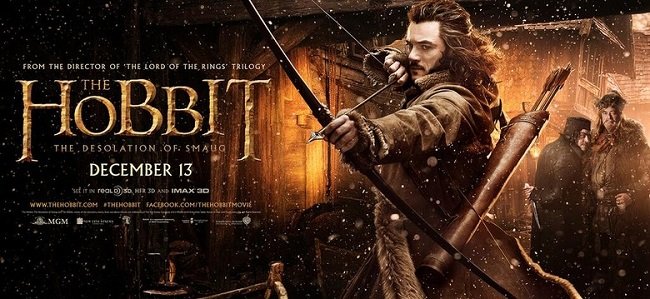
The Desolation of Smaug sets off at breakneck pace and continues at that speed throughout it's 186 minute running time. The extended edition is 25 minutes longer than the theatrical version. Again most of the new material is embellishments and does not significantly alter the storyline. Many of the new characters that are introduced are quite intriguing because the screenwriters have been effectively handed a blank canvas, due to the original text being so vague or simplistic (remember that Tolkien's book is a children's story). Thus we meet Beorn (Mikael Persbrandt) the skin-changer along with his Bear alter ego. This bold interpretation has him the last of his race, after being hunted for sport by the Orcs. The Elven King Thranduil, played by Lee Pace, is a greatly expanded role. He is shown as a ruler keen to secure his kingdom’s borders from the ills of the world and possibly someone who blames the Dwarves of Erebor indirectly for a family death. His riding an Elk is a wonderful visual embellishment and conceit. However, not all of the new ideas work. I found the concept of “the tombs of the ringwraiths” to be fundamentally lore breaking and foolish.
Modern film making, especially with regard to digital effects and editing afford directors far more visual freedom. As a result, the cinematography of Andrew Lesnie never remains still. He is unquestionably the master of crane and tracking shot, but it beggars the question are they always required? Would the story arc really suffer that much, if the pace slowed just for a while, to allow the viewer to digest the events that have happened so far? Tolkien certainly understood this issue of pace in his writing. Blame can also be laid at the door of editor Jabez Olssen, who constructs action scenes that are so fluid and rapidly cut together they are difficult to follow at times. And there are many such scenes in The Desolation of Smaug and they divert the story progression significantly.
After escaping the Orc, the Dwarves journey through Mirkwood only to be captured by the Elven King Thranduil (Lee Pace). Bilbo's battle with the spiders is concisely distilled. I loved the way he could understand their language when he put on the ring. Jackson excels at little embellishments like this. However, conversely his efforts to bolster the continuity with the previous trilogy can also be somewhat heavy handed. Bilbo's struggle with the allure of his newly found "precious" are far from subtle. The Dwarves' captivity and escape is deftly handled and I was even happy to go along with the introduction of Tauriel (Evangeline Lilly). I gritted my teeth and rolled with the return of Legolas (Orlando Bloom) and the contrived interaction he had with Gimli's Father, Gloin. The introduction of the Bard (Luke Evans) and the expanded role he plays within the story is quite inventive. I think it helps having him as a quasi Robin Hood figure with the Lake Town community makes him more plausible as a future leader. Stephen Fry’s cameo as the Master was indulgent but droll. The addition of Alfrid Lickspittle (Ryan Gage) as a comic foil is not so successful.
It was about two thirds into the movie that I began to feel that the narrative was becoming too ponderous and drawn out. It began to sag under the weight of its self satisfied approach. This was no longer Peter Jackson's adaptation of Tolkien’s The Hobbit, but simply Peter Jackson's The Hobbit. A lot of the “creative ideas” were not working and by the time the plot reached Smaug, I was fast losing interest. Tauriel “spiritual romance” with injured Kili (Aidan Turner) was stilted and frankly poorly written. Gandalf's excursion into Dol Guldur was melodramatic and contrived, especially the unnecessary manner that Sauron reveals himself to be the Necromancer. The idea of introducing Bolg, son of Azog as a second tier bad guy, to me just showed that the screenwriters (Peter Jackson, Fran Walsh and Philippa Boyens) are tying themselves in knots with their desire to dovetail in everything and anything from a lore perspective.
Now on the subject of Smaug “the chiefest and greatest of all calamities”, I must praise all at Weta Digital for creating the most awesome and truly terrifying dragon since Vermithrax Pejorative from Dragonslayer. Benedict Cumberbatch is perfect voice casting and I was initially impressed with the scenes between him and Bilbo. They captured the spirit of the book superbly. Sadly the director’s need for yet another inexorably long action scene that wasn't in the least required, soon killed my interest. Hence we had the preposterous attempts by Thorin and company to try and kill Smaug by smothering him in molten gold. The very climax of The Desolation of Smaug, that should have been the film’s crowning glory, was for me quite the opposite. I actually found myself wishing for the final thirty minutes of the movie to end as soon as possible.
The second movie in any trilogy is always a very difficult beast to master. There is a requirement for characters to grow and evolve. In box office terms there is a need to provide not just more of the same but increase the sense of spectacle. If done well you will potentially have a movie that is better than the first. Consider The Empire Strikes Back, Spiderman 2 or Aliens. Unfortunately this cannot be said of The Desolation of Smaug. New characters are lost in a cacophony of action scenes and mayhem. Be warned this movie pushes what you can get away within the PG-13 rating. And there are too many clumsy nods to The Lord of the Rings. It seems at times like a list of essential similarities, tropes and idioms is being ticked off. With regard to Jackson’s blank cheque to expand on story points and fill in the so-called blanks, there reached a point where I thought that he had simply strayed too far from what was canonically acceptable.
Like the previous film, one of my main criticisms is based upon the portrayal of certain characters. Bilbo has precious little to do in this instalment. Furthermore the significance of actions and his personal growth is not explored sufficiently. In the book it is this part of the story where the Dwarves begin to deem him a hobbit of merit and value his contributions to their quest. This theme is conspicuously lacking in The Desolation of Smaug. Also again I protest at Jackson's interpretation of Thorin Oakenshiled. In this film he becomes borderline unlikeable. The entire approach is just too binary and formulaic. This is a character that I am supposed to revere, admire and feel for. Again, as with the previous film, those feelings are reserved for Balin instead, played by the superb Ken Stott.
Raiders of the Lost Ark and movies like it have proven that blockbusters can be populist, stylish and entertaining as well as commercially successful. The Desolation of Smaug did indeed clean up at the box office. However it is a very self indulgent piece of cinema and sadly the embodiment of style over substance. Yes, I enjoyed facets of the production and found elements to praise. However, I will not allow my affection for the original book or for Peter Jackson's previous trilogy to colour my judgement. I have to call a spade a spade and say that The Desolation of Smaug is too focused on being a spectacle, at the expense of the story and cast. The extended edition does precious little to remedy this. It is too loud and sprawling and certainly will test the casual viewer’s patience.
The Hobbit: An Unexpected Journey Extended Edition (2012)
This December marks the 20th anniversary of the release of The Fellowship of the Ring. The first instalment of Peter Jacksons' adaptation of J.R.R. Tolkien’s iconic novel, The Lord of the Rings. To celebrate this occasion, I shall post new reviews of the extended edition of all three films, as well as those of The Hobbit trilogy, which were made a decade later.
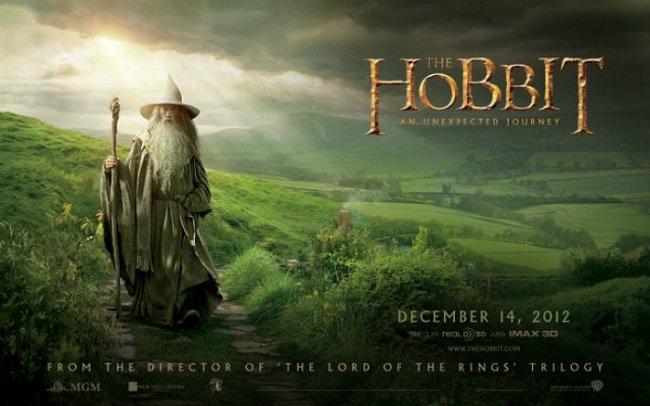
Firstly let me start by saying I think the word unexpected is very apt in respect of the first instalment of Peter Jackson's three part adaptation of Tolkien's prequel to The Lord of the Rings. It is genuinely surprising how well parts of the narrative had been adapted and interpreted. Similarly there are other aspects that are less successful. Overall the good outweighs the bad but only the most ardent fanboy or girl would think the movie flawless. When one considers its problematic production along with the change of directors, this is quite an achievement. I wonder how much of Guillermo del Toro’s material survived into Peter Jacksons, Fran Walsh and Philippa Boyens revised screenplay? Secondly, a decade on from The Lord of the Rings, there has been a further move away from physical visual effects and filming on photographic film. Both of these changes are noticeable in An Unexpected Journey but the presence of Peter Jackson and his very specific style of filmmaking maintains a very strong sense of continuity.
This December marks the 20th anniversary of the release of The Fellowship of the Ring. The first instalment of Peter Jacksons' adaptation of J.R.R. Tolkien’s iconic novel, The Lord of the Rings. To celebrate this occasion, I shall post new reviews of the extended edition of all three films, as well as those of The Hobbit trilogy, which were made a decade later.
Firstly let me start by saying I think the word unexpected is very apt in respect of the first instalment of Peter Jackson's three part adaptation of Tolkien's prequel to The Lord of the Rings. It is genuinely surprising how well parts of the narrative had been adapted and interpreted. Similarly there are other aspects that are less successful. Overall the good outweighs the bad but only the most ardent fanboy or girl would think the movie flawless. When one considers its problematic production along with the change of directors, this is quite an achievement. I wonder how much of Guillermo del Toro’s material survived into Peter Jacksons, Fran Walsh and Philippa Boyens revised screenplay? Secondly, a decade on from The Lord of the Rings, there has been a further move away from physical visual effects and filming on photographic film. Both of these changes are noticeable in An Unexpected Journey but the presence of Peter Jackson and his very specific style of filmmaking maintains a very strong sense of continuity.
Many of the production staff who worked on the original trilogy are present again for The Hobbit. Artists John Howe and Alan Lee as well as cinematography by Andrew Lesnie ensure that there’s a seamless continuation of the established aesthetic of Middle-earth. Howard Shore's magnificent score utilises leitmotifs we have previously heard in The Lord of the Rings trilogy. Furthermore, his new material is very strong and introduces some very portentous themes for the new characters. The film is technically superb but one expects nothing less from this film maker. Therefore I would like to focus more upon the narrative than the production design, because The Hobbit has been greatly expanded to accommodate its trilogy format. Is the story treated appropriately and presented in a way that will please both consummate fans and newcomers alike?
Broadly speaking I’d say yes. At least in this first instalment, An Unexpected Journey. If you are a Tolkien purist then you may be disappointed or upset by some of the changes that have been made. I sympathise with this perspective but understand the fact that Peter Jackson has to make the story accessible to a wider audience and that cinema is a very different medium to the written page. The key word is “adaptation” and the fact that film requires archetypes who have clear and traditional story arcs. Therefore characters and lore are altered to provide us with a definite hero and villain. That is not to say that the script deviates radically from the book, as it does not. The nuts and bolts of the story are there. But as with The Lord of the Rings, characters have to be refined and events compressed or augmented to satisfy the required tropes of cinematic “high adventure”.
Hence we just get a far more heroic Thorin Oakenshield played by an exuberant and somewhat bombastic Richard Armitage. The character is simplified and presented as someone to root for. He is an exiled King whose family has suffered death and ruin. We also get a specific enemy to boo and hiss in the form of albino orc Azog. The role of Radagast the Brown (Sylvester McCoy) is expanded upon and acts as a conduit between the central plot and the backstory of the rise of the Necromancer in Dol Guldur. McCoy’s performance is mercurial and quite engaging. Once again Ian McKellen dominates the screen as Gandalf, a role he seems sublimely suited for. The casting of Martin Freeman as the young Bilbo Baggins is similarly perfectly conceived. He plays the hobbit with an air of curiosity and confusion, as he strays from his comfortable home in The Shire, out into the wider and more dangerous world.
However I do think that An Unexpected Journey has a pacing issue. We start with a rather traditional framing device in which old Bilbo (Ian Holm) is writing his memoirs on the eve of his going away birthday as depicted in The Fellowship of the Ring. The story then shows the fall of Dale and Erebor to the Dragon Smaug (who is teased and not fully seen). Finally after establishing the entire point of Bilbo’s forthcoming adventure to retake Erebor, events turn to a younger Bilbo (Martin Freeman) and his subsequent meeting with Gandalf. Introducing the twelve dwarves is another problematic aspect of the film. Some are granted a fair amount of screen time where others are hastily added to the narrative. The use of songs directly from the text is another embellishment that although is laudable from a lore standpoint, is questionable from a cinematic perspective. It takes a while for the movie to get under way from Bag End. It's curious because Peter Jackson has managed to take lengthy passages of text in the past and condense them quickly and efficiently without any dramatic loss. Consider the Council of Elrond in The Fellowship of the Ring.
With regard to the expansion of text, some of it works very well. I found myself pleasantly surprised by Sylvester McCoy's portrayal of Radagast (although I still think the Bunny Sled is a bridge too far) as well as the depiction of the White Council. I loved the way Gandalf rolled his eyes at the arrival of Saruman (Christopher Lee) and the way that Galadriel (Cate Blanchett) clearly holds Mithrandir in high regard. The film also greatly benefits from its mainly British and Antipodean cast. The commonalities between cultures, idioms and dialect aids the realisation of Tolkien's written work. The humour present in the film is not out of place, especially in the way that Elves and Dwarves do not get along. However, where An Unexpected Journey succeeds the best is in the way it handles the most iconic scenes from the book. Bilbo's encounter with Gollum (Andy Serkis) is truly menacing and a highlight of the film. The exchange of riddles is superbly realised and the chemistry between the two performers is palpable.
Peter Jackson has gained a reputation over the years for being able to craft complex and frenetic action scenes. It has become a selling point. Sadly my biggest criticism about An Unexpected Journey, is that there are possibly too many action scenes, with some too close together. The escape from the Great Goblin (Barry Humphries) is a very complex and extravagant set piece. Blink and you’ll miss what’s happening as Goblin limbs and heads fly left, right and centre. As soon as Bilbo and the Dwarves escape the Misty Mountains there is immediately another fiery denouement, as Thorin and company climb a copse of fir trees to avoid a Azog and a pack of wargs. Although technically well implemented it is somewhat taxing to the senses and after a while actually becomes quite dull. I appreciate the need to end the film on a high point and dramatic climax but again there persists this sense of uneven pacing. I must add that the ending is tempered by a wonderful codicil involving Smaug that is certainly a wonderful taster of things to come.
I am a Tolkien fan and also someone who enjoys quality film making. Sometimes you have to curb your enthusiasm for much beloved source material, as the requirements of film as a medium are specific and different. “Show don’t tell” is the defining mantra of cinema which can be difficult when adapting lore heavy, narrative books. There are flaws in An Unexpected Journey but they do not derail the entire story. The film is still very creative and can be exciting. It is also quite strong in content with quite hard edged action sequences. At its heart still lies director Peter Jackson's love for the Professor's work and despite moments of indulgence, this still comes across. Compromise is not always a dirty word and in this case is possibly a necessary tool in bringing this story to as wide an audience as possible. However, Jackson still makes the mistake of reducing complex and venerable characters to somewhat binary representations. Thorin is not easy to warm too and it is Balin (Ken Stott) who comes across as far more sympathetic, likeable and wise.
The extended edition of An Unexpected Journey includes 13 minutes of additional material to the theatrical release, which brings the running time to 182 minutes. The extra scenes are mainly embellishments and I would argue that they do not dramatically alter the tone and feel of the film. My thoughts are mostly the same for both the theatrical and extended edition. I suspect the uneven pacing that I’ve referenced stems from Peter Jacksons’ extrapolation of the story. The White Council scenes are a great idea but they also smack of a need to “join the dots” between this trilogy and the former. The flashback to the Battle of Azanulbizar is also well conceived as a means to give weight to the recurring theme of the misfortunes of Durin’s folk and to bolster the kingly nature of Thorin. However, the fact that Thorin is subsequently somewhat bellicose undermines this. However, Martin Freeman stands out and often compensates for the excessive action scenes. Existing Tolkien fans are probably better disposed to this new trilogy by default. However, although entertaining, there is a somewhat forced quality to this adaptation of The Hobbit. Casual viewers may well find it a little too self serving.
Revisiting Peter Jackson's The Lord of the Rings
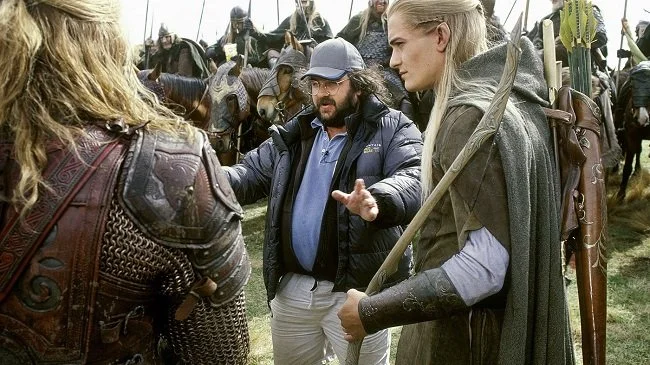
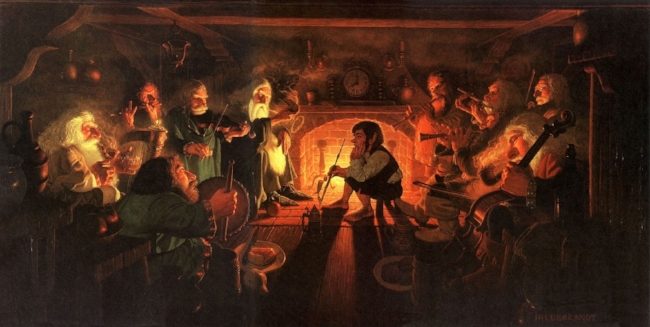
In December it will be the twenty year anniversary of the release of The Fellowship of the Ring. The first entry in Peter Jackson’s trilogy of film adaptations of Professor Tolkien’s iconic novel, The Lord of the Rings. I was utterly swept up in the hype and media frenzy that persisted for three years around these movies between 2001 and 2003. I certainly have fond memories of seeing each film on the first day of its release at the prestigious Leicester Square Odeon in London. Broadly speaking I was very impressed with all three films at the time of their release. However, over the years excitement and fandom has been tempered with a greater degree of critical analysis and appraisal. Having recently watched the Extended Editions of all three films, remastered in 4K, I now think it would be pertinent to revise my thoughts on them and repost them here on Contains Moderate Peril. This initial post is intended more as an overview on the trilogy. I shall write three new in depth reviews in due course.
In December it will be the twenty year anniversary of the release of The Fellowship of the Ring. The first entry in Peter Jackson’s trilogy of film adaptations of Professor Tolkien’s iconic novel, The Lord of the Rings. I was utterly swept up in the hype and media frenzy that persisted for three years around these movies between 2001 and 2003. I certainly have fond memories of seeing each film on the first day of its release at the prestigious Leicester Square Odeon in London. Broadly speaking I was very impressed with all three films at the time of their release. However, over the years excitement and fandom has been tempered with a greater degree of critical analysis and appraisal. Having recently watched the Extended Editions of all three films, remastered in 4K, I now think it would be pertinent to revise my thoughts on them and repost them here on Contains Moderate Peril. This initial post is intended more as an overview on the trilogy. I shall write three new in depth reviews in due course.
One of the most striking aspects of Peter Jackson’s films is the overall production design and the aesthetics of Middle-earth in the Third Age. Fans had already started becoming accustomed to a common visual approach to Tolkien’s work, care of John Howe and Alan Lee, the artists that publisher Harper Collins had been using for several years prior to 1999 when filming started. Inviting both to be artistic designers on the films provided a sense not only of continuity but also of a formal aesthetic across the entire intellectual property. Both artists have a knack for combining real world historical elements, with fantasy creating styles of armour, weapons, architecture and clothing that looks real and credible. There is incredible attention to detail present in every element of the production, just as there is in Tolkien’s source text.
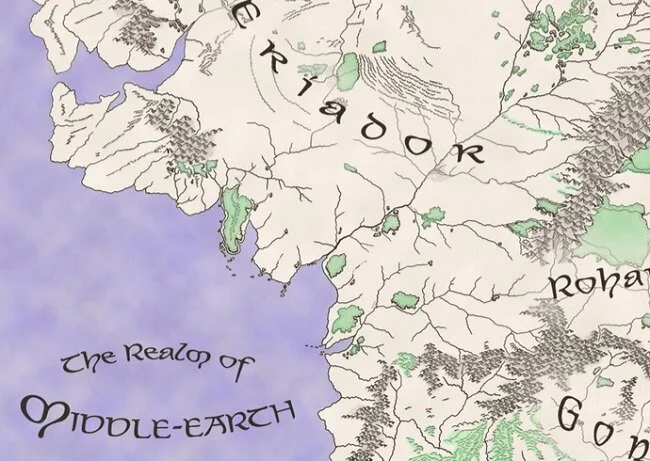
In a similar vein, filming in New Zealand was a wise decision as it provides such a diversity of environment and ecosystems. It really is ideal for recreating much of Middle-earth. Jackson’s visual realisation of The Shire is very lush and green. Similarly, the Southern Alps of the South Island effectively capture the spirit of Tolkien’s descriptions of the Misty Mountains and are very imposing. Filming outside of the US also had definite cost benefits to the overall production. However, not every geographical aspect of Middle-earth is as well represented. I have always felt that the Rangitata Valley did not adequately capture the rolling grass plains of Rohan. To my mind it wasn’t green enough. Rohirric culture is based upon both Goths, Scandinavians and the medieval Anglo-Saxons and so I envisage Rohan being more akin to European grasslands. However, such criticisms are far from a deal breaker in respect of one’s appraisal of the overall trilogy.
A key element in Tolkien’s writing is the use of music and how it is an integral part of all the cultures of Middle-earth. Composer Howard Shore wisely made Tolkien’s songs a key part of his soundtrack. As well as writing leitmotifs for central characters and recurring story themes, he also incorporated Sindarin text and other dialects into much of the ambient music to further embellish scenes. It really adds to the overall feeling of “world building”. In many ways his music for all three films feels like a character in its own right. His music also allows for the compression of the narrative and to convey plot points. When Aragorn heals the sick after The Battle of the Pelennor Fields, the music succinctly reinforces the visual images. Rather than having to explain that "the hands of the king are the hands of a healer" what the film shows is further reinforced by the accompanying score. However, although this is a joy for Tolkien fans, its subtleties may be lost on the casual viewer.
Peter Jackson also made a wise decision by casting a group of international character actors rather than smothering his production with box office stars. Sean Connery as Gandalf may well have broadened the appeal of the films but ultimately his larger than life persona would have been a poor fit for the nuances of the character. Casting Ian McKellen was a far more practical choice and proved infinitely more beneficial as the actor utterly made the role his own. Christopher Lee was another cany choice. Not only was he an experienced and subtle actor but a Tolkien scholar as well. The narrative complexity of The Lord of the Rings feature films did not need the additional burden of celebrity stars bringing their own baggage to the production. Using lesser known actors allowed audiences to focus upon their performances rather than be distracted by their sheer presence.
Tolkien’s body of work is remarkable for the way it successfully manages to encompass era defining events, yet still being able to tell the story of those caught up in them. This is something a lot harder to do on screen. Peter Jackson excels at creating complex and large scale set pieces but sometimes they tend to dominate the proceedings at the expense of narrative depth. It was one of the criticisms that Christopher Tolkien made, who felt that the focus of the movie was on action and spectacle at the expense of story and lore. I feel the reality lies somewhere in the middle. Certainly the Extended Editions of all three films addresses this issue, reinstating story content that was excised from the theatrical edits. Ultimately viewers have to come to terms with the fact that these three movies are Jackson’s “adaptation” and reflect upon the meaning of that term.
Hence we come to the thorny issue of how any film version of a complex book leads to key plot elements and characters being either simplified or removed for reason of accessibility. Personally I don’t especially like the “streamlining” of certain characters for the sake of the wider story, although I understand why Jackson did this. I feel that his portrayal of Theoden is somewhat bland, portraying him as a grief stricken King who is indecisive. I also feel it is incorrect to depict Aragorn as conflicted with self doubt. But these were done to make the plot more straightforward and understandable among mainstream viewers, who are not familiar with the books. I do like the extrapolation of the roles and relationship between Saruman and Wormtongue. Also having several Orc characters act as narrative conduits also works well. It is sad that Gil Galad and Elendil were also watered down or removed but it would have bloated the screenplay too much to include all canonical characters.
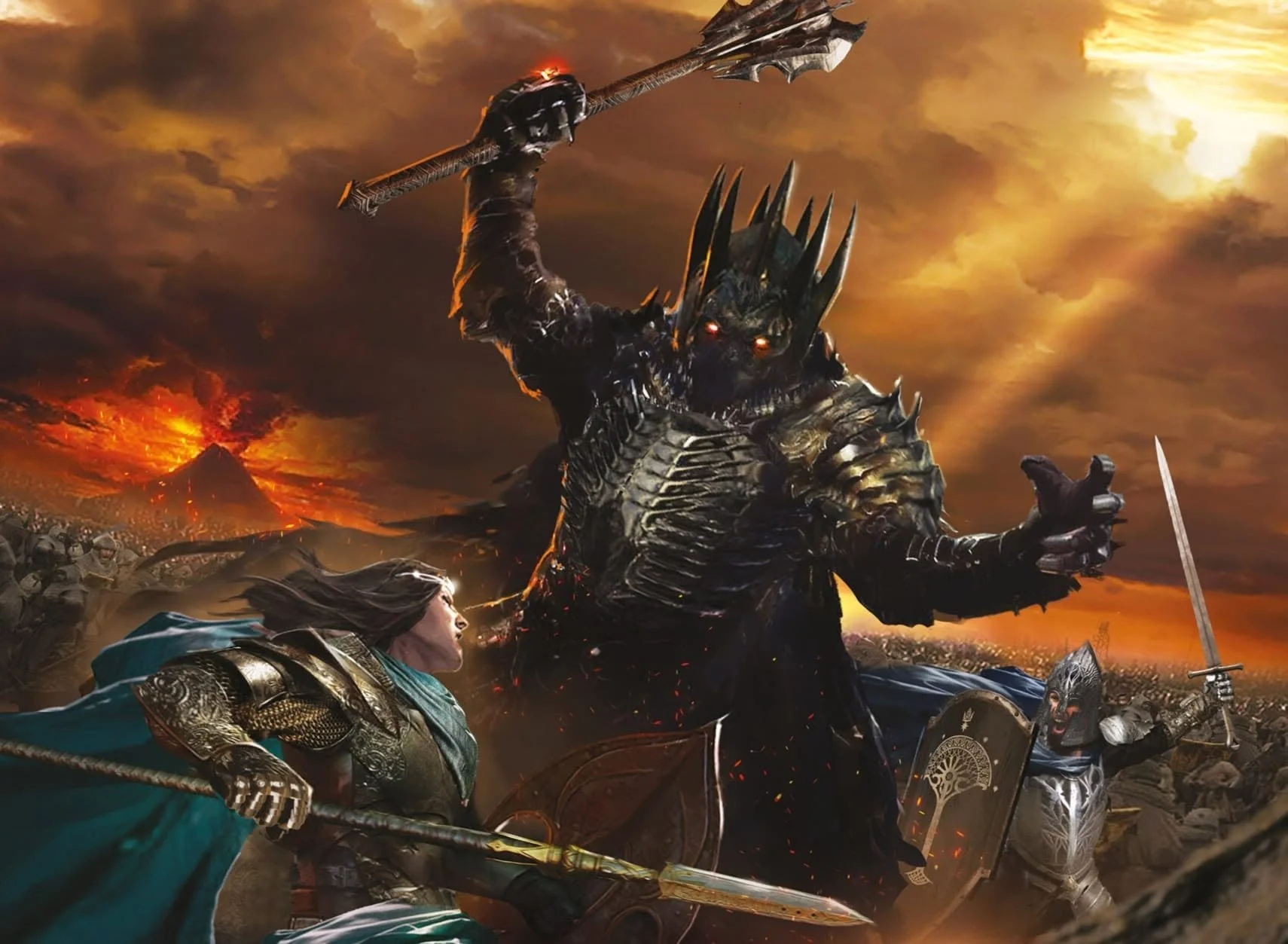
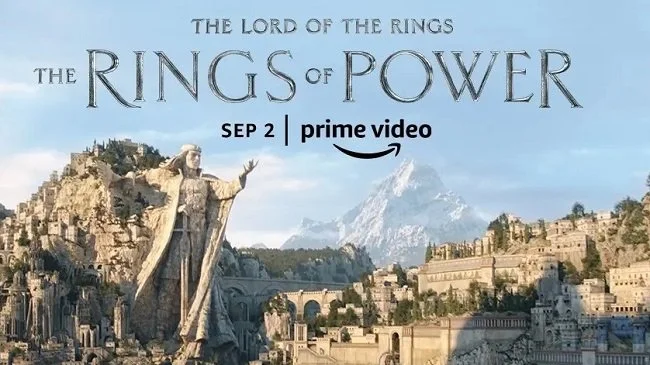
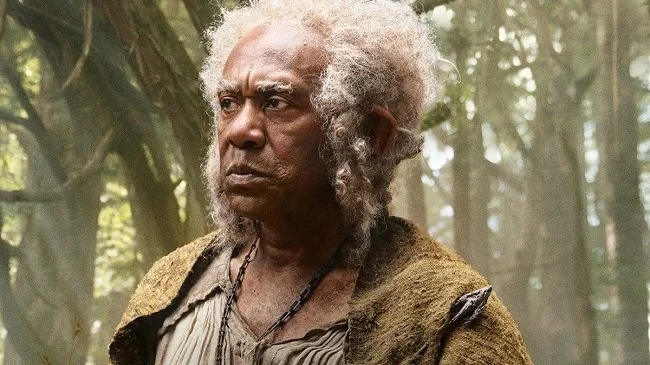
Twenty years on, I am not quite so enamoured with Peter Jackson’s trilogy and feel that there are elements that could have been improved or handled differently. However, there is still an inherent power to his films and he still merits a great deal of praise for crafting such an imposing adaptation of a book that many claimed was “unfilmable”. He definitely got specific elements one hundred percent right. The Amazon television production set in the Second Age of Middle-earth that is currently being filmed, is maintaining the same design and visual aesthetic. Howard Shore is also involved to keep a sense of musical continuity. All of which raises the point, will the next adaptation of The Lord of the Rings be via the medium of streaming television, rather than cinema? Such a platform is not burdened by running time constraints. It could therefore facilitate a more comprehensive realistion. Whatever the future brings, I don’t think Peter Jackson’s film will be the only ever adaptation of The Lord of the Rings.








Arabian Adventure (1979)
Before I begin, let’s just take a moment to remind ourselves about the notion of historical context. Movies, like so many other aspects of popular culture, reflect the prevailing attitudes of the time they were created. The reason I mention this is because within a few minutes of watching Arabian Adventure, viewers will become abundantly aware that the movie is very much product of British film making from the late seventies. If you are particularly sensitive on such issues as identity and gender politics, as well as historically accurate depictions of cultures and societies then watching this movie may prove jarring. If however, you view it through the prism of historical context and do not try to judge it against contemporary standards, then it may be an easier experience.
Before I begin, let’s just take a moment to remind ourselves about the notion of historical context. Movies, like so many other aspects of popular culture, reflect the prevailing attitudes of the time they were created. The reason I mention this is because within a few minutes of watching Arabian Adventure, viewers will become abundantly aware that the movie is very much product of British film making from the late seventies. If you are particularly sensitive on such issues as identity and gender politics, as well as historically accurate depictions of cultures and societies then watching this movie may prove jarring. If however, you view it through the prism of historical context and do not try to judge it against contemporary standards, then it may be an easier experience.
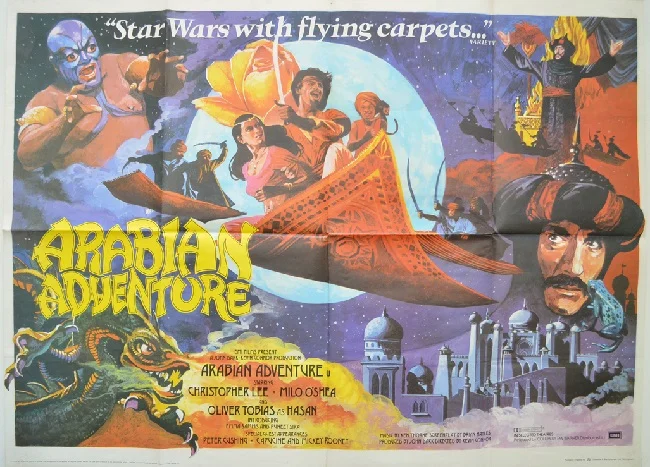
Evil caliph Alquazar (Christopher Lee) offers the hand of his daughter Princess Zuleira (Emma Samms) in marriage to Prince Hasan (Oliver Tobias) if he can complete a perilous quest for a magical rose. With the help of a young street urchin Majeed (Puneet Sira) and his faithful pet monkey, the pair have to face fire breathing monsters, a malevolent genie (Milton Reid) and treacherous swamps to reach their prize. The plot is very simplistic and generic. No archetype is left unturned. Lee smoulders, Tobias is heroic and Samms is just there to look good (it is a shockingly vacuous role for a female lead). Every conceivable cliché associated with Western interpretations of traditional Eastern tales is present and it all comes across as a pastiche of Sinbad, Ali Baba and Aladdin. The cast is conspicuously Caucasian and the production is mainly set bound at Pinewood studios. The optical, miniature and matte painting effects by veterans such as George Gibbs and Cliff Culley are simplistic, entertaining but hardly convincing.
The film was the last of several fantasy movies directed by Kevin Connor and produced by John Dark during the seventies. The previous being The Land That Time Forgot, At the Earth's Core and Warlords of Atlantis. However, despite having the biggest budget of all these productions, it failed to find an audience at the box office. In a post Star Wars world, it all seems a bit twee, lacking in scope and excitement. There’s little to recommend it to modern audiences as it all seems dated, cheap and a little awkward due to the racial and cultural stereotyping. From a movie buffs perspective, Arabian Adventure is a veritable who’s who of stalwarts of the UK film industry from the late seventies. The cinematography is by Alan Hume who would go onto film Return of the Jedi and several Roger Moore Bond films. It’s always nice to see such genre favourites as Shane Rimmer and the great Peter Cushing. But overall the movie is a far cry from Zoltan Korda’s The Thief of Bagdad and its box office failure is mainly due to being in the wrong place at the wrong time, just as audiences taste were changing.
Conan the Barbarian (2011)
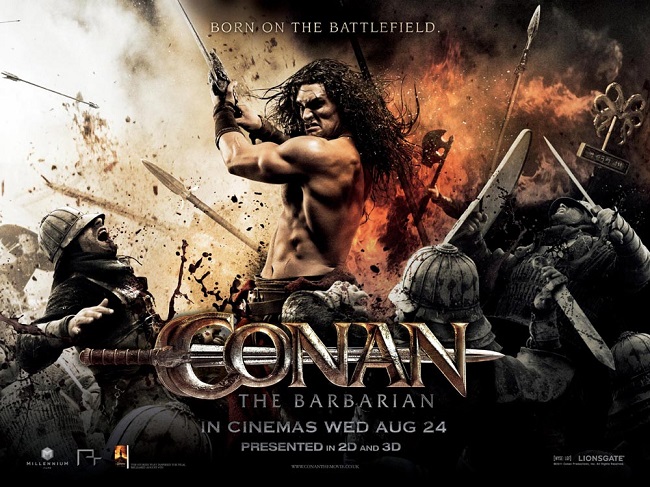
On a superficial level the 2011 Conan reboot provides two hours of blood and thunder. For those who are seeking a quick fix of such material and are not burdened by a strong affiliation to Robert E. Howard’s source material, this will prove adequate. I suspect that Marcus Nispel’s offering will find a home with a younger audience. For purists or those who have fond memories of John Milius’ 1982 version, then this is not the film you are looking for. Move along. But to be honest after watching the various trailers that preceded this release and considering the directors track record, does this really come as any surprise? For those with a longer memory, cast you mind back to Nispel’s Viking versus Indian outing from 2007. Pathfinder was a high concept movie that was chronically mishandled.
On a superficial level the 2011 Conan reboot provides two hours of blood and thunder. For those who are seeking a quick fix of such material and are not burdened by a strong affiliation to Robert E. Howard’s source material, this will prove adequate. I suspect that Marcus Nispel’s offering will find a home with a younger audience. For purists or those who have fond memories of John Milius’ 1982 version, then this is not the film you are looking for. Move along. But to be honest after watching the various trailers that preceded this release and considering the directors track record, does this really come as any surprise? For those with a longer memory, cast you mind back to Nispel’s Viking versus Indian outing from 2007. Pathfinder was a high concept movie that was chronically mishandled.
This re-imagining loosely draws upon Robert E. Howard’s source material, as well as Schwarzenegger’s Conan. It is the opening scenes focusing on Conan’s youth which are the most engaging, from a narrative and character development stance. The brief insight into Cimmerian warrior culture makes for a strong start. But immediately after the death of Conan’s Father (Ron Perlman) it all lapses into by the numbers story telling. Evil Khalar Zym (Stephen Lang) along with sorceress daughter Marique (Rose McGowan), seek an ancient relic to facilitate their fiendish (and formulaic) plans. Throw in a plucky warrior monk named Tamara (Rachel Nichols) and the generic story is complete. Conan’s motivation is purely one of revenge, but without the philosophical musings of Schwarzenegger’s. Jason Momoa has sufficient charm and presence to hold an audience, but the character has none of the depth you would hope.
The film clearly fails at script level. Jason Momoa’s mono-syllabic dialogue is purely reactive, serving as nothing more than an expositionary device. It is also delivered in a contemporary fashion. Nothing kills immersion for me more than period set dramas (be they based in fact or fantasy) utilising current American parlance. Potentially interesting characters are also neglected and given little to do. Rachel Nichols is introduced as a strong female lead but is sidelined as a damsel in distress rather quickly. Both Stephen Lang and Rose McGowan fail to deliver a good performance and maintain their evil nemesis roles purely by dint of the characters they have been assigned. Yet there is the scope for their curious and dysfunctional relationship to have been so much more.
What is so obviously lacking in this cinematic outing is depth. Can movies such as this have any, I hear you ask? Of course they can. Milius explored the nature of revenge and imbued his take on Conan with a Nietzschean subtext. Furthermore, Howard's original work has a multitude of themes and is not simply the pulp fiction it has been glibly labelled over the years. But director Marcus Nispel simply refuses to look beyond two-dimensional, cause and effect structure of the story. His Conan, although personable, has no dignity or nobility. Momoa is brooding but beyond his obvious vengeful motivation, he has few of the qualities of his literary namesake. It seems that the film makers only see the central character as an efficient killing machine and that's what they have brought to the screen.
Subsequently, Conan the Barbarian is totally the sum of its parts. As those respective parts are bland, hollow and uninspired, that is exactly the sort of movie that you get. For those seeking violence and bloodshed, then Conan the Barbarian can provide such commodities. However, it is subject to an excess of CGI and contemporary editing techniques that rob the action scenes of any sense of wonder. Compare them to the physical effects and sword play of the 1982 movie and the difference is obvious. The sequences with the sand spirits and under water creature, along with the films climax fail to offer any real tension. Again, they seem like a dislocated FX show reel that was added by the most economic bidder for the contract.
If Conan the Barbarian had simply been marketed under a different title and not linked to the franchise, perhaps critics would have been more forgiving. Had it just been “Wolgang Rippling Buttocks and the Sword of Kagnazax”, then it may well have been deemed acceptable. However, as it fails so notably to do any justice to Robert E. Howard’s work, it quite rightly merits harsher criticism. Furthermore, the point of failure is abundantly apparent. Director Nispel and the screen writers Thomas Dean Donnelly, Joshua Oppenheimer and Sean Hood are simply not up to the job. They fail to understand the philosophy of Conan and focus purely on spectacle and pandering to ill-conceived market research. The most depressing aspect of this is the fact that the box office failure of the film has pretty much ended any chance for a further reboot by more competent film makers.
Super Mario Bros. (1993)
Twenty-five years ago, Super Mario Bros. was released upon an unsuspecting public and subsequently met with universal critical derision and box office failure. With the benefit of 20/20 hindsight is seems incredible that this project ever got given a green light. Yet at the time, not only was it granted a generous $48 million budget, but it boasted a cast and production team of the highest pedigree. Produced by Oscar nominated director Roland Joffé, the cinematography was by Dean Semmler and the editing was by Mark Goldblatt. The central characters of Mario and Luigi where played by Bob Hoskins and John Leguizamo and the icing on the cake was Dennis Hopper as King Koopa. You simply couldn't make it up.
Twenty-five years ago, Super Mario Bros. was released upon an unsuspecting public and subsequently met with universal critical derision and box office failure. With the benefit of 20/20 hindsight is seems incredible that this project ever got given a green light. Yet at the time, not only was it granted a generous $48 million budget, but it boasted a cast and production team of the highest pedigree. Produced by Oscar nominated director Roland Joffé, the cinematography was by Dean Semmler and the editing was by Mark Goldblatt. The central characters of Mario and Luigi where played by Bob Hoskins and John Leguizamo and the icing on the cake was Dennis Hopper as King Koopa. You simply couldn't make it up.
Apparently, the script was hawked around most of Hollywood as the production tried to secure a suitable A list director and some bankable box office names. Harold Ramis was initially linked to the project but opted to make Groundhog Day instead. A move I'm sure he has never regretted. Both Michael Keaton and Arnold Schwarzenegger passed on the chance to play King Koopa. The role of Mario was at first offered to Danny DeVito, but he would not commit to the movie until he had seen a complete script. Tom Hanks was then hired and let go, in favour of Bob Hoskins. Mr. Hoskins was subsequently traumatised by his experiences shooting this movie.
“The worst thing I ever did? Super Mario Bros. It was a fuckin’ nightmare. The whole experience was a nightmare. It had a husband-and-wife team directing, whose arrogance had been mistaken for talent. After so many weeks their own agent told them to get off the set! Fuckin’ nightmare. Fuckin’ idiots”.
Then there is of course the script. After numerous incarnations ranging from traditional fantasy, to a post-apocalyptic futuristic setting, it was decided to opt for a dystopic cyberpunk alternative reality where evolved dinosaurs ruled the world. Ed Solomon of Bill & Ted's Excellent Adventure fame was brought in to make further, “kiddy friendly” revisions to the plot. This caused major discrepancies with elements of the production that directors Annabel Jankel and Rocky Morton (of Max Headroom fame) had already created, such as costumes, prosthetics and character art.
As the primary shooting ended the original finale involving Mario climbing the Brooklyn Bridge and dropping a bomb on King Koopa and kicking him into the river, was replaced with alternative material where he was shot by a high-tech weapon that melted him. Directors Morton and Jankel were subsequently excluded from the editing process, in which a great deal of new material shot by the second unit was integrated into the film. As you would expect with such a production, the final cut was far from everyone’s expectations. The critics and fans were harsh and unforgiving. The nicest quote I could find was "doesn't have the jaunty hop-and-zap spirit of the Nintendo video game from which it takes – ahem – its inspiration."
Like so many epic failures, Super Mario Bros. seems to have acquired, some sort of cult following over the years. I think that is never does any harm to revisit any movie after a period of time and to attempt to re-evaluate it, although such a process does not guarantee a change of opinion. In the case of Super Mario Bros. the passage of time has not altered the fact that the movie is a mess.
Yet there is a degree of freak show fascination that makes the film compelling. It has an air of car crash cinema to a degree and is most certainly is a text book example of stripping a franchise of all its charm and selling points, while trying to bring it to the big screen. Perhaps one of the interesting aspects about the film, is that the mistakes that were made during its production are still regularly made today. No doubt they will happen again in the future. In the meantime, if you have a strong sense of curiosity and a high tolerance of bad cinema, then watch Super Mario Bros.as some sort of cinematic “Kobayashi Maru test”.
Immortals (2011)
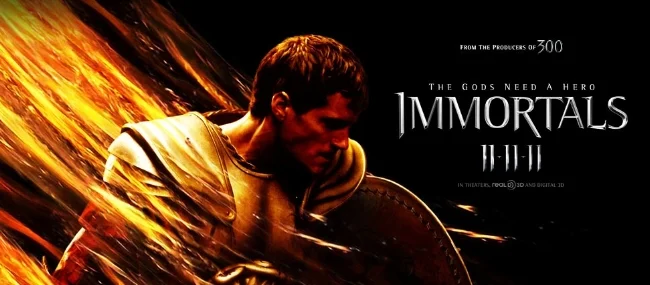
Tarsem Singh's Immortals follows in the wake of Zac Snyder’s 300 with a similar aesthetic and editing style. Despite an interesting cast, featuring the talents of John Hurt, Mickey Rourke and Henry Cavill, it’s a singularly uninspired film, devoid of any story telling of any substance. Immortals main selling points are glossy, stylised visuals and a striking production design which is very derivative of Italian cinema from the sixties. There are also liberal doses of violence and heaving oiled flesh to enliven the proceedings, but it is all feels somewhat arbitrary and a bit of a box ticking exercise. Overall what surprises me the most is how a film maker with all of the drama and excitement of Greek mythology at his disposal, can still make such a turgid and dull movie as this?
Tarsem Singh's Immortals follows in the wake of Zac Snyder’s 300 with a similar aesthetic and editing style. Despite an interesting cast, featuring the talents of John Hurt, Mickey Rourke and Henry Cavill, it’s a singularly uninspired film, devoid of any story telling of any substance. Immortals main selling points are glossy, stylised visuals and a striking production design which is very derivative of Italian cinema from the sixties. There are also liberal doses of violence and heaving oiled flesh to enliven the proceedings, but it is all feels somewhat arbitrary and a bit of a box ticking exercise. Overall what surprises me the most is how a film maker with all of the drama and excitement of Greek mythology at his disposal, can still make such a turgid and dull movie as this?
Years after the Gods defeated the Titans, a new evil threatens. King Hyperion (Mickey Rourke) scours Greece in search of the legendary Epirus Bow, a weapon of unimaginable power forged in the heavens by Ares. Once he possesses this bow he can unleash the Titans, who have been imprisoned deep within the bowels of Mount Tartaros. In Hyperion’s hands, the bow can also annihilate the Gods. But ancient law dictates the Gods must not intervene in man's conflict. Yet they can work through a proxy, so a peasant named Theseus (Henry Cavill) is chosen by Zeus, to save his people from Hyperion and his armies. Rallying a band of fellow outsiders, including visionary priestess Phaedra (Freida Pinto) and cunning slave Stavros (Stephen Dorff), Theseus must lead an uprising, or watch his homeland fall into ruin and the Gods vanish from the world.
Director Tarsem Singh has a noticeable visual style, developed during his earlier career where he made several very high-profile music videos. As a result, one cannot deny that Immortals looks impressive. The colour palette is vivid in it’s use of contrasting colours, especially in the end battle between Gods and Titans. Gold, red and black feature in a very striking fashion. There is also an ethereal quality to some of the supernatural elements of the story. I certainly felt that there was an element of Mario Bava and even Michael Powell and Emeric Pressburger in the proceedings. The action scenes are stylised and brutal yet lack any dramatic power due to their heavily orchestrated presentation. At times they seem like they’d be more at home in a Giallo, rather than a tale of Ancient Greece.
However, despite all the positive aspects of the production design, my biggest criticism of Immortals is that it wilfully neglects any attempt at true story telling and character development. Viewers are presented with the most arbitrary depictions of both heroes and villains and given no specific reason to care about them, apart from the fact that they’re merely archetypes. It feels like the main focus of this movie is the presentation, rather than the story. It seems to be an all too familiar complaint these days. Compared to thirty years ago, film makers nowadays have access to an array of tools that allow them to make the most visually impressive and technically accomplished productions. But there is a noticeable lack of humanity in this process and it becomes a very apparent when you finally watch the finished product. Immortals suffers in this way, saying precious little in the most lurid and bombastic fashion.
The Sword and the Sorcerer (1982)
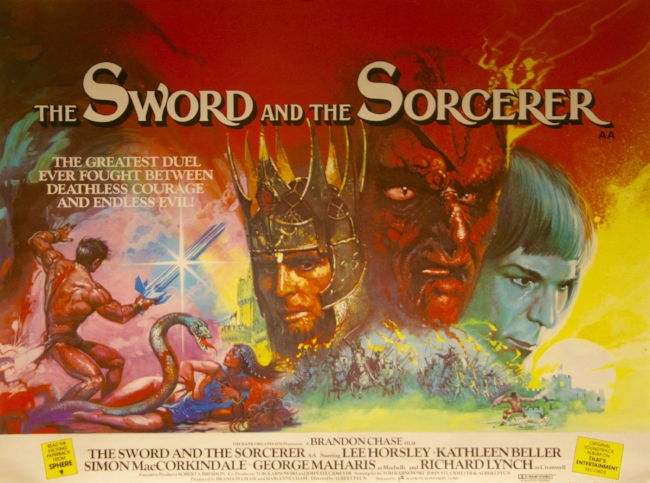
The early eighties saw an interesting mini boom in the sword and sorcery films. Studios have always been quick to jump on any bandwagon and the growing popularity of the Dungeons and Dragons role playing games showed a potential market. Subsequently, there was a glut of material from the fantasy genre. John Milius’ Conan the Barbarian (1982) remains the benchmark for such movies with its blend of high adventure and philosophical musing. Other films of note include John Boorman’s Excalibur (1981), Dragonslayer (1981), Legend (1985), Krull (1983) and The Beastmaster (1982) to name but a few. All of them have an interesting pedigree with regard to their respective cast and directors. As always there were numerous poor and substandard entries, but we will not catalogue them here.
The early eighties saw an interesting mini boom in the sword and sorcery films. Studios have always been quick to jump on any bandwagon and the growing popularity of the Dungeons and Dragons role playing games showed a potential market. Subsequently, there was a glut of material from the fantasy genre. John Milius’ Conan the Barbarian (1982) remains the benchmark for such movies with its blend of high adventure and philosophical musing. Other films of note include John Boorman’s Excalibur (1981), Dragonslayer (1981), Legend (1985), Krull (1983) and The Beastmaster (1982) to name but a few. All of them have an interesting pedigree with regard to their respective cast and directors. As always there were numerous poor and substandard entries, but we will not catalogue them here.
However, big budget studio productions were not always a guarantee of success at the box office. Low budget independent films could equally compete within this niche market and the more lucrative entries would often followed a tried and tested formula. Take a perfunctorily script loaded with generic genre tropes, some nominally well-known TV actors, include large amounts of sword play and violence, throw in some gratuitous nudity and see if can bluff your way through ninety minutes. The Sword and the Sorcerer exemplifies this model having all these requisite attributes in spades. Surprisingly the results are an engaging, violent, lurid, tongue in cheek, wannabe epic, that dared to start a franchise.
The film starts with a portentous expository narration where we learn that the evil Titus Cromwell (Richard Lynch) is waging war with the good King Richard (Christopher Cary) for control of the kingdom of Ehdan. Cromwell, having been previously defeated by King Richard, uses a witch to raise the ancient sorcerer Xusia of Delos (Richard Moll) from the dead. Cromwell bargains with Xusia, who then unleashes his sorcery on the armies of Ehdan. King Richard’s eldest son dies bringing news of the impending defeat and it is decided to evacuate the remaining members of the royal household. Cromwell, now victorious, takes the opportunity to murder Xusia while he is weak from his witchcraft.
The King's youngest son, Talon is entrusted with his father's tri-bladed sword and leaves to meet with his mother and sisters. He only just escapes after seeing his father put to the sword by Cromwell himself. Matters get worse as he arrives to leave with his family, only to be ambushed by Cromwell's men. His remaining kin are killed and he sustains a serious hand injury. Vowing revenge, he disappears, leaving the kingdom that is rightfully his in the hands of his enemy, who assume he is dead.
Years later, rumours arise on the borders of Ehdan of a mighty warrior with his sword is for hire. It is also revealed that sorcerer Xusia is not dead but has been slowly regenerating over the years and plotting his revenge against the treacherous Titus Cromwell. Meanwhile there is a growing underground movement to depose Cromwell, led Prince Mikah (Simon MacCorkindale) and his sister, Princess Alana (Kathleen Beller), being the nephew and niece to dead King Richard. Among their secret network of supporters is Count Machelli (George Maharis), Cromwell's War Chancellor, who feeds them news from inside the palace. It is not long before all these individuals come together in violent conflict. Who will prevail and win the throne of Ehdan?
As you can see the script for The Sword and the Sorcerer is quite ambitious. Most genre films would not attempt to create such a complex story, with plots, duplicity and intrigue. The execution of these ideas is rudimentary but this was director Albert Pyun’s directorial debut. There are also some attempts to create interesting characters. Talon (Lee Horsley) in particular is supposed to be a charming, irreverent rogue with a ready sense of humour in the Errol Flynn vein. Simon MacCorkindale gives probably the best performance of the film as Prince Mikah, the anguished, dutiful, heir to the throne. Richard Lynch gives a typical flamboyant performance as Cromwell, bringing that uneasy quality he naturally had. Even Kathleen Beller plays Princess Alana, in a suitably feisty manner. Don’t get me wrong, this is far from Shakespeare but there is an inherent sense of fun and the material is suitably camp as well as schlocky, without being disrespectful to the genre.
Special attention should be given to David Whitaker's score. The music is very grand considering the scope of the production, with generous use of strings and brass. It is heavily influenced by classics score from Miklos Rozsa and Erich Korngold. “The Sword and The Sorcerer Overture" is a good example, where we hear the heroic main theme for the first time (See track below). It is when the music gets more light-hearted that it gets really interesting and enjoyable, for example in "The Bordello", where the main theme gets an upbeat and almost humorous rendition. This is a soundtrack that offers a wide variety of styles and moods, and for a modest genre film, is a quite sophisticated.
Despite the low budget The Sword and The Sorcerer has some well-choreographed set pieces and action scenes. Sadly, stuntman Jack Tyree died during the making of the film, when a high fall went wrong. Part of that stunt can still be seen. Fight scenes are perfectly adequate and the editing is also competent improving the overall film. The production design is ambitious, with creative sets, and stylish lighting. There’s a nice homage to Michael Curtiz in one fight scene, were a brazier is knocked over and the action proceeds in slow motion silhouette. The prosthetic work is well handled by now established names like Greg Cannom and Mark Shostrom. Xusia's tomb and full body make up are good examples of the standard of work. There is also a nice head bisection and skin shedding scene. I would also draw your attention to the implausible death on one character who meets his end via a foot peddle driven grind stone. See if you can spot the flaw in the plan.
The Sword and the Sorcerer is what it is. A low budget genre movie, with liberal quantities of sex, violence and humour. It should be judged on its own merits because it isn’t cut from the same cloth as a massive studio production such as Krull. It should also be noted that the film performed surprising well at the box office and was in fact the highest grossing independent movie of 1982. Yet the proposed sequel which was advertised in the end credits, was delayed due to the director’s other commitments. In the meantime, public tastes changed and the sword and sorcery boom was replaced by the next trend. Despite this, The Sword and the Sorcerer has gained cult status in recent years. It’s playful quality and knowing tone can still entertain thirty-six years on. Few other low budget movies from this genre can make such a claim.
Season of the Witch (2011)
After years of war, two 14th century Crusaders (Nicholas Cage and Ron Perlman) returns to a homeland devastated by the Black Plague. The church, deeming sorcery to be the source of the outbreak, tasks the knights to transport an accused witch (Claire Foy) to a remote abbey, where monks will perform a ritual in hopes of ending the pestilence. A priest, a grieving knight, a disgraced trader and an altar boy who dreams of becoming a knight, join the mission across a hostile wilderness. The group soon finds itself at odds with each other over the fate of the girl. When the embattled party finally arrives at the abbey, a horrific discovery jeopardises the knight's pledge to ensure the girl fair treatment, pitting them against an inexplicably powerful and destructive force. Will good or evil triumph?
After years of war, two 14th century Crusaders (Nicholas Cage and Ron Perlman) returns to a homeland devastated by the Black Plague. The church, deeming sorcery to be the source of the outbreak, tasks the knights to transport an accused witch (Claire Foy) to a remote abbey, where monks will perform a ritual in hopes of ending the pestilence. A priest, a grieving knight, a disgraced trader and an altar boy who dreams of becoming a knight, join the mission across a hostile wilderness. The group soon finds itself at odds with each other over the fate of the girl. When the embattled party finally arrives at the abbey, a horrific discovery jeopardises the knight's pledge to ensure the girl fair treatment, pitting them against an inexplicably powerful and destructive force. Will good or evil triumph?
Season of The Witch was submitted to the MPAA for rating twice, prior to release, as the studio tried to secure a “suitable” rating for the movie. The film itself spent an entire year between completion of the production and its theatrical release as various parties tinkered with its final edit. The script had been in development since 2000 and had been passed from both MGM and Columbia pictures before finally being produced by Relatively Media. Despite some striking location work around Eastern Europe, suitable castles and associated building from the required period could not be found. Thus, a great deal of material had to be shot against green screens and added digitally in post-production. However, budgetary restraints had an impact upon this work and its quality. All of these factors are usually indicative of a troubled production, resulting in a flawed film. Sadly, Season of the Witch very much fits that bill.
Season of The Witch is glaringly narratively and tonally inconsistent. The characters are insufficiently developed as are the themes. The story is very derivative and the content conspicuously edited to secure the commercially viable PG-13/12A rating. However, smitten by a fit of unusual generosity, I have to admit that I did enjoy the film. This is mainly because of Ron Pearlman's presence and a handsome production design that is very reminiscent of Hammer studios work and Roger Corman's Poe adaptations. Like 2012 release of Solomon Kane, the film manages to look a lot more sumptuous than it actually is due to its Hungarian and Croatian locations. Furthermore, although the action scenes and set pieces have been very tightly edited for rating reasons, they are still well conceived due to the presence of veteran stunt co-ordinator Vic Armstrong.
The story of two Teutonic Knights escorting a suspected witch to a remote castle for trial, through a world devastated by the Black Death, often comes across as pythonesque. This is mainly due to the similarities in the depiction of the Medieval world. I was also reminded of Terry Gilliam’s Jabberwocky that has a similar grimy depiction of the time. The story is episodic and offers very few surprises. It is entertaining in a very undemanding way and the night attack by wolves in the fog bound forest, is actually well executed. There are even some occasional nods to Ingmar Berman which seem curiously hubristic. However, overall Season of The Witch is an inconsistent viewing experience and a film that falls between several stools. It doesn’t seem to find a level that it is comfortable with, very much like director Dominic Sena's previous film Whiteout. Therefore, only watch is you are feeling tolerant, forgiving and are the most ardent Nicholas Cage fan.
Orc Wars (2013)
Having recently sat through Orcs! I decided to take a further chance and watch Orc Wars. It too is a very low budget film, although this time the finances were raised through crowdfunding. Sadly, it is not the fun, tongue in cheek, independent adventure movie the trailer and associated marketing implies. There is very little merit in this production. It's cheap, cheerful and although harmless, it clearly demonstrates that not all fan funded projects are good cinema. Some are just indulgences. The problem is in the title itself, which tries to sell an idea that the movie production is incapable of delivering. Instead of the spectacle of an army of a thousand Orcs pitted against the technological might of the US war machine, we get a few extras in ill-fitting costumes, running skirmishes against no-name actors on quad bikes and a few old Army Surplus vehicles. It's all rather lacklustre and underwhelming.
Having recently sat through Orcs! I decided to take a further chance and watch Orc Wars. It too is a very low budget film, although this time the finances were raised through crowdfunding. Sadly, it is not the fun, tongue in cheek, independent adventure movie the trailer and associated marketing implies. There is very little merit in this production. It's cheap, cheerful and although harmless, it clearly demonstrates that not all fan funded projects are good cinema. Some are just indulgences. The problem is in the title itself, which tries to sell an idea that the movie production is incapable of delivering. Instead of the spectacle of an army of a thousand Orcs pitted against the technological might of the US war machine, we get a few extras in ill-fitting costumes, running skirmishes against no-name actors on quad bikes and a few old Army Surplus vehicles. It's all rather lacklustre and underwhelming.
Ex-Marine John Norton (Rusty Joiner) buys a ranch in the remote American West hoping to escape from his troubled past. He subsequently encounters Elven Princess Aleya (Masiela Lusha) who has fled her home world via an interdimensional portal and is marooned on Earth. A convenient blind Native America Mystic called Whitefeather (Wesley John) informs Norton that he is the appointed guardian. He must defend the Princess from a marauding army of Orcs who wish to use her power to release their dragon god. After the simplistic narrative has been clumsily explained there then follows a series of low budget action scenes involving plastic replica guns with CGI muzzle flashes, along with some indifferently choreographed and poorly edited fight scenes.
The main saving grace of Orc Wars, is the fact that the Orcs themselves look pretty good. It’s clear that the producers spent most of the films meagre budget on the costumes and prosthetic effects. If you think that Orcs look and feel very similar to those seen in Peter Jackson’s The Lord of the Rings Trilogy, there's a specific reason for that. Apparently, props and costumes can be rented from Weta studios when not in use. However, the Orcs themselves cannot save this movie. The dialogue is poor as is the acting but there is a degree of convictions from the cast and director Kohl Glass. However, enthusiasm will only carry afilm so far. The cheeky homage to Zulu at the end of the movie made me spit my drink across the room. If you buy in to the notion of "it's so bad, it's good" then Orc Wars is an amusing ninety-minute diversion. Otherwise, best avoid it.
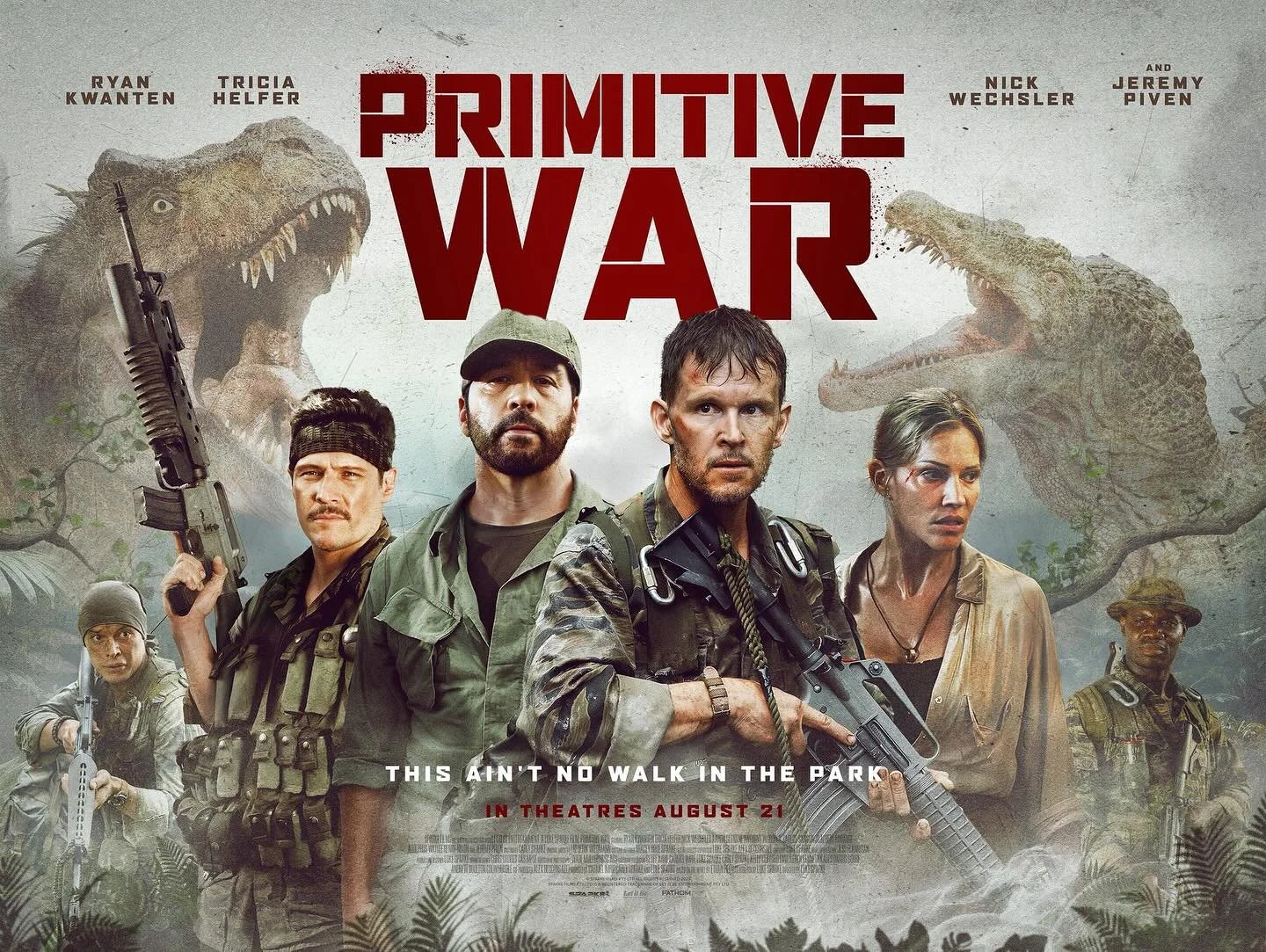
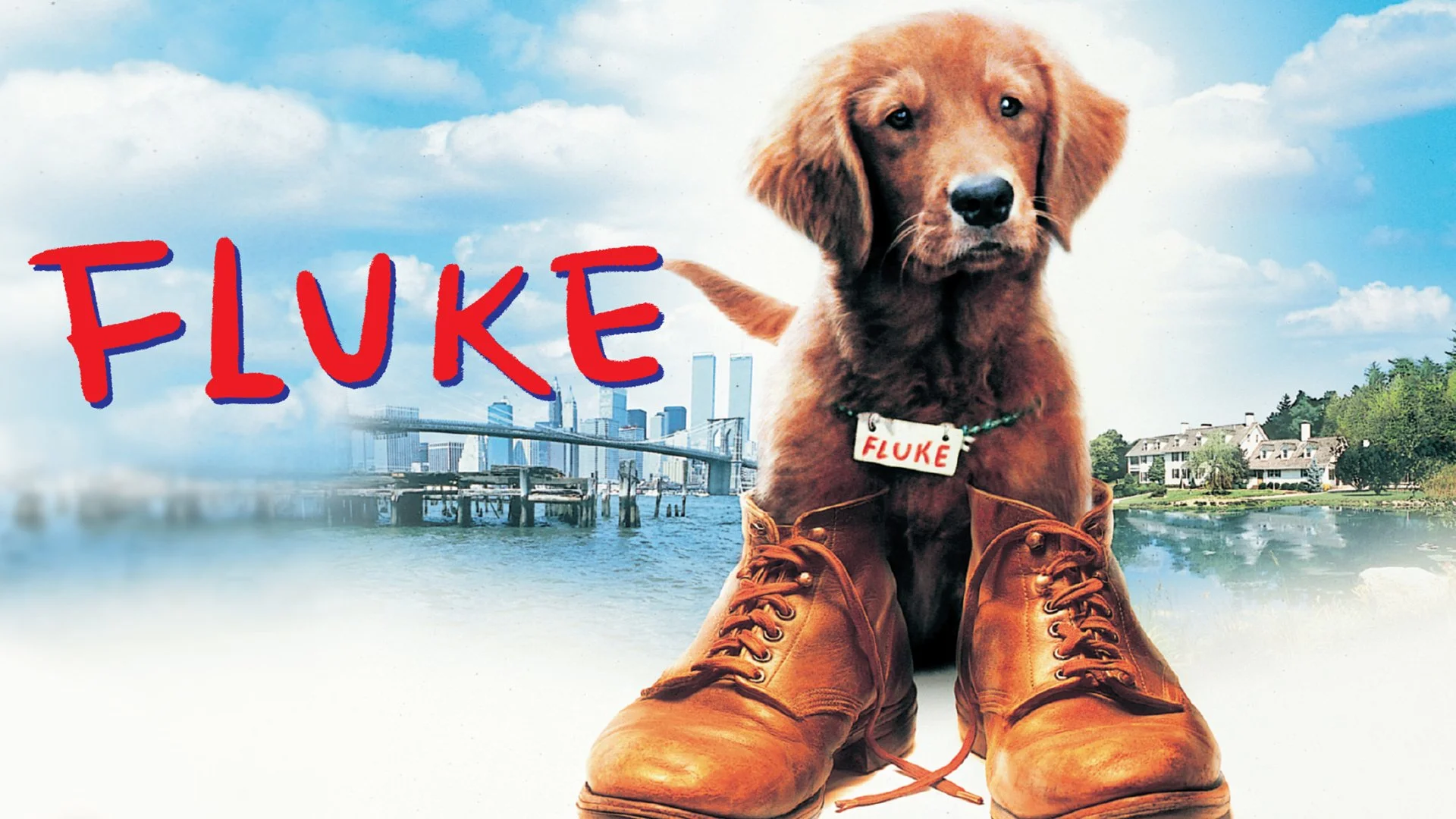
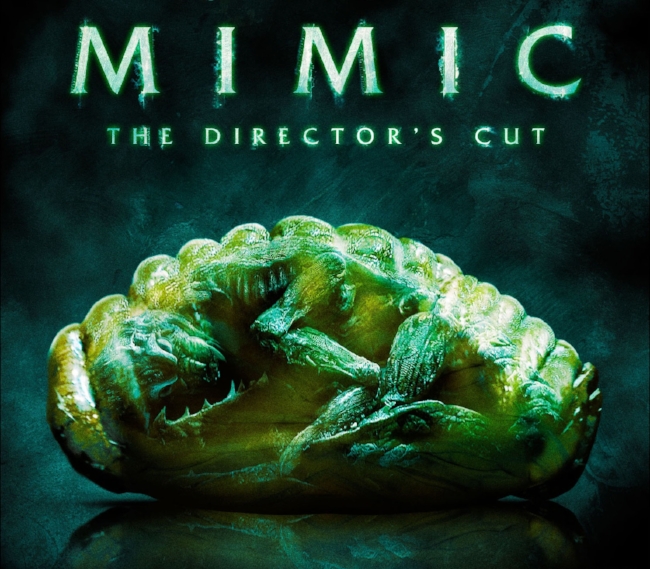
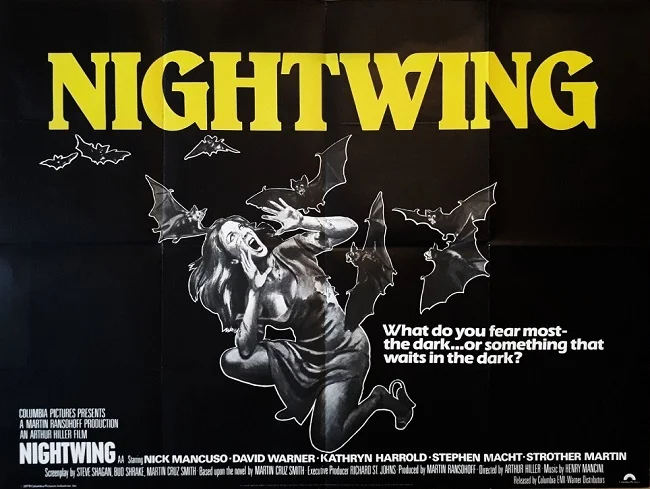
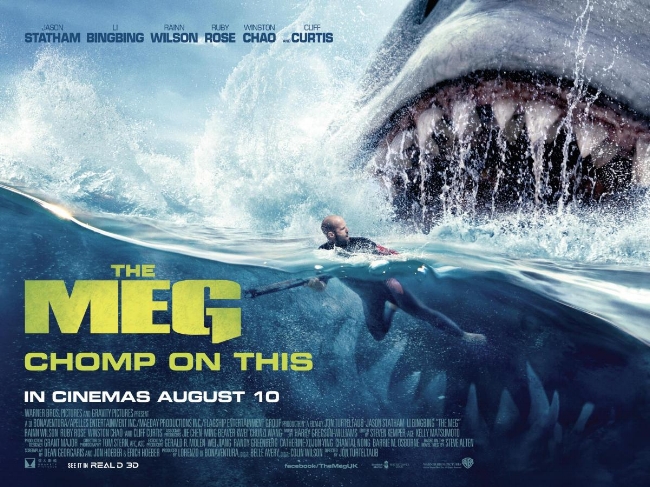
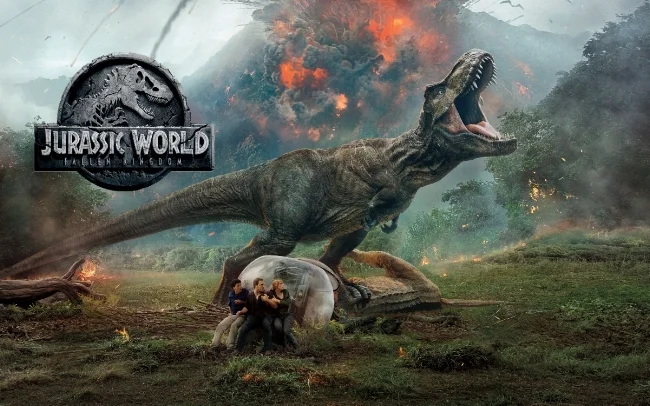
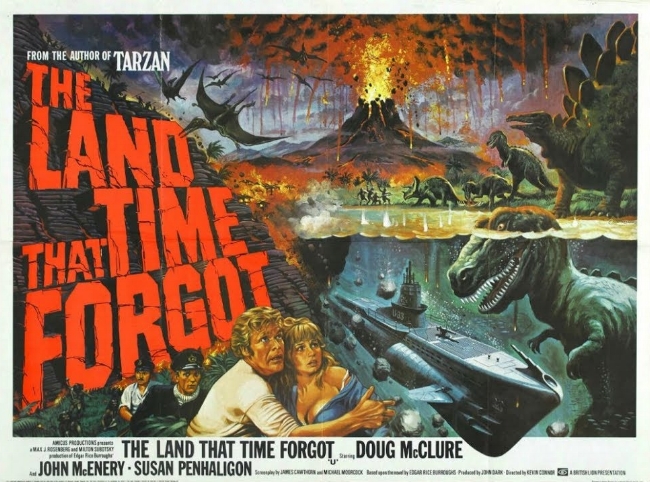
Orcs! (2011)
As a fan of the horror genre I’ve sat through numerous low budget films in my time. This has usually been at festivals or conventions. Sometimes watching something as part of a group, with likeminded individuals, makes a difference. You find yourself groaning in unison and the shared experience helps compensate for potential deficiencies. Watching questionable material in the comfort of your own home, purely on your own can be a lot tougher. However, due to my abiding love of the genre, I am prepared to cut a lot of cheap ass indie flicks considerably more slack than I would others. So, I'll endeavour to review Orcs! with as much impartiality as possible. Oh, and before we start, let us clarify the term Orcs. Although Middle-earth is not referenced in any way, this film is definitely about Tolkien's creations. Or at least their depiction in another well-known series of films.
As a fan of the horror genre I’ve sat through numerous low budget films in my time. This has usually been at festivals or conventions. Sometimes watching something as part of a group, with likeminded individuals, makes a difference. You find yourself groaning in unison and the shared experience helps compensate for potential deficiencies. Watching questionable material in the comfort of your own home, purely on your own can be a lot tougher. However, due to my abiding love of the genre, I am prepared to cut a lot of cheap ass indie flicks considerably more slack than I would others. So, I'll endeavour to review Orcs! with as much impartiality as possible. Oh, and before we start, let us clarify the term Orcs. Although Middle-earth is not referenced in any way, this film is definitely about Tolkien's creations. Or at least their depiction in another well-known series of films.
Orcs! is a modestly budgeted, independent comedy horror film, set in the fictitious Balancing Rock National Park. Ranger Cal (Adam Johnson) along with Cadet Ranger Hobart (the well-cast Maclain Nelson), discover that the parks visitors and staff are being brutally slain by an unseen force. Aided by Cal's ex-girlfriend and militant environmentalist, Katie (Renny Grames), the trio incompetently investigate the situation. It soon becomes apparent that the spate of deaths is not the work of rogue bears or bigfoot but a band marauding of Orcs (who have arrived and started killing folk for “some particular reason”). Cut off and enable to escape the park, our heroes make a last stand, vowing to make the Orcs sorry they messed with the US Parks Service. Low budget mayhem ensues.
Orcs! is very much a mixed bag. It starts with some fairly broad humour, setting up the central characters. I did find myself warming to the two leads. The action scenes and violence is not to strong and is often mitigated with a wry joke or quip. The Orcs themselves are fairly well realised. Considering the budget, the costumes and armour are well designed. The films greatest assets are several rather clever homages to Peter Jackson's trilogy. Hobart lampoon's Aragorn's tracking skills in a clever pastiche. There are also parallels with the battle of Helm's Deep. The use of drums to denote the massing of the orcs is another clever cinematic homage. Director James MacPherson, even manages to include nods to John Carpenter's Assault on Precinct 13 and James Cameron's Aliens. As is so common in indie flicks of this nature, the film makers do like to heap praise upon their cinematic idols.
But despite these endearing qualities, there are major plot holes and a lack of quality material to adequately fill the eighty-minute running time. Now, with this genre of film, it is not wise to de-construct the plot too much. Genre movies often run on their own unique internal logic. Yet a glaring mistake is made and perpetuated throughout the film. Towards the end, as the Orcs lay siege to the Rangers Headquarters, our heroes discover that the enemy hates the light. Yet for the previous thirty-five minutes, the Orcs have happily been running about in broad daylight. The final battle is also far too long and insufficiently action packed to merit its ponderous running time. I appreciate that financial constraints may well have been an impediment to the director’s vision, yet a more adept production would have been a little more innovative with the resources they had.
By and large I did enjoy Orcs! as I’ve always had a supportive streak towards this sort of production. Irrespective of the film deficiencies, I applaud all involved for at least attempting to do something different. It could be argued that with a larger budget and more involved script, the film would have been superior. Ten minutes of the running time could have been taken from the ending and used earlier on in the film to the productions overall advantage. It certainly would have helped to have explored the Orcs back story some more. As it stands, Orcs! is a flawed but creative low budget genre movie. If you have a broad liking for such movies and enquiring nature, then give it a go. If you like mainstream material and have a low threshold of tolerance for anything that isn’t slick, polished and “Hollywood” then you’d best give it a miss.
The Dark Tower (2017)
Stephen King’s body of work has proven to be an invaluable source of material for film and television over the last forty years. The results have often been as varied as the books themselves. Because of the inherent differences between the respective mediums, sometimes the complexity and sheer scope of King’s work can be lost in translation from one to the other. It’s happened before with several high-profile adaptations and it will no doubt happen again. The Dark Tower is a classic example failing to capture the essence of King’s work. Trying to distil and convey a mythos that is spread over eight volumes, into a single movie is a tall order for any director and screen writer. It can be cogently argued that material of this sort is better suited to television where lengthy, complex story arcs can be indulged and characters can be explored at leisure. In fact, during it’s time in development hell, The Dark Tower was at one point destined to be adapted for the small screen. However, the desire to create a lucrative film franchise ultimately prevailed.
Stephen King’s body of work has proven to be an invaluable source of material for film and television over the last forty years. The results have often been as varied as the books themselves. Because of the inherent differences between the respective mediums, sometimes the complexity and sheer scope of King’s work can be lost in translation from one to the other. It’s happened before with several high-profile adaptations and it will no doubt happen again. The Dark Tower is a classic example failing to capture the essence of King’s work. Trying to distil and convey a mythos that is spread over eight volumes, into a single movie is a tall order for any director and screen writer. It can be cogently argued that material of this sort is better suited to television where lengthy, complex story arcs can be indulged and characters can be explored at leisure. In fact, during it’s time in development hell, The Dark Tower was at one point destined to be adapted for the small screen. However, the desire to create a lucrative film franchise ultimately prevailed.
As an action fantasy, The Dark Tower is rather traditional in its themes, use of archetypes and narrative structure. Teenager Jake Chambers (Tom Taylor) has recurring dreams involving a Man in Black (Matthew McConaughey) who seeks to destroy a Tower and bring ruin to the universe. He also sees a Gunslinger (Indris Elba) who opposes him. Jake's mother (Katheryn Winnick) and stepfather believe that he has been traumatised by his father's death the previous year and arrange for him to be taken into psychiatric care. However, Jake recognizes the Doctor and her staff from his visions. They are in fact monsters wearing human skin, so he subsequently escapes. Finding a portal in an abandoned house, Jake travel to Mid-World where he meets the legendary Gunslinger Roland Deschain. However, Deschain is a broken man who only seeks revenge for the death of his father (Dennis Haysbert). Can Jake convince him to save the Dark Tower and universe that it protects?
Although I have read many of Stephen King’s book, I am not familiar with the source material in this instance, beyond its initial premise. Therefore, I approached The Dark Tower with little or no preconceptions and a distinct lack of fan based baggage. What became very apparent while watching the film, was the pacing of the story and the flow of the narrative, which were very fast. Characters were introduced, plot points were explained and the story arc was propelled forward at an unusually quick pace. All of which smacks of a movie that has been excessively re-edited and retooled. I suspect the original vision of the movie was changed in post-production and revised for a different demographic.The film as it currently stands has a very simplistic and linear trajectory. There is little or no depth to any of the central characters and no insight into Mid-World beyond what we are shown. As a result, the film lacks any tension or dramatic hold over the audience. The Dark Tower does look like a high budget movie but its overall narrative has precious little substance. Its ninety-five-minute running time is far too short and the film needs at least another twenty to thirty minutes to expand upon its themes.
There are only three action sequences of note in The Dark Tower but they lack impact due to their arbitrary nature. The movie is also somewhat shy of violence and I suspect that a lot material was edited out. The camera moves way from such content, rather than substituting it with more bloodless material, as is the norm with PG-13 rated movies. The devil is in the detail. At one point a sniper is shot through the telescopic sight of his rifle. The optics shatter, his head whips back and then there is a fast cut to the next step in the action scene. It feels like there is a specific bullet hit missing and the rhythm of the scene just feels off. The net result of this lack of gritty action, as well as the condensed narrative, is that the entire film is somewhat indifferent. Rather than feeling enthused by the characters and their fate, there’s a distinct air of “so what” when the film ends. It’s a shame because The Dark Tower could have been a welcome change to the usual fantasy and super hero driven franchises. However, it looks increasingly unlikely that we’ll see a sequel to this movie in the immediate future due to its poor box office and critical reception.
Wrath of the Titans (2012)
A decade after his heroic defeat of the monstrous Kraken, Perseus-the demigod, son of Zeus, is attempting to live a quieter life. Meanwhile, a struggle for supremacy rages between the gods and the Titans. Dangerously weakened by humanity's lack of devotion, the gods are losing control of the imprisoned Titans and their ferocious leader, Kronos. Enlisting the help of the warrior Queen Andromeda, Poseidon's demigod son Argenor and fallen god Hephaestus, Perseus bravely embarks on a treacherous quest into the underworld to overthrow the Titans and save mankind. Or so Warner Bros. Pictures say in their 2012 press release for Wrath of the Titans.
A decade after his heroic defeat of the monstrous Kraken, Perseus-the demigod, son of Zeus, is attempting to live a quieter life. Meanwhile, a struggle for supremacy rages between the gods and the Titans. Dangerously weakened by humanity's lack of devotion, the gods are losing control of the imprisoned Titans and their ferocious leader, Kronos. Enlisting the help of the warrior Queen Andromeda, Poseidon's demigod son Argenor and fallen god Hephaestus, Perseus bravely embarks on a treacherous quest into the underworld to overthrow the Titans and save mankind. Or so Warner Bros. Pictures say in their 2012 press release for Wrath of the Titans.
Like so many of my age group, the works of Ray Harryhausen had a profound impact upon me. Films such as Jason and the Agronauts (1963) and Clash of the Titans (1981) although having very little basis in the classical literature, inspired me to read Homer’s the Iliad and The Odyssey. The myths of the ancient world offer rich veins of material that explore the fundamental aspects of life. Like the Western, this is a genre that can be adapted to reflect a multitude of themes. Yet despite this, director Jonathan Liebesman has managed craft a turgid melodrama which beyond the superficial contains very little narrative substance.
You would have thought that the basic premise of the Gods of Olympus facing death through a lack of human devotion would make for a strong and compelling storyline. Sadly it is underdeveloped and once the basic idea is clumsily telegraphed Wrath of the Titans simply lurches from action scene to action scene. A similar fate befell its predecessor, Clash of the Titans, which excised a substantial amount of content about the Gods relationship with man, from its final edit. Once again with Wrath of the Titans we see a movie edited in favour of spectacle at the expense of story and character development. An extra ten to fifteen minutes of dialogue, interspersed through the movie would have added more weight to the proceedings. It certainly would have made us care more.
Bill Nighy as Hephaestus briefly enlivens the movie, with his one sided conversations with a broken mechanical owl. Yes, at least the production got one thing right with another reference to Bubo from the original Clash of the Titans. It is also fair to say that the depiction of the Titan Kronos, as a behemoth made from cooling molten rock, is impressive. Yet beyond the fact that we are told that he is “bad” he really is nothing more than an arbitrary plot device. It’s a shame because I remember a time when cinematic bad guys use to be such fun.
I often feel that I am writing in an echo chamber as my complaints about Wrath of the Titans are the same that I’ve made about so many other contemporary mainstream studio pictures. However, irrespective of my concerns it would seem that there’s an audience for such things as Wrath of the Titans. So if you have a hankering to watch quality actors such as Ralph Fiennes and Liam Neeson ham it up in front of green screens then knock yourself out. Whether films such as these sustainable, well it’s difficult to say. Wrath of the Titans made a profit at the box office but it was down by over $150 million compared to the previous movie. To date a third instalment has not yet appeared.
Clash of the Titans (2010)
When I initially heard that Clash of the Titans was to be remade, I had mixed feelings. I grew up watch Ray Harryhausen movies and have a great affection for them. However, it can be argued that the 1981 original movie has hardly Harryhausens finest work. It was saddled with an uninspired script, a wooden lead and seemed very dated compared to comparable fantasy movies at the time, such as Dragonslayer. So, I chose to give the 2010 remake the benefit of the doubt. I was even prepared to overlook the fact that the movie had been retrofitted in to 3D during post-production. A pointless embellishment. Upon my first viewing, which I saw on a big screen West End theatre, I was left with mixed feelings. I recently decided to watch Clash of the Titans again to see if there were any aspects of the film that I had overlooked. Sadly, my conclusions remained the same.
When I initially heard that Clash of the Titans was to be remade, I had mixed feelings. I grew up watch Ray Harryhausen movies and have a great affection for them. However, it can be argued that the 1981 original movie has hardly Harryhausens finest work. It was saddled with an uninspired script, a wooden lead and seemed very dated compared to comparable fantasy movies at the time, such as Dragonslayer. So, I chose to give the 2010 remake the benefit of the doubt. I was even prepared to overlook the fact that the movie had been retrofitted in to 3D during post-production. A pointless embellishment. Upon my first viewing, which I saw on a big screen West End theatre, I was left with mixed feelings. I recently decided to watch Clash of the Titans again to see if there were any aspects of the film that I had overlooked. Sadly, my conclusions remained the same.
Clash of the Titans has a somewhat turgid script, loaded with lots of contemporary dialogue. I’m not a fan of this sort of screenplay. Not that I want faux Old English as that would be as equally lazy. I just feel that some modern terms and idioms should be absent and that dialogue should reflect the social norms of the time. As a result of the somewhat generic narrative, we have several A-list actors (Ralph Fiennes and Liam Neeson) chewing the scenery and generally giving the screenplay the Vincent Price treatment. Then we have Sam Worthington, who at this point hadn’t quite found his comfort zone with regard to his choice of film roles. As a result, he is a singularly uninteresting hero.
As for the visual effects work and digital creations, they’re very competent, yet the way they are implement means that they’re often overbearing rather than engaging. Clash of the Titans is also a very noisy film. Once again contemporary film makers fall in to the trap of thinking that rapid edits, excessive camera motion and sheer volume, are an easy way to create tension and excitement. Then there is the casual brutality instead of suspense that is so often casually thrown in to movies of this rating (PG-13), irrespective of whether its needed or not. Unfortunately Clash of the Titans has precious little to do with the source legends that allegedly inspire it. Even with generous concessions to artistic licence, this bears little relationship to the ancient world.
Yet despite all these obvious flaws, I still enjoyed Clash of the Titans on a simplistic level. It is exactly what it claims to be, IE a big budget popcorn movie made in the modern idiom. Actors such as Pete Postleswaite and Mads Mikkelsen are always watchable and effectively carry the movie. Liam Cunningham has some suitably dry quips and frequently raises a wry smile. The location photography is vivid and production design surprisingly inventive. Most importantly of all, the character "Bubo" from the 1981 original, has been omitted from the storyline. There is one self-referential scene that touches on this matter, in a very funny way (or at least I thought so). As a result this one aspect did much to redress the films other failings.
It is very easy to get disproportionately nostalgic about the past and make sacred cows out of films that have a special place in our hearts. But we have to check our emotional baggage at the door of the cinema (or lounge) and go in focused on judging a remake on its own merit. There are many factors that shape a film. We must consider not only the technical abilities of those involved in the production but the prevailing social attitudes and trends of the time. Often, to compare both old and new is a bit like comparing apples and pears. Clash of the Titans is a prime example of studio blockbuster fodder, tailored to today's market. But if you accept that from the outset, it can still be enjoyed despite what it is.
I recently completed the main story in Tainted Grail: The Fall of Avalon. In total I spent about sixty hours playing the game. I began at the start of the year, then took a break for a while but returned to it recently because I wanted to see if I could unlock a specific ending. I did manage to do this. Like so many other RPGs, Tainted Grail: the Fall of Avalon has a central storyline, along with a wealth of side quests, based around factions in specific zones. I think I possibly completed about a two thirds of these. However, once I finished the main story, my interest in the game began to wane. I finally left my character in the last major quest hub in case I wish to return at a future date. I then logged out of the game and uninstalled it from my PC to free up space for whatever I was to play next. In this case its The Sinking City 2. None of this is a negative reflection on Tainted Grail: the Fall of Avalon. I enjoyed the time I spent playing this quirky RPG. I simply had my fill and left to play something else.