
Shalako (1968)
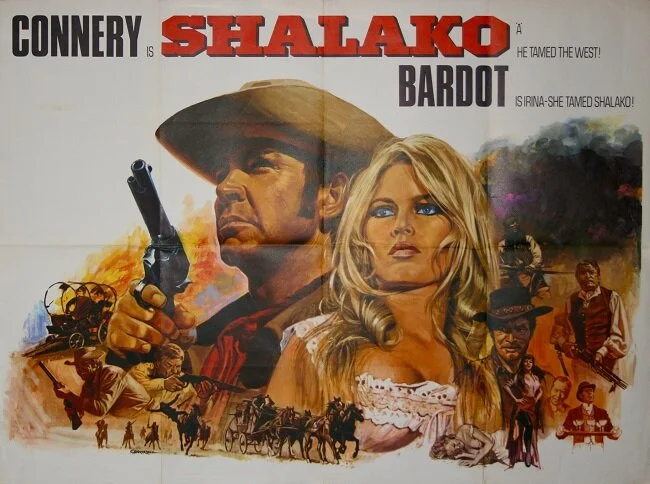
From the 1950s to the mid 1970s, most major film stars would appear in a western at some point in their career. The western genre was simply too popular and lucrative to avoid or dismiss. So it probably won’t come as a surprise to learn that after he walked away from James Bond in 1967, Sean Connery appeared in the western Shalako, a year later. Based on a novel by Louis L’Amour, this European financed production with an international cast is a curious beast that straddles two competing approaches to the genre. The traditional, romanticised western with its stylised tropes was giving way to a grittier, revisionist approach. Shalako still feels like an example of the former but director Edward Dmytryk does not shy away from the more contemporary use of violence. The film drags, especially during the awkward romantic interludes between Connery and Brigitte Bardot. But the action scenes are quite gritty and some of the story’s themes are quite dour.
From the 1950s to the mid 1970s, most major film stars would appear in a western at some point in their career. The western genre was simply too popular and lucrative to avoid or dismiss. So it probably won’t come as a surprise to learn that after he walked away from James Bond in 1967, Sean Connery appeared in the western Shalako, a year later. Based on a novel by Louis L’Amour, this European financed production with an international cast is a curious beast that straddles two competing approaches to the genre. The traditional, romanticised western with its stylised tropes was giving way to a grittier, revisionist approach. Shalako still feels like an example of the former but director Edward Dmytryk does not shy away from the more contemporary use of violence. The film drags, especially during the awkward romantic interludes between Connery and Brigitte Bardot. But the action scenes are quite gritty and some of the story’s themes are quite dour.
Shalako starts with an opening crawl by author Louis L’Amour, stating how many European nobles and dignitaries came to American to hunt and to experience the frontier. The story then focuses on a party of visiting aristocrats and a U.S. senator who are on a hunting expedition, while bringing all the trappings of their lifestyle with them. Servants, vintage wine and silverware as well their socioeconomic based hubris. Their questionable guide Bosky Fulton (Stephen Boyd) foolishly camps on Apache land incurring the wrath of the local chief and his warriors. When Countess Irina (Bardot) is waylaid by the Indians she is rescued by ex-army scout Shalako (Sean Connery), who had previously brokered a peace between the Indians and the US government. The pair return to the camp and inform Baron Frederick Von Hallstatt (Peter van Eyck) of the impending attack. However, neither the European dignitaries or Fulton and his men take the threat seriously. The subsequent raid the following dawn is barely repelled and leaves many dead. Fulton abandons his employer and his men take all the remaining food, water and ammunition. It is up to Shalako to lead the survivors out of Indian territory.
Filmed in Almeria, Spain, where so many international westerns were, Shalako boasts a strong cast, a desolate location and some well choreographed action scenes staged by former Bond stunt arranger Bob Simmons. On paper it all has the making for a solid western. Unfortunately the reality is somewhat different. The pacing is somewhat pedestrian and the screenplay struggles with the themes it attempts to explore. There’s a lot of unrequited love, marital resentment and lust simmering away among the characters. Senator Henry Clarke (Alexander Knox) blames his wife’s ethnicity for his political career stalling. Lady Daggett (Honor Blackman) despises her older husband (Jack Hawkins) and flirts with their guide Fulton. And Countess Irina is expected to marry the Baron but is conflicted by her desire for Shalako. These plot threads initially seem like they are going to be handled in a modern way, reflecting the changing morality of the sixties. Sadly all are resolved in a distinctly twee, old school fashion.
The story lurches between such dated scenes and several action sequences which although not especially graphic are tonally quite strong. One of Fulton’s team is captured by Indians and tied over a broken lance, while precariously balanced in a stress position. When he inevitably can no longer support his own body weight, he collapses and is impaled. One of the Baron’s staff is shot with a flaming arrow. He dies during a desperate attempt to remove it. Lady Daggett is captures by an Indian war party and there is a rather disturbing threat of rape as she is tormented by her captors. The casting of African American actor Woody Strode as an Apache is dated and somewhat risible. There is also an excess of the cast riding through the utterly barren terrain. Overall it feels as if the film could have lost fifteen minutes to tighten the flow of the story. The title song is another unnecessary hangover from earlier western films.
Shalako did not fare well in the US but did surprisingly well at the box office in Europe. However, due to the complexities of the film’s financing, the production just about broke even. Producer Euan Lloyd had a penchant for looking back at the golden age of Hollywood and attempting to recreate it at a time when the industry was moving on. Many of his later films would fall between similar stools. Paper Tiger, The Wild Geese and Who Dares Wins all boast strong casts and robust production values but are also saddled with politically naive storylines that are out of step with the contemporary views of the times. Shalako, as mentioned earlier, seems to want to be gritty and yet clings to a very formal western idiom at times. An odd outcome considering director Edward Dmytryk’s pedigree, with films such as The Caine Mutiny (1954) and Alvarez Kelly (1966). At most Shalako remains a cinematic curiosity. The only western that Sean Connery made and a rare British produced genre entry.

Soldier Blue (1970)
Soldier Blue is an American Revisionist Western from 1970, directed by Ralph Nelson, telling a fictionalised account of the events surrounding the 1864 Sand Creek massacre in the Colorado Territory. It was written by John Gay based on the novel "Arrow in the Sun" by Theodore V. Olsen and starred Candice Bergen, Peter Strauss, and Donald Pleasence. The title song was performed by Buffy Sainte-Marie. Released during the height of the Vietnam War against the backdrop of the Mỹ Lai massacre, it provided a depiction of a notorious incident in the history of the American frontier, in which troops massacred an undefended village of Cheyenne and Arapaho Indians. The film creates a back story involving the escape of white survivors from an earlier massacre of U.S. Cavalry troops by Indians. The film was controversial at the time not only as a revisionist western but for its graphic levels of violence. Director Nelson, pushed the depiction of the violence to new levels, showing graphic rape scenes, as well as "realistic" atrocities.
Soldier Blue is an American Revisionist Western from 1970, directed by Ralph Nelson, telling a fictionalised account of the events surrounding the 1864 Sand Creek massacre in the Colorado Territory. It was written by John Gay based on the novel "Arrow in the Sun" by Theodore V. Olsen and starred Candice Bergen, Peter Strauss, and Donald Pleasence. The title song was performed by Buffy Sainte-Marie. Released during the height of the Vietnam War against the backdrop of the Mỹ Lai massacre, it provided a depiction of a notorious incident in the history of the American frontier, in which troops massacred an undefended village of Cheyenne and Arapaho Indians. The film creates a back story involving the escape of white survivors from an earlier massacre of U.S. Cavalry troops by Indians. The film was controversial at the time not only as a revisionist western but for its graphic levels of violence. Director Nelson, pushed the depiction of the violence to new levels, showing graphic rape scenes, as well as "realistic" atrocities.
Forty-eight years later, what is the current opinion of this film? Well an integral aspect of any film review is the prevailing social mood and context at the time of release. Seventies America looked upon this piece of work with very different eyes than today. Liberal, anti-establishment sentiment was still not totally acceptable by the mainstream. America had still not come to terms with its past relationships with its indigenous people. In that respect Soldier Blue was considered to be quite an outspoken and radical piece of cinema, that despite its shocking nature, still had a social conscience. Soldier Blue gained a reputation, that followed it over the years, but overtime the focus on the films politics was lost. When I was growing up in the early eighties amid the "video nasties" witch hunt in the UK, this film was mentioned in the same breath as The Exorcist, Zombie Flesh Eaters or A Clockwork Orange and its political agenda was forgotten.
Considering the film with a more contemporary outlook, Soldier Blue is an awkward mixture of heavy-handed pacifist arguments, with such clichés as the cavalry riding roughshod over the American flag, light comedy and brutal violence. It is very much of its time in its approach to its subject. The female lead is an outspoken feminist and the young cavalry officer a naive puritan. The social stigma of a woman captured by Indians is explored and the military are painted as degenerate, homicidal rapists, run by cruel leaders with a genocidal agenda. Roy Budd's soundtrack is oddly inappropriate and misleads the audience as to the films tone. The films ending is still powerful but is not as visually shocking as you may anticipate. The depiction of violence and its acceptance into all aspects of mainstream TV and cinema really has softened the impact of the climatic massacre. On a purely technical level, special effects have improved so much over the decades. But it is the change in public perceptions toward violence itself, that makes an overall difference. I'm sure that if a group of contemporary teenagers were to watch this film, a percentage would simply not be moved or shocked by what they saw. However, I'm sure that an audience of a more senior nature, particularly parents may still be distressed by what they saw.
To truly appreciate the emotional impact of the films ending, you need to have a grasp of the historical legacy of the Native Americans and a sense of social conscience. Ralph Nelson film, being a product of its environment and time, may not necessarily connected to a modern audience. Over the years, there have been numerous releases of Soldier Blue in censored versions. In the UK, the current DVD release is still incomplete, missing much violence and several horse stunts that have been deemed cruel. However, the US Region 1 release is uncut, as is the Region 2 German copy. There are also Blu-ray releases featuring the uncut print of the film. Soldier Blue is a clumsy yet sincere piece of cinema. It tries to over simplify a historical incident so that it can draw parallels to the ongoing political misdeeds of its own time. It is of interest mainly due to its significance in the evolution of modern cinema. Falling between stools it remains a misguided curiosity and essentially a talking point among film historians.
Appaloosa (2008)
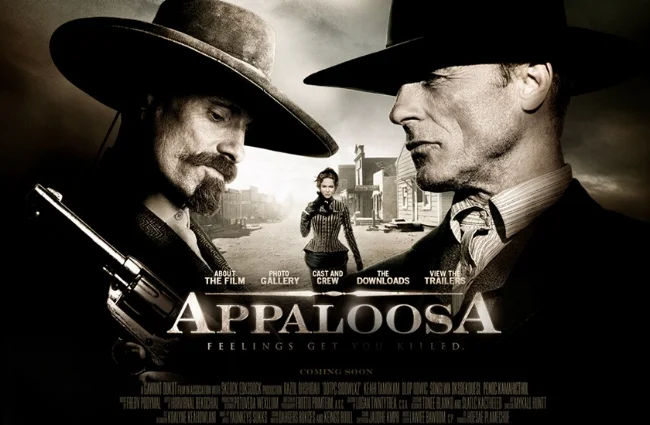
I have been revisiting the western genre and reacquainting myself with some of its more cerebral examples. Ulzanna’s Raid (1972) and Tom Horn (1980) certainly helped remind me of the diversity of themes and the scope of subjects that this genre has explored over the years. Obviously due to the westerns decline in popularity, there are fewer examples to cite from recent years, although I would single out Open Range (2003) and 3:10 to Yuma (2007). However, Appaloosa (2008) is a movie that embodies all the narrative qualities that a good western can achieve and furthermore it does so without the need to re-invent the wheel. In structural terms, this is old school cinema and all the better for it.
I have been revisiting the western genre and reacquainting myself with some of its more cerebral examples. Ulzanna’s Raid (1972) and Tom Horn (1980) certainly helped remind me of the diversity of themes and the scope of subjects that this genre has explored over the years. Obviously due to the westerns decline in popularity, there are fewer examples to cite from recent years, although I would single out Open Range (2003) and 3:10 to Yuma (2007). However, Appaloosa (2008) is a movie that embodies all the narrative qualities that a good western can achieve and furthermore it does so without the need to re-invent the wheel. In structural terms, this is old school cinema and all the better for it.
Ed Harris directs, co-writes, co-produces, sings (a ballad over the end credits) and stars in this traditional Western, based on a book by Robert B. Parker. Unlike other revisionist or deconstructionist westerns, Appaloosa feels more like a genre classic like John Ford’s My Darling Clementine. The film focuses on the characters rather than action and although there are shoot-outs, they are not overstated. The production feels very authentic (if there is such a thing to be found in the mythology of the cinematic western) and the cinematography by Dean Semler is outstanding, reflecting the harsh landscape and stark functional towns.
Central to this film is the friendship between Harris’ marshal, Virgil Cole, and Viggo Mortensen’s deputy, Everett Hitch. It’s the sort of deep understated relationship where one character can finish another’s sentences. Often more is conveyed by what’s not said. Such friendships are based on loyalty and this is an integral theme in Appaloosa. The status quo is sorely tested by the introduction of Widow Renée Zellweger and crooked rancher Jeremy Irons. Harris and Mortensen, who co-starred in A History of Violence (2005) are superb and there is solid support from the likes of Timothy Spall and the underrated Lance Henriksen.
Harris directs well and focuses on modern parallels, especially the distinction between enforcing the law and just killing people. His film extols the old-world virtues of honour and loyalty. He also explores the theme of a woman trying to survive in a man’s world and the tough choices she has to make to get by. The climatic showdown is more about the battle between a man and his conscience, rather than two dimensional notions of good versus evil. This is a thoughtful and somewhat old-fashioned film, that will suit those in a reflective mood, rather than action fans. It also clearly showcases why the western is such a broad and flexible genre that never grows old.
The Dark Tower (2017)
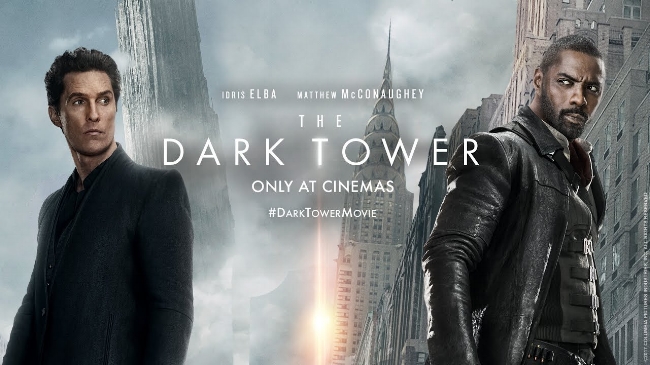
Stephen King’s body of work has proven to be an invaluable source of material for film and television over the last forty years. The results have often been as varied as the books themselves. Because of the inherent differences between the respective mediums, sometimes the complexity and sheer scope of King’s work can be lost in translation from one to the other. It’s happened before with several high-profile adaptations and it will no doubt happen again. The Dark Tower is a classic example failing to capture the essence of King’s work. Trying to distil and convey a mythos that is spread over eight volumes, into a single movie is a tall order for any director and screen writer. It can be cogently argued that material of this sort is better suited to television where lengthy, complex story arcs can be indulged and characters can be explored at leisure. In fact, during it’s time in development hell, The Dark Tower was at one point destined to be adapted for the small screen. However, the desire to create a lucrative film franchise ultimately prevailed.
Stephen King’s body of work has proven to be an invaluable source of material for film and television over the last forty years. The results have often been as varied as the books themselves. Because of the inherent differences between the respective mediums, sometimes the complexity and sheer scope of King’s work can be lost in translation from one to the other. It’s happened before with several high-profile adaptations and it will no doubt happen again. The Dark Tower is a classic example failing to capture the essence of King’s work. Trying to distil and convey a mythos that is spread over eight volumes, into a single movie is a tall order for any director and screen writer. It can be cogently argued that material of this sort is better suited to television where lengthy, complex story arcs can be indulged and characters can be explored at leisure. In fact, during it’s time in development hell, The Dark Tower was at one point destined to be adapted for the small screen. However, the desire to create a lucrative film franchise ultimately prevailed.
As an action fantasy, The Dark Tower is rather traditional in its themes, use of archetypes and narrative structure. Teenager Jake Chambers (Tom Taylor) has recurring dreams involving a Man in Black (Matthew McConaughey) who seeks to destroy a Tower and bring ruin to the universe. He also sees a Gunslinger (Indris Elba) who opposes him. Jake's mother (Katheryn Winnick) and stepfather believe that he has been traumatised by his father's death the previous year and arrange for him to be taken into psychiatric care. However, Jake recognizes the Doctor and her staff from his visions. They are in fact monsters wearing human skin, so he subsequently escapes. Finding a portal in an abandoned house, Jake travel to Mid-World where he meets the legendary Gunslinger Roland Deschain. However, Deschain is a broken man who only seeks revenge for the death of his father (Dennis Haysbert). Can Jake convince him to save the Dark Tower and universe that it protects?
Although I have read many of Stephen King’s book, I am not familiar with the source material in this instance, beyond its initial premise. Therefore, I approached The Dark Tower with little or no preconceptions and a distinct lack of fan based baggage. What became very apparent while watching the film, was the pacing of the story and the flow of the narrative, which were very fast. Characters were introduced, plot points were explained and the story arc was propelled forward at an unusually quick pace. All of which smacks of a movie that has been excessively re-edited and retooled. I suspect the original vision of the movie was changed in post-production and revised for a different demographic.The film as it currently stands has a very simplistic and linear trajectory. There is little or no depth to any of the central characters and no insight into Mid-World beyond what we are shown. As a result, the film lacks any tension or dramatic hold over the audience. The Dark Tower does look like a high budget movie but its overall narrative has precious little substance. Its ninety-five-minute running time is far too short and the film needs at least another twenty to thirty minutes to expand upon its themes.
There are only three action sequences of note in The Dark Tower but they lack impact due to their arbitrary nature. The movie is also somewhat shy of violence and I suspect that a lot material was edited out. The camera moves way from such content, rather than substituting it with more bloodless material, as is the norm with PG-13 rated movies. The devil is in the detail. At one point a sniper is shot through the telescopic sight of his rifle. The optics shatter, his head whips back and then there is a fast cut to the next step in the action scene. It feels like there is a specific bullet hit missing and the rhythm of the scene just feels off. The net result of this lack of gritty action, as well as the condensed narrative, is that the entire film is somewhat indifferent. Rather than feeling enthused by the characters and their fate, there’s a distinct air of “so what” when the film ends. It’s a shame because The Dark Tower could have been a welcome change to the usual fantasy and super hero driven franchises. However, it looks increasingly unlikely that we’ll see a sequel to this movie in the immediate future due to its poor box office and critical reception.


The Hunting Party (1971)
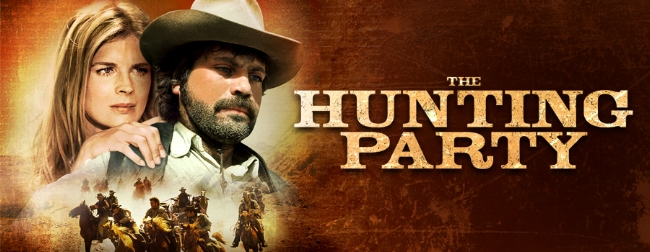
The Hunting Party is a curious Western, made at a time when the genre was struggling to maintain its popularity with the viewing public. Melissa Ruger (Candice Bergen) is a school teacher married to wealthy Cattle Baron, Brandt Ruger (Gene Hackman). When she is abducted by outlaw Frank Calder (Oliver Reed) and his gang, he husband is naturally incensed. He quickly arranges a posse of business associates and uses his personal fortune to equips them all with the latest long-range hunting rifles with telescopic sights. He then sets off in pursuit of Calder's trail before they can cross the border. However, it soon becomes apparent to Ruger’s associates that he may have other motives than just rescuing his wife.
The Hunting Party is a curious Western, made at a time when the genre was struggling to maintain its popularity with the viewing public. Melissa Ruger (Candice Bergen) is a school teacher married to wealthy Cattle Baron, Brandt Ruger (Gene Hackman). When she is abducted by outlaw Frank Calder (Oliver Reed) and his gang, he husband is naturally incensed. He quickly arranges a posse of business associates and uses his personal fortune to equips them all with the latest long-range hunting rifles with telescopic sights. He then sets off in pursuit of Calder's trail before they can cross the border. However, it soon becomes apparent to Ruger’s associates that he may have other motives than just rescuing his wife.
Shot on location in Almería Spain, this gritty western has a strong cast and an intriguing premise. Calder kidnaps Melissa so she can teach him to read. Ruger, a brutal, sadistic and sexually impotent man, is more concerned about maintaining his reputation and demonstrating that no one touches his property. Melissa is drawn to Calder despite his outlaw persona and hopes to save him from himself. However, director Don Medford fails to develop any of these story lines and instead opts to shock with sexual violence and brutal slow-motion shootouts. Ruger’s long-range rifles allow him and his posse to conveniently pick off Calder's men from a great distance.
Despite the films shortcoming it is very interesting to see Oliver Reed in a western and as ever, he acquits himself as well despite the flaws in the screenplay. There is an solid soundtrack by Riz Ortolani and good make up effects by José Antonio Sánchez. The seventies produced many hybrid westerns as the genre strived to maintain its relevance. Sadly, The Hunting Party ultimately fails to make its mark. The themes of Stockholm Syndrome and self-fulfilment are left undeveloped. The film tries to emulate Peckinpah but falls short of his narrative standards. Perhaps director Don Medford, thought the bleak ending was making a broader point. As it stands it simply ends a story that has nowhere else to go.
The Outlaw Josey Wales (1976)
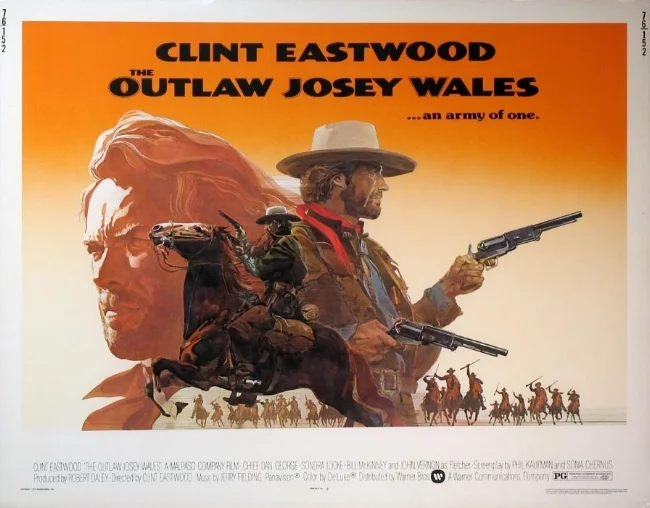
The Outlaw Josey Wales is often hailed as the last great western from the golden era of the genre. As a child when I first saw the movie, I failed to appreciate its subtleties, having been raised on a more traditional diet of movies from this genre such as El Dorado. It has only been in more recent years that I have revised my opinion of this finely crafted piece of cinema. It is radically different from the much of Clint Eastwood's earlier work and most certainly displays a quality in his film making that was not apparent previously.
The Outlaw Josey Wales is often hailed as the last great western from the golden era of the genre. As a child when I first saw the movie, I failed to appreciate its subtleties, having been raised on a more traditional diet of movies from this genre such as El Dorado. It has only been in more recent years that I have revised my opinion of this finely crafted piece of cinema. It is radically different from the much of Clint Eastwood's earlier work and most certainly displays a quality in his film making that was not apparent previously.
Actor and director Eastwood called The Outlaw Josey Wales, "an anti-war film". This western, set during the Civil War decade, certainly addresses themes that can be seen as allegorical of the Vietnam War. However upon repeated viewing the movie offers more and more, showing great depth with its exploration of racial politics, spiritual redemption and the burden of obligation. Once again the universal medium of the western genre provides a broad canvas for an interesting analysis of the human condition.
Eastwood is a very functional director and his earlier works are often quite linear and minimalist. The Outlaw Josey Wales on the surface offers simple story of revenge and reconciliation. Yet despite the subtlety of its narrative, the film provides a wealth of complex characters. The script by Philip Kaufman is lean yet there is a great deal of weight to most of the dialogue. The production benefits from a strong ensemble cast with memorable performances from John Vernon, Will Sampson and Paula Trueman. Yet it is Chief Dan George who steals the show as Lone Watie. His performance as a world weary Indian is an absolute delight.
What makes The Outlaw Josey Wales so different from contemporary movies is it's foundation in strong characterisation. Eastwood's functional approach to film making allows viewers to focus on the story and its protagonists. That's not to say that there aren't any good set pieces, because there are. However they are an embellishment, rather than a focal point and do not detract from the from the main story. The reason the movie works so well is because we care about those we are watching. This is something that is so often lacking from many of the movies I see nowadays.
Perhaps this movies master stroke is its ending which takes the concept of the classic showdown in a different direction and resolves the underlying conflict between Eastwood and Vernon is an unexpected way. It makes several thought provoking statements that give the viewer much to reflect on. Cinema is after all not quite the passive experience that some would have you believe. Such is the nature of quality film making and The Outlaw Josey Wales is a fine example of such. It certainly deserves its reputation and rates highly amongst Clint Eastwood's finest work.
El Dorado (1966)
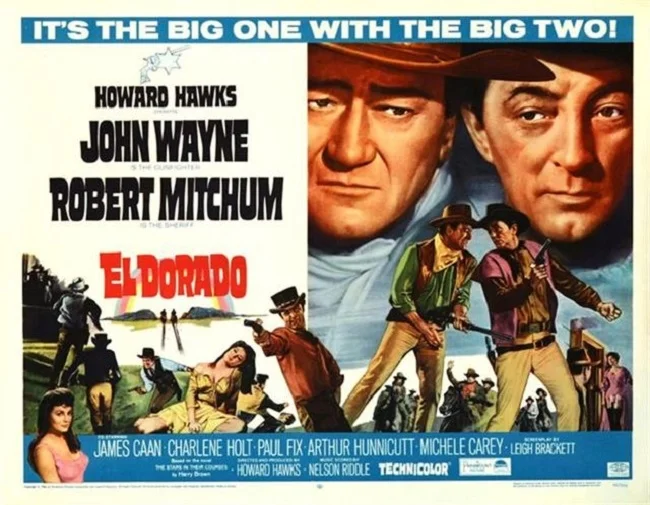
El Dorado opens with a montage of paintings by celebrated Western artists Olaf Weighorst. These beautiful pictures in many ways reflect the nature of the movie, depicting a stylised representation of the Old West that despite its beauty, never really existed. Director Howard Hawks includes every possible genre trope and meme into El Dorado but far from being a handicap, it makes the movie a perfect distillation of Hollywood Western. The pairing of John Wayne and Robert Mitchum is sublime as the two effortlessly riff off each other. If you need an example of how the Western is the most flexible and accessible movie genre, then El Dorado is a text book example.
El Dorado opens with a montage of paintings by celebrated Western artists Olaf Weighorst. These beautiful pictures in many ways reflect the nature of the movie, depicting a stylised representation of the Old West that despite its beauty, never really existed. Director Howard Hawks includes every possible genre trope and meme into El Dorado but far from being a handicap, it makes the movie a perfect distillation of Hollywood Western. The pairing of John Wayne and Robert Mitchum is sublime as the two effortlessly riff off each other. If you need an example of how the Western is the most flexible and accessible movie genre, then El Dorado is a text book example.
Wayne plays Cole Thornton, a hired gun who travels El Dorado to pursue a potential job offer from Rancher Bart Jason (Ed Asner). Jason needs Thornton to remove my any means, a rival rancher who own the local water rights and to also take care” of local Sheriff J P Harrah (Robert Mitchum). Thornton refuses the contract as Harrah is a friend and subsequently leaves town. Six months later Thornton returns to El Dorado to find his friend has become a drunk after being crossed in love. The range war has also escalated and Bart Jason now has a formidable army of men, led by notorious gunman Nelse McLeod (Christopher George, sporting an excellent scar and contact lens). Outnumbered, Thornton and Harrah try to keep the peace with only the help of an old Indian fighter (Arthur Hunnicutt) and an inexperienced greenhorn called Mississippi (James Caan).
The mid-sixties were a very interesting time for Hollywood as writers and directors tired of the status quo, started pushing boundaries of movie ratings. El Dorado blends traditional Western machismo with Greek tragedy and plenty of sassy dialogue. It is also quite violent for the times, something that becomes more apparent with the clarity of the latest Blu-ray release. Although predominantly set bound, the film does have some scenic what location work. The chemistry between the two leads is by far the movies strongest selling point and their real life friendship is clear. Leigh Bracket’s script is loaded with wise cracks, Western philosophy and musings on the Code of the West. Caan and Hunnicutt are great foils.
On release El Dorado was considered to be a little old school compared to the emerging revisionist trends of the time. The ballad that plays over the opening credits, sung by George Alexander and The Mellomen, is very traditional. Nelson Riddles score conversely has quite a contemporary arrangement. The movie sits squarely between the old and the new. Its theatrical release was delayed by Paramount so that it would not clash with Nevada Smith, which depicted a far more cynical and bleaker interpretation of the West.
Over the years El Dorado has grown in critical and public acclaim and is now rated more highly than it was upon its initial release. Roger Ebert gave the film a near-perfect rating at 3 1/2 out of four stars, stating “El Dorado is a tightly directed, humorous, altogether successful Western, turned out almost effortlessly, it would seem, by three old pros: John Wayne, Robert Mitchum and director Howard Hawks”. The movie certainly made an impact upon me as I saw it as a child and has stayed with me over the years. I still have a soft spot for Edgar Allan Poes poem Eldorado that is quoted by James Caan throughout the movie.
My Name is Nobody (1973)
As the Western waned in popularity in the seventies, the Italian market was still further revising this already stylised genre with a distinctly comedic element. The uniquely European approach to slapstick was introduced as a mean to try and explore the genre in new ways. Unlike US comedy Westerns such as The Hallelujah Trail and There Was a Crooked Man, their Italians counterparts seemed to have an allegorical theme and as ever a heavy political sub-text. They were also steeped in the unique audio and visual style of their makers.
As the Western waned in popularity in the seventies, the Italian market was still further revising this already stylised genre with a distinctly comedic element. The uniquely European approach to slapstick was introduced as a mean to try and explore the genre in new ways. Unlike US comedy Westerns such as The Hallelujah Trail and There Was a Crooked Man, their Italians counterparts seemed to have an allegorical theme and as ever a heavy political sub-text. They were also steeped in the unique audio and visual style of their makers.
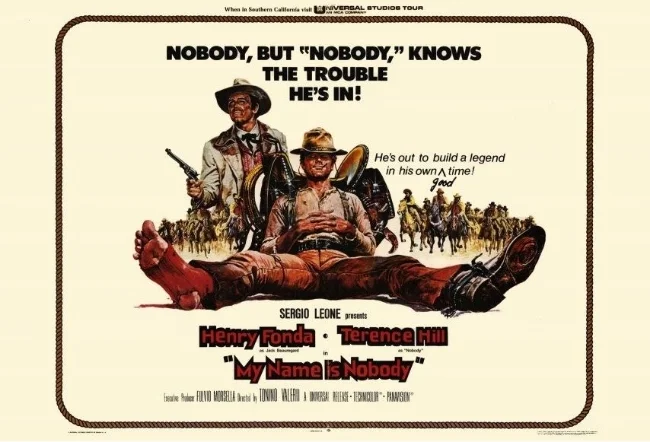
My Name is Nobody (Il mio nome è Nessuno) is perhaps the most obvious example of this curious cinematic sub-category, pairing iconic Hollywood Western actor Henry Fonda with the visually charismatic Terence Hill (Mario Girotti). Upon first look this is a simple tale of an ageing gunman Jack Beauregard, who’s tired of his legendary reputation and the constant attempts upon his life from those who seek fame by killing him. Things take a curious turn when he meets an enigmatic Saddle Tramp (who claims to be “nobody”), with an unorthodox plan to take his crown. After a series of misadventures the unlikely pair find themselves facing The Wild Bunch; a gang of a hundred gunmen.
My Name is Nobody is a leisurely paced movie with many of the usual tropes of the genre. Gunfights are meticulously staged and shot (the opening scene was allegedly conceived and devised by Sergio Leone). There are also extensive slow motion montages of horseman riding, set to yet another outstandingly quirky Ennio Morricone Soundtrack. Director Tonino Valerii handles the simple slapstick humour with aplomb. Viewers have the option of ascribing a deeper meaning to the story, if they are of a philosophical bent.
This is an enjoyable Western, if approached with the right frame of mind. The humour is mainly visual and of a physical nature. Don’t go expecting anything like Blazing Saddles. As ever with a genre that is more interested in style and aesthetics rather than logic, there are several plot holes and tonal inconsistencies. Also be aware that there are a large amount of horse falls in the climatic action sequence. Such stunt work is not to everyone’s liking. Overall My Name is Nobody is a curious hybrid and in some ways that in itself makes it quite special. Such experimentation with an established genre is a rarity these days.
From the 1950s to the mid 1970s, most major film stars would appear in a western at some point in their career. The western genre was simply too popular and lucrative to avoid or dismiss. So it probably won’t come as a surprise to learn that after he walked away from James Bond in 1967, Sean Connery appeared in the western Shalako, a year later. Based on a novel by Louis L’Amour, this European financed production with an international cast is a curious beast that straddles two competing approaches to the genre. The traditional, romanticised western with its stylised tropes was giving way to a grittier, revisionist approach. Shalako still feels like an example of the former but director Edward Dmytryk does not shy away from the more contemporary use of violence. The film drags, especially during the awkward romantic interludes between Connery and Brigitte Bardot. But the action scenes are quite gritty and some of the story’s themes are quite dour.