
60 Years of Star Trek
Star Trek is slightly older than me by 14 months. I was born on December 18th 1967. Star Trek was first broadcast in the US on 8th September 1966. Hence this show has always been part of the prevailing pop culture that surrounded me, as I grew up. I first began watching Star Trek as a young child in the early seventies. It would be repeated on the BBC in the early evening on Fridays and it became a family ritual to sit down together and watch it. As a seven or eight year old, it left a great impression upon me and was in many ways, the television highlight of the week. Star Trek along with Doctor Who certainly started my interest in science fiction. Star Trek was also one of the first shows that introduced me to tie-in marketing. I remember seeing in a toy shop, near to my school at the time, a Dinky Klingon Battle Cruiser and was flabbergasted that such a thing existed. I immediately coveted it but sadly never obtained one.
Star Trek is slightly older than me by 14 months. I was born on December 18th 1967. Star Trek was first broadcast in the US on 8th September 1966. Hence this show has always been part of the prevailing pop culture that surrounded me, as I grew up. I first began watching Star Trek as a young child in the early seventies. It would be repeated on the BBC in the early evening on Fridays and it became a family ritual to sit down together and watch it. As a seven or eight year old, it left a great impression upon me and was in many ways, the television highlight of the week. Star Trek along with Doctor Who certainly started my interest in science fiction. Star Trek was also one of the first shows that introduced me to tie-in marketing. I remember seeing in a toy shop, near to my school at the time, a Dinky Klingon Battle Cruiser and was flabbergasted that such a thing existed. I immediately coveted it but sadly never obtained one.
When Star Wars proved a box office success, the major Hollywood studios rushed to produce films that could satisfy the public’s need for more science fiction. I can remember getting very excited when Star Trek: The Motion Picture was announced and the classic cast reassembled. Yet the film’s hard science fiction story which focused on ideas rather than action, left me somewhat underwhelmed when I finally saw it. I have subsequently revised my opinion of it as an adult but it is a somewhat incongruous entry into the Trek canon, being far more cerebral than the show it proceeded. I enjoyed immensely, it’s sequel, Star Trek II: the Wrath of Khan, although Spock’s death at the time, broke me. It is curious the parasocial attachments you can form with fictional characters.
When Star Trek: the Next Generation was announced, I can remember my Mother adopting a very scorched earth policy towards it, before she had even seen the show. She just thought the idea was heretical. I remember that the UK papers gave a lot of coverage to this story, mainly due to a British actor being cast in the lead role. Like most TV shows in the seventies and eighties, it took a while for TNG to be shown in the UK. Released in the US in the autumn of 1987, it was show on the BBC in 1990. However, the first season or two had been released on VHS tape which had two episodes. We rented these from Blockbuster and was disappointed by the extremely poor picture quality. TNG was shot on 35m film but then transferred to NTSC video format for editing. This when combined with a further transfer to PAL video format resulted in a terrible fluorescent picture with a soft image quality. This combined with the overall weak scripts of the first few season left me somewhat indifferent to TNG. However, the subsequent feature films rekindled my interest and I have revisited the show since and now think far better of it.
By the time Star Trek: Deep Space Nine was shown, I was an adult of 23. This was for me the era of peak Trek and this show epitomised why I liked the franchise. In many ways it was the first show to stray furthest from Gene Roddenberry’s original formula with a stand alone episode of the day and the unequivocal optimism about the rectitude of Starfleet and the future overall. DS9 dealt in ambiguity, politics versus ethics and the human cost of war. It had some great characters and it clealry define the franchise as being for grown ups in so far as what it was exploring. Due to adult life and real world commitments, I caught up with Star Trek: Voyager and Star Trek: Enterprise after their initial broadcasts. I liked them both and thought they did a good job or expanding the lore yet remaining true to the central themes of Trek.
Which brings me to what we shall call modern Trek which I think has been a varied endeavour. I actually didn’t have a problem with the new feature films from this era. The Kelvin Timeline by its very nature is a separate entity and as such can be totally ignored if its not found to your liking. I quite liked it and found it sufficiently entertaining in a big spectacle sort of way. Star Trek: Discovery was a much harder experience to adjust to. Characters like Saru were and remain great but lots of other elements of the show were wanting. I felt that DISCO leaned too far into modern sensibilities and rather than casually referencing them focused too muc upon them in a performative fashion. Hence I christened the show “Hug Trek”. However by season 3 the show got more interesting once it went into the 32nd century. Star Trek: Picard was a very enjoyable fan service that tied up some interesting loose ends. Star Trek: Strange New Worlds started with a lot of promise but for me, peaked in the third season and has dropped in quality recently. The writers seem to be a little too experimental and some of the idea are too off the wall and there’s not enough respect for cannon.
I have always enjoyed Star Trek as a franchise and like its themes of a collaborative exploration with Starfleet striving to be a benign quasi-military body. When compared to another popular sci-fi franchise (you can guess which one), I consider this far more cerebral. It deals with all the problems we have faced with modernity and real life from the sixties to the present, via the medium of genre fiction and it has consistently done it well. Trek has also done much to make pop culture and fandom mainstream. There was a time in the seventies where Trek was very much the face of fandom. As for what it has done for pop culture, well pretty much everyone knows who Captain Kirk is. I also consider Spock to be one of the finest fictional characters ever created, especially in his later years. You can write another blog post about how Trek has impacted upon technology. So many people who now work in such industries grew up watching the show.
Let us take a moment to be realistic. If history teaches us anything, it is that the future that we see in Star Trek is not going to happen, anytime soon. However, that does not mitigate the shows central themes. The merit of Star Trek resides in its message and how that message impacts upon people. Because Trek inspires hope and considers the possibility of humans at their best. When we watch the show in all its incarnations, we briefly feel positive about ourselves as a species. That makes viewers feel good about themselves at time when the wider world is the absolute opposite of Gene Roddenberry’s vision. I think that is important and something we should reflect upon now that the franchise is entering yet another new era now that its corporate ownership has changed. I sincerely hope that people will be celebrating Star Trek in another sixty years. Assuming we’re still here. Human, I mean. In the meantime, we will always have Galaxy Quest. “Never give up, never surrender”.
Star Trek Axanar is back in the news, twelve years on from the last controversy. For those unfamiliar with the original debacle, in 2014 Prelude to Axanar was released via YouTube. This Star Trek “fan-film” presented as a faux 21-minute, Starfleet documentary was very well received by fans and was intended by its makers as a proof of concept for a feature-length film. Set in the year 2245, during the final year of the Four Years War against the Klingons, Prelude to Axanar pushed the boundaries of what a fan film could be. The subsequent Kickstarter and Indiegogo campaigns raised more than $1.1 million. Prelude to Axanar was promoted as a professional-quality, “independent” Star Trek production, employing experienced actors and filmmakers and even established its own studio facilities. The presence of such actors as Richard Hatch, J. G. Hertzler, Kate Vernon, Tony Todd and Gary Graham (resuming his role as Vulcan Ambassador Soval) certainly made Prelude to Axanar distinct from other fan-films.
Thoughts on TV shows and my current viewing habits.
I last wrote a blog post in this series back in February 2022. Then for various reasons, I stopped. Possibly because my relationship with TV has changed in recent years. It’s fair to say at present that viewers are spoilt for choice. There are lots of very good shows around. Conversely, there is also a lot of bland, generic, filler as well. I appreciate that not every television series has to be an industry milestone and there are times when I’m content to watch undemanding content. However, I am very protective of how I spend my leisure time at present. I am not prepared to sink 6 or 8 hours into a show that is just “okay”. Hence I’m becoming very particular about what I watch. If something isn’t working for me in any fashion then I just abandon it and am happy to do so.
Jerry Goldsmith’s contribution to Star Trek is immense. Yet simply listing the films and TV episodes he wrote music for does not adequately encapsulate the significance of his contribution to the franchise. His majestic, thoughtful and uplifting musical scores provide an emotional foundation that reflects the core ethos of Star Trek. They also create an invaluable sense of continuity that spans multiple shows and movies. Perhaps the most obvious example of this is his iconic title music for Star Trek: The Motion Picture (1979) that was subsequently adopted as the theme tune for Star Trek: The Next Generation. His work was held in such high regard, when Star Trek V: The Final Frontier (1989) ran into production issues, it was thought that a Jerry Goldsmith soundtrack may well elevate the film. Sadly it didn’t but his work on that instalment was outstanding and among his best.
Star Trek documentaries are very much like Bruce Lee documentaries, in so far as they’re both a saturated market and more often than not, new content frequently ends up covering the same ground. However, fans tend to watch anything new in the hope that they will find a few new nuggets of information. Brian Volk-Weiss’ new 11 part series, The Center Seat: 55 years of Star Trek, not only covers established facts about the iconic show but also expands upon them as well as providing a wealth of new information. Volk-Weiss has previously explored popular culture with documentaries such as The Toys That Made Us and The Movies That Made Us. The Center Seat: 55 years of Star Trek is an in-depth chronological study of the Star Trek franchise, from its creation at Desilu Productions in 1965 all the way through to the latest iterations, Star Trek: Picard and Star Trek: Discovery.
I recently watched the first trailer for the new Obi-Wan Kenobi television show that is premiering on Disney + in May. I am interested in this latest instalment in the Star Wars franchise and curious as to whether Liam Neeson will make an appearance. I also watched a 20 minute fan video in which they “analysed” the entire trailer. They discussed the content of this 2 minute preview and then did a great deal of speculating about potential themes and characters that may feature in the show. They were clearly enthusiastic about what they had seen and were very knowledgeable about the subject. This resonated with me, as I like to be well versed about the things I enjoy. However, it is worth remembering that fandom can tip into obsession and gatekeeping. Hence I feel there is a subject to explore here.
Before we start, no I am not writing about Alexander Courage’s classic main theme for the original Star Trek show. I can add nothing further to that particular discussion and it remains iconic and inspiring, even when distilled down to just the initial fanfare. In this post I want to draw your attention to another piece of music from Star Trek that has permeated its way into popular culture. A cue that when heard, if the listener is familiar with its provenance, will instantly conjure up images of flying drop kicks, ear claps and judo chops. A piece of music that can be added to pretty much any video footage and instantly make it more heroic. Yes, I am talking about what has become generically known as Star Trek “fight music”. Or more specifically, the "The Ancient Battle/2nd Kroykah" cue from Amok Time (S02E01) composed by Gerald Fried. The scene during the koon-ut-kal-if-fee ritual in which Spock fights Kirk on the planet Vulcan for complicated “reasons”.
Star Trek: The Motion Picture is a wonderful paradox in the Star Trek cinematic pantheon. It is possibly the most hardcore science fiction story that the franchise has explored and is both simultaneously Trek-like and un-Trek-like. Director Robert Wise and the production team worked hard to deliver a completed film for the scheduled December 1979 release date. However, he felt that the theatrical version was only a “rough cut”. Hence in late 2001 he supervised a Director’s Edition of the film which runs 136 minutes (4 minutes longer than the theatrical release)and reinstates some additional scenes and replaces some of the optical effects with new CGI creations. Critics were divided as to whether the Director’s Edition improved the film overall but Wise felt that this version was much closer to his original vision. The Director’s Edition was released exclusively on DVD in standard definition.

Fan Edits are a curious film sub genre. Some simply reinstate deleted scenes to maximise the running time of a movie. Others will remove footage and seek to reorder events in the name of coherency. But a few are far more ambitious. Rather than just reshape what is there, they will shoot new footage to replace material deemed substandard and seek to totally reimagine a movie. On even rarer occasions a few manage to actually improve upon the original, rather than just offering an augmented version. Which leads me onto Star Trek: beyond the Barrier, an interesting and very enjoyable fan edit of Star Trek V: The Final Frontier by Anti-Matter from deLimited Productions. It attempts to repair many of the problems found in the theatrical release of the movie. Some would argue that such a task is a Kobayashi Maru test in itself. However, the results are surprisingly good and some tongue in cheek humour shows that the creator understands the nature of their task.
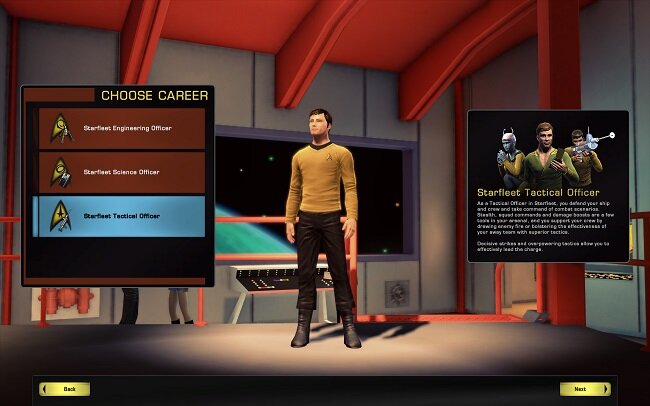
Welcome to the second part of my Star Trek Online: Beginners Guide. I thought it may be useful to write a series of posts, offering practical information for those who are just starting out in STO. Nothing fancy or in any way definitive. Just a few basic tips that may help orientate the new player. I’ve been playing STO since its launch in 2010 and this MMO has seen a lot of changes. The game features a lot of systems and mechanics that are not always immediately intuitive to grasp. So I’ll be doing my best to cover a selection of these in each post and try to provide a broad overview. Like a lot of advice, it can be subjective. Ultimately it comes down to each player how they wish to play. In this instalment, I shall be writing about career paths, factions and races.
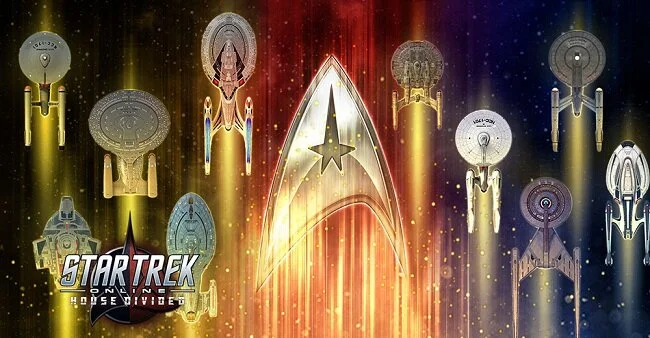
Today is Star Trek Day. An officially sanctioned celebration of all things Star Trek. The date reflects the launch of the original television show, back in the sixties. Naturally, there are a multitude of events going on over at the official Star Trek website. And as ever, the MMORPG Star Trek Online is taking part in the celebrations. “On September 8th, 1966, the world first met a group of people, and a ship, that would change our lives forever. Pitched as “wagon train to the stars,” and brought to TV by the force of Lucille Ball’s will, Gene Roddenberry’s Star Trek hit tiny television screens around the world and immediately captured hearts and minds. Through three seasons, and decades in syndication, The Original Series started a movement that still lasts today, more than half a century later. We live in a time where there’s more new Star Trek than ever before, and we’re joining with the rest of our Star Trek Family to celebrate the franchise’s birthday”.

I’ve mentioned in the past that a lot of important information regarding the MMORPG Star Trek Online is centralised within the official subreddit. That’s fine if you enjoy using this platform but it’s not for everyone. I’ve always found Reddit somewhat esoteric and I don’t really like the way it visually displays information. I have to use a browser addon to make it more user friendly. Unlike other communities, STO does not seem to have that many fan produced blogs. However, I may be wrong regarding this, so feel free to correct me (and provide URLs). In the meantime, I thought it may be useful to write a series of simple guides, offering practical information for those who are new to STO. Nothing fancy or in any way definitive. Just a few basic tips that may help orientate the new player. This time we’re going to look at the business model for STO and the cost of playing the game.
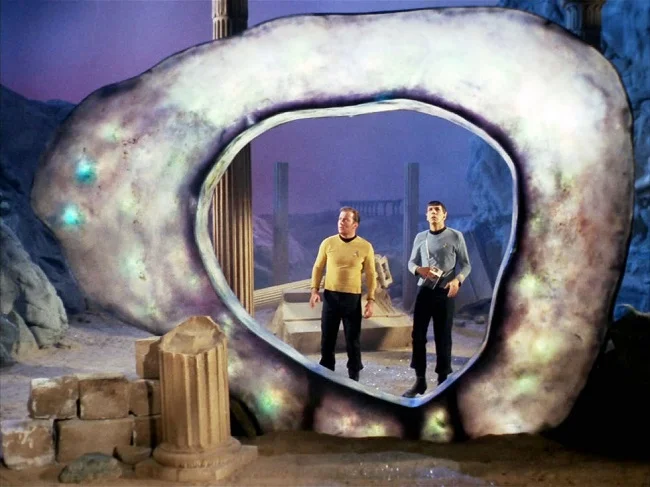
Out of the original seventy-nine episodes of Star Trek, one of the most respected and beloved is The City of the Edge of Forever. Written by Harlan Ellison the story is one of the more thoughtful and tragic in Trek Canon. It was also the first episode to feature a temporal plotline. Doctor Leonard McCoy (DeForest Kelley) accidently receives an overdose of medication and flees the Enterprise while in a delusional state. Beaming down to an alien planet he uses a temporal gateway (The Guardian of Forever) to travels back in time to earth during the Great Depression. By doing so he accidentally changes history. Captain Kirk (William Shatner) and Spock (Leonard Nimoy) follow him through the gateway to New York in hope of correcting the timeline. While awaiting the arrival of McCoy, Kirk falls in love with Edith Keeler (Joan Collins) who runs the 21st Street Mission. However he and Spock soon determine that to restore the timeline they must allow her to die.
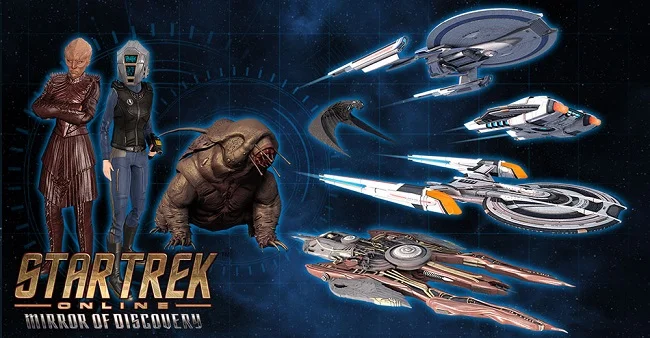
There has been a degree of controversy over the Discovery Operation Pack that has recently been made available for purchase in Star Trek Online. The bundle featuring ships, bridge officers, cosmetic items and more is displeasing some core players who feel that it is over priced and lacks anything relevant for Romulan and Klingon races. Personally, I’m only interested in two specific items from the pack, such as the Tier 6 Gagarin Miracle Worker Battlecruiser and the combat pet Tardigrade but at present they cannot be purchased separately. So, I shall not be parting with any money at present. The Gagarin Miracle Worker Battlecruiser is relatively similar to the Tucker Tactical Miracle Worker Cruiser, which I already own. However, it is an improvement aesthetically speaking (a subjective point, admittedly), so for me the obvious compromise is to purchase the fleet version and forgo the unique space trait and settle for an additional console slot. As I’m not a high-end player, the look and feel of a ship has as much appeal to me as its stats.
I have suffixed the title of this post “and stuff” so I can address several Star Trek Online related thoughts in a single blog post. Despite the fact that I frequently play STO it is does oddly get neglected in my writing. So, let us start with the issue of the ninth anniversary. As ever Q is back with the anniversary event and once again, we are stabilising Omega Molecules. This year’s reward is a Tier 6 Vulcan T’Pau Scout Ship. There are also emotes and sundry other items to earn during the duration of the festivities, but I more interested in the anniversary itself. Not many MMOs make it to nine years and if they do, they aren’t necessarily in as good shape as STO. The game has a stable and loyal playerbase and is currently tied-in to Star Trek: Discovery. Further established Trek actors are supplying voice acting and the game seems to be doing well across both PC and consoles. Like LOTRO, STO uses the IP well and seems to “fill in the gaps” in the existing lore as well as expand and extrapolate established canon. One of the best things about STO is that there’s always something to do in-game as well as new content in the pipeline. Perhaps this along with the handling of the IP is why the game endures.
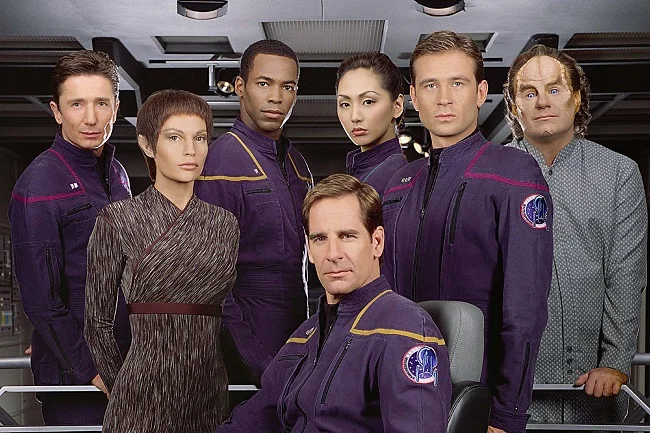
Star Trek: Enterprise was the first show in the Star Trek pantheon to have a song performed by an established artist play over the opening credits, rather than a traditional theme tune. Up until 2001, the franchise had maintained a more formal approach, established with the iconic introduction to the original series composed by Alexander Courage. Needless to say, such a radical departure from established practise brought about consternation and debate among fans. In some respects, you can argue that point about the entire show itself, but that as they say, is an entirely different blog post. Needless to say, the dislike and hatred that the song Where My Heart Will Take Me engendered in certain quarters, lead to a petition to have it removed. Needless to say, this movement failed, and the show continued using it for four seasons. Seventeen years on this particular debacle has now died down and the song is often just referenced ironically by fans as an amusing anecdote and piece of Trek trivia.
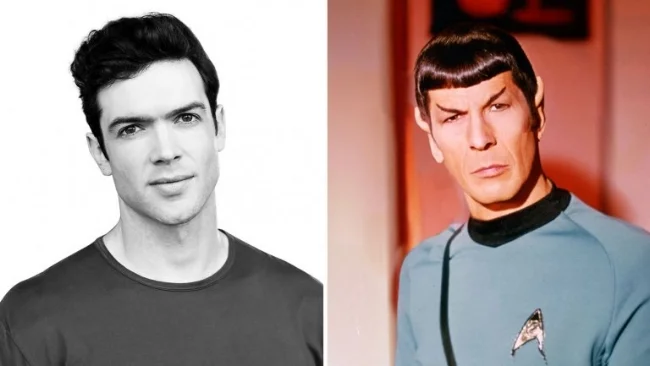
I’ve written in the past about the problems that can arise from untempered fandom. If enthusiasm and inspired love are not balanced by contextual reason and a healthy dose of reality, then it can get a little bit over zealous. Need I cite Star Wars fans and The Last Jedi as an example of unchecked fandom. However, I am now going to stray a little into the “Twilight Zone” of fandom myself, although I shall attempt to apply a healthy dose of realism into the proceedings. Because I want to discuss the fact that Ethan Peck has been cast to play one of the most iconic characters in popular culture. Yes, Gregory Peck’s grandson (and there’s plenty of “baggage” there) has been cast to play Spock in season two of Star Trek: Discovery. Furthermore, rather than be concerned, I am very excited by this development and I really look forward to seeing how this pans out.

After a prodigious marketing campaign and a great deal of internet speculation about one specific character, Star Trek Into Darkness was released to broadly strong reviews and solid box office returns in early May 2013. Finally, all the questions that had kept fans and website pundits endlessly theorising, were answered. For a second time running, Paramount Pictures managed to produce an action-filled blockbuster which still offered a strong plot, with complex and adult themes, explored by well-rounded characters. Batman Begins seems to have set a trend of framing material from a traditional pulp background, within broader intellectual parameters. Star Trek: Into Darkness managed to do this while cleverly re-imagining iconic material from its own lore. However, as with any substantial franchise movies, not everyone was satisfied or pleased. Many fans railed against the new Kelvin Timeline and continue to do so.

The reinvention of any popular franchise certainly comes with many risks. Twelve years ago, Casino Royale was hailed as a triumph in rebooting the 007 brand. It was hard edged, back to basics movie that made the spy genre relevant to a contemporary audience, without diluting its source material excessively. Yet this process went a step too far with Quantum of Solace, with a film that simply didn't feel Bond enough. Needless to say, the rights holders corrected this error. The success of the BBC's relaunch of Doctor Who hinged on making the formula accessible to modern viewers. Yet the new format of standalone episodes, celebrity guest stars and an emphasis on action over story, can be difficult to maintain and requires the involvement of top writers to keep the momentum going. Then of course there are the fans.
![Star Trek Discovery S01E01 The Vulcan Hello.mkv_snapshot_07.19_[2017.09.25_17.54.13].jpg](https://images.squarespace-cdn.com/content/v1/54e310f0e4b0f4a6ba3ac899/1506359625650-D976K1OBW47HSSSFN2S2/Star+Trek+Discovery+S01E01+The+Vulcan+Hello.mkv_snapshot_07.19_%5B2017.09.25_17.54.13%5D.jpg)
Finally, it’s arrived. The first new Star Trek TV show for twelve years. Star Trek: Discovery became available for Netflix UK customers to watch at 8:00 AM this morning. Needless to say, I cleared my schedule in advance so I could sit down and watch this much-anticipated show. Furthermore, I made it my business to avoid Twitter and the internet until I had finished viewing the first two episodes because I knew in advance that Star Trek: Discovery was going to be controversial and divide fans. Having now seen The Vulcan Hello and Battle at the Binary Stars and taken time to reflect upon both episodes, I have reached the following conclusion. From what we’ve seen so far, the spirit and emotional heart of Star Trek, is reflected in the new show. I found the characters to be interesting and well defined. Lead performances by Michelle Yeoh, Sonequa Martin-Green and Doug Jones were good and there’s an intriguing crew dynamic. The story has already touched upon numerous canonical themes and I am eager to learn more about the main characters and the universe they inhabit. I therefore shall continue to watch Star Trek: Discovery. However, not everyone feels the same, as my subsequent forays online have shown. Much has changed in this new iteration of Star Trek and as we know, some fans do not like change in any way, shape, or form.

Over the years I have been a participant in several fan based communities. These have ranged from running film clubs, to creating and publishing fanzines in the pre-internet days. More recently this has included running websites, blogging and creating podcasts. It’s a curious thing the way fandom is cyclical and one’s involvement with such communities seems to ebb and flow. It’s something I’ve been thinking about a lot of late. Several of the You Tube channels I enjoy have reduced their output or stopped due, to changes in advertising policy and monetisation. The Newbie Blogger Initiative failed to manifest itself this year and many of my immediate colleagues in blogging and podcasting have also begun to fade away or moved on to pastures new. The sad thing is, the true value of many community contributors is never really realised until after they’ve gone.

Fans are often a very creative and resourceful bunch. Star Trek fans especially so. At present, there’s a lack of new officially endorsed canonical content being produced. The movies set in the Kelvin Timeline are not universally embraced by Trekkies and usually take three years to produce. The new TV show Star Trek: Discovery has been subject to several production delays and still seems a long way off. So, the fans solution in recent years, has been to make their own original content. Hence there is a wealth of unofficial, independently made shows available online, set in various incarnations of the Star Trek universe. Although many of these productions are lovingly crafted and driven by passion, often they lack the professional polish of the genuine article. Frequently their weakness lies in the quality of the acting and writing. Then there is Star Trek Continues.
Adam Nimoy doesn’t paint a rosy picture of family life in his documentary about his father. The novelty of fame and popular acclaim soon wore off with it’s never ending photoshoots and long working hours that kept his father from ever being home. Yet among the anecdotes in this greatly condensed biopic there evidence of a lot of love and professional respect. Far from being comprehensive For the Love of Spock focuses on the matters that interest fans the most. So the documentary explores Nimoy’s relationship with Gene Roddenberry, his subsequent casting in Star Trek, his post Trek stage career and his return to the fold with the big screen movies.
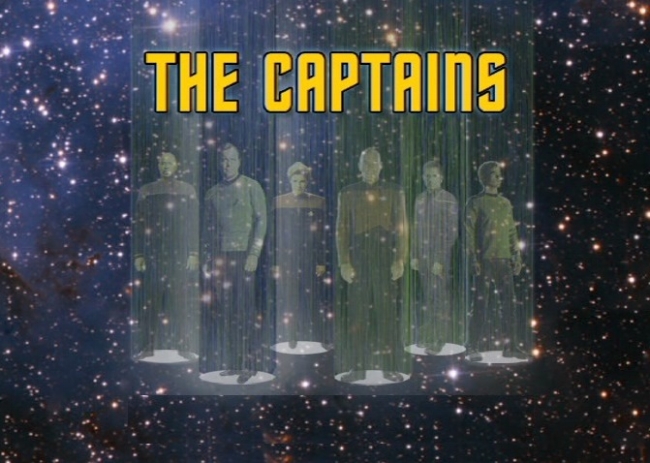
The Captains is a curious beast. If you’re expecting a traditional documentary where Bill Shatner simply indulges in a standard Q & A with other actors that have portrayed captains within the Star Trek franchise, then you will be disappointed. The Captains is a horse of a different colour entirely. Throughout its ninety minute duration, this documentary veers from personal reflections on acting, muses upon the nature of fame and even touches upon contemplating one’s own mortality. It certainly wasn’t what I was expecting and was subsequently a far more rewarding experience.
I am not a dogmatic fan. In fact as I get older, I become far more flexible and forgiving in my outlook. I certainly don’t buy into the concept that your “childhood can be ruined”. The only way something new can spoil the memories of something old that you hold dear, is if you allow it to. If you wish to explore this concept further, I’d suggest reading Marcus Aurelius. Back to the matter in hand. When I found out that Star Trek was to be rebooted via an alternative timeline plot device, I was content with this. I decided to ditch my personal baggage and try and be objective about the now named “Kelvin Timeline”. I make no bones about the fact I have liked the previous two Star Trek movies. Are they masterpieces? No. Are they entertaining? Yes. That is far more than some reboots have achieved.
The announcement that CBS has commissioned a new series of Star Trek is both a blessing and a curse. It’s a blessing in the sense that I have genuine affection for this franchise and therefore I welcome the prospect of a new incarnation of the show returning to TV. However I also consider this situation an absolute curse because well now have to endure at least eighteen months of idle speculation and an ongoing dissection of the entire production of a show before it is even released.
Trek Nation is a relatively straight forward documentary with a clear premise. It follows Eugene Roddenberry’s search to find out more about his father Gene and to understand the cultural phenomenon of Star Trek. Directed by Scott Colthorp the film endeavours to explore the enduring appeal of the franchise as Eugene discovers more about the father he didn't know and the show that passed him by. Through interviews with cast and crew members from all five Star Trek shows, as well as fans and celebrities who were influenced by the show while growing up, Trek Nation methodically follows a linear path. Yet this uncomplicated approach proves to very effective and surprising candid.
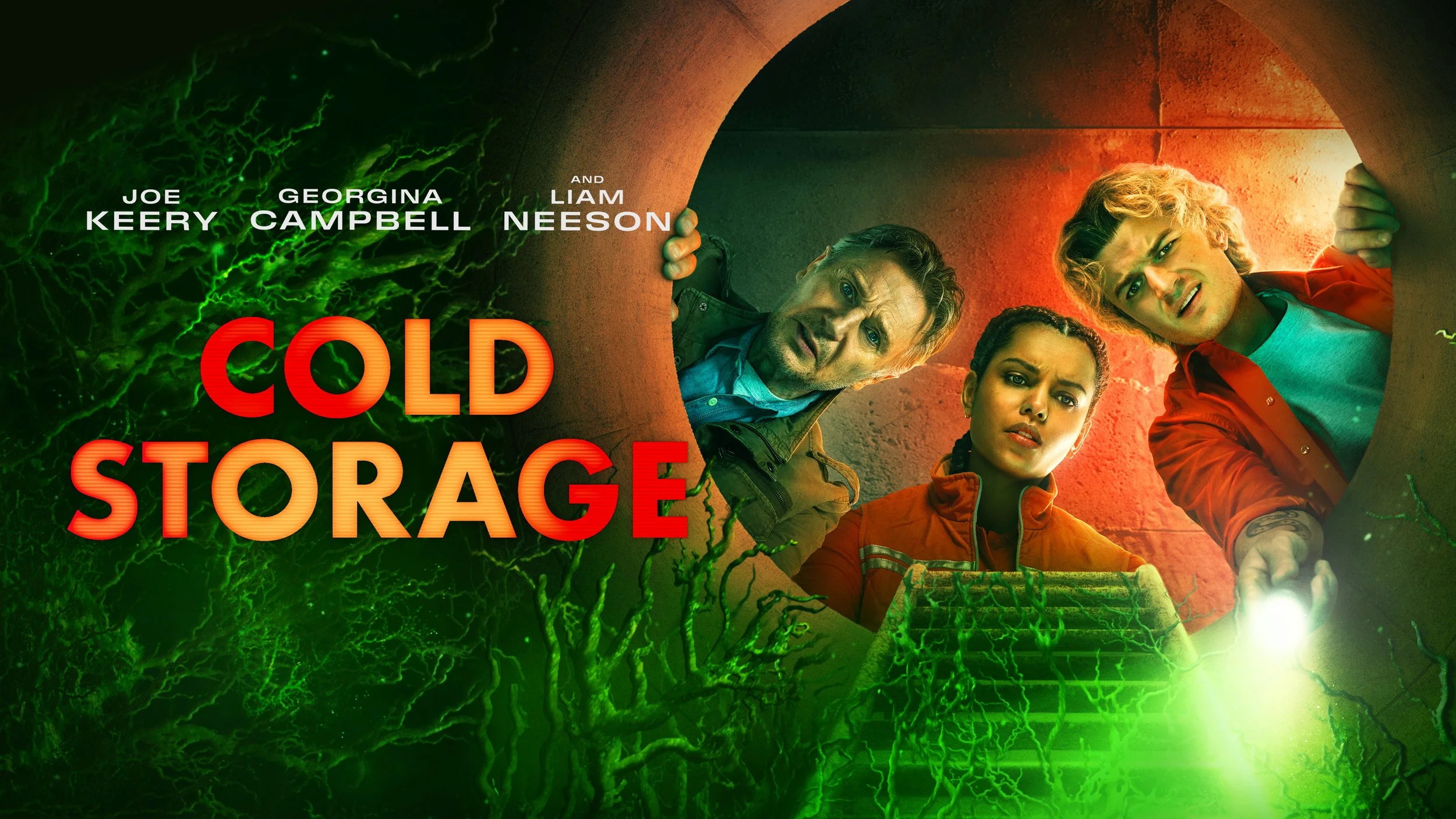
Cold Storage (2026)
David Koepp is no stranger to genre cinema, having written the screenplay for such films as Jurassic Park, Spider-man and War of the Worlds. Where these titles are big budget, major studio productions, Cold Storage is a far more modest production with a smaller scope. Adapted from his own novel, the screenplay is by David Koepp and the film is directed by British film-maker Jonny Campbell. At first glance, Cold Storage seems a somewhat derivative science fiction horror film with a relatively modest budget, financed through a convoluted US and French co-production. Lurid green and red colours feature heavily in the marketing artwork and it is easy, after a cursory look, to write the film off as cheap, generic, direct-to-streaming filler. However, Cold Storage is prime example of why you should not judge a book by it’s cover, or in this case, a film by its posters and online advertising. It is in fact an amusing and fun endeavour that can fill an evening.
David Koepp is no stranger to genre cinema, having written the screenplay for such films as Jurassic Park, Spider-man and War of the Worlds. Where these titles are big budget, major studio productions, Cold Storage is a far more modest production with a smaller scope. Adapted from his own novel, the screenplay is by David Koepp and the film is directed by British film-maker Jonny Campbell. At first glance, Cold Storage seems a somewhat derivative science fiction horror film with a relatively modest budget, financed through a convoluted US and French co-production. Lurid green and red colours feature heavily in the marketing artwork and it is easy, after a cursory look, to write the film off as cheap, generic, direct-to-streaming filler. However, Cold Storage is prime example of why you should not judge a book by it’s cover, or in this case, a film by its posters and online advertising. It is in fact an amusing and fun endeavour that can fill an evening.
In 1979, Skylab burns up in the atmosphere but an oxygen tank survives and is found by a farmer in Western Australia. 28 years later, biochemist Dr. Hero Martins (Sosie Bacons) accompanies Pentagon operatives Robert Quinn (Liam Neeson) and Trini Romano (Lesley Manville) to the an isolated Australian town, where they find it overrun by an infectious fungus. Martin becomes contaminated and the fungus starts to control her actions. However, she commits suicide. The military subsequently incinerate the town and take a sample to an underground cold storage vault in Kansas. In the intervening years, the government seals the vault and the facility is bought by a self storage company. In the present day, Travis (Joe Keery) and Naomi (Georgina Campbell), who work the night shift at “Atchison Storage”, hear an intermittent alarm behind a false wall. They soon find the former government vault and discover a new fungal outbreak. The military, aware of the situation, send Robert Quinn to investigate.
Cold Storage draws heavily from The Andromeda Strain and The Return of the Living Dead. It certainly leans into the light heartened tone of the latter film. However, two things lift Cold Storage above the average. The dialogue between the main characters is amusing as they trade quips and ironic remarks. This isn’t a complete horror comedy but the humour does give the story an engaging tone and trajectory. The presence of Liam Neeson and Lesley Manville also does much to bolster the proceedings from the standard to the wryly entertaining. There is an effortless chemistry between these two actors which is aided by Koepp’s plausible bickering dialogue. The next, notable aspect of the film is the targetted use of VFX. The budget obviously kept the visual scope focused but what digital and practical effects there are throughout the 100 minute running time, are done well.
At a time when the US film industry is beginning to learn that audiences are fast becoming tired with bloated, soulless, multimillion dollar budget films, Cold Storage provides an object lesson in “less is more” and how to work within some fairly tight parameters. The cast of characters is minimal, the action scenes and visual effects are efficient and the film tells its tale in the right amount of time. It does not outstay its welcome. Although not a genre milestone by any shake, it does take several familiar tropes and presents them in an engaging manner and with a new spin. Cold Storage is entertaining in that “Friday night, back from the pub” way and also manages to captures the creativity and humour that can be found in similar movies from the eighties and nineties. Like I Come in Peace (1990), which is hardly surprising as David Koepp wrote that as well.

In the year 1860, Baron Victor Frankenstein (Peter Cushing) faces execution by guillotine for the murders perpetrated by the creature he created. With the assistance of a hunchback named Karl (Oscar Quitak) he avoids death by beheading the priest who came to give him the last rites. The priest’s body is then mistakenly buried by the authorities. Three years later, Victor, now using the name Doctor Stein, has established himself as a prosperous physician in Karlsbrück, serving both affluent patients and the poor at a paupers’ hospital. Hans Kleve (Francis Matthews), a junior member of the medical council, recognises Victor and being an admirer, seeks to become his apprentice. Victor and Hans then undertake an experiment to transplant Karl’s living brain into a new, more refined body, rather than a grotesque monstrosity the Baron has previously made. Karl is eager to have a new healthy body, especially after encountering Margaret Conrad (Eunice Gayson), the charming new assistant at the hospital.
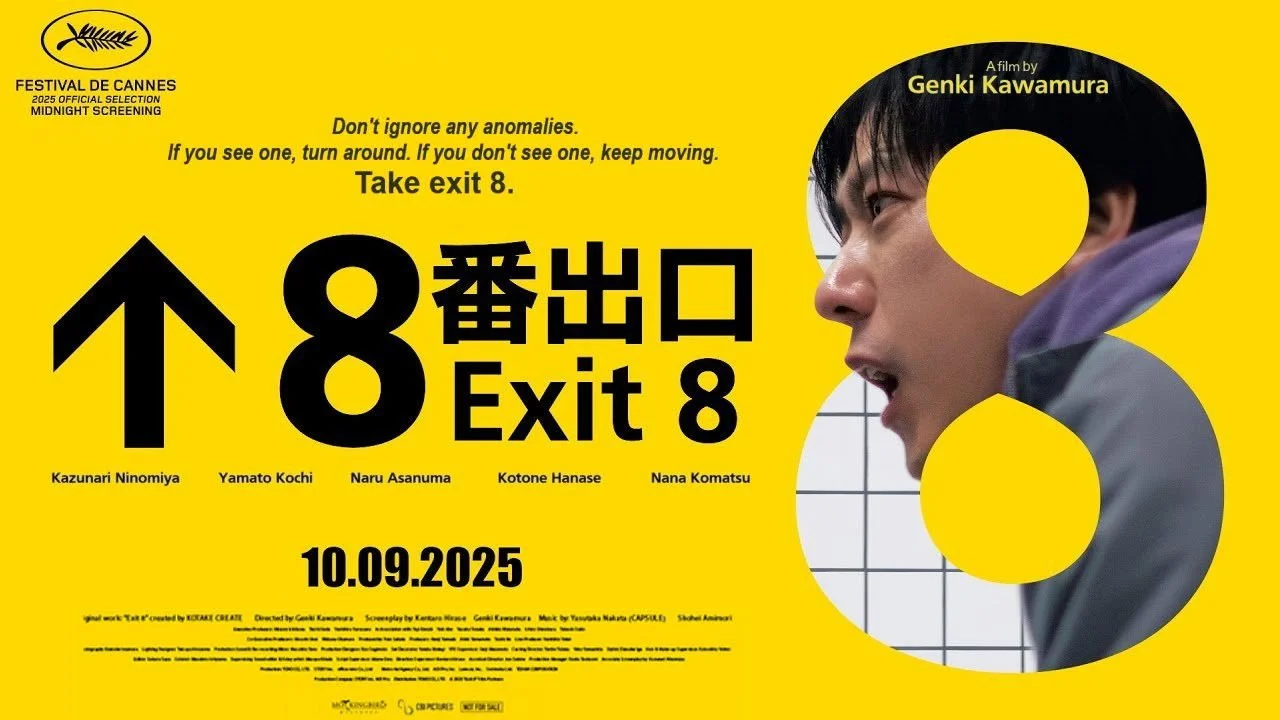
Exit 8 is a sophisticated and claustrophobic psychological thriller directed by Genki Kawamura, which skilfully transforms a minimalist indie walking-simulator game into a cinematic existential enigma. This overtly metaphorical film renders the repetitive nature and drudgery of modern working life into a physical environment in which the lead character is trapped and must find a way out. A random, brutal maze filled with an atmosphere of indifference to the lab rats that find themselves trapped within. Or is it their personal guilt that has put them there? Genki Kawamura’s psychological mystery draws inspiration from the Japanese video game of the same name, as well as from the cyclical nature of Groundhog Day and endless corridors of the Overlook Hotel in Kubrick’s The Shining. Although there are jump scares and some ghoulish imagery, this is not a horror vehicle. Instead this is a disquieting psychological drama with a strong sense of morality.
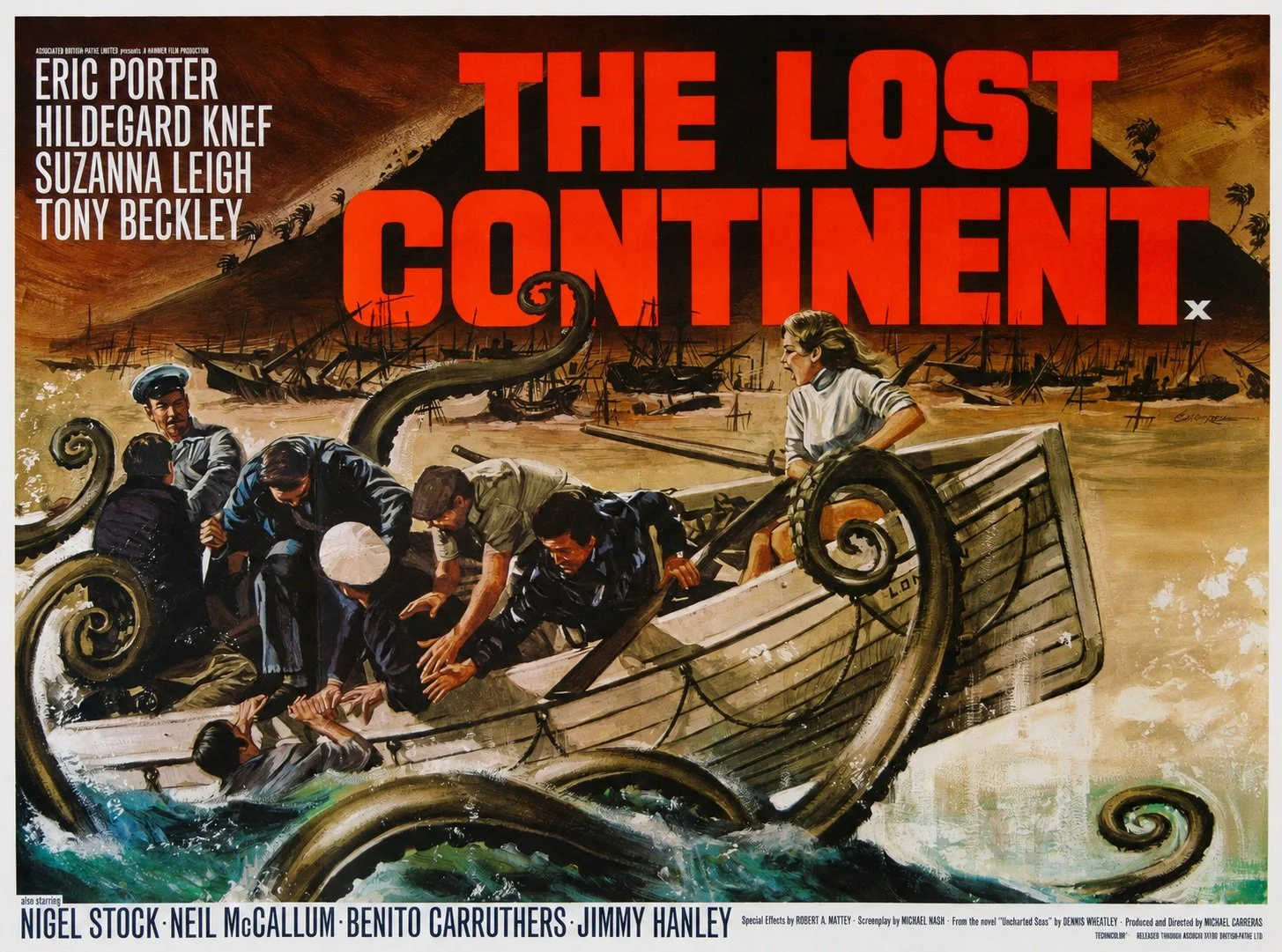
In 1968 the dilapidated freighter Corita hastily leaves Freetown to avoid a customs inspection. Captain Lansen (Eric Porter) has a cargo of dangerous explosives which he is smuggling so he can finally retire. His ship’s passengers also have reasons for leaving in a hurry. Dr. Webster (Nigel Stock), together with his daughter Unity (Suzanna leigh), is relocating due to his indiscretions with patients and illegal operations. Alcoholic pianist Harry Tyler (Tony Beckley) is aimlessly drifting from port to port. Eva Peters (Hildegard Knef) is fleeing from her husband with stolen bearer bonds which she intend to use to buy back her son from his evil clutches Caracas. Ricaldi (Ben Carruthers), a questionable lawyer, is pursuing Eva to retrieve the stolen bonds. First officer Hemmings (Neil McCallum) suggests that the ship should return to Freetown after an imminent Hurricane warning. The Captain asks the passengers and they are unanimous that they do not wish to return. However a mutinous crew, the bad weather and the instability of the explosives force everyone to abandon ship. The survivors find themselves adrift in a lifeboat surrounded by a strange carnivorous seaweed.
David Koepp is no stranger to genre cinema, having written the screenplay for such films as Jurassic Park, Spider-man and War of the Worlds. Where these titles are big budget, major studio productions, Cold Storage is a far more modest production with a smaller scope. Adapted from his own novel, the screenplay is by David Koepp and the film is directed by British film-maker Jonny Campbell. At first glance, Cold Storage seems a somewhat derivative science fiction horror film with a relatively modest budget, financed through a convoluted US and French co-production. Lurid green and red colours feature heavily in the marketing artwork and it is easy, after a cursory look, to write the film off as cheap, generic, direct-to-streaming filler. However, Cold Storage is prime example of why you should not judge a book by it’s cover, or in this case, a film by its posters and online advertising. It is in fact an amusing and fun endeavour that can fill an evening.
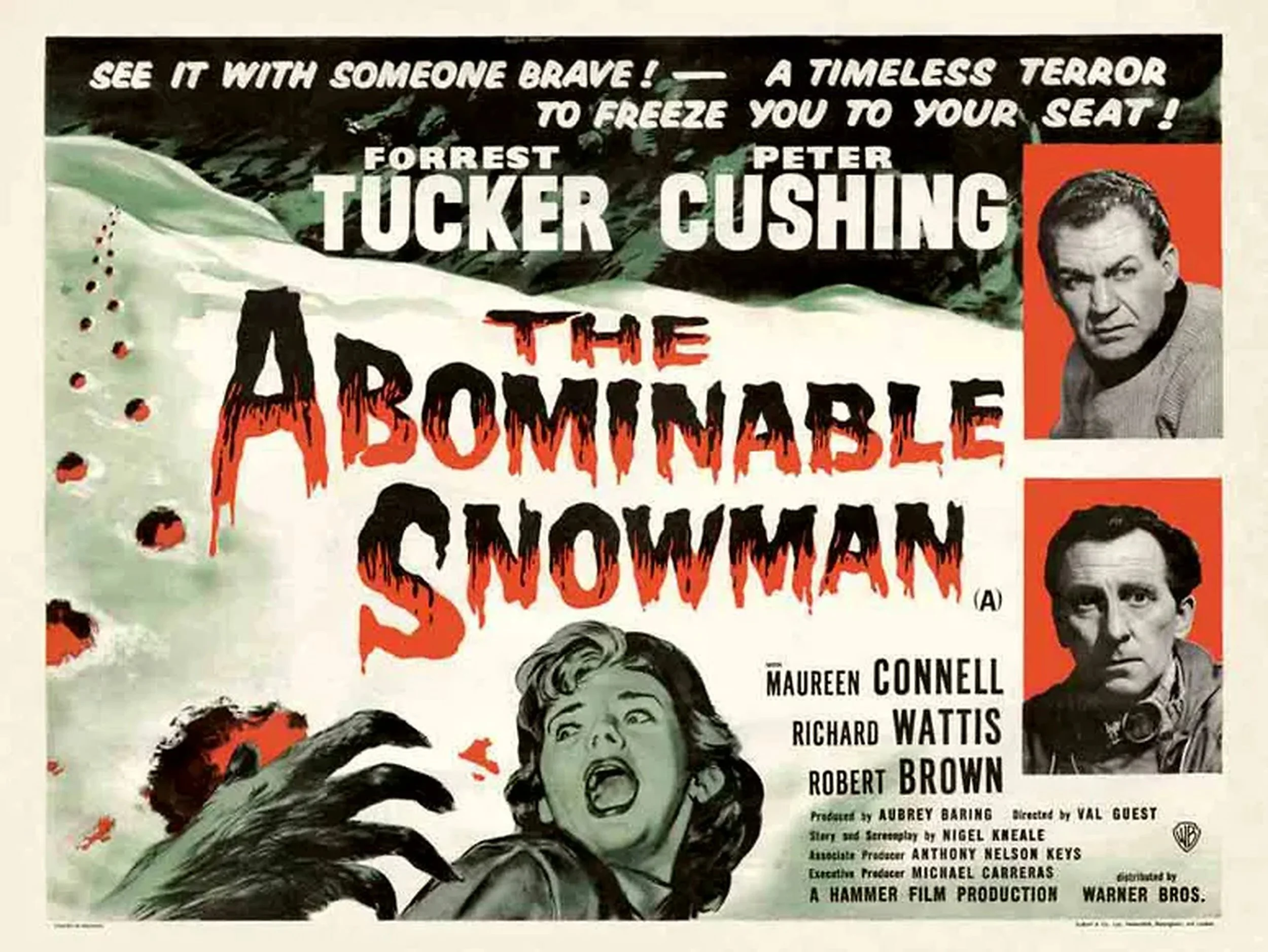
Despite being considered by many as an original story, The Abominable Snowman (1957) is in fact a remake of a made for television play, The Creature, that was originally broadcast in the UK in 1955. Hammer Films would often purchase the rights of popular TV programs and subsequently re-work them for mainstream, international cinema. Larger production budgets and fewer censorship restrictions allowed them to make their cinematic interpretations more lurid, thus commercially viable. Hence The Quatermass Xperiment, Quatermass II and Quatermass and the Pit were all given a big screen makeover and were commercially successful. The Abominable Snowman was written by acclaimed writer Nigel Kneale, who also wrote the original television drama and the aforementioned Quatermass trilogy. Although ostensibly marketed as a horror film this production is actually an interesting blend of psychological thriller and science fiction.
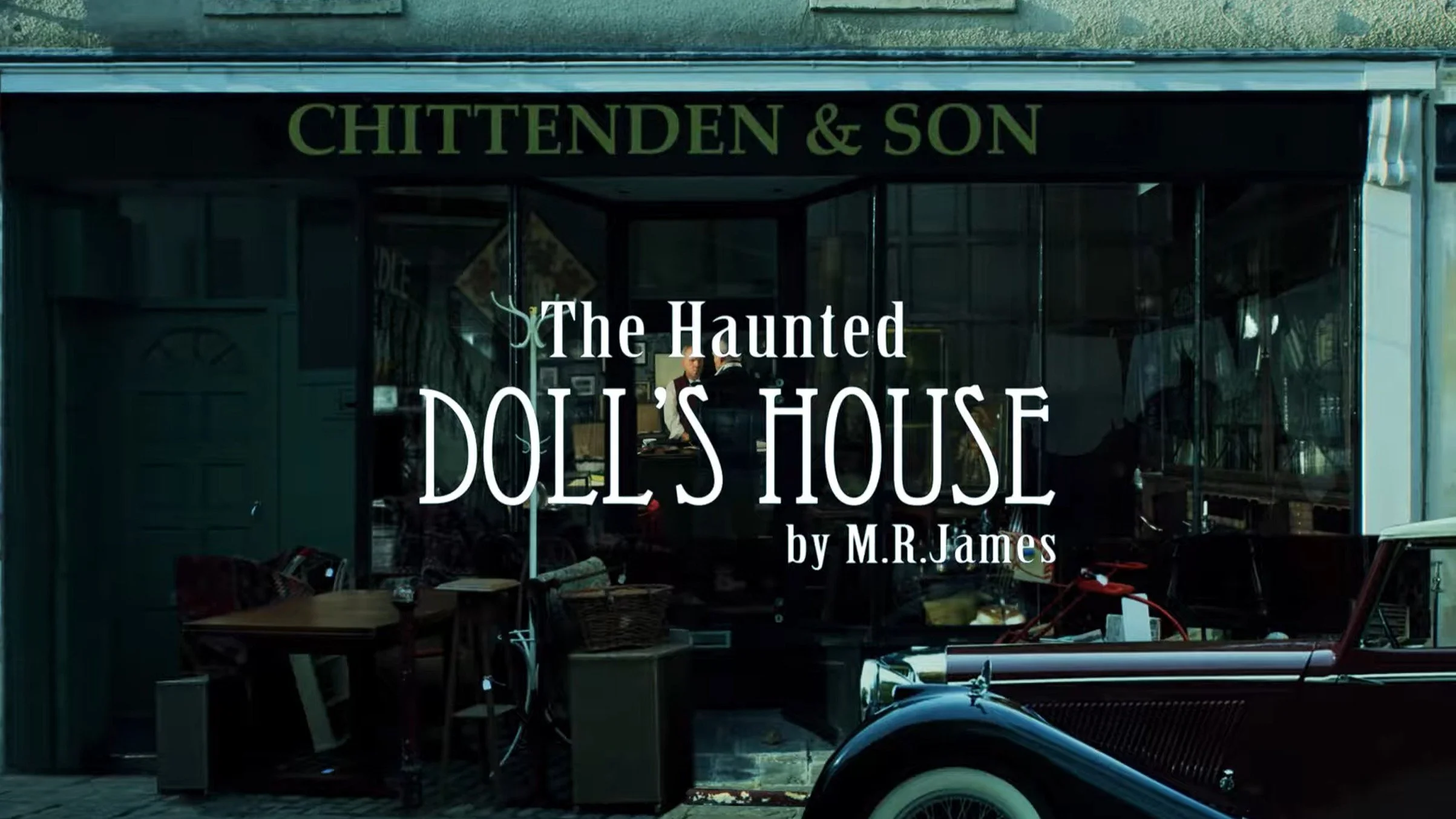
The Haunted Dolls House is a short film based on a story by M.R. James about a unique antique that is subject to supernatural phenomenon. Adapted by Stephen Gray and David Lilley, this is the third of three short films based upon James’ work that the pair have made. It stars Steven Dolton as Mr. Dillet, a collector of antique dolls houses, who acquires a bargain only to discover that it harbours a ghostly secret. Made on an extremely modest budget over the course of 2012 this clever, innovative and rather sinister adaptation is a fine example of short film creativity. It manages to offer a unique visual depiction of M.R. James’ classic story whilst capturing the unsettling quality of the author’s work. Like so many independently made short films it is clearly a labour of love, made with modest resources. It succinctly captures the spirit of the author’s work and is both innovative and rewarding.
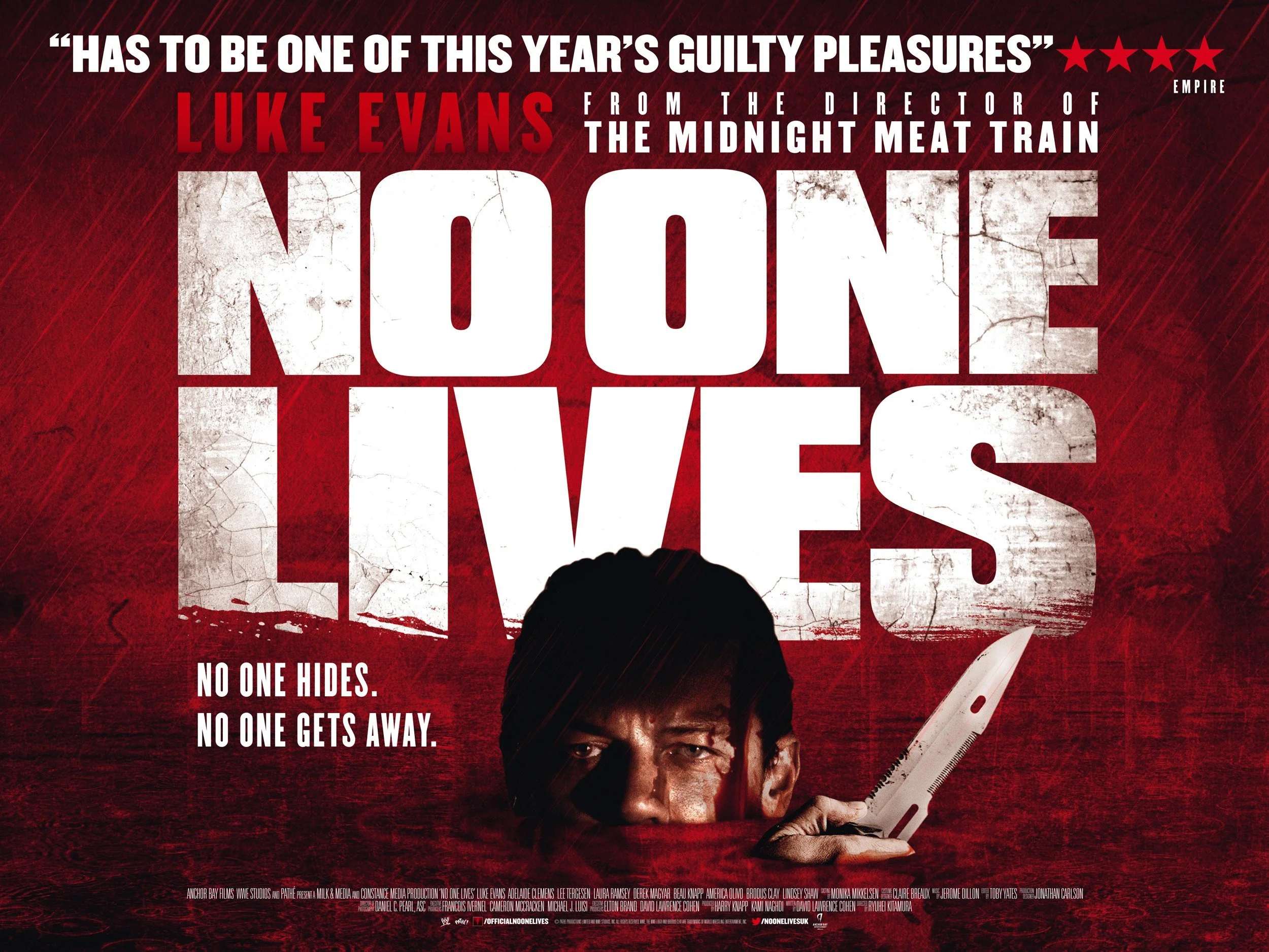
A lot of people may know Luke Evans from the live action version of Beauty and the Beast or Peter Jackson’s The Hobbit trilogy. With his matinee idol good looks, charming Welsh demeanour and his “smoky” tenor singing voice, he projects a sense of old school stardom. Which brings us to No One Lives; a film which is a radical departure from his previous work. His performance is disconcerting to say the least and the film is somewhat unhinged. Directed by Ryuhei Kitamura, who made an interesting adaptation of Clive Barker’s The Midnight Meat Train, this cinematic outing is similarly replete with robust shocks and gore. There are some interesting ideas about the nature of violence, Stockholm Syndrome and whether one should deny or embrace one’s nature. However, these are ultimately minor asides. Philosophical musings in between bouts of surprisingly striking unpleasantness.
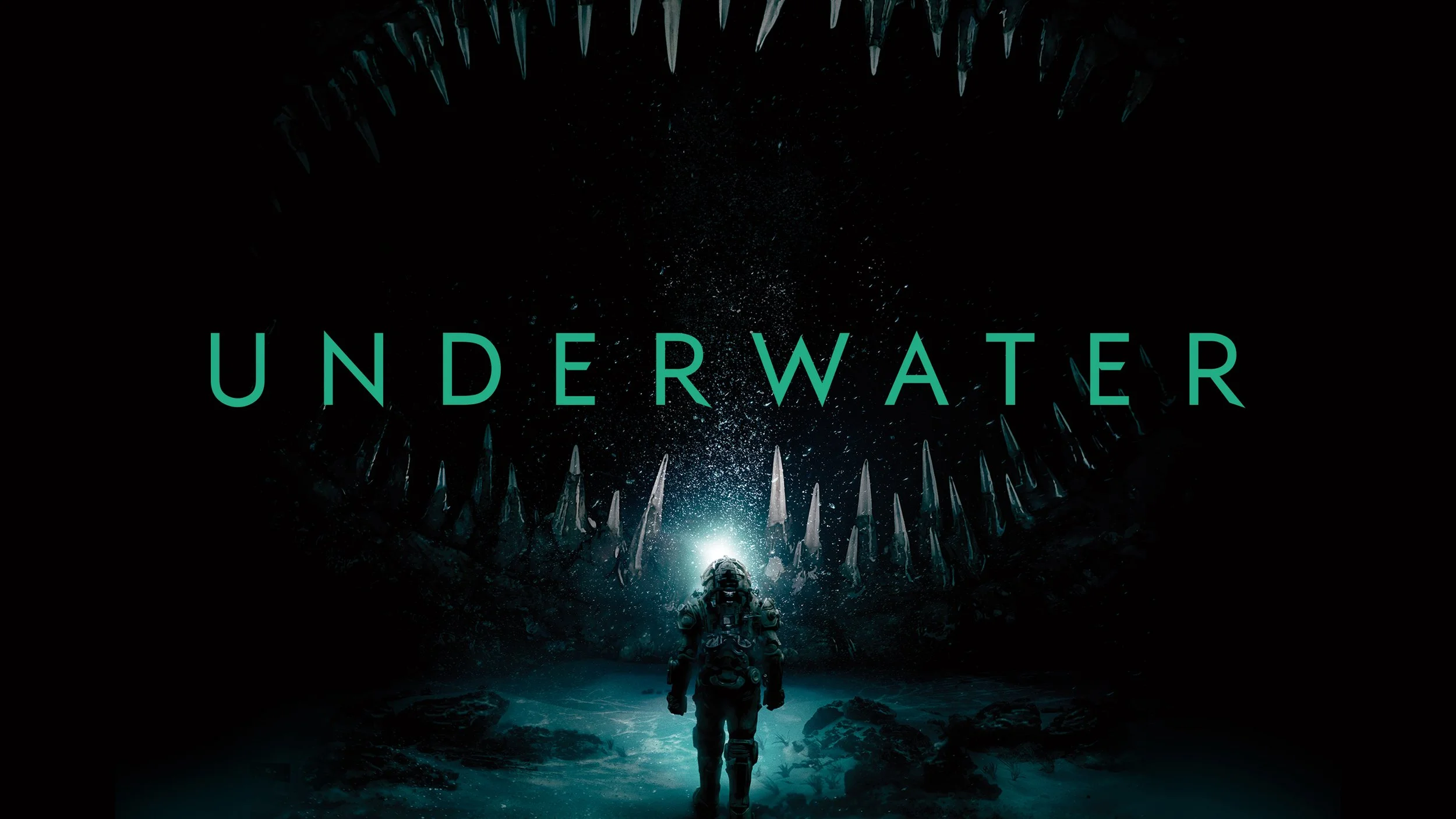
In the near future, Kepler 822, a research and drilling facility located at the bottom of the Mariana Trench, suffers a sudden and catastrophic structural failure. There are only six survivors. Mechanical engineer Norah Price (Kristen Stewart), Captain Lucien (Vincent Cassel), biologist Emily Haversham (Jessica Henwick), engineer Liam Smith (John Gallagher Jr.) and crew members Rodrigo (Mamoudou Athie) and Paul (T.J. Miller). As all the functional escape pods have been used and they are unable to contact the surface, the Captain suggests using pressurized suits to walk one mile across the ocean floor to the Roebuck 641 drill installation. There they will find more escape pods. However, it soon becomes apparent that the disaster was not caused by an undersea earthquake and that they are not alone as they make their journey.
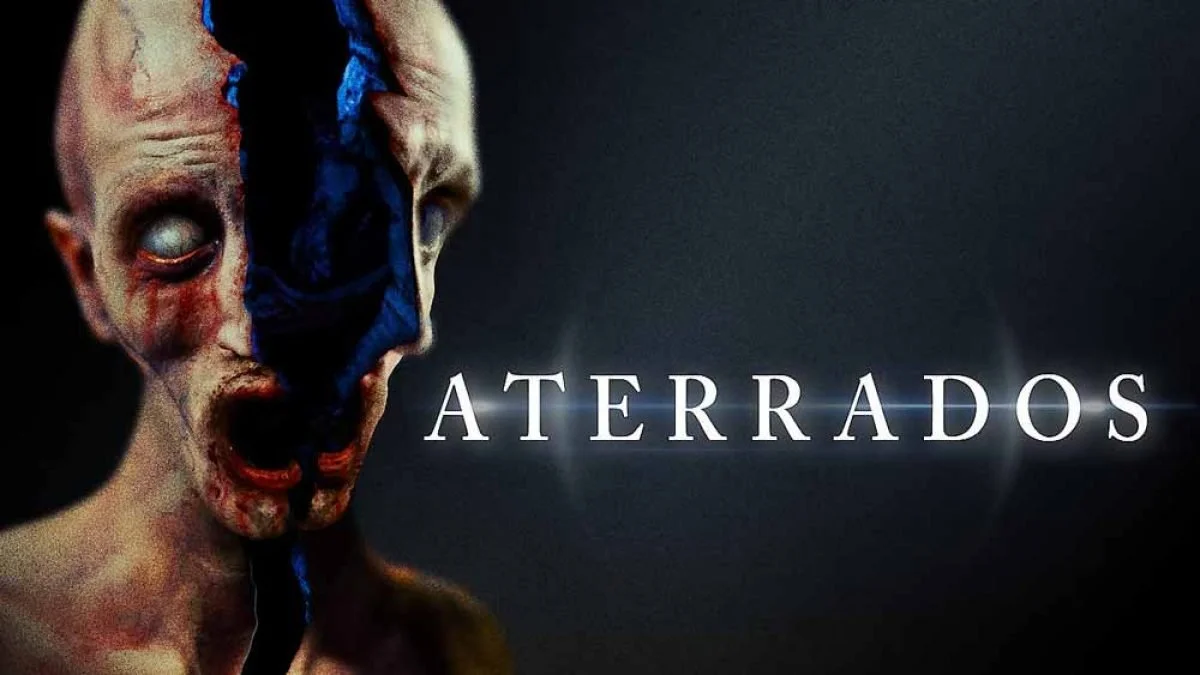
In Buenos Aires, Clara (Natalia Señorales) hears voices emanating from the plughole in her kitchen sink. The voices seem to be plotting against her. Her husband Juan (Agustín Rittano) says the sounds are coming from next door. That night, Juan finds Clara’s dead body levitating in their bathroom, slamming against the wall by an invisible force. Meanwhile their neighbour, Walter (Demián Salomón), is experiencing supernatural occurrences while he tries to sleep. An invisible force repeatedly shakes his bed. After using a video camera to film these events, he sees a tall, cadaverous figure emerging from under the bed, standing over him as he sleeps. Across the road, Alicia (Julieta Vallina) is grieving for her recently deceased son, who was run over outside Walter’s house. Alicia's ex-boyfriend, police commissioner Funes (Maximiliano Ghione) calls Jano (Norberto Gonzalo), a paranormal investigator and the pair soon discover more supernatural occurrences in the area.

Black Sabbath (AKA I tre volti della paura) is a 1963 horror anthology film directed by Mario Bava. Although an Italian production, the film was co-financed by American International Pictures and as such was conceived to appeal to US audiences. Hence, the English dialogue edit of the film which was released in America differs significantly to the original Italian version. Despite the presence of the legendary Boris Karloff and the popularity of both anthology and gothic horror at the time,the film was only a modest success at the US box office and did not do well in Italy. However, in more recent years there has been a critical reappraisal of Black Sabbath, especially the Italian dialogue version. Many aspects of the film which are standard genre tropes today, were in fact novel at the time. Also despite the production mainly being studio bound, the film oozes style and has a striking visual aesthetic.
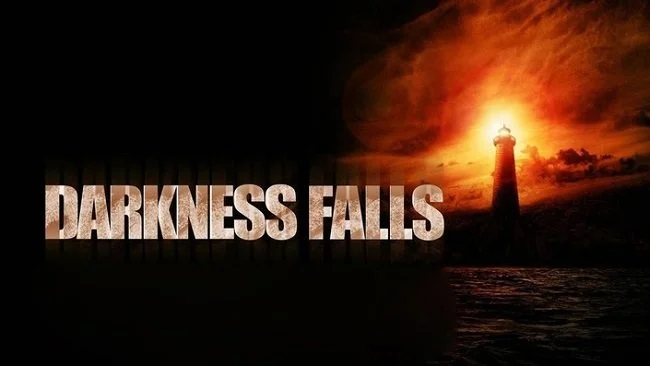
During 1836, in the town of Darkness Falls, Maine, an elderly widow Matilda Dixon is adored by the town’s children as she gives them a gold coin whenever they lose a tooth. One day, after a house fire, Matilda is left burned and sensitive to sunlight, so she starts wearing a china mask. When two children are reported missing, Matilda is blamed by some locals, dragged from her home and hung. She curses the town, stating that whenever a child loses their last tooth, she would come for it. If the child looks at her, she will kill them. The missing children are subsequently found, so the citizens cover up their unjust lynching. In 1990, young Kyle Walsh awakes one night to find Matilda Walsh standing over him. Kyle’s mother is killed and he is blamed for her death and institutionalised. 12 years later, Kyle (Channey Kley) is released and tries to warn the town of the imminent danger when lightning disables the power supply. He is ignored by all until the deaths begin.
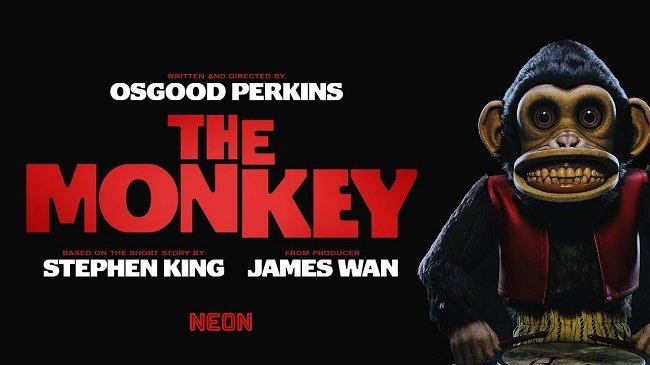
Osgood Perkins has a distinct visual style and tone to his films. It is why his previous film, Longlegs, was such a welcome change from standard genre outings. It was atmospheric both visually and tonally, demonstrating a keen understanding of horror cinema. Hence he is the perfect director to helm this adaptation of a Stephen King short story. The plot is greatly expanded and the screenplay takes a lot of liberties with the source material but the main themes of your past being inescapable and the power of guilt remain front and centre. Due to the extreme and bizarre nature of much of the onscreen deaths, the film wisely has a strong streak of gallows humour running through it which is extremely well handled. Comedy can often be used to defuse or mitigate violence which can be narratively dishonest (think Fred Krueger). Here it adds to the cruel and capricious nature of the random deaths.

When reviewing Sting, one critic stated that the small scale setting and thus, low stakes (IE only a few peoples lives are at risk), made the film not especially memorable. I consider this to be a somewhat spurious criticism. It is the very fact that Sting takes place in such a commonplace environment, with the main characters being everyday people that makes it different. There is a clear focus on well defined characters and their backstory. Unlike so many contemporary films, I actually gave a damn about the protagonists in Sting. An integral aspect of the horror genre is the ability to take a well known and familiar trope and provide a different and absorbing spin on it .It would appear that some audiences have been belaboured over the head by so many overblown and bombastic blockbusters, that the very notion of depicting small, localised and intimate events in a film, seems to bamboozle them.

Some films are made with the intention of starting a franchise, others evolve into one after a surprise box office success and lucrative sequels. Alien (1979) falls into the latter category. A mid-budget science fiction horror film that was well crafted and then benefited immensely by being released at just the right time. Sadly, many franchises become derailed and enter into a death spiral due to competing artistic visions, cynical studio politics and cinematic ignorance. This has certainly afflicted all subsequent Alien films after James Cameron’s magnificent Aliens (1986). Sometimes, a franchise can correct its course and do something fresh with the source material. Prey (2022) is a fine example of this with director Dan Trachtenberg bringing fresh vigour and intelligence back to the Predator movies. I believe that was the intention with Alien Romulus (2024). Sadly, the road to hell is paved with good intentions.
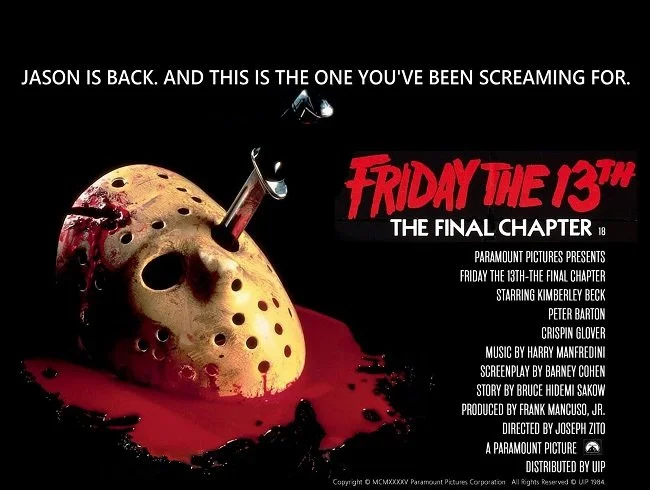
Friday the 13th: The Final Chapter is a popular entry among fans of the franchise. This is mainly due to the return of makeup artist, Tom Savini, who creates several notable death scenes and a bravura ending for Jason Voorhees. There is also an attempt by writer Barney Cohen to have a more involving story compared to previous entries in the series. Director Joseph Zito, who previously directed the above average slasher movie The Prowler AKA Rosemary’s Killer (1981), brings a harder edge to the proceedings, making Jason more menacing than in the previous instalment. As ever, the film was dismissed by the critics but performed well at the box office. Producer Frank Mancuso Jr fully intended for this film to be a definitive end to the series, as he was becoming increasingly concerned that his association with the franchise was having a negative impact upon his career.

Set directly after the events of the previous film, Friday the 13th Part III is again about a group of friends staying near Crystal Lake who encounter Jason Voorhees as he embarks upon another killing spree. Shot in 3D the film has a less sleazy tone than its predecessors although the formula remains the same. The set pieces and death scenes are more elaborate and less clinical, taking advantage of the 3D picture format. The film marks the first appearance of Jason's signature hockey mask, which subsequently became a trademark of both the character and the franchise. Originally conceived to be an end to the series of films, Friday the 13th Part III performed extremely well at the box office, earning $36.7 million on a budget of $2.2 million. As a result, the franchise was given a stay of execution and a further sequel was commissioned.
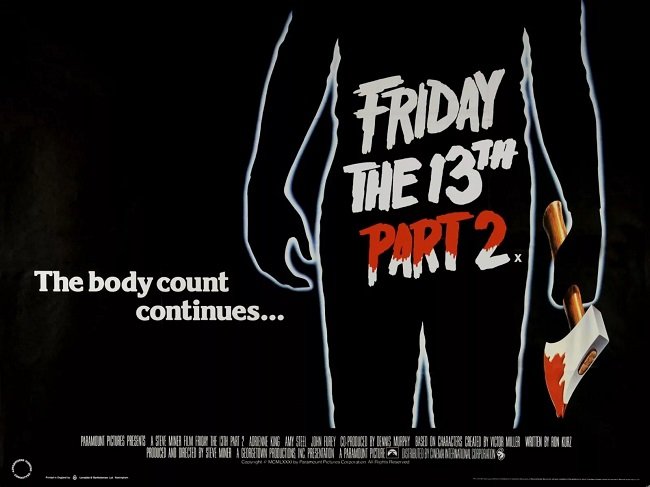
Originally, Friday the 13th Part 2 was intended to be an anthology film based on the superstition associated with the date. However, after the popularity of the original film's surprise ending, the producers opted to continue the story and mythology surrounding Camp Crystal Lake. This eventually became the parameters which all future films would broadly work within. Friday the 13th Part 2 is a more polished production than the first movie, benefitting from twice the budget of the original. The quick turnaround meant that Paramount Pictures could continue to capitalise on the popularity of the slasher genre. However, there was growing social pushback against these types of films, from Christian lobby groups and other “concerned parties”. Hence, Friday the 13th Part 2 ran into problems with the MPAA ratings board and cuts were imposed. Something that would continuously plague the franchise over the years.

Writing any kind of review for the original Friday the 13th movie seems somewhat redundant, as it has been analysed and written about numerous times before. If you’re interested in the film’s production as well as its subsequent impact on US cinema at the time, then there is an excellent summary on Wikipedia. Having recently rewatched the entire franchise, courtesy of the Shout Factory’s Friday the 13th Collection Deluxe Edition, I have a few thoughts I’d like to share. The picture quality of all the films is very good, offering a lot more visual information compared to previous releases. The amount of “extras” included in the box set is prodigious. I suspect that these are the best versions that we’re ever likely to see. Fans hoping that one day all the cut footage will be found and re-integrated into each film are likely to remain disappointed. Some material has surfaced but sadly a lot of deleted and extended scenes have been destroyed.

George A. Romero's Day Of The Dead (1985) is a bleak and remorseless masterpiece. The final entry in his “Dead Trilogy”, its central theme is that in a world on the brink of destruction, man is still the biggest threat to his own existence. It is well scripted, clinically accurate in its observations on human nature and thought provoking, despite having its budget cut just weeks before production commenced. 40 years later it is revered as a genre milestone and is considered one of Romero’s finest works. Sadly, the 2008 “remake” directed by Steve Miner, who has a background in slasher and exploitation movies, takes a contrasting approach, to say the least. It certainly has very little to do with Romero’s film and one can’t help but assume that it is nothing more than a cynical cash in. Setting aside comparisons with the original, this is not in any way a standout zombie film in its own right.
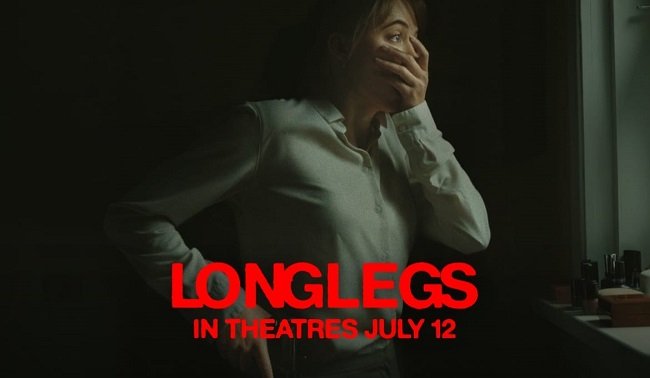
Although I was unaware of it, there was a guerrilla marketing campaign for Longlegs which was focused on the internet rather than traditional television adverts. Hence the film gained a lot of interest prior to its release and as well as some some disproportionate expectations. Then immediately after its theatrical debut, the matter was further compounded by a possible excess of gushing praise as the film was “over reviewed”. Therefore I maintained a degree of scepticism about Longlegs and tempered my expectations prior to watching it. Any film that is hailed as the next Silence of the Lambs, featuring a “traumatising” performance by Nicholas Cage needs to be keenly scrutinised so that its cinematic merits can be carefully separated from the surrounding hyperbole. After viewing I found Longlegs to be a finely honed, atmospheric and precisely targeted horror thriller but not the genre milestone that some would claim.

As a rule, it is always a challenge to end a trilogy of films successfully. Writing a satisfying denouement to a standalone movie is hard enough. To be able to conclude all pertinent story arcs and themes that have been sustained over three feature films, to everyone’s liking is far harder to achieve. In the case of The Final Conflict (1981), the last instalment of The Omen trilogy, writer Andrew Birkin does manage to resolve all of the external, internal and philosophical stakes, which are the fundamental components of a cinematic screenplay. Unfortunately, it is done in an incredibly underwhelming manner, which left audiences feeling cheated. The last time good defeated evil evil in such an unspectacular fashion was in Hammer’s To the Devil a Daughter (1976). This is why, in spite of solid production values, The Final Conflict is the least popular of the films about the Antichrist, Damien Thorn.

Halloween III: Season of the Witch is a film that often provokes a strong reaction from genre fans. This is mainly due to it not having any direct connection to the previous two films. The absence of Michael Myers in such a franchise was a serious mistake and the subsequent poor box office returns endorsed this. Yet if this film had been released as a separate product it may not have performed so poorly. After re-examining Halloween III: Season of the Witch there are many aspects of interest. Despite a troubled production, the film is an intriguing anomaly that tried to be different during a decade where the established horror formula was “stalk n' slash”. It does have a very bleak tone and some consider it to be mean spirited as the cast are killed off one by one. Perhaps theme of child sacrifice caused audiences to balk?

Ghostwatch is a controversial British horror “mockumentary” produced by the BBC that was first broadcast on October 31st 1992. Written by Stephen Volk and produced by Ruth Baumgarten it is now considered a milestone in UK broadcasting. This was mainly due to the strong reaction it provoked from the public, many of whom failed to grasp that it was a drama. At the time it raised serious questions about responsible programming and caused a furore in the British press. It has curiously never been shown since by the BBC. Ghostwatch remains a talking point to this day and is a text book example of the power of television as well as the publics enduring belief in the supernatural.

Event Horizon is a curious movie hybrid, mixing plot elements from classic sci-fi and horror genres. It has been labelled “Hellraiser in Space” by some lazy critics, although I think there's far more to it than that. Perhaps a more apt description would be a Gothic horror story set in space. The movie has garnered a cult reputation since its release in 1997, mainly due to its graphic imagery and troubled production history. It does indeed have some quite shocking sequences but the lightning editing does not show as much as some would think. Paramount forced director Paul W S Anderson to reduce the original one hundred and thirty minute running time down to a more manageable ninety, after unfavourable test screenings. Much of the violence was allegedly removed as a result of that process. Sadly nothing survives of the removed material other than a VHS workprint. Hence a restored director’s cut is therefore unlikely.
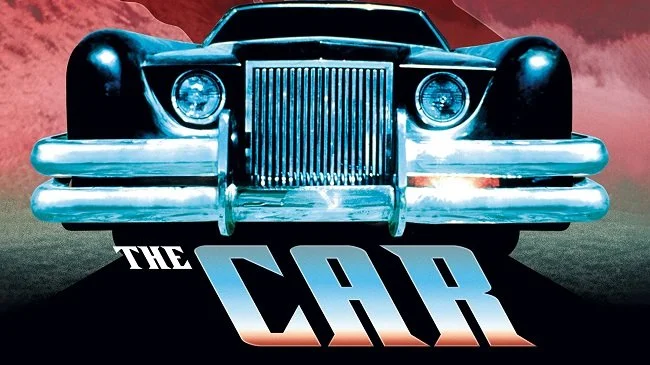
The peace of tranquillity of Santa Ynes, Utah, is shattered when the town becomes the focus of several hit and run deaths, by a mysterious and apparently driverless, black car. After the Sheriff (John Marley) is run down, it is down to Captain Wade Parent (James Brolin) and his deputies to protect the town from this sinister threat. Is the car simply a driven by a mad man or is there a more supernatural explanation? When the car menaces a local school marching band, the teachers and students take refuge in the nearby cemetery. Does the cars inability to enter consecrated ground provide a clue to its otherworldly origins and offer a potential solution? As the death count increases and the population becomes more fearful, the Captain and his team of deputies form a desperate plan to see if they can lure the car into a trap.
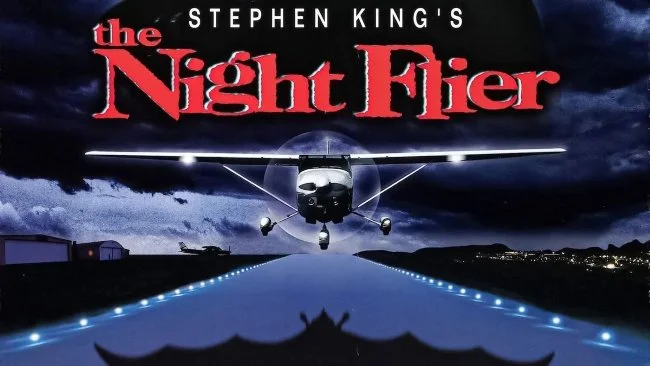
The key to success in the horror genre is to try and find an innovative new angle on tried and tested themes and tropes. The Night Flier is an often-overlooked gem, that takes a unique perspective on vampirism and features strong performances as well as an intelligent and thoughtful screenplay. It builds a sense of foreboding during it’s first two acts and teases audiences with some unpleasant prosthetic effects, courtesy of KNB EFX Group. The climax of the movie is both thought provoking and suitably unpleasant. Furthermore, The Night Flier even manages to make a coherent criticism of tabloid culture and morals of those journalists working in the industry. It’s a damn shame that this modest but well-crafted genre movie didn’t get the attention it deserved when it was initially released in 1997.
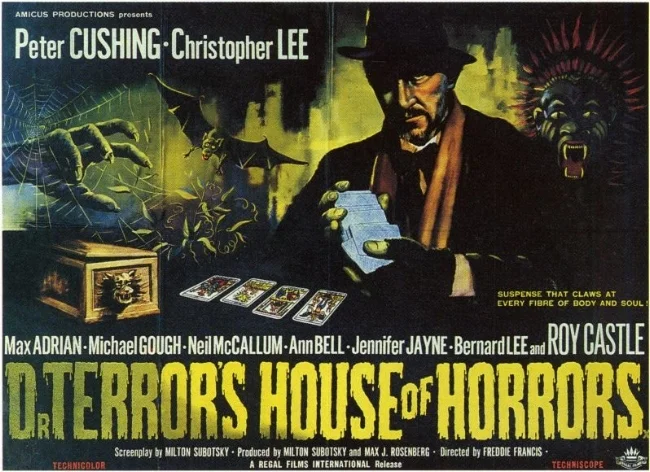
Dr. Terror's House of Horrors was the first portmanteau horror movie by Amicus Productions. The small British studio was founded by producers and screenwriters Milton Subotsky and Max Rosenberg. As the horror genre grew in popularity due to the success of Hammer films, Amicus saw the potential in the portmanteau format. Subotsky in particular held Ealing Studios 1945 classic Dead of Night in very high regard. Although only a modest budget movie, Dr. Terror's House of Horrors proved to be financially successful and led to a series of similarly structured films over the next decade. These included Torture Garden (1967), The House That Dripped Blood (1970), Asylum (1972), Tales from the Crypt (1972), The Vault of Horror (1973), From Beyond the Grave (1974),

Ghost Story is a deliberately superficial adaptation of the novel by Peter Straub. If you’ve read the book and are expecting a verbatim retelling of the plot, then you will be disappointed. It’s complex narrative structure and the abundance of characters do not immediately lend themselves to mainstream film making. However, if you like tales of the supernatural and solid performances from Hollywood legends, then this may well be for you. John Irvin has always been a workman like director and has therefore often been overlooked. Films such as Hamburger Hill and When Trumpets Fade show a great deal of focus and a clear understanding of the mechanics of cinema.
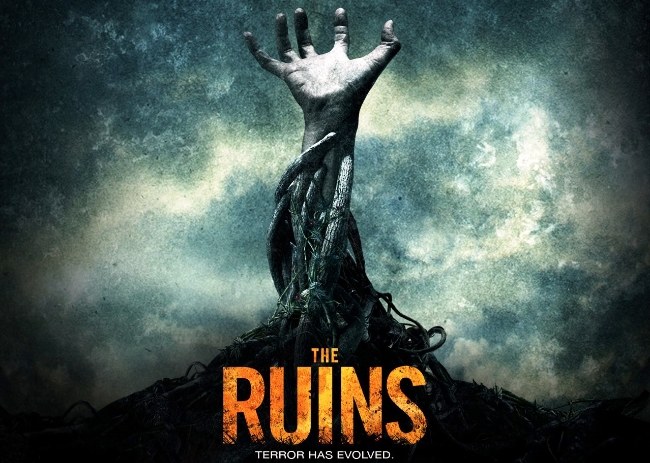
The Ruins is similar to both The Mist and Cloverfield , which were released around the same time, in so far that it is rather bleak and unrelenting movie. And like the aforementioned films, its strength lies in the manner in which it tackles the subject of people facing their own death in a credible fashion. In The Ruins the protagonists when faced with the prospect of their own demise quickly descend in to panic and resolutely refuse to face facts. Although these are negative themes that may not be to everyone’s tastes, they make The Ruins both gripping and genuinely scary.
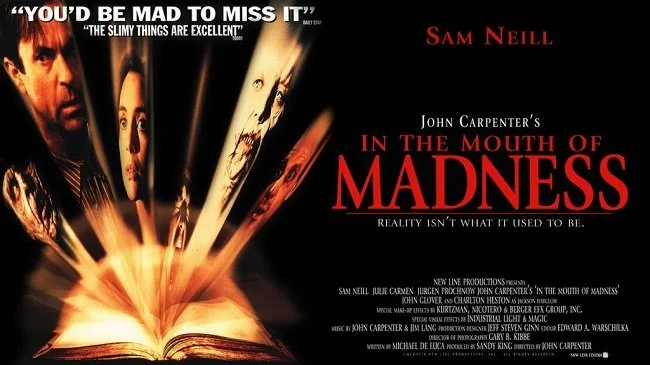
The arcane and esoteric works of author H P Lovecraft have often inspired horror directors. Sadly many of the films that have been made in homage to the Cthulhu Mythos have failed to capture its nightmarish mix of madness and mythology. John Carpenter's In the Mouth of Madness is not directly based on any of Lovecraft's specific works but screenwriter Michael De Luca draws his inspiration from many of this recurring ideas and concepts. He then adds a further homage to British writer Nigel Kneale, adding themes that are prevalent in his Quatermass series. Where others have failed, Carpenter successfully crafts a film that alludes to the baroque and eldritch qualities of the Cthulhu Mythos.
Treasure Island in Outer Space (1987)
Treasure Island In Outer Space is a curious Italian television production from 1987 starring Anthony Quinn and Ernest Borgnine. It also features numerous international actors better known for their work in cult and exploitation films, such as Bobby Rhodes, David Warbeck and John Morghan. Directed by Antonio Margheriti (AKA Anthony Dawson), famous for such films as Killer Fish (a cash in on Piranha) and The Last Hunter (a Vietnam exploitation epic), Treasure Island In Outer Space is a faithful adaptation of Robert Louis Stevenson’s classic novel. The screenplay by Renato Castellani and Lucio De Caro draws heavily from the source text, maintaining character names and original dialogue. However in updating the material to a futuristic setting, the script is littered with the worst kind of eighties sci-fi clichés. We are subjected to sonic trains, anti-gravity rays and the usual buzzword driven faux science.
Treasure Island In Outer Space is a curious Italian television production from 1987 starring Anthony Quinn and Ernest Borgnine. It also features numerous international actors better known for their work in cult and exploitation films, such as Bobby Rhodes, David Warbeck and John Morghan. Directed by Antonio Margheriti (AKA Anthony Dawson), famous for such films as Killer Fish (a cash in on Piranha) and The Last Hunter (a Vietnam exploitation epic), Treasure Island In Outer Space is a faithful adaptation of Robert Louis Stevenson’s classic novel. The screenplay by Renato Castellani and Lucio De Caro draws heavily from the source text, maintaining character names and original dialogue. However in updating the material to a futuristic setting, the script is littered with the worst kind of eighties sci-fi clichés. We are subjected to sonic trains, anti-gravity rays and the usual buzzword driven faux science.
As in most of Antonio Margheriti’s films, there are a lot of traditional visual effects. The miniatures are efficiently realised, given the budgetary restrictions, by the late Emilio Ruiz del Rio (Pan’s Labyrinth, Dune, Conan The Barbarian). There are also some solid matte paintings, in-camera visual effects and simple composite shots. However, not all the visual effects are up to the standards of the time. The most obvious explanations for this are possibly the budget running out of the strictures of the shooting schedule. The quality of the set designs are also variable. Some are again somewhat obvious, leaning into standard tropes of the decade. Hence we see random arrays of flashing lights and banks of switches and dials that serve no particular purpose. Others, such as the bone graveyard at the film’s climax, are quite striking visually and have clearly been given some thought.
The lead performances from both Quinn and Borgnine are acceptable, delivering measured interpretations of their characters. Both avoid the standard cliched tropes associated with the depiction of pirates on film. Quinn attempts a more paternalistic approach to the character of Long John Silver. Itaco Nardulli is a somewhat generic Jim Hawkins. Like most Italian productions, the actors speak their lines in their native language while filming and are dubbed accordingly in post production. The main cast have subsequently re-recorded their own dialogue but some of the Italian cast have been dubbed in a somewhat incongruous fashion. Treasure Island In Outer Space features a traditional musical score by composer Gianfranco Plenizio, avoiding the usual synthesizer based approach to the science fiction genre, which was common at the time.
What makes Treasure Island In Outer Space a somewhat frustrating experience to watch is the ways that some aspects of the production have been given attention and others have been handled poorly. The cinematography by Sandro Messina is quite creative by television standards, with some scenes being shot from low angles or behind objects. Sadly the action scenes and fight choreography is somewhat theatrical and lacks any sense of momentum or kinetic energy. At seven episodes, each with a running time of 50 minutes, the English language version of Treasure Island In Outer Space is a somewhat lengthy adaptation. Perhaps a little too long. These deficiencies highlight the fact that this show is very much a product of its time and as such should be judged accordingly. There are better adaptations of Treasure Island and there are worse. For those who are curious, Treasure Island in Outer Space can be found on YouTube.
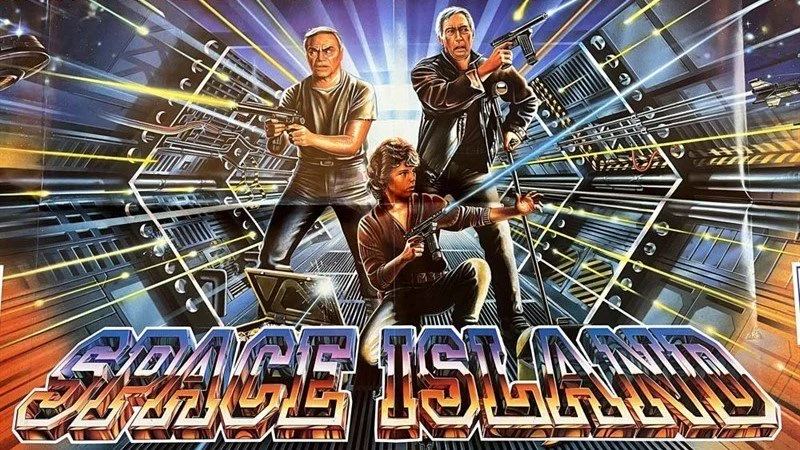
NB. Treasure Island in Outer Space was shown in 5 episodes, each running 75 minutes on Italian television in 1987. There are no major differences between this and the English language version which ran for 7 episodes of 50 minutes. However, there was also a theatrical version of the show, which was common practice at the time. This has a running time of 150 minutes and was released under the title Space Island.
Star Trek is slightly older than me by 14 months. I was born on December 18th 1967. Star Trek was first broadcast in the US on 8th September 1966. Hence this show has always been part of the prevailing pop culture that surrounded me, as I grew up. I first began watching Star Trek as a young child in the early seventies. It would be repeated on the BBC in the early evening on Fridays and it became a family ritual to sit down together and watch it. As a seven or eight year old, it left a great impression upon me and was in many ways, the television highlight of the week. Star Trek along with Doctor Who certainly started my interest in science fiction. Star Trek was also one of the first shows that introduced me to tie-in marketing. I remember seeing in a toy shop, near to my school at the time, a Dinky Klingon Battle Cruiser and was flabbergasted that such a thing existed. I immediately coveted it but sadly never obtained one.
David Koepp is no stranger to genre cinema, having written the screenplay for such films as Jurassic Park, Spider-man and War of the Worlds. Where these titles are big budget, major studio productions, Cold Storage is a far more modest production with a smaller scope. Adapted from his own novel, the screenplay is by David Koepp and the film is directed by British film-maker Jonny Campbell. At first glance, Cold Storage seems a somewhat derivative science fiction horror film with a relatively modest budget, financed through a convoluted US and French co-production. Lurid green and red colours feature heavily in the marketing artwork and it is easy, after a cursory look, to write the film off as cheap, generic, direct-to-streaming filler. However, Cold Storage is prime example of why you should not judge a book by it’s cover, or in this case, a film by its posters and online advertising. It is in fact an amusing and fun endeavour that can fill an evening.
Treasure Island In Outer Space is a curious Italian television production from 1987 starring Anthony Quinn and Ernest Borgnine. It also features numerous international actors better known for their work in cult and exploitation films, such as Bobby Rhodes, David Warbeck and John Morghan. Directed by Antonio Margheriti (AKA Anthony Dawson), famous for such films as Killer Fish (a cash in on Piranha) and The Last Hunter (a Vietnam exploitation epic), Treasure Island In Outer Space is a faithful adaptation of Robert Louis Stevenson’s classic novel. The screenplay by Renato Castellani and Lucio De Caro draws heavily from the source text, maintaining character names and original dialogue. However in updating the material to a futuristic setting, the script is littered with the worst kind of eighties sci-fi clichés. We are subjected to sonic trains, anti-gravity rays and the usual buzzword driven faux science.
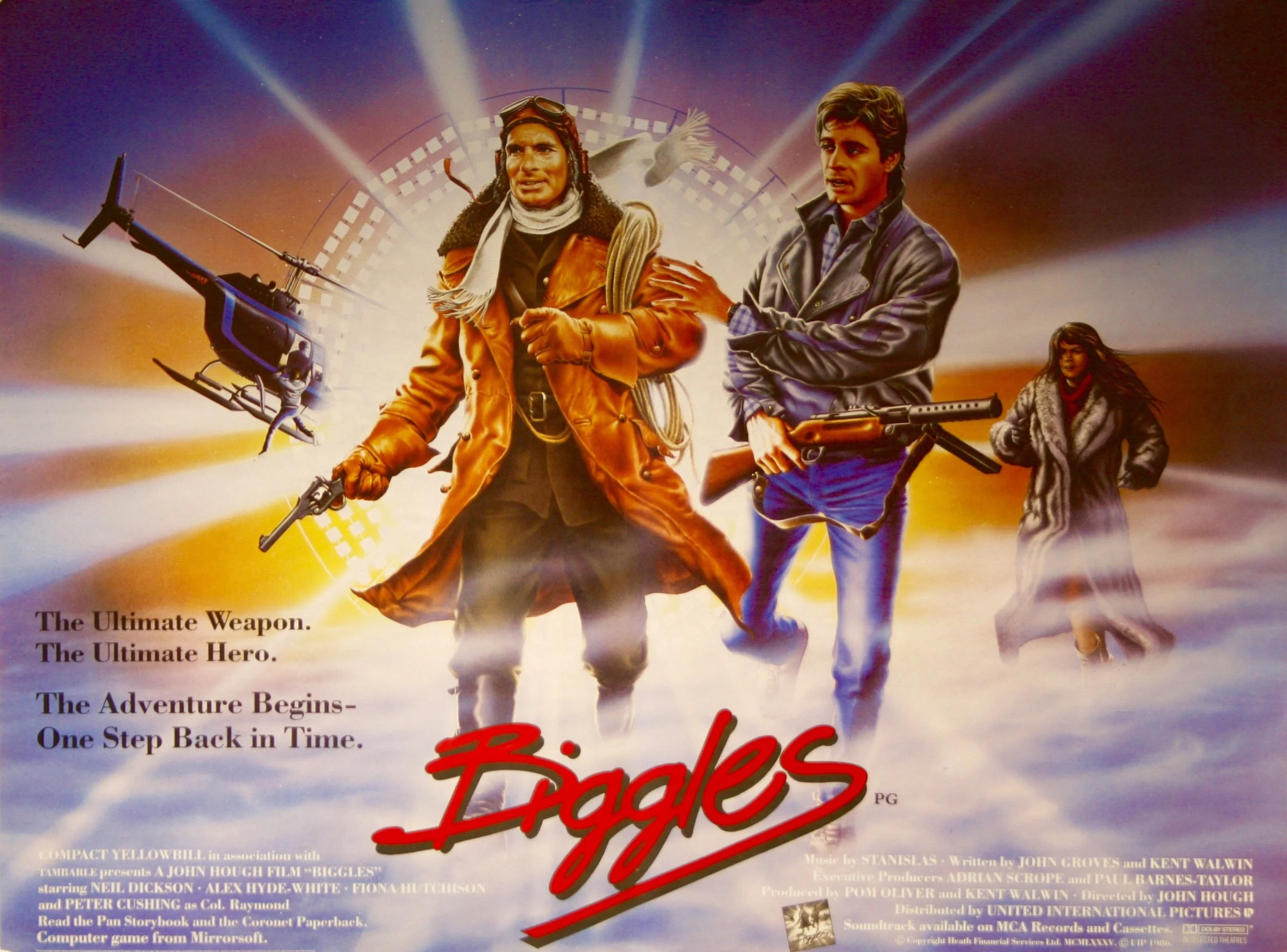
After the success of Raiders of the Lost Ark in 1981, filmmakers scrambled to find existing intellectual properties that they could use for similar films. Hence archaic heroes such as Alan Quatermain were hastily given a modern makeover and thrust into generic movies, in a vague attempt to replicate Steven Spielberg’s successful formula. Which brings us neatly on to James Charles Bigglesworth AKA “Biggles”, a fictional pilot and adventurer from a series of books written by W. E. Johns between 1932 and 1968. Several attempts had been made in the past to bring this character to the silver screen, including one by Disney but they all failed. However, the commercial and critical success of Indiana Jones provided sufficient impetus to greenlight a new film. However, due to some curious production choices, when Biggles was finally released it was far from just a period set, action movie.
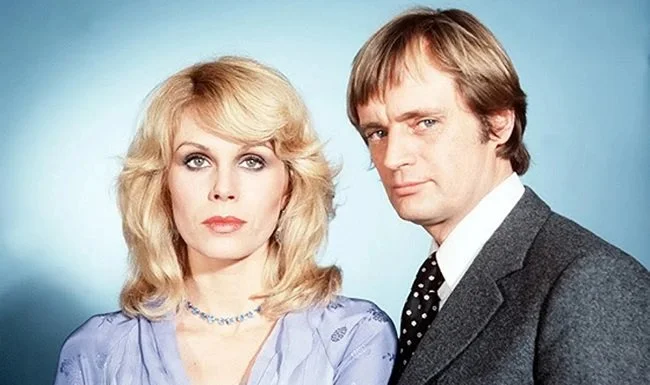
The seventies was an interesting time for UK genre television. Despite small budgets and often low key visual effects, there was no shortage of good ideas and creativity. Sapphire & Steel is a prime example of a show couched in a high concept, produced on a shoestring. It also credits its audiences with some degree of intelligence. Rather than spoon feeding the narrative in a didactic manner, it hints and implies, then leaves the rest to its viewers imagination. Created by Peter J. Hammond, a veteran TV writer, Sapphire & Steel centres on a pair of interdimensional operatives named Sapphire and Steel. They are two of a number of elements that assume human form. Over the course of three seasons little is revealed about the pair but they appear whenever there is any anomalous temporal activity. Time itself is portrayed as a sentient and malignant force that seeks to make incursions into the present reality, through weaknesses in the fabric of space.
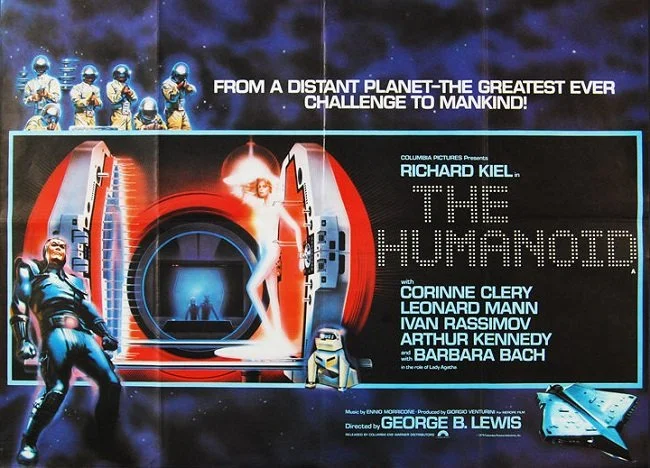
The Humanoid is one of many international Star Wars knock-offs that flooded cinemas in the late seventies and early eighties. Like so many others, it is derivative (even to the extent of replicating specific scenes from George Lucas’ movie), replete with awful dialogue and has somewhat basic production values. However, it does have an interesting cast including Richard Kiel, Barbara Bach, Arthur Kennedy and Corinne Cléry. Kiel gained a lot of media attention after his appearance as the steel-toothed villain Jaws in the 1977 Bond film, The Spy Who Loved Me. His stature made him the perfect fit for the titular character in this Italian science fiction production. Sadly, beyond a curious lineup of actors, The Humanoid has little to distinguish it from so many similar movies. For example, if you’ve seen Starcrash then you’ll be adequately prepared for this film.
Some films are made with the intention of starting a franchise, others evolve into one after a surprise box office success and lucrative sequels. Alien (1979) falls into the latter category. A mid-budget science fiction horror film that was well crafted and then benefited immensely by being released at just the right time. Sadly, many franchises become derailed and enter into a death spiral due to competing artistic visions, cynical studio politics and cinematic ignorance. This has certainly afflicted all subsequent Alien films after James Cameron’s magnificent Aliens (1986). Sometimes, a franchise can correct its course and do something fresh with the source material. Prey (2022) is a fine example of this with director Dan Trachtenberg bringing fresh vigour and intelligence back to the Predator movies. I believe that was the intention with Alien Romulus (2024). Sadly, the road to hell is paved with good intentions.
Event Horizon is a curious movie hybrid, mixing plot elements from classic sci-fi and horror genres. It has been labelled “Hellraiser in Space” by some lazy critics, although I think there's far more to it than that. Perhaps a more apt description would be a Gothic horror story set in space. The movie has garnered a cult reputation since its release in 1997, mainly due to its graphic imagery and troubled production history. It does indeed have some quite shocking sequences but the lightning editing does not show as much as some would think. Paramount forced director Paul W S Anderson to reduce the original one hundred and thirty minute running time down to a more manageable ninety, after unfavourable test screenings. Much of the violence was allegedly removed as a result of that process. Sadly nothing survives of the removed material other than a VHS workprint. Hence a restored director’s cut is therefore unlikely.
I recently watched the first trailer for the new Obi-Wan Kenobi television show that is premiering on Disney + in May. I am interested in this latest instalment in the Star Wars franchise and curious as to whether Liam Neeson will make an appearance. I also watched a 20 minute fan video in which they “analysed” the entire trailer. They discussed the content of this 2 minute preview and then did a great deal of speculating about potential themes and characters that may feature in the show. They were clearly enthusiastic about what they had seen and were very knowledgeable about the subject. This resonated with me, as I like to be well versed about the things I enjoy. However, it is worth remembering that fandom can tip into obsession and gatekeeping. Hence I feel there is a subject to explore here.
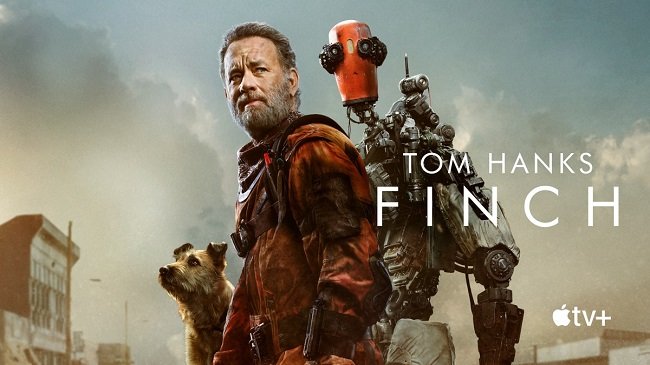
On paper Finch has little originality. The moment I read the plot synopsis and saw the first trailer I instantly thought of other such films as Silent Running, Short Circuit and Chappie. However, irrespective of its derivative concept and the fact it channels many of the major tropes of the genre, it does have three cards to play. Namely strong performances by Tom Hanks, Caleb Landry Jones and canine actor Seamus. Although not a genre milestone, Finch is a curiously pleasant post apocalyptic road movie. Despite travelling through the sun bleached vistas of a ravaged America, the story focuses on the three protagonists and their relationship. It is no small feat to find genuine sentiment in such a harsh environment and indeed in such a genre but Finch proves to be an engaging emotional journey. Once again the most effective explorations of the human condition are often through characters who are conspicuously not.
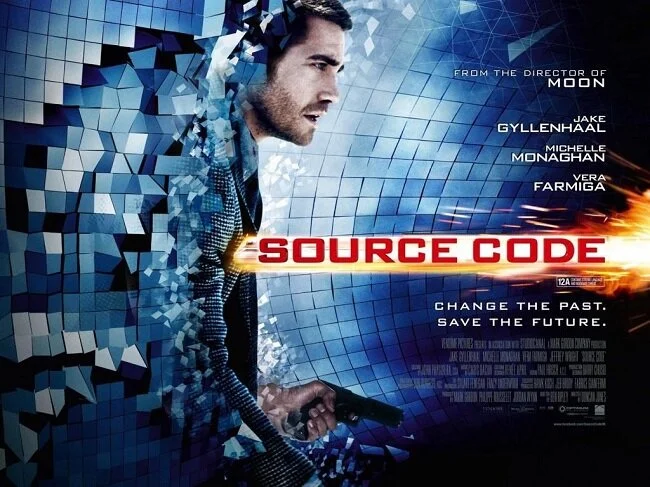
I wanted to watch Source Code for a second time before I wrote about it. This is because numerous internet debates have arisen regarding the plausibility of the film’s ending. I find this a somewhat curious stance considering that the story, written by Ben Ripley, deals with temporal travel and multiple timelines. All of which are purely theoretical and not currently subject to singular, definitive interpretations. I would further add that the science of the film is simply a plot device and is not its raison d'être. But that’s movies for you. People love to discuss them and more recently we have seen the rise of “explanation” videos on YouTube. However, the latter is a separate debate and something I may write about in the future. As for Source Code, I enjoyed it even more the second time round, as I had the time to focus on the minor details rather than trying to stay abreast with the main plot, as I did on my first viewing.
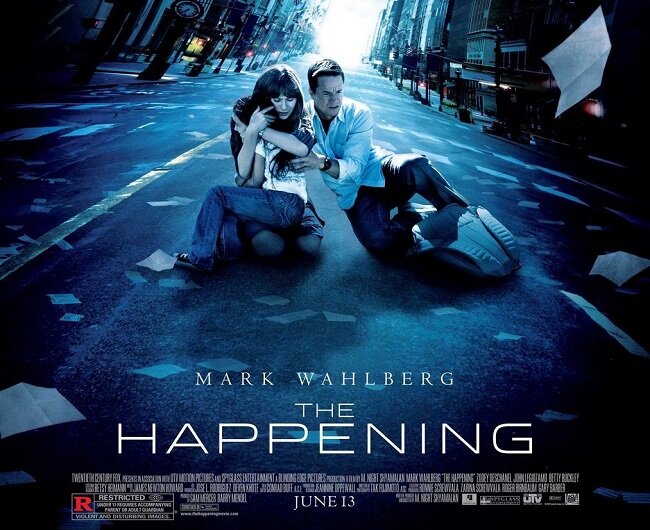
I revisited M Night Shyamalan's The Happening recently to try and determine whether he is indeed suffering from Orson Welles syndrome. IE that he has made all his best work at the beginning of his career. Because he’s never quite recaptured the critical or artistic success of The Sixth Sense, Unbreakable and Signs. I was one of the few that actually liked The Lady in The water but I could see why viewers would assume that he had become a victim of his own style and technique with that particular movie. Casting yourself as an author whose work will reshape society and change the course of history is at the very least, a little egotistical and at worst an act of immense hubris. Then in recent years we have had The Last Airbender and After Earth, both of which have performed poorly. However I thought I'd give The Happening another chance as it remains the directors only R rated movie to date.

I wrote an article back in 2009 as to why I felt a remake of The Thing was a bad idea. At that time, the project was in development hell and didn’t look like getting off the ground. Subsequently, the production evolved into a prequel and managed to find financial support, culminating in a theatrical release in late 2011. Like many interested parties, I watched the initial teaser trailer with a mixture of curiosity and trepidation. Then when the red band trailer arrived I felt that the shark was well and truly jumped. Too much was shown (a common problem with modern trailers) and there the internet was awash with discontented mutterings from John Carpenter purists. Hence I refrained from watching this movie for several years. When I finally got round to doing so, I was not well disposed towards it. However, over the Christmas holidays, I decide to give this prequel a second viewing and see if I could approach it with a less partisan mindset.
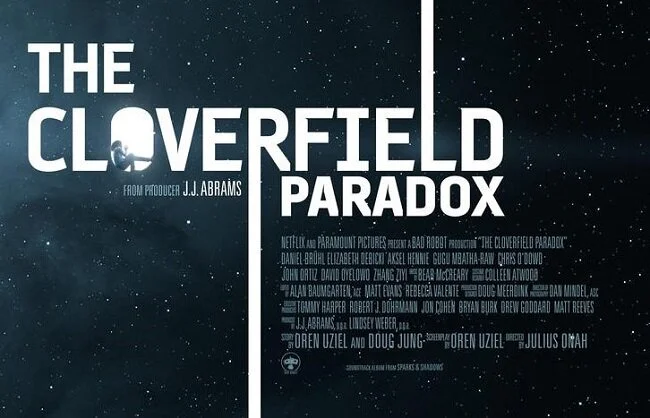
Cloverfield (2008) was a surprise hit, earning $172 million worldwide at the box office against a $25 million budget. Paramount Pictures naturally wanted a sequel but director Matt Reeves and writer Drew Goddard struggled to find a suitable narrative means to progress the original story. Both eventually left the project and the production descended into development hell. The subsequent success of Godzilla and Pacific Rim saw the Kaiju genre becoming oversaturated and so the decision to make a direct sequel was re-evaluated. Eventually a “speculative screenplay” called The Cellar was purchased and repurposed to include some additional science fiction elements and became 10 Cloverfield Lane. Despite being a curious genre hybrid which only tenuously links to the original movie, this too fared well at the box office. Therefore it was inevitable that a third movie in the so-called “Cloververse” would follow.
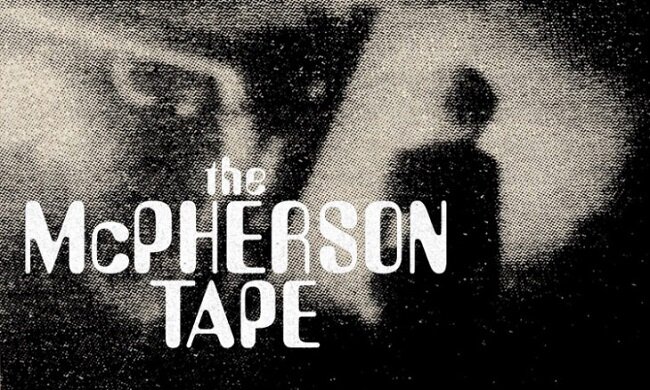
In many ways the story behind The McPherson Tape is a lot more interesting than the film itself. This early found footage movie from 1989, was shot on home video on a virtually non-existent budget. The director Dean Alioto eventually found a distributor but on the eve of the movie’s home video release, the warehouse burned down and allegedly destroyed the master tape and all the promotional artwork. Yet this was not the end of the story. It was common practice in the eighties for small distributors to send advance copies to local independent video stores. Hence The McPherson Tape found its way into the pirate video ecosystem. It then migrated to the UFO community where it was circulated as being a video of a legitimate alien abduction. Dean found himself in the unusual position of having to debunk his own work. Three decades later due to the intriguing tale associated with The McPherson Tape, it has been remastered from the newly rediscovered 3/4" tape and re-released.
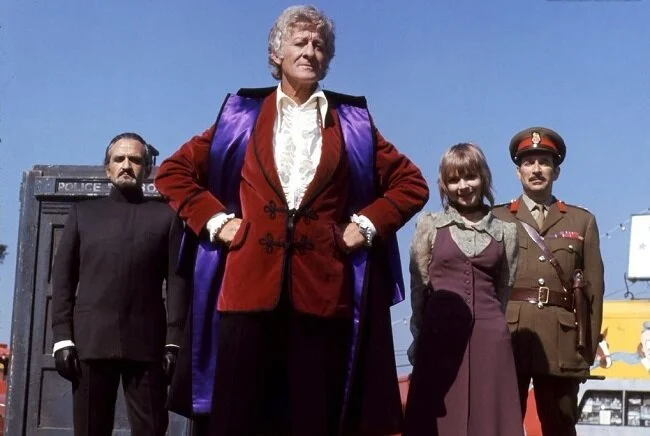
Last month, I tried a 30 day free trial of the streaming service BritBox. One of the main selling points was that the platform has an extensive back catalogue of Classic Doctor Who. Although I initially tried to keep up with the reboot of the franchise in 2005 my interest waned after several seasons. I am not opposed to any of the changes made and I am very pleased that the show has found a new audience. However, it doesn’t resonate with me so much anymore and I find that there is too much human drama for my liking. So I decided to revisit my youth and watch some classic Doctor Who; episodes that I haven’t seen in over forty years (yes, I’m that old). Now I’m fully aware of the potential issues that can come from returning to things that you enjoyed in one’s youth, so I believe I did my best in managing my expectations. However, the results of my nostalgia trip were interesting. The things I thought would be a problem nowadays weren’t so and the things I expected to hold up well despite the passage of time, didn’t always succeed. It’s been a curious experience.
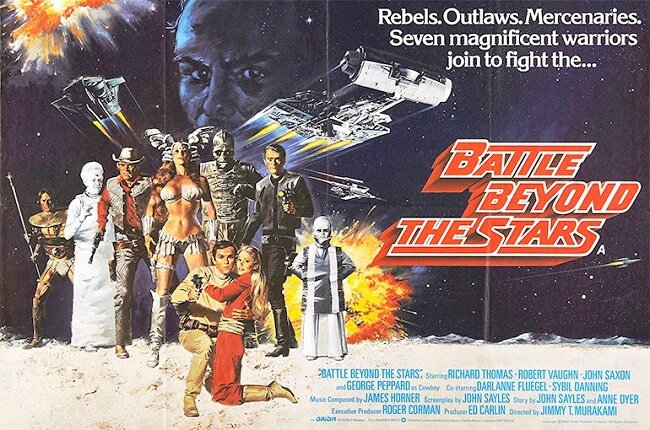
I was 12 years old when I first saw Battle Beyond the Stars during its UK theatrical release. I remember that I enjoyed it and thought it was an action packed movie. Being young, lacking the critical faculties that come with age and exposure to a wider variety of cinematic material, a lot of the films plus points were lost on me. I recollect that I did pick up on the fact that this film was more ghoulish than the other “Space Operas” that flooded theatres at the time. But beyond that, all I saw was a fun and enjoyable science fiction movie. I cheered when the Malmori were defeated and was saddened when Space Cowboy died. It is only after subsequent viewing over the years, that I’ve realised that this film is a microcosm of all the things that made Roger Corman productions so successful and unique. Despite its low budget, the visual effects were good and innovative for the times. There was more sex and violence present, than in comparable productions. And the crew is a veritable who’s who of talent that went on to wider success.
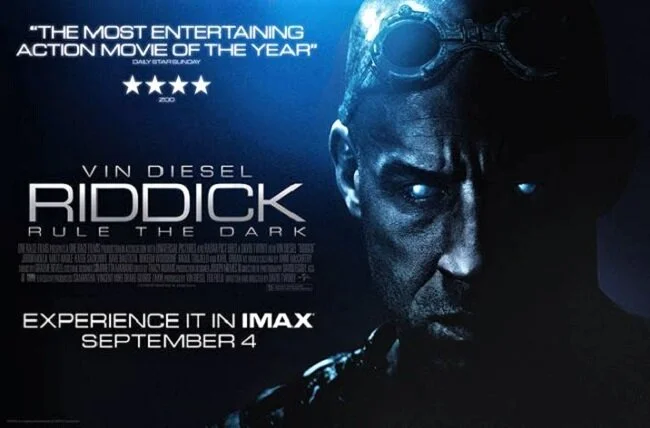
Contrary to the endorsement on the above poster, Riddick was not "the most entertaining action movie of the year" in 2013. It was just an adequate third instalment in a rather ambitious franchise, that has failed to grab the wider public's attention. That’s not to say that they didn’t make money. This is after all the third movie. Writer and Director David Twohy has done his best to try and make the character of Riddick (Vin Diesel) more than the sum of his parts and I admire both of them for their persistence. Unfortunately, Riddick just isn't engaging or complicated enough a protagonist to sustain a franchise of this nature. The anti-hero was sufficient to drive the original Pitch Black back in 2000 which had some good ideas but just couldn't sustain the overarching and overblown Chronicles of Riddick in 2004. This instalment is competently made but ultimately superfluous.
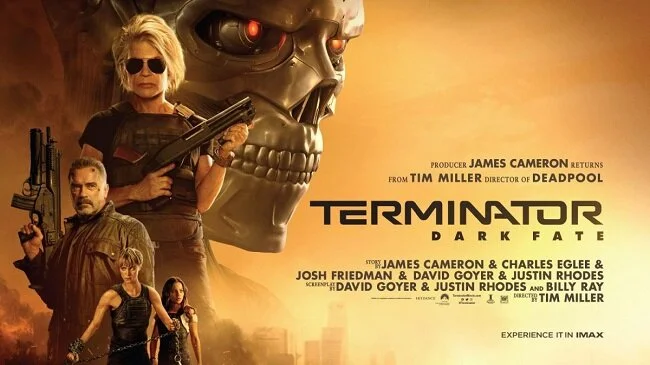
Sequels and reboots are hardly a new concept and have been a part of Hollywood culture since the 1930s. The success of the Universal Horror movies from that era being a prime example of direct follow ups and retconned movies. However, there is one fundamental rule that distinguishes a good sequel from a bad one. You should never mitigate, undermine or make irrelevant the events of the previous movie, just to provide your new film with a raison d'être. For example, the events of Aliens do not contradict or trivialise those that happened in Alien. In fact with that franchise there is a very clear logical progression between the two movies. The same is true for Mad Max and Mad Max 2 or Star Wars and The Empire Strikes Back. The key is to progress a story, enhance it or explore things from an alternative angle and bring something new to the cinematic table. Sadly this philosophy is all too often lost on corporate film making. Which means that many sequels are just tedious replays of prior films. Terminator: Dark Fate falls squarely into this category.

In the near future, a series of mysterious power surges strike the Solar System, endangering all human life. Astronaut Major Roy McBride, is selected by U.S. Space Command (SpaceCom) to investigate their source near Neptune. The surges are linked to the "Lima Project", a failed experiment from 26 years earlier, that was intended to search for intelligent life outside of our solar system. The ship’s antimatter drive is potentially malfunctioning and responsible for the energy surges. Roy’s investigation is further complicated by the fact his Father H. Clifford McBride (Tommy Lee Jones), led the "Lima Project" and has not been heard from for 16 years after reaching Neptune. Having been told that Clifford may still be alive, Roy is joined by his father's old associate Colonel Pruitt (Donald Sutherland) whose loyalties remain ambiguous. Roy, who is noted for remaining calm under pressure, shows little emotional reaction to the news about his Father. As he and Pruitt travel covertly from Earth, to the moon and then onto Mars, it becomes clear that there is more to the mission than meets the eye. Will Roy remain emotionally detached or will old wounds impair his judgement?

I was very surprised when I saw a trailer for a fourth instalment on the MiB franchise, based on Lowell Cunningham’s 1990 comic book series about secret government agents battling alien infiltration of earth. The third movie from 2012 managed to keep its head above water despite a very troubled production. At the time of its release, I like everyone else, pretty much thought that the series had run its course. Yet we live in the age of belated sequels as well as hard and soft reboots. And although Will Smith’s star may well be waning, Chris Hemsworth is still box office gold. Hence, we saw the release of Men in Black: International this summer. The basic concept of the franchise remains the same but this time the action begins in the London Office and then takes a more international journey with such locations as Marrakesh and Naples. Emma Thompson returns as Agent O and Liam Neeson joins the cast as agent High T.
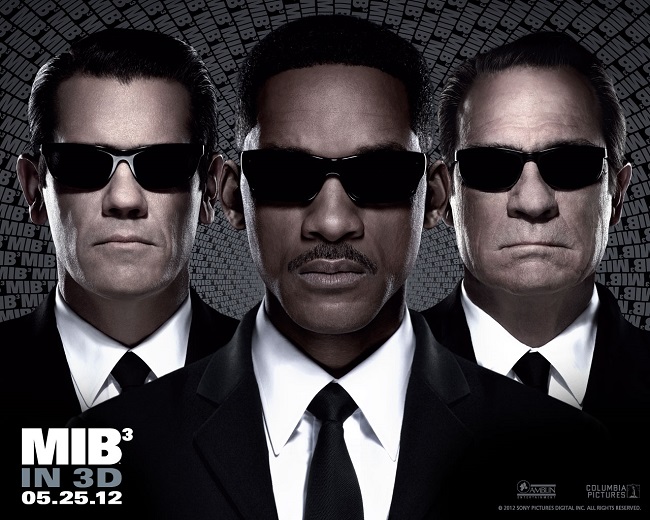
The original Men in Black movie hit our screens back in 1997. It was a box office success and was therefore followed by a mediocre sequel in 2002. It took a decade before we got a third instalment in the franchise. However, the popularity of the two lead actors contributed greatly to the success of this series and so despite well documented production problems Men in Black III was released in 2012. However, the delay between movies did have consequences. Will Smith, despite being an Oscar winner and box office star, had lost his way during this time and was not as popular with audiences. Men in Black III was a timely opportunity to reconnect with his core fans. So to ensure that the film hit all the required beats and stand a better chance of being a success, the Columbia Pictures brought back previous director Barry Sonnenfeld, in hopes of warding off the Hollywood curse of third movie instalments.
Fellow blogger and all round good guy Murf, posted an ode to Bill & Ted’s Excellent Adventure today. It is clearly a movie that he enjoys (Go read his review). He references how due to this movie (along with others), as well as being a decent person in real life, that actor Keanu Reeves enjoys a great deal of goodwill from fans and pop culture cognoscenti. Which is a good thing for Mr Reeves, because goodwill often means that folk are prepared to overlook past transgressions and misdemeanours. And in cinematic terms, Keanu has had a few. The Day the Earth Stood Still is definitely one of them. Now I’ve questioned before the wisdom and merits of writing a predominantly negative film review and believe me my thoughts on The Day the Earth Stood Still are most definitely so. However, I think that something positive can still be gained from scrutinising this film. It can be held up as a textbook example of how not to remake a classic.
Every now and then, a mainstream film studio employs an artisan director to helm some sort of experimental or vanity project. The studio executives often have very little understanding of the film maker or their body of work, beyond that their artistically respected by their peers. Hence there is the corporate hope that the resulting production will be both critically acclaimed and financially successful. However, what all too often happens is that the said director goes off and indulges themselves, or simply does what they’re hired to do and delivers a finished picture that is beyond the intellectual horizons of the studio. Sphincter’s subsequently tighten among executives; the director is denied final cut and the film is taken a way and re-edited in the hope of rendering it more commercially viable. In the worse cases, a second director is brought onboard and new material shot in the hope of “saving” the picture. The net result is usually acrimony among all involved parties and a film that fails to make its money back at the box office.

For anyone with a passing interest in literary science fiction, Arthur C. Clarke’s Childhood’s End is a seminal novel and considered an essential read. The story of humanity being shepherded into a utopian golden age by allegedly benevolent alien Overlords and the consequences it has upon society, was a radical departure from prevailing science fiction norms of the time. Over the years several film makers have expressed interest in adapting the story, but it has proven difficult to come to grips with. Stanley Kubrick initially wished to develop the novel but his subsequent collaboration with the author eventually lead to the making of 2001: A Space Odyssey. Since then there have been radio adaptations and audiobook versions, all of which seem to be a better medium for this episodic and contemplative tale. In late 2015 US cable and satellite channel Syfy broadcast a three-part miniseries based upon the 1953 story; something that past me by at the time. I recently caught up with this adaptation which seems to have provoked very mixed reactions among viewers. As ever, the controversy seems to stem from purists who favour a more slavish interpretation of the book.

I always cringe when I hear the phrase re-imagining. It's yet another contrived expression created by marketing bodies to justify the somewhat arbitrary process of remaking an established title. Often the re-imagined product has little to do with the source material and was chosen simply because of brand awareness. If you want a textbook example of a recent example of this somewhat cynical process then look no further than last year’s Death Wish reboot. It had nothing new to say on the subject and simply trotted out a generic and bland revenge thriller. So, when I discovered that Robert Wise's classic science fiction film, The Andromeda Strain had been remade as a TV miniseries (that had completely passed me by), I had great reservations as to whether this would be worth watching. However, the involvement of Tony and Ridley Scott piqued my interest, so I decided to take a calculated risk and give this 2008 A&E Network production a go.
Time is quite literally money in the movie In Time, starring Amanda Seyfried and Justin Timberlake. Written and directed by Andrew Niccol, who previously wrote Gattaca and S1m0ne which both had similar dystopian themes, we are presented with a chilling scenario. What if you had to spend minutes or hours or perhaps days of your life in the same way you spend money? The movie offers a future where the population is genetically programmed to stop aging at twenty-five. If you're rich enough, you can purchase and trade this commodity, adding time to your life, making you effectively immortal. For the poor, the future is a far bleaker with most dying within a year of this hardcoded end date. Every transaction comes with a price in minutes and seconds.
Many years ago, I use to rush home from school to watch Project UFO. Based loosely on the real-life Project Blue Book, this show from 1978 featured two U.S. Air Force investigators, Maj. Jake Gatlin (William Jordan) and Staff Sgt. Harry Fitz (Caskey Swaim) and their subsequent investigation into alleged UFO sightings. Sometimes there would be rational explanations and on other occasions, there was clearly extraterrestrial involvement. By the second season out protagonists experienced a close encounter of their own. It wasn’t the most densely plotted of dramas and was produced and presented in the idiom of mainstream television of the time. However, for a ten-year-old boy it had some excellent miniature work (Brick Price Movie Miniatures) and anything about UFOs was always a source of interest. There was also a great and very seventies theme tune by Nelson Riddle. So when I discovered that History (formerly The History Channel) had produced a science fiction drama series called Project Blue Book, I became somewhat nostalgic and equally intrigued.
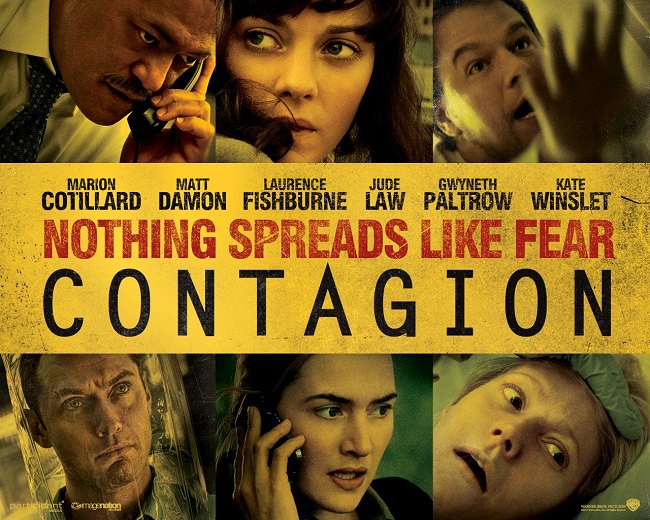
Director Steven Soderbergh is no stranger to complex narratives, shot in a near documentary style. And this is exactly this approach that he brings to bear upon Contagion. A movie that beneath its contemporary trappings, still has the air of an all-star disaster movie. Unlike so many current films which suffer from underdeveloped characters due to poor writing, Soderbergh makes conscious decision to focus more upon the mechanics and nature of a global pandemic than the main protagonists. This somewhat detached approach may not be to all viewers liking. But the format starkly scrutinises and catalogues events in an honest fashion and doesn’t shy away from the realities of the situation or get side tracked by the emotional aspects of the ongoing human tragedy.
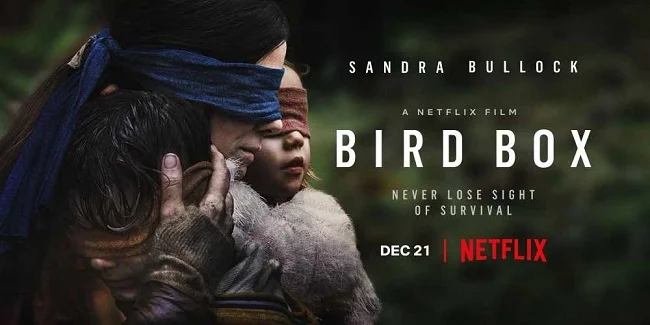
The unfolding apocalypse and the unseen forces that bring it about are never fully explained in Bird Box. The movies also eschews overblown, CGI driven set pieces and spectacle. The scenario is simply the MacGuffin which director Susanne Bier uses to facilitate her exploration of the angst of motherhood and societal decay. This is superficially a genre movie but it’s mainly about people, performances and ideas. There have been some comparisons to A Quiet Place, but this movie is actually closer to The Mist. The film is at its best during the first act, when setting up its premise and at the start of “the event”. The second act remains above average mainly due to the strength of the cast, as they weather the ongoing storm. The denouement is somewhat functional and is possibly the weakest aspect of the film. Yet, the strength of what has gone before and as ever the robust nature of Sandra Bullock’s performance keeps things on track.
Biggles (1986)
After the success of Raiders of the Lost Ark in 1981, filmmakers scrambled to find existing intellectual properties that they could use for similar films. Hence archaic heroes such as Alan Quatermain were hastily given a modern makeover and thrust into generic movies, in a vague attempt to replicate Steven Spielberg’s successful formula. Which brings us neatly on to James Charles Bigglesworth AKA “Biggles”, a fictional pilot and adventurer from a series of books written by W. E. Johns between 1932 and 1968. Several attempts had been made in the past to bring this character to the silver screen, including one by Disney but they all failed. However, the commercial and critical success of Indiana Jones provided sufficient impetus to greenlight a new film. However, due to some curious production choices, when Biggles was finally released it was far from just a period set, action movie.
After the success of Raiders of the Lost Ark in 1981, filmmakers scrambled to find existing intellectual properties that they could use for similar films. Hence archaic heroes such as Alan Quatermain were hastily given a modern makeover and thrust into generic movies, in a vague attempt to replicate Steven Spielberg’s successful formula. Which brings us neatly on to James Charles Bigglesworth AKA “Biggles”, a fictional pilot and adventurer from a series of books written by W. E. Johns between 1932 and 1968. Several attempts had been made in the past to bring this character to the silver screen, including one by Disney but they all failed. However, the commercial and critical success of Indiana Jones provided sufficient impetus to greenlight a new film. However, due to some curious production choices, when Biggles was finally released it was far from just a period set, action movie.
Catering salesman Jim Ferguson (Alex Hyde-White), is unexpectedly transported from New York City to 1917 France, where he saves the life of Royal Flying Corps pilot James "Biggles" Bigglesworth (Neil Dickson) after he is shot down on a reconnaissance mission. Immediately afterwards, Jim is transported back to 1986, where his fiance Debbie (Fiona Hutchinson) struggles to believe his explanation as to what happened to him. However, Jim is subsequently visited by Biggles’ former commanding officer, Air Commodore William Raymond. Raymond tells him about his theory that Ferguson and Biggles are "time twins", spontaneously transported through time when the other is in mortal danger. Shortly after Jim is reunited with Biggles, along with Debbie who held onto Jim when he was transported across time. They discover that the Germans are working on a sonic weapon that could change the outcome of The Great War.
Yellowbill Productions acquired the rights to the Biggles books in 1981 and the initial aspirations of producer Kent Walwin were high. The plan was to produce a series of period set films, in the James Bond idiom, featuring action and drama. Both Jeremy Irons and Oliver Reed were originally associated with the production. Initial drafts of the screenplay were set in WWI and were faithful to W. E. Johns’ original novels. However, the producers subsequently decided to add a science fiction spin to the main story, possibly due to the imminent release of Back to the Future. Whatever the reason, the film morphed into a curious hybrid which didn’t really do justice to either the science fiction or period action genres. Furthermore, the production schedule was expedited so it could take advantage of UK tax breaks that were due to expire. As a result the screenplay was still being rewritten when director John Hough began filming.
As a result, Biggles (retitled Biggles: Adventures in Time in the US) is somewhat narratively and tonally inconsistent. Neil Dickson is well cast as James Charles Bigglesworth but has to compete for screen time with Jim Ferguson, his somewhat uninteresting time twin. The film briefly improves when Peter Cushing appears, in what was to be this iconic actor’s last role. But overall Biggles just doesn’t know what it wants to be. It feels like the writers have added multiple cinematic tropes to the screenplay out of desperation. Sadly, the romance and occasional slapstick humour fall flat. The action scenes, although well conceived, betray their low budget, featuring old tricks such as a plane flying behind a hill before exploding. Plus there’s a somewhat gory scene involving a soldier who is killed by the sonic weapon, which seems out of place.
Biggles failed at the UK box office and was equally unsuccessful when released later in the US. However, all things considered, a flawed film can still be an entertaining one. Biggles is all over the place but it does raise a wry smile from time to time. There’s plenty of the old “British stiff upper lip” with our hero telling his nemesis, Hauptmann Erich von Stalhein (Marcus Gilbert) “I'll not put a bullet in your head, old boy, because that’s not how we do business”. The flying scenes have a sense of momentum and are well shot by second unit director Terry Coles, who had done similar work on Battle of Britain. The soundtrack is also peppered with several very eighties songs from Mötley Crüe, Queen and Jon Anderson from Yes. Hence, if you’re looking for some undemanding entertainment or have an interest in the various films that tried to cash in on Indiana Jones, then you may wish to give Biggles a go.
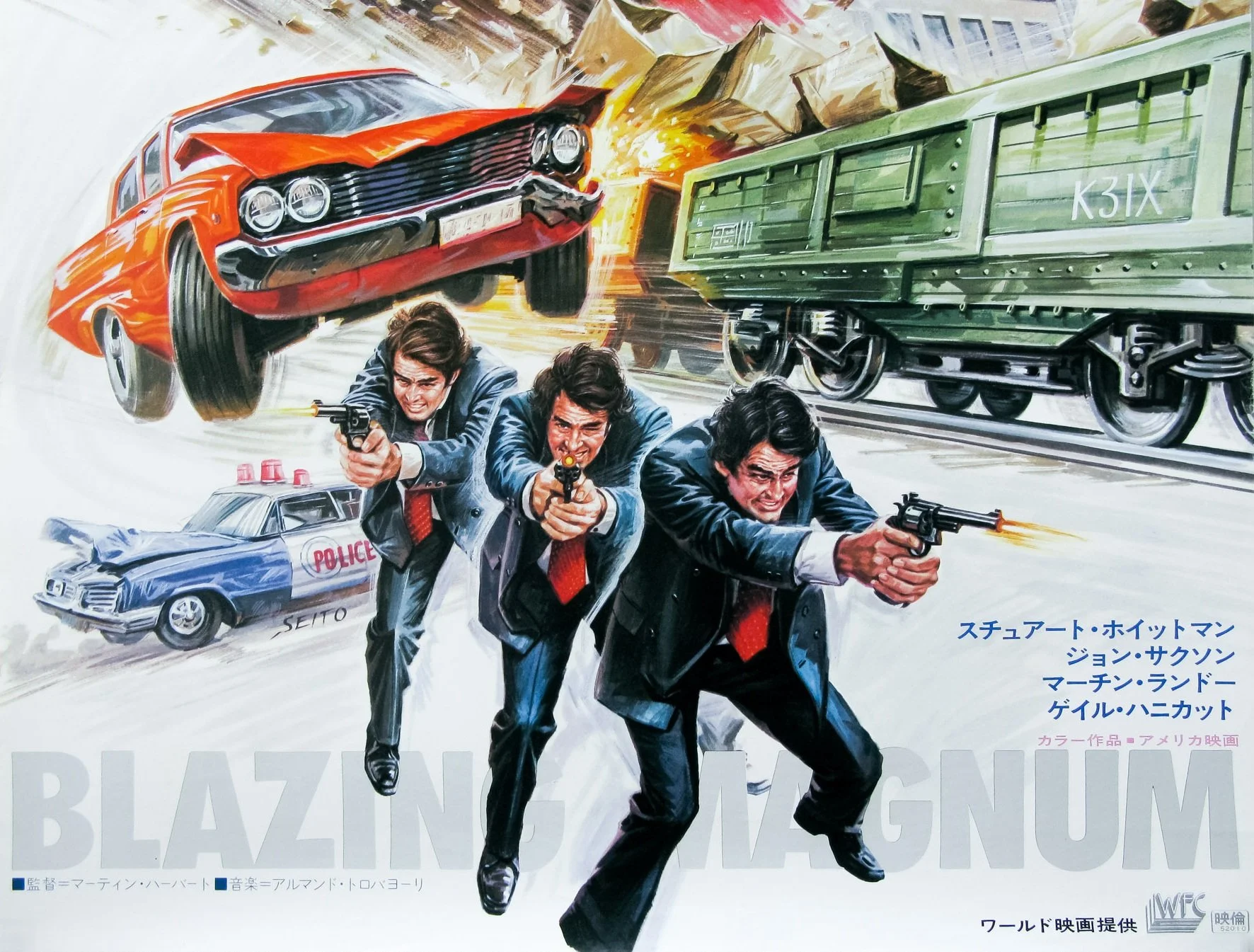
Mainstream films are easy to recommend to people. They’re usually formulaic, work within clear parameters and they’re not controversial. Most people, when viewing such film on someone else’s suggestion, are left with a fairly simply choice. Did they like it or not? Whatever the outcome, no feathers are ruffled. No one looks at you askance afterwards and says “why the hell did you think I’d like that piece of shit”? If something like this happens, then you have clearly not recommended a mainstream film. Perhaps you’ve suggested something that’s a little more of an acquired taste. Something niche, from a very specific sub-genre. Which brings me neatly to Blazing Magnum AKA Strange Shadows in an Empty Room (1976). The US title gives the impression that this film is a hard boiled cop thriller, like so many others that followed in the wake of Dirty Harry. But there’s a clue in the European title. Yes, this movie has more than just a whiff of a giallo about it.
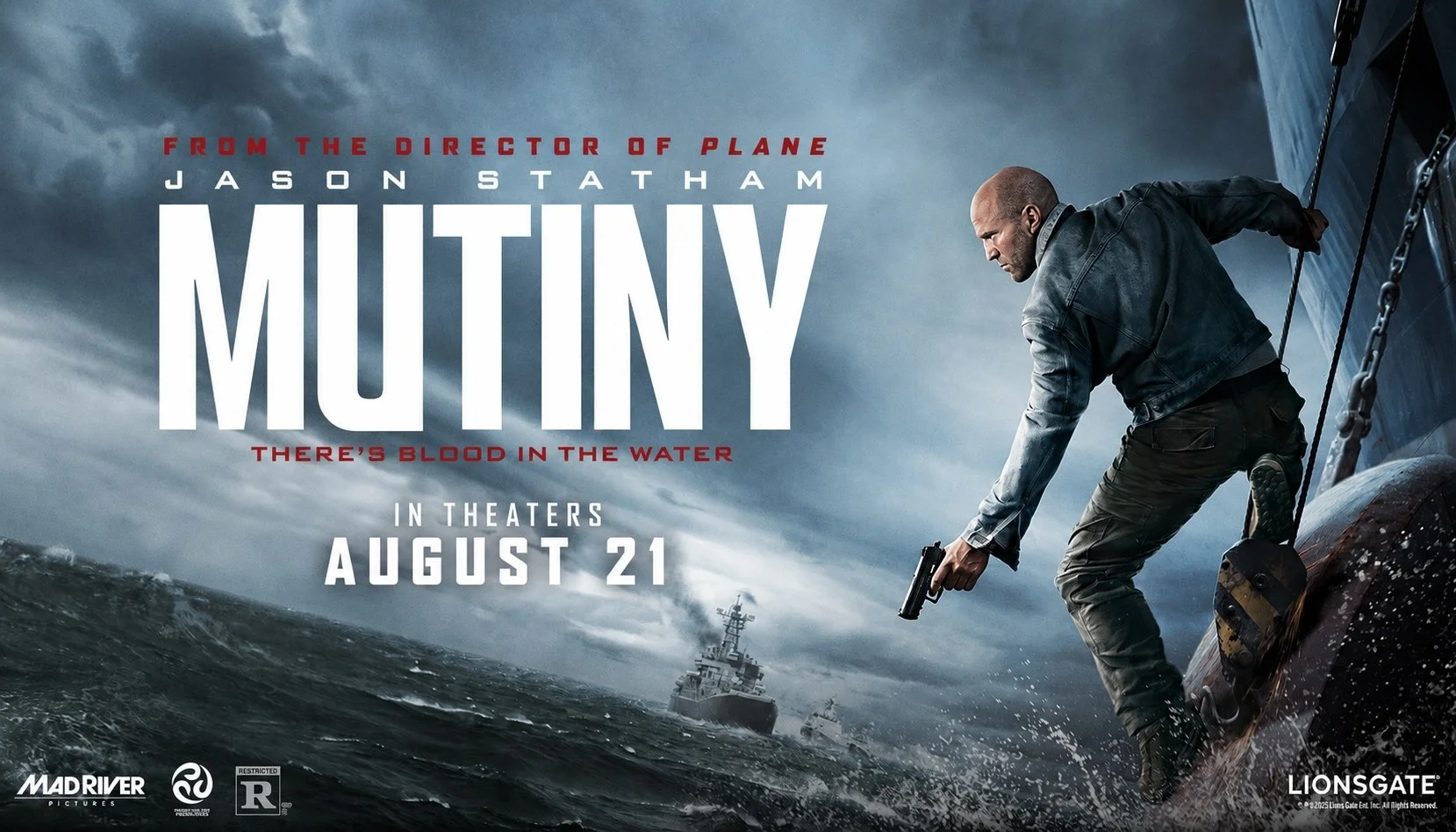
Jason Statham is an exemplar of the US mantra of “staying in your lane”. He makes action movies and occasionally strays into action comedies. His formula broadly works and is sufficiently lucrative to keep Mr. Statham employed. Therefore, if you watch a film in which he stars, you have a fairly good idea of what you’ll be getting. Of late, the criteria for his action vehicles have become more succinct. Jason Statham will play an innocuous character, such as a construction foreman or a bee keeper. Something terrible will subsequently befall another character who Mr. Statham has an emotional connection with in some capacity. He will subsequently hunt down those responsible and meet out death and violence. At some point the villain of the story will enquire as to how this innocuous person is so lethal. Research will then show that our Jason is in fact an ex-police officer/special forces operative/international assassin. There’s then a showdown and the villain dies. Job done.
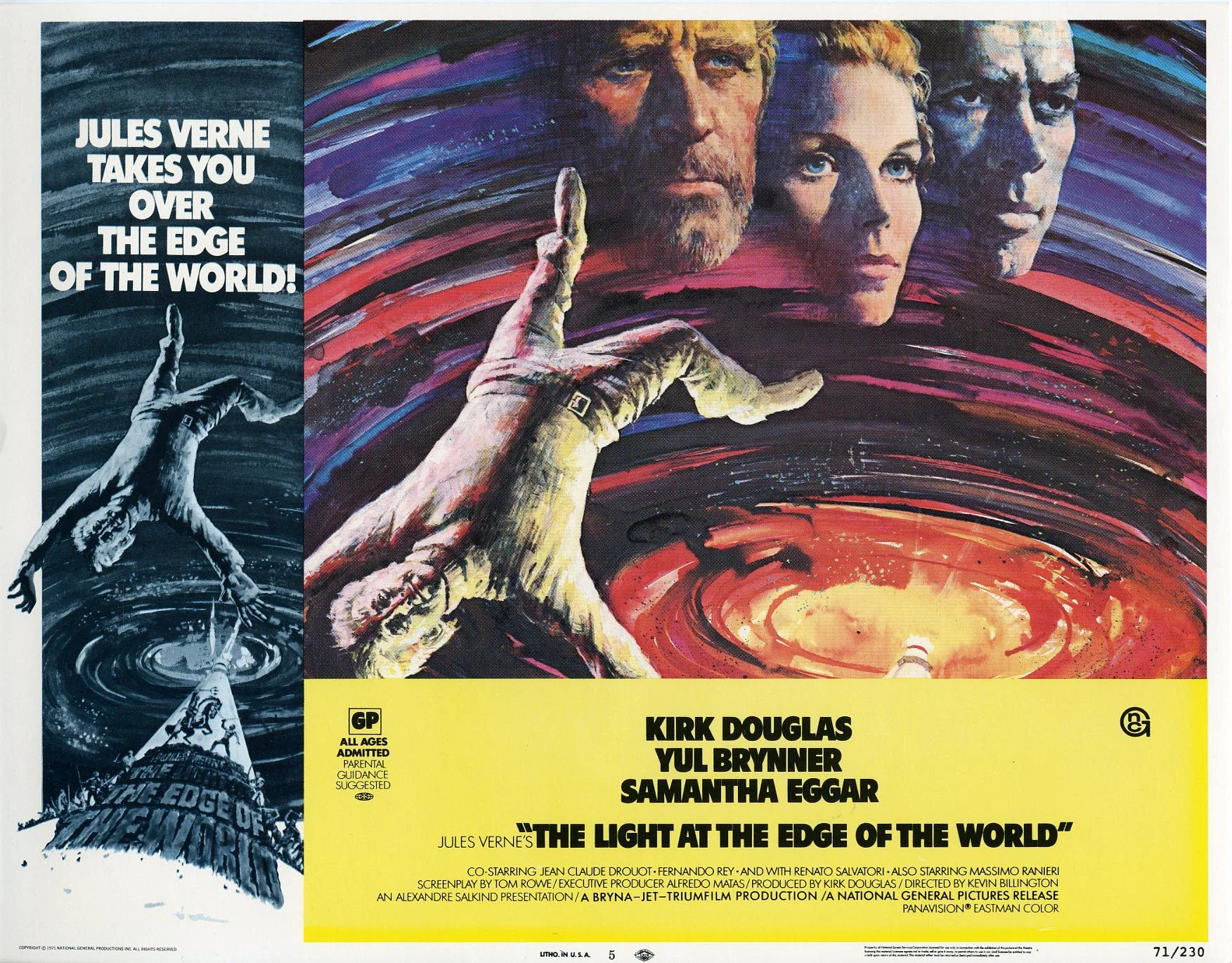
The Light at the Edge of the World presented itself as an action movie upon its release in 1971. Based upon a story by Jules Verne, the Spanish American co-production was driven by its star Kirk Douglas, who curiously hired British director Kevin Billington to helm the project. This tale of a lighthouse keeper fighting a war of attrition against a group of pirates that have captured his island, was market as an adventure film ostensibly in the idiom of the authors previous works and as a pirate movie. MGM bought the rights to distribute the film in the UK on the misunderstanding that it was a family friendly production. It was not and remains so. They subsequently had to cut 15 minutes of violence and torture as well as an undercurrent of sexual assault to secure a suitable rating. Conversely, the US distributors received an arbitrary PG rating, despite the fact this is one of a handful of films that honestly depicts pirates as murderers, rapists and worse.
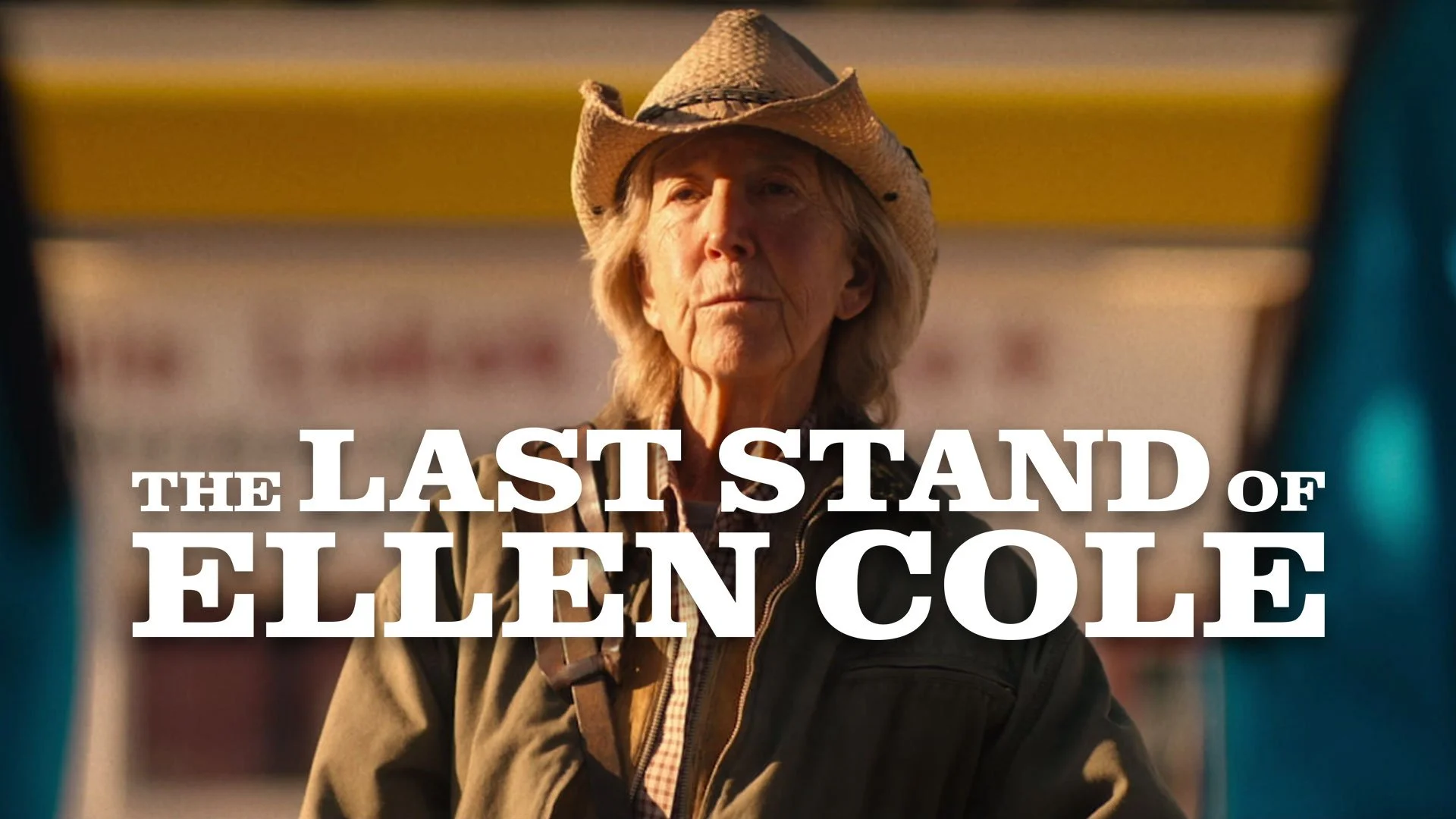
It’s an established action film trope. The fire team comprised of ex-military personnel, move in on their target. Only to have the tables turned by someone they don’t deem a threat. What makes it different in The Last Stand of Ellen Cole is a throwaway line of dialogue. The bested operative lies bleeding on the floor and the protagonists stands over them ready to finish them off. “Don’t, I have a cat” they feebly plead. For me that was the icing on the cake. The movie had already established it was taking the “same old, same old” and doing something different. Something fun, if taken in the right spirit. This scene tipped the balance and I embraced this film because it was being honest about what it is. This is a modern B movie that decides to give a very specific sub-genre a makeover. Furthermore, its clearly done with an affectionate wink, which is very different to sly wink. This isn’t deliberate self-knowing irony. Its just a film doing something different and possibly silly but it genuinely wants to have fun with it.
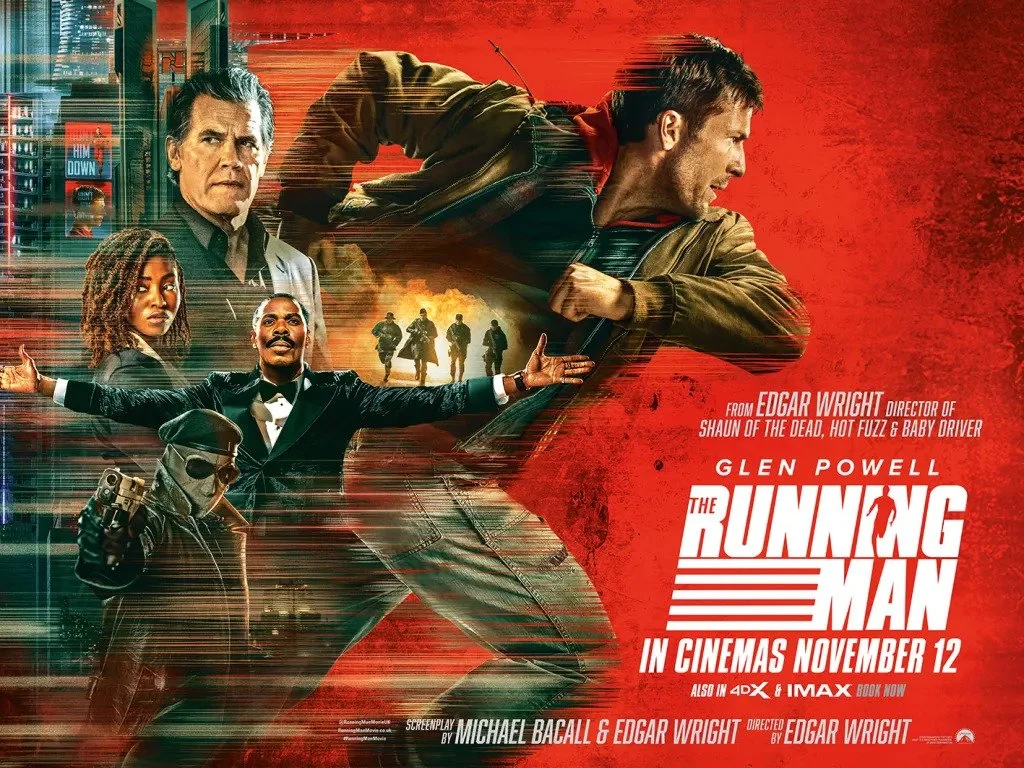
Stephen King’s dystopian story, The Running Man, was previously adapted very loosely in 1987, as a vehicle for Arnold Schwarzenegger. That version focused mainly on the “Battle Royale” element of the story and leaned heavily into Arnie’s personality, rather than the politics of the book. It also wasn’t well received by the author. Edgar Wright’s remake follows the source text a lot more closely and is far more interested in its political themes and wider social commentary. Furthermore, this version re-establishes the everyman quality of the hero of Ben Richards, rather than him being the muscle bound, ex-military hero as per Mr. Schwarzenegger’s prior interpretation. This time round, The Running Man uses a lot of the visual and narrative tropes of contemporary reality TV, making this forty three year old story very relevant to today’s viewers and couching the film in a style that is recognisable and accessible.
After the success of Raiders of the Lost Ark in 1981, filmmakers scrambled to find existing intellectual properties that they could use for similar films. Hence archaic heroes such as Alan Quatermain were hastily given a modern makeover and thrust into generic movies, in a vague attempt to replicate Steven Spielberg’s successful formula. Which brings us neatly on to James Charles Bigglesworth AKA “Biggles”, a fictional pilot and adventurer from a series of books written by W. E. Johns between 1932 and 1968. Several attempts had been made in the past to bring this character to the silver screen, including one by Disney but they all failed. However, the commercial and critical success of Indiana Jones provided sufficient impetus to greenlight a new film. However, due to some curious production choices, when Biggles was finally released it was far from just a period set, action movie.
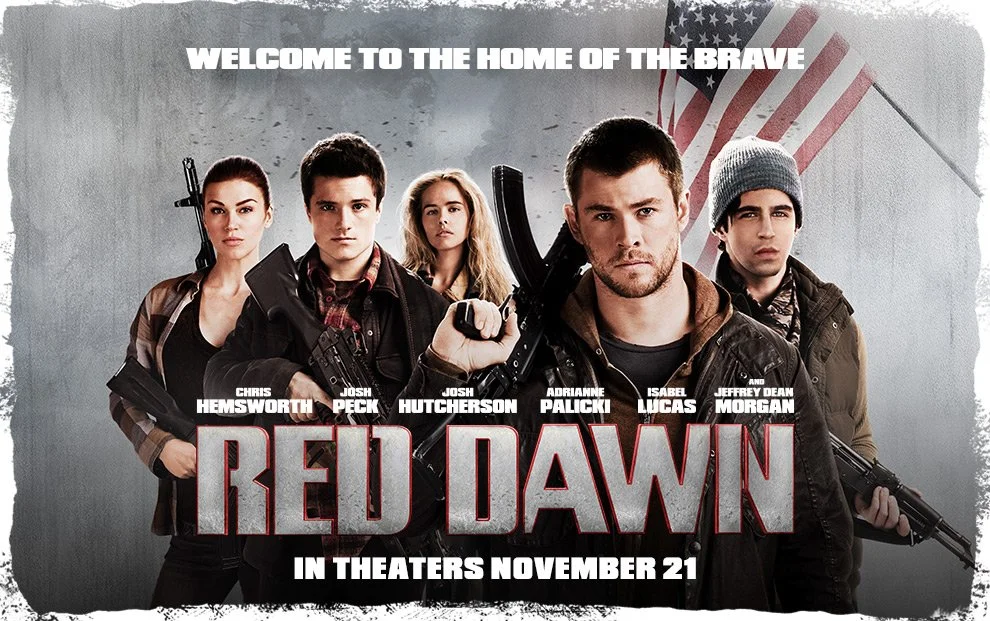
Setting aside the hubris of remaking a film such as Red Dawn, the 2012 reboot had a troubled production. Shot over the course of late 2009, on location in Michigan, MGM intended to release the film in September 2010. However, the studio’s financial problems became unsustainable over the course of that year and the film was shelved, while a financial solution was sought. Furthermore, while Red Dawn was in post production, there was a major economic shift within Hollywood due to the increasing importance of the Chinese market. This was a significant problem for MGM because the new version of Red Dawn had the Chinese invading the USA instead of Russia. Hence there were reshoots and the need for additional visual effects, so that the Chinese could be replaced with North Koreans. MGM eventually went bankrupt and the distribution rights to Red Dawn were sold off. The film was eventually released in 2012.
When I first saw the promotional trailer for Gangster Squad back in 2012, prior to its release, I wasn't especially impressed. I simply thought the film was another attempt to re-invent the gangster genre for a generation who were not especially familiar with it. I wasn't exactly overwhelmed with director Ruben Fleischer's resume either. I didn't particularly like Zombieland and haven't seen 30 Minutes Or Less. Then came the tragic mass shootings in Aurora, Colorado which led to the movie being delayed so that the original ending, which featured a shoot-out in a movie theatre, could be replaced. Hence when I finally watched this film recently, I wasn't expecting a movie up to the standards of say Once Upon A Time In America or Miller’s Crossing and it would seem that I was right do so. Gangster Squad is not especially noteworthy in any respect.

Levon Cade (Jason Staham) is a former Royal Marine Commando who has retired from military service and now works as the leader of a construction team in Chicago. He has a close relationship with Joe and Carla Garcia (Michael Peña and Noemi Gonzalez ) who run the company and considers them as family. Outside of work, Levon is involved in a bitter custody battle for his daughter, against her maternal grandfather, who blames Levon for his daughter’s suicide. When Garcia's teenage daughter Jenny (Arianna Rivas) goes missing, Levon reluctantly agrees to help her parents and get her back. Beginning his search at the nightclub where Jenny was last seen, he soon discovers that she was abducted by Russian traffickers. Furthermore, the culprit is Dimi Kolisnyk (Maximilian Osinski), the wayward son of a senior ranking gangster.
PC Nicholas Angel (Simon Pegg) is an exemplary Police Officer, with a strict adherence to the letter of the law. As a result of making the rest of the London Metropolitan Police look bad, he is transferred to the rural town of Sandford, Gloucestershire. On arrival, Angel finds that the local Inspector, Frank Butterman (Jim Broadbent), takes a far more laissez-faire approach to policing. His colleagues are incompetent and he is further hampered by the Neighbourhood Watch Alliance (NWA), who prioritise low crime statistics over law enforcement due to their desire to win the title of “Village of the Year”. Furthermore, Angel is partnered with the Inspector’s son, Constable Danny Butterman (Nick Frost), who is infatuated with “buddy cop” movies and is in awe of Angel’s London experience. “Have you ever fired two guns while jumping through the air?” However, a sudden spate of grisly accidents lead Angel to believe that there's more to the seemingly tranquil and picture-perfect community than meets the eye.
As a collection of history's worst tyrants and criminal masterminds gather to plot a war to wipe out millions, one man must race against time to stop them. Discover the origins of the very first independent intelligence agency in The King's Man. Based on the Comic Book “The Secret Service” by Mark Millar and Dave Gibbons. 20th Century Studios
Matthew Vaughn’s The King’s Man is an inconsistent film, both narratively and tonally. It veers between serious themes and stylised, hyperbolic action. At times it does quite a good job of exploring such complex subjects as global politics, mechanised warfare and colonialism. Sadly it then wrenches the viewer out of these cerebral reveries as it lapses into the sort of over the top action sequences that were notable in the two earlier films. It’s a shame because The King’s Man gets so many other aspects of the production right. The casting is very interesting, especially Ralph Fiennes as the “pacifist” Duke of Oxford. He is actually a very good fit for the action genre. Djimon Hounsou and Gemma Arterton are given little backstory beyond being respectively the faithful manservant and the family nanny but both are notable due to their own inherent acting chops and personal charisma. Rhys Ifans obviously has a great time as Grigori Rasputin, ensuring all the man’s vices are robustly depicted.
On paper, a video games franchise such as Assassin’s Creed lends itself perfectly to a cinematic adaptation. The parkour action scenes, the historical settings and the contemporary conspiracy theory themes are all elements that should play well with a modern youth audience. Hence with the backing of a major studio such as Twentieth Century Fox and a budget of $125 million, the 2016 movie should have been a guaranteed box office hit. The casting of Michael Fassbender, an actor who is comfortable with serious roles and big Hollywood franchises, should have carried this film comfortably over the finishing line. Director Justin Kurzel, who had found critical success with his adaptation of MacBeth a year previously, must have looked like a safe pair of hands to handle such a project. Sadly, that was not the case. Assassin’s Creed is not the sum of its parts, in fact many elements appear to be pulling in opposite directions. The resulting feature film is staggeringly dull, soulless and a chore to watch. A testament to how modern big budget franchise movies have become a production line, with all the art stripped from them.

300: Rise of an Empire is a curious beast, being neither a sequel nor a prequel. It is infact a tale that takes place simultaneously with those of the original movie. While Gerard Butler is busy making a last stand at the Battle of Thermopylae, fellow warrior and politician Themistokles, played by the singularly uncharismatic Sullivan Stapleton, leads a similar army of buffed Greeks against the Persian fleet. Once again we have a movie that is the epitome of style over substance, complete with a sound design that challenges what can physically be endured by human hearing. They say the first casualty of war is innocence but in this type of movie it's closely followed by historical accuracy and authentic depictions of ethnicity. 300: Rise of an Empire is a cinematic assault upon the senses but not in a good way like Mad Max: Fury Road.
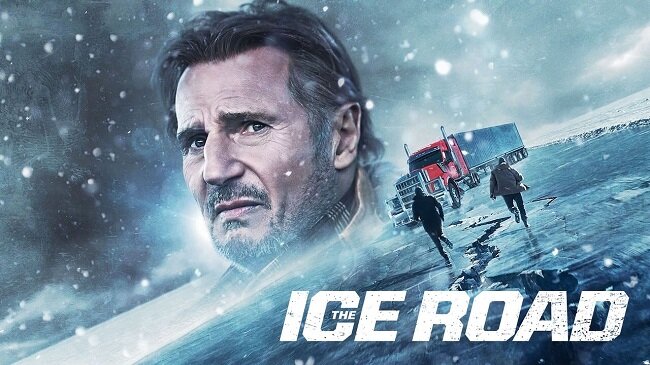
Back in September 2017, Liam Neeson stated in an interview with Sky News that he was retiring from the action genre, due to his age. He felt that audiences would question his credibility in such roles. After the release of The Commuter (2018) and Cold Pursuit (2019) Mr Neeson appeared to return to human dramas and films that focus on performance rather than punching man and beast. Ordinary Love and Made in Italy, both released in 2019, demonstrate the actor’s versatility and skill. People seem to forget that he is a thespian who was initially known for his character driven roles in films such as The Mission (1986), Rob Roy (1995 and Michael Collins (1996). It was only in 2008 that he reinvented himself as an action hero. It’s all a far cry from Schindler’s List and his performance that earned him an academy award nomination. The reason I mention all of this is because The Ice Road is the third action movie I’ve seen in 2021 that stars Liam Neeson.
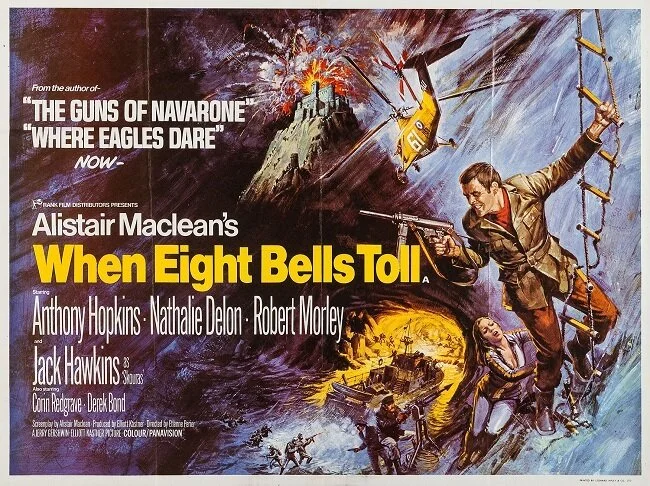
One of the stand out tropes of the modern action film is that the stakes are always cranked right up to 11. Terrorists, biological weapons and nuclear bombs are common threats in such movies with a hero or heroes trying to save the world from death and destruction or worse. However, back in the sixties and seventies, things were a little more straight forward and in some respects more credible. Take When Eight Bells Toll, released in 1971, for example. British Treasury secret agent Phillip Calvert investigates the theft of £8,000,000 in gold bullion by a gang of international smugglers. In the context of the times this was no small beer however it’s somewhat mundane compared to fighting super villains and their space lasers. Frankly I prefer these low key plot devices as they can make a film a little more plausible within the confines of the genre. A concept that is often forgotten today.
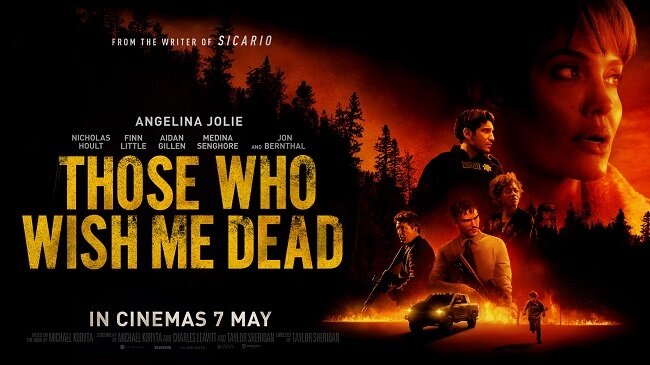
Forensic accountant Owen Casserly (Jake Weber) flees his home with his teenage son Connor (Finn Little) when he discovers he has been targeted by a pair of assassins (Nicholas Hoult and Aidan Gillen) who have been hired to stop him giving evidence in a major corruption case. Connor witnesses the murder of his father after their car is run off the road. Entrusted with important written evidence, he escapes into the dense forests of the Montana wilderness pursued by the killers. Seeking help he runs into smokejumper Hannah Faber (Angelina Jolie) who is stationed at a remote fire lookout tower. Hannah suffers from PTSD from a previous forest fire in which she was unable to save three young boys. Hannah attempts to lead Connor through the forest to safety. Meanwhile the assassins set fire to the forest to divert the attention of the authorities and cover their tracks.

I must admit that I did not have particularly high hopes for Paul W S Anderson's remake of the 1975 Roger Corman produced cult classic. Anderson’s work varies greatly. Event Horizon and Soldier are solid genre films but I still have not fully come to terms with Alien vs. Predator. Jason Statham is also a name that divides the public, with solid material such as The Transporter and unfathomable tosh like Revolver. But despite these considerations, Death Race is in fact quite a surprise and does not follow the path that so many remakes do. It takes the basic themes and concept associated with the original and tries to do something different with them. It doesn’t reinvent the wheel nor is it a genre milestone. But it does offer a different spin on things, have some engaging action scenes and provide some dumb but enjoyable entertainment. When combined with snacks and some beer this is a passable way to kill 111 minutes.
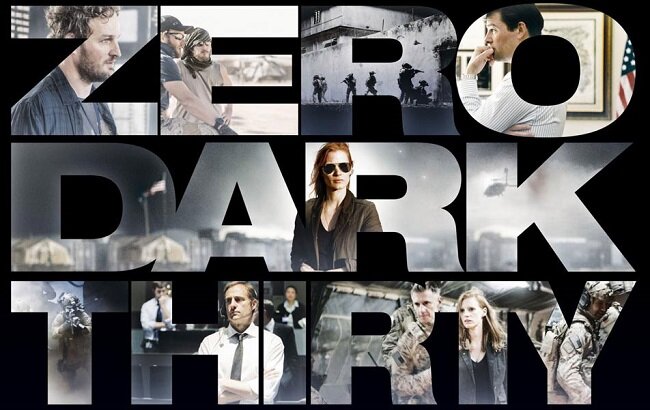
I did not watch Zero Dark Thirty upon its initial release, due to the politics surrounding it. I wanted to be able to view it free from bipartisan debate. Eight years on I believe this now achievable and although debate still exists it is now more measured and less strident. Zero Dark Thirty is certainly a compelling movie. It plays as a docudrama, providing an in-depth study of the US intelligence services hunt for Osama Bin Laden. It cannot be faulted on a technical level and the performances are very strong. It does not adopt a celebratory or triumphalist tone in its approach to the story. Director Kathryn Bigelow endeavours to keep the proceedings focused upon the intricacies of an intelligence driven manhunt. There is little or no tubthumping, jingoism. The decision to find Bin Laden is shown as a political and military exercise of foreign policy. The film solely focuses on the story from a US perspective but that is perfectly acceptable as it is not intended to be an exploration of geo-politics.
Firestorm was originally written as a vehicle for Sylvester Stallone, however when the production company Savoy Pictures went bankrupt the screenplay was bought by Twentieth Fox and the scope of the movie reduced to suit a lower budget. It’s broadly similar to Cliffhanger in so far as the lead character is a specialist in a certain field who runs afoul of criminals in a perilous environment. Whereas Cliffhanger is set in the Rocky Mountains, Firestorm takes place in the forests of Northern Wyoming. After the script was revised four times, the finished screenplay was given a final “polish” by Graham Yost who has considerable experience with the action movie genre. As stallone was no longer associated with the project and the production had been repurposed to be less extravagant, the movie was assigned to former NFL star Howie Long. Long had already appeared in the John Woo movie Broken Arrow (1996) and the Firestorm was seen as a means to give him a star vehicle.

The original French movies District 13 and its sequel District 13: Ultimatum, conceived and produced by Luc Besson, were enjoyable variations of the Escape from New York theme. Their charm lay in their European pedigree and the skilful use of parkour. The two leads, David Belle and Cyril Raffaelli, were eminently suited to the minimalist roles and the screenplays were fun. Half of these movies appeal was the fact that they were not mainstream US products. Brick Mansions is the Hollywood remake of District 13, as well as being Paul Walkers’ final movie. Sadly, this film is far from a fitting epitaph, being devoid of any charisma or innovations. It is blandly shot , poorly edited and has been stripped of everything that made the original entertaining.
Arnold Schwarzenegger's return to the big screen after his political career has been uneven to say the least. His cameos in The Expendables and The Expendables 2 were well received, with their self referential charm and age related irony. Yet his first major movie The Last Stand, although competent, failed to find an audience. Escape Plan fared better at the box office but did not put Arnie back on the A list. Effectively there's a large percentage of the contemporary cinematic audience who were born after his heyday and are simply not overt fans of his work. His core audience is more than likely of the age group that consume most of their film entertainment at home. Which may explain why Sabotage tanked in the US upon release on March 28th 2014. It was the worst opening box office of Arnie's career. He used to break first day opening records.
Sequels and reboots are hardly a new concept and have been a part of Hollywood culture since the 1930s. The success of the Universal Horror movies from that era being a prime example of direct follow ups and retconned movies. However, there is one fundamental rule that distinguishes a good sequel from a bad one. You should never mitigate, undermine or make irrelevant the events of the previous movie, just to provide your new film with a raison d'être. For example, the events of Aliens do not contradict or trivialise those that happened in Alien. In fact with that franchise there is a very clear logical progression between the two movies. The same is true for Mad Max and Mad Max 2 or Star Wars and The Empire Strikes Back. The key is to progress a story, enhance it or explore things from an alternative angle and bring something new to the cinematic table. Sadly this philosophy is all too often lost on corporate film making. Which means that many sequels are just tedious replays of prior films. Terminator: Dark Fate falls squarely into this category.

The enduring appeal of the character John Rambo in First Blood comes from the fact that he is a traumatised ex- service man who keeps himself to himself as he drifts from job to job, trying to come to terms with his wartime experiences. His poor treatment at the hands of a small-town Sheriff is a succinct metaphor for the social and political indifference that Vietnam veterans were shown upon their return to the US. He’s a man with a code in a world that no longer has any use for him. His simple and honest patriotism is not returned and he is in fact viewed with shame by many from the nation he loves. Furthermore, the first movie does not paint him as a cold-blooded killer. Despite provocation he is not the first person to shoot to kill. Rambo is in many ways a victim. A broken man, who society has asked to do unspeakable things. Now society wants nothing to do with him and fears the “monster” they created. Although clearly an action movie, First Blood had narrative depth and a flawed but sympathetic protagonist. 37 years and four movies later, such dramatic themes have long left the franchise. The central character is indeed a caricature of its former self.

It was hardly surprising that the movie adaptation of Chris Kyle's autobiography American Sniper, would cause controversy. The Iraq war, US Foreign Policy and national pride are seldom subjects that are discussed in a calm and measured fashion. And then there are the personal politics of director Clint Eastwood to consider. Hence there were claims from some quarters upon the movie’s release, that it was Islamophobic and counter claims that criticisms of the late Chris Kyle were unpatriotic. There still remain issues regarding the authenticity of events depicted in the source text and subsequently the movies screenplay by Jason Hall. Yet none of these factors have in anyway impacted upon the film's box office returns which currently stands at $247,900,417 worldwide.
Do I really need to present you with some sort of plot synopsis for Transporter 3? No, I didn’t think so. More of the same as Frank Martin (Jason Statham) and his police chum, Inspector Tarconi (Francois Berleand) become embroiled in yet another high-octane escapade. There's fights, car stunts, exotic international locations and a strong sense of humour. This time, the disposable love interest is a Ukrainian girl named Valentina (Natalya Rudakova) who fulfils her role succinctly. The film benefits by being set back in Europe, after the mistake of basing Transporter 2 in the US. This time, the story takes us to such locations as Budapest and Odessa. The international film crew once again bring a veneer of panache to the production that is conspicuously absent in US action movies. For a modest budget fil, Transporter 3 it looks very good. Again the proceedings are given a boost by a pertinent soundtrack by Alexandre Azaria and a selection of European “tunes”.

Jason Bourne originally graced our screens for the first time seventeen years ago. The Bourne Identity was a gritty, minimalist take on the espionage genre and a welcome change from the excesses of the Pierce Brosnan Bond era. The story arc was sustained over three movies and ended efficiently and succinctly. After which Matt Damon moved on, as did the director of two of the movies, Paul Greengrass. Which leaves us with The Bourne Legacy; the tangential sequel that arrived in 2012. A film that exists because the money men and bean counters hate to pass up on a franchise until it has been squeezed utterly dry. Hence, they commissioned the writer of the series, Tony Gilroy, to come up with a screenplay and direct a spinoff movie. Jeremy Renner was cast in the lead role. Yet despite narrative and production continuity, The Bourne Legacy was not a Jason Bourne movie with the star appeal of Matt Damon. Although the film turned a profit, it had the lowest box office returns out of the entire franchise.
During the eighties there was a clear league table of action movie stars. By the mid-nineties this system fell into decline and the Hollywood lacked any clearly defined exponents of the genre. A decade later, due to the success of Luc Besson’s Transporter films, Jason Statham became a bankable box office star in this field. When you look at Statham's early work in Lock, Stock and Two Smoking Barrels it is hard to envisage the "mockney geezer" as an international action star. Yet he has successfully stepped into the role and enjoys a large following. I enjoy his work as he has a likeable on-screen persona. My 88-year-old Mum likes him to because "he wears nice suits". The action genre seldom reaches such a diverse demographic.
Before we start, I recollect that one well known UK critic described Safe House as sub-Tony Scott, upon its release. Now I’ve always been conflicted over Scott’s back catalogue, as I’ve always found his movies to be hampered by their own unique style. The subtleties of his characters and depth of his themes are all too often drowned out by his frenetic style and fast paced editing. Therefore a comment such as this really sets off alarm bells for me. Having recently watched The Equalizer 2, I wanted a further fix of Denzel Washington in a similar action vehicle. As Safe House was available on Netflix UK, I decided to kill a couple of hours and see what actually constitutes as “sub-Tony Scott”.
13 Assassins is one of Takashi Miike's most restrained and mature movies. Set in Feudal Japan and based on true events, a venerable clan suffers under the reign of the cruel young Lord Naritsugu (Goro Inagaki), who commits atrocities at will. Unable to break their oaths, the samurai are torn between duty and shame. Some of the masters in the clan even go so far as to commit Seppuku in protest. Unable to endure the status quo, a plan is formed to gather a small team of the deadliest samurai and assassinate Lord Naritsugu while he is travelling between clan territories. The responsibility falls upon Shinzaemon Shimada (Koji Yakusho) to take on this potentially fatal task. The matter is further complicated by Lord Naritsugu’s personal bodyguard (and Shimada’s former rival) master samurai Hanbei (Masachika Ichimura), who is a force to be reckoned with.
Adapted from the novel by Wilbur Smith, Shout at the Devil is the sort of big budget, sprawling, period set high adventure movie that has fallen out of vogue in recent decades. Its main attraction are its stars, location and robust action scenes. Crafted by former Bond director and long-time editor Peter Hunt, this is a full on, no nonsense character driven drama of the kind that were common place during the seventies. Sometimes the enormity of these sorts of productions meant that something suffered by omission. Be it a weak script, excessive set pieces or too many cameos by an all-star cast. Shout at the Devil broadly manages to avoid such pitfalls. There is however a notable tonal shift in the story about halfway through the film, which does take events in a different direction.
Sapphire & Steel (1979-1982)
The seventies was an interesting time for UK genre television. Despite small budgets and often low key visual effects, there was no shortage of good ideas and creativity. Sapphire & Steel is a prime example of a show couched in a high concept, produced on a shoestring. It also credits its audiences with some degree of intelligence. Rather than spoon feeding the narrative in a didactic manner, it hints and implies, then leaves the rest to its viewers imagination. Created by Peter J. Hammond, a veteran TV writer, Sapphire & Steel centres on a pair of interdimensional operatives named Sapphire and Steel. They are two of a number of elements that assume human form. Over the course of three seasons little is revealed about the pair but they appear whenever there is any anomalous temporal activity. Time itself is portrayed as a sentient and malignant force that seeks to make incursions into the present reality, through weaknesses in the fabric of space.
The seventies was an interesting time for UK genre television. Despite small budgets and often low key visual effects, there was no shortage of good ideas and creativity. Sapphire & Steel is a prime example of a show couched in a high concept, produced on a shoestring. It also credits its audiences with some degree of intelligence. Rather than spoon feeding the narrative in a didactic manner, it hints and implies, then leaves the rest to its viewers imagination. Created by Peter J. Hammond, a veteran TV writer, Sapphire & Steel centres on a pair of interdimensional operatives named Sapphire and Steel. They are two of a number of elements that assume human form. Over the course of three seasons little is revealed about the pair but they appear whenever there is any anomalous temporal activity. Time itself is portrayed as a sentient and malignant force that seeks to make incursions into the present reality, through weaknesses in the fabric of space.
Shot on video like many UK TV productions at the time, the main appeal of Sapphire & Steel lies in the thought provoking scripts and the relationship between its two lead characters. Sapphire (Joanna Lumley) is graceful, empathetic and flirtatious in her relationship with Steel (David McCallum). He in turn is somewhat curt and focused. Both can communicate telepathically. Sapphire can discern data from objects such as their age and can also manipulate time, usually backwards for short periods. Steel can lower his body temperature and freeze “ghosts” and any other rogue fragments of time. He also has telekinetic abilities, such as opening locked doors or paralysing people with a look. All these powers are never depicted in a bravura manner, mainly due to the technical limitations of the production. Like so many other aspects of the show, they are done in a subtle manner.
Although most of Peter J. Hammond’s stories are effectively science fiction, many of the recurring plot devices, such as old objects and locations being temporal triggers, imbue the proceedings with a supernatural feel. There are often ghosts which turn out to be time related echoes. Several of the protagonists throughout the three seasons are beings that exist outside of our reality “at the beginning and end of time”. There’s a faceless entity that exists in all photographs and a non-corporeal force called “Darkness” that feeds on human resentment and other negative emotions. Like other shows from this TV era, Sapphire & Steel is often quite sinister and somewhat bleak. Unlike modern shows that frequently feel disposed to champion modern idealistic sensibilities, this one does no such things. Characters die, sometimes unjustly.
The main weakness of Sapphire & Steel is its pacing. TV productions from the seventies and eighties ran at a much slower pace. Each episode is 25 minutes long and the first 2 to 3 minutes of each instalment is a recap of the previous cliffhanger ending. Some of the stories are 8 episodes long and it does feel somewhat dragged out. The fourth story is a near perfect 4 episodes long and it’s a shame more weren’t written so economically. The acting from the support cast is very much of its time. Although it seems a little unfair to criticise the chroma key driven visual effects, they are a weakness when viewed with a contemporary eye. The production both then and now relies heavily on the charisma of its two leads, especially Joanna Lumley who has a natural screen presence. It is interesting to see David McCallum play such a dour character.
Sapphire & Steel has some very interesting recurring themes. It clearly champions modernity and through its various stories, strongly implies metaphorically that clinging to the past is potentially dangerous. This certainly was a subject of wider debate in the UK in the late seventies when the country was in economic decline due to outdated socioeconomic practices. The science fiction elements of the various plots also share themes with those common in the works of writer Nigel Kneale, with malign, energy based, cosmic entities and ghosts that are in fact a curious form of recording, held within the fabric of an environment. The show also shares a similar dark tone to that of Doctor Who from the same era. A sense of decay and a fear of old institutions is present in the scripts.
Despite gaining a loyal audience, Sapphire & Steel was beset with issues that impacted upon its production. Its two main stars’ existing film and TV commitments made the shooting schedule erratic and the commissioning TV company, ATV, was acquired and became Central Independent Television. There was also industrial action during the show’s original run which disrupted its broadcasting. Hence Sapphire & Steel was eventually cancelled, leaving the final story on a cliffhanger ending that has yet to be canonically resolved. It’s a shame because the show had great promise, due to its interesting premise and refusal to simplify itself to gain a wider audience. Sapphire & Steel may still prove entertaining to those who are at ease with material from the same time, such as classic Doctor Who or Blake’s Seven. The original three seasons are currently available on Amazon Prime and on the ITV Retro YouTube channel.
Star Trek is slightly older than me by 14 months. I was born on December 18th 1967. Star Trek was first broadcast in the US on 8th September 1966. Hence this show has always been part of the prevailing pop culture that surrounded me, as I grew up. I first began watching Star Trek as a young child in the early seventies. It would be repeated on the BBC in the early evening on Fridays and it became a family ritual to sit down together and watch it. As a seven or eight year old, it left a great impression upon me and was in many ways, the television highlight of the week. Star Trek along with Doctor Who certainly started my interest in science fiction. Star Trek was also one of the first shows that introduced me to tie-in marketing. I remember seeing in a toy shop, near to my school at the time, a Dinky Klingon Battle Cruiser and was flabbergasted that such a thing existed. I immediately coveted it but sadly never obtained one.
David Koepp is no stranger to genre cinema, having written the screenplay for such films as Jurassic Park, Spider-man and War of the Worlds. Where these titles are big budget, major studio productions, Cold Storage is a far more modest production with a smaller scope. Adapted from his own novel, the screenplay is by David Koepp and the film is directed by British film-maker Jonny Campbell. At first glance, Cold Storage seems a somewhat derivative science fiction horror film with a relatively modest budget, financed through a convoluted US and French co-production. Lurid green and red colours feature heavily in the marketing artwork and it is easy, after a cursory look, to write the film off as cheap, generic, direct-to-streaming filler. However, Cold Storage is prime example of why you should not judge a book by it’s cover, or in this case, a film by its posters and online advertising. It is in fact an amusing and fun endeavour that can fill an evening.
Treasure Island In Outer Space is a curious Italian television production from 1987 starring Anthony Quinn and Ernest Borgnine. It also features numerous international actors better known for their work in cult and exploitation films, such as Bobby Rhodes, David Warbeck and John Morghan. Directed by Antonio Margheriti (AKA Anthony Dawson), famous for such films as Killer Fish (a cash in on Piranha) and The Last Hunter (a Vietnam exploitation epic), Treasure Island In Outer Space is a faithful adaptation of Robert Louis Stevenson’s classic novel. The screenplay by Renato Castellani and Lucio De Caro draws heavily from the source text, maintaining character names and original dialogue. However in updating the material to a futuristic setting, the script is littered with the worst kind of eighties sci-fi clichés. We are subjected to sonic trains, anti-gravity rays and the usual buzzword driven faux science.
After the success of Raiders of the Lost Ark in 1981, filmmakers scrambled to find existing intellectual properties that they could use for similar films. Hence archaic heroes such as Alan Quatermain were hastily given a modern makeover and thrust into generic movies, in a vague attempt to replicate Steven Spielberg’s successful formula. Which brings us neatly on to James Charles Bigglesworth AKA “Biggles”, a fictional pilot and adventurer from a series of books written by W. E. Johns between 1932 and 1968. Several attempts had been made in the past to bring this character to the silver screen, including one by Disney but they all failed. However, the commercial and critical success of Indiana Jones provided sufficient impetus to greenlight a new film. However, due to some curious production choices, when Biggles was finally released it was far from just a period set, action movie.
The seventies was an interesting time for UK genre television. Despite small budgets and often low key visual effects, there was no shortage of good ideas and creativity. Sapphire & Steel is a prime example of a show couched in a high concept, produced on a shoestring. It also credits its audiences with some degree of intelligence. Rather than spoon feeding the narrative in a didactic manner, it hints and implies, then leaves the rest to its viewers imagination. Created by Peter J. Hammond, a veteran TV writer, Sapphire & Steel centres on a pair of interdimensional operatives named Sapphire and Steel. They are two of a number of elements that assume human form. Over the course of three seasons little is revealed about the pair but they appear whenever there is any anomalous temporal activity. Time itself is portrayed as a sentient and malignant force that seeks to make incursions into the present reality, through weaknesses in the fabric of space.
The Humanoid is one of many international Star Wars knock-offs that flooded cinemas in the late seventies and early eighties. Like so many others, it is derivative (even to the extent of replicating specific scenes from George Lucas’ movie), replete with awful dialogue and has somewhat basic production values. However, it does have an interesting cast including Richard Kiel, Barbara Bach, Arthur Kennedy and Corinne Cléry. Kiel gained a lot of media attention after his appearance as the steel-toothed villain Jaws in the 1977 Bond film, The Spy Who Loved Me. His stature made him the perfect fit for the titular character in this Italian science fiction production. Sadly, beyond a curious lineup of actors, The Humanoid has little to distinguish it from so many similar movies. For example, if you’ve seen Starcrash then you’ll be adequately prepared for this film.
Some films are made with the intention of starting a franchise, others evolve into one after a surprise box office success and lucrative sequels. Alien (1979) falls into the latter category. A mid-budget science fiction horror film that was well crafted and then benefited immensely by being released at just the right time. Sadly, many franchises become derailed and enter into a death spiral due to competing artistic visions, cynical studio politics and cinematic ignorance. This has certainly afflicted all subsequent Alien films after James Cameron’s magnificent Aliens (1986). Sometimes, a franchise can correct its course and do something fresh with the source material. Prey (2022) is a fine example of this with director Dan Trachtenberg bringing fresh vigour and intelligence back to the Predator movies. I believe that was the intention with Alien Romulus (2024). Sadly, the road to hell is paved with good intentions.
Event Horizon is a curious movie hybrid, mixing plot elements from classic sci-fi and horror genres. It has been labelled “Hellraiser in Space” by some lazy critics, although I think there's far more to it than that. Perhaps a more apt description would be a Gothic horror story set in space. The movie has garnered a cult reputation since its release in 1997, mainly due to its graphic imagery and troubled production history. It does indeed have some quite shocking sequences but the lightning editing does not show as much as some would think. Paramount forced director Paul W S Anderson to reduce the original one hundred and thirty minute running time down to a more manageable ninety, after unfavourable test screenings. Much of the violence was allegedly removed as a result of that process. Sadly nothing survives of the removed material other than a VHS workprint. Hence a restored director’s cut is therefore unlikely.
I recently watched the first trailer for the new Obi-Wan Kenobi television show that is premiering on Disney + in May. I am interested in this latest instalment in the Star Wars franchise and curious as to whether Liam Neeson will make an appearance. I also watched a 20 minute fan video in which they “analysed” the entire trailer. They discussed the content of this 2 minute preview and then did a great deal of speculating about potential themes and characters that may feature in the show. They were clearly enthusiastic about what they had seen and were very knowledgeable about the subject. This resonated with me, as I like to be well versed about the things I enjoy. However, it is worth remembering that fandom can tip into obsession and gatekeeping. Hence I feel there is a subject to explore here.
On paper Finch has little originality. The moment I read the plot synopsis and saw the first trailer I instantly thought of other such films as Silent Running, Short Circuit and Chappie. However, irrespective of its derivative concept and the fact it channels many of the major tropes of the genre, it does have three cards to play. Namely strong performances by Tom Hanks, Caleb Landry Jones and canine actor Seamus. Although not a genre milestone, Finch is a curiously pleasant post apocalyptic road movie. Despite travelling through the sun bleached vistas of a ravaged America, the story focuses on the three protagonists and their relationship. It is no small feat to find genuine sentiment in such a harsh environment and indeed in such a genre but Finch proves to be an engaging emotional journey. Once again the most effective explorations of the human condition are often through characters who are conspicuously not.
I wanted to watch Source Code for a second time before I wrote about it. This is because numerous internet debates have arisen regarding the plausibility of the film’s ending. I find this a somewhat curious stance considering that the story, written by Ben Ripley, deals with temporal travel and multiple timelines. All of which are purely theoretical and not currently subject to singular, definitive interpretations. I would further add that the science of the film is simply a plot device and is not its raison d'être. But that’s movies for you. People love to discuss them and more recently we have seen the rise of “explanation” videos on YouTube. However, the latter is a separate debate and something I may write about in the future. As for Source Code, I enjoyed it even more the second time round, as I had the time to focus on the minor details rather than trying to stay abreast with the main plot, as I did on my first viewing.
I revisited M Night Shyamalan's The Happening recently to try and determine whether he is indeed suffering from Orson Welles syndrome. IE that he has made all his best work at the beginning of his career. Because he’s never quite recaptured the critical or artistic success of The Sixth Sense, Unbreakable and Signs. I was one of the few that actually liked The Lady in The water but I could see why viewers would assume that he had become a victim of his own style and technique with that particular movie. Casting yourself as an author whose work will reshape society and change the course of history is at the very least, a little egotistical and at worst an act of immense hubris. Then in recent years we have had The Last Airbender and After Earth, both of which have performed poorly. However I thought I'd give The Happening another chance as it remains the directors only R rated movie to date.
I wrote an article back in 2009 as to why I felt a remake of The Thing was a bad idea. At that time, the project was in development hell and didn’t look like getting off the ground. Subsequently, the production evolved into a prequel and managed to find financial support, culminating in a theatrical release in late 2011. Like many interested parties, I watched the initial teaser trailer with a mixture of curiosity and trepidation. Then when the red band trailer arrived I felt that the shark was well and truly jumped. Too much was shown (a common problem with modern trailers) and there the internet was awash with discontented mutterings from John Carpenter purists. Hence I refrained from watching this movie for several years. When I finally got round to doing so, I was not well disposed towards it. However, over the Christmas holidays, I decide to give this prequel a second viewing and see if I could approach it with a less partisan mindset.
Cloverfield (2008) was a surprise hit, earning $172 million worldwide at the box office against a $25 million budget. Paramount Pictures naturally wanted a sequel but director Matt Reeves and writer Drew Goddard struggled to find a suitable narrative means to progress the original story. Both eventually left the project and the production descended into development hell. The subsequent success of Godzilla and Pacific Rim saw the Kaiju genre becoming oversaturated and so the decision to make a direct sequel was re-evaluated. Eventually a “speculative screenplay” called The Cellar was purchased and repurposed to include some additional science fiction elements and became 10 Cloverfield Lane. Despite being a curious genre hybrid which only tenuously links to the original movie, this too fared well at the box office. Therefore it was inevitable that a third movie in the so-called “Cloververse” would follow.
In many ways the story behind The McPherson Tape is a lot more interesting than the film itself. This early found footage movie from 1989, was shot on home video on a virtually non-existent budget. The director Dean Alioto eventually found a distributor but on the eve of the movie’s home video release, the warehouse burned down and allegedly destroyed the master tape and all the promotional artwork. Yet this was not the end of the story. It was common practice in the eighties for small distributors to send advance copies to local independent video stores. Hence The McPherson Tape found its way into the pirate video ecosystem. It then migrated to the UFO community where it was circulated as being a video of a legitimate alien abduction. Dean found himself in the unusual position of having to debunk his own work. Three decades later due to the intriguing tale associated with The McPherson Tape, it has been remastered from the newly rediscovered 3/4" tape and re-released.
Last month, I tried a 30 day free trial of the streaming service BritBox. One of the main selling points was that the platform has an extensive back catalogue of Classic Doctor Who. Although I initially tried to keep up with the reboot of the franchise in 2005 my interest waned after several seasons. I am not opposed to any of the changes made and I am very pleased that the show has found a new audience. However, it doesn’t resonate with me so much anymore and I find that there is too much human drama for my liking. So I decided to revisit my youth and watch some classic Doctor Who; episodes that I haven’t seen in over forty years (yes, I’m that old). Now I’m fully aware of the potential issues that can come from returning to things that you enjoyed in one’s youth, so I believe I did my best in managing my expectations. However, the results of my nostalgia trip were interesting. The things I thought would be a problem nowadays weren’t so and the things I expected to hold up well despite the passage of time, didn’t always succeed. It’s been a curious experience.
I was 12 years old when I first saw Battle Beyond the Stars during its UK theatrical release. I remember that I enjoyed it and thought it was an action packed movie. Being young, lacking the critical faculties that come with age and exposure to a wider variety of cinematic material, a lot of the films plus points were lost on me. I recollect that I did pick up on the fact that this film was more ghoulish than the other “Space Operas” that flooded theatres at the time. But beyond that, all I saw was a fun and enjoyable science fiction movie. I cheered when the Malmori were defeated and was saddened when Space Cowboy died. It is only after subsequent viewing over the years, that I’ve realised that this film is a microcosm of all the things that made Roger Corman productions so successful and unique. Despite its low budget, the visual effects were good and innovative for the times. There was more sex and violence present, than in comparable productions. And the crew is a veritable who’s who of talent that went on to wider success.
Contrary to the endorsement on the above poster, Riddick was not "the most entertaining action movie of the year" in 2013. It was just an adequate third instalment in a rather ambitious franchise, that has failed to grab the wider public's attention. That’s not to say that they didn’t make money. This is after all the third movie. Writer and Director David Twohy has done his best to try and make the character of Riddick (Vin Diesel) more than the sum of his parts and I admire both of them for their persistence. Unfortunately, Riddick just isn't engaging or complicated enough a protagonist to sustain a franchise of this nature. The anti-hero was sufficient to drive the original Pitch Black back in 2000 which had some good ideas but just couldn't sustain the overarching and overblown Chronicles of Riddick in 2004. This instalment is competently made but ultimately superfluous.
Sequels and reboots are hardly a new concept and have been a part of Hollywood culture since the 1930s. The success of the Universal Horror movies from that era being a prime example of direct follow ups and retconned movies. However, there is one fundamental rule that distinguishes a good sequel from a bad one. You should never mitigate, undermine or make irrelevant the events of the previous movie, just to provide your new film with a raison d'être. For example, the events of Aliens do not contradict or trivialise those that happened in Alien. In fact with that franchise there is a very clear logical progression between the two movies. The same is true for Mad Max and Mad Max 2 or Star Wars and The Empire Strikes Back. The key is to progress a story, enhance it or explore things from an alternative angle and bring something new to the cinematic table. Sadly this philosophy is all too often lost on corporate film making. Which means that many sequels are just tedious replays of prior films. Terminator: Dark Fate falls squarely into this category.
In the near future, a series of mysterious power surges strike the Solar System, endangering all human life. Astronaut Major Roy McBride, is selected by U.S. Space Command (SpaceCom) to investigate their source near Neptune. The surges are linked to the "Lima Project", a failed experiment from 26 years earlier, that was intended to search for intelligent life outside of our solar system. The ship’s antimatter drive is potentially malfunctioning and responsible for the energy surges. Roy’s investigation is further complicated by the fact his Father H. Clifford McBride (Tommy Lee Jones), led the "Lima Project" and has not been heard from for 16 years after reaching Neptune. Having been told that Clifford may still be alive, Roy is joined by his father's old associate Colonel Pruitt (Donald Sutherland) whose loyalties remain ambiguous. Roy, who is noted for remaining calm under pressure, shows little emotional reaction to the news about his Father. As he and Pruitt travel covertly from Earth, to the moon and then onto Mars, it becomes clear that there is more to the mission than meets the eye. Will Roy remain emotionally detached or will old wounds impair his judgement?
I was very surprised when I saw a trailer for a fourth instalment on the MiB franchise, based on Lowell Cunningham’s 1990 comic book series about secret government agents battling alien infiltration of earth. The third movie from 2012 managed to keep its head above water despite a very troubled production. At the time of its release, I like everyone else, pretty much thought that the series had run its course. Yet we live in the age of belated sequels as well as hard and soft reboots. And although Will Smith’s star may well be waning, Chris Hemsworth is still box office gold. Hence, we saw the release of Men in Black: International this summer. The basic concept of the franchise remains the same but this time the action begins in the London Office and then takes a more international journey with such locations as Marrakesh and Naples. Emma Thompson returns as Agent O and Liam Neeson joins the cast as agent High T.
The original Men in Black movie hit our screens back in 1997. It was a box office success and was therefore followed by a mediocre sequel in 2002. It took a decade before we got a third instalment in the franchise. However, the popularity of the two lead actors contributed greatly to the success of this series and so despite well documented production problems Men in Black III was released in 2012. However, the delay between movies did have consequences. Will Smith, despite being an Oscar winner and box office star, had lost his way during this time and was not as popular with audiences. Men in Black III was a timely opportunity to reconnect with his core fans. So to ensure that the film hit all the required beats and stand a better chance of being a success, the Columbia Pictures brought back previous director Barry Sonnenfeld, in hopes of warding off the Hollywood curse of third movie instalments.
Fellow blogger and all round good guy Murf, posted an ode to Bill & Ted’s Excellent Adventure today. It is clearly a movie that he enjoys (Go read his review). He references how due to this movie (along with others), as well as being a decent person in real life, that actor Keanu Reeves enjoys a great deal of goodwill from fans and pop culture cognoscenti. Which is a good thing for Mr Reeves, because goodwill often means that folk are prepared to overlook past transgressions and misdemeanours. And in cinematic terms, Keanu has had a few. The Day the Earth Stood Still is definitely one of them. Now I’ve questioned before the wisdom and merits of writing a predominantly negative film review and believe me my thoughts on The Day the Earth Stood Still are most definitely so. However, I think that something positive can still be gained from scrutinising this film. It can be held up as a textbook example of how not to remake a classic.
Every now and then, a mainstream film studio employs an artisan director to helm some sort of experimental or vanity project. The studio executives often have very little understanding of the film maker or their body of work, beyond that their artistically respected by their peers. Hence there is the corporate hope that the resulting production will be both critically acclaimed and financially successful. However, what all too often happens is that the said director goes off and indulges themselves, or simply does what they’re hired to do and delivers a finished picture that is beyond the intellectual horizons of the studio. Sphincter’s subsequently tighten among executives; the director is denied final cut and the film is taken a way and re-edited in the hope of rendering it more commercially viable. In the worse cases, a second director is brought onboard and new material shot in the hope of “saving” the picture. The net result is usually acrimony among all involved parties and a film that fails to make its money back at the box office.
For anyone with a passing interest in literary science fiction, Arthur C. Clarke’s Childhood’s End is a seminal novel and considered an essential read. The story of humanity being shepherded into a utopian golden age by allegedly benevolent alien Overlords and the consequences it has upon society, was a radical departure from prevailing science fiction norms of the time. Over the years several film makers have expressed interest in adapting the story, but it has proven difficult to come to grips with. Stanley Kubrick initially wished to develop the novel but his subsequent collaboration with the author eventually lead to the making of 2001: A Space Odyssey. Since then there have been radio adaptations and audiobook versions, all of which seem to be a better medium for this episodic and contemplative tale. In late 2015 US cable and satellite channel Syfy broadcast a three-part miniseries based upon the 1953 story; something that past me by at the time. I recently caught up with this adaptation which seems to have provoked very mixed reactions among viewers. As ever, the controversy seems to stem from purists who favour a more slavish interpretation of the book.
I always cringe when I hear the phrase re-imagining. It's yet another contrived expression created by marketing bodies to justify the somewhat arbitrary process of remaking an established title. Often the re-imagined product has little to do with the source material and was chosen simply because of brand awareness. If you want a textbook example of a recent example of this somewhat cynical process then look no further than last year’s Death Wish reboot. It had nothing new to say on the subject and simply trotted out a generic and bland revenge thriller. So, when I discovered that Robert Wise's classic science fiction film, The Andromeda Strain had been remade as a TV miniseries (that had completely passed me by), I had great reservations as to whether this would be worth watching. However, the involvement of Tony and Ridley Scott piqued my interest, so I decided to take a calculated risk and give this 2008 A&E Network production a go.
Time is quite literally money in the movie In Time, starring Amanda Seyfried and Justin Timberlake. Written and directed by Andrew Niccol, who previously wrote Gattaca and S1m0ne which both had similar dystopian themes, we are presented with a chilling scenario. What if you had to spend minutes or hours or perhaps days of your life in the same way you spend money? The movie offers a future where the population is genetically programmed to stop aging at twenty-five. If you're rich enough, you can purchase and trade this commodity, adding time to your life, making you effectively immortal. For the poor, the future is a far bleaker with most dying within a year of this hardcoded end date. Every transaction comes with a price in minutes and seconds.
Many years ago, I use to rush home from school to watch Project UFO. Based loosely on the real-life Project Blue Book, this show from 1978 featured two U.S. Air Force investigators, Maj. Jake Gatlin (William Jordan) and Staff Sgt. Harry Fitz (Caskey Swaim) and their subsequent investigation into alleged UFO sightings. Sometimes there would be rational explanations and on other occasions, there was clearly extraterrestrial involvement. By the second season out protagonists experienced a close encounter of their own. It wasn’t the most densely plotted of dramas and was produced and presented in the idiom of mainstream television of the time. However, for a ten-year-old boy it had some excellent miniature work (Brick Price Movie Miniatures) and anything about UFOs was always a source of interest. There was also a great and very seventies theme tune by Nelson Riddle. So when I discovered that History (formerly The History Channel) had produced a science fiction drama series called Project Blue Book, I became somewhat nostalgic and equally intrigued.
Director Steven Soderbergh is no stranger to complex narratives, shot in a near documentary style. And this is exactly this approach that he brings to bear upon Contagion. A movie that beneath its contemporary trappings, still has the air of an all-star disaster movie. Unlike so many current films which suffer from underdeveloped characters due to poor writing, Soderbergh makes conscious decision to focus more upon the mechanics and nature of a global pandemic than the main protagonists. This somewhat detached approach may not be to all viewers liking. But the format starkly scrutinises and catalogues events in an honest fashion and doesn’t shy away from the realities of the situation or get side tracked by the emotional aspects of the ongoing human tragedy.
The unfolding apocalypse and the unseen forces that bring it about are never fully explained in Bird Box. The movies also eschews overblown, CGI driven set pieces and spectacle. The scenario is simply the MacGuffin which director Susanne Bier uses to facilitate her exploration of the angst of motherhood and societal decay. This is superficially a genre movie but it’s mainly about people, performances and ideas. There have been some comparisons to A Quiet Place, but this movie is actually closer to The Mist. The film is at its best during the first act, when setting up its premise and at the start of “the event”. The second act remains above average mainly due to the strength of the cast, as they weather the ongoing storm. The denouement is somewhat functional and is possibly the weakest aspect of the film. Yet, the strength of what has gone before and as ever the robust nature of Sandra Bullock’s performance keeps things on track.
The Humanoid (1979)
The Humanoid is one of many international Star Wars knock-offs that flooded cinemas in the late seventies and early eighties. Like so many others, it is derivative (even to the extent of replicating specific scenes from George Lucas’ movie), replete with awful dialogue and has somewhat basic production values. However, it does have an interesting cast including Richard Kiel, Barbara Bach, Arthur Kennedy and Corinne Cléry. Kiel gained a lot of media attention after his appearance as the steel-toothed villain Jaws in the 1977 Bond film, The Spy Who Loved Me. His stature made him the perfect fit for the titular character in this Italian science fiction production. Sadly, beyond a curious lineup of actors, The Humanoid has little to distinguish it from so many similar movies. For example, if you’ve seen Starcrash then you’ll be adequately prepared for this film.
The Humanoid is one of many international Star Wars knock-offs that flooded cinemas in the late seventies and early eighties. Like so many others, it is derivative (even to the extent of replicating specific scenes from George Lucas’ movie), replete with awful dialogue and has somewhat basic production values. However, it does have an interesting cast including Richard Kiel, Barbara Bach, Arthur Kennedy and Corinne Cléry. Kiel gained a lot of media attention after his appearance as the steel-toothed villain Jaws in the 1977 Bond film, The Spy Who Loved Me. His stature made him the perfect fit for the titular character in this Italian science fiction production. Sadly, beyond a curious lineup of actors, The Humanoid has little to distinguish it from so many similar movies. For example, if you’ve seen Starcrash then you’ll be adequately prepared for this film.
In the future, the planet Metropolis (formerly Earth) is a utopia led by a leader called The Great Brother. Peace is threatened when Lord Graal (Ivan Rassimov) escapes from a prison satellite in a stolen warship. He attacks the Grovan Institute on Metropolis and steals a rare and powerful element called Kapitron. The only survivor of the raid is a scientist, Barbara Gibson (Corinne Cléry), who is warned of the imminent danger by her mysterious pupil Tom Tom (Marco Yeh). Meanwhile, Lord Graal travels to his hidden base on the planet Noxon where he is joined by Lady Agatha (Barbara Bach), the world's tyrannical queen. She has enlisted the help of a mad scientist Dr. Kraspin (Arthur Kennedy) who plans to make an army of unstoppable supersoldiers called “Humanoids”, using the stolen Kapitron. He targets a passing spaceship, piloted by Golob (Richard Kiel), as his first test subject.
The Humanoid being an Italian exploitation movie, is a prime example of “what you see is what you get”. If you are expecting a film with comparable production values to Star Wars, then more fool you. The visual effects are mainly miniatures by industry stalwart, Anthonio Margheriti. Rather than optical compositing there are a lot of “in camera” techniques used. There are a few matte paintings and some rather good foreground models by the legendary Emilio Ruiz del Río. The score is by Ennio Morricone. The costume design, like so many Italian films from this era, is striking. Lord Graal’s troops have a S&M vibe to them. However, Kip, the film’s novelty robot dog is somewhat clunky and lacks credibility. There is also a lot of low level violence, with endless laser shootings and high falls. During a torture scene where a nameless victim has their life essence drained by a fiendish machine, there’s some nudity thrown in for “reasons”.
If you enjoy the curious subgenre that is Italian ripoff movies or flirt with the spurious notion that some films are so bad, they’re good, then you may well enjoy The Humanoid. The dialogue added in post production is ripe and performances are all turned up to eleven. Richard Kiel amiably lumbers through his role and the film does not overstay its welcome. The curious subplot regarding Tom Tom has a surprising resolution, which may elicit a cry of “what the hell has that got to do with the price of Brussel Sprouts?” from viewers. Or you may not give a shit. Director Aldo Lado doesn’t exactly distinguish himself with this movie although he had previously filmed several gallos that were well received. The Humanoid is very much a niche product and should be watched accordingly. Casual viewers may be better off watching Battle Beyond the Stars instead.
Star Trek is slightly older than me by 14 months. I was born on December 18th 1967. Star Trek was first broadcast in the US on 8th September 1966. Hence this show has always been part of the prevailing pop culture that surrounded me, as I grew up. I first began watching Star Trek as a young child in the early seventies. It would be repeated on the BBC in the early evening on Fridays and it became a family ritual to sit down together and watch it. As a seven or eight year old, it left a great impression upon me and was in many ways, the television highlight of the week. Star Trek along with Doctor Who certainly started my interest in science fiction. Star Trek was also one of the first shows that introduced me to tie-in marketing. I remember seeing in a toy shop, near to my school at the time, a Dinky Klingon Battle Cruiser and was flabbergasted that such a thing existed. I immediately coveted it but sadly never obtained one.
David Koepp is no stranger to genre cinema, having written the screenplay for such films as Jurassic Park, Spider-man and War of the Worlds. Where these titles are big budget, major studio productions, Cold Storage is a far more modest production with a smaller scope. Adapted from his own novel, the screenplay is by David Koepp and the film is directed by British film-maker Jonny Campbell. At first glance, Cold Storage seems a somewhat derivative science fiction horror film with a relatively modest budget, financed through a convoluted US and French co-production. Lurid green and red colours feature heavily in the marketing artwork and it is easy, after a cursory look, to write the film off as cheap, generic, direct-to-streaming filler. However, Cold Storage is prime example of why you should not judge a book by it’s cover, or in this case, a film by its posters and online advertising. It is in fact an amusing and fun endeavour that can fill an evening.
Treasure Island In Outer Space is a curious Italian television production from 1987 starring Anthony Quinn and Ernest Borgnine. It also features numerous international actors better known for their work in cult and exploitation films, such as Bobby Rhodes, David Warbeck and John Morghan. Directed by Antonio Margheriti (AKA Anthony Dawson), famous for such films as Killer Fish (a cash in on Piranha) and The Last Hunter (a Vietnam exploitation epic), Treasure Island In Outer Space is a faithful adaptation of Robert Louis Stevenson’s classic novel. The screenplay by Renato Castellani and Lucio De Caro draws heavily from the source text, maintaining character names and original dialogue. However in updating the material to a futuristic setting, the script is littered with the worst kind of eighties sci-fi clichés. We are subjected to sonic trains, anti-gravity rays and the usual buzzword driven faux science.
After the success of Raiders of the Lost Ark in 1981, filmmakers scrambled to find existing intellectual properties that they could use for similar films. Hence archaic heroes such as Alan Quatermain were hastily given a modern makeover and thrust into generic movies, in a vague attempt to replicate Steven Spielberg’s successful formula. Which brings us neatly on to James Charles Bigglesworth AKA “Biggles”, a fictional pilot and adventurer from a series of books written by W. E. Johns between 1932 and 1968. Several attempts had been made in the past to bring this character to the silver screen, including one by Disney but they all failed. However, the commercial and critical success of Indiana Jones provided sufficient impetus to greenlight a new film. However, due to some curious production choices, when Biggles was finally released it was far from just a period set, action movie.
The seventies was an interesting time for UK genre television. Despite small budgets and often low key visual effects, there was no shortage of good ideas and creativity. Sapphire & Steel is a prime example of a show couched in a high concept, produced on a shoestring. It also credits its audiences with some degree of intelligence. Rather than spoon feeding the narrative in a didactic manner, it hints and implies, then leaves the rest to its viewers imagination. Created by Peter J. Hammond, a veteran TV writer, Sapphire & Steel centres on a pair of interdimensional operatives named Sapphire and Steel. They are two of a number of elements that assume human form. Over the course of three seasons little is revealed about the pair but they appear whenever there is any anomalous temporal activity. Time itself is portrayed as a sentient and malignant force that seeks to make incursions into the present reality, through weaknesses in the fabric of space.
The Humanoid is one of many international Star Wars knock-offs that flooded cinemas in the late seventies and early eighties. Like so many others, it is derivative (even to the extent of replicating specific scenes from George Lucas’ movie), replete with awful dialogue and has somewhat basic production values. However, it does have an interesting cast including Richard Kiel, Barbara Bach, Arthur Kennedy and Corinne Cléry. Kiel gained a lot of media attention after his appearance as the steel-toothed villain Jaws in the 1977 Bond film, The Spy Who Loved Me. His stature made him the perfect fit for the titular character in this Italian science fiction production. Sadly, beyond a curious lineup of actors, The Humanoid has little to distinguish it from so many similar movies. For example, if you’ve seen Starcrash then you’ll be adequately prepared for this film.
Some films are made with the intention of starting a franchise, others evolve into one after a surprise box office success and lucrative sequels. Alien (1979) falls into the latter category. A mid-budget science fiction horror film that was well crafted and then benefited immensely by being released at just the right time. Sadly, many franchises become derailed and enter into a death spiral due to competing artistic visions, cynical studio politics and cinematic ignorance. This has certainly afflicted all subsequent Alien films after James Cameron’s magnificent Aliens (1986). Sometimes, a franchise can correct its course and do something fresh with the source material. Prey (2022) is a fine example of this with director Dan Trachtenberg bringing fresh vigour and intelligence back to the Predator movies. I believe that was the intention with Alien Romulus (2024). Sadly, the road to hell is paved with good intentions.
Event Horizon is a curious movie hybrid, mixing plot elements from classic sci-fi and horror genres. It has been labelled “Hellraiser in Space” by some lazy critics, although I think there's far more to it than that. Perhaps a more apt description would be a Gothic horror story set in space. The movie has garnered a cult reputation since its release in 1997, mainly due to its graphic imagery and troubled production history. It does indeed have some quite shocking sequences but the lightning editing does not show as much as some would think. Paramount forced director Paul W S Anderson to reduce the original one hundred and thirty minute running time down to a more manageable ninety, after unfavourable test screenings. Much of the violence was allegedly removed as a result of that process. Sadly nothing survives of the removed material other than a VHS workprint. Hence a restored director’s cut is therefore unlikely.
I recently watched the first trailer for the new Obi-Wan Kenobi television show that is premiering on Disney + in May. I am interested in this latest instalment in the Star Wars franchise and curious as to whether Liam Neeson will make an appearance. I also watched a 20 minute fan video in which they “analysed” the entire trailer. They discussed the content of this 2 minute preview and then did a great deal of speculating about potential themes and characters that may feature in the show. They were clearly enthusiastic about what they had seen and were very knowledgeable about the subject. This resonated with me, as I like to be well versed about the things I enjoy. However, it is worth remembering that fandom can tip into obsession and gatekeeping. Hence I feel there is a subject to explore here.
On paper Finch has little originality. The moment I read the plot synopsis and saw the first trailer I instantly thought of other such films as Silent Running, Short Circuit and Chappie. However, irrespective of its derivative concept and the fact it channels many of the major tropes of the genre, it does have three cards to play. Namely strong performances by Tom Hanks, Caleb Landry Jones and canine actor Seamus. Although not a genre milestone, Finch is a curiously pleasant post apocalyptic road movie. Despite travelling through the sun bleached vistas of a ravaged America, the story focuses on the three protagonists and their relationship. It is no small feat to find genuine sentiment in such a harsh environment and indeed in such a genre but Finch proves to be an engaging emotional journey. Once again the most effective explorations of the human condition are often through characters who are conspicuously not.
I wanted to watch Source Code for a second time before I wrote about it. This is because numerous internet debates have arisen regarding the plausibility of the film’s ending. I find this a somewhat curious stance considering that the story, written by Ben Ripley, deals with temporal travel and multiple timelines. All of which are purely theoretical and not currently subject to singular, definitive interpretations. I would further add that the science of the film is simply a plot device and is not its raison d'être. But that’s movies for you. People love to discuss them and more recently we have seen the rise of “explanation” videos on YouTube. However, the latter is a separate debate and something I may write about in the future. As for Source Code, I enjoyed it even more the second time round, as I had the time to focus on the minor details rather than trying to stay abreast with the main plot, as I did on my first viewing.
I revisited M Night Shyamalan's The Happening recently to try and determine whether he is indeed suffering from Orson Welles syndrome. IE that he has made all his best work at the beginning of his career. Because he’s never quite recaptured the critical or artistic success of The Sixth Sense, Unbreakable and Signs. I was one of the few that actually liked The Lady in The water but I could see why viewers would assume that he had become a victim of his own style and technique with that particular movie. Casting yourself as an author whose work will reshape society and change the course of history is at the very least, a little egotistical and at worst an act of immense hubris. Then in recent years we have had The Last Airbender and After Earth, both of which have performed poorly. However I thought I'd give The Happening another chance as it remains the directors only R rated movie to date.
I wrote an article back in 2009 as to why I felt a remake of The Thing was a bad idea. At that time, the project was in development hell and didn’t look like getting off the ground. Subsequently, the production evolved into a prequel and managed to find financial support, culminating in a theatrical release in late 2011. Like many interested parties, I watched the initial teaser trailer with a mixture of curiosity and trepidation. Then when the red band trailer arrived I felt that the shark was well and truly jumped. Too much was shown (a common problem with modern trailers) and there the internet was awash with discontented mutterings from John Carpenter purists. Hence I refrained from watching this movie for several years. When I finally got round to doing so, I was not well disposed towards it. However, over the Christmas holidays, I decide to give this prequel a second viewing and see if I could approach it with a less partisan mindset.
Cloverfield (2008) was a surprise hit, earning $172 million worldwide at the box office against a $25 million budget. Paramount Pictures naturally wanted a sequel but director Matt Reeves and writer Drew Goddard struggled to find a suitable narrative means to progress the original story. Both eventually left the project and the production descended into development hell. The subsequent success of Godzilla and Pacific Rim saw the Kaiju genre becoming oversaturated and so the decision to make a direct sequel was re-evaluated. Eventually a “speculative screenplay” called The Cellar was purchased and repurposed to include some additional science fiction elements and became 10 Cloverfield Lane. Despite being a curious genre hybrid which only tenuously links to the original movie, this too fared well at the box office. Therefore it was inevitable that a third movie in the so-called “Cloververse” would follow.
In many ways the story behind The McPherson Tape is a lot more interesting than the film itself. This early found footage movie from 1989, was shot on home video on a virtually non-existent budget. The director Dean Alioto eventually found a distributor but on the eve of the movie’s home video release, the warehouse burned down and allegedly destroyed the master tape and all the promotional artwork. Yet this was not the end of the story. It was common practice in the eighties for small distributors to send advance copies to local independent video stores. Hence The McPherson Tape found its way into the pirate video ecosystem. It then migrated to the UFO community where it was circulated as being a video of a legitimate alien abduction. Dean found himself in the unusual position of having to debunk his own work. Three decades later due to the intriguing tale associated with The McPherson Tape, it has been remastered from the newly rediscovered 3/4" tape and re-released.
Last month, I tried a 30 day free trial of the streaming service BritBox. One of the main selling points was that the platform has an extensive back catalogue of Classic Doctor Who. Although I initially tried to keep up with the reboot of the franchise in 2005 my interest waned after several seasons. I am not opposed to any of the changes made and I am very pleased that the show has found a new audience. However, it doesn’t resonate with me so much anymore and I find that there is too much human drama for my liking. So I decided to revisit my youth and watch some classic Doctor Who; episodes that I haven’t seen in over forty years (yes, I’m that old). Now I’m fully aware of the potential issues that can come from returning to things that you enjoyed in one’s youth, so I believe I did my best in managing my expectations. However, the results of my nostalgia trip were interesting. The things I thought would be a problem nowadays weren’t so and the things I expected to hold up well despite the passage of time, didn’t always succeed. It’s been a curious experience.
I was 12 years old when I first saw Battle Beyond the Stars during its UK theatrical release. I remember that I enjoyed it and thought it was an action packed movie. Being young, lacking the critical faculties that come with age and exposure to a wider variety of cinematic material, a lot of the films plus points were lost on me. I recollect that I did pick up on the fact that this film was more ghoulish than the other “Space Operas” that flooded theatres at the time. But beyond that, all I saw was a fun and enjoyable science fiction movie. I cheered when the Malmori were defeated and was saddened when Space Cowboy died. It is only after subsequent viewing over the years, that I’ve realised that this film is a microcosm of all the things that made Roger Corman productions so successful and unique. Despite its low budget, the visual effects were good and innovative for the times. There was more sex and violence present, than in comparable productions. And the crew is a veritable who’s who of talent that went on to wider success.
Contrary to the endorsement on the above poster, Riddick was not "the most entertaining action movie of the year" in 2013. It was just an adequate third instalment in a rather ambitious franchise, that has failed to grab the wider public's attention. That’s not to say that they didn’t make money. This is after all the third movie. Writer and Director David Twohy has done his best to try and make the character of Riddick (Vin Diesel) more than the sum of his parts and I admire both of them for their persistence. Unfortunately, Riddick just isn't engaging or complicated enough a protagonist to sustain a franchise of this nature. The anti-hero was sufficient to drive the original Pitch Black back in 2000 which had some good ideas but just couldn't sustain the overarching and overblown Chronicles of Riddick in 2004. This instalment is competently made but ultimately superfluous.
Sequels and reboots are hardly a new concept and have been a part of Hollywood culture since the 1930s. The success of the Universal Horror movies from that era being a prime example of direct follow ups and retconned movies. However, there is one fundamental rule that distinguishes a good sequel from a bad one. You should never mitigate, undermine or make irrelevant the events of the previous movie, just to provide your new film with a raison d'être. For example, the events of Aliens do not contradict or trivialise those that happened in Alien. In fact with that franchise there is a very clear logical progression between the two movies. The same is true for Mad Max and Mad Max 2 or Star Wars and The Empire Strikes Back. The key is to progress a story, enhance it or explore things from an alternative angle and bring something new to the cinematic table. Sadly this philosophy is all too often lost on corporate film making. Which means that many sequels are just tedious replays of prior films. Terminator: Dark Fate falls squarely into this category.
In the near future, a series of mysterious power surges strike the Solar System, endangering all human life. Astronaut Major Roy McBride, is selected by U.S. Space Command (SpaceCom) to investigate their source near Neptune. The surges are linked to the "Lima Project", a failed experiment from 26 years earlier, that was intended to search for intelligent life outside of our solar system. The ship’s antimatter drive is potentially malfunctioning and responsible for the energy surges. Roy’s investigation is further complicated by the fact his Father H. Clifford McBride (Tommy Lee Jones), led the "Lima Project" and has not been heard from for 16 years after reaching Neptune. Having been told that Clifford may still be alive, Roy is joined by his father's old associate Colonel Pruitt (Donald Sutherland) whose loyalties remain ambiguous. Roy, who is noted for remaining calm under pressure, shows little emotional reaction to the news about his Father. As he and Pruitt travel covertly from Earth, to the moon and then onto Mars, it becomes clear that there is more to the mission than meets the eye. Will Roy remain emotionally detached or will old wounds impair his judgement?
I was very surprised when I saw a trailer for a fourth instalment on the MiB franchise, based on Lowell Cunningham’s 1990 comic book series about secret government agents battling alien infiltration of earth. The third movie from 2012 managed to keep its head above water despite a very troubled production. At the time of its release, I like everyone else, pretty much thought that the series had run its course. Yet we live in the age of belated sequels as well as hard and soft reboots. And although Will Smith’s star may well be waning, Chris Hemsworth is still box office gold. Hence, we saw the release of Men in Black: International this summer. The basic concept of the franchise remains the same but this time the action begins in the London Office and then takes a more international journey with such locations as Marrakesh and Naples. Emma Thompson returns as Agent O and Liam Neeson joins the cast as agent High T.
The original Men in Black movie hit our screens back in 1997. It was a box office success and was therefore followed by a mediocre sequel in 2002. It took a decade before we got a third instalment in the franchise. However, the popularity of the two lead actors contributed greatly to the success of this series and so despite well documented production problems Men in Black III was released in 2012. However, the delay between movies did have consequences. Will Smith, despite being an Oscar winner and box office star, had lost his way during this time and was not as popular with audiences. Men in Black III was a timely opportunity to reconnect with his core fans. So to ensure that the film hit all the required beats and stand a better chance of being a success, the Columbia Pictures brought back previous director Barry Sonnenfeld, in hopes of warding off the Hollywood curse of third movie instalments.
Fellow blogger and all round good guy Murf, posted an ode to Bill & Ted’s Excellent Adventure today. It is clearly a movie that he enjoys (Go read his review). He references how due to this movie (along with others), as well as being a decent person in real life, that actor Keanu Reeves enjoys a great deal of goodwill from fans and pop culture cognoscenti. Which is a good thing for Mr Reeves, because goodwill often means that folk are prepared to overlook past transgressions and misdemeanours. And in cinematic terms, Keanu has had a few. The Day the Earth Stood Still is definitely one of them. Now I’ve questioned before the wisdom and merits of writing a predominantly negative film review and believe me my thoughts on The Day the Earth Stood Still are most definitely so. However, I think that something positive can still be gained from scrutinising this film. It can be held up as a textbook example of how not to remake a classic.
Every now and then, a mainstream film studio employs an artisan director to helm some sort of experimental or vanity project. The studio executives often have very little understanding of the film maker or their body of work, beyond that their artistically respected by their peers. Hence there is the corporate hope that the resulting production will be both critically acclaimed and financially successful. However, what all too often happens is that the said director goes off and indulges themselves, or simply does what they’re hired to do and delivers a finished picture that is beyond the intellectual horizons of the studio. Sphincter’s subsequently tighten among executives; the director is denied final cut and the film is taken a way and re-edited in the hope of rendering it more commercially viable. In the worse cases, a second director is brought onboard and new material shot in the hope of “saving” the picture. The net result is usually acrimony among all involved parties and a film that fails to make its money back at the box office.
For anyone with a passing interest in literary science fiction, Arthur C. Clarke’s Childhood’s End is a seminal novel and considered an essential read. The story of humanity being shepherded into a utopian golden age by allegedly benevolent alien Overlords and the consequences it has upon society, was a radical departure from prevailing science fiction norms of the time. Over the years several film makers have expressed interest in adapting the story, but it has proven difficult to come to grips with. Stanley Kubrick initially wished to develop the novel but his subsequent collaboration with the author eventually lead to the making of 2001: A Space Odyssey. Since then there have been radio adaptations and audiobook versions, all of which seem to be a better medium for this episodic and contemplative tale. In late 2015 US cable and satellite channel Syfy broadcast a three-part miniseries based upon the 1953 story; something that past me by at the time. I recently caught up with this adaptation which seems to have provoked very mixed reactions among viewers. As ever, the controversy seems to stem from purists who favour a more slavish interpretation of the book.
I always cringe when I hear the phrase re-imagining. It's yet another contrived expression created by marketing bodies to justify the somewhat arbitrary process of remaking an established title. Often the re-imagined product has little to do with the source material and was chosen simply because of brand awareness. If you want a textbook example of a recent example of this somewhat cynical process then look no further than last year’s Death Wish reboot. It had nothing new to say on the subject and simply trotted out a generic and bland revenge thriller. So, when I discovered that Robert Wise's classic science fiction film, The Andromeda Strain had been remade as a TV miniseries (that had completely passed me by), I had great reservations as to whether this would be worth watching. However, the involvement of Tony and Ridley Scott piqued my interest, so I decided to take a calculated risk and give this 2008 A&E Network production a go.
Time is quite literally money in the movie In Time, starring Amanda Seyfried and Justin Timberlake. Written and directed by Andrew Niccol, who previously wrote Gattaca and S1m0ne which both had similar dystopian themes, we are presented with a chilling scenario. What if you had to spend minutes or hours or perhaps days of your life in the same way you spend money? The movie offers a future where the population is genetically programmed to stop aging at twenty-five. If you're rich enough, you can purchase and trade this commodity, adding time to your life, making you effectively immortal. For the poor, the future is a far bleaker with most dying within a year of this hardcoded end date. Every transaction comes with a price in minutes and seconds.
Many years ago, I use to rush home from school to watch Project UFO. Based loosely on the real-life Project Blue Book, this show from 1978 featured two U.S. Air Force investigators, Maj. Jake Gatlin (William Jordan) and Staff Sgt. Harry Fitz (Caskey Swaim) and their subsequent investigation into alleged UFO sightings. Sometimes there would be rational explanations and on other occasions, there was clearly extraterrestrial involvement. By the second season out protagonists experienced a close encounter of their own. It wasn’t the most densely plotted of dramas and was produced and presented in the idiom of mainstream television of the time. However, for a ten-year-old boy it had some excellent miniature work (Brick Price Movie Miniatures) and anything about UFOs was always a source of interest. There was also a great and very seventies theme tune by Nelson Riddle. So when I discovered that History (formerly The History Channel) had produced a science fiction drama series called Project Blue Book, I became somewhat nostalgic and equally intrigued.
Director Steven Soderbergh is no stranger to complex narratives, shot in a near documentary style. And this is exactly this approach that he brings to bear upon Contagion. A movie that beneath its contemporary trappings, still has the air of an all-star disaster movie. Unlike so many current films which suffer from underdeveloped characters due to poor writing, Soderbergh makes conscious decision to focus more upon the mechanics and nature of a global pandemic than the main protagonists. This somewhat detached approach may not be to all viewers liking. But the format starkly scrutinises and catalogues events in an honest fashion and doesn’t shy away from the realities of the situation or get side tracked by the emotional aspects of the ongoing human tragedy.
The unfolding apocalypse and the unseen forces that bring it about are never fully explained in Bird Box. The movies also eschews overblown, CGI driven set pieces and spectacle. The scenario is simply the MacGuffin which director Susanne Bier uses to facilitate her exploration of the angst of motherhood and societal decay. This is superficially a genre movie but it’s mainly about people, performances and ideas. There have been some comparisons to A Quiet Place, but this movie is actually closer to The Mist. The film is at its best during the first act, when setting up its premise and at the start of “the event”. The second act remains above average mainly due to the strength of the cast, as they weather the ongoing storm. The denouement is somewhat functional and is possibly the weakest aspect of the film. Yet, the strength of what has gone before and as ever the robust nature of Sandra Bullock’s performance keeps things on track.
Alien: Romulus (2024)
Some films are made with the intention of starting a franchise, others evolve into one after a surprise box office success and lucrative sequels. Alien (1979) falls into the latter category. A mid-budget science fiction horror film that was well crafted and then benefited immensely by being released at just the right time. Sadly, many franchises become derailed and enter into a death spiral due to competing artistic visions, cynical studio politics and cinematic ignorance. This has certainly afflicted all subsequent Alien films after James Cameron’s magnificent Aliens (1986). Sometimes, a franchise can correct its course and do something fresh with the source material. Prey (2022) is a fine example of this with director Dan Trachtenberg bringing fresh vigour and intelligence back to the Predator movies. I believe that was the intention with Alien Romulus (2024). Sadly, the road to hell is paved with good intentions.
Some films are made with the intention of starting a franchise, others evolve into one after a surprise box office success and lucrative sequels. Alien (1979) falls into the latter category. A mid-budget science fiction horror film that was well crafted and then benefited immensely by being released at just the right time. Sadly, many franchises become derailed and enter into a death spiral due to competing artistic visions, cynical studio politics and cinematic ignorance. This has certainly afflicted all subsequent Alien films after James Cameron’s magnificent Aliens (1986). Sometimes, a franchise can correct its course and do something fresh with the source material. Prey (2022) is a fine example of this with director Dan Trachtenberg bringing fresh vigour and intelligence back to the Predator movies. I believe that was the intention with Alien Romulus (2024). Sadly, the road to hell is paved with good intentions.
Rain Carradine (Cailee Spaeny) works and lives with her adoptive brother Andy (David Jonsson), a malfunctioning, reprogrammed android at the Jackson's Star colony on LV-410. After her work contract is forcibly extended by the Weyland-Yutani company, Rain's ex-boyfriend Tyler (Archie Renaux) persuades her to join an expedition with his pregnant sister Kay (Isabela Merced), their cousin Bjorn (Spike Fearn) and adoptive sister Navarro (Aileen Wu). They intend to loot a derelict spacecraft and retrieve cryostasis chambers so they can escape to the planet Yvaga. Andy's ability to interface with the onboard computer system is crucial for the expedition. Using an ageing hauler, the Corbelan IV, they dock with the space derelict to find it is a Weyland-Yutani research station. However, restoring the station’s gravity and power have unforeseen consequences, as the company has been experimenting with xenomorph biology. When they repair a damaged android called Rook, they learn the true nature of the danger they face.
I shall keep both my praise and criticisms for Alien Romulus short. This is a handsome production with good visual effects. The budget has been spent well. The film quickly sets out its stall, introducing the characters and setting up the plot. For the first forty minutes or so, Alien Romulus keeps the viewer onboard and focused. And then it sidelines all the ideas it briefly alluded to in the first act and just lapses into a rather trite fan service. It constantly refers to or tries to recreate classic scenes, tropes and dialogue from all previous Alien movies. It also tries to tie in numerous plot ideas from previous films, regardless of whether they’re a good fit with what is actually going on. Alien Romulus should have been able to stand on its own two feet and the only reason it was not allowed to do so is because it was decided by the studio that it was less risky if they just gave the audience a film version of a “greatest hits” album.
I won’t waste my breath or time discussing the failings of the existing film studio system or the way they treat the intellectual properties they hold. No film director sets out to make a bad film, so I see no reason to lambast director Fede Álvarez. I’m sure he did not have a free hand and had many constraints placed upon him. Sadly, Alien Romulus is a classic example of the “cakeism” mindset that blights Hollywood at present. Where a director or writer is brought in to allegedly shake things up but at heart the studio is far too risk averse to really do anything radical. Hence, they constantly interfere and mitigate any originality that is proposed, resulting in stupefying mediocrity. Perhaps the most egregious aspect of this business philosophy is the utter contempt it has for the audience. If you’ve never seen an Alien film before, you may find Alien Romulus mildly diverting. Fans of quality cinema and integrity in film making, will roll their eyes and be unsurprisingly disappointed.
Star Trek is slightly older than me by 14 months. I was born on December 18th 1967. Star Trek was first broadcast in the US on 8th September 1966. Hence this show has always been part of the prevailing pop culture that surrounded me, as I grew up. I first began watching Star Trek as a young child in the early seventies. It would be repeated on the BBC in the early evening on Fridays and it became a family ritual to sit down together and watch it. As a seven or eight year old, it left a great impression upon me and was in many ways, the television highlight of the week. Star Trek along with Doctor Who certainly started my interest in science fiction. Star Trek was also one of the first shows that introduced me to tie-in marketing. I remember seeing in a toy shop, near to my school at the time, a Dinky Klingon Battle Cruiser and was flabbergasted that such a thing existed. I immediately coveted it but sadly never obtained one.
David Koepp is no stranger to genre cinema, having written the screenplay for such films as Jurassic Park, Spider-man and War of the Worlds. Where these titles are big budget, major studio productions, Cold Storage is a far more modest production with a smaller scope. Adapted from his own novel, the screenplay is by David Koepp and the film is directed by British film-maker Jonny Campbell. At first glance, Cold Storage seems a somewhat derivative science fiction horror film with a relatively modest budget, financed through a convoluted US and French co-production. Lurid green and red colours feature heavily in the marketing artwork and it is easy, after a cursory look, to write the film off as cheap, generic, direct-to-streaming filler. However, Cold Storage is prime example of why you should not judge a book by it’s cover, or in this case, a film by its posters and online advertising. It is in fact an amusing and fun endeavour that can fill an evening.
Treasure Island In Outer Space is a curious Italian television production from 1987 starring Anthony Quinn and Ernest Borgnine. It also features numerous international actors better known for their work in cult and exploitation films, such as Bobby Rhodes, David Warbeck and John Morghan. Directed by Antonio Margheriti (AKA Anthony Dawson), famous for such films as Killer Fish (a cash in on Piranha) and The Last Hunter (a Vietnam exploitation epic), Treasure Island In Outer Space is a faithful adaptation of Robert Louis Stevenson’s classic novel. The screenplay by Renato Castellani and Lucio De Caro draws heavily from the source text, maintaining character names and original dialogue. However in updating the material to a futuristic setting, the script is littered with the worst kind of eighties sci-fi clichés. We are subjected to sonic trains, anti-gravity rays and the usual buzzword driven faux science.
After the success of Raiders of the Lost Ark in 1981, filmmakers scrambled to find existing intellectual properties that they could use for similar films. Hence archaic heroes such as Alan Quatermain were hastily given a modern makeover and thrust into generic movies, in a vague attempt to replicate Steven Spielberg’s successful formula. Which brings us neatly on to James Charles Bigglesworth AKA “Biggles”, a fictional pilot and adventurer from a series of books written by W. E. Johns between 1932 and 1968. Several attempts had been made in the past to bring this character to the silver screen, including one by Disney but they all failed. However, the commercial and critical success of Indiana Jones provided sufficient impetus to greenlight a new film. However, due to some curious production choices, when Biggles was finally released it was far from just a period set, action movie.
The seventies was an interesting time for UK genre television. Despite small budgets and often low key visual effects, there was no shortage of good ideas and creativity. Sapphire & Steel is a prime example of a show couched in a high concept, produced on a shoestring. It also credits its audiences with some degree of intelligence. Rather than spoon feeding the narrative in a didactic manner, it hints and implies, then leaves the rest to its viewers imagination. Created by Peter J. Hammond, a veteran TV writer, Sapphire & Steel centres on a pair of interdimensional operatives named Sapphire and Steel. They are two of a number of elements that assume human form. Over the course of three seasons little is revealed about the pair but they appear whenever there is any anomalous temporal activity. Time itself is portrayed as a sentient and malignant force that seeks to make incursions into the present reality, through weaknesses in the fabric of space.
The Humanoid is one of many international Star Wars knock-offs that flooded cinemas in the late seventies and early eighties. Like so many others, it is derivative (even to the extent of replicating specific scenes from George Lucas’ movie), replete with awful dialogue and has somewhat basic production values. However, it does have an interesting cast including Richard Kiel, Barbara Bach, Arthur Kennedy and Corinne Cléry. Kiel gained a lot of media attention after his appearance as the steel-toothed villain Jaws in the 1977 Bond film, The Spy Who Loved Me. His stature made him the perfect fit for the titular character in this Italian science fiction production. Sadly, beyond a curious lineup of actors, The Humanoid has little to distinguish it from so many similar movies. For example, if you’ve seen Starcrash then you’ll be adequately prepared for this film.
Some films are made with the intention of starting a franchise, others evolve into one after a surprise box office success and lucrative sequels. Alien (1979) falls into the latter category. A mid-budget science fiction horror film that was well crafted and then benefited immensely by being released at just the right time. Sadly, many franchises become derailed and enter into a death spiral due to competing artistic visions, cynical studio politics and cinematic ignorance. This has certainly afflicted all subsequent Alien films after James Cameron’s magnificent Aliens (1986). Sometimes, a franchise can correct its course and do something fresh with the source material. Prey (2022) is a fine example of this with director Dan Trachtenberg bringing fresh vigour and intelligence back to the Predator movies. I believe that was the intention with Alien Romulus (2024). Sadly, the road to hell is paved with good intentions.
Event Horizon is a curious movie hybrid, mixing plot elements from classic sci-fi and horror genres. It has been labelled “Hellraiser in Space” by some lazy critics, although I think there's far more to it than that. Perhaps a more apt description would be a Gothic horror story set in space. The movie has garnered a cult reputation since its release in 1997, mainly due to its graphic imagery and troubled production history. It does indeed have some quite shocking sequences but the lightning editing does not show as much as some would think. Paramount forced director Paul W S Anderson to reduce the original one hundred and thirty minute running time down to a more manageable ninety, after unfavourable test screenings. Much of the violence was allegedly removed as a result of that process. Sadly nothing survives of the removed material other than a VHS workprint. Hence a restored director’s cut is therefore unlikely.
I recently watched the first trailer for the new Obi-Wan Kenobi television show that is premiering on Disney + in May. I am interested in this latest instalment in the Star Wars franchise and curious as to whether Liam Neeson will make an appearance. I also watched a 20 minute fan video in which they “analysed” the entire trailer. They discussed the content of this 2 minute preview and then did a great deal of speculating about potential themes and characters that may feature in the show. They were clearly enthusiastic about what they had seen and were very knowledgeable about the subject. This resonated with me, as I like to be well versed about the things I enjoy. However, it is worth remembering that fandom can tip into obsession and gatekeeping. Hence I feel there is a subject to explore here.
On paper Finch has little originality. The moment I read the plot synopsis and saw the first trailer I instantly thought of other such films as Silent Running, Short Circuit and Chappie. However, irrespective of its derivative concept and the fact it channels many of the major tropes of the genre, it does have three cards to play. Namely strong performances by Tom Hanks, Caleb Landry Jones and canine actor Seamus. Although not a genre milestone, Finch is a curiously pleasant post apocalyptic road movie. Despite travelling through the sun bleached vistas of a ravaged America, the story focuses on the three protagonists and their relationship. It is no small feat to find genuine sentiment in such a harsh environment and indeed in such a genre but Finch proves to be an engaging emotional journey. Once again the most effective explorations of the human condition are often through characters who are conspicuously not.
I wanted to watch Source Code for a second time before I wrote about it. This is because numerous internet debates have arisen regarding the plausibility of the film’s ending. I find this a somewhat curious stance considering that the story, written by Ben Ripley, deals with temporal travel and multiple timelines. All of which are purely theoretical and not currently subject to singular, definitive interpretations. I would further add that the science of the film is simply a plot device and is not its raison d'être. But that’s movies for you. People love to discuss them and more recently we have seen the rise of “explanation” videos on YouTube. However, the latter is a separate debate and something I may write about in the future. As for Source Code, I enjoyed it even more the second time round, as I had the time to focus on the minor details rather than trying to stay abreast with the main plot, as I did on my first viewing.
I revisited M Night Shyamalan's The Happening recently to try and determine whether he is indeed suffering from Orson Welles syndrome. IE that he has made all his best work at the beginning of his career. Because he’s never quite recaptured the critical or artistic success of The Sixth Sense, Unbreakable and Signs. I was one of the few that actually liked The Lady in The water but I could see why viewers would assume that he had become a victim of his own style and technique with that particular movie. Casting yourself as an author whose work will reshape society and change the course of history is at the very least, a little egotistical and at worst an act of immense hubris. Then in recent years we have had The Last Airbender and After Earth, both of which have performed poorly. However I thought I'd give The Happening another chance as it remains the directors only R rated movie to date.
I wrote an article back in 2009 as to why I felt a remake of The Thing was a bad idea. At that time, the project was in development hell and didn’t look like getting off the ground. Subsequently, the production evolved into a prequel and managed to find financial support, culminating in a theatrical release in late 2011. Like many interested parties, I watched the initial teaser trailer with a mixture of curiosity and trepidation. Then when the red band trailer arrived I felt that the shark was well and truly jumped. Too much was shown (a common problem with modern trailers) and there the internet was awash with discontented mutterings from John Carpenter purists. Hence I refrained from watching this movie for several years. When I finally got round to doing so, I was not well disposed towards it. However, over the Christmas holidays, I decide to give this prequel a second viewing and see if I could approach it with a less partisan mindset.
Cloverfield (2008) was a surprise hit, earning $172 million worldwide at the box office against a $25 million budget. Paramount Pictures naturally wanted a sequel but director Matt Reeves and writer Drew Goddard struggled to find a suitable narrative means to progress the original story. Both eventually left the project and the production descended into development hell. The subsequent success of Godzilla and Pacific Rim saw the Kaiju genre becoming oversaturated and so the decision to make a direct sequel was re-evaluated. Eventually a “speculative screenplay” called The Cellar was purchased and repurposed to include some additional science fiction elements and became 10 Cloverfield Lane. Despite being a curious genre hybrid which only tenuously links to the original movie, this too fared well at the box office. Therefore it was inevitable that a third movie in the so-called “Cloververse” would follow.
In many ways the story behind The McPherson Tape is a lot more interesting than the film itself. This early found footage movie from 1989, was shot on home video on a virtually non-existent budget. The director Dean Alioto eventually found a distributor but on the eve of the movie’s home video release, the warehouse burned down and allegedly destroyed the master tape and all the promotional artwork. Yet this was not the end of the story. It was common practice in the eighties for small distributors to send advance copies to local independent video stores. Hence The McPherson Tape found its way into the pirate video ecosystem. It then migrated to the UFO community where it was circulated as being a video of a legitimate alien abduction. Dean found himself in the unusual position of having to debunk his own work. Three decades later due to the intriguing tale associated with The McPherson Tape, it has been remastered from the newly rediscovered 3/4" tape and re-released.
Last month, I tried a 30 day free trial of the streaming service BritBox. One of the main selling points was that the platform has an extensive back catalogue of Classic Doctor Who. Although I initially tried to keep up with the reboot of the franchise in 2005 my interest waned after several seasons. I am not opposed to any of the changes made and I am very pleased that the show has found a new audience. However, it doesn’t resonate with me so much anymore and I find that there is too much human drama for my liking. So I decided to revisit my youth and watch some classic Doctor Who; episodes that I haven’t seen in over forty years (yes, I’m that old). Now I’m fully aware of the potential issues that can come from returning to things that you enjoyed in one’s youth, so I believe I did my best in managing my expectations. However, the results of my nostalgia trip were interesting. The things I thought would be a problem nowadays weren’t so and the things I expected to hold up well despite the passage of time, didn’t always succeed. It’s been a curious experience.
I was 12 years old when I first saw Battle Beyond the Stars during its UK theatrical release. I remember that I enjoyed it and thought it was an action packed movie. Being young, lacking the critical faculties that come with age and exposure to a wider variety of cinematic material, a lot of the films plus points were lost on me. I recollect that I did pick up on the fact that this film was more ghoulish than the other “Space Operas” that flooded theatres at the time. But beyond that, all I saw was a fun and enjoyable science fiction movie. I cheered when the Malmori were defeated and was saddened when Space Cowboy died. It is only after subsequent viewing over the years, that I’ve realised that this film is a microcosm of all the things that made Roger Corman productions so successful and unique. Despite its low budget, the visual effects were good and innovative for the times. There was more sex and violence present, than in comparable productions. And the crew is a veritable who’s who of talent that went on to wider success.
Contrary to the endorsement on the above poster, Riddick was not "the most entertaining action movie of the year" in 2013. It was just an adequate third instalment in a rather ambitious franchise, that has failed to grab the wider public's attention. That’s not to say that they didn’t make money. This is after all the third movie. Writer and Director David Twohy has done his best to try and make the character of Riddick (Vin Diesel) more than the sum of his parts and I admire both of them for their persistence. Unfortunately, Riddick just isn't engaging or complicated enough a protagonist to sustain a franchise of this nature. The anti-hero was sufficient to drive the original Pitch Black back in 2000 which had some good ideas but just couldn't sustain the overarching and overblown Chronicles of Riddick in 2004. This instalment is competently made but ultimately superfluous.
Sequels and reboots are hardly a new concept and have been a part of Hollywood culture since the 1930s. The success of the Universal Horror movies from that era being a prime example of direct follow ups and retconned movies. However, there is one fundamental rule that distinguishes a good sequel from a bad one. You should never mitigate, undermine or make irrelevant the events of the previous movie, just to provide your new film with a raison d'être. For example, the events of Aliens do not contradict or trivialise those that happened in Alien. In fact with that franchise there is a very clear logical progression between the two movies. The same is true for Mad Max and Mad Max 2 or Star Wars and The Empire Strikes Back. The key is to progress a story, enhance it or explore things from an alternative angle and bring something new to the cinematic table. Sadly this philosophy is all too often lost on corporate film making. Which means that many sequels are just tedious replays of prior films. Terminator: Dark Fate falls squarely into this category.
In the near future, a series of mysterious power surges strike the Solar System, endangering all human life. Astronaut Major Roy McBride, is selected by U.S. Space Command (SpaceCom) to investigate their source near Neptune. The surges are linked to the "Lima Project", a failed experiment from 26 years earlier, that was intended to search for intelligent life outside of our solar system. The ship’s antimatter drive is potentially malfunctioning and responsible for the energy surges. Roy’s investigation is further complicated by the fact his Father H. Clifford McBride (Tommy Lee Jones), led the "Lima Project" and has not been heard from for 16 years after reaching Neptune. Having been told that Clifford may still be alive, Roy is joined by his father's old associate Colonel Pruitt (Donald Sutherland) whose loyalties remain ambiguous. Roy, who is noted for remaining calm under pressure, shows little emotional reaction to the news about his Father. As he and Pruitt travel covertly from Earth, to the moon and then onto Mars, it becomes clear that there is more to the mission than meets the eye. Will Roy remain emotionally detached or will old wounds impair his judgement?
I was very surprised when I saw a trailer for a fourth instalment on the MiB franchise, based on Lowell Cunningham’s 1990 comic book series about secret government agents battling alien infiltration of earth. The third movie from 2012 managed to keep its head above water despite a very troubled production. At the time of its release, I like everyone else, pretty much thought that the series had run its course. Yet we live in the age of belated sequels as well as hard and soft reboots. And although Will Smith’s star may well be waning, Chris Hemsworth is still box office gold. Hence, we saw the release of Men in Black: International this summer. The basic concept of the franchise remains the same but this time the action begins in the London Office and then takes a more international journey with such locations as Marrakesh and Naples. Emma Thompson returns as Agent O and Liam Neeson joins the cast as agent High T.
The original Men in Black movie hit our screens back in 1997. It was a box office success and was therefore followed by a mediocre sequel in 2002. It took a decade before we got a third instalment in the franchise. However, the popularity of the two lead actors contributed greatly to the success of this series and so despite well documented production problems Men in Black III was released in 2012. However, the delay between movies did have consequences. Will Smith, despite being an Oscar winner and box office star, had lost his way during this time and was not as popular with audiences. Men in Black III was a timely opportunity to reconnect with his core fans. So to ensure that the film hit all the required beats and stand a better chance of being a success, the Columbia Pictures brought back previous director Barry Sonnenfeld, in hopes of warding off the Hollywood curse of third movie instalments.
Fellow blogger and all round good guy Murf, posted an ode to Bill & Ted’s Excellent Adventure today. It is clearly a movie that he enjoys (Go read his review). He references how due to this movie (along with others), as well as being a decent person in real life, that actor Keanu Reeves enjoys a great deal of goodwill from fans and pop culture cognoscenti. Which is a good thing for Mr Reeves, because goodwill often means that folk are prepared to overlook past transgressions and misdemeanours. And in cinematic terms, Keanu has had a few. The Day the Earth Stood Still is definitely one of them. Now I’ve questioned before the wisdom and merits of writing a predominantly negative film review and believe me my thoughts on The Day the Earth Stood Still are most definitely so. However, I think that something positive can still be gained from scrutinising this film. It can be held up as a textbook example of how not to remake a classic.
Every now and then, a mainstream film studio employs an artisan director to helm some sort of experimental or vanity project. The studio executives often have very little understanding of the film maker or their body of work, beyond that their artistically respected by their peers. Hence there is the corporate hope that the resulting production will be both critically acclaimed and financially successful. However, what all too often happens is that the said director goes off and indulges themselves, or simply does what they’re hired to do and delivers a finished picture that is beyond the intellectual horizons of the studio. Sphincter’s subsequently tighten among executives; the director is denied final cut and the film is taken a way and re-edited in the hope of rendering it more commercially viable. In the worse cases, a second director is brought onboard and new material shot in the hope of “saving” the picture. The net result is usually acrimony among all involved parties and a film that fails to make its money back at the box office.
For anyone with a passing interest in literary science fiction, Arthur C. Clarke’s Childhood’s End is a seminal novel and considered an essential read. The story of humanity being shepherded into a utopian golden age by allegedly benevolent alien Overlords and the consequences it has upon society, was a radical departure from prevailing science fiction norms of the time. Over the years several film makers have expressed interest in adapting the story, but it has proven difficult to come to grips with. Stanley Kubrick initially wished to develop the novel but his subsequent collaboration with the author eventually lead to the making of 2001: A Space Odyssey. Since then there have been radio adaptations and audiobook versions, all of which seem to be a better medium for this episodic and contemplative tale. In late 2015 US cable and satellite channel Syfy broadcast a three-part miniseries based upon the 1953 story; something that past me by at the time. I recently caught up with this adaptation which seems to have provoked very mixed reactions among viewers. As ever, the controversy seems to stem from purists who favour a more slavish interpretation of the book.
I always cringe when I hear the phrase re-imagining. It's yet another contrived expression created by marketing bodies to justify the somewhat arbitrary process of remaking an established title. Often the re-imagined product has little to do with the source material and was chosen simply because of brand awareness. If you want a textbook example of a recent example of this somewhat cynical process then look no further than last year’s Death Wish reboot. It had nothing new to say on the subject and simply trotted out a generic and bland revenge thriller. So, when I discovered that Robert Wise's classic science fiction film, The Andromeda Strain had been remade as a TV miniseries (that had completely passed me by), I had great reservations as to whether this would be worth watching. However, the involvement of Tony and Ridley Scott piqued my interest, so I decided to take a calculated risk and give this 2008 A&E Network production a go.
Time is quite literally money in the movie In Time, starring Amanda Seyfried and Justin Timberlake. Written and directed by Andrew Niccol, who previously wrote Gattaca and S1m0ne which both had similar dystopian themes, we are presented with a chilling scenario. What if you had to spend minutes or hours or perhaps days of your life in the same way you spend money? The movie offers a future where the population is genetically programmed to stop aging at twenty-five. If you're rich enough, you can purchase and trade this commodity, adding time to your life, making you effectively immortal. For the poor, the future is a far bleaker with most dying within a year of this hardcoded end date. Every transaction comes with a price in minutes and seconds.
Many years ago, I use to rush home from school to watch Project UFO. Based loosely on the real-life Project Blue Book, this show from 1978 featured two U.S. Air Force investigators, Maj. Jake Gatlin (William Jordan) and Staff Sgt. Harry Fitz (Caskey Swaim) and their subsequent investigation into alleged UFO sightings. Sometimes there would be rational explanations and on other occasions, there was clearly extraterrestrial involvement. By the second season out protagonists experienced a close encounter of their own. It wasn’t the most densely plotted of dramas and was produced and presented in the idiom of mainstream television of the time. However, for a ten-year-old boy it had some excellent miniature work (Brick Price Movie Miniatures) and anything about UFOs was always a source of interest. There was also a great and very seventies theme tune by Nelson Riddle. So when I discovered that History (formerly The History Channel) had produced a science fiction drama series called Project Blue Book, I became somewhat nostalgic and equally intrigued.
Director Steven Soderbergh is no stranger to complex narratives, shot in a near documentary style. And this is exactly this approach that he brings to bear upon Contagion. A movie that beneath its contemporary trappings, still has the air of an all-star disaster movie. Unlike so many current films which suffer from underdeveloped characters due to poor writing, Soderbergh makes conscious decision to focus more upon the mechanics and nature of a global pandemic than the main protagonists. This somewhat detached approach may not be to all viewers liking. But the format starkly scrutinises and catalogues events in an honest fashion and doesn’t shy away from the realities of the situation or get side tracked by the emotional aspects of the ongoing human tragedy.
The unfolding apocalypse and the unseen forces that bring it about are never fully explained in Bird Box. The movies also eschews overblown, CGI driven set pieces and spectacle. The scenario is simply the MacGuffin which director Susanne Bier uses to facilitate her exploration of the angst of motherhood and societal decay. This is superficially a genre movie but it’s mainly about people, performances and ideas. There have been some comparisons to A Quiet Place, but this movie is actually closer to The Mist. The film is at its best during the first act, when setting up its premise and at the start of “the event”. The second act remains above average mainly due to the strength of the cast, as they weather the ongoing storm. The denouement is somewhat functional and is possibly the weakest aspect of the film. Yet, the strength of what has gone before and as ever the robust nature of Sandra Bullock’s performance keeps things on track.
Event Horizon (1997)
Event Horizon is a curious movie hybrid, mixing plot elements from classic sci-fi and horror genres. It has been labelled “Hellraiser in Space” by some lazy critics, although I think there's far more to it than that. Perhaps a more apt description would be a Gothic horror story set in space. The movie has garnered a cult reputation since its release in 1997, mainly due to its graphic imagery and troubled production history. It does indeed have some quite shocking sequences but the lightning editing does not show as much as some would think. Paramount forced director Paul W S Anderson to reduce the original one hundred and thirty minute running time down to a more manageable ninety, after unfavourable test screenings. Much of the violence was allegedly removed as a result of that process. Sadly nothing survives of the removed material other than a VHS workprint. Hence a restored director’s cut is therefore unlikely.
Event Horizon is a curious movie hybrid, mixing plot elements from classic sci-fi and horror genres. It has been labelled “Hellraiser in Space” by some lazy critics, although I think there's far more to it than that. Perhaps a more apt description would be a Gothic horror story set in space. The movie has garnered a cult reputation since its release in 1997, mainly due to its graphic imagery and troubled production history. It does indeed have some quite shocking sequences but the lightning editing does not show as much as some would think. Paramount forced director Paul W S Anderson to reduce the original one hundred and thirty minute running time down to a more manageable ninety, after unfavourable test screenings. Much of the violence was allegedly removed as a result of that process. Sadly nothing survives of the removed material other than a VHS workprint. Hence a restored director’s cut is therefore unlikely.
Event Horizon is an experimental spaceship which went missing on its maiden voyage. When the ship mysteriously reappears in orbit above Neptune, a rescue mission is launched by the authorities. The ship's designer Dr. Weir (Sam Neil) is assigned to the rescue vessel Lewis and Clark, commanded by Captain Miller (Laurence Fishburne). The crew consists of Lieutenant Starck (Joely Richardson), pilot Smith (Sean Pertwee), Medical Technician Peters (Kathleen Quinlan), Engineer Ensign Justin (Jack Noseworthy), Rescue Technician Cooper (Richard T. Jones), and Trauma Doctor D.J. (Jason Isaacs). Upon arrival they find that the Event Horizon is empty and the crew dead or missing. The ship's last transmission contains human screams and a cryptic message in Latin. Subsequently the rescue party starts experiencing horrific hallucinations along with a growing sense that unease.
There are many positive aspects to Event Horizon. The cast of character actors are more than competent and the production values are very high. The sets are opulent and the production design conveys the required hi-tech aesthetic. The visual effects have not dated too much although some of the CGI is a little primitive. The prosthetics and animatronics are exceedingly good (and unpleasant). Bob Keen and his creative team were involved in the production although much of their work unfortunately didn't make it into the theatrical version. The movie also manages to maintain a disquieting atmosphere, punctuated by some effective jumps. Sadly the screenplay lurches from the good to the bad and is somewhat inconsistent. The denouement does succeed in explaining the evil entity that is linked to the ship but I would have preferred some further insight. However these narrative inconsistencies may be due to the last minute re-edit that took place prior to release.
However despite these issues, Event Horizon is sustained by its ambition, tone and grotesque visuals. Director Paul W S Anderson has produced a tense and atmospheric blend of genres, despite the studio's interference in post-production. The mixing of advanced technology with Hieronymus Bosch style visions of Hell are quite compelling. Certainly the movie deserves more critical praise than it gained upon release in 1997. It’s a shame that a restored cut of the film is off the table. It would be most interesting to see the gaps in the narrative filled, as well as the visual effects restored to their full glory. Clive Barker managed to achieve a comparable restoration of his movie Nightbreed, which was similarly “butchered” upon release. However, unless the missing material can be miraculously sourced from elsewhere, the theatrical edition of Event Horizon will remain the only version available.
In the year 1860, Baron Victor Frankenstein (Peter Cushing) faces execution by guillotine for the murders perpetrated by the creature he created. With the assistance of a hunchback named Karl (Oscar Quitak) he avoids death by beheading the priest who came to give him the last rites. The priest’s body is then mistakenly buried by the authorities. Three years later, Victor, now using the name Doctor Stein, has established himself as a prosperous physician in Karlsbrück, serving both affluent patients and the poor at a paupers’ hospital. Hans Kleve (Francis Matthews), a junior member of the medical council, recognises Victor and being an admirer, seeks to become his apprentice. Victor and Hans then undertake an experiment to transplant Karl’s living brain into a new, more refined body, rather than a grotesque monstrosity the Baron has previously made. Karl is eager to have a new healthy body, especially after encountering Margaret Conrad (Eunice Gayson), the charming new assistant at the hospital.
Exit 8 is a sophisticated and claustrophobic psychological thriller directed by Genki Kawamura, which skilfully transforms a minimalist indie walking-simulator game into a cinematic existential enigma. This overtly metaphorical film renders the repetitive nature and drudgery of modern working life into a physical environment in which the lead character is trapped and must find a way out. A random, brutal maze filled with an atmosphere of indifference to the lab rats that find themselves trapped within. Or is it their personal guilt that has put them there? Genki Kawamura’s psychological mystery draws inspiration from the Japanese video game of the same name, as well as from the cyclical nature of Groundhog Day and endless corridors of the Overlook Hotel in Kubrick’s The Shining. Although there are jump scares and some ghoulish imagery, this is not a horror vehicle. Instead this is a disquieting psychological drama with a strong sense of morality.
In 1968 the dilapidated freighter Corita hastily leaves Freetown to avoid a customs inspection. Captain Lansen (Eric Porter) has a cargo of dangerous explosives which he is smuggling so he can finally retire. His ship’s passengers also have reasons for leaving in a hurry. Dr. Webster (Nigel Stock), together with his daughter Unity (Suzanna leigh), is relocating due to his indiscretions with patients and illegal operations. Alcoholic pianist Harry Tyler (Tony Beckley) is aimlessly drifting from port to port. Eva Peters (Hildegard Knef) is fleeing from her husband with stolen bearer bonds which she intend to use to buy back her son from his evil clutches Caracas. Ricaldi (Ben Carruthers), a questionable lawyer, is pursuing Eva to retrieve the stolen bonds. First officer Hemmings (Neil McCallum) suggests that the ship should return to Freetown after an imminent Hurricane warning. The Captain asks the passengers and they are unanimous that they do not wish to return. However a mutinous crew, the bad weather and the instability of the explosives force everyone to abandon ship. The survivors find themselves adrift in a lifeboat surrounded by a strange carnivorous seaweed.
David Koepp is no stranger to genre cinema, having written the screenplay for such films as Jurassic Park, Spider-man and War of the Worlds. Where these titles are big budget, major studio productions, Cold Storage is a far more modest production with a smaller scope. Adapted from his own novel, the screenplay is by David Koepp and the film is directed by British film-maker Jonny Campbell. At first glance, Cold Storage seems a somewhat derivative science fiction horror film with a relatively modest budget, financed through a convoluted US and French co-production. Lurid green and red colours feature heavily in the marketing artwork and it is easy, after a cursory look, to write the film off as cheap, generic, direct-to-streaming filler. However, Cold Storage is prime example of why you should not judge a book by it’s cover, or in this case, a film by its posters and online advertising. It is in fact an amusing and fun endeavour that can fill an evening.
Despite being considered by many as an original story, The Abominable Snowman (1957) is in fact a remake of a made for television play, The Creature, that was originally broadcast in the UK in 1955. Hammer Films would often purchase the rights of popular TV programs and subsequently re-work them for mainstream, international cinema. Larger production budgets and fewer censorship restrictions allowed them to make their cinematic interpretations more lurid, thus commercially viable. Hence The Quatermass Xperiment, Quatermass II and Quatermass and the Pit were all given a big screen makeover and were commercially successful. The Abominable Snowman was written by acclaimed writer Nigel Kneale, who also wrote the original television drama and the aforementioned Quatermass trilogy. Although ostensibly marketed as a horror film this production is actually an interesting blend of psychological thriller and science fiction.
The Haunted Dolls House is a short film based on a story by M.R. James about a unique antique that is subject to supernatural phenomenon. Adapted by Stephen Gray and David Lilley, this is the third of three short films based upon James’ work that the pair have made. It stars Steven Dolton as Mr. Dillet, a collector of antique dolls houses, who acquires a bargain only to discover that it harbours a ghostly secret. Made on an extremely modest budget over the course of 2012 this clever, innovative and rather sinister adaptation is a fine example of short film creativity. It manages to offer a unique visual depiction of M.R. James’ classic story whilst capturing the unsettling quality of the author’s work. Like so many independently made short films it is clearly a labour of love, made with modest resources. It succinctly captures the spirit of the author’s work and is both innovative and rewarding.
A lot of people may know Luke Evans from the live action version of Beauty and the Beast or Peter Jackson’s The Hobbit trilogy. With his matinee idol good looks, charming Welsh demeanour and his “smoky” tenor singing voice, he projects a sense of old school stardom. Which brings us to No One Lives; a film which is a radical departure from his previous work. His performance is disconcerting to say the least and the film is somewhat unhinged. Directed by Ryuhei Kitamura, who made an interesting adaptation of Clive Barker’s The Midnight Meat Train, this cinematic outing is similarly replete with robust shocks and gore. There are some interesting ideas about the nature of violence, Stockholm Syndrome and whether one should deny or embrace one’s nature. However, these are ultimately minor asides. Philosophical musings in between bouts of surprisingly striking unpleasantness.
In the near future, Kepler 822, a research and drilling facility located at the bottom of the Mariana Trench, suffers a sudden and catastrophic structural failure. There are only six survivors. Mechanical engineer Norah Price (Kristen Stewart), Captain Lucien (Vincent Cassel), biologist Emily Haversham (Jessica Henwick), engineer Liam Smith (John Gallagher Jr.) and crew members Rodrigo (Mamoudou Athie) and Paul (T.J. Miller). As all the functional escape pods have been used and they are unable to contact the surface, the Captain suggests using pressurized suits to walk one mile across the ocean floor to the Roebuck 641 drill installation. There they will find more escape pods. However, it soon becomes apparent that the disaster was not caused by an undersea earthquake and that they are not alone as they make their journey.
In Buenos Aires, Clara (Natalia Señorales) hears voices emanating from the plughole in her kitchen sink. The voices seem to be plotting against her. Her husband Juan (Agustín Rittano) says the sounds are coming from next door. That night, Juan finds Clara’s dead body levitating in their bathroom, slamming against the wall by an invisible force. Meanwhile their neighbour, Walter (Demián Salomón), is experiencing supernatural occurrences while he tries to sleep. An invisible force repeatedly shakes his bed. After using a video camera to film these events, he sees a tall, cadaverous figure emerging from under the bed, standing over him as he sleeps. Across the road, Alicia (Julieta Vallina) is grieving for her recently deceased son, who was run over outside Walter’s house. Alicia's ex-boyfriend, police commissioner Funes (Maximiliano Ghione) calls Jano (Norberto Gonzalo), a paranormal investigator and the pair soon discover more supernatural occurrences in the area.
Black Sabbath (AKA I tre volti della paura) is a 1963 horror anthology film directed by Mario Bava. Although an Italian production, the film was co-financed by American International Pictures and as such was conceived to appeal to US audiences. Hence, the English dialogue edit of the film which was released in America differs significantly to the original Italian version. Despite the presence of the legendary Boris Karloff and the popularity of both anthology and gothic horror at the time,the film was only a modest success at the US box office and did not do well in Italy. However, in more recent years there has been a critical reappraisal of Black Sabbath, especially the Italian dialogue version. Many aspects of the film which are standard genre tropes today, were in fact novel at the time. Also despite the production mainly being studio bound, the film oozes style and has a striking visual aesthetic.
During 1836, in the town of Darkness Falls, Maine, an elderly widow Matilda Dixon is adored by the town’s children as she gives them a gold coin whenever they lose a tooth. One day, after a house fire, Matilda is left burned and sensitive to sunlight, so she starts wearing a china mask. When two children are reported missing, Matilda is blamed by some locals, dragged from her home and hung. She curses the town, stating that whenever a child loses their last tooth, she would come for it. If the child looks at her, she will kill them. The missing children are subsequently found, so the citizens cover up their unjust lynching. In 1990, young Kyle Walsh awakes one night to find Matilda Walsh standing over him. Kyle’s mother is killed and he is blamed for her death and institutionalised. 12 years later, Kyle (Channey Kley) is released and tries to warn the town of the imminent danger when lightning disables the power supply. He is ignored by all until the deaths begin.
Osgood Perkins has a distinct visual style and tone to his films. It is why his previous film, Longlegs, was such a welcome change from standard genre outings. It was atmospheric both visually and tonally, demonstrating a keen understanding of horror cinema. Hence he is the perfect director to helm this adaptation of a Stephen King short story. The plot is greatly expanded and the screenplay takes a lot of liberties with the source material but the main themes of your past being inescapable and the power of guilt remain front and centre. Due to the extreme and bizarre nature of much of the onscreen deaths, the film wisely has a strong streak of gallows humour running through it which is extremely well handled. Comedy can often be used to defuse or mitigate violence which can be narratively dishonest (think Fred Krueger). Here it adds to the cruel and capricious nature of the random deaths.
When reviewing Sting, one critic stated that the small scale setting and thus, low stakes (IE only a few peoples lives are at risk), made the film not especially memorable. I consider this to be a somewhat spurious criticism. It is the very fact that Sting takes place in such a commonplace environment, with the main characters being everyday people that makes it different. There is a clear focus on well defined characters and their backstory. Unlike so many contemporary films, I actually gave a damn about the protagonists in Sting. An integral aspect of the horror genre is the ability to take a well known and familiar trope and provide a different and absorbing spin on it .It would appear that some audiences have been belaboured over the head by so many overblown and bombastic blockbusters, that the very notion of depicting small, localised and intimate events in a film, seems to bamboozle them.
Some films are made with the intention of starting a franchise, others evolve into one after a surprise box office success and lucrative sequels. Alien (1979) falls into the latter category. A mid-budget science fiction horror film that was well crafted and then benefited immensely by being released at just the right time. Sadly, many franchises become derailed and enter into a death spiral due to competing artistic visions, cynical studio politics and cinematic ignorance. This has certainly afflicted all subsequent Alien films after James Cameron’s magnificent Aliens (1986). Sometimes, a franchise can correct its course and do something fresh with the source material. Prey (2022) is a fine example of this with director Dan Trachtenberg bringing fresh vigour and intelligence back to the Predator movies. I believe that was the intention with Alien Romulus (2024). Sadly, the road to hell is paved with good intentions.
Friday the 13th: The Final Chapter is a popular entry among fans of the franchise. This is mainly due to the return of makeup artist, Tom Savini, who creates several notable death scenes and a bravura ending for Jason Voorhees. There is also an attempt by writer Barney Cohen to have a more involving story compared to previous entries in the series. Director Joseph Zito, who previously directed the above average slasher movie The Prowler AKA Rosemary’s Killer (1981), brings a harder edge to the proceedings, making Jason more menacing than in the previous instalment. As ever, the film was dismissed by the critics but performed well at the box office. Producer Frank Mancuso Jr fully intended for this film to be a definitive end to the series, as he was becoming increasingly concerned that his association with the franchise was having a negative impact upon his career.
Set directly after the events of the previous film, Friday the 13th Part III is again about a group of friends staying near Crystal Lake who encounter Jason Voorhees as he embarks upon another killing spree. Shot in 3D the film has a less sleazy tone than its predecessors although the formula remains the same. The set pieces and death scenes are more elaborate and less clinical, taking advantage of the 3D picture format. The film marks the first appearance of Jason's signature hockey mask, which subsequently became a trademark of both the character and the franchise. Originally conceived to be an end to the series of films, Friday the 13th Part III performed extremely well at the box office, earning $36.7 million on a budget of $2.2 million. As a result, the franchise was given a stay of execution and a further sequel was commissioned.
Originally, Friday the 13th Part 2 was intended to be an anthology film based on the superstition associated with the date. However, after the popularity of the original film's surprise ending, the producers opted to continue the story and mythology surrounding Camp Crystal Lake. This eventually became the parameters which all future films would broadly work within. Friday the 13th Part 2 is a more polished production than the first movie, benefitting from twice the budget of the original. The quick turnaround meant that Paramount Pictures could continue to capitalise on the popularity of the slasher genre. However, there was growing social pushback against these types of films, from Christian lobby groups and other “concerned parties”. Hence, Friday the 13th Part 2 ran into problems with the MPAA ratings board and cuts were imposed. Something that would continuously plague the franchise over the years.
Writing any kind of review for the original Friday the 13th movie seems somewhat redundant, as it has been analysed and written about numerous times before. If you’re interested in the film’s production as well as its subsequent impact on US cinema at the time, then there is an excellent summary on Wikipedia. Having recently rewatched the entire franchise, courtesy of the Shout Factory’s Friday the 13th Collection Deluxe Edition, I have a few thoughts I’d like to share. The picture quality of all the films is very good, offering a lot more visual information compared to previous releases. The amount of “extras” included in the box set is prodigious. I suspect that these are the best versions that we’re ever likely to see. Fans hoping that one day all the cut footage will be found and re-integrated into each film are likely to remain disappointed. Some material has surfaced but sadly a lot of deleted and extended scenes have been destroyed.
George A. Romero's Day Of The Dead (1985) is a bleak and remorseless masterpiece. The final entry in his “Dead Trilogy”, its central theme is that in a world on the brink of destruction, man is still the biggest threat to his own existence. It is well scripted, clinically accurate in its observations on human nature and thought provoking, despite having its budget cut just weeks before production commenced. 40 years later it is revered as a genre milestone and is considered one of Romero’s finest works. Sadly, the 2008 “remake” directed by Steve Miner, who has a background in slasher and exploitation movies, takes a contrasting approach, to say the least. It certainly has very little to do with Romero’s film and one can’t help but assume that it is nothing more than a cynical cash in. Setting aside comparisons with the original, this is not in any way a standout zombie film in its own right.
Although I was unaware of it, there was a guerrilla marketing campaign for Longlegs which was focused on the internet rather than traditional television adverts. Hence the film gained a lot of interest prior to its release and as well as some some disproportionate expectations. Then immediately after its theatrical debut, the matter was further compounded by a possible excess of gushing praise as the film was “over reviewed”. Therefore I maintained a degree of scepticism about Longlegs and tempered my expectations prior to watching it. Any film that is hailed as the next Silence of the Lambs, featuring a “traumatising” performance by Nicholas Cage needs to be keenly scrutinised so that its cinematic merits can be carefully separated from the surrounding hyperbole. After viewing I found Longlegs to be a finely honed, atmospheric and precisely targeted horror thriller but not the genre milestone that some would claim.
As a rule, it is always a challenge to end a trilogy of films successfully. Writing a satisfying denouement to a standalone movie is hard enough. To be able to conclude all pertinent story arcs and themes that have been sustained over three feature films, to everyone’s liking is far harder to achieve. In the case of The Final Conflict (1981), the last instalment of The Omen trilogy, writer Andrew Birkin does manage to resolve all of the external, internal and philosophical stakes, which are the fundamental components of a cinematic screenplay. Unfortunately, it is done in an incredibly underwhelming manner, which left audiences feeling cheated. The last time good defeated evil evil in such an unspectacular fashion was in Hammer’s To the Devil a Daughter (1976). This is why, in spite of solid production values, The Final Conflict is the least popular of the films about the Antichrist, Damien Thorn.
Halloween III: Season of the Witch is a film that often provokes a strong reaction from genre fans. This is mainly due to it not having any direct connection to the previous two films. The absence of Michael Myers in such a franchise was a serious mistake and the subsequent poor box office returns endorsed this. Yet if this film had been released as a separate product it may not have performed so poorly. After re-examining Halloween III: Season of the Witch there are many aspects of interest. Despite a troubled production, the film is an intriguing anomaly that tried to be different during a decade where the established horror formula was “stalk n' slash”. It does have a very bleak tone and some consider it to be mean spirited as the cast are killed off one by one. Perhaps theme of child sacrifice caused audiences to balk?
Ghostwatch is a controversial British horror “mockumentary” produced by the BBC that was first broadcast on October 31st 1992. Written by Stephen Volk and produced by Ruth Baumgarten it is now considered a milestone in UK broadcasting. This was mainly due to the strong reaction it provoked from the public, many of whom failed to grasp that it was a drama. At the time it raised serious questions about responsible programming and caused a furore in the British press. It has curiously never been shown since by the BBC. Ghostwatch remains a talking point to this day and is a text book example of the power of television as well as the publics enduring belief in the supernatural.
Event Horizon is a curious movie hybrid, mixing plot elements from classic sci-fi and horror genres. It has been labelled “Hellraiser in Space” by some lazy critics, although I think there's far more to it than that. Perhaps a more apt description would be a Gothic horror story set in space. The movie has garnered a cult reputation since its release in 1997, mainly due to its graphic imagery and troubled production history. It does indeed have some quite shocking sequences but the lightning editing does not show as much as some would think. Paramount forced director Paul W S Anderson to reduce the original one hundred and thirty minute running time down to a more manageable ninety, after unfavourable test screenings. Much of the violence was allegedly removed as a result of that process. Sadly nothing survives of the removed material other than a VHS workprint. Hence a restored director’s cut is therefore unlikely.
The peace of tranquillity of Santa Ynes, Utah, is shattered when the town becomes the focus of several hit and run deaths, by a mysterious and apparently driverless, black car. After the Sheriff (John Marley) is run down, it is down to Captain Wade Parent (James Brolin) and his deputies to protect the town from this sinister threat. Is the car simply a driven by a mad man or is there a more supernatural explanation? When the car menaces a local school marching band, the teachers and students take refuge in the nearby cemetery. Does the cars inability to enter consecrated ground provide a clue to its otherworldly origins and offer a potential solution? As the death count increases and the population becomes more fearful, the Captain and his team of deputies form a desperate plan to see if they can lure the car into a trap.
The key to success in the horror genre is to try and find an innovative new angle on tried and tested themes and tropes. The Night Flier is an often-overlooked gem, that takes a unique perspective on vampirism and features strong performances as well as an intelligent and thoughtful screenplay. It builds a sense of foreboding during it’s first two acts and teases audiences with some unpleasant prosthetic effects, courtesy of KNB EFX Group. The climax of the movie is both thought provoking and suitably unpleasant. Furthermore, The Night Flier even manages to make a coherent criticism of tabloid culture and morals of those journalists working in the industry. It’s a damn shame that this modest but well-crafted genre movie didn’t get the attention it deserved when it was initially released in 1997.
Dr. Terror's House of Horrors was the first portmanteau horror movie by Amicus Productions. The small British studio was founded by producers and screenwriters Milton Subotsky and Max Rosenberg. As the horror genre grew in popularity due to the success of Hammer films, Amicus saw the potential in the portmanteau format. Subotsky in particular held Ealing Studios 1945 classic Dead of Night in very high regard. Although only a modest budget movie, Dr. Terror's House of Horrors proved to be financially successful and led to a series of similarly structured films over the next decade. These included Torture Garden (1967), The House That Dripped Blood (1970), Asylum (1972), Tales from the Crypt (1972), The Vault of Horror (1973), From Beyond the Grave (1974),
Ghost Story is a deliberately superficial adaptation of the novel by Peter Straub. If you’ve read the book and are expecting a verbatim retelling of the plot, then you will be disappointed. It’s complex narrative structure and the abundance of characters do not immediately lend themselves to mainstream film making. However, if you like tales of the supernatural and solid performances from Hollywood legends, then this may well be for you. John Irvin has always been a workman like director and has therefore often been overlooked. Films such as Hamburger Hill and When Trumpets Fade show a great deal of focus and a clear understanding of the mechanics of cinema.
Complex Lore and Enigmatic Themes
I recently watched the first trailer for the new Obi-Wan Kenobi television show that is premiering on Disney + in May. I am interested in this latest instalment in the Star Wars franchise and curious as to whether Liam Neeson will make an appearance. I also watched a 20 minute fan video in which they “analysed” the entire trailer. They discussed the content of this 2 minute preview and then did a great deal of speculating about potential themes and characters that may feature in the show. They were clearly enthusiastic about what they had seen and were very knowledgeable about the subject. This resonated with me, as I like to be well versed about the things I enjoy. However, it is worth remembering that fandom can tip into obsession and gatekeeping. Hence I feel there is a subject to explore here.
I recently watched the first trailer for the new Obi-Wan Kenobi television show that is premiering on Disney + in May. I am interested in this latest instalment in the Star Wars franchise and curious as to whether Liam Neeson will make an appearance. I also watched a 20 minute fan video in which they “analysed” the entire trailer. They discussed the content of this 2 minute preview and then did a great deal of speculating about potential themes and characters that may feature in the show. They were clearly enthusiastic about what they had seen and were very knowledgeable about the subject. This resonated with me, as I like to be well versed about the things I enjoy. However, it is worth remembering that fandom can tip into obsession and gatekeeping. Hence I feel there is a subject to explore here.
Fantasy, science fiction and similar hybrid genres thrive on world building and lore. These facets give them credibility and breathe life into fictional worlds and people. They also provide parallels with our own lives which provides a means for us to connect to them. Star Wars, despite all the technology, offers a universe that looks used and lived in. Middle-earth is steeped in history and complex societies. Again despite obvious differences there are commonalities in the hierarchies, rituals and personal aspirations of the protagonists. And as well as lore, there are also enigmas. Fantasy and science fiction are often rife with things that are strange and ill defined. Often these are mystical and symbolic. The Force, Tom Bombadil and Jason Voorhees are prime examples of this. Successful fantasy and science fiction find the right balance between detailed lore and enigmatic themes.
Achieving this balance is very difficult. The original Star Wars trilogy handled the arcane and esoteric nature of the Force well. It was broadly defined as an energy field created by all life that connected everything in the universe. However, the specifics of this were vague and nebulous which played well with the concept that the Jedi were more of a religious and philosophical order than a paramilitary organisation. However, when the prequels introduced the concept of Midi-chlorians it somewhat diminished the enigma surrounding the Force and it suddenly just became yet more technobabble. It is interesting to note that this addition to the franchise’s lore was not well received by fans. It was subsequently not alluded to in later films and television shows, indicating that the producers and writers felt it was a mistake.
Another genre example of lore versus enigma is the difference in Klingon anatomy between the original series and the revival shows. The main reason is simple. There wasn’t a budget for complex prosthetics in the sixties show. However, from Star Trek: The Motion Picture onwards, Klingons acquired their forehead ridges as a way to make them more alien. This however left a lore contradiction, which was beautifully alluded to in the episode “Trials and Tribble-ations” of Star Trek: Deep Space Nine. Several crew members from the 24th century including Worf, find themselves on Deep Space Station K7 in the 23rd century, during the events of “Trouble with Tribbles”. Upon seeing the Klingons from the previous era, one of the crew asks Worf why there’s a physical difference. He enigmatically replies “We do not discuss it with outsiders”. This beautifully vague but droll answer works perfectly. Sadly it was ruined a few years later when an episode of Star Trek: Enterprise explained away the difference as a genetic experiment that went wrong.
However, it is not always an excess of lore that can quash the soul from a popular show or film. Sometimes being deliberately too vague, refusing to expedite the plot and simply replacing one mystery with two others can be very frustrating. It may also be due to the writers being out of their depth or making things up as they go along. Lost encapsulated this for me and the show’s manipulative narrative quickly killed my interest. Don’t get me wrong, I don’t like to be spoon fed stories and explanations and I don’t mind thinking when watching. The ending of John Carpenter’s The Thing is enigmatic and quite bleak but I consider it a perfect conclusion to the film. However, perhaps the television show that really stepped over the line for not making any real effort to explain itself and turning the enigma “up to 11” is The Prisoner. It’s still a great show to watch and is very thought provoking but the final episode doesn’t deliver a stone cold conclusion. Something that people who watched it originally still seethe over.
We live in a culture of binge watching TV shows which some viewers dissect and analyse. The interconnected nature of the Marvel Cinematic Universe is a prime example of this and it does it extremely well. But not all television shows and films are like this and do not require such scrutiny. I worry that some viewers are so invested in searching for what they think may be hidden or trying to pre-empt an unfolding narrative, that they miss being in the moment and simply enjoying the show as it happens. Excessive analysis often leads to disappointment. It is important to remember that what you’re watching is a writer(s) thoughts on how a narrative should move forward. They are not obliged to try to make what’s in your or my head. Therefore I see both lore and enigmatic themes as an embellishment to a good fantasy or science fiction show or film. Things to be enjoyed but not the “be-all and end-all” of the production. If either becomes the major focus of either the writers or fans then it will end up undermining the central narrative and themes.
Star Trek is slightly older than me by 14 months. I was born on December 18th 1967. Star Trek was first broadcast in the US on 8th September 1966. Hence this show has always been part of the prevailing pop culture that surrounded me, as I grew up. I first began watching Star Trek as a young child in the early seventies. It would be repeated on the BBC in the early evening on Fridays and it became a family ritual to sit down together and watch it. As a seven or eight year old, it left a great impression upon me and was in many ways, the television highlight of the week. Star Trek along with Doctor Who certainly started my interest in science fiction. Star Trek was also one of the first shows that introduced me to tie-in marketing. I remember seeing in a toy shop, near to my school at the time, a Dinky Klingon Battle Cruiser and was flabbergasted that such a thing existed. I immediately coveted it but sadly never obtained one.
Star Trek Axanar is back in the news, twelve years on from the last controversy. For those unfamiliar with the original debacle, in 2014 Prelude to Axanar was released via YouTube. This Star Trek “fan-film” presented as a faux 21-minute, Starfleet documentary was very well received by fans and was intended by its makers as a proof of concept for a feature-length film. Set in the year 2245, during the final year of the Four Years War against the Klingons, Prelude to Axanar pushed the boundaries of what a fan film could be. The subsequent Kickstarter and Indiegogo campaigns raised more than $1.1 million. Prelude to Axanar was promoted as a professional-quality, “independent” Star Trek production, employing experienced actors and filmmakers and even established its own studio facilities. The presence of such actors as Richard Hatch, J. G. Hertzler, Kate Vernon, Tony Todd and Gary Graham (resuming his role as Vulcan Ambassador Soval) certainly made Prelude to Axanar distinct from other fan-films.
Thoughts on TV shows and my current viewing habits.
I last wrote a blog post in this series back in February 2022. Then for various reasons, I stopped. Possibly because my relationship with TV has changed in recent years. It’s fair to say at present that viewers are spoilt for choice. There are lots of very good shows around. Conversely, there is also a lot of bland, generic, filler as well. I appreciate that not every television series has to be an industry milestone and there are times when I’m content to watch undemanding content. However, I am very protective of how I spend my leisure time at present. I am not prepared to sink 6 or 8 hours into a show that is just “okay”. Hence I’m becoming very particular about what I watch. If something isn’t working for me in any fashion then I just abandon it and am happy to do so.
There has been a resurgence of people playing Star Wars Battlefront II recently. Possibly because the game was discounted on many outlets on May 4th and may be due to the success of Andor season 2. There’s a lot more people streaming it as well as videos on YouTube. Whatever the reason, it is always good to see a deserving game enjoying a renaissance. Star Wars Battlefront II was blighted at launch, back in November 2017 by some egregious business decisions and it took nearly a year for the game to recover from the negative publicity and player animosity. Setting this historical debacle aside for one moment, there was always a handsome and engaging game to be found. One that used the licensed intellectual property well. Which is why I recently reinstalled the game and resumed playing its multiplayer mode.
Season 2 of Andor has received praise from both critics and fans alike. It finally seems to have put to bed the common argument that Star Wars as a franchise has traditionally been light on narrative depth, character development and the exploration of the themes that its main story is predicated upon. Andor shows the realities of opposing authoritarian regimes and exists within shades of grey, rather than purille, binary positions. Many have drawn parallels with the current state of geopolitics, especially that of the United States. I certainly found the second season of Andor to be engaging and thought provoking. I also enjoyed the performances of many of the British actors who by default are cast in all the major Empire roles. I thought Anton Lesser was especially noteworthy as a senior officer in the Imperial Security Bureau.

We all knew it had to happen sooner or later. According to reports, Lucasfilm is planning to reduce its Star Wars related output on Disney+. Specifically, from 2025 there will be only one live-action television series per year. For comparison, Disney+ commissioned three shows in 2022 and two shows in both 2023 and 2024. It should be noted that this reduced output doesn’t include animated shows. It would appear that senior management at Disney have finally figured out something most of us have known for a while. That saturating the market with content based upon a specific intellectual property, is ultimately detrimental to its popularity and financial viability. To use an old adage “familiarity breeds contempt”. At present, hardcore fans are “unhappy” with the way the IP is being developed, while casual fans are somewhat burned out by the excess of content and its varying quality.
Andor is not like other entries in the Star Wars canon. It explores the human, social and political consequences of rebelling against an oppressive, totalitarian regime. The writing is intelligent and well observed, choosing to focus on the average citizens of the Empire and the nature of their daily lives. Andor also explores the ineffectual politicians and the way the senate are self serving and ultimately impotent. The Emperor is remote and instead we see how Imperial colonialism works at a grassroots level. It is an all too familiar depiction, born out of historical fact, such as Vichy France during World War II. Petty thugs and aspiring psychopaths happily align themselves with their Imperial overlords and actively oppress their own people. As for the Empire, and in particular the ISB (Imperial Security Bureau) it is rife with infighting, personal fiefdoms and all the flaws of similar institutions from the real world.
Jerry Goldsmith’s contribution to Star Trek is immense. Yet simply listing the films and TV episodes he wrote music for does not adequately encapsulate the significance of his contribution to the franchise. His majestic, thoughtful and uplifting musical scores provide an emotional foundation that reflects the core ethos of Star Trek. They also create an invaluable sense of continuity that spans multiple shows and movies. Perhaps the most obvious example of this is his iconic title music for Star Trek: The Motion Picture (1979) that was subsequently adopted as the theme tune for Star Trek: The Next Generation. His work was held in such high regard, when Star Trek V: The Final Frontier (1989) ran into production issues, it was thought that a Jerry Goldsmith soundtrack may well elevate the film. Sadly it didn’t but his work on that instalment was outstanding and among his best.
Star Trek documentaries are very much like Bruce Lee documentaries, in so far as they’re both a saturated market and more often than not, new content frequently ends up covering the same ground. However, fans tend to watch anything new in the hope that they will find a few new nuggets of information. Brian Volk-Weiss’ new 11 part series, The Center Seat: 55 years of Star Trek, not only covers established facts about the iconic show but also expands upon them as well as providing a wealth of new information. Volk-Weiss has previously explored popular culture with documentaries such as The Toys That Made Us and The Movies That Made Us. The Center Seat: 55 years of Star Trek is an in-depth chronological study of the Star Trek franchise, from its creation at Desilu Productions in 1965 all the way through to the latest iterations, Star Trek: Picard and Star Trek: Discovery.
I recently watched the first trailer for the new Obi-Wan Kenobi television show that is premiering on Disney + in May. I am interested in this latest instalment in the Star Wars franchise and curious as to whether Liam Neeson will make an appearance. I also watched a 20 minute fan video in which they “analysed” the entire trailer. They discussed the content of this 2 minute preview and then did a great deal of speculating about potential themes and characters that may feature in the show. They were clearly enthusiastic about what they had seen and were very knowledgeable about the subject. This resonated with me, as I like to be well versed about the things I enjoy. However, it is worth remembering that fandom can tip into obsession and gatekeeping. Hence I feel there is a subject to explore here.

As of today, the final episode of The Book of Boba Fett has aired on Disney + and this spinoff show from The Mandalorian has finished its first season. It has been a curious seven part story and not at all what I was expecting. Initially focusing upon the trials and tribulations of the iconic Bounty Hunter Boba Fett as he fights for Jabba the Hutt’s former territory, the story creatively explained what happened to him after he was swallowed by the Sarlacc. However, the plot took an unexpected turn focusing upon the fate of Din Djarin and Grogu from The Mandalorian, before the climatic final instalment. It’s certainly been an entertaining ride but the show’s somewhat eclectic nature has been a little confusing. Having a dedicated story about Boba Fett and then undermining it by focusing upon other iconic characters seems somewhat contradictory. Thankfully, the final episode put both shows back on track.

In my youth, I took my fandom very seriously. I would brook no criticism of the various objects of my affection. I would robustly defend them in lengthy forum comments, filled with the sort of detail and lack of self awareness that only an ardent fan can bring to bear. Nowadays, it’s a different story altogether (insert Airplane gag here). I still enjoy Thunderbirds, Star Trek, The Lord of the Rings but I do not consider them unassailable, sacred cows. If other’s scorn them, that is their prerogative. Age not only brings you more keys and things that require charging, it also grants the realisation that it doesn’t matter what others think. Furthermore, reboots, reimaginings and revivals cannot harm your memories or “ruin your childhood”. Has Gus Van Sant’s ill conceived 1998 remake of Psycho harmed in any way Hitchcock’s classic original. Any answer other than “no” is at the least spurious and at worst naval gazing bullshit, served on a platter of hyperbole and attention seeking.
Before we start, no I am not writing about Alexander Courage’s classic main theme for the original Star Trek show. I can add nothing further to that particular discussion and it remains iconic and inspiring, even when distilled down to just the initial fanfare. In this post I want to draw your attention to another piece of music from Star Trek that has permeated its way into popular culture. A cue that when heard, if the listener is familiar with its provenance, will instantly conjure up images of flying drop kicks, ear claps and judo chops. A piece of music that can be added to pretty much any video footage and instantly make it more heroic. Yes, I am talking about what has become generically known as Star Trek “fight music”. Or more specifically, the "The Ancient Battle/2nd Kroykah" cue from Amok Time (S02E01) composed by Gerald Fried. The scene during the koon-ut-kal-if-fee ritual in which Spock fights Kirk on the planet Vulcan for complicated “reasons”.
Star Trek: The Motion Picture is a wonderful paradox in the Star Trek cinematic pantheon. It is possibly the most hardcore science fiction story that the franchise has explored and is both simultaneously Trek-like and un-Trek-like. Director Robert Wise and the production team worked hard to deliver a completed film for the scheduled December 1979 release date. However, he felt that the theatrical version was only a “rough cut”. Hence in late 2001 he supervised a Director’s Edition of the film which runs 136 minutes (4 minutes longer than the theatrical release)and reinstates some additional scenes and replaces some of the optical effects with new CGI creations. Critics were divided as to whether the Director’s Edition improved the film overall but Wise felt that this version was much closer to his original vision. The Director’s Edition was released exclusively on DVD in standard definition.
Fan Edits are a curious film sub genre. Some simply reinstate deleted scenes to maximise the running time of a movie. Others will remove footage and seek to reorder events in the name of coherency. But a few are far more ambitious. Rather than just reshape what is there, they will shoot new footage to replace material deemed substandard and seek to totally reimagine a movie. On even rarer occasions a few manage to actually improve upon the original, rather than just offering an augmented version. Which leads me onto Star Trek: beyond the Barrier, an interesting and very enjoyable fan edit of Star Trek V: The Final Frontier by Anti-Matter from deLimited Productions. It attempts to repair many of the problems found in the theatrical release of the movie. Some would argue that such a task is a Kobayashi Maru test in itself. However, the results are surprisingly good and some tongue in cheek humour shows that the creator understands the nature of their task.
Over the years, I have had what I would describe as an ever diminishing relationship with Star Wars as a franchise. I grew up with the original trilogy, seeing them all when they were originally released. Those three films were a wonderful, self-contained story. I also broadly enjoyed aspects of the Expanded Universe, as it was confined to other mediums such as books or comics. Hence it was an optional extra, as it were. Sadly, over the years, the additional film trilogies proved to be inferior products that suffered under the weight of their own ever expanding lore. The fetishisation of the hardware, actions scenes and overall aesthetic by both the filmmakers and the fans, came at the expense of good narrative content and character development. The one film that tried to take the franchise in a more mature and thoughtful direction, The Last Jedi, proved controversial and divisive. Overall it was the animated TV show Rebels that best showed an understanding of the franchise.
Welcome to the second part of my Star Trek Online: Beginners Guide. I thought it may be useful to write a series of posts, offering practical information for those who are just starting out in STO. Nothing fancy or in any way definitive. Just a few basic tips that may help orientate the new player. I’ve been playing STO since its launch in 2010 and this MMO has seen a lot of changes. The game features a lot of systems and mechanics that are not always immediately intuitive to grasp. So I’ll be doing my best to cover a selection of these in each post and try to provide a broad overview. Like a lot of advice, it can be subjective. Ultimately it comes down to each player how they wish to play. In this instalment, I shall be writing about career paths, factions and races.
Today is Star Trek Day. An officially sanctioned celebration of all things Star Trek. The date reflects the launch of the original television show, back in the sixties. Naturally, there are a multitude of events going on over at the official Star Trek website. And as ever, the MMORPG Star Trek Online is taking part in the celebrations. “On September 8th, 1966, the world first met a group of people, and a ship, that would change our lives forever. Pitched as “wagon train to the stars,” and brought to TV by the force of Lucille Ball’s will, Gene Roddenberry’s Star Trek hit tiny television screens around the world and immediately captured hearts and minds. Through three seasons, and decades in syndication, The Original Series started a movement that still lasts today, more than half a century later. We live in a time where there’s more new Star Trek than ever before, and we’re joining with the rest of our Star Trek Family to celebrate the franchise’s birthday”.
I’ve mentioned in the past that a lot of important information regarding the MMORPG Star Trek Online is centralised within the official subreddit. That’s fine if you enjoy using this platform but it’s not for everyone. I’ve always found Reddit somewhat esoteric and I don’t really like the way it visually displays information. I have to use a browser addon to make it more user friendly. Unlike other communities, STO does not seem to have that many fan produced blogs. However, I may be wrong regarding this, so feel free to correct me (and provide URLs). In the meantime, I thought it may be useful to write a series of simple guides, offering practical information for those who are new to STO. Nothing fancy or in any way definitive. Just a few basic tips that may help orientate the new player. This time we’re going to look at the business model for STO and the cost of playing the game.
Two years ago The Last Jedi was released to mixed reviews. A vocal percentage of fans complained bitterly about various aspects of the movie. Some of their assertions such as the episodic pacing of parts of the story had merit. While other criticisms regarding diversity and gender categorically did not. However, Disney were cognisant of the fact that Star Wars fans were not universally enthralled by the movie although it turned a healthy profit. And then the following Easter Solo “underperformed” at the box office and journalists started talking about how the franchise had overreached itself and was in decline. Alarm bells obviously went off at board level and something had to be done. It would appear that The Rise of Skywalker is very much a movie designed to put the franchise back on track and wrap up the narrative proceedings of the last 42 years. However, there is a cost in offering such a colossal “fan service”. The latest instalment starts at a breakneck pace and continues in that idiom for over two hours. Action scenes, canonical references and homages are piled on, one after another. But narratively things are somewhat thin, recycling ideas and concepts from earlier movies. Some of the plot devices are never explained and therefore seem somewhat contrived. The Rise of Skywalker is most certainly entertaining. But it requires its core audience to be forgiving and to a degree complicit in its indulgences and failings.
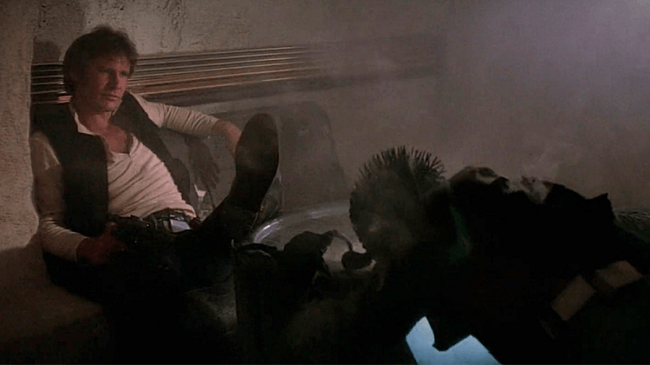
I will try and keep this post as brief as possible because rants and tirades aren’t as funny as many writers think they are. Rather than “frothing at the mouth” I think a more accurate description of my feelings can be summed up just by a deep sigh and a shake of the head. So, where to begin? Well during the course of the day, several memes, humorous quips and oblique references appeared in my Twitter timeline featuring the phrase “Maclunkey”. As the joke didn’t immediately become apparent and I couldn’t reference the phrase (I initially thought it was about the band Mclusky) I took to Google to find out what this was all about. I like to keep abreast as to what are the current talking points online and I don’t want to be that old guy who doesn’t understand “the kids of today” or “that there interweb”. Fortunately, a brief internet search provided a clear answer. I shall now attempt to distil the relevant facts for the benefit of those who are still in the dark.

Peter Mayhew was working as an Orderly in the radiology department of King's College Hospital, London in 1976 when he was “discovered” by George Lucas. Lucas was looking to find someone suitably tall to play the Wookie Chewbacca in Star Wars. Legend has it that Mayhew simply stood up from his seat to great Lucas and immediately clinched the part. The rest they say is history. Peter Mayhew went on to play the role in another five movies, and despite not gaining the immediate fame of regular actors, became a firm favourite among fans at conventions. He was also held in very high regard by his professional acting peers. As for the role of Chewbacca, he made it his own and approached the character seriously and with genuine love. Despite a lack of conventional dialogue, Mayhew imbued Chewbacca with a personality and a distinctive sense of style. No mean achievement for a man who never intended for any of this to happen.
Out of the original seventy-nine episodes of Star Trek, one of the most respected and beloved is The City of the Edge of Forever. Written by Harlan Ellison the story is one of the more thoughtful and tragic in Trek Canon. It was also the first episode to feature a temporal plotline. Doctor Leonard McCoy (DeForest Kelley) accidently receives an overdose of medication and flees the Enterprise while in a delusional state. Beaming down to an alien planet he uses a temporal gateway (The Guardian of Forever) to travels back in time to earth during the Great Depression. By doing so he accidentally changes history. Captain Kirk (William Shatner) and Spock (Leonard Nimoy) follow him through the gateway to New York in hope of correcting the timeline. While awaiting the arrival of McCoy, Kirk falls in love with Edith Keeler (Joan Collins) who runs the 21st Street Mission. However he and Spock soon determine that to restore the timeline they must allow her to die.
There has been a degree of controversy over the Discovery Operation Pack that has recently been made available for purchase in Star Trek Online. The bundle featuring ships, bridge officers, cosmetic items and more is displeasing some core players who feel that it is over priced and lacks anything relevant for Romulan and Klingon races. Personally, I’m only interested in two specific items from the pack, such as the Tier 6 Gagarin Miracle Worker Battlecruiser and the combat pet Tardigrade but at present they cannot be purchased separately. So, I shall not be parting with any money at present. The Gagarin Miracle Worker Battlecruiser is relatively similar to the Tucker Tactical Miracle Worker Cruiser, which I already own. However, it is an improvement aesthetically speaking (a subjective point, admittedly), so for me the obvious compromise is to purchase the fleet version and forgo the unique space trait and settle for an additional console slot. As I’m not a high-end player, the look and feel of a ship has as much appeal to me as its stats.
I have suffixed the title of this post “and stuff” so I can address several Star Trek Online related thoughts in a single blog post. Despite the fact that I frequently play STO it is does oddly get neglected in my writing. So, let us start with the issue of the ninth anniversary. As ever Q is back with the anniversary event and once again, we are stabilising Omega Molecules. This year’s reward is a Tier 6 Vulcan T’Pau Scout Ship. There are also emotes and sundry other items to earn during the duration of the festivities, but I more interested in the anniversary itself. Not many MMOs make it to nine years and if they do, they aren’t necessarily in as good shape as STO. The game has a stable and loyal playerbase and is currently tied-in to Star Trek: Discovery. Further established Trek actors are supplying voice acting and the game seems to be doing well across both PC and consoles. Like LOTRO, STO uses the IP well and seems to “fill in the gaps” in the existing lore as well as expand and extrapolate established canon. One of the best things about STO is that there’s always something to do in-game as well as new content in the pipeline. Perhaps this along with the handling of the IP is why the game endures.

I was perusing the net recently and came across a story about how a Star Wars fan film that had built up a head of steam online, has been slapped with a copyright strike from Disney. Nothing unusual there as the company is virtually legendary with respect to its litigious proclivities. However, someone over a Lucasfilm interceded and got the strike lifted, because the fan film creator had allegedly sought prior permission and supposedly received it. George Lucas has always maintained an equitable attitude towards fan usage of the Star Wars IP, something he tried to impress upon Disney when he sold the rights to them back in 2012. But it is very difficult to have a balanced discussion about George Lucas as the man is such a paradox. On one hand he is possibly one of the greatest contributors to twentieth century pop culture and has influenced a generation of film makers, writers and fans. On the other he is the man who single headedly has managed to queer his own pitch, with the way he has continuously tinkered with his body of work and appended it with supplemental material that many deemed substandard or to the detriment of the original. He is also still vilified in some quarters for his business arrangement with Disney.
Star Trek: Enterprise was the first show in the Star Trek pantheon to have a song performed by an established artist play over the opening credits, rather than a traditional theme tune. Up until 2001, the franchise had maintained a more formal approach, established with the iconic introduction to the original series composed by Alexander Courage. Needless to say, such a radical departure from established practise brought about consternation and debate among fans. In some respects, you can argue that point about the entire show itself, but that as they say, is an entirely different blog post. Needless to say, the dislike and hatred that the song Where My Heart Will Take Me engendered in certain quarters, lead to a petition to have it removed. Needless to say, this movement failed, and the show continued using it for four seasons. Seventeen years on this particular debacle has now died down and the song is often just referenced ironically by fans as an amusing anecdote and piece of Trek trivia.
I’ve written in the past about the problems that can arise from untempered fandom. If enthusiasm and inspired love are not balanced by contextual reason and a healthy dose of reality, then it can get a little bit over zealous. Need I cite Star Wars fans and The Last Jedi as an example of unchecked fandom. However, I am now going to stray a little into the “Twilight Zone” of fandom myself, although I shall attempt to apply a healthy dose of realism into the proceedings. Because I want to discuss the fact that Ethan Peck has been cast to play one of the most iconic characters in popular culture. Yes, Gregory Peck’s grandson (and there’s plenty of “baggage” there) has been cast to play Spock in season two of Star Trek: Discovery. Furthermore, rather than be concerned, I am very excited by this development and I really look forward to seeing how this pans out.
Finch (2021)
On paper Finch has little originality. The moment I read the plot synopsis and saw the first trailer I instantly thought of other such films as Silent Running, Short Circuit and Chappie. However, irrespective of its derivative concept and the fact it channels many of the major tropes of the genre, it does have three cards to play. Namely strong performances by Tom Hanks, Caleb Landry Jones and canine actor Seamus. Although not a genre milestone, Finch is a curiously pleasant post apocalyptic road movie. Despite travelling through the sun bleached vistas of a ravaged America, the story focuses on the three protagonists and their relationship. It is no small feat to find genuine sentiment in such a harsh environment and indeed in such a genre but Finch proves to be an engaging emotional journey. Once again the most effective explorations of the human condition are often through characters who are conspicuously not.
On paper Finch has little originality. The moment I read the plot synopsis and saw the first trailer I instantly thought of other such films as Silent Running, Short Circuit and Chappie. However, irrespective of its derivative concept and the fact it channels many of the major tropes of the genre, it does have three cards to play. Namely strong performances by Tom Hanks, Caleb Landry Jones and canine actor Seamus. Although not a genre milestone, Finch is a curiously pleasant post apocalyptic road movie. Despite travelling through the sun bleached vistas of a ravaged America, the story focuses on the three protagonists and their relationship. It is no small feat to find genuine sentiment in such a harsh environment and indeed in such a genre but Finch proves to be an engaging emotional journey. Once again the most effective explorations of the human condition are often through characters who are conspicuously not.
After a solar flare has destroyed the ozone layer, the planet Earth is a largely-uninhabitable wasteland scorched by ultraviolet radiation and subject to extreme weather events. Robotics engineer Finch Weinberg (Tom Hanks), lives with his dog Goodyear and a drone-robot Dewey in an underground laboratory in St. Louis. Whenever he ventures outside to search for supplies he is forced to wear an environment suit. Dying of radiation sickness, Finch builds an advanced humanoid robot to take care of his dog Goodyear once he dies. When a massive storm approaches St. Louis and threatens their safety, Finch, Jeff (as the robot name’s itself) Goodyear and Dewey head for San Francisco in a campervan. Due to their hasty departure, Jeff has only assimilated 72 percent of the data uploaded to him, leaving him with the mental capacity of a child. Despite his deteriorating health, Finch tries to teach Jeff about life and how to protect Goodyear. He also emphasises the dangers of the world that they live in.
Finch has solid production values and presents a credible vision of a world blighted by climate change. The CGI FX are at times understated, focusing on extreme weather and sun baked environments. Jo Willems cinematography and is both sweeping when dealing with the landscape and intimate when focusing on Finch and Jeff’s relationship. The screenplay by Craig Luck and Ivor Powell alludes to numerous big ideas and themes and is intelligent in subtle ways. The storm that drives Finch and his companions from his home is scheduled to last 40 days; a suitably biblical period of time. Yet despite the scope of the setting, Finch is content to think small in so far as characters and motivation. This is a story of a man with his own Father issues, struggling to become one himself. At the heart of the film is the perennial notion that when we come close to losing our own humanity, we find it again from the most unlikely sources. Performances are spot on and Hanks manages to smooth out some of the screenplays rough edges by the sheer weight of his on screen personality .
Some critics have focused upon what they see is a lack of jeopardy in the story. The fundamentals of survival are not focused upon as an ongoing problem. Food, water and power are not used to incur a sense of threat for the sake of the plot. The one encounter with humans is kept remote and we never directly see them. We hear their movement and finally they manifest themselves as the drivers of a car pursuing Finch. The film prefers to dwell on Finch’s fear of his fellow man, rather than the direct danger of his pursuers. The only time we get a wider understanding of man’s inhumanity to man is during a flashback sequence and that is mitigated to a degree by the idea that people do terrible things when hungry. What I believe that some reviews have overlooked is the fact that Jeff and Goodyear will be left alone when Finch dies and that is the central narrative source of concern.
I have no problems with sentiment in films if it is handled well. Too often it is not and US cinema has a penchant for mawkish, contrived, button pushing pathos rather than the more difficult, organically generated type. Fortunately director Miguel Sapochnik manages to avoid such pitfalls and when emotions come to a head, they are sincere and heartwarming. It makes a change to see the depiction of an artificial lifeform as an eager and curious child, as opposed to a psychotic killer or minor deity sent to save us. Overall, Finch is quite a satisfying post apocalyptic adventure, driven by characters and performances, rather than action and spectacle. Although it draws upon many familiar ideas, it still manages to provide an entertaining two hours and ends on a suitably upbeat note. It may also serve as a suitable starting point for viewers seeking similar genre offerings.
Star Trek is slightly older than me by 14 months. I was born on December 18th 1967. Star Trek was first broadcast in the US on 8th September 1966. Hence this show has always been part of the prevailing pop culture that surrounded me, as I grew up. I first began watching Star Trek as a young child in the early seventies. It would be repeated on the BBC in the early evening on Fridays and it became a family ritual to sit down together and watch it. As a seven or eight year old, it left a great impression upon me and was in many ways, the television highlight of the week. Star Trek along with Doctor Who certainly started my interest in science fiction. Star Trek was also one of the first shows that introduced me to tie-in marketing. I remember seeing in a toy shop, near to my school at the time, a Dinky Klingon Battle Cruiser and was flabbergasted that such a thing existed. I immediately coveted it but sadly never obtained one.
David Koepp is no stranger to genre cinema, having written the screenplay for such films as Jurassic Park, Spider-man and War of the Worlds. Where these titles are big budget, major studio productions, Cold Storage is a far more modest production with a smaller scope. Adapted from his own novel, the screenplay is by David Koepp and the film is directed by British film-maker Jonny Campbell. At first glance, Cold Storage seems a somewhat derivative science fiction horror film with a relatively modest budget, financed through a convoluted US and French co-production. Lurid green and red colours feature heavily in the marketing artwork and it is easy, after a cursory look, to write the film off as cheap, generic, direct-to-streaming filler. However, Cold Storage is prime example of why you should not judge a book by it’s cover, or in this case, a film by its posters and online advertising. It is in fact an amusing and fun endeavour that can fill an evening.
Treasure Island In Outer Space is a curious Italian television production from 1987 starring Anthony Quinn and Ernest Borgnine. It also features numerous international actors better known for their work in cult and exploitation films, such as Bobby Rhodes, David Warbeck and John Morghan. Directed by Antonio Margheriti (AKA Anthony Dawson), famous for such films as Killer Fish (a cash in on Piranha) and The Last Hunter (a Vietnam exploitation epic), Treasure Island In Outer Space is a faithful adaptation of Robert Louis Stevenson’s classic novel. The screenplay by Renato Castellani and Lucio De Caro draws heavily from the source text, maintaining character names and original dialogue. However in updating the material to a futuristic setting, the script is littered with the worst kind of eighties sci-fi clichés. We are subjected to sonic trains, anti-gravity rays and the usual buzzword driven faux science.
After the success of Raiders of the Lost Ark in 1981, filmmakers scrambled to find existing intellectual properties that they could use for similar films. Hence archaic heroes such as Alan Quatermain were hastily given a modern makeover and thrust into generic movies, in a vague attempt to replicate Steven Spielberg’s successful formula. Which brings us neatly on to James Charles Bigglesworth AKA “Biggles”, a fictional pilot and adventurer from a series of books written by W. E. Johns between 1932 and 1968. Several attempts had been made in the past to bring this character to the silver screen, including one by Disney but they all failed. However, the commercial and critical success of Indiana Jones provided sufficient impetus to greenlight a new film. However, due to some curious production choices, when Biggles was finally released it was far from just a period set, action movie.
The seventies was an interesting time for UK genre television. Despite small budgets and often low key visual effects, there was no shortage of good ideas and creativity. Sapphire & Steel is a prime example of a show couched in a high concept, produced on a shoestring. It also credits its audiences with some degree of intelligence. Rather than spoon feeding the narrative in a didactic manner, it hints and implies, then leaves the rest to its viewers imagination. Created by Peter J. Hammond, a veteran TV writer, Sapphire & Steel centres on a pair of interdimensional operatives named Sapphire and Steel. They are two of a number of elements that assume human form. Over the course of three seasons little is revealed about the pair but they appear whenever there is any anomalous temporal activity. Time itself is portrayed as a sentient and malignant force that seeks to make incursions into the present reality, through weaknesses in the fabric of space.
The Humanoid is one of many international Star Wars knock-offs that flooded cinemas in the late seventies and early eighties. Like so many others, it is derivative (even to the extent of replicating specific scenes from George Lucas’ movie), replete with awful dialogue and has somewhat basic production values. However, it does have an interesting cast including Richard Kiel, Barbara Bach, Arthur Kennedy and Corinne Cléry. Kiel gained a lot of media attention after his appearance as the steel-toothed villain Jaws in the 1977 Bond film, The Spy Who Loved Me. His stature made him the perfect fit for the titular character in this Italian science fiction production. Sadly, beyond a curious lineup of actors, The Humanoid has little to distinguish it from so many similar movies. For example, if you’ve seen Starcrash then you’ll be adequately prepared for this film.
Some films are made with the intention of starting a franchise, others evolve into one after a surprise box office success and lucrative sequels. Alien (1979) falls into the latter category. A mid-budget science fiction horror film that was well crafted and then benefited immensely by being released at just the right time. Sadly, many franchises become derailed and enter into a death spiral due to competing artistic visions, cynical studio politics and cinematic ignorance. This has certainly afflicted all subsequent Alien films after James Cameron’s magnificent Aliens (1986). Sometimes, a franchise can correct its course and do something fresh with the source material. Prey (2022) is a fine example of this with director Dan Trachtenberg bringing fresh vigour and intelligence back to the Predator movies. I believe that was the intention with Alien Romulus (2024). Sadly, the road to hell is paved with good intentions.
Event Horizon is a curious movie hybrid, mixing plot elements from classic sci-fi and horror genres. It has been labelled “Hellraiser in Space” by some lazy critics, although I think there's far more to it than that. Perhaps a more apt description would be a Gothic horror story set in space. The movie has garnered a cult reputation since its release in 1997, mainly due to its graphic imagery and troubled production history. It does indeed have some quite shocking sequences but the lightning editing does not show as much as some would think. Paramount forced director Paul W S Anderson to reduce the original one hundred and thirty minute running time down to a more manageable ninety, after unfavourable test screenings. Much of the violence was allegedly removed as a result of that process. Sadly nothing survives of the removed material other than a VHS workprint. Hence a restored director’s cut is therefore unlikely.
I recently watched the first trailer for the new Obi-Wan Kenobi television show that is premiering on Disney + in May. I am interested in this latest instalment in the Star Wars franchise and curious as to whether Liam Neeson will make an appearance. I also watched a 20 minute fan video in which they “analysed” the entire trailer. They discussed the content of this 2 minute preview and then did a great deal of speculating about potential themes and characters that may feature in the show. They were clearly enthusiastic about what they had seen and were very knowledgeable about the subject. This resonated with me, as I like to be well versed about the things I enjoy. However, it is worth remembering that fandom can tip into obsession and gatekeeping. Hence I feel there is a subject to explore here.
On paper Finch has little originality. The moment I read the plot synopsis and saw the first trailer I instantly thought of other such films as Silent Running, Short Circuit and Chappie. However, irrespective of its derivative concept and the fact it channels many of the major tropes of the genre, it does have three cards to play. Namely strong performances by Tom Hanks, Caleb Landry Jones and canine actor Seamus. Although not a genre milestone, Finch is a curiously pleasant post apocalyptic road movie. Despite travelling through the sun bleached vistas of a ravaged America, the story focuses on the three protagonists and their relationship. It is no small feat to find genuine sentiment in such a harsh environment and indeed in such a genre but Finch proves to be an engaging emotional journey. Once again the most effective explorations of the human condition are often through characters who are conspicuously not.
I wanted to watch Source Code for a second time before I wrote about it. This is because numerous internet debates have arisen regarding the plausibility of the film’s ending. I find this a somewhat curious stance considering that the story, written by Ben Ripley, deals with temporal travel and multiple timelines. All of which are purely theoretical and not currently subject to singular, definitive interpretations. I would further add that the science of the film is simply a plot device and is not its raison d'être. But that’s movies for you. People love to discuss them and more recently we have seen the rise of “explanation” videos on YouTube. However, the latter is a separate debate and something I may write about in the future. As for Source Code, I enjoyed it even more the second time round, as I had the time to focus on the minor details rather than trying to stay abreast with the main plot, as I did on my first viewing.
I revisited M Night Shyamalan's The Happening recently to try and determine whether he is indeed suffering from Orson Welles syndrome. IE that he has made all his best work at the beginning of his career. Because he’s never quite recaptured the critical or artistic success of The Sixth Sense, Unbreakable and Signs. I was one of the few that actually liked The Lady in The water but I could see why viewers would assume that he had become a victim of his own style and technique with that particular movie. Casting yourself as an author whose work will reshape society and change the course of history is at the very least, a little egotistical and at worst an act of immense hubris. Then in recent years we have had The Last Airbender and After Earth, both of which have performed poorly. However I thought I'd give The Happening another chance as it remains the directors only R rated movie to date.
I wrote an article back in 2009 as to why I felt a remake of The Thing was a bad idea. At that time, the project was in development hell and didn’t look like getting off the ground. Subsequently, the production evolved into a prequel and managed to find financial support, culminating in a theatrical release in late 2011. Like many interested parties, I watched the initial teaser trailer with a mixture of curiosity and trepidation. Then when the red band trailer arrived I felt that the shark was well and truly jumped. Too much was shown (a common problem with modern trailers) and there the internet was awash with discontented mutterings from John Carpenter purists. Hence I refrained from watching this movie for several years. When I finally got round to doing so, I was not well disposed towards it. However, over the Christmas holidays, I decide to give this prequel a second viewing and see if I could approach it with a less partisan mindset.
Cloverfield (2008) was a surprise hit, earning $172 million worldwide at the box office against a $25 million budget. Paramount Pictures naturally wanted a sequel but director Matt Reeves and writer Drew Goddard struggled to find a suitable narrative means to progress the original story. Both eventually left the project and the production descended into development hell. The subsequent success of Godzilla and Pacific Rim saw the Kaiju genre becoming oversaturated and so the decision to make a direct sequel was re-evaluated. Eventually a “speculative screenplay” called The Cellar was purchased and repurposed to include some additional science fiction elements and became 10 Cloverfield Lane. Despite being a curious genre hybrid which only tenuously links to the original movie, this too fared well at the box office. Therefore it was inevitable that a third movie in the so-called “Cloververse” would follow.
In many ways the story behind The McPherson Tape is a lot more interesting than the film itself. This early found footage movie from 1989, was shot on home video on a virtually non-existent budget. The director Dean Alioto eventually found a distributor but on the eve of the movie’s home video release, the warehouse burned down and allegedly destroyed the master tape and all the promotional artwork. Yet this was not the end of the story. It was common practice in the eighties for small distributors to send advance copies to local independent video stores. Hence The McPherson Tape found its way into the pirate video ecosystem. It then migrated to the UFO community where it was circulated as being a video of a legitimate alien abduction. Dean found himself in the unusual position of having to debunk his own work. Three decades later due to the intriguing tale associated with The McPherson Tape, it has been remastered from the newly rediscovered 3/4" tape and re-released.
Last month, I tried a 30 day free trial of the streaming service BritBox. One of the main selling points was that the platform has an extensive back catalogue of Classic Doctor Who. Although I initially tried to keep up with the reboot of the franchise in 2005 my interest waned after several seasons. I am not opposed to any of the changes made and I am very pleased that the show has found a new audience. However, it doesn’t resonate with me so much anymore and I find that there is too much human drama for my liking. So I decided to revisit my youth and watch some classic Doctor Who; episodes that I haven’t seen in over forty years (yes, I’m that old). Now I’m fully aware of the potential issues that can come from returning to things that you enjoyed in one’s youth, so I believe I did my best in managing my expectations. However, the results of my nostalgia trip were interesting. The things I thought would be a problem nowadays weren’t so and the things I expected to hold up well despite the passage of time, didn’t always succeed. It’s been a curious experience.
I was 12 years old when I first saw Battle Beyond the Stars during its UK theatrical release. I remember that I enjoyed it and thought it was an action packed movie. Being young, lacking the critical faculties that come with age and exposure to a wider variety of cinematic material, a lot of the films plus points were lost on me. I recollect that I did pick up on the fact that this film was more ghoulish than the other “Space Operas” that flooded theatres at the time. But beyond that, all I saw was a fun and enjoyable science fiction movie. I cheered when the Malmori were defeated and was saddened when Space Cowboy died. It is only after subsequent viewing over the years, that I’ve realised that this film is a microcosm of all the things that made Roger Corman productions so successful and unique. Despite its low budget, the visual effects were good and innovative for the times. There was more sex and violence present, than in comparable productions. And the crew is a veritable who’s who of talent that went on to wider success.
Contrary to the endorsement on the above poster, Riddick was not "the most entertaining action movie of the year" in 2013. It was just an adequate third instalment in a rather ambitious franchise, that has failed to grab the wider public's attention. That’s not to say that they didn’t make money. This is after all the third movie. Writer and Director David Twohy has done his best to try and make the character of Riddick (Vin Diesel) more than the sum of his parts and I admire both of them for their persistence. Unfortunately, Riddick just isn't engaging or complicated enough a protagonist to sustain a franchise of this nature. The anti-hero was sufficient to drive the original Pitch Black back in 2000 which had some good ideas but just couldn't sustain the overarching and overblown Chronicles of Riddick in 2004. This instalment is competently made but ultimately superfluous.
Sequels and reboots are hardly a new concept and have been a part of Hollywood culture since the 1930s. The success of the Universal Horror movies from that era being a prime example of direct follow ups and retconned movies. However, there is one fundamental rule that distinguishes a good sequel from a bad one. You should never mitigate, undermine or make irrelevant the events of the previous movie, just to provide your new film with a raison d'être. For example, the events of Aliens do not contradict or trivialise those that happened in Alien. In fact with that franchise there is a very clear logical progression between the two movies. The same is true for Mad Max and Mad Max 2 or Star Wars and The Empire Strikes Back. The key is to progress a story, enhance it or explore things from an alternative angle and bring something new to the cinematic table. Sadly this philosophy is all too often lost on corporate film making. Which means that many sequels are just tedious replays of prior films. Terminator: Dark Fate falls squarely into this category.
In the near future, a series of mysterious power surges strike the Solar System, endangering all human life. Astronaut Major Roy McBride, is selected by U.S. Space Command (SpaceCom) to investigate their source near Neptune. The surges are linked to the "Lima Project", a failed experiment from 26 years earlier, that was intended to search for intelligent life outside of our solar system. The ship’s antimatter drive is potentially malfunctioning and responsible for the energy surges. Roy’s investigation is further complicated by the fact his Father H. Clifford McBride (Tommy Lee Jones), led the "Lima Project" and has not been heard from for 16 years after reaching Neptune. Having been told that Clifford may still be alive, Roy is joined by his father's old associate Colonel Pruitt (Donald Sutherland) whose loyalties remain ambiguous. Roy, who is noted for remaining calm under pressure, shows little emotional reaction to the news about his Father. As he and Pruitt travel covertly from Earth, to the moon and then onto Mars, it becomes clear that there is more to the mission than meets the eye. Will Roy remain emotionally detached or will old wounds impair his judgement?
I was very surprised when I saw a trailer for a fourth instalment on the MiB franchise, based on Lowell Cunningham’s 1990 comic book series about secret government agents battling alien infiltration of earth. The third movie from 2012 managed to keep its head above water despite a very troubled production. At the time of its release, I like everyone else, pretty much thought that the series had run its course. Yet we live in the age of belated sequels as well as hard and soft reboots. And although Will Smith’s star may well be waning, Chris Hemsworth is still box office gold. Hence, we saw the release of Men in Black: International this summer. The basic concept of the franchise remains the same but this time the action begins in the London Office and then takes a more international journey with such locations as Marrakesh and Naples. Emma Thompson returns as Agent O and Liam Neeson joins the cast as agent High T.
The original Men in Black movie hit our screens back in 1997. It was a box office success and was therefore followed by a mediocre sequel in 2002. It took a decade before we got a third instalment in the franchise. However, the popularity of the two lead actors contributed greatly to the success of this series and so despite well documented production problems Men in Black III was released in 2012. However, the delay between movies did have consequences. Will Smith, despite being an Oscar winner and box office star, had lost his way during this time and was not as popular with audiences. Men in Black III was a timely opportunity to reconnect with his core fans. So to ensure that the film hit all the required beats and stand a better chance of being a success, the Columbia Pictures brought back previous director Barry Sonnenfeld, in hopes of warding off the Hollywood curse of third movie instalments.
Fellow blogger and all round good guy Murf, posted an ode to Bill & Ted’s Excellent Adventure today. It is clearly a movie that he enjoys (Go read his review). He references how due to this movie (along with others), as well as being a decent person in real life, that actor Keanu Reeves enjoys a great deal of goodwill from fans and pop culture cognoscenti. Which is a good thing for Mr Reeves, because goodwill often means that folk are prepared to overlook past transgressions and misdemeanours. And in cinematic terms, Keanu has had a few. The Day the Earth Stood Still is definitely one of them. Now I’ve questioned before the wisdom and merits of writing a predominantly negative film review and believe me my thoughts on The Day the Earth Stood Still are most definitely so. However, I think that something positive can still be gained from scrutinising this film. It can be held up as a textbook example of how not to remake a classic.
Every now and then, a mainstream film studio employs an artisan director to helm some sort of experimental or vanity project. The studio executives often have very little understanding of the film maker or their body of work, beyond that their artistically respected by their peers. Hence there is the corporate hope that the resulting production will be both critically acclaimed and financially successful. However, what all too often happens is that the said director goes off and indulges themselves, or simply does what they’re hired to do and delivers a finished picture that is beyond the intellectual horizons of the studio. Sphincter’s subsequently tighten among executives; the director is denied final cut and the film is taken a way and re-edited in the hope of rendering it more commercially viable. In the worse cases, a second director is brought onboard and new material shot in the hope of “saving” the picture. The net result is usually acrimony among all involved parties and a film that fails to make its money back at the box office.
For anyone with a passing interest in literary science fiction, Arthur C. Clarke’s Childhood’s End is a seminal novel and considered an essential read. The story of humanity being shepherded into a utopian golden age by allegedly benevolent alien Overlords and the consequences it has upon society, was a radical departure from prevailing science fiction norms of the time. Over the years several film makers have expressed interest in adapting the story, but it has proven difficult to come to grips with. Stanley Kubrick initially wished to develop the novel but his subsequent collaboration with the author eventually lead to the making of 2001: A Space Odyssey. Since then there have been radio adaptations and audiobook versions, all of which seem to be a better medium for this episodic and contemplative tale. In late 2015 US cable and satellite channel Syfy broadcast a three-part miniseries based upon the 1953 story; something that past me by at the time. I recently caught up with this adaptation which seems to have provoked very mixed reactions among viewers. As ever, the controversy seems to stem from purists who favour a more slavish interpretation of the book.
I always cringe when I hear the phrase re-imagining. It's yet another contrived expression created by marketing bodies to justify the somewhat arbitrary process of remaking an established title. Often the re-imagined product has little to do with the source material and was chosen simply because of brand awareness. If you want a textbook example of a recent example of this somewhat cynical process then look no further than last year’s Death Wish reboot. It had nothing new to say on the subject and simply trotted out a generic and bland revenge thriller. So, when I discovered that Robert Wise's classic science fiction film, The Andromeda Strain had been remade as a TV miniseries (that had completely passed me by), I had great reservations as to whether this would be worth watching. However, the involvement of Tony and Ridley Scott piqued my interest, so I decided to take a calculated risk and give this 2008 A&E Network production a go.
Time is quite literally money in the movie In Time, starring Amanda Seyfried and Justin Timberlake. Written and directed by Andrew Niccol, who previously wrote Gattaca and S1m0ne which both had similar dystopian themes, we are presented with a chilling scenario. What if you had to spend minutes or hours or perhaps days of your life in the same way you spend money? The movie offers a future where the population is genetically programmed to stop aging at twenty-five. If you're rich enough, you can purchase and trade this commodity, adding time to your life, making you effectively immortal. For the poor, the future is a far bleaker with most dying within a year of this hardcoded end date. Every transaction comes with a price in minutes and seconds.
Many years ago, I use to rush home from school to watch Project UFO. Based loosely on the real-life Project Blue Book, this show from 1978 featured two U.S. Air Force investigators, Maj. Jake Gatlin (William Jordan) and Staff Sgt. Harry Fitz (Caskey Swaim) and their subsequent investigation into alleged UFO sightings. Sometimes there would be rational explanations and on other occasions, there was clearly extraterrestrial involvement. By the second season out protagonists experienced a close encounter of their own. It wasn’t the most densely plotted of dramas and was produced and presented in the idiom of mainstream television of the time. However, for a ten-year-old boy it had some excellent miniature work (Brick Price Movie Miniatures) and anything about UFOs was always a source of interest. There was also a great and very seventies theme tune by Nelson Riddle. So when I discovered that History (formerly The History Channel) had produced a science fiction drama series called Project Blue Book, I became somewhat nostalgic and equally intrigued.
Source Code (2011)
I wanted to watch Source Code for a second time before I wrote about it. This is because numerous internet debates have arisen regarding the plausibility of the film’s ending. I find this a somewhat curious stance considering that the story, written by Ben Ripley, deals with temporal travel and multiple timelines. All of which are purely theoretical and not currently subject to singular, definitive interpretations. I would further add that the science of the film is simply a plot device and is not its raison d'être. But that’s movies for you. People love to discuss them and more recently we have seen the rise of “explanation” videos on YouTube. However, the latter is a separate debate and something I may write about in the future. As for Source Code, I enjoyed it even more the second time round, as I had the time to focus on the minor details rather than trying to stay abreast with the main plot, as I did on my first viewing.
I wanted to watch Source Code for a second time before I wrote about it. This is because numerous internet debates have arisen regarding the plausibility of the film’s ending. I find this a somewhat curious stance considering that the story, written by Ben Ripley, deals with temporal travel and multiple timelines. All of which are purely theoretical and not currently subject to singular, definitive interpretations. I would further add that the science of the film is simply a plot device and is not its raison d'être. But that’s movies for you. People love to discuss them and more recently we have seen the rise of “explanation” videos on YouTube. However, the latter is a separate debate and something I may write about in the future. As for Source Code, I enjoyed it even more the second time round, as I had the time to focus on the minor details rather than trying to stay abreast with the main plot, as I did on my first viewing.
Army Captain Colter Stevens (Jake Gyllenhaal) wakes to find himself on a train, occupying the body of a teacher called Sean Fentress who is commuting to work in Chicago. Stevens is confused and disorientated as the last thing he remembers is being on a mission in Afghanistan. 8 minutes later the train explodes due to a terrorist bomb. He then awakes again to find himself in a dimly lit cockpit. Communicating via a video link, Air Force Captain Colleen Goodwin (Vera Farmiga) explains that he is on a covert mission to identify the terrorists that caused the attack before returning him back to the train to relive the 8 minutes again. Stevens is sceptical at first as he has no memory of events prior to the mission. However he surmises that he is being tested and continues to return to the train multiple times in an attempt to gain vital intelligence. As he observes the other passengers he forms a bond with his traveling companion Christina (Michelle Monaghan). Can he change the events that have happened or is he simply creating an alternative reality?
Source Code is an intelligent, well packaged film that manages to provide mainstream entertainment without the need to condescend to its audience. Director Duncan Jones, is cinematically literate and the film has clear nods to Groundhog Day, Rashomon and even Tony Scott's Deja View. He explores themes such as personal identity and the nature of existence, yet does not allow such philosophical musing to slow the action or bore the viewer. As science shatters traditional myths such as linear time, the film challenges our perceptions with some creative ideas. The central performances by Jake Gyllenhaal and Michelle Monaghan, are very strong. The concept of two strangers forming a strong bond under extreme circumstances reminded me of David Niven and Kim Hunter in A Matter Of Life And Death. There is an amusing homage to the cinematic cliché of the "evil scientist", with actor Jeffrey Wright sporting a walking stick. It should also be noted that the Source Code storyline unfolds in a tidy ninety plus minutes and does not suffer from the current Hollywood trend of out staying its welcome.
Christopher Nolan set the bar very high with Inception, proving that films with strong narratives and requiring the audience to think, can be financially successful. Source Code was similarly met with equally strong critical and public approval upon its release. Its narrative is not quite as complex as Nolan’s opus but it does require a degree of reflection by the viewer. Where Source Code compensates for its convoluted science fiction plotline is with its characters and the human drama they share. Captain Stevens isn’t just on a mission to identify a terrorist. He quickly becomes invested in trying to save the passengers on the train. His companion Christina is a very engaging foil and the romantic element of the plot is very much a hark back to the golden age of Hollywood. The film ends in quite a bold fashion with both good and bad events occurring in separate realities. Science fiction films seldom have this emotional depth, making Source Code far more accessible to wider audiences.
Star Trek is slightly older than me by 14 months. I was born on December 18th 1967. Star Trek was first broadcast in the US on 8th September 1966. Hence this show has always been part of the prevailing pop culture that surrounded me, as I grew up. I first began watching Star Trek as a young child in the early seventies. It would be repeated on the BBC in the early evening on Fridays and it became a family ritual to sit down together and watch it. As a seven or eight year old, it left a great impression upon me and was in many ways, the television highlight of the week. Star Trek along with Doctor Who certainly started my interest in science fiction. Star Trek was also one of the first shows that introduced me to tie-in marketing. I remember seeing in a toy shop, near to my school at the time, a Dinky Klingon Battle Cruiser and was flabbergasted that such a thing existed. I immediately coveted it but sadly never obtained one.
David Koepp is no stranger to genre cinema, having written the screenplay for such films as Jurassic Park, Spider-man and War of the Worlds. Where these titles are big budget, major studio productions, Cold Storage is a far more modest production with a smaller scope. Adapted from his own novel, the screenplay is by David Koepp and the film is directed by British film-maker Jonny Campbell. At first glance, Cold Storage seems a somewhat derivative science fiction horror film with a relatively modest budget, financed through a convoluted US and French co-production. Lurid green and red colours feature heavily in the marketing artwork and it is easy, after a cursory look, to write the film off as cheap, generic, direct-to-streaming filler. However, Cold Storage is prime example of why you should not judge a book by it’s cover, or in this case, a film by its posters and online advertising. It is in fact an amusing and fun endeavour that can fill an evening.
Treasure Island In Outer Space is a curious Italian television production from 1987 starring Anthony Quinn and Ernest Borgnine. It also features numerous international actors better known for their work in cult and exploitation films, such as Bobby Rhodes, David Warbeck and John Morghan. Directed by Antonio Margheriti (AKA Anthony Dawson), famous for such films as Killer Fish (a cash in on Piranha) and The Last Hunter (a Vietnam exploitation epic), Treasure Island In Outer Space is a faithful adaptation of Robert Louis Stevenson’s classic novel. The screenplay by Renato Castellani and Lucio De Caro draws heavily from the source text, maintaining character names and original dialogue. However in updating the material to a futuristic setting, the script is littered with the worst kind of eighties sci-fi clichés. We are subjected to sonic trains, anti-gravity rays and the usual buzzword driven faux science.
After the success of Raiders of the Lost Ark in 1981, filmmakers scrambled to find existing intellectual properties that they could use for similar films. Hence archaic heroes such as Alan Quatermain were hastily given a modern makeover and thrust into generic movies, in a vague attempt to replicate Steven Spielberg’s successful formula. Which brings us neatly on to James Charles Bigglesworth AKA “Biggles”, a fictional pilot and adventurer from a series of books written by W. E. Johns between 1932 and 1968. Several attempts had been made in the past to bring this character to the silver screen, including one by Disney but they all failed. However, the commercial and critical success of Indiana Jones provided sufficient impetus to greenlight a new film. However, due to some curious production choices, when Biggles was finally released it was far from just a period set, action movie.
The seventies was an interesting time for UK genre television. Despite small budgets and often low key visual effects, there was no shortage of good ideas and creativity. Sapphire & Steel is a prime example of a show couched in a high concept, produced on a shoestring. It also credits its audiences with some degree of intelligence. Rather than spoon feeding the narrative in a didactic manner, it hints and implies, then leaves the rest to its viewers imagination. Created by Peter J. Hammond, a veteran TV writer, Sapphire & Steel centres on a pair of interdimensional operatives named Sapphire and Steel. They are two of a number of elements that assume human form. Over the course of three seasons little is revealed about the pair but they appear whenever there is any anomalous temporal activity. Time itself is portrayed as a sentient and malignant force that seeks to make incursions into the present reality, through weaknesses in the fabric of space.
The Humanoid is one of many international Star Wars knock-offs that flooded cinemas in the late seventies and early eighties. Like so many others, it is derivative (even to the extent of replicating specific scenes from George Lucas’ movie), replete with awful dialogue and has somewhat basic production values. However, it does have an interesting cast including Richard Kiel, Barbara Bach, Arthur Kennedy and Corinne Cléry. Kiel gained a lot of media attention after his appearance as the steel-toothed villain Jaws in the 1977 Bond film, The Spy Who Loved Me. His stature made him the perfect fit for the titular character in this Italian science fiction production. Sadly, beyond a curious lineup of actors, The Humanoid has little to distinguish it from so many similar movies. For example, if you’ve seen Starcrash then you’ll be adequately prepared for this film.
Some films are made with the intention of starting a franchise, others evolve into one after a surprise box office success and lucrative sequels. Alien (1979) falls into the latter category. A mid-budget science fiction horror film that was well crafted and then benefited immensely by being released at just the right time. Sadly, many franchises become derailed and enter into a death spiral due to competing artistic visions, cynical studio politics and cinematic ignorance. This has certainly afflicted all subsequent Alien films after James Cameron’s magnificent Aliens (1986). Sometimes, a franchise can correct its course and do something fresh with the source material. Prey (2022) is a fine example of this with director Dan Trachtenberg bringing fresh vigour and intelligence back to the Predator movies. I believe that was the intention with Alien Romulus (2024). Sadly, the road to hell is paved with good intentions.
Event Horizon is a curious movie hybrid, mixing plot elements from classic sci-fi and horror genres. It has been labelled “Hellraiser in Space” by some lazy critics, although I think there's far more to it than that. Perhaps a more apt description would be a Gothic horror story set in space. The movie has garnered a cult reputation since its release in 1997, mainly due to its graphic imagery and troubled production history. It does indeed have some quite shocking sequences but the lightning editing does not show as much as some would think. Paramount forced director Paul W S Anderson to reduce the original one hundred and thirty minute running time down to a more manageable ninety, after unfavourable test screenings. Much of the violence was allegedly removed as a result of that process. Sadly nothing survives of the removed material other than a VHS workprint. Hence a restored director’s cut is therefore unlikely.
I recently watched the first trailer for the new Obi-Wan Kenobi television show that is premiering on Disney + in May. I am interested in this latest instalment in the Star Wars franchise and curious as to whether Liam Neeson will make an appearance. I also watched a 20 minute fan video in which they “analysed” the entire trailer. They discussed the content of this 2 minute preview and then did a great deal of speculating about potential themes and characters that may feature in the show. They were clearly enthusiastic about what they had seen and were very knowledgeable about the subject. This resonated with me, as I like to be well versed about the things I enjoy. However, it is worth remembering that fandom can tip into obsession and gatekeeping. Hence I feel there is a subject to explore here.
On paper Finch has little originality. The moment I read the plot synopsis and saw the first trailer I instantly thought of other such films as Silent Running, Short Circuit and Chappie. However, irrespective of its derivative concept and the fact it channels many of the major tropes of the genre, it does have three cards to play. Namely strong performances by Tom Hanks, Caleb Landry Jones and canine actor Seamus. Although not a genre milestone, Finch is a curiously pleasant post apocalyptic road movie. Despite travelling through the sun bleached vistas of a ravaged America, the story focuses on the three protagonists and their relationship. It is no small feat to find genuine sentiment in such a harsh environment and indeed in such a genre but Finch proves to be an engaging emotional journey. Once again the most effective explorations of the human condition are often through characters who are conspicuously not.
I wanted to watch Source Code for a second time before I wrote about it. This is because numerous internet debates have arisen regarding the plausibility of the film’s ending. I find this a somewhat curious stance considering that the story, written by Ben Ripley, deals with temporal travel and multiple timelines. All of which are purely theoretical and not currently subject to singular, definitive interpretations. I would further add that the science of the film is simply a plot device and is not its raison d'être. But that’s movies for you. People love to discuss them and more recently we have seen the rise of “explanation” videos on YouTube. However, the latter is a separate debate and something I may write about in the future. As for Source Code, I enjoyed it even more the second time round, as I had the time to focus on the minor details rather than trying to stay abreast with the main plot, as I did on my first viewing.
I revisited M Night Shyamalan's The Happening recently to try and determine whether he is indeed suffering from Orson Welles syndrome. IE that he has made all his best work at the beginning of his career. Because he’s never quite recaptured the critical or artistic success of The Sixth Sense, Unbreakable and Signs. I was one of the few that actually liked The Lady in The water but I could see why viewers would assume that he had become a victim of his own style and technique with that particular movie. Casting yourself as an author whose work will reshape society and change the course of history is at the very least, a little egotistical and at worst an act of immense hubris. Then in recent years we have had The Last Airbender and After Earth, both of which have performed poorly. However I thought I'd give The Happening another chance as it remains the directors only R rated movie to date.
I wrote an article back in 2009 as to why I felt a remake of The Thing was a bad idea. At that time, the project was in development hell and didn’t look like getting off the ground. Subsequently, the production evolved into a prequel and managed to find financial support, culminating in a theatrical release in late 2011. Like many interested parties, I watched the initial teaser trailer with a mixture of curiosity and trepidation. Then when the red band trailer arrived I felt that the shark was well and truly jumped. Too much was shown (a common problem with modern trailers) and there the internet was awash with discontented mutterings from John Carpenter purists. Hence I refrained from watching this movie for several years. When I finally got round to doing so, I was not well disposed towards it. However, over the Christmas holidays, I decide to give this prequel a second viewing and see if I could approach it with a less partisan mindset.
Cloverfield (2008) was a surprise hit, earning $172 million worldwide at the box office against a $25 million budget. Paramount Pictures naturally wanted a sequel but director Matt Reeves and writer Drew Goddard struggled to find a suitable narrative means to progress the original story. Both eventually left the project and the production descended into development hell. The subsequent success of Godzilla and Pacific Rim saw the Kaiju genre becoming oversaturated and so the decision to make a direct sequel was re-evaluated. Eventually a “speculative screenplay” called The Cellar was purchased and repurposed to include some additional science fiction elements and became 10 Cloverfield Lane. Despite being a curious genre hybrid which only tenuously links to the original movie, this too fared well at the box office. Therefore it was inevitable that a third movie in the so-called “Cloververse” would follow.
In many ways the story behind The McPherson Tape is a lot more interesting than the film itself. This early found footage movie from 1989, was shot on home video on a virtually non-existent budget. The director Dean Alioto eventually found a distributor but on the eve of the movie’s home video release, the warehouse burned down and allegedly destroyed the master tape and all the promotional artwork. Yet this was not the end of the story. It was common practice in the eighties for small distributors to send advance copies to local independent video stores. Hence The McPherson Tape found its way into the pirate video ecosystem. It then migrated to the UFO community where it was circulated as being a video of a legitimate alien abduction. Dean found himself in the unusual position of having to debunk his own work. Three decades later due to the intriguing tale associated with The McPherson Tape, it has been remastered from the newly rediscovered 3/4" tape and re-released.
Last month, I tried a 30 day free trial of the streaming service BritBox. One of the main selling points was that the platform has an extensive back catalogue of Classic Doctor Who. Although I initially tried to keep up with the reboot of the franchise in 2005 my interest waned after several seasons. I am not opposed to any of the changes made and I am very pleased that the show has found a new audience. However, it doesn’t resonate with me so much anymore and I find that there is too much human drama for my liking. So I decided to revisit my youth and watch some classic Doctor Who; episodes that I haven’t seen in over forty years (yes, I’m that old). Now I’m fully aware of the potential issues that can come from returning to things that you enjoyed in one’s youth, so I believe I did my best in managing my expectations. However, the results of my nostalgia trip were interesting. The things I thought would be a problem nowadays weren’t so and the things I expected to hold up well despite the passage of time, didn’t always succeed. It’s been a curious experience.
I was 12 years old when I first saw Battle Beyond the Stars during its UK theatrical release. I remember that I enjoyed it and thought it was an action packed movie. Being young, lacking the critical faculties that come with age and exposure to a wider variety of cinematic material, a lot of the films plus points were lost on me. I recollect that I did pick up on the fact that this film was more ghoulish than the other “Space Operas” that flooded theatres at the time. But beyond that, all I saw was a fun and enjoyable science fiction movie. I cheered when the Malmori were defeated and was saddened when Space Cowboy died. It is only after subsequent viewing over the years, that I’ve realised that this film is a microcosm of all the things that made Roger Corman productions so successful and unique. Despite its low budget, the visual effects were good and innovative for the times. There was more sex and violence present, than in comparable productions. And the crew is a veritable who’s who of talent that went on to wider success.
Contrary to the endorsement on the above poster, Riddick was not "the most entertaining action movie of the year" in 2013. It was just an adequate third instalment in a rather ambitious franchise, that has failed to grab the wider public's attention. That’s not to say that they didn’t make money. This is after all the third movie. Writer and Director David Twohy has done his best to try and make the character of Riddick (Vin Diesel) more than the sum of his parts and I admire both of them for their persistence. Unfortunately, Riddick just isn't engaging or complicated enough a protagonist to sustain a franchise of this nature. The anti-hero was sufficient to drive the original Pitch Black back in 2000 which had some good ideas but just couldn't sustain the overarching and overblown Chronicles of Riddick in 2004. This instalment is competently made but ultimately superfluous.
Sequels and reboots are hardly a new concept and have been a part of Hollywood culture since the 1930s. The success of the Universal Horror movies from that era being a prime example of direct follow ups and retconned movies. However, there is one fundamental rule that distinguishes a good sequel from a bad one. You should never mitigate, undermine or make irrelevant the events of the previous movie, just to provide your new film with a raison d'être. For example, the events of Aliens do not contradict or trivialise those that happened in Alien. In fact with that franchise there is a very clear logical progression between the two movies. The same is true for Mad Max and Mad Max 2 or Star Wars and The Empire Strikes Back. The key is to progress a story, enhance it or explore things from an alternative angle and bring something new to the cinematic table. Sadly this philosophy is all too often lost on corporate film making. Which means that many sequels are just tedious replays of prior films. Terminator: Dark Fate falls squarely into this category.
In the near future, a series of mysterious power surges strike the Solar System, endangering all human life. Astronaut Major Roy McBride, is selected by U.S. Space Command (SpaceCom) to investigate their source near Neptune. The surges are linked to the "Lima Project", a failed experiment from 26 years earlier, that was intended to search for intelligent life outside of our solar system. The ship’s antimatter drive is potentially malfunctioning and responsible for the energy surges. Roy’s investigation is further complicated by the fact his Father H. Clifford McBride (Tommy Lee Jones), led the "Lima Project" and has not been heard from for 16 years after reaching Neptune. Having been told that Clifford may still be alive, Roy is joined by his father's old associate Colonel Pruitt (Donald Sutherland) whose loyalties remain ambiguous. Roy, who is noted for remaining calm under pressure, shows little emotional reaction to the news about his Father. As he and Pruitt travel covertly from Earth, to the moon and then onto Mars, it becomes clear that there is more to the mission than meets the eye. Will Roy remain emotionally detached or will old wounds impair his judgement?
I was very surprised when I saw a trailer for a fourth instalment on the MiB franchise, based on Lowell Cunningham’s 1990 comic book series about secret government agents battling alien infiltration of earth. The third movie from 2012 managed to keep its head above water despite a very troubled production. At the time of its release, I like everyone else, pretty much thought that the series had run its course. Yet we live in the age of belated sequels as well as hard and soft reboots. And although Will Smith’s star may well be waning, Chris Hemsworth is still box office gold. Hence, we saw the release of Men in Black: International this summer. The basic concept of the franchise remains the same but this time the action begins in the London Office and then takes a more international journey with such locations as Marrakesh and Naples. Emma Thompson returns as Agent O and Liam Neeson joins the cast as agent High T.
The original Men in Black movie hit our screens back in 1997. It was a box office success and was therefore followed by a mediocre sequel in 2002. It took a decade before we got a third instalment in the franchise. However, the popularity of the two lead actors contributed greatly to the success of this series and so despite well documented production problems Men in Black III was released in 2012. However, the delay between movies did have consequences. Will Smith, despite being an Oscar winner and box office star, had lost his way during this time and was not as popular with audiences. Men in Black III was a timely opportunity to reconnect with his core fans. So to ensure that the film hit all the required beats and stand a better chance of being a success, the Columbia Pictures brought back previous director Barry Sonnenfeld, in hopes of warding off the Hollywood curse of third movie instalments.
Fellow blogger and all round good guy Murf, posted an ode to Bill & Ted’s Excellent Adventure today. It is clearly a movie that he enjoys (Go read his review). He references how due to this movie (along with others), as well as being a decent person in real life, that actor Keanu Reeves enjoys a great deal of goodwill from fans and pop culture cognoscenti. Which is a good thing for Mr Reeves, because goodwill often means that folk are prepared to overlook past transgressions and misdemeanours. And in cinematic terms, Keanu has had a few. The Day the Earth Stood Still is definitely one of them. Now I’ve questioned before the wisdom and merits of writing a predominantly negative film review and believe me my thoughts on The Day the Earth Stood Still are most definitely so. However, I think that something positive can still be gained from scrutinising this film. It can be held up as a textbook example of how not to remake a classic.
Every now and then, a mainstream film studio employs an artisan director to helm some sort of experimental or vanity project. The studio executives often have very little understanding of the film maker or their body of work, beyond that their artistically respected by their peers. Hence there is the corporate hope that the resulting production will be both critically acclaimed and financially successful. However, what all too often happens is that the said director goes off and indulges themselves, or simply does what they’re hired to do and delivers a finished picture that is beyond the intellectual horizons of the studio. Sphincter’s subsequently tighten among executives; the director is denied final cut and the film is taken a way and re-edited in the hope of rendering it more commercially viable. In the worse cases, a second director is brought onboard and new material shot in the hope of “saving” the picture. The net result is usually acrimony among all involved parties and a film that fails to make its money back at the box office.
For anyone with a passing interest in literary science fiction, Arthur C. Clarke’s Childhood’s End is a seminal novel and considered an essential read. The story of humanity being shepherded into a utopian golden age by allegedly benevolent alien Overlords and the consequences it has upon society, was a radical departure from prevailing science fiction norms of the time. Over the years several film makers have expressed interest in adapting the story, but it has proven difficult to come to grips with. Stanley Kubrick initially wished to develop the novel but his subsequent collaboration with the author eventually lead to the making of 2001: A Space Odyssey. Since then there have been radio adaptations and audiobook versions, all of which seem to be a better medium for this episodic and contemplative tale. In late 2015 US cable and satellite channel Syfy broadcast a three-part miniseries based upon the 1953 story; something that past me by at the time. I recently caught up with this adaptation which seems to have provoked very mixed reactions among viewers. As ever, the controversy seems to stem from purists who favour a more slavish interpretation of the book.
I always cringe when I hear the phrase re-imagining. It's yet another contrived expression created by marketing bodies to justify the somewhat arbitrary process of remaking an established title. Often the re-imagined product has little to do with the source material and was chosen simply because of brand awareness. If you want a textbook example of a recent example of this somewhat cynical process then look no further than last year’s Death Wish reboot. It had nothing new to say on the subject and simply trotted out a generic and bland revenge thriller. So, when I discovered that Robert Wise's classic science fiction film, The Andromeda Strain had been remade as a TV miniseries (that had completely passed me by), I had great reservations as to whether this would be worth watching. However, the involvement of Tony and Ridley Scott piqued my interest, so I decided to take a calculated risk and give this 2008 A&E Network production a go.
Time is quite literally money in the movie In Time, starring Amanda Seyfried and Justin Timberlake. Written and directed by Andrew Niccol, who previously wrote Gattaca and S1m0ne which both had similar dystopian themes, we are presented with a chilling scenario. What if you had to spend minutes or hours or perhaps days of your life in the same way you spend money? The movie offers a future where the population is genetically programmed to stop aging at twenty-five. If you're rich enough, you can purchase and trade this commodity, adding time to your life, making you effectively immortal. For the poor, the future is a far bleaker with most dying within a year of this hardcoded end date. Every transaction comes with a price in minutes and seconds.
Many years ago, I use to rush home from school to watch Project UFO. Based loosely on the real-life Project Blue Book, this show from 1978 featured two U.S. Air Force investigators, Maj. Jake Gatlin (William Jordan) and Staff Sgt. Harry Fitz (Caskey Swaim) and their subsequent investigation into alleged UFO sightings. Sometimes there would be rational explanations and on other occasions, there was clearly extraterrestrial involvement. By the second season out protagonists experienced a close encounter of their own. It wasn’t the most densely plotted of dramas and was produced and presented in the idiom of mainstream television of the time. However, for a ten-year-old boy it had some excellent miniature work (Brick Price Movie Miniatures) and anything about UFOs was always a source of interest. There was also a great and very seventies theme tune by Nelson Riddle. So when I discovered that History (formerly The History Channel) had produced a science fiction drama series called Project Blue Book, I became somewhat nostalgic and equally intrigued.
The Happening (2008)
I revisited M Night Shyamalan's The Happening recently to try and determine whether he is indeed suffering from Orson Welles syndrome. IE that he has made all his best work at the beginning of his career. Because he’s never quite recaptured the critical or artistic success of The Sixth Sense, Unbreakable and Signs. I was one of the few that actually liked The Lady in The water but I could see why viewers would assume that he had become a victim of his own style and technique with that particular movie. Casting yourself as an author whose work will reshape society and change the course of history is at the very least, a little egotistical and at worst an act of immense hubris. Then in recent years we have had The Last Airbender and After Earth, both of which have performed poorly. However I thought I'd give The Happening another chance as it remains the directors only R rated movie to date.
I revisited M Night Shyamalan's The Happening recently to try and determine whether he is indeed suffering from Orson Welles syndrome. IE that he has made all his best work at the beginning of his career. Because he’s never quite recaptured the critical or artistic success of The Sixth Sense, Unbreakable and Signs. I was one of the few that actually liked The Lady in The water but I could see why viewers would assume that he had become a victim of his own style and technique with that particular movie. Casting yourself as an author whose work will reshape society and change the course of history is at the very least, a little egotistical and at worst an act of immense hubris. Then in recent years we have had The Last Airbender and After Earth, both of which have performed poorly. However I thought I'd give The Happening another chance as it remains the directors only R rated movie to date.
Elliot (Mark Wahlberg) and Alma Moore (Zooey Deschanel) are a married couple caught up in a mass panic spreading across the East Coast of the US. A wave of inexplicable suicides has started among the general public. They flee from New York with work colleague Julian (John Leguizamo) and his young daughter Jess, only to find that the disaster is spreading further West across the country and becoming more accurate in targeting humans. What was initially assumed to be an act of bio-terrorism turns out to have a far more esoteric answer. Writer and director M Night Shyamalan focuses on the perennial theme of how humans deal with extreme situations and threats to their own mortality. There are also some interesting ideas about the environment and nature being a living entity that responds when the balance is drastically altered. The topical matter of the ongoing decline of the honey bee is also a facet of the plot.
Sadly, while the initial premise is intriguing, its execution adds further weight to the argument that Shyamalan should defer to more accomplished screenwriters capable of developing his ideas more effectively. Despite a reliable cast of character actors, the dialogue is obvious and at times crass, leaving all concerned with little to do except emote sincerely. There is also an air of sanctimony about the screenplay that rather spoils the interesting premise. Once the ecological plot twist is revealed the narrative takes a somewhat didactic tone. The central characters are also somewhat weak and not especially likeable. A rift in the main protagonist's relationship turns out to be only minor. It would have been far more challenging if one was actually an adulterer, thus making their redemption harder to achieve. A greater sense of societal panic is also absent. The film needs clearer examples of social disorder and breakdown to reinforce the magnitude of events
Yet despite these criticisms, there are some sequences that show a great deal of creative flare. There's a shocking scene when construction workers start to hurl themselves from the roof of the building they're working on. A tracking shot following a Police officer's handgun as it is used in subsequent suicides, is also impressively realised. Once again, composer James Newton Howard embellishes Shyamalan's work with an exceptionally clever and subtle score. The two seem to have a very good creative relationship. Upon its initial release, the distributors made much of the film’s rating. Perhaps they saw this as it's only virtue. There is more violence compared to his other work. Given the subject matter this is understandable. Overall The Happening is a missed opportunity. Again I feel that Mr. Shyamalan's work would benefit from an additional writer to strengthen his weaknesses and curb his excesses. Sadly several movies on from The Happening and the same mistakes keep getting made.
Star Trek is slightly older than me by 14 months. I was born on December 18th 1967. Star Trek was first broadcast in the US on 8th September 1966. Hence this show has always been part of the prevailing pop culture that surrounded me, as I grew up. I first began watching Star Trek as a young child in the early seventies. It would be repeated on the BBC in the early evening on Fridays and it became a family ritual to sit down together and watch it. As a seven or eight year old, it left a great impression upon me and was in many ways, the television highlight of the week. Star Trek along with Doctor Who certainly started my interest in science fiction. Star Trek was also one of the first shows that introduced me to tie-in marketing. I remember seeing in a toy shop, near to my school at the time, a Dinky Klingon Battle Cruiser and was flabbergasted that such a thing existed. I immediately coveted it but sadly never obtained one.
David Koepp is no stranger to genre cinema, having written the screenplay for such films as Jurassic Park, Spider-man and War of the Worlds. Where these titles are big budget, major studio productions, Cold Storage is a far more modest production with a smaller scope. Adapted from his own novel, the screenplay is by David Koepp and the film is directed by British film-maker Jonny Campbell. At first glance, Cold Storage seems a somewhat derivative science fiction horror film with a relatively modest budget, financed through a convoluted US and French co-production. Lurid green and red colours feature heavily in the marketing artwork and it is easy, after a cursory look, to write the film off as cheap, generic, direct-to-streaming filler. However, Cold Storage is prime example of why you should not judge a book by it’s cover, or in this case, a film by its posters and online advertising. It is in fact an amusing and fun endeavour that can fill an evening.
Treasure Island In Outer Space is a curious Italian television production from 1987 starring Anthony Quinn and Ernest Borgnine. It also features numerous international actors better known for their work in cult and exploitation films, such as Bobby Rhodes, David Warbeck and John Morghan. Directed by Antonio Margheriti (AKA Anthony Dawson), famous for such films as Killer Fish (a cash in on Piranha) and The Last Hunter (a Vietnam exploitation epic), Treasure Island In Outer Space is a faithful adaptation of Robert Louis Stevenson’s classic novel. The screenplay by Renato Castellani and Lucio De Caro draws heavily from the source text, maintaining character names and original dialogue. However in updating the material to a futuristic setting, the script is littered with the worst kind of eighties sci-fi clichés. We are subjected to sonic trains, anti-gravity rays and the usual buzzword driven faux science.
After the success of Raiders of the Lost Ark in 1981, filmmakers scrambled to find existing intellectual properties that they could use for similar films. Hence archaic heroes such as Alan Quatermain were hastily given a modern makeover and thrust into generic movies, in a vague attempt to replicate Steven Spielberg’s successful formula. Which brings us neatly on to James Charles Bigglesworth AKA “Biggles”, a fictional pilot and adventurer from a series of books written by W. E. Johns between 1932 and 1968. Several attempts had been made in the past to bring this character to the silver screen, including one by Disney but they all failed. However, the commercial and critical success of Indiana Jones provided sufficient impetus to greenlight a new film. However, due to some curious production choices, when Biggles was finally released it was far from just a period set, action movie.
The seventies was an interesting time for UK genre television. Despite small budgets and often low key visual effects, there was no shortage of good ideas and creativity. Sapphire & Steel is a prime example of a show couched in a high concept, produced on a shoestring. It also credits its audiences with some degree of intelligence. Rather than spoon feeding the narrative in a didactic manner, it hints and implies, then leaves the rest to its viewers imagination. Created by Peter J. Hammond, a veteran TV writer, Sapphire & Steel centres on a pair of interdimensional operatives named Sapphire and Steel. They are two of a number of elements that assume human form. Over the course of three seasons little is revealed about the pair but they appear whenever there is any anomalous temporal activity. Time itself is portrayed as a sentient and malignant force that seeks to make incursions into the present reality, through weaknesses in the fabric of space.
The Humanoid is one of many international Star Wars knock-offs that flooded cinemas in the late seventies and early eighties. Like so many others, it is derivative (even to the extent of replicating specific scenes from George Lucas’ movie), replete with awful dialogue and has somewhat basic production values. However, it does have an interesting cast including Richard Kiel, Barbara Bach, Arthur Kennedy and Corinne Cléry. Kiel gained a lot of media attention after his appearance as the steel-toothed villain Jaws in the 1977 Bond film, The Spy Who Loved Me. His stature made him the perfect fit for the titular character in this Italian science fiction production. Sadly, beyond a curious lineup of actors, The Humanoid has little to distinguish it from so many similar movies. For example, if you’ve seen Starcrash then you’ll be adequately prepared for this film.
Some films are made with the intention of starting a franchise, others evolve into one after a surprise box office success and lucrative sequels. Alien (1979) falls into the latter category. A mid-budget science fiction horror film that was well crafted and then benefited immensely by being released at just the right time. Sadly, many franchises become derailed and enter into a death spiral due to competing artistic visions, cynical studio politics and cinematic ignorance. This has certainly afflicted all subsequent Alien films after James Cameron’s magnificent Aliens (1986). Sometimes, a franchise can correct its course and do something fresh with the source material. Prey (2022) is a fine example of this with director Dan Trachtenberg bringing fresh vigour and intelligence back to the Predator movies. I believe that was the intention with Alien Romulus (2024). Sadly, the road to hell is paved with good intentions.
Event Horizon is a curious movie hybrid, mixing plot elements from classic sci-fi and horror genres. It has been labelled “Hellraiser in Space” by some lazy critics, although I think there's far more to it than that. Perhaps a more apt description would be a Gothic horror story set in space. The movie has garnered a cult reputation since its release in 1997, mainly due to its graphic imagery and troubled production history. It does indeed have some quite shocking sequences but the lightning editing does not show as much as some would think. Paramount forced director Paul W S Anderson to reduce the original one hundred and thirty minute running time down to a more manageable ninety, after unfavourable test screenings. Much of the violence was allegedly removed as a result of that process. Sadly nothing survives of the removed material other than a VHS workprint. Hence a restored director’s cut is therefore unlikely.
I recently watched the first trailer for the new Obi-Wan Kenobi television show that is premiering on Disney + in May. I am interested in this latest instalment in the Star Wars franchise and curious as to whether Liam Neeson will make an appearance. I also watched a 20 minute fan video in which they “analysed” the entire trailer. They discussed the content of this 2 minute preview and then did a great deal of speculating about potential themes and characters that may feature in the show. They were clearly enthusiastic about what they had seen and were very knowledgeable about the subject. This resonated with me, as I like to be well versed about the things I enjoy. However, it is worth remembering that fandom can tip into obsession and gatekeeping. Hence I feel there is a subject to explore here.
On paper Finch has little originality. The moment I read the plot synopsis and saw the first trailer I instantly thought of other such films as Silent Running, Short Circuit and Chappie. However, irrespective of its derivative concept and the fact it channels many of the major tropes of the genre, it does have three cards to play. Namely strong performances by Tom Hanks, Caleb Landry Jones and canine actor Seamus. Although not a genre milestone, Finch is a curiously pleasant post apocalyptic road movie. Despite travelling through the sun bleached vistas of a ravaged America, the story focuses on the three protagonists and their relationship. It is no small feat to find genuine sentiment in such a harsh environment and indeed in such a genre but Finch proves to be an engaging emotional journey. Once again the most effective explorations of the human condition are often through characters who are conspicuously not.
I wanted to watch Source Code for a second time before I wrote about it. This is because numerous internet debates have arisen regarding the plausibility of the film’s ending. I find this a somewhat curious stance considering that the story, written by Ben Ripley, deals with temporal travel and multiple timelines. All of which are purely theoretical and not currently subject to singular, definitive interpretations. I would further add that the science of the film is simply a plot device and is not its raison d'être. But that’s movies for you. People love to discuss them and more recently we have seen the rise of “explanation” videos on YouTube. However, the latter is a separate debate and something I may write about in the future. As for Source Code, I enjoyed it even more the second time round, as I had the time to focus on the minor details rather than trying to stay abreast with the main plot, as I did on my first viewing.
I revisited M Night Shyamalan's The Happening recently to try and determine whether he is indeed suffering from Orson Welles syndrome. IE that he has made all his best work at the beginning of his career. Because he’s never quite recaptured the critical or artistic success of The Sixth Sense, Unbreakable and Signs. I was one of the few that actually liked The Lady in The water but I could see why viewers would assume that he had become a victim of his own style and technique with that particular movie. Casting yourself as an author whose work will reshape society and change the course of history is at the very least, a little egotistical and at worst an act of immense hubris. Then in recent years we have had The Last Airbender and After Earth, both of which have performed poorly. However I thought I'd give The Happening another chance as it remains the directors only R rated movie to date.
I wrote an article back in 2009 as to why I felt a remake of The Thing was a bad idea. At that time, the project was in development hell and didn’t look like getting off the ground. Subsequently, the production evolved into a prequel and managed to find financial support, culminating in a theatrical release in late 2011. Like many interested parties, I watched the initial teaser trailer with a mixture of curiosity and trepidation. Then when the red band trailer arrived I felt that the shark was well and truly jumped. Too much was shown (a common problem with modern trailers) and there the internet was awash with discontented mutterings from John Carpenter purists. Hence I refrained from watching this movie for several years. When I finally got round to doing so, I was not well disposed towards it. However, over the Christmas holidays, I decide to give this prequel a second viewing and see if I could approach it with a less partisan mindset.
Cloverfield (2008) was a surprise hit, earning $172 million worldwide at the box office against a $25 million budget. Paramount Pictures naturally wanted a sequel but director Matt Reeves and writer Drew Goddard struggled to find a suitable narrative means to progress the original story. Both eventually left the project and the production descended into development hell. The subsequent success of Godzilla and Pacific Rim saw the Kaiju genre becoming oversaturated and so the decision to make a direct sequel was re-evaluated. Eventually a “speculative screenplay” called The Cellar was purchased and repurposed to include some additional science fiction elements and became 10 Cloverfield Lane. Despite being a curious genre hybrid which only tenuously links to the original movie, this too fared well at the box office. Therefore it was inevitable that a third movie in the so-called “Cloververse” would follow.
In many ways the story behind The McPherson Tape is a lot more interesting than the film itself. This early found footage movie from 1989, was shot on home video on a virtually non-existent budget. The director Dean Alioto eventually found a distributor but on the eve of the movie’s home video release, the warehouse burned down and allegedly destroyed the master tape and all the promotional artwork. Yet this was not the end of the story. It was common practice in the eighties for small distributors to send advance copies to local independent video stores. Hence The McPherson Tape found its way into the pirate video ecosystem. It then migrated to the UFO community where it was circulated as being a video of a legitimate alien abduction. Dean found himself in the unusual position of having to debunk his own work. Three decades later due to the intriguing tale associated with The McPherson Tape, it has been remastered from the newly rediscovered 3/4" tape and re-released.
Last month, I tried a 30 day free trial of the streaming service BritBox. One of the main selling points was that the platform has an extensive back catalogue of Classic Doctor Who. Although I initially tried to keep up with the reboot of the franchise in 2005 my interest waned after several seasons. I am not opposed to any of the changes made and I am very pleased that the show has found a new audience. However, it doesn’t resonate with me so much anymore and I find that there is too much human drama for my liking. So I decided to revisit my youth and watch some classic Doctor Who; episodes that I haven’t seen in over forty years (yes, I’m that old). Now I’m fully aware of the potential issues that can come from returning to things that you enjoyed in one’s youth, so I believe I did my best in managing my expectations. However, the results of my nostalgia trip were interesting. The things I thought would be a problem nowadays weren’t so and the things I expected to hold up well despite the passage of time, didn’t always succeed. It’s been a curious experience.
I was 12 years old when I first saw Battle Beyond the Stars during its UK theatrical release. I remember that I enjoyed it and thought it was an action packed movie. Being young, lacking the critical faculties that come with age and exposure to a wider variety of cinematic material, a lot of the films plus points were lost on me. I recollect that I did pick up on the fact that this film was more ghoulish than the other “Space Operas” that flooded theatres at the time. But beyond that, all I saw was a fun and enjoyable science fiction movie. I cheered when the Malmori were defeated and was saddened when Space Cowboy died. It is only after subsequent viewing over the years, that I’ve realised that this film is a microcosm of all the things that made Roger Corman productions so successful and unique. Despite its low budget, the visual effects were good and innovative for the times. There was more sex and violence present, than in comparable productions. And the crew is a veritable who’s who of talent that went on to wider success.
Contrary to the endorsement on the above poster, Riddick was not "the most entertaining action movie of the year" in 2013. It was just an adequate third instalment in a rather ambitious franchise, that has failed to grab the wider public's attention. That’s not to say that they didn’t make money. This is after all the third movie. Writer and Director David Twohy has done his best to try and make the character of Riddick (Vin Diesel) more than the sum of his parts and I admire both of them for their persistence. Unfortunately, Riddick just isn't engaging or complicated enough a protagonist to sustain a franchise of this nature. The anti-hero was sufficient to drive the original Pitch Black back in 2000 which had some good ideas but just couldn't sustain the overarching and overblown Chronicles of Riddick in 2004. This instalment is competently made but ultimately superfluous.
Sequels and reboots are hardly a new concept and have been a part of Hollywood culture since the 1930s. The success of the Universal Horror movies from that era being a prime example of direct follow ups and retconned movies. However, there is one fundamental rule that distinguishes a good sequel from a bad one. You should never mitigate, undermine or make irrelevant the events of the previous movie, just to provide your new film with a raison d'être. For example, the events of Aliens do not contradict or trivialise those that happened in Alien. In fact with that franchise there is a very clear logical progression between the two movies. The same is true for Mad Max and Mad Max 2 or Star Wars and The Empire Strikes Back. The key is to progress a story, enhance it or explore things from an alternative angle and bring something new to the cinematic table. Sadly this philosophy is all too often lost on corporate film making. Which means that many sequels are just tedious replays of prior films. Terminator: Dark Fate falls squarely into this category.
In the near future, a series of mysterious power surges strike the Solar System, endangering all human life. Astronaut Major Roy McBride, is selected by U.S. Space Command (SpaceCom) to investigate their source near Neptune. The surges are linked to the "Lima Project", a failed experiment from 26 years earlier, that was intended to search for intelligent life outside of our solar system. The ship’s antimatter drive is potentially malfunctioning and responsible for the energy surges. Roy’s investigation is further complicated by the fact his Father H. Clifford McBride (Tommy Lee Jones), led the "Lima Project" and has not been heard from for 16 years after reaching Neptune. Having been told that Clifford may still be alive, Roy is joined by his father's old associate Colonel Pruitt (Donald Sutherland) whose loyalties remain ambiguous. Roy, who is noted for remaining calm under pressure, shows little emotional reaction to the news about his Father. As he and Pruitt travel covertly from Earth, to the moon and then onto Mars, it becomes clear that there is more to the mission than meets the eye. Will Roy remain emotionally detached or will old wounds impair his judgement?
I was very surprised when I saw a trailer for a fourth instalment on the MiB franchise, based on Lowell Cunningham’s 1990 comic book series about secret government agents battling alien infiltration of earth. The third movie from 2012 managed to keep its head above water despite a very troubled production. At the time of its release, I like everyone else, pretty much thought that the series had run its course. Yet we live in the age of belated sequels as well as hard and soft reboots. And although Will Smith’s star may well be waning, Chris Hemsworth is still box office gold. Hence, we saw the release of Men in Black: International this summer. The basic concept of the franchise remains the same but this time the action begins in the London Office and then takes a more international journey with such locations as Marrakesh and Naples. Emma Thompson returns as Agent O and Liam Neeson joins the cast as agent High T.
The original Men in Black movie hit our screens back in 1997. It was a box office success and was therefore followed by a mediocre sequel in 2002. It took a decade before we got a third instalment in the franchise. However, the popularity of the two lead actors contributed greatly to the success of this series and so despite well documented production problems Men in Black III was released in 2012. However, the delay between movies did have consequences. Will Smith, despite being an Oscar winner and box office star, had lost his way during this time and was not as popular with audiences. Men in Black III was a timely opportunity to reconnect with his core fans. So to ensure that the film hit all the required beats and stand a better chance of being a success, the Columbia Pictures brought back previous director Barry Sonnenfeld, in hopes of warding off the Hollywood curse of third movie instalments.
Fellow blogger and all round good guy Murf, posted an ode to Bill & Ted’s Excellent Adventure today. It is clearly a movie that he enjoys (Go read his review). He references how due to this movie (along with others), as well as being a decent person in real life, that actor Keanu Reeves enjoys a great deal of goodwill from fans and pop culture cognoscenti. Which is a good thing for Mr Reeves, because goodwill often means that folk are prepared to overlook past transgressions and misdemeanours. And in cinematic terms, Keanu has had a few. The Day the Earth Stood Still is definitely one of them. Now I’ve questioned before the wisdom and merits of writing a predominantly negative film review and believe me my thoughts on The Day the Earth Stood Still are most definitely so. However, I think that something positive can still be gained from scrutinising this film. It can be held up as a textbook example of how not to remake a classic.
Every now and then, a mainstream film studio employs an artisan director to helm some sort of experimental or vanity project. The studio executives often have very little understanding of the film maker or their body of work, beyond that their artistically respected by their peers. Hence there is the corporate hope that the resulting production will be both critically acclaimed and financially successful. However, what all too often happens is that the said director goes off and indulges themselves, or simply does what they’re hired to do and delivers a finished picture that is beyond the intellectual horizons of the studio. Sphincter’s subsequently tighten among executives; the director is denied final cut and the film is taken a way and re-edited in the hope of rendering it more commercially viable. In the worse cases, a second director is brought onboard and new material shot in the hope of “saving” the picture. The net result is usually acrimony among all involved parties and a film that fails to make its money back at the box office.
For anyone with a passing interest in literary science fiction, Arthur C. Clarke’s Childhood’s End is a seminal novel and considered an essential read. The story of humanity being shepherded into a utopian golden age by allegedly benevolent alien Overlords and the consequences it has upon society, was a radical departure from prevailing science fiction norms of the time. Over the years several film makers have expressed interest in adapting the story, but it has proven difficult to come to grips with. Stanley Kubrick initially wished to develop the novel but his subsequent collaboration with the author eventually lead to the making of 2001: A Space Odyssey. Since then there have been radio adaptations and audiobook versions, all of which seem to be a better medium for this episodic and contemplative tale. In late 2015 US cable and satellite channel Syfy broadcast a three-part miniseries based upon the 1953 story; something that past me by at the time. I recently caught up with this adaptation which seems to have provoked very mixed reactions among viewers. As ever, the controversy seems to stem from purists who favour a more slavish interpretation of the book.
I always cringe when I hear the phrase re-imagining. It's yet another contrived expression created by marketing bodies to justify the somewhat arbitrary process of remaking an established title. Often the re-imagined product has little to do with the source material and was chosen simply because of brand awareness. If you want a textbook example of a recent example of this somewhat cynical process then look no further than last year’s Death Wish reboot. It had nothing new to say on the subject and simply trotted out a generic and bland revenge thriller. So, when I discovered that Robert Wise's classic science fiction film, The Andromeda Strain had been remade as a TV miniseries (that had completely passed me by), I had great reservations as to whether this would be worth watching. However, the involvement of Tony and Ridley Scott piqued my interest, so I decided to take a calculated risk and give this 2008 A&E Network production a go.
Time is quite literally money in the movie In Time, starring Amanda Seyfried and Justin Timberlake. Written and directed by Andrew Niccol, who previously wrote Gattaca and S1m0ne which both had similar dystopian themes, we are presented with a chilling scenario. What if you had to spend minutes or hours or perhaps days of your life in the same way you spend money? The movie offers a future where the population is genetically programmed to stop aging at twenty-five. If you're rich enough, you can purchase and trade this commodity, adding time to your life, making you effectively immortal. For the poor, the future is a far bleaker with most dying within a year of this hardcoded end date. Every transaction comes with a price in minutes and seconds.
Many years ago, I use to rush home from school to watch Project UFO. Based loosely on the real-life Project Blue Book, this show from 1978 featured two U.S. Air Force investigators, Maj. Jake Gatlin (William Jordan) and Staff Sgt. Harry Fitz (Caskey Swaim) and their subsequent investigation into alleged UFO sightings. Sometimes there would be rational explanations and on other occasions, there was clearly extraterrestrial involvement. By the second season out protagonists experienced a close encounter of their own. It wasn’t the most densely plotted of dramas and was produced and presented in the idiom of mainstream television of the time. However, for a ten-year-old boy it had some excellent miniature work (Brick Price Movie Miniatures) and anything about UFOs was always a source of interest. There was also a great and very seventies theme tune by Nelson Riddle. So when I discovered that History (formerly The History Channel) had produced a science fiction drama series called Project Blue Book, I became somewhat nostalgic and equally intrigued.
The Thing (2011)
I wrote an article back in 2009 as to why I felt a remake of The Thing was a bad idea. At that time, the project was in development hell and didn’t look like getting off the ground. Subsequently, the production evolved into a prequel and managed to find financial support, culminating in a theatrical release in late 2011. Like many interested parties, I watched the initial teaser trailer with a mixture of curiosity and trepidation. Then when the red band trailer arrived I felt that the shark was well and truly jumped. Too much was shown (a common problem with modern trailers) and there the internet was awash with discontented mutterings from John Carpenter purists. Hence I refrained from watching this movie for several years. When I finally got round to doing so, I was not well disposed towards it. However, over the Christmas holidays, I decide to give this prequel a second viewing and see if I could approach it with a less partisan mindset.
I wrote an article back in 2009 as to why I felt a remake of The Thing was a bad idea. At that time, the project was in development hell and didn’t look like getting off the ground. Subsequently, the production evolved into a prequel and managed to find financial support, culminating in a theatrical release in late 2011. Like many interested parties, I watched the initial teaser trailer with a mixture of curiosity and trepidation. Then when the red band trailer arrived I felt that the shark was well and truly jumped. Too much was shown (a common problem with modern trailers) and there the internet was awash with discontented mutterings from John Carpenter purists. Hence I refrained from watching this movie for several years. When I finally got round to doing so, I was not well disposed towards it. However, over the Christmas holidays, I decide to give this prequel a second viewing and see if I could approach it with a less partisan mindset.
Watching The Thing prequel and trying to maintain an open mind is an extremely difficult task. I have made no bones about the fact that I’m a greater admirer of the 1982 movie and that I consider it one of the best genre pieces of the decade. It is what I call a “blue print” movie as every aspect of its production is a textbook example of how to do things right in cinematic terms This is not simply fanboy adulation. Do some research and you’ll see that Carpenters film is very well respected by his peers and those that study the craft of filmmaking. So from my perspective, for this prequel to work, it needs to add something new to the themes and ideas established in the previous film. The story and ideas need to be advanced rather than just repeated. There are several good sequels and prequels that have done this successfully. Psycho II, Mad Max 2 (AKA The Road Warrior), Aliens and X-Men: First Class. Sadly, The Thing prequel struggles to do this.
The prequel explores the story of the ill-fated Thule Station in Antarctica. Mary Elizabeth Winstead plays an American Palaeontologist, Kate Lloyd, who is flown in to assist a Norwegians scientific team with a curious discovery. Specifically, a crashed alien spacecraft and a body frozen in the ice. As you would imagine, the narrative is rather constrained by the fact that we know the inevitable outcome, as seen in the opening scenes of John Carpenter’s original movie. Yet there are attempts to vary the direction of the story, within the limited confines. There is some exploration of gender politics of the period. Also the titular creature spends more time in transitional states rather than in human form. Another positive factor is the degree of continuity between both films. There is also a great deal of visual similarity in the creature design and the overall production design.
Director Matthijs van Heijningen Jr. is unfortunately handicapped by a somewhat pedestrian script by Eric Heisserer, a writer with an uneven track record. He was responsible for the awful A Nightmare on Elm Street remake and the amusing Final Destination 5. The film is therefore somewhat perfunctory, rather than tense. Marco Beltrami’s score telegraphs forthcoming shocks, undermining any suspense. Yet the Norwegian actors and dialogue do lend a welcome difference to the proceedings and there is just enough levity for a picture of this kind. The film uses the language barrier effectively. The lack of any major “star” also keeps the attention focused on the proceedings. Sadly, although a great deal of the visual effects were created by Amalgamated Dynamics using traditional physical techniques, these were replaced with CGI in post production.
There are indeed things to like about The Thing Prequel and it is not a total disaster. It is well paced, shot on 35 millimeter film and edited in a comparable idiom to the original. There is a sense of continuity present. But it ultimately fails because it is essentially a redundant enterprise. It would also appear that studio interference was an issue, with the ending being reshot and the decision to replace the practical FX with computer animation. There simply isn’t enough variations on established themes or scope of vision to make this production stand out sufficiently as being different from the original. I am still at a loss as to why someone thought making a prequel to The Thing was a good idea to start with, let alone keeping the title identical. Overall, this film is similar to Gus Van Sant’s frame for frame remake of Psycho in so far as there simply isn’t any need for either of them.
Star Trek is slightly older than me by 14 months. I was born on December 18th 1967. Star Trek was first broadcast in the US on 8th September 1966. Hence this show has always been part of the prevailing pop culture that surrounded me, as I grew up. I first began watching Star Trek as a young child in the early seventies. It would be repeated on the BBC in the early evening on Fridays and it became a family ritual to sit down together and watch it. As a seven or eight year old, it left a great impression upon me and was in many ways, the television highlight of the week. Star Trek along with Doctor Who certainly started my interest in science fiction. Star Trek was also one of the first shows that introduced me to tie-in marketing. I remember seeing in a toy shop, near to my school at the time, a Dinky Klingon Battle Cruiser and was flabbergasted that such a thing existed. I immediately coveted it but sadly never obtained one.
David Koepp is no stranger to genre cinema, having written the screenplay for such films as Jurassic Park, Spider-man and War of the Worlds. Where these titles are big budget, major studio productions, Cold Storage is a far more modest production with a smaller scope. Adapted from his own novel, the screenplay is by David Koepp and the film is directed by British film-maker Jonny Campbell. At first glance, Cold Storage seems a somewhat derivative science fiction horror film with a relatively modest budget, financed through a convoluted US and French co-production. Lurid green and red colours feature heavily in the marketing artwork and it is easy, after a cursory look, to write the film off as cheap, generic, direct-to-streaming filler. However, Cold Storage is prime example of why you should not judge a book by it’s cover, or in this case, a film by its posters and online advertising. It is in fact an amusing and fun endeavour that can fill an evening.
Treasure Island In Outer Space is a curious Italian television production from 1987 starring Anthony Quinn and Ernest Borgnine. It also features numerous international actors better known for their work in cult and exploitation films, such as Bobby Rhodes, David Warbeck and John Morghan. Directed by Antonio Margheriti (AKA Anthony Dawson), famous for such films as Killer Fish (a cash in on Piranha) and The Last Hunter (a Vietnam exploitation epic), Treasure Island In Outer Space is a faithful adaptation of Robert Louis Stevenson’s classic novel. The screenplay by Renato Castellani and Lucio De Caro draws heavily from the source text, maintaining character names and original dialogue. However in updating the material to a futuristic setting, the script is littered with the worst kind of eighties sci-fi clichés. We are subjected to sonic trains, anti-gravity rays and the usual buzzword driven faux science.
After the success of Raiders of the Lost Ark in 1981, filmmakers scrambled to find existing intellectual properties that they could use for similar films. Hence archaic heroes such as Alan Quatermain were hastily given a modern makeover and thrust into generic movies, in a vague attempt to replicate Steven Spielberg’s successful formula. Which brings us neatly on to James Charles Bigglesworth AKA “Biggles”, a fictional pilot and adventurer from a series of books written by W. E. Johns between 1932 and 1968. Several attempts had been made in the past to bring this character to the silver screen, including one by Disney but they all failed. However, the commercial and critical success of Indiana Jones provided sufficient impetus to greenlight a new film. However, due to some curious production choices, when Biggles was finally released it was far from just a period set, action movie.
The seventies was an interesting time for UK genre television. Despite small budgets and often low key visual effects, there was no shortage of good ideas and creativity. Sapphire & Steel is a prime example of a show couched in a high concept, produced on a shoestring. It also credits its audiences with some degree of intelligence. Rather than spoon feeding the narrative in a didactic manner, it hints and implies, then leaves the rest to its viewers imagination. Created by Peter J. Hammond, a veteran TV writer, Sapphire & Steel centres on a pair of interdimensional operatives named Sapphire and Steel. They are two of a number of elements that assume human form. Over the course of three seasons little is revealed about the pair but they appear whenever there is any anomalous temporal activity. Time itself is portrayed as a sentient and malignant force that seeks to make incursions into the present reality, through weaknesses in the fabric of space.
The Humanoid is one of many international Star Wars knock-offs that flooded cinemas in the late seventies and early eighties. Like so many others, it is derivative (even to the extent of replicating specific scenes from George Lucas’ movie), replete with awful dialogue and has somewhat basic production values. However, it does have an interesting cast including Richard Kiel, Barbara Bach, Arthur Kennedy and Corinne Cléry. Kiel gained a lot of media attention after his appearance as the steel-toothed villain Jaws in the 1977 Bond film, The Spy Who Loved Me. His stature made him the perfect fit for the titular character in this Italian science fiction production. Sadly, beyond a curious lineup of actors, The Humanoid has little to distinguish it from so many similar movies. For example, if you’ve seen Starcrash then you’ll be adequately prepared for this film.
Some films are made with the intention of starting a franchise, others evolve into one after a surprise box office success and lucrative sequels. Alien (1979) falls into the latter category. A mid-budget science fiction horror film that was well crafted and then benefited immensely by being released at just the right time. Sadly, many franchises become derailed and enter into a death spiral due to competing artistic visions, cynical studio politics and cinematic ignorance. This has certainly afflicted all subsequent Alien films after James Cameron’s magnificent Aliens (1986). Sometimes, a franchise can correct its course and do something fresh with the source material. Prey (2022) is a fine example of this with director Dan Trachtenberg bringing fresh vigour and intelligence back to the Predator movies. I believe that was the intention with Alien Romulus (2024). Sadly, the road to hell is paved with good intentions.
Event Horizon is a curious movie hybrid, mixing plot elements from classic sci-fi and horror genres. It has been labelled “Hellraiser in Space” by some lazy critics, although I think there's far more to it than that. Perhaps a more apt description would be a Gothic horror story set in space. The movie has garnered a cult reputation since its release in 1997, mainly due to its graphic imagery and troubled production history. It does indeed have some quite shocking sequences but the lightning editing does not show as much as some would think. Paramount forced director Paul W S Anderson to reduce the original one hundred and thirty minute running time down to a more manageable ninety, after unfavourable test screenings. Much of the violence was allegedly removed as a result of that process. Sadly nothing survives of the removed material other than a VHS workprint. Hence a restored director’s cut is therefore unlikely.
I recently watched the first trailer for the new Obi-Wan Kenobi television show that is premiering on Disney + in May. I am interested in this latest instalment in the Star Wars franchise and curious as to whether Liam Neeson will make an appearance. I also watched a 20 minute fan video in which they “analysed” the entire trailer. They discussed the content of this 2 minute preview and then did a great deal of speculating about potential themes and characters that may feature in the show. They were clearly enthusiastic about what they had seen and were very knowledgeable about the subject. This resonated with me, as I like to be well versed about the things I enjoy. However, it is worth remembering that fandom can tip into obsession and gatekeeping. Hence I feel there is a subject to explore here.
On paper Finch has little originality. The moment I read the plot synopsis and saw the first trailer I instantly thought of other such films as Silent Running, Short Circuit and Chappie. However, irrespective of its derivative concept and the fact it channels many of the major tropes of the genre, it does have three cards to play. Namely strong performances by Tom Hanks, Caleb Landry Jones and canine actor Seamus. Although not a genre milestone, Finch is a curiously pleasant post apocalyptic road movie. Despite travelling through the sun bleached vistas of a ravaged America, the story focuses on the three protagonists and their relationship. It is no small feat to find genuine sentiment in such a harsh environment and indeed in such a genre but Finch proves to be an engaging emotional journey. Once again the most effective explorations of the human condition are often through characters who are conspicuously not.
I wanted to watch Source Code for a second time before I wrote about it. This is because numerous internet debates have arisen regarding the plausibility of the film’s ending. I find this a somewhat curious stance considering that the story, written by Ben Ripley, deals with temporal travel and multiple timelines. All of which are purely theoretical and not currently subject to singular, definitive interpretations. I would further add that the science of the film is simply a plot device and is not its raison d'être. But that’s movies for you. People love to discuss them and more recently we have seen the rise of “explanation” videos on YouTube. However, the latter is a separate debate and something I may write about in the future. As for Source Code, I enjoyed it even more the second time round, as I had the time to focus on the minor details rather than trying to stay abreast with the main plot, as I did on my first viewing.
I revisited M Night Shyamalan's The Happening recently to try and determine whether he is indeed suffering from Orson Welles syndrome. IE that he has made all his best work at the beginning of his career. Because he’s never quite recaptured the critical or artistic success of The Sixth Sense, Unbreakable and Signs. I was one of the few that actually liked The Lady in The water but I could see why viewers would assume that he had become a victim of his own style and technique with that particular movie. Casting yourself as an author whose work will reshape society and change the course of history is at the very least, a little egotistical and at worst an act of immense hubris. Then in recent years we have had The Last Airbender and After Earth, both of which have performed poorly. However I thought I'd give The Happening another chance as it remains the directors only R rated movie to date.
I wrote an article back in 2009 as to why I felt a remake of The Thing was a bad idea. At that time, the project was in development hell and didn’t look like getting off the ground. Subsequently, the production evolved into a prequel and managed to find financial support, culminating in a theatrical release in late 2011. Like many interested parties, I watched the initial teaser trailer with a mixture of curiosity and trepidation. Then when the red band trailer arrived I felt that the shark was well and truly jumped. Too much was shown (a common problem with modern trailers) and there the internet was awash with discontented mutterings from John Carpenter purists. Hence I refrained from watching this movie for several years. When I finally got round to doing so, I was not well disposed towards it. However, over the Christmas holidays, I decide to give this prequel a second viewing and see if I could approach it with a less partisan mindset.
Cloverfield (2008) was a surprise hit, earning $172 million worldwide at the box office against a $25 million budget. Paramount Pictures naturally wanted a sequel but director Matt Reeves and writer Drew Goddard struggled to find a suitable narrative means to progress the original story. Both eventually left the project and the production descended into development hell. The subsequent success of Godzilla and Pacific Rim saw the Kaiju genre becoming oversaturated and so the decision to make a direct sequel was re-evaluated. Eventually a “speculative screenplay” called The Cellar was purchased and repurposed to include some additional science fiction elements and became 10 Cloverfield Lane. Despite being a curious genre hybrid which only tenuously links to the original movie, this too fared well at the box office. Therefore it was inevitable that a third movie in the so-called “Cloververse” would follow.
In many ways the story behind The McPherson Tape is a lot more interesting than the film itself. This early found footage movie from 1989, was shot on home video on a virtually non-existent budget. The director Dean Alioto eventually found a distributor but on the eve of the movie’s home video release, the warehouse burned down and allegedly destroyed the master tape and all the promotional artwork. Yet this was not the end of the story. It was common practice in the eighties for small distributors to send advance copies to local independent video stores. Hence The McPherson Tape found its way into the pirate video ecosystem. It then migrated to the UFO community where it was circulated as being a video of a legitimate alien abduction. Dean found himself in the unusual position of having to debunk his own work. Three decades later due to the intriguing tale associated with The McPherson Tape, it has been remastered from the newly rediscovered 3/4" tape and re-released.
Last month, I tried a 30 day free trial of the streaming service BritBox. One of the main selling points was that the platform has an extensive back catalogue of Classic Doctor Who. Although I initially tried to keep up with the reboot of the franchise in 2005 my interest waned after several seasons. I am not opposed to any of the changes made and I am very pleased that the show has found a new audience. However, it doesn’t resonate with me so much anymore and I find that there is too much human drama for my liking. So I decided to revisit my youth and watch some classic Doctor Who; episodes that I haven’t seen in over forty years (yes, I’m that old). Now I’m fully aware of the potential issues that can come from returning to things that you enjoyed in one’s youth, so I believe I did my best in managing my expectations. However, the results of my nostalgia trip were interesting. The things I thought would be a problem nowadays weren’t so and the things I expected to hold up well despite the passage of time, didn’t always succeed. It’s been a curious experience.
I was 12 years old when I first saw Battle Beyond the Stars during its UK theatrical release. I remember that I enjoyed it and thought it was an action packed movie. Being young, lacking the critical faculties that come with age and exposure to a wider variety of cinematic material, a lot of the films plus points were lost on me. I recollect that I did pick up on the fact that this film was more ghoulish than the other “Space Operas” that flooded theatres at the time. But beyond that, all I saw was a fun and enjoyable science fiction movie. I cheered when the Malmori were defeated and was saddened when Space Cowboy died. It is only after subsequent viewing over the years, that I’ve realised that this film is a microcosm of all the things that made Roger Corman productions so successful and unique. Despite its low budget, the visual effects were good and innovative for the times. There was more sex and violence present, than in comparable productions. And the crew is a veritable who’s who of talent that went on to wider success.
Contrary to the endorsement on the above poster, Riddick was not "the most entertaining action movie of the year" in 2013. It was just an adequate third instalment in a rather ambitious franchise, that has failed to grab the wider public's attention. That’s not to say that they didn’t make money. This is after all the third movie. Writer and Director David Twohy has done his best to try and make the character of Riddick (Vin Diesel) more than the sum of his parts and I admire both of them for their persistence. Unfortunately, Riddick just isn't engaging or complicated enough a protagonist to sustain a franchise of this nature. The anti-hero was sufficient to drive the original Pitch Black back in 2000 which had some good ideas but just couldn't sustain the overarching and overblown Chronicles of Riddick in 2004. This instalment is competently made but ultimately superfluous.
Sequels and reboots are hardly a new concept and have been a part of Hollywood culture since the 1930s. The success of the Universal Horror movies from that era being a prime example of direct follow ups and retconned movies. However, there is one fundamental rule that distinguishes a good sequel from a bad one. You should never mitigate, undermine or make irrelevant the events of the previous movie, just to provide your new film with a raison d'être. For example, the events of Aliens do not contradict or trivialise those that happened in Alien. In fact with that franchise there is a very clear logical progression between the two movies. The same is true for Mad Max and Mad Max 2 or Star Wars and The Empire Strikes Back. The key is to progress a story, enhance it or explore things from an alternative angle and bring something new to the cinematic table. Sadly this philosophy is all too often lost on corporate film making. Which means that many sequels are just tedious replays of prior films. Terminator: Dark Fate falls squarely into this category.
In the near future, a series of mysterious power surges strike the Solar System, endangering all human life. Astronaut Major Roy McBride, is selected by U.S. Space Command (SpaceCom) to investigate their source near Neptune. The surges are linked to the "Lima Project", a failed experiment from 26 years earlier, that was intended to search for intelligent life outside of our solar system. The ship’s antimatter drive is potentially malfunctioning and responsible for the energy surges. Roy’s investigation is further complicated by the fact his Father H. Clifford McBride (Tommy Lee Jones), led the "Lima Project" and has not been heard from for 16 years after reaching Neptune. Having been told that Clifford may still be alive, Roy is joined by his father's old associate Colonel Pruitt (Donald Sutherland) whose loyalties remain ambiguous. Roy, who is noted for remaining calm under pressure, shows little emotional reaction to the news about his Father. As he and Pruitt travel covertly from Earth, to the moon and then onto Mars, it becomes clear that there is more to the mission than meets the eye. Will Roy remain emotionally detached or will old wounds impair his judgement?
I was very surprised when I saw a trailer for a fourth instalment on the MiB franchise, based on Lowell Cunningham’s 1990 comic book series about secret government agents battling alien infiltration of earth. The third movie from 2012 managed to keep its head above water despite a very troubled production. At the time of its release, I like everyone else, pretty much thought that the series had run its course. Yet we live in the age of belated sequels as well as hard and soft reboots. And although Will Smith’s star may well be waning, Chris Hemsworth is still box office gold. Hence, we saw the release of Men in Black: International this summer. The basic concept of the franchise remains the same but this time the action begins in the London Office and then takes a more international journey with such locations as Marrakesh and Naples. Emma Thompson returns as Agent O and Liam Neeson joins the cast as agent High T.
The original Men in Black movie hit our screens back in 1997. It was a box office success and was therefore followed by a mediocre sequel in 2002. It took a decade before we got a third instalment in the franchise. However, the popularity of the two lead actors contributed greatly to the success of this series and so despite well documented production problems Men in Black III was released in 2012. However, the delay between movies did have consequences. Will Smith, despite being an Oscar winner and box office star, had lost his way during this time and was not as popular with audiences. Men in Black III was a timely opportunity to reconnect with his core fans. So to ensure that the film hit all the required beats and stand a better chance of being a success, the Columbia Pictures brought back previous director Barry Sonnenfeld, in hopes of warding off the Hollywood curse of third movie instalments.
Fellow blogger and all round good guy Murf, posted an ode to Bill & Ted’s Excellent Adventure today. It is clearly a movie that he enjoys (Go read his review). He references how due to this movie (along with others), as well as being a decent person in real life, that actor Keanu Reeves enjoys a great deal of goodwill from fans and pop culture cognoscenti. Which is a good thing for Mr Reeves, because goodwill often means that folk are prepared to overlook past transgressions and misdemeanours. And in cinematic terms, Keanu has had a few. The Day the Earth Stood Still is definitely one of them. Now I’ve questioned before the wisdom and merits of writing a predominantly negative film review and believe me my thoughts on The Day the Earth Stood Still are most definitely so. However, I think that something positive can still be gained from scrutinising this film. It can be held up as a textbook example of how not to remake a classic.
Every now and then, a mainstream film studio employs an artisan director to helm some sort of experimental or vanity project. The studio executives often have very little understanding of the film maker or their body of work, beyond that their artistically respected by their peers. Hence there is the corporate hope that the resulting production will be both critically acclaimed and financially successful. However, what all too often happens is that the said director goes off and indulges themselves, or simply does what they’re hired to do and delivers a finished picture that is beyond the intellectual horizons of the studio. Sphincter’s subsequently tighten among executives; the director is denied final cut and the film is taken a way and re-edited in the hope of rendering it more commercially viable. In the worse cases, a second director is brought onboard and new material shot in the hope of “saving” the picture. The net result is usually acrimony among all involved parties and a film that fails to make its money back at the box office.
For anyone with a passing interest in literary science fiction, Arthur C. Clarke’s Childhood’s End is a seminal novel and considered an essential read. The story of humanity being shepherded into a utopian golden age by allegedly benevolent alien Overlords and the consequences it has upon society, was a radical departure from prevailing science fiction norms of the time. Over the years several film makers have expressed interest in adapting the story, but it has proven difficult to come to grips with. Stanley Kubrick initially wished to develop the novel but his subsequent collaboration with the author eventually lead to the making of 2001: A Space Odyssey. Since then there have been radio adaptations and audiobook versions, all of which seem to be a better medium for this episodic and contemplative tale. In late 2015 US cable and satellite channel Syfy broadcast a three-part miniseries based upon the 1953 story; something that past me by at the time. I recently caught up with this adaptation which seems to have provoked very mixed reactions among viewers. As ever, the controversy seems to stem from purists who favour a more slavish interpretation of the book.
I always cringe when I hear the phrase re-imagining. It's yet another contrived expression created by marketing bodies to justify the somewhat arbitrary process of remaking an established title. Often the re-imagined product has little to do with the source material and was chosen simply because of brand awareness. If you want a textbook example of a recent example of this somewhat cynical process then look no further than last year’s Death Wish reboot. It had nothing new to say on the subject and simply trotted out a generic and bland revenge thriller. So, when I discovered that Robert Wise's classic science fiction film, The Andromeda Strain had been remade as a TV miniseries (that had completely passed me by), I had great reservations as to whether this would be worth watching. However, the involvement of Tony and Ridley Scott piqued my interest, so I decided to take a calculated risk and give this 2008 A&E Network production a go.
Time is quite literally money in the movie In Time, starring Amanda Seyfried and Justin Timberlake. Written and directed by Andrew Niccol, who previously wrote Gattaca and S1m0ne which both had similar dystopian themes, we are presented with a chilling scenario. What if you had to spend minutes or hours or perhaps days of your life in the same way you spend money? The movie offers a future where the population is genetically programmed to stop aging at twenty-five. If you're rich enough, you can purchase and trade this commodity, adding time to your life, making you effectively immortal. For the poor, the future is a far bleaker with most dying within a year of this hardcoded end date. Every transaction comes with a price in minutes and seconds.
Many years ago, I use to rush home from school to watch Project UFO. Based loosely on the real-life Project Blue Book, this show from 1978 featured two U.S. Air Force investigators, Maj. Jake Gatlin (William Jordan) and Staff Sgt. Harry Fitz (Caskey Swaim) and their subsequent investigation into alleged UFO sightings. Sometimes there would be rational explanations and on other occasions, there was clearly extraterrestrial involvement. By the second season out protagonists experienced a close encounter of their own. It wasn’t the most densely plotted of dramas and was produced and presented in the idiom of mainstream television of the time. However, for a ten-year-old boy it had some excellent miniature work (Brick Price Movie Miniatures) and anything about UFOs was always a source of interest. There was also a great and very seventies theme tune by Nelson Riddle. So when I discovered that History (formerly The History Channel) had produced a science fiction drama series called Project Blue Book, I became somewhat nostalgic and equally intrigued.
The Cloverfield Paradox (2018)
Cloverfield (2008) was a surprise hit, earning $172 million worldwide at the box office against a $25 million budget. Paramount Pictures naturally wanted a sequel but director Matt Reeves and writer Drew Goddard struggled to find a suitable narrative means to progress the original story. Both eventually left the project and the production descended into development hell. The subsequent success of Godzilla and Pacific Rim saw the Kaiju genre becoming oversaturated and so the decision to make a direct sequel was re-evaluated. Eventually a “speculative screenplay” called The Cellar was purchased and repurposed to include some additional science fiction elements and became 10 Cloverfield Lane. Despite being a curious genre hybrid which only tenuously links to the original movie, this too fared well at the box office. Therefore it was inevitable that a third movie in the so-called “Cloververse” would follow.
Cloverfield (2008) was a surprise hit, earning $172 million worldwide at the box office against a $25 million budget. Paramount Pictures naturally wanted a sequel but director Matt Reeves and writer Drew Goddard struggled to find a suitable narrative means to progress the original story. Both eventually left the project and the production descended into development hell. The subsequent success of Godzilla and Pacific Rim saw the Kaiju genre becoming oversaturated and so the decision to make a direct sequel was re-evaluated. Eventually a “speculative screenplay” called The Cellar was purchased and repurposed to include some additional science fiction elements and became 10 Cloverfield Lane. Despite being a curious genre hybrid which only tenuously links to the original movie, this too fared well at the box office. Therefore it was inevitable that a third movie in the so-called “Cloververse” would follow.
Due to an emerging energy crisis on Earth, a multinational crew on the Cloverfield Station test the Shepard particle accelerator in an attempt to produce clean and accessible power. The crew consists of English engineer Ava Hamilton (Gugu Mbatha-Raw), American Commander Kiel (David Oyelowo), German physicist Ernst Schmidt (Daniel Brühl), Brazilian medical doctor Monk Acosta (John Ortiz), Irish engineer Mundy (Chris O'Dowd), Russian engineer Volkov (Aksel Hennie), and Chinese engineer Tam (Zhang Ziyi). Ava worries about leaving her husband Michael, especially in light of the recent loss of their children in a house fire. After several years of failed attempts, the accelerator finally works but a subsequent power surge causes a series of strange events. Volkow becomes paranoid and potentially homicidal. A woman is found fused with wires behind a bulkhead. The crew learn that she comes from an identical Cloverfield Station in another dimension. Meanwhile on earth the interdimensional crossovers result in mass destruction. Can the crew of Cloverfield Station rectify the situation?
As Paramount Pictures were so successful in adapting an original script and transforming it into a tangential sequel with 10 Cloverfield Lane, it is understandable why they elected to try this a second time. Hence another spec script, this titled God Particle, was procured and retrofitted into a third edition to the “Cloververse”. The only difference this time is that that transition is far from seamless and results in a film that looks like it has been clearly assembled from separate elements. Many of the plot devices in The Cloverfield Paradox just don’t hang well together. The screenplay focuses on the particle accelerator experiments tearing the fabric of space time and opening portals to multiple parallel universes. Because these incursions can occur at any point in Earth’s timeline, this provides a convenient means to explain both previous sequels. Hence we have a Kaiju attack in 2008 and an alien invasion in 2016. But other elements of the story remain woefully underdeveloped. Michael Hamilton’s rescue of a young girl offers an opportunity to explore his own loss of his children. It is however neglected. The backstory and dynamics of the crew on the Cloverfield Space Station is also very thin.
Director Julius Onah does not manage to pull the elements together cohesively and so The Cloverfield Paradox often feels like a series of clever but ever so contrived CGI set pieces, linked by some clumsy and at times dull plot exposition. What makes it all the more frustrating is that there are some good ideas here and with more care and attention to the screenplay, this could have been a far better film. The final scene pretty much highlights everything that is wrong in the film, as it crassly crowbars in a reference to Cloverfield that couldn’t have been any less subtle if it tried. However, budget overruns and a lack of confidence in the finished product saw Paramount Pictures sell The Cloverfield Paradox to Netflix, rather than risk a theatrical release. Which means that this odd and vicarious trilogy of films, which grew into a franchise out of purely financial reasons, has more than likely run its course.
Star Trek is slightly older than me by 14 months. I was born on December 18th 1967. Star Trek was first broadcast in the US on 8th September 1966. Hence this show has always been part of the prevailing pop culture that surrounded me, as I grew up. I first began watching Star Trek as a young child in the early seventies. It would be repeated on the BBC in the early evening on Fridays and it became a family ritual to sit down together and watch it. As a seven or eight year old, it left a great impression upon me and was in many ways, the television highlight of the week. Star Trek along with Doctor Who certainly started my interest in science fiction. Star Trek was also one of the first shows that introduced me to tie-in marketing. I remember seeing in a toy shop, near to my school at the time, a Dinky Klingon Battle Cruiser and was flabbergasted that such a thing existed. I immediately coveted it but sadly never obtained one.
David Koepp is no stranger to genre cinema, having written the screenplay for such films as Jurassic Park, Spider-man and War of the Worlds. Where these titles are big budget, major studio productions, Cold Storage is a far more modest production with a smaller scope. Adapted from his own novel, the screenplay is by David Koepp and the film is directed by British film-maker Jonny Campbell. At first glance, Cold Storage seems a somewhat derivative science fiction horror film with a relatively modest budget, financed through a convoluted US and French co-production. Lurid green and red colours feature heavily in the marketing artwork and it is easy, after a cursory look, to write the film off as cheap, generic, direct-to-streaming filler. However, Cold Storage is prime example of why you should not judge a book by it’s cover, or in this case, a film by its posters and online advertising. It is in fact an amusing and fun endeavour that can fill an evening.
Treasure Island In Outer Space is a curious Italian television production from 1987 starring Anthony Quinn and Ernest Borgnine. It also features numerous international actors better known for their work in cult and exploitation films, such as Bobby Rhodes, David Warbeck and John Morghan. Directed by Antonio Margheriti (AKA Anthony Dawson), famous for such films as Killer Fish (a cash in on Piranha) and The Last Hunter (a Vietnam exploitation epic), Treasure Island In Outer Space is a faithful adaptation of Robert Louis Stevenson’s classic novel. The screenplay by Renato Castellani and Lucio De Caro draws heavily from the source text, maintaining character names and original dialogue. However in updating the material to a futuristic setting, the script is littered with the worst kind of eighties sci-fi clichés. We are subjected to sonic trains, anti-gravity rays and the usual buzzword driven faux science.
After the success of Raiders of the Lost Ark in 1981, filmmakers scrambled to find existing intellectual properties that they could use for similar films. Hence archaic heroes such as Alan Quatermain were hastily given a modern makeover and thrust into generic movies, in a vague attempt to replicate Steven Spielberg’s successful formula. Which brings us neatly on to James Charles Bigglesworth AKA “Biggles”, a fictional pilot and adventurer from a series of books written by W. E. Johns between 1932 and 1968. Several attempts had been made in the past to bring this character to the silver screen, including one by Disney but they all failed. However, the commercial and critical success of Indiana Jones provided sufficient impetus to greenlight a new film. However, due to some curious production choices, when Biggles was finally released it was far from just a period set, action movie.
The seventies was an interesting time for UK genre television. Despite small budgets and often low key visual effects, there was no shortage of good ideas and creativity. Sapphire & Steel is a prime example of a show couched in a high concept, produced on a shoestring. It also credits its audiences with some degree of intelligence. Rather than spoon feeding the narrative in a didactic manner, it hints and implies, then leaves the rest to its viewers imagination. Created by Peter J. Hammond, a veteran TV writer, Sapphire & Steel centres on a pair of interdimensional operatives named Sapphire and Steel. They are two of a number of elements that assume human form. Over the course of three seasons little is revealed about the pair but they appear whenever there is any anomalous temporal activity. Time itself is portrayed as a sentient and malignant force that seeks to make incursions into the present reality, through weaknesses in the fabric of space.
The Humanoid is one of many international Star Wars knock-offs that flooded cinemas in the late seventies and early eighties. Like so many others, it is derivative (even to the extent of replicating specific scenes from George Lucas’ movie), replete with awful dialogue and has somewhat basic production values. However, it does have an interesting cast including Richard Kiel, Barbara Bach, Arthur Kennedy and Corinne Cléry. Kiel gained a lot of media attention after his appearance as the steel-toothed villain Jaws in the 1977 Bond film, The Spy Who Loved Me. His stature made him the perfect fit for the titular character in this Italian science fiction production. Sadly, beyond a curious lineup of actors, The Humanoid has little to distinguish it from so many similar movies. For example, if you’ve seen Starcrash then you’ll be adequately prepared for this film.
Some films are made with the intention of starting a franchise, others evolve into one after a surprise box office success and lucrative sequels. Alien (1979) falls into the latter category. A mid-budget science fiction horror film that was well crafted and then benefited immensely by being released at just the right time. Sadly, many franchises become derailed and enter into a death spiral due to competing artistic visions, cynical studio politics and cinematic ignorance. This has certainly afflicted all subsequent Alien films after James Cameron’s magnificent Aliens (1986). Sometimes, a franchise can correct its course and do something fresh with the source material. Prey (2022) is a fine example of this with director Dan Trachtenberg bringing fresh vigour and intelligence back to the Predator movies. I believe that was the intention with Alien Romulus (2024). Sadly, the road to hell is paved with good intentions.
Event Horizon is a curious movie hybrid, mixing plot elements from classic sci-fi and horror genres. It has been labelled “Hellraiser in Space” by some lazy critics, although I think there's far more to it than that. Perhaps a more apt description would be a Gothic horror story set in space. The movie has garnered a cult reputation since its release in 1997, mainly due to its graphic imagery and troubled production history. It does indeed have some quite shocking sequences but the lightning editing does not show as much as some would think. Paramount forced director Paul W S Anderson to reduce the original one hundred and thirty minute running time down to a more manageable ninety, after unfavourable test screenings. Much of the violence was allegedly removed as a result of that process. Sadly nothing survives of the removed material other than a VHS workprint. Hence a restored director’s cut is therefore unlikely.
I recently watched the first trailer for the new Obi-Wan Kenobi television show that is premiering on Disney + in May. I am interested in this latest instalment in the Star Wars franchise and curious as to whether Liam Neeson will make an appearance. I also watched a 20 minute fan video in which they “analysed” the entire trailer. They discussed the content of this 2 minute preview and then did a great deal of speculating about potential themes and characters that may feature in the show. They were clearly enthusiastic about what they had seen and were very knowledgeable about the subject. This resonated with me, as I like to be well versed about the things I enjoy. However, it is worth remembering that fandom can tip into obsession and gatekeeping. Hence I feel there is a subject to explore here.
On paper Finch has little originality. The moment I read the plot synopsis and saw the first trailer I instantly thought of other such films as Silent Running, Short Circuit and Chappie. However, irrespective of its derivative concept and the fact it channels many of the major tropes of the genre, it does have three cards to play. Namely strong performances by Tom Hanks, Caleb Landry Jones and canine actor Seamus. Although not a genre milestone, Finch is a curiously pleasant post apocalyptic road movie. Despite travelling through the sun bleached vistas of a ravaged America, the story focuses on the three protagonists and their relationship. It is no small feat to find genuine sentiment in such a harsh environment and indeed in such a genre but Finch proves to be an engaging emotional journey. Once again the most effective explorations of the human condition are often through characters who are conspicuously not.
I wanted to watch Source Code for a second time before I wrote about it. This is because numerous internet debates have arisen regarding the plausibility of the film’s ending. I find this a somewhat curious stance considering that the story, written by Ben Ripley, deals with temporal travel and multiple timelines. All of which are purely theoretical and not currently subject to singular, definitive interpretations. I would further add that the science of the film is simply a plot device and is not its raison d'être. But that’s movies for you. People love to discuss them and more recently we have seen the rise of “explanation” videos on YouTube. However, the latter is a separate debate and something I may write about in the future. As for Source Code, I enjoyed it even more the second time round, as I had the time to focus on the minor details rather than trying to stay abreast with the main plot, as I did on my first viewing.
I revisited M Night Shyamalan's The Happening recently to try and determine whether he is indeed suffering from Orson Welles syndrome. IE that he has made all his best work at the beginning of his career. Because he’s never quite recaptured the critical or artistic success of The Sixth Sense, Unbreakable and Signs. I was one of the few that actually liked The Lady in The water but I could see why viewers would assume that he had become a victim of his own style and technique with that particular movie. Casting yourself as an author whose work will reshape society and change the course of history is at the very least, a little egotistical and at worst an act of immense hubris. Then in recent years we have had The Last Airbender and After Earth, both of which have performed poorly. However I thought I'd give The Happening another chance as it remains the directors only R rated movie to date.
I wrote an article back in 2009 as to why I felt a remake of The Thing was a bad idea. At that time, the project was in development hell and didn’t look like getting off the ground. Subsequently, the production evolved into a prequel and managed to find financial support, culminating in a theatrical release in late 2011. Like many interested parties, I watched the initial teaser trailer with a mixture of curiosity and trepidation. Then when the red band trailer arrived I felt that the shark was well and truly jumped. Too much was shown (a common problem with modern trailers) and there the internet was awash with discontented mutterings from John Carpenter purists. Hence I refrained from watching this movie for several years. When I finally got round to doing so, I was not well disposed towards it. However, over the Christmas holidays, I decide to give this prequel a second viewing and see if I could approach it with a less partisan mindset.
Cloverfield (2008) was a surprise hit, earning $172 million worldwide at the box office against a $25 million budget. Paramount Pictures naturally wanted a sequel but director Matt Reeves and writer Drew Goddard struggled to find a suitable narrative means to progress the original story. Both eventually left the project and the production descended into development hell. The subsequent success of Godzilla and Pacific Rim saw the Kaiju genre becoming oversaturated and so the decision to make a direct sequel was re-evaluated. Eventually a “speculative screenplay” called The Cellar was purchased and repurposed to include some additional science fiction elements and became 10 Cloverfield Lane. Despite being a curious genre hybrid which only tenuously links to the original movie, this too fared well at the box office. Therefore it was inevitable that a third movie in the so-called “Cloververse” would follow.
In many ways the story behind The McPherson Tape is a lot more interesting than the film itself. This early found footage movie from 1989, was shot on home video on a virtually non-existent budget. The director Dean Alioto eventually found a distributor but on the eve of the movie’s home video release, the warehouse burned down and allegedly destroyed the master tape and all the promotional artwork. Yet this was not the end of the story. It was common practice in the eighties for small distributors to send advance copies to local independent video stores. Hence The McPherson Tape found its way into the pirate video ecosystem. It then migrated to the UFO community where it was circulated as being a video of a legitimate alien abduction. Dean found himself in the unusual position of having to debunk his own work. Three decades later due to the intriguing tale associated with The McPherson Tape, it has been remastered from the newly rediscovered 3/4" tape and re-released.
Last month, I tried a 30 day free trial of the streaming service BritBox. One of the main selling points was that the platform has an extensive back catalogue of Classic Doctor Who. Although I initially tried to keep up with the reboot of the franchise in 2005 my interest waned after several seasons. I am not opposed to any of the changes made and I am very pleased that the show has found a new audience. However, it doesn’t resonate with me so much anymore and I find that there is too much human drama for my liking. So I decided to revisit my youth and watch some classic Doctor Who; episodes that I haven’t seen in over forty years (yes, I’m that old). Now I’m fully aware of the potential issues that can come from returning to things that you enjoyed in one’s youth, so I believe I did my best in managing my expectations. However, the results of my nostalgia trip were interesting. The things I thought would be a problem nowadays weren’t so and the things I expected to hold up well despite the passage of time, didn’t always succeed. It’s been a curious experience.
I was 12 years old when I first saw Battle Beyond the Stars during its UK theatrical release. I remember that I enjoyed it and thought it was an action packed movie. Being young, lacking the critical faculties that come with age and exposure to a wider variety of cinematic material, a lot of the films plus points were lost on me. I recollect that I did pick up on the fact that this film was more ghoulish than the other “Space Operas” that flooded theatres at the time. But beyond that, all I saw was a fun and enjoyable science fiction movie. I cheered when the Malmori were defeated and was saddened when Space Cowboy died. It is only after subsequent viewing over the years, that I’ve realised that this film is a microcosm of all the things that made Roger Corman productions so successful and unique. Despite its low budget, the visual effects were good and innovative for the times. There was more sex and violence present, than in comparable productions. And the crew is a veritable who’s who of talent that went on to wider success.
Contrary to the endorsement on the above poster, Riddick was not "the most entertaining action movie of the year" in 2013. It was just an adequate third instalment in a rather ambitious franchise, that has failed to grab the wider public's attention. That’s not to say that they didn’t make money. This is after all the third movie. Writer and Director David Twohy has done his best to try and make the character of Riddick (Vin Diesel) more than the sum of his parts and I admire both of them for their persistence. Unfortunately, Riddick just isn't engaging or complicated enough a protagonist to sustain a franchise of this nature. The anti-hero was sufficient to drive the original Pitch Black back in 2000 which had some good ideas but just couldn't sustain the overarching and overblown Chronicles of Riddick in 2004. This instalment is competently made but ultimately superfluous.
Sequels and reboots are hardly a new concept and have been a part of Hollywood culture since the 1930s. The success of the Universal Horror movies from that era being a prime example of direct follow ups and retconned movies. However, there is one fundamental rule that distinguishes a good sequel from a bad one. You should never mitigate, undermine or make irrelevant the events of the previous movie, just to provide your new film with a raison d'être. For example, the events of Aliens do not contradict or trivialise those that happened in Alien. In fact with that franchise there is a very clear logical progression between the two movies. The same is true for Mad Max and Mad Max 2 or Star Wars and The Empire Strikes Back. The key is to progress a story, enhance it or explore things from an alternative angle and bring something new to the cinematic table. Sadly this philosophy is all too often lost on corporate film making. Which means that many sequels are just tedious replays of prior films. Terminator: Dark Fate falls squarely into this category.
In the near future, a series of mysterious power surges strike the Solar System, endangering all human life. Astronaut Major Roy McBride, is selected by U.S. Space Command (SpaceCom) to investigate their source near Neptune. The surges are linked to the "Lima Project", a failed experiment from 26 years earlier, that was intended to search for intelligent life outside of our solar system. The ship’s antimatter drive is potentially malfunctioning and responsible for the energy surges. Roy’s investigation is further complicated by the fact his Father H. Clifford McBride (Tommy Lee Jones), led the "Lima Project" and has not been heard from for 16 years after reaching Neptune. Having been told that Clifford may still be alive, Roy is joined by his father's old associate Colonel Pruitt (Donald Sutherland) whose loyalties remain ambiguous. Roy, who is noted for remaining calm under pressure, shows little emotional reaction to the news about his Father. As he and Pruitt travel covertly from Earth, to the moon and then onto Mars, it becomes clear that there is more to the mission than meets the eye. Will Roy remain emotionally detached or will old wounds impair his judgement?
I was very surprised when I saw a trailer for a fourth instalment on the MiB franchise, based on Lowell Cunningham’s 1990 comic book series about secret government agents battling alien infiltration of earth. The third movie from 2012 managed to keep its head above water despite a very troubled production. At the time of its release, I like everyone else, pretty much thought that the series had run its course. Yet we live in the age of belated sequels as well as hard and soft reboots. And although Will Smith’s star may well be waning, Chris Hemsworth is still box office gold. Hence, we saw the release of Men in Black: International this summer. The basic concept of the franchise remains the same but this time the action begins in the London Office and then takes a more international journey with such locations as Marrakesh and Naples. Emma Thompson returns as Agent O and Liam Neeson joins the cast as agent High T.
The original Men in Black movie hit our screens back in 1997. It was a box office success and was therefore followed by a mediocre sequel in 2002. It took a decade before we got a third instalment in the franchise. However, the popularity of the two lead actors contributed greatly to the success of this series and so despite well documented production problems Men in Black III was released in 2012. However, the delay between movies did have consequences. Will Smith, despite being an Oscar winner and box office star, had lost his way during this time and was not as popular with audiences. Men in Black III was a timely opportunity to reconnect with his core fans. So to ensure that the film hit all the required beats and stand a better chance of being a success, the Columbia Pictures brought back previous director Barry Sonnenfeld, in hopes of warding off the Hollywood curse of third movie instalments.
Fellow blogger and all round good guy Murf, posted an ode to Bill & Ted’s Excellent Adventure today. It is clearly a movie that he enjoys (Go read his review). He references how due to this movie (along with others), as well as being a decent person in real life, that actor Keanu Reeves enjoys a great deal of goodwill from fans and pop culture cognoscenti. Which is a good thing for Mr Reeves, because goodwill often means that folk are prepared to overlook past transgressions and misdemeanours. And in cinematic terms, Keanu has had a few. The Day the Earth Stood Still is definitely one of them. Now I’ve questioned before the wisdom and merits of writing a predominantly negative film review and believe me my thoughts on The Day the Earth Stood Still are most definitely so. However, I think that something positive can still be gained from scrutinising this film. It can be held up as a textbook example of how not to remake a classic.
Every now and then, a mainstream film studio employs an artisan director to helm some sort of experimental or vanity project. The studio executives often have very little understanding of the film maker or their body of work, beyond that their artistically respected by their peers. Hence there is the corporate hope that the resulting production will be both critically acclaimed and financially successful. However, what all too often happens is that the said director goes off and indulges themselves, or simply does what they’re hired to do and delivers a finished picture that is beyond the intellectual horizons of the studio. Sphincter’s subsequently tighten among executives; the director is denied final cut and the film is taken a way and re-edited in the hope of rendering it more commercially viable. In the worse cases, a second director is brought onboard and new material shot in the hope of “saving” the picture. The net result is usually acrimony among all involved parties and a film that fails to make its money back at the box office.
For anyone with a passing interest in literary science fiction, Arthur C. Clarke’s Childhood’s End is a seminal novel and considered an essential read. The story of humanity being shepherded into a utopian golden age by allegedly benevolent alien Overlords and the consequences it has upon society, was a radical departure from prevailing science fiction norms of the time. Over the years several film makers have expressed interest in adapting the story, but it has proven difficult to come to grips with. Stanley Kubrick initially wished to develop the novel but his subsequent collaboration with the author eventually lead to the making of 2001: A Space Odyssey. Since then there have been radio adaptations and audiobook versions, all of which seem to be a better medium for this episodic and contemplative tale. In late 2015 US cable and satellite channel Syfy broadcast a three-part miniseries based upon the 1953 story; something that past me by at the time. I recently caught up with this adaptation which seems to have provoked very mixed reactions among viewers. As ever, the controversy seems to stem from purists who favour a more slavish interpretation of the book.
I always cringe when I hear the phrase re-imagining. It's yet another contrived expression created by marketing bodies to justify the somewhat arbitrary process of remaking an established title. Often the re-imagined product has little to do with the source material and was chosen simply because of brand awareness. If you want a textbook example of a recent example of this somewhat cynical process then look no further than last year’s Death Wish reboot. It had nothing new to say on the subject and simply trotted out a generic and bland revenge thriller. So, when I discovered that Robert Wise's classic science fiction film, The Andromeda Strain had been remade as a TV miniseries (that had completely passed me by), I had great reservations as to whether this would be worth watching. However, the involvement of Tony and Ridley Scott piqued my interest, so I decided to take a calculated risk and give this 2008 A&E Network production a go.
Time is quite literally money in the movie In Time, starring Amanda Seyfried and Justin Timberlake. Written and directed by Andrew Niccol, who previously wrote Gattaca and S1m0ne which both had similar dystopian themes, we are presented with a chilling scenario. What if you had to spend minutes or hours or perhaps days of your life in the same way you spend money? The movie offers a future where the population is genetically programmed to stop aging at twenty-five. If you're rich enough, you can purchase and trade this commodity, adding time to your life, making you effectively immortal. For the poor, the future is a far bleaker with most dying within a year of this hardcoded end date. Every transaction comes with a price in minutes and seconds.
Many years ago, I use to rush home from school to watch Project UFO. Based loosely on the real-life Project Blue Book, this show from 1978 featured two U.S. Air Force investigators, Maj. Jake Gatlin (William Jordan) and Staff Sgt. Harry Fitz (Caskey Swaim) and their subsequent investigation into alleged UFO sightings. Sometimes there would be rational explanations and on other occasions, there was clearly extraterrestrial involvement. By the second season out protagonists experienced a close encounter of their own. It wasn’t the most densely plotted of dramas and was produced and presented in the idiom of mainstream television of the time. However, for a ten-year-old boy it had some excellent miniature work (Brick Price Movie Miniatures) and anything about UFOs was always a source of interest. There was also a great and very seventies theme tune by Nelson Riddle. So when I discovered that History (formerly The History Channel) had produced a science fiction drama series called Project Blue Book, I became somewhat nostalgic and equally intrigued.
The McPherson Tape (1989)
In many ways the story behind The McPherson Tape is a lot more interesting than the film itself. This early found footage movie from 1989, was shot on home video on a virtually non-existent budget. The director Dean Alioto eventually found a distributor but on the eve of the movie’s home video release, the warehouse burned down and allegedly destroyed the master tape and all the promotional artwork. Yet this was not the end of the story. It was common practice in the eighties for small distributors to send advance copies to local independent video stores. Hence The McPherson Tape found its way into the pirate video ecosystem. It then migrated to the UFO community where it was circulated as being a video of a legitimate alien abduction. Dean found himself in the unusual position of having to debunk his own work. Three decades later due to the intriguing tale associated with The McPherson Tape, it has been remastered from the newly rediscovered 3/4" tape and re-released.
In many ways the story behind The McPherson Tape is a lot more interesting than the film itself. This early found footage movie from 1989, was shot on home video on a virtually non-existent budget. The director Dean Alioto eventually found a distributor but on the eve of the movie’s home video release, the warehouse burned down and allegedly destroyed the master tape and all the promotional artwork. Yet this was not the end of the story. It was common practice in the eighties for small distributors to send advance copies to local independent video stores. Hence The McPherson Tape found its way into the pirate video ecosystem. It then migrated to the UFO community where it was circulated as being a video of a legitimate alien abduction. Dean found himself in the unusual position of having to debunk his own work. Three decades later due to the intriguing tale associated with The McPherson Tape, it has been remastered from the newly rediscovered 3/4" tape and re-released.
On the evening of October 8, 1983, the Van Heese family gather in the Connecticut mountains to celebrate the birthday of 5-year-old Michelle. The family consists of Ma Van Heese (Shirly McCalla), her three sons Eric (Tommy Giavocchini), Jason (Patrick Kelley), and Michael (Dean Alioto), Eric’s wife Jamie (Christine Staples), his daughter Michelle (Laura Tomas) and Jason’s girlfriend Renee (Stacey Shulman). Michael uses his hand-held camera to record the night’s events, much to the amusement and irritation of his family. They chat and argue as families do as the evening progresses. However when a circuit breaker trips the brothers go outside to restore power. An unusual red light overhead arouses their curiosity so they walk to a neighbouring property, only to find a spacecraft has landed. They flee back to their own house when they are noticed by the extraterrestrial occupants. Armed with shotguns they nervously await pursuit. When something tries to enter via a window, Eric shoots it and brings the body into the house as “evidence”. Is this the end of the siege or do further perils await them?
There is the germ of a good idea in The McPherson Tape and first time writer and director Dean Alioto should be applauded for trying to do something so unusual and ambitious like this back in 1989, when this genre was still in its infancy. But the film struggles to sustain its relatively short hour running time. Despite all the logical concessions that you can make to both the production and cast, this is a ponderous undertaking and a tough watch. It genuinely does at times come across as exactly watching someone’s home videos. Despite restoration, the picture quality is poor however that does work in the films favour to a degree. The characters act in a relatively plausible fashion, arguing among themselves and generally acting impulsively and without any critical thinking. But events take too long to go anywhere and by the time we reach a point where things start to get “interesting” the film ends because it has achieved its purpose.
Hence, I cannot recommend The McPherson Tape to the casual viewer, as it doesn’t really meet mainstream entertainment standards. This is most definitely a niche market product that will best suit the genre completist and aficionado. The editing is minimal and cleverly disguised making The McPherson Tape look very much like a continuous piece of footage. The camera at times is out of focus or points at a plate or the floor. Keeping things simple in scope certainly helps the proceedings and therefore we only see a small amount of the UFO and the aliens themselves. The commentary track on the new Blu-ray release is by far the biggest selling point and it is fascinating to learn how a small budget film ended up fuelling alien abduction conspiracy theories. The director later went on to remake the film with a larger budget and studio backing in 1998, under the title Alien Abduction: Incident in Lake County.
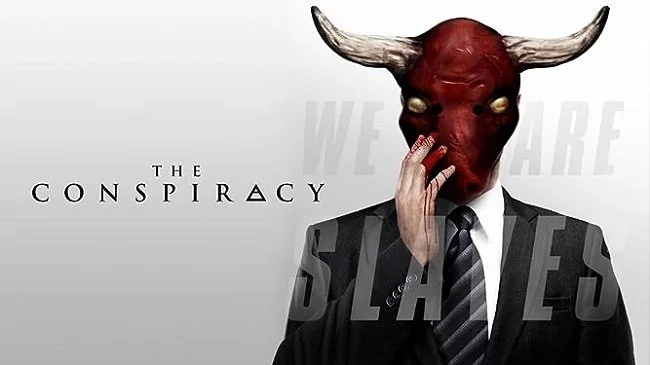
Filmmakers Aaron (Aaron Poole) and Jim (James Gilbert) decide to make a documentary about online conspiracy theories Terrance G (Alan Peterson), mainly due to the amount of attention he attracts online. Terrance explains in detail how many global events all appear to be linked to an NGO called the Tarsus Club. Jim remains sceptical of such theories, but Aaron is more willing to accept them. During an interview, Terrance becomes agitated and points out a man whom he believes to be following him. A few days later Terrance vanishes. Aaron searches through various newspaper clippings left in Terrance’s apartment and finds a reference to a Time magazine article about the Tarsus Club written by Mark Tucker (Bruce Clayton). As the pair of journalists search for Tucker, they see the same man that was following Terrance. They are also menaced by a Black SUV that parks outside Jim’s house at night. Finally, Tucker contacts them online and it becomes clear that he has more to reveal about the Tarsus Club. Aaron suggests that they try to infiltrate the next meeting, but Jim is reluctant to do so, due to the possible danger.
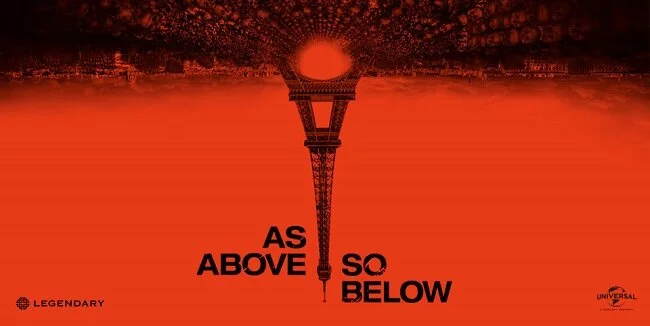
The found footage genre is predicated on the concept that the material the audience watches is supposed to be filmed from real life. This therefore presents a challenge for actors as their performances have to appear like everyday social interactions. Most people are not great orators with extensive vocabularies, in real life. Watch any wedding video or vox pop on a news broadcast and you’ll quickly become aware of the gulf between how people express themselves in reality and the stylised, contrived manner in which actors deliver dialogue. Hence, during the first act of As Above, So Below I became aware that the cast were “acting”. They were using dramatic techniques commonly used in conventional film but which stands out far more in this genre. This changed as the film progressed and the story became more deliberately chaotic. But it was noticeable during the initial set up to the story. It’s not something I’ve noticed before with other found footage movies. But in many ways, As Above, So Below is quite different compared to other genre examples
In many ways the story behind The McPherson Tape is a lot more interesting than the film itself. This early found footage movie from 1989, was shot on home video on a virtually non-existent budget. The director Dean Alioto eventually found a distributor but on the eve of the movie’s home video release, the warehouse burned down and allegedly destroyed the master tape and all the promotional artwork. Yet this was not the end of the story. It was common practice in the eighties for small distributors to send advance copies to local independent video stores. Hence The McPherson Tape found its way into the pirate video ecosystem. It then migrated to the UFO community where it was circulated as being a video of a legitimate alien abduction. Dean found himself in the unusual position of having to debunk his own work. Three decades later due to the intriguing tale associated with The McPherson Tape, it has been remastered from the newly rediscovered 3/4" tape and re-released.
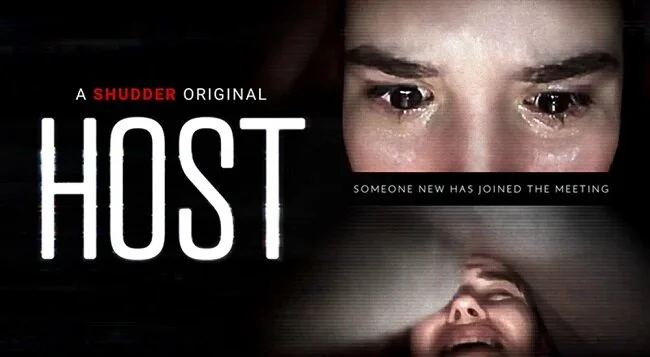
In his review in the New York Times Kyle Turner states that the new horror movie Host “seems to speak to a collective id” and serves as “an analogy for mourning the recent past”. I’ve read several other critiques of this nature that both praise the film and make similar philosophical musings upon its nature. As a long standing horror aficionado I am always a little sceptical when a new movie quickly gains a lot of traction and a critical consensus swiftly forms. Especially when a genre product suddenly gains the attention of the mainstream media who subsequently stray into hyperbole and hype. This happened last year with Midsommar which was hailed as a groundbreaking horror movie and indicative of a renaissance in the genre. Although an intelligent and disturbing film, Midsommar is not without flaws and is far from universally accessible. It is also frustrating the way the mainstream media is oblivious to the ongoing financial and critical success of the horror genre that has existed since the inception of cinema.
The Last Broadcast is a curious beast that straddles both the “mockumentary” and “found footage” genres. Shot entirely on consumer level video equipment, it effectively captures the look and feel of public access cable TV from the times. Released before the massive commercial success of The Blair Witch Project, The Last Broadcast did not find a comparable mainstream audience at the time, although it remains a favourite with genre fans. However, the movie has been recently re-released on Amazon Prime and subsequently become a talking point once again. Elements of the plot have proven very prophetic, such as the popularity of “ghost hunting” reality shows and the integration of online interactivity into live television. But the one standout aspect of The Last Broadcast which polarises viewer opinion is its ending. This is often seen as either a clever “sting in the tail” or an ill considered “jumping the shark” cop out.
The Tunnel was released direct to Region 3 DVD on 19th May 2011, much the same as any other low budget horror movie. What made the marketing of this minor Aussie "Mockumentary" horror different to other similar products, is that the distributors decided to make a barebones copy of the film available for download, free of charge. The accompanying viral marketing campaign gained quite a lot of traction resulting in The Tunnel being heavily seeded across Bit Torrent sites and exposing the film to an audience of millions globally. Subsequently, when the movie was then showcased in the US and Europe and commercially released in other regions, its profile had been considerably raised. As a result of this novel marketing campaign and the fact that the movie is a better than average example of the found footage genre, The Tunnel won several awards on the festival circuit.
Conspiracy theories and found footage movies. Two genres with infinite scope to be tedious and uninspired on a low budget. Yet writer and director Matt Johnson manages to do something quite clever with both cinematic styles in his recent movie Operation Avalanche. He takes the basic conceit of the two formats and uses them to tell a tale based upon one of the most iconic moments of twentieth century history. Namely the moon landing of 1969. The results are surprising, intelligent and thought provoking, although a little uneven. Furthermore, I discovered this enjoyable curiosity via the GoodBadFlicks on You Tube. If you are interested in obscure and niche market genre creations then do check out this channel. It is informative, well presented and entertaining.
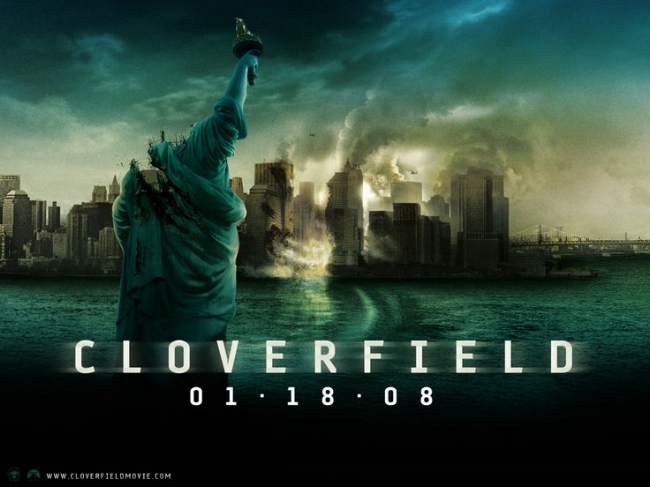
I did my best to avoid the hype surrounding the initial release of Cloverfield. Such media saturation and public interest can often cloud the issue of whether the actual film is any good. Five years later and having watched the movie twice, once in the theatre and once at home, I am still somewhat conflicted about this movie. The use of hand held video cameras is both a boon and a bane. The constant movement of the image has proven to cause motion sickness for some viewers, although this is not so overwhelming when viewed on a smaller screen at home. Yet the medium of news footage mixed with handheld cameras does create a palpable sense of immediacy. This helps immensely when trying to sell a fantastic concept, such as the one that Cloverfield features.
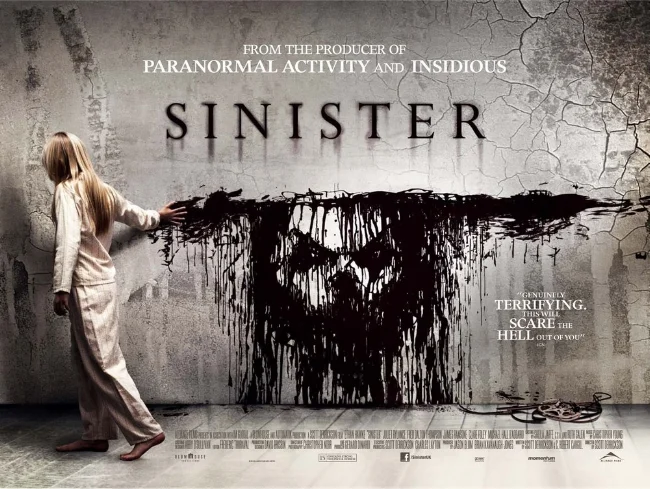
Scott Derrickson’s Sinister is a curious blending of genres and classic plot devices. It certainly has some interesting ideas at the centre of its plot. Ethan Hawke plays a true-crime writer Ellison Oswalt, looking for his next big story and desperate to find fame again. After discovering a box full of Super 8 home movies in the attic of his new house, matters start to take a turn for the worst. The films appear to depict the real murders of several families and investigations lead to a series of strange unsolved crime and the possible involvement of supernatural forces. Could a pagan deity known as Bughuul, who allegedly preys upon the souls of children, be responsible? Is Oswalt’s own family in danger? Do bears conduct their personal business in deciduous forests?
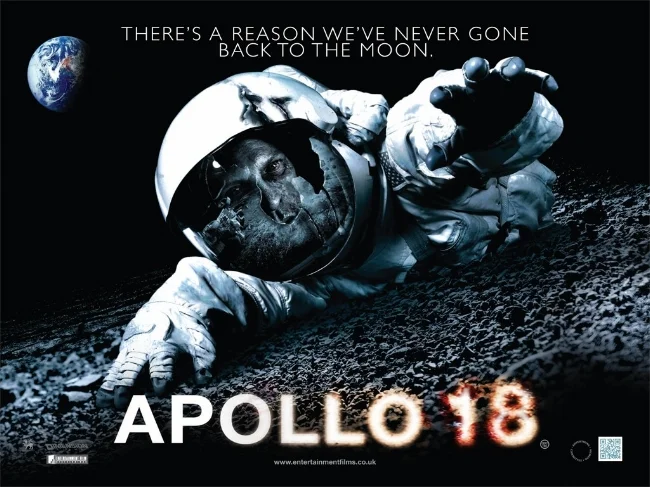
A fundamental requirement of cinema is that the audience suspends their sense of disbelief. Anything that breaks this will immediately has a negative impact upon the viewing experience. There are many things can severe this connection but the two most common seem to be obvious plot holes and Scooby Doo behaviour IE “Let’s split up…”. If these are the result of simply poor film making, then they can perhaps be forgiven. Every director has to learn their craft. However, if these two factors are present by design, then that is an unpardonable sin. Assuming that your audience is stupid, is insulting and the worse sort of hypocrisy.
I really won't be sad to see the back of the found footage sub-genre because it really is becoming an over saturated market at present. For example, at the last count there were six Paranormal Activity movies, with their respective quality inversely proportional to their number in the franchise. Yes, there are the occasional good ones, such as the recent Operation Avalanche, which tackled conspiracy theories and the Moon Landing. But broadly speaking, this genre has become a dumping ground for cheap and uninspired movies, by mediocre film makers, out to make a fast buck. Take for example Tape 407 (AKA Area 407). It’s chosen twist on the genre is the inclusion of included dinosaurs. I was hoping that this would make the film sufficiently different to others and offers something new. Predictably it did not.
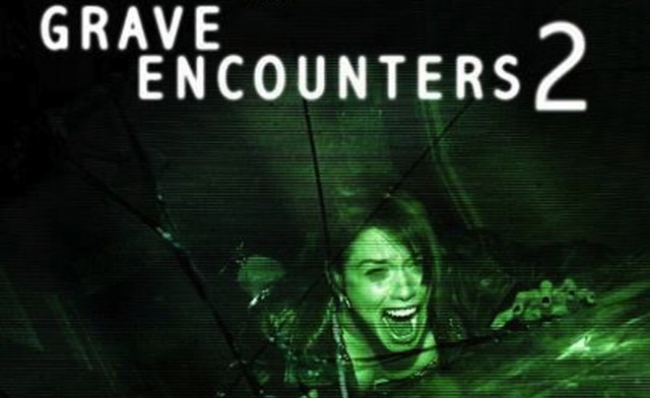
Sometimes you have to admire persistence. I really didn't think that Grave Encounters merited a sequel but apparently, it's financial returns indicated otherwise. So today I found myself watching Grave Encounters 2 with a certain sense of déjà vu because like the first movie, it tries to do something different and only partially succeeds. Once again, the writers (The Vicious Brothers) manage to jump the shark at the midway point and the movie ceases to innovate and just ticks boxes. The only major difference this time round is we get a little more of everything, because it is a sequel. So, there's more jumps, more ghosts and more violence. Is there more entertainment? May be.

I had high hopes for Grave Encounters after I saw the Trailer on You Tube six years ago. It got quite a lot of attention online, due to it jumping on the found footage bandwagon and by cashing in on the popularity of supernatural reality TV. The movie poster takes great pains to reference that fact. Shows such as Ghost Hunters and Most Haunted still pull in big TV ratings. Even I've been guilty of watching them in the past. So the idea of a TV crew investigating the paranormal and genuinely encountering it sounded very promising. Alas, Grave Encounters fails to reach it's potential in my opinion, although my primary objection hinges on a very subjective preconception. One that other viewers may not share.
Do not be fooled by the marketing and artwork for Lake Mungo. It is not a found footage movie but in fact a faux documentary. If you are looking for cheap scares, loud noises and unpleasant imagery, then you will be disappointed. Lake Mungo is not your standard exploitation fodder. If however you like well constructed movies that create a genuine sense of disquiet, then Lake Mungo is a must see. Once again Australian cinema has managed to produce an innovative and thoughtful entry to a popular sub-genre. The film demonstrates a great understanding of the mechanics of a ghost story and how they should be handled.
Revisiting Doctor Who: Part 1
Last month, I tried a 30 day free trial of the streaming service BritBox. One of the main selling points was that the platform has an extensive back catalogue of Classic Doctor Who. Although I initially tried to keep up with the reboot of the franchise in 2005 my interest waned after several seasons. I am not opposed to any of the changes made and I am very pleased that the show has found a new audience. However, it doesn’t resonate with me so much anymore and I find that there is too much human drama for my liking. So I decided to revisit my youth and watch some classic Doctor Who; episodes that I haven’t seen in over forty years (yes, I’m that old). Now I’m fully aware of the potential issues that can come from returning to things that you enjoyed in one’s youth, so I believe I did my best in managing my expectations. However, the results of my nostalgia trip were interesting. The things I thought would be a problem nowadays weren’t so and the things I expected to hold up well despite the passage of time, didn’t always succeed. It’s been a curious experience.
Last month, I tried a 30 day free trial of the streaming service BritBox. One of the main selling points was that the platform has an extensive back catalogue of Classic Doctor Who. Although I initially tried to keep up with the reboot of the franchise in 2005 my interest waned after several seasons. I am not opposed to any of the changes made and I am very pleased that the show has found a new audience. However, it doesn’t resonate with me so much anymore and I find that there is too much human drama for my liking. So I decided to revisit my youth and watch some classic Doctor Who; episodes that I haven’t seen in over forty years (yes, I’m that old). Now I’m fully aware of the potential issues that can come from returning to things that you enjoyed in one’s youth, so I believe I did my best in managing my expectations. However, the results of my nostalgia trip were interesting. The things I thought would be a problem nowadays weren’t so and the things I expected to hold up well despite the passage of time, didn’t always succeed. It’s been a curious experience.
I chose to resume watching Doctor Who at the beginning of the John Pertwee era. I have vague memories of some of the later episodes so I thought it an appropriate place to begin. I decided to temporarily bypass the first and second incarnations of the Doctor, due to the number of missing episodes and my unfamiliarity with these actor’s portrayal of the iconic Timelord. Hence I began watching Spearhead from Space which provided some continuity for me as I was familiar with the UNIT storyline. Due to industrial action within the BBC at the time, this story was entirely shot on film which gives the four episodes a very unique aesthetic. It was customary at the time to film exterior scenes on 16mm stock and record on videotape all studio scenes. However, this exclusive use of film was deemed too costly and so was not maintained. It’s a shame as the look and feel of these episodes really adds something to the show and lends it a little more gravitas.
As for Pertwee himself, although a skilled actor with definite onscreen presence, I’m not sure if the new attributes he brought to the show improve the character overall. He is more suave and dynamic than his predecessors. But often the action sequences and hand to hand fight scenes feel a little incongruous. It seems like the production team were trying to straddle too many genres and this move into Bond territory feels a little forced. Another contrivance that ends up becoming counter productive is the plot line that sees the Doctor being stranded on earth as a form of punishment by the Timelords. Hence for the first few seasons the stories centre around his role at UNIT and it all gets a little too familiar. However, the appearance of Roger Delgado as the Master is a real asset. Delgado brings a great deal of charisma to the role and effortlessly switches from charming to sinister. He was an excellent foil for Pertwee and sadly his premature death robbed the show of a suitable climax to their ongoing story arc.
Despite attempts by the production team to broaden the scope and appeal of Doctor Who during Pertwee’s tenure, there are some fundamental issues to consider. Oddly enough I found the low budget production values quite endearing and the use of chroma key video compositing quite innovative. Pertwee often had fun during such cheap and cheerful VFX sequences and his gurning is now quite noticeable. For me the more important issue is the writing and the thematic shift which happened between 1970 and 1974. Clever and nuanced stories have always been the mainstay of Doctor Who. They’re still present in this era and they don’t shy away from difficult themes. The genocidal ending to The Silurians is a good example. However, there is a strong “Nigel Kneale-esque” tone to many of the stories and at times I felt that Bernard Quatermass would have been equally at home investigating them. Again I return to my point about the more action packed Doctor and trying to embrace too many genre tropes. The BBC just didn’t have the resources to do such things justice.
Sadly as an adult, I now see that even a BBC production such as Doctor Who did not escape the prevailing societal biases of its time. I appreciate that fans are immensely fond of many of the companions that have accompanied the Doctor in his travels over the years but Jo Grant (Katy Manning) is a terribly written character, enduring all the sexist stereotypes of the time. Her final appearance in The Green Death where she falls in love with a scientist and environmental activist (who is an equally contrived creation) is somewhat embarrassing as no cliche is left unturned. Another problem that I felt quite jarring is that a lot of the stories from this era are stretched out too long. What could be effectively handled in four installments is often expanded to six or seven episodes. Sometimes events and plot twists are not evenly spaced out throughout the story, resulting in occasional dull episodes and then a narrative rush at the denouement.
I did not watch all four seasons featuring John Pertwee’s Doctor. I chose to view selected stories recommended by several fansites. However, I feel I watched sufficient to make an informed decision about his tenure. I think that this was a period of experimentation where the show tried to encompass other elements from popular entertainment of the time. Not all of it worked but I admire those involved for thinking outside the box. Certainly, when the writing hit the mark it was very good indeed. My personal favourite stories being The Daemons and The Terror of the Autons. The latter is especially creepy. However, my revisiting of Doctor Who did not end with John Pertwee. I decided to push on and jump straight into the adventures of the Fourth Doctor. I make no bones about the fact that the Tom Baker era is the one I am most familiar with. I was seven by the time he took on this iconic role and at an age where his unique persona and style left a marked impression upon me. I shall cover my thoughts on the Baker episodes that I’ve recently watched on BritBox in future blog post.
I’ve written in the past about “how long should a TV show run for” and it remains a very interesting talking point. An ageing cast and a played out formula are not uncommon problems that can lead to a popular show being cancelled. But some long standing TV dramas have different issues that can blight them. Such as overly complicated lore, a vocal fanbase and a need to stay relevant in a way that some other shows don’t have to worry about. Martin Belam has recently written a very good article about this subject. He cites Doctor Who as a show that is extremely fatigued at present and suggests that maybe taking it off air and having some time out may well be the solution to its “problems”. I agree with him. Not only with regard to Doctor Who but basically any TV or movie franchise that has become ubiquitous and therefore tired as a result.
Last month, I tried a 30 day free trial of the streaming service BritBox. One of the main selling points was that the platform has an extensive back catalogue of Classic Doctor Who. Although I initially tried to keep up with the reboot of the franchise in 2005 my interest waned after several seasons. I am not opposed to any of the changes made and I am very pleased that the show has found a new audience. However, it doesn’t resonate with me so much anymore and I find that there is too much human drama for my liking. So I decided to revisit my youth and watch some classic Doctor Who; episodes that I haven’t seen in over forty years (yes, I’m that old). Now I’m fully aware of the potential issues that can come from returning to things that you enjoyed in one’s youth, so I believe I did my best in managing my expectations. However, the results of my nostalgia trip were interesting. The things I thought would be a problem nowadays weren’t so and the things I expected to hold up well despite the passage of time, didn’t always succeed. It’s been a curious experience.
Thoughts on TV shows and my current viewing habits.
The last instalment of The Idiot Box was back in February, just before the lockdown started here in the UK. Since then, like so many people, my leisure time has increased dramatically due to being confined at home and the constraints placed upon my real world activities. Hence our household has watched a lot more TV than usual as a means of occupying ourselves. In some respects this has been a boon, being presented with an opportunity to catch up with our viewing. All those miscellaneous programmes that you record on your DVR “for some particular reason” and swear blind that “you’ll get round to watching”, have finally been cleared. I’ve also started working my way through my “to do” list of movies and TV shows that I’m supposed to be reviewing. But there have also been some curious downsides as a result of the quarantine restrictions.
Last night Jodie Whittaker made her debut as the thirteenth incarnation of that iconic Time Lord known as The Doctor. And despite eighteen months of negative comments, criticism and bile from those who disliked the idea of a female lead, the first episode, The Woman Who Fell to Earth was watched in the UK by 8 million people. At this point, popular opinion appears to be broadly positive and the franchise has weathered the storm. Naturally, there are some fans who have elected not to continue watching and there are those who intend to remain in the wings spouting disproportionate criticisms because they feel that something has been taken away from them. However, churn is a common facet of all industries and TV entertainment is no different. The BBC may well lose some long-time viewers due to this casting change, but I think it will gain far more new ones. I say this with some confidence because I too have chosen to return to the Doctor Who fold.

This afternoon, the BBC announced that Jodie Whittaker would be the thirteenth incarnation of the Time Lord, Doctor Who; the first woman to be given the role. Quite predictably, the internet went into meltdown, with cheers from some quarters and howls of derision from others. I make no bones about the fact that I got a great deal of Schadenfreude from this. Why exactly? Well we’ll come back to that point a little later. First off let me say that I really don’t mind about this casting decision. From what I’ve seen, Jodie Whittaker is an extremely competent actor and if given robust and engaging material, will excel as the new Doctor. I have no axe to grind here, either from a lore or a socio-political perspective. If the shit fits, wear it, is what I say.
Idle speculation is a national pastime in the UK. Be it about the gender of the next royal baby or who’ll be managing some ailing football club, we’ll happily spend an inordinate amount of time and energy pondering such matters. Is such conjecture based on factually accurate data and a knowledgeable insight of the matter in hand? Unfortunately, not. The only requirements necessary to express an opinion are a rudimentary grasp of the English language, access to a web enabled device and a pulse. The latest matter to arise that offers the public an opportunity to indulge in some fevered speculation, is the news that Peter Capaldi will be quitting the role of Doctor Who at the end of the year. Therefore, who exactly would be the thirteenth incarnation of the Doctor.
Battle Beyond the Stars (1980)
I was 12 years old when I first saw Battle Beyond the Stars during its UK theatrical release. I remember that I enjoyed it and thought it was an action packed movie. Being young, lacking the critical faculties that come with age and exposure to a wider variety of cinematic material, a lot of the films plus points were lost on me. I recollect that I did pick up on the fact that this film was more ghoulish than the other “Space Operas” that flooded theatres at the time. But beyond that, all I saw was a fun and enjoyable science fiction movie. I cheered when the Malmori were defeated and was saddened when Space Cowboy died. It is only after subsequent viewing over the years, that I’ve realised that this film is a microcosm of all the things that made Roger Corman productions so successful and unique. Despite its low budget, the visual effects were good and innovative for the times. There was more sex and violence present, than in comparable productions. And the crew is a veritable who’s who of talent that went on to wider success.
I was 12 years old when I first saw Battle Beyond the Stars during its UK theatrical release. I remember that I enjoyed it and thought it was an action packed movie. Being young, lacking the critical faculties that come with age and exposure to a wider variety of cinematic material, a lot of the films plus points were lost on me. I recollect that I did pick up on the fact that this film was more ghoulish than the other “Space Operas” that flooded theatres at the time. But beyond that, all I saw was a fun and enjoyable science fiction movie. I cheered when the Malmori were defeated and was saddened when Space Cowboy died. It is only after subsequent viewing over the years, that I’ve realised that this film is a microcosm of all the things that made Roger Corman productions so successful and unique. Despite its low budget, the visual effects were good and innovative for the times. There was more sex and violence present, than in comparable productions. And the crew is a veritable who’s who of talent that went on to wider success.
For those who may have missed this movie, it’s premise is straightforward. Battle Beyond the Stars is The Magnificent Seven (and thus Seven Samurai) in space. Sador of the Malmori (John Saxon) and his army of mutants deliver an ultimatum to the peaceful planet of Akir. Surrender and become a vassal state, or he will use his Stellar Converter and destroy all life. He gives the planet seven days to prepare. Young farmer Shad (Richard Thomas) takes the last remaining Corsair Class ship and sets about trying to hire mercenaries to defend his home. He manages to find Space Cowboy (George Peppard), a space trader from Earth. Gelt (Robert Vaughn), a veteran assassin looking for a place to hide. Saint-Exmin (Cybil Danning), a Valkyrie warrior looking to prove herself in battle and Nanelia (Darlanne Fluegal), a young scientist. Shad is also joined by Nestor, five telepathic clones and Cayman (Morgan Woodward), the last surviving member of the Lazuli who has a score to settle with Sador. The seven ships return to Akir and prepare for a ground assault.
There are a combination of factors that make Battle Beyond the Stars superior to many of the low budget Star Wars knock offs that flooded the market in the late seventies and early eighties. First off, the screenplay by John Sayles is noticeably above average and it is clear that he has a solid grasp of such material. Sayles has a great deal of experience writing genre scripts for such movies as Piranha, Alligator, The Howling, and The Challenge. There is action, the right kind of humour and a sense of the theatrical and flamboyant. However, all these elements are tempered and do not undermine the audience’s investment in the central characters. And then there’s the casting, which apparently took the lion share of the budget. Robert Vaughn essentially reprises the same role he had in the original Magnificent Seven back in 1960. George Peppard effortlessly fills the shoes of Space Cowboy, exuding the cocky charm while smoking cigars and drinking Scotch.
Battle Beyond the Stars also boasts a surprisingly good production design and visual effects. Corman initially hired James Cameron as a model maker after being impressed with his short film Xenogenesis. When the original art director for the film was fired, Cameron became responsible for the majority of the film's special effects. There is also a great score by James Horner (which has subsequently been reused in numerous other Corman productions). It made an impression with the executives at Paramount Studios who hired him to write the score for Star Trek II: The Wrath of Khan. But ultimately all these unique and positive aspects coalesce because of the guiding hands of Roger Corman, who knows exactly how to sell this sort of material. Battle Beyond the Stars is the epitome of low budget, exploitation fodder, done right. There’s action, romance, heaving cleavage, violence, explosions, pathos filled death scenes and a surprising amount of philosophy. What’s not to like?
Star Trek is slightly older than me by 14 months. I was born on December 18th 1967. Star Trek was first broadcast in the US on 8th September 1966. Hence this show has always been part of the prevailing pop culture that surrounded me, as I grew up. I first began watching Star Trek as a young child in the early seventies. It would be repeated on the BBC in the early evening on Fridays and it became a family ritual to sit down together and watch it. As a seven or eight year old, it left a great impression upon me and was in many ways, the television highlight of the week. Star Trek along with Doctor Who certainly started my interest in science fiction. Star Trek was also one of the first shows that introduced me to tie-in marketing. I remember seeing in a toy shop, near to my school at the time, a Dinky Klingon Battle Cruiser and was flabbergasted that such a thing existed. I immediately coveted it but sadly never obtained one.
David Koepp is no stranger to genre cinema, having written the screenplay for such films as Jurassic Park, Spider-man and War of the Worlds. Where these titles are big budget, major studio productions, Cold Storage is a far more modest production with a smaller scope. Adapted from his own novel, the screenplay is by David Koepp and the film is directed by British film-maker Jonny Campbell. At first glance, Cold Storage seems a somewhat derivative science fiction horror film with a relatively modest budget, financed through a convoluted US and French co-production. Lurid green and red colours feature heavily in the marketing artwork and it is easy, after a cursory look, to write the film off as cheap, generic, direct-to-streaming filler. However, Cold Storage is prime example of why you should not judge a book by it’s cover, or in this case, a film by its posters and online advertising. It is in fact an amusing and fun endeavour that can fill an evening.
Treasure Island In Outer Space is a curious Italian television production from 1987 starring Anthony Quinn and Ernest Borgnine. It also features numerous international actors better known for their work in cult and exploitation films, such as Bobby Rhodes, David Warbeck and John Morghan. Directed by Antonio Margheriti (AKA Anthony Dawson), famous for such films as Killer Fish (a cash in on Piranha) and The Last Hunter (a Vietnam exploitation epic), Treasure Island In Outer Space is a faithful adaptation of Robert Louis Stevenson’s classic novel. The screenplay by Renato Castellani and Lucio De Caro draws heavily from the source text, maintaining character names and original dialogue. However in updating the material to a futuristic setting, the script is littered with the worst kind of eighties sci-fi clichés. We are subjected to sonic trains, anti-gravity rays and the usual buzzword driven faux science.
After the success of Raiders of the Lost Ark in 1981, filmmakers scrambled to find existing intellectual properties that they could use for similar films. Hence archaic heroes such as Alan Quatermain were hastily given a modern makeover and thrust into generic movies, in a vague attempt to replicate Steven Spielberg’s successful formula. Which brings us neatly on to James Charles Bigglesworth AKA “Biggles”, a fictional pilot and adventurer from a series of books written by W. E. Johns between 1932 and 1968. Several attempts had been made in the past to bring this character to the silver screen, including one by Disney but they all failed. However, the commercial and critical success of Indiana Jones provided sufficient impetus to greenlight a new film. However, due to some curious production choices, when Biggles was finally released it was far from just a period set, action movie.
The seventies was an interesting time for UK genre television. Despite small budgets and often low key visual effects, there was no shortage of good ideas and creativity. Sapphire & Steel is a prime example of a show couched in a high concept, produced on a shoestring. It also credits its audiences with some degree of intelligence. Rather than spoon feeding the narrative in a didactic manner, it hints and implies, then leaves the rest to its viewers imagination. Created by Peter J. Hammond, a veteran TV writer, Sapphire & Steel centres on a pair of interdimensional operatives named Sapphire and Steel. They are two of a number of elements that assume human form. Over the course of three seasons little is revealed about the pair but they appear whenever there is any anomalous temporal activity. Time itself is portrayed as a sentient and malignant force that seeks to make incursions into the present reality, through weaknesses in the fabric of space.
The Humanoid is one of many international Star Wars knock-offs that flooded cinemas in the late seventies and early eighties. Like so many others, it is derivative (even to the extent of replicating specific scenes from George Lucas’ movie), replete with awful dialogue and has somewhat basic production values. However, it does have an interesting cast including Richard Kiel, Barbara Bach, Arthur Kennedy and Corinne Cléry. Kiel gained a lot of media attention after his appearance as the steel-toothed villain Jaws in the 1977 Bond film, The Spy Who Loved Me. His stature made him the perfect fit for the titular character in this Italian science fiction production. Sadly, beyond a curious lineup of actors, The Humanoid has little to distinguish it from so many similar movies. For example, if you’ve seen Starcrash then you’ll be adequately prepared for this film.
Some films are made with the intention of starting a franchise, others evolve into one after a surprise box office success and lucrative sequels. Alien (1979) falls into the latter category. A mid-budget science fiction horror film that was well crafted and then benefited immensely by being released at just the right time. Sadly, many franchises become derailed and enter into a death spiral due to competing artistic visions, cynical studio politics and cinematic ignorance. This has certainly afflicted all subsequent Alien films after James Cameron’s magnificent Aliens (1986). Sometimes, a franchise can correct its course and do something fresh with the source material. Prey (2022) is a fine example of this with director Dan Trachtenberg bringing fresh vigour and intelligence back to the Predator movies. I believe that was the intention with Alien Romulus (2024). Sadly, the road to hell is paved with good intentions.
Event Horizon is a curious movie hybrid, mixing plot elements from classic sci-fi and horror genres. It has been labelled “Hellraiser in Space” by some lazy critics, although I think there's far more to it than that. Perhaps a more apt description would be a Gothic horror story set in space. The movie has garnered a cult reputation since its release in 1997, mainly due to its graphic imagery and troubled production history. It does indeed have some quite shocking sequences but the lightning editing does not show as much as some would think. Paramount forced director Paul W S Anderson to reduce the original one hundred and thirty minute running time down to a more manageable ninety, after unfavourable test screenings. Much of the violence was allegedly removed as a result of that process. Sadly nothing survives of the removed material other than a VHS workprint. Hence a restored director’s cut is therefore unlikely.
I recently watched the first trailer for the new Obi-Wan Kenobi television show that is premiering on Disney + in May. I am interested in this latest instalment in the Star Wars franchise and curious as to whether Liam Neeson will make an appearance. I also watched a 20 minute fan video in which they “analysed” the entire trailer. They discussed the content of this 2 minute preview and then did a great deal of speculating about potential themes and characters that may feature in the show. They were clearly enthusiastic about what they had seen and were very knowledgeable about the subject. This resonated with me, as I like to be well versed about the things I enjoy. However, it is worth remembering that fandom can tip into obsession and gatekeeping. Hence I feel there is a subject to explore here.
On paper Finch has little originality. The moment I read the plot synopsis and saw the first trailer I instantly thought of other such films as Silent Running, Short Circuit and Chappie. However, irrespective of its derivative concept and the fact it channels many of the major tropes of the genre, it does have three cards to play. Namely strong performances by Tom Hanks, Caleb Landry Jones and canine actor Seamus. Although not a genre milestone, Finch is a curiously pleasant post apocalyptic road movie. Despite travelling through the sun bleached vistas of a ravaged America, the story focuses on the three protagonists and their relationship. It is no small feat to find genuine sentiment in such a harsh environment and indeed in such a genre but Finch proves to be an engaging emotional journey. Once again the most effective explorations of the human condition are often through characters who are conspicuously not.
I wanted to watch Source Code for a second time before I wrote about it. This is because numerous internet debates have arisen regarding the plausibility of the film’s ending. I find this a somewhat curious stance considering that the story, written by Ben Ripley, deals with temporal travel and multiple timelines. All of which are purely theoretical and not currently subject to singular, definitive interpretations. I would further add that the science of the film is simply a plot device and is not its raison d'être. But that’s movies for you. People love to discuss them and more recently we have seen the rise of “explanation” videos on YouTube. However, the latter is a separate debate and something I may write about in the future. As for Source Code, I enjoyed it even more the second time round, as I had the time to focus on the minor details rather than trying to stay abreast with the main plot, as I did on my first viewing.
I revisited M Night Shyamalan's The Happening recently to try and determine whether he is indeed suffering from Orson Welles syndrome. IE that he has made all his best work at the beginning of his career. Because he’s never quite recaptured the critical or artistic success of The Sixth Sense, Unbreakable and Signs. I was one of the few that actually liked The Lady in The water but I could see why viewers would assume that he had become a victim of his own style and technique with that particular movie. Casting yourself as an author whose work will reshape society and change the course of history is at the very least, a little egotistical and at worst an act of immense hubris. Then in recent years we have had The Last Airbender and After Earth, both of which have performed poorly. However I thought I'd give The Happening another chance as it remains the directors only R rated movie to date.
I wrote an article back in 2009 as to why I felt a remake of The Thing was a bad idea. At that time, the project was in development hell and didn’t look like getting off the ground. Subsequently, the production evolved into a prequel and managed to find financial support, culminating in a theatrical release in late 2011. Like many interested parties, I watched the initial teaser trailer with a mixture of curiosity and trepidation. Then when the red band trailer arrived I felt that the shark was well and truly jumped. Too much was shown (a common problem with modern trailers) and there the internet was awash with discontented mutterings from John Carpenter purists. Hence I refrained from watching this movie for several years. When I finally got round to doing so, I was not well disposed towards it. However, over the Christmas holidays, I decide to give this prequel a second viewing and see if I could approach it with a less partisan mindset.
Cloverfield (2008) was a surprise hit, earning $172 million worldwide at the box office against a $25 million budget. Paramount Pictures naturally wanted a sequel but director Matt Reeves and writer Drew Goddard struggled to find a suitable narrative means to progress the original story. Both eventually left the project and the production descended into development hell. The subsequent success of Godzilla and Pacific Rim saw the Kaiju genre becoming oversaturated and so the decision to make a direct sequel was re-evaluated. Eventually a “speculative screenplay” called The Cellar was purchased and repurposed to include some additional science fiction elements and became 10 Cloverfield Lane. Despite being a curious genre hybrid which only tenuously links to the original movie, this too fared well at the box office. Therefore it was inevitable that a third movie in the so-called “Cloververse” would follow.
In many ways the story behind The McPherson Tape is a lot more interesting than the film itself. This early found footage movie from 1989, was shot on home video on a virtually non-existent budget. The director Dean Alioto eventually found a distributor but on the eve of the movie’s home video release, the warehouse burned down and allegedly destroyed the master tape and all the promotional artwork. Yet this was not the end of the story. It was common practice in the eighties for small distributors to send advance copies to local independent video stores. Hence The McPherson Tape found its way into the pirate video ecosystem. It then migrated to the UFO community where it was circulated as being a video of a legitimate alien abduction. Dean found himself in the unusual position of having to debunk his own work. Three decades later due to the intriguing tale associated with The McPherson Tape, it has been remastered from the newly rediscovered 3/4" tape and re-released.
Last month, I tried a 30 day free trial of the streaming service BritBox. One of the main selling points was that the platform has an extensive back catalogue of Classic Doctor Who. Although I initially tried to keep up with the reboot of the franchise in 2005 my interest waned after several seasons. I am not opposed to any of the changes made and I am very pleased that the show has found a new audience. However, it doesn’t resonate with me so much anymore and I find that there is too much human drama for my liking. So I decided to revisit my youth and watch some classic Doctor Who; episodes that I haven’t seen in over forty years (yes, I’m that old). Now I’m fully aware of the potential issues that can come from returning to things that you enjoyed in one’s youth, so I believe I did my best in managing my expectations. However, the results of my nostalgia trip were interesting. The things I thought would be a problem nowadays weren’t so and the things I expected to hold up well despite the passage of time, didn’t always succeed. It’s been a curious experience.
I was 12 years old when I first saw Battle Beyond the Stars during its UK theatrical release. I remember that I enjoyed it and thought it was an action packed movie. Being young, lacking the critical faculties that come with age and exposure to a wider variety of cinematic material, a lot of the films plus points were lost on me. I recollect that I did pick up on the fact that this film was more ghoulish than the other “Space Operas” that flooded theatres at the time. But beyond that, all I saw was a fun and enjoyable science fiction movie. I cheered when the Malmori were defeated and was saddened when Space Cowboy died. It is only after subsequent viewing over the years, that I’ve realised that this film is a microcosm of all the things that made Roger Corman productions so successful and unique. Despite its low budget, the visual effects were good and innovative for the times. There was more sex and violence present, than in comparable productions. And the crew is a veritable who’s who of talent that went on to wider success.
Contrary to the endorsement on the above poster, Riddick was not "the most entertaining action movie of the year" in 2013. It was just an adequate third instalment in a rather ambitious franchise, that has failed to grab the wider public's attention. That’s not to say that they didn’t make money. This is after all the third movie. Writer and Director David Twohy has done his best to try and make the character of Riddick (Vin Diesel) more than the sum of his parts and I admire both of them for their persistence. Unfortunately, Riddick just isn't engaging or complicated enough a protagonist to sustain a franchise of this nature. The anti-hero was sufficient to drive the original Pitch Black back in 2000 which had some good ideas but just couldn't sustain the overarching and overblown Chronicles of Riddick in 2004. This instalment is competently made but ultimately superfluous.
Sequels and reboots are hardly a new concept and have been a part of Hollywood culture since the 1930s. The success of the Universal Horror movies from that era being a prime example of direct follow ups and retconned movies. However, there is one fundamental rule that distinguishes a good sequel from a bad one. You should never mitigate, undermine or make irrelevant the events of the previous movie, just to provide your new film with a raison d'être. For example, the events of Aliens do not contradict or trivialise those that happened in Alien. In fact with that franchise there is a very clear logical progression between the two movies. The same is true for Mad Max and Mad Max 2 or Star Wars and The Empire Strikes Back. The key is to progress a story, enhance it or explore things from an alternative angle and bring something new to the cinematic table. Sadly this philosophy is all too often lost on corporate film making. Which means that many sequels are just tedious replays of prior films. Terminator: Dark Fate falls squarely into this category.
In the near future, a series of mysterious power surges strike the Solar System, endangering all human life. Astronaut Major Roy McBride, is selected by U.S. Space Command (SpaceCom) to investigate their source near Neptune. The surges are linked to the "Lima Project", a failed experiment from 26 years earlier, that was intended to search for intelligent life outside of our solar system. The ship’s antimatter drive is potentially malfunctioning and responsible for the energy surges. Roy’s investigation is further complicated by the fact his Father H. Clifford McBride (Tommy Lee Jones), led the "Lima Project" and has not been heard from for 16 years after reaching Neptune. Having been told that Clifford may still be alive, Roy is joined by his father's old associate Colonel Pruitt (Donald Sutherland) whose loyalties remain ambiguous. Roy, who is noted for remaining calm under pressure, shows little emotional reaction to the news about his Father. As he and Pruitt travel covertly from Earth, to the moon and then onto Mars, it becomes clear that there is more to the mission than meets the eye. Will Roy remain emotionally detached or will old wounds impair his judgement?
I was very surprised when I saw a trailer for a fourth instalment on the MiB franchise, based on Lowell Cunningham’s 1990 comic book series about secret government agents battling alien infiltration of earth. The third movie from 2012 managed to keep its head above water despite a very troubled production. At the time of its release, I like everyone else, pretty much thought that the series had run its course. Yet we live in the age of belated sequels as well as hard and soft reboots. And although Will Smith’s star may well be waning, Chris Hemsworth is still box office gold. Hence, we saw the release of Men in Black: International this summer. The basic concept of the franchise remains the same but this time the action begins in the London Office and then takes a more international journey with such locations as Marrakesh and Naples. Emma Thompson returns as Agent O and Liam Neeson joins the cast as agent High T.
The original Men in Black movie hit our screens back in 1997. It was a box office success and was therefore followed by a mediocre sequel in 2002. It took a decade before we got a third instalment in the franchise. However, the popularity of the two lead actors contributed greatly to the success of this series and so despite well documented production problems Men in Black III was released in 2012. However, the delay between movies did have consequences. Will Smith, despite being an Oscar winner and box office star, had lost his way during this time and was not as popular with audiences. Men in Black III was a timely opportunity to reconnect with his core fans. So to ensure that the film hit all the required beats and stand a better chance of being a success, the Columbia Pictures brought back previous director Barry Sonnenfeld, in hopes of warding off the Hollywood curse of third movie instalments.
Fellow blogger and all round good guy Murf, posted an ode to Bill & Ted’s Excellent Adventure today. It is clearly a movie that he enjoys (Go read his review). He references how due to this movie (along with others), as well as being a decent person in real life, that actor Keanu Reeves enjoys a great deal of goodwill from fans and pop culture cognoscenti. Which is a good thing for Mr Reeves, because goodwill often means that folk are prepared to overlook past transgressions and misdemeanours. And in cinematic terms, Keanu has had a few. The Day the Earth Stood Still is definitely one of them. Now I’ve questioned before the wisdom and merits of writing a predominantly negative film review and believe me my thoughts on The Day the Earth Stood Still are most definitely so. However, I think that something positive can still be gained from scrutinising this film. It can be held up as a textbook example of how not to remake a classic.
Every now and then, a mainstream film studio employs an artisan director to helm some sort of experimental or vanity project. The studio executives often have very little understanding of the film maker or their body of work, beyond that their artistically respected by their peers. Hence there is the corporate hope that the resulting production will be both critically acclaimed and financially successful. However, what all too often happens is that the said director goes off and indulges themselves, or simply does what they’re hired to do and delivers a finished picture that is beyond the intellectual horizons of the studio. Sphincter’s subsequently tighten among executives; the director is denied final cut and the film is taken a way and re-edited in the hope of rendering it more commercially viable. In the worse cases, a second director is brought onboard and new material shot in the hope of “saving” the picture. The net result is usually acrimony among all involved parties and a film that fails to make its money back at the box office.
For anyone with a passing interest in literary science fiction, Arthur C. Clarke’s Childhood’s End is a seminal novel and considered an essential read. The story of humanity being shepherded into a utopian golden age by allegedly benevolent alien Overlords and the consequences it has upon society, was a radical departure from prevailing science fiction norms of the time. Over the years several film makers have expressed interest in adapting the story, but it has proven difficult to come to grips with. Stanley Kubrick initially wished to develop the novel but his subsequent collaboration with the author eventually lead to the making of 2001: A Space Odyssey. Since then there have been radio adaptations and audiobook versions, all of which seem to be a better medium for this episodic and contemplative tale. In late 2015 US cable and satellite channel Syfy broadcast a three-part miniseries based upon the 1953 story; something that past me by at the time. I recently caught up with this adaptation which seems to have provoked very mixed reactions among viewers. As ever, the controversy seems to stem from purists who favour a more slavish interpretation of the book.
I always cringe when I hear the phrase re-imagining. It's yet another contrived expression created by marketing bodies to justify the somewhat arbitrary process of remaking an established title. Often the re-imagined product has little to do with the source material and was chosen simply because of brand awareness. If you want a textbook example of a recent example of this somewhat cynical process then look no further than last year’s Death Wish reboot. It had nothing new to say on the subject and simply trotted out a generic and bland revenge thriller. So, when I discovered that Robert Wise's classic science fiction film, The Andromeda Strain had been remade as a TV miniseries (that had completely passed me by), I had great reservations as to whether this would be worth watching. However, the involvement of Tony and Ridley Scott piqued my interest, so I decided to take a calculated risk and give this 2008 A&E Network production a go.
Time is quite literally money in the movie In Time, starring Amanda Seyfried and Justin Timberlake. Written and directed by Andrew Niccol, who previously wrote Gattaca and S1m0ne which both had similar dystopian themes, we are presented with a chilling scenario. What if you had to spend minutes or hours or perhaps days of your life in the same way you spend money? The movie offers a future where the population is genetically programmed to stop aging at twenty-five. If you're rich enough, you can purchase and trade this commodity, adding time to your life, making you effectively immortal. For the poor, the future is a far bleaker with most dying within a year of this hardcoded end date. Every transaction comes with a price in minutes and seconds.
Many years ago, I use to rush home from school to watch Project UFO. Based loosely on the real-life Project Blue Book, this show from 1978 featured two U.S. Air Force investigators, Maj. Jake Gatlin (William Jordan) and Staff Sgt. Harry Fitz (Caskey Swaim) and their subsequent investigation into alleged UFO sightings. Sometimes there would be rational explanations and on other occasions, there was clearly extraterrestrial involvement. By the second season out protagonists experienced a close encounter of their own. It wasn’t the most densely plotted of dramas and was produced and presented in the idiom of mainstream television of the time. However, for a ten-year-old boy it had some excellent miniature work (Brick Price Movie Miniatures) and anything about UFOs was always a source of interest. There was also a great and very seventies theme tune by Nelson Riddle. So when I discovered that History (formerly The History Channel) had produced a science fiction drama series called Project Blue Book, I became somewhat nostalgic and equally intrigued.
Riddick (2013)
Contrary to the endorsement on the above poster, Riddick was not "the most entertaining action movie of the year" in 2013. It was just an adequate third instalment in a rather ambitious franchise, that has failed to grab the wider public's attention. That’s not to say that they didn’t make money. This is after all the third movie. Writer and Director David Twohy has done his best to try and make the character of Riddick (Vin Diesel) more than the sum of his parts and I admire both of them for their persistence. Unfortunately, Riddick just isn't engaging or complicated enough a protagonist to sustain a franchise of this nature. The anti-hero was sufficient to drive the original Pitch Black back in 2000 which had some good ideas but just couldn't sustain the overarching and overblown Chronicles of Riddick in 2004. This instalment is competently made but ultimately superfluous.
Contrary to the endorsement on the above poster, Riddick was not "the most entertaining action movie of the year" in 2013. It was just an adequate third instalment in a rather ambitious franchise, that has failed to grab the wider public's attention. That’s not to say that they didn’t make money. This is after all the third movie. Writer and Director David Twohy has done his best to try and make the character of Riddick (Vin Diesel) more than the sum of his parts and I admire both of them for their persistence. Unfortunately, Riddick just isn't engaging or complicated enough a protagonist to sustain a franchise of this nature. The anti-hero was sufficient to drive the original Pitch Black back in 2000 which had some good ideas but just couldn't sustain the overarching and overblown Chronicles of Riddick in 2004. This instalment is competently made but ultimately superfluous.
After the epic scope of part two, Riddick is a far more minimalist movie and in some ways is a partial reboot of the original, following a broadly similar plot. Leaving the Necromongers and Vaako (an incredibly brief cameo from Karl Urban), Riddick is betrayed and marooned on a barren planet. Wounded, he finds himself having to fend of a group of bounty hunters, some of whom have specific personal grudges against him. Writer and director Twohy once again toys with the idea of trying to redeem a morally reprehensible murderer and we have such arbitrary tropes as generic bad guys who sneer and look mean, as well as the old cliché of grudging respect between men of war. The dialogue is hard boiled and most of the plot elements have an all too familiar ring to them.
The acting and script are nothing special and although neither are they shockingly bad. It is all just predictably obvious. There a rather crass sub-plot involving lesbian mercenary Dahl (Katee Sackhoff) who begins to warm to the heterosexual charms of Riddick, which is dumb even by genre standards and considering contemporary sexual politics, somewhat insulting. As ever, the production values are slick despite the lower budget with plenty of creature mayhem, violence and macho posturing. Twohy has an eye for planetary vista's and can certainly craft a good action scene. Free from the pretensions of Chronicles of Riddick and trying to create a more complicated franchise, this third instalment returns to a more standard and user friendly formula. The character of Riddick is better suited to a more focused narrative such as this.
After twenty years and three movies, I think it would be wise for both Messrs Twohy and Diesel to call it a day with regard to the ongoing adventures of Riddick. I don't really see where you can take this particular anti-hero next and more importantly, I am not sure if many viewers would be especially disposed to do so. Again I feel that praise is due for director Twohy, for at least trying to do something different and for the determination in trying to sell the character of Riddick to the public. However, I think it's clear that there is not enough narrative meat on the bones to make people care about him. It will be interesting to see if a fourth sequel emerges or whether Twohy moves on from this franchise. Perhaps the latter would be wiser as his previous movies such as Below and A Perfect Getaway were very promising.
NB. There are two versions of Riddick available. The standard theatrical cut and an extended Director’s cut, which includes 5 minutes of slightly expanded dialogue scenes and some additional nudity. This review is based upon the latter.
Star Trek is slightly older than me by 14 months. I was born on December 18th 1967. Star Trek was first broadcast in the US on 8th September 1966. Hence this show has always been part of the prevailing pop culture that surrounded me, as I grew up. I first began watching Star Trek as a young child in the early seventies. It would be repeated on the BBC in the early evening on Fridays and it became a family ritual to sit down together and watch it. As a seven or eight year old, it left a great impression upon me and was in many ways, the television highlight of the week. Star Trek along with Doctor Who certainly started my interest in science fiction. Star Trek was also one of the first shows that introduced me to tie-in marketing. I remember seeing in a toy shop, near to my school at the time, a Dinky Klingon Battle Cruiser and was flabbergasted that such a thing existed. I immediately coveted it but sadly never obtained one.
David Koepp is no stranger to genre cinema, having written the screenplay for such films as Jurassic Park, Spider-man and War of the Worlds. Where these titles are big budget, major studio productions, Cold Storage is a far more modest production with a smaller scope. Adapted from his own novel, the screenplay is by David Koepp and the film is directed by British film-maker Jonny Campbell. At first glance, Cold Storage seems a somewhat derivative science fiction horror film with a relatively modest budget, financed through a convoluted US and French co-production. Lurid green and red colours feature heavily in the marketing artwork and it is easy, after a cursory look, to write the film off as cheap, generic, direct-to-streaming filler. However, Cold Storage is prime example of why you should not judge a book by it’s cover, or in this case, a film by its posters and online advertising. It is in fact an amusing and fun endeavour that can fill an evening.
Treasure Island In Outer Space is a curious Italian television production from 1987 starring Anthony Quinn and Ernest Borgnine. It also features numerous international actors better known for their work in cult and exploitation films, such as Bobby Rhodes, David Warbeck and John Morghan. Directed by Antonio Margheriti (AKA Anthony Dawson), famous for such films as Killer Fish (a cash in on Piranha) and The Last Hunter (a Vietnam exploitation epic), Treasure Island In Outer Space is a faithful adaptation of Robert Louis Stevenson’s classic novel. The screenplay by Renato Castellani and Lucio De Caro draws heavily from the source text, maintaining character names and original dialogue. However in updating the material to a futuristic setting, the script is littered with the worst kind of eighties sci-fi clichés. We are subjected to sonic trains, anti-gravity rays and the usual buzzword driven faux science.
After the success of Raiders of the Lost Ark in 1981, filmmakers scrambled to find existing intellectual properties that they could use for similar films. Hence archaic heroes such as Alan Quatermain were hastily given a modern makeover and thrust into generic movies, in a vague attempt to replicate Steven Spielberg’s successful formula. Which brings us neatly on to James Charles Bigglesworth AKA “Biggles”, a fictional pilot and adventurer from a series of books written by W. E. Johns between 1932 and 1968. Several attempts had been made in the past to bring this character to the silver screen, including one by Disney but they all failed. However, the commercial and critical success of Indiana Jones provided sufficient impetus to greenlight a new film. However, due to some curious production choices, when Biggles was finally released it was far from just a period set, action movie.
The seventies was an interesting time for UK genre television. Despite small budgets and often low key visual effects, there was no shortage of good ideas and creativity. Sapphire & Steel is a prime example of a show couched in a high concept, produced on a shoestring. It also credits its audiences with some degree of intelligence. Rather than spoon feeding the narrative in a didactic manner, it hints and implies, then leaves the rest to its viewers imagination. Created by Peter J. Hammond, a veteran TV writer, Sapphire & Steel centres on a pair of interdimensional operatives named Sapphire and Steel. They are two of a number of elements that assume human form. Over the course of three seasons little is revealed about the pair but they appear whenever there is any anomalous temporal activity. Time itself is portrayed as a sentient and malignant force that seeks to make incursions into the present reality, through weaknesses in the fabric of space.
The Humanoid is one of many international Star Wars knock-offs that flooded cinemas in the late seventies and early eighties. Like so many others, it is derivative (even to the extent of replicating specific scenes from George Lucas’ movie), replete with awful dialogue and has somewhat basic production values. However, it does have an interesting cast including Richard Kiel, Barbara Bach, Arthur Kennedy and Corinne Cléry. Kiel gained a lot of media attention after his appearance as the steel-toothed villain Jaws in the 1977 Bond film, The Spy Who Loved Me. His stature made him the perfect fit for the titular character in this Italian science fiction production. Sadly, beyond a curious lineup of actors, The Humanoid has little to distinguish it from so many similar movies. For example, if you’ve seen Starcrash then you’ll be adequately prepared for this film.
Some films are made with the intention of starting a franchise, others evolve into one after a surprise box office success and lucrative sequels. Alien (1979) falls into the latter category. A mid-budget science fiction horror film that was well crafted and then benefited immensely by being released at just the right time. Sadly, many franchises become derailed and enter into a death spiral due to competing artistic visions, cynical studio politics and cinematic ignorance. This has certainly afflicted all subsequent Alien films after James Cameron’s magnificent Aliens (1986). Sometimes, a franchise can correct its course and do something fresh with the source material. Prey (2022) is a fine example of this with director Dan Trachtenberg bringing fresh vigour and intelligence back to the Predator movies. I believe that was the intention with Alien Romulus (2024). Sadly, the road to hell is paved with good intentions.
Event Horizon is a curious movie hybrid, mixing plot elements from classic sci-fi and horror genres. It has been labelled “Hellraiser in Space” by some lazy critics, although I think there's far more to it than that. Perhaps a more apt description would be a Gothic horror story set in space. The movie has garnered a cult reputation since its release in 1997, mainly due to its graphic imagery and troubled production history. It does indeed have some quite shocking sequences but the lightning editing does not show as much as some would think. Paramount forced director Paul W S Anderson to reduce the original one hundred and thirty minute running time down to a more manageable ninety, after unfavourable test screenings. Much of the violence was allegedly removed as a result of that process. Sadly nothing survives of the removed material other than a VHS workprint. Hence a restored director’s cut is therefore unlikely.
I recently watched the first trailer for the new Obi-Wan Kenobi television show that is premiering on Disney + in May. I am interested in this latest instalment in the Star Wars franchise and curious as to whether Liam Neeson will make an appearance. I also watched a 20 minute fan video in which they “analysed” the entire trailer. They discussed the content of this 2 minute preview and then did a great deal of speculating about potential themes and characters that may feature in the show. They were clearly enthusiastic about what they had seen and were very knowledgeable about the subject. This resonated with me, as I like to be well versed about the things I enjoy. However, it is worth remembering that fandom can tip into obsession and gatekeeping. Hence I feel there is a subject to explore here.
On paper Finch has little originality. The moment I read the plot synopsis and saw the first trailer I instantly thought of other such films as Silent Running, Short Circuit and Chappie. However, irrespective of its derivative concept and the fact it channels many of the major tropes of the genre, it does have three cards to play. Namely strong performances by Tom Hanks, Caleb Landry Jones and canine actor Seamus. Although not a genre milestone, Finch is a curiously pleasant post apocalyptic road movie. Despite travelling through the sun bleached vistas of a ravaged America, the story focuses on the three protagonists and their relationship. It is no small feat to find genuine sentiment in such a harsh environment and indeed in such a genre but Finch proves to be an engaging emotional journey. Once again the most effective explorations of the human condition are often through characters who are conspicuously not.
I wanted to watch Source Code for a second time before I wrote about it. This is because numerous internet debates have arisen regarding the plausibility of the film’s ending. I find this a somewhat curious stance considering that the story, written by Ben Ripley, deals with temporal travel and multiple timelines. All of which are purely theoretical and not currently subject to singular, definitive interpretations. I would further add that the science of the film is simply a plot device and is not its raison d'être. But that’s movies for you. People love to discuss them and more recently we have seen the rise of “explanation” videos on YouTube. However, the latter is a separate debate and something I may write about in the future. As for Source Code, I enjoyed it even more the second time round, as I had the time to focus on the minor details rather than trying to stay abreast with the main plot, as I did on my first viewing.
I revisited M Night Shyamalan's The Happening recently to try and determine whether he is indeed suffering from Orson Welles syndrome. IE that he has made all his best work at the beginning of his career. Because he’s never quite recaptured the critical or artistic success of The Sixth Sense, Unbreakable and Signs. I was one of the few that actually liked The Lady in The water but I could see why viewers would assume that he had become a victim of his own style and technique with that particular movie. Casting yourself as an author whose work will reshape society and change the course of history is at the very least, a little egotistical and at worst an act of immense hubris. Then in recent years we have had The Last Airbender and After Earth, both of which have performed poorly. However I thought I'd give The Happening another chance as it remains the directors only R rated movie to date.
I wrote an article back in 2009 as to why I felt a remake of The Thing was a bad idea. At that time, the project was in development hell and didn’t look like getting off the ground. Subsequently, the production evolved into a prequel and managed to find financial support, culminating in a theatrical release in late 2011. Like many interested parties, I watched the initial teaser trailer with a mixture of curiosity and trepidation. Then when the red band trailer arrived I felt that the shark was well and truly jumped. Too much was shown (a common problem with modern trailers) and there the internet was awash with discontented mutterings from John Carpenter purists. Hence I refrained from watching this movie for several years. When I finally got round to doing so, I was not well disposed towards it. However, over the Christmas holidays, I decide to give this prequel a second viewing and see if I could approach it with a less partisan mindset.
Cloverfield (2008) was a surprise hit, earning $172 million worldwide at the box office against a $25 million budget. Paramount Pictures naturally wanted a sequel but director Matt Reeves and writer Drew Goddard struggled to find a suitable narrative means to progress the original story. Both eventually left the project and the production descended into development hell. The subsequent success of Godzilla and Pacific Rim saw the Kaiju genre becoming oversaturated and so the decision to make a direct sequel was re-evaluated. Eventually a “speculative screenplay” called The Cellar was purchased and repurposed to include some additional science fiction elements and became 10 Cloverfield Lane. Despite being a curious genre hybrid which only tenuously links to the original movie, this too fared well at the box office. Therefore it was inevitable that a third movie in the so-called “Cloververse” would follow.
In many ways the story behind The McPherson Tape is a lot more interesting than the film itself. This early found footage movie from 1989, was shot on home video on a virtually non-existent budget. The director Dean Alioto eventually found a distributor but on the eve of the movie’s home video release, the warehouse burned down and allegedly destroyed the master tape and all the promotional artwork. Yet this was not the end of the story. It was common practice in the eighties for small distributors to send advance copies to local independent video stores. Hence The McPherson Tape found its way into the pirate video ecosystem. It then migrated to the UFO community where it was circulated as being a video of a legitimate alien abduction. Dean found himself in the unusual position of having to debunk his own work. Three decades later due to the intriguing tale associated with The McPherson Tape, it has been remastered from the newly rediscovered 3/4" tape and re-released.
Last month, I tried a 30 day free trial of the streaming service BritBox. One of the main selling points was that the platform has an extensive back catalogue of Classic Doctor Who. Although I initially tried to keep up with the reboot of the franchise in 2005 my interest waned after several seasons. I am not opposed to any of the changes made and I am very pleased that the show has found a new audience. However, it doesn’t resonate with me so much anymore and I find that there is too much human drama for my liking. So I decided to revisit my youth and watch some classic Doctor Who; episodes that I haven’t seen in over forty years (yes, I’m that old). Now I’m fully aware of the potential issues that can come from returning to things that you enjoyed in one’s youth, so I believe I did my best in managing my expectations. However, the results of my nostalgia trip were interesting. The things I thought would be a problem nowadays weren’t so and the things I expected to hold up well despite the passage of time, didn’t always succeed. It’s been a curious experience.
I was 12 years old when I first saw Battle Beyond the Stars during its UK theatrical release. I remember that I enjoyed it and thought it was an action packed movie. Being young, lacking the critical faculties that come with age and exposure to a wider variety of cinematic material, a lot of the films plus points were lost on me. I recollect that I did pick up on the fact that this film was more ghoulish than the other “Space Operas” that flooded theatres at the time. But beyond that, all I saw was a fun and enjoyable science fiction movie. I cheered when the Malmori were defeated and was saddened when Space Cowboy died. It is only after subsequent viewing over the years, that I’ve realised that this film is a microcosm of all the things that made Roger Corman productions so successful and unique. Despite its low budget, the visual effects were good and innovative for the times. There was more sex and violence present, than in comparable productions. And the crew is a veritable who’s who of talent that went on to wider success.
Contrary to the endorsement on the above poster, Riddick was not "the most entertaining action movie of the year" in 2013. It was just an adequate third instalment in a rather ambitious franchise, that has failed to grab the wider public's attention. That’s not to say that they didn’t make money. This is after all the third movie. Writer and Director David Twohy has done his best to try and make the character of Riddick (Vin Diesel) more than the sum of his parts and I admire both of them for their persistence. Unfortunately, Riddick just isn't engaging or complicated enough a protagonist to sustain a franchise of this nature. The anti-hero was sufficient to drive the original Pitch Black back in 2000 which had some good ideas but just couldn't sustain the overarching and overblown Chronicles of Riddick in 2004. This instalment is competently made but ultimately superfluous.
Sequels and reboots are hardly a new concept and have been a part of Hollywood culture since the 1930s. The success of the Universal Horror movies from that era being a prime example of direct follow ups and retconned movies. However, there is one fundamental rule that distinguishes a good sequel from a bad one. You should never mitigate, undermine or make irrelevant the events of the previous movie, just to provide your new film with a raison d'être. For example, the events of Aliens do not contradict or trivialise those that happened in Alien. In fact with that franchise there is a very clear logical progression between the two movies. The same is true for Mad Max and Mad Max 2 or Star Wars and The Empire Strikes Back. The key is to progress a story, enhance it or explore things from an alternative angle and bring something new to the cinematic table. Sadly this philosophy is all too often lost on corporate film making. Which means that many sequels are just tedious replays of prior films. Terminator: Dark Fate falls squarely into this category.
In the near future, a series of mysterious power surges strike the Solar System, endangering all human life. Astronaut Major Roy McBride, is selected by U.S. Space Command (SpaceCom) to investigate their source near Neptune. The surges are linked to the "Lima Project", a failed experiment from 26 years earlier, that was intended to search for intelligent life outside of our solar system. The ship’s antimatter drive is potentially malfunctioning and responsible for the energy surges. Roy’s investigation is further complicated by the fact his Father H. Clifford McBride (Tommy Lee Jones), led the "Lima Project" and has not been heard from for 16 years after reaching Neptune. Having been told that Clifford may still be alive, Roy is joined by his father's old associate Colonel Pruitt (Donald Sutherland) whose loyalties remain ambiguous. Roy, who is noted for remaining calm under pressure, shows little emotional reaction to the news about his Father. As he and Pruitt travel covertly from Earth, to the moon and then onto Mars, it becomes clear that there is more to the mission than meets the eye. Will Roy remain emotionally detached or will old wounds impair his judgement?
I was very surprised when I saw a trailer for a fourth instalment on the MiB franchise, based on Lowell Cunningham’s 1990 comic book series about secret government agents battling alien infiltration of earth. The third movie from 2012 managed to keep its head above water despite a very troubled production. At the time of its release, I like everyone else, pretty much thought that the series had run its course. Yet we live in the age of belated sequels as well as hard and soft reboots. And although Will Smith’s star may well be waning, Chris Hemsworth is still box office gold. Hence, we saw the release of Men in Black: International this summer. The basic concept of the franchise remains the same but this time the action begins in the London Office and then takes a more international journey with such locations as Marrakesh and Naples. Emma Thompson returns as Agent O and Liam Neeson joins the cast as agent High T.
The original Men in Black movie hit our screens back in 1997. It was a box office success and was therefore followed by a mediocre sequel in 2002. It took a decade before we got a third instalment in the franchise. However, the popularity of the two lead actors contributed greatly to the success of this series and so despite well documented production problems Men in Black III was released in 2012. However, the delay between movies did have consequences. Will Smith, despite being an Oscar winner and box office star, had lost his way during this time and was not as popular with audiences. Men in Black III was a timely opportunity to reconnect with his core fans. So to ensure that the film hit all the required beats and stand a better chance of being a success, the Columbia Pictures brought back previous director Barry Sonnenfeld, in hopes of warding off the Hollywood curse of third movie instalments.
Fellow blogger and all round good guy Murf, posted an ode to Bill & Ted’s Excellent Adventure today. It is clearly a movie that he enjoys (Go read his review). He references how due to this movie (along with others), as well as being a decent person in real life, that actor Keanu Reeves enjoys a great deal of goodwill from fans and pop culture cognoscenti. Which is a good thing for Mr Reeves, because goodwill often means that folk are prepared to overlook past transgressions and misdemeanours. And in cinematic terms, Keanu has had a few. The Day the Earth Stood Still is definitely one of them. Now I’ve questioned before the wisdom and merits of writing a predominantly negative film review and believe me my thoughts on The Day the Earth Stood Still are most definitely so. However, I think that something positive can still be gained from scrutinising this film. It can be held up as a textbook example of how not to remake a classic.
Every now and then, a mainstream film studio employs an artisan director to helm some sort of experimental or vanity project. The studio executives often have very little understanding of the film maker or their body of work, beyond that their artistically respected by their peers. Hence there is the corporate hope that the resulting production will be both critically acclaimed and financially successful. However, what all too often happens is that the said director goes off and indulges themselves, or simply does what they’re hired to do and delivers a finished picture that is beyond the intellectual horizons of the studio. Sphincter’s subsequently tighten among executives; the director is denied final cut and the film is taken a way and re-edited in the hope of rendering it more commercially viable. In the worse cases, a second director is brought onboard and new material shot in the hope of “saving” the picture. The net result is usually acrimony among all involved parties and a film that fails to make its money back at the box office.
For anyone with a passing interest in literary science fiction, Arthur C. Clarke’s Childhood’s End is a seminal novel and considered an essential read. The story of humanity being shepherded into a utopian golden age by allegedly benevolent alien Overlords and the consequences it has upon society, was a radical departure from prevailing science fiction norms of the time. Over the years several film makers have expressed interest in adapting the story, but it has proven difficult to come to grips with. Stanley Kubrick initially wished to develop the novel but his subsequent collaboration with the author eventually lead to the making of 2001: A Space Odyssey. Since then there have been radio adaptations and audiobook versions, all of which seem to be a better medium for this episodic and contemplative tale. In late 2015 US cable and satellite channel Syfy broadcast a three-part miniseries based upon the 1953 story; something that past me by at the time. I recently caught up with this adaptation which seems to have provoked very mixed reactions among viewers. As ever, the controversy seems to stem from purists who favour a more slavish interpretation of the book.
I always cringe when I hear the phrase re-imagining. It's yet another contrived expression created by marketing bodies to justify the somewhat arbitrary process of remaking an established title. Often the re-imagined product has little to do with the source material and was chosen simply because of brand awareness. If you want a textbook example of a recent example of this somewhat cynical process then look no further than last year’s Death Wish reboot. It had nothing new to say on the subject and simply trotted out a generic and bland revenge thriller. So, when I discovered that Robert Wise's classic science fiction film, The Andromeda Strain had been remade as a TV miniseries (that had completely passed me by), I had great reservations as to whether this would be worth watching. However, the involvement of Tony and Ridley Scott piqued my interest, so I decided to take a calculated risk and give this 2008 A&E Network production a go.
Time is quite literally money in the movie In Time, starring Amanda Seyfried and Justin Timberlake. Written and directed by Andrew Niccol, who previously wrote Gattaca and S1m0ne which both had similar dystopian themes, we are presented with a chilling scenario. What if you had to spend minutes or hours or perhaps days of your life in the same way you spend money? The movie offers a future where the population is genetically programmed to stop aging at twenty-five. If you're rich enough, you can purchase and trade this commodity, adding time to your life, making you effectively immortal. For the poor, the future is a far bleaker with most dying within a year of this hardcoded end date. Every transaction comes with a price in minutes and seconds.
Many years ago, I use to rush home from school to watch Project UFO. Based loosely on the real-life Project Blue Book, this show from 1978 featured two U.S. Air Force investigators, Maj. Jake Gatlin (William Jordan) and Staff Sgt. Harry Fitz (Caskey Swaim) and their subsequent investigation into alleged UFO sightings. Sometimes there would be rational explanations and on other occasions, there was clearly extraterrestrial involvement. By the second season out protagonists experienced a close encounter of their own. It wasn’t the most densely plotted of dramas and was produced and presented in the idiom of mainstream television of the time. However, for a ten-year-old boy it had some excellent miniature work (Brick Price Movie Miniatures) and anything about UFOs was always a source of interest. There was also a great and very seventies theme tune by Nelson Riddle. So when I discovered that History (formerly The History Channel) had produced a science fiction drama series called Project Blue Book, I became somewhat nostalgic and equally intrigued.
Terminator: Dark Fate (2019)
Sequels and reboots are hardly a new concept and have been a part of Hollywood culture since the 1930s. The success of the Universal Horror movies from that era being a prime example of direct follow ups and retconned movies. However, there is one fundamental rule that distinguishes a good sequel from a bad one. You should never mitigate, undermine or make irrelevant the events of the previous movie, just to provide your new film with a raison d'être. For example, the events of Aliens do not contradict or trivialise those that happened in Alien. In fact with that franchise there is a very clear logical progression between the two movies. The same is true for Mad Max and Mad Max 2 or Star Wars and The Empire Strikes Back. The key is to progress a story, enhance it or explore things from an alternative angle and bring something new to the cinematic table. Sadly this philosophy is all too often lost on corporate film making. Which means that many sequels are just tedious replays of prior films. Terminator: Dark Fate falls squarely into this category.
Sequels and reboots are hardly a new concept and have been a part of Hollywood culture since the 1930s. The success of the Universal Horror movies from that era being a prime example of direct follow ups and retconned movies. However, there is one fundamental rule that distinguishes a good sequel from a bad one. You should never mitigate, undermine or make irrelevant the events of the previous movie, just to provide your new film with a raison d'être. For example, the events of Aliens do not contradict or trivialise those that happened in Alien. In fact with that franchise there is a very clear logical progression between the two movies. The same is true for Mad Max and Mad Max 2 or Star Wars and The Empire Strikes Back. The key is to progress a story, enhance it or explore things from an alternative angle and bring something new to the cinematic table. Sadly this philosophy is all too often lost on corporate film making. Which means that many sequels are just tedious replays of prior films. Terminator: Dark Fate falls squarely into this category.
Objectively, Terminator: Dark Fate plays out as a greatest hits of the Terminator franchise. Due to the way that Terminator 2: Judgement Day concluded, the future existence of Skynet has been definitively stopped. Therefore for this new film to justify its existence it has to contrive another comparable future threat and does so with a new rogue AI called Legion. So despite Judgement Day being averted, we are simply presented with a new dystopian future (because obviously Legion perceives mankind as a threat) and a new Terminator (Rev-9 model played by Gabriel Luna) sent back in time. Naturally, if there’s a Terminator on the loose, then they have to have a target. This time round it is Daniella Ramos (Natalia Reyes), a young woman who works in an automobile assembly factory. She is rescued and protected (as was Sarah Connorin the original movie) by a soldier from the future. The major difference being this time, is that Grace (Mackenzie Davis) has been cybernetically enhanced thus making her more capable in tackling Terminators.
Perhaps the most egregious offense that Terminator: Dark Fate commits is dealing with the conundrum of John Connor. With Judgement Day averted both John and his Mother Sarah were theoretically free to live out the remainder of their lives in peace. But the production’s need to include actress Linda Hamilton into the story (and thus increase the film marketability) requires a rather mean spirit plot twist that effectively negates the entire point of the first two films. To say more would spoil the film’s plot for those who have yet to see it but it really is a poor idea and has upset many ardent fans of this franchise. This narrative device also paves the way to crowbar Arnold Schwarzenegger into the proceedings as yet another T-800 model Terminator from the original Skynet timeline. There are some attempts in the screenplay by David Goyer, Justin Rhodes and Billy Ray to try and play against type, with this particular Terminator living out the rest of his existence as an average member of society. But the scenario envisaged is purely designed for easy laughs and offers nothing of substance beyond its inherent novelty.
Effectively all that Terminator: Dark Fate offers during its 128 minute duration is a retread of previous plot elements from the other movies and a series of noisy and frenetic action scenes, all of which are derivative and soulless, with no genuine sense of threat. Is the film poorly made? No not at all. Is it entertaining on any level? Yes. In a superficial way. But it has nothing to offer beyond that and it is utterly redundant. Beyond the need to make a film studio some money, Terminator: Dark Fate cannot really justify its existence. It adds nothing to the existing canon and lore and makes for rather ponderous viewing. The return to an R Rating provides no tangible benefits either, other than the scope for violence for violence sake. Sadly, the mainstream film making industry has no concept of integrity or art and is utterly lacking in self awareness. So I’m sure given some time, a focus group will attempt to resurrect this franchise yet again at a future date, only to make exactly the same mistakes.
Star Trek is slightly older than me by 14 months. I was born on December 18th 1967. Star Trek was first broadcast in the US on 8th September 1966. Hence this show has always been part of the prevailing pop culture that surrounded me, as I grew up. I first began watching Star Trek as a young child in the early seventies. It would be repeated on the BBC in the early evening on Fridays and it became a family ritual to sit down together and watch it. As a seven or eight year old, it left a great impression upon me and was in many ways, the television highlight of the week. Star Trek along with Doctor Who certainly started my interest in science fiction. Star Trek was also one of the first shows that introduced me to tie-in marketing. I remember seeing in a toy shop, near to my school at the time, a Dinky Klingon Battle Cruiser and was flabbergasted that such a thing existed. I immediately coveted it but sadly never obtained one.
David Koepp is no stranger to genre cinema, having written the screenplay for such films as Jurassic Park, Spider-man and War of the Worlds. Where these titles are big budget, major studio productions, Cold Storage is a far more modest production with a smaller scope. Adapted from his own novel, the screenplay is by David Koepp and the film is directed by British film-maker Jonny Campbell. At first glance, Cold Storage seems a somewhat derivative science fiction horror film with a relatively modest budget, financed through a convoluted US and French co-production. Lurid green and red colours feature heavily in the marketing artwork and it is easy, after a cursory look, to write the film off as cheap, generic, direct-to-streaming filler. However, Cold Storage is prime example of why you should not judge a book by it’s cover, or in this case, a film by its posters and online advertising. It is in fact an amusing and fun endeavour that can fill an evening.
Treasure Island In Outer Space is a curious Italian television production from 1987 starring Anthony Quinn and Ernest Borgnine. It also features numerous international actors better known for their work in cult and exploitation films, such as Bobby Rhodes, David Warbeck and John Morghan. Directed by Antonio Margheriti (AKA Anthony Dawson), famous for such films as Killer Fish (a cash in on Piranha) and The Last Hunter (a Vietnam exploitation epic), Treasure Island In Outer Space is a faithful adaptation of Robert Louis Stevenson’s classic novel. The screenplay by Renato Castellani and Lucio De Caro draws heavily from the source text, maintaining character names and original dialogue. However in updating the material to a futuristic setting, the script is littered with the worst kind of eighties sci-fi clichés. We are subjected to sonic trains, anti-gravity rays and the usual buzzword driven faux science.
After the success of Raiders of the Lost Ark in 1981, filmmakers scrambled to find existing intellectual properties that they could use for similar films. Hence archaic heroes such as Alan Quatermain were hastily given a modern makeover and thrust into generic movies, in a vague attempt to replicate Steven Spielberg’s successful formula. Which brings us neatly on to James Charles Bigglesworth AKA “Biggles”, a fictional pilot and adventurer from a series of books written by W. E. Johns between 1932 and 1968. Several attempts had been made in the past to bring this character to the silver screen, including one by Disney but they all failed. However, the commercial and critical success of Indiana Jones provided sufficient impetus to greenlight a new film. However, due to some curious production choices, when Biggles was finally released it was far from just a period set, action movie.
The seventies was an interesting time for UK genre television. Despite small budgets and often low key visual effects, there was no shortage of good ideas and creativity. Sapphire & Steel is a prime example of a show couched in a high concept, produced on a shoestring. It also credits its audiences with some degree of intelligence. Rather than spoon feeding the narrative in a didactic manner, it hints and implies, then leaves the rest to its viewers imagination. Created by Peter J. Hammond, a veteran TV writer, Sapphire & Steel centres on a pair of interdimensional operatives named Sapphire and Steel. They are two of a number of elements that assume human form. Over the course of three seasons little is revealed about the pair but they appear whenever there is any anomalous temporal activity. Time itself is portrayed as a sentient and malignant force that seeks to make incursions into the present reality, through weaknesses in the fabric of space.
The Humanoid is one of many international Star Wars knock-offs that flooded cinemas in the late seventies and early eighties. Like so many others, it is derivative (even to the extent of replicating specific scenes from George Lucas’ movie), replete with awful dialogue and has somewhat basic production values. However, it does have an interesting cast including Richard Kiel, Barbara Bach, Arthur Kennedy and Corinne Cléry. Kiel gained a lot of media attention after his appearance as the steel-toothed villain Jaws in the 1977 Bond film, The Spy Who Loved Me. His stature made him the perfect fit for the titular character in this Italian science fiction production. Sadly, beyond a curious lineup of actors, The Humanoid has little to distinguish it from so many similar movies. For example, if you’ve seen Starcrash then you’ll be adequately prepared for this film.
Some films are made with the intention of starting a franchise, others evolve into one after a surprise box office success and lucrative sequels. Alien (1979) falls into the latter category. A mid-budget science fiction horror film that was well crafted and then benefited immensely by being released at just the right time. Sadly, many franchises become derailed and enter into a death spiral due to competing artistic visions, cynical studio politics and cinematic ignorance. This has certainly afflicted all subsequent Alien films after James Cameron’s magnificent Aliens (1986). Sometimes, a franchise can correct its course and do something fresh with the source material. Prey (2022) is a fine example of this with director Dan Trachtenberg bringing fresh vigour and intelligence back to the Predator movies. I believe that was the intention with Alien Romulus (2024). Sadly, the road to hell is paved with good intentions.
Event Horizon is a curious movie hybrid, mixing plot elements from classic sci-fi and horror genres. It has been labelled “Hellraiser in Space” by some lazy critics, although I think there's far more to it than that. Perhaps a more apt description would be a Gothic horror story set in space. The movie has garnered a cult reputation since its release in 1997, mainly due to its graphic imagery and troubled production history. It does indeed have some quite shocking sequences but the lightning editing does not show as much as some would think. Paramount forced director Paul W S Anderson to reduce the original one hundred and thirty minute running time down to a more manageable ninety, after unfavourable test screenings. Much of the violence was allegedly removed as a result of that process. Sadly nothing survives of the removed material other than a VHS workprint. Hence a restored director’s cut is therefore unlikely.
I recently watched the first trailer for the new Obi-Wan Kenobi television show that is premiering on Disney + in May. I am interested in this latest instalment in the Star Wars franchise and curious as to whether Liam Neeson will make an appearance. I also watched a 20 minute fan video in which they “analysed” the entire trailer. They discussed the content of this 2 minute preview and then did a great deal of speculating about potential themes and characters that may feature in the show. They were clearly enthusiastic about what they had seen and were very knowledgeable about the subject. This resonated with me, as I like to be well versed about the things I enjoy. However, it is worth remembering that fandom can tip into obsession and gatekeeping. Hence I feel there is a subject to explore here.
On paper Finch has little originality. The moment I read the plot synopsis and saw the first trailer I instantly thought of other such films as Silent Running, Short Circuit and Chappie. However, irrespective of its derivative concept and the fact it channels many of the major tropes of the genre, it does have three cards to play. Namely strong performances by Tom Hanks, Caleb Landry Jones and canine actor Seamus. Although not a genre milestone, Finch is a curiously pleasant post apocalyptic road movie. Despite travelling through the sun bleached vistas of a ravaged America, the story focuses on the three protagonists and their relationship. It is no small feat to find genuine sentiment in such a harsh environment and indeed in such a genre but Finch proves to be an engaging emotional journey. Once again the most effective explorations of the human condition are often through characters who are conspicuously not.
I wanted to watch Source Code for a second time before I wrote about it. This is because numerous internet debates have arisen regarding the plausibility of the film’s ending. I find this a somewhat curious stance considering that the story, written by Ben Ripley, deals with temporal travel and multiple timelines. All of which are purely theoretical and not currently subject to singular, definitive interpretations. I would further add that the science of the film is simply a plot device and is not its raison d'être. But that’s movies for you. People love to discuss them and more recently we have seen the rise of “explanation” videos on YouTube. However, the latter is a separate debate and something I may write about in the future. As for Source Code, I enjoyed it even more the second time round, as I had the time to focus on the minor details rather than trying to stay abreast with the main plot, as I did on my first viewing.
I revisited M Night Shyamalan's The Happening recently to try and determine whether he is indeed suffering from Orson Welles syndrome. IE that he has made all his best work at the beginning of his career. Because he’s never quite recaptured the critical or artistic success of The Sixth Sense, Unbreakable and Signs. I was one of the few that actually liked The Lady in The water but I could see why viewers would assume that he had become a victim of his own style and technique with that particular movie. Casting yourself as an author whose work will reshape society and change the course of history is at the very least, a little egotistical and at worst an act of immense hubris. Then in recent years we have had The Last Airbender and After Earth, both of which have performed poorly. However I thought I'd give The Happening another chance as it remains the directors only R rated movie to date.
I wrote an article back in 2009 as to why I felt a remake of The Thing was a bad idea. At that time, the project was in development hell and didn’t look like getting off the ground. Subsequently, the production evolved into a prequel and managed to find financial support, culminating in a theatrical release in late 2011. Like many interested parties, I watched the initial teaser trailer with a mixture of curiosity and trepidation. Then when the red band trailer arrived I felt that the shark was well and truly jumped. Too much was shown (a common problem with modern trailers) and there the internet was awash with discontented mutterings from John Carpenter purists. Hence I refrained from watching this movie for several years. When I finally got round to doing so, I was not well disposed towards it. However, over the Christmas holidays, I decide to give this prequel a second viewing and see if I could approach it with a less partisan mindset.
Cloverfield (2008) was a surprise hit, earning $172 million worldwide at the box office against a $25 million budget. Paramount Pictures naturally wanted a sequel but director Matt Reeves and writer Drew Goddard struggled to find a suitable narrative means to progress the original story. Both eventually left the project and the production descended into development hell. The subsequent success of Godzilla and Pacific Rim saw the Kaiju genre becoming oversaturated and so the decision to make a direct sequel was re-evaluated. Eventually a “speculative screenplay” called The Cellar was purchased and repurposed to include some additional science fiction elements and became 10 Cloverfield Lane. Despite being a curious genre hybrid which only tenuously links to the original movie, this too fared well at the box office. Therefore it was inevitable that a third movie in the so-called “Cloververse” would follow.
In many ways the story behind The McPherson Tape is a lot more interesting than the film itself. This early found footage movie from 1989, was shot on home video on a virtually non-existent budget. The director Dean Alioto eventually found a distributor but on the eve of the movie’s home video release, the warehouse burned down and allegedly destroyed the master tape and all the promotional artwork. Yet this was not the end of the story. It was common practice in the eighties for small distributors to send advance copies to local independent video stores. Hence The McPherson Tape found its way into the pirate video ecosystem. It then migrated to the UFO community where it was circulated as being a video of a legitimate alien abduction. Dean found himself in the unusual position of having to debunk his own work. Three decades later due to the intriguing tale associated with The McPherson Tape, it has been remastered from the newly rediscovered 3/4" tape and re-released.
Last month, I tried a 30 day free trial of the streaming service BritBox. One of the main selling points was that the platform has an extensive back catalogue of Classic Doctor Who. Although I initially tried to keep up with the reboot of the franchise in 2005 my interest waned after several seasons. I am not opposed to any of the changes made and I am very pleased that the show has found a new audience. However, it doesn’t resonate with me so much anymore and I find that there is too much human drama for my liking. So I decided to revisit my youth and watch some classic Doctor Who; episodes that I haven’t seen in over forty years (yes, I’m that old). Now I’m fully aware of the potential issues that can come from returning to things that you enjoyed in one’s youth, so I believe I did my best in managing my expectations. However, the results of my nostalgia trip were interesting. The things I thought would be a problem nowadays weren’t so and the things I expected to hold up well despite the passage of time, didn’t always succeed. It’s been a curious experience.
I was 12 years old when I first saw Battle Beyond the Stars during its UK theatrical release. I remember that I enjoyed it and thought it was an action packed movie. Being young, lacking the critical faculties that come with age and exposure to a wider variety of cinematic material, a lot of the films plus points were lost on me. I recollect that I did pick up on the fact that this film was more ghoulish than the other “Space Operas” that flooded theatres at the time. But beyond that, all I saw was a fun and enjoyable science fiction movie. I cheered when the Malmori were defeated and was saddened when Space Cowboy died. It is only after subsequent viewing over the years, that I’ve realised that this film is a microcosm of all the things that made Roger Corman productions so successful and unique. Despite its low budget, the visual effects were good and innovative for the times. There was more sex and violence present, than in comparable productions. And the crew is a veritable who’s who of talent that went on to wider success.
Contrary to the endorsement on the above poster, Riddick was not "the most entertaining action movie of the year" in 2013. It was just an adequate third instalment in a rather ambitious franchise, that has failed to grab the wider public's attention. That’s not to say that they didn’t make money. This is after all the third movie. Writer and Director David Twohy has done his best to try and make the character of Riddick (Vin Diesel) more than the sum of his parts and I admire both of them for their persistence. Unfortunately, Riddick just isn't engaging or complicated enough a protagonist to sustain a franchise of this nature. The anti-hero was sufficient to drive the original Pitch Black back in 2000 which had some good ideas but just couldn't sustain the overarching and overblown Chronicles of Riddick in 2004. This instalment is competently made but ultimately superfluous.
Sequels and reboots are hardly a new concept and have been a part of Hollywood culture since the 1930s. The success of the Universal Horror movies from that era being a prime example of direct follow ups and retconned movies. However, there is one fundamental rule that distinguishes a good sequel from a bad one. You should never mitigate, undermine or make irrelevant the events of the previous movie, just to provide your new film with a raison d'être. For example, the events of Aliens do not contradict or trivialise those that happened in Alien. In fact with that franchise there is a very clear logical progression between the two movies. The same is true for Mad Max and Mad Max 2 or Star Wars and The Empire Strikes Back. The key is to progress a story, enhance it or explore things from an alternative angle and bring something new to the cinematic table. Sadly this philosophy is all too often lost on corporate film making. Which means that many sequels are just tedious replays of prior films. Terminator: Dark Fate falls squarely into this category.
In the near future, a series of mysterious power surges strike the Solar System, endangering all human life. Astronaut Major Roy McBride, is selected by U.S. Space Command (SpaceCom) to investigate their source near Neptune. The surges are linked to the "Lima Project", a failed experiment from 26 years earlier, that was intended to search for intelligent life outside of our solar system. The ship’s antimatter drive is potentially malfunctioning and responsible for the energy surges. Roy’s investigation is further complicated by the fact his Father H. Clifford McBride (Tommy Lee Jones), led the "Lima Project" and has not been heard from for 16 years after reaching Neptune. Having been told that Clifford may still be alive, Roy is joined by his father's old associate Colonel Pruitt (Donald Sutherland) whose loyalties remain ambiguous. Roy, who is noted for remaining calm under pressure, shows little emotional reaction to the news about his Father. As he and Pruitt travel covertly from Earth, to the moon and then onto Mars, it becomes clear that there is more to the mission than meets the eye. Will Roy remain emotionally detached or will old wounds impair his judgement?
I was very surprised when I saw a trailer for a fourth instalment on the MiB franchise, based on Lowell Cunningham’s 1990 comic book series about secret government agents battling alien infiltration of earth. The third movie from 2012 managed to keep its head above water despite a very troubled production. At the time of its release, I like everyone else, pretty much thought that the series had run its course. Yet we live in the age of belated sequels as well as hard and soft reboots. And although Will Smith’s star may well be waning, Chris Hemsworth is still box office gold. Hence, we saw the release of Men in Black: International this summer. The basic concept of the franchise remains the same but this time the action begins in the London Office and then takes a more international journey with such locations as Marrakesh and Naples. Emma Thompson returns as Agent O and Liam Neeson joins the cast as agent High T.
The original Men in Black movie hit our screens back in 1997. It was a box office success and was therefore followed by a mediocre sequel in 2002. It took a decade before we got a third instalment in the franchise. However, the popularity of the two lead actors contributed greatly to the success of this series and so despite well documented production problems Men in Black III was released in 2012. However, the delay between movies did have consequences. Will Smith, despite being an Oscar winner and box office star, had lost his way during this time and was not as popular with audiences. Men in Black III was a timely opportunity to reconnect with his core fans. So to ensure that the film hit all the required beats and stand a better chance of being a success, the Columbia Pictures brought back previous director Barry Sonnenfeld, in hopes of warding off the Hollywood curse of third movie instalments.
Fellow blogger and all round good guy Murf, posted an ode to Bill & Ted’s Excellent Adventure today. It is clearly a movie that he enjoys (Go read his review). He references how due to this movie (along with others), as well as being a decent person in real life, that actor Keanu Reeves enjoys a great deal of goodwill from fans and pop culture cognoscenti. Which is a good thing for Mr Reeves, because goodwill often means that folk are prepared to overlook past transgressions and misdemeanours. And in cinematic terms, Keanu has had a few. The Day the Earth Stood Still is definitely one of them. Now I’ve questioned before the wisdom and merits of writing a predominantly negative film review and believe me my thoughts on The Day the Earth Stood Still are most definitely so. However, I think that something positive can still be gained from scrutinising this film. It can be held up as a textbook example of how not to remake a classic.
Every now and then, a mainstream film studio employs an artisan director to helm some sort of experimental or vanity project. The studio executives often have very little understanding of the film maker or their body of work, beyond that their artistically respected by their peers. Hence there is the corporate hope that the resulting production will be both critically acclaimed and financially successful. However, what all too often happens is that the said director goes off and indulges themselves, or simply does what they’re hired to do and delivers a finished picture that is beyond the intellectual horizons of the studio. Sphincter’s subsequently tighten among executives; the director is denied final cut and the film is taken a way and re-edited in the hope of rendering it more commercially viable. In the worse cases, a second director is brought onboard and new material shot in the hope of “saving” the picture. The net result is usually acrimony among all involved parties and a film that fails to make its money back at the box office.
For anyone with a passing interest in literary science fiction, Arthur C. Clarke’s Childhood’s End is a seminal novel and considered an essential read. The story of humanity being shepherded into a utopian golden age by allegedly benevolent alien Overlords and the consequences it has upon society, was a radical departure from prevailing science fiction norms of the time. Over the years several film makers have expressed interest in adapting the story, but it has proven difficult to come to grips with. Stanley Kubrick initially wished to develop the novel but his subsequent collaboration with the author eventually lead to the making of 2001: A Space Odyssey. Since then there have been radio adaptations and audiobook versions, all of which seem to be a better medium for this episodic and contemplative tale. In late 2015 US cable and satellite channel Syfy broadcast a three-part miniseries based upon the 1953 story; something that past me by at the time. I recently caught up with this adaptation which seems to have provoked very mixed reactions among viewers. As ever, the controversy seems to stem from purists who favour a more slavish interpretation of the book.
I always cringe when I hear the phrase re-imagining. It's yet another contrived expression created by marketing bodies to justify the somewhat arbitrary process of remaking an established title. Often the re-imagined product has little to do with the source material and was chosen simply because of brand awareness. If you want a textbook example of a recent example of this somewhat cynical process then look no further than last year’s Death Wish reboot. It had nothing new to say on the subject and simply trotted out a generic and bland revenge thriller. So, when I discovered that Robert Wise's classic science fiction film, The Andromeda Strain had been remade as a TV miniseries (that had completely passed me by), I had great reservations as to whether this would be worth watching. However, the involvement of Tony and Ridley Scott piqued my interest, so I decided to take a calculated risk and give this 2008 A&E Network production a go.
Time is quite literally money in the movie In Time, starring Amanda Seyfried and Justin Timberlake. Written and directed by Andrew Niccol, who previously wrote Gattaca and S1m0ne which both had similar dystopian themes, we are presented with a chilling scenario. What if you had to spend minutes or hours or perhaps days of your life in the same way you spend money? The movie offers a future where the population is genetically programmed to stop aging at twenty-five. If you're rich enough, you can purchase and trade this commodity, adding time to your life, making you effectively immortal. For the poor, the future is a far bleaker with most dying within a year of this hardcoded end date. Every transaction comes with a price in minutes and seconds.
Many years ago, I use to rush home from school to watch Project UFO. Based loosely on the real-life Project Blue Book, this show from 1978 featured two U.S. Air Force investigators, Maj. Jake Gatlin (William Jordan) and Staff Sgt. Harry Fitz (Caskey Swaim) and their subsequent investigation into alleged UFO sightings. Sometimes there would be rational explanations and on other occasions, there was clearly extraterrestrial involvement. By the second season out protagonists experienced a close encounter of their own. It wasn’t the most densely plotted of dramas and was produced and presented in the idiom of mainstream television of the time. However, for a ten-year-old boy it had some excellent miniature work (Brick Price Movie Miniatures) and anything about UFOs was always a source of interest. There was also a great and very seventies theme tune by Nelson Riddle. So when I discovered that History (formerly The History Channel) had produced a science fiction drama series called Project Blue Book, I became somewhat nostalgic and equally intrigued.
Ad Astra (2019)
In the near future, a series of mysterious power surges strike the Solar System, endangering all human life. Astronaut Major Roy McBride, is selected by U.S. Space Command (SpaceCom) to investigate their source near Neptune. The surges are linked to the "Lima Project", a failed experiment from 26 years earlier, that was intended to search for intelligent life outside of our solar system. The ship’s antimatter drive is potentially malfunctioning and responsible for the energy surges. Roy’s investigation is further complicated by the fact his Father H. Clifford McBride (Tommy Lee Jones), led the "Lima Project" and has not been heard from for 16 years after reaching Neptune. Having been told that Clifford may still be alive, Roy is joined by his father's old associate Colonel Pruitt (Donald Sutherland) whose loyalties remain ambiguous. Roy, who is noted for remaining calm under pressure, shows little emotional reaction to the news about his Father. As he and Pruitt travel covertly from Earth, to the moon and then onto Mars, it becomes clear that there is more to the mission than meets the eye. Will Roy remain emotionally detached or will old wounds impair his judgement?
In the near future, a series of mysterious power surges strike the Solar System, endangering all human life. Astronaut Major Roy McBride, is selected by U.S. Space Command (SpaceCom) to investigate their source near Neptune. The surges are linked to the "Lima Project", a failed experiment from 26 years earlier, that was intended to search for intelligent life outside of our solar system. The ship’s antimatter drive is potentially malfunctioning and responsible for the energy surges. Roy’s investigation is further complicated by the fact his Father H. Clifford McBride (Tommy Lee Jones), led the "Lima Project" and has not been heard from for 16 years after reaching Neptune. Having been told that Clifford may still be alive, Roy is joined by his father's old associate Colonel Pruitt (Donald Sutherland) whose loyalties remain ambiguous. Roy, who is noted for remaining calm under pressure, shows little emotional reaction to the news about his Father. As he and Pruitt travel covertly from Earth, to the moon and then onto Mars, it becomes clear that there is more to the mission than meets the eye. Will Roy remain emotionally detached or will old wounds impair his judgement?
Many critics felt that Ad Astra fell between two stools with its cold, clinical approach to space travel and its intermittent action scenes. I did not feel this way for the first third of the movie and accepted the lunar chase scene as relevant to the plot. Within the confines of the story, the Moon is colonised by multiple nations and there are territorial disputes. Hence violating borders could indeed provoke a military response. However the film contradicted its own adherence to science at the end of the first act to accommodate a most unusual, unexpected but ultimately superfluous suspense sequence. This somewhat jaded my view of Ad Astra for the remainder of its running time and I got the distinct feeling that perhaps there was studio pressure put upon writer and director James Gray to balance the existential self contemplation of the plot with some accessible action sequences for the less “intellectually invested” viewers. Furthermore the much anticipated ending in which Father and Son meet, lands wide of the mark, failing to meet expectations both narratively and philosophically.
One cannot fault the quality of the production with much of the technology and science on display in Ad Astra being credible and well realised. The 100 million dollar budget seems to have gone mainly into the films visual effects and production design. Performances from all involved are good, as you would expect from such an ensemble cast. But as Ad Astra progresses the ideas run out of steam and suddenly there is nothing to sustain the drama beyond the visuals and the hope that matters will be resolved in a satisfactory or at the least adequate fashion. And it is sadly the latter that is only achieved. For a movie that strives to deal with the near future in a Kubrickeques manner and explore the complexity of family relationships in an idiom similar to Greek Mythology, it fails to deliver at its dramatic climax. Furthermore, not only is the accurate depiction of science suspended when it finds itself at odds with the drama, so is narrative credibility. One scene where Roy is discovered illegally stowing away on a rocket, ends so abruptly and violently that it verges on the absurd.
However, despite losing its way Ad Astra does at least do something unusual that flies in the face of popular belief with one of the stories core themes. It postulates the idea that there is no other intelligent, sentient life in the universe and that we are as a species are just an anomaly that is utterly alone. Such a statement is very bold and thought provoking. But the Science fiction genre often works best when it is a MacGuffin for a human story. And there is a lot on offer in Ad Astra that could fuel that very process. Yet the production seems to have made the classic mistake of getting the cart before the horse and focusing more on the aesthetics and ambience of space travel, at the expense of the emotional heart of the story. But I will also give the film credit for having the best unnecessary primate attack and explosive decompression scene in any movie. It’s just a shame that it served no real purpose here than to add some contrived tension, in lieu of the genuine article.
Star Trek is slightly older than me by 14 months. I was born on December 18th 1967. Star Trek was first broadcast in the US on 8th September 1966. Hence this show has always been part of the prevailing pop culture that surrounded me, as I grew up. I first began watching Star Trek as a young child in the early seventies. It would be repeated on the BBC in the early evening on Fridays and it became a family ritual to sit down together and watch it. As a seven or eight year old, it left a great impression upon me and was in many ways, the television highlight of the week. Star Trek along with Doctor Who certainly started my interest in science fiction. Star Trek was also one of the first shows that introduced me to tie-in marketing. I remember seeing in a toy shop, near to my school at the time, a Dinky Klingon Battle Cruiser and was flabbergasted that such a thing existed. I immediately coveted it but sadly never obtained one.
David Koepp is no stranger to genre cinema, having written the screenplay for such films as Jurassic Park, Spider-man and War of the Worlds. Where these titles are big budget, major studio productions, Cold Storage is a far more modest production with a smaller scope. Adapted from his own novel, the screenplay is by David Koepp and the film is directed by British film-maker Jonny Campbell. At first glance, Cold Storage seems a somewhat derivative science fiction horror film with a relatively modest budget, financed through a convoluted US and French co-production. Lurid green and red colours feature heavily in the marketing artwork and it is easy, after a cursory look, to write the film off as cheap, generic, direct-to-streaming filler. However, Cold Storage is prime example of why you should not judge a book by it’s cover, or in this case, a film by its posters and online advertising. It is in fact an amusing and fun endeavour that can fill an evening.
Treasure Island In Outer Space is a curious Italian television production from 1987 starring Anthony Quinn and Ernest Borgnine. It also features numerous international actors better known for their work in cult and exploitation films, such as Bobby Rhodes, David Warbeck and John Morghan. Directed by Antonio Margheriti (AKA Anthony Dawson), famous for such films as Killer Fish (a cash in on Piranha) and The Last Hunter (a Vietnam exploitation epic), Treasure Island In Outer Space is a faithful adaptation of Robert Louis Stevenson’s classic novel. The screenplay by Renato Castellani and Lucio De Caro draws heavily from the source text, maintaining character names and original dialogue. However in updating the material to a futuristic setting, the script is littered with the worst kind of eighties sci-fi clichés. We are subjected to sonic trains, anti-gravity rays and the usual buzzword driven faux science.
After the success of Raiders of the Lost Ark in 1981, filmmakers scrambled to find existing intellectual properties that they could use for similar films. Hence archaic heroes such as Alan Quatermain were hastily given a modern makeover and thrust into generic movies, in a vague attempt to replicate Steven Spielberg’s successful formula. Which brings us neatly on to James Charles Bigglesworth AKA “Biggles”, a fictional pilot and adventurer from a series of books written by W. E. Johns between 1932 and 1968. Several attempts had been made in the past to bring this character to the silver screen, including one by Disney but they all failed. However, the commercial and critical success of Indiana Jones provided sufficient impetus to greenlight a new film. However, due to some curious production choices, when Biggles was finally released it was far from just a period set, action movie.
The seventies was an interesting time for UK genre television. Despite small budgets and often low key visual effects, there was no shortage of good ideas and creativity. Sapphire & Steel is a prime example of a show couched in a high concept, produced on a shoestring. It also credits its audiences with some degree of intelligence. Rather than spoon feeding the narrative in a didactic manner, it hints and implies, then leaves the rest to its viewers imagination. Created by Peter J. Hammond, a veteran TV writer, Sapphire & Steel centres on a pair of interdimensional operatives named Sapphire and Steel. They are two of a number of elements that assume human form. Over the course of three seasons little is revealed about the pair but they appear whenever there is any anomalous temporal activity. Time itself is portrayed as a sentient and malignant force that seeks to make incursions into the present reality, through weaknesses in the fabric of space.
The Humanoid is one of many international Star Wars knock-offs that flooded cinemas in the late seventies and early eighties. Like so many others, it is derivative (even to the extent of replicating specific scenes from George Lucas’ movie), replete with awful dialogue and has somewhat basic production values. However, it does have an interesting cast including Richard Kiel, Barbara Bach, Arthur Kennedy and Corinne Cléry. Kiel gained a lot of media attention after his appearance as the steel-toothed villain Jaws in the 1977 Bond film, The Spy Who Loved Me. His stature made him the perfect fit for the titular character in this Italian science fiction production. Sadly, beyond a curious lineup of actors, The Humanoid has little to distinguish it from so many similar movies. For example, if you’ve seen Starcrash then you’ll be adequately prepared for this film.
Some films are made with the intention of starting a franchise, others evolve into one after a surprise box office success and lucrative sequels. Alien (1979) falls into the latter category. A mid-budget science fiction horror film that was well crafted and then benefited immensely by being released at just the right time. Sadly, many franchises become derailed and enter into a death spiral due to competing artistic visions, cynical studio politics and cinematic ignorance. This has certainly afflicted all subsequent Alien films after James Cameron’s magnificent Aliens (1986). Sometimes, a franchise can correct its course and do something fresh with the source material. Prey (2022) is a fine example of this with director Dan Trachtenberg bringing fresh vigour and intelligence back to the Predator movies. I believe that was the intention with Alien Romulus (2024). Sadly, the road to hell is paved with good intentions.
Event Horizon is a curious movie hybrid, mixing plot elements from classic sci-fi and horror genres. It has been labelled “Hellraiser in Space” by some lazy critics, although I think there's far more to it than that. Perhaps a more apt description would be a Gothic horror story set in space. The movie has garnered a cult reputation since its release in 1997, mainly due to its graphic imagery and troubled production history. It does indeed have some quite shocking sequences but the lightning editing does not show as much as some would think. Paramount forced director Paul W S Anderson to reduce the original one hundred and thirty minute running time down to a more manageable ninety, after unfavourable test screenings. Much of the violence was allegedly removed as a result of that process. Sadly nothing survives of the removed material other than a VHS workprint. Hence a restored director’s cut is therefore unlikely.
I recently watched the first trailer for the new Obi-Wan Kenobi television show that is premiering on Disney + in May. I am interested in this latest instalment in the Star Wars franchise and curious as to whether Liam Neeson will make an appearance. I also watched a 20 minute fan video in which they “analysed” the entire trailer. They discussed the content of this 2 minute preview and then did a great deal of speculating about potential themes and characters that may feature in the show. They were clearly enthusiastic about what they had seen and were very knowledgeable about the subject. This resonated with me, as I like to be well versed about the things I enjoy. However, it is worth remembering that fandom can tip into obsession and gatekeeping. Hence I feel there is a subject to explore here.
On paper Finch has little originality. The moment I read the plot synopsis and saw the first trailer I instantly thought of other such films as Silent Running, Short Circuit and Chappie. However, irrespective of its derivative concept and the fact it channels many of the major tropes of the genre, it does have three cards to play. Namely strong performances by Tom Hanks, Caleb Landry Jones and canine actor Seamus. Although not a genre milestone, Finch is a curiously pleasant post apocalyptic road movie. Despite travelling through the sun bleached vistas of a ravaged America, the story focuses on the three protagonists and their relationship. It is no small feat to find genuine sentiment in such a harsh environment and indeed in such a genre but Finch proves to be an engaging emotional journey. Once again the most effective explorations of the human condition are often through characters who are conspicuously not.
I wanted to watch Source Code for a second time before I wrote about it. This is because numerous internet debates have arisen regarding the plausibility of the film’s ending. I find this a somewhat curious stance considering that the story, written by Ben Ripley, deals with temporal travel and multiple timelines. All of which are purely theoretical and not currently subject to singular, definitive interpretations. I would further add that the science of the film is simply a plot device and is not its raison d'être. But that’s movies for you. People love to discuss them and more recently we have seen the rise of “explanation” videos on YouTube. However, the latter is a separate debate and something I may write about in the future. As for Source Code, I enjoyed it even more the second time round, as I had the time to focus on the minor details rather than trying to stay abreast with the main plot, as I did on my first viewing.
I revisited M Night Shyamalan's The Happening recently to try and determine whether he is indeed suffering from Orson Welles syndrome. IE that he has made all his best work at the beginning of his career. Because he’s never quite recaptured the critical or artistic success of The Sixth Sense, Unbreakable and Signs. I was one of the few that actually liked The Lady in The water but I could see why viewers would assume that he had become a victim of his own style and technique with that particular movie. Casting yourself as an author whose work will reshape society and change the course of history is at the very least, a little egotistical and at worst an act of immense hubris. Then in recent years we have had The Last Airbender and After Earth, both of which have performed poorly. However I thought I'd give The Happening another chance as it remains the directors only R rated movie to date.
I wrote an article back in 2009 as to why I felt a remake of The Thing was a bad idea. At that time, the project was in development hell and didn’t look like getting off the ground. Subsequently, the production evolved into a prequel and managed to find financial support, culminating in a theatrical release in late 2011. Like many interested parties, I watched the initial teaser trailer with a mixture of curiosity and trepidation. Then when the red band trailer arrived I felt that the shark was well and truly jumped. Too much was shown (a common problem with modern trailers) and there the internet was awash with discontented mutterings from John Carpenter purists. Hence I refrained from watching this movie for several years. When I finally got round to doing so, I was not well disposed towards it. However, over the Christmas holidays, I decide to give this prequel a second viewing and see if I could approach it with a less partisan mindset.
Cloverfield (2008) was a surprise hit, earning $172 million worldwide at the box office against a $25 million budget. Paramount Pictures naturally wanted a sequel but director Matt Reeves and writer Drew Goddard struggled to find a suitable narrative means to progress the original story. Both eventually left the project and the production descended into development hell. The subsequent success of Godzilla and Pacific Rim saw the Kaiju genre becoming oversaturated and so the decision to make a direct sequel was re-evaluated. Eventually a “speculative screenplay” called The Cellar was purchased and repurposed to include some additional science fiction elements and became 10 Cloverfield Lane. Despite being a curious genre hybrid which only tenuously links to the original movie, this too fared well at the box office. Therefore it was inevitable that a third movie in the so-called “Cloververse” would follow.
In many ways the story behind The McPherson Tape is a lot more interesting than the film itself. This early found footage movie from 1989, was shot on home video on a virtually non-existent budget. The director Dean Alioto eventually found a distributor but on the eve of the movie’s home video release, the warehouse burned down and allegedly destroyed the master tape and all the promotional artwork. Yet this was not the end of the story. It was common practice in the eighties for small distributors to send advance copies to local independent video stores. Hence The McPherson Tape found its way into the pirate video ecosystem. It then migrated to the UFO community where it was circulated as being a video of a legitimate alien abduction. Dean found himself in the unusual position of having to debunk his own work. Three decades later due to the intriguing tale associated with The McPherson Tape, it has been remastered from the newly rediscovered 3/4" tape and re-released.
Last month, I tried a 30 day free trial of the streaming service BritBox. One of the main selling points was that the platform has an extensive back catalogue of Classic Doctor Who. Although I initially tried to keep up with the reboot of the franchise in 2005 my interest waned after several seasons. I am not opposed to any of the changes made and I am very pleased that the show has found a new audience. However, it doesn’t resonate with me so much anymore and I find that there is too much human drama for my liking. So I decided to revisit my youth and watch some classic Doctor Who; episodes that I haven’t seen in over forty years (yes, I’m that old). Now I’m fully aware of the potential issues that can come from returning to things that you enjoyed in one’s youth, so I believe I did my best in managing my expectations. However, the results of my nostalgia trip were interesting. The things I thought would be a problem nowadays weren’t so and the things I expected to hold up well despite the passage of time, didn’t always succeed. It’s been a curious experience.
I was 12 years old when I first saw Battle Beyond the Stars during its UK theatrical release. I remember that I enjoyed it and thought it was an action packed movie. Being young, lacking the critical faculties that come with age and exposure to a wider variety of cinematic material, a lot of the films plus points were lost on me. I recollect that I did pick up on the fact that this film was more ghoulish than the other “Space Operas” that flooded theatres at the time. But beyond that, all I saw was a fun and enjoyable science fiction movie. I cheered when the Malmori were defeated and was saddened when Space Cowboy died. It is only after subsequent viewing over the years, that I’ve realised that this film is a microcosm of all the things that made Roger Corman productions so successful and unique. Despite its low budget, the visual effects were good and innovative for the times. There was more sex and violence present, than in comparable productions. And the crew is a veritable who’s who of talent that went on to wider success.
Contrary to the endorsement on the above poster, Riddick was not "the most entertaining action movie of the year" in 2013. It was just an adequate third instalment in a rather ambitious franchise, that has failed to grab the wider public's attention. That’s not to say that they didn’t make money. This is after all the third movie. Writer and Director David Twohy has done his best to try and make the character of Riddick (Vin Diesel) more than the sum of his parts and I admire both of them for their persistence. Unfortunately, Riddick just isn't engaging or complicated enough a protagonist to sustain a franchise of this nature. The anti-hero was sufficient to drive the original Pitch Black back in 2000 which had some good ideas but just couldn't sustain the overarching and overblown Chronicles of Riddick in 2004. This instalment is competently made but ultimately superfluous.
Sequels and reboots are hardly a new concept and have been a part of Hollywood culture since the 1930s. The success of the Universal Horror movies from that era being a prime example of direct follow ups and retconned movies. However, there is one fundamental rule that distinguishes a good sequel from a bad one. You should never mitigate, undermine or make irrelevant the events of the previous movie, just to provide your new film with a raison d'être. For example, the events of Aliens do not contradict or trivialise those that happened in Alien. In fact with that franchise there is a very clear logical progression between the two movies. The same is true for Mad Max and Mad Max 2 or Star Wars and The Empire Strikes Back. The key is to progress a story, enhance it or explore things from an alternative angle and bring something new to the cinematic table. Sadly this philosophy is all too often lost on corporate film making. Which means that many sequels are just tedious replays of prior films. Terminator: Dark Fate falls squarely into this category.
In the near future, a series of mysterious power surges strike the Solar System, endangering all human life. Astronaut Major Roy McBride, is selected by U.S. Space Command (SpaceCom) to investigate their source near Neptune. The surges are linked to the "Lima Project", a failed experiment from 26 years earlier, that was intended to search for intelligent life outside of our solar system. The ship’s antimatter drive is potentially malfunctioning and responsible for the energy surges. Roy’s investigation is further complicated by the fact his Father H. Clifford McBride (Tommy Lee Jones), led the "Lima Project" and has not been heard from for 16 years after reaching Neptune. Having been told that Clifford may still be alive, Roy is joined by his father's old associate Colonel Pruitt (Donald Sutherland) whose loyalties remain ambiguous. Roy, who is noted for remaining calm under pressure, shows little emotional reaction to the news about his Father. As he and Pruitt travel covertly from Earth, to the moon and then onto Mars, it becomes clear that there is more to the mission than meets the eye. Will Roy remain emotionally detached or will old wounds impair his judgement?
I was very surprised when I saw a trailer for a fourth instalment on the MiB franchise, based on Lowell Cunningham’s 1990 comic book series about secret government agents battling alien infiltration of earth. The third movie from 2012 managed to keep its head above water despite a very troubled production. At the time of its release, I like everyone else, pretty much thought that the series had run its course. Yet we live in the age of belated sequels as well as hard and soft reboots. And although Will Smith’s star may well be waning, Chris Hemsworth is still box office gold. Hence, we saw the release of Men in Black: International this summer. The basic concept of the franchise remains the same but this time the action begins in the London Office and then takes a more international journey with such locations as Marrakesh and Naples. Emma Thompson returns as Agent O and Liam Neeson joins the cast as agent High T.
The original Men in Black movie hit our screens back in 1997. It was a box office success and was therefore followed by a mediocre sequel in 2002. It took a decade before we got a third instalment in the franchise. However, the popularity of the two lead actors contributed greatly to the success of this series and so despite well documented production problems Men in Black III was released in 2012. However, the delay between movies did have consequences. Will Smith, despite being an Oscar winner and box office star, had lost his way during this time and was not as popular with audiences. Men in Black III was a timely opportunity to reconnect with his core fans. So to ensure that the film hit all the required beats and stand a better chance of being a success, the Columbia Pictures brought back previous director Barry Sonnenfeld, in hopes of warding off the Hollywood curse of third movie instalments.
Fellow blogger and all round good guy Murf, posted an ode to Bill & Ted’s Excellent Adventure today. It is clearly a movie that he enjoys (Go read his review). He references how due to this movie (along with others), as well as being a decent person in real life, that actor Keanu Reeves enjoys a great deal of goodwill from fans and pop culture cognoscenti. Which is a good thing for Mr Reeves, because goodwill often means that folk are prepared to overlook past transgressions and misdemeanours. And in cinematic terms, Keanu has had a few. The Day the Earth Stood Still is definitely one of them. Now I’ve questioned before the wisdom and merits of writing a predominantly negative film review and believe me my thoughts on The Day the Earth Stood Still are most definitely so. However, I think that something positive can still be gained from scrutinising this film. It can be held up as a textbook example of how not to remake a classic.
Every now and then, a mainstream film studio employs an artisan director to helm some sort of experimental or vanity project. The studio executives often have very little understanding of the film maker or their body of work, beyond that their artistically respected by their peers. Hence there is the corporate hope that the resulting production will be both critically acclaimed and financially successful. However, what all too often happens is that the said director goes off and indulges themselves, or simply does what they’re hired to do and delivers a finished picture that is beyond the intellectual horizons of the studio. Sphincter’s subsequently tighten among executives; the director is denied final cut and the film is taken a way and re-edited in the hope of rendering it more commercially viable. In the worse cases, a second director is brought onboard and new material shot in the hope of “saving” the picture. The net result is usually acrimony among all involved parties and a film that fails to make its money back at the box office.
For anyone with a passing interest in literary science fiction, Arthur C. Clarke’s Childhood’s End is a seminal novel and considered an essential read. The story of humanity being shepherded into a utopian golden age by allegedly benevolent alien Overlords and the consequences it has upon society, was a radical departure from prevailing science fiction norms of the time. Over the years several film makers have expressed interest in adapting the story, but it has proven difficult to come to grips with. Stanley Kubrick initially wished to develop the novel but his subsequent collaboration with the author eventually lead to the making of 2001: A Space Odyssey. Since then there have been radio adaptations and audiobook versions, all of which seem to be a better medium for this episodic and contemplative tale. In late 2015 US cable and satellite channel Syfy broadcast a three-part miniseries based upon the 1953 story; something that past me by at the time. I recently caught up with this adaptation which seems to have provoked very mixed reactions among viewers. As ever, the controversy seems to stem from purists who favour a more slavish interpretation of the book.
I always cringe when I hear the phrase re-imagining. It's yet another contrived expression created by marketing bodies to justify the somewhat arbitrary process of remaking an established title. Often the re-imagined product has little to do with the source material and was chosen simply because of brand awareness. If you want a textbook example of a recent example of this somewhat cynical process then look no further than last year’s Death Wish reboot. It had nothing new to say on the subject and simply trotted out a generic and bland revenge thriller. So, when I discovered that Robert Wise's classic science fiction film, The Andromeda Strain had been remade as a TV miniseries (that had completely passed me by), I had great reservations as to whether this would be worth watching. However, the involvement of Tony and Ridley Scott piqued my interest, so I decided to take a calculated risk and give this 2008 A&E Network production a go.
Time is quite literally money in the movie In Time, starring Amanda Seyfried and Justin Timberlake. Written and directed by Andrew Niccol, who previously wrote Gattaca and S1m0ne which both had similar dystopian themes, we are presented with a chilling scenario. What if you had to spend minutes or hours or perhaps days of your life in the same way you spend money? The movie offers a future where the population is genetically programmed to stop aging at twenty-five. If you're rich enough, you can purchase and trade this commodity, adding time to your life, making you effectively immortal. For the poor, the future is a far bleaker with most dying within a year of this hardcoded end date. Every transaction comes with a price in minutes and seconds.
Many years ago, I use to rush home from school to watch Project UFO. Based loosely on the real-life Project Blue Book, this show from 1978 featured two U.S. Air Force investigators, Maj. Jake Gatlin (William Jordan) and Staff Sgt. Harry Fitz (Caskey Swaim) and their subsequent investigation into alleged UFO sightings. Sometimes there would be rational explanations and on other occasions, there was clearly extraterrestrial involvement. By the second season out protagonists experienced a close encounter of their own. It wasn’t the most densely plotted of dramas and was produced and presented in the idiom of mainstream television of the time. However, for a ten-year-old boy it had some excellent miniature work (Brick Price Movie Miniatures) and anything about UFOs was always a source of interest. There was also a great and very seventies theme tune by Nelson Riddle. So when I discovered that History (formerly The History Channel) had produced a science fiction drama series called Project Blue Book, I became somewhat nostalgic and equally intrigued.
Star Trek is slightly older than me by 14 months. I was born on December 18th 1967. Star Trek was first broadcast in the US on 8th September 1966. Hence this show has always been part of the prevailing pop culture that surrounded me, as I grew up. I first began watching Star Trek as a young child in the early seventies. It would be repeated on the BBC in the early evening on Fridays and it became a family ritual to sit down together and watch it. As a seven or eight year old, it left a great impression upon me and was in many ways, the television highlight of the week. Star Trek along with Doctor Who certainly started my interest in science fiction. Star Trek was also one of the first shows that introduced me to tie-in marketing. I remember seeing in a toy shop, near to my school at the time, a Dinky Klingon Battle Cruiser and was flabbergasted that such a thing existed. I immediately coveted it but sadly never obtained one.