
A Man For All Seasons (1966)
Contemporary viewer’s may be perplexed by a film such as A Man For All Seasons. Why make a two our motion picture about a Tudor lawyer, statesman and scholar and their subsequent moral objection to the reigning monarchs marital status? Yet, during the sixties, it was entirely possible for a mainstream studio to produce a film based upon a stage play that dramatised such specific historical events. Furthermore, a film like this that relied upon strong performances and an intelligent script (and little more) could find a mainstream audience and be both a critical and commercial success. Nowadays, such productions still exist but they are now mainly the province of streaming services. Furthermore, the cinematic format has been replaced by that of a high budget TV show, which explores the topic at hand over an eight to ten hour running time.
Contemporary viewer’s may be perplexed by a film such as A Man For All Seasons. Why make a two our motion picture about a Tudor lawyer, statesman and scholar and their subsequent moral objection to the reigning monarchs marital status? Yet, during the sixties, it was entirely possible for a mainstream studio to produce a film based upon a stage play that dramatised such specific historical events. Furthermore, a film like this that relied upon strong performances and an intelligent script (and little more) could find a mainstream audience and be both a critical and commercial success. Nowadays, such productions still exist but they are now mainly the province of streaming services. Furthermore, the cinematic format has been replaced by that of a high budget TV show, which explores the topic at hand over an eight to ten hour running time.
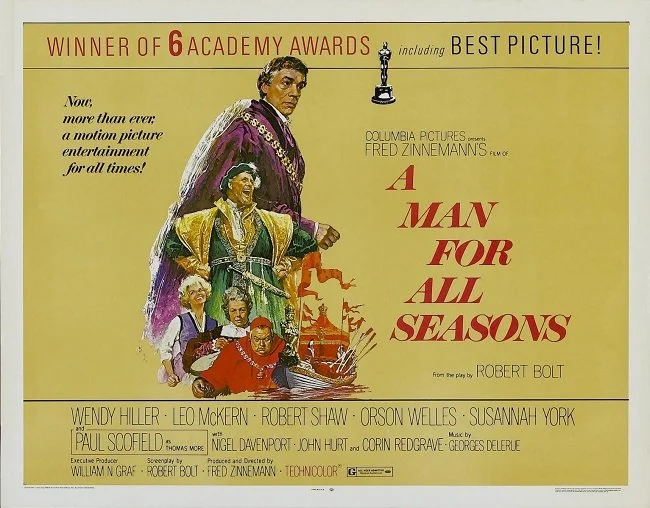
Directed by Fred Zinnemann (High Noon, From Here to Eternity) and adapted by Robert Bolt from his own play, A Man For All Seasons explores Sir Thomas More’s relationship with King Henry VIII at the time of the monarch’s divorce from Catherine of Aragon and remarriage to Anne Boleyn. A devout Roman Catholic, Sir Thomas More (Paul Scofield) has a crisis of conscience regarding the legality of the divorce and the subsequent break with the Church of Rome. The King (Robert Shaw) holds More in high regard and does not want to compel him to support his position, preferring that his public approval is given freely. Sadly it is not, leading to More risking his liberty and safety on a matter of principle. The screenplay is articulate and intelligent, placing great weight upon the importance of spiritual peril. The fate of one’s immortal soul was far from a trivial concern in Tudor England. There was no separation of church and state at the time and religion was an integral part of every aspect of life.
A Man For All Seasons is filled with outstanding British actors of the time, such as Leo McKern, Dame Wendy Hiller, Nigel Davenport and Susannah York. A young John Hurt makes his mark as the career driven Richard Rich. But it is Paul Scofield who dominates the proceedings as a man of principle trying to steer a fateful course without betraying his values. His failure to accommodate the political imperatives of the time is both laudable and tragic. His performance is poignant and dignified. The film is very much an exploration of the concept of identity and personal integrity. Director Fred Zinnemann wisely eliminates some of the Brechtian elements of the play, focusing on a more linear narrative and traditional presentation. He also skilfully uses historical locations in Oxfordshire and Hampshire to double for Hampton Court Palace and Parliament.
The film does make several changes to historical events as a means of providing the story with a more conventional cinematic arc. The screenplay features a more detailed backstory with regard to Richard Rich (John Hurt), the solicitor-general and his prior association with More. However, the nature of Rich’s perjury during More’s trial is in accord with historians’ consensus on events. The film stresses the point that Rich has accommodated Thomas Cromwell, the King’s most senior minister, and has been subsequently made attorney-general of Wales. This prompts a pithy retort from More “Why, Richard, it profits a man nothing to give his soul for the whole world, but for Wales”? Robert Bolts liberally peppers the script with similarly acerbic, yet erudite exchanges. It is one of the major elements that gives such a straightforward plot its weight and gravitas.
A Man For All Seasons is a well honed, efficient historical drama and thoughtful exploration of the frequent incompatibility of personal moral rectitude with any sort of long established political institution. Be it the Church or the monarchy. At the start of the film Cardinal Wolsey (Orson Welles) regrets he did not serve God as well as he served his king. Sir Thomas More, on the other hand, states before his execution that he remains “His majesty's good servant...but God's first”. It is a most thought provoking juxtaposition. The film also stands as a masterclass in acting and remains a textbook example of the art of writing a good screenplay. A Man For All Seasons went on to win six Academy Awards at a time when such awards were still credible and relevant. It is also worth noting that it was the sixth highest grossing film in North America in 1966.
Robert Louis Stevenson’s classic novel has been adapted for cinema and television numerous times. Perhaps the most well known is the 1950 Disney version, starring Robert Newton as Long John Silver. His eye rolling performance and exaggerated West Country accent is credited with popularising the stereotypical form of “pirate speech" that has become the pop culture default. Although an enjoyable film, it does gloss over the more sinister aspects of both the source text and history, perpetuating the myth that pirates are just loveable scoundrels. Many subsequent adaptations have fallen into the same trap to a greater or lesser degree. However, that is not the case with the 1990 version of Treasure island, which was made for the TNT cable network and released theatrically outside of the US. This darker and notably more violent adaptation closely follows the source text and is widely considered the most faithful to the book.