
MMORPGs Based on Existing Intellectual Properties
I was recently perusing my archive of old blog posts, when it struck me how much I’ve written about the MMORPG genre over the years. Naturally, there was far more material from between 2008 and 2012 as that was period when I immersed myself in the genre and was very enthusiastic about it. I was at a point in my life when I had the time to dedicate to such games and I was happy to participate in the social aspect of they offered. I would regularly play through group content and spend time socialising online with fellow guild members. My experience remains a textbook example of how online games can be more than the sum of their parts and that where you are at in your life has a major impact upon your overall enjoyment. As I read though various old posts it became clear that my experiences where specific to this particular part of my life and that they cannot be repeated. My relationship with the genre is very different now and that’s fine.
I was recently perusing my archive of old blog posts, when it struck me how much I’ve written about the MMORPG genre over the years. Naturally, there was far more material from between 2008 and 2012 as that was period when I immersed myself in the genre and was very enthusiastic about it. I was at a point in my life when I had the time to dedicate to such games and I was happy to participate in the social aspect of they offered. I would regularly play through group content and spend time socialising online with fellow guild members. My experience remains a textbook example of how online games can be more than the sum of their parts and that where you are at in your life has a major impact upon your overall enjoyment. As I read though various old posts it became clear that my experiences where specific to this particular part of my life and that they cannot be repeated. My relationship with the genre is very different now and that’s fine.
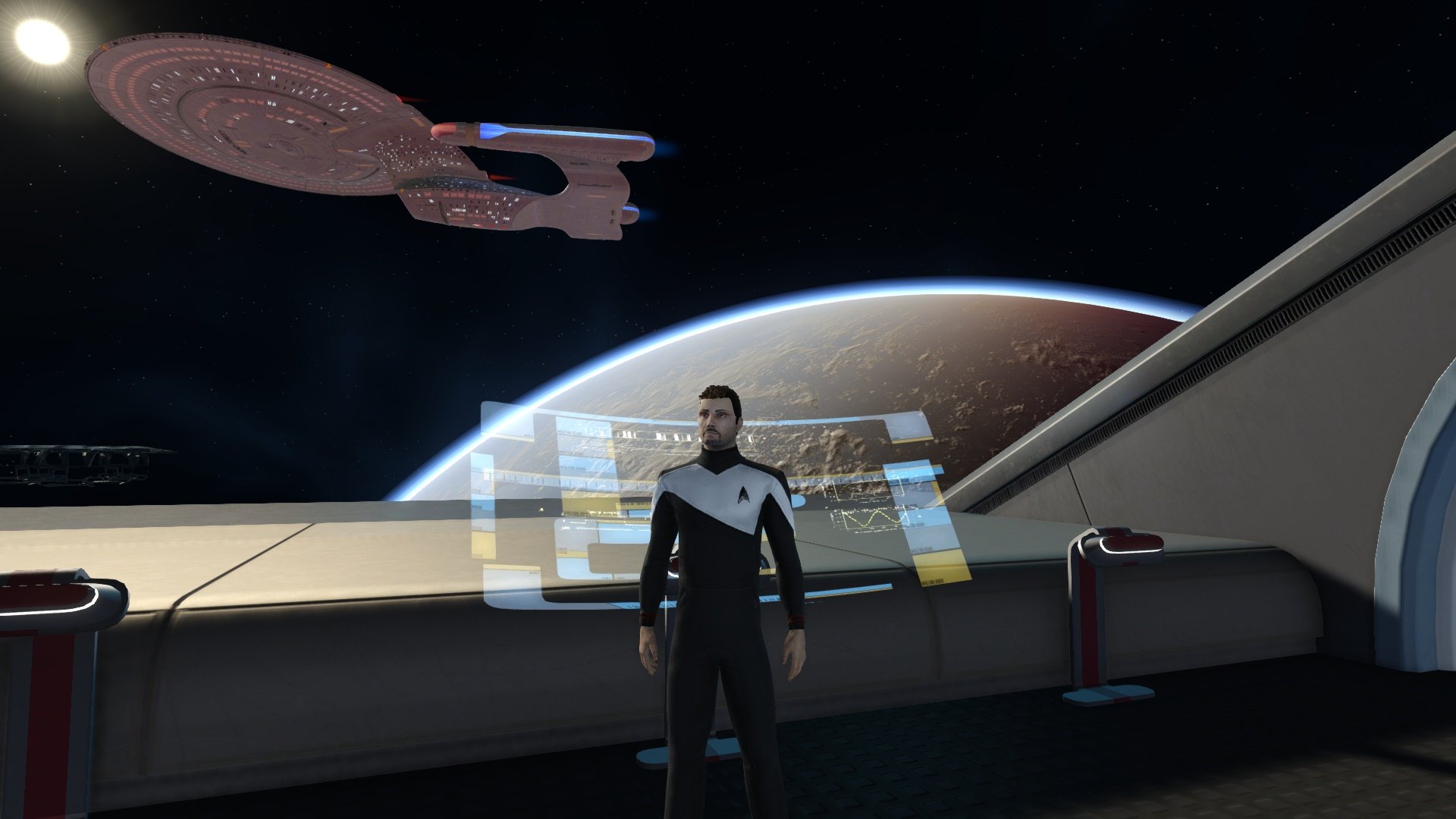
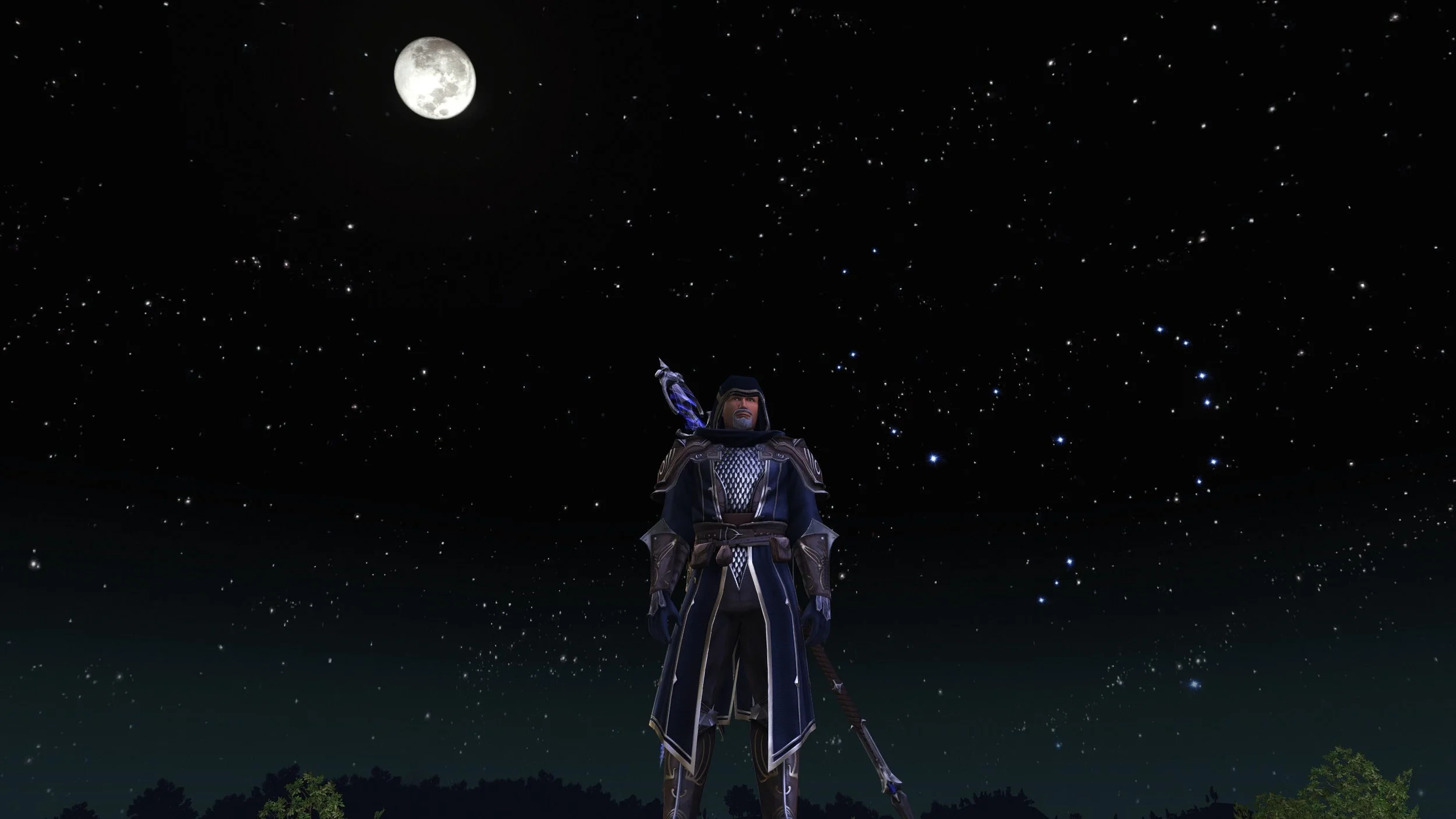
Out of all the MMOs that I’ve dabbled with over the years, only two are still being actively played. The Lord of the Rings Online and Star Trek Online. After giving this matter some thought, I have concluded that it is my relationship with the intellectual property on which they’re based is the main reason why these two have remained, where as other have fallen by the wayside. I used to play Guild Wars 2 regularly. I participated in the beta testing and doggedly worked my way through the base game and tackled the first expansion. It was the latter that killed my interest. On its release Heart of Thorns was difficult to play through, due to it’s three dimensional environment. There were no flying mounts at the time, so the game ground to a halt for me. Usually in such circumstances, games like LOTRO have the benefit of lore heavy narratives which appeal to my sense of fandom. Guild Wars 2 is its own unique IP and sadly has no emotional resonance for me. So I stopped playing.
The same thing effectively killed my interest in most other MMOs. I really tried to get into the lore of The Elder Scrolls Online because I had enjoyed Skyrim so much. But it all seemed a little too derivative for my taste. When I’ve raised this issue in-game, other MMO players have suggested I just ignore the dialogue and mission text and focus on just getting whatever is required done. Sadly, I like narratives and therefore want to know what my motivation is. Doing a task for “reasons” doesn’t really suit me. Such things don’t kill my interest in an MMO immediately. The social component can keep me engaged for a while, especially if you often play through content as a group. However, that too can wane over time, especially if friends move on to another game. I’m in a curious situation where I still talk online each week to a friend I have met through MMOs but we seldom play the same games any more.
All of this raises the question of whether I am still an MMO player per se, or whether I am just playing MMOs as single player games, in a multiplayer environment. Crimson Desert has highlighted this point as that game feels conspicuously like an MMO, especially with regard to many of its game systems and mechanics, yet it lacks the presence of other players. I suppose the definitive test would be if a new MMO launched that took my fancy, would I now play it? That question would depend greatly upon its setting and whether it was based on an IP I was already familiar with and enjoyed. If there was a modern MMO released that was set in the First Age of Middle-earth, then I would most definitely try it. I cannot say the same about titles with just a generic fantasy setting. I am not entirely sure if this change in perspective is down to me or the ongoing evolution of the genre. I suspect that both have contributed to my current outlook.
Are video games becoming easier? It’s a perennial subject that is frequently discussed by those who play them. Often the question of whether they have actually become easier is not the focus of the debate, as it seems to be broadly recognised that it is the case. Instead, discussion of this matter tend to drift into the rectitude of this change. Debate’s of this nature are usually awash with subjective opinions and personal preferences which are then put forward as objective facts. It’s not just a question of video games becoming easier, it’s the fact that making them easier is “wrong” and those who want them as such are “not proper gamers” etc. The hours that have been lost to this pointless, tedious debate are uncountable. However, I digress. Let us return to the matter of video games becoming easier, because although fans discuss this a lot and have plenty to say, you don’t often hear from the developers on this subject.
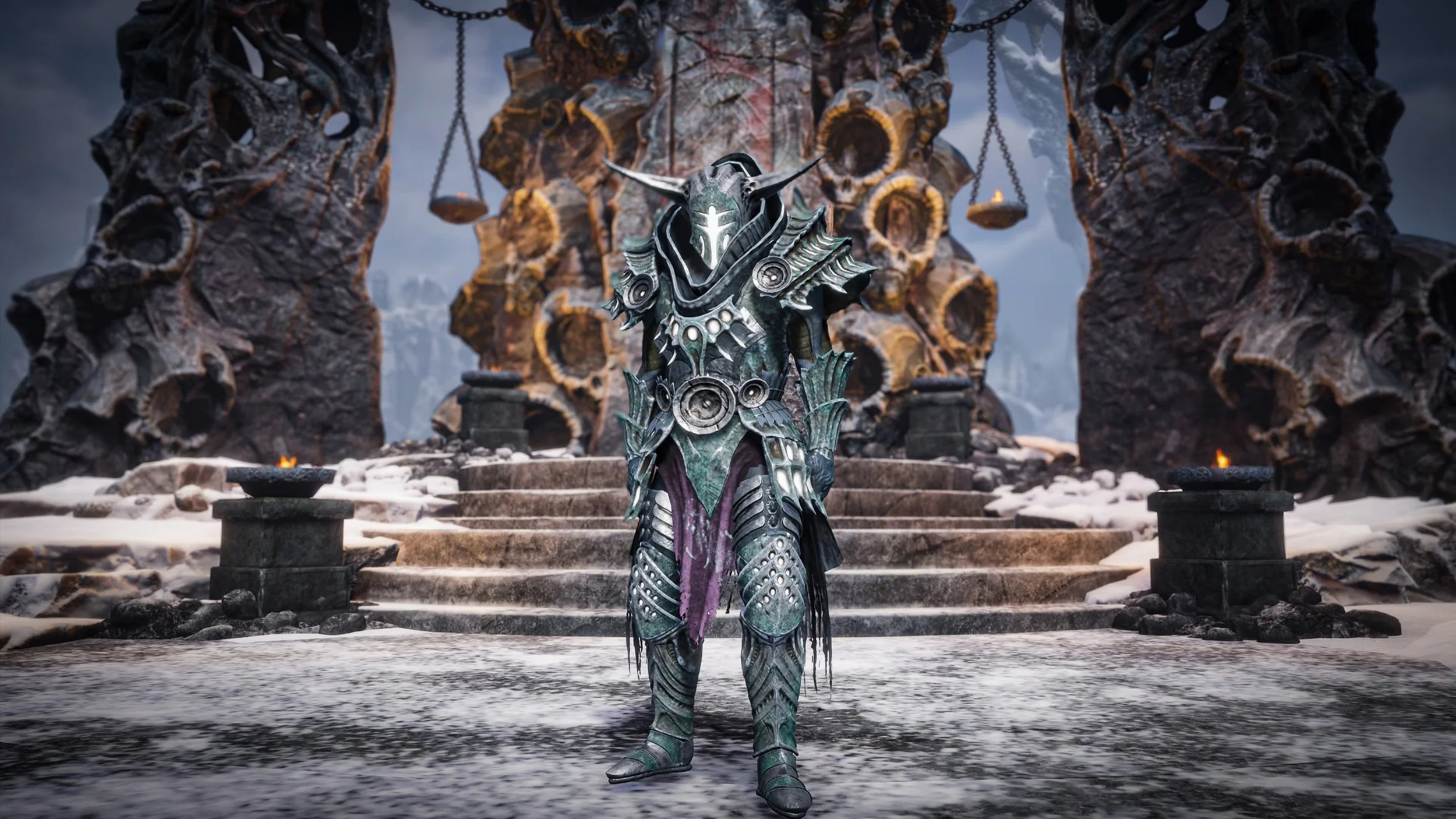
I recently completed the main story in Tainted Grail: The Fall of Avalon. In total I spent about sixty hours playing the game. I began at the start of the year, then took a break for a while but returned to it recently because I wanted to see if I could unlock a specific ending. I did manage to do this. Like so many other RPGs, Tainted Grail: the Fall of Avalon has a central storyline, along with a wealth of side quests, based around factions in specific zones. I think I possibly completed about a two thirds of these. However, once I finished the main story, my interest in the game began to wane. I finally left my character in the last major quest hub in case I wish to return at a future date. I then logged out of the game and uninstalled it from my PC to free up space for whatever I was to play next. In this case its The Sinking City 2. None of this is a negative reflection on Tainted Grail: the Fall of Avalon. I enjoyed the time I spent playing this quirky RPG. I simply had my fill and left to play something else.
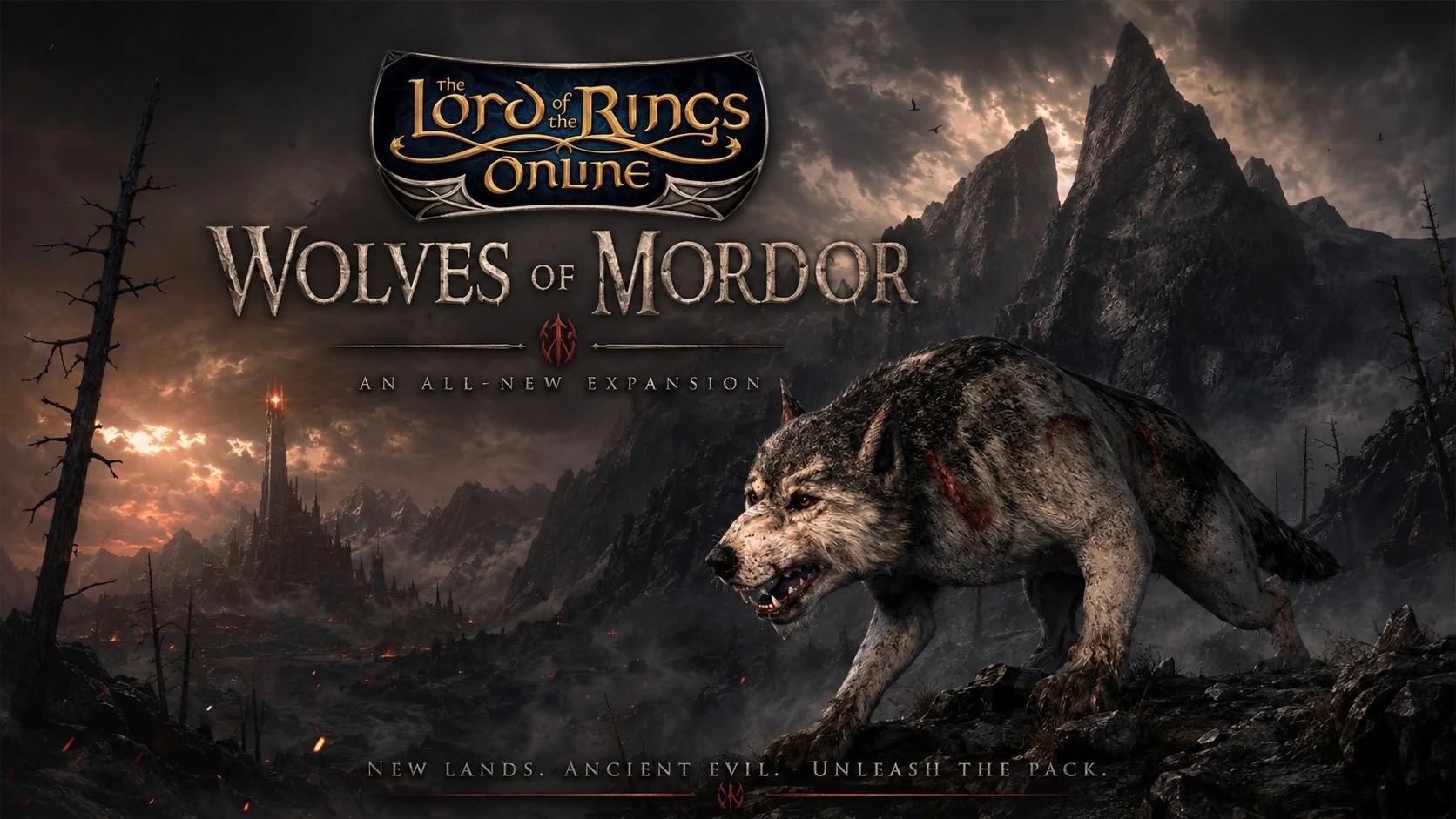
The next expansion for the MMORG, The Lord of the Rings Online, was announced on the 1st August, via the gaming website MMORPG.The Wolves of Mordor, which will launch later in the year, appears ambitious in scope as it will include two new game systems as well as the obligatory story update. This expansion takes place in Draugardh located in the North East of Mordor, beyond the Plateau of Gorgoroth. It includes the new zones of Heledhris, Parth Rhavas and Nan Ogol. These vary environmentally ranging from the arid, volcanic and semi-tropical. Players will encounter the Daugrim in these regions, Werewolves but not in the modern sense. This is not the lycanthropy of Eastern European legends but in the established Tolkien idiom of fell spirits inhabiting the bodies of Wolves. The region also sees the return of the Woses and players can expect to encounter Elves and scouts from Gondor. As ever with LOTRO expansions, there will be new instances as well as a raid.
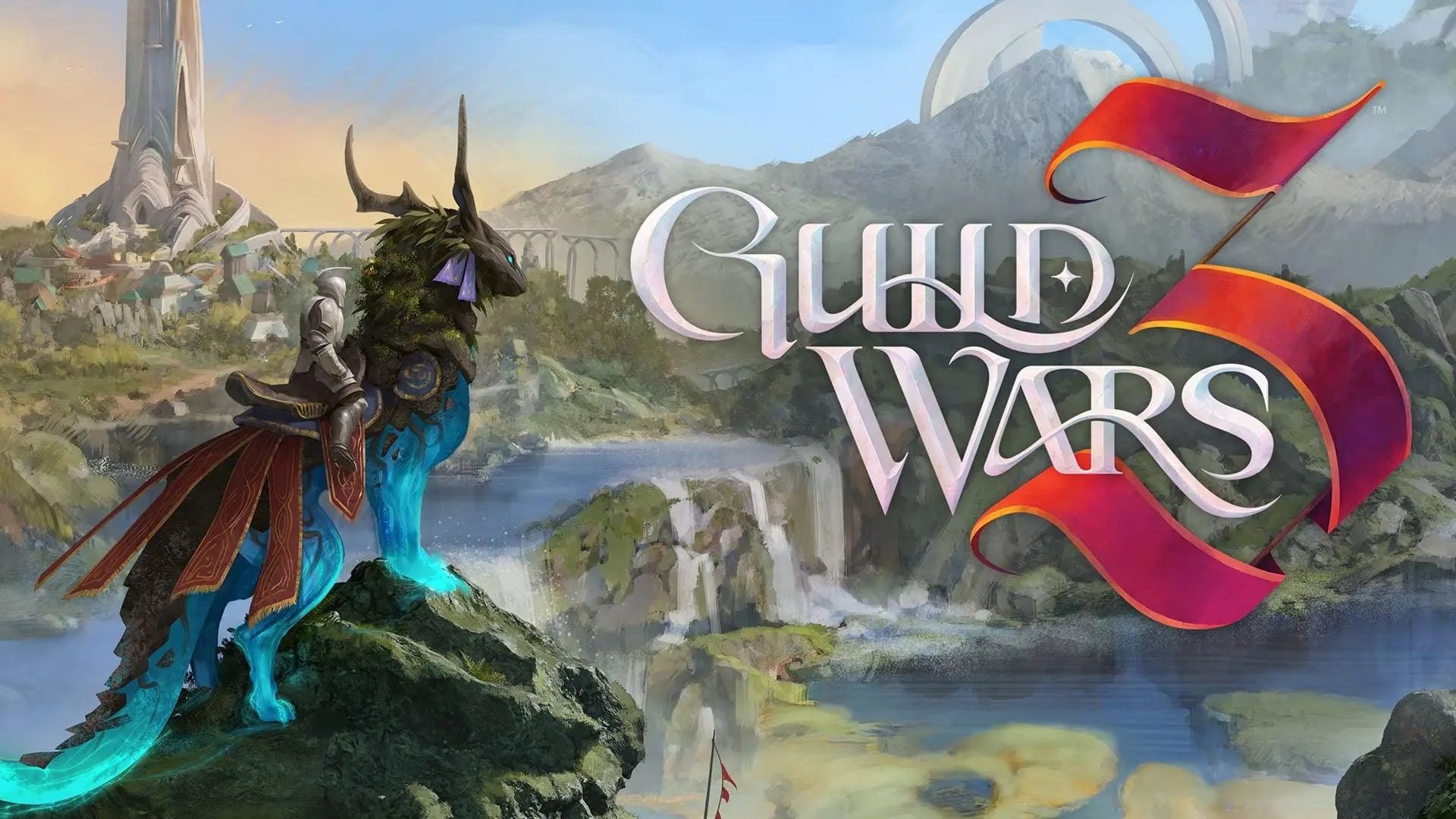
I don’t keep up with gaming news as much as I use to but several noteworthy announcement have come to my attention of late. Firstly, there’s an expansion, Songs of the Past, coming for the Witcher III: Wild Hunt in 2027. No doubt this is to pave the way for the Witcher IV. Next, I also found out about Hand of Fate: Horde. I liked this franchise and was saddened to learn that the original studio, Defiant Development, closed. Hence is was a pleasant surprise to see this new game being developed by members of the original studio. The third announcement was regarding Guild Wars 3. A new MMORPG in active development by a major studio is no small feat and is certainly good news for fans of this franchise and the genre per se. However, once you look beyond this news this announcement raises several questions and has certainly given me pause for thought. Let us take a few moments to consider them.
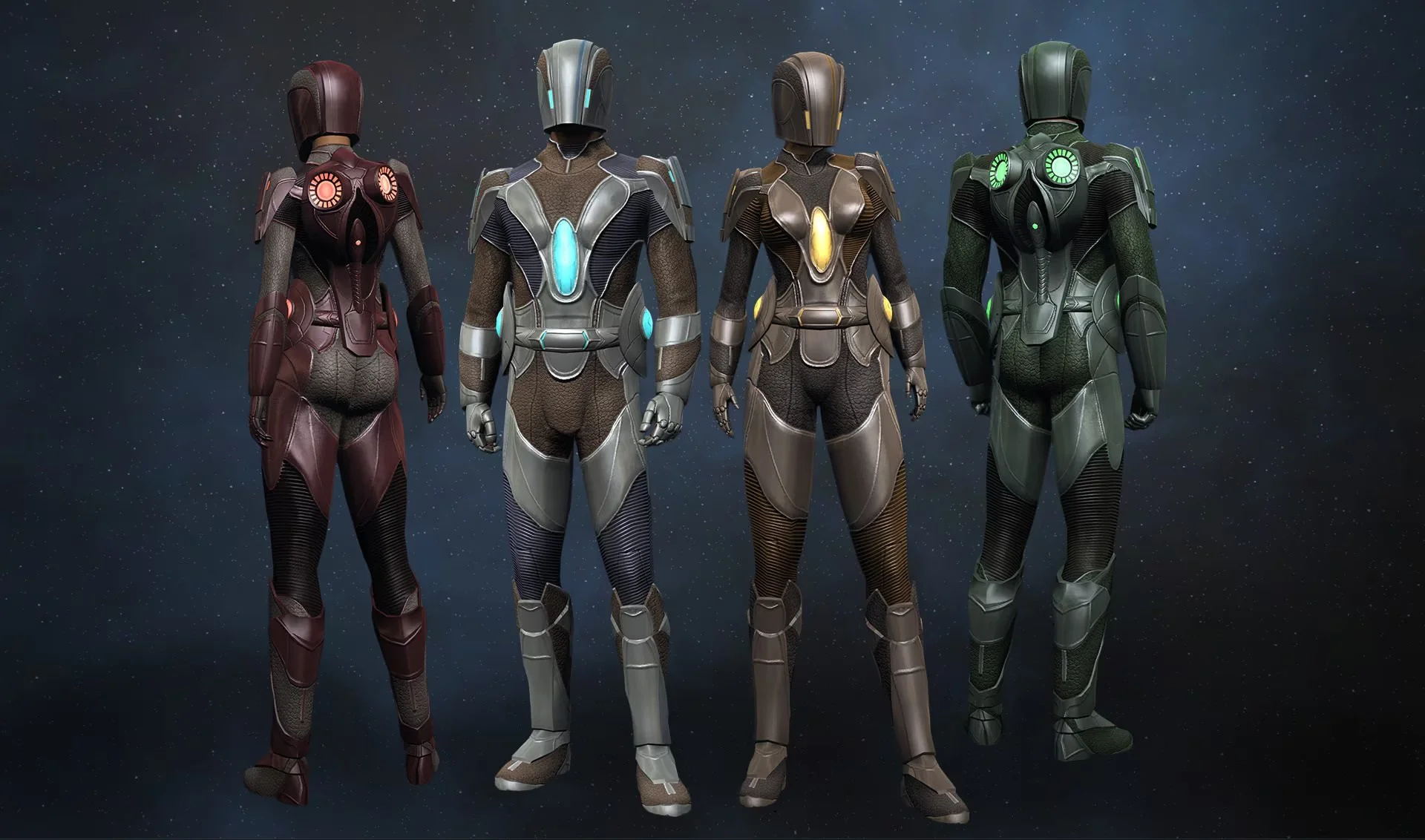
Star Trek Online has many in-game systems that are common to the MMORPG genre. The reputation system is one such example. In STO there are 13 reputation factions. Once a player has reached level 50 they may start progressing through the 6 reputation tiers of each one. Players gain progression through daily projects (20 hours in duration). Hourly projects are also available though they yield less reputation advancement and are limited to three times a day. Hence 20 hour projects are consider by default the most efficient way to gain rep. Projects require 30 Faction Specific Marks (earned via various activities in-game), 15,000 Energy Credits (standard in-game currency) and 2000 Expertise points. The most efficient way to tackle the reputation grind is to build up the necessary resources in advance and then at a designated time each day, start all 13 respective projects. Upon completion projects yield a player bound lockbox containing a random space or ground weapon, a console or Elite Marks which can be used to acquire faction gear.
I was recently perusing my archive of old blog posts, when it struck me how much I’ve written about the MMORPG genre over the years. Naturally, there was far more material from between 2008 and 2012 as that was period when I immersed myself in the genre and was very enthusiastic about it. I was at a point in my life when I had the time to dedicate to such games and I was happy to participate in the social aspect of they offered. I would regularly play through group content and spend time socialising online with fellow guild members. My experience remains a textbook example of how online games can be more than the sum of their parts and that where you are at in your life has a major impact upon your overall enjoyment. As I read though various old posts it became clear that my experiences where specific to this particular part of my life and that they cannot be repeated. My relationship with the genre is very different now and that’s fine.
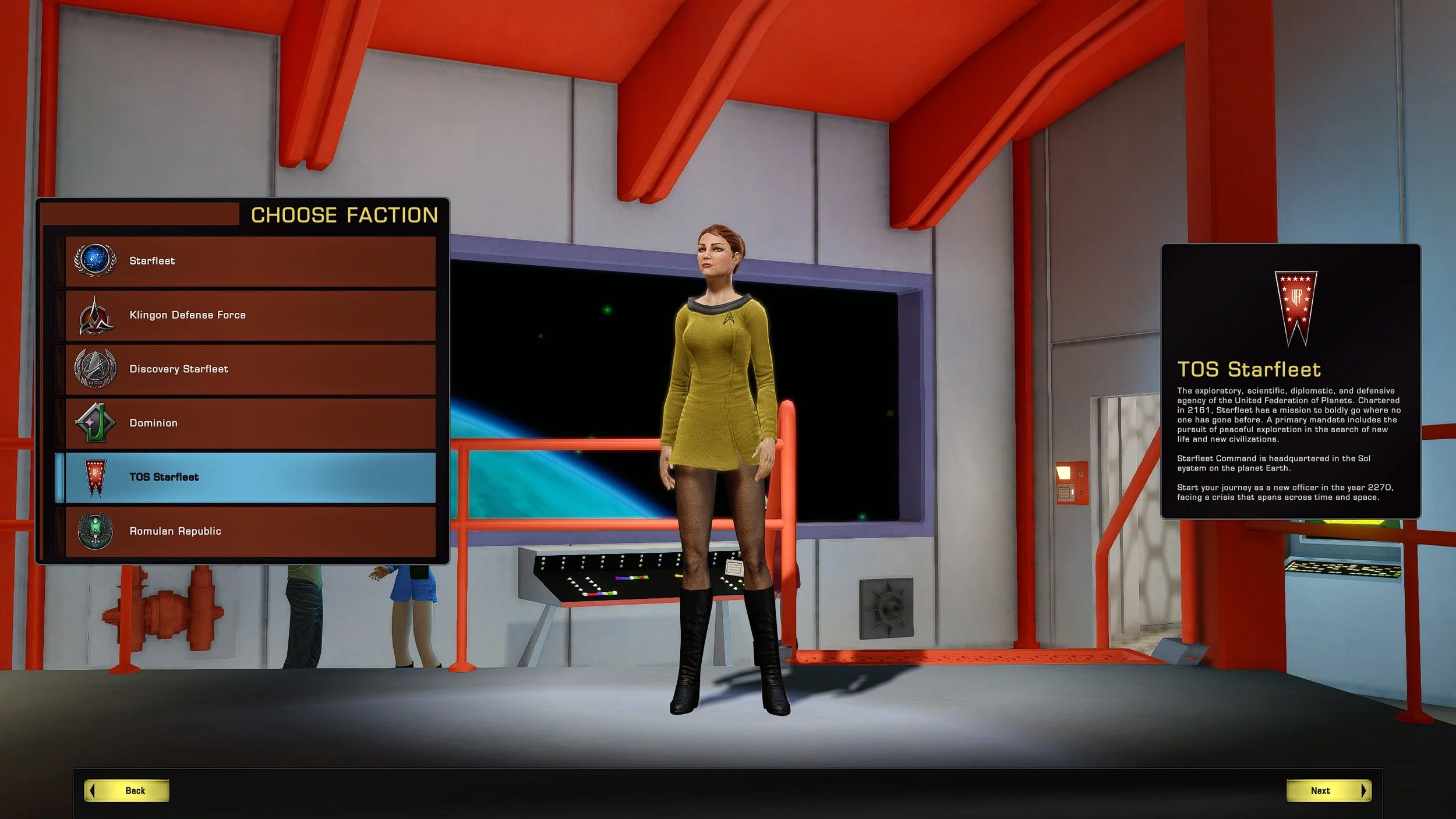
Creating alts is an integral aspect of the MMORPG genre. Many players will create a character of a specific class or faction, play it for a while, lose interest in it or they may decide that it is just not for them. Fortunately it is no effort at all to simply re-roll a new alt and set off once again. Furthermore, lots of players never reach level cap of the MMORPG that there playing. When the going get’s tough, so to speak, you can either soldier on for another 50 levels or simply create a new alt and return to the comfort of tried and tested content. Alts also give you the chance to secure an accolade or achievement that you previously missed. They are also of great benefit to the genres social aspects. Creating a new alt so you can play along with a friend who is just starting is great fun. Developer’s love them too as it means you’re still playing the game.
I recently took a break from Crimson Desert choosing instead to to play something familiar and easy going. As I’ve been logging into Star Trek Online daily to participate in the anniversary event, I decided to look through my various alts and see how far they had progressed through the game and what resources they had. At present I have twelve alts. My primary Captain was created in 2015 during the original Delta Recruit Event. I had previously played STO intermittently since its release in January 2010 but I never kept any of those characters. Hence this decade old Tactical Federation Captain has been my main focus when playing. The other eleven alts are the result of other recruitment events or whenever I wanted to try something different, such as playing a specific class or faction. I obviously played a lot of STO during the lockdown as several alts date from that period. Several had maximum reputation across all factions.
13 days after its release, market analysts estimate that Crimson Desert has already earned $200 million across the four main platforms (PC, PlayStation 5, and Xbox Series X and S). The game is certainly proving popular among gamers with the internet awash with live streams and “let’s play” videos. However, reviews are mixed both among gaming journalists and YouTube influencers. Common complaints about the game include that it is slow to start, the controls are poorly laid out on all platforms and that developer’s Pearl Abyss have done a poor job of explaining most aspects of the game to new players. Although such criticisms are true to a degree, I think these complaints highlight how many gamers are conditioned to expect new titles to follow a specific pattern with regard to pacing, narrative exposition and learning in-game systems. A pattern that Pearl Abyss has chosen to ignore, instead favouring an old school approach.
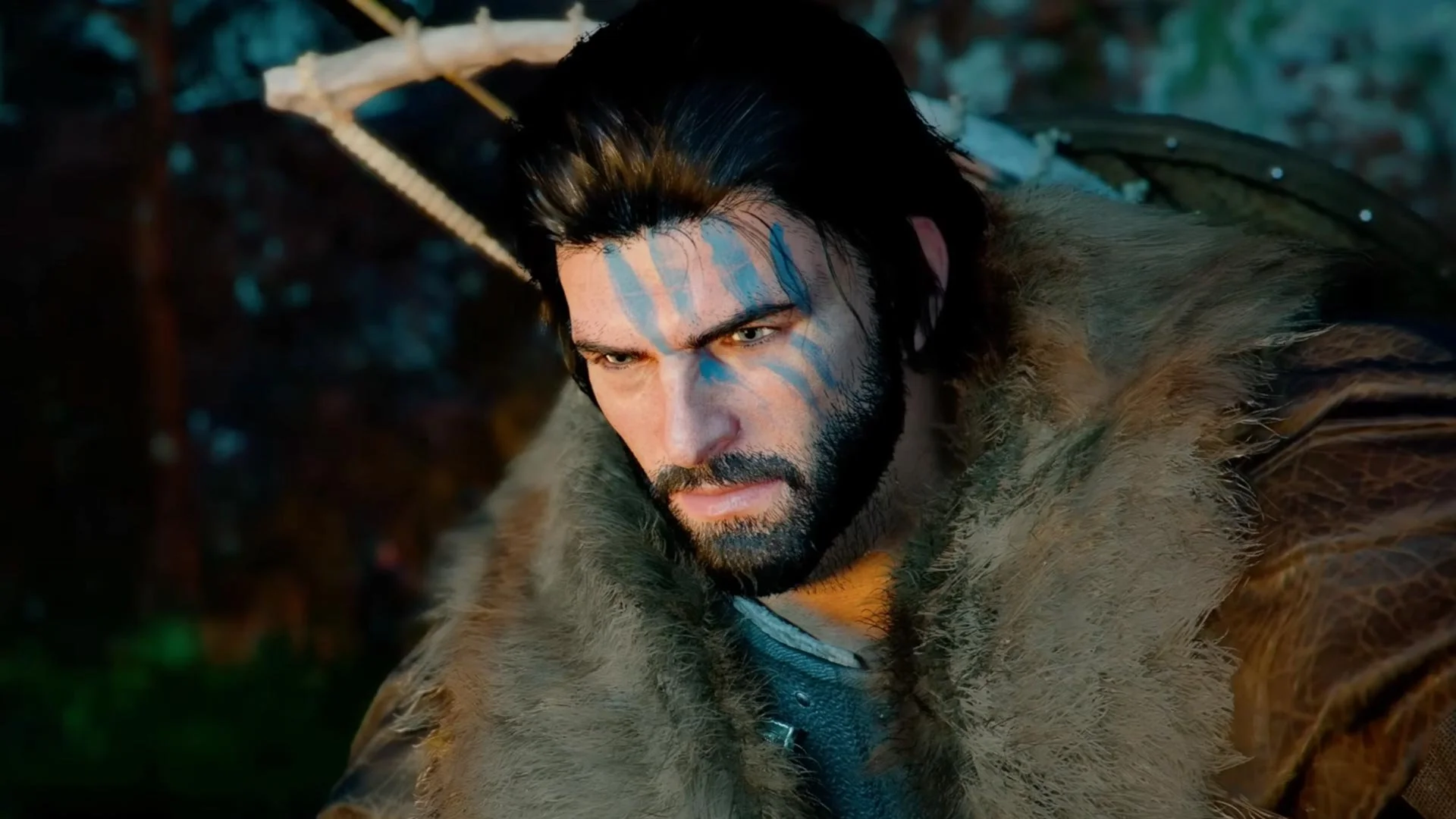
Last night, I spent the first 45 minutes after the launch of Crimson Desert, watching the 92GB pre-downloaded game files slowly decompressing and installing. I finally launched the game at about 10:50 PM GMT. I then waited a further 5 minutes while shaders were downloaded. It took me about 15 minutes or so to read through the various game settings and choose those that are optimal for my PC. I suspect even if you have a beast of a computer, you’re still going to have to spend some time tweaking settings. As for those players like myself with a gaming rig that is somewhere in the middle of the game’s specifications, be prepared to do a lot of fine tuning both within Crimson Desert itself and your Windows settings.
Video games as a genre are extremely poor at explaining themselves. When you buy a new game you’ll often find little or no information regarding the basic systems and mechanics. The industry assumes that their customers are by default familiar with the fundamentals of playing a modern video game. Hence if a game has a tutorial, it is often based around videos rather than detailed verbal instructions. You are are briefly shown a clip of a specific move being successfully undertaken but it is seldom shown in a wider context. The industry also expects the fan community to take on the role of curating and disseminating information about its games. The move away from forums and bespoke websites to Discord highlights this. Discord is a primarily a real time communication tool and not good at maintaining a historical data archive. If you want an answer to a specific gaming question, you’ll more than likely find it on YouTube in a video made by a fellow gamer.
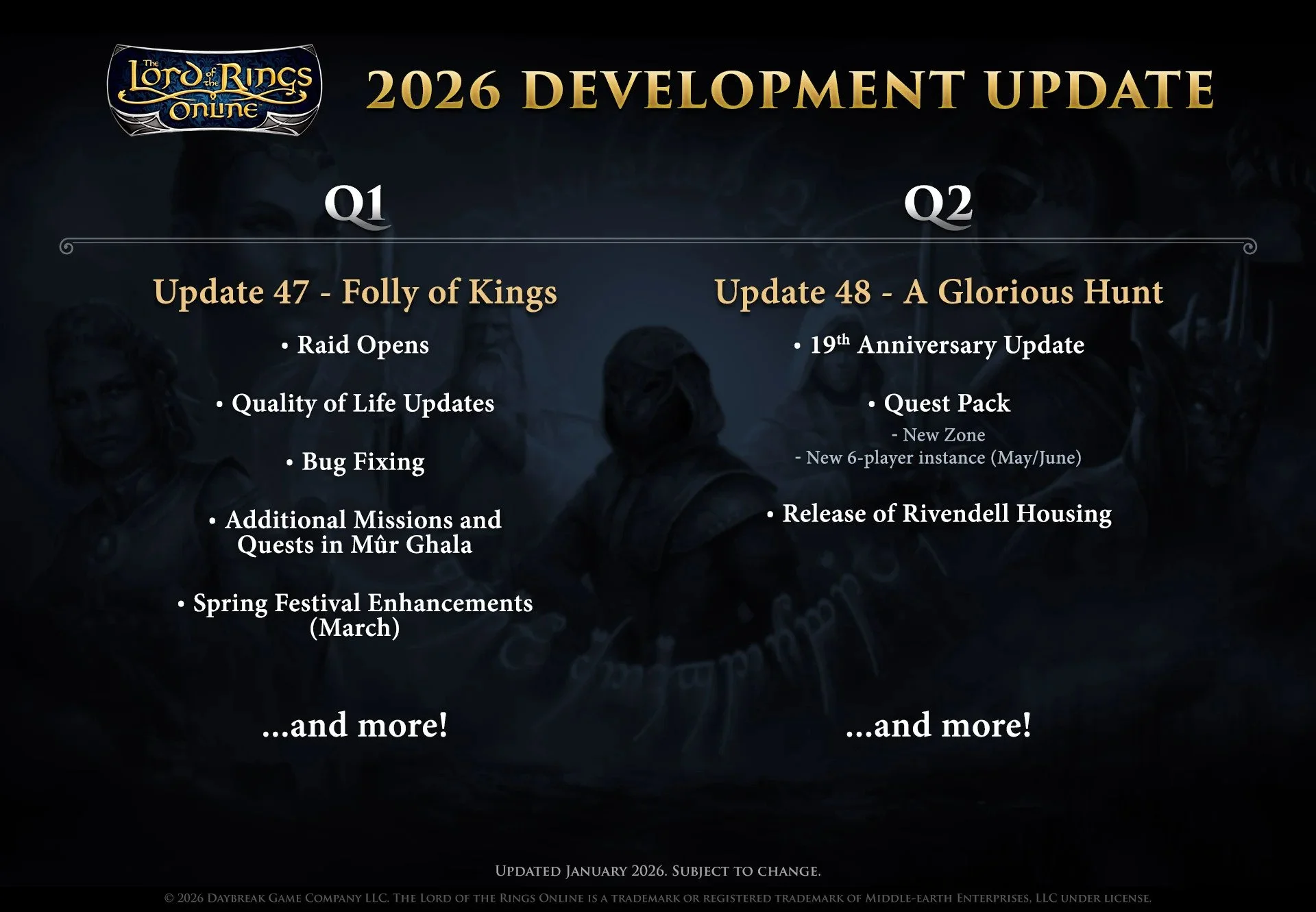
According to the recent “letter to the players”, Standing Stone Games will be adding a new zone to the MMORPG The Lord of the Rings Online in the second quarter of this year. Possibly around May or June. Having spent the last three expansions in the South of Middle-earth exploring the tropical Umbar and the deserts of Harad, I would certainly welcome a change of location. I have gradually warmed to these zones over the last eighteen months but I do find them so incongruous. They are so radically different to the European style content that has been the mainstay of the game for so long. Tolkien’s source text has plenty of detail regarding Eriador and Rhovanion. Information regarding Harad is scarce, hence it has afforded the developers a great deal of artistic freedom. Although exceedingly well realised these tropical zones have taken a while for me to get used to.
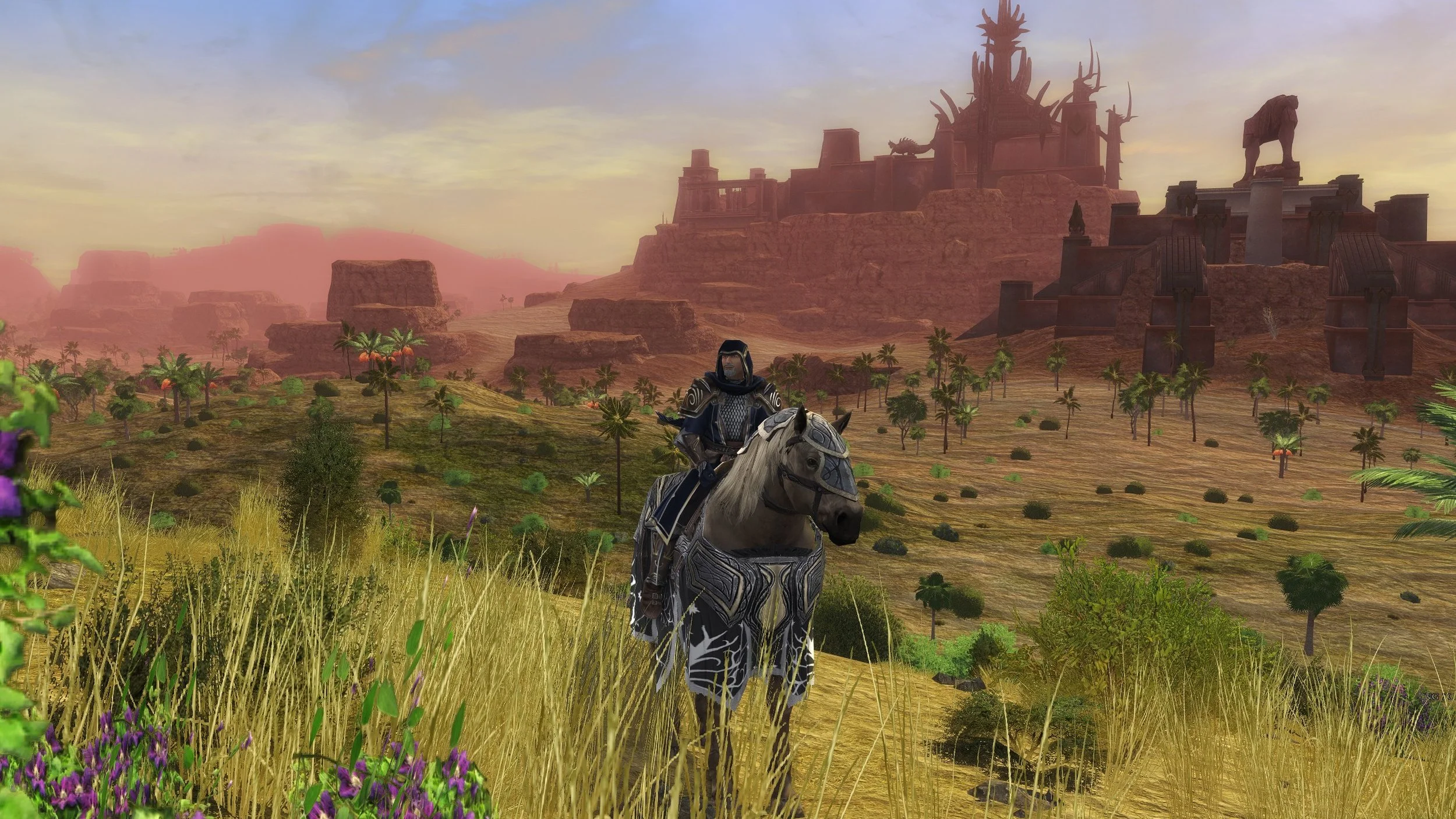
I’m not sure exactly when it started but I’ve recently noticed a graphical bug within the MMORPG The Lord of the Rings Online. This problem often occurs within caves or in areas where there are a lot of rocky surfaces. Hence it has become very apparent in the latest two expansions, set in Umbar and Harad. This graphical glitch causes some surface textures to appear to flash from light to dark intermittently. The resulting strobe effect is hard to ignore and very distracting. Fortunately, a quick online search showed that this is not a problem unique to my installation of LOTRO and is a known problem. Furthermore, there is a very simple workaround, which is to go into the Advanced Graphics setting and uncheck “Per Pixel Lighting”, which immediately remedies the problem. I have no idea why this has recently started to happen but at least it can be resolved.
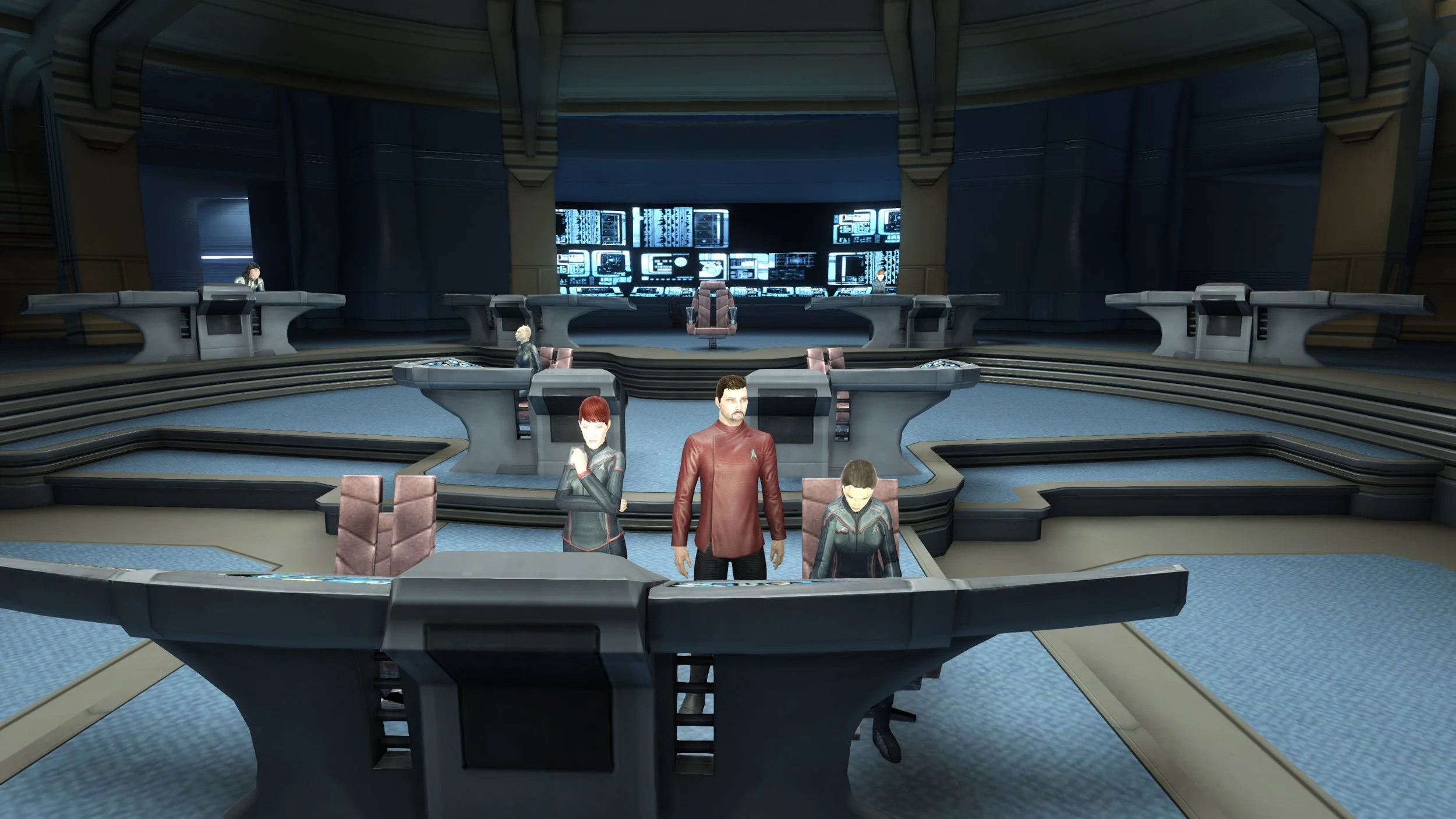
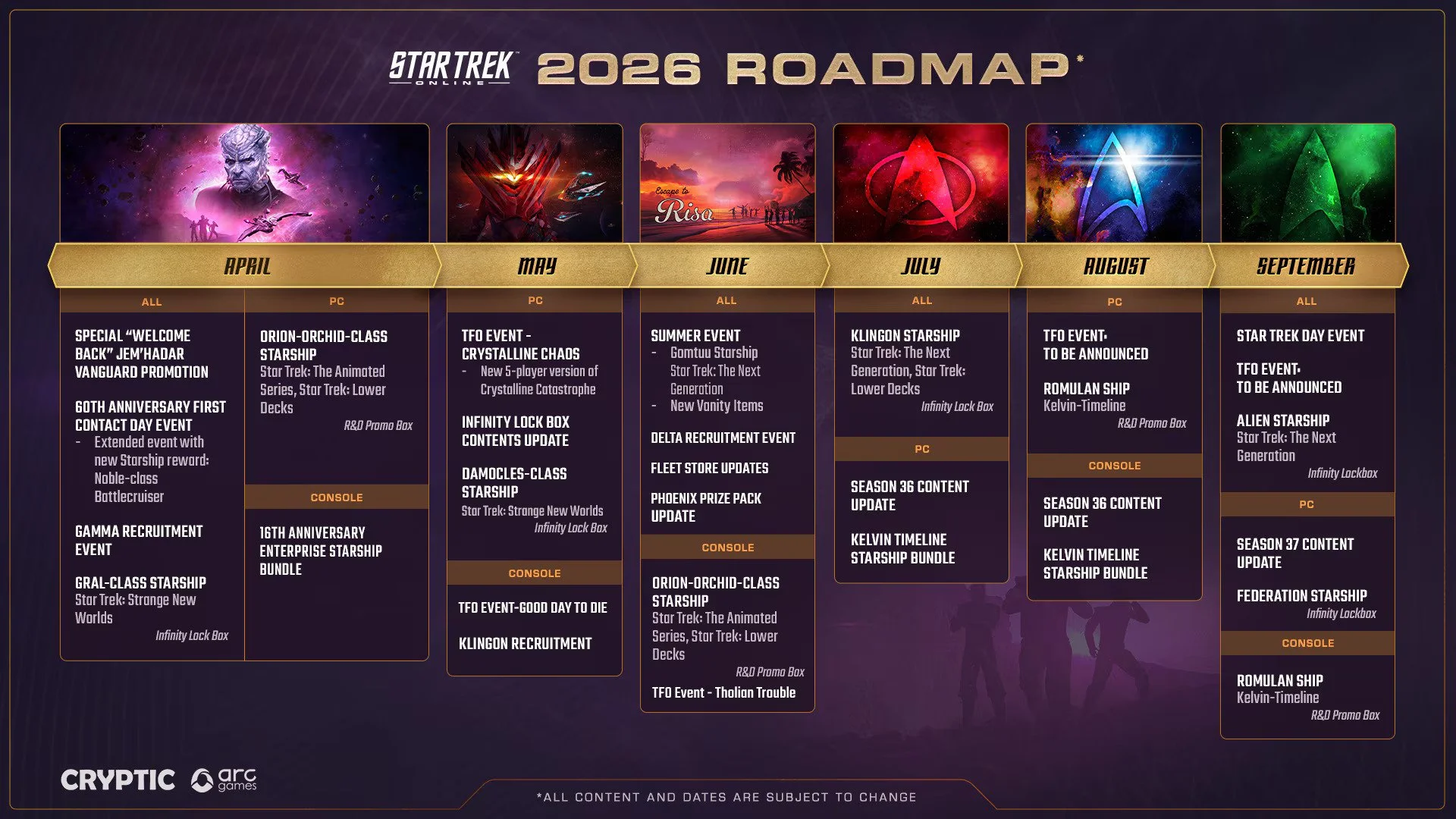
This year is the 60th anniversary of Star Trek. The original TV show was first broadcast in the US on September 8th 1966. If you search online you’ll find details of lots of related events. There are documentaries, conventions, new TV shows and even some video games in development. However, what you won’t find are any details regarding what will be happening with the MMORPG Star Trek Online. So far no road map for 2026 has been posted online by the developers but it is still quite early in the New Year. That being the case, I am not especially optimistic about there being any major plans waiting to be revealed. It is not as if DECA Games have demonstrated or stated any major ambitions for STO beyond keeping the endless events treadmill going and regularly adding content to the in-game store, during their development tenure. The ongoing story arc drags on inexorably and is as dull as ditchwater.
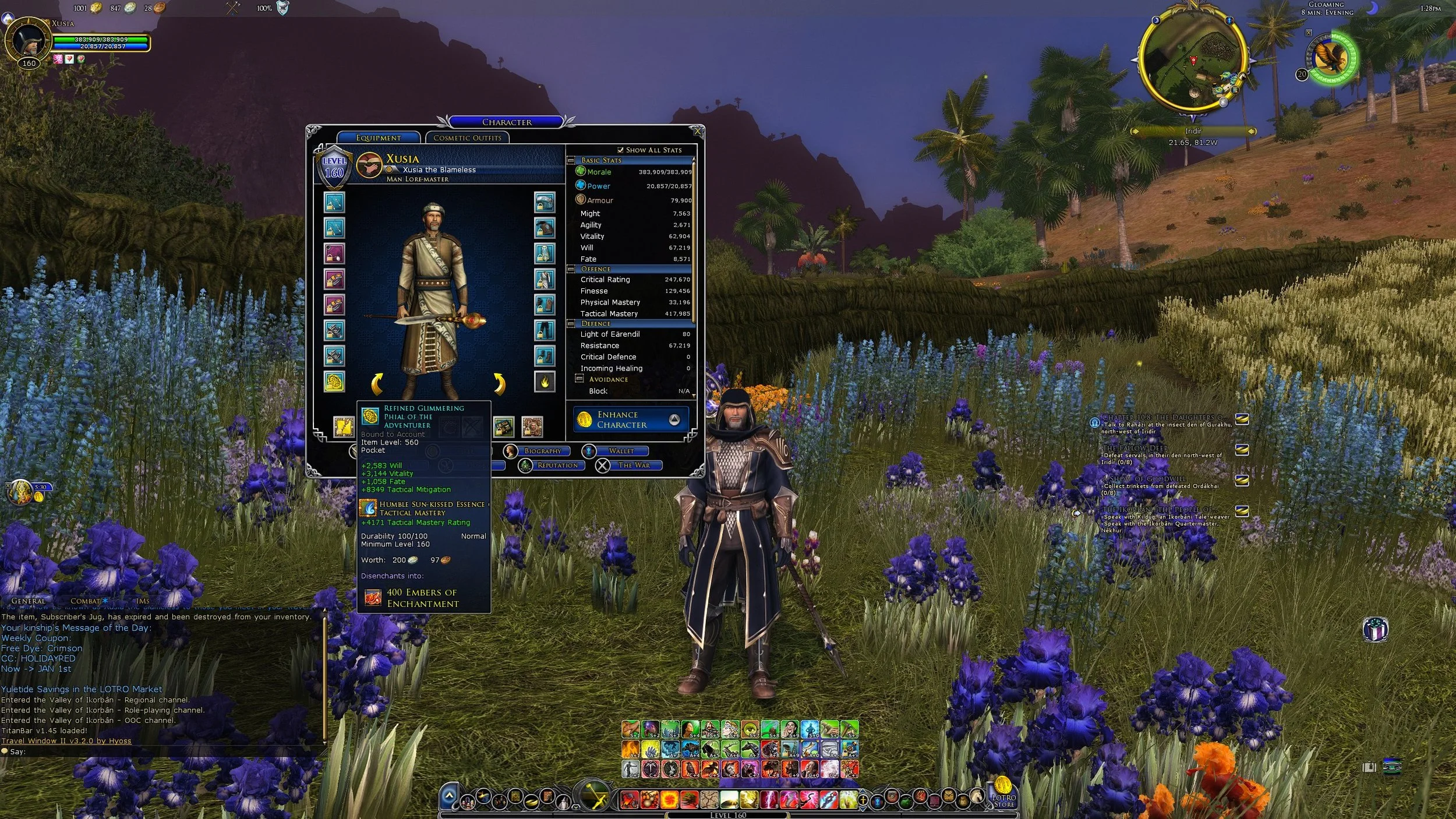
The latest expansion for the MMORPG The Lord of the Rings Online, Kingdoms of Harad, launched on December 3rd. With this release the level cap was raised from 150 to 160. It should also be noted that the cap for virtue traits was also raised from 96 to 100. Naturally these changes meant that there is a requirement to replace all armour and jewellery once the new cap is reached. Similarly Legendary Items have to be reforged and any traceries upgraded or replaced. If you follow the Epic Story it will lead you from quest hub to quest hub. The main quest rewards, along with those from side quests will provide adequate gear as you slowly progress towards the new level cap. The new raids, instances and missions/delvings then provide a means to acquire higher quality level 160 gear. LOTRO and indeed, many other MMOs are consistent in this methodology.
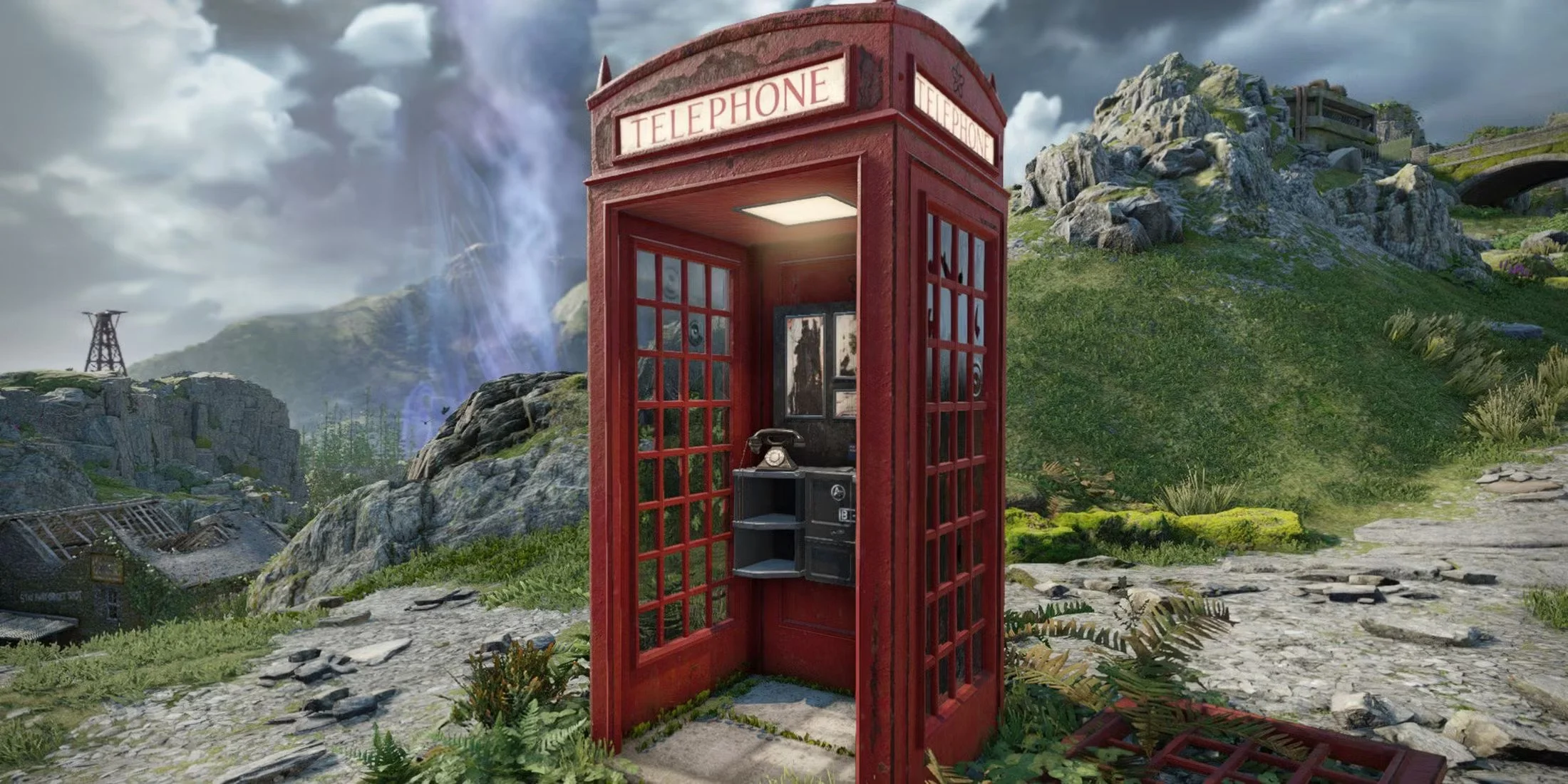
It is customary in a post such as this to list the various games that I’ve played over the last twelve months and share my thoughts on them. Wider analysis of the video game industry is also de rigeur. Unfortunately, I don’t really feel disposed to do either of those two things. My thoughts on the games I’ve played have already been published and can easily be accessed via the links at the bottom of this post. As for the video game industry, it suffers the same flaws as music, TV and cinema. There is creativity and innovation out there but it is often drowned out by mainstream products which are demonstrably inferior due to their inherent mediocrity. As for the business side of things, we once again clearly see the failings of the corporate management class. Sadly, they do not face the consequences of the mistakes that they make.
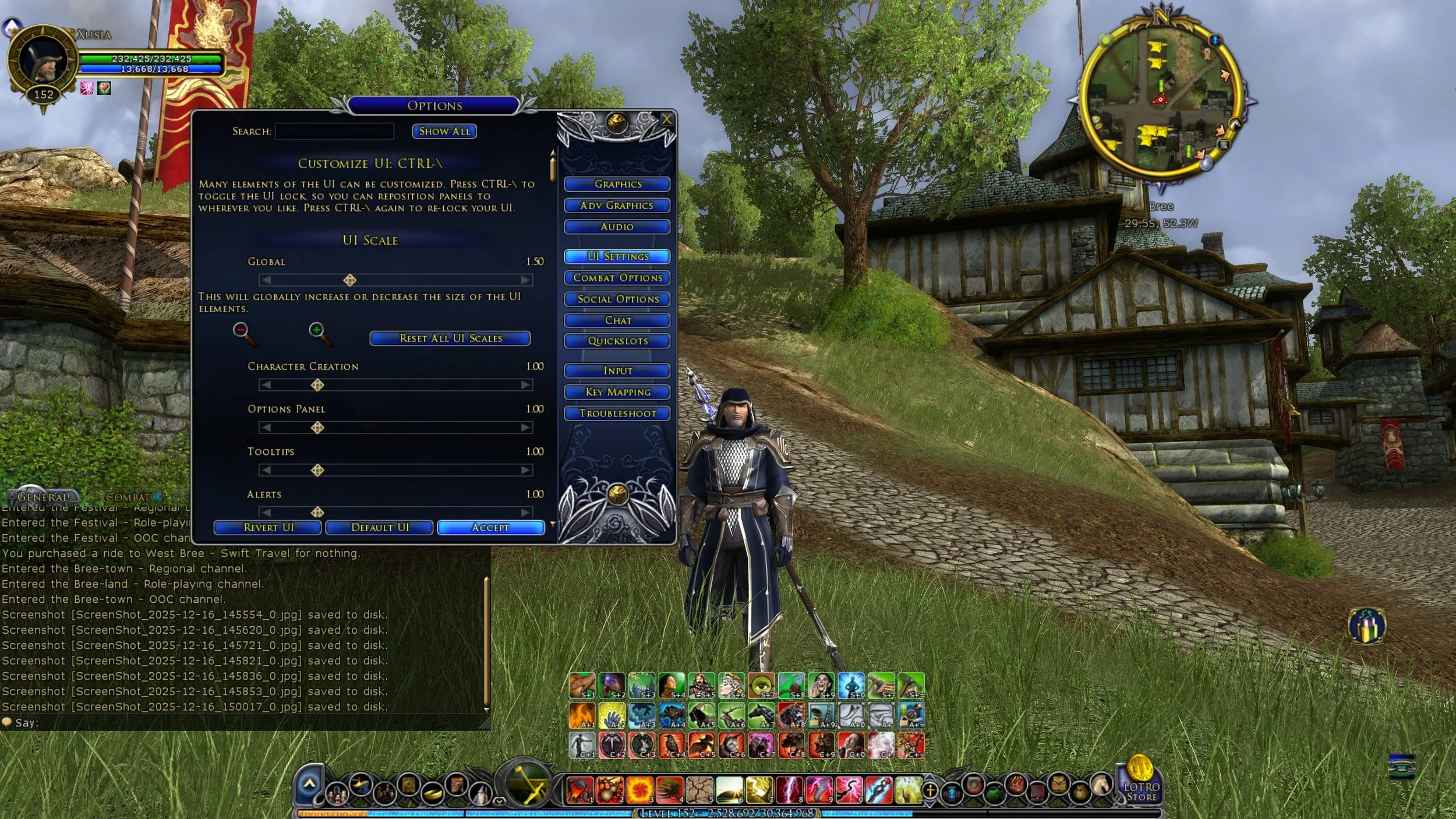
Today Standing Stone Games began beta testing Update 46.1 for the MMORPG The Lord of the Rings Online. The current preview on the Bullroarer test server is mainly for the new instance cluster that comes with the Kingdoms of Harad expansion which launched a few weeks ago. However, it would appear that this latest preview has another feature or note. One that should please LOTRO players. Contrary to what a lot of people thought, myself included, SSG have been working on a scaling UI for 2K and 4K monitors and the results are now available for testing from today Monday 15th through to Friday 19th December. Until now the main workaround to the lack of UI scaling has been to use either Nvidia or AMD graphics software to upscale the game from 1920 x 1080, or a third party app such as LosslessScaling. Having an official solution is a far better option.
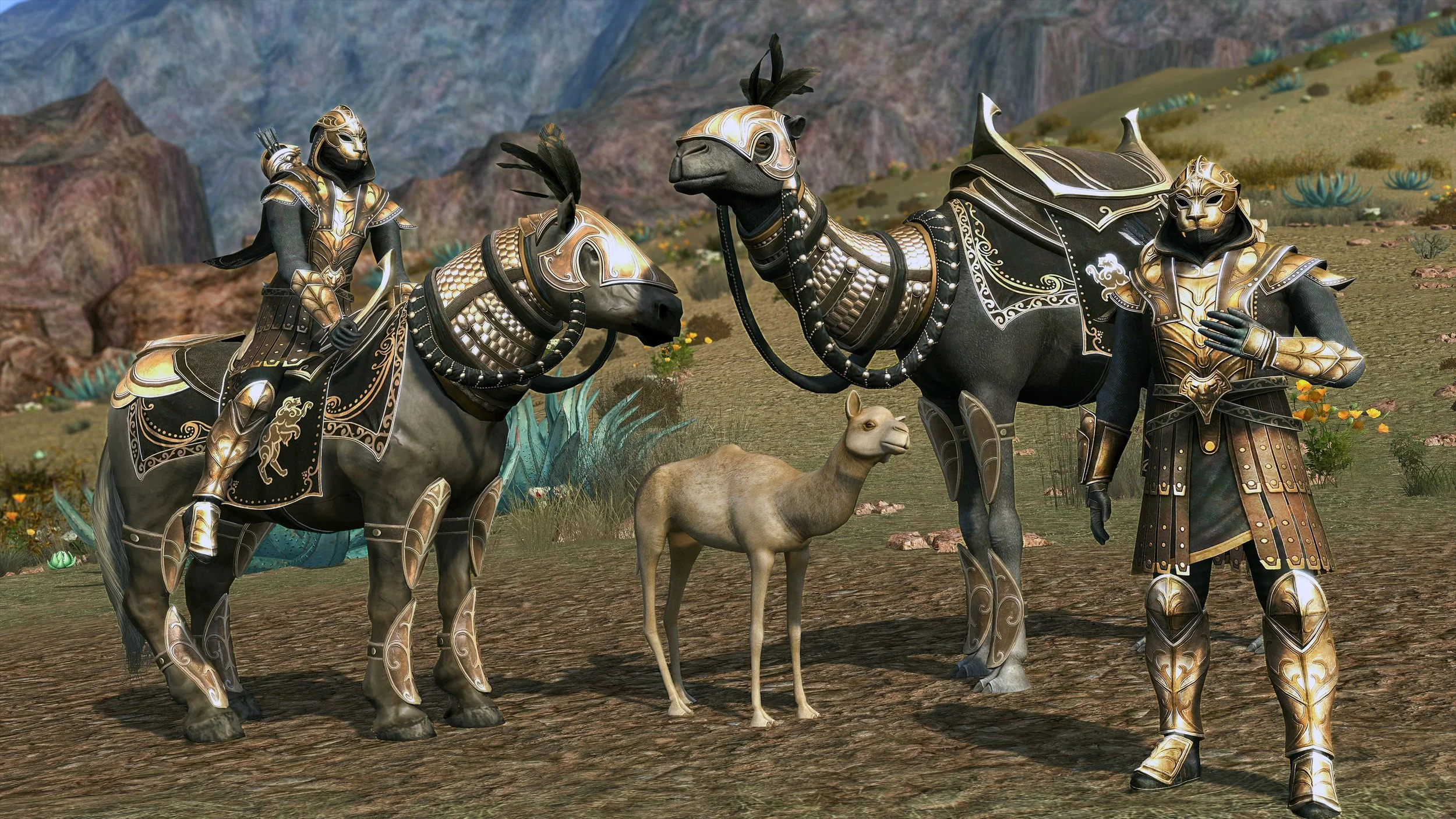
Kingdoms of Harad, the 13th expansion for the MMORPG The Lord of the Rings Online, was released today. Highlighting developer’s Standing Stone Games continuing commitment to this eighteen year old game. As 2025 draws to a close, I thought it would be prudent to reflect upon the current state of LOTRO and to consider what may come next year. Two words that I associated with this MMO are stable and consistent. The playerbase is loyal and dependable. Player numbers never greatly decline nor do they notably expand. LOTRO fills a very specific gaming niche and one of the reasons it retains its players is that there is no suitable alternative game. Although there is not a great deal of data in the public domain, it is generally accepted that LOTRO has an older player demographic and that many are consummate Tolkien fans.
The MMORPG The Lord of the Rings Online runs on a broad spectrum of PCs. From archaic laptops to high end gaming rigs, although it may require a bit of tweaking. At present, the optimal way to play the MMO is at a resolution of 1920x1080 (FHD) with the graphics setting maxed out. The graphics are sharp and the UI is readable. However, a growing number of gamers are now using 2K and 4K monitors. You can play LOTRO at higher resolutions such as 2560×1440 (QHD) and 3840x2160 (UHD) and the game looks great. However, the UI does not scale and so is very small on 2K and 4K monitors. The skill icons on the quickslots (shortcut bars) and the in-game text become difficult to see at these resolutions, which deters some players from using them. It is a known issue that Standing Stone Games are attempting to address but it is unlikely to be resolved any time soon.
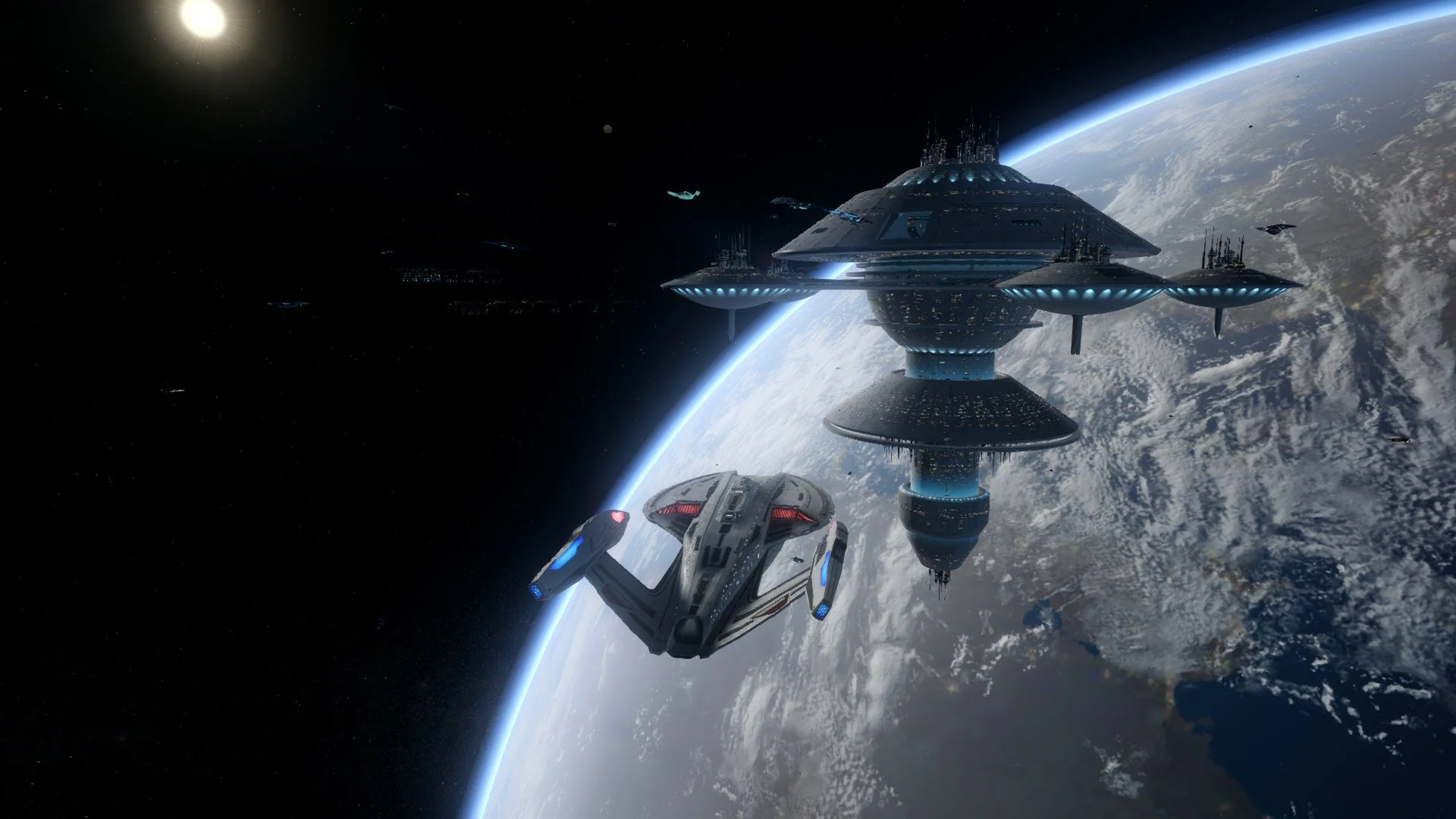
I recently read a post on Massively Overpowered about skills rotation in the MMORPG genre. I found the subsequent discussion in the comments fascinating. Mainly because I have never used a fixed rotation of skills in any of the MMORPGs that I play. I understand the reasoning behind such things and why some players want to optimise their combat performance. Using one’s skills in a specific order to maximise damage and manage their subsequent cooldown has a logical appeal. In Star Trek Online, some players go so far as to create keybinds for their rotations and assign it to a specific hotkey, which is then continuously pressed throughout combat. However, rotations are a blunt tool that lack flexibility, often being geared towards dealing with a single target or using an area of effect skill against a larger group. They may not be the optimal approach to combat when things do not go to plan.
Tolkien enthusiasts may recollect Athlon Games, a subsidiary of Leyou Technologies, announcing that it was developing a new MMORPG, based upon The Lord of the Rings, back in September 2018. The following summer, it was revealed that Amazon Game Studios was the partner developer for the project. In late 2020, Leyou Technologies (a Hong Kong-based company), was acquired by the Chinese conglomerate Tencent. This triggered a contract clause with the license holder, Middle-earth Enterprises, allowing them to terminate the existing arrangement if a new deal could not be met. Amazon and Tencent were unable to agree upon how to proceed with the project, leading Amazon to withdraw from negotiations. The project was subsequently scrapped. No details or images of the MMO have been released.
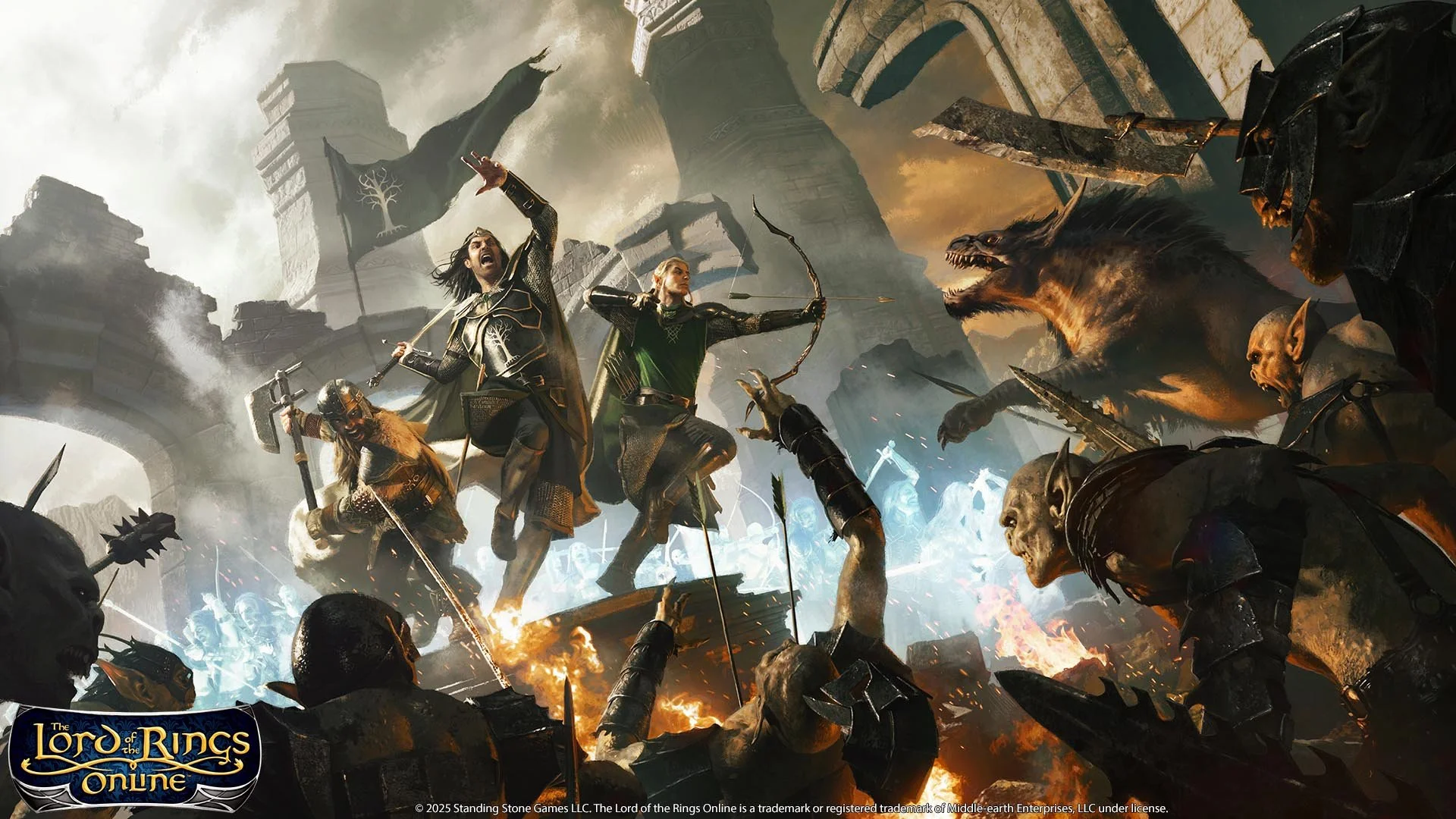
After a six month migration period, Standing Stone Games formally closed all their legacy 32-bit game servers for the MMORPG, The Lord of the Rings Online, on the 31st August 2025. Despite this planned closure being widely discussed via the game’s official forums, professional video game websites and fan blogs, many LOTRO players were unaware of this deadline. Hence many were unable to migrate their respective alts to the new 64-bit servers. Naturally those affected by these closures were upset, especially those with longstanding characters who didn’t relish the prospect of starting from scratch with a new alt. Thankfully, SSG have been true to their word and as of today, have re-opened these “dark worlds” to character transfers. If you have an alt trapped on one of the older game worlds, then now is the time to use the transfer wizard and move them to a new active game world.
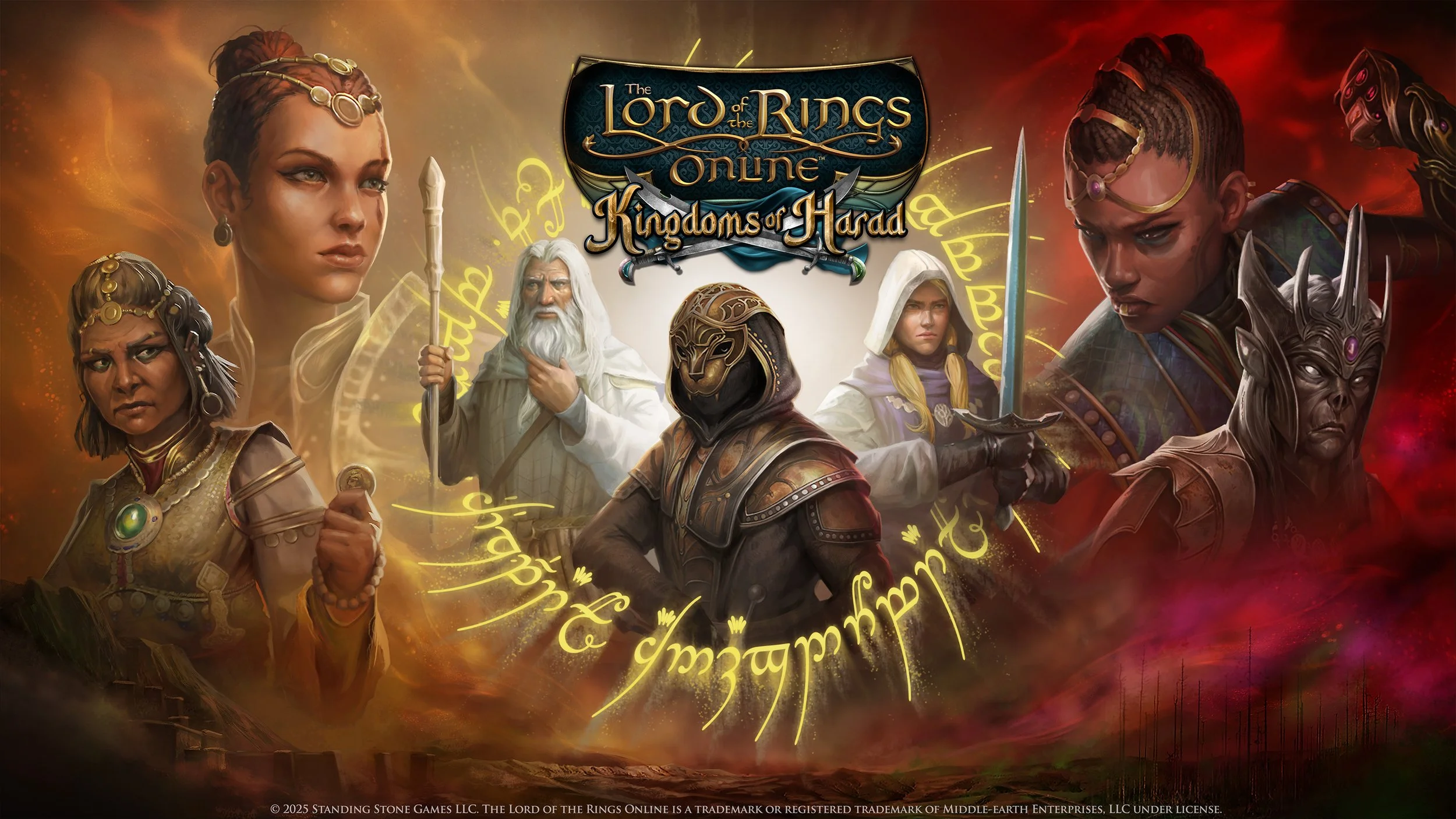
MMORPG announced earlier today and it was subsequently confirmed by Standing Stone games, that the new expansion for The Lord of the Rings Online will be Kingdoms of Harad and that it will launch later in the year. The expansion will see the conclusion of the epic Song of Waves and Wind storyline and the level cap raised from 150 to 160. There will be a new region to explore, Mûr Ghala, comprising four zones. Adagîm, Idagâl, An Shêru and Kighân. The latter contains the main trading hub of Zajâna. Players will travel into the region with Gandalf the White, along with allies of the Kindred of Coins and Mizadi as they seek to counter the regional power struggle brought about by the fall of Sauron. Canonically, this takes place three months after the destruction of the ring, hence King Elessar and Eomer are busy with domestic affairs in their respective kingdoms.
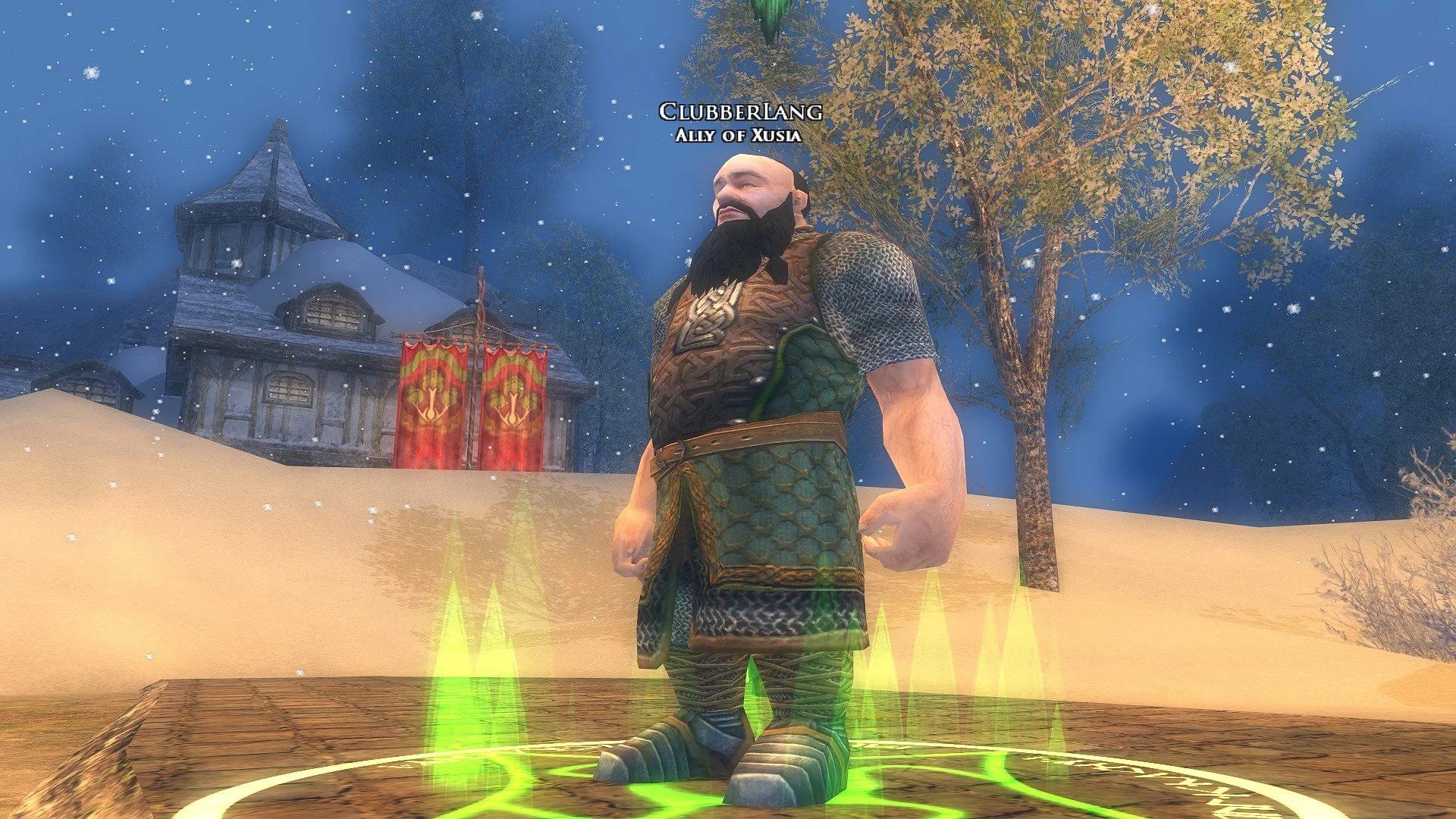
Skirmishes were added to the MMORPG The Lord of the Rings Online, in 2009 with the release of the Siege of Mirkwood expansion. Skirmishes are a repeatable and scalable combat system that allows players to access various instances for solo or group play from anywhere in the in-game world. Players can choose a Skirmish Soldier from a variety of classes to accompany them and provide healing, tank or additional DPS. On paper it’s a great system which is why many other MMOs offer something similar. I recently decided to tinker with my Skirmish Soldier build on my main character to see if I could optimise their performance. As my primary alt is a Lore-master, for the last few years I have had a Warrior as their Skirmish Soldier, to take some of the aggro from attacking mobs. I used the excellent guide by FibroJedi and swapped over a few Training and Personal Traits.

On 2nd August 2025, I was playing the MMORPG The Lord of the Rings Online, on my primary character, a level cap Lore-master. I decided to continue with one of the Allegiance Quest lines, specifically Durin’s Folk. I played through several quests and earned the appropriate tokens that advance the Allegiance system. I then handed these in to the NPC in the Hall Under the Mountain, expecting the next quest in the series “Chapter 3: Gimli’s Request” to be unlocked. An item appeared in my inventory that I then clicked on, which should have bestowed the quest. Unfortunately, nothing happened. Furthermore, the item vanished from my bag and therefore I could not attempt to click it again. I checked the LOTRO Wiki and then looked around the Hall Under the Mountain to see if any NPC had a ring icon above their head. As they did not, I surmised that this was a software glitch and logged a support ticket with Standing Stone Games.

If you check the Star Trek Online Wiki, you’ll find that there has been a steady stream of new content added to the MMORPG over the last 15 years. However, it doesn’t quite feel that way, mainly because more recent material seems weaker and less memorable. The last two major story arcs in STO have been somewhat lacklustre and demonstrably inferior to those that went before. Both Terran Gambit and Kings & Queens suffer from uninspired, repetitive ideas as well as an infrequent release schedule. Effectively weak stories have been dragged out over too much time. No doubt changes among the STO writing team have had an impact on content but it also seems that some of the newer stories have been tailored around whatever former Star Trek cast members that are available. As a result there has been a somewhat “square pegs in a round holes” aspect to both story arcs, where the pieces just don’t seem to fit together well.
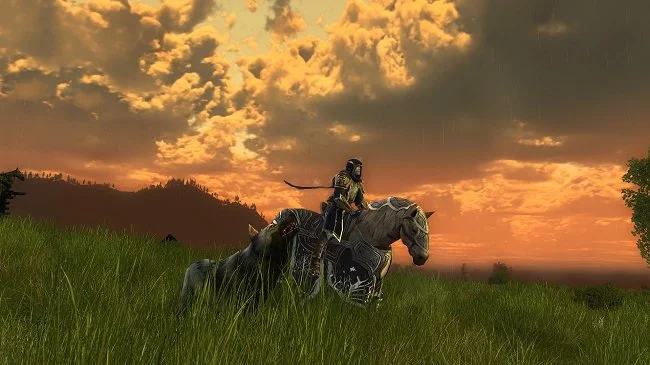
Let’s start with a quote from a classic Walter Hill film, The Warriors. “Can you count, suckers?” says Sirus. The gang leader was referring to the number of Police in New York City at the time. Whereas, for the purpose of this post, I am referencing how many Delving Writs a player needs to acquire 6 pieces of level cap armour in LOTRO. Because, next to the gear you get from endgame instances and raids, Delving gear is a good alternative.. It is marginally better than the items you can get from lootboxes. Hence, Delving armour is a good source of high end gear for the solo player. Through the miracle of mathematics, the number of Delving writs required to acquire a full set of this armour is 9,000. At first glance, that seems like a lot. If you then do some further research to put the number in context, you realise it is indeed a lot and a substantial undertaking.
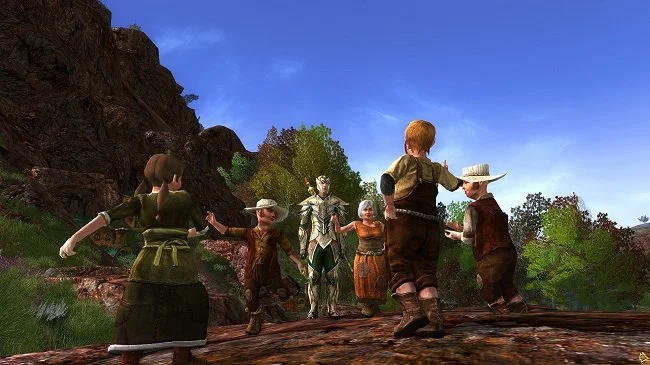
I am currently enjoying a renewed interest in the MMORPG The Lord of the Rings Online since I migrated all my characters from the old 32-bit servers to the new 64-bit replacements. I’ve created a new High Elf Lore-master on Peregrin server and am currently levelling them in a targeted play through of the Epic Story, supplemented by curated side quests. While playing recently, I realised the game UI on this alt wasn’t as I usually have it laid out. So I checked through the various documents on my PC and found a text file I had created many years ago that had a few hints and tips written down. I’ve added a few more and decided to share them as a blog post. I’m sure veteran players will be familiar with many of them but a lot of them are worth repeating. They may prove useful to those new to LOTRO or returning to the game after a long hiatus.
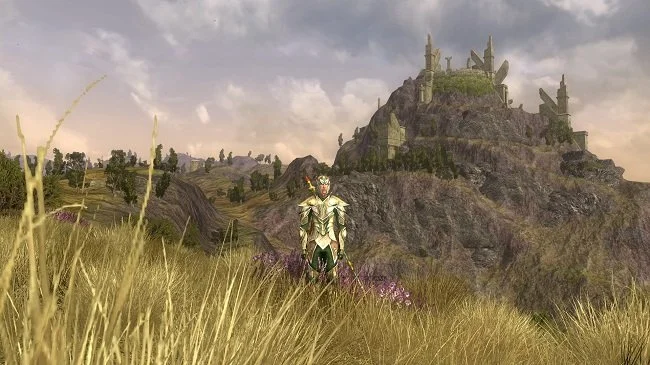
In mid-March, while the server migration debacle raged, I created a new alt for the MMORPG, The Lord of the Rings Online, on Peregrin server. The idea was to play casually through content focusing on enjoyment, rather than worrying about progression. I was to level at a pace that suited me and had no specific plans to develop my alt in any particular way. I have been playing LOTRO since 2008 and have a primary level-cap character that has been my main focus over the years. Hence I have previously experienced all story content from all the expansions and am therefore very familiar with what the game has to offer. Which is why I thought I’d do things differently this time. So I started my new Lore-master in Mossward in Swanfleet, the new starting area added to the game in 2022.
Playing MMOs on a Second Monitor
I have two monitors on my desk. The first (which is the primary monitor as far as my PC is concerned), is on the left and the second is on the right. The primary monitor is a 24 Dell U2412M, which has a resolution of 1920 x 1200. It therefore has an aspect ratio of 16:10 which adds a little extra desktop real estate, which I prefer when writing. The second monitor is a 24 inch Dell S2421H with a screen resolution of 1920 x 1080. It has an aspect ratio of 16:9 which is standard FHD. My chair is adjacent to the middle of my desk and I can turn according to each monitor I’m using. I tend to use the primary, larger monitor on the left for tasks such as writing via Google Docs and emails. The second monitor on the right is used for YouTube and gaming. This is because of its FHD format. I also have a Nintendo Switch connected to the second monitor for the same reason.
I have two monitors on my desk. The first (which is the primary monitor as far as my PC is concerned), is on the left and the second is on the right. The primary monitor is a 24 Dell U2412M, which has a resolution of 1920 x 1200. It therefore has an aspect ratio of 16:10 which adds a little extra desktop real estate, which I prefer when writing. The second monitor is a 24 inch Dell S2421H with a screen resolution of 1920 x 1080. It has an aspect ratio of 16:9 which is standard FHD. My chair is adjacent to the middle of my desk and I can turn according to each monitor I’m using. I tend to use the primary, larger monitor on the left for tasks such as writing via Google Docs and emails. The second monitor on the right is used for YouTube and gaming. This is because of its FHD format. I also have a Nintendo Switch connected to the second monitor for the same reason.
Now that’s out of the way, let’s move on to video games that are relevant to this post. I have at present six MMORPGs installed on my PC. Age of Conan, Star Trek Online, The Lord of the Rings Online, Guild Wars 2, The Elder Scrolls Online and Star Wars: The Old Republic. As previously stated I prefer to play video games using the second monitor as it is a default FHD standard. Screen captures and any recorded material are in a 16:9 aspect ratio, which is very useful for YouTube or streaming. Working within a standard format is also convenient when trying to find optimal game settings for my CPU and GPU. However, trying to get these games to run on my second monitor and more importantly stay there, has not proven easy. Some cooperate, others have to be cajoled and a few flat out refuse to do so.
The obvious solution is to change the primary monitor designation in the PC settings. However, I don’t want to do this as it would have a knock on effect on my current preferences. Hence I have had to manually tinker with each game to see if it will run consistently on monitor number 2. ESO being the most recent MMO out of those listed, has a drop down box in the game settings where you can choose which display you use. Both STO and SWTOR can be temporarily set to “windowed mode” and dragged over to the second display. Furthermore this change persists after exiting the game client and rebooting the PC. Sadly, AoC, LOTRO and GW2 resist this simple work around. The games can be dragged to the second monitor in “windowed mode” but when the display is set back to fullscreen they instantly revert back to the primary monitor.
I am far from alone in my preferences. A simple Google search shows that many other gamers have made similar enquiries and you’ll find numerous forums and subreddit posts. Often the advice is to use various Windows 10 settings to force content from one monitor to another but it seldom works, or if it does it doesn’t persist. Using the management software that comes with your GPU is also frequently recommended but this tends to be for spanning a game across two monitors, rather than forcing the output to a specific one. There are also some third party apps that have been developed by “gifted amateurs” but again the results are not guaranteed and often depend on having the right sort of GPU with the right sort of output cable. The problem ultimately stems from most of these games being developed when having multiple monitors was not as common as today.
Out of the three MMOs where this problem persists I find GW2 the most egregious. This game possibly has the biggest development budget of them all and is regularly updated. You would have thought such a feature as a choice of displays would have been added to the game by now. AoC is in maintenance mode, so one adjusts one’s expectations accordingly. However, LOTRO is a curious beast. It has a small but loyal playerbase and makes sufficient money to keep going. Updating the GUI is on the development “to do list”. In the meantime I finally found a workaround today by making some alterations to the “UserPreferences.ini” file. I changed “DisplayOutput=1” to 2 in the list of [Render] settings and changed all display resolution data to 1920 x 1080 and the aspect ratio to 16:9. LOTRO now runs on my second monitor and stays there after rebooting the PC. A minor victory but a victory no less.

Two years ago I wrote a post about fine tuning your graphics in the MMORPG The Lord of the Rings Online. Apart from installing ReShade and using AMD Adrenalin, the options were somewhat limited, due to the game’s age and multiplayer status. Since then, I’ve been playing LOTRO with the game settings maxed out, a custom ReShade profile to make the colour palette more vivid and Radeon Image Sharpening enabled within the AMD software. The game looks clear, crisp and the draw distance is pretty good for an ageing game but I still wish the graphics could be tweaked further. Hence, I’ve been trawling the internet in a vain attempt to see if I can find any third party utilities that could be used to enhance LOTRO further. During the course of my search I stumbled across DLSS 5 Manager. This is an open-source, intelligent utility and one-click mod installer designed to inject and manage Nvidia's DLSS 5 neural rendering features, ReShade, and OptiScaler into PC games.
Are video games becoming easier? It’s a perennial subject that is frequently discussed by those who play them. Often the question of whether they have actually become easier is not the focus of the debate, as it seems to be broadly recognised that it is the case. Instead, discussion of this matter tend to drift into the rectitude of this change. Debate’s of this nature are usually awash with subjective opinions and personal preferences which are then put forward as objective facts. It’s not just a question of video games becoming easier, it’s the fact that making them easier is “wrong” and those who want them as such are “not proper gamers” etc. The hours that have been lost to this pointless, tedious debate are uncountable. However, I digress. Let us return to the matter of video games becoming easier, because although fans discuss this a lot and have plenty to say, you don’t often hear from the developers on this subject.
I recently completed the main story in Tainted Grail: The Fall of Avalon. In total I spent about sixty hours playing the game. I began at the start of the year, then took a break for a while but returned to it recently because I wanted to see if I could unlock a specific ending. I did manage to do this. Like so many other RPGs, Tainted Grail: the Fall of Avalon has a central storyline, along with a wealth of side quests, based around factions in specific zones. I think I possibly completed about a two thirds of these. However, once I finished the main story, my interest in the game began to wane. I finally left my character in the last major quest hub in case I wish to return at a future date. I then logged out of the game and uninstalled it from my PC to free up space for whatever I was to play next. In this case its The Sinking City 2. None of this is a negative reflection on Tainted Grail: the Fall of Avalon. I enjoyed the time I spent playing this quirky RPG. I simply had my fill and left to play something else.
The next expansion for the MMORG, The Lord of the Rings Online, was announced on the 1st August, via the gaming website MMORPG.The Wolves of Mordor, which will launch later in the year, appears ambitious in scope as it will include two new game systems as well as the obligatory story update. This expansion takes place in Draugardh located in the North East of Mordor, beyond the Plateau of Gorgoroth. It includes the new zones of Heledhris, Parth Rhavas and Nan Ogol. These vary environmentally ranging from the arid, volcanic and semi-tropical. Players will encounter the Daugrim in these regions, Werewolves but not in the modern sense. This is not the lycanthropy of Eastern European legends but in the established Tolkien idiom of fell spirits inhabiting the bodies of Wolves. The region also sees the return of the Woses and players can expect to encounter Elves and scouts from Gondor. As ever with LOTRO expansions, there will be new instances as well as a raid.
I don’t keep up with gaming news as much as I use to but several noteworthy announcement have come to my attention of late. Firstly, there’s an expansion, Songs of the Past, coming for the Witcher III: Wild Hunt in 2027. No doubt this is to pave the way for the Witcher IV. Next, I also found out about Hand of Fate: Horde. I liked this franchise and was saddened to learn that the original studio, Defiant Development, closed. Hence is was a pleasant surprise to see this new game being developed by members of the original studio. The third announcement was regarding Guild Wars 3. A new MMORPG in active development by a major studio is no small feat and is certainly good news for fans of this franchise and the genre per se. However, once you look beyond this news this announcement raises several questions and has certainly given me pause for thought. Let us take a few moments to consider them.
Star Trek Online has many in-game systems that are common to the MMORPG genre. The reputation system is one such example. In STO there are 13 reputation factions. Once a player has reached level 50 they may start progressing through the 6 reputation tiers of each one. Players gain progression through daily projects (20 hours in duration). Hourly projects are also available though they yield less reputation advancement and are limited to three times a day. Hence 20 hour projects are consider by default the most efficient way to gain rep. Projects require 30 Faction Specific Marks (earned via various activities in-game), 15,000 Energy Credits (standard in-game currency) and 2000 Expertise points. The most efficient way to tackle the reputation grind is to build up the necessary resources in advance and then at a designated time each day, start all 13 respective projects. Upon completion projects yield a player bound lockbox containing a random space or ground weapon, a console or Elite Marks which can be used to acquire faction gear.
I was recently perusing my archive of old blog posts, when it struck me how much I’ve written about the MMORPG genre over the years. Naturally, there was far more material from between 2008 and 2012 as that was period when I immersed myself in the genre and was very enthusiastic about it. I was at a point in my life when I had the time to dedicate to such games and I was happy to participate in the social aspect of they offered. I would regularly play through group content and spend time socialising online with fellow guild members. My experience remains a textbook example of how online games can be more than the sum of their parts and that where you are at in your life has a major impact upon your overall enjoyment. As I read though various old posts it became clear that my experiences where specific to this particular part of my life and that they cannot be repeated. My relationship with the genre is very different now and that’s fine.
Creating alts is an integral aspect of the MMORPG genre. Many players will create a character of a specific class or faction, play it for a while, lose interest in it or they may decide that it is just not for them. Fortunately it is no effort at all to simply re-roll a new alt and set off once again. Furthermore, lots of players never reach level cap of the MMORPG that there playing. When the going get’s tough, so to speak, you can either soldier on for another 50 levels or simply create a new alt and return to the comfort of tried and tested content. Alts also give you the chance to secure an accolade or achievement that you previously missed. They are also of great benefit to the genres social aspects. Creating a new alt so you can play along with a friend who is just starting is great fun. Developer’s love them too as it means you’re still playing the game.
I recently took a break from Crimson Desert choosing instead to to play something familiar and easy going. As I’ve been logging into Star Trek Online daily to participate in the anniversary event, I decided to look through my various alts and see how far they had progressed through the game and what resources they had. At present I have twelve alts. My primary Captain was created in 2015 during the original Delta Recruit Event. I had previously played STO intermittently since its release in January 2010 but I never kept any of those characters. Hence this decade old Tactical Federation Captain has been my main focus when playing. The other eleven alts are the result of other recruitment events or whenever I wanted to try something different, such as playing a specific class or faction. I obviously played a lot of STO during the lockdown as several alts date from that period. Several had maximum reputation across all factions.
13 days after its release, market analysts estimate that Crimson Desert has already earned $200 million across the four main platforms (PC, PlayStation 5, and Xbox Series X and S). The game is certainly proving popular among gamers with the internet awash with live streams and “let’s play” videos. However, reviews are mixed both among gaming journalists and YouTube influencers. Common complaints about the game include that it is slow to start, the controls are poorly laid out on all platforms and that developer’s Pearl Abyss have done a poor job of explaining most aspects of the game to new players. Although such criticisms are true to a degree, I think these complaints highlight how many gamers are conditioned to expect new titles to follow a specific pattern with regard to pacing, narrative exposition and learning in-game systems. A pattern that Pearl Abyss has chosen to ignore, instead favouring an old school approach.
Last night, I spent the first 45 minutes after the launch of Crimson Desert, watching the 92GB pre-downloaded game files slowly decompressing and installing. I finally launched the game at about 10:50 PM GMT. I then waited a further 5 minutes while shaders were downloaded. It took me about 15 minutes or so to read through the various game settings and choose those that are optimal for my PC. I suspect even if you have a beast of a computer, you’re still going to have to spend some time tweaking settings. As for those players like myself with a gaming rig that is somewhere in the middle of the game’s specifications, be prepared to do a lot of fine tuning both within Crimson Desert itself and your Windows settings.
Video games as a genre are extremely poor at explaining themselves. When you buy a new game you’ll often find little or no information regarding the basic systems and mechanics. The industry assumes that their customers are by default familiar with the fundamentals of playing a modern video game. Hence if a game has a tutorial, it is often based around videos rather than detailed verbal instructions. You are are briefly shown a clip of a specific move being successfully undertaken but it is seldom shown in a wider context. The industry also expects the fan community to take on the role of curating and disseminating information about its games. The move away from forums and bespoke websites to Discord highlights this. Discord is a primarily a real time communication tool and not good at maintaining a historical data archive. If you want an answer to a specific gaming question, you’ll more than likely find it on YouTube in a video made by a fellow gamer.
According to the recent “letter to the players”, Standing Stone Games will be adding a new zone to the MMORPG The Lord of the Rings Online in the second quarter of this year. Possibly around May or June. Having spent the last three expansions in the South of Middle-earth exploring the tropical Umbar and the deserts of Harad, I would certainly welcome a change of location. I have gradually warmed to these zones over the last eighteen months but I do find them so incongruous. They are so radically different to the European style content that has been the mainstay of the game for so long. Tolkien’s source text has plenty of detail regarding Eriador and Rhovanion. Information regarding Harad is scarce, hence it has afforded the developers a great deal of artistic freedom. Although exceedingly well realised these tropical zones have taken a while for me to get used to.
I’m not sure exactly when it started but I’ve recently noticed a graphical bug within the MMORPG The Lord of the Rings Online. This problem often occurs within caves or in areas where there are a lot of rocky surfaces. Hence it has become very apparent in the latest two expansions, set in Umbar and Harad. This graphical glitch causes some surface textures to appear to flash from light to dark intermittently. The resulting strobe effect is hard to ignore and very distracting. Fortunately, a quick online search showed that this is not a problem unique to my installation of LOTRO and is a known problem. Furthermore, there is a very simple workaround, which is to go into the Advanced Graphics setting and uncheck “Per Pixel Lighting”, which immediately remedies the problem. I have no idea why this has recently started to happen but at least it can be resolved.
This year is the 60th anniversary of Star Trek. The original TV show was first broadcast in the US on September 8th 1966. If you search online you’ll find details of lots of related events. There are documentaries, conventions, new TV shows and even some video games in development. However, what you won’t find are any details regarding what will be happening with the MMORPG Star Trek Online. So far no road map for 2026 has been posted online by the developers but it is still quite early in the New Year. That being the case, I am not especially optimistic about there being any major plans waiting to be revealed. It is not as if DECA Games have demonstrated or stated any major ambitions for STO beyond keeping the endless events treadmill going and regularly adding content to the in-game store, during their development tenure. The ongoing story arc drags on inexorably and is as dull as ditchwater.
The latest expansion for the MMORPG The Lord of the Rings Online, Kingdoms of Harad, launched on December 3rd. With this release the level cap was raised from 150 to 160. It should also be noted that the cap for virtue traits was also raised from 96 to 100. Naturally these changes meant that there is a requirement to replace all armour and jewellery once the new cap is reached. Similarly Legendary Items have to be reforged and any traceries upgraded or replaced. If you follow the Epic Story it will lead you from quest hub to quest hub. The main quest rewards, along with those from side quests will provide adequate gear as you slowly progress towards the new level cap. The new raids, instances and missions/delvings then provide a means to acquire higher quality level 160 gear. LOTRO and indeed, many other MMOs are consistent in this methodology.
It is customary in a post such as this to list the various games that I’ve played over the last twelve months and share my thoughts on them. Wider analysis of the video game industry is also de rigeur. Unfortunately, I don’t really feel disposed to do either of those two things. My thoughts on the games I’ve played have already been published and can easily be accessed via the links at the bottom of this post. As for the video game industry, it suffers the same flaws as music, TV and cinema. There is creativity and innovation out there but it is often drowned out by mainstream products which are demonstrably inferior due to their inherent mediocrity. As for the business side of things, we once again clearly see the failings of the corporate management class. Sadly, they do not face the consequences of the mistakes that they make.
Today Standing Stone Games began beta testing Update 46.1 for the MMORPG The Lord of the Rings Online. The current preview on the Bullroarer test server is mainly for the new instance cluster that comes with the Kingdoms of Harad expansion which launched a few weeks ago. However, it would appear that this latest preview has another feature or note. One that should please LOTRO players. Contrary to what a lot of people thought, myself included, SSG have been working on a scaling UI for 2K and 4K monitors and the results are now available for testing from today Monday 15th through to Friday 19th December. Until now the main workaround to the lack of UI scaling has been to use either Nvidia or AMD graphics software to upscale the game from 1920 x 1080, or a third party app such as LosslessScaling. Having an official solution is a far better option.
Kingdoms of Harad, the 13th expansion for the MMORPG The Lord of the Rings Online, was released today. Highlighting developer’s Standing Stone Games continuing commitment to this eighteen year old game. As 2025 draws to a close, I thought it would be prudent to reflect upon the current state of LOTRO and to consider what may come next year. Two words that I associated with this MMO are stable and consistent. The playerbase is loyal and dependable. Player numbers never greatly decline nor do they notably expand. LOTRO fills a very specific gaming niche and one of the reasons it retains its players is that there is no suitable alternative game. Although there is not a great deal of data in the public domain, it is generally accepted that LOTRO has an older player demographic and that many are consummate Tolkien fans.
The MMORPG The Lord of the Rings Online runs on a broad spectrum of PCs. From archaic laptops to high end gaming rigs, although it may require a bit of tweaking. At present, the optimal way to play the MMO is at a resolution of 1920x1080 (FHD) with the graphics setting maxed out. The graphics are sharp and the UI is readable. However, a growing number of gamers are now using 2K and 4K monitors. You can play LOTRO at higher resolutions such as 2560×1440 (QHD) and 3840x2160 (UHD) and the game looks great. However, the UI does not scale and so is very small on 2K and 4K monitors. The skill icons on the quickslots (shortcut bars) and the in-game text become difficult to see at these resolutions, which deters some players from using them. It is a known issue that Standing Stone Games are attempting to address but it is unlikely to be resolved any time soon.
I recently read a post on Massively Overpowered about skills rotation in the MMORPG genre. I found the subsequent discussion in the comments fascinating. Mainly because I have never used a fixed rotation of skills in any of the MMORPGs that I play. I understand the reasoning behind such things and why some players want to optimise their combat performance. Using one’s skills in a specific order to maximise damage and manage their subsequent cooldown has a logical appeal. In Star Trek Online, some players go so far as to create keybinds for their rotations and assign it to a specific hotkey, which is then continuously pressed throughout combat. However, rotations are a blunt tool that lack flexibility, often being geared towards dealing with a single target or using an area of effect skill against a larger group. They may not be the optimal approach to combat when things do not go to plan.
Tolkien enthusiasts may recollect Athlon Games, a subsidiary of Leyou Technologies, announcing that it was developing a new MMORPG, based upon The Lord of the Rings, back in September 2018. The following summer, it was revealed that Amazon Game Studios was the partner developer for the project. In late 2020, Leyou Technologies (a Hong Kong-based company), was acquired by the Chinese conglomerate Tencent. This triggered a contract clause with the license holder, Middle-earth Enterprises, allowing them to terminate the existing arrangement if a new deal could not be met. Amazon and Tencent were unable to agree upon how to proceed with the project, leading Amazon to withdraw from negotiations. The project was subsequently scrapped. No details or images of the MMO have been released.
After a six month migration period, Standing Stone Games formally closed all their legacy 32-bit game servers for the MMORPG, The Lord of the Rings Online, on the 31st August 2025. Despite this planned closure being widely discussed via the game’s official forums, professional video game websites and fan blogs, many LOTRO players were unaware of this deadline. Hence many were unable to migrate their respective alts to the new 64-bit servers. Naturally those affected by these closures were upset, especially those with longstanding characters who didn’t relish the prospect of starting from scratch with a new alt. Thankfully, SSG have been true to their word and as of today, have re-opened these “dark worlds” to character transfers. If you have an alt trapped on one of the older game worlds, then now is the time to use the transfer wizard and move them to a new active game world.
MMORPG announced earlier today and it was subsequently confirmed by Standing Stone games, that the new expansion for The Lord of the Rings Online will be Kingdoms of Harad and that it will launch later in the year. The expansion will see the conclusion of the epic Song of Waves and Wind storyline and the level cap raised from 150 to 160. There will be a new region to explore, Mûr Ghala, comprising four zones. Adagîm, Idagâl, An Shêru and Kighân. The latter contains the main trading hub of Zajâna. Players will travel into the region with Gandalf the White, along with allies of the Kindred of Coins and Mizadi as they seek to counter the regional power struggle brought about by the fall of Sauron. Canonically, this takes place three months after the destruction of the ring, hence King Elessar and Eomer are busy with domestic affairs in their respective kingdoms.
Skirmishes were added to the MMORPG The Lord of the Rings Online, in 2009 with the release of the Siege of Mirkwood expansion. Skirmishes are a repeatable and scalable combat system that allows players to access various instances for solo or group play from anywhere in the in-game world. Players can choose a Skirmish Soldier from a variety of classes to accompany them and provide healing, tank or additional DPS. On paper it’s a great system which is why many other MMOs offer something similar. I recently decided to tinker with my Skirmish Soldier build on my main character to see if I could optimise their performance. As my primary alt is a Lore-master, for the last few years I have had a Warrior as their Skirmish Soldier, to take some of the aggro from attacking mobs. I used the excellent guide by FibroJedi and swapped over a few Training and Personal Traits.
On 2nd August 2025, I was playing the MMORPG The Lord of the Rings Online, on my primary character, a level cap Lore-master. I decided to continue with one of the Allegiance Quest lines, specifically Durin’s Folk. I played through several quests and earned the appropriate tokens that advance the Allegiance system. I then handed these in to the NPC in the Hall Under the Mountain, expecting the next quest in the series “Chapter 3: Gimli’s Request” to be unlocked. An item appeared in my inventory that I then clicked on, which should have bestowed the quest. Unfortunately, nothing happened. Furthermore, the item vanished from my bag and therefore I could not attempt to click it again. I checked the LOTRO Wiki and then looked around the Hall Under the Mountain to see if any NPC had a ring icon above their head. As they did not, I surmised that this was a software glitch and logged a support ticket with Standing Stone Games.
If you check the Star Trek Online Wiki, you’ll find that there has been a steady stream of new content added to the MMORPG over the last 15 years. However, it doesn’t quite feel that way, mainly because more recent material seems weaker and less memorable. The last two major story arcs in STO have been somewhat lacklustre and demonstrably inferior to those that went before. Both Terran Gambit and Kings & Queens suffer from uninspired, repetitive ideas as well as an infrequent release schedule. Effectively weak stories have been dragged out over too much time. No doubt changes among the STO writing team have had an impact on content but it also seems that some of the newer stories have been tailored around whatever former Star Trek cast members that are available. As a result there has been a somewhat “square pegs in a round holes” aspect to both story arcs, where the pieces just don’t seem to fit together well.
Let’s start with a quote from a classic Walter Hill film, The Warriors. “Can you count, suckers?” says Sirus. The gang leader was referring to the number of Police in New York City at the time. Whereas, for the purpose of this post, I am referencing how many Delving Writs a player needs to acquire 6 pieces of level cap armour in LOTRO. Because, next to the gear you get from endgame instances and raids, Delving gear is a good alternative.. It is marginally better than the items you can get from lootboxes. Hence, Delving armour is a good source of high end gear for the solo player. Through the miracle of mathematics, the number of Delving writs required to acquire a full set of this armour is 9,000. At first glance, that seems like a lot. If you then do some further research to put the number in context, you realise it is indeed a lot and a substantial undertaking.
I am currently enjoying a renewed interest in the MMORPG The Lord of the Rings Online since I migrated all my characters from the old 32-bit servers to the new 64-bit replacements. I’ve created a new High Elf Lore-master on Peregrin server and am currently levelling them in a targeted play through of the Epic Story, supplemented by curated side quests. While playing recently, I realised the game UI on this alt wasn’t as I usually have it laid out. So I checked through the various documents on my PC and found a text file I had created many years ago that had a few hints and tips written down. I’ve added a few more and decided to share them as a blog post. I’m sure veteran players will be familiar with many of them but a lot of them are worth repeating. They may prove useful to those new to LOTRO or returning to the game after a long hiatus.
In mid-March, while the server migration debacle raged, I created a new alt for the MMORPG, The Lord of the Rings Online, on Peregrin server. The idea was to play casually through content focusing on enjoyment, rather than worrying about progression. I was to level at a pace that suited me and had no specific plans to develop my alt in any particular way. I have been playing LOTRO since 2008 and have a primary level-cap character that has been my main focus over the years. Hence I have previously experienced all story content from all the expansions and am therefore very familiar with what the game has to offer. Which is why I thought I’d do things differently this time. So I started my new Lore-master in Mossward in Swanfleet, the new starting area added to the game in 2022.
Are MMORPGs Expensive to Play?
Bree Royce, editor-in chief at Massively Overpowered, recently asked the question “what is the most expensive MMORPG right now”. My first thought was to search through my old draft blog posts and track down an MMO cost analysis I wrote circa 2019. It includes data such as subscription rates and the price of current expansions. There was also information on what were the most popular cash shop items at the time. However, I then read some of the comments that had been left on Bree’s post and I quickly realised that this wasn’t just a matter of financial expenditure. Whether or not an MMO is expensive is also determined by one’s disposable income, respective wealth and personal relationship with money. The latter is perhaps the most important, irrespective whether you consider yourself rich or poor.
Bree Royce, editor-in chief at Massively Overpowered, recently asked the question “what is the most expensive MMORPG right now”. My first thought was to search through my old draft blog posts and track down an MMO cost analysis I wrote circa 2019. It includes data such as subscription rates and the price of current expansions. There was also information on what were the most popular cash shop items at the time. However, I then read some of the comments that had been left on Bree’s post and I quickly realised that this wasn’t just a matter of financial expenditure. Whether or not an MMO is expensive is also determined by one’s disposable income, respective wealth and personal relationship with money. The latter is perhaps the most important, irrespective whether you consider yourself rich or poor.
I play several MMORPGs over the course of a year. I tend to return to a game when there’s sufficient outstanding content to keep me busy for a few months, such as a new expansion. Hence I will binge play games such as The Lord of the Rings Online, Star Wars: The Old Republic and The Elder Scrolls Online. While I am playing any one of these titles, I will subscribe to ensure that I am not impeded by any “free-to-play” restrictions. I will also buy some in-game currency so I can obtain any cash shop items I desire. Hence, if I play SWTOR for three months or so, I can end up spending between £60 to £75. It is therefore entirely possible that I can spend £300 a year across multiple MMOs. Broadly, this breaks down to about £6 a week. I personally do not feel that this is a lot of money.
Every hobby has some sort of cost associated with it. From golf, fishing, gardening, painting lead figures to trainspotting. Compared to others, I consider video games good value, especially the MMO genre. However, this is very subjective. Some people may consider my spending to be profligate. Others may think that I’m penny pinching. It all comes down to our own relationship with money. Something that varies between generations and other social divides. I know very wealthy people who will balk at costs that are just pocket change to them. I know others on what would be considered a relatively low income, to happily embrace in-game expenditure because it is the primary source of leisure and entertainment. Furthermore, “whales” do exist and are a big enough factor to influence a video game’s business model.
However, setting aside one’s own finances, there is another factor that counts here. One that is a matter of perspective. Most gamers understand that games cost money to develop and that there is a requirement to generate revenue to finance new content. Hence we broadly accept that there will be charges such as a subscription or the sale of cosmetic items. What matters here is setting a cost that feels appropriate. If this is done right then the player does not feel abused or exploited. A $5 or $10 cosmetic mount is therefore acceptable. Not so, $50 or more. Sadly, publishers often push egregious charges upon developers and mandate that they are included in the game. All too often a deliberate bottleneck or grind is artificially created in an MMO which can only be bypassed with a paid solution. This is the main bone of contention with many gamers.
As I’ve stated in other posts recently, what we expect from a video game is very much determined with what we have grown accustomed to and that varies depending on age. Paying once and getting everything was the norm during the eighties and nineties. But those days are gone and are not coming back. Therefore one has to adjust one’s expectations. It is also true that video game studios only pitch a business model that they can get away with. Sometimes, a live service game fails because it delivers too little and charges too much. The business models for games like LOTRO and SWTOR persist because the players ultimately tolerate it. They may complain but they continue paying. Unless you are prepared to stop paying you cannot exercise any leverage. Ultimately, the only intellectually honest answer to the question “what is the most expensive MMO right now” is the one you’ve chosen not to play.
Two years ago I wrote a post about fine tuning your graphics in the MMORPG The Lord of the Rings Online. Apart from installing ReShade and using AMD Adrenalin, the options were somewhat limited, due to the game’s age and multiplayer status. Since then, I’ve been playing LOTRO with the game settings maxed out, a custom ReShade profile to make the colour palette more vivid and Radeon Image Sharpening enabled within the AMD software. The game looks clear, crisp and the draw distance is pretty good for an ageing game but I still wish the graphics could be tweaked further. Hence, I’ve been trawling the internet in a vain attempt to see if I can find any third party utilities that could be used to enhance LOTRO further. During the course of my search I stumbled across DLSS 5 Manager. This is an open-source, intelligent utility and one-click mod installer designed to inject and manage Nvidia's DLSS 5 neural rendering features, ReShade, and OptiScaler into PC games.
Are video games becoming easier? It’s a perennial subject that is frequently discussed by those who play them. Often the question of whether they have actually become easier is not the focus of the debate, as it seems to be broadly recognised that it is the case. Instead, discussion of this matter tend to drift into the rectitude of this change. Debate’s of this nature are usually awash with subjective opinions and personal preferences which are then put forward as objective facts. It’s not just a question of video games becoming easier, it’s the fact that making them easier is “wrong” and those who want them as such are “not proper gamers” etc. The hours that have been lost to this pointless, tedious debate are uncountable. However, I digress. Let us return to the matter of video games becoming easier, because although fans discuss this a lot and have plenty to say, you don’t often hear from the developers on this subject.
I recently completed the main story in Tainted Grail: The Fall of Avalon. In total I spent about sixty hours playing the game. I began at the start of the year, then took a break for a while but returned to it recently because I wanted to see if I could unlock a specific ending. I did manage to do this. Like so many other RPGs, Tainted Grail: the Fall of Avalon has a central storyline, along with a wealth of side quests, based around factions in specific zones. I think I possibly completed about a two thirds of these. However, once I finished the main story, my interest in the game began to wane. I finally left my character in the last major quest hub in case I wish to return at a future date. I then logged out of the game and uninstalled it from my PC to free up space for whatever I was to play next. In this case its The Sinking City 2. None of this is a negative reflection on Tainted Grail: the Fall of Avalon. I enjoyed the time I spent playing this quirky RPG. I simply had my fill and left to play something else.
The next expansion for the MMORG, The Lord of the Rings Online, was announced on the 1st August, via the gaming website MMORPG.The Wolves of Mordor, which will launch later in the year, appears ambitious in scope as it will include two new game systems as well as the obligatory story update. This expansion takes place in Draugardh located in the North East of Mordor, beyond the Plateau of Gorgoroth. It includes the new zones of Heledhris, Parth Rhavas and Nan Ogol. These vary environmentally ranging from the arid, volcanic and semi-tropical. Players will encounter the Daugrim in these regions, Werewolves but not in the modern sense. This is not the lycanthropy of Eastern European legends but in the established Tolkien idiom of fell spirits inhabiting the bodies of Wolves. The region also sees the return of the Woses and players can expect to encounter Elves and scouts from Gondor. As ever with LOTRO expansions, there will be new instances as well as a raid.
I don’t keep up with gaming news as much as I use to but several noteworthy announcement have come to my attention of late. Firstly, there’s an expansion, Songs of the Past, coming for the Witcher III: Wild Hunt in 2027. No doubt this is to pave the way for the Witcher IV. Next, I also found out about Hand of Fate: Horde. I liked this franchise and was saddened to learn that the original studio, Defiant Development, closed. Hence is was a pleasant surprise to see this new game being developed by members of the original studio. The third announcement was regarding Guild Wars 3. A new MMORPG in active development by a major studio is no small feat and is certainly good news for fans of this franchise and the genre per se. However, once you look beyond this news this announcement raises several questions and has certainly given me pause for thought. Let us take a few moments to consider them.
Star Trek Online has many in-game systems that are common to the MMORPG genre. The reputation system is one such example. In STO there are 13 reputation factions. Once a player has reached level 50 they may start progressing through the 6 reputation tiers of each one. Players gain progression through daily projects (20 hours in duration). Hourly projects are also available though they yield less reputation advancement and are limited to three times a day. Hence 20 hour projects are consider by default the most efficient way to gain rep. Projects require 30 Faction Specific Marks (earned via various activities in-game), 15,000 Energy Credits (standard in-game currency) and 2000 Expertise points. The most efficient way to tackle the reputation grind is to build up the necessary resources in advance and then at a designated time each day, start all 13 respective projects. Upon completion projects yield a player bound lockbox containing a random space or ground weapon, a console or Elite Marks which can be used to acquire faction gear.
I was recently perusing my archive of old blog posts, when it struck me how much I’ve written about the MMORPG genre over the years. Naturally, there was far more material from between 2008 and 2012 as that was period when I immersed myself in the genre and was very enthusiastic about it. I was at a point in my life when I had the time to dedicate to such games and I was happy to participate in the social aspect of they offered. I would regularly play through group content and spend time socialising online with fellow guild members. My experience remains a textbook example of how online games can be more than the sum of their parts and that where you are at in your life has a major impact upon your overall enjoyment. As I read though various old posts it became clear that my experiences where specific to this particular part of my life and that they cannot be repeated. My relationship with the genre is very different now and that’s fine.
Creating alts is an integral aspect of the MMORPG genre. Many players will create a character of a specific class or faction, play it for a while, lose interest in it or they may decide that it is just not for them. Fortunately it is no effort at all to simply re-roll a new alt and set off once again. Furthermore, lots of players never reach level cap of the MMORPG that there playing. When the going get’s tough, so to speak, you can either soldier on for another 50 levels or simply create a new alt and return to the comfort of tried and tested content. Alts also give you the chance to secure an accolade or achievement that you previously missed. They are also of great benefit to the genres social aspects. Creating a new alt so you can play along with a friend who is just starting is great fun. Developer’s love them too as it means you’re still playing the game.
I recently took a break from Crimson Desert choosing instead to to play something familiar and easy going. As I’ve been logging into Star Trek Online daily to participate in the anniversary event, I decided to look through my various alts and see how far they had progressed through the game and what resources they had. At present I have twelve alts. My primary Captain was created in 2015 during the original Delta Recruit Event. I had previously played STO intermittently since its release in January 2010 but I never kept any of those characters. Hence this decade old Tactical Federation Captain has been my main focus when playing. The other eleven alts are the result of other recruitment events or whenever I wanted to try something different, such as playing a specific class or faction. I obviously played a lot of STO during the lockdown as several alts date from that period. Several had maximum reputation across all factions.
13 days after its release, market analysts estimate that Crimson Desert has already earned $200 million across the four main platforms (PC, PlayStation 5, and Xbox Series X and S). The game is certainly proving popular among gamers with the internet awash with live streams and “let’s play” videos. However, reviews are mixed both among gaming journalists and YouTube influencers. Common complaints about the game include that it is slow to start, the controls are poorly laid out on all platforms and that developer’s Pearl Abyss have done a poor job of explaining most aspects of the game to new players. Although such criticisms are true to a degree, I think these complaints highlight how many gamers are conditioned to expect new titles to follow a specific pattern with regard to pacing, narrative exposition and learning in-game systems. A pattern that Pearl Abyss has chosen to ignore, instead favouring an old school approach.
Last night, I spent the first 45 minutes after the launch of Crimson Desert, watching the 92GB pre-downloaded game files slowly decompressing and installing. I finally launched the game at about 10:50 PM GMT. I then waited a further 5 minutes while shaders were downloaded. It took me about 15 minutes or so to read through the various game settings and choose those that are optimal for my PC. I suspect even if you have a beast of a computer, you’re still going to have to spend some time tweaking settings. As for those players like myself with a gaming rig that is somewhere in the middle of the game’s specifications, be prepared to do a lot of fine tuning both within Crimson Desert itself and your Windows settings.
Video games as a genre are extremely poor at explaining themselves. When you buy a new game you’ll often find little or no information regarding the basic systems and mechanics. The industry assumes that their customers are by default familiar with the fundamentals of playing a modern video game. Hence if a game has a tutorial, it is often based around videos rather than detailed verbal instructions. You are are briefly shown a clip of a specific move being successfully undertaken but it is seldom shown in a wider context. The industry also expects the fan community to take on the role of curating and disseminating information about its games. The move away from forums and bespoke websites to Discord highlights this. Discord is a primarily a real time communication tool and not good at maintaining a historical data archive. If you want an answer to a specific gaming question, you’ll more than likely find it on YouTube in a video made by a fellow gamer.
According to the recent “letter to the players”, Standing Stone Games will be adding a new zone to the MMORPG The Lord of the Rings Online in the second quarter of this year. Possibly around May or June. Having spent the last three expansions in the South of Middle-earth exploring the tropical Umbar and the deserts of Harad, I would certainly welcome a change of location. I have gradually warmed to these zones over the last eighteen months but I do find them so incongruous. They are so radically different to the European style content that has been the mainstay of the game for so long. Tolkien’s source text has plenty of detail regarding Eriador and Rhovanion. Information regarding Harad is scarce, hence it has afforded the developers a great deal of artistic freedom. Although exceedingly well realised these tropical zones have taken a while for me to get used to.
I’m not sure exactly when it started but I’ve recently noticed a graphical bug within the MMORPG The Lord of the Rings Online. This problem often occurs within caves or in areas where there are a lot of rocky surfaces. Hence it has become very apparent in the latest two expansions, set in Umbar and Harad. This graphical glitch causes some surface textures to appear to flash from light to dark intermittently. The resulting strobe effect is hard to ignore and very distracting. Fortunately, a quick online search showed that this is not a problem unique to my installation of LOTRO and is a known problem. Furthermore, there is a very simple workaround, which is to go into the Advanced Graphics setting and uncheck “Per Pixel Lighting”, which immediately remedies the problem. I have no idea why this has recently started to happen but at least it can be resolved.
This year is the 60th anniversary of Star Trek. The original TV show was first broadcast in the US on September 8th 1966. If you search online you’ll find details of lots of related events. There are documentaries, conventions, new TV shows and even some video games in development. However, what you won’t find are any details regarding what will be happening with the MMORPG Star Trek Online. So far no road map for 2026 has been posted online by the developers but it is still quite early in the New Year. That being the case, I am not especially optimistic about there being any major plans waiting to be revealed. It is not as if DECA Games have demonstrated or stated any major ambitions for STO beyond keeping the endless events treadmill going and regularly adding content to the in-game store, during their development tenure. The ongoing story arc drags on inexorably and is as dull as ditchwater.
The latest expansion for the MMORPG The Lord of the Rings Online, Kingdoms of Harad, launched on December 3rd. With this release the level cap was raised from 150 to 160. It should also be noted that the cap for virtue traits was also raised from 96 to 100. Naturally these changes meant that there is a requirement to replace all armour and jewellery once the new cap is reached. Similarly Legendary Items have to be reforged and any traceries upgraded or replaced. If you follow the Epic Story it will lead you from quest hub to quest hub. The main quest rewards, along with those from side quests will provide adequate gear as you slowly progress towards the new level cap. The new raids, instances and missions/delvings then provide a means to acquire higher quality level 160 gear. LOTRO and indeed, many other MMOs are consistent in this methodology.
It is customary in a post such as this to list the various games that I’ve played over the last twelve months and share my thoughts on them. Wider analysis of the video game industry is also de rigeur. Unfortunately, I don’t really feel disposed to do either of those two things. My thoughts on the games I’ve played have already been published and can easily be accessed via the links at the bottom of this post. As for the video game industry, it suffers the same flaws as music, TV and cinema. There is creativity and innovation out there but it is often drowned out by mainstream products which are demonstrably inferior due to their inherent mediocrity. As for the business side of things, we once again clearly see the failings of the corporate management class. Sadly, they do not face the consequences of the mistakes that they make.
Today Standing Stone Games began beta testing Update 46.1 for the MMORPG The Lord of the Rings Online. The current preview on the Bullroarer test server is mainly for the new instance cluster that comes with the Kingdoms of Harad expansion which launched a few weeks ago. However, it would appear that this latest preview has another feature or note. One that should please LOTRO players. Contrary to what a lot of people thought, myself included, SSG have been working on a scaling UI for 2K and 4K monitors and the results are now available for testing from today Monday 15th through to Friday 19th December. Until now the main workaround to the lack of UI scaling has been to use either Nvidia or AMD graphics software to upscale the game from 1920 x 1080, or a third party app such as LosslessScaling. Having an official solution is a far better option.
Kingdoms of Harad, the 13th expansion for the MMORPG The Lord of the Rings Online, was released today. Highlighting developer’s Standing Stone Games continuing commitment to this eighteen year old game. As 2025 draws to a close, I thought it would be prudent to reflect upon the current state of LOTRO and to consider what may come next year. Two words that I associated with this MMO are stable and consistent. The playerbase is loyal and dependable. Player numbers never greatly decline nor do they notably expand. LOTRO fills a very specific gaming niche and one of the reasons it retains its players is that there is no suitable alternative game. Although there is not a great deal of data in the public domain, it is generally accepted that LOTRO has an older player demographic and that many are consummate Tolkien fans.
The MMORPG The Lord of the Rings Online runs on a broad spectrum of PCs. From archaic laptops to high end gaming rigs, although it may require a bit of tweaking. At present, the optimal way to play the MMO is at a resolution of 1920x1080 (FHD) with the graphics setting maxed out. The graphics are sharp and the UI is readable. However, a growing number of gamers are now using 2K and 4K monitors. You can play LOTRO at higher resolutions such as 2560×1440 (QHD) and 3840x2160 (UHD) and the game looks great. However, the UI does not scale and so is very small on 2K and 4K monitors. The skill icons on the quickslots (shortcut bars) and the in-game text become difficult to see at these resolutions, which deters some players from using them. It is a known issue that Standing Stone Games are attempting to address but it is unlikely to be resolved any time soon.
I recently read a post on Massively Overpowered about skills rotation in the MMORPG genre. I found the subsequent discussion in the comments fascinating. Mainly because I have never used a fixed rotation of skills in any of the MMORPGs that I play. I understand the reasoning behind such things and why some players want to optimise their combat performance. Using one’s skills in a specific order to maximise damage and manage their subsequent cooldown has a logical appeal. In Star Trek Online, some players go so far as to create keybinds for their rotations and assign it to a specific hotkey, which is then continuously pressed throughout combat. However, rotations are a blunt tool that lack flexibility, often being geared towards dealing with a single target or using an area of effect skill against a larger group. They may not be the optimal approach to combat when things do not go to plan.
Tolkien enthusiasts may recollect Athlon Games, a subsidiary of Leyou Technologies, announcing that it was developing a new MMORPG, based upon The Lord of the Rings, back in September 2018. The following summer, it was revealed that Amazon Game Studios was the partner developer for the project. In late 2020, Leyou Technologies (a Hong Kong-based company), was acquired by the Chinese conglomerate Tencent. This triggered a contract clause with the license holder, Middle-earth Enterprises, allowing them to terminate the existing arrangement if a new deal could not be met. Amazon and Tencent were unable to agree upon how to proceed with the project, leading Amazon to withdraw from negotiations. The project was subsequently scrapped. No details or images of the MMO have been released.
After a six month migration period, Standing Stone Games formally closed all their legacy 32-bit game servers for the MMORPG, The Lord of the Rings Online, on the 31st August 2025. Despite this planned closure being widely discussed via the game’s official forums, professional video game websites and fan blogs, many LOTRO players were unaware of this deadline. Hence many were unable to migrate their respective alts to the new 64-bit servers. Naturally those affected by these closures were upset, especially those with longstanding characters who didn’t relish the prospect of starting from scratch with a new alt. Thankfully, SSG have been true to their word and as of today, have re-opened these “dark worlds” to character transfers. If you have an alt trapped on one of the older game worlds, then now is the time to use the transfer wizard and move them to a new active game world.
MMORPG announced earlier today and it was subsequently confirmed by Standing Stone games, that the new expansion for The Lord of the Rings Online will be Kingdoms of Harad and that it will launch later in the year. The expansion will see the conclusion of the epic Song of Waves and Wind storyline and the level cap raised from 150 to 160. There will be a new region to explore, Mûr Ghala, comprising four zones. Adagîm, Idagâl, An Shêru and Kighân. The latter contains the main trading hub of Zajâna. Players will travel into the region with Gandalf the White, along with allies of the Kindred of Coins and Mizadi as they seek to counter the regional power struggle brought about by the fall of Sauron. Canonically, this takes place three months after the destruction of the ring, hence King Elessar and Eomer are busy with domestic affairs in their respective kingdoms.
Skirmishes were added to the MMORPG The Lord of the Rings Online, in 2009 with the release of the Siege of Mirkwood expansion. Skirmishes are a repeatable and scalable combat system that allows players to access various instances for solo or group play from anywhere in the in-game world. Players can choose a Skirmish Soldier from a variety of classes to accompany them and provide healing, tank or additional DPS. On paper it’s a great system which is why many other MMOs offer something similar. I recently decided to tinker with my Skirmish Soldier build on my main character to see if I could optimise their performance. As my primary alt is a Lore-master, for the last few years I have had a Warrior as their Skirmish Soldier, to take some of the aggro from attacking mobs. I used the excellent guide by FibroJedi and swapped over a few Training and Personal Traits.
On 2nd August 2025, I was playing the MMORPG The Lord of the Rings Online, on my primary character, a level cap Lore-master. I decided to continue with one of the Allegiance Quest lines, specifically Durin’s Folk. I played through several quests and earned the appropriate tokens that advance the Allegiance system. I then handed these in to the NPC in the Hall Under the Mountain, expecting the next quest in the series “Chapter 3: Gimli’s Request” to be unlocked. An item appeared in my inventory that I then clicked on, which should have bestowed the quest. Unfortunately, nothing happened. Furthermore, the item vanished from my bag and therefore I could not attempt to click it again. I checked the LOTRO Wiki and then looked around the Hall Under the Mountain to see if any NPC had a ring icon above their head. As they did not, I surmised that this was a software glitch and logged a support ticket with Standing Stone Games.
If you check the Star Trek Online Wiki, you’ll find that there has been a steady stream of new content added to the MMORPG over the last 15 years. However, it doesn’t quite feel that way, mainly because more recent material seems weaker and less memorable. The last two major story arcs in STO have been somewhat lacklustre and demonstrably inferior to those that went before. Both Terran Gambit and Kings & Queens suffer from uninspired, repetitive ideas as well as an infrequent release schedule. Effectively weak stories have been dragged out over too much time. No doubt changes among the STO writing team have had an impact on content but it also seems that some of the newer stories have been tailored around whatever former Star Trek cast members that are available. As a result there has been a somewhat “square pegs in a round holes” aspect to both story arcs, where the pieces just don’t seem to fit together well.
Let’s start with a quote from a classic Walter Hill film, The Warriors. “Can you count, suckers?” says Sirus. The gang leader was referring to the number of Police in New York City at the time. Whereas, for the purpose of this post, I am referencing how many Delving Writs a player needs to acquire 6 pieces of level cap armour in LOTRO. Because, next to the gear you get from endgame instances and raids, Delving gear is a good alternative.. It is marginally better than the items you can get from lootboxes. Hence, Delving armour is a good source of high end gear for the solo player. Through the miracle of mathematics, the number of Delving writs required to acquire a full set of this armour is 9,000. At first glance, that seems like a lot. If you then do some further research to put the number in context, you realise it is indeed a lot and a substantial undertaking.
I am currently enjoying a renewed interest in the MMORPG The Lord of the Rings Online since I migrated all my characters from the old 32-bit servers to the new 64-bit replacements. I’ve created a new High Elf Lore-master on Peregrin server and am currently levelling them in a targeted play through of the Epic Story, supplemented by curated side quests. While playing recently, I realised the game UI on this alt wasn’t as I usually have it laid out. So I checked through the various documents on my PC and found a text file I had created many years ago that had a few hints and tips written down. I’ve added a few more and decided to share them as a blog post. I’m sure veteran players will be familiar with many of them but a lot of them are worth repeating. They may prove useful to those new to LOTRO or returning to the game after a long hiatus.
In mid-March, while the server migration debacle raged, I created a new alt for the MMORPG, The Lord of the Rings Online, on Peregrin server. The idea was to play casually through content focusing on enjoyment, rather than worrying about progression. I was to level at a pace that suited me and had no specific plans to develop my alt in any particular way. I have been playing LOTRO since 2008 and have a primary level-cap character that has been my main focus over the years. Hence I have previously experienced all story content from all the expansions and am therefore very familiar with what the game has to offer. Which is why I thought I’d do things differently this time. So I started my new Lore-master in Mossward in Swanfleet, the new starting area added to the game in 2022.
MMO Tropes: Death
“The MMO genre is rife with its own set of tropes; recurring themes and motifs that have become established and ubiquitous. All of which are ideal material for a hastily produced, lazily conceived, recurring blog post”. Dying in an Massively Multiplayer Online Role-Playing Game is a clear and unambiguous fail state. A means by which to teach the player that they’re doing something wrong and that they need to rethink their strategy. IE Don’t mess with the foul Marmydons unless you have back up and are wielding the Sword of Kagnazax. Dying is a reminder to not get overconfident and maintain situational awareness. It teaches us to ensure you have the right gear and consumables, to be au fait with the mechanics of any fight you’re about to get into and that winning is not a given. Any enterprise that offers a tangible reward will come with potential risks and consequences. If you’re playing in a group then death provides a timely reminder not to rely on Colin.
I use to be alive until I took an arrow to the cerebral cortex
“The MMO genre is rife with its own set of tropes; recurring themes and motifs that have become established and ubiquitous. All of which are ideal material for a hastily produced, lazily conceived, recurring blog post”. Dying in an Massively Multiplayer Online Role-Playing Game is a clear and unambiguous fail state. A means by which to teach the player that they’re doing something wrong and that they need to rethink their strategy. IE Don’t mess with the foul Marmydons unless you have back up and are wielding the Sword of Kagnazax. Dying is a reminder to not get overconfident and maintain situational awareness. It teaches us to ensure you have the right gear and consumables, to be au fait with the mechanics of any fight you’re about to get into and that winning is not a given. Any enterprise that offers a tangible reward will come with potential risks and consequences. If you’re playing in a group then death provides a timely reminder not to rely on Colin.
Over the course of its evolution, the MMORPG genre has handled death in many different ways. There’s the scorched earth policy of permadeath, in which your in-game character dies for good. You lose everything you’ve accrued and have to create a new character and start from scratch. Then there was the infamous “corpse run”, in which your character’s spirit spawns at a designated point on the in-game map and has to return to their own dead body to re-animate it. In the meantime, any passing player can pilfer your loot from your unattended cadaver. However, such draconian rules have fallen out of favour with modern MMOs, although you will still find them in many classic games that still linger online. Death is now treated as a minor penalty that temporarily inconveniences you. It may incur damage to your gear but it is no longer the setback that it used to be.
I’ve spent many a happy hour plummeting to my death in LOTRO
In the Lord of the Rings Online, death is politely called “defeat” and occurs when your morale reaches zero. While defeated your character remains immobile, unable to use any skills. You may then use a self-revive which has a two hour cooldown by default, assuming that the immediate area is safe. If however you cannot or do not wish to self-revive, you may “retreat” which will teleport you to the nearest rally point, which is a circle of stones in a safe area. This disadvantage of “retreating” is that it may take you a substantial distance from your previous location. This is particularly problematic if you are in an instance. However, if you are playing in a group you may be revived by a fellow player, if they are of a class that can revive others. It is not the best or worst example of death mechanics in an MMO but it can be managed. You can purchase an account unlock that reduces the two hour cooldown on “revive” to one or purchase additional consumable “revives” by using in-game currency.
Death is managed in a far more equitable fashion in Star Trek Online. During ground combat, if you are inconvenienced by dying you can simply respawn at the last unlocked respawn point. However, more often than not, your character is accompanied by your “away team”. This is a group of four NPC companions or “bridge officers”. While dead you may request “help”, in which case one will come and revive you. Depending upon the intensity of the ongoing combat, your companions may well all heroically die trying to save you. However, if you ensure that you have a holographic or android NPC on your away team, these have the ability to self-reboot. Hence if your entire group is wiped out, one will self-revive and then revive everyone else. Conversely, space combat in STO handles dying far more simply. There is a short 10 second cooldown and then you can opt to respawn in the combat zone.
“He’s dead, Jim. Oh shit, it is Jim”
I have always liked the way that Guild Wars 2 has made reviving others a key social aspect of the game. Each player can use a self-revive when “downed”, the stage between zero health and “defeat”. Alternatively, while “downed” if you manage to kill an enemy you will “rally” back to a state of health. However, once dead, they can either retreat to the nearest waypoint or look to an ally or the kindness of passing strangers to revive you. In dynamic events, where there are lots of players, it is commonplace to help players who are “downed” or “defeated” as it is practical to have as many functional players attacking a target as possible. There are traits in the game that improve reviving speed and potency. Gear can be augmented with runes, some of which can improve revival mechanics.
The Elder Scrolls Online dispenses with the intermediate stage of being “downed” and once your health is exhausted, you are officially dead. At this point, you can retreat to the nearest wayshrine or self-revive using a soul gem. Soul gems are consumable items that are initially empty. However, if the player slots the right skills, they are filled with the souls of enemies they defeat. Hence soul gems come with a cost. The player has to either make them themselves or buy them pre-made from the in-game store. Reviving yourself with a soul gem will grant you a spectral form for a short time that is unable to attack or be attacked, before returning to full health. This allows the player to strategically reposition themselves. Soul gems can also be used to revive other players. However, unlike Guild Wars 2, as you are using a resource with a value, players may not always be disposed to help you.
A poultry-geist
Most people are not overly enamoured by death mechanics. However, during solo PVE gameplay, it is broadly tolerated. However, in my experience, this changes significantly during group content. I jokingly mentioned earlier about death in instances or raids. It is a fact that players do not warm to dying in an MMO when it is due to the incompetence of another player. Group content in MMOs requires a substantial investment of time and resources. Death may lead to a wipe and failure to obtain the loot you desire. Which means when Colin fucks up and you all die, tempers will flare. It can ruin a game. Colin notwithstanding, death is a legacy penalty left over from the original hardcore days of MMOs. Its relevance seems to have diminished with age and continues to do so in this era of “live services”. It may eventually vanish from the genre as it ultimately stands in the way of player gratification. Unhappy players tend not to play or pay. Business doesn’t like that.
I recently read a post on Massively Overpowered about skills rotation in the MMORPG genre. I found the subsequent discussion in the comments fascinating. Mainly because I have never used a fixed rotation of skills in any of the MMORPGs that I play. I understand the reasoning behind such things and why some players want to optimise their combat performance. Using one’s skills in a specific order to maximise damage and manage their subsequent cooldown has a logical appeal. In Star Trek Online, some players go so far as to create keybinds for their rotations and assign it to a specific hotkey, which is then continuously pressed throughout combat. However, rotations are a blunt tool that lack flexibility, often being geared towards dealing with a single target or using an area of effect skill against a larger group. They may not be the optimal approach to combat when things do not go to plan.
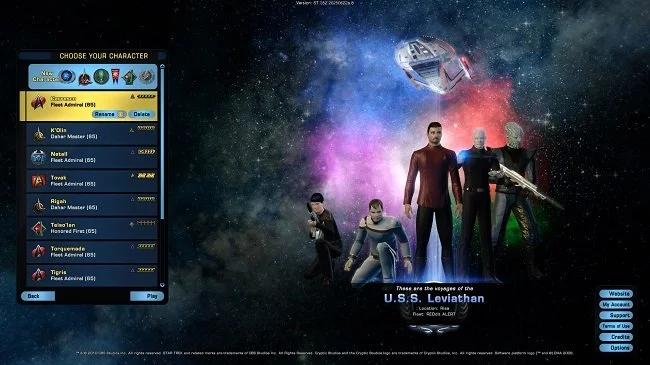
In massively multiplayer online games (MMOs), alts (short for alternate characters), are new characters created by a player in addition to their primary character (often called the “main”). Alts are often encouraged by developers as a means to keep players engaged with their game(s). Sometimes an MMO will actively reward the creation of alts either with access to exclusive content, or with additional skills or items previously unlocked by primary characters. As the myth that an MMO really begins at endgame still persists in gaming culture, some games sell boosts that will instantly raise the level of an alt to that of the current level cap. Creating alts is such a key aspect of the MMO genre, that some games will sell additional character slots, so that players can create further alts beyond the default amount allowed. There are many reasons why players create alts. Let us consider some.
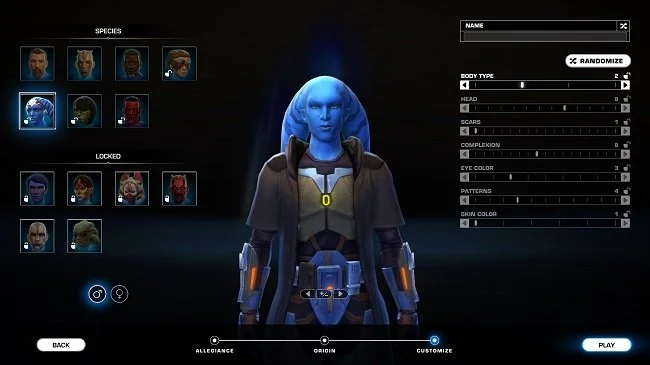
If you’ve ever played an MMORPG, then you have more than likely encountered this problem. Especially if you start playing a game that has been long established. You diligently create your character and spend time and effort customising them to suit your needs. All you’ve got to do next is choose a name, so you type in a pithy and droll title only to find that it has already been taken. So you quickly come up with another and that too is rejected. Next you try the same name but with some “alternative” spelling but the game resolutely tells you that even that permutation is already in use. I have found that even with a list of names that I’ve drawn up prior to playing the game, it can still take anything from 5 to 30 minutes to find one that is available. Naturally, this process is very frustrating, which is hardly the ideal user experience for a new player.

It would appear that one of the reasons potential new players avoid the MMORPG genre is due to the perception that they are all time sinks. I wouldn’t argue against this assumption because the reality is that it’s true. However any game that you enjoy, irrespective of genre, can become a time sink. That being said, the main difference between other genres and MMOs is as follows. A new player can jump straight into a FPS game and within minutes enjoy some multiplayer action, whereas in an MMO, a new player has to play through a tutorial and several hours of a starter zone before they start making headway in the game. This distinction does not have to be a deal breaker. An FPS can provide a quick fix of gaming and as such fulfils a need. MMORPGs can provide long term entertainment which scratches an ongoing gaming itch. Both are valid ways to enjoy gaming.
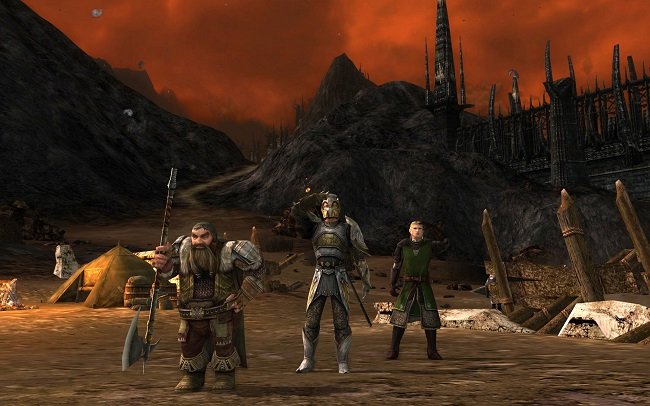
“The MMO genre is rife with its own set of tropes; recurring themes and motifs that have become established and ubiquitous. All of which are ideal material for a hastily produced, lazily conceived, recurring blog post”. One of the integral game mechanics of the MMORPG genre is the acquisition of loot. As you travel your virtual world of choice, committing random murder against all forms of flora and fauna, you acquire miscellaneous items by looting the corpses of the slain or stealing from houses and NPCs. Oh it’s a glamorous genre, the MMORPG. These random items can be crafting resources such as hides or ore. They may be food items or healing potions that provide some kind of statistical buff. If you’re fortunate, they may be gear that corresponds with your class or specific build, providing a much needed upgrade. Loot may also be the in-game currency, thus boosting your respective wealth. As you can see, loot comes in all shapes and sizes but how important is it?
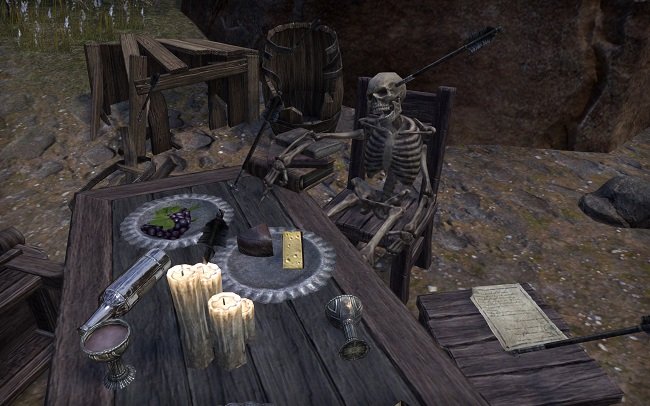
“The MMO genre is rife with its own set of tropes; recurring themes and motifs that have become established and ubiquitous. All of which are ideal material for a hastily produced, lazily conceived, recurring blog post”. Dying in an Massively Multiplayer Online Role-Playing Game is a clear and unambiguous fail state. A means by which to teach the player that they’re doing something wrong and that they need to rethink their strategy. IE Don’t mess with the foul Marmydons unless you have back up and are wielding the Sword of Kagnazax. Dying is a reminder to not get overconfident and maintain situational awareness. It teaches us to ensure you have the right gear and consumables, to be au fait with the mechanics of any fight you’re about to get into and that winning is not a given. Any enterprise that offers a tangible reward will come with potential risks and consequences. If you’re playing in a group then death provides a timely reminder not to rely on Colin.
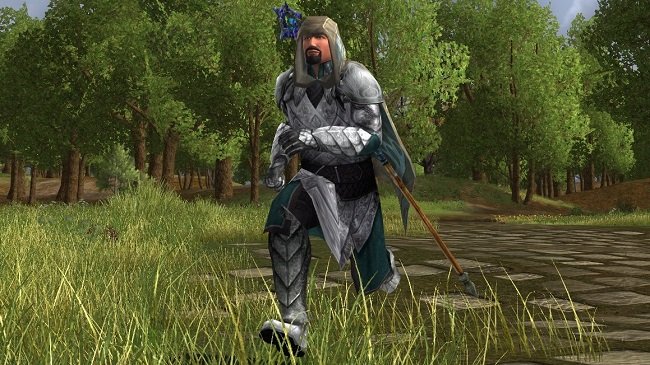
“The MMO genre is rife with its own set of tropes; recurring themes and motifs that have become established and ubiquitous. All of which are ideal material for a hastily produced, lazily conceived, recurring blog post”. I was in London recently, idly walking to the Natural History Museum in South Kensington, when a group of tourists started running for no discernable reason. Someone I was with asked “ I wonder why they’re running” and I replied “perhaps they think they’re in an MMO”. The quips fell on deaf ears but that is a cross I often have to bear. This anecdote highlights one of the points of this post. Namely, why do our avatars in the MMORPG genre run by default? I would also like to discuss the manner in which MMOs address the issue of travel around an ever expanding virtual world. Is fast travel lazy? Our mounts a boon or a bane?
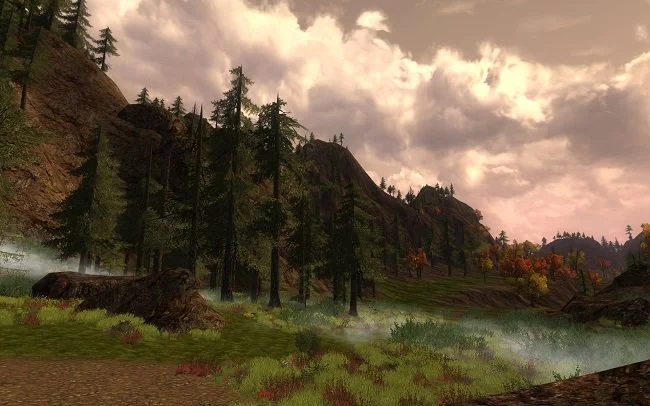
“The MMO genre is rife with its own set of tropes; recurring themes and motifs that have become established and ubiquitous. All of which are ideal material for a hastily produced, lazily conceived, recurring blog post”. Many MMORPGs are set in open worlds that are designed to mimic a real and living reality. Beautiful fantasy or science fiction themed environments, rich with diverse fauna and flora. Settlements are filled with people that go about their daily routine. There is often a day and night cycle and changing weather. All of which is intended to make the game world feel alive. Furthermore, these open worlds become a source of content of their own. Not only do they provide the environment for the various quests and missions that players undertake but a source of exploration and discovery. Something that many players value more than other types of game content.
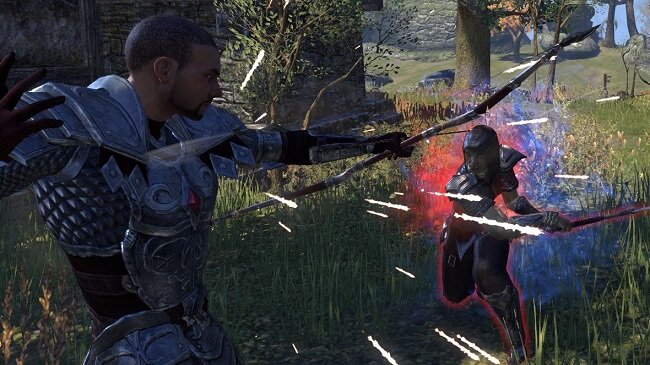
“The MMO genre is rife with its own set of tropes; recurring themes and motifs that have become established and ubiquitous. All of which are ideal material for a hastily produced, lazily conceived, recurring blog post”.
The MMORPG genre is a curious subset of video games. Not only is it predicated on violence against the individual, institutions and “others”, as so many video games are but also species-specific genocide and general mass extinction of fauna and flora. It is easy to understand how this gaming specific trope came about. Early MMOs often had very little or no narrative driven quests and players simply levelled their characters by gaining XP from any sort of combat. Be that against other players, mobs or general in-game wildlife. What is far more perplexing is why such an arbitrary mechanic still persists in the modern MMO. Is it simply due to “laziness” and the fact that it’s easy to implement and rely upon? Or is there more to it than that?
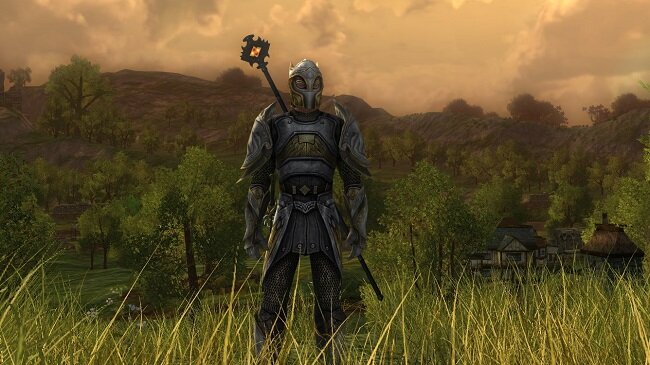
If I may quote myself “The MMO genre is rife with its own set of tropes; recurring themes and motifs that have become established and ubiquitous. All of which are ideal material for a hastily produced, lazily conceived, recurring blog post”. This time round, I would like to discuss the following. The Hero, the Chosen One, the Übermensch. As that is the role that we so often are assigned in this genre. Developers broadly assume that most players want a power fantasy and precious little else is on offer. Hence we find ourselves in a story in which we are destined to do great deeds in a virtual world, whether we wish to or not. I can see the superficial appeal of such a conceit. Most of us are not such overachievers in real life. So a game in which we get to do stuff to the world, instead of the world doing stuff to us has an inherent allure. But like most MMO tropes, unless it is implemented with some panache and creativity, it quickly becomes a tiresome cliche.
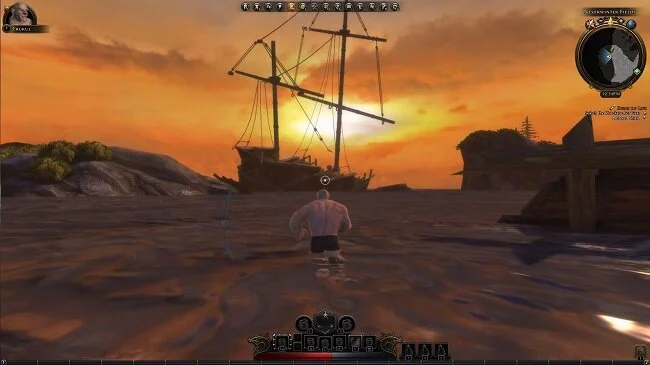
I have played more than “a few” MMORPGs over the years. It’s an enjoyable (and accessible) genre of video games. But like any other type of game, MMOs have a fairly standard formula based on a handful of game mechanics. There is levelling, gaining experience and the acquisition of skills and points. Gear such as armour, jewellery and weapons come and go as you progress through the game. Then there’s crafting, trading and gaining “gold”. Another key aspect is the social dynamic. Often there’s content specifically designed for groups to complete. But this homogeneity also extends beyond the systems that underpin the games. The MMO genre is rife with its own set of tropes; recurring themes and motifs that have become established and ubiquitous. All of which are ideal material for a hastily produced, lazily conceived, recurring blog post.
Navigating in MMORPGs
The Lord of the Rings Online was my first major MMORPG. I started playing in late 2008 and quickly discovered that there was a necessity to become familiar with the game world. Although the game provides quick travel options they were not ubiquitous at that point and often a player would simply travel on foot to travel costs down and to take the most direct route. Back in 2008 you could not own a mount until level 30. Hence I began “learning the maps” in the game and to this day still remember how to travel from one side of Moria, to another. The maps in the base game remain clear in my mind as they were so well trodden. Not so those in the regions. There are far more stables with fast mounts present in the game now and so convenience trumps any requirement to become so familiar with newly added zones. Nowadays Standing Stone Games designs new zones that tend to funnel players through them from quest hub to quest hub.
The Lord of the Rings Online was my first major MMORPG. I started playing in late 2008 and quickly discovered that there was a necessity to become familiar with the game world. Although the game provides quick travel options they were not ubiquitous at that point and often a player would simply travel on foot to travel costs down and to take the most direct route. Back in 2008 you could not own a mount until level 30. Hence I began “learning the maps” in the game and to this day still remember how to travel from one side of Moria, to another. The maps in the base game remain clear in my mind as they were so well trodden. Not so those in the regions. There are far more stables with fast mounts present in the game now and so convenience trumps any requirement to become so familiar with newly added zones. Nowadays Standing Stone Games designs new zones that tend to funnel players through them from quest hub to quest hub.
After considering the wider matter of maps in general in the MMO genre, it seems that most of them seem to be lacking in some fashion. The biggest problem is that traditional in-game maps are two dimensional views of three dimensional environments. LOTRO, Star Wars: The Old Republic and Guild Wars 2 are prime examples of this. Furthermore maps in this genre tend to be initially devoid of specific detail. This is to encourage exploration which then populates a map with NPC, fast travel points, crafting stations etc after they’re discovered. Another issue, especially in fantasy games, is that the maps themselves are designed in a stylised manner and are frequently not accurate in the sense that an Ordnance Survey map is in real life. The Elder Scrolls Online at least addresses the issue of multi-layers maps, allowing players to switch between levels. But it is far from perfect. The MMO does allow you to set a waypoint which can be a godsend.
As maps can prove so “unhelpful”, I find the most practical thing a game can do to help me with navigation is to provide a highly visible landmark which can be used to orientate players. Weathertop is a prime example of this in the Loneland region of LOTRO. The crumbling fortress on the highest hill in the region dominates the map. Having line of sight helps you make quick decisions when travelling and find the direction you need. Guild Wars 2 has gone all in on the concept of verticality and three dimensional environments. Does it make for interesting and complex world design? Yes. But the main problem is you cannot easily set a destination and travel there. As you seldom have any line of sight, often the only way to a location is through trial and error. Usually through “bandit territory”. It is intensely frustrating especially as there is much XP gain to be had via discovery. It makes me miss Neverwinter and its sparkly trails that can optionally lead you to your destination.
Navigating in Star Trek Online is the polar opposite of most other fantasy based MMOs and a very straightforward process. Especially after 2015 when developers Cryptic revised the galaxy map dividing it into four clearly defined quadrants, rather than sectors which were separate instances. The point and click navigation between planetary systems in sector space is simple and easy. If you wish to navigate by hand you can manually fly around at your own leisure. However, until you earn the transwarp travel skill it can take some time to get from one side of the map to another as a low level player. There is no cost associated with travel in STO. Unlike SWTOR which charges the player for the fuel used to travel across space. Both approaches are compliant with their respective lore of each franchise.
I find travelling and exploration a major source of enjoyment in MMOs. If I’m confronted with a blank map, then the first thing I want to do is open it up and see its details. I’ll often go exploring first off, rather than playing through mission or quest content. This isn’t always a shrewd decision as I can find myself in zones I am ill equipped to travel. Bu for me, looking around the game world is part of a game attraction, especially if it has a rich and diverse environment. Sometimes I will log into LOTRO and ride around Middle-earth just for the pleasure of it. Sadly, that is not the case for all MMOs. Take SWTOR, which has some industrial themed, city based maps that are a never ending maze of corridors and walkways. Overall I would like to see more games in the MMO genre having some sort of Grand Tour option or game mechanic. A means for peaceful exploration as an alternative to the usual narrative driven progression.
Two years ago I wrote a post about fine tuning your graphics in the MMORPG The Lord of the Rings Online. Apart from installing ReShade and using AMD Adrenalin, the options were somewhat limited, due to the game’s age and multiplayer status. Since then, I’ve been playing LOTRO with the game settings maxed out, a custom ReShade profile to make the colour palette more vivid and Radeon Image Sharpening enabled within the AMD software. The game looks clear, crisp and the draw distance is pretty good for an ageing game but I still wish the graphics could be tweaked further. Hence, I’ve been trawling the internet in a vain attempt to see if I can find any third party utilities that could be used to enhance LOTRO further. During the course of my search I stumbled across DLSS 5 Manager. This is an open-source, intelligent utility and one-click mod installer designed to inject and manage Nvidia's DLSS 5 neural rendering features, ReShade, and OptiScaler into PC games.
Are video games becoming easier? It’s a perennial subject that is frequently discussed by those who play them. Often the question of whether they have actually become easier is not the focus of the debate, as it seems to be broadly recognised that it is the case. Instead, discussion of this matter tend to drift into the rectitude of this change. Debate’s of this nature are usually awash with subjective opinions and personal preferences which are then put forward as objective facts. It’s not just a question of video games becoming easier, it’s the fact that making them easier is “wrong” and those who want them as such are “not proper gamers” etc. The hours that have been lost to this pointless, tedious debate are uncountable. However, I digress. Let us return to the matter of video games becoming easier, because although fans discuss this a lot and have plenty to say, you don’t often hear from the developers on this subject.
I recently completed the main story in Tainted Grail: The Fall of Avalon. In total I spent about sixty hours playing the game. I began at the start of the year, then took a break for a while but returned to it recently because I wanted to see if I could unlock a specific ending. I did manage to do this. Like so many other RPGs, Tainted Grail: the Fall of Avalon has a central storyline, along with a wealth of side quests, based around factions in specific zones. I think I possibly completed about a two thirds of these. However, once I finished the main story, my interest in the game began to wane. I finally left my character in the last major quest hub in case I wish to return at a future date. I then logged out of the game and uninstalled it from my PC to free up space for whatever I was to play next. In this case its The Sinking City 2. None of this is a negative reflection on Tainted Grail: the Fall of Avalon. I enjoyed the time I spent playing this quirky RPG. I simply had my fill and left to play something else.
The next expansion for the MMORG, The Lord of the Rings Online, was announced on the 1st August, via the gaming website MMORPG.The Wolves of Mordor, which will launch later in the year, appears ambitious in scope as it will include two new game systems as well as the obligatory story update. This expansion takes place in Draugardh located in the North East of Mordor, beyond the Plateau of Gorgoroth. It includes the new zones of Heledhris, Parth Rhavas and Nan Ogol. These vary environmentally ranging from the arid, volcanic and semi-tropical. Players will encounter the Daugrim in these regions, Werewolves but not in the modern sense. This is not the lycanthropy of Eastern European legends but in the established Tolkien idiom of fell spirits inhabiting the bodies of Wolves. The region also sees the return of the Woses and players can expect to encounter Elves and scouts from Gondor. As ever with LOTRO expansions, there will be new instances as well as a raid.
I don’t keep up with gaming news as much as I use to but several noteworthy announcement have come to my attention of late. Firstly, there’s an expansion, Songs of the Past, coming for the Witcher III: Wild Hunt in 2027. No doubt this is to pave the way for the Witcher IV. Next, I also found out about Hand of Fate: Horde. I liked this franchise and was saddened to learn that the original studio, Defiant Development, closed. Hence is was a pleasant surprise to see this new game being developed by members of the original studio. The third announcement was regarding Guild Wars 3. A new MMORPG in active development by a major studio is no small feat and is certainly good news for fans of this franchise and the genre per se. However, once you look beyond this news this announcement raises several questions and has certainly given me pause for thought. Let us take a few moments to consider them.
Star Trek Online has many in-game systems that are common to the MMORPG genre. The reputation system is one such example. In STO there are 13 reputation factions. Once a player has reached level 50 they may start progressing through the 6 reputation tiers of each one. Players gain progression through daily projects (20 hours in duration). Hourly projects are also available though they yield less reputation advancement and are limited to three times a day. Hence 20 hour projects are consider by default the most efficient way to gain rep. Projects require 30 Faction Specific Marks (earned via various activities in-game), 15,000 Energy Credits (standard in-game currency) and 2000 Expertise points. The most efficient way to tackle the reputation grind is to build up the necessary resources in advance and then at a designated time each day, start all 13 respective projects. Upon completion projects yield a player bound lockbox containing a random space or ground weapon, a console or Elite Marks which can be used to acquire faction gear.
I was recently perusing my archive of old blog posts, when it struck me how much I’ve written about the MMORPG genre over the years. Naturally, there was far more material from between 2008 and 2012 as that was period when I immersed myself in the genre and was very enthusiastic about it. I was at a point in my life when I had the time to dedicate to such games and I was happy to participate in the social aspect of they offered. I would regularly play through group content and spend time socialising online with fellow guild members. My experience remains a textbook example of how online games can be more than the sum of their parts and that where you are at in your life has a major impact upon your overall enjoyment. As I read though various old posts it became clear that my experiences where specific to this particular part of my life and that they cannot be repeated. My relationship with the genre is very different now and that’s fine.
Creating alts is an integral aspect of the MMORPG genre. Many players will create a character of a specific class or faction, play it for a while, lose interest in it or they may decide that it is just not for them. Fortunately it is no effort at all to simply re-roll a new alt and set off once again. Furthermore, lots of players never reach level cap of the MMORPG that there playing. When the going get’s tough, so to speak, you can either soldier on for another 50 levels or simply create a new alt and return to the comfort of tried and tested content. Alts also give you the chance to secure an accolade or achievement that you previously missed. They are also of great benefit to the genres social aspects. Creating a new alt so you can play along with a friend who is just starting is great fun. Developer’s love them too as it means you’re still playing the game.
I recently took a break from Crimson Desert choosing instead to to play something familiar and easy going. As I’ve been logging into Star Trek Online daily to participate in the anniversary event, I decided to look through my various alts and see how far they had progressed through the game and what resources they had. At present I have twelve alts. My primary Captain was created in 2015 during the original Delta Recruit Event. I had previously played STO intermittently since its release in January 2010 but I never kept any of those characters. Hence this decade old Tactical Federation Captain has been my main focus when playing. The other eleven alts are the result of other recruitment events or whenever I wanted to try something different, such as playing a specific class or faction. I obviously played a lot of STO during the lockdown as several alts date from that period. Several had maximum reputation across all factions.
13 days after its release, market analysts estimate that Crimson Desert has already earned $200 million across the four main platforms (PC, PlayStation 5, and Xbox Series X and S). The game is certainly proving popular among gamers with the internet awash with live streams and “let’s play” videos. However, reviews are mixed both among gaming journalists and YouTube influencers. Common complaints about the game include that it is slow to start, the controls are poorly laid out on all platforms and that developer’s Pearl Abyss have done a poor job of explaining most aspects of the game to new players. Although such criticisms are true to a degree, I think these complaints highlight how many gamers are conditioned to expect new titles to follow a specific pattern with regard to pacing, narrative exposition and learning in-game systems. A pattern that Pearl Abyss has chosen to ignore, instead favouring an old school approach.
Last night, I spent the first 45 minutes after the launch of Crimson Desert, watching the 92GB pre-downloaded game files slowly decompressing and installing. I finally launched the game at about 10:50 PM GMT. I then waited a further 5 minutes while shaders were downloaded. It took me about 15 minutes or so to read through the various game settings and choose those that are optimal for my PC. I suspect even if you have a beast of a computer, you’re still going to have to spend some time tweaking settings. As for those players like myself with a gaming rig that is somewhere in the middle of the game’s specifications, be prepared to do a lot of fine tuning both within Crimson Desert itself and your Windows settings.
Video games as a genre are extremely poor at explaining themselves. When you buy a new game you’ll often find little or no information regarding the basic systems and mechanics. The industry assumes that their customers are by default familiar with the fundamentals of playing a modern video game. Hence if a game has a tutorial, it is often based around videos rather than detailed verbal instructions. You are are briefly shown a clip of a specific move being successfully undertaken but it is seldom shown in a wider context. The industry also expects the fan community to take on the role of curating and disseminating information about its games. The move away from forums and bespoke websites to Discord highlights this. Discord is a primarily a real time communication tool and not good at maintaining a historical data archive. If you want an answer to a specific gaming question, you’ll more than likely find it on YouTube in a video made by a fellow gamer.
According to the recent “letter to the players”, Standing Stone Games will be adding a new zone to the MMORPG The Lord of the Rings Online in the second quarter of this year. Possibly around May or June. Having spent the last three expansions in the South of Middle-earth exploring the tropical Umbar and the deserts of Harad, I would certainly welcome a change of location. I have gradually warmed to these zones over the last eighteen months but I do find them so incongruous. They are so radically different to the European style content that has been the mainstay of the game for so long. Tolkien’s source text has plenty of detail regarding Eriador and Rhovanion. Information regarding Harad is scarce, hence it has afforded the developers a great deal of artistic freedom. Although exceedingly well realised these tropical zones have taken a while for me to get used to.
I’m not sure exactly when it started but I’ve recently noticed a graphical bug within the MMORPG The Lord of the Rings Online. This problem often occurs within caves or in areas where there are a lot of rocky surfaces. Hence it has become very apparent in the latest two expansions, set in Umbar and Harad. This graphical glitch causes some surface textures to appear to flash from light to dark intermittently. The resulting strobe effect is hard to ignore and very distracting. Fortunately, a quick online search showed that this is not a problem unique to my installation of LOTRO and is a known problem. Furthermore, there is a very simple workaround, which is to go into the Advanced Graphics setting and uncheck “Per Pixel Lighting”, which immediately remedies the problem. I have no idea why this has recently started to happen but at least it can be resolved.
This year is the 60th anniversary of Star Trek. The original TV show was first broadcast in the US on September 8th 1966. If you search online you’ll find details of lots of related events. There are documentaries, conventions, new TV shows and even some video games in development. However, what you won’t find are any details regarding what will be happening with the MMORPG Star Trek Online. So far no road map for 2026 has been posted online by the developers but it is still quite early in the New Year. That being the case, I am not especially optimistic about there being any major plans waiting to be revealed. It is not as if DECA Games have demonstrated or stated any major ambitions for STO beyond keeping the endless events treadmill going and regularly adding content to the in-game store, during their development tenure. The ongoing story arc drags on inexorably and is as dull as ditchwater.
The latest expansion for the MMORPG The Lord of the Rings Online, Kingdoms of Harad, launched on December 3rd. With this release the level cap was raised from 150 to 160. It should also be noted that the cap for virtue traits was also raised from 96 to 100. Naturally these changes meant that there is a requirement to replace all armour and jewellery once the new cap is reached. Similarly Legendary Items have to be reforged and any traceries upgraded or replaced. If you follow the Epic Story it will lead you from quest hub to quest hub. The main quest rewards, along with those from side quests will provide adequate gear as you slowly progress towards the new level cap. The new raids, instances and missions/delvings then provide a means to acquire higher quality level 160 gear. LOTRO and indeed, many other MMOs are consistent in this methodology.
It is customary in a post such as this to list the various games that I’ve played over the last twelve months and share my thoughts on them. Wider analysis of the video game industry is also de rigeur. Unfortunately, I don’t really feel disposed to do either of those two things. My thoughts on the games I’ve played have already been published and can easily be accessed via the links at the bottom of this post. As for the video game industry, it suffers the same flaws as music, TV and cinema. There is creativity and innovation out there but it is often drowned out by mainstream products which are demonstrably inferior due to their inherent mediocrity. As for the business side of things, we once again clearly see the failings of the corporate management class. Sadly, they do not face the consequences of the mistakes that they make.
Today Standing Stone Games began beta testing Update 46.1 for the MMORPG The Lord of the Rings Online. The current preview on the Bullroarer test server is mainly for the new instance cluster that comes with the Kingdoms of Harad expansion which launched a few weeks ago. However, it would appear that this latest preview has another feature or note. One that should please LOTRO players. Contrary to what a lot of people thought, myself included, SSG have been working on a scaling UI for 2K and 4K monitors and the results are now available for testing from today Monday 15th through to Friday 19th December. Until now the main workaround to the lack of UI scaling has been to use either Nvidia or AMD graphics software to upscale the game from 1920 x 1080, or a third party app such as LosslessScaling. Having an official solution is a far better option.
Kingdoms of Harad, the 13th expansion for the MMORPG The Lord of the Rings Online, was released today. Highlighting developer’s Standing Stone Games continuing commitment to this eighteen year old game. As 2025 draws to a close, I thought it would be prudent to reflect upon the current state of LOTRO and to consider what may come next year. Two words that I associated with this MMO are stable and consistent. The playerbase is loyal and dependable. Player numbers never greatly decline nor do they notably expand. LOTRO fills a very specific gaming niche and one of the reasons it retains its players is that there is no suitable alternative game. Although there is not a great deal of data in the public domain, it is generally accepted that LOTRO has an older player demographic and that many are consummate Tolkien fans.
The MMORPG The Lord of the Rings Online runs on a broad spectrum of PCs. From archaic laptops to high end gaming rigs, although it may require a bit of tweaking. At present, the optimal way to play the MMO is at a resolution of 1920x1080 (FHD) with the graphics setting maxed out. The graphics are sharp and the UI is readable. However, a growing number of gamers are now using 2K and 4K monitors. You can play LOTRO at higher resolutions such as 2560×1440 (QHD) and 3840x2160 (UHD) and the game looks great. However, the UI does not scale and so is very small on 2K and 4K monitors. The skill icons on the quickslots (shortcut bars) and the in-game text become difficult to see at these resolutions, which deters some players from using them. It is a known issue that Standing Stone Games are attempting to address but it is unlikely to be resolved any time soon.
I recently read a post on Massively Overpowered about skills rotation in the MMORPG genre. I found the subsequent discussion in the comments fascinating. Mainly because I have never used a fixed rotation of skills in any of the MMORPGs that I play. I understand the reasoning behind such things and why some players want to optimise their combat performance. Using one’s skills in a specific order to maximise damage and manage their subsequent cooldown has a logical appeal. In Star Trek Online, some players go so far as to create keybinds for their rotations and assign it to a specific hotkey, which is then continuously pressed throughout combat. However, rotations are a blunt tool that lack flexibility, often being geared towards dealing with a single target or using an area of effect skill against a larger group. They may not be the optimal approach to combat when things do not go to plan.
Tolkien enthusiasts may recollect Athlon Games, a subsidiary of Leyou Technologies, announcing that it was developing a new MMORPG, based upon The Lord of the Rings, back in September 2018. The following summer, it was revealed that Amazon Game Studios was the partner developer for the project. In late 2020, Leyou Technologies (a Hong Kong-based company), was acquired by the Chinese conglomerate Tencent. This triggered a contract clause with the license holder, Middle-earth Enterprises, allowing them to terminate the existing arrangement if a new deal could not be met. Amazon and Tencent were unable to agree upon how to proceed with the project, leading Amazon to withdraw from negotiations. The project was subsequently scrapped. No details or images of the MMO have been released.
After a six month migration period, Standing Stone Games formally closed all their legacy 32-bit game servers for the MMORPG, The Lord of the Rings Online, on the 31st August 2025. Despite this planned closure being widely discussed via the game’s official forums, professional video game websites and fan blogs, many LOTRO players were unaware of this deadline. Hence many were unable to migrate their respective alts to the new 64-bit servers. Naturally those affected by these closures were upset, especially those with longstanding characters who didn’t relish the prospect of starting from scratch with a new alt. Thankfully, SSG have been true to their word and as of today, have re-opened these “dark worlds” to character transfers. If you have an alt trapped on one of the older game worlds, then now is the time to use the transfer wizard and move them to a new active game world.
MMORPG announced earlier today and it was subsequently confirmed by Standing Stone games, that the new expansion for The Lord of the Rings Online will be Kingdoms of Harad and that it will launch later in the year. The expansion will see the conclusion of the epic Song of Waves and Wind storyline and the level cap raised from 150 to 160. There will be a new region to explore, Mûr Ghala, comprising four zones. Adagîm, Idagâl, An Shêru and Kighân. The latter contains the main trading hub of Zajâna. Players will travel into the region with Gandalf the White, along with allies of the Kindred of Coins and Mizadi as they seek to counter the regional power struggle brought about by the fall of Sauron. Canonically, this takes place three months after the destruction of the ring, hence King Elessar and Eomer are busy with domestic affairs in their respective kingdoms.
Skirmishes were added to the MMORPG The Lord of the Rings Online, in 2009 with the release of the Siege of Mirkwood expansion. Skirmishes are a repeatable and scalable combat system that allows players to access various instances for solo or group play from anywhere in the in-game world. Players can choose a Skirmish Soldier from a variety of classes to accompany them and provide healing, tank or additional DPS. On paper it’s a great system which is why many other MMOs offer something similar. I recently decided to tinker with my Skirmish Soldier build on my main character to see if I could optimise their performance. As my primary alt is a Lore-master, for the last few years I have had a Warrior as their Skirmish Soldier, to take some of the aggro from attacking mobs. I used the excellent guide by FibroJedi and swapped over a few Training and Personal Traits.
On 2nd August 2025, I was playing the MMORPG The Lord of the Rings Online, on my primary character, a level cap Lore-master. I decided to continue with one of the Allegiance Quest lines, specifically Durin’s Folk. I played through several quests and earned the appropriate tokens that advance the Allegiance system. I then handed these in to the NPC in the Hall Under the Mountain, expecting the next quest in the series “Chapter 3: Gimli’s Request” to be unlocked. An item appeared in my inventory that I then clicked on, which should have bestowed the quest. Unfortunately, nothing happened. Furthermore, the item vanished from my bag and therefore I could not attempt to click it again. I checked the LOTRO Wiki and then looked around the Hall Under the Mountain to see if any NPC had a ring icon above their head. As they did not, I surmised that this was a software glitch and logged a support ticket with Standing Stone Games.
If you check the Star Trek Online Wiki, you’ll find that there has been a steady stream of new content added to the MMORPG over the last 15 years. However, it doesn’t quite feel that way, mainly because more recent material seems weaker and less memorable. The last two major story arcs in STO have been somewhat lacklustre and demonstrably inferior to those that went before. Both Terran Gambit and Kings & Queens suffer from uninspired, repetitive ideas as well as an infrequent release schedule. Effectively weak stories have been dragged out over too much time. No doubt changes among the STO writing team have had an impact on content but it also seems that some of the newer stories have been tailored around whatever former Star Trek cast members that are available. As a result there has been a somewhat “square pegs in a round holes” aspect to both story arcs, where the pieces just don’t seem to fit together well.
Let’s start with a quote from a classic Walter Hill film, The Warriors. “Can you count, suckers?” says Sirus. The gang leader was referring to the number of Police in New York City at the time. Whereas, for the purpose of this post, I am referencing how many Delving Writs a player needs to acquire 6 pieces of level cap armour in LOTRO. Because, next to the gear you get from endgame instances and raids, Delving gear is a good alternative.. It is marginally better than the items you can get from lootboxes. Hence, Delving armour is a good source of high end gear for the solo player. Through the miracle of mathematics, the number of Delving writs required to acquire a full set of this armour is 9,000. At first glance, that seems like a lot. If you then do some further research to put the number in context, you realise it is indeed a lot and a substantial undertaking.
Playing MMOs Solo
There was a perennial question being discussed over at Massively Overpowered recently. Justin Olivetti asked “why do you play MMOs solo” and as you would expect, there was a wide variety of answers. I have written about this myself in the past, as when I first started playing MMOs, I was very enamoured by the social element and therefore very disposed towards group content. However, that experience between 2008 and 2011, when I played The Lord of the Rings Online most days and dedicated Friday and Saturday nights to raiding, was very much down to circumstances. I had the time and inclination to spend hours online. That is something that I don’t have now. Plus the novelty of the social element has worn a little thin over the years. Nowadays, I do not have the luxury of waiting for a raid group to assemble, nor do I have the tolerance for the inevitable delays that always stem from any kind of human interaction.
It’s just me versus Middle-earth
There was a perennial question being discussed over at Massively Overpowered recently. Justin Olivetti asked “why do you play MMOs solo” and as you would expect, there was a wide variety of answers. I have written about this myself in the past, as when I first started playing MMOs, I was very enamoured by the social element and therefore very disposed towards group content. However, that experience between 2008 and 2011, when I played The Lord of the Rings Online most days and dedicated Friday and Saturday nights to raiding, was very much down to circumstances. I had the time and inclination to spend hours online. That is something that I don’t have now. Plus the novelty of the social element has worn a little thin over the years. Nowadays, I do not have the luxury of waiting for a raid group to assemble, nor do I have the tolerance for the inevitable delays that always stem from any kind of human interaction.
Hence the primary reason I play MMOs solo is simply to be able to progress at my own pace and not having to be dependent on others in any other way, shape or form. The advantages are obvious, as are the disadvantages. I may well be able to clear through PVE content, level efficiently and manage my gear progression, but I also miss a substantial part of the game. I haven’t participated in any major group content in LOTRO for over a decade. The last raid I did was Draigoch’s Lair in 2011. But that is the price you pay for solo gameplay. By playing on my own I get to use my time efficiently. Raiding is a long, drawn out process that doesn’t come with any guarantees. It is this aspect of MMOs that bothers me. If I invest my time into something, I want to walk away with some sort of reward. Raids do not always hand out loot in an equitable fashion. Playing through PVE content on your own gives you clear and achievable goals.
“Can you tell me where Bagel Street is?”
At present I play four MMOs. In LOTRO I have been in the same guild (or Kinship as it’s known in this game) since 2009. I know many of the other members and it is still active but certainly not to the degree it was a decade ago. In Star Trek Online I have my various alts in the respective Reddit based Fleets (guilds) such as Reddit Alert. I will chat with other members but I don't really know anyone nor ever group with them to play through content. I am in the Fleet simply for the benefits of accessing Fleet resources. which are mainly gear based in STO. With regard to Star Wars The Old Republic, I am in a guild which I created myself. This was mainly to stop me from getting swamped by guild invites from other players when the game first launched. It has two active members, myself and podcast co-host Brian. Beyond having a novelty name (Shaved Wookies) it serves no purpose. Due to my intermittent playing of The Elder Scrolls Online I see no reason to join a guild in that game.
The most social interaction I have in an MMORPG at present is in STO. Task Force Operations are five man missions which last between 5 and 15 minutes depending on the ability of the group. When selecting the TFO of your choice you are then auto-grouped and ported immediately to the appropriate instance. More often than not there is no communication between players in Team Chat. Sometimes players will deliberately go AFK and wait just to get the TFO reward. Every now and then someone will say “hi” to the group. On other occasions someone will try and give instructions but that seldom goes well. But such is the state of solo gameplay in most MMOs. You only talk and group with people if you want to and if there’s no compelling reason, then you don’t. Any game where your progress is dependent upon others is a game that I’ll more than likely not play.
Two years ago I wrote a post about fine tuning your graphics in the MMORPG The Lord of the Rings Online. Apart from installing ReShade and using AMD Adrenalin, the options were somewhat limited, due to the game’s age and multiplayer status. Since then, I’ve been playing LOTRO with the game settings maxed out, a custom ReShade profile to make the colour palette more vivid and Radeon Image Sharpening enabled within the AMD software. The game looks clear, crisp and the draw distance is pretty good for an ageing game but I still wish the graphics could be tweaked further. Hence, I’ve been trawling the internet in a vain attempt to see if I can find any third party utilities that could be used to enhance LOTRO further. During the course of my search I stumbled across DLSS 5 Manager. This is an open-source, intelligent utility and one-click mod installer designed to inject and manage Nvidia's DLSS 5 neural rendering features, ReShade, and OptiScaler into PC games.
Are video games becoming easier? It’s a perennial subject that is frequently discussed by those who play them. Often the question of whether they have actually become easier is not the focus of the debate, as it seems to be broadly recognised that it is the case. Instead, discussion of this matter tend to drift into the rectitude of this change. Debate’s of this nature are usually awash with subjective opinions and personal preferences which are then put forward as objective facts. It’s not just a question of video games becoming easier, it’s the fact that making them easier is “wrong” and those who want them as such are “not proper gamers” etc. The hours that have been lost to this pointless, tedious debate are uncountable. However, I digress. Let us return to the matter of video games becoming easier, because although fans discuss this a lot and have plenty to say, you don’t often hear from the developers on this subject.
I recently completed the main story in Tainted Grail: The Fall of Avalon. In total I spent about sixty hours playing the game. I began at the start of the year, then took a break for a while but returned to it recently because I wanted to see if I could unlock a specific ending. I did manage to do this. Like so many other RPGs, Tainted Grail: the Fall of Avalon has a central storyline, along with a wealth of side quests, based around factions in specific zones. I think I possibly completed about a two thirds of these. However, once I finished the main story, my interest in the game began to wane. I finally left my character in the last major quest hub in case I wish to return at a future date. I then logged out of the game and uninstalled it from my PC to free up space for whatever I was to play next. In this case its The Sinking City 2. None of this is a negative reflection on Tainted Grail: the Fall of Avalon. I enjoyed the time I spent playing this quirky RPG. I simply had my fill and left to play something else.
The next expansion for the MMORG, The Lord of the Rings Online, was announced on the 1st August, via the gaming website MMORPG.The Wolves of Mordor, which will launch later in the year, appears ambitious in scope as it will include two new game systems as well as the obligatory story update. This expansion takes place in Draugardh located in the North East of Mordor, beyond the Plateau of Gorgoroth. It includes the new zones of Heledhris, Parth Rhavas and Nan Ogol. These vary environmentally ranging from the arid, volcanic and semi-tropical. Players will encounter the Daugrim in these regions, Werewolves but not in the modern sense. This is not the lycanthropy of Eastern European legends but in the established Tolkien idiom of fell spirits inhabiting the bodies of Wolves. The region also sees the return of the Woses and players can expect to encounter Elves and scouts from Gondor. As ever with LOTRO expansions, there will be new instances as well as a raid.
I don’t keep up with gaming news as much as I use to but several noteworthy announcement have come to my attention of late. Firstly, there’s an expansion, Songs of the Past, coming for the Witcher III: Wild Hunt in 2027. No doubt this is to pave the way for the Witcher IV. Next, I also found out about Hand of Fate: Horde. I liked this franchise and was saddened to learn that the original studio, Defiant Development, closed. Hence is was a pleasant surprise to see this new game being developed by members of the original studio. The third announcement was regarding Guild Wars 3. A new MMORPG in active development by a major studio is no small feat and is certainly good news for fans of this franchise and the genre per se. However, once you look beyond this news this announcement raises several questions and has certainly given me pause for thought. Let us take a few moments to consider them.
Star Trek Online has many in-game systems that are common to the MMORPG genre. The reputation system is one such example. In STO there are 13 reputation factions. Once a player has reached level 50 they may start progressing through the 6 reputation tiers of each one. Players gain progression through daily projects (20 hours in duration). Hourly projects are also available though they yield less reputation advancement and are limited to three times a day. Hence 20 hour projects are consider by default the most efficient way to gain rep. Projects require 30 Faction Specific Marks (earned via various activities in-game), 15,000 Energy Credits (standard in-game currency) and 2000 Expertise points. The most efficient way to tackle the reputation grind is to build up the necessary resources in advance and then at a designated time each day, start all 13 respective projects. Upon completion projects yield a player bound lockbox containing a random space or ground weapon, a console or Elite Marks which can be used to acquire faction gear.
I was recently perusing my archive of old blog posts, when it struck me how much I’ve written about the MMORPG genre over the years. Naturally, there was far more material from between 2008 and 2012 as that was period when I immersed myself in the genre and was very enthusiastic about it. I was at a point in my life when I had the time to dedicate to such games and I was happy to participate in the social aspect of they offered. I would regularly play through group content and spend time socialising online with fellow guild members. My experience remains a textbook example of how online games can be more than the sum of their parts and that where you are at in your life has a major impact upon your overall enjoyment. As I read though various old posts it became clear that my experiences where specific to this particular part of my life and that they cannot be repeated. My relationship with the genre is very different now and that’s fine.
Creating alts is an integral aspect of the MMORPG genre. Many players will create a character of a specific class or faction, play it for a while, lose interest in it or they may decide that it is just not for them. Fortunately it is no effort at all to simply re-roll a new alt and set off once again. Furthermore, lots of players never reach level cap of the MMORPG that there playing. When the going get’s tough, so to speak, you can either soldier on for another 50 levels or simply create a new alt and return to the comfort of tried and tested content. Alts also give you the chance to secure an accolade or achievement that you previously missed. They are also of great benefit to the genres social aspects. Creating a new alt so you can play along with a friend who is just starting is great fun. Developer’s love them too as it means you’re still playing the game.
I recently took a break from Crimson Desert choosing instead to to play something familiar and easy going. As I’ve been logging into Star Trek Online daily to participate in the anniversary event, I decided to look through my various alts and see how far they had progressed through the game and what resources they had. At present I have twelve alts. My primary Captain was created in 2015 during the original Delta Recruit Event. I had previously played STO intermittently since its release in January 2010 but I never kept any of those characters. Hence this decade old Tactical Federation Captain has been my main focus when playing. The other eleven alts are the result of other recruitment events or whenever I wanted to try something different, such as playing a specific class or faction. I obviously played a lot of STO during the lockdown as several alts date from that period. Several had maximum reputation across all factions.
13 days after its release, market analysts estimate that Crimson Desert has already earned $200 million across the four main platforms (PC, PlayStation 5, and Xbox Series X and S). The game is certainly proving popular among gamers with the internet awash with live streams and “let’s play” videos. However, reviews are mixed both among gaming journalists and YouTube influencers. Common complaints about the game include that it is slow to start, the controls are poorly laid out on all platforms and that developer’s Pearl Abyss have done a poor job of explaining most aspects of the game to new players. Although such criticisms are true to a degree, I think these complaints highlight how many gamers are conditioned to expect new titles to follow a specific pattern with regard to pacing, narrative exposition and learning in-game systems. A pattern that Pearl Abyss has chosen to ignore, instead favouring an old school approach.
Last night, I spent the first 45 minutes after the launch of Crimson Desert, watching the 92GB pre-downloaded game files slowly decompressing and installing. I finally launched the game at about 10:50 PM GMT. I then waited a further 5 minutes while shaders were downloaded. It took me about 15 minutes or so to read through the various game settings and choose those that are optimal for my PC. I suspect even if you have a beast of a computer, you’re still going to have to spend some time tweaking settings. As for those players like myself with a gaming rig that is somewhere in the middle of the game’s specifications, be prepared to do a lot of fine tuning both within Crimson Desert itself and your Windows settings.
Video games as a genre are extremely poor at explaining themselves. When you buy a new game you’ll often find little or no information regarding the basic systems and mechanics. The industry assumes that their customers are by default familiar with the fundamentals of playing a modern video game. Hence if a game has a tutorial, it is often based around videos rather than detailed verbal instructions. You are are briefly shown a clip of a specific move being successfully undertaken but it is seldom shown in a wider context. The industry also expects the fan community to take on the role of curating and disseminating information about its games. The move away from forums and bespoke websites to Discord highlights this. Discord is a primarily a real time communication tool and not good at maintaining a historical data archive. If you want an answer to a specific gaming question, you’ll more than likely find it on YouTube in a video made by a fellow gamer.
According to the recent “letter to the players”, Standing Stone Games will be adding a new zone to the MMORPG The Lord of the Rings Online in the second quarter of this year. Possibly around May or June. Having spent the last three expansions in the South of Middle-earth exploring the tropical Umbar and the deserts of Harad, I would certainly welcome a change of location. I have gradually warmed to these zones over the last eighteen months but I do find them so incongruous. They are so radically different to the European style content that has been the mainstay of the game for so long. Tolkien’s source text has plenty of detail regarding Eriador and Rhovanion. Information regarding Harad is scarce, hence it has afforded the developers a great deal of artistic freedom. Although exceedingly well realised these tropical zones have taken a while for me to get used to.
I’m not sure exactly when it started but I’ve recently noticed a graphical bug within the MMORPG The Lord of the Rings Online. This problem often occurs within caves or in areas where there are a lot of rocky surfaces. Hence it has become very apparent in the latest two expansions, set in Umbar and Harad. This graphical glitch causes some surface textures to appear to flash from light to dark intermittently. The resulting strobe effect is hard to ignore and very distracting. Fortunately, a quick online search showed that this is not a problem unique to my installation of LOTRO and is a known problem. Furthermore, there is a very simple workaround, which is to go into the Advanced Graphics setting and uncheck “Per Pixel Lighting”, which immediately remedies the problem. I have no idea why this has recently started to happen but at least it can be resolved.
This year is the 60th anniversary of Star Trek. The original TV show was first broadcast in the US on September 8th 1966. If you search online you’ll find details of lots of related events. There are documentaries, conventions, new TV shows and even some video games in development. However, what you won’t find are any details regarding what will be happening with the MMORPG Star Trek Online. So far no road map for 2026 has been posted online by the developers but it is still quite early in the New Year. That being the case, I am not especially optimistic about there being any major plans waiting to be revealed. It is not as if DECA Games have demonstrated or stated any major ambitions for STO beyond keeping the endless events treadmill going and regularly adding content to the in-game store, during their development tenure. The ongoing story arc drags on inexorably and is as dull as ditchwater.
The latest expansion for the MMORPG The Lord of the Rings Online, Kingdoms of Harad, launched on December 3rd. With this release the level cap was raised from 150 to 160. It should also be noted that the cap for virtue traits was also raised from 96 to 100. Naturally these changes meant that there is a requirement to replace all armour and jewellery once the new cap is reached. Similarly Legendary Items have to be reforged and any traceries upgraded or replaced. If you follow the Epic Story it will lead you from quest hub to quest hub. The main quest rewards, along with those from side quests will provide adequate gear as you slowly progress towards the new level cap. The new raids, instances and missions/delvings then provide a means to acquire higher quality level 160 gear. LOTRO and indeed, many other MMOs are consistent in this methodology.
It is customary in a post such as this to list the various games that I’ve played over the last twelve months and share my thoughts on them. Wider analysis of the video game industry is also de rigeur. Unfortunately, I don’t really feel disposed to do either of those two things. My thoughts on the games I’ve played have already been published and can easily be accessed via the links at the bottom of this post. As for the video game industry, it suffers the same flaws as music, TV and cinema. There is creativity and innovation out there but it is often drowned out by mainstream products which are demonstrably inferior due to their inherent mediocrity. As for the business side of things, we once again clearly see the failings of the corporate management class. Sadly, they do not face the consequences of the mistakes that they make.
Today Standing Stone Games began beta testing Update 46.1 for the MMORPG The Lord of the Rings Online. The current preview on the Bullroarer test server is mainly for the new instance cluster that comes with the Kingdoms of Harad expansion which launched a few weeks ago. However, it would appear that this latest preview has another feature or note. One that should please LOTRO players. Contrary to what a lot of people thought, myself included, SSG have been working on a scaling UI for 2K and 4K monitors and the results are now available for testing from today Monday 15th through to Friday 19th December. Until now the main workaround to the lack of UI scaling has been to use either Nvidia or AMD graphics software to upscale the game from 1920 x 1080, or a third party app such as LosslessScaling. Having an official solution is a far better option.
Kingdoms of Harad, the 13th expansion for the MMORPG The Lord of the Rings Online, was released today. Highlighting developer’s Standing Stone Games continuing commitment to this eighteen year old game. As 2025 draws to a close, I thought it would be prudent to reflect upon the current state of LOTRO and to consider what may come next year. Two words that I associated with this MMO are stable and consistent. The playerbase is loyal and dependable. Player numbers never greatly decline nor do they notably expand. LOTRO fills a very specific gaming niche and one of the reasons it retains its players is that there is no suitable alternative game. Although there is not a great deal of data in the public domain, it is generally accepted that LOTRO has an older player demographic and that many are consummate Tolkien fans.
The MMORPG The Lord of the Rings Online runs on a broad spectrum of PCs. From archaic laptops to high end gaming rigs, although it may require a bit of tweaking. At present, the optimal way to play the MMO is at a resolution of 1920x1080 (FHD) with the graphics setting maxed out. The graphics are sharp and the UI is readable. However, a growing number of gamers are now using 2K and 4K monitors. You can play LOTRO at higher resolutions such as 2560×1440 (QHD) and 3840x2160 (UHD) and the game looks great. However, the UI does not scale and so is very small on 2K and 4K monitors. The skill icons on the quickslots (shortcut bars) and the in-game text become difficult to see at these resolutions, which deters some players from using them. It is a known issue that Standing Stone Games are attempting to address but it is unlikely to be resolved any time soon.
I recently read a post on Massively Overpowered about skills rotation in the MMORPG genre. I found the subsequent discussion in the comments fascinating. Mainly because I have never used a fixed rotation of skills in any of the MMORPGs that I play. I understand the reasoning behind such things and why some players want to optimise their combat performance. Using one’s skills in a specific order to maximise damage and manage their subsequent cooldown has a logical appeal. In Star Trek Online, some players go so far as to create keybinds for their rotations and assign it to a specific hotkey, which is then continuously pressed throughout combat. However, rotations are a blunt tool that lack flexibility, often being geared towards dealing with a single target or using an area of effect skill against a larger group. They may not be the optimal approach to combat when things do not go to plan.
Tolkien enthusiasts may recollect Athlon Games, a subsidiary of Leyou Technologies, announcing that it was developing a new MMORPG, based upon The Lord of the Rings, back in September 2018. The following summer, it was revealed that Amazon Game Studios was the partner developer for the project. In late 2020, Leyou Technologies (a Hong Kong-based company), was acquired by the Chinese conglomerate Tencent. This triggered a contract clause with the license holder, Middle-earth Enterprises, allowing them to terminate the existing arrangement if a new deal could not be met. Amazon and Tencent were unable to agree upon how to proceed with the project, leading Amazon to withdraw from negotiations. The project was subsequently scrapped. No details or images of the MMO have been released.
After a six month migration period, Standing Stone Games formally closed all their legacy 32-bit game servers for the MMORPG, The Lord of the Rings Online, on the 31st August 2025. Despite this planned closure being widely discussed via the game’s official forums, professional video game websites and fan blogs, many LOTRO players were unaware of this deadline. Hence many were unable to migrate their respective alts to the new 64-bit servers. Naturally those affected by these closures were upset, especially those with longstanding characters who didn’t relish the prospect of starting from scratch with a new alt. Thankfully, SSG have been true to their word and as of today, have re-opened these “dark worlds” to character transfers. If you have an alt trapped on one of the older game worlds, then now is the time to use the transfer wizard and move them to a new active game world.
MMORPG announced earlier today and it was subsequently confirmed by Standing Stone games, that the new expansion for The Lord of the Rings Online will be Kingdoms of Harad and that it will launch later in the year. The expansion will see the conclusion of the epic Song of Waves and Wind storyline and the level cap raised from 150 to 160. There will be a new region to explore, Mûr Ghala, comprising four zones. Adagîm, Idagâl, An Shêru and Kighân. The latter contains the main trading hub of Zajâna. Players will travel into the region with Gandalf the White, along with allies of the Kindred of Coins and Mizadi as they seek to counter the regional power struggle brought about by the fall of Sauron. Canonically, this takes place three months after the destruction of the ring, hence King Elessar and Eomer are busy with domestic affairs in their respective kingdoms.
Skirmishes were added to the MMORPG The Lord of the Rings Online, in 2009 with the release of the Siege of Mirkwood expansion. Skirmishes are a repeatable and scalable combat system that allows players to access various instances for solo or group play from anywhere in the in-game world. Players can choose a Skirmish Soldier from a variety of classes to accompany them and provide healing, tank or additional DPS. On paper it’s a great system which is why many other MMOs offer something similar. I recently decided to tinker with my Skirmish Soldier build on my main character to see if I could optimise their performance. As my primary alt is a Lore-master, for the last few years I have had a Warrior as their Skirmish Soldier, to take some of the aggro from attacking mobs. I used the excellent guide by FibroJedi and swapped over a few Training and Personal Traits.
On 2nd August 2025, I was playing the MMORPG The Lord of the Rings Online, on my primary character, a level cap Lore-master. I decided to continue with one of the Allegiance Quest lines, specifically Durin’s Folk. I played through several quests and earned the appropriate tokens that advance the Allegiance system. I then handed these in to the NPC in the Hall Under the Mountain, expecting the next quest in the series “Chapter 3: Gimli’s Request” to be unlocked. An item appeared in my inventory that I then clicked on, which should have bestowed the quest. Unfortunately, nothing happened. Furthermore, the item vanished from my bag and therefore I could not attempt to click it again. I checked the LOTRO Wiki and then looked around the Hall Under the Mountain to see if any NPC had a ring icon above their head. As they did not, I surmised that this was a software glitch and logged a support ticket with Standing Stone Games.
If you check the Star Trek Online Wiki, you’ll find that there has been a steady stream of new content added to the MMORPG over the last 15 years. However, it doesn’t quite feel that way, mainly because more recent material seems weaker and less memorable. The last two major story arcs in STO have been somewhat lacklustre and demonstrably inferior to those that went before. Both Terran Gambit and Kings & Queens suffer from uninspired, repetitive ideas as well as an infrequent release schedule. Effectively weak stories have been dragged out over too much time. No doubt changes among the STO writing team have had an impact on content but it also seems that some of the newer stories have been tailored around whatever former Star Trek cast members that are available. As a result there has been a somewhat “square pegs in a round holes” aspect to both story arcs, where the pieces just don’t seem to fit together well.
Let’s start with a quote from a classic Walter Hill film, The Warriors. “Can you count, suckers?” says Sirus. The gang leader was referring to the number of Police in New York City at the time. Whereas, for the purpose of this post, I am referencing how many Delving Writs a player needs to acquire 6 pieces of level cap armour in LOTRO. Because, next to the gear you get from endgame instances and raids, Delving gear is a good alternative.. It is marginally better than the items you can get from lootboxes. Hence, Delving armour is a good source of high end gear for the solo player. Through the miracle of mathematics, the number of Delving writs required to acquire a full set of this armour is 9,000. At first glance, that seems like a lot. If you then do some further research to put the number in context, you realise it is indeed a lot and a substantial undertaking.
Auto-manage
I’m sure I’ve mentioned this issue before in previous video game related posts. But I don’t think I’ve devoted an entire article to the matter, which is what I’m going to do today. So to provide some context, I logged into The Elder Scrolls Online today as I’m fast approaching that point in the year where I spend a few months subscribing to the game. Due to some recent patch, once again all my Champion Points have been refunded. Judging by the change in graphics, it may be that the entire Champion Point system has been updated. Whatever the reason, I have to re-allocate 501points into three skill trees. I wasn’t au fait with the last system, so I followed a build I found online. Now that it has changed, I’ll have to find a new one and copy it. Until I do, my character will be gimped. Shame the game doesn’t offer a selection of generic builds that can be easily implemented at the press of a button.
I’m sure I’ve mentioned this issue before in previous video game related posts. But I don’t think I’ve devoted an entire article to the matter, which is what I’m going to do today. So to provide some context, I logged into The Elder Scrolls Online today as I’m fast approaching that point in the year where I spend a few months subscribing to the game. Due to some recent patch, once again all my Champion Points have been refunded. Judging by the change in graphics, it may be that the entire Champion Point system has been updated. Whatever the reason, I have to re-allocate 501points into three skill trees. I wasn’t au fait with the last system, so I followed a build I found online. Now that it has changed, I’ll have to find a new one and copy it. Until I do, my character will be gimped. Shame the game doesn’t offer a selection of generic builds that can be easily implemented at the press of a button.
Back in 2003, I used to play a superb, squad based, tactical shooter called Hidden and Dangerous 2. A major part of the game was picking your team and equipment for the upcoming mission. The player was given a great deal of choice with regard to weapons, explosives, ammunition and such like. If you were planning a stealthy approach you would choose gear pertinent to such an approach. If you favoured a more direct approach you would select heavier weapons. However, the developers were savvy enough to understand that where this facility delighted some players, it also bored the shit out of others. Hence in their infinite wisdom and bountiful generosity they gave us a button that would automatically equip the “recommended selection”. And there was much rejoicing. Furthermore, they weren’t the only ones that did this.
Over the years many video games have included an “auto-manage” feature. I’ve never been a big fan of real time strategy games but I did play a lot of Star Wars: Rebellion in the late nineties. If the player found managing resources across multiple planets too tiresome or wished to focus on other elements of the game, you could assign your advisor droid to take care of these tasks. Naturally it didn’t yield the best results but it was adequate enough for new players or those who preferred other aspects of gameplay such as the epic real-time space battles. Again this comes down to a matter of personal choice, whether you wish to use such a facility. Naturally it will be an anathema to the purists and I totally understand such players being against such a game mechanic. From my perspective, I just like to have a choice and a means to bypass what I see as “chores” and unenjoyable “busy work”.
People who play video games do so for lots of different reasons. Some love to micromanage excessively complex systems, meticulously reading the text and crunching the numbers in the hope of finding an optimal build. Others like extensive choices so they can try a variety of permutations. As for me, I prefer to get straight into the action and start shooting things in the face. Anything that impedes that is a pain in the ass as far as I’m concerned. Which is why I’d like to see a lot more games implement some kind of auto-manage facility. It is these kinds of quality of life services that can make the difference between quitting out of petty annoyance and soldiering on, possibly to find one’s second wind. I can’t see how including auto-manage does any harm to a game, although I’m sure there are some gaming zealots who do. In the meantime, I shall continue to live in hope and lobby for this game mechanic.

I find the concept of in-game radio stations fascinating. They’re an enjoyable aspect of open world video games and I have discovered several artists this way. They’re certainly a big deal as far as Rockstar Games are concerned, because the music selected for GTA VI is another important facet of the overall marketing campaign. So far, between two trailers and the sprawling extended look on Netflix, it has been determined that Tom Petty, the Pointer Sisters, Sexyy Red, Depeche Mode, Phil Collins, Birdman, Lil Wayne and the Bellamy Brothers are all part of the game soundtrack. That’s a very eclectic selection so far. Furthermore, there will be a 34 track album released on physical media (vinyl and CD) in conjunction with Atlantic Records.
Two years ago I wrote a post about fine tuning your graphics in the MMORPG The Lord of the Rings Online. Apart from installing ReShade and using AMD Adrenalin, the options were somewhat limited, due to the game’s age and multiplayer status. Since then, I’ve been playing LOTRO with the game settings maxed out, a custom ReShade profile to make the colour palette more vivid and Radeon Image Sharpening enabled within the AMD software. The game looks clear, crisp and the draw distance is pretty good for an ageing game but I still wish the graphics could be tweaked further. Hence, I’ve been trawling the internet in a vain attempt to see if I can find any third party utilities that could be used to enhance LOTRO further. During the course of my search I stumbled across DLSS 5 Manager. This is an open-source, intelligent utility and one-click mod installer designed to inject and manage Nvidia's DLSS 5 neural rendering features, ReShade, and OptiScaler into PC games.
Hellraiser (1987) was one of he most innovative and intelligent horror films of the eighties, with its cerebral and sophisticated exploration of pleasure, pain and the supernatural. Sadly what was a great concept for a single film was turned into yet another horror franchise. The resulting series of increasingly inferior sequels ultimately diminished the central idea. However, in recent years several horror “brands” have found a new lease of life via the medium of video games, so the announcement of Hellraiser: Revival last summer piqued my interest. The fact that author Clive Barker was directly involved certainly raised my expectations. However, even though video games have a history of depicting sex and violence, would the medium be able to fully embrace the true nature of Barker’s original novella and original film. Having played through the newly released demo for Hellraiser: Revival, I believe the answer is a yes.
Are video games becoming easier? It’s a perennial subject that is frequently discussed by those who play them. Often the question of whether they have actually become easier is not the focus of the debate, as it seems to be broadly recognised that it is the case. Instead, discussion of this matter tend to drift into the rectitude of this change. Debate’s of this nature are usually awash with subjective opinions and personal preferences which are then put forward as objective facts. It’s not just a question of video games becoming easier, it’s the fact that making them easier is “wrong” and those who want them as such are “not proper gamers” etc. The hours that have been lost to this pointless, tedious debate are uncountable. However, I digress. Let us return to the matter of video games becoming easier, because although fans discuss this a lot and have plenty to say, you don’t often hear from the developers on this subject.
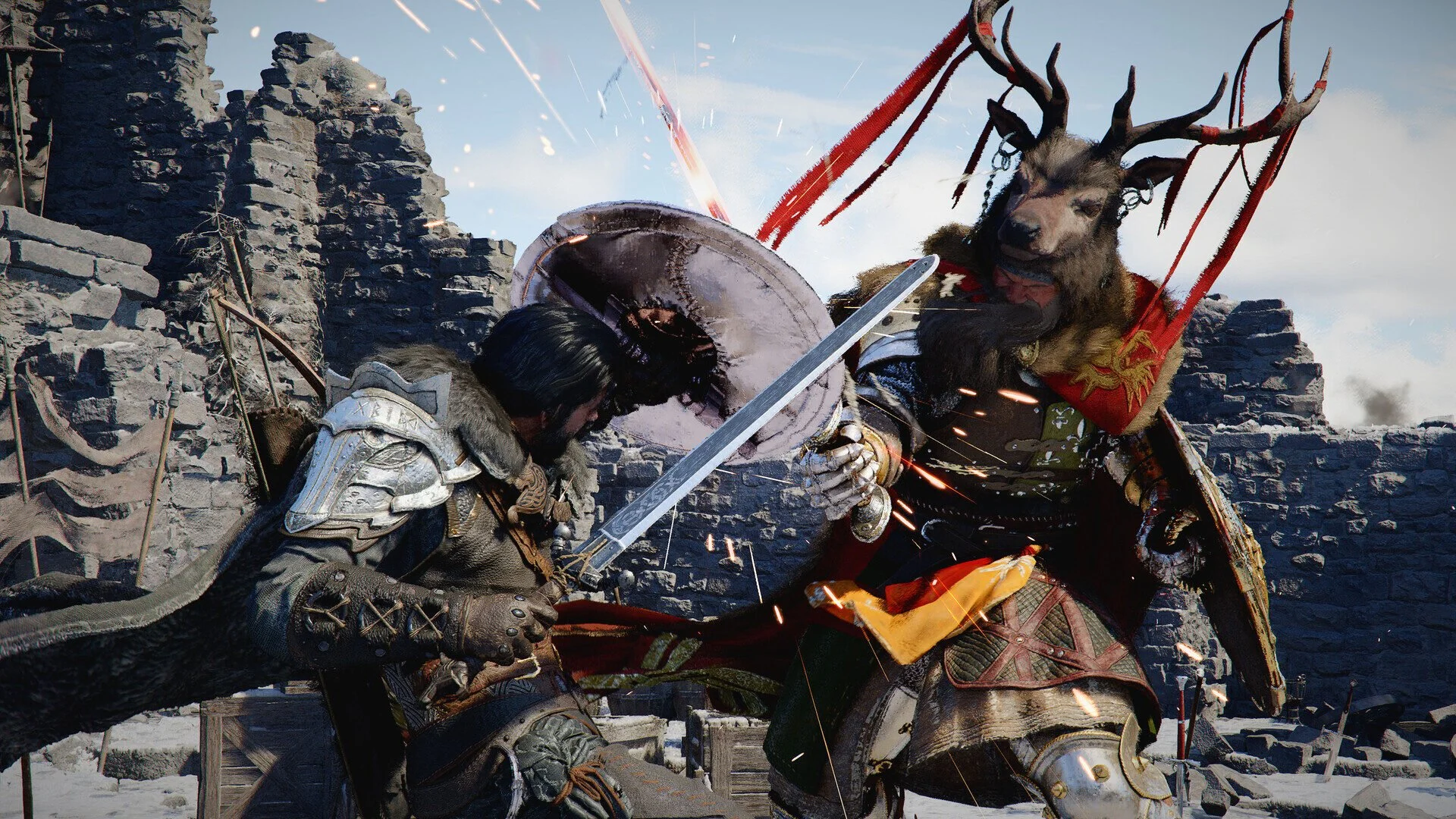
Some video games lend themselves to being set aside and resumed at a later date with zero consequences. These are often casual games with no major goals other than having fun while playing them. Fall Guys is a great example of this. You have a cartoony avatar that participates in zany group races, filled with obstacles. You run, jump, climb but the controls are far from difficult. You may well become skilled but such things are mitigated by the other players as they stumble around. You’re not at the mercy of apex players or “try hards”. It is not a game about winning and mastering techniques. The fun comes from playing it and the unique experience you have each time. I’ve been playing this game, on and off, since it’s launch in 2020 and in that time I have only ever won once (winning requires you to win a series of 4 to six individual races). However, whenever I pick up my controller and play Fall Guys, I have fun and the game lifts my spirits.
I recently completed the main story in Tainted Grail: The Fall of Avalon. In total I spent about sixty hours playing the game. I began at the start of the year, then took a break for a while but returned to it recently because I wanted to see if I could unlock a specific ending. I did manage to do this. Like so many other RPGs, Tainted Grail: the Fall of Avalon has a central storyline, along with a wealth of side quests, based around factions in specific zones. I think I possibly completed about a two thirds of these. However, once I finished the main story, my interest in the game began to wane. I finally left my character in the last major quest hub in case I wish to return at a future date. I then logged out of the game and uninstalled it from my PC to free up space for whatever I was to play next. In this case its The Sinking City 2. None of this is a negative reflection on Tainted Grail: the Fall of Avalon. I enjoyed the time I spent playing this quirky RPG. I simply had my fill and left to play something else.

On Tuesday 11th April, Aspyr Media rather surprisingly re-released The Lord of the Rings: War in the North, a co-op action-RPG from 2011. This game was delisted in late 2019, possibly due to changing rights ownership or a license expiring. Hence, I was somewhat discombobulated by the return of this title to all major gaming platforms. Mind you, the Embracer Group (through its subsidiary Middle-earth Enterprises) still controls the worldwide commercial and video game licensing rights for The Lord of the Rings and The Hobbit. Furthermore they have explicitly stated that they have plans for more games. It would appear this also means re-releasing and updating old favourites. It is also worth noting that they own Aspyr Media, which is also a bit of a giveaway. Let it suffice to say that this re-release and sparked enthusiastic online debate as to whether any other he Lord of the Rings themed games from the same era will receive a similar makeover. Judging by the internet chatter, there’s potentially a market for them.
The next expansion for the MMORG, The Lord of the Rings Online, was announced on the 1st August, via the gaming website MMORPG.The Wolves of Mordor, which will launch later in the year, appears ambitious in scope as it will include two new game systems as well as the obligatory story update. This expansion takes place in Draugardh located in the North East of Mordor, beyond the Plateau of Gorgoroth. It includes the new zones of Heledhris, Parth Rhavas and Nan Ogol. These vary environmentally ranging from the arid, volcanic and semi-tropical. Players will encounter the Daugrim in these regions, Werewolves but not in the modern sense. This is not the lycanthropy of Eastern European legends but in the established Tolkien idiom of fell spirits inhabiting the bodies of Wolves. The region also sees the return of the Woses and players can expect to encounter Elves and scouts from Gondor. As ever with LOTRO expansions, there will be new instances as well as a raid.
This is a post about the power of nostalgia and how sometimes, interacting with something from your past, be it physically or mentally, can produce a very strong and tangible emotional reaction. In some instances, this can be the result of something that you have specifically set out to do. On other occasions you can wander into a sense of nostalgia purely by chance. Today I experienced a very strong sense of nostalgia while watching a YouTube video and then again when I sought to replicate what I had seen. The video showed someone installing Windows 95 on to an old 486 PC from that era. The Window’s start up sound really touched a nerve (but in a good way) and then when the guy in the video launched Space Cadet 3D Pinball, a game that shipped with the operating system, I felt a strong compulsion to track down a copy and install the game myself, thus revisiting something that was an integral part of my life in 1995.
RV There Yet? is possibly the most entertaining game I’ve never played. My vicarious pleasure regarding this title has come exclusively from watching two popular YouTubers, JackFrags and WillFromWork, play through the game over a series of videos. It has been immensely amusing to watch and I have empathised a great deal as the group of four players has struggled with the game’s unpredictable mechanics and their own team’s dynamic. I could go and buy RV There Yet? myself but I doubt if I would ever have a gaming experience anywhere close to what I’ve watched online recently. So in some respects watching these videos has been an interesting alternative as I’ve been entertained, which ultimately is the point of video games. Perhaps there is a deeper philosophical point here that the game developers should reflect upon, as they’ve lost a potential sale. However, that is separate discussion for another day.
I don’t keep up with gaming news as much as I use to but several noteworthy announcement have come to my attention of late. Firstly, there’s an expansion, Songs of the Past, coming for the Witcher III: Wild Hunt in 2027. No doubt this is to pave the way for the Witcher IV. Next, I also found out about Hand of Fate: Horde. I liked this franchise and was saddened to learn that the original studio, Defiant Development, closed. Hence is was a pleasant surprise to see this new game being developed by members of the original studio. The third announcement was regarding Guild Wars 3. A new MMORPG in active development by a major studio is no small feat and is certainly good news for fans of this franchise and the genre per se. However, once you look beyond this news this announcement raises several questions and has certainly given me pause for thought. Let us take a few moments to consider them.
Star Trek Online has many in-game systems that are common to the MMORPG genre. The reputation system is one such example. In STO there are 13 reputation factions. Once a player has reached level 50 they may start progressing through the 6 reputation tiers of each one. Players gain progression through daily projects (20 hours in duration). Hourly projects are also available though they yield less reputation advancement and are limited to three times a day. Hence 20 hour projects are consider by default the most efficient way to gain rep. Projects require 30 Faction Specific Marks (earned via various activities in-game), 15,000 Energy Credits (standard in-game currency) and 2000 Expertise points. The most efficient way to tackle the reputation grind is to build up the necessary resources in advance and then at a designated time each day, start all 13 respective projects. Upon completion projects yield a player bound lockbox containing a random space or ground weapon, a console or Elite Marks which can be used to acquire faction gear.
I was recently perusing my archive of old blog posts, when it struck me how much I’ve written about the MMORPG genre over the years. Naturally, there was far more material from between 2008 and 2012 as that was period when I immersed myself in the genre and was very enthusiastic about it. I was at a point in my life when I had the time to dedicate to such games and I was happy to participate in the social aspect of they offered. I would regularly play through group content and spend time socialising online with fellow guild members. My experience remains a textbook example of how online games can be more than the sum of their parts and that where you are at in your life has a major impact upon your overall enjoyment. As I read though various old posts it became clear that my experiences where specific to this particular part of my life and that they cannot be repeated. My relationship with the genre is very different now and that’s fine.
Creating alts is an integral aspect of the MMORPG genre. Many players will create a character of a specific class or faction, play it for a while, lose interest in it or they may decide that it is just not for them. Fortunately it is no effort at all to simply re-roll a new alt and set off once again. Furthermore, lots of players never reach level cap of the MMORPG that there playing. When the going get’s tough, so to speak, you can either soldier on for another 50 levels or simply create a new alt and return to the comfort of tried and tested content. Alts also give you the chance to secure an accolade or achievement that you previously missed. They are also of great benefit to the genres social aspects. Creating a new alt so you can play along with a friend who is just starting is great fun. Developer’s love them too as it means you’re still playing the game.
I recently took a break from Crimson Desert choosing instead to to play something familiar and easy going. As I’ve been logging into Star Trek Online daily to participate in the anniversary event, I decided to look through my various alts and see how far they had progressed through the game and what resources they had. At present I have twelve alts. My primary Captain was created in 2015 during the original Delta Recruit Event. I had previously played STO intermittently since its release in January 2010 but I never kept any of those characters. Hence this decade old Tactical Federation Captain has been my main focus when playing. The other eleven alts are the result of other recruitment events or whenever I wanted to try something different, such as playing a specific class or faction. I obviously played a lot of STO during the lockdown as several alts date from that period. Several had maximum reputation across all factions.
The action, open world RPG Crimson Desert has been patched five times since it launched on March 19th and there have also been multiple hotfixes. At first glance this isn’t anything unusual. New games have bugs and issues arise once a game is released and played across a much wider variety of hardware than in QA testing. However, if you read the patch notes that accompany these sizeable downloads it quickly becomes apparent that developer’s Pearl Abyss are not just addressing bugs and software glitches. They are actively engaging with their player base and responding to suggestions and requests from that community. Although this is not a unique approach, what is surprising is the speed and quantity in which these player driven changes are happening. There seems to be an active ongoing process to refine the game and eliminate some of its “rough edges” and the players are contributing to this process with their feedback.
According to my Steam statistics, I last played Starfield on 19th December 2023. I bought the game upon its release in September of that year and played in total for 136 hours. Starfield held my interest for three and a half month and I wrote seven blog posts about various aspects of the game. Although there were some engaging aspects to Starfield, I did feel that that the game was somewhat lacking in systems and content, at that point in its lifecycle. I also think that the marketing and player expectations associated with Starfield were overblown and unrealistic. The shadow of Skyrim looms large over all new Bethesda releases and they don’t seem able to quite recapture that magic. Hence, I inevitably drifted away from Starfield and to another game and was effectively “done” with it. I have not played the game since which seems to validate the theory that game are becoming increasingly more ephemeral.
13 days after its release, market analysts estimate that Crimson Desert has already earned $200 million across the four main platforms (PC, PlayStation 5, and Xbox Series X and S). The game is certainly proving popular among gamers with the internet awash with live streams and “let’s play” videos. However, reviews are mixed both among gaming journalists and YouTube influencers. Common complaints about the game include that it is slow to start, the controls are poorly laid out on all platforms and that developer’s Pearl Abyss have done a poor job of explaining most aspects of the game to new players. Although such criticisms are true to a degree, I think these complaints highlight how many gamers are conditioned to expect new titles to follow a specific pattern with regard to pacing, narrative exposition and learning in-game systems. A pattern that Pearl Abyss has chosen to ignore, instead favouring an old school approach.
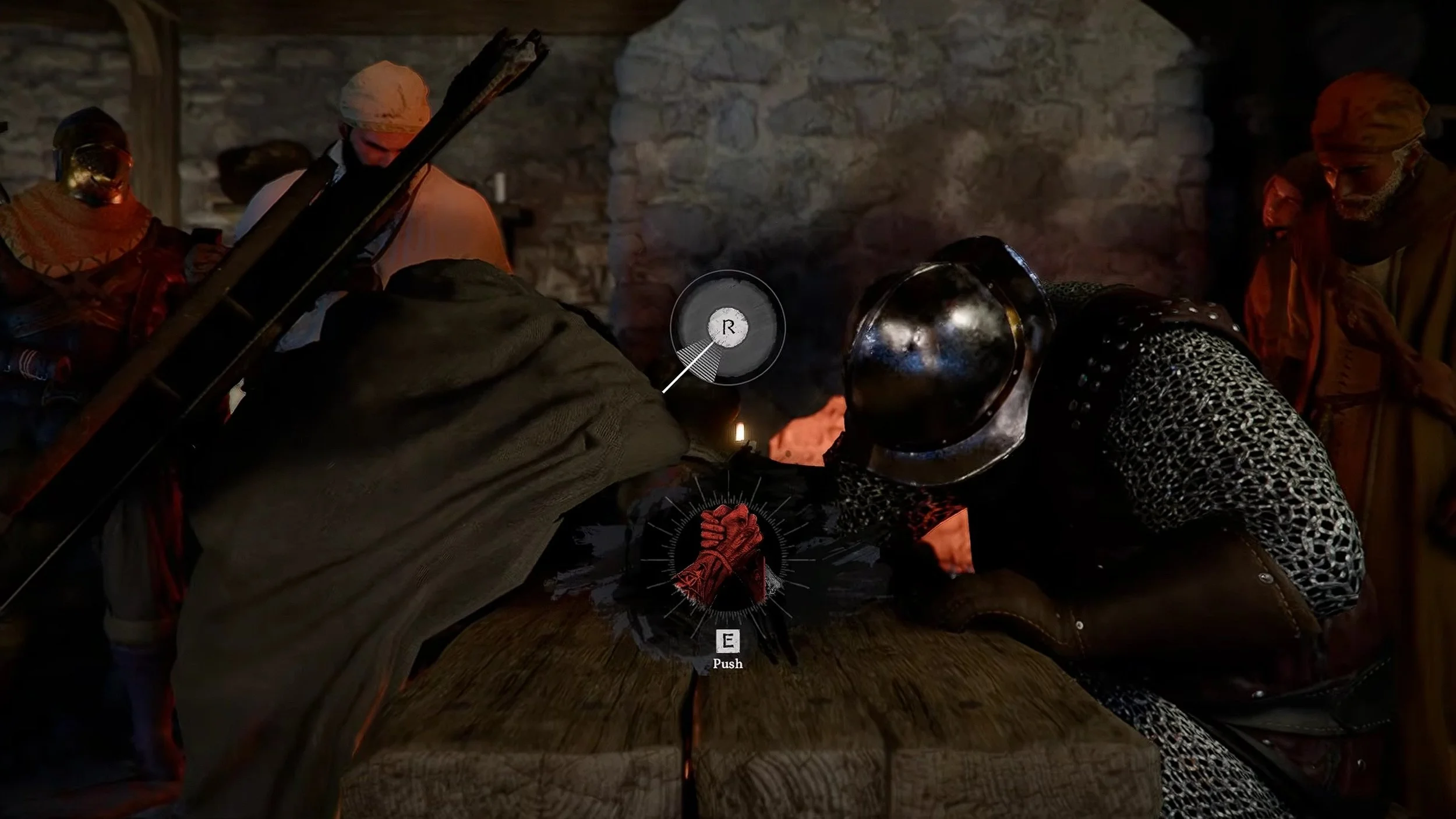
Early on Crimson Desert, the main quest requires the player to enter a tavern and arm wrestle a particularly strong guard. The arm wrestling match consists of a quick time event. If playing on PC you have to rapidly press the “E” key which turns a power meter from white to red. Then a white dial appears above the meter with a rotating hand. When the hand passes over a segment of the dial that is marked by hatching, the player must press the “R” key. The idea being the meter filling with red is you strength building (or waning) and the “R” key prompt indicates when to try and force your opponent’s arm. You will need to to continuously press the “E” key throughout the arm wrestling match and the “R” key about 4 times to win.
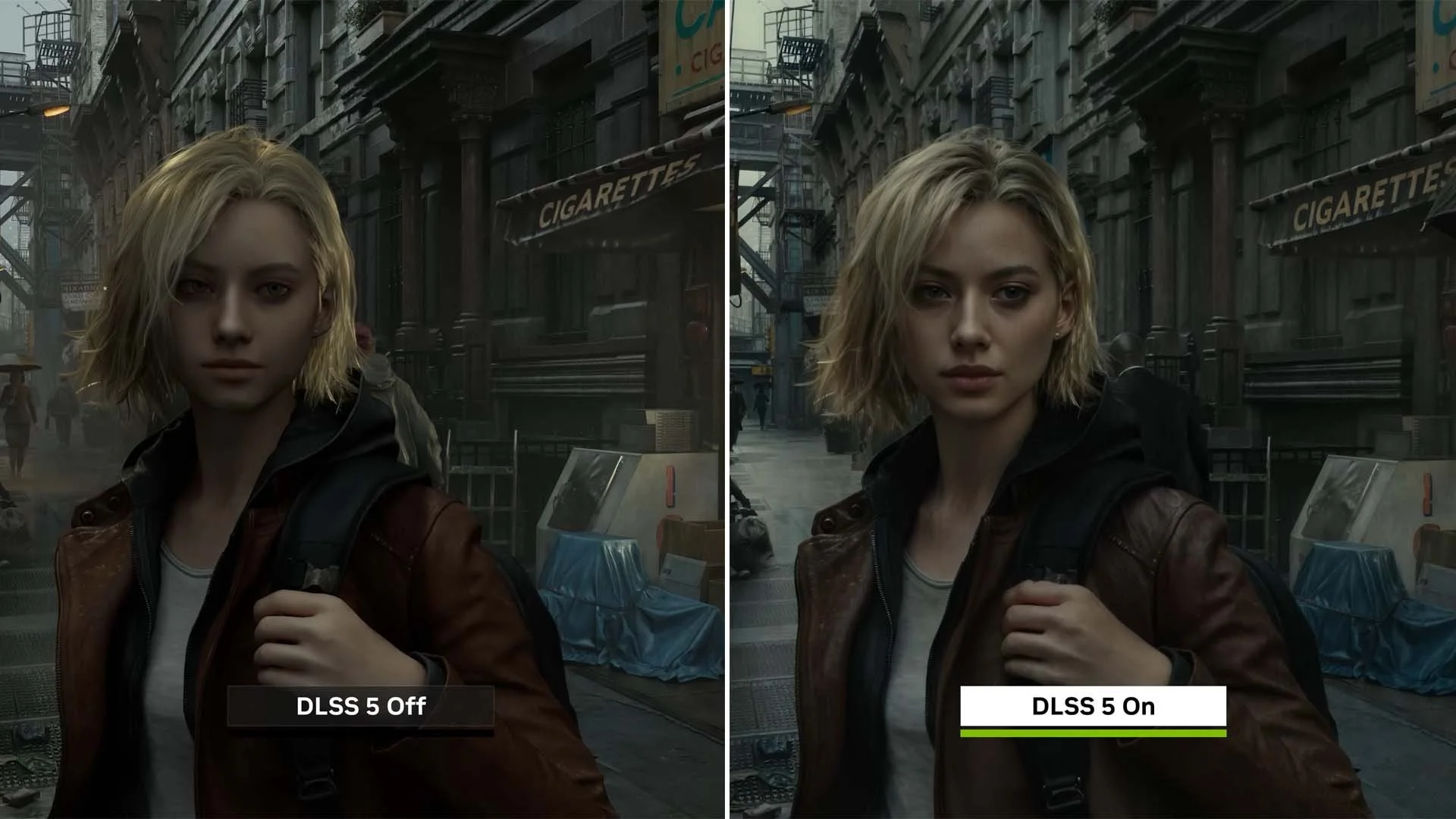
Earlier this week, Nvidia posted a video featuring their latest iteration of DLSS technology (Deep learning super sampling). DLSS 5 is an AI-powered “real-time neural rendering” process and unlike previous versions that focused on improving frame rates through upscaling or frame generation, DLSS 5 uses generative AI to “infuse” frames with photorealistic lighting and material details that the game engine never actually calculated. Let us pause for a moment and consider these words. Material detail that the game engine never actually calculated. Therein lies the rub. If you watch the aforementioned video or peruse the images posted here, it is abundantly clear what the technology does.
Last night, I spent the first 45 minutes after the launch of Crimson Desert, watching the 92GB pre-downloaded game files slowly decompressing and installing. I finally launched the game at about 10:50 PM GMT. I then waited a further 5 minutes while shaders were downloaded. It took me about 15 minutes or so to read through the various game settings and choose those that are optimal for my PC. I suspect even if you have a beast of a computer, you’re still going to have to spend some time tweaking settings. As for those players like myself with a gaming rig that is somewhere in the middle of the game’s specifications, be prepared to do a lot of fine tuning both within Crimson Desert itself and your Windows settings.
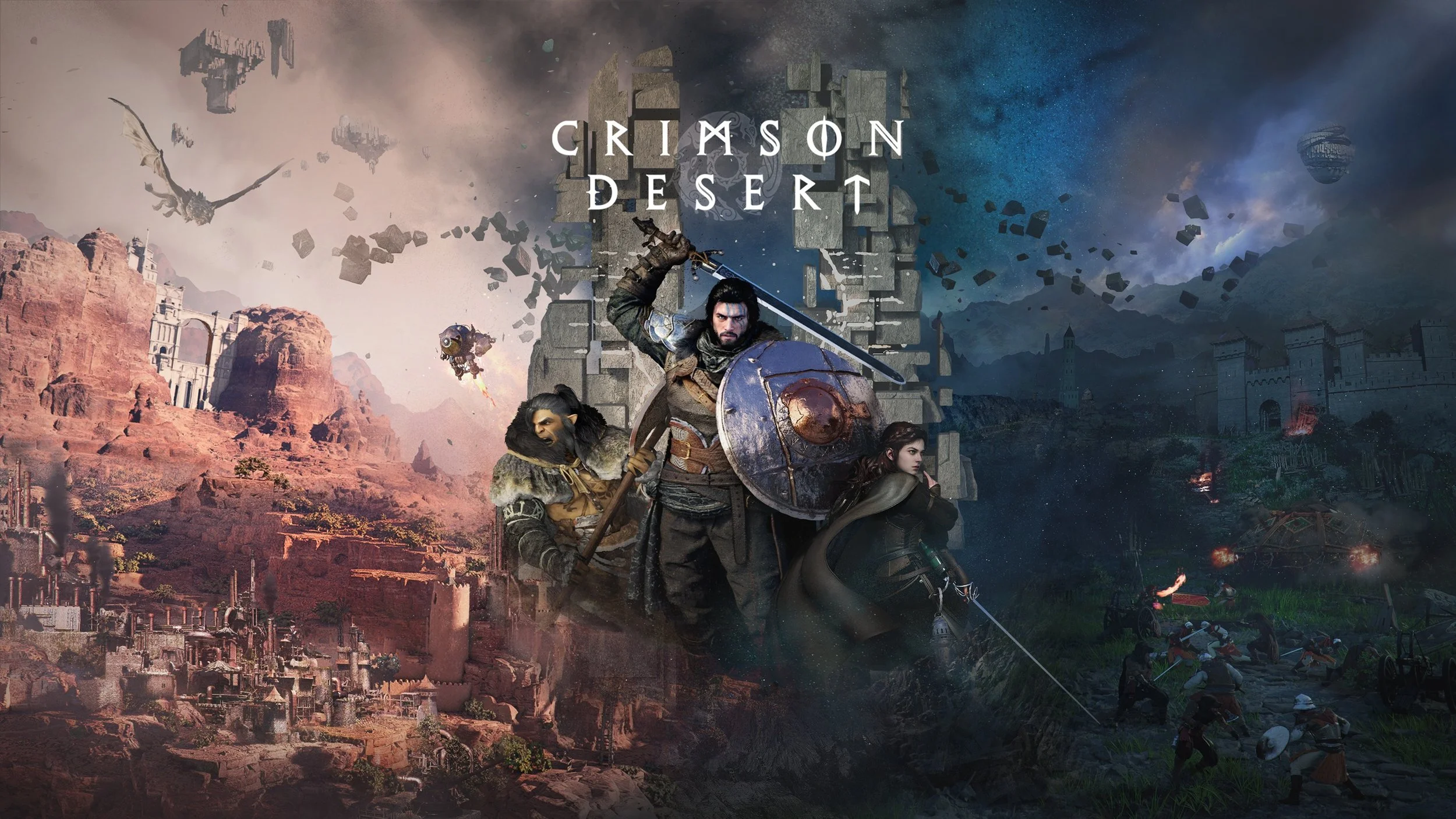
I have been aware of the online interest around the open world action game Crimson Desert for a while now. One of the things that has intrigued me about it is the scope of the game. The word “hype” has been bandied about by a few gaming websites. However, from what I have observed, developers Pearl Abyss have not been excessively hyperbolic themselves, with regard to the manner in which the game’s systems and mechanics have been marketed. Now that the press embargo has been lifted, the pre-release reviews seem to confirm that everything we’ve seen in promotional videos in the run up to the launch, is in fact present in the game. So far the initial critical response has been very positive and it has been hinted that the game may well be a genre milestone. Perhaps Crimson Desert is just a rare example of a game that has not had a rushed development and isn’t launching prematurely for business reasons.
Video games as a genre are extremely poor at explaining themselves. When you buy a new game you’ll often find little or no information regarding the basic systems and mechanics. The industry assumes that their customers are by default familiar with the fundamentals of playing a modern video game. Hence if a game has a tutorial, it is often based around videos rather than detailed verbal instructions. You are are briefly shown a clip of a specific move being successfully undertaken but it is seldom shown in a wider context. The industry also expects the fan community to take on the role of curating and disseminating information about its games. The move away from forums and bespoke websites to Discord highlights this. Discord is a primarily a real time communication tool and not good at maintaining a historical data archive. If you want an answer to a specific gaming question, you’ll more than likely find it on YouTube in a video made by a fellow gamer.
I have written in the past about the video games we cannot play. The ones that require a keen understanding of a game’s mechanics, along with a strong degree of manual dexterity and situational awareness. Being 58 years old, I tend to have neither the co-ordination necessary to succeed or the patience to master such complex skill requirements. With this in mind, I recently watched a YouTube video for Chivalry 2 and thought, that looks like fun. The fact that it showed someone picking up a chicken and throwing it at an opponent is neither here nor there. However, after watching a few more videos I realised that combat in the game was complex and that, as usual, the reality of playing such a game would be different from my expectations. Hence, I came very close to not buying Chivalry 2. However, I eventually decided that I would, so I bought it for just under £10 from an online vendor.
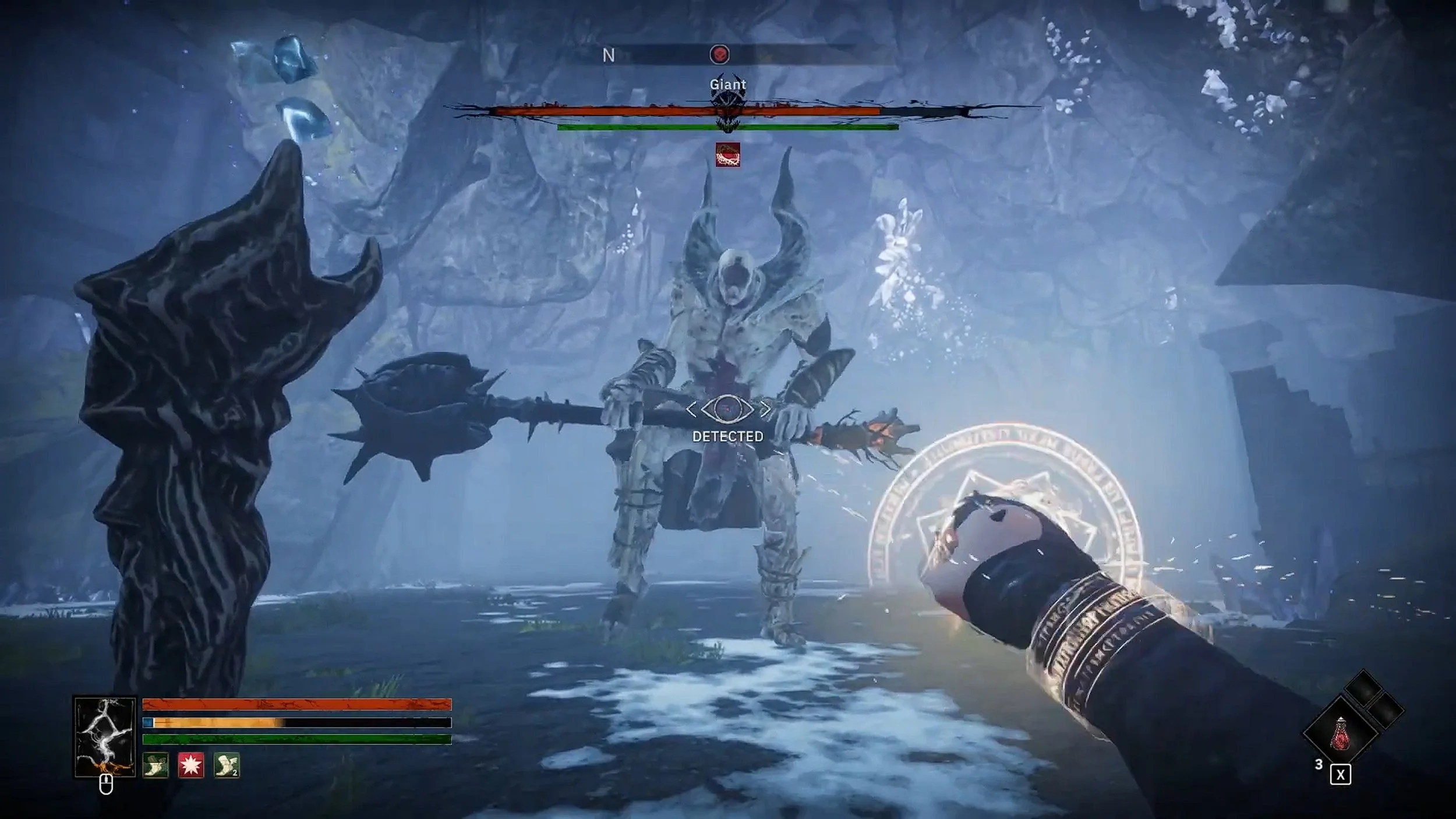
I decided to pursue a magic and spellcasting build in the RPG Tainted Grail: The Fall of Avalon after the story prologue. During the opening section of the game, the player is presented with a sufficient range of weapons to determine which type suits them best, although you can change at any time during the game. For me, casting spells feels right and is fun. Plus I have fond memories of the magic system in Two Worlds II and Skyrim. So once I started playing through the first zone, I started putting attribute and skill points into the appropriate trees to bolster my spells strengths and frequency. I also chose gear that would bolster those statistics further. The results have been surprising, as magic and spellcasting is not presented in the usual “glass cannon” style you find in some other RPGs. Here it offers robust DPS output and with the right gear and spell combination, a strong degree of survivability.
I originally bought Warhammer: Dark Omen in the summer of 1998. I played a demo copy via a magazine cover disc, which was a common means of promotion and marketing back then. Although I was at that point, unfamiliar with the Warhammer Universe, I found this game to be an excellent point of entry. The story did an excellent job of introducing players to “The Old World”, the political and power structure and major characters. I instantly liked both the aesthetic and the lore. Warhammer: Dark Omen was also the first real-time tactical wargame that I played and I spent numerous hours playing through the campaign. Overall, the game was a critical success, particularly on PC, but it struggled commercially upon its initial release and didn’t quite find the audience that it deserved. However, it has achieved status as a “cult classic” among gamers, leading to a recent re-release on GOG in late 2025.
According to the recent “letter to the players”, Standing Stone Games will be adding a new zone to the MMORPG The Lord of the Rings Online in the second quarter of this year. Possibly around May or June. Having spent the last three expansions in the South of Middle-earth exploring the tropical Umbar and the deserts of Harad, I would certainly welcome a change of location. I have gradually warmed to these zones over the last eighteen months but I do find them so incongruous. They are so radically different to the European style content that has been the mainstay of the game for so long. Tolkien’s source text has plenty of detail regarding Eriador and Rhovanion. Information regarding Harad is scarce, hence it has afforded the developers a great deal of artistic freedom. Although exceedingly well realised these tropical zones have taken a while for me to get used to.
I’m not sure exactly when it started but I’ve recently noticed a graphical bug within the MMORPG The Lord of the Rings Online. This problem often occurs within caves or in areas where there are a lot of rocky surfaces. Hence it has become very apparent in the latest two expansions, set in Umbar and Harad. This graphical glitch causes some surface textures to appear to flash from light to dark intermittently. The resulting strobe effect is hard to ignore and very distracting. Fortunately, a quick online search showed that this is not a problem unique to my installation of LOTRO and is a known problem. Furthermore, there is a very simple workaround, which is to go into the Advanced Graphics setting and uncheck “Per Pixel Lighting”, which immediately remedies the problem. I have no idea why this has recently started to happen but at least it can be resolved.
A Month in Gaming
The last installment of A Month in Gaming was at the end of April. I have decided to update this recurring post less often to ensure that I have more to write about than just cataloguing my generic activities in The Lord of the Rings Online and Star Trek Online. The only downside of such an approach is that it invalidates the title but that can’t be helped. Fortunately, I have done more than usual over the last two months. My daily schedule has changed temporarily and I now have a little more leisure time available. Hence I’ve dabbled with several new games as well as using my Nintendo Switch more often. I also took part in a “tag team” playthrough of XCOM 2, which was a very interesting experience. And I finally took the time to go through all my games libraries on the various different platforms to catalogue exactly what I have. I found a few hidden gems but the majority is just “filler” that you find in most video game bundles.
The last installment of A Month in Gaming was at the end of April. I have decided to update this recurring post less often to ensure that I have more to write about than just cataloguing my generic activities in The Lord of the Rings Online and Star Trek Online. The only downside of such an approach is that it invalidates the title but that can’t be helped. Fortunately, I have done more than usual over the last two months. My daily schedule has changed temporarily and I now have a little more leisure time available. Hence I’ve dabbled with several new games as well as using my Nintendo Switch more often. I also took part in a “tag team” playthrough of XCOM 2, which was a very interesting experience. And I finally took the time to go through all my games libraries on the various different platforms to catalogue exactly what I have. I found a few hidden gems but the majority is just “filler” that you find in most video game bundles.
Let’s start with MMOs. The new Blackwood expansion for The Elder Scrolls Online has provided me with a reason to return to the game. I have written at length about the companion system in another post but I would like to reiterate how it does provide a major shot in the arm for the solo player. I have ventured into several dungeons with Mirri providing ranged DPS in support of my melee combat and it has proven a most effective combination. Especially if you configure your companion with at least one healing skill. Alternatively you could equip either of them with a Restoration Staff and make them a dedicated healer. The companion system seems very flexible and I do hope that developer’s ZeniMax continues to improve it further.
In STO, I have levelled one of my new Delta Recruits and have now optimised their build and gear. The toughest aspect of fine tuning an alt in STO is reaching Tier 6 with all reputation factions. If you have completed this on one character, there is a 50% reduction in the time it takes on all subsequent alts. However, even with this benefit, it still takes 50 days and requires you to grind out a prodigious amount of reputation marks. The Summer Festival started today on the resort planet of Risa, so I currently have an alt permanently stationed there to undertake the repeatable daily quest and hence earn the new free Tier 6 ship. I have deferred returning to LOTRO for the present, preferring to keep Update 30 for the Autumn. At present I’m more interested to see what developer’s Standing Stone Games are up to and whether EG7 has any announcements pending for both DDO and LOTRO.
I have continued with the RPG GreedFall and try to have one major play session a week. The game supports mods, so I have one currently installed that removes the brown filter that blights the visuals. I appreciate that game designers like to use the colour palette to create an aesthetic that reflects the narrative themes. But this grimy veneer that has been applied does become tiresome after a while. Once removed the colours of the environment become far more vibrant. I prefer it when games make such visual affectations optional and allow players to toggle such features off if they so please. Adding faux film grain to cinematic cutscenes is another common technique and one that can be quite distracting. GreedFall is a very satisfying RPG, combining many of the elements found in BioWare games. It is the sort of game that provides “comfort entertainment”, as it feels very familiar and traditional.
Perhaps the most challenging game I’ve played of late is Assassin’s Creed IV: Black Flag. This is mainly down to the fact that I’m playing the Switch version and using a pro controller. I’ve tackled other instalments in the franchise on the PC. The combination of the unfamiliarity with using a controller plus the absolute plethora of buttons, menus and actions has meant that my progress has been very slow. Plus when playing on a PC, I am sitting directly in front of the monitor. Using a large screen TV and sitting further away also takes some getting used to. Although I can see quite well, the incongruity of this manner of gaming seems to add to my sense of discombobulation. However, I shall persevere as I like this game and the naval combat is proving especially enjoyable.
In early May, I took part in an XCOM 2 succession game, in which each player undertook a mission and then saved the game and shared the file with the next participant. It was a very interesting experience as playing a turn based strategy game is somewhat out of my comfort zone. Broadly I enjoyed this experience but as ever there were a few caveats. Some of the missions in XCOM 2 have time sensitive objectives. Mercifully, I did not have to endure one of these. I don’t care for time based game mechanics and find them annoying rather than tense or motivating. And then there was the issue of incurring a fatality among your squad when undertaking a mission. Usually, I wouldn’t worry so much about such a thing but as this was a team undertaking, I felt a greater sense of responsibility to prevent this. Ironically, I failed but it is interesting how participating in a team activity changes your outlook and how you play a game due to a perceived sense of obligation to others. Perhaps I’m just not a good team player.
As I mentioned initially, I finally catalogued all games that I currently own and have been trying to draft a short list of the titles I would like to try this year. Horizon Zero Dawn, Days Gone and Elite Dangerous are the current favourites. Possibly 70% of what I own will more than likely never be played. In many ways this highlights the ephemeral nature of video games. Like popular music from time to time someone will create a timeless classic but there is also a lot of disposable content produced on a seemingly endless conveyor belt. And much of that seems to end up in my video game collection. I must admit, when I finally move over to Windows 11 as an operating system, I’m curious to see how well support for Android apps goes. I tend not to play mobile games on my phone or tablet and the biggest stumbling block of running them on my PC is the use of an emulator. Finally being able to try some titles from the comfort of my PC could prove convenient. Or it may validate my existing prejudice towards mobile games.
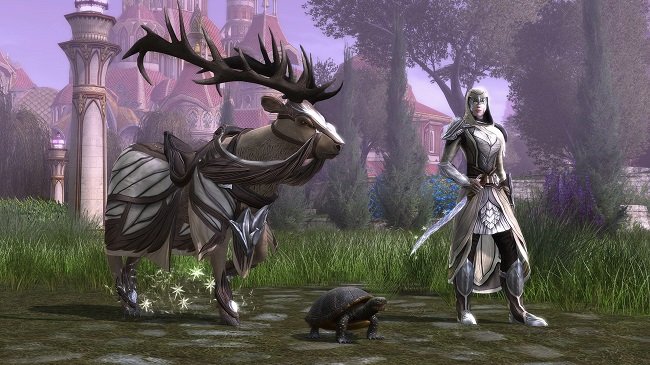
Here we are again with another summary of my gaming activities in recent months. Or in this case since last September. It’s been a while but I’ve been on a blogging hiatus until recently. However, I’ve kept myself busy gaming wise and often I find the hunt for news video games, just as entertaining as I do playing them. Perhaps that could be a future blog post. Back to the matter in hand. Gaming wise, pretty much all things related to the MMORPG genre are currently on the back burner. I’ll give specifics later but I am taking a break from these for the present. I am currently looking at trying games outside my usual comfort zone and also trying to test whether you can or cannot teach an old dog new tricks. Fortunately, the answer appears to be yes you can. Enough summation, on to the specifics.
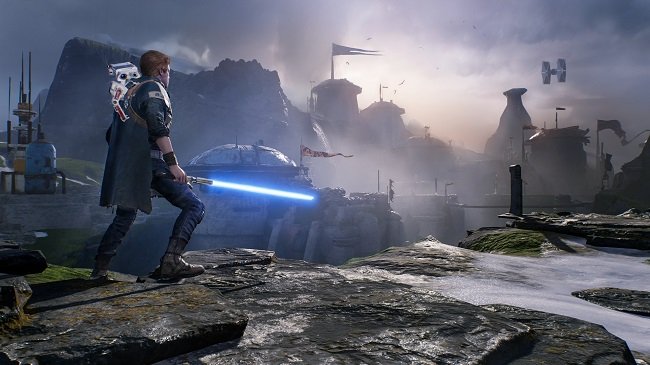
I last wrote a post in this series in June. Back then I wanted a break from MMOs as I had invested heavily in Star wars: the Old Republic and The Lord of the Rings Online. Because I was still enjoying the Star Wars vibe, I decided to try Jedi: Fallen Order. Sadly, despite the story showing a lot of promise, the PC version of the game handles poorly and the controls are sluggish. Often it felt like my character was wading through mud and there was a tangible amount of skills lag. So I uninstalled it and moved on to something else. One of the odd things about gaming is that despite amassing a library of free and discounted titles, we often end up buying something new, instead of playing that which we already own. And that is exactly what I did. I purchased Stray amid all the excitement surrounding the game, but to date I still haven’t played it. Make of that what you will.
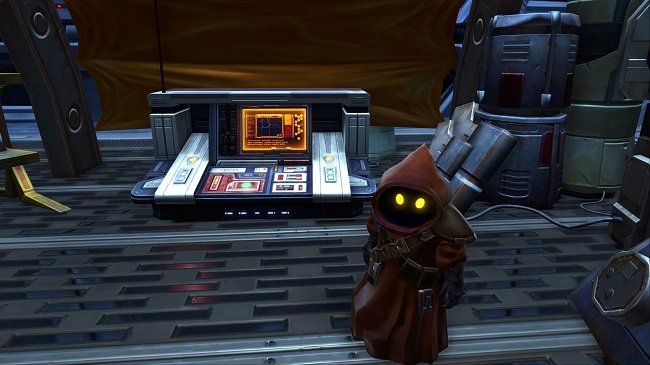
Usually I keep subscribing to an MMORPG, even if I’m not playing it that much. I like to have options in case I decide to log in on a whim. Especially if an absent friend returns to a particular game presenting an opportunity to catch up. However, the current economic climate is no longer something that I can ignore. Although far from having a low income, the current ongoing increase in the cost of living is becoming apparent, so I have been fiscally prudent and cancelled my monthly subscriptions to Star Wars: The Old Republic and The Lord of the Rings Online. Both have provided me with a lot of entertainment over the last three to four months but until new content becomes available, I can happily dispense with them for the meantime. Not only have I saved £17.98 on subscriptions, I shall no longer be making ad hoc purchases of in-game currencies. Something I have been doing a lot more than usual of late.
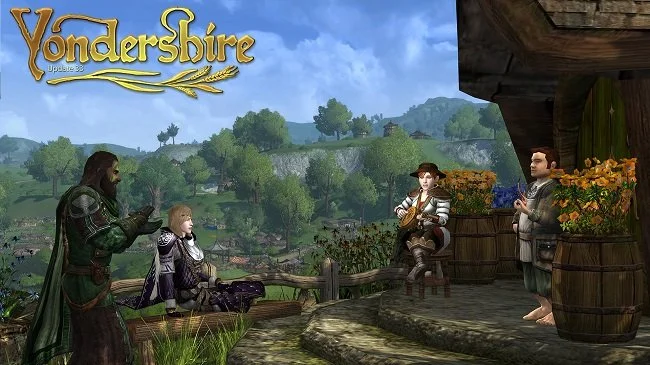
I have confined my gaming to three MMORPGs in recent months and have not strayed into anything new. Time has been an issue due to a great deal of change in my domestic life. Hence The Lord of the Rings Online, Star Wars: The Old Republic and Star Trek Online have proven suitable for my needs. Being able to log into a game and commence an activity without any complicated preamble is convenient and currently suits my schedule down to the ground. I will be buying Sniper Elite 5 at the end of the month as this is a franchise that has always proven entertaining and engaging. While recently perusing the various game launchers I have installed, I took the opportunity to remove several games that I’m no longer playing or that have proven to be a “five minute wonder”. Hence I said goodbye to GreedFall, Tom Clancy’s Ghost Recon: Breakpoint and Days Gone. Their removal is no reflection upon their quality.
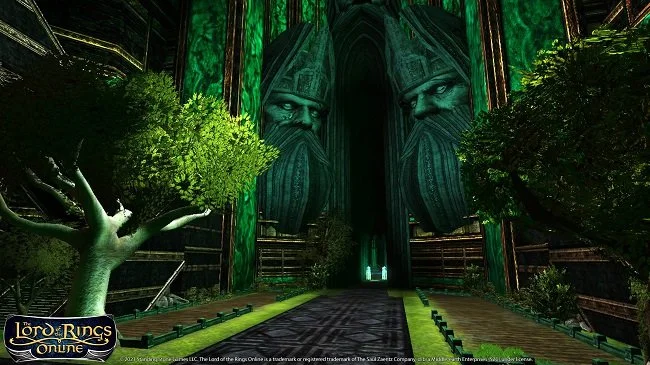
It’s been a while since I’ve written an instalment of A Month in Gaming. Over Christmas and New Year I was busy with family issues and it’s only in January that I’ve started anything approaching a regular gaming schedule. The novelty of Forza Horizon 5 has run its course and I’ve grown tired of the game’s upbeat tone and neverending activities that litter the in-game map. It’s nice that the game tries hard to engage with you but it reaches a point where you never get a time to stop, think and take stock. I couldn’t find anything else included in the Xbox Game Pass which especially excited me. There were a few titles that did take my fancy but I then discovered that I already own them elsewhere via Steam or Epic Games. So I decided to cancel my subscription. I still think that the Xbox Game Pass for PC is very good value and my failure to find anything that I like is my problem and not Microsoft’s fault.
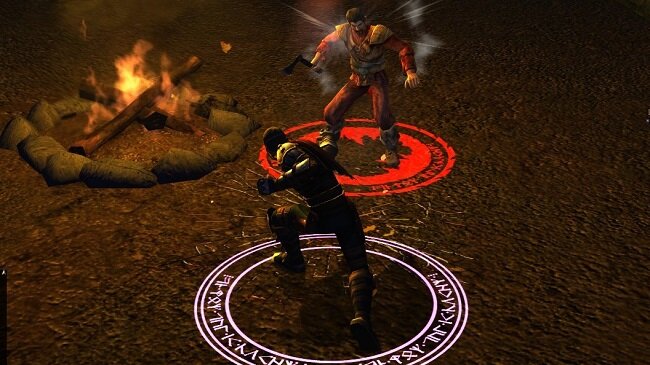
September has been and gone and the nights are now drawing in. Usually this time of year is ideal for gaming but sadly I’ve had a lot on over the last 30 days and as a result there’s been precious little time for gaming or indeed writing. Such is life. When I did have some leisure time, MMOs were the easiest way to get a quick gaming fix, as per usual. Standing Stone Games announced that the next expansion for The Lord of the Rings Online would be released in November and that a revision of the Legendary Item system would be coming prior to that. Hence I took a look at the beta builds on the Bullroarer test server and then started prepping my various alts on the live servers, to get ready for this major change. I also managed to complete the latest event in Star Trek Online. However, beyond these straightforward tasks I didn’t really get to do much more.
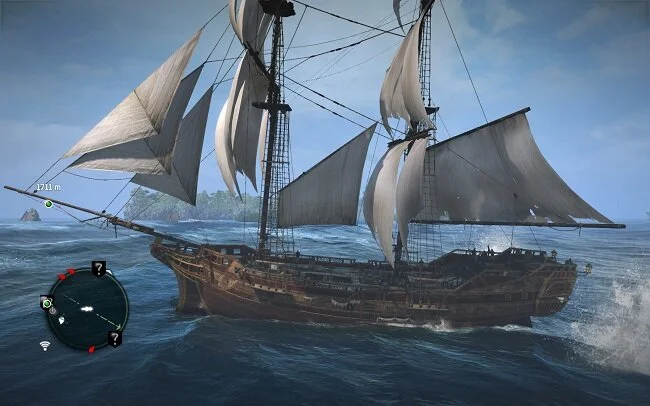
Again this is more a case of two months in gaming. Furthermore although I was quite active in July, I was less so in August as the Blaugust 2021 Festival of Blogging event consumed the lion share of my leisure time. The majority of my gaming time is usually mid to late evening. Although Mrs P and I do many activities together, there are times when she will want to watch something I don’t, be engrossed in a book or out with friends. These occasions present sizable windows of time to focus upon a video game, which is especially useful for the MMORPG and RPG genres. However, I often have to choose whether to use this time exclusively for gaming or some other recreational activities such as writing. Another foible of my video game time management is trying to arrange things so I can undertake recurring, daily quests in a game early in the morning. I will often tackle such content in Star Trek Online, as soon as I get up.
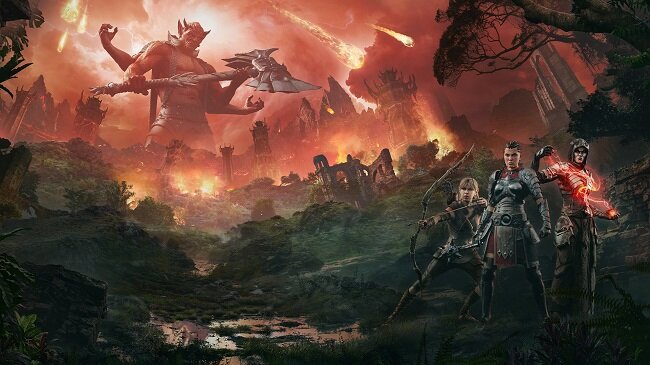
The last installment of A Month in Gaming was at the end of April. I have decided to update this recurring post less often to ensure that I have more to write about than just cataloguing my generic activities in The Lord of the Rings Online and Star Trek Online. The only downside of such an approach is that it invalidates the title but that can’t be helped. Fortunately, I have done more than usual over the last two months. My daily schedule has changed temporarily and I now have a little more leisure time available. Hence I’ve dabbled with several new games as well as using my Nintendo Switch more often. I also took part in a “tag team” playthrough of XCOM 2, which was a very interesting experience. And I finally took the time to go through all my games libraries on the various different platforms to catalogue exactly what I have. I found a few hidden gems but the majority is just “filler” that you find in most video game bundles.

I usually write this recurring post at the beginning of each month, reflecting upon my gaming activities over the previous thirty odd days. I refrained from writing an instalment at the beginning of April as I really didn’t feel I had much to say. However, now that a further month has elapsed, I believe sufficient has happened for me to continue. I do worry that these posts get repetitive and simply writing “ I played MMO A or B” is not sufficiently engaging. Luckily, I do feel that I have more to say this time round as I’ve broadened my gaming horizons recently and feel that I’ve done more, compared to other months. So let me begin with my return to console gaming. Something I haven’t done since 1999 when I purchased a Sega Dreamcast. After some procrastination, I’ve finally bought a Nintendo Switch and it has proven quite a hit not only with me but my grandchildren.
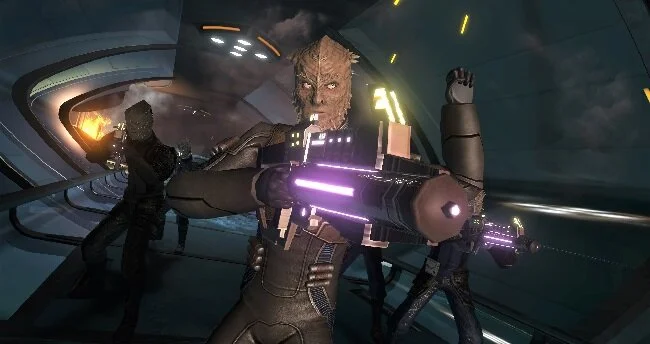
Here we are again. Yet another month has gone by and I find myself writing another instalment of “a month in gaming”. And to be honest, I have very little to say in this particular roundup of my gaming activities. I played Star Trek Online throughout February and created a new Klingon character to take advantage of the ongoing Klingon recruitment event. I have managed to upgrade a Tier 5 D7 and kit it out in such a way that it is fairly robust. And I also created a new Jem’Hadar alt, as they start at level 60 and you are provided with a fully equipped vessel and crew. Nothing fancy but it allows you to get into the endgame content a lot quicker. I may write a more detailed blog post about this at some point. I also played a lot more Fall Guys: Ultimate Knockout as my granddaughters came to stay for a week. I have already expressed my thoughts about the mechanics of that game in a prior post.
I last wrote A Month in Gaming post in December. Quite a lot has changed over the last two months. I have abandoned Cyberpunk 2077 as it has totally failed to hold my interest. I just couldn’t get on with the first person perspective. I also stopped playing Neverwinter, despite the game having many appealing elements. Sometimes, when you start an MMORPG that has been running for years, you feel so “behind the curve” that the prospect of catching up with everyone at the endgame is too daunting. And because the Call of Duty franchise has a yearly lifecycle, a new iteration of the game was released in November. Black Ops Cold War subsequently replaced the reboot of Modern Warfare and a lot of the new games content subsequently bled through in the free Battle Royale version. I’d been playing Warzone since last April and it was beginning to get a little stale. So I didn’t buy the latest Battle Pass and decided to move on. And then there’s The Lord of the Rings Online. Let it suffice to say I have completed as much of the latest “mini expansion” as I require and the game is now “on hold”.
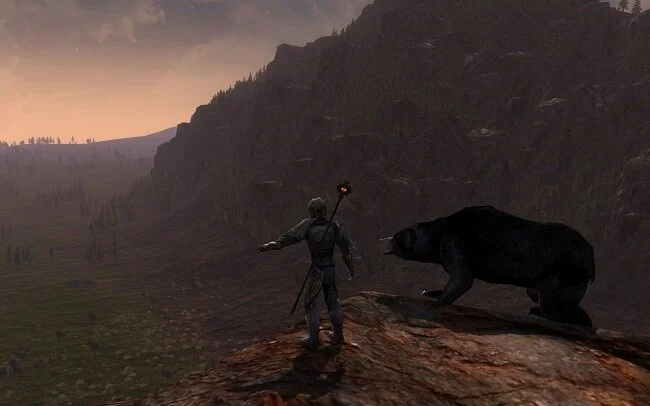
November proved to be a very productive month, gaming wise. I had to self isolate for 14 days, due to coming into contact with someone who had tested positive for COVID-19. Hence I had far more leisure time than usual. For a second month I applied myself to progressing through the new “mini expansion” in The Lord of the Rings Online. The new zone is a two phase map. The first is Elderslade, a mountainous region to the North of the Wells of Langflood. This area contains mainly story quests. The second phase, called War of Three Peaks, is the same zone but during a period of open war between the Dwarves and the Orcs. Quests here are mainly repeatable slayer and achievement quests. I did not discover this until I had completed the first round, so to speak, only to be offered exactly the same quests again by an NPC. As I had reached maximum rank in reputation for this new faction and there were no rewards of any note for me to spend my barter currency upon, I simply stopped playing through this content.
The last 31 days have gone by really fast, or at least that’s the way it feels. Despite having bought several new games recently and acquired yet more for free from the Epic Store, I did not embark on anything new throughout October. Due to the unexpectedly prompt release of the new “mini expansion” for The Lord of the Rings Online and the launch of a new event in Star Trek Online, I found myself focused upon the MMORPG genre, yet again. And after playing continuously for six months, Call of Duty Modern Warfare/Warzone has finally begun to lose its lustre. I didn’t especially enjoy the Halloween event, not that there was anything inherently wrong with it. It just wasn’t for me. I played a little Fall Guy: Ultimate Knockout but quickly discovered that the “season” system is just another gear treadmill, although the gear in this instance are novelty cosmetic outfits. I don’t want to be tied to too many games in this fashion (it’s bad enough with MMOs), so this is another title that has been relegated to occasional play when the fancy takes me.
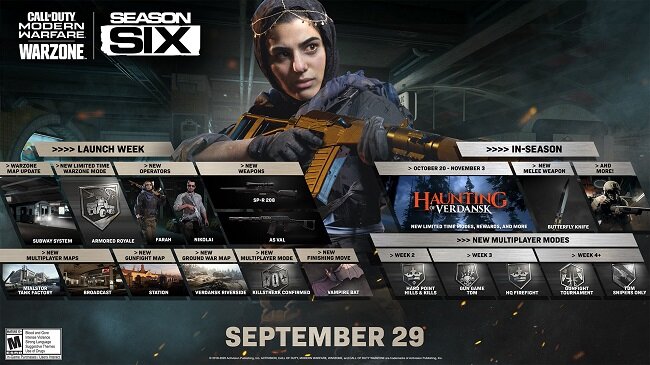
September has been a difficult month. A family crisis and subsequent bereavement meant that gaming got pushed down the daily agenda. However, after the various chores and duties were done I did need some downtime and means to relax. Hence I did play some games in a limited fashion. Nothing fancy, just stuff like Fall Guys: Ultimate Knockout and Gang Beasts, which are light-hearted and undemanding. I also took the time to log on to The Lord of the Rings Online test server and check out the preview of the forthcoming “mini-expansion”. Not only was this informative but it provided material for a blog post. But overall I didn’t really achieve anything substantial with my gaming throughout September. Gaming was relegated to being just a convenient diversion from the immediate problems I’ve been facing but as such, it did fulfil that role well.

I’m still somewhat shocked that August has been and gone. Even by 2020 standards it’s been an odd month. Due to illness in the family, my schedule has been turned on its head and subsequently there has not been as much time for gaming as I’ve previously enjoyed. However, I tried to put what time I had to good use. I attempted to return to the MMORPG The Lord of the Rings Online once again, to see if I could continue through the epic story. Sadly, the game has run into further server related issues, just as it did last month. Standing Stone Games community manager Jerry Snook was a little “snippy” in responding to players' concerns and at present there are no details regarding what the problem is and when it will be resolved. If this issue persists I suspect that it is going to do some genuine harm to both the player base and community relations. I hope matters improve for SSG and LOTRO over September.
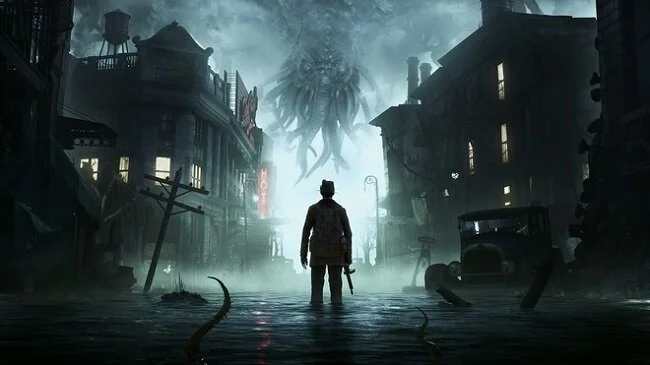
As I mentioned in the last instalment of “A Month in Gaming”, I was toying with the idea of buying Ghost Recon Breakpoint. However, I have decided against that. Yes the game may well be a third person, co-operative shooter but ultimately it’s yet more explosions and military hardware fetishism, which isn’t anything new. I have more than enough of that at present with Call of Duty Modern Warfare/Warzone. I also don’t feel disposed towards giving Ubisoft any of my money at the moment, until they get their house in order. I am so tired of continuously reading about how shitty the video game industry is to work in. It’s difficult to protest in a meaningful way but I guess for the present not buying a product is as good a way as any. So rather than purchasing any further games, I decided in July to play at least one of the many titles I’ve got in my existing library.
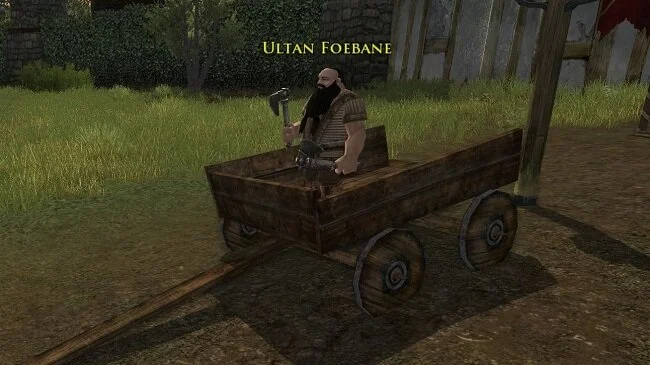
I stopped subscribing to The Lord of the Rings Online in June. I’ve always had a very cyclical relationship with this MMO and at present I feel I need a break from the games somewhat linear formula. Plus the new content scheduled for release centred around the wedding of Aragorn and Arwen doesn’t exactly sound enthralling. So I’ve left my primary character in Langflood and will return to the game later in the year when I feel the need to catch up with content. I have also abandoned the ongoing events in Star Trek Online as they’re getting too repetitive. I would like to see a new longterm story arc rather than just a continuous cycle of short term events and repeatable content. I don’t mind working towards a goal but it has to be something I want and the rewards offered in this MMO are getting a little too generic for my liking. I shall return to the game at some point as I’m a lifetime account holder and I’m curious to see how developer’s Cryptic overhauls the Klingon story arc.
I see by the financial data that is currently available and being pawed over by industry pundits, that April was a very good month for the video games publishers. Quelle surprise. Who would have thought it? The increase in leisure time has certainly meant that even I have had a greater opportunity than usual to invest in playing video games. And as I predominantly play the MMORPG genre that has proven to be a boon. Or at least it was initially. After two month plus that is fast becoming a bane. MMOs are great when you have new content to play through, stories to discover, goals to achieve and systems and items to advance. But once you’ve done all these things and find yourself doing dailies just out of obligation and a way to kill time, then it may well be time to move on to something else.
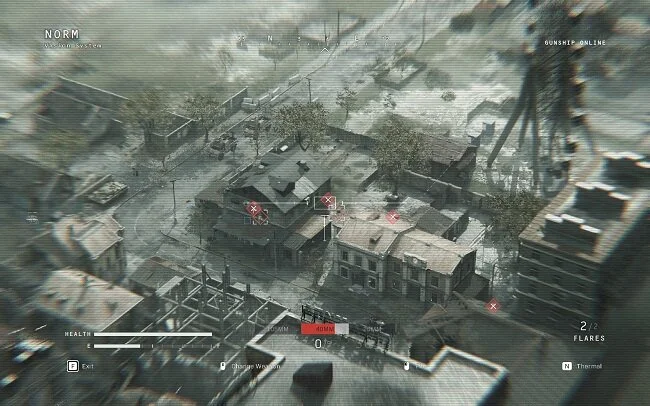
April has been an usual month. The ongoing lockdown here in the UK (and elsewhere in the world) has afforded me more gaming time than usual. The policy of social distancing has reduced my caring duties to just three hours a day. Hence I and many others like me have much more leisure time available. I initially thought that this situation would be the perfect time to try some of the many of the games that I have stockpiled over the years. However, despite trawling through many titles, I still failed to find anything that immediately took my fancy. So I decided to take stock of my overall gaming activities and whether it was time to revise them and try something new. And by new I don’t just mean just buying a new game but taking a step out of my current comfort zone into a genre I don’t usually play. So that’s exactly what I did and the results have been very interesting.
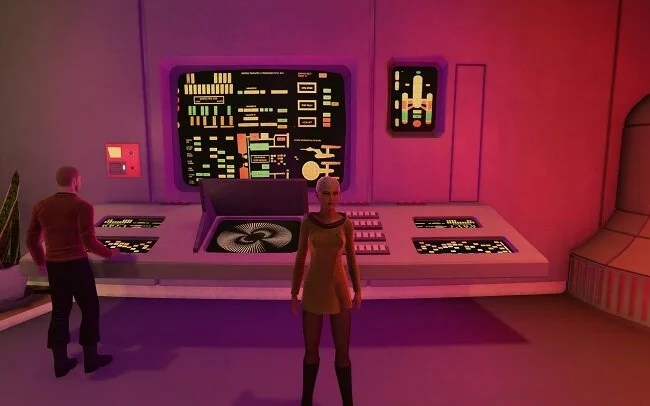
The problem I find with monthly gaming articles is that they tend to cover ground that I’ve already written about over the last 4 weeks in other blog posts, only in less detail. So here is the brief version of my gaming activities throughout February. I played through the entirety of the Star Trek Online 10th Anniversary event and received the new hybrid Tier 6 ship. I enjoyed the new 2 part feature episode and have managed to maintain a schedule of doing “odds and sods” to keep myself busy. STO is currently my primary game. I’ve ground to a halt in The Lord of the Rings Online, as soon as I start questing in Minas Morgul itself. It is simply too uninspiring and grindy an area. So I’ve focused on completing deeds for virtue experience and daily repeatable quests for Anfalas Scrolls of Empowerment. Due to constraints upon my schedule, I decided to temporarily stop my subscription to ESO Plus, as I simply do not have the time to invest in The Elder Scrolls Online at present. ESO is a good game and deserves attention when played. Committing to multiple MMOs at once is always a mistake.

So much for the New Year. January has now been and gone and 2020 just seems to be barrelling along. As ever, due to my real world commitments, I’ve been pushed for time over the last thirty one days. Therefore, most of my gaming has been targeted “binge” sessions conducted late at night. However, I do find playing through episodic content over several hours to be a very productive means of making progress in MMOs. So overall January has been an enjoyable experience, game wise. Due to my circumstances, I have deferred starting any new single player games and have focused primarily on two titles; The Lord of the Rings Online and Star Trek Online. Sadly, The Elder Scrolls Online has been relegated to being played just once a week, usually on a Wednesday night when I meet up online with friends. My exploration of Vvardenfell will have to wait until later in the year, as I cannot sustain three MMOs to any great degree.
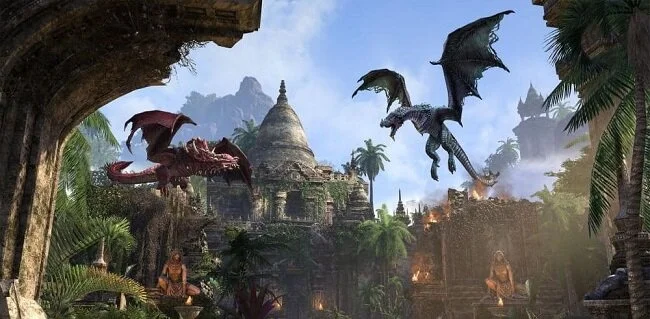
October has been and gone. And as ever the MMORPG genre has been the mainstay of my gaming activities over the last thirty days. Furthermore, it has been a productive month. I managed to complete the Daggerfall Covenant narrative arc, along with the main story on my Dragonknight in The Elder Scrolls Online. I find that completing Coldharbour is the biggest obstacle in progressing. It’s an atmospheric zone but once you’ve experienced it, it doesn’t really lend itself to repeat playing. But having done all this my Dragonknight hit level cap. I had taken the precaution of buying appropriate gear ahead of this achievement, so I managed to acquire some decent armour and jewellery that provide robust set bonuses. Despite focusing mainly on ESO, I did manage to progress further in The Lord of the Rings Online. I got as far as the Wolf Denes in the Vales of Anduin update. I also took the time to visit the LOTRO test server and checked out the Minas Morgul expansion preview. As for Star Trek Online my daily visits have been focused upon completing Task Force Operations and grinding for a free ship (again).
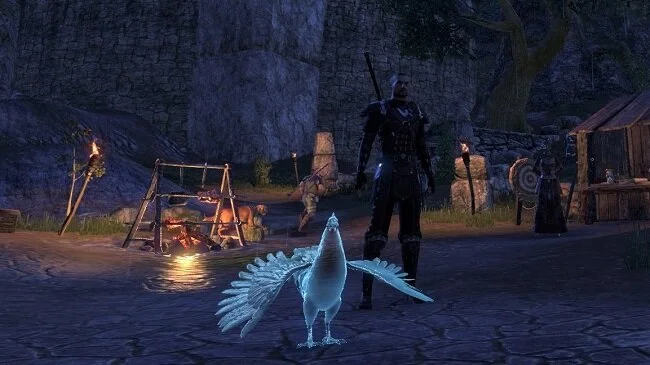
September saw The Elder Scrolls Online becoming my primary gaming focus. No real surprises there as I’ve been having so much fun of late with this MMORPG. I managed to get my Argonian Necromancer to level cap and then had the fun task of trying to equip them suitably. I don’t quite know why this aspect of gaming appeals to me so much but I just get a real kick out of trawling around looking for appropriate gear. I tend to enjoy it in all the MMOs I play. There’s just something inherently satisfying about equipping a new piece of armour or jewellery and seeing your stats noticeably increase. This process is even more enjoyable in ESO as there isn’t any server wide auction house, so you have to travel around from region to region, individually checking each guild trader you find. It really is virtual shopping. Once I managed to find the right gear for this character, I promptly created a new Imperial Dragon Knight and started playing through the Daggerfall Covenant storyline as it the one faction I haven’t yet completed. Oh and in ESO cosmetic pet news, the ghost chicken (official name Spectral Chicken) is outstanding.
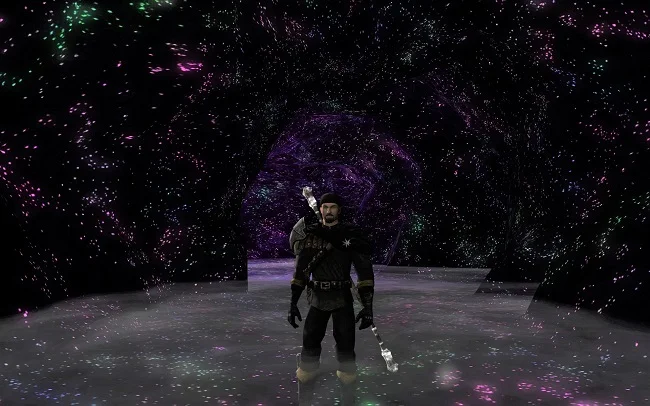
Last month panned out pretty much as I expected. Blaugust and writing daily blog posts took up a fair amount of my leisure time. And then I lost a few days due real-life social activities. What gaming time I had was focused mainly on The Elder Scrolls Online. I’m sorry to say that I’ve ground to a halt in The Lord of the Rings Online. My level 113 Guardian remains at the Black Gates and for the present I simply do not feel disposed towards working my way through Mordor again, which I did just a year ago on my primary character. I have undertaken a few quests with my level cap Lore-master and will endeavour in the weeks ahead to at least complete the Vales of Anduin region. LOTRO at present doesn’t have much of a hold on me, although I may well become more enthusiastic once the next expansion is formerly announced.
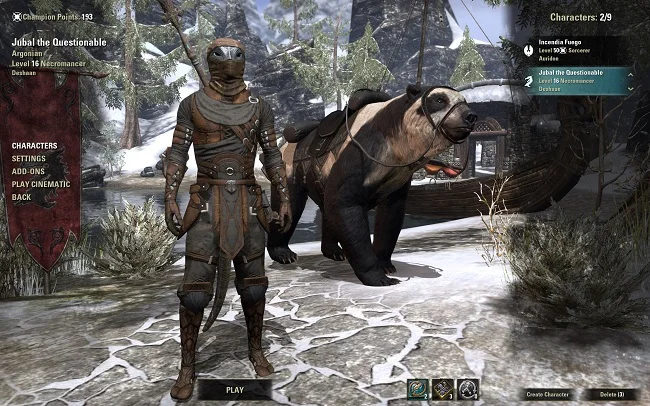
Contrary to my last A Month in Gaming post, I did actually end up buying a discount copy of Elsweyr and returning to The Elder Scrolls Online. And I’m rather glad that I did, because it has provided a welcome change of scene and an opportunity to do something different. However, you can’t just fire up ESO and dive right in. No sir. The first thing you have to do is update all your addons and if your starting a new alt (which I decided to do), ensure that your key mappings and custom settings are ported over. This process was a pain in the butt; however it did inspire a couple of blog posts. Creating a new alt is the perfect way to reacquaint yourself with ESO after a lengthy absence. In my case it has been 12 months. I decided to try the new Necromancer class and so far, it has proven to be both fun and rewarding. Rather than try to do a thousand things at once, I just started the Elsweyr main story and doggedly pursued it. The narrative is enjoyable and it was fun to see Cadwell as part of the plot focus. For practical reasons I’ve re-subscribed to ESO plus to unlock various DLC and I intend to continue playing for the next month or so.
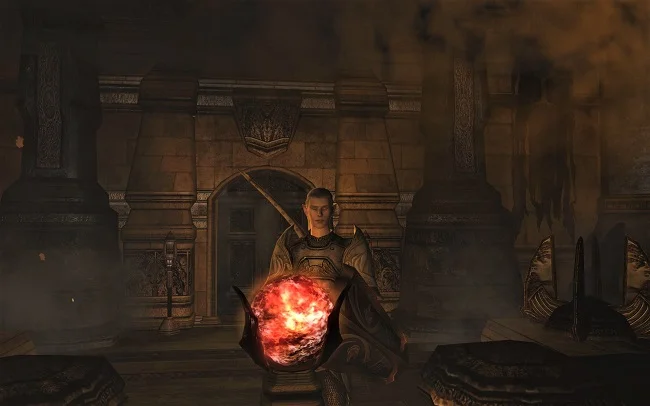
This post should have been published two weeks ago but as ever, real life just keeps getting in the way. As expected, June proved to be a busy month, however, I managed to organise my leisure time pretty well, affording me an opportunity to not only play my two current MMOs but also experiment with some other games. At present my caring commitment keep me busy from about 10:30 AM to about 5:00 PM. I tend to get up round about 7:00 AM so if I promptly have a shower, dress and eat, I can usually create a two-hour window in the morning to either tackle admin and paperwork or undertake dailies in games such as The Lord of the Rings Online or Star Trek Online. I can also find several hours in the evening as Mrs Peril tends to go to bed earlier than I. Therefore practical time management has proven beneficial over the last four weeks.
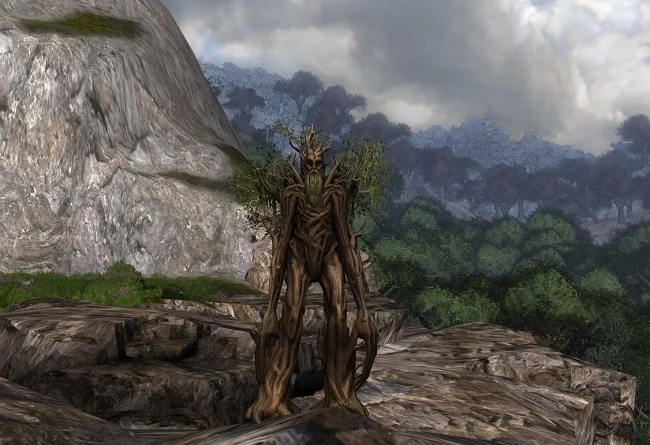
As I suspected in my last post, my gaming activities were somewhat curtailed throughout May due to both my parents being ill. However, the time I did manage to spend in-game was both therapeutic and relaxing. For me, I’ve never really seen gaming as escapism, although I appreciate it certainly is for others. One of the aspects it offers, along with a degree of challenge and entertainment, is a release from stress and the pressures of one’s daily life. Perhaps that is why I enjoyed Sniper Elite V2 Remastered so much, because not only is it a thoroughly absorbing game, it also provides a sense of catharsis. I’ve already written about the game in some detail, along with my thoughts about the ongoing “remaster versus remake” debate. However, I would add that I enjoyed it so much I re-installed the sequel, Sniper Elite III, which I haven’t played since it’s release in 2014. This also proved to be an enjoyable undertaking, again for the self-same reasons.
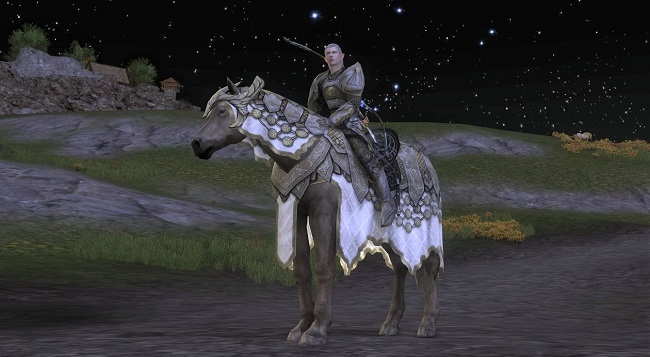
So what have I been up to in April gaming wise? Oh, yes there was this. Mounted combat for the Guardian class is awful. There. I said it. As I’m not a LOTRO “altoholic” my only previous experience with mounted combat was with my Lore-master. Most of their skills are ranged which makes the fights less tedious and time consuming. And you get a combat pet which helps the proceeding slightly, but overall, it’s not that much fun. However fighting via your war steed with a Guardian is a ponderous grind. You have to be in close proximity to your foe to hit them and half the time they are running around you, conspicuously out of range. Sure there’s a skill that brings them next to you for a short period of time but as a level 85 Guardian’s DPS output is distinctly average at this point in the levelling curve, it’s a long, arduous slog to kill anything. My solution has been to summon my skirmish soldier who is an Archer and to use them in conjunction with my own bow to shoot down mounted foes while on foot. This still takes time but is quicker than doing it from horse back.
ESO: “Where am I and What am I Doing?”
The other day, I was undertaking a daily mission for the Undaunted in The Elder Scrolls Online. I do these to level my companion’s associated skills line. The mission required me to go to a particular delve, set some soul traps and defeat the boss. Nothing unusual there, so off I went. Whenever I go into a delve in ESO, I usually do the quest associated with it. It provides a story and some additional experience points. Thus I arrived in the vicinity of the delve in question and found a note not far away. I read it and accepted the quest assuming it to be the one associated with the delve. To cut a long and confusing story short, it turns out it wasn’t. I discovered this about 20 minutes later when I found myself running around, confused with three separate lots of quest markers on my in-game map. Not for the first time I found myself pondering “where am I and what am I doing”.
The other day, I was undertaking a daily mission for the Undaunted in The Elder Scrolls Online. I do these to level my companion’s associated skills line. The mission required me to go to a particular delve, set some soul traps and defeat the boss. Nothing unusual there, so off I went. Whenever I go into a delve in ESO, I usually do the quest associated with it. It provides a story and some additional experience points. Thus I arrived in the vicinity of the delve in question and found a note not far away. I read it and accepted the quest assuming it to be the one associated with the delve. To cut a long and confusing story short, it turns out it wasn’t. I discovered this about 20 minutes later when I found myself running around, confused with three separate lots of quest markers on my in-game map. Not for the first time I found myself pondering “where am I and what am I doing”.
I have subsequently discovered after conducting some research that the quest I picked up outside the delve was in fact the prologue for the Blackwood expansion. A quest that I would have undertaken at some point but one that I wasn’t specifically intending to do at the time. I’m a bit picky regarding questing in ESO and I’m trying to do the content in narrative order on this particular alt. However, I believe this situation highlights a flaw in the way quests are presented to players in the game. The most obvious problem from my perspective is that there was nothing to indicate on the initial quest bestowal text (which in this case was a handwritten note) that it was for this specific quest chain. Because content scales in the game now, you can travel Tamriel and pick up missions from the original story, regional quests and faction specific missions. Unless you check every quest offered against one of the various ESO Wikis, you’ll find yourself involved in multiple stories and it all gets confusing.
ZeniMax have given quest bestowal a great deal of thought in ESO, as you can pick up the major ones in several different ways. If you miss one NPC you may subsequently receive a letter to prompt you. It’s all rather clever. When you start playing the MMO for the first time, the way some NPC will run up to you to ask for your help is quite exciting. But it gets old very quickly and Stuga, Bera Moorsmith and others soon become very irritating. Another issue I have with ESO is managing quests via the in-game journal. Even when using an addon, it is still difficult to filter and order them in a way that I feel is logical. The easiest way to avoid confusion is to undertake just one quest at a time but that is hardly practical. And don’t get me started on the game’s inability to abandon the redundant Cadwell’s Silver and Gold quests. For a game that excels in many other ways it’s odd that they have fumbled the ball on this basic aspect of MMO gameplay.
I do not have this problem in other MMOs. In The Lord of the Rings Online quests are level specific and there is no scaling of content. Hence you cannot accidently stray into a new zone and pick up a major quest in error, if you’re below the level of content in that area. Star Trek Online has an interesting quest bestowal system where most content is offered by senior leaders of your faction. The player is hailed via subspace communication and the bestowal dialogue is clear regarding which storyline the mission is associated with. The ingame mission journal also has a tab showing what story arcs are available and all of their subsequent missions. It is a far less confusing system and much easier to stay on top of. However, what cannot be cured must be endured, so in the meantime I shall have to be more cautious about what quests I do or do not accept in ESO. I shall also see if there’s a more comprehensive addon for the quest journal.
I was recently perusing my archive of old blog posts, when it struck me how much I’ve written about the MMORPG genre over the years. Naturally, there was far more material from between 2008 and 2012 as that was period when I immersed myself in the genre and was very enthusiastic about it. I was at a point in my life when I had the time to dedicate to such games and I was happy to participate in the social aspect of they offered. I would regularly play through group content and spend time socialising online with fellow guild members. My experience remains a textbook example of how online games can be more than the sum of their parts and that where you are at in your life has a major impact upon your overall enjoyment. As I read though various old posts it became clear that my experiences where specific to this particular part of my life and that they cannot be repeated. My relationship with the genre is very different now and that’s fine.
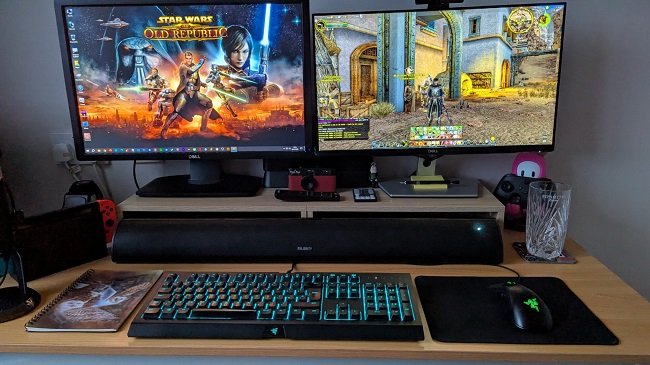
I have two monitors on my desk. The first (which is the primary monitor as far as my PC is concerned), is on the left and the second is on the right. The primary monitor is a 24 Dell U2412M, which has a resolution of 1920 x 1200. It therefore has an aspect ratio of 16:10 which adds a little extra desktop real estate, which I prefer when writing. The second monitor is a 24 inch Dell S2421H with a screen resolution of 1920 x 1080. It has an aspect ratio of 16:9 which is standard FHD. My chair is adjacent to the middle of my desk and I can turn according to each monitor I’m using. I tend to use the primary, larger monitor on the left for tasks such as writing via Google Docs and emails. The second monitor on the right is used for YouTube and gaming. This is because of its FHD format. I also have a Nintendo Switch connected to the second monitor for the same reason.
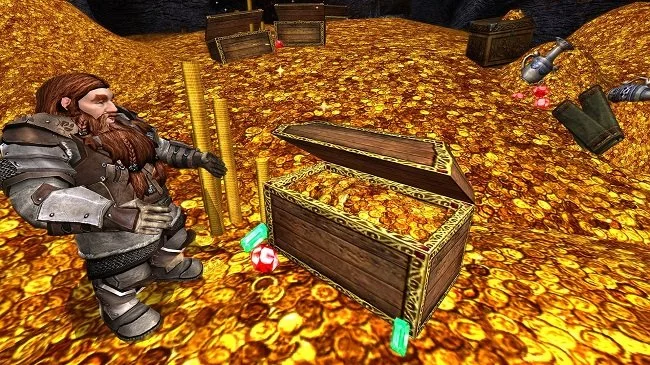
Bree Royce, editor-in chief at Massively Overpowered, recently asked the question “what is the most expensive MMORPG right now”. My first thought was to search through my old draft blog posts and track down an MMO cost analysis I wrote circa 2019. It includes data such as subscription rates and the price of current expansions. There was also information on what were the most popular cash shop items at the time. However, I then read some of the comments that had been left on Bree’s post and I quickly realised that this wasn’t just a matter of financial expenditure. Whether or not an MMO is expensive is also determined by one’s disposable income, respective wealth and personal relationship with money. The latter is perhaps the most important, irrespective whether you consider yourself rich or poor.
“The MMO genre is rife with its own set of tropes; recurring themes and motifs that have become established and ubiquitous. All of which are ideal material for a hastily produced, lazily conceived, recurring blog post”. Dying in an Massively Multiplayer Online Role-Playing Game is a clear and unambiguous fail state. A means by which to teach the player that they’re doing something wrong and that they need to rethink their strategy. IE Don’t mess with the foul Marmydons unless you have back up and are wielding the Sword of Kagnazax. Dying is a reminder to not get overconfident and maintain situational awareness. It teaches us to ensure you have the right gear and consumables, to be au fait with the mechanics of any fight you’re about to get into and that winning is not a given. Any enterprise that offers a tangible reward will come with potential risks and consequences. If you’re playing in a group then death provides a timely reminder not to rely on Colin.
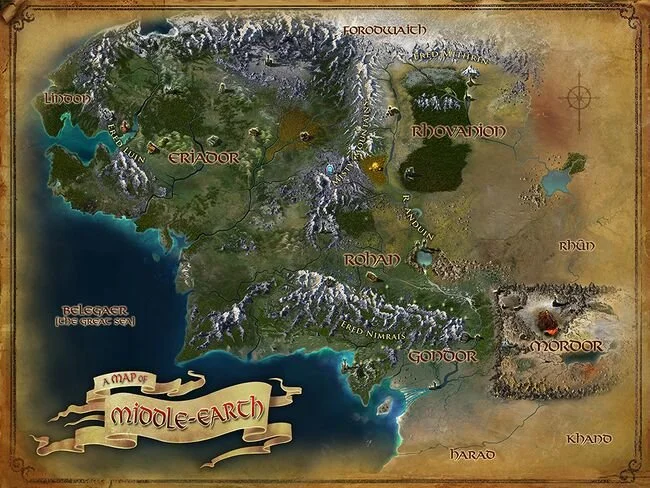
The Lord of the Rings Online was my first major MMORPG. I started playing in late 2008 and quickly discovered that there was a necessity to become familiar with the game world. Although the game provides quick travel options they were not ubiquitous at that point and often a player would simply travel on foot to travel costs down and to take the most direct route. Back in 2008 you could not own a mount until level 30. Hence I began “learning the maps” in the game and to this day still remember how to travel from one side of Moria, to another. The maps in the base game remain clear in my mind as they were so well trodden. Not so those in the regions. There are far more stables with fast mounts present in the game now and so convenience trumps any requirement to become so familiar with newly added zones. Nowadays Standing Stone Games designs new zones that tend to funnel players through them from quest hub to quest hub.
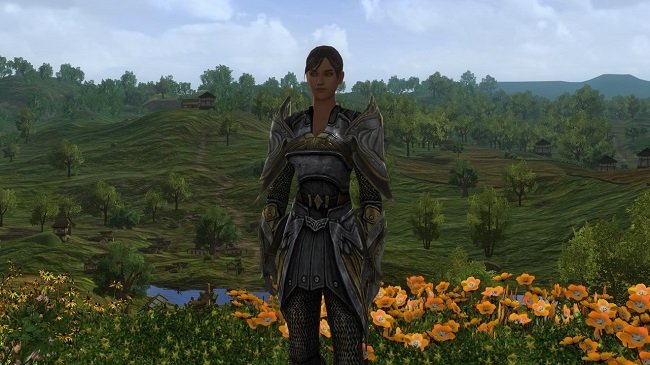
There was a perennial question being discussed over at Massively Overpowered recently. Justin Olivetti asked “why do you play MMOs solo” and as you would expect, there was a wide variety of answers. I have written about this myself in the past, as when I first started playing MMOs, I was very enamoured by the social element and therefore very disposed towards group content. However, that experience between 2008 and 2011, when I played The Lord of the Rings Online most days and dedicated Friday and Saturday nights to raiding, was very much down to circumstances. I had the time and inclination to spend hours online. That is something that I don’t have now. Plus the novelty of the social element has worn a little thin over the years. Nowadays, I do not have the luxury of waiting for a raid group to assemble, nor do I have the tolerance for the inevitable delays that always stem from any kind of human interaction.
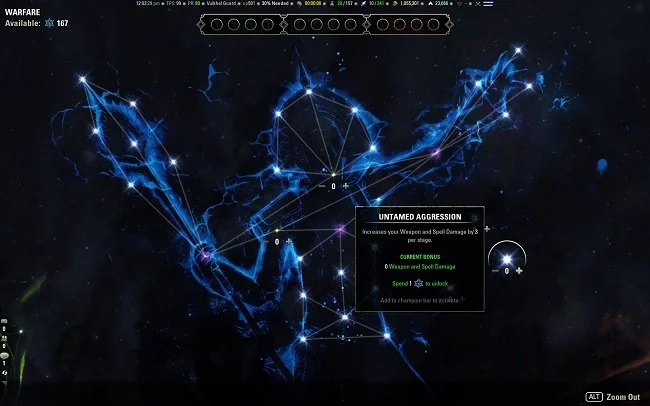
I’m sure I’ve mentioned this issue before in previous video game related posts. But I don’t think I’ve devoted an entire article to the matter, which is what I’m going to do today. So to provide some context, I logged into The Elder Scrolls Online today as I’m fast approaching that point in the year where I spend a few months subscribing to the game. Due to some recent patch, once again all my Champion Points have been refunded. Judging by the change in graphics, it may be that the entire Champion Point system has been updated. Whatever the reason, I have to re-allocate 501points into three skill trees. I wasn’t au fait with the last system, so I followed a build I found online. Now that it has changed, I’ll have to find a new one and copy it. Until I do, my character will be gimped. Shame the game doesn’t offer a selection of generic builds that can be easily implemented at the press of a button.
The last installment of A Month in Gaming was at the end of April. I have decided to update this recurring post less often to ensure that I have more to write about than just cataloguing my generic activities in The Lord of the Rings Online and Star Trek Online. The only downside of such an approach is that it invalidates the title but that can’t be helped. Fortunately, I have done more than usual over the last two months. My daily schedule has changed temporarily and I now have a little more leisure time available. Hence I’ve dabbled with several new games as well as using my Nintendo Switch more often. I also took part in a “tag team” playthrough of XCOM 2, which was a very interesting experience. And I finally took the time to go through all my games libraries on the various different platforms to catalogue exactly what I have. I found a few hidden gems but the majority is just “filler” that you find in most video game bundles.
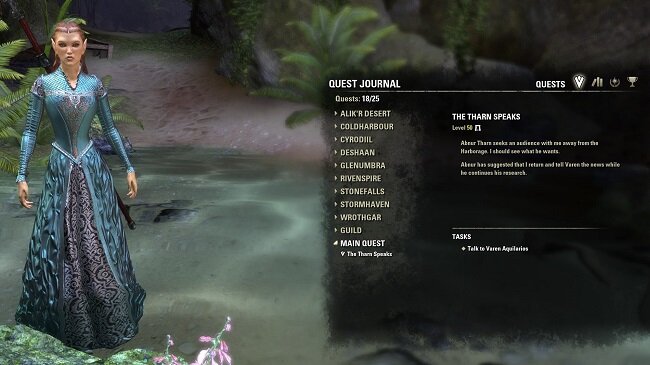
The other day, I was undertaking a daily mission for the Undaunted in The Elder Scrolls Online. I do these to level my companion’s associated skills line. The mission required me to go to a particular delve, set some soul traps and defeat the boss. Nothing unusual there, so off I went. Whenever I go into a delve in ESO, I usually do the quest associated with it. It provides a story and some additional experience points. Thus I arrived in the vicinity of the delve in question and found a note not far away. I read it and accepted the quest assuming it to be the one associated with the delve. To cut a long and confusing story short, it turns out it wasn’t. I discovered this about 20 minutes later when I found myself running around, confused with three separate lots of quest markers on my in-game map. Not for the first time I found myself pondering “where am I and what am I doing”.
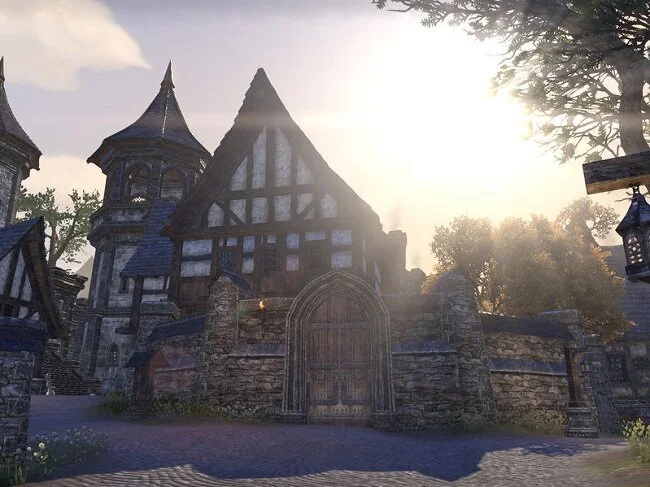
This post is not intended as a player housing guide. There are plenty of those available already. Instead, it is my personal musings on the various factors that have determined my choice of player house in The Elder Scrolls Online. In fact, at the time of writing, I have not yet purchased the house in question. It is dependent not only on a large sum of in-game gold but also a substantial achievement. The house in question is Gardner House in Wayrest. As it is a large player house it costs 1,015,000 gold. Alternatively, it can be bought for 5,700 Crowns, unfurnished. If you want it furnished it will cost 7,100 Crowns. I shall not be buying this property with Crowns as it works out at about £36 or so. I think that price is a little exorbitant especially in light of what I want the house for.
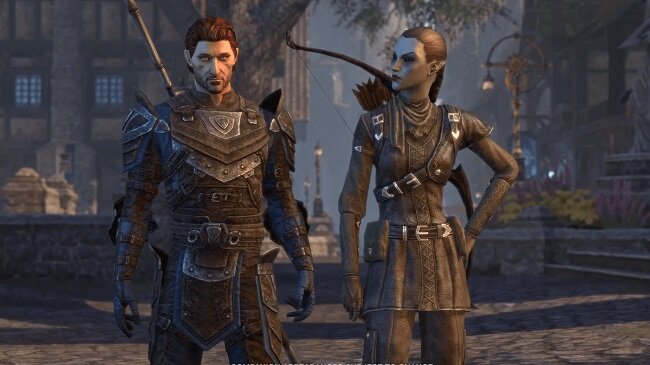
The Blackwood expansion for The Elder Scrolls Online launched a little over a fortnight ago. During that time I have become accustomed to having an AI companion. Not only are they an enjoyable new addition to the MMO, they also have quite a significant impact upon PVE gameplay. Both Mirri Elendis and Bastian Hallix can provide robust support and cover a variety of roles. This is down to the flexibility of the skills system associated with companions. Gear requirements are simpler and a lot easier to manage compared to that of your main character. Levelling is driven by XP gained from combat. Thus, if you go questing with either one of your companions they will level accordingly. They also have personal quests associated with them, ensuring that both companions have an appropriate backstory. The rapport system means that it is prudent to be nice to your AI chum or they’ll leave you for a time.
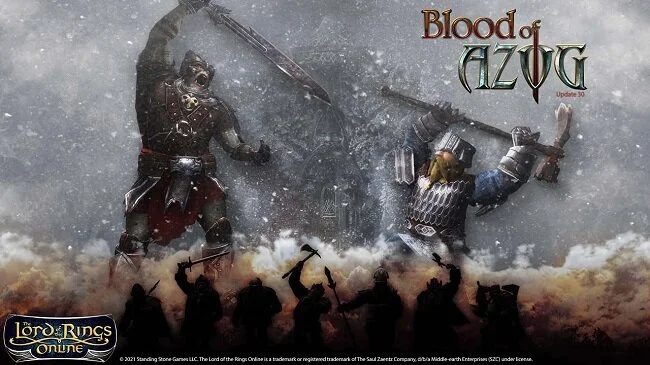
Justin Olivetti posed an honest question on Massively Overpowered yesterday. “Do you have any clue what’s going on in your MMO’s storyline?” he asked and I must admit that my answer varies greatly according to what I’m playing. Yet before I give a more comprehensive response, let me make clear that one of the aspects of the MMO genre that I enjoy the most is its penchant for complex and sprawling narratives. Both The Lord of the Rings Online and Star Trek Online are based upon intellectual properties with in-depth lore and an established canon. I was also drawn to the RPG Skyrim due to its enigmatic story which linked into a much wider history. It was one of the reasons I started playing The Elder Scrolls Online, as every quest seems to have a story that is connected to another. My enjoyment of these dense plots found in the MMO genre stems from my love of reading as a child.
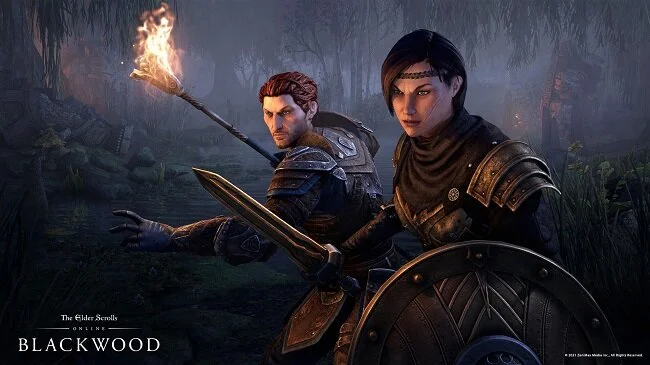
Last night, I finally had sufficient time to log into The Elder Scrolls Online and check out the new Blackwood expansion. The plan was to go straight to the new zone and complete the relevant quests to obtain the two companions that have been added to the game. Unfortunately, life seldom goes to plan as Robert Burns alluded to in his famous quotation. As I haven’t played ESO for a while, I’ve missed several major game updates. Consequently all my champion points have been reset, along with all my skills. So, I had to spend some time trying to remember how my Dragonknight was previously set up. I checked a few screenshots to see what skills were on the hotbars but as they don’t display the name, plus the icons change after morphing a skill, it was tricky trying to reverse engineer my prior build. Eventually I just winged it and managed to blag my way through the two quests.
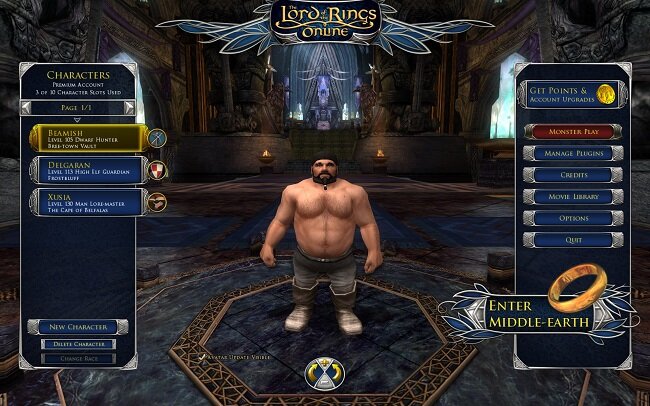
There are many factors that can add to an MMORPGs replayability. Multiple races, classes and factions can all potentially offer a new experience to the player. Some games even have unique stories associated with different types of characters, ensuring that rolling a new alt means that the player doesn’t repeat material they’ve already completed. Many gamers enjoy this aspect of the genre and will experiment with different builds, resulting in a character selection screen filled with numerous alts in various states of progress. However, irrespective of whether you get to experience a new story or if you indeed like the new character you’ve created, there comes a point when you look at your new alts progression and reflect upon the long, long journey to level cap. It is at this point that many alts fall by the wayside. The aforementioned character selection screen is often populated with unfulfilled potential.
If I may quote myself “The MMO genre is rife with its own set of tropes; recurring themes and motifs that have become established and ubiquitous. All of which are ideal material for a hastily produced, lazily conceived, recurring blog post”. This time round, I would like to discuss the following. The Hero, the Chosen One, the Übermensch. As that is the role that we so often are assigned in this genre. Developers broadly assume that most players want a power fantasy and precious little else is on offer. Hence we find ourselves in a story in which we are destined to do great deeds in a virtual world, whether we wish to or not. I can see the superficial appeal of such a conceit. Most of us are not such overachievers in real life. So a game in which we get to do stuff to the world, instead of the world doing stuff to us has an inherent allure. But like most MMO tropes, unless it is implemented with some panache and creativity, it quickly becomes a tiresome cliche.
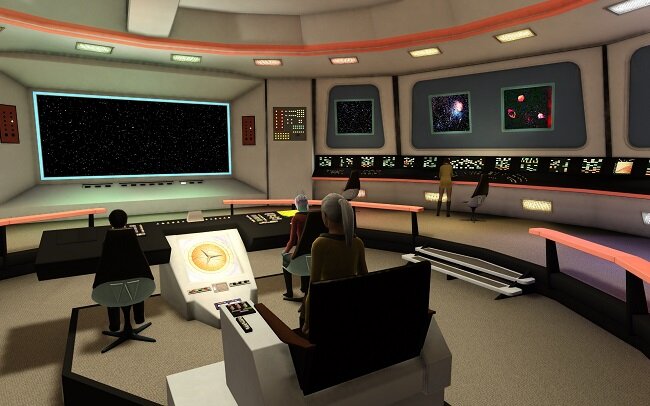
Last year I wrote a post about several “quality-of-life mechanics” found in MMOs. Systems and functionality that just make a game more manageable or convenient. Despite having many features in common, MMOs are far from identical in their interface and controls. If you’re a genre aficionado, then you can usually bluff your way through a new game and decipher how to play it. But for new players, often just trying to figure out how to do a simple thing, like find your skill points, can be an uphill struggle. However, every now and then, you’ll come across some simple functionality in a game that is useful and makes a task much easier. So I have collated another five “quality-of-life mechanics” that I feel are significant and beneficial to the player. Some are very minor but that does not diminish their value. Sometimes, less can indeed be more.
As I mentioned recently in my monthly gaming roundup, I’ve currently stopped playing the three MMORPGs that are my usual gaming mainstay. Namely The Lord of the Rings Online, The Elder Scrolls Online and Star Trek Online. It’s something that I do from time to time when I’m tired of the repetition this genre offers. At present none of these titles has anything on offer that motivates me to play them enthusiastically. Especially LOTRO. I find weddings tedious and self indulgent in real life, so I’m hardly going to get “excited” about a virtual one set in Middle-earth. However, that’s not to say that I’ve lost interest in the MMO genre. I’m merely temporarily burned out at present. I find that after a few months or so, either new content is released that lures me back to these games or I tire of what I’ve been playing in their stead. It’s a cyclical process that I go through from time to time and nothing to worry about.
I stopped subscribing to The Lord of the Rings Online in June. I’ve always had a very cyclical relationship with this MMO and at present I feel I need a break from the games somewhat linear formula. Plus the new content scheduled for release centred around the wedding of Aragorn and Arwen doesn’t exactly sound enthralling. So I’ve left my primary character in Langflood and will return to the game later in the year when I feel the need to catch up with content. I have also abandoned the ongoing events in Star Trek Online as they’re getting too repetitive. I would like to see a new longterm story arc rather than just a continuous cycle of short term events and repeatable content. I don’t mind working towards a goal but it has to be something I want and the rewards offered in this MMO are getting a little too generic for my liking. I shall return to the game at some point as I’m a lifetime account holder and I’m curious to see how developer’s Cryptic overhauls the Klingon story arc.

Whenever you use a skill on your hotbar in The Elder Scrolls Online, there is an associated animation as it is inducted and utilised. These animations may vary in length from one to several seconds depending upon their nature. Although these animations add to the ambience of the game, they do come with a direct consequence. The player has to wait for the animation of one skill to complete before they can use another. For those seeking to optimise their performance or DPS output, these delays are an impediment. However, they can be negated through animation cancelling and weaving. Animation cancelling is as it states the stopping of a skill related animated sequence by the use of a follow up action such as bash/tap block/dodgeroll. Weaving is slightly different, in so far as instead of stopping the inducted animation immediately, it allows for the process to be cut short as another animation is started. Typically this is done by using a light attack and then immediately using a skill.

I managed to find a very good deal on the Digital Upgrade version of Greymoor for The Elder Scrolls Online, so I bought it. The key included a pre-order bonus as well as a few other “trinkets and baubles” which clinched the deal. I wasn’t planning on returning to ESO this month plus I still have a bee in my bonnet about playing through the game in narrative order. However, after speaking to friends about the new expansion, I was curious about the new Harrowstorm events that occur in the new zone of Western Skyrim. So I logged into the game and after the obligatory “let’s spend 30 minutes fixing broken addons”, headed over to Solitude and waited for the next Harrowstorm to appear. As ever, Zone Chat is invaluable for determining what is happening and where, so it wasn’t long before I was riding headlong towards the Black Morass Ritual Site ready for my first Harrowstorm.
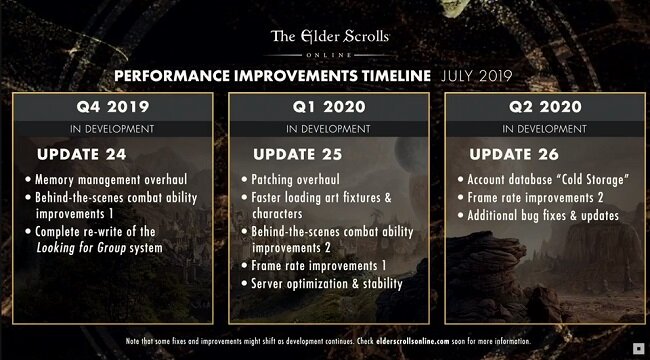
ZeniMax are allegedly addressing some major performance issues with the forthcoming Update 25 for The Elder Scrolls Online. If this latest patch improves loading times, the game’s overall performance and makes updating the client faster, then it will be well received by players. However, Update 25 requires players to reinstall the entire game client due to technical reasons. Furthermore, the patch is not going to be available prior to release on Monday February 24th, so player’s cannot download the necessary files in advance. Unfortunately, as soon as the patch server comes online, all players will have to reinstall the full ESO client and wait accordingly. Considering the disparity between internet connections in the US and Europe, player experience will vary greatly. Some will download the client in hours where others will have to simply leave their PC running and wait all day. Considering the popularity of ESO and the estimated size of its player base, I wouldn’t be surprised if there are queues or connectivity issues.
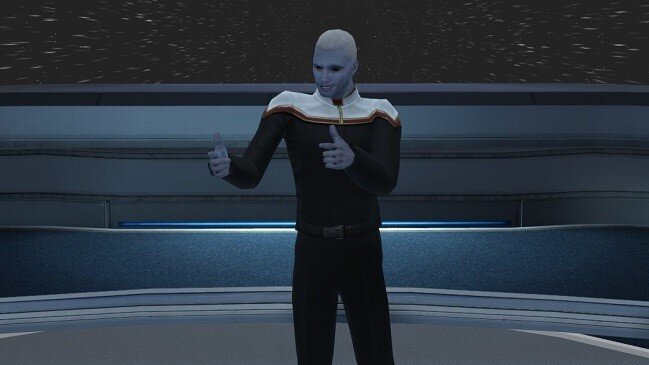
Over the years I’ve played numerous MMOs (to varying degrees of success). As a genre there are certain game mechanics that are standard and common to most games. Initially during the “golden age” of the MMORPG, there was a focus on collaborative team player. This meant that successfully undertaking group content required a spectrum of players in specific roles. This particular mechanic has diminished over the years but the genre still has numerous common tropes. Quest hubs, reputation factions, gear grinds and vertical levelling are just some that spring to mind. However, many developers in this field attempt to polish and refine these “default” systems, often with interesting results. So I thought I’d cite some specific examples of what I call “quality-of-life mechanics”. Frequently these are bog standard facets common to the MMO genre, that have been polished and refined in a particular game. Small things that just make a game more manageable and provoke a positive reaction as well.
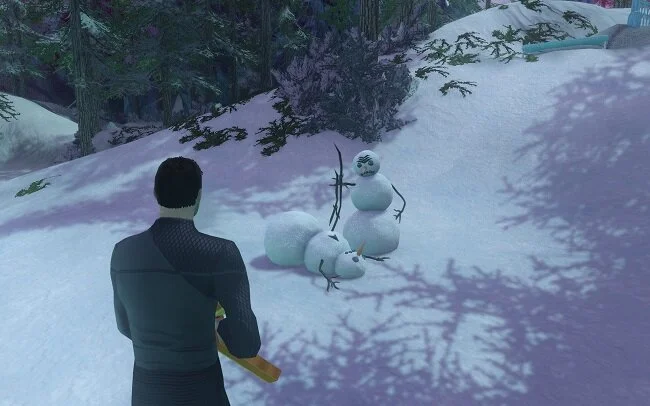
Life is often cyclical, if you don’t believe me go watch The Lion King. I started 2018 playing The Lord of the Rings Online and by writing a post about how gamers collectively seem to repeat the same mistakes. And as the year and indeed the decade ends, I find myself once again playing the Yule Festival in LOTRO and reflecting upon how some games that garnered criticism over their egregious business models, have ended up as huge hits. It would appear that gamers are their own worst enemy. I shall leave the psychological analysis of paradox to others. From my perspective, irrespective of the iniquities of the video game industry and certain quarters of the gaming community, it has been a good year, gaming wise. I have enjoyed my time playing MMOs such as Star Trek Online, The Elder Scrolls Online and the aforementioned LOTRO. These and other titles have entertained me, provided me with an opportunity to unwind as well as affording me some much-needed social interaction. I particularly enjoy Wednesday evenings when I log into my Discord server and then chat and play collaboratively with longstanding gaming friends.
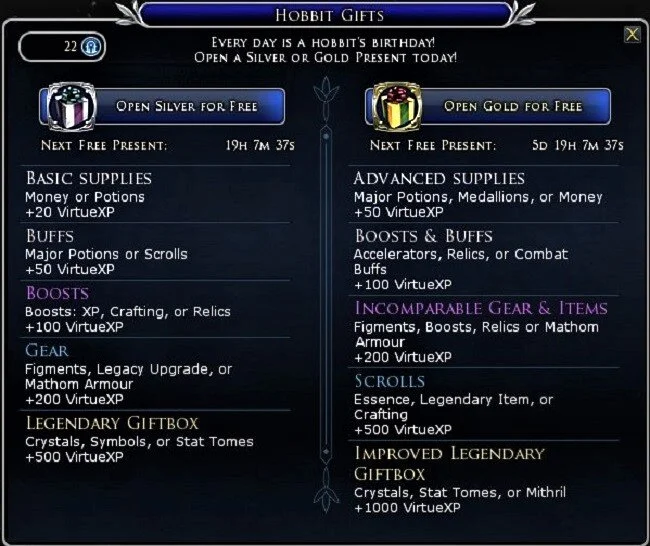
A major challenge for any MMO is to keep players logging in to the game. Obviously, regularly adding content and ensuring that there are sufficient quests, activities and tasks for players to undertake is essential. However, experience has shown that no matter how much content developers add to an MMORPG, players will always veraciously consume it and want more. Hence you need an additional “carrot on a stick”. Something that get’s player sufficiently interested to log into a game, even when they don’t have anything especially compelling to do. Login incentives are designed to do exactly that. They offer of some bauble or trinket that motivates you to log into a game once a day. Hopefully once you login, you may then find something to occupy yourself, either on your own or with fellow guild members. And of course the player who is actively playing may well even purchase something from the in-game store. At the very least, a successful login incentive contributes towards active player statistics. If those figures are presented in the right fashion on paper, they can bolster a declining population.
I was initially going to call this post “crafting can fuck right off” but I felt that was a somewhat bellicose opening gambit and a little hyperbolic. So I’ve toned it down to “the esoteric nature of crafting in MMORPGS”. Now to begin with, I tend not to craft when playing MMORPGs. The effort to reward ratio is often insufficient and I have yet to find a crafting system that is engaging and fun. However, for me the biggest sin that crafting can commit is being deliberately arcane and obtuse “with malice of forethought”, if I may invoke legal analogy. Don’t get me wrong, I have no problem with game systems and mechanics being complicated. Intricacy can be both intriguing and rewarding if presented correctly. However, all too often game developers cross over the line, stepping from “complexity” to “fucking annoying”. For example some card games such as Poker can have complex rules but mastering them transforms the proceedings from random chance into a game of skill. But at the other end of the spectrum there’s Fizzbin, which was invented purely to be frustrating due to its arcane nature. I frequently find that crafting in MMOs is just like Fizzbin. Except they’re not amusing or ironic, just tedious and irritating.
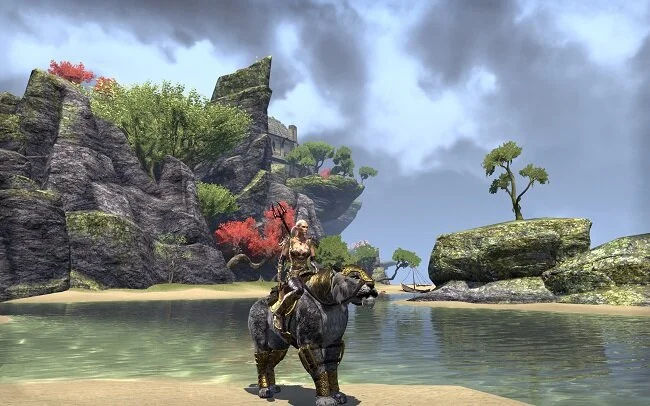
As my first post for International Picture Posting Month, I have decided to share some pictures and thoughts on the MMORPG, The Elder Scrolls Online. Out of the three games from this genre that I currently play, it’s the one that I’m currently enjoying the most. It has plenty of content to play through, the virtual world is immersive and the stories, characters and lore are very detailed and satisfying. As a more recent MMO, the game engine is robust and the visuals are far from dated. The game mechanics are multi-layered but combat is straightforward. There is no obvious skills bloat as you choose what you want on your hotbar. I also greatly enjoy the ambient music and recurring themes that play throughout the game. ESO is both solo and group friendly. You can also greatly augment your UI and the way you interact with the various systems, through the use of addons if you like. Alternatively, if you feel bold enough, then you can go with the default layout. From my perspective, ESO offers a great deal and ticks many of the boxes I favour. Yes it can have its foibles but name me an MMO that doesn’t?
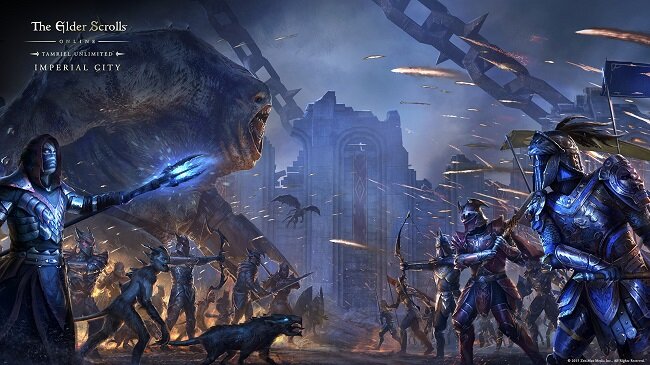
I raised the question in a previous post as to what’s the best way to follow the various stories in The Elder Scrolls Online in an orderly, coherent fashion. After some further research, it would appear that the most practical solution is to play through all the games DLC and chapters in release order. Hence, after finishing the main and faction storylines (in my case the Daggerfall Covenant), the next place to go is The Imperial City. Now I was under the impression that Cyrodiil was just a pure PVP zone but it would appear that there are 8 PVE quests that have a narrative arc. I was most pleased to learn this as I don’t like to miss out on content, especially if it sheds light on the lore and advances existing plot and themes. However, the problem with this series of quests is that despite being PVE content that requires you to kill Daedra mobs, you are still operating within an PVP zone. So you’re at risk of getting picked off by other players of differing factions while undertaking these quests.

Whenever I start a new MMO I tend to research the various classes and make an informed decision about which one to choose as my primary character. This policy has worked out well over the years and therefore compared to other players, I don’t have multiple alts across numerous games. That’s not to say that I’m averse to creating a new character, I simply need a good reason to do so. When I do, its usually because there’s an option to experience a different story. Hence, I currently have three alts in The Elder Scrolls Online. Last night I reached the current level cap of 50 with my Imperial Dragonknight, having recently completed the Daggerfall Covenant storyline. I have now experienced all three faction stories (which I have enjoyed) and more importantly, have learned what is the best way for me to progress through the game. ESO offers players the chance to play the MMO in a manner that suits them. If you want to simply travel Tamriel and do things as you go along, then you may. It’s a very flexible in this respect. But if you want to play in a more structured way, it can be a little confusing navigating a linear path. So here are a few tips I’ve learned the hard way.
ESO: Choosing a House
This post is not intended as a player housing guide. There are plenty of those available already. Instead, it is my personal musings on the various factors that have determined my choice of player house in The Elder Scrolls Online. In fact, at the time of writing, I have not yet purchased the house in question. It is dependent not only on a large sum of in-game gold but also a substantial achievement. The house in question is Gardner House in Wayrest. As it is a large player house it costs 1,015,000 gold. Alternatively, it can be bought for 5,700 Crowns, unfurnished. If you want it furnished it will cost 7,100 Crowns. I shall not be buying this property with Crowns as it works out at about £36 or so. I think that price is a little exorbitant especially in light of what I want the house for.
This post is not intended as a player housing guide. There are plenty of those available already. Instead, it is my personal musings on the various factors that have determined my choice of player house in The Elder Scrolls Online. In fact, at the time of writing, I have not yet purchased the house in question. It is dependent not only on a large sum of in-game gold but also a substantial achievement. The house in question is Gardner House in Wayrest. As it is a large player house it costs 1,015,000 gold. Alternatively, it can be bought for 5,700 Crowns, unfurnished. If you want it furnished it will cost 7,100 Crowns. I shall not be buying this property with Crowns as it works out at about £36 or so. I think that price is a little exorbitant especially in light of what I want the house for.
According to The Unofficial Elder Scrolls Pages “Gardner House is a large player house in Wayrest. The home has three entrances on the east, south, and west. The eastern entrance brings you into a small courtyard on the north side of the house which possesses a stable at the western end. The house has three spacious floors, a fireplace on the middle floor where all three entrances are and a large open basement. The house is conveniently located near the Wayrest Treasury to the south and the city's writ drop-off location, which includes Rolis Hlaalu, for dropping off Master Writs”. This is all fine and dandy but I’m not after a house in ESO for furniture collections, achievements or role play. I primarily want a house for optimal access to a major in-game hub and for quick and convenient storage. Sadly, the free houses you can claim do not provide this.
Despite having two alts, my main character in ESO is a Dragonknight affiliated to the Daggerfall Covenant. As I now have companions to level, the capital city of Waywrest affords quick and convenient access to the Fighters and Mages guilds as well as the Undaunted enclave. This makes undertaking these three groups' daily quests a lot more efficient. There are also seven guild traders in the city. Therefore it seems practical to have a permanent residence in Waywrest. Housing also offers a convenient location to port to without incurring any cost. Because I am not au fait with the lore in ESO I still often have to pause and check a location when travelling, as I don’t readily know which region towns and villages are. Having a means to leave a dungeon and return to a safe location with storage available is very desirable. I recently bought Fezez the Merchant so I can sell loot on the fly.
So all things considered, the Gardner House is the most appropriate residence for me. The in-game gold requirement is not a problem. I have about 500,000 on each of my three alts. As I’m not buying with Crowns, I do have to complete the Stormhaven Adventurer achievement which requires completing 60 quests in the region. At present I am about halfway through this. Thankfully, I have an addon that marks all available quests on the map so I can see where I need to go to complete the remainder. Furthermore, acquiring this house has provided me with a useful goal to focus upon. I’m one of those MMO players that likes to play through content in a structured manner and work towards a reward or specific target. I chose my house in The Lord of the Rings Online in a similar fashion, based upon its location.
I was recently perusing my archive of old blog posts, when it struck me how much I’ve written about the MMORPG genre over the years. Naturally, there was far more material from between 2008 and 2012 as that was period when I immersed myself in the genre and was very enthusiastic about it. I was at a point in my life when I had the time to dedicate to such games and I was happy to participate in the social aspect of they offered. I would regularly play through group content and spend time socialising online with fellow guild members. My experience remains a textbook example of how online games can be more than the sum of their parts and that where you are at in your life has a major impact upon your overall enjoyment. As I read though various old posts it became clear that my experiences where specific to this particular part of my life and that they cannot be repeated. My relationship with the genre is very different now and that’s fine.
I have two monitors on my desk. The first (which is the primary monitor as far as my PC is concerned), is on the left and the second is on the right. The primary monitor is a 24 Dell U2412M, which has a resolution of 1920 x 1200. It therefore has an aspect ratio of 16:10 which adds a little extra desktop real estate, which I prefer when writing. The second monitor is a 24 inch Dell S2421H with a screen resolution of 1920 x 1080. It has an aspect ratio of 16:9 which is standard FHD. My chair is adjacent to the middle of my desk and I can turn according to each monitor I’m using. I tend to use the primary, larger monitor on the left for tasks such as writing via Google Docs and emails. The second monitor on the right is used for YouTube and gaming. This is because of its FHD format. I also have a Nintendo Switch connected to the second monitor for the same reason.
Bree Royce, editor-in chief at Massively Overpowered, recently asked the question “what is the most expensive MMORPG right now”. My first thought was to search through my old draft blog posts and track down an MMO cost analysis I wrote circa 2019. It includes data such as subscription rates and the price of current expansions. There was also information on what were the most popular cash shop items at the time. However, I then read some of the comments that had been left on Bree’s post and I quickly realised that this wasn’t just a matter of financial expenditure. Whether or not an MMO is expensive is also determined by one’s disposable income, respective wealth and personal relationship with money. The latter is perhaps the most important, irrespective whether you consider yourself rich or poor.
“The MMO genre is rife with its own set of tropes; recurring themes and motifs that have become established and ubiquitous. All of which are ideal material for a hastily produced, lazily conceived, recurring blog post”. Dying in an Massively Multiplayer Online Role-Playing Game is a clear and unambiguous fail state. A means by which to teach the player that they’re doing something wrong and that they need to rethink their strategy. IE Don’t mess with the foul Marmydons unless you have back up and are wielding the Sword of Kagnazax. Dying is a reminder to not get overconfident and maintain situational awareness. It teaches us to ensure you have the right gear and consumables, to be au fait with the mechanics of any fight you’re about to get into and that winning is not a given. Any enterprise that offers a tangible reward will come with potential risks and consequences. If you’re playing in a group then death provides a timely reminder not to rely on Colin.
The Lord of the Rings Online was my first major MMORPG. I started playing in late 2008 and quickly discovered that there was a necessity to become familiar with the game world. Although the game provides quick travel options they were not ubiquitous at that point and often a player would simply travel on foot to travel costs down and to take the most direct route. Back in 2008 you could not own a mount until level 30. Hence I began “learning the maps” in the game and to this day still remember how to travel from one side of Moria, to another. The maps in the base game remain clear in my mind as they were so well trodden. Not so those in the regions. There are far more stables with fast mounts present in the game now and so convenience trumps any requirement to become so familiar with newly added zones. Nowadays Standing Stone Games designs new zones that tend to funnel players through them from quest hub to quest hub.
There was a perennial question being discussed over at Massively Overpowered recently. Justin Olivetti asked “why do you play MMOs solo” and as you would expect, there was a wide variety of answers. I have written about this myself in the past, as when I first started playing MMOs, I was very enamoured by the social element and therefore very disposed towards group content. However, that experience between 2008 and 2011, when I played The Lord of the Rings Online most days and dedicated Friday and Saturday nights to raiding, was very much down to circumstances. I had the time and inclination to spend hours online. That is something that I don’t have now. Plus the novelty of the social element has worn a little thin over the years. Nowadays, I do not have the luxury of waiting for a raid group to assemble, nor do I have the tolerance for the inevitable delays that always stem from any kind of human interaction.
I’m sure I’ve mentioned this issue before in previous video game related posts. But I don’t think I’ve devoted an entire article to the matter, which is what I’m going to do today. So to provide some context, I logged into The Elder Scrolls Online today as I’m fast approaching that point in the year where I spend a few months subscribing to the game. Due to some recent patch, once again all my Champion Points have been refunded. Judging by the change in graphics, it may be that the entire Champion Point system has been updated. Whatever the reason, I have to re-allocate 501points into three skill trees. I wasn’t au fait with the last system, so I followed a build I found online. Now that it has changed, I’ll have to find a new one and copy it. Until I do, my character will be gimped. Shame the game doesn’t offer a selection of generic builds that can be easily implemented at the press of a button.
The last installment of A Month in Gaming was at the end of April. I have decided to update this recurring post less often to ensure that I have more to write about than just cataloguing my generic activities in The Lord of the Rings Online and Star Trek Online. The only downside of such an approach is that it invalidates the title but that can’t be helped. Fortunately, I have done more than usual over the last two months. My daily schedule has changed temporarily and I now have a little more leisure time available. Hence I’ve dabbled with several new games as well as using my Nintendo Switch more often. I also took part in a “tag team” playthrough of XCOM 2, which was a very interesting experience. And I finally took the time to go through all my games libraries on the various different platforms to catalogue exactly what I have. I found a few hidden gems but the majority is just “filler” that you find in most video game bundles.
The other day, I was undertaking a daily mission for the Undaunted in The Elder Scrolls Online. I do these to level my companion’s associated skills line. The mission required me to go to a particular delve, set some soul traps and defeat the boss. Nothing unusual there, so off I went. Whenever I go into a delve in ESO, I usually do the quest associated with it. It provides a story and some additional experience points. Thus I arrived in the vicinity of the delve in question and found a note not far away. I read it and accepted the quest assuming it to be the one associated with the delve. To cut a long and confusing story short, it turns out it wasn’t. I discovered this about 20 minutes later when I found myself running around, confused with three separate lots of quest markers on my in-game map. Not for the first time I found myself pondering “where am I and what am I doing”.
This post is not intended as a player housing guide. There are plenty of those available already. Instead, it is my personal musings on the various factors that have determined my choice of player house in The Elder Scrolls Online. In fact, at the time of writing, I have not yet purchased the house in question. It is dependent not only on a large sum of in-game gold but also a substantial achievement. The house in question is Gardner House in Wayrest. As it is a large player house it costs 1,015,000 gold. Alternatively, it can be bought for 5,700 Crowns, unfurnished. If you want it furnished it will cost 7,100 Crowns. I shall not be buying this property with Crowns as it works out at about £36 or so. I think that price is a little exorbitant especially in light of what I want the house for.
The Blackwood expansion for The Elder Scrolls Online launched a little over a fortnight ago. During that time I have become accustomed to having an AI companion. Not only are they an enjoyable new addition to the MMO, they also have quite a significant impact upon PVE gameplay. Both Mirri Elendis and Bastian Hallix can provide robust support and cover a variety of roles. This is down to the flexibility of the skills system associated with companions. Gear requirements are simpler and a lot easier to manage compared to that of your main character. Levelling is driven by XP gained from combat. Thus, if you go questing with either one of your companions they will level accordingly. They also have personal quests associated with them, ensuring that both companions have an appropriate backstory. The rapport system means that it is prudent to be nice to your AI chum or they’ll leave you for a time.
Justin Olivetti posed an honest question on Massively Overpowered yesterday. “Do you have any clue what’s going on in your MMO’s storyline?” he asked and I must admit that my answer varies greatly according to what I’m playing. Yet before I give a more comprehensive response, let me make clear that one of the aspects of the MMO genre that I enjoy the most is its penchant for complex and sprawling narratives. Both The Lord of the Rings Online and Star Trek Online are based upon intellectual properties with in-depth lore and an established canon. I was also drawn to the RPG Skyrim due to its enigmatic story which linked into a much wider history. It was one of the reasons I started playing The Elder Scrolls Online, as every quest seems to have a story that is connected to another. My enjoyment of these dense plots found in the MMO genre stems from my love of reading as a child.
Last night, I finally had sufficient time to log into The Elder Scrolls Online and check out the new Blackwood expansion. The plan was to go straight to the new zone and complete the relevant quests to obtain the two companions that have been added to the game. Unfortunately, life seldom goes to plan as Robert Burns alluded to in his famous quotation. As I haven’t played ESO for a while, I’ve missed several major game updates. Consequently all my champion points have been reset, along with all my skills. So, I had to spend some time trying to remember how my Dragonknight was previously set up. I checked a few screenshots to see what skills were on the hotbars but as they don’t display the name, plus the icons change after morphing a skill, it was tricky trying to reverse engineer my prior build. Eventually I just winged it and managed to blag my way through the two quests.
There are many factors that can add to an MMORPGs replayability. Multiple races, classes and factions can all potentially offer a new experience to the player. Some games even have unique stories associated with different types of characters, ensuring that rolling a new alt means that the player doesn’t repeat material they’ve already completed. Many gamers enjoy this aspect of the genre and will experiment with different builds, resulting in a character selection screen filled with numerous alts in various states of progress. However, irrespective of whether you get to experience a new story or if you indeed like the new character you’ve created, there comes a point when you look at your new alts progression and reflect upon the long, long journey to level cap. It is at this point that many alts fall by the wayside. The aforementioned character selection screen is often populated with unfulfilled potential.
If I may quote myself “The MMO genre is rife with its own set of tropes; recurring themes and motifs that have become established and ubiquitous. All of which are ideal material for a hastily produced, lazily conceived, recurring blog post”. This time round, I would like to discuss the following. The Hero, the Chosen One, the Übermensch. As that is the role that we so often are assigned in this genre. Developers broadly assume that most players want a power fantasy and precious little else is on offer. Hence we find ourselves in a story in which we are destined to do great deeds in a virtual world, whether we wish to or not. I can see the superficial appeal of such a conceit. Most of us are not such overachievers in real life. So a game in which we get to do stuff to the world, instead of the world doing stuff to us has an inherent allure. But like most MMO tropes, unless it is implemented with some panache and creativity, it quickly becomes a tiresome cliche.
Last year I wrote a post about several “quality-of-life mechanics” found in MMOs. Systems and functionality that just make a game more manageable or convenient. Despite having many features in common, MMOs are far from identical in their interface and controls. If you’re a genre aficionado, then you can usually bluff your way through a new game and decipher how to play it. But for new players, often just trying to figure out how to do a simple thing, like find your skill points, can be an uphill struggle. However, every now and then, you’ll come across some simple functionality in a game that is useful and makes a task much easier. So I have collated another five “quality-of-life mechanics” that I feel are significant and beneficial to the player. Some are very minor but that does not diminish their value. Sometimes, less can indeed be more.
As I mentioned recently in my monthly gaming roundup, I’ve currently stopped playing the three MMORPGs that are my usual gaming mainstay. Namely The Lord of the Rings Online, The Elder Scrolls Online and Star Trek Online. It’s something that I do from time to time when I’m tired of the repetition this genre offers. At present none of these titles has anything on offer that motivates me to play them enthusiastically. Especially LOTRO. I find weddings tedious and self indulgent in real life, so I’m hardly going to get “excited” about a virtual one set in Middle-earth. However, that’s not to say that I’ve lost interest in the MMO genre. I’m merely temporarily burned out at present. I find that after a few months or so, either new content is released that lures me back to these games or I tire of what I’ve been playing in their stead. It’s a cyclical process that I go through from time to time and nothing to worry about.
I stopped subscribing to The Lord of the Rings Online in June. I’ve always had a very cyclical relationship with this MMO and at present I feel I need a break from the games somewhat linear formula. Plus the new content scheduled for release centred around the wedding of Aragorn and Arwen doesn’t exactly sound enthralling. So I’ve left my primary character in Langflood and will return to the game later in the year when I feel the need to catch up with content. I have also abandoned the ongoing events in Star Trek Online as they’re getting too repetitive. I would like to see a new longterm story arc rather than just a continuous cycle of short term events and repeatable content. I don’t mind working towards a goal but it has to be something I want and the rewards offered in this MMO are getting a little too generic for my liking. I shall return to the game at some point as I’m a lifetime account holder and I’m curious to see how developer’s Cryptic overhauls the Klingon story arc.
Whenever you use a skill on your hotbar in The Elder Scrolls Online, there is an associated animation as it is inducted and utilised. These animations may vary in length from one to several seconds depending upon their nature. Although these animations add to the ambience of the game, they do come with a direct consequence. The player has to wait for the animation of one skill to complete before they can use another. For those seeking to optimise their performance or DPS output, these delays are an impediment. However, they can be negated through animation cancelling and weaving. Animation cancelling is as it states the stopping of a skill related animated sequence by the use of a follow up action such as bash/tap block/dodgeroll. Weaving is slightly different, in so far as instead of stopping the inducted animation immediately, it allows for the process to be cut short as another animation is started. Typically this is done by using a light attack and then immediately using a skill.
I managed to find a very good deal on the Digital Upgrade version of Greymoor for The Elder Scrolls Online, so I bought it. The key included a pre-order bonus as well as a few other “trinkets and baubles” which clinched the deal. I wasn’t planning on returning to ESO this month plus I still have a bee in my bonnet about playing through the game in narrative order. However, after speaking to friends about the new expansion, I was curious about the new Harrowstorm events that occur in the new zone of Western Skyrim. So I logged into the game and after the obligatory “let’s spend 30 minutes fixing broken addons”, headed over to Solitude and waited for the next Harrowstorm to appear. As ever, Zone Chat is invaluable for determining what is happening and where, so it wasn’t long before I was riding headlong towards the Black Morass Ritual Site ready for my first Harrowstorm.
ZeniMax are allegedly addressing some major performance issues with the forthcoming Update 25 for The Elder Scrolls Online. If this latest patch improves loading times, the game’s overall performance and makes updating the client faster, then it will be well received by players. However, Update 25 requires players to reinstall the entire game client due to technical reasons. Furthermore, the patch is not going to be available prior to release on Monday February 24th, so player’s cannot download the necessary files in advance. Unfortunately, as soon as the patch server comes online, all players will have to reinstall the full ESO client and wait accordingly. Considering the disparity between internet connections in the US and Europe, player experience will vary greatly. Some will download the client in hours where others will have to simply leave their PC running and wait all day. Considering the popularity of ESO and the estimated size of its player base, I wouldn’t be surprised if there are queues or connectivity issues.
Over the years I’ve played numerous MMOs (to varying degrees of success). As a genre there are certain game mechanics that are standard and common to most games. Initially during the “golden age” of the MMORPG, there was a focus on collaborative team player. This meant that successfully undertaking group content required a spectrum of players in specific roles. This particular mechanic has diminished over the years but the genre still has numerous common tropes. Quest hubs, reputation factions, gear grinds and vertical levelling are just some that spring to mind. However, many developers in this field attempt to polish and refine these “default” systems, often with interesting results. So I thought I’d cite some specific examples of what I call “quality-of-life mechanics”. Frequently these are bog standard facets common to the MMO genre, that have been polished and refined in a particular game. Small things that just make a game more manageable and provoke a positive reaction as well.
Life is often cyclical, if you don’t believe me go watch The Lion King. I started 2018 playing The Lord of the Rings Online and by writing a post about how gamers collectively seem to repeat the same mistakes. And as the year and indeed the decade ends, I find myself once again playing the Yule Festival in LOTRO and reflecting upon how some games that garnered criticism over their egregious business models, have ended up as huge hits. It would appear that gamers are their own worst enemy. I shall leave the psychological analysis of paradox to others. From my perspective, irrespective of the iniquities of the video game industry and certain quarters of the gaming community, it has been a good year, gaming wise. I have enjoyed my time playing MMOs such as Star Trek Online, The Elder Scrolls Online and the aforementioned LOTRO. These and other titles have entertained me, provided me with an opportunity to unwind as well as affording me some much-needed social interaction. I particularly enjoy Wednesday evenings when I log into my Discord server and then chat and play collaboratively with longstanding gaming friends.
A major challenge for any MMO is to keep players logging in to the game. Obviously, regularly adding content and ensuring that there are sufficient quests, activities and tasks for players to undertake is essential. However, experience has shown that no matter how much content developers add to an MMORPG, players will always veraciously consume it and want more. Hence you need an additional “carrot on a stick”. Something that get’s player sufficiently interested to log into a game, even when they don’t have anything especially compelling to do. Login incentives are designed to do exactly that. They offer of some bauble or trinket that motivates you to log into a game once a day. Hopefully once you login, you may then find something to occupy yourself, either on your own or with fellow guild members. And of course the player who is actively playing may well even purchase something from the in-game store. At the very least, a successful login incentive contributes towards active player statistics. If those figures are presented in the right fashion on paper, they can bolster a declining population.
I was initially going to call this post “crafting can fuck right off” but I felt that was a somewhat bellicose opening gambit and a little hyperbolic. So I’ve toned it down to “the esoteric nature of crafting in MMORPGS”. Now to begin with, I tend not to craft when playing MMORPGs. The effort to reward ratio is often insufficient and I have yet to find a crafting system that is engaging and fun. However, for me the biggest sin that crafting can commit is being deliberately arcane and obtuse “with malice of forethought”, if I may invoke legal analogy. Don’t get me wrong, I have no problem with game systems and mechanics being complicated. Intricacy can be both intriguing and rewarding if presented correctly. However, all too often game developers cross over the line, stepping from “complexity” to “fucking annoying”. For example some card games such as Poker can have complex rules but mastering them transforms the proceedings from random chance into a game of skill. But at the other end of the spectrum there’s Fizzbin, which was invented purely to be frustrating due to its arcane nature. I frequently find that crafting in MMOs is just like Fizzbin. Except they’re not amusing or ironic, just tedious and irritating.
As my first post for International Picture Posting Month, I have decided to share some pictures and thoughts on the MMORPG, The Elder Scrolls Online. Out of the three games from this genre that I currently play, it’s the one that I’m currently enjoying the most. It has plenty of content to play through, the virtual world is immersive and the stories, characters and lore are very detailed and satisfying. As a more recent MMO, the game engine is robust and the visuals are far from dated. The game mechanics are multi-layered but combat is straightforward. There is no obvious skills bloat as you choose what you want on your hotbar. I also greatly enjoy the ambient music and recurring themes that play throughout the game. ESO is both solo and group friendly. You can also greatly augment your UI and the way you interact with the various systems, through the use of addons if you like. Alternatively, if you feel bold enough, then you can go with the default layout. From my perspective, ESO offers a great deal and ticks many of the boxes I favour. Yes it can have its foibles but name me an MMO that doesn’t?
I raised the question in a previous post as to what’s the best way to follow the various stories in The Elder Scrolls Online in an orderly, coherent fashion. After some further research, it would appear that the most practical solution is to play through all the games DLC and chapters in release order. Hence, after finishing the main and faction storylines (in my case the Daggerfall Covenant), the next place to go is The Imperial City. Now I was under the impression that Cyrodiil was just a pure PVP zone but it would appear that there are 8 PVE quests that have a narrative arc. I was most pleased to learn this as I don’t like to miss out on content, especially if it sheds light on the lore and advances existing plot and themes. However, the problem with this series of quests is that despite being PVE content that requires you to kill Daedra mobs, you are still operating within an PVP zone. So you’re at risk of getting picked off by other players of differing factions while undertaking these quests.
Whenever I start a new MMO I tend to research the various classes and make an informed decision about which one to choose as my primary character. This policy has worked out well over the years and therefore compared to other players, I don’t have multiple alts across numerous games. That’s not to say that I’m averse to creating a new character, I simply need a good reason to do so. When I do, its usually because there’s an option to experience a different story. Hence, I currently have three alts in The Elder Scrolls Online. Last night I reached the current level cap of 50 with my Imperial Dragonknight, having recently completed the Daggerfall Covenant storyline. I have now experienced all three faction stories (which I have enjoyed) and more importantly, have learned what is the best way for me to progress through the game. ESO offers players the chance to play the MMO in a manner that suits them. If you want to simply travel Tamriel and do things as you go along, then you may. It’s a very flexible in this respect. But if you want to play in a more structured way, it can be a little confusing navigating a linear path. So here are a few tips I’ve learned the hard way.
ESO: Companions
The Blackwood expansion for The Elder Scrolls Online launched a little over a fortnight ago. During that time I have become accustomed to having an AI companion. Not only are they an enjoyable new addition to the MMO, they also have quite a significant impact upon PVE gameplay. Both Mirri Elendis and Bastian Hallix can provide robust support and cover a variety of roles. This is down to the flexibility of the skills system associated with companions. Gear requirements are simpler and a lot easier to manage compared to that of your main character. Levelling is driven by XP gained from combat. Thus, if you go questing with either one of your companions they will level accordingly. They also have personal quests associated with them, ensuring that both companions have an appropriate backstory. The rapport system means that it is prudent to be nice to your AI chum or they’ll leave you for a time.
The Blackwood expansion for The Elder Scrolls Online launched a little over a fortnight ago. During that time I have become accustomed to having an AI companion. Not only are they an enjoyable new addition to the MMO, they also have quite a significant impact upon PVE gameplay. Both Mirri Elendis and Bastian Hallix can provide robust support and cover a variety of roles. This is down to the flexibility of the skills system associated with companions. Gear requirements are simpler and a lot easier to manage compared to that of your main character. Levelling is driven by XP gained from combat. Thus, if you go questing with either one of your companions they will level accordingly. They also have personal quests associated with them, ensuring that both companions have an appropriate backstory. The rapport system means that it is prudent to be nice to your AI chum or they’ll leave you for a time.
One of the great ironies of the MMO genre has been the sea change in social gameplay. Over two decades the focus has shifted from group content to solo. Apart from The Lord of the Rings Online, I play most other MMOs conspicuously on my own. However, in recent years there have been occasions when I miss playing with others. The companion system in ESO offers the best of both worlds. There are the practical benefits of having a support character available as well as the advantages of being able to play at a single player’s pace. Whenever I group with other players in any MMO, I always feel obliged to hurry things along and progress from A to B as efficiently as possible. When playing ESO with either Mirri or Bastian, I still get to read the quest bestowal dialogue, pay attention to what is going on around me and potter about in a manner I like. Companions also don’t have to go and “empty their bags” or get their armour repaired.
I also enjoy the various quips that these companions make when you’re out in Tamriel questing. Both have a selection of ambient dialogue, which although somewhat limited at present, break the monotony of combat. I was a little nonplussed when I initially misheard something that Mirri says from time to time. After a fight, she’ll occasionally remark “whew, that was a bit of a warm up”, which I heard as “whew, that was a bit of a wombat”. It took me a while to realise that I had made a mistake and that there weren't any marsupials in the vicinity. But beyond this minor confusion, I don’t have too many complaints about companions per se. They do that thing that all pets do in the MMO genre and every now and then will stand right on top of the thing you’re trying to interact with. But this may well get addressed in a future patch.
It would appear that the current iteration of companions in ESO is not the finished version. Developer’s ZeniMax intend to add further functionality in the future. Many players hope that the companion systems will eventually be as comprehensive and in depth as those found in single player RPGs. Some certainly want the romance options common to BioWare games. I would certainly like more interaction and story content associated with them. For the present, I am content to have the company of both Mirri and Bastian as well as their practical assistance. Bastian I am using mainly as a tank with sword and shield. Mirri is currently using her default bow, although I may use her as a healer for when I go into full melee mode. Finally, I have one small but invaluable pro-tip regarding companions. Change their outfit to something noticeable, as you’ll find dozens of Mirris and Bastians at Dolmens and world bosses. This way you can easily spot yours.
I was recently perusing my archive of old blog posts, when it struck me how much I’ve written about the MMORPG genre over the years. Naturally, there was far more material from between 2008 and 2012 as that was period when I immersed myself in the genre and was very enthusiastic about it. I was at a point in my life when I had the time to dedicate to such games and I was happy to participate in the social aspect of they offered. I would regularly play through group content and spend time socialising online with fellow guild members. My experience remains a textbook example of how online games can be more than the sum of their parts and that where you are at in your life has a major impact upon your overall enjoyment. As I read though various old posts it became clear that my experiences where specific to this particular part of my life and that they cannot be repeated. My relationship with the genre is very different now and that’s fine.
I have two monitors on my desk. The first (which is the primary monitor as far as my PC is concerned), is on the left and the second is on the right. The primary monitor is a 24 Dell U2412M, which has a resolution of 1920 x 1200. It therefore has an aspect ratio of 16:10 which adds a little extra desktop real estate, which I prefer when writing. The second monitor is a 24 inch Dell S2421H with a screen resolution of 1920 x 1080. It has an aspect ratio of 16:9 which is standard FHD. My chair is adjacent to the middle of my desk and I can turn according to each monitor I’m using. I tend to use the primary, larger monitor on the left for tasks such as writing via Google Docs and emails. The second monitor on the right is used for YouTube and gaming. This is because of its FHD format. I also have a Nintendo Switch connected to the second monitor for the same reason.
Bree Royce, editor-in chief at Massively Overpowered, recently asked the question “what is the most expensive MMORPG right now”. My first thought was to search through my old draft blog posts and track down an MMO cost analysis I wrote circa 2019. It includes data such as subscription rates and the price of current expansions. There was also information on what were the most popular cash shop items at the time. However, I then read some of the comments that had been left on Bree’s post and I quickly realised that this wasn’t just a matter of financial expenditure. Whether or not an MMO is expensive is also determined by one’s disposable income, respective wealth and personal relationship with money. The latter is perhaps the most important, irrespective whether you consider yourself rich or poor.
“The MMO genre is rife with its own set of tropes; recurring themes and motifs that have become established and ubiquitous. All of which are ideal material for a hastily produced, lazily conceived, recurring blog post”. Dying in an Massively Multiplayer Online Role-Playing Game is a clear and unambiguous fail state. A means by which to teach the player that they’re doing something wrong and that they need to rethink their strategy. IE Don’t mess with the foul Marmydons unless you have back up and are wielding the Sword of Kagnazax. Dying is a reminder to not get overconfident and maintain situational awareness. It teaches us to ensure you have the right gear and consumables, to be au fait with the mechanics of any fight you’re about to get into and that winning is not a given. Any enterprise that offers a tangible reward will come with potential risks and consequences. If you’re playing in a group then death provides a timely reminder not to rely on Colin.
The Lord of the Rings Online was my first major MMORPG. I started playing in late 2008 and quickly discovered that there was a necessity to become familiar with the game world. Although the game provides quick travel options they were not ubiquitous at that point and often a player would simply travel on foot to travel costs down and to take the most direct route. Back in 2008 you could not own a mount until level 30. Hence I began “learning the maps” in the game and to this day still remember how to travel from one side of Moria, to another. The maps in the base game remain clear in my mind as they were so well trodden. Not so those in the regions. There are far more stables with fast mounts present in the game now and so convenience trumps any requirement to become so familiar with newly added zones. Nowadays Standing Stone Games designs new zones that tend to funnel players through them from quest hub to quest hub.
There was a perennial question being discussed over at Massively Overpowered recently. Justin Olivetti asked “why do you play MMOs solo” and as you would expect, there was a wide variety of answers. I have written about this myself in the past, as when I first started playing MMOs, I was very enamoured by the social element and therefore very disposed towards group content. However, that experience between 2008 and 2011, when I played The Lord of the Rings Online most days and dedicated Friday and Saturday nights to raiding, was very much down to circumstances. I had the time and inclination to spend hours online. That is something that I don’t have now. Plus the novelty of the social element has worn a little thin over the years. Nowadays, I do not have the luxury of waiting for a raid group to assemble, nor do I have the tolerance for the inevitable delays that always stem from any kind of human interaction.
I’m sure I’ve mentioned this issue before in previous video game related posts. But I don’t think I’ve devoted an entire article to the matter, which is what I’m going to do today. So to provide some context, I logged into The Elder Scrolls Online today as I’m fast approaching that point in the year where I spend a few months subscribing to the game. Due to some recent patch, once again all my Champion Points have been refunded. Judging by the change in graphics, it may be that the entire Champion Point system has been updated. Whatever the reason, I have to re-allocate 501points into three skill trees. I wasn’t au fait with the last system, so I followed a build I found online. Now that it has changed, I’ll have to find a new one and copy it. Until I do, my character will be gimped. Shame the game doesn’t offer a selection of generic builds that can be easily implemented at the press of a button.
The last installment of A Month in Gaming was at the end of April. I have decided to update this recurring post less often to ensure that I have more to write about than just cataloguing my generic activities in The Lord of the Rings Online and Star Trek Online. The only downside of such an approach is that it invalidates the title but that can’t be helped. Fortunately, I have done more than usual over the last two months. My daily schedule has changed temporarily and I now have a little more leisure time available. Hence I’ve dabbled with several new games as well as using my Nintendo Switch more often. I also took part in a “tag team” playthrough of XCOM 2, which was a very interesting experience. And I finally took the time to go through all my games libraries on the various different platforms to catalogue exactly what I have. I found a few hidden gems but the majority is just “filler” that you find in most video game bundles.
The other day, I was undertaking a daily mission for the Undaunted in The Elder Scrolls Online. I do these to level my companion’s associated skills line. The mission required me to go to a particular delve, set some soul traps and defeat the boss. Nothing unusual there, so off I went. Whenever I go into a delve in ESO, I usually do the quest associated with it. It provides a story and some additional experience points. Thus I arrived in the vicinity of the delve in question and found a note not far away. I read it and accepted the quest assuming it to be the one associated with the delve. To cut a long and confusing story short, it turns out it wasn’t. I discovered this about 20 minutes later when I found myself running around, confused with three separate lots of quest markers on my in-game map. Not for the first time I found myself pondering “where am I and what am I doing”.
This post is not intended as a player housing guide. There are plenty of those available already. Instead, it is my personal musings on the various factors that have determined my choice of player house in The Elder Scrolls Online. In fact, at the time of writing, I have not yet purchased the house in question. It is dependent not only on a large sum of in-game gold but also a substantial achievement. The house in question is Gardner House in Wayrest. As it is a large player house it costs 1,015,000 gold. Alternatively, it can be bought for 5,700 Crowns, unfurnished. If you want it furnished it will cost 7,100 Crowns. I shall not be buying this property with Crowns as it works out at about £36 or so. I think that price is a little exorbitant especially in light of what I want the house for.
The Blackwood expansion for The Elder Scrolls Online launched a little over a fortnight ago. During that time I have become accustomed to having an AI companion. Not only are they an enjoyable new addition to the MMO, they also have quite a significant impact upon PVE gameplay. Both Mirri Elendis and Bastian Hallix can provide robust support and cover a variety of roles. This is down to the flexibility of the skills system associated with companions. Gear requirements are simpler and a lot easier to manage compared to that of your main character. Levelling is driven by XP gained from combat. Thus, if you go questing with either one of your companions they will level accordingly. They also have personal quests associated with them, ensuring that both companions have an appropriate backstory. The rapport system means that it is prudent to be nice to your AI chum or they’ll leave you for a time.
Justin Olivetti posed an honest question on Massively Overpowered yesterday. “Do you have any clue what’s going on in your MMO’s storyline?” he asked and I must admit that my answer varies greatly according to what I’m playing. Yet before I give a more comprehensive response, let me make clear that one of the aspects of the MMO genre that I enjoy the most is its penchant for complex and sprawling narratives. Both The Lord of the Rings Online and Star Trek Online are based upon intellectual properties with in-depth lore and an established canon. I was also drawn to the RPG Skyrim due to its enigmatic story which linked into a much wider history. It was one of the reasons I started playing The Elder Scrolls Online, as every quest seems to have a story that is connected to another. My enjoyment of these dense plots found in the MMO genre stems from my love of reading as a child.
Last night, I finally had sufficient time to log into The Elder Scrolls Online and check out the new Blackwood expansion. The plan was to go straight to the new zone and complete the relevant quests to obtain the two companions that have been added to the game. Unfortunately, life seldom goes to plan as Robert Burns alluded to in his famous quotation. As I haven’t played ESO for a while, I’ve missed several major game updates. Consequently all my champion points have been reset, along with all my skills. So, I had to spend some time trying to remember how my Dragonknight was previously set up. I checked a few screenshots to see what skills were on the hotbars but as they don’t display the name, plus the icons change after morphing a skill, it was tricky trying to reverse engineer my prior build. Eventually I just winged it and managed to blag my way through the two quests.
There are many factors that can add to an MMORPGs replayability. Multiple races, classes and factions can all potentially offer a new experience to the player. Some games even have unique stories associated with different types of characters, ensuring that rolling a new alt means that the player doesn’t repeat material they’ve already completed. Many gamers enjoy this aspect of the genre and will experiment with different builds, resulting in a character selection screen filled with numerous alts in various states of progress. However, irrespective of whether you get to experience a new story or if you indeed like the new character you’ve created, there comes a point when you look at your new alts progression and reflect upon the long, long journey to level cap. It is at this point that many alts fall by the wayside. The aforementioned character selection screen is often populated with unfulfilled potential.
If I may quote myself “The MMO genre is rife with its own set of tropes; recurring themes and motifs that have become established and ubiquitous. All of which are ideal material for a hastily produced, lazily conceived, recurring blog post”. This time round, I would like to discuss the following. The Hero, the Chosen One, the Übermensch. As that is the role that we so often are assigned in this genre. Developers broadly assume that most players want a power fantasy and precious little else is on offer. Hence we find ourselves in a story in which we are destined to do great deeds in a virtual world, whether we wish to or not. I can see the superficial appeal of such a conceit. Most of us are not such overachievers in real life. So a game in which we get to do stuff to the world, instead of the world doing stuff to us has an inherent allure. But like most MMO tropes, unless it is implemented with some panache and creativity, it quickly becomes a tiresome cliche.
Last year I wrote a post about several “quality-of-life mechanics” found in MMOs. Systems and functionality that just make a game more manageable or convenient. Despite having many features in common, MMOs are far from identical in their interface and controls. If you’re a genre aficionado, then you can usually bluff your way through a new game and decipher how to play it. But for new players, often just trying to figure out how to do a simple thing, like find your skill points, can be an uphill struggle. However, every now and then, you’ll come across some simple functionality in a game that is useful and makes a task much easier. So I have collated another five “quality-of-life mechanics” that I feel are significant and beneficial to the player. Some are very minor but that does not diminish their value. Sometimes, less can indeed be more.
As I mentioned recently in my monthly gaming roundup, I’ve currently stopped playing the three MMORPGs that are my usual gaming mainstay. Namely The Lord of the Rings Online, The Elder Scrolls Online and Star Trek Online. It’s something that I do from time to time when I’m tired of the repetition this genre offers. At present none of these titles has anything on offer that motivates me to play them enthusiastically. Especially LOTRO. I find weddings tedious and self indulgent in real life, so I’m hardly going to get “excited” about a virtual one set in Middle-earth. However, that’s not to say that I’ve lost interest in the MMO genre. I’m merely temporarily burned out at present. I find that after a few months or so, either new content is released that lures me back to these games or I tire of what I’ve been playing in their stead. It’s a cyclical process that I go through from time to time and nothing to worry about.
I stopped subscribing to The Lord of the Rings Online in June. I’ve always had a very cyclical relationship with this MMO and at present I feel I need a break from the games somewhat linear formula. Plus the new content scheduled for release centred around the wedding of Aragorn and Arwen doesn’t exactly sound enthralling. So I’ve left my primary character in Langflood and will return to the game later in the year when I feel the need to catch up with content. I have also abandoned the ongoing events in Star Trek Online as they’re getting too repetitive. I would like to see a new longterm story arc rather than just a continuous cycle of short term events and repeatable content. I don’t mind working towards a goal but it has to be something I want and the rewards offered in this MMO are getting a little too generic for my liking. I shall return to the game at some point as I’m a lifetime account holder and I’m curious to see how developer’s Cryptic overhauls the Klingon story arc.
Whenever you use a skill on your hotbar in The Elder Scrolls Online, there is an associated animation as it is inducted and utilised. These animations may vary in length from one to several seconds depending upon their nature. Although these animations add to the ambience of the game, they do come with a direct consequence. The player has to wait for the animation of one skill to complete before they can use another. For those seeking to optimise their performance or DPS output, these delays are an impediment. However, they can be negated through animation cancelling and weaving. Animation cancelling is as it states the stopping of a skill related animated sequence by the use of a follow up action such as bash/tap block/dodgeroll. Weaving is slightly different, in so far as instead of stopping the inducted animation immediately, it allows for the process to be cut short as another animation is started. Typically this is done by using a light attack and then immediately using a skill.
I managed to find a very good deal on the Digital Upgrade version of Greymoor for The Elder Scrolls Online, so I bought it. The key included a pre-order bonus as well as a few other “trinkets and baubles” which clinched the deal. I wasn’t planning on returning to ESO this month plus I still have a bee in my bonnet about playing through the game in narrative order. However, after speaking to friends about the new expansion, I was curious about the new Harrowstorm events that occur in the new zone of Western Skyrim. So I logged into the game and after the obligatory “let’s spend 30 minutes fixing broken addons”, headed over to Solitude and waited for the next Harrowstorm to appear. As ever, Zone Chat is invaluable for determining what is happening and where, so it wasn’t long before I was riding headlong towards the Black Morass Ritual Site ready for my first Harrowstorm.
ZeniMax are allegedly addressing some major performance issues with the forthcoming Update 25 for The Elder Scrolls Online. If this latest patch improves loading times, the game’s overall performance and makes updating the client faster, then it will be well received by players. However, Update 25 requires players to reinstall the entire game client due to technical reasons. Furthermore, the patch is not going to be available prior to release on Monday February 24th, so player’s cannot download the necessary files in advance. Unfortunately, as soon as the patch server comes online, all players will have to reinstall the full ESO client and wait accordingly. Considering the disparity between internet connections in the US and Europe, player experience will vary greatly. Some will download the client in hours where others will have to simply leave their PC running and wait all day. Considering the popularity of ESO and the estimated size of its player base, I wouldn’t be surprised if there are queues or connectivity issues.
Over the years I’ve played numerous MMOs (to varying degrees of success). As a genre there are certain game mechanics that are standard and common to most games. Initially during the “golden age” of the MMORPG, there was a focus on collaborative team player. This meant that successfully undertaking group content required a spectrum of players in specific roles. This particular mechanic has diminished over the years but the genre still has numerous common tropes. Quest hubs, reputation factions, gear grinds and vertical levelling are just some that spring to mind. However, many developers in this field attempt to polish and refine these “default” systems, often with interesting results. So I thought I’d cite some specific examples of what I call “quality-of-life mechanics”. Frequently these are bog standard facets common to the MMO genre, that have been polished and refined in a particular game. Small things that just make a game more manageable and provoke a positive reaction as well.
Life is often cyclical, if you don’t believe me go watch The Lion King. I started 2018 playing The Lord of the Rings Online and by writing a post about how gamers collectively seem to repeat the same mistakes. And as the year and indeed the decade ends, I find myself once again playing the Yule Festival in LOTRO and reflecting upon how some games that garnered criticism over their egregious business models, have ended up as huge hits. It would appear that gamers are their own worst enemy. I shall leave the psychological analysis of paradox to others. From my perspective, irrespective of the iniquities of the video game industry and certain quarters of the gaming community, it has been a good year, gaming wise. I have enjoyed my time playing MMOs such as Star Trek Online, The Elder Scrolls Online and the aforementioned LOTRO. These and other titles have entertained me, provided me with an opportunity to unwind as well as affording me some much-needed social interaction. I particularly enjoy Wednesday evenings when I log into my Discord server and then chat and play collaboratively with longstanding gaming friends.
A major challenge for any MMO is to keep players logging in to the game. Obviously, regularly adding content and ensuring that there are sufficient quests, activities and tasks for players to undertake is essential. However, experience has shown that no matter how much content developers add to an MMORPG, players will always veraciously consume it and want more. Hence you need an additional “carrot on a stick”. Something that get’s player sufficiently interested to log into a game, even when they don’t have anything especially compelling to do. Login incentives are designed to do exactly that. They offer of some bauble or trinket that motivates you to log into a game once a day. Hopefully once you login, you may then find something to occupy yourself, either on your own or with fellow guild members. And of course the player who is actively playing may well even purchase something from the in-game store. At the very least, a successful login incentive contributes towards active player statistics. If those figures are presented in the right fashion on paper, they can bolster a declining population.
I was initially going to call this post “crafting can fuck right off” but I felt that was a somewhat bellicose opening gambit and a little hyperbolic. So I’ve toned it down to “the esoteric nature of crafting in MMORPGS”. Now to begin with, I tend not to craft when playing MMORPGs. The effort to reward ratio is often insufficient and I have yet to find a crafting system that is engaging and fun. However, for me the biggest sin that crafting can commit is being deliberately arcane and obtuse “with malice of forethought”, if I may invoke legal analogy. Don’t get me wrong, I have no problem with game systems and mechanics being complicated. Intricacy can be both intriguing and rewarding if presented correctly. However, all too often game developers cross over the line, stepping from “complexity” to “fucking annoying”. For example some card games such as Poker can have complex rules but mastering them transforms the proceedings from random chance into a game of skill. But at the other end of the spectrum there’s Fizzbin, which was invented purely to be frustrating due to its arcane nature. I frequently find that crafting in MMOs is just like Fizzbin. Except they’re not amusing or ironic, just tedious and irritating.
As my first post for International Picture Posting Month, I have decided to share some pictures and thoughts on the MMORPG, The Elder Scrolls Online. Out of the three games from this genre that I currently play, it’s the one that I’m currently enjoying the most. It has plenty of content to play through, the virtual world is immersive and the stories, characters and lore are very detailed and satisfying. As a more recent MMO, the game engine is robust and the visuals are far from dated. The game mechanics are multi-layered but combat is straightforward. There is no obvious skills bloat as you choose what you want on your hotbar. I also greatly enjoy the ambient music and recurring themes that play throughout the game. ESO is both solo and group friendly. You can also greatly augment your UI and the way you interact with the various systems, through the use of addons if you like. Alternatively, if you feel bold enough, then you can go with the default layout. From my perspective, ESO offers a great deal and ticks many of the boxes I favour. Yes it can have its foibles but name me an MMO that doesn’t?
I raised the question in a previous post as to what’s the best way to follow the various stories in The Elder Scrolls Online in an orderly, coherent fashion. After some further research, it would appear that the most practical solution is to play through all the games DLC and chapters in release order. Hence, after finishing the main and faction storylines (in my case the Daggerfall Covenant), the next place to go is The Imperial City. Now I was under the impression that Cyrodiil was just a pure PVP zone but it would appear that there are 8 PVE quests that have a narrative arc. I was most pleased to learn this as I don’t like to miss out on content, especially if it sheds light on the lore and advances existing plot and themes. However, the problem with this series of quests is that despite being PVE content that requires you to kill Daedra mobs, you are still operating within an PVP zone. So you’re at risk of getting picked off by other players of differing factions while undertaking these quests.
Whenever I start a new MMO I tend to research the various classes and make an informed decision about which one to choose as my primary character. This policy has worked out well over the years and therefore compared to other players, I don’t have multiple alts across numerous games. That’s not to say that I’m averse to creating a new character, I simply need a good reason to do so. When I do, its usually because there’s an option to experience a different story. Hence, I currently have three alts in The Elder Scrolls Online. Last night I reached the current level cap of 50 with my Imperial Dragonknight, having recently completed the Daggerfall Covenant storyline. I have now experienced all three faction stories (which I have enjoyed) and more importantly, have learned what is the best way for me to progress through the game. ESO offers players the chance to play the MMO in a manner that suits them. If you want to simply travel Tamriel and do things as you go along, then you may. It’s a very flexible in this respect. But if you want to play in a more structured way, it can be a little confusing navigating a linear path. So here are a few tips I’ve learned the hard way.
“Do Try and Keep Up”
Justin Olivetti posed an honest question on Massively Overpowered yesterday. “Do you have any clue what’s going on in your MMO’s storyline?” he asked and I must admit that my answer varies greatly according to what I’m playing. Yet before I give a more comprehensive response, let me make clear that one of the aspects of the MMO genre that I enjoy the most is its penchant for complex and sprawling narratives. Both The Lord of the Rings Online and Star Trek Online are based upon intellectual properties with in-depth lore and an established canon. I was also drawn to the RPG Skyrim due to its enigmatic story which linked into a much wider history. It was one of the reasons I started playing The Elder Scrolls Online, as every quest seems to have a story that is connected to another. My enjoyment of these dense plots found in the MMO genre stems from my love of reading as a child.
Justin Olivetti posed an honest question on Massively Overpowered yesterday. “Do you have any clue what’s going on in your MMO’s storyline?” he asked and I must admit that my answer varies greatly according to what I’m playing. Yet before I give a more comprehensive response, let me make clear that one of the aspects of the MMO genre that I enjoy the most is its penchant for complex and sprawling narratives. Both The Lord of the Rings Online and Star Trek Online are based upon intellectual properties with in-depth lore and an established canon. I was also drawn to the RPG Skyrim due to its enigmatic story which linked into a much wider history. It was one of the reasons I started playing The Elder Scrolls Online, as every quest seems to have a story that is connected to another. My enjoyment of these dense plots found in the MMO genre stems from my love of reading as a child.
So with this in mind, I believe I am currently on top of the ongoing plot and story elements found both in LOTRO and STO. I tend to have a primary alt in most MMOs that I play and work my way through a game’s content in narrative order. I must admit, at times it has been hard to keep up with LOTRO and I have refreshed my memory regarding the plot and especially characters by referring to the games well maintained Wiki. The game has a habit of bringing back protagonists from early stories. STO is far more episodic in its approach to stories and arcs frequently end in a definitive manner. Furthermore, expansions tend to be themed and frequently dovetail into lore from specific shows. So for example, if you’re familiar with Star Trek: Voyager then it’s far easier to keep up with the storyline featured in the Delta Rising expansion. It also helps with both LOTRO and STO that I play these games regularly throughout the year. Keeping your hand in, so to speak, helps immensely in this respect.
Keeping abreast of the major plotlines in ESO is a more difficult undertaking. Firstly, I don’t tend to play the game with the same regularity as both LOTRO and STO. I return mainly when the yearly expansion launches and then I stick around for a month or two. I came back to the game two weeks ago when Blackwood launched and immediately struggled to recall the various reasons for my quest in Vvardenfell. Fortunately some characters, such as the put upon manservant Stibbons, stick in the mind. However, in my defence it is fair to say that many of the sidequest plotlines featured in ESO centre around the shenanigans of various Daedric Princes. At times it does come across as somewhat repetitive to the casual player. The main stories tend to be far more accessible and have plenty of exposition. Indeed there is even a mechanism in the game where NPCs will give you a plot summary if you need to know exactly what your motivation is.
But let us not forget that my approach to the MMO genre is far from universal. For every player that loves the intricacies and nuances of the story there are those who are totally disinterested by it. They will dismiss cutscenes (where possible) and dialogue windows as soon as they appear. It is also fair to say that not every MMORPG has a good story to begin with. I quickly lost track of what was going on in Rift as the plot seemed very formulaic. I also struggled to “keep up” in Neverwinter for similar reasons. Plus I had no prior knowledge of the franchise associated with that game and I believe having some advance personal investment certainly helps. Overall, I find that persistence is perhaps the best way of following a plot in a game. But as I vary what I play regularly, it can be an issue at times. Judging by the comments left on Justin’s original post, I suspect this is a common issue among gamers.
I find the concept of in-game radio stations fascinating. They’re an enjoyable aspect of open world video games and I have discovered several artists this way. They’re certainly a big deal as far as Rockstar Games are concerned, because the music selected for GTA VI is another important facet of the overall marketing campaign. So far, between two trailers and the sprawling extended look on Netflix, it has been determined that Tom Petty, the Pointer Sisters, Sexyy Red, Depeche Mode, Phil Collins, Birdman, Lil Wayne and the Bellamy Brothers are all part of the game soundtrack. That’s a very eclectic selection so far. Furthermore, there will be a 34 track album released on physical media (vinyl and CD) in conjunction with Atlantic Records.
Two years ago I wrote a post about fine tuning your graphics in the MMORPG The Lord of the Rings Online. Apart from installing ReShade and using AMD Adrenalin, the options were somewhat limited, due to the game’s age and multiplayer status. Since then, I’ve been playing LOTRO with the game settings maxed out, a custom ReShade profile to make the colour palette more vivid and Radeon Image Sharpening enabled within the AMD software. The game looks clear, crisp and the draw distance is pretty good for an ageing game but I still wish the graphics could be tweaked further. Hence, I’ve been trawling the internet in a vain attempt to see if I can find any third party utilities that could be used to enhance LOTRO further. During the course of my search I stumbled across DLSS 5 Manager. This is an open-source, intelligent utility and one-click mod installer designed to inject and manage Nvidia's DLSS 5 neural rendering features, ReShade, and OptiScaler into PC games.
Hellraiser (1987) was one of he most innovative and intelligent horror films of the eighties, with its cerebral and sophisticated exploration of pleasure, pain and the supernatural. Sadly what was a great concept for a single film was turned into yet another horror franchise. The resulting series of increasingly inferior sequels ultimately diminished the central idea. However, in recent years several horror “brands” have found a new lease of life via the medium of video games, so the announcement of Hellraiser: Revival last summer piqued my interest. The fact that author Clive Barker was directly involved certainly raised my expectations. However, even though video games have a history of depicting sex and violence, would the medium be able to fully embrace the true nature of Barker’s original novella and original film. Having played through the newly released demo for Hellraiser: Revival, I believe the answer is a yes.
Are video games becoming easier? It’s a perennial subject that is frequently discussed by those who play them. Often the question of whether they have actually become easier is not the focus of the debate, as it seems to be broadly recognised that it is the case. Instead, discussion of this matter tend to drift into the rectitude of this change. Debate’s of this nature are usually awash with subjective opinions and personal preferences which are then put forward as objective facts. It’s not just a question of video games becoming easier, it’s the fact that making them easier is “wrong” and those who want them as such are “not proper gamers” etc. The hours that have been lost to this pointless, tedious debate are uncountable. However, I digress. Let us return to the matter of video games becoming easier, because although fans discuss this a lot and have plenty to say, you don’t often hear from the developers on this subject.
Some video games lend themselves to being set aside and resumed at a later date with zero consequences. These are often casual games with no major goals other than having fun while playing them. Fall Guys is a great example of this. You have a cartoony avatar that participates in zany group races, filled with obstacles. You run, jump, climb but the controls are far from difficult. You may well become skilled but such things are mitigated by the other players as they stumble around. You’re not at the mercy of apex players or “try hards”. It is not a game about winning and mastering techniques. The fun comes from playing it and the unique experience you have each time. I’ve been playing this game, on and off, since it’s launch in 2020 and in that time I have only ever won once (winning requires you to win a series of 4 to six individual races). However, whenever I pick up my controller and play Fall Guys, I have fun and the game lifts my spirits.
I recently completed the main story in Tainted Grail: The Fall of Avalon. In total I spent about sixty hours playing the game. I began at the start of the year, then took a break for a while but returned to it recently because I wanted to see if I could unlock a specific ending. I did manage to do this. Like so many other RPGs, Tainted Grail: the Fall of Avalon has a central storyline, along with a wealth of side quests, based around factions in specific zones. I think I possibly completed about a two thirds of these. However, once I finished the main story, my interest in the game began to wane. I finally left my character in the last major quest hub in case I wish to return at a future date. I then logged out of the game and uninstalled it from my PC to free up space for whatever I was to play next. In this case its The Sinking City 2. None of this is a negative reflection on Tainted Grail: the Fall of Avalon. I enjoyed the time I spent playing this quirky RPG. I simply had my fill and left to play something else.
On Tuesday 11th April, Aspyr Media rather surprisingly re-released The Lord of the Rings: War in the North, a co-op action-RPG from 2011. This game was delisted in late 2019, possibly due to changing rights ownership or a license expiring. Hence, I was somewhat discombobulated by the return of this title to all major gaming platforms. Mind you, the Embracer Group (through its subsidiary Middle-earth Enterprises) still controls the worldwide commercial and video game licensing rights for The Lord of the Rings and The Hobbit. Furthermore they have explicitly stated that they have plans for more games. It would appear this also means re-releasing and updating old favourites. It is also worth noting that they own Aspyr Media, which is also a bit of a giveaway. Let it suffice to say that this re-release and sparked enthusiastic online debate as to whether any other he Lord of the Rings themed games from the same era will receive a similar makeover. Judging by the internet chatter, there’s potentially a market for them.
The next expansion for the MMORG, The Lord of the Rings Online, was announced on the 1st August, via the gaming website MMORPG.The Wolves of Mordor, which will launch later in the year, appears ambitious in scope as it will include two new game systems as well as the obligatory story update. This expansion takes place in Draugardh located in the North East of Mordor, beyond the Plateau of Gorgoroth. It includes the new zones of Heledhris, Parth Rhavas and Nan Ogol. These vary environmentally ranging from the arid, volcanic and semi-tropical. Players will encounter the Daugrim in these regions, Werewolves but not in the modern sense. This is not the lycanthropy of Eastern European legends but in the established Tolkien idiom of fell spirits inhabiting the bodies of Wolves. The region also sees the return of the Woses and players can expect to encounter Elves and scouts from Gondor. As ever with LOTRO expansions, there will be new instances as well as a raid.
This is a post about the power of nostalgia and how sometimes, interacting with something from your past, be it physically or mentally, can produce a very strong and tangible emotional reaction. In some instances, this can be the result of something that you have specifically set out to do. On other occasions you can wander into a sense of nostalgia purely by chance. Today I experienced a very strong sense of nostalgia while watching a YouTube video and then again when I sought to replicate what I had seen. The video showed someone installing Windows 95 on to an old 486 PC from that era. The Window’s start up sound really touched a nerve (but in a good way) and then when the guy in the video launched Space Cadet 3D Pinball, a game that shipped with the operating system, I felt a strong compulsion to track down a copy and install the game myself, thus revisiting something that was an integral part of my life in 1995.
RV There Yet? is possibly the most entertaining game I’ve never played. My vicarious pleasure regarding this title has come exclusively from watching two popular YouTubers, JackFrags and WillFromWork, play through the game over a series of videos. It has been immensely amusing to watch and I have empathised a great deal as the group of four players has struggled with the game’s unpredictable mechanics and their own team’s dynamic. I could go and buy RV There Yet? myself but I doubt if I would ever have a gaming experience anywhere close to what I’ve watched online recently. So in some respects watching these videos has been an interesting alternative as I’ve been entertained, which ultimately is the point of video games. Perhaps there is a deeper philosophical point here that the game developers should reflect upon, as they’ve lost a potential sale. However, that is separate discussion for another day.
I don’t keep up with gaming news as much as I use to but several noteworthy announcement have come to my attention of late. Firstly, there’s an expansion, Songs of the Past, coming for the Witcher III: Wild Hunt in 2027. No doubt this is to pave the way for the Witcher IV. Next, I also found out about Hand of Fate: Horde. I liked this franchise and was saddened to learn that the original studio, Defiant Development, closed. Hence is was a pleasant surprise to see this new game being developed by members of the original studio. The third announcement was regarding Guild Wars 3. A new MMORPG in active development by a major studio is no small feat and is certainly good news for fans of this franchise and the genre per se. However, once you look beyond this news this announcement raises several questions and has certainly given me pause for thought. Let us take a few moments to consider them.
Star Trek Online has many in-game systems that are common to the MMORPG genre. The reputation system is one such example. In STO there are 13 reputation factions. Once a player has reached level 50 they may start progressing through the 6 reputation tiers of each one. Players gain progression through daily projects (20 hours in duration). Hourly projects are also available though they yield less reputation advancement and are limited to three times a day. Hence 20 hour projects are consider by default the most efficient way to gain rep. Projects require 30 Faction Specific Marks (earned via various activities in-game), 15,000 Energy Credits (standard in-game currency) and 2000 Expertise points. The most efficient way to tackle the reputation grind is to build up the necessary resources in advance and then at a designated time each day, start all 13 respective projects. Upon completion projects yield a player bound lockbox containing a random space or ground weapon, a console or Elite Marks which can be used to acquire faction gear.
I was recently perusing my archive of old blog posts, when it struck me how much I’ve written about the MMORPG genre over the years. Naturally, there was far more material from between 2008 and 2012 as that was period when I immersed myself in the genre and was very enthusiastic about it. I was at a point in my life when I had the time to dedicate to such games and I was happy to participate in the social aspect of they offered. I would regularly play through group content and spend time socialising online with fellow guild members. My experience remains a textbook example of how online games can be more than the sum of their parts and that where you are at in your life has a major impact upon your overall enjoyment. As I read though various old posts it became clear that my experiences where specific to this particular part of my life and that they cannot be repeated. My relationship with the genre is very different now and that’s fine.
Creating alts is an integral aspect of the MMORPG genre. Many players will create a character of a specific class or faction, play it for a while, lose interest in it or they may decide that it is just not for them. Fortunately it is no effort at all to simply re-roll a new alt and set off once again. Furthermore, lots of players never reach level cap of the MMORPG that there playing. When the going get’s tough, so to speak, you can either soldier on for another 50 levels or simply create a new alt and return to the comfort of tried and tested content. Alts also give you the chance to secure an accolade or achievement that you previously missed. They are also of great benefit to the genres social aspects. Creating a new alt so you can play along with a friend who is just starting is great fun. Developer’s love them too as it means you’re still playing the game.
I recently took a break from Crimson Desert choosing instead to to play something familiar and easy going. As I’ve been logging into Star Trek Online daily to participate in the anniversary event, I decided to look through my various alts and see how far they had progressed through the game and what resources they had. At present I have twelve alts. My primary Captain was created in 2015 during the original Delta Recruit Event. I had previously played STO intermittently since its release in January 2010 but I never kept any of those characters. Hence this decade old Tactical Federation Captain has been my main focus when playing. The other eleven alts are the result of other recruitment events or whenever I wanted to try something different, such as playing a specific class or faction. I obviously played a lot of STO during the lockdown as several alts date from that period. Several had maximum reputation across all factions.
The action, open world RPG Crimson Desert has been patched five times since it launched on March 19th and there have also been multiple hotfixes. At first glance this isn’t anything unusual. New games have bugs and issues arise once a game is released and played across a much wider variety of hardware than in QA testing. However, if you read the patch notes that accompany these sizeable downloads it quickly becomes apparent that developer’s Pearl Abyss are not just addressing bugs and software glitches. They are actively engaging with their player base and responding to suggestions and requests from that community. Although this is not a unique approach, what is surprising is the speed and quantity in which these player driven changes are happening. There seems to be an active ongoing process to refine the game and eliminate some of its “rough edges” and the players are contributing to this process with their feedback.
According to my Steam statistics, I last played Starfield on 19th December 2023. I bought the game upon its release in September of that year and played in total for 136 hours. Starfield held my interest for three and a half month and I wrote seven blog posts about various aspects of the game. Although there were some engaging aspects to Starfield, I did feel that that the game was somewhat lacking in systems and content, at that point in its lifecycle. I also think that the marketing and player expectations associated with Starfield were overblown and unrealistic. The shadow of Skyrim looms large over all new Bethesda releases and they don’t seem able to quite recapture that magic. Hence, I inevitably drifted away from Starfield and to another game and was effectively “done” with it. I have not played the game since which seems to validate the theory that game are becoming increasingly more ephemeral.
13 days after its release, market analysts estimate that Crimson Desert has already earned $200 million across the four main platforms (PC, PlayStation 5, and Xbox Series X and S). The game is certainly proving popular among gamers with the internet awash with live streams and “let’s play” videos. However, reviews are mixed both among gaming journalists and YouTube influencers. Common complaints about the game include that it is slow to start, the controls are poorly laid out on all platforms and that developer’s Pearl Abyss have done a poor job of explaining most aspects of the game to new players. Although such criticisms are true to a degree, I think these complaints highlight how many gamers are conditioned to expect new titles to follow a specific pattern with regard to pacing, narrative exposition and learning in-game systems. A pattern that Pearl Abyss has chosen to ignore, instead favouring an old school approach.
Early on Crimson Desert, the main quest requires the player to enter a tavern and arm wrestle a particularly strong guard. The arm wrestling match consists of a quick time event. If playing on PC you have to rapidly press the “E” key which turns a power meter from white to red. Then a white dial appears above the meter with a rotating hand. When the hand passes over a segment of the dial that is marked by hatching, the player must press the “R” key. The idea being the meter filling with red is you strength building (or waning) and the “R” key prompt indicates when to try and force your opponent’s arm. You will need to to continuously press the “E” key throughout the arm wrestling match and the “R” key about 4 times to win.
Earlier this week, Nvidia posted a video featuring their latest iteration of DLSS technology (Deep learning super sampling). DLSS 5 is an AI-powered “real-time neural rendering” process and unlike previous versions that focused on improving frame rates through upscaling or frame generation, DLSS 5 uses generative AI to “infuse” frames with photorealistic lighting and material details that the game engine never actually calculated. Let us pause for a moment and consider these words. Material detail that the game engine never actually calculated. Therein lies the rub. If you watch the aforementioned video or peruse the images posted here, it is abundantly clear what the technology does.
Last night, I spent the first 45 minutes after the launch of Crimson Desert, watching the 92GB pre-downloaded game files slowly decompressing and installing. I finally launched the game at about 10:50 PM GMT. I then waited a further 5 minutes while shaders were downloaded. It took me about 15 minutes or so to read through the various game settings and choose those that are optimal for my PC. I suspect even if you have a beast of a computer, you’re still going to have to spend some time tweaking settings. As for those players like myself with a gaming rig that is somewhere in the middle of the game’s specifications, be prepared to do a lot of fine tuning both within Crimson Desert itself and your Windows settings.
I have been aware of the online interest around the open world action game Crimson Desert for a while now. One of the things that has intrigued me about it is the scope of the game. The word “hype” has been bandied about by a few gaming websites. However, from what I have observed, developers Pearl Abyss have not been excessively hyperbolic themselves, with regard to the manner in which the game’s systems and mechanics have been marketed. Now that the press embargo has been lifted, the pre-release reviews seem to confirm that everything we’ve seen in promotional videos in the run up to the launch, is in fact present in the game. So far the initial critical response has been very positive and it has been hinted that the game may well be a genre milestone. Perhaps Crimson Desert is just a rare example of a game that has not had a rushed development and isn’t launching prematurely for business reasons.
Video games as a genre are extremely poor at explaining themselves. When you buy a new game you’ll often find little or no information regarding the basic systems and mechanics. The industry assumes that their customers are by default familiar with the fundamentals of playing a modern video game. Hence if a game has a tutorial, it is often based around videos rather than detailed verbal instructions. You are are briefly shown a clip of a specific move being successfully undertaken but it is seldom shown in a wider context. The industry also expects the fan community to take on the role of curating and disseminating information about its games. The move away from forums and bespoke websites to Discord highlights this. Discord is a primarily a real time communication tool and not good at maintaining a historical data archive. If you want an answer to a specific gaming question, you’ll more than likely find it on YouTube in a video made by a fellow gamer.
I have written in the past about the video games we cannot play. The ones that require a keen understanding of a game’s mechanics, along with a strong degree of manual dexterity and situational awareness. Being 58 years old, I tend to have neither the co-ordination necessary to succeed or the patience to master such complex skill requirements. With this in mind, I recently watched a YouTube video for Chivalry 2 and thought, that looks like fun. The fact that it showed someone picking up a chicken and throwing it at an opponent is neither here nor there. However, after watching a few more videos I realised that combat in the game was complex and that, as usual, the reality of playing such a game would be different from my expectations. Hence, I came very close to not buying Chivalry 2. However, I eventually decided that I would, so I bought it for just under £10 from an online vendor.
I decided to pursue a magic and spellcasting build in the RPG Tainted Grail: The Fall of Avalon after the story prologue. During the opening section of the game, the player is presented with a sufficient range of weapons to determine which type suits them best, although you can change at any time during the game. For me, casting spells feels right and is fun. Plus I have fond memories of the magic system in Two Worlds II and Skyrim. So once I started playing through the first zone, I started putting attribute and skill points into the appropriate trees to bolster my spells strengths and frequency. I also chose gear that would bolster those statistics further. The results have been surprising, as magic and spellcasting is not presented in the usual “glass cannon” style you find in some other RPGs. Here it offers robust DPS output and with the right gear and spell combination, a strong degree of survivability.
I originally bought Warhammer: Dark Omen in the summer of 1998. I played a demo copy via a magazine cover disc, which was a common means of promotion and marketing back then. Although I was at that point, unfamiliar with the Warhammer Universe, I found this game to be an excellent point of entry. The story did an excellent job of introducing players to “The Old World”, the political and power structure and major characters. I instantly liked both the aesthetic and the lore. Warhammer: Dark Omen was also the first real-time tactical wargame that I played and I spent numerous hours playing through the campaign. Overall, the game was a critical success, particularly on PC, but it struggled commercially upon its initial release and didn’t quite find the audience that it deserved. However, it has achieved status as a “cult classic” among gamers, leading to a recent re-release on GOG in late 2025.
According to the recent “letter to the players”, Standing Stone Games will be adding a new zone to the MMORPG The Lord of the Rings Online in the second quarter of this year. Possibly around May or June. Having spent the last three expansions in the South of Middle-earth exploring the tropical Umbar and the deserts of Harad, I would certainly welcome a change of location. I have gradually warmed to these zones over the last eighteen months but I do find them so incongruous. They are so radically different to the European style content that has been the mainstay of the game for so long. Tolkien’s source text has plenty of detail regarding Eriador and Rhovanion. Information regarding Harad is scarce, hence it has afforded the developers a great deal of artistic freedom. Although exceedingly well realised these tropical zones have taken a while for me to get used to.
I’m not sure exactly when it started but I’ve recently noticed a graphical bug within the MMORPG The Lord of the Rings Online. This problem often occurs within caves or in areas where there are a lot of rocky surfaces. Hence it has become very apparent in the latest two expansions, set in Umbar and Harad. This graphical glitch causes some surface textures to appear to flash from light to dark intermittently. The resulting strobe effect is hard to ignore and very distracting. Fortunately, a quick online search showed that this is not a problem unique to my installation of LOTRO and is a known problem. Furthermore, there is a very simple workaround, which is to go into the Advanced Graphics setting and uncheck “Per Pixel Lighting”, which immediately remedies the problem. I have no idea why this has recently started to happen but at least it can be resolved.
When the Game Stops You From Playing
Last night, I finally had sufficient time to log into The Elder Scrolls Online and check out the new Blackwood expansion. The plan was to go straight to the new zone and complete the relevant quests to obtain the two companions that have been added to the game. Unfortunately, life seldom goes to plan as Robert Burns alluded to in his famous quotation. As I haven’t played ESO for a while, I’ve missed several major game updates. Consequently all my champion points have been reset, along with all my skills. So, I had to spend some time trying to remember how my Dragonknight was previously set up. I checked a few screenshots to see what skills were on the hotbars but as they don’t display the name, plus the icons change after morphing a skill, it was tricky trying to reverse engineer my prior build. Eventually I just winged it and managed to blag my way through the two quests.
Last night, I finally had sufficient time to log into The Elder Scrolls Online and check out the new Blackwood expansion. The plan was to go straight to the new zone and complete the relevant quests to obtain the two companions that have been added to the game. Unfortunately, life seldom goes to plan as Robert Burns alluded to in his famous quotation. As I haven’t played ESO for a while, I’ve missed several major game updates. Consequently all my champion points have been reset, along with all my skills. So, I had to spend some time trying to remember how my Dragonknight was previously set up. I checked a few screenshots to see what skills were on the hotbars but as they don’t display the name, plus the icons change after morphing a skill, it was tricky trying to reverse engineer my prior build. Eventually I just winged it and managed to blag my way through the two quests.
Today, I spent some time researching a DPS Stamina build for solo PVE play using a Dragonknight. I further had to refine my search to ensure it was intended for two handed weapons and a bow. Eventually I found something appropriate and copied it as best as I could. Some of the skills recommended I don’t have morphed as of yet. I then made sure I had an appropriate buff from a Mundus Stone, as well as some food that gave my character a stamina boost. All in all, this process took about 90 minutes or so to sort out. I also had to tweak a few addons as these had inevitably got out of date since I last played a year ago. Finally now that these changes have been implemented, I finally feel that I’m in a position to play through the new content. I have had to print out a key map to refer to as I’m struggling to remember what skills are assigned where.
This is the great paradox that comes with the MMO genre. The games are often predicated on complex systems and arcane mechanics. For many players, this is part of their appeal. If you are the sort of gamer that relishes intricate processes and likes to master complicated rules, then good luck to you. Players such as I rely on the likes of you to produce the sort of guides that I referred to today to get my Dragonknight up and running. But not everyone enjoys this aspect of MMOs. MMO monogamy is a thing of the past these days. People come and go, flitting between games depending upon their likes and dislikes. Hence many players will return to a game such as ESO after a period of time away only to find that they’ve forgotten how to play their class or that they’ve fallen foul of a system reset like the one I encountered. In such cases the game often does nothing to help these players, which upon reflection seems counterproductive.
Elite, competent and knowledgeable players do not make up the majority of the player base in ESO or any other MMO. Over the years it has been clearly established that many players do not visit forums, read wikis, research their builds or focus on getting the best gear for their class. They just log into the game and play in a manner that suits them, often just using gear that is given as quest rewards. Skill points are assigned via guess work or random choice. Simply put these gamers are content to potter about in a laid back fashion. Hence if confronted with a major barrier to progress when returning to a game, they will often take the path of least resistance to bypass it. Which is why so many players just roll a new alt when revisiting an MMO after a lengthy absence, as the game does not make it easy to pick up where you left off. The other option is that the player just becomes frustrated that they can’t do the thing they wish to do, logs off and goes and plays something else. Which is not good for business.
If game developers and publishers want to reduce player churn, then they should try and address the needs of the returning players. Often the solutions to the problems that they face are simple. Sometimes a player just needs a brief refresher course in their class skills and such like. This could be solved by having a tutorial that can be repeated at any point in the game. Alternatively having an interactive advisory service associated with all the games systems and mechanics would be beneficial. Something that could be toggled on and off that gives a simple overview when you hover your mouse over an active window. ESO currently provides build and skills advice. Having preset builds that could be applied at the click of a mouse would be the logical next step. They don’t have to be optimal, just sufficient to allow the player to undertake PVE content in the manner they prefer.
Now there will be a small percentage of MMOs players who will balk at my suggestions but I find “git gud” culture and the self flagellating mindset of such gamers both tiresome and irrelevant. If you want to impose some self improvement ideology onto a game for your own enjoyment, that’s fine. But you have no authority to impose your competitive and self aggrandising dogma on anyone else. Video games are ultimately consumer products and as such need to be accessible and accommodating. The player who is not playing due to the games systems effectively blocking them, is a player who is not happy or more importantly not spending money. If they leave in frustration, then that’s effectively a lost sale and in today’s competitive market, that’s an error you can afford to keep making.
I find the concept of in-game radio stations fascinating. They’re an enjoyable aspect of open world video games and I have discovered several artists this way. They’re certainly a big deal as far as Rockstar Games are concerned, because the music selected for GTA VI is another important facet of the overall marketing campaign. So far, between two trailers and the sprawling extended look on Netflix, it has been determined that Tom Petty, the Pointer Sisters, Sexyy Red, Depeche Mode, Phil Collins, Birdman, Lil Wayne and the Bellamy Brothers are all part of the game soundtrack. That’s a very eclectic selection so far. Furthermore, there will be a 34 track album released on physical media (vinyl and CD) in conjunction with Atlantic Records.
Two years ago I wrote a post about fine tuning your graphics in the MMORPG The Lord of the Rings Online. Apart from installing ReShade and using AMD Adrenalin, the options were somewhat limited, due to the game’s age and multiplayer status. Since then, I’ve been playing LOTRO with the game settings maxed out, a custom ReShade profile to make the colour palette more vivid and Radeon Image Sharpening enabled within the AMD software. The game looks clear, crisp and the draw distance is pretty good for an ageing game but I still wish the graphics could be tweaked further. Hence, I’ve been trawling the internet in a vain attempt to see if I can find any third party utilities that could be used to enhance LOTRO further. During the course of my search I stumbled across DLSS 5 Manager. This is an open-source, intelligent utility and one-click mod installer designed to inject and manage Nvidia's DLSS 5 neural rendering features, ReShade, and OptiScaler into PC games.
Hellraiser (1987) was one of he most innovative and intelligent horror films of the eighties, with its cerebral and sophisticated exploration of pleasure, pain and the supernatural. Sadly what was a great concept for a single film was turned into yet another horror franchise. The resulting series of increasingly inferior sequels ultimately diminished the central idea. However, in recent years several horror “brands” have found a new lease of life via the medium of video games, so the announcement of Hellraiser: Revival last summer piqued my interest. The fact that author Clive Barker was directly involved certainly raised my expectations. However, even though video games have a history of depicting sex and violence, would the medium be able to fully embrace the true nature of Barker’s original novella and original film. Having played through the newly released demo for Hellraiser: Revival, I believe the answer is a yes.
Are video games becoming easier? It’s a perennial subject that is frequently discussed by those who play them. Often the question of whether they have actually become easier is not the focus of the debate, as it seems to be broadly recognised that it is the case. Instead, discussion of this matter tend to drift into the rectitude of this change. Debate’s of this nature are usually awash with subjective opinions and personal preferences which are then put forward as objective facts. It’s not just a question of video games becoming easier, it’s the fact that making them easier is “wrong” and those who want them as such are “not proper gamers” etc. The hours that have been lost to this pointless, tedious debate are uncountable. However, I digress. Let us return to the matter of video games becoming easier, because although fans discuss this a lot and have plenty to say, you don’t often hear from the developers on this subject.
Some video games lend themselves to being set aside and resumed at a later date with zero consequences. These are often casual games with no major goals other than having fun while playing them. Fall Guys is a great example of this. You have a cartoony avatar that participates in zany group races, filled with obstacles. You run, jump, climb but the controls are far from difficult. You may well become skilled but such things are mitigated by the other players as they stumble around. You’re not at the mercy of apex players or “try hards”. It is not a game about winning and mastering techniques. The fun comes from playing it and the unique experience you have each time. I’ve been playing this game, on and off, since it’s launch in 2020 and in that time I have only ever won once (winning requires you to win a series of 4 to six individual races). However, whenever I pick up my controller and play Fall Guys, I have fun and the game lifts my spirits.
I recently completed the main story in Tainted Grail: The Fall of Avalon. In total I spent about sixty hours playing the game. I began at the start of the year, then took a break for a while but returned to it recently because I wanted to see if I could unlock a specific ending. I did manage to do this. Like so many other RPGs, Tainted Grail: the Fall of Avalon has a central storyline, along with a wealth of side quests, based around factions in specific zones. I think I possibly completed about a two thirds of these. However, once I finished the main story, my interest in the game began to wane. I finally left my character in the last major quest hub in case I wish to return at a future date. I then logged out of the game and uninstalled it from my PC to free up space for whatever I was to play next. In this case its The Sinking City 2. None of this is a negative reflection on Tainted Grail: the Fall of Avalon. I enjoyed the time I spent playing this quirky RPG. I simply had my fill and left to play something else.
On Tuesday 11th April, Aspyr Media rather surprisingly re-released The Lord of the Rings: War in the North, a co-op action-RPG from 2011. This game was delisted in late 2019, possibly due to changing rights ownership or a license expiring. Hence, I was somewhat discombobulated by the return of this title to all major gaming platforms. Mind you, the Embracer Group (through its subsidiary Middle-earth Enterprises) still controls the worldwide commercial and video game licensing rights for The Lord of the Rings and The Hobbit. Furthermore they have explicitly stated that they have plans for more games. It would appear this also means re-releasing and updating old favourites. It is also worth noting that they own Aspyr Media, which is also a bit of a giveaway. Let it suffice to say that this re-release and sparked enthusiastic online debate as to whether any other he Lord of the Rings themed games from the same era will receive a similar makeover. Judging by the internet chatter, there’s potentially a market for them.
The next expansion for the MMORG, The Lord of the Rings Online, was announced on the 1st August, via the gaming website MMORPG.The Wolves of Mordor, which will launch later in the year, appears ambitious in scope as it will include two new game systems as well as the obligatory story update. This expansion takes place in Draugardh located in the North East of Mordor, beyond the Plateau of Gorgoroth. It includes the new zones of Heledhris, Parth Rhavas and Nan Ogol. These vary environmentally ranging from the arid, volcanic and semi-tropical. Players will encounter the Daugrim in these regions, Werewolves but not in the modern sense. This is not the lycanthropy of Eastern European legends but in the established Tolkien idiom of fell spirits inhabiting the bodies of Wolves. The region also sees the return of the Woses and players can expect to encounter Elves and scouts from Gondor. As ever with LOTRO expansions, there will be new instances as well as a raid.
This is a post about the power of nostalgia and how sometimes, interacting with something from your past, be it physically or mentally, can produce a very strong and tangible emotional reaction. In some instances, this can be the result of something that you have specifically set out to do. On other occasions you can wander into a sense of nostalgia purely by chance. Today I experienced a very strong sense of nostalgia while watching a YouTube video and then again when I sought to replicate what I had seen. The video showed someone installing Windows 95 on to an old 486 PC from that era. The Window’s start up sound really touched a nerve (but in a good way) and then when the guy in the video launched Space Cadet 3D Pinball, a game that shipped with the operating system, I felt a strong compulsion to track down a copy and install the game myself, thus revisiting something that was an integral part of my life in 1995.
RV There Yet? is possibly the most entertaining game I’ve never played. My vicarious pleasure regarding this title has come exclusively from watching two popular YouTubers, JackFrags and WillFromWork, play through the game over a series of videos. It has been immensely amusing to watch and I have empathised a great deal as the group of four players has struggled with the game’s unpredictable mechanics and their own team’s dynamic. I could go and buy RV There Yet? myself but I doubt if I would ever have a gaming experience anywhere close to what I’ve watched online recently. So in some respects watching these videos has been an interesting alternative as I’ve been entertained, which ultimately is the point of video games. Perhaps there is a deeper philosophical point here that the game developers should reflect upon, as they’ve lost a potential sale. However, that is separate discussion for another day.
I don’t keep up with gaming news as much as I use to but several noteworthy announcement have come to my attention of late. Firstly, there’s an expansion, Songs of the Past, coming for the Witcher III: Wild Hunt in 2027. No doubt this is to pave the way for the Witcher IV. Next, I also found out about Hand of Fate: Horde. I liked this franchise and was saddened to learn that the original studio, Defiant Development, closed. Hence is was a pleasant surprise to see this new game being developed by members of the original studio. The third announcement was regarding Guild Wars 3. A new MMORPG in active development by a major studio is no small feat and is certainly good news for fans of this franchise and the genre per se. However, once you look beyond this news this announcement raises several questions and has certainly given me pause for thought. Let us take a few moments to consider them.
Star Trek Online has many in-game systems that are common to the MMORPG genre. The reputation system is one such example. In STO there are 13 reputation factions. Once a player has reached level 50 they may start progressing through the 6 reputation tiers of each one. Players gain progression through daily projects (20 hours in duration). Hourly projects are also available though they yield less reputation advancement and are limited to three times a day. Hence 20 hour projects are consider by default the most efficient way to gain rep. Projects require 30 Faction Specific Marks (earned via various activities in-game), 15,000 Energy Credits (standard in-game currency) and 2000 Expertise points. The most efficient way to tackle the reputation grind is to build up the necessary resources in advance and then at a designated time each day, start all 13 respective projects. Upon completion projects yield a player bound lockbox containing a random space or ground weapon, a console or Elite Marks which can be used to acquire faction gear.
I was recently perusing my archive of old blog posts, when it struck me how much I’ve written about the MMORPG genre over the years. Naturally, there was far more material from between 2008 and 2012 as that was period when I immersed myself in the genre and was very enthusiastic about it. I was at a point in my life when I had the time to dedicate to such games and I was happy to participate in the social aspect of they offered. I would regularly play through group content and spend time socialising online with fellow guild members. My experience remains a textbook example of how online games can be more than the sum of their parts and that where you are at in your life has a major impact upon your overall enjoyment. As I read though various old posts it became clear that my experiences where specific to this particular part of my life and that they cannot be repeated. My relationship with the genre is very different now and that’s fine.
Creating alts is an integral aspect of the MMORPG genre. Many players will create a character of a specific class or faction, play it for a while, lose interest in it or they may decide that it is just not for them. Fortunately it is no effort at all to simply re-roll a new alt and set off once again. Furthermore, lots of players never reach level cap of the MMORPG that there playing. When the going get’s tough, so to speak, you can either soldier on for another 50 levels or simply create a new alt and return to the comfort of tried and tested content. Alts also give you the chance to secure an accolade or achievement that you previously missed. They are also of great benefit to the genres social aspects. Creating a new alt so you can play along with a friend who is just starting is great fun. Developer’s love them too as it means you’re still playing the game.
I recently took a break from Crimson Desert choosing instead to to play something familiar and easy going. As I’ve been logging into Star Trek Online daily to participate in the anniversary event, I decided to look through my various alts and see how far they had progressed through the game and what resources they had. At present I have twelve alts. My primary Captain was created in 2015 during the original Delta Recruit Event. I had previously played STO intermittently since its release in January 2010 but I never kept any of those characters. Hence this decade old Tactical Federation Captain has been my main focus when playing. The other eleven alts are the result of other recruitment events or whenever I wanted to try something different, such as playing a specific class or faction. I obviously played a lot of STO during the lockdown as several alts date from that period. Several had maximum reputation across all factions.
The action, open world RPG Crimson Desert has been patched five times since it launched on March 19th and there have also been multiple hotfixes. At first glance this isn’t anything unusual. New games have bugs and issues arise once a game is released and played across a much wider variety of hardware than in QA testing. However, if you read the patch notes that accompany these sizeable downloads it quickly becomes apparent that developer’s Pearl Abyss are not just addressing bugs and software glitches. They are actively engaging with their player base and responding to suggestions and requests from that community. Although this is not a unique approach, what is surprising is the speed and quantity in which these player driven changes are happening. There seems to be an active ongoing process to refine the game and eliminate some of its “rough edges” and the players are contributing to this process with their feedback.
According to my Steam statistics, I last played Starfield on 19th December 2023. I bought the game upon its release in September of that year and played in total for 136 hours. Starfield held my interest for three and a half month and I wrote seven blog posts about various aspects of the game. Although there were some engaging aspects to Starfield, I did feel that that the game was somewhat lacking in systems and content, at that point in its lifecycle. I also think that the marketing and player expectations associated with Starfield were overblown and unrealistic. The shadow of Skyrim looms large over all new Bethesda releases and they don’t seem able to quite recapture that magic. Hence, I inevitably drifted away from Starfield and to another game and was effectively “done” with it. I have not played the game since which seems to validate the theory that game are becoming increasingly more ephemeral.
13 days after its release, market analysts estimate that Crimson Desert has already earned $200 million across the four main platforms (PC, PlayStation 5, and Xbox Series X and S). The game is certainly proving popular among gamers with the internet awash with live streams and “let’s play” videos. However, reviews are mixed both among gaming journalists and YouTube influencers. Common complaints about the game include that it is slow to start, the controls are poorly laid out on all platforms and that developer’s Pearl Abyss have done a poor job of explaining most aspects of the game to new players. Although such criticisms are true to a degree, I think these complaints highlight how many gamers are conditioned to expect new titles to follow a specific pattern with regard to pacing, narrative exposition and learning in-game systems. A pattern that Pearl Abyss has chosen to ignore, instead favouring an old school approach.
Early on Crimson Desert, the main quest requires the player to enter a tavern and arm wrestle a particularly strong guard. The arm wrestling match consists of a quick time event. If playing on PC you have to rapidly press the “E” key which turns a power meter from white to red. Then a white dial appears above the meter with a rotating hand. When the hand passes over a segment of the dial that is marked by hatching, the player must press the “R” key. The idea being the meter filling with red is you strength building (or waning) and the “R” key prompt indicates when to try and force your opponent’s arm. You will need to to continuously press the “E” key throughout the arm wrestling match and the “R” key about 4 times to win.
Earlier this week, Nvidia posted a video featuring their latest iteration of DLSS technology (Deep learning super sampling). DLSS 5 is an AI-powered “real-time neural rendering” process and unlike previous versions that focused on improving frame rates through upscaling or frame generation, DLSS 5 uses generative AI to “infuse” frames with photorealistic lighting and material details that the game engine never actually calculated. Let us pause for a moment and consider these words. Material detail that the game engine never actually calculated. Therein lies the rub. If you watch the aforementioned video or peruse the images posted here, it is abundantly clear what the technology does.
Last night, I spent the first 45 minutes after the launch of Crimson Desert, watching the 92GB pre-downloaded game files slowly decompressing and installing. I finally launched the game at about 10:50 PM GMT. I then waited a further 5 minutes while shaders were downloaded. It took me about 15 minutes or so to read through the various game settings and choose those that are optimal for my PC. I suspect even if you have a beast of a computer, you’re still going to have to spend some time tweaking settings. As for those players like myself with a gaming rig that is somewhere in the middle of the game’s specifications, be prepared to do a lot of fine tuning both within Crimson Desert itself and your Windows settings.
I have been aware of the online interest around the open world action game Crimson Desert for a while now. One of the things that has intrigued me about it is the scope of the game. The word “hype” has been bandied about by a few gaming websites. However, from what I have observed, developers Pearl Abyss have not been excessively hyperbolic themselves, with regard to the manner in which the game’s systems and mechanics have been marketed. Now that the press embargo has been lifted, the pre-release reviews seem to confirm that everything we’ve seen in promotional videos in the run up to the launch, is in fact present in the game. So far the initial critical response has been very positive and it has been hinted that the game may well be a genre milestone. Perhaps Crimson Desert is just a rare example of a game that has not had a rushed development and isn’t launching prematurely for business reasons.
Video games as a genre are extremely poor at explaining themselves. When you buy a new game you’ll often find little or no information regarding the basic systems and mechanics. The industry assumes that their customers are by default familiar with the fundamentals of playing a modern video game. Hence if a game has a tutorial, it is often based around videos rather than detailed verbal instructions. You are are briefly shown a clip of a specific move being successfully undertaken but it is seldom shown in a wider context. The industry also expects the fan community to take on the role of curating and disseminating information about its games. The move away from forums and bespoke websites to Discord highlights this. Discord is a primarily a real time communication tool and not good at maintaining a historical data archive. If you want an answer to a specific gaming question, you’ll more than likely find it on YouTube in a video made by a fellow gamer.
I have written in the past about the video games we cannot play. The ones that require a keen understanding of a game’s mechanics, along with a strong degree of manual dexterity and situational awareness. Being 58 years old, I tend to have neither the co-ordination necessary to succeed or the patience to master such complex skill requirements. With this in mind, I recently watched a YouTube video for Chivalry 2 and thought, that looks like fun. The fact that it showed someone picking up a chicken and throwing it at an opponent is neither here nor there. However, after watching a few more videos I realised that combat in the game was complex and that, as usual, the reality of playing such a game would be different from my expectations. Hence, I came very close to not buying Chivalry 2. However, I eventually decided that I would, so I bought it for just under £10 from an online vendor.
I decided to pursue a magic and spellcasting build in the RPG Tainted Grail: The Fall of Avalon after the story prologue. During the opening section of the game, the player is presented with a sufficient range of weapons to determine which type suits them best, although you can change at any time during the game. For me, casting spells feels right and is fun. Plus I have fond memories of the magic system in Two Worlds II and Skyrim. So once I started playing through the first zone, I started putting attribute and skill points into the appropriate trees to bolster my spells strengths and frequency. I also chose gear that would bolster those statistics further. The results have been surprising, as magic and spellcasting is not presented in the usual “glass cannon” style you find in some other RPGs. Here it offers robust DPS output and with the right gear and spell combination, a strong degree of survivability.
I originally bought Warhammer: Dark Omen in the summer of 1998. I played a demo copy via a magazine cover disc, which was a common means of promotion and marketing back then. Although I was at that point, unfamiliar with the Warhammer Universe, I found this game to be an excellent point of entry. The story did an excellent job of introducing players to “The Old World”, the political and power structure and major characters. I instantly liked both the aesthetic and the lore. Warhammer: Dark Omen was also the first real-time tactical wargame that I played and I spent numerous hours playing through the campaign. Overall, the game was a critical success, particularly on PC, but it struggled commercially upon its initial release and didn’t quite find the audience that it deserved. However, it has achieved status as a “cult classic” among gamers, leading to a recent re-release on GOG in late 2025.
According to the recent “letter to the players”, Standing Stone Games will be adding a new zone to the MMORPG The Lord of the Rings Online in the second quarter of this year. Possibly around May or June. Having spent the last three expansions in the South of Middle-earth exploring the tropical Umbar and the deserts of Harad, I would certainly welcome a change of location. I have gradually warmed to these zones over the last eighteen months but I do find them so incongruous. They are so radically different to the European style content that has been the mainstay of the game for so long. Tolkien’s source text has plenty of detail regarding Eriador and Rhovanion. Information regarding Harad is scarce, hence it has afforded the developers a great deal of artistic freedom. Although exceedingly well realised these tropical zones have taken a while for me to get used to.
I’m not sure exactly when it started but I’ve recently noticed a graphical bug within the MMORPG The Lord of the Rings Online. This problem often occurs within caves or in areas where there are a lot of rocky surfaces. Hence it has become very apparent in the latest two expansions, set in Umbar and Harad. This graphical glitch causes some surface textures to appear to flash from light to dark intermittently. The resulting strobe effect is hard to ignore and very distracting. Fortunately, a quick online search showed that this is not a problem unique to my installation of LOTRO and is a known problem. Furthermore, there is a very simple workaround, which is to go into the Advanced Graphics setting and uncheck “Per Pixel Lighting”, which immediately remedies the problem. I have no idea why this has recently started to happen but at least it can be resolved.
The Alts We Do Not Level
There are many factors that can add to an MMORPGs replayability. Multiple races, classes and factions can all potentially offer a new experience to the player. Some games even have unique stories associated with different types of characters, ensuring that rolling a new alt means that the player doesn’t repeat material they’ve already completed. Many gamers enjoy this aspect of the genre and will experiment with different builds, resulting in a character selection screen filled with numerous alts in various states of progress. However, irrespective of whether you get to experience a new story or if you indeed like the new character you’ve created, there comes a point when you look at your new alts progression and reflect upon the long, long journey to level cap. It is at this point that many alts fall by the wayside. The aforementioned character selection screen is often populated with unfulfilled potential.
There are many factors that can add to an MMORPGs replayability. Multiple races, classes and factions can all potentially offer a new experience to the player. Some games even have unique stories associated with different types of characters, ensuring that rolling a new alt means that the player doesn’t repeat material they’ve already completed. Many gamers enjoy this aspect of the genre and will experiment with different builds, resulting in a character selection screen filled with numerous alts in various states of progress. However, irrespective of whether you get to experience a new story or if you indeed like the new character you’ve created, there comes a point when you look at your new alts progression and reflect upon the long, long journey to level cap. It is at this point that many alts fall by the wayside. The aforementioned character selection screen is often populated with unfulfilled potential.
Some MMOs make levelling a new alt a relatively easy experience. Star Trek Online is very generous with experience points and a player can level a new character to level cap (65) over a weekend if they’re diligent. The Elder Scrolls Online similarly does not make levelling an alt to 50 a chore. Dolmen farming in the Alik’r Desert is an expedient alternative to playing through story content. The Lord of the Rings Online is a horse of a different colour and even though much of the early content in the game has been streamlined for fast levelling, progression can slow down once the player arrives in Rohan. At present the biggest levelling bottleneck is Mordor, which has a massive change in difficulty compared to previous content. However, MMOs are not just about the journey to level cap. As and when you arrive there is the issue of obtaining appropriate gear. Depending on the game this may mean working your way through various reputation progressions to get your hands on what you need or spending a fortune on the auction house. Further reasons why so many alts never arrive at cap.
However, many game developers have a “solution” to these levelling issues. Rather than seeing a mid level alt, languishing in the doldrums as an indictment of their game design, they prefer to interpret it as a business opportunity to sell the player a boost to level cap. Needless to say, such “services” divide the player base. Some see this as a convenience and a way to quickly get a new alt to level cap without the grind. Others see it as a game breaking anathema and a personal slight against their entire life and value system. And then there are those who don’t really give a shit either way. More often than not, if an alt has been abandoned then there are usually good reasons for it. It’s play style may not be to our taste or it may have failed to meet our expectations. Perhaps we didn’t like the associated story. Whatever the reason, once sidelined, abandoned alts are seldom returned to.
So what of my superfluous alts? Well I tend not to have that many. Once I find a class in an MMO that I like, I tend to go all in and focus on it. However, I do from time to time experiment. Currently in ESO I have an Argonian Necromancer, who is just kicking his heels in Shadowfen. I decided to create a new Dragonkinght and take them through the game’s entire story in narrative order. Hence the Necromancer got sidelined. In LOTRO my Dwarf Hunter is loitering around the crafting hall in Bree. Crafting eventually became too complex and so he remains a fixture next to the forge, doomed to stay at level 105. However, things are more fortunate for my new Gorn Captain in STO. He is permanently stationed in the Vlugta Asteroid Field, mining and refining Dilithium ore. It may not be the most glorious of destinies but it beats not being used at all. Such is the fate of the alts we do not level. What do you do with yours?
I find the concept of in-game radio stations fascinating. They’re an enjoyable aspect of open world video games and I have discovered several artists this way. They’re certainly a big deal as far as Rockstar Games are concerned, because the music selected for GTA VI is another important facet of the overall marketing campaign. So far, between two trailers and the sprawling extended look on Netflix, it has been determined that Tom Petty, the Pointer Sisters, Sexyy Red, Depeche Mode, Phil Collins, Birdman, Lil Wayne and the Bellamy Brothers are all part of the game soundtrack. That’s a very eclectic selection so far. Furthermore, there will be a 34 track album released on physical media (vinyl and CD) in conjunction with Atlantic Records.
Two years ago I wrote a post about fine tuning your graphics in the MMORPG The Lord of the Rings Online. Apart from installing ReShade and using AMD Adrenalin, the options were somewhat limited, due to the game’s age and multiplayer status. Since then, I’ve been playing LOTRO with the game settings maxed out, a custom ReShade profile to make the colour palette more vivid and Radeon Image Sharpening enabled within the AMD software. The game looks clear, crisp and the draw distance is pretty good for an ageing game but I still wish the graphics could be tweaked further. Hence, I’ve been trawling the internet in a vain attempt to see if I can find any third party utilities that could be used to enhance LOTRO further. During the course of my search I stumbled across DLSS 5 Manager. This is an open-source, intelligent utility and one-click mod installer designed to inject and manage Nvidia's DLSS 5 neural rendering features, ReShade, and OptiScaler into PC games.
Hellraiser (1987) was one of he most innovative and intelligent horror films of the eighties, with its cerebral and sophisticated exploration of pleasure, pain and the supernatural. Sadly what was a great concept for a single film was turned into yet another horror franchise. The resulting series of increasingly inferior sequels ultimately diminished the central idea. However, in recent years several horror “brands” have found a new lease of life via the medium of video games, so the announcement of Hellraiser: Revival last summer piqued my interest. The fact that author Clive Barker was directly involved certainly raised my expectations. However, even though video games have a history of depicting sex and violence, would the medium be able to fully embrace the true nature of Barker’s original novella and original film. Having played through the newly released demo for Hellraiser: Revival, I believe the answer is a yes.
Are video games becoming easier? It’s a perennial subject that is frequently discussed by those who play them. Often the question of whether they have actually become easier is not the focus of the debate, as it seems to be broadly recognised that it is the case. Instead, discussion of this matter tend to drift into the rectitude of this change. Debate’s of this nature are usually awash with subjective opinions and personal preferences which are then put forward as objective facts. It’s not just a question of video games becoming easier, it’s the fact that making them easier is “wrong” and those who want them as such are “not proper gamers” etc. The hours that have been lost to this pointless, tedious debate are uncountable. However, I digress. Let us return to the matter of video games becoming easier, because although fans discuss this a lot and have plenty to say, you don’t often hear from the developers on this subject.
Some video games lend themselves to being set aside and resumed at a later date with zero consequences. These are often casual games with no major goals other than having fun while playing them. Fall Guys is a great example of this. You have a cartoony avatar that participates in zany group races, filled with obstacles. You run, jump, climb but the controls are far from difficult. You may well become skilled but such things are mitigated by the other players as they stumble around. You’re not at the mercy of apex players or “try hards”. It is not a game about winning and mastering techniques. The fun comes from playing it and the unique experience you have each time. I’ve been playing this game, on and off, since it’s launch in 2020 and in that time I have only ever won once (winning requires you to win a series of 4 to six individual races). However, whenever I pick up my controller and play Fall Guys, I have fun and the game lifts my spirits.
I recently completed the main story in Tainted Grail: The Fall of Avalon. In total I spent about sixty hours playing the game. I began at the start of the year, then took a break for a while but returned to it recently because I wanted to see if I could unlock a specific ending. I did manage to do this. Like so many other RPGs, Tainted Grail: the Fall of Avalon has a central storyline, along with a wealth of side quests, based around factions in specific zones. I think I possibly completed about a two thirds of these. However, once I finished the main story, my interest in the game began to wane. I finally left my character in the last major quest hub in case I wish to return at a future date. I then logged out of the game and uninstalled it from my PC to free up space for whatever I was to play next. In this case its The Sinking City 2. None of this is a negative reflection on Tainted Grail: the Fall of Avalon. I enjoyed the time I spent playing this quirky RPG. I simply had my fill and left to play something else.
On Tuesday 11th April, Aspyr Media rather surprisingly re-released The Lord of the Rings: War in the North, a co-op action-RPG from 2011. This game was delisted in late 2019, possibly due to changing rights ownership or a license expiring. Hence, I was somewhat discombobulated by the return of this title to all major gaming platforms. Mind you, the Embracer Group (through its subsidiary Middle-earth Enterprises) still controls the worldwide commercial and video game licensing rights for The Lord of the Rings and The Hobbit. Furthermore they have explicitly stated that they have plans for more games. It would appear this also means re-releasing and updating old favourites. It is also worth noting that they own Aspyr Media, which is also a bit of a giveaway. Let it suffice to say that this re-release and sparked enthusiastic online debate as to whether any other he Lord of the Rings themed games from the same era will receive a similar makeover. Judging by the internet chatter, there’s potentially a market for them.
The next expansion for the MMORG, The Lord of the Rings Online, was announced on the 1st August, via the gaming website MMORPG.The Wolves of Mordor, which will launch later in the year, appears ambitious in scope as it will include two new game systems as well as the obligatory story update. This expansion takes place in Draugardh located in the North East of Mordor, beyond the Plateau of Gorgoroth. It includes the new zones of Heledhris, Parth Rhavas and Nan Ogol. These vary environmentally ranging from the arid, volcanic and semi-tropical. Players will encounter the Daugrim in these regions, Werewolves but not in the modern sense. This is not the lycanthropy of Eastern European legends but in the established Tolkien idiom of fell spirits inhabiting the bodies of Wolves. The region also sees the return of the Woses and players can expect to encounter Elves and scouts from Gondor. As ever with LOTRO expansions, there will be new instances as well as a raid.
This is a post about the power of nostalgia and how sometimes, interacting with something from your past, be it physically or mentally, can produce a very strong and tangible emotional reaction. In some instances, this can be the result of something that you have specifically set out to do. On other occasions you can wander into a sense of nostalgia purely by chance. Today I experienced a very strong sense of nostalgia while watching a YouTube video and then again when I sought to replicate what I had seen. The video showed someone installing Windows 95 on to an old 486 PC from that era. The Window’s start up sound really touched a nerve (but in a good way) and then when the guy in the video launched Space Cadet 3D Pinball, a game that shipped with the operating system, I felt a strong compulsion to track down a copy and install the game myself, thus revisiting something that was an integral part of my life in 1995.
RV There Yet? is possibly the most entertaining game I’ve never played. My vicarious pleasure regarding this title has come exclusively from watching two popular YouTubers, JackFrags and WillFromWork, play through the game over a series of videos. It has been immensely amusing to watch and I have empathised a great deal as the group of four players has struggled with the game’s unpredictable mechanics and their own team’s dynamic. I could go and buy RV There Yet? myself but I doubt if I would ever have a gaming experience anywhere close to what I’ve watched online recently. So in some respects watching these videos has been an interesting alternative as I’ve been entertained, which ultimately is the point of video games. Perhaps there is a deeper philosophical point here that the game developers should reflect upon, as they’ve lost a potential sale. However, that is separate discussion for another day.
I don’t keep up with gaming news as much as I use to but several noteworthy announcement have come to my attention of late. Firstly, there’s an expansion, Songs of the Past, coming for the Witcher III: Wild Hunt in 2027. No doubt this is to pave the way for the Witcher IV. Next, I also found out about Hand of Fate: Horde. I liked this franchise and was saddened to learn that the original studio, Defiant Development, closed. Hence is was a pleasant surprise to see this new game being developed by members of the original studio. The third announcement was regarding Guild Wars 3. A new MMORPG in active development by a major studio is no small feat and is certainly good news for fans of this franchise and the genre per se. However, once you look beyond this news this announcement raises several questions and has certainly given me pause for thought. Let us take a few moments to consider them.
Star Trek Online has many in-game systems that are common to the MMORPG genre. The reputation system is one such example. In STO there are 13 reputation factions. Once a player has reached level 50 they may start progressing through the 6 reputation tiers of each one. Players gain progression through daily projects (20 hours in duration). Hourly projects are also available though they yield less reputation advancement and are limited to three times a day. Hence 20 hour projects are consider by default the most efficient way to gain rep. Projects require 30 Faction Specific Marks (earned via various activities in-game), 15,000 Energy Credits (standard in-game currency) and 2000 Expertise points. The most efficient way to tackle the reputation grind is to build up the necessary resources in advance and then at a designated time each day, start all 13 respective projects. Upon completion projects yield a player bound lockbox containing a random space or ground weapon, a console or Elite Marks which can be used to acquire faction gear.
I was recently perusing my archive of old blog posts, when it struck me how much I’ve written about the MMORPG genre over the years. Naturally, there was far more material from between 2008 and 2012 as that was period when I immersed myself in the genre and was very enthusiastic about it. I was at a point in my life when I had the time to dedicate to such games and I was happy to participate in the social aspect of they offered. I would regularly play through group content and spend time socialising online with fellow guild members. My experience remains a textbook example of how online games can be more than the sum of their parts and that where you are at in your life has a major impact upon your overall enjoyment. As I read though various old posts it became clear that my experiences where specific to this particular part of my life and that they cannot be repeated. My relationship with the genre is very different now and that’s fine.
Creating alts is an integral aspect of the MMORPG genre. Many players will create a character of a specific class or faction, play it for a while, lose interest in it or they may decide that it is just not for them. Fortunately it is no effort at all to simply re-roll a new alt and set off once again. Furthermore, lots of players never reach level cap of the MMORPG that there playing. When the going get’s tough, so to speak, you can either soldier on for another 50 levels or simply create a new alt and return to the comfort of tried and tested content. Alts also give you the chance to secure an accolade or achievement that you previously missed. They are also of great benefit to the genres social aspects. Creating a new alt so you can play along with a friend who is just starting is great fun. Developer’s love them too as it means you’re still playing the game.
I recently took a break from Crimson Desert choosing instead to to play something familiar and easy going. As I’ve been logging into Star Trek Online daily to participate in the anniversary event, I decided to look through my various alts and see how far they had progressed through the game and what resources they had. At present I have twelve alts. My primary Captain was created in 2015 during the original Delta Recruit Event. I had previously played STO intermittently since its release in January 2010 but I never kept any of those characters. Hence this decade old Tactical Federation Captain has been my main focus when playing. The other eleven alts are the result of other recruitment events or whenever I wanted to try something different, such as playing a specific class or faction. I obviously played a lot of STO during the lockdown as several alts date from that period. Several had maximum reputation across all factions.
The action, open world RPG Crimson Desert has been patched five times since it launched on March 19th and there have also been multiple hotfixes. At first glance this isn’t anything unusual. New games have bugs and issues arise once a game is released and played across a much wider variety of hardware than in QA testing. However, if you read the patch notes that accompany these sizeable downloads it quickly becomes apparent that developer’s Pearl Abyss are not just addressing bugs and software glitches. They are actively engaging with their player base and responding to suggestions and requests from that community. Although this is not a unique approach, what is surprising is the speed and quantity in which these player driven changes are happening. There seems to be an active ongoing process to refine the game and eliminate some of its “rough edges” and the players are contributing to this process with their feedback.
According to my Steam statistics, I last played Starfield on 19th December 2023. I bought the game upon its release in September of that year and played in total for 136 hours. Starfield held my interest for three and a half month and I wrote seven blog posts about various aspects of the game. Although there were some engaging aspects to Starfield, I did feel that that the game was somewhat lacking in systems and content, at that point in its lifecycle. I also think that the marketing and player expectations associated with Starfield were overblown and unrealistic. The shadow of Skyrim looms large over all new Bethesda releases and they don’t seem able to quite recapture that magic. Hence, I inevitably drifted away from Starfield and to another game and was effectively “done” with it. I have not played the game since which seems to validate the theory that game are becoming increasingly more ephemeral.
13 days after its release, market analysts estimate that Crimson Desert has already earned $200 million across the four main platforms (PC, PlayStation 5, and Xbox Series X and S). The game is certainly proving popular among gamers with the internet awash with live streams and “let’s play” videos. However, reviews are mixed both among gaming journalists and YouTube influencers. Common complaints about the game include that it is slow to start, the controls are poorly laid out on all platforms and that developer’s Pearl Abyss have done a poor job of explaining most aspects of the game to new players. Although such criticisms are true to a degree, I think these complaints highlight how many gamers are conditioned to expect new titles to follow a specific pattern with regard to pacing, narrative exposition and learning in-game systems. A pattern that Pearl Abyss has chosen to ignore, instead favouring an old school approach.
Early on Crimson Desert, the main quest requires the player to enter a tavern and arm wrestle a particularly strong guard. The arm wrestling match consists of a quick time event. If playing on PC you have to rapidly press the “E” key which turns a power meter from white to red. Then a white dial appears above the meter with a rotating hand. When the hand passes over a segment of the dial that is marked by hatching, the player must press the “R” key. The idea being the meter filling with red is you strength building (or waning) and the “R” key prompt indicates when to try and force your opponent’s arm. You will need to to continuously press the “E” key throughout the arm wrestling match and the “R” key about 4 times to win.
Earlier this week, Nvidia posted a video featuring their latest iteration of DLSS technology (Deep learning super sampling). DLSS 5 is an AI-powered “real-time neural rendering” process and unlike previous versions that focused on improving frame rates through upscaling or frame generation, DLSS 5 uses generative AI to “infuse” frames with photorealistic lighting and material details that the game engine never actually calculated. Let us pause for a moment and consider these words. Material detail that the game engine never actually calculated. Therein lies the rub. If you watch the aforementioned video or peruse the images posted here, it is abundantly clear what the technology does.
Last night, I spent the first 45 minutes after the launch of Crimson Desert, watching the 92GB pre-downloaded game files slowly decompressing and installing. I finally launched the game at about 10:50 PM GMT. I then waited a further 5 minutes while shaders were downloaded. It took me about 15 minutes or so to read through the various game settings and choose those that are optimal for my PC. I suspect even if you have a beast of a computer, you’re still going to have to spend some time tweaking settings. As for those players like myself with a gaming rig that is somewhere in the middle of the game’s specifications, be prepared to do a lot of fine tuning both within Crimson Desert itself and your Windows settings.
I have been aware of the online interest around the open world action game Crimson Desert for a while now. One of the things that has intrigued me about it is the scope of the game. The word “hype” has been bandied about by a few gaming websites. However, from what I have observed, developers Pearl Abyss have not been excessively hyperbolic themselves, with regard to the manner in which the game’s systems and mechanics have been marketed. Now that the press embargo has been lifted, the pre-release reviews seem to confirm that everything we’ve seen in promotional videos in the run up to the launch, is in fact present in the game. So far the initial critical response has been very positive and it has been hinted that the game may well be a genre milestone. Perhaps Crimson Desert is just a rare example of a game that has not had a rushed development and isn’t launching prematurely for business reasons.
Video games as a genre are extremely poor at explaining themselves. When you buy a new game you’ll often find little or no information regarding the basic systems and mechanics. The industry assumes that their customers are by default familiar with the fundamentals of playing a modern video game. Hence if a game has a tutorial, it is often based around videos rather than detailed verbal instructions. You are are briefly shown a clip of a specific move being successfully undertaken but it is seldom shown in a wider context. The industry also expects the fan community to take on the role of curating and disseminating information about its games. The move away from forums and bespoke websites to Discord highlights this. Discord is a primarily a real time communication tool and not good at maintaining a historical data archive. If you want an answer to a specific gaming question, you’ll more than likely find it on YouTube in a video made by a fellow gamer.
I have written in the past about the video games we cannot play. The ones that require a keen understanding of a game’s mechanics, along with a strong degree of manual dexterity and situational awareness. Being 58 years old, I tend to have neither the co-ordination necessary to succeed or the patience to master such complex skill requirements. With this in mind, I recently watched a YouTube video for Chivalry 2 and thought, that looks like fun. The fact that it showed someone picking up a chicken and throwing it at an opponent is neither here nor there. However, after watching a few more videos I realised that combat in the game was complex and that, as usual, the reality of playing such a game would be different from my expectations. Hence, I came very close to not buying Chivalry 2. However, I eventually decided that I would, so I bought it for just under £10 from an online vendor.
I decided to pursue a magic and spellcasting build in the RPG Tainted Grail: The Fall of Avalon after the story prologue. During the opening section of the game, the player is presented with a sufficient range of weapons to determine which type suits them best, although you can change at any time during the game. For me, casting spells feels right and is fun. Plus I have fond memories of the magic system in Two Worlds II and Skyrim. So once I started playing through the first zone, I started putting attribute and skill points into the appropriate trees to bolster my spells strengths and frequency. I also chose gear that would bolster those statistics further. The results have been surprising, as magic and spellcasting is not presented in the usual “glass cannon” style you find in some other RPGs. Here it offers robust DPS output and with the right gear and spell combination, a strong degree of survivability.
I originally bought Warhammer: Dark Omen in the summer of 1998. I played a demo copy via a magazine cover disc, which was a common means of promotion and marketing back then. Although I was at that point, unfamiliar with the Warhammer Universe, I found this game to be an excellent point of entry. The story did an excellent job of introducing players to “The Old World”, the political and power structure and major characters. I instantly liked both the aesthetic and the lore. Warhammer: Dark Omen was also the first real-time tactical wargame that I played and I spent numerous hours playing through the campaign. Overall, the game was a critical success, particularly on PC, but it struggled commercially upon its initial release and didn’t quite find the audience that it deserved. However, it has achieved status as a “cult classic” among gamers, leading to a recent re-release on GOG in late 2025.
According to the recent “letter to the players”, Standing Stone Games will be adding a new zone to the MMORPG The Lord of the Rings Online in the second quarter of this year. Possibly around May or June. Having spent the last three expansions in the South of Middle-earth exploring the tropical Umbar and the deserts of Harad, I would certainly welcome a change of location. I have gradually warmed to these zones over the last eighteen months but I do find them so incongruous. They are so radically different to the European style content that has been the mainstay of the game for so long. Tolkien’s source text has plenty of detail regarding Eriador and Rhovanion. Information regarding Harad is scarce, hence it has afforded the developers a great deal of artistic freedom. Although exceedingly well realised these tropical zones have taken a while for me to get used to.
I’m not sure exactly when it started but I’ve recently noticed a graphical bug within the MMORPG The Lord of the Rings Online. This problem often occurs within caves or in areas where there are a lot of rocky surfaces. Hence it has become very apparent in the latest two expansions, set in Umbar and Harad. This graphical glitch causes some surface textures to appear to flash from light to dark intermittently. The resulting strobe effect is hard to ignore and very distracting. Fortunately, a quick online search showed that this is not a problem unique to my installation of LOTRO and is a known problem. Furthermore, there is a very simple workaround, which is to go into the Advanced Graphics setting and uncheck “Per Pixel Lighting”, which immediately remedies the problem. I have no idea why this has recently started to happen but at least it can be resolved.
MMO Tropes: The Hero
If I may quote myself “The MMO genre is rife with its own set of tropes; recurring themes and motifs that have become established and ubiquitous. All of which are ideal material for a hastily produced, lazily conceived, recurring blog post”. This time round, I would like to discuss the following. The Hero, the Chosen One, the Übermensch. As that is the role that we so often are assigned in this genre. Developers broadly assume that most players want a power fantasy and precious little else is on offer. Hence we find ourselves in a story in which we are destined to do great deeds in a virtual world, whether we wish to or not. I can see the superficial appeal of such a conceit. Most of us are not such overachievers in real life. So a game in which we get to do stuff to the world, instead of the world doing stuff to us has an inherent allure. But like most MMO tropes, unless it is implemented with some panache and creativity, it quickly becomes a tiresome cliche.
If I may quote myself “The MMO genre is rife with its own set of tropes; recurring themes and motifs that have become established and ubiquitous. All of which are ideal material for a hastily produced, lazily conceived, recurring blog post”. This time round, I would like to discuss the following. The Hero, the Chosen One, the Übermensch. As that is the role that we so often are assigned in this genre. Developers broadly assume that most players want a power fantasy and precious little else is on offer. Hence we find ourselves in a story in which we are destined to do great deeds in a virtual world, whether we wish to or not. I can see the superficial appeal of such a conceit. Most of us are not such overachievers in real life. So a game in which we get to do stuff to the world, instead of the world doing stuff to us has an inherent allure. But like most MMO tropes, unless it is implemented with some panache and creativity, it quickly becomes a tiresome cliche.
In The Lord of the Rings Online, upon creating a new character and entering Middle-earth, you soon find that even the most humble and parochial of Hobbits is destined for an epic adventure of the utmost importance. Due to the nature of the lore you cannot be an active member of The Fellowship of the Ring but your paths frequently cross. And you are revered as you progress through the game, as your fame and renown proceeds you. It’s hardly a low key affair. In Star Trek Online, your Federation character rapidly rises through the ranks of Starfleet, after you are forced to take charge in a crisis during your maiden voyage. The Klingon storyline takes an alternative approach with your avatar challenging the ship’s Captain to single combat after you discover their treachery. And in The Elder Scrolls Online, if you elect to follow the original primary storyline, you become the Vestige, empowered with unique abilities as a result of the temporary loss of your soul. Get you.
Although these examples all work within the internal logic of their respective games, they are all rather formulaic. After a while, if you’ve played several MMOs, then the archetype of the predestined hero becomes rather dull and at times actively annoying. But it is easy to understand why this narrative construct prevails in gaming. Because it is already the default setting of so much fantasy literature, film and television. Power fantasies per se are a mainstay of our popular culture, providing both the moral and ethical rectitude that is so sadly lacking in real life. In an MMO the bad guy will be dealt with and justice will be served, where in reality they tend to die in their own beds, rich and content while their victims scream into the abyss. Furthermore, power fantasies tend to be driven by robust archetypes who wield power justly. Hence it is John McClane the cop who defeats the terrorist by using force and cunning in Die Hard, rather than Colin McTavish, the junior photocopy clerk, who works in the administrative department of a small company making stilts for Dachshunds.
However, not every player wants to be a dashing hero or is comfortable with a never ending litany of quests and missions that are predicated upon mass murder and destruction. MMO players often revel in the low key fun of crafting, farming resources and trading on the auction house. In fact some will argue cogently that they desire a game where they can progress just by pursuing benign and benevolent activities such as being a jeweller or armorsmith. Every now and then, I am delighted when I read about a gamer who has managed to play through an MMOs by crafting or some other non-stabby and murderous means of progression. Sadly, this is not always possible or if it is, the player hobbles themself by missing out on vital drops or skills points that are gated behind story content. It’s a shame that game developers have not been more proactive in catering to players that desire a non heroic role. Some gamers are perfectly content with the prospect of just being an average citizen in a virtual world, as they are in real life.
I think one of the measures of a good MMO is how much choice it offers its players. The more the better. Given the complexity of branching narratives that contemporary games can support, it would be intriguing to see an MMO built upon such a system. I like the idea of being a foot soldier who can participate in battles but your personal actions directly affect career progression. If you just hold your position and fight the enemy then you’ve done your job. If you seek out additional tasks and risk, then you increase further in rank and responsibilities. This way you can seek to be a hero or choose to remain less assuming. And why not let players be a chef, a farmer or a quantity surveyor? There is scope for inventive gameplay within such disciplines. Instead of seeking the Sword of Kagnazax your goal could be the Mixing Bowl of Sha Ka Ree or the Trowl of House Harkonnen.
At present, the hero character is the default setting of the MMO genre and as such it must be endured by the player. And like most tropes common to the MMO genre, it is more of a means to an end, rather than something to be over analysed and dissected. Because if you do the latter, the logic of it all somewhat falls apart. It makes for an awkward situation when you swagger into a tavern, expecting to live large on your reputation as the bane of the foul Marmidons and vanquisher of the Nibble-Pibblies, only to find that everyone else present has done exactly the same. Too many cooks and all that. Plus who really wants to live in a virtual world, filled with nothing but heroes and over achievers? Nothing mundane or normal would ever get done. Who is going to deal with the blocked drains in the Lion’s Arch or treat Ultan Foebane’s haemorrhoids?
I find the concept of in-game radio stations fascinating. They’re an enjoyable aspect of open world video games and I have discovered several artists this way. They’re certainly a big deal as far as Rockstar Games are concerned, because the music selected for GTA VI is another important facet of the overall marketing campaign. So far, between two trailers and the sprawling extended look on Netflix, it has been determined that Tom Petty, the Pointer Sisters, Sexyy Red, Depeche Mode, Phil Collins, Birdman, Lil Wayne and the Bellamy Brothers are all part of the game soundtrack. That’s a very eclectic selection so far. Furthermore, there will be a 34 track album released on physical media (vinyl and CD) in conjunction with Atlantic Records.
Two years ago I wrote a post about fine tuning your graphics in the MMORPG The Lord of the Rings Online. Apart from installing ReShade and using AMD Adrenalin, the options were somewhat limited, due to the game’s age and multiplayer status. Since then, I’ve been playing LOTRO with the game settings maxed out, a custom ReShade profile to make the colour palette more vivid and Radeon Image Sharpening enabled within the AMD software. The game looks clear, crisp and the draw distance is pretty good for an ageing game but I still wish the graphics could be tweaked further. Hence, I’ve been trawling the internet in a vain attempt to see if I can find any third party utilities that could be used to enhance LOTRO further. During the course of my search I stumbled across DLSS 5 Manager. This is an open-source, intelligent utility and one-click mod installer designed to inject and manage Nvidia's DLSS 5 neural rendering features, ReShade, and OptiScaler into PC games.
Hellraiser (1987) was one of he most innovative and intelligent horror films of the eighties, with its cerebral and sophisticated exploration of pleasure, pain and the supernatural. Sadly what was a great concept for a single film was turned into yet another horror franchise. The resulting series of increasingly inferior sequels ultimately diminished the central idea. However, in recent years several horror “brands” have found a new lease of life via the medium of video games, so the announcement of Hellraiser: Revival last summer piqued my interest. The fact that author Clive Barker was directly involved certainly raised my expectations. However, even though video games have a history of depicting sex and violence, would the medium be able to fully embrace the true nature of Barker’s original novella and original film. Having played through the newly released demo for Hellraiser: Revival, I believe the answer is a yes.
Are video games becoming easier? It’s a perennial subject that is frequently discussed by those who play them. Often the question of whether they have actually become easier is not the focus of the debate, as it seems to be broadly recognised that it is the case. Instead, discussion of this matter tend to drift into the rectitude of this change. Debate’s of this nature are usually awash with subjective opinions and personal preferences which are then put forward as objective facts. It’s not just a question of video games becoming easier, it’s the fact that making them easier is “wrong” and those who want them as such are “not proper gamers” etc. The hours that have been lost to this pointless, tedious debate are uncountable. However, I digress. Let us return to the matter of video games becoming easier, because although fans discuss this a lot and have plenty to say, you don’t often hear from the developers on this subject.
Some video games lend themselves to being set aside and resumed at a later date with zero consequences. These are often casual games with no major goals other than having fun while playing them. Fall Guys is a great example of this. You have a cartoony avatar that participates in zany group races, filled with obstacles. You run, jump, climb but the controls are far from difficult. You may well become skilled but such things are mitigated by the other players as they stumble around. You’re not at the mercy of apex players or “try hards”. It is not a game about winning and mastering techniques. The fun comes from playing it and the unique experience you have each time. I’ve been playing this game, on and off, since it’s launch in 2020 and in that time I have only ever won once (winning requires you to win a series of 4 to six individual races). However, whenever I pick up my controller and play Fall Guys, I have fun and the game lifts my spirits.
I recently completed the main story in Tainted Grail: The Fall of Avalon. In total I spent about sixty hours playing the game. I began at the start of the year, then took a break for a while but returned to it recently because I wanted to see if I could unlock a specific ending. I did manage to do this. Like so many other RPGs, Tainted Grail: the Fall of Avalon has a central storyline, along with a wealth of side quests, based around factions in specific zones. I think I possibly completed about a two thirds of these. However, once I finished the main story, my interest in the game began to wane. I finally left my character in the last major quest hub in case I wish to return at a future date. I then logged out of the game and uninstalled it from my PC to free up space for whatever I was to play next. In this case its The Sinking City 2. None of this is a negative reflection on Tainted Grail: the Fall of Avalon. I enjoyed the time I spent playing this quirky RPG. I simply had my fill and left to play something else.
On Tuesday 11th April, Aspyr Media rather surprisingly re-released The Lord of the Rings: War in the North, a co-op action-RPG from 2011. This game was delisted in late 2019, possibly due to changing rights ownership or a license expiring. Hence, I was somewhat discombobulated by the return of this title to all major gaming platforms. Mind you, the Embracer Group (through its subsidiary Middle-earth Enterprises) still controls the worldwide commercial and video game licensing rights for The Lord of the Rings and The Hobbit. Furthermore they have explicitly stated that they have plans for more games. It would appear this also means re-releasing and updating old favourites. It is also worth noting that they own Aspyr Media, which is also a bit of a giveaway. Let it suffice to say that this re-release and sparked enthusiastic online debate as to whether any other he Lord of the Rings themed games from the same era will receive a similar makeover. Judging by the internet chatter, there’s potentially a market for them.
The next expansion for the MMORG, The Lord of the Rings Online, was announced on the 1st August, via the gaming website MMORPG.The Wolves of Mordor, which will launch later in the year, appears ambitious in scope as it will include two new game systems as well as the obligatory story update. This expansion takes place in Draugardh located in the North East of Mordor, beyond the Plateau of Gorgoroth. It includes the new zones of Heledhris, Parth Rhavas and Nan Ogol. These vary environmentally ranging from the arid, volcanic and semi-tropical. Players will encounter the Daugrim in these regions, Werewolves but not in the modern sense. This is not the lycanthropy of Eastern European legends but in the established Tolkien idiom of fell spirits inhabiting the bodies of Wolves. The region also sees the return of the Woses and players can expect to encounter Elves and scouts from Gondor. As ever with LOTRO expansions, there will be new instances as well as a raid.
This is a post about the power of nostalgia and how sometimes, interacting with something from your past, be it physically or mentally, can produce a very strong and tangible emotional reaction. In some instances, this can be the result of something that you have specifically set out to do. On other occasions you can wander into a sense of nostalgia purely by chance. Today I experienced a very strong sense of nostalgia while watching a YouTube video and then again when I sought to replicate what I had seen. The video showed someone installing Windows 95 on to an old 486 PC from that era. The Window’s start up sound really touched a nerve (but in a good way) and then when the guy in the video launched Space Cadet 3D Pinball, a game that shipped with the operating system, I felt a strong compulsion to track down a copy and install the game myself, thus revisiting something that was an integral part of my life in 1995.
RV There Yet? is possibly the most entertaining game I’ve never played. My vicarious pleasure regarding this title has come exclusively from watching two popular YouTubers, JackFrags and WillFromWork, play through the game over a series of videos. It has been immensely amusing to watch and I have empathised a great deal as the group of four players has struggled with the game’s unpredictable mechanics and their own team’s dynamic. I could go and buy RV There Yet? myself but I doubt if I would ever have a gaming experience anywhere close to what I’ve watched online recently. So in some respects watching these videos has been an interesting alternative as I’ve been entertained, which ultimately is the point of video games. Perhaps there is a deeper philosophical point here that the game developers should reflect upon, as they’ve lost a potential sale. However, that is separate discussion for another day.
I don’t keep up with gaming news as much as I use to but several noteworthy announcement have come to my attention of late. Firstly, there’s an expansion, Songs of the Past, coming for the Witcher III: Wild Hunt in 2027. No doubt this is to pave the way for the Witcher IV. Next, I also found out about Hand of Fate: Horde. I liked this franchise and was saddened to learn that the original studio, Defiant Development, closed. Hence is was a pleasant surprise to see this new game being developed by members of the original studio. The third announcement was regarding Guild Wars 3. A new MMORPG in active development by a major studio is no small feat and is certainly good news for fans of this franchise and the genre per se. However, once you look beyond this news this announcement raises several questions and has certainly given me pause for thought. Let us take a few moments to consider them.
Star Trek Online has many in-game systems that are common to the MMORPG genre. The reputation system is one such example. In STO there are 13 reputation factions. Once a player has reached level 50 they may start progressing through the 6 reputation tiers of each one. Players gain progression through daily projects (20 hours in duration). Hourly projects are also available though they yield less reputation advancement and are limited to three times a day. Hence 20 hour projects are consider by default the most efficient way to gain rep. Projects require 30 Faction Specific Marks (earned via various activities in-game), 15,000 Energy Credits (standard in-game currency) and 2000 Expertise points. The most efficient way to tackle the reputation grind is to build up the necessary resources in advance and then at a designated time each day, start all 13 respective projects. Upon completion projects yield a player bound lockbox containing a random space or ground weapon, a console or Elite Marks which can be used to acquire faction gear.
I was recently perusing my archive of old blog posts, when it struck me how much I’ve written about the MMORPG genre over the years. Naturally, there was far more material from between 2008 and 2012 as that was period when I immersed myself in the genre and was very enthusiastic about it. I was at a point in my life when I had the time to dedicate to such games and I was happy to participate in the social aspect of they offered. I would regularly play through group content and spend time socialising online with fellow guild members. My experience remains a textbook example of how online games can be more than the sum of their parts and that where you are at in your life has a major impact upon your overall enjoyment. As I read though various old posts it became clear that my experiences where specific to this particular part of my life and that they cannot be repeated. My relationship with the genre is very different now and that’s fine.
Creating alts is an integral aspect of the MMORPG genre. Many players will create a character of a specific class or faction, play it for a while, lose interest in it or they may decide that it is just not for them. Fortunately it is no effort at all to simply re-roll a new alt and set off once again. Furthermore, lots of players never reach level cap of the MMORPG that there playing. When the going get’s tough, so to speak, you can either soldier on for another 50 levels or simply create a new alt and return to the comfort of tried and tested content. Alts also give you the chance to secure an accolade or achievement that you previously missed. They are also of great benefit to the genres social aspects. Creating a new alt so you can play along with a friend who is just starting is great fun. Developer’s love them too as it means you’re still playing the game.
I recently took a break from Crimson Desert choosing instead to to play something familiar and easy going. As I’ve been logging into Star Trek Online daily to participate in the anniversary event, I decided to look through my various alts and see how far they had progressed through the game and what resources they had. At present I have twelve alts. My primary Captain was created in 2015 during the original Delta Recruit Event. I had previously played STO intermittently since its release in January 2010 but I never kept any of those characters. Hence this decade old Tactical Federation Captain has been my main focus when playing. The other eleven alts are the result of other recruitment events or whenever I wanted to try something different, such as playing a specific class or faction. I obviously played a lot of STO during the lockdown as several alts date from that period. Several had maximum reputation across all factions.
The action, open world RPG Crimson Desert has been patched five times since it launched on March 19th and there have also been multiple hotfixes. At first glance this isn’t anything unusual. New games have bugs and issues arise once a game is released and played across a much wider variety of hardware than in QA testing. However, if you read the patch notes that accompany these sizeable downloads it quickly becomes apparent that developer’s Pearl Abyss are not just addressing bugs and software glitches. They are actively engaging with their player base and responding to suggestions and requests from that community. Although this is not a unique approach, what is surprising is the speed and quantity in which these player driven changes are happening. There seems to be an active ongoing process to refine the game and eliminate some of its “rough edges” and the players are contributing to this process with their feedback.
According to my Steam statistics, I last played Starfield on 19th December 2023. I bought the game upon its release in September of that year and played in total for 136 hours. Starfield held my interest for three and a half month and I wrote seven blog posts about various aspects of the game. Although there were some engaging aspects to Starfield, I did feel that that the game was somewhat lacking in systems and content, at that point in its lifecycle. I also think that the marketing and player expectations associated with Starfield were overblown and unrealistic. The shadow of Skyrim looms large over all new Bethesda releases and they don’t seem able to quite recapture that magic. Hence, I inevitably drifted away from Starfield and to another game and was effectively “done” with it. I have not played the game since which seems to validate the theory that game are becoming increasingly more ephemeral.
13 days after its release, market analysts estimate that Crimson Desert has already earned $200 million across the four main platforms (PC, PlayStation 5, and Xbox Series X and S). The game is certainly proving popular among gamers with the internet awash with live streams and “let’s play” videos. However, reviews are mixed both among gaming journalists and YouTube influencers. Common complaints about the game include that it is slow to start, the controls are poorly laid out on all platforms and that developer’s Pearl Abyss have done a poor job of explaining most aspects of the game to new players. Although such criticisms are true to a degree, I think these complaints highlight how many gamers are conditioned to expect new titles to follow a specific pattern with regard to pacing, narrative exposition and learning in-game systems. A pattern that Pearl Abyss has chosen to ignore, instead favouring an old school approach.
Early on Crimson Desert, the main quest requires the player to enter a tavern and arm wrestle a particularly strong guard. The arm wrestling match consists of a quick time event. If playing on PC you have to rapidly press the “E” key which turns a power meter from white to red. Then a white dial appears above the meter with a rotating hand. When the hand passes over a segment of the dial that is marked by hatching, the player must press the “R” key. The idea being the meter filling with red is you strength building (or waning) and the “R” key prompt indicates when to try and force your opponent’s arm. You will need to to continuously press the “E” key throughout the arm wrestling match and the “R” key about 4 times to win.
Earlier this week, Nvidia posted a video featuring their latest iteration of DLSS technology (Deep learning super sampling). DLSS 5 is an AI-powered “real-time neural rendering” process and unlike previous versions that focused on improving frame rates through upscaling or frame generation, DLSS 5 uses generative AI to “infuse” frames with photorealistic lighting and material details that the game engine never actually calculated. Let us pause for a moment and consider these words. Material detail that the game engine never actually calculated. Therein lies the rub. If you watch the aforementioned video or peruse the images posted here, it is abundantly clear what the technology does.
Last night, I spent the first 45 minutes after the launch of Crimson Desert, watching the 92GB pre-downloaded game files slowly decompressing and installing. I finally launched the game at about 10:50 PM GMT. I then waited a further 5 minutes while shaders were downloaded. It took me about 15 minutes or so to read through the various game settings and choose those that are optimal for my PC. I suspect even if you have a beast of a computer, you’re still going to have to spend some time tweaking settings. As for those players like myself with a gaming rig that is somewhere in the middle of the game’s specifications, be prepared to do a lot of fine tuning both within Crimson Desert itself and your Windows settings.
I have been aware of the online interest around the open world action game Crimson Desert for a while now. One of the things that has intrigued me about it is the scope of the game. The word “hype” has been bandied about by a few gaming websites. However, from what I have observed, developers Pearl Abyss have not been excessively hyperbolic themselves, with regard to the manner in which the game’s systems and mechanics have been marketed. Now that the press embargo has been lifted, the pre-release reviews seem to confirm that everything we’ve seen in promotional videos in the run up to the launch, is in fact present in the game. So far the initial critical response has been very positive and it has been hinted that the game may well be a genre milestone. Perhaps Crimson Desert is just a rare example of a game that has not had a rushed development and isn’t launching prematurely for business reasons.
Video games as a genre are extremely poor at explaining themselves. When you buy a new game you’ll often find little or no information regarding the basic systems and mechanics. The industry assumes that their customers are by default familiar with the fundamentals of playing a modern video game. Hence if a game has a tutorial, it is often based around videos rather than detailed verbal instructions. You are are briefly shown a clip of a specific move being successfully undertaken but it is seldom shown in a wider context. The industry also expects the fan community to take on the role of curating and disseminating information about its games. The move away from forums and bespoke websites to Discord highlights this. Discord is a primarily a real time communication tool and not good at maintaining a historical data archive. If you want an answer to a specific gaming question, you’ll more than likely find it on YouTube in a video made by a fellow gamer.
I have written in the past about the video games we cannot play. The ones that require a keen understanding of a game’s mechanics, along with a strong degree of manual dexterity and situational awareness. Being 58 years old, I tend to have neither the co-ordination necessary to succeed or the patience to master such complex skill requirements. With this in mind, I recently watched a YouTube video for Chivalry 2 and thought, that looks like fun. The fact that it showed someone picking up a chicken and throwing it at an opponent is neither here nor there. However, after watching a few more videos I realised that combat in the game was complex and that, as usual, the reality of playing such a game would be different from my expectations. Hence, I came very close to not buying Chivalry 2. However, I eventually decided that I would, so I bought it for just under £10 from an online vendor.
I decided to pursue a magic and spellcasting build in the RPG Tainted Grail: The Fall of Avalon after the story prologue. During the opening section of the game, the player is presented with a sufficient range of weapons to determine which type suits them best, although you can change at any time during the game. For me, casting spells feels right and is fun. Plus I have fond memories of the magic system in Two Worlds II and Skyrim. So once I started playing through the first zone, I started putting attribute and skill points into the appropriate trees to bolster my spells strengths and frequency. I also chose gear that would bolster those statistics further. The results have been surprising, as magic and spellcasting is not presented in the usual “glass cannon” style you find in some other RPGs. Here it offers robust DPS output and with the right gear and spell combination, a strong degree of survivability.
I originally bought Warhammer: Dark Omen in the summer of 1998. I played a demo copy via a magazine cover disc, which was a common means of promotion and marketing back then. Although I was at that point, unfamiliar with the Warhammer Universe, I found this game to be an excellent point of entry. The story did an excellent job of introducing players to “The Old World”, the political and power structure and major characters. I instantly liked both the aesthetic and the lore. Warhammer: Dark Omen was also the first real-time tactical wargame that I played and I spent numerous hours playing through the campaign. Overall, the game was a critical success, particularly on PC, but it struggled commercially upon its initial release and didn’t quite find the audience that it deserved. However, it has achieved status as a “cult classic” among gamers, leading to a recent re-release on GOG in late 2025.
According to the recent “letter to the players”, Standing Stone Games will be adding a new zone to the MMORPG The Lord of the Rings Online in the second quarter of this year. Possibly around May or June. Having spent the last three expansions in the South of Middle-earth exploring the tropical Umbar and the deserts of Harad, I would certainly welcome a change of location. I have gradually warmed to these zones over the last eighteen months but I do find them so incongruous. They are so radically different to the European style content that has been the mainstay of the game for so long. Tolkien’s source text has plenty of detail regarding Eriador and Rhovanion. Information regarding Harad is scarce, hence it has afforded the developers a great deal of artistic freedom. Although exceedingly well realised these tropical zones have taken a while for me to get used to.
I’m not sure exactly when it started but I’ve recently noticed a graphical bug within the MMORPG The Lord of the Rings Online. This problem often occurs within caves or in areas where there are a lot of rocky surfaces. Hence it has become very apparent in the latest two expansions, set in Umbar and Harad. This graphical glitch causes some surface textures to appear to flash from light to dark intermittently. The resulting strobe effect is hard to ignore and very distracting. Fortunately, a quick online search showed that this is not a problem unique to my installation of LOTRO and is a known problem. Furthermore, there is a very simple workaround, which is to go into the Advanced Graphics setting and uncheck “Per Pixel Lighting”, which immediately remedies the problem. I have no idea why this has recently started to happen but at least it can be resolved.
Another 5 of My Favourite Quality-of-Life Mechanics in MMOs
Last year I wrote a post about several “quality-of-life mechanics” found in MMOs. Systems and functionality that just make a game more manageable or convenient. Despite having many features in common, MMOs are far from identical in their interface and controls. If you’re a genre aficionado, then you can usually bluff your way through a new game and decipher how to play it. But for new players, often just trying to figure out how to do a simple thing, like find your skill points, can be an uphill struggle. However, every now and then, you’ll come across some simple functionality in a game that is useful and makes a task much easier. So I have collated another five “quality-of-life mechanics” that I feel are significant and beneficial to the player. Some are very minor but that does not diminish their value. Sometimes, less can indeed be more.
Last year I wrote a post about several “quality-of-life mechanics” found in MMOs. Systems and functionality that just make a game more manageable or convenient. Despite having many features in common, MMOs are far from identical in their interface and controls. If you’re a genre aficionado, then you can usually bluff your way through a new game and decipher how to play it. But for new players, often just trying to figure out how to do a simple thing, like find your skill points, can be an uphill struggle. However, every now and then, you’ll come across some simple functionality in a game that is useful and makes a task much easier. So I have collated another five “quality-of-life mechanics” that I feel are significant and beneficial to the player. Some are very minor but that does not diminish their value. Sometimes, less can indeed be more.
Star Trek Online: Away Teams and Combat Pets.
Some MMOs include AI companions that can join you on quests. I used to enjoy the virtual company of Guss Tuno in Star Wars: The Old Republic and his amusing quips and personal foibles. However, Star Trek Online goes a step further and allows players to take a 4 man away team with them on ground missions. You can pick your away team from your Bridge Officer personnel and have whatever mix of classes you wish (Engineering, Science and Tactical). Hence, a well balanced team can provide heals, buffs and DPS support. Furthermore, if you wish to play more tactically, you can assign basic instructions to your away team, such as holding a position or suppressing fire. It’s all a bit hit and miss at times but it adds to the fun and has practical benefits. If you are defeated you can opt to respawn or call a team member over to revive you. If you have an android as part of your away team they have the ability to reboot themselves. If the entire team wipes they will self revive and then resurrect everyone else. You also get to customise your away teams gear, so you can make them very robust if you choose wisely.
Like other MMOs STO has cosmetic pets. But it also has a modest collection of combat pets that can be used offensively during ground missions. It is possible to equip up to 4 of these at a time, although I wouldn’t advise such a strategy as it comes at the expense of other useful ground equipment. Combat pets can be very effective if used in conjunction with deployable turrets and other ground support weapons. Plus it is great fun to watch a combat Horta leisurely sliding over to the enemy. However the jewel in the crown is the Bio-Engineered Furiadon. Who doesn’t want an armoured dinosaur equipped with lasers fighting at their side?
LOTRO: Simple Rally Horn.
The Lord of the Rings Online has a huge game world. Standing Stone Games’ virtual Middle-earth has grown prodigiously over the last 14 years. If you want to play through content with another player or need assistance, it can be quite a chore for one party to travel to the other. The is a complex network of stables and auto mounts across the various zones and it can take a while to get from A to B at times. However, the simple rally horn is a consumable item that will summon another player to your location, if you are grouped with them. They can be obtained from the Hobbit Gifts, which are a daily login reward, or purchased from the store. They are incredibly useful and I always keep a few in my bag for occasions when I want to team up with another player. Because so many play LOTRO PVE content solo these days, these items are often overlooked.
Guild Wars 2: Revival.
Over the years, the MMO genre has experimented with various systems that handle player “death” or “defeat”. I’ve never liked “corpse walking” as it is a major inconvenience. Many games have a specific class that can revive, resurrect or heal a downed player which is fine if you have one in your group but not so good if you don’t. In STO, your AI companions can revive you which is beneficial. However, I feel that Guild Wars 2 handles this mechanic the best, insofar as every player has the ability to revive another. As it is a game with wide expansive zones and dynamic events it makes sense to have this common skill. When a player is defeated and in a “downed” state, they can either retreat to a nearby waypoint, or be resurrected by one or many players. The more players that participate, the quicker the process is. It is a simple and efficient process and I wish it was available in other games.
The Elder Scrolls Online: The Crafting Bag.
Storage, bag space and inventory slots are a perennial problem in most MMOs. Many players feel obliged to store everything “just in case”. Therefore, you can never have enough storage and therein lies the problem. Monetising bag space is an easy source of revenue. Perhaps the biggest culprit for hoarding space are crafting items. I tend not to craft in MMOs but I do trade in such commodities. So even I am not immune from this problem. Which brings me onto The Elder Scrolls Online and the way the issue is handled in that game. The Craft Bag is a unique subset of the player's inventory, that does not take up any space and can store an unlimited amount of all crafting and style materials. Therefore when you are out in the world playing through content, armour, weapons and jewellery etc will be deposited in your regular bag space but crafting items are automatically segregated into the craft bag and doesn’t steal space. The only caveat is that this facility is only available as part of an ESO Plus subscription. However, I usually play ESO for 2 to 3 months a year and during that time, I always subscribe due to the practical benefits of this bag.
So these are another five examples of “quality-of-life mechanics in MMOs” that I find useful and consider game enhancing. I’m sure there are plenty of other examples. Feel free to leave comments below any that you enjoy and would like to mention.
I find the concept of in-game radio stations fascinating. They’re an enjoyable aspect of open world video games and I have discovered several artists this way. They’re certainly a big deal as far as Rockstar Games are concerned, because the music selected for GTA VI is another important facet of the overall marketing campaign. So far, between two trailers and the sprawling extended look on Netflix, it has been determined that Tom Petty, the Pointer Sisters, Sexyy Red, Depeche Mode, Phil Collins, Birdman, Lil Wayne and the Bellamy Brothers are all part of the game soundtrack. That’s a very eclectic selection so far. Furthermore, there will be a 34 track album released on physical media (vinyl and CD) in conjunction with Atlantic Records.
Two years ago I wrote a post about fine tuning your graphics in the MMORPG The Lord of the Rings Online. Apart from installing ReShade and using AMD Adrenalin, the options were somewhat limited, due to the game’s age and multiplayer status. Since then, I’ve been playing LOTRO with the game settings maxed out, a custom ReShade profile to make the colour palette more vivid and Radeon Image Sharpening enabled within the AMD software. The game looks clear, crisp and the draw distance is pretty good for an ageing game but I still wish the graphics could be tweaked further. Hence, I’ve been trawling the internet in a vain attempt to see if I can find any third party utilities that could be used to enhance LOTRO further. During the course of my search I stumbled across DLSS 5 Manager. This is an open-source, intelligent utility and one-click mod installer designed to inject and manage Nvidia's DLSS 5 neural rendering features, ReShade, and OptiScaler into PC games.
Hellraiser (1987) was one of he most innovative and intelligent horror films of the eighties, with its cerebral and sophisticated exploration of pleasure, pain and the supernatural. Sadly what was a great concept for a single film was turned into yet another horror franchise. The resulting series of increasingly inferior sequels ultimately diminished the central idea. However, in recent years several horror “brands” have found a new lease of life via the medium of video games, so the announcement of Hellraiser: Revival last summer piqued my interest. The fact that author Clive Barker was directly involved certainly raised my expectations. However, even though video games have a history of depicting sex and violence, would the medium be able to fully embrace the true nature of Barker’s original novella and original film. Having played through the newly released demo for Hellraiser: Revival, I believe the answer is a yes.
Are video games becoming easier? It’s a perennial subject that is frequently discussed by those who play them. Often the question of whether they have actually become easier is not the focus of the debate, as it seems to be broadly recognised that it is the case. Instead, discussion of this matter tend to drift into the rectitude of this change. Debate’s of this nature are usually awash with subjective opinions and personal preferences which are then put forward as objective facts. It’s not just a question of video games becoming easier, it’s the fact that making them easier is “wrong” and those who want them as such are “not proper gamers” etc. The hours that have been lost to this pointless, tedious debate are uncountable. However, I digress. Let us return to the matter of video games becoming easier, because although fans discuss this a lot and have plenty to say, you don’t often hear from the developers on this subject.
Some video games lend themselves to being set aside and resumed at a later date with zero consequences. These are often casual games with no major goals other than having fun while playing them. Fall Guys is a great example of this. You have a cartoony avatar that participates in zany group races, filled with obstacles. You run, jump, climb but the controls are far from difficult. You may well become skilled but such things are mitigated by the other players as they stumble around. You’re not at the mercy of apex players or “try hards”. It is not a game about winning and mastering techniques. The fun comes from playing it and the unique experience you have each time. I’ve been playing this game, on and off, since it’s launch in 2020 and in that time I have only ever won once (winning requires you to win a series of 4 to six individual races). However, whenever I pick up my controller and play Fall Guys, I have fun and the game lifts my spirits.
I recently completed the main story in Tainted Grail: The Fall of Avalon. In total I spent about sixty hours playing the game. I began at the start of the year, then took a break for a while but returned to it recently because I wanted to see if I could unlock a specific ending. I did manage to do this. Like so many other RPGs, Tainted Grail: the Fall of Avalon has a central storyline, along with a wealth of side quests, based around factions in specific zones. I think I possibly completed about a two thirds of these. However, once I finished the main story, my interest in the game began to wane. I finally left my character in the last major quest hub in case I wish to return at a future date. I then logged out of the game and uninstalled it from my PC to free up space for whatever I was to play next. In this case its The Sinking City 2. None of this is a negative reflection on Tainted Grail: the Fall of Avalon. I enjoyed the time I spent playing this quirky RPG. I simply had my fill and left to play something else.
On Tuesday 11th April, Aspyr Media rather surprisingly re-released The Lord of the Rings: War in the North, a co-op action-RPG from 2011. This game was delisted in late 2019, possibly due to changing rights ownership or a license expiring. Hence, I was somewhat discombobulated by the return of this title to all major gaming platforms. Mind you, the Embracer Group (through its subsidiary Middle-earth Enterprises) still controls the worldwide commercial and video game licensing rights for The Lord of the Rings and The Hobbit. Furthermore they have explicitly stated that they have plans for more games. It would appear this also means re-releasing and updating old favourites. It is also worth noting that they own Aspyr Media, which is also a bit of a giveaway. Let it suffice to say that this re-release and sparked enthusiastic online debate as to whether any other he Lord of the Rings themed games from the same era will receive a similar makeover. Judging by the internet chatter, there’s potentially a market for them.
The next expansion for the MMORG, The Lord of the Rings Online, was announced on the 1st August, via the gaming website MMORPG.The Wolves of Mordor, which will launch later in the year, appears ambitious in scope as it will include two new game systems as well as the obligatory story update. This expansion takes place in Draugardh located in the North East of Mordor, beyond the Plateau of Gorgoroth. It includes the new zones of Heledhris, Parth Rhavas and Nan Ogol. These vary environmentally ranging from the arid, volcanic and semi-tropical. Players will encounter the Daugrim in these regions, Werewolves but not in the modern sense. This is not the lycanthropy of Eastern European legends but in the established Tolkien idiom of fell spirits inhabiting the bodies of Wolves. The region also sees the return of the Woses and players can expect to encounter Elves and scouts from Gondor. As ever with LOTRO expansions, there will be new instances as well as a raid.
This is a post about the power of nostalgia and how sometimes, interacting with something from your past, be it physically or mentally, can produce a very strong and tangible emotional reaction. In some instances, this can be the result of something that you have specifically set out to do. On other occasions you can wander into a sense of nostalgia purely by chance. Today I experienced a very strong sense of nostalgia while watching a YouTube video and then again when I sought to replicate what I had seen. The video showed someone installing Windows 95 on to an old 486 PC from that era. The Window’s start up sound really touched a nerve (but in a good way) and then when the guy in the video launched Space Cadet 3D Pinball, a game that shipped with the operating system, I felt a strong compulsion to track down a copy and install the game myself, thus revisiting something that was an integral part of my life in 1995.
RV There Yet? is possibly the most entertaining game I’ve never played. My vicarious pleasure regarding this title has come exclusively from watching two popular YouTubers, JackFrags and WillFromWork, play through the game over a series of videos. It has been immensely amusing to watch and I have empathised a great deal as the group of four players has struggled with the game’s unpredictable mechanics and their own team’s dynamic. I could go and buy RV There Yet? myself but I doubt if I would ever have a gaming experience anywhere close to what I’ve watched online recently. So in some respects watching these videos has been an interesting alternative as I’ve been entertained, which ultimately is the point of video games. Perhaps there is a deeper philosophical point here that the game developers should reflect upon, as they’ve lost a potential sale. However, that is separate discussion for another day.
I don’t keep up with gaming news as much as I use to but several noteworthy announcement have come to my attention of late. Firstly, there’s an expansion, Songs of the Past, coming for the Witcher III: Wild Hunt in 2027. No doubt this is to pave the way for the Witcher IV. Next, I also found out about Hand of Fate: Horde. I liked this franchise and was saddened to learn that the original studio, Defiant Development, closed. Hence is was a pleasant surprise to see this new game being developed by members of the original studio. The third announcement was regarding Guild Wars 3. A new MMORPG in active development by a major studio is no small feat and is certainly good news for fans of this franchise and the genre per se. However, once you look beyond this news this announcement raises several questions and has certainly given me pause for thought. Let us take a few moments to consider them.
Star Trek Online has many in-game systems that are common to the MMORPG genre. The reputation system is one such example. In STO there are 13 reputation factions. Once a player has reached level 50 they may start progressing through the 6 reputation tiers of each one. Players gain progression through daily projects (20 hours in duration). Hourly projects are also available though they yield less reputation advancement and are limited to three times a day. Hence 20 hour projects are consider by default the most efficient way to gain rep. Projects require 30 Faction Specific Marks (earned via various activities in-game), 15,000 Energy Credits (standard in-game currency) and 2000 Expertise points. The most efficient way to tackle the reputation grind is to build up the necessary resources in advance and then at a designated time each day, start all 13 respective projects. Upon completion projects yield a player bound lockbox containing a random space or ground weapon, a console or Elite Marks which can be used to acquire faction gear.
I was recently perusing my archive of old blog posts, when it struck me how much I’ve written about the MMORPG genre over the years. Naturally, there was far more material from between 2008 and 2012 as that was period when I immersed myself in the genre and was very enthusiastic about it. I was at a point in my life when I had the time to dedicate to such games and I was happy to participate in the social aspect of they offered. I would regularly play through group content and spend time socialising online with fellow guild members. My experience remains a textbook example of how online games can be more than the sum of their parts and that where you are at in your life has a major impact upon your overall enjoyment. As I read though various old posts it became clear that my experiences where specific to this particular part of my life and that they cannot be repeated. My relationship with the genre is very different now and that’s fine.
Creating alts is an integral aspect of the MMORPG genre. Many players will create a character of a specific class or faction, play it for a while, lose interest in it or they may decide that it is just not for them. Fortunately it is no effort at all to simply re-roll a new alt and set off once again. Furthermore, lots of players never reach level cap of the MMORPG that there playing. When the going get’s tough, so to speak, you can either soldier on for another 50 levels or simply create a new alt and return to the comfort of tried and tested content. Alts also give you the chance to secure an accolade or achievement that you previously missed. They are also of great benefit to the genres social aspects. Creating a new alt so you can play along with a friend who is just starting is great fun. Developer’s love them too as it means you’re still playing the game.
I recently took a break from Crimson Desert choosing instead to to play something familiar and easy going. As I’ve been logging into Star Trek Online daily to participate in the anniversary event, I decided to look through my various alts and see how far they had progressed through the game and what resources they had. At present I have twelve alts. My primary Captain was created in 2015 during the original Delta Recruit Event. I had previously played STO intermittently since its release in January 2010 but I never kept any of those characters. Hence this decade old Tactical Federation Captain has been my main focus when playing. The other eleven alts are the result of other recruitment events or whenever I wanted to try something different, such as playing a specific class or faction. I obviously played a lot of STO during the lockdown as several alts date from that period. Several had maximum reputation across all factions.
The action, open world RPG Crimson Desert has been patched five times since it launched on March 19th and there have also been multiple hotfixes. At first glance this isn’t anything unusual. New games have bugs and issues arise once a game is released and played across a much wider variety of hardware than in QA testing. However, if you read the patch notes that accompany these sizeable downloads it quickly becomes apparent that developer’s Pearl Abyss are not just addressing bugs and software glitches. They are actively engaging with their player base and responding to suggestions and requests from that community. Although this is not a unique approach, what is surprising is the speed and quantity in which these player driven changes are happening. There seems to be an active ongoing process to refine the game and eliminate some of its “rough edges” and the players are contributing to this process with their feedback.
According to my Steam statistics, I last played Starfield on 19th December 2023. I bought the game upon its release in September of that year and played in total for 136 hours. Starfield held my interest for three and a half month and I wrote seven blog posts about various aspects of the game. Although there were some engaging aspects to Starfield, I did feel that that the game was somewhat lacking in systems and content, at that point in its lifecycle. I also think that the marketing and player expectations associated with Starfield were overblown and unrealistic. The shadow of Skyrim looms large over all new Bethesda releases and they don’t seem able to quite recapture that magic. Hence, I inevitably drifted away from Starfield and to another game and was effectively “done” with it. I have not played the game since which seems to validate the theory that game are becoming increasingly more ephemeral.
13 days after its release, market analysts estimate that Crimson Desert has already earned $200 million across the four main platforms (PC, PlayStation 5, and Xbox Series X and S). The game is certainly proving popular among gamers with the internet awash with live streams and “let’s play” videos. However, reviews are mixed both among gaming journalists and YouTube influencers. Common complaints about the game include that it is slow to start, the controls are poorly laid out on all platforms and that developer’s Pearl Abyss have done a poor job of explaining most aspects of the game to new players. Although such criticisms are true to a degree, I think these complaints highlight how many gamers are conditioned to expect new titles to follow a specific pattern with regard to pacing, narrative exposition and learning in-game systems. A pattern that Pearl Abyss has chosen to ignore, instead favouring an old school approach.
Early on Crimson Desert, the main quest requires the player to enter a tavern and arm wrestle a particularly strong guard. The arm wrestling match consists of a quick time event. If playing on PC you have to rapidly press the “E” key which turns a power meter from white to red. Then a white dial appears above the meter with a rotating hand. When the hand passes over a segment of the dial that is marked by hatching, the player must press the “R” key. The idea being the meter filling with red is you strength building (or waning) and the “R” key prompt indicates when to try and force your opponent’s arm. You will need to to continuously press the “E” key throughout the arm wrestling match and the “R” key about 4 times to win.
Earlier this week, Nvidia posted a video featuring their latest iteration of DLSS technology (Deep learning super sampling). DLSS 5 is an AI-powered “real-time neural rendering” process and unlike previous versions that focused on improving frame rates through upscaling or frame generation, DLSS 5 uses generative AI to “infuse” frames with photorealistic lighting and material details that the game engine never actually calculated. Let us pause for a moment and consider these words. Material detail that the game engine never actually calculated. Therein lies the rub. If you watch the aforementioned video or peruse the images posted here, it is abundantly clear what the technology does.
Last night, I spent the first 45 minutes after the launch of Crimson Desert, watching the 92GB pre-downloaded game files slowly decompressing and installing. I finally launched the game at about 10:50 PM GMT. I then waited a further 5 minutes while shaders were downloaded. It took me about 15 minutes or so to read through the various game settings and choose those that are optimal for my PC. I suspect even if you have a beast of a computer, you’re still going to have to spend some time tweaking settings. As for those players like myself with a gaming rig that is somewhere in the middle of the game’s specifications, be prepared to do a lot of fine tuning both within Crimson Desert itself and your Windows settings.
I have been aware of the online interest around the open world action game Crimson Desert for a while now. One of the things that has intrigued me about it is the scope of the game. The word “hype” has been bandied about by a few gaming websites. However, from what I have observed, developers Pearl Abyss have not been excessively hyperbolic themselves, with regard to the manner in which the game’s systems and mechanics have been marketed. Now that the press embargo has been lifted, the pre-release reviews seem to confirm that everything we’ve seen in promotional videos in the run up to the launch, is in fact present in the game. So far the initial critical response has been very positive and it has been hinted that the game may well be a genre milestone. Perhaps Crimson Desert is just a rare example of a game that has not had a rushed development and isn’t launching prematurely for business reasons.
Video games as a genre are extremely poor at explaining themselves. When you buy a new game you’ll often find little or no information regarding the basic systems and mechanics. The industry assumes that their customers are by default familiar with the fundamentals of playing a modern video game. Hence if a game has a tutorial, it is often based around videos rather than detailed verbal instructions. You are are briefly shown a clip of a specific move being successfully undertaken but it is seldom shown in a wider context. The industry also expects the fan community to take on the role of curating and disseminating information about its games. The move away from forums and bespoke websites to Discord highlights this. Discord is a primarily a real time communication tool and not good at maintaining a historical data archive. If you want an answer to a specific gaming question, you’ll more than likely find it on YouTube in a video made by a fellow gamer.
I have written in the past about the video games we cannot play. The ones that require a keen understanding of a game’s mechanics, along with a strong degree of manual dexterity and situational awareness. Being 58 years old, I tend to have neither the co-ordination necessary to succeed or the patience to master such complex skill requirements. With this in mind, I recently watched a YouTube video for Chivalry 2 and thought, that looks like fun. The fact that it showed someone picking up a chicken and throwing it at an opponent is neither here nor there. However, after watching a few more videos I realised that combat in the game was complex and that, as usual, the reality of playing such a game would be different from my expectations. Hence, I came very close to not buying Chivalry 2. However, I eventually decided that I would, so I bought it for just under £10 from an online vendor.
I decided to pursue a magic and spellcasting build in the RPG Tainted Grail: The Fall of Avalon after the story prologue. During the opening section of the game, the player is presented with a sufficient range of weapons to determine which type suits them best, although you can change at any time during the game. For me, casting spells feels right and is fun. Plus I have fond memories of the magic system in Two Worlds II and Skyrim. So once I started playing through the first zone, I started putting attribute and skill points into the appropriate trees to bolster my spells strengths and frequency. I also chose gear that would bolster those statistics further. The results have been surprising, as magic and spellcasting is not presented in the usual “glass cannon” style you find in some other RPGs. Here it offers robust DPS output and with the right gear and spell combination, a strong degree of survivability.
I originally bought Warhammer: Dark Omen in the summer of 1998. I played a demo copy via a magazine cover disc, which was a common means of promotion and marketing back then. Although I was at that point, unfamiliar with the Warhammer Universe, I found this game to be an excellent point of entry. The story did an excellent job of introducing players to “The Old World”, the political and power structure and major characters. I instantly liked both the aesthetic and the lore. Warhammer: Dark Omen was also the first real-time tactical wargame that I played and I spent numerous hours playing through the campaign. Overall, the game was a critical success, particularly on PC, but it struggled commercially upon its initial release and didn’t quite find the audience that it deserved. However, it has achieved status as a “cult classic” among gamers, leading to a recent re-release on GOG in late 2025.
According to the recent “letter to the players”, Standing Stone Games will be adding a new zone to the MMORPG The Lord of the Rings Online in the second quarter of this year. Possibly around May or June. Having spent the last three expansions in the South of Middle-earth exploring the tropical Umbar and the deserts of Harad, I would certainly welcome a change of location. I have gradually warmed to these zones over the last eighteen months but I do find them so incongruous. They are so radically different to the European style content that has been the mainstay of the game for so long. Tolkien’s source text has plenty of detail regarding Eriador and Rhovanion. Information regarding Harad is scarce, hence it has afforded the developers a great deal of artistic freedom. Although exceedingly well realised these tropical zones have taken a while for me to get used to.
I’m not sure exactly when it started but I’ve recently noticed a graphical bug within the MMORPG The Lord of the Rings Online. This problem often occurs within caves or in areas where there are a lot of rocky surfaces. Hence it has become very apparent in the latest two expansions, set in Umbar and Harad. This graphical glitch causes some surface textures to appear to flash from light to dark intermittently. The resulting strobe effect is hard to ignore and very distracting. Fortunately, a quick online search showed that this is not a problem unique to my installation of LOTRO and is a known problem. Furthermore, there is a very simple workaround, which is to go into the Advanced Graphics setting and uncheck “Per Pixel Lighting”, which immediately remedies the problem. I have no idea why this has recently started to happen but at least it can be resolved.
Busy Doing Nothing
As I mentioned recently in my monthly gaming roundup, I’ve currently stopped playing the three MMORPGs that are my usual gaming mainstay. Namely The Lord of the Rings Online, The Elder Scrolls Online and Star Trek Online. It’s something that I do from time to time when I’m tired of the repetition this genre offers. At present none of these titles has anything on offer that motivates me to play them enthusiastically. Especially LOTRO. I find weddings tedious and self indulgent in real life, so I’m hardly going to get “excited” about a virtual one set in Middle-earth. However, that’s not to say that I’ve lost interest in the MMO genre. I’m merely temporarily burned out at present. I find that after a few months or so, either new content is released that lures me back to these games or I tire of what I’ve been playing in their stead. It’s a cyclical process that I go through from time to time and nothing to worry about.
If you’ve figured out this tenuous movie reference then give yourself a pat on the back
As I mentioned recently in my monthly gaming roundup, I’ve currently stopped playing the three MMORPGs that are my usual gaming mainstay. Namely The Lord of the Rings Online, The Elder Scrolls Online and Star Trek Online. It’s something that I do from time to time when I’m tired of the repetition this genre offers. At present none of these titles has anything on offer that motivates me to play them enthusiastically. Especially LOTRO. I find weddings tedious and self indulgent in real life, so I’m hardly going to get “excited” about a virtual one set in Middle-earth. However, that’s not to say that I’ve lost interest in the MMO genre. I’m merely temporarily burned out at present. I find that after a few months or so, either new content is released that lures me back to these games or I tire of what I’ve been playing in their stead. It’s a cyclical process that I go through from time to time and nothing to worry about.
However, despite the fact I’m not actively playing these games, it’s surprising how they still manage to keep me busy. How do they keep me busy, I hear you ask? Have I not deleted them from my hard drive? Of course not, that’s crazy talk. Before I move on to the various tasks involved in not playing a game, let me first address this ludicrous assumption that if you’re not playing a game you can delete it from your hard drive and reinstall it later. Because we all have fast internet connections nowadays? Well for starters let me list the current installation size of these three MMOs. LOTRO 30.1GB, ESO 71.7GB and STO 35.5GB respectively. Those are not “small beer” and irrespective of your internet connection speed, if you wish to install these games from scratch you’re at the mercy of three separate game clients and three sets of patching servers. All of which are painfully slow and temperamental. So unless you desperately need to reclaim the space on your SSD or HDD, never delete a game just co’s you’re not playing it at present. Don’t even get me started on customisations and addons.
Moving on, these unplayed MMOs need constant tending. There’s constant patching, especially for ESO who seem to release new content based on two criteria; when it’s raining and when it’s not. Rather than be inconvenienced when I finally decide to return to these games by finding a ton of updates to download, it’s best to keep the client current just in case. And then there’s the login presents and rewards. Both LOTRO and ESO giveaway daily incentives or “free shit” as it’s called in marketing parlance, to encourage consumer loyalty. I may not be playing at present but FOMO is a real thing. I’d hate to pass up on a one off opportunity to claim the “Sword of Kagnazax” or a cosmetic Humboldt Squid pet. I’m also a member of at least one guild that regularly kicks players if they don’t log into the game after a set period of time. So I have to show a face, so to speak, at least once a week or I’ll be given my “marching orders”.
Blogging about these games also adds to the every growing list of chores. Just because I’m not actively playing through current content doesn’t mean that I have nothing to say on the state of any of these three titles or regarding any breaking story or development associated with them. Which leads me to my next point, I often find myself without a suitable screen capture that I can use to illustrate a post. So I have to quickly log into the game in question and grab a few images. And of course you don’t get to just “log on and then log off”. There’s invariably someone online who spots you and decides to engage you in lengthy conversation regarding your health, what you’ve been up to and that wretched bird on Mrs Coltart’s roof (yet again). So as you can see, it can be quite exhausting not playing games. Talk about busy doing nothing. It’s amazing I find time for the games I actually am engaged with at present.
I find the concept of in-game radio stations fascinating. They’re an enjoyable aspect of open world video games and I have discovered several artists this way. They’re certainly a big deal as far as Rockstar Games are concerned, because the music selected for GTA VI is another important facet of the overall marketing campaign. So far, between two trailers and the sprawling extended look on Netflix, it has been determined that Tom Petty, the Pointer Sisters, Sexyy Red, Depeche Mode, Phil Collins, Birdman, Lil Wayne and the Bellamy Brothers are all part of the game soundtrack. That’s a very eclectic selection so far. Furthermore, there will be a 34 track album released on physical media (vinyl and CD) in conjunction with Atlantic Records.
Two years ago I wrote a post about fine tuning your graphics in the MMORPG The Lord of the Rings Online. Apart from installing ReShade and using AMD Adrenalin, the options were somewhat limited, due to the game’s age and multiplayer status. Since then, I’ve been playing LOTRO with the game settings maxed out, a custom ReShade profile to make the colour palette more vivid and Radeon Image Sharpening enabled within the AMD software. The game looks clear, crisp and the draw distance is pretty good for an ageing game but I still wish the graphics could be tweaked further. Hence, I’ve been trawling the internet in a vain attempt to see if I can find any third party utilities that could be used to enhance LOTRO further. During the course of my search I stumbled across DLSS 5 Manager. This is an open-source, intelligent utility and one-click mod installer designed to inject and manage Nvidia's DLSS 5 neural rendering features, ReShade, and OptiScaler into PC games.
Hellraiser (1987) was one of he most innovative and intelligent horror films of the eighties, with its cerebral and sophisticated exploration of pleasure, pain and the supernatural. Sadly what was a great concept for a single film was turned into yet another horror franchise. The resulting series of increasingly inferior sequels ultimately diminished the central idea. However, in recent years several horror “brands” have found a new lease of life via the medium of video games, so the announcement of Hellraiser: Revival last summer piqued my interest. The fact that author Clive Barker was directly involved certainly raised my expectations. However, even though video games have a history of depicting sex and violence, would the medium be able to fully embrace the true nature of Barker’s original novella and original film. Having played through the newly released demo for Hellraiser: Revival, I believe the answer is a yes.
Are video games becoming easier? It’s a perennial subject that is frequently discussed by those who play them. Often the question of whether they have actually become easier is not the focus of the debate, as it seems to be broadly recognised that it is the case. Instead, discussion of this matter tend to drift into the rectitude of this change. Debate’s of this nature are usually awash with subjective opinions and personal preferences which are then put forward as objective facts. It’s not just a question of video games becoming easier, it’s the fact that making them easier is “wrong” and those who want them as such are “not proper gamers” etc. The hours that have been lost to this pointless, tedious debate are uncountable. However, I digress. Let us return to the matter of video games becoming easier, because although fans discuss this a lot and have plenty to say, you don’t often hear from the developers on this subject.
Some video games lend themselves to being set aside and resumed at a later date with zero consequences. These are often casual games with no major goals other than having fun while playing them. Fall Guys is a great example of this. You have a cartoony avatar that participates in zany group races, filled with obstacles. You run, jump, climb but the controls are far from difficult. You may well become skilled but such things are mitigated by the other players as they stumble around. You’re not at the mercy of apex players or “try hards”. It is not a game about winning and mastering techniques. The fun comes from playing it and the unique experience you have each time. I’ve been playing this game, on and off, since it’s launch in 2020 and in that time I have only ever won once (winning requires you to win a series of 4 to six individual races). However, whenever I pick up my controller and play Fall Guys, I have fun and the game lifts my spirits.
I recently completed the main story in Tainted Grail: The Fall of Avalon. In total I spent about sixty hours playing the game. I began at the start of the year, then took a break for a while but returned to it recently because I wanted to see if I could unlock a specific ending. I did manage to do this. Like so many other RPGs, Tainted Grail: the Fall of Avalon has a central storyline, along with a wealth of side quests, based around factions in specific zones. I think I possibly completed about a two thirds of these. However, once I finished the main story, my interest in the game began to wane. I finally left my character in the last major quest hub in case I wish to return at a future date. I then logged out of the game and uninstalled it from my PC to free up space for whatever I was to play next. In this case its The Sinking City 2. None of this is a negative reflection on Tainted Grail: the Fall of Avalon. I enjoyed the time I spent playing this quirky RPG. I simply had my fill and left to play something else.
On Tuesday 11th April, Aspyr Media rather surprisingly re-released The Lord of the Rings: War in the North, a co-op action-RPG from 2011. This game was delisted in late 2019, possibly due to changing rights ownership or a license expiring. Hence, I was somewhat discombobulated by the return of this title to all major gaming platforms. Mind you, the Embracer Group (through its subsidiary Middle-earth Enterprises) still controls the worldwide commercial and video game licensing rights for The Lord of the Rings and The Hobbit. Furthermore they have explicitly stated that they have plans for more games. It would appear this also means re-releasing and updating old favourites. It is also worth noting that they own Aspyr Media, which is also a bit of a giveaway. Let it suffice to say that this re-release and sparked enthusiastic online debate as to whether any other he Lord of the Rings themed games from the same era will receive a similar makeover. Judging by the internet chatter, there’s potentially a market for them.
The next expansion for the MMORG, The Lord of the Rings Online, was announced on the 1st August, via the gaming website MMORPG.The Wolves of Mordor, which will launch later in the year, appears ambitious in scope as it will include two new game systems as well as the obligatory story update. This expansion takes place in Draugardh located in the North East of Mordor, beyond the Plateau of Gorgoroth. It includes the new zones of Heledhris, Parth Rhavas and Nan Ogol. These vary environmentally ranging from the arid, volcanic and semi-tropical. Players will encounter the Daugrim in these regions, Werewolves but not in the modern sense. This is not the lycanthropy of Eastern European legends but in the established Tolkien idiom of fell spirits inhabiting the bodies of Wolves. The region also sees the return of the Woses and players can expect to encounter Elves and scouts from Gondor. As ever with LOTRO expansions, there will be new instances as well as a raid.
This is a post about the power of nostalgia and how sometimes, interacting with something from your past, be it physically or mentally, can produce a very strong and tangible emotional reaction. In some instances, this can be the result of something that you have specifically set out to do. On other occasions you can wander into a sense of nostalgia purely by chance. Today I experienced a very strong sense of nostalgia while watching a YouTube video and then again when I sought to replicate what I had seen. The video showed someone installing Windows 95 on to an old 486 PC from that era. The Window’s start up sound really touched a nerve (but in a good way) and then when the guy in the video launched Space Cadet 3D Pinball, a game that shipped with the operating system, I felt a strong compulsion to track down a copy and install the game myself, thus revisiting something that was an integral part of my life in 1995.
RV There Yet? is possibly the most entertaining game I’ve never played. My vicarious pleasure regarding this title has come exclusively from watching two popular YouTubers, JackFrags and WillFromWork, play through the game over a series of videos. It has been immensely amusing to watch and I have empathised a great deal as the group of four players has struggled with the game’s unpredictable mechanics and their own team’s dynamic. I could go and buy RV There Yet? myself but I doubt if I would ever have a gaming experience anywhere close to what I’ve watched online recently. So in some respects watching these videos has been an interesting alternative as I’ve been entertained, which ultimately is the point of video games. Perhaps there is a deeper philosophical point here that the game developers should reflect upon, as they’ve lost a potential sale. However, that is separate discussion for another day.
I don’t keep up with gaming news as much as I use to but several noteworthy announcement have come to my attention of late. Firstly, there’s an expansion, Songs of the Past, coming for the Witcher III: Wild Hunt in 2027. No doubt this is to pave the way for the Witcher IV. Next, I also found out about Hand of Fate: Horde. I liked this franchise and was saddened to learn that the original studio, Defiant Development, closed. Hence is was a pleasant surprise to see this new game being developed by members of the original studio. The third announcement was regarding Guild Wars 3. A new MMORPG in active development by a major studio is no small feat and is certainly good news for fans of this franchise and the genre per se. However, once you look beyond this news this announcement raises several questions and has certainly given me pause for thought. Let us take a few moments to consider them.
Star Trek Online has many in-game systems that are common to the MMORPG genre. The reputation system is one such example. In STO there are 13 reputation factions. Once a player has reached level 50 they may start progressing through the 6 reputation tiers of each one. Players gain progression through daily projects (20 hours in duration). Hourly projects are also available though they yield less reputation advancement and are limited to three times a day. Hence 20 hour projects are consider by default the most efficient way to gain rep. Projects require 30 Faction Specific Marks (earned via various activities in-game), 15,000 Energy Credits (standard in-game currency) and 2000 Expertise points. The most efficient way to tackle the reputation grind is to build up the necessary resources in advance and then at a designated time each day, start all 13 respective projects. Upon completion projects yield a player bound lockbox containing a random space or ground weapon, a console or Elite Marks which can be used to acquire faction gear.
I was recently perusing my archive of old blog posts, when it struck me how much I’ve written about the MMORPG genre over the years. Naturally, there was far more material from between 2008 and 2012 as that was period when I immersed myself in the genre and was very enthusiastic about it. I was at a point in my life when I had the time to dedicate to such games and I was happy to participate in the social aspect of they offered. I would regularly play through group content and spend time socialising online with fellow guild members. My experience remains a textbook example of how online games can be more than the sum of their parts and that where you are at in your life has a major impact upon your overall enjoyment. As I read though various old posts it became clear that my experiences where specific to this particular part of my life and that they cannot be repeated. My relationship with the genre is very different now and that’s fine.
Creating alts is an integral aspect of the MMORPG genre. Many players will create a character of a specific class or faction, play it for a while, lose interest in it or they may decide that it is just not for them. Fortunately it is no effort at all to simply re-roll a new alt and set off once again. Furthermore, lots of players never reach level cap of the MMORPG that there playing. When the going get’s tough, so to speak, you can either soldier on for another 50 levels or simply create a new alt and return to the comfort of tried and tested content. Alts also give you the chance to secure an accolade or achievement that you previously missed. They are also of great benefit to the genres social aspects. Creating a new alt so you can play along with a friend who is just starting is great fun. Developer’s love them too as it means you’re still playing the game.
I recently took a break from Crimson Desert choosing instead to to play something familiar and easy going. As I’ve been logging into Star Trek Online daily to participate in the anniversary event, I decided to look through my various alts and see how far they had progressed through the game and what resources they had. At present I have twelve alts. My primary Captain was created in 2015 during the original Delta Recruit Event. I had previously played STO intermittently since its release in January 2010 but I never kept any of those characters. Hence this decade old Tactical Federation Captain has been my main focus when playing. The other eleven alts are the result of other recruitment events or whenever I wanted to try something different, such as playing a specific class or faction. I obviously played a lot of STO during the lockdown as several alts date from that period. Several had maximum reputation across all factions.
The action, open world RPG Crimson Desert has been patched five times since it launched on March 19th and there have also been multiple hotfixes. At first glance this isn’t anything unusual. New games have bugs and issues arise once a game is released and played across a much wider variety of hardware than in QA testing. However, if you read the patch notes that accompany these sizeable downloads it quickly becomes apparent that developer’s Pearl Abyss are not just addressing bugs and software glitches. They are actively engaging with their player base and responding to suggestions and requests from that community. Although this is not a unique approach, what is surprising is the speed and quantity in which these player driven changes are happening. There seems to be an active ongoing process to refine the game and eliminate some of its “rough edges” and the players are contributing to this process with their feedback.
According to my Steam statistics, I last played Starfield on 19th December 2023. I bought the game upon its release in September of that year and played in total for 136 hours. Starfield held my interest for three and a half month and I wrote seven blog posts about various aspects of the game. Although there were some engaging aspects to Starfield, I did feel that that the game was somewhat lacking in systems and content, at that point in its lifecycle. I also think that the marketing and player expectations associated with Starfield were overblown and unrealistic. The shadow of Skyrim looms large over all new Bethesda releases and they don’t seem able to quite recapture that magic. Hence, I inevitably drifted away from Starfield and to another game and was effectively “done” with it. I have not played the game since which seems to validate the theory that game are becoming increasingly more ephemeral.
13 days after its release, market analysts estimate that Crimson Desert has already earned $200 million across the four main platforms (PC, PlayStation 5, and Xbox Series X and S). The game is certainly proving popular among gamers with the internet awash with live streams and “let’s play” videos. However, reviews are mixed both among gaming journalists and YouTube influencers. Common complaints about the game include that it is slow to start, the controls are poorly laid out on all platforms and that developer’s Pearl Abyss have done a poor job of explaining most aspects of the game to new players. Although such criticisms are true to a degree, I think these complaints highlight how many gamers are conditioned to expect new titles to follow a specific pattern with regard to pacing, narrative exposition and learning in-game systems. A pattern that Pearl Abyss has chosen to ignore, instead favouring an old school approach.
Early on Crimson Desert, the main quest requires the player to enter a tavern and arm wrestle a particularly strong guard. The arm wrestling match consists of a quick time event. If playing on PC you have to rapidly press the “E” key which turns a power meter from white to red. Then a white dial appears above the meter with a rotating hand. When the hand passes over a segment of the dial that is marked by hatching, the player must press the “R” key. The idea being the meter filling with red is you strength building (or waning) and the “R” key prompt indicates when to try and force your opponent’s arm. You will need to to continuously press the “E” key throughout the arm wrestling match and the “R” key about 4 times to win.
Earlier this week, Nvidia posted a video featuring their latest iteration of DLSS technology (Deep learning super sampling). DLSS 5 is an AI-powered “real-time neural rendering” process and unlike previous versions that focused on improving frame rates through upscaling or frame generation, DLSS 5 uses generative AI to “infuse” frames with photorealistic lighting and material details that the game engine never actually calculated. Let us pause for a moment and consider these words. Material detail that the game engine never actually calculated. Therein lies the rub. If you watch the aforementioned video or peruse the images posted here, it is abundantly clear what the technology does.
Last night, I spent the first 45 minutes after the launch of Crimson Desert, watching the 92GB pre-downloaded game files slowly decompressing and installing. I finally launched the game at about 10:50 PM GMT. I then waited a further 5 minutes while shaders were downloaded. It took me about 15 minutes or so to read through the various game settings and choose those that are optimal for my PC. I suspect even if you have a beast of a computer, you’re still going to have to spend some time tweaking settings. As for those players like myself with a gaming rig that is somewhere in the middle of the game’s specifications, be prepared to do a lot of fine tuning both within Crimson Desert itself and your Windows settings.
I have been aware of the online interest around the open world action game Crimson Desert for a while now. One of the things that has intrigued me about it is the scope of the game. The word “hype” has been bandied about by a few gaming websites. However, from what I have observed, developers Pearl Abyss have not been excessively hyperbolic themselves, with regard to the manner in which the game’s systems and mechanics have been marketed. Now that the press embargo has been lifted, the pre-release reviews seem to confirm that everything we’ve seen in promotional videos in the run up to the launch, is in fact present in the game. So far the initial critical response has been very positive and it has been hinted that the game may well be a genre milestone. Perhaps Crimson Desert is just a rare example of a game that has not had a rushed development and isn’t launching prematurely for business reasons.
Video games as a genre are extremely poor at explaining themselves. When you buy a new game you’ll often find little or no information regarding the basic systems and mechanics. The industry assumes that their customers are by default familiar with the fundamentals of playing a modern video game. Hence if a game has a tutorial, it is often based around videos rather than detailed verbal instructions. You are are briefly shown a clip of a specific move being successfully undertaken but it is seldom shown in a wider context. The industry also expects the fan community to take on the role of curating and disseminating information about its games. The move away from forums and bespoke websites to Discord highlights this. Discord is a primarily a real time communication tool and not good at maintaining a historical data archive. If you want an answer to a specific gaming question, you’ll more than likely find it on YouTube in a video made by a fellow gamer.
I have written in the past about the video games we cannot play. The ones that require a keen understanding of a game’s mechanics, along with a strong degree of manual dexterity and situational awareness. Being 58 years old, I tend to have neither the co-ordination necessary to succeed or the patience to master such complex skill requirements. With this in mind, I recently watched a YouTube video for Chivalry 2 and thought, that looks like fun. The fact that it showed someone picking up a chicken and throwing it at an opponent is neither here nor there. However, after watching a few more videos I realised that combat in the game was complex and that, as usual, the reality of playing such a game would be different from my expectations. Hence, I came very close to not buying Chivalry 2. However, I eventually decided that I would, so I bought it for just under £10 from an online vendor.
I decided to pursue a magic and spellcasting build in the RPG Tainted Grail: The Fall of Avalon after the story prologue. During the opening section of the game, the player is presented with a sufficient range of weapons to determine which type suits them best, although you can change at any time during the game. For me, casting spells feels right and is fun. Plus I have fond memories of the magic system in Two Worlds II and Skyrim. So once I started playing through the first zone, I started putting attribute and skill points into the appropriate trees to bolster my spells strengths and frequency. I also chose gear that would bolster those statistics further. The results have been surprising, as magic and spellcasting is not presented in the usual “glass cannon” style you find in some other RPGs. Here it offers robust DPS output and with the right gear and spell combination, a strong degree of survivability.
I originally bought Warhammer: Dark Omen in the summer of 1998. I played a demo copy via a magazine cover disc, which was a common means of promotion and marketing back then. Although I was at that point, unfamiliar with the Warhammer Universe, I found this game to be an excellent point of entry. The story did an excellent job of introducing players to “The Old World”, the political and power structure and major characters. I instantly liked both the aesthetic and the lore. Warhammer: Dark Omen was also the first real-time tactical wargame that I played and I spent numerous hours playing through the campaign. Overall, the game was a critical success, particularly on PC, but it struggled commercially upon its initial release and didn’t quite find the audience that it deserved. However, it has achieved status as a “cult classic” among gamers, leading to a recent re-release on GOG in late 2025.
According to the recent “letter to the players”, Standing Stone Games will be adding a new zone to the MMORPG The Lord of the Rings Online in the second quarter of this year. Possibly around May or June. Having spent the last three expansions in the South of Middle-earth exploring the tropical Umbar and the deserts of Harad, I would certainly welcome a change of location. I have gradually warmed to these zones over the last eighteen months but I do find them so incongruous. They are so radically different to the European style content that has been the mainstay of the game for so long. Tolkien’s source text has plenty of detail regarding Eriador and Rhovanion. Information regarding Harad is scarce, hence it has afforded the developers a great deal of artistic freedom. Although exceedingly well realised these tropical zones have taken a while for me to get used to.
I’m not sure exactly when it started but I’ve recently noticed a graphical bug within the MMORPG The Lord of the Rings Online. This problem often occurs within caves or in areas where there are a lot of rocky surfaces. Hence it has become very apparent in the latest two expansions, set in Umbar and Harad. This graphical glitch causes some surface textures to appear to flash from light to dark intermittently. The resulting strobe effect is hard to ignore and very distracting. Fortunately, a quick online search showed that this is not a problem unique to my installation of LOTRO and is a known problem. Furthermore, there is a very simple workaround, which is to go into the Advanced Graphics setting and uncheck “Per Pixel Lighting”, which immediately remedies the problem. I have no idea why this has recently started to happen but at least it can be resolved.
A Month in Gaming
I stopped subscribing to The Lord of the Rings Online in June. I’ve always had a very cyclical relationship with this MMO and at present I feel I need a break from the games somewhat linear formula. Plus the new content scheduled for release centred around the wedding of Aragorn and Arwen doesn’t exactly sound enthralling. So I’ve left my primary character in Langflood and will return to the game later in the year when I feel the need to catch up with content. I have also abandoned the ongoing events in Star Trek Online as they’re getting too repetitive. I would like to see a new longterm story arc rather than just a continuous cycle of short term events and repeatable content. I don’t mind working towards a goal but it has to be something I want and the rewards offered in this MMO are getting a little too generic for my liking. I shall return to the game at some point as I’m a lifetime account holder and I’m curious to see how developer’s Cryptic overhauls the Klingon story arc.
I stopped subscribing to The Lord of the Rings Online in June. I’ve always had a very cyclical relationship with this MMO and at present I feel I need a break from the games somewhat linear formula. Plus the new content scheduled for release centred around the wedding of Aragorn and Arwen doesn’t exactly sound enthralling. So I’ve left my primary character in Langflood and will return to the game later in the year when I feel the need to catch up with content. I have also abandoned the ongoing events in Star Trek Online as they’re getting too repetitive. I would like to see a new longterm story arc rather than just a continuous cycle of short term events and repeatable content. I don’t mind working towards a goal but it has to be something I want and the rewards offered in this MMO are getting a little too generic for my liking. I shall return to the game at some point as I’m a lifetime account holder and I’m curious to see how developer’s Cryptic overhauls the Klingon story arc.
I found a good deal on the latest expansion for The Elder Scrolls Online and so I purchased the Digital Upgrade Edition of Greymoor. I mainly wanted to see what the new Harrowstorms events were like and was pleasantly surprised by their difficulty. Dolmen become easier when more players are present but that is not necessarily the case with Harrowstorms. I have so far refrained from playing any of the story content in this new zone as I’m still committed to playing the narrative content in ESO in order. I like to keep the installation of ESO on my PC up to date as my twin granddaughters enjoy this game. They will often ask to see what the “lady with the burnt face and big boobies” is doing (their description, not mine) when they come round and visit. They also like the exotic cosmetic pets and the Khajit “cat people”. The recurring dragon events in Southern Elsweyr is also a source of entertainment for them.
June also saw several games uninstalled from my PC, as I had either completed them or had reached a point where I wasn’t going to return to them any time soon. So I removed Red Dead Redemption 2 as it really is a title you need to apply yourself to. To get the best out of the game it helps if you play for several hours at a time and immerse yourself in the story. I haven’t done this for a while and so my connection to the narrative was lost. Another thing I’ve noticed when playing these densely plotted RPGs is that I sometimes spend too much time pondering over decisions. Games with branching narratives are interesting but I occasionally find myself worrying that I will somehow “hobble” myself at some point in the future, if I make a “bad” choice. It’s a curious paradox as these decision making mechanics are designed to provide a sense of immersion but the “worry” they can produce can sometimes have the opposite effect.
Overall, Call of Duty Modern Warfare is still keeping me engaged after two and a half months. I do find it frustrating the way various game modes come and go. I was just beginning to learn the layout and foibles of the “Trench” map in 5 versus 5 battles when this was taken out of the game menu. However, Plunder Mode has proven to be a good alternative to the standard Battle Royale Mode in Warzone. The object is to collect cash from various stashes around the main map and then airlift it out. There are several prime landing zones in the Downtown area that are always heavily contested. However, for the more cautious player, you can explore and accrue money in the outlying areas and bank it by regularly buying Cash Deposit Balloons from Buy Stations. Combat is not so frenetic in this permutation of the game, although you do still have to keep your eyes open for players doing exactly the same as you. Auto Grouping is also not so problematic in Plunder Mode either. Players seem to take a more casual attitude to proceedings so you can play collaboratively or do your own thing if you prefer. This mode also provides a lot of XP if you’re levelling through the Battle pass.
I’ve been toying with the idea of buying Ghost Recon Breakpoint. I initially declined to do so due to the broken nature of the game upon its release and the conspicuous lack of AI teammates. They were present in Wildlands, the previous iteration of the franchise and were a boon for anyone who didn’t have a copiously populated friends list. However, Ubisoft is finally adding AI Squad functionality to Breakpoint this month so I may see if I can get a deal. A lot of the game’s problems have been fixed and there’s now over a year’s worth of content to be played through including a guest appearance by Sam Fisher from Splinter Cell. Furthermore he’s voiced once again by Michael Ironside. I may also see if there are any smaller games I can try in July to take my mind off the fact that the video game industry and associated culture just seems to be a continuous dumpster fire. It’s going to be a long uphill struggle to see these institutions evolve and adapt into something vaguely equitable and ethical.
ESO: Animation Cancelling and Weaving
Whenever you use a skill on your hotbar in The Elder Scrolls Online, there is an associated animation as it is inducted and utilised. These animations may vary in length from one to several seconds depending upon their nature. Although these animations add to the ambience of the game, they do come with a direct consequence. The player has to wait for the animation of one skill to complete before they can use another. For those seeking to optimise their performance or DPS output, these delays are an impediment. However, they can be negated through animation cancelling and weaving. Animation cancelling is as it states the stopping of a skill related animated sequence by the use of a follow up action such as bash/tap block/dodgeroll. Weaving is slightly different, in so far as instead of stopping the inducted animation immediately, it allows for the process to be cut short as another animation is started. Typically this is done by using a light attack and then immediately using a skill.
Whenever you use a skill on your hotbar in The Elder Scrolls Online, there is an associated animation as it is inducted and utilised. These animations may vary in length from one to several seconds depending upon their nature. Although these animations add to the ambience of the game, they do come with a direct consequence. The player has to wait for the animation of one skill to complete before they can use another. For those seeking to optimise their performance or DPS output, these delays are an impediment. However, they can be negated through animation cancelling and weaving. Animation cancelling is as it states the stopping of a skill related animated sequence by the use of a follow up action such as bash/tap block/dodgeroll. Weaving is slightly different, in so far as instead of stopping the inducted animation immediately, it allows for the process to be cut short as another animation is started. Typically this is done by using a light attack and then immediately using a skill.
There are 5 main types of weaving and animation cancelling that can be done in the ESO.
Light Attack Based Weaving:
Light Attack > Skill
Dodge Based Animation Cancelling:
Light Attack > Dodge
Skill > Dodge
Light Attack > Skill > Dodge
Block Based Animation Cancelling:
Light Attack > Block
Skill > Block
Light Attack > Skill > Block
Bash Based Animation Cancelling:
Light Attack > Bash
Skill > Bash
Light Attack > Skill > Bash
Weapon Swap Based Animation Cancelling:
Light Attack > Swap
Skill > Swap
Light Attack > Skill > Swap
Like most explanations, this may seem straightforward in principle. However, to be able to effectively undertake these attack chains requires a great deal of practise. Players may also wish to reconsider the order in which some skills appear on their hotbar and remap some keyboard functions. If you’re in a Guild, then the best way to practise is to go to the Guild Hall and use the training dummies there. Advance players may wish to set up macros or use addons that show skill cooldown timers etc. Animation cancelling and weaving is essential in PVP and when playing advanced dungeons. But is it necessary for the casual player? No. You can play PVE content without using this technique. But it is certainly advantageous for new players to learn the most basic weaving skill of using a light attack immediately followed by a skill. It allows you to do damage more quickly and efficiently.
I was recently perusing my archive of old blog posts, when it struck me how much I’ve written about the MMORPG genre over the years. Naturally, there was far more material from between 2008 and 2012 as that was period when I immersed myself in the genre and was very enthusiastic about it. I was at a point in my life when I had the time to dedicate to such games and I was happy to participate in the social aspect of they offered. I would regularly play through group content and spend time socialising online with fellow guild members. My experience remains a textbook example of how online games can be more than the sum of their parts and that where you are at in your life has a major impact upon your overall enjoyment. As I read though various old posts it became clear that my experiences where specific to this particular part of my life and that they cannot be repeated. My relationship with the genre is very different now and that’s fine.
I have two monitors on my desk. The first (which is the primary monitor as far as my PC is concerned), is on the left and the second is on the right. The primary monitor is a 24 Dell U2412M, which has a resolution of 1920 x 1200. It therefore has an aspect ratio of 16:10 which adds a little extra desktop real estate, which I prefer when writing. The second monitor is a 24 inch Dell S2421H with a screen resolution of 1920 x 1080. It has an aspect ratio of 16:9 which is standard FHD. My chair is adjacent to the middle of my desk and I can turn according to each monitor I’m using. I tend to use the primary, larger monitor on the left for tasks such as writing via Google Docs and emails. The second monitor on the right is used for YouTube and gaming. This is because of its FHD format. I also have a Nintendo Switch connected to the second monitor for the same reason.
Bree Royce, editor-in chief at Massively Overpowered, recently asked the question “what is the most expensive MMORPG right now”. My first thought was to search through my old draft blog posts and track down an MMO cost analysis I wrote circa 2019. It includes data such as subscription rates and the price of current expansions. There was also information on what were the most popular cash shop items at the time. However, I then read some of the comments that had been left on Bree’s post and I quickly realised that this wasn’t just a matter of financial expenditure. Whether or not an MMO is expensive is also determined by one’s disposable income, respective wealth and personal relationship with money. The latter is perhaps the most important, irrespective whether you consider yourself rich or poor.
“The MMO genre is rife with its own set of tropes; recurring themes and motifs that have become established and ubiquitous. All of which are ideal material for a hastily produced, lazily conceived, recurring blog post”. Dying in an Massively Multiplayer Online Role-Playing Game is a clear and unambiguous fail state. A means by which to teach the player that they’re doing something wrong and that they need to rethink their strategy. IE Don’t mess with the foul Marmydons unless you have back up and are wielding the Sword of Kagnazax. Dying is a reminder to not get overconfident and maintain situational awareness. It teaches us to ensure you have the right gear and consumables, to be au fait with the mechanics of any fight you’re about to get into and that winning is not a given. Any enterprise that offers a tangible reward will come with potential risks and consequences. If you’re playing in a group then death provides a timely reminder not to rely on Colin.
The Lord of the Rings Online was my first major MMORPG. I started playing in late 2008 and quickly discovered that there was a necessity to become familiar with the game world. Although the game provides quick travel options they were not ubiquitous at that point and often a player would simply travel on foot to travel costs down and to take the most direct route. Back in 2008 you could not own a mount until level 30. Hence I began “learning the maps” in the game and to this day still remember how to travel from one side of Moria, to another. The maps in the base game remain clear in my mind as they were so well trodden. Not so those in the regions. There are far more stables with fast mounts present in the game now and so convenience trumps any requirement to become so familiar with newly added zones. Nowadays Standing Stone Games designs new zones that tend to funnel players through them from quest hub to quest hub.
There was a perennial question being discussed over at Massively Overpowered recently. Justin Olivetti asked “why do you play MMOs solo” and as you would expect, there was a wide variety of answers. I have written about this myself in the past, as when I first started playing MMOs, I was very enamoured by the social element and therefore very disposed towards group content. However, that experience between 2008 and 2011, when I played The Lord of the Rings Online most days and dedicated Friday and Saturday nights to raiding, was very much down to circumstances. I had the time and inclination to spend hours online. That is something that I don’t have now. Plus the novelty of the social element has worn a little thin over the years. Nowadays, I do not have the luxury of waiting for a raid group to assemble, nor do I have the tolerance for the inevitable delays that always stem from any kind of human interaction.
I’m sure I’ve mentioned this issue before in previous video game related posts. But I don’t think I’ve devoted an entire article to the matter, which is what I’m going to do today. So to provide some context, I logged into The Elder Scrolls Online today as I’m fast approaching that point in the year where I spend a few months subscribing to the game. Due to some recent patch, once again all my Champion Points have been refunded. Judging by the change in graphics, it may be that the entire Champion Point system has been updated. Whatever the reason, I have to re-allocate 501points into three skill trees. I wasn’t au fait with the last system, so I followed a build I found online. Now that it has changed, I’ll have to find a new one and copy it. Until I do, my character will be gimped. Shame the game doesn’t offer a selection of generic builds that can be easily implemented at the press of a button.
The last installment of A Month in Gaming was at the end of April. I have decided to update this recurring post less often to ensure that I have more to write about than just cataloguing my generic activities in The Lord of the Rings Online and Star Trek Online. The only downside of such an approach is that it invalidates the title but that can’t be helped. Fortunately, I have done more than usual over the last two months. My daily schedule has changed temporarily and I now have a little more leisure time available. Hence I’ve dabbled with several new games as well as using my Nintendo Switch more often. I also took part in a “tag team” playthrough of XCOM 2, which was a very interesting experience. And I finally took the time to go through all my games libraries on the various different platforms to catalogue exactly what I have. I found a few hidden gems but the majority is just “filler” that you find in most video game bundles.
The other day, I was undertaking a daily mission for the Undaunted in The Elder Scrolls Online. I do these to level my companion’s associated skills line. The mission required me to go to a particular delve, set some soul traps and defeat the boss. Nothing unusual there, so off I went. Whenever I go into a delve in ESO, I usually do the quest associated with it. It provides a story and some additional experience points. Thus I arrived in the vicinity of the delve in question and found a note not far away. I read it and accepted the quest assuming it to be the one associated with the delve. To cut a long and confusing story short, it turns out it wasn’t. I discovered this about 20 minutes later when I found myself running around, confused with three separate lots of quest markers on my in-game map. Not for the first time I found myself pondering “where am I and what am I doing”.
This post is not intended as a player housing guide. There are plenty of those available already. Instead, it is my personal musings on the various factors that have determined my choice of player house in The Elder Scrolls Online. In fact, at the time of writing, I have not yet purchased the house in question. It is dependent not only on a large sum of in-game gold but also a substantial achievement. The house in question is Gardner House in Wayrest. As it is a large player house it costs 1,015,000 gold. Alternatively, it can be bought for 5,700 Crowns, unfurnished. If you want it furnished it will cost 7,100 Crowns. I shall not be buying this property with Crowns as it works out at about £36 or so. I think that price is a little exorbitant especially in light of what I want the house for.
The Blackwood expansion for The Elder Scrolls Online launched a little over a fortnight ago. During that time I have become accustomed to having an AI companion. Not only are they an enjoyable new addition to the MMO, they also have quite a significant impact upon PVE gameplay. Both Mirri Elendis and Bastian Hallix can provide robust support and cover a variety of roles. This is down to the flexibility of the skills system associated with companions. Gear requirements are simpler and a lot easier to manage compared to that of your main character. Levelling is driven by XP gained from combat. Thus, if you go questing with either one of your companions they will level accordingly. They also have personal quests associated with them, ensuring that both companions have an appropriate backstory. The rapport system means that it is prudent to be nice to your AI chum or they’ll leave you for a time.
Justin Olivetti posed an honest question on Massively Overpowered yesterday. “Do you have any clue what’s going on in your MMO’s storyline?” he asked and I must admit that my answer varies greatly according to what I’m playing. Yet before I give a more comprehensive response, let me make clear that one of the aspects of the MMO genre that I enjoy the most is its penchant for complex and sprawling narratives. Both The Lord of the Rings Online and Star Trek Online are based upon intellectual properties with in-depth lore and an established canon. I was also drawn to the RPG Skyrim due to its enigmatic story which linked into a much wider history. It was one of the reasons I started playing The Elder Scrolls Online, as every quest seems to have a story that is connected to another. My enjoyment of these dense plots found in the MMO genre stems from my love of reading as a child.
Last night, I finally had sufficient time to log into The Elder Scrolls Online and check out the new Blackwood expansion. The plan was to go straight to the new zone and complete the relevant quests to obtain the two companions that have been added to the game. Unfortunately, life seldom goes to plan as Robert Burns alluded to in his famous quotation. As I haven’t played ESO for a while, I’ve missed several major game updates. Consequently all my champion points have been reset, along with all my skills. So, I had to spend some time trying to remember how my Dragonknight was previously set up. I checked a few screenshots to see what skills were on the hotbars but as they don’t display the name, plus the icons change after morphing a skill, it was tricky trying to reverse engineer my prior build. Eventually I just winged it and managed to blag my way through the two quests.
There are many factors that can add to an MMORPGs replayability. Multiple races, classes and factions can all potentially offer a new experience to the player. Some games even have unique stories associated with different types of characters, ensuring that rolling a new alt means that the player doesn’t repeat material they’ve already completed. Many gamers enjoy this aspect of the genre and will experiment with different builds, resulting in a character selection screen filled with numerous alts in various states of progress. However, irrespective of whether you get to experience a new story or if you indeed like the new character you’ve created, there comes a point when you look at your new alts progression and reflect upon the long, long journey to level cap. It is at this point that many alts fall by the wayside. The aforementioned character selection screen is often populated with unfulfilled potential.
If I may quote myself “The MMO genre is rife with its own set of tropes; recurring themes and motifs that have become established and ubiquitous. All of which are ideal material for a hastily produced, lazily conceived, recurring blog post”. This time round, I would like to discuss the following. The Hero, the Chosen One, the Übermensch. As that is the role that we so often are assigned in this genre. Developers broadly assume that most players want a power fantasy and precious little else is on offer. Hence we find ourselves in a story in which we are destined to do great deeds in a virtual world, whether we wish to or not. I can see the superficial appeal of such a conceit. Most of us are not such overachievers in real life. So a game in which we get to do stuff to the world, instead of the world doing stuff to us has an inherent allure. But like most MMO tropes, unless it is implemented with some panache and creativity, it quickly becomes a tiresome cliche.
Last year I wrote a post about several “quality-of-life mechanics” found in MMOs. Systems and functionality that just make a game more manageable or convenient. Despite having many features in common, MMOs are far from identical in their interface and controls. If you’re a genre aficionado, then you can usually bluff your way through a new game and decipher how to play it. But for new players, often just trying to figure out how to do a simple thing, like find your skill points, can be an uphill struggle. However, every now and then, you’ll come across some simple functionality in a game that is useful and makes a task much easier. So I have collated another five “quality-of-life mechanics” that I feel are significant and beneficial to the player. Some are very minor but that does not diminish their value. Sometimes, less can indeed be more.
As I mentioned recently in my monthly gaming roundup, I’ve currently stopped playing the three MMORPGs that are my usual gaming mainstay. Namely The Lord of the Rings Online, The Elder Scrolls Online and Star Trek Online. It’s something that I do from time to time when I’m tired of the repetition this genre offers. At present none of these titles has anything on offer that motivates me to play them enthusiastically. Especially LOTRO. I find weddings tedious and self indulgent in real life, so I’m hardly going to get “excited” about a virtual one set in Middle-earth. However, that’s not to say that I’ve lost interest in the MMO genre. I’m merely temporarily burned out at present. I find that after a few months or so, either new content is released that lures me back to these games or I tire of what I’ve been playing in their stead. It’s a cyclical process that I go through from time to time and nothing to worry about.
I stopped subscribing to The Lord of the Rings Online in June. I’ve always had a very cyclical relationship with this MMO and at present I feel I need a break from the games somewhat linear formula. Plus the new content scheduled for release centred around the wedding of Aragorn and Arwen doesn’t exactly sound enthralling. So I’ve left my primary character in Langflood and will return to the game later in the year when I feel the need to catch up with content. I have also abandoned the ongoing events in Star Trek Online as they’re getting too repetitive. I would like to see a new longterm story arc rather than just a continuous cycle of short term events and repeatable content. I don’t mind working towards a goal but it has to be something I want and the rewards offered in this MMO are getting a little too generic for my liking. I shall return to the game at some point as I’m a lifetime account holder and I’m curious to see how developer’s Cryptic overhauls the Klingon story arc.
Whenever you use a skill on your hotbar in The Elder Scrolls Online, there is an associated animation as it is inducted and utilised. These animations may vary in length from one to several seconds depending upon their nature. Although these animations add to the ambience of the game, they do come with a direct consequence. The player has to wait for the animation of one skill to complete before they can use another. For those seeking to optimise their performance or DPS output, these delays are an impediment. However, they can be negated through animation cancelling and weaving. Animation cancelling is as it states the stopping of a skill related animated sequence by the use of a follow up action such as bash/tap block/dodgeroll. Weaving is slightly different, in so far as instead of stopping the inducted animation immediately, it allows for the process to be cut short as another animation is started. Typically this is done by using a light attack and then immediately using a skill.
I managed to find a very good deal on the Digital Upgrade version of Greymoor for The Elder Scrolls Online, so I bought it. The key included a pre-order bonus as well as a few other “trinkets and baubles” which clinched the deal. I wasn’t planning on returning to ESO this month plus I still have a bee in my bonnet about playing through the game in narrative order. However, after speaking to friends about the new expansion, I was curious about the new Harrowstorm events that occur in the new zone of Western Skyrim. So I logged into the game and after the obligatory “let’s spend 30 minutes fixing broken addons”, headed over to Solitude and waited for the next Harrowstorm to appear. As ever, Zone Chat is invaluable for determining what is happening and where, so it wasn’t long before I was riding headlong towards the Black Morass Ritual Site ready for my first Harrowstorm.
ZeniMax are allegedly addressing some major performance issues with the forthcoming Update 25 for The Elder Scrolls Online. If this latest patch improves loading times, the game’s overall performance and makes updating the client faster, then it will be well received by players. However, Update 25 requires players to reinstall the entire game client due to technical reasons. Furthermore, the patch is not going to be available prior to release on Monday February 24th, so player’s cannot download the necessary files in advance. Unfortunately, as soon as the patch server comes online, all players will have to reinstall the full ESO client and wait accordingly. Considering the disparity between internet connections in the US and Europe, player experience will vary greatly. Some will download the client in hours where others will have to simply leave their PC running and wait all day. Considering the popularity of ESO and the estimated size of its player base, I wouldn’t be surprised if there are queues or connectivity issues.
Over the years I’ve played numerous MMOs (to varying degrees of success). As a genre there are certain game mechanics that are standard and common to most games. Initially during the “golden age” of the MMORPG, there was a focus on collaborative team player. This meant that successfully undertaking group content required a spectrum of players in specific roles. This particular mechanic has diminished over the years but the genre still has numerous common tropes. Quest hubs, reputation factions, gear grinds and vertical levelling are just some that spring to mind. However, many developers in this field attempt to polish and refine these “default” systems, often with interesting results. So I thought I’d cite some specific examples of what I call “quality-of-life mechanics”. Frequently these are bog standard facets common to the MMO genre, that have been polished and refined in a particular game. Small things that just make a game more manageable and provoke a positive reaction as well.
Life is often cyclical, if you don’t believe me go watch The Lion King. I started 2018 playing The Lord of the Rings Online and by writing a post about how gamers collectively seem to repeat the same mistakes. And as the year and indeed the decade ends, I find myself once again playing the Yule Festival in LOTRO and reflecting upon how some games that garnered criticism over their egregious business models, have ended up as huge hits. It would appear that gamers are their own worst enemy. I shall leave the psychological analysis of paradox to others. From my perspective, irrespective of the iniquities of the video game industry and certain quarters of the gaming community, it has been a good year, gaming wise. I have enjoyed my time playing MMOs such as Star Trek Online, The Elder Scrolls Online and the aforementioned LOTRO. These and other titles have entertained me, provided me with an opportunity to unwind as well as affording me some much-needed social interaction. I particularly enjoy Wednesday evenings when I log into my Discord server and then chat and play collaboratively with longstanding gaming friends.
A major challenge for any MMO is to keep players logging in to the game. Obviously, regularly adding content and ensuring that there are sufficient quests, activities and tasks for players to undertake is essential. However, experience has shown that no matter how much content developers add to an MMORPG, players will always veraciously consume it and want more. Hence you need an additional “carrot on a stick”. Something that get’s player sufficiently interested to log into a game, even when they don’t have anything especially compelling to do. Login incentives are designed to do exactly that. They offer of some bauble or trinket that motivates you to log into a game once a day. Hopefully once you login, you may then find something to occupy yourself, either on your own or with fellow guild members. And of course the player who is actively playing may well even purchase something from the in-game store. At the very least, a successful login incentive contributes towards active player statistics. If those figures are presented in the right fashion on paper, they can bolster a declining population.
I was initially going to call this post “crafting can fuck right off” but I felt that was a somewhat bellicose opening gambit and a little hyperbolic. So I’ve toned it down to “the esoteric nature of crafting in MMORPGS”. Now to begin with, I tend not to craft when playing MMORPGs. The effort to reward ratio is often insufficient and I have yet to find a crafting system that is engaging and fun. However, for me the biggest sin that crafting can commit is being deliberately arcane and obtuse “with malice of forethought”, if I may invoke legal analogy. Don’t get me wrong, I have no problem with game systems and mechanics being complicated. Intricacy can be both intriguing and rewarding if presented correctly. However, all too often game developers cross over the line, stepping from “complexity” to “fucking annoying”. For example some card games such as Poker can have complex rules but mastering them transforms the proceedings from random chance into a game of skill. But at the other end of the spectrum there’s Fizzbin, which was invented purely to be frustrating due to its arcane nature. I frequently find that crafting in MMOs is just like Fizzbin. Except they’re not amusing or ironic, just tedious and irritating.
As my first post for International Picture Posting Month, I have decided to share some pictures and thoughts on the MMORPG, The Elder Scrolls Online. Out of the three games from this genre that I currently play, it’s the one that I’m currently enjoying the most. It has plenty of content to play through, the virtual world is immersive and the stories, characters and lore are very detailed and satisfying. As a more recent MMO, the game engine is robust and the visuals are far from dated. The game mechanics are multi-layered but combat is straightforward. There is no obvious skills bloat as you choose what you want on your hotbar. I also greatly enjoy the ambient music and recurring themes that play throughout the game. ESO is both solo and group friendly. You can also greatly augment your UI and the way you interact with the various systems, through the use of addons if you like. Alternatively, if you feel bold enough, then you can go with the default layout. From my perspective, ESO offers a great deal and ticks many of the boxes I favour. Yes it can have its foibles but name me an MMO that doesn’t?
I raised the question in a previous post as to what’s the best way to follow the various stories in The Elder Scrolls Online in an orderly, coherent fashion. After some further research, it would appear that the most practical solution is to play through all the games DLC and chapters in release order. Hence, after finishing the main and faction storylines (in my case the Daggerfall Covenant), the next place to go is The Imperial City. Now I was under the impression that Cyrodiil was just a pure PVP zone but it would appear that there are 8 PVE quests that have a narrative arc. I was most pleased to learn this as I don’t like to miss out on content, especially if it sheds light on the lore and advances existing plot and themes. However, the problem with this series of quests is that despite being PVE content that requires you to kill Daedra mobs, you are still operating within an PVP zone. So you’re at risk of getting picked off by other players of differing factions while undertaking these quests.
Whenever I start a new MMO I tend to research the various classes and make an informed decision about which one to choose as my primary character. This policy has worked out well over the years and therefore compared to other players, I don’t have multiple alts across numerous games. That’s not to say that I’m averse to creating a new character, I simply need a good reason to do so. When I do, its usually because there’s an option to experience a different story. Hence, I currently have three alts in The Elder Scrolls Online. Last night I reached the current level cap of 50 with my Imperial Dragonknight, having recently completed the Daggerfall Covenant storyline. I have now experienced all three faction stories (which I have enjoyed) and more importantly, have learned what is the best way for me to progress through the game. ESO offers players the chance to play the MMO in a manner that suits them. If you want to simply travel Tamriel and do things as you go along, then you may. It’s a very flexible in this respect. But if you want to play in a more structured way, it can be a little confusing navigating a linear path. So here are a few tips I’ve learned the hard way.
ESO: Harrowstorms
I managed to find a very good deal on the Digital Upgrade version of Greymoor for The Elder Scrolls Online, so I bought it. The key included a pre-order bonus as well as a few other “trinkets and baubles” which clinched the deal. I wasn’t planning on returning to ESO this month plus I still have a bee in my bonnet about playing through the game in narrative order. However, after speaking to friends about the new expansion, I was curious about the new Harrowstorm events that occur in the new zone of Western Skyrim. So I logged into the game and after the obligatory “let’s spend 30 minutes fixing broken addons”, headed over to Solitude and waited for the next Harrowstorm to appear. As ever, Zone Chat is invaluable for determining what is happening and where, so it wasn’t long before I was riding headlong towards the Black Morass Ritual Site ready for my first Harrowstorm.
I managed to find a very good deal on the Digital Upgrade version of Greymoor for The Elder Scrolls Online, so I bought it. The key included a pre-order bonus as well as a few other “trinkets and baubles” which clinched the deal. I wasn’t planning on returning to ESO this month plus I still have a bee in my bonnet about playing through the game in narrative order. However, after speaking to friends about the new expansion, I was curious about the new Harrowstorm events that occur in the new zone of Western Skyrim. So I logged into the game and after the obligatory “let’s spend 30 minutes fixing broken addons”, headed over to Solitude and waited for the next Harrowstorm to appear. As ever, Zone Chat is invaluable for determining what is happening and where, so it wasn’t long before I was riding headlong towards the Black Morass Ritual Site ready for my first Harrowstorm.
According to the official blurb, “Harrowstorms are giant supernatural confluxes which plague Western Skyrim. Much like Dark Anchors, Abyssal Geysers and Dragonscours, Harrowstorms function as group events, where a number of players must work together to shut the Harrowstorm ritual down. You must destroy the three Witch Pikes in the midst of the storm, which are drawing in Lost Souls”. And that is pretty much it. Harrowstorms are very much a case of “same meat, different gravy”. That’s not to say that they aren’t fun but they don’t offer a radically different experience from Abyssal Geysers and Dragonscours. If there are sufficient players present, they can be dealt with quite efficiently, although you need to maintain a lot of situation awareness as the summoned enemies use a lot of AoE and DOT attacks. As ever with PVE events of this kind, the players break down into three groups. The foolhardy, the experienced and the cautious. I fall into the latter category, preferring to skirt around the perimeter firing my bow.
Harrowstorm appear at the following locations. I’ve included details of which is the nearest wayshrine, although like in Northern Elsweyr, ZeniMax hasn’t exactly gone out of it’s way to make it easy to traverse the zone and reach these events.
Black Morass Ritual Site - West-northwest of Morthal (Nearest wayshrine Solitude Docks).
Chilblain Peak Ritual Site - Southwest of Dragon Bridge (Nearest wayshrine Dragon Bridge).
Giant's Coast Ritual Site - Northwest coast of Western Skyrim (Nearest wayshrine Mor Khazgur).
Hailstone Valley Ritual Site - East of Morthal in eastern part of Western Skyrim (Nearest wayshrine Morthal).
Northern Watch Ritual Site - Northeast coast of Western Skyrim (Nearest wayshrine Kilkreath Temple).
Old Karth Ritual Site - East of Karthwatch (Nearest wayshrine Southern Watch).
Dwarf's Bane Ritual Site - Dusktown (Nearest wayshrine Dusktown).
Gloomforest Ritual Site - Lightless Hollow (Nearest wayshrine Lightless Hollow).
Miner's Lament Ritual Site - SouthEast Greymoor Cavern (Nearest wayshrine Dusktown).
Nightstone Ritual Site - Dark Moon Grotto (Nearest wayshrine Dark Moon Grotto).
So far I have not determined if Harrowstorms in Western Skyrim follow a particular rotation or whether they appear where the most players are located. Often you’ll find that the event is over by the time you reach it, due to the location of the nearest wayshrine and the nature of the surrounding terrain. So far, I’ve found waiting in the vicinity of the Hjaalmarch Great Lift allows you to get to the four nearest Ritual Sites (Black Morass, Hailstone Valley, Old Karth and Chilblain Peak). I haven’t yet found a similar solution for Blackreach. However, despite the somewhat over familiar nature of these events, they are still a great way to farm “fat loot” (and hence make a ton of in-game gold), complete dailies and achievements as well as get a quick fix of action.
I was recently perusing my archive of old blog posts, when it struck me how much I’ve written about the MMORPG genre over the years. Naturally, there was far more material from between 2008 and 2012 as that was period when I immersed myself in the genre and was very enthusiastic about it. I was at a point in my life when I had the time to dedicate to such games and I was happy to participate in the social aspect of they offered. I would regularly play through group content and spend time socialising online with fellow guild members. My experience remains a textbook example of how online games can be more than the sum of their parts and that where you are at in your life has a major impact upon your overall enjoyment. As I read though various old posts it became clear that my experiences where specific to this particular part of my life and that they cannot be repeated. My relationship with the genre is very different now and that’s fine.
I have two monitors on my desk. The first (which is the primary monitor as far as my PC is concerned), is on the left and the second is on the right. The primary monitor is a 24 Dell U2412M, which has a resolution of 1920 x 1200. It therefore has an aspect ratio of 16:10 which adds a little extra desktop real estate, which I prefer when writing. The second monitor is a 24 inch Dell S2421H with a screen resolution of 1920 x 1080. It has an aspect ratio of 16:9 which is standard FHD. My chair is adjacent to the middle of my desk and I can turn according to each monitor I’m using. I tend to use the primary, larger monitor on the left for tasks such as writing via Google Docs and emails. The second monitor on the right is used for YouTube and gaming. This is because of its FHD format. I also have a Nintendo Switch connected to the second monitor for the same reason.
Bree Royce, editor-in chief at Massively Overpowered, recently asked the question “what is the most expensive MMORPG right now”. My first thought was to search through my old draft blog posts and track down an MMO cost analysis I wrote circa 2019. It includes data such as subscription rates and the price of current expansions. There was also information on what were the most popular cash shop items at the time. However, I then read some of the comments that had been left on Bree’s post and I quickly realised that this wasn’t just a matter of financial expenditure. Whether or not an MMO is expensive is also determined by one’s disposable income, respective wealth and personal relationship with money. The latter is perhaps the most important, irrespective whether you consider yourself rich or poor.
“The MMO genre is rife with its own set of tropes; recurring themes and motifs that have become established and ubiquitous. All of which are ideal material for a hastily produced, lazily conceived, recurring blog post”. Dying in an Massively Multiplayer Online Role-Playing Game is a clear and unambiguous fail state. A means by which to teach the player that they’re doing something wrong and that they need to rethink their strategy. IE Don’t mess with the foul Marmydons unless you have back up and are wielding the Sword of Kagnazax. Dying is a reminder to not get overconfident and maintain situational awareness. It teaches us to ensure you have the right gear and consumables, to be au fait with the mechanics of any fight you’re about to get into and that winning is not a given. Any enterprise that offers a tangible reward will come with potential risks and consequences. If you’re playing in a group then death provides a timely reminder not to rely on Colin.
The Lord of the Rings Online was my first major MMORPG. I started playing in late 2008 and quickly discovered that there was a necessity to become familiar with the game world. Although the game provides quick travel options they were not ubiquitous at that point and often a player would simply travel on foot to travel costs down and to take the most direct route. Back in 2008 you could not own a mount until level 30. Hence I began “learning the maps” in the game and to this day still remember how to travel from one side of Moria, to another. The maps in the base game remain clear in my mind as they were so well trodden. Not so those in the regions. There are far more stables with fast mounts present in the game now and so convenience trumps any requirement to become so familiar with newly added zones. Nowadays Standing Stone Games designs new zones that tend to funnel players through them from quest hub to quest hub.
There was a perennial question being discussed over at Massively Overpowered recently. Justin Olivetti asked “why do you play MMOs solo” and as you would expect, there was a wide variety of answers. I have written about this myself in the past, as when I first started playing MMOs, I was very enamoured by the social element and therefore very disposed towards group content. However, that experience between 2008 and 2011, when I played The Lord of the Rings Online most days and dedicated Friday and Saturday nights to raiding, was very much down to circumstances. I had the time and inclination to spend hours online. That is something that I don’t have now. Plus the novelty of the social element has worn a little thin over the years. Nowadays, I do not have the luxury of waiting for a raid group to assemble, nor do I have the tolerance for the inevitable delays that always stem from any kind of human interaction.
I’m sure I’ve mentioned this issue before in previous video game related posts. But I don’t think I’ve devoted an entire article to the matter, which is what I’m going to do today. So to provide some context, I logged into The Elder Scrolls Online today as I’m fast approaching that point in the year where I spend a few months subscribing to the game. Due to some recent patch, once again all my Champion Points have been refunded. Judging by the change in graphics, it may be that the entire Champion Point system has been updated. Whatever the reason, I have to re-allocate 501points into three skill trees. I wasn’t au fait with the last system, so I followed a build I found online. Now that it has changed, I’ll have to find a new one and copy it. Until I do, my character will be gimped. Shame the game doesn’t offer a selection of generic builds that can be easily implemented at the press of a button.
The last installment of A Month in Gaming was at the end of April. I have decided to update this recurring post less often to ensure that I have more to write about than just cataloguing my generic activities in The Lord of the Rings Online and Star Trek Online. The only downside of such an approach is that it invalidates the title but that can’t be helped. Fortunately, I have done more than usual over the last two months. My daily schedule has changed temporarily and I now have a little more leisure time available. Hence I’ve dabbled with several new games as well as using my Nintendo Switch more often. I also took part in a “tag team” playthrough of XCOM 2, which was a very interesting experience. And I finally took the time to go through all my games libraries on the various different platforms to catalogue exactly what I have. I found a few hidden gems but the majority is just “filler” that you find in most video game bundles.
The other day, I was undertaking a daily mission for the Undaunted in The Elder Scrolls Online. I do these to level my companion’s associated skills line. The mission required me to go to a particular delve, set some soul traps and defeat the boss. Nothing unusual there, so off I went. Whenever I go into a delve in ESO, I usually do the quest associated with it. It provides a story and some additional experience points. Thus I arrived in the vicinity of the delve in question and found a note not far away. I read it and accepted the quest assuming it to be the one associated with the delve. To cut a long and confusing story short, it turns out it wasn’t. I discovered this about 20 minutes later when I found myself running around, confused with three separate lots of quest markers on my in-game map. Not for the first time I found myself pondering “where am I and what am I doing”.
This post is not intended as a player housing guide. There are plenty of those available already. Instead, it is my personal musings on the various factors that have determined my choice of player house in The Elder Scrolls Online. In fact, at the time of writing, I have not yet purchased the house in question. It is dependent not only on a large sum of in-game gold but also a substantial achievement. The house in question is Gardner House in Wayrest. As it is a large player house it costs 1,015,000 gold. Alternatively, it can be bought for 5,700 Crowns, unfurnished. If you want it furnished it will cost 7,100 Crowns. I shall not be buying this property with Crowns as it works out at about £36 or so. I think that price is a little exorbitant especially in light of what I want the house for.
The Blackwood expansion for The Elder Scrolls Online launched a little over a fortnight ago. During that time I have become accustomed to having an AI companion. Not only are they an enjoyable new addition to the MMO, they also have quite a significant impact upon PVE gameplay. Both Mirri Elendis and Bastian Hallix can provide robust support and cover a variety of roles. This is down to the flexibility of the skills system associated with companions. Gear requirements are simpler and a lot easier to manage compared to that of your main character. Levelling is driven by XP gained from combat. Thus, if you go questing with either one of your companions they will level accordingly. They also have personal quests associated with them, ensuring that both companions have an appropriate backstory. The rapport system means that it is prudent to be nice to your AI chum or they’ll leave you for a time.
Justin Olivetti posed an honest question on Massively Overpowered yesterday. “Do you have any clue what’s going on in your MMO’s storyline?” he asked and I must admit that my answer varies greatly according to what I’m playing. Yet before I give a more comprehensive response, let me make clear that one of the aspects of the MMO genre that I enjoy the most is its penchant for complex and sprawling narratives. Both The Lord of the Rings Online and Star Trek Online are based upon intellectual properties with in-depth lore and an established canon. I was also drawn to the RPG Skyrim due to its enigmatic story which linked into a much wider history. It was one of the reasons I started playing The Elder Scrolls Online, as every quest seems to have a story that is connected to another. My enjoyment of these dense plots found in the MMO genre stems from my love of reading as a child.
Last night, I finally had sufficient time to log into The Elder Scrolls Online and check out the new Blackwood expansion. The plan was to go straight to the new zone and complete the relevant quests to obtain the two companions that have been added to the game. Unfortunately, life seldom goes to plan as Robert Burns alluded to in his famous quotation. As I haven’t played ESO for a while, I’ve missed several major game updates. Consequently all my champion points have been reset, along with all my skills. So, I had to spend some time trying to remember how my Dragonknight was previously set up. I checked a few screenshots to see what skills were on the hotbars but as they don’t display the name, plus the icons change after morphing a skill, it was tricky trying to reverse engineer my prior build. Eventually I just winged it and managed to blag my way through the two quests.
There are many factors that can add to an MMORPGs replayability. Multiple races, classes and factions can all potentially offer a new experience to the player. Some games even have unique stories associated with different types of characters, ensuring that rolling a new alt means that the player doesn’t repeat material they’ve already completed. Many gamers enjoy this aspect of the genre and will experiment with different builds, resulting in a character selection screen filled with numerous alts in various states of progress. However, irrespective of whether you get to experience a new story or if you indeed like the new character you’ve created, there comes a point when you look at your new alts progression and reflect upon the long, long journey to level cap. It is at this point that many alts fall by the wayside. The aforementioned character selection screen is often populated with unfulfilled potential.
If I may quote myself “The MMO genre is rife with its own set of tropes; recurring themes and motifs that have become established and ubiquitous. All of which are ideal material for a hastily produced, lazily conceived, recurring blog post”. This time round, I would like to discuss the following. The Hero, the Chosen One, the Übermensch. As that is the role that we so often are assigned in this genre. Developers broadly assume that most players want a power fantasy and precious little else is on offer. Hence we find ourselves in a story in which we are destined to do great deeds in a virtual world, whether we wish to or not. I can see the superficial appeal of such a conceit. Most of us are not such overachievers in real life. So a game in which we get to do stuff to the world, instead of the world doing stuff to us has an inherent allure. But like most MMO tropes, unless it is implemented with some panache and creativity, it quickly becomes a tiresome cliche.
Last year I wrote a post about several “quality-of-life mechanics” found in MMOs. Systems and functionality that just make a game more manageable or convenient. Despite having many features in common, MMOs are far from identical in their interface and controls. If you’re a genre aficionado, then you can usually bluff your way through a new game and decipher how to play it. But for new players, often just trying to figure out how to do a simple thing, like find your skill points, can be an uphill struggle. However, every now and then, you’ll come across some simple functionality in a game that is useful and makes a task much easier. So I have collated another five “quality-of-life mechanics” that I feel are significant and beneficial to the player. Some are very minor but that does not diminish their value. Sometimes, less can indeed be more.
As I mentioned recently in my monthly gaming roundup, I’ve currently stopped playing the three MMORPGs that are my usual gaming mainstay. Namely The Lord of the Rings Online, The Elder Scrolls Online and Star Trek Online. It’s something that I do from time to time when I’m tired of the repetition this genre offers. At present none of these titles has anything on offer that motivates me to play them enthusiastically. Especially LOTRO. I find weddings tedious and self indulgent in real life, so I’m hardly going to get “excited” about a virtual one set in Middle-earth. However, that’s not to say that I’ve lost interest in the MMO genre. I’m merely temporarily burned out at present. I find that after a few months or so, either new content is released that lures me back to these games or I tire of what I’ve been playing in their stead. It’s a cyclical process that I go through from time to time and nothing to worry about.
I stopped subscribing to The Lord of the Rings Online in June. I’ve always had a very cyclical relationship with this MMO and at present I feel I need a break from the games somewhat linear formula. Plus the new content scheduled for release centred around the wedding of Aragorn and Arwen doesn’t exactly sound enthralling. So I’ve left my primary character in Langflood and will return to the game later in the year when I feel the need to catch up with content. I have also abandoned the ongoing events in Star Trek Online as they’re getting too repetitive. I would like to see a new longterm story arc rather than just a continuous cycle of short term events and repeatable content. I don’t mind working towards a goal but it has to be something I want and the rewards offered in this MMO are getting a little too generic for my liking. I shall return to the game at some point as I’m a lifetime account holder and I’m curious to see how developer’s Cryptic overhauls the Klingon story arc.
Whenever you use a skill on your hotbar in The Elder Scrolls Online, there is an associated animation as it is inducted and utilised. These animations may vary in length from one to several seconds depending upon their nature. Although these animations add to the ambience of the game, they do come with a direct consequence. The player has to wait for the animation of one skill to complete before they can use another. For those seeking to optimise their performance or DPS output, these delays are an impediment. However, they can be negated through animation cancelling and weaving. Animation cancelling is as it states the stopping of a skill related animated sequence by the use of a follow up action such as bash/tap block/dodgeroll. Weaving is slightly different, in so far as instead of stopping the inducted animation immediately, it allows for the process to be cut short as another animation is started. Typically this is done by using a light attack and then immediately using a skill.
I managed to find a very good deal on the Digital Upgrade version of Greymoor for The Elder Scrolls Online, so I bought it. The key included a pre-order bonus as well as a few other “trinkets and baubles” which clinched the deal. I wasn’t planning on returning to ESO this month plus I still have a bee in my bonnet about playing through the game in narrative order. However, after speaking to friends about the new expansion, I was curious about the new Harrowstorm events that occur in the new zone of Western Skyrim. So I logged into the game and after the obligatory “let’s spend 30 minutes fixing broken addons”, headed over to Solitude and waited for the next Harrowstorm to appear. As ever, Zone Chat is invaluable for determining what is happening and where, so it wasn’t long before I was riding headlong towards the Black Morass Ritual Site ready for my first Harrowstorm.
ZeniMax are allegedly addressing some major performance issues with the forthcoming Update 25 for The Elder Scrolls Online. If this latest patch improves loading times, the game’s overall performance and makes updating the client faster, then it will be well received by players. However, Update 25 requires players to reinstall the entire game client due to technical reasons. Furthermore, the patch is not going to be available prior to release on Monday February 24th, so player’s cannot download the necessary files in advance. Unfortunately, as soon as the patch server comes online, all players will have to reinstall the full ESO client and wait accordingly. Considering the disparity between internet connections in the US and Europe, player experience will vary greatly. Some will download the client in hours where others will have to simply leave their PC running and wait all day. Considering the popularity of ESO and the estimated size of its player base, I wouldn’t be surprised if there are queues or connectivity issues.
Over the years I’ve played numerous MMOs (to varying degrees of success). As a genre there are certain game mechanics that are standard and common to most games. Initially during the “golden age” of the MMORPG, there was a focus on collaborative team player. This meant that successfully undertaking group content required a spectrum of players in specific roles. This particular mechanic has diminished over the years but the genre still has numerous common tropes. Quest hubs, reputation factions, gear grinds and vertical levelling are just some that spring to mind. However, many developers in this field attempt to polish and refine these “default” systems, often with interesting results. So I thought I’d cite some specific examples of what I call “quality-of-life mechanics”. Frequently these are bog standard facets common to the MMO genre, that have been polished and refined in a particular game. Small things that just make a game more manageable and provoke a positive reaction as well.
Life is often cyclical, if you don’t believe me go watch The Lion King. I started 2018 playing The Lord of the Rings Online and by writing a post about how gamers collectively seem to repeat the same mistakes. And as the year and indeed the decade ends, I find myself once again playing the Yule Festival in LOTRO and reflecting upon how some games that garnered criticism over their egregious business models, have ended up as huge hits. It would appear that gamers are their own worst enemy. I shall leave the psychological analysis of paradox to others. From my perspective, irrespective of the iniquities of the video game industry and certain quarters of the gaming community, it has been a good year, gaming wise. I have enjoyed my time playing MMOs such as Star Trek Online, The Elder Scrolls Online and the aforementioned LOTRO. These and other titles have entertained me, provided me with an opportunity to unwind as well as affording me some much-needed social interaction. I particularly enjoy Wednesday evenings when I log into my Discord server and then chat and play collaboratively with longstanding gaming friends.
A major challenge for any MMO is to keep players logging in to the game. Obviously, regularly adding content and ensuring that there are sufficient quests, activities and tasks for players to undertake is essential. However, experience has shown that no matter how much content developers add to an MMORPG, players will always veraciously consume it and want more. Hence you need an additional “carrot on a stick”. Something that get’s player sufficiently interested to log into a game, even when they don’t have anything especially compelling to do. Login incentives are designed to do exactly that. They offer of some bauble or trinket that motivates you to log into a game once a day. Hopefully once you login, you may then find something to occupy yourself, either on your own or with fellow guild members. And of course the player who is actively playing may well even purchase something from the in-game store. At the very least, a successful login incentive contributes towards active player statistics. If those figures are presented in the right fashion on paper, they can bolster a declining population.
I was initially going to call this post “crafting can fuck right off” but I felt that was a somewhat bellicose opening gambit and a little hyperbolic. So I’ve toned it down to “the esoteric nature of crafting in MMORPGS”. Now to begin with, I tend not to craft when playing MMORPGs. The effort to reward ratio is often insufficient and I have yet to find a crafting system that is engaging and fun. However, for me the biggest sin that crafting can commit is being deliberately arcane and obtuse “with malice of forethought”, if I may invoke legal analogy. Don’t get me wrong, I have no problem with game systems and mechanics being complicated. Intricacy can be both intriguing and rewarding if presented correctly. However, all too often game developers cross over the line, stepping from “complexity” to “fucking annoying”. For example some card games such as Poker can have complex rules but mastering them transforms the proceedings from random chance into a game of skill. But at the other end of the spectrum there’s Fizzbin, which was invented purely to be frustrating due to its arcane nature. I frequently find that crafting in MMOs is just like Fizzbin. Except they’re not amusing or ironic, just tedious and irritating.
As my first post for International Picture Posting Month, I have decided to share some pictures and thoughts on the MMORPG, The Elder Scrolls Online. Out of the three games from this genre that I currently play, it’s the one that I’m currently enjoying the most. It has plenty of content to play through, the virtual world is immersive and the stories, characters and lore are very detailed and satisfying. As a more recent MMO, the game engine is robust and the visuals are far from dated. The game mechanics are multi-layered but combat is straightforward. There is no obvious skills bloat as you choose what you want on your hotbar. I also greatly enjoy the ambient music and recurring themes that play throughout the game. ESO is both solo and group friendly. You can also greatly augment your UI and the way you interact with the various systems, through the use of addons if you like. Alternatively, if you feel bold enough, then you can go with the default layout. From my perspective, ESO offers a great deal and ticks many of the boxes I favour. Yes it can have its foibles but name me an MMO that doesn’t?
I raised the question in a previous post as to what’s the best way to follow the various stories in The Elder Scrolls Online in an orderly, coherent fashion. After some further research, it would appear that the most practical solution is to play through all the games DLC and chapters in release order. Hence, after finishing the main and faction storylines (in my case the Daggerfall Covenant), the next place to go is The Imperial City. Now I was under the impression that Cyrodiil was just a pure PVP zone but it would appear that there are 8 PVE quests that have a narrative arc. I was most pleased to learn this as I don’t like to miss out on content, especially if it sheds light on the lore and advances existing plot and themes. However, the problem with this series of quests is that despite being PVE content that requires you to kill Daedra mobs, you are still operating within an PVP zone. So you’re at risk of getting picked off by other players of differing factions while undertaking these quests.
Whenever I start a new MMO I tend to research the various classes and make an informed decision about which one to choose as my primary character. This policy has worked out well over the years and therefore compared to other players, I don’t have multiple alts across numerous games. That’s not to say that I’m averse to creating a new character, I simply need a good reason to do so. When I do, its usually because there’s an option to experience a different story. Hence, I currently have three alts in The Elder Scrolls Online. Last night I reached the current level cap of 50 with my Imperial Dragonknight, having recently completed the Daggerfall Covenant storyline. I have now experienced all three faction stories (which I have enjoyed) and more importantly, have learned what is the best way for me to progress through the game. ESO offers players the chance to play the MMO in a manner that suits them. If you want to simply travel Tamriel and do things as you go along, then you may. It’s a very flexible in this respect. But if you want to play in a more structured way, it can be a little confusing navigating a linear path. So here are a few tips I’ve learned the hard way.
Two years ago I wrote a post about fine tuning your graphics in the MMORPG The Lord of the Rings Online. Apart from installing ReShade and using AMD Adrenalin, the options were somewhat limited, due to the game’s age and multiplayer status. Since then, I’ve been playing LOTRO with the game settings maxed out, a custom ReShade profile to make the colour palette more vivid and Radeon Image Sharpening enabled within the AMD software. The game looks clear, crisp and the draw distance is pretty good for an ageing game but I still wish the graphics could be tweaked further. Hence, I’ve been trawling the internet in a vain attempt to see if I can find any third party utilities that could be used to enhance LOTRO further. During the course of my search I stumbled across DLSS 5 Manager. This is an open-source, intelligent utility and one-click mod installer designed to inject and manage Nvidia's DLSS 5 neural rendering features, ReShade, and OptiScaler into PC games.