
Godzilla (2014)
Gareth Edwards directing debut Monsters, was a clever, subtle and genuinely moving human drama that just happened to be set against the background of alien lifeforms in a quarantine zone. He also managed to imbue the monsters of the title with a sense of depth. They were intriguing with their bio-luminescent communication and curious vocalisations. They were not simply an arbitrary MacGuffin and hinted at something far more complex. I was therefore very surprised and pleased that he has managed to maintain these qualities in his second feature film Godzilla. Despite being a massive studio undertaking his reboot of the classic franchise has a depth of soul that you seldom find in such mainstream material.
Gareth Edwards directing debut Monsters, was a clever, subtle and genuinely moving human drama that just happened to be set against the background of alien lifeforms in a quarantine zone. He also managed to imbue the monsters of the title with a sense of depth. They were intriguing with their bio-luminescent communication and curious vocalisations. They were not simply an arbitrary MacGuffin and hinted at something far more complex. I was therefore very surprised and pleased that he has managed to maintain these qualities in his second feature film Godzilla. Despite being a massive studio undertaking his reboot of the classic franchise has a depth of soul that you seldom find in such mainstream material.
Ishirō Honda's original Godzilla movie in its uncut Japanese format is a tragic and melancholic tale, as well as a clever metaphor for the nuclear age. Garth Edwards maintain this theme but also adds an environmental element, as well as a philosophical concept with Godzilla being a "force of nature". This is more than an exercise in spectacle and the movie has a genuine sense of awe as it shows us an apocalypse brought about by the natural world, that we are powerless to deal with. The monsters in this movie are more than just caricatures. They are living, breathing entities with complex lifecycles. They are also very much part of the world, a theme that the author Clive Barker was always keen to explore.
The human elements of Godzilla are also handled in a different fashion to the standard formula. We are not saddled with heroes that have all the answers and who can miraculously save the world. As with Monsters there is a domestic drama being played out between Joe Brody (Bryan Cranston) a scientist grieving for his dead wife and his son Lieutenant Ford Brody (Aaron Taylor-Johnson) of the USN. Ford has to constantly bail out his Father from his conspiracy theory driven misadventures. This in turn places a strain on his own domestic relations with his Wife Elle Brody (Elizabeth Olsen) and their son. These simple narrative themes, work well against the catastrophic big picture.
Steven Spielberg has always been good at finding the right balance between the everyday and the incredible, both visually and thematically. There are traces of that approach here in Gareth Edwards directorial style. He elects to be extremely measured in what he shows, very much like Jaws, until the third act. This is a decision that I thoroughly approve of, although it will not be to everyone's liking. Some people have already complained that there is not enough Godzilla in the movie. However, I suspect they are more fans of spectacle and not necessarily interested in the director’s wider vision. I would also argue that the English dialogue version of many of the original Godzilla movies often robbed them of the finer plot points and simply focused on man-in-suit action, thus changing expectations of the US market.
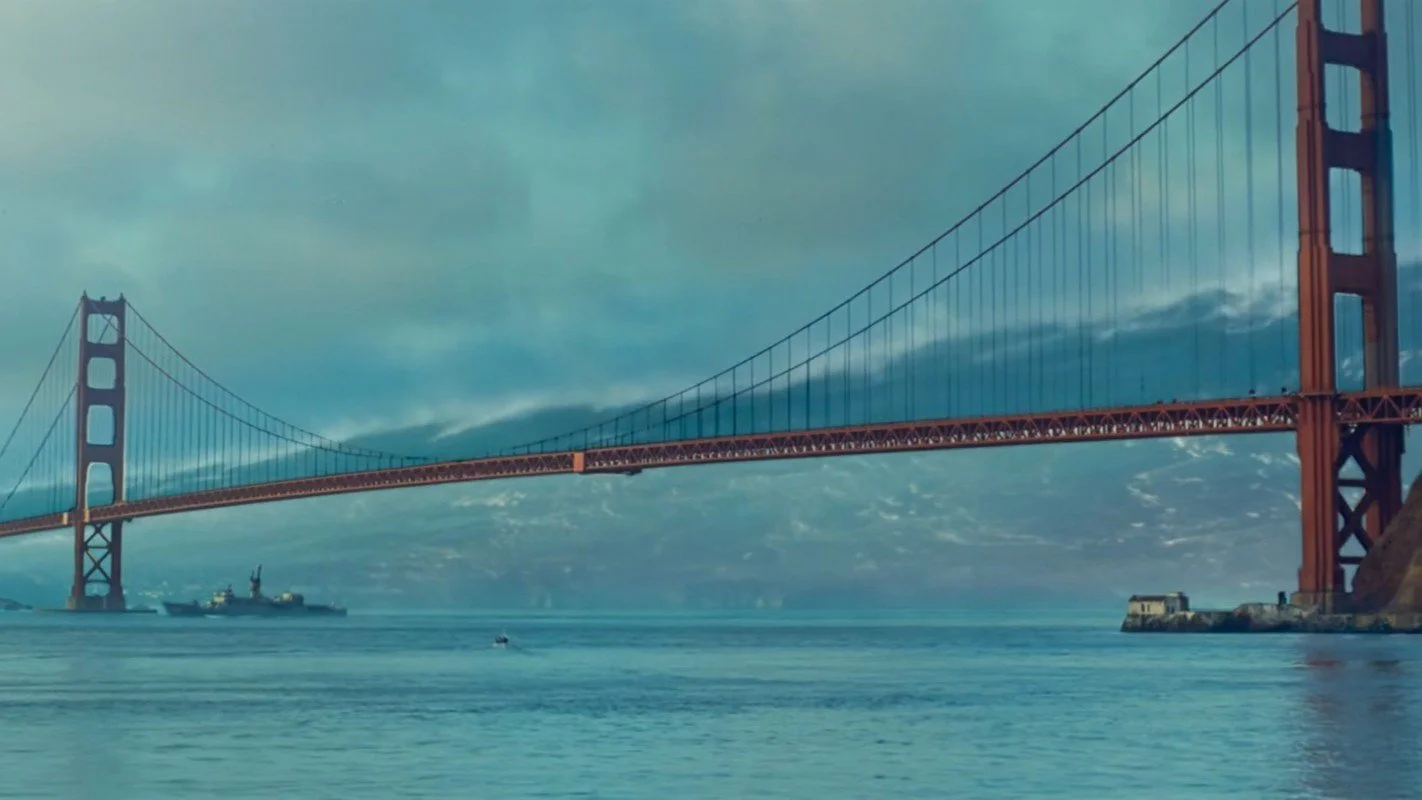
Visually Godzilla is an outstanding experience. Seldom has such destruction been depicted with such gravitas. The movie takes a bleak tone so don't go looking for any witty quips or banter. It’s all played very straight faced. The visual effects give Godzilla an immense sense of scale as well as the M.U.T.O.S. This is one occasion when 3D does help the proceedings. There is also a tangible sense of the human cost to all the mayhem, without resorting to cliché. Furthermore, composer Alexandre Desplat has managed to craft the right sort of soundtrack for the proceedings. It has clear thematic influences from the original Japanese movies and is suitable sombre. Pretty much every aspect of this production seems to have been thought about in an intelligent manner.
Godzilla is a rare beast these days, in so far as it’s a blockbuster with a far greater amount of thought behind it. Not everything works. Sometimes the script follows the less interesting characters about and a few of them drop out of the proceedings without logical real reason. But the movie maintains a sense of integrity about its subject matter. Furthermore, considering that director Gareth Edwards has managed to produce a movie of this type, via the studio system and still managed to stamp his personal style upon it, is a major achievement. This is one of those rare times where I eagerly await a sequel, as long as it maintains the high standard that has been established by the first instalment.






Bringing Godzilla Down to Size (2008)
I recently stumbled across the documentary Bringing Godzilla Down To Size, which was originally included on Classic Media’s DVD release of the genre classics War Of The Gargantuas and Rodan. This in-depth and surprisingly engaging film explores the history of the Japanese Godzilla franchise and focuses on the special effects and technical aspects that dominated these productions. Technicians and actors are interviewed, providing a wealth of insight into the complexities of the films. This documentary also demonstrates the very unique nature of the Japanese film industry and its obsessive attention to detail.
I recently stumbled across the documentary Bringing Godzilla Down To Size, which was originally included on Classic Media’s DVD release of the genre classics War Of The Gargantuas and Rodan. This in-depth and surprisingly engaging film explores the history of the Japanese Godzilla franchise and focuses on the special effects and technical aspects that dominated these productions. Technicians and actors are interviewed, providing a wealth of insight into the complexities of the films. This documentary also demonstrates the very unique nature of the Japanese film industry and its obsessive attention to detail.
The main question asked by this film is why is Godzilla still principally played a man in a suit? At a time when Hollywood’s uses CGI at every potential opportunity, Japanese sci-fi movies still rely heavily on old-school techniques. Miniatures, physical effects and actors in animatronic costumes are still commons. For over fifty years, Godzilla, Mothra, King Ghidorah and other giant creatures have been brought to life in this old fashion manner. Is the Japanese effects industry just as traditional as other aspects of their culture? The documentary’s answer is surprisingly simple. The old techniques work
Narrated by Godzilla fan boy extreme, Alex Cox (director of Repo Man, Sid And Nancy), the film celebrates the art and craft of the Japanese monsters genre and reflects on the future of Godzilla in the digital age. Bringing Godzilla Down To Size reveals through a multitude of interviews, the love and respect that the technicians and artists have for this series. The meeting between the three actor/stuntmen that have played Godzilla over the years is quite touching. The documentary manages to tread the narrow path between informed narrative and gushing fan boy eulogy. It also provides a very interesting overview into the world of pre-digital visual effects.
In the year 1860, Baron Victor Frankenstein (Peter Cushing) faces execution by guillotine for the murders perpetrated by the creature he created. With the assistance of a hunchback named Karl (Oscar Quitak) he avoids death by beheading the priest who came to give him the last rites. The priest’s body is then mistakenly buried by the authorities. Three years later, Victor, now using the name Doctor Stein, has established himself as a prosperous physician in Karlsbrück, serving both affluent patients and the poor at a paupers’ hospital. Hans Kleve (Francis Matthews), a junior member of the medical council, recognises Victor and being an admirer, seeks to become his apprentice. Victor and Hans then undertake an experiment to transplant Karl’s living brain into a new, more refined body, rather than a grotesque monstrosity the Baron has previously made. Karl is eager to have a new healthy body, especially after encountering Margaret Conrad (Eunice Gayson), the charming new assistant at the hospital.