
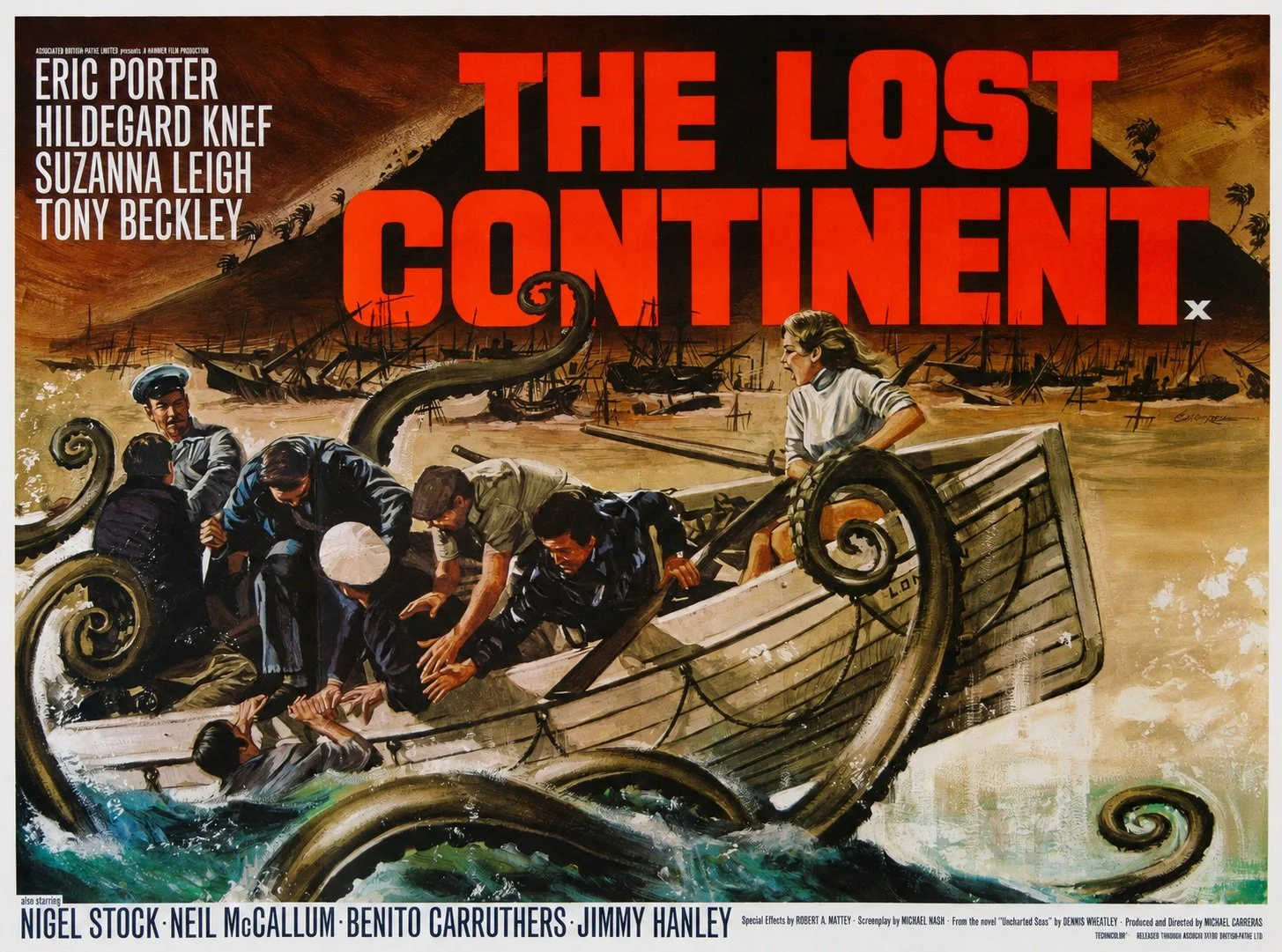
The Lost Continent (1968)
In 1968 the dilapidated freighter Corita hastily leaves Freetown to avoid a customs inspection. Captain Lansen (Eric Porter) has a cargo of dangerous explosives which he is smuggling so he can finally retire. His ship’s passengers also have reasons for leaving in a hurry. Dr. Webster (Nigel Stock), together with his daughter Unity (Suzanna leigh), is relocating due to his indiscretions with patients and illegal operations. Alcoholic pianist Harry Tyler (Tony Beckley) is aimlessly drifting from port to port. Eva Peters (Hildegard Knef) is fleeing from her husband with stolen bearer bonds which she intend to use to buy back her son from his evil clutches Caracas. Ricaldi (Ben Carruthers), a questionable lawyer, is pursuing Eva to retrieve the stolen bonds. First officer Hemmings (Neil McCallum) suggests that the ship should return to Freetown after an imminent Hurricane warning. The Captain asks the passengers and they are unanimous that they do not wish to return. However a mutinous crew, the bad weather and the instability of the explosives force everyone to abandon ship. The survivors find themselves adrift in a lifeboat surrounded by a strange carnivorous seaweed.
In 1968 the dilapidated freighter Corita hastily leaves Freetown to avoid a customs inspection. Captain Lansen (Eric Porter) has a cargo of dangerous explosives which he is smuggling so he can finally retire. His ship’s passengers also have reasons for leaving in a hurry. Dr. Webster (Nigel Stock), together with his daughter Unity (Suzanna leigh), is relocating due to his indiscretions with patients and illegal operations. Alcoholic pianist Harry Tyler (Tony Beckley) is aimlessly drifting from port to port. Eva Peters (Hildegard Knef) is fleeing from her husband with stolen bearer bonds which she intend to use to buy back her son from his evil clutches Caracas. Ricaldi (Ben Carruthers), a questionable lawyer, is pursuing Eva to retrieve the stolen bonds. First officer Hemmings (Neil McCallum) suggests that the ship should return to Freetown after an imminent Hurricane warning. The Captain asks the passengers and they are unanimous that they do not wish to return. However a mutinous crew, the bad weather and the instability of the explosives force everyone to abandon ship. The survivors find themselves adrift in a lifeboat surrounded by a strange carnivorous seaweed.
By the mid sixties Hammer Films had already an established track record of varying their cinematic output. Over the previous decade the studio had produced films from such genres as horror, psychological thrillers, historical action and even comedy. However, by 1968 mainstream cinema was changing and so Hammer Films decided to try and broaden its appeal. However, its experimentation was not always successful and at times fell between two stools. The Lost Continent is a prime example of this. It begins as a gritty drama with a captain taking a series of risks so he can retire and ship full of passengers who all have guilty secrets. Tension increases when the crew become mutinous over the illegal cargo and the news of an imminent storm. For the first 100 minutes the plot works quite well, despite the modest budget and the additional jazz material by Carlo Martelli which supplements the main score by Gerard Schürmann. Sadly, things all go awry when the monsters, killer seaweed and the Spanish Inquisition appear.
Based on the novel Uncharted Seas by Dennis Wheatley, director Michael Carreras (who also wrote the screenplay) strays from the source text and adds monsters as well as descendant of Spanish conquistadors to the proceedings. The film’s tonal shift in the final 40 minutes from nautical drama to monster movie is quite incongruous. There are moments of violence and implied sex but these elements are not consistent throughout the film. A shark attack results in a bloodless death, yet when a crew member falls into the carnivorous seaweed, the blood flows. These inconsistencies seem to indicate that director Michael Carreras had no clear vision for the production, although he did takeover directing from Leslie Norman. Most of the film’s budget seems to be spent on the ship sets and the 175,000 gallon water tank at Elstree Studios to shoot the exterior sea scenes. The miniatures by Cliff Richardson are good but Robert A. Mattey’s monster are poor due to financial constraints.
The Lost Continent is clearly not a family film considering some of the plots themes but the addition of monsters (which featured heavily in the marketing) would give potential viewers the idea that it was. Hence when it was distributed in the US, 8 minutes of material was excised, removing some of the implied sex scenes and dialogue alluding to adult themes. This material has been re-instated in the latest Blu-ray release. Critics at the time considered The Lost Continent to be an oddity. 58 years later, opinions have not greatly changed. The final act of the film where the crew of the Corita are attacked by descendants of the Spanish Inquisition who they subsequently defeat with their modern weapons, seems rushed and if it belongs in a totally different film. That being said, The Lost Continent is not a terrible film altogether with no redeeming qualities. But it is most definitely a mess. However, for the cinematically curious it may prove a fascinating mess.
In 1968 the dilapidated freighter Corita hastily leaves Freetown to avoid a customs inspection. Captain Lansen (Eric Porter) has a cargo of dangerous explosives which he is smuggling so he can finally retire. His ship’s passengers also have reasons for leaving in a hurry. Dr. Webster (Nigel Stock), together with his daughter Unity (Suzanna leigh), is relocating due to his indiscretions with patients and illegal operations. Alcoholic pianist Harry Tyler (Tony Beckley) is aimlessly drifting from port to port. Eva Peters (Hildegard Knef) is fleeing from her husband with stolen bearer bonds which she intend to use to buy back her son from his evil clutches Caracas. Ricaldi (Ben Carruthers), a questionable lawyer, is pursuing Eva to retrieve the stolen bonds. First officer Hemmings (Neil McCallum) suggests that the ship should return to Freetown after an imminent Hurricane warning. The Captain asks the passengers and they are unanimous that they do not wish to return. However a mutinous crew, the bad weather and the instability of the explosives force everyone to abandon ship. The survivors find themselves adrift in a lifeboat surrounded by a strange carnivorous seaweed.
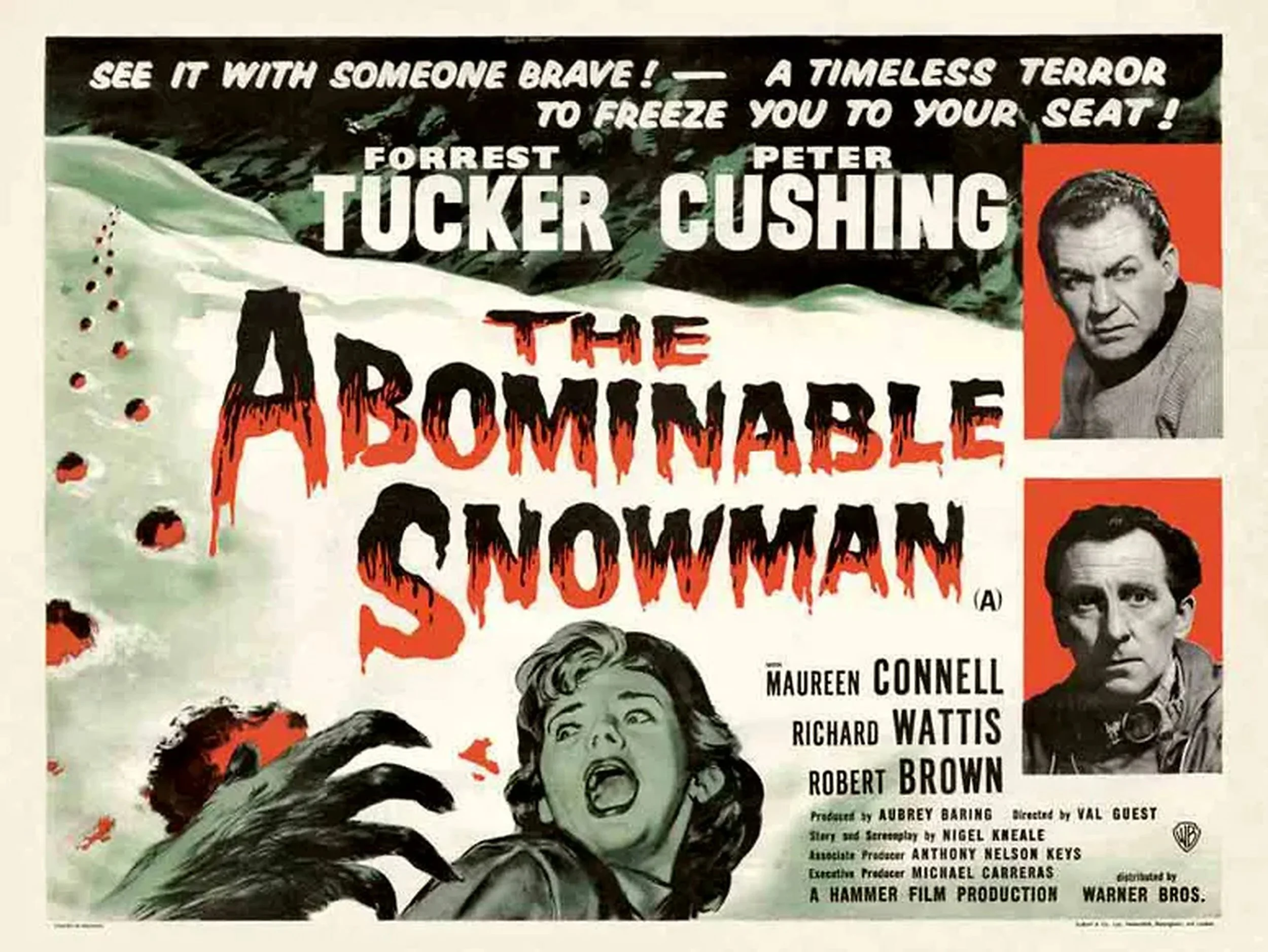
Despite being considered by many as an original story, The Abominable Snowman (1957) is in fact a remake of a made for television play, The Creature, that was originally broadcast in the UK in 1955. Hammer Films would often purchase the rights of popular TV programs and subsequently re-work them for mainstream, international cinema. Larger production budgets and fewer censorship restrictions allowed them to make their cinematic interpretations more lurid, thus commercially viable. Hence The Quatermass Xperiment, Quatermass II and Quatermass and the Pit were all given a big screen makeover and were commercially successful. The Abominable Snowman was written by acclaimed writer Nigel Kneale, who also wrote the original television drama and the aforementioned Quatermass trilogy. Although ostensibly marketed as a horror film this production is actually an interesting blend of psychological thriller and science fiction.

Sometimes when making a film, less can indeed be more. Practical things like keeping the scope of your story simple, working within your budget and not feeling obliged to justify or explain every aspect of the plot can prove invaluable. If you can do all of these things with a robust cast, intelligent direction, while maintaining your viewers attention, then you have achieved something that many studios and independent filmmakers usually cannot do. Director David Keating has managed to do this with the 2009 horror film Wake Wood. Along with Brendan McCarthy who he co-wrote the screenplay with him, Wake Wood efficiently and charismatically tells its tale. It is well paced, with relatable characters and good performances. The atmosphere builds and there are some jolting moments of horror. Furthermore, it is both unusual and rewarding to see pagan rituals portrayed as an extension of rural life, in the same way as farming and animal husbandry. It is neither malevolent or benign but just an ever present force.
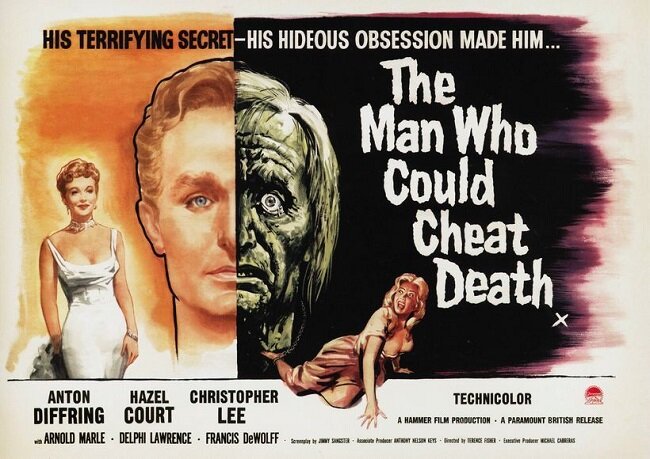
The stories of Hammer films “horsetrading” with the British Board of Film Censorship (as the BBFC were called at the time) make for some interesting reading. If you're interested in the history of the studio I thoroughly recommend the book A New Heritage of Horror: The English Gothic Cinema by David Pirie. However, the BBFC felt that they’d been hoodwinked after the release of The Curse of Frankenstein in 1957, which had managed to smuggle additional unpleasantries into the final theatrical edit. Henceforth the board took a more formidable stance when dealing with Hammer and all subsequent releases. Hence The Man Who Could Cheat Death feels somewhat tame compared to earlier Hammer films. Although cuts were made to the final edit of the movie, one gets the impression that maybe the more salacious and graphic content was possibly reduced when writing the screenplay. However, with that all said, The Man Who Could Cheat Death is still a handsome, performance driven Hammer horror.
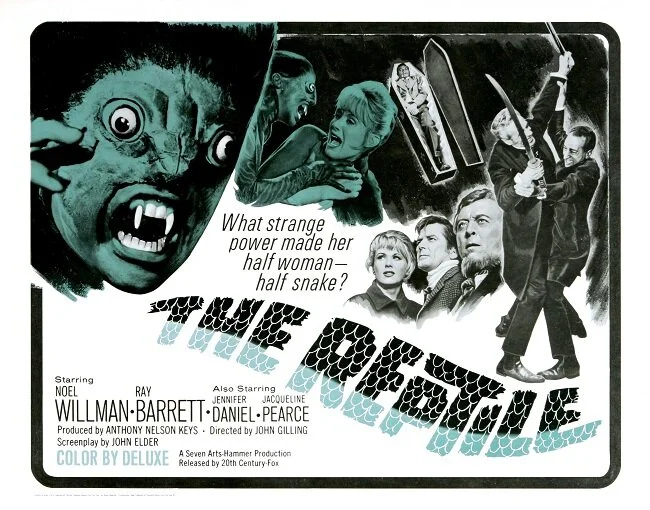
After his brother Charles dies in mysterious circumstances, Harry Spaulding (Ray Barrett) inherits his cottage in the Clagmoor Heath, Cornwall. He quickly moves in with his new bride, Valerie (Jenifer Daniel), with a view to finding out what happened. However, he is shunned by the locals apart from the village publican, Tom Bailey (Michael Ripper), who befriends him. The only other resident in the vicinity of the cottage is Dr. Franklyn (Noel Willman), the owner of the nearby Well House. He lives with his daughter Anna (Jacqueline Pearce), who is attended by a silent Malay servant (Marne Maitland). Anna is a strange girl who seems to be harbouring a secret. Her father treats her contemptuously and does his utmost to keep her confined to Well House. When the local village eccentric, Mad Peter (John Laurie), dies in a similar fashion to Charles Spaulding, both Harry and Tom decide to take matters into their own hands and to investigate further.
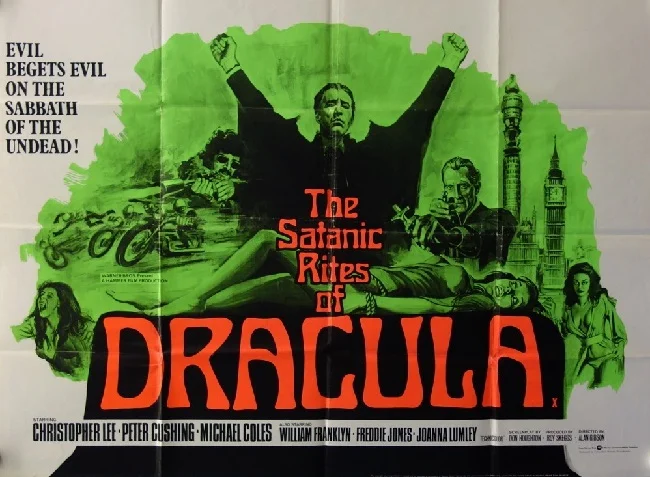
The horror movie genre was changing rapidly in the late sixties and seventies, with films such as the Night of the Living Dead and Rosemary’s Baby moving away from traditional gothic settings and proving to be box office successes. After the success of Count Yorga, Vampire, a movie set in 1970s Los Angeles, Warner Bros commissioned Hammer Films to make two contemporary set Dracula films. The first of these was Dracula A.D. 1972. The film was loosely inspired by the Highgate Vampire case and proved to be moderately successful at the box office. The second being The Satanic Rites of Dracula; a curious hybrid vampire movie that mixes elements of the espionage genre along with traditional Hammer horror content. Sadly, this final outing for both Peter Cushing and Christopher Lee as Van Helsing and Dracula, was not well received by the public and has subsequently been written off in the annals of Hammer Films. Yet despite it’s flaws it does have a few points of interest to the more rigorous horror fan. The recent Blu-ray release via the Warner Archive Collection presented such an opportunity for reappraisal.
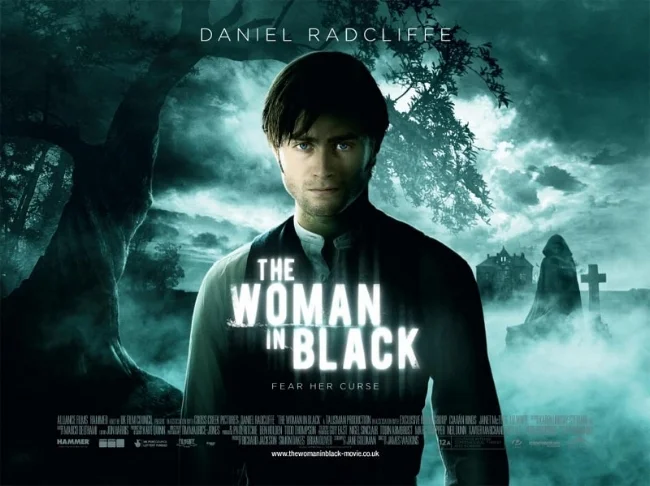
James Watkins’ 2012 adaptation of The Woman in Black is quite a radical adaptation of Susan Hill’s story, yet it still manages to remain true to its central themes. Jane Goldman of Kick-Ass, X-Men: First Class fame, has crafted a screenplay which is both innovative yet strangely traditional. She boldly revises the central character from contented husband to desolate widower; a move that adds a very bleak under current to the story. The more ghoulish elements of the narrative have been greatly enhanced and the film works the best when the eponymous character makes an appearance via jump scares. Despite a modest budget of $15 million, The Woman in Black went to make over $127,730,736 worldwide making it the most financially successful British horror film in 20 years.
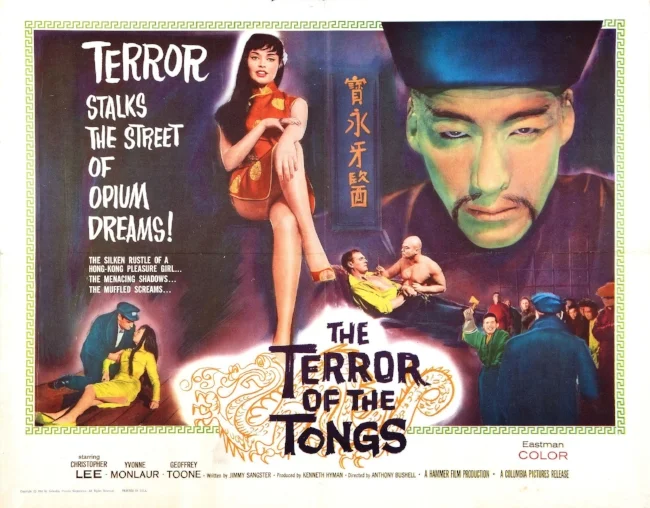
In 1910, Hong Kong is in the grips of the powerful Red Dragon tong, a secret society that extorts revenue from merchant seamen, deals in both opium and slave trades and savagely slaughters all those who offer opposition. A merchant sailor, Captain Jackson (Geoffrey Toone), swears revenge on the nefarious clan after they brutally murder his first officer and daughter. Hammer's The Terror of the Tongs strives to offer a lurid period drama but falls somewhat short of the mark due to a clumsy script, an indifferent hero and a conspicuous lack of authentic Asian actors. Apart from Burt Kwouk, most of the cast are Europeans sporting rather poor prosthetics. Christopher Lee manages to bluff his way through his role as Tong leader Chung King, through the force of his acting skills. French actress Yvonne Monlaur (Brides of Dracula) is not as successful as a mixed raced serving girl.
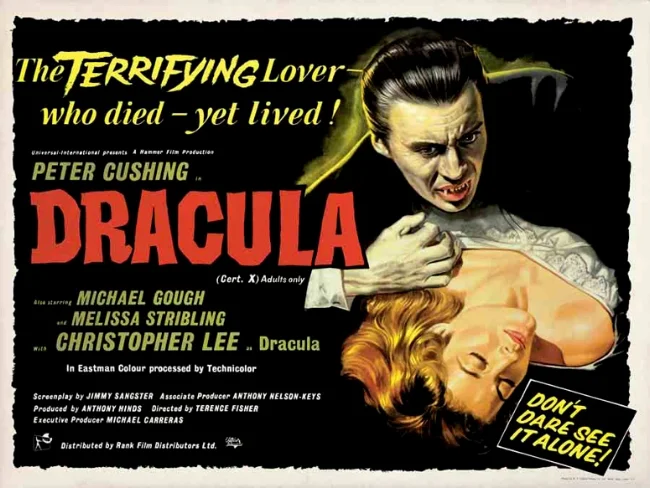
Following the 2012 restored release of The Curse of Frankenstein, Hammer, Icon Film Distribution and Lionsgate jointly produced a Blu-ray restoration of another British classic. This time it was the 1958 version of Dracula directed by Terence Fisher. This is one of Hammer's finest films and not only gets a superb High Definition transfer but also sees the restoration of two lost scenes. Dracula literally re-invented the horror genre and the depiction of vampires in film. It also established the studio as a key player within the industry and made international stars of Peter Cushing and Christopher Lee. This new restoration finally does justice to the source material presenting it as it deserves to be seen.
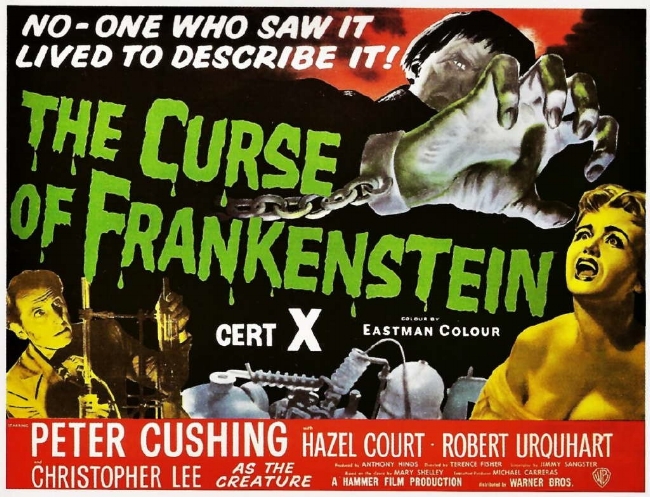
The 2012 Blu-ray release of Hammer Studio's The Curse of Frankenstein is a visual delight. The use of Eastman colour and the outstanding cinematography by Jack Asher are sumptuous and the new restoration does the film justice. This unique British horror movie introduced a new visceral style and brooding quality to the genre back in 1957. Despite a modest budget the creative production design evokes a truly Gothic horror atmosphere. The studio also introduced graphic violence along with a strong undercurrent of sexuality. These lurid aspects of the film proved particularly successful with the post war audience and became an integral part of the marketing campaign.
The Abominable Snowman (1957)
Despite being considered by many as an original story, The Abominable Snowman (1957) is in fact a remake of a made for television play, The Creature, that was originally broadcast in the UK in 1955. Hammer Films would often purchase the rights of popular TV programs and subsequently re-work them for mainstream, international cinema. Larger production budgets and fewer censorship restrictions allowed them to make their cinematic interpretations more lurid, thus commercially viable. Hence The Quatermass Xperiment, Quatermass II and Quatermass and the Pit were all given a big screen makeover and were commercially successful. The Abominable Snowman was written by acclaimed writer Nigel Kneale, who also wrote the original television drama and the aforementioned Quatermass trilogy. Although ostensibly marketed as a horror film this production is actually an interesting blend of psychological thriller and science fiction.
Despite being considered by many as an original story, The Abominable Snowman (1957) is in fact a remake of a made for television play, The Creature, that was originally broadcast in the UK in 1955.Hammer Films would often purchase the rights of popular TV programs and subsequently re-work them for mainstream, international cinema. Larger production budgets and fewer censorship restrictions allowed them to make their cinematic interpretations more lurid, thus commercially viable. Hence The Quatermass Xperiment,Quatermass II and Quatermass and the Pit were all given a big screen makeover and were commercially successful.The Abominable Snowman was written by acclaimed writer Nigel Kneale, who also wrote the original television drama and the aforementioned Quatermass trilogy. Although ostensibly marketed as a horror film this production is actually an interesting blend of psychological thriller and science fiction.
Dr. John Rollason (Peter Cushing), along with his wife Helen (Maureen Connell) and their assistant Peter Fox (Richard Wattis), are visiting the Lhama (Arnold Marlé) of the Rong-ruk monastery during a botanical expedition in the Himalayas. A second group of explorers, led by Tom Friend (Forrest Tucker) and including trapper Ed Shelley (Robert Brown), photographer Andrew McNee (Michael Brill), and Sherpa guide Kusang (Wolfe Morris), arrives at the monastery on a clandestine mission to discover the legendary Yeti, also known as the Abominable Snowman. Despite his wife’s concerns over his safety and the Lama’s objections, Rollason chooses to join Friend's expedition. While Rollason is driven by a scientific desire to discover more about the creature, Friend is motivated by the pursuit of fame and wealth, aiming to capture a live Yeti to showcase to the global media. As expedition progresses, it soon become apparent that they’re not alone.
Due to this bait and switch sales approach, especially in the US where the film was re-titled The Abominable Snowman of the Himalayas, the box office returns were disappointing. However, in recent years this film has been critically re-appraised. The dialogue driven screenplay is thought provoking, the black and white, anamorphic widescreen photography by Arthur Grant makes the production look far more expensive than it actually is and as ever, Peter Cushing’s performance does much of the heavy lifting. Yes, the story unfolds at a leisurely pace and despite being transplanted to the big screen, it is clear that this was originally a play. Yet viewers wanting a more thoughtful and atmospheric story, as opposed to the more graphic approach (for the times) that Hammer Films adopted the following years for The Curse of Frankenstein and Dracula, this production has such things in spades.
Clearly not a horror film in the traditional sense, is it appropriate to label The Abominable Snowman a creature feature? Possibly but not like Jaws or Grizzly. The Yetis in this film are peaceful, sentient creatures who live in parallel with humans. It is hinted that they have evolved mental faculties such as telepathy and are simply biding their time till humanity destroys itself. Each member of the exploration team ends up facing what they carry in their heart. Director Val Guest suspected that the cerebral plot was just too ahead of its time and not suitable for the cinematic market of the time. However, he Abominable Snowman has a far better chance of finding a welcoming audience these days, where its high concept plot will not be considered alien to viewers. Hammer Films forthcoming 4K restoration will no doubt prove a hit among film collectors who still favour physical media.

In the year 1860, Baron Victor Frankenstein (Peter Cushing) faces execution by guillotine for the murders perpetrated by the creature he created. With the assistance of a hunchback named Karl (Oscar Quitak) he avoids death by beheading the priest who came to give him the last rites. The priest’s body is then mistakenly buried by the authorities. Three years later, Victor, now using the name Doctor Stein, has established himself as a prosperous physician in Karlsbrück, serving both affluent patients and the poor at a paupers’ hospital. Hans Kleve (Francis Matthews), a junior member of the medical council, recognises Victor and being an admirer, seeks to become his apprentice. Victor and Hans then undertake an experiment to transplant Karl’s living brain into a new, more refined body, rather than a grotesque monstrosity the Baron has previously made. Karl is eager to have a new healthy body, especially after encountering Margaret Conrad (Eunice Gayson), the charming new assistant at the hospital.
In 1968 the dilapidated freighter Corita hastily leaves Freetown to avoid a customs inspection. Captain Lansen (Eric Porter) has a cargo of dangerous explosives which he is smuggling so he can finally retire. His ship’s passengers also have reasons for leaving in a hurry. Dr. Webster (Nigel Stock), together with his daughter Unity (Suzanna leigh), is relocating due to his indiscretions with patients and illegal operations. Alcoholic pianist Harry Tyler (Tony Beckley) is aimlessly drifting from port to port. Eva Peters (Hildegard Knef) is fleeing from her husband with stolen bearer bonds which she intend to use to buy back her son from his evil clutches Caracas. Ricaldi (Ben Carruthers), a questionable lawyer, is pursuing Eva to retrieve the stolen bonds. First officer Hemmings (Neil McCallum) suggests that the ship should return to Freetown after an imminent Hurricane warning. The Captain asks the passengers and they are unanimous that they do not wish to return. However a mutinous crew, the bad weather and the instability of the explosives force everyone to abandon ship. The survivors find themselves adrift in a lifeboat surrounded by a strange carnivorous seaweed.
Despite being considered by many as an original story, The Abominable Snowman (1957) is in fact a remake of a made for television play, The Creature, that was originally broadcast in the UK in 1955. Hammer Films would often purchase the rights of popular TV programs and subsequently re-work them for mainstream, international cinema. Larger production budgets and fewer censorship restrictions allowed them to make their cinematic interpretations more lurid, thus commercially viable. Hence The Quatermass Xperiment, Quatermass II and Quatermass and the Pit were all given a big screen makeover and were commercially successful. The Abominable Snowman was written by acclaimed writer Nigel Kneale, who also wrote the original television drama and the aforementioned Quatermass trilogy. Although ostensibly marketed as a horror film this production is actually an interesting blend of psychological thriller and science fiction.
Sometimes when making a film, less can indeed be more. Practical things like keeping the scope of your story simple, working within your budget and not feeling obliged to justify or explain every aspect of the plot can prove invaluable. If you can do all of these things with a robust cast, intelligent direction, while maintaining your viewers attention, then you have achieved something that many studios and independent filmmakers usually cannot do. Director David Keating has managed to do this with the 2009 horror film Wake Wood. Along with Brendan McCarthy who he co-wrote the screenplay with him, Wake Wood efficiently and charismatically tells its tale. It is well paced, with relatable characters and good performances. The atmosphere builds and there are some jolting moments of horror. Furthermore, it is both unusual and rewarding to see pagan rituals portrayed as an extension of rural life, in the same way as farming and animal husbandry. It is neither malevolent or benign but just an ever present force.
The stories of Hammer films “horsetrading” with the British Board of Film Censorship (as the BBFC were called at the time) make for some interesting reading. If you're interested in the history of the studio I thoroughly recommend the book A New Heritage of Horror: The English Gothic Cinema by David Pirie. However, the BBFC felt that they’d been hoodwinked after the release of The Curse of Frankenstein in 1957, which had managed to smuggle additional unpleasantries into the final theatrical edit. Henceforth the board took a more formidable stance when dealing with Hammer and all subsequent releases. Hence The Man Who Could Cheat Death feels somewhat tame compared to earlier Hammer films. Although cuts were made to the final edit of the movie, one gets the impression that maybe the more salacious and graphic content was possibly reduced when writing the screenplay. However, with that all said, The Man Who Could Cheat Death is still a handsome, performance driven Hammer horror.
After his brother Charles dies in mysterious circumstances, Harry Spaulding (Ray Barrett) inherits his cottage in the Clagmoor Heath, Cornwall. He quickly moves in with his new bride, Valerie (Jenifer Daniel), with a view to finding out what happened. However, he is shunned by the locals apart from the village publican, Tom Bailey (Michael Ripper), who befriends him. The only other resident in the vicinity of the cottage is Dr. Franklyn (Noel Willman), the owner of the nearby Well House. He lives with his daughter Anna (Jacqueline Pearce), who is attended by a silent Malay servant (Marne Maitland). Anna is a strange girl who seems to be harbouring a secret. Her father treats her contemptuously and does his utmost to keep her confined to Well House. When the local village eccentric, Mad Peter (John Laurie), dies in a similar fashion to Charles Spaulding, both Harry and Tom decide to take matters into their own hands and to investigate further.
The horror movie genre was changing rapidly in the late sixties and seventies, with films such as the Night of the Living Dead and Rosemary’s Baby moving away from traditional gothic settings and proving to be box office successes. After the success of Count Yorga, Vampire, a movie set in 1970s Los Angeles, Warner Bros commissioned Hammer Films to make two contemporary set Dracula films. The first of these was Dracula A.D. 1972. The film was loosely inspired by the Highgate Vampire case and proved to be moderately successful at the box office. The second being The Satanic Rites of Dracula; a curious hybrid vampire movie that mixes elements of the espionage genre along with traditional Hammer horror content. Sadly, this final outing for both Peter Cushing and Christopher Lee as Van Helsing and Dracula, was not well received by the public and has subsequently been written off in the annals of Hammer Films. Yet despite it’s flaws it does have a few points of interest to the more rigorous horror fan. The recent Blu-ray release via the Warner Archive Collection presented such an opportunity for reappraisal.
James Watkins’ 2012 adaptation of The Woman in Black is quite a radical adaptation of Susan Hill’s story, yet it still manages to remain true to its central themes. Jane Goldman of Kick-Ass, X-Men: First Class fame, has crafted a screenplay which is both innovative yet strangely traditional. She boldly revises the central character from contented husband to desolate widower; a move that adds a very bleak under current to the story. The more ghoulish elements of the narrative have been greatly enhanced and the film works the best when the eponymous character makes an appearance via jump scares. Despite a modest budget of $15 million, The Woman in Black went to make over $127,730,736 worldwide making it the most financially successful British horror film in 20 years.
In 1910, Hong Kong is in the grips of the powerful Red Dragon tong, a secret society that extorts revenue from merchant seamen, deals in both opium and slave trades and savagely slaughters all those who offer opposition. A merchant sailor, Captain Jackson (Geoffrey Toone), swears revenge on the nefarious clan after they brutally murder his first officer and daughter. Hammer's The Terror of the Tongs strives to offer a lurid period drama but falls somewhat short of the mark due to a clumsy script, an indifferent hero and a conspicuous lack of authentic Asian actors. Apart from Burt Kwouk, most of the cast are Europeans sporting rather poor prosthetics. Christopher Lee manages to bluff his way through his role as Tong leader Chung King, through the force of his acting skills. French actress Yvonne Monlaur (Brides of Dracula) is not as successful as a mixed raced serving girl.
Following the 2012 restored release of The Curse of Frankenstein, Hammer, Icon Film Distribution and Lionsgate jointly produced a Blu-ray restoration of another British classic. This time it was the 1958 version of Dracula directed by Terence Fisher. This is one of Hammer's finest films and not only gets a superb High Definition transfer but also sees the restoration of two lost scenes. Dracula literally re-invented the horror genre and the depiction of vampires in film. It also established the studio as a key player within the industry and made international stars of Peter Cushing and Christopher Lee. This new restoration finally does justice to the source material presenting it as it deserves to be seen.
The 2012 Blu-ray release of Hammer Studio's The Curse of Frankenstein is a visual delight. The use of Eastman colour and the outstanding cinematography by Jack Asher are sumptuous and the new restoration does the film justice. This unique British horror movie introduced a new visceral style and brooding quality to the genre back in 1957. Despite a modest budget the creative production design evokes a truly Gothic horror atmosphere. The studio also introduced graphic violence along with a strong undercurrent of sexuality. These lurid aspects of the film proved particularly successful with the post war audience and became an integral part of the marketing campaign.
Underwater (2020)
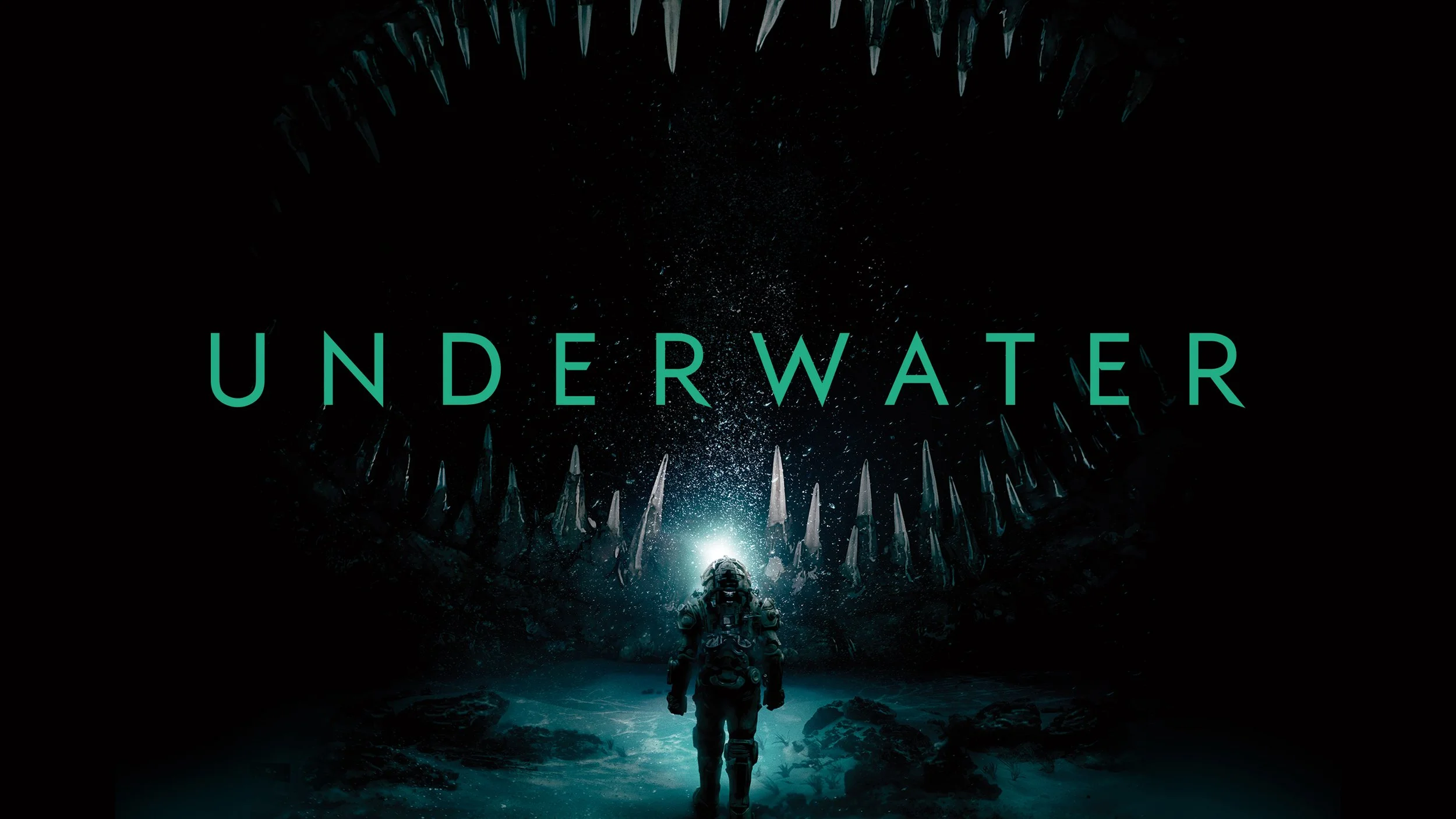
In the near future, Kepler 822, a research and drilling facility located at the bottom of the Mariana Trench, suffers a sudden and catastrophic structural failure. There are only six survivors. Mechanical engineer Norah Price (Kristen Stewart), Captain Lucien (Vincent Cassel), biologist Emily Haversham (Jessica Henwick), engineer Liam Smith (John Gallagher Jr.) and crew members Rodrigo (Mamoudou Athie) and Paul (T.J. Miller). As all the functional escape pods have been used and they are unable to contact the surface, the Captain suggests using pressurized suits to walk one mile across the ocean floor to the Roebuck 641 drill installation. There they will find more escape pods. However, it soon becomes apparent that the disaster was not caused by an undersea earthquake and that they are not alone as they make their journey.
In the near future, Kepler 822, a research and drilling facility located at the bottom of the Mariana Trench, suffers a sudden and catastrophic structural failure. There are only six survivors. Mechanical engineer Norah Price (Kristen Stewart), Captain Lucien (Vincent Cassel), biologist Emily Haversham (Jessica Henwick), engineer Liam Smith (John Gallagher Jr.) and crew members Rodrigo (Mamoudou Athie) and Paul (T.J. Miller). As all the functional escape pods have been used and they are unable to contact the surface, the Captain suggests using pressurized suits to walk one mile across the ocean floor to the Roebuck 641 drill installation. There they will find more escape pods. However, it soon becomes apparent that the disaster was not caused by an undersea earthquake and that they are not alone as they make their journey.
Underwater starts with all the hallmarks of a film that is very derivative of Alien. The technology and immediate environment all have an industrial aesthetic that is worn and feels used. The crew is made up of “working men” rather than clean cut academics and the corporation that owns and runs the facility is simply referenced by branding on bulkheads or on monitor lockscreens. The screenplay by Brian Duffield (No One Will Save You) and Adam Cozad is lean and moves quickly but there’s sufficient dialogue to get the measure of each character. The threat comes quickly during the film’s concise 95 minute running time and it is here that Underwater diverges from similar films. DeepStar Six featured a prehistoric Eurypterid and Leviathan had monsters caused by mutagens containing piscine DNA. Underwater has a distinctly Lovecraftian nemesis.
Director William Eubank maintains a tense and claustrophobic atmosphere. Due to the seven mile depth, there is no sunlight and the ocean floor is illuminated by the lights on the crew’s environment suits and from LEDs on equipment. Hence, for the first two acts the aquatic menace is seen only fleetingly and the shocks come mainly from jump scares. The death scenes are hectically edited and you certainly get the impression that something unpleasant has happened but you cannot see the detail. Although initially frustrating this becomes the film’s greatest strength as it becomes clear this is not just a case of an apex predator. The crew do a little theorising about what is happening around them but it is left vague and there are no convenient answers. The climax and final reveal work better as a result of this approach.
Underwater is an effective genre outing. It isn’t a masterpiece and certainly isn’t original. It takes some standard tropes from “creature features” and horror films and it tries its best to do something a little different with them. The $60 million budget covers a lot of ground, with the sets, production design and VFXs looking polished and plausible. The cast is competent and the characters likeable. Marco Beltrami’s score at times has shades of vintage John Carpenter and Alan Howarth. But it is the film’s final act that is responsible for making Underwater better than average. Casual viewers may not necessarily get the inference but those who are aware of the concept of cosmic horror should enjoy the eldritch payoff. Underwater is a well crafted rollercoaster ride, that doesn’t out stay its welcome and should be judged as such.
In 1968 the dilapidated freighter Corita hastily leaves Freetown to avoid a customs inspection. Captain Lansen (Eric Porter) has a cargo of dangerous explosives which he is smuggling so he can finally retire. His ship’s passengers also have reasons for leaving in a hurry. Dr. Webster (Nigel Stock), together with his daughter Unity (Suzanna leigh), is relocating due to his indiscretions with patients and illegal operations. Alcoholic pianist Harry Tyler (Tony Beckley) is aimlessly drifting from port to port. Eva Peters (Hildegard Knef) is fleeing from her husband with stolen bearer bonds which she intend to use to buy back her son from his evil clutches Caracas. Ricaldi (Ben Carruthers), a questionable lawyer, is pursuing Eva to retrieve the stolen bonds. First officer Hemmings (Neil McCallum) suggests that the ship should return to Freetown after an imminent Hurricane warning. The Captain asks the passengers and they are unanimous that they do not wish to return. However a mutinous crew, the bad weather and the instability of the explosives force everyone to abandon ship. The survivors find themselves adrift in a lifeboat surrounded by a strange carnivorous seaweed.
Despite being considered by many as an original story, The Abominable Snowman (1957) is in fact a remake of a made for television play, The Creature, that was originally broadcast in the UK in 1955. Hammer Films would often purchase the rights of popular TV programs and subsequently re-work them for mainstream, international cinema. Larger production budgets and fewer censorship restrictions allowed them to make their cinematic interpretations more lurid, thus commercially viable. Hence The Quatermass Xperiment, Quatermass II and Quatermass and the Pit were all given a big screen makeover and were commercially successful. The Abominable Snowman was written by acclaimed writer Nigel Kneale, who also wrote the original television drama and the aforementioned Quatermass trilogy. Although ostensibly marketed as a horror film this production is actually an interesting blend of psychological thriller and science fiction.
In the near future, Kepler 822, a research and drilling facility located at the bottom of the Mariana Trench, suffers a sudden and catastrophic structural failure. There are only six survivors. Mechanical engineer Norah Price (Kristen Stewart), Captain Lucien (Vincent Cassel), biologist Emily Haversham (Jessica Henwick), engineer Liam Smith (John Gallagher Jr.) and crew members Rodrigo (Mamoudou Athie) and Paul (T.J. Miller). As all the functional escape pods have been used and they are unable to contact the surface, the Captain suggests using pressurized suits to walk one mile across the ocean floor to the Roebuck 641 drill installation. There they will find more escape pods. However, it soon becomes apparent that the disaster was not caused by an undersea earthquake and that they are not alone as they make their journey.
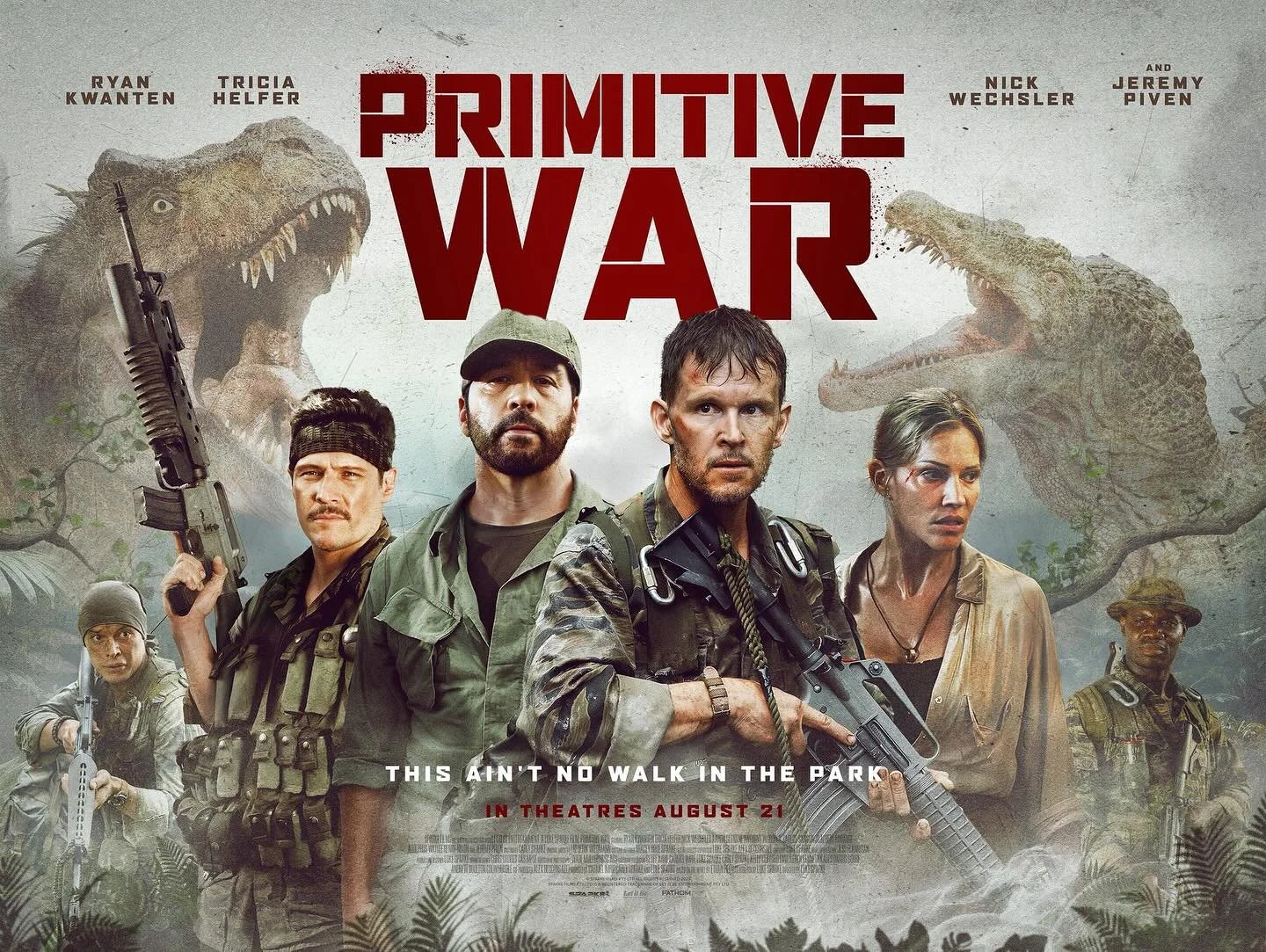
One of the most common objections raised regarding the Jurassic Park/Jurassic World franchise is that the films are specifically made to obtain a PG-13 rating from the Motion Picture Association, for purely commercial reasons. Hence, in all films, there is little on screen violence and the dinosaurs are mainly portrayed as a threat and a means of providing jump scares. When a character is killed by a dinosaur it usually happens off screen, is obscured by something else in frame, or is shown in long shot with very little detail. The realities of being eaten alive by a predator are conspicuously absent. Hence, audiences looking for films featuring more graphic dinosaur attacks, have not been well catered for apart from some minor direct-to-video titles. Primitive War finally fills this gap in the market with a frenetic genre mashup that strives to punch above is budgetary weight.
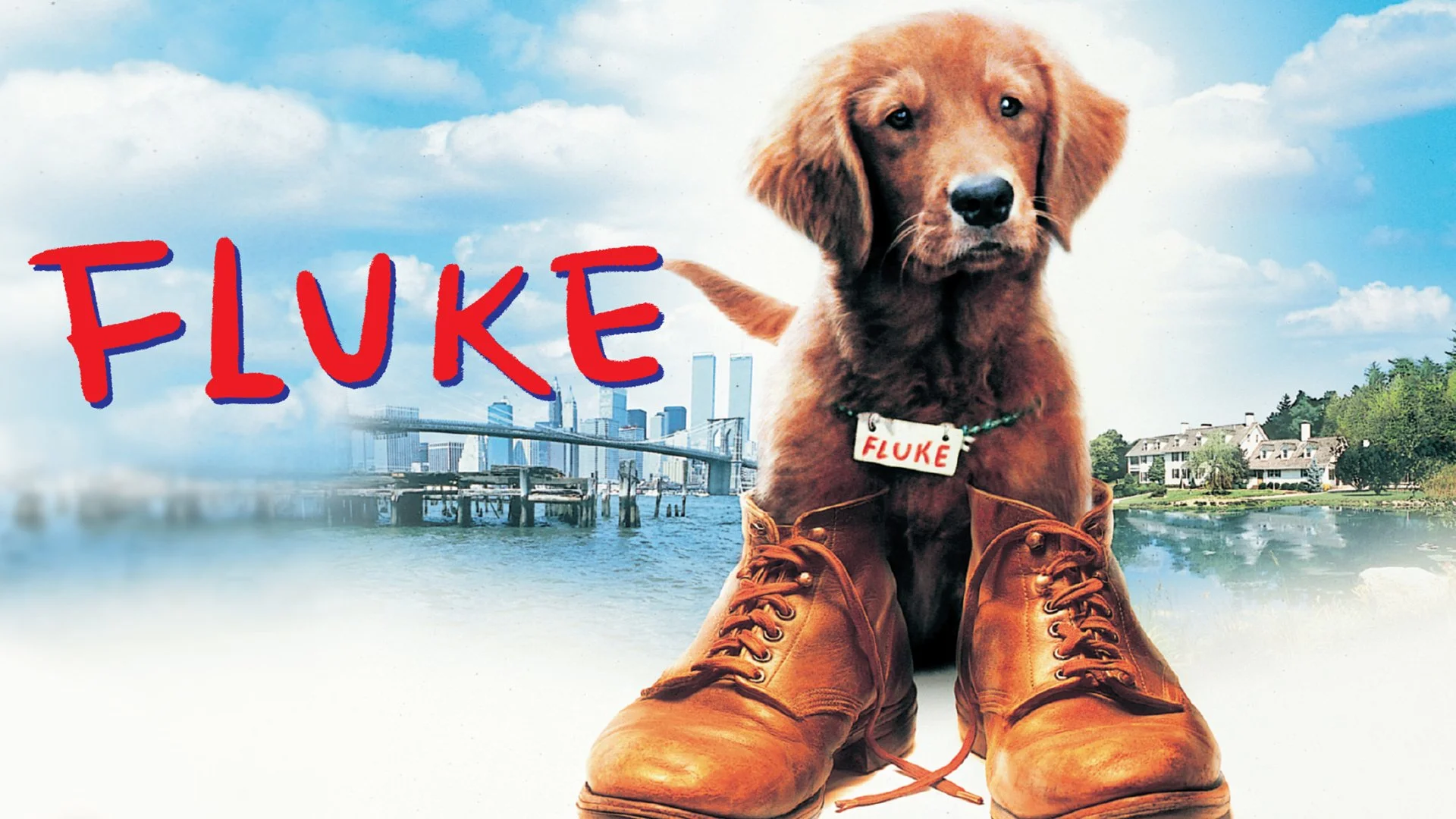
Fluke is a curious film about a man who is reincarnated as a dog and his subsequent realisation that he may have been murdered. It takes an adult novel by British author James Herbert, which is filled with philosophical musing and strives to adapt it in a far more family friendly fashion. The result is a somewhat bipolar production which thematically alternates between existential introspection and Buddhism. It then strives to deliver its message in a Disneyesque idiom. Children will potentially be confused and upset by what they see and adults will be wrongfooted by the continual shift in tone. Fluke was not a critical or commercial success upon release and the flaws that were identified by critics at the time still ring true today. That being said, Fluke is still an interesting and entertaining film, despite its faults.

When reviewing Sting, one critic stated that the small scale setting and thus, low stakes (IE only a few peoples lives are at risk), made the film not especially memorable. I consider this to be a somewhat spurious criticism. It is the very fact that Sting takes place in such a commonplace environment, with the main characters being everyday people that makes it different. There is a clear focus on well defined characters and their backstory. Unlike so many contemporary films, I actually gave a damn about the protagonists in Sting. An integral aspect of the horror genre is the ability to take a well known and familiar trope and provide a different and absorbing spin on it .It would appear that some audiences have been belaboured over the head by so many overblown and bombastic blockbusters, that the very notion of depicting small, localised and intimate events in a film, seems to bamboozle them.
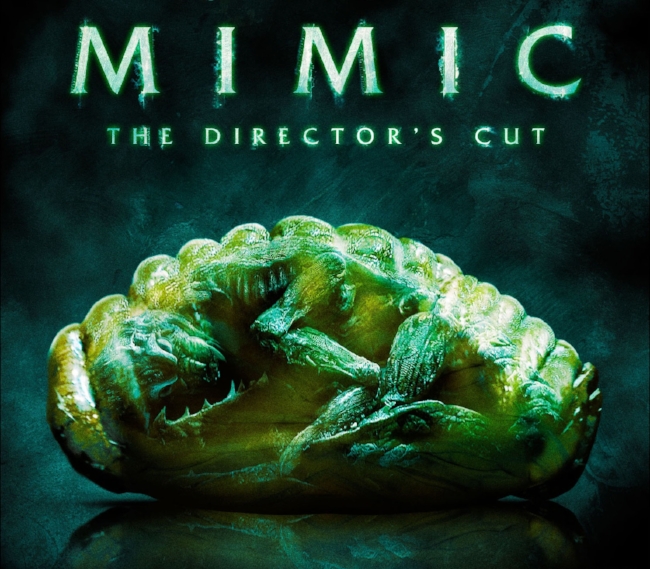
When I first saw Mimic in 1997, I was impressed by the fact that it offered a different perspective on the monster movie genre and that it seemed to have moments of greater depth than you'd expect from such material. Later on when I became more aware of the works of writer, director Guillermo del Toro, I learned that this movie had had a troubled production and that Miramx had imposed specific requirements upon the final cut of the film. This explained some of the movies inconsistencies and hinted at a far more ambitious artistic endeavour by del Toro. Initially Mimic was conceived as a thirty minute short and part of a three part anthology movie. However it along with the sci-fi film Imposter were both deemed to be of sufficient merit to be developed into feature length productions.
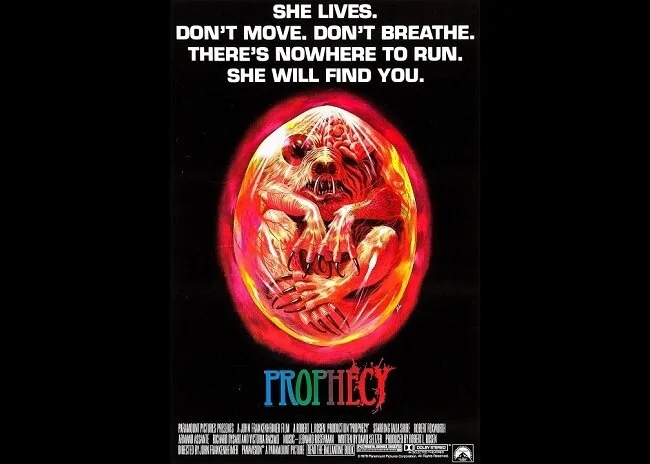
During the seventies, Hollywood started looking to ongoing societal and political concerns as a source of material for movies. Hence, the energy crisis, terrorism and global pollution quickly found themselves being subsumed into hastily written screenplays, in attempt to be topical, commercially successful and relevant. Prophecy based upon a novel by David Seltzer tackled not only the issue of pollution but also the ongoing disenfranchisement of Native Americans. Paramount studios went so far as hiring an established director of note, John Frankenheimer. In many respects this movie should have been a bigger success with a reasonable budget, robust cast and studio support. Sadly it did not fare well, either critically or at the box office due to obvious flaws in the production. Despite his outstanding body work, (Birdman of Alcatraz, The Manchurian Candidate) Frankenheimer was not the best choice of director for a genre movie such as this and he was also going through a period of alcoholism.
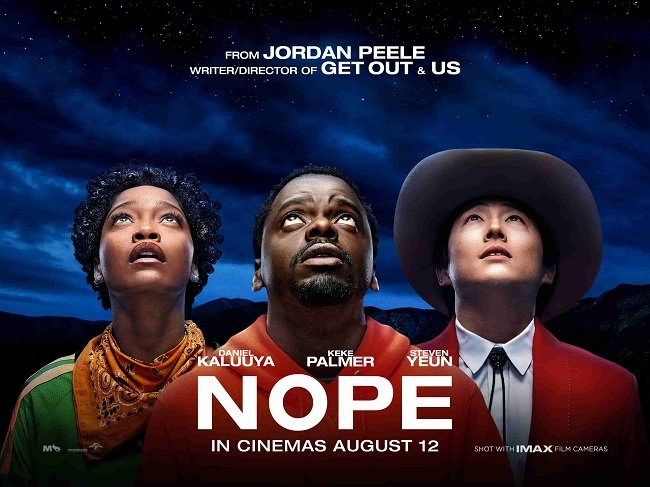
In Agua Dulce, California, the Haywood family trains horses for film and TV productions. One day at the Haywood ranch, small metal objects unaccountably fall from the sky. One of which, a nickel, kills Otis Haywood Sr (Keith David). His children, Emerald “Em” Haywood (Keke Palmer) and Otis “OJ” Haywood Jr. (Daniel Kaluuya), continue to run the business. However, due to the loss of a contract, they have to sell some of the horses to Ricky “Jupe” Park (Steven Yeun), who operates a Western theme park called Jupiter's Claim. One night, the Haywood’s notice the electricity supply fluctuating and their horses violently reacting to an unknown presence. They discover that something has been taking their horses and regurgitating inorganic matter, which OJ believes caused their father's death. The Haywood’s decide to obtain proof and subsequently ask electronics store employee and UFO enthusiast, Angel Torres (Brandon Perea) to set up surveillance cameras.
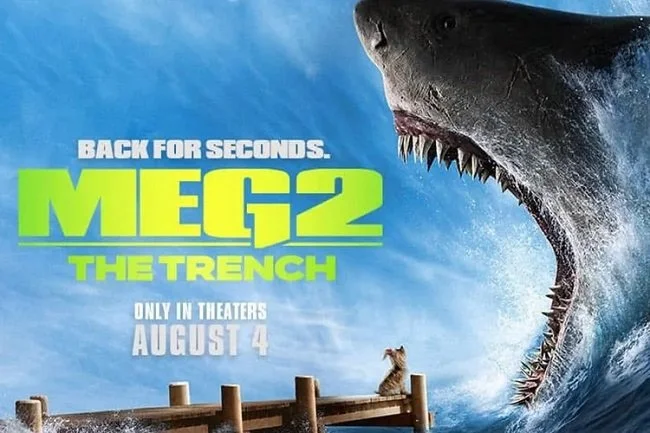
Back in 2018 I wrote the following about The Meg in my review. “My interest doesn’t go so far as a sequel. This sort of movie is the equivalent of a greasy burger you buy at the funfair. It’s fine once in a while as an indulgence, despite the fact that you know it’s bad, but you would soon tire of them being a regular part of my diet”. Five years later, I foolishly thought it may be “fun” to give the sequel, Meg 2: The Trench (2023), a go. Especially in light of the fact that it’s directed by Ben Wheatley. Surely such a filmmaker would bring some creativity and a fresh perspective to this franchise? Nope. Turns out he didn’t. Meg 2: The Trench lacks everything that made its predecessor tolerable. This superfluous sequel is an uninspired, poorly written mess which confuses turning everything up to eleven with entertainment. It gets nowhere near “it’s so bad, it’s good” territory. Instead it makes the biggest mistake a film of this nature can do. It’s dull.
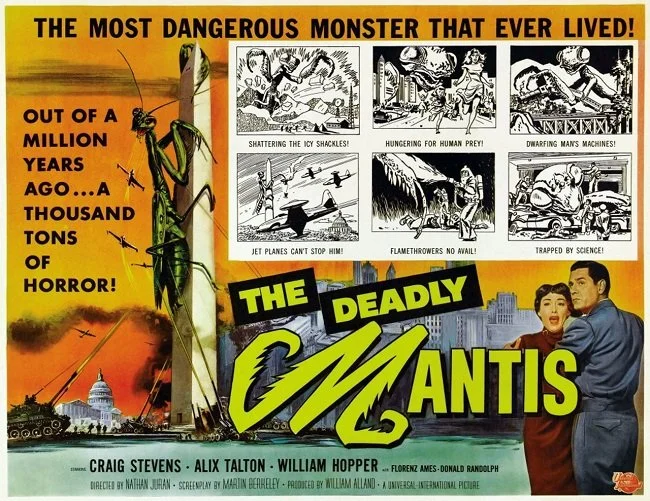
Not to be confused with the Shaw Brothers martial arts film of the same name from 1978, The Deadly Mantis (1957) is a creature feature in the idiom of Them! (1954). Unlike that film’s mutant ants, the monster on this occasion is not the product of the atomic age but a giant prehistoric praying mantis that has been released from the polar ice caps. Exactly how a creature associated with more tropical regions came to be at the North Pole is never explained. In fact precious little is in The Deadly Mantis. The film’s overall scope is somewhat limited with a basic story, limited action scenes and a rather dull cast of generic characters. There is an over reliance upon stock footage from period military documentaries and previous Universal Studio feature films. The film’s biggest failing is the giant praying mantis which does most of its rampaging conveniently off camera. It’s all rather disappointing.
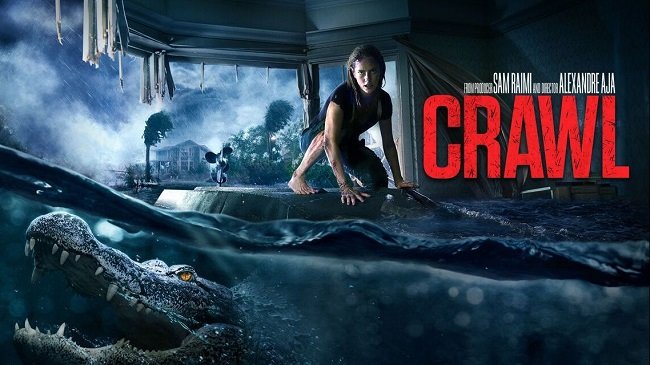
It is no secret that the film industry relies on a handful of common tropes as the mainstay of their cinematic output. It uses timeless themes, storylines and archetypes that have featured in folk tales, plays and literature throughout history. Hence their familiarity with audiences around the world. Where the skill in filmmaking lies is to take a common, well known idea and interpret it in a new and innovative fashion. Akira Kurosawa took Shakespeare’s MacBeth and retold the tale through the prism of Japanese feudalistic culture. The result, Throne of Blood, is considered a masterpiece. Similarly, The Lion King retells the same story through the medium of animation and anthropomorphic wildlife. All of which proves that the key to successfully retelling a familiar tale is to be creative with regard to setting, presentation and perspective.
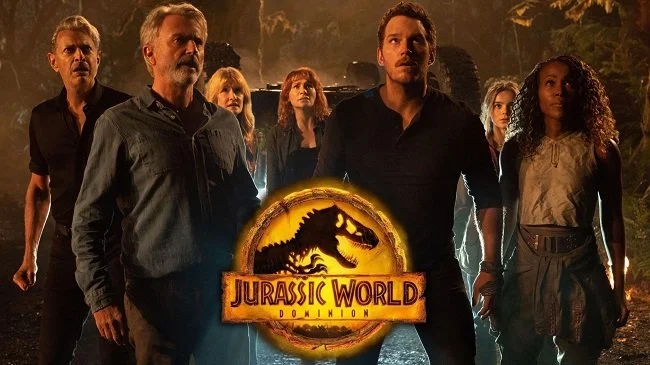
Jurassic World Dominion is a textbook example of a franchise that has run out of steam. Despite the enormous budget, the top notch production values and the presence of three members of the original cast, this is a long, tedious and curiously uneventful film. It has nothing new to say about environmental matters or unfettered science; themes that were front and centre in previous instalments. Nor does it do anything interesting with the main plot device of dinosaurs trying to integrate into our current ecosystems. But perhaps its biggest failing is the conspicuous lack of tension. The denizens of Jurassic World are simply not a threat and fail to have any emotional impact. The film doesn’t even placate viewers with superfluous cast members being eaten. The onscreen deaths by dinosaurs are rather tame.
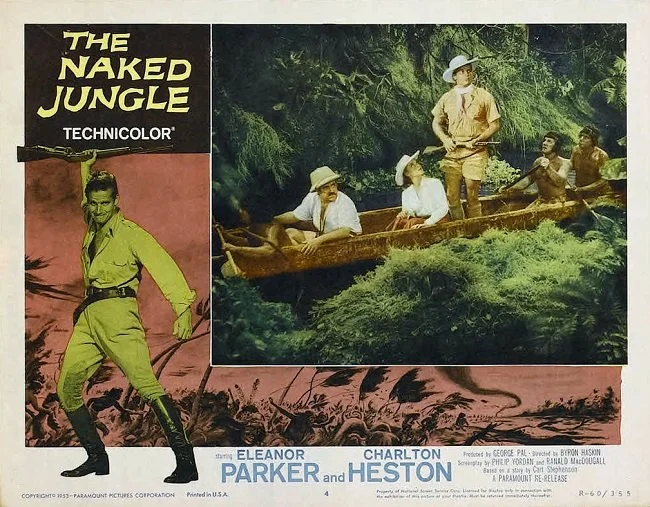
Set in Brazil in 1901, plantation owner Christopher Leiningen (Charlton Heston) makes arrangements to get married. He has spent his entire life building his estate and reclaiming land from the jungle. He is fiercely independent but he is also alone and isolated. Joanna Selby (Eleanor Parker) from New Orleans agrees to marry him but their first meeting does not go well. Leiningen is unhappy to discover that Joanna is a widow and hence has a past, so he tells her to return to America on the next available boat. However, local commissioner (William Conrad) informs Leiningen that swarming soldier ants, or Marabunta, are moving towards his plantation destroying everything in their path. Leiningen refuses to abandon his life’s work and is surprised when Joanna decides to stay with him. Can they convince their native workers to stay too and can they defend the estate from the Marabunta, described as “forty square miles of agonising death”.
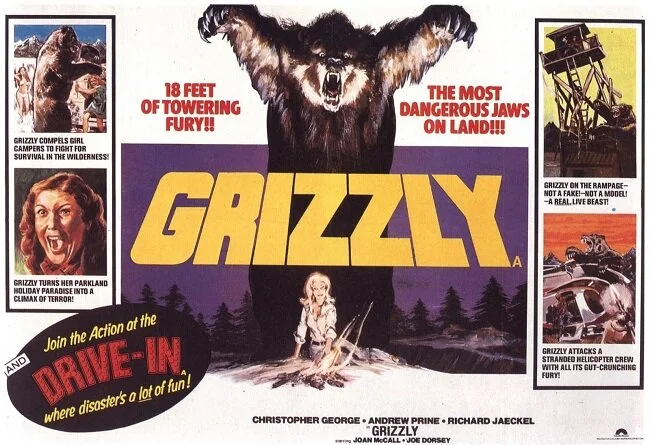
After the critical and commercial success of Jaws in 1975, a veritable tsunami of “creature feature” movies followed in its wake. A few titles, such as Alligator (1980) and Piranha (1978) managed to do something different with the rogue animal trope, both providing a quirky and satirical look at the genre along with plenty of exploitation mayhem. However, most of the rest were low budget productions of negligible quality. However, such qualities are not always an impediment at the box office. Grizzly (1976) was hastily made on a budget of $750,000 yet earned an impressive $39,000,000 at the box office. The critics hated it but the public loved it and it went on to be the second most financially successful independent feature film in the US that year (the first being Monty Python and the Holy Grail). Grizzly is in many ways a microcosm of the exploitation genre from the seventies and needs to be viewed through that prism if it is to be enjoyed.
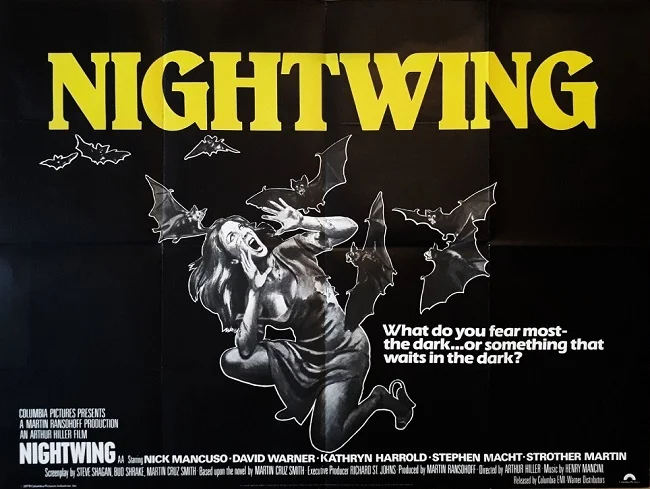
The seventies saw a minor boom in creature feature films after the box office success of Jaws. Hence, we had movies such as Orca (1977), Tentacles (1977), The Pack (1977) and Piranha (1978). If an animal could eat you or potentially pose any threat to people, someone somewhere would make a movie about it. Usually a bad one. A few of these even dared to stray into other hot topics of the time such as pollution and protecting the environment. Some would even invoke mysticism and folk lore to facilitate their protagonists. Nightwing is one such curious genre hybrid which combines vampire bats, shale oil mining and Native American culture in its clumsy and unsubtle plot. It’s a somewhat odd undertaking, directed by Arthur Hiller. His previous work included Love Story (1970) and Silver Streak (1976), so he was not the first person you’d expect to see associated with such material. The film doesn’t work well as either a horror movie or an exploration of social issues, but like so many movies from this era, it is of interest mainly due to its sheer incongruity.
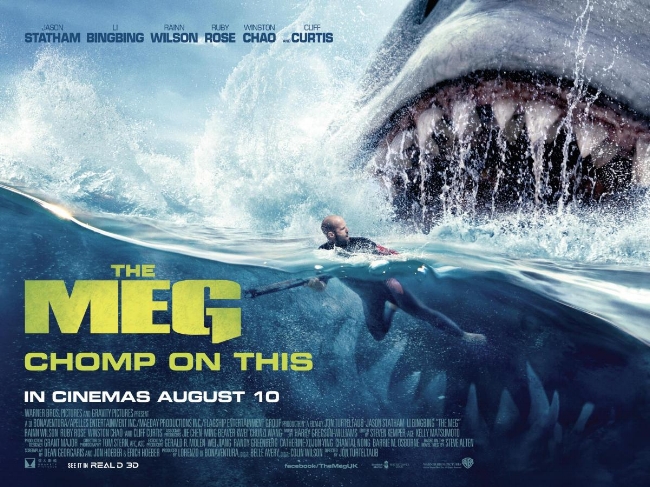
If you have seen any of the marketing material or trailers for The Meg, then you know exactly what you’re getting right from the get-go. All movies inherently require the viewer to suspend their sense of disbelief to various degrees. Naturally, the “creature feature” genre asks audience to go the extra mile with this concept. The Meg takes a major gamble by insisting that everyone goes further still, not by believing in a giant prehistoric shark (Megalodon) but that Jason Statham is a ex-navy, deep sea rescue diver. However, it pays off and the resulting movie is staggeringly stupid, but mercifully entertaining in an undemanding way. Recent movies such as Into the Storm and Geostorm are crass and made worse by their implicit assumption that their viewers are stupid. The Meg is far from cerebral but has an upbeat tone and a sense of playfulness that knowingly invites the audience to come aboard with the silliness. It’s a big distinction and the reason why I smiled a lot and frequently rolled my eyes while watching The Meg, but never with derision.
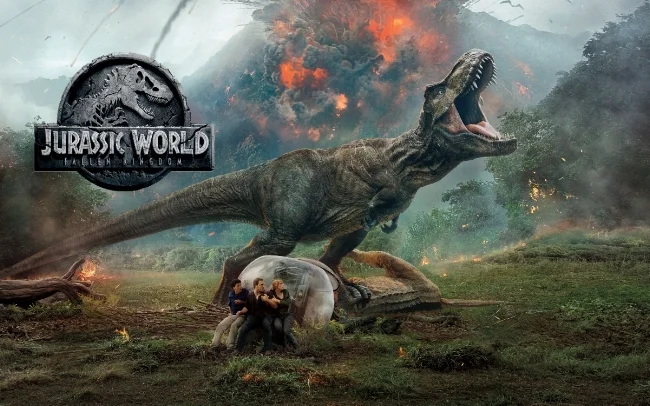
Critical opinion was very much split this summer when Jurassic World: Fallen Kingdom was released. However, the viewers were somewhat indifferent to the opinions of the professional critics and the movie made a healthy $1,303,476,615 globally, proving once again that the public’s’ continuing love affair with “all things dinosaur” shows no sign of abating. When you factor in the home media market into overall profits, the entire Jurassic Park franchise will have made $5 billion worldwide. So, bearing in mind the old adage that “money talks and bullshit walks”, I think it’s safe to say there’ll be more instalments in the years to come. When faced with such overwhelming box office popularity it seems somewhat pointless to dissect the latest movie, because the film seems to be bullet proof regardless of narrative flaws or ill-conceived plot devices. However, film criticism isn’t about box office popularity but about analysing the relative quality of a movie’s construction and its subsequent standing.
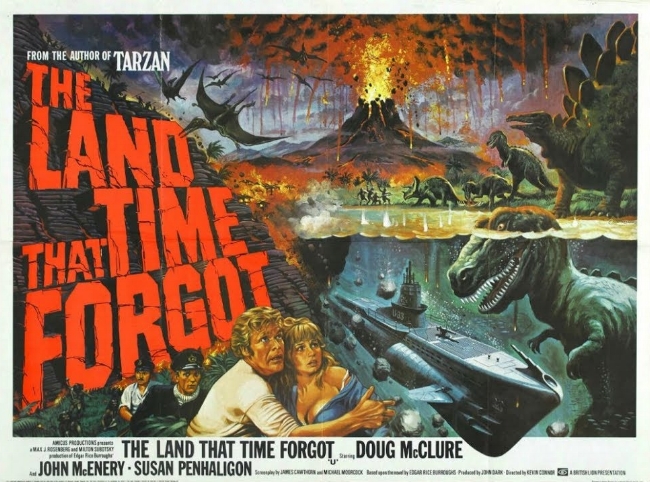
I first saw The Land That Time Forgot way back in 1975 at the Odeon Isle of Wight, when it was first released. We were on holiday at the time, which was cause for celebration in itself, as these were few and far between during my youth, due to the state of the UK economy at the time. But to then go to the cinema and see a fantasy film, filled with action, adventure and monsters, was the icing on the cake for an over excited eight-year-old. Adapted by Michael Moorcock and James Cawthorn from the 1924 the novel by Edgar Rice Burroughs, The Land That Time Forgot is a classic example of high adventure on a low budget. Its technical shortcomings were even apparent to me as a child, yet there was a charm and honesty to this curious British production, that had the audacity to try and compete with the likes of more expensive US productions such as The Golden Voyage of Sinbad and Island at the Top of the World.
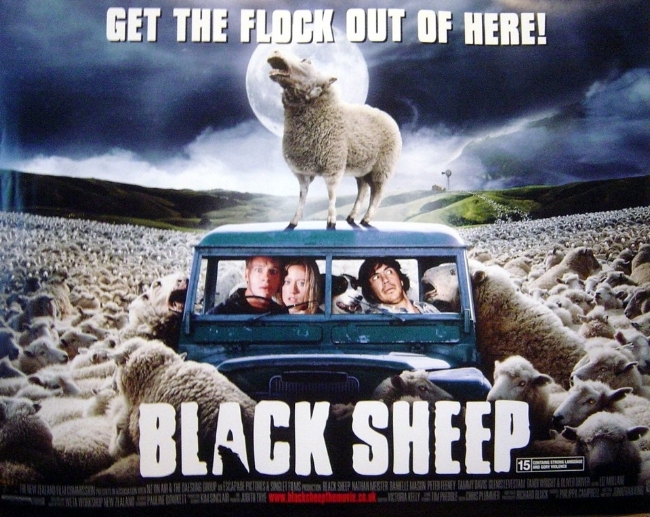
Black Sheep is a high concept horror comedy from New Zealand. Featuring creative physical effects by Weta Workshop, this tale of genetically modified killer sheep, animal husbandry and environmentalism requires a very broad sense of humour and an abiding love for the “creature feature” sub-genre. It should be noted that the copy I watched was the unrated R1 DVD. This version is stronger in content than the R rated US theatrical release and yet was released at the UK cinemas with only a 15 rating from the BBFC. I suspect that the similarities in humour between the UK and New Zealand contributed to this somewhat low rating. That and the fact that horror comedy often gets a free pass because the humour always tends to mitigate the violence.
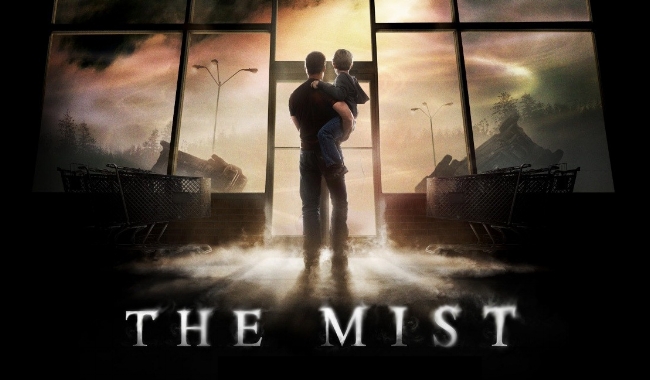
Frank Darabont achieved both critical acclaim and mass appeal with his adaptations of The Shawshank Redemption and The Green Mile. In 2007 he returned once again to the work of Stephen King with his film version of The Mist. It’s a sideways step away from human drama into a more genre piece, yet it still retains a very traditional story at its heart. Once you look beyond the superficial elements of "creature feature" plot, you get yet another well written character study by an ensemble cast, again focusing on how the human condition deals with extreme situations. The particular route it takes and some of the themes it explores may not be to everyone's taste. However, it still focuses on characters and performances. It is also a movie that ends with a somewhat unexpected plot development, that some viewers may find a little extreme. It is one of those film related twists that if known in advance, greatly diminishes once enjoyment of the film.
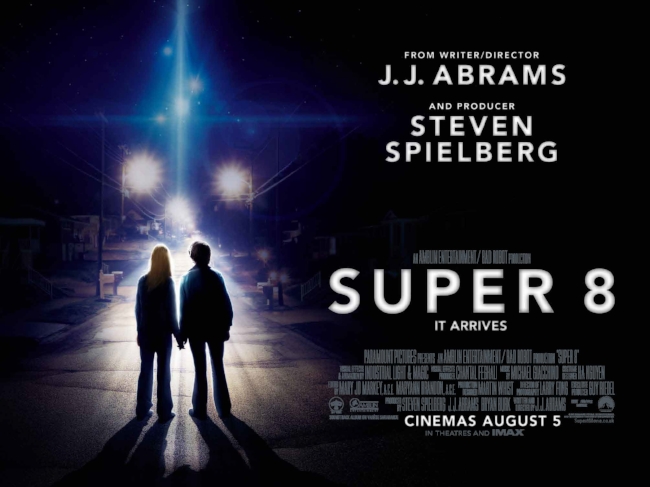
When you see the names of such cinematic luminaries as Steven Spielberg and J.J. Abrams together on the same movie poster, naturally your expectations are going to be high. Yet when watching the various trailers for Super 8, just prior to its release in 2011, I was somewhat cautious. I have discussed in the past at some length the ambiguous nature of trailers and that they can misrepresent a film. Yet even bearing this in mind at the time, I couldn’t help but feel that Super 8 seemed like a somewhat self-indulgent homage to Spielberg's earlier work. I subsequently saw the movie at the cinema in August that year and my suspicions were validated. However, over time I have spoken to several friends who are advocates of the movie, so I thought I’d watch it a second time. Sadly, I still find myself unable to label Super 8 as anything else other than adequate. Now I would hasten to add, that I use adequate within the context of both director’s body of work. An adequate film from either Mr Spielberg or Abrams is still superior to many of their competitors. But that's not the point. I simply expected better from such a project.
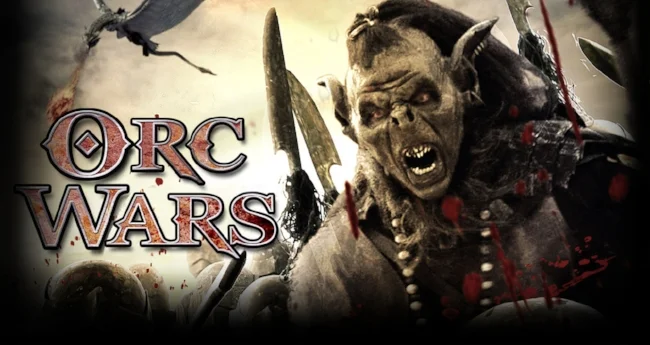
Having recently sat through Orcs! I decided to take a further chance and watch Orc Wars. It too is a very low budget film, although this time the finances were raised through crowdfunding. Sadly, it is not the fun, tongue in cheek, independent adventure movie the trailer and associated marketing implies. There is very little merit in this production. It's cheap, cheerful and although harmless, it clearly demonstrates that not all fan funded projects are good cinema. Some are just indulgences. The problem is in the title itself, which tries to sell an idea that the movie production is incapable of delivering. Instead of the spectacle of an army of a thousand Orcs pitted against the technological might of the US war machine, we get a few extras in ill-fitting costumes, running skirmishes against no-name actors on quad bikes and a few old Army Surplus vehicles. It's all rather lacklustre and underwhelming.
As a fan of the horror genre I’ve sat through numerous low budget films in my time. This has usually been at festivals or conventions. Sometimes watching something as part of a group, with likeminded individuals, makes a difference. You find yourself groaning in unison and the shared experience helps compensate for potential deficiencies. Watching questionable material in the comfort of your own home, purely on your own can be a lot tougher. However, due to my abiding love of the genre, I am prepared to cut a lot of cheap ass indie flicks considerably more slack than I would others. So, I'll endeavour to review Orcs! with as much impartiality as possible. Oh, and before we start, let us clarify the term Orcs. Although Middle-earth is not referenced in any way, this film is definitely about Tolkien's creations. Or at least their depiction in another well-known series of films.
10 Cloverfield Lane blends several cinematic genres producing an interesting premise. Once it has established its narrative arc, it then dives head long into an exciting and tense one hundred and four minutes. The movie is not a direct sequel to Cloverfield (2008) but does touch upon some of the same themes and ideas. Made on a modest budget of $15 million, the claustrophobic setting of a nuclear bunker accommodates strong performances from the lead actors. It is not until the third act when the story movies back to the outside world, do we see any major visual effects. Overall, this is a very compelling film due to the strong screenplay and well defined central characters.
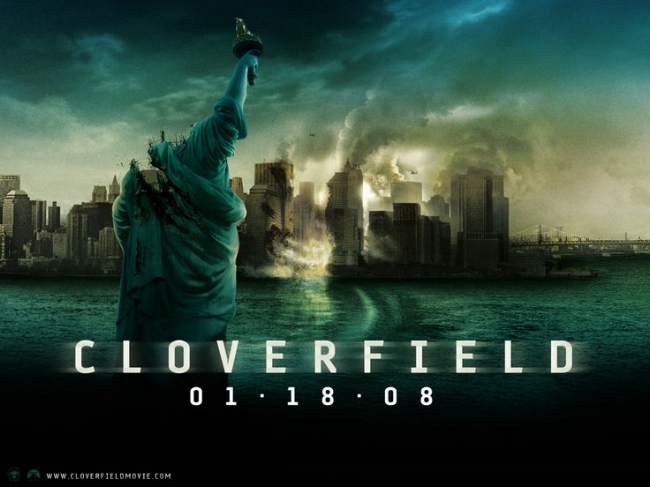
I did my best to avoid the hype surrounding the initial release of Cloverfield. Such media saturation and public interest can often cloud the issue of whether the actual film is any good. Five years later and having watched the movie twice, once in the theatre and once at home, I am still somewhat conflicted about this movie. The use of hand held video cameras is both a boon and a bane. The constant movement of the image has proven to cause motion sickness for some viewers, although this is not so overwhelming when viewed on a smaller screen at home. Yet the medium of news footage mixed with handheld cameras does create a palpable sense of immediacy. This helps immensely when trying to sell a fantastic concept, such as the one that Cloverfield features.
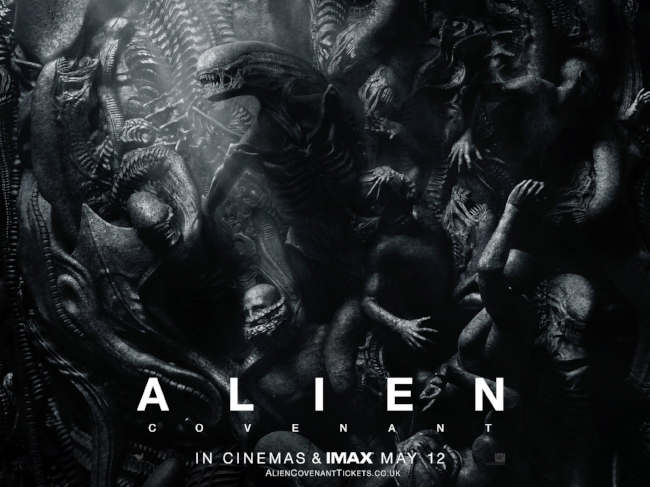
The enigma of the Xenomorph in the Alien franchise is diminished once you start to rationalise its heritage. Sadly, that’s exactly what Alien: Covenant has chosen to do. It jettisons the mystery of the original 1979 movie and pulls back the curtain, so wisely put in place thirty-eight years ago, to reveal a rather lacklustre explanation to the Xenomorph’s origin. Having spent nearly $100 million and employed a production team of some of the finest talent that money can buy, the resulting movie is not bad per se, just crushingly superfluous. After watching Alien: Covenant this week, my overall reaction can be distilled down to a deep sigh of indifference and a shrug of the shoulders.
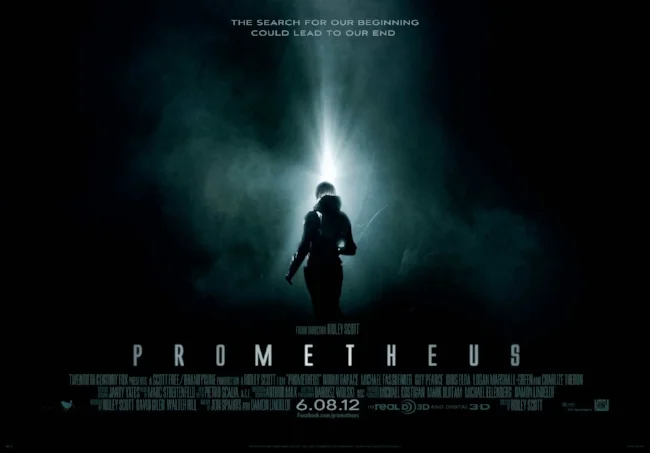
I have written many times in recent years about how big titles get announced by the gaming industry, of the ensuing hype up that leads up to launch day and then the subsequent disappointment on purchase. It is a malady that has afflicted the movie industry for decades and has become increasingly more common in the last decade. Hype has a curious link with reputation. There are a handful of directors in contemporary Hollywood who when they add their name to a production, people take notice. Ridley Scott is one of these. His body of work pretty much guarantees he can make whatever he wants, be it a commercial undertaking or a ludicrous vanity project. However, the downside to being a film maker of this stature is that you are not so easily exposed to proper scrutiny by your peers. No one stops you from making a mistake because you are supposed to know what you are doing. They let you do what you want. Which is bad.
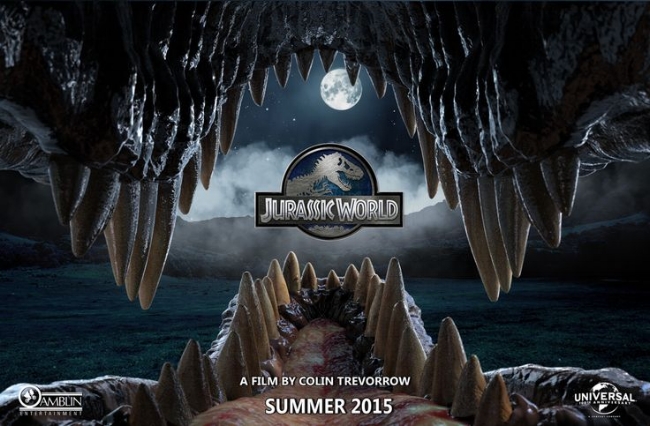
Hollywood is a cyclical place and often repeats decisions it's successfully made in the past. During the early seventies, the mainstream film industry head hunted a lot of up and coming talent from the independent film making community, or took a chance on directors who were fresh out of film school. It was a means to an end and a way to tap into the new talent that was proving popular and lucrative. Similarly, Warner Bros. followed suit in 2014 when Gareth Edwards was hired to direct the multi-million-dollar Godzilla reboot. His previous movie was the self-financed indie Sci-Fi picture Monsters. Godzilla went on to be both a box office and critical hit.
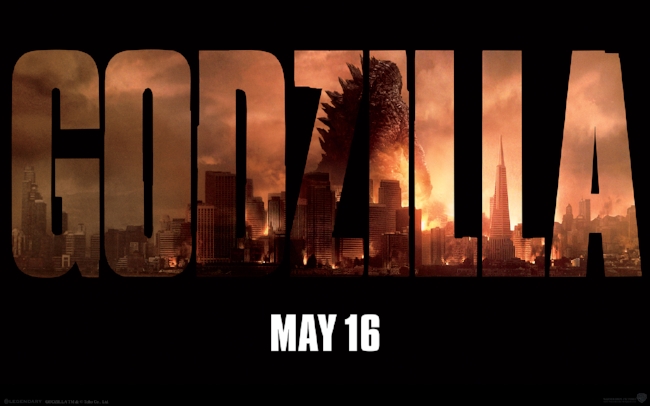
Gareth Edwards directing debut Monsters, was a clever, subtle and genuinely moving human drama that just happened to be set against the background of alien lifeforms in a quarantine zone. He also managed to imbue the monsters of the title with a sense of depth. They were intriguing with their bio-luminescent communication and curious vocalisations. They were not simply an arbitrary MacGuffin and hinted at something far more complex. I was therefore very surprised and pleased that he has managed to maintain these qualities in his second feature film Godzilla. Despite being a massive studio undertaking his reboot of the classic franchise has a depth of soul that you seldom find in such mainstream material.
Primitive War (2025)
One of the most common objections raised regarding the Jurassic Park/Jurassic World franchise is that the films are specifically made to obtain a PG-13 rating from the Motion Picture Association, for purely commercial reasons. Hence, in all films, there is little on screen violence and the dinosaurs are mainly portrayed as a threat and a means of providing jump scares. When a character is killed by a dinosaur it usually happens off screen, is obscured by something else in frame, or is shown in long shot with very little detail. The realities of being eaten alive by a predator are conspicuously absent. Hence, audiences looking for films featuring more graphic dinosaur attacks, have not been well catered for apart from some minor direct-to-video titles. Primitive War finally fills this gap in the market with a frenetic genre mashup that strives to punch above is budgetary weight.
One of the most common objections raised regarding the Jurassic Park/Jurassic World franchise is that the films are specifically made to obtain a PG-13 rating from the Motion Picture Association, for purely commercial reasons. Hence, in all films, there is little on screen violence and the dinosaurs are mainly portrayed as a threat and a means of providing jump scares. When a character is killed by a dinosaur it usually happens off screen, is obscured by something else in frame, or is shown in long shot with very little detail. The realities of being eaten alive by a predator are conspicuously absent. Hence, audiences looking for films featuring more graphic dinosaur attacks, have not been well catered for apart from some minor direct-to-video titles. Primitive War finally fills this gap in the market with a frenetic genre mashup that strives to punch above is budgetary weight.
In 1968 during the Vietnam War, Colonel Jericho (Jeremy Piven) orders Vulture Squad, a reconnaissance unit, to track down a Green Beret platoon that has gone missing on a classified mission. Sergeant First Class Ryan Baker (Ryan Kwanten) is concerned about the secrecy surrounding the mission and well being of his squad. After being dropped by helicopter in a remote region of the jungle the squad finds evidence of a firefight along with a large bird-like foot print. Upon searching a tunnel complex they are attacked by a pack of Deinonychus and are split up. Baker along with new squad member Verne (Carlos Sanson) are rescued from a Tyrannosaurus attack by a Soviet paleontologist, Sofia Wagner (Tricia Helfer), who shelters them in a nearby bunker. He learns that a Russian General has been experimenting with a particle collider, resulting in wormholes and the dinosaurs’ presence.
Primitive War takes the standard genre tropes found in Vietnam War movies, along with those common to “creature features” and mixes them together with B movie aplomb and the candid honesty inherent in Australian exploitation cinema. The result is fast paced, violent and thoroughly entertaining. The computer generated dinosaurs and animatronics are broadly good and when it does start to get a bit sketchy, it’s not a deal breaker because it is clear that the production is really trying hard to do it best with what its budget. Furthermore, rather than just resting on its high concept, exploitation laurels, Primitive War even takes a stab at focusing on characters and getting audiences emotionally invested in the protagonists. You could argue that it tries a little too hard but the film is ambitious and that is a praiseworthy quality these days because so many film productions do exactly the opposite.
Based on books by Ethan Pettus, who co-wrote the screenplay with director Luke Sparke, Primitive War strikes the right tone with its hard boiled, military dialogue and hyperbolic kiss-off lines. I especially enjoyed “Come get some, you Foghorn Leghorn motherfuckers”. The cast, who are mainly from television, acquit themselves well and the screenplay endeavours to give this dirty half-dozen some back story, touching upon such themes as PTSD and survivors guilt. The set pieces are violent and the dinosaur attacks show the reality of being devoured alive. Considering the $8 million dollar budget, the visual effects hold up well. There are some sequences that don’t work as well such as an aerial attack by a flock of Quetzalcoatlus but the film strives to style it out with its pacing. The dinosaurs reflect contemporary scientific thinking, hence many are brightly coloured and feathered.
Primitive War is a superior example of exploitation filmmaking. It makes its pitch quickly and efficiently to the audience and doesn’t waste time delivering upon viewer expectations. What stands out about this production is that it doesn’t allow its financial constraints to impact upon its creative ambitions. Director Luke Sparke and the cast clearly took the film seriously and strived to do their best. The result is a film that is ambitious, entertaining and exactly what was promised in the trailer. There are some rough edges along the way but that is to be expected. This isn’t a big studio production. Perhaps it could have been a slightly tighter 110 minutes instead of 133 but there are far more bloated, self indulgent films out there. Like most of the Jurassic Park/Jurassic World franchise. Unlike a lot of mainstream films these days, Primitive War is an honest film. If you want dinosaurs versus soldiers during the Vietnam War, that is what you get.
In 1968 the dilapidated freighter Corita hastily leaves Freetown to avoid a customs inspection. Captain Lansen (Eric Porter) has a cargo of dangerous explosives which he is smuggling so he can finally retire. His ship’s passengers also have reasons for leaving in a hurry. Dr. Webster (Nigel Stock), together with his daughter Unity (Suzanna leigh), is relocating due to his indiscretions with patients and illegal operations. Alcoholic pianist Harry Tyler (Tony Beckley) is aimlessly drifting from port to port. Eva Peters (Hildegard Knef) is fleeing from her husband with stolen bearer bonds which she intend to use to buy back her son from his evil clutches Caracas. Ricaldi (Ben Carruthers), a questionable lawyer, is pursuing Eva to retrieve the stolen bonds. First officer Hemmings (Neil McCallum) suggests that the ship should return to Freetown after an imminent Hurricane warning. The Captain asks the passengers and they are unanimous that they do not wish to return. However a mutinous crew, the bad weather and the instability of the explosives force everyone to abandon ship. The survivors find themselves adrift in a lifeboat surrounded by a strange carnivorous seaweed.
Despite being considered by many as an original story, The Abominable Snowman (1957) is in fact a remake of a made for television play, The Creature, that was originally broadcast in the UK in 1955. Hammer Films would often purchase the rights of popular TV programs and subsequently re-work them for mainstream, international cinema. Larger production budgets and fewer censorship restrictions allowed them to make their cinematic interpretations more lurid, thus commercially viable. Hence The Quatermass Xperiment, Quatermass II and Quatermass and the Pit were all given a big screen makeover and were commercially successful. The Abominable Snowman was written by acclaimed writer Nigel Kneale, who also wrote the original television drama and the aforementioned Quatermass trilogy. Although ostensibly marketed as a horror film this production is actually an interesting blend of psychological thriller and science fiction.
In the near future, Kepler 822, a research and drilling facility located at the bottom of the Mariana Trench, suffers a sudden and catastrophic structural failure. There are only six survivors. Mechanical engineer Norah Price (Kristen Stewart), Captain Lucien (Vincent Cassel), biologist Emily Haversham (Jessica Henwick), engineer Liam Smith (John Gallagher Jr.) and crew members Rodrigo (Mamoudou Athie) and Paul (T.J. Miller). As all the functional escape pods have been used and they are unable to contact the surface, the Captain suggests using pressurized suits to walk one mile across the ocean floor to the Roebuck 641 drill installation. There they will find more escape pods. However, it soon becomes apparent that the disaster was not caused by an undersea earthquake and that they are not alone as they make their journey.
One of the most common objections raised regarding the Jurassic Park/Jurassic World franchise is that the films are specifically made to obtain a PG-13 rating from the Motion Picture Association, for purely commercial reasons. Hence, in all films, there is little on screen violence and the dinosaurs are mainly portrayed as a threat and a means of providing jump scares. When a character is killed by a dinosaur it usually happens off screen, is obscured by something else in frame, or is shown in long shot with very little detail. The realities of being eaten alive by a predator are conspicuously absent. Hence, audiences looking for films featuring more graphic dinosaur attacks, have not been well catered for apart from some minor direct-to-video titles. Primitive War finally fills this gap in the market with a frenetic genre mashup that strives to punch above is budgetary weight.
Fluke is a curious film about a man who is reincarnated as a dog and his subsequent realisation that he may have been murdered. It takes an adult novel by British author James Herbert, which is filled with philosophical musing and strives to adapt it in a far more family friendly fashion. The result is a somewhat bipolar production which thematically alternates between existential introspection and Buddhism. It then strives to deliver its message in a Disneyesque idiom. Children will potentially be confused and upset by what they see and adults will be wrongfooted by the continual shift in tone. Fluke was not a critical or commercial success upon release and the flaws that were identified by critics at the time still ring true today. That being said, Fluke is still an interesting and entertaining film, despite its faults.
When reviewing Sting, one critic stated that the small scale setting and thus, low stakes (IE only a few peoples lives are at risk), made the film not especially memorable. I consider this to be a somewhat spurious criticism. It is the very fact that Sting takes place in such a commonplace environment, with the main characters being everyday people that makes it different. There is a clear focus on well defined characters and their backstory. Unlike so many contemporary films, I actually gave a damn about the protagonists in Sting. An integral aspect of the horror genre is the ability to take a well known and familiar trope and provide a different and absorbing spin on it .It would appear that some audiences have been belaboured over the head by so many overblown and bombastic blockbusters, that the very notion of depicting small, localised and intimate events in a film, seems to bamboozle them.
When I first saw Mimic in 1997, I was impressed by the fact that it offered a different perspective on the monster movie genre and that it seemed to have moments of greater depth than you'd expect from such material. Later on when I became more aware of the works of writer, director Guillermo del Toro, I learned that this movie had had a troubled production and that Miramx had imposed specific requirements upon the final cut of the film. This explained some of the movies inconsistencies and hinted at a far more ambitious artistic endeavour by del Toro. Initially Mimic was conceived as a thirty minute short and part of a three part anthology movie. However it along with the sci-fi film Imposter were both deemed to be of sufficient merit to be developed into feature length productions.
During the seventies, Hollywood started looking to ongoing societal and political concerns as a source of material for movies. Hence, the energy crisis, terrorism and global pollution quickly found themselves being subsumed into hastily written screenplays, in attempt to be topical, commercially successful and relevant. Prophecy based upon a novel by David Seltzer tackled not only the issue of pollution but also the ongoing disenfranchisement of Native Americans. Paramount studios went so far as hiring an established director of note, John Frankenheimer. In many respects this movie should have been a bigger success with a reasonable budget, robust cast and studio support. Sadly it did not fare well, either critically or at the box office due to obvious flaws in the production. Despite his outstanding body work, (Birdman of Alcatraz, The Manchurian Candidate) Frankenheimer was not the best choice of director for a genre movie such as this and he was also going through a period of alcoholism.
In Agua Dulce, California, the Haywood family trains horses for film and TV productions. One day at the Haywood ranch, small metal objects unaccountably fall from the sky. One of which, a nickel, kills Otis Haywood Sr (Keith David). His children, Emerald “Em” Haywood (Keke Palmer) and Otis “OJ” Haywood Jr. (Daniel Kaluuya), continue to run the business. However, due to the loss of a contract, they have to sell some of the horses to Ricky “Jupe” Park (Steven Yeun), who operates a Western theme park called Jupiter's Claim. One night, the Haywood’s notice the electricity supply fluctuating and their horses violently reacting to an unknown presence. They discover that something has been taking their horses and regurgitating inorganic matter, which OJ believes caused their father's death. The Haywood’s decide to obtain proof and subsequently ask electronics store employee and UFO enthusiast, Angel Torres (Brandon Perea) to set up surveillance cameras.
Back in 2018 I wrote the following about The Meg in my review. “My interest doesn’t go so far as a sequel. This sort of movie is the equivalent of a greasy burger you buy at the funfair. It’s fine once in a while as an indulgence, despite the fact that you know it’s bad, but you would soon tire of them being a regular part of my diet”. Five years later, I foolishly thought it may be “fun” to give the sequel, Meg 2: The Trench (2023), a go. Especially in light of the fact that it’s directed by Ben Wheatley. Surely such a filmmaker would bring some creativity and a fresh perspective to this franchise? Nope. Turns out he didn’t. Meg 2: The Trench lacks everything that made its predecessor tolerable. This superfluous sequel is an uninspired, poorly written mess which confuses turning everything up to eleven with entertainment. It gets nowhere near “it’s so bad, it’s good” territory. Instead it makes the biggest mistake a film of this nature can do. It’s dull.
Not to be confused with the Shaw Brothers martial arts film of the same name from 1978, The Deadly Mantis (1957) is a creature feature in the idiom of Them! (1954). Unlike that film’s mutant ants, the monster on this occasion is not the product of the atomic age but a giant prehistoric praying mantis that has been released from the polar ice caps. Exactly how a creature associated with more tropical regions came to be at the North Pole is never explained. In fact precious little is in The Deadly Mantis. The film’s overall scope is somewhat limited with a basic story, limited action scenes and a rather dull cast of generic characters. There is an over reliance upon stock footage from period military documentaries and previous Universal Studio feature films. The film’s biggest failing is the giant praying mantis which does most of its rampaging conveniently off camera. It’s all rather disappointing.
It is no secret that the film industry relies on a handful of common tropes as the mainstay of their cinematic output. It uses timeless themes, storylines and archetypes that have featured in folk tales, plays and literature throughout history. Hence their familiarity with audiences around the world. Where the skill in filmmaking lies is to take a common, well known idea and interpret it in a new and innovative fashion. Akira Kurosawa took Shakespeare’s MacBeth and retold the tale through the prism of Japanese feudalistic culture. The result, Throne of Blood, is considered a masterpiece. Similarly, The Lion King retells the same story through the medium of animation and anthropomorphic wildlife. All of which proves that the key to successfully retelling a familiar tale is to be creative with regard to setting, presentation and perspective.
Jurassic World Dominion is a textbook example of a franchise that has run out of steam. Despite the enormous budget, the top notch production values and the presence of three members of the original cast, this is a long, tedious and curiously uneventful film. It has nothing new to say about environmental matters or unfettered science; themes that were front and centre in previous instalments. Nor does it do anything interesting with the main plot device of dinosaurs trying to integrate into our current ecosystems. But perhaps its biggest failing is the conspicuous lack of tension. The denizens of Jurassic World are simply not a threat and fail to have any emotional impact. The film doesn’t even placate viewers with superfluous cast members being eaten. The onscreen deaths by dinosaurs are rather tame.
Set in Brazil in 1901, plantation owner Christopher Leiningen (Charlton Heston) makes arrangements to get married. He has spent his entire life building his estate and reclaiming land from the jungle. He is fiercely independent but he is also alone and isolated. Joanna Selby (Eleanor Parker) from New Orleans agrees to marry him but their first meeting does not go well. Leiningen is unhappy to discover that Joanna is a widow and hence has a past, so he tells her to return to America on the next available boat. However, local commissioner (William Conrad) informs Leiningen that swarming soldier ants, or Marabunta, are moving towards his plantation destroying everything in their path. Leiningen refuses to abandon his life’s work and is surprised when Joanna decides to stay with him. Can they convince their native workers to stay too and can they defend the estate from the Marabunta, described as “forty square miles of agonising death”.
After the critical and commercial success of Jaws in 1975, a veritable tsunami of “creature feature” movies followed in its wake. A few titles, such as Alligator (1980) and Piranha (1978) managed to do something different with the rogue animal trope, both providing a quirky and satirical look at the genre along with plenty of exploitation mayhem. However, most of the rest were low budget productions of negligible quality. However, such qualities are not always an impediment at the box office. Grizzly (1976) was hastily made on a budget of $750,000 yet earned an impressive $39,000,000 at the box office. The critics hated it but the public loved it and it went on to be the second most financially successful independent feature film in the US that year (the first being Monty Python and the Holy Grail). Grizzly is in many ways a microcosm of the exploitation genre from the seventies and needs to be viewed through that prism if it is to be enjoyed.
The seventies saw a minor boom in creature feature films after the box office success of Jaws. Hence, we had movies such as Orca (1977), Tentacles (1977), The Pack (1977) and Piranha (1978). If an animal could eat you or potentially pose any threat to people, someone somewhere would make a movie about it. Usually a bad one. A few of these even dared to stray into other hot topics of the time such as pollution and protecting the environment. Some would even invoke mysticism and folk lore to facilitate their protagonists. Nightwing is one such curious genre hybrid which combines vampire bats, shale oil mining and Native American culture in its clumsy and unsubtle plot. It’s a somewhat odd undertaking, directed by Arthur Hiller. His previous work included Love Story (1970) and Silver Streak (1976), so he was not the first person you’d expect to see associated with such material. The film doesn’t work well as either a horror movie or an exploration of social issues, but like so many movies from this era, it is of interest mainly due to its sheer incongruity.
If you have seen any of the marketing material or trailers for The Meg, then you know exactly what you’re getting right from the get-go. All movies inherently require the viewer to suspend their sense of disbelief to various degrees. Naturally, the “creature feature” genre asks audience to go the extra mile with this concept. The Meg takes a major gamble by insisting that everyone goes further still, not by believing in a giant prehistoric shark (Megalodon) but that Jason Statham is a ex-navy, deep sea rescue diver. However, it pays off and the resulting movie is staggeringly stupid, but mercifully entertaining in an undemanding way. Recent movies such as Into the Storm and Geostorm are crass and made worse by their implicit assumption that their viewers are stupid. The Meg is far from cerebral but has an upbeat tone and a sense of playfulness that knowingly invites the audience to come aboard with the silliness. It’s a big distinction and the reason why I smiled a lot and frequently rolled my eyes while watching The Meg, but never with derision.
Critical opinion was very much split this summer when Jurassic World: Fallen Kingdom was released. However, the viewers were somewhat indifferent to the opinions of the professional critics and the movie made a healthy $1,303,476,615 globally, proving once again that the public’s’ continuing love affair with “all things dinosaur” shows no sign of abating. When you factor in the home media market into overall profits, the entire Jurassic Park franchise will have made $5 billion worldwide. So, bearing in mind the old adage that “money talks and bullshit walks”, I think it’s safe to say there’ll be more instalments in the years to come. When faced with such overwhelming box office popularity it seems somewhat pointless to dissect the latest movie, because the film seems to be bullet proof regardless of narrative flaws or ill-conceived plot devices. However, film criticism isn’t about box office popularity but about analysing the relative quality of a movie’s construction and its subsequent standing.
I first saw The Land That Time Forgot way back in 1975 at the Odeon Isle of Wight, when it was first released. We were on holiday at the time, which was cause for celebration in itself, as these were few and far between during my youth, due to the state of the UK economy at the time. But to then go to the cinema and see a fantasy film, filled with action, adventure and monsters, was the icing on the cake for an over excited eight-year-old. Adapted by Michael Moorcock and James Cawthorn from the 1924 the novel by Edgar Rice Burroughs, The Land That Time Forgot is a classic example of high adventure on a low budget. Its technical shortcomings were even apparent to me as a child, yet there was a charm and honesty to this curious British production, that had the audacity to try and compete with the likes of more expensive US productions such as The Golden Voyage of Sinbad and Island at the Top of the World.
Black Sheep is a high concept horror comedy from New Zealand. Featuring creative physical effects by Weta Workshop, this tale of genetically modified killer sheep, animal husbandry and environmentalism requires a very broad sense of humour and an abiding love for the “creature feature” sub-genre. It should be noted that the copy I watched was the unrated R1 DVD. This version is stronger in content than the R rated US theatrical release and yet was released at the UK cinemas with only a 15 rating from the BBFC. I suspect that the similarities in humour between the UK and New Zealand contributed to this somewhat low rating. That and the fact that horror comedy often gets a free pass because the humour always tends to mitigate the violence.
Frank Darabont achieved both critical acclaim and mass appeal with his adaptations of The Shawshank Redemption and The Green Mile. In 2007 he returned once again to the work of Stephen King with his film version of The Mist. It’s a sideways step away from human drama into a more genre piece, yet it still retains a very traditional story at its heart. Once you look beyond the superficial elements of "creature feature" plot, you get yet another well written character study by an ensemble cast, again focusing on how the human condition deals with extreme situations. The particular route it takes and some of the themes it explores may not be to everyone's taste. However, it still focuses on characters and performances. It is also a movie that ends with a somewhat unexpected plot development, that some viewers may find a little extreme. It is one of those film related twists that if known in advance, greatly diminishes once enjoyment of the film.
When you see the names of such cinematic luminaries as Steven Spielberg and J.J. Abrams together on the same movie poster, naturally your expectations are going to be high. Yet when watching the various trailers for Super 8, just prior to its release in 2011, I was somewhat cautious. I have discussed in the past at some length the ambiguous nature of trailers and that they can misrepresent a film. Yet even bearing this in mind at the time, I couldn’t help but feel that Super 8 seemed like a somewhat self-indulgent homage to Spielberg's earlier work. I subsequently saw the movie at the cinema in August that year and my suspicions were validated. However, over time I have spoken to several friends who are advocates of the movie, so I thought I’d watch it a second time. Sadly, I still find myself unable to label Super 8 as anything else other than adequate. Now I would hasten to add, that I use adequate within the context of both director’s body of work. An adequate film from either Mr Spielberg or Abrams is still superior to many of their competitors. But that's not the point. I simply expected better from such a project.
Having recently sat through Orcs! I decided to take a further chance and watch Orc Wars. It too is a very low budget film, although this time the finances were raised through crowdfunding. Sadly, it is not the fun, tongue in cheek, independent adventure movie the trailer and associated marketing implies. There is very little merit in this production. It's cheap, cheerful and although harmless, it clearly demonstrates that not all fan funded projects are good cinema. Some are just indulgences. The problem is in the title itself, which tries to sell an idea that the movie production is incapable of delivering. Instead of the spectacle of an army of a thousand Orcs pitted against the technological might of the US war machine, we get a few extras in ill-fitting costumes, running skirmishes against no-name actors on quad bikes and a few old Army Surplus vehicles. It's all rather lacklustre and underwhelming.
As a fan of the horror genre I’ve sat through numerous low budget films in my time. This has usually been at festivals or conventions. Sometimes watching something as part of a group, with likeminded individuals, makes a difference. You find yourself groaning in unison and the shared experience helps compensate for potential deficiencies. Watching questionable material in the comfort of your own home, purely on your own can be a lot tougher. However, due to my abiding love of the genre, I am prepared to cut a lot of cheap ass indie flicks considerably more slack than I would others. So, I'll endeavour to review Orcs! with as much impartiality as possible. Oh, and before we start, let us clarify the term Orcs. Although Middle-earth is not referenced in any way, this film is definitely about Tolkien's creations. Or at least their depiction in another well-known series of films.
10 Cloverfield Lane blends several cinematic genres producing an interesting premise. Once it has established its narrative arc, it then dives head long into an exciting and tense one hundred and four minutes. The movie is not a direct sequel to Cloverfield (2008) but does touch upon some of the same themes and ideas. Made on a modest budget of $15 million, the claustrophobic setting of a nuclear bunker accommodates strong performances from the lead actors. It is not until the third act when the story movies back to the outside world, do we see any major visual effects. Overall, this is a very compelling film due to the strong screenplay and well defined central characters.
I did my best to avoid the hype surrounding the initial release of Cloverfield. Such media saturation and public interest can often cloud the issue of whether the actual film is any good. Five years later and having watched the movie twice, once in the theatre and once at home, I am still somewhat conflicted about this movie. The use of hand held video cameras is both a boon and a bane. The constant movement of the image has proven to cause motion sickness for some viewers, although this is not so overwhelming when viewed on a smaller screen at home. Yet the medium of news footage mixed with handheld cameras does create a palpable sense of immediacy. This helps immensely when trying to sell a fantastic concept, such as the one that Cloverfield features.
The enigma of the Xenomorph in the Alien franchise is diminished once you start to rationalise its heritage. Sadly, that’s exactly what Alien: Covenant has chosen to do. It jettisons the mystery of the original 1979 movie and pulls back the curtain, so wisely put in place thirty-eight years ago, to reveal a rather lacklustre explanation to the Xenomorph’s origin. Having spent nearly $100 million and employed a production team of some of the finest talent that money can buy, the resulting movie is not bad per se, just crushingly superfluous. After watching Alien: Covenant this week, my overall reaction can be distilled down to a deep sigh of indifference and a shrug of the shoulders.
I have written many times in recent years about how big titles get announced by the gaming industry, of the ensuing hype up that leads up to launch day and then the subsequent disappointment on purchase. It is a malady that has afflicted the movie industry for decades and has become increasingly more common in the last decade. Hype has a curious link with reputation. There are a handful of directors in contemporary Hollywood who when they add their name to a production, people take notice. Ridley Scott is one of these. His body of work pretty much guarantees he can make whatever he wants, be it a commercial undertaking or a ludicrous vanity project. However, the downside to being a film maker of this stature is that you are not so easily exposed to proper scrutiny by your peers. No one stops you from making a mistake because you are supposed to know what you are doing. They let you do what you want. Which is bad.
Hollywood is a cyclical place and often repeats decisions it's successfully made in the past. During the early seventies, the mainstream film industry head hunted a lot of up and coming talent from the independent film making community, or took a chance on directors who were fresh out of film school. It was a means to an end and a way to tap into the new talent that was proving popular and lucrative. Similarly, Warner Bros. followed suit in 2014 when Gareth Edwards was hired to direct the multi-million-dollar Godzilla reboot. His previous movie was the self-financed indie Sci-Fi picture Monsters. Godzilla went on to be both a box office and critical hit.
Gareth Edwards directing debut Monsters, was a clever, subtle and genuinely moving human drama that just happened to be set against the background of alien lifeforms in a quarantine zone. He also managed to imbue the monsters of the title with a sense of depth. They were intriguing with their bio-luminescent communication and curious vocalisations. They were not simply an arbitrary MacGuffin and hinted at something far more complex. I was therefore very surprised and pleased that he has managed to maintain these qualities in his second feature film Godzilla. Despite being a massive studio undertaking his reboot of the classic franchise has a depth of soul that you seldom find in such mainstream material.
Fluke (1995)
Fluke is a curious film about a man who is reincarnated as a dog and his subsequent realisation that he may have been murdered. It takes an adult novel by British author James Herbert, which is filled with philosophical musing and strives to adapt it in a far more family friendly fashion. The result is a somewhat bipolar production which thematically alternates between existential introspection and Buddhism. It then strives to deliver its message in a Disneyesque idiom. Children will potentially be confused and upset by what they see and adults will be wrongfooted by the continual shift in tone. Fluke was not a critical or commercial success upon release and the flaws that were identified by critics at the time still ring true today. That being said, Fluke is still an interesting and entertaining film, despite its faults.
Fluke is a curious film about a man who is reincarnated as a dog and his subsequent realisation that he may have been murdered. It takes an adult novel by British author James Herbert, which is filled with philosophical musing and strives to adapt it in a far more family friendly fashion. The result is a somewhat bipolar production which thematically alternates between existential introspection and Buddhism. It then strives to deliver its message in a Disneyesque idiom. Children will potentially be confused and upset by what they see and adults will be wrongfooted by the continual shift in tone. Fluke was not a critical or commercial success upon release and the flaws that were identified by critics at the time still ring true today. That being said, Fluke is still an interesting and entertaining film, despite its faults.
A mongrel street dog puppy is adopted by a elderly homeless lady called Bella (Collin Wilcox Paxton). She names him Fluke (Matthew Modine). After Bella dies, Fluke is befriended by a street-wise dog called Rumbo (Samuel L. Jackson) who teaches him to live in the moment. Fluke and Rumbo spend time with Bert (Bill Cobbs) who runs a burger stand. They also visit a scrapyard, run by Boss (Jon Polito). Fluke has recurring dreams about a man and a car crash. He eventually recalls a past life in which he was a successful businessman who had a wife and son. He feels compelled to seek them out and leaves Rumbo on bad terms. After tracking down his former wife, Carol (Nancy Travis) and son, Brian (Max Pomeranc), he eventually becomes their family dog. When his ex-business partner Jeff (Eric Stoltz) arrives Fluke suspects he may have been murdered by him in his former life and seeks to protect his family.
Director Carlo Carlei gained the attention of MGM studios, when they acquired the US distribution rights for his previous Italian film, Flight of the Innocent. He was given a one picture deal and subsequently wrote an adaptation of the James Herbert novel. Being an international filmmaker, Carlei takes a far more matter of fact approach to some of the story’s more adult themes. People die and the world moves on. Animals are treated cruelly. At one point Fluke is stolen and used for experiments by a cosmetic company. Later during a car crash, he is thrown through the windscreen. Although not particularly graphic, these scenes are shown candidly, lacking the emotional soft pedalling common to US filmmaking. However, many other scenes involving Fluke and Rumbo’s adventures are shot in the style and manner you’d expect from this genre.
Despite the rather unbalanced style and approach to the subject matter, Fluke has a respectable cast and production values. Performances are solid and the cinematography by Raffaele Mertes is colourful and quite dynamic. There is also a suitably poignant score by Italian composer Carlo Silotto, who doesn’t usually write for many mainstream US productions, as he doesn’t view them favourably. What CGI there is is mainly confined to brief glimpses of the afterlife. Overall Fluke gets its story across in an efficient 96 minutes. If it had been made by an independent studio and leaned more into the darker themes of the plot, it could have been a superior film. As to how contemporary audiences receive it, that remains a lottery. If you watch Fluke with the understanding that it’s not Homeward Bound: The Incredible Journey and the ending is not especially happy, then you’re better prepared.
In 1968 the dilapidated freighter Corita hastily leaves Freetown to avoid a customs inspection. Captain Lansen (Eric Porter) has a cargo of dangerous explosives which he is smuggling so he can finally retire. His ship’s passengers also have reasons for leaving in a hurry. Dr. Webster (Nigel Stock), together with his daughter Unity (Suzanna leigh), is relocating due to his indiscretions with patients and illegal operations. Alcoholic pianist Harry Tyler (Tony Beckley) is aimlessly drifting from port to port. Eva Peters (Hildegard Knef) is fleeing from her husband with stolen bearer bonds which she intend to use to buy back her son from his evil clutches Caracas. Ricaldi (Ben Carruthers), a questionable lawyer, is pursuing Eva to retrieve the stolen bonds. First officer Hemmings (Neil McCallum) suggests that the ship should return to Freetown after an imminent Hurricane warning. The Captain asks the passengers and they are unanimous that they do not wish to return. However a mutinous crew, the bad weather and the instability of the explosives force everyone to abandon ship. The survivors find themselves adrift in a lifeboat surrounded by a strange carnivorous seaweed.
Despite being considered by many as an original story, The Abominable Snowman (1957) is in fact a remake of a made for television play, The Creature, that was originally broadcast in the UK in 1955. Hammer Films would often purchase the rights of popular TV programs and subsequently re-work them for mainstream, international cinema. Larger production budgets and fewer censorship restrictions allowed them to make their cinematic interpretations more lurid, thus commercially viable. Hence The Quatermass Xperiment, Quatermass II and Quatermass and the Pit were all given a big screen makeover and were commercially successful. The Abominable Snowman was written by acclaimed writer Nigel Kneale, who also wrote the original television drama and the aforementioned Quatermass trilogy. Although ostensibly marketed as a horror film this production is actually an interesting blend of psychological thriller and science fiction.
In the near future, Kepler 822, a research and drilling facility located at the bottom of the Mariana Trench, suffers a sudden and catastrophic structural failure. There are only six survivors. Mechanical engineer Norah Price (Kristen Stewart), Captain Lucien (Vincent Cassel), biologist Emily Haversham (Jessica Henwick), engineer Liam Smith (John Gallagher Jr.) and crew members Rodrigo (Mamoudou Athie) and Paul (T.J. Miller). As all the functional escape pods have been used and they are unable to contact the surface, the Captain suggests using pressurized suits to walk one mile across the ocean floor to the Roebuck 641 drill installation. There they will find more escape pods. However, it soon becomes apparent that the disaster was not caused by an undersea earthquake and that they are not alone as they make their journey.
One of the most common objections raised regarding the Jurassic Park/Jurassic World franchise is that the films are specifically made to obtain a PG-13 rating from the Motion Picture Association, for purely commercial reasons. Hence, in all films, there is little on screen violence and the dinosaurs are mainly portrayed as a threat and a means of providing jump scares. When a character is killed by a dinosaur it usually happens off screen, is obscured by something else in frame, or is shown in long shot with very little detail. The realities of being eaten alive by a predator are conspicuously absent. Hence, audiences looking for films featuring more graphic dinosaur attacks, have not been well catered for apart from some minor direct-to-video titles. Primitive War finally fills this gap in the market with a frenetic genre mashup that strives to punch above is budgetary weight.
Fluke is a curious film about a man who is reincarnated as a dog and his subsequent realisation that he may have been murdered. It takes an adult novel by British author James Herbert, which is filled with philosophical musing and strives to adapt it in a far more family friendly fashion. The result is a somewhat bipolar production which thematically alternates between existential introspection and Buddhism. It then strives to deliver its message in a Disneyesque idiom. Children will potentially be confused and upset by what they see and adults will be wrongfooted by the continual shift in tone. Fluke was not a critical or commercial success upon release and the flaws that were identified by critics at the time still ring true today. That being said, Fluke is still an interesting and entertaining film, despite its faults.
When reviewing Sting, one critic stated that the small scale setting and thus, low stakes (IE only a few peoples lives are at risk), made the film not especially memorable. I consider this to be a somewhat spurious criticism. It is the very fact that Sting takes place in such a commonplace environment, with the main characters being everyday people that makes it different. There is a clear focus on well defined characters and their backstory. Unlike so many contemporary films, I actually gave a damn about the protagonists in Sting. An integral aspect of the horror genre is the ability to take a well known and familiar trope and provide a different and absorbing spin on it .It would appear that some audiences have been belaboured over the head by so many overblown and bombastic blockbusters, that the very notion of depicting small, localised and intimate events in a film, seems to bamboozle them.
When I first saw Mimic in 1997, I was impressed by the fact that it offered a different perspective on the monster movie genre and that it seemed to have moments of greater depth than you'd expect from such material. Later on when I became more aware of the works of writer, director Guillermo del Toro, I learned that this movie had had a troubled production and that Miramx had imposed specific requirements upon the final cut of the film. This explained some of the movies inconsistencies and hinted at a far more ambitious artistic endeavour by del Toro. Initially Mimic was conceived as a thirty minute short and part of a three part anthology movie. However it along with the sci-fi film Imposter were both deemed to be of sufficient merit to be developed into feature length productions.
During the seventies, Hollywood started looking to ongoing societal and political concerns as a source of material for movies. Hence, the energy crisis, terrorism and global pollution quickly found themselves being subsumed into hastily written screenplays, in attempt to be topical, commercially successful and relevant. Prophecy based upon a novel by David Seltzer tackled not only the issue of pollution but also the ongoing disenfranchisement of Native Americans. Paramount studios went so far as hiring an established director of note, John Frankenheimer. In many respects this movie should have been a bigger success with a reasonable budget, robust cast and studio support. Sadly it did not fare well, either critically or at the box office due to obvious flaws in the production. Despite his outstanding body work, (Birdman of Alcatraz, The Manchurian Candidate) Frankenheimer was not the best choice of director for a genre movie such as this and he was also going through a period of alcoholism.
In Agua Dulce, California, the Haywood family trains horses for film and TV productions. One day at the Haywood ranch, small metal objects unaccountably fall from the sky. One of which, a nickel, kills Otis Haywood Sr (Keith David). His children, Emerald “Em” Haywood (Keke Palmer) and Otis “OJ” Haywood Jr. (Daniel Kaluuya), continue to run the business. However, due to the loss of a contract, they have to sell some of the horses to Ricky “Jupe” Park (Steven Yeun), who operates a Western theme park called Jupiter's Claim. One night, the Haywood’s notice the electricity supply fluctuating and their horses violently reacting to an unknown presence. They discover that something has been taking their horses and regurgitating inorganic matter, which OJ believes caused their father's death. The Haywood’s decide to obtain proof and subsequently ask electronics store employee and UFO enthusiast, Angel Torres (Brandon Perea) to set up surveillance cameras.
Back in 2018 I wrote the following about The Meg in my review. “My interest doesn’t go so far as a sequel. This sort of movie is the equivalent of a greasy burger you buy at the funfair. It’s fine once in a while as an indulgence, despite the fact that you know it’s bad, but you would soon tire of them being a regular part of my diet”. Five years later, I foolishly thought it may be “fun” to give the sequel, Meg 2: The Trench (2023), a go. Especially in light of the fact that it’s directed by Ben Wheatley. Surely such a filmmaker would bring some creativity and a fresh perspective to this franchise? Nope. Turns out he didn’t. Meg 2: The Trench lacks everything that made its predecessor tolerable. This superfluous sequel is an uninspired, poorly written mess which confuses turning everything up to eleven with entertainment. It gets nowhere near “it’s so bad, it’s good” territory. Instead it makes the biggest mistake a film of this nature can do. It’s dull.
Not to be confused with the Shaw Brothers martial arts film of the same name from 1978, The Deadly Mantis (1957) is a creature feature in the idiom of Them! (1954). Unlike that film’s mutant ants, the monster on this occasion is not the product of the atomic age but a giant prehistoric praying mantis that has been released from the polar ice caps. Exactly how a creature associated with more tropical regions came to be at the North Pole is never explained. In fact precious little is in The Deadly Mantis. The film’s overall scope is somewhat limited with a basic story, limited action scenes and a rather dull cast of generic characters. There is an over reliance upon stock footage from period military documentaries and previous Universal Studio feature films. The film’s biggest failing is the giant praying mantis which does most of its rampaging conveniently off camera. It’s all rather disappointing.
It is no secret that the film industry relies on a handful of common tropes as the mainstay of their cinematic output. It uses timeless themes, storylines and archetypes that have featured in folk tales, plays and literature throughout history. Hence their familiarity with audiences around the world. Where the skill in filmmaking lies is to take a common, well known idea and interpret it in a new and innovative fashion. Akira Kurosawa took Shakespeare’s MacBeth and retold the tale through the prism of Japanese feudalistic culture. The result, Throne of Blood, is considered a masterpiece. Similarly, The Lion King retells the same story through the medium of animation and anthropomorphic wildlife. All of which proves that the key to successfully retelling a familiar tale is to be creative with regard to setting, presentation and perspective.
Jurassic World Dominion is a textbook example of a franchise that has run out of steam. Despite the enormous budget, the top notch production values and the presence of three members of the original cast, this is a long, tedious and curiously uneventful film. It has nothing new to say about environmental matters or unfettered science; themes that were front and centre in previous instalments. Nor does it do anything interesting with the main plot device of dinosaurs trying to integrate into our current ecosystems. But perhaps its biggest failing is the conspicuous lack of tension. The denizens of Jurassic World are simply not a threat and fail to have any emotional impact. The film doesn’t even placate viewers with superfluous cast members being eaten. The onscreen deaths by dinosaurs are rather tame.
Set in Brazil in 1901, plantation owner Christopher Leiningen (Charlton Heston) makes arrangements to get married. He has spent his entire life building his estate and reclaiming land from the jungle. He is fiercely independent but he is also alone and isolated. Joanna Selby (Eleanor Parker) from New Orleans agrees to marry him but their first meeting does not go well. Leiningen is unhappy to discover that Joanna is a widow and hence has a past, so he tells her to return to America on the next available boat. However, local commissioner (William Conrad) informs Leiningen that swarming soldier ants, or Marabunta, are moving towards his plantation destroying everything in their path. Leiningen refuses to abandon his life’s work and is surprised when Joanna decides to stay with him. Can they convince their native workers to stay too and can they defend the estate from the Marabunta, described as “forty square miles of agonising death”.
After the critical and commercial success of Jaws in 1975, a veritable tsunami of “creature feature” movies followed in its wake. A few titles, such as Alligator (1980) and Piranha (1978) managed to do something different with the rogue animal trope, both providing a quirky and satirical look at the genre along with plenty of exploitation mayhem. However, most of the rest were low budget productions of negligible quality. However, such qualities are not always an impediment at the box office. Grizzly (1976) was hastily made on a budget of $750,000 yet earned an impressive $39,000,000 at the box office. The critics hated it but the public loved it and it went on to be the second most financially successful independent feature film in the US that year (the first being Monty Python and the Holy Grail). Grizzly is in many ways a microcosm of the exploitation genre from the seventies and needs to be viewed through that prism if it is to be enjoyed.
The seventies saw a minor boom in creature feature films after the box office success of Jaws. Hence, we had movies such as Orca (1977), Tentacles (1977), The Pack (1977) and Piranha (1978). If an animal could eat you or potentially pose any threat to people, someone somewhere would make a movie about it. Usually a bad one. A few of these even dared to stray into other hot topics of the time such as pollution and protecting the environment. Some would even invoke mysticism and folk lore to facilitate their protagonists. Nightwing is one such curious genre hybrid which combines vampire bats, shale oil mining and Native American culture in its clumsy and unsubtle plot. It’s a somewhat odd undertaking, directed by Arthur Hiller. His previous work included Love Story (1970) and Silver Streak (1976), so he was not the first person you’d expect to see associated with such material. The film doesn’t work well as either a horror movie or an exploration of social issues, but like so many movies from this era, it is of interest mainly due to its sheer incongruity.
If you have seen any of the marketing material or trailers for The Meg, then you know exactly what you’re getting right from the get-go. All movies inherently require the viewer to suspend their sense of disbelief to various degrees. Naturally, the “creature feature” genre asks audience to go the extra mile with this concept. The Meg takes a major gamble by insisting that everyone goes further still, not by believing in a giant prehistoric shark (Megalodon) but that Jason Statham is a ex-navy, deep sea rescue diver. However, it pays off and the resulting movie is staggeringly stupid, but mercifully entertaining in an undemanding way. Recent movies such as Into the Storm and Geostorm are crass and made worse by their implicit assumption that their viewers are stupid. The Meg is far from cerebral but has an upbeat tone and a sense of playfulness that knowingly invites the audience to come aboard with the silliness. It’s a big distinction and the reason why I smiled a lot and frequently rolled my eyes while watching The Meg, but never with derision.
Critical opinion was very much split this summer when Jurassic World: Fallen Kingdom was released. However, the viewers were somewhat indifferent to the opinions of the professional critics and the movie made a healthy $1,303,476,615 globally, proving once again that the public’s’ continuing love affair with “all things dinosaur” shows no sign of abating. When you factor in the home media market into overall profits, the entire Jurassic Park franchise will have made $5 billion worldwide. So, bearing in mind the old adage that “money talks and bullshit walks”, I think it’s safe to say there’ll be more instalments in the years to come. When faced with such overwhelming box office popularity it seems somewhat pointless to dissect the latest movie, because the film seems to be bullet proof regardless of narrative flaws or ill-conceived plot devices. However, film criticism isn’t about box office popularity but about analysing the relative quality of a movie’s construction and its subsequent standing.
I first saw The Land That Time Forgot way back in 1975 at the Odeon Isle of Wight, when it was first released. We were on holiday at the time, which was cause for celebration in itself, as these were few and far between during my youth, due to the state of the UK economy at the time. But to then go to the cinema and see a fantasy film, filled with action, adventure and monsters, was the icing on the cake for an over excited eight-year-old. Adapted by Michael Moorcock and James Cawthorn from the 1924 the novel by Edgar Rice Burroughs, The Land That Time Forgot is a classic example of high adventure on a low budget. Its technical shortcomings were even apparent to me as a child, yet there was a charm and honesty to this curious British production, that had the audacity to try and compete with the likes of more expensive US productions such as The Golden Voyage of Sinbad and Island at the Top of the World.
Black Sheep is a high concept horror comedy from New Zealand. Featuring creative physical effects by Weta Workshop, this tale of genetically modified killer sheep, animal husbandry and environmentalism requires a very broad sense of humour and an abiding love for the “creature feature” sub-genre. It should be noted that the copy I watched was the unrated R1 DVD. This version is stronger in content than the R rated US theatrical release and yet was released at the UK cinemas with only a 15 rating from the BBFC. I suspect that the similarities in humour between the UK and New Zealand contributed to this somewhat low rating. That and the fact that horror comedy often gets a free pass because the humour always tends to mitigate the violence.
Frank Darabont achieved both critical acclaim and mass appeal with his adaptations of The Shawshank Redemption and The Green Mile. In 2007 he returned once again to the work of Stephen King with his film version of The Mist. It’s a sideways step away from human drama into a more genre piece, yet it still retains a very traditional story at its heart. Once you look beyond the superficial elements of "creature feature" plot, you get yet another well written character study by an ensemble cast, again focusing on how the human condition deals with extreme situations. The particular route it takes and some of the themes it explores may not be to everyone's taste. However, it still focuses on characters and performances. It is also a movie that ends with a somewhat unexpected plot development, that some viewers may find a little extreme. It is one of those film related twists that if known in advance, greatly diminishes once enjoyment of the film.
When you see the names of such cinematic luminaries as Steven Spielberg and J.J. Abrams together on the same movie poster, naturally your expectations are going to be high. Yet when watching the various trailers for Super 8, just prior to its release in 2011, I was somewhat cautious. I have discussed in the past at some length the ambiguous nature of trailers and that they can misrepresent a film. Yet even bearing this in mind at the time, I couldn’t help but feel that Super 8 seemed like a somewhat self-indulgent homage to Spielberg's earlier work. I subsequently saw the movie at the cinema in August that year and my suspicions were validated. However, over time I have spoken to several friends who are advocates of the movie, so I thought I’d watch it a second time. Sadly, I still find myself unable to label Super 8 as anything else other than adequate. Now I would hasten to add, that I use adequate within the context of both director’s body of work. An adequate film from either Mr Spielberg or Abrams is still superior to many of their competitors. But that's not the point. I simply expected better from such a project.
Having recently sat through Orcs! I decided to take a further chance and watch Orc Wars. It too is a very low budget film, although this time the finances were raised through crowdfunding. Sadly, it is not the fun, tongue in cheek, independent adventure movie the trailer and associated marketing implies. There is very little merit in this production. It's cheap, cheerful and although harmless, it clearly demonstrates that not all fan funded projects are good cinema. Some are just indulgences. The problem is in the title itself, which tries to sell an idea that the movie production is incapable of delivering. Instead of the spectacle of an army of a thousand Orcs pitted against the technological might of the US war machine, we get a few extras in ill-fitting costumes, running skirmishes against no-name actors on quad bikes and a few old Army Surplus vehicles. It's all rather lacklustre and underwhelming.
As a fan of the horror genre I’ve sat through numerous low budget films in my time. This has usually been at festivals or conventions. Sometimes watching something as part of a group, with likeminded individuals, makes a difference. You find yourself groaning in unison and the shared experience helps compensate for potential deficiencies. Watching questionable material in the comfort of your own home, purely on your own can be a lot tougher. However, due to my abiding love of the genre, I am prepared to cut a lot of cheap ass indie flicks considerably more slack than I would others. So, I'll endeavour to review Orcs! with as much impartiality as possible. Oh, and before we start, let us clarify the term Orcs. Although Middle-earth is not referenced in any way, this film is definitely about Tolkien's creations. Or at least their depiction in another well-known series of films.
10 Cloverfield Lane blends several cinematic genres producing an interesting premise. Once it has established its narrative arc, it then dives head long into an exciting and tense one hundred and four minutes. The movie is not a direct sequel to Cloverfield (2008) but does touch upon some of the same themes and ideas. Made on a modest budget of $15 million, the claustrophobic setting of a nuclear bunker accommodates strong performances from the lead actors. It is not until the third act when the story movies back to the outside world, do we see any major visual effects. Overall, this is a very compelling film due to the strong screenplay and well defined central characters.
I did my best to avoid the hype surrounding the initial release of Cloverfield. Such media saturation and public interest can often cloud the issue of whether the actual film is any good. Five years later and having watched the movie twice, once in the theatre and once at home, I am still somewhat conflicted about this movie. The use of hand held video cameras is both a boon and a bane. The constant movement of the image has proven to cause motion sickness for some viewers, although this is not so overwhelming when viewed on a smaller screen at home. Yet the medium of news footage mixed with handheld cameras does create a palpable sense of immediacy. This helps immensely when trying to sell a fantastic concept, such as the one that Cloverfield features.
The enigma of the Xenomorph in the Alien franchise is diminished once you start to rationalise its heritage. Sadly, that’s exactly what Alien: Covenant has chosen to do. It jettisons the mystery of the original 1979 movie and pulls back the curtain, so wisely put in place thirty-eight years ago, to reveal a rather lacklustre explanation to the Xenomorph’s origin. Having spent nearly $100 million and employed a production team of some of the finest talent that money can buy, the resulting movie is not bad per se, just crushingly superfluous. After watching Alien: Covenant this week, my overall reaction can be distilled down to a deep sigh of indifference and a shrug of the shoulders.
I have written many times in recent years about how big titles get announced by the gaming industry, of the ensuing hype up that leads up to launch day and then the subsequent disappointment on purchase. It is a malady that has afflicted the movie industry for decades and has become increasingly more common in the last decade. Hype has a curious link with reputation. There are a handful of directors in contemporary Hollywood who when they add their name to a production, people take notice. Ridley Scott is one of these. His body of work pretty much guarantees he can make whatever he wants, be it a commercial undertaking or a ludicrous vanity project. However, the downside to being a film maker of this stature is that you are not so easily exposed to proper scrutiny by your peers. No one stops you from making a mistake because you are supposed to know what you are doing. They let you do what you want. Which is bad.
Hollywood is a cyclical place and often repeats decisions it's successfully made in the past. During the early seventies, the mainstream film industry head hunted a lot of up and coming talent from the independent film making community, or took a chance on directors who were fresh out of film school. It was a means to an end and a way to tap into the new talent that was proving popular and lucrative. Similarly, Warner Bros. followed suit in 2014 when Gareth Edwards was hired to direct the multi-million-dollar Godzilla reboot. His previous movie was the self-financed indie Sci-Fi picture Monsters. Godzilla went on to be both a box office and critical hit.
Gareth Edwards directing debut Monsters, was a clever, subtle and genuinely moving human drama that just happened to be set against the background of alien lifeforms in a quarantine zone. He also managed to imbue the monsters of the title with a sense of depth. They were intriguing with their bio-luminescent communication and curious vocalisations. They were not simply an arbitrary MacGuffin and hinted at something far more complex. I was therefore very surprised and pleased that he has managed to maintain these qualities in his second feature film Godzilla. Despite being a massive studio undertaking his reboot of the classic franchise has a depth of soul that you seldom find in such mainstream material.
Sting (2024)
When reviewing Sting, one critic stated that the small scale setting and thus, low stakes (IE only a few peoples lives are at risk), made the film not especially memorable. I consider this to be a somewhat spurious criticism. It is the very fact that Sting takes place in such a commonplace environment, with the main characters being everyday people that makes it different. There is a clear focus on well defined characters and their backstory. Unlike so many contemporary films, I actually gave a damn about the protagonists in Sting. An integral aspect of the horror genre is the ability to take a well known and familiar trope and provide a different and absorbing spin on it .It would appear that some audiences have been belaboured over the head by so many overblown and bombastic blockbusters, that the very notion of depicting small, localised and intimate events in a film, seems to bamboozle them.
When reviewing Sting, one critic stated that the small scale setting and thus, low stakes (IE only a few peoples lives are at risk), made the film not especially memorable. I consider this to be a somewhat spurious criticism. It is the very fact that Sting takes place in such a commonplace environment, with the main characters being everyday people that makes it different. There is a clear focus on well defined characters and their backstory. Unlike so many contemporary films, I actually gave a damn about the protagonists in Sting. An integral aspect of the horror genre is the ability to take a well known and familiar trope and provide a different and absorbing spin on it .It would appear that some audiences have been belaboured over the head by so many overblown and bombastic blockbusters, that the very notion of depicting small, localised and intimate events in a film, seems to bamboozle them.
Charlotte (Alyla Browne ), a rebellious 12-year-old, lives in a rundown apartment block with her overworked stepfather, Ethan (Ryan Corr), her mother Heather (Penelope Mitchell), and her infant half-brother, Liam. Frequently left to her own devices, Charlotte discovers an unusual spider which she catches and keeps in a jar. Unbeknown to Charlotte, the spider originated from a luminous meteor that landed in her great-aunt's apartment. Charlotte nurtures the spider, which she names Sting and it subsequently grows at an astonishing pace. Initially, she conceals its increasing size, but as it becomes more challenging to keep hidden, her stepfather and the neighbours begin to observe unusual happenings within the building. Sting's rapid growth and voracious appetite soon result in the demise of pets and residents alike. Is Charlotte’s family safe?
Director Kiah Roache-Turner, builds the tensions with some clever jump scares based around shadows and household objects being mistaken for Sting. As for the spider itself, it is very well realised by Weta Workshop, Cumulus Visual Effects, and Spectrum Films. The majority of the visual effects are practical. Sting manages to provide gallows humour, with its wise cracking exterminator and comedy pets, along with the required horror elements of a “creature feature”. However, what makes the film more interesting than standard genre outings are the characters and the central theme of a daughter reconciling with her stepfather. The human aspects of the story are well handled and have a Joe Dante-esque quality. As I’ve said before, not every film has to be a cinematic milestone. A small, focused story that is well done, is a perfectly entertaining proposition. Sting provides exactly that.
In 1968 the dilapidated freighter Corita hastily leaves Freetown to avoid a customs inspection. Captain Lansen (Eric Porter) has a cargo of dangerous explosives which he is smuggling so he can finally retire. His ship’s passengers also have reasons for leaving in a hurry. Dr. Webster (Nigel Stock), together with his daughter Unity (Suzanna leigh), is relocating due to his indiscretions with patients and illegal operations. Alcoholic pianist Harry Tyler (Tony Beckley) is aimlessly drifting from port to port. Eva Peters (Hildegard Knef) is fleeing from her husband with stolen bearer bonds which she intend to use to buy back her son from his evil clutches Caracas. Ricaldi (Ben Carruthers), a questionable lawyer, is pursuing Eva to retrieve the stolen bonds. First officer Hemmings (Neil McCallum) suggests that the ship should return to Freetown after an imminent Hurricane warning. The Captain asks the passengers and they are unanimous that they do not wish to return. However a mutinous crew, the bad weather and the instability of the explosives force everyone to abandon ship. The survivors find themselves adrift in a lifeboat surrounded by a strange carnivorous seaweed.
Despite being considered by many as an original story, The Abominable Snowman (1957) is in fact a remake of a made for television play, The Creature, that was originally broadcast in the UK in 1955. Hammer Films would often purchase the rights of popular TV programs and subsequently re-work them for mainstream, international cinema. Larger production budgets and fewer censorship restrictions allowed them to make their cinematic interpretations more lurid, thus commercially viable. Hence The Quatermass Xperiment, Quatermass II and Quatermass and the Pit were all given a big screen makeover and were commercially successful. The Abominable Snowman was written by acclaimed writer Nigel Kneale, who also wrote the original television drama and the aforementioned Quatermass trilogy. Although ostensibly marketed as a horror film this production is actually an interesting blend of psychological thriller and science fiction.
In the near future, Kepler 822, a research and drilling facility located at the bottom of the Mariana Trench, suffers a sudden and catastrophic structural failure. There are only six survivors. Mechanical engineer Norah Price (Kristen Stewart), Captain Lucien (Vincent Cassel), biologist Emily Haversham (Jessica Henwick), engineer Liam Smith (John Gallagher Jr.) and crew members Rodrigo (Mamoudou Athie) and Paul (T.J. Miller). As all the functional escape pods have been used and they are unable to contact the surface, the Captain suggests using pressurized suits to walk one mile across the ocean floor to the Roebuck 641 drill installation. There they will find more escape pods. However, it soon becomes apparent that the disaster was not caused by an undersea earthquake and that they are not alone as they make their journey.
One of the most common objections raised regarding the Jurassic Park/Jurassic World franchise is that the films are specifically made to obtain a PG-13 rating from the Motion Picture Association, for purely commercial reasons. Hence, in all films, there is little on screen violence and the dinosaurs are mainly portrayed as a threat and a means of providing jump scares. When a character is killed by a dinosaur it usually happens off screen, is obscured by something else in frame, or is shown in long shot with very little detail. The realities of being eaten alive by a predator are conspicuously absent. Hence, audiences looking for films featuring more graphic dinosaur attacks, have not been well catered for apart from some minor direct-to-video titles. Primitive War finally fills this gap in the market with a frenetic genre mashup that strives to punch above is budgetary weight.
Fluke is a curious film about a man who is reincarnated as a dog and his subsequent realisation that he may have been murdered. It takes an adult novel by British author James Herbert, which is filled with philosophical musing and strives to adapt it in a far more family friendly fashion. The result is a somewhat bipolar production which thematically alternates between existential introspection and Buddhism. It then strives to deliver its message in a Disneyesque idiom. Children will potentially be confused and upset by what they see and adults will be wrongfooted by the continual shift in tone. Fluke was not a critical or commercial success upon release and the flaws that were identified by critics at the time still ring true today. That being said, Fluke is still an interesting and entertaining film, despite its faults.
When reviewing Sting, one critic stated that the small scale setting and thus, low stakes (IE only a few peoples lives are at risk), made the film not especially memorable. I consider this to be a somewhat spurious criticism. It is the very fact that Sting takes place in such a commonplace environment, with the main characters being everyday people that makes it different. There is a clear focus on well defined characters and their backstory. Unlike so many contemporary films, I actually gave a damn about the protagonists in Sting. An integral aspect of the horror genre is the ability to take a well known and familiar trope and provide a different and absorbing spin on it .It would appear that some audiences have been belaboured over the head by so many overblown and bombastic blockbusters, that the very notion of depicting small, localised and intimate events in a film, seems to bamboozle them.
When I first saw Mimic in 1997, I was impressed by the fact that it offered a different perspective on the monster movie genre and that it seemed to have moments of greater depth than you'd expect from such material. Later on when I became more aware of the works of writer, director Guillermo del Toro, I learned that this movie had had a troubled production and that Miramx had imposed specific requirements upon the final cut of the film. This explained some of the movies inconsistencies and hinted at a far more ambitious artistic endeavour by del Toro. Initially Mimic was conceived as a thirty minute short and part of a three part anthology movie. However it along with the sci-fi film Imposter were both deemed to be of sufficient merit to be developed into feature length productions.
During the seventies, Hollywood started looking to ongoing societal and political concerns as a source of material for movies. Hence, the energy crisis, terrorism and global pollution quickly found themselves being subsumed into hastily written screenplays, in attempt to be topical, commercially successful and relevant. Prophecy based upon a novel by David Seltzer tackled not only the issue of pollution but also the ongoing disenfranchisement of Native Americans. Paramount studios went so far as hiring an established director of note, John Frankenheimer. In many respects this movie should have been a bigger success with a reasonable budget, robust cast and studio support. Sadly it did not fare well, either critically or at the box office due to obvious flaws in the production. Despite his outstanding body work, (Birdman of Alcatraz, The Manchurian Candidate) Frankenheimer was not the best choice of director for a genre movie such as this and he was also going through a period of alcoholism.
In Agua Dulce, California, the Haywood family trains horses for film and TV productions. One day at the Haywood ranch, small metal objects unaccountably fall from the sky. One of which, a nickel, kills Otis Haywood Sr (Keith David). His children, Emerald “Em” Haywood (Keke Palmer) and Otis “OJ” Haywood Jr. (Daniel Kaluuya), continue to run the business. However, due to the loss of a contract, they have to sell some of the horses to Ricky “Jupe” Park (Steven Yeun), who operates a Western theme park called Jupiter's Claim. One night, the Haywood’s notice the electricity supply fluctuating and their horses violently reacting to an unknown presence. They discover that something has been taking their horses and regurgitating inorganic matter, which OJ believes caused their father's death. The Haywood’s decide to obtain proof and subsequently ask electronics store employee and UFO enthusiast, Angel Torres (Brandon Perea) to set up surveillance cameras.
Back in 2018 I wrote the following about The Meg in my review. “My interest doesn’t go so far as a sequel. This sort of movie is the equivalent of a greasy burger you buy at the funfair. It’s fine once in a while as an indulgence, despite the fact that you know it’s bad, but you would soon tire of them being a regular part of my diet”. Five years later, I foolishly thought it may be “fun” to give the sequel, Meg 2: The Trench (2023), a go. Especially in light of the fact that it’s directed by Ben Wheatley. Surely such a filmmaker would bring some creativity and a fresh perspective to this franchise? Nope. Turns out he didn’t. Meg 2: The Trench lacks everything that made its predecessor tolerable. This superfluous sequel is an uninspired, poorly written mess which confuses turning everything up to eleven with entertainment. It gets nowhere near “it’s so bad, it’s good” territory. Instead it makes the biggest mistake a film of this nature can do. It’s dull.
Not to be confused with the Shaw Brothers martial arts film of the same name from 1978, The Deadly Mantis (1957) is a creature feature in the idiom of Them! (1954). Unlike that film’s mutant ants, the monster on this occasion is not the product of the atomic age but a giant prehistoric praying mantis that has been released from the polar ice caps. Exactly how a creature associated with more tropical regions came to be at the North Pole is never explained. In fact precious little is in The Deadly Mantis. The film’s overall scope is somewhat limited with a basic story, limited action scenes and a rather dull cast of generic characters. There is an over reliance upon stock footage from period military documentaries and previous Universal Studio feature films. The film’s biggest failing is the giant praying mantis which does most of its rampaging conveniently off camera. It’s all rather disappointing.
It is no secret that the film industry relies on a handful of common tropes as the mainstay of their cinematic output. It uses timeless themes, storylines and archetypes that have featured in folk tales, plays and literature throughout history. Hence their familiarity with audiences around the world. Where the skill in filmmaking lies is to take a common, well known idea and interpret it in a new and innovative fashion. Akira Kurosawa took Shakespeare’s MacBeth and retold the tale through the prism of Japanese feudalistic culture. The result, Throne of Blood, is considered a masterpiece. Similarly, The Lion King retells the same story through the medium of animation and anthropomorphic wildlife. All of which proves that the key to successfully retelling a familiar tale is to be creative with regard to setting, presentation and perspective.
Jurassic World Dominion is a textbook example of a franchise that has run out of steam. Despite the enormous budget, the top notch production values and the presence of three members of the original cast, this is a long, tedious and curiously uneventful film. It has nothing new to say about environmental matters or unfettered science; themes that were front and centre in previous instalments. Nor does it do anything interesting with the main plot device of dinosaurs trying to integrate into our current ecosystems. But perhaps its biggest failing is the conspicuous lack of tension. The denizens of Jurassic World are simply not a threat and fail to have any emotional impact. The film doesn’t even placate viewers with superfluous cast members being eaten. The onscreen deaths by dinosaurs are rather tame.
Set in Brazil in 1901, plantation owner Christopher Leiningen (Charlton Heston) makes arrangements to get married. He has spent his entire life building his estate and reclaiming land from the jungle. He is fiercely independent but he is also alone and isolated. Joanna Selby (Eleanor Parker) from New Orleans agrees to marry him but their first meeting does not go well. Leiningen is unhappy to discover that Joanna is a widow and hence has a past, so he tells her to return to America on the next available boat. However, local commissioner (William Conrad) informs Leiningen that swarming soldier ants, or Marabunta, are moving towards his plantation destroying everything in their path. Leiningen refuses to abandon his life’s work and is surprised when Joanna decides to stay with him. Can they convince their native workers to stay too and can they defend the estate from the Marabunta, described as “forty square miles of agonising death”.
After the critical and commercial success of Jaws in 1975, a veritable tsunami of “creature feature” movies followed in its wake. A few titles, such as Alligator (1980) and Piranha (1978) managed to do something different with the rogue animal trope, both providing a quirky and satirical look at the genre along with plenty of exploitation mayhem. However, most of the rest were low budget productions of negligible quality. However, such qualities are not always an impediment at the box office. Grizzly (1976) was hastily made on a budget of $750,000 yet earned an impressive $39,000,000 at the box office. The critics hated it but the public loved it and it went on to be the second most financially successful independent feature film in the US that year (the first being Monty Python and the Holy Grail). Grizzly is in many ways a microcosm of the exploitation genre from the seventies and needs to be viewed through that prism if it is to be enjoyed.
The seventies saw a minor boom in creature feature films after the box office success of Jaws. Hence, we had movies such as Orca (1977), Tentacles (1977), The Pack (1977) and Piranha (1978). If an animal could eat you or potentially pose any threat to people, someone somewhere would make a movie about it. Usually a bad one. A few of these even dared to stray into other hot topics of the time such as pollution and protecting the environment. Some would even invoke mysticism and folk lore to facilitate their protagonists. Nightwing is one such curious genre hybrid which combines vampire bats, shale oil mining and Native American culture in its clumsy and unsubtle plot. It’s a somewhat odd undertaking, directed by Arthur Hiller. His previous work included Love Story (1970) and Silver Streak (1976), so he was not the first person you’d expect to see associated with such material. The film doesn’t work well as either a horror movie or an exploration of social issues, but like so many movies from this era, it is of interest mainly due to its sheer incongruity.
If you have seen any of the marketing material or trailers for The Meg, then you know exactly what you’re getting right from the get-go. All movies inherently require the viewer to suspend their sense of disbelief to various degrees. Naturally, the “creature feature” genre asks audience to go the extra mile with this concept. The Meg takes a major gamble by insisting that everyone goes further still, not by believing in a giant prehistoric shark (Megalodon) but that Jason Statham is a ex-navy, deep sea rescue diver. However, it pays off and the resulting movie is staggeringly stupid, but mercifully entertaining in an undemanding way. Recent movies such as Into the Storm and Geostorm are crass and made worse by their implicit assumption that their viewers are stupid. The Meg is far from cerebral but has an upbeat tone and a sense of playfulness that knowingly invites the audience to come aboard with the silliness. It’s a big distinction and the reason why I smiled a lot and frequently rolled my eyes while watching The Meg, but never with derision.
Critical opinion was very much split this summer when Jurassic World: Fallen Kingdom was released. However, the viewers were somewhat indifferent to the opinions of the professional critics and the movie made a healthy $1,303,476,615 globally, proving once again that the public’s’ continuing love affair with “all things dinosaur” shows no sign of abating. When you factor in the home media market into overall profits, the entire Jurassic Park franchise will have made $5 billion worldwide. So, bearing in mind the old adage that “money talks and bullshit walks”, I think it’s safe to say there’ll be more instalments in the years to come. When faced with such overwhelming box office popularity it seems somewhat pointless to dissect the latest movie, because the film seems to be bullet proof regardless of narrative flaws or ill-conceived plot devices. However, film criticism isn’t about box office popularity but about analysing the relative quality of a movie’s construction and its subsequent standing.
I first saw The Land That Time Forgot way back in 1975 at the Odeon Isle of Wight, when it was first released. We were on holiday at the time, which was cause for celebration in itself, as these were few and far between during my youth, due to the state of the UK economy at the time. But to then go to the cinema and see a fantasy film, filled with action, adventure and monsters, was the icing on the cake for an over excited eight-year-old. Adapted by Michael Moorcock and James Cawthorn from the 1924 the novel by Edgar Rice Burroughs, The Land That Time Forgot is a classic example of high adventure on a low budget. Its technical shortcomings were even apparent to me as a child, yet there was a charm and honesty to this curious British production, that had the audacity to try and compete with the likes of more expensive US productions such as The Golden Voyage of Sinbad and Island at the Top of the World.
Black Sheep is a high concept horror comedy from New Zealand. Featuring creative physical effects by Weta Workshop, this tale of genetically modified killer sheep, animal husbandry and environmentalism requires a very broad sense of humour and an abiding love for the “creature feature” sub-genre. It should be noted that the copy I watched was the unrated R1 DVD. This version is stronger in content than the R rated US theatrical release and yet was released at the UK cinemas with only a 15 rating from the BBFC. I suspect that the similarities in humour between the UK and New Zealand contributed to this somewhat low rating. That and the fact that horror comedy often gets a free pass because the humour always tends to mitigate the violence.
Frank Darabont achieved both critical acclaim and mass appeal with his adaptations of The Shawshank Redemption and The Green Mile. In 2007 he returned once again to the work of Stephen King with his film version of The Mist. It’s a sideways step away from human drama into a more genre piece, yet it still retains a very traditional story at its heart. Once you look beyond the superficial elements of "creature feature" plot, you get yet another well written character study by an ensemble cast, again focusing on how the human condition deals with extreme situations. The particular route it takes and some of the themes it explores may not be to everyone's taste. However, it still focuses on characters and performances. It is also a movie that ends with a somewhat unexpected plot development, that some viewers may find a little extreme. It is one of those film related twists that if known in advance, greatly diminishes once enjoyment of the film.
When you see the names of such cinematic luminaries as Steven Spielberg and J.J. Abrams together on the same movie poster, naturally your expectations are going to be high. Yet when watching the various trailers for Super 8, just prior to its release in 2011, I was somewhat cautious. I have discussed in the past at some length the ambiguous nature of trailers and that they can misrepresent a film. Yet even bearing this in mind at the time, I couldn’t help but feel that Super 8 seemed like a somewhat self-indulgent homage to Spielberg's earlier work. I subsequently saw the movie at the cinema in August that year and my suspicions were validated. However, over time I have spoken to several friends who are advocates of the movie, so I thought I’d watch it a second time. Sadly, I still find myself unable to label Super 8 as anything else other than adequate. Now I would hasten to add, that I use adequate within the context of both director’s body of work. An adequate film from either Mr Spielberg or Abrams is still superior to many of their competitors. But that's not the point. I simply expected better from such a project.
Having recently sat through Orcs! I decided to take a further chance and watch Orc Wars. It too is a very low budget film, although this time the finances were raised through crowdfunding. Sadly, it is not the fun, tongue in cheek, independent adventure movie the trailer and associated marketing implies. There is very little merit in this production. It's cheap, cheerful and although harmless, it clearly demonstrates that not all fan funded projects are good cinema. Some are just indulgences. The problem is in the title itself, which tries to sell an idea that the movie production is incapable of delivering. Instead of the spectacle of an army of a thousand Orcs pitted against the technological might of the US war machine, we get a few extras in ill-fitting costumes, running skirmishes against no-name actors on quad bikes and a few old Army Surplus vehicles. It's all rather lacklustre and underwhelming.
As a fan of the horror genre I’ve sat through numerous low budget films in my time. This has usually been at festivals or conventions. Sometimes watching something as part of a group, with likeminded individuals, makes a difference. You find yourself groaning in unison and the shared experience helps compensate for potential deficiencies. Watching questionable material in the comfort of your own home, purely on your own can be a lot tougher. However, due to my abiding love of the genre, I am prepared to cut a lot of cheap ass indie flicks considerably more slack than I would others. So, I'll endeavour to review Orcs! with as much impartiality as possible. Oh, and before we start, let us clarify the term Orcs. Although Middle-earth is not referenced in any way, this film is definitely about Tolkien's creations. Or at least their depiction in another well-known series of films.
10 Cloverfield Lane blends several cinematic genres producing an interesting premise. Once it has established its narrative arc, it then dives head long into an exciting and tense one hundred and four minutes. The movie is not a direct sequel to Cloverfield (2008) but does touch upon some of the same themes and ideas. Made on a modest budget of $15 million, the claustrophobic setting of a nuclear bunker accommodates strong performances from the lead actors. It is not until the third act when the story movies back to the outside world, do we see any major visual effects. Overall, this is a very compelling film due to the strong screenplay and well defined central characters.
I did my best to avoid the hype surrounding the initial release of Cloverfield. Such media saturation and public interest can often cloud the issue of whether the actual film is any good. Five years later and having watched the movie twice, once in the theatre and once at home, I am still somewhat conflicted about this movie. The use of hand held video cameras is both a boon and a bane. The constant movement of the image has proven to cause motion sickness for some viewers, although this is not so overwhelming when viewed on a smaller screen at home. Yet the medium of news footage mixed with handheld cameras does create a palpable sense of immediacy. This helps immensely when trying to sell a fantastic concept, such as the one that Cloverfield features.
The enigma of the Xenomorph in the Alien franchise is diminished once you start to rationalise its heritage. Sadly, that’s exactly what Alien: Covenant has chosen to do. It jettisons the mystery of the original 1979 movie and pulls back the curtain, so wisely put in place thirty-eight years ago, to reveal a rather lacklustre explanation to the Xenomorph’s origin. Having spent nearly $100 million and employed a production team of some of the finest talent that money can buy, the resulting movie is not bad per se, just crushingly superfluous. After watching Alien: Covenant this week, my overall reaction can be distilled down to a deep sigh of indifference and a shrug of the shoulders.
I have written many times in recent years about how big titles get announced by the gaming industry, of the ensuing hype up that leads up to launch day and then the subsequent disappointment on purchase. It is a malady that has afflicted the movie industry for decades and has become increasingly more common in the last decade. Hype has a curious link with reputation. There are a handful of directors in contemporary Hollywood who when they add their name to a production, people take notice. Ridley Scott is one of these. His body of work pretty much guarantees he can make whatever he wants, be it a commercial undertaking or a ludicrous vanity project. However, the downside to being a film maker of this stature is that you are not so easily exposed to proper scrutiny by your peers. No one stops you from making a mistake because you are supposed to know what you are doing. They let you do what you want. Which is bad.
Hollywood is a cyclical place and often repeats decisions it's successfully made in the past. During the early seventies, the mainstream film industry head hunted a lot of up and coming talent from the independent film making community, or took a chance on directors who were fresh out of film school. It was a means to an end and a way to tap into the new talent that was proving popular and lucrative. Similarly, Warner Bros. followed suit in 2014 when Gareth Edwards was hired to direct the multi-million-dollar Godzilla reboot. His previous movie was the self-financed indie Sci-Fi picture Monsters. Godzilla went on to be both a box office and critical hit.
Gareth Edwards directing debut Monsters, was a clever, subtle and genuinely moving human drama that just happened to be set against the background of alien lifeforms in a quarantine zone. He also managed to imbue the monsters of the title with a sense of depth. They were intriguing with their bio-luminescent communication and curious vocalisations. They were not simply an arbitrary MacGuffin and hinted at something far more complex. I was therefore very surprised and pleased that he has managed to maintain these qualities in his second feature film Godzilla. Despite being a massive studio undertaking his reboot of the classic franchise has a depth of soul that you seldom find in such mainstream material.
Mimic: The Director's Cut (1997)
When I first saw Mimic in 1997, I was impressed by the fact that it offered a different perspective on the monster movie genre and that it seemed to have moments of greater depth than you'd expect from such material. Later on when I became more aware of the works of writer, director Guillermo del Toro, I learned that this movie had had a troubled production and that Miramx had imposed specific requirements upon the final cut of the film. This explained some of the movies inconsistencies and hinted at a far more ambitious artistic endeavour by del Toro. Initially Mimic was conceived as a thirty minute short and part of a three part anthology movie. However it along with the sci-fi film Imposter were both deemed to be of sufficient merit to be developed into feature length productions.
When I first saw Mimic in 1997, I was impressed by the fact that it offered a different perspective on the monster movie genre and that it seemed to have moments of greater depth than you'd expect from such material. Later on when I became more aware of the works of writer, director Guillermo del Toro, I learned that this movie had had a troubled production and that Miramx had imposed specific requirements upon the final cut of the film. This explained some of the movies inconsistencies and hinted at a far more ambitious artistic endeavour by del Toro. Initially Mimic was conceived as a thirty minute short and part of a three part anthology movie. However it along with the sci-fi film Imposter were both deemed to be of sufficient merit to be developed into feature length productions.
Initially Mimic appears to be just a standard creature feature, yet it soon becomes apparent that there’s more depth to the story than is usual for the genre. Cockroaches are spreading a fatal virus among the Manhattan's infants. Entomologist Susan Tyler (Mira Sorvino) genetically engineers the Judas Breed, a large insect that releases an enzyme that kills off the disease-carrying roaches by speeding up their metabolism. The Judas breed is also designed to only have one fertile male, which remains in quarantine, thus condemning the species to alleged oblivion. Naturally things do not work out as planned and three years later, Health Inspector Dr. Peter Mann (Jermey Northam) along with his detective friend Josh (Josh Brolin) become aware of increased deaths among the illegal immigrant and homeless communities.
Where Mimic stands out from other run-of-the-mill genre offerings, is its unusual characters and greater depth of narrative. The creation of a genetically modified Judas breed is played out against the struggles of our husband and wife protagonists attempts to have a baby. There is also an engaging sub-plot involving a shoe shine man and his autistic Grandson. The boy’s savant ability to identify shoe sizes at a glance, is cleverly utilised as he is the first to witness the mimics of the title. Unable to place them within the context of his world he refers to the one he sees as Mr. Funny Shoes. Mimic is another member of that rather exclusive cinematic club in which the death of a child is shown on screen.
The recent director's cut of Mimic adds an additional six minutes of footage to the existing print. Guillermo del Toro has striven to alter the overall feel of the film through additional editing and the use of colour filters. The audience does not necessarily gain any new insights into the story but the characters feel more rounded. The underground sequences have a more atmospheric feel to them and a stronger sense of menace. The revelation that the insects have learned to mimic the appearance of humans has a greater impact this time round. The tone of the movie, particularly the humour now takes on a distinctly darker hue. Overall the director's cut of Mimic is a refinement of the theatrical print.
Mimic was del Toro's first major US feature. If he made this now, I believe it would be a far more experimental picture. This revised improved version still remains a curio, rather than a classic; a hybrid mixture of the director's lyrical and cerebral approach to horror, along with the trappings of a more commercial picture. It is an odd blend but none the less very watchable. The film benefits from strong performances, especially Charles S. Dutton as a world weary transit policeman. There are also some solid shocks and jumps to be enjoyed. Yet even in this new format Mimic doesn't quite achieve the heights of the directors later works. However, del Toro even under these circumstances is still a far more inviting and enthralling prospect than your average horror hack.
In the year 1860, Baron Victor Frankenstein (Peter Cushing) faces execution by guillotine for the murders perpetrated by the creature he created. With the assistance of a hunchback named Karl (Oscar Quitak) he avoids death by beheading the priest who came to give him the last rites. The priest’s body is then mistakenly buried by the authorities. Three years later, Victor, now using the name Doctor Stein, has established himself as a prosperous physician in Karlsbrück, serving both affluent patients and the poor at a paupers’ hospital. Hans Kleve (Francis Matthews), a junior member of the medical council, recognises Victor and being an admirer, seeks to become his apprentice. Victor and Hans then undertake an experiment to transplant Karl’s living brain into a new, more refined body, rather than a grotesque monstrosity the Baron has previously made. Karl is eager to have a new healthy body, especially after encountering Margaret Conrad (Eunice Gayson), the charming new assistant at the hospital.

Exit 8 is a sophisticated and claustrophobic psychological thriller directed by Genki Kawamura, which skilfully transforms a minimalist indie walking-simulator game into a cinematic existential enigma. This overtly metaphorical film renders the repetitive nature and drudgery of modern working life into a physical environment in which the lead character is trapped and must find a way out. A random, brutal maze filled with an atmosphere of indifference to the lab rats that find themselves trapped within. Or is it their personal guilt that has put them there? Genki Kawamura’s psychological mystery draws inspiration from the Japanese video game of the same name, as well as from the cyclical nature of Groundhog Day and endless corridors of the Overlook Hotel in Kubrick’s The Shining. Although there are jump scares and some ghoulish imagery, this is not a horror vehicle. Instead this is a disquieting psychological drama with a strong sense of morality.
In 1968 the dilapidated freighter Corita hastily leaves Freetown to avoid a customs inspection. Captain Lansen (Eric Porter) has a cargo of dangerous explosives which he is smuggling so he can finally retire. His ship’s passengers also have reasons for leaving in a hurry. Dr. Webster (Nigel Stock), together with his daughter Unity (Suzanna leigh), is relocating due to his indiscretions with patients and illegal operations. Alcoholic pianist Harry Tyler (Tony Beckley) is aimlessly drifting from port to port. Eva Peters (Hildegard Knef) is fleeing from her husband with stolen bearer bonds which she intend to use to buy back her son from his evil clutches Caracas. Ricaldi (Ben Carruthers), a questionable lawyer, is pursuing Eva to retrieve the stolen bonds. First officer Hemmings (Neil McCallum) suggests that the ship should return to Freetown after an imminent Hurricane warning. The Captain asks the passengers and they are unanimous that they do not wish to return. However a mutinous crew, the bad weather and the instability of the explosives force everyone to abandon ship. The survivors find themselves adrift in a lifeboat surrounded by a strange carnivorous seaweed.
David Koepp is no stranger to genre cinema, having written the screenplay for such films as Jurassic Park, Spider-man and War of the Worlds. Where these titles are big budget, major studio productions, Cold Storage is a far more modest production with a smaller scope. Adapted from his own novel, the screenplay is by David Koepp and the film is directed by British film-maker Jonny Campbell. At first glance, Cold Storage seems a somewhat derivative science fiction horror film with a relatively modest budget, financed through a convoluted US and French co-production. Lurid green and red colours feature heavily in the marketing artwork and it is easy, after a cursory look, to write the film off as cheap, generic, direct-to-streaming filler. However, Cold Storage is prime example of why you should not judge a book by it’s cover, or in this case, a film by its posters and online advertising. It is in fact an amusing and fun endeavour that can fill an evening.
Despite being considered by many as an original story, The Abominable Snowman (1957) is in fact a remake of a made for television play, The Creature, that was originally broadcast in the UK in 1955. Hammer Films would often purchase the rights of popular TV programs and subsequently re-work them for mainstream, international cinema. Larger production budgets and fewer censorship restrictions allowed them to make their cinematic interpretations more lurid, thus commercially viable. Hence The Quatermass Xperiment, Quatermass II and Quatermass and the Pit were all given a big screen makeover and were commercially successful. The Abominable Snowman was written by acclaimed writer Nigel Kneale, who also wrote the original television drama and the aforementioned Quatermass trilogy. Although ostensibly marketed as a horror film this production is actually an interesting blend of psychological thriller and science fiction.
The Haunted Dolls House is a short film based on a story by M.R. James about a unique antique that is subject to supernatural phenomenon. Adapted by Stephen Gray and David Lilley, this is the third of three short films based upon James’ work that the pair have made. It stars Steven Dolton as Mr. Dillet, a collector of antique dolls houses, who acquires a bargain only to discover that it harbours a ghostly secret. Made on an extremely modest budget over the course of 2012 this clever, innovative and rather sinister adaptation is a fine example of short film creativity. It manages to offer a unique visual depiction of M.R. James’ classic story whilst capturing the unsettling quality of the author’s work. Like so many independently made short films it is clearly a labour of love, made with modest resources. It succinctly captures the spirit of the author’s work and is both innovative and rewarding.
A lot of people may know Luke Evans from the live action version of Beauty and the Beast or Peter Jackson’s The Hobbit trilogy. With his matinee idol good looks, charming Welsh demeanour and his “smoky” tenor singing voice, he projects a sense of old school stardom. Which brings us to No One Lives; a film which is a radical departure from his previous work. His performance is disconcerting to say the least and the film is somewhat unhinged. Directed by Ryuhei Kitamura, who made an interesting adaptation of Clive Barker’s The Midnight Meat Train, this cinematic outing is similarly replete with robust shocks and gore. There are some interesting ideas about the nature of violence, Stockholm Syndrome and whether one should deny or embrace one’s nature. However, these are ultimately minor asides. Philosophical musings in between bouts of surprisingly striking unpleasantness.
In the near future, Kepler 822, a research and drilling facility located at the bottom of the Mariana Trench, suffers a sudden and catastrophic structural failure. There are only six survivors. Mechanical engineer Norah Price (Kristen Stewart), Captain Lucien (Vincent Cassel), biologist Emily Haversham (Jessica Henwick), engineer Liam Smith (John Gallagher Jr.) and crew members Rodrigo (Mamoudou Athie) and Paul (T.J. Miller). As all the functional escape pods have been used and they are unable to contact the surface, the Captain suggests using pressurized suits to walk one mile across the ocean floor to the Roebuck 641 drill installation. There they will find more escape pods. However, it soon becomes apparent that the disaster was not caused by an undersea earthquake and that they are not alone as they make their journey.
In Buenos Aires, Clara (Natalia Señorales) hears voices emanating from the plughole in her kitchen sink. The voices seem to be plotting against her. Her husband Juan (Agustín Rittano) says the sounds are coming from next door. That night, Juan finds Clara’s dead body levitating in their bathroom, slamming against the wall by an invisible force. Meanwhile their neighbour, Walter (Demián Salomón), is experiencing supernatural occurrences while he tries to sleep. An invisible force repeatedly shakes his bed. After using a video camera to film these events, he sees a tall, cadaverous figure emerging from under the bed, standing over him as he sleeps. Across the road, Alicia (Julieta Vallina) is grieving for her recently deceased son, who was run over outside Walter’s house. Alicia's ex-boyfriend, police commissioner Funes (Maximiliano Ghione) calls Jano (Norberto Gonzalo), a paranormal investigator and the pair soon discover more supernatural occurrences in the area.

Black Sabbath (AKA I tre volti della paura) is a 1963 horror anthology film directed by Mario Bava. Although an Italian production, the film was co-financed by American International Pictures and as such was conceived to appeal to US audiences. Hence, the English dialogue edit of the film which was released in America differs significantly to the original Italian version. Despite the presence of the legendary Boris Karloff and the popularity of both anthology and gothic horror at the time,the film was only a modest success at the US box office and did not do well in Italy. However, in more recent years there has been a critical reappraisal of Black Sabbath, especially the Italian dialogue version. Many aspects of the film which are standard genre tropes today, were in fact novel at the time. Also despite the production mainly being studio bound, the film oozes style and has a striking visual aesthetic.
During 1836, in the town of Darkness Falls, Maine, an elderly widow Matilda Dixon is adored by the town’s children as she gives them a gold coin whenever they lose a tooth. One day, after a house fire, Matilda is left burned and sensitive to sunlight, so she starts wearing a china mask. When two children are reported missing, Matilda is blamed by some locals, dragged from her home and hung. She curses the town, stating that whenever a child loses their last tooth, she would come for it. If the child looks at her, she will kill them. The missing children are subsequently found, so the citizens cover up their unjust lynching. In 1990, young Kyle Walsh awakes one night to find Matilda Walsh standing over him. Kyle’s mother is killed and he is blamed for her death and institutionalised. 12 years later, Kyle (Channey Kley) is released and tries to warn the town of the imminent danger when lightning disables the power supply. He is ignored by all until the deaths begin.
Osgood Perkins has a distinct visual style and tone to his films. It is why his previous film, Longlegs, was such a welcome change from standard genre outings. It was atmospheric both visually and tonally, demonstrating a keen understanding of horror cinema. Hence he is the perfect director to helm this adaptation of a Stephen King short story. The plot is greatly expanded and the screenplay takes a lot of liberties with the source material but the main themes of your past being inescapable and the power of guilt remain front and centre. Due to the extreme and bizarre nature of much of the onscreen deaths, the film wisely has a strong streak of gallows humour running through it which is extremely well handled. Comedy can often be used to defuse or mitigate violence which can be narratively dishonest (think Fred Krueger). Here it adds to the cruel and capricious nature of the random deaths.
When reviewing Sting, one critic stated that the small scale setting and thus, low stakes (IE only a few peoples lives are at risk), made the film not especially memorable. I consider this to be a somewhat spurious criticism. It is the very fact that Sting takes place in such a commonplace environment, with the main characters being everyday people that makes it different. There is a clear focus on well defined characters and their backstory. Unlike so many contemporary films, I actually gave a damn about the protagonists in Sting. An integral aspect of the horror genre is the ability to take a well known and familiar trope and provide a different and absorbing spin on it .It would appear that some audiences have been belaboured over the head by so many overblown and bombastic blockbusters, that the very notion of depicting small, localised and intimate events in a film, seems to bamboozle them.

Some films are made with the intention of starting a franchise, others evolve into one after a surprise box office success and lucrative sequels. Alien (1979) falls into the latter category. A mid-budget science fiction horror film that was well crafted and then benefited immensely by being released at just the right time. Sadly, many franchises become derailed and enter into a death spiral due to competing artistic visions, cynical studio politics and cinematic ignorance. This has certainly afflicted all subsequent Alien films after James Cameron’s magnificent Aliens (1986). Sometimes, a franchise can correct its course and do something fresh with the source material. Prey (2022) is a fine example of this with director Dan Trachtenberg bringing fresh vigour and intelligence back to the Predator movies. I believe that was the intention with Alien Romulus (2024). Sadly, the road to hell is paved with good intentions.
Friday the 13th: The Final Chapter is a popular entry among fans of the franchise. This is mainly due to the return of makeup artist, Tom Savini, who creates several notable death scenes and a bravura ending for Jason Voorhees. There is also an attempt by writer Barney Cohen to have a more involving story compared to previous entries in the series. Director Joseph Zito, who previously directed the above average slasher movie The Prowler AKA Rosemary’s Killer (1981), brings a harder edge to the proceedings, making Jason more menacing than in the previous instalment. As ever, the film was dismissed by the critics but performed well at the box office. Producer Frank Mancuso Jr fully intended for this film to be a definitive end to the series, as he was becoming increasingly concerned that his association with the franchise was having a negative impact upon his career.

Set directly after the events of the previous film, Friday the 13th Part III is again about a group of friends staying near Crystal Lake who encounter Jason Voorhees as he embarks upon another killing spree. Shot in 3D the film has a less sleazy tone than its predecessors although the formula remains the same. The set pieces and death scenes are more elaborate and less clinical, taking advantage of the 3D picture format. The film marks the first appearance of Jason's signature hockey mask, which subsequently became a trademark of both the character and the franchise. Originally conceived to be an end to the series of films, Friday the 13th Part III performed extremely well at the box office, earning $36.7 million on a budget of $2.2 million. As a result, the franchise was given a stay of execution and a further sequel was commissioned.
Originally, Friday the 13th Part 2 was intended to be an anthology film based on the superstition associated with the date. However, after the popularity of the original film's surprise ending, the producers opted to continue the story and mythology surrounding Camp Crystal Lake. This eventually became the parameters which all future films would broadly work within. Friday the 13th Part 2 is a more polished production than the first movie, benefitting from twice the budget of the original. The quick turnaround meant that Paramount Pictures could continue to capitalise on the popularity of the slasher genre. However, there was growing social pushback against these types of films, from Christian lobby groups and other “concerned parties”. Hence, Friday the 13th Part 2 ran into problems with the MPAA ratings board and cuts were imposed. Something that would continuously plague the franchise over the years.

Writing any kind of review for the original Friday the 13th movie seems somewhat redundant, as it has been analysed and written about numerous times before. If you’re interested in the film’s production as well as its subsequent impact on US cinema at the time, then there is an excellent summary on Wikipedia. Having recently rewatched the entire franchise, courtesy of the Shout Factory’s Friday the 13th Collection Deluxe Edition, I have a few thoughts I’d like to share. The picture quality of all the films is very good, offering a lot more visual information compared to previous releases. The amount of “extras” included in the box set is prodigious. I suspect that these are the best versions that we’re ever likely to see. Fans hoping that one day all the cut footage will be found and re-integrated into each film are likely to remain disappointed. Some material has surfaced but sadly a lot of deleted and extended scenes have been destroyed.

George A. Romero's Day Of The Dead (1985) is a bleak and remorseless masterpiece. The final entry in his “Dead Trilogy”, its central theme is that in a world on the brink of destruction, man is still the biggest threat to his own existence. It is well scripted, clinically accurate in its observations on human nature and thought provoking, despite having its budget cut just weeks before production commenced. 40 years later it is revered as a genre milestone and is considered one of Romero’s finest works. Sadly, the 2008 “remake” directed by Steve Miner, who has a background in slasher and exploitation movies, takes a contrasting approach, to say the least. It certainly has very little to do with Romero’s film and one can’t help but assume that it is nothing more than a cynical cash in. Setting aside comparisons with the original, this is not in any way a standout zombie film in its own right.
Although I was unaware of it, there was a guerrilla marketing campaign for Longlegs which was focused on the internet rather than traditional television adverts. Hence the film gained a lot of interest prior to its release and as well as some some disproportionate expectations. Then immediately after its theatrical debut, the matter was further compounded by a possible excess of gushing praise as the film was “over reviewed”. Therefore I maintained a degree of scepticism about Longlegs and tempered my expectations prior to watching it. Any film that is hailed as the next Silence of the Lambs, featuring a “traumatising” performance by Nicholas Cage needs to be keenly scrutinised so that its cinematic merits can be carefully separated from the surrounding hyperbole. After viewing I found Longlegs to be a finely honed, atmospheric and precisely targeted horror thriller but not the genre milestone that some would claim.

As a rule, it is always a challenge to end a trilogy of films successfully. Writing a satisfying denouement to a standalone movie is hard enough. To be able to conclude all pertinent story arcs and themes that have been sustained over three feature films, to everyone’s liking is far harder to achieve. In the case of The Final Conflict (1981), the last instalment of The Omen trilogy, writer Andrew Birkin does manage to resolve all of the external, internal and philosophical stakes, which are the fundamental components of a cinematic screenplay. Unfortunately, it is done in an incredibly underwhelming manner, which left audiences feeling cheated. The last time good defeated evil evil in such an unspectacular fashion was in Hammer’s To the Devil a Daughter (1976). This is why, in spite of solid production values, The Final Conflict is the least popular of the films about the Antichrist, Damien Thorn.

Halloween III: Season of the Witch is a film that often provokes a strong reaction from genre fans. This is mainly due to it not having any direct connection to the previous two films. The absence of Michael Myers in such a franchise was a serious mistake and the subsequent poor box office returns endorsed this. Yet if this film had been released as a separate product it may not have performed so poorly. After re-examining Halloween III: Season of the Witch there are many aspects of interest. Despite a troubled production, the film is an intriguing anomaly that tried to be different during a decade where the established horror formula was “stalk n' slash”. It does have a very bleak tone and some consider it to be mean spirited as the cast are killed off one by one. Perhaps theme of child sacrifice caused audiences to balk?

Ghostwatch is a controversial British horror “mockumentary” produced by the BBC that was first broadcast on October 31st 1992. Written by Stephen Volk and produced by Ruth Baumgarten it is now considered a milestone in UK broadcasting. This was mainly due to the strong reaction it provoked from the public, many of whom failed to grasp that it was a drama. At the time it raised serious questions about responsible programming and caused a furore in the British press. It has curiously never been shown since by the BBC. Ghostwatch remains a talking point to this day and is a text book example of the power of television as well as the publics enduring belief in the supernatural.

Event Horizon is a curious movie hybrid, mixing plot elements from classic sci-fi and horror genres. It has been labelled “Hellraiser in Space” by some lazy critics, although I think there's far more to it than that. Perhaps a more apt description would be a Gothic horror story set in space. The movie has garnered a cult reputation since its release in 1997, mainly due to its graphic imagery and troubled production history. It does indeed have some quite shocking sequences but the lightning editing does not show as much as some would think. Paramount forced director Paul W S Anderson to reduce the original one hundred and thirty minute running time down to a more manageable ninety, after unfavourable test screenings. Much of the violence was allegedly removed as a result of that process. Sadly nothing survives of the removed material other than a VHS workprint. Hence a restored director’s cut is therefore unlikely.
The peace of tranquillity of Santa Ynes, Utah, is shattered when the town becomes the focus of several hit and run deaths, by a mysterious and apparently driverless, black car. After the Sheriff (John Marley) is run down, it is down to Captain Wade Parent (James Brolin) and his deputies to protect the town from this sinister threat. Is the car simply a driven by a mad man or is there a more supernatural explanation? When the car menaces a local school marching band, the teachers and students take refuge in the nearby cemetery. Does the cars inability to enter consecrated ground provide a clue to its otherworldly origins and offer a potential solution? As the death count increases and the population becomes more fearful, the Captain and his team of deputies form a desperate plan to see if they can lure the car into a trap.
The key to success in the horror genre is to try and find an innovative new angle on tried and tested themes and tropes. The Night Flier is an often-overlooked gem, that takes a unique perspective on vampirism and features strong performances as well as an intelligent and thoughtful screenplay. It builds a sense of foreboding during it’s first two acts and teases audiences with some unpleasant prosthetic effects, courtesy of KNB EFX Group. The climax of the movie is both thought provoking and suitably unpleasant. Furthermore, The Night Flier even manages to make a coherent criticism of tabloid culture and morals of those journalists working in the industry. It’s a damn shame that this modest but well-crafted genre movie didn’t get the attention it deserved when it was initially released in 1997.
Dr. Terror's House of Horrors was the first portmanteau horror movie by Amicus Productions. The small British studio was founded by producers and screenwriters Milton Subotsky and Max Rosenberg. As the horror genre grew in popularity due to the success of Hammer films, Amicus saw the potential in the portmanteau format. Subotsky in particular held Ealing Studios 1945 classic Dead of Night in very high regard. Although only a modest budget movie, Dr. Terror's House of Horrors proved to be financially successful and led to a series of similarly structured films over the next decade. These included Torture Garden (1967), The House That Dripped Blood (1970), Asylum (1972), Tales from the Crypt (1972), The Vault of Horror (1973), From Beyond the Grave (1974),

Ghost Story is a deliberately superficial adaptation of the novel by Peter Straub. If you’ve read the book and are expecting a verbatim retelling of the plot, then you will be disappointed. It’s complex narrative structure and the abundance of characters do not immediately lend themselves to mainstream film making. However, if you like tales of the supernatural and solid performances from Hollywood legends, then this may well be for you. John Irvin has always been a workman like director and has therefore often been overlooked. Films such as Hamburger Hill and When Trumpets Fade show a great deal of focus and a clear understanding of the mechanics of cinema.
Prophecy (1979)
During the seventies, Hollywood started looking to ongoing societal and political concerns as a source of material for movies. Hence, the energy crisis, terrorism and global pollution quickly found themselves being subsumed into hastily written screenplays, in attempt to be topical, commercially successful and relevant. Prophecy based upon a novel by David Seltzer tackled not only the issue of pollution but also the ongoing disenfranchisement of Native Americans. Paramount studios went so far as hiring an established director of note, John Frankenheimer. In many respects this movie should have been a bigger success with a reasonable budget, robust cast and studio support. Sadly it did not fare well, either critically or at the box office due to obvious flaws in the production. Despite his outstanding body work, (Birdman of Alcatraz, The Manchurian Candidate) Frankenheimer was not the best choice of director for a genre movie such as this and he was also going through a period of alcoholism.
During the seventies, Hollywood started looking to ongoing societal and political concerns as a source of material for movies. Hence, the energy crisis, terrorism and global pollution quickly found themselves being subsumed into hastily written screenplays, in attempt to be topical, commercially successful and relevant. Prophecy based upon a novel by David Seltzer tackled not only the issue of pollution but also the ongoing disenfranchisement of Native Americans. Paramount studios went so far as hiring an established director of note, John Frankenheimer. In many respects this movie should have been a bigger success with a reasonable budget, robust cast and studio support. Sadly it did not fare well, either critically or at the box office due to obvious flaws in the production. Despite his outstanding body work, (Birdman of Alcatraz, The Manchurian Candidate) Frankenheimer was not the best choice of director for a genre movie such as this and he was also going through a period of alcoholism.
Dr. Robert Verne (Robert Foxworth) accepts a job from the Environmental Protection Agency to investigate a dispute over potential pollution between a logging company and a Native American tribe in Maine. Dr. Verne's wife Maggie (Talia Shire) accompanies him on the trip. She is pregnant but has not yet told her husband as he is conflicted about bringing children into such a problematic world. On arrival in the remote logging town, the mill director Bethel Isley (Richard A. Dysart) is inclined to blame all problems on the local Native American community. Especially the disappearance of several tourists and search and rescue workers. However, he extends all possible courtesy to Dr. Verne, showing them around the paper mill plant and providing them with a remote woodland cabin so he can test the water. The local Native American community leaders, John and Ramona Hawk (Armand Assante and Victoria Racimo) appeal to Robert and his wife that they are not a community of drunks but are being poisoned. They tell of illness, premature death and of children born with birth defects. But Ramona’s old grandfather speaks of Katahdin, a spirit that “is part of all things created” who has awakened to protect the tribe.
Being a seventies movie Prophecy is guilty of a practice that is happily not so common these days. Namely, casting actors of the wrong ethnicity into specific roles. Having a “known name” on a movie poster is one thing but it’s somewhat eggerious when a production casts racially appropriate actors for minor roles but does not do the same for major characters. The issue here being Armand Assante, an actor of Italian descent, playing a Native American. Despite this decision, the cast perform well. The relationship between Robert Foxworth and Talia Shire is plausible, although “of the time”, especially in the way that he listens to her but doesn’t hear what she’s really saying. Richard A. Dysart gives a good supporting performance, as the die hard company man. His character reflects a lot of the entrenched prejudices that were all too common at the time. The script introduces several interesting themes such as attitudes on ecology and the risk of a baby with birth defects but these plot lines are sadly abandoned when the monster turns up. Prophecy was also one of the first major studio movies to be filmed in “Hollywood North”. Vancouver became a regular substitute for parts of the US and a centre of film production hence forward.
But the main problem with Prophecy is not so much the inconsistencies in the script, which is a common issue in genre movies but the way the central monster is filmed and revealed. The basic design by The Burman Studios is sound but the way it is lit and shot is not flattering. The Xenomorph in Alien is essentially a man in suit but it is shown in a way that often minimises this. The mutant Bear in Prophecy is not handled with such care. Neither Frankenheimer or his crew had much experience of dealing with these sorts of issues and although the editing by Tom Rolf does much to try and correct the problem, it doesn’t always work. The monster was originally conceived to be a chimera and have attributes of multiple animals; just as a human foetus exhibits similar traits during its development. But this proved potentially too complex, so the scope of the special effects were reduced. Frankenheimer also decided to secure a lower rating and so removed some of the more violent scenes. Hence the movie feels that there is content missing and the gore has been toned down to a minimum.
Prophecy could have been a far better movie under different circumstances. If the Native American aspect of the plot was explored further and there was a degree of ambiguity as to whether the monster was just a mutant or Katahdin the avenging spirit, then the story would have been a little more engaging. The issue of Maggie’s pregnancy and the problems she could face is another aspect of the plot that could have provided more human drama. Then there is the matter of Katahdin itself. Irrespective of the way the special effects were shot, the more violent scenes should have remained in the film. As it stands, the theatrical cut of the movie is a little anticlimactic. However, Prophecy is still entertaining and an interesting reminder of a time when big studios were still prepared to explore the horror genre in different ways, with robust budgets and high production values. Something that doesn’t happen quite as often these days. The ending that hints at a potential sequel naturally didn’t happen.
In the year 1860, Baron Victor Frankenstein (Peter Cushing) faces execution by guillotine for the murders perpetrated by the creature he created. With the assistance of a hunchback named Karl (Oscar Quitak) he avoids death by beheading the priest who came to give him the last rites. The priest’s body is then mistakenly buried by the authorities. Three years later, Victor, now using the name Doctor Stein, has established himself as a prosperous physician in Karlsbrück, serving both affluent patients and the poor at a paupers’ hospital. Hans Kleve (Francis Matthews), a junior member of the medical council, recognises Victor and being an admirer, seeks to become his apprentice. Victor and Hans then undertake an experiment to transplant Karl’s living brain into a new, more refined body, rather than a grotesque monstrosity the Baron has previously made. Karl is eager to have a new healthy body, especially after encountering Margaret Conrad (Eunice Gayson), the charming new assistant at the hospital.
Exit 8 is a sophisticated and claustrophobic psychological thriller directed by Genki Kawamura, which skilfully transforms a minimalist indie walking-simulator game into a cinematic existential enigma. This overtly metaphorical film renders the repetitive nature and drudgery of modern working life into a physical environment in which the lead character is trapped and must find a way out. A random, brutal maze filled with an atmosphere of indifference to the lab rats that find themselves trapped within. Or is it their personal guilt that has put them there? Genki Kawamura’s psychological mystery draws inspiration from the Japanese video game of the same name, as well as from the cyclical nature of Groundhog Day and endless corridors of the Overlook Hotel in Kubrick’s The Shining. Although there are jump scares and some ghoulish imagery, this is not a horror vehicle. Instead this is a disquieting psychological drama with a strong sense of morality.
In 1968 the dilapidated freighter Corita hastily leaves Freetown to avoid a customs inspection. Captain Lansen (Eric Porter) has a cargo of dangerous explosives which he is smuggling so he can finally retire. His ship’s passengers also have reasons for leaving in a hurry. Dr. Webster (Nigel Stock), together with his daughter Unity (Suzanna leigh), is relocating due to his indiscretions with patients and illegal operations. Alcoholic pianist Harry Tyler (Tony Beckley) is aimlessly drifting from port to port. Eva Peters (Hildegard Knef) is fleeing from her husband with stolen bearer bonds which she intend to use to buy back her son from his evil clutches Caracas. Ricaldi (Ben Carruthers), a questionable lawyer, is pursuing Eva to retrieve the stolen bonds. First officer Hemmings (Neil McCallum) suggests that the ship should return to Freetown after an imminent Hurricane warning. The Captain asks the passengers and they are unanimous that they do not wish to return. However a mutinous crew, the bad weather and the instability of the explosives force everyone to abandon ship. The survivors find themselves adrift in a lifeboat surrounded by a strange carnivorous seaweed.
David Koepp is no stranger to genre cinema, having written the screenplay for such films as Jurassic Park, Spider-man and War of the Worlds. Where these titles are big budget, major studio productions, Cold Storage is a far more modest production with a smaller scope. Adapted from his own novel, the screenplay is by David Koepp and the film is directed by British film-maker Jonny Campbell. At first glance, Cold Storage seems a somewhat derivative science fiction horror film with a relatively modest budget, financed through a convoluted US and French co-production. Lurid green and red colours feature heavily in the marketing artwork and it is easy, after a cursory look, to write the film off as cheap, generic, direct-to-streaming filler. However, Cold Storage is prime example of why you should not judge a book by it’s cover, or in this case, a film by its posters and online advertising. It is in fact an amusing and fun endeavour that can fill an evening.
Despite being considered by many as an original story, The Abominable Snowman (1957) is in fact a remake of a made for television play, The Creature, that was originally broadcast in the UK in 1955. Hammer Films would often purchase the rights of popular TV programs and subsequently re-work them for mainstream, international cinema. Larger production budgets and fewer censorship restrictions allowed them to make their cinematic interpretations more lurid, thus commercially viable. Hence The Quatermass Xperiment, Quatermass II and Quatermass and the Pit were all given a big screen makeover and were commercially successful. The Abominable Snowman was written by acclaimed writer Nigel Kneale, who also wrote the original television drama and the aforementioned Quatermass trilogy. Although ostensibly marketed as a horror film this production is actually an interesting blend of psychological thriller and science fiction.
The Haunted Dolls House is a short film based on a story by M.R. James about a unique antique that is subject to supernatural phenomenon. Adapted by Stephen Gray and David Lilley, this is the third of three short films based upon James’ work that the pair have made. It stars Steven Dolton as Mr. Dillet, a collector of antique dolls houses, who acquires a bargain only to discover that it harbours a ghostly secret. Made on an extremely modest budget over the course of 2012 this clever, innovative and rather sinister adaptation is a fine example of short film creativity. It manages to offer a unique visual depiction of M.R. James’ classic story whilst capturing the unsettling quality of the author’s work. Like so many independently made short films it is clearly a labour of love, made with modest resources. It succinctly captures the spirit of the author’s work and is both innovative and rewarding.
A lot of people may know Luke Evans from the live action version of Beauty and the Beast or Peter Jackson’s The Hobbit trilogy. With his matinee idol good looks, charming Welsh demeanour and his “smoky” tenor singing voice, he projects a sense of old school stardom. Which brings us to No One Lives; a film which is a radical departure from his previous work. His performance is disconcerting to say the least and the film is somewhat unhinged. Directed by Ryuhei Kitamura, who made an interesting adaptation of Clive Barker’s The Midnight Meat Train, this cinematic outing is similarly replete with robust shocks and gore. There are some interesting ideas about the nature of violence, Stockholm Syndrome and whether one should deny or embrace one’s nature. However, these are ultimately minor asides. Philosophical musings in between bouts of surprisingly striking unpleasantness.
In the near future, Kepler 822, a research and drilling facility located at the bottom of the Mariana Trench, suffers a sudden and catastrophic structural failure. There are only six survivors. Mechanical engineer Norah Price (Kristen Stewart), Captain Lucien (Vincent Cassel), biologist Emily Haversham (Jessica Henwick), engineer Liam Smith (John Gallagher Jr.) and crew members Rodrigo (Mamoudou Athie) and Paul (T.J. Miller). As all the functional escape pods have been used and they are unable to contact the surface, the Captain suggests using pressurized suits to walk one mile across the ocean floor to the Roebuck 641 drill installation. There they will find more escape pods. However, it soon becomes apparent that the disaster was not caused by an undersea earthquake and that they are not alone as they make their journey.
In Buenos Aires, Clara (Natalia Señorales) hears voices emanating from the plughole in her kitchen sink. The voices seem to be plotting against her. Her husband Juan (Agustín Rittano) says the sounds are coming from next door. That night, Juan finds Clara’s dead body levitating in their bathroom, slamming against the wall by an invisible force. Meanwhile their neighbour, Walter (Demián Salomón), is experiencing supernatural occurrences while he tries to sleep. An invisible force repeatedly shakes his bed. After using a video camera to film these events, he sees a tall, cadaverous figure emerging from under the bed, standing over him as he sleeps. Across the road, Alicia (Julieta Vallina) is grieving for her recently deceased son, who was run over outside Walter’s house. Alicia's ex-boyfriend, police commissioner Funes (Maximiliano Ghione) calls Jano (Norberto Gonzalo), a paranormal investigator and the pair soon discover more supernatural occurrences in the area.
Black Sabbath (AKA I tre volti della paura) is a 1963 horror anthology film directed by Mario Bava. Although an Italian production, the film was co-financed by American International Pictures and as such was conceived to appeal to US audiences. Hence, the English dialogue edit of the film which was released in America differs significantly to the original Italian version. Despite the presence of the legendary Boris Karloff and the popularity of both anthology and gothic horror at the time,the film was only a modest success at the US box office and did not do well in Italy. However, in more recent years there has been a critical reappraisal of Black Sabbath, especially the Italian dialogue version. Many aspects of the film which are standard genre tropes today, were in fact novel at the time. Also despite the production mainly being studio bound, the film oozes style and has a striking visual aesthetic.
During 1836, in the town of Darkness Falls, Maine, an elderly widow Matilda Dixon is adored by the town’s children as she gives them a gold coin whenever they lose a tooth. One day, after a house fire, Matilda is left burned and sensitive to sunlight, so she starts wearing a china mask. When two children are reported missing, Matilda is blamed by some locals, dragged from her home and hung. She curses the town, stating that whenever a child loses their last tooth, she would come for it. If the child looks at her, she will kill them. The missing children are subsequently found, so the citizens cover up their unjust lynching. In 1990, young Kyle Walsh awakes one night to find Matilda Walsh standing over him. Kyle’s mother is killed and he is blamed for her death and institutionalised. 12 years later, Kyle (Channey Kley) is released and tries to warn the town of the imminent danger when lightning disables the power supply. He is ignored by all until the deaths begin.
Osgood Perkins has a distinct visual style and tone to his films. It is why his previous film, Longlegs, was such a welcome change from standard genre outings. It was atmospheric both visually and tonally, demonstrating a keen understanding of horror cinema. Hence he is the perfect director to helm this adaptation of a Stephen King short story. The plot is greatly expanded and the screenplay takes a lot of liberties with the source material but the main themes of your past being inescapable and the power of guilt remain front and centre. Due to the extreme and bizarre nature of much of the onscreen deaths, the film wisely has a strong streak of gallows humour running through it which is extremely well handled. Comedy can often be used to defuse or mitigate violence which can be narratively dishonest (think Fred Krueger). Here it adds to the cruel and capricious nature of the random deaths.
When reviewing Sting, one critic stated that the small scale setting and thus, low stakes (IE only a few peoples lives are at risk), made the film not especially memorable. I consider this to be a somewhat spurious criticism. It is the very fact that Sting takes place in such a commonplace environment, with the main characters being everyday people that makes it different. There is a clear focus on well defined characters and their backstory. Unlike so many contemporary films, I actually gave a damn about the protagonists in Sting. An integral aspect of the horror genre is the ability to take a well known and familiar trope and provide a different and absorbing spin on it .It would appear that some audiences have been belaboured over the head by so many overblown and bombastic blockbusters, that the very notion of depicting small, localised and intimate events in a film, seems to bamboozle them.
Some films are made with the intention of starting a franchise, others evolve into one after a surprise box office success and lucrative sequels. Alien (1979) falls into the latter category. A mid-budget science fiction horror film that was well crafted and then benefited immensely by being released at just the right time. Sadly, many franchises become derailed and enter into a death spiral due to competing artistic visions, cynical studio politics and cinematic ignorance. This has certainly afflicted all subsequent Alien films after James Cameron’s magnificent Aliens (1986). Sometimes, a franchise can correct its course and do something fresh with the source material. Prey (2022) is a fine example of this with director Dan Trachtenberg bringing fresh vigour and intelligence back to the Predator movies. I believe that was the intention with Alien Romulus (2024). Sadly, the road to hell is paved with good intentions.
Friday the 13th: The Final Chapter is a popular entry among fans of the franchise. This is mainly due to the return of makeup artist, Tom Savini, who creates several notable death scenes and a bravura ending for Jason Voorhees. There is also an attempt by writer Barney Cohen to have a more involving story compared to previous entries in the series. Director Joseph Zito, who previously directed the above average slasher movie The Prowler AKA Rosemary’s Killer (1981), brings a harder edge to the proceedings, making Jason more menacing than in the previous instalment. As ever, the film was dismissed by the critics but performed well at the box office. Producer Frank Mancuso Jr fully intended for this film to be a definitive end to the series, as he was becoming increasingly concerned that his association with the franchise was having a negative impact upon his career.
Set directly after the events of the previous film, Friday the 13th Part III is again about a group of friends staying near Crystal Lake who encounter Jason Voorhees as he embarks upon another killing spree. Shot in 3D the film has a less sleazy tone than its predecessors although the formula remains the same. The set pieces and death scenes are more elaborate and less clinical, taking advantage of the 3D picture format. The film marks the first appearance of Jason's signature hockey mask, which subsequently became a trademark of both the character and the franchise. Originally conceived to be an end to the series of films, Friday the 13th Part III performed extremely well at the box office, earning $36.7 million on a budget of $2.2 million. As a result, the franchise was given a stay of execution and a further sequel was commissioned.
Originally, Friday the 13th Part 2 was intended to be an anthology film based on the superstition associated with the date. However, after the popularity of the original film's surprise ending, the producers opted to continue the story and mythology surrounding Camp Crystal Lake. This eventually became the parameters which all future films would broadly work within. Friday the 13th Part 2 is a more polished production than the first movie, benefitting from twice the budget of the original. The quick turnaround meant that Paramount Pictures could continue to capitalise on the popularity of the slasher genre. However, there was growing social pushback against these types of films, from Christian lobby groups and other “concerned parties”. Hence, Friday the 13th Part 2 ran into problems with the MPAA ratings board and cuts were imposed. Something that would continuously plague the franchise over the years.
Writing any kind of review for the original Friday the 13th movie seems somewhat redundant, as it has been analysed and written about numerous times before. If you’re interested in the film’s production as well as its subsequent impact on US cinema at the time, then there is an excellent summary on Wikipedia. Having recently rewatched the entire franchise, courtesy of the Shout Factory’s Friday the 13th Collection Deluxe Edition, I have a few thoughts I’d like to share. The picture quality of all the films is very good, offering a lot more visual information compared to previous releases. The amount of “extras” included in the box set is prodigious. I suspect that these are the best versions that we’re ever likely to see. Fans hoping that one day all the cut footage will be found and re-integrated into each film are likely to remain disappointed. Some material has surfaced but sadly a lot of deleted and extended scenes have been destroyed.
George A. Romero's Day Of The Dead (1985) is a bleak and remorseless masterpiece. The final entry in his “Dead Trilogy”, its central theme is that in a world on the brink of destruction, man is still the biggest threat to his own existence. It is well scripted, clinically accurate in its observations on human nature and thought provoking, despite having its budget cut just weeks before production commenced. 40 years later it is revered as a genre milestone and is considered one of Romero’s finest works. Sadly, the 2008 “remake” directed by Steve Miner, who has a background in slasher and exploitation movies, takes a contrasting approach, to say the least. It certainly has very little to do with Romero’s film and one can’t help but assume that it is nothing more than a cynical cash in. Setting aside comparisons with the original, this is not in any way a standout zombie film in its own right.
Although I was unaware of it, there was a guerrilla marketing campaign for Longlegs which was focused on the internet rather than traditional television adverts. Hence the film gained a lot of interest prior to its release and as well as some some disproportionate expectations. Then immediately after its theatrical debut, the matter was further compounded by a possible excess of gushing praise as the film was “over reviewed”. Therefore I maintained a degree of scepticism about Longlegs and tempered my expectations prior to watching it. Any film that is hailed as the next Silence of the Lambs, featuring a “traumatising” performance by Nicholas Cage needs to be keenly scrutinised so that its cinematic merits can be carefully separated from the surrounding hyperbole. After viewing I found Longlegs to be a finely honed, atmospheric and precisely targeted horror thriller but not the genre milestone that some would claim.
As a rule, it is always a challenge to end a trilogy of films successfully. Writing a satisfying denouement to a standalone movie is hard enough. To be able to conclude all pertinent story arcs and themes that have been sustained over three feature films, to everyone’s liking is far harder to achieve. In the case of The Final Conflict (1981), the last instalment of The Omen trilogy, writer Andrew Birkin does manage to resolve all of the external, internal and philosophical stakes, which are the fundamental components of a cinematic screenplay. Unfortunately, it is done in an incredibly underwhelming manner, which left audiences feeling cheated. The last time good defeated evil evil in such an unspectacular fashion was in Hammer’s To the Devil a Daughter (1976). This is why, in spite of solid production values, The Final Conflict is the least popular of the films about the Antichrist, Damien Thorn.
Halloween III: Season of the Witch is a film that often provokes a strong reaction from genre fans. This is mainly due to it not having any direct connection to the previous two films. The absence of Michael Myers in such a franchise was a serious mistake and the subsequent poor box office returns endorsed this. Yet if this film had been released as a separate product it may not have performed so poorly. After re-examining Halloween III: Season of the Witch there are many aspects of interest. Despite a troubled production, the film is an intriguing anomaly that tried to be different during a decade where the established horror formula was “stalk n' slash”. It does have a very bleak tone and some consider it to be mean spirited as the cast are killed off one by one. Perhaps theme of child sacrifice caused audiences to balk?
Ghostwatch is a controversial British horror “mockumentary” produced by the BBC that was first broadcast on October 31st 1992. Written by Stephen Volk and produced by Ruth Baumgarten it is now considered a milestone in UK broadcasting. This was mainly due to the strong reaction it provoked from the public, many of whom failed to grasp that it was a drama. At the time it raised serious questions about responsible programming and caused a furore in the British press. It has curiously never been shown since by the BBC. Ghostwatch remains a talking point to this day and is a text book example of the power of television as well as the publics enduring belief in the supernatural.
Event Horizon is a curious movie hybrid, mixing plot elements from classic sci-fi and horror genres. It has been labelled “Hellraiser in Space” by some lazy critics, although I think there's far more to it than that. Perhaps a more apt description would be a Gothic horror story set in space. The movie has garnered a cult reputation since its release in 1997, mainly due to its graphic imagery and troubled production history. It does indeed have some quite shocking sequences but the lightning editing does not show as much as some would think. Paramount forced director Paul W S Anderson to reduce the original one hundred and thirty minute running time down to a more manageable ninety, after unfavourable test screenings. Much of the violence was allegedly removed as a result of that process. Sadly nothing survives of the removed material other than a VHS workprint. Hence a restored director’s cut is therefore unlikely.
The peace of tranquillity of Santa Ynes, Utah, is shattered when the town becomes the focus of several hit and run deaths, by a mysterious and apparently driverless, black car. After the Sheriff (John Marley) is run down, it is down to Captain Wade Parent (James Brolin) and his deputies to protect the town from this sinister threat. Is the car simply a driven by a mad man or is there a more supernatural explanation? When the car menaces a local school marching band, the teachers and students take refuge in the nearby cemetery. Does the cars inability to enter consecrated ground provide a clue to its otherworldly origins and offer a potential solution? As the death count increases and the population becomes more fearful, the Captain and his team of deputies form a desperate plan to see if they can lure the car into a trap.
The key to success in the horror genre is to try and find an innovative new angle on tried and tested themes and tropes. The Night Flier is an often-overlooked gem, that takes a unique perspective on vampirism and features strong performances as well as an intelligent and thoughtful screenplay. It builds a sense of foreboding during it’s first two acts and teases audiences with some unpleasant prosthetic effects, courtesy of KNB EFX Group. The climax of the movie is both thought provoking and suitably unpleasant. Furthermore, The Night Flier even manages to make a coherent criticism of tabloid culture and morals of those journalists working in the industry. It’s a damn shame that this modest but well-crafted genre movie didn’t get the attention it deserved when it was initially released in 1997.
Dr. Terror's House of Horrors was the first portmanteau horror movie by Amicus Productions. The small British studio was founded by producers and screenwriters Milton Subotsky and Max Rosenberg. As the horror genre grew in popularity due to the success of Hammer films, Amicus saw the potential in the portmanteau format. Subotsky in particular held Ealing Studios 1945 classic Dead of Night in very high regard. Although only a modest budget movie, Dr. Terror's House of Horrors proved to be financially successful and led to a series of similarly structured films over the next decade. These included Torture Garden (1967), The House That Dripped Blood (1970), Asylum (1972), Tales from the Crypt (1972), The Vault of Horror (1973), From Beyond the Grave (1974),
Ghost Story is a deliberately superficial adaptation of the novel by Peter Straub. If you’ve read the book and are expecting a verbatim retelling of the plot, then you will be disappointed. It’s complex narrative structure and the abundance of characters do not immediately lend themselves to mainstream film making. However, if you like tales of the supernatural and solid performances from Hollywood legends, then this may well be for you. John Irvin has always been a workman like director and has therefore often been overlooked. Films such as Hamburger Hill and When Trumpets Fade show a great deal of focus and a clear understanding of the mechanics of cinema.
Nope (2022)
In Agua Dulce, California, the Haywood family trains horses for film and TV productions. One day at the Haywood ranch, small metal objects unaccountably fall from the sky. One of which, a nickel, kills Otis Haywood Sr (Keith David). His children, Emerald “Em” Haywood (Keke Palmer) and Otis “OJ” Haywood Jr. (Daniel Kaluuya), continue to run the business. However, due to the loss of a contract, they have to sell some of the horses to Ricky “Jupe” Park (Steven Yeun), who operates a Western theme park called Jupiter's Claim. One night, the Haywood’s notice the electricity supply fluctuating and their horses violently reacting to an unknown presence. They discover that something has been taking their horses and regurgitating inorganic matter, which OJ believes caused their father's death. The Haywood’s decide to obtain proof and subsequently ask electronics store employee and UFO enthusiast, Angel Torres (Brandon Perea) to set up surveillance cameras.
In Agua Dulce, California, the Haywood family trains horses for film and TV productions. One day at the Haywood ranch, small metal objects unaccountably fall from the sky. One of which, a nickel, kills Otis Haywood Sr (Keith David). His children, Emerald “Em” Haywood (Keke Palmer) and Otis “OJ” Haywood Jr. (Daniel Kaluuya), continue to run the business. However, due to the loss of a contract, they have to sell some of the horses to Ricky “Jupe” Park (Steven Yeun), who operates a Western theme park called Jupiter's Claim. One night, the Haywood’s notice the electricity supply fluctuating and their horses violently reacting to an unknown presence. They discover that something has been taking their horses and regurgitating inorganic matter, which OJ believes caused their father's death. The Haywood’s decide to obtain proof and subsequently ask electronics store employee and UFO enthusiast, Angel Torres (Brandon Perea) to set up surveillance cameras.
Nope is a contemporary telling of an old tale. It has many of the standard tropes you expect from the “creature feature” genre but with a contemporary spin. Just as George A. Romero’s Dawn of the Dead is also a vehicle for a critique of capitalism and consumerism, director Jordan Peele tackles a wealth of sociopolitical points via Nope. He dissects modern media culture, internet fame and the relationship between race and employment. There are no traditional white scientists, didactically explaining things and expediting the plot in received English. The protagonists are all blue-collar workers, who speak and act in a realistic manner. The cast are very good, and the characters are interestingly quirky. The screenplay’s innovation comes from showing a group of people who usually are not the traditional participants in such genre movies. Yet they figure things out on their own terms and the conspicuous absence of the military, local police or newspaper reporter is refreshing.
Nope also excels in depicting a truly original monster. One that is genuinely scary because of the nature of the threat. The digital effects are subtle and it is not until the climax of the film that the audience gains a clearer grasp of the nature of the creature. One sequence is reminiscent of a comparable scare in The Borderlands (2013) and some viewers may consider this a step too far. However, if you’ve made it this far then I would argue that you’re pretty much onboard with wherever Nope is going to go. Although it can be argued that being 30 minutes shorter may have helped proceedings. There is an entire subplot involving Ricky “Jupe” Park, who was a child actor in a sitcom with a chimp called Gordy. This fascinating and tragic vignette seems a little incongruous in relation to the main story and may well have worked better as the basis for a separate film. Minor criticisms aside, Nope is creative, different and superior to much of current mainstream horror cinema. However, its niche approach may not be everyone's cup of tea.
In 1968 the dilapidated freighter Corita hastily leaves Freetown to avoid a customs inspection. Captain Lansen (Eric Porter) has a cargo of dangerous explosives which he is smuggling so he can finally retire. His ship’s passengers also have reasons for leaving in a hurry. Dr. Webster (Nigel Stock), together with his daughter Unity (Suzanna leigh), is relocating due to his indiscretions with patients and illegal operations. Alcoholic pianist Harry Tyler (Tony Beckley) is aimlessly drifting from port to port. Eva Peters (Hildegard Knef) is fleeing from her husband with stolen bearer bonds which she intend to use to buy back her son from his evil clutches Caracas. Ricaldi (Ben Carruthers), a questionable lawyer, is pursuing Eva to retrieve the stolen bonds. First officer Hemmings (Neil McCallum) suggests that the ship should return to Freetown after an imminent Hurricane warning. The Captain asks the passengers and they are unanimous that they do not wish to return. However a mutinous crew, the bad weather and the instability of the explosives force everyone to abandon ship. The survivors find themselves adrift in a lifeboat surrounded by a strange carnivorous seaweed.
Despite being considered by many as an original story, The Abominable Snowman (1957) is in fact a remake of a made for television play, The Creature, that was originally broadcast in the UK in 1955. Hammer Films would often purchase the rights of popular TV programs and subsequently re-work them for mainstream, international cinema. Larger production budgets and fewer censorship restrictions allowed them to make their cinematic interpretations more lurid, thus commercially viable. Hence The Quatermass Xperiment, Quatermass II and Quatermass and the Pit were all given a big screen makeover and were commercially successful. The Abominable Snowman was written by acclaimed writer Nigel Kneale, who also wrote the original television drama and the aforementioned Quatermass trilogy. Although ostensibly marketed as a horror film this production is actually an interesting blend of psychological thriller and science fiction.
In the near future, Kepler 822, a research and drilling facility located at the bottom of the Mariana Trench, suffers a sudden and catastrophic structural failure. There are only six survivors. Mechanical engineer Norah Price (Kristen Stewart), Captain Lucien (Vincent Cassel), biologist Emily Haversham (Jessica Henwick), engineer Liam Smith (John Gallagher Jr.) and crew members Rodrigo (Mamoudou Athie) and Paul (T.J. Miller). As all the functional escape pods have been used and they are unable to contact the surface, the Captain suggests using pressurized suits to walk one mile across the ocean floor to the Roebuck 641 drill installation. There they will find more escape pods. However, it soon becomes apparent that the disaster was not caused by an undersea earthquake and that they are not alone as they make their journey.
One of the most common objections raised regarding the Jurassic Park/Jurassic World franchise is that the films are specifically made to obtain a PG-13 rating from the Motion Picture Association, for purely commercial reasons. Hence, in all films, there is little on screen violence and the dinosaurs are mainly portrayed as a threat and a means of providing jump scares. When a character is killed by a dinosaur it usually happens off screen, is obscured by something else in frame, or is shown in long shot with very little detail. The realities of being eaten alive by a predator are conspicuously absent. Hence, audiences looking for films featuring more graphic dinosaur attacks, have not been well catered for apart from some minor direct-to-video titles. Primitive War finally fills this gap in the market with a frenetic genre mashup that strives to punch above is budgetary weight.
Fluke is a curious film about a man who is reincarnated as a dog and his subsequent realisation that he may have been murdered. It takes an adult novel by British author James Herbert, which is filled with philosophical musing and strives to adapt it in a far more family friendly fashion. The result is a somewhat bipolar production which thematically alternates between existential introspection and Buddhism. It then strives to deliver its message in a Disneyesque idiom. Children will potentially be confused and upset by what they see and adults will be wrongfooted by the continual shift in tone. Fluke was not a critical or commercial success upon release and the flaws that were identified by critics at the time still ring true today. That being said, Fluke is still an interesting and entertaining film, despite its faults.
When reviewing Sting, one critic stated that the small scale setting and thus, low stakes (IE only a few peoples lives are at risk), made the film not especially memorable. I consider this to be a somewhat spurious criticism. It is the very fact that Sting takes place in such a commonplace environment, with the main characters being everyday people that makes it different. There is a clear focus on well defined characters and their backstory. Unlike so many contemporary films, I actually gave a damn about the protagonists in Sting. An integral aspect of the horror genre is the ability to take a well known and familiar trope and provide a different and absorbing spin on it .It would appear that some audiences have been belaboured over the head by so many overblown and bombastic blockbusters, that the very notion of depicting small, localised and intimate events in a film, seems to bamboozle them.
When I first saw Mimic in 1997, I was impressed by the fact that it offered a different perspective on the monster movie genre and that it seemed to have moments of greater depth than you'd expect from such material. Later on when I became more aware of the works of writer, director Guillermo del Toro, I learned that this movie had had a troubled production and that Miramx had imposed specific requirements upon the final cut of the film. This explained some of the movies inconsistencies and hinted at a far more ambitious artistic endeavour by del Toro. Initially Mimic was conceived as a thirty minute short and part of a three part anthology movie. However it along with the sci-fi film Imposter were both deemed to be of sufficient merit to be developed into feature length productions.
During the seventies, Hollywood started looking to ongoing societal and political concerns as a source of material for movies. Hence, the energy crisis, terrorism and global pollution quickly found themselves being subsumed into hastily written screenplays, in attempt to be topical, commercially successful and relevant. Prophecy based upon a novel by David Seltzer tackled not only the issue of pollution but also the ongoing disenfranchisement of Native Americans. Paramount studios went so far as hiring an established director of note, John Frankenheimer. In many respects this movie should have been a bigger success with a reasonable budget, robust cast and studio support. Sadly it did not fare well, either critically or at the box office due to obvious flaws in the production. Despite his outstanding body work, (Birdman of Alcatraz, The Manchurian Candidate) Frankenheimer was not the best choice of director for a genre movie such as this and he was also going through a period of alcoholism.
In Agua Dulce, California, the Haywood family trains horses for film and TV productions. One day at the Haywood ranch, small metal objects unaccountably fall from the sky. One of which, a nickel, kills Otis Haywood Sr (Keith David). His children, Emerald “Em” Haywood (Keke Palmer) and Otis “OJ” Haywood Jr. (Daniel Kaluuya), continue to run the business. However, due to the loss of a contract, they have to sell some of the horses to Ricky “Jupe” Park (Steven Yeun), who operates a Western theme park called Jupiter's Claim. One night, the Haywood’s notice the electricity supply fluctuating and their horses violently reacting to an unknown presence. They discover that something has been taking their horses and regurgitating inorganic matter, which OJ believes caused their father's death. The Haywood’s decide to obtain proof and subsequently ask electronics store employee and UFO enthusiast, Angel Torres (Brandon Perea) to set up surveillance cameras.
Back in 2018 I wrote the following about The Meg in my review. “My interest doesn’t go so far as a sequel. This sort of movie is the equivalent of a greasy burger you buy at the funfair. It’s fine once in a while as an indulgence, despite the fact that you know it’s bad, but you would soon tire of them being a regular part of my diet”. Five years later, I foolishly thought it may be “fun” to give the sequel, Meg 2: The Trench (2023), a go. Especially in light of the fact that it’s directed by Ben Wheatley. Surely such a filmmaker would bring some creativity and a fresh perspective to this franchise? Nope. Turns out he didn’t. Meg 2: The Trench lacks everything that made its predecessor tolerable. This superfluous sequel is an uninspired, poorly written mess which confuses turning everything up to eleven with entertainment. It gets nowhere near “it’s so bad, it’s good” territory. Instead it makes the biggest mistake a film of this nature can do. It’s dull.
Not to be confused with the Shaw Brothers martial arts film of the same name from 1978, The Deadly Mantis (1957) is a creature feature in the idiom of Them! (1954). Unlike that film’s mutant ants, the monster on this occasion is not the product of the atomic age but a giant prehistoric praying mantis that has been released from the polar ice caps. Exactly how a creature associated with more tropical regions came to be at the North Pole is never explained. In fact precious little is in The Deadly Mantis. The film’s overall scope is somewhat limited with a basic story, limited action scenes and a rather dull cast of generic characters. There is an over reliance upon stock footage from period military documentaries and previous Universal Studio feature films. The film’s biggest failing is the giant praying mantis which does most of its rampaging conveniently off camera. It’s all rather disappointing.
It is no secret that the film industry relies on a handful of common tropes as the mainstay of their cinematic output. It uses timeless themes, storylines and archetypes that have featured in folk tales, plays and literature throughout history. Hence their familiarity with audiences around the world. Where the skill in filmmaking lies is to take a common, well known idea and interpret it in a new and innovative fashion. Akira Kurosawa took Shakespeare’s MacBeth and retold the tale through the prism of Japanese feudalistic culture. The result, Throne of Blood, is considered a masterpiece. Similarly, The Lion King retells the same story through the medium of animation and anthropomorphic wildlife. All of which proves that the key to successfully retelling a familiar tale is to be creative with regard to setting, presentation and perspective.
Jurassic World Dominion is a textbook example of a franchise that has run out of steam. Despite the enormous budget, the top notch production values and the presence of three members of the original cast, this is a long, tedious and curiously uneventful film. It has nothing new to say about environmental matters or unfettered science; themes that were front and centre in previous instalments. Nor does it do anything interesting with the main plot device of dinosaurs trying to integrate into our current ecosystems. But perhaps its biggest failing is the conspicuous lack of tension. The denizens of Jurassic World are simply not a threat and fail to have any emotional impact. The film doesn’t even placate viewers with superfluous cast members being eaten. The onscreen deaths by dinosaurs are rather tame.
Set in Brazil in 1901, plantation owner Christopher Leiningen (Charlton Heston) makes arrangements to get married. He has spent his entire life building his estate and reclaiming land from the jungle. He is fiercely independent but he is also alone and isolated. Joanna Selby (Eleanor Parker) from New Orleans agrees to marry him but their first meeting does not go well. Leiningen is unhappy to discover that Joanna is a widow and hence has a past, so he tells her to return to America on the next available boat. However, local commissioner (William Conrad) informs Leiningen that swarming soldier ants, or Marabunta, are moving towards his plantation destroying everything in their path. Leiningen refuses to abandon his life’s work and is surprised when Joanna decides to stay with him. Can they convince their native workers to stay too and can they defend the estate from the Marabunta, described as “forty square miles of agonising death”.
After the critical and commercial success of Jaws in 1975, a veritable tsunami of “creature feature” movies followed in its wake. A few titles, such as Alligator (1980) and Piranha (1978) managed to do something different with the rogue animal trope, both providing a quirky and satirical look at the genre along with plenty of exploitation mayhem. However, most of the rest were low budget productions of negligible quality. However, such qualities are not always an impediment at the box office. Grizzly (1976) was hastily made on a budget of $750,000 yet earned an impressive $39,000,000 at the box office. The critics hated it but the public loved it and it went on to be the second most financially successful independent feature film in the US that year (the first being Monty Python and the Holy Grail). Grizzly is in many ways a microcosm of the exploitation genre from the seventies and needs to be viewed through that prism if it is to be enjoyed.
The seventies saw a minor boom in creature feature films after the box office success of Jaws. Hence, we had movies such as Orca (1977), Tentacles (1977), The Pack (1977) and Piranha (1978). If an animal could eat you or potentially pose any threat to people, someone somewhere would make a movie about it. Usually a bad one. A few of these even dared to stray into other hot topics of the time such as pollution and protecting the environment. Some would even invoke mysticism and folk lore to facilitate their protagonists. Nightwing is one such curious genre hybrid which combines vampire bats, shale oil mining and Native American culture in its clumsy and unsubtle plot. It’s a somewhat odd undertaking, directed by Arthur Hiller. His previous work included Love Story (1970) and Silver Streak (1976), so he was not the first person you’d expect to see associated with such material. The film doesn’t work well as either a horror movie or an exploration of social issues, but like so many movies from this era, it is of interest mainly due to its sheer incongruity.
If you have seen any of the marketing material or trailers for The Meg, then you know exactly what you’re getting right from the get-go. All movies inherently require the viewer to suspend their sense of disbelief to various degrees. Naturally, the “creature feature” genre asks audience to go the extra mile with this concept. The Meg takes a major gamble by insisting that everyone goes further still, not by believing in a giant prehistoric shark (Megalodon) but that Jason Statham is a ex-navy, deep sea rescue diver. However, it pays off and the resulting movie is staggeringly stupid, but mercifully entertaining in an undemanding way. Recent movies such as Into the Storm and Geostorm are crass and made worse by their implicit assumption that their viewers are stupid. The Meg is far from cerebral but has an upbeat tone and a sense of playfulness that knowingly invites the audience to come aboard with the silliness. It’s a big distinction and the reason why I smiled a lot and frequently rolled my eyes while watching The Meg, but never with derision.
Critical opinion was very much split this summer when Jurassic World: Fallen Kingdom was released. However, the viewers were somewhat indifferent to the opinions of the professional critics and the movie made a healthy $1,303,476,615 globally, proving once again that the public’s’ continuing love affair with “all things dinosaur” shows no sign of abating. When you factor in the home media market into overall profits, the entire Jurassic Park franchise will have made $5 billion worldwide. So, bearing in mind the old adage that “money talks and bullshit walks”, I think it’s safe to say there’ll be more instalments in the years to come. When faced with such overwhelming box office popularity it seems somewhat pointless to dissect the latest movie, because the film seems to be bullet proof regardless of narrative flaws or ill-conceived plot devices. However, film criticism isn’t about box office popularity but about analysing the relative quality of a movie’s construction and its subsequent standing.
I first saw The Land That Time Forgot way back in 1975 at the Odeon Isle of Wight, when it was first released. We were on holiday at the time, which was cause for celebration in itself, as these were few and far between during my youth, due to the state of the UK economy at the time. But to then go to the cinema and see a fantasy film, filled with action, adventure and monsters, was the icing on the cake for an over excited eight-year-old. Adapted by Michael Moorcock and James Cawthorn from the 1924 the novel by Edgar Rice Burroughs, The Land That Time Forgot is a classic example of high adventure on a low budget. Its technical shortcomings were even apparent to me as a child, yet there was a charm and honesty to this curious British production, that had the audacity to try and compete with the likes of more expensive US productions such as The Golden Voyage of Sinbad and Island at the Top of the World.
Black Sheep is a high concept horror comedy from New Zealand. Featuring creative physical effects by Weta Workshop, this tale of genetically modified killer sheep, animal husbandry and environmentalism requires a very broad sense of humour and an abiding love for the “creature feature” sub-genre. It should be noted that the copy I watched was the unrated R1 DVD. This version is stronger in content than the R rated US theatrical release and yet was released at the UK cinemas with only a 15 rating from the BBFC. I suspect that the similarities in humour between the UK and New Zealand contributed to this somewhat low rating. That and the fact that horror comedy often gets a free pass because the humour always tends to mitigate the violence.
Frank Darabont achieved both critical acclaim and mass appeal with his adaptations of The Shawshank Redemption and The Green Mile. In 2007 he returned once again to the work of Stephen King with his film version of The Mist. It’s a sideways step away from human drama into a more genre piece, yet it still retains a very traditional story at its heart. Once you look beyond the superficial elements of "creature feature" plot, you get yet another well written character study by an ensemble cast, again focusing on how the human condition deals with extreme situations. The particular route it takes and some of the themes it explores may not be to everyone's taste. However, it still focuses on characters and performances. It is also a movie that ends with a somewhat unexpected plot development, that some viewers may find a little extreme. It is one of those film related twists that if known in advance, greatly diminishes once enjoyment of the film.
When you see the names of such cinematic luminaries as Steven Spielberg and J.J. Abrams together on the same movie poster, naturally your expectations are going to be high. Yet when watching the various trailers for Super 8, just prior to its release in 2011, I was somewhat cautious. I have discussed in the past at some length the ambiguous nature of trailers and that they can misrepresent a film. Yet even bearing this in mind at the time, I couldn’t help but feel that Super 8 seemed like a somewhat self-indulgent homage to Spielberg's earlier work. I subsequently saw the movie at the cinema in August that year and my suspicions were validated. However, over time I have spoken to several friends who are advocates of the movie, so I thought I’d watch it a second time. Sadly, I still find myself unable to label Super 8 as anything else other than adequate. Now I would hasten to add, that I use adequate within the context of both director’s body of work. An adequate film from either Mr Spielberg or Abrams is still superior to many of their competitors. But that's not the point. I simply expected better from such a project.
Having recently sat through Orcs! I decided to take a further chance and watch Orc Wars. It too is a very low budget film, although this time the finances were raised through crowdfunding. Sadly, it is not the fun, tongue in cheek, independent adventure movie the trailer and associated marketing implies. There is very little merit in this production. It's cheap, cheerful and although harmless, it clearly demonstrates that not all fan funded projects are good cinema. Some are just indulgences. The problem is in the title itself, which tries to sell an idea that the movie production is incapable of delivering. Instead of the spectacle of an army of a thousand Orcs pitted against the technological might of the US war machine, we get a few extras in ill-fitting costumes, running skirmishes against no-name actors on quad bikes and a few old Army Surplus vehicles. It's all rather lacklustre and underwhelming.
As a fan of the horror genre I’ve sat through numerous low budget films in my time. This has usually been at festivals or conventions. Sometimes watching something as part of a group, with likeminded individuals, makes a difference. You find yourself groaning in unison and the shared experience helps compensate for potential deficiencies. Watching questionable material in the comfort of your own home, purely on your own can be a lot tougher. However, due to my abiding love of the genre, I am prepared to cut a lot of cheap ass indie flicks considerably more slack than I would others. So, I'll endeavour to review Orcs! with as much impartiality as possible. Oh, and before we start, let us clarify the term Orcs. Although Middle-earth is not referenced in any way, this film is definitely about Tolkien's creations. Or at least their depiction in another well-known series of films.
10 Cloverfield Lane blends several cinematic genres producing an interesting premise. Once it has established its narrative arc, it then dives head long into an exciting and tense one hundred and four minutes. The movie is not a direct sequel to Cloverfield (2008) but does touch upon some of the same themes and ideas. Made on a modest budget of $15 million, the claustrophobic setting of a nuclear bunker accommodates strong performances from the lead actors. It is not until the third act when the story movies back to the outside world, do we see any major visual effects. Overall, this is a very compelling film due to the strong screenplay and well defined central characters.
I did my best to avoid the hype surrounding the initial release of Cloverfield. Such media saturation and public interest can often cloud the issue of whether the actual film is any good. Five years later and having watched the movie twice, once in the theatre and once at home, I am still somewhat conflicted about this movie. The use of hand held video cameras is both a boon and a bane. The constant movement of the image has proven to cause motion sickness for some viewers, although this is not so overwhelming when viewed on a smaller screen at home. Yet the medium of news footage mixed with handheld cameras does create a palpable sense of immediacy. This helps immensely when trying to sell a fantastic concept, such as the one that Cloverfield features.
The enigma of the Xenomorph in the Alien franchise is diminished once you start to rationalise its heritage. Sadly, that’s exactly what Alien: Covenant has chosen to do. It jettisons the mystery of the original 1979 movie and pulls back the curtain, so wisely put in place thirty-eight years ago, to reveal a rather lacklustre explanation to the Xenomorph’s origin. Having spent nearly $100 million and employed a production team of some of the finest talent that money can buy, the resulting movie is not bad per se, just crushingly superfluous. After watching Alien: Covenant this week, my overall reaction can be distilled down to a deep sigh of indifference and a shrug of the shoulders.
I have written many times in recent years about how big titles get announced by the gaming industry, of the ensuing hype up that leads up to launch day and then the subsequent disappointment on purchase. It is a malady that has afflicted the movie industry for decades and has become increasingly more common in the last decade. Hype has a curious link with reputation. There are a handful of directors in contemporary Hollywood who when they add their name to a production, people take notice. Ridley Scott is one of these. His body of work pretty much guarantees he can make whatever he wants, be it a commercial undertaking or a ludicrous vanity project. However, the downside to being a film maker of this stature is that you are not so easily exposed to proper scrutiny by your peers. No one stops you from making a mistake because you are supposed to know what you are doing. They let you do what you want. Which is bad.
Meg 2: The Trench (2023)
Back in 2018 I wrote the following about The Meg in my review. “My interest doesn’t go so far as a sequel. This sort of movie is the equivalent of a greasy burger you buy at the funfair. It’s fine once in a while as an indulgence, despite the fact that you know it’s bad, but you would soon tire of them being a regular part of my diet”. Five years later, I foolishly thought it may be “fun” to give the sequel, Meg 2: The Trench (2023), a go. Especially in light of the fact that it’s directed by Ben Wheatley. Surely such a filmmaker would bring some creativity and a fresh perspective to this franchise? Nope. Turns out he didn’t. Meg 2: The Trench lacks everything that made its predecessor tolerable. This superfluous sequel is an uninspired, poorly written mess which confuses turning everything up to eleven with entertainment. It gets nowhere near “it’s so bad, it’s good” territory. Instead it makes the biggest mistake a film of this nature can do. It’s dull.
Back in 2018 I wrote the following about The Meg in my review. “My interest doesn’t go so far as a sequel. This sort of movie is the equivalent of a greasy burger you buy at the funfair. It’s fine once in a while as an indulgence, despite the fact that you know it’s bad, but you would soon tire of them being a regular part of my diet”. Five years later, I foolishly thought it may be “fun” to give the sequel, Meg 2: The Trench (2023), a go. Especially in light of the fact that it’s directed by Ben Wheatley. Surely such a filmmaker would bring some creativity and a fresh perspective to this franchise? Nope. Turns out he didn’t. Meg 2: The Trench lacks everything that made its predecessor tolerable. This superfluous sequel is an uninspired, poorly written mess which confuses turning everything up to eleven with entertainment. It gets nowhere near “it’s so bad, it’s good” territory. Instead it makes the biggest mistake a film of this nature can do. It’s dull.
Five years on from the first film, Jonas Taylor (Jason Statham) now works for Mana One Marine Research centre, which is currently exploring the depth of the Mariana Trench where the Megalodons and other unknown ichthyofauna live. Along with company director Jiuming Zhang (Wu Jing), Taylor takes two submersibles to an uncharted part of the trench and finds to his surprise an illegal mining operation on the ocean floor. They are ambushed by a mercenary named Montes (Sergio Peris-Mencheta) and forced to abandon their vessels and walk along the ocean floor to reach the unknown mining base. After contacting Mana One, they learn that the rescue submarine has been sabotaged. Furthermore, an explosion caused by the mining operation has breached the thermocline barrier and provided a means for three megalodons and other creatures to reach the surface.
Like its predecessor Meg 2: The Trench has solid production values. A lot of money has been spent on the production design and sets. Meg 2: The Trench is far from cheap and cheerful. The film also handles dialogue in two languages well, as several characters frequently switch between conversing in English and Mandarin. Sadly the screenplay is perfunctory and the dialogue predictable. Most of the characters are two dimensional and hence disposable. When the big reveal happens involving a team member who has betrayed their colleagues, it has no impact. There is also a conveyor belt of “red shirt” mercenaries who are regularly introduced, just to provide the various beasties something to chow down on. There is also a somewhat anachronistic comedic African American character, played by Page Kennedy, that feels it’s been cribbed from an eighties action movie.
The action scenes are competently constructed but like most “creature features”with a PG-13 rating, they are mostly bloodless and free from any real threat or dramatic weight. There is an attempt to try and make some of the deaths a little more creative to try and compensate for this. One character’s exosuit implodes and the visual effects handle this quite well. But the same problem from the first movie persists into the second. The Megalodons are so large they swallow people and things whole, which effectively mitigates any shock factor. The giant Octopus is handled more discreetly and as a result is a more interesting antagonist. However, this is the sort of movie where you know well in advance who will live and who will die. Not even Jason Statham’s pugnacious character can up the ante. Overall Meg 2: The Trench is a classic example of “the same but more” and a squandered opportunity. I was left sadly feeling “so what?” at the end.
In 1968 the dilapidated freighter Corita hastily leaves Freetown to avoid a customs inspection. Captain Lansen (Eric Porter) has a cargo of dangerous explosives which he is smuggling so he can finally retire. His ship’s passengers also have reasons for leaving in a hurry. Dr. Webster (Nigel Stock), together with his daughter Unity (Suzanna leigh), is relocating due to his indiscretions with patients and illegal operations. Alcoholic pianist Harry Tyler (Tony Beckley) is aimlessly drifting from port to port. Eva Peters (Hildegard Knef) is fleeing from her husband with stolen bearer bonds which she intend to use to buy back her son from his evil clutches Caracas. Ricaldi (Ben Carruthers), a questionable lawyer, is pursuing Eva to retrieve the stolen bonds. First officer Hemmings (Neil McCallum) suggests that the ship should return to Freetown after an imminent Hurricane warning. The Captain asks the passengers and they are unanimous that they do not wish to return. However a mutinous crew, the bad weather and the instability of the explosives force everyone to abandon ship. The survivors find themselves adrift in a lifeboat surrounded by a strange carnivorous seaweed.
Despite being considered by many as an original story, The Abominable Snowman (1957) is in fact a remake of a made for television play, The Creature, that was originally broadcast in the UK in 1955. Hammer Films would often purchase the rights of popular TV programs and subsequently re-work them for mainstream, international cinema. Larger production budgets and fewer censorship restrictions allowed them to make their cinematic interpretations more lurid, thus commercially viable. Hence The Quatermass Xperiment, Quatermass II and Quatermass and the Pit were all given a big screen makeover and were commercially successful. The Abominable Snowman was written by acclaimed writer Nigel Kneale, who also wrote the original television drama and the aforementioned Quatermass trilogy. Although ostensibly marketed as a horror film this production is actually an interesting blend of psychological thriller and science fiction.
In the near future, Kepler 822, a research and drilling facility located at the bottom of the Mariana Trench, suffers a sudden and catastrophic structural failure. There are only six survivors. Mechanical engineer Norah Price (Kristen Stewart), Captain Lucien (Vincent Cassel), biologist Emily Haversham (Jessica Henwick), engineer Liam Smith (John Gallagher Jr.) and crew members Rodrigo (Mamoudou Athie) and Paul (T.J. Miller). As all the functional escape pods have been used and they are unable to contact the surface, the Captain suggests using pressurized suits to walk one mile across the ocean floor to the Roebuck 641 drill installation. There they will find more escape pods. However, it soon becomes apparent that the disaster was not caused by an undersea earthquake and that they are not alone as they make their journey.
One of the most common objections raised regarding the Jurassic Park/Jurassic World franchise is that the films are specifically made to obtain a PG-13 rating from the Motion Picture Association, for purely commercial reasons. Hence, in all films, there is little on screen violence and the dinosaurs are mainly portrayed as a threat and a means of providing jump scares. When a character is killed by a dinosaur it usually happens off screen, is obscured by something else in frame, or is shown in long shot with very little detail. The realities of being eaten alive by a predator are conspicuously absent. Hence, audiences looking for films featuring more graphic dinosaur attacks, have not been well catered for apart from some minor direct-to-video titles. Primitive War finally fills this gap in the market with a frenetic genre mashup that strives to punch above is budgetary weight.
Fluke is a curious film about a man who is reincarnated as a dog and his subsequent realisation that he may have been murdered. It takes an adult novel by British author James Herbert, which is filled with philosophical musing and strives to adapt it in a far more family friendly fashion. The result is a somewhat bipolar production which thematically alternates between existential introspection and Buddhism. It then strives to deliver its message in a Disneyesque idiom. Children will potentially be confused and upset by what they see and adults will be wrongfooted by the continual shift in tone. Fluke was not a critical or commercial success upon release and the flaws that were identified by critics at the time still ring true today. That being said, Fluke is still an interesting and entertaining film, despite its faults.
When reviewing Sting, one critic stated that the small scale setting and thus, low stakes (IE only a few peoples lives are at risk), made the film not especially memorable. I consider this to be a somewhat spurious criticism. It is the very fact that Sting takes place in such a commonplace environment, with the main characters being everyday people that makes it different. There is a clear focus on well defined characters and their backstory. Unlike so many contemporary films, I actually gave a damn about the protagonists in Sting. An integral aspect of the horror genre is the ability to take a well known and familiar trope and provide a different and absorbing spin on it .It would appear that some audiences have been belaboured over the head by so many overblown and bombastic blockbusters, that the very notion of depicting small, localised and intimate events in a film, seems to bamboozle them.
When I first saw Mimic in 1997, I was impressed by the fact that it offered a different perspective on the monster movie genre and that it seemed to have moments of greater depth than you'd expect from such material. Later on when I became more aware of the works of writer, director Guillermo del Toro, I learned that this movie had had a troubled production and that Miramx had imposed specific requirements upon the final cut of the film. This explained some of the movies inconsistencies and hinted at a far more ambitious artistic endeavour by del Toro. Initially Mimic was conceived as a thirty minute short and part of a three part anthology movie. However it along with the sci-fi film Imposter were both deemed to be of sufficient merit to be developed into feature length productions.
During the seventies, Hollywood started looking to ongoing societal and political concerns as a source of material for movies. Hence, the energy crisis, terrorism and global pollution quickly found themselves being subsumed into hastily written screenplays, in attempt to be topical, commercially successful and relevant. Prophecy based upon a novel by David Seltzer tackled not only the issue of pollution but also the ongoing disenfranchisement of Native Americans. Paramount studios went so far as hiring an established director of note, John Frankenheimer. In many respects this movie should have been a bigger success with a reasonable budget, robust cast and studio support. Sadly it did not fare well, either critically or at the box office due to obvious flaws in the production. Despite his outstanding body work, (Birdman of Alcatraz, The Manchurian Candidate) Frankenheimer was not the best choice of director for a genre movie such as this and he was also going through a period of alcoholism.
In Agua Dulce, California, the Haywood family trains horses for film and TV productions. One day at the Haywood ranch, small metal objects unaccountably fall from the sky. One of which, a nickel, kills Otis Haywood Sr (Keith David). His children, Emerald “Em” Haywood (Keke Palmer) and Otis “OJ” Haywood Jr. (Daniel Kaluuya), continue to run the business. However, due to the loss of a contract, they have to sell some of the horses to Ricky “Jupe” Park (Steven Yeun), who operates a Western theme park called Jupiter's Claim. One night, the Haywood’s notice the electricity supply fluctuating and their horses violently reacting to an unknown presence. They discover that something has been taking their horses and regurgitating inorganic matter, which OJ believes caused their father's death. The Haywood’s decide to obtain proof and subsequently ask electronics store employee and UFO enthusiast, Angel Torres (Brandon Perea) to set up surveillance cameras.
Back in 2018 I wrote the following about The Meg in my review. “My interest doesn’t go so far as a sequel. This sort of movie is the equivalent of a greasy burger you buy at the funfair. It’s fine once in a while as an indulgence, despite the fact that you know it’s bad, but you would soon tire of them being a regular part of my diet”. Five years later, I foolishly thought it may be “fun” to give the sequel, Meg 2: The Trench (2023), a go. Especially in light of the fact that it’s directed by Ben Wheatley. Surely such a filmmaker would bring some creativity and a fresh perspective to this franchise? Nope. Turns out he didn’t. Meg 2: The Trench lacks everything that made its predecessor tolerable. This superfluous sequel is an uninspired, poorly written mess which confuses turning everything up to eleven with entertainment. It gets nowhere near “it’s so bad, it’s good” territory. Instead it makes the biggest mistake a film of this nature can do. It’s dull.
Not to be confused with the Shaw Brothers martial arts film of the same name from 1978, The Deadly Mantis (1957) is a creature feature in the idiom of Them! (1954). Unlike that film’s mutant ants, the monster on this occasion is not the product of the atomic age but a giant prehistoric praying mantis that has been released from the polar ice caps. Exactly how a creature associated with more tropical regions came to be at the North Pole is never explained. In fact precious little is in The Deadly Mantis. The film’s overall scope is somewhat limited with a basic story, limited action scenes and a rather dull cast of generic characters. There is an over reliance upon stock footage from period military documentaries and previous Universal Studio feature films. The film’s biggest failing is the giant praying mantis which does most of its rampaging conveniently off camera. It’s all rather disappointing.
It is no secret that the film industry relies on a handful of common tropes as the mainstay of their cinematic output. It uses timeless themes, storylines and archetypes that have featured in folk tales, plays and literature throughout history. Hence their familiarity with audiences around the world. Where the skill in filmmaking lies is to take a common, well known idea and interpret it in a new and innovative fashion. Akira Kurosawa took Shakespeare’s MacBeth and retold the tale through the prism of Japanese feudalistic culture. The result, Throne of Blood, is considered a masterpiece. Similarly, The Lion King retells the same story through the medium of animation and anthropomorphic wildlife. All of which proves that the key to successfully retelling a familiar tale is to be creative with regard to setting, presentation and perspective.
Jurassic World Dominion is a textbook example of a franchise that has run out of steam. Despite the enormous budget, the top notch production values and the presence of three members of the original cast, this is a long, tedious and curiously uneventful film. It has nothing new to say about environmental matters or unfettered science; themes that were front and centre in previous instalments. Nor does it do anything interesting with the main plot device of dinosaurs trying to integrate into our current ecosystems. But perhaps its biggest failing is the conspicuous lack of tension. The denizens of Jurassic World are simply not a threat and fail to have any emotional impact. The film doesn’t even placate viewers with superfluous cast members being eaten. The onscreen deaths by dinosaurs are rather tame.
Set in Brazil in 1901, plantation owner Christopher Leiningen (Charlton Heston) makes arrangements to get married. He has spent his entire life building his estate and reclaiming land from the jungle. He is fiercely independent but he is also alone and isolated. Joanna Selby (Eleanor Parker) from New Orleans agrees to marry him but their first meeting does not go well. Leiningen is unhappy to discover that Joanna is a widow and hence has a past, so he tells her to return to America on the next available boat. However, local commissioner (William Conrad) informs Leiningen that swarming soldier ants, or Marabunta, are moving towards his plantation destroying everything in their path. Leiningen refuses to abandon his life’s work and is surprised when Joanna decides to stay with him. Can they convince their native workers to stay too and can they defend the estate from the Marabunta, described as “forty square miles of agonising death”.
After the critical and commercial success of Jaws in 1975, a veritable tsunami of “creature feature” movies followed in its wake. A few titles, such as Alligator (1980) and Piranha (1978) managed to do something different with the rogue animal trope, both providing a quirky and satirical look at the genre along with plenty of exploitation mayhem. However, most of the rest were low budget productions of negligible quality. However, such qualities are not always an impediment at the box office. Grizzly (1976) was hastily made on a budget of $750,000 yet earned an impressive $39,000,000 at the box office. The critics hated it but the public loved it and it went on to be the second most financially successful independent feature film in the US that year (the first being Monty Python and the Holy Grail). Grizzly is in many ways a microcosm of the exploitation genre from the seventies and needs to be viewed through that prism if it is to be enjoyed.
The seventies saw a minor boom in creature feature films after the box office success of Jaws. Hence, we had movies such as Orca (1977), Tentacles (1977), The Pack (1977) and Piranha (1978). If an animal could eat you or potentially pose any threat to people, someone somewhere would make a movie about it. Usually a bad one. A few of these even dared to stray into other hot topics of the time such as pollution and protecting the environment. Some would even invoke mysticism and folk lore to facilitate their protagonists. Nightwing is one such curious genre hybrid which combines vampire bats, shale oil mining and Native American culture in its clumsy and unsubtle plot. It’s a somewhat odd undertaking, directed by Arthur Hiller. His previous work included Love Story (1970) and Silver Streak (1976), so he was not the first person you’d expect to see associated with such material. The film doesn’t work well as either a horror movie or an exploration of social issues, but like so many movies from this era, it is of interest mainly due to its sheer incongruity.
If you have seen any of the marketing material or trailers for The Meg, then you know exactly what you’re getting right from the get-go. All movies inherently require the viewer to suspend their sense of disbelief to various degrees. Naturally, the “creature feature” genre asks audience to go the extra mile with this concept. The Meg takes a major gamble by insisting that everyone goes further still, not by believing in a giant prehistoric shark (Megalodon) but that Jason Statham is a ex-navy, deep sea rescue diver. However, it pays off and the resulting movie is staggeringly stupid, but mercifully entertaining in an undemanding way. Recent movies such as Into the Storm and Geostorm are crass and made worse by their implicit assumption that their viewers are stupid. The Meg is far from cerebral but has an upbeat tone and a sense of playfulness that knowingly invites the audience to come aboard with the silliness. It’s a big distinction and the reason why I smiled a lot and frequently rolled my eyes while watching The Meg, but never with derision.
Critical opinion was very much split this summer when Jurassic World: Fallen Kingdom was released. However, the viewers were somewhat indifferent to the opinions of the professional critics and the movie made a healthy $1,303,476,615 globally, proving once again that the public’s’ continuing love affair with “all things dinosaur” shows no sign of abating. When you factor in the home media market into overall profits, the entire Jurassic Park franchise will have made $5 billion worldwide. So, bearing in mind the old adage that “money talks and bullshit walks”, I think it’s safe to say there’ll be more instalments in the years to come. When faced with such overwhelming box office popularity it seems somewhat pointless to dissect the latest movie, because the film seems to be bullet proof regardless of narrative flaws or ill-conceived plot devices. However, film criticism isn’t about box office popularity but about analysing the relative quality of a movie’s construction and its subsequent standing.
I first saw The Land That Time Forgot way back in 1975 at the Odeon Isle of Wight, when it was first released. We were on holiday at the time, which was cause for celebration in itself, as these were few and far between during my youth, due to the state of the UK economy at the time. But to then go to the cinema and see a fantasy film, filled with action, adventure and monsters, was the icing on the cake for an over excited eight-year-old. Adapted by Michael Moorcock and James Cawthorn from the 1924 the novel by Edgar Rice Burroughs, The Land That Time Forgot is a classic example of high adventure on a low budget. Its technical shortcomings were even apparent to me as a child, yet there was a charm and honesty to this curious British production, that had the audacity to try and compete with the likes of more expensive US productions such as The Golden Voyage of Sinbad and Island at the Top of the World.
Black Sheep is a high concept horror comedy from New Zealand. Featuring creative physical effects by Weta Workshop, this tale of genetically modified killer sheep, animal husbandry and environmentalism requires a very broad sense of humour and an abiding love for the “creature feature” sub-genre. It should be noted that the copy I watched was the unrated R1 DVD. This version is stronger in content than the R rated US theatrical release and yet was released at the UK cinemas with only a 15 rating from the BBFC. I suspect that the similarities in humour between the UK and New Zealand contributed to this somewhat low rating. That and the fact that horror comedy often gets a free pass because the humour always tends to mitigate the violence.
Frank Darabont achieved both critical acclaim and mass appeal with his adaptations of The Shawshank Redemption and The Green Mile. In 2007 he returned once again to the work of Stephen King with his film version of The Mist. It’s a sideways step away from human drama into a more genre piece, yet it still retains a very traditional story at its heart. Once you look beyond the superficial elements of "creature feature" plot, you get yet another well written character study by an ensemble cast, again focusing on how the human condition deals with extreme situations. The particular route it takes and some of the themes it explores may not be to everyone's taste. However, it still focuses on characters and performances. It is also a movie that ends with a somewhat unexpected plot development, that some viewers may find a little extreme. It is one of those film related twists that if known in advance, greatly diminishes once enjoyment of the film.
When you see the names of such cinematic luminaries as Steven Spielberg and J.J. Abrams together on the same movie poster, naturally your expectations are going to be high. Yet when watching the various trailers for Super 8, just prior to its release in 2011, I was somewhat cautious. I have discussed in the past at some length the ambiguous nature of trailers and that they can misrepresent a film. Yet even bearing this in mind at the time, I couldn’t help but feel that Super 8 seemed like a somewhat self-indulgent homage to Spielberg's earlier work. I subsequently saw the movie at the cinema in August that year and my suspicions were validated. However, over time I have spoken to several friends who are advocates of the movie, so I thought I’d watch it a second time. Sadly, I still find myself unable to label Super 8 as anything else other than adequate. Now I would hasten to add, that I use adequate within the context of both director’s body of work. An adequate film from either Mr Spielberg or Abrams is still superior to many of their competitors. But that's not the point. I simply expected better from such a project.
Having recently sat through Orcs! I decided to take a further chance and watch Orc Wars. It too is a very low budget film, although this time the finances were raised through crowdfunding. Sadly, it is not the fun, tongue in cheek, independent adventure movie the trailer and associated marketing implies. There is very little merit in this production. It's cheap, cheerful and although harmless, it clearly demonstrates that not all fan funded projects are good cinema. Some are just indulgences. The problem is in the title itself, which tries to sell an idea that the movie production is incapable of delivering. Instead of the spectacle of an army of a thousand Orcs pitted against the technological might of the US war machine, we get a few extras in ill-fitting costumes, running skirmishes against no-name actors on quad bikes and a few old Army Surplus vehicles. It's all rather lacklustre and underwhelming.
As a fan of the horror genre I’ve sat through numerous low budget films in my time. This has usually been at festivals or conventions. Sometimes watching something as part of a group, with likeminded individuals, makes a difference. You find yourself groaning in unison and the shared experience helps compensate for potential deficiencies. Watching questionable material in the comfort of your own home, purely on your own can be a lot tougher. However, due to my abiding love of the genre, I am prepared to cut a lot of cheap ass indie flicks considerably more slack than I would others. So, I'll endeavour to review Orcs! with as much impartiality as possible. Oh, and before we start, let us clarify the term Orcs. Although Middle-earth is not referenced in any way, this film is definitely about Tolkien's creations. Or at least their depiction in another well-known series of films.
10 Cloverfield Lane blends several cinematic genres producing an interesting premise. Once it has established its narrative arc, it then dives head long into an exciting and tense one hundred and four minutes. The movie is not a direct sequel to Cloverfield (2008) but does touch upon some of the same themes and ideas. Made on a modest budget of $15 million, the claustrophobic setting of a nuclear bunker accommodates strong performances from the lead actors. It is not until the third act when the story movies back to the outside world, do we see any major visual effects. Overall, this is a very compelling film due to the strong screenplay and well defined central characters.
I did my best to avoid the hype surrounding the initial release of Cloverfield. Such media saturation and public interest can often cloud the issue of whether the actual film is any good. Five years later and having watched the movie twice, once in the theatre and once at home, I am still somewhat conflicted about this movie. The use of hand held video cameras is both a boon and a bane. The constant movement of the image has proven to cause motion sickness for some viewers, although this is not so overwhelming when viewed on a smaller screen at home. Yet the medium of news footage mixed with handheld cameras does create a palpable sense of immediacy. This helps immensely when trying to sell a fantastic concept, such as the one that Cloverfield features.
The enigma of the Xenomorph in the Alien franchise is diminished once you start to rationalise its heritage. Sadly, that’s exactly what Alien: Covenant has chosen to do. It jettisons the mystery of the original 1979 movie and pulls back the curtain, so wisely put in place thirty-eight years ago, to reveal a rather lacklustre explanation to the Xenomorph’s origin. Having spent nearly $100 million and employed a production team of some of the finest talent that money can buy, the resulting movie is not bad per se, just crushingly superfluous. After watching Alien: Covenant this week, my overall reaction can be distilled down to a deep sigh of indifference and a shrug of the shoulders.
I have written many times in recent years about how big titles get announced by the gaming industry, of the ensuing hype up that leads up to launch day and then the subsequent disappointment on purchase. It is a malady that has afflicted the movie industry for decades and has become increasingly more common in the last decade. Hype has a curious link with reputation. There are a handful of directors in contemporary Hollywood who when they add their name to a production, people take notice. Ridley Scott is one of these. His body of work pretty much guarantees he can make whatever he wants, be it a commercial undertaking or a ludicrous vanity project. However, the downside to being a film maker of this stature is that you are not so easily exposed to proper scrutiny by your peers. No one stops you from making a mistake because you are supposed to know what you are doing. They let you do what you want. Which is bad.
The Deadly Mantis (1957)
Not to be confused with the Shaw Brothers martial arts film of the same name from 1978, The Deadly Mantis (1957) is a creature feature in the idiom of Them! (1954). Unlike that film’s mutant ants, the monster on this occasion is not the product of the atomic age but a giant prehistoric praying mantis that has been released from the polar ice caps. Exactly how a creature associated with more tropical regions came to be at the North Pole is never explained. In fact precious little is in The Deadly Mantis. The film’s overall scope is somewhat limited with a basic story, limited action scenes and a rather dull cast of generic characters. There is an over reliance upon stock footage from period military documentaries and previous Universal Studio feature films. The film’s biggest failing is the giant praying mantis which does most of its rampaging conveniently off camera. It’s all rather disappointing.
Not to be confused with the Shaw Brothers martial arts film of the same name from 1978, The Deadly Mantis (1957) is a creature feature in the idiom of Them! (1954). Unlike that film’s mutant ants, the monster on this occasion is not the product of the atomic age but a giant prehistoric praying mantis that has been released from the polar ice caps. Exactly how a creature associated with more tropical regions came to be at the North Pole is never explained. In fact precious little is in The Deadly Mantis. The film’s overall scope is somewhat limited with a basic story, limited action scenes and a rather dull cast of generic characters. There is an over reliance upon stock footage from period military documentaries and previous Universal Studio feature films. The film’s biggest failing is the giant praying mantis which does most of its rampaging conveniently off camera. It’s all rather disappointing.
In the South Seas, a volcano erupts and the subsequent seismic disturbance disturbs North Pole polar ice sheets, releasing a 200 foot praying mantis that has been trapped there since prehistoric times. The monster attacks a remote outpost of Red Eagle One, a military early warning station. Despite personally leading the search, Commanding officer Col. Joe Parkman (Craig Stevens) cannot account for the incident or find an elusive blip that appears on radar. After a transport plane is attacked, a curious claw-like object is found in the wreckage. When Doctor of palaeontology, Nedrick Jackson (William Hopper), is asked to identify it he deduces that it is a spur from an insect's leg. Possibly from some unknown species of praying mantis. Dr. Jackson and photographer Marge Blaine (Alix Talton) travel to Red Eagle One to conduct further research. Shortly afterwards, the monster attacks again before migrating south to warmer climates, endangering the USA.
Director Nathan Juran, who was a competent genre film maker, has very little to work with in The Deadly Mantis. The budget is low and the script is arbitrary. The monster appears and the protagonists are confused. Then an academic identifies the threat and expedites the plot. A plucky female character is thrown into the mix for “love interest”. The praying mantis itself attacks a few miniature buildings, a fishing vessel and some vehicles. Minor cast members are killed off camera. The acting is adequate but the dialogue is perfunctory. The film paints with broad brush strokes and its primary saving grace is that it doesn’t outstay its welcome. Perhaps its best achievement is highlighting how superior Them! (1954) and The Beast from 20,000 Fathoms (1953) are. Both of those films do more than the bare minimum and boast enjoyable screenplays and quirky characters.
In 1968 the dilapidated freighter Corita hastily leaves Freetown to avoid a customs inspection. Captain Lansen (Eric Porter) has a cargo of dangerous explosives which he is smuggling so he can finally retire. His ship’s passengers also have reasons for leaving in a hurry. Dr. Webster (Nigel Stock), together with his daughter Unity (Suzanna leigh), is relocating due to his indiscretions with patients and illegal operations. Alcoholic pianist Harry Tyler (Tony Beckley) is aimlessly drifting from port to port. Eva Peters (Hildegard Knef) is fleeing from her husband with stolen bearer bonds which she intend to use to buy back her son from his evil clutches Caracas. Ricaldi (Ben Carruthers), a questionable lawyer, is pursuing Eva to retrieve the stolen bonds. First officer Hemmings (Neil McCallum) suggests that the ship should return to Freetown after an imminent Hurricane warning. The Captain asks the passengers and they are unanimous that they do not wish to return. However a mutinous crew, the bad weather and the instability of the explosives force everyone to abandon ship. The survivors find themselves adrift in a lifeboat surrounded by a strange carnivorous seaweed.
Despite being considered by many as an original story, The Abominable Snowman (1957) is in fact a remake of a made for television play, The Creature, that was originally broadcast in the UK in 1955. Hammer Films would often purchase the rights of popular TV programs and subsequently re-work them for mainstream, international cinema. Larger production budgets and fewer censorship restrictions allowed them to make their cinematic interpretations more lurid, thus commercially viable. Hence The Quatermass Xperiment, Quatermass II and Quatermass and the Pit were all given a big screen makeover and were commercially successful. The Abominable Snowman was written by acclaimed writer Nigel Kneale, who also wrote the original television drama and the aforementioned Quatermass trilogy. Although ostensibly marketed as a horror film this production is actually an interesting blend of psychological thriller and science fiction.
In the near future, Kepler 822, a research and drilling facility located at the bottom of the Mariana Trench, suffers a sudden and catastrophic structural failure. There are only six survivors. Mechanical engineer Norah Price (Kristen Stewart), Captain Lucien (Vincent Cassel), biologist Emily Haversham (Jessica Henwick), engineer Liam Smith (John Gallagher Jr.) and crew members Rodrigo (Mamoudou Athie) and Paul (T.J. Miller). As all the functional escape pods have been used and they are unable to contact the surface, the Captain suggests using pressurized suits to walk one mile across the ocean floor to the Roebuck 641 drill installation. There they will find more escape pods. However, it soon becomes apparent that the disaster was not caused by an undersea earthquake and that they are not alone as they make their journey.
One of the most common objections raised regarding the Jurassic Park/Jurassic World franchise is that the films are specifically made to obtain a PG-13 rating from the Motion Picture Association, for purely commercial reasons. Hence, in all films, there is little on screen violence and the dinosaurs are mainly portrayed as a threat and a means of providing jump scares. When a character is killed by a dinosaur it usually happens off screen, is obscured by something else in frame, or is shown in long shot with very little detail. The realities of being eaten alive by a predator are conspicuously absent. Hence, audiences looking for films featuring more graphic dinosaur attacks, have not been well catered for apart from some minor direct-to-video titles. Primitive War finally fills this gap in the market with a frenetic genre mashup that strives to punch above is budgetary weight.
Fluke is a curious film about a man who is reincarnated as a dog and his subsequent realisation that he may have been murdered. It takes an adult novel by British author James Herbert, which is filled with philosophical musing and strives to adapt it in a far more family friendly fashion. The result is a somewhat bipolar production which thematically alternates between existential introspection and Buddhism. It then strives to deliver its message in a Disneyesque idiom. Children will potentially be confused and upset by what they see and adults will be wrongfooted by the continual shift in tone. Fluke was not a critical or commercial success upon release and the flaws that were identified by critics at the time still ring true today. That being said, Fluke is still an interesting and entertaining film, despite its faults.
When reviewing Sting, one critic stated that the small scale setting and thus, low stakes (IE only a few peoples lives are at risk), made the film not especially memorable. I consider this to be a somewhat spurious criticism. It is the very fact that Sting takes place in such a commonplace environment, with the main characters being everyday people that makes it different. There is a clear focus on well defined characters and their backstory. Unlike so many contemporary films, I actually gave a damn about the protagonists in Sting. An integral aspect of the horror genre is the ability to take a well known and familiar trope and provide a different and absorbing spin on it .It would appear that some audiences have been belaboured over the head by so many overblown and bombastic blockbusters, that the very notion of depicting small, localised and intimate events in a film, seems to bamboozle them.
When I first saw Mimic in 1997, I was impressed by the fact that it offered a different perspective on the monster movie genre and that it seemed to have moments of greater depth than you'd expect from such material. Later on when I became more aware of the works of writer, director Guillermo del Toro, I learned that this movie had had a troubled production and that Miramx had imposed specific requirements upon the final cut of the film. This explained some of the movies inconsistencies and hinted at a far more ambitious artistic endeavour by del Toro. Initially Mimic was conceived as a thirty minute short and part of a three part anthology movie. However it along with the sci-fi film Imposter were both deemed to be of sufficient merit to be developed into feature length productions.
During the seventies, Hollywood started looking to ongoing societal and political concerns as a source of material for movies. Hence, the energy crisis, terrorism and global pollution quickly found themselves being subsumed into hastily written screenplays, in attempt to be topical, commercially successful and relevant. Prophecy based upon a novel by David Seltzer tackled not only the issue of pollution but also the ongoing disenfranchisement of Native Americans. Paramount studios went so far as hiring an established director of note, John Frankenheimer. In many respects this movie should have been a bigger success with a reasonable budget, robust cast and studio support. Sadly it did not fare well, either critically or at the box office due to obvious flaws in the production. Despite his outstanding body work, (Birdman of Alcatraz, The Manchurian Candidate) Frankenheimer was not the best choice of director for a genre movie such as this and he was also going through a period of alcoholism.
In Agua Dulce, California, the Haywood family trains horses for film and TV productions. One day at the Haywood ranch, small metal objects unaccountably fall from the sky. One of which, a nickel, kills Otis Haywood Sr (Keith David). His children, Emerald “Em” Haywood (Keke Palmer) and Otis “OJ” Haywood Jr. (Daniel Kaluuya), continue to run the business. However, due to the loss of a contract, they have to sell some of the horses to Ricky “Jupe” Park (Steven Yeun), who operates a Western theme park called Jupiter's Claim. One night, the Haywood’s notice the electricity supply fluctuating and their horses violently reacting to an unknown presence. They discover that something has been taking their horses and regurgitating inorganic matter, which OJ believes caused their father's death. The Haywood’s decide to obtain proof and subsequently ask electronics store employee and UFO enthusiast, Angel Torres (Brandon Perea) to set up surveillance cameras.
Back in 2018 I wrote the following about The Meg in my review. “My interest doesn’t go so far as a sequel. This sort of movie is the equivalent of a greasy burger you buy at the funfair. It’s fine once in a while as an indulgence, despite the fact that you know it’s bad, but you would soon tire of them being a regular part of my diet”. Five years later, I foolishly thought it may be “fun” to give the sequel, Meg 2: The Trench (2023), a go. Especially in light of the fact that it’s directed by Ben Wheatley. Surely such a filmmaker would bring some creativity and a fresh perspective to this franchise? Nope. Turns out he didn’t. Meg 2: The Trench lacks everything that made its predecessor tolerable. This superfluous sequel is an uninspired, poorly written mess which confuses turning everything up to eleven with entertainment. It gets nowhere near “it’s so bad, it’s good” territory. Instead it makes the biggest mistake a film of this nature can do. It’s dull.
Not to be confused with the Shaw Brothers martial arts film of the same name from 1978, The Deadly Mantis (1957) is a creature feature in the idiom of Them! (1954). Unlike that film’s mutant ants, the monster on this occasion is not the product of the atomic age but a giant prehistoric praying mantis that has been released from the polar ice caps. Exactly how a creature associated with more tropical regions came to be at the North Pole is never explained. In fact precious little is in The Deadly Mantis. The film’s overall scope is somewhat limited with a basic story, limited action scenes and a rather dull cast of generic characters. There is an over reliance upon stock footage from period military documentaries and previous Universal Studio feature films. The film’s biggest failing is the giant praying mantis which does most of its rampaging conveniently off camera. It’s all rather disappointing.
It is no secret that the film industry relies on a handful of common tropes as the mainstay of their cinematic output. It uses timeless themes, storylines and archetypes that have featured in folk tales, plays and literature throughout history. Hence their familiarity with audiences around the world. Where the skill in filmmaking lies is to take a common, well known idea and interpret it in a new and innovative fashion. Akira Kurosawa took Shakespeare’s MacBeth and retold the tale through the prism of Japanese feudalistic culture. The result, Throne of Blood, is considered a masterpiece. Similarly, The Lion King retells the same story through the medium of animation and anthropomorphic wildlife. All of which proves that the key to successfully retelling a familiar tale is to be creative with regard to setting, presentation and perspective.
Jurassic World Dominion is a textbook example of a franchise that has run out of steam. Despite the enormous budget, the top notch production values and the presence of three members of the original cast, this is a long, tedious and curiously uneventful film. It has nothing new to say about environmental matters or unfettered science; themes that were front and centre in previous instalments. Nor does it do anything interesting with the main plot device of dinosaurs trying to integrate into our current ecosystems. But perhaps its biggest failing is the conspicuous lack of tension. The denizens of Jurassic World are simply not a threat and fail to have any emotional impact. The film doesn’t even placate viewers with superfluous cast members being eaten. The onscreen deaths by dinosaurs are rather tame.
Set in Brazil in 1901, plantation owner Christopher Leiningen (Charlton Heston) makes arrangements to get married. He has spent his entire life building his estate and reclaiming land from the jungle. He is fiercely independent but he is also alone and isolated. Joanna Selby (Eleanor Parker) from New Orleans agrees to marry him but their first meeting does not go well. Leiningen is unhappy to discover that Joanna is a widow and hence has a past, so he tells her to return to America on the next available boat. However, local commissioner (William Conrad) informs Leiningen that swarming soldier ants, or Marabunta, are moving towards his plantation destroying everything in their path. Leiningen refuses to abandon his life’s work and is surprised when Joanna decides to stay with him. Can they convince their native workers to stay too and can they defend the estate from the Marabunta, described as “forty square miles of agonising death”.
After the critical and commercial success of Jaws in 1975, a veritable tsunami of “creature feature” movies followed in its wake. A few titles, such as Alligator (1980) and Piranha (1978) managed to do something different with the rogue animal trope, both providing a quirky and satirical look at the genre along with plenty of exploitation mayhem. However, most of the rest were low budget productions of negligible quality. However, such qualities are not always an impediment at the box office. Grizzly (1976) was hastily made on a budget of $750,000 yet earned an impressive $39,000,000 at the box office. The critics hated it but the public loved it and it went on to be the second most financially successful independent feature film in the US that year (the first being Monty Python and the Holy Grail). Grizzly is in many ways a microcosm of the exploitation genre from the seventies and needs to be viewed through that prism if it is to be enjoyed.
The seventies saw a minor boom in creature feature films after the box office success of Jaws. Hence, we had movies such as Orca (1977), Tentacles (1977), The Pack (1977) and Piranha (1978). If an animal could eat you or potentially pose any threat to people, someone somewhere would make a movie about it. Usually a bad one. A few of these even dared to stray into other hot topics of the time such as pollution and protecting the environment. Some would even invoke mysticism and folk lore to facilitate their protagonists. Nightwing is one such curious genre hybrid which combines vampire bats, shale oil mining and Native American culture in its clumsy and unsubtle plot. It’s a somewhat odd undertaking, directed by Arthur Hiller. His previous work included Love Story (1970) and Silver Streak (1976), so he was not the first person you’d expect to see associated with such material. The film doesn’t work well as either a horror movie or an exploration of social issues, but like so many movies from this era, it is of interest mainly due to its sheer incongruity.
If you have seen any of the marketing material or trailers for The Meg, then you know exactly what you’re getting right from the get-go. All movies inherently require the viewer to suspend their sense of disbelief to various degrees. Naturally, the “creature feature” genre asks audience to go the extra mile with this concept. The Meg takes a major gamble by insisting that everyone goes further still, not by believing in a giant prehistoric shark (Megalodon) but that Jason Statham is a ex-navy, deep sea rescue diver. However, it pays off and the resulting movie is staggeringly stupid, but mercifully entertaining in an undemanding way. Recent movies such as Into the Storm and Geostorm are crass and made worse by their implicit assumption that their viewers are stupid. The Meg is far from cerebral but has an upbeat tone and a sense of playfulness that knowingly invites the audience to come aboard with the silliness. It’s a big distinction and the reason why I smiled a lot and frequently rolled my eyes while watching The Meg, but never with derision.
Critical opinion was very much split this summer when Jurassic World: Fallen Kingdom was released. However, the viewers were somewhat indifferent to the opinions of the professional critics and the movie made a healthy $1,303,476,615 globally, proving once again that the public’s’ continuing love affair with “all things dinosaur” shows no sign of abating. When you factor in the home media market into overall profits, the entire Jurassic Park franchise will have made $5 billion worldwide. So, bearing in mind the old adage that “money talks and bullshit walks”, I think it’s safe to say there’ll be more instalments in the years to come. When faced with such overwhelming box office popularity it seems somewhat pointless to dissect the latest movie, because the film seems to be bullet proof regardless of narrative flaws or ill-conceived plot devices. However, film criticism isn’t about box office popularity but about analysing the relative quality of a movie’s construction and its subsequent standing.
I first saw The Land That Time Forgot way back in 1975 at the Odeon Isle of Wight, when it was first released. We were on holiday at the time, which was cause for celebration in itself, as these were few and far between during my youth, due to the state of the UK economy at the time. But to then go to the cinema and see a fantasy film, filled with action, adventure and monsters, was the icing on the cake for an over excited eight-year-old. Adapted by Michael Moorcock and James Cawthorn from the 1924 the novel by Edgar Rice Burroughs, The Land That Time Forgot is a classic example of high adventure on a low budget. Its technical shortcomings were even apparent to me as a child, yet there was a charm and honesty to this curious British production, that had the audacity to try and compete with the likes of more expensive US productions such as The Golden Voyage of Sinbad and Island at the Top of the World.
Black Sheep is a high concept horror comedy from New Zealand. Featuring creative physical effects by Weta Workshop, this tale of genetically modified killer sheep, animal husbandry and environmentalism requires a very broad sense of humour and an abiding love for the “creature feature” sub-genre. It should be noted that the copy I watched was the unrated R1 DVD. This version is stronger in content than the R rated US theatrical release and yet was released at the UK cinemas with only a 15 rating from the BBFC. I suspect that the similarities in humour between the UK and New Zealand contributed to this somewhat low rating. That and the fact that horror comedy often gets a free pass because the humour always tends to mitigate the violence.
Frank Darabont achieved both critical acclaim and mass appeal with his adaptations of The Shawshank Redemption and The Green Mile. In 2007 he returned once again to the work of Stephen King with his film version of The Mist. It’s a sideways step away from human drama into a more genre piece, yet it still retains a very traditional story at its heart. Once you look beyond the superficial elements of "creature feature" plot, you get yet another well written character study by an ensemble cast, again focusing on how the human condition deals with extreme situations. The particular route it takes and some of the themes it explores may not be to everyone's taste. However, it still focuses on characters and performances. It is also a movie that ends with a somewhat unexpected plot development, that some viewers may find a little extreme. It is one of those film related twists that if known in advance, greatly diminishes once enjoyment of the film.
When you see the names of such cinematic luminaries as Steven Spielberg and J.J. Abrams together on the same movie poster, naturally your expectations are going to be high. Yet when watching the various trailers for Super 8, just prior to its release in 2011, I was somewhat cautious. I have discussed in the past at some length the ambiguous nature of trailers and that they can misrepresent a film. Yet even bearing this in mind at the time, I couldn’t help but feel that Super 8 seemed like a somewhat self-indulgent homage to Spielberg's earlier work. I subsequently saw the movie at the cinema in August that year and my suspicions were validated. However, over time I have spoken to several friends who are advocates of the movie, so I thought I’d watch it a second time. Sadly, I still find myself unable to label Super 8 as anything else other than adequate. Now I would hasten to add, that I use adequate within the context of both director’s body of work. An adequate film from either Mr Spielberg or Abrams is still superior to many of their competitors. But that's not the point. I simply expected better from such a project.
Having recently sat through Orcs! I decided to take a further chance and watch Orc Wars. It too is a very low budget film, although this time the finances were raised through crowdfunding. Sadly, it is not the fun, tongue in cheek, independent adventure movie the trailer and associated marketing implies. There is very little merit in this production. It's cheap, cheerful and although harmless, it clearly demonstrates that not all fan funded projects are good cinema. Some are just indulgences. The problem is in the title itself, which tries to sell an idea that the movie production is incapable of delivering. Instead of the spectacle of an army of a thousand Orcs pitted against the technological might of the US war machine, we get a few extras in ill-fitting costumes, running skirmishes against no-name actors on quad bikes and a few old Army Surplus vehicles. It's all rather lacklustre and underwhelming.
As a fan of the horror genre I’ve sat through numerous low budget films in my time. This has usually been at festivals or conventions. Sometimes watching something as part of a group, with likeminded individuals, makes a difference. You find yourself groaning in unison and the shared experience helps compensate for potential deficiencies. Watching questionable material in the comfort of your own home, purely on your own can be a lot tougher. However, due to my abiding love of the genre, I am prepared to cut a lot of cheap ass indie flicks considerably more slack than I would others. So, I'll endeavour to review Orcs! with as much impartiality as possible. Oh, and before we start, let us clarify the term Orcs. Although Middle-earth is not referenced in any way, this film is definitely about Tolkien's creations. Or at least their depiction in another well-known series of films.
10 Cloverfield Lane blends several cinematic genres producing an interesting premise. Once it has established its narrative arc, it then dives head long into an exciting and tense one hundred and four minutes. The movie is not a direct sequel to Cloverfield (2008) but does touch upon some of the same themes and ideas. Made on a modest budget of $15 million, the claustrophobic setting of a nuclear bunker accommodates strong performances from the lead actors. It is not until the third act when the story movies back to the outside world, do we see any major visual effects. Overall, this is a very compelling film due to the strong screenplay and well defined central characters.
I did my best to avoid the hype surrounding the initial release of Cloverfield. Such media saturation and public interest can often cloud the issue of whether the actual film is any good. Five years later and having watched the movie twice, once in the theatre and once at home, I am still somewhat conflicted about this movie. The use of hand held video cameras is both a boon and a bane. The constant movement of the image has proven to cause motion sickness for some viewers, although this is not so overwhelming when viewed on a smaller screen at home. Yet the medium of news footage mixed with handheld cameras does create a palpable sense of immediacy. This helps immensely when trying to sell a fantastic concept, such as the one that Cloverfield features.
The enigma of the Xenomorph in the Alien franchise is diminished once you start to rationalise its heritage. Sadly, that’s exactly what Alien: Covenant has chosen to do. It jettisons the mystery of the original 1979 movie and pulls back the curtain, so wisely put in place thirty-eight years ago, to reveal a rather lacklustre explanation to the Xenomorph’s origin. Having spent nearly $100 million and employed a production team of some of the finest talent that money can buy, the resulting movie is not bad per se, just crushingly superfluous. After watching Alien: Covenant this week, my overall reaction can be distilled down to a deep sigh of indifference and a shrug of the shoulders.
I have written many times in recent years about how big titles get announced by the gaming industry, of the ensuing hype up that leads up to launch day and then the subsequent disappointment on purchase. It is a malady that has afflicted the movie industry for decades and has become increasingly more common in the last decade. Hype has a curious link with reputation. There are a handful of directors in contemporary Hollywood who when they add their name to a production, people take notice. Ridley Scott is one of these. His body of work pretty much guarantees he can make whatever he wants, be it a commercial undertaking or a ludicrous vanity project. However, the downside to being a film maker of this stature is that you are not so easily exposed to proper scrutiny by your peers. No one stops you from making a mistake because you are supposed to know what you are doing. They let you do what you want. Which is bad.
Crawl (2019)
It is no secret that the film industry relies on a handful of common tropes as the mainstay of their cinematic output. It uses timeless themes, storylines and archetypes that have featured in folk tales, plays and literature throughout history. Hence their familiarity with audiences around the world. Where the skill in filmmaking lies is to take a common, well known idea and interpret it in a new and innovative fashion. Akira Kurosawa took Shakespeare’s MacBeth and retold the tale through the prism of Japanese feudalistic culture. The result, Throne of Blood, is considered a masterpiece. Similarly, The Lion King retells the same story through the medium of animation and anthropomorphic wildlife. All of which proves that the key to successfully retelling a familiar tale is to be creative with regard to setting, presentation and perspective.
It is no secret that the film industry relies on a handful of common tropes as the mainstay of their cinematic output. It uses timeless themes, storylines and archetypes that have featured in folk tales, plays and literature throughout history. Hence their familiarity with audiences around the world. Where the skill in filmmaking lies is to take a common, well known idea and interpret it in a new and innovative fashion. Akira Kurosawa took Shakespeare’s MacBeth and retold the tale through the prism of Japanese feudalistic culture. The result, Throne of Blood, is considered a masterpiece. Similarly, The Lion King retells the same story through the medium of animation and anthropomorphic wildlife. All of which proves that the key to successfully retelling a familiar tale is to be creative with regard to setting, presentation and perspective.
Which neatly brings me to Crawl. A creature feature where the central “McGuffin” is a group of people trapped by wayward wildlife. Hollywood has explored this plot device many times before. Consider The Naked Jungle (1954) in which Charlton Heston faces a swarm of South American ants. Then there is Hitchcock’s The Birds (1963). More recently Bait (2012) features a group of people trapped in a flooded supermarket along with a Great White Shark after a tsunami. Crawl (2019) has a father and daughter trapped in a house during a hurricane. Due to the Florida setting the dangerous beasties are Alligators on this occasion. What makes the film a cut above the average genre outing is a solid script with plausible characters and a decent cast that give life to the proceedings. Director Alexandre Aja builds a genuine sense of tension and punctuates the 87 minute running time with some robust set pieces.
Filmed in Belgrade, the production seamlessly recreates Florida. The digital effects convincingly depict a hurricane and the Alligators are a mixture of animatronics and CGI. But the film’s greatest assets are the main performances by Kaya Scodelario as Haley Keller and Barry Pepper as Dave Keller. Daughter Haley is an aspiring swimmer and her estranged father Dave is her former coach. The screenplay by Michael Rasmussen and Shawn Rasmussen keeps the scope of the narrative simple and immediate, resulting in a plausible family dynamic. The wider cast is minimal and although some characters are merely “red shirts” intended to expedite the threat of the Alligators with their timely deaths, the screenplay doesn’t treat them in a totally arbitrary fashion. The scenes of violence, are well realised, suspenseful and surprisingly unpleasant.
Crawl is content to stick within the parameters it has set itself and concentrates on telling its story to the best of its ability. There is an assumption from some critics that genre movies are by their nature, no more than the sum of their parts. Those with a more enlightened perspective believe that all types of film can craft well told stories and explore deep themes. Crawl is a prime example of an old story told from a fresh and different perspective. Yes, it does include horror elements but that is not all that it has to offer. At its heart this is a film about the perennial theme of fathers and daughters, which Crawl explores this well. It also has a point to make about climate change. However, if you’re just looking for a quality creature feature, complete with jump scares and grisly shocks, then the film also delivers this in spades.
In 1968 the dilapidated freighter Corita hastily leaves Freetown to avoid a customs inspection. Captain Lansen (Eric Porter) has a cargo of dangerous explosives which he is smuggling so he can finally retire. His ship’s passengers also have reasons for leaving in a hurry. Dr. Webster (Nigel Stock), together with his daughter Unity (Suzanna leigh), is relocating due to his indiscretions with patients and illegal operations. Alcoholic pianist Harry Tyler (Tony Beckley) is aimlessly drifting from port to port. Eva Peters (Hildegard Knef) is fleeing from her husband with stolen bearer bonds which she intend to use to buy back her son from his evil clutches Caracas. Ricaldi (Ben Carruthers), a questionable lawyer, is pursuing Eva to retrieve the stolen bonds. First officer Hemmings (Neil McCallum) suggests that the ship should return to Freetown after an imminent Hurricane warning. The Captain asks the passengers and they are unanimous that they do not wish to return. However a mutinous crew, the bad weather and the instability of the explosives force everyone to abandon ship. The survivors find themselves adrift in a lifeboat surrounded by a strange carnivorous seaweed.
Despite being considered by many as an original story, The Abominable Snowman (1957) is in fact a remake of a made for television play, The Creature, that was originally broadcast in the UK in 1955. Hammer Films would often purchase the rights of popular TV programs and subsequently re-work them for mainstream, international cinema. Larger production budgets and fewer censorship restrictions allowed them to make their cinematic interpretations more lurid, thus commercially viable. Hence The Quatermass Xperiment, Quatermass II and Quatermass and the Pit were all given a big screen makeover and were commercially successful. The Abominable Snowman was written by acclaimed writer Nigel Kneale, who also wrote the original television drama and the aforementioned Quatermass trilogy. Although ostensibly marketed as a horror film this production is actually an interesting blend of psychological thriller and science fiction.
In the near future, Kepler 822, a research and drilling facility located at the bottom of the Mariana Trench, suffers a sudden and catastrophic structural failure. There are only six survivors. Mechanical engineer Norah Price (Kristen Stewart), Captain Lucien (Vincent Cassel), biologist Emily Haversham (Jessica Henwick), engineer Liam Smith (John Gallagher Jr.) and crew members Rodrigo (Mamoudou Athie) and Paul (T.J. Miller). As all the functional escape pods have been used and they are unable to contact the surface, the Captain suggests using pressurized suits to walk one mile across the ocean floor to the Roebuck 641 drill installation. There they will find more escape pods. However, it soon becomes apparent that the disaster was not caused by an undersea earthquake and that they are not alone as they make their journey.
One of the most common objections raised regarding the Jurassic Park/Jurassic World franchise is that the films are specifically made to obtain a PG-13 rating from the Motion Picture Association, for purely commercial reasons. Hence, in all films, there is little on screen violence and the dinosaurs are mainly portrayed as a threat and a means of providing jump scares. When a character is killed by a dinosaur it usually happens off screen, is obscured by something else in frame, or is shown in long shot with very little detail. The realities of being eaten alive by a predator are conspicuously absent. Hence, audiences looking for films featuring more graphic dinosaur attacks, have not been well catered for apart from some minor direct-to-video titles. Primitive War finally fills this gap in the market with a frenetic genre mashup that strives to punch above is budgetary weight.
Fluke is a curious film about a man who is reincarnated as a dog and his subsequent realisation that he may have been murdered. It takes an adult novel by British author James Herbert, which is filled with philosophical musing and strives to adapt it in a far more family friendly fashion. The result is a somewhat bipolar production which thematically alternates between existential introspection and Buddhism. It then strives to deliver its message in a Disneyesque idiom. Children will potentially be confused and upset by what they see and adults will be wrongfooted by the continual shift in tone. Fluke was not a critical or commercial success upon release and the flaws that were identified by critics at the time still ring true today. That being said, Fluke is still an interesting and entertaining film, despite its faults.
When reviewing Sting, one critic stated that the small scale setting and thus, low stakes (IE only a few peoples lives are at risk), made the film not especially memorable. I consider this to be a somewhat spurious criticism. It is the very fact that Sting takes place in such a commonplace environment, with the main characters being everyday people that makes it different. There is a clear focus on well defined characters and their backstory. Unlike so many contemporary films, I actually gave a damn about the protagonists in Sting. An integral aspect of the horror genre is the ability to take a well known and familiar trope and provide a different and absorbing spin on it .It would appear that some audiences have been belaboured over the head by so many overblown and bombastic blockbusters, that the very notion of depicting small, localised and intimate events in a film, seems to bamboozle them.
When I first saw Mimic in 1997, I was impressed by the fact that it offered a different perspective on the monster movie genre and that it seemed to have moments of greater depth than you'd expect from such material. Later on when I became more aware of the works of writer, director Guillermo del Toro, I learned that this movie had had a troubled production and that Miramx had imposed specific requirements upon the final cut of the film. This explained some of the movies inconsistencies and hinted at a far more ambitious artistic endeavour by del Toro. Initially Mimic was conceived as a thirty minute short and part of a three part anthology movie. However it along with the sci-fi film Imposter were both deemed to be of sufficient merit to be developed into feature length productions.
During the seventies, Hollywood started looking to ongoing societal and political concerns as a source of material for movies. Hence, the energy crisis, terrorism and global pollution quickly found themselves being subsumed into hastily written screenplays, in attempt to be topical, commercially successful and relevant. Prophecy based upon a novel by David Seltzer tackled not only the issue of pollution but also the ongoing disenfranchisement of Native Americans. Paramount studios went so far as hiring an established director of note, John Frankenheimer. In many respects this movie should have been a bigger success with a reasonable budget, robust cast and studio support. Sadly it did not fare well, either critically or at the box office due to obvious flaws in the production. Despite his outstanding body work, (Birdman of Alcatraz, The Manchurian Candidate) Frankenheimer was not the best choice of director for a genre movie such as this and he was also going through a period of alcoholism.
In Agua Dulce, California, the Haywood family trains horses for film and TV productions. One day at the Haywood ranch, small metal objects unaccountably fall from the sky. One of which, a nickel, kills Otis Haywood Sr (Keith David). His children, Emerald “Em” Haywood (Keke Palmer) and Otis “OJ” Haywood Jr. (Daniel Kaluuya), continue to run the business. However, due to the loss of a contract, they have to sell some of the horses to Ricky “Jupe” Park (Steven Yeun), who operates a Western theme park called Jupiter's Claim. One night, the Haywood’s notice the electricity supply fluctuating and their horses violently reacting to an unknown presence. They discover that something has been taking their horses and regurgitating inorganic matter, which OJ believes caused their father's death. The Haywood’s decide to obtain proof and subsequently ask electronics store employee and UFO enthusiast, Angel Torres (Brandon Perea) to set up surveillance cameras.
Back in 2018 I wrote the following about The Meg in my review. “My interest doesn’t go so far as a sequel. This sort of movie is the equivalent of a greasy burger you buy at the funfair. It’s fine once in a while as an indulgence, despite the fact that you know it’s bad, but you would soon tire of them being a regular part of my diet”. Five years later, I foolishly thought it may be “fun” to give the sequel, Meg 2: The Trench (2023), a go. Especially in light of the fact that it’s directed by Ben Wheatley. Surely such a filmmaker would bring some creativity and a fresh perspective to this franchise? Nope. Turns out he didn’t. Meg 2: The Trench lacks everything that made its predecessor tolerable. This superfluous sequel is an uninspired, poorly written mess which confuses turning everything up to eleven with entertainment. It gets nowhere near “it’s so bad, it’s good” territory. Instead it makes the biggest mistake a film of this nature can do. It’s dull.
Not to be confused with the Shaw Brothers martial arts film of the same name from 1978, The Deadly Mantis (1957) is a creature feature in the idiom of Them! (1954). Unlike that film’s mutant ants, the monster on this occasion is not the product of the atomic age but a giant prehistoric praying mantis that has been released from the polar ice caps. Exactly how a creature associated with more tropical regions came to be at the North Pole is never explained. In fact precious little is in The Deadly Mantis. The film’s overall scope is somewhat limited with a basic story, limited action scenes and a rather dull cast of generic characters. There is an over reliance upon stock footage from period military documentaries and previous Universal Studio feature films. The film’s biggest failing is the giant praying mantis which does most of its rampaging conveniently off camera. It’s all rather disappointing.
It is no secret that the film industry relies on a handful of common tropes as the mainstay of their cinematic output. It uses timeless themes, storylines and archetypes that have featured in folk tales, plays and literature throughout history. Hence their familiarity with audiences around the world. Where the skill in filmmaking lies is to take a common, well known idea and interpret it in a new and innovative fashion. Akira Kurosawa took Shakespeare’s MacBeth and retold the tale through the prism of Japanese feudalistic culture. The result, Throne of Blood, is considered a masterpiece. Similarly, The Lion King retells the same story through the medium of animation and anthropomorphic wildlife. All of which proves that the key to successfully retelling a familiar tale is to be creative with regard to setting, presentation and perspective.
Jurassic World Dominion is a textbook example of a franchise that has run out of steam. Despite the enormous budget, the top notch production values and the presence of three members of the original cast, this is a long, tedious and curiously uneventful film. It has nothing new to say about environmental matters or unfettered science; themes that were front and centre in previous instalments. Nor does it do anything interesting with the main plot device of dinosaurs trying to integrate into our current ecosystems. But perhaps its biggest failing is the conspicuous lack of tension. The denizens of Jurassic World are simply not a threat and fail to have any emotional impact. The film doesn’t even placate viewers with superfluous cast members being eaten. The onscreen deaths by dinosaurs are rather tame.
Set in Brazil in 1901, plantation owner Christopher Leiningen (Charlton Heston) makes arrangements to get married. He has spent his entire life building his estate and reclaiming land from the jungle. He is fiercely independent but he is also alone and isolated. Joanna Selby (Eleanor Parker) from New Orleans agrees to marry him but their first meeting does not go well. Leiningen is unhappy to discover that Joanna is a widow and hence has a past, so he tells her to return to America on the next available boat. However, local commissioner (William Conrad) informs Leiningen that swarming soldier ants, or Marabunta, are moving towards his plantation destroying everything in their path. Leiningen refuses to abandon his life’s work and is surprised when Joanna decides to stay with him. Can they convince their native workers to stay too and can they defend the estate from the Marabunta, described as “forty square miles of agonising death”.
After the critical and commercial success of Jaws in 1975, a veritable tsunami of “creature feature” movies followed in its wake. A few titles, such as Alligator (1980) and Piranha (1978) managed to do something different with the rogue animal trope, both providing a quirky and satirical look at the genre along with plenty of exploitation mayhem. However, most of the rest were low budget productions of negligible quality. However, such qualities are not always an impediment at the box office. Grizzly (1976) was hastily made on a budget of $750,000 yet earned an impressive $39,000,000 at the box office. The critics hated it but the public loved it and it went on to be the second most financially successful independent feature film in the US that year (the first being Monty Python and the Holy Grail). Grizzly is in many ways a microcosm of the exploitation genre from the seventies and needs to be viewed through that prism if it is to be enjoyed.
The seventies saw a minor boom in creature feature films after the box office success of Jaws. Hence, we had movies such as Orca (1977), Tentacles (1977), The Pack (1977) and Piranha (1978). If an animal could eat you or potentially pose any threat to people, someone somewhere would make a movie about it. Usually a bad one. A few of these even dared to stray into other hot topics of the time such as pollution and protecting the environment. Some would even invoke mysticism and folk lore to facilitate their protagonists. Nightwing is one such curious genre hybrid which combines vampire bats, shale oil mining and Native American culture in its clumsy and unsubtle plot. It’s a somewhat odd undertaking, directed by Arthur Hiller. His previous work included Love Story (1970) and Silver Streak (1976), so he was not the first person you’d expect to see associated with such material. The film doesn’t work well as either a horror movie or an exploration of social issues, but like so many movies from this era, it is of interest mainly due to its sheer incongruity.
If you have seen any of the marketing material or trailers for The Meg, then you know exactly what you’re getting right from the get-go. All movies inherently require the viewer to suspend their sense of disbelief to various degrees. Naturally, the “creature feature” genre asks audience to go the extra mile with this concept. The Meg takes a major gamble by insisting that everyone goes further still, not by believing in a giant prehistoric shark (Megalodon) but that Jason Statham is a ex-navy, deep sea rescue diver. However, it pays off and the resulting movie is staggeringly stupid, but mercifully entertaining in an undemanding way. Recent movies such as Into the Storm and Geostorm are crass and made worse by their implicit assumption that their viewers are stupid. The Meg is far from cerebral but has an upbeat tone and a sense of playfulness that knowingly invites the audience to come aboard with the silliness. It’s a big distinction and the reason why I smiled a lot and frequently rolled my eyes while watching The Meg, but never with derision.
Critical opinion was very much split this summer when Jurassic World: Fallen Kingdom was released. However, the viewers were somewhat indifferent to the opinions of the professional critics and the movie made a healthy $1,303,476,615 globally, proving once again that the public’s’ continuing love affair with “all things dinosaur” shows no sign of abating. When you factor in the home media market into overall profits, the entire Jurassic Park franchise will have made $5 billion worldwide. So, bearing in mind the old adage that “money talks and bullshit walks”, I think it’s safe to say there’ll be more instalments in the years to come. When faced with such overwhelming box office popularity it seems somewhat pointless to dissect the latest movie, because the film seems to be bullet proof regardless of narrative flaws or ill-conceived plot devices. However, film criticism isn’t about box office popularity but about analysing the relative quality of a movie’s construction and its subsequent standing.
I first saw The Land That Time Forgot way back in 1975 at the Odeon Isle of Wight, when it was first released. We were on holiday at the time, which was cause for celebration in itself, as these were few and far between during my youth, due to the state of the UK economy at the time. But to then go to the cinema and see a fantasy film, filled with action, adventure and monsters, was the icing on the cake for an over excited eight-year-old. Adapted by Michael Moorcock and James Cawthorn from the 1924 the novel by Edgar Rice Burroughs, The Land That Time Forgot is a classic example of high adventure on a low budget. Its technical shortcomings were even apparent to me as a child, yet there was a charm and honesty to this curious British production, that had the audacity to try and compete with the likes of more expensive US productions such as The Golden Voyage of Sinbad and Island at the Top of the World.
Black Sheep is a high concept horror comedy from New Zealand. Featuring creative physical effects by Weta Workshop, this tale of genetically modified killer sheep, animal husbandry and environmentalism requires a very broad sense of humour and an abiding love for the “creature feature” sub-genre. It should be noted that the copy I watched was the unrated R1 DVD. This version is stronger in content than the R rated US theatrical release and yet was released at the UK cinemas with only a 15 rating from the BBFC. I suspect that the similarities in humour between the UK and New Zealand contributed to this somewhat low rating. That and the fact that horror comedy often gets a free pass because the humour always tends to mitigate the violence.
Frank Darabont achieved both critical acclaim and mass appeal with his adaptations of The Shawshank Redemption and The Green Mile. In 2007 he returned once again to the work of Stephen King with his film version of The Mist. It’s a sideways step away from human drama into a more genre piece, yet it still retains a very traditional story at its heart. Once you look beyond the superficial elements of "creature feature" plot, you get yet another well written character study by an ensemble cast, again focusing on how the human condition deals with extreme situations. The particular route it takes and some of the themes it explores may not be to everyone's taste. However, it still focuses on characters and performances. It is also a movie that ends with a somewhat unexpected plot development, that some viewers may find a little extreme. It is one of those film related twists that if known in advance, greatly diminishes once enjoyment of the film.
When you see the names of such cinematic luminaries as Steven Spielberg and J.J. Abrams together on the same movie poster, naturally your expectations are going to be high. Yet when watching the various trailers for Super 8, just prior to its release in 2011, I was somewhat cautious. I have discussed in the past at some length the ambiguous nature of trailers and that they can misrepresent a film. Yet even bearing this in mind at the time, I couldn’t help but feel that Super 8 seemed like a somewhat self-indulgent homage to Spielberg's earlier work. I subsequently saw the movie at the cinema in August that year and my suspicions were validated. However, over time I have spoken to several friends who are advocates of the movie, so I thought I’d watch it a second time. Sadly, I still find myself unable to label Super 8 as anything else other than adequate. Now I would hasten to add, that I use adequate within the context of both director’s body of work. An adequate film from either Mr Spielberg or Abrams is still superior to many of their competitors. But that's not the point. I simply expected better from such a project.
Having recently sat through Orcs! I decided to take a further chance and watch Orc Wars. It too is a very low budget film, although this time the finances were raised through crowdfunding. Sadly, it is not the fun, tongue in cheek, independent adventure movie the trailer and associated marketing implies. There is very little merit in this production. It's cheap, cheerful and although harmless, it clearly demonstrates that not all fan funded projects are good cinema. Some are just indulgences. The problem is in the title itself, which tries to sell an idea that the movie production is incapable of delivering. Instead of the spectacle of an army of a thousand Orcs pitted against the technological might of the US war machine, we get a few extras in ill-fitting costumes, running skirmishes against no-name actors on quad bikes and a few old Army Surplus vehicles. It's all rather lacklustre and underwhelming.
As a fan of the horror genre I’ve sat through numerous low budget films in my time. This has usually been at festivals or conventions. Sometimes watching something as part of a group, with likeminded individuals, makes a difference. You find yourself groaning in unison and the shared experience helps compensate for potential deficiencies. Watching questionable material in the comfort of your own home, purely on your own can be a lot tougher. However, due to my abiding love of the genre, I am prepared to cut a lot of cheap ass indie flicks considerably more slack than I would others. So, I'll endeavour to review Orcs! with as much impartiality as possible. Oh, and before we start, let us clarify the term Orcs. Although Middle-earth is not referenced in any way, this film is definitely about Tolkien's creations. Or at least their depiction in another well-known series of films.
10 Cloverfield Lane blends several cinematic genres producing an interesting premise. Once it has established its narrative arc, it then dives head long into an exciting and tense one hundred and four minutes. The movie is not a direct sequel to Cloverfield (2008) but does touch upon some of the same themes and ideas. Made on a modest budget of $15 million, the claustrophobic setting of a nuclear bunker accommodates strong performances from the lead actors. It is not until the third act when the story movies back to the outside world, do we see any major visual effects. Overall, this is a very compelling film due to the strong screenplay and well defined central characters.
I did my best to avoid the hype surrounding the initial release of Cloverfield. Such media saturation and public interest can often cloud the issue of whether the actual film is any good. Five years later and having watched the movie twice, once in the theatre and once at home, I am still somewhat conflicted about this movie. The use of hand held video cameras is both a boon and a bane. The constant movement of the image has proven to cause motion sickness for some viewers, although this is not so overwhelming when viewed on a smaller screen at home. Yet the medium of news footage mixed with handheld cameras does create a palpable sense of immediacy. This helps immensely when trying to sell a fantastic concept, such as the one that Cloverfield features.
The enigma of the Xenomorph in the Alien franchise is diminished once you start to rationalise its heritage. Sadly, that’s exactly what Alien: Covenant has chosen to do. It jettisons the mystery of the original 1979 movie and pulls back the curtain, so wisely put in place thirty-eight years ago, to reveal a rather lacklustre explanation to the Xenomorph’s origin. Having spent nearly $100 million and employed a production team of some of the finest talent that money can buy, the resulting movie is not bad per se, just crushingly superfluous. After watching Alien: Covenant this week, my overall reaction can be distilled down to a deep sigh of indifference and a shrug of the shoulders.
I have written many times in recent years about how big titles get announced by the gaming industry, of the ensuing hype up that leads up to launch day and then the subsequent disappointment on purchase. It is a malady that has afflicted the movie industry for decades and has become increasingly more common in the last decade. Hype has a curious link with reputation. There are a handful of directors in contemporary Hollywood who when they add their name to a production, people take notice. Ridley Scott is one of these. His body of work pretty much guarantees he can make whatever he wants, be it a commercial undertaking or a ludicrous vanity project. However, the downside to being a film maker of this stature is that you are not so easily exposed to proper scrutiny by your peers. No one stops you from making a mistake because you are supposed to know what you are doing. They let you do what you want. Which is bad.
Jurassic World Dominion (2022)
Jurassic World Dominion is a textbook example of a franchise that has run out of steam. Despite the enormous budget, the top notch production values and the presence of three members of the original cast, this is a long, tedious and curiously uneventful film. It has nothing new to say about environmental matters or unfettered science; themes that were front and centre in previous instalments. Nor does it do anything interesting with the main plot device of dinosaurs trying to integrate into our current ecosystems. But perhaps its biggest failing is the conspicuous lack of tension. The denizens of Jurassic World are simply not a threat and fail to have any emotional impact. The film doesn’t even placate viewers with superfluous cast members being eaten. The onscreen deaths by dinosaurs are rather tame.
Jurassic World Dominion is a textbook example of a franchise that has run out of steam. Despite the enormous budget, the top notch production values and the presence of three members of the original cast, this is a long, tedious and curiously uneventful film. It has nothing new to say about environmental matters or unfettered science; themes that were front and centre in previous instalments. Nor does it do anything interesting with the main plot device of dinosaurs trying to integrate into our current ecosystems. But perhaps its biggest failing is the conspicuous lack of tension. The denizens of Jurassic World are simply not a threat and fail to have any emotional impact. The film doesn’t even placate viewers with superfluous cast members being eaten. The onscreen deaths by dinosaurs are rather tame.
Four years after dinosaurs escaped into the wider world, humans struggle to adapt to their presence. The US government has contracted BioSyn Genetics, to control the dinosaurs in a reserve based in Italy's Dolomite Mountains and to further research them for pharmaceutical purposes. Meanwhile in Nevada, Claire Dearing (Bryce Dallas Howard) and Owen Grady (Chris Pratt) do their best to protect the local dinosaur population and advocate for their humane treatment. They also care for 14-year-old Maisie Lockwood (Isabella Sermon), Benjamin Lockwood's biogenetic granddaughter. Maisie has become curious about her heritage and the fact that she was cloned from the scientist Charlotte Lockwood. Neither Claire or Owen are aware that the CEO of BioSyn, Lewis Dodgson (Campbell Scott), has designs on both Maisie and the velociraptor Blue, so he can further his genetic research. He hires mercenary Rainn Delacourt (Scott Haze) to kidnap both.
Jurassic World Dominion is not without a few good points. I was initially amused by the conceit of bringing back the character of Lewis Dodgson from the original movie, who is now the CEO of BioSyn, the main competitor to InGen. Sadly, the character doesn’t develop beyond being a two dimensional corporate bad guy. Which raises the question, are real life corporate bad guys “interesting”? The more I consider this the more I think not. The return of Sam Neil and Laura Dern sees a resumption of their “will they, won’t they” relationship. Dr. Ellie Sattler’s cosy family dynamic that we last saw in Jurassic Park III has now ended. There’s certainly still a spark between her and Dr. Alan Grant and it is fun to watch it rekindle. The return of Jeff Goldblum as Dr. Ian Malcolm is not so endearing and the character is trivialised to the status of a comic foil. As ever Michael Giacchino proves why he’s one of the best film composers around at present.
Director Colin Trevorrow does attempt to do several different things with the franchise formula. There’s a subplot about a thriving dinosaur blackmarket based in Malta. Owen and Claire attempt to infiltrate a sale only to be targeted by weaponized Atrociraptors that have been trained to kill. This culminates in a high speed chase through the narrow Maltese streets resulting in sub Bond/Jason Bourne shenanigans. It’s a curious change in style that doesn’t quite work. Then there is another storyline in which BioSyn creates genetically modified prehistoric locusts that eat everything apart from the company’s own copyrighted crops. It’s a superficially bold idea, again playing into existing evil corporation tropes but it simply doesn’t stand up to any scrutiny. Such a plan couldn’t be concealed and would quickly reveal that BioSyn was publicly holding the world to ransom.
Despite some potential promise, Jurassic World Dominion succumbs to the endemic failings of modern, mainstream, franchise filmmaking. The action scenes are loud, frenetic and rapidly edited yet devoid of any suspense. The visual effects are produced by a variety of companies and vary greatly in quality. The script is perfunctory, devoid of any charm and has nothing new to say. There are numerous nods and homages to Spielberg’s first instalment but all these do is highlight how well made the original film was and how superfluous the latest iteration is. Therein lies the flaw with popular franchise movies. Success begets ubiquity and ubiquity ultimately diminishes interest. However, the box office returns for Jurassic World: Dominion remain curiously high, indicating that the public still has an appetite for dinosaur based spectacle, irrespective of its narrative quality. I have no interest in a further instalment.
Update. Jurassic World Dominion has just been released on home media and includes the theatrical release of the film and an extended director’s edition which runs 14 minutes longer. As my review is based upon the cinema release I thought it fair to watch the longer version to see if it offers any significant improvement. The extended edition does provide a more coherent narrative and expands the role of Dr. Ellie Sattler. There’s a five minute prologue set in the Jurassic era, as well as an extra scene showing that there’s a history between Owen Grady and Rainn Delacourt. Naturally there are additional scenes of dinosaur based mayhem including something akin to a cockfight that takes place in the Maltese dinosaur black market. However, although the story is more coherent in the extended edition, it does not really impact upon the overall superfluous nature of Jurassic World Dominion. If you do decide to watch the film then choose the extended edition as it does iron out some of the flaws and is the better of the two versions.
In 1968 the dilapidated freighter Corita hastily leaves Freetown to avoid a customs inspection. Captain Lansen (Eric Porter) has a cargo of dangerous explosives which he is smuggling so he can finally retire. His ship’s passengers also have reasons for leaving in a hurry. Dr. Webster (Nigel Stock), together with his daughter Unity (Suzanna leigh), is relocating due to his indiscretions with patients and illegal operations. Alcoholic pianist Harry Tyler (Tony Beckley) is aimlessly drifting from port to port. Eva Peters (Hildegard Knef) is fleeing from her husband with stolen bearer bonds which she intend to use to buy back her son from his evil clutches Caracas. Ricaldi (Ben Carruthers), a questionable lawyer, is pursuing Eva to retrieve the stolen bonds. First officer Hemmings (Neil McCallum) suggests that the ship should return to Freetown after an imminent Hurricane warning. The Captain asks the passengers and they are unanimous that they do not wish to return. However a mutinous crew, the bad weather and the instability of the explosives force everyone to abandon ship. The survivors find themselves adrift in a lifeboat surrounded by a strange carnivorous seaweed.
Despite being considered by many as an original story, The Abominable Snowman (1957) is in fact a remake of a made for television play, The Creature, that was originally broadcast in the UK in 1955. Hammer Films would often purchase the rights of popular TV programs and subsequently re-work them for mainstream, international cinema. Larger production budgets and fewer censorship restrictions allowed them to make their cinematic interpretations more lurid, thus commercially viable. Hence The Quatermass Xperiment, Quatermass II and Quatermass and the Pit were all given a big screen makeover and were commercially successful. The Abominable Snowman was written by acclaimed writer Nigel Kneale, who also wrote the original television drama and the aforementioned Quatermass trilogy. Although ostensibly marketed as a horror film this production is actually an interesting blend of psychological thriller and science fiction.
In the near future, Kepler 822, a research and drilling facility located at the bottom of the Mariana Trench, suffers a sudden and catastrophic structural failure. There are only six survivors. Mechanical engineer Norah Price (Kristen Stewart), Captain Lucien (Vincent Cassel), biologist Emily Haversham (Jessica Henwick), engineer Liam Smith (John Gallagher Jr.) and crew members Rodrigo (Mamoudou Athie) and Paul (T.J. Miller). As all the functional escape pods have been used and they are unable to contact the surface, the Captain suggests using pressurized suits to walk one mile across the ocean floor to the Roebuck 641 drill installation. There they will find more escape pods. However, it soon becomes apparent that the disaster was not caused by an undersea earthquake and that they are not alone as they make their journey.
One of the most common objections raised regarding the Jurassic Park/Jurassic World franchise is that the films are specifically made to obtain a PG-13 rating from the Motion Picture Association, for purely commercial reasons. Hence, in all films, there is little on screen violence and the dinosaurs are mainly portrayed as a threat and a means of providing jump scares. When a character is killed by a dinosaur it usually happens off screen, is obscured by something else in frame, or is shown in long shot with very little detail. The realities of being eaten alive by a predator are conspicuously absent. Hence, audiences looking for films featuring more graphic dinosaur attacks, have not been well catered for apart from some minor direct-to-video titles. Primitive War finally fills this gap in the market with a frenetic genre mashup that strives to punch above is budgetary weight.
Fluke is a curious film about a man who is reincarnated as a dog and his subsequent realisation that he may have been murdered. It takes an adult novel by British author James Herbert, which is filled with philosophical musing and strives to adapt it in a far more family friendly fashion. The result is a somewhat bipolar production which thematically alternates between existential introspection and Buddhism. It then strives to deliver its message in a Disneyesque idiom. Children will potentially be confused and upset by what they see and adults will be wrongfooted by the continual shift in tone. Fluke was not a critical or commercial success upon release and the flaws that were identified by critics at the time still ring true today. That being said, Fluke is still an interesting and entertaining film, despite its faults.
When reviewing Sting, one critic stated that the small scale setting and thus, low stakes (IE only a few peoples lives are at risk), made the film not especially memorable. I consider this to be a somewhat spurious criticism. It is the very fact that Sting takes place in such a commonplace environment, with the main characters being everyday people that makes it different. There is a clear focus on well defined characters and their backstory. Unlike so many contemporary films, I actually gave a damn about the protagonists in Sting. An integral aspect of the horror genre is the ability to take a well known and familiar trope and provide a different and absorbing spin on it .It would appear that some audiences have been belaboured over the head by so many overblown and bombastic blockbusters, that the very notion of depicting small, localised and intimate events in a film, seems to bamboozle them.
When I first saw Mimic in 1997, I was impressed by the fact that it offered a different perspective on the monster movie genre and that it seemed to have moments of greater depth than you'd expect from such material. Later on when I became more aware of the works of writer, director Guillermo del Toro, I learned that this movie had had a troubled production and that Miramx had imposed specific requirements upon the final cut of the film. This explained some of the movies inconsistencies and hinted at a far more ambitious artistic endeavour by del Toro. Initially Mimic was conceived as a thirty minute short and part of a three part anthology movie. However it along with the sci-fi film Imposter were both deemed to be of sufficient merit to be developed into feature length productions.
During the seventies, Hollywood started looking to ongoing societal and political concerns as a source of material for movies. Hence, the energy crisis, terrorism and global pollution quickly found themselves being subsumed into hastily written screenplays, in attempt to be topical, commercially successful and relevant. Prophecy based upon a novel by David Seltzer tackled not only the issue of pollution but also the ongoing disenfranchisement of Native Americans. Paramount studios went so far as hiring an established director of note, John Frankenheimer. In many respects this movie should have been a bigger success with a reasonable budget, robust cast and studio support. Sadly it did not fare well, either critically or at the box office due to obvious flaws in the production. Despite his outstanding body work, (Birdman of Alcatraz, The Manchurian Candidate) Frankenheimer was not the best choice of director for a genre movie such as this and he was also going through a period of alcoholism.
In Agua Dulce, California, the Haywood family trains horses for film and TV productions. One day at the Haywood ranch, small metal objects unaccountably fall from the sky. One of which, a nickel, kills Otis Haywood Sr (Keith David). His children, Emerald “Em” Haywood (Keke Palmer) and Otis “OJ” Haywood Jr. (Daniel Kaluuya), continue to run the business. However, due to the loss of a contract, they have to sell some of the horses to Ricky “Jupe” Park (Steven Yeun), who operates a Western theme park called Jupiter's Claim. One night, the Haywood’s notice the electricity supply fluctuating and their horses violently reacting to an unknown presence. They discover that something has been taking their horses and regurgitating inorganic matter, which OJ believes caused their father's death. The Haywood’s decide to obtain proof and subsequently ask electronics store employee and UFO enthusiast, Angel Torres (Brandon Perea) to set up surveillance cameras.
Back in 2018 I wrote the following about The Meg in my review. “My interest doesn’t go so far as a sequel. This sort of movie is the equivalent of a greasy burger you buy at the funfair. It’s fine once in a while as an indulgence, despite the fact that you know it’s bad, but you would soon tire of them being a regular part of my diet”. Five years later, I foolishly thought it may be “fun” to give the sequel, Meg 2: The Trench (2023), a go. Especially in light of the fact that it’s directed by Ben Wheatley. Surely such a filmmaker would bring some creativity and a fresh perspective to this franchise? Nope. Turns out he didn’t. Meg 2: The Trench lacks everything that made its predecessor tolerable. This superfluous sequel is an uninspired, poorly written mess which confuses turning everything up to eleven with entertainment. It gets nowhere near “it’s so bad, it’s good” territory. Instead it makes the biggest mistake a film of this nature can do. It’s dull.
Not to be confused with the Shaw Brothers martial arts film of the same name from 1978, The Deadly Mantis (1957) is a creature feature in the idiom of Them! (1954). Unlike that film’s mutant ants, the monster on this occasion is not the product of the atomic age but a giant prehistoric praying mantis that has been released from the polar ice caps. Exactly how a creature associated with more tropical regions came to be at the North Pole is never explained. In fact precious little is in The Deadly Mantis. The film’s overall scope is somewhat limited with a basic story, limited action scenes and a rather dull cast of generic characters. There is an over reliance upon stock footage from period military documentaries and previous Universal Studio feature films. The film’s biggest failing is the giant praying mantis which does most of its rampaging conveniently off camera. It’s all rather disappointing.
It is no secret that the film industry relies on a handful of common tropes as the mainstay of their cinematic output. It uses timeless themes, storylines and archetypes that have featured in folk tales, plays and literature throughout history. Hence their familiarity with audiences around the world. Where the skill in filmmaking lies is to take a common, well known idea and interpret it in a new and innovative fashion. Akira Kurosawa took Shakespeare’s MacBeth and retold the tale through the prism of Japanese feudalistic culture. The result, Throne of Blood, is considered a masterpiece. Similarly, The Lion King retells the same story through the medium of animation and anthropomorphic wildlife. All of which proves that the key to successfully retelling a familiar tale is to be creative with regard to setting, presentation and perspective.
Jurassic World Dominion is a textbook example of a franchise that has run out of steam. Despite the enormous budget, the top notch production values and the presence of three members of the original cast, this is a long, tedious and curiously uneventful film. It has nothing new to say about environmental matters or unfettered science; themes that were front and centre in previous instalments. Nor does it do anything interesting with the main plot device of dinosaurs trying to integrate into our current ecosystems. But perhaps its biggest failing is the conspicuous lack of tension. The denizens of Jurassic World are simply not a threat and fail to have any emotional impact. The film doesn’t even placate viewers with superfluous cast members being eaten. The onscreen deaths by dinosaurs are rather tame.
Set in Brazil in 1901, plantation owner Christopher Leiningen (Charlton Heston) makes arrangements to get married. He has spent his entire life building his estate and reclaiming land from the jungle. He is fiercely independent but he is also alone and isolated. Joanna Selby (Eleanor Parker) from New Orleans agrees to marry him but their first meeting does not go well. Leiningen is unhappy to discover that Joanna is a widow and hence has a past, so he tells her to return to America on the next available boat. However, local commissioner (William Conrad) informs Leiningen that swarming soldier ants, or Marabunta, are moving towards his plantation destroying everything in their path. Leiningen refuses to abandon his life’s work and is surprised when Joanna decides to stay with him. Can they convince their native workers to stay too and can they defend the estate from the Marabunta, described as “forty square miles of agonising death”.
After the critical and commercial success of Jaws in 1975, a veritable tsunami of “creature feature” movies followed in its wake. A few titles, such as Alligator (1980) and Piranha (1978) managed to do something different with the rogue animal trope, both providing a quirky and satirical look at the genre along with plenty of exploitation mayhem. However, most of the rest were low budget productions of negligible quality. However, such qualities are not always an impediment at the box office. Grizzly (1976) was hastily made on a budget of $750,000 yet earned an impressive $39,000,000 at the box office. The critics hated it but the public loved it and it went on to be the second most financially successful independent feature film in the US that year (the first being Monty Python and the Holy Grail). Grizzly is in many ways a microcosm of the exploitation genre from the seventies and needs to be viewed through that prism if it is to be enjoyed.
The seventies saw a minor boom in creature feature films after the box office success of Jaws. Hence, we had movies such as Orca (1977), Tentacles (1977), The Pack (1977) and Piranha (1978). If an animal could eat you or potentially pose any threat to people, someone somewhere would make a movie about it. Usually a bad one. A few of these even dared to stray into other hot topics of the time such as pollution and protecting the environment. Some would even invoke mysticism and folk lore to facilitate their protagonists. Nightwing is one such curious genre hybrid which combines vampire bats, shale oil mining and Native American culture in its clumsy and unsubtle plot. It’s a somewhat odd undertaking, directed by Arthur Hiller. His previous work included Love Story (1970) and Silver Streak (1976), so he was not the first person you’d expect to see associated with such material. The film doesn’t work well as either a horror movie or an exploration of social issues, but like so many movies from this era, it is of interest mainly due to its sheer incongruity.
If you have seen any of the marketing material or trailers for The Meg, then you know exactly what you’re getting right from the get-go. All movies inherently require the viewer to suspend their sense of disbelief to various degrees. Naturally, the “creature feature” genre asks audience to go the extra mile with this concept. The Meg takes a major gamble by insisting that everyone goes further still, not by believing in a giant prehistoric shark (Megalodon) but that Jason Statham is a ex-navy, deep sea rescue diver. However, it pays off and the resulting movie is staggeringly stupid, but mercifully entertaining in an undemanding way. Recent movies such as Into the Storm and Geostorm are crass and made worse by their implicit assumption that their viewers are stupid. The Meg is far from cerebral but has an upbeat tone and a sense of playfulness that knowingly invites the audience to come aboard with the silliness. It’s a big distinction and the reason why I smiled a lot and frequently rolled my eyes while watching The Meg, but never with derision.
Critical opinion was very much split this summer when Jurassic World: Fallen Kingdom was released. However, the viewers were somewhat indifferent to the opinions of the professional critics and the movie made a healthy $1,303,476,615 globally, proving once again that the public’s’ continuing love affair with “all things dinosaur” shows no sign of abating. When you factor in the home media market into overall profits, the entire Jurassic Park franchise will have made $5 billion worldwide. So, bearing in mind the old adage that “money talks and bullshit walks”, I think it’s safe to say there’ll be more instalments in the years to come. When faced with such overwhelming box office popularity it seems somewhat pointless to dissect the latest movie, because the film seems to be bullet proof regardless of narrative flaws or ill-conceived plot devices. However, film criticism isn’t about box office popularity but about analysing the relative quality of a movie’s construction and its subsequent standing.
I first saw The Land That Time Forgot way back in 1975 at the Odeon Isle of Wight, when it was first released. We were on holiday at the time, which was cause for celebration in itself, as these were few and far between during my youth, due to the state of the UK economy at the time. But to then go to the cinema and see a fantasy film, filled with action, adventure and monsters, was the icing on the cake for an over excited eight-year-old. Adapted by Michael Moorcock and James Cawthorn from the 1924 the novel by Edgar Rice Burroughs, The Land That Time Forgot is a classic example of high adventure on a low budget. Its technical shortcomings were even apparent to me as a child, yet there was a charm and honesty to this curious British production, that had the audacity to try and compete with the likes of more expensive US productions such as The Golden Voyage of Sinbad and Island at the Top of the World.
Black Sheep is a high concept horror comedy from New Zealand. Featuring creative physical effects by Weta Workshop, this tale of genetically modified killer sheep, animal husbandry and environmentalism requires a very broad sense of humour and an abiding love for the “creature feature” sub-genre. It should be noted that the copy I watched was the unrated R1 DVD. This version is stronger in content than the R rated US theatrical release and yet was released at the UK cinemas with only a 15 rating from the BBFC. I suspect that the similarities in humour between the UK and New Zealand contributed to this somewhat low rating. That and the fact that horror comedy often gets a free pass because the humour always tends to mitigate the violence.
Frank Darabont achieved both critical acclaim and mass appeal with his adaptations of The Shawshank Redemption and The Green Mile. In 2007 he returned once again to the work of Stephen King with his film version of The Mist. It’s a sideways step away from human drama into a more genre piece, yet it still retains a very traditional story at its heart. Once you look beyond the superficial elements of "creature feature" plot, you get yet another well written character study by an ensemble cast, again focusing on how the human condition deals with extreme situations. The particular route it takes and some of the themes it explores may not be to everyone's taste. However, it still focuses on characters and performances. It is also a movie that ends with a somewhat unexpected plot development, that some viewers may find a little extreme. It is one of those film related twists that if known in advance, greatly diminishes once enjoyment of the film.
When you see the names of such cinematic luminaries as Steven Spielberg and J.J. Abrams together on the same movie poster, naturally your expectations are going to be high. Yet when watching the various trailers for Super 8, just prior to its release in 2011, I was somewhat cautious. I have discussed in the past at some length the ambiguous nature of trailers and that they can misrepresent a film. Yet even bearing this in mind at the time, I couldn’t help but feel that Super 8 seemed like a somewhat self-indulgent homage to Spielberg's earlier work. I subsequently saw the movie at the cinema in August that year and my suspicions were validated. However, over time I have spoken to several friends who are advocates of the movie, so I thought I’d watch it a second time. Sadly, I still find myself unable to label Super 8 as anything else other than adequate. Now I would hasten to add, that I use adequate within the context of both director’s body of work. An adequate film from either Mr Spielberg or Abrams is still superior to many of their competitors. But that's not the point. I simply expected better from such a project.
Having recently sat through Orcs! I decided to take a further chance and watch Orc Wars. It too is a very low budget film, although this time the finances were raised through crowdfunding. Sadly, it is not the fun, tongue in cheek, independent adventure movie the trailer and associated marketing implies. There is very little merit in this production. It's cheap, cheerful and although harmless, it clearly demonstrates that not all fan funded projects are good cinema. Some are just indulgences. The problem is in the title itself, which tries to sell an idea that the movie production is incapable of delivering. Instead of the spectacle of an army of a thousand Orcs pitted against the technological might of the US war machine, we get a few extras in ill-fitting costumes, running skirmishes against no-name actors on quad bikes and a few old Army Surplus vehicles. It's all rather lacklustre and underwhelming.
As a fan of the horror genre I’ve sat through numerous low budget films in my time. This has usually been at festivals or conventions. Sometimes watching something as part of a group, with likeminded individuals, makes a difference. You find yourself groaning in unison and the shared experience helps compensate for potential deficiencies. Watching questionable material in the comfort of your own home, purely on your own can be a lot tougher. However, due to my abiding love of the genre, I am prepared to cut a lot of cheap ass indie flicks considerably more slack than I would others. So, I'll endeavour to review Orcs! with as much impartiality as possible. Oh, and before we start, let us clarify the term Orcs. Although Middle-earth is not referenced in any way, this film is definitely about Tolkien's creations. Or at least their depiction in another well-known series of films.
10 Cloverfield Lane blends several cinematic genres producing an interesting premise. Once it has established its narrative arc, it then dives head long into an exciting and tense one hundred and four minutes. The movie is not a direct sequel to Cloverfield (2008) but does touch upon some of the same themes and ideas. Made on a modest budget of $15 million, the claustrophobic setting of a nuclear bunker accommodates strong performances from the lead actors. It is not until the third act when the story movies back to the outside world, do we see any major visual effects. Overall, this is a very compelling film due to the strong screenplay and well defined central characters.
I did my best to avoid the hype surrounding the initial release of Cloverfield. Such media saturation and public interest can often cloud the issue of whether the actual film is any good. Five years later and having watched the movie twice, once in the theatre and once at home, I am still somewhat conflicted about this movie. The use of hand held video cameras is both a boon and a bane. The constant movement of the image has proven to cause motion sickness for some viewers, although this is not so overwhelming when viewed on a smaller screen at home. Yet the medium of news footage mixed with handheld cameras does create a palpable sense of immediacy. This helps immensely when trying to sell a fantastic concept, such as the one that Cloverfield features.
The enigma of the Xenomorph in the Alien franchise is diminished once you start to rationalise its heritage. Sadly, that’s exactly what Alien: Covenant has chosen to do. It jettisons the mystery of the original 1979 movie and pulls back the curtain, so wisely put in place thirty-eight years ago, to reveal a rather lacklustre explanation to the Xenomorph’s origin. Having spent nearly $100 million and employed a production team of some of the finest talent that money can buy, the resulting movie is not bad per se, just crushingly superfluous. After watching Alien: Covenant this week, my overall reaction can be distilled down to a deep sigh of indifference and a shrug of the shoulders.
I have written many times in recent years about how big titles get announced by the gaming industry, of the ensuing hype up that leads up to launch day and then the subsequent disappointment on purchase. It is a malady that has afflicted the movie industry for decades and has become increasingly more common in the last decade. Hype has a curious link with reputation. There are a handful of directors in contemporary Hollywood who when they add their name to a production, people take notice. Ridley Scott is one of these. His body of work pretty much guarantees he can make whatever he wants, be it a commercial undertaking or a ludicrous vanity project. However, the downside to being a film maker of this stature is that you are not so easily exposed to proper scrutiny by your peers. No one stops you from making a mistake because you are supposed to know what you are doing. They let you do what you want. Which is bad.
The Naked Jungle (1954)
Set in Brazil in 1901, plantation owner Christopher Leiningen (Charlton Heston) makes arrangements to get married. He has spent his entire life building his estate and reclaiming land from the jungle. He is fiercely independent but he is also alone and isolated. Joanna Selby (Eleanor Parker) from New Orleans agrees to marry him but their first meeting does not go well. Leiningen is unhappy to discover that Joanna is a widow and hence has a past, so he tells her to return to America on the next available boat. However, local commissioner (William Conrad) informs Leiningen that swarming soldier ants, or Marabunta, are moving towards his plantation destroying everything in their path. Leiningen refuses to abandon his life’s work and is surprised when Joanna decides to stay with him. Can they convince their native workers to stay too and can they defend the estate from the Marabunta, described as “forty square miles of agonising death”.
Set in Brazil in 1901, plantation owner Christopher Leiningen (Charlton Heston) makes arrangements to get married. He has spent his entire life building his estate and reclaiming land from the jungle. He is fiercely independent but he is also alone and isolated. Joanna Selby (Eleanor Parker) from New Orleans agrees to marry him but their first meeting does not go well. Leiningen is unhappy to discover that Joanna is a widow and hence has a past, so he tells her to return to America on the next available boat. However, local commissioner (William Conrad) informs Leiningen that swarming soldier ants, or Marabunta, are moving towards his plantation destroying everything in their path. Leiningen refuses to abandon his life’s work and is surprised when Joanna decides to stay with him. Can they convince their native workers to stay too and can they defend the estate from the Marabunta, described as “forty square miles of agonising death”.
The Naked Jungle is essentially a romantic drama with some action scenes added to the final act. If it were made today it would more than likely be an action movie with a romantic subplot added as an afterthought. However, this was the fifties and “romance” sold and by “romance” I of course mean sex. Obviously such a subject couldn’t be addressed directly, due to the prevailing social attitudes and film making codes of the time. So the screenplay by Ranald MacDougall, Ben Maddow and Philip Yordan, dances around the issue dropping numerous unsubtle hints. Christopher Leiningen is a clean cut, no nonsense hero and man’s man. He is the master of all he surveys and has built his own world by the strength of his own will. But he balks of the idea of marrying a widow; a women who is more sexually experienced than him. Especially as it is more than likely he is a virgin himself. The sexual politics of this film are quite advanced for the times.
The first hour of the The Naked Jungle is a fraught love story, filled with sexual tension. Contemporary viewers who lack the ability to detach themselves from the outdated imperialist themes, dubious depiction of the Brazilian natives and other obsolete elements of the story may find The Naked Jungle hard to watch. Those who can contextualise the narrative will be rewarded with strong performances from both Heston and Parker. The latter has some very good lines. When rebuffed for being a widow and hence not being a virgin she calmly states that a piano plays better if it has already been played. The production values are also sound with Florida standing in for tropical Brazil. The studio scenes and interior sets are sumptuous and reflect the grandiose style of big studios of the time.
The last thirty minutes of The Naked Jungle feature the arrival of the Marabunta and the nature and habits of soldier ants are grossly misrepresented. But why let natural history stand in the way of good action scenes. Hence we get a lot of matte painting showing jungle stripped of foliage and composite shots of ants swarming around the cast. There’s also some good miniature work at the film’s climax. A few cast members are eaten by the marauding Marabunta but it’s all rather tame. A corpse that has been eaten to the bone is briefly shown and one actor briefly staggers around with ants covering his hands and face but it’s hardly terrifying. Overall, The Naked Jungle is an entertaining example of the sort of romantic drama with a soupçon of action which were a cinematic mainstay of the times. It reflects the tastes, politics and popular culture of the fifties and should be judged within such a context.
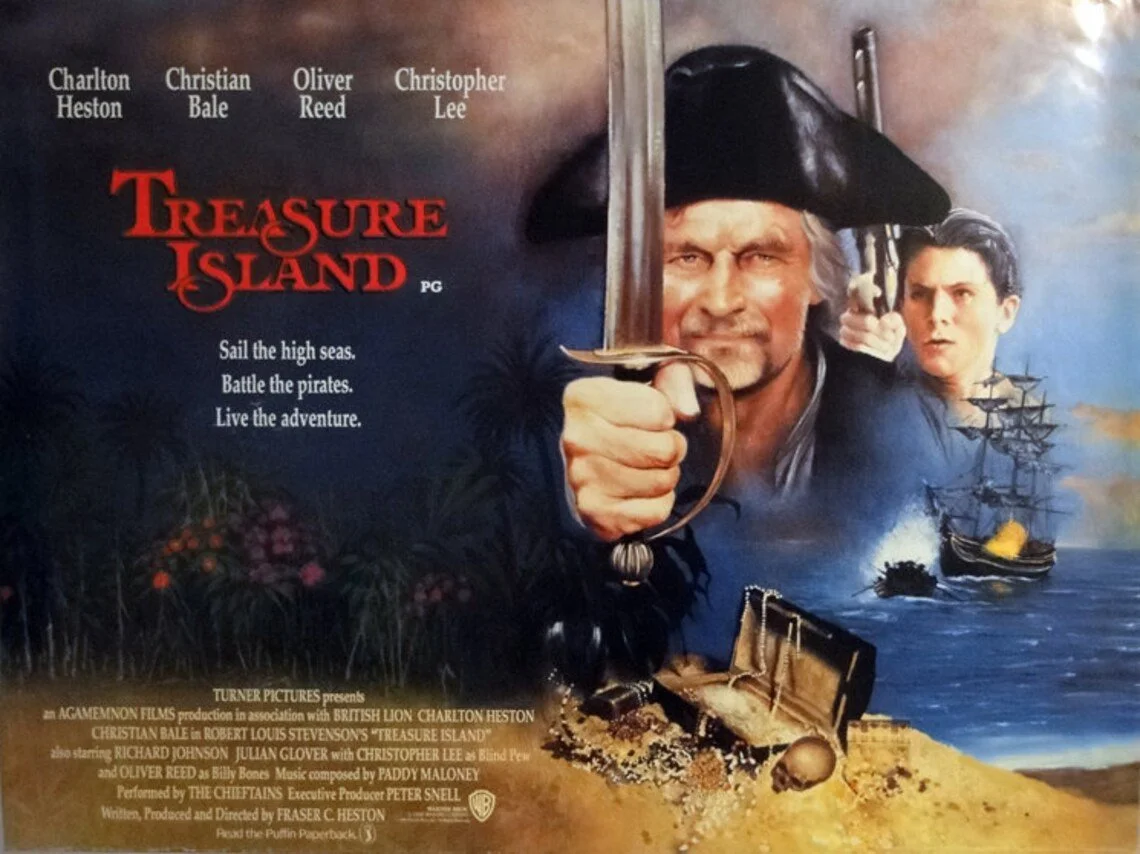
Robert Louis Stevenson’s classic novel has been adapted for cinema and television numerous times. Perhaps the most well known is the 1950 Disney version, starring Robert Newton as Long John Silver. His eye rolling performance and exaggerated West Country accent is credited with popularising the stereotypical form of “pirate speech" that has become the pop culture default. Although an enjoyable film, it does gloss over the more sinister aspects of both the source text and history, perpetuating the myth that pirates are just loveable scoundrels. Many subsequent adaptations have fallen into the same trap to a greater or lesser degree. However, that is not the case with the 1990 version of Treasure island, which was made for the TNT cable network and released theatrically outside of the US. This darker and notably more violent adaptation closely follows the source text and is widely considered the most faithful to the book.
Contemporary viewer’s may be perplexed by a film such as A Man For All Seasons. Why make a two our motion picture about a Tudor lawyer, statesman and scholar and their subsequent moral objection to the reigning monarchs marital status? Yet, during the sixties, it was entirely possible for a mainstream studio to produce a film based upon a stage play that dramatised such specific historical events. Furthermore, a film like this that relied upon strong performances and an intelligent script (and little more) could find a mainstream audience and be both a critical and commercial success. Nowadays, such productions still exist but they are now mainly the province of streaming services. Furthermore, the cinematic format has been replaced by that of a high budget TV show, which explores the topic at hand over an eight to ten hour running time.
Set in Brazil in 1901, plantation owner Christopher Leiningen (Charlton Heston) makes arrangements to get married. He has spent his entire life building his estate and reclaiming land from the jungle. He is fiercely independent but he is also alone and isolated. Joanna Selby (Eleanor Parker) from New Orleans agrees to marry him but their first meeting does not go well. Leiningen is unhappy to discover that Joanna is a widow and hence has a past, so he tells her to return to America on the next available boat. However, local commissioner (William Conrad) informs Leiningen that swarming soldier ants, or Marabunta, are moving towards his plantation destroying everything in their path. Leiningen refuses to abandon his life’s work and is surprised when Joanna decides to stay with him. Can they convince their native workers to stay too and can they defend the estate from the Marabunta, described as “forty square miles of agonising death”.
Millionaire businessman Thomas Crown (Steve McQueen) arranges for four men to steal $2,660,527.62 from a Boston bank. The men, who have never met before or seen Crown, successfully carry out the robbery. A fifth man then transports the stolen money and dumps it in a cemetery trash can. Crown retrieves the money, flies to Geneva and deposits it in a Swiss bank account. Eddy Malone (Paul Burke), the Boston police detective in charge of the case makes no progress until the bank’s insurance company assigns him one of their top investigators, Vicki Anderson (Faye Dunaway). Anderson thinks like a thief and works based upon her instincts. Looking through the evidence, she deduces that Crown is the culprit, potentially committing crimes just for amusement. Anderson subsequently meets Crown socially. Despite the situation and their respective positions, they are immediately attracted to each other and begin a relationship.
Writing a review of Apocalypse Now is a somewhat redundant exercise, unless you have never seen the any of the previous versions of the movie, or your analysis is offering a unique and wholly original perspective. It is one of the most scrutinised, dissected and studied films in the history of cinema. Furthermore, the stories associated with the films tumultuous production have become as equally legendary as the movie itself. There is as much apocrypha associated with Apocalypse Now as there are legitimate anecdotes. In many respects the documentary Hearts of Darkness: A Filmmaker's Apocalypse, which was shot during the films production, is equally as fascinating as the iconic movie. So with all this in mind, I will simply try to succinctly summarise my thoughts on this third version of Francis Ford Coppola’s magnum opus, which has been officially labelled “Final Cut” by the director.
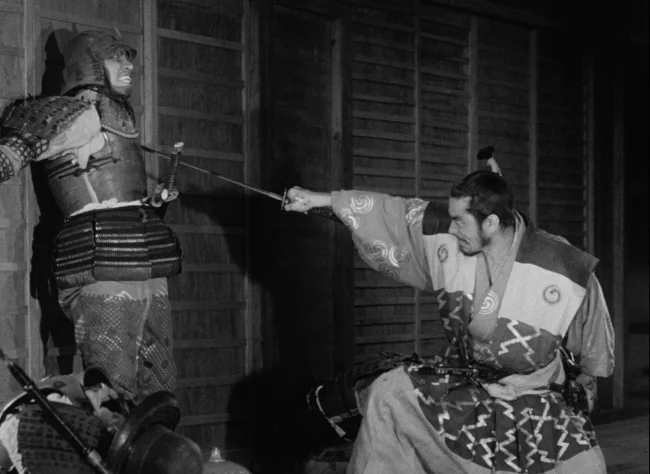
When I first saw Throne of Blood as a teenager I was ill in bed with a fever. I found the brooding atmosphere and the use of fog, very hypnotic and was never quite sure if this ethereal quality was down to my state of health or the way the film had been crafted. Subsequent viewings have established that the dream like aspect of the film is indeed due to the creative talents of it's great director. Akira Kurosawa remains the best-known Japanese director to Western audiences, while other luminaries, such as Mikio Naruse, Yasujiro Ozu and Kenji Mizoguchi, are known mainly to aficionados and scholars of cinema. Kurosawa’s work maintains a critical consensus, although he was at one point rejected in his native country for being too entrenched in obsolete traditions and themes. On a technical level his film making credentials remain unparalleled and in many ways, Throne of Blood is a text book example of his style and technique.
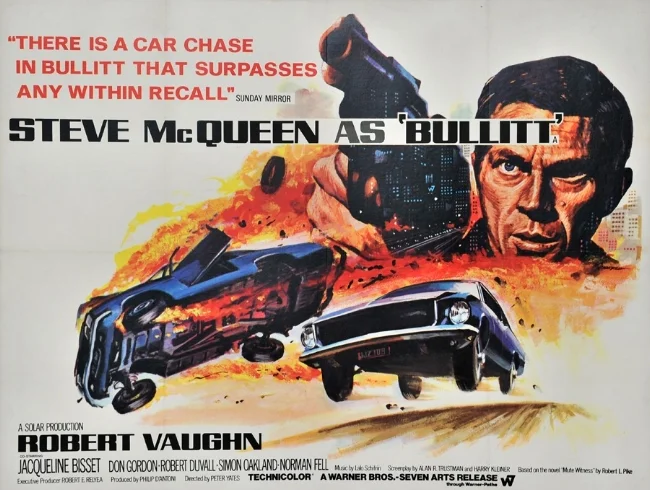
In a recent blog post I wrote about the difficulty that you can encounter sometimes when trying to watch movies that have been deemed “classic” by popular consensus. I listed 10 films of note that I intend to watch this year and to see if my views aligned with the various institutions and critics that praise them. The first on that list was the iconic sixties thriller Bullitt starring Steve McQueen. Having now watched the movie, I thought it would be prudent to collate my thoughts on it. Considering the immense amount of material that has already been written about it, I see no reason to present a review per se. Rather, here are my initial impressions for consideration. I’ve tried to highlight some specific aspects of the film that I think are of note or merit debate.
Let us take a moment to consider those movie lists you often come across on websites and in magazines. Why? Because there’s a lot of them about. You know the sort, one hundred movies that you must see before you go senile, according to some well-known critic or august institution like the BFI. Or if you prefer something more hip and eclectic then here’s another one collated by British filmmaker Edgar Wright. Furthermore, these lists are often somewhat homogeneous, containing a mixture of bonafide yet ubiquitous classics, a percentage of obscure arty-farty bollocks and a few wild cards that they put in for a laugh. These will be either so-called cult movies or examples from the “it’s so bad, it’s good” school of film making.
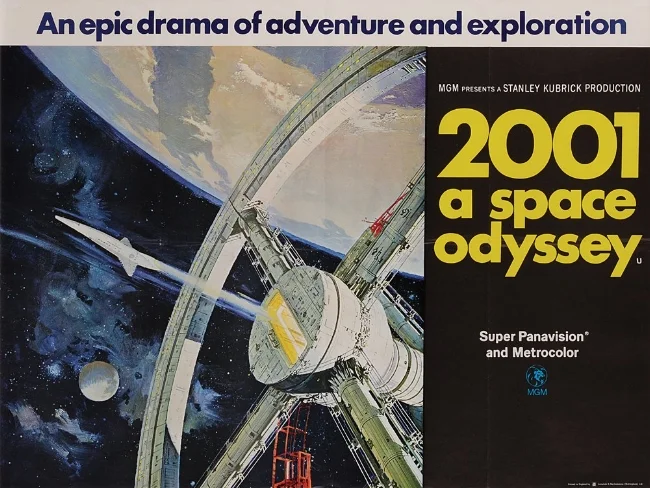
"2001: A Space Odyssey. Stanley Kubrick’s philosophically ambitious, technically innovative and visually stunning cinematic milestone". BFI November 2014.
You will often find this sort of language associated with Kubrick's work, especially 2001: A Space Odyssey. It is considered by many to be his finest production and one of the greatest science fiction feature films ever made. In fact 2001: A Space Odyssey has become one of those cinematic sacred cows that regularly features in most film buffs top ten movies of all time. It's a curious thing because a little research will show that critical opinion was split right down the middle on its release in spring 1968. It is only over the course of the last five decades that the movie has grown in artistic stature and garnered the acclaim it now enjoys.
Following the 2012 restored release of The Curse of Frankenstein, Hammer, Icon Film Distribution and Lionsgate jointly produced a Blu-ray restoration of another British classic. This time it was the 1958 version of Dracula directed by Terence Fisher. This is one of Hammer's finest films and not only gets a superb High Definition transfer but also sees the restoration of two lost scenes. Dracula literally re-invented the horror genre and the depiction of vampires in film. It also established the studio as a key player within the industry and made international stars of Peter Cushing and Christopher Lee. This new restoration finally does justice to the source material presenting it as it deserves to be seen.
El Dorado opens with a montage of paintings by celebrated Western artists Olaf Weighorst. These beautiful pictures in many ways reflect the nature of the movie, depicting a stylised representation of the Old West that despite its beauty, never really existed. Director Howard Hawks includes every possible genre trope and meme into El Dorado but far from being a handicap, it makes the movie a perfect distillation of Hollywood Western. The pairing of John Wayne and Robert Mitchum is sublime as the two effortlessly riff off each other. If you need an example of how the Western is the most flexible and accessible movie genre, then El Dorado is a text book example.
Grizzly (1976)
After the critical and commercial success of Jaws in 1975, a veritable tsunami of “creature feature” movies followed in its wake. A few titles, such as Alligator (1980) and Piranha (1978) managed to do something different with the rogue animal trope, both providing a quirky and satirical look at the genre along with plenty of exploitation mayhem. However, most of the rest were low budget productions of negligible quality. However, such qualities are not always an impediment at the box office. Grizzly (1976) was hastily made on a budget of $750,000 yet earned an impressive $39,000,000 at the box office. The critics hated it but the public loved it and it went on to be the second most financially successful independent feature film in the US that year (the first being Monty Python and the Holy Grail). Grizzly is in many ways a microcosm of the exploitation genre from the seventies and needs to be viewed through that prism if it is to be enjoyed.
After the critical and commercial success of Jaws in 1975, a veritable tsunami of “creature feature” movies followed in its wake. A few titles, such as Alligator (1980) and Piranha (1978) managed to do something different with the rogue animal trope, both providing a quirky and satirical look at the genre along with plenty of exploitation mayhem. However, most of the rest were low budget productions of negligible quality. However, such qualities are not always an impediment at the box office. Grizzly (1976) was hastily made on a budget of $750,000 yet earned an impressive $39,000,000 at the box office. The critics hated it but the public loved it and it went on to be the second most financially successful independent feature film in the US that year (the first being Monty Python and the Holy Grail). Grizzly is in many ways a microcosm of the exploitation genre from the seventies and needs to be viewed through that prism if it is to be enjoyed.
In an unspecified National Park in South Eastern America, Chief Ranger Michael Kelly (Christopher George) and his team search for two female hikers who are overdue after breaking camp. Kelly is joined by photographer Allison Corwin (Joan McCall) who subsequently stumbles upon human remains that have been partially buried. Tracks in the area and a subsequent autopsy confirm that there is a large predator loose in the park. Charley Kittridge (Joe Dorsey) the park supervisor, blames Kelly and naturalist Arthur Scott (Richard Jaeckel) as all bears were supposed to be tagged and removed from the tourist areas before the vacation season began. After further attacks Kittridge invites local hunters to kill the bear. Kelly and Scott decide to track the Grizzly down themselves. With the help of local helicopter pilot and Vietnam veteran Don Stober (Andrew Prine), they journey into the wilderness and attempt to set a trap. But the 15 ft, 2000 lbs bear proves more cunning than they anticipate.
One of the most often cited criticisms of Grizzly is it’s slavish adherence to the plot of Jaws. Director William Girdler attempts to duplicate many of the plot details from Spielberg’s iconic film. Hence we have a senior public official who refuses to take action when necessary, the near death of a child being a major catalyst of events and a trio of heroes who take on the task of hunting down the predator themselves. Sadly, Grizzly lacks the production polish and the quality dialogue that Jaws has in spades. The screenplay by Harvey Flaxman and David Sheldon is perfunctory to say the best and weak even by the standards of the exploitation genre. All major characters are woefully undeveloped and Christopher George, Andrew Prine and Richard Jaekel struggle to do much with their roles, often having to rely on their own personalities to get by. The location photography is good but the dense forest and striking mountains are not used to their full advantage.
Due to several plotlines and characters vanishing from the proceedings, shortly after being introduced, it seems likely that Grizzly was edited down from a longer film into the tight 89 minutes that makes up the theatrical release. Native American culture is alluded to but then plays no further part of the plot. Kelly’s romance with Allison Corwin simply ceases to be relevant halfway in and is dispensed with after a time. The levels of violence are also inconsistent. The first two onscreen deaths feature a severed arm flying across the screen. After this the kills are somewhat tamer. However, Grizzly ups the ante when a child is attacked in his garden. His Mother beats the bear with a broom, who drops the young child revealing his left leg bitten off below the knee. She herself is then mauled to death. This disparity in content again suggests last minute editing to secure a lower rating. Allegedly the first cut was R rated and featured more nudity and gore. It was then reduced for a PG rating.
Perhaps the weakest aspect of Grizzly is the bear itself. In a few of the attack sequences, the bear is a stunt performer in a suit but for the vast majority of the film, a real Kodiak bear (called Teddy) was used. Sadly, this particular bear never appears particularly menacing or threatening. Apparently the bear wrangler used marshmallows on a stick to make the animal stand and reach. Its subsequent slavering looks more comical than enraged. The bear certainly is imposing, due to its height but it never truly instills fear. Yet perhaps I am looking at this film with the perspective of a genre aficionado in his middle fifties, who has seen a lot of movies over the years. In the late seventies, this sort of fodder would have appealed greatly to the youth market (as the box office returns show). Director William Girdler went on to direct The Manitou, which I am very fond of. As for Grizzly, it remains an interesting example of how being in the right place at the right time is often essential to successful exploitation cinema.
In 1968 the dilapidated freighter Corita hastily leaves Freetown to avoid a customs inspection. Captain Lansen (Eric Porter) has a cargo of dangerous explosives which he is smuggling so he can finally retire. His ship’s passengers also have reasons for leaving in a hurry. Dr. Webster (Nigel Stock), together with his daughter Unity (Suzanna leigh), is relocating due to his indiscretions with patients and illegal operations. Alcoholic pianist Harry Tyler (Tony Beckley) is aimlessly drifting from port to port. Eva Peters (Hildegard Knef) is fleeing from her husband with stolen bearer bonds which she intend to use to buy back her son from his evil clutches Caracas. Ricaldi (Ben Carruthers), a questionable lawyer, is pursuing Eva to retrieve the stolen bonds. First officer Hemmings (Neil McCallum) suggests that the ship should return to Freetown after an imminent Hurricane warning. The Captain asks the passengers and they are unanimous that they do not wish to return. However a mutinous crew, the bad weather and the instability of the explosives force everyone to abandon ship. The survivors find themselves adrift in a lifeboat surrounded by a strange carnivorous seaweed.
Despite being considered by many as an original story, The Abominable Snowman (1957) is in fact a remake of a made for television play, The Creature, that was originally broadcast in the UK in 1955. Hammer Films would often purchase the rights of popular TV programs and subsequently re-work them for mainstream, international cinema. Larger production budgets and fewer censorship restrictions allowed them to make their cinematic interpretations more lurid, thus commercially viable. Hence The Quatermass Xperiment, Quatermass II and Quatermass and the Pit were all given a big screen makeover and were commercially successful. The Abominable Snowman was written by acclaimed writer Nigel Kneale, who also wrote the original television drama and the aforementioned Quatermass trilogy. Although ostensibly marketed as a horror film this production is actually an interesting blend of psychological thriller and science fiction.
In the near future, Kepler 822, a research and drilling facility located at the bottom of the Mariana Trench, suffers a sudden and catastrophic structural failure. There are only six survivors. Mechanical engineer Norah Price (Kristen Stewart), Captain Lucien (Vincent Cassel), biologist Emily Haversham (Jessica Henwick), engineer Liam Smith (John Gallagher Jr.) and crew members Rodrigo (Mamoudou Athie) and Paul (T.J. Miller). As all the functional escape pods have been used and they are unable to contact the surface, the Captain suggests using pressurized suits to walk one mile across the ocean floor to the Roebuck 641 drill installation. There they will find more escape pods. However, it soon becomes apparent that the disaster was not caused by an undersea earthquake and that they are not alone as they make their journey.
One of the most common objections raised regarding the Jurassic Park/Jurassic World franchise is that the films are specifically made to obtain a PG-13 rating from the Motion Picture Association, for purely commercial reasons. Hence, in all films, there is little on screen violence and the dinosaurs are mainly portrayed as a threat and a means of providing jump scares. When a character is killed by a dinosaur it usually happens off screen, is obscured by something else in frame, or is shown in long shot with very little detail. The realities of being eaten alive by a predator are conspicuously absent. Hence, audiences looking for films featuring more graphic dinosaur attacks, have not been well catered for apart from some minor direct-to-video titles. Primitive War finally fills this gap in the market with a frenetic genre mashup that strives to punch above is budgetary weight.
Fluke is a curious film about a man who is reincarnated as a dog and his subsequent realisation that he may have been murdered. It takes an adult novel by British author James Herbert, which is filled with philosophical musing and strives to adapt it in a far more family friendly fashion. The result is a somewhat bipolar production which thematically alternates between existential introspection and Buddhism. It then strives to deliver its message in a Disneyesque idiom. Children will potentially be confused and upset by what they see and adults will be wrongfooted by the continual shift in tone. Fluke was not a critical or commercial success upon release and the flaws that were identified by critics at the time still ring true today. That being said, Fluke is still an interesting and entertaining film, despite its faults.
When reviewing Sting, one critic stated that the small scale setting and thus, low stakes (IE only a few peoples lives are at risk), made the film not especially memorable. I consider this to be a somewhat spurious criticism. It is the very fact that Sting takes place in such a commonplace environment, with the main characters being everyday people that makes it different. There is a clear focus on well defined characters and their backstory. Unlike so many contemporary films, I actually gave a damn about the protagonists in Sting. An integral aspect of the horror genre is the ability to take a well known and familiar trope and provide a different and absorbing spin on it .It would appear that some audiences have been belaboured over the head by so many overblown and bombastic blockbusters, that the very notion of depicting small, localised and intimate events in a film, seems to bamboozle them.
When I first saw Mimic in 1997, I was impressed by the fact that it offered a different perspective on the monster movie genre and that it seemed to have moments of greater depth than you'd expect from such material. Later on when I became more aware of the works of writer, director Guillermo del Toro, I learned that this movie had had a troubled production and that Miramx had imposed specific requirements upon the final cut of the film. This explained some of the movies inconsistencies and hinted at a far more ambitious artistic endeavour by del Toro. Initially Mimic was conceived as a thirty minute short and part of a three part anthology movie. However it along with the sci-fi film Imposter were both deemed to be of sufficient merit to be developed into feature length productions.
During the seventies, Hollywood started looking to ongoing societal and political concerns as a source of material for movies. Hence, the energy crisis, terrorism and global pollution quickly found themselves being subsumed into hastily written screenplays, in attempt to be topical, commercially successful and relevant. Prophecy based upon a novel by David Seltzer tackled not only the issue of pollution but also the ongoing disenfranchisement of Native Americans. Paramount studios went so far as hiring an established director of note, John Frankenheimer. In many respects this movie should have been a bigger success with a reasonable budget, robust cast and studio support. Sadly it did not fare well, either critically or at the box office due to obvious flaws in the production. Despite his outstanding body work, (Birdman of Alcatraz, The Manchurian Candidate) Frankenheimer was not the best choice of director for a genre movie such as this and he was also going through a period of alcoholism.
In Agua Dulce, California, the Haywood family trains horses for film and TV productions. One day at the Haywood ranch, small metal objects unaccountably fall from the sky. One of which, a nickel, kills Otis Haywood Sr (Keith David). His children, Emerald “Em” Haywood (Keke Palmer) and Otis “OJ” Haywood Jr. (Daniel Kaluuya), continue to run the business. However, due to the loss of a contract, they have to sell some of the horses to Ricky “Jupe” Park (Steven Yeun), who operates a Western theme park called Jupiter's Claim. One night, the Haywood’s notice the electricity supply fluctuating and their horses violently reacting to an unknown presence. They discover that something has been taking their horses and regurgitating inorganic matter, which OJ believes caused their father's death. The Haywood’s decide to obtain proof and subsequently ask electronics store employee and UFO enthusiast, Angel Torres (Brandon Perea) to set up surveillance cameras.
Back in 2018 I wrote the following about The Meg in my review. “My interest doesn’t go so far as a sequel. This sort of movie is the equivalent of a greasy burger you buy at the funfair. It’s fine once in a while as an indulgence, despite the fact that you know it’s bad, but you would soon tire of them being a regular part of my diet”. Five years later, I foolishly thought it may be “fun” to give the sequel, Meg 2: The Trench (2023), a go. Especially in light of the fact that it’s directed by Ben Wheatley. Surely such a filmmaker would bring some creativity and a fresh perspective to this franchise? Nope. Turns out he didn’t. Meg 2: The Trench lacks everything that made its predecessor tolerable. This superfluous sequel is an uninspired, poorly written mess which confuses turning everything up to eleven with entertainment. It gets nowhere near “it’s so bad, it’s good” territory. Instead it makes the biggest mistake a film of this nature can do. It’s dull.
Not to be confused with the Shaw Brothers martial arts film of the same name from 1978, The Deadly Mantis (1957) is a creature feature in the idiom of Them! (1954). Unlike that film’s mutant ants, the monster on this occasion is not the product of the atomic age but a giant prehistoric praying mantis that has been released from the polar ice caps. Exactly how a creature associated with more tropical regions came to be at the North Pole is never explained. In fact precious little is in The Deadly Mantis. The film’s overall scope is somewhat limited with a basic story, limited action scenes and a rather dull cast of generic characters. There is an over reliance upon stock footage from period military documentaries and previous Universal Studio feature films. The film’s biggest failing is the giant praying mantis which does most of its rampaging conveniently off camera. It’s all rather disappointing.
It is no secret that the film industry relies on a handful of common tropes as the mainstay of their cinematic output. It uses timeless themes, storylines and archetypes that have featured in folk tales, plays and literature throughout history. Hence their familiarity with audiences around the world. Where the skill in filmmaking lies is to take a common, well known idea and interpret it in a new and innovative fashion. Akira Kurosawa took Shakespeare’s MacBeth and retold the tale through the prism of Japanese feudalistic culture. The result, Throne of Blood, is considered a masterpiece. Similarly, The Lion King retells the same story through the medium of animation and anthropomorphic wildlife. All of which proves that the key to successfully retelling a familiar tale is to be creative with regard to setting, presentation and perspective.
Jurassic World Dominion is a textbook example of a franchise that has run out of steam. Despite the enormous budget, the top notch production values and the presence of three members of the original cast, this is a long, tedious and curiously uneventful film. It has nothing new to say about environmental matters or unfettered science; themes that were front and centre in previous instalments. Nor does it do anything interesting with the main plot device of dinosaurs trying to integrate into our current ecosystems. But perhaps its biggest failing is the conspicuous lack of tension. The denizens of Jurassic World are simply not a threat and fail to have any emotional impact. The film doesn’t even placate viewers with superfluous cast members being eaten. The onscreen deaths by dinosaurs are rather tame.
Set in Brazil in 1901, plantation owner Christopher Leiningen (Charlton Heston) makes arrangements to get married. He has spent his entire life building his estate and reclaiming land from the jungle. He is fiercely independent but he is also alone and isolated. Joanna Selby (Eleanor Parker) from New Orleans agrees to marry him but their first meeting does not go well. Leiningen is unhappy to discover that Joanna is a widow and hence has a past, so he tells her to return to America on the next available boat. However, local commissioner (William Conrad) informs Leiningen that swarming soldier ants, or Marabunta, are moving towards his plantation destroying everything in their path. Leiningen refuses to abandon his life’s work and is surprised when Joanna decides to stay with him. Can they convince their native workers to stay too and can they defend the estate from the Marabunta, described as “forty square miles of agonising death”.
After the critical and commercial success of Jaws in 1975, a veritable tsunami of “creature feature” movies followed in its wake. A few titles, such as Alligator (1980) and Piranha (1978) managed to do something different with the rogue animal trope, both providing a quirky and satirical look at the genre along with plenty of exploitation mayhem. However, most of the rest were low budget productions of negligible quality. However, such qualities are not always an impediment at the box office. Grizzly (1976) was hastily made on a budget of $750,000 yet earned an impressive $39,000,000 at the box office. The critics hated it but the public loved it and it went on to be the second most financially successful independent feature film in the US that year (the first being Monty Python and the Holy Grail). Grizzly is in many ways a microcosm of the exploitation genre from the seventies and needs to be viewed through that prism if it is to be enjoyed.
The seventies saw a minor boom in creature feature films after the box office success of Jaws. Hence, we had movies such as Orca (1977), Tentacles (1977), The Pack (1977) and Piranha (1978). If an animal could eat you or potentially pose any threat to people, someone somewhere would make a movie about it. Usually a bad one. A few of these even dared to stray into other hot topics of the time such as pollution and protecting the environment. Some would even invoke mysticism and folk lore to facilitate their protagonists. Nightwing is one such curious genre hybrid which combines vampire bats, shale oil mining and Native American culture in its clumsy and unsubtle plot. It’s a somewhat odd undertaking, directed by Arthur Hiller. His previous work included Love Story (1970) and Silver Streak (1976), so he was not the first person you’d expect to see associated with such material. The film doesn’t work well as either a horror movie or an exploration of social issues, but like so many movies from this era, it is of interest mainly due to its sheer incongruity.
If you have seen any of the marketing material or trailers for The Meg, then you know exactly what you’re getting right from the get-go. All movies inherently require the viewer to suspend their sense of disbelief to various degrees. Naturally, the “creature feature” genre asks audience to go the extra mile with this concept. The Meg takes a major gamble by insisting that everyone goes further still, not by believing in a giant prehistoric shark (Megalodon) but that Jason Statham is a ex-navy, deep sea rescue diver. However, it pays off and the resulting movie is staggeringly stupid, but mercifully entertaining in an undemanding way. Recent movies such as Into the Storm and Geostorm are crass and made worse by their implicit assumption that their viewers are stupid. The Meg is far from cerebral but has an upbeat tone and a sense of playfulness that knowingly invites the audience to come aboard with the silliness. It’s a big distinction and the reason why I smiled a lot and frequently rolled my eyes while watching The Meg, but never with derision.
Critical opinion was very much split this summer when Jurassic World: Fallen Kingdom was released. However, the viewers were somewhat indifferent to the opinions of the professional critics and the movie made a healthy $1,303,476,615 globally, proving once again that the public’s’ continuing love affair with “all things dinosaur” shows no sign of abating. When you factor in the home media market into overall profits, the entire Jurassic Park franchise will have made $5 billion worldwide. So, bearing in mind the old adage that “money talks and bullshit walks”, I think it’s safe to say there’ll be more instalments in the years to come. When faced with such overwhelming box office popularity it seems somewhat pointless to dissect the latest movie, because the film seems to be bullet proof regardless of narrative flaws or ill-conceived plot devices. However, film criticism isn’t about box office popularity but about analysing the relative quality of a movie’s construction and its subsequent standing.
I first saw The Land That Time Forgot way back in 1975 at the Odeon Isle of Wight, when it was first released. We were on holiday at the time, which was cause for celebration in itself, as these were few and far between during my youth, due to the state of the UK economy at the time. But to then go to the cinema and see a fantasy film, filled with action, adventure and monsters, was the icing on the cake for an over excited eight-year-old. Adapted by Michael Moorcock and James Cawthorn from the 1924 the novel by Edgar Rice Burroughs, The Land That Time Forgot is a classic example of high adventure on a low budget. Its technical shortcomings were even apparent to me as a child, yet there was a charm and honesty to this curious British production, that had the audacity to try and compete with the likes of more expensive US productions such as The Golden Voyage of Sinbad and Island at the Top of the World.
Black Sheep is a high concept horror comedy from New Zealand. Featuring creative physical effects by Weta Workshop, this tale of genetically modified killer sheep, animal husbandry and environmentalism requires a very broad sense of humour and an abiding love for the “creature feature” sub-genre. It should be noted that the copy I watched was the unrated R1 DVD. This version is stronger in content than the R rated US theatrical release and yet was released at the UK cinemas with only a 15 rating from the BBFC. I suspect that the similarities in humour between the UK and New Zealand contributed to this somewhat low rating. That and the fact that horror comedy often gets a free pass because the humour always tends to mitigate the violence.
Frank Darabont achieved both critical acclaim and mass appeal with his adaptations of The Shawshank Redemption and The Green Mile. In 2007 he returned once again to the work of Stephen King with his film version of The Mist. It’s a sideways step away from human drama into a more genre piece, yet it still retains a very traditional story at its heart. Once you look beyond the superficial elements of "creature feature" plot, you get yet another well written character study by an ensemble cast, again focusing on how the human condition deals with extreme situations. The particular route it takes and some of the themes it explores may not be to everyone's taste. However, it still focuses on characters and performances. It is also a movie that ends with a somewhat unexpected plot development, that some viewers may find a little extreme. It is one of those film related twists that if known in advance, greatly diminishes once enjoyment of the film.
When you see the names of such cinematic luminaries as Steven Spielberg and J.J. Abrams together on the same movie poster, naturally your expectations are going to be high. Yet when watching the various trailers for Super 8, just prior to its release in 2011, I was somewhat cautious. I have discussed in the past at some length the ambiguous nature of trailers and that they can misrepresent a film. Yet even bearing this in mind at the time, I couldn’t help but feel that Super 8 seemed like a somewhat self-indulgent homage to Spielberg's earlier work. I subsequently saw the movie at the cinema in August that year and my suspicions were validated. However, over time I have spoken to several friends who are advocates of the movie, so I thought I’d watch it a second time. Sadly, I still find myself unable to label Super 8 as anything else other than adequate. Now I would hasten to add, that I use adequate within the context of both director’s body of work. An adequate film from either Mr Spielberg or Abrams is still superior to many of their competitors. But that's not the point. I simply expected better from such a project.
Having recently sat through Orcs! I decided to take a further chance and watch Orc Wars. It too is a very low budget film, although this time the finances were raised through crowdfunding. Sadly, it is not the fun, tongue in cheek, independent adventure movie the trailer and associated marketing implies. There is very little merit in this production. It's cheap, cheerful and although harmless, it clearly demonstrates that not all fan funded projects are good cinema. Some are just indulgences. The problem is in the title itself, which tries to sell an idea that the movie production is incapable of delivering. Instead of the spectacle of an army of a thousand Orcs pitted against the technological might of the US war machine, we get a few extras in ill-fitting costumes, running skirmishes against no-name actors on quad bikes and a few old Army Surplus vehicles. It's all rather lacklustre and underwhelming.
As a fan of the horror genre I’ve sat through numerous low budget films in my time. This has usually been at festivals or conventions. Sometimes watching something as part of a group, with likeminded individuals, makes a difference. You find yourself groaning in unison and the shared experience helps compensate for potential deficiencies. Watching questionable material in the comfort of your own home, purely on your own can be a lot tougher. However, due to my abiding love of the genre, I am prepared to cut a lot of cheap ass indie flicks considerably more slack than I would others. So, I'll endeavour to review Orcs! with as much impartiality as possible. Oh, and before we start, let us clarify the term Orcs. Although Middle-earth is not referenced in any way, this film is definitely about Tolkien's creations. Or at least their depiction in another well-known series of films.
10 Cloverfield Lane blends several cinematic genres producing an interesting premise. Once it has established its narrative arc, it then dives head long into an exciting and tense one hundred and four minutes. The movie is not a direct sequel to Cloverfield (2008) but does touch upon some of the same themes and ideas. Made on a modest budget of $15 million, the claustrophobic setting of a nuclear bunker accommodates strong performances from the lead actors. It is not until the third act when the story movies back to the outside world, do we see any major visual effects. Overall, this is a very compelling film due to the strong screenplay and well defined central characters.
I did my best to avoid the hype surrounding the initial release of Cloverfield. Such media saturation and public interest can often cloud the issue of whether the actual film is any good. Five years later and having watched the movie twice, once in the theatre and once at home, I am still somewhat conflicted about this movie. The use of hand held video cameras is both a boon and a bane. The constant movement of the image has proven to cause motion sickness for some viewers, although this is not so overwhelming when viewed on a smaller screen at home. Yet the medium of news footage mixed with handheld cameras does create a palpable sense of immediacy. This helps immensely when trying to sell a fantastic concept, such as the one that Cloverfield features.
The enigma of the Xenomorph in the Alien franchise is diminished once you start to rationalise its heritage. Sadly, that’s exactly what Alien: Covenant has chosen to do. It jettisons the mystery of the original 1979 movie and pulls back the curtain, so wisely put in place thirty-eight years ago, to reveal a rather lacklustre explanation to the Xenomorph’s origin. Having spent nearly $100 million and employed a production team of some of the finest talent that money can buy, the resulting movie is not bad per se, just crushingly superfluous. After watching Alien: Covenant this week, my overall reaction can be distilled down to a deep sigh of indifference and a shrug of the shoulders.
I have written many times in recent years about how big titles get announced by the gaming industry, of the ensuing hype up that leads up to launch day and then the subsequent disappointment on purchase. It is a malady that has afflicted the movie industry for decades and has become increasingly more common in the last decade. Hype has a curious link with reputation. There are a handful of directors in contemporary Hollywood who when they add their name to a production, people take notice. Ridley Scott is one of these. His body of work pretty much guarantees he can make whatever he wants, be it a commercial undertaking or a ludicrous vanity project. However, the downside to being a film maker of this stature is that you are not so easily exposed to proper scrutiny by your peers. No one stops you from making a mistake because you are supposed to know what you are doing. They let you do what you want. Which is bad.
Nightwing (1979)
The seventies saw a minor boom in creature feature films after the box office success of Jaws. Hence, we had movies such as Orca (1977), Tentacles (1977), The Pack (1977) and Piranha (1978). If an animal could eat you or potentially pose any threat to people, someone somewhere would make a movie about it. Usually a bad one. A few of these even dared to stray into other hot topics of the time such as pollution and protecting the environment. Some would even invoke mysticism and folk lore to facilitate their protagonists. Nightwing is one such curious genre hybrid which combines vampire bats, shale oil mining and Native American culture in its clumsy and unsubtle plot. It’s a somewhat odd undertaking, directed by Arthur Hiller. His previous work included Love Story (1970) and Silver Streak (1976), so he was not the first person you’d expect to see associated with such material. The film doesn’t work well as either a horror movie or an exploration of social issues, but like so many movies from this era, it is of interest mainly due to its sheer incongruity.
The seventies saw a minor boom in creature feature films after the box office success of Jaws. Hence, we had movies such as Orca (1977), Tentacles (1977), The Pack (1977) and Piranha (1978). If an animal could eat you or potentially pose any threat to people, someone somewhere would make a movie about it. Usually a bad one. A few of these even dared to stray into other hot topics of the time such as pollution and protecting the environment. Some would even invoke mysticism and folk lore to facilitate their protagonists. Nightwing is one such curious genre hybrid which combines vampire bats, shale oil mining and Native American culture in its clumsy and unsubtle plot. It’s a somewhat odd undertaking, directed by Arthur Hiller. His previous work included Love Story (1970) and Silver Streak (1976), so he was not the first person you’d expect to see associated with such material. The film doesn’t work well as either a horror movie or an exploration of social issues, but like so many movies from this era, it is of interest mainly due to its sheer incongruity.
Youngman Duran (Nick Mancuso), a deputy on an Indian reservation in New Mexico, investigates the death of several horses on a local ranch. The bodies are covered in small bites, drained of blood and there is a strong smell of ammonia. Tribal Council chairman Walker Chee (Stephen Macht) is keen to keep the matter quiet, as he is trying to negotiate the mining rites to oil shale deposits that have recently been discovered in nearby canyons. Canyons that also happen to be sacred to the local population. Abner Tasupi (George Clutesi), an ageing medicine man and Duran’s uncle, tells him he’s unleashed forces that will remove the White Man from the land and restore things to how they use to be. Duran dismisses such ideas, but as further death occurs including his uncle, begins to think otherwise. However, the arrival of British scientist Philip Payne (David Warner) points to a more tangible answer. The caves in Maskai Canyon are home to a swarm of deadly vampire bats he’s been tracking.
Nightwing efficiently sets out its stall within the first fifteen minutes. The audience is presented with a beleaguered law enforcment official, a corrupt business man and an obsessed scientist. This is quickly followed by a heavy dose ersatz Indian mysticism and the ubiquitous love interest, via local nurse Anne Dillon (Kathryn Harrold), who runs the town clinic. It’s all formulaic content that’s common to genre movies. There is also an attempt to address some deeper issues regarding the treatment of indigenous peoples by the Federal Government, as well as some nods towards institutional racism. But it’s far from convincing and or subtle. Especially in light of the fact that so few of the main cast are of the correct ethnicity. The film then proceeds to offset the subsequent vampire bat attacks with wider supernatural explanations, but never fully commits to them. The use of datura root as a hallucinogenic offers a “get out of jail card” to the film’s mystic elements.
As for the vampire bat attacks, they’re initially kept off screen until the first major set piece of the movie. This involves a group of Christian missionaries who are visiting the reservation and considering making a substantial charitable investment. It is one of the better plot elements. The attack takes place at night around the camp fire and features animatronic bats created by Carlo Rambaldi (E.T and the 1976 version of King Kong). There is also an optical overlay of a swarm of bats that further adds to the scene. It doesn’t quite work and certainly the rather static close ups of Rambaldi’s bats are far from convincing. However, the effects work is of interest due to the technical limitations of the time. Certainly, the blood flows in this sequence with the victims panicking. One falls into the camp fire while another hides under the camper van, only for it to run over her. Later in the movie Duran, Payne and Dillon construct an anti-bat cage from steel scaffolding and wire mesh. The technical shortcomings of the animatronics are more apparent here.
There are some genre stalwarts in the cast. David warner is suitable driven and even has a Jaws-eque monologue about the inherent “evil” of vampire bats. Sadly, his character has little back story. Strother Martin also appears as the local store owner as does Charles Hallahan as one of the Christian missionaries. But overall the screenplay by Martin Cruz Smith, Steve Shagan and Bud Shrake does the bear minimum and lacks any depth, or standout features. Although the desert locations are strikingly shot at times by Charles Rosher Jr. there is no overt sense of danger from the environment. Nightwing may well have benefitted from a more experienced genre director at the helm, who could have focused more upon the horror elements, rather than trying to expand the scope of the story into wider socio-political themes. However, I still find movies of this kind that hail from the pre-digital age to be of interest. The seventies were a far more experimental time for cinema and studios were prepared to try different things and straddle multiple genres. Nightwing should therefore be filed under such.
In 1968 the dilapidated freighter Corita hastily leaves Freetown to avoid a customs inspection. Captain Lansen (Eric Porter) has a cargo of dangerous explosives which he is smuggling so he can finally retire. His ship’s passengers also have reasons for leaving in a hurry. Dr. Webster (Nigel Stock), together with his daughter Unity (Suzanna leigh), is relocating due to his indiscretions with patients and illegal operations. Alcoholic pianist Harry Tyler (Tony Beckley) is aimlessly drifting from port to port. Eva Peters (Hildegard Knef) is fleeing from her husband with stolen bearer bonds which she intend to use to buy back her son from his evil clutches Caracas. Ricaldi (Ben Carruthers), a questionable lawyer, is pursuing Eva to retrieve the stolen bonds. First officer Hemmings (Neil McCallum) suggests that the ship should return to Freetown after an imminent Hurricane warning. The Captain asks the passengers and they are unanimous that they do not wish to return. However a mutinous crew, the bad weather and the instability of the explosives force everyone to abandon ship. The survivors find themselves adrift in a lifeboat surrounded by a strange carnivorous seaweed.
Despite being considered by many as an original story, The Abominable Snowman (1957) is in fact a remake of a made for television play, The Creature, that was originally broadcast in the UK in 1955. Hammer Films would often purchase the rights of popular TV programs and subsequently re-work them for mainstream, international cinema. Larger production budgets and fewer censorship restrictions allowed them to make their cinematic interpretations more lurid, thus commercially viable. Hence The Quatermass Xperiment, Quatermass II and Quatermass and the Pit were all given a big screen makeover and were commercially successful. The Abominable Snowman was written by acclaimed writer Nigel Kneale, who also wrote the original television drama and the aforementioned Quatermass trilogy. Although ostensibly marketed as a horror film this production is actually an interesting blend of psychological thriller and science fiction.
In the near future, Kepler 822, a research and drilling facility located at the bottom of the Mariana Trench, suffers a sudden and catastrophic structural failure. There are only six survivors. Mechanical engineer Norah Price (Kristen Stewart), Captain Lucien (Vincent Cassel), biologist Emily Haversham (Jessica Henwick), engineer Liam Smith (John Gallagher Jr.) and crew members Rodrigo (Mamoudou Athie) and Paul (T.J. Miller). As all the functional escape pods have been used and they are unable to contact the surface, the Captain suggests using pressurized suits to walk one mile across the ocean floor to the Roebuck 641 drill installation. There they will find more escape pods. However, it soon becomes apparent that the disaster was not caused by an undersea earthquake and that they are not alone as they make their journey.
One of the most common objections raised regarding the Jurassic Park/Jurassic World franchise is that the films are specifically made to obtain a PG-13 rating from the Motion Picture Association, for purely commercial reasons. Hence, in all films, there is little on screen violence and the dinosaurs are mainly portrayed as a threat and a means of providing jump scares. When a character is killed by a dinosaur it usually happens off screen, is obscured by something else in frame, or is shown in long shot with very little detail. The realities of being eaten alive by a predator are conspicuously absent. Hence, audiences looking for films featuring more graphic dinosaur attacks, have not been well catered for apart from some minor direct-to-video titles. Primitive War finally fills this gap in the market with a frenetic genre mashup that strives to punch above is budgetary weight.
Fluke is a curious film about a man who is reincarnated as a dog and his subsequent realisation that he may have been murdered. It takes an adult novel by British author James Herbert, which is filled with philosophical musing and strives to adapt it in a far more family friendly fashion. The result is a somewhat bipolar production which thematically alternates between existential introspection and Buddhism. It then strives to deliver its message in a Disneyesque idiom. Children will potentially be confused and upset by what they see and adults will be wrongfooted by the continual shift in tone. Fluke was not a critical or commercial success upon release and the flaws that were identified by critics at the time still ring true today. That being said, Fluke is still an interesting and entertaining film, despite its faults.
When reviewing Sting, one critic stated that the small scale setting and thus, low stakes (IE only a few peoples lives are at risk), made the film not especially memorable. I consider this to be a somewhat spurious criticism. It is the very fact that Sting takes place in such a commonplace environment, with the main characters being everyday people that makes it different. There is a clear focus on well defined characters and their backstory. Unlike so many contemporary films, I actually gave a damn about the protagonists in Sting. An integral aspect of the horror genre is the ability to take a well known and familiar trope and provide a different and absorbing spin on it .It would appear that some audiences have been belaboured over the head by so many overblown and bombastic blockbusters, that the very notion of depicting small, localised and intimate events in a film, seems to bamboozle them.
When I first saw Mimic in 1997, I was impressed by the fact that it offered a different perspective on the monster movie genre and that it seemed to have moments of greater depth than you'd expect from such material. Later on when I became more aware of the works of writer, director Guillermo del Toro, I learned that this movie had had a troubled production and that Miramx had imposed specific requirements upon the final cut of the film. This explained some of the movies inconsistencies and hinted at a far more ambitious artistic endeavour by del Toro. Initially Mimic was conceived as a thirty minute short and part of a three part anthology movie. However it along with the sci-fi film Imposter were both deemed to be of sufficient merit to be developed into feature length productions.
During the seventies, Hollywood started looking to ongoing societal and political concerns as a source of material for movies. Hence, the energy crisis, terrorism and global pollution quickly found themselves being subsumed into hastily written screenplays, in attempt to be topical, commercially successful and relevant. Prophecy based upon a novel by David Seltzer tackled not only the issue of pollution but also the ongoing disenfranchisement of Native Americans. Paramount studios went so far as hiring an established director of note, John Frankenheimer. In many respects this movie should have been a bigger success with a reasonable budget, robust cast and studio support. Sadly it did not fare well, either critically or at the box office due to obvious flaws in the production. Despite his outstanding body work, (Birdman of Alcatraz, The Manchurian Candidate) Frankenheimer was not the best choice of director for a genre movie such as this and he was also going through a period of alcoholism.
In Agua Dulce, California, the Haywood family trains horses for film and TV productions. One day at the Haywood ranch, small metal objects unaccountably fall from the sky. One of which, a nickel, kills Otis Haywood Sr (Keith David). His children, Emerald “Em” Haywood (Keke Palmer) and Otis “OJ” Haywood Jr. (Daniel Kaluuya), continue to run the business. However, due to the loss of a contract, they have to sell some of the horses to Ricky “Jupe” Park (Steven Yeun), who operates a Western theme park called Jupiter's Claim. One night, the Haywood’s notice the electricity supply fluctuating and their horses violently reacting to an unknown presence. They discover that something has been taking their horses and regurgitating inorganic matter, which OJ believes caused their father's death. The Haywood’s decide to obtain proof and subsequently ask electronics store employee and UFO enthusiast, Angel Torres (Brandon Perea) to set up surveillance cameras.
Back in 2018 I wrote the following about The Meg in my review. “My interest doesn’t go so far as a sequel. This sort of movie is the equivalent of a greasy burger you buy at the funfair. It’s fine once in a while as an indulgence, despite the fact that you know it’s bad, but you would soon tire of them being a regular part of my diet”. Five years later, I foolishly thought it may be “fun” to give the sequel, Meg 2: The Trench (2023), a go. Especially in light of the fact that it’s directed by Ben Wheatley. Surely such a filmmaker would bring some creativity and a fresh perspective to this franchise? Nope. Turns out he didn’t. Meg 2: The Trench lacks everything that made its predecessor tolerable. This superfluous sequel is an uninspired, poorly written mess which confuses turning everything up to eleven with entertainment. It gets nowhere near “it’s so bad, it’s good” territory. Instead it makes the biggest mistake a film of this nature can do. It’s dull.
Not to be confused with the Shaw Brothers martial arts film of the same name from 1978, The Deadly Mantis (1957) is a creature feature in the idiom of Them! (1954). Unlike that film’s mutant ants, the monster on this occasion is not the product of the atomic age but a giant prehistoric praying mantis that has been released from the polar ice caps. Exactly how a creature associated with more tropical regions came to be at the North Pole is never explained. In fact precious little is in The Deadly Mantis. The film’s overall scope is somewhat limited with a basic story, limited action scenes and a rather dull cast of generic characters. There is an over reliance upon stock footage from period military documentaries and previous Universal Studio feature films. The film’s biggest failing is the giant praying mantis which does most of its rampaging conveniently off camera. It’s all rather disappointing.
It is no secret that the film industry relies on a handful of common tropes as the mainstay of their cinematic output. It uses timeless themes, storylines and archetypes that have featured in folk tales, plays and literature throughout history. Hence their familiarity with audiences around the world. Where the skill in filmmaking lies is to take a common, well known idea and interpret it in a new and innovative fashion. Akira Kurosawa took Shakespeare’s MacBeth and retold the tale through the prism of Japanese feudalistic culture. The result, Throne of Blood, is considered a masterpiece. Similarly, The Lion King retells the same story through the medium of animation and anthropomorphic wildlife. All of which proves that the key to successfully retelling a familiar tale is to be creative with regard to setting, presentation and perspective.
Jurassic World Dominion is a textbook example of a franchise that has run out of steam. Despite the enormous budget, the top notch production values and the presence of three members of the original cast, this is a long, tedious and curiously uneventful film. It has nothing new to say about environmental matters or unfettered science; themes that were front and centre in previous instalments. Nor does it do anything interesting with the main plot device of dinosaurs trying to integrate into our current ecosystems. But perhaps its biggest failing is the conspicuous lack of tension. The denizens of Jurassic World are simply not a threat and fail to have any emotional impact. The film doesn’t even placate viewers with superfluous cast members being eaten. The onscreen deaths by dinosaurs are rather tame.
Set in Brazil in 1901, plantation owner Christopher Leiningen (Charlton Heston) makes arrangements to get married. He has spent his entire life building his estate and reclaiming land from the jungle. He is fiercely independent but he is also alone and isolated. Joanna Selby (Eleanor Parker) from New Orleans agrees to marry him but their first meeting does not go well. Leiningen is unhappy to discover that Joanna is a widow and hence has a past, so he tells her to return to America on the next available boat. However, local commissioner (William Conrad) informs Leiningen that swarming soldier ants, or Marabunta, are moving towards his plantation destroying everything in their path. Leiningen refuses to abandon his life’s work and is surprised when Joanna decides to stay with him. Can they convince their native workers to stay too and can they defend the estate from the Marabunta, described as “forty square miles of agonising death”.
After the critical and commercial success of Jaws in 1975, a veritable tsunami of “creature feature” movies followed in its wake. A few titles, such as Alligator (1980) and Piranha (1978) managed to do something different with the rogue animal trope, both providing a quirky and satirical look at the genre along with plenty of exploitation mayhem. However, most of the rest were low budget productions of negligible quality. However, such qualities are not always an impediment at the box office. Grizzly (1976) was hastily made on a budget of $750,000 yet earned an impressive $39,000,000 at the box office. The critics hated it but the public loved it and it went on to be the second most financially successful independent feature film in the US that year (the first being Monty Python and the Holy Grail). Grizzly is in many ways a microcosm of the exploitation genre from the seventies and needs to be viewed through that prism if it is to be enjoyed.
The seventies saw a minor boom in creature feature films after the box office success of Jaws. Hence, we had movies such as Orca (1977), Tentacles (1977), The Pack (1977) and Piranha (1978). If an animal could eat you or potentially pose any threat to people, someone somewhere would make a movie about it. Usually a bad one. A few of these even dared to stray into other hot topics of the time such as pollution and protecting the environment. Some would even invoke mysticism and folk lore to facilitate their protagonists. Nightwing is one such curious genre hybrid which combines vampire bats, shale oil mining and Native American culture in its clumsy and unsubtle plot. It’s a somewhat odd undertaking, directed by Arthur Hiller. His previous work included Love Story (1970) and Silver Streak (1976), so he was not the first person you’d expect to see associated with such material. The film doesn’t work well as either a horror movie or an exploration of social issues, but like so many movies from this era, it is of interest mainly due to its sheer incongruity.
If you have seen any of the marketing material or trailers for The Meg, then you know exactly what you’re getting right from the get-go. All movies inherently require the viewer to suspend their sense of disbelief to various degrees. Naturally, the “creature feature” genre asks audience to go the extra mile with this concept. The Meg takes a major gamble by insisting that everyone goes further still, not by believing in a giant prehistoric shark (Megalodon) but that Jason Statham is a ex-navy, deep sea rescue diver. However, it pays off and the resulting movie is staggeringly stupid, but mercifully entertaining in an undemanding way. Recent movies such as Into the Storm and Geostorm are crass and made worse by their implicit assumption that their viewers are stupid. The Meg is far from cerebral but has an upbeat tone and a sense of playfulness that knowingly invites the audience to come aboard with the silliness. It’s a big distinction and the reason why I smiled a lot and frequently rolled my eyes while watching The Meg, but never with derision.
Critical opinion was very much split this summer when Jurassic World: Fallen Kingdom was released. However, the viewers were somewhat indifferent to the opinions of the professional critics and the movie made a healthy $1,303,476,615 globally, proving once again that the public’s’ continuing love affair with “all things dinosaur” shows no sign of abating. When you factor in the home media market into overall profits, the entire Jurassic Park franchise will have made $5 billion worldwide. So, bearing in mind the old adage that “money talks and bullshit walks”, I think it’s safe to say there’ll be more instalments in the years to come. When faced with such overwhelming box office popularity it seems somewhat pointless to dissect the latest movie, because the film seems to be bullet proof regardless of narrative flaws or ill-conceived plot devices. However, film criticism isn’t about box office popularity but about analysing the relative quality of a movie’s construction and its subsequent standing.
I first saw The Land That Time Forgot way back in 1975 at the Odeon Isle of Wight, when it was first released. We were on holiday at the time, which was cause for celebration in itself, as these were few and far between during my youth, due to the state of the UK economy at the time. But to then go to the cinema and see a fantasy film, filled with action, adventure and monsters, was the icing on the cake for an over excited eight-year-old. Adapted by Michael Moorcock and James Cawthorn from the 1924 the novel by Edgar Rice Burroughs, The Land That Time Forgot is a classic example of high adventure on a low budget. Its technical shortcomings were even apparent to me as a child, yet there was a charm and honesty to this curious British production, that had the audacity to try and compete with the likes of more expensive US productions such as The Golden Voyage of Sinbad and Island at the Top of the World.
Black Sheep is a high concept horror comedy from New Zealand. Featuring creative physical effects by Weta Workshop, this tale of genetically modified killer sheep, animal husbandry and environmentalism requires a very broad sense of humour and an abiding love for the “creature feature” sub-genre. It should be noted that the copy I watched was the unrated R1 DVD. This version is stronger in content than the R rated US theatrical release and yet was released at the UK cinemas with only a 15 rating from the BBFC. I suspect that the similarities in humour between the UK and New Zealand contributed to this somewhat low rating. That and the fact that horror comedy often gets a free pass because the humour always tends to mitigate the violence.
Frank Darabont achieved both critical acclaim and mass appeal with his adaptations of The Shawshank Redemption and The Green Mile. In 2007 he returned once again to the work of Stephen King with his film version of The Mist. It’s a sideways step away from human drama into a more genre piece, yet it still retains a very traditional story at its heart. Once you look beyond the superficial elements of "creature feature" plot, you get yet another well written character study by an ensemble cast, again focusing on how the human condition deals with extreme situations. The particular route it takes and some of the themes it explores may not be to everyone's taste. However, it still focuses on characters and performances. It is also a movie that ends with a somewhat unexpected plot development, that some viewers may find a little extreme. It is one of those film related twists that if known in advance, greatly diminishes once enjoyment of the film.
When you see the names of such cinematic luminaries as Steven Spielberg and J.J. Abrams together on the same movie poster, naturally your expectations are going to be high. Yet when watching the various trailers for Super 8, just prior to its release in 2011, I was somewhat cautious. I have discussed in the past at some length the ambiguous nature of trailers and that they can misrepresent a film. Yet even bearing this in mind at the time, I couldn’t help but feel that Super 8 seemed like a somewhat self-indulgent homage to Spielberg's earlier work. I subsequently saw the movie at the cinema in August that year and my suspicions were validated. However, over time I have spoken to several friends who are advocates of the movie, so I thought I’d watch it a second time. Sadly, I still find myself unable to label Super 8 as anything else other than adequate. Now I would hasten to add, that I use adequate within the context of both director’s body of work. An adequate film from either Mr Spielberg or Abrams is still superior to many of their competitors. But that's not the point. I simply expected better from such a project.
Having recently sat through Orcs! I decided to take a further chance and watch Orc Wars. It too is a very low budget film, although this time the finances were raised through crowdfunding. Sadly, it is not the fun, tongue in cheek, independent adventure movie the trailer and associated marketing implies. There is very little merit in this production. It's cheap, cheerful and although harmless, it clearly demonstrates that not all fan funded projects are good cinema. Some are just indulgences. The problem is in the title itself, which tries to sell an idea that the movie production is incapable of delivering. Instead of the spectacle of an army of a thousand Orcs pitted against the technological might of the US war machine, we get a few extras in ill-fitting costumes, running skirmishes against no-name actors on quad bikes and a few old Army Surplus vehicles. It's all rather lacklustre and underwhelming.
As a fan of the horror genre I’ve sat through numerous low budget films in my time. This has usually been at festivals or conventions. Sometimes watching something as part of a group, with likeminded individuals, makes a difference. You find yourself groaning in unison and the shared experience helps compensate for potential deficiencies. Watching questionable material in the comfort of your own home, purely on your own can be a lot tougher. However, due to my abiding love of the genre, I am prepared to cut a lot of cheap ass indie flicks considerably more slack than I would others. So, I'll endeavour to review Orcs! with as much impartiality as possible. Oh, and before we start, let us clarify the term Orcs. Although Middle-earth is not referenced in any way, this film is definitely about Tolkien's creations. Or at least their depiction in another well-known series of films.
10 Cloverfield Lane blends several cinematic genres producing an interesting premise. Once it has established its narrative arc, it then dives head long into an exciting and tense one hundred and four minutes. The movie is not a direct sequel to Cloverfield (2008) but does touch upon some of the same themes and ideas. Made on a modest budget of $15 million, the claustrophobic setting of a nuclear bunker accommodates strong performances from the lead actors. It is not until the third act when the story movies back to the outside world, do we see any major visual effects. Overall, this is a very compelling film due to the strong screenplay and well defined central characters.
I did my best to avoid the hype surrounding the initial release of Cloverfield. Such media saturation and public interest can often cloud the issue of whether the actual film is any good. Five years later and having watched the movie twice, once in the theatre and once at home, I am still somewhat conflicted about this movie. The use of hand held video cameras is both a boon and a bane. The constant movement of the image has proven to cause motion sickness for some viewers, although this is not so overwhelming when viewed on a smaller screen at home. Yet the medium of news footage mixed with handheld cameras does create a palpable sense of immediacy. This helps immensely when trying to sell a fantastic concept, such as the one that Cloverfield features.
The enigma of the Xenomorph in the Alien franchise is diminished once you start to rationalise its heritage. Sadly, that’s exactly what Alien: Covenant has chosen to do. It jettisons the mystery of the original 1979 movie and pulls back the curtain, so wisely put in place thirty-eight years ago, to reveal a rather lacklustre explanation to the Xenomorph’s origin. Having spent nearly $100 million and employed a production team of some of the finest talent that money can buy, the resulting movie is not bad per se, just crushingly superfluous. After watching Alien: Covenant this week, my overall reaction can be distilled down to a deep sigh of indifference and a shrug of the shoulders.
I have written many times in recent years about how big titles get announced by the gaming industry, of the ensuing hype up that leads up to launch day and then the subsequent disappointment on purchase. It is a malady that has afflicted the movie industry for decades and has become increasingly more common in the last decade. Hype has a curious link with reputation. There are a handful of directors in contemporary Hollywood who when they add their name to a production, people take notice. Ridley Scott is one of these. His body of work pretty much guarantees he can make whatever he wants, be it a commercial undertaking or a ludicrous vanity project. However, the downside to being a film maker of this stature is that you are not so easily exposed to proper scrutiny by your peers. No one stops you from making a mistake because you are supposed to know what you are doing. They let you do what you want. Which is bad.
The Meg (2018)
If you have seen any of the marketing material or trailers for The Meg, then you know exactly what you’re getting right from the get-go. All movies inherently require the viewer to suspend their sense of disbelief to various degrees. Naturally, the “creature feature” genre asks audience to go the extra mile with this concept. The Meg takes a major gamble by insisting that everyone goes further still, not by believing in a giant prehistoric shark (Megalodon) but that Jason Statham is a ex-navy, deep sea rescue diver. However, it pays off and the resulting movie is staggeringly stupid, but mercifully entertaining in an undemanding way. Recent movies such as Into the Storm and Geostorm are crass and made worse by their implicit assumption that their viewers are stupid. The Meg is far from cerebral but has an upbeat tone and a sense of playfulness that knowingly invites the audience to come aboard with the silliness. It’s a big distinction and the reason why I smiled a lot and frequently rolled my eyes while watching The Meg, but never with derision.
If you have seen any of the marketing material or trailers for The Meg, then you know exactly what you’re getting right from the get-go. All movies inherently require the viewer to suspend their sense of disbelief to various degrees. Naturally, the “creature feature” genre asks audience to go the extra mile with this concept. The Meg takes a major gamble by insisting that everyone goes further still, not by believing in a giant prehistoric shark (Megalodon) but that Jason Statham is a ex-navy, deep sea rescue diver. However, it pays off and the resulting movie is staggeringly stupid, but mercifully entertaining in an undemanding way. Recent movies such as Into the Storm and Geostorm are crass and made worse by their implicit assumption that their viewers are stupid. The Meg is far from cerebral but has an upbeat tone and a sense of playfulness that knowingly invites the audience to come aboard with the silliness. It’s a big distinction and the reason why I smiled a lot and frequently rolled my eyes while watching The Meg, but never with derision.
Plot wise, no cliché, genre trope or established cinematic convention is left unturned. Jonas Taylor (Jason Statham) retires with a cloud over his head after leaving several fellow divers behind during a deep-sea rescue. His claim there was an imminent danger from some unknown sea creature, is not believed by fellow team mate Dr Heller (Robert Taylor), who suspects he may have suffered pressure-induced psychosis. Five years later an incident involving a submersible, trapped in the Marianas Trench, forces Jonas out of retirement and into a confrontation with his aquatic nemesis, a prehistoric Megalodon. The creature subsequently escapes the depth of the ocean trench and threatens the safety of an underwater research station, Mana One, owned by billionaire Jack Morris (Rainn Wilson) and run by oceanographer Dr. Minway Zhang (Winston Chao) and his daughter and fellow scientist Suyin Zhang (Li Bingbing). After a failed attempt to destroy the shark, the creature heads off towards the major tourist resort of Sanya Bay in Hainan Province, China. Digital effects abound, scenery is chewed by the cast, Statham is gruff and does everything one expects of him.
The Meg is effectively a big budget copy of the sort of movies The Asylum make, which is ironic on multiple levels when you think about it. It is one of the few recent US-Chinese co-productions that actually manages to maintain a sense of identity. Often when trying to please multiple markets, cultural and social differences are stripped back from the narrative resulting in a very bland and homogeneous product. The Meg manages to maintain a foot in both nations’ respective zeitgeist and the brief scenes showing the Chinese middle-classes indulging in identical leisure activities to their western counterparts is an interesting reflection of the nature of globalism. However, this brief moment of depth is more than likely purely accidental. As for the shark itself, it suffers from being purely a CGI creation and oddly enough, it’s size actually makes it less threatening. This isn’t Jaws where victims are slowly dismembered as the shark feeds. This is a Megalodon that can swallow multiple people in one mouthful. As a result, the climatic action scene at Sanya Bay is fun but oddly not that shocking. The Meg certainly doesn’t push the boundaries of its rating.
Some viewers will still find The Meg too “stupid” for their tastes. It is the sort of movie that is best viewed in the company of likeminded friends, late on a Friday night, after an evening in the pub. It is fair to say that if it wasn’t for the presence of Jason Statham, Cliff Curtis and Shuya Sophia Cai then this would have simply been a DTV release with an unusually big budget. It’s difficult to put an exact finger upon it, but Jason Statham has created his own unique niche within the action movie genre and he carries this movie by his own curious form of star appeal. Plus, the “creature feature” genre still seems to have an inherent attraction with audiences, as the box office returns of the Jurassic Park franchise prove. I’ll be honest and state that my interest in The Meg doesn’t go so far as a sequel. This sort of movie is the equivalent of a greasy burger you buy at the funfair. It’s fine once in a while as an indulgence, despite the fact that you know it’s bad, but you would soon tire of them being a regular part of my diet.
In 1968 the dilapidated freighter Corita hastily leaves Freetown to avoid a customs inspection. Captain Lansen (Eric Porter) has a cargo of dangerous explosives which he is smuggling so he can finally retire. His ship’s passengers also have reasons for leaving in a hurry. Dr. Webster (Nigel Stock), together with his daughter Unity (Suzanna leigh), is relocating due to his indiscretions with patients and illegal operations. Alcoholic pianist Harry Tyler (Tony Beckley) is aimlessly drifting from port to port. Eva Peters (Hildegard Knef) is fleeing from her husband with stolen bearer bonds which she intend to use to buy back her son from his evil clutches Caracas. Ricaldi (Ben Carruthers), a questionable lawyer, is pursuing Eva to retrieve the stolen bonds. First officer Hemmings (Neil McCallum) suggests that the ship should return to Freetown after an imminent Hurricane warning. The Captain asks the passengers and they are unanimous that they do not wish to return. However a mutinous crew, the bad weather and the instability of the explosives force everyone to abandon ship. The survivors find themselves adrift in a lifeboat surrounded by a strange carnivorous seaweed.
Despite being considered by many as an original story, The Abominable Snowman (1957) is in fact a remake of a made for television play, The Creature, that was originally broadcast in the UK in 1955. Hammer Films would often purchase the rights of popular TV programs and subsequently re-work them for mainstream, international cinema. Larger production budgets and fewer censorship restrictions allowed them to make their cinematic interpretations more lurid, thus commercially viable. Hence The Quatermass Xperiment, Quatermass II and Quatermass and the Pit were all given a big screen makeover and were commercially successful. The Abominable Snowman was written by acclaimed writer Nigel Kneale, who also wrote the original television drama and the aforementioned Quatermass trilogy. Although ostensibly marketed as a horror film this production is actually an interesting blend of psychological thriller and science fiction.
In the near future, Kepler 822, a research and drilling facility located at the bottom of the Mariana Trench, suffers a sudden and catastrophic structural failure. There are only six survivors. Mechanical engineer Norah Price (Kristen Stewart), Captain Lucien (Vincent Cassel), biologist Emily Haversham (Jessica Henwick), engineer Liam Smith (John Gallagher Jr.) and crew members Rodrigo (Mamoudou Athie) and Paul (T.J. Miller). As all the functional escape pods have been used and they are unable to contact the surface, the Captain suggests using pressurized suits to walk one mile across the ocean floor to the Roebuck 641 drill installation. There they will find more escape pods. However, it soon becomes apparent that the disaster was not caused by an undersea earthquake and that they are not alone as they make their journey.
One of the most common objections raised regarding the Jurassic Park/Jurassic World franchise is that the films are specifically made to obtain a PG-13 rating from the Motion Picture Association, for purely commercial reasons. Hence, in all films, there is little on screen violence and the dinosaurs are mainly portrayed as a threat and a means of providing jump scares. When a character is killed by a dinosaur it usually happens off screen, is obscured by something else in frame, or is shown in long shot with very little detail. The realities of being eaten alive by a predator are conspicuously absent. Hence, audiences looking for films featuring more graphic dinosaur attacks, have not been well catered for apart from some minor direct-to-video titles. Primitive War finally fills this gap in the market with a frenetic genre mashup that strives to punch above is budgetary weight.
Fluke is a curious film about a man who is reincarnated as a dog and his subsequent realisation that he may have been murdered. It takes an adult novel by British author James Herbert, which is filled with philosophical musing and strives to adapt it in a far more family friendly fashion. The result is a somewhat bipolar production which thematically alternates between existential introspection and Buddhism. It then strives to deliver its message in a Disneyesque idiom. Children will potentially be confused and upset by what they see and adults will be wrongfooted by the continual shift in tone. Fluke was not a critical or commercial success upon release and the flaws that were identified by critics at the time still ring true today. That being said, Fluke is still an interesting and entertaining film, despite its faults.
When reviewing Sting, one critic stated that the small scale setting and thus, low stakes (IE only a few peoples lives are at risk), made the film not especially memorable. I consider this to be a somewhat spurious criticism. It is the very fact that Sting takes place in such a commonplace environment, with the main characters being everyday people that makes it different. There is a clear focus on well defined characters and their backstory. Unlike so many contemporary films, I actually gave a damn about the protagonists in Sting. An integral aspect of the horror genre is the ability to take a well known and familiar trope and provide a different and absorbing spin on it .It would appear that some audiences have been belaboured over the head by so many overblown and bombastic blockbusters, that the very notion of depicting small, localised and intimate events in a film, seems to bamboozle them.
When I first saw Mimic in 1997, I was impressed by the fact that it offered a different perspective on the monster movie genre and that it seemed to have moments of greater depth than you'd expect from such material. Later on when I became more aware of the works of writer, director Guillermo del Toro, I learned that this movie had had a troubled production and that Miramx had imposed specific requirements upon the final cut of the film. This explained some of the movies inconsistencies and hinted at a far more ambitious artistic endeavour by del Toro. Initially Mimic was conceived as a thirty minute short and part of a three part anthology movie. However it along with the sci-fi film Imposter were both deemed to be of sufficient merit to be developed into feature length productions.
During the seventies, Hollywood started looking to ongoing societal and political concerns as a source of material for movies. Hence, the energy crisis, terrorism and global pollution quickly found themselves being subsumed into hastily written screenplays, in attempt to be topical, commercially successful and relevant. Prophecy based upon a novel by David Seltzer tackled not only the issue of pollution but also the ongoing disenfranchisement of Native Americans. Paramount studios went so far as hiring an established director of note, John Frankenheimer. In many respects this movie should have been a bigger success with a reasonable budget, robust cast and studio support. Sadly it did not fare well, either critically or at the box office due to obvious flaws in the production. Despite his outstanding body work, (Birdman of Alcatraz, The Manchurian Candidate) Frankenheimer was not the best choice of director for a genre movie such as this and he was also going through a period of alcoholism.
In Agua Dulce, California, the Haywood family trains horses for film and TV productions. One day at the Haywood ranch, small metal objects unaccountably fall from the sky. One of which, a nickel, kills Otis Haywood Sr (Keith David). His children, Emerald “Em” Haywood (Keke Palmer) and Otis “OJ” Haywood Jr. (Daniel Kaluuya), continue to run the business. However, due to the loss of a contract, they have to sell some of the horses to Ricky “Jupe” Park (Steven Yeun), who operates a Western theme park called Jupiter's Claim. One night, the Haywood’s notice the electricity supply fluctuating and their horses violently reacting to an unknown presence. They discover that something has been taking their horses and regurgitating inorganic matter, which OJ believes caused their father's death. The Haywood’s decide to obtain proof and subsequently ask electronics store employee and UFO enthusiast, Angel Torres (Brandon Perea) to set up surveillance cameras.
Back in 2018 I wrote the following about The Meg in my review. “My interest doesn’t go so far as a sequel. This sort of movie is the equivalent of a greasy burger you buy at the funfair. It’s fine once in a while as an indulgence, despite the fact that you know it’s bad, but you would soon tire of them being a regular part of my diet”. Five years later, I foolishly thought it may be “fun” to give the sequel, Meg 2: The Trench (2023), a go. Especially in light of the fact that it’s directed by Ben Wheatley. Surely such a filmmaker would bring some creativity and a fresh perspective to this franchise? Nope. Turns out he didn’t. Meg 2: The Trench lacks everything that made its predecessor tolerable. This superfluous sequel is an uninspired, poorly written mess which confuses turning everything up to eleven with entertainment. It gets nowhere near “it’s so bad, it’s good” territory. Instead it makes the biggest mistake a film of this nature can do. It’s dull.
Not to be confused with the Shaw Brothers martial arts film of the same name from 1978, The Deadly Mantis (1957) is a creature feature in the idiom of Them! (1954). Unlike that film’s mutant ants, the monster on this occasion is not the product of the atomic age but a giant prehistoric praying mantis that has been released from the polar ice caps. Exactly how a creature associated with more tropical regions came to be at the North Pole is never explained. In fact precious little is in The Deadly Mantis. The film’s overall scope is somewhat limited with a basic story, limited action scenes and a rather dull cast of generic characters. There is an over reliance upon stock footage from period military documentaries and previous Universal Studio feature films. The film’s biggest failing is the giant praying mantis which does most of its rampaging conveniently off camera. It’s all rather disappointing.
It is no secret that the film industry relies on a handful of common tropes as the mainstay of their cinematic output. It uses timeless themes, storylines and archetypes that have featured in folk tales, plays and literature throughout history. Hence their familiarity with audiences around the world. Where the skill in filmmaking lies is to take a common, well known idea and interpret it in a new and innovative fashion. Akira Kurosawa took Shakespeare’s MacBeth and retold the tale through the prism of Japanese feudalistic culture. The result, Throne of Blood, is considered a masterpiece. Similarly, The Lion King retells the same story through the medium of animation and anthropomorphic wildlife. All of which proves that the key to successfully retelling a familiar tale is to be creative with regard to setting, presentation and perspective.
Jurassic World Dominion is a textbook example of a franchise that has run out of steam. Despite the enormous budget, the top notch production values and the presence of three members of the original cast, this is a long, tedious and curiously uneventful film. It has nothing new to say about environmental matters or unfettered science; themes that were front and centre in previous instalments. Nor does it do anything interesting with the main plot device of dinosaurs trying to integrate into our current ecosystems. But perhaps its biggest failing is the conspicuous lack of tension. The denizens of Jurassic World are simply not a threat and fail to have any emotional impact. The film doesn’t even placate viewers with superfluous cast members being eaten. The onscreen deaths by dinosaurs are rather tame.
Set in Brazil in 1901, plantation owner Christopher Leiningen (Charlton Heston) makes arrangements to get married. He has spent his entire life building his estate and reclaiming land from the jungle. He is fiercely independent but he is also alone and isolated. Joanna Selby (Eleanor Parker) from New Orleans agrees to marry him but their first meeting does not go well. Leiningen is unhappy to discover that Joanna is a widow and hence has a past, so he tells her to return to America on the next available boat. However, local commissioner (William Conrad) informs Leiningen that swarming soldier ants, or Marabunta, are moving towards his plantation destroying everything in their path. Leiningen refuses to abandon his life’s work and is surprised when Joanna decides to stay with him. Can they convince their native workers to stay too and can they defend the estate from the Marabunta, described as “forty square miles of agonising death”.
After the critical and commercial success of Jaws in 1975, a veritable tsunami of “creature feature” movies followed in its wake. A few titles, such as Alligator (1980) and Piranha (1978) managed to do something different with the rogue animal trope, both providing a quirky and satirical look at the genre along with plenty of exploitation mayhem. However, most of the rest were low budget productions of negligible quality. However, such qualities are not always an impediment at the box office. Grizzly (1976) was hastily made on a budget of $750,000 yet earned an impressive $39,000,000 at the box office. The critics hated it but the public loved it and it went on to be the second most financially successful independent feature film in the US that year (the first being Monty Python and the Holy Grail). Grizzly is in many ways a microcosm of the exploitation genre from the seventies and needs to be viewed through that prism if it is to be enjoyed.
The seventies saw a minor boom in creature feature films after the box office success of Jaws. Hence, we had movies such as Orca (1977), Tentacles (1977), The Pack (1977) and Piranha (1978). If an animal could eat you or potentially pose any threat to people, someone somewhere would make a movie about it. Usually a bad one. A few of these even dared to stray into other hot topics of the time such as pollution and protecting the environment. Some would even invoke mysticism and folk lore to facilitate their protagonists. Nightwing is one such curious genre hybrid which combines vampire bats, shale oil mining and Native American culture in its clumsy and unsubtle plot. It’s a somewhat odd undertaking, directed by Arthur Hiller. His previous work included Love Story (1970) and Silver Streak (1976), so he was not the first person you’d expect to see associated with such material. The film doesn’t work well as either a horror movie or an exploration of social issues, but like so many movies from this era, it is of interest mainly due to its sheer incongruity.
If you have seen any of the marketing material or trailers for The Meg, then you know exactly what you’re getting right from the get-go. All movies inherently require the viewer to suspend their sense of disbelief to various degrees. Naturally, the “creature feature” genre asks audience to go the extra mile with this concept. The Meg takes a major gamble by insisting that everyone goes further still, not by believing in a giant prehistoric shark (Megalodon) but that Jason Statham is a ex-navy, deep sea rescue diver. However, it pays off and the resulting movie is staggeringly stupid, but mercifully entertaining in an undemanding way. Recent movies such as Into the Storm and Geostorm are crass and made worse by their implicit assumption that their viewers are stupid. The Meg is far from cerebral but has an upbeat tone and a sense of playfulness that knowingly invites the audience to come aboard with the silliness. It’s a big distinction and the reason why I smiled a lot and frequently rolled my eyes while watching The Meg, but never with derision.
Critical opinion was very much split this summer when Jurassic World: Fallen Kingdom was released. However, the viewers were somewhat indifferent to the opinions of the professional critics and the movie made a healthy $1,303,476,615 globally, proving once again that the public’s’ continuing love affair with “all things dinosaur” shows no sign of abating. When you factor in the home media market into overall profits, the entire Jurassic Park franchise will have made $5 billion worldwide. So, bearing in mind the old adage that “money talks and bullshit walks”, I think it’s safe to say there’ll be more instalments in the years to come. When faced with such overwhelming box office popularity it seems somewhat pointless to dissect the latest movie, because the film seems to be bullet proof regardless of narrative flaws or ill-conceived plot devices. However, film criticism isn’t about box office popularity but about analysing the relative quality of a movie’s construction and its subsequent standing.
I first saw The Land That Time Forgot way back in 1975 at the Odeon Isle of Wight, when it was first released. We were on holiday at the time, which was cause for celebration in itself, as these were few and far between during my youth, due to the state of the UK economy at the time. But to then go to the cinema and see a fantasy film, filled with action, adventure and monsters, was the icing on the cake for an over excited eight-year-old. Adapted by Michael Moorcock and James Cawthorn from the 1924 the novel by Edgar Rice Burroughs, The Land That Time Forgot is a classic example of high adventure on a low budget. Its technical shortcomings were even apparent to me as a child, yet there was a charm and honesty to this curious British production, that had the audacity to try and compete with the likes of more expensive US productions such as The Golden Voyage of Sinbad and Island at the Top of the World.
Black Sheep is a high concept horror comedy from New Zealand. Featuring creative physical effects by Weta Workshop, this tale of genetically modified killer sheep, animal husbandry and environmentalism requires a very broad sense of humour and an abiding love for the “creature feature” sub-genre. It should be noted that the copy I watched was the unrated R1 DVD. This version is stronger in content than the R rated US theatrical release and yet was released at the UK cinemas with only a 15 rating from the BBFC. I suspect that the similarities in humour between the UK and New Zealand contributed to this somewhat low rating. That and the fact that horror comedy often gets a free pass because the humour always tends to mitigate the violence.
Frank Darabont achieved both critical acclaim and mass appeal with his adaptations of The Shawshank Redemption and The Green Mile. In 2007 he returned once again to the work of Stephen King with his film version of The Mist. It’s a sideways step away from human drama into a more genre piece, yet it still retains a very traditional story at its heart. Once you look beyond the superficial elements of "creature feature" plot, you get yet another well written character study by an ensemble cast, again focusing on how the human condition deals with extreme situations. The particular route it takes and some of the themes it explores may not be to everyone's taste. However, it still focuses on characters and performances. It is also a movie that ends with a somewhat unexpected plot development, that some viewers may find a little extreme. It is one of those film related twists that if known in advance, greatly diminishes once enjoyment of the film.
When you see the names of such cinematic luminaries as Steven Spielberg and J.J. Abrams together on the same movie poster, naturally your expectations are going to be high. Yet when watching the various trailers for Super 8, just prior to its release in 2011, I was somewhat cautious. I have discussed in the past at some length the ambiguous nature of trailers and that they can misrepresent a film. Yet even bearing this in mind at the time, I couldn’t help but feel that Super 8 seemed like a somewhat self-indulgent homage to Spielberg's earlier work. I subsequently saw the movie at the cinema in August that year and my suspicions were validated. However, over time I have spoken to several friends who are advocates of the movie, so I thought I’d watch it a second time. Sadly, I still find myself unable to label Super 8 as anything else other than adequate. Now I would hasten to add, that I use adequate within the context of both director’s body of work. An adequate film from either Mr Spielberg or Abrams is still superior to many of their competitors. But that's not the point. I simply expected better from such a project.
Having recently sat through Orcs! I decided to take a further chance and watch Orc Wars. It too is a very low budget film, although this time the finances were raised through crowdfunding. Sadly, it is not the fun, tongue in cheek, independent adventure movie the trailer and associated marketing implies. There is very little merit in this production. It's cheap, cheerful and although harmless, it clearly demonstrates that not all fan funded projects are good cinema. Some are just indulgences. The problem is in the title itself, which tries to sell an idea that the movie production is incapable of delivering. Instead of the spectacle of an army of a thousand Orcs pitted against the technological might of the US war machine, we get a few extras in ill-fitting costumes, running skirmishes against no-name actors on quad bikes and a few old Army Surplus vehicles. It's all rather lacklustre and underwhelming.
As a fan of the horror genre I’ve sat through numerous low budget films in my time. This has usually been at festivals or conventions. Sometimes watching something as part of a group, with likeminded individuals, makes a difference. You find yourself groaning in unison and the shared experience helps compensate for potential deficiencies. Watching questionable material in the comfort of your own home, purely on your own can be a lot tougher. However, due to my abiding love of the genre, I am prepared to cut a lot of cheap ass indie flicks considerably more slack than I would others. So, I'll endeavour to review Orcs! with as much impartiality as possible. Oh, and before we start, let us clarify the term Orcs. Although Middle-earth is not referenced in any way, this film is definitely about Tolkien's creations. Or at least their depiction in another well-known series of films.
10 Cloverfield Lane blends several cinematic genres producing an interesting premise. Once it has established its narrative arc, it then dives head long into an exciting and tense one hundred and four minutes. The movie is not a direct sequel to Cloverfield (2008) but does touch upon some of the same themes and ideas. Made on a modest budget of $15 million, the claustrophobic setting of a nuclear bunker accommodates strong performances from the lead actors. It is not until the third act when the story movies back to the outside world, do we see any major visual effects. Overall, this is a very compelling film due to the strong screenplay and well defined central characters.
I did my best to avoid the hype surrounding the initial release of Cloverfield. Such media saturation and public interest can often cloud the issue of whether the actual film is any good. Five years later and having watched the movie twice, once in the theatre and once at home, I am still somewhat conflicted about this movie. The use of hand held video cameras is both a boon and a bane. The constant movement of the image has proven to cause motion sickness for some viewers, although this is not so overwhelming when viewed on a smaller screen at home. Yet the medium of news footage mixed with handheld cameras does create a palpable sense of immediacy. This helps immensely when trying to sell a fantastic concept, such as the one that Cloverfield features.
The enigma of the Xenomorph in the Alien franchise is diminished once you start to rationalise its heritage. Sadly, that’s exactly what Alien: Covenant has chosen to do. It jettisons the mystery of the original 1979 movie and pulls back the curtain, so wisely put in place thirty-eight years ago, to reveal a rather lacklustre explanation to the Xenomorph’s origin. Having spent nearly $100 million and employed a production team of some of the finest talent that money can buy, the resulting movie is not bad per se, just crushingly superfluous. After watching Alien: Covenant this week, my overall reaction can be distilled down to a deep sigh of indifference and a shrug of the shoulders.
I have written many times in recent years about how big titles get announced by the gaming industry, of the ensuing hype up that leads up to launch day and then the subsequent disappointment on purchase. It is a malady that has afflicted the movie industry for decades and has become increasingly more common in the last decade. Hype has a curious link with reputation. There are a handful of directors in contemporary Hollywood who when they add their name to a production, people take notice. Ridley Scott is one of these. His body of work pretty much guarantees he can make whatever he wants, be it a commercial undertaking or a ludicrous vanity project. However, the downside to being a film maker of this stature is that you are not so easily exposed to proper scrutiny by your peers. No one stops you from making a mistake because you are supposed to know what you are doing. They let you do what you want. Which is bad.
Jurassic World: Fallen Kingdom (2018)
Critical opinion was very much split this summer when Jurassic World: Fallen Kingdom was released. However, the viewers were somewhat indifferent to the opinions of the professional critics and the movie made a healthy $1,303,476,615 globally, proving once again that the public’s’ continuing love affair with “all things dinosaur” shows no sign of abating. When you factor in the home media market into overall profits, the entire Jurassic Park franchise will have made $5 billion worldwide. So, bearing in mind the old adage that “money talks and bullshit walks”, I think it’s safe to say there’ll be more instalments in the years to come. When faced with such overwhelming box office popularity it seems somewhat pointless to dissect the latest movie, because the film seems to be bullet proof regardless of narrative flaws or ill-conceived plot devices. However, film criticism isn’t about box office popularity but about analysing the relative quality of a movie’s construction and its subsequent standing.
Critical opinion was very much split this summer when Jurassic World: Fallen Kingdom was released. However, the viewers were somewhat indifferent to the opinions of the professional critics and the movie made a healthy $1,303,476,615 globally, proving once again that the public’s’ continuing love affair with “all things dinosaur” shows no sign of abating. When you factor in the home media market into overall profits, the entire Jurassic Park franchise will have made $5 billion worldwide. So, bearing in mind the old adage that “money talks and bullshit walks”, I think it’s safe to say there’ll be more instalments in the years to come. When faced with such overwhelming box office popularity it seems somewhat pointless to dissect the latest movie, because the film seems to be bullet proof regardless of narrative flaws or ill-conceived plot devices. However, film criticism isn’t about box office popularity but about analysing the relative quality of a movie’s construction and its subsequent standing.
Jurassic World: Fallen Kingdom is a film of two distinct halves. The first follows a tried and tested formula and although technically accomplished, doesn’t really offer anything new. In fact, I’d go so far as to say it retreads a lot of ground previously covered in The Lost World: Jurassic Park (1997). As a U.S. Senate hearing in Washington, D.C. debates whether Isla Nublar's dinosaurs should be saved from an impending volcanic eruption, Owen Grady (Chris Pratt) and Claire Dearing (Bryce Dallas Howard) return to the island on behalf of business man Benjamin Lockwood (James Cromwell) who has offered the animals safe haven in a nature reserve. However, his aide, Eli Mills (Rafe Spall) has different plans, looking to sell off the dinosaurs to private investors. Which brings us neatly and conveniently to the second half of the film in which the dinosaurs are returned to Lockwood’s big country estate and the subsequently escape. There is also a further variation on a theme, where the bones of the deceased Indominus rex have been used to create a further hybrid using Velociraptor DNA harvested from “Blue”. Naturally this new beast, the Indoraptor, becomes the antagonist of the last hour of the film.
It is the second half of Jurassic World: Fallen Kingdom that is the most enjoyable, as it affords director J. A. Bayona the opportunity to be creative and take the franchise in a different direction to previous instalments. As an experienced director of supernatural dramas, the movie takes an interesting step into the Gothic horror genre. The Indoraptor escapes and stalks Lockwood’s granddaughter Maisie (Isabella Sermon) around the mansion, invoking a great deal of traditional horror imagery, tropes and homages. There is skilful use of silhouettes and flickering lights whilst prowling around a distinctly Gothic mansion, that looks like it came straight out of The Haunting of Hill House. The dinosaur is treated more as a traditional horror movie antagonist such as a vampire or ghost, rather than a beast in a classic “creature feature”. The climax set on a fragile glass atrium could have come straight out of a Hammer horror movie, during the studio’s heyday.
Once again, I wish to return to the subject of the PG-13 rating that seems to dominate the box office at present. A film that is predicated on big dinosaurs eating people is by its very nature going to have to show some degree of violence at some point. However, the parameters of the rating mean that such depictions are going to have to be less than graphic. Therefore, as ever the devil lies in the detail. Jurassic World: Fallen Kingdom works round this issue creatively. Firstly, sound is often used to bolster the onscreen violence, or relative lack of it. A dinosaur will stoop to devour someone in a relatively close shot, with the victim predominantly outside of the frame. Bone crunching noises, screams and tearing sounds are then used to embellish the scene. Furthermore, the death of second tier villain, Ted Levine, is a text book example of how to frame a rather unpleasant act of physical mutilation, without showing too much. It is incredibly clear what has happened, but it is not shown in explicit detail. These innovative workarounds of restraints of the rating are becoming increasingly common. For further details, go watch Kong: Skull Island and the latest Tomb Raider.
Now not all of these visual affectations discussed in the second half of Jurassic World: Fallen Kingdom work. There’s a noticeable tonal shift from the movies first hour and for some its a little too obvious, but I would argue that it’s all a welcome change to a franchise that up until now has been very set in its way. The ending of Jurassic World: Fallen Kingdom clearly indicates where the producers want to take things next. If the studio follows through, then the next instalment will be a far cry from the initial concept of dinosaurs in an amusement park. There is scope for an interesting and extensive exploration of the idea of the human race having to co-exist with another species. The ramifications both on land and at sea are ripe for dramatisation. In the meantime, if you simply want some big budget, glossy dinosaur fun then Jurassic World: Fallen Kingdom can provide that. If you dig deeper, you’ll discover an interesting franchise experiment brought about by the involvement of atypical director, which is a rare thing these days.
In 1968 the dilapidated freighter Corita hastily leaves Freetown to avoid a customs inspection. Captain Lansen (Eric Porter) has a cargo of dangerous explosives which he is smuggling so he can finally retire. His ship’s passengers also have reasons for leaving in a hurry. Dr. Webster (Nigel Stock), together with his daughter Unity (Suzanna leigh), is relocating due to his indiscretions with patients and illegal operations. Alcoholic pianist Harry Tyler (Tony Beckley) is aimlessly drifting from port to port. Eva Peters (Hildegard Knef) is fleeing from her husband with stolen bearer bonds which she intend to use to buy back her son from his evil clutches Caracas. Ricaldi (Ben Carruthers), a questionable lawyer, is pursuing Eva to retrieve the stolen bonds. First officer Hemmings (Neil McCallum) suggests that the ship should return to Freetown after an imminent Hurricane warning. The Captain asks the passengers and they are unanimous that they do not wish to return. However a mutinous crew, the bad weather and the instability of the explosives force everyone to abandon ship. The survivors find themselves adrift in a lifeboat surrounded by a strange carnivorous seaweed.
Despite being considered by many as an original story, The Abominable Snowman (1957) is in fact a remake of a made for television play, The Creature, that was originally broadcast in the UK in 1955. Hammer Films would often purchase the rights of popular TV programs and subsequently re-work them for mainstream, international cinema. Larger production budgets and fewer censorship restrictions allowed them to make their cinematic interpretations more lurid, thus commercially viable. Hence The Quatermass Xperiment, Quatermass II and Quatermass and the Pit were all given a big screen makeover and were commercially successful. The Abominable Snowman was written by acclaimed writer Nigel Kneale, who also wrote the original television drama and the aforementioned Quatermass trilogy. Although ostensibly marketed as a horror film this production is actually an interesting blend of psychological thriller and science fiction.
In the near future, Kepler 822, a research and drilling facility located at the bottom of the Mariana Trench, suffers a sudden and catastrophic structural failure. There are only six survivors. Mechanical engineer Norah Price (Kristen Stewart), Captain Lucien (Vincent Cassel), biologist Emily Haversham (Jessica Henwick), engineer Liam Smith (John Gallagher Jr.) and crew members Rodrigo (Mamoudou Athie) and Paul (T.J. Miller). As all the functional escape pods have been used and they are unable to contact the surface, the Captain suggests using pressurized suits to walk one mile across the ocean floor to the Roebuck 641 drill installation. There they will find more escape pods. However, it soon becomes apparent that the disaster was not caused by an undersea earthquake and that they are not alone as they make their journey.
One of the most common objections raised regarding the Jurassic Park/Jurassic World franchise is that the films are specifically made to obtain a PG-13 rating from the Motion Picture Association, for purely commercial reasons. Hence, in all films, there is little on screen violence and the dinosaurs are mainly portrayed as a threat and a means of providing jump scares. When a character is killed by a dinosaur it usually happens off screen, is obscured by something else in frame, or is shown in long shot with very little detail. The realities of being eaten alive by a predator are conspicuously absent. Hence, audiences looking for films featuring more graphic dinosaur attacks, have not been well catered for apart from some minor direct-to-video titles. Primitive War finally fills this gap in the market with a frenetic genre mashup that strives to punch above is budgetary weight.
Fluke is a curious film about a man who is reincarnated as a dog and his subsequent realisation that he may have been murdered. It takes an adult novel by British author James Herbert, which is filled with philosophical musing and strives to adapt it in a far more family friendly fashion. The result is a somewhat bipolar production which thematically alternates between existential introspection and Buddhism. It then strives to deliver its message in a Disneyesque idiom. Children will potentially be confused and upset by what they see and adults will be wrongfooted by the continual shift in tone. Fluke was not a critical or commercial success upon release and the flaws that were identified by critics at the time still ring true today. That being said, Fluke is still an interesting and entertaining film, despite its faults.
When reviewing Sting, one critic stated that the small scale setting and thus, low stakes (IE only a few peoples lives are at risk), made the film not especially memorable. I consider this to be a somewhat spurious criticism. It is the very fact that Sting takes place in such a commonplace environment, with the main characters being everyday people that makes it different. There is a clear focus on well defined characters and their backstory. Unlike so many contemporary films, I actually gave a damn about the protagonists in Sting. An integral aspect of the horror genre is the ability to take a well known and familiar trope and provide a different and absorbing spin on it .It would appear that some audiences have been belaboured over the head by so many overblown and bombastic blockbusters, that the very notion of depicting small, localised and intimate events in a film, seems to bamboozle them.
When I first saw Mimic in 1997, I was impressed by the fact that it offered a different perspective on the monster movie genre and that it seemed to have moments of greater depth than you'd expect from such material. Later on when I became more aware of the works of writer, director Guillermo del Toro, I learned that this movie had had a troubled production and that Miramx had imposed specific requirements upon the final cut of the film. This explained some of the movies inconsistencies and hinted at a far more ambitious artistic endeavour by del Toro. Initially Mimic was conceived as a thirty minute short and part of a three part anthology movie. However it along with the sci-fi film Imposter were both deemed to be of sufficient merit to be developed into feature length productions.
During the seventies, Hollywood started looking to ongoing societal and political concerns as a source of material for movies. Hence, the energy crisis, terrorism and global pollution quickly found themselves being subsumed into hastily written screenplays, in attempt to be topical, commercially successful and relevant. Prophecy based upon a novel by David Seltzer tackled not only the issue of pollution but also the ongoing disenfranchisement of Native Americans. Paramount studios went so far as hiring an established director of note, John Frankenheimer. In many respects this movie should have been a bigger success with a reasonable budget, robust cast and studio support. Sadly it did not fare well, either critically or at the box office due to obvious flaws in the production. Despite his outstanding body work, (Birdman of Alcatraz, The Manchurian Candidate) Frankenheimer was not the best choice of director for a genre movie such as this and he was also going through a period of alcoholism.
In Agua Dulce, California, the Haywood family trains horses for film and TV productions. One day at the Haywood ranch, small metal objects unaccountably fall from the sky. One of which, a nickel, kills Otis Haywood Sr (Keith David). His children, Emerald “Em” Haywood (Keke Palmer) and Otis “OJ” Haywood Jr. (Daniel Kaluuya), continue to run the business. However, due to the loss of a contract, they have to sell some of the horses to Ricky “Jupe” Park (Steven Yeun), who operates a Western theme park called Jupiter's Claim. One night, the Haywood’s notice the electricity supply fluctuating and their horses violently reacting to an unknown presence. They discover that something has been taking their horses and regurgitating inorganic matter, which OJ believes caused their father's death. The Haywood’s decide to obtain proof and subsequently ask electronics store employee and UFO enthusiast, Angel Torres (Brandon Perea) to set up surveillance cameras.
Back in 2018 I wrote the following about The Meg in my review. “My interest doesn’t go so far as a sequel. This sort of movie is the equivalent of a greasy burger you buy at the funfair. It’s fine once in a while as an indulgence, despite the fact that you know it’s bad, but you would soon tire of them being a regular part of my diet”. Five years later, I foolishly thought it may be “fun” to give the sequel, Meg 2: The Trench (2023), a go. Especially in light of the fact that it’s directed by Ben Wheatley. Surely such a filmmaker would bring some creativity and a fresh perspective to this franchise? Nope. Turns out he didn’t. Meg 2: The Trench lacks everything that made its predecessor tolerable. This superfluous sequel is an uninspired, poorly written mess which confuses turning everything up to eleven with entertainment. It gets nowhere near “it’s so bad, it’s good” territory. Instead it makes the biggest mistake a film of this nature can do. It’s dull.
Not to be confused with the Shaw Brothers martial arts film of the same name from 1978, The Deadly Mantis (1957) is a creature feature in the idiom of Them! (1954). Unlike that film’s mutant ants, the monster on this occasion is not the product of the atomic age but a giant prehistoric praying mantis that has been released from the polar ice caps. Exactly how a creature associated with more tropical regions came to be at the North Pole is never explained. In fact precious little is in The Deadly Mantis. The film’s overall scope is somewhat limited with a basic story, limited action scenes and a rather dull cast of generic characters. There is an over reliance upon stock footage from period military documentaries and previous Universal Studio feature films. The film’s biggest failing is the giant praying mantis which does most of its rampaging conveniently off camera. It’s all rather disappointing.
It is no secret that the film industry relies on a handful of common tropes as the mainstay of their cinematic output. It uses timeless themes, storylines and archetypes that have featured in folk tales, plays and literature throughout history. Hence their familiarity with audiences around the world. Where the skill in filmmaking lies is to take a common, well known idea and interpret it in a new and innovative fashion. Akira Kurosawa took Shakespeare’s MacBeth and retold the tale through the prism of Japanese feudalistic culture. The result, Throne of Blood, is considered a masterpiece. Similarly, The Lion King retells the same story through the medium of animation and anthropomorphic wildlife. All of which proves that the key to successfully retelling a familiar tale is to be creative with regard to setting, presentation and perspective.
Jurassic World Dominion is a textbook example of a franchise that has run out of steam. Despite the enormous budget, the top notch production values and the presence of three members of the original cast, this is a long, tedious and curiously uneventful film. It has nothing new to say about environmental matters or unfettered science; themes that were front and centre in previous instalments. Nor does it do anything interesting with the main plot device of dinosaurs trying to integrate into our current ecosystems. But perhaps its biggest failing is the conspicuous lack of tension. The denizens of Jurassic World are simply not a threat and fail to have any emotional impact. The film doesn’t even placate viewers with superfluous cast members being eaten. The onscreen deaths by dinosaurs are rather tame.
Set in Brazil in 1901, plantation owner Christopher Leiningen (Charlton Heston) makes arrangements to get married. He has spent his entire life building his estate and reclaiming land from the jungle. He is fiercely independent but he is also alone and isolated. Joanna Selby (Eleanor Parker) from New Orleans agrees to marry him but their first meeting does not go well. Leiningen is unhappy to discover that Joanna is a widow and hence has a past, so he tells her to return to America on the next available boat. However, local commissioner (William Conrad) informs Leiningen that swarming soldier ants, or Marabunta, are moving towards his plantation destroying everything in their path. Leiningen refuses to abandon his life’s work and is surprised when Joanna decides to stay with him. Can they convince their native workers to stay too and can they defend the estate from the Marabunta, described as “forty square miles of agonising death”.
After the critical and commercial success of Jaws in 1975, a veritable tsunami of “creature feature” movies followed in its wake. A few titles, such as Alligator (1980) and Piranha (1978) managed to do something different with the rogue animal trope, both providing a quirky and satirical look at the genre along with plenty of exploitation mayhem. However, most of the rest were low budget productions of negligible quality. However, such qualities are not always an impediment at the box office. Grizzly (1976) was hastily made on a budget of $750,000 yet earned an impressive $39,000,000 at the box office. The critics hated it but the public loved it and it went on to be the second most financially successful independent feature film in the US that year (the first being Monty Python and the Holy Grail). Grizzly is in many ways a microcosm of the exploitation genre from the seventies and needs to be viewed through that prism if it is to be enjoyed.
The seventies saw a minor boom in creature feature films after the box office success of Jaws. Hence, we had movies such as Orca (1977), Tentacles (1977), The Pack (1977) and Piranha (1978). If an animal could eat you or potentially pose any threat to people, someone somewhere would make a movie about it. Usually a bad one. A few of these even dared to stray into other hot topics of the time such as pollution and protecting the environment. Some would even invoke mysticism and folk lore to facilitate their protagonists. Nightwing is one such curious genre hybrid which combines vampire bats, shale oil mining and Native American culture in its clumsy and unsubtle plot. It’s a somewhat odd undertaking, directed by Arthur Hiller. His previous work included Love Story (1970) and Silver Streak (1976), so he was not the first person you’d expect to see associated with such material. The film doesn’t work well as either a horror movie or an exploration of social issues, but like so many movies from this era, it is of interest mainly due to its sheer incongruity.
If you have seen any of the marketing material or trailers for The Meg, then you know exactly what you’re getting right from the get-go. All movies inherently require the viewer to suspend their sense of disbelief to various degrees. Naturally, the “creature feature” genre asks audience to go the extra mile with this concept. The Meg takes a major gamble by insisting that everyone goes further still, not by believing in a giant prehistoric shark (Megalodon) but that Jason Statham is a ex-navy, deep sea rescue diver. However, it pays off and the resulting movie is staggeringly stupid, but mercifully entertaining in an undemanding way. Recent movies such as Into the Storm and Geostorm are crass and made worse by their implicit assumption that their viewers are stupid. The Meg is far from cerebral but has an upbeat tone and a sense of playfulness that knowingly invites the audience to come aboard with the silliness. It’s a big distinction and the reason why I smiled a lot and frequently rolled my eyes while watching The Meg, but never with derision.
Critical opinion was very much split this summer when Jurassic World: Fallen Kingdom was released. However, the viewers were somewhat indifferent to the opinions of the professional critics and the movie made a healthy $1,303,476,615 globally, proving once again that the public’s’ continuing love affair with “all things dinosaur” shows no sign of abating. When you factor in the home media market into overall profits, the entire Jurassic Park franchise will have made $5 billion worldwide. So, bearing in mind the old adage that “money talks and bullshit walks”, I think it’s safe to say there’ll be more instalments in the years to come. When faced with such overwhelming box office popularity it seems somewhat pointless to dissect the latest movie, because the film seems to be bullet proof regardless of narrative flaws or ill-conceived plot devices. However, film criticism isn’t about box office popularity but about analysing the relative quality of a movie’s construction and its subsequent standing.
I first saw The Land That Time Forgot way back in 1975 at the Odeon Isle of Wight, when it was first released. We were on holiday at the time, which was cause for celebration in itself, as these were few and far between during my youth, due to the state of the UK economy at the time. But to then go to the cinema and see a fantasy film, filled with action, adventure and monsters, was the icing on the cake for an over excited eight-year-old. Adapted by Michael Moorcock and James Cawthorn from the 1924 the novel by Edgar Rice Burroughs, The Land That Time Forgot is a classic example of high adventure on a low budget. Its technical shortcomings were even apparent to me as a child, yet there was a charm and honesty to this curious British production, that had the audacity to try and compete with the likes of more expensive US productions such as The Golden Voyage of Sinbad and Island at the Top of the World.
Black Sheep is a high concept horror comedy from New Zealand. Featuring creative physical effects by Weta Workshop, this tale of genetically modified killer sheep, animal husbandry and environmentalism requires a very broad sense of humour and an abiding love for the “creature feature” sub-genre. It should be noted that the copy I watched was the unrated R1 DVD. This version is stronger in content than the R rated US theatrical release and yet was released at the UK cinemas with only a 15 rating from the BBFC. I suspect that the similarities in humour between the UK and New Zealand contributed to this somewhat low rating. That and the fact that horror comedy often gets a free pass because the humour always tends to mitigate the violence.
Frank Darabont achieved both critical acclaim and mass appeal with his adaptations of The Shawshank Redemption and The Green Mile. In 2007 he returned once again to the work of Stephen King with his film version of The Mist. It’s a sideways step away from human drama into a more genre piece, yet it still retains a very traditional story at its heart. Once you look beyond the superficial elements of "creature feature" plot, you get yet another well written character study by an ensemble cast, again focusing on how the human condition deals with extreme situations. The particular route it takes and some of the themes it explores may not be to everyone's taste. However, it still focuses on characters and performances. It is also a movie that ends with a somewhat unexpected plot development, that some viewers may find a little extreme. It is one of those film related twists that if known in advance, greatly diminishes once enjoyment of the film.
When you see the names of such cinematic luminaries as Steven Spielberg and J.J. Abrams together on the same movie poster, naturally your expectations are going to be high. Yet when watching the various trailers for Super 8, just prior to its release in 2011, I was somewhat cautious. I have discussed in the past at some length the ambiguous nature of trailers and that they can misrepresent a film. Yet even bearing this in mind at the time, I couldn’t help but feel that Super 8 seemed like a somewhat self-indulgent homage to Spielberg's earlier work. I subsequently saw the movie at the cinema in August that year and my suspicions were validated. However, over time I have spoken to several friends who are advocates of the movie, so I thought I’d watch it a second time. Sadly, I still find myself unable to label Super 8 as anything else other than adequate. Now I would hasten to add, that I use adequate within the context of both director’s body of work. An adequate film from either Mr Spielberg or Abrams is still superior to many of their competitors. But that's not the point. I simply expected better from such a project.
Having recently sat through Orcs! I decided to take a further chance and watch Orc Wars. It too is a very low budget film, although this time the finances were raised through crowdfunding. Sadly, it is not the fun, tongue in cheek, independent adventure movie the trailer and associated marketing implies. There is very little merit in this production. It's cheap, cheerful and although harmless, it clearly demonstrates that not all fan funded projects are good cinema. Some are just indulgences. The problem is in the title itself, which tries to sell an idea that the movie production is incapable of delivering. Instead of the spectacle of an army of a thousand Orcs pitted against the technological might of the US war machine, we get a few extras in ill-fitting costumes, running skirmishes against no-name actors on quad bikes and a few old Army Surplus vehicles. It's all rather lacklustre and underwhelming.
As a fan of the horror genre I’ve sat through numerous low budget films in my time. This has usually been at festivals or conventions. Sometimes watching something as part of a group, with likeminded individuals, makes a difference. You find yourself groaning in unison and the shared experience helps compensate for potential deficiencies. Watching questionable material in the comfort of your own home, purely on your own can be a lot tougher. However, due to my abiding love of the genre, I am prepared to cut a lot of cheap ass indie flicks considerably more slack than I would others. So, I'll endeavour to review Orcs! with as much impartiality as possible. Oh, and before we start, let us clarify the term Orcs. Although Middle-earth is not referenced in any way, this film is definitely about Tolkien's creations. Or at least their depiction in another well-known series of films.
10 Cloverfield Lane blends several cinematic genres producing an interesting premise. Once it has established its narrative arc, it then dives head long into an exciting and tense one hundred and four minutes. The movie is not a direct sequel to Cloverfield (2008) but does touch upon some of the same themes and ideas. Made on a modest budget of $15 million, the claustrophobic setting of a nuclear bunker accommodates strong performances from the lead actors. It is not until the third act when the story movies back to the outside world, do we see any major visual effects. Overall, this is a very compelling film due to the strong screenplay and well defined central characters.
I did my best to avoid the hype surrounding the initial release of Cloverfield. Such media saturation and public interest can often cloud the issue of whether the actual film is any good. Five years later and having watched the movie twice, once in the theatre and once at home, I am still somewhat conflicted about this movie. The use of hand held video cameras is both a boon and a bane. The constant movement of the image has proven to cause motion sickness for some viewers, although this is not so overwhelming when viewed on a smaller screen at home. Yet the medium of news footage mixed with handheld cameras does create a palpable sense of immediacy. This helps immensely when trying to sell a fantastic concept, such as the one that Cloverfield features.
The enigma of the Xenomorph in the Alien franchise is diminished once you start to rationalise its heritage. Sadly, that’s exactly what Alien: Covenant has chosen to do. It jettisons the mystery of the original 1979 movie and pulls back the curtain, so wisely put in place thirty-eight years ago, to reveal a rather lacklustre explanation to the Xenomorph’s origin. Having spent nearly $100 million and employed a production team of some of the finest talent that money can buy, the resulting movie is not bad per se, just crushingly superfluous. After watching Alien: Covenant this week, my overall reaction can be distilled down to a deep sigh of indifference and a shrug of the shoulders.
I have written many times in recent years about how big titles get announced by the gaming industry, of the ensuing hype up that leads up to launch day and then the subsequent disappointment on purchase. It is a malady that has afflicted the movie industry for decades and has become increasingly more common in the last decade. Hype has a curious link with reputation. There are a handful of directors in contemporary Hollywood who when they add their name to a production, people take notice. Ridley Scott is one of these. His body of work pretty much guarantees he can make whatever he wants, be it a commercial undertaking or a ludicrous vanity project. However, the downside to being a film maker of this stature is that you are not so easily exposed to proper scrutiny by your peers. No one stops you from making a mistake because you are supposed to know what you are doing. They let you do what you want. Which is bad.
The Land That Time Forgot (1975)
I first saw The Land That Time Forgot way back in 1975 at the Odeon Isle of Wight, when it was first released. We were on holiday at the time, which was cause for celebration in itself, as these were few and far between during my youth, due to the state of the UK economy at the time. But to then go to the cinema and see a fantasy film, filled with action, adventure and monsters, was the icing on the cake for an over excited eight-year-old. Adapted by Michael Moorcock and James Cawthorn from the 1924 the novel by Edgar Rice Burroughs, The Land That Time Forgot is a classic example of high adventure on a low budget. Its technical shortcomings were even apparent to me as a child, yet there was a charm and honesty to this curious British production, that had the audacity to try and compete with the likes of more expensive US productions such as The Golden Voyage of Sinbad and Island at the Top of the World.
I first saw The Land That Time Forgot way back in 1975 at the Odeon Isle of Wight, when it was first released. We were on holiday at the time, which was cause for celebration in itself, as these were few and far between during my youth, due to the state of the UK economy at the time. But to then go to the cinema and see a fantasy film, filled with action, adventure and monsters, was the icing on the cake for an over excited eight-year-old. Adapted by Michael Moorcock and James Cawthorn from the 1924 the novel by Edgar Rice Burroughs, The Land That Time Forgot is a classic example of high adventure on a low budget. Its technical shortcomings were even apparent to me as a child, yet there was a charm and honesty to this curious British production, that had the audacity to try and compete with the likes of more expensive US productions such as The Golden Voyage of Sinbad and Island at the Top of the World.
The Land That Time Forgot has a rather unusual production pedigree as it was financed by Amicus Productions who were best known during the seventies for their series of portmanteau horror films such as Tales from the Crypt (1972), Asylum (1972). It boasts a robust cast of British characters such as the late Keith Barron (Captain Bradley), Susan Penhaligon and Anthony Ainley. Barron got the role because he bought a house from the producer John Dark, who was casting at the time. Seeking a “known quantity” for the US market, actor Doug McClure secured the lead role as Bowen Tyler. McClure was popular due to his regular appearance in the successful TV western series, The Virginian. British actor John McEnery who played U-Boat Captain Von Schoenvorts, was not deemed to be “sufficiently German” when the movie entered post-production and subsequently had all his dialogue re-dubbed by Anton Diffring.
The Land That Time Forgot is a fairly faithful big screen version of the source novel. Set during World War I, the survivors of a torpedoed British merchant ship manage to capture the German U-Boat that sunk them. However, the German second officer Dietz, sabotages the compass resulting in the U-Boat straying into uncharted waters. Low on fuel and supplies, the combined crew find a strange volcanic sub-continent amid the frozen sea. Captain Von Schoenvorts surmises that this may be the “lost” island of Caprona, which was referenced by Italian explorer Caproni in 1721. Finding an underwater channel, the U-Boats manages to penetrate the outer cliff wall only to find a lush tropical zone, populated by both Dinosaurs and prehistoric people. While Captain Von Schoenvorts and Biologist Lisa Clayton contemplate the mystery of Caprona’s curious ecosystem, Engineer Bowen Tyler searches for a viable source of oil that they can refine and so escape back to civilisation.

The Land That Time Forgot is very much a product of its time, being made on a very modest budget. Yet despite its technical shortcomings the movie holds up very well. Roger Dickens dinosaur effects, which are mainly rod puppets, have a certain charm about them. They are not as sophisticated as Ray Harryhausen’s stop frame animated marvels, but they get the job done. Praise was heaped upon Derek Meddings’ superb miniature effects at the time and they are still impressive today. But what The Land That Time Forgot manages to achieve that many modern equivalent movies fail to do, is being honest and respectful towards its source material. Just because the movie is based upon a pulp fiction novel, it isn’t trivialised or presented in an ironic and self-deprecating way. The cast obviously took their roles seriously and delivered a very sincere film, irrespective of its humble origins and restricted production values.
The Land That Time Forgot is an excellent example of low budget, but creative independent film making that was common place in the seventies. It has a simple plot, with clearly defined characters. The action scenes and dramatic scope of the film are ambitious considering the financial constraints and although casually violent, as so many family films ironically were at the time, it is never gratuitous. Susan Penhaligon’s role sadly reflects gender-based attitudes of the time. The movie doesn’t make any attempt to accurately reflect the state of geopolitics of the period. The hero is robust, masculine and decisive. The Germans are “bad” because the film requires an arbitrary set of antagonists. Naturally they also reflect the prevailing stereotypes and prejudices common to the UK society at the time. The film poster certainly overstates the scope of the production, promising action of a far more spectacular nature and a lot more dinosaurs. Yet it all works very well and is still very entertaining, if you accept it for what it is and when it was made.
In 1968 the dilapidated freighter Corita hastily leaves Freetown to avoid a customs inspection. Captain Lansen (Eric Porter) has a cargo of dangerous explosives which he is smuggling so he can finally retire. His ship’s passengers also have reasons for leaving in a hurry. Dr. Webster (Nigel Stock), together with his daughter Unity (Suzanna leigh), is relocating due to his indiscretions with patients and illegal operations. Alcoholic pianist Harry Tyler (Tony Beckley) is aimlessly drifting from port to port. Eva Peters (Hildegard Knef) is fleeing from her husband with stolen bearer bonds which she intend to use to buy back her son from his evil clutches Caracas. Ricaldi (Ben Carruthers), a questionable lawyer, is pursuing Eva to retrieve the stolen bonds. First officer Hemmings (Neil McCallum) suggests that the ship should return to Freetown after an imminent Hurricane warning. The Captain asks the passengers and they are unanimous that they do not wish to return. However a mutinous crew, the bad weather and the instability of the explosives force everyone to abandon ship. The survivors find themselves adrift in a lifeboat surrounded by a strange carnivorous seaweed.
Despite being considered by many as an original story, The Abominable Snowman (1957) is in fact a remake of a made for television play, The Creature, that was originally broadcast in the UK in 1955. Hammer Films would often purchase the rights of popular TV programs and subsequently re-work them for mainstream, international cinema. Larger production budgets and fewer censorship restrictions allowed them to make their cinematic interpretations more lurid, thus commercially viable. Hence The Quatermass Xperiment, Quatermass II and Quatermass and the Pit were all given a big screen makeover and were commercially successful. The Abominable Snowman was written by acclaimed writer Nigel Kneale, who also wrote the original television drama and the aforementioned Quatermass trilogy. Although ostensibly marketed as a horror film this production is actually an interesting blend of psychological thriller and science fiction.
In the near future, Kepler 822, a research and drilling facility located at the bottom of the Mariana Trench, suffers a sudden and catastrophic structural failure. There are only six survivors. Mechanical engineer Norah Price (Kristen Stewart), Captain Lucien (Vincent Cassel), biologist Emily Haversham (Jessica Henwick), engineer Liam Smith (John Gallagher Jr.) and crew members Rodrigo (Mamoudou Athie) and Paul (T.J. Miller). As all the functional escape pods have been used and they are unable to contact the surface, the Captain suggests using pressurized suits to walk one mile across the ocean floor to the Roebuck 641 drill installation. There they will find more escape pods. However, it soon becomes apparent that the disaster was not caused by an undersea earthquake and that they are not alone as they make their journey.
One of the most common objections raised regarding the Jurassic Park/Jurassic World franchise is that the films are specifically made to obtain a PG-13 rating from the Motion Picture Association, for purely commercial reasons. Hence, in all films, there is little on screen violence and the dinosaurs are mainly portrayed as a threat and a means of providing jump scares. When a character is killed by a dinosaur it usually happens off screen, is obscured by something else in frame, or is shown in long shot with very little detail. The realities of being eaten alive by a predator are conspicuously absent. Hence, audiences looking for films featuring more graphic dinosaur attacks, have not been well catered for apart from some minor direct-to-video titles. Primitive War finally fills this gap in the market with a frenetic genre mashup that strives to punch above is budgetary weight.
Fluke is a curious film about a man who is reincarnated as a dog and his subsequent realisation that he may have been murdered. It takes an adult novel by British author James Herbert, which is filled with philosophical musing and strives to adapt it in a far more family friendly fashion. The result is a somewhat bipolar production which thematically alternates between existential introspection and Buddhism. It then strives to deliver its message in a Disneyesque idiom. Children will potentially be confused and upset by what they see and adults will be wrongfooted by the continual shift in tone. Fluke was not a critical or commercial success upon release and the flaws that were identified by critics at the time still ring true today. That being said, Fluke is still an interesting and entertaining film, despite its faults.
When reviewing Sting, one critic stated that the small scale setting and thus, low stakes (IE only a few peoples lives are at risk), made the film not especially memorable. I consider this to be a somewhat spurious criticism. It is the very fact that Sting takes place in such a commonplace environment, with the main characters being everyday people that makes it different. There is a clear focus on well defined characters and their backstory. Unlike so many contemporary films, I actually gave a damn about the protagonists in Sting. An integral aspect of the horror genre is the ability to take a well known and familiar trope and provide a different and absorbing spin on it .It would appear that some audiences have been belaboured over the head by so many overblown and bombastic blockbusters, that the very notion of depicting small, localised and intimate events in a film, seems to bamboozle them.
When I first saw Mimic in 1997, I was impressed by the fact that it offered a different perspective on the monster movie genre and that it seemed to have moments of greater depth than you'd expect from such material. Later on when I became more aware of the works of writer, director Guillermo del Toro, I learned that this movie had had a troubled production and that Miramx had imposed specific requirements upon the final cut of the film. This explained some of the movies inconsistencies and hinted at a far more ambitious artistic endeavour by del Toro. Initially Mimic was conceived as a thirty minute short and part of a three part anthology movie. However it along with the sci-fi film Imposter were both deemed to be of sufficient merit to be developed into feature length productions.
During the seventies, Hollywood started looking to ongoing societal and political concerns as a source of material for movies. Hence, the energy crisis, terrorism and global pollution quickly found themselves being subsumed into hastily written screenplays, in attempt to be topical, commercially successful and relevant. Prophecy based upon a novel by David Seltzer tackled not only the issue of pollution but also the ongoing disenfranchisement of Native Americans. Paramount studios went so far as hiring an established director of note, John Frankenheimer. In many respects this movie should have been a bigger success with a reasonable budget, robust cast and studio support. Sadly it did not fare well, either critically or at the box office due to obvious flaws in the production. Despite his outstanding body work, (Birdman of Alcatraz, The Manchurian Candidate) Frankenheimer was not the best choice of director for a genre movie such as this and he was also going through a period of alcoholism.
In Agua Dulce, California, the Haywood family trains horses for film and TV productions. One day at the Haywood ranch, small metal objects unaccountably fall from the sky. One of which, a nickel, kills Otis Haywood Sr (Keith David). His children, Emerald “Em” Haywood (Keke Palmer) and Otis “OJ” Haywood Jr. (Daniel Kaluuya), continue to run the business. However, due to the loss of a contract, they have to sell some of the horses to Ricky “Jupe” Park (Steven Yeun), who operates a Western theme park called Jupiter's Claim. One night, the Haywood’s notice the electricity supply fluctuating and their horses violently reacting to an unknown presence. They discover that something has been taking their horses and regurgitating inorganic matter, which OJ believes caused their father's death. The Haywood’s decide to obtain proof and subsequently ask electronics store employee and UFO enthusiast, Angel Torres (Brandon Perea) to set up surveillance cameras.
Back in 2018 I wrote the following about The Meg in my review. “My interest doesn’t go so far as a sequel. This sort of movie is the equivalent of a greasy burger you buy at the funfair. It’s fine once in a while as an indulgence, despite the fact that you know it’s bad, but you would soon tire of them being a regular part of my diet”. Five years later, I foolishly thought it may be “fun” to give the sequel, Meg 2: The Trench (2023), a go. Especially in light of the fact that it’s directed by Ben Wheatley. Surely such a filmmaker would bring some creativity and a fresh perspective to this franchise? Nope. Turns out he didn’t. Meg 2: The Trench lacks everything that made its predecessor tolerable. This superfluous sequel is an uninspired, poorly written mess which confuses turning everything up to eleven with entertainment. It gets nowhere near “it’s so bad, it’s good” territory. Instead it makes the biggest mistake a film of this nature can do. It’s dull.
Not to be confused with the Shaw Brothers martial arts film of the same name from 1978, The Deadly Mantis (1957) is a creature feature in the idiom of Them! (1954). Unlike that film’s mutant ants, the monster on this occasion is not the product of the atomic age but a giant prehistoric praying mantis that has been released from the polar ice caps. Exactly how a creature associated with more tropical regions came to be at the North Pole is never explained. In fact precious little is in The Deadly Mantis. The film’s overall scope is somewhat limited with a basic story, limited action scenes and a rather dull cast of generic characters. There is an over reliance upon stock footage from period military documentaries and previous Universal Studio feature films. The film’s biggest failing is the giant praying mantis which does most of its rampaging conveniently off camera. It’s all rather disappointing.
It is no secret that the film industry relies on a handful of common tropes as the mainstay of their cinematic output. It uses timeless themes, storylines and archetypes that have featured in folk tales, plays and literature throughout history. Hence their familiarity with audiences around the world. Where the skill in filmmaking lies is to take a common, well known idea and interpret it in a new and innovative fashion. Akira Kurosawa took Shakespeare’s MacBeth and retold the tale through the prism of Japanese feudalistic culture. The result, Throne of Blood, is considered a masterpiece. Similarly, The Lion King retells the same story through the medium of animation and anthropomorphic wildlife. All of which proves that the key to successfully retelling a familiar tale is to be creative with regard to setting, presentation and perspective.
Jurassic World Dominion is a textbook example of a franchise that has run out of steam. Despite the enormous budget, the top notch production values and the presence of three members of the original cast, this is a long, tedious and curiously uneventful film. It has nothing new to say about environmental matters or unfettered science; themes that were front and centre in previous instalments. Nor does it do anything interesting with the main plot device of dinosaurs trying to integrate into our current ecosystems. But perhaps its biggest failing is the conspicuous lack of tension. The denizens of Jurassic World are simply not a threat and fail to have any emotional impact. The film doesn’t even placate viewers with superfluous cast members being eaten. The onscreen deaths by dinosaurs are rather tame.
Set in Brazil in 1901, plantation owner Christopher Leiningen (Charlton Heston) makes arrangements to get married. He has spent his entire life building his estate and reclaiming land from the jungle. He is fiercely independent but he is also alone and isolated. Joanna Selby (Eleanor Parker) from New Orleans agrees to marry him but their first meeting does not go well. Leiningen is unhappy to discover that Joanna is a widow and hence has a past, so he tells her to return to America on the next available boat. However, local commissioner (William Conrad) informs Leiningen that swarming soldier ants, or Marabunta, are moving towards his plantation destroying everything in their path. Leiningen refuses to abandon his life’s work and is surprised when Joanna decides to stay with him. Can they convince their native workers to stay too and can they defend the estate from the Marabunta, described as “forty square miles of agonising death”.
After the critical and commercial success of Jaws in 1975, a veritable tsunami of “creature feature” movies followed in its wake. A few titles, such as Alligator (1980) and Piranha (1978) managed to do something different with the rogue animal trope, both providing a quirky and satirical look at the genre along with plenty of exploitation mayhem. However, most of the rest were low budget productions of negligible quality. However, such qualities are not always an impediment at the box office. Grizzly (1976) was hastily made on a budget of $750,000 yet earned an impressive $39,000,000 at the box office. The critics hated it but the public loved it and it went on to be the second most financially successful independent feature film in the US that year (the first being Monty Python and the Holy Grail). Grizzly is in many ways a microcosm of the exploitation genre from the seventies and needs to be viewed through that prism if it is to be enjoyed.
The seventies saw a minor boom in creature feature films after the box office success of Jaws. Hence, we had movies such as Orca (1977), Tentacles (1977), The Pack (1977) and Piranha (1978). If an animal could eat you or potentially pose any threat to people, someone somewhere would make a movie about it. Usually a bad one. A few of these even dared to stray into other hot topics of the time such as pollution and protecting the environment. Some would even invoke mysticism and folk lore to facilitate their protagonists. Nightwing is one such curious genre hybrid which combines vampire bats, shale oil mining and Native American culture in its clumsy and unsubtle plot. It’s a somewhat odd undertaking, directed by Arthur Hiller. His previous work included Love Story (1970) and Silver Streak (1976), so he was not the first person you’d expect to see associated with such material. The film doesn’t work well as either a horror movie or an exploration of social issues, but like so many movies from this era, it is of interest mainly due to its sheer incongruity.
If you have seen any of the marketing material or trailers for The Meg, then you know exactly what you’re getting right from the get-go. All movies inherently require the viewer to suspend their sense of disbelief to various degrees. Naturally, the “creature feature” genre asks audience to go the extra mile with this concept. The Meg takes a major gamble by insisting that everyone goes further still, not by believing in a giant prehistoric shark (Megalodon) but that Jason Statham is a ex-navy, deep sea rescue diver. However, it pays off and the resulting movie is staggeringly stupid, but mercifully entertaining in an undemanding way. Recent movies such as Into the Storm and Geostorm are crass and made worse by their implicit assumption that their viewers are stupid. The Meg is far from cerebral but has an upbeat tone and a sense of playfulness that knowingly invites the audience to come aboard with the silliness. It’s a big distinction and the reason why I smiled a lot and frequently rolled my eyes while watching The Meg, but never with derision.
Critical opinion was very much split this summer when Jurassic World: Fallen Kingdom was released. However, the viewers were somewhat indifferent to the opinions of the professional critics and the movie made a healthy $1,303,476,615 globally, proving once again that the public’s’ continuing love affair with “all things dinosaur” shows no sign of abating. When you factor in the home media market into overall profits, the entire Jurassic Park franchise will have made $5 billion worldwide. So, bearing in mind the old adage that “money talks and bullshit walks”, I think it’s safe to say there’ll be more instalments in the years to come. When faced with such overwhelming box office popularity it seems somewhat pointless to dissect the latest movie, because the film seems to be bullet proof regardless of narrative flaws or ill-conceived plot devices. However, film criticism isn’t about box office popularity but about analysing the relative quality of a movie’s construction and its subsequent standing.
I first saw The Land That Time Forgot way back in 1975 at the Odeon Isle of Wight, when it was first released. We were on holiday at the time, which was cause for celebration in itself, as these were few and far between during my youth, due to the state of the UK economy at the time. But to then go to the cinema and see a fantasy film, filled with action, adventure and monsters, was the icing on the cake for an over excited eight-year-old. Adapted by Michael Moorcock and James Cawthorn from the 1924 the novel by Edgar Rice Burroughs, The Land That Time Forgot is a classic example of high adventure on a low budget. Its technical shortcomings were even apparent to me as a child, yet there was a charm and honesty to this curious British production, that had the audacity to try and compete with the likes of more expensive US productions such as The Golden Voyage of Sinbad and Island at the Top of the World.
Black Sheep is a high concept horror comedy from New Zealand. Featuring creative physical effects by Weta Workshop, this tale of genetically modified killer sheep, animal husbandry and environmentalism requires a very broad sense of humour and an abiding love for the “creature feature” sub-genre. It should be noted that the copy I watched was the unrated R1 DVD. This version is stronger in content than the R rated US theatrical release and yet was released at the UK cinemas with only a 15 rating from the BBFC. I suspect that the similarities in humour between the UK and New Zealand contributed to this somewhat low rating. That and the fact that horror comedy often gets a free pass because the humour always tends to mitigate the violence.
Frank Darabont achieved both critical acclaim and mass appeal with his adaptations of The Shawshank Redemption and The Green Mile. In 2007 he returned once again to the work of Stephen King with his film version of The Mist. It’s a sideways step away from human drama into a more genre piece, yet it still retains a very traditional story at its heart. Once you look beyond the superficial elements of "creature feature" plot, you get yet another well written character study by an ensemble cast, again focusing on how the human condition deals with extreme situations. The particular route it takes and some of the themes it explores may not be to everyone's taste. However, it still focuses on characters and performances. It is also a movie that ends with a somewhat unexpected plot development, that some viewers may find a little extreme. It is one of those film related twists that if known in advance, greatly diminishes once enjoyment of the film.
When you see the names of such cinematic luminaries as Steven Spielberg and J.J. Abrams together on the same movie poster, naturally your expectations are going to be high. Yet when watching the various trailers for Super 8, just prior to its release in 2011, I was somewhat cautious. I have discussed in the past at some length the ambiguous nature of trailers and that they can misrepresent a film. Yet even bearing this in mind at the time, I couldn’t help but feel that Super 8 seemed like a somewhat self-indulgent homage to Spielberg's earlier work. I subsequently saw the movie at the cinema in August that year and my suspicions were validated. However, over time I have spoken to several friends who are advocates of the movie, so I thought I’d watch it a second time. Sadly, I still find myself unable to label Super 8 as anything else other than adequate. Now I would hasten to add, that I use adequate within the context of both director’s body of work. An adequate film from either Mr Spielberg or Abrams is still superior to many of their competitors. But that's not the point. I simply expected better from such a project.
Having recently sat through Orcs! I decided to take a further chance and watch Orc Wars. It too is a very low budget film, although this time the finances were raised through crowdfunding. Sadly, it is not the fun, tongue in cheek, independent adventure movie the trailer and associated marketing implies. There is very little merit in this production. It's cheap, cheerful and although harmless, it clearly demonstrates that not all fan funded projects are good cinema. Some are just indulgences. The problem is in the title itself, which tries to sell an idea that the movie production is incapable of delivering. Instead of the spectacle of an army of a thousand Orcs pitted against the technological might of the US war machine, we get a few extras in ill-fitting costumes, running skirmishes against no-name actors on quad bikes and a few old Army Surplus vehicles. It's all rather lacklustre and underwhelming.
As a fan of the horror genre I’ve sat through numerous low budget films in my time. This has usually been at festivals or conventions. Sometimes watching something as part of a group, with likeminded individuals, makes a difference. You find yourself groaning in unison and the shared experience helps compensate for potential deficiencies. Watching questionable material in the comfort of your own home, purely on your own can be a lot tougher. However, due to my abiding love of the genre, I am prepared to cut a lot of cheap ass indie flicks considerably more slack than I would others. So, I'll endeavour to review Orcs! with as much impartiality as possible. Oh, and before we start, let us clarify the term Orcs. Although Middle-earth is not referenced in any way, this film is definitely about Tolkien's creations. Or at least their depiction in another well-known series of films.
10 Cloverfield Lane blends several cinematic genres producing an interesting premise. Once it has established its narrative arc, it then dives head long into an exciting and tense one hundred and four minutes. The movie is not a direct sequel to Cloverfield (2008) but does touch upon some of the same themes and ideas. Made on a modest budget of $15 million, the claustrophobic setting of a nuclear bunker accommodates strong performances from the lead actors. It is not until the third act when the story movies back to the outside world, do we see any major visual effects. Overall, this is a very compelling film due to the strong screenplay and well defined central characters.
I did my best to avoid the hype surrounding the initial release of Cloverfield. Such media saturation and public interest can often cloud the issue of whether the actual film is any good. Five years later and having watched the movie twice, once in the theatre and once at home, I am still somewhat conflicted about this movie. The use of hand held video cameras is both a boon and a bane. The constant movement of the image has proven to cause motion sickness for some viewers, although this is not so overwhelming when viewed on a smaller screen at home. Yet the medium of news footage mixed with handheld cameras does create a palpable sense of immediacy. This helps immensely when trying to sell a fantastic concept, such as the one that Cloverfield features.
The enigma of the Xenomorph in the Alien franchise is diminished once you start to rationalise its heritage. Sadly, that’s exactly what Alien: Covenant has chosen to do. It jettisons the mystery of the original 1979 movie and pulls back the curtain, so wisely put in place thirty-eight years ago, to reveal a rather lacklustre explanation to the Xenomorph’s origin. Having spent nearly $100 million and employed a production team of some of the finest talent that money can buy, the resulting movie is not bad per se, just crushingly superfluous. After watching Alien: Covenant this week, my overall reaction can be distilled down to a deep sigh of indifference and a shrug of the shoulders.
I have written many times in recent years about how big titles get announced by the gaming industry, of the ensuing hype up that leads up to launch day and then the subsequent disappointment on purchase. It is a malady that has afflicted the movie industry for decades and has become increasingly more common in the last decade. Hype has a curious link with reputation. There are a handful of directors in contemporary Hollywood who when they add their name to a production, people take notice. Ridley Scott is one of these. His body of work pretty much guarantees he can make whatever he wants, be it a commercial undertaking or a ludicrous vanity project. However, the downside to being a film maker of this stature is that you are not so easily exposed to proper scrutiny by your peers. No one stops you from making a mistake because you are supposed to know what you are doing. They let you do what you want. Which is bad.
Black Sheep (2006)
Black Sheep is a high concept horror comedy from New Zealand. Featuring creative physical effects by Weta Workshop, this tale of genetically modified killer sheep, animal husbandry and environmentalism requires a very broad sense of humour and an abiding love for the “creature feature” sub-genre. It should be noted that the copy I watched was the unrated R1 DVD. This version is stronger in content than the R rated US theatrical release and yet was released at the UK cinemas with only a 15 rating from the BBFC. I suspect that the similarities in humour between the UK and New Zealand contributed to this somewhat low rating. That and the fact that horror comedy often gets a free pass because the humour always tends to mitigate the violence.
Black Sheep is a high concept horror comedy from New Zealand. Featuring creative physical effects by Weta Workshop, this tale of genetically modified killer sheep, animal husbandry and environmentalism requires a very broad sense of humour and an abiding love for the “creature feature” sub-genre. It should be noted that the copy I watched was the unrated R1 DVD. This version is stronger in content than the R rated US theatrical release and yet was released at the UK cinemas with only a 15 rating from the BBFC. I suspect that the similarities in humour between the UK and New Zealand contributed to this somewhat low rating. That and the fact that horror comedy often gets a free pass because the humour always tends to mitigate the violence.
The plot is somewhat rudimentary but appropriate to the genre. Two brothers grow up on a sheep farm. One, Henry Oldfield (Nathan Meister), becomes a sheepophobic (is that a proper word?) after his brother Angus (Peter Feeney) kills his pet and terrorises him with the carcass. Years later Henry discovers that his successful brother is conducting illegal genetic experiments with sheep. An experimental foetus is then accidentally unleashed after environmentalists (Oliver Driver and Danielle Mason) break into the farm. It's not long before those bitten by the monster sheep transform into sheep-human hybrids. Matters get worse as killer flocks rampage through the countryside, seeking human flesh.
Writer and director Jonathan King's debut feature is very matter of fact. You'll either love or hate this film and there is no middle ground. It's gory, crass and obvious. Yet there's some subtle digs at environmentalism, farming and political activism. There are some affectionate homages to the horror genre (one scene is straight out of An American Werewolf in London) and the whole enterprise is refreshingly unpretentious. There is also great cinematography by Richard Bluck and a wonderfully traditional soundtrack by Victoria Kelly which compliments the film greatly. Despite its subject matter and the occasional lapse into that theme we'd hope they wouldn't touch (i.e. sheep loving), Black Sheep is an amusing night's entertainment for those that approach it with the right state of mind. If you are easily offended and gore averse, best give it a miss.
In 1968 the dilapidated freighter Corita hastily leaves Freetown to avoid a customs inspection. Captain Lansen (Eric Porter) has a cargo of dangerous explosives which he is smuggling so he can finally retire. His ship’s passengers also have reasons for leaving in a hurry. Dr. Webster (Nigel Stock), together with his daughter Unity (Suzanna leigh), is relocating due to his indiscretions with patients and illegal operations. Alcoholic pianist Harry Tyler (Tony Beckley) is aimlessly drifting from port to port. Eva Peters (Hildegard Knef) is fleeing from her husband with stolen bearer bonds which she intend to use to buy back her son from his evil clutches Caracas. Ricaldi (Ben Carruthers), a questionable lawyer, is pursuing Eva to retrieve the stolen bonds. First officer Hemmings (Neil McCallum) suggests that the ship should return to Freetown after an imminent Hurricane warning. The Captain asks the passengers and they are unanimous that they do not wish to return. However a mutinous crew, the bad weather and the instability of the explosives force everyone to abandon ship. The survivors find themselves adrift in a lifeboat surrounded by a strange carnivorous seaweed.
Despite being considered by many as an original story, The Abominable Snowman (1957) is in fact a remake of a made for television play, The Creature, that was originally broadcast in the UK in 1955. Hammer Films would often purchase the rights of popular TV programs and subsequently re-work them for mainstream, international cinema. Larger production budgets and fewer censorship restrictions allowed them to make their cinematic interpretations more lurid, thus commercially viable. Hence The Quatermass Xperiment, Quatermass II and Quatermass and the Pit were all given a big screen makeover and were commercially successful. The Abominable Snowman was written by acclaimed writer Nigel Kneale, who also wrote the original television drama and the aforementioned Quatermass trilogy. Although ostensibly marketed as a horror film this production is actually an interesting blend of psychological thriller and science fiction.
In the near future, Kepler 822, a research and drilling facility located at the bottom of the Mariana Trench, suffers a sudden and catastrophic structural failure. There are only six survivors. Mechanical engineer Norah Price (Kristen Stewart), Captain Lucien (Vincent Cassel), biologist Emily Haversham (Jessica Henwick), engineer Liam Smith (John Gallagher Jr.) and crew members Rodrigo (Mamoudou Athie) and Paul (T.J. Miller). As all the functional escape pods have been used and they are unable to contact the surface, the Captain suggests using pressurized suits to walk one mile across the ocean floor to the Roebuck 641 drill installation. There they will find more escape pods. However, it soon becomes apparent that the disaster was not caused by an undersea earthquake and that they are not alone as they make their journey.
One of the most common objections raised regarding the Jurassic Park/Jurassic World franchise is that the films are specifically made to obtain a PG-13 rating from the Motion Picture Association, for purely commercial reasons. Hence, in all films, there is little on screen violence and the dinosaurs are mainly portrayed as a threat and a means of providing jump scares. When a character is killed by a dinosaur it usually happens off screen, is obscured by something else in frame, or is shown in long shot with very little detail. The realities of being eaten alive by a predator are conspicuously absent. Hence, audiences looking for films featuring more graphic dinosaur attacks, have not been well catered for apart from some minor direct-to-video titles. Primitive War finally fills this gap in the market with a frenetic genre mashup that strives to punch above is budgetary weight.
Fluke is a curious film about a man who is reincarnated as a dog and his subsequent realisation that he may have been murdered. It takes an adult novel by British author James Herbert, which is filled with philosophical musing and strives to adapt it in a far more family friendly fashion. The result is a somewhat bipolar production which thematically alternates between existential introspection and Buddhism. It then strives to deliver its message in a Disneyesque idiom. Children will potentially be confused and upset by what they see and adults will be wrongfooted by the continual shift in tone. Fluke was not a critical or commercial success upon release and the flaws that were identified by critics at the time still ring true today. That being said, Fluke is still an interesting and entertaining film, despite its faults.
When reviewing Sting, one critic stated that the small scale setting and thus, low stakes (IE only a few peoples lives are at risk), made the film not especially memorable. I consider this to be a somewhat spurious criticism. It is the very fact that Sting takes place in such a commonplace environment, with the main characters being everyday people that makes it different. There is a clear focus on well defined characters and their backstory. Unlike so many contemporary films, I actually gave a damn about the protagonists in Sting. An integral aspect of the horror genre is the ability to take a well known and familiar trope and provide a different and absorbing spin on it .It would appear that some audiences have been belaboured over the head by so many overblown and bombastic blockbusters, that the very notion of depicting small, localised and intimate events in a film, seems to bamboozle them.
When I first saw Mimic in 1997, I was impressed by the fact that it offered a different perspective on the monster movie genre and that it seemed to have moments of greater depth than you'd expect from such material. Later on when I became more aware of the works of writer, director Guillermo del Toro, I learned that this movie had had a troubled production and that Miramx had imposed specific requirements upon the final cut of the film. This explained some of the movies inconsistencies and hinted at a far more ambitious artistic endeavour by del Toro. Initially Mimic was conceived as a thirty minute short and part of a three part anthology movie. However it along with the sci-fi film Imposter were both deemed to be of sufficient merit to be developed into feature length productions.
During the seventies, Hollywood started looking to ongoing societal and political concerns as a source of material for movies. Hence, the energy crisis, terrorism and global pollution quickly found themselves being subsumed into hastily written screenplays, in attempt to be topical, commercially successful and relevant. Prophecy based upon a novel by David Seltzer tackled not only the issue of pollution but also the ongoing disenfranchisement of Native Americans. Paramount studios went so far as hiring an established director of note, John Frankenheimer. In many respects this movie should have been a bigger success with a reasonable budget, robust cast and studio support. Sadly it did not fare well, either critically or at the box office due to obvious flaws in the production. Despite his outstanding body work, (Birdman of Alcatraz, The Manchurian Candidate) Frankenheimer was not the best choice of director for a genre movie such as this and he was also going through a period of alcoholism.
In Agua Dulce, California, the Haywood family trains horses for film and TV productions. One day at the Haywood ranch, small metal objects unaccountably fall from the sky. One of which, a nickel, kills Otis Haywood Sr (Keith David). His children, Emerald “Em” Haywood (Keke Palmer) and Otis “OJ” Haywood Jr. (Daniel Kaluuya), continue to run the business. However, due to the loss of a contract, they have to sell some of the horses to Ricky “Jupe” Park (Steven Yeun), who operates a Western theme park called Jupiter's Claim. One night, the Haywood’s notice the electricity supply fluctuating and their horses violently reacting to an unknown presence. They discover that something has been taking their horses and regurgitating inorganic matter, which OJ believes caused their father's death. The Haywood’s decide to obtain proof and subsequently ask electronics store employee and UFO enthusiast, Angel Torres (Brandon Perea) to set up surveillance cameras.
Back in 2018 I wrote the following about The Meg in my review. “My interest doesn’t go so far as a sequel. This sort of movie is the equivalent of a greasy burger you buy at the funfair. It’s fine once in a while as an indulgence, despite the fact that you know it’s bad, but you would soon tire of them being a regular part of my diet”. Five years later, I foolishly thought it may be “fun” to give the sequel, Meg 2: The Trench (2023), a go. Especially in light of the fact that it’s directed by Ben Wheatley. Surely such a filmmaker would bring some creativity and a fresh perspective to this franchise? Nope. Turns out he didn’t. Meg 2: The Trench lacks everything that made its predecessor tolerable. This superfluous sequel is an uninspired, poorly written mess which confuses turning everything up to eleven with entertainment. It gets nowhere near “it’s so bad, it’s good” territory. Instead it makes the biggest mistake a film of this nature can do. It’s dull.
Not to be confused with the Shaw Brothers martial arts film of the same name from 1978, The Deadly Mantis (1957) is a creature feature in the idiom of Them! (1954). Unlike that film’s mutant ants, the monster on this occasion is not the product of the atomic age but a giant prehistoric praying mantis that has been released from the polar ice caps. Exactly how a creature associated with more tropical regions came to be at the North Pole is never explained. In fact precious little is in The Deadly Mantis. The film’s overall scope is somewhat limited with a basic story, limited action scenes and a rather dull cast of generic characters. There is an over reliance upon stock footage from period military documentaries and previous Universal Studio feature films. The film’s biggest failing is the giant praying mantis which does most of its rampaging conveniently off camera. It’s all rather disappointing.
It is no secret that the film industry relies on a handful of common tropes as the mainstay of their cinematic output. It uses timeless themes, storylines and archetypes that have featured in folk tales, plays and literature throughout history. Hence their familiarity with audiences around the world. Where the skill in filmmaking lies is to take a common, well known idea and interpret it in a new and innovative fashion. Akira Kurosawa took Shakespeare’s MacBeth and retold the tale through the prism of Japanese feudalistic culture. The result, Throne of Blood, is considered a masterpiece. Similarly, The Lion King retells the same story through the medium of animation and anthropomorphic wildlife. All of which proves that the key to successfully retelling a familiar tale is to be creative with regard to setting, presentation and perspective.
Jurassic World Dominion is a textbook example of a franchise that has run out of steam. Despite the enormous budget, the top notch production values and the presence of three members of the original cast, this is a long, tedious and curiously uneventful film. It has nothing new to say about environmental matters or unfettered science; themes that were front and centre in previous instalments. Nor does it do anything interesting with the main plot device of dinosaurs trying to integrate into our current ecosystems. But perhaps its biggest failing is the conspicuous lack of tension. The denizens of Jurassic World are simply not a threat and fail to have any emotional impact. The film doesn’t even placate viewers with superfluous cast members being eaten. The onscreen deaths by dinosaurs are rather tame.
Set in Brazil in 1901, plantation owner Christopher Leiningen (Charlton Heston) makes arrangements to get married. He has spent his entire life building his estate and reclaiming land from the jungle. He is fiercely independent but he is also alone and isolated. Joanna Selby (Eleanor Parker) from New Orleans agrees to marry him but their first meeting does not go well. Leiningen is unhappy to discover that Joanna is a widow and hence has a past, so he tells her to return to America on the next available boat. However, local commissioner (William Conrad) informs Leiningen that swarming soldier ants, or Marabunta, are moving towards his plantation destroying everything in their path. Leiningen refuses to abandon his life’s work and is surprised when Joanna decides to stay with him. Can they convince their native workers to stay too and can they defend the estate from the Marabunta, described as “forty square miles of agonising death”.
After the critical and commercial success of Jaws in 1975, a veritable tsunami of “creature feature” movies followed in its wake. A few titles, such as Alligator (1980) and Piranha (1978) managed to do something different with the rogue animal trope, both providing a quirky and satirical look at the genre along with plenty of exploitation mayhem. However, most of the rest were low budget productions of negligible quality. However, such qualities are not always an impediment at the box office. Grizzly (1976) was hastily made on a budget of $750,000 yet earned an impressive $39,000,000 at the box office. The critics hated it but the public loved it and it went on to be the second most financially successful independent feature film in the US that year (the first being Monty Python and the Holy Grail). Grizzly is in many ways a microcosm of the exploitation genre from the seventies and needs to be viewed through that prism if it is to be enjoyed.
The seventies saw a minor boom in creature feature films after the box office success of Jaws. Hence, we had movies such as Orca (1977), Tentacles (1977), The Pack (1977) and Piranha (1978). If an animal could eat you or potentially pose any threat to people, someone somewhere would make a movie about it. Usually a bad one. A few of these even dared to stray into other hot topics of the time such as pollution and protecting the environment. Some would even invoke mysticism and folk lore to facilitate their protagonists. Nightwing is one such curious genre hybrid which combines vampire bats, shale oil mining and Native American culture in its clumsy and unsubtle plot. It’s a somewhat odd undertaking, directed by Arthur Hiller. His previous work included Love Story (1970) and Silver Streak (1976), so he was not the first person you’d expect to see associated with such material. The film doesn’t work well as either a horror movie or an exploration of social issues, but like so many movies from this era, it is of interest mainly due to its sheer incongruity.
If you have seen any of the marketing material or trailers for The Meg, then you know exactly what you’re getting right from the get-go. All movies inherently require the viewer to suspend their sense of disbelief to various degrees. Naturally, the “creature feature” genre asks audience to go the extra mile with this concept. The Meg takes a major gamble by insisting that everyone goes further still, not by believing in a giant prehistoric shark (Megalodon) but that Jason Statham is a ex-navy, deep sea rescue diver. However, it pays off and the resulting movie is staggeringly stupid, but mercifully entertaining in an undemanding way. Recent movies such as Into the Storm and Geostorm are crass and made worse by their implicit assumption that their viewers are stupid. The Meg is far from cerebral but has an upbeat tone and a sense of playfulness that knowingly invites the audience to come aboard with the silliness. It’s a big distinction and the reason why I smiled a lot and frequently rolled my eyes while watching The Meg, but never with derision.
Critical opinion was very much split this summer when Jurassic World: Fallen Kingdom was released. However, the viewers were somewhat indifferent to the opinions of the professional critics and the movie made a healthy $1,303,476,615 globally, proving once again that the public’s’ continuing love affair with “all things dinosaur” shows no sign of abating. When you factor in the home media market into overall profits, the entire Jurassic Park franchise will have made $5 billion worldwide. So, bearing in mind the old adage that “money talks and bullshit walks”, I think it’s safe to say there’ll be more instalments in the years to come. When faced with such overwhelming box office popularity it seems somewhat pointless to dissect the latest movie, because the film seems to be bullet proof regardless of narrative flaws or ill-conceived plot devices. However, film criticism isn’t about box office popularity but about analysing the relative quality of a movie’s construction and its subsequent standing.
I first saw The Land That Time Forgot way back in 1975 at the Odeon Isle of Wight, when it was first released. We were on holiday at the time, which was cause for celebration in itself, as these were few and far between during my youth, due to the state of the UK economy at the time. But to then go to the cinema and see a fantasy film, filled with action, adventure and monsters, was the icing on the cake for an over excited eight-year-old. Adapted by Michael Moorcock and James Cawthorn from the 1924 the novel by Edgar Rice Burroughs, The Land That Time Forgot is a classic example of high adventure on a low budget. Its technical shortcomings were even apparent to me as a child, yet there was a charm and honesty to this curious British production, that had the audacity to try and compete with the likes of more expensive US productions such as The Golden Voyage of Sinbad and Island at the Top of the World.
Black Sheep is a high concept horror comedy from New Zealand. Featuring creative physical effects by Weta Workshop, this tale of genetically modified killer sheep, animal husbandry and environmentalism requires a very broad sense of humour and an abiding love for the “creature feature” sub-genre. It should be noted that the copy I watched was the unrated R1 DVD. This version is stronger in content than the R rated US theatrical release and yet was released at the UK cinemas with only a 15 rating from the BBFC. I suspect that the similarities in humour between the UK and New Zealand contributed to this somewhat low rating. That and the fact that horror comedy often gets a free pass because the humour always tends to mitigate the violence.
Frank Darabont achieved both critical acclaim and mass appeal with his adaptations of The Shawshank Redemption and The Green Mile. In 2007 he returned once again to the work of Stephen King with his film version of The Mist. It’s a sideways step away from human drama into a more genre piece, yet it still retains a very traditional story at its heart. Once you look beyond the superficial elements of "creature feature" plot, you get yet another well written character study by an ensemble cast, again focusing on how the human condition deals with extreme situations. The particular route it takes and some of the themes it explores may not be to everyone's taste. However, it still focuses on characters and performances. It is also a movie that ends with a somewhat unexpected plot development, that some viewers may find a little extreme. It is one of those film related twists that if known in advance, greatly diminishes once enjoyment of the film.
When you see the names of such cinematic luminaries as Steven Spielberg and J.J. Abrams together on the same movie poster, naturally your expectations are going to be high. Yet when watching the various trailers for Super 8, just prior to its release in 2011, I was somewhat cautious. I have discussed in the past at some length the ambiguous nature of trailers and that they can misrepresent a film. Yet even bearing this in mind at the time, I couldn’t help but feel that Super 8 seemed like a somewhat self-indulgent homage to Spielberg's earlier work. I subsequently saw the movie at the cinema in August that year and my suspicions were validated. However, over time I have spoken to several friends who are advocates of the movie, so I thought I’d watch it a second time. Sadly, I still find myself unable to label Super 8 as anything else other than adequate. Now I would hasten to add, that I use adequate within the context of both director’s body of work. An adequate film from either Mr Spielberg or Abrams is still superior to many of their competitors. But that's not the point. I simply expected better from such a project.
Having recently sat through Orcs! I decided to take a further chance and watch Orc Wars. It too is a very low budget film, although this time the finances were raised through crowdfunding. Sadly, it is not the fun, tongue in cheek, independent adventure movie the trailer and associated marketing implies. There is very little merit in this production. It's cheap, cheerful and although harmless, it clearly demonstrates that not all fan funded projects are good cinema. Some are just indulgences. The problem is in the title itself, which tries to sell an idea that the movie production is incapable of delivering. Instead of the spectacle of an army of a thousand Orcs pitted against the technological might of the US war machine, we get a few extras in ill-fitting costumes, running skirmishes against no-name actors on quad bikes and a few old Army Surplus vehicles. It's all rather lacklustre and underwhelming.
As a fan of the horror genre I’ve sat through numerous low budget films in my time. This has usually been at festivals or conventions. Sometimes watching something as part of a group, with likeminded individuals, makes a difference. You find yourself groaning in unison and the shared experience helps compensate for potential deficiencies. Watching questionable material in the comfort of your own home, purely on your own can be a lot tougher. However, due to my abiding love of the genre, I am prepared to cut a lot of cheap ass indie flicks considerably more slack than I would others. So, I'll endeavour to review Orcs! with as much impartiality as possible. Oh, and before we start, let us clarify the term Orcs. Although Middle-earth is not referenced in any way, this film is definitely about Tolkien's creations. Or at least their depiction in another well-known series of films.
10 Cloverfield Lane blends several cinematic genres producing an interesting premise. Once it has established its narrative arc, it then dives head long into an exciting and tense one hundred and four minutes. The movie is not a direct sequel to Cloverfield (2008) but does touch upon some of the same themes and ideas. Made on a modest budget of $15 million, the claustrophobic setting of a nuclear bunker accommodates strong performances from the lead actors. It is not until the third act when the story movies back to the outside world, do we see any major visual effects. Overall, this is a very compelling film due to the strong screenplay and well defined central characters.
I did my best to avoid the hype surrounding the initial release of Cloverfield. Such media saturation and public interest can often cloud the issue of whether the actual film is any good. Five years later and having watched the movie twice, once in the theatre and once at home, I am still somewhat conflicted about this movie. The use of hand held video cameras is both a boon and a bane. The constant movement of the image has proven to cause motion sickness for some viewers, although this is not so overwhelming when viewed on a smaller screen at home. Yet the medium of news footage mixed with handheld cameras does create a palpable sense of immediacy. This helps immensely when trying to sell a fantastic concept, such as the one that Cloverfield features.
The enigma of the Xenomorph in the Alien franchise is diminished once you start to rationalise its heritage. Sadly, that’s exactly what Alien: Covenant has chosen to do. It jettisons the mystery of the original 1979 movie and pulls back the curtain, so wisely put in place thirty-eight years ago, to reveal a rather lacklustre explanation to the Xenomorph’s origin. Having spent nearly $100 million and employed a production team of some of the finest talent that money can buy, the resulting movie is not bad per se, just crushingly superfluous. After watching Alien: Covenant this week, my overall reaction can be distilled down to a deep sigh of indifference and a shrug of the shoulders.
I have written many times in recent years about how big titles get announced by the gaming industry, of the ensuing hype up that leads up to launch day and then the subsequent disappointment on purchase. It is a malady that has afflicted the movie industry for decades and has become increasingly more common in the last decade. Hype has a curious link with reputation. There are a handful of directors in contemporary Hollywood who when they add their name to a production, people take notice. Ridley Scott is one of these. His body of work pretty much guarantees he can make whatever he wants, be it a commercial undertaking or a ludicrous vanity project. However, the downside to being a film maker of this stature is that you are not so easily exposed to proper scrutiny by your peers. No one stops you from making a mistake because you are supposed to know what you are doing. They let you do what you want. Which is bad.
In the year 1860, Baron Victor Frankenstein (Peter Cushing) faces execution by guillotine for the murders perpetrated by the creature he created. With the assistance of a hunchback named Karl (Oscar Quitak) he avoids death by beheading the priest who came to give him the last rites. The priest’s body is then mistakenly buried by the authorities. Three years later, Victor, now using the name Doctor Stein, has established himself as a prosperous physician in Karlsbrück, serving both affluent patients and the poor at a paupers’ hospital. Hans Kleve (Francis Matthews), a junior member of the medical council, recognises Victor and being an admirer, seeks to become his apprentice. Victor and Hans then undertake an experiment to transplant Karl’s living brain into a new, more refined body, rather than a grotesque monstrosity the Baron has previously made. Karl is eager to have a new healthy body, especially after encountering Margaret Conrad (Eunice Gayson), the charming new assistant at the hospital.