

The Revenge of Frankenstein (1958)
In the year 1860, Baron Victor Frankenstein (Peter Cushing) faces execution by guillotine for the murders perpetrated by the creature he created. With the assistance of a hunchback named Karl (Oscar Quitak) he avoids death by beheading the priest who came to give him the last rites. The priest’s body is then mistakenly buried by the authorities. Three years later, Victor, now using the name Doctor Stein, has established himself as a prosperous physician in Karlsbrück, serving both affluent patients and the poor at a paupers’ hospital. Hans Kleve (Francis Matthews), a junior member of the medical council, recognises Victor and being an admirer, seeks to become his apprentice. Victor and Hans then undertake an experiment to transplant Karl’s living brain into a new, more refined body, rather than a grotesque monstrosity the Baron has previously made. Karl is eager to have a new healthy body, especially after encountering Margaret Conrad (Eunice Gayson), the charming new assistant at the hospital.
In the year 1860, Baron Victor Frankenstein (Peter Cushing) faces execution by guillotine for the murders perpetrated by the creature he created. With the assistance of a hunchback named Karl (Oscar Quitak) he avoids death by beheading the priest who came to give him the last rites. The priest’s body is then mistakenly buried by the authorities. Three years later, Victor, now using the name Doctor Stein, has established himself as a prosperous physician in Karlsbrück, serving both affluent patients and the poor at a paupers’ hospital. Hans Kleve (Francis Matthews), a junior member of the medical council, recognises Victor and being an admirer, seeks to become his apprentice. Victor and Hans then undertake an experiment to transplant Karl’s living brain into a new, more refined body, rather than a grotesque monstrosity the Baron has previously made. Karl is eager to have a new healthy body, especially after encountering Margaret Conrad (Eunice Gayson), the charming new assistant at the hospital.
The Revenge of Frankenstein (1958) is a direct sequel to Hammer Films highly successful The Curse of Frankenstein, made the previous year. While it was well received both critically and at the box office at the time of its release, The Revenge of Frankenstein has tended to be overlooked in subsequent retrospectives of studios work. There are more lurid and more sensational films to consider, such as Frankenstein Must be Destroyed (1969) and Frankenstein and the Monster from Hell (1974). However, this oversight has been corrected in more recent years, with many contemporary reviews praising this production for its unique subversion of the traditional Frankenstein narrative. The focus of the story in The Revenge of Frankenstein is not the Baron’s creation of yet another creature but the Baron’s obsession and desire to continue his work. Yes there are moments of horror and tragedy but the film is driven by Peter Cushing’s presence.
Critics universally lauded Peter Cushing’s performance as Baron Victor Frankenstein in The Curse of Frankenstein in which the character was aloof, purely self-absorbed and utterly amoral. In the sequel, The Revenge of Frankenstein Jimmy Sangster’s script brilliantly shifts the character of Baron Frankenstein into a charming, deeply misguided and fiercely intelligent visionary. Cushing performance balances the characters inherent sociopathic tendencies with plenty of dry wit and a degree of charm. In many ways the focus of the audiences sympathy is the Baron and not his medical subjects. The Revenge of Frankenstein is a showcase for some of Peter Cushing’s finest acting work. Not only is his performance spot on but the film also illustrates the actors willingness and great ability with working with props, such as the complex electrical generator and chemical batteries that power his laboratory.
The Revenge of Frankenstein deliberately embraces its moral ambiguity with its “heroic villain” and general lack of a traditional hero to oppose the Baron and his experiments. The Baron helps the local poor while the medical council does nothing to help them. However, his virtue comes at a cost as he harvest organs and limbs. The absence of Christopher Lee is compensated by a sensitive performance by Michael Gwynn takes who plays Karl, post operation. He keeps the new creature deeply sympathetic, even as the plot devolves into cannibalism. Rather than non-stop action and cheap jump scares The Revenge of Frankenstein prefers to explore an increasingly dark series of plot element. Directed by Hammer’s legendary Terence Fisher, the film is well paced and suitably atmospheric. His creative decision to focus more upon the mad scientist rather than the monster makes this entry in the franchise both interesting and superior to some of its successors.

The Lost Continent (1968)
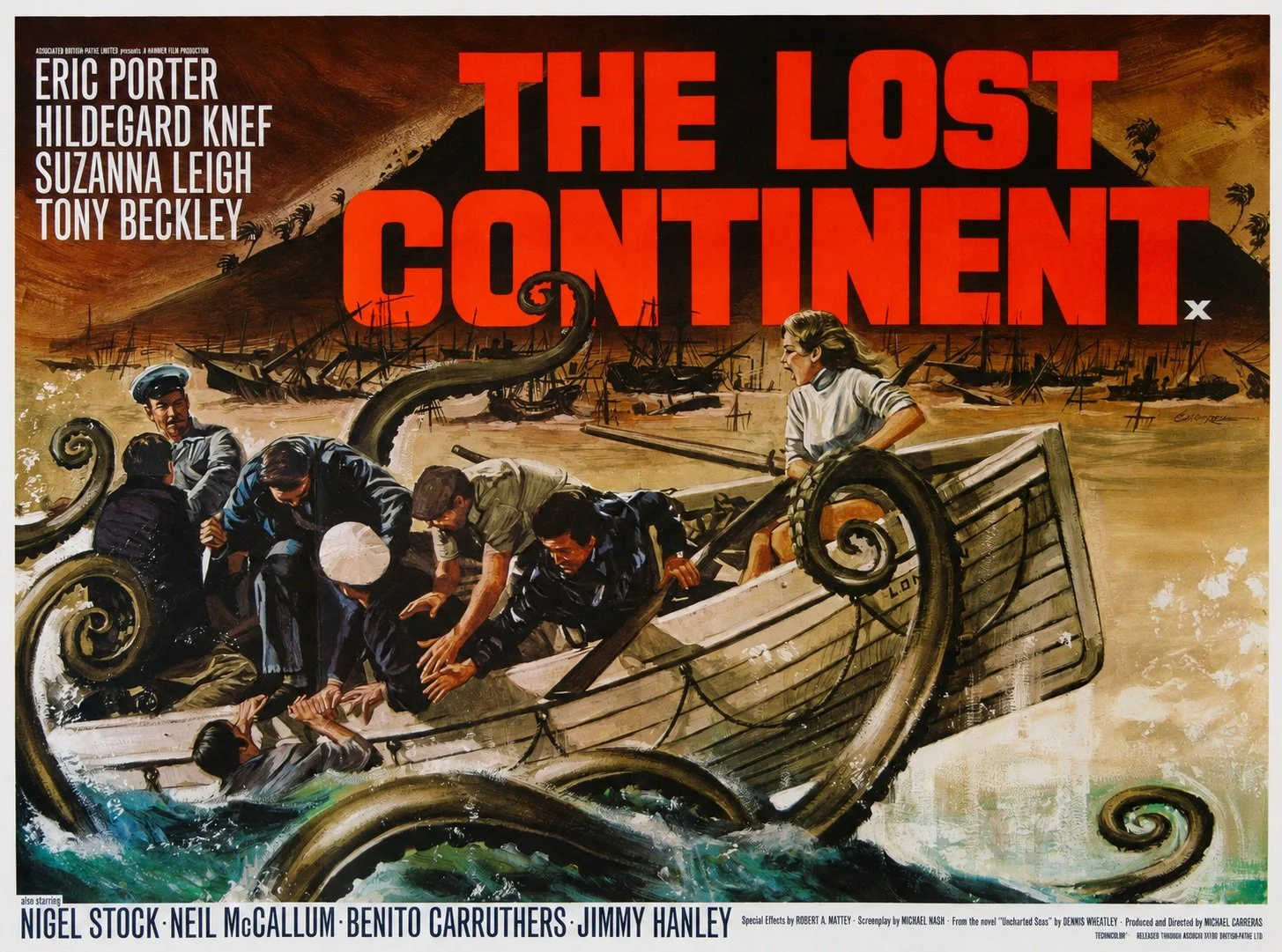
In 1968 the dilapidated freighter Corita hastily leaves Freetown to avoid a customs inspection. Captain Lansen (Eric Porter) has a cargo of dangerous explosives which he is smuggling so he can finally retire. His ship’s passengers also have reasons for leaving in a hurry. Dr. Webster (Nigel Stock), together with his daughter Unity (Suzanna leigh), is relocating due to his indiscretions with patients and illegal operations. Alcoholic pianist Harry Tyler (Tony Beckley) is aimlessly drifting from port to port. Eva Peters (Hildegard Knef) is fleeing from her husband with stolen bearer bonds which she intend to use to buy back her son from his evil clutches Caracas. Ricaldi (Ben Carruthers), a questionable lawyer, is pursuing Eva to retrieve the stolen bonds. First officer Hemmings (Neil McCallum) suggests that the ship should return to Freetown after an imminent Hurricane warning. The Captain asks the passengers and they are unanimous that they do not wish to return. However a mutinous crew, the bad weather and the instability of the explosives force everyone to abandon ship. The survivors find themselves adrift in a lifeboat surrounded by a strange carnivorous seaweed.
In 1968 the dilapidated freighter Corita hastily leaves Freetown to avoid a customs inspection. Captain Lansen (Eric Porter) has a cargo of dangerous explosives which he is smuggling so he can finally retire. His ship’s passengers also have reasons for leaving in a hurry. Dr. Webster (Nigel Stock), together with his daughter Unity (Suzanna leigh), is relocating due to his indiscretions with patients and illegal operations. Alcoholic pianist Harry Tyler (Tony Beckley) is aimlessly drifting from port to port. Eva Peters (Hildegard Knef) is fleeing from her husband with stolen bearer bonds which she intend to use to buy back her son from his evil clutches Caracas. Ricaldi (Ben Carruthers), a questionable lawyer, is pursuing Eva to retrieve the stolen bonds. First officer Hemmings (Neil McCallum) suggests that the ship should return to Freetown after an imminent Hurricane warning. The Captain asks the passengers and they are unanimous that they do not wish to return. However a mutinous crew, the bad weather and the instability of the explosives force everyone to abandon ship. The survivors find themselves adrift in a lifeboat surrounded by a strange carnivorous seaweed.
By the mid sixties Hammer Films had already an established track record of varying their cinematic output. Over the previous decade the studio had produced films from such genres as horror, psychological thrillers, historical action and even comedy. However, by 1968 mainstream cinema was changing and so Hammer Films decided to try and broaden its appeal. However, its experimentation was not always successful and at times fell between two stools. The Lost Continent is a prime example of this. It begins as a gritty drama with a captain taking a series of risks so he can retire and ship full of passengers who all have guilty secrets. Tension increases when the crew become mutinous over the illegal cargo and the news of an imminent storm. For the first 100 minutes the plot works quite well, despite the modest budget and the additional jazz material by Carlo Martelli which supplements the main score by Gerard Schürmann. Sadly, things all go awry when the monsters, killer seaweed and the Spanish Inquisition appear.
Based on the novel Uncharted Seas by Dennis Wheatley, director Michael Carreras (who also wrote the screenplay) strays from the source text and adds monsters as well as descendant of Spanish conquistadors to the proceedings. The film’s tonal shift in the final 40 minutes from nautical drama to monster movie is quite incongruous. There are moments of violence and implied sex but these elements are not consistent throughout the film. A shark attack results in a bloodless death, yet when a crew member falls into the carnivorous seaweed, the blood flows. These inconsistencies seem to indicate that director Michael Carreras had no clear vision for the production, although he did takeover directing from Leslie Norman. Most of the film’s budget seems to be spent on the ship sets and the 175,000 gallon water tank at Elstree Studios to shoot the exterior sea scenes. The miniatures by Cliff Richardson are good but Robert A. Mattey’s monster are poor due to financial constraints.
The Lost Continent is clearly not a family film considering some of the plots themes but the addition of monsters (which featured heavily in the marketing) would give potential viewers the idea that it was. Hence when it was distributed in the US, 8 minutes of material was excised, removing some of the implied sex scenes and dialogue alluding to adult themes. This material has been re-instated in the latest Blu-ray release. Critics at the time considered The Lost Continent to be an oddity. 58 years later, opinions have not greatly changed. The final act of the film where the crew of the Corita are attacked by descendants of the Spanish Inquisition who they subsequently defeat with their modern weapons, seems rushed and if it belongs in a totally different film. That being said, The Lost Continent is not a terrible film altogether with no redeeming qualities. But it is most definitely a mess. However, for the cinematically curious it may prove a fascinating mess.
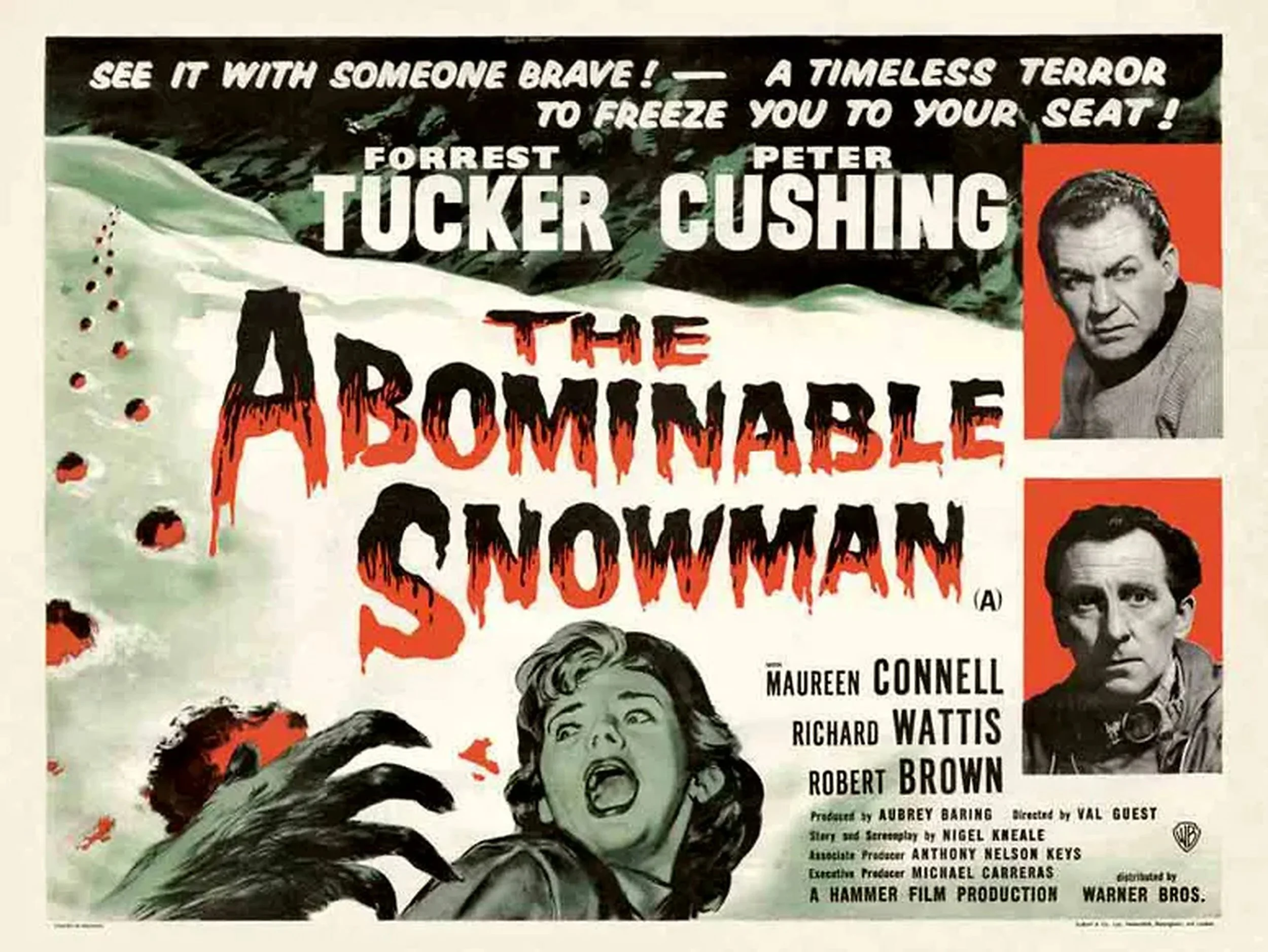
The Abominable Snowman (1957)
Despite being considered by many as an original story, The Abominable Snowman (1957) is in fact a remake of a made for television play, The Creature, that was originally broadcast in the UK in 1955. Hammer Films would often purchase the rights of popular TV programs and subsequently re-work them for mainstream, international cinema. Larger production budgets and fewer censorship restrictions allowed them to make their cinematic interpretations more lurid, thus commercially viable. Hence The Quatermass Xperiment, Quatermass II and Quatermass and the Pit were all given a big screen makeover and were commercially successful. The Abominable Snowman was written by acclaimed writer Nigel Kneale, who also wrote the original television drama and the aforementioned Quatermass trilogy. Although ostensibly marketed as a horror film this production is actually an interesting blend of psychological thriller and science fiction.
Despite being considered by many as an original story, The Abominable Snowman (1957) is in fact a remake of a made for television play, The Creature, that was originally broadcast in the UK in 1955.Hammer Films would often purchase the rights of popular TV programs and subsequently re-work them for mainstream, international cinema. Larger production budgets and fewer censorship restrictions allowed them to make their cinematic interpretations more lurid, thus commercially viable. Hence The Quatermass Xperiment,Quatermass II and Quatermass and the Pit were all given a big screen makeover and were commercially successful.The Abominable Snowman was written by acclaimed writer Nigel Kneale, who also wrote the original television drama and the aforementioned Quatermass trilogy. Although ostensibly marketed as a horror film this production is actually an interesting blend of psychological thriller and science fiction.
Dr. John Rollason (Peter Cushing), along with his wife Helen (Maureen Connell) and their assistant Peter Fox (Richard Wattis), are visiting the Lhama (Arnold Marlé) of the Rong-ruk monastery during a botanical expedition in the Himalayas. A second group of explorers, led by Tom Friend (Forrest Tucker) and including trapper Ed Shelley (Robert Brown), photographer Andrew McNee (Michael Brill), and Sherpa guide Kusang (Wolfe Morris), arrives at the monastery on a clandestine mission to discover the legendary Yeti, also known as the Abominable Snowman. Despite his wife’s concerns over his safety and the Lama’s objections, Rollason chooses to join Friend's expedition. While Rollason is driven by a scientific desire to discover more about the creature, Friend is motivated by the pursuit of fame and wealth, aiming to capture a live Yeti to showcase to the global media. As expedition progresses, it soon become apparent that they’re not alone.
Due to this bait and switch sales approach, especially in the US where the film was re-titled The Abominable Snowman of the Himalayas, the box office returns were disappointing. However, in recent years this film has been critically re-appraised. The dialogue driven screenplay is thought provoking, the black and white, anamorphic widescreen photography by Arthur Grant makes the production look far more expensive than it actually is and as ever, Peter Cushing’s performance does much of the heavy lifting. Yes, the story unfolds at a leisurely pace and despite being transplanted to the big screen, it is clear that this was originally a play. Yet viewers wanting a more thoughtful and atmospheric story, as opposed to the more graphic approach (for the times) that Hammer Films adopted the following years for The Curse of Frankenstein and Dracula, this production has such things in spades.
Clearly not a horror film in the traditional sense, is it appropriate to label The Abominable Snowman a creature feature? Possibly but not like Jaws or Grizzly. The Yetis in this film are peaceful, sentient creatures who live in parallel with humans. It is hinted that they have evolved mental faculties such as telepathy and are simply biding their time till humanity destroys itself. Each member of the exploration team ends up facing what they carry in their heart. Director Val Guest suspected that the cerebral plot was just too ahead of its time and not suitable for the cinematic market of the time. However, he Abominable Snowman has a far better chance of finding a welcoming audience these days, where its high concept plot will not be considered alien to viewers. Hammer Films forthcoming 4K restoration will no doubt prove a hit among film collectors who still favour physical media.
Wake Wood (2009)
Sometimes when making a film, less can indeed be more. Practical things like keeping the scope of your story simple, working within your budget and not feeling obliged to justify or explain every aspect of the plot can prove invaluable. If you can do all of these things with a robust cast, intelligent direction, while maintaining your viewers attention, then you have achieved something that many studios and independent filmmakers usually cannot do. Director David Keating has managed to do this with the 2009 horror film Wake Wood. Along with Brendan McCarthy who he co-wrote the screenplay with him, Wake Wood efficiently and charismatically tells its tale. It is well paced, with relatable characters and good performances. The atmosphere builds and there are some jolting moments of horror. Furthermore, it is both unusual and rewarding to see pagan rituals portrayed as an extension of rural life, in the same way as farming and animal husbandry. It is neither malevolent or benign but just an ever present force.
Sometimes when making a film, less can indeed be more. Practical things like keeping the scope of your story simple, working within your budget and not feeling obliged to justify or explain every aspect of the plot can prove invaluable. If you can do all of these things with a robust cast, intelligent direction, while maintaining your viewers attention, then you have achieved something that many studios and independent filmmakers usually cannot do. Director David Keating has managed to do this with the 2009 horror film Wake Wood. Along with Brendan McCarthy who he co-wrote the screenplay with him, Wake Wood efficiently and charismatically tells its tale. It is well paced, with relatable characters and good performances. The atmosphere builds and there are some jolting moments of horror. Furthermore, it is both unusual and rewarding to see pagan rituals portrayed as an extension of rural life, in the same way as farming and animal husbandry. It is neither malevolent or benign but just an ever present force.
Vet Patrick Daley (Aiden Gillen) and his wife Louise (Eva Birthistle), a pharmacist, move to the rural village called Wake Wood, after their daughter Alice (Ella Connolly) is mauled to death by a dog. Louise struggles to come to terms with her loss and the fact she can have no further children. One evening after their car breaks down, Patrick and Louise go to the nearby house of Patrick's veterinary colleague, Arthur (Timothy Spall), for assistance. Louise witnesses Arthur conducting a pagan ritual but says nothing to Patrick. Lousie becomes increasingly aware that something is not quite right with the village and that Arthur saw her observing the ritual. Soon afterwards a farmer is killed by his own bull while Patrick is tending to it. Horrified by another accidental death the couple plan to leave, but Arthur convinces them to stay. He claims he can bring their daughter back but only for three days and only if she has been dead for less than a year. The conflicted couple agree to his offer on the understanding that they must remain in Wake Wood forever.
If you are familiar with The Wicker Man, Don’t Look Now or any of the adaptations of Stephen King’s Pet Sematary then you’ll find several similar themes present in Wake Wood. This is a film about loss, how people cope with bereavement and what personal sacrifices you would make just to see your loved one again. Fortunately for such a character driven story, performances are universally good. Aiden Gillen is very plausible as a man throwing himself into his work to avoid his feelings. Eva Birthistle excels as a Mother who cannot move on after the death of her only child. Timothy Spall compliments the cast as retired veterinarian Arthur. He brings an air of normalcy to the pagan elements of the plot and his performance is quietly understated rather than overtly theatrical.The Irish setting and cultural heritage gives a uniquely Celtic feel to the proceedings and provides sufficient difference from other genre movies that have trodden a similar path. Overall, Wake Watch does not overreach itself and contains some rather flamboyant Fulci-eque violence to boot. Hence it is a superior genre movie. Competitors should take note.















The Man Who Could Cheat Death (1959)
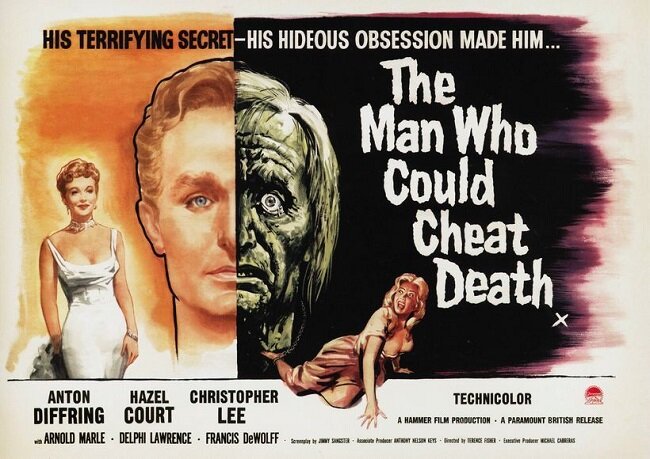
The stories of Hammer films “horsetrading” with the British Board of Film Censorship (as the BBFC were called at the time) make for some interesting reading. If you're interested in the history of the studio I thoroughly recommend the book A New Heritage of Horror: The English Gothic Cinema by David Pirie. However, the BBFC felt that they’d been hoodwinked after the release of The Curse of Frankenstein in 1957, which had managed to smuggle additional unpleasantries into the final theatrical edit. Henceforth the board took a more formidable stance when dealing with Hammer and all subsequent releases. Hence The Man Who Could Cheat Death feels somewhat tame compared to earlier Hammer films. Although cuts were made to the final edit of the movie, one gets the impression that maybe the more salacious and graphic content was possibly reduced when writing the screenplay. However, with that all said, The Man Who Could Cheat Death is still a handsome, performance driven Hammer horror.
The stories of Hammer films “horsetrading” with the British Board of Film Censorship (as the BBFC were called at the time) make for some interesting reading. If you're interested in the history of the studio I thoroughly recommend the book A New Heritage of Horror: The English Gothic Cinema by David Pirie. However, the BBFC felt that they’d been hoodwinked after the release of The Curse of Frankenstein in 1957, which had managed to smuggle additional unpleasantries into the final theatrical edit. Henceforth the board took a more formidable stance when dealing with Hammer and all subsequent releases. Hence The Man Who Could Cheat Death feels somewhat tame compared to earlier Hammer films. Although cuts were made to the final edit of the movie, one gets the impression that maybe the more salacious and graphic content was possibly reduced when writing the screenplay. However, with that all said, The Man Who Could Cheat Death is still a handsome, performance driven Hammer horror.
In 1890, Dr. Georges Bonnet (Anton Diffring) is the talk of the Parisian art scene due to his lifelike sculptures and his ongoing affair with his model Margo Philippe (Delphi Lawrence). At a party to unveil his latest work, Bonnet meets Dr. Pierre Gerrard (Christopher Lee) and his companion Janine Du Bois (Hazel Court). Janine had a torrid romance with Dr. Bonnet ten years ago in Italy. Against his better judgement Bonnet resumes his affair with Janine, although he refuses to explain why he vanished a decade prior. In the meantime, Bonnet awaits the arrival of his lifelong friend, Dr. Ludwig Weiss (Arnold Marlé) from Switzerland. Weiss is a pioneer in his medical field and Bonner is dependent upon him to perform a unique operation that he needs to stay alive. However, when Weiss finally arrives he has suffered a stroke and can no longer use his right hand. Perhaps Dr. Gerrard can be persuaded to perform the procedure. However, matters are further complicated not only by the love triangle between Bonner, Janine and Gerrard but by a visit from Inspector Legriss (Franics De Wolff), who is investigating the sudden disappearance of Margo Phillippe.
The Man Who Could Cheat Death is a typical Hammer production in so far as it is studio based with little or no exterior shots. The sets are suitably atmospheric and gothic, though some were redressed from the previous production, The Hound of the Baskervilles. Cinematographer Jack Asher used pastel coloured filters when lighting the more sinister scenes, especially when Dr. Bonnet is in his laboratory, drinking his elixir or suffering the ill effects of his medical condition. As ever with Hammer films, the lead cast do much to carry the plot and distract the viewer from the shortcomings of the screenplay. Sadly, as mentioned previously, the horror content is rather light in this film. Several murders happen either offscreen or with the killer blocking the audience's view. There was some additional nudity shot for the European and Asian markets but no such material made it into the UK and US release. The most ghoulish scene occurs at the film’s denouement and also features some interesting stunt work.
The Man Who Could Cheat Death is neither the best example of Hammer Film Productions output from the fifties nor the worst. Anton Diffring does well in the lead role which was originally intended for Peter Cushing. The film does not out stay its welcome with a running time of 83 minutes, although it is rather verbose with the emphasis upon narrative drama, rather than action. Naturally judged by today’s standards it is all rather tame but films such as this were causing quite a stir at the time and there was a lot of critical disdain for these lurid, technicolor horror stories. However Hammer chose to focus on the box office returns and so continued producing to a tried and tested formula. They had a knack for making their films look more sumptuous than they really were due to clever production design and inventive photography. They also new that sex sells and were not averse to focusing on the moral corruption that usually goes hand in hand with violence and horror.
The Reptile (1966)
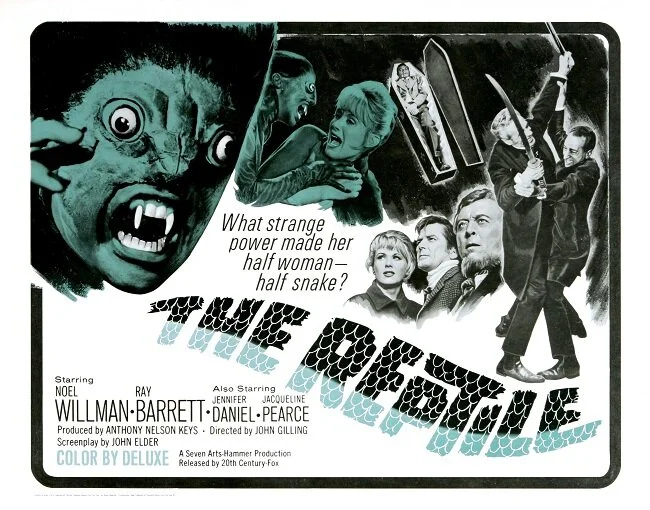
After his brother Charles dies in mysterious circumstances, Harry Spaulding (Ray Barrett) inherits his cottage in the Clagmoor Heath, Cornwall. He quickly moves in with his new bride, Valerie (Jenifer Daniel), with a view to finding out what happened. However, he is shunned by the locals apart from the village publican, Tom Bailey (Michael Ripper), who befriends him. The only other resident in the vicinity of the cottage is Dr. Franklyn (Noel Willman), the owner of the nearby Well House. He lives with his daughter Anna (Jacqueline Pearce), who is attended by a silent Malay servant (Marne Maitland). Anna is a strange girl who seems to be harbouring a secret. Her father treats her contemptuously and does his utmost to keep her confined to Well House. When the local village eccentric, Mad Peter (John Laurie), dies in a similar fashion to Charles Spaulding, both Harry and Tom decide to take matters into their own hands and to investigate further.
After his brother Charles dies in mysterious circumstances, Harry Spaulding (Ray Barrett) inherits his cottage in the Clagmoor Heath, Cornwall. He quickly moves in with his new bride, Valerie (Jenifer Daniel), with a view to finding out what happened. However, he is shunned by the locals apart from the village publican, Tom Bailey (Michael Ripper), who befriends him. The only other resident in the vicinity of the cottage is Dr. Franklyn (Noel Willman), the owner of the nearby Well House. He lives with his daughter Anna (Jacqueline Pearce), who is attended by a silent Malay servant (Marne Maitland). Anna is a strange girl who seems to be harbouring a secret. Her father treats her contemptuously and does his utmost to keep her confined to Well House. When the local village eccentric, Mad Peter (John Laurie), dies in a similar fashion to Charles Spaulding, both Harry and Tom decide to take matters into their own hands and to investigate further.
Filmed simultaneously with The Plague of Zombies with which it shared several sets, The reptile is a slower paced, more thoughtful film that prefers to focus on the psychological collapse of its central characters, rather than set pieces. It is one of the best Hammer movies from the sixties which blends traditional horror elements with more mainstream period costume dramas. The production design is stylish and captures the atmosphere of a claustrophobic Cornish village. The interiors of Well House are an interesting juxtaposition to this, with Dr. Franklyn’s exotic flowers and penchant for Indian culture. As for the Reptile makeup by Roy Ashton, it works well by the standards of the time. Director John Gilling wisely keeps scenes featuring the transformed Anna, to a minimum and lights them favourably. Another ghoulish embellishment is the way the victims turn black and purple after being bitten.
However, it is the central performance by Jaqueline Pearce which is the standout feature of The Reptile. She gives a haunting performance often relying purely on her demeanour, rather than dialogue to express her torment. Noel Willman, who was a substitute for Peter Cushing, is also notable as Anna’s guilt wracked father. He is the architect of both his own and his daughter’s ruin while also being a victim of her curse. Another enjoyable aspect of The Reptile is seeing Hammer stalwart Michael Ripper in an expanded role and not meeting a grisly demise. Sadly, some cuts originally made to the film by the BBFC for its theatrical release, still persist and the material has not been found or restored to the current Blu-ray release. Yet The Reptile remains a superior example of Hammer’s work from this era, before they felt compelled to make their content more salacious to stay competitive.
The Satanic Rites of Dracula (1973)
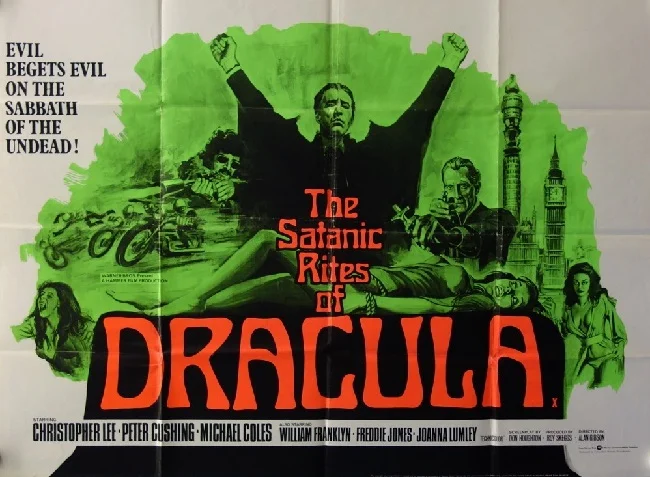
The horror movie genre was changing rapidly in the late sixties and seventies, with films such as the Night of the Living Dead and Rosemary’s Baby moving away from traditional gothic settings and proving to be box office successes. After the success of Count Yorga, Vampire, a movie set in 1970s Los Angeles, Warner Bros commissioned Hammer Films to make two contemporary set Dracula films. The first of these was Dracula A.D. 1972. The film was loosely inspired by the Highgate Vampire case and proved to be moderately successful at the box office. The second being The Satanic Rites of Dracula; a curious hybrid vampire movie that mixes elements of the espionage genre along with traditional Hammer horror content. Sadly, this final outing for both Peter Cushing and Christopher Lee as Van Helsing and Dracula, was not well received by the public and has subsequently been written off in the annals of Hammer Films. Yet despite it’s flaws it does have a few points of interest to the more rigorous horror fan. The recent Blu-ray release via the Warner Archive Collection presented such an opportunity for reappraisal.
The horror movie genre was changing rapidly in the late sixties and seventies, with films such as the Night of the Living Dead and Rosemary’s Baby moving away from traditional gothic settings and proving to be box office successes. After the success of Count Yorga, Vampire, a movie set in 1970s Los Angeles, Warner Bros commissioned Hammer Films to make two contemporary set Dracula films. The first of these was Dracula A.D. 1972. The film was loosely inspired by the Highgate Vampire case and proved to be moderately successful at the box office. The second being The Satanic Rites of Dracula; a curious hybrid vampire movie that mixes elements of the espionage genre along with traditional Hammer horror content. Sadly, this final outing for both Peter Cushing and Christopher Lee as Van Helsing and Dracula, was not well received by the public and has subsequently been written off in the annals of Hammer Films. Yet despite it’s flaws it does have a few points of interest to the more rigorous horror fan. The recent Blu-ray release via the Warner Archive Collection presented such an opportunity for reappraisal.
The Satanic Rites of Dracula is a direct sequel to Dracula A.D. 1972. There is a degree of continuity with both characters and cast. Peter Cushing returns as Lorrimer Van Helsing, as does Michael Coles as Inspector Coles. Joanna Lumley replaces Stephanie Beecham as Jessica Van Helsing. Furthermore, the two movies are directed by Alan Gibson and written by Don Houghton. In an unusual twist the film starts very much as a spy drama, with a secret service agent escaping from the country mansion Pelham House, where cabinet ministers, industrialists and military chiefs indulge in satanic rites. Department head, Colonel Mathews (Richard Vernon) and Secret Service agent Torrence (William Franklyn) fear a major political scandal as well as foreign espionage. Due to the sensitivity of the situation they seek outside help from Special Branch Inspector Coles, who urges them to consult with occult expert Lorrimer Van Helsing. Investigations reveal that a leading scientist Julian Keeley (Freddie Jones) is also involved in the cult and that he is developing a deadly plague virus for the recluse business moghul, D. D. Denham.
The Satanic Rites of Dracula struggles to find its niche as the story veers between genres. Count Dracula doesn’t appear until thirty minutes into the movie and the screenplay is somewhat at a loss as to what to do with him, once he does. The story hinges upon the count having a curious existential crisis and tiring of his undead existence, hence the creation of a plague that will kill all life on earth, leaving him without any prey. It’s an interesting idea but one that is left underdeveloped. As for the horror elements of the film they’re somewhat modest. There are two staking scenes involving female vampires; one of which is now fully restored in the new Blu-ray copy. The remainder of the action is mainly shootouts with the curiously dressed security guards of Pelham house. They sport Afghan Waistcoats and Mauser pistols. Like most Hammer films from this period there’s a lot of cleavage and nudity to bolster the horror elements. Dracula’s demise at the end is suitably creative involving a Hawthorn bush and a picket fence. Les Bowie’s special effects are still enjoyable although far from sophisticated.
However, despite the vagueness of the script and the rather limited scope of action, there are still aspects to enjoy in The Satanic Rites of Dracula. The scenes between Peter Cushing and Freddie Jones are great, demonstrating that even with material as thin as this, both actors can hold the audience’s attention. The chemistry between Cushing and Lee is also present in the film denouement. The contemporary location scenes showing London in 1973 are also a source of interest. The car chase provides glimpses of The Strand and parts of Kensington, all of which have now been heavily redeveloped. But where this movie may appeal to the horror aficionado who has an abiding love with Hammer Films, you can objectively see why it failed at the box office. The studios attempt to move with the time are mainly superficial and beyond this, the film is just doing the same things as its predecessors. Furthermore, Christopher Lee had tired of the role of Dracula and so this was his final appearance as the iconic count for Hammer Films. Later in 1973, The Exorcist would change the horror genre completely, consigning the studio to further decline and inevitable closure. Hence, The Satanic Rites of Dracula was another nail in the coffin for Hammer’s Dracula franchise and a text book example of failing to move with the times.
The Woman in Black (2012)
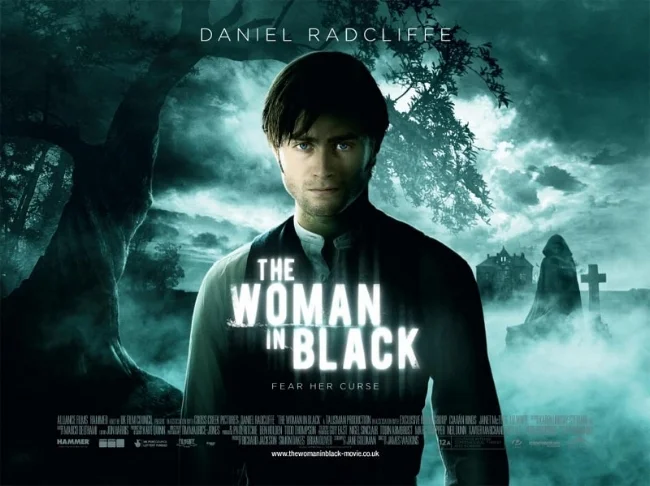
James Watkins’ 2012 adaptation of The Woman in Black is quite a radical adaptation of Susan Hill’s story, yet it still manages to remain true to its central themes. Jane Goldman of Kick-Ass, X-Men: First Class fame, has crafted a screenplay which is both innovative yet strangely traditional. She boldly revises the central character from contented husband to desolate widower; a move that adds a very bleak under current to the story. The more ghoulish elements of the narrative have been greatly enhanced and the film works the best when the eponymous character makes an appearance via jump scares. Despite a modest budget of $15 million, The Woman in Black went to make over $127,730,736 worldwide making it the most financially successful British horror film in 20 years.
James Watkins’ 2012 adaptation of The Woman in Black is quite a radical adaptation of Susan Hill’s story, yet it still manages to remain true to its central themes. Jane Goldman of Kick-Ass, X-Men: First Class fame, has crafted a screenplay which is both innovative yet strangely traditional. She boldly revises the central character from contented husband to desolate widower; a move that adds a very bleak under current to the story. The more ghoulish elements of the narrative have been greatly enhanced and the film works the best when the eponymous character makes an appearance via jump scares. Despite a modest budget of $15 million, The Woman in Black went to make over $127,730,736 worldwide making it the most financially successful British horror film in 20 years.
The biggest asset and potentially the biggest stumbling block for The Woman in Black upon its release was the casting of Daniel Radcliffe. Could the actor make a credible transition into adult roles and leave the emotional baggage of his cinematic past behind him? For me, the answer is a definite yes. He is pleasantly plausible as the young lawyer, Arthur Kipps, mourning the recent loss of his wife and struggling with his relationship with his only child. Commissioned to administer the estate of Eel Marsh, he soon experiences supernatural goings on at house and finds a local village consumed with fear over an unusually high child death rate. Considering his performance is geared to be predominantly reactive to his surroundings, he acquits himself well.
There is a strong supporting cast, with Ciarán Hinds as Sam Daily, a local landowner who strives to rationalise the ongoing events until it becomes impossible to reject their true cause. His wife played by Janet McTeer, convincingly depicts a fey and traumatised mother. The production design follows in the Hammer tradition of appearing sumptuous irrespective of the budget and the cinematography of Tim Maurice-Jones is exceptionally atmospheric. One of the strongest assets of The Woman in Black is that it is maintains a pervasive atmosphere of disquiet. Director Watkins creates an unsettling atmosphere that is cleverly punctuated with the jolts the genre requires. In his previous film Eden Lake he showed a great understanding of the threat of violence, a skill he refines here using terror and discord instead.
The only minor misstep The Woman in Black makes is its ending, which revises the books original nihilistic outcome and offers a more redemptive conclusion. It’s still a stark ending to the story but it offers a degree of hope and emotional closure. Perhaps the producers felt this alteration would make the film more marketable for the international market. Certainly, the casting of Daniel Radcliffe did attract a younger demographic and the consensus was that an excessively downbeat ending my not be viable for such an audience. However, this tonal change, it is certainly not enough to spoil the proceeding hour and a half, which provides exactly the sort of thrill and shocks that movies of this idiom should do. Furthermore, the critical and popular success of The Woman in Black has most certainly helped make the Hammer brand accessible to a new audience. Let us hope the production company continue to produce films of this calibre.
The Terror of the Tongs (1961)
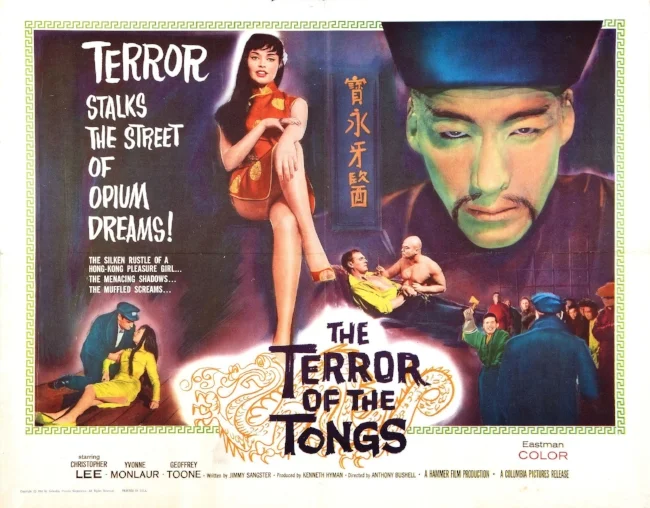
In 1910, Hong Kong is in the grips of the powerful Red Dragon tong, a secret society that extorts revenue from merchant seamen, deals in both opium and slave trades and savagely slaughters all those who offer opposition. A merchant sailor, Captain Jackson (Geoffrey Toone), swears revenge on the nefarious clan after they brutally murder his first officer and daughter. Hammer's The Terror of the Tongs strives to offer a lurid period drama but falls somewhat short of the mark due to a clumsy script, an indifferent hero and a conspicuous lack of authentic Asian actors. Apart from Burt Kwouk, most of the cast are Europeans sporting rather poor prosthetics. Christopher Lee manages to bluff his way through his role as Tong leader Chung King, through the force of his acting skills. French actress Yvonne Monlaur (Brides of Dracula) is not as successful as a mixed raced serving girl.
In 1910, Hong Kong is in the grips of the powerful Red Dragon tong, a secret society that extorts revenue from merchant seamen, deals in both opium and slave trades and savagely slaughters all those who offer opposition. A merchant sailor, Captain Jackson (Geoffrey Toone), swears revenge on the nefarious clan after they brutally murder his first officer and daughter. Hammer's The Terror of the Tongs strives to offer a lurid period drama but falls somewhat short of the mark due to a clumsy script, an indifferent hero and a conspicuous lack of authentic Asian actors. Apart from Burt Kwouk, most of the cast are Europeans sporting rather poor prosthetics. Christopher Lee manages to bluff his way through his role as Tong leader Chung King, through the force of his acting skills. French actress Yvonne Monlaur (Brides of Dracula) is not as successful as a mixed raced serving girl.
However despite its shortcomings The Terror of the Tongs is still somewhat entertaining with its highly stylised view of the Chinese underworld. Frankly expecting anything like historical accuracy from such a studio as Hammer is a mistake. They were far more focused on shock, titillation and appealing to adult audiences baser needs. Thus we have a rather sixties interpretation of what an early twentieth century gambling den looks like. Also the violent activities of the Tongs are somewhat understated. Merchants have their fingers cut off with hatchets while others that cross the Red Dragon are stabbed but it is far from graphic. Indeed the infamous bone scraping torture scene in which Milton Reid uses long needles to inflict pain upon an incapacitated hero is very restrained, resulting mainly in reaction shots.
As ever with Hammer movies, The Terror of the Tongs benefits greatly from a set design that implies a far more lavish production. Despite being very studio bound, the movie has an engaging production design bolstered by a few robust matte paintings to make the dock sequences more credible. James Bernard's score is evocative as well as exciting and brings a degree of polish to the proceedings. Hammer continued to make several more of these historical dramas in parallel to their established horror franchises over the years and they often made for a welcome alternative to the restrictions of the Gothic Horror genre. The Terror of the Tongs is a somewhat workman like entry in Hammer's back catalogue and is more than likely of interest to the fans of the studio rather than casual viewers.
Dracula (1958)
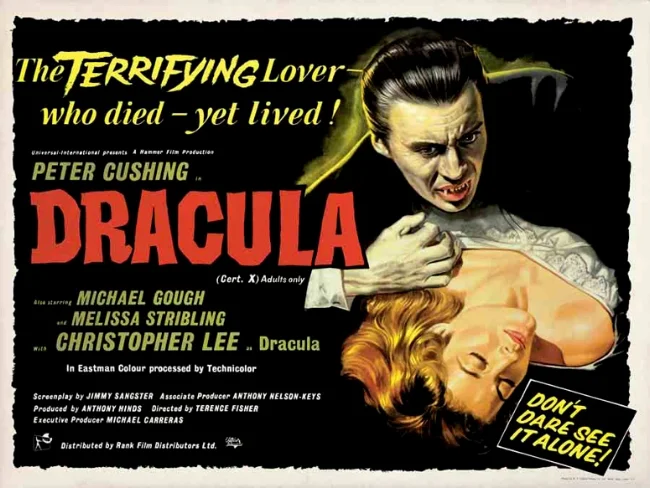
Following the 2012 restored release of The Curse of Frankenstein, Hammer, Icon Film Distribution and Lionsgate jointly produced a Blu-ray restoration of another British classic. This time it was the 1958 version of Dracula directed by Terence Fisher. This is one of Hammer's finest films and not only gets a superb High Definition transfer but also sees the restoration of two lost scenes. Dracula literally re-invented the horror genre and the depiction of vampires in film. It also established the studio as a key player within the industry and made international stars of Peter Cushing and Christopher Lee. This new restoration finally does justice to the source material presenting it as it deserves to be seen.
Following the 2012 restored release of The Curse of Frankenstein, Hammer, Icon Film Distribution and Lionsgate jointly produced a Blu-ray restoration of another British classic. This time it was the 1958 version of Dracula directed by Terence Fisher. This is one of Hammer's finest films and not only gets a superb High Definition transfer but also sees the restoration of two lost scenes. Dracula literally re-invented the horror genre and the depiction of vampires in film. It also established the studio as a key player within the industry and made international stars of Peter Cushing and Christopher Lee. This new restoration finally does justice to the source material presenting it as it deserves to be seen.
The release contains two versions of the film, both of which can be accessed via seamless branching on the Blu-ray disc. There is the 2007 BFI restoration plus the new 2012 Hammer restoration, which adds additional footage that has been unavailable for decades, as well as the original UK title card. The additional footage comprises two of the scenes that were originally censored by the BBFC in 1958. The material was restored to the film from the infamous “Japanese reels” validating the long-held notion that more explicit prints existed for the far eastern market. The scenes depict Dracula’s seduction of Mina, which was considered too overtly sexual for the times. Then there is the infamous face clawing scene from Dracula’s final demise.
The film also boasts an outstanding commentary track from Hammer historian Marcus Hearn and author and critic Jonathan Rigby. For those who have an interest in Hammer Studios or cinema in general this is an extremely informative and enjoyable narrative. Both speakers have a wealth of interesting and relevant anecdotes. They offer a keen insight into the British film industry of the time and its relationship with the BBFC and the press. There is also an excellent discussion of each actors respective acting techniques. As a result I learned of Peter Cushing's famous finger acting; the repeated gesture of raising his index finger to emphasise an important point. I will always look out for it now.
Dracula is a vibrant, beautifully constructed movie with intelligent performances and a literate screenplay. The production design is outstanding as is the lush cinematography. The proceedings are further embellished by James Bernard's dramatic score which compliments the tense atmosphere and bouts of horror. It should be noted that what was once considered to be a pushing the boundaries of what was acceptable within the confines of a "X" certificate, now merits a more sedate "12" rating from the BBFC. Certainly Dracula will strike some people as being somewhat tame by today's standards. However if it viewed with an appropriate sense of historical context, Dracula is a fine example of British cinema at its best.
The Curse of Frankenstein (1957)
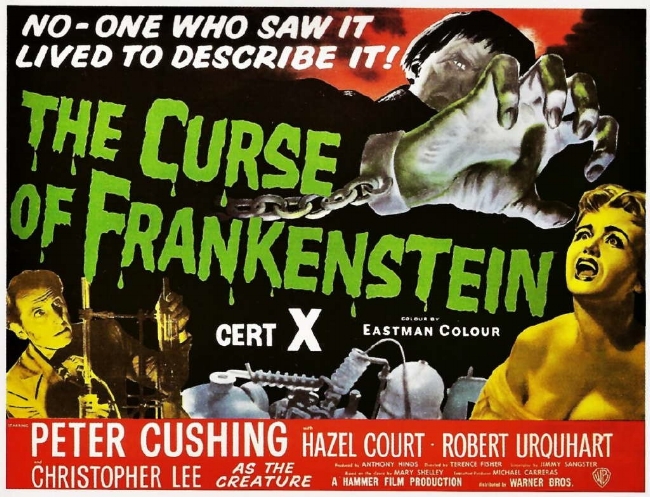
The 2012 Blu-ray release of Hammer Studio's The Curse of Frankenstein is a visual delight. The use of Eastman colour and the outstanding cinematography by Jack Asher are sumptuous and the new restoration does the film justice. This unique British horror movie introduced a new visceral style and brooding quality to the genre back in 1957. Despite a modest budget the creative production design evokes a truly Gothic horror atmosphere. The studio also introduced graphic violence along with a strong undercurrent of sexuality. These lurid aspects of the film proved particularly successful with the post war audience and became an integral part of the marketing campaign.
The 2012 Blu-ray release of Hammer Studio's The Curse of Frankenstein is a visual delight. The use of Eastman colour and the outstanding cinematography by Jack Asher are sumptuous and the new restoration does the film justice. This unique British horror movie introduced a new visceral style and brooding quality to the genre back in 1957. Despite a modest budget the creative production design evokes a truly Gothic horror atmosphere. The studio also introduced graphic violence along with a strong undercurrent of sexuality. These lurid aspects of the film proved particularly successful with the post war audience and became an integral part of the marketing campaign.
Previous versions of Frankenstein have tended to depict the Baron as misguided and ultimately overwhelmed with the magnitude his endeavours. Peter Cushing’s charming, obsessed and menacing Victor Frankenstein is an unusual and far more interesting exploration of the role. He seduces the maid, betrays his wife and blackmails his best friend Paul Krempe (Richard Urquhart). He is a far from a sympathetic character yet despite all this, Cushing still manages to make the audience pity him at the end. There is also an extraordinary performance from Christopher Lee, as the “monster”. Despite having no dialogue and little character development he still manages to convey an air of despair and confusion.
Some aspects of The Curse of Frankenstein have nominally dated. There is a tendency towards melodrama and the pace is somewhat leisurely but it’s still a potent and morally ambiguous film. It has a dour and morbid tone to it, which is reflected in the way it handles scenes of horror. The removal and disposal of a head in acid, along with the purchase of human eyeballs from morgue are depicted in a somewhat clinical and ghoulish manner rather than sensational. What The Curse of Frankenstein ultimately achieved was establish a clear blue print for future Hammer horror movies. They may well have become more explicit and lurid overtime but they always managed to maintain a degree of class. It was a winning formula that changed the genre permanently.
In the year 1860, Baron Victor Frankenstein (Peter Cushing) faces execution by guillotine for the murders perpetrated by the creature he created. With the assistance of a hunchback named Karl (Oscar Quitak) he avoids death by beheading the priest who came to give him the last rites. The priest’s body is then mistakenly buried by the authorities. Three years later, Victor, now using the name Doctor Stein, has established himself as a prosperous physician in Karlsbrück, serving both affluent patients and the poor at a paupers’ hospital. Hans Kleve (Francis Matthews), a junior member of the medical council, recognises Victor and being an admirer, seeks to become his apprentice. Victor and Hans then undertake an experiment to transplant Karl’s living brain into a new, more refined body, rather than a grotesque monstrosity the Baron has previously made. Karl is eager to have a new healthy body, especially after encountering Margaret Conrad (Eunice Gayson), the charming new assistant at the hospital.