
Conan the Barbarian (2011)
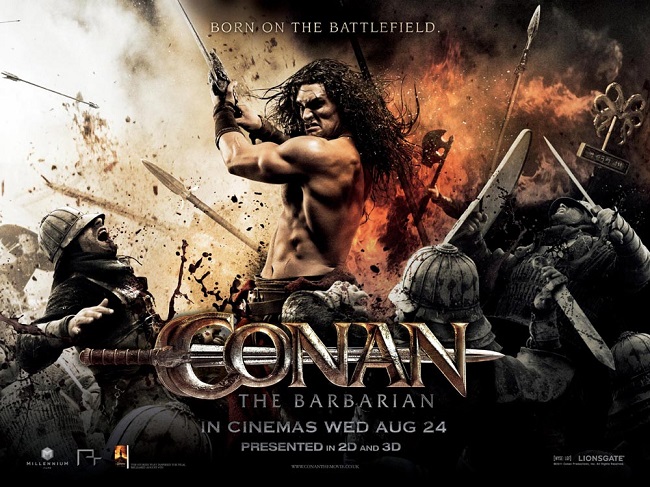
On a superficial level the 2011 Conan reboot provides two hours of blood and thunder. For those who are seeking a quick fix of such material and are not burdened by a strong affiliation to Robert E. Howard’s source material, this will prove adequate. I suspect that Marcus Nispel’s offering will find a home with a younger audience. For purists or those who have fond memories of John Milius’ 1982 version, then this is not the film you are looking for. Move along. But to be honest after watching the various trailers that preceded this release and considering the directors track record, does this really come as any surprise? For those with a longer memory, cast you mind back to Nispel’s Viking versus Indian outing from 2007. Pathfinder was a high concept movie that was chronically mishandled.
On a superficial level the 2011 Conan reboot provides two hours of blood and thunder. For those who are seeking a quick fix of such material and are not burdened by a strong affiliation to Robert E. Howard’s source material, this will prove adequate. I suspect that Marcus Nispel’s offering will find a home with a younger audience. For purists or those who have fond memories of John Milius’ 1982 version, then this is not the film you are looking for. Move along. But to be honest after watching the various trailers that preceded this release and considering the directors track record, does this really come as any surprise? For those with a longer memory, cast you mind back to Nispel’s Viking versus Indian outing from 2007. Pathfinder was a high concept movie that was chronically mishandled.
This re-imagining loosely draws upon Robert E. Howard’s source material, as well as Schwarzenegger’s Conan. It is the opening scenes focusing on Conan’s youth which are the most engaging, from a narrative and character development stance. The brief insight into Cimmerian warrior culture makes for a strong start. But immediately after the death of Conan’s Father (Ron Perlman) it all lapses into by the numbers story telling. Evil Khalar Zym (Stephen Lang) along with sorceress daughter Marique (Rose McGowan), seek an ancient relic to facilitate their fiendish (and formulaic) plans. Throw in a plucky warrior monk named Tamara (Rachel Nichols) and the generic story is complete. Conan’s motivation is purely one of revenge, but without the philosophical musings of Schwarzenegger’s. Jason Momoa has sufficient charm and presence to hold an audience, but the character has none of the depth you would hope.
The film clearly fails at script level. Jason Momoa’s mono-syllabic dialogue is purely reactive, serving as nothing more than an expositionary device. It is also delivered in a contemporary fashion. Nothing kills immersion for me more than period set dramas (be they based in fact or fantasy) utilising current American parlance. Potentially interesting characters are also neglected and given little to do. Rachel Nichols is introduced as a strong female lead but is sidelined as a damsel in distress rather quickly. Both Stephen Lang and Rose McGowan fail to deliver a good performance and maintain their evil nemesis roles purely by dint of the characters they have been assigned. Yet there is the scope for their curious and dysfunctional relationship to have been so much more.
What is so obviously lacking in this cinematic outing is depth. Can movies such as this have any, I hear you ask? Of course they can. Milius explored the nature of revenge and imbued his take on Conan with a Nietzschean subtext. Furthermore, Howard's original work has a multitude of themes and is not simply the pulp fiction it has been glibly labelled over the years. But director Marcus Nispel simply refuses to look beyond two-dimensional, cause and effect structure of the story. His Conan, although personable, has no dignity or nobility. Momoa is brooding but beyond his obvious vengeful motivation, he has few of the qualities of his literary namesake. It seems that the film makers only see the central character as an efficient killing machine and that's what they have brought to the screen.
Subsequently, Conan the Barbarian is totally the sum of its parts. As those respective parts are bland, hollow and uninspired, that is exactly the sort of movie that you get. For those seeking violence and bloodshed, then Conan the Barbarian can provide such commodities. However, it is subject to an excess of CGI and contemporary editing techniques that rob the action scenes of any sense of wonder. Compare them to the physical effects and sword play of the 1982 movie and the difference is obvious. The sequences with the sand spirits and under water creature, along with the films climax fail to offer any real tension. Again, they seem like a dislocated FX show reel that was added by the most economic bidder for the contract.
If Conan the Barbarian had simply been marketed under a different title and not linked to the franchise, perhaps critics would have been more forgiving. Had it just been “Wolgang Rippling Buttocks and the Sword of Kagnazax”, then it may well have been deemed acceptable. However, as it fails so notably to do any justice to Robert E. Howard’s work, it quite rightly merits harsher criticism. Furthermore, the point of failure is abundantly apparent. Director Nispel and the screen writers Thomas Dean Donnelly, Joshua Oppenheimer and Sean Hood are simply not up to the job. They fail to understand the philosophy of Conan and focus purely on spectacle and pandering to ill-conceived market research. The most depressing aspect of this is the fact that the box office failure of the film has pretty much ended any chance for a further reboot by more competent film makers.


Conan the Barbarian (2011)
On a superficial level the 2011 reboot of Conan the Barbarian provides two hours of perfunctory blood and thunder. For those seeking a quick fix of such material, who aren’t burdened by a strong affection of Robert E. Howard’s source material, the film will prove adequate. I suspect that Marcus Nispel’s offering will find a home with a younger viewers. Sadly, with regard to purists or those who have fond memories of John Milius’s 1982 version, then this is not the film you are looking for. Move along. To be honest, considering the directors track record, does this really come as any surprise? For those with a long memory, cast you mind back to Nispel’s 2007 movie Pathfinder. That Vikings versus Native Americans high concept movie had a lot of potential but was sadly chronically mishandled.
On a superficial level the 2011 reboot of Conan the Barbarian provides two hours of perfunctory blood and thunder. For those seeking a quick fix of such material, who aren’t burdened by a strong affection of Robert E. Howard’s source material, the film will prove adequate. I suspect that Marcus Nispel’s offering will find a home with a younger viewers. Sadly, with regard to purists or those who have fond memories of John Milius’s 1982 version, then this is not the film you are looking for. Move along. To be honest, considering the directors track record, does this really come as any surprise? For those with a long memory, cast you mind back to Nispel’s 2007 movie Pathfinder. That Vikings versus Native Americans high concept movie had a lot of potential but was sadly chronically mishandled.
This re-imagining of Conan loosely draws upon Robert E. Howard’s source material, as well as Schwarzenegger’s portrayal. The opening scenes focusing on Conan’s youth are by far the most engaging. They make an attempt at a narrative and character development. The brief insight into Cimmerian warrior culture makes for a strong start. But immediately after the death of Conan’s Father (Ron Perlman) it all lapses into by the numbers story telling. Evil Khalar Zym (Stephen Lang) along with sorceress daughter Marique (Rose McGowan), seek ancient an relic to facilitate their fiendish (and formulaic) plans. Throw in a plucky warrior monk named Tamara (Rachel Nichols) and the generic story is complete. Conan’s motivation is purely one of revenge but without the philosophical musings of the 1982 movie. Jason Momoa has sufficient charm and presence to hold an audience but the screenplay offers his character none of the depth you would hope.
Ultimately it is the script which lets the movie down. Jason Momoa’s mono-syllabic dialogue is purely reactive, serving as nothing more than an expositionary device. It is also delivered in a contemporary fashion. Nothing kills immersion for me more than period set dramas (be they based in fact or fantasy) utilising contemporary American parlance. Furthermore, potentially interesting characters are neglected and given little to do. Rachel Nichols is introduced as a strong female lead but is quickly sidelined as a damsel in distress. Both Stephen Lang and Rose McGowan fail to engage as antagonists. Both characters establish their evil nemesis credential simply by doing bad things. It’s a shame as their curious and dysfunctional relationship had scope to be far more interesting.
Overall Conan the Barbarian is totally the sum of its parts. And as those respective parts are bland, hollow and uninspired, that’s exactly the sort of movie that you get. For those just seeking some casual violence and bloodshed, then Conan the Barbarian may well prove sufficient. However, it is subject to an excess of CGI like so many films these days and the contemporary editing techniques rob the action scenes of any sense of wonder. The sequences with the sand spirits and under water creature, along with the films climax, fail to offer any real tension. Compared to the physical effects and sword play of the 1982 movie, this reboot simply can’t compete. When will those crafting action scenes learn that real threats, be they physical stunts or monsters that actually interact with actors, are infinitely superior to post production eye candy.
If Conan the Barbarian had simply been marketed under a different title and not linked to the franchise, perhaps critics would have been more forgiving. Had it just been “Wolgang Rippling Buttocks and the Sword of Kagnazax”, then it may well have been deemed acceptable. However, as it fails so notably to do any justice to Robert E. Howard’s work, it quite rightly merits harsher criticism. Furthermore, the points of failure are abundantly apparent. Director Nispel and the screen writers Thomas Dean Donnelly, Joshua Oppenheimer and Sean Hood are simply not up to the job. As a result, I think they may well have killed off any studio interest in this intellectual property for the immediate future
Classic Movie Themes: Conan the Barbarian
A well written film soundtrack does more than simply embellish the on-screen imagery. It permeates the very fabric of the film and becomes character itself, adding emotional content and driving forward the narrative. However, there is a fine line between enhancing the pace and atmosphere of a film and simply "telegraphing" imminent events in a melodramatic fashion. The score for Conan The Barbarian by the late Basil Poledouris is a rare example of the former and in itself totally sublime. Using the traditional style of the "leitmotif", a ninety-piece orchestra and twenty four voice choir, Poledouris creates "a continuous musical drama" that has now entered the pantheon of classic modern film scores.
A well written film soundtrack does more than simply embellish the on-screen imagery. It permeates the very fabric of the film and becomes character itself, adding emotional content and driving forward the narrative. However, there is a fine line between enhancing the pace and atmosphere of a film and simply "telegraphing" imminent events in a melodramatic fashion. The score for Conan The Barbarian by the late Basil Poledouris is a rare example of the former and in itself totally sublime. Using the traditional style of the "leitmotif", a ninety-piece orchestra and twenty four voice choir, Poledouris creates "a continuous musical drama" that has now entered the pantheon of classic modern film scores.
The opening credits of 1982 movie directed by John Milius, (infinitely superior to the 2011 reboot) depicts Conan's Father forging a sword and establishes the central plot device regarding the "Riddle of Steel." The sequence is beautifully complemented by Basil Poledouris's intense and bombastic title theme, the "Anvil of Crom". It is a powerful piece played by twenty French horns, strings and timpani and sets the tone eloquently for the remainder of the film. According to Poledouris, Milius envisioned Conan as an opera with very little or no dialogue. The movie therefore has musical accompaniment for most of its two hour plus running time.