
Music by John Williams (2024)
Music by John Williams is a documentary celebration of the famous composer and his illustrious body of work. It provides some interesting biographical background information as to how the man was born into a family of talented musicians. It then traces his rise from pianist for hire to the most well known film composer today. Along the way, anyone who is anyone in film and music appears to heap justifiable praise upon him and his body of work. It also features a continuous medley of John Williams’ greatest hits, as it catalogues his work in broadly chronological order. Music by John Williams is an upbeat and positive love letter to the composer and exactly what you would expect, when you consider that the documentary was produced by his friends and peers.
Music by John Williams is a documentary celebration of the famous composer and his illustrious body of work. It provides some interesting biographical background information as to how the man was born into a family of talented musicians. It then traces his rise from pianist for hire to the most well known film composer today. Along the way, anyone who is anyone in film and music appears to heap justifiable praise upon him and his body of work. It also features a continuous medley of John Williams’ greatest hits, as it catalogues his work in broadly chronological order. Music by John Williams is an upbeat and positive love letter to the composer and exactly what you would expect, when you consider that the documentary was produced by his friends and peers.
“How does he do it”? This is a question that is continuously raised throughout the documentary’s 105 minute running time, by the various talking heads such as J.J. Abrams, Chris Columbus and Seth McFarlane. Naturally, this is a perfectly logical question considering the composer’s ability to continuously write outstanding music for film after film. However, it becomes clear after a while that this particular documentary doesn’t really intend to answer this question, preferring to simply reflect on the composer’s work and frame his skills in enigmatic terms. It is a perfectly valid approach and ensures that Music by John Williams remains very accessible to viewers who may well have no background in musical theory. But it is a little disappointing to those who have a genuine interest in Mr Williams technical skills.
We are briefly given a rare insight as to John Williams thought processes, when he discusses his famous five note motif for Close Encounters of the Third Kind. He draws a grammatical analogy stating that the five note motif is akin to a conjunctive sentence and that it ends in a questioning fashion. The motif raises an expectation with the fifth degree of the scale. Contextually, it is a “but”, rather than a definitive statement. Within the parameters of the film, that is an important point and taps into the themes of the story with its cosmic questions. I would have liked to have seen far more examples of Mr Williams’ reasoning because it shows that he doesn’t just write from the heart but there is a great deal of technical literacy at work as well. It adds an additional cerebral dimension to his music as well as its inherent emotional content.
There is still much to recommend Music by John Williams. Director Laurent Bouzereau asks pertinent questions in a casual and disarming way. Steven Spielberg’s home movies are an invaluable source of information and insight as he has recorded numerous studio sessions of Mr Williams’ conducting the score for his films. The documentary also does a good job of highlighting John Williams’ work for the Boston Pops and how he did much to bring orchestral music to a wider audience. There was a surprising amount of snobbery and pushback to this in the mid eighties. However, if you are seeking the rigour and scrutiny of Ennio, Giuseppe Tornatore’s sprawling documentary about Ennio Morricone, you won’t find it. Music by John Williams is not intended to be such an exploration, preferring to be an ode to the composer and a much deserved veneration.
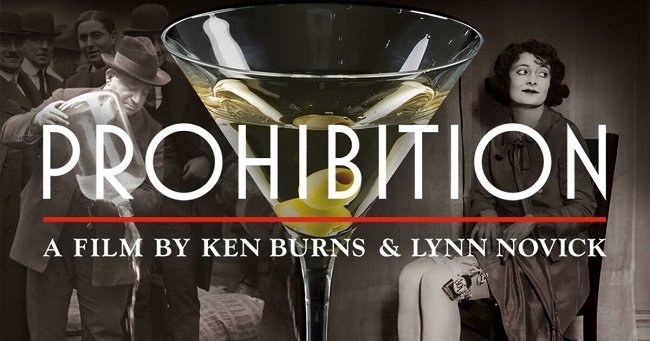
Despite being an analysis of the past there is a portentous air about Ken Burns and Lynn Novick’s Prohibition. A fascinating five-and-a-half-hour documentary produced for PBS in 2011. The history of this disastrous experiment, the banning of alcoholic beverages, is a textbook example of how the transactional nature of US politics can be effectively used upon “wedge” issues. Prohibition follows the format and style of Burns previous documentaries such as the Civil War (1990) and The War (2007) with the wider subject broken down and analysed according to protagonists, events and the political background. Specific historical figures and key players are followed throughout the documentary’s narrative, giving viewers a sense of focus. Hence we meet the hatchet-wielding Carrie Nation, Wayne Wheeler from the Anti-Saloon League and media savvy gangsters like Al Capone. It is interesting to note that some themes continue from Burns’ previous work, such as the political and cultural conflict between native-born Americans and European immigrants. The rural heartlands versus the big cities.
Joel Allen Schroeder's documentary Dear Mr. Watterson is a curious beast insofar that it takes some time before it decides exactly what it wants to focus upon. It begins by examining the cultural impact of the hugely popular comic strip “Calvin & Hobbes” and what it means to people around the world. However, little information is given about the creator, Bill Watterson beyond a very simple biography. Joel Allen Schroeder’s also makes no attempt to contact and interview the reclusive Mr. Watterson to find out more about the man and his iconic work. Instead, the documentary eventually settles into an assessment of Watterson’s work by other industry luminaries and a broader accounting of the overall decline of the newspaper cartoon as a social institution. The presentation is bright, stylish and there’s a lot of love for the subject but it takes some time before it commits to a specific approach.

“Kurt Vonnegut: Unstuck in Time” is a sprawling, non-linear eulogy to the to the life of writer Kurt Vonnegut, by Emmy-winning director Robert B. Weide (“Curb Your Enthusiasm”), who was a friend of Vonnegut's throughout the last 25 years of his life. Weide himself features heavily throughout the two hour running time, which is something Weide says he usually hates in documentaries. However, what unfolds is a story of a documentary maker who wanted to film his idol and was granted an opportunity to do so in the early eighties. The project was never completed and both Weide and Vonnegut continuously returned to it over the years as their friendship grew, leading to Weide eventually becoming Vonnegut’s personal archivist. However, despite this curious relationship, this is still very much a film about Kurt Vonnegut, the author, the social commentator and the man. It becomes quite clear why he is considered one of the most important writers of the 20th century.
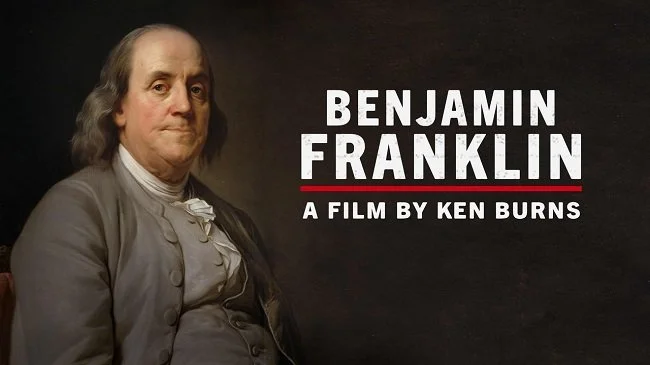
Benjamin Franklin is in many ways the most interesting of the American Founding Fathers. A self taught man who went on to become a polymath. An inventor, accomplished writer and publisher. A diplomat who successfully held multiple public offices. A loyalist who went on to become a “reluctant revolutionary”. A slave owner who eventually became an abolitionist. A questionable parent who favoured specific children over others, as well as a negligent husband. Franklin was all these things, as Ken Burns’ documentary takes great pains to highlight. A broad cross section of historians tackle these foibles and contradictions from multiple perspectives. As Joseph J. Ellis states, Benjamin Franklin was “a Nobel-calibre scientist, the greatest prose stylist of his generation, and probably the greatest diplomat in American history”. His legacy is chronologically analysed over four hours in two distinct episodes.
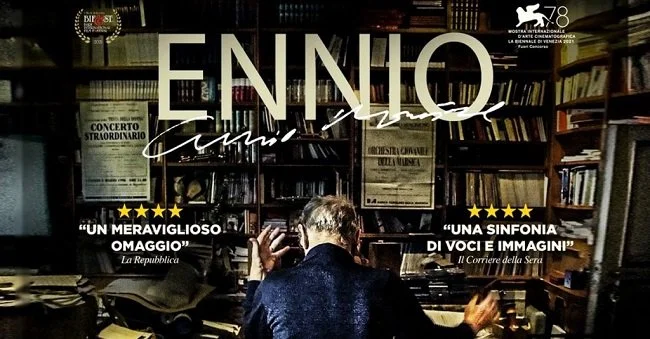
Giuseppe Tornatore’s sprawling documentary Ennio, is a finely detailed and absorbing exploration of prolific and iconic Italian composer Ennio Morricone. Despite its very traditional approach to its subject matter, looking at Morricone’s career chronologically, intercut with celebrity talking heads, it still manages to convey the unorthodox, innovative and experimental nature of the composer. The 156 minute running time is not necessarily the impediment that one expects. Rather it is the sheer weight of the emotional impact that comes from Morricone’s music that is at times overwhelming. Archival footage and a new and comprehensive interview recorded just prior to the composer’s death in 2020 is intercut with a wealth of audio cues and concert footage from a broad cross section of his work. The result is most illuminating with regard to the man and his approach to composing. The conclusion backed by many of those interviewed is that Ennio Morricone has shaped the nature of film music and elevated it to an artform.
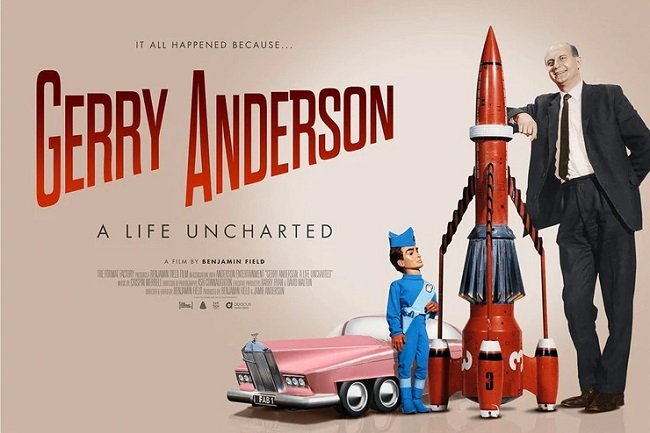
Gerry Anderson: A Life Uncharted is a documentary that focuses specifically on the man, rather than the shows that he created. If you are more interested in the latter then you would be better off watching Filmed in Supermarionation (2014), which provides a comprehensive overview of all productions, wrapped in a cosy blanket of nostalgia and fandom. Gerry Anderson: A Life Uncharted offers a more challenging viewing experience due to its honesty and candour. Gerry Anderson had a difficult childhood and suffered a bereavement early in life. During the course of this 88 minute exploration of his life it becomes clear that these traumas both drove his creativity as well as marred his own personal life. Furthermore, this documentary is also about a son looking for answers, as Jamie Anderson attempts to learn more about his father’s past.
Star Trek documentaries are very much like Bruce Lee documentaries, in so far as they’re both a saturated market and more often than not, new content frequently ends up covering the same ground. However, fans tend to watch anything new in the hope that they will find a few new nuggets of information. Brian Volk-Weiss’ new 11 part series, The Center Seat: 55 years of Star Trek, not only covers established facts about the iconic show but also expands upon them as well as providing a wealth of new information. Volk-Weiss has previously explored popular culture with documentaries such as The Toys That Made Us and The Movies That Made Us. The Center Seat: 55 years of Star Trek is an in-depth chronological study of the Star Trek franchise, from its creation at Desilu Productions in 1965 all the way through to the latest iterations, Star Trek: Picard and Star Trek: Discovery.
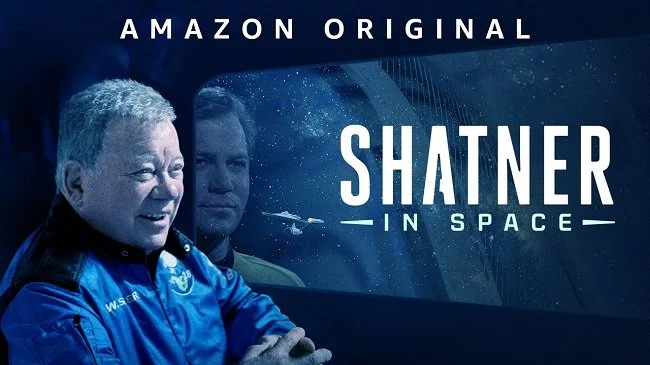
Shatner in Space is a 45 minute documentary about the 90 year old actor, William Shatner and his recent foray into space via Jeff Bezos’ Blue Origin sub-orbital spaceflight service. Considering the provenance of this entire undertaking, attitudes in general towards billionaires and the obvious publicity seeking hubris of sending a cultural icon into space, it’s easy to dismiss Shatner in Space as nothing more than a very, very expensive infomercial. However, the quiet dignity of Mr Shatner whose age and experience means that he draws a very different conclusion from his space flight than his fellow passengers, is utterly compelling and possibly a little profound. If you can endure the soulless polish of the scenes with an immaculately staged managed Jeff Bezos, then you’ll be rewarded with the philosophical musings of a man approaching the end of his life who is naturally curious about his own mortality.
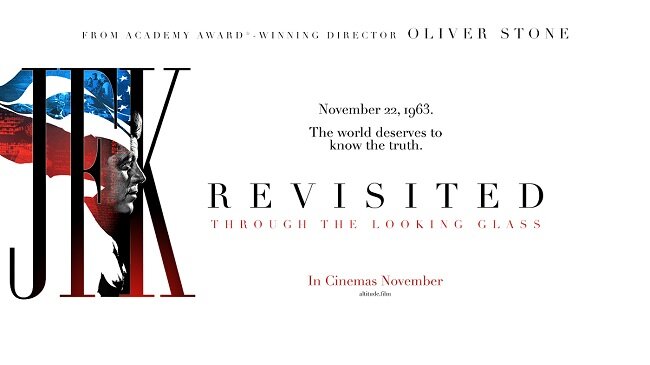
I am not a fan of conspiracy theories, nor those who are heavily invested in them. There are many reasons to repudiate such ideas but for me the main one is just a simple observation on human nature. Any major conspiracy, plot or cover up requires large swaths of people to participate and remain quiet about the facts. Yet one of the most common attributes of the human condition is peoples total inability to shut up. Simply put, most conspiracy theories don’t hold water because someone would have blabbed. Hence, documentaries about how the moon landings were faked or how 9/11 was an “inside job” tend not to “butter any parsnips” with me. However, JFK Revisited: Through the Looking Glass is a surprisingly different beast. I was surprised by its measured approach and its inferred conclusion. Has old age mellowed the filmmaker Oliver Stone?
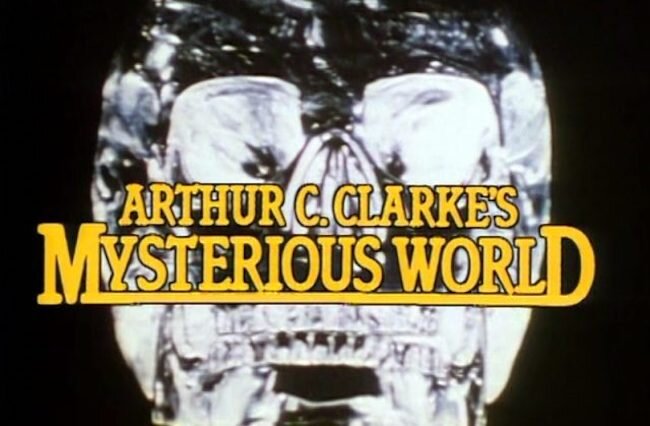
Television programmes that deal with the so-called supernatural, mysterious and the unexplained are commonplace these days. They fill the schedules of channels that used to broadcast quality wildlife, historical and scientific documentaries. All too often these shows focus on the sensational nature of their subject matter and lack any real objectivity, analysis and scientific rigour. The idea is not to impartially explore a subject to determine its veracity but to simply provide a degree of spectacle for as broad a viewing demographic as possible. However, that was not always the case. Back in 1980, Yorkshire Television produced Arthur C. Clarke's Mysterious World. A high profile exploration thirteen-part British television series looking at unexplained phenomena from around the world. The presence of Clarke, who introduced and book-ended the various subjects the show explored, brought a degree of impartiality and credibility to the proceedings.

Over the years I have seen many documentaries about World War II. Although I do not claim in any way to be an expert, I believe I have a good grasp on the causes and the course of that six year conflict. However, it recently struck me that I could not say the same about World War I. In my youth I watched a repeat showing of the BBC documentary series The Great War (1964) but I remember very little of its prodigious 26 episodes. The one thing that stood out were the interviews with veterans. So I was very pleased when perusing BritBox over the weekend to find the 2003 documentary The First World War, based upon the book of the same name by Professor Hew Strachan. This ten part analysis takes a global view of the conflict, rather than excessively focusing upon the Western Front and also debunks a lot of the apocryphal ideas and notions that have persisted over the years. I found it so compelling that I binged watched the entire thing over two evenings.

The music business is a strange, interesting and broad church. A spectrum of musical styles and personalities all fulfilling the needs of different markets. There are pop stars who are buoyant but ephemeral. Then there are singer/songwriters who take their work seriously as they express their critique of the human condition via their music. There are also style icons, novelty acts, indie bands, lounge crooners and a myriad of other niche acts, all doing their own thing. And occasionally there are enigmas. Artists and bands that fly in the face of prevailing trends and commercial interest, who do consider their work to be an artistic endeavour and an expression of themselves and as such, do not see the virtue of personal compromise or corporate interests. Esoteric musicians who reinvent themselves continuously as they grow and age. Constantly defying the expectations of both their own fans and naysayers. Sparks are such a musical entity and the subject of a fascinating documentary by director Edgar Wright.
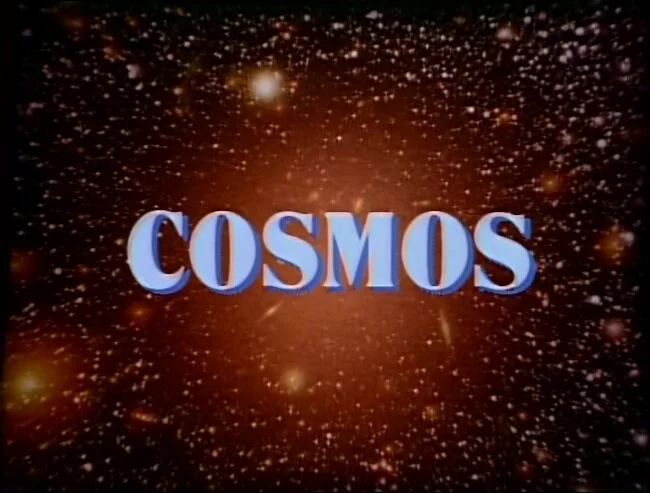
Carl Sagan's seminal science documentary Cosmos: A Personal Voyage was initially broadcast in the US between 28th September and 21st December 1980. Six months later it was shown in the UK on BBC One throughout the summer of 1981. I was thirteen years old at the time and this science documentary series had a tremendous impact upon not only me but an entire generation. The complexity of some of the subjects explored and discussed by Carl Sagan often left me perplexed. However, I knew that there was something special about this show and the way it presented science in such a personal manner. Therefore, I found myself going to both my local and school library to further read about the topics raised in each episode. But perhaps the most standout aspect of the show was Sagan himself. His commentary delivered directly to the camera was both enthralling and lyrical. His love and enthusiasm was palpable and clearly bled through into every aspect of the show. His ability to communicate clearly, complex and at times esoteric ideas, was a revelation and in many ways a gift. Similar to that of Jacob Bronowski and David Attenborough.
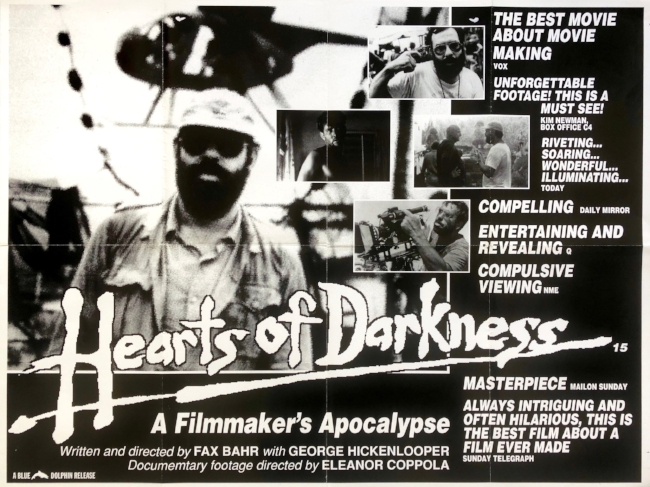
There was a time when film making was seen as an artistic endeavour and the idea of the auteur director pursuing a vision was considered a romantic and even noble undertaking. Big multi-million-dollar productions were welcomed when they filmed on location, providing work and glamour to the local population. The might of the dollar would often grease the wheels of industry, making the impossible possible. Egos were massaged, and actors were indulged and treated like minor deities. Huge sets would appear in the middle of nowhere, like Victorian follies and luxury items would be flown around the world to placate the capricious nature of the various Hollywood stars. Money would flow like water, much to the dismay of the producers, sitting back in the offices in the US or Europe. But this era has now past. Big budget movies are still made but it is now driven by corporate accounting and artistic vision is no longer a primary consideration. It is now a rather soulless business process. Hence a movie such as Apocalypse Now would never be made today in the same manner that it was back in 1976 when the production started.
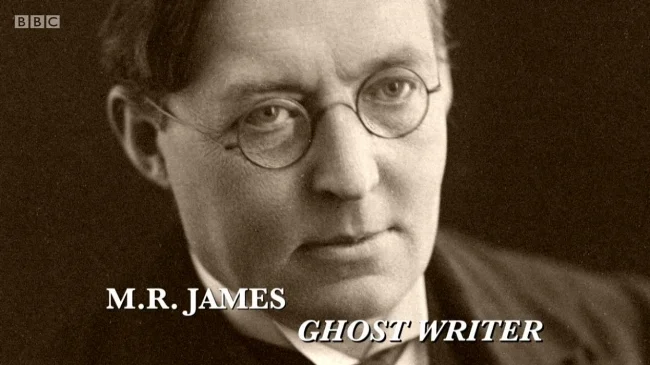
MR James: Ghost Writer is a sixty-minute documentary written and presented by Mark Gatiss, exploring the life of Britain's foremost ghost story writer. Gatiss, a long-time admirer of James, delves in to the life of the author from his devout Anglican upbringing and close-knit family life, through to his ascent to the summit of academia at King's college, Cambridge. The program seeks to discover what motivated this scholarly bachelor to create some of the most iconic and chilling ghost stories in English literature. By following in James’s footsteps, the documentary attempts to gain a greater insight in to the enigmatic author.

Wisconsin Death Trip is a strange, enigmatic, non-linear docudrama and that makes for compelling viewing for the open minded. It is based upon the 1973 non-fiction book Wisconsin Death Trip by Michael Lesy, which explores a collection of late 19th century photographs by Jackson County, photographer Charles Van Schaick. These are mainly taken in the city of Black River Falls. The authentic black and white pictures are further embellished by local news reports from the same period, predominantly taken from the Black River Falls newspaper. These articles emphasise the harsh aspects of Midwestern rural life under the pressures of crime, disease, mental illness, and urbanization. The book has been a source of influence over the years, with authors such as Stephen King and Rod Jones citing the impact its had upon their respective work. Film maker James Marsh has subsequently taken this curious microcosm of rural life and death and extrapolated it a compelling reflection upon mortality and the fragility of human existence.
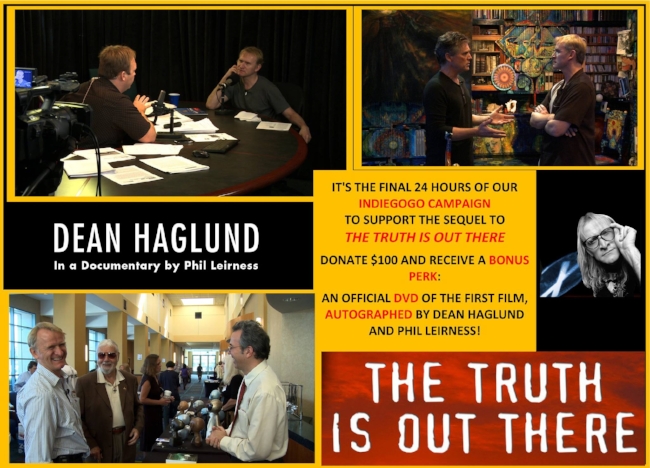
Dean Haglund is best known for playing Richard Langly, one of the Lone Gunmen on The X-Files. In recent years has capitalised upon that role and has become closely identified with the realm of the paranormal and the world of conspiracy theories. The documentary The Truth Is Out There follows Dean as he travels the US and attempts to discover just what it means to search for the truth in a world where conspiracies theories, untruths and fake news abound. The documentary directed by Phil Leirness, humorously takes the viewer on a journey of discovery, talking to those who believe that the world is not what it seems.
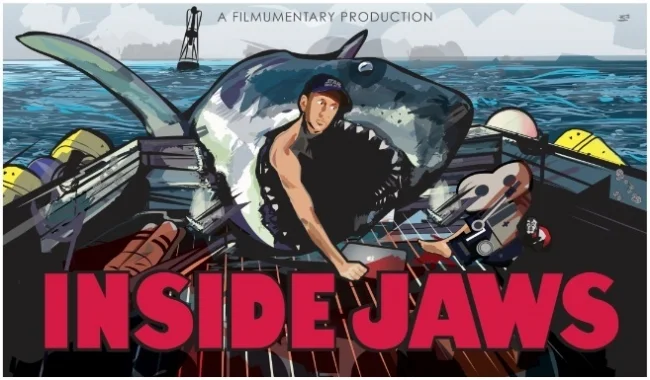
Once again Jamie Benning has created a filmumentary that is pretty much a definitive exploration of its subject matter. Inside Jaws contains a staggering amount of facts, details, insight and commentary about one of the greatest films ever made. Yet despite a wealth of information, it is presented in a way that is easily digestible and enhances the movie, rather than overwhelms it. As with Star Wars Begins, the original movie is annotated with on-screen text, commentary tracks and behind the scenes footage, which provide incisive overview into the movies production.

Star Wars Begins is a detailed documentary by film maker Jamie Benning that explores the creation of what is now considered to be the most iconic movie of the seventies; namely Star Wars. It features a wealth of deleted scenes, alternate takes, behind-the-scenes footage, bloopers, original on set audio recordings and a great deal of commentary by the original cast and crew. As far as I’m concerned, it is the most thorough and in-depth analysis of Star Wars I have yet to see. Frankly it beats hands down, any of the officially sanctioned documentaries that have appeared over the year on the various DVD and Blu-ray releases of the trilogy.

Indie Game: The Movie is a genuinely fascinating documentary not only about the machinations video games industry but also the blood, sweat and tears that go into any creative process. It is a film that really does give you pause for thought and encourages you to reflect upon what you may want in life. It clearly shows the true cost and the star reality of any labour of love. It should be required viewing in schools and colleges for any wannabe who dreams of being on a reality shows and achieving a fast path to their perceived heart’s desire. Such is the impact of the documentary’s message.
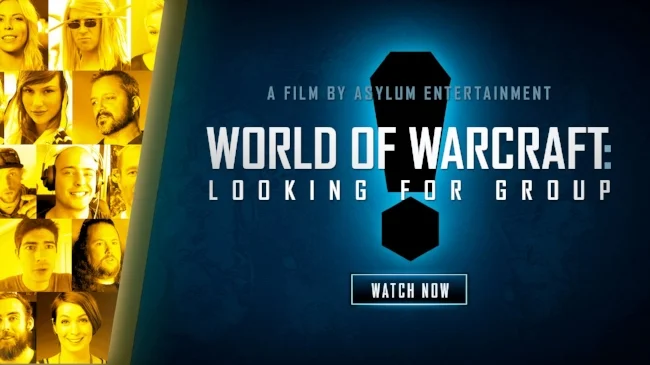
Despite having played a broad spectrum of games in my time, I've never really had much dealings with the Blizzard. Beyond owning Overwatch, a game I’ve long stopped playing and trying a free trial of both World of Warcraft and Hearthstone, I have little personal experience of their games. However, I am fully aware of their product range and their reputation within the gaming industry. Overwatch has taught me how well-conceived and polished their games can be. Blizzard may not be incredibly innovative, but they learn from others and produce titles with all the elements that work well. Sadly, I have no real affinity to their flagship MMORPG, as my point of entry with that genre was LOTRO. My interest in World of Warcraft mainly stems from a business perspective and the place it holds in gaming history. Overall my curiosity about the game, its community and culture is mainly academic. So, I finally got around to watching the documentary World of Warcraft: Looking for Group that showcased at Blizzcon in 2014 and was subsequently released on You Tube thereafter.

Certain groups just lend themselves to ridicule from the media and in popular culture in general, irrespective of whether they deserve it or not. Star Wars fans are a prime example of this. Their love of the lore, predilection for cosplay and hunger for collectables at first glance makes them an easy target. Film maker Mark Edlitz, takes a decidedly different approach in his documentary Jedi Junkies. Instead of finger-pointing and making cheap jokes, Jedi Junkies puts a very human face on a group of enthusiasts, showing their passion to be in essence, no different to that of sports fans or other more mainstream hobbies and pastimes.

After watching several hours of the documentary, The Vietnam War, one has to wonder at the utter inability of the US government of the time, to think outside the box during the period of that conflict. Seldom does a military, political, and social analysis of an historical event go this deep. During its eighteen hour running time directors Ken Burns and Lynn Novick cover a wealth of issues associated with this conflict, exploring it from multiple perspectives. Not only do they shine a light upon the hubris and folly of both respective governments, they manage to keep a very intimate and human perspective. Personal stories from both sides are told and if there is a common theme, it is sadly one of tragedy and regret.
Considering the mainstream popularity of gaming, there is a distinct lack of related content on television. Journalist, writer and social commentator Charlie Brooker attempted to address this in 2009 with Gameswipe but the show remained a one-off production. Then again in late 2013, he had another crack at the subject with the documentary How Videogames Changed the World, providing a broad overview on the genre, exploring key events and titles from the past forty years. As ever with Mr. Brooker, the commentary was intelligent and acerbic. There was also an interesting and diverse selection of talking heads who spoke from personal experience, rather than the usual scripted garrulous inanities.
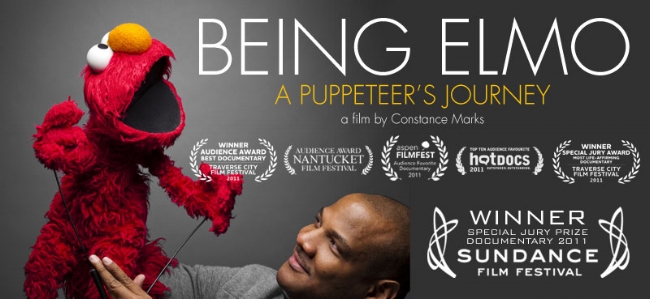
Constance Marks’ documentary explores the story of Kevin Clash, the man who effectively "was" Seasame Street's Elmo until 2014. The film charts Kevin Clash's rise from his modest beginnings in Baltimore to his success as a globally famous character and a major player in the Henson family of puppeteers. The documentary manages to maintain a good balance between examining the mechanics of puppetry and focusing on the human impact of Kevin's work. Like so many documentaries of these type, it clearly shows that achieving your dreams always comes with a cost and is often immensely arduous. It also reveals the complexity of something we take for granted and possibly trivialise, namely puppetry. Filmed in 2011 the documentary does not cover Kevin Clash’s resignation from “Seasame Workshop” three years later.
Documentaries about the fans and fandom often lack any impartiality and frequently have their own agenda, be it positive or negative. Looking at the names associated with Comic-Con Episode IV: A Fan's Hope, it’s fairly clear from the outset that this is not going to be an overtly critical undertaking. Director Morgan Spurlock follows five attendees during San Diego Comic-Con 2010 as they endeavour to fulfil their ambitions. The fans are immediately presented in a fairly positive way and as the documentary proceeds the viewer gets the opportunity to form their own opinion about the lifestyles, choices and philosophies. The documentary is also interspersed with talking heads from known genre luminaries such a Joss Wheedon, Kevin Smith and Stan Lee, who provide some interesting and quite frank views on Comic-Con as well as the wider fan scene.

The documentary Mifune: The Last Samurai is both an exploration and celebration of the Japanese actor Toshiro Mifune (1920-1997), narrated by Keanu Reeves. Over the course of seventy minutes his life and body of work is critiqued by his industry peers as well as several cinematic luminaries such as Martin Scorsese and Steven Speilberg. The focus is very much upon the man himself, as his personality was integral to his acting technique. For those unfamiliar with classic Japanese cinema during its golden age, the documentary provides a broad and practical overview. It also includes a brief history of the chanbara (sword fighting) genre, as well as a concise and honest analysis of Mifune’s career.
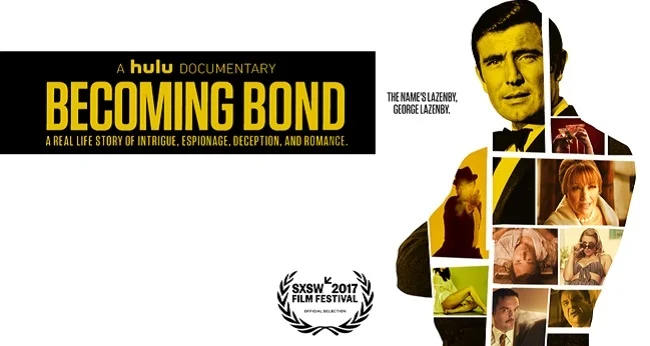
Becoming Bond is a curious documentary in so far as it’s totally dependent on whether the viewer believes the story that George Lazenby tells. Because George is obviously a well-practised raconteur one gets the impression that many of the anecdotes and vignettes he recounts have been embellished for artistic effect. He has that easy going, informal Australian charm and frequently smiles ironically, as director Josh Greenbaum, quizzes him off camera over the voracity of his tale. Mr. Lazenby also treads that fine line between being a likeable rogue and a bit of a dick, especially when he focuses on his youth. Yet he broadly keeps to the right side of this and maintains the audiences’ good will.
Trying to encapsulate any artists body of work is a difficult enough task in itself. To then attempt to distil all associated anecdotes, vignettes and legends, while dispensing with the apocrypha, complicates matters further. Yet that's exactly what film maker Stephen La Rivière has done. The documentary Filmed in Supermarionation, is possibly the definitive history of the work of Gerry Anderson from 1957 to 1968. This insightful, meticulously researched exploration charts the rise of AP Films from its humble beginnings, to the halcyon days of Thunderbirds and the studios transition to Century 21 Productions. It also sheds some light into how things rather rapidly came to an end in the late sixties..
Prohibition (2011)
Despite being an analysis of the past there is a portentous air about Ken Burns and Lynn Novick’s Prohibition. A fascinating five-and-a-half-hour documentary produced for PBS in 2011. The history of this disastrous experiment, the banning of alcoholic beverages, is a textbook example of how the transactional nature of US politics can be effectively used upon “wedge” issues. Prohibition follows the format and style of Burns previous documentaries such as the Civil War (1990) and The War (2007) with the wider subject broken down and analysed according to protagonists, events and the political background. Specific historical figures and key players are followed throughout the documentary’s narrative, giving viewers a sense of focus. Hence we meet the hatchet-wielding Carrie Nation, Wayne Wheeler from the Anti-Saloon League and media savvy gangsters like Al Capone. It is interesting to note that some themes continue from Burns’ previous work, such as the political and cultural conflict between native-born Americans and European immigrants. The rural heartlands versus the big cities.
Despite being an analysis of the past there is a portentous air about Ken Burns and Lynn Novick’s Prohibition. A fascinating five-and-a-half-hour documentary produced for PBS in 2011. The history of this disastrous experiment, the banning of alcoholic beverages, is a textbook example of how the transactional nature of US politics can be effectively used upon “wedge” issues. Prohibition follows the format and style of Burns previous documentaries such as the Civil War (1990) and The War (2007) with the wider subject broken down and analysed according to protagonists, events and the political background. Specific historical figures and key players are followed throughout the documentary’s narrative, giving viewers a sense of focus. Hence we meet the hatchet-wielding Carrie Nation, Wayne Wheeler from the Anti-Saloon League and media savvy gangsters like Al Capone. It is interesting to note that some themes continue from Burns’ previous work, such as the political and cultural conflict between native-born Americans and European immigrants. The rural heartlands versus the big cities.
The first episode, “A Nation of Drunkards,” explores the growth of the temperance movement in preindustrial America as a pushback against alcoholism and specifically, “the saloon” as a source of public drunkenness, domestic abuse and poverty. Americans were a nation of drinkers right from the start. Mainly because brewing was the primary means of making water drinkable. However, an influx of European immigrants to the major cities introduced new drinking customs that fueled the problem. Hence many brewers and distillers were established to meet demand. The temperance movement grew in power and managed to restrict alcohol sales in Maine in 1851. Yet the alcohol lobby was slow to react to this existential threat, assuming that the tax revenue raised on alcohol negated any attempt of a national prohibition. However,the ratification of the 16th Amendment and the introduction of income tax in 1913 paved the way for a political push for a nationwide ban. In 1919 the 18th Amendment prohibiting the manufacture, sale or importing of alcohol was ratified.
The second part of Prohibition, is “A Nation of Scofflaws” (the origin of this and many other words is a fascinating aspect of the series). Legal scholar, Noah Feldman, succinctly observes “To pass a law, in the real world, means nothing. To enforce the law means everything.” To enforce the new constitutional amendment, the administration created the Volstead Act but it was vague and underfinanced, with an inadequate number of law enforcement officials tasked with stopping the drinking habits of millions of Americans. It is here that Mr. Burns and Ms. Novick, play their hand well. The criminal opportunities that arose from prohibition were staggering. Rather than overwhelm viewers with a tsunami of data, they elect to focus on a handful of well known bootleggers to make their point. The scenes of violence stemming from organised crime are well known but the deaths and illnesses caused by unregulated and potentially poisonous alcohol are not so well publicised.
The utter failure of the 18th Amendment is addressed in the final instalment, “A Nation of Hypocrites”. It documents the run up to its repeal in 1933. Again a perfect storm of events set the political chess board in such a fashion that repeal was not only possible but politically expedient. The great depression and subsequent economic fallout required the tax revenue that alcohol brought. Plus, there was an increasing concern that a nation of willing law breakers was detrimental to democracy. So an additional amendment was made to negate the effects of the 18th. It was expected to be a long and drawn out process but self-correction was remarkably quick in governmental terms. Historian Catherine Gilbert Murdock muses upon how a political lobbying success ultimately failed due to its own intransigence. “The dry movement in the late 1920s had an opportunity to capitalise on its success and modify the most egregious issues within the Volstead Act and the enforcement of prohibition, but refused to. In their extremism, they eliminated all moderate support.” Perhaps if the excesses of prohibition had been mollified, the act would have lasted much longer.
As ever with Ken Burns’ documentaries, the historians and experts that provide insight and analysis are complemented by a broad selection of quotes from correspondence and period texts, by all the major parties. Peter Coyote narrates in a focused and engaging fashion. Prohibition also features the voice talents of John Lithgow, Sam Waterston and Samuel L. Jackson. What Prohibition does successfully is make its point without bludgeoning the viewer with the obvious lessons for those who currently seek to legislate personal and moral behaviour. Burns and Novick let the story of the 18th Amendment speak for itself. The message is not that laws based on restricting rights of citizens, as opposed to protecting them, are ultimately destined to fail. It’s that social engineering of this nature can result in far more problematic consequences. Prohibition is fascinating viewing and extremely relatable, due to the ubiquity of drinking in so many cultures.

Music by John Williams is a documentary celebration of the famous composer and his illustrious body of work. It provides some interesting biographical background information as to how the man was born into a family of talented musicians. It then traces his rise from pianist for hire to the most well known film composer today. Along the way, anyone who is anyone in film and music appears to heap justifiable praise upon him and his body of work. It also features a continuous medley of John Williams’ greatest hits, as it catalogues his work in broadly chronological order. Music by John Williams is an upbeat and positive love letter to the composer and exactly what you would expect, when you consider that the documentary was produced by his friends and peers.
Despite being an analysis of the past there is a portentous air about Ken Burns and Lynn Novick’s Prohibition. A fascinating five-and-a-half-hour documentary produced for PBS in 2011. The history of this disastrous experiment, the banning of alcoholic beverages, is a textbook example of how the transactional nature of US politics can be effectively used upon “wedge” issues. Prohibition follows the format and style of Burns previous documentaries such as the Civil War (1990) and The War (2007) with the wider subject broken down and analysed according to protagonists, events and the political background. Specific historical figures and key players are followed throughout the documentary’s narrative, giving viewers a sense of focus. Hence we meet the hatchet-wielding Carrie Nation, Wayne Wheeler from the Anti-Saloon League and media savvy gangsters like Al Capone. It is interesting to note that some themes continue from Burns’ previous work, such as the political and cultural conflict between native-born Americans and European immigrants. The rural heartlands versus the big cities.
Joel Allen Schroeder's documentary Dear Mr. Watterson is a curious beast insofar that it takes some time before it decides exactly what it wants to focus upon. It begins by examining the cultural impact of the hugely popular comic strip “Calvin & Hobbes” and what it means to people around the world. However, little information is given about the creator, Bill Watterson beyond a very simple biography. Joel Allen Schroeder’s also makes no attempt to contact and interview the reclusive Mr. Watterson to find out more about the man and his iconic work. Instead, the documentary eventually settles into an assessment of Watterson’s work by other industry luminaries and a broader accounting of the overall decline of the newspaper cartoon as a social institution. The presentation is bright, stylish and there’s a lot of love for the subject but it takes some time before it commits to a specific approach.
“Kurt Vonnegut: Unstuck in Time” is a sprawling, non-linear eulogy to the to the life of writer Kurt Vonnegut, by Emmy-winning director Robert B. Weide (“Curb Your Enthusiasm”), who was a friend of Vonnegut's throughout the last 25 years of his life. Weide himself features heavily throughout the two hour running time, which is something Weide says he usually hates in documentaries. However, what unfolds is a story of a documentary maker who wanted to film his idol and was granted an opportunity to do so in the early eighties. The project was never completed and both Weide and Vonnegut continuously returned to it over the years as their friendship grew, leading to Weide eventually becoming Vonnegut’s personal archivist. However, despite this curious relationship, this is still very much a film about Kurt Vonnegut, the author, the social commentator and the man. It becomes quite clear why he is considered one of the most important writers of the 20th century.
Benjamin Franklin is in many ways the most interesting of the American Founding Fathers. A self taught man who went on to become a polymath. An inventor, accomplished writer and publisher. A diplomat who successfully held multiple public offices. A loyalist who went on to become a “reluctant revolutionary”. A slave owner who eventually became an abolitionist. A questionable parent who favoured specific children over others, as well as a negligent husband. Franklin was all these things, as Ken Burns’ documentary takes great pains to highlight. A broad cross section of historians tackle these foibles and contradictions from multiple perspectives. As Joseph J. Ellis states, Benjamin Franklin was “a Nobel-calibre scientist, the greatest prose stylist of his generation, and probably the greatest diplomat in American history”. His legacy is chronologically analysed over four hours in two distinct episodes.
Giuseppe Tornatore’s sprawling documentary Ennio, is a finely detailed and absorbing exploration of prolific and iconic Italian composer Ennio Morricone. Despite its very traditional approach to its subject matter, looking at Morricone’s career chronologically, intercut with celebrity talking heads, it still manages to convey the unorthodox, innovative and experimental nature of the composer. The 156 minute running time is not necessarily the impediment that one expects. Rather it is the sheer weight of the emotional impact that comes from Morricone’s music that is at times overwhelming. Archival footage and a new and comprehensive interview recorded just prior to the composer’s death in 2020 is intercut with a wealth of audio cues and concert footage from a broad cross section of his work. The result is most illuminating with regard to the man and his approach to composing. The conclusion backed by many of those interviewed is that Ennio Morricone has shaped the nature of film music and elevated it to an artform.
Gerry Anderson: A Life Uncharted is a documentary that focuses specifically on the man, rather than the shows that he created. If you are more interested in the latter then you would be better off watching Filmed in Supermarionation (2014), which provides a comprehensive overview of all productions, wrapped in a cosy blanket of nostalgia and fandom. Gerry Anderson: A Life Uncharted offers a more challenging viewing experience due to its honesty and candour. Gerry Anderson had a difficult childhood and suffered a bereavement early in life. During the course of this 88 minute exploration of his life it becomes clear that these traumas both drove his creativity as well as marred his own personal life. Furthermore, this documentary is also about a son looking for answers, as Jamie Anderson attempts to learn more about his father’s past.
Star Trek documentaries are very much like Bruce Lee documentaries, in so far as they’re both a saturated market and more often than not, new content frequently ends up covering the same ground. However, fans tend to watch anything new in the hope that they will find a few new nuggets of information. Brian Volk-Weiss’ new 11 part series, The Center Seat: 55 years of Star Trek, not only covers established facts about the iconic show but also expands upon them as well as providing a wealth of new information. Volk-Weiss has previously explored popular culture with documentaries such as The Toys That Made Us and The Movies That Made Us. The Center Seat: 55 years of Star Trek is an in-depth chronological study of the Star Trek franchise, from its creation at Desilu Productions in 1965 all the way through to the latest iterations, Star Trek: Picard and Star Trek: Discovery.
Shatner in Space is a 45 minute documentary about the 90 year old actor, William Shatner and his recent foray into space via Jeff Bezos’ Blue Origin sub-orbital spaceflight service. Considering the provenance of this entire undertaking, attitudes in general towards billionaires and the obvious publicity seeking hubris of sending a cultural icon into space, it’s easy to dismiss Shatner in Space as nothing more than a very, very expensive infomercial. However, the quiet dignity of Mr Shatner whose age and experience means that he draws a very different conclusion from his space flight than his fellow passengers, is utterly compelling and possibly a little profound. If you can endure the soulless polish of the scenes with an immaculately staged managed Jeff Bezos, then you’ll be rewarded with the philosophical musings of a man approaching the end of his life who is naturally curious about his own mortality.
I am not a fan of conspiracy theories, nor those who are heavily invested in them. There are many reasons to repudiate such ideas but for me the main one is just a simple observation on human nature. Any major conspiracy, plot or cover up requires large swaths of people to participate and remain quiet about the facts. Yet one of the most common attributes of the human condition is peoples total inability to shut up. Simply put, most conspiracy theories don’t hold water because someone would have blabbed. Hence, documentaries about how the moon landings were faked or how 9/11 was an “inside job” tend not to “butter any parsnips” with me. However, JFK Revisited: Through the Looking Glass is a surprisingly different beast. I was surprised by its measured approach and its inferred conclusion. Has old age mellowed the filmmaker Oliver Stone?
Television programmes that deal with the so-called supernatural, mysterious and the unexplained are commonplace these days. They fill the schedules of channels that used to broadcast quality wildlife, historical and scientific documentaries. All too often these shows focus on the sensational nature of their subject matter and lack any real objectivity, analysis and scientific rigour. The idea is not to impartially explore a subject to determine its veracity but to simply provide a degree of spectacle for as broad a viewing demographic as possible. However, that was not always the case. Back in 1980, Yorkshire Television produced Arthur C. Clarke's Mysterious World. A high profile exploration thirteen-part British television series looking at unexplained phenomena from around the world. The presence of Clarke, who introduced and book-ended the various subjects the show explored, brought a degree of impartiality and credibility to the proceedings.
Over the years I have seen many documentaries about World War II. Although I do not claim in any way to be an expert, I believe I have a good grasp on the causes and the course of that six year conflict. However, it recently struck me that I could not say the same about World War I. In my youth I watched a repeat showing of the BBC documentary series The Great War (1964) but I remember very little of its prodigious 26 episodes. The one thing that stood out were the interviews with veterans. So I was very pleased when perusing BritBox over the weekend to find the 2003 documentary The First World War, based upon the book of the same name by Professor Hew Strachan. This ten part analysis takes a global view of the conflict, rather than excessively focusing upon the Western Front and also debunks a lot of the apocryphal ideas and notions that have persisted over the years. I found it so compelling that I binged watched the entire thing over two evenings.
The music business is a strange, interesting and broad church. A spectrum of musical styles and personalities all fulfilling the needs of different markets. There are pop stars who are buoyant but ephemeral. Then there are singer/songwriters who take their work seriously as they express their critique of the human condition via their music. There are also style icons, novelty acts, indie bands, lounge crooners and a myriad of other niche acts, all doing their own thing. And occasionally there are enigmas. Artists and bands that fly in the face of prevailing trends and commercial interest, who do consider their work to be an artistic endeavour and an expression of themselves and as such, do not see the virtue of personal compromise or corporate interests. Esoteric musicians who reinvent themselves continuously as they grow and age. Constantly defying the expectations of both their own fans and naysayers. Sparks are such a musical entity and the subject of a fascinating documentary by director Edgar Wright.
Carl Sagan's seminal science documentary Cosmos: A Personal Voyage was initially broadcast in the US between 28th September and 21st December 1980. Six months later it was shown in the UK on BBC One throughout the summer of 1981. I was thirteen years old at the time and this science documentary series had a tremendous impact upon not only me but an entire generation. The complexity of some of the subjects explored and discussed by Carl Sagan often left me perplexed. However, I knew that there was something special about this show and the way it presented science in such a personal manner. Therefore, I found myself going to both my local and school library to further read about the topics raised in each episode. But perhaps the most standout aspect of the show was Sagan himself. His commentary delivered directly to the camera was both enthralling and lyrical. His love and enthusiasm was palpable and clearly bled through into every aspect of the show. His ability to communicate clearly, complex and at times esoteric ideas, was a revelation and in many ways a gift. Similar to that of Jacob Bronowski and David Attenborough.
There was a time when film making was seen as an artistic endeavour and the idea of the auteur director pursuing a vision was considered a romantic and even noble undertaking. Big multi-million-dollar productions were welcomed when they filmed on location, providing work and glamour to the local population. The might of the dollar would often grease the wheels of industry, making the impossible possible. Egos were massaged, and actors were indulged and treated like minor deities. Huge sets would appear in the middle of nowhere, like Victorian follies and luxury items would be flown around the world to placate the capricious nature of the various Hollywood stars. Money would flow like water, much to the dismay of the producers, sitting back in the offices in the US or Europe. But this era has now past. Big budget movies are still made but it is now driven by corporate accounting and artistic vision is no longer a primary consideration. It is now a rather soulless business process. Hence a movie such as Apocalypse Now would never be made today in the same manner that it was back in 1976 when the production started.
MR James: Ghost Writer is a sixty-minute documentary written and presented by Mark Gatiss, exploring the life of Britain's foremost ghost story writer. Gatiss, a long-time admirer of James, delves in to the life of the author from his devout Anglican upbringing and close-knit family life, through to his ascent to the summit of academia at King's college, Cambridge. The program seeks to discover what motivated this scholarly bachelor to create some of the most iconic and chilling ghost stories in English literature. By following in James’s footsteps, the documentary attempts to gain a greater insight in to the enigmatic author.
Wisconsin Death Trip is a strange, enigmatic, non-linear docudrama and that makes for compelling viewing for the open minded. It is based upon the 1973 non-fiction book Wisconsin Death Trip by Michael Lesy, which explores a collection of late 19th century photographs by Jackson County, photographer Charles Van Schaick. These are mainly taken in the city of Black River Falls. The authentic black and white pictures are further embellished by local news reports from the same period, predominantly taken from the Black River Falls newspaper. These articles emphasise the harsh aspects of Midwestern rural life under the pressures of crime, disease, mental illness, and urbanization. The book has been a source of influence over the years, with authors such as Stephen King and Rod Jones citing the impact its had upon their respective work. Film maker James Marsh has subsequently taken this curious microcosm of rural life and death and extrapolated it a compelling reflection upon mortality and the fragility of human existence.
Dean Haglund is best known for playing Richard Langly, one of the Lone Gunmen on The X-Files. In recent years has capitalised upon that role and has become closely identified with the realm of the paranormal and the world of conspiracy theories. The documentary The Truth Is Out There follows Dean as he travels the US and attempts to discover just what it means to search for the truth in a world where conspiracies theories, untruths and fake news abound. The documentary directed by Phil Leirness, humorously takes the viewer on a journey of discovery, talking to those who believe that the world is not what it seems.
Once again Jamie Benning has created a filmumentary that is pretty much a definitive exploration of its subject matter. Inside Jaws contains a staggering amount of facts, details, insight and commentary about one of the greatest films ever made. Yet despite a wealth of information, it is presented in a way that is easily digestible and enhances the movie, rather than overwhelms it. As with Star Wars Begins, the original movie is annotated with on-screen text, commentary tracks and behind the scenes footage, which provide incisive overview into the movies production.
Star Wars Begins is a detailed documentary by film maker Jamie Benning that explores the creation of what is now considered to be the most iconic movie of the seventies; namely Star Wars. It features a wealth of deleted scenes, alternate takes, behind-the-scenes footage, bloopers, original on set audio recordings and a great deal of commentary by the original cast and crew. As far as I’m concerned, it is the most thorough and in-depth analysis of Star Wars I have yet to see. Frankly it beats hands down, any of the officially sanctioned documentaries that have appeared over the year on the various DVD and Blu-ray releases of the trilogy.
Indie Game: The Movie is a genuinely fascinating documentary not only about the machinations video games industry but also the blood, sweat and tears that go into any creative process. It is a film that really does give you pause for thought and encourages you to reflect upon what you may want in life. It clearly shows the true cost and the star reality of any labour of love. It should be required viewing in schools and colleges for any wannabe who dreams of being on a reality shows and achieving a fast path to their perceived heart’s desire. Such is the impact of the documentary’s message.
Despite having played a broad spectrum of games in my time, I've never really had much dealings with the Blizzard. Beyond owning Overwatch, a game I’ve long stopped playing and trying a free trial of both World of Warcraft and Hearthstone, I have little personal experience of their games. However, I am fully aware of their product range and their reputation within the gaming industry. Overwatch has taught me how well-conceived and polished their games can be. Blizzard may not be incredibly innovative, but they learn from others and produce titles with all the elements that work well. Sadly, I have no real affinity to their flagship MMORPG, as my point of entry with that genre was LOTRO. My interest in World of Warcraft mainly stems from a business perspective and the place it holds in gaming history. Overall my curiosity about the game, its community and culture is mainly academic. So, I finally got around to watching the documentary World of Warcraft: Looking for Group that showcased at Blizzcon in 2014 and was subsequently released on You Tube thereafter.
Certain groups just lend themselves to ridicule from the media and in popular culture in general, irrespective of whether they deserve it or not. Star Wars fans are a prime example of this. Their love of the lore, predilection for cosplay and hunger for collectables at first glance makes them an easy target. Film maker Mark Edlitz, takes a decidedly different approach in his documentary Jedi Junkies. Instead of finger-pointing and making cheap jokes, Jedi Junkies puts a very human face on a group of enthusiasts, showing their passion to be in essence, no different to that of sports fans or other more mainstream hobbies and pastimes.
After watching several hours of the documentary, The Vietnam War, one has to wonder at the utter inability of the US government of the time, to think outside the box during the period of that conflict. Seldom does a military, political, and social analysis of an historical event go this deep. During its eighteen hour running time directors Ken Burns and Lynn Novick cover a wealth of issues associated with this conflict, exploring it from multiple perspectives. Not only do they shine a light upon the hubris and folly of both respective governments, they manage to keep a very intimate and human perspective. Personal stories from both sides are told and if there is a common theme, it is sadly one of tragedy and regret.
Considering the mainstream popularity of gaming, there is a distinct lack of related content on television. Journalist, writer and social commentator Charlie Brooker attempted to address this in 2009 with Gameswipe but the show remained a one-off production. Then again in late 2013, he had another crack at the subject with the documentary How Videogames Changed the World, providing a broad overview on the genre, exploring key events and titles from the past forty years. As ever with Mr. Brooker, the commentary was intelligent and acerbic. There was also an interesting and diverse selection of talking heads who spoke from personal experience, rather than the usual scripted garrulous inanities.
Constance Marks’ documentary explores the story of Kevin Clash, the man who effectively "was" Seasame Street's Elmo until 2014. The film charts Kevin Clash's rise from his modest beginnings in Baltimore to his success as a globally famous character and a major player in the Henson family of puppeteers. The documentary manages to maintain a good balance between examining the mechanics of puppetry and focusing on the human impact of Kevin's work. Like so many documentaries of these type, it clearly shows that achieving your dreams always comes with a cost and is often immensely arduous. It also reveals the complexity of something we take for granted and possibly trivialise, namely puppetry. Filmed in 2011 the documentary does not cover Kevin Clash’s resignation from “Seasame Workshop” three years later.
Documentaries about the fans and fandom often lack any impartiality and frequently have their own agenda, be it positive or negative. Looking at the names associated with Comic-Con Episode IV: A Fan's Hope, it’s fairly clear from the outset that this is not going to be an overtly critical undertaking. Director Morgan Spurlock follows five attendees during San Diego Comic-Con 2010 as they endeavour to fulfil their ambitions. The fans are immediately presented in a fairly positive way and as the documentary proceeds the viewer gets the opportunity to form their own opinion about the lifestyles, choices and philosophies. The documentary is also interspersed with talking heads from known genre luminaries such a Joss Wheedon, Kevin Smith and Stan Lee, who provide some interesting and quite frank views on Comic-Con as well as the wider fan scene.
The documentary Mifune: The Last Samurai is both an exploration and celebration of the Japanese actor Toshiro Mifune (1920-1997), narrated by Keanu Reeves. Over the course of seventy minutes his life and body of work is critiqued by his industry peers as well as several cinematic luminaries such as Martin Scorsese and Steven Speilberg. The focus is very much upon the man himself, as his personality was integral to his acting technique. For those unfamiliar with classic Japanese cinema during its golden age, the documentary provides a broad and practical overview. It also includes a brief history of the chanbara (sword fighting) genre, as well as a concise and honest analysis of Mifune’s career.
Dear Mr. Watterson (2013)
Joel Allen Schroeder's documentary Dear Mr. Watterson is a curious beast insofar that it takes some time before it decides exactly what it wants to focus upon. It begins by examining the cultural impact of the hugely popular comic strip “Calvin & Hobbes” and what it means to people around the world. However, little information is given about the creator, Bill Watterson beyond a very simple biography. Joel Allen Schroeder’s also makes no attempt to contact and interview the reclusive Mr. Watterson to find out more about the man and his iconic work. Instead, the documentary eventually settles into an assessment of Watterson’s work by other industry luminaries and a broader accounting of the overall decline of the newspaper cartoon as a social institution. The presentation is bright, stylish and there’s a lot of love for the subject but it takes some time before it commits to a specific approach.
Joel Allen Schroeder's documentary Dear Mr. Watterson is a curious beast insofar that it takes some time before it decides exactly what it wants to focus upon. It begins by examining the cultural impact of the hugely popular comic strip “Calvin & Hobbes” and what it means to people around the world. However, little information is given about the creator, Bill Watterson beyond a very simple biography. Joel Allen Schroeder’s also makes no attempt to contact and interview the reclusive Mr. Watterson to find out more about the man and his iconic work. Instead, the documentary eventually settles into an assessment of Watterson’s work by other industry luminaries and a broader accounting of the overall decline of the newspaper cartoon as a social institution. The presentation is bright, stylish and there’s a lot of love for the subject but it takes some time before it commits to a specific approach.
Cartoonist Bill Watterson retired his comic strip “Calvin & Hobbes”, after a very successful ten year run from 1985 to 1995. The cartoon about a 6-year-old boy and his tiger companion, had and continues to have much to say about American culture, childhood, friendship and many other philosophical points. Although demonstrably a US product, its themes and characters had a worldwide appeal due to its universal themes. Furthermore, Watterson was extremely experimental in the way he presented his artwork, often abandoning the traditional linear panel format. What the documentary makes clear is that both Watterson and subsequently his cartoonist peers consider his creations “art”. The notion that the cartoon strip is an inherently lower form of artistic endeavour, is summarily dismissed as part of the inherent snobbery that exists around art per se. Watterson’s perspective on his own work is a key theme throughout the documentary.
Post 1995, Bill Watterson has led a reclusive life in small-town Ohio, where he has pursued other artistic endeavours. Although financially successful due to the ongoing syndication of “Calvin & Hobbes”, along with the continuous sales of anthologies of the cartoon, Watterson is notable as one of the few artists that has eschewed lucrative merchandising deals. Unlike most of his contemporaries such as Charles M. Schulz (“Peanuts”) and Jim Davis (“Garfield”). Dear Mr. Watterson takes a lot of pain to examine such an unusual stance, with one talking head hinting that it is borderline “unamerican” to do such a thing. Yet Watterson saw such monetisation as diminishing the artistic merits and significance of his creation. Something that Stephan Pastis, creator of “Pearls Before Swine” broadly agrees with, citing from personal experience that the moment you embrace marketing you are subject to a wealth of commercial pressures that impact upon your creativity.
Dear Mr. Watterson ultimately fall between two stools as it is a little too insular to be immediately accessible to those casually interested in “Calvin & Hobbes”, while simultaneously not being a definitive overview for hardcore fans. It does have its moments. One certainly gets a sense of Bill Watterson’s talent when looking at his original artwork at The Ohio State University. The documentary also does a good job of analysing the final cartoon he created which ends with the positive statement “Let’s go exploring”. It also accurately assesses the diminishing of comic strips in newspapers due to the industry's own decline. The conclusion is that it's highly unlikely that any other strip will achieve similar success and have such a cultural impact. “Calvin & Hobbes” remains an enigma born of great talent and the good fortune to be in the right place at the right time.
Music by John Williams is a documentary celebration of the famous composer and his illustrious body of work. It provides some interesting biographical background information as to how the man was born into a family of talented musicians. It then traces his rise from pianist for hire to the most well known film composer today. Along the way, anyone who is anyone in film and music appears to heap justifiable praise upon him and his body of work. It also features a continuous medley of John Williams’ greatest hits, as it catalogues his work in broadly chronological order. Music by John Williams is an upbeat and positive love letter to the composer and exactly what you would expect, when you consider that the documentary was produced by his friends and peers.
Despite being an analysis of the past there is a portentous air about Ken Burns and Lynn Novick’s Prohibition. A fascinating five-and-a-half-hour documentary produced for PBS in 2011. The history of this disastrous experiment, the banning of alcoholic beverages, is a textbook example of how the transactional nature of US politics can be effectively used upon “wedge” issues. Prohibition follows the format and style of Burns previous documentaries such as the Civil War (1990) and The War (2007) with the wider subject broken down and analysed according to protagonists, events and the political background. Specific historical figures and key players are followed throughout the documentary’s narrative, giving viewers a sense of focus. Hence we meet the hatchet-wielding Carrie Nation, Wayne Wheeler from the Anti-Saloon League and media savvy gangsters like Al Capone. It is interesting to note that some themes continue from Burns’ previous work, such as the political and cultural conflict between native-born Americans and European immigrants. The rural heartlands versus the big cities.
Joel Allen Schroeder's documentary Dear Mr. Watterson is a curious beast insofar that it takes some time before it decides exactly what it wants to focus upon. It begins by examining the cultural impact of the hugely popular comic strip “Calvin & Hobbes” and what it means to people around the world. However, little information is given about the creator, Bill Watterson beyond a very simple biography. Joel Allen Schroeder’s also makes no attempt to contact and interview the reclusive Mr. Watterson to find out more about the man and his iconic work. Instead, the documentary eventually settles into an assessment of Watterson’s work by other industry luminaries and a broader accounting of the overall decline of the newspaper cartoon as a social institution. The presentation is bright, stylish and there’s a lot of love for the subject but it takes some time before it commits to a specific approach.
“Kurt Vonnegut: Unstuck in Time” is a sprawling, non-linear eulogy to the to the life of writer Kurt Vonnegut, by Emmy-winning director Robert B. Weide (“Curb Your Enthusiasm”), who was a friend of Vonnegut's throughout the last 25 years of his life. Weide himself features heavily throughout the two hour running time, which is something Weide says he usually hates in documentaries. However, what unfolds is a story of a documentary maker who wanted to film his idol and was granted an opportunity to do so in the early eighties. The project was never completed and both Weide and Vonnegut continuously returned to it over the years as their friendship grew, leading to Weide eventually becoming Vonnegut’s personal archivist. However, despite this curious relationship, this is still very much a film about Kurt Vonnegut, the author, the social commentator and the man. It becomes quite clear why he is considered one of the most important writers of the 20th century.
Benjamin Franklin is in many ways the most interesting of the American Founding Fathers. A self taught man who went on to become a polymath. An inventor, accomplished writer and publisher. A diplomat who successfully held multiple public offices. A loyalist who went on to become a “reluctant revolutionary”. A slave owner who eventually became an abolitionist. A questionable parent who favoured specific children over others, as well as a negligent husband. Franklin was all these things, as Ken Burns’ documentary takes great pains to highlight. A broad cross section of historians tackle these foibles and contradictions from multiple perspectives. As Joseph J. Ellis states, Benjamin Franklin was “a Nobel-calibre scientist, the greatest prose stylist of his generation, and probably the greatest diplomat in American history”. His legacy is chronologically analysed over four hours in two distinct episodes.
Giuseppe Tornatore’s sprawling documentary Ennio, is a finely detailed and absorbing exploration of prolific and iconic Italian composer Ennio Morricone. Despite its very traditional approach to its subject matter, looking at Morricone’s career chronologically, intercut with celebrity talking heads, it still manages to convey the unorthodox, innovative and experimental nature of the composer. The 156 minute running time is not necessarily the impediment that one expects. Rather it is the sheer weight of the emotional impact that comes from Morricone’s music that is at times overwhelming. Archival footage and a new and comprehensive interview recorded just prior to the composer’s death in 2020 is intercut with a wealth of audio cues and concert footage from a broad cross section of his work. The result is most illuminating with regard to the man and his approach to composing. The conclusion backed by many of those interviewed is that Ennio Morricone has shaped the nature of film music and elevated it to an artform.
Gerry Anderson: A Life Uncharted is a documentary that focuses specifically on the man, rather than the shows that he created. If you are more interested in the latter then you would be better off watching Filmed in Supermarionation (2014), which provides a comprehensive overview of all productions, wrapped in a cosy blanket of nostalgia and fandom. Gerry Anderson: A Life Uncharted offers a more challenging viewing experience due to its honesty and candour. Gerry Anderson had a difficult childhood and suffered a bereavement early in life. During the course of this 88 minute exploration of his life it becomes clear that these traumas both drove his creativity as well as marred his own personal life. Furthermore, this documentary is also about a son looking for answers, as Jamie Anderson attempts to learn more about his father’s past.
Star Trek documentaries are very much like Bruce Lee documentaries, in so far as they’re both a saturated market and more often than not, new content frequently ends up covering the same ground. However, fans tend to watch anything new in the hope that they will find a few new nuggets of information. Brian Volk-Weiss’ new 11 part series, The Center Seat: 55 years of Star Trek, not only covers established facts about the iconic show but also expands upon them as well as providing a wealth of new information. Volk-Weiss has previously explored popular culture with documentaries such as The Toys That Made Us and The Movies That Made Us. The Center Seat: 55 years of Star Trek is an in-depth chronological study of the Star Trek franchise, from its creation at Desilu Productions in 1965 all the way through to the latest iterations, Star Trek: Picard and Star Trek: Discovery.
Shatner in Space is a 45 minute documentary about the 90 year old actor, William Shatner and his recent foray into space via Jeff Bezos’ Blue Origin sub-orbital spaceflight service. Considering the provenance of this entire undertaking, attitudes in general towards billionaires and the obvious publicity seeking hubris of sending a cultural icon into space, it’s easy to dismiss Shatner in Space as nothing more than a very, very expensive infomercial. However, the quiet dignity of Mr Shatner whose age and experience means that he draws a very different conclusion from his space flight than his fellow passengers, is utterly compelling and possibly a little profound. If you can endure the soulless polish of the scenes with an immaculately staged managed Jeff Bezos, then you’ll be rewarded with the philosophical musings of a man approaching the end of his life who is naturally curious about his own mortality.
I am not a fan of conspiracy theories, nor those who are heavily invested in them. There are many reasons to repudiate such ideas but for me the main one is just a simple observation on human nature. Any major conspiracy, plot or cover up requires large swaths of people to participate and remain quiet about the facts. Yet one of the most common attributes of the human condition is peoples total inability to shut up. Simply put, most conspiracy theories don’t hold water because someone would have blabbed. Hence, documentaries about how the moon landings were faked or how 9/11 was an “inside job” tend not to “butter any parsnips” with me. However, JFK Revisited: Through the Looking Glass is a surprisingly different beast. I was surprised by its measured approach and its inferred conclusion. Has old age mellowed the filmmaker Oliver Stone?
Television programmes that deal with the so-called supernatural, mysterious and the unexplained are commonplace these days. They fill the schedules of channels that used to broadcast quality wildlife, historical and scientific documentaries. All too often these shows focus on the sensational nature of their subject matter and lack any real objectivity, analysis and scientific rigour. The idea is not to impartially explore a subject to determine its veracity but to simply provide a degree of spectacle for as broad a viewing demographic as possible. However, that was not always the case. Back in 1980, Yorkshire Television produced Arthur C. Clarke's Mysterious World. A high profile exploration thirteen-part British television series looking at unexplained phenomena from around the world. The presence of Clarke, who introduced and book-ended the various subjects the show explored, brought a degree of impartiality and credibility to the proceedings.
Over the years I have seen many documentaries about World War II. Although I do not claim in any way to be an expert, I believe I have a good grasp on the causes and the course of that six year conflict. However, it recently struck me that I could not say the same about World War I. In my youth I watched a repeat showing of the BBC documentary series The Great War (1964) but I remember very little of its prodigious 26 episodes. The one thing that stood out were the interviews with veterans. So I was very pleased when perusing BritBox over the weekend to find the 2003 documentary The First World War, based upon the book of the same name by Professor Hew Strachan. This ten part analysis takes a global view of the conflict, rather than excessively focusing upon the Western Front and also debunks a lot of the apocryphal ideas and notions that have persisted over the years. I found it so compelling that I binged watched the entire thing over two evenings.
The music business is a strange, interesting and broad church. A spectrum of musical styles and personalities all fulfilling the needs of different markets. There are pop stars who are buoyant but ephemeral. Then there are singer/songwriters who take their work seriously as they express their critique of the human condition via their music. There are also style icons, novelty acts, indie bands, lounge crooners and a myriad of other niche acts, all doing their own thing. And occasionally there are enigmas. Artists and bands that fly in the face of prevailing trends and commercial interest, who do consider their work to be an artistic endeavour and an expression of themselves and as such, do not see the virtue of personal compromise or corporate interests. Esoteric musicians who reinvent themselves continuously as they grow and age. Constantly defying the expectations of both their own fans and naysayers. Sparks are such a musical entity and the subject of a fascinating documentary by director Edgar Wright.
Carl Sagan's seminal science documentary Cosmos: A Personal Voyage was initially broadcast in the US between 28th September and 21st December 1980. Six months later it was shown in the UK on BBC One throughout the summer of 1981. I was thirteen years old at the time and this science documentary series had a tremendous impact upon not only me but an entire generation. The complexity of some of the subjects explored and discussed by Carl Sagan often left me perplexed. However, I knew that there was something special about this show and the way it presented science in such a personal manner. Therefore, I found myself going to both my local and school library to further read about the topics raised in each episode. But perhaps the most standout aspect of the show was Sagan himself. His commentary delivered directly to the camera was both enthralling and lyrical. His love and enthusiasm was palpable and clearly bled through into every aspect of the show. His ability to communicate clearly, complex and at times esoteric ideas, was a revelation and in many ways a gift. Similar to that of Jacob Bronowski and David Attenborough.
There was a time when film making was seen as an artistic endeavour and the idea of the auteur director pursuing a vision was considered a romantic and even noble undertaking. Big multi-million-dollar productions were welcomed when they filmed on location, providing work and glamour to the local population. The might of the dollar would often grease the wheels of industry, making the impossible possible. Egos were massaged, and actors were indulged and treated like minor deities. Huge sets would appear in the middle of nowhere, like Victorian follies and luxury items would be flown around the world to placate the capricious nature of the various Hollywood stars. Money would flow like water, much to the dismay of the producers, sitting back in the offices in the US or Europe. But this era has now past. Big budget movies are still made but it is now driven by corporate accounting and artistic vision is no longer a primary consideration. It is now a rather soulless business process. Hence a movie such as Apocalypse Now would never be made today in the same manner that it was back in 1976 when the production started.
MR James: Ghost Writer is a sixty-minute documentary written and presented by Mark Gatiss, exploring the life of Britain's foremost ghost story writer. Gatiss, a long-time admirer of James, delves in to the life of the author from his devout Anglican upbringing and close-knit family life, through to his ascent to the summit of academia at King's college, Cambridge. The program seeks to discover what motivated this scholarly bachelor to create some of the most iconic and chilling ghost stories in English literature. By following in James’s footsteps, the documentary attempts to gain a greater insight in to the enigmatic author.
Wisconsin Death Trip is a strange, enigmatic, non-linear docudrama and that makes for compelling viewing for the open minded. It is based upon the 1973 non-fiction book Wisconsin Death Trip by Michael Lesy, which explores a collection of late 19th century photographs by Jackson County, photographer Charles Van Schaick. These are mainly taken in the city of Black River Falls. The authentic black and white pictures are further embellished by local news reports from the same period, predominantly taken from the Black River Falls newspaper. These articles emphasise the harsh aspects of Midwestern rural life under the pressures of crime, disease, mental illness, and urbanization. The book has been a source of influence over the years, with authors such as Stephen King and Rod Jones citing the impact its had upon their respective work. Film maker James Marsh has subsequently taken this curious microcosm of rural life and death and extrapolated it a compelling reflection upon mortality and the fragility of human existence.
Dean Haglund is best known for playing Richard Langly, one of the Lone Gunmen on The X-Files. In recent years has capitalised upon that role and has become closely identified with the realm of the paranormal and the world of conspiracy theories. The documentary The Truth Is Out There follows Dean as he travels the US and attempts to discover just what it means to search for the truth in a world where conspiracies theories, untruths and fake news abound. The documentary directed by Phil Leirness, humorously takes the viewer on a journey of discovery, talking to those who believe that the world is not what it seems.
Once again Jamie Benning has created a filmumentary that is pretty much a definitive exploration of its subject matter. Inside Jaws contains a staggering amount of facts, details, insight and commentary about one of the greatest films ever made. Yet despite a wealth of information, it is presented in a way that is easily digestible and enhances the movie, rather than overwhelms it. As with Star Wars Begins, the original movie is annotated with on-screen text, commentary tracks and behind the scenes footage, which provide incisive overview into the movies production.
Star Wars Begins is a detailed documentary by film maker Jamie Benning that explores the creation of what is now considered to be the most iconic movie of the seventies; namely Star Wars. It features a wealth of deleted scenes, alternate takes, behind-the-scenes footage, bloopers, original on set audio recordings and a great deal of commentary by the original cast and crew. As far as I’m concerned, it is the most thorough and in-depth analysis of Star Wars I have yet to see. Frankly it beats hands down, any of the officially sanctioned documentaries that have appeared over the year on the various DVD and Blu-ray releases of the trilogy.
Indie Game: The Movie is a genuinely fascinating documentary not only about the machinations video games industry but also the blood, sweat and tears that go into any creative process. It is a film that really does give you pause for thought and encourages you to reflect upon what you may want in life. It clearly shows the true cost and the star reality of any labour of love. It should be required viewing in schools and colleges for any wannabe who dreams of being on a reality shows and achieving a fast path to their perceived heart’s desire. Such is the impact of the documentary’s message.
Despite having played a broad spectrum of games in my time, I've never really had much dealings with the Blizzard. Beyond owning Overwatch, a game I’ve long stopped playing and trying a free trial of both World of Warcraft and Hearthstone, I have little personal experience of their games. However, I am fully aware of their product range and their reputation within the gaming industry. Overwatch has taught me how well-conceived and polished their games can be. Blizzard may not be incredibly innovative, but they learn from others and produce titles with all the elements that work well. Sadly, I have no real affinity to their flagship MMORPG, as my point of entry with that genre was LOTRO. My interest in World of Warcraft mainly stems from a business perspective and the place it holds in gaming history. Overall my curiosity about the game, its community and culture is mainly academic. So, I finally got around to watching the documentary World of Warcraft: Looking for Group that showcased at Blizzcon in 2014 and was subsequently released on You Tube thereafter.
Certain groups just lend themselves to ridicule from the media and in popular culture in general, irrespective of whether they deserve it or not. Star Wars fans are a prime example of this. Their love of the lore, predilection for cosplay and hunger for collectables at first glance makes them an easy target. Film maker Mark Edlitz, takes a decidedly different approach in his documentary Jedi Junkies. Instead of finger-pointing and making cheap jokes, Jedi Junkies puts a very human face on a group of enthusiasts, showing their passion to be in essence, no different to that of sports fans or other more mainstream hobbies and pastimes.
After watching several hours of the documentary, The Vietnam War, one has to wonder at the utter inability of the US government of the time, to think outside the box during the period of that conflict. Seldom does a military, political, and social analysis of an historical event go this deep. During its eighteen hour running time directors Ken Burns and Lynn Novick cover a wealth of issues associated with this conflict, exploring it from multiple perspectives. Not only do they shine a light upon the hubris and folly of both respective governments, they manage to keep a very intimate and human perspective. Personal stories from both sides are told and if there is a common theme, it is sadly one of tragedy and regret.
Considering the mainstream popularity of gaming, there is a distinct lack of related content on television. Journalist, writer and social commentator Charlie Brooker attempted to address this in 2009 with Gameswipe but the show remained a one-off production. Then again in late 2013, he had another crack at the subject with the documentary How Videogames Changed the World, providing a broad overview on the genre, exploring key events and titles from the past forty years. As ever with Mr. Brooker, the commentary was intelligent and acerbic. There was also an interesting and diverse selection of talking heads who spoke from personal experience, rather than the usual scripted garrulous inanities.
Constance Marks’ documentary explores the story of Kevin Clash, the man who effectively "was" Seasame Street's Elmo until 2014. The film charts Kevin Clash's rise from his modest beginnings in Baltimore to his success as a globally famous character and a major player in the Henson family of puppeteers. The documentary manages to maintain a good balance between examining the mechanics of puppetry and focusing on the human impact of Kevin's work. Like so many documentaries of these type, it clearly shows that achieving your dreams always comes with a cost and is often immensely arduous. It also reveals the complexity of something we take for granted and possibly trivialise, namely puppetry. Filmed in 2011 the documentary does not cover Kevin Clash’s resignation from “Seasame Workshop” three years later.
Documentaries about the fans and fandom often lack any impartiality and frequently have their own agenda, be it positive or negative. Looking at the names associated with Comic-Con Episode IV: A Fan's Hope, it’s fairly clear from the outset that this is not going to be an overtly critical undertaking. Director Morgan Spurlock follows five attendees during San Diego Comic-Con 2010 as they endeavour to fulfil their ambitions. The fans are immediately presented in a fairly positive way and as the documentary proceeds the viewer gets the opportunity to form their own opinion about the lifestyles, choices and philosophies. The documentary is also interspersed with talking heads from known genre luminaries such a Joss Wheedon, Kevin Smith and Stan Lee, who provide some interesting and quite frank views on Comic-Con as well as the wider fan scene.
The documentary Mifune: The Last Samurai is both an exploration and celebration of the Japanese actor Toshiro Mifune (1920-1997), narrated by Keanu Reeves. Over the course of seventy minutes his life and body of work is critiqued by his industry peers as well as several cinematic luminaries such as Martin Scorsese and Steven Speilberg. The focus is very much upon the man himself, as his personality was integral to his acting technique. For those unfamiliar with classic Japanese cinema during its golden age, the documentary provides a broad and practical overview. It also includes a brief history of the chanbara (sword fighting) genre, as well as a concise and honest analysis of Mifune’s career.
Kurt Vonnegut: Unstuck in Time (2021)
“Kurt Vonnegut: Unstuck in Time” is a sprawling, non-linear eulogy to the to the life of writer Kurt Vonnegut, by Emmy-winning director Robert B. Weide (“Curb Your Enthusiasm”), who was a friend of Vonnegut's throughout the last 25 years of his life. Weide himself features heavily throughout the two hour running time, which is something Weide says he usually hates in documentaries. However, what unfolds is a story of a documentary maker who wanted to film his idol and was granted an opportunity to do so in the early eighties. The project was never completed and both Weide and Vonnegut continuously returned to it over the years as their friendship grew, leading to Weide eventually becoming Vonnegut’s personal archivist. However, despite this curious relationship, this is still very much a film about Kurt Vonnegut, the author, the social commentator and the man. It becomes quite clear why he is considered one of the most important writers of the 20th century.
“Kurt Vonnegut: Unstuck in Time” is a sprawling, non-linear eulogy to the to the life of writer Kurt Vonnegut, by Emmy-winning director Robert B. Weide (“Curb Your Enthusiasm”), who was a friend of Vonnegut's throughout the last 25 years of his life. Weide himself features heavily throughout the two hour running time, which is something Weide says he usually hates in documentaries. However, what unfolds is a story of a documentary maker who wanted to film his idol and was granted an opportunity to do so in the early eighties. The project was never completed and both Weide and Vonnegut continuously returned to it over the years as their friendship grew, leading to Weide eventually becoming Vonnegut’s personal archivist. However, despite this curious relationship, this is still very much a film about Kurt Vonnegut, the author, the social commentator and the man. It becomes quite clear why he is considered one of the most important writers of the 20th century.
“Kurt Vonnegut: Unstuck in Time” is structured very much like Vonnegut's writing; deliberately fragmented and very self-aware. At times it takes a chronological approach and at others, leaps forward to future events and highlights this by showing Weide editing the very documentary on his computer. We do get to learn about Vonnegut’s youth, family and other key aspects of his life as the documentary lapses into a classic PBS approach to its subject. It takes a while to get to the matter of his experiences in Dresden in World War II and despite his irreverent tone, it is clear that this part of his life is key to his mindset and philosophy in later life, as well as his emotional well being. All of which paints a very interesting and broadly favourable portrait of the man. Which makes it all the more jarring when he leaves his wife shortly after achieving the success in which her support is instrumental.
Where “Kurt Vonnegut: Unstuck in Time” excels is in examining the wealth of material regarding Vonnegut’s writing. We see first draft, typewritten manuscripts complete with handwritten revisions that clearly show the author refining his style and process during his early years. Correspondence and then later, answerphone messages provide further insight to the author’s struggle to commit his work to the page and the birth of his alter ego, Kilgore Trout. As the documentary progresses, over time Vonnegut becomes very comfortable talking about himself to Weide. He clearly shows he is someone who relishes his relationship with his audience and the opportunity to “perform”. There is some compelling footage of talks and lectures in which Vonnegut effortlessly engages with fans and riffs off their questions and adulation. Not every author requires the love of his readers but it clearly was integral to Vonnegut’s pathology.
Overall, any gaps in the history of Kurt Vonnegut or self-indulgent asides are subordinate to this documentary’s sincere and honest analysis of Vonnegut's World War II experiences. His initial denial of the significance of his time as a P.O.W. is ultimately overturned after writing “Slaughterhouse Five” and the documentary takes great pains to stress the cathartic nature of this undertaking. His disgust of war subsequently boiled over again during the second Bush administration and the subsequent invasion of Iraq. Vonnegut despised the use of patriotism as a political tool and subsequently wrote a series of opinion pieces for “In These Times” magazine which became the foundation for his final major work “A Man Without a Country”. Robert B. Weide’s ““Kurt Vonnegut: Unstuck in Time”” is a loving tribute to a dear friend as well as an analysis of a cultural icon. It’s important to appreciate the former while addressing the latter. There may well be future documentaries about Vonnegut that are more objective but they’ll not be as personal as this one.
Music by John Williams is a documentary celebration of the famous composer and his illustrious body of work. It provides some interesting biographical background information as to how the man was born into a family of talented musicians. It then traces his rise from pianist for hire to the most well known film composer today. Along the way, anyone who is anyone in film and music appears to heap justifiable praise upon him and his body of work. It also features a continuous medley of John Williams’ greatest hits, as it catalogues his work in broadly chronological order. Music by John Williams is an upbeat and positive love letter to the composer and exactly what you would expect, when you consider that the documentary was produced by his friends and peers.
Despite being an analysis of the past there is a portentous air about Ken Burns and Lynn Novick’s Prohibition. A fascinating five-and-a-half-hour documentary produced for PBS in 2011. The history of this disastrous experiment, the banning of alcoholic beverages, is a textbook example of how the transactional nature of US politics can be effectively used upon “wedge” issues. Prohibition follows the format and style of Burns previous documentaries such as the Civil War (1990) and The War (2007) with the wider subject broken down and analysed according to protagonists, events and the political background. Specific historical figures and key players are followed throughout the documentary’s narrative, giving viewers a sense of focus. Hence we meet the hatchet-wielding Carrie Nation, Wayne Wheeler from the Anti-Saloon League and media savvy gangsters like Al Capone. It is interesting to note that some themes continue from Burns’ previous work, such as the political and cultural conflict between native-born Americans and European immigrants. The rural heartlands versus the big cities.
Joel Allen Schroeder's documentary Dear Mr. Watterson is a curious beast insofar that it takes some time before it decides exactly what it wants to focus upon. It begins by examining the cultural impact of the hugely popular comic strip “Calvin & Hobbes” and what it means to people around the world. However, little information is given about the creator, Bill Watterson beyond a very simple biography. Joel Allen Schroeder’s also makes no attempt to contact and interview the reclusive Mr. Watterson to find out more about the man and his iconic work. Instead, the documentary eventually settles into an assessment of Watterson’s work by other industry luminaries and a broader accounting of the overall decline of the newspaper cartoon as a social institution. The presentation is bright, stylish and there’s a lot of love for the subject but it takes some time before it commits to a specific approach.
“Kurt Vonnegut: Unstuck in Time” is a sprawling, non-linear eulogy to the to the life of writer Kurt Vonnegut, by Emmy-winning director Robert B. Weide (“Curb Your Enthusiasm”), who was a friend of Vonnegut's throughout the last 25 years of his life. Weide himself features heavily throughout the two hour running time, which is something Weide says he usually hates in documentaries. However, what unfolds is a story of a documentary maker who wanted to film his idol and was granted an opportunity to do so in the early eighties. The project was never completed and both Weide and Vonnegut continuously returned to it over the years as their friendship grew, leading to Weide eventually becoming Vonnegut’s personal archivist. However, despite this curious relationship, this is still very much a film about Kurt Vonnegut, the author, the social commentator and the man. It becomes quite clear why he is considered one of the most important writers of the 20th century.
Benjamin Franklin is in many ways the most interesting of the American Founding Fathers. A self taught man who went on to become a polymath. An inventor, accomplished writer and publisher. A diplomat who successfully held multiple public offices. A loyalist who went on to become a “reluctant revolutionary”. A slave owner who eventually became an abolitionist. A questionable parent who favoured specific children over others, as well as a negligent husband. Franklin was all these things, as Ken Burns’ documentary takes great pains to highlight. A broad cross section of historians tackle these foibles and contradictions from multiple perspectives. As Joseph J. Ellis states, Benjamin Franklin was “a Nobel-calibre scientist, the greatest prose stylist of his generation, and probably the greatest diplomat in American history”. His legacy is chronologically analysed over four hours in two distinct episodes.
Giuseppe Tornatore’s sprawling documentary Ennio, is a finely detailed and absorbing exploration of prolific and iconic Italian composer Ennio Morricone. Despite its very traditional approach to its subject matter, looking at Morricone’s career chronologically, intercut with celebrity talking heads, it still manages to convey the unorthodox, innovative and experimental nature of the composer. The 156 minute running time is not necessarily the impediment that one expects. Rather it is the sheer weight of the emotional impact that comes from Morricone’s music that is at times overwhelming. Archival footage and a new and comprehensive interview recorded just prior to the composer’s death in 2020 is intercut with a wealth of audio cues and concert footage from a broad cross section of his work. The result is most illuminating with regard to the man and his approach to composing. The conclusion backed by many of those interviewed is that Ennio Morricone has shaped the nature of film music and elevated it to an artform.
Gerry Anderson: A Life Uncharted is a documentary that focuses specifically on the man, rather than the shows that he created. If you are more interested in the latter then you would be better off watching Filmed in Supermarionation (2014), which provides a comprehensive overview of all productions, wrapped in a cosy blanket of nostalgia and fandom. Gerry Anderson: A Life Uncharted offers a more challenging viewing experience due to its honesty and candour. Gerry Anderson had a difficult childhood and suffered a bereavement early in life. During the course of this 88 minute exploration of his life it becomes clear that these traumas both drove his creativity as well as marred his own personal life. Furthermore, this documentary is also about a son looking for answers, as Jamie Anderson attempts to learn more about his father’s past.
Star Trek documentaries are very much like Bruce Lee documentaries, in so far as they’re both a saturated market and more often than not, new content frequently ends up covering the same ground. However, fans tend to watch anything new in the hope that they will find a few new nuggets of information. Brian Volk-Weiss’ new 11 part series, The Center Seat: 55 years of Star Trek, not only covers established facts about the iconic show but also expands upon them as well as providing a wealth of new information. Volk-Weiss has previously explored popular culture with documentaries such as The Toys That Made Us and The Movies That Made Us. The Center Seat: 55 years of Star Trek is an in-depth chronological study of the Star Trek franchise, from its creation at Desilu Productions in 1965 all the way through to the latest iterations, Star Trek: Picard and Star Trek: Discovery.
Shatner in Space is a 45 minute documentary about the 90 year old actor, William Shatner and his recent foray into space via Jeff Bezos’ Blue Origin sub-orbital spaceflight service. Considering the provenance of this entire undertaking, attitudes in general towards billionaires and the obvious publicity seeking hubris of sending a cultural icon into space, it’s easy to dismiss Shatner in Space as nothing more than a very, very expensive infomercial. However, the quiet dignity of Mr Shatner whose age and experience means that he draws a very different conclusion from his space flight than his fellow passengers, is utterly compelling and possibly a little profound. If you can endure the soulless polish of the scenes with an immaculately staged managed Jeff Bezos, then you’ll be rewarded with the philosophical musings of a man approaching the end of his life who is naturally curious about his own mortality.
I am not a fan of conspiracy theories, nor those who are heavily invested in them. There are many reasons to repudiate such ideas but for me the main one is just a simple observation on human nature. Any major conspiracy, plot or cover up requires large swaths of people to participate and remain quiet about the facts. Yet one of the most common attributes of the human condition is peoples total inability to shut up. Simply put, most conspiracy theories don’t hold water because someone would have blabbed. Hence, documentaries about how the moon landings were faked or how 9/11 was an “inside job” tend not to “butter any parsnips” with me. However, JFK Revisited: Through the Looking Glass is a surprisingly different beast. I was surprised by its measured approach and its inferred conclusion. Has old age mellowed the filmmaker Oliver Stone?
Television programmes that deal with the so-called supernatural, mysterious and the unexplained are commonplace these days. They fill the schedules of channels that used to broadcast quality wildlife, historical and scientific documentaries. All too often these shows focus on the sensational nature of their subject matter and lack any real objectivity, analysis and scientific rigour. The idea is not to impartially explore a subject to determine its veracity but to simply provide a degree of spectacle for as broad a viewing demographic as possible. However, that was not always the case. Back in 1980, Yorkshire Television produced Arthur C. Clarke's Mysterious World. A high profile exploration thirteen-part British television series looking at unexplained phenomena from around the world. The presence of Clarke, who introduced and book-ended the various subjects the show explored, brought a degree of impartiality and credibility to the proceedings.
Over the years I have seen many documentaries about World War II. Although I do not claim in any way to be an expert, I believe I have a good grasp on the causes and the course of that six year conflict. However, it recently struck me that I could not say the same about World War I. In my youth I watched a repeat showing of the BBC documentary series The Great War (1964) but I remember very little of its prodigious 26 episodes. The one thing that stood out were the interviews with veterans. So I was very pleased when perusing BritBox over the weekend to find the 2003 documentary The First World War, based upon the book of the same name by Professor Hew Strachan. This ten part analysis takes a global view of the conflict, rather than excessively focusing upon the Western Front and also debunks a lot of the apocryphal ideas and notions that have persisted over the years. I found it so compelling that I binged watched the entire thing over two evenings.
The music business is a strange, interesting and broad church. A spectrum of musical styles and personalities all fulfilling the needs of different markets. There are pop stars who are buoyant but ephemeral. Then there are singer/songwriters who take their work seriously as they express their critique of the human condition via their music. There are also style icons, novelty acts, indie bands, lounge crooners and a myriad of other niche acts, all doing their own thing. And occasionally there are enigmas. Artists and bands that fly in the face of prevailing trends and commercial interest, who do consider their work to be an artistic endeavour and an expression of themselves and as such, do not see the virtue of personal compromise or corporate interests. Esoteric musicians who reinvent themselves continuously as they grow and age. Constantly defying the expectations of both their own fans and naysayers. Sparks are such a musical entity and the subject of a fascinating documentary by director Edgar Wright.
Carl Sagan's seminal science documentary Cosmos: A Personal Voyage was initially broadcast in the US between 28th September and 21st December 1980. Six months later it was shown in the UK on BBC One throughout the summer of 1981. I was thirteen years old at the time and this science documentary series had a tremendous impact upon not only me but an entire generation. The complexity of some of the subjects explored and discussed by Carl Sagan often left me perplexed. However, I knew that there was something special about this show and the way it presented science in such a personal manner. Therefore, I found myself going to both my local and school library to further read about the topics raised in each episode. But perhaps the most standout aspect of the show was Sagan himself. His commentary delivered directly to the camera was both enthralling and lyrical. His love and enthusiasm was palpable and clearly bled through into every aspect of the show. His ability to communicate clearly, complex and at times esoteric ideas, was a revelation and in many ways a gift. Similar to that of Jacob Bronowski and David Attenborough.
There was a time when film making was seen as an artistic endeavour and the idea of the auteur director pursuing a vision was considered a romantic and even noble undertaking. Big multi-million-dollar productions were welcomed when they filmed on location, providing work and glamour to the local population. The might of the dollar would often grease the wheels of industry, making the impossible possible. Egos were massaged, and actors were indulged and treated like minor deities. Huge sets would appear in the middle of nowhere, like Victorian follies and luxury items would be flown around the world to placate the capricious nature of the various Hollywood stars. Money would flow like water, much to the dismay of the producers, sitting back in the offices in the US or Europe. But this era has now past. Big budget movies are still made but it is now driven by corporate accounting and artistic vision is no longer a primary consideration. It is now a rather soulless business process. Hence a movie such as Apocalypse Now would never be made today in the same manner that it was back in 1976 when the production started.
MR James: Ghost Writer is a sixty-minute documentary written and presented by Mark Gatiss, exploring the life of Britain's foremost ghost story writer. Gatiss, a long-time admirer of James, delves in to the life of the author from his devout Anglican upbringing and close-knit family life, through to his ascent to the summit of academia at King's college, Cambridge. The program seeks to discover what motivated this scholarly bachelor to create some of the most iconic and chilling ghost stories in English literature. By following in James’s footsteps, the documentary attempts to gain a greater insight in to the enigmatic author.
Wisconsin Death Trip is a strange, enigmatic, non-linear docudrama and that makes for compelling viewing for the open minded. It is based upon the 1973 non-fiction book Wisconsin Death Trip by Michael Lesy, which explores a collection of late 19th century photographs by Jackson County, photographer Charles Van Schaick. These are mainly taken in the city of Black River Falls. The authentic black and white pictures are further embellished by local news reports from the same period, predominantly taken from the Black River Falls newspaper. These articles emphasise the harsh aspects of Midwestern rural life under the pressures of crime, disease, mental illness, and urbanization. The book has been a source of influence over the years, with authors such as Stephen King and Rod Jones citing the impact its had upon their respective work. Film maker James Marsh has subsequently taken this curious microcosm of rural life and death and extrapolated it a compelling reflection upon mortality and the fragility of human existence.
Dean Haglund is best known for playing Richard Langly, one of the Lone Gunmen on The X-Files. In recent years has capitalised upon that role and has become closely identified with the realm of the paranormal and the world of conspiracy theories. The documentary The Truth Is Out There follows Dean as he travels the US and attempts to discover just what it means to search for the truth in a world where conspiracies theories, untruths and fake news abound. The documentary directed by Phil Leirness, humorously takes the viewer on a journey of discovery, talking to those who believe that the world is not what it seems.
Once again Jamie Benning has created a filmumentary that is pretty much a definitive exploration of its subject matter. Inside Jaws contains a staggering amount of facts, details, insight and commentary about one of the greatest films ever made. Yet despite a wealth of information, it is presented in a way that is easily digestible and enhances the movie, rather than overwhelms it. As with Star Wars Begins, the original movie is annotated with on-screen text, commentary tracks and behind the scenes footage, which provide incisive overview into the movies production.
Star Wars Begins is a detailed documentary by film maker Jamie Benning that explores the creation of what is now considered to be the most iconic movie of the seventies; namely Star Wars. It features a wealth of deleted scenes, alternate takes, behind-the-scenes footage, bloopers, original on set audio recordings and a great deal of commentary by the original cast and crew. As far as I’m concerned, it is the most thorough and in-depth analysis of Star Wars I have yet to see. Frankly it beats hands down, any of the officially sanctioned documentaries that have appeared over the year on the various DVD and Blu-ray releases of the trilogy.
Indie Game: The Movie is a genuinely fascinating documentary not only about the machinations video games industry but also the blood, sweat and tears that go into any creative process. It is a film that really does give you pause for thought and encourages you to reflect upon what you may want in life. It clearly shows the true cost and the star reality of any labour of love. It should be required viewing in schools and colleges for any wannabe who dreams of being on a reality shows and achieving a fast path to their perceived heart’s desire. Such is the impact of the documentary’s message.
Despite having played a broad spectrum of games in my time, I've never really had much dealings with the Blizzard. Beyond owning Overwatch, a game I’ve long stopped playing and trying a free trial of both World of Warcraft and Hearthstone, I have little personal experience of their games. However, I am fully aware of their product range and their reputation within the gaming industry. Overwatch has taught me how well-conceived and polished their games can be. Blizzard may not be incredibly innovative, but they learn from others and produce titles with all the elements that work well. Sadly, I have no real affinity to their flagship MMORPG, as my point of entry with that genre was LOTRO. My interest in World of Warcraft mainly stems from a business perspective and the place it holds in gaming history. Overall my curiosity about the game, its community and culture is mainly academic. So, I finally got around to watching the documentary World of Warcraft: Looking for Group that showcased at Blizzcon in 2014 and was subsequently released on You Tube thereafter.
Certain groups just lend themselves to ridicule from the media and in popular culture in general, irrespective of whether they deserve it or not. Star Wars fans are a prime example of this. Their love of the lore, predilection for cosplay and hunger for collectables at first glance makes them an easy target. Film maker Mark Edlitz, takes a decidedly different approach in his documentary Jedi Junkies. Instead of finger-pointing and making cheap jokes, Jedi Junkies puts a very human face on a group of enthusiasts, showing their passion to be in essence, no different to that of sports fans or other more mainstream hobbies and pastimes.
After watching several hours of the documentary, The Vietnam War, one has to wonder at the utter inability of the US government of the time, to think outside the box during the period of that conflict. Seldom does a military, political, and social analysis of an historical event go this deep. During its eighteen hour running time directors Ken Burns and Lynn Novick cover a wealth of issues associated with this conflict, exploring it from multiple perspectives. Not only do they shine a light upon the hubris and folly of both respective governments, they manage to keep a very intimate and human perspective. Personal stories from both sides are told and if there is a common theme, it is sadly one of tragedy and regret.
Considering the mainstream popularity of gaming, there is a distinct lack of related content on television. Journalist, writer and social commentator Charlie Brooker attempted to address this in 2009 with Gameswipe but the show remained a one-off production. Then again in late 2013, he had another crack at the subject with the documentary How Videogames Changed the World, providing a broad overview on the genre, exploring key events and titles from the past forty years. As ever with Mr. Brooker, the commentary was intelligent and acerbic. There was also an interesting and diverse selection of talking heads who spoke from personal experience, rather than the usual scripted garrulous inanities.
Constance Marks’ documentary explores the story of Kevin Clash, the man who effectively "was" Seasame Street's Elmo until 2014. The film charts Kevin Clash's rise from his modest beginnings in Baltimore to his success as a globally famous character and a major player in the Henson family of puppeteers. The documentary manages to maintain a good balance between examining the mechanics of puppetry and focusing on the human impact of Kevin's work. Like so many documentaries of these type, it clearly shows that achieving your dreams always comes with a cost and is often immensely arduous. It also reveals the complexity of something we take for granted and possibly trivialise, namely puppetry. Filmed in 2011 the documentary does not cover Kevin Clash’s resignation from “Seasame Workshop” three years later.
Documentaries about the fans and fandom often lack any impartiality and frequently have their own agenda, be it positive or negative. Looking at the names associated with Comic-Con Episode IV: A Fan's Hope, it’s fairly clear from the outset that this is not going to be an overtly critical undertaking. Director Morgan Spurlock follows five attendees during San Diego Comic-Con 2010 as they endeavour to fulfil their ambitions. The fans are immediately presented in a fairly positive way and as the documentary proceeds the viewer gets the opportunity to form their own opinion about the lifestyles, choices and philosophies. The documentary is also interspersed with talking heads from known genre luminaries such a Joss Wheedon, Kevin Smith and Stan Lee, who provide some interesting and quite frank views on Comic-Con as well as the wider fan scene.
The documentary Mifune: The Last Samurai is both an exploration and celebration of the Japanese actor Toshiro Mifune (1920-1997), narrated by Keanu Reeves. Over the course of seventy minutes his life and body of work is critiqued by his industry peers as well as several cinematic luminaries such as Martin Scorsese and Steven Speilberg. The focus is very much upon the man himself, as his personality was integral to his acting technique. For those unfamiliar with classic Japanese cinema during its golden age, the documentary provides a broad and practical overview. It also includes a brief history of the chanbara (sword fighting) genre, as well as a concise and honest analysis of Mifune’s career.
Benjamin Franklin (2022)
Benjamin Franklin is in many ways the most interesting of the American Founding Fathers. A self taught man who went on to become a polymath. An inventor, accomplished writer and publisher. A diplomat who successfully held multiple public offices. A loyalist who went on to become a “reluctant revolutionary”. A slave owner who eventually became an abolitionist. A questionable parent who favoured specific children over others, as well as a negligent husband. Franklin was all these things, as Ken Burns’ documentary takes great pains to highlight. A broad cross section of historians tackle these foibles and contradictions from multiple perspectives. As Joseph J. Ellis states, Benjamin Franklin was “a Nobel-calibre scientist, the greatest prose stylist of his generation, and probably the greatest diplomat in American history”. His legacy is chronologically analysed over four hours in two distinct episodes.
Benjamin Franklin is in many ways the most interesting of the American Founding Fathers. A self taught man who went on to become a polymath. An inventor, accomplished writer and publisher. A diplomat who successfully held multiple public offices. A loyalist who went on to become a “reluctant revolutionary”. A slave owner who eventually became an abolitionist. A questionable parent who favoured specific children over others, as well as a negligent husband. Franklin was all these things, as Ken Burns’ documentary takes great pains to highlight. A broad cross section of historians tackle these foibles and contradictions from multiple perspectives. As Joseph J. Ellis states, Benjamin Franklin was “a Nobel-calibre scientist, the greatest prose stylist of his generation, and probably the greatest diplomat in American history”. His legacy is chronologically analysed over four hours in two distinct episodes.
The first episode explores Benjamin Franklin's early life, covering his education or lack thereof, his talent for printing, his thirst for knowledge and personal improvement as well as his personal life. As he rises socially and becomes a man of the people in local politics, he is defined by drive for continuous civic improvement. The second episode explores his time in London and Europe and how events revealed the British Monarchy’s true perception of America’s place within its Empire. Burns and writer Dayton Duncan explore Franklin’s deeds in detail trying to separate measured and reliable facts, from reputation, myth and propaganda from his political enemies. Although a towering intellect, Franklin remains accessible and quite human. The breakdown in his relationship with his son William, the last governor of New Jersey, is quite sad due to him being on the opposite side of the political divide. Franklin also seems remorseful in later life for his failures as a husband.
Ken Burns continues to produce multiple documentaries, tackling key aspects of American history and culture, such as the Vietnam War, as well as iconic individuals like Ernest Hemmingway. Yet Benjamin Franklin is stylistically closer to his earlier work such as The Civil War, focusing on source text material and contemporary historical analysis due to the subject matter being outside of our 20th and 21st century experience. The production values are straightforward with historians, biographers and academics providing talking heads. Graphics, period artwork and music replace video footage and film archive material. As ever, a great deal of thought has gone into the voiceovers. Peter Coyote again provides dignified narration, while Franklin’s own words are brought to life by the charismatic Mandy Patinkin. By avoiding historical reenactments and favouring a lower key approach, Burns allows the audience to know and understand Franklin through his words and deeds.
What Ken Burns excels at is presenting history in such a way as to make it relevant to the present. Parallels are offered to the current status quo and it is up to the audience to determine if they hold water. Burns does not avoid unpleasant truths and is not averse to tackling problematic aspects of a person who is considered by some a sacred cow. The issues of slavery is addressed as well as Franklins views on race. Both are presented in an appropriate context. Benjamin Franklin is a worthy exploration of the man and the four hour running time, conveniently divided into two parts works extremely well. As a British citizen I was especially struck by the duality of the man who at first saw himself a staunch loyalist only to become an ardent seperatist. I also admire the fact that much of Franklin’s most famous achievements were undertaken in the last fifteen years of his life. He was building a nation with men half his age.
Music by John Williams is a documentary celebration of the famous composer and his illustrious body of work. It provides some interesting biographical background information as to how the man was born into a family of talented musicians. It then traces his rise from pianist for hire to the most well known film composer today. Along the way, anyone who is anyone in film and music appears to heap justifiable praise upon him and his body of work. It also features a continuous medley of John Williams’ greatest hits, as it catalogues his work in broadly chronological order. Music by John Williams is an upbeat and positive love letter to the composer and exactly what you would expect, when you consider that the documentary was produced by his friends and peers.
Despite being an analysis of the past there is a portentous air about Ken Burns and Lynn Novick’s Prohibition. A fascinating five-and-a-half-hour documentary produced for PBS in 2011. The history of this disastrous experiment, the banning of alcoholic beverages, is a textbook example of how the transactional nature of US politics can be effectively used upon “wedge” issues. Prohibition follows the format and style of Burns previous documentaries such as the Civil War (1990) and The War (2007) with the wider subject broken down and analysed according to protagonists, events and the political background. Specific historical figures and key players are followed throughout the documentary’s narrative, giving viewers a sense of focus. Hence we meet the hatchet-wielding Carrie Nation, Wayne Wheeler from the Anti-Saloon League and media savvy gangsters like Al Capone. It is interesting to note that some themes continue from Burns’ previous work, such as the political and cultural conflict between native-born Americans and European immigrants. The rural heartlands versus the big cities.
Joel Allen Schroeder's documentary Dear Mr. Watterson is a curious beast insofar that it takes some time before it decides exactly what it wants to focus upon. It begins by examining the cultural impact of the hugely popular comic strip “Calvin & Hobbes” and what it means to people around the world. However, little information is given about the creator, Bill Watterson beyond a very simple biography. Joel Allen Schroeder’s also makes no attempt to contact and interview the reclusive Mr. Watterson to find out more about the man and his iconic work. Instead, the documentary eventually settles into an assessment of Watterson’s work by other industry luminaries and a broader accounting of the overall decline of the newspaper cartoon as a social institution. The presentation is bright, stylish and there’s a lot of love for the subject but it takes some time before it commits to a specific approach.
“Kurt Vonnegut: Unstuck in Time” is a sprawling, non-linear eulogy to the to the life of writer Kurt Vonnegut, by Emmy-winning director Robert B. Weide (“Curb Your Enthusiasm”), who was a friend of Vonnegut's throughout the last 25 years of his life. Weide himself features heavily throughout the two hour running time, which is something Weide says he usually hates in documentaries. However, what unfolds is a story of a documentary maker who wanted to film his idol and was granted an opportunity to do so in the early eighties. The project was never completed and both Weide and Vonnegut continuously returned to it over the years as their friendship grew, leading to Weide eventually becoming Vonnegut’s personal archivist. However, despite this curious relationship, this is still very much a film about Kurt Vonnegut, the author, the social commentator and the man. It becomes quite clear why he is considered one of the most important writers of the 20th century.
Benjamin Franklin is in many ways the most interesting of the American Founding Fathers. A self taught man who went on to become a polymath. An inventor, accomplished writer and publisher. A diplomat who successfully held multiple public offices. A loyalist who went on to become a “reluctant revolutionary”. A slave owner who eventually became an abolitionist. A questionable parent who favoured specific children over others, as well as a negligent husband. Franklin was all these things, as Ken Burns’ documentary takes great pains to highlight. A broad cross section of historians tackle these foibles and contradictions from multiple perspectives. As Joseph J. Ellis states, Benjamin Franklin was “a Nobel-calibre scientist, the greatest prose stylist of his generation, and probably the greatest diplomat in American history”. His legacy is chronologically analysed over four hours in two distinct episodes.
Giuseppe Tornatore’s sprawling documentary Ennio, is a finely detailed and absorbing exploration of prolific and iconic Italian composer Ennio Morricone. Despite its very traditional approach to its subject matter, looking at Morricone’s career chronologically, intercut with celebrity talking heads, it still manages to convey the unorthodox, innovative and experimental nature of the composer. The 156 minute running time is not necessarily the impediment that one expects. Rather it is the sheer weight of the emotional impact that comes from Morricone’s music that is at times overwhelming. Archival footage and a new and comprehensive interview recorded just prior to the composer’s death in 2020 is intercut with a wealth of audio cues and concert footage from a broad cross section of his work. The result is most illuminating with regard to the man and his approach to composing. The conclusion backed by many of those interviewed is that Ennio Morricone has shaped the nature of film music and elevated it to an artform.
Gerry Anderson: A Life Uncharted is a documentary that focuses specifically on the man, rather than the shows that he created. If you are more interested in the latter then you would be better off watching Filmed in Supermarionation (2014), which provides a comprehensive overview of all productions, wrapped in a cosy blanket of nostalgia and fandom. Gerry Anderson: A Life Uncharted offers a more challenging viewing experience due to its honesty and candour. Gerry Anderson had a difficult childhood and suffered a bereavement early in life. During the course of this 88 minute exploration of his life it becomes clear that these traumas both drove his creativity as well as marred his own personal life. Furthermore, this documentary is also about a son looking for answers, as Jamie Anderson attempts to learn more about his father’s past.
Star Trek documentaries are very much like Bruce Lee documentaries, in so far as they’re both a saturated market and more often than not, new content frequently ends up covering the same ground. However, fans tend to watch anything new in the hope that they will find a few new nuggets of information. Brian Volk-Weiss’ new 11 part series, The Center Seat: 55 years of Star Trek, not only covers established facts about the iconic show but also expands upon them as well as providing a wealth of new information. Volk-Weiss has previously explored popular culture with documentaries such as The Toys That Made Us and The Movies That Made Us. The Center Seat: 55 years of Star Trek is an in-depth chronological study of the Star Trek franchise, from its creation at Desilu Productions in 1965 all the way through to the latest iterations, Star Trek: Picard and Star Trek: Discovery.
Shatner in Space is a 45 minute documentary about the 90 year old actor, William Shatner and his recent foray into space via Jeff Bezos’ Blue Origin sub-orbital spaceflight service. Considering the provenance of this entire undertaking, attitudes in general towards billionaires and the obvious publicity seeking hubris of sending a cultural icon into space, it’s easy to dismiss Shatner in Space as nothing more than a very, very expensive infomercial. However, the quiet dignity of Mr Shatner whose age and experience means that he draws a very different conclusion from his space flight than his fellow passengers, is utterly compelling and possibly a little profound. If you can endure the soulless polish of the scenes with an immaculately staged managed Jeff Bezos, then you’ll be rewarded with the philosophical musings of a man approaching the end of his life who is naturally curious about his own mortality.
I am not a fan of conspiracy theories, nor those who are heavily invested in them. There are many reasons to repudiate such ideas but for me the main one is just a simple observation on human nature. Any major conspiracy, plot or cover up requires large swaths of people to participate and remain quiet about the facts. Yet one of the most common attributes of the human condition is peoples total inability to shut up. Simply put, most conspiracy theories don’t hold water because someone would have blabbed. Hence, documentaries about how the moon landings were faked or how 9/11 was an “inside job” tend not to “butter any parsnips” with me. However, JFK Revisited: Through the Looking Glass is a surprisingly different beast. I was surprised by its measured approach and its inferred conclusion. Has old age mellowed the filmmaker Oliver Stone?
Television programmes that deal with the so-called supernatural, mysterious and the unexplained are commonplace these days. They fill the schedules of channels that used to broadcast quality wildlife, historical and scientific documentaries. All too often these shows focus on the sensational nature of their subject matter and lack any real objectivity, analysis and scientific rigour. The idea is not to impartially explore a subject to determine its veracity but to simply provide a degree of spectacle for as broad a viewing demographic as possible. However, that was not always the case. Back in 1980, Yorkshire Television produced Arthur C. Clarke's Mysterious World. A high profile exploration thirteen-part British television series looking at unexplained phenomena from around the world. The presence of Clarke, who introduced and book-ended the various subjects the show explored, brought a degree of impartiality and credibility to the proceedings.
Over the years I have seen many documentaries about World War II. Although I do not claim in any way to be an expert, I believe I have a good grasp on the causes and the course of that six year conflict. However, it recently struck me that I could not say the same about World War I. In my youth I watched a repeat showing of the BBC documentary series The Great War (1964) but I remember very little of its prodigious 26 episodes. The one thing that stood out were the interviews with veterans. So I was very pleased when perusing BritBox over the weekend to find the 2003 documentary The First World War, based upon the book of the same name by Professor Hew Strachan. This ten part analysis takes a global view of the conflict, rather than excessively focusing upon the Western Front and also debunks a lot of the apocryphal ideas and notions that have persisted over the years. I found it so compelling that I binged watched the entire thing over two evenings.
The music business is a strange, interesting and broad church. A spectrum of musical styles and personalities all fulfilling the needs of different markets. There are pop stars who are buoyant but ephemeral. Then there are singer/songwriters who take their work seriously as they express their critique of the human condition via their music. There are also style icons, novelty acts, indie bands, lounge crooners and a myriad of other niche acts, all doing their own thing. And occasionally there are enigmas. Artists and bands that fly in the face of prevailing trends and commercial interest, who do consider their work to be an artistic endeavour and an expression of themselves and as such, do not see the virtue of personal compromise or corporate interests. Esoteric musicians who reinvent themselves continuously as they grow and age. Constantly defying the expectations of both their own fans and naysayers. Sparks are such a musical entity and the subject of a fascinating documentary by director Edgar Wright.
Carl Sagan's seminal science documentary Cosmos: A Personal Voyage was initially broadcast in the US between 28th September and 21st December 1980. Six months later it was shown in the UK on BBC One throughout the summer of 1981. I was thirteen years old at the time and this science documentary series had a tremendous impact upon not only me but an entire generation. The complexity of some of the subjects explored and discussed by Carl Sagan often left me perplexed. However, I knew that there was something special about this show and the way it presented science in such a personal manner. Therefore, I found myself going to both my local and school library to further read about the topics raised in each episode. But perhaps the most standout aspect of the show was Sagan himself. His commentary delivered directly to the camera was both enthralling and lyrical. His love and enthusiasm was palpable and clearly bled through into every aspect of the show. His ability to communicate clearly, complex and at times esoteric ideas, was a revelation and in many ways a gift. Similar to that of Jacob Bronowski and David Attenborough.
There was a time when film making was seen as an artistic endeavour and the idea of the auteur director pursuing a vision was considered a romantic and even noble undertaking. Big multi-million-dollar productions were welcomed when they filmed on location, providing work and glamour to the local population. The might of the dollar would often grease the wheels of industry, making the impossible possible. Egos were massaged, and actors were indulged and treated like minor deities. Huge sets would appear in the middle of nowhere, like Victorian follies and luxury items would be flown around the world to placate the capricious nature of the various Hollywood stars. Money would flow like water, much to the dismay of the producers, sitting back in the offices in the US or Europe. But this era has now past. Big budget movies are still made but it is now driven by corporate accounting and artistic vision is no longer a primary consideration. It is now a rather soulless business process. Hence a movie such as Apocalypse Now would never be made today in the same manner that it was back in 1976 when the production started.
MR James: Ghost Writer is a sixty-minute documentary written and presented by Mark Gatiss, exploring the life of Britain's foremost ghost story writer. Gatiss, a long-time admirer of James, delves in to the life of the author from his devout Anglican upbringing and close-knit family life, through to his ascent to the summit of academia at King's college, Cambridge. The program seeks to discover what motivated this scholarly bachelor to create some of the most iconic and chilling ghost stories in English literature. By following in James’s footsteps, the documentary attempts to gain a greater insight in to the enigmatic author.
Wisconsin Death Trip is a strange, enigmatic, non-linear docudrama and that makes for compelling viewing for the open minded. It is based upon the 1973 non-fiction book Wisconsin Death Trip by Michael Lesy, which explores a collection of late 19th century photographs by Jackson County, photographer Charles Van Schaick. These are mainly taken in the city of Black River Falls. The authentic black and white pictures are further embellished by local news reports from the same period, predominantly taken from the Black River Falls newspaper. These articles emphasise the harsh aspects of Midwestern rural life under the pressures of crime, disease, mental illness, and urbanization. The book has been a source of influence over the years, with authors such as Stephen King and Rod Jones citing the impact its had upon their respective work. Film maker James Marsh has subsequently taken this curious microcosm of rural life and death and extrapolated it a compelling reflection upon mortality and the fragility of human existence.
Dean Haglund is best known for playing Richard Langly, one of the Lone Gunmen on The X-Files. In recent years has capitalised upon that role and has become closely identified with the realm of the paranormal and the world of conspiracy theories. The documentary The Truth Is Out There follows Dean as he travels the US and attempts to discover just what it means to search for the truth in a world where conspiracies theories, untruths and fake news abound. The documentary directed by Phil Leirness, humorously takes the viewer on a journey of discovery, talking to those who believe that the world is not what it seems.
Once again Jamie Benning has created a filmumentary that is pretty much a definitive exploration of its subject matter. Inside Jaws contains a staggering amount of facts, details, insight and commentary about one of the greatest films ever made. Yet despite a wealth of information, it is presented in a way that is easily digestible and enhances the movie, rather than overwhelms it. As with Star Wars Begins, the original movie is annotated with on-screen text, commentary tracks and behind the scenes footage, which provide incisive overview into the movies production.
Star Wars Begins is a detailed documentary by film maker Jamie Benning that explores the creation of what is now considered to be the most iconic movie of the seventies; namely Star Wars. It features a wealth of deleted scenes, alternate takes, behind-the-scenes footage, bloopers, original on set audio recordings and a great deal of commentary by the original cast and crew. As far as I’m concerned, it is the most thorough and in-depth analysis of Star Wars I have yet to see. Frankly it beats hands down, any of the officially sanctioned documentaries that have appeared over the year on the various DVD and Blu-ray releases of the trilogy.
Indie Game: The Movie is a genuinely fascinating documentary not only about the machinations video games industry but also the blood, sweat and tears that go into any creative process. It is a film that really does give you pause for thought and encourages you to reflect upon what you may want in life. It clearly shows the true cost and the star reality of any labour of love. It should be required viewing in schools and colleges for any wannabe who dreams of being on a reality shows and achieving a fast path to their perceived heart’s desire. Such is the impact of the documentary’s message.
Despite having played a broad spectrum of games in my time, I've never really had much dealings with the Blizzard. Beyond owning Overwatch, a game I’ve long stopped playing and trying a free trial of both World of Warcraft and Hearthstone, I have little personal experience of their games. However, I am fully aware of their product range and their reputation within the gaming industry. Overwatch has taught me how well-conceived and polished their games can be. Blizzard may not be incredibly innovative, but they learn from others and produce titles with all the elements that work well. Sadly, I have no real affinity to their flagship MMORPG, as my point of entry with that genre was LOTRO. My interest in World of Warcraft mainly stems from a business perspective and the place it holds in gaming history. Overall my curiosity about the game, its community and culture is mainly academic. So, I finally got around to watching the documentary World of Warcraft: Looking for Group that showcased at Blizzcon in 2014 and was subsequently released on You Tube thereafter.
Certain groups just lend themselves to ridicule from the media and in popular culture in general, irrespective of whether they deserve it or not. Star Wars fans are a prime example of this. Their love of the lore, predilection for cosplay and hunger for collectables at first glance makes them an easy target. Film maker Mark Edlitz, takes a decidedly different approach in his documentary Jedi Junkies. Instead of finger-pointing and making cheap jokes, Jedi Junkies puts a very human face on a group of enthusiasts, showing their passion to be in essence, no different to that of sports fans or other more mainstream hobbies and pastimes.
After watching several hours of the documentary, The Vietnam War, one has to wonder at the utter inability of the US government of the time, to think outside the box during the period of that conflict. Seldom does a military, political, and social analysis of an historical event go this deep. During its eighteen hour running time directors Ken Burns and Lynn Novick cover a wealth of issues associated with this conflict, exploring it from multiple perspectives. Not only do they shine a light upon the hubris and folly of both respective governments, they manage to keep a very intimate and human perspective. Personal stories from both sides are told and if there is a common theme, it is sadly one of tragedy and regret.
Considering the mainstream popularity of gaming, there is a distinct lack of related content on television. Journalist, writer and social commentator Charlie Brooker attempted to address this in 2009 with Gameswipe but the show remained a one-off production. Then again in late 2013, he had another crack at the subject with the documentary How Videogames Changed the World, providing a broad overview on the genre, exploring key events and titles from the past forty years. As ever with Mr. Brooker, the commentary was intelligent and acerbic. There was also an interesting and diverse selection of talking heads who spoke from personal experience, rather than the usual scripted garrulous inanities.
Constance Marks’ documentary explores the story of Kevin Clash, the man who effectively "was" Seasame Street's Elmo until 2014. The film charts Kevin Clash's rise from his modest beginnings in Baltimore to his success as a globally famous character and a major player in the Henson family of puppeteers. The documentary manages to maintain a good balance between examining the mechanics of puppetry and focusing on the human impact of Kevin's work. Like so many documentaries of these type, it clearly shows that achieving your dreams always comes with a cost and is often immensely arduous. It also reveals the complexity of something we take for granted and possibly trivialise, namely puppetry. Filmed in 2011 the documentary does not cover Kevin Clash’s resignation from “Seasame Workshop” three years later.
Documentaries about the fans and fandom often lack any impartiality and frequently have their own agenda, be it positive or negative. Looking at the names associated with Comic-Con Episode IV: A Fan's Hope, it’s fairly clear from the outset that this is not going to be an overtly critical undertaking. Director Morgan Spurlock follows five attendees during San Diego Comic-Con 2010 as they endeavour to fulfil their ambitions. The fans are immediately presented in a fairly positive way and as the documentary proceeds the viewer gets the opportunity to form their own opinion about the lifestyles, choices and philosophies. The documentary is also interspersed with talking heads from known genre luminaries such a Joss Wheedon, Kevin Smith and Stan Lee, who provide some interesting and quite frank views on Comic-Con as well as the wider fan scene.
The documentary Mifune: The Last Samurai is both an exploration and celebration of the Japanese actor Toshiro Mifune (1920-1997), narrated by Keanu Reeves. Over the course of seventy minutes his life and body of work is critiqued by his industry peers as well as several cinematic luminaries such as Martin Scorsese and Steven Speilberg. The focus is very much upon the man himself, as his personality was integral to his acting technique. For those unfamiliar with classic Japanese cinema during its golden age, the documentary provides a broad and practical overview. It also includes a brief history of the chanbara (sword fighting) genre, as well as a concise and honest analysis of Mifune’s career.
Ennio (2021)
Giuseppe Tornatore’s sprawling documentary Ennio, is a finely detailed and absorbing exploration of prolific and iconic Italian composer Ennio Morricone. Despite its very traditional approach to its subject matter, looking at Morricone’s career chronologically, intercut with celebrity talking heads, it still manages to convey the unorthodox, innovative and experimental nature of the composer. The 156 minute running time is not necessarily the impediment that one expects. Rather it is the sheer weight of the emotional impact that comes from Morricone’s music that is at times overwhelming. Archival footage and a new and comprehensive interview recorded just prior to the composer’s death in 2020 is intercut with a wealth of audio cues and concert footage from a broad cross section of his work. The result is most illuminating with regard to the man and his approach to composing. The conclusion backed by many of those interviewed is that Ennio Morricone has shaped the nature of film music and elevated it to an artform.
Giuseppe Tornatore’s sprawling documentary Ennio, is a finely detailed and absorbing exploration of prolific and iconic Italian composer Ennio Morricone. Despite its very traditional approach to its subject matter, looking at Morricone’s career chronologically, intercut with celebrity talking heads, it still manages to convey the unorthodox, innovative and experimental nature of the composer. The 156 minute running time is not necessarily the impediment that one expects. Rather it is the sheer weight of the emotional impact that comes from Morricone’s music that is at times overwhelming. Archival footage and a new and comprehensive interview recorded just prior to the composer’s death in 2020 is intercut with a wealth of audio cues and concert footage from a broad cross section of his work. The result is most illuminating with regard to the man and his approach to composing. The conclusion backed by many of those interviewed is that Ennio Morricone has shaped the nature of film music and elevated it to an artform.
Morricone’s personal recollections of his youth and of his family’s poverty are candid. His Father, a trumpet player of some note, insisted his son learn music as a means to “put food on the table”. Morricone’s skill took him to the Saint Cecilia Conservatory to take trumpet lessons under the guidance of Umberto Semproni. He then went on to study composition, and choral music under the direction of Goffredo Petrassi. However, despite this very formal music education, Morricone took an innovative approach to his arrangements and would often use unorthodox sounds to add character to his work. During his tenure at RCA Victor as senior studio arranger, his contemporary approach found him working with such artists as Renato Rascel, Rita Pavone and Mario Lanza. As his reputation subsequently grew, composing for film became a logical and practical career progression. However, this was something that was looked down on by his more formal colleagues. A view that changed overtime as the calibre of his work became undeniable.
Ennio features a wealth of soundbites from prior interviews and new ones, from old friends, fellow musicians and admirers. Some are profound, some gush and others are curious by sheer dint of their inclusion. The views of Bruce Springsteen are somewhat hyperbolic and Paul Simonon makes a single obvious statement. However the insight we gain from classical composer Boris Porena is extremely thoughtful and interesting. As are the views of Hans Zimmer and Mychael Danna. There are also numerous personal anecdotes from assorted collaborators, including Joan Baez, Paolo and Vittorio Taviani as well as Roland Joffé. Baez recalls how Morricone intuitively wrote for her entire vocal range. The Taviani brothers reflected upon how they were at odds with the maestro only to be totally won over by work. Joffé reflects how Morricone wept when he saw The Mission, stating it didn’t need a score. Often it is Morricone’s own recollections that are the most intriguing. For someone of such exceptional talent he remains grounded, sincere and protective of his craft.
Director Giuseppe Tornatore naturally focuses on his own collaborations with Morricone, especially Cinema Paradiso, but overall Ennio is about the man, his philosophy and his joy of music. Some critics have inferred that this documentary is too Italian-centric but that is a crass complaint. Sixty years of Italian culture, both artistically and politically, are reflected in Morricone’s work. Hence there is significance in the reminiscences of Italian pop stars contracted to RCA who owe their success to Morricone’s innovative arrangements and production values. Ennio also features several anecdotes that are surprising and revealing, such as how the maestro missed an opportunity to write the soundtrack for Stanley Kubrick’s A Clockwork Orange. Long and at times a little overwhelming, Ennio is a fitting tribute to the great composer. It is also a testament to the skills of editor Massimo Quaglia for cogently assembling such a vast amount of information and sentiment into a coherent narrative.
Music by John Williams is a documentary celebration of the famous composer and his illustrious body of work. It provides some interesting biographical background information as to how the man was born into a family of talented musicians. It then traces his rise from pianist for hire to the most well known film composer today. Along the way, anyone who is anyone in film and music appears to heap justifiable praise upon him and his body of work. It also features a continuous medley of John Williams’ greatest hits, as it catalogues his work in broadly chronological order. Music by John Williams is an upbeat and positive love letter to the composer and exactly what you would expect, when you consider that the documentary was produced by his friends and peers.
Despite being an analysis of the past there is a portentous air about Ken Burns and Lynn Novick’s Prohibition. A fascinating five-and-a-half-hour documentary produced for PBS in 2011. The history of this disastrous experiment, the banning of alcoholic beverages, is a textbook example of how the transactional nature of US politics can be effectively used upon “wedge” issues. Prohibition follows the format and style of Burns previous documentaries such as the Civil War (1990) and The War (2007) with the wider subject broken down and analysed according to protagonists, events and the political background. Specific historical figures and key players are followed throughout the documentary’s narrative, giving viewers a sense of focus. Hence we meet the hatchet-wielding Carrie Nation, Wayne Wheeler from the Anti-Saloon League and media savvy gangsters like Al Capone. It is interesting to note that some themes continue from Burns’ previous work, such as the political and cultural conflict between native-born Americans and European immigrants. The rural heartlands versus the big cities.
Joel Allen Schroeder's documentary Dear Mr. Watterson is a curious beast insofar that it takes some time before it decides exactly what it wants to focus upon. It begins by examining the cultural impact of the hugely popular comic strip “Calvin & Hobbes” and what it means to people around the world. However, little information is given about the creator, Bill Watterson beyond a very simple biography. Joel Allen Schroeder’s also makes no attempt to contact and interview the reclusive Mr. Watterson to find out more about the man and his iconic work. Instead, the documentary eventually settles into an assessment of Watterson’s work by other industry luminaries and a broader accounting of the overall decline of the newspaper cartoon as a social institution. The presentation is bright, stylish and there’s a lot of love for the subject but it takes some time before it commits to a specific approach.
“Kurt Vonnegut: Unstuck in Time” is a sprawling, non-linear eulogy to the to the life of writer Kurt Vonnegut, by Emmy-winning director Robert B. Weide (“Curb Your Enthusiasm”), who was a friend of Vonnegut's throughout the last 25 years of his life. Weide himself features heavily throughout the two hour running time, which is something Weide says he usually hates in documentaries. However, what unfolds is a story of a documentary maker who wanted to film his idol and was granted an opportunity to do so in the early eighties. The project was never completed and both Weide and Vonnegut continuously returned to it over the years as their friendship grew, leading to Weide eventually becoming Vonnegut’s personal archivist. However, despite this curious relationship, this is still very much a film about Kurt Vonnegut, the author, the social commentator and the man. It becomes quite clear why he is considered one of the most important writers of the 20th century.
Benjamin Franklin is in many ways the most interesting of the American Founding Fathers. A self taught man who went on to become a polymath. An inventor, accomplished writer and publisher. A diplomat who successfully held multiple public offices. A loyalist who went on to become a “reluctant revolutionary”. A slave owner who eventually became an abolitionist. A questionable parent who favoured specific children over others, as well as a negligent husband. Franklin was all these things, as Ken Burns’ documentary takes great pains to highlight. A broad cross section of historians tackle these foibles and contradictions from multiple perspectives. As Joseph J. Ellis states, Benjamin Franklin was “a Nobel-calibre scientist, the greatest prose stylist of his generation, and probably the greatest diplomat in American history”. His legacy is chronologically analysed over four hours in two distinct episodes.
Giuseppe Tornatore’s sprawling documentary Ennio, is a finely detailed and absorbing exploration of prolific and iconic Italian composer Ennio Morricone. Despite its very traditional approach to its subject matter, looking at Morricone’s career chronologically, intercut with celebrity talking heads, it still manages to convey the unorthodox, innovative and experimental nature of the composer. The 156 minute running time is not necessarily the impediment that one expects. Rather it is the sheer weight of the emotional impact that comes from Morricone’s music that is at times overwhelming. Archival footage and a new and comprehensive interview recorded just prior to the composer’s death in 2020 is intercut with a wealth of audio cues and concert footage from a broad cross section of his work. The result is most illuminating with regard to the man and his approach to composing. The conclusion backed by many of those interviewed is that Ennio Morricone has shaped the nature of film music and elevated it to an artform.
Gerry Anderson: A Life Uncharted is a documentary that focuses specifically on the man, rather than the shows that he created. If you are more interested in the latter then you would be better off watching Filmed in Supermarionation (2014), which provides a comprehensive overview of all productions, wrapped in a cosy blanket of nostalgia and fandom. Gerry Anderson: A Life Uncharted offers a more challenging viewing experience due to its honesty and candour. Gerry Anderson had a difficult childhood and suffered a bereavement early in life. During the course of this 88 minute exploration of his life it becomes clear that these traumas both drove his creativity as well as marred his own personal life. Furthermore, this documentary is also about a son looking for answers, as Jamie Anderson attempts to learn more about his father’s past.
Star Trek documentaries are very much like Bruce Lee documentaries, in so far as they’re both a saturated market and more often than not, new content frequently ends up covering the same ground. However, fans tend to watch anything new in the hope that they will find a few new nuggets of information. Brian Volk-Weiss’ new 11 part series, The Center Seat: 55 years of Star Trek, not only covers established facts about the iconic show but also expands upon them as well as providing a wealth of new information. Volk-Weiss has previously explored popular culture with documentaries such as The Toys That Made Us and The Movies That Made Us. The Center Seat: 55 years of Star Trek is an in-depth chronological study of the Star Trek franchise, from its creation at Desilu Productions in 1965 all the way through to the latest iterations, Star Trek: Picard and Star Trek: Discovery.
Shatner in Space is a 45 minute documentary about the 90 year old actor, William Shatner and his recent foray into space via Jeff Bezos’ Blue Origin sub-orbital spaceflight service. Considering the provenance of this entire undertaking, attitudes in general towards billionaires and the obvious publicity seeking hubris of sending a cultural icon into space, it’s easy to dismiss Shatner in Space as nothing more than a very, very expensive infomercial. However, the quiet dignity of Mr Shatner whose age and experience means that he draws a very different conclusion from his space flight than his fellow passengers, is utterly compelling and possibly a little profound. If you can endure the soulless polish of the scenes with an immaculately staged managed Jeff Bezos, then you’ll be rewarded with the philosophical musings of a man approaching the end of his life who is naturally curious about his own mortality.
I am not a fan of conspiracy theories, nor those who are heavily invested in them. There are many reasons to repudiate such ideas but for me the main one is just a simple observation on human nature. Any major conspiracy, plot or cover up requires large swaths of people to participate and remain quiet about the facts. Yet one of the most common attributes of the human condition is peoples total inability to shut up. Simply put, most conspiracy theories don’t hold water because someone would have blabbed. Hence, documentaries about how the moon landings were faked or how 9/11 was an “inside job” tend not to “butter any parsnips” with me. However, JFK Revisited: Through the Looking Glass is a surprisingly different beast. I was surprised by its measured approach and its inferred conclusion. Has old age mellowed the filmmaker Oliver Stone?
Television programmes that deal with the so-called supernatural, mysterious and the unexplained are commonplace these days. They fill the schedules of channels that used to broadcast quality wildlife, historical and scientific documentaries. All too often these shows focus on the sensational nature of their subject matter and lack any real objectivity, analysis and scientific rigour. The idea is not to impartially explore a subject to determine its veracity but to simply provide a degree of spectacle for as broad a viewing demographic as possible. However, that was not always the case. Back in 1980, Yorkshire Television produced Arthur C. Clarke's Mysterious World. A high profile exploration thirteen-part British television series looking at unexplained phenomena from around the world. The presence of Clarke, who introduced and book-ended the various subjects the show explored, brought a degree of impartiality and credibility to the proceedings.
Over the years I have seen many documentaries about World War II. Although I do not claim in any way to be an expert, I believe I have a good grasp on the causes and the course of that six year conflict. However, it recently struck me that I could not say the same about World War I. In my youth I watched a repeat showing of the BBC documentary series The Great War (1964) but I remember very little of its prodigious 26 episodes. The one thing that stood out were the interviews with veterans. So I was very pleased when perusing BritBox over the weekend to find the 2003 documentary The First World War, based upon the book of the same name by Professor Hew Strachan. This ten part analysis takes a global view of the conflict, rather than excessively focusing upon the Western Front and also debunks a lot of the apocryphal ideas and notions that have persisted over the years. I found it so compelling that I binged watched the entire thing over two evenings.
The music business is a strange, interesting and broad church. A spectrum of musical styles and personalities all fulfilling the needs of different markets. There are pop stars who are buoyant but ephemeral. Then there are singer/songwriters who take their work seriously as they express their critique of the human condition via their music. There are also style icons, novelty acts, indie bands, lounge crooners and a myriad of other niche acts, all doing their own thing. And occasionally there are enigmas. Artists and bands that fly in the face of prevailing trends and commercial interest, who do consider their work to be an artistic endeavour and an expression of themselves and as such, do not see the virtue of personal compromise or corporate interests. Esoteric musicians who reinvent themselves continuously as they grow and age. Constantly defying the expectations of both their own fans and naysayers. Sparks are such a musical entity and the subject of a fascinating documentary by director Edgar Wright.
Carl Sagan's seminal science documentary Cosmos: A Personal Voyage was initially broadcast in the US between 28th September and 21st December 1980. Six months later it was shown in the UK on BBC One throughout the summer of 1981. I was thirteen years old at the time and this science documentary series had a tremendous impact upon not only me but an entire generation. The complexity of some of the subjects explored and discussed by Carl Sagan often left me perplexed. However, I knew that there was something special about this show and the way it presented science in such a personal manner. Therefore, I found myself going to both my local and school library to further read about the topics raised in each episode. But perhaps the most standout aspect of the show was Sagan himself. His commentary delivered directly to the camera was both enthralling and lyrical. His love and enthusiasm was palpable and clearly bled through into every aspect of the show. His ability to communicate clearly, complex and at times esoteric ideas, was a revelation and in many ways a gift. Similar to that of Jacob Bronowski and David Attenborough.
There was a time when film making was seen as an artistic endeavour and the idea of the auteur director pursuing a vision was considered a romantic and even noble undertaking. Big multi-million-dollar productions were welcomed when they filmed on location, providing work and glamour to the local population. The might of the dollar would often grease the wheels of industry, making the impossible possible. Egos were massaged, and actors were indulged and treated like minor deities. Huge sets would appear in the middle of nowhere, like Victorian follies and luxury items would be flown around the world to placate the capricious nature of the various Hollywood stars. Money would flow like water, much to the dismay of the producers, sitting back in the offices in the US or Europe. But this era has now past. Big budget movies are still made but it is now driven by corporate accounting and artistic vision is no longer a primary consideration. It is now a rather soulless business process. Hence a movie such as Apocalypse Now would never be made today in the same manner that it was back in 1976 when the production started.
MR James: Ghost Writer is a sixty-minute documentary written and presented by Mark Gatiss, exploring the life of Britain's foremost ghost story writer. Gatiss, a long-time admirer of James, delves in to the life of the author from his devout Anglican upbringing and close-knit family life, through to his ascent to the summit of academia at King's college, Cambridge. The program seeks to discover what motivated this scholarly bachelor to create some of the most iconic and chilling ghost stories in English literature. By following in James’s footsteps, the documentary attempts to gain a greater insight in to the enigmatic author.
Wisconsin Death Trip is a strange, enigmatic, non-linear docudrama and that makes for compelling viewing for the open minded. It is based upon the 1973 non-fiction book Wisconsin Death Trip by Michael Lesy, which explores a collection of late 19th century photographs by Jackson County, photographer Charles Van Schaick. These are mainly taken in the city of Black River Falls. The authentic black and white pictures are further embellished by local news reports from the same period, predominantly taken from the Black River Falls newspaper. These articles emphasise the harsh aspects of Midwestern rural life under the pressures of crime, disease, mental illness, and urbanization. The book has been a source of influence over the years, with authors such as Stephen King and Rod Jones citing the impact its had upon their respective work. Film maker James Marsh has subsequently taken this curious microcosm of rural life and death and extrapolated it a compelling reflection upon mortality and the fragility of human existence.
Dean Haglund is best known for playing Richard Langly, one of the Lone Gunmen on The X-Files. In recent years has capitalised upon that role and has become closely identified with the realm of the paranormal and the world of conspiracy theories. The documentary The Truth Is Out There follows Dean as he travels the US and attempts to discover just what it means to search for the truth in a world where conspiracies theories, untruths and fake news abound. The documentary directed by Phil Leirness, humorously takes the viewer on a journey of discovery, talking to those who believe that the world is not what it seems.
Once again Jamie Benning has created a filmumentary that is pretty much a definitive exploration of its subject matter. Inside Jaws contains a staggering amount of facts, details, insight and commentary about one of the greatest films ever made. Yet despite a wealth of information, it is presented in a way that is easily digestible and enhances the movie, rather than overwhelms it. As with Star Wars Begins, the original movie is annotated with on-screen text, commentary tracks and behind the scenes footage, which provide incisive overview into the movies production.
Star Wars Begins is a detailed documentary by film maker Jamie Benning that explores the creation of what is now considered to be the most iconic movie of the seventies; namely Star Wars. It features a wealth of deleted scenes, alternate takes, behind-the-scenes footage, bloopers, original on set audio recordings and a great deal of commentary by the original cast and crew. As far as I’m concerned, it is the most thorough and in-depth analysis of Star Wars I have yet to see. Frankly it beats hands down, any of the officially sanctioned documentaries that have appeared over the year on the various DVD and Blu-ray releases of the trilogy.
Indie Game: The Movie is a genuinely fascinating documentary not only about the machinations video games industry but also the blood, sweat and tears that go into any creative process. It is a film that really does give you pause for thought and encourages you to reflect upon what you may want in life. It clearly shows the true cost and the star reality of any labour of love. It should be required viewing in schools and colleges for any wannabe who dreams of being on a reality shows and achieving a fast path to their perceived heart’s desire. Such is the impact of the documentary’s message.
Despite having played a broad spectrum of games in my time, I've never really had much dealings with the Blizzard. Beyond owning Overwatch, a game I’ve long stopped playing and trying a free trial of both World of Warcraft and Hearthstone, I have little personal experience of their games. However, I am fully aware of their product range and their reputation within the gaming industry. Overwatch has taught me how well-conceived and polished their games can be. Blizzard may not be incredibly innovative, but they learn from others and produce titles with all the elements that work well. Sadly, I have no real affinity to their flagship MMORPG, as my point of entry with that genre was LOTRO. My interest in World of Warcraft mainly stems from a business perspective and the place it holds in gaming history. Overall my curiosity about the game, its community and culture is mainly academic. So, I finally got around to watching the documentary World of Warcraft: Looking for Group that showcased at Blizzcon in 2014 and was subsequently released on You Tube thereafter.
Certain groups just lend themselves to ridicule from the media and in popular culture in general, irrespective of whether they deserve it or not. Star Wars fans are a prime example of this. Their love of the lore, predilection for cosplay and hunger for collectables at first glance makes them an easy target. Film maker Mark Edlitz, takes a decidedly different approach in his documentary Jedi Junkies. Instead of finger-pointing and making cheap jokes, Jedi Junkies puts a very human face on a group of enthusiasts, showing their passion to be in essence, no different to that of sports fans or other more mainstream hobbies and pastimes.
After watching several hours of the documentary, The Vietnam War, one has to wonder at the utter inability of the US government of the time, to think outside the box during the period of that conflict. Seldom does a military, political, and social analysis of an historical event go this deep. During its eighteen hour running time directors Ken Burns and Lynn Novick cover a wealth of issues associated with this conflict, exploring it from multiple perspectives. Not only do they shine a light upon the hubris and folly of both respective governments, they manage to keep a very intimate and human perspective. Personal stories from both sides are told and if there is a common theme, it is sadly one of tragedy and regret.
Considering the mainstream popularity of gaming, there is a distinct lack of related content on television. Journalist, writer and social commentator Charlie Brooker attempted to address this in 2009 with Gameswipe but the show remained a one-off production. Then again in late 2013, he had another crack at the subject with the documentary How Videogames Changed the World, providing a broad overview on the genre, exploring key events and titles from the past forty years. As ever with Mr. Brooker, the commentary was intelligent and acerbic. There was also an interesting and diverse selection of talking heads who spoke from personal experience, rather than the usual scripted garrulous inanities.
Constance Marks’ documentary explores the story of Kevin Clash, the man who effectively "was" Seasame Street's Elmo until 2014. The film charts Kevin Clash's rise from his modest beginnings in Baltimore to his success as a globally famous character and a major player in the Henson family of puppeteers. The documentary manages to maintain a good balance between examining the mechanics of puppetry and focusing on the human impact of Kevin's work. Like so many documentaries of these type, it clearly shows that achieving your dreams always comes with a cost and is often immensely arduous. It also reveals the complexity of something we take for granted and possibly trivialise, namely puppetry. Filmed in 2011 the documentary does not cover Kevin Clash’s resignation from “Seasame Workshop” three years later.
Documentaries about the fans and fandom often lack any impartiality and frequently have their own agenda, be it positive or negative. Looking at the names associated with Comic-Con Episode IV: A Fan's Hope, it’s fairly clear from the outset that this is not going to be an overtly critical undertaking. Director Morgan Spurlock follows five attendees during San Diego Comic-Con 2010 as they endeavour to fulfil their ambitions. The fans are immediately presented in a fairly positive way and as the documentary proceeds the viewer gets the opportunity to form their own opinion about the lifestyles, choices and philosophies. The documentary is also interspersed with talking heads from known genre luminaries such a Joss Wheedon, Kevin Smith and Stan Lee, who provide some interesting and quite frank views on Comic-Con as well as the wider fan scene.
The documentary Mifune: The Last Samurai is both an exploration and celebration of the Japanese actor Toshiro Mifune (1920-1997), narrated by Keanu Reeves. Over the course of seventy minutes his life and body of work is critiqued by his industry peers as well as several cinematic luminaries such as Martin Scorsese and Steven Speilberg. The focus is very much upon the man himself, as his personality was integral to his acting technique. For those unfamiliar with classic Japanese cinema during its golden age, the documentary provides a broad and practical overview. It also includes a brief history of the chanbara (sword fighting) genre, as well as a concise and honest analysis of Mifune’s career.
Gerry Anderson: A Life Uncharted (2022)
Gerry Anderson: A Life Uncharted is a documentary that focuses specifically on the man, rather than the shows that he created. If you are more interested in the latter then you would be better off watching Filmed in Supermarionation (2014), which provides a comprehensive overview of all productions, wrapped in a cosy blanket of nostalgia and fandom. Gerry Anderson: A Life Uncharted offers a more challenging viewing experience due to its honesty and candour. Gerry Anderson had a difficult childhood and suffered a bereavement early in life. During the course of this 88 minute exploration of his life it becomes clear that these traumas both drove his creativity as well as marred his own personal life. Furthermore, this documentary is also about a son looking for answers, as Jamie Anderson attempts to learn more about his father’s past.
Gerry Anderson: A Life Uncharted is a documentary that focuses specifically on the man, rather than the shows that he created. If you are more interested in the latter then you would be better off watching Filmed in Supermarionation (2014), which provides a comprehensive overview of all productions, wrapped in a cosy blanket of nostalgia and fandom. Gerry Anderson: A Life Uncharted offers a more challenging viewing experience due to its honesty and candour. Gerry Anderson had a difficult childhood and suffered a bereavement early in life. During the course of this 88 minute exploration of his life it becomes clear that these traumas both drove his creativity as well as marred his own personal life. Furthermore, this documentary is also about a son looking for answers, as Jamie Anderson attempts to learn more about his father’s past.
Gerry Anderson was born Gerald Alexander Abrahams in 1929. His secular Mother Deborah was frequently at odds with her Jewish husband Joseph and hence Gerry’s most formative years were blighted by the acrimonious and dysfunctional marriage of his parents. He was also subject to antisemitic abuse during his early school days which eventually led to his mother changing his surname by deed poll. Gerry idolised his older brother Lionel and always felt in his shadow. When Lionel died in a plane crash during World war II, Gerry was devastated. Needless to say these emotional issues both motivated and plagued him throughout his life. Gerry strove to escape the poverty of his youth and be successful. His scripts often featured strong father figures and absent mothers. His workaholic nature meant he often became estranged from his own family. He also struggled to maintain friendships beyond business.
Gerry Anderson: A Life Uncharted offers a broad spectrum of views and opinions. There is both old and new archive footage of Gerry talking quite candidly about his relationship with his parents, his failings as a parent and the deterioration of his marriage to Sylvia. It doesn’t always make for comfortable viewing but it is very credible and human. Contrary views are also aired from those who worked with him such as Roberta Leigh and three of his four children contribute in an equally candid fashion. From Gerry’s perspective, despite all his hard work he never seemed to reconcile himself to his success. He also felt that Sylvia over-stated her contribution to the success of AP Films and Century 21 and it is clear that he felt taken advantage of. Despite becoming successful and then subsequently losing it all, he eventually found happiness and stability with his third marriage to Mary Robbins.
A key part of Gerry Anderson: A Life Uncharted is its focus on Gerry’s struggle with dementia during the last few years of his life. It is a very personal account recounted from the perspective of son Jamie and mother and wife Mary. It will resonate with anyone who has first hand experience of a loved one succumbing to this condition and many of the anecdotes recounted will have a familiar ring to them. Yet despite the difficulty of dealing with such a debilitating illness, it is fascinating how Gerry managed to use his fame to raise public awareness, as well as £1 million for the Alzheimer's Society in a year. Tragically, when he finally passed away on Boxing Day 2012, Gerry had no memory of his life work or its popularity.
Gerry Anderson: A Life Uncharted takes a gamble by using deep fake technology in order to bring Gerry Anderson back to the screen, thus making the audio interviews more accessible. What viewers are presented with are a series of black and white scenes of Gerry sitting on a sofa talking to an interviewer off camera. The documentary clearly states its use before it begins and its inclusion does not in any way invalidate the authenticity or relevance of the actual audio interviews. Overall, if you wish to understand what drove Gerry Anderson to be so creative and successful, then Gerry Anderson: A Life Uncharted offers some insight. It also clearly shows the human cost as well. Fans who idolise their heroes may be uncomfortable with Gerry’s open admission of his own personal failings. Those with a capacity to separate their feelings of fandom from their curiosity will be rewarded with an engaging and somewhat melancholic documentary. Just bear in mind that some facts presented remain disputed and that this is documentary is weighted towards Gerry Anderson’s perspective.
Gerry Anderson: A Life Uncharted is a documentary that focuses specifically on the man, rather than the shows that he created. If you are more interested in the latter then you would be better off watching Filmed in Supermarionation (2014), which provides a comprehensive overview of all productions, wrapped in a cosy blanket of nostalgia and fandom. Gerry Anderson: A Life Uncharted offers a more challenging viewing experience due to its honesty and candour. Gerry Anderson had a difficult childhood and suffered a bereavement early in life. During the course of this 88 minute exploration of his life it becomes clear that these traumas both drove his creativity as well as marred his own personal life. Furthermore, this documentary is also about a son looking for answers, as Jamie Anderson attempts to learn more about his father’s past.
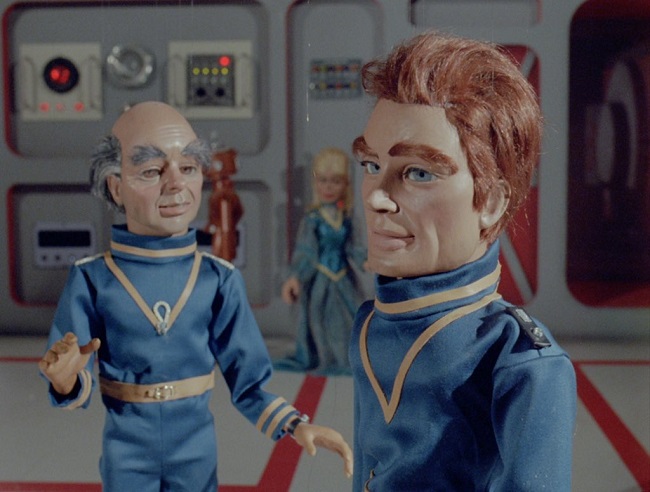
I am a big fan of the detective drama Endeavour, considering it to be one of the best UK shows currently in production. It has well rounded, interesting characters and their journey through the sixties affords the writer, Russell Lewis, plenty of opportunity to explore the political and social issues of the time. Lewis further embellishes the scripts with numerous period and contemporary pop culture references, all of which add to the shows charm and appeal. Tonight’s episode “Apollo” set against the historical moon landings of Apollo 11, saw Morse and Thursday investigating the death of a promising young astrophysicist and his girlfriend. Initially thought to be a car accident, it becomes clear that there is foul play. As ever the plot was complex and established story arcs were moved forward. Shaun Evans also made his directorial debut with this episode.

Firestorm originally started as a Japanese anime series co-created by Gerry Anderson and John Needham back in 2003. The show combined CGI animation for mecha and traditional cel animation for characters and the environment. Despite the quality of the production and an emphasis on the futuristic hardware that has always been a core tenet of Gerry Anderson productions, the anime version of Firestorm didn’t find an audience in Japan. The show subsequently failed to secure a wider release and so became a more obscure part of Anderson Canon. However, in 2014 Anderson Entertainment (under the auspices of Jamie Anderson, Gerry’s son) announced a crowdfunding campaign to produce a pilot episode for a new television series of Firestorm using practical film-making techniques including miniature effects and puppetry. It’s been a long road since then but today a debut “minisode” was shown at MCM Comic-Con London and simultaneously released on You Tube.

You can write pages on Gerry Anderson's 1968 Supermarionation series Joe 90. There's the morally ambiguous premise of giving an emotionally immature nine-year-old the experiences of an adult. Then the psychological effects of allowing him to kill at will. Then there's the perennial issue of scientists prostituting their skills to the intelligence community. One can also reflect upon the absence of any major female characters in the series and how that may impact upon Joe himself. Finally, when one finally arrives she's a gold-digging bitch who tries to exploit Joe’s Dad, Professor McClaine. Joe 90 is certainly a psychiatrist’s dream subject.

Despite the popularity of the TV show in 1965, the two spinoff Thunderbirds feature films were both box offices failures. This has often been attributed to the indifferently written screenplays that seem to have completely missed the sense of suspense that the fifty-minute episodes achieved. Both feature films feel rather slow and like extended episodes rather than big budget extravaganzas. They fail to do anything different with established characters and apart from showcasing more extensive miniature effects in a widescreen format, don’t really have much more to offer. It’s curious that the winning, character driven formula that worked on television was overlooked for these big screen outings.
Trying to encapsulate any artists body of work is a difficult enough task in itself. To then attempt to distil all associated anecdotes, vignettes and legends, while dispensing with the apocrypha, complicates matters further. Yet that's exactly what film maker Stephen La Rivière has done. The documentary Filmed in Supermarionation, is possibly the definitive history of the work of Gerry Anderson from 1957 to 1968. This insightful, meticulously researched exploration charts the rise of AP Films from its humble beginnings, to the halcyon days of Thunderbirds and the studios transition to Century 21 Productions. It also sheds some light into how things rather rapidly came to an end in the late sixties..
I’m not usually a big fan of “re-boots” and “re-imaginings” of classic material. There have been some successful examples in recent years, such as the Bond franchise and Doctor Who but many others have failed. Jonathan Frakes 2004 feature film Thunderbirds was the epitome of this. It total misjudged the target audience, completely failed to grasp the key aspects that made the original series so appealing and excluded the man himself, Gerry Anderson, from any involvement. It also failed to make use of any of Barry Grays sublime back catalogue of music, apart from the main theme. Conversely, the 2015 TV show Thunderbirds Are Go, managed to not only provide a suitable homage to the original show but successfully update the concept for a contemporary audience.
The Secret Service is somewhat of an enigma, being the last Supermarionation show that Gerry Anderson produced. It was poorly received not only by critics but also by its own financier, Sir Lew Grade and was therefore given a limited broadcast upon its initial release. However, it marked the end of an era for Century 21 productions as they turned their creative attentions to film and live action TV after a decade of puppets shows. Subsequently, The Secret Service fell into obscurity over the following years and never gained the same degree of attention from the public, as previous Supermarionation shows had.
The Center Seat: 55 years of Star Trek
Star Trek documentaries are very much like Bruce Lee documentaries, in so far as they’re both a saturated market and more often than not, new content frequently ends up covering the same ground. However, fans tend to watch anything new in the hope that they will find a few new nuggets of information. Brian Volk-Weiss’ new 11 part series, The Center Seat: 55 years of Star Trek, not only covers established facts about the iconic show but also expands upon them as well as providing a wealth of new information. Volk-Weiss has previously explored popular culture with documentaries such as The Toys That Made Us and The Movies That Made Us. The Center Seat: 55 years of Star Trek is an in-depth chronological study of the Star Trek franchise, from its creation at Desilu Productions in 1965 all the way through to the latest iterations, Star Trek: Picard and Star Trek: Discovery.
Star Trek documentaries are very much like Bruce Lee documentaries, in so far as they’re both a saturated market and more often than not, new content frequently ends up covering the same ground. However, fans tend to watch anything new in the hope that they will find a few new nuggets of information. Brian Volk-Weiss’ new 11 part series, The Center Seat: 55 years of Star Trek, not only covers established facts about the iconic show but also expands upon them as well as providing a wealth of new information. Volk-Weiss has previously explored popular culture with documentaries such as The Toys That Made Us and The Movies That Made Us. The Center Seat: 55 years of Star Trek is an in-depth chronological study of the Star Trek franchise, from its creation at Desilu Productions in 1965 all the way through to the latest iterations, Star Trek: Picard and Star Trek: Discovery.
Part of what makes The Center Seat so enjoyable is that the 11 episodes, each running just under an hour, provides adequate time to explore the production history of each show and the various movies. The often overlooked Star Trek: The Animated Series gets an entire episode to itself as do each of the shows from the Rick Berman-era. The analysis of Star Trek: The Motion Picture is especially rigorous and does not shy away from the clash of egos between cast members, as well as the problematic writing process as Gene Roddenberry and Harold Livingston fought over the script. The show also takes the time to discuss the decision to have a title song, rather than a theme for Enterprise and the fact that to date, it still polarises opinion. Perhaps the most significant episode of The Center Seat is the first, which focuses on the importance of Lucille Ball. She used her industry leverage and wealth to get Star Trek made, backing not one but two pilot shows.
However, despite having 11 episodes at their disposal, there is still a lot of content missing from The Center Seat. There is a conspicuous lack of contemporary interviews with William Shatner, Avery Brooks and Scott Bakula. Although there is a lot of footage from all things Star Trek, the licensing arrangements seems to exclude music by any of the composers associated with the shows. It strikes me as remiss to have a documentary about such an iconic show and not mention Alexander Courage’s theme or the subsequent work by Jerry Goldsmith and James Horner. There is also some controversy over the inclusion of at least one Star Trek writer/historian whose accounts of events have been called into question for factual inaccuracies. The show also seems to be selective about which controversies it explores as well as which actors personal problems it focuses upon.
The Center Seat is an entertaining and fairly comprehensive exploration of the Star Trek franchise. This documentary series will probably best suit new fans or those who are not overly familiar with the associated history of the various shows. That being the case then it offers a broad overview and clearly shows that success and popularity is far from a smooth ride. Those who are well versed in the franchise's legendarium will probably be familiar with half or more of the show content. I found a lot of crossover between material in this show and the extras I’ve watched over the years on various DVDs I’ve owned. It is also worth noting that there are two versions of The Center Seat. One is obviously re-edited for syndication, consisting of 10 x 42 minute episodes. This version was shown on The History Channel. Then there is a longer 11 x 58 minute version. I watched the latter and this is the one that I recommend.
Star Trek is slightly older than me by 14 months. I was born on December 18th 1967. Star Trek was first broadcast in the US on 8th September 1966. Hence this show has always been part of the prevailing pop culture that surrounded me, as I grew up. I first began watching Star Trek as a young child in the early seventies. It would be repeated on the BBC in the early evening on Fridays and it became a family ritual to sit down together and watch it. As a seven or eight year old, it left a great impression upon me and was in many ways, the television highlight of the week. Star Trek along with Doctor Who certainly started my interest in science fiction. Star Trek was also one of the first shows that introduced me to tie-in marketing. I remember seeing in a toy shop, near to my school at the time, a Dinky Klingon Battle Cruiser and was flabbergasted that such a thing existed. I immediately coveted it but sadly never obtained one.
Star Trek Axanar is back in the news, twelve years on from the last controversy. For those unfamiliar with the original debacle, in 2014 Prelude to Axanar was released via YouTube. This Star Trek “fan-film” presented as a faux 21-minute, Starfleet documentary was very well received by fans and was intended by its makers as a proof of concept for a feature-length film. Set in the year 2245, during the final year of the Four Years War against the Klingons, Prelude to Axanar pushed the boundaries of what a fan film could be. The subsequent Kickstarter and Indiegogo campaigns raised more than $1.1 million. Prelude to Axanar was promoted as a professional-quality, “independent” Star Trek production, employing experienced actors and filmmakers and even established its own studio facilities. The presence of such actors as Richard Hatch, J. G. Hertzler, Kate Vernon, Tony Todd and Gary Graham (resuming his role as Vulcan Ambassador Soval) certainly made Prelude to Axanar distinct from other fan-films.
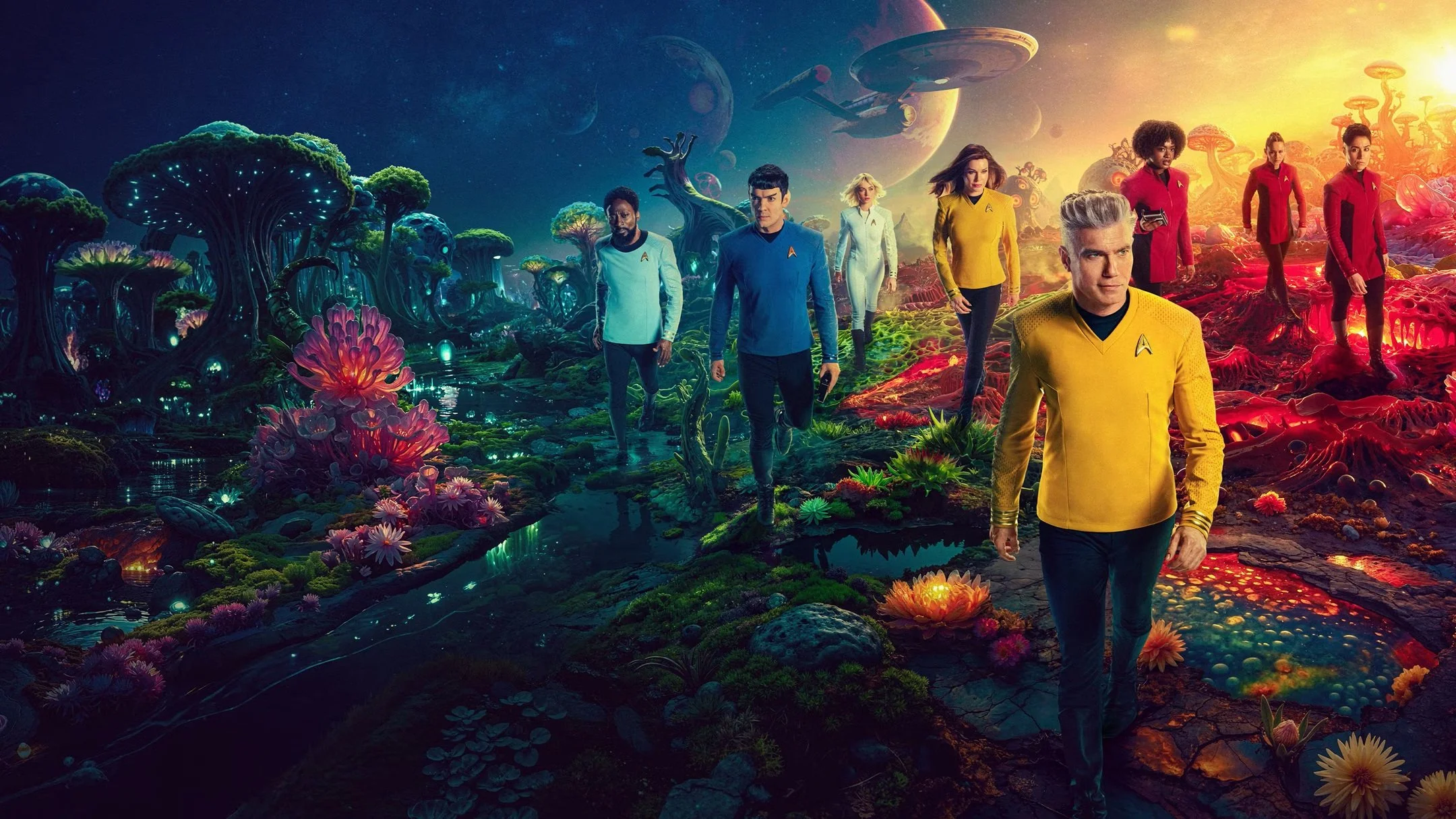
Thoughts on TV shows and my current viewing habits.
I last wrote a blog post in this series back in February 2022. Then for various reasons, I stopped. Possibly because my relationship with TV has changed in recent years. It’s fair to say at present that viewers are spoilt for choice. There are lots of very good shows around. Conversely, there is also a lot of bland, generic, filler as well. I appreciate that not every television series has to be an industry milestone and there are times when I’m content to watch undemanding content. However, I am very protective of how I spend my leisure time at present. I am not prepared to sink 6 or 8 hours into a show that is just “okay”. Hence I’m becoming very particular about what I watch. If something isn’t working for me in any fashion then I just abandon it and am happy to do so.
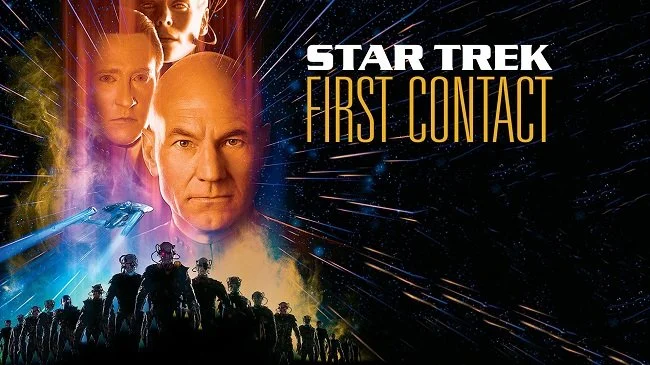
Jerry Goldsmith’s contribution to Star Trek is immense. Yet simply listing the films and TV episodes he wrote music for does not adequately encapsulate the significance of his contribution to the franchise. His majestic, thoughtful and uplifting musical scores provide an emotional foundation that reflects the core ethos of Star Trek. They also create an invaluable sense of continuity that spans multiple shows and movies. Perhaps the most obvious example of this is his iconic title music for Star Trek: The Motion Picture (1979) that was subsequently adopted as the theme tune for Star Trek: The Next Generation. His work was held in such high regard, when Star Trek V: The Final Frontier (1989) ran into production issues, it was thought that a Jerry Goldsmith soundtrack may well elevate the film. Sadly it didn’t but his work on that instalment was outstanding and among his best.
Star Trek documentaries are very much like Bruce Lee documentaries, in so far as they’re both a saturated market and more often than not, new content frequently ends up covering the same ground. However, fans tend to watch anything new in the hope that they will find a few new nuggets of information. Brian Volk-Weiss’ new 11 part series, The Center Seat: 55 years of Star Trek, not only covers established facts about the iconic show but also expands upon them as well as providing a wealth of new information. Volk-Weiss has previously explored popular culture with documentaries such as The Toys That Made Us and The Movies That Made Us. The Center Seat: 55 years of Star Trek is an in-depth chronological study of the Star Trek franchise, from its creation at Desilu Productions in 1965 all the way through to the latest iterations, Star Trek: Picard and Star Trek: Discovery.
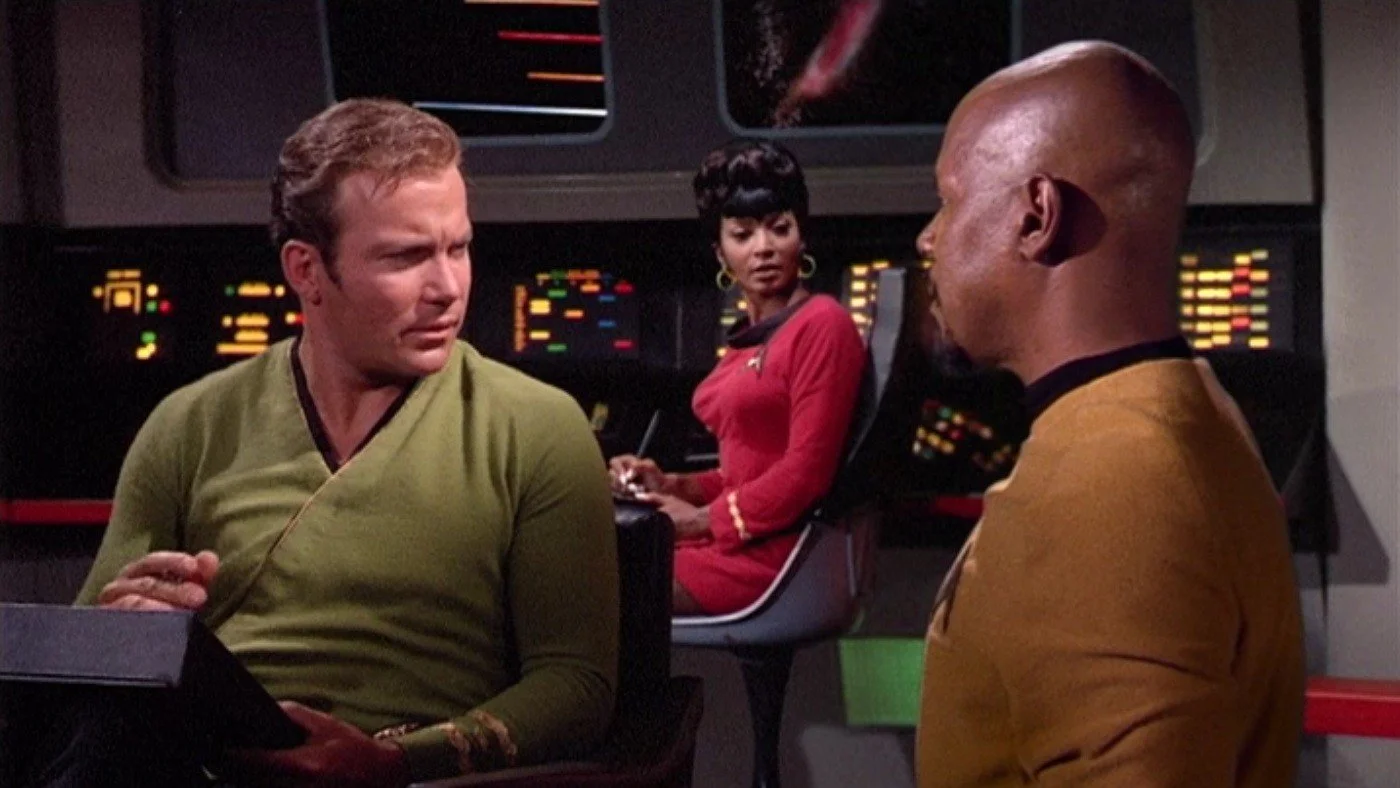
I recently watched the first trailer for the new Obi-Wan Kenobi television show that is premiering on Disney + in May. I am interested in this latest instalment in the Star Wars franchise and curious as to whether Liam Neeson will make an appearance. I also watched a 20 minute fan video in which they “analysed” the entire trailer. They discussed the content of this 2 minute preview and then did a great deal of speculating about potential themes and characters that may feature in the show. They were clearly enthusiastic about what they had seen and were very knowledgeable about the subject. This resonated with me, as I like to be well versed about the things I enjoy. However, it is worth remembering that fandom can tip into obsession and gatekeeping. Hence I feel there is a subject to explore here.

Before we start, no I am not writing about Alexander Courage’s classic main theme for the original Star Trek show. I can add nothing further to that particular discussion and it remains iconic and inspiring, even when distilled down to just the initial fanfare. In this post I want to draw your attention to another piece of music from Star Trek that has permeated its way into popular culture. A cue that when heard, if the listener is familiar with its provenance, will instantly conjure up images of flying drop kicks, ear claps and judo chops. A piece of music that can be added to pretty much any video footage and instantly make it more heroic. Yes, I am talking about what has become generically known as Star Trek “fight music”. Or more specifically, the "The Ancient Battle/2nd Kroykah" cue from Amok Time (S02E01) composed by Gerald Fried. The scene during the koon-ut-kal-if-fee ritual in which Spock fights Kirk on the planet Vulcan for complicated “reasons”.
Star Trek: The Motion Picture is a wonderful paradox in the Star Trek cinematic pantheon. It is possibly the most hardcore science fiction story that the franchise has explored and is both simultaneously Trek-like and un-Trek-like. Director Robert Wise and the production team worked hard to deliver a completed film for the scheduled December 1979 release date. However, he felt that the theatrical version was only a “rough cut”. Hence in late 2001 he supervised a Director’s Edition of the film which runs 136 minutes (4 minutes longer than the theatrical release)and reinstates some additional scenes and replaces some of the optical effects with new CGI creations. Critics were divided as to whether the Director’s Edition improved the film overall but Wise felt that this version was much closer to his original vision. The Director’s Edition was released exclusively on DVD in standard definition.

Fan Edits are a curious film sub genre. Some simply reinstate deleted scenes to maximise the running time of a movie. Others will remove footage and seek to reorder events in the name of coherency. But a few are far more ambitious. Rather than just reshape what is there, they will shoot new footage to replace material deemed substandard and seek to totally reimagine a movie. On even rarer occasions a few manage to actually improve upon the original, rather than just offering an augmented version. Which leads me onto Star Trek: beyond the Barrier, an interesting and very enjoyable fan edit of Star Trek V: The Final Frontier by Anti-Matter from deLimited Productions. It attempts to repair many of the problems found in the theatrical release of the movie. Some would argue that such a task is a Kobayashi Maru test in itself. However, the results are surprisingly good and some tongue in cheek humour shows that the creator understands the nature of their task.
Welcome to the second part of my Star Trek Online: Beginners Guide. I thought it may be useful to write a series of posts, offering practical information for those who are just starting out in STO. Nothing fancy or in any way definitive. Just a few basic tips that may help orientate the new player. I’ve been playing STO since its launch in 2010 and this MMO has seen a lot of changes. The game features a lot of systems and mechanics that are not always immediately intuitive to grasp. So I’ll be doing my best to cover a selection of these in each post and try to provide a broad overview. Like a lot of advice, it can be subjective. Ultimately it comes down to each player how they wish to play. In this instalment, I shall be writing about career paths, factions and races.

Today is Star Trek Day. An officially sanctioned celebration of all things Star Trek. The date reflects the launch of the original television show, back in the sixties. Naturally, there are a multitude of events going on over at the official Star Trek website. And as ever, the MMORPG Star Trek Online is taking part in the celebrations. “On September 8th, 1966, the world first met a group of people, and a ship, that would change our lives forever. Pitched as “wagon train to the stars,” and brought to TV by the force of Lucille Ball’s will, Gene Roddenberry’s Star Trek hit tiny television screens around the world and immediately captured hearts and minds. Through three seasons, and decades in syndication, The Original Series started a movement that still lasts today, more than half a century later. We live in a time where there’s more new Star Trek than ever before, and we’re joining with the rest of our Star Trek Family to celebrate the franchise’s birthday”.

I’ve mentioned in the past that a lot of important information regarding the MMORPG Star Trek Online is centralised within the official subreddit. That’s fine if you enjoy using this platform but it’s not for everyone. I’ve always found Reddit somewhat esoteric and I don’t really like the way it visually displays information. I have to use a browser addon to make it more user friendly. Unlike other communities, STO does not seem to have that many fan produced blogs. However, I may be wrong regarding this, so feel free to correct me (and provide URLs). In the meantime, I thought it may be useful to write a series of simple guides, offering practical information for those who are new to STO. Nothing fancy or in any way definitive. Just a few basic tips that may help orientate the new player. This time we’re going to look at the business model for STO and the cost of playing the game.
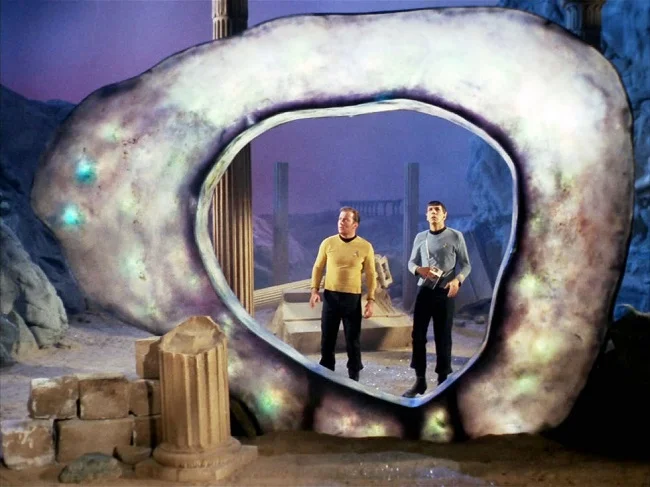
Out of the original seventy-nine episodes of Star Trek, one of the most respected and beloved is The City of the Edge of Forever. Written by Harlan Ellison the story is one of the more thoughtful and tragic in Trek Canon. It was also the first episode to feature a temporal plotline. Doctor Leonard McCoy (DeForest Kelley) accidently receives an overdose of medication and flees the Enterprise while in a delusional state. Beaming down to an alien planet he uses a temporal gateway (The Guardian of Forever) to travels back in time to earth during the Great Depression. By doing so he accidentally changes history. Captain Kirk (William Shatner) and Spock (Leonard Nimoy) follow him through the gateway to New York in hope of correcting the timeline. While awaiting the arrival of McCoy, Kirk falls in love with Edith Keeler (Joan Collins) who runs the 21st Street Mission. However he and Spock soon determine that to restore the timeline they must allow her to die.

There has been a degree of controversy over the Discovery Operation Pack that has recently been made available for purchase in Star Trek Online. The bundle featuring ships, bridge officers, cosmetic items and more is displeasing some core players who feel that it is over priced and lacks anything relevant for Romulan and Klingon races. Personally, I’m only interested in two specific items from the pack, such as the Tier 6 Gagarin Miracle Worker Battlecruiser and the combat pet Tardigrade but at present they cannot be purchased separately. So, I shall not be parting with any money at present. The Gagarin Miracle Worker Battlecruiser is relatively similar to the Tucker Tactical Miracle Worker Cruiser, which I already own. However, it is an improvement aesthetically speaking (a subjective point, admittedly), so for me the obvious compromise is to purchase the fleet version and forgo the unique space trait and settle for an additional console slot. As I’m not a high-end player, the look and feel of a ship has as much appeal to me as its stats.

I have suffixed the title of this post “and stuff” so I can address several Star Trek Online related thoughts in a single blog post. Despite the fact that I frequently play STO it is does oddly get neglected in my writing. So, let us start with the issue of the ninth anniversary. As ever Q is back with the anniversary event and once again, we are stabilising Omega Molecules. This year’s reward is a Tier 6 Vulcan T’Pau Scout Ship. There are also emotes and sundry other items to earn during the duration of the festivities, but I more interested in the anniversary itself. Not many MMOs make it to nine years and if they do, they aren’t necessarily in as good shape as STO. The game has a stable and loyal playerbase and is currently tied-in to Star Trek: Discovery. Further established Trek actors are supplying voice acting and the game seems to be doing well across both PC and consoles. Like LOTRO, STO uses the IP well and seems to “fill in the gaps” in the existing lore as well as expand and extrapolate established canon. One of the best things about STO is that there’s always something to do in-game as well as new content in the pipeline. Perhaps this along with the handling of the IP is why the game endures.
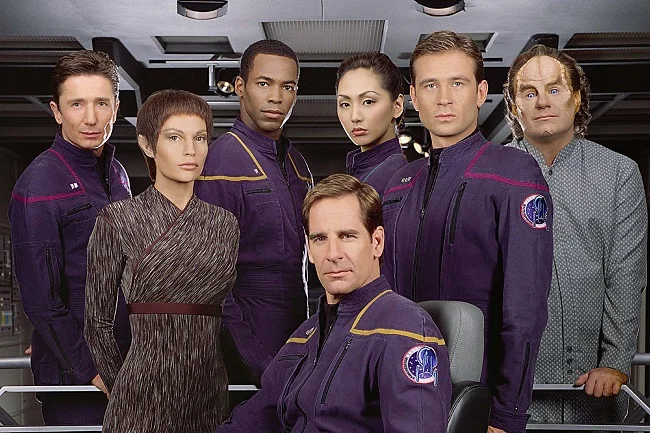
Star Trek: Enterprise was the first show in the Star Trek pantheon to have a song performed by an established artist play over the opening credits, rather than a traditional theme tune. Up until 2001, the franchise had maintained a more formal approach, established with the iconic introduction to the original series composed by Alexander Courage. Needless to say, such a radical departure from established practise brought about consternation and debate among fans. In some respects, you can argue that point about the entire show itself, but that as they say, is an entirely different blog post. Needless to say, the dislike and hatred that the song Where My Heart Will Take Me engendered in certain quarters, lead to a petition to have it removed. Needless to say, this movement failed, and the show continued using it for four seasons. Seventeen years on this particular debacle has now died down and the song is often just referenced ironically by fans as an amusing anecdote and piece of Trek trivia.
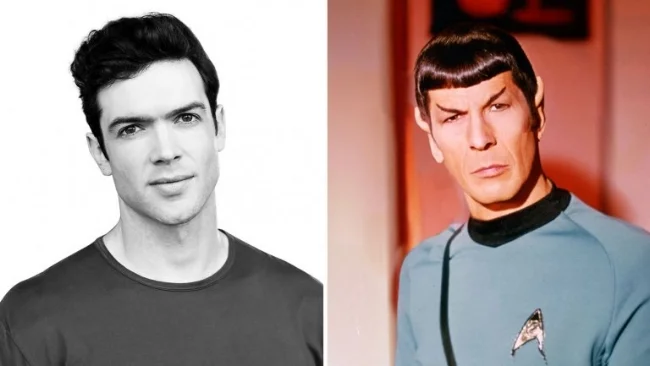
I’ve written in the past about the problems that can arise from untempered fandom. If enthusiasm and inspired love are not balanced by contextual reason and a healthy dose of reality, then it can get a little bit over zealous. Need I cite Star Wars fans and The Last Jedi as an example of unchecked fandom. However, I am now going to stray a little into the “Twilight Zone” of fandom myself, although I shall attempt to apply a healthy dose of realism into the proceedings. Because I want to discuss the fact that Ethan Peck has been cast to play one of the most iconic characters in popular culture. Yes, Gregory Peck’s grandson (and there’s plenty of “baggage” there) has been cast to play Spock in season two of Star Trek: Discovery. Furthermore, rather than be concerned, I am very excited by this development and I really look forward to seeing how this pans out.

After a prodigious marketing campaign and a great deal of internet speculation about one specific character, Star Trek Into Darkness was released to broadly strong reviews and solid box office returns in early May 2013. Finally, all the questions that had kept fans and website pundits endlessly theorising, were answered. For a second time running, Paramount Pictures managed to produce an action-filled blockbuster which still offered a strong plot, with complex and adult themes, explored by well-rounded characters. Batman Begins seems to have set a trend of framing material from a traditional pulp background, within broader intellectual parameters. Star Trek: Into Darkness managed to do this while cleverly re-imagining iconic material from its own lore. However, as with any substantial franchise movies, not everyone was satisfied or pleased. Many fans railed against the new Kelvin Timeline and continue to do so.

The reinvention of any popular franchise certainly comes with many risks. Twelve years ago, Casino Royale was hailed as a triumph in rebooting the 007 brand. It was hard edged, back to basics movie that made the spy genre relevant to a contemporary audience, without diluting its source material excessively. Yet this process went a step too far with Quantum of Solace, with a film that simply didn't feel Bond enough. Needless to say, the rights holders corrected this error. The success of the BBC's relaunch of Doctor Who hinged on making the formula accessible to modern viewers. Yet the new format of standalone episodes, celebrity guest stars and an emphasis on action over story, can be difficult to maintain and requires the involvement of top writers to keep the momentum going. Then of course there are the fans.
![Star Trek Discovery S01E01 The Vulcan Hello.mkv_snapshot_07.19_[2017.09.25_17.54.13].jpg](https://images.squarespace-cdn.com/content/v1/54e310f0e4b0f4a6ba3ac899/1506359625650-D976K1OBW47HSSSFN2S2/Star+Trek+Discovery+S01E01+The+Vulcan+Hello.mkv_snapshot_07.19_%5B2017.09.25_17.54.13%5D.jpg)
Finally, it’s arrived. The first new Star Trek TV show for twelve years. Star Trek: Discovery became available for Netflix UK customers to watch at 8:00 AM this morning. Needless to say, I cleared my schedule in advance so I could sit down and watch this much-anticipated show. Furthermore, I made it my business to avoid Twitter and the internet until I had finished viewing the first two episodes because I knew in advance that Star Trek: Discovery was going to be controversial and divide fans. Having now seen The Vulcan Hello and Battle at the Binary Stars and taken time to reflect upon both episodes, I have reached the following conclusion. From what we’ve seen so far, the spirit and emotional heart of Star Trek, is reflected in the new show. I found the characters to be interesting and well defined. Lead performances by Michelle Yeoh, Sonequa Martin-Green and Doug Jones were good and there’s an intriguing crew dynamic. The story has already touched upon numerous canonical themes and I am eager to learn more about the main characters and the universe they inhabit. I therefore shall continue to watch Star Trek: Discovery. However, not everyone feels the same, as my subsequent forays online have shown. Much has changed in this new iteration of Star Trek and as we know, some fans do not like change in any way, shape, or form.

Over the years I have been a participant in several fan based communities. These have ranged from running film clubs, to creating and publishing fanzines in the pre-internet days. More recently this has included running websites, blogging and creating podcasts. It’s a curious thing the way fandom is cyclical and one’s involvement with such communities seems to ebb and flow. It’s something I’ve been thinking about a lot of late. Several of the You Tube channels I enjoy have reduced their output or stopped due, to changes in advertising policy and monetisation. The Newbie Blogger Initiative failed to manifest itself this year and many of my immediate colleagues in blogging and podcasting have also begun to fade away or moved on to pastures new. The sad thing is, the true value of many community contributors is never really realised until after they’ve gone.

Fans are often a very creative and resourceful bunch. Star Trek fans especially so. At present, there’s a lack of new officially endorsed canonical content being produced. The movies set in the Kelvin Timeline are not universally embraced by Trekkies and usually take three years to produce. The new TV show Star Trek: Discovery has been subject to several production delays and still seems a long way off. So, the fans solution in recent years, has been to make their own original content. Hence there is a wealth of unofficial, independently made shows available online, set in various incarnations of the Star Trek universe. Although many of these productions are lovingly crafted and driven by passion, often they lack the professional polish of the genuine article. Frequently their weakness lies in the quality of the acting and writing. Then there is Star Trek Continues.
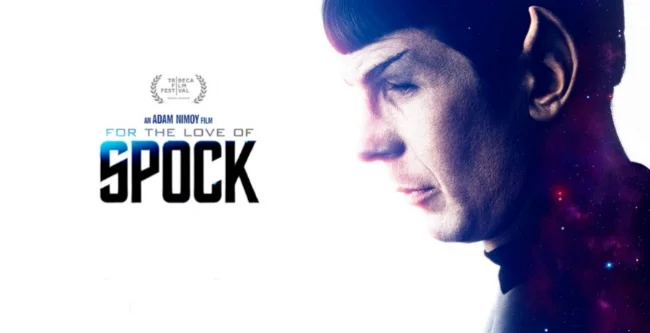
Adam Nimoy doesn’t paint a rosy picture of family life in his documentary about his father. The novelty of fame and popular acclaim soon wore off with it’s never ending photoshoots and long working hours that kept his father from ever being home. Yet among the anecdotes in this greatly condensed biopic there evidence of a lot of love and professional respect. Far from being comprehensive For the Love of Spock focuses on the matters that interest fans the most. So the documentary explores Nimoy’s relationship with Gene Roddenberry, his subsequent casting in Star Trek, his post Trek stage career and his return to the fold with the big screen movies.
The Captains is a curious beast. If you’re expecting a traditional documentary where Bill Shatner simply indulges in a standard Q & A with other actors that have portrayed captains within the Star Trek franchise, then you will be disappointed. The Captains is a horse of a different colour entirely. Throughout its ninety minute duration, this documentary veers from personal reflections on acting, muses upon the nature of fame and even touches upon contemplating one’s own mortality. It certainly wasn’t what I was expecting and was subsequently a far more rewarding experience.
I am not a dogmatic fan. In fact as I get older, I become far more flexible and forgiving in my outlook. I certainly don’t buy into the concept that your “childhood can be ruined”. The only way something new can spoil the memories of something old that you hold dear, is if you allow it to. If you wish to explore this concept further, I’d suggest reading Marcus Aurelius. Back to the matter in hand. When I found out that Star Trek was to be rebooted via an alternative timeline plot device, I was content with this. I decided to ditch my personal baggage and try and be objective about the now named “Kelvin Timeline”. I make no bones about the fact I have liked the previous two Star Trek movies. Are they masterpieces? No. Are they entertaining? Yes. That is far more than some reboots have achieved.

The announcement that CBS has commissioned a new series of Star Trek is both a blessing and a curse. It’s a blessing in the sense that I have genuine affection for this franchise and therefore I welcome the prospect of a new incarnation of the show returning to TV. However I also consider this situation an absolute curse because well now have to endure at least eighteen months of idle speculation and an ongoing dissection of the entire production of a show before it is even released.
Trek Nation is a relatively straight forward documentary with a clear premise. It follows Eugene Roddenberry’s search to find out more about his father Gene and to understand the cultural phenomenon of Star Trek. Directed by Scott Colthorp the film endeavours to explore the enduring appeal of the franchise as Eugene discovers more about the father he didn't know and the show that passed him by. Through interviews with cast and crew members from all five Star Trek shows, as well as fans and celebrities who were influenced by the show while growing up, Trek Nation methodically follows a linear path. Yet this uncomplicated approach proves to very effective and surprising candid.
Shatner in Space (2021)
Shatner in Space is a 45 minute documentary about the 90 year old actor, William Shatner and his recent foray into space via Jeff Bezos’ Blue Origin sub-orbital spaceflight service. Considering the provenance of this entire undertaking, attitudes in general towards billionaires and the obvious publicity seeking hubris of sending a cultural icon into space, it’s easy to dismiss Shatner in Space as nothing more than a very, very expensive infomercial. However, the quiet dignity of Mr Shatner whose age and experience means that he draws a very different conclusion from his space flight than his fellow passengers, is utterly compelling and possibly a little profound. If you can endure the soulless polish of the scenes with an immaculately staged managed Jeff Bezos, then you’ll be rewarded with the philosophical musings of a man approaching the end of his life who is naturally curious about his own mortality.
Shatner in Space is a 45 minute documentary about the 90 year old actor, William Shatner and his recent foray into space via Jeff Bezos’ Blue Origin sub-orbital spaceflight service. Considering the provenance of this entire undertaking, attitudes in general towards billionaires and the obvious publicity seeking hubris of sending a cultural icon into space, it’s easy to dismiss Shatner in Space as nothing more than a very, very expensive infomercial. However, the quiet dignity of Mr Shatner whose age and experience means that he draws a very different conclusion from his space flight than his fellow passengers, is utterly compelling and possibly a little profound. If you can endure the soulless polish of the scenes with an immaculately staged managed Jeff Bezos, then you’ll be rewarded with the philosophical musings of a man approaching the end of his life who is naturally curious about his own mortality.
When you consider William Shatner’s personal arc as a pop culture icon, he has matured from a young successful actor and has journeyed through the pressures of fame and success. He has gone from being reviled by his colleagues to setting aside the past and being reunited with them. He is now a venerable figure who is wiser for their life experience who wishes to do some good with the time he has left. It is therefore fascinating to see his reaction when he walks into the Blue Origin headquarters and realises that pretty much all of the staff that work there share a common dream of space travel due to the influence that he and Star Trek had upon their lives. It is clear that he recognises this and it’s moving to see his reaction. There’s no hint of ego. Just a quiet awe and a hint of pride. It is also a clear demonstration of the immense power of fame and celebrity.
Shatner in Space finds it stride towards the end of it’s relatively short running time, when we see selected footage of the 4 passengers in the capsule during launch and New Shepard’s journey to the Kármán line. During the brief period of weightlessness, the other passengers are immediately enamoured with the strangeness of the sensation. They naturally laugh and caper. 90 year old Shatner pulls himself to the window and stares into the black void of space and then down at the intense blue of the earth. He quietly states “That’s it. I’ve got it”. His personal epiphany is moving and dare I say, beautiful. He is visibly moved upon his return and where the others are vocally elated, his quiet introspection as he processes what has happened is again captivating. When he finally masters his feeling his first thoughts are that everyone should have such an experience as it affords an important perspective. Despite the corporate nature of this documentary, it has a wonderful streak of humanity, thanks to William Shatner.
Star Trek is slightly older than me by 14 months. I was born on December 18th 1967. Star Trek was first broadcast in the US on 8th September 1966. Hence this show has always been part of the prevailing pop culture that surrounded me, as I grew up. I first began watching Star Trek as a young child in the early seventies. It would be repeated on the BBC in the early evening on Fridays and it became a family ritual to sit down together and watch it. As a seven or eight year old, it left a great impression upon me and was in many ways, the television highlight of the week. Star Trek along with Doctor Who certainly started my interest in science fiction. Star Trek was also one of the first shows that introduced me to tie-in marketing. I remember seeing in a toy shop, near to my school at the time, a Dinky Klingon Battle Cruiser and was flabbergasted that such a thing existed. I immediately coveted it but sadly never obtained one.
Thoughts on TV shows and my current viewing habits.
This so-called recurring post is certainly becoming quite irregular, as It’s been over a year since I wrote the last instalment of The Idiot Box. I noted back then how I was watching less television and to be frank that hasn’t really changed. Although there are plenty of well written and entertaining shows out there, too often choosing to watch one effectively places you in an opened ended social contract. For example, I watched the first season of The Agency, which is a superior espionage drama. It ended with the main story completed and a few plot lines open for another season. A second season has just been released and I have learned from a blog post by Wilhelm Arcturus, that this season ends on a cliffhanger. Oh dear. Do I really want to get on another TV show treadmill? Nope. I like TV shows that have self-contained seasons. So I guess I’ll be skipping The Agency. Shame. I liked the Jack Black cover of a U2 song that they use on the title credits.
I recently found a DVD boxset of Return to the Planet of the Apes in a charity shop which I bought for £4, which is a ridiculously cheap price. I considered it an interesting find because it was a Region 1, US copy. However, that is not so unusual these days as most DVD players are now region free and Amazon (UK) sells media from all over the world. As for the show in question, I vaguely remember Return to the Planet of the Apes being shown on UK network TV when I was a child, probably circa 1976. Back then it would usually take a year or so before US shows made it onto UK television. From a commercial perspective, the entire Planet of the Apes franchise was beginning to run out of steam. I was 8 years old at the time so had missed most of the film releases. However, I enjoyed the live action TV show hence an animated follow up had obvious appeal to a child of my age.
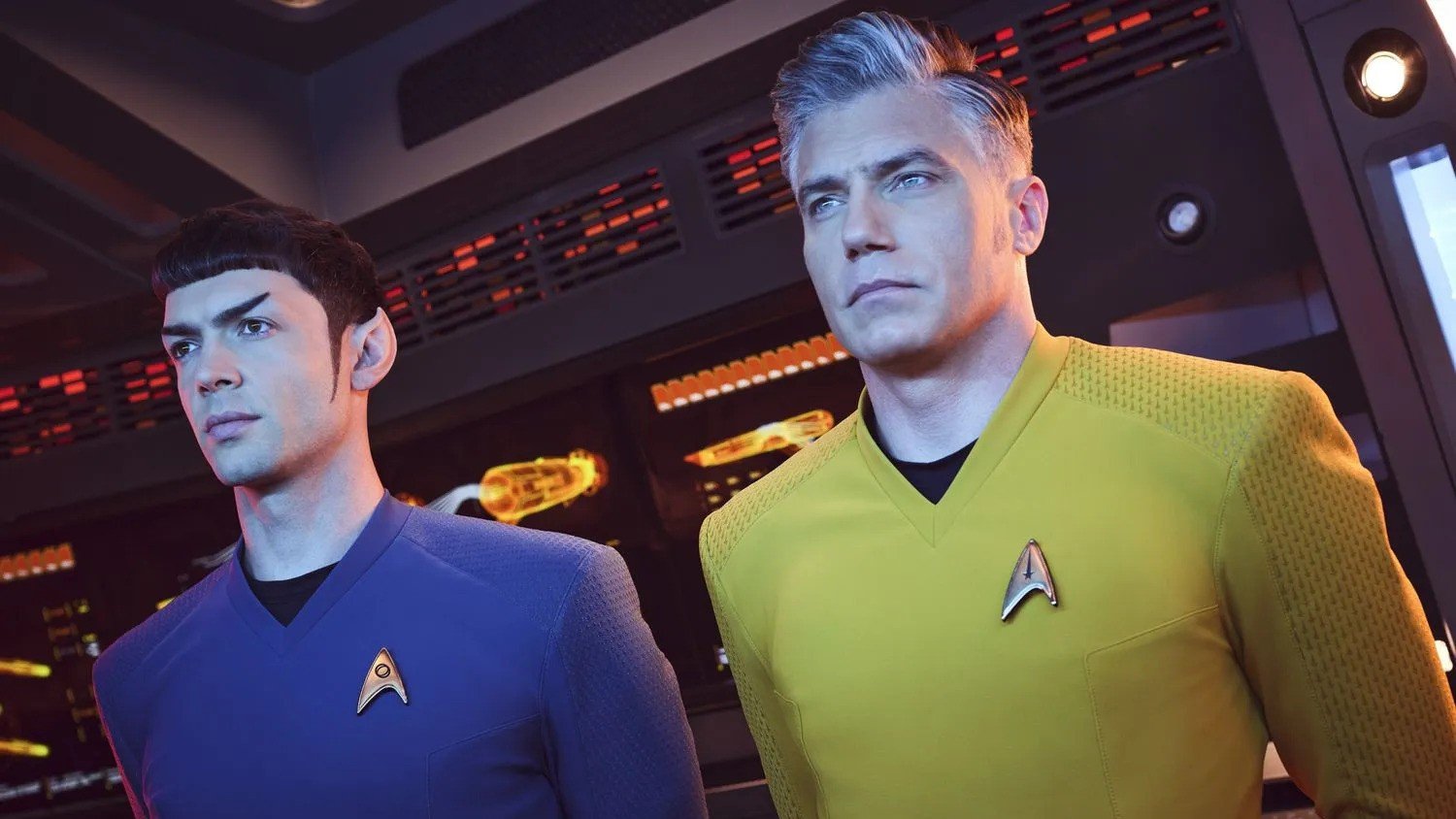
I have not watched as much TV as I usually do, this year. Mainly because I have become a little weary of the ways contemporary TV is produced, especially with regards to streaming shows. Due to the costs, shows such as Star Trek: Strange New Worlds only have 10 episodes per season. Simply put, the season begins to hit its stride and then is abruptly over. This problem (if you see it as such) is then further compounded by there being a significant wait between seasons. In the case of STSNW it was two years between season two and season three. Not all shows fall foul of this. Apple TV produces two seasons of the excellent espionage drama Slow Horses at a time, ensuring a prompt release schedule. However, even this has issues. Due to the complexity of the plots of many contemporary TV shows, something that is a marketing point, some viewers cannot remember the plot after a twelve month hiatus. Network TV shows seldom have these issues with each season being 20 plus episodes long and story arcs that are seldom as complex.

Strictly Come Dancing remains the BBC’s flagship light entertainment show for Autumn. Despite controversy and scandal, the show bounced back last year and firmly re-established itself as the “feel good, family show” it has always claimed to be. Blind comedian Chris McCausland becoming the 2024 champion certainly validated the show’s commitment to diversity and inclusion and helped place Strictly (as it is known to its fans) back on its cultural pedestal. I’m sure those involved in the production of the show breathed a sigh of relief when the season ended on such a positive note, eclipsing the negative press that had been ever present last summer. Second chances and opportunities for a “course correction” are few and far between these days. Especially when you have elements of the UK press waiting with bated breath and hoping that you’ll fail.
Treasure Island In Outer Space is a curious Italian television production from 1987 starring Anthony Quinn and Ernest Borgnine. It also features numerous international actors better known for their work in cult and exploitation films, such as Bobby Rhodes, David Warbeck and John Morghan. Directed by Antonio Margheriti (AKA Anthony Dawson), famous for such films as Killer Fish (a cash in on Piranha) and The Last Hunter (a Vietnam exploitation epic), Treasure Island In Outer Space is a faithful adaptation of Robert Louis Stevenson’s classic novel. The screenplay by Renato Castellani and Lucio De Caro draws heavily from the source text, maintaining character names and original dialogue. However in updating the material to a futuristic setting, the script is littered with the worst kind of eighties sci-fi clichés. We are subjected to sonic trains, anti-gravity rays and the usual buzzword driven faux science.
Thoughts on TV shows and my current viewing habits.
I last wrote a blog post in this series back in February 2022. Then for various reasons, I stopped. Possibly because my relationship with TV has changed in recent years. It’s fair to say at present that viewers are spoilt for choice. There are lots of very good shows around. Conversely, there is also a lot of bland, generic, filler as well. I appreciate that not every television series has to be an industry milestone and there are times when I’m content to watch undemanding content. However, I am very protective of how I spend my leisure time at present. I am not prepared to sink 6 or 8 hours into a show that is just “okay”. Hence I’m becoming very particular about what I watch. If something isn’t working for me in any fashion then I just abandon it and am happy to do so.
The seventies was an interesting time for UK genre television. Despite small budgets and often low key visual effects, there was no shortage of good ideas and creativity. Sapphire & Steel is a prime example of a show couched in a high concept, produced on a shoestring. It also credits its audiences with some degree of intelligence. Rather than spoon feeding the narrative in a didactic manner, it hints and implies, then leaves the rest to its viewers imagination. Created by Peter J. Hammond, a veteran TV writer, Sapphire & Steel centres on a pair of interdimensional operatives named Sapphire and Steel. They are two of a number of elements that assume human form. Over the course of three seasons little is revealed about the pair but they appear whenever there is any anomalous temporal activity. Time itself is portrayed as a sentient and malignant force that seeks to make incursions into the present reality, through weaknesses in the fabric of space.
Season 2 of Andor has received praise from both critics and fans alike. It finally seems to have put to bed the common argument that Star Wars as a franchise has traditionally been light on narrative depth, character development and the exploration of the themes that its main story is predicated upon. Andor shows the realities of opposing authoritarian regimes and exists within shades of grey, rather than purille, binary positions. Many have drawn parallels with the current state of geopolitics, especially that of the United States. I certainly found the second season of Andor to be engaging and thought provoking. I also enjoyed the performances of many of the British actors who by default are cast in all the major Empire roles. I thought Anton Lesser was especially noteworthy as a senior officer in the Imperial Security Bureau.

If you don’t want to pay for streaming services, or premium digital satellite and cable content, then your choice in the UK is somewhat limited. You can receive all “free to air channels”, IE the ones that have advertising, via the digital terrestrial platform Freeview. Most UK televisions have Freeview access built in. Alternatively, the same selection of channels are available via the digital satellite platform Freesat. You can also buy either Freeview or Freesat digital video recorders and require only a rooftop aerial or satellite dish respectively to access these platforms. Most DVRs come with additional IPTV functionality built in along with the most popular streaming apps, so additional subscription services can be added if the viewer so desires. Freeview and Freesat carry a mixture of high definition and standard definition channels. Internet based services offer 4K content.

When I started writing this post it was intended to be about changing from one UK TV provider to another. However, I became concerned that there was a need to provide some sort of historical context, because I wasn’t sure whether all readers would be familiar with how television is provided here. The next thing I know, I’ve written a potted history of public and commercial broadcasting in the UK and the resulting post has become somewhat lengthy. So I have decided to split the text into two halves. The first being a summary of how the provision of television has changed in the UK over the course of the last fifty plus years. The second focuses more upon changes to the TV industry’s business model, consumer habits and the present status quo.

It is fair to say that we live in an age where we do not lack quality TV. There are numerous shows that have garnered critical acclaim or a strong word of mouth following that are deemed “must see” viewing. No doubt you, like myself, have a long “to do” list of programs that you need to “get round to watching” on top of those shows which are staples of your viewing regime. If you didn’t have enough programmes already to catch up with, we all have friends and family telling us about a “great show” that’s on a platform we don’t subscribe to, that we really need to see. It is quite extraordinary and a far cry from my youth when the UK simply had three terrestrial channels until satellite TV became popular in the late eighties. To paraphrase the former Prime Minister Harold Macmillan “we’ve never had it so good”.
Music by John Williams is a documentary celebration of the famous composer and his illustrious body of work. It provides some interesting biographical background information as to how the man was born into a family of talented musicians. It then traces his rise from pianist for hire to the most well known film composer today. Along the way, anyone who is anyone in film and music appears to heap justifiable praise upon him and his body of work. It also features a continuous medley of John Williams’ greatest hits, as it catalogues his work in broadly chronological order. Music by John Williams is an upbeat and positive love letter to the composer and exactly what you would expect, when you consider that the documentary was produced by his friends and peers.

Tonight’s results for week 5 of Strictly Come Dancing (season 22) have once again demonstrated that this show is more than just a dancing competition to UK viewers. If it were just a case of determining who are the best dancers, then JB Gill would not have been in the dance off. The judges may well see things exclusively in such terms but the public clearly do not. I last wrote about this phenomenon in 2019 and I think it appropriate to raise the subject again as this season of Strictly seems to be bucking past trends and I suspect we may be in for further upsets in the run up to the season finale. Broadly speaking, the public usually tends to vote in a manner similar to the official leaderboard. Hence, those who score the lowest usually end up in the dance off. Occasionally an underdog will be championed and kept on the show but that trend seems to have lost its novelty in recent years. This season appears to be quite different.

I make no bones about the fact that I watch Strictly Come Dancing every year. For those who live outside of the UK, this is the original version of the dancing reality show that you probably know as Dancing With the Stars in your country. It is still a big deal in the UK as far as TV ratings go, getting audiences on average of 6.6 million viewers. There are many aspects of the show that are textbook examples of prime time, popular entertainment but I like it because the “celebrities” that take part are ultimately learning a skill that is genuinely difficult. The latest season of Strictly, as it is known to its fans, is especially interesting as the BBC had a major PR problem earlier in the year, where several previous participants made allegations of bullying and abuse about their pro-dancer partners. An investigation is still ongoing and in the meantime, the two professional dancers that were named have withdrawn from the show. Hence everyone involved with the latest season are all on message, stating that it’s “all about having fun”.
Watching TV was a far more communal activity in my youth. Families sat and watched specific shows or sports together. “Appointment TV” had its benefits not only for TV ratings but for advertising revenue. Although audiences may have grown over the years, they have also become more fragmented and compartmentalised. Smaller market shares have therefore made advertising far more pervasive. Even big streaming platforms are feeling the squeeze with declining subscribers and therefore introducing advertising on lower tier tariffs. Many catch up services also rely on advertising. However, viewers can always pay a fee if they wish to dispense with it. Another foible of modern digital television is poor picture quality Many smaller digital channels broadcast in standard definition. The source material has often been converted between different picture formats and has been cropped to suit a 16:9 screen. This results in low definition picture quality, with weak colours and a lot of digital artefacts.

I recently visited my local branch of the British Heart Foundation. This is a chain of UK charity shops that sell previously owned furniture and electrical goods, all of which are certified to be in good working order. It’s one of the few places where you’ll still find old school CRT televisions. These mainly come from house clearances. On this occasion, a particularly bulky model from the early 2000s was on display and despite its age, it still had a good, clear picture. I spoke to a member of staff and apparently these TVs are still popular with gamers who buy them for use with retro video games consoles. I felt especially nostalgic for this particular ageing Sony TV, because Mrs P and I had once owned a similar model. We bought it from a local department store (which no longer exists) and I remember it took two robust gentlemen to deliver it and install it.

We all knew it had to happen sooner or later. According to reports, Lucasfilm is planning to reduce its Star Wars related output on Disney+. Specifically, from 2025 there will be only one live-action television series per year. For comparison, Disney+ commissioned three shows in 2022 and two shows in both 2023 and 2024. It should be noted that this reduced output doesn’t include animated shows. It would appear that senior management at Disney have finally figured out something most of us have known for a while. That saturating the market with content based upon a specific intellectual property, is ultimately detrimental to its popularity and financial viability. To use an old adage “familiarity breeds contempt”. At present, hardcore fans are “unhappy” with the way the IP is being developed, while casual fans are somewhat burned out by the excess of content and its varying quality.

Two years ago, The Lord of the Rings: The Rings of Power premiered on Amazon Prime to mixed reviews and a tedious and predictable internet brouhaha. I have no interest in that debacle as I consider it spurious, to say the least. Representation is a commercial imperative for any big budget television production. As for any deviation from the established canon, that’s due to the show being an “adaptation” of Tolkien’s work. At no point were viewers promised a literal interpretation of the source text. Therefore I am only interested in legitimate critiques of the show based upon its production, writing and acting. As far as I’m concerned, the first season was broadly entertaining and had outstanding production values. Overall I enjoyed The Lord of the Rings: The Rings of Power as an exciting and inventive take on Tolkien’s legendarium. Hence, I have been looking forward to the second season, which began today.

Ghostwatch is a controversial British horror “mockumentary” produced by the BBC that was first broadcast on October 31st 1992. Written by Stephen Volk and produced by Ruth Baumgarten it is now considered a milestone in UK broadcasting. This was mainly due to the strong reaction it provoked from the public, many of whom failed to grasp that it was a drama. At the time it raised serious questions about responsible programming and caused a furore in the British press. It has curiously never been shown since by the BBC. Ghostwatch remains a talking point to this day and is a text book example of the power of television as well as the publics enduring belief in the supernatural.
Ronald Erle Grainer (11 August 1922 – 21 February 1981) was a prolific Australian composer who is best remembered for his work in the United Kingdom during the sixties and seventies. He wrote numerous notable scores and theme music for several iconic television shows such as Doctor Who, Steptoe and Son and Tales of the Unexpected. He also composed the soundtrack for several major motion pictures such as Some People (1962), The Assassination Bureau (1969) and The Omega Man (1971). Grainer relocated to London from Australia in 1952 but it was not until 1960 that he gained critical success after writing the music for the popular TV show Maigret. He subsequently received an Ivor Novello award for “Outstanding Composition for Film, TV or Radio”.

Anyone who writes regularly, sooner or later will have the following epiphany. The realisation that the post you consider your best work seldom finds an audience. Furthermore, the most inconsequential, disposable things that you have written on a whim, will often end up being the one article that gets a big response. It can be very frustrating but it is a reality of writing. It is with that idea in mind, I wish to move on to the matter of “Walter Watches”. In late March 2019, I took a picture of Walter sitting in his chair, watching a classic episode of The Twilight Zone. I subsequently Tweeted this image along with a descriptive caption. This gained a number of “likes” and retweets, so a day later I posted another. This time Walter was watching the film Krull (1983) and I added a humorous caption. Let’s just say I got more of a response for that one Tweet than I had for anything else I had posted over the previous nine years when promoting a blog post.
I was seven when The Six Million Dollar Man was first broadcast in the UK in late 1974. As a young and impressionable child, who was already fascinated by Doctor Who, Star Trek (TOS) and the films of Ray Harryhausen, this show was essential weekly viewing. I believe for the first couple of seasons, we sat and watched it as an entire family. Television was less sophisticated back then and dominated by sitcoms, police procedurals and traditional dramas. So a weekly show blending the espionage genre with science fiction themes was revolutionary. It also inspired a generation of school kids to run around the playground in “slow motion” and give themselves hernias as they attempted to lift heavy objects. And don’t get me started on the range of Steve Austin toys. One had a “bionic eye” which meant it had a lens in the front of the action figure’s face and you could look through the back of his head like a telescope. What a time to be alive!
Despite being an analysis of the past there is a portentous air about Ken Burns and Lynn Novick’s Prohibition. A fascinating five-and-a-half-hour documentary produced for PBS in 2011. The history of this disastrous experiment, the banning of alcoholic beverages, is a textbook example of how the transactional nature of US politics can be effectively used upon “wedge” issues. Prohibition follows the format and style of Burns previous documentaries such as the Civil War (1990) and The War (2007) with the wider subject broken down and analysed according to protagonists, events and the political background. Specific historical figures and key players are followed throughout the documentary’s narrative, giving viewers a sense of focus. Hence we meet the hatchet-wielding Carrie Nation, Wayne Wheeler from the Anti-Saloon League and media savvy gangsters like Al Capone. It is interesting to note that some themes continue from Burns’ previous work, such as the political and cultural conflict between native-born Americans and European immigrants. The rural heartlands versus the big cities.
Andor is not like other entries in the Star Wars canon. It explores the human, social and political consequences of rebelling against an oppressive, totalitarian regime. The writing is intelligent and well observed, choosing to focus on the average citizens of the Empire and the nature of their daily lives. Andor also explores the ineffectual politicians and the way the senate are self serving and ultimately impotent. The Emperor is remote and instead we see how Imperial colonialism works at a grassroots level. It is an all too familiar depiction, born out of historical fact, such as Vichy France during World War II. Petty thugs and aspiring psychopaths happily align themselves with their Imperial overlords and actively oppress their own people. As for the Empire, and in particular the ISB (Imperial Security Bureau) it is rife with infighting, personal fiefdoms and all the flaws of similar institutions from the real world.
Having watched the first two episodes of The Lord of the Rings: The Rings of Power, I wish to express my thoughts on what I’ve seen and my overall impressions so far. I do not think it would be fair to frame this post as a review as the two episodes only constitute 25% of the show’s total content. A formal review of the first season seems more appropriate when I have seen it in its entirety. Before I begin commenting on specific points about the two premier episodes, I wish to point out that I have no problem with “representation” and have expressed my thoughts on this matter in a previous post. It also covers the matter of “adaptation” and how complex texts can at times require augmenting to be made accessible to wider audiences. Hence those viewers who want 100% canonical purity are unrealistic in their expectations. Objections based in racism and sexism can simply be ignored. NB I shall endeavour to keep my thoughts spoiler free.

The last time I wrote about our home entertainment system was six years ago. Back then I was hoping to upgrade our TV from HD to UHD. However, unless you are fortunate to have a surfeit of cash, most of us tend to soldier on with the hardware we already have until it breaks. Then at least we can justify replacing it. And that is exactly what happened to us last week. It would appear that both the TV and the powerline internet adapters which are in our lounge, suffered electrical induction damage during a recent thunderstorm. One of the powerline adapters was completely dead and the HDMI sockets on the television ceased to function. This meant we had no access to streaming services, the Blu-ray player or our BT TV DVR. We could access a selection of free, terrestrial digital channels via the aerial, but could not pause or record anything. Furthermore all of these were in standard definition.

The Eurovision Song Contest is a lot of things but it is never dull. Even if the songs that make it through to the final are a little lacklustre, there’s always drama to be found in the scoring. The first round of votes come from national juries made up of professionals from the music industry. Hence there is a propensity to judge songs on their technical and marketing merits. This often means that the juries favour songs that don’t necessarily appeal to the public. However, this is addressed in the second round in which the viewers can vote. The only caveat is that you cannot vote for your own country. Hence things can really change after the professional jury votes are counted and the public votes are added to the overall score. And that is what happened last night. There was a massive public vote for Ukrainian entry Stefania by the Kalush Orchestra and they subsequently won the contest.
JFK Revisited: Through the Looking Glass (2021)
I am not a fan of conspiracy theories, nor those who are heavily invested in them. There are many reasons to repudiate such ideas but for me the main one is just a simple observation on human nature. Any major conspiracy, plot or cover up requires large swaths of people to participate and remain quiet about the facts. Yet one of the most common attributes of the human condition is peoples total inability to shut up. Simply put, most conspiracy theories don’t hold water because someone would have blabbed. Hence, documentaries about how the moon landings were faked or how 9/11 was an “inside job” tend not to “butter any parsnips” with me. However, JFK Revisited: Through the Looking Glass is a surprisingly different beast. I was surprised by its measured approach and its inferred conclusion. Has old age mellowed the filmmaker Oliver Stone?
I am not a fan of conspiracy theories, nor those who are heavily invested in them. There are many reasons to repudiate such ideas but for me the main one is just a simple observation on human nature. Any major conspiracy, plot or cover up requires large swaths of people to participate and remain quiet about the facts. Yet one of the most common attributes of the human condition is peoples total inability to shut up. Simply put, most conspiracy theories don’t hold water because someone would have blabbed. Hence, documentaries about how the moon landings were faked or how 9/11 was an “inside job” tend not to “butter any parsnips” with me. However, JFK Revisited: Through the Looking Glass is a surprisingly different beast. I was surprised by its measured approach and its inferred conclusion. Has old age mellowed the filmmaker Oliver Stone?
The assassination of John F. Kennedy, the 35th President of the United States, in 1963 was a landmark event. The murder of a serving president is no small beer and it has left a deep scar on the psyche of America. Especially in light of JFK’s policy of domestic reform and diplomatic engagement with the nation’s supposed “enemies”. Almost immediately after the tragic events it became apparent that there were inconsistencies in the evidence gathered from the subsequent investigation. These have never really gone away or been satisfactorily explained, so it was inevitable that legitimate reservations by both the press and the public would eventually lead to conspiracy theories concerning the true nature of the shooting. Then in 1991, filmmaker Oliver Stone explored the subject in-depth with his drama JFK.
Thirty years later, the director and writer returns to the subject with the documentary JFK Revisited: Through the Looking Glass. Due to a great deal of information now being formally declassified by the US government and available for public scrutiny, new information has come to light that seems to indicate a specific culprit. It would appear that a great deal of evidence was amassed by the Warren Commission which investigated the assassination and anything that didn’t support the clear narrative of “a lone gunman, working alone” was simply kept out of the final report. It is this information that is scrutinised and presented in this two hour documentary. The first part, narrated by Whoopi Goldberg, focuses on the new evidence. The second part, narrated by Donal Sutherland, explores the potential motives of the suspected party.
As for the finger of blame, it points squarely at the CIA. Furthermore, it does so in the most unsensational manner. By the time JFK Revisited: Through the Looking Glass reaches its conclusion, the evidence seems to be tediously plausible. There are no hyperbolic theories about secret organisations or complex plots financed by foreign powers to shoot the president. Just a rather credible assertion that the head of the CIA and a few hawkish senior members of the military didn’t like Kennedy’s policies or political leanings. The fact that he wanted to curtail US involvement in Vietnam was seen as unacceptable, unpatriotic and very bad for the economy. Hence the documentary implies that existing CIA assets were used and that Lee Harvey Oswald was specifically chosen because he could be conveniently disavowed and presented as a crank, as he was approaching the end of his operational use.
JFK Revisited: Through the Looking Glass does get a little over excited at times. The documentary does seem in a hurry to supply fact after fact for the viewer’s edification. A pause in the narrative from time to time would help audiences digest what they are being presented. Regardless of the pace this documentary is never dull, nor does it adopt the strident tone that those who immerse themselves in conspiracy theories often do. Even if you don’t agree with the manner in which the new evidence is interpreted, JFK Revisited: Through the Looking Glass most definitely shows that the overall 1963/4 investigation was flawed and therefore questionable. And because many politicians, journalists and writers have been sceptical for so long, the overall “conclusion” seems very plausible because it is not in any way unreasonable or extreme. Oliver Stone is also right that the debacle over JFK still has an impact on US politics today. He claims that Trump is a symptom of the ongoing fallout.
Music by John Williams is a documentary celebration of the famous composer and his illustrious body of work. It provides some interesting biographical background information as to how the man was born into a family of talented musicians. It then traces his rise from pianist for hire to the most well known film composer today. Along the way, anyone who is anyone in film and music appears to heap justifiable praise upon him and his body of work. It also features a continuous medley of John Williams’ greatest hits, as it catalogues his work in broadly chronological order. Music by John Williams is an upbeat and positive love letter to the composer and exactly what you would expect, when you consider that the documentary was produced by his friends and peers.
Despite being an analysis of the past there is a portentous air about Ken Burns and Lynn Novick’s Prohibition. A fascinating five-and-a-half-hour documentary produced for PBS in 2011. The history of this disastrous experiment, the banning of alcoholic beverages, is a textbook example of how the transactional nature of US politics can be effectively used upon “wedge” issues. Prohibition follows the format and style of Burns previous documentaries such as the Civil War (1990) and The War (2007) with the wider subject broken down and analysed according to protagonists, events and the political background. Specific historical figures and key players are followed throughout the documentary’s narrative, giving viewers a sense of focus. Hence we meet the hatchet-wielding Carrie Nation, Wayne Wheeler from the Anti-Saloon League and media savvy gangsters like Al Capone. It is interesting to note that some themes continue from Burns’ previous work, such as the political and cultural conflict between native-born Americans and European immigrants. The rural heartlands versus the big cities.
Joel Allen Schroeder's documentary Dear Mr. Watterson is a curious beast insofar that it takes some time before it decides exactly what it wants to focus upon. It begins by examining the cultural impact of the hugely popular comic strip “Calvin & Hobbes” and what it means to people around the world. However, little information is given about the creator, Bill Watterson beyond a very simple biography. Joel Allen Schroeder’s also makes no attempt to contact and interview the reclusive Mr. Watterson to find out more about the man and his iconic work. Instead, the documentary eventually settles into an assessment of Watterson’s work by other industry luminaries and a broader accounting of the overall decline of the newspaper cartoon as a social institution. The presentation is bright, stylish and there’s a lot of love for the subject but it takes some time before it commits to a specific approach.
“Kurt Vonnegut: Unstuck in Time” is a sprawling, non-linear eulogy to the to the life of writer Kurt Vonnegut, by Emmy-winning director Robert B. Weide (“Curb Your Enthusiasm”), who was a friend of Vonnegut's throughout the last 25 years of his life. Weide himself features heavily throughout the two hour running time, which is something Weide says he usually hates in documentaries. However, what unfolds is a story of a documentary maker who wanted to film his idol and was granted an opportunity to do so in the early eighties. The project was never completed and both Weide and Vonnegut continuously returned to it over the years as their friendship grew, leading to Weide eventually becoming Vonnegut’s personal archivist. However, despite this curious relationship, this is still very much a film about Kurt Vonnegut, the author, the social commentator and the man. It becomes quite clear why he is considered one of the most important writers of the 20th century.
Benjamin Franklin is in many ways the most interesting of the American Founding Fathers. A self taught man who went on to become a polymath. An inventor, accomplished writer and publisher. A diplomat who successfully held multiple public offices. A loyalist who went on to become a “reluctant revolutionary”. A slave owner who eventually became an abolitionist. A questionable parent who favoured specific children over others, as well as a negligent husband. Franklin was all these things, as Ken Burns’ documentary takes great pains to highlight. A broad cross section of historians tackle these foibles and contradictions from multiple perspectives. As Joseph J. Ellis states, Benjamin Franklin was “a Nobel-calibre scientist, the greatest prose stylist of his generation, and probably the greatest diplomat in American history”. His legacy is chronologically analysed over four hours in two distinct episodes.
Giuseppe Tornatore’s sprawling documentary Ennio, is a finely detailed and absorbing exploration of prolific and iconic Italian composer Ennio Morricone. Despite its very traditional approach to its subject matter, looking at Morricone’s career chronologically, intercut with celebrity talking heads, it still manages to convey the unorthodox, innovative and experimental nature of the composer. The 156 minute running time is not necessarily the impediment that one expects. Rather it is the sheer weight of the emotional impact that comes from Morricone’s music that is at times overwhelming. Archival footage and a new and comprehensive interview recorded just prior to the composer’s death in 2020 is intercut with a wealth of audio cues and concert footage from a broad cross section of his work. The result is most illuminating with regard to the man and his approach to composing. The conclusion backed by many of those interviewed is that Ennio Morricone has shaped the nature of film music and elevated it to an artform.
Gerry Anderson: A Life Uncharted is a documentary that focuses specifically on the man, rather than the shows that he created. If you are more interested in the latter then you would be better off watching Filmed in Supermarionation (2014), which provides a comprehensive overview of all productions, wrapped in a cosy blanket of nostalgia and fandom. Gerry Anderson: A Life Uncharted offers a more challenging viewing experience due to its honesty and candour. Gerry Anderson had a difficult childhood and suffered a bereavement early in life. During the course of this 88 minute exploration of his life it becomes clear that these traumas both drove his creativity as well as marred his own personal life. Furthermore, this documentary is also about a son looking for answers, as Jamie Anderson attempts to learn more about his father’s past.
Star Trek documentaries are very much like Bruce Lee documentaries, in so far as they’re both a saturated market and more often than not, new content frequently ends up covering the same ground. However, fans tend to watch anything new in the hope that they will find a few new nuggets of information. Brian Volk-Weiss’ new 11 part series, The Center Seat: 55 years of Star Trek, not only covers established facts about the iconic show but also expands upon them as well as providing a wealth of new information. Volk-Weiss has previously explored popular culture with documentaries such as The Toys That Made Us and The Movies That Made Us. The Center Seat: 55 years of Star Trek is an in-depth chronological study of the Star Trek franchise, from its creation at Desilu Productions in 1965 all the way through to the latest iterations, Star Trek: Picard and Star Trek: Discovery.
Shatner in Space is a 45 minute documentary about the 90 year old actor, William Shatner and his recent foray into space via Jeff Bezos’ Blue Origin sub-orbital spaceflight service. Considering the provenance of this entire undertaking, attitudes in general towards billionaires and the obvious publicity seeking hubris of sending a cultural icon into space, it’s easy to dismiss Shatner in Space as nothing more than a very, very expensive infomercial. However, the quiet dignity of Mr Shatner whose age and experience means that he draws a very different conclusion from his space flight than his fellow passengers, is utterly compelling and possibly a little profound. If you can endure the soulless polish of the scenes with an immaculately staged managed Jeff Bezos, then you’ll be rewarded with the philosophical musings of a man approaching the end of his life who is naturally curious about his own mortality.
I am not a fan of conspiracy theories, nor those who are heavily invested in them. There are many reasons to repudiate such ideas but for me the main one is just a simple observation on human nature. Any major conspiracy, plot or cover up requires large swaths of people to participate and remain quiet about the facts. Yet one of the most common attributes of the human condition is peoples total inability to shut up. Simply put, most conspiracy theories don’t hold water because someone would have blabbed. Hence, documentaries about how the moon landings were faked or how 9/11 was an “inside job” tend not to “butter any parsnips” with me. However, JFK Revisited: Through the Looking Glass is a surprisingly different beast. I was surprised by its measured approach and its inferred conclusion. Has old age mellowed the filmmaker Oliver Stone?
Television programmes that deal with the so-called supernatural, mysterious and the unexplained are commonplace these days. They fill the schedules of channels that used to broadcast quality wildlife, historical and scientific documentaries. All too often these shows focus on the sensational nature of their subject matter and lack any real objectivity, analysis and scientific rigour. The idea is not to impartially explore a subject to determine its veracity but to simply provide a degree of spectacle for as broad a viewing demographic as possible. However, that was not always the case. Back in 1980, Yorkshire Television produced Arthur C. Clarke's Mysterious World. A high profile exploration thirteen-part British television series looking at unexplained phenomena from around the world. The presence of Clarke, who introduced and book-ended the various subjects the show explored, brought a degree of impartiality and credibility to the proceedings.
Over the years I have seen many documentaries about World War II. Although I do not claim in any way to be an expert, I believe I have a good grasp on the causes and the course of that six year conflict. However, it recently struck me that I could not say the same about World War I. In my youth I watched a repeat showing of the BBC documentary series The Great War (1964) but I remember very little of its prodigious 26 episodes. The one thing that stood out were the interviews with veterans. So I was very pleased when perusing BritBox over the weekend to find the 2003 documentary The First World War, based upon the book of the same name by Professor Hew Strachan. This ten part analysis takes a global view of the conflict, rather than excessively focusing upon the Western Front and also debunks a lot of the apocryphal ideas and notions that have persisted over the years. I found it so compelling that I binged watched the entire thing over two evenings.
The music business is a strange, interesting and broad church. A spectrum of musical styles and personalities all fulfilling the needs of different markets. There are pop stars who are buoyant but ephemeral. Then there are singer/songwriters who take their work seriously as they express their critique of the human condition via their music. There are also style icons, novelty acts, indie bands, lounge crooners and a myriad of other niche acts, all doing their own thing. And occasionally there are enigmas. Artists and bands that fly in the face of prevailing trends and commercial interest, who do consider their work to be an artistic endeavour and an expression of themselves and as such, do not see the virtue of personal compromise or corporate interests. Esoteric musicians who reinvent themselves continuously as they grow and age. Constantly defying the expectations of both their own fans and naysayers. Sparks are such a musical entity and the subject of a fascinating documentary by director Edgar Wright.
Carl Sagan's seminal science documentary Cosmos: A Personal Voyage was initially broadcast in the US between 28th September and 21st December 1980. Six months later it was shown in the UK on BBC One throughout the summer of 1981. I was thirteen years old at the time and this science documentary series had a tremendous impact upon not only me but an entire generation. The complexity of some of the subjects explored and discussed by Carl Sagan often left me perplexed. However, I knew that there was something special about this show and the way it presented science in such a personal manner. Therefore, I found myself going to both my local and school library to further read about the topics raised in each episode. But perhaps the most standout aspect of the show was Sagan himself. His commentary delivered directly to the camera was both enthralling and lyrical. His love and enthusiasm was palpable and clearly bled through into every aspect of the show. His ability to communicate clearly, complex and at times esoteric ideas, was a revelation and in many ways a gift. Similar to that of Jacob Bronowski and David Attenborough.
There was a time when film making was seen as an artistic endeavour and the idea of the auteur director pursuing a vision was considered a romantic and even noble undertaking. Big multi-million-dollar productions were welcomed when they filmed on location, providing work and glamour to the local population. The might of the dollar would often grease the wheels of industry, making the impossible possible. Egos were massaged, and actors were indulged and treated like minor deities. Huge sets would appear in the middle of nowhere, like Victorian follies and luxury items would be flown around the world to placate the capricious nature of the various Hollywood stars. Money would flow like water, much to the dismay of the producers, sitting back in the offices in the US or Europe. But this era has now past. Big budget movies are still made but it is now driven by corporate accounting and artistic vision is no longer a primary consideration. It is now a rather soulless business process. Hence a movie such as Apocalypse Now would never be made today in the same manner that it was back in 1976 when the production started.
MR James: Ghost Writer is a sixty-minute documentary written and presented by Mark Gatiss, exploring the life of Britain's foremost ghost story writer. Gatiss, a long-time admirer of James, delves in to the life of the author from his devout Anglican upbringing and close-knit family life, through to his ascent to the summit of academia at King's college, Cambridge. The program seeks to discover what motivated this scholarly bachelor to create some of the most iconic and chilling ghost stories in English literature. By following in James’s footsteps, the documentary attempts to gain a greater insight in to the enigmatic author.
Wisconsin Death Trip is a strange, enigmatic, non-linear docudrama and that makes for compelling viewing for the open minded. It is based upon the 1973 non-fiction book Wisconsin Death Trip by Michael Lesy, which explores a collection of late 19th century photographs by Jackson County, photographer Charles Van Schaick. These are mainly taken in the city of Black River Falls. The authentic black and white pictures are further embellished by local news reports from the same period, predominantly taken from the Black River Falls newspaper. These articles emphasise the harsh aspects of Midwestern rural life under the pressures of crime, disease, mental illness, and urbanization. The book has been a source of influence over the years, with authors such as Stephen King and Rod Jones citing the impact its had upon their respective work. Film maker James Marsh has subsequently taken this curious microcosm of rural life and death and extrapolated it a compelling reflection upon mortality and the fragility of human existence.
Dean Haglund is best known for playing Richard Langly, one of the Lone Gunmen on The X-Files. In recent years has capitalised upon that role and has become closely identified with the realm of the paranormal and the world of conspiracy theories. The documentary The Truth Is Out There follows Dean as he travels the US and attempts to discover just what it means to search for the truth in a world where conspiracies theories, untruths and fake news abound. The documentary directed by Phil Leirness, humorously takes the viewer on a journey of discovery, talking to those who believe that the world is not what it seems.
Once again Jamie Benning has created a filmumentary that is pretty much a definitive exploration of its subject matter. Inside Jaws contains a staggering amount of facts, details, insight and commentary about one of the greatest films ever made. Yet despite a wealth of information, it is presented in a way that is easily digestible and enhances the movie, rather than overwhelms it. As with Star Wars Begins, the original movie is annotated with on-screen text, commentary tracks and behind the scenes footage, which provide incisive overview into the movies production.
Star Wars Begins is a detailed documentary by film maker Jamie Benning that explores the creation of what is now considered to be the most iconic movie of the seventies; namely Star Wars. It features a wealth of deleted scenes, alternate takes, behind-the-scenes footage, bloopers, original on set audio recordings and a great deal of commentary by the original cast and crew. As far as I’m concerned, it is the most thorough and in-depth analysis of Star Wars I have yet to see. Frankly it beats hands down, any of the officially sanctioned documentaries that have appeared over the year on the various DVD and Blu-ray releases of the trilogy.
Indie Game: The Movie is a genuinely fascinating documentary not only about the machinations video games industry but also the blood, sweat and tears that go into any creative process. It is a film that really does give you pause for thought and encourages you to reflect upon what you may want in life. It clearly shows the true cost and the star reality of any labour of love. It should be required viewing in schools and colleges for any wannabe who dreams of being on a reality shows and achieving a fast path to their perceived heart’s desire. Such is the impact of the documentary’s message.
Despite having played a broad spectrum of games in my time, I've never really had much dealings with the Blizzard. Beyond owning Overwatch, a game I’ve long stopped playing and trying a free trial of both World of Warcraft and Hearthstone, I have little personal experience of their games. However, I am fully aware of their product range and their reputation within the gaming industry. Overwatch has taught me how well-conceived and polished their games can be. Blizzard may not be incredibly innovative, but they learn from others and produce titles with all the elements that work well. Sadly, I have no real affinity to their flagship MMORPG, as my point of entry with that genre was LOTRO. My interest in World of Warcraft mainly stems from a business perspective and the place it holds in gaming history. Overall my curiosity about the game, its community and culture is mainly academic. So, I finally got around to watching the documentary World of Warcraft: Looking for Group that showcased at Blizzcon in 2014 and was subsequently released on You Tube thereafter.
Certain groups just lend themselves to ridicule from the media and in popular culture in general, irrespective of whether they deserve it or not. Star Wars fans are a prime example of this. Their love of the lore, predilection for cosplay and hunger for collectables at first glance makes them an easy target. Film maker Mark Edlitz, takes a decidedly different approach in his documentary Jedi Junkies. Instead of finger-pointing and making cheap jokes, Jedi Junkies puts a very human face on a group of enthusiasts, showing their passion to be in essence, no different to that of sports fans or other more mainstream hobbies and pastimes.
After watching several hours of the documentary, The Vietnam War, one has to wonder at the utter inability of the US government of the time, to think outside the box during the period of that conflict. Seldom does a military, political, and social analysis of an historical event go this deep. During its eighteen hour running time directors Ken Burns and Lynn Novick cover a wealth of issues associated with this conflict, exploring it from multiple perspectives. Not only do they shine a light upon the hubris and folly of both respective governments, they manage to keep a very intimate and human perspective. Personal stories from both sides are told and if there is a common theme, it is sadly one of tragedy and regret.
Considering the mainstream popularity of gaming, there is a distinct lack of related content on television. Journalist, writer and social commentator Charlie Brooker attempted to address this in 2009 with Gameswipe but the show remained a one-off production. Then again in late 2013, he had another crack at the subject with the documentary How Videogames Changed the World, providing a broad overview on the genre, exploring key events and titles from the past forty years. As ever with Mr. Brooker, the commentary was intelligent and acerbic. There was also an interesting and diverse selection of talking heads who spoke from personal experience, rather than the usual scripted garrulous inanities.
Constance Marks’ documentary explores the story of Kevin Clash, the man who effectively "was" Seasame Street's Elmo until 2014. The film charts Kevin Clash's rise from his modest beginnings in Baltimore to his success as a globally famous character and a major player in the Henson family of puppeteers. The documentary manages to maintain a good balance between examining the mechanics of puppetry and focusing on the human impact of Kevin's work. Like so many documentaries of these type, it clearly shows that achieving your dreams always comes with a cost and is often immensely arduous. It also reveals the complexity of something we take for granted and possibly trivialise, namely puppetry. Filmed in 2011 the documentary does not cover Kevin Clash’s resignation from “Seasame Workshop” three years later.
Documentaries about the fans and fandom often lack any impartiality and frequently have their own agenda, be it positive or negative. Looking at the names associated with Comic-Con Episode IV: A Fan's Hope, it’s fairly clear from the outset that this is not going to be an overtly critical undertaking. Director Morgan Spurlock follows five attendees during San Diego Comic-Con 2010 as they endeavour to fulfil their ambitions. The fans are immediately presented in a fairly positive way and as the documentary proceeds the viewer gets the opportunity to form their own opinion about the lifestyles, choices and philosophies. The documentary is also interspersed with talking heads from known genre luminaries such a Joss Wheedon, Kevin Smith and Stan Lee, who provide some interesting and quite frank views on Comic-Con as well as the wider fan scene.
The documentary Mifune: The Last Samurai is both an exploration and celebration of the Japanese actor Toshiro Mifune (1920-1997), narrated by Keanu Reeves. Over the course of seventy minutes his life and body of work is critiqued by his industry peers as well as several cinematic luminaries such as Martin Scorsese and Steven Speilberg. The focus is very much upon the man himself, as his personality was integral to his acting technique. For those unfamiliar with classic Japanese cinema during its golden age, the documentary provides a broad and practical overview. It also includes a brief history of the chanbara (sword fighting) genre, as well as a concise and honest analysis of Mifune’s career.
Arthur C. Clarke's Mysterious World (1980)
Television programmes that deal with the so-called supernatural, mysterious and the unexplained are commonplace these days. They fill the schedules of channels that used to broadcast quality wildlife, historical and scientific documentaries. All too often these shows focus on the sensational nature of their subject matter and lack any real objectivity, analysis and scientific rigour. The idea is not to impartially explore a subject to determine its veracity but to simply provide a degree of spectacle for as broad a viewing demographic as possible. However, that was not always the case. Back in 1980, Yorkshire Television produced Arthur C. Clarke's Mysterious World. A high profile exploration thirteen-part British television series looking at unexplained phenomena from around the world. The presence of Clarke, who introduced and book-ended the various subjects the show explored, brought a degree of impartiality and credibility to the proceedings.
Television programmes that deal with the so-called supernatural, mysterious and the unexplained are commonplace these days. They fill the schedules of channels that used to broadcast quality wildlife, historical and scientific documentaries. All too often these shows focus on the sensational nature of their subject matter and lack any real objectivity, analysis and scientific rigour. The idea is not to impartially explore a subject to determine its veracity but to simply provide a degree of spectacle for as broad a viewing demographic as possible. However, that was not always the case. Back in 1980, Yorkshire Television produced Arthur C. Clarke's Mysterious World. A high profile exploration thirteen-part British television series looking at unexplained phenomena from around the world. The presence of Clarke, who introduced and book-ended the various subjects the show explored, brought a degree of impartiality and credibility to the proceedings.
Arthur C. Clarke's Mysterious World was not intended to be a highbrow exploration of the subject nor was it designed just to infer the truth of the various mysteries that it focused upon. It was meant to provide an overview on well known subjects such as UFOs and the Loch Ness monster, providing first hand anecdotes, potential scientific explanations and logical conjectures. If there wasn’t a definitive explanation to a mystery Clarke would state this as being the case. However his standing in the scientific community meant that he wasn’t providing a tacit endorsement of supernatural theory and fringe beliefs. As each episode was only twenty five minutes long, they were not attempting to be the last word on the matter. However this approach found a comfortable mainstream, centre ground that the viewers found acceptable.
In the first episode, Clarke himself set out his approach to analysing each mystery. Each was categorised as either a mystery of the first, second or third kind. The first being phenomena which were mysterious to our ancestors but are now understood, such as a solar eclipse. The second being phenomena which are as yet unexplained but where we have several clues that suggest a potential answer or credible theory. Ball lightning was cited as an example of this. Finally the third was applicable to those phenomena for which we have no rational explanation. The various cases were then explored in short segments of eight minutes duration, narrated by Gordon Honeycombe. Eyewitnesses often recounted their experiences and then experts and academics would attempt to rationalise what had happened. The eye witnesses did have an opportunity for rebuttal and then Clarke himself would pronounce upon the matter in an independent manner.
Over the course of the thirteen episode season, Arthur C. Clarke's Mysterious World looked at the following mysteries. Sea monsters, Bigfoot and the Yeti, stone circles, the Tunguska event, UFOs as well as subjects such as Nazca lines, megalithic structures and phenomena such as raining fish and the “canals of Mars”. All of which had not been solely catalogued by one show before and brought into the UK viewers collective consciousness. The enigmatic opening credits featuring the Mitchell-Hedges Crystal “skull of doom” certainly left an impression, especially with younger viewers such as myself. Usually such material was looked down upon by UK critics yet the presence of a respected writer and academic such as Clarke who appeared to have a genuine interest in these phenomena, did seem to temper peoples scepticism. Viewing figures were sufficient to lead to two follow up series. Arthur C. Clarke's World of Strange Powers in 1985 and Arthur C. Clarke's Mysterious Universe in 1994.
I recently revisited Arthur C. Clarke's Mysterious World and found it to be just as engaging as I remember. It is presented in the formal style of the time with interviews and simple graphics. Clarke, often filmed in Sri Lanka, is even handed and measured in his thoughts and conclusions. Unlike the sensational hyperbole that is deliberately employed in contemporary shows. Due to the age of the series, some of the mysteries discussed have now been determined as hoaxes or have been relegated from their status as mysteries of the third kind, to the second. This includes the previously mentioned “skull of doom” which has been found to date from the 19th century and is not a three thousand year old artefact. Overall, Arthur C. Clarke's Mysterious World still maintains its original remit. Exploring mysteries with a degree of scepticism while still enjoying their inherent appeal and excitement. It’s a shame that so many modern shows can’t find this balance.
Star Trek is slightly older than me by 14 months. I was born on December 18th 1967. Star Trek was first broadcast in the US on 8th September 1966. Hence this show has always been part of the prevailing pop culture that surrounded me, as I grew up. I first began watching Star Trek as a young child in the early seventies. It would be repeated on the BBC in the early evening on Fridays and it became a family ritual to sit down together and watch it. As a seven or eight year old, it left a great impression upon me and was in many ways, the television highlight of the week. Star Trek along with Doctor Who certainly started my interest in science fiction. Star Trek was also one of the first shows that introduced me to tie-in marketing. I remember seeing in a toy shop, near to my school at the time, a Dinky Klingon Battle Cruiser and was flabbergasted that such a thing existed. I immediately coveted it but sadly never obtained one.
Thoughts on TV shows and my current viewing habits.
This so-called recurring post is certainly becoming quite irregular, as It’s been over a year since I wrote the last instalment of The Idiot Box. I noted back then how I was watching less television and to be frank that hasn’t really changed. Although there are plenty of well written and entertaining shows out there, too often choosing to watch one effectively places you in an opened ended social contract. For example, I watched the first season of The Agency, which is a superior espionage drama. It ended with the main story completed and a few plot lines open for another season. A second season has just been released and I have learned from a blog post by Wilhelm Arcturus, that this season ends on a cliffhanger. Oh dear. Do I really want to get on another TV show treadmill? Nope. I like TV shows that have self-contained seasons. So I guess I’ll be skipping The Agency. Shame. I liked the Jack Black cover of a U2 song that they use on the title credits.
I recently found a DVD boxset of Return to the Planet of the Apes in a charity shop which I bought for £4, which is a ridiculously cheap price. I considered it an interesting find because it was a Region 1, US copy. However, that is not so unusual these days as most DVD players are now region free and Amazon (UK) sells media from all over the world. As for the show in question, I vaguely remember Return to the Planet of the Apes being shown on UK network TV when I was a child, probably circa 1976. Back then it would usually take a year or so before US shows made it onto UK television. From a commercial perspective, the entire Planet of the Apes franchise was beginning to run out of steam. I was 8 years old at the time so had missed most of the film releases. However, I enjoyed the live action TV show hence an animated follow up had obvious appeal to a child of my age.
I have not watched as much TV as I usually do, this year. Mainly because I have become a little weary of the ways contemporary TV is produced, especially with regards to streaming shows. Due to the costs, shows such as Star Trek: Strange New Worlds only have 10 episodes per season. Simply put, the season begins to hit its stride and then is abruptly over. This problem (if you see it as such) is then further compounded by there being a significant wait between seasons. In the case of STSNW it was two years between season two and season three. Not all shows fall foul of this. Apple TV produces two seasons of the excellent espionage drama Slow Horses at a time, ensuring a prompt release schedule. However, even this has issues. Due to the complexity of the plots of many contemporary TV shows, something that is a marketing point, some viewers cannot remember the plot after a twelve month hiatus. Network TV shows seldom have these issues with each season being 20 plus episodes long and story arcs that are seldom as complex.
Strictly Come Dancing remains the BBC’s flagship light entertainment show for Autumn. Despite controversy and scandal, the show bounced back last year and firmly re-established itself as the “feel good, family show” it has always claimed to be. Blind comedian Chris McCausland becoming the 2024 champion certainly validated the show’s commitment to diversity and inclusion and helped place Strictly (as it is known to its fans) back on its cultural pedestal. I’m sure those involved in the production of the show breathed a sigh of relief when the season ended on such a positive note, eclipsing the negative press that had been ever present last summer. Second chances and opportunities for a “course correction” are few and far between these days. Especially when you have elements of the UK press waiting with bated breath and hoping that you’ll fail.
Treasure Island In Outer Space is a curious Italian television production from 1987 starring Anthony Quinn and Ernest Borgnine. It also features numerous international actors better known for their work in cult and exploitation films, such as Bobby Rhodes, David Warbeck and John Morghan. Directed by Antonio Margheriti (AKA Anthony Dawson), famous for such films as Killer Fish (a cash in on Piranha) and The Last Hunter (a Vietnam exploitation epic), Treasure Island In Outer Space is a faithful adaptation of Robert Louis Stevenson’s classic novel. The screenplay by Renato Castellani and Lucio De Caro draws heavily from the source text, maintaining character names and original dialogue. However in updating the material to a futuristic setting, the script is littered with the worst kind of eighties sci-fi clichés. We are subjected to sonic trains, anti-gravity rays and the usual buzzword driven faux science.
Thoughts on TV shows and my current viewing habits.
I last wrote a blog post in this series back in February 2022. Then for various reasons, I stopped. Possibly because my relationship with TV has changed in recent years. It’s fair to say at present that viewers are spoilt for choice. There are lots of very good shows around. Conversely, there is also a lot of bland, generic, filler as well. I appreciate that not every television series has to be an industry milestone and there are times when I’m content to watch undemanding content. However, I am very protective of how I spend my leisure time at present. I am not prepared to sink 6 or 8 hours into a show that is just “okay”. Hence I’m becoming very particular about what I watch. If something isn’t working for me in any fashion then I just abandon it and am happy to do so.
The seventies was an interesting time for UK genre television. Despite small budgets and often low key visual effects, there was no shortage of good ideas and creativity. Sapphire & Steel is a prime example of a show couched in a high concept, produced on a shoestring. It also credits its audiences with some degree of intelligence. Rather than spoon feeding the narrative in a didactic manner, it hints and implies, then leaves the rest to its viewers imagination. Created by Peter J. Hammond, a veteran TV writer, Sapphire & Steel centres on a pair of interdimensional operatives named Sapphire and Steel. They are two of a number of elements that assume human form. Over the course of three seasons little is revealed about the pair but they appear whenever there is any anomalous temporal activity. Time itself is portrayed as a sentient and malignant force that seeks to make incursions into the present reality, through weaknesses in the fabric of space.
Season 2 of Andor has received praise from both critics and fans alike. It finally seems to have put to bed the common argument that Star Wars as a franchise has traditionally been light on narrative depth, character development and the exploration of the themes that its main story is predicated upon. Andor shows the realities of opposing authoritarian regimes and exists within shades of grey, rather than purille, binary positions. Many have drawn parallels with the current state of geopolitics, especially that of the United States. I certainly found the second season of Andor to be engaging and thought provoking. I also enjoyed the performances of many of the British actors who by default are cast in all the major Empire roles. I thought Anton Lesser was especially noteworthy as a senior officer in the Imperial Security Bureau.
If you don’t want to pay for streaming services, or premium digital satellite and cable content, then your choice in the UK is somewhat limited. You can receive all “free to air channels”, IE the ones that have advertising, via the digital terrestrial platform Freeview. Most UK televisions have Freeview access built in. Alternatively, the same selection of channels are available via the digital satellite platform Freesat. You can also buy either Freeview or Freesat digital video recorders and require only a rooftop aerial or satellite dish respectively to access these platforms. Most DVRs come with additional IPTV functionality built in along with the most popular streaming apps, so additional subscription services can be added if the viewer so desires. Freeview and Freesat carry a mixture of high definition and standard definition channels. Internet based services offer 4K content.
When I started writing this post it was intended to be about changing from one UK TV provider to another. However, I became concerned that there was a need to provide some sort of historical context, because I wasn’t sure whether all readers would be familiar with how television is provided here. The next thing I know, I’ve written a potted history of public and commercial broadcasting in the UK and the resulting post has become somewhat lengthy. So I have decided to split the text into two halves. The first being a summary of how the provision of television has changed in the UK over the course of the last fifty plus years. The second focuses more upon changes to the TV industry’s business model, consumer habits and the present status quo.
It is fair to say that we live in an age where we do not lack quality TV. There are numerous shows that have garnered critical acclaim or a strong word of mouth following that are deemed “must see” viewing. No doubt you, like myself, have a long “to do” list of programs that you need to “get round to watching” on top of those shows which are staples of your viewing regime. If you didn’t have enough programmes already to catch up with, we all have friends and family telling us about a “great show” that’s on a platform we don’t subscribe to, that we really need to see. It is quite extraordinary and a far cry from my youth when the UK simply had three terrestrial channels until satellite TV became popular in the late eighties. To paraphrase the former Prime Minister Harold Macmillan “we’ve never had it so good”.
Music by John Williams is a documentary celebration of the famous composer and his illustrious body of work. It provides some interesting biographical background information as to how the man was born into a family of talented musicians. It then traces his rise from pianist for hire to the most well known film composer today. Along the way, anyone who is anyone in film and music appears to heap justifiable praise upon him and his body of work. It also features a continuous medley of John Williams’ greatest hits, as it catalogues his work in broadly chronological order. Music by John Williams is an upbeat and positive love letter to the composer and exactly what you would expect, when you consider that the documentary was produced by his friends and peers.
Tonight’s results for week 5 of Strictly Come Dancing (season 22) have once again demonstrated that this show is more than just a dancing competition to UK viewers. If it were just a case of determining who are the best dancers, then JB Gill would not have been in the dance off. The judges may well see things exclusively in such terms but the public clearly do not. I last wrote about this phenomenon in 2019 and I think it appropriate to raise the subject again as this season of Strictly seems to be bucking past trends and I suspect we may be in for further upsets in the run up to the season finale. Broadly speaking, the public usually tends to vote in a manner similar to the official leaderboard. Hence, those who score the lowest usually end up in the dance off. Occasionally an underdog will be championed and kept on the show but that trend seems to have lost its novelty in recent years. This season appears to be quite different.
I make no bones about the fact that I watch Strictly Come Dancing every year. For those who live outside of the UK, this is the original version of the dancing reality show that you probably know as Dancing With the Stars in your country. It is still a big deal in the UK as far as TV ratings go, getting audiences on average of 6.6 million viewers. There are many aspects of the show that are textbook examples of prime time, popular entertainment but I like it because the “celebrities” that take part are ultimately learning a skill that is genuinely difficult. The latest season of Strictly, as it is known to its fans, is especially interesting as the BBC had a major PR problem earlier in the year, where several previous participants made allegations of bullying and abuse about their pro-dancer partners. An investigation is still ongoing and in the meantime, the two professional dancers that were named have withdrawn from the show. Hence everyone involved with the latest season are all on message, stating that it’s “all about having fun”.
Watching TV was a far more communal activity in my youth. Families sat and watched specific shows or sports together. “Appointment TV” had its benefits not only for TV ratings but for advertising revenue. Although audiences may have grown over the years, they have also become more fragmented and compartmentalised. Smaller market shares have therefore made advertising far more pervasive. Even big streaming platforms are feeling the squeeze with declining subscribers and therefore introducing advertising on lower tier tariffs. Many catch up services also rely on advertising. However, viewers can always pay a fee if they wish to dispense with it. Another foible of modern digital television is poor picture quality Many smaller digital channels broadcast in standard definition. The source material has often been converted between different picture formats and has been cropped to suit a 16:9 screen. This results in low definition picture quality, with weak colours and a lot of digital artefacts.
I recently visited my local branch of the British Heart Foundation. This is a chain of UK charity shops that sell previously owned furniture and electrical goods, all of which are certified to be in good working order. It’s one of the few places where you’ll still find old school CRT televisions. These mainly come from house clearances. On this occasion, a particularly bulky model from the early 2000s was on display and despite its age, it still had a good, clear picture. I spoke to a member of staff and apparently these TVs are still popular with gamers who buy them for use with retro video games consoles. I felt especially nostalgic for this particular ageing Sony TV, because Mrs P and I had once owned a similar model. We bought it from a local department store (which no longer exists) and I remember it took two robust gentlemen to deliver it and install it.
We all knew it had to happen sooner or later. According to reports, Lucasfilm is planning to reduce its Star Wars related output on Disney+. Specifically, from 2025 there will be only one live-action television series per year. For comparison, Disney+ commissioned three shows in 2022 and two shows in both 2023 and 2024. It should be noted that this reduced output doesn’t include animated shows. It would appear that senior management at Disney have finally figured out something most of us have known for a while. That saturating the market with content based upon a specific intellectual property, is ultimately detrimental to its popularity and financial viability. To use an old adage “familiarity breeds contempt”. At present, hardcore fans are “unhappy” with the way the IP is being developed, while casual fans are somewhat burned out by the excess of content and its varying quality.
Two years ago, The Lord of the Rings: The Rings of Power premiered on Amazon Prime to mixed reviews and a tedious and predictable internet brouhaha. I have no interest in that debacle as I consider it spurious, to say the least. Representation is a commercial imperative for any big budget television production. As for any deviation from the established canon, that’s due to the show being an “adaptation” of Tolkien’s work. At no point were viewers promised a literal interpretation of the source text. Therefore I am only interested in legitimate critiques of the show based upon its production, writing and acting. As far as I’m concerned, the first season was broadly entertaining and had outstanding production values. Overall I enjoyed The Lord of the Rings: The Rings of Power as an exciting and inventive take on Tolkien’s legendarium. Hence, I have been looking forward to the second season, which began today.
Ghostwatch is a controversial British horror “mockumentary” produced by the BBC that was first broadcast on October 31st 1992. Written by Stephen Volk and produced by Ruth Baumgarten it is now considered a milestone in UK broadcasting. This was mainly due to the strong reaction it provoked from the public, many of whom failed to grasp that it was a drama. At the time it raised serious questions about responsible programming and caused a furore in the British press. It has curiously never been shown since by the BBC. Ghostwatch remains a talking point to this day and is a text book example of the power of television as well as the publics enduring belief in the supernatural.
Ronald Erle Grainer (11 August 1922 – 21 February 1981) was a prolific Australian composer who is best remembered for his work in the United Kingdom during the sixties and seventies. He wrote numerous notable scores and theme music for several iconic television shows such as Doctor Who, Steptoe and Son and Tales of the Unexpected. He also composed the soundtrack for several major motion pictures such as Some People (1962), The Assassination Bureau (1969) and The Omega Man (1971). Grainer relocated to London from Australia in 1952 but it was not until 1960 that he gained critical success after writing the music for the popular TV show Maigret. He subsequently received an Ivor Novello award for “Outstanding Composition for Film, TV or Radio”.
Anyone who writes regularly, sooner or later will have the following epiphany. The realisation that the post you consider your best work seldom finds an audience. Furthermore, the most inconsequential, disposable things that you have written on a whim, will often end up being the one article that gets a big response. It can be very frustrating but it is a reality of writing. It is with that idea in mind, I wish to move on to the matter of “Walter Watches”. In late March 2019, I took a picture of Walter sitting in his chair, watching a classic episode of The Twilight Zone. I subsequently Tweeted this image along with a descriptive caption. This gained a number of “likes” and retweets, so a day later I posted another. This time Walter was watching the film Krull (1983) and I added a humorous caption. Let’s just say I got more of a response for that one Tweet than I had for anything else I had posted over the previous nine years when promoting a blog post.
I was seven when The Six Million Dollar Man was first broadcast in the UK in late 1974. As a young and impressionable child, who was already fascinated by Doctor Who, Star Trek (TOS) and the films of Ray Harryhausen, this show was essential weekly viewing. I believe for the first couple of seasons, we sat and watched it as an entire family. Television was less sophisticated back then and dominated by sitcoms, police procedurals and traditional dramas. So a weekly show blending the espionage genre with science fiction themes was revolutionary. It also inspired a generation of school kids to run around the playground in “slow motion” and give themselves hernias as they attempted to lift heavy objects. And don’t get me started on the range of Steve Austin toys. One had a “bionic eye” which meant it had a lens in the front of the action figure’s face and you could look through the back of his head like a telescope. What a time to be alive!
Despite being an analysis of the past there is a portentous air about Ken Burns and Lynn Novick’s Prohibition. A fascinating five-and-a-half-hour documentary produced for PBS in 2011. The history of this disastrous experiment, the banning of alcoholic beverages, is a textbook example of how the transactional nature of US politics can be effectively used upon “wedge” issues. Prohibition follows the format and style of Burns previous documentaries such as the Civil War (1990) and The War (2007) with the wider subject broken down and analysed according to protagonists, events and the political background. Specific historical figures and key players are followed throughout the documentary’s narrative, giving viewers a sense of focus. Hence we meet the hatchet-wielding Carrie Nation, Wayne Wheeler from the Anti-Saloon League and media savvy gangsters like Al Capone. It is interesting to note that some themes continue from Burns’ previous work, such as the political and cultural conflict between native-born Americans and European immigrants. The rural heartlands versus the big cities.
Andor is not like other entries in the Star Wars canon. It explores the human, social and political consequences of rebelling against an oppressive, totalitarian regime. The writing is intelligent and well observed, choosing to focus on the average citizens of the Empire and the nature of their daily lives. Andor also explores the ineffectual politicians and the way the senate are self serving and ultimately impotent. The Emperor is remote and instead we see how Imperial colonialism works at a grassroots level. It is an all too familiar depiction, born out of historical fact, such as Vichy France during World War II. Petty thugs and aspiring psychopaths happily align themselves with their Imperial overlords and actively oppress their own people. As for the Empire, and in particular the ISB (Imperial Security Bureau) it is rife with infighting, personal fiefdoms and all the flaws of similar institutions from the real world.
Having watched the first two episodes of The Lord of the Rings: The Rings of Power, I wish to express my thoughts on what I’ve seen and my overall impressions so far. I do not think it would be fair to frame this post as a review as the two episodes only constitute 25% of the show’s total content. A formal review of the first season seems more appropriate when I have seen it in its entirety. Before I begin commenting on specific points about the two premier episodes, I wish to point out that I have no problem with “representation” and have expressed my thoughts on this matter in a previous post. It also covers the matter of “adaptation” and how complex texts can at times require augmenting to be made accessible to wider audiences. Hence those viewers who want 100% canonical purity are unrealistic in their expectations. Objections based in racism and sexism can simply be ignored. NB I shall endeavour to keep my thoughts spoiler free.
The last time I wrote about our home entertainment system was six years ago. Back then I was hoping to upgrade our TV from HD to UHD. However, unless you are fortunate to have a surfeit of cash, most of us tend to soldier on with the hardware we already have until it breaks. Then at least we can justify replacing it. And that is exactly what happened to us last week. It would appear that both the TV and the powerline internet adapters which are in our lounge, suffered electrical induction damage during a recent thunderstorm. One of the powerline adapters was completely dead and the HDMI sockets on the television ceased to function. This meant we had no access to streaming services, the Blu-ray player or our BT TV DVR. We could access a selection of free, terrestrial digital channels via the aerial, but could not pause or record anything. Furthermore all of these were in standard definition.
The Eurovision Song Contest is a lot of things but it is never dull. Even if the songs that make it through to the final are a little lacklustre, there’s always drama to be found in the scoring. The first round of votes come from national juries made up of professionals from the music industry. Hence there is a propensity to judge songs on their technical and marketing merits. This often means that the juries favour songs that don’t necessarily appeal to the public. However, this is addressed in the second round in which the viewers can vote. The only caveat is that you cannot vote for your own country. Hence things can really change after the professional jury votes are counted and the public votes are added to the overall score. And that is what happened last night. There was a massive public vote for Ukrainian entry Stefania by the Kalush Orchestra and they subsequently won the contest.
The First World War (2003)
Over the years I have seen many documentaries about World War II. Although I do not claim in any way to be an expert, I believe I have a good grasp on the causes and the course of that six year conflict. However, it recently struck me that I could not say the same about World War I. In my youth I watched a repeat showing of the BBC documentary series The Great War (1964) but I remember very little of its prodigious 26 episodes. The one thing that stood out were the interviews with veterans. So I was very pleased when perusing BritBox over the weekend to find the 2003 documentary The First World War, based upon the book of the same name by Professor Hew Strachan. This ten part analysis takes a global view of the conflict, rather than excessively focusing upon the Western Front and also debunks a lot of the apocryphal ideas and notions that have persisted over the years. I found it so compelling that I binged watched the entire thing over two evenings.
Over the years I have seen many documentaries about World War II. Although I do not claim in any way to be an expert, I believe I have a good grasp on the causes and the course of that six year conflict. However, it recently struck me that I could not say the same about World War I. In my youth I watched a repeat showing of the BBC documentary series The Great War (1964) but I remember very little of its prodigious 26 episodes. The one thing that stood out were the interviews with veterans. So I was very pleased when perusing BritBox over the weekend to find the 2003 documentary The First World War, based upon the book of the same name by Professor Hew Strachan. This ten part analysis takes a global view of the conflict, rather than excessively focusing upon the Western Front and also debunks a lot of the apocryphal ideas and notions that have persisted over the years. I found it so compelling that I binged watched the entire thing over two evenings.
Rather than just overwhelm the viewer with an endless chronology of events, The First World War tackles a specific facet of the conflict in each episode. For example Jihad deals with events from the perspective of The Turkish Ottoman Empire and Blockade focuses upon U-Boat activities, the Battle of Jutland and other naval aspects of the war. It is a very manageable approach allowing for subjects to be explored without swamping the viewer. There is plenty of archive footage highlighting the points being made and the narrative is further supplemented by extracts from letters, journals and government records. The narration by Jonathan Lewis is measured, especially when discussing the staggering death and casualty figures. The documentary does not pull any punches when dealing with atrocities or the inherent carnage involved with war on such a scale. The stark black and white photographs and newsreel footage are often very shocking.
What I found most illuminating is the way The First World War eschews the binary approach that many previous documentaries have taken. It frequently shows the complexity and nuance surrounding so many aspects of the war. The intricate alliances between the various superpowers of the time are far from simple and the ethnic tensions within the Austro-Hungarian Empire are very involved. Key players such as Archduke Franz Ferdinand of Austria are revealed to be quite different from previous perceptions. The relationship between the United States and the British Empire is also shown to be far from cordial with the US benefitting immensely from loans and commerce with both England and Germany. Perhaps the most revealing arguments are those regarding military strategy. The cliché of Lions led by Donkeys is not shattered but is certainly tempered by the end of the series. Failures were at times due to incompetence but often many other factors conspired to derail events.
Yet despite the global perspective and geopolitical analysis, The First World War maintains a very personal and human perspective throughout its 8 hour plus running time. A letter to a family member or an anecdote about playing cards continuously reminds us that the mind boggling numbers of dead and wounded were all real people with family and lives waiting for them back home. The show also stresses how this war set in motion events that would return to haunt the world in less than twenty years hence. Yet it also genuinely tries to highlight some of the benefits that did occur after the armistice of 1918. The European Empires began to give way to nation states and democratic self governance. With a subject as big as World War I there are still some gaps in the history. I would have liked to have learned more about the role of Greece and the perspective of such countries as Canada, Australia and India. But overall The First World War is a very comprehensive and thoughtful exploration of events and is certainly a superb starting point for those seeking an intelligent overview on the subject.
Over the years I have seen many documentaries about World War II. Although I do not claim in any way to be an expert, I believe I have a good grasp on the causes and the course of that six year conflict. However, it recently struck me that I could not say the same about World War I. In my youth I watched a repeat showing of the BBC documentary series The Great War (1964) but I remember very little of its prodigious 26 episodes. The one thing that stood out were the interviews with veterans. So I was very pleased when perusing BritBox over the weekend to find the 2003 documentary The First World War, based upon the book of the same name by Professor Hew Strachan. This ten part analysis takes a global view of the conflict, rather than excessively focusing upon the Western Front and also debunks a lot of the apocryphal ideas and notions that have persisted over the years. I found it so compelling that I binged watched the entire thing over two evenings.
After watching several hours of the documentary, The Vietnam War, one has to wonder at the utter inability of the US government of the time, to think outside the box during the period of that conflict. Seldom does a military, political, and social analysis of an historical event go this deep. During its eighteen hour running time directors Ken Burns and Lynn Novick cover a wealth of issues associated with this conflict, exploring it from multiple perspectives. Not only do they shine a light upon the hubris and folly of both respective governments, they manage to keep a very intimate and human perspective. Personal stories from both sides are told and if there is a common theme, it is sadly one of tragedy and regret.
Five Came Back is a fascinating documentary about five remarkable Hollywood film directors who put themselves in harm’s way to film World War II for the US War Department. William Wyler, Frank Capra, George Stevens, John Ford and John Huston were in many ways a diverse bunch, yet the all represented a different facet of “America”. Certainly, all were idealists who felt it was their duty to use their talents to create accessible propaganda for the US public and more importantly, the 12 million men who were drafted. Despite the factual accuracy of this three-part documentary, there is an inherent romance to the tale and the way these Hollywood mavericks took on first American Isolationism, then the Third Reich and US military politics.
The seventies were a Golden Age for cerebral documentaries with such outstanding examples as The Ascent of Man, Cosmos and Life on Earth. Such shows were content driven, relying heavily upon the quality of the script along with the charisma and gravitas of the presenter. Jacob Bronowski, Carl Sagan and David Attenborough were exemplars of this. Jeremy Isaac’s The World at War is another archetype of quality documentary film making from this decade.
The Sparks Brothers (2021)
The music business is a strange, interesting and broad church. A spectrum of musical styles and personalities all fulfilling the needs of different markets. There are pop stars who are buoyant but ephemeral. Then there are singer/songwriters who take their work seriously as they express their critique of the human condition via their music. There are also style icons, novelty acts, indie bands, lounge crooners and a myriad of other niche acts, all doing their own thing. And occasionally there are enigmas. Artists and bands that fly in the face of prevailing trends and commercial interest, who do consider their work to be an artistic endeavour and an expression of themselves and as such, do not see the virtue of personal compromise or corporate interests. Esoteric musicians who reinvent themselves continuously as they grow and age. Constantly defying the expectations of both their own fans and naysayers. Sparks are such a musical entity and the subject of a fascinating documentary by director Edgar Wright.
The music business is a strange, interesting and broad church. A spectrum of musical styles and personalities all fulfilling the needs of different markets. There are pop stars who are buoyant but ephemeral. Then there are singer/songwriters who take their work seriously as they express their critique of the human condition via their music. There are also style icons, novelty acts, indie bands, lounge crooners and a myriad of other niche acts, all doing their own thing. And occasionally there are enigmas. Artists and bands that fly in the face of prevailing trends and commercial interest, who do consider their work to be an artistic endeavour and an expression of themselves and as such, do not see the virtue of personal compromise or corporate interests. Esoteric musicians who reinvent themselves continuously as they grow and age. Constantly defying the expectations of both their own fans and naysayers. Sparks are such a musical entity and the subject of a fascinating documentary by director Edgar Wright.
Sparks, created by brothers Ron and Russell Mael, are musical chameleons. During the course of their five decade long career they have flirted with rock, synth pop and the art song but always in their own unique and idiosyncratic way. They’re the very definition of a cult band who have often charted a course parallel to that of mainstream music. Yet their influence is far reaching as they very much appear to be “your favourite band’s favourite band”. The Sparks Brothers attempts to explore all these things in an energetic and surprisingly droll fashion. Director Edgar Wright, explains their appeal in part by emphasizing its essential nebulous and arcane nature. The documentary follows a simple chronological path from the brothers early life and first forays into music then continues to delineate their seminal albums and changes of musical direction over the ensuing years. Ron and Russell are clearly intelligent, talented and conscious of their own enigma. They are also very witty and personable. There are no divas here, just hardworking disciplined artists, intent on doing their thing.
Sparks’s public image is clearly defined and is possibly one of few constants about the duo. It is also one of contrasts. Vocalist Russell’s athletic physique, flowing locks and matinee-idol looks are contrasted by brother Ron and his gangrel deportment, deadpan countenance and Brilliantined hair. He has always sported a moustache that is somewhere between that of Charlie Chaplin and Adolf Hitler. Russell’s falsetto voice and energetic on stage antics are further offset by Ron’s static performance as he sits at his keyboard exuding a miasma of curious strangeness. During the course of their career the brothers have made genuinely creative videos and their stage shows have bordered on performance art. Hence they have an appeal that reaches across musical genres and sexual demographics. All while singing about Sherlock Holmes, breasts and other eclectic subjects. Over the years their music has featured rock guitar riffs, synth arpeggios and infuriatingly catchy baroque song structures that draw upon classical composers such as Bach and Beethoven.
One of the most interesting aspects of The Sparks Brothers is the way the guest talking heads try to assess them and express their befuddlement at trying to pin them down. Nick Heyward candidly states “I thought they didn’t really exist” after he saw them in the flesh, out and about. Jonathan Ross describes their uniqueness and how they eschewed the traditional band image. “They look like people who’ve been sort of let out for a day”. Franz Ferdinand lead singer, Alex Kapranos, touches upon a commonly held misconception about the band “I always thought Sparks were a British Band” mainly because it seemed unlikely that the US could spawn an act so eccentric. The Sparks Brothers successfully sheds some light on the duo, who despite their European sound and anglophile nature were raised in California. Russell was surprisingly a high-school quarterback. Their father, an artist, seems to have had a major influence upon the brothers instilling a love of music, cinema and art. He tragically died when Ron was 11 and Russell 8.
Edgar Wright, the director of quirky and intelligent films such as Shaun of the Dead and Baby Driver is eminently suited to document and dissect a band such as Sparks. In many ways they are kindred spirits and therefore both have a strong understanding of each other. Wright also has a proven track record of understanding music as he has used it so intelligently in his body of work. He manages to look beyond the band’s eccentric schtick and gets some very honest opinions out of them. They’re surprisingly unpretentious despite their somewhat esoteric body of work. They just think that music is more than just a disposable commodity and it is frankly very refreshing the way they constantly strive to do something different. They certainly do not seem to be disposed toward resting upon their laurels or retiring anytime soon.
The Sparks Brothers may be a little long for the casual viewer. Some may tire of the celebrity endorsements and find it a little borderline “lovies, darlings” but I would counter that with the relevance of being recognised and admired by your peers, rather than mainstream media. I deem one to be more significant and genuine than the other. The documentary references many of their best songs and I was surprised at how many I was directly or subconsciously familiar with. I even bought a 3 CD “best of” boxset as a result. Even if you’re not completely sold on the Mael brother’s brand of music, I can wholeheartedly recommend the documentary just as a study on genuine creativity and artistic integrity. Both are rare commodities these days. And for your edification, here is the song Something for the Girl With Everything which is pretty much Sparks in a nutshell. The tune is catchy but unusual and the lyrics are a psychologist's dream.
Something for the girl with everything
See, the writing's on the wall
You bought the girl a wall
Complete with matching ball-point pen
You can breathe another day
Secure in knowing she won't break you (yet)
Something for the girl with everything
Have another sweet my dear
Don't try to talk my dear
Your tiny little mouth is full
Here's a flavour you ain't tried
You shouldn't try to talk, your mouth is full
Something for the girl with everything
Three wise men are here
Three wise men are here
Bearing gifts to aid amnesia
She knows everything
She knows everything
She knew you way back when you weren't yourself
Here's a really pretty car
I hope it takes you far
I hope it takes you fast and far
Wow, the engine's really loud
Nobody's gonna hear a thing you say
Something for the girl with everything
Three wise men are here
Three wise men are here
Where should they leave these imported gimmicks
Leave them anywhere, leave them anywhere
Make sure that there's a clear path to the door
Something for the girl with everything
Something for the girl with everything
Something for the girl with everything
Something for the girl with everything
Three wise men are here
Three wise men are here
Three wise men are here
Three wise men are here
Here's a partridge in a tree
A gardener for the tree
Complete with ornithologist
Careful, careful with that crate
You wouldn't want to dent Sinatra, no
Something for the girl who has got everything,
Yes everything
Hey, come out and say hello
Before our friends all go
But say no more than just hello
Ah, the little girl is shy
You see of late she's been quite speechless, very speechless
She's got everything
Music by John Williams is a documentary celebration of the famous composer and his illustrious body of work. It provides some interesting biographical background information as to how the man was born into a family of talented musicians. It then traces his rise from pianist for hire to the most well known film composer today. Along the way, anyone who is anyone in film and music appears to heap justifiable praise upon him and his body of work. It also features a continuous medley of John Williams’ greatest hits, as it catalogues his work in broadly chronological order. Music by John Williams is an upbeat and positive love letter to the composer and exactly what you would expect, when you consider that the documentary was produced by his friends and peers.
Despite being an analysis of the past there is a portentous air about Ken Burns and Lynn Novick’s Prohibition. A fascinating five-and-a-half-hour documentary produced for PBS in 2011. The history of this disastrous experiment, the banning of alcoholic beverages, is a textbook example of how the transactional nature of US politics can be effectively used upon “wedge” issues. Prohibition follows the format and style of Burns previous documentaries such as the Civil War (1990) and The War (2007) with the wider subject broken down and analysed according to protagonists, events and the political background. Specific historical figures and key players are followed throughout the documentary’s narrative, giving viewers a sense of focus. Hence we meet the hatchet-wielding Carrie Nation, Wayne Wheeler from the Anti-Saloon League and media savvy gangsters like Al Capone. It is interesting to note that some themes continue from Burns’ previous work, such as the political and cultural conflict between native-born Americans and European immigrants. The rural heartlands versus the big cities.
Joel Allen Schroeder's documentary Dear Mr. Watterson is a curious beast insofar that it takes some time before it decides exactly what it wants to focus upon. It begins by examining the cultural impact of the hugely popular comic strip “Calvin & Hobbes” and what it means to people around the world. However, little information is given about the creator, Bill Watterson beyond a very simple biography. Joel Allen Schroeder’s also makes no attempt to contact and interview the reclusive Mr. Watterson to find out more about the man and his iconic work. Instead, the documentary eventually settles into an assessment of Watterson’s work by other industry luminaries and a broader accounting of the overall decline of the newspaper cartoon as a social institution. The presentation is bright, stylish and there’s a lot of love for the subject but it takes some time before it commits to a specific approach.
“Kurt Vonnegut: Unstuck in Time” is a sprawling, non-linear eulogy to the to the life of writer Kurt Vonnegut, by Emmy-winning director Robert B. Weide (“Curb Your Enthusiasm”), who was a friend of Vonnegut's throughout the last 25 years of his life. Weide himself features heavily throughout the two hour running time, which is something Weide says he usually hates in documentaries. However, what unfolds is a story of a documentary maker who wanted to film his idol and was granted an opportunity to do so in the early eighties. The project was never completed and both Weide and Vonnegut continuously returned to it over the years as their friendship grew, leading to Weide eventually becoming Vonnegut’s personal archivist. However, despite this curious relationship, this is still very much a film about Kurt Vonnegut, the author, the social commentator and the man. It becomes quite clear why he is considered one of the most important writers of the 20th century.
Benjamin Franklin is in many ways the most interesting of the American Founding Fathers. A self taught man who went on to become a polymath. An inventor, accomplished writer and publisher. A diplomat who successfully held multiple public offices. A loyalist who went on to become a “reluctant revolutionary”. A slave owner who eventually became an abolitionist. A questionable parent who favoured specific children over others, as well as a negligent husband. Franklin was all these things, as Ken Burns’ documentary takes great pains to highlight. A broad cross section of historians tackle these foibles and contradictions from multiple perspectives. As Joseph J. Ellis states, Benjamin Franklin was “a Nobel-calibre scientist, the greatest prose stylist of his generation, and probably the greatest diplomat in American history”. His legacy is chronologically analysed over four hours in two distinct episodes.
Giuseppe Tornatore’s sprawling documentary Ennio, is a finely detailed and absorbing exploration of prolific and iconic Italian composer Ennio Morricone. Despite its very traditional approach to its subject matter, looking at Morricone’s career chronologically, intercut with celebrity talking heads, it still manages to convey the unorthodox, innovative and experimental nature of the composer. The 156 minute running time is not necessarily the impediment that one expects. Rather it is the sheer weight of the emotional impact that comes from Morricone’s music that is at times overwhelming. Archival footage and a new and comprehensive interview recorded just prior to the composer’s death in 2020 is intercut with a wealth of audio cues and concert footage from a broad cross section of his work. The result is most illuminating with regard to the man and his approach to composing. The conclusion backed by many of those interviewed is that Ennio Morricone has shaped the nature of film music and elevated it to an artform.
Gerry Anderson: A Life Uncharted is a documentary that focuses specifically on the man, rather than the shows that he created. If you are more interested in the latter then you would be better off watching Filmed in Supermarionation (2014), which provides a comprehensive overview of all productions, wrapped in a cosy blanket of nostalgia and fandom. Gerry Anderson: A Life Uncharted offers a more challenging viewing experience due to its honesty and candour. Gerry Anderson had a difficult childhood and suffered a bereavement early in life. During the course of this 88 minute exploration of his life it becomes clear that these traumas both drove his creativity as well as marred his own personal life. Furthermore, this documentary is also about a son looking for answers, as Jamie Anderson attempts to learn more about his father’s past.
Star Trek documentaries are very much like Bruce Lee documentaries, in so far as they’re both a saturated market and more often than not, new content frequently ends up covering the same ground. However, fans tend to watch anything new in the hope that they will find a few new nuggets of information. Brian Volk-Weiss’ new 11 part series, The Center Seat: 55 years of Star Trek, not only covers established facts about the iconic show but also expands upon them as well as providing a wealth of new information. Volk-Weiss has previously explored popular culture with documentaries such as The Toys That Made Us and The Movies That Made Us. The Center Seat: 55 years of Star Trek is an in-depth chronological study of the Star Trek franchise, from its creation at Desilu Productions in 1965 all the way through to the latest iterations, Star Trek: Picard and Star Trek: Discovery.
Shatner in Space is a 45 minute documentary about the 90 year old actor, William Shatner and his recent foray into space via Jeff Bezos’ Blue Origin sub-orbital spaceflight service. Considering the provenance of this entire undertaking, attitudes in general towards billionaires and the obvious publicity seeking hubris of sending a cultural icon into space, it’s easy to dismiss Shatner in Space as nothing more than a very, very expensive infomercial. However, the quiet dignity of Mr Shatner whose age and experience means that he draws a very different conclusion from his space flight than his fellow passengers, is utterly compelling and possibly a little profound. If you can endure the soulless polish of the scenes with an immaculately staged managed Jeff Bezos, then you’ll be rewarded with the philosophical musings of a man approaching the end of his life who is naturally curious about his own mortality.
I am not a fan of conspiracy theories, nor those who are heavily invested in them. There are many reasons to repudiate such ideas but for me the main one is just a simple observation on human nature. Any major conspiracy, plot or cover up requires large swaths of people to participate and remain quiet about the facts. Yet one of the most common attributes of the human condition is peoples total inability to shut up. Simply put, most conspiracy theories don’t hold water because someone would have blabbed. Hence, documentaries about how the moon landings were faked or how 9/11 was an “inside job” tend not to “butter any parsnips” with me. However, JFK Revisited: Through the Looking Glass is a surprisingly different beast. I was surprised by its measured approach and its inferred conclusion. Has old age mellowed the filmmaker Oliver Stone?
Television programmes that deal with the so-called supernatural, mysterious and the unexplained are commonplace these days. They fill the schedules of channels that used to broadcast quality wildlife, historical and scientific documentaries. All too often these shows focus on the sensational nature of their subject matter and lack any real objectivity, analysis and scientific rigour. The idea is not to impartially explore a subject to determine its veracity but to simply provide a degree of spectacle for as broad a viewing demographic as possible. However, that was not always the case. Back in 1980, Yorkshire Television produced Arthur C. Clarke's Mysterious World. A high profile exploration thirteen-part British television series looking at unexplained phenomena from around the world. The presence of Clarke, who introduced and book-ended the various subjects the show explored, brought a degree of impartiality and credibility to the proceedings.
Over the years I have seen many documentaries about World War II. Although I do not claim in any way to be an expert, I believe I have a good grasp on the causes and the course of that six year conflict. However, it recently struck me that I could not say the same about World War I. In my youth I watched a repeat showing of the BBC documentary series The Great War (1964) but I remember very little of its prodigious 26 episodes. The one thing that stood out were the interviews with veterans. So I was very pleased when perusing BritBox over the weekend to find the 2003 documentary The First World War, based upon the book of the same name by Professor Hew Strachan. This ten part analysis takes a global view of the conflict, rather than excessively focusing upon the Western Front and also debunks a lot of the apocryphal ideas and notions that have persisted over the years. I found it so compelling that I binged watched the entire thing over two evenings.
The music business is a strange, interesting and broad church. A spectrum of musical styles and personalities all fulfilling the needs of different markets. There are pop stars who are buoyant but ephemeral. Then there are singer/songwriters who take their work seriously as they express their critique of the human condition via their music. There are also style icons, novelty acts, indie bands, lounge crooners and a myriad of other niche acts, all doing their own thing. And occasionally there are enigmas. Artists and bands that fly in the face of prevailing trends and commercial interest, who do consider their work to be an artistic endeavour and an expression of themselves and as such, do not see the virtue of personal compromise or corporate interests. Esoteric musicians who reinvent themselves continuously as they grow and age. Constantly defying the expectations of both their own fans and naysayers. Sparks are such a musical entity and the subject of a fascinating documentary by director Edgar Wright.
Carl Sagan's seminal science documentary Cosmos: A Personal Voyage was initially broadcast in the US between 28th September and 21st December 1980. Six months later it was shown in the UK on BBC One throughout the summer of 1981. I was thirteen years old at the time and this science documentary series had a tremendous impact upon not only me but an entire generation. The complexity of some of the subjects explored and discussed by Carl Sagan often left me perplexed. However, I knew that there was something special about this show and the way it presented science in such a personal manner. Therefore, I found myself going to both my local and school library to further read about the topics raised in each episode. But perhaps the most standout aspect of the show was Sagan himself. His commentary delivered directly to the camera was both enthralling and lyrical. His love and enthusiasm was palpable and clearly bled through into every aspect of the show. His ability to communicate clearly, complex and at times esoteric ideas, was a revelation and in many ways a gift. Similar to that of Jacob Bronowski and David Attenborough.
There was a time when film making was seen as an artistic endeavour and the idea of the auteur director pursuing a vision was considered a romantic and even noble undertaking. Big multi-million-dollar productions were welcomed when they filmed on location, providing work and glamour to the local population. The might of the dollar would often grease the wheels of industry, making the impossible possible. Egos were massaged, and actors were indulged and treated like minor deities. Huge sets would appear in the middle of nowhere, like Victorian follies and luxury items would be flown around the world to placate the capricious nature of the various Hollywood stars. Money would flow like water, much to the dismay of the producers, sitting back in the offices in the US or Europe. But this era has now past. Big budget movies are still made but it is now driven by corporate accounting and artistic vision is no longer a primary consideration. It is now a rather soulless business process. Hence a movie such as Apocalypse Now would never be made today in the same manner that it was back in 1976 when the production started.
MR James: Ghost Writer is a sixty-minute documentary written and presented by Mark Gatiss, exploring the life of Britain's foremost ghost story writer. Gatiss, a long-time admirer of James, delves in to the life of the author from his devout Anglican upbringing and close-knit family life, through to his ascent to the summit of academia at King's college, Cambridge. The program seeks to discover what motivated this scholarly bachelor to create some of the most iconic and chilling ghost stories in English literature. By following in James’s footsteps, the documentary attempts to gain a greater insight in to the enigmatic author.
Wisconsin Death Trip is a strange, enigmatic, non-linear docudrama and that makes for compelling viewing for the open minded. It is based upon the 1973 non-fiction book Wisconsin Death Trip by Michael Lesy, which explores a collection of late 19th century photographs by Jackson County, photographer Charles Van Schaick. These are mainly taken in the city of Black River Falls. The authentic black and white pictures are further embellished by local news reports from the same period, predominantly taken from the Black River Falls newspaper. These articles emphasise the harsh aspects of Midwestern rural life under the pressures of crime, disease, mental illness, and urbanization. The book has been a source of influence over the years, with authors such as Stephen King and Rod Jones citing the impact its had upon their respective work. Film maker James Marsh has subsequently taken this curious microcosm of rural life and death and extrapolated it a compelling reflection upon mortality and the fragility of human existence.
Dean Haglund is best known for playing Richard Langly, one of the Lone Gunmen on The X-Files. In recent years has capitalised upon that role and has become closely identified with the realm of the paranormal and the world of conspiracy theories. The documentary The Truth Is Out There follows Dean as he travels the US and attempts to discover just what it means to search for the truth in a world where conspiracies theories, untruths and fake news abound. The documentary directed by Phil Leirness, humorously takes the viewer on a journey of discovery, talking to those who believe that the world is not what it seems.
Once again Jamie Benning has created a filmumentary that is pretty much a definitive exploration of its subject matter. Inside Jaws contains a staggering amount of facts, details, insight and commentary about one of the greatest films ever made. Yet despite a wealth of information, it is presented in a way that is easily digestible and enhances the movie, rather than overwhelms it. As with Star Wars Begins, the original movie is annotated with on-screen text, commentary tracks and behind the scenes footage, which provide incisive overview into the movies production.
Star Wars Begins is a detailed documentary by film maker Jamie Benning that explores the creation of what is now considered to be the most iconic movie of the seventies; namely Star Wars. It features a wealth of deleted scenes, alternate takes, behind-the-scenes footage, bloopers, original on set audio recordings and a great deal of commentary by the original cast and crew. As far as I’m concerned, it is the most thorough and in-depth analysis of Star Wars I have yet to see. Frankly it beats hands down, any of the officially sanctioned documentaries that have appeared over the year on the various DVD and Blu-ray releases of the trilogy.
Indie Game: The Movie is a genuinely fascinating documentary not only about the machinations video games industry but also the blood, sweat and tears that go into any creative process. It is a film that really does give you pause for thought and encourages you to reflect upon what you may want in life. It clearly shows the true cost and the star reality of any labour of love. It should be required viewing in schools and colleges for any wannabe who dreams of being on a reality shows and achieving a fast path to their perceived heart’s desire. Such is the impact of the documentary’s message.
Despite having played a broad spectrum of games in my time, I've never really had much dealings with the Blizzard. Beyond owning Overwatch, a game I’ve long stopped playing and trying a free trial of both World of Warcraft and Hearthstone, I have little personal experience of their games. However, I am fully aware of their product range and their reputation within the gaming industry. Overwatch has taught me how well-conceived and polished their games can be. Blizzard may not be incredibly innovative, but they learn from others and produce titles with all the elements that work well. Sadly, I have no real affinity to their flagship MMORPG, as my point of entry with that genre was LOTRO. My interest in World of Warcraft mainly stems from a business perspective and the place it holds in gaming history. Overall my curiosity about the game, its community and culture is mainly academic. So, I finally got around to watching the documentary World of Warcraft: Looking for Group that showcased at Blizzcon in 2014 and was subsequently released on You Tube thereafter.
Certain groups just lend themselves to ridicule from the media and in popular culture in general, irrespective of whether they deserve it or not. Star Wars fans are a prime example of this. Their love of the lore, predilection for cosplay and hunger for collectables at first glance makes them an easy target. Film maker Mark Edlitz, takes a decidedly different approach in his documentary Jedi Junkies. Instead of finger-pointing and making cheap jokes, Jedi Junkies puts a very human face on a group of enthusiasts, showing their passion to be in essence, no different to that of sports fans or other more mainstream hobbies and pastimes.
After watching several hours of the documentary, The Vietnam War, one has to wonder at the utter inability of the US government of the time, to think outside the box during the period of that conflict. Seldom does a military, political, and social analysis of an historical event go this deep. During its eighteen hour running time directors Ken Burns and Lynn Novick cover a wealth of issues associated with this conflict, exploring it from multiple perspectives. Not only do they shine a light upon the hubris and folly of both respective governments, they manage to keep a very intimate and human perspective. Personal stories from both sides are told and if there is a common theme, it is sadly one of tragedy and regret.
Considering the mainstream popularity of gaming, there is a distinct lack of related content on television. Journalist, writer and social commentator Charlie Brooker attempted to address this in 2009 with Gameswipe but the show remained a one-off production. Then again in late 2013, he had another crack at the subject with the documentary How Videogames Changed the World, providing a broad overview on the genre, exploring key events and titles from the past forty years. As ever with Mr. Brooker, the commentary was intelligent and acerbic. There was also an interesting and diverse selection of talking heads who spoke from personal experience, rather than the usual scripted garrulous inanities.
Constance Marks’ documentary explores the story of Kevin Clash, the man who effectively "was" Seasame Street's Elmo until 2014. The film charts Kevin Clash's rise from his modest beginnings in Baltimore to his success as a globally famous character and a major player in the Henson family of puppeteers. The documentary manages to maintain a good balance between examining the mechanics of puppetry and focusing on the human impact of Kevin's work. Like so many documentaries of these type, it clearly shows that achieving your dreams always comes with a cost and is often immensely arduous. It also reveals the complexity of something we take for granted and possibly trivialise, namely puppetry. Filmed in 2011 the documentary does not cover Kevin Clash’s resignation from “Seasame Workshop” three years later.
Documentaries about the fans and fandom often lack any impartiality and frequently have their own agenda, be it positive or negative. Looking at the names associated with Comic-Con Episode IV: A Fan's Hope, it’s fairly clear from the outset that this is not going to be an overtly critical undertaking. Director Morgan Spurlock follows five attendees during San Diego Comic-Con 2010 as they endeavour to fulfil their ambitions. The fans are immediately presented in a fairly positive way and as the documentary proceeds the viewer gets the opportunity to form their own opinion about the lifestyles, choices and philosophies. The documentary is also interspersed with talking heads from known genre luminaries such a Joss Wheedon, Kevin Smith and Stan Lee, who provide some interesting and quite frank views on Comic-Con as well as the wider fan scene.
The documentary Mifune: The Last Samurai is both an exploration and celebration of the Japanese actor Toshiro Mifune (1920-1997), narrated by Keanu Reeves. Over the course of seventy minutes his life and body of work is critiqued by his industry peers as well as several cinematic luminaries such as Martin Scorsese and Steven Speilberg. The focus is very much upon the man himself, as his personality was integral to his acting technique. For those unfamiliar with classic Japanese cinema during its golden age, the documentary provides a broad and practical overview. It also includes a brief history of the chanbara (sword fighting) genre, as well as a concise and honest analysis of Mifune’s career.
Cosmos: A Personal Voyage (1980)
Carl Sagan's seminal science documentary Cosmos: A Personal Voyage was initially broadcast in the US between 28th September and 21st December 1980. Six months later it was shown in the UK on BBC One throughout the summer of 1981. I was thirteen years old at the time and this science documentary series had a tremendous impact upon not only me but an entire generation. The complexity of some of the subjects explored and discussed by Carl Sagan often left me perplexed. However, I knew that there was something special about this show and the way it presented science in such a personal manner. Therefore, I found myself going to both my local and school library to further read about the topics raised in each episode. But perhaps the most standout aspect of the show was Sagan himself. His commentary delivered directly to the camera was both enthralling and lyrical. His love and enthusiasm was palpable and clearly bled through into every aspect of the show. His ability to communicate clearly, complex and at times esoteric ideas, was a revelation and in many ways a gift. Similar to that of Jacob Bronowski and David Attenborough.
Carl Sagan's seminal science documentary Cosmos: A Personal Voyage was initially broadcast in the US between 28th September and 21st December 1980. Six months later it was shown in the UK on BBC One throughout the summer of 1981. I was thirteen years old at the time and this science documentary series had a tremendous impact upon not only me but an entire generation. The complexity of some of the subjects explored and discussed by Carl Sagan often left me perplexed. However, I knew that there was something special about this show and the way it presented science in such a personal manner. Therefore, I found myself going to both my local and school library to further read about the topics raised in each episode. But perhaps the most standout aspect of the show was Sagan himself. His commentary delivered directly to the camera was both enthralling and lyrical. His love and enthusiasm was palpable and clearly bled through into every aspect of the show. His ability to communicate clearly, complex and at times esoteric ideas, was a revelation and in many ways a gift. Similar to that of Jacob Bronowski and David Attenborough.
40 years on, I recently re-watched all 13 one-hour episodes of Cosmos: A Personal Voyage. The documentary has been digitally remastered and each instalment has been appended with an update that was recorded a decade later by Carl Sagan. These revise scientific elements that have changed or supply new information and theories. However, these changes are unobtrusive and do not in any way harm the show. As soon as the theme music by Vangelis began (Heaven and Hell, 3rd Movement) I immediately re-experienced how I felt when I originally watched this series as a teenager. The scope of this documentary remains breathtaking. Cosmos: A Personal Voyage explores multiple scientific disciplines, encompassing not just cosmology but also chemistry, physics, biology and the history of human discovery itself. Furthermore, whatever the subset of science is being discussed, Sagan makes it eminently fascinating and accessible.
Perhaps the most radical aspect of Cosmos: A Personal Voyage is the way it tackles ideas and historical events and presents them in a fashion that the audience can grasp and follow. All too often in the past, scientific discourse was didactic and utilised minimal props. This series decided to show as well as tell and hence we have Sagan’s ship of imagination that allows us to look upon stars and far flung planets. Also through that mainstay of seventies and eighties television, chroma key compositing, we visit the Library of Alexandria in the 3rd century BC. And then there’s the now famous "cosmic calendar", in which the big bang is on 1st January, first life on Earth appears on 25th September and all human endeavours take place in the final 10 seconds of December 31st. It’s a simple visual device which has a massive impact. Some of the props are simple such as a stick in a piece of cardboard. The computer animations are noticeably retro, yet they all do their job efficiently. Often Sagan will stand in front of an object and jsut extemporise. "This oak tree and me, we're made of the same stuff”. Furthermore, key historical events are reenacted simply and unpretentiously. We meet Ptolemy, Copernicus and Kepler.
Sagan and the show’s co-writers Ann Druyan and Steven Soter greatest achievement is in equating the exploration of the Earth to the exploration of space. He asserts that the scientific journeys of the past were the direct forerunners of the Voyager space missions. But Cosmos: A Personal Voyage is not content to confine itself to just science. Sagan was a humanist and an environmentalist long before they became mainstream talking points. He was keen to warn us about climate change in 1980, arguing that the hothouse gases on Venus showed a shocking possible future for our own planet. The spectre of the Cold War also looms large in the show with the possibility of nuclear war. However, despite these ominous warnings, Sagan chose to always offer hope and looked towards a brighter future. One in which humankind transcends its petty differences and looked to the universe to fulfill its destiny. "We have lingered long enough on the shores of the cosmic ocean. We are ready at last to set sail for the stars".
All things considered, Cosmos: A Personal Voyage is thoroughly entertaining and much of that comes down to Sagan himself. Sagan was a storyteller, even a poet when it comes to science and the story he tells is the greatest story of them all. One of alien worlds both within and without us, of scientific breakthroughs and the search for the meaning of life itself. Such a remit is staggering, yet Sagan honestly and enthusiastically takes us by the hand and leads us on this journey. What this landmark show ultimately demonstrates is that science and the mysteries of the cosmos are inherently enthralling in their own right and do not have to be “stage managed” to make them so. Sagan also tries to promote science not just as a body of knowledge but as a way of thinking and perceiving the world. He advocated critical thinking, skepticism and rigorous questioning. Sadly such things are currently in decline in wider society. Despite this, Cosmos: A Personal Voyage, has not diminished with age. It still remains relevant, thought provoking and a joy to watch.
Star Trek is slightly older than me by 14 months. I was born on December 18th 1967. Star Trek was first broadcast in the US on 8th September 1966. Hence this show has always been part of the prevailing pop culture that surrounded me, as I grew up. I first began watching Star Trek as a young child in the early seventies. It would be repeated on the BBC in the early evening on Fridays and it became a family ritual to sit down together and watch it. As a seven or eight year old, it left a great impression upon me and was in many ways, the television highlight of the week. Star Trek along with Doctor Who certainly started my interest in science fiction. Star Trek was also one of the first shows that introduced me to tie-in marketing. I remember seeing in a toy shop, near to my school at the time, a Dinky Klingon Battle Cruiser and was flabbergasted that such a thing existed. I immediately coveted it but sadly never obtained one.
Thoughts on TV shows and my current viewing habits.
This so-called recurring post is certainly becoming quite irregular, as It’s been over a year since I wrote the last instalment of The Idiot Box. I noted back then how I was watching less television and to be frank that hasn’t really changed. Although there are plenty of well written and entertaining shows out there, too often choosing to watch one effectively places you in an opened ended social contract. For example, I watched the first season of The Agency, which is a superior espionage drama. It ended with the main story completed and a few plot lines open for another season. A second season has just been released and I have learned from a blog post by Wilhelm Arcturus, that this season ends on a cliffhanger. Oh dear. Do I really want to get on another TV show treadmill? Nope. I like TV shows that have self-contained seasons. So I guess I’ll be skipping The Agency. Shame. I liked the Jack Black cover of a U2 song that they use on the title credits.
I recently found a DVD boxset of Return to the Planet of the Apes in a charity shop which I bought for £4, which is a ridiculously cheap price. I considered it an interesting find because it was a Region 1, US copy. However, that is not so unusual these days as most DVD players are now region free and Amazon (UK) sells media from all over the world. As for the show in question, I vaguely remember Return to the Planet of the Apes being shown on UK network TV when I was a child, probably circa 1976. Back then it would usually take a year or so before US shows made it onto UK television. From a commercial perspective, the entire Planet of the Apes franchise was beginning to run out of steam. I was 8 years old at the time so had missed most of the film releases. However, I enjoyed the live action TV show hence an animated follow up had obvious appeal to a child of my age.
I have not watched as much TV as I usually do, this year. Mainly because I have become a little weary of the ways contemporary TV is produced, especially with regards to streaming shows. Due to the costs, shows such as Star Trek: Strange New Worlds only have 10 episodes per season. Simply put, the season begins to hit its stride and then is abruptly over. This problem (if you see it as such) is then further compounded by there being a significant wait between seasons. In the case of STSNW it was two years between season two and season three. Not all shows fall foul of this. Apple TV produces two seasons of the excellent espionage drama Slow Horses at a time, ensuring a prompt release schedule. However, even this has issues. Due to the complexity of the plots of many contemporary TV shows, something that is a marketing point, some viewers cannot remember the plot after a twelve month hiatus. Network TV shows seldom have these issues with each season being 20 plus episodes long and story arcs that are seldom as complex.
Strictly Come Dancing remains the BBC’s flagship light entertainment show for Autumn. Despite controversy and scandal, the show bounced back last year and firmly re-established itself as the “feel good, family show” it has always claimed to be. Blind comedian Chris McCausland becoming the 2024 champion certainly validated the show’s commitment to diversity and inclusion and helped place Strictly (as it is known to its fans) back on its cultural pedestal. I’m sure those involved in the production of the show breathed a sigh of relief when the season ended on such a positive note, eclipsing the negative press that had been ever present last summer. Second chances and opportunities for a “course correction” are few and far between these days. Especially when you have elements of the UK press waiting with bated breath and hoping that you’ll fail.
Treasure Island In Outer Space is a curious Italian television production from 1987 starring Anthony Quinn and Ernest Borgnine. It also features numerous international actors better known for their work in cult and exploitation films, such as Bobby Rhodes, David Warbeck and John Morghan. Directed by Antonio Margheriti (AKA Anthony Dawson), famous for such films as Killer Fish (a cash in on Piranha) and The Last Hunter (a Vietnam exploitation epic), Treasure Island In Outer Space is a faithful adaptation of Robert Louis Stevenson’s classic novel. The screenplay by Renato Castellani and Lucio De Caro draws heavily from the source text, maintaining character names and original dialogue. However in updating the material to a futuristic setting, the script is littered with the worst kind of eighties sci-fi clichés. We are subjected to sonic trains, anti-gravity rays and the usual buzzword driven faux science.
Thoughts on TV shows and my current viewing habits.
I last wrote a blog post in this series back in February 2022. Then for various reasons, I stopped. Possibly because my relationship with TV has changed in recent years. It’s fair to say at present that viewers are spoilt for choice. There are lots of very good shows around. Conversely, there is also a lot of bland, generic, filler as well. I appreciate that not every television series has to be an industry milestone and there are times when I’m content to watch undemanding content. However, I am very protective of how I spend my leisure time at present. I am not prepared to sink 6 or 8 hours into a show that is just “okay”. Hence I’m becoming very particular about what I watch. If something isn’t working for me in any fashion then I just abandon it and am happy to do so.
The seventies was an interesting time for UK genre television. Despite small budgets and often low key visual effects, there was no shortage of good ideas and creativity. Sapphire & Steel is a prime example of a show couched in a high concept, produced on a shoestring. It also credits its audiences with some degree of intelligence. Rather than spoon feeding the narrative in a didactic manner, it hints and implies, then leaves the rest to its viewers imagination. Created by Peter J. Hammond, a veteran TV writer, Sapphire & Steel centres on a pair of interdimensional operatives named Sapphire and Steel. They are two of a number of elements that assume human form. Over the course of three seasons little is revealed about the pair but they appear whenever there is any anomalous temporal activity. Time itself is portrayed as a sentient and malignant force that seeks to make incursions into the present reality, through weaknesses in the fabric of space.
Season 2 of Andor has received praise from both critics and fans alike. It finally seems to have put to bed the common argument that Star Wars as a franchise has traditionally been light on narrative depth, character development and the exploration of the themes that its main story is predicated upon. Andor shows the realities of opposing authoritarian regimes and exists within shades of grey, rather than purille, binary positions. Many have drawn parallels with the current state of geopolitics, especially that of the United States. I certainly found the second season of Andor to be engaging and thought provoking. I also enjoyed the performances of many of the British actors who by default are cast in all the major Empire roles. I thought Anton Lesser was especially noteworthy as a senior officer in the Imperial Security Bureau.
If you don’t want to pay for streaming services, or premium digital satellite and cable content, then your choice in the UK is somewhat limited. You can receive all “free to air channels”, IE the ones that have advertising, via the digital terrestrial platform Freeview. Most UK televisions have Freeview access built in. Alternatively, the same selection of channels are available via the digital satellite platform Freesat. You can also buy either Freeview or Freesat digital video recorders and require only a rooftop aerial or satellite dish respectively to access these platforms. Most DVRs come with additional IPTV functionality built in along with the most popular streaming apps, so additional subscription services can be added if the viewer so desires. Freeview and Freesat carry a mixture of high definition and standard definition channels. Internet based services offer 4K content.
When I started writing this post it was intended to be about changing from one UK TV provider to another. However, I became concerned that there was a need to provide some sort of historical context, because I wasn’t sure whether all readers would be familiar with how television is provided here. The next thing I know, I’ve written a potted history of public and commercial broadcasting in the UK and the resulting post has become somewhat lengthy. So I have decided to split the text into two halves. The first being a summary of how the provision of television has changed in the UK over the course of the last fifty plus years. The second focuses more upon changes to the TV industry’s business model, consumer habits and the present status quo.
It is fair to say that we live in an age where we do not lack quality TV. There are numerous shows that have garnered critical acclaim or a strong word of mouth following that are deemed “must see” viewing. No doubt you, like myself, have a long “to do” list of programs that you need to “get round to watching” on top of those shows which are staples of your viewing regime. If you didn’t have enough programmes already to catch up with, we all have friends and family telling us about a “great show” that’s on a platform we don’t subscribe to, that we really need to see. It is quite extraordinary and a far cry from my youth when the UK simply had three terrestrial channels until satellite TV became popular in the late eighties. To paraphrase the former Prime Minister Harold Macmillan “we’ve never had it so good”.
Music by John Williams is a documentary celebration of the famous composer and his illustrious body of work. It provides some interesting biographical background information as to how the man was born into a family of talented musicians. It then traces his rise from pianist for hire to the most well known film composer today. Along the way, anyone who is anyone in film and music appears to heap justifiable praise upon him and his body of work. It also features a continuous medley of John Williams’ greatest hits, as it catalogues his work in broadly chronological order. Music by John Williams is an upbeat and positive love letter to the composer and exactly what you would expect, when you consider that the documentary was produced by his friends and peers.
Tonight’s results for week 5 of Strictly Come Dancing (season 22) have once again demonstrated that this show is more than just a dancing competition to UK viewers. If it were just a case of determining who are the best dancers, then JB Gill would not have been in the dance off. The judges may well see things exclusively in such terms but the public clearly do not. I last wrote about this phenomenon in 2019 and I think it appropriate to raise the subject again as this season of Strictly seems to be bucking past trends and I suspect we may be in for further upsets in the run up to the season finale. Broadly speaking, the public usually tends to vote in a manner similar to the official leaderboard. Hence, those who score the lowest usually end up in the dance off. Occasionally an underdog will be championed and kept on the show but that trend seems to have lost its novelty in recent years. This season appears to be quite different.
I make no bones about the fact that I watch Strictly Come Dancing every year. For those who live outside of the UK, this is the original version of the dancing reality show that you probably know as Dancing With the Stars in your country. It is still a big deal in the UK as far as TV ratings go, getting audiences on average of 6.6 million viewers. There are many aspects of the show that are textbook examples of prime time, popular entertainment but I like it because the “celebrities” that take part are ultimately learning a skill that is genuinely difficult. The latest season of Strictly, as it is known to its fans, is especially interesting as the BBC had a major PR problem earlier in the year, where several previous participants made allegations of bullying and abuse about their pro-dancer partners. An investigation is still ongoing and in the meantime, the two professional dancers that were named have withdrawn from the show. Hence everyone involved with the latest season are all on message, stating that it’s “all about having fun”.
Watching TV was a far more communal activity in my youth. Families sat and watched specific shows or sports together. “Appointment TV” had its benefits not only for TV ratings but for advertising revenue. Although audiences may have grown over the years, they have also become more fragmented and compartmentalised. Smaller market shares have therefore made advertising far more pervasive. Even big streaming platforms are feeling the squeeze with declining subscribers and therefore introducing advertising on lower tier tariffs. Many catch up services also rely on advertising. However, viewers can always pay a fee if they wish to dispense with it. Another foible of modern digital television is poor picture quality Many smaller digital channels broadcast in standard definition. The source material has often been converted between different picture formats and has been cropped to suit a 16:9 screen. This results in low definition picture quality, with weak colours and a lot of digital artefacts.
I recently visited my local branch of the British Heart Foundation. This is a chain of UK charity shops that sell previously owned furniture and electrical goods, all of which are certified to be in good working order. It’s one of the few places where you’ll still find old school CRT televisions. These mainly come from house clearances. On this occasion, a particularly bulky model from the early 2000s was on display and despite its age, it still had a good, clear picture. I spoke to a member of staff and apparently these TVs are still popular with gamers who buy them for use with retro video games consoles. I felt especially nostalgic for this particular ageing Sony TV, because Mrs P and I had once owned a similar model. We bought it from a local department store (which no longer exists) and I remember it took two robust gentlemen to deliver it and install it.
We all knew it had to happen sooner or later. According to reports, Lucasfilm is planning to reduce its Star Wars related output on Disney+. Specifically, from 2025 there will be only one live-action television series per year. For comparison, Disney+ commissioned three shows in 2022 and two shows in both 2023 and 2024. It should be noted that this reduced output doesn’t include animated shows. It would appear that senior management at Disney have finally figured out something most of us have known for a while. That saturating the market with content based upon a specific intellectual property, is ultimately detrimental to its popularity and financial viability. To use an old adage “familiarity breeds contempt”. At present, hardcore fans are “unhappy” with the way the IP is being developed, while casual fans are somewhat burned out by the excess of content and its varying quality.
Two years ago, The Lord of the Rings: The Rings of Power premiered on Amazon Prime to mixed reviews and a tedious and predictable internet brouhaha. I have no interest in that debacle as I consider it spurious, to say the least. Representation is a commercial imperative for any big budget television production. As for any deviation from the established canon, that’s due to the show being an “adaptation” of Tolkien’s work. At no point were viewers promised a literal interpretation of the source text. Therefore I am only interested in legitimate critiques of the show based upon its production, writing and acting. As far as I’m concerned, the first season was broadly entertaining and had outstanding production values. Overall I enjoyed The Lord of the Rings: The Rings of Power as an exciting and inventive take on Tolkien’s legendarium. Hence, I have been looking forward to the second season, which began today.
Ghostwatch is a controversial British horror “mockumentary” produced by the BBC that was first broadcast on October 31st 1992. Written by Stephen Volk and produced by Ruth Baumgarten it is now considered a milestone in UK broadcasting. This was mainly due to the strong reaction it provoked from the public, many of whom failed to grasp that it was a drama. At the time it raised serious questions about responsible programming and caused a furore in the British press. It has curiously never been shown since by the BBC. Ghostwatch remains a talking point to this day and is a text book example of the power of television as well as the publics enduring belief in the supernatural.
Ronald Erle Grainer (11 August 1922 – 21 February 1981) was a prolific Australian composer who is best remembered for his work in the United Kingdom during the sixties and seventies. He wrote numerous notable scores and theme music for several iconic television shows such as Doctor Who, Steptoe and Son and Tales of the Unexpected. He also composed the soundtrack for several major motion pictures such as Some People (1962), The Assassination Bureau (1969) and The Omega Man (1971). Grainer relocated to London from Australia in 1952 but it was not until 1960 that he gained critical success after writing the music for the popular TV show Maigret. He subsequently received an Ivor Novello award for “Outstanding Composition for Film, TV or Radio”.
Anyone who writes regularly, sooner or later will have the following epiphany. The realisation that the post you consider your best work seldom finds an audience. Furthermore, the most inconsequential, disposable things that you have written on a whim, will often end up being the one article that gets a big response. It can be very frustrating but it is a reality of writing. It is with that idea in mind, I wish to move on to the matter of “Walter Watches”. In late March 2019, I took a picture of Walter sitting in his chair, watching a classic episode of The Twilight Zone. I subsequently Tweeted this image along with a descriptive caption. This gained a number of “likes” and retweets, so a day later I posted another. This time Walter was watching the film Krull (1983) and I added a humorous caption. Let’s just say I got more of a response for that one Tweet than I had for anything else I had posted over the previous nine years when promoting a blog post.
I was seven when The Six Million Dollar Man was first broadcast in the UK in late 1974. As a young and impressionable child, who was already fascinated by Doctor Who, Star Trek (TOS) and the films of Ray Harryhausen, this show was essential weekly viewing. I believe for the first couple of seasons, we sat and watched it as an entire family. Television was less sophisticated back then and dominated by sitcoms, police procedurals and traditional dramas. So a weekly show blending the espionage genre with science fiction themes was revolutionary. It also inspired a generation of school kids to run around the playground in “slow motion” and give themselves hernias as they attempted to lift heavy objects. And don’t get me started on the range of Steve Austin toys. One had a “bionic eye” which meant it had a lens in the front of the action figure’s face and you could look through the back of his head like a telescope. What a time to be alive!
Despite being an analysis of the past there is a portentous air about Ken Burns and Lynn Novick’s Prohibition. A fascinating five-and-a-half-hour documentary produced for PBS in 2011. The history of this disastrous experiment, the banning of alcoholic beverages, is a textbook example of how the transactional nature of US politics can be effectively used upon “wedge” issues. Prohibition follows the format and style of Burns previous documentaries such as the Civil War (1990) and The War (2007) with the wider subject broken down and analysed according to protagonists, events and the political background. Specific historical figures and key players are followed throughout the documentary’s narrative, giving viewers a sense of focus. Hence we meet the hatchet-wielding Carrie Nation, Wayne Wheeler from the Anti-Saloon League and media savvy gangsters like Al Capone. It is interesting to note that some themes continue from Burns’ previous work, such as the political and cultural conflict between native-born Americans and European immigrants. The rural heartlands versus the big cities.
Andor is not like other entries in the Star Wars canon. It explores the human, social and political consequences of rebelling against an oppressive, totalitarian regime. The writing is intelligent and well observed, choosing to focus on the average citizens of the Empire and the nature of their daily lives. Andor also explores the ineffectual politicians and the way the senate are self serving and ultimately impotent. The Emperor is remote and instead we see how Imperial colonialism works at a grassroots level. It is an all too familiar depiction, born out of historical fact, such as Vichy France during World War II. Petty thugs and aspiring psychopaths happily align themselves with their Imperial overlords and actively oppress their own people. As for the Empire, and in particular the ISB (Imperial Security Bureau) it is rife with infighting, personal fiefdoms and all the flaws of similar institutions from the real world.
Having watched the first two episodes of The Lord of the Rings: The Rings of Power, I wish to express my thoughts on what I’ve seen and my overall impressions so far. I do not think it would be fair to frame this post as a review as the two episodes only constitute 25% of the show’s total content. A formal review of the first season seems more appropriate when I have seen it in its entirety. Before I begin commenting on specific points about the two premier episodes, I wish to point out that I have no problem with “representation” and have expressed my thoughts on this matter in a previous post. It also covers the matter of “adaptation” and how complex texts can at times require augmenting to be made accessible to wider audiences. Hence those viewers who want 100% canonical purity are unrealistic in their expectations. Objections based in racism and sexism can simply be ignored. NB I shall endeavour to keep my thoughts spoiler free.
The last time I wrote about our home entertainment system was six years ago. Back then I was hoping to upgrade our TV from HD to UHD. However, unless you are fortunate to have a surfeit of cash, most of us tend to soldier on with the hardware we already have until it breaks. Then at least we can justify replacing it. And that is exactly what happened to us last week. It would appear that both the TV and the powerline internet adapters which are in our lounge, suffered electrical induction damage during a recent thunderstorm. One of the powerline adapters was completely dead and the HDMI sockets on the television ceased to function. This meant we had no access to streaming services, the Blu-ray player or our BT TV DVR. We could access a selection of free, terrestrial digital channels via the aerial, but could not pause or record anything. Furthermore all of these were in standard definition.
The Eurovision Song Contest is a lot of things but it is never dull. Even if the songs that make it through to the final are a little lacklustre, there’s always drama to be found in the scoring. The first round of votes come from national juries made up of professionals from the music industry. Hence there is a propensity to judge songs on their technical and marketing merits. This often means that the juries favour songs that don’t necessarily appeal to the public. However, this is addressed in the second round in which the viewers can vote. The only caveat is that you cannot vote for your own country. Hence things can really change after the professional jury votes are counted and the public votes are added to the overall score. And that is what happened last night. There was a massive public vote for Ukrainian entry Stefania by the Kalush Orchestra and they subsequently won the contest.
Hearts of Darkness: A Filmmaker's Apocalypse (1991)
There was a time when film making was seen as an artistic endeavour and the idea of the auteur director pursuing a vision was considered a romantic and even noble undertaking. Big multi-million-dollar productions were welcomed when they filmed on location, providing work and glamour to the local population. The might of the dollar would often grease the wheels of industry, making the impossible possible. Egos were massaged, and actors were indulged and treated like minor deities. Huge sets would appear in the middle of nowhere, like Victorian follies and luxury items would be flown around the world to placate the capricious nature of the various Hollywood stars. Money would flow like water, much to the dismay of the producers, sitting back in the offices in the US or Europe. But this era has now past. Big budget movies are still made but it is now driven by corporate accounting and artistic vision is no longer a primary consideration. It is now a rather soulless business process. Hence a movie such as Apocalypse Now would never be made today in the same manner that it was back in 1976 when the production started.
There was a time when film making was seen as an artistic endeavour and the idea of the auteur director pursuing a vision was considered a romantic and even noble undertaking. Big multi-million-dollar productions were welcomed when they filmed on location, providing work and glamour to the local population. The might of the dollar would often grease the wheels of industry, making the impossible possible. Egos were massaged, and actors were indulged and treated like minor deities. Huge sets would appear in the middle of nowhere, like Victorian follies and luxury items would be flown around the world to placate the capricious nature of the various Hollywood stars. Money would flow like water, much to the dismay of the producers, sitting back in the offices in the US or Europe. But this era has now past. Big budget movies are still made but it is now driven by corporate accounting and artistic vision is no longer a primary consideration. It is now a rather soulless business process. Hence a movie such as Apocalypse Now would never be made today in the same manner that it was back in 1976 when the production started.
Hearts of Darkness: A Filmmaker's Apocalypse is one of the best “movies about the making of a movie” ever made. It provides not only a window into them making of one of the most important movies of the seventies but also offers a snapshot of a kind of film making that simply doesn’t exist anymore. After several years of pre-production writer/director Francis Ford Coppola arrived in the Philippines in 1976 and quickly found himself drowning in the logistical, political and human aspects of this mammoth project. He asked his wife Eleannor to document the process which she dutifully did, filming events on and off set and recording conversations with her husband as the production started to spiral out of control. Hearts of Darkness: A Filmmaker's Apocalypse shows all this and more, in broad chronological order over the period of the extended location shoot. As for all the stories surrounding the “troubled” production of Apocalypse Now, they’re all broadly true. To catalogue them is somewhat redundant as it fails to adequately convey they’re true significance or magnitude. But to watch them happening first hand is utterly astounding.
Two of aspects of the production of Apocalypse Now that really stand out are the complex logistical requirements and human management. This was a big budget movie made in the days before computer effects. Therefore, the action scenes where shot on location and for real. A shot requiring a napalm strike in the treeline would subsequently feature a low fly-by by a jet plane and then tons of gasoline exploded by the effects crew, all flawlessly timed. Another scene featuring the crew exploring the jungle and encountering a tiger again would be undertaken with a live tiger and a handler. If the script required an ageing temple set in the jungle, then one would simply be built by local labour. Despite a typhoon destroying multiple sets early on in the production, the moment the weather nominally abated, then the crew were out filming, incorporating the extreme conditions into the narrative. And then there was the entire issue of the cast and their “personal journeys”. To reflect the reality of a soldier’s life in Vietnam, drugs were freely used among the production crew and actors. And presiding over this chaos was Coppola himself. Eleannor Coppola wrote of his experience “The film Francis is making is a metaphor for a journey into self. He has made that journey and is still making it. It's scary to watch someone you love go into the centre of himself and confront his fears, fear of failure, fear of death, fear of going insane. You have to fail a little, die a little, go insane a little, to come out the other side. The process is not over for Francis”.
But perhaps the most significant obstacle to challenge the production was its very own star, Marlon Brando. The seventies were a decade in which the “Hollywood Star” was still a revered, cultural icon. I cannot think of a circumstance nowadays in which a lead artist would be allowed to inconvenience an entire film production so much, while being indulged and cossetted. Brando’s intransigence and hubris were monumental, and he arrived on set late into the production with little or no preparation for the role. His continual questioning and debating the script verged upon gas lighting and his utter indifference to the rest of the cast was a major impediment. It is much to Coppola’s credit that he allowed the actor to eventually just extemporise around certain plot elements and from the hours of footage shot, collate such a powerful performance. When the production finally ended after sixteen months, it took a further year for the director to assemble a workable print of the movie. Half of the original script, written by John Milius, was re-written by Coppola himself and post production required the return of many cast members to re-record new lines and the framing narration.
If one has no knowledge of film history, it would be reasonable to assume after watching the documentary Hearts of Darkness: A Filmmaker's Apocalypse, that the resultant film, Apocalypse Now, was an absolute disaster both critically and financially. However, that was not the case and the movie is now hailed as a “haunting, hallucinatory Vietnam war epic” and “cinema at its most audacious and visionary”. Certainly, the entire production and associated apocrypha surrounding the film can be seen as a metaphor to the entire Vietnam War in itself. As for Hearts of Darkness: A Filmmaker's Apocalypse it is an invaluable exploration of film making process of the times. It not only catalogues but appears testifies to the notion that creating art is a painful and extremely difficult process. Yet the key to success is to stay true to your artistic vision, whatever the cost. Whether you agree with such concepts is up to you to decide. Is Hearts of Darkness: A Filmmaker's Apocalypse showing us the struggles of an auteur director or simply recording the runaway indulgences of an ego maniac? Either way it is an incredible and utterly fascinating documentary to watch.
Music by John Williams is a documentary celebration of the famous composer and his illustrious body of work. It provides some interesting biographical background information as to how the man was born into a family of talented musicians. It then traces his rise from pianist for hire to the most well known film composer today. Along the way, anyone who is anyone in film and music appears to heap justifiable praise upon him and his body of work. It also features a continuous medley of John Williams’ greatest hits, as it catalogues his work in broadly chronological order. Music by John Williams is an upbeat and positive love letter to the composer and exactly what you would expect, when you consider that the documentary was produced by his friends and peers.
Despite being an analysis of the past there is a portentous air about Ken Burns and Lynn Novick’s Prohibition. A fascinating five-and-a-half-hour documentary produced for PBS in 2011. The history of this disastrous experiment, the banning of alcoholic beverages, is a textbook example of how the transactional nature of US politics can be effectively used upon “wedge” issues. Prohibition follows the format and style of Burns previous documentaries such as the Civil War (1990) and The War (2007) with the wider subject broken down and analysed according to protagonists, events and the political background. Specific historical figures and key players are followed throughout the documentary’s narrative, giving viewers a sense of focus. Hence we meet the hatchet-wielding Carrie Nation, Wayne Wheeler from the Anti-Saloon League and media savvy gangsters like Al Capone. It is interesting to note that some themes continue from Burns’ previous work, such as the political and cultural conflict between native-born Americans and European immigrants. The rural heartlands versus the big cities.
Joel Allen Schroeder's documentary Dear Mr. Watterson is a curious beast insofar that it takes some time before it decides exactly what it wants to focus upon. It begins by examining the cultural impact of the hugely popular comic strip “Calvin & Hobbes” and what it means to people around the world. However, little information is given about the creator, Bill Watterson beyond a very simple biography. Joel Allen Schroeder’s also makes no attempt to contact and interview the reclusive Mr. Watterson to find out more about the man and his iconic work. Instead, the documentary eventually settles into an assessment of Watterson’s work by other industry luminaries and a broader accounting of the overall decline of the newspaper cartoon as a social institution. The presentation is bright, stylish and there’s a lot of love for the subject but it takes some time before it commits to a specific approach.
“Kurt Vonnegut: Unstuck in Time” is a sprawling, non-linear eulogy to the to the life of writer Kurt Vonnegut, by Emmy-winning director Robert B. Weide (“Curb Your Enthusiasm”), who was a friend of Vonnegut's throughout the last 25 years of his life. Weide himself features heavily throughout the two hour running time, which is something Weide says he usually hates in documentaries. However, what unfolds is a story of a documentary maker who wanted to film his idol and was granted an opportunity to do so in the early eighties. The project was never completed and both Weide and Vonnegut continuously returned to it over the years as their friendship grew, leading to Weide eventually becoming Vonnegut’s personal archivist. However, despite this curious relationship, this is still very much a film about Kurt Vonnegut, the author, the social commentator and the man. It becomes quite clear why he is considered one of the most important writers of the 20th century.
Benjamin Franklin is in many ways the most interesting of the American Founding Fathers. A self taught man who went on to become a polymath. An inventor, accomplished writer and publisher. A diplomat who successfully held multiple public offices. A loyalist who went on to become a “reluctant revolutionary”. A slave owner who eventually became an abolitionist. A questionable parent who favoured specific children over others, as well as a negligent husband. Franklin was all these things, as Ken Burns’ documentary takes great pains to highlight. A broad cross section of historians tackle these foibles and contradictions from multiple perspectives. As Joseph J. Ellis states, Benjamin Franklin was “a Nobel-calibre scientist, the greatest prose stylist of his generation, and probably the greatest diplomat in American history”. His legacy is chronologically analysed over four hours in two distinct episodes.
Giuseppe Tornatore’s sprawling documentary Ennio, is a finely detailed and absorbing exploration of prolific and iconic Italian composer Ennio Morricone. Despite its very traditional approach to its subject matter, looking at Morricone’s career chronologically, intercut with celebrity talking heads, it still manages to convey the unorthodox, innovative and experimental nature of the composer. The 156 minute running time is not necessarily the impediment that one expects. Rather it is the sheer weight of the emotional impact that comes from Morricone’s music that is at times overwhelming. Archival footage and a new and comprehensive interview recorded just prior to the composer’s death in 2020 is intercut with a wealth of audio cues and concert footage from a broad cross section of his work. The result is most illuminating with regard to the man and his approach to composing. The conclusion backed by many of those interviewed is that Ennio Morricone has shaped the nature of film music and elevated it to an artform.
Gerry Anderson: A Life Uncharted is a documentary that focuses specifically on the man, rather than the shows that he created. If you are more interested in the latter then you would be better off watching Filmed in Supermarionation (2014), which provides a comprehensive overview of all productions, wrapped in a cosy blanket of nostalgia and fandom. Gerry Anderson: A Life Uncharted offers a more challenging viewing experience due to its honesty and candour. Gerry Anderson had a difficult childhood and suffered a bereavement early in life. During the course of this 88 minute exploration of his life it becomes clear that these traumas both drove his creativity as well as marred his own personal life. Furthermore, this documentary is also about a son looking for answers, as Jamie Anderson attempts to learn more about his father’s past.
Star Trek documentaries are very much like Bruce Lee documentaries, in so far as they’re both a saturated market and more often than not, new content frequently ends up covering the same ground. However, fans tend to watch anything new in the hope that they will find a few new nuggets of information. Brian Volk-Weiss’ new 11 part series, The Center Seat: 55 years of Star Trek, not only covers established facts about the iconic show but also expands upon them as well as providing a wealth of new information. Volk-Weiss has previously explored popular culture with documentaries such as The Toys That Made Us and The Movies That Made Us. The Center Seat: 55 years of Star Trek is an in-depth chronological study of the Star Trek franchise, from its creation at Desilu Productions in 1965 all the way through to the latest iterations, Star Trek: Picard and Star Trek: Discovery.
Shatner in Space is a 45 minute documentary about the 90 year old actor, William Shatner and his recent foray into space via Jeff Bezos’ Blue Origin sub-orbital spaceflight service. Considering the provenance of this entire undertaking, attitudes in general towards billionaires and the obvious publicity seeking hubris of sending a cultural icon into space, it’s easy to dismiss Shatner in Space as nothing more than a very, very expensive infomercial. However, the quiet dignity of Mr Shatner whose age and experience means that he draws a very different conclusion from his space flight than his fellow passengers, is utterly compelling and possibly a little profound. If you can endure the soulless polish of the scenes with an immaculately staged managed Jeff Bezos, then you’ll be rewarded with the philosophical musings of a man approaching the end of his life who is naturally curious about his own mortality.
I am not a fan of conspiracy theories, nor those who are heavily invested in them. There are many reasons to repudiate such ideas but for me the main one is just a simple observation on human nature. Any major conspiracy, plot or cover up requires large swaths of people to participate and remain quiet about the facts. Yet one of the most common attributes of the human condition is peoples total inability to shut up. Simply put, most conspiracy theories don’t hold water because someone would have blabbed. Hence, documentaries about how the moon landings were faked or how 9/11 was an “inside job” tend not to “butter any parsnips” with me. However, JFK Revisited: Through the Looking Glass is a surprisingly different beast. I was surprised by its measured approach and its inferred conclusion. Has old age mellowed the filmmaker Oliver Stone?
Television programmes that deal with the so-called supernatural, mysterious and the unexplained are commonplace these days. They fill the schedules of channels that used to broadcast quality wildlife, historical and scientific documentaries. All too often these shows focus on the sensational nature of their subject matter and lack any real objectivity, analysis and scientific rigour. The idea is not to impartially explore a subject to determine its veracity but to simply provide a degree of spectacle for as broad a viewing demographic as possible. However, that was not always the case. Back in 1980, Yorkshire Television produced Arthur C. Clarke's Mysterious World. A high profile exploration thirteen-part British television series looking at unexplained phenomena from around the world. The presence of Clarke, who introduced and book-ended the various subjects the show explored, brought a degree of impartiality and credibility to the proceedings.
Over the years I have seen many documentaries about World War II. Although I do not claim in any way to be an expert, I believe I have a good grasp on the causes and the course of that six year conflict. However, it recently struck me that I could not say the same about World War I. In my youth I watched a repeat showing of the BBC documentary series The Great War (1964) but I remember very little of its prodigious 26 episodes. The one thing that stood out were the interviews with veterans. So I was very pleased when perusing BritBox over the weekend to find the 2003 documentary The First World War, based upon the book of the same name by Professor Hew Strachan. This ten part analysis takes a global view of the conflict, rather than excessively focusing upon the Western Front and also debunks a lot of the apocryphal ideas and notions that have persisted over the years. I found it so compelling that I binged watched the entire thing over two evenings.
The music business is a strange, interesting and broad church. A spectrum of musical styles and personalities all fulfilling the needs of different markets. There are pop stars who are buoyant but ephemeral. Then there are singer/songwriters who take their work seriously as they express their critique of the human condition via their music. There are also style icons, novelty acts, indie bands, lounge crooners and a myriad of other niche acts, all doing their own thing. And occasionally there are enigmas. Artists and bands that fly in the face of prevailing trends and commercial interest, who do consider their work to be an artistic endeavour and an expression of themselves and as such, do not see the virtue of personal compromise or corporate interests. Esoteric musicians who reinvent themselves continuously as they grow and age. Constantly defying the expectations of both their own fans and naysayers. Sparks are such a musical entity and the subject of a fascinating documentary by director Edgar Wright.
Carl Sagan's seminal science documentary Cosmos: A Personal Voyage was initially broadcast in the US between 28th September and 21st December 1980. Six months later it was shown in the UK on BBC One throughout the summer of 1981. I was thirteen years old at the time and this science documentary series had a tremendous impact upon not only me but an entire generation. The complexity of some of the subjects explored and discussed by Carl Sagan often left me perplexed. However, I knew that there was something special about this show and the way it presented science in such a personal manner. Therefore, I found myself going to both my local and school library to further read about the topics raised in each episode. But perhaps the most standout aspect of the show was Sagan himself. His commentary delivered directly to the camera was both enthralling and lyrical. His love and enthusiasm was palpable and clearly bled through into every aspect of the show. His ability to communicate clearly, complex and at times esoteric ideas, was a revelation and in many ways a gift. Similar to that of Jacob Bronowski and David Attenborough.
There was a time when film making was seen as an artistic endeavour and the idea of the auteur director pursuing a vision was considered a romantic and even noble undertaking. Big multi-million-dollar productions were welcomed when they filmed on location, providing work and glamour to the local population. The might of the dollar would often grease the wheels of industry, making the impossible possible. Egos were massaged, and actors were indulged and treated like minor deities. Huge sets would appear in the middle of nowhere, like Victorian follies and luxury items would be flown around the world to placate the capricious nature of the various Hollywood stars. Money would flow like water, much to the dismay of the producers, sitting back in the offices in the US or Europe. But this era has now past. Big budget movies are still made but it is now driven by corporate accounting and artistic vision is no longer a primary consideration. It is now a rather soulless business process. Hence a movie such as Apocalypse Now would never be made today in the same manner that it was back in 1976 when the production started.
MR James: Ghost Writer is a sixty-minute documentary written and presented by Mark Gatiss, exploring the life of Britain's foremost ghost story writer. Gatiss, a long-time admirer of James, delves in to the life of the author from his devout Anglican upbringing and close-knit family life, through to his ascent to the summit of academia at King's college, Cambridge. The program seeks to discover what motivated this scholarly bachelor to create some of the most iconic and chilling ghost stories in English literature. By following in James’s footsteps, the documentary attempts to gain a greater insight in to the enigmatic author.
Wisconsin Death Trip is a strange, enigmatic, non-linear docudrama and that makes for compelling viewing for the open minded. It is based upon the 1973 non-fiction book Wisconsin Death Trip by Michael Lesy, which explores a collection of late 19th century photographs by Jackson County, photographer Charles Van Schaick. These are mainly taken in the city of Black River Falls. The authentic black and white pictures are further embellished by local news reports from the same period, predominantly taken from the Black River Falls newspaper. These articles emphasise the harsh aspects of Midwestern rural life under the pressures of crime, disease, mental illness, and urbanization. The book has been a source of influence over the years, with authors such as Stephen King and Rod Jones citing the impact its had upon their respective work. Film maker James Marsh has subsequently taken this curious microcosm of rural life and death and extrapolated it a compelling reflection upon mortality and the fragility of human existence.
Dean Haglund is best known for playing Richard Langly, one of the Lone Gunmen on The X-Files. In recent years has capitalised upon that role and has become closely identified with the realm of the paranormal and the world of conspiracy theories. The documentary The Truth Is Out There follows Dean as he travels the US and attempts to discover just what it means to search for the truth in a world where conspiracies theories, untruths and fake news abound. The documentary directed by Phil Leirness, humorously takes the viewer on a journey of discovery, talking to those who believe that the world is not what it seems.
Once again Jamie Benning has created a filmumentary that is pretty much a definitive exploration of its subject matter. Inside Jaws contains a staggering amount of facts, details, insight and commentary about one of the greatest films ever made. Yet despite a wealth of information, it is presented in a way that is easily digestible and enhances the movie, rather than overwhelms it. As with Star Wars Begins, the original movie is annotated with on-screen text, commentary tracks and behind the scenes footage, which provide incisive overview into the movies production.
Star Wars Begins is a detailed documentary by film maker Jamie Benning that explores the creation of what is now considered to be the most iconic movie of the seventies; namely Star Wars. It features a wealth of deleted scenes, alternate takes, behind-the-scenes footage, bloopers, original on set audio recordings and a great deal of commentary by the original cast and crew. As far as I’m concerned, it is the most thorough and in-depth analysis of Star Wars I have yet to see. Frankly it beats hands down, any of the officially sanctioned documentaries that have appeared over the year on the various DVD and Blu-ray releases of the trilogy.
Indie Game: The Movie is a genuinely fascinating documentary not only about the machinations video games industry but also the blood, sweat and tears that go into any creative process. It is a film that really does give you pause for thought and encourages you to reflect upon what you may want in life. It clearly shows the true cost and the star reality of any labour of love. It should be required viewing in schools and colleges for any wannabe who dreams of being on a reality shows and achieving a fast path to their perceived heart’s desire. Such is the impact of the documentary’s message.
Despite having played a broad spectrum of games in my time, I've never really had much dealings with the Blizzard. Beyond owning Overwatch, a game I’ve long stopped playing and trying a free trial of both World of Warcraft and Hearthstone, I have little personal experience of their games. However, I am fully aware of their product range and their reputation within the gaming industry. Overwatch has taught me how well-conceived and polished their games can be. Blizzard may not be incredibly innovative, but they learn from others and produce titles with all the elements that work well. Sadly, I have no real affinity to their flagship MMORPG, as my point of entry with that genre was LOTRO. My interest in World of Warcraft mainly stems from a business perspective and the place it holds in gaming history. Overall my curiosity about the game, its community and culture is mainly academic. So, I finally got around to watching the documentary World of Warcraft: Looking for Group that showcased at Blizzcon in 2014 and was subsequently released on You Tube thereafter.
Certain groups just lend themselves to ridicule from the media and in popular culture in general, irrespective of whether they deserve it or not. Star Wars fans are a prime example of this. Their love of the lore, predilection for cosplay and hunger for collectables at first glance makes them an easy target. Film maker Mark Edlitz, takes a decidedly different approach in his documentary Jedi Junkies. Instead of finger-pointing and making cheap jokes, Jedi Junkies puts a very human face on a group of enthusiasts, showing their passion to be in essence, no different to that of sports fans or other more mainstream hobbies and pastimes.
After watching several hours of the documentary, The Vietnam War, one has to wonder at the utter inability of the US government of the time, to think outside the box during the period of that conflict. Seldom does a military, political, and social analysis of an historical event go this deep. During its eighteen hour running time directors Ken Burns and Lynn Novick cover a wealth of issues associated with this conflict, exploring it from multiple perspectives. Not only do they shine a light upon the hubris and folly of both respective governments, they manage to keep a very intimate and human perspective. Personal stories from both sides are told and if there is a common theme, it is sadly one of tragedy and regret.
Considering the mainstream popularity of gaming, there is a distinct lack of related content on television. Journalist, writer and social commentator Charlie Brooker attempted to address this in 2009 with Gameswipe but the show remained a one-off production. Then again in late 2013, he had another crack at the subject with the documentary How Videogames Changed the World, providing a broad overview on the genre, exploring key events and titles from the past forty years. As ever with Mr. Brooker, the commentary was intelligent and acerbic. There was also an interesting and diverse selection of talking heads who spoke from personal experience, rather than the usual scripted garrulous inanities.
Constance Marks’ documentary explores the story of Kevin Clash, the man who effectively "was" Seasame Street's Elmo until 2014. The film charts Kevin Clash's rise from his modest beginnings in Baltimore to his success as a globally famous character and a major player in the Henson family of puppeteers. The documentary manages to maintain a good balance between examining the mechanics of puppetry and focusing on the human impact of Kevin's work. Like so many documentaries of these type, it clearly shows that achieving your dreams always comes with a cost and is often immensely arduous. It also reveals the complexity of something we take for granted and possibly trivialise, namely puppetry. Filmed in 2011 the documentary does not cover Kevin Clash’s resignation from “Seasame Workshop” three years later.
Documentaries about the fans and fandom often lack any impartiality and frequently have their own agenda, be it positive or negative. Looking at the names associated with Comic-Con Episode IV: A Fan's Hope, it’s fairly clear from the outset that this is not going to be an overtly critical undertaking. Director Morgan Spurlock follows five attendees during San Diego Comic-Con 2010 as they endeavour to fulfil their ambitions. The fans are immediately presented in a fairly positive way and as the documentary proceeds the viewer gets the opportunity to form their own opinion about the lifestyles, choices and philosophies. The documentary is also interspersed with talking heads from known genre luminaries such a Joss Wheedon, Kevin Smith and Stan Lee, who provide some interesting and quite frank views on Comic-Con as well as the wider fan scene.
The documentary Mifune: The Last Samurai is both an exploration and celebration of the Japanese actor Toshiro Mifune (1920-1997), narrated by Keanu Reeves. Over the course of seventy minutes his life and body of work is critiqued by his industry peers as well as several cinematic luminaries such as Martin Scorsese and Steven Speilberg. The focus is very much upon the man himself, as his personality was integral to his acting technique. For those unfamiliar with classic Japanese cinema during its golden age, the documentary provides a broad and practical overview. It also includes a brief history of the chanbara (sword fighting) genre, as well as a concise and honest analysis of Mifune’s career.
M R James: Ghost Writer (2013)
MR James: Ghost Writer is a sixty-minute documentary written and presented by Mark Gatiss, exploring the life of Britain's foremost ghost story writer. Gatiss, a long-time admirer of James, delves in to the life of the author from his devout Anglican upbringing and close-knit family life, through to his ascent to the summit of academia at King's college, Cambridge. The program seeks to discover what motivated this scholarly bachelor to create some of the most iconic and chilling ghost stories in English literature. By following in James’s footsteps, the documentary attempts to gain a greater insight in to the enigmatic author.
MR James: Ghost Writer is a sixty-minute documentary written and presented by Mark Gatiss, exploring the life of Britain's foremost ghost story writer. Gatiss, a long-time admirer of James, delves in to the life of the author from his devout Anglican upbringing and close-knit family life, through to his ascent to the summit of academia at King's college, Cambridge. The program seeks to discover what motivated this scholarly bachelor to create some of the most iconic and chilling ghost stories in English literature. By following in James’s footsteps, the documentary attempts to gain a greater insight in to the enigmatic author.
MR James: Ghost Writer explores in some depth the legacy of Mr James, emphasising his early life in Suffolk and the religious nature of his family. His academic prowess and near obsession with Medieval text and apocrypha clearly had an impact upon his writing, with much of the visual imagery from his writings being directly lifted from manuscripts he worked with on a daily basis. Only being familiar with James's work from a literary standing, I was greatly surprised by the great academic achievements of his life. His written treatise on illuminated Apocalypse manuscripts still remains an unparalleled achievement along with his rise to the office of provost and directorship of the Fitzwilliam Museum.
Despite the dry and formal nature of Victorian life, James was a surprising gregarious animal, taking an active part in college social life. Although he certainly reflected facets of the antiquarian characters that so often populated his stories, he was also a man of immense passion. His personal friendships were deep and of great importance to him, as correspondence with his inner circle demonstrate. His relationship with ex-pupil and illustrator James McBryde, succinctly demonstrates a profound platonic friendship of a type seldom seen these days. The documentary also addressed the impact of the "Great war" upon both James and the college and the subsequent way it influenced his later writing.
Perhaps the best aspect of Mark Gatiss's exploration of all things Jamesian, is the honest and fair way the subject of his "personal life" is explored. There is a trend in contemporary analysis to sometimes over zealously look for evidence modern schools of thought in those from prior eras. Several revisionist scholars seem to seize upon "examples" of a sexual subtext in the author's work and are then are happy to extrapolate this in to theories of suppressed homosexuality. Mr. Gatiss does not shy away from such notions but neither does he make any definitive conclusions. His interview with a former pupil of James whose father was also a close personal friend, perhaps sheds the most light upon the matter.
The visual and editing style of MR James: Ghost Writer is very compelling and follows a broadly linear narrative path, with many a tangential aside to explore illustrative points. Being a BBC commission project there a lot of use of footage from previous television adaptations in referencing James's literary work. The documentary effectively makes use of actor Robert Lloyd Parry, who recreates James celebrated readings of his stories at Christmas, to his fellow members of the " Chit Chat Club". Parry specialises in one-man performances of the work of M R James and provides some excellent readings from such stories as Canon Alberic's Scrapbook and A warning to the Curious.
Although it is an impossible task to definitively encapsulate a writer such as M R James in a single sixty-minute documentary, MR James: Ghost Writer certainly provides an interesting overview. Mark Gatiss has an obvious passion for the man and clearly identifies with him on many levels. However, this is far from an unobjective eulogy and depicts James as a man of his time with not particularly progressive attitudes on sexual equality or modernisation. I therefore whole heartedly recommend MR James: Ghost Writer not only established M R James fans but to wider scholars of the ghost stories who wish to learn more about one of the genres finest authors.
Music by John Williams is a documentary celebration of the famous composer and his illustrious body of work. It provides some interesting biographical background information as to how the man was born into a family of talented musicians. It then traces his rise from pianist for hire to the most well known film composer today. Along the way, anyone who is anyone in film and music appears to heap justifiable praise upon him and his body of work. It also features a continuous medley of John Williams’ greatest hits, as it catalogues his work in broadly chronological order. Music by John Williams is an upbeat and positive love letter to the composer and exactly what you would expect, when you consider that the documentary was produced by his friends and peers.
Despite being an analysis of the past there is a portentous air about Ken Burns and Lynn Novick’s Prohibition. A fascinating five-and-a-half-hour documentary produced for PBS in 2011. The history of this disastrous experiment, the banning of alcoholic beverages, is a textbook example of how the transactional nature of US politics can be effectively used upon “wedge” issues. Prohibition follows the format and style of Burns previous documentaries such as the Civil War (1990) and The War (2007) with the wider subject broken down and analysed according to protagonists, events and the political background. Specific historical figures and key players are followed throughout the documentary’s narrative, giving viewers a sense of focus. Hence we meet the hatchet-wielding Carrie Nation, Wayne Wheeler from the Anti-Saloon League and media savvy gangsters like Al Capone. It is interesting to note that some themes continue from Burns’ previous work, such as the political and cultural conflict between native-born Americans and European immigrants. The rural heartlands versus the big cities.
Joel Allen Schroeder's documentary Dear Mr. Watterson is a curious beast insofar that it takes some time before it decides exactly what it wants to focus upon. It begins by examining the cultural impact of the hugely popular comic strip “Calvin & Hobbes” and what it means to people around the world. However, little information is given about the creator, Bill Watterson beyond a very simple biography. Joel Allen Schroeder’s also makes no attempt to contact and interview the reclusive Mr. Watterson to find out more about the man and his iconic work. Instead, the documentary eventually settles into an assessment of Watterson’s work by other industry luminaries and a broader accounting of the overall decline of the newspaper cartoon as a social institution. The presentation is bright, stylish and there’s a lot of love for the subject but it takes some time before it commits to a specific approach.
“Kurt Vonnegut: Unstuck in Time” is a sprawling, non-linear eulogy to the to the life of writer Kurt Vonnegut, by Emmy-winning director Robert B. Weide (“Curb Your Enthusiasm”), who was a friend of Vonnegut's throughout the last 25 years of his life. Weide himself features heavily throughout the two hour running time, which is something Weide says he usually hates in documentaries. However, what unfolds is a story of a documentary maker who wanted to film his idol and was granted an opportunity to do so in the early eighties. The project was never completed and both Weide and Vonnegut continuously returned to it over the years as their friendship grew, leading to Weide eventually becoming Vonnegut’s personal archivist. However, despite this curious relationship, this is still very much a film about Kurt Vonnegut, the author, the social commentator and the man. It becomes quite clear why he is considered one of the most important writers of the 20th century.
Benjamin Franklin is in many ways the most interesting of the American Founding Fathers. A self taught man who went on to become a polymath. An inventor, accomplished writer and publisher. A diplomat who successfully held multiple public offices. A loyalist who went on to become a “reluctant revolutionary”. A slave owner who eventually became an abolitionist. A questionable parent who favoured specific children over others, as well as a negligent husband. Franklin was all these things, as Ken Burns’ documentary takes great pains to highlight. A broad cross section of historians tackle these foibles and contradictions from multiple perspectives. As Joseph J. Ellis states, Benjamin Franklin was “a Nobel-calibre scientist, the greatest prose stylist of his generation, and probably the greatest diplomat in American history”. His legacy is chronologically analysed over four hours in two distinct episodes.
Giuseppe Tornatore’s sprawling documentary Ennio, is a finely detailed and absorbing exploration of prolific and iconic Italian composer Ennio Morricone. Despite its very traditional approach to its subject matter, looking at Morricone’s career chronologically, intercut with celebrity talking heads, it still manages to convey the unorthodox, innovative and experimental nature of the composer. The 156 minute running time is not necessarily the impediment that one expects. Rather it is the sheer weight of the emotional impact that comes from Morricone’s music that is at times overwhelming. Archival footage and a new and comprehensive interview recorded just prior to the composer’s death in 2020 is intercut with a wealth of audio cues and concert footage from a broad cross section of his work. The result is most illuminating with regard to the man and his approach to composing. The conclusion backed by many of those interviewed is that Ennio Morricone has shaped the nature of film music and elevated it to an artform.
Gerry Anderson: A Life Uncharted is a documentary that focuses specifically on the man, rather than the shows that he created. If you are more interested in the latter then you would be better off watching Filmed in Supermarionation (2014), which provides a comprehensive overview of all productions, wrapped in a cosy blanket of nostalgia and fandom. Gerry Anderson: A Life Uncharted offers a more challenging viewing experience due to its honesty and candour. Gerry Anderson had a difficult childhood and suffered a bereavement early in life. During the course of this 88 minute exploration of his life it becomes clear that these traumas both drove his creativity as well as marred his own personal life. Furthermore, this documentary is also about a son looking for answers, as Jamie Anderson attempts to learn more about his father’s past.
Star Trek documentaries are very much like Bruce Lee documentaries, in so far as they’re both a saturated market and more often than not, new content frequently ends up covering the same ground. However, fans tend to watch anything new in the hope that they will find a few new nuggets of information. Brian Volk-Weiss’ new 11 part series, The Center Seat: 55 years of Star Trek, not only covers established facts about the iconic show but also expands upon them as well as providing a wealth of new information. Volk-Weiss has previously explored popular culture with documentaries such as The Toys That Made Us and The Movies That Made Us. The Center Seat: 55 years of Star Trek is an in-depth chronological study of the Star Trek franchise, from its creation at Desilu Productions in 1965 all the way through to the latest iterations, Star Trek: Picard and Star Trek: Discovery.
Shatner in Space is a 45 minute documentary about the 90 year old actor, William Shatner and his recent foray into space via Jeff Bezos’ Blue Origin sub-orbital spaceflight service. Considering the provenance of this entire undertaking, attitudes in general towards billionaires and the obvious publicity seeking hubris of sending a cultural icon into space, it’s easy to dismiss Shatner in Space as nothing more than a very, very expensive infomercial. However, the quiet dignity of Mr Shatner whose age and experience means that he draws a very different conclusion from his space flight than his fellow passengers, is utterly compelling and possibly a little profound. If you can endure the soulless polish of the scenes with an immaculately staged managed Jeff Bezos, then you’ll be rewarded with the philosophical musings of a man approaching the end of his life who is naturally curious about his own mortality.
I am not a fan of conspiracy theories, nor those who are heavily invested in them. There are many reasons to repudiate such ideas but for me the main one is just a simple observation on human nature. Any major conspiracy, plot or cover up requires large swaths of people to participate and remain quiet about the facts. Yet one of the most common attributes of the human condition is peoples total inability to shut up. Simply put, most conspiracy theories don’t hold water because someone would have blabbed. Hence, documentaries about how the moon landings were faked or how 9/11 was an “inside job” tend not to “butter any parsnips” with me. However, JFK Revisited: Through the Looking Glass is a surprisingly different beast. I was surprised by its measured approach and its inferred conclusion. Has old age mellowed the filmmaker Oliver Stone?
Television programmes that deal with the so-called supernatural, mysterious and the unexplained are commonplace these days. They fill the schedules of channels that used to broadcast quality wildlife, historical and scientific documentaries. All too often these shows focus on the sensational nature of their subject matter and lack any real objectivity, analysis and scientific rigour. The idea is not to impartially explore a subject to determine its veracity but to simply provide a degree of spectacle for as broad a viewing demographic as possible. However, that was not always the case. Back in 1980, Yorkshire Television produced Arthur C. Clarke's Mysterious World. A high profile exploration thirteen-part British television series looking at unexplained phenomena from around the world. The presence of Clarke, who introduced and book-ended the various subjects the show explored, brought a degree of impartiality and credibility to the proceedings.
Over the years I have seen many documentaries about World War II. Although I do not claim in any way to be an expert, I believe I have a good grasp on the causes and the course of that six year conflict. However, it recently struck me that I could not say the same about World War I. In my youth I watched a repeat showing of the BBC documentary series The Great War (1964) but I remember very little of its prodigious 26 episodes. The one thing that stood out were the interviews with veterans. So I was very pleased when perusing BritBox over the weekend to find the 2003 documentary The First World War, based upon the book of the same name by Professor Hew Strachan. This ten part analysis takes a global view of the conflict, rather than excessively focusing upon the Western Front and also debunks a lot of the apocryphal ideas and notions that have persisted over the years. I found it so compelling that I binged watched the entire thing over two evenings.
The music business is a strange, interesting and broad church. A spectrum of musical styles and personalities all fulfilling the needs of different markets. There are pop stars who are buoyant but ephemeral. Then there are singer/songwriters who take their work seriously as they express their critique of the human condition via their music. There are also style icons, novelty acts, indie bands, lounge crooners and a myriad of other niche acts, all doing their own thing. And occasionally there are enigmas. Artists and bands that fly in the face of prevailing trends and commercial interest, who do consider their work to be an artistic endeavour and an expression of themselves and as such, do not see the virtue of personal compromise or corporate interests. Esoteric musicians who reinvent themselves continuously as they grow and age. Constantly defying the expectations of both their own fans and naysayers. Sparks are such a musical entity and the subject of a fascinating documentary by director Edgar Wright.
Carl Sagan's seminal science documentary Cosmos: A Personal Voyage was initially broadcast in the US between 28th September and 21st December 1980. Six months later it was shown in the UK on BBC One throughout the summer of 1981. I was thirteen years old at the time and this science documentary series had a tremendous impact upon not only me but an entire generation. The complexity of some of the subjects explored and discussed by Carl Sagan often left me perplexed. However, I knew that there was something special about this show and the way it presented science in such a personal manner. Therefore, I found myself going to both my local and school library to further read about the topics raised in each episode. But perhaps the most standout aspect of the show was Sagan himself. His commentary delivered directly to the camera was both enthralling and lyrical. His love and enthusiasm was palpable and clearly bled through into every aspect of the show. His ability to communicate clearly, complex and at times esoteric ideas, was a revelation and in many ways a gift. Similar to that of Jacob Bronowski and David Attenborough.
There was a time when film making was seen as an artistic endeavour and the idea of the auteur director pursuing a vision was considered a romantic and even noble undertaking. Big multi-million-dollar productions were welcomed when they filmed on location, providing work and glamour to the local population. The might of the dollar would often grease the wheels of industry, making the impossible possible. Egos were massaged, and actors were indulged and treated like minor deities. Huge sets would appear in the middle of nowhere, like Victorian follies and luxury items would be flown around the world to placate the capricious nature of the various Hollywood stars. Money would flow like water, much to the dismay of the producers, sitting back in the offices in the US or Europe. But this era has now past. Big budget movies are still made but it is now driven by corporate accounting and artistic vision is no longer a primary consideration. It is now a rather soulless business process. Hence a movie such as Apocalypse Now would never be made today in the same manner that it was back in 1976 when the production started.
MR James: Ghost Writer is a sixty-minute documentary written and presented by Mark Gatiss, exploring the life of Britain's foremost ghost story writer. Gatiss, a long-time admirer of James, delves in to the life of the author from his devout Anglican upbringing and close-knit family life, through to his ascent to the summit of academia at King's college, Cambridge. The program seeks to discover what motivated this scholarly bachelor to create some of the most iconic and chilling ghost stories in English literature. By following in James’s footsteps, the documentary attempts to gain a greater insight in to the enigmatic author.
Wisconsin Death Trip is a strange, enigmatic, non-linear docudrama and that makes for compelling viewing for the open minded. It is based upon the 1973 non-fiction book Wisconsin Death Trip by Michael Lesy, which explores a collection of late 19th century photographs by Jackson County, photographer Charles Van Schaick. These are mainly taken in the city of Black River Falls. The authentic black and white pictures are further embellished by local news reports from the same period, predominantly taken from the Black River Falls newspaper. These articles emphasise the harsh aspects of Midwestern rural life under the pressures of crime, disease, mental illness, and urbanization. The book has been a source of influence over the years, with authors such as Stephen King and Rod Jones citing the impact its had upon their respective work. Film maker James Marsh has subsequently taken this curious microcosm of rural life and death and extrapolated it a compelling reflection upon mortality and the fragility of human existence.
Dean Haglund is best known for playing Richard Langly, one of the Lone Gunmen on The X-Files. In recent years has capitalised upon that role and has become closely identified with the realm of the paranormal and the world of conspiracy theories. The documentary The Truth Is Out There follows Dean as he travels the US and attempts to discover just what it means to search for the truth in a world where conspiracies theories, untruths and fake news abound. The documentary directed by Phil Leirness, humorously takes the viewer on a journey of discovery, talking to those who believe that the world is not what it seems.
Once again Jamie Benning has created a filmumentary that is pretty much a definitive exploration of its subject matter. Inside Jaws contains a staggering amount of facts, details, insight and commentary about one of the greatest films ever made. Yet despite a wealth of information, it is presented in a way that is easily digestible and enhances the movie, rather than overwhelms it. As with Star Wars Begins, the original movie is annotated with on-screen text, commentary tracks and behind the scenes footage, which provide incisive overview into the movies production.
Star Wars Begins is a detailed documentary by film maker Jamie Benning that explores the creation of what is now considered to be the most iconic movie of the seventies; namely Star Wars. It features a wealth of deleted scenes, alternate takes, behind-the-scenes footage, bloopers, original on set audio recordings and a great deal of commentary by the original cast and crew. As far as I’m concerned, it is the most thorough and in-depth analysis of Star Wars I have yet to see. Frankly it beats hands down, any of the officially sanctioned documentaries that have appeared over the year on the various DVD and Blu-ray releases of the trilogy.
Indie Game: The Movie is a genuinely fascinating documentary not only about the machinations video games industry but also the blood, sweat and tears that go into any creative process. It is a film that really does give you pause for thought and encourages you to reflect upon what you may want in life. It clearly shows the true cost and the star reality of any labour of love. It should be required viewing in schools and colleges for any wannabe who dreams of being on a reality shows and achieving a fast path to their perceived heart’s desire. Such is the impact of the documentary’s message.
Despite having played a broad spectrum of games in my time, I've never really had much dealings with the Blizzard. Beyond owning Overwatch, a game I’ve long stopped playing and trying a free trial of both World of Warcraft and Hearthstone, I have little personal experience of their games. However, I am fully aware of their product range and their reputation within the gaming industry. Overwatch has taught me how well-conceived and polished their games can be. Blizzard may not be incredibly innovative, but they learn from others and produce titles with all the elements that work well. Sadly, I have no real affinity to their flagship MMORPG, as my point of entry with that genre was LOTRO. My interest in World of Warcraft mainly stems from a business perspective and the place it holds in gaming history. Overall my curiosity about the game, its community and culture is mainly academic. So, I finally got around to watching the documentary World of Warcraft: Looking for Group that showcased at Blizzcon in 2014 and was subsequently released on You Tube thereafter.
Certain groups just lend themselves to ridicule from the media and in popular culture in general, irrespective of whether they deserve it or not. Star Wars fans are a prime example of this. Their love of the lore, predilection for cosplay and hunger for collectables at first glance makes them an easy target. Film maker Mark Edlitz, takes a decidedly different approach in his documentary Jedi Junkies. Instead of finger-pointing and making cheap jokes, Jedi Junkies puts a very human face on a group of enthusiasts, showing their passion to be in essence, no different to that of sports fans or other more mainstream hobbies and pastimes.
After watching several hours of the documentary, The Vietnam War, one has to wonder at the utter inability of the US government of the time, to think outside the box during the period of that conflict. Seldom does a military, political, and social analysis of an historical event go this deep. During its eighteen hour running time directors Ken Burns and Lynn Novick cover a wealth of issues associated with this conflict, exploring it from multiple perspectives. Not only do they shine a light upon the hubris and folly of both respective governments, they manage to keep a very intimate and human perspective. Personal stories from both sides are told and if there is a common theme, it is sadly one of tragedy and regret.
Considering the mainstream popularity of gaming, there is a distinct lack of related content on television. Journalist, writer and social commentator Charlie Brooker attempted to address this in 2009 with Gameswipe but the show remained a one-off production. Then again in late 2013, he had another crack at the subject with the documentary How Videogames Changed the World, providing a broad overview on the genre, exploring key events and titles from the past forty years. As ever with Mr. Brooker, the commentary was intelligent and acerbic. There was also an interesting and diverse selection of talking heads who spoke from personal experience, rather than the usual scripted garrulous inanities.
Constance Marks’ documentary explores the story of Kevin Clash, the man who effectively "was" Seasame Street's Elmo until 2014. The film charts Kevin Clash's rise from his modest beginnings in Baltimore to his success as a globally famous character and a major player in the Henson family of puppeteers. The documentary manages to maintain a good balance between examining the mechanics of puppetry and focusing on the human impact of Kevin's work. Like so many documentaries of these type, it clearly shows that achieving your dreams always comes with a cost and is often immensely arduous. It also reveals the complexity of something we take for granted and possibly trivialise, namely puppetry. Filmed in 2011 the documentary does not cover Kevin Clash’s resignation from “Seasame Workshop” three years later.
Documentaries about the fans and fandom often lack any impartiality and frequently have their own agenda, be it positive or negative. Looking at the names associated with Comic-Con Episode IV: A Fan's Hope, it’s fairly clear from the outset that this is not going to be an overtly critical undertaking. Director Morgan Spurlock follows five attendees during San Diego Comic-Con 2010 as they endeavour to fulfil their ambitions. The fans are immediately presented in a fairly positive way and as the documentary proceeds the viewer gets the opportunity to form their own opinion about the lifestyles, choices and philosophies. The documentary is also interspersed with talking heads from known genre luminaries such a Joss Wheedon, Kevin Smith and Stan Lee, who provide some interesting and quite frank views on Comic-Con as well as the wider fan scene.
The documentary Mifune: The Last Samurai is both an exploration and celebration of the Japanese actor Toshiro Mifune (1920-1997), narrated by Keanu Reeves. Over the course of seventy minutes his life and body of work is critiqued by his industry peers as well as several cinematic luminaries such as Martin Scorsese and Steven Speilberg. The focus is very much upon the man himself, as his personality was integral to his acting technique. For those unfamiliar with classic Japanese cinema during its golden age, the documentary provides a broad and practical overview. It also includes a brief history of the chanbara (sword fighting) genre, as well as a concise and honest analysis of Mifune’s career.
Wisconsin Death Trip (1999)
Wisconsin Death Trip is a strange, enigmatic, non-linear docudrama and that makes for compelling viewing for the open minded. It is based upon the 1973 non-fiction book Wisconsin Death Trip by Michael Lesy, which explores a collection of late 19th century photographs by Jackson County, photographer Charles Van Schaick. These are mainly taken in the city of Black River Falls. The authentic black and white pictures are further embellished by local news reports from the same period, predominantly taken from the Black River Falls newspaper. These articles emphasise the harsh aspects of Midwestern rural life under the pressures of crime, disease, mental illness, and urbanization. The book has been a source of influence over the years, with authors such as Stephen King and Rod Jones citing the impact its had upon their respective work. Film maker James Marsh has subsequently taken this curious microcosm of rural life and death and extrapolated it a compelling reflection upon mortality and the fragility of human existence.
Wisconsin Death Trip is a strange, enigmatic, non-linear docudrama and that makes for compelling viewing for the open minded. It is based upon the 1973 non-fiction book Wisconsin Death Trip by Michael Lesy, which explores a collection of late 19th century photographs by Jackson County, photographer Charles Van Schaick. These are mainly taken in the city of Black River Falls. The authentic black and white pictures are further embellished by local news reports from the same period, predominantly taken from the Black River Falls newspaper. These articles emphasise the harsh aspects of Midwestern rural life under the pressures of crime, disease, mental illness, and urbanization. The book has been a source of influence over the years, with authors such as Stephen King and Rod Jones citing the impact its had upon their respective work. Film maker James Marsh has subsequently taken this curious microcosm of rural life and death and extrapolated it a compelling reflection upon mortality and the fragility of human existence.
Wisconsin Death Trip is beautifully narrated in an understated, matter of fact fashion by Ian Holm. The docudrama avoids the traditional linear approach to exploring such subject matters and there are no explanations by historians or psychiatrists to account for the litany of deaths, murders and suicides. Director Marsh instead elects to blend the period photographs with recreation of the events being narrated. The matter of fact approach of the newspaper stories from the 1890s are quite a surprise. They lack the contemporary penchant for hyperbole and comes close to normalising what are inherently bizarre events. The original reports never seem to attempt to explore the motives for the various murders and suicides and seem to justify them with the most arbitrary of explanations. Yet the photos clearly speak for themselves about the reality of frontier life and the harsh existence that these immigrants endured. Dead babies in coffins, the Winnebago Indians suffering from small pox and the recently hung are all starkly shown.
The period stories are also intercut with colour scenes from present day Black River Falls, juxtaposing the hardship of life in the 1890s with the mundanity of contemporary small-town America. It makes for an interesting contrast. One minute we’re reflecting upon a jilted lover shooting the object of their affection and the next we’re watching modern kids playing in the streets and a local beauty pageant. Yet there is a distinct Lynchian undercurrent to the proceedings. Perhaps the inference is despite the calm and measured pace of twenty first century life in this sleepy rural town, it would only take some nominal changes in the climate or the loss of power to drive even a modern community to the edge of despair and the borders of insanity, as in the 1890s. It certainly makes you think, which seems to be the underlying point of Wisconsin Death Trip. It is an oddly fascinating 76 minutes that’s a far cry from your traditional documentary. Recommended to those who have an interest in the human condition and aren’t perturbed by the macabre.
Music by John Williams is a documentary celebration of the famous composer and his illustrious body of work. It provides some interesting biographical background information as to how the man was born into a family of talented musicians. It then traces his rise from pianist for hire to the most well known film composer today. Along the way, anyone who is anyone in film and music appears to heap justifiable praise upon him and his body of work. It also features a continuous medley of John Williams’ greatest hits, as it catalogues his work in broadly chronological order. Music by John Williams is an upbeat and positive love letter to the composer and exactly what you would expect, when you consider that the documentary was produced by his friends and peers.
Despite being an analysis of the past there is a portentous air about Ken Burns and Lynn Novick’s Prohibition. A fascinating five-and-a-half-hour documentary produced for PBS in 2011. The history of this disastrous experiment, the banning of alcoholic beverages, is a textbook example of how the transactional nature of US politics can be effectively used upon “wedge” issues. Prohibition follows the format and style of Burns previous documentaries such as the Civil War (1990) and The War (2007) with the wider subject broken down and analysed according to protagonists, events and the political background. Specific historical figures and key players are followed throughout the documentary’s narrative, giving viewers a sense of focus. Hence we meet the hatchet-wielding Carrie Nation, Wayne Wheeler from the Anti-Saloon League and media savvy gangsters like Al Capone. It is interesting to note that some themes continue from Burns’ previous work, such as the political and cultural conflict between native-born Americans and European immigrants. The rural heartlands versus the big cities.
Joel Allen Schroeder's documentary Dear Mr. Watterson is a curious beast insofar that it takes some time before it decides exactly what it wants to focus upon. It begins by examining the cultural impact of the hugely popular comic strip “Calvin & Hobbes” and what it means to people around the world. However, little information is given about the creator, Bill Watterson beyond a very simple biography. Joel Allen Schroeder’s also makes no attempt to contact and interview the reclusive Mr. Watterson to find out more about the man and his iconic work. Instead, the documentary eventually settles into an assessment of Watterson’s work by other industry luminaries and a broader accounting of the overall decline of the newspaper cartoon as a social institution. The presentation is bright, stylish and there’s a lot of love for the subject but it takes some time before it commits to a specific approach.
“Kurt Vonnegut: Unstuck in Time” is a sprawling, non-linear eulogy to the to the life of writer Kurt Vonnegut, by Emmy-winning director Robert B. Weide (“Curb Your Enthusiasm”), who was a friend of Vonnegut's throughout the last 25 years of his life. Weide himself features heavily throughout the two hour running time, which is something Weide says he usually hates in documentaries. However, what unfolds is a story of a documentary maker who wanted to film his idol and was granted an opportunity to do so in the early eighties. The project was never completed and both Weide and Vonnegut continuously returned to it over the years as their friendship grew, leading to Weide eventually becoming Vonnegut’s personal archivist. However, despite this curious relationship, this is still very much a film about Kurt Vonnegut, the author, the social commentator and the man. It becomes quite clear why he is considered one of the most important writers of the 20th century.
Benjamin Franklin is in many ways the most interesting of the American Founding Fathers. A self taught man who went on to become a polymath. An inventor, accomplished writer and publisher. A diplomat who successfully held multiple public offices. A loyalist who went on to become a “reluctant revolutionary”. A slave owner who eventually became an abolitionist. A questionable parent who favoured specific children over others, as well as a negligent husband. Franklin was all these things, as Ken Burns’ documentary takes great pains to highlight. A broad cross section of historians tackle these foibles and contradictions from multiple perspectives. As Joseph J. Ellis states, Benjamin Franklin was “a Nobel-calibre scientist, the greatest prose stylist of his generation, and probably the greatest diplomat in American history”. His legacy is chronologically analysed over four hours in two distinct episodes.
Giuseppe Tornatore’s sprawling documentary Ennio, is a finely detailed and absorbing exploration of prolific and iconic Italian composer Ennio Morricone. Despite its very traditional approach to its subject matter, looking at Morricone’s career chronologically, intercut with celebrity talking heads, it still manages to convey the unorthodox, innovative and experimental nature of the composer. The 156 minute running time is not necessarily the impediment that one expects. Rather it is the sheer weight of the emotional impact that comes from Morricone’s music that is at times overwhelming. Archival footage and a new and comprehensive interview recorded just prior to the composer’s death in 2020 is intercut with a wealth of audio cues and concert footage from a broad cross section of his work. The result is most illuminating with regard to the man and his approach to composing. The conclusion backed by many of those interviewed is that Ennio Morricone has shaped the nature of film music and elevated it to an artform.
Gerry Anderson: A Life Uncharted is a documentary that focuses specifically on the man, rather than the shows that he created. If you are more interested in the latter then you would be better off watching Filmed in Supermarionation (2014), which provides a comprehensive overview of all productions, wrapped in a cosy blanket of nostalgia and fandom. Gerry Anderson: A Life Uncharted offers a more challenging viewing experience due to its honesty and candour. Gerry Anderson had a difficult childhood and suffered a bereavement early in life. During the course of this 88 minute exploration of his life it becomes clear that these traumas both drove his creativity as well as marred his own personal life. Furthermore, this documentary is also about a son looking for answers, as Jamie Anderson attempts to learn more about his father’s past.
Star Trek documentaries are very much like Bruce Lee documentaries, in so far as they’re both a saturated market and more often than not, new content frequently ends up covering the same ground. However, fans tend to watch anything new in the hope that they will find a few new nuggets of information. Brian Volk-Weiss’ new 11 part series, The Center Seat: 55 years of Star Trek, not only covers established facts about the iconic show but also expands upon them as well as providing a wealth of new information. Volk-Weiss has previously explored popular culture with documentaries such as The Toys That Made Us and The Movies That Made Us. The Center Seat: 55 years of Star Trek is an in-depth chronological study of the Star Trek franchise, from its creation at Desilu Productions in 1965 all the way through to the latest iterations, Star Trek: Picard and Star Trek: Discovery.
Shatner in Space is a 45 minute documentary about the 90 year old actor, William Shatner and his recent foray into space via Jeff Bezos’ Blue Origin sub-orbital spaceflight service. Considering the provenance of this entire undertaking, attitudes in general towards billionaires and the obvious publicity seeking hubris of sending a cultural icon into space, it’s easy to dismiss Shatner in Space as nothing more than a very, very expensive infomercial. However, the quiet dignity of Mr Shatner whose age and experience means that he draws a very different conclusion from his space flight than his fellow passengers, is utterly compelling and possibly a little profound. If you can endure the soulless polish of the scenes with an immaculately staged managed Jeff Bezos, then you’ll be rewarded with the philosophical musings of a man approaching the end of his life who is naturally curious about his own mortality.
I am not a fan of conspiracy theories, nor those who are heavily invested in them. There are many reasons to repudiate such ideas but for me the main one is just a simple observation on human nature. Any major conspiracy, plot or cover up requires large swaths of people to participate and remain quiet about the facts. Yet one of the most common attributes of the human condition is peoples total inability to shut up. Simply put, most conspiracy theories don’t hold water because someone would have blabbed. Hence, documentaries about how the moon landings were faked or how 9/11 was an “inside job” tend not to “butter any parsnips” with me. However, JFK Revisited: Through the Looking Glass is a surprisingly different beast. I was surprised by its measured approach and its inferred conclusion. Has old age mellowed the filmmaker Oliver Stone?
Television programmes that deal with the so-called supernatural, mysterious and the unexplained are commonplace these days. They fill the schedules of channels that used to broadcast quality wildlife, historical and scientific documentaries. All too often these shows focus on the sensational nature of their subject matter and lack any real objectivity, analysis and scientific rigour. The idea is not to impartially explore a subject to determine its veracity but to simply provide a degree of spectacle for as broad a viewing demographic as possible. However, that was not always the case. Back in 1980, Yorkshire Television produced Arthur C. Clarke's Mysterious World. A high profile exploration thirteen-part British television series looking at unexplained phenomena from around the world. The presence of Clarke, who introduced and book-ended the various subjects the show explored, brought a degree of impartiality and credibility to the proceedings.
Over the years I have seen many documentaries about World War II. Although I do not claim in any way to be an expert, I believe I have a good grasp on the causes and the course of that six year conflict. However, it recently struck me that I could not say the same about World War I. In my youth I watched a repeat showing of the BBC documentary series The Great War (1964) but I remember very little of its prodigious 26 episodes. The one thing that stood out were the interviews with veterans. So I was very pleased when perusing BritBox over the weekend to find the 2003 documentary The First World War, based upon the book of the same name by Professor Hew Strachan. This ten part analysis takes a global view of the conflict, rather than excessively focusing upon the Western Front and also debunks a lot of the apocryphal ideas and notions that have persisted over the years. I found it so compelling that I binged watched the entire thing over two evenings.
The music business is a strange, interesting and broad church. A spectrum of musical styles and personalities all fulfilling the needs of different markets. There are pop stars who are buoyant but ephemeral. Then there are singer/songwriters who take their work seriously as they express their critique of the human condition via their music. There are also style icons, novelty acts, indie bands, lounge crooners and a myriad of other niche acts, all doing their own thing. And occasionally there are enigmas. Artists and bands that fly in the face of prevailing trends and commercial interest, who do consider their work to be an artistic endeavour and an expression of themselves and as such, do not see the virtue of personal compromise or corporate interests. Esoteric musicians who reinvent themselves continuously as they grow and age. Constantly defying the expectations of both their own fans and naysayers. Sparks are such a musical entity and the subject of a fascinating documentary by director Edgar Wright.
Carl Sagan's seminal science documentary Cosmos: A Personal Voyage was initially broadcast in the US between 28th September and 21st December 1980. Six months later it was shown in the UK on BBC One throughout the summer of 1981. I was thirteen years old at the time and this science documentary series had a tremendous impact upon not only me but an entire generation. The complexity of some of the subjects explored and discussed by Carl Sagan often left me perplexed. However, I knew that there was something special about this show and the way it presented science in such a personal manner. Therefore, I found myself going to both my local and school library to further read about the topics raised in each episode. But perhaps the most standout aspect of the show was Sagan himself. His commentary delivered directly to the camera was both enthralling and lyrical. His love and enthusiasm was palpable and clearly bled through into every aspect of the show. His ability to communicate clearly, complex and at times esoteric ideas, was a revelation and in many ways a gift. Similar to that of Jacob Bronowski and David Attenborough.
There was a time when film making was seen as an artistic endeavour and the idea of the auteur director pursuing a vision was considered a romantic and even noble undertaking. Big multi-million-dollar productions were welcomed when they filmed on location, providing work and glamour to the local population. The might of the dollar would often grease the wheels of industry, making the impossible possible. Egos were massaged, and actors were indulged and treated like minor deities. Huge sets would appear in the middle of nowhere, like Victorian follies and luxury items would be flown around the world to placate the capricious nature of the various Hollywood stars. Money would flow like water, much to the dismay of the producers, sitting back in the offices in the US or Europe. But this era has now past. Big budget movies are still made but it is now driven by corporate accounting and artistic vision is no longer a primary consideration. It is now a rather soulless business process. Hence a movie such as Apocalypse Now would never be made today in the same manner that it was back in 1976 when the production started.
MR James: Ghost Writer is a sixty-minute documentary written and presented by Mark Gatiss, exploring the life of Britain's foremost ghost story writer. Gatiss, a long-time admirer of James, delves in to the life of the author from his devout Anglican upbringing and close-knit family life, through to his ascent to the summit of academia at King's college, Cambridge. The program seeks to discover what motivated this scholarly bachelor to create some of the most iconic and chilling ghost stories in English literature. By following in James’s footsteps, the documentary attempts to gain a greater insight in to the enigmatic author.
Wisconsin Death Trip is a strange, enigmatic, non-linear docudrama and that makes for compelling viewing for the open minded. It is based upon the 1973 non-fiction book Wisconsin Death Trip by Michael Lesy, which explores a collection of late 19th century photographs by Jackson County, photographer Charles Van Schaick. These are mainly taken in the city of Black River Falls. The authentic black and white pictures are further embellished by local news reports from the same period, predominantly taken from the Black River Falls newspaper. These articles emphasise the harsh aspects of Midwestern rural life under the pressures of crime, disease, mental illness, and urbanization. The book has been a source of influence over the years, with authors such as Stephen King and Rod Jones citing the impact its had upon their respective work. Film maker James Marsh has subsequently taken this curious microcosm of rural life and death and extrapolated it a compelling reflection upon mortality and the fragility of human existence.
Dean Haglund is best known for playing Richard Langly, one of the Lone Gunmen on The X-Files. In recent years has capitalised upon that role and has become closely identified with the realm of the paranormal and the world of conspiracy theories. The documentary The Truth Is Out There follows Dean as he travels the US and attempts to discover just what it means to search for the truth in a world where conspiracies theories, untruths and fake news abound. The documentary directed by Phil Leirness, humorously takes the viewer on a journey of discovery, talking to those who believe that the world is not what it seems.
Once again Jamie Benning has created a filmumentary that is pretty much a definitive exploration of its subject matter. Inside Jaws contains a staggering amount of facts, details, insight and commentary about one of the greatest films ever made. Yet despite a wealth of information, it is presented in a way that is easily digestible and enhances the movie, rather than overwhelms it. As with Star Wars Begins, the original movie is annotated with on-screen text, commentary tracks and behind the scenes footage, which provide incisive overview into the movies production.
Star Wars Begins is a detailed documentary by film maker Jamie Benning that explores the creation of what is now considered to be the most iconic movie of the seventies; namely Star Wars. It features a wealth of deleted scenes, alternate takes, behind-the-scenes footage, bloopers, original on set audio recordings and a great deal of commentary by the original cast and crew. As far as I’m concerned, it is the most thorough and in-depth analysis of Star Wars I have yet to see. Frankly it beats hands down, any of the officially sanctioned documentaries that have appeared over the year on the various DVD and Blu-ray releases of the trilogy.
Indie Game: The Movie is a genuinely fascinating documentary not only about the machinations video games industry but also the blood, sweat and tears that go into any creative process. It is a film that really does give you pause for thought and encourages you to reflect upon what you may want in life. It clearly shows the true cost and the star reality of any labour of love. It should be required viewing in schools and colleges for any wannabe who dreams of being on a reality shows and achieving a fast path to their perceived heart’s desire. Such is the impact of the documentary’s message.
Despite having played a broad spectrum of games in my time, I've never really had much dealings with the Blizzard. Beyond owning Overwatch, a game I’ve long stopped playing and trying a free trial of both World of Warcraft and Hearthstone, I have little personal experience of their games. However, I am fully aware of their product range and their reputation within the gaming industry. Overwatch has taught me how well-conceived and polished their games can be. Blizzard may not be incredibly innovative, but they learn from others and produce titles with all the elements that work well. Sadly, I have no real affinity to their flagship MMORPG, as my point of entry with that genre was LOTRO. My interest in World of Warcraft mainly stems from a business perspective and the place it holds in gaming history. Overall my curiosity about the game, its community and culture is mainly academic. So, I finally got around to watching the documentary World of Warcraft: Looking for Group that showcased at Blizzcon in 2014 and was subsequently released on You Tube thereafter.
Certain groups just lend themselves to ridicule from the media and in popular culture in general, irrespective of whether they deserve it or not. Star Wars fans are a prime example of this. Their love of the lore, predilection for cosplay and hunger for collectables at first glance makes them an easy target. Film maker Mark Edlitz, takes a decidedly different approach in his documentary Jedi Junkies. Instead of finger-pointing and making cheap jokes, Jedi Junkies puts a very human face on a group of enthusiasts, showing their passion to be in essence, no different to that of sports fans or other more mainstream hobbies and pastimes.
After watching several hours of the documentary, The Vietnam War, one has to wonder at the utter inability of the US government of the time, to think outside the box during the period of that conflict. Seldom does a military, political, and social analysis of an historical event go this deep. During its eighteen hour running time directors Ken Burns and Lynn Novick cover a wealth of issues associated with this conflict, exploring it from multiple perspectives. Not only do they shine a light upon the hubris and folly of both respective governments, they manage to keep a very intimate and human perspective. Personal stories from both sides are told and if there is a common theme, it is sadly one of tragedy and regret.
Considering the mainstream popularity of gaming, there is a distinct lack of related content on television. Journalist, writer and social commentator Charlie Brooker attempted to address this in 2009 with Gameswipe but the show remained a one-off production. Then again in late 2013, he had another crack at the subject with the documentary How Videogames Changed the World, providing a broad overview on the genre, exploring key events and titles from the past forty years. As ever with Mr. Brooker, the commentary was intelligent and acerbic. There was also an interesting and diverse selection of talking heads who spoke from personal experience, rather than the usual scripted garrulous inanities.
Constance Marks’ documentary explores the story of Kevin Clash, the man who effectively "was" Seasame Street's Elmo until 2014. The film charts Kevin Clash's rise from his modest beginnings in Baltimore to his success as a globally famous character and a major player in the Henson family of puppeteers. The documentary manages to maintain a good balance between examining the mechanics of puppetry and focusing on the human impact of Kevin's work. Like so many documentaries of these type, it clearly shows that achieving your dreams always comes with a cost and is often immensely arduous. It also reveals the complexity of something we take for granted and possibly trivialise, namely puppetry. Filmed in 2011 the documentary does not cover Kevin Clash’s resignation from “Seasame Workshop” three years later.
Documentaries about the fans and fandom often lack any impartiality and frequently have their own agenda, be it positive or negative. Looking at the names associated with Comic-Con Episode IV: A Fan's Hope, it’s fairly clear from the outset that this is not going to be an overtly critical undertaking. Director Morgan Spurlock follows five attendees during San Diego Comic-Con 2010 as they endeavour to fulfil their ambitions. The fans are immediately presented in a fairly positive way and as the documentary proceeds the viewer gets the opportunity to form their own opinion about the lifestyles, choices and philosophies. The documentary is also interspersed with talking heads from known genre luminaries such a Joss Wheedon, Kevin Smith and Stan Lee, who provide some interesting and quite frank views on Comic-Con as well as the wider fan scene.
The documentary Mifune: The Last Samurai is both an exploration and celebration of the Japanese actor Toshiro Mifune (1920-1997), narrated by Keanu Reeves. Over the course of seventy minutes his life and body of work is critiqued by his industry peers as well as several cinematic luminaries such as Martin Scorsese and Steven Speilberg. The focus is very much upon the man himself, as his personality was integral to his acting technique. For those unfamiliar with classic Japanese cinema during its golden age, the documentary provides a broad and practical overview. It also includes a brief history of the chanbara (sword fighting) genre, as well as a concise and honest analysis of Mifune’s career.
The Truth Is Out There (2011)
Dean Haglund is best known for playing Richard Langly, one of the Lone Gunmen on The X-Files. In recent years has capitalised upon that role and has become closely identified with the realm of the paranormal and the world of conspiracy theories. The documentary The Truth Is Out There follows Dean as he travels the US and attempts to discover just what it means to search for the truth in a world where conspiracies theories, untruths and fake news abound. The documentary directed by Phil Leirness, humorously takes the viewer on a journey of discovery, talking to those who believe that the world is not what it seems.
Dean Haglund is best known for playing Richard Langly, one of the Lone Gunmen on The X-Files. In recent years has capitalised upon that role and has become closely identified with the realm of the paranormal and the world of conspiracy theories. The documentary The Truth Is Out There follows Dean as he travels the US and attempts to discover just what it means to search for the truth in a world where conspiracies theories, untruths and fake news abound. The documentary directed by Phil Leirness, humorously takes the viewer on a journey of discovery, talking to those who believe that the world is not what it seems.
It takes a while for The Truth Is Out There to find its feet. The first ten minutes or so focuses on Dean Haglund visiting various conventions and fringe groups. Due to Dean's exuberant personality, it is difficult to initally predict exactly what tone the documentary will take to its subject. However, after a while it becomes very clear that his persona and rapport with those he talks to is an invaluable asset. The scientists, authors, mediums, journalists that he interviews warm to his charm and express themselves in very relaxed way. There is little conflict during their discussions as they’re afforded a great deal of respect and not treated as “nuts”.
Director Phil Leirness has edited together from hours of material, a very fair and measured documentary. In some instances, I felt that possibly too much time was given to certain parties, but that may just be me. Those with a greater interest in this topic may feel that the running time of 141 minutes is too short. My only other complaint was that the accompanying soundtrack was a little too intrusive at times and detracted from what was happening on screen.
As the documentary progresses and the audience meet a wider group of individuals with increasingly complex views of the world, the film cross cuts to Dean in discussion with psychotherapist, Dr. Nicki Monti. I personally found this to be one of the most engaging aspects of the film. By nature, I am sceptical of this facet of contemporary medicine, but on this occasion felt that the observations that were spot one and very pertinent to the discussion. It is also important to point out that Phil Leirness has been very even handed in his treatment of all interviewees. If any of them proceed to shoot themselves and their respective arguments in the foot, it is by their own hands and not his.
The Truth Is Out There potentially appeals to a multitude of demographics. A great deal of this hinges of the charm of Dean Haglund and his amusing and dry quips. There is much food for thought in the ideas and concepts discussed, from Area 51 to the 9/11 conspiracies, as well as our fascination as a society for this sort of material. For the past fifty years, conspiracy theories have become an increasingly popular topic of debate. Whether you consider them genuine or merely the delusional conceits of those ill-equipped to deal with reality, it is a phenomenon that is not going to go away.
Music by John Williams is a documentary celebration of the famous composer and his illustrious body of work. It provides some interesting biographical background information as to how the man was born into a family of talented musicians. It then traces his rise from pianist for hire to the most well known film composer today. Along the way, anyone who is anyone in film and music appears to heap justifiable praise upon him and his body of work. It also features a continuous medley of John Williams’ greatest hits, as it catalogues his work in broadly chronological order. Music by John Williams is an upbeat and positive love letter to the composer and exactly what you would expect, when you consider that the documentary was produced by his friends and peers.
Despite being an analysis of the past there is a portentous air about Ken Burns and Lynn Novick’s Prohibition. A fascinating five-and-a-half-hour documentary produced for PBS in 2011. The history of this disastrous experiment, the banning of alcoholic beverages, is a textbook example of how the transactional nature of US politics can be effectively used upon “wedge” issues. Prohibition follows the format and style of Burns previous documentaries such as the Civil War (1990) and The War (2007) with the wider subject broken down and analysed according to protagonists, events and the political background. Specific historical figures and key players are followed throughout the documentary’s narrative, giving viewers a sense of focus. Hence we meet the hatchet-wielding Carrie Nation, Wayne Wheeler from the Anti-Saloon League and media savvy gangsters like Al Capone. It is interesting to note that some themes continue from Burns’ previous work, such as the political and cultural conflict between native-born Americans and European immigrants. The rural heartlands versus the big cities.
Joel Allen Schroeder's documentary Dear Mr. Watterson is a curious beast insofar that it takes some time before it decides exactly what it wants to focus upon. It begins by examining the cultural impact of the hugely popular comic strip “Calvin & Hobbes” and what it means to people around the world. However, little information is given about the creator, Bill Watterson beyond a very simple biography. Joel Allen Schroeder’s also makes no attempt to contact and interview the reclusive Mr. Watterson to find out more about the man and his iconic work. Instead, the documentary eventually settles into an assessment of Watterson’s work by other industry luminaries and a broader accounting of the overall decline of the newspaper cartoon as a social institution. The presentation is bright, stylish and there’s a lot of love for the subject but it takes some time before it commits to a specific approach.
“Kurt Vonnegut: Unstuck in Time” is a sprawling, non-linear eulogy to the to the life of writer Kurt Vonnegut, by Emmy-winning director Robert B. Weide (“Curb Your Enthusiasm”), who was a friend of Vonnegut's throughout the last 25 years of his life. Weide himself features heavily throughout the two hour running time, which is something Weide says he usually hates in documentaries. However, what unfolds is a story of a documentary maker who wanted to film his idol and was granted an opportunity to do so in the early eighties. The project was never completed and both Weide and Vonnegut continuously returned to it over the years as their friendship grew, leading to Weide eventually becoming Vonnegut’s personal archivist. However, despite this curious relationship, this is still very much a film about Kurt Vonnegut, the author, the social commentator and the man. It becomes quite clear why he is considered one of the most important writers of the 20th century.
Benjamin Franklin is in many ways the most interesting of the American Founding Fathers. A self taught man who went on to become a polymath. An inventor, accomplished writer and publisher. A diplomat who successfully held multiple public offices. A loyalist who went on to become a “reluctant revolutionary”. A slave owner who eventually became an abolitionist. A questionable parent who favoured specific children over others, as well as a negligent husband. Franklin was all these things, as Ken Burns’ documentary takes great pains to highlight. A broad cross section of historians tackle these foibles and contradictions from multiple perspectives. As Joseph J. Ellis states, Benjamin Franklin was “a Nobel-calibre scientist, the greatest prose stylist of his generation, and probably the greatest diplomat in American history”. His legacy is chronologically analysed over four hours in two distinct episodes.
Giuseppe Tornatore’s sprawling documentary Ennio, is a finely detailed and absorbing exploration of prolific and iconic Italian composer Ennio Morricone. Despite its very traditional approach to its subject matter, looking at Morricone’s career chronologically, intercut with celebrity talking heads, it still manages to convey the unorthodox, innovative and experimental nature of the composer. The 156 minute running time is not necessarily the impediment that one expects. Rather it is the sheer weight of the emotional impact that comes from Morricone’s music that is at times overwhelming. Archival footage and a new and comprehensive interview recorded just prior to the composer’s death in 2020 is intercut with a wealth of audio cues and concert footage from a broad cross section of his work. The result is most illuminating with regard to the man and his approach to composing. The conclusion backed by many of those interviewed is that Ennio Morricone has shaped the nature of film music and elevated it to an artform.
Gerry Anderson: A Life Uncharted is a documentary that focuses specifically on the man, rather than the shows that he created. If you are more interested in the latter then you would be better off watching Filmed in Supermarionation (2014), which provides a comprehensive overview of all productions, wrapped in a cosy blanket of nostalgia and fandom. Gerry Anderson: A Life Uncharted offers a more challenging viewing experience due to its honesty and candour. Gerry Anderson had a difficult childhood and suffered a bereavement early in life. During the course of this 88 minute exploration of his life it becomes clear that these traumas both drove his creativity as well as marred his own personal life. Furthermore, this documentary is also about a son looking for answers, as Jamie Anderson attempts to learn more about his father’s past.
Star Trek documentaries are very much like Bruce Lee documentaries, in so far as they’re both a saturated market and more often than not, new content frequently ends up covering the same ground. However, fans tend to watch anything new in the hope that they will find a few new nuggets of information. Brian Volk-Weiss’ new 11 part series, The Center Seat: 55 years of Star Trek, not only covers established facts about the iconic show but also expands upon them as well as providing a wealth of new information. Volk-Weiss has previously explored popular culture with documentaries such as The Toys That Made Us and The Movies That Made Us. The Center Seat: 55 years of Star Trek is an in-depth chronological study of the Star Trek franchise, from its creation at Desilu Productions in 1965 all the way through to the latest iterations, Star Trek: Picard and Star Trek: Discovery.
Shatner in Space is a 45 minute documentary about the 90 year old actor, William Shatner and his recent foray into space via Jeff Bezos’ Blue Origin sub-orbital spaceflight service. Considering the provenance of this entire undertaking, attitudes in general towards billionaires and the obvious publicity seeking hubris of sending a cultural icon into space, it’s easy to dismiss Shatner in Space as nothing more than a very, very expensive infomercial. However, the quiet dignity of Mr Shatner whose age and experience means that he draws a very different conclusion from his space flight than his fellow passengers, is utterly compelling and possibly a little profound. If you can endure the soulless polish of the scenes with an immaculately staged managed Jeff Bezos, then you’ll be rewarded with the philosophical musings of a man approaching the end of his life who is naturally curious about his own mortality.
I am not a fan of conspiracy theories, nor those who are heavily invested in them. There are many reasons to repudiate such ideas but for me the main one is just a simple observation on human nature. Any major conspiracy, plot or cover up requires large swaths of people to participate and remain quiet about the facts. Yet one of the most common attributes of the human condition is peoples total inability to shut up. Simply put, most conspiracy theories don’t hold water because someone would have blabbed. Hence, documentaries about how the moon landings were faked or how 9/11 was an “inside job” tend not to “butter any parsnips” with me. However, JFK Revisited: Through the Looking Glass is a surprisingly different beast. I was surprised by its measured approach and its inferred conclusion. Has old age mellowed the filmmaker Oliver Stone?
Television programmes that deal with the so-called supernatural, mysterious and the unexplained are commonplace these days. They fill the schedules of channels that used to broadcast quality wildlife, historical and scientific documentaries. All too often these shows focus on the sensational nature of their subject matter and lack any real objectivity, analysis and scientific rigour. The idea is not to impartially explore a subject to determine its veracity but to simply provide a degree of spectacle for as broad a viewing demographic as possible. However, that was not always the case. Back in 1980, Yorkshire Television produced Arthur C. Clarke's Mysterious World. A high profile exploration thirteen-part British television series looking at unexplained phenomena from around the world. The presence of Clarke, who introduced and book-ended the various subjects the show explored, brought a degree of impartiality and credibility to the proceedings.
Over the years I have seen many documentaries about World War II. Although I do not claim in any way to be an expert, I believe I have a good grasp on the causes and the course of that six year conflict. However, it recently struck me that I could not say the same about World War I. In my youth I watched a repeat showing of the BBC documentary series The Great War (1964) but I remember very little of its prodigious 26 episodes. The one thing that stood out were the interviews with veterans. So I was very pleased when perusing BritBox over the weekend to find the 2003 documentary The First World War, based upon the book of the same name by Professor Hew Strachan. This ten part analysis takes a global view of the conflict, rather than excessively focusing upon the Western Front and also debunks a lot of the apocryphal ideas and notions that have persisted over the years. I found it so compelling that I binged watched the entire thing over two evenings.
The music business is a strange, interesting and broad church. A spectrum of musical styles and personalities all fulfilling the needs of different markets. There are pop stars who are buoyant but ephemeral. Then there are singer/songwriters who take their work seriously as they express their critique of the human condition via their music. There are also style icons, novelty acts, indie bands, lounge crooners and a myriad of other niche acts, all doing their own thing. And occasionally there are enigmas. Artists and bands that fly in the face of prevailing trends and commercial interest, who do consider their work to be an artistic endeavour and an expression of themselves and as such, do not see the virtue of personal compromise or corporate interests. Esoteric musicians who reinvent themselves continuously as they grow and age. Constantly defying the expectations of both their own fans and naysayers. Sparks are such a musical entity and the subject of a fascinating documentary by director Edgar Wright.
Carl Sagan's seminal science documentary Cosmos: A Personal Voyage was initially broadcast in the US between 28th September and 21st December 1980. Six months later it was shown in the UK on BBC One throughout the summer of 1981. I was thirteen years old at the time and this science documentary series had a tremendous impact upon not only me but an entire generation. The complexity of some of the subjects explored and discussed by Carl Sagan often left me perplexed. However, I knew that there was something special about this show and the way it presented science in such a personal manner. Therefore, I found myself going to both my local and school library to further read about the topics raised in each episode. But perhaps the most standout aspect of the show was Sagan himself. His commentary delivered directly to the camera was both enthralling and lyrical. His love and enthusiasm was palpable and clearly bled through into every aspect of the show. His ability to communicate clearly, complex and at times esoteric ideas, was a revelation and in many ways a gift. Similar to that of Jacob Bronowski and David Attenborough.
There was a time when film making was seen as an artistic endeavour and the idea of the auteur director pursuing a vision was considered a romantic and even noble undertaking. Big multi-million-dollar productions were welcomed when they filmed on location, providing work and glamour to the local population. The might of the dollar would often grease the wheels of industry, making the impossible possible. Egos were massaged, and actors were indulged and treated like minor deities. Huge sets would appear in the middle of nowhere, like Victorian follies and luxury items would be flown around the world to placate the capricious nature of the various Hollywood stars. Money would flow like water, much to the dismay of the producers, sitting back in the offices in the US or Europe. But this era has now past. Big budget movies are still made but it is now driven by corporate accounting and artistic vision is no longer a primary consideration. It is now a rather soulless business process. Hence a movie such as Apocalypse Now would never be made today in the same manner that it was back in 1976 when the production started.
MR James: Ghost Writer is a sixty-minute documentary written and presented by Mark Gatiss, exploring the life of Britain's foremost ghost story writer. Gatiss, a long-time admirer of James, delves in to the life of the author from his devout Anglican upbringing and close-knit family life, through to his ascent to the summit of academia at King's college, Cambridge. The program seeks to discover what motivated this scholarly bachelor to create some of the most iconic and chilling ghost stories in English literature. By following in James’s footsteps, the documentary attempts to gain a greater insight in to the enigmatic author.
Wisconsin Death Trip is a strange, enigmatic, non-linear docudrama and that makes for compelling viewing for the open minded. It is based upon the 1973 non-fiction book Wisconsin Death Trip by Michael Lesy, which explores a collection of late 19th century photographs by Jackson County, photographer Charles Van Schaick. These are mainly taken in the city of Black River Falls. The authentic black and white pictures are further embellished by local news reports from the same period, predominantly taken from the Black River Falls newspaper. These articles emphasise the harsh aspects of Midwestern rural life under the pressures of crime, disease, mental illness, and urbanization. The book has been a source of influence over the years, with authors such as Stephen King and Rod Jones citing the impact its had upon their respective work. Film maker James Marsh has subsequently taken this curious microcosm of rural life and death and extrapolated it a compelling reflection upon mortality and the fragility of human existence.
Dean Haglund is best known for playing Richard Langly, one of the Lone Gunmen on The X-Files. In recent years has capitalised upon that role and has become closely identified with the realm of the paranormal and the world of conspiracy theories. The documentary The Truth Is Out There follows Dean as he travels the US and attempts to discover just what it means to search for the truth in a world where conspiracies theories, untruths and fake news abound. The documentary directed by Phil Leirness, humorously takes the viewer on a journey of discovery, talking to those who believe that the world is not what it seems.
Once again Jamie Benning has created a filmumentary that is pretty much a definitive exploration of its subject matter. Inside Jaws contains a staggering amount of facts, details, insight and commentary about one of the greatest films ever made. Yet despite a wealth of information, it is presented in a way that is easily digestible and enhances the movie, rather than overwhelms it. As with Star Wars Begins, the original movie is annotated with on-screen text, commentary tracks and behind the scenes footage, which provide incisive overview into the movies production.
Star Wars Begins is a detailed documentary by film maker Jamie Benning that explores the creation of what is now considered to be the most iconic movie of the seventies; namely Star Wars. It features a wealth of deleted scenes, alternate takes, behind-the-scenes footage, bloopers, original on set audio recordings and a great deal of commentary by the original cast and crew. As far as I’m concerned, it is the most thorough and in-depth analysis of Star Wars I have yet to see. Frankly it beats hands down, any of the officially sanctioned documentaries that have appeared over the year on the various DVD and Blu-ray releases of the trilogy.
Indie Game: The Movie is a genuinely fascinating documentary not only about the machinations video games industry but also the blood, sweat and tears that go into any creative process. It is a film that really does give you pause for thought and encourages you to reflect upon what you may want in life. It clearly shows the true cost and the star reality of any labour of love. It should be required viewing in schools and colleges for any wannabe who dreams of being on a reality shows and achieving a fast path to their perceived heart’s desire. Such is the impact of the documentary’s message.
Despite having played a broad spectrum of games in my time, I've never really had much dealings with the Blizzard. Beyond owning Overwatch, a game I’ve long stopped playing and trying a free trial of both World of Warcraft and Hearthstone, I have little personal experience of their games. However, I am fully aware of their product range and their reputation within the gaming industry. Overwatch has taught me how well-conceived and polished their games can be. Blizzard may not be incredibly innovative, but they learn from others and produce titles with all the elements that work well. Sadly, I have no real affinity to their flagship MMORPG, as my point of entry with that genre was LOTRO. My interest in World of Warcraft mainly stems from a business perspective and the place it holds in gaming history. Overall my curiosity about the game, its community and culture is mainly academic. So, I finally got around to watching the documentary World of Warcraft: Looking for Group that showcased at Blizzcon in 2014 and was subsequently released on You Tube thereafter.
Certain groups just lend themselves to ridicule from the media and in popular culture in general, irrespective of whether they deserve it or not. Star Wars fans are a prime example of this. Their love of the lore, predilection for cosplay and hunger for collectables at first glance makes them an easy target. Film maker Mark Edlitz, takes a decidedly different approach in his documentary Jedi Junkies. Instead of finger-pointing and making cheap jokes, Jedi Junkies puts a very human face on a group of enthusiasts, showing their passion to be in essence, no different to that of sports fans or other more mainstream hobbies and pastimes.
After watching several hours of the documentary, The Vietnam War, one has to wonder at the utter inability of the US government of the time, to think outside the box during the period of that conflict. Seldom does a military, political, and social analysis of an historical event go this deep. During its eighteen hour running time directors Ken Burns and Lynn Novick cover a wealth of issues associated with this conflict, exploring it from multiple perspectives. Not only do they shine a light upon the hubris and folly of both respective governments, they manage to keep a very intimate and human perspective. Personal stories from both sides are told and if there is a common theme, it is sadly one of tragedy and regret.
Considering the mainstream popularity of gaming, there is a distinct lack of related content on television. Journalist, writer and social commentator Charlie Brooker attempted to address this in 2009 with Gameswipe but the show remained a one-off production. Then again in late 2013, he had another crack at the subject with the documentary How Videogames Changed the World, providing a broad overview on the genre, exploring key events and titles from the past forty years. As ever with Mr. Brooker, the commentary was intelligent and acerbic. There was also an interesting and diverse selection of talking heads who spoke from personal experience, rather than the usual scripted garrulous inanities.
Constance Marks’ documentary explores the story of Kevin Clash, the man who effectively "was" Seasame Street's Elmo until 2014. The film charts Kevin Clash's rise from his modest beginnings in Baltimore to his success as a globally famous character and a major player in the Henson family of puppeteers. The documentary manages to maintain a good balance between examining the mechanics of puppetry and focusing on the human impact of Kevin's work. Like so many documentaries of these type, it clearly shows that achieving your dreams always comes with a cost and is often immensely arduous. It also reveals the complexity of something we take for granted and possibly trivialise, namely puppetry. Filmed in 2011 the documentary does not cover Kevin Clash’s resignation from “Seasame Workshop” three years later.
Documentaries about the fans and fandom often lack any impartiality and frequently have their own agenda, be it positive or negative. Looking at the names associated with Comic-Con Episode IV: A Fan's Hope, it’s fairly clear from the outset that this is not going to be an overtly critical undertaking. Director Morgan Spurlock follows five attendees during San Diego Comic-Con 2010 as they endeavour to fulfil their ambitions. The fans are immediately presented in a fairly positive way and as the documentary proceeds the viewer gets the opportunity to form their own opinion about the lifestyles, choices and philosophies. The documentary is also interspersed with talking heads from known genre luminaries such a Joss Wheedon, Kevin Smith and Stan Lee, who provide some interesting and quite frank views on Comic-Con as well as the wider fan scene.
The documentary Mifune: The Last Samurai is both an exploration and celebration of the Japanese actor Toshiro Mifune (1920-1997), narrated by Keanu Reeves. Over the course of seventy minutes his life and body of work is critiqued by his industry peers as well as several cinematic luminaries such as Martin Scorsese and Steven Speilberg. The focus is very much upon the man himself, as his personality was integral to his acting technique. For those unfamiliar with classic Japanese cinema during its golden age, the documentary provides a broad and practical overview. It also includes a brief history of the chanbara (sword fighting) genre, as well as a concise and honest analysis of Mifune’s career.
Inside Jaws (2013)
Once again Jamie Benning has created a filmumentary that is pretty much a definitive exploration of its subject matter. Inside Jaws contains a staggering amount of facts, details, insight and commentary about one of the greatest films ever made. Yet despite a wealth of information, it is presented in a way that is easily digestible and enhances the movie, rather than overwhelms it. As with Star Wars Begins, the original movie is annotated with on-screen text, commentary tracks and behind the scenes footage, which provide incisive overview into the movies production.
Once again Jamie Benning has created a filmumentary that is pretty much a definitive exploration of its subject matter. Inside Jaws contains a staggering amount of facts, details, insight and commentary about one of the greatest films ever made. Yet despite a wealth of information, it is presented in a way that is easily digestible and enhances the movie, rather than overwhelms it. As with Star Wars Begins, the original movie is annotated with on-screen text, commentary tracks and behind the scenes footage, which provide incisive overview into the movies production.
I cannot stress how much work Jamie has gone to in assembling this filmumentary. Not only has he trawled through hours of TV coverage, radio spots, press releases, news articles and biographies, he has also personally contacted and interviewed numerous people associated with the production. This has provided a lot of new and interesting anecdotes and personal stories about the movies lengthy production in 1974. Inside Jaws is the embodiment of a labour of love, yet it is far more than a fan film. Its measured, well thought out approach offers a documentary to rival that of any professional outlet. This is a production that is accessible to both ardent fans, scholars of cinema and those who are simply curious about one of the most successful movies of the seventies.
Throughout Inside Jaws running time, not a stone is left unturned with regard to the production. The screenplay, production design and casting are all explored. It also discretely handles the thorny issue of the authorship of Quint's USS Indianapolis speech; a subject that has been greatly debated over the years. Writers Howard Sackler and John Milius and Robert Shaw all had a hand in shaping the scene and ownership has always been contested. The documentary also shows that despite being a difficult and problematic production, Jaws was a blockbuster that was made with a great deal of integrity and artistic vision. Something I don't believe that can be said about a lot of modern day equivalents.
So, if you enjoy Steven Spielberg's movie on any level, do yourself a favour and watch it again through the unique medium of Jamie Benning's filmumentary. It can only enhance your enjoyment of one the best movies ever made. And when you’ve finished, check out Jamie’s other documentaries. Raiding the Lost Ark, Star Wars Begins, Building Empire and Returning to Jedi. All are available via his Vimeo channel and well worth viewing.
Music by John Williams is a documentary celebration of the famous composer and his illustrious body of work. It provides some interesting biographical background information as to how the man was born into a family of talented musicians. It then traces his rise from pianist for hire to the most well known film composer today. Along the way, anyone who is anyone in film and music appears to heap justifiable praise upon him and his body of work. It also features a continuous medley of John Williams’ greatest hits, as it catalogues his work in broadly chronological order. Music by John Williams is an upbeat and positive love letter to the composer and exactly what you would expect, when you consider that the documentary was produced by his friends and peers.
Despite being an analysis of the past there is a portentous air about Ken Burns and Lynn Novick’s Prohibition. A fascinating five-and-a-half-hour documentary produced for PBS in 2011. The history of this disastrous experiment, the banning of alcoholic beverages, is a textbook example of how the transactional nature of US politics can be effectively used upon “wedge” issues. Prohibition follows the format and style of Burns previous documentaries such as the Civil War (1990) and The War (2007) with the wider subject broken down and analysed according to protagonists, events and the political background. Specific historical figures and key players are followed throughout the documentary’s narrative, giving viewers a sense of focus. Hence we meet the hatchet-wielding Carrie Nation, Wayne Wheeler from the Anti-Saloon League and media savvy gangsters like Al Capone. It is interesting to note that some themes continue from Burns’ previous work, such as the political and cultural conflict between native-born Americans and European immigrants. The rural heartlands versus the big cities.
Joel Allen Schroeder's documentary Dear Mr. Watterson is a curious beast insofar that it takes some time before it decides exactly what it wants to focus upon. It begins by examining the cultural impact of the hugely popular comic strip “Calvin & Hobbes” and what it means to people around the world. However, little information is given about the creator, Bill Watterson beyond a very simple biography. Joel Allen Schroeder’s also makes no attempt to contact and interview the reclusive Mr. Watterson to find out more about the man and his iconic work. Instead, the documentary eventually settles into an assessment of Watterson’s work by other industry luminaries and a broader accounting of the overall decline of the newspaper cartoon as a social institution. The presentation is bright, stylish and there’s a lot of love for the subject but it takes some time before it commits to a specific approach.
“Kurt Vonnegut: Unstuck in Time” is a sprawling, non-linear eulogy to the to the life of writer Kurt Vonnegut, by Emmy-winning director Robert B. Weide (“Curb Your Enthusiasm”), who was a friend of Vonnegut's throughout the last 25 years of his life. Weide himself features heavily throughout the two hour running time, which is something Weide says he usually hates in documentaries. However, what unfolds is a story of a documentary maker who wanted to film his idol and was granted an opportunity to do so in the early eighties. The project was never completed and both Weide and Vonnegut continuously returned to it over the years as their friendship grew, leading to Weide eventually becoming Vonnegut’s personal archivist. However, despite this curious relationship, this is still very much a film about Kurt Vonnegut, the author, the social commentator and the man. It becomes quite clear why he is considered one of the most important writers of the 20th century.
Benjamin Franklin is in many ways the most interesting of the American Founding Fathers. A self taught man who went on to become a polymath. An inventor, accomplished writer and publisher. A diplomat who successfully held multiple public offices. A loyalist who went on to become a “reluctant revolutionary”. A slave owner who eventually became an abolitionist. A questionable parent who favoured specific children over others, as well as a negligent husband. Franklin was all these things, as Ken Burns’ documentary takes great pains to highlight. A broad cross section of historians tackle these foibles and contradictions from multiple perspectives. As Joseph J. Ellis states, Benjamin Franklin was “a Nobel-calibre scientist, the greatest prose stylist of his generation, and probably the greatest diplomat in American history”. His legacy is chronologically analysed over four hours in two distinct episodes.
Giuseppe Tornatore’s sprawling documentary Ennio, is a finely detailed and absorbing exploration of prolific and iconic Italian composer Ennio Morricone. Despite its very traditional approach to its subject matter, looking at Morricone’s career chronologically, intercut with celebrity talking heads, it still manages to convey the unorthodox, innovative and experimental nature of the composer. The 156 minute running time is not necessarily the impediment that one expects. Rather it is the sheer weight of the emotional impact that comes from Morricone’s music that is at times overwhelming. Archival footage and a new and comprehensive interview recorded just prior to the composer’s death in 2020 is intercut with a wealth of audio cues and concert footage from a broad cross section of his work. The result is most illuminating with regard to the man and his approach to composing. The conclusion backed by many of those interviewed is that Ennio Morricone has shaped the nature of film music and elevated it to an artform.
Gerry Anderson: A Life Uncharted is a documentary that focuses specifically on the man, rather than the shows that he created. If you are more interested in the latter then you would be better off watching Filmed in Supermarionation (2014), which provides a comprehensive overview of all productions, wrapped in a cosy blanket of nostalgia and fandom. Gerry Anderson: A Life Uncharted offers a more challenging viewing experience due to its honesty and candour. Gerry Anderson had a difficult childhood and suffered a bereavement early in life. During the course of this 88 minute exploration of his life it becomes clear that these traumas both drove his creativity as well as marred his own personal life. Furthermore, this documentary is also about a son looking for answers, as Jamie Anderson attempts to learn more about his father’s past.
Star Trek documentaries are very much like Bruce Lee documentaries, in so far as they’re both a saturated market and more often than not, new content frequently ends up covering the same ground. However, fans tend to watch anything new in the hope that they will find a few new nuggets of information. Brian Volk-Weiss’ new 11 part series, The Center Seat: 55 years of Star Trek, not only covers established facts about the iconic show but also expands upon them as well as providing a wealth of new information. Volk-Weiss has previously explored popular culture with documentaries such as The Toys That Made Us and The Movies That Made Us. The Center Seat: 55 years of Star Trek is an in-depth chronological study of the Star Trek franchise, from its creation at Desilu Productions in 1965 all the way through to the latest iterations, Star Trek: Picard and Star Trek: Discovery.
Shatner in Space is a 45 minute documentary about the 90 year old actor, William Shatner and his recent foray into space via Jeff Bezos’ Blue Origin sub-orbital spaceflight service. Considering the provenance of this entire undertaking, attitudes in general towards billionaires and the obvious publicity seeking hubris of sending a cultural icon into space, it’s easy to dismiss Shatner in Space as nothing more than a very, very expensive infomercial. However, the quiet dignity of Mr Shatner whose age and experience means that he draws a very different conclusion from his space flight than his fellow passengers, is utterly compelling and possibly a little profound. If you can endure the soulless polish of the scenes with an immaculately staged managed Jeff Bezos, then you’ll be rewarded with the philosophical musings of a man approaching the end of his life who is naturally curious about his own mortality.
I am not a fan of conspiracy theories, nor those who are heavily invested in them. There are many reasons to repudiate such ideas but for me the main one is just a simple observation on human nature. Any major conspiracy, plot or cover up requires large swaths of people to participate and remain quiet about the facts. Yet one of the most common attributes of the human condition is peoples total inability to shut up. Simply put, most conspiracy theories don’t hold water because someone would have blabbed. Hence, documentaries about how the moon landings were faked or how 9/11 was an “inside job” tend not to “butter any parsnips” with me. However, JFK Revisited: Through the Looking Glass is a surprisingly different beast. I was surprised by its measured approach and its inferred conclusion. Has old age mellowed the filmmaker Oliver Stone?
Television programmes that deal with the so-called supernatural, mysterious and the unexplained are commonplace these days. They fill the schedules of channels that used to broadcast quality wildlife, historical and scientific documentaries. All too often these shows focus on the sensational nature of their subject matter and lack any real objectivity, analysis and scientific rigour. The idea is not to impartially explore a subject to determine its veracity but to simply provide a degree of spectacle for as broad a viewing demographic as possible. However, that was not always the case. Back in 1980, Yorkshire Television produced Arthur C. Clarke's Mysterious World. A high profile exploration thirteen-part British television series looking at unexplained phenomena from around the world. The presence of Clarke, who introduced and book-ended the various subjects the show explored, brought a degree of impartiality and credibility to the proceedings.
Over the years I have seen many documentaries about World War II. Although I do not claim in any way to be an expert, I believe I have a good grasp on the causes and the course of that six year conflict. However, it recently struck me that I could not say the same about World War I. In my youth I watched a repeat showing of the BBC documentary series The Great War (1964) but I remember very little of its prodigious 26 episodes. The one thing that stood out were the interviews with veterans. So I was very pleased when perusing BritBox over the weekend to find the 2003 documentary The First World War, based upon the book of the same name by Professor Hew Strachan. This ten part analysis takes a global view of the conflict, rather than excessively focusing upon the Western Front and also debunks a lot of the apocryphal ideas and notions that have persisted over the years. I found it so compelling that I binged watched the entire thing over two evenings.
The music business is a strange, interesting and broad church. A spectrum of musical styles and personalities all fulfilling the needs of different markets. There are pop stars who are buoyant but ephemeral. Then there are singer/songwriters who take their work seriously as they express their critique of the human condition via their music. There are also style icons, novelty acts, indie bands, lounge crooners and a myriad of other niche acts, all doing their own thing. And occasionally there are enigmas. Artists and bands that fly in the face of prevailing trends and commercial interest, who do consider their work to be an artistic endeavour and an expression of themselves and as such, do not see the virtue of personal compromise or corporate interests. Esoteric musicians who reinvent themselves continuously as they grow and age. Constantly defying the expectations of both their own fans and naysayers. Sparks are such a musical entity and the subject of a fascinating documentary by director Edgar Wright.
Carl Sagan's seminal science documentary Cosmos: A Personal Voyage was initially broadcast in the US between 28th September and 21st December 1980. Six months later it was shown in the UK on BBC One throughout the summer of 1981. I was thirteen years old at the time and this science documentary series had a tremendous impact upon not only me but an entire generation. The complexity of some of the subjects explored and discussed by Carl Sagan often left me perplexed. However, I knew that there was something special about this show and the way it presented science in such a personal manner. Therefore, I found myself going to both my local and school library to further read about the topics raised in each episode. But perhaps the most standout aspect of the show was Sagan himself. His commentary delivered directly to the camera was both enthralling and lyrical. His love and enthusiasm was palpable and clearly bled through into every aspect of the show. His ability to communicate clearly, complex and at times esoteric ideas, was a revelation and in many ways a gift. Similar to that of Jacob Bronowski and David Attenborough.
There was a time when film making was seen as an artistic endeavour and the idea of the auteur director pursuing a vision was considered a romantic and even noble undertaking. Big multi-million-dollar productions were welcomed when they filmed on location, providing work and glamour to the local population. The might of the dollar would often grease the wheels of industry, making the impossible possible. Egos were massaged, and actors were indulged and treated like minor deities. Huge sets would appear in the middle of nowhere, like Victorian follies and luxury items would be flown around the world to placate the capricious nature of the various Hollywood stars. Money would flow like water, much to the dismay of the producers, sitting back in the offices in the US or Europe. But this era has now past. Big budget movies are still made but it is now driven by corporate accounting and artistic vision is no longer a primary consideration. It is now a rather soulless business process. Hence a movie such as Apocalypse Now would never be made today in the same manner that it was back in 1976 when the production started.
MR James: Ghost Writer is a sixty-minute documentary written and presented by Mark Gatiss, exploring the life of Britain's foremost ghost story writer. Gatiss, a long-time admirer of James, delves in to the life of the author from his devout Anglican upbringing and close-knit family life, through to his ascent to the summit of academia at King's college, Cambridge. The program seeks to discover what motivated this scholarly bachelor to create some of the most iconic and chilling ghost stories in English literature. By following in James’s footsteps, the documentary attempts to gain a greater insight in to the enigmatic author.
Wisconsin Death Trip is a strange, enigmatic, non-linear docudrama and that makes for compelling viewing for the open minded. It is based upon the 1973 non-fiction book Wisconsin Death Trip by Michael Lesy, which explores a collection of late 19th century photographs by Jackson County, photographer Charles Van Schaick. These are mainly taken in the city of Black River Falls. The authentic black and white pictures are further embellished by local news reports from the same period, predominantly taken from the Black River Falls newspaper. These articles emphasise the harsh aspects of Midwestern rural life under the pressures of crime, disease, mental illness, and urbanization. The book has been a source of influence over the years, with authors such as Stephen King and Rod Jones citing the impact its had upon their respective work. Film maker James Marsh has subsequently taken this curious microcosm of rural life and death and extrapolated it a compelling reflection upon mortality and the fragility of human existence.
Dean Haglund is best known for playing Richard Langly, one of the Lone Gunmen on The X-Files. In recent years has capitalised upon that role and has become closely identified with the realm of the paranormal and the world of conspiracy theories. The documentary The Truth Is Out There follows Dean as he travels the US and attempts to discover just what it means to search for the truth in a world where conspiracies theories, untruths and fake news abound. The documentary directed by Phil Leirness, humorously takes the viewer on a journey of discovery, talking to those who believe that the world is not what it seems.
Once again Jamie Benning has created a filmumentary that is pretty much a definitive exploration of its subject matter. Inside Jaws contains a staggering amount of facts, details, insight and commentary about one of the greatest films ever made. Yet despite a wealth of information, it is presented in a way that is easily digestible and enhances the movie, rather than overwhelms it. As with Star Wars Begins, the original movie is annotated with on-screen text, commentary tracks and behind the scenes footage, which provide incisive overview into the movies production.
Star Wars Begins is a detailed documentary by film maker Jamie Benning that explores the creation of what is now considered to be the most iconic movie of the seventies; namely Star Wars. It features a wealth of deleted scenes, alternate takes, behind-the-scenes footage, bloopers, original on set audio recordings and a great deal of commentary by the original cast and crew. As far as I’m concerned, it is the most thorough and in-depth analysis of Star Wars I have yet to see. Frankly it beats hands down, any of the officially sanctioned documentaries that have appeared over the year on the various DVD and Blu-ray releases of the trilogy.
Indie Game: The Movie is a genuinely fascinating documentary not only about the machinations video games industry but also the blood, sweat and tears that go into any creative process. It is a film that really does give you pause for thought and encourages you to reflect upon what you may want in life. It clearly shows the true cost and the star reality of any labour of love. It should be required viewing in schools and colleges for any wannabe who dreams of being on a reality shows and achieving a fast path to their perceived heart’s desire. Such is the impact of the documentary’s message.
Despite having played a broad spectrum of games in my time, I've never really had much dealings with the Blizzard. Beyond owning Overwatch, a game I’ve long stopped playing and trying a free trial of both World of Warcraft and Hearthstone, I have little personal experience of their games. However, I am fully aware of their product range and their reputation within the gaming industry. Overwatch has taught me how well-conceived and polished their games can be. Blizzard may not be incredibly innovative, but they learn from others and produce titles with all the elements that work well. Sadly, I have no real affinity to their flagship MMORPG, as my point of entry with that genre was LOTRO. My interest in World of Warcraft mainly stems from a business perspective and the place it holds in gaming history. Overall my curiosity about the game, its community and culture is mainly academic. So, I finally got around to watching the documentary World of Warcraft: Looking for Group that showcased at Blizzcon in 2014 and was subsequently released on You Tube thereafter.
Certain groups just lend themselves to ridicule from the media and in popular culture in general, irrespective of whether they deserve it or not. Star Wars fans are a prime example of this. Their love of the lore, predilection for cosplay and hunger for collectables at first glance makes them an easy target. Film maker Mark Edlitz, takes a decidedly different approach in his documentary Jedi Junkies. Instead of finger-pointing and making cheap jokes, Jedi Junkies puts a very human face on a group of enthusiasts, showing their passion to be in essence, no different to that of sports fans or other more mainstream hobbies and pastimes.
After watching several hours of the documentary, The Vietnam War, one has to wonder at the utter inability of the US government of the time, to think outside the box during the period of that conflict. Seldom does a military, political, and social analysis of an historical event go this deep. During its eighteen hour running time directors Ken Burns and Lynn Novick cover a wealth of issues associated with this conflict, exploring it from multiple perspectives. Not only do they shine a light upon the hubris and folly of both respective governments, they manage to keep a very intimate and human perspective. Personal stories from both sides are told and if there is a common theme, it is sadly one of tragedy and regret.
Considering the mainstream popularity of gaming, there is a distinct lack of related content on television. Journalist, writer and social commentator Charlie Brooker attempted to address this in 2009 with Gameswipe but the show remained a one-off production. Then again in late 2013, he had another crack at the subject with the documentary How Videogames Changed the World, providing a broad overview on the genre, exploring key events and titles from the past forty years. As ever with Mr. Brooker, the commentary was intelligent and acerbic. There was also an interesting and diverse selection of talking heads who spoke from personal experience, rather than the usual scripted garrulous inanities.
Constance Marks’ documentary explores the story of Kevin Clash, the man who effectively "was" Seasame Street's Elmo until 2014. The film charts Kevin Clash's rise from his modest beginnings in Baltimore to his success as a globally famous character and a major player in the Henson family of puppeteers. The documentary manages to maintain a good balance between examining the mechanics of puppetry and focusing on the human impact of Kevin's work. Like so many documentaries of these type, it clearly shows that achieving your dreams always comes with a cost and is often immensely arduous. It also reveals the complexity of something we take for granted and possibly trivialise, namely puppetry. Filmed in 2011 the documentary does not cover Kevin Clash’s resignation from “Seasame Workshop” three years later.
Documentaries about the fans and fandom often lack any impartiality and frequently have their own agenda, be it positive or negative. Looking at the names associated with Comic-Con Episode IV: A Fan's Hope, it’s fairly clear from the outset that this is not going to be an overtly critical undertaking. Director Morgan Spurlock follows five attendees during San Diego Comic-Con 2010 as they endeavour to fulfil their ambitions. The fans are immediately presented in a fairly positive way and as the documentary proceeds the viewer gets the opportunity to form their own opinion about the lifestyles, choices and philosophies. The documentary is also interspersed with talking heads from known genre luminaries such a Joss Wheedon, Kevin Smith and Stan Lee, who provide some interesting and quite frank views on Comic-Con as well as the wider fan scene.
The documentary Mifune: The Last Samurai is both an exploration and celebration of the Japanese actor Toshiro Mifune (1920-1997), narrated by Keanu Reeves. Over the course of seventy minutes his life and body of work is critiqued by his industry peers as well as several cinematic luminaries such as Martin Scorsese and Steven Speilberg. The focus is very much upon the man himself, as his personality was integral to his acting technique. For those unfamiliar with classic Japanese cinema during its golden age, the documentary provides a broad and practical overview. It also includes a brief history of the chanbara (sword fighting) genre, as well as a concise and honest analysis of Mifune’s career.
Star Wars Begins (2011)
Star Wars Begins is a detailed documentary by film maker Jamie Benning that explores the creation of what is now considered to be the most iconic movie of the seventies; namely Star Wars. It features a wealth of deleted scenes, alternate takes, behind-the-scenes footage, bloopers, original on set audio recordings and a great deal of commentary by the original cast and crew. As far as I’m concerned, it is the most thorough and in-depth analysis of Star Wars I have yet to see. Frankly it beats hands down, any of the officially sanctioned documentaries that have appeared over the year on the various DVD and Blu-ray releases of the trilogy.
Star Wars Begins is a detailed documentary by film maker Jamie Benning that explores the creation of what is now considered to be the most iconic movie of the seventies; namely Star Wars. It features a wealth of deleted scenes, alternate takes, behind-the-scenes footage, bloopers, original on set audio recordings and a great deal of commentary by the original cast and crew. As far as I’m concerned, it is the most thorough and in-depth analysis of Star Wars I have yet to see. Frankly it beats hands down, any of the officially sanctioned documentaries that have appeared over the year on the various DVD and Blu-ray releases of the trilogy.
It is Benning’s feature-length approach of his documentary that follows the flow of the original movie, that makes it so compelling. As the Star Wars itself plays, all aspects of the production are crossed referenced and annotated as they appear on screen. The documentary is also a very illuminating insight into the US and British movie industry of the times. Despite having a prodigious wealth of information to convey, the documentary handles the pace of material well and the viewer has time to digest what is shown and discussed without getting overwhelmed. This is a considerable achievement for a documentary, which can be a difficult format to master. Star Wars Begins is most certainly a painstaking labour of love, but the hard work pays off with an even-handed film that finds the right balance between interesting facts and pacing.
The documentary also succeeds in catering to both hardcore fans and the more casual viewer. If you have not seen some of the famous deleted scenes, such as Han's original meeting with Jabba the Hutt or Luke's dialogue with his friend Biggs Darklighter then you are in for a treat. Some of the original on-set audio is extremely amusing such as actor Dave Prowse speaking Darth Vader's lines in a West Country accent. Overall what the documentary does is offer a totally fresh perspective on Star Wars which helps re-invigorate one’s enjoyment of the classic trilogy. Until Disney’s renewal of the franchise in recent years, the second trilogy of prequels did cast a shadow over the original three movies.
Another thing I've learned from Star Wars Begins is that some aspects of the original movie were intended to be more violent. This is something that has always been present in Lucas's work but certainly it didn't come to the forefront until the second trilogy. For example, stills from the Cantina set show that Ponda Baba's initial fate was meant to be far more unpleasant than just losing his arm. Then there is the matter of Han Solo shooting Greedo from under the table. The entire "Han shot first" debacle shows that the character was initially intended to be perceived in a very different way. Yet movies are often by nature evolutionary things, especially on big productions. Often scenes will be reshot if they don’t work out, or if a better idea is mooted. Plus, as Star Wars Begins points out, a production of this nature had never been done before and many of those involved were flying by the seat of their pants.
Director Benning has also made similar documentaries for both The Empire Strikes Back and Return of the Jedi. It should be noted that these ‘filmumentaries’ are unofficial and fall within a somewhat grey area with regard to their “status”. They are completely non-profit making and made with full acknowledgement to the appropriate copyright holders. So far, the new copyright holders Disney seem content to let sleeping dogs lie, however there is no guarantee that things will remain that way. Therefore, I would urge all fans of Star Wars to seek them out and watch them while they're still available on Jamie Benning's Vimeo channel because they are quite unique.
There has been a resurgence of people playing Star Wars Battlefront II recently. Possibly because the game was discounted on many outlets on May 4th and may be due to the success of Andor season 2. There’s a lot more people streaming it as well as videos on YouTube. Whatever the reason, it is always good to see a deserving game enjoying a renaissance. Star Wars Battlefront II was blighted at launch, back in November 2017 by some egregious business decisions and it took nearly a year for the game to recover from the negative publicity and player animosity. Setting this historical debacle aside for one moment, there was always a handsome and engaging game to be found. One that used the licensed intellectual property well. Which is why I recently reinstalled the game and resumed playing its multiplayer mode.
Season 2 of Andor has received praise from both critics and fans alike. It finally seems to have put to bed the common argument that Star Wars as a franchise has traditionally been light on narrative depth, character development and the exploration of the themes that its main story is predicated upon. Andor shows the realities of opposing authoritarian regimes and exists within shades of grey, rather than purille, binary positions. Many have drawn parallels with the current state of geopolitics, especially that of the United States. I certainly found the second season of Andor to be engaging and thought provoking. I also enjoyed the performances of many of the British actors who by default are cast in all the major Empire roles. I thought Anton Lesser was especially noteworthy as a senior officer in the Imperial Security Bureau.
We all knew it had to happen sooner or later. According to reports, Lucasfilm is planning to reduce its Star Wars related output on Disney+. Specifically, from 2025 there will be only one live-action television series per year. For comparison, Disney+ commissioned three shows in 2022 and two shows in both 2023 and 2024. It should be noted that this reduced output doesn’t include animated shows. It would appear that senior management at Disney have finally figured out something most of us have known for a while. That saturating the market with content based upon a specific intellectual property, is ultimately detrimental to its popularity and financial viability. To use an old adage “familiarity breeds contempt”. At present, hardcore fans are “unhappy” with the way the IP is being developed, while casual fans are somewhat burned out by the excess of content and its varying quality.
Andor is not like other entries in the Star Wars canon. It explores the human, social and political consequences of rebelling against an oppressive, totalitarian regime. The writing is intelligent and well observed, choosing to focus on the average citizens of the Empire and the nature of their daily lives. Andor also explores the ineffectual politicians and the way the senate are self serving and ultimately impotent. The Emperor is remote and instead we see how Imperial colonialism works at a grassroots level. It is an all too familiar depiction, born out of historical fact, such as Vichy France during World War II. Petty thugs and aspiring psychopaths happily align themselves with their Imperial overlords and actively oppress their own people. As for the Empire, and in particular the ISB (Imperial Security Bureau) it is rife with infighting, personal fiefdoms and all the flaws of similar institutions from the real world.
I recently watched the first trailer for the new Obi-Wan Kenobi television show that is premiering on Disney + in May. I am interested in this latest instalment in the Star Wars franchise and curious as to whether Liam Neeson will make an appearance. I also watched a 20 minute fan video in which they “analysed” the entire trailer. They discussed the content of this 2 minute preview and then did a great deal of speculating about potential themes and characters that may feature in the show. They were clearly enthusiastic about what they had seen and were very knowledgeable about the subject. This resonated with me, as I like to be well versed about the things I enjoy. However, it is worth remembering that fandom can tip into obsession and gatekeeping. Hence I feel there is a subject to explore here.

As of today, the final episode of The Book of Boba Fett has aired on Disney + and this spinoff show from The Mandalorian has finished its first season. It has been a curious seven part story and not at all what I was expecting. Initially focusing upon the trials and tribulations of the iconic Bounty Hunter Boba Fett as he fights for Jabba the Hutt’s former territory, the story creatively explained what happened to him after he was swallowed by the Sarlacc. However, the plot took an unexpected turn focusing upon the fate of Din Djarin and Grogu from The Mandalorian, before the climatic final instalment. It’s certainly been an entertaining ride but the show’s somewhat eclectic nature has been a little confusing. Having a dedicated story about Boba Fett and then undermining it by focusing upon other iconic characters seems somewhat contradictory. Thankfully, the final episode put both shows back on track.

In my youth, I took my fandom very seriously. I would brook no criticism of the various objects of my affection. I would robustly defend them in lengthy forum comments, filled with the sort of detail and lack of self awareness that only an ardent fan can bring to bear. Nowadays, it’s a different story altogether (insert Airplane gag here). I still enjoy Thunderbirds, Star Trek, The Lord of the Rings but I do not consider them unassailable, sacred cows. If other’s scorn them, that is their prerogative. Age not only brings you more keys and things that require charging, it also grants the realisation that it doesn’t matter what others think. Furthermore, reboots, reimaginings and revivals cannot harm your memories or “ruin your childhood”. Has Gus Van Sant’s ill conceived 1998 remake of Psycho harmed in any way Hitchcock’s classic original. Any answer other than “no” is at the least spurious and at worst naval gazing bullshit, served on a platter of hyperbole and attention seeking.
Over the years, I have had what I would describe as an ever diminishing relationship with Star Wars as a franchise. I grew up with the original trilogy, seeing them all when they were originally released. Those three films were a wonderful, self-contained story. I also broadly enjoyed aspects of the Expanded Universe, as it was confined to other mediums such as books or comics. Hence it was an optional extra, as it were. Sadly, over the years, the additional film trilogies proved to be inferior products that suffered under the weight of their own ever expanding lore. The fetishisation of the hardware, actions scenes and overall aesthetic by both the filmmakers and the fans, came at the expense of good narrative content and character development. The one film that tried to take the franchise in a more mature and thoughtful direction, The Last Jedi, proved controversial and divisive. Overall it was the animated TV show Rebels that best showed an understanding of the franchise.
Two years ago The Last Jedi was released to mixed reviews. A vocal percentage of fans complained bitterly about various aspects of the movie. Some of their assertions such as the episodic pacing of parts of the story had merit. While other criticisms regarding diversity and gender categorically did not. However, Disney were cognisant of the fact that Star Wars fans were not universally enthralled by the movie although it turned a healthy profit. And then the following Easter Solo “underperformed” at the box office and journalists started talking about how the franchise had overreached itself and was in decline. Alarm bells obviously went off at board level and something had to be done. It would appear that The Rise of Skywalker is very much a movie designed to put the franchise back on track and wrap up the narrative proceedings of the last 42 years. However, there is a cost in offering such a colossal “fan service”. The latest instalment starts at a breakneck pace and continues in that idiom for over two hours. Action scenes, canonical references and homages are piled on, one after another. But narratively things are somewhat thin, recycling ideas and concepts from earlier movies. Some of the plot devices are never explained and therefore seem somewhat contrived. The Rise of Skywalker is most certainly entertaining. But it requires its core audience to be forgiving and to a degree complicit in its indulgences and failings.
I will try and keep this post as brief as possible because rants and tirades aren’t as funny as many writers think they are. Rather than “frothing at the mouth” I think a more accurate description of my feelings can be summed up just by a deep sigh and a shake of the head. So, where to begin? Well during the course of the day, several memes, humorous quips and oblique references appeared in my Twitter timeline featuring the phrase “Maclunkey”. As the joke didn’t immediately become apparent and I couldn’t reference the phrase (I initially thought it was about the band Mclusky) I took to Google to find out what this was all about. I like to keep abreast as to what are the current talking points online and I don’t want to be that old guy who doesn’t understand “the kids of today” or “that there interweb”. Fortunately, a brief internet search provided a clear answer. I shall now attempt to distil the relevant facts for the benefit of those who are still in the dark.

Peter Mayhew was working as an Orderly in the radiology department of King's College Hospital, London in 1976 when he was “discovered” by George Lucas. Lucas was looking to find someone suitably tall to play the Wookie Chewbacca in Star Wars. Legend has it that Mayhew simply stood up from his seat to great Lucas and immediately clinched the part. The rest they say is history. Peter Mayhew went on to play the role in another five movies, and despite not gaining the immediate fame of regular actors, became a firm favourite among fans at conventions. He was also held in very high regard by his professional acting peers. As for the role of Chewbacca, he made it his own and approached the character seriously and with genuine love. Despite a lack of conventional dialogue, Mayhew imbued Chewbacca with a personality and a distinctive sense of style. No mean achievement for a man who never intended for any of this to happen.

I was perusing the net recently and came across a story about how a Star Wars fan film that had built up a head of steam online, has been slapped with a copyright strike from Disney. Nothing unusual there as the company is virtually legendary with respect to its litigious proclivities. However, someone over a Lucasfilm interceded and got the strike lifted, because the fan film creator had allegedly sought prior permission and supposedly received it. George Lucas has always maintained an equitable attitude towards fan usage of the Star Wars IP, something he tried to impress upon Disney when he sold the rights to them back in 2012. But it is very difficult to have a balanced discussion about George Lucas as the man is such a paradox. On one hand he is possibly one of the greatest contributors to twentieth century pop culture and has influenced a generation of film makers, writers and fans. On the other he is the man who single headedly has managed to queer his own pitch, with the way he has continuously tinkered with his body of work and appended it with supplemental material that many deemed substandard or to the detriment of the original. He is also still vilified in some quarters for his business arrangement with Disney.
Naïve (adjective): (of a person or action) showing a lack of experience, wisdom, or judgement. I have chosen this word over delusional, foolish or puerile in an attempt to keep this post measured and level headed. Because this is a discussion about fandom and it’s a subject that is seldom driven by cool, even handed, mature reflection. Fandom is about passion, strong emotional connections and a sense of community. These can be and often are positive things. Yet fandom can also be about myopia, zealotry and gate-keeping. Something that that is supposed to bring people together can degenerate into a “them and us” scenario. Just another binary, tribal, world view that screams at anyone or anything that is not “the same”. And in recent years, due to the internet and social media, fandom has now developed an erroneous sense of ownership. By loving something and venerating it, you (allegedly) have an inherent stake in it and a right to say how it evolves. Which leads me neatly on to “Remake the Last Jedi” movement and the staggering naivety that underpins it.
Star Wars Begins is a detailed documentary by film maker Jamie Benning that explores the creation of what is now considered to be the most iconic movie of the seventies; namely Star Wars. It features a wealth of deleted scenes, alternate takes, behind-the-scenes footage, bloopers, original on set audio recordings and a great deal of commentary by the original cast and crew. As far as I’m concerned, it is the most thorough and in-depth analysis of Star Wars I have yet to see. Frankly it beats hands down, any of the officially sanctioned documentaries that have appeared over the year on the various DVD and Blu-ray releases of the trilogy.
Certain groups just lend themselves to ridicule from the media and in popular culture in general, irrespective of whether they deserve it or not. Star Wars fans are a prime example of this. Their love of the lore, predilection for cosplay and hunger for collectables at first glance makes them an easy target. Film maker Mark Edlitz, takes a decidedly different approach in his documentary Jedi Junkies. Instead of finger-pointing and making cheap jokes, Jedi Junkies puts a very human face on a group of enthusiasts, showing their passion to be in essence, no different to that of sports fans or other more mainstream hobbies and pastimes.
Star Wars has always been about high adventure. The franchise has been outstanding in its creative vision, as well as eminently enjoyable but it has never been as deep as some of the themes and ideas that it has touched upon. George Lucas tried to provide a more complex narrative with his prequels, but it became lost in the clumsy screenplays. Instead of creating political intrigue and complexity, it all seemed somewhat incoherent and naive. Finally, Star Wars: The Last Jedi manages to achieve something that we saw briefly in Episode V. Thematic depth. The latest movie takes a franchise that has primarily been about spectacle as well as entertainment and re-invigorates it with a far greater narrative scope. There are real performances from Mark Hamill and Adam Driver, as well as complex philosophical musings on weighty themes. Finally, Star Wars like a fine wine, has matured and can now provide fans with a more substantial and nuanced story. Simply put, Star Wars has grown up and hence forward it can be more than just a space opera.

On the eve of the launch of Star Wars Battlefront II last Friday, DICE General Manager Oskar Garbrielson released a statement stating that paid microtransactions were to be disabled in the game for the immediate future. It was a major reverse of policy after several weeks of increasing debate and acrimony about the subject from Star Wars fans and wider gamers. It has now come to light that the decision was due to pressure from the rights holders themselves. Disney Head of Consumer Products and Interactive Media Jimmy Pitaro is apparently the driving force behind this U-turn. Naturally with a major movie release only weeks away and the prospect of huge merchandise sales over the holiday season, no one at Disney wanted to see a media circus that could impact upon their bottom line. What happens in the new year when the controversy has died down and the movie leaves the cinemas, remains to be seen. I suspect we have not seen the back of the loot crate issue but for the meantime the problem has been side-lined.
Back in 2008, I discovered a fan edit of George A. Romero’s iconic Dawn of The Dead and was very impressed with the way that enthusiasts can now re-edit and re-imagine any film of their choice, using commonly available tools. I subsequently spent some time looking into this entire sub-genre further and found that one of the most popular franchises to be fan edited was naturally Star Wars. One of the first fans edits of this kind I watched was a "Grindhouse" version of A New Hope that had been retitled The War of The Stars. It was fun and tried to be different but overall it was simply an amusing diversion. Something that could viewed as a in joke among fans. Not all of the fan edits out there are particularly good and as a genre it can be very uneven. Yet through word of mouth it became quite apparent that one particular Star Wars fan edit seemed to be getting a great deal of attention and praise from both the fan and wider community. Namely Star Wars Revisited by Adywan.

Having completed my ten-hour Play First Trial of Star Wars Battlefront 2, I wanted to elaborate further upon my initial thoughts of the game. It should be noted that the demo that EA offers via Origin Access, comes with several caveats. Only the first three missions of the campaign are available, although these are sufficient to give to the you a good handle on the game’s various combat mechanics. You play as Imperial Special Forces Agent Iden Versio, the leader of Inferno Squad. The story starts during the Battle of Endor and addresses the fate of the Empire, after the Emperor’s demise. Unlike many games from this genre, the single player campaign is well written and engaging. When this part of the demo ended I found myself wanting to play more and see where the narrative went. Out of the ten hours given for the demo, I spent about three on the campaign. The rest of the time I spent in multiplayer, which is the game’s raison d'être.

Star Wars Battlefront II looks superb, even on an ageing PC such as mine. It absolutely exudes Star Wars ambience, with its aesthetics and sound design. If you are looking for a game that show cases the cutting edge of game graphics, then look no further. However, I cannot praise the game play and mechanics in the same ways as its visuals. Star Wars Battlefront II is hobbled by a progression system that is tied and potentially undermined by its loot crate mechanic. Furthermore, I won’t say “this is a real shame” as if it’s something that just happened by accident because it patently isn’t. The game was design this way. EA elected to block player progression and then provide a means to circumnavigate it, through the spending of additional funds.
Over the years I have been a participant in several fan based communities. These have ranged from running film clubs, to creating and publishing fanzines in the pre-internet days. More recently this has included running websites, blogging and creating podcasts. It’s a curious thing the way fandom is cyclical and one’s involvement with such communities seems to ebb and flow. It’s something I’ve been thinking about a lot of late. Several of the You Tube channels I enjoy have reduced their output or stopped due, to changes in advertising policy and monetisation. The Newbie Blogger Initiative failed to manifest itself this year and many of my immediate colleagues in blogging and podcasting have also begun to fade away or moved on to pastures new. The sad thing is, the true value of many community contributors is never really realised until after they’ve gone.

After watching Rogue One earlier today, I was suitably impressed. Once again Disney have used all the knowledge they've amassed from successfully running major franchises and applied it here, resulting in a finely tuned and polished entry into the Star Wars pantheon. The concept of standalone movies released in-between instalments of the classic story has now proven viable opens up a wealth of possibilities. Rogue One works well narratively and provides the spectacle that fans expect from the series. The continuity and attention to detail is outstanding continuously keeping viewers on their toes. Furthermore, the story itself is credible, dovetailing nicely into the lore.

Contrary to my expectation Star Wars: The Force Awakens is an extremely entertaining and enjoyable movie. It manages to balance the needs of all interested parties. Fans get epic battles, iconic hardware and dependable performances from established and cherished characters. The new cast dovetail into the story with ease and are engaging. The torch is past from old to new seamlessly. There is humour, pathos and genuine tragedy to be found in Star Wars: The Force Awakens and it’s there because all involved clearly love and respect the franchise but also understand what makes good cinema. Fandom tempered by professional film making. The two do not have to be mutually exclusive.

A reoccurring theme in both my writing and podcasting at present is how age changes one’s personal perspective. This is something that particularly manifests itself with regard to gaming. A decade ago I would have been extremely enthusiastic about a title such as Star Wars Battlefront. I would have pre-ordered the most lavish version available, then waxed lyrical about the beta test and thrown myself wholeheartedly in to the game upon its release. Despite the fact that I’m notoriously poor at the FPS genre, I would have sunk hours in to such a game and done my up most to convince myself and others that I’d had a good time.
The seventies were a very curious time, especially in the UK. The post war world with its sensibilities, culture and etiquette was slowly slipping away. Sadly the future had not quite lived up to its scientific and cultural potential. Political, industrial and economic turmoil were rife. Even as a child I was aware that all was not right with the world. Then Star Wars was released and very quickly became a cultural phenomenon. I embraced it like many others and took it to my heart. It offered not only spectacle but a boundless galaxy filled with stories and possibilities, which captivated a child’s imagination. It had not only a strong sense of morality but a wider philosophical subtext. It provided a modern mythology just as George Lucas intended. Its optimism was in some ways an antidote to the prevailing cynicism of the times.
Music by John Williams is a documentary celebration of the famous composer and his illustrious body of work. It provides some interesting biographical background information as to how the man was born into a family of talented musicians. It then traces his rise from pianist for hire to the most well known film composer today. Along the way, anyone who is anyone in film and music appears to heap justifiable praise upon him and his body of work. It also features a continuous medley of John Williams’ greatest hits, as it catalogues his work in broadly chronological order. Music by John Williams is an upbeat and positive love letter to the composer and exactly what you would expect, when you consider that the documentary was produced by his friends and peers.