
Where's That Fire? (1940)
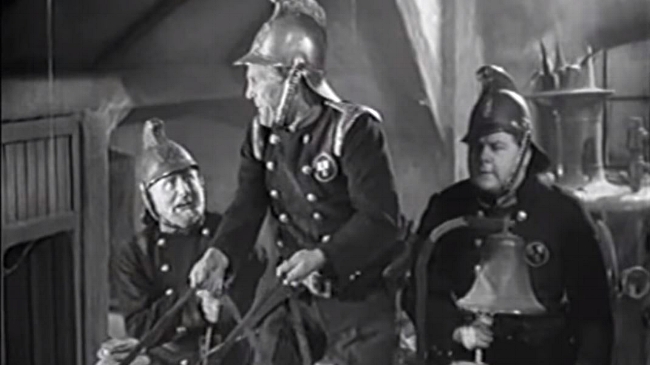
Until a copy was found by the BBC television in 1975, this was considered a lost film. Where's That Fire? is an often over looked comedy. Will Hay plays Captain Viking of the Bishop Wallop fire station in his usual seedy incompetent fashion. He and his trusty assistants Albert (Graham Moffatt) and Harbottle (Moore Marriott) run an antiquated Victorian fire tender but seldom put out any fires. After the Town Hall burns down they find that their jobs are on the line. Viking tries to solve their problems by inventing a new fire-retardant foam as well as renting the tender to a film production company, who may not be quite what they seem. It all ends in mayhem, with an attempted robbery of the Crown Jewels at The Tower of London.
Until a copy was found by the BBC television in 1975, this was considered a lost film. Where's That Fire? is an often over looked comedy. Will Hay plays Captain Viking of the Bishop Wallop fire station in his usual seedy incompetent fashion. He and his trusty assistants Albert (Graham Moffatt) and Harbottle (Moore Marriott) run an antiquated Victorian fire tender but seldom put out any fires. After the Town Hall burns down they find that their jobs are on the line. Viking tries to solve their problems by inventing a new fire-retardant foam as well as renting the tender to a film production company, who may not be quite what they seem. It all ends in mayhem, with an attempted robbery of the Crown Jewels at The Tower of London.
More ambitiously staged than most of the team's efforts, Where's That Fire? has several brilliantly orchestrated slapstick sequences. One has our trio trying to install their new firemen's pole, causing a traffic jam in the street, wrecking a china shop, bothering a man confined to bed with gout and finally demolishing his roof. Charles Hawtrey has an amusing cameo as a schoolboy “swot” who provides geometrical and linguistic advice. There is also an elaborate physical FX sequence when a local garage gets set ablaze. Harbottle mistakenly connects the fire hoses to the fuel pump instead of the water mains, with hilarious incendiary results.
Ultimately, the film succeeds because of the timeless characters that have been created. Some of the jokes may have dated somewhat, but the interaction between the three leads is still credible today. Hay's blustering inanity, Marriott's rambling Octogenarian and Moffatt's wide boy are all still accessible archetypes. The dialogue between them is loaded with that unique sense of British irony and sarcasm. Two visitors disbelieve that Hay is the Captain of the fire station. "Tell them what I am" he says to Graham Moffatt. "What? Out loud" he replies. Where's That Fire? is a wonderful piece of cinema, from a quieter, gentler time. Recommended to those seeking nostalgia and to those who may wish to familiarise themselves with the work of Will Hay.



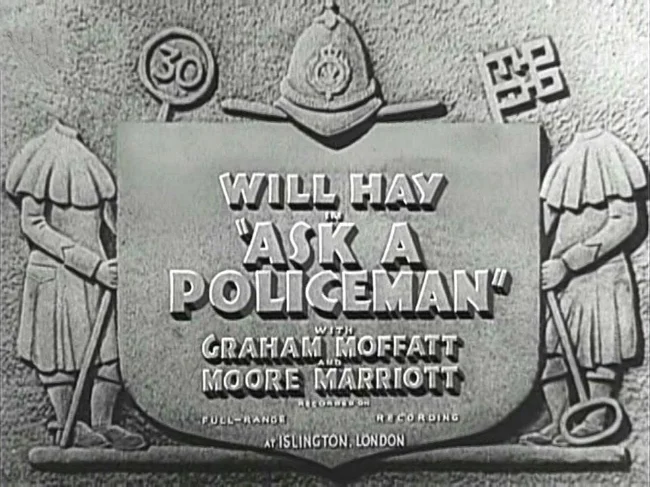


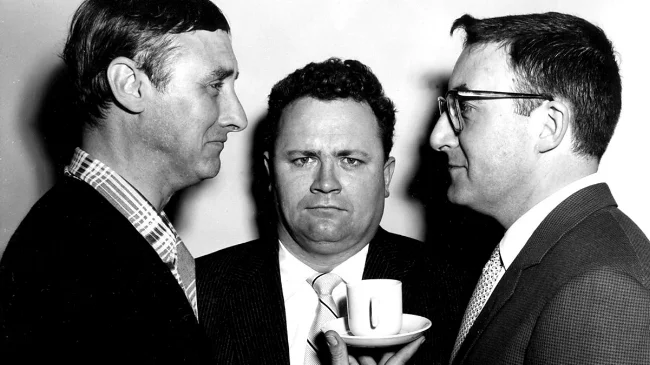
Ask a Policeman (1939)
I was raised on old black and white films as a child. My parents age and personal tastes meant that I had exposure to a lot of material that people today may be oblivious to. This was especially true with regard to pre-war UK comic luminaries such as Arthur Askey, Old Mother Riley and Will Hay. I am very grateful in a way, as it has afforded me the opportunity to broaden my cinematic horizons and cultural references. Comedy is also an interesting social barometer of the times and can be quite a useful tool for historians. Its curious how something change there are certain comic tropes that are timeless. Often these are fundamental aspects of the human character but not necessarily the best ones.
I was raised on old black and white films as a child. My parents age and personal tastes meant that I had exposure to a lot of material that people today may be oblivious to. This was especially true with regard to pre-war UK comic luminaries such as Arthur Askey, Old Mother Riley and Will Hay. I am very grateful in a way, as it has afforded me the opportunity to broaden my cinematic horizons and cultural references. Comedy is also an interesting social barometer of the times and can be quite a useful tool for historians. Its curious how something change there are certain comic tropes that are timeless. Often these are fundamental aspects of the human character but not necessarily the best ones.
As a result of my youth, I am a consummate Will Hay fan. I find the seedy, incompetent characters that he created to be timeless. There often a lot of substance to his various incarnations, along with cynicism and moral ambiguity. Unlike US comedies of the time, there is also a conspicuous lack of sentiment. The humour is often linguistic, self-deprecating and sarcastic rather than physical and is more sedately paced, compared to the hard-hitting style of today. Although many consider Hay's finest work to be Oh, Mr. Porter! or My Learned Friend, I have a soft spot for the formulaic but enjoyable Ask A Policeman from 1939. It’s a very accessible example of Hay's work and exhibits many of the traits I have listed.
The first half of Ask A Policeman is vintage Hay, which concentrates on the superbly scripted verbal sparring between himself and his usual associates Graham Marriott and Moore Moffatt. The banter is very well observed, and its dry quality still makes it easily accessible. Take for example the following scene where Dudfoot and his two constables have made an arrest.
Sergeant Samuel Dudfoot: Did you search him?
Constable Albert Brown: One pocket book, one watch, one pen-knife and no money.
Sergeant Samuel Dudfoot: One pen-knife and no what?
Constable Albert Brown: No money.
Sergeant Samuel Dudfoot: Come on, turn out your pockets.
Constable Albert Brown: Oh, alright. One pen-knife and fifteen bob.
Sergeant Samuel Dudfoot: Blimey! Will you never learn to be honest? He's as much our prisoner as he is yours... Here you are, five bob each.
The story then broadens to encompass smugglers, headless horsemen, and a poorly conceived bus chase, which unfortunately bears to many similarities with Oh, Mr. Porter! However, these changes in pace and direction do not spoil the film overall and it still remains engaging during it's relatively short eighty-minute running time. I would recommend Ask A Policeman to those who have an interest in classic British comedy and vintage acts that have their roots in music hall and variety.
Oddly enough, the film was remade in 1982 by British comic duo, Canon and Ball, under the title The Boys in Blue. Unfortunately, it was rather poorly implemented and lacked the subtly of the original, mainly due to the stars somewhat limited comic abilities. Some folk have tenuously tried to link Edgar Wright's 2007 movie Hot Fuzz to the Hay original, but I believe that is stretching a point.
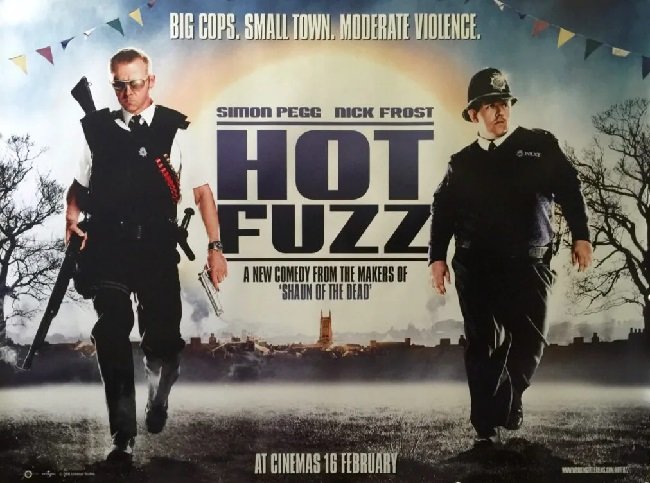
PC Nicholas Angel (Simon Pegg) is an exemplary Police Officer, with a strict adherence to the letter of the law. As a result of making the rest of the London Metropolitan Police look bad, he is transferred to the rural town of Sandford, Gloucestershire. On arrival, Angel finds that the local Inspector, Frank Butterman (Jim Broadbent), takes a far more laissez-faire approach to policing. His colleagues are incompetent and he is further hampered by the Neighbourhood Watch Alliance (NWA), who prioritise low crime statistics over law enforcement due to their desire to win the title of “Village of the Year”. Furthermore, Angel is partnered with the Inspector’s son, Constable Danny Butterman (Nick Frost), who is infatuated with “buddy cop” movies and is in awe of Angel’s London experience. “Have you ever fired two guns while jumping through the air?” However, a sudden spate of grisly accidents lead Angel to believe that there's more to the seemingly tranquil and picture-perfect community than meets the eye.