

The Consequences of Increased Web Traffic
It is obligatory to start these sorts of posts by reiterating the standard mantra that you should not be driven by your websites stats and that the data they contain can be unreliable. Although a sound philosophy in principle, it is actually more nuanced than that. Such data can be useful for growth if used wisely. I have never been coy about trying to increase my readership. For me it seems an integral aspect of blogging. Over the course of 2026, the traffic to Contains Moderate Peril has doubled. A lot of that is down to curious spikes in visits which seems to be AI scraping the entire site. Setting aside these anomalies, more people are reading posts and a lot are doing so via the site’s RSS feed. All of which is fine by me as growing the audience for this blog was a goal for this year, I am quite pleased by this development and the ongoing progress. I hope it continues.
It is obligatory to start these sorts of posts by reiterating the standard mantra that you should not be driven by your websites stats and that the data they contain can be unreliable. Although a sound philosophy in principle, it is actually more nuanced than that. Such data can be useful for growth if used wisely. I have never been coy about trying to increase my readership. For me it seems an integral aspect of blogging. Over the course of 2026, the traffic to Contains Moderate Peril has doubled. A lot of that is down to curious spikes in visits which seems to be AI scraping the entire site. Setting aside these anomalies, more people are reading posts and a lot are doing so via the site’s RSS feed. All of which is fine by me as growing the audience for this blog was a goal for this year, I am quite pleased by this development and the ongoing progress. I hope it continues.
However (and there is always a “however”), the moment your blog starts doing well, it seems that other people start to notice. There are plenty of online services that can help you determine which sites are growing and could provided useful “leads”. If you’re one of them, that’s when the emails begin. By which I mean requests from interested third parties that would like to “collaborate” with you. Or online specialist who want to help with your SEO optimisation or register keywords for you. I’ve had several emails already this week asking how much I charge for a link or a “paid post”. I even had a friendly email that asked if I could add them and several of their colleagues to my blog directory. When I checked they were all commercial blogging evangelists who extol all the sorts of practises that I abhor. None were writers in any creative sense. Just exponents of “how to get traffic and get rich on the internet”.
What antagonises me the most about all these emails and offers, is that not one of them has bothered to address me by my name. It’s not as if it’s hidden on my blog. I’m pretty much a textbook definition of a one man band. Hence, such emails have all the sincerity of a cold call or a marketing letter. Also, if anyone had bothered to read the about page on Contains Moderate Peril, it is pretty clear I don’t allow guest posts and I don’t accept paid links. I am particular about what get’s posted on my blog. It certainly doesn’t need adverts of links to online casinos. There’s enough bullshit online. I see no reason to add to it. And then there’s the idiots who think they can leave a comment on a blog post and leave a link in it back to something questionable. Like I won’t notice. I don’t know if it’s hubris or stupidity but it is certainly not well received by me.
All of these thing stem from a wider malady that blights the modern internet. The notion that every online activity has to be monetised and that you need to refine all your processes to optimise this endeavour. Doing things like blogging for pleasure or some sense of community is met with bemusement or even outright skepticism. If you’re not trying to earn a buck, then you’re an idealist, a fool or both. Furthermore, this philosophy that everything must be financially focused is what makes everything generic and standardised. As everyone desperately tries to streamline their writing or website to facilitate this quest for cash, the resulting content is bland. However, what can’t be cured must be endured. Instead of seeing such things as a problem, one can view them as a validation of a pro growth policy. I shall continue to write and try to reach a wider audience. I will also keep encouraging others to do the same. Communities, not snake oil.

Judging by the posts I’ve read, it would appear that Blaugust 2026: Festival of Blogging has been well received by those who participated in it. That is most satisfying to know, especially in light of the fact that this is the first year the event has been run without our founder who sadly past away in July. It has also become clear that Blaugust is reaching a far wider and diverse audience and most definitely is no longer the exclusive province of bloggers from one particular community. There has been healthy discussions on our Discord server about whether this year event needs to adapt to accommodate the modern blogosphere. Questions such as whether or not there needs to be a dedicated Blaugust website have been raised and explored. Should every site participating have an RSS feed? How, if required, should comments be handled. Inevitably, the subject of the use of AI in blogging still remains a controversial issue.
After a very productive month of writing, we come to the final Blaugust 2026 Group Project writing prompt. It is titled lessons learned and is usually a chance to reflect on the festival and whether or not it has been to one’s satisfaction. Have you achieved your goals? What have you gained from the experience? Those sorts of things. It also poses two further questions; “What is the best piece of advice you’ve ever been given?” and “what’s the best advice you’ve ever given to someone else?” for your consideration. I’ll address the questions shortly. Firstly let’s mull over this years event and assess how it’s gone.

I am intrigued by the growth of the IndieWeb, owning your domain and static websites. I certainly agree with the notion of not relying on big corporations and I have an ongoing project to divest my dependency on software produced by major market players. However, although I own my own domain, my website is hosted by Squarespace. I’ve not really had any problems with them over the last 11 years and I would describe our business relationship as equitable. However, the monthly subscription price has increased over time and is likely to keep on doing so. It has crossed my mind as to whether there is a suitable alternative. However, if I were to migrate Contains Moderate Peril elsewhere I suspect it would be logistically complex and problematic.
It was my blogging anniversary on the 16th August. I’ve been writing and sharing my post online for 19 years, via various different websites and blogs. This current iteration of Contains Moderate Peril has been around since August 2015. To date it has 2,171 posts including this one. Quantity does not necessarily equate to quality but there are some articles I am proud of and feel that they make their point effectively.
This week’s Blaugust 2026 Group Project writing prompt is an important topic. Namely, staying motivated. I prepared a fairly lengthy post with some advice and ideas to keep people focused and writing. Then I checked it against the post I wrote last year and the year before that, going back to blogging events from 2012. All of these posts broadly said the same thing, so I decided to scrap what I had composed for today and to go with a simpler approach. I shall answer the questions Krikket posed for this writing prompt. Fellow blogger Bhagpuss has also done so and as ever, his thoughts are interesting and well expressed. Here are my answers.

Once again, I have stumbled across an interesting debate that has provided me with an opportunity to write a blog post. Over on the Blaugust Discord Server, I read a comment from AgingGamer regarding RSS feeds and their significance with regard to blogging. This in turn referred me to a post by fyr (don’t you love all these nom de plumes) who wrote at depth about the ongoing community debate about the use of RSS/Atom feeds. The article explored the importance of such feeds with regard to reaching readers and providing accessibility to the disabled. All of which provided me with a great deal of food for thought. Mainly because I use a mainstream website service provider for my online endeavours, so RSS is by default built. I’ve never really considered not having such a facility at my disposal. But the rise in the IndieWeb scene challenges this assumption.

I have written two blog posts today that I have subsequently abandoned. The first was gaming related but when I was about halfway through writing it, I felt like I was covering old ground and just repeating myself. It was also regarding an issue that can’t really be fixed. Namely, how do you ensure that matchmaking in PVP games is done equitably. As there is no solution to this issue at present, or at least not one that all parties can agree on, I decided to ditch it. Similarly a post I was working on about what becomes of my blog if anything happens to me was curtailed. In light of recent events in our community it seemed inappropriate. However, as a result of binning two blog posts, I new idea occurred to me. Do my fellow bloggers self-edit and curtail what they write about? Is your blog totally unfiltered or do you apply a set of rules that determine what content is deemed acceptable?
It is time for the next Blaugust 2026 Group Project writing prompt. This one comes with two lines of enquiry. The first is an opportunity to “introduce yourself”. Over the years, I have written several introductory posts for previous Blaugust events. Rather than repeat myself I’ll just link to the last one, which was posted in August 2023. I haven’t radically charged since then apart from my hair going whiter. The next part of the prompt poses a far more intriguing question. “If you could have one magical power or super power, what would you choose and what would you use it for?”, which offers much for consideration. Having given this proposition much thought here is my response.

A decade ago I wrote a post about blogrolls and the practical and social issues surrounding them. At the time, the version of Squarespace I was using didn’t easily support such things or at least wasn’t able to do so in a manner I liked, so I didn’t have one. Ten years later Squarespace as a hosting platform has far greater functionality, hence I recently decided to add a blogroll. That was in March this year. However it just wasn’t really fit for purpose. So I decided to revise it a few days ago and rather than just have a traditional list of blogs in a side column, I ended up producing a more comprehensive blog directory, which list two hundred plus sites alpha-numerically. I’ve been tinkering with it on and off and I am now finally happy with it. The latest update reflects the international nature of the Blaugust: Festival of Blogging and the fact that we have many blogs written in their native language. Translating text is now an integral function of web browsers, so I see no reason why these blogs should be excluded.
Today’s post is part of the Blaugust 2026 Group project, which features a series of writing prompts set for specific dates throughout the month. The idea being that everyone who wishes to participate can write about the same subject, riff off each other’s posts and enjoy a shared experience. In many respect having a common writing prompt levels the playing field and provides a sense of common purpose among those who take part. Today’s group project prompt asks the question “tell us all about your very first blog”. An unambiguous and interesting question that will hopefully prove enjoyable to write about and informative to others.

I have been writing online for nearly two decades. I don’t claim to be good or accomplished but what I can say with certainty is that the more often you write, the easier it becomes. For those who are new to writing a blog and the Blaugust Festival of Blogging, possibly the biggest hurdle that you now have to get over, is writing your first post of the month. You spent the lead up to this event sorting out your blog templates, fine tuning the backend and possibly banking some ideas. Or you may have decided to just wing it and make it all up as you go along. Both are perfectly valid approaches. However, there is one thing left to do that cannot be put off, avoided or danced around. Writing. At some point you’ve got to do it. Or bail on the event. The proverbial “shit or get off the pot”.
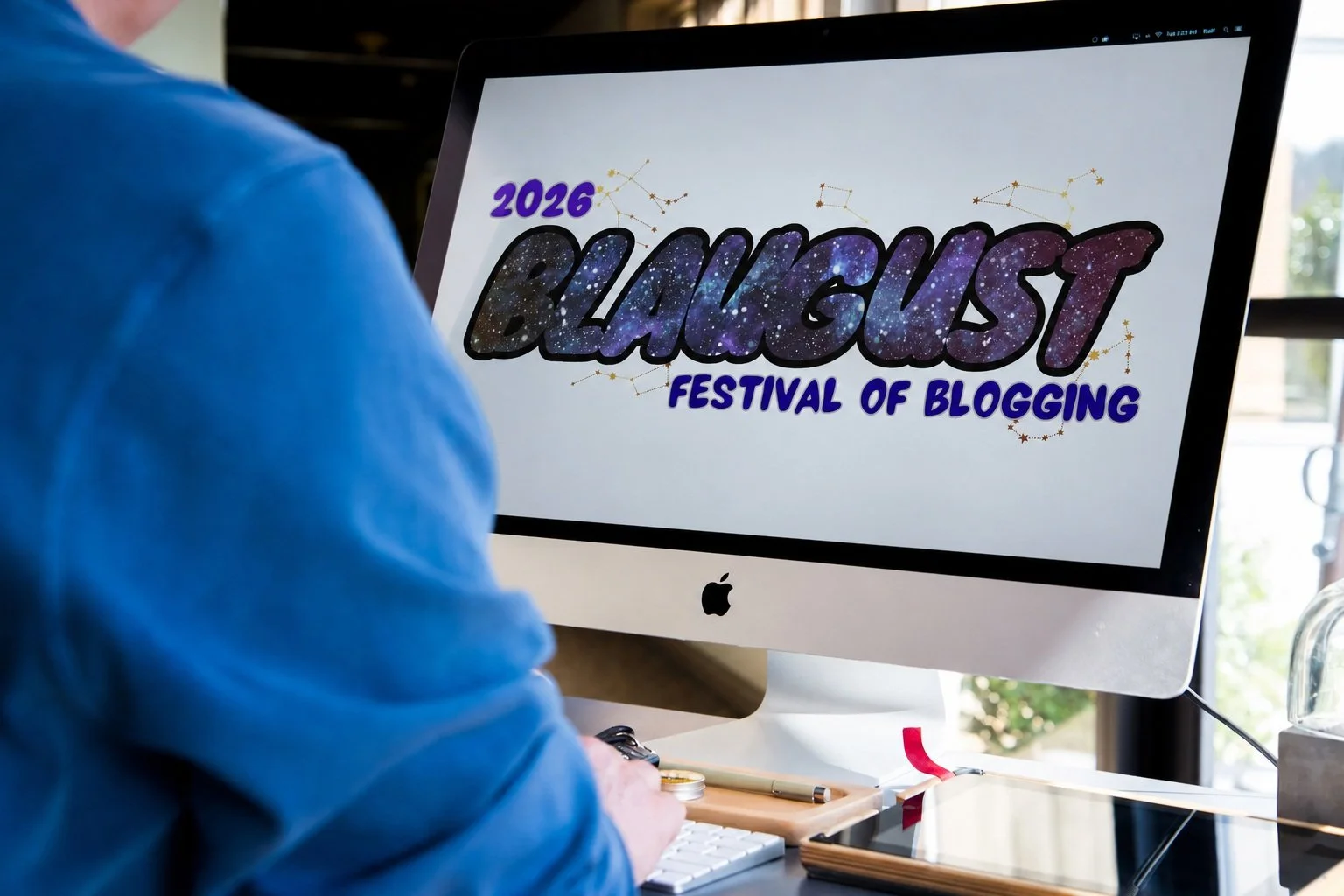
If you take a cursory look at a calendar you will see that the month of July is fast coming to an end. That means that Blaugust 2026 Festival of Blogging starts in a few days time! If you’re participating, or thinking of doing so, the next few days present a golden opportunity to do some practical organising and basic preparation. You don’t have to if you don’t want to. Feel free to just do things as they come, so to speak, if that’s your approach. However, for most of us, it helps if we have some kind of plan in place and make some arrangements in advance. I personally prefer this approach and like to have some ideas for blog posts in the bank. It is also useful to have “options” if something doesn’t go to plan. For those who are new to Blaugust, here are a few ideas regarding preparation that may be of use to you. As ever, your personal mileage may vary and ultimately you are best off adopting a strategy that suits your writing style and personal schedule.
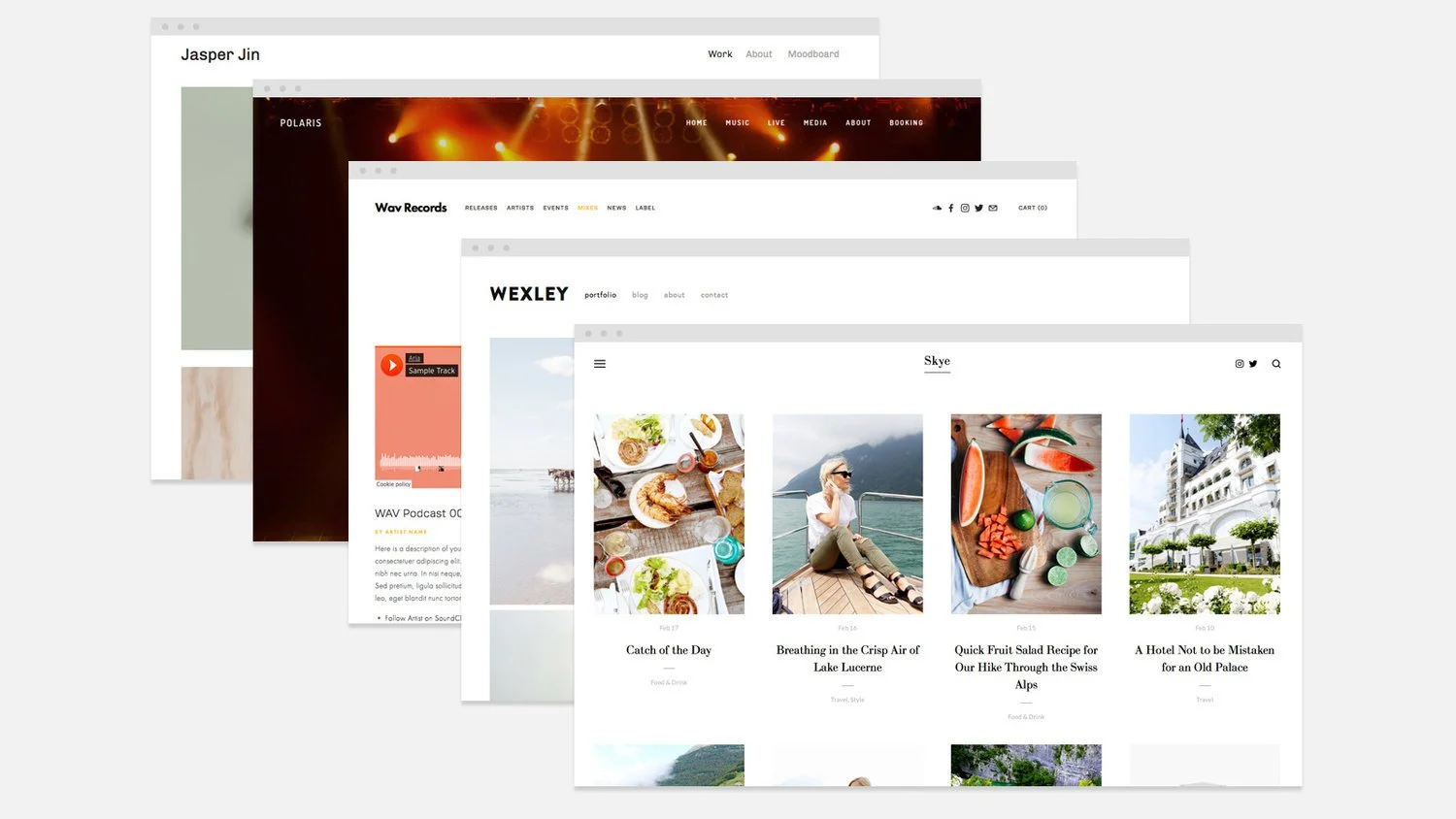
Prior to last year’s Blaugust: Festival of Blogging, I upgraded Contains Moderate Peril to the latest version of Squarespace. There are still some aspects of the site that need fine tuning but overall, I am happy with the appearance of my blog and its respective functionality. With this year’s writing event fast approach, I decided to tackle over the last few days, some of those finer points that need tweaking. I have wanted a post counter on the site for a long time but unfortunately there is no native Squarespace widget for this basic function. I also felt the need to upgrade the blogroll, as the current one didn’t support RSS feeds from certain sites (e.g. Google Blogger) and was dependent upon a third party service, Elfsight, which wasn’t ideal. Both of these issues have now been addressed and I am pleased with the results. There is now a post counter on the Blog Archive page, which seems a logical place to have it and the Blogroll is now far more comprehensive.

Next month the annual Blaugust: Festival of Blogging begins. Roundabout this time each year, I try to write a promotional post to raise awareness of the event and encourage potential participants. However, as I’ve done this quite a few times before, each year it is becomes increasingly difficult to present the essential facts about Blaugust: Festival of Blogging in an interesting fashion. There’s nothing worse than writing a post and feeling that you’re just covering old ground. So, this year, I thought I’d try something different and present the most important information about this annual event, as if it were a conversation between myself and an interested passer by. Feel free to attribute novelty voices for each party in your own head, while you read this. If it helps, try imagining that this discussion is happening between two celebrities or such like. Both may be wearing exotic hats but I digress. On with the scenario.

I read a blog post by Void recently, about finding a new internet home. He wrote about how he and many others have had to pick up their “digital roots” and migrate multiple times over the years, from one platform to another. It is a position I can sympathise with as I have done likewise. Hence I like the idea of having a place online where I hangout by default. My own blog is an anchor for me but it is not quite the same thing as a platform or online portal where I can find all my friends and colleagues, share content and shoot the breeze. It’s a curious thing, because as I typed that last sentence it struck how such a sentiment may seem alien to others. There may well be people who like to have a finger in multiple pies and who are happy to frequent and flit between various social media apps, Discord servers and subreddits. I prefer to focus my efforts on a single instance. A place that suits my requirements, allows me to put down roots and become part of the furniture. Like a virtual Diogenes Club.

Everyday, once I’m up, I sit at my desk in my office, fire up my PC and log into Feedly. I have various RSS feeds grouped by category, which I slowly trawl through and read anything that catches my eye. I have one curated feed named “Blaugust” named after the yearly festival of blogging event. It has over 250 blogs listed, many of which are former participants. Most of these regularly post. Hence there’s a lot to get through and so I don’t read all of them. However there are a few that I always checkout. Mainly because they’re the personal musings of some of our writing community’s oldest and most prodigious members. The sorts of guys and gals who are part of the furniture. They’ve always been there and it feels like they always will. Posting their thoughts, sharing their enthusiasm and spreading the love, so to speak. One of these blogs, is Tales of the Aggronaut. written by Belghast.

For the last few months I have being using Google Gemini. I subscribed so I could access a wider spectrum of services and evaluate it effectively. I also wanted to dispel some of the hysteria that accompanies any conversation about Large Language Models and Artificial Intelligence. The results were initially interesting and Google Gemini proved useful when researching material for blog posts. It is good at providing summaries about well documented subjects. I wrote a post about food banks recently and it distilled a lot of data into a manageable amount, which was ideal for my article. Google Gemini has also produced some visual basic scripting and simple batch files that have allowed me to automate processes on my PC. Such as changing the default monitor, or screen resolution at the click of an icon. However, I found this AI struggled with in-depth software troubleshooting and that its ability to create images varies greatly depending on the subject.

On Friday 26th June, I had another random spike in internet traffic to Contains Moderate Peril. The statistical package that comes with my Squarespace account recorded over 13k visits in less than 24 hours, which is not typical (although I wish it was). However, all of these visits to my blog arrived via the default homepage and spent between 1 and 2 minutes there. Hence, it was obvious that this was not human traffic, as there was no evidence of any searches being made of content that is available on my site, nor of the “visitors” clicking on any of the links on the top menu and viewing other posts. This was undoubtedly AI traffic arriving at the designated homepage and simply parsing the site. I had a similar spate of this sort of web traffic last November. The only difference on that occasion is that the traffic all came from China. This time round it hailed from the US. I suspect that this is something that will happen more often as companies set their AI loose on the net for what is effectively training.

I recently watched a video on Patreon by someone who I actively support as a “content creator” and whose work I enjoy. I shall provide no more detail regarding their identity because they may not want their work referenced with regard to what I am going to say. During the course of their video they briefly referenced the work put into promoting a podcast they are currently producing and the relatively low audience that it has garnered so far. The comments were an aside and most certainly not said with any sense of self-pity. They were simply a statement of fact. Furthermore, I suspect they are far from unique and similar sentiments have been expressed in one way or another by anyone who has created something the published it online, only for it to be lost among the greater white noise” of the wider internet.
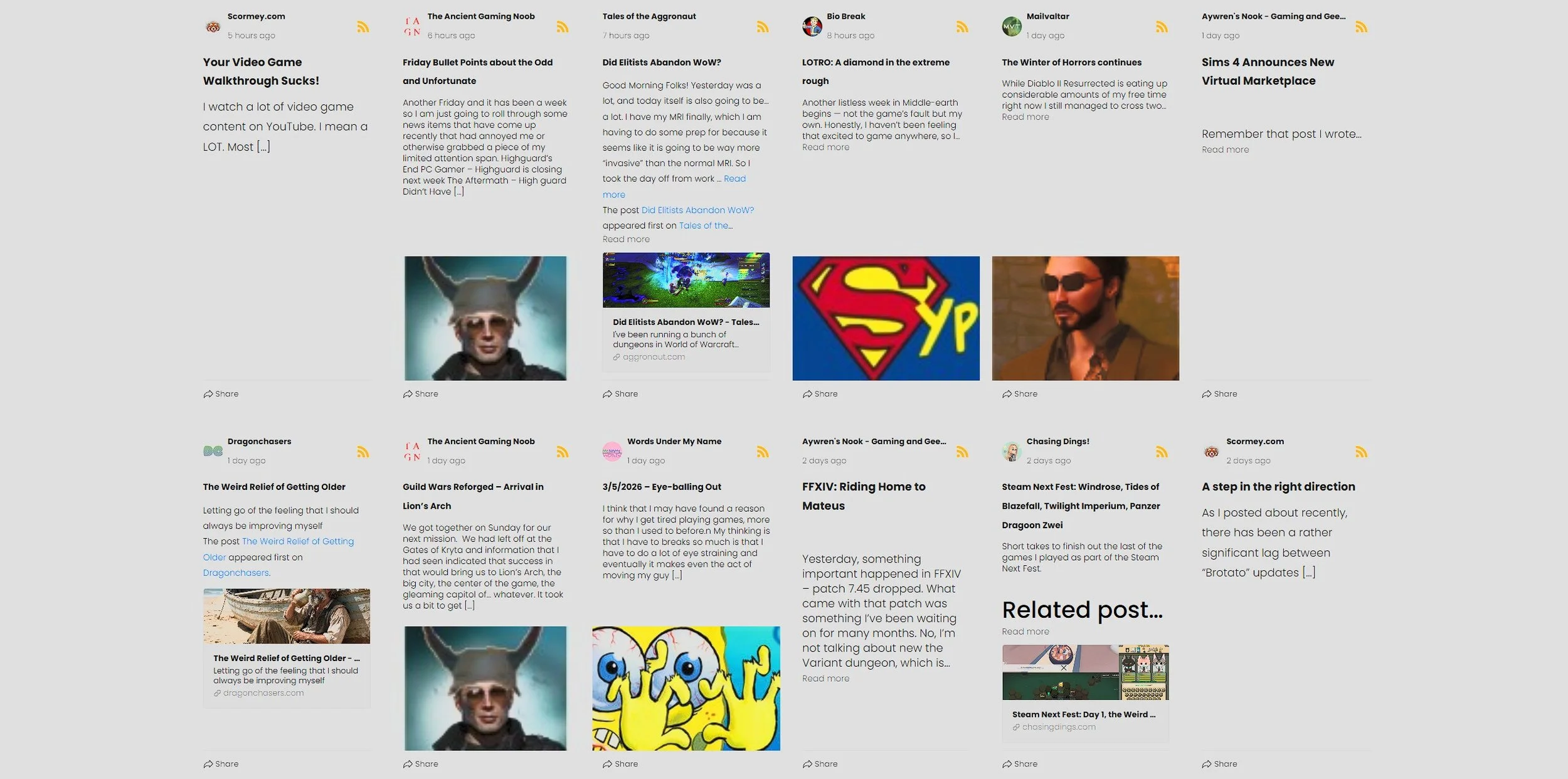
When I first started blogging way back in 2007, I maintained a blogroll of all my colleagues and peers’ websites. At the time this was a common practice and a way to support an expanding community. I considered this such an important aspect of the blogging scene at the time, I created a website to aggregate posts from video game blogs, called The Gaming Blog Nexus. It ran for two years and proved quite useful. However, it was tricky to administer and would frequently break as a lot of the back end widgets and plugins were created and maintained by “gifted amateurs”. I eventually shut it down due to the operating costs. When I moved my own website, Contains Moderate Peril, to Squarespace in 2015 I intended to start maintaining a blogroll once again. However, at that time there was no native support for such a thing on the platform. Hence for the last ten years, I have not had a blogroll on my website, which hasn’t sat well with me.

I was speaking to someone recently about hobbies (fortunately it wasn’t Simon Quinlank) and I mentioned that I have maintained a blog for over a 19 years. When I talked about the ongoing cost they were most surprised, as they had assumed that blogging was something that could be done for free. I guess we’ve become so accustomed to the provision of free online services such as email, that this a reasonable assumption. I pointed out that although it is indeed possible to blog for free using Blogger, it was not the optimal approach, especially if you want to maintain some degree of control over your writing. Naturally, the next question they asked was how much do I spend and I gave them a ballpark figure. All of which reminded me that I wrote a post on this very subject a few years ago. So I’ve decided to revisit the subject and see how much it currently costs to maintain Contains Moderate Peril.

Today I started the slow process of auditing every post that has been published on Contains Moderate Peril since 1st August 2016. The goal is to correct any obvious typos and replace all existing images with larger ones. The Squarespace software upgrade I applied to the website at the end of last year has finally allowed me to establish a standard format that I am happy with. Hence the ongoing audit is the perfect opportunity to apply these style rules to all posts. There are also some technical issues and matters regarding functionality that need to be addressed. I need to determine how to embed YouTube videos in such a way that they automatically scale to fit whatever device is viewing them. Another area which needs improving is the website search facility. This needs refinement so that enquiries can be more specific. Older posts also need to be more accessible, although I am still researching how best to achieve this.

It’s nearly two and half months since the Blaugust: Festival of Blogging event ended. During that time I’ve maintained a fairly regular writing schedule and I post every two days or so. Furthermore, I finally dragged my blog template, kicking and screaming, into the modern era. I tweaked a few pages and updated the content of the “about” page. The next task is to start going through all previous posts and replacing older, low resolution images with larger, more appropriate ones. This process also presents an opportunity to ensure that all posts follow a uniform style. IE Are appropriately categorised, have links to related posts at the bottom and are SEO optimised. This will be a lengthy task so I think the best approach will be to tackle two or three posts a day. Hopefully this will raise the profile of older content, which generates the lion’s hare of traffic to this site.
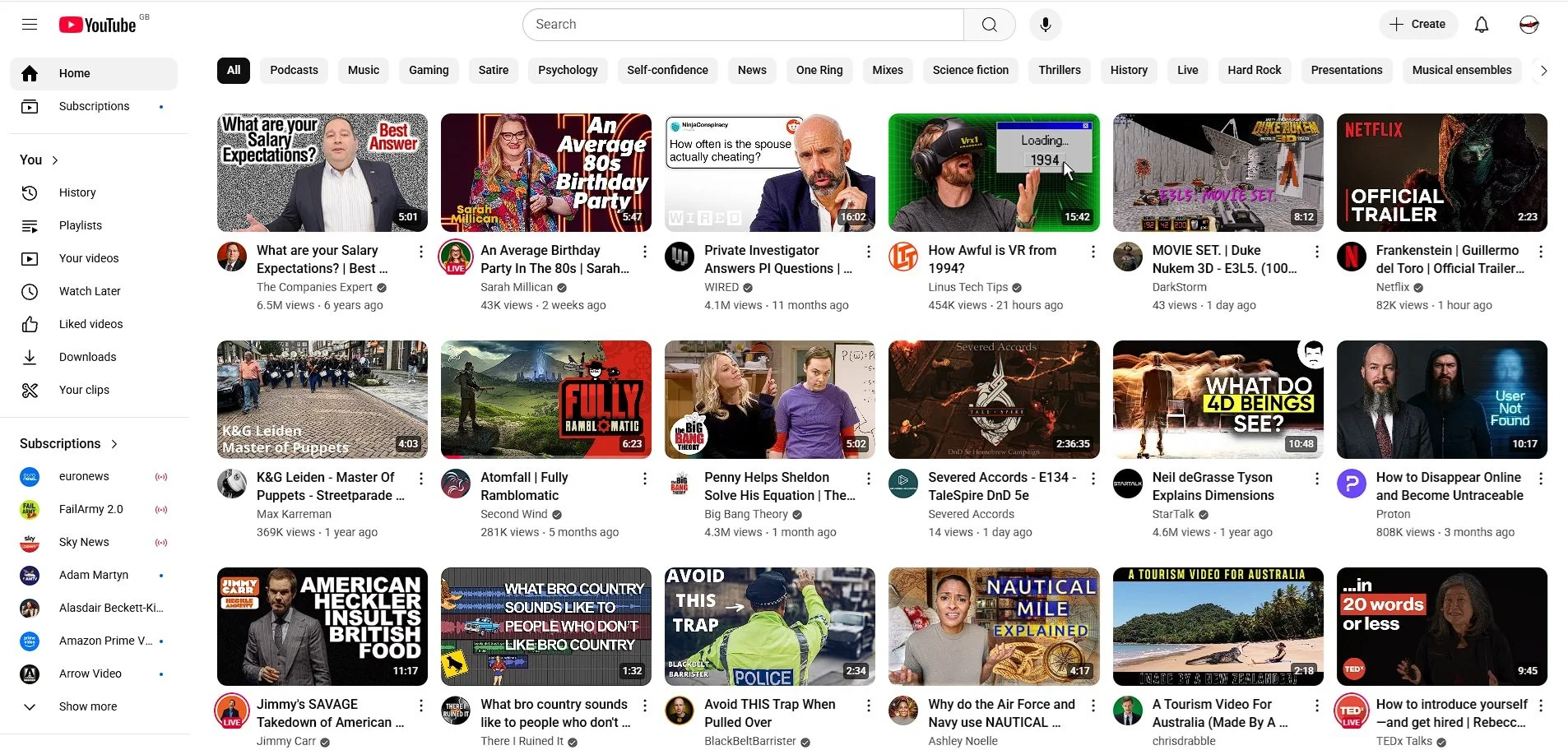
I use a browser extension called Control Panel for YouTube, which allows me to determine who many videos are displayed on my YouTube homepage and to filter the content that is shown. At present it is configured to display rows of six. Something that I have noticed of late, is the amount of videos with hyperbolic titles and thumbnail images created by AI. Both of which are design choices made to increase engagement. Clickbait titles are contrived to meet current SEO optimisation criteria and as such feature more and more in search results. The fact that they frequently have no relation to the subject I am researching, seems to be neither here nor there. The same issues arise with regard to AI generated images, which again frequently have no bearing on the matter. The fact that more and more content creators do this, infers that it works and is now an essential part of the process you must follow to be seen and featured in search results.

In the last post in this series, I specified the need for a plan with regard to upgrading my blog. Well a plan has emerged, been refined and has now been formally adopted. Rather than migrate Contains Moderate Peril to a new platform and effectively have to rebuild all the content, I am going to upgrade my existing presence on Squarespace. This decision was made for two reasons. Time and money. Migrating to a new platform will take a lot of time and incur additional costs. Upgrading the existing website will take less time and has no cost implications. That is not to say that it will be easy. It has become abundantly clear that the upgrade process will break stuff and that all published posts will have to be manually repaired. Hence my choice boils down to the lesser of two evils.

This year’s Blaugust: Festival of Blogging has reached an end and it would appear that this event has been well received by those who have participated in it. I believe that there were 168 bloggers taking part this year, many of whom have not participated before. Some were new to blogging, where others simply wished to see if they could increase their writing output. As ever there was a wide variety of blog styles and subject matters and it has been most interesting to read new posts every day. I have attempted to leave comments and positive feedback where I can and I hope that some of these new blogs that I’ve discovered continue to write. Well done to everyone who took part. I hope it has been an enjoyable and informative process and that you have learned from it. I know that at least one blogger has determined that writing online is not for them, which is a valuable lesson.
There is currently a group writing prompt available as part of this year’s Blaugust: Festival of Blogging which has piqued my interest. It asks the question “what is the oldest draft post you have” and suggests that it is revived in some manner. I have dozens of draft posts in a folder in my Google Drive. Many are film reviews or film related. The oldest of which dates back to summer 2010. Rather than write a straight forward review of Blake Edwards 1968 comedy The Party, I rather foolishly thought at the time that I’d tackle the issue of whether the film is sufficiently racist to make it beyond the pale. Let it suffice to say that I quickly found myself bogged down in the complexities of the subject and thus never completed the blog post.

I’ve participated in every previous Blaugust: Festival of Blogging event. Prior to that I was involved in the Newbie Blogger Initiative or NBI as it was affectionately known. I have therefore written quite a lot of blogging advice and suggestions over the years. If anyone feels disposed to do so, you can access them all by clicking on the “blogging” option on the top menu of this blog. However, it is important to remember that a lot of the ideas I have advocated and written about over the years are purely subjective. Not all advice or guidance works for everyone. People have different ideas about blogging, different approaches to it and different aspirations. This year has highlighted some quite distinct differences among bloggers which has been most illuminating.

Today is my blogging anniversary. I have been writing online consistently for 18 years. My earliest blogs no longer exist, although they can be found via the Internet Archive Wayback Machine. My first blog was a Lord of the Rings Online fansite called Misadventures in LOTRO. After a while this morphed into a wider gaming website; Misadventures in Gaming. However, I soon discovered that I wanted to write about more than just video games, so I decided to start from scratch and created Contains Moderate Peril in February 2010. This blog endured and has been my main online presence ever since. It has moved several times for various reasons. For a while I had a sponsor, as well as a reasonably sized audience and had dreams of making money from my writing and podcast. But it wasn’t to be and now I just write primarily for my own peace of mind and amusement.
This year’s Blaugust: Festival of Blogging has already raised a very interesting debate. An old one that habitually comes up when discussing blogs. Namely, whether a blog should or should not have “comments” enabled. However this time round there is a different slant on things. Rather than the usual binary choice of having comments enabled or disabled on your site, this time round there is a third option available. Leaving comments via email or a third party service such as Mastodon. Both of these additional options keep comments conspicuously at arms length from your website. Furthermore, the email option makes the comments private, instead of in the public domain. All of which puts a subtly different spin on conventional notions of blog comments and makes this ongoing discussion all the more interesting.
Blaugust Static Website
There is a subtle difference between being rash and being proactive. Being rash means acting too fast without thinking about the results, while being proactive is a question of acting early with careful planning. Why have I mentioned this? Well prima facie information indicates that recent Blaugust participants are interested in an “official” online presence for the annual festival of blogging, other than that existing Discord server. That seems perfectly reasonable to me. Not everyone likes using Discord and I do worry that they may reduce its free functionality at some point in the future. With regard to there being a Blaugust platform of some kind, there is a consensus that it doesn’t need to be some sort of sprawling commercially hosted website running on Wix or such like. Those sorts of site require funding, a degree of admin and possibly private data management. It also a bit too “corporate” if you like. Hence the logical compromise is to have a static site. Let it suffice to say, that has been done.
There is a subtle difference between being rash and being proactive. Being rash means acting too fast without thinking about the results, while being proactive is a question of acting early with careful planning. Why have I mentioned this? Well prima facie information indicates that recent Blaugust participants are interested in an “official” online presence for the annual festival of blogging, other than that existing Discord server. That seems perfectly reasonable to me. Not everyone likes using Discord and I do worry that they may reduce its free functionality at some point in the future. With regard to there being a Blaugust platform of some kind, there is a consensus that it doesn’t need to be some sort of sprawling commercially hosted website running on Wix or such like. Those sorts of site require funding, a degree of admin and possibly private data management. It also a bit too “corporate” if you like. Hence the logical compromise is to have a static site. Let it suffice to say, that has been done.
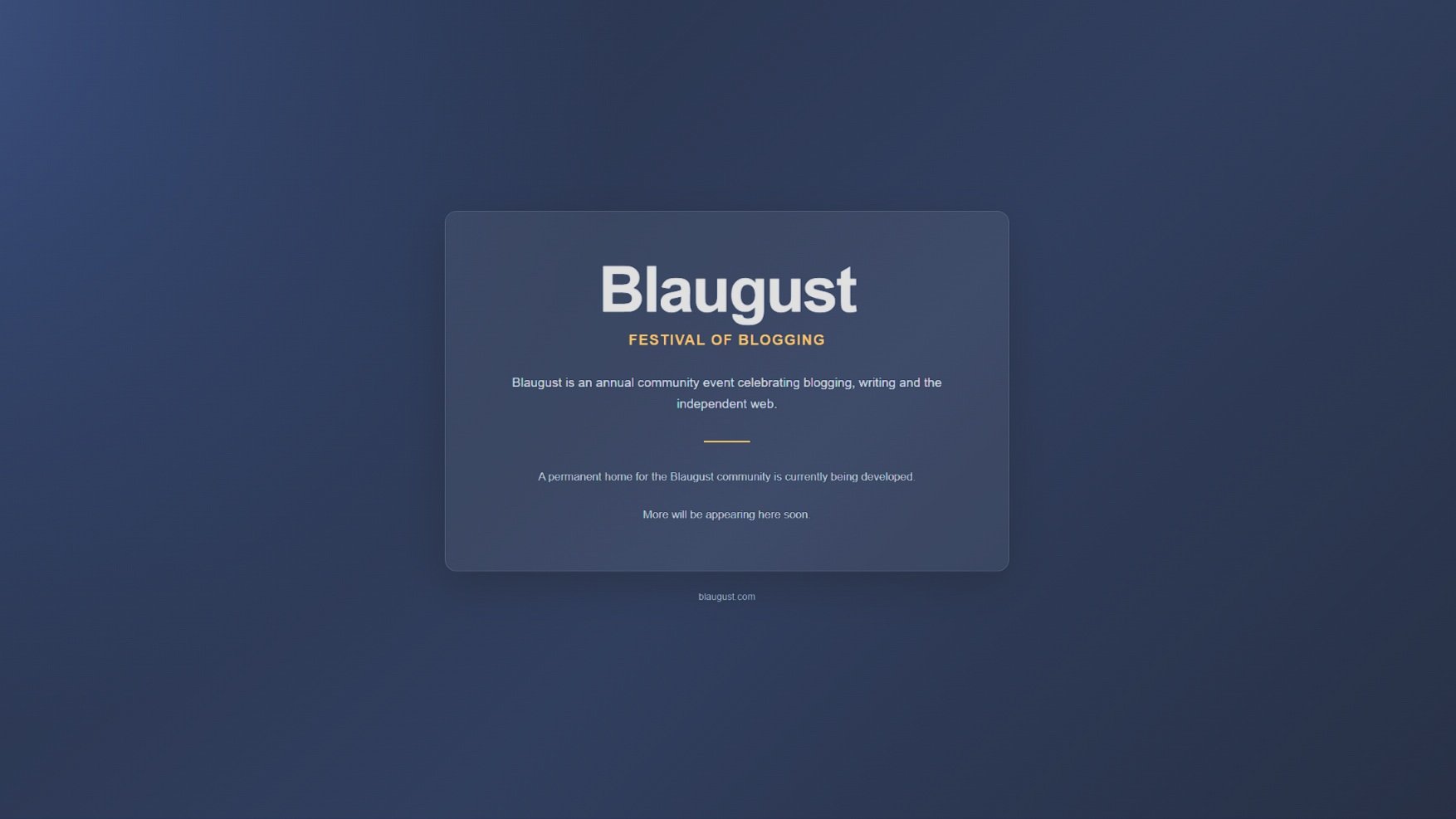
Blaugust.com currently points to a single static holding page hosted on GitHub Pages. It’s free and being where it is everyone can see how it is created and maintained. I think the transparency of GitHub as a host is in accord with the ethos of Blaugust. In the next few days, the static site will have additional pages added along with some extra functionality. Most of this will be experimental and therefore things may initially change regularly. However, the overall plan is to keep the finalised site lean and uncomplicated. Ultimately I think the website should be a conduit for bloggers to find other bloggers. A means to an end and not a specific end in itself. I think there should be some resources available on the site but the most important thing it should do is to link back to other blogs and showcase their writing. The bloggers are the community and the website is simply a means of discovering and joining it.
The finer details of this site have yet to be decided and I’m sure they’ll be plenty of suggestions from the wider community in the weeks ahead. We know a lot of bloggers who work in the tech sector. However, there are many in our writing community who do not have a technical background but they can still have valid ideas. So there will be ongoing discussions on the Discord server and via posts such as this. Feel free to share any thoughts on this matter in the comments below. In the meantime, I am just happy that the initiative has been taken. The main thing is the domain has been secured before someone else snaffled it. I still feel that dot.com addresses stick in the mind best. This project is now officially moving forward as opposed to just sitting on the drawing board. We also have plenty of time until Blaugust 2027: Festival of Blogging to get all our duck in a row. NB Other semi-aquatic fowl are available.
There is a subtle difference between being rash and being proactive. Being rash means acting too fast without thinking about the results, while being proactive is a question of acting early with careful planning. Why have I mentioned this? Well prima facie information indicates that recent Blaugust participants are interested in an “official” online presence for the annual festival of blogging, other than that existing Discord server. That seems perfectly reasonable to me. Not everyone likes using Discord and I do worry that they may reduce its free functionality at some point in the future. With regard to there being a Blaugust platform of some kind, there is a consensus that it doesn’t need to be some sort of sprawling commercially hosted website running on Wix or such like. Those sorts of site require funding, a degree of admin and possibly private data management. It also a bit too “corporate” if you like. Hence the logical compromise is to have a static site. Let it suffice to say, that has been done.
Judging by the posts I’ve read, it would appear that Blaugust 2026: Festival of Blogging has been well received by those who participated in it. That is most satisfying to know, especially in light of the fact that this is the first year the event has been run without our founder who sadly past away in July. It has also become clear that Blaugust is reaching a far wider and diverse audience and most definitely is no longer the exclusive province of bloggers from one particular community. There has been healthy discussions on our Discord server about whether this year event needs to adapt to accommodate the modern blogosphere. Questions such as whether or not there needs to be a dedicated Blaugust website have been raised and explored. Should every site participating have an RSS feed? How, if required, should comments be handled. Inevitably, the subject of the use of AI in blogging still remains a controversial issue.
After a very productive month of writing, we come to the final Blaugust 2026 Group Project writing prompt. It is titled lessons learned and is usually a chance to reflect on the festival and whether or not it has been to one’s satisfaction. Have you achieved your goals? What have you gained from the experience? Those sorts of things. It also poses two further questions; “What is the best piece of advice you’ve ever been given?” and “what’s the best advice you’ve ever given to someone else?” for your consideration. I’ll address the questions shortly. Firstly let’s mull over this years event and assess how it’s gone.
It was my blogging anniversary on the 16th August. I’ve been writing and sharing my post online for 19 years, via various different websites and blogs. This current iteration of Contains Moderate Peril has been around since August 2015. To date it has 2,171 posts including this one. Quantity does not necessarily equate to quality but there are some articles I am proud of and feel that they make their point effectively.
This week’s Blaugust 2026 Group Project writing prompt is an important topic. Namely, staying motivated. I prepared a fairly lengthy post with some advice and ideas to keep people focused and writing. Then I checked it against the post I wrote last year and the year before that, going back to blogging events from 2012. All of these posts broadly said the same thing, so I decided to scrap what I had composed for today and to go with a simpler approach. I shall answer the questions Krikket posed for this writing prompt. Fellow blogger Bhagpuss has also done so and as ever, his thoughts are interesting and well expressed. Here are my answers.
Once again, I have stumbled across an interesting debate that has provided me with an opportunity to write a blog post. Over on the Blaugust Discord Server, I read a comment from AgingGamer regarding RSS feeds and their significance with regard to blogging. This in turn referred me to a post by fyr (don’t you love all these nom de plumes) who wrote at depth about the ongoing community debate about the use of RSS/Atom feeds. The article explored the importance of such feeds with regard to reaching readers and providing accessibility to the disabled. All of which provided me with a great deal of food for thought. Mainly because I use a mainstream website service provider for my online endeavours, so RSS is by default built. I’ve never really considered not having such a facility at my disposal. But the rise in the IndieWeb scene challenges this assumption.
I have written two blog posts today that I have subsequently abandoned. The first was gaming related but when I was about halfway through writing it, I felt like I was covering old ground and just repeating myself. It was also regarding an issue that can’t really be fixed. Namely, how do you ensure that matchmaking in PVP games is done equitably. As there is no solution to this issue at present, or at least not one that all parties can agree on, I decided to ditch it. Similarly a post I was working on about what becomes of my blog if anything happens to me was curtailed. In light of recent events in our community it seemed inappropriate. However, as a result of binning two blog posts, I new idea occurred to me. Do my fellow bloggers self-edit and curtail what they write about? Is your blog totally unfiltered or do you apply a set of rules that determine what content is deemed acceptable?
It is time for the next Blaugust 2026 Group Project writing prompt. This one comes with two lines of enquiry. The first is an opportunity to “introduce yourself”. Over the years, I have written several introductory posts for previous Blaugust events. Rather than repeat myself I’ll just link to the last one, which was posted in August 2023. I haven’t radically charged since then apart from my hair going whiter. The next part of the prompt poses a far more intriguing question. “If you could have one magical power or super power, what would you choose and what would you use it for?”, which offers much for consideration. Having given this proposition much thought here is my response.
A decade ago I wrote a post about blogrolls and the practical and social issues surrounding them. At the time, the version of Squarespace I was using didn’t easily support such things or at least wasn’t able to do so in a manner I liked, so I didn’t have one. Ten years later Squarespace as a hosting platform has far greater functionality, hence I recently decided to add a blogroll. That was in March this year. However it just wasn’t really fit for purpose. So I decided to revise it a few days ago and rather than just have a traditional list of blogs in a side column, I ended up producing a more comprehensive blog directory, which list two hundred plus sites alpha-numerically. I’ve been tinkering with it on and off and I am now finally happy with it. The latest update reflects the international nature of the Blaugust: Festival of Blogging and the fact that we have many blogs written in their native language. Translating text is now an integral function of web browsers, so I see no reason why these blogs should be excluded.
Today’s post is part of the Blaugust 2026 Group project, which features a series of writing prompts set for specific dates throughout the month. The idea being that everyone who wishes to participate can write about the same subject, riff off each other’s posts and enjoy a shared experience. In many respect having a common writing prompt levels the playing field and provides a sense of common purpose among those who take part. Today’s group project prompt asks the question “tell us all about your very first blog”. An unambiguous and interesting question that will hopefully prove enjoyable to write about and informative to others.
I have been writing online for nearly two decades. I don’t claim to be good or accomplished but what I can say with certainty is that the more often you write, the easier it becomes. For those who are new to writing a blog and the Blaugust Festival of Blogging, possibly the biggest hurdle that you now have to get over, is writing your first post of the month. You spent the lead up to this event sorting out your blog templates, fine tuning the backend and possibly banking some ideas. Or you may have decided to just wing it and make it all up as you go along. Both are perfectly valid approaches. However, there is one thing left to do that cannot be put off, avoided or danced around. Writing. At some point you’ve got to do it. Or bail on the event. The proverbial “shit or get off the pot”.
If you take a cursory look at a calendar you will see that the month of July is fast coming to an end. That means that Blaugust 2026 Festival of Blogging starts in a few days time! If you’re participating, or thinking of doing so, the next few days present a golden opportunity to do some practical organising and basic preparation. You don’t have to if you don’t want to. Feel free to just do things as they come, so to speak, if that’s your approach. However, for most of us, it helps if we have some kind of plan in place and make some arrangements in advance. I personally prefer this approach and like to have some ideas for blog posts in the bank. It is also useful to have “options” if something doesn’t go to plan. For those who are new to Blaugust, here are a few ideas regarding preparation that may be of use to you. As ever, your personal mileage may vary and ultimately you are best off adopting a strategy that suits your writing style and personal schedule.
Prior to last year’s Blaugust: Festival of Blogging, I upgraded Contains Moderate Peril to the latest version of Squarespace. There are still some aspects of the site that need fine tuning but overall, I am happy with the appearance of my blog and its respective functionality. With this year’s writing event fast approach, I decided to tackle over the last few days, some of those finer points that need tweaking. I have wanted a post counter on the site for a long time but unfortunately there is no native Squarespace widget for this basic function. I also felt the need to upgrade the blogroll, as the current one didn’t support RSS feeds from certain sites (e.g. Google Blogger) and was dependent upon a third party service, Elfsight, which wasn’t ideal. Both of these issues have now been addressed and I am pleased with the results. There is now a post counter on the Blog Archive page, which seems a logical place to have it and the Blogroll is now far more comprehensive.
Next month the annual Blaugust: Festival of Blogging begins. Roundabout this time each year, I try to write a promotional post to raise awareness of the event and encourage potential participants. However, as I’ve done this quite a few times before, each year it is becomes increasingly difficult to present the essential facts about Blaugust: Festival of Blogging in an interesting fashion. There’s nothing worse than writing a post and feeling that you’re just covering old ground. So, this year, I thought I’d try something different and present the most important information about this annual event, as if it were a conversation between myself and an interested passer by. Feel free to attribute novelty voices for each party in your own head, while you read this. If it helps, try imagining that this discussion is happening between two celebrities or such like. Both may be wearing exotic hats but I digress. On with the scenario.
I read a blog post by Void recently, about finding a new internet home. He wrote about how he and many others have had to pick up their “digital roots” and migrate multiple times over the years, from one platform to another. It is a position I can sympathise with as I have done likewise. Hence I like the idea of having a place online where I hangout by default. My own blog is an anchor for me but it is not quite the same thing as a platform or online portal where I can find all my friends and colleagues, share content and shoot the breeze. It’s a curious thing, because as I typed that last sentence it struck how such a sentiment may seem alien to others. There may well be people who like to have a finger in multiple pies and who are happy to frequent and flit between various social media apps, Discord servers and subreddits. I prefer to focus my efforts on a single instance. A place that suits my requirements, allows me to put down roots and become part of the furniture. Like a virtual Diogenes Club.
Everyday, once I’m up, I sit at my desk in my office, fire up my PC and log into Feedly. I have various RSS feeds grouped by category, which I slowly trawl through and read anything that catches my eye. I have one curated feed named “Blaugust” named after the yearly festival of blogging event. It has over 250 blogs listed, many of which are former participants. Most of these regularly post. Hence there’s a lot to get through and so I don’t read all of them. However there are a few that I always checkout. Mainly because they’re the personal musings of some of our writing community’s oldest and most prodigious members. The sorts of guys and gals who are part of the furniture. They’ve always been there and it feels like they always will. Posting their thoughts, sharing their enthusiasm and spreading the love, so to speak. One of these blogs, is Tales of the Aggronaut. written by Belghast.
On Friday 26th June, I had another random spike in internet traffic to Contains Moderate Peril. The statistical package that comes with my Squarespace account recorded over 13k visits in less than 24 hours, which is not typical (although I wish it was). However, all of these visits to my blog arrived via the default homepage and spent between 1 and 2 minutes there. Hence, it was obvious that this was not human traffic, as there was no evidence of any searches being made of content that is available on my site, nor of the “visitors” clicking on any of the links on the top menu and viewing other posts. This was undoubtedly AI traffic arriving at the designated homepage and simply parsing the site. I had a similar spate of this sort of web traffic last November. The only difference on that occasion is that the traffic all came from China. This time round it hailed from the US. I suspect that this is something that will happen more often as companies set their AI loose on the net for what is effectively training.
In the last post in this series, I specified the need for a plan with regard to upgrading my blog. Well a plan has emerged, been refined and has now been formally adopted. Rather than migrate Contains Moderate Peril to a new platform and effectively have to rebuild all the content, I am going to upgrade my existing presence on Squarespace. This decision was made for two reasons. Time and money. Migrating to a new platform will take a lot of time and incur additional costs. Upgrading the existing website will take less time and has no cost implications. That is not to say that it will be easy. It has become abundantly clear that the upgrade process will break stuff and that all published posts will have to be manually repaired. Hence my choice boils down to the lesser of two evils.
This year’s Blaugust: Festival of Blogging has reached an end and it would appear that this event has been well received by those who have participated in it. I believe that there were 168 bloggers taking part this year, many of whom have not participated before. Some were new to blogging, where others simply wished to see if they could increase their writing output. As ever there was a wide variety of blog styles and subject matters and it has been most interesting to read new posts every day. I have attempted to leave comments and positive feedback where I can and I hope that some of these new blogs that I’ve discovered continue to write. Well done to everyone who took part. I hope it has been an enjoyable and informative process and that you have learned from it. I know that at least one blogger has determined that writing online is not for them, which is a valuable lesson.
There is currently a group writing prompt available as part of this year’s Blaugust: Festival of Blogging which has piqued my interest. It asks the question “what is the oldest draft post you have” and suggests that it is revived in some manner. I have dozens of draft posts in a folder in my Google Drive. Many are film reviews or film related. The oldest of which dates back to summer 2010. Rather than write a straight forward review of Blake Edwards 1968 comedy The Party, I rather foolishly thought at the time that I’d tackle the issue of whether the film is sufficiently racist to make it beyond the pale. Let it suffice to say that I quickly found myself bogged down in the complexities of the subject and thus never completed the blog post.
I’ve participated in every previous Blaugust: Festival of Blogging event. Prior to that I was involved in the Newbie Blogger Initiative or NBI as it was affectionately known. I have therefore written quite a lot of blogging advice and suggestions over the years. If anyone feels disposed to do so, you can access them all by clicking on the “blogging” option on the top menu of this blog. However, it is important to remember that a lot of the ideas I have advocated and written about over the years are purely subjective. Not all advice or guidance works for everyone. People have different ideas about blogging, different approaches to it and different aspirations. This year has highlighted some quite distinct differences among bloggers which has been most illuminating.
This post is courtesy of a Blaugust: Festival of Blogging writing prompt. Specifically, “write about something that’s pretty insignificant overall that you have a very strong feeling about”. Effectively a low stake hot take, to coin a phrase. Twenty years ago I could have provided dozens of examples. People who eat with their mouth open, the decline of public toilets and what is the point of male body hair?
However, old age has calmed my tumultuous soul and I no longer allow an excess of trivia to get under my skin. That being said, there are a few things that continue to set my teeth on edge. The immediate problem I’m presented with as far as this blog post goes, is choosing one to write about that won’t get me sectioned, defenestrated or sent to Coventry.
Today is my blogging anniversary. I have been writing online consistently for 18 years. My earliest blogs no longer exist, although they can be found via the Internet Archive Wayback Machine. My first blog was a Lord of the Rings Online fansite called Misadventures in LOTRO. After a while this morphed into a wider gaming website; Misadventures in Gaming. However, I soon discovered that I wanted to write about more than just video games, so I decided to start from scratch and created Contains Moderate Peril in February 2010. This blog endured and has been my main online presence ever since. It has moved several times for various reasons. For a while I had a sponsor, as well as a reasonably sized audience and had dreams of making money from my writing and podcast. But it wasn’t to be and now I just write primarily for my own peace of mind and amusement.
This year’s Blaugust: Festival of Blogging has already raised a very interesting debate. An old one that habitually comes up when discussing blogs. Namely, whether a blog should or should not have “comments” enabled. However this time round there is a different slant on things. Rather than the usual binary choice of having comments enabled or disabled on your site, this time round there is a third option available. Leaving comments via email or a third party service such as Mastodon. Both of these additional options keep comments conspicuously at arms length from your website. Furthermore, the email option makes the comments private, instead of in the public domain. All of which puts a subtly different spin on conventional notions of blog comments and makes this ongoing discussion all the more interesting.

There is currently an interesting discussion on the Blaugust: Festival of Blogging Discord Server about writing every day. It can be quite a polarising subject but the one thing that everyone agrees on is the fact that it is hard to do. A daily schedule requires multiple factors to come together to be sustainable. It is also fair to say that if you go about it unprepared, it will be a very hard learning curve. Ultimately it may not work out and then there is the risk of a bad experience negatively impacting upon your wider writing plans. Hence it is not something I would recommend to new bloggers or those who aren’t keen on a baptism of fire. Some writers like to test their metal and jumping feet first, into daily blogging may be the sort of challenge they seek. For everyone else I would urge them to plan a strategy and consider the following point if you wish to try it.

Last year, prior to Blaugust 2024, I looked at the viability of upgrading or replacing my current blog template. The mobile version of Contains Moderate Peril holds up quite well but the site looks somewhat tired on a desktop PC. I spoke to several design companies that dealt with Squarespace based websites and they all said the same thing. The existing template is a decade old and cannot support a lot of the current functionality available. Hence it needs to be replaced. However, such a change could potentially break the existing formatting of nearly 2,000 posts. This would create a great deal of work. Hence, I decided at the time to postpone such a decision and I simply tinkered with the branding of my website and left the matter be. A year later and the issue has resurfaced. The same problems exist and the hosting costs for Squarespace have increased. I now pay £16 a month.

Oh look, another blogging advice post. What a surprise. I suppose the internet is awash with such information. Furthermore, a lot of that advice comes from a commercial perspective and the assumption that the writer intends to monetise their blog right from the start. The notion of writing for pleasure or fandom sometimes seems to get drowned out in all the online white noise. Anyhow, I’m going to offer up for your consideration, 10 tips of things not to do when you start a blog. I’m sure I’ve mentioned some before or even written a similar post that is now buried somewhere in Contains Moderate Peril. But good advice bears repeating and it is the first day of Blaugust: Festival of Blogging 2025 I think it prudent to make such a post. Please note these are not technical points such as using SEO or alt text etc. This is more about your approach to blogging as well as some practical logistical considerations.

What is the key to writing? It is a question that most new bloggers ponder. It’s also something that older, established bloggers consider on a regular basis. The subject has been dissected, analysed and written about at great length over the years and there is plenty of advice available online. You’ll find millions of websites telling you to consider picking the right niche or subjects, how to find your voice and writing style, as well as establishing a regular publishing schedule. Not all the advice out there is good and not all of it is bad. There certainly isn’t any “one size fits all” solution. There are multiple factors to consider when you start writing and you have to find answers that suit you. All forms of writing are a personal form of self expression and unique to their author. Therefore, one’s approach to writing should be similarly personal and unique.

August is fast approaching, so you know what that means? Yes, the annual Blaugust: Festival of Blogging is nearly upon us. This long established (twelve years now), community driven event is designed to extol the virtues of blogging and encourage everyone and anyone to give it a try. In an age where video and audio based content are often favoured for their immediacy and reach, we advocate strongly for the joys and benefits that come through traditional writing. Blaugust strives to motivate those who have thought about writing online in some shape or form, but have never got around to doing so, as well as rallying those who have tried it already but fallen by the wayside. We try to provide practical support, writing prompts and advice to all who participate. There is an optional Discord community where participants can hangout, exchange ideas and share their writing. The emphasis is on powering through “writer’s block” and most importantly, having fun.

The last time I wrote a post about quotes I only included one proper example. That was because it was somewhat lengthy. So I filled the remainder of the article with film quotes, which I found amusing because I do like a good pop culture reference. However, it can be argued that they weren’t really in the spirit of the original writing prompt. So this time round I have collated ten proper quotations from various intellectuals, celebrities and bon viveurs. I also made sure that they’re not all from people who are dead. Many of them do come across as somewhat smug and self satisfied. Such is the nature of quotes. I think the main reason we sometimes feel this way is because a really good one hits home with its sage wisdom. So here are a few that I find interesting. I’ve added a brief annotation as to why I particularly like each one.

Every year, Blaugust: Festival of Blogging comes around and I happily participate. I also try to encourage others to do so by giving reasons why writing and being creative in general are worthwhile pastimes. At times it does feel that I’m repeating myself, so this time round I shall keep it very simple. Writing is fun, regardless of how you do it. The benefits of being part of a friendly and supportive community are so obvious, do I really need to list them? Blaugust is always one of the high points of my year and I’ve never regretted the time I’ve spent participating. The “rules” are simple. You do as little or as much as you see fit. You share your content and if you wish to, can interact with others over on the community Discord. There’s no pressure from anyone and if you approach the event with the right mindset, you don’t need to put any pressure on yourself. So follow the link above, read Belghast’s post and consider signing up? To quote Alexei Sayle, “you’ve nothing to lose but your wafers”. No, I have no idea what it means, either.
Blaugust 2026 Participant Survey
Judging by the posts I’ve read, it would appear that Blaugust 2026: Festival of Blogging has been well received by those who participated in it. That is most satisfying to know, especially in light of the fact that this is the first year the event has been run without our founder who sadly past away in July. It has also become clear that Blaugust is reaching a far wider and diverse audience and most definitely is no longer the exclusive province of bloggers from one particular community. There has been healthy discussions on our Discord server about whether this year event needs to adapt to accommodate the modern blogosphere. Questions such as whether or not there needs to be a dedicated Blaugust website have been raised and explored. Should every site participating have an RSS feed? How, if required, should comments be handled. Inevitably, the subject of the use of AI in blogging still remains a controversial issue.
Judging by the posts I’ve read, it would appear that Blaugust 2026: Festival of Blogging has been well received by those who participated in it. That is most satisfying to know, especially in light of the fact that this is the first year the event has been run without our founder who sadly past away in July. It has also become clear that Blaugust is reaching a far wider and diverse audience and most definitely is no longer the exclusive province of bloggers from one particular community. There has been healthy discussions on our Discord server about whether this year event needs to adapt to accommodate the modern blogosphere. Questions such as whether or not there needs to be a dedicated Blaugust website have been raised and explored. Should every site participating have an RSS feed? How, if required, should comments be handled. Inevitably, the subject of the use of AI in blogging still remains a controversial issue.
In light of these ongoing discussions, the Blaugust organisers of which I am one, think we should seek further feedback from those who have participated. Hence I have collated the Blaugust 2026 Participant Survey to address this. It is a simple set of questions designed to seek information from those who took part this year, as to what the enjoyed about the event and what can be done in the future to improve or expand the scope of the festival. It is anonymous of course (unless people want to sign it) and all details submitted will be treated in confidence. The survey is simply a means to start collating information about Blaugust and to see what ideas people have for the future. At this stage leaving a specific suggestion does not a guarantee that it will be carried out. This is effectively an initial consultation. However, we believe this is a good place to start with regard to shaping future decisions regarding the festival of blogging.
Hence, it would be greatly appreciated if you took part in this years Blaugust 2026: Festival of Blogging, if you could spare a few minutes and complete the survey. It takes about 5 minutes or so. I will ensure that the survey remains accessible until the end of September. After which it will be closed and the feedback provided will be collated and analysed, which basically means that the organisers will read and discuss it. I’m sure that the information will prove invaluable. Naturally a summary will be made available on the Discord server later in the year for the perusal of members. I will also write a follow up post to share and discuss the results. It just remains to say thank you, once again, to all those who took part in this years blogging festival and made it the biggest one yet. And thank you in advance for taking the time to complete this survey.
Link to survey: Blaugust 2026: Festival of Blogging
There is a subtle difference between being rash and being proactive. Being rash means acting too fast without thinking about the results, while being proactive is a question of acting early with careful planning. Why have I mentioned this? Well prima facie information indicates that recent Blaugust participants are interested in an “official” online presence for the annual festival of blogging, other than that existing Discord server. That seems perfectly reasonable to me. Not everyone likes using Discord and I do worry that they may reduce its free functionality at some point in the future. With regard to there being a Blaugust platform of some kind, there is a consensus that it doesn’t need to be some sort of sprawling commercially hosted website running on Wix or such like. Those sorts of site require funding, a degree of admin and possibly private data management. It also a bit too “corporate” if you like. Hence the logical compromise is to have a static site. Let it suffice to say, that has been done.
Judging by the posts I’ve read, it would appear that Blaugust 2026: Festival of Blogging has been well received by those who participated in it. That is most satisfying to know, especially in light of the fact that this is the first year the event has been run without our founder who sadly past away in July. It has also become clear that Blaugust is reaching a far wider and diverse audience and most definitely is no longer the exclusive province of bloggers from one particular community. There has been healthy discussions on our Discord server about whether this year event needs to adapt to accommodate the modern blogosphere. Questions such as whether or not there needs to be a dedicated Blaugust website have been raised and explored. Should every site participating have an RSS feed? How, if required, should comments be handled. Inevitably, the subject of the use of AI in blogging still remains a controversial issue.
After a very productive month of writing, we come to the final Blaugust 2026 Group Project writing prompt. It is titled lessons learned and is usually a chance to reflect on the festival and whether or not it has been to one’s satisfaction. Have you achieved your goals? What have you gained from the experience? Those sorts of things. It also poses two further questions; “What is the best piece of advice you’ve ever been given?” and “what’s the best advice you’ve ever given to someone else?” for your consideration. I’ll address the questions shortly. Firstly let’s mull over this years event and assess how it’s gone.
It was my blogging anniversary on the 16th August. I’ve been writing and sharing my post online for 19 years, via various different websites and blogs. This current iteration of Contains Moderate Peril has been around since August 2015. To date it has 2,171 posts including this one. Quantity does not necessarily equate to quality but there are some articles I am proud of and feel that they make their point effectively.
This week’s Blaugust 2026 Group Project writing prompt is an important topic. Namely, staying motivated. I prepared a fairly lengthy post with some advice and ideas to keep people focused and writing. Then I checked it against the post I wrote last year and the year before that, going back to blogging events from 2012. All of these posts broadly said the same thing, so I decided to scrap what I had composed for today and to go with a simpler approach. I shall answer the questions Krikket posed for this writing prompt. Fellow blogger Bhagpuss has also done so and as ever, his thoughts are interesting and well expressed. Here are my answers.
Once again, I have stumbled across an interesting debate that has provided me with an opportunity to write a blog post. Over on the Blaugust Discord Server, I read a comment from AgingGamer regarding RSS feeds and their significance with regard to blogging. This in turn referred me to a post by fyr (don’t you love all these nom de plumes) who wrote at depth about the ongoing community debate about the use of RSS/Atom feeds. The article explored the importance of such feeds with regard to reaching readers and providing accessibility to the disabled. All of which provided me with a great deal of food for thought. Mainly because I use a mainstream website service provider for my online endeavours, so RSS is by default built. I’ve never really considered not having such a facility at my disposal. But the rise in the IndieWeb scene challenges this assumption.
I have written two blog posts today that I have subsequently abandoned. The first was gaming related but when I was about halfway through writing it, I felt like I was covering old ground and just repeating myself. It was also regarding an issue that can’t really be fixed. Namely, how do you ensure that matchmaking in PVP games is done equitably. As there is no solution to this issue at present, or at least not one that all parties can agree on, I decided to ditch it. Similarly a post I was working on about what becomes of my blog if anything happens to me was curtailed. In light of recent events in our community it seemed inappropriate. However, as a result of binning two blog posts, I new idea occurred to me. Do my fellow bloggers self-edit and curtail what they write about? Is your blog totally unfiltered or do you apply a set of rules that determine what content is deemed acceptable?
It is time for the next Blaugust 2026 Group Project writing prompt. This one comes with two lines of enquiry. The first is an opportunity to “introduce yourself”. Over the years, I have written several introductory posts for previous Blaugust events. Rather than repeat myself I’ll just link to the last one, which was posted in August 2023. I haven’t radically charged since then apart from my hair going whiter. The next part of the prompt poses a far more intriguing question. “If you could have one magical power or super power, what would you choose and what would you use it for?”, which offers much for consideration. Having given this proposition much thought here is my response.
A decade ago I wrote a post about blogrolls and the practical and social issues surrounding them. At the time, the version of Squarespace I was using didn’t easily support such things or at least wasn’t able to do so in a manner I liked, so I didn’t have one. Ten years later Squarespace as a hosting platform has far greater functionality, hence I recently decided to add a blogroll. That was in March this year. However it just wasn’t really fit for purpose. So I decided to revise it a few days ago and rather than just have a traditional list of blogs in a side column, I ended up producing a more comprehensive blog directory, which list two hundred plus sites alpha-numerically. I’ve been tinkering with it on and off and I am now finally happy with it. The latest update reflects the international nature of the Blaugust: Festival of Blogging and the fact that we have many blogs written in their native language. Translating text is now an integral function of web browsers, so I see no reason why these blogs should be excluded.
Today’s post is part of the Blaugust 2026 Group project, which features a series of writing prompts set for specific dates throughout the month. The idea being that everyone who wishes to participate can write about the same subject, riff off each other’s posts and enjoy a shared experience. In many respect having a common writing prompt levels the playing field and provides a sense of common purpose among those who take part. Today’s group project prompt asks the question “tell us all about your very first blog”. An unambiguous and interesting question that will hopefully prove enjoyable to write about and informative to others.
I have been writing online for nearly two decades. I don’t claim to be good or accomplished but what I can say with certainty is that the more often you write, the easier it becomes. For those who are new to writing a blog and the Blaugust Festival of Blogging, possibly the biggest hurdle that you now have to get over, is writing your first post of the month. You spent the lead up to this event sorting out your blog templates, fine tuning the backend and possibly banking some ideas. Or you may have decided to just wing it and make it all up as you go along. Both are perfectly valid approaches. However, there is one thing left to do that cannot be put off, avoided or danced around. Writing. At some point you’ve got to do it. Or bail on the event. The proverbial “shit or get off the pot”.
If you take a cursory look at a calendar you will see that the month of July is fast coming to an end. That means that Blaugust 2026 Festival of Blogging starts in a few days time! If you’re participating, or thinking of doing so, the next few days present a golden opportunity to do some practical organising and basic preparation. You don’t have to if you don’t want to. Feel free to just do things as they come, so to speak, if that’s your approach. However, for most of us, it helps if we have some kind of plan in place and make some arrangements in advance. I personally prefer this approach and like to have some ideas for blog posts in the bank. It is also useful to have “options” if something doesn’t go to plan. For those who are new to Blaugust, here are a few ideas regarding preparation that may be of use to you. As ever, your personal mileage may vary and ultimately you are best off adopting a strategy that suits your writing style and personal schedule.
Prior to last year’s Blaugust: Festival of Blogging, I upgraded Contains Moderate Peril to the latest version of Squarespace. There are still some aspects of the site that need fine tuning but overall, I am happy with the appearance of my blog and its respective functionality. With this year’s writing event fast approach, I decided to tackle over the last few days, some of those finer points that need tweaking. I have wanted a post counter on the site for a long time but unfortunately there is no native Squarespace widget for this basic function. I also felt the need to upgrade the blogroll, as the current one didn’t support RSS feeds from certain sites (e.g. Google Blogger) and was dependent upon a third party service, Elfsight, which wasn’t ideal. Both of these issues have now been addressed and I am pleased with the results. There is now a post counter on the Blog Archive page, which seems a logical place to have it and the Blogroll is now far more comprehensive.
Next month the annual Blaugust: Festival of Blogging begins. Roundabout this time each year, I try to write a promotional post to raise awareness of the event and encourage potential participants. However, as I’ve done this quite a few times before, each year it is becomes increasingly difficult to present the essential facts about Blaugust: Festival of Blogging in an interesting fashion. There’s nothing worse than writing a post and feeling that you’re just covering old ground. So, this year, I thought I’d try something different and present the most important information about this annual event, as if it were a conversation between myself and an interested passer by. Feel free to attribute novelty voices for each party in your own head, while you read this. If it helps, try imagining that this discussion is happening between two celebrities or such like. Both may be wearing exotic hats but I digress. On with the scenario.
I read a blog post by Void recently, about finding a new internet home. He wrote about how he and many others have had to pick up their “digital roots” and migrate multiple times over the years, from one platform to another. It is a position I can sympathise with as I have done likewise. Hence I like the idea of having a place online where I hangout by default. My own blog is an anchor for me but it is not quite the same thing as a platform or online portal where I can find all my friends and colleagues, share content and shoot the breeze. It’s a curious thing, because as I typed that last sentence it struck how such a sentiment may seem alien to others. There may well be people who like to have a finger in multiple pies and who are happy to frequent and flit between various social media apps, Discord servers and subreddits. I prefer to focus my efforts on a single instance. A place that suits my requirements, allows me to put down roots and become part of the furniture. Like a virtual Diogenes Club.
Everyday, once I’m up, I sit at my desk in my office, fire up my PC and log into Feedly. I have various RSS feeds grouped by category, which I slowly trawl through and read anything that catches my eye. I have one curated feed named “Blaugust” named after the yearly festival of blogging event. It has over 250 blogs listed, many of which are former participants. Most of these regularly post. Hence there’s a lot to get through and so I don’t read all of them. However there are a few that I always checkout. Mainly because they’re the personal musings of some of our writing community’s oldest and most prodigious members. The sorts of guys and gals who are part of the furniture. They’ve always been there and it feels like they always will. Posting their thoughts, sharing their enthusiasm and spreading the love, so to speak. One of these blogs, is Tales of the Aggronaut. written by Belghast.
On Friday 26th June, I had another random spike in internet traffic to Contains Moderate Peril. The statistical package that comes with my Squarespace account recorded over 13k visits in less than 24 hours, which is not typical (although I wish it was). However, all of these visits to my blog arrived via the default homepage and spent between 1 and 2 minutes there. Hence, it was obvious that this was not human traffic, as there was no evidence of any searches being made of content that is available on my site, nor of the “visitors” clicking on any of the links on the top menu and viewing other posts. This was undoubtedly AI traffic arriving at the designated homepage and simply parsing the site. I had a similar spate of this sort of web traffic last November. The only difference on that occasion is that the traffic all came from China. This time round it hailed from the US. I suspect that this is something that will happen more often as companies set their AI loose on the net for what is effectively training.
In the last post in this series, I specified the need for a plan with regard to upgrading my blog. Well a plan has emerged, been refined and has now been formally adopted. Rather than migrate Contains Moderate Peril to a new platform and effectively have to rebuild all the content, I am going to upgrade my existing presence on Squarespace. This decision was made for two reasons. Time and money. Migrating to a new platform will take a lot of time and incur additional costs. Upgrading the existing website will take less time and has no cost implications. That is not to say that it will be easy. It has become abundantly clear that the upgrade process will break stuff and that all published posts will have to be manually repaired. Hence my choice boils down to the lesser of two evils.
This year’s Blaugust: Festival of Blogging has reached an end and it would appear that this event has been well received by those who have participated in it. I believe that there were 168 bloggers taking part this year, many of whom have not participated before. Some were new to blogging, where others simply wished to see if they could increase their writing output. As ever there was a wide variety of blog styles and subject matters and it has been most interesting to read new posts every day. I have attempted to leave comments and positive feedback where I can and I hope that some of these new blogs that I’ve discovered continue to write. Well done to everyone who took part. I hope it has been an enjoyable and informative process and that you have learned from it. I know that at least one blogger has determined that writing online is not for them, which is a valuable lesson.
There is currently a group writing prompt available as part of this year’s Blaugust: Festival of Blogging which has piqued my interest. It asks the question “what is the oldest draft post you have” and suggests that it is revived in some manner. I have dozens of draft posts in a folder in my Google Drive. Many are film reviews or film related. The oldest of which dates back to summer 2010. Rather than write a straight forward review of Blake Edwards 1968 comedy The Party, I rather foolishly thought at the time that I’d tackle the issue of whether the film is sufficiently racist to make it beyond the pale. Let it suffice to say that I quickly found myself bogged down in the complexities of the subject and thus never completed the blog post.
I’ve participated in every previous Blaugust: Festival of Blogging event. Prior to that I was involved in the Newbie Blogger Initiative or NBI as it was affectionately known. I have therefore written quite a lot of blogging advice and suggestions over the years. If anyone feels disposed to do so, you can access them all by clicking on the “blogging” option on the top menu of this blog. However, it is important to remember that a lot of the ideas I have advocated and written about over the years are purely subjective. Not all advice or guidance works for everyone. People have different ideas about blogging, different approaches to it and different aspirations. This year has highlighted some quite distinct differences among bloggers which has been most illuminating.
This post is courtesy of a Blaugust: Festival of Blogging writing prompt. Specifically, “write about something that’s pretty insignificant overall that you have a very strong feeling about”. Effectively a low stake hot take, to coin a phrase. Twenty years ago I could have provided dozens of examples. People who eat with their mouth open, the decline of public toilets and what is the point of male body hair?
However, old age has calmed my tumultuous soul and I no longer allow an excess of trivia to get under my skin. That being said, there are a few things that continue to set my teeth on edge. The immediate problem I’m presented with as far as this blog post goes, is choosing one to write about that won’t get me sectioned, defenestrated or sent to Coventry.
Today is my blogging anniversary. I have been writing online consistently for 18 years. My earliest blogs no longer exist, although they can be found via the Internet Archive Wayback Machine. My first blog was a Lord of the Rings Online fansite called Misadventures in LOTRO. After a while this morphed into a wider gaming website; Misadventures in Gaming. However, I soon discovered that I wanted to write about more than just video games, so I decided to start from scratch and created Contains Moderate Peril in February 2010. This blog endured and has been my main online presence ever since. It has moved several times for various reasons. For a while I had a sponsor, as well as a reasonably sized audience and had dreams of making money from my writing and podcast. But it wasn’t to be and now I just write primarily for my own peace of mind and amusement.
This year’s Blaugust: Festival of Blogging has already raised a very interesting debate. An old one that habitually comes up when discussing blogs. Namely, whether a blog should or should not have “comments” enabled. However this time round there is a different slant on things. Rather than the usual binary choice of having comments enabled or disabled on your site, this time round there is a third option available. Leaving comments via email or a third party service such as Mastodon. Both of these additional options keep comments conspicuously at arms length from your website. Furthermore, the email option makes the comments private, instead of in the public domain. All of which puts a subtly different spin on conventional notions of blog comments and makes this ongoing discussion all the more interesting.
There is currently an interesting discussion on the Blaugust: Festival of Blogging Discord Server about writing every day. It can be quite a polarising subject but the one thing that everyone agrees on is the fact that it is hard to do. A daily schedule requires multiple factors to come together to be sustainable. It is also fair to say that if you go about it unprepared, it will be a very hard learning curve. Ultimately it may not work out and then there is the risk of a bad experience negatively impacting upon your wider writing plans. Hence it is not something I would recommend to new bloggers or those who aren’t keen on a baptism of fire. Some writers like to test their metal and jumping feet first, into daily blogging may be the sort of challenge they seek. For everyone else I would urge them to plan a strategy and consider the following point if you wish to try it.
Last year, prior to Blaugust 2024, I looked at the viability of upgrading or replacing my current blog template. The mobile version of Contains Moderate Peril holds up quite well but the site looks somewhat tired on a desktop PC. I spoke to several design companies that dealt with Squarespace based websites and they all said the same thing. The existing template is a decade old and cannot support a lot of the current functionality available. Hence it needs to be replaced. However, such a change could potentially break the existing formatting of nearly 2,000 posts. This would create a great deal of work. Hence, I decided at the time to postpone such a decision and I simply tinkered with the branding of my website and left the matter be. A year later and the issue has resurfaced. The same problems exist and the hosting costs for Squarespace have increased. I now pay £16 a month.
Oh look, another blogging advice post. What a surprise. I suppose the internet is awash with such information. Furthermore, a lot of that advice comes from a commercial perspective and the assumption that the writer intends to monetise their blog right from the start. The notion of writing for pleasure or fandom sometimes seems to get drowned out in all the online white noise. Anyhow, I’m going to offer up for your consideration, 10 tips of things not to do when you start a blog. I’m sure I’ve mentioned some before or even written a similar post that is now buried somewhere in Contains Moderate Peril. But good advice bears repeating and it is the first day of Blaugust: Festival of Blogging 2025 I think it prudent to make such a post. Please note these are not technical points such as using SEO or alt text etc. This is more about your approach to blogging as well as some practical logistical considerations.
What is the key to writing? It is a question that most new bloggers ponder. It’s also something that older, established bloggers consider on a regular basis. The subject has been dissected, analysed and written about at great length over the years and there is plenty of advice available online. You’ll find millions of websites telling you to consider picking the right niche or subjects, how to find your voice and writing style, as well as establishing a regular publishing schedule. Not all the advice out there is good and not all of it is bad. There certainly isn’t any “one size fits all” solution. There are multiple factors to consider when you start writing and you have to find answers that suit you. All forms of writing are a personal form of self expression and unique to their author. Therefore, one’s approach to writing should be similarly personal and unique.
August is fast approaching, so you know what that means? Yes, the annual Blaugust: Festival of Blogging is nearly upon us. This long established (twelve years now), community driven event is designed to extol the virtues of blogging and encourage everyone and anyone to give it a try. In an age where video and audio based content are often favoured for their immediacy and reach, we advocate strongly for the joys and benefits that come through traditional writing. Blaugust strives to motivate those who have thought about writing online in some shape or form, but have never got around to doing so, as well as rallying those who have tried it already but fallen by the wayside. We try to provide practical support, writing prompts and advice to all who participate. There is an optional Discord community where participants can hangout, exchange ideas and share their writing. The emphasis is on powering through “writer’s block” and most importantly, having fun.
The last time I wrote a post about quotes I only included one proper example. That was because it was somewhat lengthy. So I filled the remainder of the article with film quotes, which I found amusing because I do like a good pop culture reference. However, it can be argued that they weren’t really in the spirit of the original writing prompt. So this time round I have collated ten proper quotations from various intellectuals, celebrities and bon viveurs. I also made sure that they’re not all from people who are dead. Many of them do come across as somewhat smug and self satisfied. Such is the nature of quotes. I think the main reason we sometimes feel this way is because a really good one hits home with its sage wisdom. So here are a few that I find interesting. I’ve added a brief annotation as to why I particularly like each one.
Every year, Blaugust: Festival of Blogging comes around and I happily participate. I also try to encourage others to do so by giving reasons why writing and being creative in general are worthwhile pastimes. At times it does feel that I’m repeating myself, so this time round I shall keep it very simple. Writing is fun, regardless of how you do it. The benefits of being part of a friendly and supportive community are so obvious, do I really need to list them? Blaugust is always one of the high points of my year and I’ve never regretted the time I’ve spent participating. The “rules” are simple. You do as little or as much as you see fit. You share your content and if you wish to, can interact with others over on the community Discord. There’s no pressure from anyone and if you approach the event with the right mindset, you don’t need to put any pressure on yourself. So follow the link above, read Belghast’s post and consider signing up? To quote Alexei Sayle, “you’ve nothing to lose but your wafers”. No, I have no idea what it means, either.
Blaugust 2026 Group Project: Lessons Learned
After a very productive month of writing, we come to the final Blaugust 2026 Group Project writing prompt. It is titled lessons learned and is usually a chance to reflect on the festival and whether or not it has been to one’s satisfaction. Have you achieved your goals? What have you gained from the experience? Those sorts of things. It also poses two further questions; “What is the best piece of advice you’ve ever been given?” and “what’s the best advice you’ve ever given to someone else?” for your consideration. I’ll address the questions shortly. Firstly let’s mull over this years event and assess how it’s gone.
After a very productive month of writing, we come to the final Blaugust 2026 Group Project writing prompt. It is titled lessons learned and is usually a chance to reflect on the festival and whether or not it has been to one’s satisfaction. Have you achieved your goals? What have you gained from the experience? Those sorts of things. It also poses two further questions; “What is the best piece of advice you’ve ever been given?” and “what’s the best advice you’ve ever given to someone else?” for your consideration. I’ll address the questions shortly. Firstly let’s mull over this years event and assess how it’s gone.
174 people signed up to this years Blaugust 2026: Festival of Blogging. I believe more have taken part without formally adding their details to the roster. That’s a respectable number. Furthermore, there was a broad spectrum of participants taking part with several bloggers from Japan and China. With most modern web browsers capable of translation, language is no longer a barrier to participation. Like last year, there have been a lot of bloggers from the tech community participating and they have been an invaluable source of advice and guidance when it comes to questions about self hosting, static pages and RSS feeds. There has also been a broad spectrum of subject across all blogs, ranging from wildlife, personal journals, music and of course gaming. It has in some respects been quite difficult at times to keep up with the volume of blog posts being published each day. But there’s always been something interesting.
Has this year’s Blaugust been a success and a positive experience? I can only answer for myself and mine has been possibly the best ever. I had plenty to write about and was able to plan ahead and write posts days before publication. The only things that still alludes me is the art of writing brief posts. But I’m still working on it. As for the other bloggers, judging by the healthy and cordial conversations on Discord, I suspect that most participants enjoyed the festival. There’s been a prodigious amount of posts posted. I’ve added everyone who’s blog has an RSS feed to my blog directory so I can keep track of everyone’s output in the month’s to come. Developing and expanding the directory has become a future project. It may even end up as a site of its own.
Moving on, let’s tackle those questions posed earlier. Let’s begin with “what is the best piece of advice you’ve ever been given?”, which is more complex than it first appears. I’ve been the recipient of lots of advice over my 58 years. Ranging from guidance on important life decisions to do I want a third flaming Sambuca. I think the one piece of advice that has served me the best is something my father told me. “Marshal your thoughts”. IE Think before you speak. Take time to consider things before expressing an opinion or taking a course of action. Apply critical thought to that which is presented to you. Another piece of advice that is worth consideration is “procrastination is the thief of time” which is a fancy way of saying don’t put off to tomorrow what you can do today.
As for advice that I’ve given others, I’m not sure if I shared any of note. I tend to avoid generalities such as “follow your passions” because does that include arson, spree killing and regicide? I suppose as a blogger any advice I give should be related to writing and words. So I’ll trot out my favourite aphorism. “Say what you mean and mean what you say”, which is sound advice and a rare quality these days. I would also add the following quote which is usually attributed to the economist John Maynard Keynes, although there is no official record of him having said this. Still its a sound point and something we should all live by. “When the facts change, I change my mind. What do you do, sir?”
Finally, it just remains for me to say to all people who took part in Blaugust 2026: Festival of Blogging, well done, as my 5 year old grandson has a habit of saying. Mind you, he usually accompanies this statement with jazz hands which I think is a little excessive. He also likes a “ta-da” so have one of those as well to celebrate a successful end to this event. I’m sure Belghast, our late founder of Blaugust, would be pleased that this festival of blogging continues
There is a subtle difference between being rash and being proactive. Being rash means acting too fast without thinking about the results, while being proactive is a question of acting early with careful planning. Why have I mentioned this? Well prima facie information indicates that recent Blaugust participants are interested in an “official” online presence for the annual festival of blogging, other than that existing Discord server. That seems perfectly reasonable to me. Not everyone likes using Discord and I do worry that they may reduce its free functionality at some point in the future. With regard to there being a Blaugust platform of some kind, there is a consensus that it doesn’t need to be some sort of sprawling commercially hosted website running on Wix or such like. Those sorts of site require funding, a degree of admin and possibly private data management. It also a bit too “corporate” if you like. Hence the logical compromise is to have a static site. Let it suffice to say, that has been done.
Judging by the posts I’ve read, it would appear that Blaugust 2026: Festival of Blogging has been well received by those who participated in it. That is most satisfying to know, especially in light of the fact that this is the first year the event has been run without our founder who sadly past away in July. It has also become clear that Blaugust is reaching a far wider and diverse audience and most definitely is no longer the exclusive province of bloggers from one particular community. There has been healthy discussions on our Discord server about whether this year event needs to adapt to accommodate the modern blogosphere. Questions such as whether or not there needs to be a dedicated Blaugust website have been raised and explored. Should every site participating have an RSS feed? How, if required, should comments be handled. Inevitably, the subject of the use of AI in blogging still remains a controversial issue.
After a very productive month of writing, we come to the final Blaugust 2026 Group Project writing prompt. It is titled lessons learned and is usually a chance to reflect on the festival and whether or not it has been to one’s satisfaction. Have you achieved your goals? What have you gained from the experience? Those sorts of things. It also poses two further questions; “What is the best piece of advice you’ve ever been given?” and “what’s the best advice you’ve ever given to someone else?” for your consideration. I’ll address the questions shortly. Firstly let’s mull over this years event and assess how it’s gone.
It was my blogging anniversary on the 16th August. I’ve been writing and sharing my post online for 19 years, via various different websites and blogs. This current iteration of Contains Moderate Peril has been around since August 2015. To date it has 2,171 posts including this one. Quantity does not necessarily equate to quality but there are some articles I am proud of and feel that they make their point effectively.
This week’s Blaugust 2026 Group Project writing prompt is an important topic. Namely, staying motivated. I prepared a fairly lengthy post with some advice and ideas to keep people focused and writing. Then I checked it against the post I wrote last year and the year before that, going back to blogging events from 2012. All of these posts broadly said the same thing, so I decided to scrap what I had composed for today and to go with a simpler approach. I shall answer the questions Krikket posed for this writing prompt. Fellow blogger Bhagpuss has also done so and as ever, his thoughts are interesting and well expressed. Here are my answers.
Once again, I have stumbled across an interesting debate that has provided me with an opportunity to write a blog post. Over on the Blaugust Discord Server, I read a comment from AgingGamer regarding RSS feeds and their significance with regard to blogging. This in turn referred me to a post by fyr (don’t you love all these nom de plumes) who wrote at depth about the ongoing community debate about the use of RSS/Atom feeds. The article explored the importance of such feeds with regard to reaching readers and providing accessibility to the disabled. All of which provided me with a great deal of food for thought. Mainly because I use a mainstream website service provider for my online endeavours, so RSS is by default built. I’ve never really considered not having such a facility at my disposal. But the rise in the IndieWeb scene challenges this assumption.
I have written two blog posts today that I have subsequently abandoned. The first was gaming related but when I was about halfway through writing it, I felt like I was covering old ground and just repeating myself. It was also regarding an issue that can’t really be fixed. Namely, how do you ensure that matchmaking in PVP games is done equitably. As there is no solution to this issue at present, or at least not one that all parties can agree on, I decided to ditch it. Similarly a post I was working on about what becomes of my blog if anything happens to me was curtailed. In light of recent events in our community it seemed inappropriate. However, as a result of binning two blog posts, I new idea occurred to me. Do my fellow bloggers self-edit and curtail what they write about? Is your blog totally unfiltered or do you apply a set of rules that determine what content is deemed acceptable?
It is time for the next Blaugust 2026 Group Project writing prompt. This one comes with two lines of enquiry. The first is an opportunity to “introduce yourself”. Over the years, I have written several introductory posts for previous Blaugust events. Rather than repeat myself I’ll just link to the last one, which was posted in August 2023. I haven’t radically charged since then apart from my hair going whiter. The next part of the prompt poses a far more intriguing question. “If you could have one magical power or super power, what would you choose and what would you use it for?”, which offers much for consideration. Having given this proposition much thought here is my response.
A decade ago I wrote a post about blogrolls and the practical and social issues surrounding them. At the time, the version of Squarespace I was using didn’t easily support such things or at least wasn’t able to do so in a manner I liked, so I didn’t have one. Ten years later Squarespace as a hosting platform has far greater functionality, hence I recently decided to add a blogroll. That was in March this year. However it just wasn’t really fit for purpose. So I decided to revise it a few days ago and rather than just have a traditional list of blogs in a side column, I ended up producing a more comprehensive blog directory, which list two hundred plus sites alpha-numerically. I’ve been tinkering with it on and off and I am now finally happy with it. The latest update reflects the international nature of the Blaugust: Festival of Blogging and the fact that we have many blogs written in their native language. Translating text is now an integral function of web browsers, so I see no reason why these blogs should be excluded.
Today’s post is part of the Blaugust 2026 Group project, which features a series of writing prompts set for specific dates throughout the month. The idea being that everyone who wishes to participate can write about the same subject, riff off each other’s posts and enjoy a shared experience. In many respect having a common writing prompt levels the playing field and provides a sense of common purpose among those who take part. Today’s group project prompt asks the question “tell us all about your very first blog”. An unambiguous and interesting question that will hopefully prove enjoyable to write about and informative to others.
I have been writing online for nearly two decades. I don’t claim to be good or accomplished but what I can say with certainty is that the more often you write, the easier it becomes. For those who are new to writing a blog and the Blaugust Festival of Blogging, possibly the biggest hurdle that you now have to get over, is writing your first post of the month. You spent the lead up to this event sorting out your blog templates, fine tuning the backend and possibly banking some ideas. Or you may have decided to just wing it and make it all up as you go along. Both are perfectly valid approaches. However, there is one thing left to do that cannot be put off, avoided or danced around. Writing. At some point you’ve got to do it. Or bail on the event. The proverbial “shit or get off the pot”.
If you take a cursory look at a calendar you will see that the month of July is fast coming to an end. That means that Blaugust 2026 Festival of Blogging starts in a few days time! If you’re participating, or thinking of doing so, the next few days present a golden opportunity to do some practical organising and basic preparation. You don’t have to if you don’t want to. Feel free to just do things as they come, so to speak, if that’s your approach. However, for most of us, it helps if we have some kind of plan in place and make some arrangements in advance. I personally prefer this approach and like to have some ideas for blog posts in the bank. It is also useful to have “options” if something doesn’t go to plan. For those who are new to Blaugust, here are a few ideas regarding preparation that may be of use to you. As ever, your personal mileage may vary and ultimately you are best off adopting a strategy that suits your writing style and personal schedule.
Prior to last year’s Blaugust: Festival of Blogging, I upgraded Contains Moderate Peril to the latest version of Squarespace. There are still some aspects of the site that need fine tuning but overall, I am happy with the appearance of my blog and its respective functionality. With this year’s writing event fast approach, I decided to tackle over the last few days, some of those finer points that need tweaking. I have wanted a post counter on the site for a long time but unfortunately there is no native Squarespace widget for this basic function. I also felt the need to upgrade the blogroll, as the current one didn’t support RSS feeds from certain sites (e.g. Google Blogger) and was dependent upon a third party service, Elfsight, which wasn’t ideal. Both of these issues have now been addressed and I am pleased with the results. There is now a post counter on the Blog Archive page, which seems a logical place to have it and the Blogroll is now far more comprehensive.
Next month the annual Blaugust: Festival of Blogging begins. Roundabout this time each year, I try to write a promotional post to raise awareness of the event and encourage potential participants. However, as I’ve done this quite a few times before, each year it is becomes increasingly difficult to present the essential facts about Blaugust: Festival of Blogging in an interesting fashion. There’s nothing worse than writing a post and feeling that you’re just covering old ground. So, this year, I thought I’d try something different and present the most important information about this annual event, as if it were a conversation between myself and an interested passer by. Feel free to attribute novelty voices for each party in your own head, while you read this. If it helps, try imagining that this discussion is happening between two celebrities or such like. Both may be wearing exotic hats but I digress. On with the scenario.
I read a blog post by Void recently, about finding a new internet home. He wrote about how he and many others have had to pick up their “digital roots” and migrate multiple times over the years, from one platform to another. It is a position I can sympathise with as I have done likewise. Hence I like the idea of having a place online where I hangout by default. My own blog is an anchor for me but it is not quite the same thing as a platform or online portal where I can find all my friends and colleagues, share content and shoot the breeze. It’s a curious thing, because as I typed that last sentence it struck how such a sentiment may seem alien to others. There may well be people who like to have a finger in multiple pies and who are happy to frequent and flit between various social media apps, Discord servers and subreddits. I prefer to focus my efforts on a single instance. A place that suits my requirements, allows me to put down roots and become part of the furniture. Like a virtual Diogenes Club.
Everyday, once I’m up, I sit at my desk in my office, fire up my PC and log into Feedly. I have various RSS feeds grouped by category, which I slowly trawl through and read anything that catches my eye. I have one curated feed named “Blaugust” named after the yearly festival of blogging event. It has over 250 blogs listed, many of which are former participants. Most of these regularly post. Hence there’s a lot to get through and so I don’t read all of them. However there are a few that I always checkout. Mainly because they’re the personal musings of some of our writing community’s oldest and most prodigious members. The sorts of guys and gals who are part of the furniture. They’ve always been there and it feels like they always will. Posting their thoughts, sharing their enthusiasm and spreading the love, so to speak. One of these blogs, is Tales of the Aggronaut. written by Belghast.
On Friday 26th June, I had another random spike in internet traffic to Contains Moderate Peril. The statistical package that comes with my Squarespace account recorded over 13k visits in less than 24 hours, which is not typical (although I wish it was). However, all of these visits to my blog arrived via the default homepage and spent between 1 and 2 minutes there. Hence, it was obvious that this was not human traffic, as there was no evidence of any searches being made of content that is available on my site, nor of the “visitors” clicking on any of the links on the top menu and viewing other posts. This was undoubtedly AI traffic arriving at the designated homepage and simply parsing the site. I had a similar spate of this sort of web traffic last November. The only difference on that occasion is that the traffic all came from China. This time round it hailed from the US. I suspect that this is something that will happen more often as companies set their AI loose on the net for what is effectively training.
In the last post in this series, I specified the need for a plan with regard to upgrading my blog. Well a plan has emerged, been refined and has now been formally adopted. Rather than migrate Contains Moderate Peril to a new platform and effectively have to rebuild all the content, I am going to upgrade my existing presence on Squarespace. This decision was made for two reasons. Time and money. Migrating to a new platform will take a lot of time and incur additional costs. Upgrading the existing website will take less time and has no cost implications. That is not to say that it will be easy. It has become abundantly clear that the upgrade process will break stuff and that all published posts will have to be manually repaired. Hence my choice boils down to the lesser of two evils.
This year’s Blaugust: Festival of Blogging has reached an end and it would appear that this event has been well received by those who have participated in it. I believe that there were 168 bloggers taking part this year, many of whom have not participated before. Some were new to blogging, where others simply wished to see if they could increase their writing output. As ever there was a wide variety of blog styles and subject matters and it has been most interesting to read new posts every day. I have attempted to leave comments and positive feedback where I can and I hope that some of these new blogs that I’ve discovered continue to write. Well done to everyone who took part. I hope it has been an enjoyable and informative process and that you have learned from it. I know that at least one blogger has determined that writing online is not for them, which is a valuable lesson.
There is currently a group writing prompt available as part of this year’s Blaugust: Festival of Blogging which has piqued my interest. It asks the question “what is the oldest draft post you have” and suggests that it is revived in some manner. I have dozens of draft posts in a folder in my Google Drive. Many are film reviews or film related. The oldest of which dates back to summer 2010. Rather than write a straight forward review of Blake Edwards 1968 comedy The Party, I rather foolishly thought at the time that I’d tackle the issue of whether the film is sufficiently racist to make it beyond the pale. Let it suffice to say that I quickly found myself bogged down in the complexities of the subject and thus never completed the blog post.
I’ve participated in every previous Blaugust: Festival of Blogging event. Prior to that I was involved in the Newbie Blogger Initiative or NBI as it was affectionately known. I have therefore written quite a lot of blogging advice and suggestions over the years. If anyone feels disposed to do so, you can access them all by clicking on the “blogging” option on the top menu of this blog. However, it is important to remember that a lot of the ideas I have advocated and written about over the years are purely subjective. Not all advice or guidance works for everyone. People have different ideas about blogging, different approaches to it and different aspirations. This year has highlighted some quite distinct differences among bloggers which has been most illuminating.
This post is courtesy of a Blaugust: Festival of Blogging writing prompt. Specifically, “write about something that’s pretty insignificant overall that you have a very strong feeling about”. Effectively a low stake hot take, to coin a phrase. Twenty years ago I could have provided dozens of examples. People who eat with their mouth open, the decline of public toilets and what is the point of male body hair?
However, old age has calmed my tumultuous soul and I no longer allow an excess of trivia to get under my skin. That being said, there are a few things that continue to set my teeth on edge. The immediate problem I’m presented with as far as this blog post goes, is choosing one to write about that won’t get me sectioned, defenestrated or sent to Coventry.
Today is my blogging anniversary. I have been writing online consistently for 18 years. My earliest blogs no longer exist, although they can be found via the Internet Archive Wayback Machine. My first blog was a Lord of the Rings Online fansite called Misadventures in LOTRO. After a while this morphed into a wider gaming website; Misadventures in Gaming. However, I soon discovered that I wanted to write about more than just video games, so I decided to start from scratch and created Contains Moderate Peril in February 2010. This blog endured and has been my main online presence ever since. It has moved several times for various reasons. For a while I had a sponsor, as well as a reasonably sized audience and had dreams of making money from my writing and podcast. But it wasn’t to be and now I just write primarily for my own peace of mind and amusement.
This year’s Blaugust: Festival of Blogging has already raised a very interesting debate. An old one that habitually comes up when discussing blogs. Namely, whether a blog should or should not have “comments” enabled. However this time round there is a different slant on things. Rather than the usual binary choice of having comments enabled or disabled on your site, this time round there is a third option available. Leaving comments via email or a third party service such as Mastodon. Both of these additional options keep comments conspicuously at arms length from your website. Furthermore, the email option makes the comments private, instead of in the public domain. All of which puts a subtly different spin on conventional notions of blog comments and makes this ongoing discussion all the more interesting.
There is currently an interesting discussion on the Blaugust: Festival of Blogging Discord Server about writing every day. It can be quite a polarising subject but the one thing that everyone agrees on is the fact that it is hard to do. A daily schedule requires multiple factors to come together to be sustainable. It is also fair to say that if you go about it unprepared, it will be a very hard learning curve. Ultimately it may not work out and then there is the risk of a bad experience negatively impacting upon your wider writing plans. Hence it is not something I would recommend to new bloggers or those who aren’t keen on a baptism of fire. Some writers like to test their metal and jumping feet first, into daily blogging may be the sort of challenge they seek. For everyone else I would urge them to plan a strategy and consider the following point if you wish to try it.
Last year, prior to Blaugust 2024, I looked at the viability of upgrading or replacing my current blog template. The mobile version of Contains Moderate Peril holds up quite well but the site looks somewhat tired on a desktop PC. I spoke to several design companies that dealt with Squarespace based websites and they all said the same thing. The existing template is a decade old and cannot support a lot of the current functionality available. Hence it needs to be replaced. However, such a change could potentially break the existing formatting of nearly 2,000 posts. This would create a great deal of work. Hence, I decided at the time to postpone such a decision and I simply tinkered with the branding of my website and left the matter be. A year later and the issue has resurfaced. The same problems exist and the hosting costs for Squarespace have increased. I now pay £16 a month.
Oh look, another blogging advice post. What a surprise. I suppose the internet is awash with such information. Furthermore, a lot of that advice comes from a commercial perspective and the assumption that the writer intends to monetise their blog right from the start. The notion of writing for pleasure or fandom sometimes seems to get drowned out in all the online white noise. Anyhow, I’m going to offer up for your consideration, 10 tips of things not to do when you start a blog. I’m sure I’ve mentioned some before or even written a similar post that is now buried somewhere in Contains Moderate Peril. But good advice bears repeating and it is the first day of Blaugust: Festival of Blogging 2025 I think it prudent to make such a post. Please note these are not technical points such as using SEO or alt text etc. This is more about your approach to blogging as well as some practical logistical considerations.
What is the key to writing? It is a question that most new bloggers ponder. It’s also something that older, established bloggers consider on a regular basis. The subject has been dissected, analysed and written about at great length over the years and there is plenty of advice available online. You’ll find millions of websites telling you to consider picking the right niche or subjects, how to find your voice and writing style, as well as establishing a regular publishing schedule. Not all the advice out there is good and not all of it is bad. There certainly isn’t any “one size fits all” solution. There are multiple factors to consider when you start writing and you have to find answers that suit you. All forms of writing are a personal form of self expression and unique to their author. Therefore, one’s approach to writing should be similarly personal and unique.
August is fast approaching, so you know what that means? Yes, the annual Blaugust: Festival of Blogging is nearly upon us. This long established (twelve years now), community driven event is designed to extol the virtues of blogging and encourage everyone and anyone to give it a try. In an age where video and audio based content are often favoured for their immediacy and reach, we advocate strongly for the joys and benefits that come through traditional writing. Blaugust strives to motivate those who have thought about writing online in some shape or form, but have never got around to doing so, as well as rallying those who have tried it already but fallen by the wayside. We try to provide practical support, writing prompts and advice to all who participate. There is an optional Discord community where participants can hangout, exchange ideas and share their writing. The emphasis is on powering through “writer’s block” and most importantly, having fun.
The last time I wrote a post about quotes I only included one proper example. That was because it was somewhat lengthy. So I filled the remainder of the article with film quotes, which I found amusing because I do like a good pop culture reference. However, it can be argued that they weren’t really in the spirit of the original writing prompt. So this time round I have collated ten proper quotations from various intellectuals, celebrities and bon viveurs. I also made sure that they’re not all from people who are dead. Many of them do come across as somewhat smug and self satisfied. Such is the nature of quotes. I think the main reason we sometimes feel this way is because a really good one hits home with its sage wisdom. So here are a few that I find interesting. I’ve added a brief annotation as to why I particularly like each one.
Every year, Blaugust: Festival of Blogging comes around and I happily participate. I also try to encourage others to do so by giving reasons why writing and being creative in general are worthwhile pastimes. At times it does feel that I’m repeating myself, so this time round I shall keep it very simple. Writing is fun, regardless of how you do it. The benefits of being part of a friendly and supportive community are so obvious, do I really need to list them? Blaugust is always one of the high points of my year and I’ve never regretted the time I’ve spent participating. The “rules” are simple. You do as little or as much as you see fit. You share your content and if you wish to, can interact with others over on the community Discord. There’s no pressure from anyone and if you approach the event with the right mindset, you don’t need to put any pressure on yourself. So follow the link above, read Belghast’s post and consider signing up? To quote Alexei Sayle, “you’ve nothing to lose but your wafers”. No, I have no idea what it means, either.
Blaugust 2026 Group Project: Staying Motivated
It was my blogging anniversary on the 16th August. I’ve been writing and sharing my post online for 19 years, via various different websites and blogs. This current iteration of Contains Moderate Peril has been around since August 2015. To date it has 2,171 posts including this one. Quantity does not necessarily equate to quality but there are some articles I am proud of and feel that they make their point effectively.
This week’s Blaugust 2026 Group Project writing prompt is an important topic. Namely, staying motivated. I prepared a fairly lengthy post with some advice and ideas to keep people focused and writing. Then I checked it against the post I wrote last year and the year before that, going back to blogging events from 2012. All of these posts broadly said the same thing, so I decided to scrap what I had composed for today and to go with a simpler approach. I shall answer the questions Krikket posed for this writing prompt. Fellow blogger Bhagpuss has also done so and as ever, his thoughts are interesting and well expressed. Here are my answers.
It was my blogging anniversary on the 16th August. I’ve been writing and sharing my post online for 19 years, via various different websites and blogs. This current iteration of Contains Moderate Peril has been around since August 2015. To date it has 2,171 posts including this one. Quantity does not necessarily equate to quality but there are some articles I am proud of and feel that they make their point effectively.
This week’s Blaugust 2026 Group Project writing prompt is an important topic. Namely, staying motivated. I prepared a fairly lengthy post with some advice and ideas to keep people focused and writing. Then I checked it against the post I wrote last year and the year before that, going back to blogging events from 2012. All of these posts broadly said the same thing, so I decided to scrap what I had composed for today and to go with a simpler approach. I shall answer the questions Krikket posed for this writing prompt. Fellow blogger Bhagpuss has also done so and as ever, his thoughts are interesting and well expressed. Here are my answers.
Q: What tricks do you use to keep yourself motivated when something feels impossible?
A: There are days when I don’t feel disposed towards writing but those are few and far between. On such occasions when they do occur, I just tend to just push on regardless because that is what I’ve trained myself to do over the years. A negative mindset can be overcome by mental discipline.
Q: What are your blogging goals? Do you think participating in Blaugust is getting you closer to where you want be?
A: My blogging goals have remained the same for the last two decades. I want to make my website an engaging and functional platform for my writing. Which is why I regularly revise it and add functionality. I also wish to improve my writing skills and reach more readers. Blaugust always helps with all of these because it galvanises me into action. It’s very inspiring to be in the company of other motivated bloggers.
Q: What do you think you’ll get out of completing your Blaugust goals?
A: Continued momentum and personal satisfaction. I always find that Blaugust leaves me in a very positive frame of mind for the months ahead.
Q: What drives you to blog?
A: I like words and language. I always have. I enjoy the process of writing as it allows me to think and process my thoughts. Writing afford me a means by which to quantify and consider the world I live in and the things that happen therein. It is also therapeutic and cathartic. Some people paint, some people write music, some people express themselves through interpretive dance. I write.
Q: Are you happy with your Blaugust so far? If so, why? If not, why not?
A: Despite initial concerns over this years event, I can frankly say I’m having my best Blaugust ever. Writing has been a pleasure and I’ve had no lack of ideas.
Q: How important is goal setting & reaching your goals to you overall?
A: I like to set achievable goals with regard to how many posts I will write throughout the course of the event. I find they keep focused. I also like interacting with the Blaugust community because it keeps me focused and engaged. I’m hoping that my positive state of mind persists after Blaugust, as I have some wider plans for my website that I want to develop in the near future.
Q: Did you read any posts during Blaugust (or before) that you found particularly inspirational? Share them!
A: I was recently reading through the late Belghast’s back catalogue of posts on his site Tales of the Aggronauts. Once again I was struck by his ability to write such engaging posts, on the fly, so to speak. He often stated that he didn’t plan his writing and would just sit and write about what he was currently doing or contemplating. Yet posts were always coherent and not at all rambling. It often felt more like taking part in a conversation with him. Writing in this style is a real skill that came so naturally to him. He wrote daily and seldom wavered in that undertaking. I think a lot of Blaugust participants are currently motivated out of a sense of loyalty and respect to his legacy.
There is a subtle difference between being rash and being proactive. Being rash means acting too fast without thinking about the results, while being proactive is a question of acting early with careful planning. Why have I mentioned this? Well prima facie information indicates that recent Blaugust participants are interested in an “official” online presence for the annual festival of blogging, other than that existing Discord server. That seems perfectly reasonable to me. Not everyone likes using Discord and I do worry that they may reduce its free functionality at some point in the future. With regard to there being a Blaugust platform of some kind, there is a consensus that it doesn’t need to be some sort of sprawling commercially hosted website running on Wix or such like. Those sorts of site require funding, a degree of admin and possibly private data management. It also a bit too “corporate” if you like. Hence the logical compromise is to have a static site. Let it suffice to say, that has been done.
Judging by the posts I’ve read, it would appear that Blaugust 2026: Festival of Blogging has been well received by those who participated in it. That is most satisfying to know, especially in light of the fact that this is the first year the event has been run without our founder who sadly past away in July. It has also become clear that Blaugust is reaching a far wider and diverse audience and most definitely is no longer the exclusive province of bloggers from one particular community. There has been healthy discussions on our Discord server about whether this year event needs to adapt to accommodate the modern blogosphere. Questions such as whether or not there needs to be a dedicated Blaugust website have been raised and explored. Should every site participating have an RSS feed? How, if required, should comments be handled. Inevitably, the subject of the use of AI in blogging still remains a controversial issue.
After a very productive month of writing, we come to the final Blaugust 2026 Group Project writing prompt. It is titled lessons learned and is usually a chance to reflect on the festival and whether or not it has been to one’s satisfaction. Have you achieved your goals? What have you gained from the experience? Those sorts of things. It also poses two further questions; “What is the best piece of advice you’ve ever been given?” and “what’s the best advice you’ve ever given to someone else?” for your consideration. I’ll address the questions shortly. Firstly let’s mull over this years event and assess how it’s gone.
It was my blogging anniversary on the 16th August. I’ve been writing and sharing my post online for 19 years, via various different websites and blogs. This current iteration of Contains Moderate Peril has been around since August 2015. To date it has 2,171 posts including this one. Quantity does not necessarily equate to quality but there are some articles I am proud of and feel that they make their point effectively.
This week’s Blaugust 2026 Group Project writing prompt is an important topic. Namely, staying motivated. I prepared a fairly lengthy post with some advice and ideas to keep people focused and writing. Then I checked it against the post I wrote last year and the year before that, going back to blogging events from 2012. All of these posts broadly said the same thing, so I decided to scrap what I had composed for today and to go with a simpler approach. I shall answer the questions Krikket posed for this writing prompt. Fellow blogger Bhagpuss has also done so and as ever, his thoughts are interesting and well expressed. Here are my answers.
Once again, I have stumbled across an interesting debate that has provided me with an opportunity to write a blog post. Over on the Blaugust Discord Server, I read a comment from AgingGamer regarding RSS feeds and their significance with regard to blogging. This in turn referred me to a post by fyr (don’t you love all these nom de plumes) who wrote at depth about the ongoing community debate about the use of RSS/Atom feeds. The article explored the importance of such feeds with regard to reaching readers and providing accessibility to the disabled. All of which provided me with a great deal of food for thought. Mainly because I use a mainstream website service provider for my online endeavours, so RSS is by default built. I’ve never really considered not having such a facility at my disposal. But the rise in the IndieWeb scene challenges this assumption.
I have written two blog posts today that I have subsequently abandoned. The first was gaming related but when I was about halfway through writing it, I felt like I was covering old ground and just repeating myself. It was also regarding an issue that can’t really be fixed. Namely, how do you ensure that matchmaking in PVP games is done equitably. As there is no solution to this issue at present, or at least not one that all parties can agree on, I decided to ditch it. Similarly a post I was working on about what becomes of my blog if anything happens to me was curtailed. In light of recent events in our community it seemed inappropriate. However, as a result of binning two blog posts, I new idea occurred to me. Do my fellow bloggers self-edit and curtail what they write about? Is your blog totally unfiltered or do you apply a set of rules that determine what content is deemed acceptable?
It is time for the next Blaugust 2026 Group Project writing prompt. This one comes with two lines of enquiry. The first is an opportunity to “introduce yourself”. Over the years, I have written several introductory posts for previous Blaugust events. Rather than repeat myself I’ll just link to the last one, which was posted in August 2023. I haven’t radically charged since then apart from my hair going whiter. The next part of the prompt poses a far more intriguing question. “If you could have one magical power or super power, what would you choose and what would you use it for?”, which offers much for consideration. Having given this proposition much thought here is my response.
A decade ago I wrote a post about blogrolls and the practical and social issues surrounding them. At the time, the version of Squarespace I was using didn’t easily support such things or at least wasn’t able to do so in a manner I liked, so I didn’t have one. Ten years later Squarespace as a hosting platform has far greater functionality, hence I recently decided to add a blogroll. That was in March this year. However it just wasn’t really fit for purpose. So I decided to revise it a few days ago and rather than just have a traditional list of blogs in a side column, I ended up producing a more comprehensive blog directory, which list two hundred plus sites alpha-numerically. I’ve been tinkering with it on and off and I am now finally happy with it. The latest update reflects the international nature of the Blaugust: Festival of Blogging and the fact that we have many blogs written in their native language. Translating text is now an integral function of web browsers, so I see no reason why these blogs should be excluded.
Today’s post is part of the Blaugust 2026 Group project, which features a series of writing prompts set for specific dates throughout the month. The idea being that everyone who wishes to participate can write about the same subject, riff off each other’s posts and enjoy a shared experience. In many respect having a common writing prompt levels the playing field and provides a sense of common purpose among those who take part. Today’s group project prompt asks the question “tell us all about your very first blog”. An unambiguous and interesting question that will hopefully prove enjoyable to write about and informative to others.
I have been writing online for nearly two decades. I don’t claim to be good or accomplished but what I can say with certainty is that the more often you write, the easier it becomes. For those who are new to writing a blog and the Blaugust Festival of Blogging, possibly the biggest hurdle that you now have to get over, is writing your first post of the month. You spent the lead up to this event sorting out your blog templates, fine tuning the backend and possibly banking some ideas. Or you may have decided to just wing it and make it all up as you go along. Both are perfectly valid approaches. However, there is one thing left to do that cannot be put off, avoided or danced around. Writing. At some point you’ve got to do it. Or bail on the event. The proverbial “shit or get off the pot”.
If you take a cursory look at a calendar you will see that the month of July is fast coming to an end. That means that Blaugust 2026 Festival of Blogging starts in a few days time! If you’re participating, or thinking of doing so, the next few days present a golden opportunity to do some practical organising and basic preparation. You don’t have to if you don’t want to. Feel free to just do things as they come, so to speak, if that’s your approach. However, for most of us, it helps if we have some kind of plan in place and make some arrangements in advance. I personally prefer this approach and like to have some ideas for blog posts in the bank. It is also useful to have “options” if something doesn’t go to plan. For those who are new to Blaugust, here are a few ideas regarding preparation that may be of use to you. As ever, your personal mileage may vary and ultimately you are best off adopting a strategy that suits your writing style and personal schedule.
Prior to last year’s Blaugust: Festival of Blogging, I upgraded Contains Moderate Peril to the latest version of Squarespace. There are still some aspects of the site that need fine tuning but overall, I am happy with the appearance of my blog and its respective functionality. With this year’s writing event fast approach, I decided to tackle over the last few days, some of those finer points that need tweaking. I have wanted a post counter on the site for a long time but unfortunately there is no native Squarespace widget for this basic function. I also felt the need to upgrade the blogroll, as the current one didn’t support RSS feeds from certain sites (e.g. Google Blogger) and was dependent upon a third party service, Elfsight, which wasn’t ideal. Both of these issues have now been addressed and I am pleased with the results. There is now a post counter on the Blog Archive page, which seems a logical place to have it and the Blogroll is now far more comprehensive.
Next month the annual Blaugust: Festival of Blogging begins. Roundabout this time each year, I try to write a promotional post to raise awareness of the event and encourage potential participants. However, as I’ve done this quite a few times before, each year it is becomes increasingly difficult to present the essential facts about Blaugust: Festival of Blogging in an interesting fashion. There’s nothing worse than writing a post and feeling that you’re just covering old ground. So, this year, I thought I’d try something different and present the most important information about this annual event, as if it were a conversation between myself and an interested passer by. Feel free to attribute novelty voices for each party in your own head, while you read this. If it helps, try imagining that this discussion is happening between two celebrities or such like. Both may be wearing exotic hats but I digress. On with the scenario.
I read a blog post by Void recently, about finding a new internet home. He wrote about how he and many others have had to pick up their “digital roots” and migrate multiple times over the years, from one platform to another. It is a position I can sympathise with as I have done likewise. Hence I like the idea of having a place online where I hangout by default. My own blog is an anchor for me but it is not quite the same thing as a platform or online portal where I can find all my friends and colleagues, share content and shoot the breeze. It’s a curious thing, because as I typed that last sentence it struck how such a sentiment may seem alien to others. There may well be people who like to have a finger in multiple pies and who are happy to frequent and flit between various social media apps, Discord servers and subreddits. I prefer to focus my efforts on a single instance. A place that suits my requirements, allows me to put down roots and become part of the furniture. Like a virtual Diogenes Club.
Everyday, once I’m up, I sit at my desk in my office, fire up my PC and log into Feedly. I have various RSS feeds grouped by category, which I slowly trawl through and read anything that catches my eye. I have one curated feed named “Blaugust” named after the yearly festival of blogging event. It has over 250 blogs listed, many of which are former participants. Most of these regularly post. Hence there’s a lot to get through and so I don’t read all of them. However there are a few that I always checkout. Mainly because they’re the personal musings of some of our writing community’s oldest and most prodigious members. The sorts of guys and gals who are part of the furniture. They’ve always been there and it feels like they always will. Posting their thoughts, sharing their enthusiasm and spreading the love, so to speak. One of these blogs, is Tales of the Aggronaut. written by Belghast.
On Friday 26th June, I had another random spike in internet traffic to Contains Moderate Peril. The statistical package that comes with my Squarespace account recorded over 13k visits in less than 24 hours, which is not typical (although I wish it was). However, all of these visits to my blog arrived via the default homepage and spent between 1 and 2 minutes there. Hence, it was obvious that this was not human traffic, as there was no evidence of any searches being made of content that is available on my site, nor of the “visitors” clicking on any of the links on the top menu and viewing other posts. This was undoubtedly AI traffic arriving at the designated homepage and simply parsing the site. I had a similar spate of this sort of web traffic last November. The only difference on that occasion is that the traffic all came from China. This time round it hailed from the US. I suspect that this is something that will happen more often as companies set their AI loose on the net for what is effectively training.
In the last post in this series, I specified the need for a plan with regard to upgrading my blog. Well a plan has emerged, been refined and has now been formally adopted. Rather than migrate Contains Moderate Peril to a new platform and effectively have to rebuild all the content, I am going to upgrade my existing presence on Squarespace. This decision was made for two reasons. Time and money. Migrating to a new platform will take a lot of time and incur additional costs. Upgrading the existing website will take less time and has no cost implications. That is not to say that it will be easy. It has become abundantly clear that the upgrade process will break stuff and that all published posts will have to be manually repaired. Hence my choice boils down to the lesser of two evils.
This year’s Blaugust: Festival of Blogging has reached an end and it would appear that this event has been well received by those who have participated in it. I believe that there were 168 bloggers taking part this year, many of whom have not participated before. Some were new to blogging, where others simply wished to see if they could increase their writing output. As ever there was a wide variety of blog styles and subject matters and it has been most interesting to read new posts every day. I have attempted to leave comments and positive feedback where I can and I hope that some of these new blogs that I’ve discovered continue to write. Well done to everyone who took part. I hope it has been an enjoyable and informative process and that you have learned from it. I know that at least one blogger has determined that writing online is not for them, which is a valuable lesson.
There is currently a group writing prompt available as part of this year’s Blaugust: Festival of Blogging which has piqued my interest. It asks the question “what is the oldest draft post you have” and suggests that it is revived in some manner. I have dozens of draft posts in a folder in my Google Drive. Many are film reviews or film related. The oldest of which dates back to summer 2010. Rather than write a straight forward review of Blake Edwards 1968 comedy The Party, I rather foolishly thought at the time that I’d tackle the issue of whether the film is sufficiently racist to make it beyond the pale. Let it suffice to say that I quickly found myself bogged down in the complexities of the subject and thus never completed the blog post.
I’ve participated in every previous Blaugust: Festival of Blogging event. Prior to that I was involved in the Newbie Blogger Initiative or NBI as it was affectionately known. I have therefore written quite a lot of blogging advice and suggestions over the years. If anyone feels disposed to do so, you can access them all by clicking on the “blogging” option on the top menu of this blog. However, it is important to remember that a lot of the ideas I have advocated and written about over the years are purely subjective. Not all advice or guidance works for everyone. People have different ideas about blogging, different approaches to it and different aspirations. This year has highlighted some quite distinct differences among bloggers which has been most illuminating.
This post is courtesy of a Blaugust: Festival of Blogging writing prompt. Specifically, “write about something that’s pretty insignificant overall that you have a very strong feeling about”. Effectively a low stake hot take, to coin a phrase. Twenty years ago I could have provided dozens of examples. People who eat with their mouth open, the decline of public toilets and what is the point of male body hair?
However, old age has calmed my tumultuous soul and I no longer allow an excess of trivia to get under my skin. That being said, there are a few things that continue to set my teeth on edge. The immediate problem I’m presented with as far as this blog post goes, is choosing one to write about that won’t get me sectioned, defenestrated or sent to Coventry.
Today is my blogging anniversary. I have been writing online consistently for 18 years. My earliest blogs no longer exist, although they can be found via the Internet Archive Wayback Machine. My first blog was a Lord of the Rings Online fansite called Misadventures in LOTRO. After a while this morphed into a wider gaming website; Misadventures in Gaming. However, I soon discovered that I wanted to write about more than just video games, so I decided to start from scratch and created Contains Moderate Peril in February 2010. This blog endured and has been my main online presence ever since. It has moved several times for various reasons. For a while I had a sponsor, as well as a reasonably sized audience and had dreams of making money from my writing and podcast. But it wasn’t to be and now I just write primarily for my own peace of mind and amusement.
This year’s Blaugust: Festival of Blogging has already raised a very interesting debate. An old one that habitually comes up when discussing blogs. Namely, whether a blog should or should not have “comments” enabled. However this time round there is a different slant on things. Rather than the usual binary choice of having comments enabled or disabled on your site, this time round there is a third option available. Leaving comments via email or a third party service such as Mastodon. Both of these additional options keep comments conspicuously at arms length from your website. Furthermore, the email option makes the comments private, instead of in the public domain. All of which puts a subtly different spin on conventional notions of blog comments and makes this ongoing discussion all the more interesting.
There is currently an interesting discussion on the Blaugust: Festival of Blogging Discord Server about writing every day. It can be quite a polarising subject but the one thing that everyone agrees on is the fact that it is hard to do. A daily schedule requires multiple factors to come together to be sustainable. It is also fair to say that if you go about it unprepared, it will be a very hard learning curve. Ultimately it may not work out and then there is the risk of a bad experience negatively impacting upon your wider writing plans. Hence it is not something I would recommend to new bloggers or those who aren’t keen on a baptism of fire. Some writers like to test their metal and jumping feet first, into daily blogging may be the sort of challenge they seek. For everyone else I would urge them to plan a strategy and consider the following point if you wish to try it.
Last year, prior to Blaugust 2024, I looked at the viability of upgrading or replacing my current blog template. The mobile version of Contains Moderate Peril holds up quite well but the site looks somewhat tired on a desktop PC. I spoke to several design companies that dealt with Squarespace based websites and they all said the same thing. The existing template is a decade old and cannot support a lot of the current functionality available. Hence it needs to be replaced. However, such a change could potentially break the existing formatting of nearly 2,000 posts. This would create a great deal of work. Hence, I decided at the time to postpone such a decision and I simply tinkered with the branding of my website and left the matter be. A year later and the issue has resurfaced. The same problems exist and the hosting costs for Squarespace have increased. I now pay £16 a month.
Oh look, another blogging advice post. What a surprise. I suppose the internet is awash with such information. Furthermore, a lot of that advice comes from a commercial perspective and the assumption that the writer intends to monetise their blog right from the start. The notion of writing for pleasure or fandom sometimes seems to get drowned out in all the online white noise. Anyhow, I’m going to offer up for your consideration, 10 tips of things not to do when you start a blog. I’m sure I’ve mentioned some before or even written a similar post that is now buried somewhere in Contains Moderate Peril. But good advice bears repeating and it is the first day of Blaugust: Festival of Blogging 2025 I think it prudent to make such a post. Please note these are not technical points such as using SEO or alt text etc. This is more about your approach to blogging as well as some practical logistical considerations.
What is the key to writing? It is a question that most new bloggers ponder. It’s also something that older, established bloggers consider on a regular basis. The subject has been dissected, analysed and written about at great length over the years and there is plenty of advice available online. You’ll find millions of websites telling you to consider picking the right niche or subjects, how to find your voice and writing style, as well as establishing a regular publishing schedule. Not all the advice out there is good and not all of it is bad. There certainly isn’t any “one size fits all” solution. There are multiple factors to consider when you start writing and you have to find answers that suit you. All forms of writing are a personal form of self expression and unique to their author. Therefore, one’s approach to writing should be similarly personal and unique.
August is fast approaching, so you know what that means? Yes, the annual Blaugust: Festival of Blogging is nearly upon us. This long established (twelve years now), community driven event is designed to extol the virtues of blogging and encourage everyone and anyone to give it a try. In an age where video and audio based content are often favoured for their immediacy and reach, we advocate strongly for the joys and benefits that come through traditional writing. Blaugust strives to motivate those who have thought about writing online in some shape or form, but have never got around to doing so, as well as rallying those who have tried it already but fallen by the wayside. We try to provide practical support, writing prompts and advice to all who participate. There is an optional Discord community where participants can hangout, exchange ideas and share their writing. The emphasis is on powering through “writer’s block” and most importantly, having fun.
The last time I wrote a post about quotes I only included one proper example. That was because it was somewhat lengthy. So I filled the remainder of the article with film quotes, which I found amusing because I do like a good pop culture reference. However, it can be argued that they weren’t really in the spirit of the original writing prompt. So this time round I have collated ten proper quotations from various intellectuals, celebrities and bon viveurs. I also made sure that they’re not all from people who are dead. Many of them do come across as somewhat smug and self satisfied. Such is the nature of quotes. I think the main reason we sometimes feel this way is because a really good one hits home with its sage wisdom. So here are a few that I find interesting. I’ve added a brief annotation as to why I particularly like each one.
Every year, Blaugust: Festival of Blogging comes around and I happily participate. I also try to encourage others to do so by giving reasons why writing and being creative in general are worthwhile pastimes. At times it does feel that I’m repeating myself, so this time round I shall keep it very simple. Writing is fun, regardless of how you do it. The benefits of being part of a friendly and supportive community are so obvious, do I really need to list them? Blaugust is always one of the high points of my year and I’ve never regretted the time I’ve spent participating. The “rules” are simple. You do as little or as much as you see fit. You share your content and if you wish to, can interact with others over on the community Discord. There’s no pressure from anyone and if you approach the event with the right mindset, you don’t need to put any pressure on yourself. So follow the link above, read Belghast’s post and consider signing up? To quote Alexei Sayle, “you’ve nothing to lose but your wafers”. No, I have no idea what it means, either.
The Great Blaugust RSS Feed Debate
Once again, I have stumbled across an interesting debate that has provided me with an opportunity to write a blog post. Over on the Blaugust Discord Server, I read a comment from AgingGamer regarding RSS feeds and their significance with regard to blogging. This in turn referred me to a post by fyr (don’t you love all these nom de plumes) who wrote at depth about the ongoing community debate about the use of RSS/Atom feeds. The article explored the importance of such feeds with regard to reaching readers and providing accessibility to the disabled. All of which provided me with a great deal of food for thought. Mainly because I use a mainstream website service provider for my online endeavours, so RSS is by default built. I’ve never really considered not having such a facility at my disposal. But the rise in the IndieWeb scene challenges this assumption.
Once again, I have stumbled across an interesting debate that has provided me with an opportunity to write a blog post. Over on the Blaugust Discord Server, I read a comment from AgingGamer regarding RSS feeds and their significance with regard to blogging. This in turn referred me to a post by fyr(don’t you love all these nom de plumes) who wrote at depth about the ongoing community debate about the use of RSS/Atom feeds. The article explored the importance of such feeds with regard to reaching readers and providing accessibility to the disabled. All of which provided me with a great deal of food for thought. Mainly because I use a mainstream website service provider for my online endeavours, so RSS is by default built. I’ve never really considered not having such a facility at my disposal. But the rise in the IndieWeb scene challenges this assumption.
Apparently some bloggers do not like RSS/Atom feeds. That is not to say they are not inherently anti-RSS. The objections seem to be over XML feeds being limited in what information and functionality that they can provide. From a technical perspective many prefer HTML-based h-feed/h-entry microformats as a more elegant alternative. RSS just duplicates information that already exists on the website. Feeds can break and accumulate a surprising amount of interoperability baggage. Another argument is that RSS is relatively poor at representing social interaction. Feeds are good for providing notifications of new posts but not much else, such as comments or likes. There is also no support for responding to a post via your own site. Hence this discussion seems to be more about RSS-reader culture rather than RSS itself.
However, from my perspective as an old school blogger, there are some cultural differences that also shape this ongoing discussion. As with last years discussion about blog comments, there seems to be a generational shift in the way we prefer to interact with websites and blogs. I appreciate that those who hail from the IndieWeb scene often come from an IT professional background, so a key motivation is technical efficiency. There is also another group of bloggers who I shall politely describe as wishing to conduct their online interactions with others, very much on their own terms. Both groups appear to advocate the ability to read other peoples content, interact with it and even repost it without directly going anywhere near the source content. A means to observe and partake in a sort of measured form of social exchange. Possibly where the other party may not always be aware of the interaction in question.
Ultimately, you run your blog how you wish and use RSS/Atom feeds to suit your needs. If you wish to utilise some other system that’s fine. I personally like the RSS feed for my blog and it is set up the way it is on purpose. It shows the blogpost title and the first paragraph. It exists to bring traffic to my site. If you simply read the entire post via a reader, then you will possibly miss the “related posts” links at the bottom of each article. Traffic begets further traffic, or that is at least the theory. It is a minor point but often the images I use to compliment a blog post have been specifically chosen to have relevance to the thrust of the article. I may also have added a humorous caption that has a bearing on the matter or exists to lighten the tone if that is required. One of the keys aspects of blogging that is important to me is building a readership. Hence I see not only my posts but the entirety of my blog as part of an overall quid pro quo. I’ve created something potentially of interest. Please visit the site to read it.
I can see the allure of a philosophy of traversing the internet on your own terms. However, there is just a hint of cakeism about this approach. It may come at the expense of the social and community dimension of blogging. Some bloggers may see a reduction in blog traffic and direct interaction and think “Sod it. What’s the point”. AI summaries are already having a similar impact. Overall, I don’t think there is a definite answer to this debate. It’s a question of perspective and what you individually want from your online experience. Do you want to be able to access everything from a single point of presence and minimise all possible inconvenience. Is there a need to consider anything beyond that, such as the what the content creators may want in return for their output and the work they’ve put into it? The phrase “horses for courses” comes to mind as well as “things change”. Certainly this is an area of blog culture evolution to keep an eye on.
Which Subjects Won’t You Write About?
I have written two blog posts today that I have subsequently abandoned. The first was gaming related but when I was about halfway through writing it, I felt like I was covering old ground and just repeating myself. It was also regarding an issue that can’t really be fixed. Namely, how do you ensure that matchmaking in PVP games is done equitably. As there is no solution to this issue at present, or at least not one that all parties can agree on, I decided to ditch it. Similarly a post I was working on about what becomes of my blog if anything happens to me was curtailed. In light of recent events in our community it seemed inappropriate. However, as a result of binning two blog posts, I new idea occurred to me. Do my fellow bloggers self-edit and curtail what they write about? Is your blog totally unfiltered or do you apply a set of rules that determine what content is deemed acceptable?
I have written two blog posts today that I have subsequently abandoned. The first was gaming related but when I was about halfway through writing it, I felt like I was covering old ground and just repeating myself. It was also regarding an issue that can’t really be fixed. Namely, how do you ensure that matchmaking in PVP games is done equitably. As there is no solution to this issue at present, or at least not one that all parties can agree on, I decided to ditch it.
Similarly a post I was working on about what becomes of my blog if anything happens to me was curtailed. In light of recent events in our community it seemed inappropriate. However, as a result of binning two blog posts, I new idea occurred to me. Do my fellow bloggers self-edit and curtail what they write about? Is your blog totally unfiltered or do you apply a set of rules that determine what content is deemed acceptable?
Over the years I have certainly reigned in my opinions and learned to govern my passions. I found a draft blog post from 2010 the other day, which was labelled “rebuttal” and then the name of the person who was at the time, clearly wrong on the internet. I read through it and cringed, not because it was terribly written but because it was lacking in self-awareness and utterly redundant. If it had been posted it would not have changed anyone’s mind and would have lead to an equally tedious, counter rebuttal form the other party. Hopefully I have outgrown such posts.
So what won’t I write about? Well I like to keep family related content vague and suitably stylised. Families can be a great source of amusement and fun but there is a need for privacy. I wrote at length about caring for my parents but always tried to maintain a sense of perspective about the realities of the situation. I was mainly motivated by sharing my experiences with those who may be dealing with something similar. Hopefully it wasn’t just me complaining. I think that is the tightrope that everyone has to tread when writing about health issues, be they your own or others. Writing is often therapeutic but at what point does that balance tip over into what your readers may consider as whiny or needy?
Politics is a minefield but you can still work within some sort of logical and ideological framework if you want to, although that is becoming increasingly unfashionable. Religion is a far more contentious issue. I see merit is calling out those who use religion as a smoke screen for “hot takes” and bigotry. But just picking on people of faith because there are potential logical flaws in their doctrine and dogma seems pointless. As I get older I see no value in hectoring for hectorings’ sake. I also don’t feel obliged to have an opinion of every major socioeconomic talking point, as I recently stated in another blog post.
I suppose what is happening as I get older is that I’m just getting more specific about what subjects I write about. The key factor seems to be does the subject in question interest me? I must admit, I do have some regular favourites. I find the retail industry fascinating and like to write about everyday activities such as shopping or what facilities are available were I live. I like to explore things that can reveal minor regional differences, because those difference intrigue me. How people use cutlery. The fact in the US it seems to be referred as silverware. Another simple difference that fascinated me is whether by default, the bread is buttered in a sandwich. When these things are written about and discussed, I find it brings people together. We’re the same but different in minor ways and that’s wonderful.
I don’t mind swearing in my blog posts, although I try not to do it excessively. My argument is if it’s good enough for Harold Pinter, then it’s good enough for me. I also like to use slang and idioms that are UK specific. I’ve even written a few blog posts about phrases that folk outside the UK may not be familiar with or able to work out. Again I come back to the notion of writing a post where we end up learning more about each other. Overall, I like the informality of the blog format. I find it allows me to write as I speak. I like this quality in others writing. It feels very conversational.
I guess that I am happy that I write in between self-imposed parameters. I don’t actually think it would be well received if I wrote in an unfiltered fashion. Not everyone will share my sense of humour and the unreconstructed, inner monologue of a child of the seventies would probably fall foul of the fun police and “right on” Stasi. If memory serves I think I even wrote a blog post way back for the Newbie Blogger Initiative about the legal issues involved with writing on the internet. It’s not likely to happen but it is worth considering libel, copyright infringement and causing unrest. Which is another reason why you should always think and reflect before you write and post and more importantly, hit that publish button. If all of this sound a little overwhelming and puts you off writing a post, cat pictures can do a lot of heavy lifting. Dogs to.
It is obligatory to start these sorts of posts by reiterating the standard mantra that you should not be driven by your websites stats and that the data they contain can be unreliable. Although a sound philosophy in principle, it is actually more nuanced than that. Such data can be useful for growth if used wisely. I have never been coy about trying to increase my readership. For me it seems an integral aspect of blogging. Over the course of 2026, the traffic to Contains Moderate Peril has doubled. A lot of that is down to curious spikes in visits which seems to be AI scraping the entire site. Setting aside these anomalies, more people are reading posts and a lot are doing so via the site’s RSS feed. All of which is fine by me as growing the audience for this blog was a goal for this year, I am quite pleased by this development and the ongoing progress. I hope it continues.
Judging by the posts I’ve read, it would appear that Blaugust 2026: Festival of Blogging has been well received by those who participated in it. That is most satisfying to know, especially in light of the fact that this is the first year the event has been run without our founder who sadly past away in July. It has also become clear that Blaugust is reaching a far wider and diverse audience and most definitely is no longer the exclusive province of bloggers from one particular community. There has been healthy discussions on our Discord server about whether this year event needs to adapt to accommodate the modern blogosphere. Questions such as whether or not there needs to be a dedicated Blaugust website have been raised and explored. Should every site participating have an RSS feed? How, if required, should comments be handled. Inevitably, the subject of the use of AI in blogging still remains a controversial issue.
After a very productive month of writing, we come to the final Blaugust 2026 Group Project writing prompt. It is titled lessons learned and is usually a chance to reflect on the festival and whether or not it has been to one’s satisfaction. Have you achieved your goals? What have you gained from the experience? Those sorts of things. It also poses two further questions; “What is the best piece of advice you’ve ever been given?” and “what’s the best advice you’ve ever given to someone else?” for your consideration. I’ll address the questions shortly. Firstly let’s mull over this years event and assess how it’s gone.
I am intrigued by the growth of the IndieWeb, owning your domain and static websites. I certainly agree with the notion of not relying on big corporations and I have an ongoing project to divest my dependency on software produced by major market players. However, although I own my own domain, my website is hosted by Squarespace. I’ve not really had any problems with them over the last 11 years and I would describe our business relationship as equitable. However, the monthly subscription price has increased over time and is likely to keep on doing so. It has crossed my mind as to whether there is a suitable alternative. However, if I were to migrate Contains Moderate Peril elsewhere I suspect it would be logistically complex and problematic.
It was my blogging anniversary on the 16th August. I’ve been writing and sharing my post online for 19 years, via various different websites and blogs. This current iteration of Contains Moderate Peril has been around since August 2015. To date it has 2,171 posts including this one. Quantity does not necessarily equate to quality but there are some articles I am proud of and feel that they make their point effectively.
This week’s Blaugust 2026 Group Project writing prompt is an important topic. Namely, staying motivated. I prepared a fairly lengthy post with some advice and ideas to keep people focused and writing. Then I checked it against the post I wrote last year and the year before that, going back to blogging events from 2012. All of these posts broadly said the same thing, so I decided to scrap what I had composed for today and to go with a simpler approach. I shall answer the questions Krikket posed for this writing prompt. Fellow blogger Bhagpuss has also done so and as ever, his thoughts are interesting and well expressed. Here are my answers.
Once again, I have stumbled across an interesting debate that has provided me with an opportunity to write a blog post. Over on the Blaugust Discord Server, I read a comment from AgingGamer regarding RSS feeds and their significance with regard to blogging. This in turn referred me to a post by fyr (don’t you love all these nom de plumes) who wrote at depth about the ongoing community debate about the use of RSS/Atom feeds. The article explored the importance of such feeds with regard to reaching readers and providing accessibility to the disabled. All of which provided me with a great deal of food for thought. Mainly because I use a mainstream website service provider for my online endeavours, so RSS is by default built. I’ve never really considered not having such a facility at my disposal. But the rise in the IndieWeb scene challenges this assumption.
I have written two blog posts today that I have subsequently abandoned. The first was gaming related but when I was about halfway through writing it, I felt like I was covering old ground and just repeating myself. It was also regarding an issue that can’t really be fixed. Namely, how do you ensure that matchmaking in PVP games is done equitably. As there is no solution to this issue at present, or at least not one that all parties can agree on, I decided to ditch it. Similarly a post I was working on about what becomes of my blog if anything happens to me was curtailed. In light of recent events in our community it seemed inappropriate. However, as a result of binning two blog posts, I new idea occurred to me. Do my fellow bloggers self-edit and curtail what they write about? Is your blog totally unfiltered or do you apply a set of rules that determine what content is deemed acceptable?
It is time for the next Blaugust 2026 Group Project writing prompt. This one comes with two lines of enquiry. The first is an opportunity to “introduce yourself”. Over the years, I have written several introductory posts for previous Blaugust events. Rather than repeat myself I’ll just link to the last one, which was posted in August 2023. I haven’t radically charged since then apart from my hair going whiter. The next part of the prompt poses a far more intriguing question. “If you could have one magical power or super power, what would you choose and what would you use it for?”, which offers much for consideration. Having given this proposition much thought here is my response.
A decade ago I wrote a post about blogrolls and the practical and social issues surrounding them. At the time, the version of Squarespace I was using didn’t easily support such things or at least wasn’t able to do so in a manner I liked, so I didn’t have one. Ten years later Squarespace as a hosting platform has far greater functionality, hence I recently decided to add a blogroll. That was in March this year. However it just wasn’t really fit for purpose. So I decided to revise it a few days ago and rather than just have a traditional list of blogs in a side column, I ended up producing a more comprehensive blog directory, which list two hundred plus sites alpha-numerically. I’ve been tinkering with it on and off and I am now finally happy with it. The latest update reflects the international nature of the Blaugust: Festival of Blogging and the fact that we have many blogs written in their native language. Translating text is now an integral function of web browsers, so I see no reason why these blogs should be excluded.
Today’s post is part of the Blaugust 2026 Group project, which features a series of writing prompts set for specific dates throughout the month. The idea being that everyone who wishes to participate can write about the same subject, riff off each other’s posts and enjoy a shared experience. In many respect having a common writing prompt levels the playing field and provides a sense of common purpose among those who take part. Today’s group project prompt asks the question “tell us all about your very first blog”. An unambiguous and interesting question that will hopefully prove enjoyable to write about and informative to others.
I have been writing online for nearly two decades. I don’t claim to be good or accomplished but what I can say with certainty is that the more often you write, the easier it becomes. For those who are new to writing a blog and the Blaugust Festival of Blogging, possibly the biggest hurdle that you now have to get over, is writing your first post of the month. You spent the lead up to this event sorting out your blog templates, fine tuning the backend and possibly banking some ideas. Or you may have decided to just wing it and make it all up as you go along. Both are perfectly valid approaches. However, there is one thing left to do that cannot be put off, avoided or danced around. Writing. At some point you’ve got to do it. Or bail on the event. The proverbial “shit or get off the pot”.
If you take a cursory look at a calendar you will see that the month of July is fast coming to an end. That means that Blaugust 2026 Festival of Blogging starts in a few days time! If you’re participating, or thinking of doing so, the next few days present a golden opportunity to do some practical organising and basic preparation. You don’t have to if you don’t want to. Feel free to just do things as they come, so to speak, if that’s your approach. However, for most of us, it helps if we have some kind of plan in place and make some arrangements in advance. I personally prefer this approach and like to have some ideas for blog posts in the bank. It is also useful to have “options” if something doesn’t go to plan. For those who are new to Blaugust, here are a few ideas regarding preparation that may be of use to you. As ever, your personal mileage may vary and ultimately you are best off adopting a strategy that suits your writing style and personal schedule.
Prior to last year’s Blaugust: Festival of Blogging, I upgraded Contains Moderate Peril to the latest version of Squarespace. There are still some aspects of the site that need fine tuning but overall, I am happy with the appearance of my blog and its respective functionality. With this year’s writing event fast approach, I decided to tackle over the last few days, some of those finer points that need tweaking. I have wanted a post counter on the site for a long time but unfortunately there is no native Squarespace widget for this basic function. I also felt the need to upgrade the blogroll, as the current one didn’t support RSS feeds from certain sites (e.g. Google Blogger) and was dependent upon a third party service, Elfsight, which wasn’t ideal. Both of these issues have now been addressed and I am pleased with the results. There is now a post counter on the Blog Archive page, which seems a logical place to have it and the Blogroll is now far more comprehensive.
Next month the annual Blaugust: Festival of Blogging begins. Roundabout this time each year, I try to write a promotional post to raise awareness of the event and encourage potential participants. However, as I’ve done this quite a few times before, each year it is becomes increasingly difficult to present the essential facts about Blaugust: Festival of Blogging in an interesting fashion. There’s nothing worse than writing a post and feeling that you’re just covering old ground. So, this year, I thought I’d try something different and present the most important information about this annual event, as if it were a conversation between myself and an interested passer by. Feel free to attribute novelty voices for each party in your own head, while you read this. If it helps, try imagining that this discussion is happening between two celebrities or such like. Both may be wearing exotic hats but I digress. On with the scenario.
I read a blog post by Void recently, about finding a new internet home. He wrote about how he and many others have had to pick up their “digital roots” and migrate multiple times over the years, from one platform to another. It is a position I can sympathise with as I have done likewise. Hence I like the idea of having a place online where I hangout by default. My own blog is an anchor for me but it is not quite the same thing as a platform or online portal where I can find all my friends and colleagues, share content and shoot the breeze. It’s a curious thing, because as I typed that last sentence it struck how such a sentiment may seem alien to others. There may well be people who like to have a finger in multiple pies and who are happy to frequent and flit between various social media apps, Discord servers and subreddits. I prefer to focus my efforts on a single instance. A place that suits my requirements, allows me to put down roots and become part of the furniture. Like a virtual Diogenes Club.
Everyday, once I’m up, I sit at my desk in my office, fire up my PC and log into Feedly. I have various RSS feeds grouped by category, which I slowly trawl through and read anything that catches my eye. I have one curated feed named “Blaugust” named after the yearly festival of blogging event. It has over 250 blogs listed, many of which are former participants. Most of these regularly post. Hence there’s a lot to get through and so I don’t read all of them. However there are a few that I always checkout. Mainly because they’re the personal musings of some of our writing community’s oldest and most prodigious members. The sorts of guys and gals who are part of the furniture. They’ve always been there and it feels like they always will. Posting their thoughts, sharing their enthusiasm and spreading the love, so to speak. One of these blogs, is Tales of the Aggronaut. written by Belghast.
For the last few months I have being using Google Gemini. I subscribed so I could access a wider spectrum of services and evaluate it effectively. I also wanted to dispel some of the hysteria that accompanies any conversation about Large Language Models and Artificial Intelligence. The results were initially interesting and Google Gemini proved useful when researching material for blog posts. It is good at providing summaries about well documented subjects. I wrote a post about food banks recently and it distilled a lot of data into a manageable amount, which was ideal for my article. Google Gemini has also produced some visual basic scripting and simple batch files that have allowed me to automate processes on my PC. Such as changing the default monitor, or screen resolution at the click of an icon. However, I found this AI struggled with in-depth software troubleshooting and that its ability to create images varies greatly depending on the subject.
On Friday 26th June, I had another random spike in internet traffic to Contains Moderate Peril. The statistical package that comes with my Squarespace account recorded over 13k visits in less than 24 hours, which is not typical (although I wish it was). However, all of these visits to my blog arrived via the default homepage and spent between 1 and 2 minutes there. Hence, it was obvious that this was not human traffic, as there was no evidence of any searches being made of content that is available on my site, nor of the “visitors” clicking on any of the links on the top menu and viewing other posts. This was undoubtedly AI traffic arriving at the designated homepage and simply parsing the site. I had a similar spate of this sort of web traffic last November. The only difference on that occasion is that the traffic all came from China. This time round it hailed from the US. I suspect that this is something that will happen more often as companies set their AI loose on the net for what is effectively training.
I recently watched a video on Patreon by someone who I actively support as a “content creator” and whose work I enjoy. I shall provide no more detail regarding their identity because they may not want their work referenced with regard to what I am going to say. During the course of their video they briefly referenced the work put into promoting a podcast they are currently producing and the relatively low audience that it has garnered so far. The comments were an aside and most certainly not said with any sense of self-pity. They were simply a statement of fact. Furthermore, I suspect they are far from unique and similar sentiments have been expressed in one way or another by anyone who has created something the published it online, only for it to be lost among the greater white noise” of the wider internet.
When I first started blogging way back in 2007, I maintained a blogroll of all my colleagues and peers’ websites. At the time this was a common practice and a way to support an expanding community. I considered this such an important aspect of the blogging scene at the time, I created a website to aggregate posts from video game blogs, called The Gaming Blog Nexus. It ran for two years and proved quite useful. However, it was tricky to administer and would frequently break as a lot of the back end widgets and plugins were created and maintained by “gifted amateurs”. I eventually shut it down due to the operating costs. When I moved my own website, Contains Moderate Peril, to Squarespace in 2015 I intended to start maintaining a blogroll once again. However, at that time there was no native support for such a thing on the platform. Hence for the last ten years, I have not had a blogroll on my website, which hasn’t sat well with me.
I was speaking to someone recently about hobbies (fortunately it wasn’t Simon Quinlank) and I mentioned that I have maintained a blog for over a 19 years. When I talked about the ongoing cost they were most surprised, as they had assumed that blogging was something that could be done for free. I guess we’ve become so accustomed to the provision of free online services such as email, that this a reasonable assumption. I pointed out that although it is indeed possible to blog for free using Blogger, it was not the optimal approach, especially if you want to maintain some degree of control over your writing. Naturally, the next question they asked was how much do I spend and I gave them a ballpark figure. All of which reminded me that I wrote a post on this very subject a few years ago. So I’ve decided to revisit the subject and see how much it currently costs to maintain Contains Moderate Peril.
Today I started the slow process of auditing every post that has been published on Contains Moderate Peril since 1st August 2016. The goal is to correct any obvious typos and replace all existing images with larger ones. The Squarespace software upgrade I applied to the website at the end of last year has finally allowed me to establish a standard format that I am happy with. Hence the ongoing audit is the perfect opportunity to apply these style rules to all posts. There are also some technical issues and matters regarding functionality that need to be addressed. I need to determine how to embed YouTube videos in such a way that they automatically scale to fit whatever device is viewing them. Another area which needs improving is the website search facility. This needs refinement so that enquiries can be more specific. Older posts also need to be more accessible, although I am still researching how best to achieve this.
It’s nearly two and half months since the Blaugust: Festival of Blogging event ended. During that time I’ve maintained a fairly regular writing schedule and I post every two days or so. Furthermore, I finally dragged my blog template, kicking and screaming, into the modern era. I tweaked a few pages and updated the content of the “about” page. The next task is to start going through all previous posts and replacing older, low resolution images with larger, more appropriate ones. This process also presents an opportunity to ensure that all posts follow a uniform style. IE Are appropriately categorised, have links to related posts at the bottom and are SEO optimised. This will be a lengthy task so I think the best approach will be to tackle two or three posts a day. Hopefully this will raise the profile of older content, which generates the lion’s hare of traffic to this site.
I use a browser extension called Control Panel for YouTube, which allows me to determine who many videos are displayed on my YouTube homepage and to filter the content that is shown. At present it is configured to display rows of six. Something that I have noticed of late, is the amount of videos with hyperbolic titles and thumbnail images created by AI. Both of which are design choices made to increase engagement. Clickbait titles are contrived to meet current SEO optimisation criteria and as such feature more and more in search results. The fact that they frequently have no relation to the subject I am researching, seems to be neither here nor there. The same issues arise with regard to AI generated images, which again frequently have no bearing on the matter. The fact that more and more content creators do this, infers that it works and is now an essential part of the process you must follow to be seen and featured in search results.
In the last post in this series, I specified the need for a plan with regard to upgrading my blog. Well a plan has emerged, been refined and has now been formally adopted. Rather than migrate Contains Moderate Peril to a new platform and effectively have to rebuild all the content, I am going to upgrade my existing presence on Squarespace. This decision was made for two reasons. Time and money. Migrating to a new platform will take a lot of time and incur additional costs. Upgrading the existing website will take less time and has no cost implications. That is not to say that it will be easy. It has become abundantly clear that the upgrade process will break stuff and that all published posts will have to be manually repaired. Hence my choice boils down to the lesser of two evils.
This year’s Blaugust: Festival of Blogging has reached an end and it would appear that this event has been well received by those who have participated in it. I believe that there were 168 bloggers taking part this year, many of whom have not participated before. Some were new to blogging, where others simply wished to see if they could increase their writing output. As ever there was a wide variety of blog styles and subject matters and it has been most interesting to read new posts every day. I have attempted to leave comments and positive feedback where I can and I hope that some of these new blogs that I’ve discovered continue to write. Well done to everyone who took part. I hope it has been an enjoyable and informative process and that you have learned from it. I know that at least one blogger has determined that writing online is not for them, which is a valuable lesson.
There is currently a group writing prompt available as part of this year’s Blaugust: Festival of Blogging which has piqued my interest. It asks the question “what is the oldest draft post you have” and suggests that it is revived in some manner. I have dozens of draft posts in a folder in my Google Drive. Many are film reviews or film related. The oldest of which dates back to summer 2010. Rather than write a straight forward review of Blake Edwards 1968 comedy The Party, I rather foolishly thought at the time that I’d tackle the issue of whether the film is sufficiently racist to make it beyond the pale. Let it suffice to say that I quickly found myself bogged down in the complexities of the subject and thus never completed the blog post.
I’ve participated in every previous Blaugust: Festival of Blogging event. Prior to that I was involved in the Newbie Blogger Initiative or NBI as it was affectionately known. I have therefore written quite a lot of blogging advice and suggestions over the years. If anyone feels disposed to do so, you can access them all by clicking on the “blogging” option on the top menu of this blog. However, it is important to remember that a lot of the ideas I have advocated and written about over the years are purely subjective. Not all advice or guidance works for everyone. People have different ideas about blogging, different approaches to it and different aspirations. This year has highlighted some quite distinct differences among bloggers which has been most illuminating.
Today is my blogging anniversary. I have been writing online consistently for 18 years. My earliest blogs no longer exist, although they can be found via the Internet Archive Wayback Machine. My first blog was a Lord of the Rings Online fansite called Misadventures in LOTRO. After a while this morphed into a wider gaming website; Misadventures in Gaming. However, I soon discovered that I wanted to write about more than just video games, so I decided to start from scratch and created Contains Moderate Peril in February 2010. This blog endured and has been my main online presence ever since. It has moved several times for various reasons. For a while I had a sponsor, as well as a reasonably sized audience and had dreams of making money from my writing and podcast. But it wasn’t to be and now I just write primarily for my own peace of mind and amusement.
This year’s Blaugust: Festival of Blogging has already raised a very interesting debate. An old one that habitually comes up when discussing blogs. Namely, whether a blog should or should not have “comments” enabled. However this time round there is a different slant on things. Rather than the usual binary choice of having comments enabled or disabled on your site, this time round there is a third option available. Leaving comments via email or a third party service such as Mastodon. Both of these additional options keep comments conspicuously at arms length from your website. Furthermore, the email option makes the comments private, instead of in the public domain. All of which puts a subtly different spin on conventional notions of blog comments and makes this ongoing discussion all the more interesting.
Blaugust 2026 Group Project: If You Could Choose a Super Power
It is time for the next Blaugust 2026 Group Project writing prompt. This one comes with two lines of enquiry. The first is an opportunity to “introduce yourself”. Over the years, I have written several introductory posts for previous Blaugust events. Rather than repeat myself I’ll just link to the last one, which was posted in August 2023. I haven’t radically charged since then apart from my hair going whiter. The next part of the prompt poses a far more intriguing question. “If you could have one magical power or super power, what would you choose and what would you use it for?”, which offers much for consideration. Having given this proposition much thought here is my response.
It is time for the next Blaugust 2026 Group Project writing prompt. This one comes with two lines of enquiry. The first is an opportunity to “introduce yourself”. Over the years, I have written several introductory posts for previous Blaugust events. Rather than repeat myself I’ll just link to the last one, which was posted in August 2023. I haven’t radically charged since then apart from my hair going whiter. The next part of the prompt poses a far more intriguing question. “If you could have one magical power or super power, what would you choose and what would you use it for?”, which offers much for consideration. Having given this proposition much thought here is my response.
I wouldn’t want any of the so-called traditional super powers. If you think for a moment about what the implications of being a real life superman would be, they’re not especially beneficial to the person with the special powers. You’d inevitably end up helping the public, making moral judgements and becoming involved with controversial issues. For everyone who would potentially love you, there’d be another that would hate you. It would get political very quickly. All of which is stressful and hardly conducive for a simple and peaceful life.
The same goes for any sort of temporal powers. Although there are numerous theories regarding what happens if the past is altered, none of them have been tested in the field, so to speak. Hence, there are bound to be consequences. Therefore, any sort of temporal shenanigans are just too risky. Furthermore, while I’ve been conducting this thought exercise, I keep on hearing the phrase “with great power comes great responsibility” in my head. I have sufficient responsibility already. I don’t need any more thank you.
A Volcano Lair
I suppose I could wish for some sort of self-indulgent fulfilment of all my sexual peccadilloes but to be honest I suspect that would get old very quickly. Plus my heart may not be up to the strain of such things these days, so again this sort of response to the original question is pretty much out of the equation. As are ego driven needs such as success and power. Neither of those things appeal that much any more. A volcano lair simply strikes me as difficult to heat and requires a lot of dusting.
However, after much thought there is one special ability that has occurred to me, that may be of use. I would like to be able to selectively forget certain experiences that I’ve had during the course of my life, so I could have the pleasure of becoming acquainted with them again. For example, I have written before on this blog about my passion for cinema and film studies. However, years of viewing and analysis has led to a sense of over familiarity with such things. I will seldom watch a horror film that scares me these days, as I can usually determine what’s coming in advance. Similarly, I don’t get the same buzz from gaming as I used to. I would love the chance to experience MMORPGs in the manner that I did in the early 2000s. Then there’s music I’ve discovered, or cuisine. Similarly books, artists and places of interest. All things that at one point wowed me greatly and provided joy as I explored and revelled in them for the first time. But this is a process that you can usually only experience the once.
The Delights of Indian Cuisine
To be able to wake up and be unaware of the writings of J. R. R. Tolkien or to have no memory of a Lamb Dhansak and mushroom rice is an intriguing possibility. To have another chance to become acquainted again with both, sounds delightful. However, there is a risk that you may not have such a good experience with these things second time round. Other factors may have contributed to your original enjoyment, such as where you were and what was happening in your life at the time. I suspect the way the cosmos works is that no matter how you try to fudge it, you can’t have the same experience twice, despite what John McClane may say. So perhaps being to able to forget an experience and then have it again, is not such a wise choice after all? It could all go pear shaped.
So bearing all that in mind, I’ll just settle for having a Glaive like the one in Krull. Okay?
There is a subtle difference between being rash and being proactive. Being rash means acting too fast without thinking about the results, while being proactive is a question of acting early with careful planning. Why have I mentioned this? Well prima facie information indicates that recent Blaugust participants are interested in an “official” online presence for the annual festival of blogging, other than that existing Discord server. That seems perfectly reasonable to me. Not everyone likes using Discord and I do worry that they may reduce its free functionality at some point in the future. With regard to there being a Blaugust platform of some kind, there is a consensus that it doesn’t need to be some sort of sprawling commercially hosted website running on Wix or such like. Those sorts of site require funding, a degree of admin and possibly private data management. It also a bit too “corporate” if you like. Hence the logical compromise is to have a static site. Let it suffice to say, that has been done.
Judging by the posts I’ve read, it would appear that Blaugust 2026: Festival of Blogging has been well received by those who participated in it. That is most satisfying to know, especially in light of the fact that this is the first year the event has been run without our founder who sadly past away in July. It has also become clear that Blaugust is reaching a far wider and diverse audience and most definitely is no longer the exclusive province of bloggers from one particular community. There has been healthy discussions on our Discord server about whether this year event needs to adapt to accommodate the modern blogosphere. Questions such as whether or not there needs to be a dedicated Blaugust website have been raised and explored. Should every site participating have an RSS feed? How, if required, should comments be handled. Inevitably, the subject of the use of AI in blogging still remains a controversial issue.
After a very productive month of writing, we come to the final Blaugust 2026 Group Project writing prompt. It is titled lessons learned and is usually a chance to reflect on the festival and whether or not it has been to one’s satisfaction. Have you achieved your goals? What have you gained from the experience? Those sorts of things. It also poses two further questions; “What is the best piece of advice you’ve ever been given?” and “what’s the best advice you’ve ever given to someone else?” for your consideration. I’ll address the questions shortly. Firstly let’s mull over this years event and assess how it’s gone.
It was my blogging anniversary on the 16th August. I’ve been writing and sharing my post online for 19 years, via various different websites and blogs. This current iteration of Contains Moderate Peril has been around since August 2015. To date it has 2,171 posts including this one. Quantity does not necessarily equate to quality but there are some articles I am proud of and feel that they make their point effectively.
This week’s Blaugust 2026 Group Project writing prompt is an important topic. Namely, staying motivated. I prepared a fairly lengthy post with some advice and ideas to keep people focused and writing. Then I checked it against the post I wrote last year and the year before that, going back to blogging events from 2012. All of these posts broadly said the same thing, so I decided to scrap what I had composed for today and to go with a simpler approach. I shall answer the questions Krikket posed for this writing prompt. Fellow blogger Bhagpuss has also done so and as ever, his thoughts are interesting and well expressed. Here are my answers.
Once again, I have stumbled across an interesting debate that has provided me with an opportunity to write a blog post. Over on the Blaugust Discord Server, I read a comment from AgingGamer regarding RSS feeds and their significance with regard to blogging. This in turn referred me to a post by fyr (don’t you love all these nom de plumes) who wrote at depth about the ongoing community debate about the use of RSS/Atom feeds. The article explored the importance of such feeds with regard to reaching readers and providing accessibility to the disabled. All of which provided me with a great deal of food for thought. Mainly because I use a mainstream website service provider for my online endeavours, so RSS is by default built. I’ve never really considered not having such a facility at my disposal. But the rise in the IndieWeb scene challenges this assumption.
I have written two blog posts today that I have subsequently abandoned. The first was gaming related but when I was about halfway through writing it, I felt like I was covering old ground and just repeating myself. It was also regarding an issue that can’t really be fixed. Namely, how do you ensure that matchmaking in PVP games is done equitably. As there is no solution to this issue at present, or at least not one that all parties can agree on, I decided to ditch it. Similarly a post I was working on about what becomes of my blog if anything happens to me was curtailed. In light of recent events in our community it seemed inappropriate. However, as a result of binning two blog posts, I new idea occurred to me. Do my fellow bloggers self-edit and curtail what they write about? Is your blog totally unfiltered or do you apply a set of rules that determine what content is deemed acceptable?
It is time for the next Blaugust 2026 Group Project writing prompt. This one comes with two lines of enquiry. The first is an opportunity to “introduce yourself”. Over the years, I have written several introductory posts for previous Blaugust events. Rather than repeat myself I’ll just link to the last one, which was posted in August 2023. I haven’t radically charged since then apart from my hair going whiter. The next part of the prompt poses a far more intriguing question. “If you could have one magical power or super power, what would you choose and what would you use it for?”, which offers much for consideration. Having given this proposition much thought here is my response.
A decade ago I wrote a post about blogrolls and the practical and social issues surrounding them. At the time, the version of Squarespace I was using didn’t easily support such things or at least wasn’t able to do so in a manner I liked, so I didn’t have one. Ten years later Squarespace as a hosting platform has far greater functionality, hence I recently decided to add a blogroll. That was in March this year. However it just wasn’t really fit for purpose. So I decided to revise it a few days ago and rather than just have a traditional list of blogs in a side column, I ended up producing a more comprehensive blog directory, which list two hundred plus sites alpha-numerically. I’ve been tinkering with it on and off and I am now finally happy with it. The latest update reflects the international nature of the Blaugust: Festival of Blogging and the fact that we have many blogs written in their native language. Translating text is now an integral function of web browsers, so I see no reason why these blogs should be excluded.
Today’s post is part of the Blaugust 2026 Group project, which features a series of writing prompts set for specific dates throughout the month. The idea being that everyone who wishes to participate can write about the same subject, riff off each other’s posts and enjoy a shared experience. In many respect having a common writing prompt levels the playing field and provides a sense of common purpose among those who take part. Today’s group project prompt asks the question “tell us all about your very first blog”. An unambiguous and interesting question that will hopefully prove enjoyable to write about and informative to others.
I have been writing online for nearly two decades. I don’t claim to be good or accomplished but what I can say with certainty is that the more often you write, the easier it becomes. For those who are new to writing a blog and the Blaugust Festival of Blogging, possibly the biggest hurdle that you now have to get over, is writing your first post of the month. You spent the lead up to this event sorting out your blog templates, fine tuning the backend and possibly banking some ideas. Or you may have decided to just wing it and make it all up as you go along. Both are perfectly valid approaches. However, there is one thing left to do that cannot be put off, avoided or danced around. Writing. At some point you’ve got to do it. Or bail on the event. The proverbial “shit or get off the pot”.
If you take a cursory look at a calendar you will see that the month of July is fast coming to an end. That means that Blaugust 2026 Festival of Blogging starts in a few days time! If you’re participating, or thinking of doing so, the next few days present a golden opportunity to do some practical organising and basic preparation. You don’t have to if you don’t want to. Feel free to just do things as they come, so to speak, if that’s your approach. However, for most of us, it helps if we have some kind of plan in place and make some arrangements in advance. I personally prefer this approach and like to have some ideas for blog posts in the bank. It is also useful to have “options” if something doesn’t go to plan. For those who are new to Blaugust, here are a few ideas regarding preparation that may be of use to you. As ever, your personal mileage may vary and ultimately you are best off adopting a strategy that suits your writing style and personal schedule.
Prior to last year’s Blaugust: Festival of Blogging, I upgraded Contains Moderate Peril to the latest version of Squarespace. There are still some aspects of the site that need fine tuning but overall, I am happy with the appearance of my blog and its respective functionality. With this year’s writing event fast approach, I decided to tackle over the last few days, some of those finer points that need tweaking. I have wanted a post counter on the site for a long time but unfortunately there is no native Squarespace widget for this basic function. I also felt the need to upgrade the blogroll, as the current one didn’t support RSS feeds from certain sites (e.g. Google Blogger) and was dependent upon a third party service, Elfsight, which wasn’t ideal. Both of these issues have now been addressed and I am pleased with the results. There is now a post counter on the Blog Archive page, which seems a logical place to have it and the Blogroll is now far more comprehensive.
Next month the annual Blaugust: Festival of Blogging begins. Roundabout this time each year, I try to write a promotional post to raise awareness of the event and encourage potential participants. However, as I’ve done this quite a few times before, each year it is becomes increasingly difficult to present the essential facts about Blaugust: Festival of Blogging in an interesting fashion. There’s nothing worse than writing a post and feeling that you’re just covering old ground. So, this year, I thought I’d try something different and present the most important information about this annual event, as if it were a conversation between myself and an interested passer by. Feel free to attribute novelty voices for each party in your own head, while you read this. If it helps, try imagining that this discussion is happening between two celebrities or such like. Both may be wearing exotic hats but I digress. On with the scenario.
I read a blog post by Void recently, about finding a new internet home. He wrote about how he and many others have had to pick up their “digital roots” and migrate multiple times over the years, from one platform to another. It is a position I can sympathise with as I have done likewise. Hence I like the idea of having a place online where I hangout by default. My own blog is an anchor for me but it is not quite the same thing as a platform or online portal where I can find all my friends and colleagues, share content and shoot the breeze. It’s a curious thing, because as I typed that last sentence it struck how such a sentiment may seem alien to others. There may well be people who like to have a finger in multiple pies and who are happy to frequent and flit between various social media apps, Discord servers and subreddits. I prefer to focus my efforts on a single instance. A place that suits my requirements, allows me to put down roots and become part of the furniture. Like a virtual Diogenes Club.
Everyday, once I’m up, I sit at my desk in my office, fire up my PC and log into Feedly. I have various RSS feeds grouped by category, which I slowly trawl through and read anything that catches my eye. I have one curated feed named “Blaugust” named after the yearly festival of blogging event. It has over 250 blogs listed, many of which are former participants. Most of these regularly post. Hence there’s a lot to get through and so I don’t read all of them. However there are a few that I always checkout. Mainly because they’re the personal musings of some of our writing community’s oldest and most prodigious members. The sorts of guys and gals who are part of the furniture. They’ve always been there and it feels like they always will. Posting their thoughts, sharing their enthusiasm and spreading the love, so to speak. One of these blogs, is Tales of the Aggronaut. written by Belghast.
On Friday 26th June, I had another random spike in internet traffic to Contains Moderate Peril. The statistical package that comes with my Squarespace account recorded over 13k visits in less than 24 hours, which is not typical (although I wish it was). However, all of these visits to my blog arrived via the default homepage and spent between 1 and 2 minutes there. Hence, it was obvious that this was not human traffic, as there was no evidence of any searches being made of content that is available on my site, nor of the “visitors” clicking on any of the links on the top menu and viewing other posts. This was undoubtedly AI traffic arriving at the designated homepage and simply parsing the site. I had a similar spate of this sort of web traffic last November. The only difference on that occasion is that the traffic all came from China. This time round it hailed from the US. I suspect that this is something that will happen more often as companies set their AI loose on the net for what is effectively training.
In the last post in this series, I specified the need for a plan with regard to upgrading my blog. Well a plan has emerged, been refined and has now been formally adopted. Rather than migrate Contains Moderate Peril to a new platform and effectively have to rebuild all the content, I am going to upgrade my existing presence on Squarespace. This decision was made for two reasons. Time and money. Migrating to a new platform will take a lot of time and incur additional costs. Upgrading the existing website will take less time and has no cost implications. That is not to say that it will be easy. It has become abundantly clear that the upgrade process will break stuff and that all published posts will have to be manually repaired. Hence my choice boils down to the lesser of two evils.
This year’s Blaugust: Festival of Blogging has reached an end and it would appear that this event has been well received by those who have participated in it. I believe that there were 168 bloggers taking part this year, many of whom have not participated before. Some were new to blogging, where others simply wished to see if they could increase their writing output. As ever there was a wide variety of blog styles and subject matters and it has been most interesting to read new posts every day. I have attempted to leave comments and positive feedback where I can and I hope that some of these new blogs that I’ve discovered continue to write. Well done to everyone who took part. I hope it has been an enjoyable and informative process and that you have learned from it. I know that at least one blogger has determined that writing online is not for them, which is a valuable lesson.
There is currently a group writing prompt available as part of this year’s Blaugust: Festival of Blogging which has piqued my interest. It asks the question “what is the oldest draft post you have” and suggests that it is revived in some manner. I have dozens of draft posts in a folder in my Google Drive. Many are film reviews or film related. The oldest of which dates back to summer 2010. Rather than write a straight forward review of Blake Edwards 1968 comedy The Party, I rather foolishly thought at the time that I’d tackle the issue of whether the film is sufficiently racist to make it beyond the pale. Let it suffice to say that I quickly found myself bogged down in the complexities of the subject and thus never completed the blog post.
I’ve participated in every previous Blaugust: Festival of Blogging event. Prior to that I was involved in the Newbie Blogger Initiative or NBI as it was affectionately known. I have therefore written quite a lot of blogging advice and suggestions over the years. If anyone feels disposed to do so, you can access them all by clicking on the “blogging” option on the top menu of this blog. However, it is important to remember that a lot of the ideas I have advocated and written about over the years are purely subjective. Not all advice or guidance works for everyone. People have different ideas about blogging, different approaches to it and different aspirations. This year has highlighted some quite distinct differences among bloggers which has been most illuminating.
This post is courtesy of a Blaugust: Festival of Blogging writing prompt. Specifically, “write about something that’s pretty insignificant overall that you have a very strong feeling about”. Effectively a low stake hot take, to coin a phrase. Twenty years ago I could have provided dozens of examples. People who eat with their mouth open, the decline of public toilets and what is the point of male body hair?
However, old age has calmed my tumultuous soul and I no longer allow an excess of trivia to get under my skin. That being said, there are a few things that continue to set my teeth on edge. The immediate problem I’m presented with as far as this blog post goes, is choosing one to write about that won’t get me sectioned, defenestrated or sent to Coventry.
Today is my blogging anniversary. I have been writing online consistently for 18 years. My earliest blogs no longer exist, although they can be found via the Internet Archive Wayback Machine. My first blog was a Lord of the Rings Online fansite called Misadventures in LOTRO. After a while this morphed into a wider gaming website; Misadventures in Gaming. However, I soon discovered that I wanted to write about more than just video games, so I decided to start from scratch and created Contains Moderate Peril in February 2010. This blog endured and has been my main online presence ever since. It has moved several times for various reasons. For a while I had a sponsor, as well as a reasonably sized audience and had dreams of making money from my writing and podcast. But it wasn’t to be and now I just write primarily for my own peace of mind and amusement.
This year’s Blaugust: Festival of Blogging has already raised a very interesting debate. An old one that habitually comes up when discussing blogs. Namely, whether a blog should or should not have “comments” enabled. However this time round there is a different slant on things. Rather than the usual binary choice of having comments enabled or disabled on your site, this time round there is a third option available. Leaving comments via email or a third party service such as Mastodon. Both of these additional options keep comments conspicuously at arms length from your website. Furthermore, the email option makes the comments private, instead of in the public domain. All of which puts a subtly different spin on conventional notions of blog comments and makes this ongoing discussion all the more interesting.
There is currently an interesting discussion on the Blaugust: Festival of Blogging Discord Server about writing every day. It can be quite a polarising subject but the one thing that everyone agrees on is the fact that it is hard to do. A daily schedule requires multiple factors to come together to be sustainable. It is also fair to say that if you go about it unprepared, it will be a very hard learning curve. Ultimately it may not work out and then there is the risk of a bad experience negatively impacting upon your wider writing plans. Hence it is not something I would recommend to new bloggers or those who aren’t keen on a baptism of fire. Some writers like to test their metal and jumping feet first, into daily blogging may be the sort of challenge they seek. For everyone else I would urge them to plan a strategy and consider the following point if you wish to try it.
Last year, prior to Blaugust 2024, I looked at the viability of upgrading or replacing my current blog template. The mobile version of Contains Moderate Peril holds up quite well but the site looks somewhat tired on a desktop PC. I spoke to several design companies that dealt with Squarespace based websites and they all said the same thing. The existing template is a decade old and cannot support a lot of the current functionality available. Hence it needs to be replaced. However, such a change could potentially break the existing formatting of nearly 2,000 posts. This would create a great deal of work. Hence, I decided at the time to postpone such a decision and I simply tinkered with the branding of my website and left the matter be. A year later and the issue has resurfaced. The same problems exist and the hosting costs for Squarespace have increased. I now pay £16 a month.
Oh look, another blogging advice post. What a surprise. I suppose the internet is awash with such information. Furthermore, a lot of that advice comes from a commercial perspective and the assumption that the writer intends to monetise their blog right from the start. The notion of writing for pleasure or fandom sometimes seems to get drowned out in all the online white noise. Anyhow, I’m going to offer up for your consideration, 10 tips of things not to do when you start a blog. I’m sure I’ve mentioned some before or even written a similar post that is now buried somewhere in Contains Moderate Peril. But good advice bears repeating and it is the first day of Blaugust: Festival of Blogging 2025 I think it prudent to make such a post. Please note these are not technical points such as using SEO or alt text etc. This is more about your approach to blogging as well as some practical logistical considerations.
What is the key to writing? It is a question that most new bloggers ponder. It’s also something that older, established bloggers consider on a regular basis. The subject has been dissected, analysed and written about at great length over the years and there is plenty of advice available online. You’ll find millions of websites telling you to consider picking the right niche or subjects, how to find your voice and writing style, as well as establishing a regular publishing schedule. Not all the advice out there is good and not all of it is bad. There certainly isn’t any “one size fits all” solution. There are multiple factors to consider when you start writing and you have to find answers that suit you. All forms of writing are a personal form of self expression and unique to their author. Therefore, one’s approach to writing should be similarly personal and unique.
August is fast approaching, so you know what that means? Yes, the annual Blaugust: Festival of Blogging is nearly upon us. This long established (twelve years now), community driven event is designed to extol the virtues of blogging and encourage everyone and anyone to give it a try. In an age where video and audio based content are often favoured for their immediacy and reach, we advocate strongly for the joys and benefits that come through traditional writing. Blaugust strives to motivate those who have thought about writing online in some shape or form, but have never got around to doing so, as well as rallying those who have tried it already but fallen by the wayside. We try to provide practical support, writing prompts and advice to all who participate. There is an optional Discord community where participants can hangout, exchange ideas and share their writing. The emphasis is on powering through “writer’s block” and most importantly, having fun.
The last time I wrote a post about quotes I only included one proper example. That was because it was somewhat lengthy. So I filled the remainder of the article with film quotes, which I found amusing because I do like a good pop culture reference. However, it can be argued that they weren’t really in the spirit of the original writing prompt. So this time round I have collated ten proper quotations from various intellectuals, celebrities and bon viveurs. I also made sure that they’re not all from people who are dead. Many of them do come across as somewhat smug and self satisfied. Such is the nature of quotes. I think the main reason we sometimes feel this way is because a really good one hits home with its sage wisdom. So here are a few that I find interesting. I’ve added a brief annotation as to why I particularly like each one.
Every year, Blaugust: Festival of Blogging comes around and I happily participate. I also try to encourage others to do so by giving reasons why writing and being creative in general are worthwhile pastimes. At times it does feel that I’m repeating myself, so this time round I shall keep it very simple. Writing is fun, regardless of how you do it. The benefits of being part of a friendly and supportive community are so obvious, do I really need to list them? Blaugust is always one of the high points of my year and I’ve never regretted the time I’ve spent participating. The “rules” are simple. You do as little or as much as you see fit. You share your content and if you wish to, can interact with others over on the community Discord. There’s no pressure from anyone and if you approach the event with the right mindset, you don’t need to put any pressure on yourself. So follow the link above, read Belghast’s post and consider signing up? To quote Alexei Sayle, “you’ve nothing to lose but your wafers”. No, I have no idea what it means, either.
Blog Directory and 20 Recently Published Posts
A decade ago I wrote a post about blogrolls and the practical and social issues surrounding them. At the time, the version of Squarespace I was using didn’t easily support such things or at least wasn’t able to do so in a manner I liked, so I didn’t have one. Ten years later Squarespace as a hosting platform has far greater functionality, hence I recently decided to add a blogroll. That was in March this year. However it just wasn’t really fit for purpose. So I decided to revise it a few days ago and rather than just have a traditional list of blogs in a side column, I ended up producing a more comprehensive blog directory, which list two hundred plus sites alpha-numerically. I’ve been tinkering with it on and off and I am now finally happy with it. The latest update reflects the international nature of the Blaugust: Festival of Blogging and the fact that we have many blogs written in their native language. Translating text is now an integral function of web browsers, so I see no reason why these blogs should be excluded.
A decade ago I wrote a post about blogrolls and the practical and social issues surrounding them. At the time, the version of Squarespace I was using didn’t easily support such things or at least wasn’t able to do so in a manner I liked, so I didn’t have one. Ten years later Squarespace as a hosting platform has far greater functionality, hence I recently decided to add a blogroll. That was in March this year. However it just wasn’t really fit for purpose. So I decided to revise it a few days ago and rather than just have a traditional list of blogs in a side column, I ended up producing a more comprehensive blog directory, which list two hundred plus sites alpha-numerically. I’ve been tinkering with it on and off and I am now finally happy with it. The latest update reflects the international nature of the Blaugust: Festival of Blogging and the fact that we have many blogs written in their native language. Translating text is now an integral function of web browsers, so I see no reason why these blogs should be excluded.
The blog directory has been set up so that it can be easily updated with new contributors when required. Furthermore, old and obsolete details can equally be efficiently removed. While collating data from my Feedly account for the blog directory, I discovered numerous blogs that are dormant. However, because you never know who may or may not return to blogging, I have left the majority of these as part of the directory. Some blogs have been deleted by their owners or their domain have expired, so I’ve purge any dead links from the lists. The blog directory also provides the source for the 20 recently published posts widget that has also been added to the same page. It updates twice a day and is a very useful means of seeing what has been posted without having to read through absolutely everything. Again this feed includes blogs in all languages. For practical reasons I have opted to not include any preview images.
The blog directory is populated by a .csv file that is hosted on GitHub. This file contains each blog’s name, website address and feed information. The directory widget reads that information and displays the participating blogs as a browsable list, as well as adding some simple navigation buttons. To add, remove or correct a blog, I simply edit the .csv on GitHub. The 20 recently published posts widget is similarly straightforward. GitHub checks the RSS or Atom feeds listed in .csv. It gathers the newest posts, sorts them by publication date and tabulates the results via JavaScript. Blogs without a working RSS feed can still appear in the blog directory but their posts cannot appear in the 20 recently published posts widget for obvious reasons. Links from both widgets take you directly to the source blogs in question.
Ten years on from my original post, I feel that is important to have such facilities available and to be supportive of fellow bloggers and content creator, regardless of what platforms they use or which vertical they engage with. Over the years I have discovered numerous blogs, podcast and YouTube channels via my friends and colleagues and they have been invaluable in keeping me informed and providing different perspectives. We now live in an age where we are not always encouraged to think and express ourselves. Instead we are told just to consume generative material for a quick fix of entertainment. Hence I think we should strive to do the exact opposite, encourage independent thinking and self-expression. Let us eschew corporate bread and circuses by partaking in our own indie bread and circuses. In the meantime, if you would like your blog added to the blog directory, then let me know. Send me an email and I’ll get the list updated.
It is obligatory to start these sorts of posts by reiterating the standard mantra that you should not be driven by your websites stats and that the data they contain can be unreliable. Although a sound philosophy in principle, it is actually more nuanced than that. Such data can be useful for growth if used wisely. I have never been coy about trying to increase my readership. For me it seems an integral aspect of blogging. Over the course of 2026, the traffic to Contains Moderate Peril has doubled. A lot of that is down to curious spikes in visits which seems to be AI scraping the entire site. Setting aside these anomalies, more people are reading posts and a lot are doing so via the site’s RSS feed. All of which is fine by me as growing the audience for this blog was a goal for this year, I am quite pleased by this development and the ongoing progress. I hope it continues.
There is a subtle difference between being rash and being proactive. Being rash means acting too fast without thinking about the results, while being proactive is a question of acting early with careful planning. Why have I mentioned this? Well prima facie information indicates that recent Blaugust participants are interested in an “official” online presence for the annual festival of blogging, other than that existing Discord server. That seems perfectly reasonable to me. Not everyone likes using Discord and I do worry that they may reduce its free functionality at some point in the future. With regard to there being a Blaugust platform of some kind, there is a consensus that it doesn’t need to be some sort of sprawling commercially hosted website running on Wix or such like. Those sorts of site require funding, a degree of admin and possibly private data management. It also a bit too “corporate” if you like. Hence the logical compromise is to have a static site. Let it suffice to say, that has been done.
Judging by the posts I’ve read, it would appear that Blaugust 2026: Festival of Blogging has been well received by those who participated in it. That is most satisfying to know, especially in light of the fact that this is the first year the event has been run without our founder who sadly past away in July. It has also become clear that Blaugust is reaching a far wider and diverse audience and most definitely is no longer the exclusive province of bloggers from one particular community. There has been healthy discussions on our Discord server about whether this year event needs to adapt to accommodate the modern blogosphere. Questions such as whether or not there needs to be a dedicated Blaugust website have been raised and explored. Should every site participating have an RSS feed? How, if required, should comments be handled. Inevitably, the subject of the use of AI in blogging still remains a controversial issue.
After a very productive month of writing, we come to the final Blaugust 2026 Group Project writing prompt. It is titled lessons learned and is usually a chance to reflect on the festival and whether or not it has been to one’s satisfaction. Have you achieved your goals? What have you gained from the experience? Those sorts of things. It also poses two further questions; “What is the best piece of advice you’ve ever been given?” and “what’s the best advice you’ve ever given to someone else?” for your consideration. I’ll address the questions shortly. Firstly let’s mull over this years event and assess how it’s gone.
It was my blogging anniversary on the 16th August. I’ve been writing and sharing my post online for 19 years, via various different websites and blogs. This current iteration of Contains Moderate Peril has been around since August 2015. To date it has 2,171 posts including this one. Quantity does not necessarily equate to quality but there are some articles I am proud of and feel that they make their point effectively.
This week’s Blaugust 2026 Group Project writing prompt is an important topic. Namely, staying motivated. I prepared a fairly lengthy post with some advice and ideas to keep people focused and writing. Then I checked it against the post I wrote last year and the year before that, going back to blogging events from 2012. All of these posts broadly said the same thing, so I decided to scrap what I had composed for today and to go with a simpler approach. I shall answer the questions Krikket posed for this writing prompt. Fellow blogger Bhagpuss has also done so and as ever, his thoughts are interesting and well expressed. Here are my answers.
Once again, I have stumbled across an interesting debate that has provided me with an opportunity to write a blog post. Over on the Blaugust Discord Server, I read a comment from AgingGamer regarding RSS feeds and their significance with regard to blogging. This in turn referred me to a post by fyr (don’t you love all these nom de plumes) who wrote at depth about the ongoing community debate about the use of RSS/Atom feeds. The article explored the importance of such feeds with regard to reaching readers and providing accessibility to the disabled. All of which provided me with a great deal of food for thought. Mainly because I use a mainstream website service provider for my online endeavours, so RSS is by default built. I’ve never really considered not having such a facility at my disposal. But the rise in the IndieWeb scene challenges this assumption.
I have written two blog posts today that I have subsequently abandoned. The first was gaming related but when I was about halfway through writing it, I felt like I was covering old ground and just repeating myself. It was also regarding an issue that can’t really be fixed. Namely, how do you ensure that matchmaking in PVP games is done equitably. As there is no solution to this issue at present, or at least not one that all parties can agree on, I decided to ditch it. Similarly a post I was working on about what becomes of my blog if anything happens to me was curtailed. In light of recent events in our community it seemed inappropriate. However, as a result of binning two blog posts, I new idea occurred to me. Do my fellow bloggers self-edit and curtail what they write about? Is your blog totally unfiltered or do you apply a set of rules that determine what content is deemed acceptable?
It is time for the next Blaugust 2026 Group Project writing prompt. This one comes with two lines of enquiry. The first is an opportunity to “introduce yourself”. Over the years, I have written several introductory posts for previous Blaugust events. Rather than repeat myself I’ll just link to the last one, which was posted in August 2023. I haven’t radically charged since then apart from my hair going whiter. The next part of the prompt poses a far more intriguing question. “If you could have one magical power or super power, what would you choose and what would you use it for?”, which offers much for consideration. Having given this proposition much thought here is my response.
A decade ago I wrote a post about blogrolls and the practical and social issues surrounding them. At the time, the version of Squarespace I was using didn’t easily support such things or at least wasn’t able to do so in a manner I liked, so I didn’t have one. Ten years later Squarespace as a hosting platform has far greater functionality, hence I recently decided to add a blogroll. That was in March this year. However it just wasn’t really fit for purpose. So I decided to revise it a few days ago and rather than just have a traditional list of blogs in a side column, I ended up producing a more comprehensive blog directory, which list two hundred plus sites alpha-numerically. I’ve been tinkering with it on and off and I am now finally happy with it. The latest update reflects the international nature of the Blaugust: Festival of Blogging and the fact that we have many blogs written in their native language. Translating text is now an integral function of web browsers, so I see no reason why these blogs should be excluded.
Today’s post is part of the Blaugust 2026 Group project, which features a series of writing prompts set for specific dates throughout the month. The idea being that everyone who wishes to participate can write about the same subject, riff off each other’s posts and enjoy a shared experience. In many respect having a common writing prompt levels the playing field and provides a sense of common purpose among those who take part. Today’s group project prompt asks the question “tell us all about your very first blog”. An unambiguous and interesting question that will hopefully prove enjoyable to write about and informative to others.
I have been writing online for nearly two decades. I don’t claim to be good or accomplished but what I can say with certainty is that the more often you write, the easier it becomes. For those who are new to writing a blog and the Blaugust Festival of Blogging, possibly the biggest hurdle that you now have to get over, is writing your first post of the month. You spent the lead up to this event sorting out your blog templates, fine tuning the backend and possibly banking some ideas. Or you may have decided to just wing it and make it all up as you go along. Both are perfectly valid approaches. However, there is one thing left to do that cannot be put off, avoided or danced around. Writing. At some point you’ve got to do it. Or bail on the event. The proverbial “shit or get off the pot”.
If you take a cursory look at a calendar you will see that the month of July is fast coming to an end. That means that Blaugust 2026 Festival of Blogging starts in a few days time! If you’re participating, or thinking of doing so, the next few days present a golden opportunity to do some practical organising and basic preparation. You don’t have to if you don’t want to. Feel free to just do things as they come, so to speak, if that’s your approach. However, for most of us, it helps if we have some kind of plan in place and make some arrangements in advance. I personally prefer this approach and like to have some ideas for blog posts in the bank. It is also useful to have “options” if something doesn’t go to plan. For those who are new to Blaugust, here are a few ideas regarding preparation that may be of use to you. As ever, your personal mileage may vary and ultimately you are best off adopting a strategy that suits your writing style and personal schedule.
Prior to last year’s Blaugust: Festival of Blogging, I upgraded Contains Moderate Peril to the latest version of Squarespace. There are still some aspects of the site that need fine tuning but overall, I am happy with the appearance of my blog and its respective functionality. With this year’s writing event fast approach, I decided to tackle over the last few days, some of those finer points that need tweaking. I have wanted a post counter on the site for a long time but unfortunately there is no native Squarespace widget for this basic function. I also felt the need to upgrade the blogroll, as the current one didn’t support RSS feeds from certain sites (e.g. Google Blogger) and was dependent upon a third party service, Elfsight, which wasn’t ideal. Both of these issues have now been addressed and I am pleased with the results. There is now a post counter on the Blog Archive page, which seems a logical place to have it and the Blogroll is now far more comprehensive.
Next month the annual Blaugust: Festival of Blogging begins. Roundabout this time each year, I try to write a promotional post to raise awareness of the event and encourage potential participants. However, as I’ve done this quite a few times before, each year it is becomes increasingly difficult to present the essential facts about Blaugust: Festival of Blogging in an interesting fashion. There’s nothing worse than writing a post and feeling that you’re just covering old ground. So, this year, I thought I’d try something different and present the most important information about this annual event, as if it were a conversation between myself and an interested passer by. Feel free to attribute novelty voices for each party in your own head, while you read this. If it helps, try imagining that this discussion is happening between two celebrities or such like. Both may be wearing exotic hats but I digress. On with the scenario.
I read a blog post by Void recently, about finding a new internet home. He wrote about how he and many others have had to pick up their “digital roots” and migrate multiple times over the years, from one platform to another. It is a position I can sympathise with as I have done likewise. Hence I like the idea of having a place online where I hangout by default. My own blog is an anchor for me but it is not quite the same thing as a platform or online portal where I can find all my friends and colleagues, share content and shoot the breeze. It’s a curious thing, because as I typed that last sentence it struck how such a sentiment may seem alien to others. There may well be people who like to have a finger in multiple pies and who are happy to frequent and flit between various social media apps, Discord servers and subreddits. I prefer to focus my efforts on a single instance. A place that suits my requirements, allows me to put down roots and become part of the furniture. Like a virtual Diogenes Club.
Everyday, once I’m up, I sit at my desk in my office, fire up my PC and log into Feedly. I have various RSS feeds grouped by category, which I slowly trawl through and read anything that catches my eye. I have one curated feed named “Blaugust” named after the yearly festival of blogging event. It has over 250 blogs listed, many of which are former participants. Most of these regularly post. Hence there’s a lot to get through and so I don’t read all of them. However there are a few that I always checkout. Mainly because they’re the personal musings of some of our writing community’s oldest and most prodigious members. The sorts of guys and gals who are part of the furniture. They’ve always been there and it feels like they always will. Posting their thoughts, sharing their enthusiasm and spreading the love, so to speak. One of these blogs, is Tales of the Aggronaut. written by Belghast.
On Friday 26th June, I had another random spike in internet traffic to Contains Moderate Peril. The statistical package that comes with my Squarespace account recorded over 13k visits in less than 24 hours, which is not typical (although I wish it was). However, all of these visits to my blog arrived via the default homepage and spent between 1 and 2 minutes there. Hence, it was obvious that this was not human traffic, as there was no evidence of any searches being made of content that is available on my site, nor of the “visitors” clicking on any of the links on the top menu and viewing other posts. This was undoubtedly AI traffic arriving at the designated homepage and simply parsing the site. I had a similar spate of this sort of web traffic last November. The only difference on that occasion is that the traffic all came from China. This time round it hailed from the US. I suspect that this is something that will happen more often as companies set their AI loose on the net for what is effectively training.
I recently watched a video on Patreon by someone who I actively support as a “content creator” and whose work I enjoy. I shall provide no more detail regarding their identity because they may not want their work referenced with regard to what I am going to say. During the course of their video they briefly referenced the work put into promoting a podcast they are currently producing and the relatively low audience that it has garnered so far. The comments were an aside and most certainly not said with any sense of self-pity. They were simply a statement of fact. Furthermore, I suspect they are far from unique and similar sentiments have been expressed in one way or another by anyone who has created something the published it online, only for it to be lost among the greater white noise” of the wider internet.
When I first started blogging way back in 2007, I maintained a blogroll of all my colleagues and peers’ websites. At the time this was a common practice and a way to support an expanding community. I considered this such an important aspect of the blogging scene at the time, I created a website to aggregate posts from video game blogs, called The Gaming Blog Nexus. It ran for two years and proved quite useful. However, it was tricky to administer and would frequently break as a lot of the back end widgets and plugins were created and maintained by “gifted amateurs”. I eventually shut it down due to the operating costs. When I moved my own website, Contains Moderate Peril, to Squarespace in 2015 I intended to start maintaining a blogroll once again. However, at that time there was no native support for such a thing on the platform. Hence for the last ten years, I have not had a blogroll on my website, which hasn’t sat well with me.
I was speaking to someone recently about hobbies (fortunately it wasn’t Simon Quinlank) and I mentioned that I have maintained a blog for over a 19 years. When I talked about the ongoing cost they were most surprised, as they had assumed that blogging was something that could be done for free. I guess we’ve become so accustomed to the provision of free online services such as email, that this a reasonable assumption. I pointed out that although it is indeed possible to blog for free using Blogger, it was not the optimal approach, especially if you want to maintain some degree of control over your writing. Naturally, the next question they asked was how much do I spend and I gave them a ballpark figure. All of which reminded me that I wrote a post on this very subject a few years ago. So I’ve decided to revisit the subject and see how much it currently costs to maintain Contains Moderate Peril.
Today I started the slow process of auditing every post that has been published on Contains Moderate Peril since 1st August 2016. The goal is to correct any obvious typos and replace all existing images with larger ones. The Squarespace software upgrade I applied to the website at the end of last year has finally allowed me to establish a standard format that I am happy with. Hence the ongoing audit is the perfect opportunity to apply these style rules to all posts. There are also some technical issues and matters regarding functionality that need to be addressed. I need to determine how to embed YouTube videos in such a way that they automatically scale to fit whatever device is viewing them. Another area which needs improving is the website search facility. This needs refinement so that enquiries can be more specific. Older posts also need to be more accessible, although I am still researching how best to achieve this.
It’s nearly two and half months since the Blaugust: Festival of Blogging event ended. During that time I’ve maintained a fairly regular writing schedule and I post every two days or so. Furthermore, I finally dragged my blog template, kicking and screaming, into the modern era. I tweaked a few pages and updated the content of the “about” page. The next task is to start going through all previous posts and replacing older, low resolution images with larger, more appropriate ones. This process also presents an opportunity to ensure that all posts follow a uniform style. IE Are appropriately categorised, have links to related posts at the bottom and are SEO optimised. This will be a lengthy task so I think the best approach will be to tackle two or three posts a day. Hopefully this will raise the profile of older content, which generates the lion’s hare of traffic to this site.
I use a browser extension called Control Panel for YouTube, which allows me to determine who many videos are displayed on my YouTube homepage and to filter the content that is shown. At present it is configured to display rows of six. Something that I have noticed of late, is the amount of videos with hyperbolic titles and thumbnail images created by AI. Both of which are design choices made to increase engagement. Clickbait titles are contrived to meet current SEO optimisation criteria and as such feature more and more in search results. The fact that they frequently have no relation to the subject I am researching, seems to be neither here nor there. The same issues arise with regard to AI generated images, which again frequently have no bearing on the matter. The fact that more and more content creators do this, infers that it works and is now an essential part of the process you must follow to be seen and featured in search results.
In the last post in this series, I specified the need for a plan with regard to upgrading my blog. Well a plan has emerged, been refined and has now been formally adopted. Rather than migrate Contains Moderate Peril to a new platform and effectively have to rebuild all the content, I am going to upgrade my existing presence on Squarespace. This decision was made for two reasons. Time and money. Migrating to a new platform will take a lot of time and incur additional costs. Upgrading the existing website will take less time and has no cost implications. That is not to say that it will be easy. It has become abundantly clear that the upgrade process will break stuff and that all published posts will have to be manually repaired. Hence my choice boils down to the lesser of two evils.
This year’s Blaugust: Festival of Blogging has reached an end and it would appear that this event has been well received by those who have participated in it. I believe that there were 168 bloggers taking part this year, many of whom have not participated before. Some were new to blogging, where others simply wished to see if they could increase their writing output. As ever there was a wide variety of blog styles and subject matters and it has been most interesting to read new posts every day. I have attempted to leave comments and positive feedback where I can and I hope that some of these new blogs that I’ve discovered continue to write. Well done to everyone who took part. I hope it has been an enjoyable and informative process and that you have learned from it. I know that at least one blogger has determined that writing online is not for them, which is a valuable lesson.
There is currently a group writing prompt available as part of this year’s Blaugust: Festival of Blogging which has piqued my interest. It asks the question “what is the oldest draft post you have” and suggests that it is revived in some manner. I have dozens of draft posts in a folder in my Google Drive. Many are film reviews or film related. The oldest of which dates back to summer 2010. Rather than write a straight forward review of Blake Edwards 1968 comedy The Party, I rather foolishly thought at the time that I’d tackle the issue of whether the film is sufficiently racist to make it beyond the pale. Let it suffice to say that I quickly found myself bogged down in the complexities of the subject and thus never completed the blog post.
I’ve participated in every previous Blaugust: Festival of Blogging event. Prior to that I was involved in the Newbie Blogger Initiative or NBI as it was affectionately known. I have therefore written quite a lot of blogging advice and suggestions over the years. If anyone feels disposed to do so, you can access them all by clicking on the “blogging” option on the top menu of this blog. However, it is important to remember that a lot of the ideas I have advocated and written about over the years are purely subjective. Not all advice or guidance works for everyone. People have different ideas about blogging, different approaches to it and different aspirations. This year has highlighted some quite distinct differences among bloggers which has been most illuminating.
Today is my blogging anniversary. I have been writing online consistently for 18 years. My earliest blogs no longer exist, although they can be found via the Internet Archive Wayback Machine. My first blog was a Lord of the Rings Online fansite called Misadventures in LOTRO. After a while this morphed into a wider gaming website; Misadventures in Gaming. However, I soon discovered that I wanted to write about more than just video games, so I decided to start from scratch and created Contains Moderate Peril in February 2010. This blog endured and has been my main online presence ever since. It has moved several times for various reasons. For a while I had a sponsor, as well as a reasonably sized audience and had dreams of making money from my writing and podcast. But it wasn’t to be and now I just write primarily for my own peace of mind and amusement.
This year’s Blaugust: Festival of Blogging has already raised a very interesting debate. An old one that habitually comes up when discussing blogs. Namely, whether a blog should or should not have “comments” enabled. However this time round there is a different slant on things. Rather than the usual binary choice of having comments enabled or disabled on your site, this time round there is a third option available. Leaving comments via email or a third party service such as Mastodon. Both of these additional options keep comments conspicuously at arms length from your website. Furthermore, the email option makes the comments private, instead of in the public domain. All of which puts a subtly different spin on conventional notions of blog comments and makes this ongoing discussion all the more interesting.
There is currently an interesting discussion on the Blaugust: Festival of Blogging Discord Server about writing every day. It can be quite a polarising subject but the one thing that everyone agrees on is the fact that it is hard to do. A daily schedule requires multiple factors to come together to be sustainable. It is also fair to say that if you go about it unprepared, it will be a very hard learning curve. Ultimately it may not work out and then there is the risk of a bad experience negatively impacting upon your wider writing plans. Hence it is not something I would recommend to new bloggers or those who aren’t keen on a baptism of fire. Some writers like to test their metal and jumping feet first, into daily blogging may be the sort of challenge they seek. For everyone else I would urge them to plan a strategy and consider the following point if you wish to try it.
Blaugust 2026 Group Project: Welcome to Blaugust
Today’s post is part of the Blaugust 2026 Group project, which features a series of writing prompts set for specific dates throughout the month. The idea being that everyone who wishes to participate can write about the same subject, riff off each other’s posts and enjoy a shared experience. In many respect having a common writing prompt levels the playing field and provides a sense of common purpose among those who take part. Today’s group project prompt asks the question “tell us all about your very first blog”. An unambiguous and interesting question that will hopefully prove enjoyable to write about and informative to others.
Today’s post is part of the Blaugust 2026 Group project, which features a series of writing prompts set for specific dates throughout the month. The idea being that everyone who wishes to participate can write about the same subject, riff off each other’s posts and enjoy a shared experience. In many respect having a common writing prompt levels the playing field and provides a sense of common purpose among those who take part. Today’s group project prompt asks the question “tell us all about your very first blog”. An unambiguous and interesting question that will hopefully prove enjoyable to write about and informative to others.
I have always had a passion for writing throughout my life, so when blogging started to become an online “thing”, I immediately wanted to join in. Fortunately for me, I was making a major career transition at this time and it afforded me the time necessary to be able to blog, as and when I wanted to. It was late summer 2007 and I had recently started a new contract on a network rollout project at a major West London hospital. Like most UK government projects, it fell behind schedule. Hence I had a lot of down time during the working day when I could write.
At the time there were several free blogging services available. Many of which have long since vanished. I started using Blog.co.uk which was part of a German tech platform, if memory serves. You created a free account and then your username became your blog prefix. I chose this service mainly because I want a UK based URL. The set up process was quick and easy and I was subsequently up and running immediately after choosing a simple default template. It was exciting to be doing something online and I soon met, via comments, many of the other people who were using this service. It was a nice little community.
At the time, as with blogging today, my first immediate decision was what to write about? And the answer then, is the same as it is today. Write about what you know. It may well be a cliché but it will serve you well. It’s pointless to write about Etruscan pottery if you have no background in such a subject. But if you’re a keen gardener and have pursued this hobby for years, then you will more than likely have a lot of useful information and experience to share. In my case, I started writing film reviews as I have always had an avid interest in cinema and filmmaking. So that’s what I started with in 2007. The entire process was mainly done on a whim and there was little or no research or thought put into the process. I picked a name for the blog, which was “Did I Pay to See That?” and then I started writing. Badly.
In many respects that is the best way to approach a new hobby. Don’t get bogged down in the planning and start doing it as soon as you can. You’ll quickly get a feel for what is required. With writing it’s about ideas, writing and maintaining a sense of momentum. That momentum differs for everyone, as we don’t all have the same demands upon our lives and leisure time. You find a writing schedule that suits you. For some that is daily, for others that’s once a month. But if completing a post and publishing it makes you feel that your moving forward, then that is a good thing and that’s your momentum. You’ll also know if you lose it.
After about a year of using my original blogging platform, I decided to move to another, namely Google Blogger. However, I learned a lot during that first year of newbie blogging. I quickly realised that I wanted to be able to write about more than one subject. I also wanted my blog to have greater functionality and a better visual style. Ever so slowly, I started developing a writing style. Looking back on my early posts, I was very unfiltered and excessively passionate about the things I enjoyed and wrote about. The site is long gone now but I exported all the posts when I moved to another platform and I still have them today.
Another aspect of blogging back in 2007 that has come to mind as a result of this post, is how it all felt very new and exciting. Blogs and podcast were in ascendency and hadn’t yet become ubiquitous or been usurped by other mediums. Blogging still felt mainstream adjacent and kind of cool. The latter may well be a delusion that some of us suffered from at the time and it certainly wasn’t the way bloggers were perceived by the mainstream media. However, it certainly felt good to be part of a growing community that was not regulated, burdened with rules of policed by established gatekeepers.
Smol Cat thinks your blog is wack
For me, the writing and the social aspects of blogging with the links to one another’s posts and common blogrolls, was integral to my enjoyment. It still is but the blogging community has naturally changed and evolved over time. Like many things in modern life it seems more compartmentalised these days. Back then, its inherent novelty made it a little different. Those where optimistic times for online culture. Sadly that is not quite the case today.
Nearly twenty years later, I’m still writing and now have what is politely described as a “variety” blog. I still find writing extremely beneficial. It helps me clarify my thoughts and quantify my position on the matters I write about. For me writing is an intellectual process, driven by critical thinking and reasoning. It’s also an opportunity to play with words, which can be very satisfying. I can express myself as freely as I see fit. And I fully recognise that by making my personal thoughts and opinions available to public scrutiny online, that others may disagree with me and hold contrary views to mine. That’s why there’s a comments box under each post. However, I don’t owe anyone and explanation, nor am I under any obligation to debate anyone. Once you realise all this, it really does make writing even more fun.
Finally, as this is a group writing prompt, I am looking forward to reading about other peoples experiences with their first blog. It’s highly likely, given the nature of Blaugust, that many are currently maintaining their first blog. Living the dream and at the cutting edge of online writing. Or alternatively, making it up as they go along which is often the best way to go about writing. Whatever the case, good luck to you all. I hope you’re enjoying the experience of writing and of Blaugust. Please continue to do so. I certainly am.
There is a subtle difference between being rash and being proactive. Being rash means acting too fast without thinking about the results, while being proactive is a question of acting early with careful planning. Why have I mentioned this? Well prima facie information indicates that recent Blaugust participants are interested in an “official” online presence for the annual festival of blogging, other than that existing Discord server. That seems perfectly reasonable to me. Not everyone likes using Discord and I do worry that they may reduce its free functionality at some point in the future. With regard to there being a Blaugust platform of some kind, there is a consensus that it doesn’t need to be some sort of sprawling commercially hosted website running on Wix or such like. Those sorts of site require funding, a degree of admin and possibly private data management. It also a bit too “corporate” if you like. Hence the logical compromise is to have a static site. Let it suffice to say, that has been done.
Judging by the posts I’ve read, it would appear that Blaugust 2026: Festival of Blogging has been well received by those who participated in it. That is most satisfying to know, especially in light of the fact that this is the first year the event has been run without our founder who sadly past away in July. It has also become clear that Blaugust is reaching a far wider and diverse audience and most definitely is no longer the exclusive province of bloggers from one particular community. There has been healthy discussions on our Discord server about whether this year event needs to adapt to accommodate the modern blogosphere. Questions such as whether or not there needs to be a dedicated Blaugust website have been raised and explored. Should every site participating have an RSS feed? How, if required, should comments be handled. Inevitably, the subject of the use of AI in blogging still remains a controversial issue.
After a very productive month of writing, we come to the final Blaugust 2026 Group Project writing prompt. It is titled lessons learned and is usually a chance to reflect on the festival and whether or not it has been to one’s satisfaction. Have you achieved your goals? What have you gained from the experience? Those sorts of things. It also poses two further questions; “What is the best piece of advice you’ve ever been given?” and “what’s the best advice you’ve ever given to someone else?” for your consideration. I’ll address the questions shortly. Firstly let’s mull over this years event and assess how it’s gone.
It was my blogging anniversary on the 16th August. I’ve been writing and sharing my post online for 19 years, via various different websites and blogs. This current iteration of Contains Moderate Peril has been around since August 2015. To date it has 2,171 posts including this one. Quantity does not necessarily equate to quality but there are some articles I am proud of and feel that they make their point effectively.
This week’s Blaugust 2026 Group Project writing prompt is an important topic. Namely, staying motivated. I prepared a fairly lengthy post with some advice and ideas to keep people focused and writing. Then I checked it against the post I wrote last year and the year before that, going back to blogging events from 2012. All of these posts broadly said the same thing, so I decided to scrap what I had composed for today and to go with a simpler approach. I shall answer the questions Krikket posed for this writing prompt. Fellow blogger Bhagpuss has also done so and as ever, his thoughts are interesting and well expressed. Here are my answers.
Once again, I have stumbled across an interesting debate that has provided me with an opportunity to write a blog post. Over on the Blaugust Discord Server, I read a comment from AgingGamer regarding RSS feeds and their significance with regard to blogging. This in turn referred me to a post by fyr (don’t you love all these nom de plumes) who wrote at depth about the ongoing community debate about the use of RSS/Atom feeds. The article explored the importance of such feeds with regard to reaching readers and providing accessibility to the disabled. All of which provided me with a great deal of food for thought. Mainly because I use a mainstream website service provider for my online endeavours, so RSS is by default built. I’ve never really considered not having such a facility at my disposal. But the rise in the IndieWeb scene challenges this assumption.
I have written two blog posts today that I have subsequently abandoned. The first was gaming related but when I was about halfway through writing it, I felt like I was covering old ground and just repeating myself. It was also regarding an issue that can’t really be fixed. Namely, how do you ensure that matchmaking in PVP games is done equitably. As there is no solution to this issue at present, or at least not one that all parties can agree on, I decided to ditch it. Similarly a post I was working on about what becomes of my blog if anything happens to me was curtailed. In light of recent events in our community it seemed inappropriate. However, as a result of binning two blog posts, I new idea occurred to me. Do my fellow bloggers self-edit and curtail what they write about? Is your blog totally unfiltered or do you apply a set of rules that determine what content is deemed acceptable?
It is time for the next Blaugust 2026 Group Project writing prompt. This one comes with two lines of enquiry. The first is an opportunity to “introduce yourself”. Over the years, I have written several introductory posts for previous Blaugust events. Rather than repeat myself I’ll just link to the last one, which was posted in August 2023. I haven’t radically charged since then apart from my hair going whiter. The next part of the prompt poses a far more intriguing question. “If you could have one magical power or super power, what would you choose and what would you use it for?”, which offers much for consideration. Having given this proposition much thought here is my response.
A decade ago I wrote a post about blogrolls and the practical and social issues surrounding them. At the time, the version of Squarespace I was using didn’t easily support such things or at least wasn’t able to do so in a manner I liked, so I didn’t have one. Ten years later Squarespace as a hosting platform has far greater functionality, hence I recently decided to add a blogroll. That was in March this year. However it just wasn’t really fit for purpose. So I decided to revise it a few days ago and rather than just have a traditional list of blogs in a side column, I ended up producing a more comprehensive blog directory, which list two hundred plus sites alpha-numerically. I’ve been tinkering with it on and off and I am now finally happy with it. The latest update reflects the international nature of the Blaugust: Festival of Blogging and the fact that we have many blogs written in their native language. Translating text is now an integral function of web browsers, so I see no reason why these blogs should be excluded.
Today’s post is part of the Blaugust 2026 Group project, which features a series of writing prompts set for specific dates throughout the month. The idea being that everyone who wishes to participate can write about the same subject, riff off each other’s posts and enjoy a shared experience. In many respect having a common writing prompt levels the playing field and provides a sense of common purpose among those who take part. Today’s group project prompt asks the question “tell us all about your very first blog”. An unambiguous and interesting question that will hopefully prove enjoyable to write about and informative to others.
I have been writing online for nearly two decades. I don’t claim to be good or accomplished but what I can say with certainty is that the more often you write, the easier it becomes. For those who are new to writing a blog and the Blaugust Festival of Blogging, possibly the biggest hurdle that you now have to get over, is writing your first post of the month. You spent the lead up to this event sorting out your blog templates, fine tuning the backend and possibly banking some ideas. Or you may have decided to just wing it and make it all up as you go along. Both are perfectly valid approaches. However, there is one thing left to do that cannot be put off, avoided or danced around. Writing. At some point you’ve got to do it. Or bail on the event. The proverbial “shit or get off the pot”.
If you take a cursory look at a calendar you will see that the month of July is fast coming to an end. That means that Blaugust 2026 Festival of Blogging starts in a few days time! If you’re participating, or thinking of doing so, the next few days present a golden opportunity to do some practical organising and basic preparation. You don’t have to if you don’t want to. Feel free to just do things as they come, so to speak, if that’s your approach. However, for most of us, it helps if we have some kind of plan in place and make some arrangements in advance. I personally prefer this approach and like to have some ideas for blog posts in the bank. It is also useful to have “options” if something doesn’t go to plan. For those who are new to Blaugust, here are a few ideas regarding preparation that may be of use to you. As ever, your personal mileage may vary and ultimately you are best off adopting a strategy that suits your writing style and personal schedule.
Prior to last year’s Blaugust: Festival of Blogging, I upgraded Contains Moderate Peril to the latest version of Squarespace. There are still some aspects of the site that need fine tuning but overall, I am happy with the appearance of my blog and its respective functionality. With this year’s writing event fast approach, I decided to tackle over the last few days, some of those finer points that need tweaking. I have wanted a post counter on the site for a long time but unfortunately there is no native Squarespace widget for this basic function. I also felt the need to upgrade the blogroll, as the current one didn’t support RSS feeds from certain sites (e.g. Google Blogger) and was dependent upon a third party service, Elfsight, which wasn’t ideal. Both of these issues have now been addressed and I am pleased with the results. There is now a post counter on the Blog Archive page, which seems a logical place to have it and the Blogroll is now far more comprehensive.
Next month the annual Blaugust: Festival of Blogging begins. Roundabout this time each year, I try to write a promotional post to raise awareness of the event and encourage potential participants. However, as I’ve done this quite a few times before, each year it is becomes increasingly difficult to present the essential facts about Blaugust: Festival of Blogging in an interesting fashion. There’s nothing worse than writing a post and feeling that you’re just covering old ground. So, this year, I thought I’d try something different and present the most important information about this annual event, as if it were a conversation between myself and an interested passer by. Feel free to attribute novelty voices for each party in your own head, while you read this. If it helps, try imagining that this discussion is happening between two celebrities or such like. Both may be wearing exotic hats but I digress. On with the scenario.
I read a blog post by Void recently, about finding a new internet home. He wrote about how he and many others have had to pick up their “digital roots” and migrate multiple times over the years, from one platform to another. It is a position I can sympathise with as I have done likewise. Hence I like the idea of having a place online where I hangout by default. My own blog is an anchor for me but it is not quite the same thing as a platform or online portal where I can find all my friends and colleagues, share content and shoot the breeze. It’s a curious thing, because as I typed that last sentence it struck how such a sentiment may seem alien to others. There may well be people who like to have a finger in multiple pies and who are happy to frequent and flit between various social media apps, Discord servers and subreddits. I prefer to focus my efforts on a single instance. A place that suits my requirements, allows me to put down roots and become part of the furniture. Like a virtual Diogenes Club.
Everyday, once I’m up, I sit at my desk in my office, fire up my PC and log into Feedly. I have various RSS feeds grouped by category, which I slowly trawl through and read anything that catches my eye. I have one curated feed named “Blaugust” named after the yearly festival of blogging event. It has over 250 blogs listed, many of which are former participants. Most of these regularly post. Hence there’s a lot to get through and so I don’t read all of them. However there are a few that I always checkout. Mainly because they’re the personal musings of some of our writing community’s oldest and most prodigious members. The sorts of guys and gals who are part of the furniture. They’ve always been there and it feels like they always will. Posting their thoughts, sharing their enthusiasm and spreading the love, so to speak. One of these blogs, is Tales of the Aggronaut. written by Belghast.
On Friday 26th June, I had another random spike in internet traffic to Contains Moderate Peril. The statistical package that comes with my Squarespace account recorded over 13k visits in less than 24 hours, which is not typical (although I wish it was). However, all of these visits to my blog arrived via the default homepage and spent between 1 and 2 minutes there. Hence, it was obvious that this was not human traffic, as there was no evidence of any searches being made of content that is available on my site, nor of the “visitors” clicking on any of the links on the top menu and viewing other posts. This was undoubtedly AI traffic arriving at the designated homepage and simply parsing the site. I had a similar spate of this sort of web traffic last November. The only difference on that occasion is that the traffic all came from China. This time round it hailed from the US. I suspect that this is something that will happen more often as companies set their AI loose on the net for what is effectively training.
In the last post in this series, I specified the need for a plan with regard to upgrading my blog. Well a plan has emerged, been refined and has now been formally adopted. Rather than migrate Contains Moderate Peril to a new platform and effectively have to rebuild all the content, I am going to upgrade my existing presence on Squarespace. This decision was made for two reasons. Time and money. Migrating to a new platform will take a lot of time and incur additional costs. Upgrading the existing website will take less time and has no cost implications. That is not to say that it will be easy. It has become abundantly clear that the upgrade process will break stuff and that all published posts will have to be manually repaired. Hence my choice boils down to the lesser of two evils.
This year’s Blaugust: Festival of Blogging has reached an end and it would appear that this event has been well received by those who have participated in it. I believe that there were 168 bloggers taking part this year, many of whom have not participated before. Some were new to blogging, where others simply wished to see if they could increase their writing output. As ever there was a wide variety of blog styles and subject matters and it has been most interesting to read new posts every day. I have attempted to leave comments and positive feedback where I can and I hope that some of these new blogs that I’ve discovered continue to write. Well done to everyone who took part. I hope it has been an enjoyable and informative process and that you have learned from it. I know that at least one blogger has determined that writing online is not for them, which is a valuable lesson.
There is currently a group writing prompt available as part of this year’s Blaugust: Festival of Blogging which has piqued my interest. It asks the question “what is the oldest draft post you have” and suggests that it is revived in some manner. I have dozens of draft posts in a folder in my Google Drive. Many are film reviews or film related. The oldest of which dates back to summer 2010. Rather than write a straight forward review of Blake Edwards 1968 comedy The Party, I rather foolishly thought at the time that I’d tackle the issue of whether the film is sufficiently racist to make it beyond the pale. Let it suffice to say that I quickly found myself bogged down in the complexities of the subject and thus never completed the blog post.
I’ve participated in every previous Blaugust: Festival of Blogging event. Prior to that I was involved in the Newbie Blogger Initiative or NBI as it was affectionately known. I have therefore written quite a lot of blogging advice and suggestions over the years. If anyone feels disposed to do so, you can access them all by clicking on the “blogging” option on the top menu of this blog. However, it is important to remember that a lot of the ideas I have advocated and written about over the years are purely subjective. Not all advice or guidance works for everyone. People have different ideas about blogging, different approaches to it and different aspirations. This year has highlighted some quite distinct differences among bloggers which has been most illuminating.
This post is courtesy of a Blaugust: Festival of Blogging writing prompt. Specifically, “write about something that’s pretty insignificant overall that you have a very strong feeling about”. Effectively a low stake hot take, to coin a phrase. Twenty years ago I could have provided dozens of examples. People who eat with their mouth open, the decline of public toilets and what is the point of male body hair?
However, old age has calmed my tumultuous soul and I no longer allow an excess of trivia to get under my skin. That being said, there are a few things that continue to set my teeth on edge. The immediate problem I’m presented with as far as this blog post goes, is choosing one to write about that won’t get me sectioned, defenestrated or sent to Coventry.
Today is my blogging anniversary. I have been writing online consistently for 18 years. My earliest blogs no longer exist, although they can be found via the Internet Archive Wayback Machine. My first blog was a Lord of the Rings Online fansite called Misadventures in LOTRO. After a while this morphed into a wider gaming website; Misadventures in Gaming. However, I soon discovered that I wanted to write about more than just video games, so I decided to start from scratch and created Contains Moderate Peril in February 2010. This blog endured and has been my main online presence ever since. It has moved several times for various reasons. For a while I had a sponsor, as well as a reasonably sized audience and had dreams of making money from my writing and podcast. But it wasn’t to be and now I just write primarily for my own peace of mind and amusement.
This year’s Blaugust: Festival of Blogging has already raised a very interesting debate. An old one that habitually comes up when discussing blogs. Namely, whether a blog should or should not have “comments” enabled. However this time round there is a different slant on things. Rather than the usual binary choice of having comments enabled or disabled on your site, this time round there is a third option available. Leaving comments via email or a third party service such as Mastodon. Both of these additional options keep comments conspicuously at arms length from your website. Furthermore, the email option makes the comments private, instead of in the public domain. All of which puts a subtly different spin on conventional notions of blog comments and makes this ongoing discussion all the more interesting.
There is currently an interesting discussion on the Blaugust: Festival of Blogging Discord Server about writing every day. It can be quite a polarising subject but the one thing that everyone agrees on is the fact that it is hard to do. A daily schedule requires multiple factors to come together to be sustainable. It is also fair to say that if you go about it unprepared, it will be a very hard learning curve. Ultimately it may not work out and then there is the risk of a bad experience negatively impacting upon your wider writing plans. Hence it is not something I would recommend to new bloggers or those who aren’t keen on a baptism of fire. Some writers like to test their metal and jumping feet first, into daily blogging may be the sort of challenge they seek. For everyone else I would urge them to plan a strategy and consider the following point if you wish to try it.
Last year, prior to Blaugust 2024, I looked at the viability of upgrading or replacing my current blog template. The mobile version of Contains Moderate Peril holds up quite well but the site looks somewhat tired on a desktop PC. I spoke to several design companies that dealt with Squarespace based websites and they all said the same thing. The existing template is a decade old and cannot support a lot of the current functionality available. Hence it needs to be replaced. However, such a change could potentially break the existing formatting of nearly 2,000 posts. This would create a great deal of work. Hence, I decided at the time to postpone such a decision and I simply tinkered with the branding of my website and left the matter be. A year later and the issue has resurfaced. The same problems exist and the hosting costs for Squarespace have increased. I now pay £16 a month.
Oh look, another blogging advice post. What a surprise. I suppose the internet is awash with such information. Furthermore, a lot of that advice comes from a commercial perspective and the assumption that the writer intends to monetise their blog right from the start. The notion of writing for pleasure or fandom sometimes seems to get drowned out in all the online white noise. Anyhow, I’m going to offer up for your consideration, 10 tips of things not to do when you start a blog. I’m sure I’ve mentioned some before or even written a similar post that is now buried somewhere in Contains Moderate Peril. But good advice bears repeating and it is the first day of Blaugust: Festival of Blogging 2025 I think it prudent to make such a post. Please note these are not technical points such as using SEO or alt text etc. This is more about your approach to blogging as well as some practical logistical considerations.
What is the key to writing? It is a question that most new bloggers ponder. It’s also something that older, established bloggers consider on a regular basis. The subject has been dissected, analysed and written about at great length over the years and there is plenty of advice available online. You’ll find millions of websites telling you to consider picking the right niche or subjects, how to find your voice and writing style, as well as establishing a regular publishing schedule. Not all the advice out there is good and not all of it is bad. There certainly isn’t any “one size fits all” solution. There are multiple factors to consider when you start writing and you have to find answers that suit you. All forms of writing are a personal form of self expression and unique to their author. Therefore, one’s approach to writing should be similarly personal and unique.
August is fast approaching, so you know what that means? Yes, the annual Blaugust: Festival of Blogging is nearly upon us. This long established (twelve years now), community driven event is designed to extol the virtues of blogging and encourage everyone and anyone to give it a try. In an age where video and audio based content are often favoured for their immediacy and reach, we advocate strongly for the joys and benefits that come through traditional writing. Blaugust strives to motivate those who have thought about writing online in some shape or form, but have never got around to doing so, as well as rallying those who have tried it already but fallen by the wayside. We try to provide practical support, writing prompts and advice to all who participate. There is an optional Discord community where participants can hangout, exchange ideas and share their writing. The emphasis is on powering through “writer’s block” and most importantly, having fun.
The last time I wrote a post about quotes I only included one proper example. That was because it was somewhat lengthy. So I filled the remainder of the article with film quotes, which I found amusing because I do like a good pop culture reference. However, it can be argued that they weren’t really in the spirit of the original writing prompt. So this time round I have collated ten proper quotations from various intellectuals, celebrities and bon viveurs. I also made sure that they’re not all from people who are dead. Many of them do come across as somewhat smug and self satisfied. Such is the nature of quotes. I think the main reason we sometimes feel this way is because a really good one hits home with its sage wisdom. So here are a few that I find interesting. I’ve added a brief annotation as to why I particularly like each one.
Every year, Blaugust: Festival of Blogging comes around and I happily participate. I also try to encourage others to do so by giving reasons why writing and being creative in general are worthwhile pastimes. At times it does feel that I’m repeating myself, so this time round I shall keep it very simple. Writing is fun, regardless of how you do it. The benefits of being part of a friendly and supportive community are so obvious, do I really need to list them? Blaugust is always one of the high points of my year and I’ve never regretted the time I’ve spent participating. The “rules” are simple. You do as little or as much as you see fit. You share your content and if you wish to, can interact with others over on the community Discord. There’s no pressure from anyone and if you approach the event with the right mindset, you don’t need to put any pressure on yourself. So follow the link above, read Belghast’s post and consider signing up? To quote Alexei Sayle, “you’ve nothing to lose but your wafers”. No, I have no idea what it means, either.
Blaugust 2026: Let Writing Commence
I have been writing online for nearly two decades. I don’t claim to be good or accomplished but what I can say with certainty is that the more often you write, the easier it becomes. For those who are new to writing a blog and the Blaugust Festival of Blogging, possibly the biggest hurdle that you now have to get over, is writing your first post of the month. You spent the lead up to this event sorting out your blog templates, fine tuning the backend and possibly banking some ideas. Or you may have decided to just wing it and make it all up as you go along. Both are perfectly valid approaches. However, there is one thing left to do that cannot be put off, avoided or danced around. Writing. At some point you’ve got to do it. Or bail on the event. The proverbial “shit or get off the pot”.
I have been writing online for nearly two decades. I don’t claim to be good or accomplished but what I can say with certainty is that the more often you write, the easier it becomes. For those who are new to writing a blog and the Blaugust Festival of Blogging, possibly the biggest hurdle that you now have to get over, is writing your first post of the month. You spent the lead up to this event sorting out your blog templates, fine tuning the backend and possibly banking some ideas. Or you may have decided to just wing it and make it all up as you go along. Both are perfectly valid approaches. However, there is one thing left to do that cannot be put off, avoided or danced around. Writing. At some point you’ve got to do it. Or bail on the event. The proverbial “shit or get off the pot”.
I think I’ve participated in all previous iterations of Blaugust and before that the Newbie Blogger Initiative. I have written numerous first day posts where I extol the benefits of writing both personally and for society. I always stress the social and community aspect. Sadly there comes a point when repeating yourself becomes a little tiresome, so another approach needs to be found to sell things. I personally like quotations. They show that many of the struggles we face in life are in fact universal and if other have beaten them, so can I. A good quote imparts wisdom and can also be charismatic, witty and even fun. So, can I find any suitable quotes about the merits of writing? Yes I believe I can.
“If you cannot write well, you cannot think well; if you cannot think well, others will do your thinking for you.”
Oscar Wilde
Too heavy? May be. Let’s try and find something that doesn’t imply some dystopian police state. Okay, how about this?
Ernest Hemmingway doing his famous George A. Romero impression
“The first draft of anything is shit.”
Ernest Hemingway
Too dispiriting? Possibly. But there is a lot of truth in the quote. On to another then and let’s see if we can find the right tone.
“There is something delicious about writing the first words of a story. You never quite know where they'll take you.”
Beatrix Potter
That’s more like it. Very positive. It makes writing sound very adventurous.
“If you can't annoy somebody, there is little point in writing.”
Kingsley Amis
Blimey O’Riley. If that isn’t a major incentive to write I don’t what is. It certainly is a good reason to start typing immediately after you’ve read this post.
Advice from this particular Khajiit is often questionable
“Writing is a great way to become rich and popular. Furthermore it’s easy.”
M'aiq the Liar
Damn. Where did that come from? Ignore it. It’s total bullshit. Focus on the other ones.
“The scariest moment is always just before you start.”
Stephen King
So we’ve completed our motivational quote journey and arrived back where we started. With Blaugust 2026 starting and everyone publishing their first post. I hope everyone participating enjoys the event and gains something positive from the experience. I’m looking forward to reading a lot of new material and following new blogs. I have updated my bloroll page, so that it shows the 20 latest posts from those who are taking part in Blaugust 2026. It also has a comprehensive directory of over 250 blogs, which includes previous Blaugust alumni and long term bloggers who are now established community members. Some sites have not seen any content posted for a while but I like to leave them on the blogroll in case their owners resume writing. In the meantime, may I wish all those taking part in this years Festival of Blogging Qapla’. Time for one more quote.
“Good luck everyone. Especially me.”
Marek Larwood
There is a subtle difference between being rash and being proactive. Being rash means acting too fast without thinking about the results, while being proactive is a question of acting early with careful planning. Why have I mentioned this? Well prima facie information indicates that recent Blaugust participants are interested in an “official” online presence for the annual festival of blogging, other than that existing Discord server. That seems perfectly reasonable to me. Not everyone likes using Discord and I do worry that they may reduce its free functionality at some point in the future. With regard to there being a Blaugust platform of some kind, there is a consensus that it doesn’t need to be some sort of sprawling commercially hosted website running on Wix or such like. Those sorts of site require funding, a degree of admin and possibly private data management. It also a bit too “corporate” if you like. Hence the logical compromise is to have a static site. Let it suffice to say, that has been done.
Judging by the posts I’ve read, it would appear that Blaugust 2026: Festival of Blogging has been well received by those who participated in it. That is most satisfying to know, especially in light of the fact that this is the first year the event has been run without our founder who sadly past away in July. It has also become clear that Blaugust is reaching a far wider and diverse audience and most definitely is no longer the exclusive province of bloggers from one particular community. There has been healthy discussions on our Discord server about whether this year event needs to adapt to accommodate the modern blogosphere. Questions such as whether or not there needs to be a dedicated Blaugust website have been raised and explored. Should every site participating have an RSS feed? How, if required, should comments be handled. Inevitably, the subject of the use of AI in blogging still remains a controversial issue.
After a very productive month of writing, we come to the final Blaugust 2026 Group Project writing prompt. It is titled lessons learned and is usually a chance to reflect on the festival and whether or not it has been to one’s satisfaction. Have you achieved your goals? What have you gained from the experience? Those sorts of things. It also poses two further questions; “What is the best piece of advice you’ve ever been given?” and “what’s the best advice you’ve ever given to someone else?” for your consideration. I’ll address the questions shortly. Firstly let’s mull over this years event and assess how it’s gone.
It was my blogging anniversary on the 16th August. I’ve been writing and sharing my post online for 19 years, via various different websites and blogs. This current iteration of Contains Moderate Peril has been around since August 2015. To date it has 2,171 posts including this one. Quantity does not necessarily equate to quality but there are some articles I am proud of and feel that they make their point effectively.
This week’s Blaugust 2026 Group Project writing prompt is an important topic. Namely, staying motivated. I prepared a fairly lengthy post with some advice and ideas to keep people focused and writing. Then I checked it against the post I wrote last year and the year before that, going back to blogging events from 2012. All of these posts broadly said the same thing, so I decided to scrap what I had composed for today and to go with a simpler approach. I shall answer the questions Krikket posed for this writing prompt. Fellow blogger Bhagpuss has also done so and as ever, his thoughts are interesting and well expressed. Here are my answers.
Once again, I have stumbled across an interesting debate that has provided me with an opportunity to write a blog post. Over on the Blaugust Discord Server, I read a comment from AgingGamer regarding RSS feeds and their significance with regard to blogging. This in turn referred me to a post by fyr (don’t you love all these nom de plumes) who wrote at depth about the ongoing community debate about the use of RSS/Atom feeds. The article explored the importance of such feeds with regard to reaching readers and providing accessibility to the disabled. All of which provided me with a great deal of food for thought. Mainly because I use a mainstream website service provider for my online endeavours, so RSS is by default built. I’ve never really considered not having such a facility at my disposal. But the rise in the IndieWeb scene challenges this assumption.
I have written two blog posts today that I have subsequently abandoned. The first was gaming related but when I was about halfway through writing it, I felt like I was covering old ground and just repeating myself. It was also regarding an issue that can’t really be fixed. Namely, how do you ensure that matchmaking in PVP games is done equitably. As there is no solution to this issue at present, or at least not one that all parties can agree on, I decided to ditch it. Similarly a post I was working on about what becomes of my blog if anything happens to me was curtailed. In light of recent events in our community it seemed inappropriate. However, as a result of binning two blog posts, I new idea occurred to me. Do my fellow bloggers self-edit and curtail what they write about? Is your blog totally unfiltered or do you apply a set of rules that determine what content is deemed acceptable?
It is time for the next Blaugust 2026 Group Project writing prompt. This one comes with two lines of enquiry. The first is an opportunity to “introduce yourself”. Over the years, I have written several introductory posts for previous Blaugust events. Rather than repeat myself I’ll just link to the last one, which was posted in August 2023. I haven’t radically charged since then apart from my hair going whiter. The next part of the prompt poses a far more intriguing question. “If you could have one magical power or super power, what would you choose and what would you use it for?”, which offers much for consideration. Having given this proposition much thought here is my response.
A decade ago I wrote a post about blogrolls and the practical and social issues surrounding them. At the time, the version of Squarespace I was using didn’t easily support such things or at least wasn’t able to do so in a manner I liked, so I didn’t have one. Ten years later Squarespace as a hosting platform has far greater functionality, hence I recently decided to add a blogroll. That was in March this year. However it just wasn’t really fit for purpose. So I decided to revise it a few days ago and rather than just have a traditional list of blogs in a side column, I ended up producing a more comprehensive blog directory, which list two hundred plus sites alpha-numerically. I’ve been tinkering with it on and off and I am now finally happy with it. The latest update reflects the international nature of the Blaugust: Festival of Blogging and the fact that we have many blogs written in their native language. Translating text is now an integral function of web browsers, so I see no reason why these blogs should be excluded.
Today’s post is part of the Blaugust 2026 Group project, which features a series of writing prompts set for specific dates throughout the month. The idea being that everyone who wishes to participate can write about the same subject, riff off each other’s posts and enjoy a shared experience. In many respect having a common writing prompt levels the playing field and provides a sense of common purpose among those who take part. Today’s group project prompt asks the question “tell us all about your very first blog”. An unambiguous and interesting question that will hopefully prove enjoyable to write about and informative to others.
I have been writing online for nearly two decades. I don’t claim to be good or accomplished but what I can say with certainty is that the more often you write, the easier it becomes. For those who are new to writing a blog and the Blaugust Festival of Blogging, possibly the biggest hurdle that you now have to get over, is writing your first post of the month. You spent the lead up to this event sorting out your blog templates, fine tuning the backend and possibly banking some ideas. Or you may have decided to just wing it and make it all up as you go along. Both are perfectly valid approaches. However, there is one thing left to do that cannot be put off, avoided or danced around. Writing. At some point you’ve got to do it. Or bail on the event. The proverbial “shit or get off the pot”.
If you take a cursory look at a calendar you will see that the month of July is fast coming to an end. That means that Blaugust 2026 Festival of Blogging starts in a few days time! If you’re participating, or thinking of doing so, the next few days present a golden opportunity to do some practical organising and basic preparation. You don’t have to if you don’t want to. Feel free to just do things as they come, so to speak, if that’s your approach. However, for most of us, it helps if we have some kind of plan in place and make some arrangements in advance. I personally prefer this approach and like to have some ideas for blog posts in the bank. It is also useful to have “options” if something doesn’t go to plan. For those who are new to Blaugust, here are a few ideas regarding preparation that may be of use to you. As ever, your personal mileage may vary and ultimately you are best off adopting a strategy that suits your writing style and personal schedule.
Prior to last year’s Blaugust: Festival of Blogging, I upgraded Contains Moderate Peril to the latest version of Squarespace. There are still some aspects of the site that need fine tuning but overall, I am happy with the appearance of my blog and its respective functionality. With this year’s writing event fast approach, I decided to tackle over the last few days, some of those finer points that need tweaking. I have wanted a post counter on the site for a long time but unfortunately there is no native Squarespace widget for this basic function. I also felt the need to upgrade the blogroll, as the current one didn’t support RSS feeds from certain sites (e.g. Google Blogger) and was dependent upon a third party service, Elfsight, which wasn’t ideal. Both of these issues have now been addressed and I am pleased with the results. There is now a post counter on the Blog Archive page, which seems a logical place to have it and the Blogroll is now far more comprehensive.
Next month the annual Blaugust: Festival of Blogging begins. Roundabout this time each year, I try to write a promotional post to raise awareness of the event and encourage potential participants. However, as I’ve done this quite a few times before, each year it is becomes increasingly difficult to present the essential facts about Blaugust: Festival of Blogging in an interesting fashion. There’s nothing worse than writing a post and feeling that you’re just covering old ground. So, this year, I thought I’d try something different and present the most important information about this annual event, as if it were a conversation between myself and an interested passer by. Feel free to attribute novelty voices for each party in your own head, while you read this. If it helps, try imagining that this discussion is happening between two celebrities or such like. Both may be wearing exotic hats but I digress. On with the scenario.
I read a blog post by Void recently, about finding a new internet home. He wrote about how he and many others have had to pick up their “digital roots” and migrate multiple times over the years, from one platform to another. It is a position I can sympathise with as I have done likewise. Hence I like the idea of having a place online where I hangout by default. My own blog is an anchor for me but it is not quite the same thing as a platform or online portal where I can find all my friends and colleagues, share content and shoot the breeze. It’s a curious thing, because as I typed that last sentence it struck how such a sentiment may seem alien to others. There may well be people who like to have a finger in multiple pies and who are happy to frequent and flit between various social media apps, Discord servers and subreddits. I prefer to focus my efforts on a single instance. A place that suits my requirements, allows me to put down roots and become part of the furniture. Like a virtual Diogenes Club.
Everyday, once I’m up, I sit at my desk in my office, fire up my PC and log into Feedly. I have various RSS feeds grouped by category, which I slowly trawl through and read anything that catches my eye. I have one curated feed named “Blaugust” named after the yearly festival of blogging event. It has over 250 blogs listed, many of which are former participants. Most of these regularly post. Hence there’s a lot to get through and so I don’t read all of them. However there are a few that I always checkout. Mainly because they’re the personal musings of some of our writing community’s oldest and most prodigious members. The sorts of guys and gals who are part of the furniture. They’ve always been there and it feels like they always will. Posting their thoughts, sharing their enthusiasm and spreading the love, so to speak. One of these blogs, is Tales of the Aggronaut. written by Belghast.
On Friday 26th June, I had another random spike in internet traffic to Contains Moderate Peril. The statistical package that comes with my Squarespace account recorded over 13k visits in less than 24 hours, which is not typical (although I wish it was). However, all of these visits to my blog arrived via the default homepage and spent between 1 and 2 minutes there. Hence, it was obvious that this was not human traffic, as there was no evidence of any searches being made of content that is available on my site, nor of the “visitors” clicking on any of the links on the top menu and viewing other posts. This was undoubtedly AI traffic arriving at the designated homepage and simply parsing the site. I had a similar spate of this sort of web traffic last November. The only difference on that occasion is that the traffic all came from China. This time round it hailed from the US. I suspect that this is something that will happen more often as companies set their AI loose on the net for what is effectively training.
In the last post in this series, I specified the need for a plan with regard to upgrading my blog. Well a plan has emerged, been refined and has now been formally adopted. Rather than migrate Contains Moderate Peril to a new platform and effectively have to rebuild all the content, I am going to upgrade my existing presence on Squarespace. This decision was made for two reasons. Time and money. Migrating to a new platform will take a lot of time and incur additional costs. Upgrading the existing website will take less time and has no cost implications. That is not to say that it will be easy. It has become abundantly clear that the upgrade process will break stuff and that all published posts will have to be manually repaired. Hence my choice boils down to the lesser of two evils.
This year’s Blaugust: Festival of Blogging has reached an end and it would appear that this event has been well received by those who have participated in it. I believe that there were 168 bloggers taking part this year, many of whom have not participated before. Some were new to blogging, where others simply wished to see if they could increase their writing output. As ever there was a wide variety of blog styles and subject matters and it has been most interesting to read new posts every day. I have attempted to leave comments and positive feedback where I can and I hope that some of these new blogs that I’ve discovered continue to write. Well done to everyone who took part. I hope it has been an enjoyable and informative process and that you have learned from it. I know that at least one blogger has determined that writing online is not for them, which is a valuable lesson.
There is currently a group writing prompt available as part of this year’s Blaugust: Festival of Blogging which has piqued my interest. It asks the question “what is the oldest draft post you have” and suggests that it is revived in some manner. I have dozens of draft posts in a folder in my Google Drive. Many are film reviews or film related. The oldest of which dates back to summer 2010. Rather than write a straight forward review of Blake Edwards 1968 comedy The Party, I rather foolishly thought at the time that I’d tackle the issue of whether the film is sufficiently racist to make it beyond the pale. Let it suffice to say that I quickly found myself bogged down in the complexities of the subject and thus never completed the blog post.
I’ve participated in every previous Blaugust: Festival of Blogging event. Prior to that I was involved in the Newbie Blogger Initiative or NBI as it was affectionately known. I have therefore written quite a lot of blogging advice and suggestions over the years. If anyone feels disposed to do so, you can access them all by clicking on the “blogging” option on the top menu of this blog. However, it is important to remember that a lot of the ideas I have advocated and written about over the years are purely subjective. Not all advice or guidance works for everyone. People have different ideas about blogging, different approaches to it and different aspirations. This year has highlighted some quite distinct differences among bloggers which has been most illuminating.
This post is courtesy of a Blaugust: Festival of Blogging writing prompt. Specifically, “write about something that’s pretty insignificant overall that you have a very strong feeling about”. Effectively a low stake hot take, to coin a phrase. Twenty years ago I could have provided dozens of examples. People who eat with their mouth open, the decline of public toilets and what is the point of male body hair?
However, old age has calmed my tumultuous soul and I no longer allow an excess of trivia to get under my skin. That being said, there are a few things that continue to set my teeth on edge. The immediate problem I’m presented with as far as this blog post goes, is choosing one to write about that won’t get me sectioned, defenestrated or sent to Coventry.
Today is my blogging anniversary. I have been writing online consistently for 18 years. My earliest blogs no longer exist, although they can be found via the Internet Archive Wayback Machine. My first blog was a Lord of the Rings Online fansite called Misadventures in LOTRO. After a while this morphed into a wider gaming website; Misadventures in Gaming. However, I soon discovered that I wanted to write about more than just video games, so I decided to start from scratch and created Contains Moderate Peril in February 2010. This blog endured and has been my main online presence ever since. It has moved several times for various reasons. For a while I had a sponsor, as well as a reasonably sized audience and had dreams of making money from my writing and podcast. But it wasn’t to be and now I just write primarily for my own peace of mind and amusement.
This year’s Blaugust: Festival of Blogging has already raised a very interesting debate. An old one that habitually comes up when discussing blogs. Namely, whether a blog should or should not have “comments” enabled. However this time round there is a different slant on things. Rather than the usual binary choice of having comments enabled or disabled on your site, this time round there is a third option available. Leaving comments via email or a third party service such as Mastodon. Both of these additional options keep comments conspicuously at arms length from your website. Furthermore, the email option makes the comments private, instead of in the public domain. All of which puts a subtly different spin on conventional notions of blog comments and makes this ongoing discussion all the more interesting.
There is currently an interesting discussion on the Blaugust: Festival of Blogging Discord Server about writing every day. It can be quite a polarising subject but the one thing that everyone agrees on is the fact that it is hard to do. A daily schedule requires multiple factors to come together to be sustainable. It is also fair to say that if you go about it unprepared, it will be a very hard learning curve. Ultimately it may not work out and then there is the risk of a bad experience negatively impacting upon your wider writing plans. Hence it is not something I would recommend to new bloggers or those who aren’t keen on a baptism of fire. Some writers like to test their metal and jumping feet first, into daily blogging may be the sort of challenge they seek. For everyone else I would urge them to plan a strategy and consider the following point if you wish to try it.
Last year, prior to Blaugust 2024, I looked at the viability of upgrading or replacing my current blog template. The mobile version of Contains Moderate Peril holds up quite well but the site looks somewhat tired on a desktop PC. I spoke to several design companies that dealt with Squarespace based websites and they all said the same thing. The existing template is a decade old and cannot support a lot of the current functionality available. Hence it needs to be replaced. However, such a change could potentially break the existing formatting of nearly 2,000 posts. This would create a great deal of work. Hence, I decided at the time to postpone such a decision and I simply tinkered with the branding of my website and left the matter be. A year later and the issue has resurfaced. The same problems exist and the hosting costs for Squarespace have increased. I now pay £16 a month.
Oh look, another blogging advice post. What a surprise. I suppose the internet is awash with such information. Furthermore, a lot of that advice comes from a commercial perspective and the assumption that the writer intends to monetise their blog right from the start. The notion of writing for pleasure or fandom sometimes seems to get drowned out in all the online white noise. Anyhow, I’m going to offer up for your consideration, 10 tips of things not to do when you start a blog. I’m sure I’ve mentioned some before or even written a similar post that is now buried somewhere in Contains Moderate Peril. But good advice bears repeating and it is the first day of Blaugust: Festival of Blogging 2025 I think it prudent to make such a post. Please note these are not technical points such as using SEO or alt text etc. This is more about your approach to blogging as well as some practical logistical considerations.
What is the key to writing? It is a question that most new bloggers ponder. It’s also something that older, established bloggers consider on a regular basis. The subject has been dissected, analysed and written about at great length over the years and there is plenty of advice available online. You’ll find millions of websites telling you to consider picking the right niche or subjects, how to find your voice and writing style, as well as establishing a regular publishing schedule. Not all the advice out there is good and not all of it is bad. There certainly isn’t any “one size fits all” solution. There are multiple factors to consider when you start writing and you have to find answers that suit you. All forms of writing are a personal form of self expression and unique to their author. Therefore, one’s approach to writing should be similarly personal and unique.
August is fast approaching, so you know what that means? Yes, the annual Blaugust: Festival of Blogging is nearly upon us. This long established (twelve years now), community driven event is designed to extol the virtues of blogging and encourage everyone and anyone to give it a try. In an age where video and audio based content are often favoured for their immediacy and reach, we advocate strongly for the joys and benefits that come through traditional writing. Blaugust strives to motivate those who have thought about writing online in some shape or form, but have never got around to doing so, as well as rallying those who have tried it already but fallen by the wayside. We try to provide practical support, writing prompts and advice to all who participate. There is an optional Discord community where participants can hangout, exchange ideas and share their writing. The emphasis is on powering through “writer’s block” and most importantly, having fun.
The last time I wrote a post about quotes I only included one proper example. That was because it was somewhat lengthy. So I filled the remainder of the article with film quotes, which I found amusing because I do like a good pop culture reference. However, it can be argued that they weren’t really in the spirit of the original writing prompt. So this time round I have collated ten proper quotations from various intellectuals, celebrities and bon viveurs. I also made sure that they’re not all from people who are dead. Many of them do come across as somewhat smug and self satisfied. Such is the nature of quotes. I think the main reason we sometimes feel this way is because a really good one hits home with its sage wisdom. So here are a few that I find interesting. I’ve added a brief annotation as to why I particularly like each one.
Every year, Blaugust: Festival of Blogging comes around and I happily participate. I also try to encourage others to do so by giving reasons why writing and being creative in general are worthwhile pastimes. At times it does feel that I’m repeating myself, so this time round I shall keep it very simple. Writing is fun, regardless of how you do it. The benefits of being part of a friendly and supportive community are so obvious, do I really need to list them? Blaugust is always one of the high points of my year and I’ve never regretted the time I’ve spent participating. The “rules” are simple. You do as little or as much as you see fit. You share your content and if you wish to, can interact with others over on the community Discord. There’s no pressure from anyone and if you approach the event with the right mindset, you don’t need to put any pressure on yourself. So follow the link above, read Belghast’s post and consider signing up? To quote Alexei Sayle, “you’ve nothing to lose but your wafers”. No, I have no idea what it means, either.
Planning for Blaugust 2026
If you take a cursory look at a calendar you will see that the month of July is fast coming to an end. That means that Blaugust 2026 Festival of Blogging starts in a few days time! If you’re participating, or thinking of doing so, the next few days present a golden opportunity to do some practical organising and basic preparation. You don’t have to if you don’t want to. Feel free to just do things as they come, so to speak, if that’s your approach. However, for most of us, it helps if we have some kind of plan in place and make some arrangements in advance. I personally prefer this approach and like to have some ideas for blog posts in the bank. It is also useful to have “options” if something doesn’t go to plan. For those who are new to Blaugust, here are a few ideas regarding preparation that may be of use to you. As ever, your personal mileage may vary and ultimately you are best off adopting a strategy that suits your writing style and personal schedule.
If you take a cursory look at a calendar you will see that the month of July is fast coming to an end. That means that Blaugust 2026 Festival of Blogging starts in a few days time! If you’re participating, or thinking of doing so, the next few days present a golden opportunity to do some practical organising and basic preparation. You don’t have to if you don’t want to. Feel free to just do things as they come, so to speak, if that’s your approach. However, for most of us, it helps if we have some kind of plan in place and make some arrangements in advance. I personally prefer this approach and like to have some ideas for blog posts in the bank. It is also useful to have “options” if something doesn’t go to plan. For those who are new to Blaugust, here are a few ideas regarding preparation that may be of use to you. As ever, your personal mileage may vary and ultimately you are best off adopting a strategy that suits your writing style and personal schedule.
Basic planning
Blaugust is about creating content, be it written, videos or audio. Hence now is the time to start brainstorming ideas for potential material. I’m a stalwart advocate of notebooks and their electronic equivalent. If you have an idea, write it down. As for written content, establishing regular columns and recurring posts if useful. Providing a diary of your progress in a game or a project is useful and straight forward to write. Developing ideas into an actual post can be turned into a process. Start by writing down your blog title or a sentence describing it. Then add bullet points about different aspects of that subject. These can then be fleshed out into paragraphs. Impose structure via opening and closing statements and voila, you have a blog post or at least the first draft of one. If you’re out of ideas the Blaugust community has a list of prompts that may help.
Gonzo blogging
You may want to experiment with writing a stream of consciousness instead of planning a post. Some writers find this suits their temperament and will just sit and write whatever comes into their head. However, it is a very personal and exposing style of writing. When it’s good, it is a very engaging and powerful form of writing, that can be insightful and charismatic. However, it can also go the other way and come off as rambling and incoherent. There’s also a school of thought that some of the stuff that is in your head and that you don’t say out loud, is in there for a reason. Hence I wouldn’t recommend this style of writing to everyone.
Hunter S Thompson and the concept of Gonzo Journalism
Staying motivated and “doing the thing”
Let’s not kid ourselves. Writing or indeed producing any sort of creative content on a regular basis for a hobby is hard. It requires a degree of focus, time and self-discipline. Staying motivated is hard. Which is why I strongly encourage all Blaugust participants to talk with each others on the Blaugust Discord Server. It is an invaluable source of encouragement and support, irrespective of what sort of content you produce. Advice, constructive criticism and a kind word are always available. Or if you prefer, you can just shoot the breeze and unwind if it helps your creative processes (yes you do have them. We all do). And when I say talk, it’s mainly a text based discussion. Or you can just lurk if you want to. Passively observing is a useful tool in itself.
Adjust your expectations and be realistic about what you will achieve
Be realistic with your Blaugust goals. The key to building an online presence is to publish content regularly. Even a post a week can be difficult, especially if the only time you have to write is after work, when you’re tired and have other demands on your time. Remember that every post doesn’t have to be an in-depth essay or a literary milestone. A few paragraphs or even lines is sometimes all that’s needed to make your point, convey an idea or express a sentiment. Remember it is your blog and you should do things your way that you’re comfortable and content with. Don’t overreach yourself but don’t sell yourself short either. Realistically consider what you can produce over the course of a month and attempt to achieve it.
Go with the flow. What could possibly go wrong?
Go with the flow
Plans and reality make for uncomfortable bed fellows. You may plan a series of blog posts or videos and then discover that you’re no longer interested in the subjects or the content doesn’t come out as you thought it would. You favourite Aunt may splinter her pancreas and you find that the subsequent care you provide impacts upon your writing schedule. You may simply discover that writing or whatever it is that you create online is not for you or that you’re going about it the wrong way. Fear not. That is part of the point of Blaugust. The event gives you a broad overview of not only the mechanics of content creation but the “lifestyle”, so to speak. Hence adopt a go with the flow philosophy. That’s not to say you should be a lazy git. Blaugust is often a case of you get back what you put in. Just be mindful that things can change and that shit happens.
So to summarise, it never hurts to be organised and for many, imposing a degree of structure upon a month-long writing event, will make it far easier to navigate. Yet, there does come a point when you have to stop fine tuning your plan and just get on with writing, podcasting, streaming etc. It’s a bit like getting into the swimming pool when on holiday. The water looks inviting but you know it will initially feel cold. Once your in, past experience tells us it will be fine but the main obstacle is just diving or climbing in to the damn pool. Publishing your first Blaugustpost is a bit like this but once it’s done you may wonder why you worried about it so much. So take the plunge, stay in touch with other participants and see where the month ahead takes you. If you get stuck then help is at hand. Just ask on the Discord server or via a post comment. Enjoy the month ahead and Qapla’ as the Klingon’s say.
There is a subtle difference between being rash and being proactive. Being rash means acting too fast without thinking about the results, while being proactive is a question of acting early with careful planning. Why have I mentioned this? Well prima facie information indicates that recent Blaugust participants are interested in an “official” online presence for the annual festival of blogging, other than that existing Discord server. That seems perfectly reasonable to me. Not everyone likes using Discord and I do worry that they may reduce its free functionality at some point in the future. With regard to there being a Blaugust platform of some kind, there is a consensus that it doesn’t need to be some sort of sprawling commercially hosted website running on Wix or such like. Those sorts of site require funding, a degree of admin and possibly private data management. It also a bit too “corporate” if you like. Hence the logical compromise is to have a static site. Let it suffice to say, that has been done.
Judging by the posts I’ve read, it would appear that Blaugust 2026: Festival of Blogging has been well received by those who participated in it. That is most satisfying to know, especially in light of the fact that this is the first year the event has been run without our founder who sadly past away in July. It has also become clear that Blaugust is reaching a far wider and diverse audience and most definitely is no longer the exclusive province of bloggers from one particular community. There has been healthy discussions on our Discord server about whether this year event needs to adapt to accommodate the modern blogosphere. Questions such as whether or not there needs to be a dedicated Blaugust website have been raised and explored. Should every site participating have an RSS feed? How, if required, should comments be handled. Inevitably, the subject of the use of AI in blogging still remains a controversial issue.
After a very productive month of writing, we come to the final Blaugust 2026 Group Project writing prompt. It is titled lessons learned and is usually a chance to reflect on the festival and whether or not it has been to one’s satisfaction. Have you achieved your goals? What have you gained from the experience? Those sorts of things. It also poses two further questions; “What is the best piece of advice you’ve ever been given?” and “what’s the best advice you’ve ever given to someone else?” for your consideration. I’ll address the questions shortly. Firstly let’s mull over this years event and assess how it’s gone.
It was my blogging anniversary on the 16th August. I’ve been writing and sharing my post online for 19 years, via various different websites and blogs. This current iteration of Contains Moderate Peril has been around since August 2015. To date it has 2,171 posts including this one. Quantity does not necessarily equate to quality but there are some articles I am proud of and feel that they make their point effectively.
This week’s Blaugust 2026 Group Project writing prompt is an important topic. Namely, staying motivated. I prepared a fairly lengthy post with some advice and ideas to keep people focused and writing. Then I checked it against the post I wrote last year and the year before that, going back to blogging events from 2012. All of these posts broadly said the same thing, so I decided to scrap what I had composed for today and to go with a simpler approach. I shall answer the questions Krikket posed for this writing prompt. Fellow blogger Bhagpuss has also done so and as ever, his thoughts are interesting and well expressed. Here are my answers.
Once again, I have stumbled across an interesting debate that has provided me with an opportunity to write a blog post. Over on the Blaugust Discord Server, I read a comment from AgingGamer regarding RSS feeds and their significance with regard to blogging. This in turn referred me to a post by fyr (don’t you love all these nom de plumes) who wrote at depth about the ongoing community debate about the use of RSS/Atom feeds. The article explored the importance of such feeds with regard to reaching readers and providing accessibility to the disabled. All of which provided me with a great deal of food for thought. Mainly because I use a mainstream website service provider for my online endeavours, so RSS is by default built. I’ve never really considered not having such a facility at my disposal. But the rise in the IndieWeb scene challenges this assumption.
I have written two blog posts today that I have subsequently abandoned. The first was gaming related but when I was about halfway through writing it, I felt like I was covering old ground and just repeating myself. It was also regarding an issue that can’t really be fixed. Namely, how do you ensure that matchmaking in PVP games is done equitably. As there is no solution to this issue at present, or at least not one that all parties can agree on, I decided to ditch it. Similarly a post I was working on about what becomes of my blog if anything happens to me was curtailed. In light of recent events in our community it seemed inappropriate. However, as a result of binning two blog posts, I new idea occurred to me. Do my fellow bloggers self-edit and curtail what they write about? Is your blog totally unfiltered or do you apply a set of rules that determine what content is deemed acceptable?
It is time for the next Blaugust 2026 Group Project writing prompt. This one comes with two lines of enquiry. The first is an opportunity to “introduce yourself”. Over the years, I have written several introductory posts for previous Blaugust events. Rather than repeat myself I’ll just link to the last one, which was posted in August 2023. I haven’t radically charged since then apart from my hair going whiter. The next part of the prompt poses a far more intriguing question. “If you could have one magical power or super power, what would you choose and what would you use it for?”, which offers much for consideration. Having given this proposition much thought here is my response.
A decade ago I wrote a post about blogrolls and the practical and social issues surrounding them. At the time, the version of Squarespace I was using didn’t easily support such things or at least wasn’t able to do so in a manner I liked, so I didn’t have one. Ten years later Squarespace as a hosting platform has far greater functionality, hence I recently decided to add a blogroll. That was in March this year. However it just wasn’t really fit for purpose. So I decided to revise it a few days ago and rather than just have a traditional list of blogs in a side column, I ended up producing a more comprehensive blog directory, which list two hundred plus sites alpha-numerically. I’ve been tinkering with it on and off and I am now finally happy with it. The latest update reflects the international nature of the Blaugust: Festival of Blogging and the fact that we have many blogs written in their native language. Translating text is now an integral function of web browsers, so I see no reason why these blogs should be excluded.
Today’s post is part of the Blaugust 2026 Group project, which features a series of writing prompts set for specific dates throughout the month. The idea being that everyone who wishes to participate can write about the same subject, riff off each other’s posts and enjoy a shared experience. In many respect having a common writing prompt levels the playing field and provides a sense of common purpose among those who take part. Today’s group project prompt asks the question “tell us all about your very first blog”. An unambiguous and interesting question that will hopefully prove enjoyable to write about and informative to others.
I have been writing online for nearly two decades. I don’t claim to be good or accomplished but what I can say with certainty is that the more often you write, the easier it becomes. For those who are new to writing a blog and the Blaugust Festival of Blogging, possibly the biggest hurdle that you now have to get over, is writing your first post of the month. You spent the lead up to this event sorting out your blog templates, fine tuning the backend and possibly banking some ideas. Or you may have decided to just wing it and make it all up as you go along. Both are perfectly valid approaches. However, there is one thing left to do that cannot be put off, avoided or danced around. Writing. At some point you’ve got to do it. Or bail on the event. The proverbial “shit or get off the pot”.
If you take a cursory look at a calendar you will see that the month of July is fast coming to an end. That means that Blaugust 2026 Festival of Blogging starts in a few days time! If you’re participating, or thinking of doing so, the next few days present a golden opportunity to do some practical organising and basic preparation. You don’t have to if you don’t want to. Feel free to just do things as they come, so to speak, if that’s your approach. However, for most of us, it helps if we have some kind of plan in place and make some arrangements in advance. I personally prefer this approach and like to have some ideas for blog posts in the bank. It is also useful to have “options” if something doesn’t go to plan. For those who are new to Blaugust, here are a few ideas regarding preparation that may be of use to you. As ever, your personal mileage may vary and ultimately you are best off adopting a strategy that suits your writing style and personal schedule.
Prior to last year’s Blaugust: Festival of Blogging, I upgraded Contains Moderate Peril to the latest version of Squarespace. There are still some aspects of the site that need fine tuning but overall, I am happy with the appearance of my blog and its respective functionality. With this year’s writing event fast approach, I decided to tackle over the last few days, some of those finer points that need tweaking. I have wanted a post counter on the site for a long time but unfortunately there is no native Squarespace widget for this basic function. I also felt the need to upgrade the blogroll, as the current one didn’t support RSS feeds from certain sites (e.g. Google Blogger) and was dependent upon a third party service, Elfsight, which wasn’t ideal. Both of these issues have now been addressed and I am pleased with the results. There is now a post counter on the Blog Archive page, which seems a logical place to have it and the Blogroll is now far more comprehensive.
Next month the annual Blaugust: Festival of Blogging begins. Roundabout this time each year, I try to write a promotional post to raise awareness of the event and encourage potential participants. However, as I’ve done this quite a few times before, each year it is becomes increasingly difficult to present the essential facts about Blaugust: Festival of Blogging in an interesting fashion. There’s nothing worse than writing a post and feeling that you’re just covering old ground. So, this year, I thought I’d try something different and present the most important information about this annual event, as if it were a conversation between myself and an interested passer by. Feel free to attribute novelty voices for each party in your own head, while you read this. If it helps, try imagining that this discussion is happening between two celebrities or such like. Both may be wearing exotic hats but I digress. On with the scenario.
I read a blog post by Void recently, about finding a new internet home. He wrote about how he and many others have had to pick up their “digital roots” and migrate multiple times over the years, from one platform to another. It is a position I can sympathise with as I have done likewise. Hence I like the idea of having a place online where I hangout by default. My own blog is an anchor for me but it is not quite the same thing as a platform or online portal where I can find all my friends and colleagues, share content and shoot the breeze. It’s a curious thing, because as I typed that last sentence it struck how such a sentiment may seem alien to others. There may well be people who like to have a finger in multiple pies and who are happy to frequent and flit between various social media apps, Discord servers and subreddits. I prefer to focus my efforts on a single instance. A place that suits my requirements, allows me to put down roots and become part of the furniture. Like a virtual Diogenes Club.
Everyday, once I’m up, I sit at my desk in my office, fire up my PC and log into Feedly. I have various RSS feeds grouped by category, which I slowly trawl through and read anything that catches my eye. I have one curated feed named “Blaugust” named after the yearly festival of blogging event. It has over 250 blogs listed, many of which are former participants. Most of these regularly post. Hence there’s a lot to get through and so I don’t read all of them. However there are a few that I always checkout. Mainly because they’re the personal musings of some of our writing community’s oldest and most prodigious members. The sorts of guys and gals who are part of the furniture. They’ve always been there and it feels like they always will. Posting their thoughts, sharing their enthusiasm and spreading the love, so to speak. One of these blogs, is Tales of the Aggronaut. written by Belghast.
On Friday 26th June, I had another random spike in internet traffic to Contains Moderate Peril. The statistical package that comes with my Squarespace account recorded over 13k visits in less than 24 hours, which is not typical (although I wish it was). However, all of these visits to my blog arrived via the default homepage and spent between 1 and 2 minutes there. Hence, it was obvious that this was not human traffic, as there was no evidence of any searches being made of content that is available on my site, nor of the “visitors” clicking on any of the links on the top menu and viewing other posts. This was undoubtedly AI traffic arriving at the designated homepage and simply parsing the site. I had a similar spate of this sort of web traffic last November. The only difference on that occasion is that the traffic all came from China. This time round it hailed from the US. I suspect that this is something that will happen more often as companies set their AI loose on the net for what is effectively training.
In the last post in this series, I specified the need for a plan with regard to upgrading my blog. Well a plan has emerged, been refined and has now been formally adopted. Rather than migrate Contains Moderate Peril to a new platform and effectively have to rebuild all the content, I am going to upgrade my existing presence on Squarespace. This decision was made for two reasons. Time and money. Migrating to a new platform will take a lot of time and incur additional costs. Upgrading the existing website will take less time and has no cost implications. That is not to say that it will be easy. It has become abundantly clear that the upgrade process will break stuff and that all published posts will have to be manually repaired. Hence my choice boils down to the lesser of two evils.
This year’s Blaugust: Festival of Blogging has reached an end and it would appear that this event has been well received by those who have participated in it. I believe that there were 168 bloggers taking part this year, many of whom have not participated before. Some were new to blogging, where others simply wished to see if they could increase their writing output. As ever there was a wide variety of blog styles and subject matters and it has been most interesting to read new posts every day. I have attempted to leave comments and positive feedback where I can and I hope that some of these new blogs that I’ve discovered continue to write. Well done to everyone who took part. I hope it has been an enjoyable and informative process and that you have learned from it. I know that at least one blogger has determined that writing online is not for them, which is a valuable lesson.
There is currently a group writing prompt available as part of this year’s Blaugust: Festival of Blogging which has piqued my interest. It asks the question “what is the oldest draft post you have” and suggests that it is revived in some manner. I have dozens of draft posts in a folder in my Google Drive. Many are film reviews or film related. The oldest of which dates back to summer 2010. Rather than write a straight forward review of Blake Edwards 1968 comedy The Party, I rather foolishly thought at the time that I’d tackle the issue of whether the film is sufficiently racist to make it beyond the pale. Let it suffice to say that I quickly found myself bogged down in the complexities of the subject and thus never completed the blog post.
I’ve participated in every previous Blaugust: Festival of Blogging event. Prior to that I was involved in the Newbie Blogger Initiative or NBI as it was affectionately known. I have therefore written quite a lot of blogging advice and suggestions over the years. If anyone feels disposed to do so, you can access them all by clicking on the “blogging” option on the top menu of this blog. However, it is important to remember that a lot of the ideas I have advocated and written about over the years are purely subjective. Not all advice or guidance works for everyone. People have different ideas about blogging, different approaches to it and different aspirations. This year has highlighted some quite distinct differences among bloggers which has been most illuminating.
This post is courtesy of a Blaugust: Festival of Blogging writing prompt. Specifically, “write about something that’s pretty insignificant overall that you have a very strong feeling about”. Effectively a low stake hot take, to coin a phrase. Twenty years ago I could have provided dozens of examples. People who eat with their mouth open, the decline of public toilets and what is the point of male body hair?
However, old age has calmed my tumultuous soul and I no longer allow an excess of trivia to get under my skin. That being said, there are a few things that continue to set my teeth on edge. The immediate problem I’m presented with as far as this blog post goes, is choosing one to write about that won’t get me sectioned, defenestrated or sent to Coventry.
Today is my blogging anniversary. I have been writing online consistently for 18 years. My earliest blogs no longer exist, although they can be found via the Internet Archive Wayback Machine. My first blog was a Lord of the Rings Online fansite called Misadventures in LOTRO. After a while this morphed into a wider gaming website; Misadventures in Gaming. However, I soon discovered that I wanted to write about more than just video games, so I decided to start from scratch and created Contains Moderate Peril in February 2010. This blog endured and has been my main online presence ever since. It has moved several times for various reasons. For a while I had a sponsor, as well as a reasonably sized audience and had dreams of making money from my writing and podcast. But it wasn’t to be and now I just write primarily for my own peace of mind and amusement.
This year’s Blaugust: Festival of Blogging has already raised a very interesting debate. An old one that habitually comes up when discussing blogs. Namely, whether a blog should or should not have “comments” enabled. However this time round there is a different slant on things. Rather than the usual binary choice of having comments enabled or disabled on your site, this time round there is a third option available. Leaving comments via email or a third party service such as Mastodon. Both of these additional options keep comments conspicuously at arms length from your website. Furthermore, the email option makes the comments private, instead of in the public domain. All of which puts a subtly different spin on conventional notions of blog comments and makes this ongoing discussion all the more interesting.
There is currently an interesting discussion on the Blaugust: Festival of Blogging Discord Server about writing every day. It can be quite a polarising subject but the one thing that everyone agrees on is the fact that it is hard to do. A daily schedule requires multiple factors to come together to be sustainable. It is also fair to say that if you go about it unprepared, it will be a very hard learning curve. Ultimately it may not work out and then there is the risk of a bad experience negatively impacting upon your wider writing plans. Hence it is not something I would recommend to new bloggers or those who aren’t keen on a baptism of fire. Some writers like to test their metal and jumping feet first, into daily blogging may be the sort of challenge they seek. For everyone else I would urge them to plan a strategy and consider the following point if you wish to try it.
Last year, prior to Blaugust 2024, I looked at the viability of upgrading or replacing my current blog template. The mobile version of Contains Moderate Peril holds up quite well but the site looks somewhat tired on a desktop PC. I spoke to several design companies that dealt with Squarespace based websites and they all said the same thing. The existing template is a decade old and cannot support a lot of the current functionality available. Hence it needs to be replaced. However, such a change could potentially break the existing formatting of nearly 2,000 posts. This would create a great deal of work. Hence, I decided at the time to postpone such a decision and I simply tinkered with the branding of my website and left the matter be. A year later and the issue has resurfaced. The same problems exist and the hosting costs for Squarespace have increased. I now pay £16 a month.
Oh look, another blogging advice post. What a surprise. I suppose the internet is awash with such information. Furthermore, a lot of that advice comes from a commercial perspective and the assumption that the writer intends to monetise their blog right from the start. The notion of writing for pleasure or fandom sometimes seems to get drowned out in all the online white noise. Anyhow, I’m going to offer up for your consideration, 10 tips of things not to do when you start a blog. I’m sure I’ve mentioned some before or even written a similar post that is now buried somewhere in Contains Moderate Peril. But good advice bears repeating and it is the first day of Blaugust: Festival of Blogging 2025 I think it prudent to make such a post. Please note these are not technical points such as using SEO or alt text etc. This is more about your approach to blogging as well as some practical logistical considerations.
What is the key to writing? It is a question that most new bloggers ponder. It’s also something that older, established bloggers consider on a regular basis. The subject has been dissected, analysed and written about at great length over the years and there is plenty of advice available online. You’ll find millions of websites telling you to consider picking the right niche or subjects, how to find your voice and writing style, as well as establishing a regular publishing schedule. Not all the advice out there is good and not all of it is bad. There certainly isn’t any “one size fits all” solution. There are multiple factors to consider when you start writing and you have to find answers that suit you. All forms of writing are a personal form of self expression and unique to their author. Therefore, one’s approach to writing should be similarly personal and unique.
August is fast approaching, so you know what that means? Yes, the annual Blaugust: Festival of Blogging is nearly upon us. This long established (twelve years now), community driven event is designed to extol the virtues of blogging and encourage everyone and anyone to give it a try. In an age where video and audio based content are often favoured for their immediacy and reach, we advocate strongly for the joys and benefits that come through traditional writing. Blaugust strives to motivate those who have thought about writing online in some shape or form, but have never got around to doing so, as well as rallying those who have tried it already but fallen by the wayside. We try to provide practical support, writing prompts and advice to all who participate. There is an optional Discord community where participants can hangout, exchange ideas and share their writing. The emphasis is on powering through “writer’s block” and most importantly, having fun.
The last time I wrote a post about quotes I only included one proper example. That was because it was somewhat lengthy. So I filled the remainder of the article with film quotes, which I found amusing because I do like a good pop culture reference. However, it can be argued that they weren’t really in the spirit of the original writing prompt. So this time round I have collated ten proper quotations from various intellectuals, celebrities and bon viveurs. I also made sure that they’re not all from people who are dead. Many of them do come across as somewhat smug and self satisfied. Such is the nature of quotes. I think the main reason we sometimes feel this way is because a really good one hits home with its sage wisdom. So here are a few that I find interesting. I’ve added a brief annotation as to why I particularly like each one.
Every year, Blaugust: Festival of Blogging comes around and I happily participate. I also try to encourage others to do so by giving reasons why writing and being creative in general are worthwhile pastimes. At times it does feel that I’m repeating myself, so this time round I shall keep it very simple. Writing is fun, regardless of how you do it. The benefits of being part of a friendly and supportive community are so obvious, do I really need to list them? Blaugust is always one of the high points of my year and I’ve never regretted the time I’ve spent participating. The “rules” are simple. You do as little or as much as you see fit. You share your content and if you wish to, can interact with others over on the community Discord. There’s no pressure from anyone and if you approach the event with the right mindset, you don’t need to put any pressure on yourself. So follow the link above, read Belghast’s post and consider signing up? To quote Alexei Sayle, “you’ve nothing to lose but your wafers”. No, I have no idea what it means, either.
Preparing Your Blog For Blaugust 2026
Prior to last year’s Blaugust: Festival of Blogging, I upgraded Contains Moderate Peril to the latest version of Squarespace. There are still some aspects of the site that need fine tuning but overall, I am happy with the appearance of my blog and its respective functionality. With this year’s writing event fast approach, I decided to tackle over the last few days, some of those finer points that need tweaking. I have wanted a post counter on the site for a long time but unfortunately there is no native Squarespace widget for this basic function. I also felt the need to upgrade the blogroll, as the current one didn’t support RSS feeds from certain sites (e.g. Google Blogger) and was dependent upon a third party service, Elfsight, which wasn’t ideal. Both of these issues have now been addressed and I am pleased with the results. There is now a post counter on the Blog Archive page, which seems a logical place to have it and the Blogroll is now far more comprehensive.
Prior to last year’s Blaugust: Festival of Blogging, I upgraded Contains Moderate Peril to the latest version of Squarespace. There are still some aspects of the site that need fine tuning but overall, I am happy with the appearance of my blog and its respective functionality. With this year’s writing event fast approach, I decided to tackle over the last few days, some of those finer points that need tweaking. I have wanted a post counter on the site for a long time but unfortunately there is no native Squarespace widget for this basic function. I also felt the need to upgrade the blogroll, as the current one didn’t support RSS feeds from certain sites (e.g. Google Blogger) and was dependent upon a third party service, Elfsight, which wasn’t ideal. Both of these issues have now been addressed and I am pleased with the results. There is now a post counter on the Blog Archive page, which seems a logical place to have it and the Blogroll is now far more comprehensive.
While making these changes, I decided to split the Blogroll into two distinct parts. I wanted to list all the various websites and blogs that I follow via Feedly which is currently 200 plus. This is made up of longstanding content creators and those who have taken part in previous Blaugust: Festival of Blogging. Some of these sites haven’t posted for a while but I was reticent to prune the list as some may resume posting in the future. Due to the size of the list, I thought to best to break it down alphabetically and just have links to each individual site. I then decided to have a more specific list of the twenty latest posts taken from the blogging community and have this display in a matrix separate from the traditional blogroll. At present the “twenty latest posts “list again draws upon older data. However, I shall revise this to reflect the 2026 event, once it is under way. Overall, I am please with the revised Blogroll page and think it cleanly and efficiently displays its data.
Another issue that I am currently addressing is resizing or replacing images that are published in blog posts prior to July 2025. These are all of a lower resolution of 650 pixels. Also many of these posts do not have a “featured image” when listed on the main blog page or blog archive page of Contains Moderate Peril. This issue makes no difference to readers who view the site on a phone or tablet but it does cause inconsistency to those who visit the blog using a computer, which is a sizeable percentage of my total traffic. To identify the size of the various images that have been posted over the course of 11 years throughout over 2,000 posts, I have a custom read-only audit script which will parse all blog posts and ascertain what images are included and at what size. The data collated can then be dumped into a spreadsheet and used as a starting point to determine which images can be upscaled safely and which need to be replaced.
Sometimes there are advantages to hosting your blog on sites that have minimalist templates or only support plain text. This is because you only have to make a handful of design and aesthetical choices. However that being said, regardless of what options are available for your blog, often the owner is habitually unhappy with the layout and feels disposed to endless tinker with things. I sometimes fall into this category. However, this year I feel that I am making progress with fine tuning my blog and laying to rest my mainly unfounded “design concerns”. My advice to new Blaugust participants is to get any changes to your site done now and out of the way before August. One the Festival of Blogging starts, focus primarily on your writing, rather than the site itself. The back end can always be retrospectively improved. During Blaugust, content is king. A spiffy blog without any content is ultimately as useful as a chocolate teapot.
There is a subtle difference between being rash and being proactive. Being rash means acting too fast without thinking about the results, while being proactive is a question of acting early with careful planning. Why have I mentioned this? Well prima facie information indicates that recent Blaugust participants are interested in an “official” online presence for the annual festival of blogging, other than that existing Discord server. That seems perfectly reasonable to me. Not everyone likes using Discord and I do worry that they may reduce its free functionality at some point in the future. With regard to there being a Blaugust platform of some kind, there is a consensus that it doesn’t need to be some sort of sprawling commercially hosted website running on Wix or such like. Those sorts of site require funding, a degree of admin and possibly private data management. It also a bit too “corporate” if you like. Hence the logical compromise is to have a static site. Let it suffice to say, that has been done.
Judging by the posts I’ve read, it would appear that Blaugust 2026: Festival of Blogging has been well received by those who participated in it. That is most satisfying to know, especially in light of the fact that this is the first year the event has been run without our founder who sadly past away in July. It has also become clear that Blaugust is reaching a far wider and diverse audience and most definitely is no longer the exclusive province of bloggers from one particular community. There has been healthy discussions on our Discord server about whether this year event needs to adapt to accommodate the modern blogosphere. Questions such as whether or not there needs to be a dedicated Blaugust website have been raised and explored. Should every site participating have an RSS feed? How, if required, should comments be handled. Inevitably, the subject of the use of AI in blogging still remains a controversial issue.
After a very productive month of writing, we come to the final Blaugust 2026 Group Project writing prompt. It is titled lessons learned and is usually a chance to reflect on the festival and whether or not it has been to one’s satisfaction. Have you achieved your goals? What have you gained from the experience? Those sorts of things. It also poses two further questions; “What is the best piece of advice you’ve ever been given?” and “what’s the best advice you’ve ever given to someone else?” for your consideration. I’ll address the questions shortly. Firstly let’s mull over this years event and assess how it’s gone.
It was my blogging anniversary on the 16th August. I’ve been writing and sharing my post online for 19 years, via various different websites and blogs. This current iteration of Contains Moderate Peril has been around since August 2015. To date it has 2,171 posts including this one. Quantity does not necessarily equate to quality but there are some articles I am proud of and feel that they make their point effectively.
This week’s Blaugust 2026 Group Project writing prompt is an important topic. Namely, staying motivated. I prepared a fairly lengthy post with some advice and ideas to keep people focused and writing. Then I checked it against the post I wrote last year and the year before that, going back to blogging events from 2012. All of these posts broadly said the same thing, so I decided to scrap what I had composed for today and to go with a simpler approach. I shall answer the questions Krikket posed for this writing prompt. Fellow blogger Bhagpuss has also done so and as ever, his thoughts are interesting and well expressed. Here are my answers.
Once again, I have stumbled across an interesting debate that has provided me with an opportunity to write a blog post. Over on the Blaugust Discord Server, I read a comment from AgingGamer regarding RSS feeds and their significance with regard to blogging. This in turn referred me to a post by fyr (don’t you love all these nom de plumes) who wrote at depth about the ongoing community debate about the use of RSS/Atom feeds. The article explored the importance of such feeds with regard to reaching readers and providing accessibility to the disabled. All of which provided me with a great deal of food for thought. Mainly because I use a mainstream website service provider for my online endeavours, so RSS is by default built. I’ve never really considered not having such a facility at my disposal. But the rise in the IndieWeb scene challenges this assumption.
I have written two blog posts today that I have subsequently abandoned. The first was gaming related but when I was about halfway through writing it, I felt like I was covering old ground and just repeating myself. It was also regarding an issue that can’t really be fixed. Namely, how do you ensure that matchmaking in PVP games is done equitably. As there is no solution to this issue at present, or at least not one that all parties can agree on, I decided to ditch it. Similarly a post I was working on about what becomes of my blog if anything happens to me was curtailed. In light of recent events in our community it seemed inappropriate. However, as a result of binning two blog posts, I new idea occurred to me. Do my fellow bloggers self-edit and curtail what they write about? Is your blog totally unfiltered or do you apply a set of rules that determine what content is deemed acceptable?
It is time for the next Blaugust 2026 Group Project writing prompt. This one comes with two lines of enquiry. The first is an opportunity to “introduce yourself”. Over the years, I have written several introductory posts for previous Blaugust events. Rather than repeat myself I’ll just link to the last one, which was posted in August 2023. I haven’t radically charged since then apart from my hair going whiter. The next part of the prompt poses a far more intriguing question. “If you could have one magical power or super power, what would you choose and what would you use it for?”, which offers much for consideration. Having given this proposition much thought here is my response.
A decade ago I wrote a post about blogrolls and the practical and social issues surrounding them. At the time, the version of Squarespace I was using didn’t easily support such things or at least wasn’t able to do so in a manner I liked, so I didn’t have one. Ten years later Squarespace as a hosting platform has far greater functionality, hence I recently decided to add a blogroll. That was in March this year. However it just wasn’t really fit for purpose. So I decided to revise it a few days ago and rather than just have a traditional list of blogs in a side column, I ended up producing a more comprehensive blog directory, which list two hundred plus sites alpha-numerically. I’ve been tinkering with it on and off and I am now finally happy with it. The latest update reflects the international nature of the Blaugust: Festival of Blogging and the fact that we have many blogs written in their native language. Translating text is now an integral function of web browsers, so I see no reason why these blogs should be excluded.
Today’s post is part of the Blaugust 2026 Group project, which features a series of writing prompts set for specific dates throughout the month. The idea being that everyone who wishes to participate can write about the same subject, riff off each other’s posts and enjoy a shared experience. In many respect having a common writing prompt levels the playing field and provides a sense of common purpose among those who take part. Today’s group project prompt asks the question “tell us all about your very first blog”. An unambiguous and interesting question that will hopefully prove enjoyable to write about and informative to others.
I have been writing online for nearly two decades. I don’t claim to be good or accomplished but what I can say with certainty is that the more often you write, the easier it becomes. For those who are new to writing a blog and the Blaugust Festival of Blogging, possibly the biggest hurdle that you now have to get over, is writing your first post of the month. You spent the lead up to this event sorting out your blog templates, fine tuning the backend and possibly banking some ideas. Or you may have decided to just wing it and make it all up as you go along. Both are perfectly valid approaches. However, there is one thing left to do that cannot be put off, avoided or danced around. Writing. At some point you’ve got to do it. Or bail on the event. The proverbial “shit or get off the pot”.
If you take a cursory look at a calendar you will see that the month of July is fast coming to an end. That means that Blaugust 2026 Festival of Blogging starts in a few days time! If you’re participating, or thinking of doing so, the next few days present a golden opportunity to do some practical organising and basic preparation. You don’t have to if you don’t want to. Feel free to just do things as they come, so to speak, if that’s your approach. However, for most of us, it helps if we have some kind of plan in place and make some arrangements in advance. I personally prefer this approach and like to have some ideas for blog posts in the bank. It is also useful to have “options” if something doesn’t go to plan. For those who are new to Blaugust, here are a few ideas regarding preparation that may be of use to you. As ever, your personal mileage may vary and ultimately you are best off adopting a strategy that suits your writing style and personal schedule.
Prior to last year’s Blaugust: Festival of Blogging, I upgraded Contains Moderate Peril to the latest version of Squarespace. There are still some aspects of the site that need fine tuning but overall, I am happy with the appearance of my blog and its respective functionality. With this year’s writing event fast approach, I decided to tackle over the last few days, some of those finer points that need tweaking. I have wanted a post counter on the site for a long time but unfortunately there is no native Squarespace widget for this basic function. I also felt the need to upgrade the blogroll, as the current one didn’t support RSS feeds from certain sites (e.g. Google Blogger) and was dependent upon a third party service, Elfsight, which wasn’t ideal. Both of these issues have now been addressed and I am pleased with the results. There is now a post counter on the Blog Archive page, which seems a logical place to have it and the Blogroll is now far more comprehensive.
Next month the annual Blaugust: Festival of Blogging begins. Roundabout this time each year, I try to write a promotional post to raise awareness of the event and encourage potential participants. However, as I’ve done this quite a few times before, each year it is becomes increasingly difficult to present the essential facts about Blaugust: Festival of Blogging in an interesting fashion. There’s nothing worse than writing a post and feeling that you’re just covering old ground. So, this year, I thought I’d try something different and present the most important information about this annual event, as if it were a conversation between myself and an interested passer by. Feel free to attribute novelty voices for each party in your own head, while you read this. If it helps, try imagining that this discussion is happening between two celebrities or such like. Both may be wearing exotic hats but I digress. On with the scenario.
I read a blog post by Void recently, about finding a new internet home. He wrote about how he and many others have had to pick up their “digital roots” and migrate multiple times over the years, from one platform to another. It is a position I can sympathise with as I have done likewise. Hence I like the idea of having a place online where I hangout by default. My own blog is an anchor for me but it is not quite the same thing as a platform or online portal where I can find all my friends and colleagues, share content and shoot the breeze. It’s a curious thing, because as I typed that last sentence it struck how such a sentiment may seem alien to others. There may well be people who like to have a finger in multiple pies and who are happy to frequent and flit between various social media apps, Discord servers and subreddits. I prefer to focus my efforts on a single instance. A place that suits my requirements, allows me to put down roots and become part of the furniture. Like a virtual Diogenes Club.
Everyday, once I’m up, I sit at my desk in my office, fire up my PC and log into Feedly. I have various RSS feeds grouped by category, which I slowly trawl through and read anything that catches my eye. I have one curated feed named “Blaugust” named after the yearly festival of blogging event. It has over 250 blogs listed, many of which are former participants. Most of these regularly post. Hence there’s a lot to get through and so I don’t read all of them. However there are a few that I always checkout. Mainly because they’re the personal musings of some of our writing community’s oldest and most prodigious members. The sorts of guys and gals who are part of the furniture. They’ve always been there and it feels like they always will. Posting their thoughts, sharing their enthusiasm and spreading the love, so to speak. One of these blogs, is Tales of the Aggronaut. written by Belghast.
On Friday 26th June, I had another random spike in internet traffic to Contains Moderate Peril. The statistical package that comes with my Squarespace account recorded over 13k visits in less than 24 hours, which is not typical (although I wish it was). However, all of these visits to my blog arrived via the default homepage and spent between 1 and 2 minutes there. Hence, it was obvious that this was not human traffic, as there was no evidence of any searches being made of content that is available on my site, nor of the “visitors” clicking on any of the links on the top menu and viewing other posts. This was undoubtedly AI traffic arriving at the designated homepage and simply parsing the site. I had a similar spate of this sort of web traffic last November. The only difference on that occasion is that the traffic all came from China. This time round it hailed from the US. I suspect that this is something that will happen more often as companies set their AI loose on the net for what is effectively training.
In the last post in this series, I specified the need for a plan with regard to upgrading my blog. Well a plan has emerged, been refined and has now been formally adopted. Rather than migrate Contains Moderate Peril to a new platform and effectively have to rebuild all the content, I am going to upgrade my existing presence on Squarespace. This decision was made for two reasons. Time and money. Migrating to a new platform will take a lot of time and incur additional costs. Upgrading the existing website will take less time and has no cost implications. That is not to say that it will be easy. It has become abundantly clear that the upgrade process will break stuff and that all published posts will have to be manually repaired. Hence my choice boils down to the lesser of two evils.
This year’s Blaugust: Festival of Blogging has reached an end and it would appear that this event has been well received by those who have participated in it. I believe that there were 168 bloggers taking part this year, many of whom have not participated before. Some were new to blogging, where others simply wished to see if they could increase their writing output. As ever there was a wide variety of blog styles and subject matters and it has been most interesting to read new posts every day. I have attempted to leave comments and positive feedback where I can and I hope that some of these new blogs that I’ve discovered continue to write. Well done to everyone who took part. I hope it has been an enjoyable and informative process and that you have learned from it. I know that at least one blogger has determined that writing online is not for them, which is a valuable lesson.
There is currently a group writing prompt available as part of this year’s Blaugust: Festival of Blogging which has piqued my interest. It asks the question “what is the oldest draft post you have” and suggests that it is revived in some manner. I have dozens of draft posts in a folder in my Google Drive. Many are film reviews or film related. The oldest of which dates back to summer 2010. Rather than write a straight forward review of Blake Edwards 1968 comedy The Party, I rather foolishly thought at the time that I’d tackle the issue of whether the film is sufficiently racist to make it beyond the pale. Let it suffice to say that I quickly found myself bogged down in the complexities of the subject and thus never completed the blog post.
I’ve participated in every previous Blaugust: Festival of Blogging event. Prior to that I was involved in the Newbie Blogger Initiative or NBI as it was affectionately known. I have therefore written quite a lot of blogging advice and suggestions over the years. If anyone feels disposed to do so, you can access them all by clicking on the “blogging” option on the top menu of this blog. However, it is important to remember that a lot of the ideas I have advocated and written about over the years are purely subjective. Not all advice or guidance works for everyone. People have different ideas about blogging, different approaches to it and different aspirations. This year has highlighted some quite distinct differences among bloggers which has been most illuminating.
This post is courtesy of a Blaugust: Festival of Blogging writing prompt. Specifically, “write about something that’s pretty insignificant overall that you have a very strong feeling about”. Effectively a low stake hot take, to coin a phrase. Twenty years ago I could have provided dozens of examples. People who eat with their mouth open, the decline of public toilets and what is the point of male body hair?
However, old age has calmed my tumultuous soul and I no longer allow an excess of trivia to get under my skin. That being said, there are a few things that continue to set my teeth on edge. The immediate problem I’m presented with as far as this blog post goes, is choosing one to write about that won’t get me sectioned, defenestrated or sent to Coventry.
Today is my blogging anniversary. I have been writing online consistently for 18 years. My earliest blogs no longer exist, although they can be found via the Internet Archive Wayback Machine. My first blog was a Lord of the Rings Online fansite called Misadventures in LOTRO. After a while this morphed into a wider gaming website; Misadventures in Gaming. However, I soon discovered that I wanted to write about more than just video games, so I decided to start from scratch and created Contains Moderate Peril in February 2010. This blog endured and has been my main online presence ever since. It has moved several times for various reasons. For a while I had a sponsor, as well as a reasonably sized audience and had dreams of making money from my writing and podcast. But it wasn’t to be and now I just write primarily for my own peace of mind and amusement.
This year’s Blaugust: Festival of Blogging has already raised a very interesting debate. An old one that habitually comes up when discussing blogs. Namely, whether a blog should or should not have “comments” enabled. However this time round there is a different slant on things. Rather than the usual binary choice of having comments enabled or disabled on your site, this time round there is a third option available. Leaving comments via email or a third party service such as Mastodon. Both of these additional options keep comments conspicuously at arms length from your website. Furthermore, the email option makes the comments private, instead of in the public domain. All of which puts a subtly different spin on conventional notions of blog comments and makes this ongoing discussion all the more interesting.
There is currently an interesting discussion on the Blaugust: Festival of Blogging Discord Server about writing every day. It can be quite a polarising subject but the one thing that everyone agrees on is the fact that it is hard to do. A daily schedule requires multiple factors to come together to be sustainable. It is also fair to say that if you go about it unprepared, it will be a very hard learning curve. Ultimately it may not work out and then there is the risk of a bad experience negatively impacting upon your wider writing plans. Hence it is not something I would recommend to new bloggers or those who aren’t keen on a baptism of fire. Some writers like to test their metal and jumping feet first, into daily blogging may be the sort of challenge they seek. For everyone else I would urge them to plan a strategy and consider the following point if you wish to try it.
Last year, prior to Blaugust 2024, I looked at the viability of upgrading or replacing my current blog template. The mobile version of Contains Moderate Peril holds up quite well but the site looks somewhat tired on a desktop PC. I spoke to several design companies that dealt with Squarespace based websites and they all said the same thing. The existing template is a decade old and cannot support a lot of the current functionality available. Hence it needs to be replaced. However, such a change could potentially break the existing formatting of nearly 2,000 posts. This would create a great deal of work. Hence, I decided at the time to postpone such a decision and I simply tinkered with the branding of my website and left the matter be. A year later and the issue has resurfaced. The same problems exist and the hosting costs for Squarespace have increased. I now pay £16 a month.
Oh look, another blogging advice post. What a surprise. I suppose the internet is awash with such information. Furthermore, a lot of that advice comes from a commercial perspective and the assumption that the writer intends to monetise their blog right from the start. The notion of writing for pleasure or fandom sometimes seems to get drowned out in all the online white noise. Anyhow, I’m going to offer up for your consideration, 10 tips of things not to do when you start a blog. I’m sure I’ve mentioned some before or even written a similar post that is now buried somewhere in Contains Moderate Peril. But good advice bears repeating and it is the first day of Blaugust: Festival of Blogging 2025 I think it prudent to make such a post. Please note these are not technical points such as using SEO or alt text etc. This is more about your approach to blogging as well as some practical logistical considerations.
What is the key to writing? It is a question that most new bloggers ponder. It’s also something that older, established bloggers consider on a regular basis. The subject has been dissected, analysed and written about at great length over the years and there is plenty of advice available online. You’ll find millions of websites telling you to consider picking the right niche or subjects, how to find your voice and writing style, as well as establishing a regular publishing schedule. Not all the advice out there is good and not all of it is bad. There certainly isn’t any “one size fits all” solution. There are multiple factors to consider when you start writing and you have to find answers that suit you. All forms of writing are a personal form of self expression and unique to their author. Therefore, one’s approach to writing should be similarly personal and unique.
August is fast approaching, so you know what that means? Yes, the annual Blaugust: Festival of Blogging is nearly upon us. This long established (twelve years now), community driven event is designed to extol the virtues of blogging and encourage everyone and anyone to give it a try. In an age where video and audio based content are often favoured for their immediacy and reach, we advocate strongly for the joys and benefits that come through traditional writing. Blaugust strives to motivate those who have thought about writing online in some shape or form, but have never got around to doing so, as well as rallying those who have tried it already but fallen by the wayside. We try to provide practical support, writing prompts and advice to all who participate. There is an optional Discord community where participants can hangout, exchange ideas and share their writing. The emphasis is on powering through “writer’s block” and most importantly, having fun.
The last time I wrote a post about quotes I only included one proper example. That was because it was somewhat lengthy. So I filled the remainder of the article with film quotes, which I found amusing because I do like a good pop culture reference. However, it can be argued that they weren’t really in the spirit of the original writing prompt. So this time round I have collated ten proper quotations from various intellectuals, celebrities and bon viveurs. I also made sure that they’re not all from people who are dead. Many of them do come across as somewhat smug and self satisfied. Such is the nature of quotes. I think the main reason we sometimes feel this way is because a really good one hits home with its sage wisdom. So here are a few that I find interesting. I’ve added a brief annotation as to why I particularly like each one.
Every year, Blaugust: Festival of Blogging comes around and I happily participate. I also try to encourage others to do so by giving reasons why writing and being creative in general are worthwhile pastimes. At times it does feel that I’m repeating myself, so this time round I shall keep it very simple. Writing is fun, regardless of how you do it. The benefits of being part of a friendly and supportive community are so obvious, do I really need to list them? Blaugust is always one of the high points of my year and I’ve never regretted the time I’ve spent participating. The “rules” are simple. You do as little or as much as you see fit. You share your content and if you wish to, can interact with others over on the community Discord. There’s no pressure from anyone and if you approach the event with the right mindset, you don’t need to put any pressure on yourself. So follow the link above, read Belghast’s post and consider signing up? To quote Alexei Sayle, “you’ve nothing to lose but your wafers”. No, I have no idea what it means, either.
Blaugust 2026: Q&A
Next month the annual Blaugust: Festival of Blogging begins. Roundabout this time each year, I try to write a promotional post to raise awareness of the event and encourage potential participants. However, as I’ve done this quite a few times before, each year it is becomes increasingly difficult to present the essential facts about Blaugust: Festival of Blogging in an interesting fashion. There’s nothing worse than writing a post and feeling that you’re just covering old ground. So, this year, I thought I’d try something different and present the most important information about this annual event, as if it were a conversation between myself and an interested passer by. Feel free to attribute novelty voices for each party in your own head, while you read this. If it helps, try imagining that this discussion is happening between two celebrities or such like. Both may be wearing exotic hats but I digress. On with the scenario.
Next month the annual Blaugust: Festival of Blogging begins. Roundabout this time each year, I try to write a promotional post to raise awareness of the event and encourage potential participants. However, as I’ve done this quite a few times before, each year it is becomes increasingly difficult to present the essential facts about Blaugust: Festival of Blogging in an interesting fashion. There’s nothing worse than writing a post and feeling that you’re just covering old ground. So, this year, I thought I’d try something different and present the most important information about this annual event, as if it were a conversation between myself and an interested passer by. Feel free to attribute novelty voices for each party in your own head, while you read this. If it helps, try imagining that this discussion is happening between two celebrities or such like. Both may be wearing exotic hats but I digress. On with the scenario.
Q: What is Blaugust 2026: Festival of Blogging?
A: It’s month long event to encourage new bloggers and content creators, as well as those who’ve drifted away from existing blogs who are looking for the motivation to resume writing. We can help new writer take their first steps and existing writers fine tune their craft and provide advise on how to develop your online presence. The event offers guidance via our community of established bloggers. There are writing prompts available and an opportunity to share your content. Plus, it's not just about blogging. We can offer advice on podcasting and other forms of content creation. Ultimately it is about bringing people together, sharing knowledge and experience and having fun. Hugging is available if you dig that sort of thing. Blaugust runs from 1st August to the 31st.
Q: Why Blaugust?
A: Because it’s about blogging and it happens during August. Is it a great name? No. Is it memorable? Yes. And that’s marketing for you.
Q: Who is it aimed at?
A: Anyone who wants to write or create content online. The event originally emerged from the video game fan blog community but quick evolved to be more inclusional. Previous participants have written about such diverse subjects as African music, knitting and gardening. Even Colin can take part if he wants to.
Q: What do I have to do?
A: There’s a sign up form where you can share your personal details and where you create your content, be it a blog, YouTube channel or podcast. There’s a Discord server, where you can link any material you’ve produced and talk to other participants. Some people aim to stick to a content schedule as a means of getting back into the swing of content creation but this is not mandatory. You do as much or as little as you see fit and feel comfortable doing. If you start and then feel that it’s not for you, you can drop out. No one will judge you (much).
Q: What’s in it for me?
A: Certainly not global domination. However, if you take part there’s a chance to discover a hobby and pastime that you may enjoy, as well as the opportunity to make friends and become part of a growing community. There are some accolades you can work towards, if you fancy, but these are mainly for the simple satisfaction of achieving them. Blaugust is very much about the taking part. The results are for you to define.
Blaugust 2026: Festival of Blogging does not take place in Tucamcari, New Mexico, although people who live there can participate if they want
Q: Where does this all happen?
A: Tucamcari, New Mexico. No, not really. Blaugust is an online event with everything happening via your website, blog, YouTube channel etc and the official Blaugust Discord server. The event and the content that is created by participants are shared via social media. There is also a dedicated channel on the Discord server where you can post links to your material. There is also a list of participants so you can add new blogs and sites to your RSS reader of choice if you want to track what’s happening.
Q: So this is about building a community?
A: Yes, totally this. With eggs on top. Blaugust is about encouraging people to express themselves through online content creation and interacting with others who do the same. It’s about seeing differences as a positive and not a negative. About focusing upon common interests, rather than differences. If that sounds a little too ideological for you, think in terms of just finding a cool place to hang out with friends.
Q: Are there any rules?
A: Yes, there are a few but not many. Any event of this nature has to have some boundaries set to work within. Blaugust is not a commercial event. We have no problem with people pursuing commercial undertakings with their content creation but Blaugust is not a forum for participants to try and “sell their wares” to others taking part. Also you are free to create content about whatever you want but Blaugust does not want to be associated with inflammatory material or anything that breaks US, UK and European law. We expect a similar common sense approach to behaviour on the Discord server. However, Blaugust has seldom run into such issues over the 14 years it has been running. We do not go out of our way to police this event, as it runs on trust, maturity and emotional literacy. However, robust action will be taken against transgressions.
Q: What about the use of AI in content creation?
A: Blaugust has a simple rule of thumb regarding the use of AI in content creation. AI may assist your creative work, but it should not replace your creative contribution. Using AI tools to tidy up your prose is acceptable. If you’re entire post was written with an AI using minimal human interaction, then such content is unacceptable. More detailed guidance is available here.
Q: Is it fun?
A: Yes. But don’t take my word for it. Last year, 168 people participated and the consensus was that it was an unequivocal “stone groove”.
Q: Oh and finally, who is Colin?
A: Don’t ask.
There is a subtle difference between being rash and being proactive. Being rash means acting too fast without thinking about the results, while being proactive is a question of acting early with careful planning. Why have I mentioned this? Well prima facie information indicates that recent Blaugust participants are interested in an “official” online presence for the annual festival of blogging, other than that existing Discord server. That seems perfectly reasonable to me. Not everyone likes using Discord and I do worry that they may reduce its free functionality at some point in the future. With regard to there being a Blaugust platform of some kind, there is a consensus that it doesn’t need to be some sort of sprawling commercially hosted website running on Wix or such like. Those sorts of site require funding, a degree of admin and possibly private data management. It also a bit too “corporate” if you like. Hence the logical compromise is to have a static site. Let it suffice to say, that has been done.
Judging by the posts I’ve read, it would appear that Blaugust 2026: Festival of Blogging has been well received by those who participated in it. That is most satisfying to know, especially in light of the fact that this is the first year the event has been run without our founder who sadly past away in July. It has also become clear that Blaugust is reaching a far wider and diverse audience and most definitely is no longer the exclusive province of bloggers from one particular community. There has been healthy discussions on our Discord server about whether this year event needs to adapt to accommodate the modern blogosphere. Questions such as whether or not there needs to be a dedicated Blaugust website have been raised and explored. Should every site participating have an RSS feed? How, if required, should comments be handled. Inevitably, the subject of the use of AI in blogging still remains a controversial issue.
After a very productive month of writing, we come to the final Blaugust 2026 Group Project writing prompt. It is titled lessons learned and is usually a chance to reflect on the festival and whether or not it has been to one’s satisfaction. Have you achieved your goals? What have you gained from the experience? Those sorts of things. It also poses two further questions; “What is the best piece of advice you’ve ever been given?” and “what’s the best advice you’ve ever given to someone else?” for your consideration. I’ll address the questions shortly. Firstly let’s mull over this years event and assess how it’s gone.
It was my blogging anniversary on the 16th August. I’ve been writing and sharing my post online for 19 years, via various different websites and blogs. This current iteration of Contains Moderate Peril has been around since August 2015. To date it has 2,171 posts including this one. Quantity does not necessarily equate to quality but there are some articles I am proud of and feel that they make their point effectively.
This week’s Blaugust 2026 Group Project writing prompt is an important topic. Namely, staying motivated. I prepared a fairly lengthy post with some advice and ideas to keep people focused and writing. Then I checked it against the post I wrote last year and the year before that, going back to blogging events from 2012. All of these posts broadly said the same thing, so I decided to scrap what I had composed for today and to go with a simpler approach. I shall answer the questions Krikket posed for this writing prompt. Fellow blogger Bhagpuss has also done so and as ever, his thoughts are interesting and well expressed. Here are my answers.
Once again, I have stumbled across an interesting debate that has provided me with an opportunity to write a blog post. Over on the Blaugust Discord Server, I read a comment from AgingGamer regarding RSS feeds and their significance with regard to blogging. This in turn referred me to a post by fyr (don’t you love all these nom de plumes) who wrote at depth about the ongoing community debate about the use of RSS/Atom feeds. The article explored the importance of such feeds with regard to reaching readers and providing accessibility to the disabled. All of which provided me with a great deal of food for thought. Mainly because I use a mainstream website service provider for my online endeavours, so RSS is by default built. I’ve never really considered not having such a facility at my disposal. But the rise in the IndieWeb scene challenges this assumption.
I have written two blog posts today that I have subsequently abandoned. The first was gaming related but when I was about halfway through writing it, I felt like I was covering old ground and just repeating myself. It was also regarding an issue that can’t really be fixed. Namely, how do you ensure that matchmaking in PVP games is done equitably. As there is no solution to this issue at present, or at least not one that all parties can agree on, I decided to ditch it. Similarly a post I was working on about what becomes of my blog if anything happens to me was curtailed. In light of recent events in our community it seemed inappropriate. However, as a result of binning two blog posts, I new idea occurred to me. Do my fellow bloggers self-edit and curtail what they write about? Is your blog totally unfiltered or do you apply a set of rules that determine what content is deemed acceptable?
It is time for the next Blaugust 2026 Group Project writing prompt. This one comes with two lines of enquiry. The first is an opportunity to “introduce yourself”. Over the years, I have written several introductory posts for previous Blaugust events. Rather than repeat myself I’ll just link to the last one, which was posted in August 2023. I haven’t radically charged since then apart from my hair going whiter. The next part of the prompt poses a far more intriguing question. “If you could have one magical power or super power, what would you choose and what would you use it for?”, which offers much for consideration. Having given this proposition much thought here is my response.
A decade ago I wrote a post about blogrolls and the practical and social issues surrounding them. At the time, the version of Squarespace I was using didn’t easily support such things or at least wasn’t able to do so in a manner I liked, so I didn’t have one. Ten years later Squarespace as a hosting platform has far greater functionality, hence I recently decided to add a blogroll. That was in March this year. However it just wasn’t really fit for purpose. So I decided to revise it a few days ago and rather than just have a traditional list of blogs in a side column, I ended up producing a more comprehensive blog directory, which list two hundred plus sites alpha-numerically. I’ve been tinkering with it on and off and I am now finally happy with it. The latest update reflects the international nature of the Blaugust: Festival of Blogging and the fact that we have many blogs written in their native language. Translating text is now an integral function of web browsers, so I see no reason why these blogs should be excluded.
Today’s post is part of the Blaugust 2026 Group project, which features a series of writing prompts set for specific dates throughout the month. The idea being that everyone who wishes to participate can write about the same subject, riff off each other’s posts and enjoy a shared experience. In many respect having a common writing prompt levels the playing field and provides a sense of common purpose among those who take part. Today’s group project prompt asks the question “tell us all about your very first blog”. An unambiguous and interesting question that will hopefully prove enjoyable to write about and informative to others.
I have been writing online for nearly two decades. I don’t claim to be good or accomplished but what I can say with certainty is that the more often you write, the easier it becomes. For those who are new to writing a blog and the Blaugust Festival of Blogging, possibly the biggest hurdle that you now have to get over, is writing your first post of the month. You spent the lead up to this event sorting out your blog templates, fine tuning the backend and possibly banking some ideas. Or you may have decided to just wing it and make it all up as you go along. Both are perfectly valid approaches. However, there is one thing left to do that cannot be put off, avoided or danced around. Writing. At some point you’ve got to do it. Or bail on the event. The proverbial “shit or get off the pot”.
If you take a cursory look at a calendar you will see that the month of July is fast coming to an end. That means that Blaugust 2026 Festival of Blogging starts in a few days time! If you’re participating, or thinking of doing so, the next few days present a golden opportunity to do some practical organising and basic preparation. You don’t have to if you don’t want to. Feel free to just do things as they come, so to speak, if that’s your approach. However, for most of us, it helps if we have some kind of plan in place and make some arrangements in advance. I personally prefer this approach and like to have some ideas for blog posts in the bank. It is also useful to have “options” if something doesn’t go to plan. For those who are new to Blaugust, here are a few ideas regarding preparation that may be of use to you. As ever, your personal mileage may vary and ultimately you are best off adopting a strategy that suits your writing style and personal schedule.
Prior to last year’s Blaugust: Festival of Blogging, I upgraded Contains Moderate Peril to the latest version of Squarespace. There are still some aspects of the site that need fine tuning but overall, I am happy with the appearance of my blog and its respective functionality. With this year’s writing event fast approach, I decided to tackle over the last few days, some of those finer points that need tweaking. I have wanted a post counter on the site for a long time but unfortunately there is no native Squarespace widget for this basic function. I also felt the need to upgrade the blogroll, as the current one didn’t support RSS feeds from certain sites (e.g. Google Blogger) and was dependent upon a third party service, Elfsight, which wasn’t ideal. Both of these issues have now been addressed and I am pleased with the results. There is now a post counter on the Blog Archive page, which seems a logical place to have it and the Blogroll is now far more comprehensive.
Next month the annual Blaugust: Festival of Blogging begins. Roundabout this time each year, I try to write a promotional post to raise awareness of the event and encourage potential participants. However, as I’ve done this quite a few times before, each year it is becomes increasingly difficult to present the essential facts about Blaugust: Festival of Blogging in an interesting fashion. There’s nothing worse than writing a post and feeling that you’re just covering old ground. So, this year, I thought I’d try something different and present the most important information about this annual event, as if it were a conversation between myself and an interested passer by. Feel free to attribute novelty voices for each party in your own head, while you read this. If it helps, try imagining that this discussion is happening between two celebrities or such like. Both may be wearing exotic hats but I digress. On with the scenario.
I read a blog post by Void recently, about finding a new internet home. He wrote about how he and many others have had to pick up their “digital roots” and migrate multiple times over the years, from one platform to another. It is a position I can sympathise with as I have done likewise. Hence I like the idea of having a place online where I hangout by default. My own blog is an anchor for me but it is not quite the same thing as a platform or online portal where I can find all my friends and colleagues, share content and shoot the breeze. It’s a curious thing, because as I typed that last sentence it struck how such a sentiment may seem alien to others. There may well be people who like to have a finger in multiple pies and who are happy to frequent and flit between various social media apps, Discord servers and subreddits. I prefer to focus my efforts on a single instance. A place that suits my requirements, allows me to put down roots and become part of the furniture. Like a virtual Diogenes Club.
Everyday, once I’m up, I sit at my desk in my office, fire up my PC and log into Feedly. I have various RSS feeds grouped by category, which I slowly trawl through and read anything that catches my eye. I have one curated feed named “Blaugust” named after the yearly festival of blogging event. It has over 250 blogs listed, many of which are former participants. Most of these regularly post. Hence there’s a lot to get through and so I don’t read all of them. However there are a few that I always checkout. Mainly because they’re the personal musings of some of our writing community’s oldest and most prodigious members. The sorts of guys and gals who are part of the furniture. They’ve always been there and it feels like they always will. Posting their thoughts, sharing their enthusiasm and spreading the love, so to speak. One of these blogs, is Tales of the Aggronaut. written by Belghast.
On Friday 26th June, I had another random spike in internet traffic to Contains Moderate Peril. The statistical package that comes with my Squarespace account recorded over 13k visits in less than 24 hours, which is not typical (although I wish it was). However, all of these visits to my blog arrived via the default homepage and spent between 1 and 2 minutes there. Hence, it was obvious that this was not human traffic, as there was no evidence of any searches being made of content that is available on my site, nor of the “visitors” clicking on any of the links on the top menu and viewing other posts. This was undoubtedly AI traffic arriving at the designated homepage and simply parsing the site. I had a similar spate of this sort of web traffic last November. The only difference on that occasion is that the traffic all came from China. This time round it hailed from the US. I suspect that this is something that will happen more often as companies set their AI loose on the net for what is effectively training.
In the last post in this series, I specified the need for a plan with regard to upgrading my blog. Well a plan has emerged, been refined and has now been formally adopted. Rather than migrate Contains Moderate Peril to a new platform and effectively have to rebuild all the content, I am going to upgrade my existing presence on Squarespace. This decision was made for two reasons. Time and money. Migrating to a new platform will take a lot of time and incur additional costs. Upgrading the existing website will take less time and has no cost implications. That is not to say that it will be easy. It has become abundantly clear that the upgrade process will break stuff and that all published posts will have to be manually repaired. Hence my choice boils down to the lesser of two evils.
This year’s Blaugust: Festival of Blogging has reached an end and it would appear that this event has been well received by those who have participated in it. I believe that there were 168 bloggers taking part this year, many of whom have not participated before. Some were new to blogging, where others simply wished to see if they could increase their writing output. As ever there was a wide variety of blog styles and subject matters and it has been most interesting to read new posts every day. I have attempted to leave comments and positive feedback where I can and I hope that some of these new blogs that I’ve discovered continue to write. Well done to everyone who took part. I hope it has been an enjoyable and informative process and that you have learned from it. I know that at least one blogger has determined that writing online is not for them, which is a valuable lesson.
There is currently a group writing prompt available as part of this year’s Blaugust: Festival of Blogging which has piqued my interest. It asks the question “what is the oldest draft post you have” and suggests that it is revived in some manner. I have dozens of draft posts in a folder in my Google Drive. Many are film reviews or film related. The oldest of which dates back to summer 2010. Rather than write a straight forward review of Blake Edwards 1968 comedy The Party, I rather foolishly thought at the time that I’d tackle the issue of whether the film is sufficiently racist to make it beyond the pale. Let it suffice to say that I quickly found myself bogged down in the complexities of the subject and thus never completed the blog post.
I’ve participated in every previous Blaugust: Festival of Blogging event. Prior to that I was involved in the Newbie Blogger Initiative or NBI as it was affectionately known. I have therefore written quite a lot of blogging advice and suggestions over the years. If anyone feels disposed to do so, you can access them all by clicking on the “blogging” option on the top menu of this blog. However, it is important to remember that a lot of the ideas I have advocated and written about over the years are purely subjective. Not all advice or guidance works for everyone. People have different ideas about blogging, different approaches to it and different aspirations. This year has highlighted some quite distinct differences among bloggers which has been most illuminating.
This post is courtesy of a Blaugust: Festival of Blogging writing prompt. Specifically, “write about something that’s pretty insignificant overall that you have a very strong feeling about”. Effectively a low stake hot take, to coin a phrase. Twenty years ago I could have provided dozens of examples. People who eat with their mouth open, the decline of public toilets and what is the point of male body hair?
However, old age has calmed my tumultuous soul and I no longer allow an excess of trivia to get under my skin. That being said, there are a few things that continue to set my teeth on edge. The immediate problem I’m presented with as far as this blog post goes, is choosing one to write about that won’t get me sectioned, defenestrated or sent to Coventry.
Today is my blogging anniversary. I have been writing online consistently for 18 years. My earliest blogs no longer exist, although they can be found via the Internet Archive Wayback Machine. My first blog was a Lord of the Rings Online fansite called Misadventures in LOTRO. After a while this morphed into a wider gaming website; Misadventures in Gaming. However, I soon discovered that I wanted to write about more than just video games, so I decided to start from scratch and created Contains Moderate Peril in February 2010. This blog endured and has been my main online presence ever since. It has moved several times for various reasons. For a while I had a sponsor, as well as a reasonably sized audience and had dreams of making money from my writing and podcast. But it wasn’t to be and now I just write primarily for my own peace of mind and amusement.
This year’s Blaugust: Festival of Blogging has already raised a very interesting debate. An old one that habitually comes up when discussing blogs. Namely, whether a blog should or should not have “comments” enabled. However this time round there is a different slant on things. Rather than the usual binary choice of having comments enabled or disabled on your site, this time round there is a third option available. Leaving comments via email or a third party service such as Mastodon. Both of these additional options keep comments conspicuously at arms length from your website. Furthermore, the email option makes the comments private, instead of in the public domain. All of which puts a subtly different spin on conventional notions of blog comments and makes this ongoing discussion all the more interesting.
There is currently an interesting discussion on the Blaugust: Festival of Blogging Discord Server about writing every day. It can be quite a polarising subject but the one thing that everyone agrees on is the fact that it is hard to do. A daily schedule requires multiple factors to come together to be sustainable. It is also fair to say that if you go about it unprepared, it will be a very hard learning curve. Ultimately it may not work out and then there is the risk of a bad experience negatively impacting upon your wider writing plans. Hence it is not something I would recommend to new bloggers or those who aren’t keen on a baptism of fire. Some writers like to test their metal and jumping feet first, into daily blogging may be the sort of challenge they seek. For everyone else I would urge them to plan a strategy and consider the following point if you wish to try it.
Last year, prior to Blaugust 2024, I looked at the viability of upgrading or replacing my current blog template. The mobile version of Contains Moderate Peril holds up quite well but the site looks somewhat tired on a desktop PC. I spoke to several design companies that dealt with Squarespace based websites and they all said the same thing. The existing template is a decade old and cannot support a lot of the current functionality available. Hence it needs to be replaced. However, such a change could potentially break the existing formatting of nearly 2,000 posts. This would create a great deal of work. Hence, I decided at the time to postpone such a decision and I simply tinkered with the branding of my website and left the matter be. A year later and the issue has resurfaced. The same problems exist and the hosting costs for Squarespace have increased. I now pay £16 a month.
Oh look, another blogging advice post. What a surprise. I suppose the internet is awash with such information. Furthermore, a lot of that advice comes from a commercial perspective and the assumption that the writer intends to monetise their blog right from the start. The notion of writing for pleasure or fandom sometimes seems to get drowned out in all the online white noise. Anyhow, I’m going to offer up for your consideration, 10 tips of things not to do when you start a blog. I’m sure I’ve mentioned some before or even written a similar post that is now buried somewhere in Contains Moderate Peril. But good advice bears repeating and it is the first day of Blaugust: Festival of Blogging 2025 I think it prudent to make such a post. Please note these are not technical points such as using SEO or alt text etc. This is more about your approach to blogging as well as some practical logistical considerations.
What is the key to writing? It is a question that most new bloggers ponder. It’s also something that older, established bloggers consider on a regular basis. The subject has been dissected, analysed and written about at great length over the years and there is plenty of advice available online. You’ll find millions of websites telling you to consider picking the right niche or subjects, how to find your voice and writing style, as well as establishing a regular publishing schedule. Not all the advice out there is good and not all of it is bad. There certainly isn’t any “one size fits all” solution. There are multiple factors to consider when you start writing and you have to find answers that suit you. All forms of writing are a personal form of self expression and unique to their author. Therefore, one’s approach to writing should be similarly personal and unique.
August is fast approaching, so you know what that means? Yes, the annual Blaugust: Festival of Blogging is nearly upon us. This long established (twelve years now), community driven event is designed to extol the virtues of blogging and encourage everyone and anyone to give it a try. In an age where video and audio based content are often favoured for their immediacy and reach, we advocate strongly for the joys and benefits that come through traditional writing. Blaugust strives to motivate those who have thought about writing online in some shape or form, but have never got around to doing so, as well as rallying those who have tried it already but fallen by the wayside. We try to provide practical support, writing prompts and advice to all who participate. There is an optional Discord community where participants can hangout, exchange ideas and share their writing. The emphasis is on powering through “writer’s block” and most importantly, having fun.
The last time I wrote a post about quotes I only included one proper example. That was because it was somewhat lengthy. So I filled the remainder of the article with film quotes, which I found amusing because I do like a good pop culture reference. However, it can be argued that they weren’t really in the spirit of the original writing prompt. So this time round I have collated ten proper quotations from various intellectuals, celebrities and bon viveurs. I also made sure that they’re not all from people who are dead. Many of them do come across as somewhat smug and self satisfied. Such is the nature of quotes. I think the main reason we sometimes feel this way is because a really good one hits home with its sage wisdom. So here are a few that I find interesting. I’ve added a brief annotation as to why I particularly like each one.
Every year, Blaugust: Festival of Blogging comes around and I happily participate. I also try to encourage others to do so by giving reasons why writing and being creative in general are worthwhile pastimes. At times it does feel that I’m repeating myself, so this time round I shall keep it very simple. Writing is fun, regardless of how you do it. The benefits of being part of a friendly and supportive community are so obvious, do I really need to list them? Blaugust is always one of the high points of my year and I’ve never regretted the time I’ve spent participating. The “rules” are simple. You do as little or as much as you see fit. You share your content and if you wish to, can interact with others over on the community Discord. There’s no pressure from anyone and if you approach the event with the right mindset, you don’t need to put any pressure on yourself. So follow the link above, read Belghast’s post and consider signing up? To quote Alexei Sayle, “you’ve nothing to lose but your wafers”. No, I have no idea what it means, either.
Thoughts on “Finding an Internet Home”
I read a blog post by Void recently, about finding a new internet home. He wrote about how he and many others have had to pick up their “digital roots” and migrate multiple times over the years, from one platform to another. It is a position I can sympathise with as I have done likewise. Hence I like the idea of having a place online where I hangout by default. My own blog is an anchor for me but it is not quite the same thing as a platform or online portal where I can find all my friends and colleagues, share content and shoot the breeze. It’s a curious thing, because as I typed that last sentence it struck how such a sentiment may seem alien to others. There may well be people who like to have a finger in multiple pies and who are happy to frequent and flit between various social media apps, Discord servers and subreddits. I prefer to focus my efforts on a single instance. A place that suits my requirements, allows me to put down roots and become part of the furniture. Like a virtual Diogenes Club.
I read a blog post by Void recently, about finding a new internet home. He wrote about how he and many others have had to pick up their “digital roots” and migrate multiple times over the years, from one platform to another. It is a position I can sympathise with as I have done likewise. Hence I like the idea of having a place online where I hangout by default. My own blog is an anchor for me but it is not quite the same thing as a platform or online portal where I can find all my friends and colleagues, share content and shoot the breeze. It’s a curious thing, because as I typed that last sentence it struck how such a sentiment may seem alien to others. There may well be people who like to have a finger in multiple pies and who are happy to frequent and flit between various social media apps, Discord servers and subreddits. I prefer to focus my efforts on a single instance. A place that suits my requirements, allows me to put down roots and become part of the furniture. Like a virtual Diogenes Club.
Those who know me, may cogently argue that such a place already exists and I am currently a member there. That place being the Blaugust Discord server. It provides a fixed presence online, allows people to share content, hangout and chat. That meets a lot of the criteria I’ve already mentioned. Furthermore, I have been informed that there is a great more functionality available, should we wish to add it and use it. So perhaps this is the modern equivalent of an old school forum or community website that I crave after all? Sadly, there is one stumbling block with regard to this. Naturally, the Blaugust Discord server was set up and owned by Belghast. Hence nothing can be done administratively, such as adding functionality to current set up, until the ownership is transferred. This is something that has to be done through proper channels and obviously has to be handled with appropriate respect and deference.
Another issue that has crossed my mind with regard to Discord, is the long term viability of the service that currently provides, Discord has gained great traction due to its mainly free business model, which is supplemented with additional subscription fees for increased functionality. The pandemic helped make the product ubiquitous. However, nothing stays the same forever and we have seen plenty of other products with a similar business model become more and more monetised over the years. Discord explicitly said in 2025 that it was expanding beyond subscriptions into advertising, microtransactions and services for game developers. It has since expanded Quests advertising, virtual rewards and direct commerce inside gaming communities. At present none of these are a deal breaker. Will that remain the case? There have been rumours of an IPO for a while. Such a thing may well change the dynamic of Discord.
Looking back, I’ve spent time in many bespoke online portals that were created to provide the sort of community hub that I enjoy. For the original Newbie Blogger Initiative (the precursor to Blaugust) there was a bespoke forum provided by some company that has long since gone to the wall. Later the event centred around a Discord server that has now been abandoned. It’s still out there but no one uses it any more. Then there was Anook, a dedicated social platform designed by gamers, for gamers. This was especially popular among many of my peers but sadly just didn’t get the market uptake it was looking for. However, all of these service have had their respective day in the sun. Perhaps I am unrealistic in my desire for a permanent home. It could be that the reason why our community survives is because it migrates and adapts. Blaugust is now a blogging event, as opposed to the video games blogging event it started out as. Perhaps Marvin Gaye was right after all. “Wherever I lay my hate, that’s my home”.
There is a subtle difference between being rash and being proactive. Being rash means acting too fast without thinking about the results, while being proactive is a question of acting early with careful planning. Why have I mentioned this? Well prima facie information indicates that recent Blaugust participants are interested in an “official” online presence for the annual festival of blogging, other than that existing Discord server. That seems perfectly reasonable to me. Not everyone likes using Discord and I do worry that they may reduce its free functionality at some point in the future. With regard to there being a Blaugust platform of some kind, there is a consensus that it doesn’t need to be some sort of sprawling commercially hosted website running on Wix or such like. Those sorts of site require funding, a degree of admin and possibly private data management. It also a bit too “corporate” if you like. Hence the logical compromise is to have a static site. Let it suffice to say, that has been done.
Judging by the posts I’ve read, it would appear that Blaugust 2026: Festival of Blogging has been well received by those who participated in it. That is most satisfying to know, especially in light of the fact that this is the first year the event has been run without our founder who sadly past away in July. It has also become clear that Blaugust is reaching a far wider and diverse audience and most definitely is no longer the exclusive province of bloggers from one particular community. There has been healthy discussions on our Discord server about whether this year event needs to adapt to accommodate the modern blogosphere. Questions such as whether or not there needs to be a dedicated Blaugust website have been raised and explored. Should every site participating have an RSS feed? How, if required, should comments be handled. Inevitably, the subject of the use of AI in blogging still remains a controversial issue.
After a very productive month of writing, we come to the final Blaugust 2026 Group Project writing prompt. It is titled lessons learned and is usually a chance to reflect on the festival and whether or not it has been to one’s satisfaction. Have you achieved your goals? What have you gained from the experience? Those sorts of things. It also poses two further questions; “What is the best piece of advice you’ve ever been given?” and “what’s the best advice you’ve ever given to someone else?” for your consideration. I’ll address the questions shortly. Firstly let’s mull over this years event and assess how it’s gone.
It was my blogging anniversary on the 16th August. I’ve been writing and sharing my post online for 19 years, via various different websites and blogs. This current iteration of Contains Moderate Peril has been around since August 2015. To date it has 2,171 posts including this one. Quantity does not necessarily equate to quality but there are some articles I am proud of and feel that they make their point effectively.
This week’s Blaugust 2026 Group Project writing prompt is an important topic. Namely, staying motivated. I prepared a fairly lengthy post with some advice and ideas to keep people focused and writing. Then I checked it against the post I wrote last year and the year before that, going back to blogging events from 2012. All of these posts broadly said the same thing, so I decided to scrap what I had composed for today and to go with a simpler approach. I shall answer the questions Krikket posed for this writing prompt. Fellow blogger Bhagpuss has also done so and as ever, his thoughts are interesting and well expressed. Here are my answers.
Once again, I have stumbled across an interesting debate that has provided me with an opportunity to write a blog post. Over on the Blaugust Discord Server, I read a comment from AgingGamer regarding RSS feeds and their significance with regard to blogging. This in turn referred me to a post by fyr (don’t you love all these nom de plumes) who wrote at depth about the ongoing community debate about the use of RSS/Atom feeds. The article explored the importance of such feeds with regard to reaching readers and providing accessibility to the disabled. All of which provided me with a great deal of food for thought. Mainly because I use a mainstream website service provider for my online endeavours, so RSS is by default built. I’ve never really considered not having such a facility at my disposal. But the rise in the IndieWeb scene challenges this assumption.
I have written two blog posts today that I have subsequently abandoned. The first was gaming related but when I was about halfway through writing it, I felt like I was covering old ground and just repeating myself. It was also regarding an issue that can’t really be fixed. Namely, how do you ensure that matchmaking in PVP games is done equitably. As there is no solution to this issue at present, or at least not one that all parties can agree on, I decided to ditch it. Similarly a post I was working on about what becomes of my blog if anything happens to me was curtailed. In light of recent events in our community it seemed inappropriate. However, as a result of binning two blog posts, I new idea occurred to me. Do my fellow bloggers self-edit and curtail what they write about? Is your blog totally unfiltered or do you apply a set of rules that determine what content is deemed acceptable?
It is time for the next Blaugust 2026 Group Project writing prompt. This one comes with two lines of enquiry. The first is an opportunity to “introduce yourself”. Over the years, I have written several introductory posts for previous Blaugust events. Rather than repeat myself I’ll just link to the last one, which was posted in August 2023. I haven’t radically charged since then apart from my hair going whiter. The next part of the prompt poses a far more intriguing question. “If you could have one magical power or super power, what would you choose and what would you use it for?”, which offers much for consideration. Having given this proposition much thought here is my response.
A decade ago I wrote a post about blogrolls and the practical and social issues surrounding them. At the time, the version of Squarespace I was using didn’t easily support such things or at least wasn’t able to do so in a manner I liked, so I didn’t have one. Ten years later Squarespace as a hosting platform has far greater functionality, hence I recently decided to add a blogroll. That was in March this year. However it just wasn’t really fit for purpose. So I decided to revise it a few days ago and rather than just have a traditional list of blogs in a side column, I ended up producing a more comprehensive blog directory, which list two hundred plus sites alpha-numerically. I’ve been tinkering with it on and off and I am now finally happy with it. The latest update reflects the international nature of the Blaugust: Festival of Blogging and the fact that we have many blogs written in their native language. Translating text is now an integral function of web browsers, so I see no reason why these blogs should be excluded.
Today’s post is part of the Blaugust 2026 Group project, which features a series of writing prompts set for specific dates throughout the month. The idea being that everyone who wishes to participate can write about the same subject, riff off each other’s posts and enjoy a shared experience. In many respect having a common writing prompt levels the playing field and provides a sense of common purpose among those who take part. Today’s group project prompt asks the question “tell us all about your very first blog”. An unambiguous and interesting question that will hopefully prove enjoyable to write about and informative to others.
I have been writing online for nearly two decades. I don’t claim to be good or accomplished but what I can say with certainty is that the more often you write, the easier it becomes. For those who are new to writing a blog and the Blaugust Festival of Blogging, possibly the biggest hurdle that you now have to get over, is writing your first post of the month. You spent the lead up to this event sorting out your blog templates, fine tuning the backend and possibly banking some ideas. Or you may have decided to just wing it and make it all up as you go along. Both are perfectly valid approaches. However, there is one thing left to do that cannot be put off, avoided or danced around. Writing. At some point you’ve got to do it. Or bail on the event. The proverbial “shit or get off the pot”.
If you take a cursory look at a calendar you will see that the month of July is fast coming to an end. That means that Blaugust 2026 Festival of Blogging starts in a few days time! If you’re participating, or thinking of doing so, the next few days present a golden opportunity to do some practical organising and basic preparation. You don’t have to if you don’t want to. Feel free to just do things as they come, so to speak, if that’s your approach. However, for most of us, it helps if we have some kind of plan in place and make some arrangements in advance. I personally prefer this approach and like to have some ideas for blog posts in the bank. It is also useful to have “options” if something doesn’t go to plan. For those who are new to Blaugust, here are a few ideas regarding preparation that may be of use to you. As ever, your personal mileage may vary and ultimately you are best off adopting a strategy that suits your writing style and personal schedule.
Prior to last year’s Blaugust: Festival of Blogging, I upgraded Contains Moderate Peril to the latest version of Squarespace. There are still some aspects of the site that need fine tuning but overall, I am happy with the appearance of my blog and its respective functionality. With this year’s writing event fast approach, I decided to tackle over the last few days, some of those finer points that need tweaking. I have wanted a post counter on the site for a long time but unfortunately there is no native Squarespace widget for this basic function. I also felt the need to upgrade the blogroll, as the current one didn’t support RSS feeds from certain sites (e.g. Google Blogger) and was dependent upon a third party service, Elfsight, which wasn’t ideal. Both of these issues have now been addressed and I am pleased with the results. There is now a post counter on the Blog Archive page, which seems a logical place to have it and the Blogroll is now far more comprehensive.
Next month the annual Blaugust: Festival of Blogging begins. Roundabout this time each year, I try to write a promotional post to raise awareness of the event and encourage potential participants. However, as I’ve done this quite a few times before, each year it is becomes increasingly difficult to present the essential facts about Blaugust: Festival of Blogging in an interesting fashion. There’s nothing worse than writing a post and feeling that you’re just covering old ground. So, this year, I thought I’d try something different and present the most important information about this annual event, as if it were a conversation between myself and an interested passer by. Feel free to attribute novelty voices for each party in your own head, while you read this. If it helps, try imagining that this discussion is happening between two celebrities or such like. Both may be wearing exotic hats but I digress. On with the scenario.
I read a blog post by Void recently, about finding a new internet home. He wrote about how he and many others have had to pick up their “digital roots” and migrate multiple times over the years, from one platform to another. It is a position I can sympathise with as I have done likewise. Hence I like the idea of having a place online where I hangout by default. My own blog is an anchor for me but it is not quite the same thing as a platform or online portal where I can find all my friends and colleagues, share content and shoot the breeze. It’s a curious thing, because as I typed that last sentence it struck how such a sentiment may seem alien to others. There may well be people who like to have a finger in multiple pies and who are happy to frequent and flit between various social media apps, Discord servers and subreddits. I prefer to focus my efforts on a single instance. A place that suits my requirements, allows me to put down roots and become part of the furniture. Like a virtual Diogenes Club.
Everyday, once I’m up, I sit at my desk in my office, fire up my PC and log into Feedly. I have various RSS feeds grouped by category, which I slowly trawl through and read anything that catches my eye. I have one curated feed named “Blaugust” named after the yearly festival of blogging event. It has over 250 blogs listed, many of which are former participants. Most of these regularly post. Hence there’s a lot to get through and so I don’t read all of them. However there are a few that I always checkout. Mainly because they’re the personal musings of some of our writing community’s oldest and most prodigious members. The sorts of guys and gals who are part of the furniture. They’ve always been there and it feels like they always will. Posting their thoughts, sharing their enthusiasm and spreading the love, so to speak. One of these blogs, is Tales of the Aggronaut. written by Belghast.
On Friday 26th June, I had another random spike in internet traffic to Contains Moderate Peril. The statistical package that comes with my Squarespace account recorded over 13k visits in less than 24 hours, which is not typical (although I wish it was). However, all of these visits to my blog arrived via the default homepage and spent between 1 and 2 minutes there. Hence, it was obvious that this was not human traffic, as there was no evidence of any searches being made of content that is available on my site, nor of the “visitors” clicking on any of the links on the top menu and viewing other posts. This was undoubtedly AI traffic arriving at the designated homepage and simply parsing the site. I had a similar spate of this sort of web traffic last November. The only difference on that occasion is that the traffic all came from China. This time round it hailed from the US. I suspect that this is something that will happen more often as companies set their AI loose on the net for what is effectively training.
In the last post in this series, I specified the need for a plan with regard to upgrading my blog. Well a plan has emerged, been refined and has now been formally adopted. Rather than migrate Contains Moderate Peril to a new platform and effectively have to rebuild all the content, I am going to upgrade my existing presence on Squarespace. This decision was made for two reasons. Time and money. Migrating to a new platform will take a lot of time and incur additional costs. Upgrading the existing website will take less time and has no cost implications. That is not to say that it will be easy. It has become abundantly clear that the upgrade process will break stuff and that all published posts will have to be manually repaired. Hence my choice boils down to the lesser of two evils.
This year’s Blaugust: Festival of Blogging has reached an end and it would appear that this event has been well received by those who have participated in it. I believe that there were 168 bloggers taking part this year, many of whom have not participated before. Some were new to blogging, where others simply wished to see if they could increase their writing output. As ever there was a wide variety of blog styles and subject matters and it has been most interesting to read new posts every day. I have attempted to leave comments and positive feedback where I can and I hope that some of these new blogs that I’ve discovered continue to write. Well done to everyone who took part. I hope it has been an enjoyable and informative process and that you have learned from it. I know that at least one blogger has determined that writing online is not for them, which is a valuable lesson.
There is currently a group writing prompt available as part of this year’s Blaugust: Festival of Blogging which has piqued my interest. It asks the question “what is the oldest draft post you have” and suggests that it is revived in some manner. I have dozens of draft posts in a folder in my Google Drive. Many are film reviews or film related. The oldest of which dates back to summer 2010. Rather than write a straight forward review of Blake Edwards 1968 comedy The Party, I rather foolishly thought at the time that I’d tackle the issue of whether the film is sufficiently racist to make it beyond the pale. Let it suffice to say that I quickly found myself bogged down in the complexities of the subject and thus never completed the blog post.
I’ve participated in every previous Blaugust: Festival of Blogging event. Prior to that I was involved in the Newbie Blogger Initiative or NBI as it was affectionately known. I have therefore written quite a lot of blogging advice and suggestions over the years. If anyone feels disposed to do so, you can access them all by clicking on the “blogging” option on the top menu of this blog. However, it is important to remember that a lot of the ideas I have advocated and written about over the years are purely subjective. Not all advice or guidance works for everyone. People have different ideas about blogging, different approaches to it and different aspirations. This year has highlighted some quite distinct differences among bloggers which has been most illuminating.
This post is courtesy of a Blaugust: Festival of Blogging writing prompt. Specifically, “write about something that’s pretty insignificant overall that you have a very strong feeling about”. Effectively a low stake hot take, to coin a phrase. Twenty years ago I could have provided dozens of examples. People who eat with their mouth open, the decline of public toilets and what is the point of male body hair?
However, old age has calmed my tumultuous soul and I no longer allow an excess of trivia to get under my skin. That being said, there are a few things that continue to set my teeth on edge. The immediate problem I’m presented with as far as this blog post goes, is choosing one to write about that won’t get me sectioned, defenestrated or sent to Coventry.
Today is my blogging anniversary. I have been writing online consistently for 18 years. My earliest blogs no longer exist, although they can be found via the Internet Archive Wayback Machine. My first blog was a Lord of the Rings Online fansite called Misadventures in LOTRO. After a while this morphed into a wider gaming website; Misadventures in Gaming. However, I soon discovered that I wanted to write about more than just video games, so I decided to start from scratch and created Contains Moderate Peril in February 2010. This blog endured and has been my main online presence ever since. It has moved several times for various reasons. For a while I had a sponsor, as well as a reasonably sized audience and had dreams of making money from my writing and podcast. But it wasn’t to be and now I just write primarily for my own peace of mind and amusement.
This year’s Blaugust: Festival of Blogging has already raised a very interesting debate. An old one that habitually comes up when discussing blogs. Namely, whether a blog should or should not have “comments” enabled. However this time round there is a different slant on things. Rather than the usual binary choice of having comments enabled or disabled on your site, this time round there is a third option available. Leaving comments via email or a third party service such as Mastodon. Both of these additional options keep comments conspicuously at arms length from your website. Furthermore, the email option makes the comments private, instead of in the public domain. All of which puts a subtly different spin on conventional notions of blog comments and makes this ongoing discussion all the more interesting.
There is currently an interesting discussion on the Blaugust: Festival of Blogging Discord Server about writing every day. It can be quite a polarising subject but the one thing that everyone agrees on is the fact that it is hard to do. A daily schedule requires multiple factors to come together to be sustainable. It is also fair to say that if you go about it unprepared, it will be a very hard learning curve. Ultimately it may not work out and then there is the risk of a bad experience negatively impacting upon your wider writing plans. Hence it is not something I would recommend to new bloggers or those who aren’t keen on a baptism of fire. Some writers like to test their metal and jumping feet first, into daily blogging may be the sort of challenge they seek. For everyone else I would urge them to plan a strategy and consider the following point if you wish to try it.
Last year, prior to Blaugust 2024, I looked at the viability of upgrading or replacing my current blog template. The mobile version of Contains Moderate Peril holds up quite well but the site looks somewhat tired on a desktop PC. I spoke to several design companies that dealt with Squarespace based websites and they all said the same thing. The existing template is a decade old and cannot support a lot of the current functionality available. Hence it needs to be replaced. However, such a change could potentially break the existing formatting of nearly 2,000 posts. This would create a great deal of work. Hence, I decided at the time to postpone such a decision and I simply tinkered with the branding of my website and left the matter be. A year later and the issue has resurfaced. The same problems exist and the hosting costs for Squarespace have increased. I now pay £16 a month.
Oh look, another blogging advice post. What a surprise. I suppose the internet is awash with such information. Furthermore, a lot of that advice comes from a commercial perspective and the assumption that the writer intends to monetise their blog right from the start. The notion of writing for pleasure or fandom sometimes seems to get drowned out in all the online white noise. Anyhow, I’m going to offer up for your consideration, 10 tips of things not to do when you start a blog. I’m sure I’ve mentioned some before or even written a similar post that is now buried somewhere in Contains Moderate Peril. But good advice bears repeating and it is the first day of Blaugust: Festival of Blogging 2025 I think it prudent to make such a post. Please note these are not technical points such as using SEO or alt text etc. This is more about your approach to blogging as well as some practical logistical considerations.
What is the key to writing? It is a question that most new bloggers ponder. It’s also something that older, established bloggers consider on a regular basis. The subject has been dissected, analysed and written about at great length over the years and there is plenty of advice available online. You’ll find millions of websites telling you to consider picking the right niche or subjects, how to find your voice and writing style, as well as establishing a regular publishing schedule. Not all the advice out there is good and not all of it is bad. There certainly isn’t any “one size fits all” solution. There are multiple factors to consider when you start writing and you have to find answers that suit you. All forms of writing are a personal form of self expression and unique to their author. Therefore, one’s approach to writing should be similarly personal and unique.
August is fast approaching, so you know what that means? Yes, the annual Blaugust: Festival of Blogging is nearly upon us. This long established (twelve years now), community driven event is designed to extol the virtues of blogging and encourage everyone and anyone to give it a try. In an age where video and audio based content are often favoured for their immediacy and reach, we advocate strongly for the joys and benefits that come through traditional writing. Blaugust strives to motivate those who have thought about writing online in some shape or form, but have never got around to doing so, as well as rallying those who have tried it already but fallen by the wayside. We try to provide practical support, writing prompts and advice to all who participate. There is an optional Discord community where participants can hangout, exchange ideas and share their writing. The emphasis is on powering through “writer’s block” and most importantly, having fun.
The last time I wrote a post about quotes I only included one proper example. That was because it was somewhat lengthy. So I filled the remainder of the article with film quotes, which I found amusing because I do like a good pop culture reference. However, it can be argued that they weren’t really in the spirit of the original writing prompt. So this time round I have collated ten proper quotations from various intellectuals, celebrities and bon viveurs. I also made sure that they’re not all from people who are dead. Many of them do come across as somewhat smug and self satisfied. Such is the nature of quotes. I think the main reason we sometimes feel this way is because a really good one hits home with its sage wisdom. So here are a few that I find interesting. I’ve added a brief annotation as to why I particularly like each one.
Every year, Blaugust: Festival of Blogging comes around and I happily participate. I also try to encourage others to do so by giving reasons why writing and being creative in general are worthwhile pastimes. At times it does feel that I’m repeating myself, so this time round I shall keep it very simple. Writing is fun, regardless of how you do it. The benefits of being part of a friendly and supportive community are so obvious, do I really need to list them? Blaugust is always one of the high points of my year and I’ve never regretted the time I’ve spent participating. The “rules” are simple. You do as little or as much as you see fit. You share your content and if you wish to, can interact with others over on the community Discord. There’s no pressure from anyone and if you approach the event with the right mindset, you don’t need to put any pressure on yourself. So follow the link above, read Belghast’s post and consider signing up? To quote Alexei Sayle, “you’ve nothing to lose but your wafers”. No, I have no idea what it means, either.
Farewell Belghast
Everyday, once I’m up, I sit at my desk in my office, fire up my PC and log into Feedly. I have various RSS feeds grouped by category, which I slowly trawl through and read anything that catches my eye. I have one curated feed named “Blaugust” named after the yearly festival of blogging event. It has over 250 blogs listed, many of which are former participants. Most of these regularly post. Hence there’s a lot to get through and so I don’t read all of them. However there are a few that I always checkout. Mainly because they’re the personal musings of some of our writing community’s oldest and most prodigious members. The sorts of guys and gals who are part of the furniture. They’ve always been there and it feels like they always will. Posting their thoughts, sharing their enthusiasm and spreading the love, so to speak. One of these blogs, is Tales of the Aggronaut. written by Belghast.
Everyday, once I’m up, I sit at my desk in my office, fire up my PC and log into Feedly. I have various RSS feeds grouped by category, which I slowly trawl through and read anything that catches my eye. I have one curated feed named “Blaugust” named after the yearly festival of blogging event. It has over 250 blogs listed, many of which are former participants. Most of these regularly post. Hence there’s a lot to get through and so I don’t read all of them. However there are a few that I always checkout. Mainly because they’re the personal musings of some of our writing community’s oldest and most prodigious members. The sorts of guys and gals who are part of the furniture. They’ve always been there and it feels like they always will. Posting their thoughts, sharing their enthusiasm and spreading the love, so to speak. One of these blogs, is Tales of the Aggronaut. written by Belghast.
I read Belghast’s post from Wednesday 1st July. He’s been posting less frequently of late because he’s under going chemotherapy and it’s been taking a heavy toll upon him. He even apologised for this inconsistency in his post. He wrote about Paths of Exile I and II. As ever, he wrote the post in his usual leisurely, stream of consciousness style. It’s such a good skill to be able to do this. Just sit and write, from the hip so to speak but still make it interesting and engaging, rather than rambling and chaotic. It’s one of the qualities that I’ve always admired about his approach to blogging. The passion is front and centre as well. The post in question is about the size and design of the maps in Paths of Exile II and how they are too large from Belghast’s perspective with too much clutter. It is in every respect the definition of a fan post, written by a gamer. Belghast’s blog is filled with such content. There’s also more personal material, such as the death of his wife a year ago, his grief and his illness.
There wasn’t a post from Belghast yesterday or today. That’s not surprising considering his health situation. So I and others thought nothing more of it. Then the news filtered back to our community Discord server this afternoon, that he had passed way from complications arising from his chemotherapy, apparently. Let it suffice to say that adjectives such as shocked and stunned do not adequately convey how utterly surprised and upset everyone in our community is. This is a genuine tragedy for his family and friends. Setting aside our own personal feelings, naturally they’re at the epicentre of this bereavement and our thoughts are with them first and foremost. That being said, the blogging community that sprang up around the Tales of the Aggronaut blog and the annual Blaugust: Festival of Blogging event has lost their best and most stalwart member and friend.
It may sound hyperbolic but Belghast was the epitome of a “good man”. He was thoughtful, encouraging, welcoming and kind. The latter is the greatest quality. He built our community through the Blaugust: Festival of Blogging event and was a source of continuous support and enthusiasm. Even when life visited tragedy upon him successively in such a short time. Yet he never complained, remaining positive and outward looking, despite his personal circumstances. He had a social conscience and cared about others and what we do in life. From time to time he’d write about such things and it was clear he was in his own way, one of life’s “doers”. He now leaves a substantial gap in our community and he will be sorely missed. The world needs more “good men”. Especially now.
Although many who new Belghast are still reeling from the news. It has been decided that this years Blaugust: Festival of Blogging will most definitely go on. The annual event, held every year in August, which is designed to encourage people to write creatively and share it online, is the perfect way to celebrate Bel and his achievements. It may also provide a means for people to proactively work through their grief. From a wider perspective, encouraging people to think, write and express themselves online is something that most certainly needs to be encouraged and nurtured in light of the present geopolitical situation. Hence Blaugust 2026 is a fitting way to remember and honour our friend Belghast. A prodigious writer, a community builder and a decent human being.
Namárië Belghast.
It is obligatory to start these sorts of posts by reiterating the standard mantra that you should not be driven by your websites stats and that the data they contain can be unreliable. Although a sound philosophy in principle, it is actually more nuanced than that. Such data can be useful for growth if used wisely. I have never been coy about trying to increase my readership. For me it seems an integral aspect of blogging. Over the course of 2026, the traffic to Contains Moderate Peril has doubled. A lot of that is down to curious spikes in visits which seems to be AI scraping the entire site. Setting aside these anomalies, more people are reading posts and a lot are doing so via the site’s RSS feed. All of which is fine by me as growing the audience for this blog was a goal for this year, I am quite pleased by this development and the ongoing progress. I hope it continues.
Judging by the posts I’ve read, it would appear that Blaugust 2026: Festival of Blogging has been well received by those who participated in it. That is most satisfying to know, especially in light of the fact that this is the first year the event has been run without our founder who sadly past away in July. It has also become clear that Blaugust is reaching a far wider and diverse audience and most definitely is no longer the exclusive province of bloggers from one particular community. There has been healthy discussions on our Discord server about whether this year event needs to adapt to accommodate the modern blogosphere. Questions such as whether or not there needs to be a dedicated Blaugust website have been raised and explored. Should every site participating have an RSS feed? How, if required, should comments be handled. Inevitably, the subject of the use of AI in blogging still remains a controversial issue.
After a very productive month of writing, we come to the final Blaugust 2026 Group Project writing prompt. It is titled lessons learned and is usually a chance to reflect on the festival and whether or not it has been to one’s satisfaction. Have you achieved your goals? What have you gained from the experience? Those sorts of things. It also poses two further questions; “What is the best piece of advice you’ve ever been given?” and “what’s the best advice you’ve ever given to someone else?” for your consideration. I’ll address the questions shortly. Firstly let’s mull over this years event and assess how it’s gone.
I am intrigued by the growth of the IndieWeb, owning your domain and static websites. I certainly agree with the notion of not relying on big corporations and I have an ongoing project to divest my dependency on software produced by major market players. However, although I own my own domain, my website is hosted by Squarespace. I’ve not really had any problems with them over the last 11 years and I would describe our business relationship as equitable. However, the monthly subscription price has increased over time and is likely to keep on doing so. It has crossed my mind as to whether there is a suitable alternative. However, if I were to migrate Contains Moderate Peril elsewhere I suspect it would be logistically complex and problematic.
It was my blogging anniversary on the 16th August. I’ve been writing and sharing my post online for 19 years, via various different websites and blogs. This current iteration of Contains Moderate Peril has been around since August 2015. To date it has 2,171 posts including this one. Quantity does not necessarily equate to quality but there are some articles I am proud of and feel that they make their point effectively.
This week’s Blaugust 2026 Group Project writing prompt is an important topic. Namely, staying motivated. I prepared a fairly lengthy post with some advice and ideas to keep people focused and writing. Then I checked it against the post I wrote last year and the year before that, going back to blogging events from 2012. All of these posts broadly said the same thing, so I decided to scrap what I had composed for today and to go with a simpler approach. I shall answer the questions Krikket posed for this writing prompt. Fellow blogger Bhagpuss has also done so and as ever, his thoughts are interesting and well expressed. Here are my answers.
Once again, I have stumbled across an interesting debate that has provided me with an opportunity to write a blog post. Over on the Blaugust Discord Server, I read a comment from AgingGamer regarding RSS feeds and their significance with regard to blogging. This in turn referred me to a post by fyr (don’t you love all these nom de plumes) who wrote at depth about the ongoing community debate about the use of RSS/Atom feeds. The article explored the importance of such feeds with regard to reaching readers and providing accessibility to the disabled. All of which provided me with a great deal of food for thought. Mainly because I use a mainstream website service provider for my online endeavours, so RSS is by default built. I’ve never really considered not having such a facility at my disposal. But the rise in the IndieWeb scene challenges this assumption.
I have written two blog posts today that I have subsequently abandoned. The first was gaming related but when I was about halfway through writing it, I felt like I was covering old ground and just repeating myself. It was also regarding an issue that can’t really be fixed. Namely, how do you ensure that matchmaking in PVP games is done equitably. As there is no solution to this issue at present, or at least not one that all parties can agree on, I decided to ditch it. Similarly a post I was working on about what becomes of my blog if anything happens to me was curtailed. In light of recent events in our community it seemed inappropriate. However, as a result of binning two blog posts, I new idea occurred to me. Do my fellow bloggers self-edit and curtail what they write about? Is your blog totally unfiltered or do you apply a set of rules that determine what content is deemed acceptable?
It is time for the next Blaugust 2026 Group Project writing prompt. This one comes with two lines of enquiry. The first is an opportunity to “introduce yourself”. Over the years, I have written several introductory posts for previous Blaugust events. Rather than repeat myself I’ll just link to the last one, which was posted in August 2023. I haven’t radically charged since then apart from my hair going whiter. The next part of the prompt poses a far more intriguing question. “If you could have one magical power or super power, what would you choose and what would you use it for?”, which offers much for consideration. Having given this proposition much thought here is my response.
A decade ago I wrote a post about blogrolls and the practical and social issues surrounding them. At the time, the version of Squarespace I was using didn’t easily support such things or at least wasn’t able to do so in a manner I liked, so I didn’t have one. Ten years later Squarespace as a hosting platform has far greater functionality, hence I recently decided to add a blogroll. That was in March this year. However it just wasn’t really fit for purpose. So I decided to revise it a few days ago and rather than just have a traditional list of blogs in a side column, I ended up producing a more comprehensive blog directory, which list two hundred plus sites alpha-numerically. I’ve been tinkering with it on and off and I am now finally happy with it. The latest update reflects the international nature of the Blaugust: Festival of Blogging and the fact that we have many blogs written in their native language. Translating text is now an integral function of web browsers, so I see no reason why these blogs should be excluded.
Today’s post is part of the Blaugust 2026 Group project, which features a series of writing prompts set for specific dates throughout the month. The idea being that everyone who wishes to participate can write about the same subject, riff off each other’s posts and enjoy a shared experience. In many respect having a common writing prompt levels the playing field and provides a sense of common purpose among those who take part. Today’s group project prompt asks the question “tell us all about your very first blog”. An unambiguous and interesting question that will hopefully prove enjoyable to write about and informative to others.
I have been writing online for nearly two decades. I don’t claim to be good or accomplished but what I can say with certainty is that the more often you write, the easier it becomes. For those who are new to writing a blog and the Blaugust Festival of Blogging, possibly the biggest hurdle that you now have to get over, is writing your first post of the month. You spent the lead up to this event sorting out your blog templates, fine tuning the backend and possibly banking some ideas. Or you may have decided to just wing it and make it all up as you go along. Both are perfectly valid approaches. However, there is one thing left to do that cannot be put off, avoided or danced around. Writing. At some point you’ve got to do it. Or bail on the event. The proverbial “shit or get off the pot”.
If you take a cursory look at a calendar you will see that the month of July is fast coming to an end. That means that Blaugust 2026 Festival of Blogging starts in a few days time! If you’re participating, or thinking of doing so, the next few days present a golden opportunity to do some practical organising and basic preparation. You don’t have to if you don’t want to. Feel free to just do things as they come, so to speak, if that’s your approach. However, for most of us, it helps if we have some kind of plan in place and make some arrangements in advance. I personally prefer this approach and like to have some ideas for blog posts in the bank. It is also useful to have “options” if something doesn’t go to plan. For those who are new to Blaugust, here are a few ideas regarding preparation that may be of use to you. As ever, your personal mileage may vary and ultimately you are best off adopting a strategy that suits your writing style and personal schedule.
Prior to last year’s Blaugust: Festival of Blogging, I upgraded Contains Moderate Peril to the latest version of Squarespace. There are still some aspects of the site that need fine tuning but overall, I am happy with the appearance of my blog and its respective functionality. With this year’s writing event fast approach, I decided to tackle over the last few days, some of those finer points that need tweaking. I have wanted a post counter on the site for a long time but unfortunately there is no native Squarespace widget for this basic function. I also felt the need to upgrade the blogroll, as the current one didn’t support RSS feeds from certain sites (e.g. Google Blogger) and was dependent upon a third party service, Elfsight, which wasn’t ideal. Both of these issues have now been addressed and I am pleased with the results. There is now a post counter on the Blog Archive page, which seems a logical place to have it and the Blogroll is now far more comprehensive.
Next month the annual Blaugust: Festival of Blogging begins. Roundabout this time each year, I try to write a promotional post to raise awareness of the event and encourage potential participants. However, as I’ve done this quite a few times before, each year it is becomes increasingly difficult to present the essential facts about Blaugust: Festival of Blogging in an interesting fashion. There’s nothing worse than writing a post and feeling that you’re just covering old ground. So, this year, I thought I’d try something different and present the most important information about this annual event, as if it were a conversation between myself and an interested passer by. Feel free to attribute novelty voices for each party in your own head, while you read this. If it helps, try imagining that this discussion is happening between two celebrities or such like. Both may be wearing exotic hats but I digress. On with the scenario.
I read a blog post by Void recently, about finding a new internet home. He wrote about how he and many others have had to pick up their “digital roots” and migrate multiple times over the years, from one platform to another. It is a position I can sympathise with as I have done likewise. Hence I like the idea of having a place online where I hangout by default. My own blog is an anchor for me but it is not quite the same thing as a platform or online portal where I can find all my friends and colleagues, share content and shoot the breeze. It’s a curious thing, because as I typed that last sentence it struck how such a sentiment may seem alien to others. There may well be people who like to have a finger in multiple pies and who are happy to frequent and flit between various social media apps, Discord servers and subreddits. I prefer to focus my efforts on a single instance. A place that suits my requirements, allows me to put down roots and become part of the furniture. Like a virtual Diogenes Club.
Everyday, once I’m up, I sit at my desk in my office, fire up my PC and log into Feedly. I have various RSS feeds grouped by category, which I slowly trawl through and read anything that catches my eye. I have one curated feed named “Blaugust” named after the yearly festival of blogging event. It has over 250 blogs listed, many of which are former participants. Most of these regularly post. Hence there’s a lot to get through and so I don’t read all of them. However there are a few that I always checkout. Mainly because they’re the personal musings of some of our writing community’s oldest and most prodigious members. The sorts of guys and gals who are part of the furniture. They’ve always been there and it feels like they always will. Posting their thoughts, sharing their enthusiasm and spreading the love, so to speak. One of these blogs, is Tales of the Aggronaut. written by Belghast.
For the last few months I have being using Google Gemini. I subscribed so I could access a wider spectrum of services and evaluate it effectively. I also wanted to dispel some of the hysteria that accompanies any conversation about Large Language Models and Artificial Intelligence. The results were initially interesting and Google Gemini proved useful when researching material for blog posts. It is good at providing summaries about well documented subjects. I wrote a post about food banks recently and it distilled a lot of data into a manageable amount, which was ideal for my article. Google Gemini has also produced some visual basic scripting and simple batch files that have allowed me to automate processes on my PC. Such as changing the default monitor, or screen resolution at the click of an icon. However, I found this AI struggled with in-depth software troubleshooting and that its ability to create images varies greatly depending on the subject.
On Friday 26th June, I had another random spike in internet traffic to Contains Moderate Peril. The statistical package that comes with my Squarespace account recorded over 13k visits in less than 24 hours, which is not typical (although I wish it was). However, all of these visits to my blog arrived via the default homepage and spent between 1 and 2 minutes there. Hence, it was obvious that this was not human traffic, as there was no evidence of any searches being made of content that is available on my site, nor of the “visitors” clicking on any of the links on the top menu and viewing other posts. This was undoubtedly AI traffic arriving at the designated homepage and simply parsing the site. I had a similar spate of this sort of web traffic last November. The only difference on that occasion is that the traffic all came from China. This time round it hailed from the US. I suspect that this is something that will happen more often as companies set their AI loose on the net for what is effectively training.
I recently watched a video on Patreon by someone who I actively support as a “content creator” and whose work I enjoy. I shall provide no more detail regarding their identity because they may not want their work referenced with regard to what I am going to say. During the course of their video they briefly referenced the work put into promoting a podcast they are currently producing and the relatively low audience that it has garnered so far. The comments were an aside and most certainly not said with any sense of self-pity. They were simply a statement of fact. Furthermore, I suspect they are far from unique and similar sentiments have been expressed in one way or another by anyone who has created something the published it online, only for it to be lost among the greater white noise” of the wider internet.
When I first started blogging way back in 2007, I maintained a blogroll of all my colleagues and peers’ websites. At the time this was a common practice and a way to support an expanding community. I considered this such an important aspect of the blogging scene at the time, I created a website to aggregate posts from video game blogs, called The Gaming Blog Nexus. It ran for two years and proved quite useful. However, it was tricky to administer and would frequently break as a lot of the back end widgets and plugins were created and maintained by “gifted amateurs”. I eventually shut it down due to the operating costs. When I moved my own website, Contains Moderate Peril, to Squarespace in 2015 I intended to start maintaining a blogroll once again. However, at that time there was no native support for such a thing on the platform. Hence for the last ten years, I have not had a blogroll on my website, which hasn’t sat well with me.
I was speaking to someone recently about hobbies (fortunately it wasn’t Simon Quinlank) and I mentioned that I have maintained a blog for over a 19 years. When I talked about the ongoing cost they were most surprised, as they had assumed that blogging was something that could be done for free. I guess we’ve become so accustomed to the provision of free online services such as email, that this a reasonable assumption. I pointed out that although it is indeed possible to blog for free using Blogger, it was not the optimal approach, especially if you want to maintain some degree of control over your writing. Naturally, the next question they asked was how much do I spend and I gave them a ballpark figure. All of which reminded me that I wrote a post on this very subject a few years ago. So I’ve decided to revisit the subject and see how much it currently costs to maintain Contains Moderate Peril.
Today I started the slow process of auditing every post that has been published on Contains Moderate Peril since 1st August 2016. The goal is to correct any obvious typos and replace all existing images with larger ones. The Squarespace software upgrade I applied to the website at the end of last year has finally allowed me to establish a standard format that I am happy with. Hence the ongoing audit is the perfect opportunity to apply these style rules to all posts. There are also some technical issues and matters regarding functionality that need to be addressed. I need to determine how to embed YouTube videos in such a way that they automatically scale to fit whatever device is viewing them. Another area which needs improving is the website search facility. This needs refinement so that enquiries can be more specific. Older posts also need to be more accessible, although I am still researching how best to achieve this.
It’s nearly two and half months since the Blaugust: Festival of Blogging event ended. During that time I’ve maintained a fairly regular writing schedule and I post every two days or so. Furthermore, I finally dragged my blog template, kicking and screaming, into the modern era. I tweaked a few pages and updated the content of the “about” page. The next task is to start going through all previous posts and replacing older, low resolution images with larger, more appropriate ones. This process also presents an opportunity to ensure that all posts follow a uniform style. IE Are appropriately categorised, have links to related posts at the bottom and are SEO optimised. This will be a lengthy task so I think the best approach will be to tackle two or three posts a day. Hopefully this will raise the profile of older content, which generates the lion’s hare of traffic to this site.
I use a browser extension called Control Panel for YouTube, which allows me to determine who many videos are displayed on my YouTube homepage and to filter the content that is shown. At present it is configured to display rows of six. Something that I have noticed of late, is the amount of videos with hyperbolic titles and thumbnail images created by AI. Both of which are design choices made to increase engagement. Clickbait titles are contrived to meet current SEO optimisation criteria and as such feature more and more in search results. The fact that they frequently have no relation to the subject I am researching, seems to be neither here nor there. The same issues arise with regard to AI generated images, which again frequently have no bearing on the matter. The fact that more and more content creators do this, infers that it works and is now an essential part of the process you must follow to be seen and featured in search results.
In the last post in this series, I specified the need for a plan with regard to upgrading my blog. Well a plan has emerged, been refined and has now been formally adopted. Rather than migrate Contains Moderate Peril to a new platform and effectively have to rebuild all the content, I am going to upgrade my existing presence on Squarespace. This decision was made for two reasons. Time and money. Migrating to a new platform will take a lot of time and incur additional costs. Upgrading the existing website will take less time and has no cost implications. That is not to say that it will be easy. It has become abundantly clear that the upgrade process will break stuff and that all published posts will have to be manually repaired. Hence my choice boils down to the lesser of two evils.
This year’s Blaugust: Festival of Blogging has reached an end and it would appear that this event has been well received by those who have participated in it. I believe that there were 168 bloggers taking part this year, many of whom have not participated before. Some were new to blogging, where others simply wished to see if they could increase their writing output. As ever there was a wide variety of blog styles and subject matters and it has been most interesting to read new posts every day. I have attempted to leave comments and positive feedback where I can and I hope that some of these new blogs that I’ve discovered continue to write. Well done to everyone who took part. I hope it has been an enjoyable and informative process and that you have learned from it. I know that at least one blogger has determined that writing online is not for them, which is a valuable lesson.
There is currently a group writing prompt available as part of this year’s Blaugust: Festival of Blogging which has piqued my interest. It asks the question “what is the oldest draft post you have” and suggests that it is revived in some manner. I have dozens of draft posts in a folder in my Google Drive. Many are film reviews or film related. The oldest of which dates back to summer 2010. Rather than write a straight forward review of Blake Edwards 1968 comedy The Party, I rather foolishly thought at the time that I’d tackle the issue of whether the film is sufficiently racist to make it beyond the pale. Let it suffice to say that I quickly found myself bogged down in the complexities of the subject and thus never completed the blog post.
I’ve participated in every previous Blaugust: Festival of Blogging event. Prior to that I was involved in the Newbie Blogger Initiative or NBI as it was affectionately known. I have therefore written quite a lot of blogging advice and suggestions over the years. If anyone feels disposed to do so, you can access them all by clicking on the “blogging” option on the top menu of this blog. However, it is important to remember that a lot of the ideas I have advocated and written about over the years are purely subjective. Not all advice or guidance works for everyone. People have different ideas about blogging, different approaches to it and different aspirations. This year has highlighted some quite distinct differences among bloggers which has been most illuminating.
Today is my blogging anniversary. I have been writing online consistently for 18 years. My earliest blogs no longer exist, although they can be found via the Internet Archive Wayback Machine. My first blog was a Lord of the Rings Online fansite called Misadventures in LOTRO. After a while this morphed into a wider gaming website; Misadventures in Gaming. However, I soon discovered that I wanted to write about more than just video games, so I decided to start from scratch and created Contains Moderate Peril in February 2010. This blog endured and has been my main online presence ever since. It has moved several times for various reasons. For a while I had a sponsor, as well as a reasonably sized audience and had dreams of making money from my writing and podcast. But it wasn’t to be and now I just write primarily for my own peace of mind and amusement.
This year’s Blaugust: Festival of Blogging has already raised a very interesting debate. An old one that habitually comes up when discussing blogs. Namely, whether a blog should or should not have “comments” enabled. However this time round there is a different slant on things. Rather than the usual binary choice of having comments enabled or disabled on your site, this time round there is a third option available. Leaving comments via email or a third party service such as Mastodon. Both of these additional options keep comments conspicuously at arms length from your website. Furthermore, the email option makes the comments private, instead of in the public domain. All of which puts a subtly different spin on conventional notions of blog comments and makes this ongoing discussion all the more interesting.
Thoughts on Blogging Part 25
On Friday 26th June, I had another random spike in internet traffic to Contains Moderate Peril. The statistical package that comes with my Squarespace account recorded over 13k visits in less than 24 hours, which is not typical (although I wish it was). However, all of these visits to my blog arrived via the default homepage and spent between 1 and 2 minutes there. Hence, it was obvious that this was not human traffic, as there was no evidence of any searches being made of content that is available on my site, nor of the “visitors” clicking on any of the links on the top menu and viewing other posts. This was undoubtedly AI traffic arriving at the designated homepage and simply parsing the site. I had a similar spate of this sort of web traffic last November. The only difference on that occasion is that the traffic all came from China. This time round it hailed from the US. I suspect that this is something that will happen more often as companies set their AI loose on the net for what is effectively training.
On Friday 26th June, I had another random spike in internet traffic to Contains Moderate Peril. The statistical package that comes with my Squarespace account recorded over 13k visits in less than 24 hours, which is not typical (although I wish it was). However, all of these visits to my blog arrived via the default homepage and spent between 1 and 2 minutes there. Hence, it was obvious that this was not human traffic, as there was no evidence of any searches being made of content that is available on my site, nor of the “visitors” clicking on any of the links on the top menu and viewing other posts. This was undoubtedly AI traffic arriving at the designated homepage and simply parsing the site. I had a similar spate of this sort of web traffic last November. The only difference on that occasion is that the traffic all came from China. This time round it hailed from the US. I suspect that this is something that will happen more often as companies set their AI loose on the net for what is effectively training.
Generative AI summaries became available via most major search engines in spring 2024, after a year or so of testing. They have been well received by the public and have now become a common place tool. You ask a question and instead of a list of links with posts featuring a possible answer, you instead get a summary of the relevant data from all those sites. It is a quick and convenient system where the AI does much of the heavy lifting. However such services have consequences. A study by Pew Research Center found that those using generative AI summaries are 50% less likely to click on any of the search results offered, preferring to end their enquiry once the summary has been provided. This has obviously had a significant impact on web traffic to the source websites that provide the data for the AI summary. For some it’s an inconvenience. For others it can ruin their business model, especially if they rely upon advertising.
There are further considerations beyond the financial. All too often, the AI in question scrape websites and blogs written and maintained by members of the public, rather than business entities. Fan created content produced by enthusiasts and non-professional writers such as myself. I have run Contains Moderate Peril since 2010 and fall squarely into this category. Although it has been satisfying to be part of a writing community and to interact with readers, my online writing has not brought any commercial success or benefits and over the previous 16 years has incurred an ever increasing operating cost. Until recently that has been an acceptable arrangement because I have grown an audience, which for me is one of the key reasons to write. However, AI summaries are eroding that audience and becoming a “middleman” that although beneficial for the end user, does me no favours at all. AI summaries have become information brokers and sadly, I am not the customer but a resource.
This situation was brought home to me last year when I was asking an AI a specific question about the MMORPG, Star Trek Online, that I couldn’t remember. Yes, I to use these services. The generative AI summary scraped an answer from one of my own blog posts, presented it to me with a link back to the original article I had written. Initially I thought this to be ironically funny but then it dawned upon me that from hence forward, my writing would no longer be primarily for a human audience. Instead my work would be parsed by AI to provide it with the answer they require for a third party enquiry. Yes, I may well be contributing to answering someone’s question, which in itself is a valuable thing to do but any tangible, positive benefits derived from this process would be directed at the AI service, rather than me. Essentially, my time, effort and money will be benefitting big business rather than me. To which my response is unequivocally “fuck that shit”.
Which leads me to a very important question from my perspective. Do I want to keep maintaining a blog under such circumstances? Generative AI summaries will become ubiquitous information brokers, separating writers from their audiences. Yes I’m sure established blogs with substantive, loyal audiences, will still attract direct traffic to their respective sites but Contains Moderate Peril doesn’t fall into that category. This websites halcyon days were between 2010 and 2014. 66% of my traffic nowadays comes from Google searches. Someone wants to find out about some niche market film, “Googles” it and then finds my review. Hence such posts have a good shelf life and can over time yield a constant feed of traffic. AI summaries effectively negate this process. Furthermore, simply becoming a regular Reddit contributor allows me to reach far more people than my blog ever does. There’s also far more interaction to be had between writer and reader.
The yearly Blaugust: Festival of Blogging is fast approaching. I usually undertake this event in a mentor role and try my best to write everyday for a calendar month. By doing so I showcase the merits and pleasures of writing online. If you are writing primarily for your own enjoyment, then that can certainly still be achieved. If you see writing as a means to build a community and reach an audience that you can interact with, then generative AI summaries are an impediment to that process. Because you are no longer the public face of the information being provided. The AI is now the assimilating that role. This issue is part of a wider sea change that is happening across the internet in the way we seek out and interact with content and those that create it. Am I happy with all the consequences of this change? Patently not, as this blog post indicates. Hence it is time for me to reflect and consider my options. I don’t enjoy spitting in the wind.
On Friday 26th June, I had another random spike in internet traffic to Contains Moderate Peril. The statistical package that comes with my Squarespace account recorded over 13k visits in less than 24 hours, which is not typical (although I wish it was). However, all of these visits to my blog arrived via the default homepage and spent between 1 and 2 minutes there. Hence, it was obvious that this was not human traffic, as there was no evidence of any searches being made of content that is available on my site, nor of the “visitors” clicking on any of the links on the top menu and viewing other posts. This was undoubtedly AI traffic arriving at the designated homepage and simply parsing the site. I had a similar spate of this sort of web traffic last November. The only difference on that occasion is that the traffic all came from China. This time round it hailed from the US. I suspect that this is something that will happen more often as companies set their AI loose on the net for what is effectively training.
Today I started the slow process of auditing every post that has been published on Contains Moderate Peril since 1st August 2016. The goal is to correct any obvious typos and replace all existing images with larger ones. The Squarespace software upgrade I applied to the website at the end of last year has finally allowed me to establish a standard format that I am happy with. Hence the ongoing audit is the perfect opportunity to apply these style rules to all posts. There are also some technical issues and matters regarding functionality that need to be addressed. I need to determine how to embed YouTube videos in such a way that they automatically scale to fit whatever device is viewing them. Another area which needs improving is the website search facility. This needs refinement so that enquiries can be more specific. Older posts also need to be more accessible, although I am still researching how best to achieve this.
It’s nearly two and half months since the Blaugust: Festival of Blogging event ended. During that time I’ve maintained a fairly regular writing schedule and I post every two days or so. Furthermore, I finally dragged my blog template, kicking and screaming, into the modern era. I tweaked a few pages and updated the content of the “about” page. The next task is to start going through all previous posts and replacing older, low resolution images with larger, more appropriate ones. This process also presents an opportunity to ensure that all posts follow a uniform style. IE Are appropriately categorised, have links to related posts at the bottom and are SEO optimised. This will be a lengthy task so I think the best approach will be to tackle two or three posts a day. Hopefully this will raise the profile of older content, which generates the lion’s hare of traffic to this site.

Back in March 2019 I wrote a blog post about the operating costs of running this website. I went into detail with regard to hosting and domain costs, as well as the other software and hardware used to write posts and at that point produce a podcast. Let it suffice to say that five years on, those costs have all increased. If we’re just looking at maintaining a blog simply in terms of hosting and the domain registration, it costs about £20 a month to run Contains Moderate Peril. Theoretically, if I want to reduce those costs I could dispense with a specific domain name and use a free blogging service. However, I feel that such a compromise comes with its own set of problems, such as advertising and a lack of control (to a degree) over your content. I therefore choose to pay to mitigate these concerns. If I then wish to do more, such as produce a podcast, create videos for YouTube or live stream, then those costs increase.

When you initially start blogging, your aspirations tend to be very straightforward. Choose a title, find a niche and get into the habit of writing. Simple tasks that can still take a while to master. Once your blog is established and has endured for a while, you may not have any further long term goals other than to just keep going. However, if you feel that you want to achieve more then you have to tackle a new set of problems. There is a great deal of “advice” in the public domain about growing and monetising your blog. A lot of it is questionable but there are some approaches that do work. However, these require you to write to a specific process, chasing the ever changing whims of your potential readership. You have to compromise. And for many bloggers, that is the deal breaker.

I spent some time in July, making some changes to Contains Moderate Peril. I replaced the branding and made some alterations to the “about” page to ensure that it was up to date and relevant. Not that anyone reads it as I still regularly receive enquiries about guest posts. Something I no longer do. Today, I made some further changes as it is my long term goal to grow the audience for this site. Hence I want to try and make it easier for visitors to find the content they seek and offer them related material. To facilitate this, I have added some additional menu options to the blog homepage. These act as filters, presenting specifically themed content for readers. Hence there is a “movie” button that lists all film reviews and similarly one for “video games”. There are also links for two specific video games, The Lord of the Rings Online and Star trek Online, as website statistics show that these are popular subjects.

I’ve been writing online for 17 years. During that time a modest audience has read my posts and occasionally commented on them, which is the accepted dynamic of blogging. Some of my posts are ephemeral. Others, such as film reviews, have greater longevity. Naturally I want people to read my output and I’ve noticed that the film reviews seem to generate a fair amount of traffic. After consulting my website analytics package, it would appear that the majority of readers find my reviews by searching Google. Promoting my writing via social media does very little. Another issue is that readers tend to read the post they found via their search and then leave. Despite there being links at the bottom of the post to similar material. Currently, my blog does not have an effective means of searching older posts. The landing page has only 20 posts listed. There are approximately 2,500 archived.

As a blogger we are often told by our peers not to obsess over website traffic and statistics in general. There is a degree of sense in this. We should be primarily focused on writing, maintaining an equitable schedule and staying motivated. Stats can have a negative effect on the latter. However, one cannot ignore the subject either. As a writer, at some point you do want people to actually read your material, or else what is the point? I have therefore always kept an eye on traffic and have attempted to grow my readership overtime. The results have been varied. In my experience, you do slowly build up an audience by being persistent with your writing. But you also have to promote your work, which is a job in itself. It’s also something that not everyone is comfortable with. “Therein lies the rub” as the expression goes. How do you attract readers without compromising your own standards?

I was sitting in my office over the weekend, half-heartedly typing up a blog post about table manners and dining etiquette, when I paused and lapsed into a state of self examination and introspection.
“Isn’t Contains Moderate Peril supposed to be about gaming, movies and popular culture”? “Yes”, I replied to myself via my inner monologue.
“So what the hell am I doing writing about table manners, then?” my inner contrarian retorted.
“Well it is part of our culture, although I wouldn’t argue that it is a defining aspect of the zeitgeist at present” my conciliatory alter ego responded.
“Frankly, I’m getting bored with all of this per se” a third voice stated. It was at this point, I stopped arguing with various facets of my id and went to the pub.

March has been a challenging month for several reasons and as a result I’ve written very little. Furthermore, the recently revived podcast has also ground to a halt after just six episodes due to scheduling issues that are beyond myself and Brian’s control. At the end of February, Google made changes to their search algorithm which have had a major impact upon traffic to Contains Moderate Peril. Visits are down by over 20%. I’ll make no bones about the fact that this has really pissed me off. Several years of growth has been unceremoniously swept away at the drop of a hat. So all this, plus the rapidly changing situation regarding my Mother’s care, has found me ill disposed towards writing. To be clear, I’m not talking about writer’s block. I have plenty of ideas and a folder full of draft posts. I just haven’t wanted to write because I feel that I’m just spitting in the wind.

At the time of writing we are halfway through the Blaugust 2021 Festival of Blogging event. Whenever the subject of personal blogging is raised, there are those who immediately declare that “blogging is dead”. According to Google, out of 1.7 billion websites that currently exist worldwide, 500 million or so of those are blogs of some kind. These generate over 2 million blog posts daily. So I wouldn’t say that blogging per se is done and dusted. However it certainly has evolved considerably over the last 15 years. At the start of the current century blogging was a novel activity providing the means of keeping a personal journal online. Inevitably, popularity and ubiquity led to commercialisation and a necessity to monetise. There was a period of time when clicks, traffic and advertising could generate popularity as well as an income. But other forms of social media offering greater immediacy eventually usurped this potential. Now blogging is seen as more of a niche market activity or corporate tool.

By the time that August rolls around this year, I will have been actively blogging and generally sharing my writing online for 14 years. Prior to that, back in the eighties, I was involved in the production of several fanzines. That was indeed a labour of love and although I was happy to write the content, the work involved in physically creating the actual pages was tough. The printing costs were also an early lesson in how writing is not an immediate path to fame and fortune. All things considered, writing has been a major aspect of my life for as long as I can remember. I used to enjoy writing stories as a child and then as I got older I discovered the pleasure of a well constructed essay. I was fortunate to have three very good English teachers during my time at school, who were passionate about their job and very encouraging.

I mentioned not so long ago the possibility of a website revamp. I was concerned that the general layout of the blog was not optimal and that readers couldn’t easily find old material. In the past I even went as far as to write a guide to navigating through Contains Moderate Peril and using the categories to find old posts. Well I got a few emails and Twitter DMs about this and it would appear that folk like things just as they are. So I have reviewed my position and decided to leave things as they are at present. I did a little digging though my website stats, both from Squarespace and Google Analytics and it would appear the summary blocks at the bottom of each post are used and that the bounce rate for my site is not exactly as it first appears. Seems that readers do peruse other articles and the search facility is being used more often, especially for finding film reviews. So if it ain’t broke, don’t fix it.

Due to the ongoing Global Pandemic, many people are now finding themselves working from home or having to stay in for health or childcare reasons. Hence there has been a marked increase in online leisure activities. Steam has been hit by a record number of concurrent users and Netflix and Amazon prime have both seen an increased demand upon their respective streaming services. If you’re not commuting then you are freeing up a substantial amount of hours each week. This potential abundance of “free time” along with a practical need to channel your energy into something to prevent yourself from going “stir crazy”, presents some interesting opportunities. Many people who have previously expressed an interest in writing and content creation now have the leeway to do so. Naturally, as a writing enthusiast and a long time blogger, I am happy to encourage such activities.

The New Year is often a time for revised plans, renewed ambitions and a desire to get back on the proverbial horse when it comes to content creation. More often than not, many of these lofty ambitions wither on the vine or fall victim to our propensity for indolence. Which is why I think it is prudent to ensure that any goals that you set for yourself are realistic and attainable. If for example, you have just started blogging, then it is wiser to focus on developing and maintaining a writing schedule, rather than trying to get a million page views in your first month. Impossible goals lead to disappointment which can then crush your optimism. Measured, targeted achievements, obtained over a credible time period may not seem so satisfying but they get the job done. Which is why I have given a great deal of thought to my own blogging goals for 2020. I am not going to alter or replace the blog template, nor am I going to embark upon too many side projects such a streaming or creating video content. Although I’d like to do such things I cannot sustain them or cope with the volume of work they will create. This year I am just going to try to create as much written content as possible and focus on expanding brand awareness.

The end of Blaugust Festival of Blogging 2019 presents the perfect opportunity to write another entry in my “Thoughts on Blogging” series. According to the Blaugust schedule this is the “lessoned learned week”, although I’m not too keen on that specific phrase. It sounds too much like the sort of bogus, sombre platitudes that politicians trot out in the wake of some national tragedy. But such is the nature of semantics and such is the curious fashion in which my mind works. So rather than worry of the wording, I’ll just simply reflect upon the past month and consider what it means for my writing, both present and future. Because I do believe that over the last month, I have had a minor epiphany with regard to my relationship with blogging.

The last three months have been problematic from a writing perspective and my productivity and motivation have both suffered. I struggle to find appropriate time to sit down and apply myself to writing and when I do, I seldom have the correct mindset to stay focused for long. Yet due to the back catalogue of content available on Contains Moderate Peril, there is still regular traffic coming to the site. Ironically, despite my low productivity, I have started receiving an increase in blog related marketing and have received numerous emails regarding “collaboration”, “featured posts” and “SEO optimisation”. All of which I have no interest in. However, the point remains, I’m not writing as much as I used to and I miss it. The same can be said for podcasting but that’s a tougher problem to fix. It is more labour intensive than writing, so the logical thing to do is to focus on the former and not the latter to fix.

I wasn’t expecting to write another entry in the Thoughts on Blogging series so soon, but something came up that grabbed my attention and got me thinking. A simple question that’s often asked about blogging and one that has many layers to it, as well as numerous answers. A new blogger who recently joined the Blaugust discord server asked for help “getting traffic to their blog”. An enquiry that gave me (and possibly others) pause for thought. Because we all to a degree want to attract traffic to our blogs. But I also think bloggers are too coy about this this subject. We’ll say things like “I write for myself” or “it’s not about the numbers” and although I agree with these points, building an audience is important. Let’s be honest, it can be somewhat disheartening after writing a lengthy post about a subject close to you heart, for it to fall flat and not attract any traffic. As discussed before, often it is the casual blog posts written in a hurry, that can be the most popular and the articles you’re most proud of can go unnoticed. So let us be honest. I think most bloggers want to grow an audience and enjoy the sense of accomplishment that it provides.

I decided to take a short break from blogging last week. I have a lot on at present and the only time I’ve had available to write has been in the late evening. I prefer to write in the morning as I’m more focused and motivated. Plus I haven’t really had a lot of positive things to say of late about the two primary subjects of this website. Broadly speaking there’s not a lot of going on in the video games industry that enthuses me. Similarly, the current crop of film releases have hardly distinguished themselves. At present when I do get writing ideas, they tend to be obscure niche market subjects or commentary on social issues. For example, I’m thinking of writing a post about my continuing enjoyment of the Japanese TV show Takeshi’s Castle. I’m also forming my thoughts for an article about how society’s relationship with wildlife may be “broken”. Stuff that is interesting to me but may not be ideal material for readers of Contains Moderate Peril.

As January comes to an end, I am pleased that I have so far managed to maintain a daily writing schedule. I hope that I can continue in this vein throughout February. As ever the actual process of sitting and writing has proven a somewhat mixed bag so far this year. Some days the word simply spill out of me and a blog post potentially writes itself. On others, composing just three coherent paragraphs is like pulling teeth and much time is spent procrastinating and getting side tracked. But a mixture of self-discipline and a degree of pride have helped oil the creative wheels and kept the content flowing. Whether any of it is any good is for others to decided. However, it was nice to find one of my posts quoted in an article over at Massively Overpowered. It means that at least someone is reading my work and pondering upon the points therein. Writing is after all a means of communication and sharing ideas so it is rewarding to know that you’re not just yelling into the wind all the time.

This week, a rather high profile sub-reddit associated with the Star Trek Online community, changed its status to “private” as a means of protesting against the state of the game and the way developers Cryptic are handling things. That matter was surprisingly resolved within 24 hours after an olive branch was extended from the STO community manager on reddit. However, it is not the protest itself nor the state of the game that I wish to focus upon, but the importance of /r/stobuilds as a shared community resource. A lot of STO players enjoy optimising their builds and tweaking their loadout and this site it the place to go to share such information. There is also a group of hardcore players that dig deep into the games data and comprehensively crunch number and generate useful information. Hence if a resource such as this was taken offline for longer period of time, it would have a tangible impact upon players and the wider community.
Spending time in the company of others who have similar interests and passions can be an invaluable shot in the arm and a great source of motivation. For example, I recently joined a Facebook group associated with The Evolution of Horror Podcast. It’s an absolute pleasure to be able to pick over the bones of a movie such as The Wicker Man and explore its finer points. You don’t have to adjust your level of conversation for fear of boring people, or dial back your enthusiasm due to concerns of being labelled a nerd or fanboy. Finding these online havens where you feel comfortable are invaluable, regardless of whether your passion is sport, knitting, Lepidoptery or Phrenology. Remember this point. I shall be returning to it shortly.

I read a post over at Tobold’s Blog recently that got me thinking about blogging, popularity, and the ebb and flow of our passions. The reason being is that Tobold, like many other long-term bloggers, has seen a decline in his audience over recent years. He certainly wasn’t carping about it, just simply observing the correlation between reducing your written output, the decline in popularity of his original subject matter and the number of visitors coming to his site. He also made a keen observation that blogging is not necessarily “where it’s at” with regard to cultivating an audience. If you are producing content specifically to grow and maintain a following, then You Tube and Twitch are better platforms for that. Especially if your content is part of the wider gaming scene. For better or for worse, I now associate gaming commentary with visual mediums rather than blogging. Yes, there is still long from criticism being produced but it’s aimed at a niche gaming audience. One that I would guess is older.

I usually write a post early on in the New Year in which I list the various goals I’m focusing on over the next twelve months. To date I have not done this because I am still trying to work out what I can and cannot accommodate within my current schedule. As a carer I’m kept very busy, but my weekly routine does offers windows of opportunity for writing. However, free time is a finite commodity, so I have to really cut my proverbial coat according to my cloth this year. Therefore, I’ve decided to pursue the following projects. I will continue to regularly post on Contains Moderate Peril as I enjoy having my own platform and certainly feel that I still have a lot to write about. Also, the audience is steadily growing, and I think it would be counter productive to fly in the face of such a development. I was also given the opportunity to write for MMOGames recently and have decided to accept this invitation. Writing to deadlines and deferring to editors, is an invaluable learning experience. Plus, it presents my writing to a wider audience which is great for brand awareness and other awful marketing terms.

There wasn’t a Newbie Blogger Initiative this year and I was saddened by that. I’ll make no bones about the fact that I liked this yearly event and the way for a few months after it, you’d see a lot of interesting new blogs spring up, filled with optimism and passion. But, what’s done is done, and life goes on. It’s up to others to pick up that particular torch and run with it, if they wish to see the event to return. I also miss a lot of my colleagues and peers’ blogs and the comradery that stemmed from the associated community. Again, this is a natural and inevitable attrition process, caused by that thing known as “life”. So, to combat my current melancholic malaise, I thought I’d collate a few of my thoughts about writing online and set them down in a semi-regular post, the same way as I do about podcasting.
Dissatisfied With the Content Creation Status Quo
I recently watched a video on Patreon by someone who I actively support as a “content creator” and whose work I enjoy. I shall provide no more detail regarding their identity because they may not want their work referenced with regard to what I am going to say. During the course of their video they briefly referenced the work put into promoting a podcast they are currently producing and the relatively low audience that it has garnered so far. The comments were an aside and most certainly not said with any sense of self-pity. They were simply a statement of fact. Furthermore, I suspect they are far from unique and similar sentiments have been expressed in one way or another by anyone who has created something the published it online, only for it to be lost among the greater white noise” of the wider internet.
I was going to start this post by noting that it probably won’t be well received. Measured and considered criticism seldom finds an audience and the go to riposte to such writing is “you’re just whining” and other knee-jerk, stock remarks. However, upon mature reflection and sober deliberation, I came to the conclusion that it really doesn’t matter if this doesn’t go down especially well, because so few people will read this. Something that is integral to the points I shall try to convey.
I recently watched a video on Patreon by someone who I actively support as a “content creator” and whose work I enjoy. I shall provide no more detail regarding their identity because they may not want their work referenced with regard to what I am going to say. During the course of their video they briefly referenced the work put into promoting a podcast they are currently producing and the relatively low audience that it has garnered so far. The comments were an aside and most certainly not said with any sense of self-pity. They were simply a statement of fact. Furthermore, I suspect they are far from unique and similar sentiments have been expressed in one way or another by anyone who has created something the published it online, only for it to be lost among the greater white noise” of the wider internet.
I’ve been blogging since 2007 and over the years have become part of an ad-hoc community that has come together and grown through various vicarious means. It used to be predominantly about blogging about video games but through a series of year events designed to promote writing online, it has now become much broader in scope. We’re now a community of variety bloggers and niche fandom writers. There are some very good writers among us, as well as those who have engaging personalities. A decade or so ago, consistently writing in specific areas of fandom would yield results and you could find an audience. Not so much today.
But let’s not just focus on writing online. The point I want to explore is relevant to streamers, podcasters and YouTube channels just as much as bloggers. Simply put there is no meritocracy as I see it, anymore. People whose material deserves a wider audience do not find one. A lot of talent goes unnoticed and unrewarded. Furthermore, to add insult to injury, those writers, podcasters and YouTubers that have nothing to offer but “hot takes”, controversy and entry level oafish buffoonery gain an audience and often financially benefit from their material.
Now some will argue that this is simply the way of the free market and if more cerebral material doesn’t “sell” then simply start churning out what does. IE clickbait. Others will argue that anything vaguely ethical, thought provoking or that is based in facts and data is out of vogue. Both prospects are utterly demoralising. If I honestly thought that we now live in a world where the idiots have definitively won, then I would bother getting up in the morning. However, I do not believe that to be the case. Because I still regularly meet and interact with people who like and enjoy good material and who eschew the tabloid clickbait that is ubiquitous online these days. Which begs the question, why are things like they are?
The answer lies with the big corporations that own all the major platforms for sharing content online. I think most of us have determined that the major algorithms used by these platforms are skewed towards specific types of content. Multiple studies have found that the algorithms prioritise engagement metrics (clicks, comments and watch time) for “controversial” content. Such content is served by default to new accounts, regardless of the viewer preferences. I recently created a new Facebook account to keep in touch with some friends in the US. My profile contained the bare minimum of data about myself and my preferences. Yet I was immediately served “recommended videos” by political parties, news stations and influencers that I abhor and revile. At present the business model for most social media platforms gives a structural advantage to content that is provocative, controversial, or emotionally charged. In my experience, such material is seldom intellectually rigorous, honest and most importantly of all, entertaining.
It is important to be able to correctly audit your own feelings and state of mind. When I think about the fact that so many good bloggers, YouTubers and streamers are simply falling between the cracks and getting overlooked, I don’t get angry. Nor am I especially jealous of those who find success with little talent. Such revenue stream are vicarious. My main feeling is one of dissatisfaction. Because the status quo serves no one but the social media platforms. Yes, there is good content out there but it is becoming increasingly difficult to find. Furthermore, the process of attrition, a factor that all content creators face, is accelerated when one people feel that they’re making no progress. Hence the status quo actively contributes to good, creative individuals quitting the scene.
So, there you have it. I’m dissatisfied. Am I going stop blogging? Not at the moment. I don’t feel disposed to be driven off the internet, be it indirectly, by the fact that there’s a lot of shit out there that drowns out everything else. However, my present mindset does have an impact on my writing schedule. But I take comfort in the fact that it is likely that I am not the only one who feels this way and that others are not happy with either current “market forces” or the existing business model. Surely racing to the bottom and continuously serving clickbait has a finite lifespan? Will there be a reset of some kind when the public finally tire of such material? May be. But not at present. Which brings an old adage to mind. What can’t be cured, must be endured. But not necessarily with good grace. If the status quo pisses you off, say so.
It is obligatory to start these sorts of posts by reiterating the standard mantra that you should not be driven by your websites stats and that the data they contain can be unreliable. Although a sound philosophy in principle, it is actually more nuanced than that. Such data can be useful for growth if used wisely. I have never been coy about trying to increase my readership. For me it seems an integral aspect of blogging. Over the course of 2026, the traffic to Contains Moderate Peril has doubled. A lot of that is down to curious spikes in visits which seems to be AI scraping the entire site. Setting aside these anomalies, more people are reading posts and a lot are doing so via the site’s RSS feed. All of which is fine by me as growing the audience for this blog was a goal for this year, I am quite pleased by this development and the ongoing progress. I hope it continues.
Judging by the posts I’ve read, it would appear that Blaugust 2026: Festival of Blogging has been well received by those who participated in it. That is most satisfying to know, especially in light of the fact that this is the first year the event has been run without our founder who sadly past away in July. It has also become clear that Blaugust is reaching a far wider and diverse audience and most definitely is no longer the exclusive province of bloggers from one particular community. There has been healthy discussions on our Discord server about whether this year event needs to adapt to accommodate the modern blogosphere. Questions such as whether or not there needs to be a dedicated Blaugust website have been raised and explored. Should every site participating have an RSS feed? How, if required, should comments be handled. Inevitably, the subject of the use of AI in blogging still remains a controversial issue.
After a very productive month of writing, we come to the final Blaugust 2026 Group Project writing prompt. It is titled lessons learned and is usually a chance to reflect on the festival and whether or not it has been to one’s satisfaction. Have you achieved your goals? What have you gained from the experience? Those sorts of things. It also poses two further questions; “What is the best piece of advice you’ve ever been given?” and “what’s the best advice you’ve ever given to someone else?” for your consideration. I’ll address the questions shortly. Firstly let’s mull over this years event and assess how it’s gone.
I am intrigued by the growth of the IndieWeb, owning your domain and static websites. I certainly agree with the notion of not relying on big corporations and I have an ongoing project to divest my dependency on software produced by major market players. However, although I own my own domain, my website is hosted by Squarespace. I’ve not really had any problems with them over the last 11 years and I would describe our business relationship as equitable. However, the monthly subscription price has increased over time and is likely to keep on doing so. It has crossed my mind as to whether there is a suitable alternative. However, if I were to migrate Contains Moderate Peril elsewhere I suspect it would be logistically complex and problematic.
It was my blogging anniversary on the 16th August. I’ve been writing and sharing my post online for 19 years, via various different websites and blogs. This current iteration of Contains Moderate Peril has been around since August 2015. To date it has 2,171 posts including this one. Quantity does not necessarily equate to quality but there are some articles I am proud of and feel that they make their point effectively.
This week’s Blaugust 2026 Group Project writing prompt is an important topic. Namely, staying motivated. I prepared a fairly lengthy post with some advice and ideas to keep people focused and writing. Then I checked it against the post I wrote last year and the year before that, going back to blogging events from 2012. All of these posts broadly said the same thing, so I decided to scrap what I had composed for today and to go with a simpler approach. I shall answer the questions Krikket posed for this writing prompt. Fellow blogger Bhagpuss has also done so and as ever, his thoughts are interesting and well expressed. Here are my answers.
Once again, I have stumbled across an interesting debate that has provided me with an opportunity to write a blog post. Over on the Blaugust Discord Server, I read a comment from AgingGamer regarding RSS feeds and their significance with regard to blogging. This in turn referred me to a post by fyr (don’t you love all these nom de plumes) who wrote at depth about the ongoing community debate about the use of RSS/Atom feeds. The article explored the importance of such feeds with regard to reaching readers and providing accessibility to the disabled. All of which provided me with a great deal of food for thought. Mainly because I use a mainstream website service provider for my online endeavours, so RSS is by default built. I’ve never really considered not having such a facility at my disposal. But the rise in the IndieWeb scene challenges this assumption.
I have written two blog posts today that I have subsequently abandoned. The first was gaming related but when I was about halfway through writing it, I felt like I was covering old ground and just repeating myself. It was also regarding an issue that can’t really be fixed. Namely, how do you ensure that matchmaking in PVP games is done equitably. As there is no solution to this issue at present, or at least not one that all parties can agree on, I decided to ditch it. Similarly a post I was working on about what becomes of my blog if anything happens to me was curtailed. In light of recent events in our community it seemed inappropriate. However, as a result of binning two blog posts, I new idea occurred to me. Do my fellow bloggers self-edit and curtail what they write about? Is your blog totally unfiltered or do you apply a set of rules that determine what content is deemed acceptable?
It is time for the next Blaugust 2026 Group Project writing prompt. This one comes with two lines of enquiry. The first is an opportunity to “introduce yourself”. Over the years, I have written several introductory posts for previous Blaugust events. Rather than repeat myself I’ll just link to the last one, which was posted in August 2023. I haven’t radically charged since then apart from my hair going whiter. The next part of the prompt poses a far more intriguing question. “If you could have one magical power or super power, what would you choose and what would you use it for?”, which offers much for consideration. Having given this proposition much thought here is my response.
A decade ago I wrote a post about blogrolls and the practical and social issues surrounding them. At the time, the version of Squarespace I was using didn’t easily support such things or at least wasn’t able to do so in a manner I liked, so I didn’t have one. Ten years later Squarespace as a hosting platform has far greater functionality, hence I recently decided to add a blogroll. That was in March this year. However it just wasn’t really fit for purpose. So I decided to revise it a few days ago and rather than just have a traditional list of blogs in a side column, I ended up producing a more comprehensive blog directory, which list two hundred plus sites alpha-numerically. I’ve been tinkering with it on and off and I am now finally happy with it. The latest update reflects the international nature of the Blaugust: Festival of Blogging and the fact that we have many blogs written in their native language. Translating text is now an integral function of web browsers, so I see no reason why these blogs should be excluded.
Today’s post is part of the Blaugust 2026 Group project, which features a series of writing prompts set for specific dates throughout the month. The idea being that everyone who wishes to participate can write about the same subject, riff off each other’s posts and enjoy a shared experience. In many respect having a common writing prompt levels the playing field and provides a sense of common purpose among those who take part. Today’s group project prompt asks the question “tell us all about your very first blog”. An unambiguous and interesting question that will hopefully prove enjoyable to write about and informative to others.
I have been writing online for nearly two decades. I don’t claim to be good or accomplished but what I can say with certainty is that the more often you write, the easier it becomes. For those who are new to writing a blog and the Blaugust Festival of Blogging, possibly the biggest hurdle that you now have to get over, is writing your first post of the month. You spent the lead up to this event sorting out your blog templates, fine tuning the backend and possibly banking some ideas. Or you may have decided to just wing it and make it all up as you go along. Both are perfectly valid approaches. However, there is one thing left to do that cannot be put off, avoided or danced around. Writing. At some point you’ve got to do it. Or bail on the event. The proverbial “shit or get off the pot”.
If you take a cursory look at a calendar you will see that the month of July is fast coming to an end. That means that Blaugust 2026 Festival of Blogging starts in a few days time! If you’re participating, or thinking of doing so, the next few days present a golden opportunity to do some practical organising and basic preparation. You don’t have to if you don’t want to. Feel free to just do things as they come, so to speak, if that’s your approach. However, for most of us, it helps if we have some kind of plan in place and make some arrangements in advance. I personally prefer this approach and like to have some ideas for blog posts in the bank. It is also useful to have “options” if something doesn’t go to plan. For those who are new to Blaugust, here are a few ideas regarding preparation that may be of use to you. As ever, your personal mileage may vary and ultimately you are best off adopting a strategy that suits your writing style and personal schedule.
Prior to last year’s Blaugust: Festival of Blogging, I upgraded Contains Moderate Peril to the latest version of Squarespace. There are still some aspects of the site that need fine tuning but overall, I am happy with the appearance of my blog and its respective functionality. With this year’s writing event fast approach, I decided to tackle over the last few days, some of those finer points that need tweaking. I have wanted a post counter on the site for a long time but unfortunately there is no native Squarespace widget for this basic function. I also felt the need to upgrade the blogroll, as the current one didn’t support RSS feeds from certain sites (e.g. Google Blogger) and was dependent upon a third party service, Elfsight, which wasn’t ideal. Both of these issues have now been addressed and I am pleased with the results. There is now a post counter on the Blog Archive page, which seems a logical place to have it and the Blogroll is now far more comprehensive.
Next month the annual Blaugust: Festival of Blogging begins. Roundabout this time each year, I try to write a promotional post to raise awareness of the event and encourage potential participants. However, as I’ve done this quite a few times before, each year it is becomes increasingly difficult to present the essential facts about Blaugust: Festival of Blogging in an interesting fashion. There’s nothing worse than writing a post and feeling that you’re just covering old ground. So, this year, I thought I’d try something different and present the most important information about this annual event, as if it were a conversation between myself and an interested passer by. Feel free to attribute novelty voices for each party in your own head, while you read this. If it helps, try imagining that this discussion is happening between two celebrities or such like. Both may be wearing exotic hats but I digress. On with the scenario.
I read a blog post by Void recently, about finding a new internet home. He wrote about how he and many others have had to pick up their “digital roots” and migrate multiple times over the years, from one platform to another. It is a position I can sympathise with as I have done likewise. Hence I like the idea of having a place online where I hangout by default. My own blog is an anchor for me but it is not quite the same thing as a platform or online portal where I can find all my friends and colleagues, share content and shoot the breeze. It’s a curious thing, because as I typed that last sentence it struck how such a sentiment may seem alien to others. There may well be people who like to have a finger in multiple pies and who are happy to frequent and flit between various social media apps, Discord servers and subreddits. I prefer to focus my efforts on a single instance. A place that suits my requirements, allows me to put down roots and become part of the furniture. Like a virtual Diogenes Club.
Everyday, once I’m up, I sit at my desk in my office, fire up my PC and log into Feedly. I have various RSS feeds grouped by category, which I slowly trawl through and read anything that catches my eye. I have one curated feed named “Blaugust” named after the yearly festival of blogging event. It has over 250 blogs listed, many of which are former participants. Most of these regularly post. Hence there’s a lot to get through and so I don’t read all of them. However there are a few that I always checkout. Mainly because they’re the personal musings of some of our writing community’s oldest and most prodigious members. The sorts of guys and gals who are part of the furniture. They’ve always been there and it feels like they always will. Posting their thoughts, sharing their enthusiasm and spreading the love, so to speak. One of these blogs, is Tales of the Aggronaut. written by Belghast.
For the last few months I have being using Google Gemini. I subscribed so I could access a wider spectrum of services and evaluate it effectively. I also wanted to dispel some of the hysteria that accompanies any conversation about Large Language Models and Artificial Intelligence. The results were initially interesting and Google Gemini proved useful when researching material for blog posts. It is good at providing summaries about well documented subjects. I wrote a post about food banks recently and it distilled a lot of data into a manageable amount, which was ideal for my article. Google Gemini has also produced some visual basic scripting and simple batch files that have allowed me to automate processes on my PC. Such as changing the default monitor, or screen resolution at the click of an icon. However, I found this AI struggled with in-depth software troubleshooting and that its ability to create images varies greatly depending on the subject.
On Friday 26th June, I had another random spike in internet traffic to Contains Moderate Peril. The statistical package that comes with my Squarespace account recorded over 13k visits in less than 24 hours, which is not typical (although I wish it was). However, all of these visits to my blog arrived via the default homepage and spent between 1 and 2 minutes there. Hence, it was obvious that this was not human traffic, as there was no evidence of any searches being made of content that is available on my site, nor of the “visitors” clicking on any of the links on the top menu and viewing other posts. This was undoubtedly AI traffic arriving at the designated homepage and simply parsing the site. I had a similar spate of this sort of web traffic last November. The only difference on that occasion is that the traffic all came from China. This time round it hailed from the US. I suspect that this is something that will happen more often as companies set their AI loose on the net for what is effectively training.
I recently watched a video on Patreon by someone who I actively support as a “content creator” and whose work I enjoy. I shall provide no more detail regarding their identity because they may not want their work referenced with regard to what I am going to say. During the course of their video they briefly referenced the work put into promoting a podcast they are currently producing and the relatively low audience that it has garnered so far. The comments were an aside and most certainly not said with any sense of self-pity. They were simply a statement of fact. Furthermore, I suspect they are far from unique and similar sentiments have been expressed in one way or another by anyone who has created something the published it online, only for it to be lost among the greater white noise” of the wider internet.
When I first started blogging way back in 2007, I maintained a blogroll of all my colleagues and peers’ websites. At the time this was a common practice and a way to support an expanding community. I considered this such an important aspect of the blogging scene at the time, I created a website to aggregate posts from video game blogs, called The Gaming Blog Nexus. It ran for two years and proved quite useful. However, it was tricky to administer and would frequently break as a lot of the back end widgets and plugins were created and maintained by “gifted amateurs”. I eventually shut it down due to the operating costs. When I moved my own website, Contains Moderate Peril, to Squarespace in 2015 I intended to start maintaining a blogroll once again. However, at that time there was no native support for such a thing on the platform. Hence for the last ten years, I have not had a blogroll on my website, which hasn’t sat well with me.
I was speaking to someone recently about hobbies (fortunately it wasn’t Simon Quinlank) and I mentioned that I have maintained a blog for over a 19 years. When I talked about the ongoing cost they were most surprised, as they had assumed that blogging was something that could be done for free. I guess we’ve become so accustomed to the provision of free online services such as email, that this a reasonable assumption. I pointed out that although it is indeed possible to blog for free using Blogger, it was not the optimal approach, especially if you want to maintain some degree of control over your writing. Naturally, the next question they asked was how much do I spend and I gave them a ballpark figure. All of which reminded me that I wrote a post on this very subject a few years ago. So I’ve decided to revisit the subject and see how much it currently costs to maintain Contains Moderate Peril.
Today I started the slow process of auditing every post that has been published on Contains Moderate Peril since 1st August 2016. The goal is to correct any obvious typos and replace all existing images with larger ones. The Squarespace software upgrade I applied to the website at the end of last year has finally allowed me to establish a standard format that I am happy with. Hence the ongoing audit is the perfect opportunity to apply these style rules to all posts. There are also some technical issues and matters regarding functionality that need to be addressed. I need to determine how to embed YouTube videos in such a way that they automatically scale to fit whatever device is viewing them. Another area which needs improving is the website search facility. This needs refinement so that enquiries can be more specific. Older posts also need to be more accessible, although I am still researching how best to achieve this.
It’s nearly two and half months since the Blaugust: Festival of Blogging event ended. During that time I’ve maintained a fairly regular writing schedule and I post every two days or so. Furthermore, I finally dragged my blog template, kicking and screaming, into the modern era. I tweaked a few pages and updated the content of the “about” page. The next task is to start going through all previous posts and replacing older, low resolution images with larger, more appropriate ones. This process also presents an opportunity to ensure that all posts follow a uniform style. IE Are appropriately categorised, have links to related posts at the bottom and are SEO optimised. This will be a lengthy task so I think the best approach will be to tackle two or three posts a day. Hopefully this will raise the profile of older content, which generates the lion’s hare of traffic to this site.
I use a browser extension called Control Panel for YouTube, which allows me to determine who many videos are displayed on my YouTube homepage and to filter the content that is shown. At present it is configured to display rows of six. Something that I have noticed of late, is the amount of videos with hyperbolic titles and thumbnail images created by AI. Both of which are design choices made to increase engagement. Clickbait titles are contrived to meet current SEO optimisation criteria and as such feature more and more in search results. The fact that they frequently have no relation to the subject I am researching, seems to be neither here nor there. The same issues arise with regard to AI generated images, which again frequently have no bearing on the matter. The fact that more and more content creators do this, infers that it works and is now an essential part of the process you must follow to be seen and featured in search results.
In the last post in this series, I specified the need for a plan with regard to upgrading my blog. Well a plan has emerged, been refined and has now been formally adopted. Rather than migrate Contains Moderate Peril to a new platform and effectively have to rebuild all the content, I am going to upgrade my existing presence on Squarespace. This decision was made for two reasons. Time and money. Migrating to a new platform will take a lot of time and incur additional costs. Upgrading the existing website will take less time and has no cost implications. That is not to say that it will be easy. It has become abundantly clear that the upgrade process will break stuff and that all published posts will have to be manually repaired. Hence my choice boils down to the lesser of two evils.
This year’s Blaugust: Festival of Blogging has reached an end and it would appear that this event has been well received by those who have participated in it. I believe that there were 168 bloggers taking part this year, many of whom have not participated before. Some were new to blogging, where others simply wished to see if they could increase their writing output. As ever there was a wide variety of blog styles and subject matters and it has been most interesting to read new posts every day. I have attempted to leave comments and positive feedback where I can and I hope that some of these new blogs that I’ve discovered continue to write. Well done to everyone who took part. I hope it has been an enjoyable and informative process and that you have learned from it. I know that at least one blogger has determined that writing online is not for them, which is a valuable lesson.
There is currently a group writing prompt available as part of this year’s Blaugust: Festival of Blogging which has piqued my interest. It asks the question “what is the oldest draft post you have” and suggests that it is revived in some manner. I have dozens of draft posts in a folder in my Google Drive. Many are film reviews or film related. The oldest of which dates back to summer 2010. Rather than write a straight forward review of Blake Edwards 1968 comedy The Party, I rather foolishly thought at the time that I’d tackle the issue of whether the film is sufficiently racist to make it beyond the pale. Let it suffice to say that I quickly found myself bogged down in the complexities of the subject and thus never completed the blog post.
I’ve participated in every previous Blaugust: Festival of Blogging event. Prior to that I was involved in the Newbie Blogger Initiative or NBI as it was affectionately known. I have therefore written quite a lot of blogging advice and suggestions over the years. If anyone feels disposed to do so, you can access them all by clicking on the “blogging” option on the top menu of this blog. However, it is important to remember that a lot of the ideas I have advocated and written about over the years are purely subjective. Not all advice or guidance works for everyone. People have different ideas about blogging, different approaches to it and different aspirations. This year has highlighted some quite distinct differences among bloggers which has been most illuminating.
Today is my blogging anniversary. I have been writing online consistently for 18 years. My earliest blogs no longer exist, although they can be found via the Internet Archive Wayback Machine. My first blog was a Lord of the Rings Online fansite called Misadventures in LOTRO. After a while this morphed into a wider gaming website; Misadventures in Gaming. However, I soon discovered that I wanted to write about more than just video games, so I decided to start from scratch and created Contains Moderate Peril in February 2010. This blog endured and has been my main online presence ever since. It has moved several times for various reasons. For a while I had a sponsor, as well as a reasonably sized audience and had dreams of making money from my writing and podcast. But it wasn’t to be and now I just write primarily for my own peace of mind and amusement.
This year’s Blaugust: Festival of Blogging has already raised a very interesting debate. An old one that habitually comes up when discussing blogs. Namely, whether a blog should or should not have “comments” enabled. However this time round there is a different slant on things. Rather than the usual binary choice of having comments enabled or disabled on your site, this time round there is a third option available. Leaving comments via email or a third party service such as Mastodon. Both of these additional options keep comments conspicuously at arms length from your website. Furthermore, the email option makes the comments private, instead of in the public domain. All of which puts a subtly different spin on conventional notions of blog comments and makes this ongoing discussion all the more interesting.
Creating a Blogroll
When I first started blogging way back in 2007, I maintained a blogroll of all my colleagues and peers’ websites. At the time this was a common practice and a way to support an expanding community. I considered this such an important aspect of the blogging scene at the time, I created a website to aggregate posts from video game blogs, called The Gaming Blog Nexus. It ran for two years and proved quite useful. However, it was tricky to administer and would frequently break as a lot of the back end widgets and plugins were created and maintained by “gifted amateurs”. I eventually shut it down due to the operating costs. When I moved my own website, Contains Moderate Peril, to Squarespace in 2015 I intended to start maintaining a blogroll once again. However, at that time there was no native support for such a thing on the platform. Hence for the last ten years, I have not had a blogroll on my website, which hasn’t sat well with me.
When I first started blogging way back in 2007, I maintained a blogroll of all my colleagues and peers’ websites. At the time this was a common practice and a way to support an expanding community. I considered this such an important aspect of the blogging scene at the time, I created a website to aggregate posts from video game blogs, called The Gaming Blog Nexus. It ran for two years and proved quite useful. However, it was tricky to administer and would frequently break as a lot of the back end widgets and plugins were created and maintained by “gifted amateurs”. I eventually shut it down due to the operating costs. When I moved my own website, Contains Moderate Peril, to Squarespace in 2015 I intended to start maintaining a blogroll once again. However, at that time there was no native support for such a thing on the platform. Hence for the last ten years, I have not had a blogroll on my website, which hasn’t sat well with me.
During that time blogging has waxed and waned. It is still a viable and popular form of self expression and community building online but it is no longer as popular or ubiquitous as it was a decade ago. Initially there was a degree of social etiquette regarding adding blogs to your blogroll. Do you add the details of blogs that already have your blog on their blogroll, by default? Do you only add blogs that cover the same content as your own? Or can you have a broad spectrum of blogs on your blogroll? All such considerations seem irrelevant nowadays. I think it is important to promote the writing of fellow members of the blogging community and to send any traffic that we can their way. Which is why I have spent some time recently trying to find a blogroll solution for Contains Moderate Peril. There are quite a few third party solutions that can provide aggregation services. Once configured, some custom code needs to be added to your blog, which provides a widget. It’s relatively simple and seamless.
I am currently using Elfsight, which provides among other widgets and apps, a RSS aggregation service which it then “stylishly” presents. At present I am using the free version which comes with some technical limitations. Blog posts from sites added to my blogroll are presented as tiles with feature some text from the original post, along with the date published and the name of the author. However, because there are differences between blog platforms and the data that is available in each respective RSS feed, some tiles lack images and other use the default icon associated with that blog. My apologies to Shintar and Bhagpuss as Elfsight doesn’t seem to want to work with Google blogger at all. I have added a Blogroll link at the top of page but this undertaking remains at present a work in progress. I broadly like the style of the blogroll but it certainly needs some fine tuning. It may work better as a side column rather than a dedicated page.
At present while I tinker with my blogroll, it would be remiss of me to not mention the one that I think is currently the benchmark for such things. Tipa from Chasing Dings has a stylish and functional blog roll that presents a broad selection of posts. It uses AI to generate a summary of the post and these are often bang on the nose. Each blog also has a custom avatar, again generated by AI, that draws upon each sites branding. If I were to ever create another aggregation website like The Gaming Blog Nexus, I would like it presented in this fashion using the python code that runs Tipa’s daily blogroll. However, such aspirations are not a primary consideration at present. I need to fine tune my own Elfsight blogroll and if it cannot support what I require, I may have to change to another third party provider. I would also prefer not to incur any additional costs unless I have to. In the meantime, feel free to post comments, advice or recommend any third party solutions.
The Cost of Blogging in 2026
I was speaking to someone recently about hobbies (fortunately it wasn’t Simon Quinlank) and I mentioned that I have maintained a blog for over a 19 years. When I talked about the ongoing cost they were most surprised, as they had assumed that blogging was something that could be done for free. I guess we’ve become so accustomed to the provision of free online services such as email, that this a reasonable assumption. I pointed out that although it is indeed possible to blog for free using Blogger, it was not the optimal approach, especially if you want to maintain some degree of control over your writing. Naturally, the next question they asked was how much do I spend and I gave them a ballpark figure. All of which reminded me that I wrote a post on this very subject a few years ago. So I’ve decided to revisit the subject and see how much it currently costs to maintain Contains Moderate Peril.
I was speaking to someone recently about hobbies (fortunately it wasn’t Simon Quinlank) and I mentioned that I have maintained a blog for over a 19 years. When I talked about the ongoing cost they were most surprised, as they had assumed that blogging was something that could be done for free. I guess we’ve become so accustomed to the provision of free online services such as email, that this a reasonable assumption. I pointed out that although it is indeed possible to blog for free using Blogger, it was not the optimal approach, especially if you want to maintain some degree of control over your writing. Naturally, the next question they asked was how much do I spend and I gave them a ballpark figure. All of which reminded me that I wrote a post on this very subject a few years ago. So I’ve decided to revisit the subject and see how much it currently costs to maintain Contains Moderate Peril.
At the time of writing, I have just renewed my yearly domain name registration as well as ownership privacy protection. If anyone conducts a WHOIS search regarding my domain, it shows the address of the domain host, in this case GoDaddy, instead of my own personal details. The yearly cost of these two services is currently £45.58 which is a far cry from the days of $10.00 domain registrations which were the norm when I started blogging. The other cost associated with the running of Contains Moderate Peril is the subscription to the hosting company, Squarespace. This billed in dollars and works out at £11.79 per month when converted into pounds. Through the miracle of mathematics these services add up to a total cost of £187.06 for the year. This breaks down to £15.59 per month for the pleasure of writing and sharing my thoughts online, so I can add to the ongoing white noise of the internet.
When I last wrote about the cost of content creation, I was still producing a podcast so included those costs in my formula. I also added the cost of subscribing to Office 365 and maintaining to hosted email accounts into my calculations as they were part of the production process. However, as this post is specifically about blogging, I’ve just focused on those costs. Whether they’re expensive is ultimately subjective. For me, the cost is comparable to that of a streaming service or an MMORPG subscription. However, I do worry about the ongoing issue of digital poverty. The internet has become a predominantly a commercial entity over the last 25 years. If you can’t pay, you’re effectively excluded and that doesn’t seem right to me. One can argue that Facebook is an alternative but that comes with its own cost. It’s all food for thought and possibly another blog post. Should everyone have the opportunity to express themselves online?
It is obligatory to start these sorts of posts by reiterating the standard mantra that you should not be driven by your websites stats and that the data they contain can be unreliable. Although a sound philosophy in principle, it is actually more nuanced than that. Such data can be useful for growth if used wisely. I have never been coy about trying to increase my readership. For me it seems an integral aspect of blogging. Over the course of 2026, the traffic to Contains Moderate Peril has doubled. A lot of that is down to curious spikes in visits which seems to be AI scraping the entire site. Setting aside these anomalies, more people are reading posts and a lot are doing so via the site’s RSS feed. All of which is fine by me as growing the audience for this blog was a goal for this year, I am quite pleased by this development and the ongoing progress. I hope it continues.
There is a subtle difference between being rash and being proactive. Being rash means acting too fast without thinking about the results, while being proactive is a question of acting early with careful planning. Why have I mentioned this? Well prima facie information indicates that recent Blaugust participants are interested in an “official” online presence for the annual festival of blogging, other than that existing Discord server. That seems perfectly reasonable to me. Not everyone likes using Discord and I do worry that they may reduce its free functionality at some point in the future. With regard to there being a Blaugust platform of some kind, there is a consensus that it doesn’t need to be some sort of sprawling commercially hosted website running on Wix or such like. Those sorts of site require funding, a degree of admin and possibly private data management. It also a bit too “corporate” if you like. Hence the logical compromise is to have a static site. Let it suffice to say, that has been done.
Judging by the posts I’ve read, it would appear that Blaugust 2026: Festival of Blogging has been well received by those who participated in it. That is most satisfying to know, especially in light of the fact that this is the first year the event has been run without our founder who sadly past away in July. It has also become clear that Blaugust is reaching a far wider and diverse audience and most definitely is no longer the exclusive province of bloggers from one particular community. There has been healthy discussions on our Discord server about whether this year event needs to adapt to accommodate the modern blogosphere. Questions such as whether or not there needs to be a dedicated Blaugust website have been raised and explored. Should every site participating have an RSS feed? How, if required, should comments be handled. Inevitably, the subject of the use of AI in blogging still remains a controversial issue.
After a very productive month of writing, we come to the final Blaugust 2026 Group Project writing prompt. It is titled lessons learned and is usually a chance to reflect on the festival and whether or not it has been to one’s satisfaction. Have you achieved your goals? What have you gained from the experience? Those sorts of things. It also poses two further questions; “What is the best piece of advice you’ve ever been given?” and “what’s the best advice you’ve ever given to someone else?” for your consideration. I’ll address the questions shortly. Firstly let’s mull over this years event and assess how it’s gone.
It was my blogging anniversary on the 16th August. I’ve been writing and sharing my post online for 19 years, via various different websites and blogs. This current iteration of Contains Moderate Peril has been around since August 2015. To date it has 2,171 posts including this one. Quantity does not necessarily equate to quality but there are some articles I am proud of and feel that they make their point effectively.
This week’s Blaugust 2026 Group Project writing prompt is an important topic. Namely, staying motivated. I prepared a fairly lengthy post with some advice and ideas to keep people focused and writing. Then I checked it against the post I wrote last year and the year before that, going back to blogging events from 2012. All of these posts broadly said the same thing, so I decided to scrap what I had composed for today and to go with a simpler approach. I shall answer the questions Krikket posed for this writing prompt. Fellow blogger Bhagpuss has also done so and as ever, his thoughts are interesting and well expressed. Here are my answers.
Once again, I have stumbled across an interesting debate that has provided me with an opportunity to write a blog post. Over on the Blaugust Discord Server, I read a comment from AgingGamer regarding RSS feeds and their significance with regard to blogging. This in turn referred me to a post by fyr (don’t you love all these nom de plumes) who wrote at depth about the ongoing community debate about the use of RSS/Atom feeds. The article explored the importance of such feeds with regard to reaching readers and providing accessibility to the disabled. All of which provided me with a great deal of food for thought. Mainly because I use a mainstream website service provider for my online endeavours, so RSS is by default built. I’ve never really considered not having such a facility at my disposal. But the rise in the IndieWeb scene challenges this assumption.
I have written two blog posts today that I have subsequently abandoned. The first was gaming related but when I was about halfway through writing it, I felt like I was covering old ground and just repeating myself. It was also regarding an issue that can’t really be fixed. Namely, how do you ensure that matchmaking in PVP games is done equitably. As there is no solution to this issue at present, or at least not one that all parties can agree on, I decided to ditch it. Similarly a post I was working on about what becomes of my blog if anything happens to me was curtailed. In light of recent events in our community it seemed inappropriate. However, as a result of binning two blog posts, I new idea occurred to me. Do my fellow bloggers self-edit and curtail what they write about? Is your blog totally unfiltered or do you apply a set of rules that determine what content is deemed acceptable?
It is time for the next Blaugust 2026 Group Project writing prompt. This one comes with two lines of enquiry. The first is an opportunity to “introduce yourself”. Over the years, I have written several introductory posts for previous Blaugust events. Rather than repeat myself I’ll just link to the last one, which was posted in August 2023. I haven’t radically charged since then apart from my hair going whiter. The next part of the prompt poses a far more intriguing question. “If you could have one magical power or super power, what would you choose and what would you use it for?”, which offers much for consideration. Having given this proposition much thought here is my response.
A decade ago I wrote a post about blogrolls and the practical and social issues surrounding them. At the time, the version of Squarespace I was using didn’t easily support such things or at least wasn’t able to do so in a manner I liked, so I didn’t have one. Ten years later Squarespace as a hosting platform has far greater functionality, hence I recently decided to add a blogroll. That was in March this year. However it just wasn’t really fit for purpose. So I decided to revise it a few days ago and rather than just have a traditional list of blogs in a side column, I ended up producing a more comprehensive blog directory, which list two hundred plus sites alpha-numerically. I’ve been tinkering with it on and off and I am now finally happy with it. The latest update reflects the international nature of the Blaugust: Festival of Blogging and the fact that we have many blogs written in their native language. Translating text is now an integral function of web browsers, so I see no reason why these blogs should be excluded.
Today’s post is part of the Blaugust 2026 Group project, which features a series of writing prompts set for specific dates throughout the month. The idea being that everyone who wishes to participate can write about the same subject, riff off each other’s posts and enjoy a shared experience. In many respect having a common writing prompt levels the playing field and provides a sense of common purpose among those who take part. Today’s group project prompt asks the question “tell us all about your very first blog”. An unambiguous and interesting question that will hopefully prove enjoyable to write about and informative to others.
I have been writing online for nearly two decades. I don’t claim to be good or accomplished but what I can say with certainty is that the more often you write, the easier it becomes. For those who are new to writing a blog and the Blaugust Festival of Blogging, possibly the biggest hurdle that you now have to get over, is writing your first post of the month. You spent the lead up to this event sorting out your blog templates, fine tuning the backend and possibly banking some ideas. Or you may have decided to just wing it and make it all up as you go along. Both are perfectly valid approaches. However, there is one thing left to do that cannot be put off, avoided or danced around. Writing. At some point you’ve got to do it. Or bail on the event. The proverbial “shit or get off the pot”.
If you take a cursory look at a calendar you will see that the month of July is fast coming to an end. That means that Blaugust 2026 Festival of Blogging starts in a few days time! If you’re participating, or thinking of doing so, the next few days present a golden opportunity to do some practical organising and basic preparation. You don’t have to if you don’t want to. Feel free to just do things as they come, so to speak, if that’s your approach. However, for most of us, it helps if we have some kind of plan in place and make some arrangements in advance. I personally prefer this approach and like to have some ideas for blog posts in the bank. It is also useful to have “options” if something doesn’t go to plan. For those who are new to Blaugust, here are a few ideas regarding preparation that may be of use to you. As ever, your personal mileage may vary and ultimately you are best off adopting a strategy that suits your writing style and personal schedule.
Prior to last year’s Blaugust: Festival of Blogging, I upgraded Contains Moderate Peril to the latest version of Squarespace. There are still some aspects of the site that need fine tuning but overall, I am happy with the appearance of my blog and its respective functionality. With this year’s writing event fast approach, I decided to tackle over the last few days, some of those finer points that need tweaking. I have wanted a post counter on the site for a long time but unfortunately there is no native Squarespace widget for this basic function. I also felt the need to upgrade the blogroll, as the current one didn’t support RSS feeds from certain sites (e.g. Google Blogger) and was dependent upon a third party service, Elfsight, which wasn’t ideal. Both of these issues have now been addressed and I am pleased with the results. There is now a post counter on the Blog Archive page, which seems a logical place to have it and the Blogroll is now far more comprehensive.
Next month the annual Blaugust: Festival of Blogging begins. Roundabout this time each year, I try to write a promotional post to raise awareness of the event and encourage potential participants. However, as I’ve done this quite a few times before, each year it is becomes increasingly difficult to present the essential facts about Blaugust: Festival of Blogging in an interesting fashion. There’s nothing worse than writing a post and feeling that you’re just covering old ground. So, this year, I thought I’d try something different and present the most important information about this annual event, as if it were a conversation between myself and an interested passer by. Feel free to attribute novelty voices for each party in your own head, while you read this. If it helps, try imagining that this discussion is happening between two celebrities or such like. Both may be wearing exotic hats but I digress. On with the scenario.
I read a blog post by Void recently, about finding a new internet home. He wrote about how he and many others have had to pick up their “digital roots” and migrate multiple times over the years, from one platform to another. It is a position I can sympathise with as I have done likewise. Hence I like the idea of having a place online where I hangout by default. My own blog is an anchor for me but it is not quite the same thing as a platform or online portal where I can find all my friends and colleagues, share content and shoot the breeze. It’s a curious thing, because as I typed that last sentence it struck how such a sentiment may seem alien to others. There may well be people who like to have a finger in multiple pies and who are happy to frequent and flit between various social media apps, Discord servers and subreddits. I prefer to focus my efforts on a single instance. A place that suits my requirements, allows me to put down roots and become part of the furniture. Like a virtual Diogenes Club.
Everyday, once I’m up, I sit at my desk in my office, fire up my PC and log into Feedly. I have various RSS feeds grouped by category, which I slowly trawl through and read anything that catches my eye. I have one curated feed named “Blaugust” named after the yearly festival of blogging event. It has over 250 blogs listed, many of which are former participants. Most of these regularly post. Hence there’s a lot to get through and so I don’t read all of them. However there are a few that I always checkout. Mainly because they’re the personal musings of some of our writing community’s oldest and most prodigious members. The sorts of guys and gals who are part of the furniture. They’ve always been there and it feels like they always will. Posting their thoughts, sharing their enthusiasm and spreading the love, so to speak. One of these blogs, is Tales of the Aggronaut. written by Belghast.
On Friday 26th June, I had another random spike in internet traffic to Contains Moderate Peril. The statistical package that comes with my Squarespace account recorded over 13k visits in less than 24 hours, which is not typical (although I wish it was). However, all of these visits to my blog arrived via the default homepage and spent between 1 and 2 minutes there. Hence, it was obvious that this was not human traffic, as there was no evidence of any searches being made of content that is available on my site, nor of the “visitors” clicking on any of the links on the top menu and viewing other posts. This was undoubtedly AI traffic arriving at the designated homepage and simply parsing the site. I had a similar spate of this sort of web traffic last November. The only difference on that occasion is that the traffic all came from China. This time round it hailed from the US. I suspect that this is something that will happen more often as companies set their AI loose on the net for what is effectively training.
I recently watched a video on Patreon by someone who I actively support as a “content creator” and whose work I enjoy. I shall provide no more detail regarding their identity because they may not want their work referenced with regard to what I am going to say. During the course of their video they briefly referenced the work put into promoting a podcast they are currently producing and the relatively low audience that it has garnered so far. The comments were an aside and most certainly not said with any sense of self-pity. They were simply a statement of fact. Furthermore, I suspect they are far from unique and similar sentiments have been expressed in one way or another by anyone who has created something the published it online, only for it to be lost among the greater white noise” of the wider internet.
When I first started blogging way back in 2007, I maintained a blogroll of all my colleagues and peers’ websites. At the time this was a common practice and a way to support an expanding community. I considered this such an important aspect of the blogging scene at the time, I created a website to aggregate posts from video game blogs, called The Gaming Blog Nexus. It ran for two years and proved quite useful. However, it was tricky to administer and would frequently break as a lot of the back end widgets and plugins were created and maintained by “gifted amateurs”. I eventually shut it down due to the operating costs. When I moved my own website, Contains Moderate Peril, to Squarespace in 2015 I intended to start maintaining a blogroll once again. However, at that time there was no native support for such a thing on the platform. Hence for the last ten years, I have not had a blogroll on my website, which hasn’t sat well with me.
I was speaking to someone recently about hobbies (fortunately it wasn’t Simon Quinlank) and I mentioned that I have maintained a blog for over a 19 years. When I talked about the ongoing cost they were most surprised, as they had assumed that blogging was something that could be done for free. I guess we’ve become so accustomed to the provision of free online services such as email, that this a reasonable assumption. I pointed out that although it is indeed possible to blog for free using Blogger, it was not the optimal approach, especially if you want to maintain some degree of control over your writing. Naturally, the next question they asked was how much do I spend and I gave them a ballpark figure. All of which reminded me that I wrote a post on this very subject a few years ago. So I’ve decided to revisit the subject and see how much it currently costs to maintain Contains Moderate Peril.
Today I started the slow process of auditing every post that has been published on Contains Moderate Peril since 1st August 2016. The goal is to correct any obvious typos and replace all existing images with larger ones. The Squarespace software upgrade I applied to the website at the end of last year has finally allowed me to establish a standard format that I am happy with. Hence the ongoing audit is the perfect opportunity to apply these style rules to all posts. There are also some technical issues and matters regarding functionality that need to be addressed. I need to determine how to embed YouTube videos in such a way that they automatically scale to fit whatever device is viewing them. Another area which needs improving is the website search facility. This needs refinement so that enquiries can be more specific. Older posts also need to be more accessible, although I am still researching how best to achieve this.
It’s nearly two and half months since the Blaugust: Festival of Blogging event ended. During that time I’ve maintained a fairly regular writing schedule and I post every two days or so. Furthermore, I finally dragged my blog template, kicking and screaming, into the modern era. I tweaked a few pages and updated the content of the “about” page. The next task is to start going through all previous posts and replacing older, low resolution images with larger, more appropriate ones. This process also presents an opportunity to ensure that all posts follow a uniform style. IE Are appropriately categorised, have links to related posts at the bottom and are SEO optimised. This will be a lengthy task so I think the best approach will be to tackle two or three posts a day. Hopefully this will raise the profile of older content, which generates the lion’s hare of traffic to this site.
I use a browser extension called Control Panel for YouTube, which allows me to determine who many videos are displayed on my YouTube homepage and to filter the content that is shown. At present it is configured to display rows of six. Something that I have noticed of late, is the amount of videos with hyperbolic titles and thumbnail images created by AI. Both of which are design choices made to increase engagement. Clickbait titles are contrived to meet current SEO optimisation criteria and as such feature more and more in search results. The fact that they frequently have no relation to the subject I am researching, seems to be neither here nor there. The same issues arise with regard to AI generated images, which again frequently have no bearing on the matter. The fact that more and more content creators do this, infers that it works and is now an essential part of the process you must follow to be seen and featured in search results.
In the last post in this series, I specified the need for a plan with regard to upgrading my blog. Well a plan has emerged, been refined and has now been formally adopted. Rather than migrate Contains Moderate Peril to a new platform and effectively have to rebuild all the content, I am going to upgrade my existing presence on Squarespace. This decision was made for two reasons. Time and money. Migrating to a new platform will take a lot of time and incur additional costs. Upgrading the existing website will take less time and has no cost implications. That is not to say that it will be easy. It has become abundantly clear that the upgrade process will break stuff and that all published posts will have to be manually repaired. Hence my choice boils down to the lesser of two evils.
This year’s Blaugust: Festival of Blogging has reached an end and it would appear that this event has been well received by those who have participated in it. I believe that there were 168 bloggers taking part this year, many of whom have not participated before. Some were new to blogging, where others simply wished to see if they could increase their writing output. As ever there was a wide variety of blog styles and subject matters and it has been most interesting to read new posts every day. I have attempted to leave comments and positive feedback where I can and I hope that some of these new blogs that I’ve discovered continue to write. Well done to everyone who took part. I hope it has been an enjoyable and informative process and that you have learned from it. I know that at least one blogger has determined that writing online is not for them, which is a valuable lesson.
There is currently a group writing prompt available as part of this year’s Blaugust: Festival of Blogging which has piqued my interest. It asks the question “what is the oldest draft post you have” and suggests that it is revived in some manner. I have dozens of draft posts in a folder in my Google Drive. Many are film reviews or film related. The oldest of which dates back to summer 2010. Rather than write a straight forward review of Blake Edwards 1968 comedy The Party, I rather foolishly thought at the time that I’d tackle the issue of whether the film is sufficiently racist to make it beyond the pale. Let it suffice to say that I quickly found myself bogged down in the complexities of the subject and thus never completed the blog post.
I’ve participated in every previous Blaugust: Festival of Blogging event. Prior to that I was involved in the Newbie Blogger Initiative or NBI as it was affectionately known. I have therefore written quite a lot of blogging advice and suggestions over the years. If anyone feels disposed to do so, you can access them all by clicking on the “blogging” option on the top menu of this blog. However, it is important to remember that a lot of the ideas I have advocated and written about over the years are purely subjective. Not all advice or guidance works for everyone. People have different ideas about blogging, different approaches to it and different aspirations. This year has highlighted some quite distinct differences among bloggers which has been most illuminating.
Today is my blogging anniversary. I have been writing online consistently for 18 years. My earliest blogs no longer exist, although they can be found via the Internet Archive Wayback Machine. My first blog was a Lord of the Rings Online fansite called Misadventures in LOTRO. After a while this morphed into a wider gaming website; Misadventures in Gaming. However, I soon discovered that I wanted to write about more than just video games, so I decided to start from scratch and created Contains Moderate Peril in February 2010. This blog endured and has been my main online presence ever since. It has moved several times for various reasons. For a while I had a sponsor, as well as a reasonably sized audience and had dreams of making money from my writing and podcast. But it wasn’t to be and now I just write primarily for my own peace of mind and amusement.
This year’s Blaugust: Festival of Blogging has already raised a very interesting debate. An old one that habitually comes up when discussing blogs. Namely, whether a blog should or should not have “comments” enabled. However this time round there is a different slant on things. Rather than the usual binary choice of having comments enabled or disabled on your site, this time round there is a third option available. Leaving comments via email or a third party service such as Mastodon. Both of these additional options keep comments conspicuously at arms length from your website. Furthermore, the email option makes the comments private, instead of in the public domain. All of which puts a subtly different spin on conventional notions of blog comments and makes this ongoing discussion all the more interesting.
There is currently an interesting discussion on the Blaugust: Festival of Blogging Discord Server about writing every day. It can be quite a polarising subject but the one thing that everyone agrees on is the fact that it is hard to do. A daily schedule requires multiple factors to come together to be sustainable. It is also fair to say that if you go about it unprepared, it will be a very hard learning curve. Ultimately it may not work out and then there is the risk of a bad experience negatively impacting upon your wider writing plans. Hence it is not something I would recommend to new bloggers or those who aren’t keen on a baptism of fire. Some writers like to test their metal and jumping feet first, into daily blogging may be the sort of challenge they seek. For everyone else I would urge them to plan a strategy and consider the following point if you wish to try it.
It is obligatory to start these sorts of posts by reiterating the standard mantra that you should not be driven by your websites stats and that the data they contain can be unreliable. Although a sound philosophy in principle, it is actually more nuanced than that. Such data can be useful for growth if used wisely. I have never been coy about trying to increase my readership. For me it seems an integral aspect of blogging. Over the course of 2026, the traffic to Contains Moderate Peril has doubled. A lot of that is down to curious spikes in visits which seems to be AI scraping the entire site. Setting aside these anomalies, more people are reading posts and a lot are doing so via the site’s RSS feed. All of which is fine by me as growing the audience for this blog was a goal for this year, I am quite pleased by this development and the ongoing progress. I hope it continues.