
Thoughts on Blogging Part 21
When you initially start blogging, your aspirations tend to be very straightforward. Choose a title, find a niche and get into the habit of writing. Simple tasks that can still take a while to master. Once your blog is established and has endured for a while, you may not have any further long term goals other than to just keep going. However, if you feel that you want to achieve more then you have to tackle a new set of problems. There is a great deal of “advice” in the public domain about growing and monetising your blog. A lot of it is questionable but there are some approaches that do work. However, these require you to write to a specific process, chasing the ever changing whims of your potential readership. You have to compromise. And for many bloggers, that is the deal breaker.
When you initially start blogging, your aspirations tend to be very straightforward. Choose a title, find a niche and get into the habit of writing. Simple tasks that can still take a while to master. Once your blog is established and has endured for a while, you may not have any further long term goals other than to just keep going. However, if you feel that you want to achieve more then you have to tackle a new set of problems. There is a great deal of “advice” in the public domain about growing and monetising your blog. A lot of it is questionable but there are some approaches that do work. However, these require you to write to a specific process, chasing the ever changing whims of your potential readership. You have to compromise. And for many bloggers, that is the deal breaker.
Hot takes, “ambulance chasing” and generally attempting to move from bandwagon to bandwagon may well find you an audience and possibly a line of revenue. But it strikes me as a soulless and empty way to write. I much prefer to write about what interests me, although I recognise that some of that is going to be extremely niche specific. However, some subjects can prove quite popular and can gain traffic. I find that film reviews and essays can gain traction and have the advantage of longevity. Writing detailed guides, FAQs and tips for specific subjects can also prove fruitful. It is harder to gain an audience by being a raconteur but some writers do maintain an audience through their personality or reputation. Remember that blogs are very personal things and your personality is a factor whether you realise it or not.
Assuming you have an online presence with a big enough audience to seriously consider monetisation, the next stage is to decide exactly what method you wish to adopt. Personally I don’t consider advertising to be viable anymore. The halcyon days of having banner ads on your blog are gone mainly because ad blockers are ubiquitous and broadly speaking people find advertising pervasive and annoying. For it to work you need a lot of traffic before you see a red cent, so I really don’t think it is a solution for many bloggers. Plus there are ethical concerns as you may not necessarily have any control over what advertising is shown to your readership. Hence, the most logical business model to pursue is one of reader patronage, where they can subscribe to show support and access an additional source of exclusive content. Patreon or something similar.
If you pursue reader patronage then you have to produce extra content to justify their support. This will require either having exclusive material on a third party site or having a members area on your existing website. Naturally it will entail extra work and you can argue that the moment you embark upon a process of monetisation you have fundamentally changed the nature of your writing. You now have an obligation to serve the needs of your customers. At the very least the commercial nature of your blog may impact upon what you choose to write about. Alternatively, you can simply add a donation facility to your site which is less transactional. However, it may not yield a reliable source of revenue and a lot of bloggers just find this approach uncomfortable. All of which are good reasons for bloggers to think long and hard about the ramifications of monetisation.
Many bloggers are content to just write as and when they like and do not have any plans beyond that. That is a very healthy mindset, providing very comfortable parameters to work within. But some bloggers, myself included, have an itch to see if they can grow their blog. To try and increase their reach. If one writes publicly, then there is some aspiration that someone will read it. However, this is not an easy thing to achieve. The “blogosphere” is not a meritocracy, seeming more often like a race to the bottom. You may often find what you consider to be your best work is ignored and something you deem inconsequential gains traction. There are no definitive paths to success. But if you already have a blog and have been maintaining it for a while, you are already ahead of those who have stopped and those who elevate procrastination into an artform. As with most things in life, it’s important to maintain forward momentum while you’re trying to figure the details out.

Today I started the slow process of auditing every post that has been published on Contains Moderate Peril since 1st August 2016. The goal is to correct any obvious typos and replace all existing images with larger ones. The Squarespace software upgrade I applied to the website at the end of last year has finally allowed me to establish a standard format that I am happy with. Hence the ongoing audit is the perfect opportunity to apply these style rules to all posts. There are also some technical issues and matters regarding functionality that need to be addressed. I need to determine how to embed YouTube videos in such a way that they automatically scale to fit whatever device is viewing them. Another area which needs improving is the website search facility. This needs refinement so that enquiries can be more specific. Older posts also need to be more accessible, although I am still researching how best to achieve this.

It’s nearly two and half months since the Blaugust: Festival of Blogging event ended. During that time I’ve maintained a fairly regular writing schedule and I post every two days or so. Furthermore, I finally dragged my blog template, kicking and screaming, into the modern era. I tweaked a few pages and updated the content of the “about” page. The next task is to start going through all previous posts and replacing older, low resolution images with larger, more appropriate ones. This process also presents an opportunity to ensure that all posts follow a uniform style. IE Are appropriately categorised, have links to related posts at the bottom and are SEO optimised. This will be a lengthy task so I think the best approach will be to tackle two or three posts a day. Hopefully this will raise the profile of older content, which generates the lion’s hare of traffic to this site.

Back in March 2019 I wrote a blog post about the operating costs of running this website. I went into detail with regard to hosting and domain costs, as well as the other software and hardware used to write posts and at that point produce a podcast. Let it suffice to say that five years on, those costs have all increased. If we’re just looking at maintaining a blog simply in terms of hosting and the domain registration, it costs about £20 a month to run Contains Moderate Peril. Theoretically, if I want to reduce those costs I could dispense with a specific domain name and use a free blogging service. However, I feel that such a compromise comes with its own set of problems, such as advertising and a lack of control (to a degree) over your content. I therefore choose to pay to mitigate these concerns. If I then wish to do more, such as produce a podcast, create videos for YouTube or live stream, then those costs increase.

When you initially start blogging, your aspirations tend to be very straightforward. Choose a title, find a niche and get into the habit of writing. Simple tasks that can still take a while to master. Once your blog is established and has endured for a while, you may not have any further long term goals other than to just keep going. However, if you feel that you want to achieve more then you have to tackle a new set of problems. There is a great deal of “advice” in the public domain about growing and monetising your blog. A lot of it is questionable but there are some approaches that do work. However, these require you to write to a specific process, chasing the ever changing whims of your potential readership. You have to compromise. And for many bloggers, that is the deal breaker.
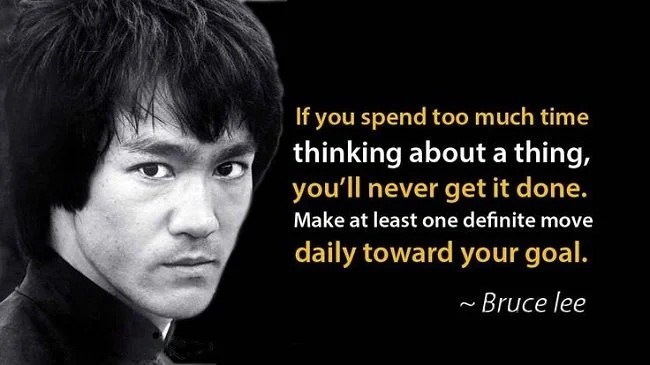
I spent some time in July, making some changes to Contains Moderate Peril. I replaced the branding and made some alterations to the “about” page to ensure that it was up to date and relevant. Not that anyone reads it as I still regularly receive enquiries about guest posts. Something I no longer do. Today, I made some further changes as it is my long term goal to grow the audience for this site. Hence I want to try and make it easier for visitors to find the content they seek and offer them related material. To facilitate this, I have added some additional menu options to the blog homepage. These act as filters, presenting specifically themed content for readers. Hence there is a “movie” button that lists all film reviews and similarly one for “video games”. There are also links for two specific video games, The Lord of the Rings Online and Star trek Online, as website statistics show that these are popular subjects.

I’ve been writing online for 17 years. During that time a modest audience has read my posts and occasionally commented on them, which is the accepted dynamic of blogging. Some of my posts are ephemeral. Others, such as film reviews, have greater longevity. Naturally I want people to read my output and I’ve noticed that the film reviews seem to generate a fair amount of traffic. After consulting my website analytics package, it would appear that the majority of readers find my reviews by searching Google. Promoting my writing via social media does very little. Another issue is that readers tend to read the post they found via their search and then leave. Despite there being links at the bottom of the post to similar material. Currently, my blog does not have an effective means of searching older posts. The landing page has only 20 posts listed. There are approximately 2,500 archived.

As a blogger we are often told by our peers not to obsess over website traffic and statistics in general. There is a degree of sense in this. We should be primarily focused on writing, maintaining an equitable schedule and staying motivated. Stats can have a negative effect on the latter. However, one cannot ignore the subject either. As a writer, at some point you do want people to actually read your material, or else what is the point? I have therefore always kept an eye on traffic and have attempted to grow my readership overtime. The results have been varied. In my experience, you do slowly build up an audience by being persistent with your writing. But you also have to promote your work, which is a job in itself. It’s also something that not everyone is comfortable with. “Therein lies the rub” as the expression goes. How do you attract readers without compromising your own standards?
I was sitting in my office over the weekend, half-heartedly typing up a blog post about table manners and dining etiquette, when I paused and lapsed into a state of self examination and introspection.
“Isn’t Contains Moderate Peril supposed to be about gaming, movies and popular culture”? “Yes”, I replied to myself via my inner monologue.
“So what the hell am I doing writing about table manners, then?” my inner contrarian retorted.
“Well it is part of our culture, although I wouldn’t argue that it is a defining aspect of the zeitgeist at present” my conciliatory alter ego responded.
“Frankly, I’m getting bored with all of this per se” a third voice stated. It was at this point, I stopped arguing with various facets of my id and went to the pub.
March has been a challenging month for several reasons and as a result I’ve written very little. Furthermore, the recently revived podcast has also ground to a halt after just six episodes due to scheduling issues that are beyond myself and Brian’s control. At the end of February, Google made changes to their search algorithm which have had a major impact upon traffic to Contains Moderate Peril. Visits are down by over 20%. I’ll make no bones about the fact that this has really pissed me off. Several years of growth has been unceremoniously swept away at the drop of a hat. So all this, plus the rapidly changing situation regarding my Mother’s care, has found me ill disposed towards writing. To be clear, I’m not talking about writer’s block. I have plenty of ideas and a folder full of draft posts. I just haven’t wanted to write because I feel that I’m just spitting in the wind.

At the time of writing we are halfway through the Blaugust 2021 Festival of Blogging event. Whenever the subject of personal blogging is raised, there are those who immediately declare that “blogging is dead”. According to Google, out of 1.7 billion websites that currently exist worldwide, 500 million or so of those are blogs of some kind. These generate over 2 million blog posts daily. So I wouldn’t say that blogging per se is done and dusted. However it certainly has evolved considerably over the last 15 years. At the start of the current century blogging was a novel activity providing the means of keeping a personal journal online. Inevitably, popularity and ubiquity led to commercialisation and a necessity to monetise. There was a period of time when clicks, traffic and advertising could generate popularity as well as an income. But other forms of social media offering greater immediacy eventually usurped this potential. Now blogging is seen as more of a niche market activity or corporate tool.

By the time that August rolls around this year, I will have been actively blogging and generally sharing my writing online for 14 years. Prior to that, back in the eighties, I was involved in the production of several fanzines. That was indeed a labour of love and although I was happy to write the content, the work involved in physically creating the actual pages was tough. The printing costs were also an early lesson in how writing is not an immediate path to fame and fortune. All things considered, writing has been a major aspect of my life for as long as I can remember. I used to enjoy writing stories as a child and then as I got older I discovered the pleasure of a well constructed essay. I was fortunate to have three very good English teachers during my time at school, who were passionate about their job and very encouraging.

I mentioned not so long ago the possibility of a website revamp. I was concerned that the general layout of the blog was not optimal and that readers couldn’t easily find old material. In the past I even went as far as to write a guide to navigating through Contains Moderate Peril and using the categories to find old posts. Well I got a few emails and Twitter DMs about this and it would appear that folk like things just as they are. So I have reviewed my position and decided to leave things as they are at present. I did a little digging though my website stats, both from Squarespace and Google Analytics and it would appear the summary blocks at the bottom of each post are used and that the bounce rate for my site is not exactly as it first appears. Seems that readers do peruse other articles and the search facility is being used more often, especially for finding film reviews. So if it ain’t broke, don’t fix it.

Due to the ongoing Global Pandemic, many people are now finding themselves working from home or having to stay in for health or childcare reasons. Hence there has been a marked increase in online leisure activities. Steam has been hit by a record number of concurrent users and Netflix and Amazon prime have both seen an increased demand upon their respective streaming services. If you’re not commuting then you are freeing up a substantial amount of hours each week. This potential abundance of “free time” along with a practical need to channel your energy into something to prevent yourself from going “stir crazy”, presents some interesting opportunities. Many people who have previously expressed an interest in writing and content creation now have the leeway to do so. Naturally, as a writing enthusiast and a long time blogger, I am happy to encourage such activities.

The New Year is often a time for revised plans, renewed ambitions and a desire to get back on the proverbial horse when it comes to content creation. More often than not, many of these lofty ambitions wither on the vine or fall victim to our propensity for indolence. Which is why I think it is prudent to ensure that any goals that you set for yourself are realistic and attainable. If for example, you have just started blogging, then it is wiser to focus on developing and maintaining a writing schedule, rather than trying to get a million page views in your first month. Impossible goals lead to disappointment which can then crush your optimism. Measured, targeted achievements, obtained over a credible time period may not seem so satisfying but they get the job done. Which is why I have given a great deal of thought to my own blogging goals for 2020. I am not going to alter or replace the blog template, nor am I going to embark upon too many side projects such a streaming or creating video content. Although I’d like to do such things I cannot sustain them or cope with the volume of work they will create. This year I am just going to try to create as much written content as possible and focus on expanding brand awareness.

The end of Blaugust Festival of Blogging 2019 presents the perfect opportunity to write another entry in my “Thoughts on Blogging” series. According to the Blaugust schedule this is the “lessoned learned week”, although I’m not too keen on that specific phrase. It sounds too much like the sort of bogus, sombre platitudes that politicians trot out in the wake of some national tragedy. But such is the nature of semantics and such is the curious fashion in which my mind works. So rather than worry of the wording, I’ll just simply reflect upon the past month and consider what it means for my writing, both present and future. Because I do believe that over the last month, I have had a minor epiphany with regard to my relationship with blogging.

The last three months have been problematic from a writing perspective and my productivity and motivation have both suffered. I struggle to find appropriate time to sit down and apply myself to writing and when I do, I seldom have the correct mindset to stay focused for long. Yet due to the back catalogue of content available on Contains Moderate Peril, there is still regular traffic coming to the site. Ironically, despite my low productivity, I have started receiving an increase in blog related marketing and have received numerous emails regarding “collaboration”, “featured posts” and “SEO optimisation”. All of which I have no interest in. However, the point remains, I’m not writing as much as I used to and I miss it. The same can be said for podcasting but that’s a tougher problem to fix. It is more labour intensive than writing, so the logical thing to do is to focus on the former and not the latter to fix.

I wasn’t expecting to write another entry in the Thoughts on Blogging series so soon, but something came up that grabbed my attention and got me thinking. A simple question that’s often asked about blogging and one that has many layers to it, as well as numerous answers. A new blogger who recently joined the Blaugust discord server asked for help “getting traffic to their blog”. An enquiry that gave me (and possibly others) pause for thought. Because we all to a degree want to attract traffic to our blogs. But I also think bloggers are too coy about this this subject. We’ll say things like “I write for myself” or “it’s not about the numbers” and although I agree with these points, building an audience is important. Let’s be honest, it can be somewhat disheartening after writing a lengthy post about a subject close to you heart, for it to fall flat and not attract any traffic. As discussed before, often it is the casual blog posts written in a hurry, that can be the most popular and the articles you’re most proud of can go unnoticed. So let us be honest. I think most bloggers want to grow an audience and enjoy the sense of accomplishment that it provides.

I decided to take a short break from blogging last week. I have a lot on at present and the only time I’ve had available to write has been in the late evening. I prefer to write in the morning as I’m more focused and motivated. Plus I haven’t really had a lot of positive things to say of late about the two primary subjects of this website. Broadly speaking there’s not a lot of going on in the video games industry that enthuses me. Similarly, the current crop of film releases have hardly distinguished themselves. At present when I do get writing ideas, they tend to be obscure niche market subjects or commentary on social issues. For example, I’m thinking of writing a post about my continuing enjoyment of the Japanese TV show Takeshi’s Castle. I’m also forming my thoughts for an article about how society’s relationship with wildlife may be “broken”. Stuff that is interesting to me but may not be ideal material for readers of Contains Moderate Peril.
As January comes to an end, I am pleased that I have so far managed to maintain a daily writing schedule. I hope that I can continue in this vein throughout February. As ever the actual process of sitting and writing has proven a somewhat mixed bag so far this year. Some days the word simply spill out of me and a blog post potentially writes itself. On others, composing just three coherent paragraphs is like pulling teeth and much time is spent procrastinating and getting side tracked. But a mixture of self-discipline and a degree of pride have helped oil the creative wheels and kept the content flowing. Whether any of it is any good is for others to decided. However, it was nice to find one of my posts quoted in an article over at Massively Overpowered. It means that at least someone is reading my work and pondering upon the points therein. Writing is after all a means of communication and sharing ideas so it is rewarding to know that you’re not just yelling into the wind all the time.

This week, a rather high profile sub-reddit associated with the Star Trek Online community, changed its status to “private” as a means of protesting against the state of the game and the way developers Cryptic are handling things. That matter was surprisingly resolved within 24 hours after an olive branch was extended from the STO community manager on reddit. However, it is not the protest itself nor the state of the game that I wish to focus upon, but the importance of /r/stobuilds as a shared community resource. A lot of STO players enjoy optimising their builds and tweaking their loadout and this site it the place to go to share such information. There is also a group of hardcore players that dig deep into the games data and comprehensively crunch number and generate useful information. Hence if a resource such as this was taken offline for longer period of time, it would have a tangible impact upon players and the wider community.
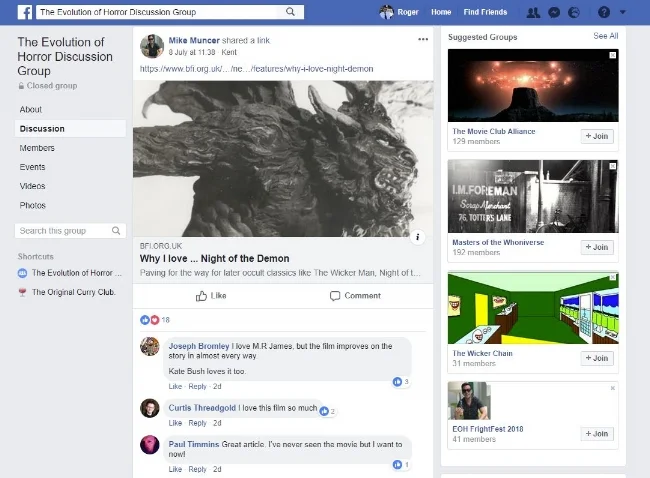
Spending time in the company of others who have similar interests and passions can be an invaluable shot in the arm and a great source of motivation. For example, I recently joined a Facebook group associated with The Evolution of Horror Podcast. It’s an absolute pleasure to be able to pick over the bones of a movie such as The Wicker Man and explore its finer points. You don’t have to adjust your level of conversation for fear of boring people, or dial back your enthusiasm due to concerns of being labelled a nerd or fanboy. Finding these online havens where you feel comfortable are invaluable, regardless of whether your passion is sport, knitting, Lepidoptery or Phrenology. Remember this point. I shall be returning to it shortly.

I read a post over at Tobold’s Blog recently that got me thinking about blogging, popularity, and the ebb and flow of our passions. The reason being is that Tobold, like many other long-term bloggers, has seen a decline in his audience over recent years. He certainly wasn’t carping about it, just simply observing the correlation between reducing your written output, the decline in popularity of his original subject matter and the number of visitors coming to his site. He also made a keen observation that blogging is not necessarily “where it’s at” with regard to cultivating an audience. If you are producing content specifically to grow and maintain a following, then You Tube and Twitch are better platforms for that. Especially if your content is part of the wider gaming scene. For better or for worse, I now associate gaming commentary with visual mediums rather than blogging. Yes, there is still long from criticism being produced but it’s aimed at a niche gaming audience. One that I would guess is older.
I usually write a post early on in the New Year in which I list the various goals I’m focusing on over the next twelve months. To date I have not done this because I am still trying to work out what I can and cannot accommodate within my current schedule. As a carer I’m kept very busy, but my weekly routine does offers windows of opportunity for writing. However, free time is a finite commodity, so I have to really cut my proverbial coat according to my cloth this year. Therefore, I’ve decided to pursue the following projects. I will continue to regularly post on Contains Moderate Peril as I enjoy having my own platform and certainly feel that I still have a lot to write about. Also, the audience is steadily growing, and I think it would be counter productive to fly in the face of such a development. I was also given the opportunity to write for MMOGames recently and have decided to accept this invitation. Writing to deadlines and deferring to editors, is an invaluable learning experience. Plus, it presents my writing to a wider audience which is great for brand awareness and other awful marketing terms.

There wasn’t a Newbie Blogger Initiative this year and I was saddened by that. I’ll make no bones about the fact that I liked this yearly event and the way for a few months after it, you’d see a lot of interesting new blogs spring up, filled with optimism and passion. But, what’s done is done, and life goes on. It’s up to others to pick up that particular torch and run with it, if they wish to see the event to return. I also miss a lot of my colleagues and peers’ blogs and the comradery that stemmed from the associated community. Again, this is a natural and inevitable attrition process, caused by that thing known as “life”. So, to combat my current melancholic malaise, I thought I’d collate a few of my thoughts about writing online and set them down in a semi-regular post, the same way as I do about podcasting.
Wordle
Over the Christmas holidays, I started noticing lots of people posting images of some sort of grid composed of coloured squares in my Twitter timeline. Then the hashtag #wordle provided a name and it became apparent that all this activity was to do with some sort of game. Eventually my curiosity got the better of me and I did a Google search and discovered the exact nature of Wordle. The game was originally created by software engineer Josh Wardle for his partner, Palak Shah. Family and friends played the game and it proved popular. So Wardle then decided to make it available online, last October. By November 90 people were playing Wordle. However, after a share online button was added to the game the audience rapidly grew. As of 2nd January it had over 300,000 players with several high profile celebrities among that number.
Over the Christmas holidays, I started noticing lots of people posting images of some sort of grid composed of coloured squares in my Twitter timeline. Then the hashtag #wordle provided a name and it became apparent that all this activity was to do with some sort of game. Eventually my curiosity got the better of me and I did a Google search and discovered the exact nature of Wordle. The game was originally created by software engineer Josh Wardle for his partner, Palak Shah. Family and friends played the game and it proved popular. So Wardle then decided to make it available online, last October. By November 90 people were playing Wordle. However, after a share online button was added to the game the audience rapidly grew. As of 2nd January it had over 300,000 players with several high profile celebrities among that number.
The game involves trying to guess a five-letter word each day. The player has six attempts available. Each time you make a guess, it will show if the letter you used was correct and in the right space, correct but in the wrong space, or not in the word at all. Wordle uses a colour code system to show players their respective success or failure, with letters turning green if they’re in the right space or yellow if they’re in the wrong space. There is only one word available each day and the word is the same for everyone playing. Players can share their results with each other. There is also a hard mode for players who want an extra challenge, forcing them to use the letter hints given by the game in subsequent guesses and restricting what they can guess next.
I am not an active player of Wordle. I gave it a go while researching this post and decided it’s not for me, which is odd for someone who likes words and language. However, that’s not to say it’s appeal and charm is lost upon me. I can understand why a game such as this gains traction with people. There is no bar to entry, no cost and the game’s rules are straightforward and unambiguous. The game is also educational and an opportunity to expand one’s vocabulary. Plus every player is guessing the same word each day, which adds a sense of a shared experience. Posting on social media means that people can swap scores and engage with each other about the game. It is this social element that has undoubtedly contributed to the games success. It’s traction on social media has attracted a lot of press attention. Josh Wardle was recently interviewed on BBC Radio 4's Today programme, which is a prestigious UK news vehicle.
My interest in Wordle stems from what Josh Wardle said during the course of his BBC interview on Wednesday 5th January. Especially in light of the triple A video game industries current infatuation with NFTs and blockchain technology; their latest monetisation fetish. “I don't understand why something can't just be fun. I don't have to charge people money for this and ideally would like to keep it that way. Wordle is very simple and you can play it in three minutes, and that is all you get. There are also no ads and I am not doing anything with your data, and that is also quite deliberate”. Wordle currently exists as a web based game. When asked regarding a mobile app version, he stated “I am a bit suspicious of mobile apps that demand your attention and send you push notifications to get more of your attention. I like the idea of doing the opposite of that; what about a game that deliberately doesn't want much of your attention”.
I wonder what Yosuke Matsuda, the President of Square Enix, would make of Josh Wardle’s philosophy? Matsuda stated recently in a corporate press release that "goodwill” and "volunteer spirit” were "inconsistent personal feelings” and essentially looked down upon them as they were difficult to monetise. I think what Josh Wardle’s comments highlight is the intrinsic difference in mindset between those who personally create art and those third parties who see it purely as a means to profit. Reflecting upon both positions, I know which one I feel most well disposed towards and which one I will afford a degree of goodwill. I believe that there is a valuable insight to be gained here as well as an important life lesson. However, I suspect that one party is too busy counting their money to learn either of them.
I started playing MMOs in late 2008 by which time the genre was clearly established and dominated by one particular title, World of Warcraft. I chose to play The Lord of the Rings Online, mainly because of my love for the intellectual property the game is based upon. I still play LOTRO today. However, I was very aware of popularity and significance of WoW at the time. It pretty much set the rules for how you design a MMO and it did much to move on from the previous gameplay parameters set by such titles as Ultima Online and EverQuest. It was also the MMO that every other developer was trying to beat. Another compelling factor regarding WoW is that everyone I knew at the time was either actively playing it or had done so at some point. It was for many gamers, the go-to title for socialising. Finally around early 2010, I tried a free trail of WoW to “see what all the fuss was about”. Simply put, I felt that it wasn’t for me.

Over the course of the last 16 years, the MMORPG Star Trek Online has changed greatly. What started as a disjointed, rushed game with unfinished systems and a lack of overall cohesion has now evolved into streamlined MMO with clearly defined systems and very strong narrative arcs. Let it suffice to say that STO makes very good use of its license and the intellectual property it is built upon. Although new content has been continuously added to STO over time and refinements are regularly rolled out, the developer’s have also removed content from the game in the past, that they feel is substandard or too dated in it presentation. Hence in October 2018 Cryptic took out the following eight missions from the game, with the proviso that they would be updated and replaced at a latter date. Until fairly recently, STO players had given up hope on this ever happening and the episodes being reinstated. Eight years is a long time.
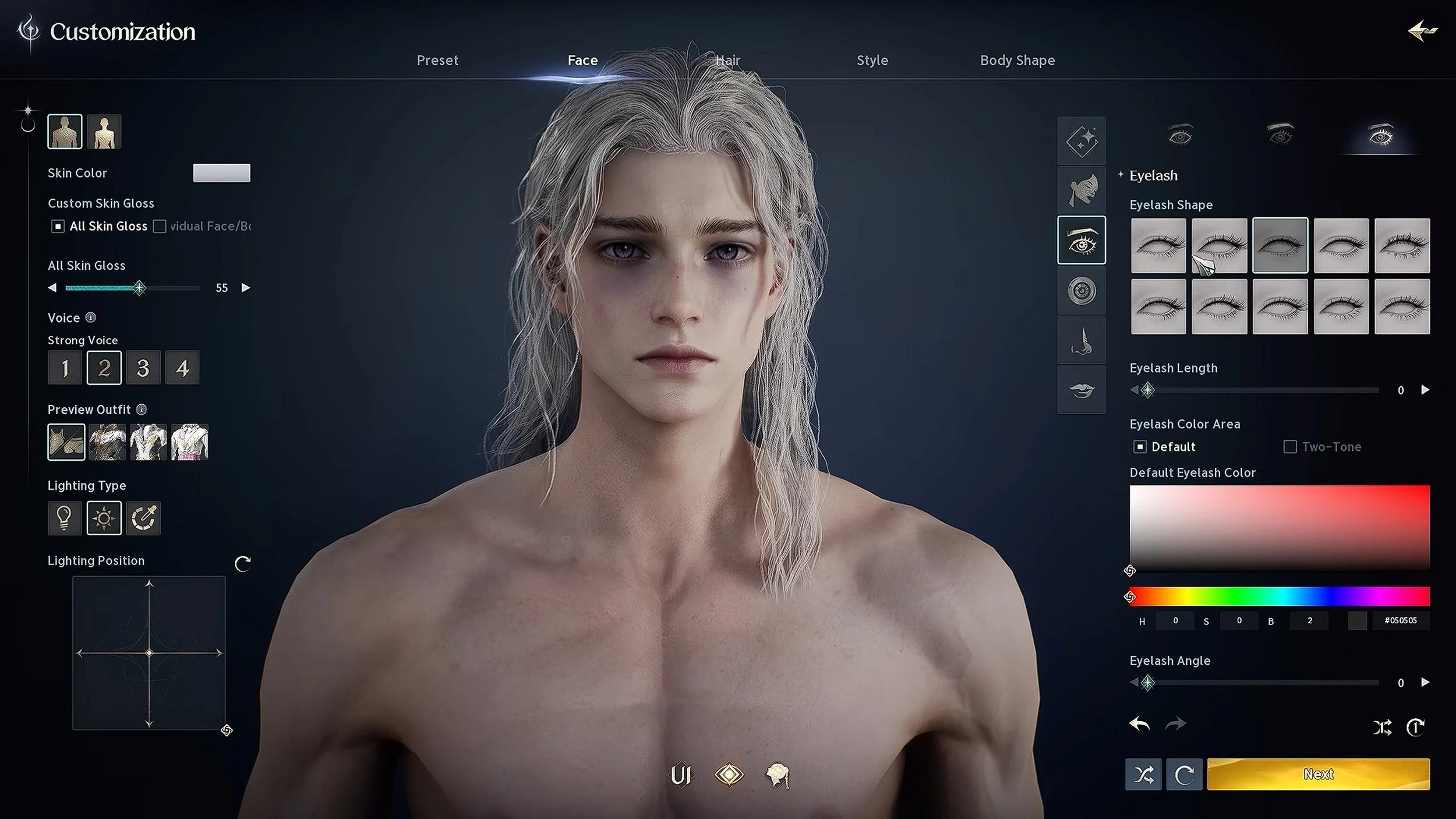
One of the things that I enjoy when playing a new video game is character customisation or character creation. I will spend hours trawling through settings, changing the most minute and consequential aspects of my avatars appearance. I am certain that there is a psychological aspect to this particular game mechanic and that it says something about you as a person. Are your creations shaped just by a need to look good in-game or is there more to it? Are they external manifestations of your sexual preferences or thoughts on body image. Do you treat them as characters from a book that exists in your mind. Do you aspire to recreate the likeness of people you know or admire? Do you strive to make your avatar look like you? Whatever the reasons, it would seem that character creation is something that a lot of gamers enjoy. Hence I am not alone in my borderline obsession. What you look like in-game is equally as important as your character’s name.

I was playing Battlefield 6 recently and was experimenting with the mortar. If you stick with it and take some time to become familiar with its foibles, it can be an effective weapon. It can suppress the enemy, destroy equipment and provide useful cover for your own team. I remember thinking “I wonder if artillery could sustain a game on its own”. Artillery is an interesting feature in Hell Let Loose, although it is a little more complex in its game mechanics. I believe artillery is also available in Wardogs. I therefore spent a while looking online to see if there was a dedicated artillery simulator available or at least a game where it was a key feature. There nearest thing I found was Iron Nest, a dieselpunk heavy artillery game which looks interesting but isn’t quite what I seek. So I parked this idea and moved. Tonight, while perusing YouTube, I stumble across a teaser trailer for a game called Flak Simulator, currently under development by Horseman Interactive. It appears to be exactly what I am looking for.
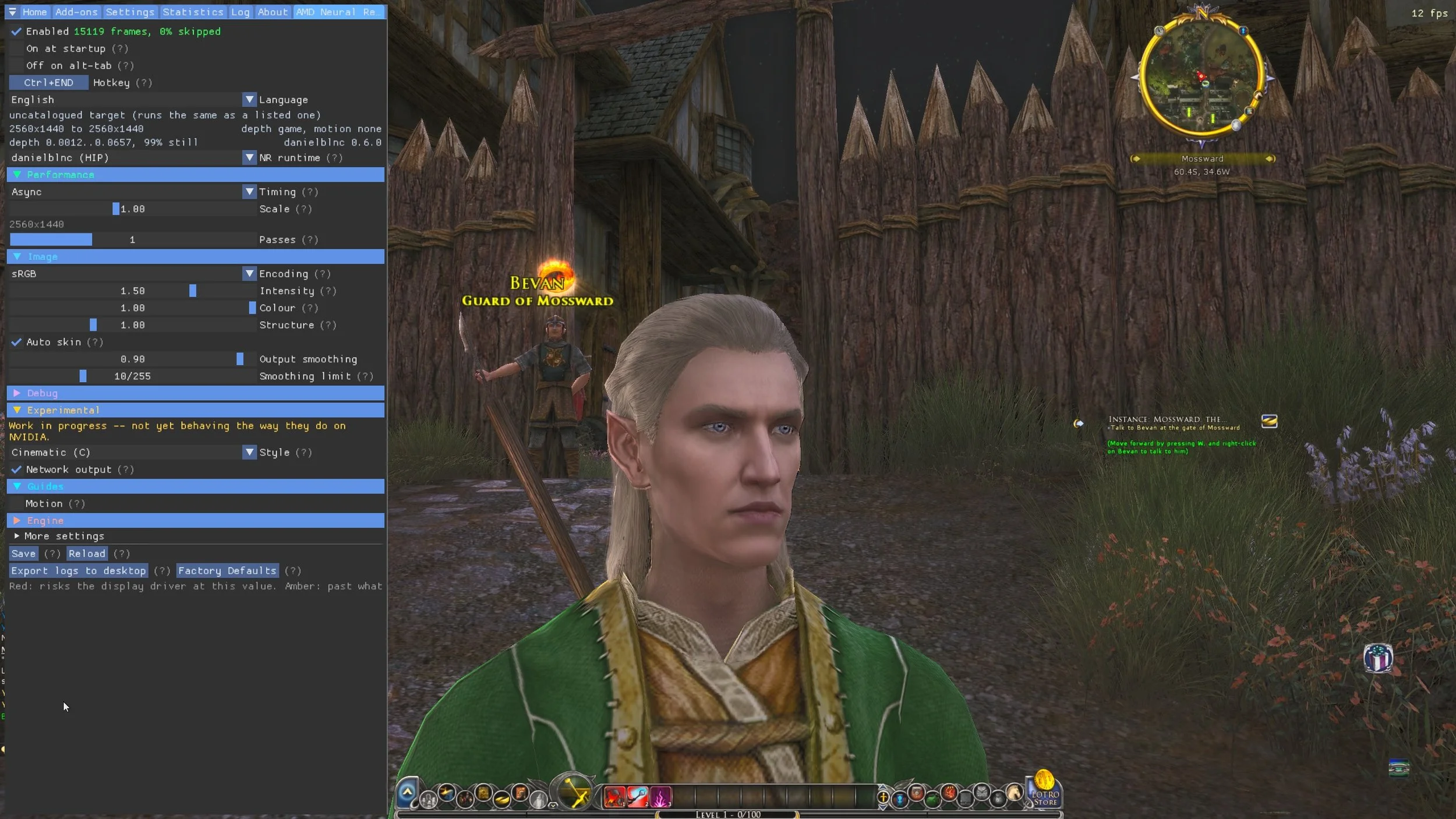
I recently tried to use DLSS 5 Manager with the MMORPG, The Lord of the Rings Online. Unfortunately, things didn’t work out. Today I undertook a similar experiment with AMD Neural Rendering, which is a broadly comparable product. Both utilities use 3D-Guided Neural Rendering, an AI technology that alters how lighting, reflections, and textures look in a game. Instead of just upscaling the image like older versions, DLSS 5 uses an AI network to instantly "re-render" lighting and material responses over the game's layout, achieving photorealistic details that would normally negatively impact a graphics card's performance. Or to put it in less fancy terms, the game graphics are enhanced and modified, although it is highly subjective as to whether the end results are an improvement. However, as a game such as LOTRO is unlikely to ever receive a major graphical overhaul, tools such as these are the nearest players will get to revised graphics.
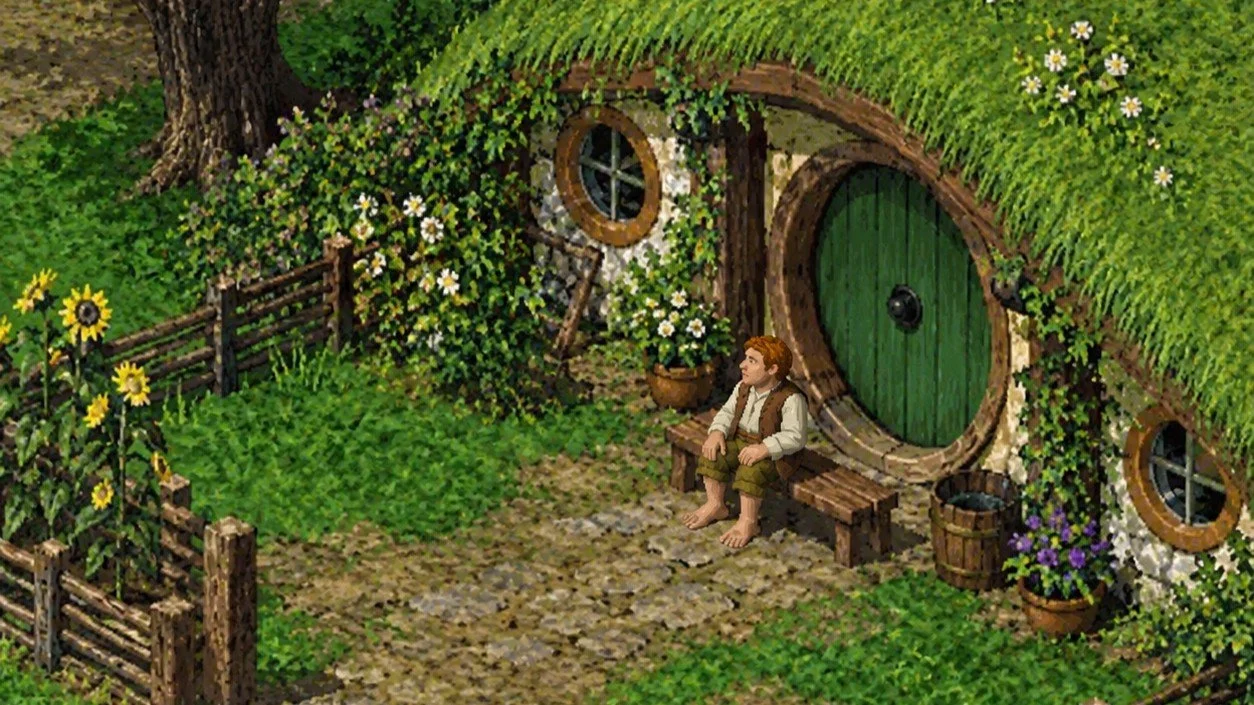
The core game code and engine for the MMORPG, The Lord of the Rings Online, is about 24 years old. LOTRO began originally as Middle-earth Online, developed by Sierra On-Line in 1998. Turbine took over full development of the project in 2003/2004 when their parent company, Vivendi Universal Games, acquired Sierra. The content that had already been developed by Sierra was abandoned and Turbine created a new game using structural elements such as the UI and game engine from their previous release Asheron’s Call 2 from 2002. The Lord of the Rings Online: Shadows of Angmar was officially released in April 2007. Hence, the active public release code is 19 years old. Despite continuous expansion and updates, along with a recent migration to 64-bit architecture, the foundations of LOTRO retains a nearly twenty year old legacy framework. This frequently contributes to modern technical hurdles and engine constraints.
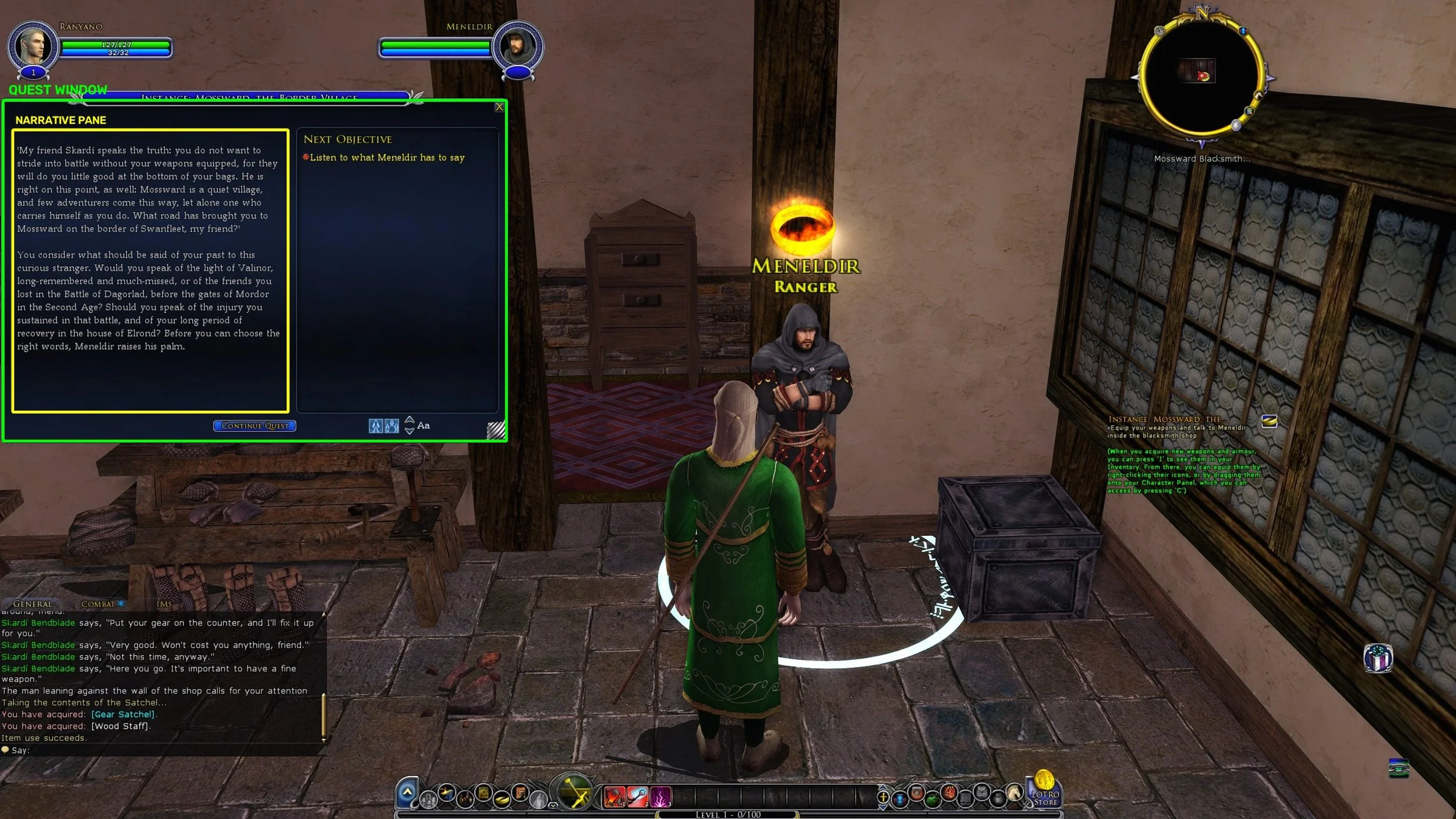
A few years ago, there was a fan created project to provide voice narration of NPC dialogue in the MMORPG, The Lord of the Rings Online. This mainly involved capturing the text in the quest dialogue windows and then sending it to OCR software, before using a text-to-speech program to read it. LOTROVoice as it was known, broadly worked but the creator stopped developing it as it proved troublesome to maintain. However, I recently discovered Khazad Voice TTS which is a separate project that does pretty much the same. I went so far as to install this “immersive AI narrator for LOTRO” after seeing a YouTube video of it being used successfully. Sadly I ran into issues configuring Khazad Voice TTS, because I have two monitors and LOTRO runs on the secondary (by my choice) and not the primary. I couldn’t “lasso” the dialogue windows in LOTRO during the calibration set up, which effectively prevented me from completing the process.
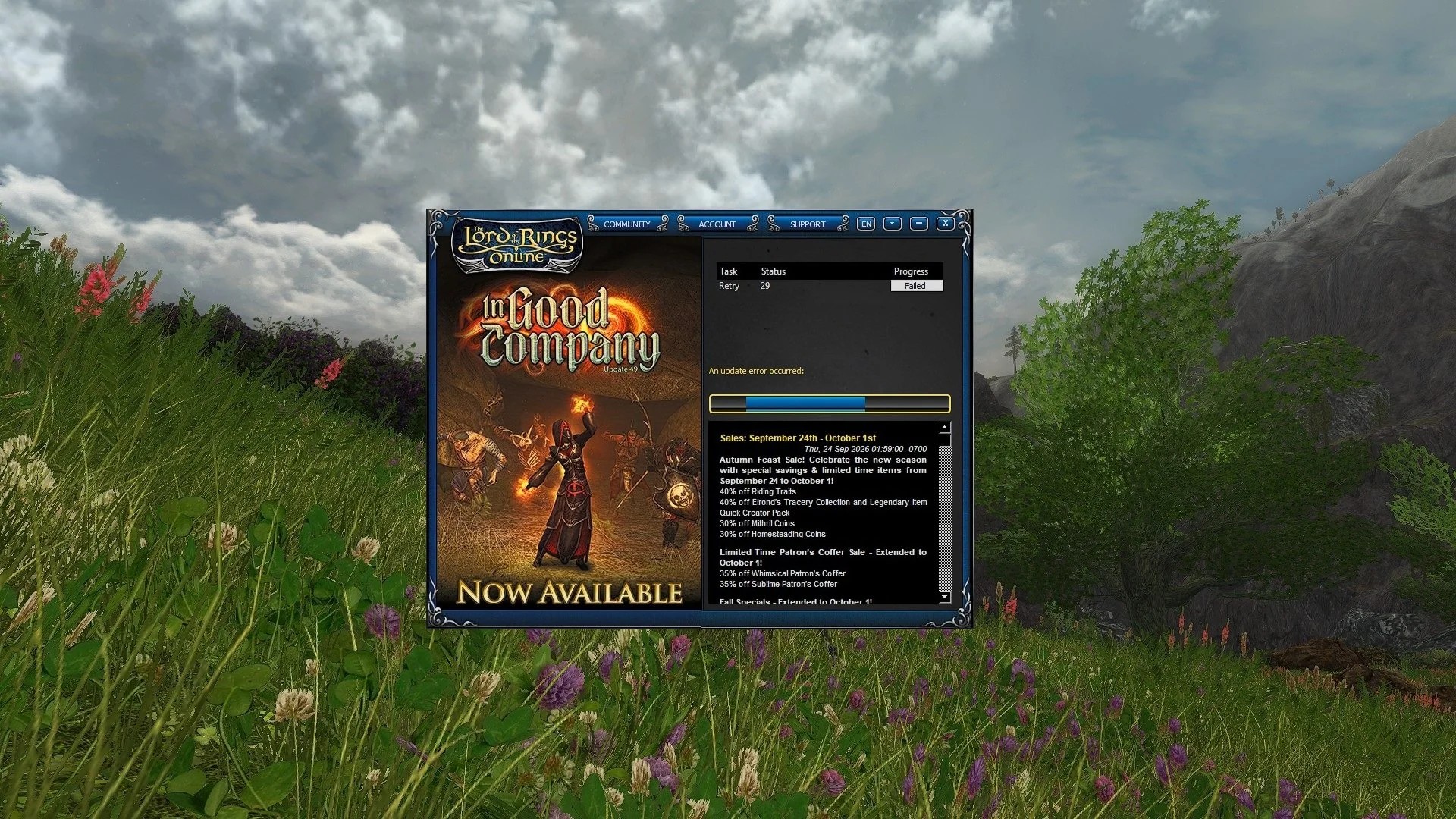
Throughout yesterday and early today, there was an issue logging in to the MMORPG, The Lord of the Rings Online. Upon starting the game launcher, it would attempt to connect to the patch server to download the latest game update. This process would start but then subsequently stall at 33%. The launcher would then attempt to reconnect to the patch server every 60 seconds but could not make any further progress. Some players found that if they left it long enough, it would eventually complete the download and the launcher then progress to the next screen where they could input their username and password. However, for the majority of LOTRO players the problem would simply persists and the launcher would be stuck in a loop. Some players attempted to reinstall the game or use the repair data facility in the launcher but neither of these proved to be successful workarounds. The patch sever needed to be bypassed to resolve the issue.
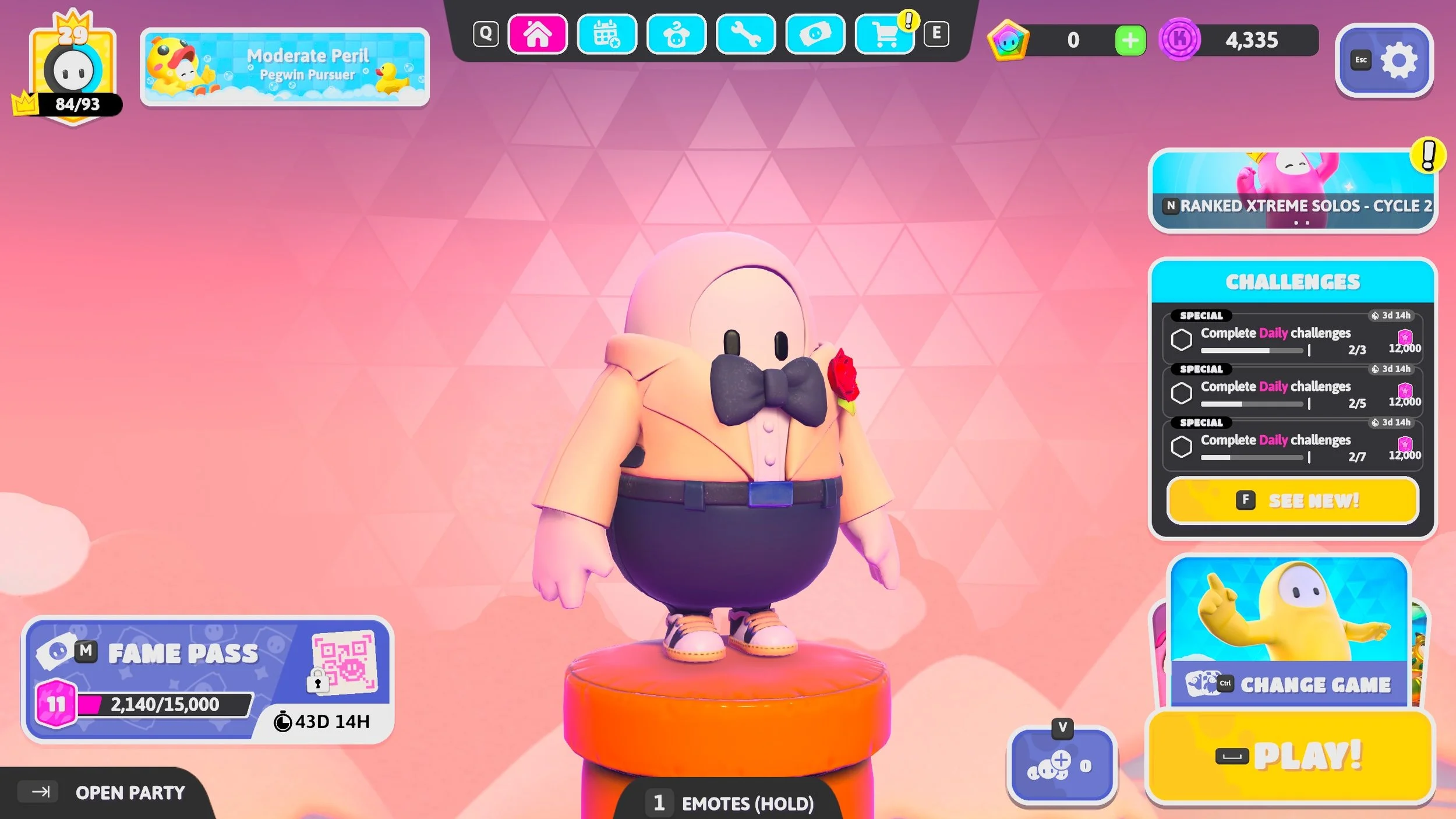
I’ve been playing Fall Guys since its launch in early 2020, during the start of the pandemic. It is a fun, family friendly multiplayer game which is has proven popular with my grandchildren. Despite the game’s acquisition by Epic, it has maintained a sufficient level of popularity that has seen it ported to all major gaming platforms. Fall Guys is free to play but like most multiplayer games, there is a season pass and an in-game store. However, these monetised aspects are not essential to enjoy the game and the overall marketing of emotes and skins is nowhere near as invasive as it is in Roblox. In fact many of the players I see while in-game have default skins, indicating a regular casual player base. However, although game seems to be maintaining its popularity, it has several bugs that appear to be be persistent. Bugs that the developers claim have been resolved. Some can be addressed by players. Other at present cannot.

I find the concept of in-game radio stations fascinating. They’re an enjoyable aspect of open world video games and I have discovered several artists this way. They’re certainly a big deal as far as Rockstar Games are concerned, because the music selected for GTA VI is another important facet of the overall marketing campaign. So far, between two trailers and the sprawling extended look on Netflix, it has been determined that Tom Petty, the Pointer Sisters, Sexyy Red, Depeche Mode, Phil Collins, Birdman, Lil Wayne and the Bellamy Brothers are all part of the game soundtrack. That’s a very eclectic selection so far. Furthermore, there will be a 34 track album released on physical media (vinyl and CD) in conjunction with Atlantic Records.

Two years ago I wrote a post about fine tuning your graphics in the MMORPG The Lord of the Rings Online. Apart from installing ReShade and using AMD Adrenalin, the options were somewhat limited, due to the game’s age and multiplayer status. Since then, I’ve been playing LOTRO with the game settings maxed out, a custom ReShade profile to make the colour palette more vivid and Radeon Image Sharpening enabled within the AMD software. The game looks clear, crisp and the draw distance is pretty good for an ageing game but I still wish the graphics could be tweaked further. Hence, I’ve been trawling the internet in a vain attempt to see if I can find any third party utilities that could be used to enhance LOTRO further. During the course of my search I stumbled across DLSS 5 Manager. This is an open-source, intelligent utility and one-click mod installer designed to inject and manage Nvidia's DLSS 5 neural rendering features, ReShade, and OptiScaler into PC games.
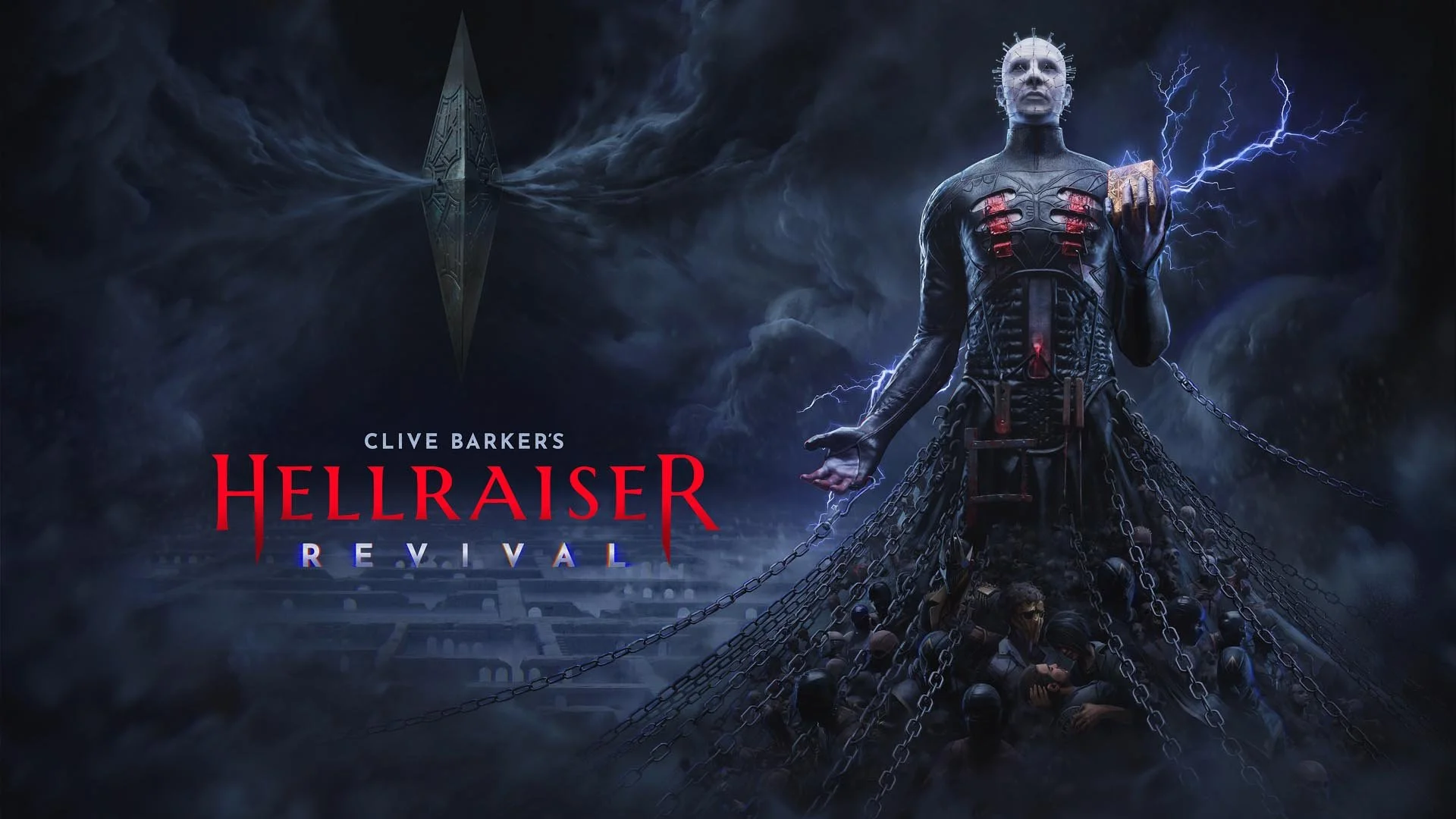
Hellraiser (1987) was one of he most innovative and intelligent horror films of the eighties, with its cerebral and sophisticated exploration of pleasure, pain and the supernatural. Sadly what was a great concept for a single film was turned into yet another horror franchise. The resulting series of increasingly inferior sequels ultimately diminished the central idea. However, in recent years several horror “brands” have found a new lease of life via the medium of video games, so the announcement of Hellraiser: Revival last summer piqued my interest. The fact that author Clive Barker was directly involved certainly raised my expectations. However, even though video games have a history of depicting sex and violence, would the medium be able to fully embrace the true nature of Barker’s original novella and original film. Having played through the newly released demo for Hellraiser: Revival, I believe the answer is a yes.
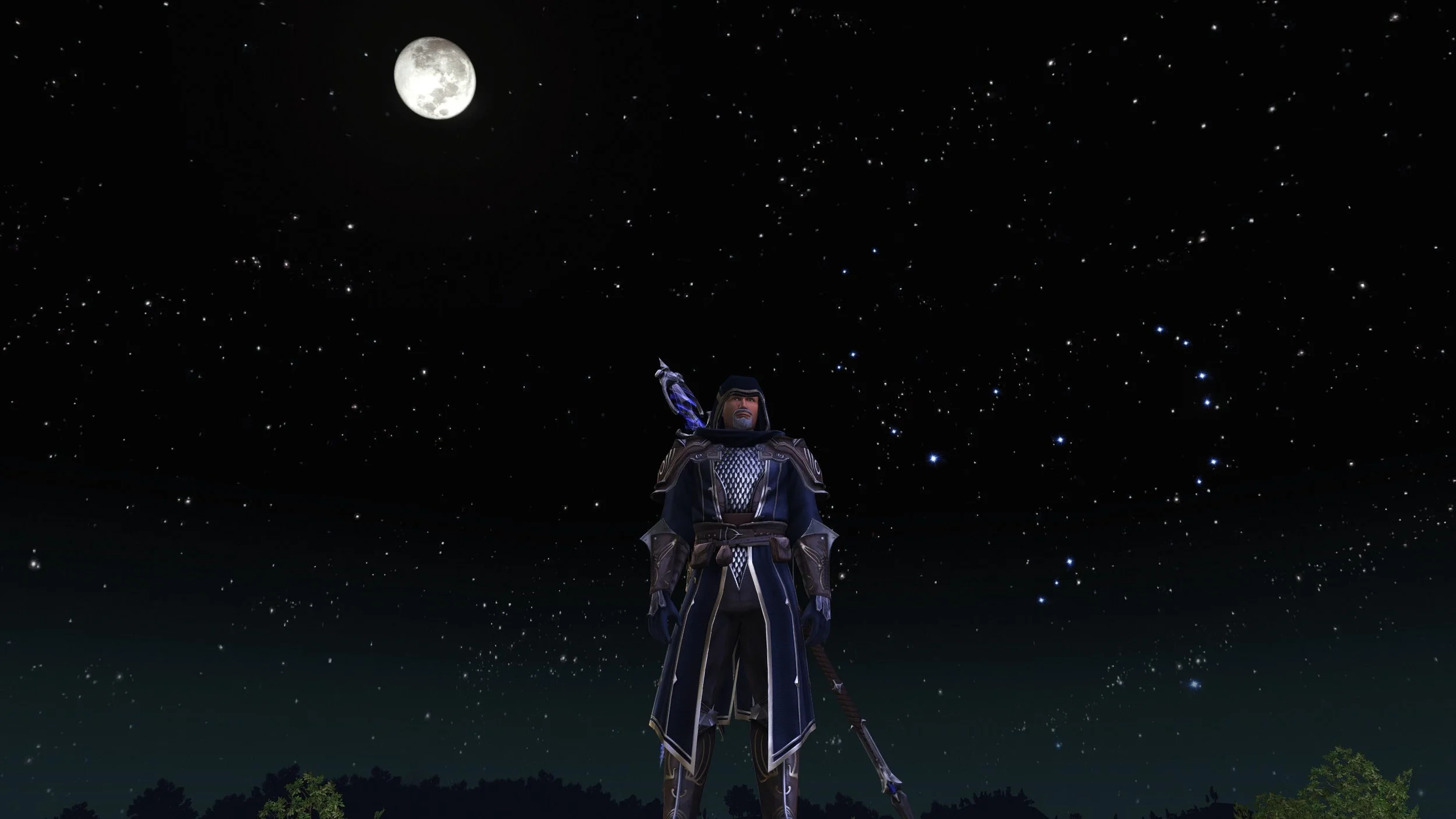
Are video games becoming easier? It’s a perennial subject that is frequently discussed by those who play them. Often the question of whether they have actually become easier is not the focus of the debate, as it seems to be broadly recognised that it is the case. Instead, discussion of this matter tend to drift into the rectitude of this change. Debate’s of this nature are usually awash with subjective opinions and personal preferences which are then put forward as objective facts. It’s not just a question of video games becoming easier, it’s the fact that making them easier is “wrong” and those who want them as such are “not proper gamers” etc. The hours that have been lost to this pointless, tedious debate are uncountable. However, I digress. Let us return to the matter of video games becoming easier, because although fans discuss this a lot and have plenty to say, you don’t often hear from the developers on this subject.
Some video games lend themselves to being set aside and resumed at a later date with zero consequences. These are often casual games with no major goals other than having fun while playing them. Fall Guys is a great example of this. You have a cartoony avatar that participates in zany group races, filled with obstacles. You run, jump, climb but the controls are far from difficult. You may well become skilled but such things are mitigated by the other players as they stumble around. You’re not at the mercy of apex players or “try hards”. It is not a game about winning and mastering techniques. The fun comes from playing it and the unique experience you have each time. I’ve been playing this game, on and off, since it’s launch in 2020 and in that time I have only ever won once (winning requires you to win a series of 4 to six individual races). However, whenever I pick up my controller and play Fall Guys, I have fun and the game lifts my spirits.
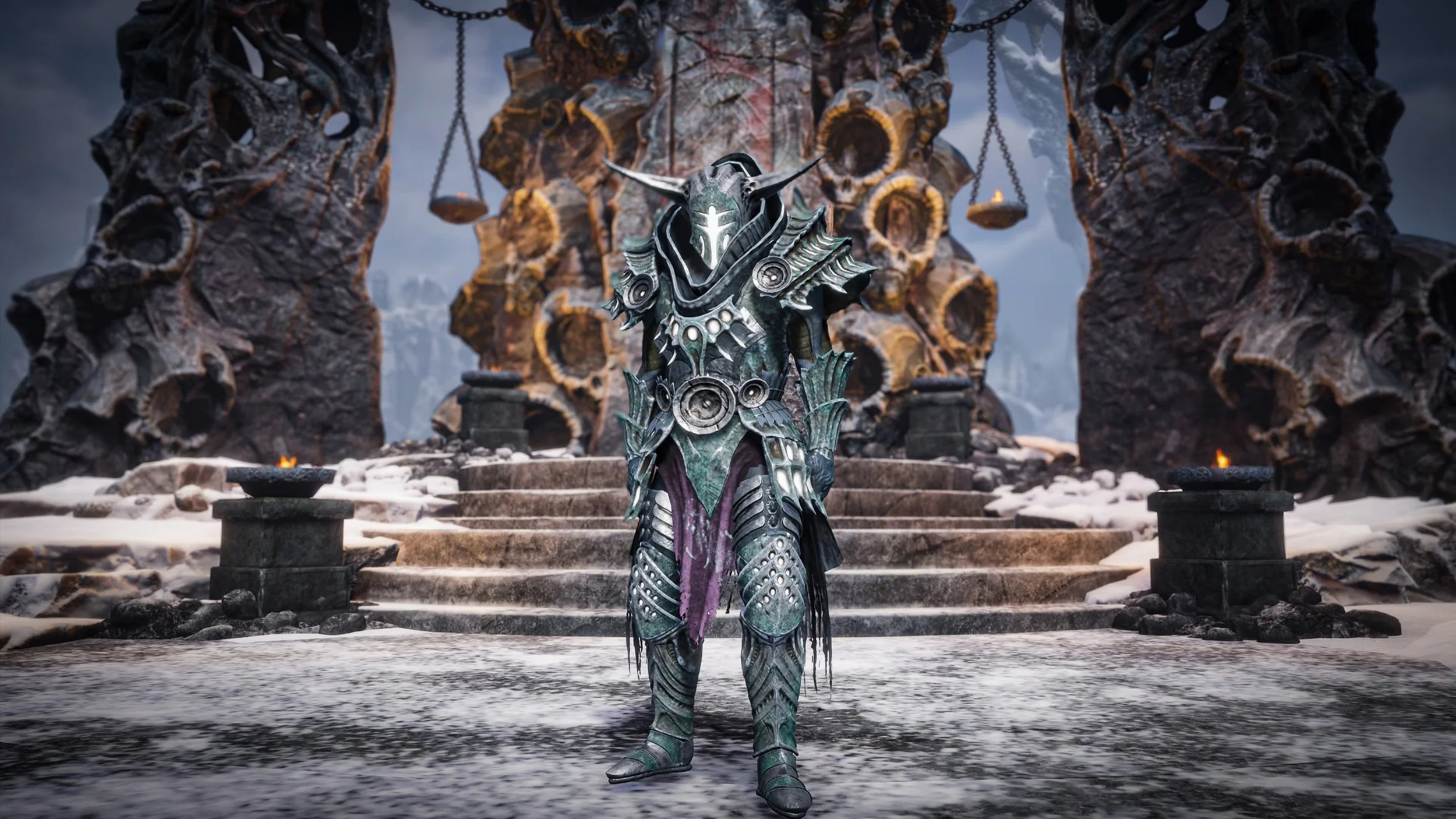
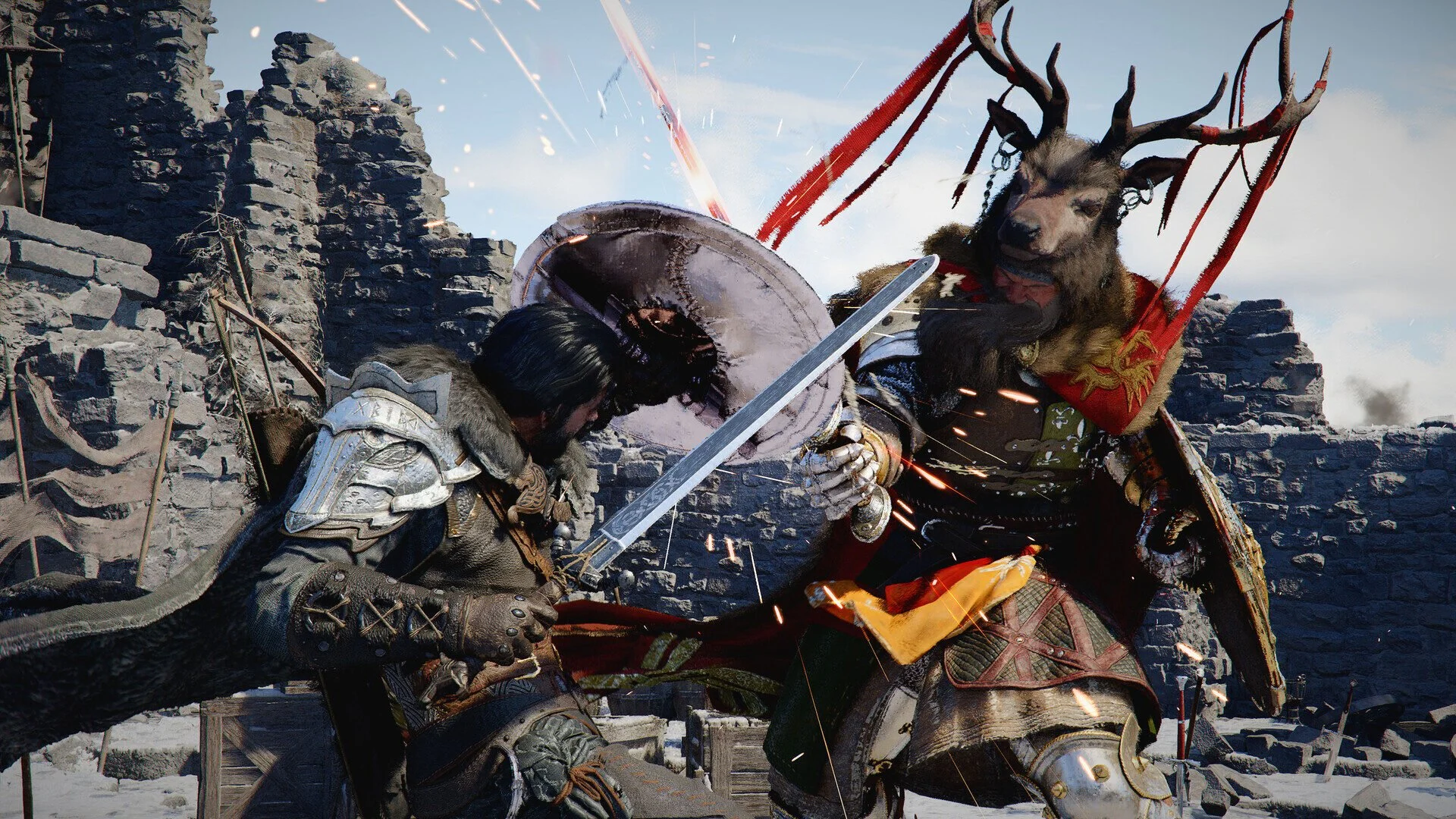
I recently completed the main story in Tainted Grail: The Fall of Avalon. In total I spent about sixty hours playing the game. I began at the start of the year, then took a break for a while but returned to it recently because I wanted to see if I could unlock a specific ending. I did manage to do this. Like so many other RPGs, Tainted Grail: the Fall of Avalon has a central storyline, along with a wealth of side quests, based around factions in specific zones. I think I possibly completed about a two thirds of these. However, once I finished the main story, my interest in the game began to wane. I finally left my character in the last major quest hub in case I wish to return at a future date. I then logged out of the game and uninstalled it from my PC to free up space for whatever I was to play next. In this case its The Sinking City 2. None of this is a negative reflection on Tainted Grail: the Fall of Avalon. I enjoyed the time I spent playing this quirky RPG. I simply had my fill and left to play something else.

On Tuesday 11th April, Aspyr Media rather surprisingly re-released The Lord of the Rings: War in the North, a co-op action-RPG from 2011. This game was delisted in late 2019, possibly due to changing rights ownership or a license expiring. Hence, I was somewhat discombobulated by the return of this title to all major gaming platforms. Mind you, the Embracer Group (through its subsidiary Middle-earth Enterprises) still controls the worldwide commercial and video game licensing rights for The Lord of the Rings and The Hobbit. Furthermore they have explicitly stated that they have plans for more games. It would appear this also means re-releasing and updating old favourites. It is also worth noting that they own Aspyr Media, which is also a bit of a giveaway. Let it suffice to say that this re-release and sparked enthusiastic online debate as to whether any other he Lord of the Rings themed games from the same era will receive a similar makeover. Judging by the internet chatter, there’s potentially a market for them.
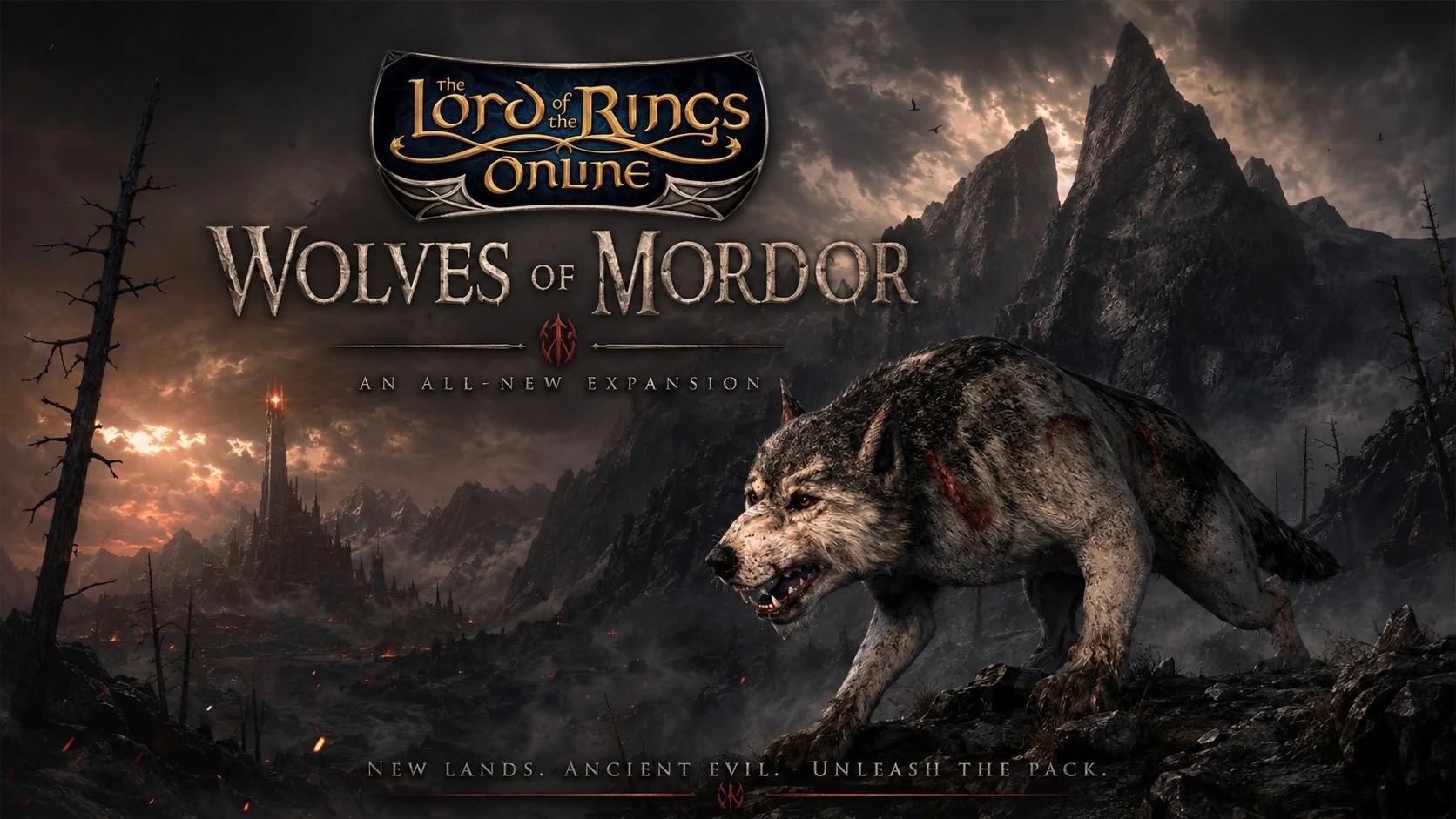
The next expansion for the MMORG, The Lord of the Rings Online, was announced on the 1st August, via the gaming website MMORPG.The Wolves of Mordor, which will launch later in the year, appears ambitious in scope as it will include two new game systems as well as the obligatory story update. This expansion takes place in Draugardh located in the North East of Mordor, beyond the Plateau of Gorgoroth. It includes the new zones of Heledhris, Parth Rhavas and Nan Ogol. These vary environmentally ranging from the arid, volcanic and semi-tropical. Players will encounter the Daugrim in these regions, Werewolves but not in the modern sense. This is not the lycanthropy of Eastern European legends but in the established Tolkien idiom of fell spirits inhabiting the bodies of Wolves. The region also sees the return of the Woses and players can expect to encounter Elves and scouts from Gondor. As ever with LOTRO expansions, there will be new instances as well as a raid.
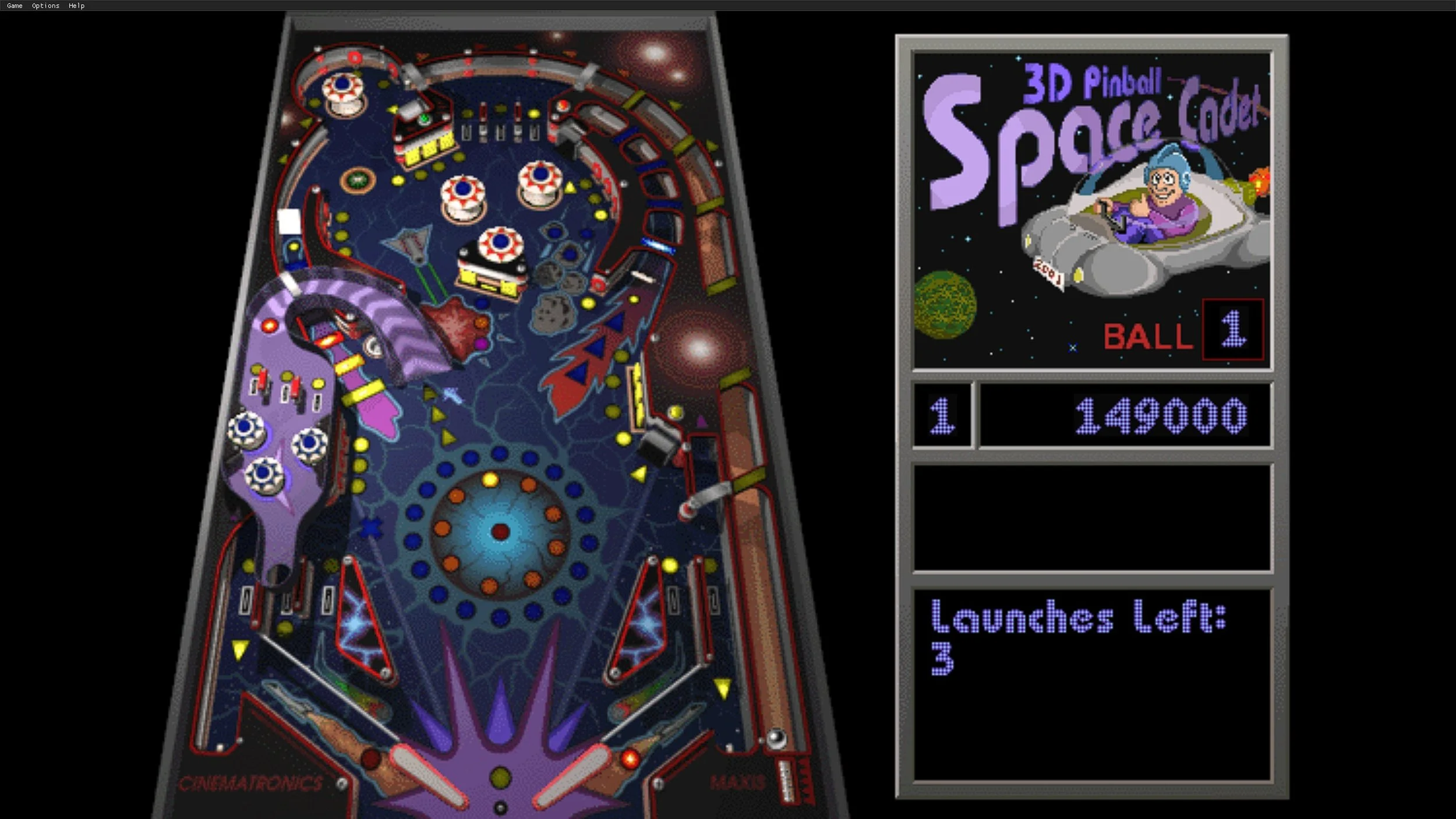
This is a post about the power of nostalgia and how sometimes, interacting with something from your past, be it physically or mentally, can produce a very strong and tangible emotional reaction. In some instances, this can be the result of something that you have specifically set out to do. On other occasions you can wander into a sense of nostalgia purely by chance. Today I experienced a very strong sense of nostalgia while watching a YouTube video and then again when I sought to replicate what I had seen. The video showed someone installing Windows 95 on to an old 486 PC from that era. The Window’s start up sound really touched a nerve (but in a good way) and then when the guy in the video launched Space Cadet 3D Pinball, a game that shipped with the operating system, I felt a strong compulsion to track down a copy and install the game myself, thus revisiting something that was an integral part of my life in 1995.
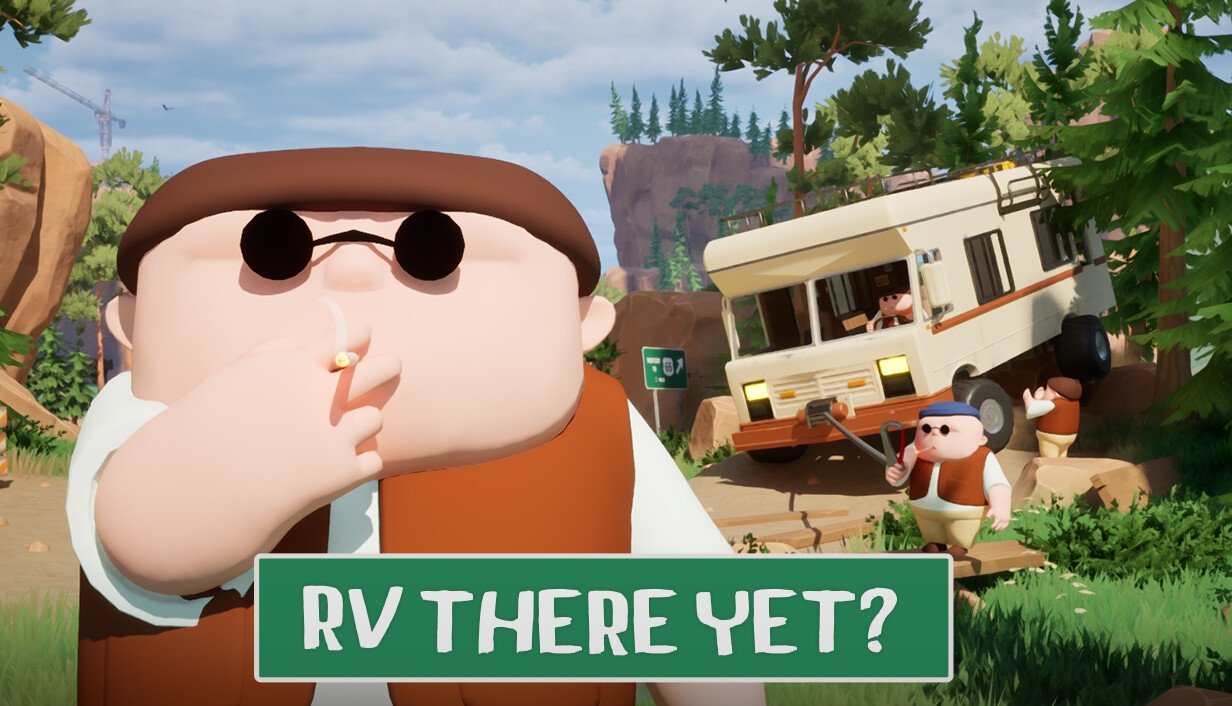
RV There Yet? is possibly the most entertaining game I’ve never played. My vicarious pleasure regarding this title has come exclusively from watching two popular YouTubers, JackFrags and WillFromWork, play through the game over a series of videos. It has been immensely amusing to watch and I have empathised a great deal as the group of four players has struggled with the game’s unpredictable mechanics and their own team’s dynamic. I could go and buy RV There Yet? myself but I doubt if I would ever have a gaming experience anywhere close to what I’ve watched online recently. So in some respects watching these videos has been an interesting alternative as I’ve been entertained, which ultimately is the point of video games. Perhaps there is a deeper philosophical point here that the game developers should reflect upon, as they’ve lost a potential sale. However, that is separate discussion for another day.
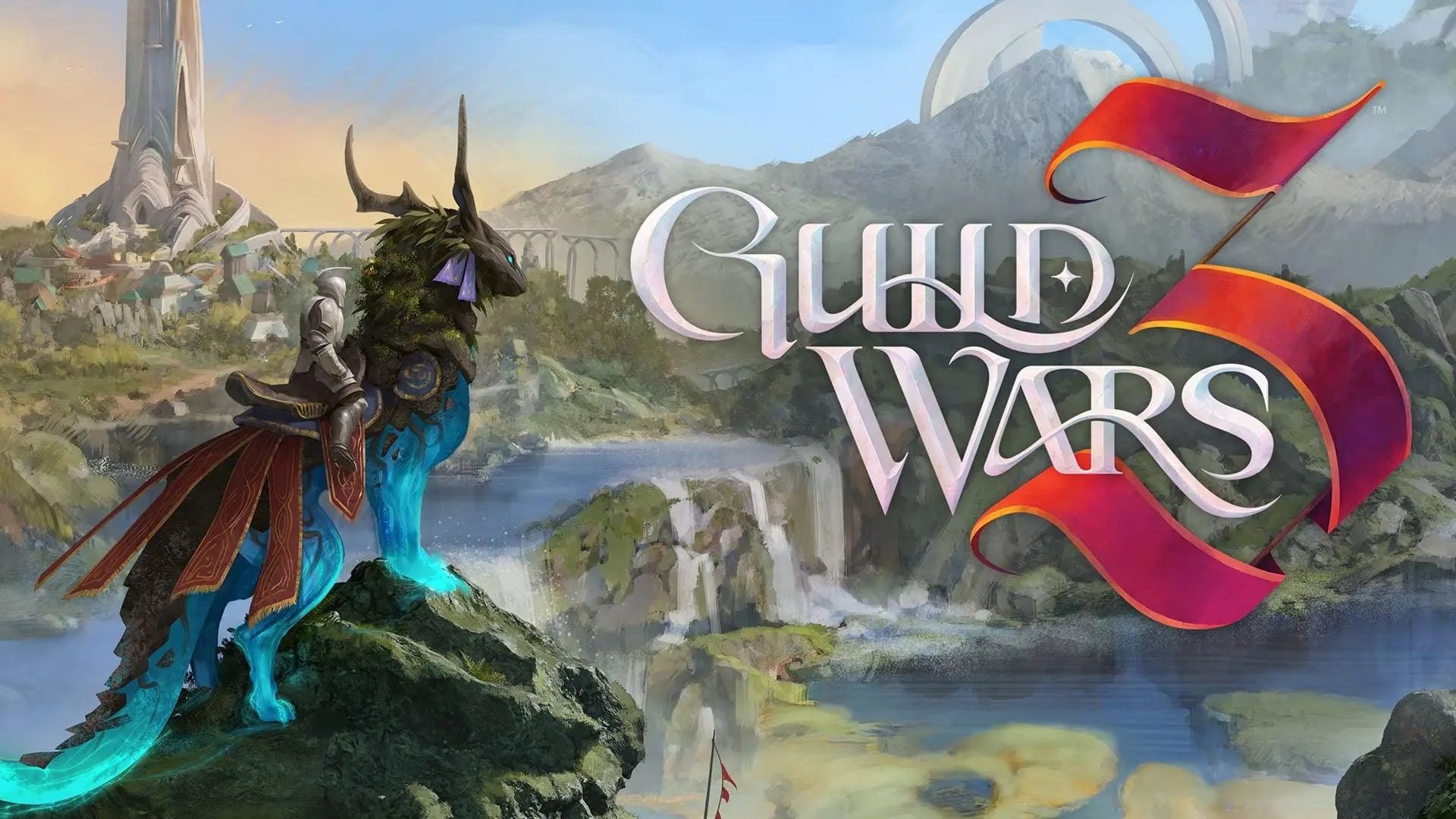
I don’t keep up with gaming news as much as I use to but several noteworthy announcement have come to my attention of late. Firstly, there’s an expansion, Songs of the Past, coming for the Witcher III: Wild Hunt in 2027. No doubt this is to pave the way for the Witcher IV. Next, I also found out about Hand of Fate: Horde. I liked this franchise and was saddened to learn that the original studio, Defiant Development, closed. Hence is was a pleasant surprise to see this new game being developed by members of the original studio. The third announcement was regarding Guild Wars 3. A new MMORPG in active development by a major studio is no small feat and is certainly good news for fans of this franchise and the genre per se. However, once you look beyond this news this announcement raises several questions and has certainly given me pause for thought. Let us take a few moments to consider them.
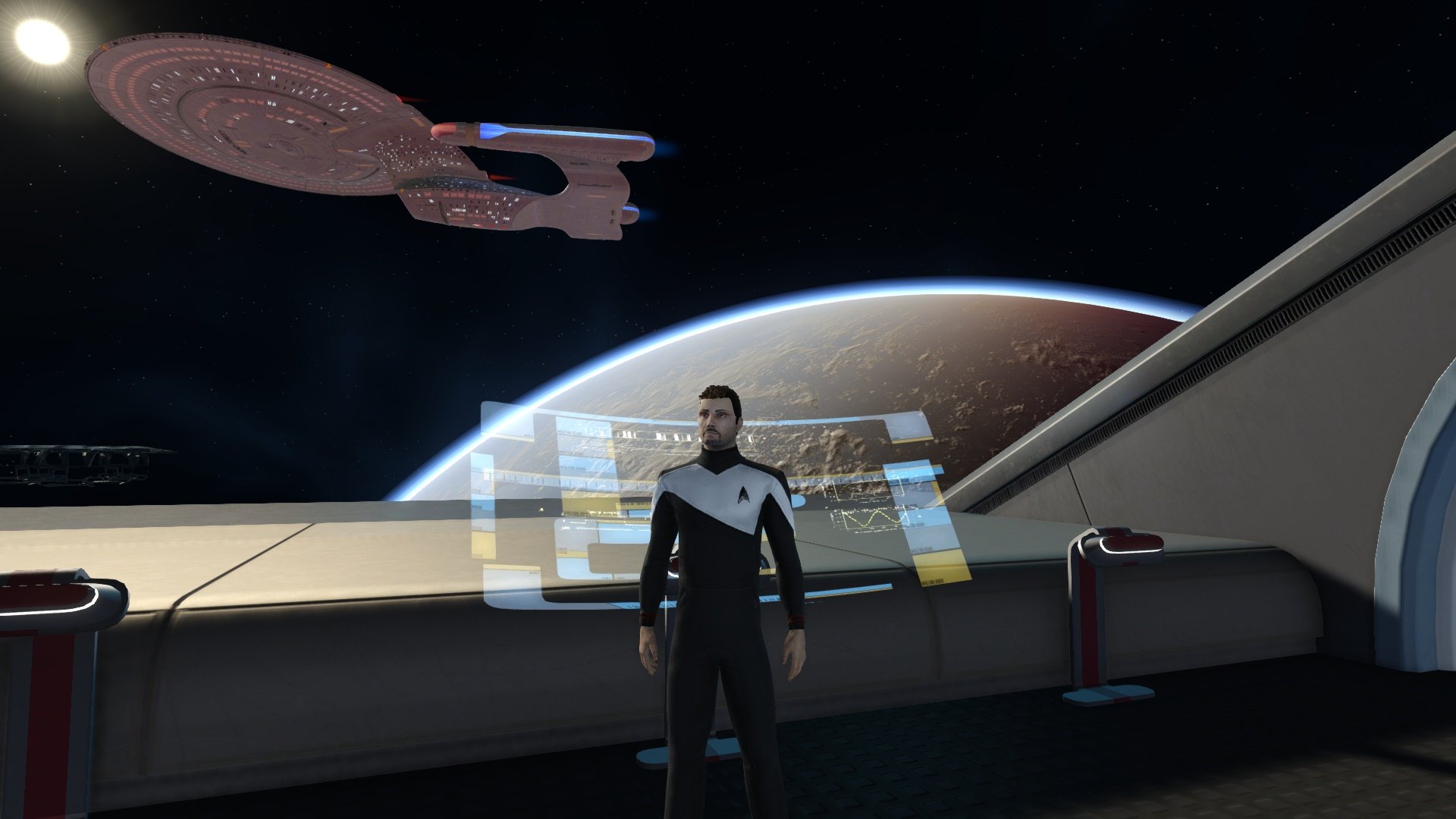
Star Trek Online has many in-game systems that are common to the MMORPG genre. The reputation system is one such example. In STO there are 13 reputation factions. Once a player has reached level 50 they may start progressing through the 6 reputation tiers of each one. Players gain progression through daily projects (20 hours in duration). Hourly projects are also available though they yield less reputation advancement and are limited to three times a day. Hence 20 hour projects are consider by default the most efficient way to gain rep. Projects require 30 Faction Specific Marks (earned via various activities in-game), 15,000 Energy Credits (standard in-game currency) and 2000 Expertise points. The most efficient way to tackle the reputation grind is to build up the necessary resources in advance and then at a designated time each day, start all 13 respective projects. Upon completion projects yield a player bound lockbox containing a random space or ground weapon, a console or Elite Marks which can be used to acquire faction gear.
I was recently perusing my archive of old blog posts, when it struck me how much I’ve written about the MMORPG genre over the years. Naturally, there was far more material from between 2008 and 2012 as that was period when I immersed myself in the genre and was very enthusiastic about it. I was at a point in my life when I had the time to dedicate to such games and I was happy to participate in the social aspect of they offered. I would regularly play through group content and spend time socialising online with fellow guild members. My experience remains a textbook example of how online games can be more than the sum of their parts and that where you are at in your life has a major impact upon your overall enjoyment. As I read though various old posts it became clear that my experiences where specific to this particular part of my life and that they cannot be repeated. My relationship with the genre is very different now and that’s fine.
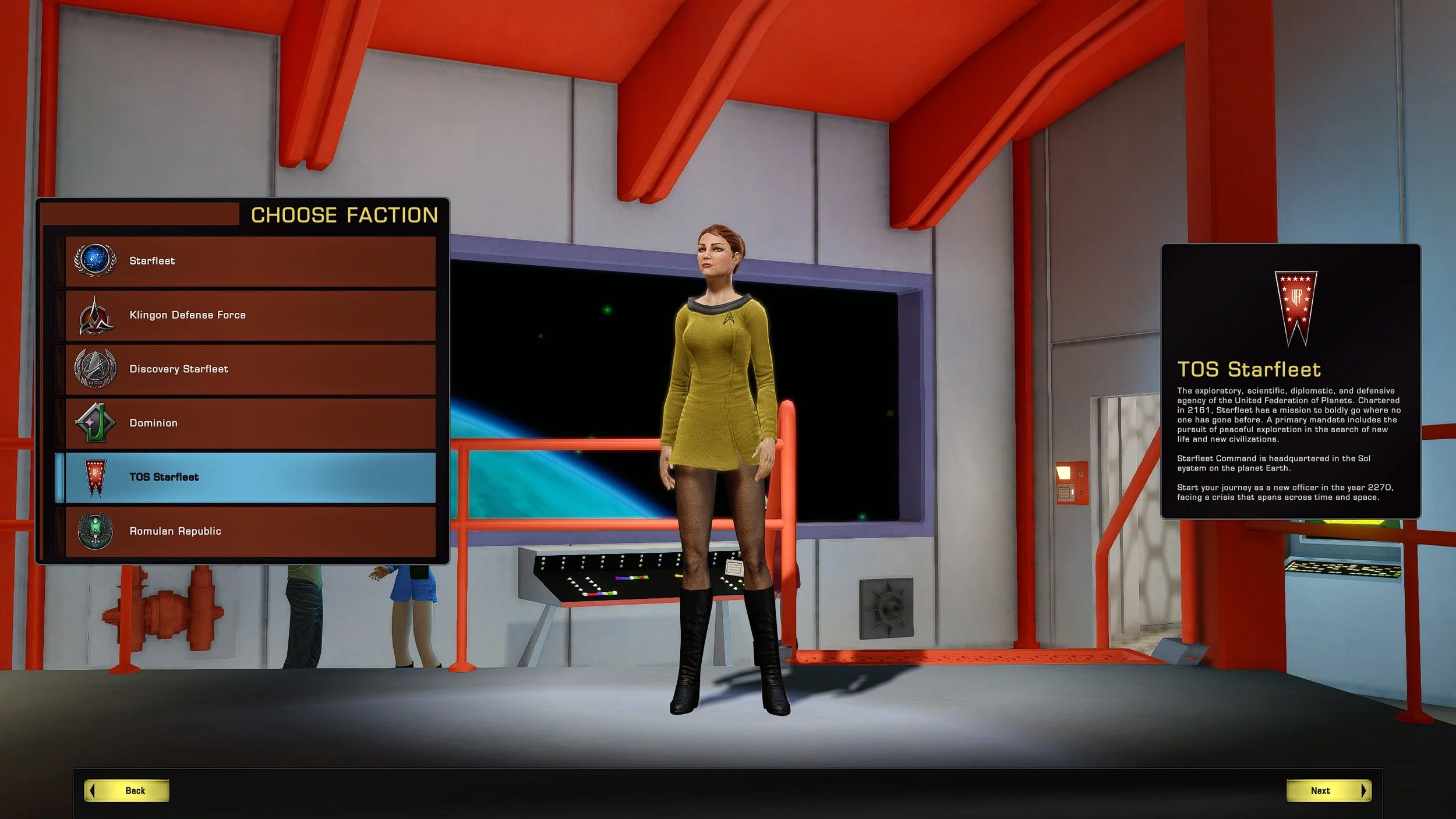
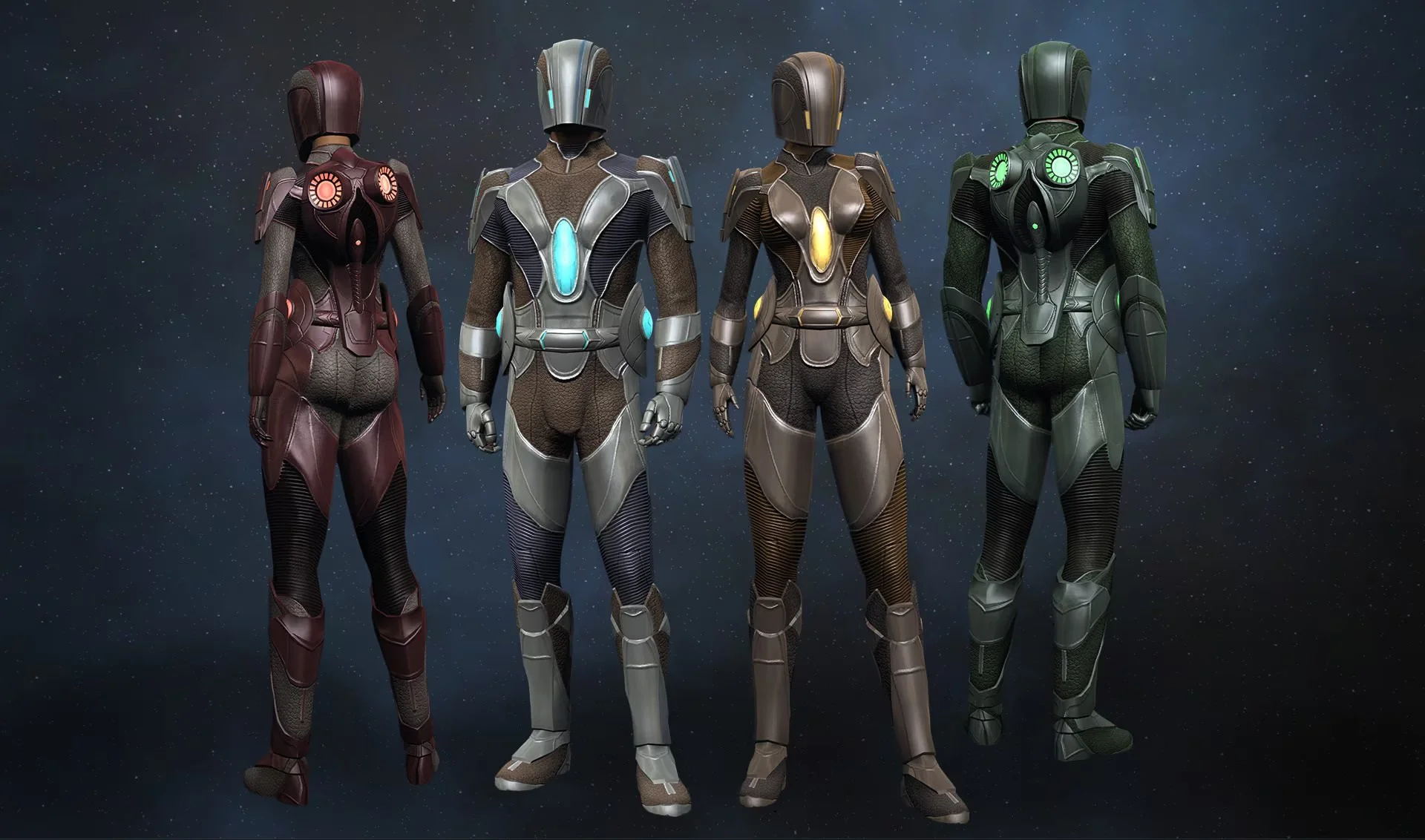
Creating alts is an integral aspect of the MMORPG genre. Many players will create a character of a specific class or faction, play it for a while, lose interest in it or they may decide that it is just not for them. Fortunately it is no effort at all to simply re-roll a new alt and set off once again. Furthermore, lots of players never reach level cap of the MMORPG that there playing. When the going get’s tough, so to speak, you can either soldier on for another 50 levels or simply create a new alt and return to the comfort of tried and tested content. Alts also give you the chance to secure an accolade or achievement that you previously missed. They are also of great benefit to the genres social aspects. Creating a new alt so you can play along with a friend who is just starting is great fun. Developer’s love them too as it means you’re still playing the game.
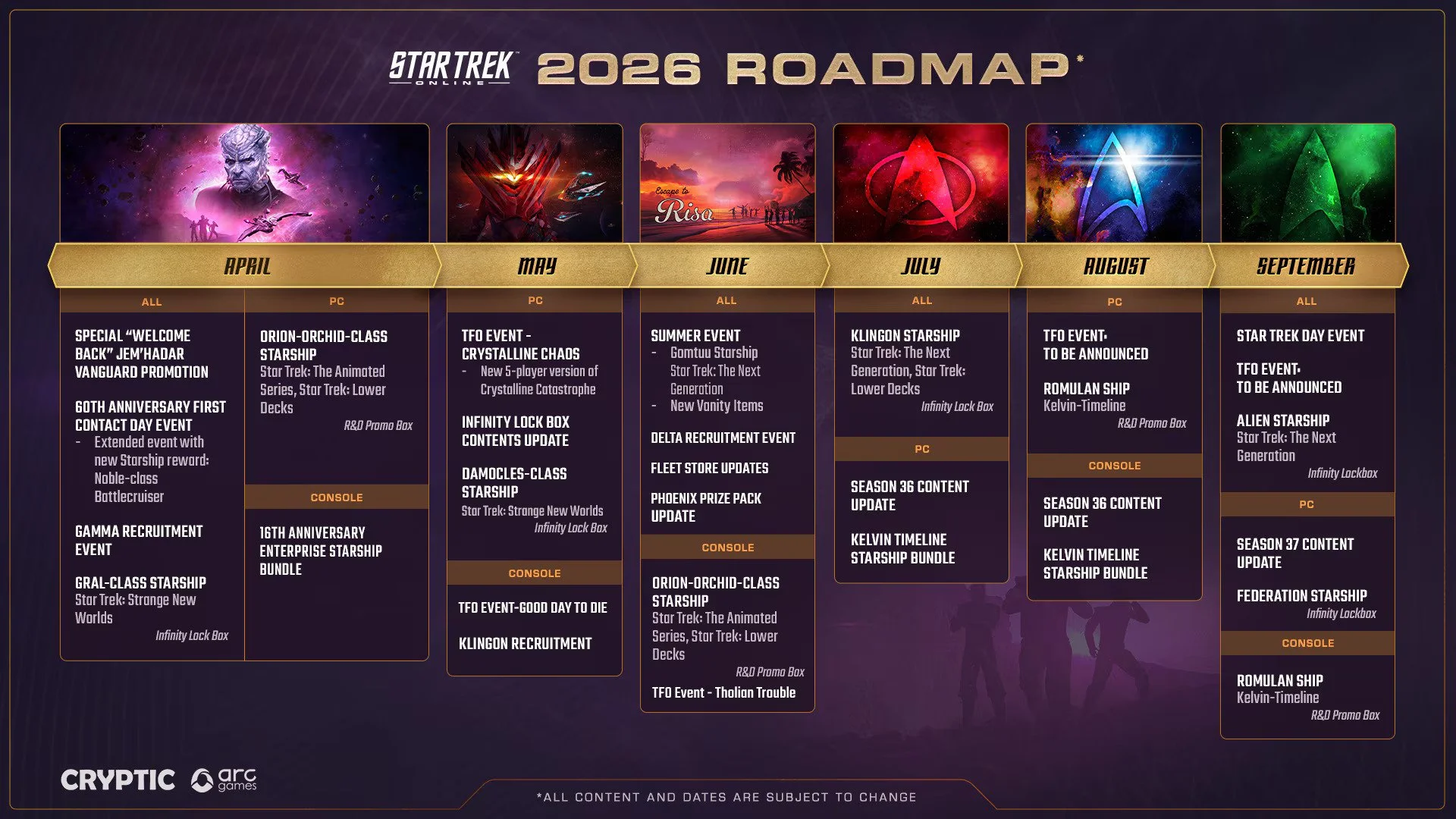
I recently took a break from Crimson Desert choosing instead to to play something familiar and easy going. As I’ve been logging into Star Trek Online daily to participate in the anniversary event, I decided to look through my various alts and see how far they had progressed through the game and what resources they had. At present I have twelve alts. My primary Captain was created in 2015 during the original Delta Recruit Event. I had previously played STO intermittently since its release in January 2010 but I never kept any of those characters. Hence this decade old Tactical Federation Captain has been my main focus when playing. The other eleven alts are the result of other recruitment events or whenever I wanted to try something different, such as playing a specific class or faction. I obviously played a lot of STO during the lockdown as several alts date from that period. Several had maximum reputation across all factions.
The action, open world RPG Crimson Desert has been patched five times since it launched on March 19th and there have also been multiple hotfixes. At first glance this isn’t anything unusual. New games have bugs and issues arise once a game is released and played across a much wider variety of hardware than in QA testing. However, if you read the patch notes that accompany these sizeable downloads it quickly becomes apparent that developer’s Pearl Abyss are not just addressing bugs and software glitches. They are actively engaging with their player base and responding to suggestions and requests from that community. Although this is not a unique approach, what is surprising is the speed and quantity in which these player driven changes are happening. There seems to be an active ongoing process to refine the game and eliminate some of its “rough edges” and the players are contributing to this process with their feedback.
According to my Steam statistics, I last played Starfield on 19th December 2023. I bought the game upon its release in September of that year and played in total for 136 hours. Starfield held my interest for three and a half month and I wrote seven blog posts about various aspects of the game. Although there were some engaging aspects to Starfield, I did feel that that the game was somewhat lacking in systems and content, at that point in its lifecycle. I also think that the marketing and player expectations associated with Starfield were overblown and unrealistic. The shadow of Skyrim looms large over all new Bethesda releases and they don’t seem able to quite recapture that magic. Hence, I inevitably drifted away from Starfield and to another game and was effectively “done” with it. I have not played the game since which seems to validate the theory that game are becoming increasingly more ephemeral.
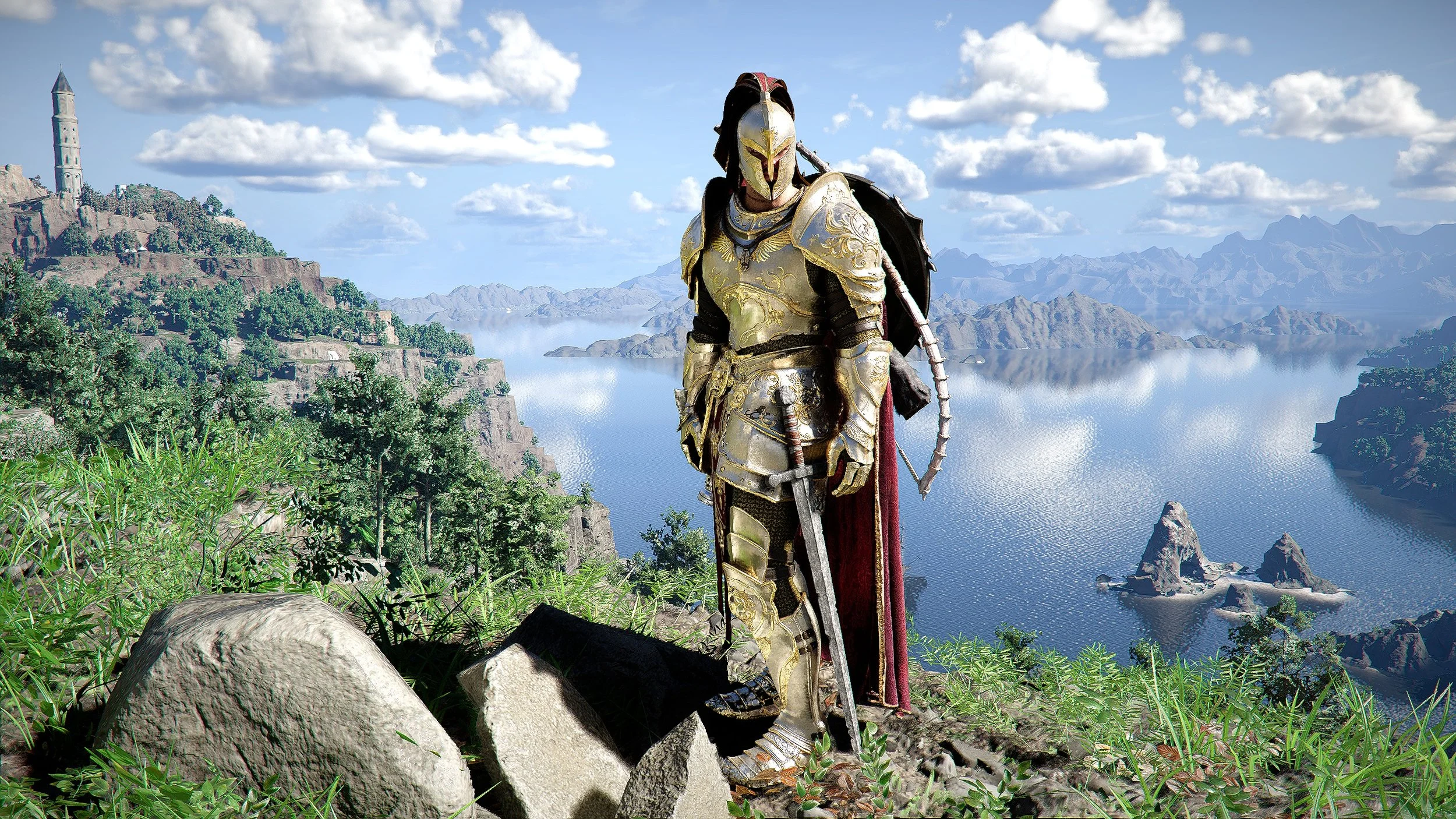
13 days after its release, market analysts estimate that Crimson Desert has already earned $200 million across the four main platforms (PC, PlayStation 5, and Xbox Series X and S). The game is certainly proving popular among gamers with the internet awash with live streams and “let’s play” videos. However, reviews are mixed both among gaming journalists and YouTube influencers. Common complaints about the game include that it is slow to start, the controls are poorly laid out on all platforms and that developer’s Pearl Abyss have done a poor job of explaining most aspects of the game to new players. Although such criticisms are true to a degree, I think these complaints highlight how many gamers are conditioned to expect new titles to follow a specific pattern with regard to pacing, narrative exposition and learning in-game systems. A pattern that Pearl Abyss has chosen to ignore, instead favouring an old school approach.
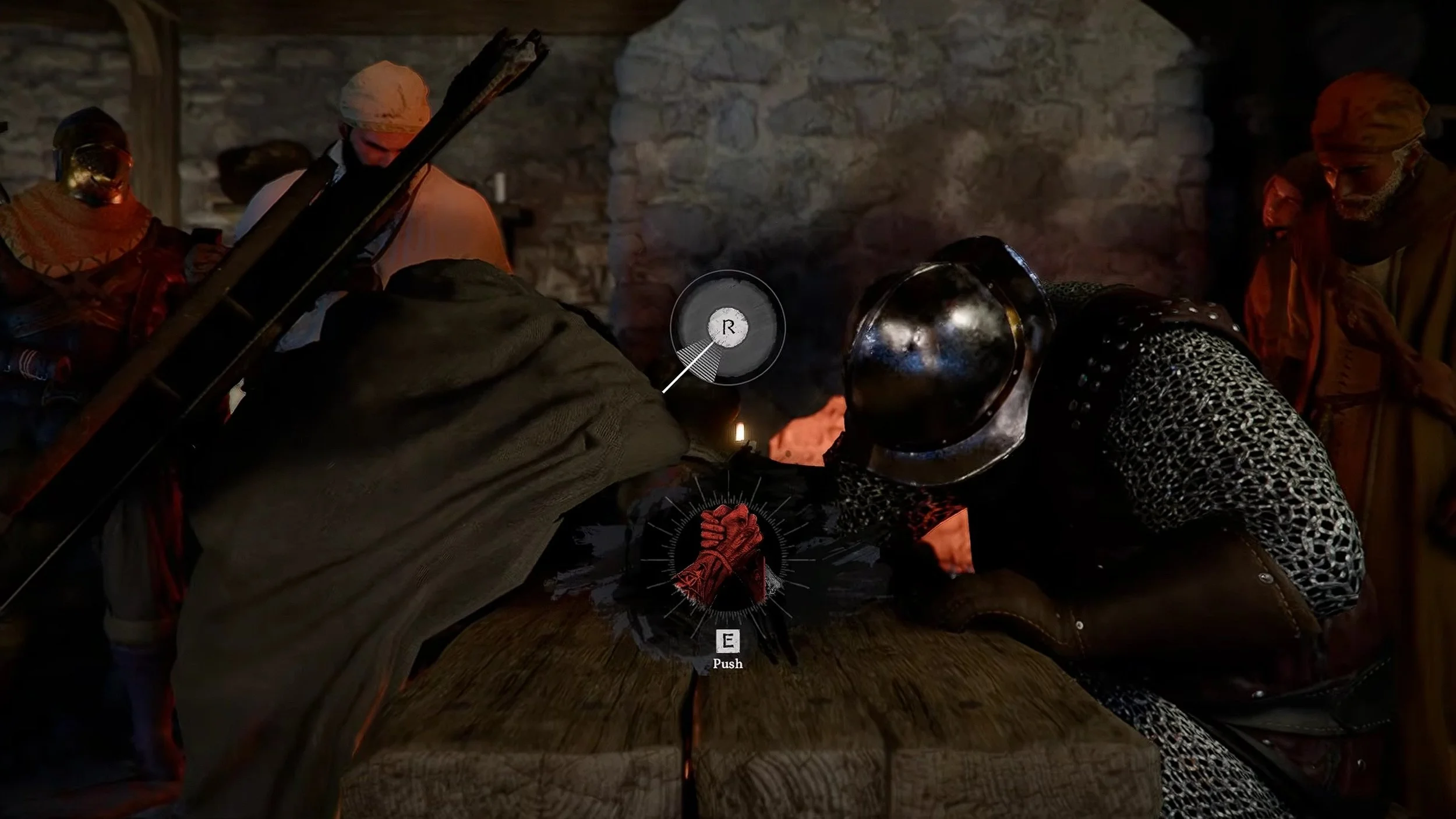
Early on Crimson Desert, the main quest requires the player to enter a tavern and arm wrestle a particularly strong guard. The arm wrestling match consists of a quick time event. If playing on PC you have to rapidly press the “E” key which turns a power meter from white to red. Then a white dial appears above the meter with a rotating hand. When the hand passes over a segment of the dial that is marked by hatching, the player must press the “R” key. The idea being the meter filling with red is you strength building (or waning) and the “R” key prompt indicates when to try and force your opponent’s arm. You will need to to continuously press the “E” key throughout the arm wrestling match and the “R” key about 4 times to win.
Why Play For Fun When You Can Play to Contribute?
In an open letter released on January 1st 2022, Square Enix president Yosuke Matsuda, presented a roadmap of the company’s intentions for 2022 and beyond. What made this communication so unusual was not so much the commitment to both NFTs (Non-Fungible Tokens) and blockchain which are the current industry wide flavour of the month, but the language employed to describe the established gaming status quo, its business model as well as player motivation. It also was a timely reminder that multi billion dollar corporations ultimately have no interest in anything that they cannot generate revenue from. And again we return to a recurring problem associated with video games culture. Many gamers still do not see themselves as consumers and still erroneously think that developers and publishers are their friends and they have a different kind of relationship with them. Hopefully this letter will help lift the scales from such peoples eyes.
In an open letter released on January 1st 2022, Square Enix president Yosuke Matsuda, presented a roadmap of the company’s intentions for 2022 and beyond. What made this communication so unusual was not so much the commitment to both NFTs (Non-Fungible Tokens) and blockchain which are the current industry wide flavour of the month, but the language employed to describe the established gaming status quo, its business model as well as player motivation. It also was a timely reminder that multi billion dollar corporations ultimately have no interest in anything that they cannot generate revenue from. And again we return to a recurring problem associated with video games culture. Many gamers still do not see themselves as consumers and still erroneously think that developers and publishers are their friends and they have a different kind of relationship with them. Hopefully this letter will help lift the scales from such peoples eyes.
Now it is pertinent to consider that this is a corporate press release and that it was more than likely originally drafted and completed in Japanese. Reading through the English version it is at times a little difficult to parse and fully construe the exact sentiment being expressed. Corporate speak is very similar to political oratory and both are at times intentionally ambiguous and lend themselves to being recanted or “reinterpreted”. That being said, there is sufficient information to be able to determine the overall sentiment of the message. The quote below is especially relevant as it shows quite clearly how Square Enix perceives their customer base and what their mindset is towards them. There is a separate debate to be had about the failings of NFTs and blockchain (and I would recommend that you read Wilhelm Arcturus’ post on this for further insight) but I wish to focus more on the semantics of this statement and what that shows us about the video game industry’s philosophy.
“I realize that some people who “play to have fun” and who currently form the majority of players have voiced their reservations toward these new trends, and understandably so. However, I believe that there will be a certain number of people whose motivation is to “play to contribute,” by which I mean to help make the game more exciting. Traditional gaming has offered no explicit incentive to this latter group of people, who were motivated strictly by such inconsistent personal feelings as goodwill and volunteer spirit. This fact is not unrelated to the limitations of existing UGC (user-generated content). UGC has been brought into being solely because of individuals’ desire for self-expression and not because any explicit incentive existed to reward them for their creative efforts. I see this as one reason that there haven’t been as many major game-changing content that were user-generated as one would expect.”
When Matsuda talks about how some people play games to have “fun” there is a palpable sense of bemusement and possibly even contempt. It’s a very odd position to adopt as it is the foundation upon which the video games industry was built. Like any other business, there is an exchange of goods or services for money. In this case it is a piece of recreational software, designed to elicit amusement, mirth and enjoyment. At present Japanese gamers spend $20 billion a year in the pursuit of fun so it seems a little odd to be averse to it. But video game monetisation trends in recent years clearly show that big business per se is done with one off payments. Free to play, microtransactions, loot boxes, season passes and other live services have spearheaded a drive towards recurring monetisation. Hence, Matsuda now wants more players who “play to contribute”.
Video games have a long history of players contributing both to the games themselves and the communities that grow around them. Player created mods add value, fix long term problems and prolong a games lifespan. Guilds and social groups organise events, as well as play through content that some players would not attempt otherwise. Blogs, live streams and podcasts curate important data associated with games, build and sustain communities and often provide free public relations for the video game industry. Yet according to Matsuda “goodwill” and “volunteer spirit” are inconsistent personal feelings and are therefore unreliable. Clearly the human desire to share, help and support others out of a sense of common good is utterly alien to him. He clearly thinks that socially inclined players need a formal framework to work within. If their “goodwill” and “volunteer spirit” is monetised then it will be more dependable. Let us take a moment to reflect on the utterly bleak mindset that harbours such thoughts.
At first glance it seems illogical to eschew an existing business model that has proven lucrative, to focus on something new and untested. Such a sea change is not necessarily going to happen overnight. Gamers have already rebuffed Ubisoft’s ongoing Ubisoft Quartz project to introduce NFTs to Tom Clancy’s Ghost Recon: Breakpoint. However, I would advise extreme caution in so readily dismissing such rapid change. Again I say take a look at the video games monetisation over the last decade. What is beyond the pale to a 50 something gamer is now just the way it is for a 20 year old. Also, consider the iniquities of the triple A video games industry that were frontpage news in 2021. Despite a very vocal public outcry, has it really harmed the bottom line? For every gamer who is aghast, there are two others that either don’t know or don’t give a shit. The industry knows this. Remember what former President Trump said. “I could stand in the middle of Fifth Avenue and shoot somebody and I wouldn’t lose voters”. The same thing applies here.
So here we are again at a crossroads. Or if not at a crossroads, at least a very clear indication of the direction that the video games industry wants to take. Turning a popular triple A game into a virtual online sweatshop is not going to be an easy task and I’m sure at some point governments and law makers will get involved. But considering how big business usually gets its way, I don’t see “play to contribute” being wished away anytime soon. If the dystopian dream of working in your leisure time and chasing some get rich scheme does arrive, I shall not participate. But others will and it could become the new normal. Our children and grandchildren may well come of age in a world where they chase a buck in absolutely every aspect of your life, be it work or play. A world with superficial modern trapping but essentially based upon Mediaeval Feudalism.
NB. When I initially read Yosuke Matsuda’s press release, I found his baffled tone in respect to human compassion, empathy and decency very reminiscent of the following Monty Python sketch. Here it is for your amusement and edification. Who said that the decline of human civilization had to be dour. We can at least laugh while it happens.
I started playing MMOs in late 2008 by which time the genre was clearly established and dominated by one particular title, World of Warcraft. I chose to play The Lord of the Rings Online, mainly because of my love for the intellectual property the game is based upon. I still play LOTRO today. However, I was very aware of popularity and significance of WoW at the time. It pretty much set the rules for how you design a MMO and it did much to move on from the previous gameplay parameters set by such titles as Ultima Online and EverQuest. It was also the MMO that every other developer was trying to beat. Another compelling factor regarding WoW is that everyone I knew at the time was either actively playing it or had done so at some point. It was for many gamers, the go-to title for socialising. Finally around early 2010, I tried a free trail of WoW to “see what all the fuss was about”. Simply put, I felt that it wasn’t for me.
Over the course of the last 16 years, the MMORPG Star Trek Online has changed greatly. What started as a disjointed, rushed game with unfinished systems and a lack of overall cohesion has now evolved into streamlined MMO with clearly defined systems and very strong narrative arcs. Let it suffice to say that STO makes very good use of its license and the intellectual property it is built upon. Although new content has been continuously added to STO over time and refinements are regularly rolled out, the developer’s have also removed content from the game in the past, that they feel is substandard or too dated in it presentation. Hence in October 2018 Cryptic took out the following eight missions from the game, with the proviso that they would be updated and replaced at a latter date. Until fairly recently, STO players had given up hope on this ever happening and the episodes being reinstated. Eight years is a long time.
One of the things that I enjoy when playing a new video game is character customisation or character creation. I will spend hours trawling through settings, changing the most minute and consequential aspects of my avatars appearance. I am certain that there is a psychological aspect to this particular game mechanic and that it says something about you as a person. Are your creations shaped just by a need to look good in-game or is there more to it? Are they external manifestations of your sexual preferences or thoughts on body image. Do you treat them as characters from a book that exists in your mind. Do you aspire to recreate the likeness of people you know or admire? Do you strive to make your avatar look like you? Whatever the reasons, it would seem that character creation is something that a lot of gamers enjoy. Hence I am not alone in my borderline obsession. What you look like in-game is equally as important as your character’s name.
I was playing Battlefield 6 recently and was experimenting with the mortar. If you stick with it and take some time to become familiar with its foibles, it can be an effective weapon. It can suppress the enemy, destroy equipment and provide useful cover for your own team. I remember thinking “I wonder if artillery could sustain a game on its own”. Artillery is an interesting feature in Hell Let Loose, although it is a little more complex in its game mechanics. I believe artillery is also available in Wardogs. I therefore spent a while looking online to see if there was a dedicated artillery simulator available or at least a game where it was a key feature. There nearest thing I found was Iron Nest, a dieselpunk heavy artillery game which looks interesting but isn’t quite what I seek. So I parked this idea and moved. Tonight, while perusing YouTube, I stumble across a teaser trailer for a game called Flak Simulator, currently under development by Horseman Interactive. It appears to be exactly what I am looking for.
I recently tried to use DLSS 5 Manager with the MMORPG, The Lord of the Rings Online. Unfortunately, things didn’t work out. Today I undertook a similar experiment with AMD Neural Rendering, which is a broadly comparable product. Both utilities use 3D-Guided Neural Rendering, an AI technology that alters how lighting, reflections, and textures look in a game. Instead of just upscaling the image like older versions, DLSS 5 uses an AI network to instantly "re-render" lighting and material responses over the game's layout, achieving photorealistic details that would normally negatively impact a graphics card's performance. Or to put it in less fancy terms, the game graphics are enhanced and modified, although it is highly subjective as to whether the end results are an improvement. However, as a game such as LOTRO is unlikely to ever receive a major graphical overhaul, tools such as these are the nearest players will get to revised graphics.
The core game code and engine for the MMORPG, The Lord of the Rings Online, is about 24 years old. LOTRO began originally as Middle-earth Online, developed by Sierra On-Line in 1998. Turbine took over full development of the project in 2003/2004 when their parent company, Vivendi Universal Games, acquired Sierra. The content that had already been developed by Sierra was abandoned and Turbine created a new game using structural elements such as the UI and game engine from their previous release Asheron’s Call 2 from 2002. The Lord of the Rings Online: Shadows of Angmar was officially released in April 2007. Hence, the active public release code is 19 years old. Despite continuous expansion and updates, along with a recent migration to 64-bit architecture, the foundations of LOTRO retains a nearly twenty year old legacy framework. This frequently contributes to modern technical hurdles and engine constraints.
A few years ago, there was a fan created project to provide voice narration of NPC dialogue in the MMORPG, The Lord of the Rings Online. This mainly involved capturing the text in the quest dialogue windows and then sending it to OCR software, before using a text-to-speech program to read it. LOTROVoice as it was known, broadly worked but the creator stopped developing it as it proved troublesome to maintain. However, I recently discovered Khazad Voice TTS which is a separate project that does pretty much the same. I went so far as to install this “immersive AI narrator for LOTRO” after seeing a YouTube video of it being used successfully. Sadly I ran into issues configuring Khazad Voice TTS, because I have two monitors and LOTRO runs on the secondary (by my choice) and not the primary. I couldn’t “lasso” the dialogue windows in LOTRO during the calibration set up, which effectively prevented me from completing the process.
Throughout yesterday and early today, there was an issue logging in to the MMORPG, The Lord of the Rings Online. Upon starting the game launcher, it would attempt to connect to the patch server to download the latest game update. This process would start but then subsequently stall at 33%. The launcher would then attempt to reconnect to the patch server every 60 seconds but could not make any further progress. Some players found that if they left it long enough, it would eventually complete the download and the launcher then progress to the next screen where they could input their username and password. However, for the majority of LOTRO players the problem would simply persists and the launcher would be stuck in a loop. Some players attempted to reinstall the game or use the repair data facility in the launcher but neither of these proved to be successful workarounds. The patch sever needed to be bypassed to resolve the issue.
I’ve been playing Fall Guys since its launch in early 2020, during the start of the pandemic. It is a fun, family friendly multiplayer game which is has proven popular with my grandchildren. Despite the game’s acquisition by Epic, it has maintained a sufficient level of popularity that has seen it ported to all major gaming platforms. Fall Guys is free to play but like most multiplayer games, there is a season pass and an in-game store. However, these monetised aspects are not essential to enjoy the game and the overall marketing of emotes and skins is nowhere near as invasive as it is in Roblox. In fact many of the players I see while in-game have default skins, indicating a regular casual player base. However, although game seems to be maintaining its popularity, it has several bugs that appear to be be persistent. Bugs that the developers claim have been resolved. Some can be addressed by players. Other at present cannot.
I find the concept of in-game radio stations fascinating. They’re an enjoyable aspect of open world video games and I have discovered several artists this way. They’re certainly a big deal as far as Rockstar Games are concerned, because the music selected for GTA VI is another important facet of the overall marketing campaign. So far, between two trailers and the sprawling extended look on Netflix, it has been determined that Tom Petty, the Pointer Sisters, Sexyy Red, Depeche Mode, Phil Collins, Birdman, Lil Wayne and the Bellamy Brothers are all part of the game soundtrack. That’s a very eclectic selection so far. Furthermore, there will be a 34 track album released on physical media (vinyl and CD) in conjunction with Atlantic Records.
Two years ago I wrote a post about fine tuning your graphics in the MMORPG The Lord of the Rings Online. Apart from installing ReShade and using AMD Adrenalin, the options were somewhat limited, due to the game’s age and multiplayer status. Since then, I’ve been playing LOTRO with the game settings maxed out, a custom ReShade profile to make the colour palette more vivid and Radeon Image Sharpening enabled within the AMD software. The game looks clear, crisp and the draw distance is pretty good for an ageing game but I still wish the graphics could be tweaked further. Hence, I’ve been trawling the internet in a vain attempt to see if I can find any third party utilities that could be used to enhance LOTRO further. During the course of my search I stumbled across DLSS 5 Manager. This is an open-source, intelligent utility and one-click mod installer designed to inject and manage Nvidia's DLSS 5 neural rendering features, ReShade, and OptiScaler into PC games.
Hellraiser (1987) was one of he most innovative and intelligent horror films of the eighties, with its cerebral and sophisticated exploration of pleasure, pain and the supernatural. Sadly what was a great concept for a single film was turned into yet another horror franchise. The resulting series of increasingly inferior sequels ultimately diminished the central idea. However, in recent years several horror “brands” have found a new lease of life via the medium of video games, so the announcement of Hellraiser: Revival last summer piqued my interest. The fact that author Clive Barker was directly involved certainly raised my expectations. However, even though video games have a history of depicting sex and violence, would the medium be able to fully embrace the true nature of Barker’s original novella and original film. Having played through the newly released demo for Hellraiser: Revival, I believe the answer is a yes.
Are video games becoming easier? It’s a perennial subject that is frequently discussed by those who play them. Often the question of whether they have actually become easier is not the focus of the debate, as it seems to be broadly recognised that it is the case. Instead, discussion of this matter tend to drift into the rectitude of this change. Debate’s of this nature are usually awash with subjective opinions and personal preferences which are then put forward as objective facts. It’s not just a question of video games becoming easier, it’s the fact that making them easier is “wrong” and those who want them as such are “not proper gamers” etc. The hours that have been lost to this pointless, tedious debate are uncountable. However, I digress. Let us return to the matter of video games becoming easier, because although fans discuss this a lot and have plenty to say, you don’t often hear from the developers on this subject.
Some video games lend themselves to being set aside and resumed at a later date with zero consequences. These are often casual games with no major goals other than having fun while playing them. Fall Guys is a great example of this. You have a cartoony avatar that participates in zany group races, filled with obstacles. You run, jump, climb but the controls are far from difficult. You may well become skilled but such things are mitigated by the other players as they stumble around. You’re not at the mercy of apex players or “try hards”. It is not a game about winning and mastering techniques. The fun comes from playing it and the unique experience you have each time. I’ve been playing this game, on and off, since it’s launch in 2020 and in that time I have only ever won once (winning requires you to win a series of 4 to six individual races). However, whenever I pick up my controller and play Fall Guys, I have fun and the game lifts my spirits.
I recently completed the main story in Tainted Grail: The Fall of Avalon. In total I spent about sixty hours playing the game. I began at the start of the year, then took a break for a while but returned to it recently because I wanted to see if I could unlock a specific ending. I did manage to do this. Like so many other RPGs, Tainted Grail: the Fall of Avalon has a central storyline, along with a wealth of side quests, based around factions in specific zones. I think I possibly completed about a two thirds of these. However, once I finished the main story, my interest in the game began to wane. I finally left my character in the last major quest hub in case I wish to return at a future date. I then logged out of the game and uninstalled it from my PC to free up space for whatever I was to play next. In this case its The Sinking City 2. None of this is a negative reflection on Tainted Grail: the Fall of Avalon. I enjoyed the time I spent playing this quirky RPG. I simply had my fill and left to play something else.
On Tuesday 11th April, Aspyr Media rather surprisingly re-released The Lord of the Rings: War in the North, a co-op action-RPG from 2011. This game was delisted in late 2019, possibly due to changing rights ownership or a license expiring. Hence, I was somewhat discombobulated by the return of this title to all major gaming platforms. Mind you, the Embracer Group (through its subsidiary Middle-earth Enterprises) still controls the worldwide commercial and video game licensing rights for The Lord of the Rings and The Hobbit. Furthermore they have explicitly stated that they have plans for more games. It would appear this also means re-releasing and updating old favourites. It is also worth noting that they own Aspyr Media, which is also a bit of a giveaway. Let it suffice to say that this re-release and sparked enthusiastic online debate as to whether any other he Lord of the Rings themed games from the same era will receive a similar makeover. Judging by the internet chatter, there’s potentially a market for them.
The next expansion for the MMORG, The Lord of the Rings Online, was announced on the 1st August, via the gaming website MMORPG.The Wolves of Mordor, which will launch later in the year, appears ambitious in scope as it will include two new game systems as well as the obligatory story update. This expansion takes place in Draugardh located in the North East of Mordor, beyond the Plateau of Gorgoroth. It includes the new zones of Heledhris, Parth Rhavas and Nan Ogol. These vary environmentally ranging from the arid, volcanic and semi-tropical. Players will encounter the Daugrim in these regions, Werewolves but not in the modern sense. This is not the lycanthropy of Eastern European legends but in the established Tolkien idiom of fell spirits inhabiting the bodies of Wolves. The region also sees the return of the Woses and players can expect to encounter Elves and scouts from Gondor. As ever with LOTRO expansions, there will be new instances as well as a raid.
This is a post about the power of nostalgia and how sometimes, interacting with something from your past, be it physically or mentally, can produce a very strong and tangible emotional reaction. In some instances, this can be the result of something that you have specifically set out to do. On other occasions you can wander into a sense of nostalgia purely by chance. Today I experienced a very strong sense of nostalgia while watching a YouTube video and then again when I sought to replicate what I had seen. The video showed someone installing Windows 95 on to an old 486 PC from that era. The Window’s start up sound really touched a nerve (but in a good way) and then when the guy in the video launched Space Cadet 3D Pinball, a game that shipped with the operating system, I felt a strong compulsion to track down a copy and install the game myself, thus revisiting something that was an integral part of my life in 1995.
RV There Yet? is possibly the most entertaining game I’ve never played. My vicarious pleasure regarding this title has come exclusively from watching two popular YouTubers, JackFrags and WillFromWork, play through the game over a series of videos. It has been immensely amusing to watch and I have empathised a great deal as the group of four players has struggled with the game’s unpredictable mechanics and their own team’s dynamic. I could go and buy RV There Yet? myself but I doubt if I would ever have a gaming experience anywhere close to what I’ve watched online recently. So in some respects watching these videos has been an interesting alternative as I’ve been entertained, which ultimately is the point of video games. Perhaps there is a deeper philosophical point here that the game developers should reflect upon, as they’ve lost a potential sale. However, that is separate discussion for another day.
I don’t keep up with gaming news as much as I use to but several noteworthy announcement have come to my attention of late. Firstly, there’s an expansion, Songs of the Past, coming for the Witcher III: Wild Hunt in 2027. No doubt this is to pave the way for the Witcher IV. Next, I also found out about Hand of Fate: Horde. I liked this franchise and was saddened to learn that the original studio, Defiant Development, closed. Hence is was a pleasant surprise to see this new game being developed by members of the original studio. The third announcement was regarding Guild Wars 3. A new MMORPG in active development by a major studio is no small feat and is certainly good news for fans of this franchise and the genre per se. However, once you look beyond this news this announcement raises several questions and has certainly given me pause for thought. Let us take a few moments to consider them.
Star Trek Online has many in-game systems that are common to the MMORPG genre. The reputation system is one such example. In STO there are 13 reputation factions. Once a player has reached level 50 they may start progressing through the 6 reputation tiers of each one. Players gain progression through daily projects (20 hours in duration). Hourly projects are also available though they yield less reputation advancement and are limited to three times a day. Hence 20 hour projects are consider by default the most efficient way to gain rep. Projects require 30 Faction Specific Marks (earned via various activities in-game), 15,000 Energy Credits (standard in-game currency) and 2000 Expertise points. The most efficient way to tackle the reputation grind is to build up the necessary resources in advance and then at a designated time each day, start all 13 respective projects. Upon completion projects yield a player bound lockbox containing a random space or ground weapon, a console or Elite Marks which can be used to acquire faction gear.
I was recently perusing my archive of old blog posts, when it struck me how much I’ve written about the MMORPG genre over the years. Naturally, there was far more material from between 2008 and 2012 as that was period when I immersed myself in the genre and was very enthusiastic about it. I was at a point in my life when I had the time to dedicate to such games and I was happy to participate in the social aspect of they offered. I would regularly play through group content and spend time socialising online with fellow guild members. My experience remains a textbook example of how online games can be more than the sum of their parts and that where you are at in your life has a major impact upon your overall enjoyment. As I read though various old posts it became clear that my experiences where specific to this particular part of my life and that they cannot be repeated. My relationship with the genre is very different now and that’s fine.
Creating alts is an integral aspect of the MMORPG genre. Many players will create a character of a specific class or faction, play it for a while, lose interest in it or they may decide that it is just not for them. Fortunately it is no effort at all to simply re-roll a new alt and set off once again. Furthermore, lots of players never reach level cap of the MMORPG that there playing. When the going get’s tough, so to speak, you can either soldier on for another 50 levels or simply create a new alt and return to the comfort of tried and tested content. Alts also give you the chance to secure an accolade or achievement that you previously missed. They are also of great benefit to the genres social aspects. Creating a new alt so you can play along with a friend who is just starting is great fun. Developer’s love them too as it means you’re still playing the game.
I recently took a break from Crimson Desert choosing instead to to play something familiar and easy going. As I’ve been logging into Star Trek Online daily to participate in the anniversary event, I decided to look through my various alts and see how far they had progressed through the game and what resources they had. At present I have twelve alts. My primary Captain was created in 2015 during the original Delta Recruit Event. I had previously played STO intermittently since its release in January 2010 but I never kept any of those characters. Hence this decade old Tactical Federation Captain has been my main focus when playing. The other eleven alts are the result of other recruitment events or whenever I wanted to try something different, such as playing a specific class or faction. I obviously played a lot of STO during the lockdown as several alts date from that period. Several had maximum reputation across all factions.
The action, open world RPG Crimson Desert has been patched five times since it launched on March 19th and there have also been multiple hotfixes. At first glance this isn’t anything unusual. New games have bugs and issues arise once a game is released and played across a much wider variety of hardware than in QA testing. However, if you read the patch notes that accompany these sizeable downloads it quickly becomes apparent that developer’s Pearl Abyss are not just addressing bugs and software glitches. They are actively engaging with their player base and responding to suggestions and requests from that community. Although this is not a unique approach, what is surprising is the speed and quantity in which these player driven changes are happening. There seems to be an active ongoing process to refine the game and eliminate some of its “rough edges” and the players are contributing to this process with their feedback.
According to my Steam statistics, I last played Starfield on 19th December 2023. I bought the game upon its release in September of that year and played in total for 136 hours. Starfield held my interest for three and a half month and I wrote seven blog posts about various aspects of the game. Although there were some engaging aspects to Starfield, I did feel that that the game was somewhat lacking in systems and content, at that point in its lifecycle. I also think that the marketing and player expectations associated with Starfield were overblown and unrealistic. The shadow of Skyrim looms large over all new Bethesda releases and they don’t seem able to quite recapture that magic. Hence, I inevitably drifted away from Starfield and to another game and was effectively “done” with it. I have not played the game since which seems to validate the theory that game are becoming increasingly more ephemeral.
13 days after its release, market analysts estimate that Crimson Desert has already earned $200 million across the four main platforms (PC, PlayStation 5, and Xbox Series X and S). The game is certainly proving popular among gamers with the internet awash with live streams and “let’s play” videos. However, reviews are mixed both among gaming journalists and YouTube influencers. Common complaints about the game include that it is slow to start, the controls are poorly laid out on all platforms and that developer’s Pearl Abyss have done a poor job of explaining most aspects of the game to new players. Although such criticisms are true to a degree, I think these complaints highlight how many gamers are conditioned to expect new titles to follow a specific pattern with regard to pacing, narrative exposition and learning in-game systems. A pattern that Pearl Abyss has chosen to ignore, instead favouring an old school approach.
Early on Crimson Desert, the main quest requires the player to enter a tavern and arm wrestle a particularly strong guard. The arm wrestling match consists of a quick time event. If playing on PC you have to rapidly press the “E” key which turns a power meter from white to red. Then a white dial appears above the meter with a rotating hand. When the hand passes over a segment of the dial that is marked by hatching, the player must press the “R” key. The idea being the meter filling with red is you strength building (or waning) and the “R” key prompt indicates when to try and force your opponent’s arm. You will need to to continuously press the “E” key throughout the arm wrestling match and the “R” key about 4 times to win.
Financing LOTRO
Back in December 2008, I bought a “compilation pack” that contained both the The Lord of the Rings Online: Shadow of Angmar base game, along with the newly released Mines of Moria expansion. I paid £20 for the lot. After the obligatory free months access, I then became a regular subscriber right up until about summer 2012. Since then I’ve subscribed and played whenever new content is released, meaning that for about six months of the year, I’m paying for the “luxury” of playing LOTRO. I’ve also purchased all the expansions over the years. Because I enjoy the game, I am not averse to buying additional LOTRO points when my monthly stipend doesn’t cover the cost of the items I want. I never availed myself of the opportunity to become a lifetime account holder, which is something I regret. It certainly would have been very good value for money, considering that LOTRO is over a decade old.
Back in December 2008, I bought a “compilation pack” that contained both the The Lord of the Rings Online: Shadow of Angmar base game, along with the newly released Mines of Moria expansion. I paid £20 for the lot. After the obligatory free months access, I then became a regular subscriber right up until about summer 2012. Since then I’ve subscribed and played whenever new content is released, meaning that for about six months of the year, I’m paying for the “luxury” of playing LOTRO. I’ve also purchased all the expansions over the years. Because I enjoy the game, I am not averse to buying additional LOTRO points when my monthly stipend doesn’t cover the cost of the items I want. I never availed myself of the opportunity to become a lifetime account holder, which is something I regret. It certainly would have been very good value for money, considering that LOTRO is over a decade old.
Although F2P games offer the benefit of reaching a wider market, I do believe that the business model is troublesome and causes more problems than it solves. Lootboxes similarly can break a game, as content is retrofitted to accommodate monetisation, rather than serve the exclusive needs of the customer. The monetisation per se of the gaming industry remains a perennial debate and one that is not going to be solved anytime soon to every one’s satisfaction. It is certainly a matter that is causing Standing Stone Games to tie themselves in knot at present. Lootboxes have been present in LOTRO for a while but they were never integral to progression through the game until the release of the Mordor expansion. Let it suffice to say that there has been a great deal of player push back against this decision and that SSG have been trying to address this matter in Update 23, which is due for release soon. However, the current proposals are complex and are very much a work in progress. They also seem to be causing a great deal of consternation among players.
I won’t attempt to summarise the latest “plan” at present as it’s being continuously “revised”. If you’re feeling stoic, then read the current thread on the official forums and you’ll see how difficult this matter is to sort out. However, I think the overall problem comes down to a fundamental difference in outlook over the financing of LOTRO, between the players, the publishers and lastly the developers SSG. LOTRO has a mature playerbase. A hardcore of thirty to fifty plus year olds, who all cut their teeth in an era where game monetisation was clear. You bought a game and paid for any additional expansions. In the MMO world, you bought the base game and subscribed. It was a simple “quid pro quo”. You paid money and got content. However, microtransactions, in-game currencies, season passes, paid DLC, lootboxes and “live services” have evolved over the last decade or so and have migrated from the mobile games market, over to console and PC gaming. Younger players who have grown up with mobile games has become “acclimatised” to such business practices. LOTRO players by and large don’t care for them.
And therein lies the rub for SSG or more to the point, their financial backers Daybreak Game Company. I suspect that there are financial targets set for LOTRO each quarter and that these are proving “challenging”. Because of the dedicated nature of many core LOTRO players it would appear that there are significant whales in the community. Yet it is the nature of the current games industry to seek whatever revenue that can possibly be generated and that the fate of a game will often come down to whether or not it yields the financial projections. Hence it become extremely difficult for SSG to find the right balance. Simply removing loot boxes and the LOTRO store from the game is not going to happen. The game is just too heavily dependent upon that business model. Some players have suggested cutting out the “middle man” of loot boxes and keys and just have a store where you buy everything that is offered. Sadly, whatever course of action is taken, it is bound to please one group and offend another. However, gating content or progression in LOTRO behind some kind of pay mechanic could well prove to be the straw that breaks the camel’s back. But I’m sure SSG knows this, so it will be interesting to see what compromise they arrive at by the time Update 23 launches.
One of the things that I enjoy when playing a new video game is character customisation or character creation. I will spend hours trawling through settings, changing the most minute and consequential aspects of my avatars appearance. I am certain that there is a psychological aspect to this particular game mechanic and that it says something about you as a person. Are your creations shaped just by a need to look good in-game or is there more to it? Are they external manifestations of your sexual preferences or thoughts on body image. Do you treat them as characters from a book that exists in your mind. Do you aspire to recreate the likeness of people you know or admire? Do you strive to make your avatar look like you? Whatever the reasons, it would seem that character creation is something that a lot of gamers enjoy. Hence I am not alone in my borderline obsession. What you look like in-game is equally as important as your character’s name.
I recently tried to use DLSS 5 Manager with the MMORPG, The Lord of the Rings Online. Unfortunately, things didn’t work out. Today I undertook a similar experiment with AMD Neural Rendering, which is a broadly comparable product. Both utilities use 3D-Guided Neural Rendering, an AI technology that alters how lighting, reflections, and textures look in a game. Instead of just upscaling the image like older versions, DLSS 5 uses an AI network to instantly "re-render" lighting and material responses over the game's layout, achieving photorealistic details that would normally negatively impact a graphics card's performance. Or to put it in less fancy terms, the game graphics are enhanced and modified, although it is highly subjective as to whether the end results are an improvement. However, as a game such as LOTRO is unlikely to ever receive a major graphical overhaul, tools such as these are the nearest players will get to revised graphics.
The core game code and engine for the MMORPG, The Lord of the Rings Online, is about 24 years old. LOTRO began originally as Middle-earth Online, developed by Sierra On-Line in 1998. Turbine took over full development of the project in 2003/2004 when their parent company, Vivendi Universal Games, acquired Sierra. The content that had already been developed by Sierra was abandoned and Turbine created a new game using structural elements such as the UI and game engine from their previous release Asheron’s Call 2 from 2002. The Lord of the Rings Online: Shadows of Angmar was officially released in April 2007. Hence, the active public release code is 19 years old. Despite continuous expansion and updates, along with a recent migration to 64-bit architecture, the foundations of LOTRO retains a nearly twenty year old legacy framework. This frequently contributes to modern technical hurdles and engine constraints.
A few years ago, there was a fan created project to provide voice narration of NPC dialogue in the MMORPG, The Lord of the Rings Online. This mainly involved capturing the text in the quest dialogue windows and then sending it to OCR software, before using a text-to-speech program to read it. LOTROVoice as it was known, broadly worked but the creator stopped developing it as it proved troublesome to maintain. However, I recently discovered Khazad Voice TTS which is a separate project that does pretty much the same. I went so far as to install this “immersive AI narrator for LOTRO” after seeing a YouTube video of it being used successfully. Sadly I ran into issues configuring Khazad Voice TTS, because I have two monitors and LOTRO runs on the secondary (by my choice) and not the primary. I couldn’t “lasso” the dialogue windows in LOTRO during the calibration set up, which effectively prevented me from completing the process.
Throughout yesterday and early today, there was an issue logging in to the MMORPG, The Lord of the Rings Online. Upon starting the game launcher, it would attempt to connect to the patch server to download the latest game update. This process would start but then subsequently stall at 33%. The launcher would then attempt to reconnect to the patch server every 60 seconds but could not make any further progress. Some players found that if they left it long enough, it would eventually complete the download and the launcher then progress to the next screen where they could input their username and password. However, for the majority of LOTRO players the problem would simply persists and the launcher would be stuck in a loop. Some players attempted to reinstall the game or use the repair data facility in the launcher but neither of these proved to be successful workarounds. The patch sever needed to be bypassed to resolve the issue.
Two years ago I wrote a post about fine tuning your graphics in the MMORPG The Lord of the Rings Online. Apart from installing ReShade and using AMD Adrenalin, the options were somewhat limited, due to the game’s age and multiplayer status. Since then, I’ve been playing LOTRO with the game settings maxed out, a custom ReShade profile to make the colour palette more vivid and Radeon Image Sharpening enabled within the AMD software. The game looks clear, crisp and the draw distance is pretty good for an ageing game but I still wish the graphics could be tweaked further. Hence, I’ve been trawling the internet in a vain attempt to see if I can find any third party utilities that could be used to enhance LOTRO further. During the course of my search I stumbled across DLSS 5 Manager. This is an open-source, intelligent utility and one-click mod installer designed to inject and manage Nvidia's DLSS 5 neural rendering features, ReShade, and OptiScaler into PC games.
Are video games becoming easier? It’s a perennial subject that is frequently discussed by those who play them. Often the question of whether they have actually become easier is not the focus of the debate, as it seems to be broadly recognised that it is the case. Instead, discussion of this matter tend to drift into the rectitude of this change. Debate’s of this nature are usually awash with subjective opinions and personal preferences which are then put forward as objective facts. It’s not just a question of video games becoming easier, it’s the fact that making them easier is “wrong” and those who want them as such are “not proper gamers” etc. The hours that have been lost to this pointless, tedious debate are uncountable. However, I digress. Let us return to the matter of video games becoming easier, because although fans discuss this a lot and have plenty to say, you don’t often hear from the developers on this subject.
The next expansion for the MMORG, The Lord of the Rings Online, was announced on the 1st August, via the gaming website MMORPG.The Wolves of Mordor, which will launch later in the year, appears ambitious in scope as it will include two new game systems as well as the obligatory story update. This expansion takes place in Draugardh located in the North East of Mordor, beyond the Plateau of Gorgoroth. It includes the new zones of Heledhris, Parth Rhavas and Nan Ogol. These vary environmentally ranging from the arid, volcanic and semi-tropical. Players will encounter the Daugrim in these regions, Werewolves but not in the modern sense. This is not the lycanthropy of Eastern European legends but in the established Tolkien idiom of fell spirits inhabiting the bodies of Wolves. The region also sees the return of the Woses and players can expect to encounter Elves and scouts from Gondor. As ever with LOTRO expansions, there will be new instances as well as a raid.
I was recently perusing my archive of old blog posts, when it struck me how much I’ve written about the MMORPG genre over the years. Naturally, there was far more material from between 2008 and 2012 as that was period when I immersed myself in the genre and was very enthusiastic about it. I was at a point in my life when I had the time to dedicate to such games and I was happy to participate in the social aspect of they offered. I would regularly play through group content and spend time socialising online with fellow guild members. My experience remains a textbook example of how online games can be more than the sum of their parts and that where you are at in your life has a major impact upon your overall enjoyment. As I read though various old posts it became clear that my experiences where specific to this particular part of my life and that they cannot be repeated. My relationship with the genre is very different now and that’s fine.
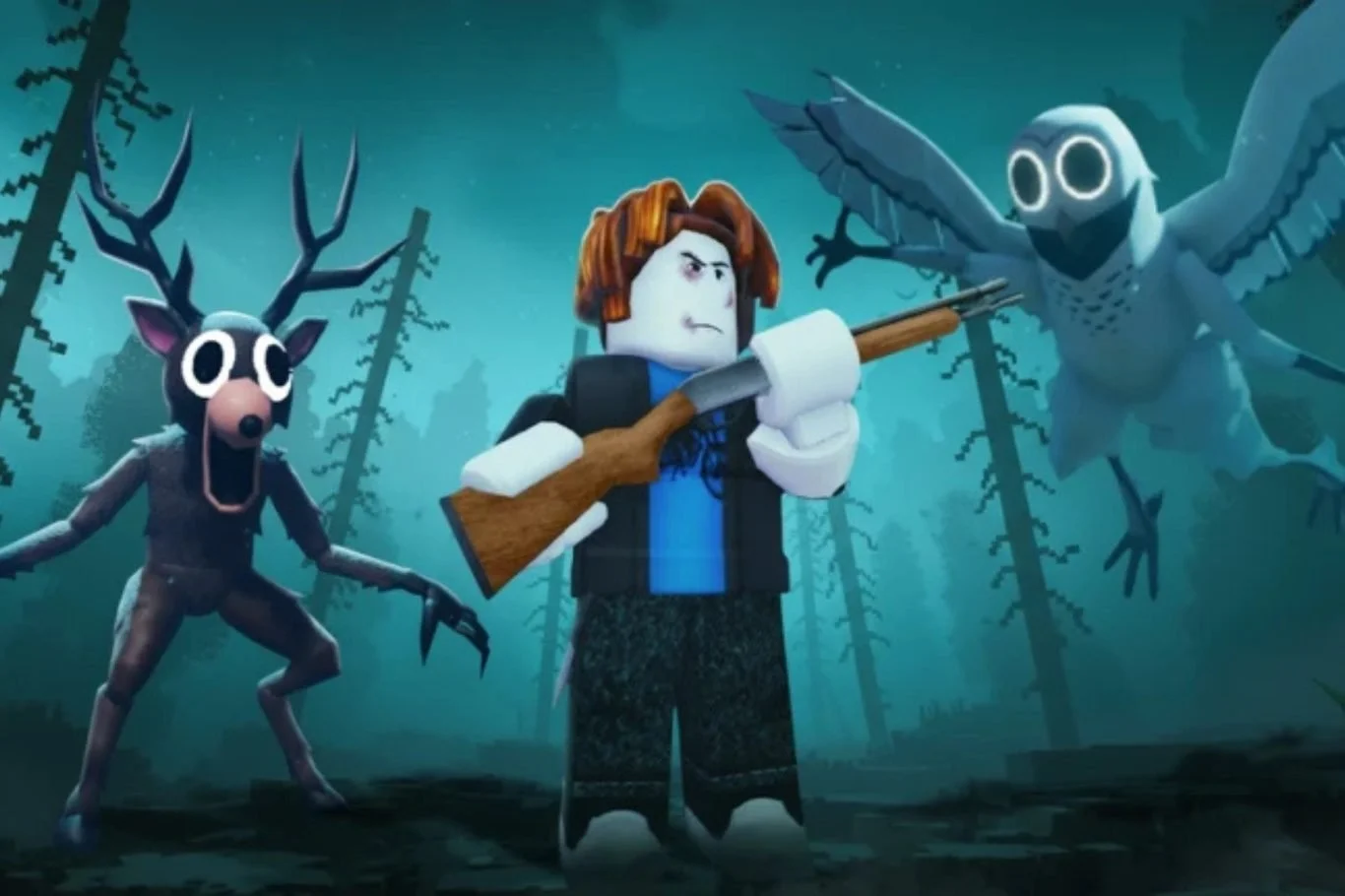
Video games as a genre are extremely poor at explaining themselves. When you buy a new game you’ll often find little or no information regarding the basic systems and mechanics. The industry assumes that their customers are by default familiar with the fundamentals of playing a modern video game. Hence if a game has a tutorial, it is often based around videos rather than detailed verbal instructions. You are are briefly shown a clip of a specific move being successfully undertaken but it is seldom shown in a wider context. The industry also expects the fan community to take on the role of curating and disseminating information about its games. The move away from forums and bespoke websites to Discord highlights this. Discord is a primarily a real time communication tool and not good at maintaining a historical data archive. If you want an answer to a specific gaming question, you’ll more than likely find it on YouTube in a video made by a fellow gamer.
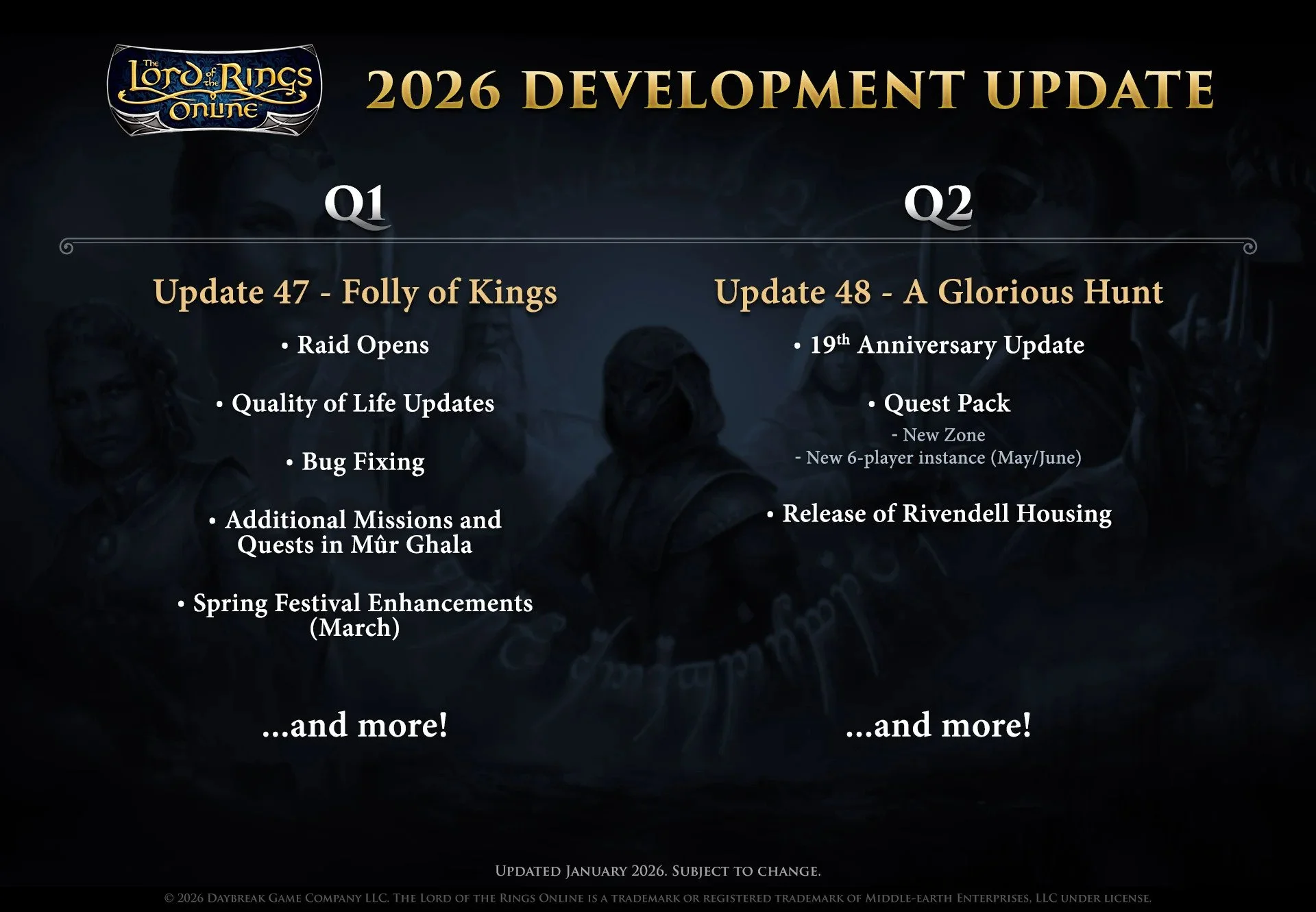
According to the recent “letter to the players”, Standing Stone Games will be adding a new zone to the MMORPG The Lord of the Rings Online in the second quarter of this year. Possibly around May or June. Having spent the last three expansions in the South of Middle-earth exploring the tropical Umbar and the deserts of Harad, I would certainly welcome a change of location. I have gradually warmed to these zones over the last eighteen months but I do find them so incongruous. They are so radically different to the European style content that has been the mainstay of the game for so long. Tolkien’s source text has plenty of detail regarding Eriador and Rhovanion. Information regarding Harad is scarce, hence it has afforded the developers a great deal of artistic freedom. Although exceedingly well realised these tropical zones have taken a while for me to get used to.
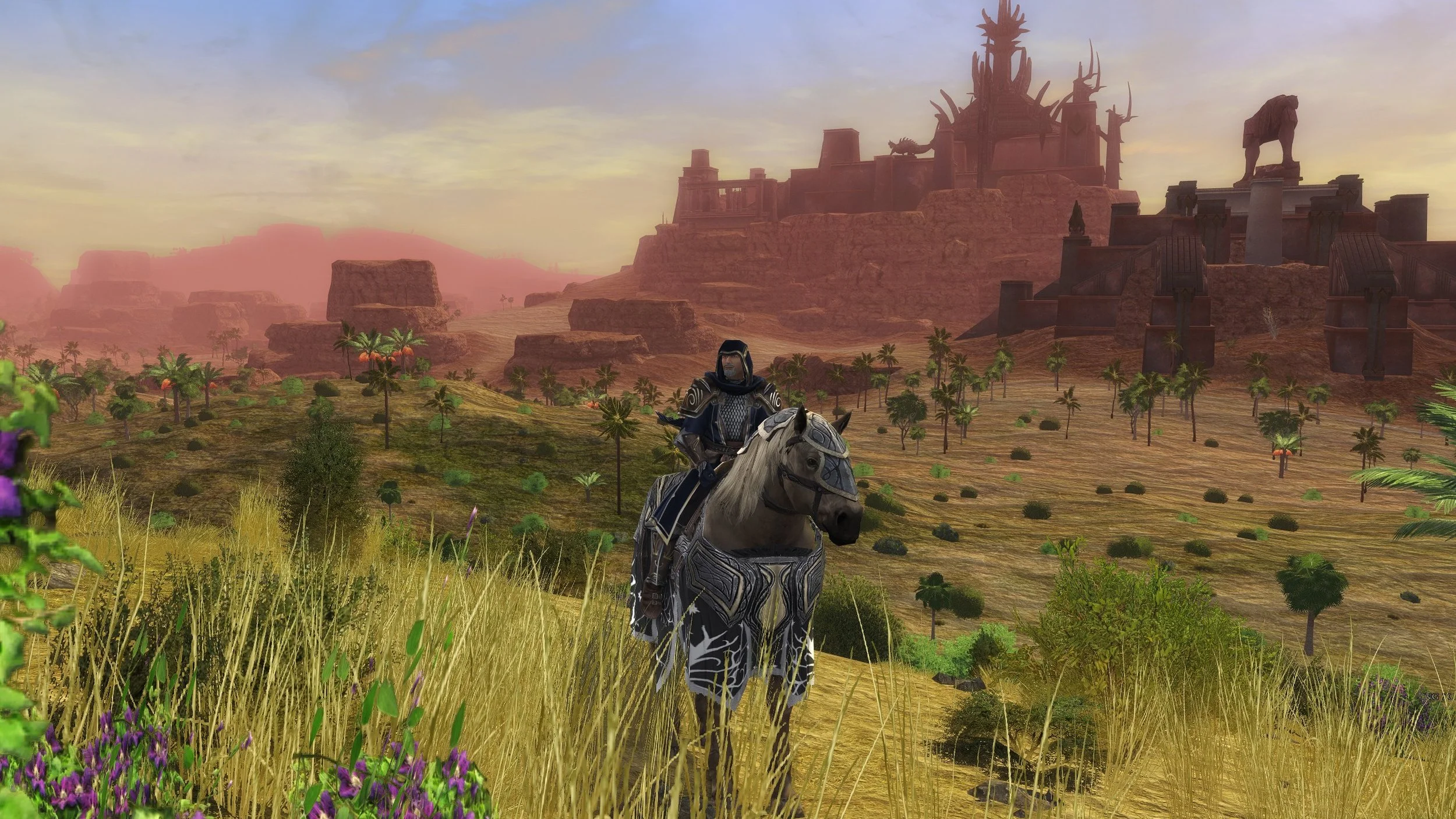
I’m not sure exactly when it started but I’ve recently noticed a graphical bug within the MMORPG The Lord of the Rings Online. This problem often occurs within caves or in areas where there are a lot of rocky surfaces. Hence it has become very apparent in the latest two expansions, set in Umbar and Harad. This graphical glitch causes some surface textures to appear to flash from light to dark intermittently. The resulting strobe effect is hard to ignore and very distracting. Fortunately, a quick online search showed that this is not a problem unique to my installation of LOTRO and is a known problem. Furthermore, there is a very simple workaround, which is to go into the Advanced Graphics setting and uncheck “Per Pixel Lighting”, which immediately remedies the problem. I have no idea why this has recently started to happen but at least it can be resolved.
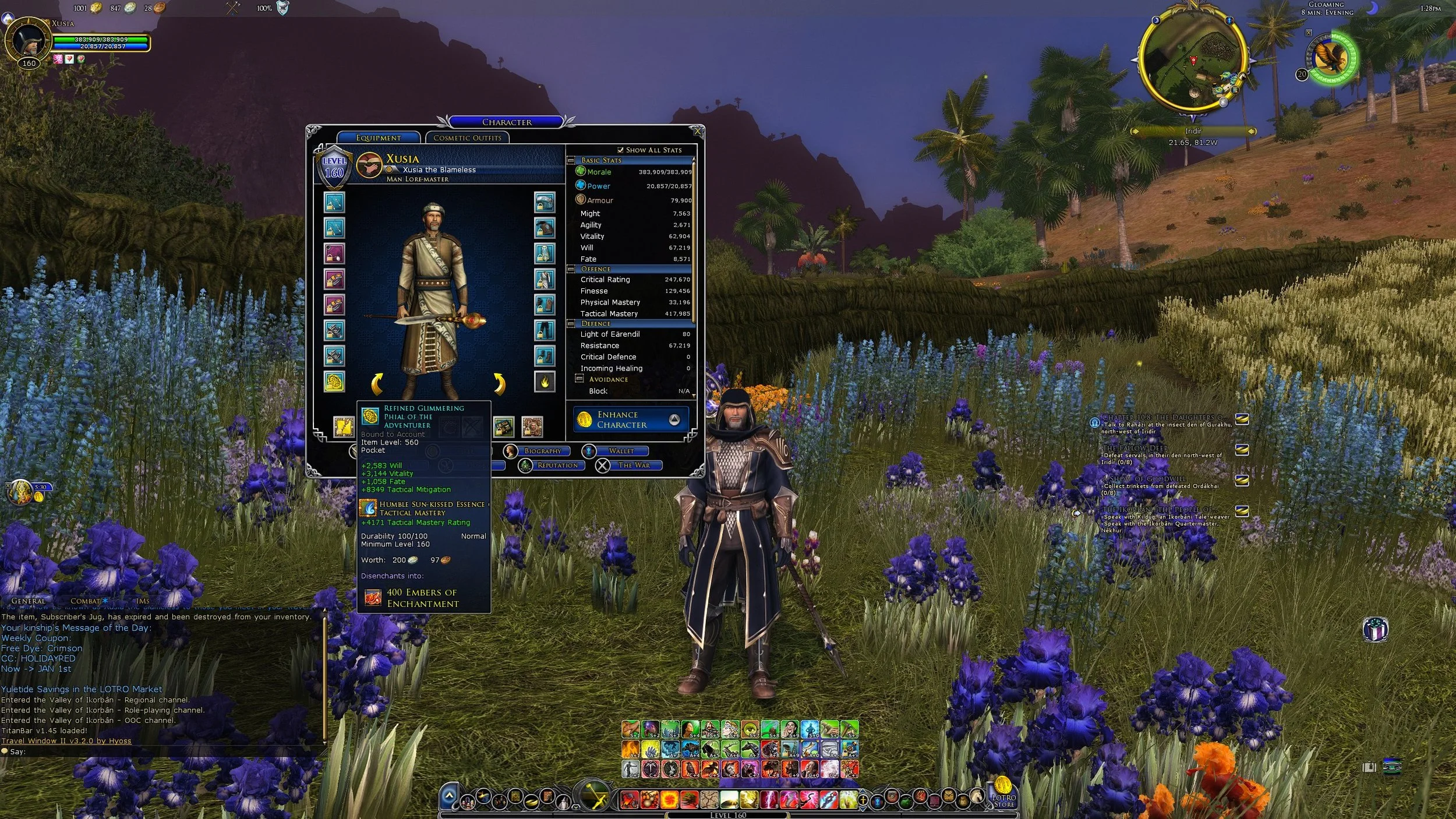
The latest expansion for the MMORPG The Lord of the Rings Online, Kingdoms of Harad, launched on December 3rd. With this release the level cap was raised from 150 to 160. It should also be noted that the cap for virtue traits was also raised from 96 to 100. Naturally these changes meant that there is a requirement to replace all armour and jewellery once the new cap is reached. Similarly Legendary Items have to be reforged and any traceries upgraded or replaced. If you follow the Epic Story it will lead you from quest hub to quest hub. The main quest rewards, along with those from side quests will provide adequate gear as you slowly progress towards the new level cap. The new raids, instances and missions/delvings then provide a means to acquire higher quality level 160 gear. LOTRO and indeed, many other MMOs are consistent in this methodology.
It is customary in a post such as this to list the various games that I’ve played over the last twelve months and share my thoughts on them. Wider analysis of the video game industry is also de rigeur. Unfortunately, I don’t really feel disposed to do either of those two things. My thoughts on the games I’ve played have already been published and can easily be accessed via the links at the bottom of this post. As for the video game industry, it suffers the same flaws as music, TV and cinema. There is creativity and innovation out there but it is often drowned out by mainstream products which are demonstrably inferior due to their inherent mediocrity. As for the business side of things, we once again clearly see the failings of the corporate management class. Sadly, they do not face the consequences of the mistakes that they make.
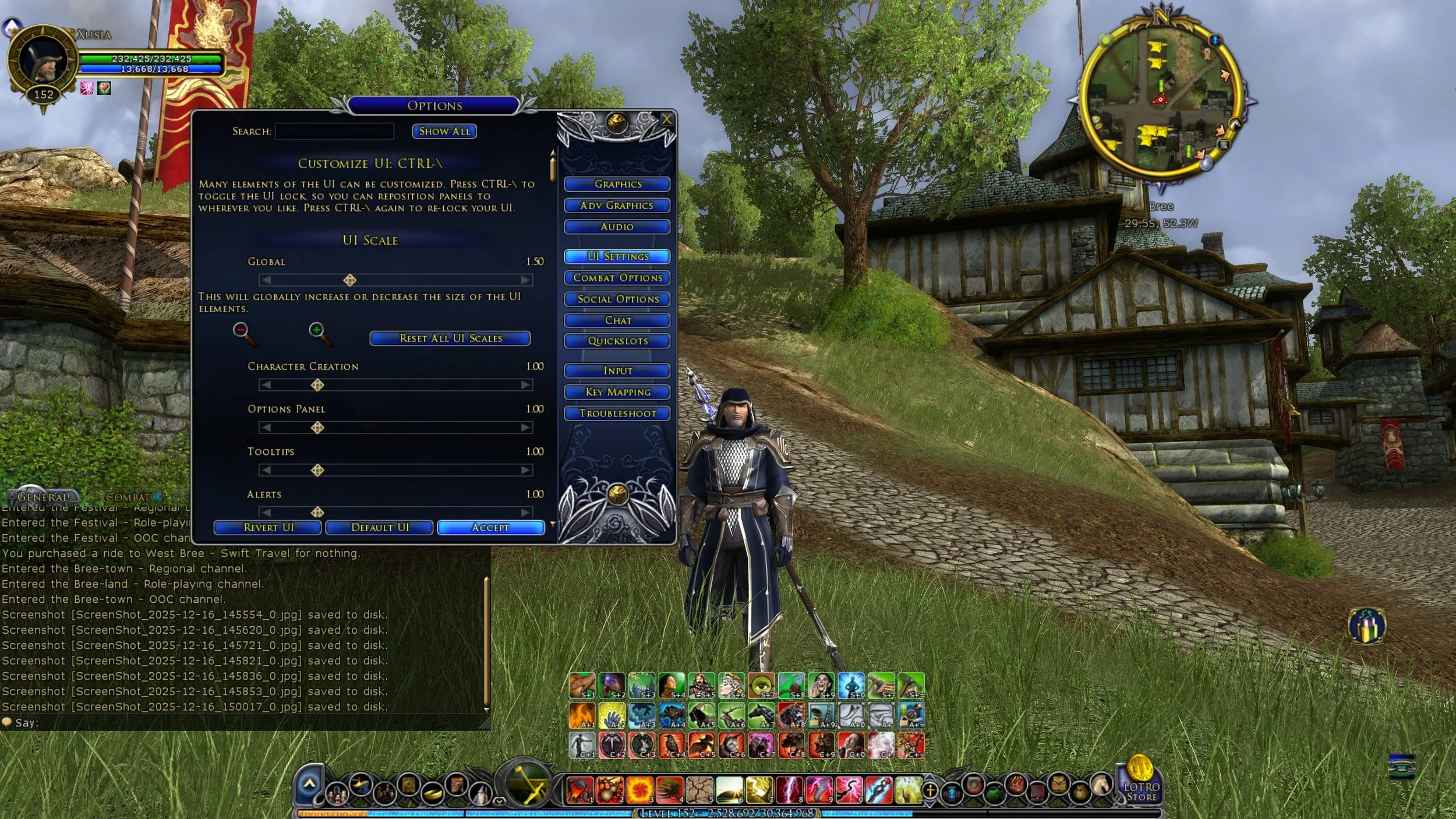
Today Standing Stone Games began beta testing Update 46.1 for the MMORPG The Lord of the Rings Online. The current preview on the Bullroarer test server is mainly for the new instance cluster that comes with the Kingdoms of Harad expansion which launched a few weeks ago. However, it would appear that this latest preview has another feature or note. One that should please LOTRO players. Contrary to what a lot of people thought, myself included, SSG have been working on a scaling UI for 2K and 4K monitors and the results are now available for testing from today Monday 15th through to Friday 19th December. Until now the main workaround to the lack of UI scaling has been to use either Nvidia or AMD graphics software to upscale the game from 1920 x 1080, or a third party app such as LosslessScaling. Having an official solution is a far better option.
Kingdoms of Harad, the 13th expansion for the MMORPG The Lord of the Rings Online, was released today. Highlighting developer’s Standing Stone Games continuing commitment to this eighteen year old game. As 2025 draws to a close, I thought it would be prudent to reflect upon the current state of LOTRO and to consider what may come next year. Two words that I associated with this MMO are stable and consistent. The playerbase is loyal and dependable. Player numbers never greatly decline nor do they notably expand. LOTRO fills a very specific gaming niche and one of the reasons it retains its players is that there is no suitable alternative game. Although there is not a great deal of data in the public domain, it is generally accepted that LOTRO has an older player demographic and that many are consummate Tolkien fans.
The MMORPG The Lord of the Rings Online runs on a broad spectrum of PCs. From archaic laptops to high end gaming rigs, although it may require a bit of tweaking. At present, the optimal way to play the MMO is at a resolution of 1920x1080 (FHD) with the graphics setting maxed out. The graphics are sharp and the UI is readable. However, a growing number of gamers are now using 2K and 4K monitors. You can play LOTRO at higher resolutions such as 2560×1440 (QHD) and 3840x2160 (UHD) and the game looks great. However, the UI does not scale and so is very small on 2K and 4K monitors. The skill icons on the quickslots (shortcut bars) and the in-game text become difficult to see at these resolutions, which deters some players from using them. It is a known issue that Standing Stone Games are attempting to address but it is unlikely to be resolved any time soon.
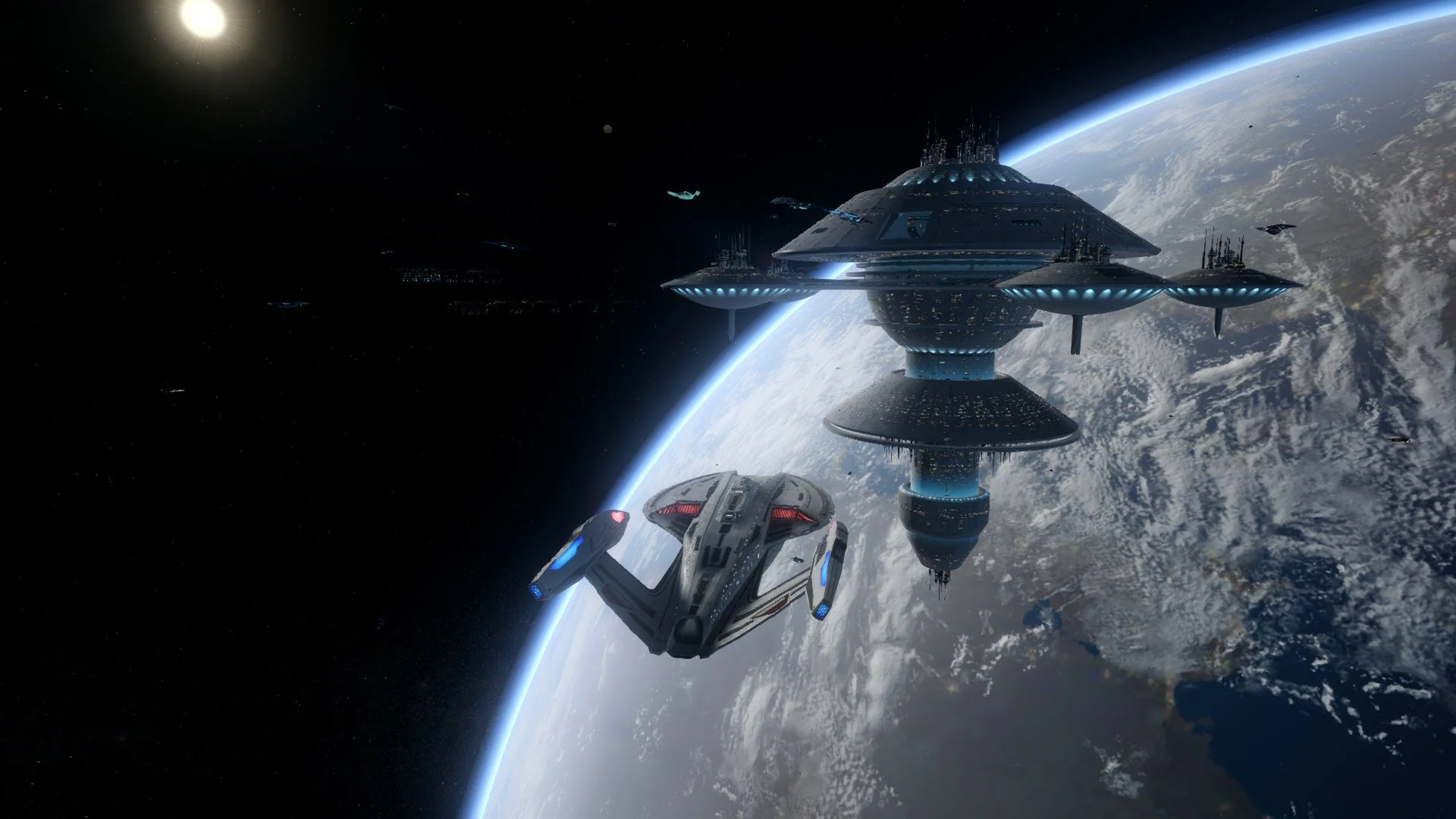
I recently read a post on Massively Overpowered about skills rotation in the MMORPG genre. I found the subsequent discussion in the comments fascinating. Mainly because I have never used a fixed rotation of skills in any of the MMORPGs that I play. I understand the reasoning behind such things and why some players want to optimise their combat performance. Using one’s skills in a specific order to maximise damage and manage their subsequent cooldown has a logical appeal. In Star Trek Online, some players go so far as to create keybinds for their rotations and assign it to a specific hotkey, which is then continuously pressed throughout combat. However, rotations are a blunt tool that lack flexibility, often being geared towards dealing with a single target or using an area of effect skill against a larger group. They may not be the optimal approach to combat when things do not go to plan.
Tolkien enthusiasts may recollect Athlon Games, a subsidiary of Leyou Technologies, announcing that it was developing a new MMORPG, based upon The Lord of the Rings, back in September 2018. The following summer, it was revealed that Amazon Game Studios was the partner developer for the project. In late 2020, Leyou Technologies (a Hong Kong-based company), was acquired by the Chinese conglomerate Tencent. This triggered a contract clause with the license holder, Middle-earth Enterprises, allowing them to terminate the existing arrangement if a new deal could not be met. Amazon and Tencent were unable to agree upon how to proceed with the project, leading Amazon to withdraw from negotiations. The project was subsequently scrapped. No details or images of the MMO have been released.
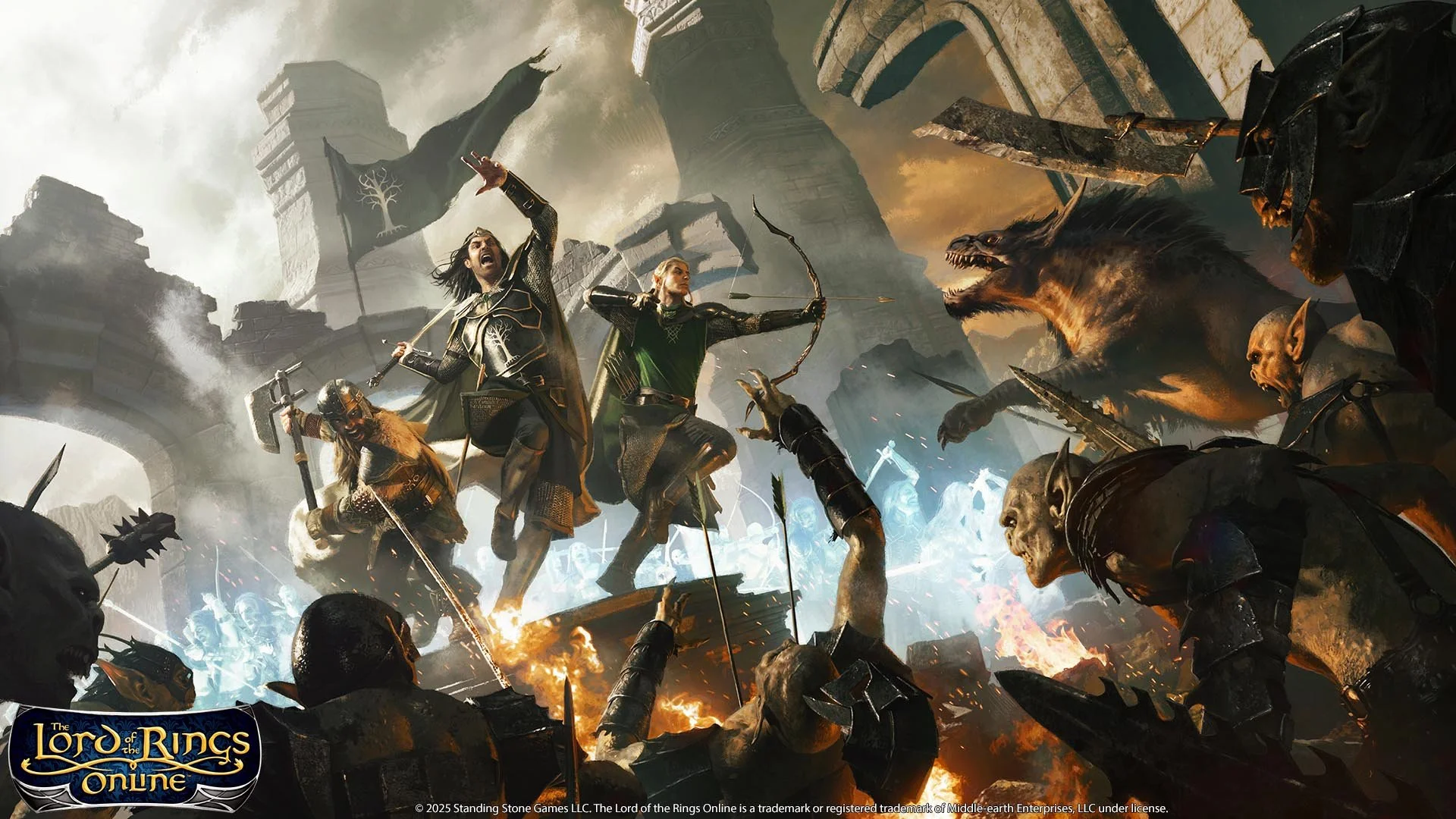
After a six month migration period, Standing Stone Games formally closed all their legacy 32-bit game servers for the MMORPG, The Lord of the Rings Online, on the 31st August 2025. Despite this planned closure being widely discussed via the game’s official forums, professional video game websites and fan blogs, many LOTRO players were unaware of this deadline. Hence many were unable to migrate their respective alts to the new 64-bit servers. Naturally those affected by these closures were upset, especially those with longstanding characters who didn’t relish the prospect of starting from scratch with a new alt. Thankfully, SSG have been true to their word and as of today, have re-opened these “dark worlds” to character transfers. If you have an alt trapped on one of the older game worlds, then now is the time to use the transfer wizard and move them to a new active game world.
MMORPG announced earlier today and it was subsequently confirmed by Standing Stone games, that the new expansion for The Lord of the Rings Online will be Kingdoms of Harad and that it will launch later in the year. The expansion will see the conclusion of the epic Song of Waves and Wind storyline and the level cap raised from 150 to 160. There will be a new region to explore, Mûr Ghala, comprising four zones. Adagîm, Idagâl, An Shêru and Kighân. The latter contains the main trading hub of Zajâna. Players will travel into the region with Gandalf the White, along with allies of the Kindred of Coins and Mizadi as they seek to counter the regional power struggle brought about by the fall of Sauron. Canonically, this takes place three months after the destruction of the ring, hence King Elessar and Eomer are busy with domestic affairs in their respective kingdoms.
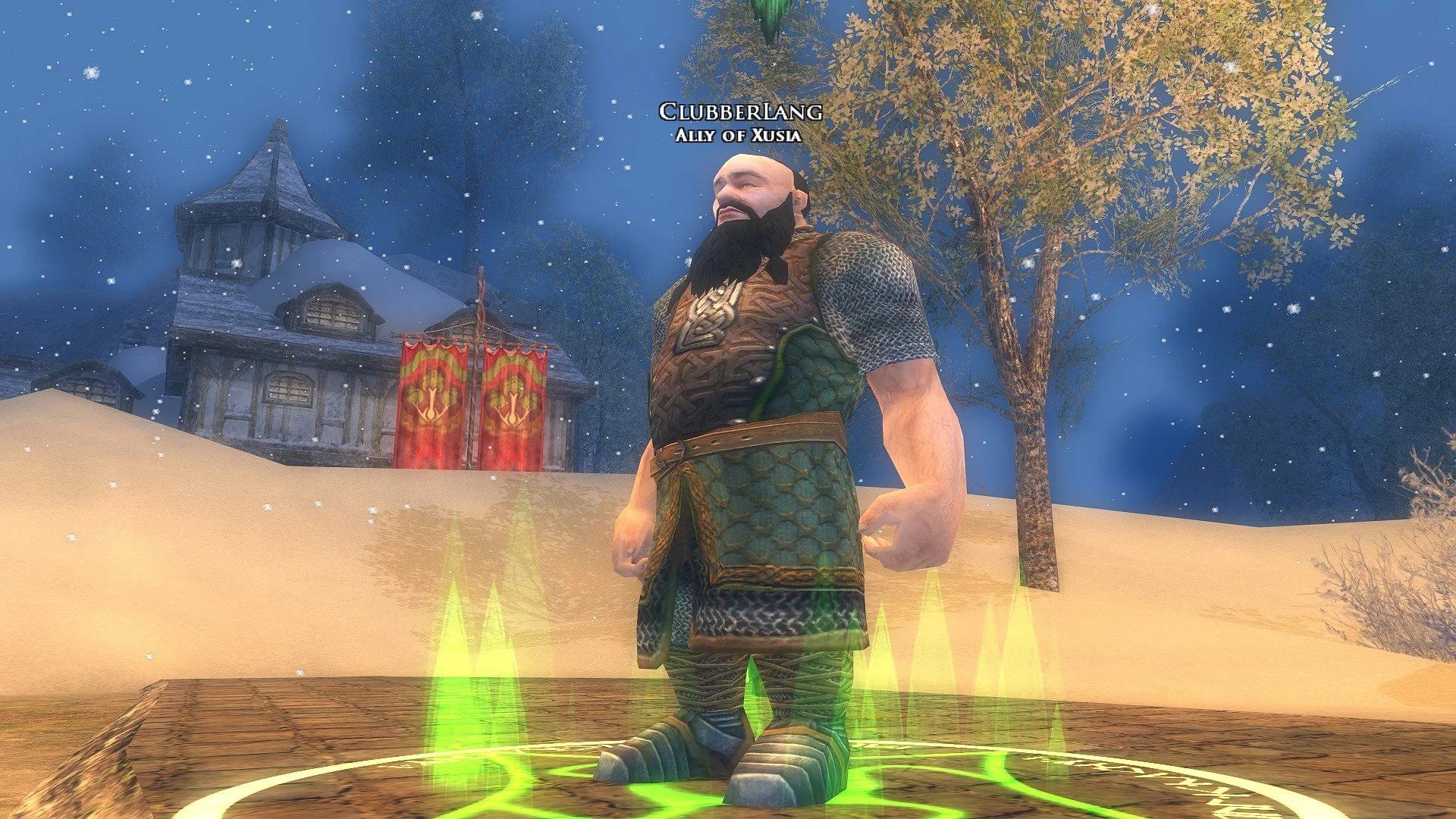
Skirmishes were added to the MMORPG The Lord of the Rings Online, in 2009 with the release of the Siege of Mirkwood expansion. Skirmishes are a repeatable and scalable combat system that allows players to access various instances for solo or group play from anywhere in the in-game world. Players can choose a Skirmish Soldier from a variety of classes to accompany them and provide healing, tank or additional DPS. On paper it’s a great system which is why many other MMOs offer something similar. I recently decided to tinker with my Skirmish Soldier build on my main character to see if I could optimise their performance. As my primary alt is a Lore-master, for the last few years I have had a Warrior as their Skirmish Soldier, to take some of the aggro from attacking mobs. I used the excellent guide by FibroJedi and swapped over a few Training and Personal Traits.
On 2nd August 2025, I was playing the MMORPG The Lord of the Rings Online, on my primary character, a level cap Lore-master. I decided to continue with one of the Allegiance Quest lines, specifically Durin’s Folk. I played through several quests and earned the appropriate tokens that advance the Allegiance system. I then handed these in to the NPC in the Hall Under the Mountain, expecting the next quest in the series “Chapter 3: Gimli’s Request” to be unlocked. An item appeared in my inventory that I then clicked on, which should have bestowed the quest. Unfortunately, nothing happened. Furthermore, the item vanished from my bag and therefore I could not attempt to click it again. I checked the LOTRO Wiki and then looked around the Hall Under the Mountain to see if any NPC had a ring icon above their head. As they did not, I surmised that this was a software glitch and logged a support ticket with Standing Stone Games.
Let’s start with a quote from a classic Walter Hill film, The Warriors. “Can you count, suckers?” says Sirus. The gang leader was referring to the number of Police in New York City at the time. Whereas, for the purpose of this post, I am referencing how many Delving Writs a player needs to acquire 6 pieces of level cap armour in LOTRO. Because, next to the gear you get from endgame instances and raids, Delving gear is a good alternative.. It is marginally better than the items you can get from lootboxes. Hence, Delving armour is a good source of high end gear for the solo player. Through the miracle of mathematics, the number of Delving writs required to acquire a full set of this armour is 9,000. At first glance, that seems like a lot. If you then do some further research to put the number in context, you realise it is indeed a lot and a substantial undertaking.
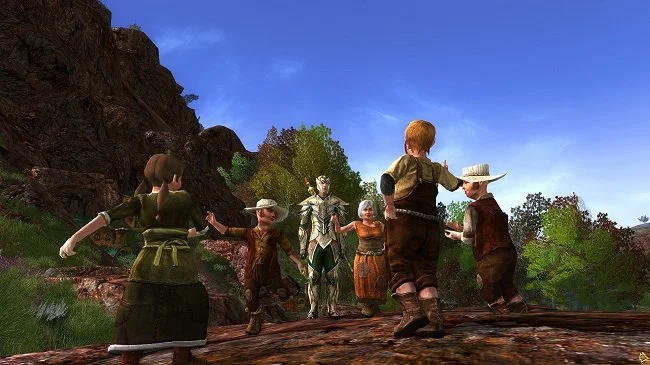
I am currently enjoying a renewed interest in the MMORPG The Lord of the Rings Online since I migrated all my characters from the old 32-bit servers to the new 64-bit replacements. I’ve created a new High Elf Lore-master on Peregrin server and am currently levelling them in a targeted play through of the Epic Story, supplemented by curated side quests. While playing recently, I realised the game UI on this alt wasn’t as I usually have it laid out. So I checked through the various documents on my PC and found a text file I had created many years ago that had a few hints and tips written down. I’ve added a few more and decided to share them as a blog post. I’m sure veteran players will be familiar with many of them but a lot of them are worth repeating. They may prove useful to those new to LOTRO or returning to the game after a long hiatus.
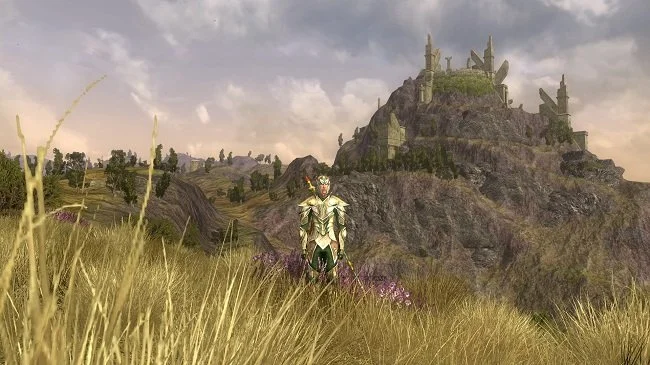
In mid-March, while the server migration debacle raged, I created a new alt for the MMORPG, The Lord of the Rings Online, on Peregrin server. The idea was to play casually through content focusing on enjoyment, rather than worrying about progression. I was to level at a pace that suited me and had no specific plans to develop my alt in any particular way. I have been playing LOTRO since 2008 and have a primary level-cap character that has been my main focus over the years. Hence I have previously experienced all story content from all the expansions and am therefore very familiar with what the game has to offer. Which is why I thought I’d do things differently this time. So I started my new Lore-master in Mossward in Swanfleet, the new starting area added to the game in 2022.
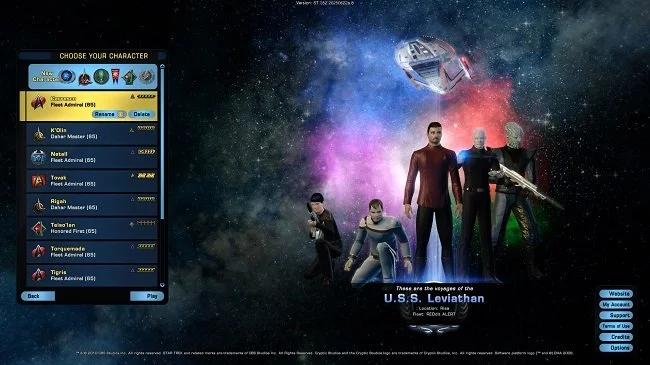
In massively multiplayer online games (MMOs), alts (short for alternate characters), are new characters created by a player in addition to their primary character (often called the “main”). Alts are often encouraged by developers as a means to keep players engaged with their game(s). Sometimes an MMO will actively reward the creation of alts either with access to exclusive content, or with additional skills or items previously unlocked by primary characters. As the myth that an MMO really begins at endgame still persists in gaming culture, some games sell boosts that will instantly raise the level of an alt to that of the current level cap. Creating alts is such a key aspect of the MMO genre, that some games will sell additional character slots, so that players can create further alts beyond the default amount allowed. There are many reasons why players create alts. Let us consider some.
I wrote a while ago that a lot of kinships from the MMORPG, The Lord of the Rings Online, would probably not survive the recent server migration. MMOs are social endeavours by nature, often with strong emotional ties but a lot of kinships (or guilds) have already fallen into decline, simply due to gaming entropy. Hence the migration has seen players leave existing kinships to move to the superior 64-bit servers, resulting in a lot of people who may be potentially looking for a new home. This is exactly what happened to me. I opted to move to Meriadoc server promptly, at the cost of leaving a kinship I have been a member of since 2009. However, the move presented me with an opportunity to remedy this problem myself. I subsequently set up my own kinship and decided to make it available to others.
On Friday 26th June, I had another random spike in internet traffic to Contains Moderate Peril. The statistical package that comes with my Squarespace account recorded over 13k visits in less than 24 hours, which is not typical (although I wish it was). However, all of these visits to my blog arrived via the default homepage and spent between 1 and 2 minutes there. Hence, it was obvious that this was not human traffic, as there was no evidence of any searches being made of content that is available on my site, nor of the “visitors” clicking on any of the links on the top menu and viewing other posts. This was undoubtedly AI traffic arriving at the designated homepage and simply parsing the site. I had a similar spate of this sort of web traffic last November. The only difference on that occasion is that the traffic all came from China. This time round it hailed from the US. I suspect that this is something that will happen more often as companies set their AI loose on the net for what is effectively training.