
LOTRO: The Hytbold Experiment
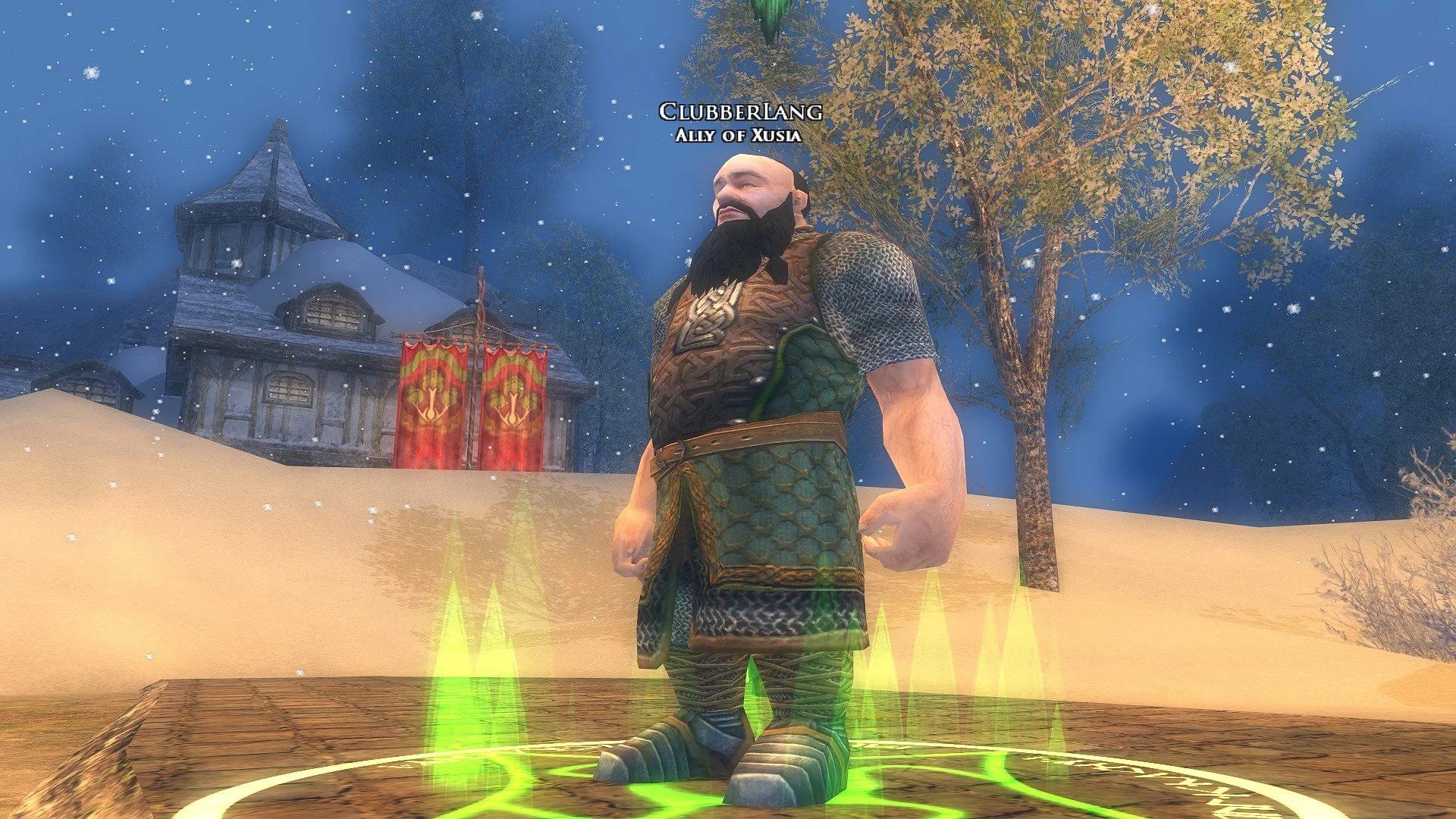
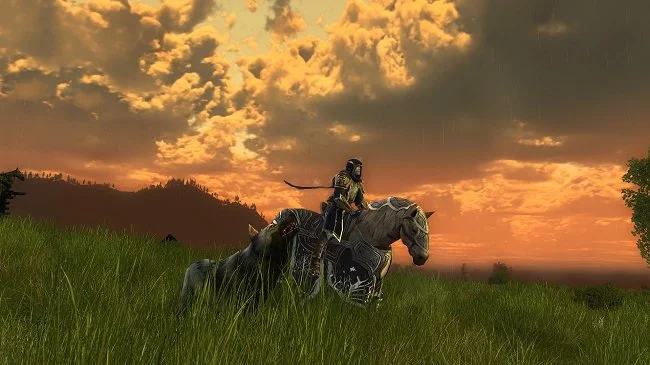
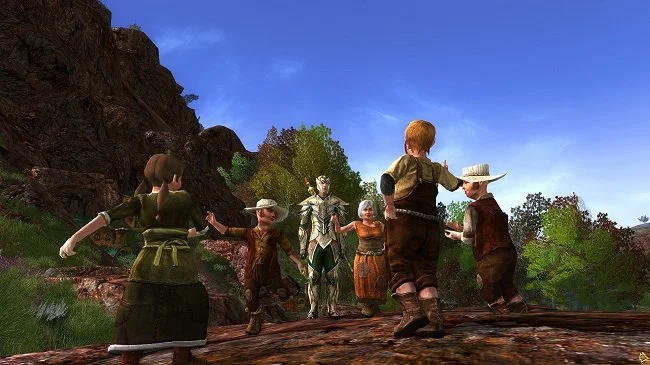
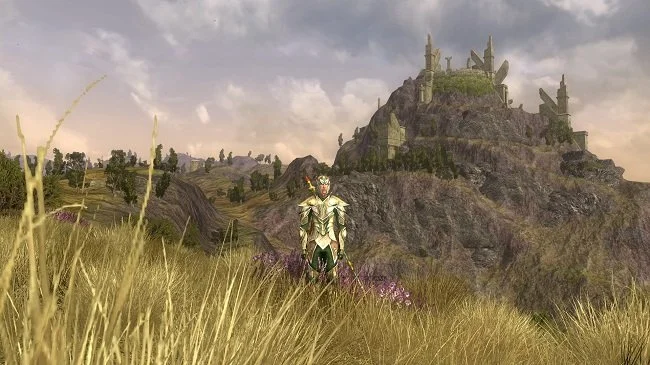
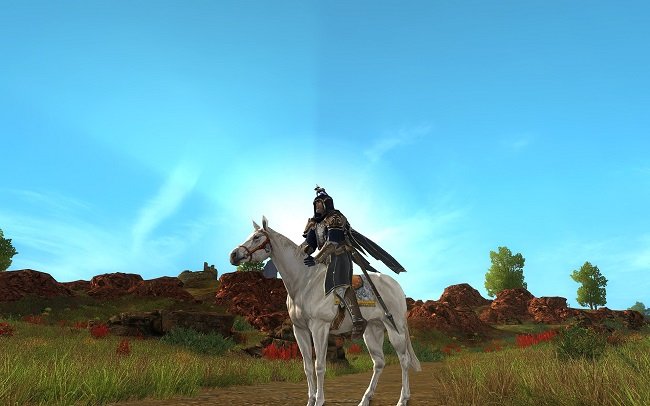
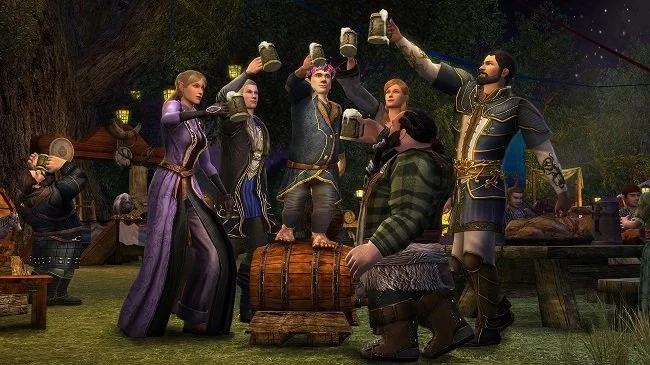
In 2012, developers Turbine embarked upon an interesting experiment as part of the Riders of Rohan expansion for the MMORPG The Lord of the Rings Online. I do not refer to mounted combat. Let us leave that debacle for another discussion. I was referencing the rebuilding of the burnt out village of Hytbold, which was promoted at the time as an alternative to raiding for solo players. Hytbold is a settlement located within the Sutcrofts in East Rohan, which was burned down in an attack by Orcs from the East Wall. Once a player reaches level 84 they can undertake repeatable daily quests, participate in mounted combat and other unique events. Over time a player can rebuild the two dozen buildings that make up Hytbold and access services such as Stable Master, Provisioner and Barber. The rewards for this task are class and trait-specific armour sets that are comparable to level 85 raid gear and the title of Thane of Rohan.
In 2012, developers Turbine embarked upon an interesting experiment as part of the Riders of Rohan expansion for the MMORPG The Lord of the Rings Online. I do not refer to mounted combat. Let us leave that debacle for another discussion. I was referencing the rebuilding of the burnt out village of Hytbold, which was promoted at the time as an alternative to raiding for solo players. Hytbold is a settlement located within the Sutcrofts in East Rohan, which was burned down in an attack by Orcs from the East Wall. Once a player reaches level 84 they can undertake repeatable daily quests, participate in mounted combat and other unique events. Over time a player can rebuild the two dozen buildings that make up Hytbold and access services such as Stable Master, Provisioner and Barber. The rewards for this task are class and trait-specific armour sets that are comparable to level 85 raid gear and the title of Thane of Rohan.
At the time, there was a great deal of debate on the Official LOTRO Forums regarding access to top tier gear and that the developers were pandering too much to raiders. Casual players and non raiders requested alternative ways to receive raid quality gear and rebuilding Hytbold allegedly provided a solution. However, just like raiding, rebuilding Hytbold requires a substantial investment of time. Former Senior Game Designer Joe Barry argued the point thus. “The overall time commitment is on par though with the amount of play hours and overall time it would take to get a raid armour set from a cluster. However, instead of spending 5+ hours once a week for 6-8 weeks raiding, you're instead spending 30-45 minutes a day doing soloable dailies for a similar amount of weeks”.
The main method of time-gating the rebuilding of Hytbold is via reputation factions. There are four in Riders of Rohan. The Wold, Norcofts, Sutcrofts and Entwash Vale. Reputation XP is gained through doing regional quests. Although Hytbold can be accessed with lower rep, some of the quests are gated behind Ally status. Regional quests will only provide rep XP upto a certain level, so if you want to reach kindred, then playing through Hytbold is mandatory. The fact that faction rep cannot be supplemented by tasks is a major hindrance. Managing the rebuilding of Hytbold is also quite complex in itself and shortly after release, several equally complex guides appeared on the forums (like this legendary one from Fredelas) as players tried to find an optimal selection of quests which could be completed quickly and efficiently on a daily basis.
As a dedicated LOTRO player at the time, I undertook the task of rebuilding Hytbold and if memory serves, I believe it took me about one and a half months. It was an enjoyable experience initially doing dailies and speculating about how Hytbold would look when rebuilt. The burned out buildings were replaced with new ones through phasing. However, after about twenty days or so, it became a chore, especially as some of the dailies were less enjoyable than others. Admittedly once complete it was rewarding to see the town rebuilt and to be able to purchase one of three class specific armour sets. But once this lengthy task was finished there was little or no reason to return to the town of Hytbold. Furthermore, twelve month later the next expansion Helm’s Deep saw an increase in level cap and so new sets of armour.
One of the worst failings of LOTRO is the way in which the game continuously invalidates gear and more importantly, the player’s hard work to obtain it as they progress through the game. I remember grinding through numerous Moria instances and raids to get a First Age Legendary Weapon back in Autumn 2009. I finally got my weapon a month before the release of Siege of Mirkwood. Once that expansion arrived it immediately became obsolete. My Hytbold gear suffered a similar fate although I did benefit from it a little longer. At present there are 221 stable-master in LOTRO. One of these is Hytbold and you only get it if you completely rebuild the village. I can’t remember the last time I went there but it’s a badge of honour that I have it. As LOTRO content doesn’t scale there often is no reason to go back to an older zone. Also because levelling is streamlined now, new players progressing through the game have no requirement to complete Hytbold if they don’t wish to.
Hytbold was an interesting experiment which genuinely attempted to address an issue that the player community had raised. Some people like progression, a clear path to a goal and repetition. Others don’t. Raiding doesn’t always guarantee obtaining the gear you seek but it probably offers a more exciting experience than the more structured path of Hytbold. Whatever your opinion, it should be noted that Turbine did not offer an alternative to raiding in later expansions. Perhaps they felt it was too much work or wasn’t particularly well received, just like mounted combat. Perhaps back in 2013, they were already considering an alternative system that could be monetised, as it is today with lootboxes and Embers of Enchantment. As for Hytbold, it remains one of many experimental systems that litter the game that have subsequently been abandoned. A curiosity from a decade ago.








Auto-manage
I’m sure I’ve mentioned this issue before in previous video game related posts. But I don’t think I’ve devoted an entire article to the matter, which is what I’m going to do today. So to provide some context, I logged into The Elder Scrolls Online today as I’m fast approaching that point in the year where I spend a few months subscribing to the game. Due to some recent patch, once again all my Champion Points have been refunded. Judging by the change in graphics, it may be that the entire Champion Point system has been updated. Whatever the reason, I have to re-allocate 501points into three skill trees. I wasn’t au fait with the last system, so I followed a build I found online. Now that it has changed, I’ll have to find a new one and copy it. Until I do, my character will be gimped. Shame the game doesn’t offer a selection of generic builds that can be easily implemented at the press of a button.
I’m sure I’ve mentioned this issue before in previous video game related posts. But I don’t think I’ve devoted an entire article to the matter, which is what I’m going to do today. So to provide some context, I logged into The Elder Scrolls Online today as I’m fast approaching that point in the year where I spend a few months subscribing to the game. Due to some recent patch, once again all my Champion Points have been refunded. Judging by the change in graphics, it may be that the entire Champion Point system has been updated. Whatever the reason, I have to re-allocate 501points into three skill trees. I wasn’t au fait with the last system, so I followed a build I found online. Now that it has changed, I’ll have to find a new one and copy it. Until I do, my character will be gimped. Shame the game doesn’t offer a selection of generic builds that can be easily implemented at the press of a button.
Back in 2003, I used to play a superb, squad based, tactical shooter called Hidden and Dangerous 2. A major part of the game was picking your team and equipment for the upcoming mission. The player was given a great deal of choice with regard to weapons, explosives, ammunition and such like. If you were planning a stealthy approach you would choose gear pertinent to such an approach. If you favoured a more direct approach you would select heavier weapons. However, the developers were savvy enough to understand that where this facility delighted some players, it also bored the shit out of others. Hence in their infinite wisdom and bountiful generosity they gave us a button that would automatically equip the “recommended selection”. And there was much rejoicing. Furthermore, they weren’t the only ones that did this.
Over the years many video games have included an “auto-manage” feature. I’ve never been a big fan of real time strategy games but I did play a lot of Star Wars: Rebellion in the late nineties. If the player found managing resources across multiple planets too tiresome or wished to focus on other elements of the game, you could assign your advisor droid to take care of these tasks. Naturally it didn’t yield the best results but it was adequate enough for new players or those who preferred other aspects of gameplay such as the epic real-time space battles. Again this comes down to a matter of personal choice, whether you wish to use such a facility. Naturally it will be an anathema to the purists and I totally understand such players being against such a game mechanic. From my perspective, I just like to have a choice and a means to bypass what I see as “chores” and unenjoyable “busy work”.
People who play video games do so for lots of different reasons. Some love to micromanage excessively complex systems, meticulously reading the text and crunching the numbers in the hope of finding an optimal build. Others like extensive choices so they can try a variety of permutations. As for me, I prefer to get straight into the action and start shooting things in the face. Anything that impedes that is a pain in the ass as far as I’m concerned. Which is why I’d like to see a lot more games implement some kind of auto-manage facility. It is these kinds of quality of life services that can make the difference between quitting out of petty annoyance and soldiering on, possibly to find one’s second wind. I can’t see how including auto-manage does any harm to a game, although I’m sure there are some gaming zealots who do. In the meantime, I shall continue to live in hope and lobby for this game mechanic.


Star Trek Online: The Missing Missions
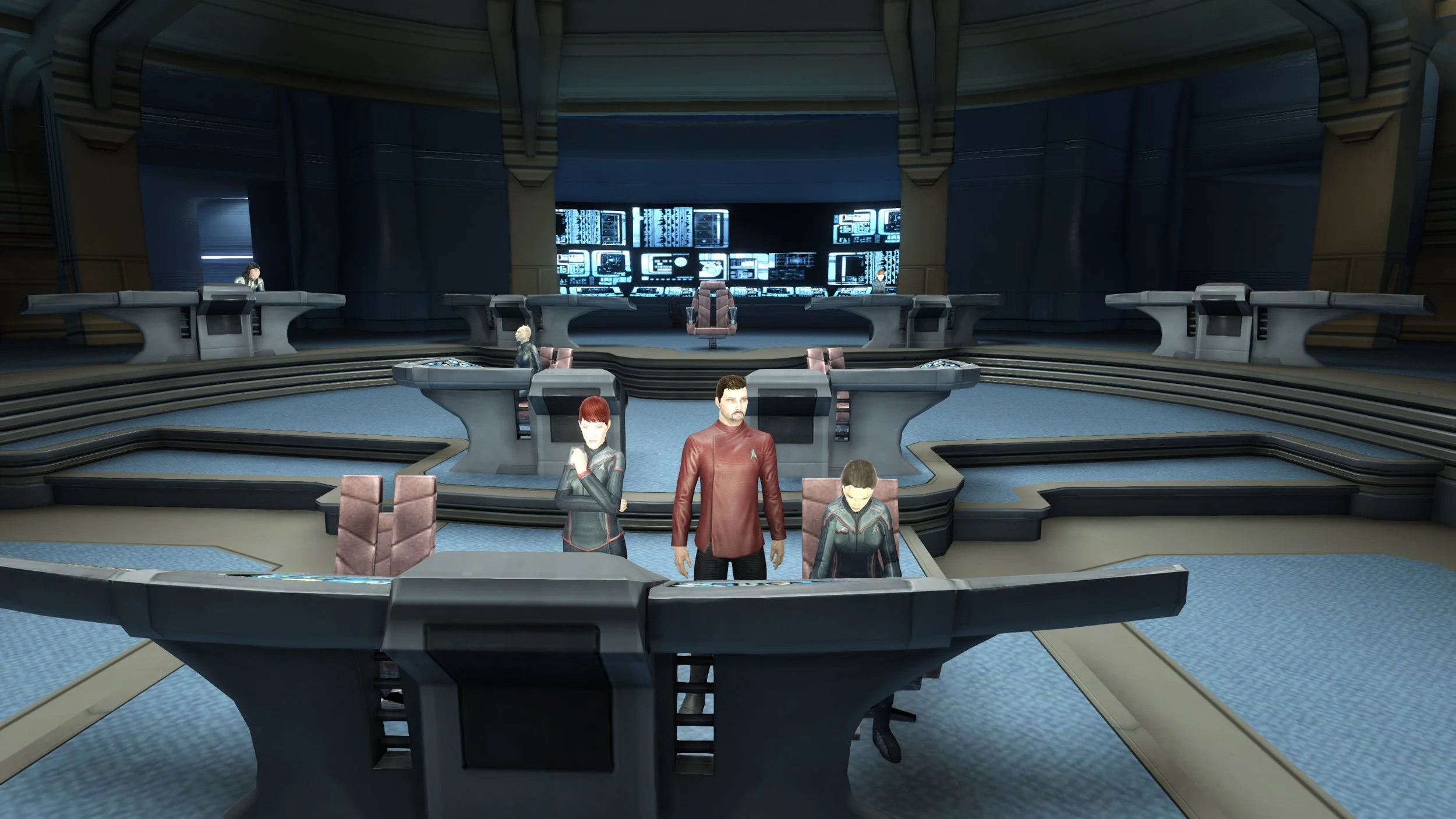
On October 15th 2018, Cryptic released Season 15: Age of Discovery for the MMORPG Star Trek Online. As well as adding new Star Trek: Discovery themeed content to the game, the developers also overhauled the new player experience and as a result made some major changes to existing missions in the game. Several story arcs were taken from the “Episodes” tab of the game’s Journal and relegated them to the status of side-content. As a result, several well written and enjoyable storylines are now buried in the game’s UI and are therefore easily overlooked. Some of them have been further gated behind a level 60 requirement to be eligible to play them. For more details of both these “side-content” story arcs and playing the entire game in narrative order, please see my previous post, Playing the Story Arcs in Order.
On October 15th 2018, Cryptic released Season 15: Age of Discovery for the MMORPG Star Trek Online. As well as adding new Star Trek: Discovery themeed content to the game, the developers also overhauled the new player experience and as a result made some major changes to existing missions in the game. Several story arcs were taken from the “Episodes” tab of the game’s Journal and relegated them to the status of side-content. As a result, several well written and enjoyable storylines are now buried in the game’s UI and are therefore easily overlooked. Some of them have been further gated behind a level 60 requirement to be eligible to play them. For more details of both these “side-content” story arcs and playing the entire game in narrative order, please see my previous post, Playing the Story Arcs in Order.
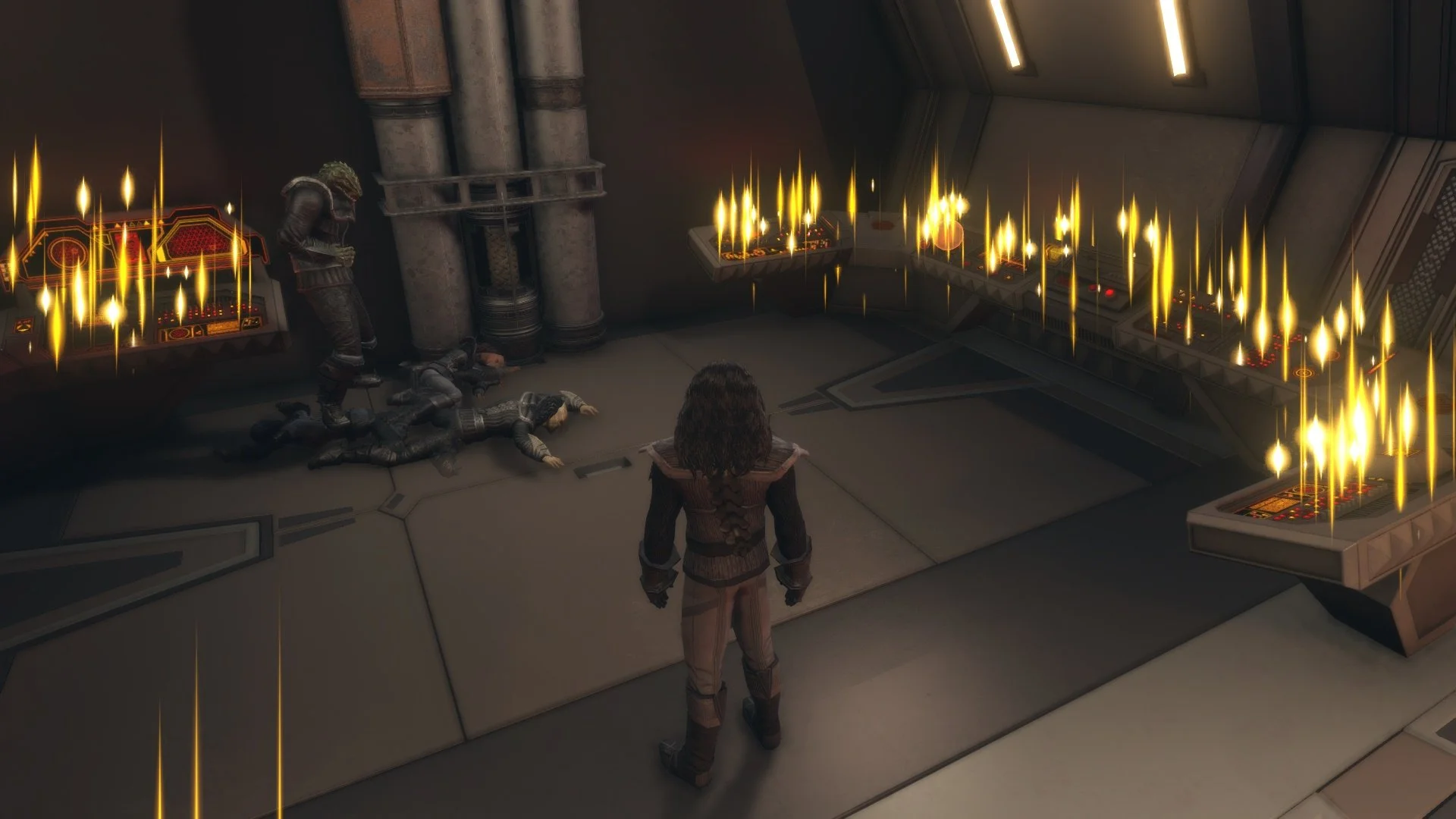
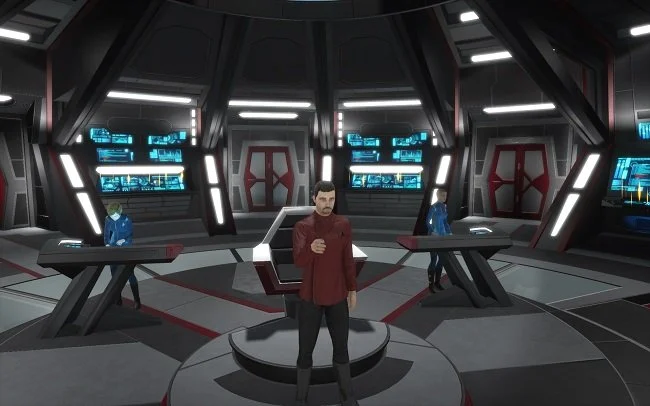
The other major change that Cryptic made with the launch of Season 15 was the removal of eight missions. At the time, Cryptic stated that this was to accommodate ongoing revisions and improvements to various content. This was confirmed as five missions were changed to feature revised graphics and the addition of canonical characters to the game, such as Commander La Forge (LeVar Burton). Cryptic initially stated that the eight missions would return at some point in the future. However, after three years this has still not yet happened. Furthermore, having recently played through the games complete content, it is apparent that many of the stories have been tweaked in such a way that they do not require the return of these eight missions. If it is the case that these stories have been permanently removed from STO, it will be a loss to the overall game. The missing missions are as follows.
Hide and Seek. Coded messages by an Undine infiltrator sent you to a distant nebula where enemies lie and wait.
Stop the Signal. The player is ordered to the Bomari System to find and destroy a Klingon listening post in the area.
The Kuvah'Magh. Ambassador Kas invited Miral Paris, who is said to be the Kuvah'Magh, as a mediator to a peace conference on Regulus IV. However, spurred by B'vat's propaganda, the talks are sabotaged by Klingons and their Orion mercenaries who believe Miral to be a false saviour. Although the talks have failed, Kas eventually assists the player in chasing B'vat away before he can abduct Miral Paris.
Treasure Trading Station. Starfleet has received a communication from a servant of one of the Klingon great noble houses. She claims to have vital information about the Klingon's war plans and she is willing to exchange that information for relocation to a planet out of the Empire's grasp.
Task Force Hippocrates. There are more reports than usual about Klingon and Gorn attacks along the border of Federation space. Starfleet has created a task force to patrol the area.
The Ultimate Klingon. After rescuing Julian Bashir from a Gorn ambush on his research lab in the Korvat System, the player has to investigate a genetic research facility on H'atoria and discovers Amar Singh creating genetically modified super warriors for the Klingon Empire.
City on the Edge of Never. After helping Captain Thelin of the U.S.S. Kirk against a Klingon ambush, he reports that Miral Paris, the supposed Kuvah'magh, was kidnapped by B'vat. The player follows him to the Gateway System, where B'vat takes Miral through the Guardian of Forever.
Past Imperfect. In Past Imperfect the player is transported to the past by the Guardian of Forever to defeat B'vat's schemes and preserve the present.


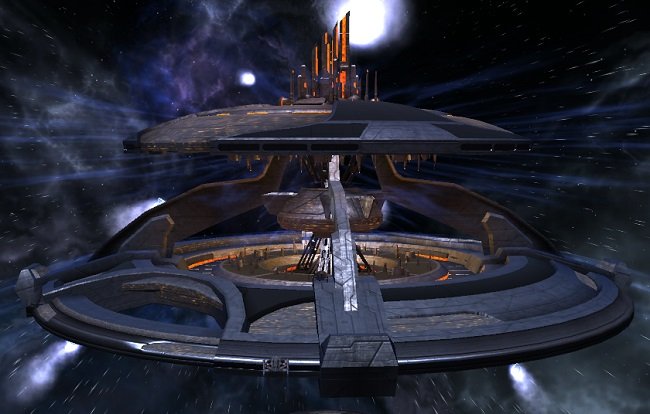
LOTRO: Changes to Embers, Motes and Figments Currencies
I dislike an excess of currencies in the MMORPG genre. I believe that such systems are implemented with a deliberate intention to obfusticate and dissemble. Especially if such currencies are bought with real money. Consider the following scenario. A player buys a specific currency and then uses that to purchase a second, different currency. They then use that to obtain an ingame item, The sole intention of such systems in video games are to disassociate the player from the fact that they have made a purchase which has a real cost. These are manipulative and predatory business practises but such is the nature of the video games industry and they are commonplace. You have to keep your wits about you when spending money ingame. Sadly those who don’t, end up falling foul of such practises.
I dislike an excess of currencies in the MMORPG genre. I believe that such systems are implemented with a deliberate intention to obfusticate and dissemble. Especially if such currencies are bought with real money. Consider the following scenario. A player buys a specific currency and then uses that to purchase a second, different currency. They then use that to obtain an ingame item, The sole intention of such systems in video games are to disassociate the player from the fact that they have made a purchase which has a real cost. These are manipulative and predatory business practises but such is the nature of the video games industry and they are commonplace. You have to keep your wits about you when spending money ingame. Sadly those who don’t, end up falling foul of such practises.
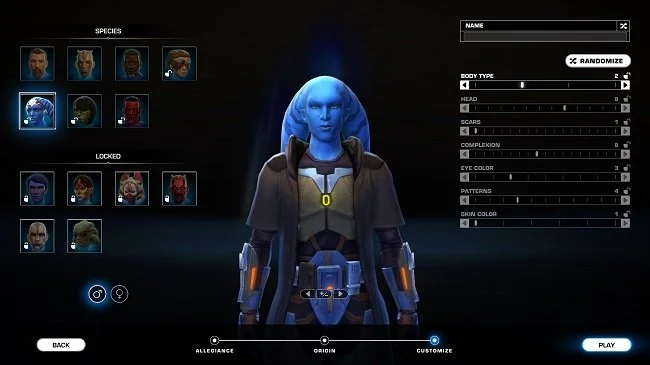
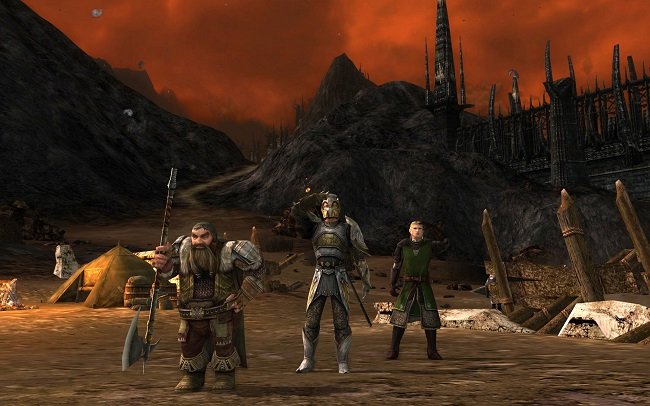
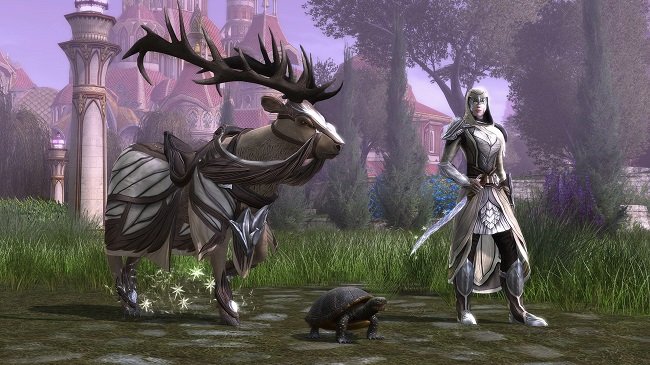
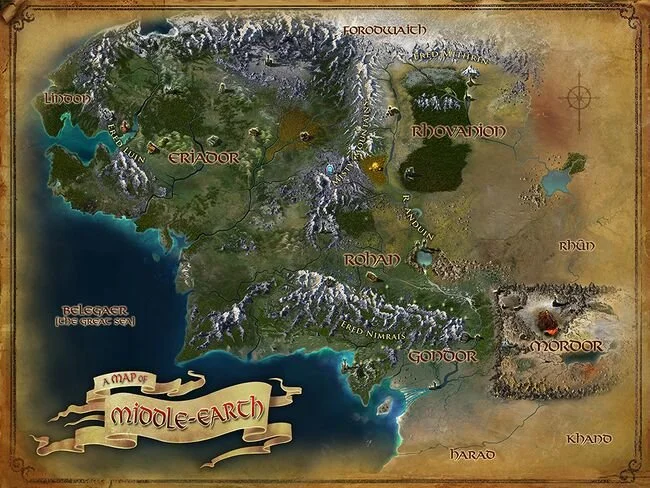
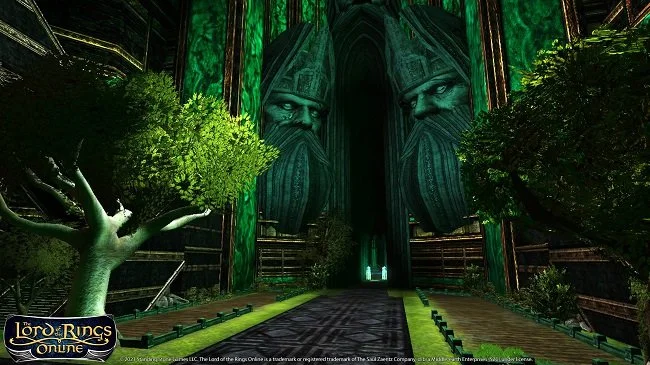
Which brings me on to The Lord of the Rings Online. A game with a plethora of barter currencies and unique monetary systems. Since 2017 and the release of the Mordor expansion, the game has had a bespoke currency that has been exclusively used for the provision of endgame gear. Five years on and this system has been overhauled several times and replaced with a new tier due to increases in the games level cap. At present Embers are the premium currency. This can be used to obtain level 140 gear, jewellery and essences. Motes are an older currency which can be used to obtain gear, jewellery and essences between levels 20 and 130. Figments of Splendour are the lowest tier of these currencies and iare mainly used to obtain cosmetic items, housing items and pets.
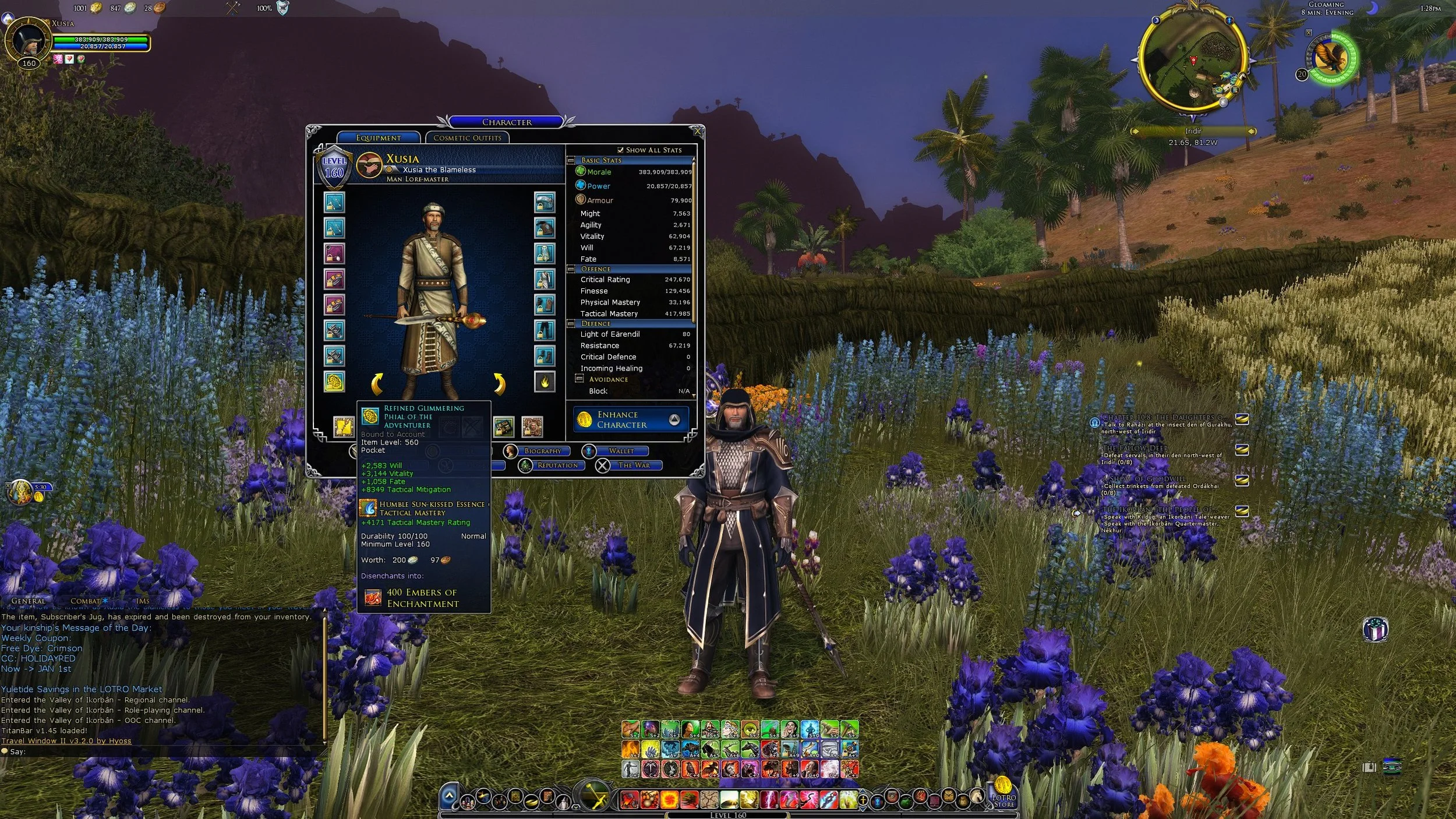
For many LOTRO players, Embers are the most important of these three currencies as they can be used to obtain very good gear. Effectively gear bought with Embers is the next best thing to that gained from raiding. When my primary character reached the new level cap recently, I replaced all their armour, jewellery and essences with gear bought with Embers. It is important to point out that Embers are obtained either by playing endgame content or by opening Adventurer's Steel-bound Lootbox. You have to buy Black Steel Keys to do so. Keys are paid for with LOTRO points. LOTRO points cost real money. It is also worth noting that items that are purchased with Embers can be deconstructed. If a lootbox gives an item you do not require or like, it can be “disenchanted” back into Embers. Hence Embers are an important part of Standing Stones Games ongoing monetisation of LOTRO.
Today, SSG announced that there will be changes coming to Embers, Motes and Figments currencies in Update 32, which is scheduled for February. Changes that SSG claim are designed “to clarify the value of each currency, better control their distribution, and improve the overall player experience when it comes to acquiring and spending these currencies”. Here is the short version of the proposed changes, specifically those associated with Embers of Enchantment, to give them their full title. If you want to read the more detailed account please click on the following link.
Embers continue to be our cap level currency used to barter for cap level gear.
The only gear in-game that will disenchant into Embers will come from Adventurer's (level cap) Lootboxes.
Embers will no longer barter into either Figments of Splendour or Motes of Enchantment.
In Update 32 and other large item level jumps we will version all existing Embers of Enchantment in your wallet into Motes of Enchantment. Any gear that could previously be acquired with Embers will also change to require Motes at the same time.
The Embers of Enchantment cap is being increased to 100,000 with Update 32.
According to LOTRO Producer Oleg Brodskiy (AKA Raninia), these changes are because of the imbalance between players undertaking level cap content that drops high end gear and those playing older, easier content, to obtain items that are disenchanted into Embers, that they then use to purchase level cap gear. However, as many LOTRO players have pointed out, the biggest obstacle for running top tier, endgame content, is the prohibitive time specific weekly lock. Ultimately both of these problems are of SSG own making and they are now trying to correct them by implementing a further flawed solution. Downgrading a player’s store of Embers, whenever there’s a level cap or gear change is a mistake. Taking away anything that a player has paid for is bad for business. Sadly, many of the problems and PR disasters that SSG have faced over the last five years have been of their own making. There is of course the chance that this isn’t a mistake but an intentional decision driven by a desire to increase monetisation. Whatever the reason, this decision is not going to be well received.
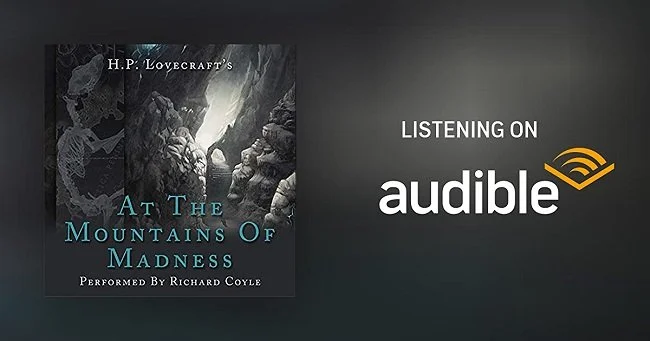
At the Mountains of Madness by H.P. Lovecraft - Read by Richard Coyle
At the Mountains of Madness is a story told from a first-person perspective by geologist William Dyer, a professor from Miskatonic University in Arkham, a fictional town in Essex County, Massachusetts USA. When a new scientific expedition to Antarctica is announced, Dyer breaks his silence and discloses hitherto unknown and closely kept secrets about his own explorations of the continent and exactly what befell his own expedition. He details how his team found the preserved remains of 14 prehistoric life forms unknown to science and outside of the existing geological and evolutionary timescale. He goes on to recount how some of the men and sled dogs are killed under mysterious circumstances. Dyer and graduate student Danforth, subsequently explored a mountain range by plane and discovered a vast, abandoned stone city, which is alien to any form of human architecture. What is the secret of this ancient ruin? Can Dyer convince subsequent explorers to stay clear of “the mountains of madness”.
At the Mountains of Madness is a story told from a first-person perspective by geologist William Dyer, a professor from Miskatonic University in Arkham, a fictional town in Essex County, Massachusetts USA. When a new scientific expedition to Antarctica is announced, Dyer breaks his silence and discloses hitherto unknown and closely kept secrets about his own explorations of the continent and exactly what befell his own expedition. He details how his team found the preserved remains of 14 prehistoric life forms unknown to science and outside of the existing geological and evolutionary timescale. He goes on to recount how some of the men and sled dogs are killed under mysterious circumstances. Dyer and graduate student Danforth, subsequently explored a mountain range by plane and discovered a vast, abandoned stone city, which is alien to any form of human architecture. What is the secret of this ancient ruin? Can Dyer convince subsequent explorers to stay clear of “the mountains of madness”.
At the Mountains of Madness was written by H.P. Lovecraft in 1931. The novella was originally serialised in Astounding Stories magazine in the US. While considered by fans to be an integral part of the Cthulhu Mythos some critics have argued that the author was attempting to “demythologise” his earlier work. I do not hold with this school of thought but I do consider the novella to be one of the author’s best works. It has a cosmic scope of vision and its sinister tone hints at so much more than the immediate horror. At the Mountains of Madness has proven so popular there have been several aborted attempts to bring it to the silver screen, with names such as Steven Spielberg and Guillermo Del Toro associated with the production. In the meantime the 2010 adaptation by Ladbroke Radio productions for BBC Radio 4 Extra, offers a superb five part dramatisation.
Read by actor Richard Coyle and accompanied with ambient music and sound effects, this concise audio version of the novella is a brooding and atmospheric affair. Purists should note that this is an abridged adaptation but the story does not suffer in any way by having some of the descriptive fat paired away. As for Richard Coyle his narration is authoritative and emotive. His dramatic range is extensive and he breathes life into the descriptions of the Cyclopean ruins. He clearly conveys the confusion and fear that Dyer feels as he explores the hidden city. This is a concise and well paced adaptation that breaks the story into five parts, with each episode running approximately 33 minutes. It is a very accessible version of Lovecraft’s classic tale and a great point of entry into the Cthulhu Mythos for those who are unfamiliar with it. At the Mountains of Madness is currently available on Audible.
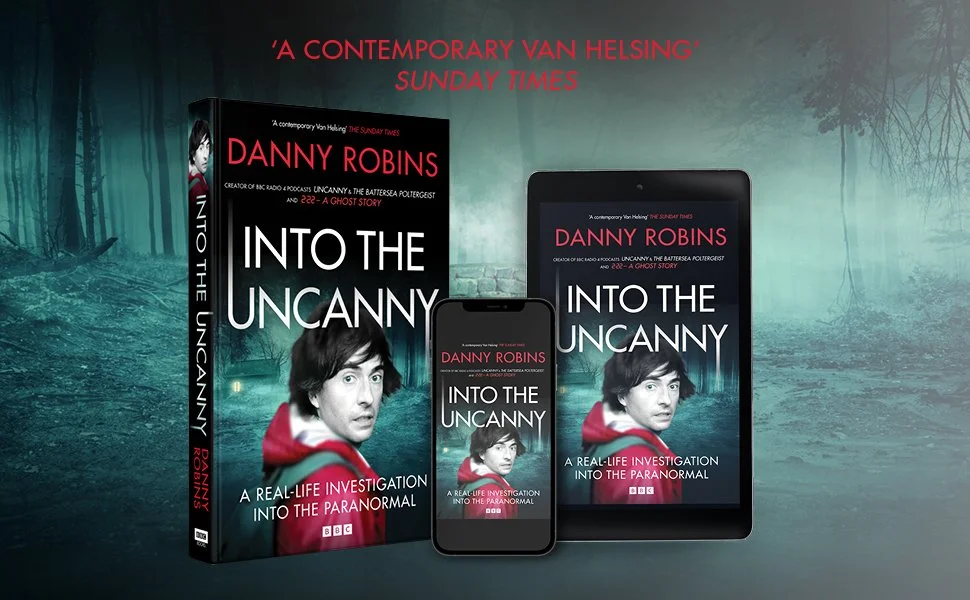
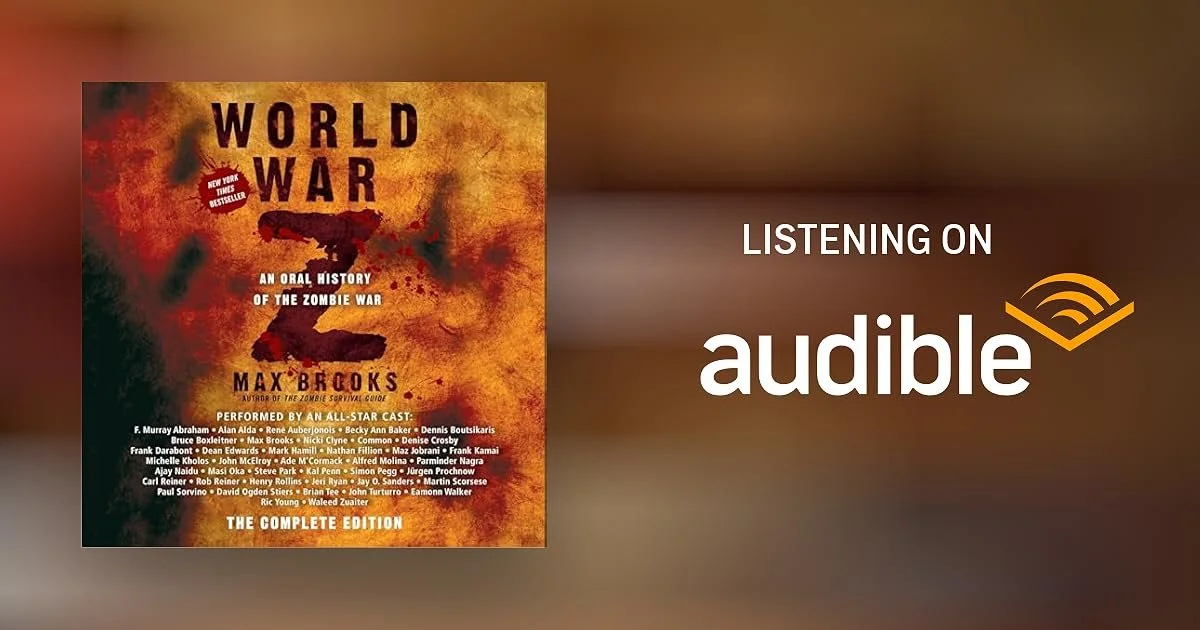
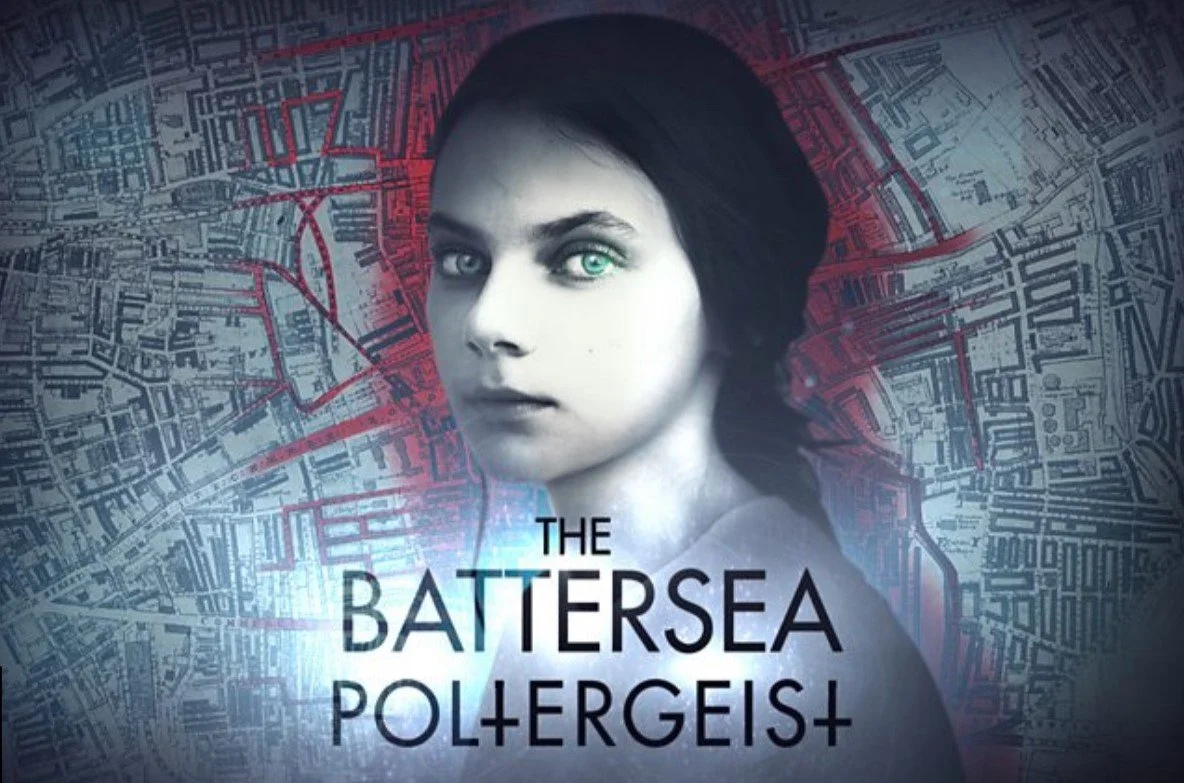



Diary of a Podcaster Part 18
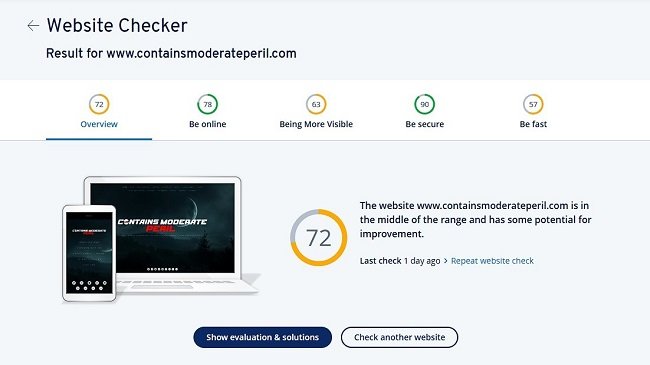
I recently decided I’d had enough of the endless deliberation and procrastination and so I started producing a weekly podcast again. As of today the second episode of Season 10 of the Contains Moderate Peril podcast is available on all major platforms. I must admit, although I was confident that a few people would listen to the show, I was completely taken aback by the overall reaction. The Contains Moderate Peril podcast was warmly welcomed back by previous listeners on social media and the statistics for the first show have been most positive. For myself and Brian, recording the show is like putting on a comfortable pair of shoes. Last night’s recording went okay and I think after a few more episodes, the recording and editing process will be an efficient process. Keeping each episode to an hour or under means that the conversation stays on point.
I recently decided I’d had enough of the endless deliberation and procrastination and so I started producing a weekly podcast again. As of today the second episode of Season 10 of the Contains Moderate Peril podcast is available on all major platforms. I must admit, although I was confident that a few people would listen to the show, I was completely taken aback by the overall reaction. The Contains Moderate Peril podcast was warmly welcomed back by previous listeners on social media and the statistics for the first show have been most positive. For myself and Brian, recording the show is like putting on a comfortable pair of shoes. Last night’s recording went okay and I think after a few more episodes, the recording and editing process will be an efficient process. Keeping each episode to an hour or under means that the conversation stays on point.
Previously, I have used third party hosting sites such as Podbean and SoundCloud to manage both the Contains Moderate Peril and the Burton and Scrooge podcasts. Although these were paid services they come with many benefits. The most beneficial is the convenient provision of an RSS feed. As I now host the podcast on Squarespace I’ve had to use a third party service to create an alternative. I managed to use Feedburner to create this a few years ago when I reposted some old episodes but as of July 2021, the service has gone into maintenance mode. Luckily, it still provides its basic functionality, so yesterday I submitted the RSS feed to several podcast aggregation sites. As of today, I am pleased to announce that Contains Moderate Peril is available on Apple Podcasts, Stitcher, Amazon Music, Google Podcasts and Spotify. If you wish to subscribe just search for “CMP Podcast” via whatever podcast client you use.
At present I am using Craig to record directly from Discord. Being a free service it has many positive attributes, the price being an important one. However, because it uses Discord as a recording source, the sound quality is subject to the whims and caprices of Discords compression software and bandwidth. I’m not sure if I am entirely happy with the sound quality of the finished podcast, at present. I may do some experimentation with other podcast recording services such as Zencastr. Perhaps using Zoom as a platform and then extracting the audio afterwards is a viable alternative? I recently bought Bandicam and Bandicut so I have the requisite tools for the job. Perhaps Zoom is the way to go as it means as well as an audio version, I can post a video edition of the show to YouTube. It’s worth consideration. I also need some sort of means to track the podcast statistics as the facilities that Squarespace offer are very basic.
Next Sunday 16th January, Brian and I will be recording the next episode of the Contains Moderate Peril podcast. We’ve decided to take a break from some of the more weighty discussions that we usually have and to do an AMA (ask me anything) themed show. So if there’s a question you’d like to ask either of us please get in touch. We’re happy to address most enquiries as long as they’re within the confines of the law and public decency. Please feel free to submit your enquiries to the show via the contact page of the Contains Moderate Peril website and make sure you write AMA or “ask me anything” in the subject field. In return we’ll happily give you a shout out. If you have a blog, live stream or such like we’ll be pleased to mention it. Thank you in advance for your support and interesting questions. The next episode of the Contains Moderate Peril podcast will be available on Monday 17th January.

















LOTRO: The Producer’s Letter is Now Quarterly
On the 31st December 2021 (nine days ago), Oleg Brodskiy (AKA Raninia) posted his latest Producer’s Letter for the MMORPG The Lord of the Rings Online. As ever, it wasn’t exactly promoted with any enthusiasm, being mentioned just once by the official LOTRO Twitter account. So I only discovered it yesterday when it was referenced by Justin Olivetti in a post over at Massively Overpowered. The letter mentions broadly what is coming to the game in the not too distant future. No one was surprised by what’s on offer as much has already been alluded to or openly discussed over the course of last year. A new raid, housing in Erebor, the new Legendary Item reward track and a new zone in Southern Trollshaw; the Angle of Mitheithel which has level 40 to 45 content. However, one important change is that the Producer’s Letter is now to be a quarterly publication.
On the 31st December 2021 (nine days ago), Oleg Brodskiy (AKA Raninia) posted his latest Producer’s Letter for the MMORPG The Lord of the Rings Online. As ever, it wasn’t exactly promoted with any enthusiasm, being mentioned just once by the official LOTRO Twitter account. So I only discovered it yesterday when it was referenced by Justin Olivetti in a post over at Massively Overpowered. The letter mentions broadly what is coming to the game in the not too distant future. No one was surprised by what’s on offer as much has already been alluded to or openly discussed over the course of last year. A new raid, housing in Erebor, the new Legendary Item reward track and a new zone in Southern Trollshaw; the Angle of Mitheithel which has level 40 to 45 content. However, one important change is that the Producer’s Letter is now to be a quarterly publication.
At first glance, publishing a quarterly Producer’s Letter is a great way to address the long term criticism that Standing Stone Games doesn’t handle its communication and community relationships very well. Posting a news missive every three months provides a vehicle for appraising players of forthcoming changes and an opportunity to address their concerns. It is more immediate than the previous yearly approach and highlights the ongoing work that the development team at SSG are doing. No doubt players will welcome this change. However, it can be argued that by following a quarterly press release schedule, longer term “goals” will not be discussed as they have been in previous yearly roadmaps. A more concise form of PR focused on three months periods is a more controlled form of PR. Many of the points that were raised by Raninia last July in the “delayed” yearly Producer’s Letter remain outstanding. Does the new schedule mean that they’ll be conveniently forgotten?
It should be noted that among the various content announcements mentioned in the latest producer’s Letter, there are still a few references to ongoing long term goals. Class rebalancing is one, although I can understand why SSG would wish to defer this for as long as possible because it really is a poison chalice. Class rebalances divide players and are seldom well received. More importantly, the letter specifically mentions lag which continues to plague the game. Currently new zones such as Gundabad suffer a lot of lag due to the numbers of players in the zone. However, lag still exists in both old and new content. Rohan and Minas Tirith are still areas with major stuttering and hitching. Plus missions are subject to lag both while playing and when trying to communicate with the associated NPC, afterwards. If this could be fixed, I’d happily take that as a 15th anniversary gift.
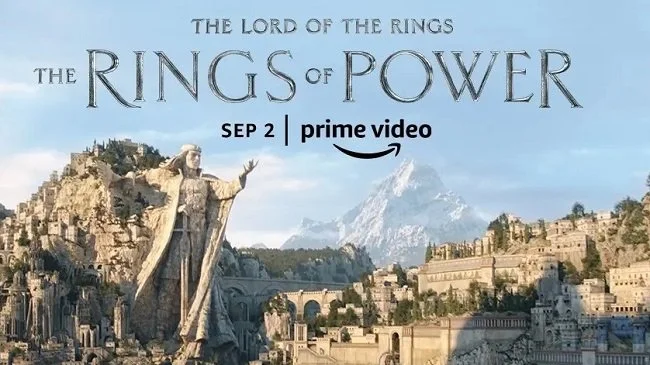
Another year on and I’m still very curious about the future of LOTRO. Comments left on a previous post that I wrote, by an informed source, has made me very sceptical about the likelihood of a console port anytime soon. It sounds to me as if the entire game would need to be re-written. In theory that would mean creating both a new PC and console version running on some contemporary game engine. Such an undertaking would be costly and time consuming. EG7 have indicated that they hope that the media attention generated by Amazon’s forthcoming Middle-earth TV show will translate into interest for LOTRO. As the show is due for release in Q4 2022, they will need to be prompt in delivering a product suitable for the tastes and needs of a modern gaming audience. I suspect that none of this will happen and that LOTRO as we know it, warts and all, will be all that greets potential new players. Looks like 2022 is going to be another year of watching and waiting. Hope can be a finite commodity.
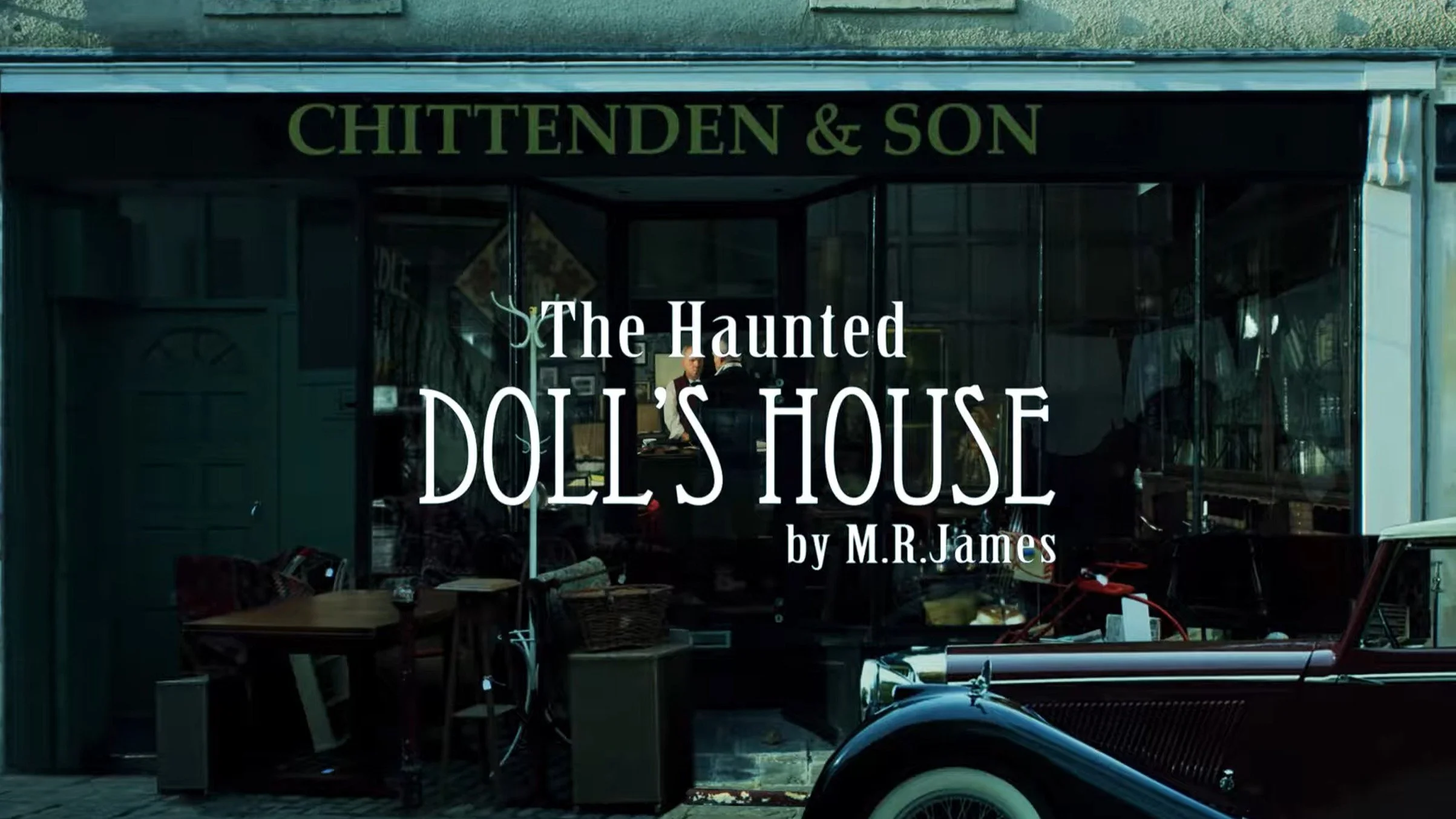
The Mezzotint (2021)
In 1922, middle-aged University Don Edward Williams (Rory Kinnear), is sent a somewhat “indifferent” mezzotint (a monochrome print made from an engraved copper or steel plate) on approval from one of his regular art dealers. On arrival the mezzotint features an unidentified English country house and has no distinguishing features to merit its price. Later that day, Williams shows the print to Binks (John Hopkins), a colleague he plays golf with. He comments that the moonlight is quite well done and there appears to be a figure just on the right of the image. Williams is puzzled that he hadn’t noticed it before. That evening Garwood (Robert Bathurst), a fellow academic, studies the picture and comments on a “grotesque” figure. When Williams checks again before going to bed there is now clearly a shroud covered shape crawling across the lawn in the mezzotint. Williams confers with his friends as to what they have seen, as it becomes clear that the picture is trying to show them something.
In 1922, middle-aged University Don Edward Williams (Rory Kinnear), is sent a somewhat “indifferent” mezzotint (a monochrome print made from an engraved copper or steel plate) on approval from one of his regular art dealers. On arrival the mezzotint features an unidentified English country house and has no distinguishing features to merit its price. Later that day, Williams shows the print to Binks (John Hopkins), a colleague he plays golf with. He comments that the moonlight is quite well done and there appears to be a figure just on the right of the image. Williams is puzzled that he hadn’t noticed it before. That evening Garwood (Robert Bathurst), a fellow academic, studies the picture and comments on a “grotesque” figure. When Williams checks again before going to bed there is now clearly a shroud covered shape crawling across the lawn in the mezzotint. Williams confers with his friends as to what they have seen, as it becomes clear that the picture is trying to show them something.
The Mezzotint is part of the A Ghost Story for Christmas series of short television films, produced by the BBC somewhat intermittently since 1971. More recently, writer, director and actor Mark Gatiss has resurrected this franchise and produced several adaptations of short stories by the great M. R. James. The Mezzotint is his latest production and was broadcast on Christmas Eve 2021. Running for just 30 minutes Gatiss builds an unsettling atmosphere as the story progresses.The changes that take place in the print are not dwelt upon onscreen but instead he focuses upon the impression they make on those who are looking. Rory Kinnear excels as the befuddled bachelor who begins to feel a sense of impending doom. There is also a strong cameo appearance by Frances Barber as Mrs. Ambrigail, an amateur historian. Scottish composer Blair Mowat provides a succinct and creepy score which adds to the overall ambience.
The original short story is set in 1904 and takes place mainly in the rooms of the various protagonists at the University. Although it is a sinister tale, it lacks a suitably strong ending, hence Mark Gatiss has chosen to expand the storyline. The drama is now set in 1922 and the staff of the University are debating whether to allow women students to study for degrees. To make the story a little less male-centric some characters have been changed to women; a University Porter becomes a Housekeeper. The most significant addition to the story is a subplot regarding William’s ongoing investigations into his family tree. Hence Mrs. Ambrigail, the Vicar’s wife, searches through the various parish records. This thread has a major impact upon the climax of The Mezzotint which in this adaptation ends with a substantial “Jamesian wallop” (the unofficial term for a shock or surprise twist in the stories of M. R. James).
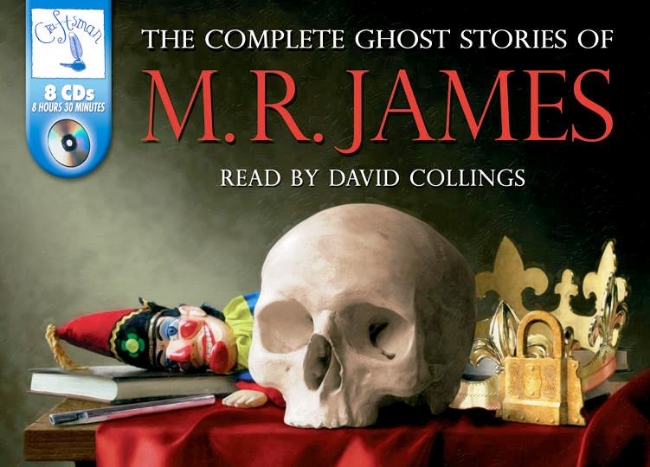
Some purists have balked at the embellishments and changes that have been made to this adaptation. If you’re of a similar mind, then you may be better off listening to an audiobook version of the original short story. There is a very good collection read by David Collings available. However, I am of the view that the story requires expanding to lend itself to the requirements of television and I feel that the widening of the plot and additional ending are to the drama’s overall benefit. Mark Gatiss is clearly a consummate fan of M. R. James and I feel his screenplay is very sympathetic to the source text. As for the “Jamesian wallop” at the story’s denouement, I believe this is consistent with the author’s style which often featured a grotesque and eldritch flourish at the end of a story. I hope that the BBC has the good sense to commission further adaptations from Mark Gatiss so that the A Ghost Story for Christmas series can continue.









Wordle
Over the Christmas holidays, I started noticing lots of people posting images of some sort of grid composed of coloured squares in my Twitter timeline. Then the hashtag #wordle provided a name and it became apparent that all this activity was to do with some sort of game. Eventually my curiosity got the better of me and I did a Google search and discovered the exact nature of Wordle. The game was originally created by software engineer Josh Wardle for his partner, Palak Shah. Family and friends played the game and it proved popular. So Wardle then decided to make it available online, last October. By November 90 people were playing Wordle. However, after a share online button was added to the game the audience rapidly grew. As of 2nd January it had over 300,000 players with several high profile celebrities among that number.
Over the Christmas holidays, I started noticing lots of people posting images of some sort of grid composed of coloured squares in my Twitter timeline. Then the hashtag #wordle provided a name and it became apparent that all this activity was to do with some sort of game. Eventually my curiosity got the better of me and I did a Google search and discovered the exact nature of Wordle. The game was originally created by software engineer Josh Wardle for his partner, Palak Shah. Family and friends played the game and it proved popular. So Wardle then decided to make it available online, last October. By November 90 people were playing Wordle. However, after a share online button was added to the game the audience rapidly grew. As of 2nd January it had over 300,000 players with several high profile celebrities among that number.
The game involves trying to guess a five-letter word each day. The player has six attempts available. Each time you make a guess, it will show if the letter you used was correct and in the right space, correct but in the wrong space, or not in the word at all. Wordle uses a colour code system to show players their respective success or failure, with letters turning green if they’re in the right space or yellow if they’re in the wrong space. There is only one word available each day and the word is the same for everyone playing. Players can share their results with each other. There is also a hard mode for players who want an extra challenge, forcing them to use the letter hints given by the game in subsequent guesses and restricting what they can guess next.
I am not an active player of Wordle. I gave it a go while researching this post and decided it’s not for me, which is odd for someone who likes words and language. However, that’s not to say it’s appeal and charm is lost upon me. I can understand why a game such as this gains traction with people. There is no bar to entry, no cost and the game’s rules are straightforward and unambiguous. The game is also educational and an opportunity to expand one’s vocabulary. Plus every player is guessing the same word each day, which adds a sense of a shared experience. Posting on social media means that people can swap scores and engage with each other about the game. It is this social element that has undoubtedly contributed to the games success. It’s traction on social media has attracted a lot of press attention. Josh Wardle was recently interviewed on BBC Radio 4's Today programme, which is a prestigious UK news vehicle.
My interest in Wordle stems from what Josh Wardle said during the course of his BBC interview on Wednesday 5th January. Especially in light of the triple A video game industries current infatuation with NFTs and blockchain technology; their latest monetisation fetish. “I don't understand why something can't just be fun. I don't have to charge people money for this and ideally would like to keep it that way. Wordle is very simple and you can play it in three minutes, and that is all you get. There are also no ads and I am not doing anything with your data, and that is also quite deliberate”. Wordle currently exists as a web based game. When asked regarding a mobile app version, he stated “I am a bit suspicious of mobile apps that demand your attention and send you push notifications to get more of your attention. I like the idea of doing the opposite of that; what about a game that deliberately doesn't want much of your attention”.
I wonder what Yosuke Matsuda, the President of Square Enix, would make of Josh Wardle’s philosophy? Matsuda stated recently in a corporate press release that "goodwill” and "volunteer spirit” were "inconsistent personal feelings” and essentially looked down upon them as they were difficult to monetise. I think what Josh Wardle’s comments highlight is the intrinsic difference in mindset between those who personally create art and those third parties who see it purely as a means to profit. Reflecting upon both positions, I know which one I feel most well disposed towards and which one I will afford a degree of goodwill. I believe that there is a valuable insight to be gained here as well as an important life lesson. However, I suspect that one party is too busy counting their money to learn either of them.
Resident Evil: Welcome to Raccoon City (2021)
I have seen 2 of the 6 films in the Resident Evil cinematic franchise. Beyond the actor Colin Salmon getting diced into cubes by some laser grid, I cannot recollect anything specific about those movies. That is how much of an impression they made upon me. My interest in the first film came from George A. Romero’s initial association with the production. However, when he left the project my attention waned. I eventually saw Resident Evil (2002) when it was released to the home media market and that was the end of the matter. It was an adequate, quick fix of entertainment and nothing more. As I had no major association with the video game franchise beyond playing Resident Evil: Code Veronica on the Dreamcast, I subsequently didn’t keep up with the subsequent movie beyond the first sequel. However, the franchise went on to gross $1.25 billion at the box office over the next 14 years.
I have seen 2 of the 6 films in the Resident Evil cinematic franchise. Beyond the actor Colin Salmon getting diced into cubes by some laser grid, I cannot recollect anything specific about those movies. That is how much of an impression they made upon me. My interest in the first film came from George A. Romero’s initial association with the production. However, when he left the project my attention waned. I eventually saw Resident Evil (2002) when it was released to the home media market and that was the end of the matter. It was an adequate, quick fix of entertainment and nothing more. As I had no major association with the video game franchise beyond playing Resident Evil: Code Veronica on the Dreamcast, I subsequently didn’t keep up with the subsequent movie beyond the first sequel. However, the franchise went on to gross $1.25 billion at the box office over the next 14 years.
So it comes as no surprise that after a gap of 5 years that the film series has now been rebooted with Resident Evil: Welcome to Raccoon City. I’m sure that the success of new video games as well as remakes of earlier instalments have highlighted to the cinematic rights holders that “there's gold in them thar hills”. Like it’s predecessors Resident Evil: Welcome to Raccoon City is what is broadly termed as a “medium budget” production (between $2 - 80 million). The cast is largely made up of television actors and the majority of the film takes place in building interiors. Despite it’s $25 million production costs Resident Evil: Welcome to Raccoon City does not look cheap. The location photography is suitably convincing and sells the idea of a remote, snowbound industrial town in the midwest American mountains. Compared to earlier films, this reboot seems to draw far more heavily upon the story and the atmosphere of the first two video games. It is this aspect that is the film’s best asset but also its weakness.
In 1998, Claire Redfield (Kaya Scodelario) travels back to her childhood town of Raccoon City, in the mountains of the midwest. She gets a lift from a trucker who subsequently runs over a woman who appears to just step out into the road. When the pair get out to investigate, the body mysteriously vanishes leaving only a pool of blood. On arrival in Raccoon City, Claire visits her estranged brother Chris (Robbie Amell), a cop in the RPD. The police department consists of a skeleton crew as the town is being closed by its owners, the Umbrella Corporation, who are relocating their business interests elsewhere. It is not long until police officers go missing and the town inhabitants start exhibiting signs of a dangerous contagion. Claire soon discovers that Dr. William Birkin (Neal McDonough), a sinister physician from the orphanage in which she was raised, is involved in secret experiments on behalf of the Umbrella Corporation.
Movies based upon video game franchises do not have the most impressive track record with regard to being creative and innovative cinematic endeavours. My expectations for Resident Evil: Welcome to Raccoon City were very low. However, upon viewing I found the film to be satisfactory. I know this sounds very much like damning with faint praise but this is a perfectly adequate horror movie which offers an acceptable experience for those unfamiliar with the source material, as well as a reasonable interpretation of the first two games in the series. There are some clever references such as a scene where Chris is in a darkened room trying to illuminate it with a faulty zippo lighter. Each time it briefly lights it shows zombies getting closer. As the story takes place in the nineties there are some nice pop culture references such as data being held on a PalmPilot. Cinematographer, Maxime Alexandre, lights the proceedings in the style of Mario Bava. Johannes Roberts directs with enthusiasm.
To put things in perspective when I say adequate, I mean moderately entertaining. Resident Evil: Welcome to Raccoon City does not reinvent the wheel in any way, shape or form. Characters are painted with broad strokes and some function purely as Redshirts. Performances are okay but this is not really a film driven by acting prowess but by action set pieces and gore. The latter is present and sufficiently entertaining. Although there are CGI bullet hits and blood spray, there are also some quite good physical effects. As I previously mentioned the story focuses upon the claustrophobic elements of the video games and has a very straightforward narrative arc. Hence the story is somewhat simplistic. It may give those familiar with Resident Evil what they want but casual viewers only get a fairly basic linear story. However, it provides enough action and gore to suffice along with a modicum of wit and style. There are far worse horror films to invest your time in.
Ghostbusters: Afterlife (2021)
Broke and down on her luck, Callie Spengler along with her two children Phoebe and Trevor, inherit a farm owned by her estranged Father, Egon Spengler. Earth tremors and other unexplained incidents subsequently occur and Phoebe soon discovers her family heritage. That is the plot of Ghostbusters: Afterlife in a nutshell. If you are looking for innovation and a new take on the existing lore then you will be disappointed. This film is the embodiment of a fan service and a concerted attempt to repurpose an older franchise for a new generation. Ghostbusters: Afterlife is heavily invested in paying tribute to the original 1984 film. Rather than just make a few subtle references to the source material, director Jason Reitman bludgeons the audience with a continuous barrage of recreations of set pieces, callbacks and homages. After the first ten minutes it is quite clear what is on offer and it does at times become a little wearing. It’s a bit like watching a very good quality tribute band. But if this is what you want then you’ll be rewarded in spades.
Broke and down on her luck, Callie Spengler along with her two children Phoebe and Trevor, inherit a farm owned by her estranged Father, Egon Spengler. Earth tremors and other unexplained incidents subsequently occur and Phoebe soon discovers her family heritage. That is the plot of Ghostbusters: Afterlife in a nutshell. If you are looking for innovation and a new take on the existing lore then you will be disappointed. This film is the embodiment of a fan service and a concerted attempt to repurpose an older franchise for a new generation. Ghostbusters: Afterlife is heavily invested in paying tribute to the original 1984 film. Rather than just make a few subtle references to the source material, director Jason Reitman bludgeons the audience with a continuous barrage of recreations of set pieces, callbacks and homages. After the first ten minutes it is quite clear what is on offer and it does at times become a little wearing. It’s a bit like watching a very good quality tribute band. But if this is what you want then you’ll be rewarded in spades.
As you would expect from a tent-pole movie such as Ghostbusters: Afterlife, the production values are very high and the visual effects exemplary. Despite using modern CGI and animatronics, the look and feel of the proton packs, ghost traps and supernatural beasts is very authentic. Muncher, a new variant on Slimer, is clearly in the same idiom and an enjoyable variant. For me, the best aspect of this two hour fan service was composer Rob Simonsen’s loving recreation and adaptation of Elmer Bernstein classic score. Bernstein’s son Peter acted as consultant, providing guidance on the orchestration. Simonsen even includes a ondes martenot throughout the score, played by Cynthia Millar, who also played the same instrument on Bernstein's 1984 Ghostbusters score. Seldom does an iconic film soundtrack get so lovingly reinterpreted.
Any film centred on a cast of young or teenage actors is always taking a calculated risk as far it’s a difficult thing to get right. A few directors such as the great Joe Dante (Gremlins, Explorers and The Hole) have an inherent ability to portray young people authentically. Not everyone else fairs so well. However, in the case of Ghostbusters: Afterlife, Phoebe Spengler (Mckenna Grace) carries the film. She is charming, funny and her burgeoning friendship with fellow nerd and social outcast, Podcast (Logan Kim) is quite droll. The teenage romance between her brother Trevor (Finn Wolfhard) and “carhop” Lucky Domingo (Celeste O'Connor ) is not so endearing, being somewhat contrived and formulaic. The ageless Paul Rudd does compensate by providing some amusing leftfield comic relief as Gary Grooberson; Phoebe and Podcast's summer school science teacher.
For many viewers the main attraction of Ghostbusters: Afterlife is the appearance of the original actors. They are together on screen for approximately 10 minutes at the climax of the film. Dan Ackroyd, Bill Murray and Ernie Hudson each get a small scene to themselves during the course of the film. Ray Stanz speaks to Phoebe on the phone as a means to expedite the story. Peter Venkman has a mid-credit scene with Dana Barrett (Sigourney Weaver) and Winston Zeddemore (Ernie Hudson) has a rather portentous post credit scene which heavily implies an immediate sequel or at least further entries in the series. Some may balk at the brevity of these vignettes but I personally found them very enjoyable. However, considering the respective age of all concerned, this was a prudent decision as an entire movie based upon their geriatric antics would have strained credibility.
Is Ghostbusters: Afterlife entertaining? Yes, I liked the majority of the film and the story did pick up after the first 30 minutes. I suspect that some content may have been removed to bring the running time down to manageable 2 hours. The town Summerville is conspicuously empty at the film’s denouement and the missing population is not explained. The humour is dry and at times surprisingly adult but the original 1984 film had a similar tone. However, I did find myself being continuously pulled out of my sense of immersion due to the hamfisted barrage of references to the source material. Fans are sometimes too close to that which they love and can lose their sense of objectivity. I certainly think that is the case here. Hence, be aware of this before watching Ghostbusters: Afterlife so you can adjust your expectations accordingly.

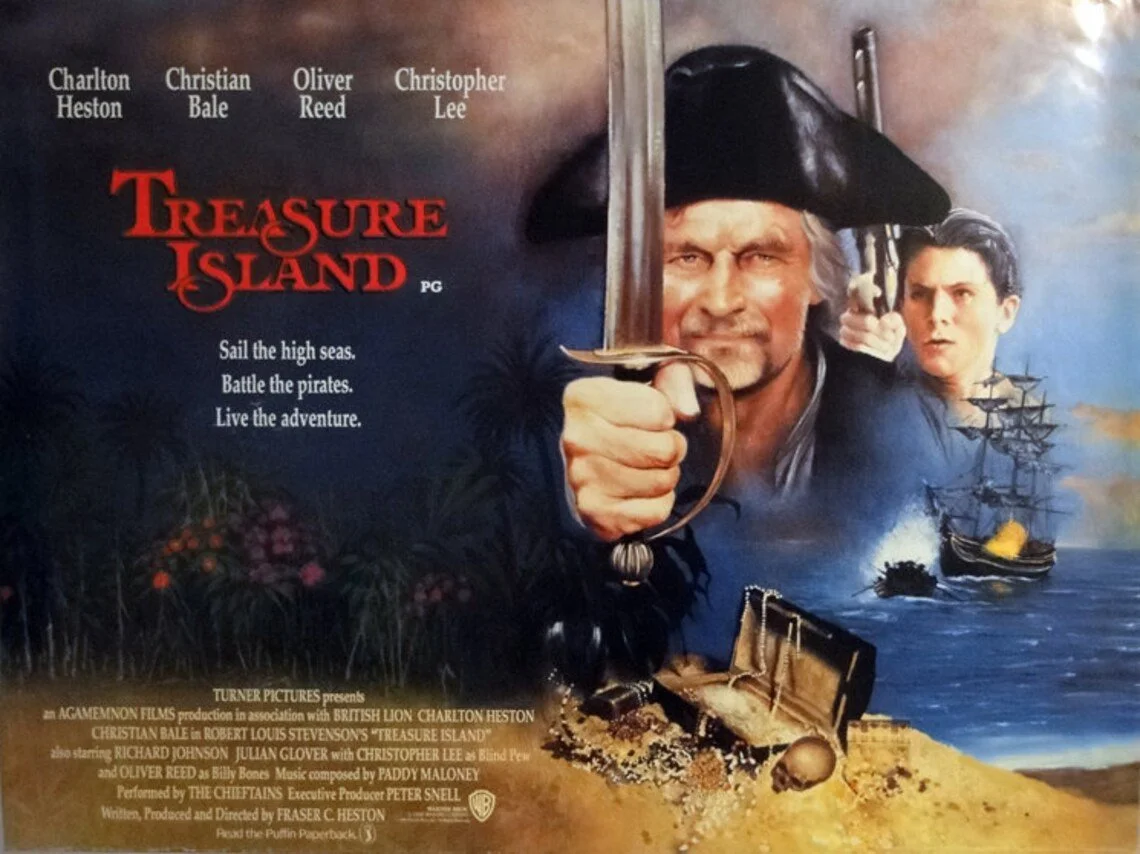
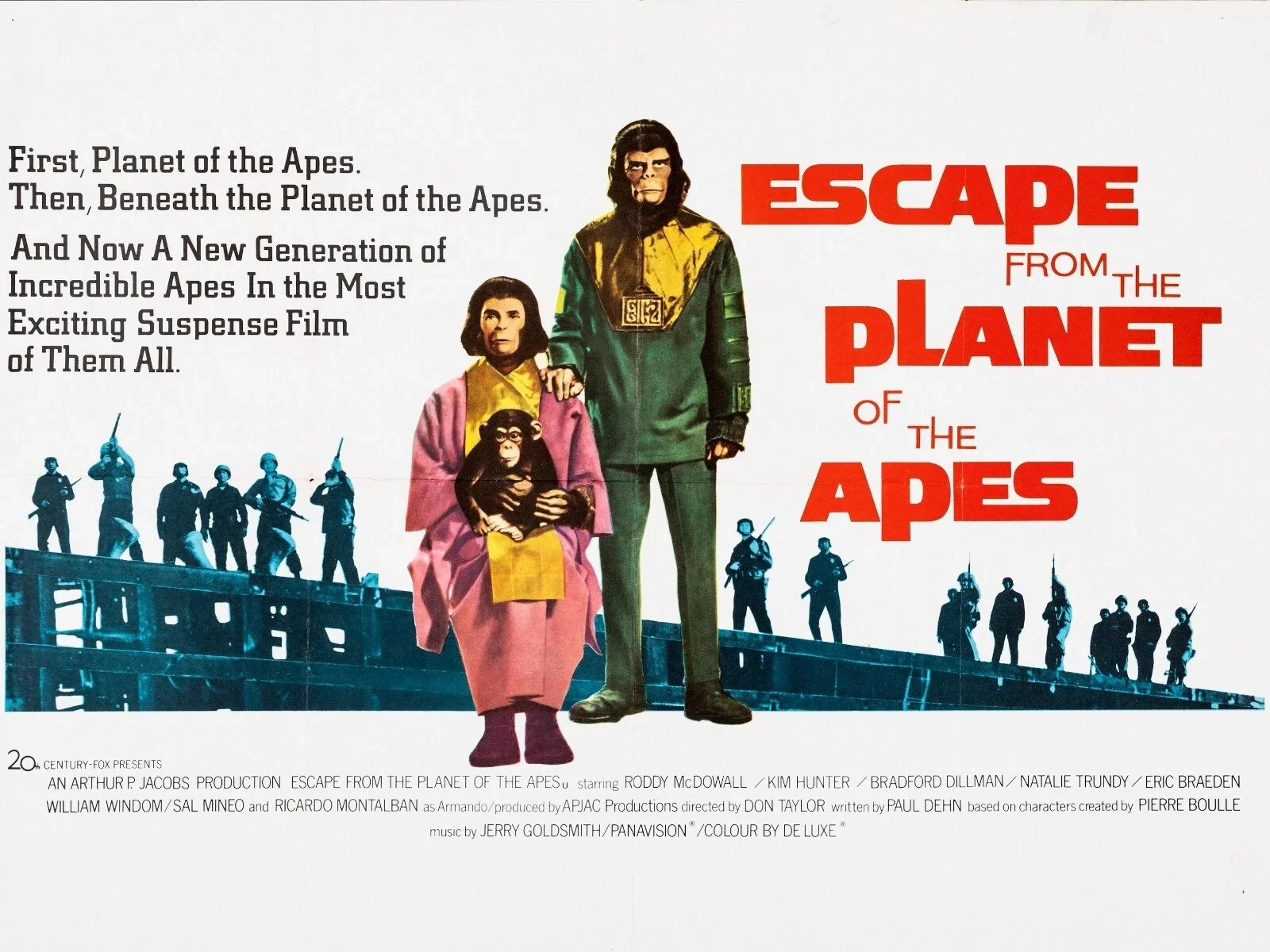
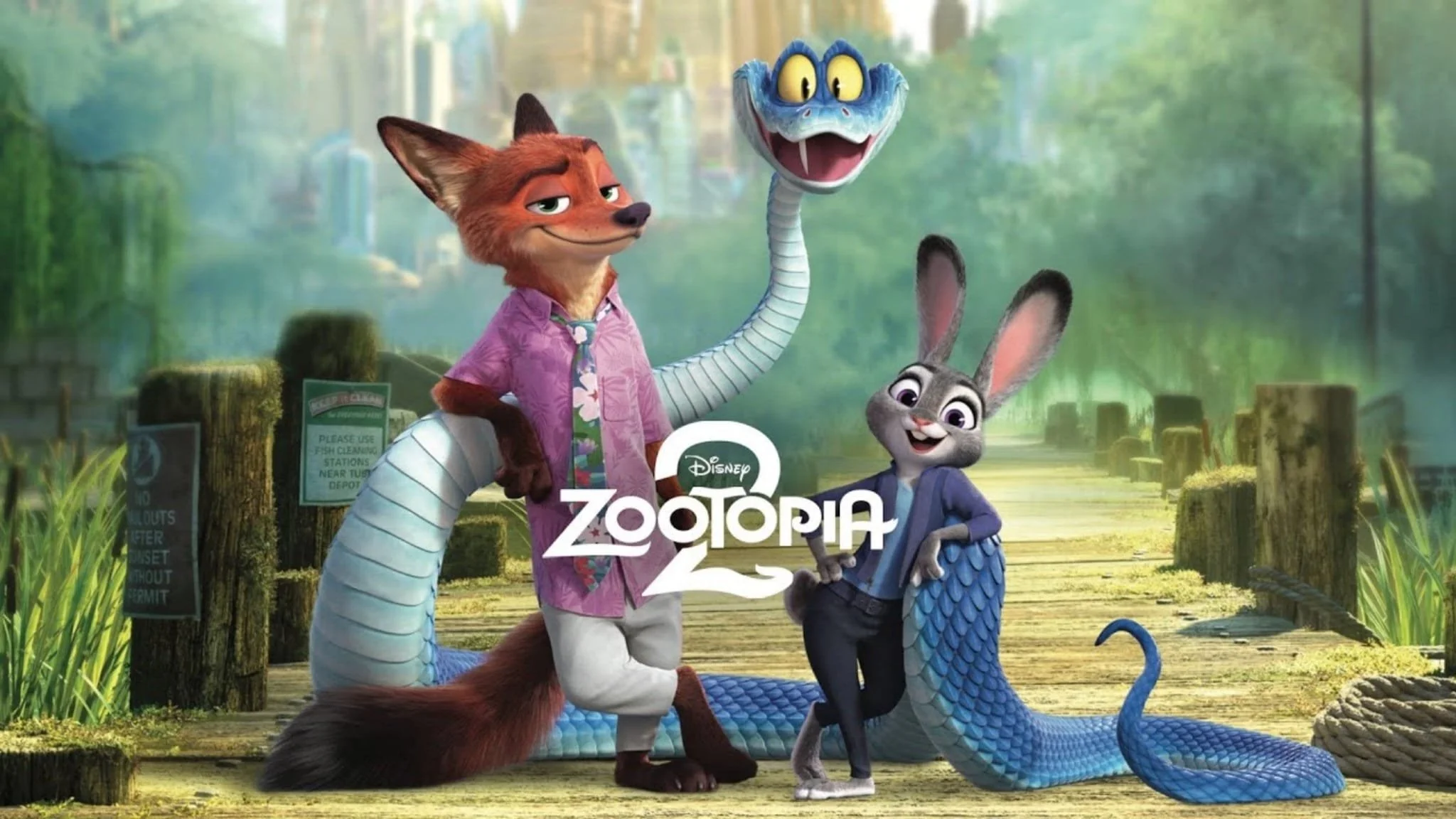
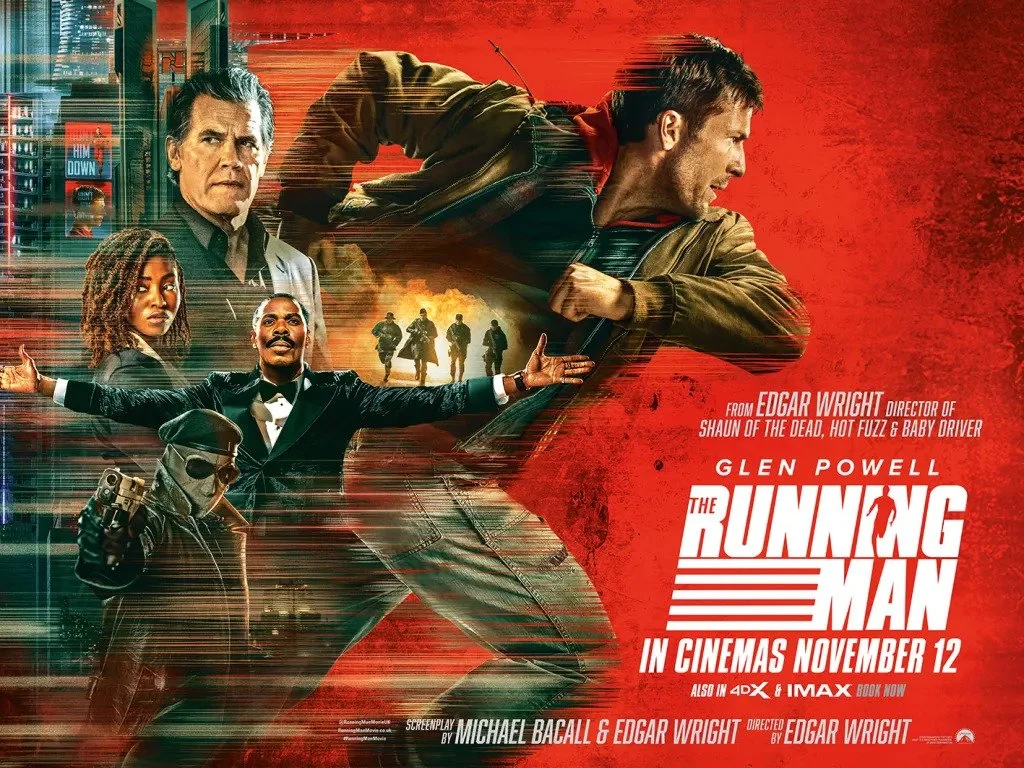



Why Play For Fun When You Can Play to Contribute?
In an open letter released on January 1st 2022, Square Enix president Yosuke Matsuda, presented a roadmap of the company’s intentions for 2022 and beyond. What made this communication so unusual was not so much the commitment to both NFTs (Non-Fungible Tokens) and blockchain which are the current industry wide flavour of the month, but the language employed to describe the established gaming status quo, its business model as well as player motivation. It also was a timely reminder that multi billion dollar corporations ultimately have no interest in anything that they cannot generate revenue from. And again we return to a recurring problem associated with video games culture. Many gamers still do not see themselves as consumers and still erroneously think that developers and publishers are their friends and they have a different kind of relationship with them. Hopefully this letter will help lift the scales from such peoples eyes.
In an open letter released on January 1st 2022, Square Enix president Yosuke Matsuda, presented a roadmap of the company’s intentions for 2022 and beyond. What made this communication so unusual was not so much the commitment to both NFTs (Non-Fungible Tokens) and blockchain which are the current industry wide flavour of the month, but the language employed to describe the established gaming status quo, its business model as well as player motivation. It also was a timely reminder that multi billion dollar corporations ultimately have no interest in anything that they cannot generate revenue from. And again we return to a recurring problem associated with video games culture. Many gamers still do not see themselves as consumers and still erroneously think that developers and publishers are their friends and they have a different kind of relationship with them. Hopefully this letter will help lift the scales from such peoples eyes.
Now it is pertinent to consider that this is a corporate press release and that it was more than likely originally drafted and completed in Japanese. Reading through the English version it is at times a little difficult to parse and fully construe the exact sentiment being expressed. Corporate speak is very similar to political oratory and both are at times intentionally ambiguous and lend themselves to being recanted or “reinterpreted”. That being said, there is sufficient information to be able to determine the overall sentiment of the message. The quote below is especially relevant as it shows quite clearly how Square Enix perceives their customer base and what their mindset is towards them. There is a separate debate to be had about the failings of NFTs and blockchain (and I would recommend that you read Wilhelm Arcturus’ post on this for further insight) but I wish to focus more on the semantics of this statement and what that shows us about the video game industry’s philosophy.
“I realize that some people who “play to have fun” and who currently form the majority of players have voiced their reservations toward these new trends, and understandably so. However, I believe that there will be a certain number of people whose motivation is to “play to contribute,” by which I mean to help make the game more exciting. Traditional gaming has offered no explicit incentive to this latter group of people, who were motivated strictly by such inconsistent personal feelings as goodwill and volunteer spirit. This fact is not unrelated to the limitations of existing UGC (user-generated content). UGC has been brought into being solely because of individuals’ desire for self-expression and not because any explicit incentive existed to reward them for their creative efforts. I see this as one reason that there haven’t been as many major game-changing content that were user-generated as one would expect.”
When Matsuda talks about how some people play games to have “fun” there is a palpable sense of bemusement and possibly even contempt. It’s a very odd position to adopt as it is the foundation upon which the video games industry was built. Like any other business, there is an exchange of goods or services for money. In this case it is a piece of recreational software, designed to elicit amusement, mirth and enjoyment. At present Japanese gamers spend $20 billion a year in the pursuit of fun so it seems a little odd to be averse to it. But video game monetisation trends in recent years clearly show that big business per se is done with one off payments. Free to play, microtransactions, loot boxes, season passes and other live services have spearheaded a drive towards recurring monetisation. Hence, Matsuda now wants more players who “play to contribute”.
Video games have a long history of players contributing both to the games themselves and the communities that grow around them. Player created mods add value, fix long term problems and prolong a games lifespan. Guilds and social groups organise events, as well as play through content that some players would not attempt otherwise. Blogs, live streams and podcasts curate important data associated with games, build and sustain communities and often provide free public relations for the video game industry. Yet according to Matsuda “goodwill” and “volunteer spirit” are inconsistent personal feelings and are therefore unreliable. Clearly the human desire to share, help and support others out of a sense of common good is utterly alien to him. He clearly thinks that socially inclined players need a formal framework to work within. If their “goodwill” and “volunteer spirit” is monetised then it will be more dependable. Let us take a moment to reflect on the utterly bleak mindset that harbours such thoughts.
At first glance it seems illogical to eschew an existing business model that has proven lucrative, to focus on something new and untested. Such a sea change is not necessarily going to happen overnight. Gamers have already rebuffed Ubisoft’s ongoing Ubisoft Quartz project to introduce NFTs to Tom Clancy’s Ghost Recon: Breakpoint. However, I would advise extreme caution in so readily dismissing such rapid change. Again I say take a look at the video games monetisation over the last decade. What is beyond the pale to a 50 something gamer is now just the way it is for a 20 year old. Also, consider the iniquities of the triple A video games industry that were frontpage news in 2021. Despite a very vocal public outcry, has it really harmed the bottom line? For every gamer who is aghast, there are two others that either don’t know or don’t give a shit. The industry knows this. Remember what former President Trump said. “I could stand in the middle of Fifth Avenue and shoot somebody and I wouldn’t lose voters”. The same thing applies here.
So here we are again at a crossroads. Or if not at a crossroads, at least a very clear indication of the direction that the video games industry wants to take. Turning a popular triple A game into a virtual online sweatshop is not going to be an easy task and I’m sure at some point governments and law makers will get involved. But considering how big business usually gets its way, I don’t see “play to contribute” being wished away anytime soon. If the dystopian dream of working in your leisure time and chasing some get rich scheme does arrive, I shall not participate. But others will and it could become the new normal. Our children and grandchildren may well come of age in a world where they chase a buck in absolutely every aspect of your life, be it work or play. A world with superficial modern trapping but essentially based upon Mediaeval Feudalism.
NB. When I initially read Yosuke Matsuda’s press release, I found his baffled tone in respect to human compassion, empathy and decency very reminiscent of the following Monty Python sketch. Here it is for your amusement and edification. Who said that the decline of human civilization had to be dour. We can at least laugh while it happens.
The Return of the Contains Moderate Peril Podcast
Sometimes in life, you have to stop banging on about what you want to do and just go out and do it. I was thinking, yet again, over the Christmas holidays about how I wanted to get back into podcasting and to create a regular show. Although it is always a pleasure to be a guest on Beyond Bossfights, it is not quite the same as writing and producing your own project. So I decided not to sit around and overthink things but instead to pick a subject as a talking point, start recording and see what happened. As ever, my longstanding co-host Brian was happy to participate and so joined the session. Several hours later, I had a fully edited recording that was good to go. Hence, I am pleased to announce that after a three year hiatus, the Contains Moderate Peril podcast is back. A new episode is now available for download, either via the podcast page of this site or through iTunes and Stitcher.
Sometimes in life, you have to stop banging on about what you want to do and just go out and do it. I was thinking, yet again, over the Christmas holidays about how I wanted to get back into podcasting and to create a regular show. Although it is always a pleasure to be a guest on Beyond Bossfights, it is not quite the same as writing and producing your own project. So I decided not to sit around and overthink things but instead to pick a subject as a talking point, start recording and see what happened. As ever, my longstanding co-host Brian was happy to participate and so joined the session. Several hours later, I had a fully edited recording that was good to go. Hence, I am pleased to announce that after a three year hiatus, the Contains Moderate Peril podcast is back. A new episode is now available for download, either via the podcast page of this site or through iTunes and Stitcher.
The Contains Moderate Peril podcast is intended to be a weekly fixture. The show is currently scheduled to be recorded on a Sunday to be released on Monday. The format is a single topic discussed by either myself or with a guest(s). The show is to be approximately an hour long so there’s not an excess of post production work. Why bring the podcast back you may well ask? Mainly because it’s fun to make and Brian and I have always enjoyed talking about the video games industry, film, TV and other aspects of popular culture. The podcast is an opportunity to expand the reach of Contains Moderate Peril and offers brand continuity. Talking to guests is also a great way to support and cross promotion for fellow content creators. Another reason is because people liked the show in the past. The feedback has always been positive and so there’s a potential audience already out there.
Due to the impromptu nature of the podcast recording, the audio is a little rough around the edges. At present we are recording via Discord using the online recording service Craig. I still use Audacity to edit and mix the show. However, as long as the discussion is clear I think any minor technical failings can be overlooked for the meantime. I’ll do some further sound tests during the forthcoming week. The important fact is that a new episode of the podcast has finally been produced after all the endless talk and brainstorming. For the present, I just want to get back into the habit of producing a weekly show and I’m not going to get bogged down with any plans about its long term future. Overall, I am pleased that Contains Moderate Peril is back and both Brian I look forward to receiving any feedback that listeners wish to provide.



Shatner in Space (2021)
Shatner in Space is a 45 minute documentary about the 90 year old actor, William Shatner and his recent foray into space via Jeff Bezos’ Blue Origin sub-orbital spaceflight service. Considering the provenance of this entire undertaking, attitudes in general towards billionaires and the obvious publicity seeking hubris of sending a cultural icon into space, it’s easy to dismiss Shatner in Space as nothing more than a very, very expensive infomercial. However, the quiet dignity of Mr Shatner whose age and experience means that he draws a very different conclusion from his space flight than his fellow passengers, is utterly compelling and possibly a little profound. If you can endure the soulless polish of the scenes with an immaculately staged managed Jeff Bezos, then you’ll be rewarded with the philosophical musings of a man approaching the end of his life who is naturally curious about his own mortality.
Shatner in Space is a 45 minute documentary about the 90 year old actor, William Shatner and his recent foray into space via Jeff Bezos’ Blue Origin sub-orbital spaceflight service. Considering the provenance of this entire undertaking, attitudes in general towards billionaires and the obvious publicity seeking hubris of sending a cultural icon into space, it’s easy to dismiss Shatner in Space as nothing more than a very, very expensive infomercial. However, the quiet dignity of Mr Shatner whose age and experience means that he draws a very different conclusion from his space flight than his fellow passengers, is utterly compelling and possibly a little profound. If you can endure the soulless polish of the scenes with an immaculately staged managed Jeff Bezos, then you’ll be rewarded with the philosophical musings of a man approaching the end of his life who is naturally curious about his own mortality.
When you consider William Shatner’s personal arc as a pop culture icon, he has matured from a young successful actor and has journeyed through the pressures of fame and success. He has gone from being reviled by his colleagues to setting aside the past and being reunited with them. He is now a venerable figure who is wiser for their life experience who wishes to do some good with the time he has left. It is therefore fascinating to see his reaction when he walks into the Blue Origin headquarters and realises that pretty much all of the staff that work there share a common dream of space travel due to the influence that he and Star Trek had upon their lives. It is clear that he recognises this and it’s moving to see his reaction. There’s no hint of ego. Just a quiet awe and a hint of pride. It is also a clear demonstration of the immense power of fame and celebrity.
Shatner in Space finds it stride towards the end of it’s relatively short running time, when we see selected footage of the 4 passengers in the capsule during launch and New Shepard’s journey to the Kármán line. During the brief period of weightlessness, the other passengers are immediately enamoured with the strangeness of the sensation. They naturally laugh and caper. 90 year old Shatner pulls himself to the window and stares into the black void of space and then down at the intense blue of the earth. He quietly states “That’s it. I’ve got it”. His personal epiphany is moving and dare I say, beautiful. He is visibly moved upon his return and where the others are vocally elated, his quiet introspection as he processes what has happened is again captivating. When he finally masters his feeling his first thoughts are that everyone should have such an experience as it affords an important perspective. Despite the corporate nature of this documentary, it has a wonderful streak of humanity, thanks to William Shatner.













Stuff to do in 2022
Regular readers will already know my position on New Year’s Resolutions. I think unrealistic, kneejerk commitments to hare-brained schemes that you know damn well won’t ever get done, are crass and tiresome. So let’s not waste each other’s time going down that route. I like sensible, realistic, attainable goals and that is exactly what I am setting myself for 2022. I want to increase my writing output this year because my drafts folder is filled with posts and ideas that haven’t quite been completed. Essentially this comes down to making the time to finish these articles and possibly embracing a somewhat briefer writing style. I’m also going to try and see if I can grow the existing audience for Contains Moderate Peril. I have some ideas as to how to do this and none of them really require any additional resources. It simply comes down to doing the required work and staying motivated. I believe that I meet both of those requirements.
Regular readers will already know my position on New Year’s Resolutions. I think unrealistic, kneejerk commitments to hare-brained schemes that you know damn well won’t ever get done, are crass and tiresome. So let’s not waste each other’s time going down that route. I like sensible, realistic, attainable goals and that is exactly what I am setting myself for 2022. I want to increase my writing output this year because my drafts folder is filled with posts and ideas that haven’t quite been completed. Essentially this comes down to making the time to finish these articles and possibly embracing a somewhat briefer writing style. I’m also going to try and see if I can grow the existing audience for Contains Moderate Peril. I have some ideas as to how to do this and none of them really require any additional resources. It simply comes down to doing the required work and staying motivated. I believe that I meet both of those requirements.
I’m 5’11 and weigh 189lbs (13st 7lb/85.7kg). According to the UK NHS BMI calculator I have a BMI of 26.4 which is a little too high. For a person of my height, age and ethnicity I should have a BMI between 18.5 and 25. My weight theoretically should be between 132lbs (9st 6lb/59.8kg) and 179lbs) (12st 11lb/81.1kg). However, BMI index is a disputed and inaccurate measure of body fat content as it does not take into account muscle mass, bone density and overall body composition. Yet the reality remains that at present, my clothes are all a little too snug and the “extra weight” which I carry on my chest gets in the way and has an adverse effect upon my physical activity. Hence I shall be changing my eating habits in the months to come and aiming to lose about 14 to 21lbs. I’ve done this before and I need to do it again. Structured meals, no snacks and a substantial reduction in my alcohol consumption is the way forward. No excuses, just adherence to a sensible regime.
Mrs P bought me a pair of walking shoes as a birthday gift a few weeks ago. Specifically Men’s Trailstorm Mid Waterproof Walking Shoe from Columbia Sportswear. Due to life getting in the way, I only just got around to walking any distance in them. Thankfully my research paid off and they have proven to be a good fit and offer exactly the sort of support that my feet need. Most of the walking that I do is through woodland and grassland, hence I didn’t need heavy footwear for rocky trails and mountain hiking. The Trailstorm is robust, comfortable and able to keep out the elements. Also, having opted for a black pair, they can be worn with a wider variety of clothes without looking too out of place. I intend to do at least one major walk each month this year. I am currently looking at existing trails and paths in my immediate vicinity. London is fortunately filled with plenty of open spaces and parks, so I’m spoilt for choice.
Looking back at last year’s plan I did manage to broadly adhere to it. My writing routine did improve when I got up at a fixed time each morning and started preparing posts for the day ahead. Unfortunately real life messed up my schedule. Keeping a physical “to do” list in a journal certainly paid dividends. Admin tasks and paperwork were kept under control in 2021. Mind you a lot of it was the sort of bureaucracy that you can’t afford to ignore. I even found a podcast to gatecrash and I’m very grateful to both Braxwolf and DJ Pimp Daddy for allowing me to appear on Beyond Bossfights. Sadly my dream to adapt The Golden Voyage of Sinbad into a West End musical still remains unrealised. Obviously this is still due to the pandemic and has nothing to do with my lack of musical ability. This idea remains on the proverbial back burner, along with Twister on a duvet cover and travel kabaddi.

















Goodbye 2021
When I wrote Goodbye 2020 a year ago, I endeavoured to be philosophical and sanguine in my approach. It was a challenging year for all of us and for me it was further compounded by a bereavement. However, I strove to keep matters in perspective and tried to look at things in a broader context. I cannot be as even handed this time. 2021 has been a very difficult year for myself and my family and I will be glad to see the back of it. Nationally speaking, things haven’t been much better. I feel that we’ve squandered the initial progress that the COVID-19 vaccines offered. Obviously, I cannot do anything about the problems that the UK faces in 2022. However, I certainly intend to address some of the issues that I and my immediate family are facing. I am going to tackle some specific problems that need to be laid to rest and set myself some tangible goals to achieve. 2022 isn’t going to be something that just happens and I passively sit back and watch.
When I wrote Goodbye 2020 a year ago, I endeavoured to be philosophical and sanguine in my approach. It was a challenging year for all of us and for me it was further compounded by a bereavement. However, I strove to keep matters in perspective and tried to look at things in a broader context. I cannot be as even handed this time. 2021 has been a very difficult year for myself and my family and I will be glad to see the back of it. Nationally speaking, things haven’t been much better. I feel that we’ve squandered the initial progress that the COVID-19 vaccines offered. Obviously, I cannot do anything about the problems that the UK faces in 2022. However, I certainly intend to address some of the issues that I and my immediate family are facing. I am going to tackle some specific problems that need to be laid to rest and set myself some tangible goals to achieve. 2022 isn’t going to be something that just happens and I passively sit back and watch.
Rather than focus on the negatives, let’s reflect upon the positives. One of the best things that did happen in 2021 was the Blaugust Festival of Blogging. I really do find this yearly event to be very motivating and it is always a pleasure to see new writers starting out and absent friends return. Trying something new, especially something creative is always a lot easier if you have a community to draw upon for advice, support and friendship. It’s also very encouraging to see over 40 blogs in my RSS feed, still actively writing on a regular basis, sharing their thoughts and ideas. It certainly counters that persistent and erroneous narrative that blogging is dead. Furthermore the Discord server created for Blaugust continues to be active throughout the year, which is also very gratifying. A community that continues talking and sharing after the event is clearly a success.
I managed to maintain a fairly regular writing regime this year although that went awry in December due to illness in the family. I intend to increase my output in 2022 as I still feel that I have things to say on a great many matters and that all too often I miss the opportunity to do so just through poor time management. I shall therefore attempt to return to a morning writing schedule, as that seems to be the optimal time of day for me. I have also planned some side projects that I will be announcing in due course. Often it is all too easy to become more enamoured with planning a project rather than actually starting it. I intend to avoid this pitfall this year. I shall also try to be more encouraging to others. I know so many talented people with interesting ideas, who sadly never follow through on them for one reason or another. Perhaps a little nudge will provide the impetus needed.
Usually the closing paragraph of these sorts of posts are either philosophical, motivational or sarcastic. A pithy summation of events of the previous year and one’s hopes and aspirations for the forthcoming one. Frankly, I’m just keen to draw a line under 2021 and move on. I recently hit 54 and I’m very conscious that I am now embarking upon a very different phase of my life compared to that which has gone before. There are important matters that I need to sort out to ensure that life is both manageable and tolerable. I certainly feel motivated at present and so I need to capitalise upon that. Best wishes to all who have supported Contains Moderate Peril over the last twelve months. It is satisfying to know that I’m not just yelling into the void. I’m going to just keep going. I hope that you do the same.









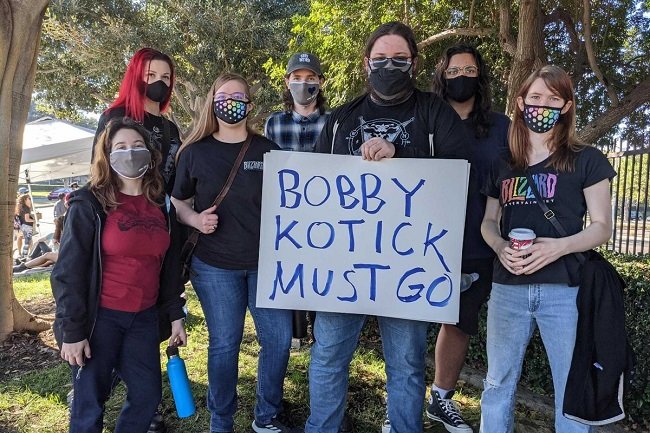

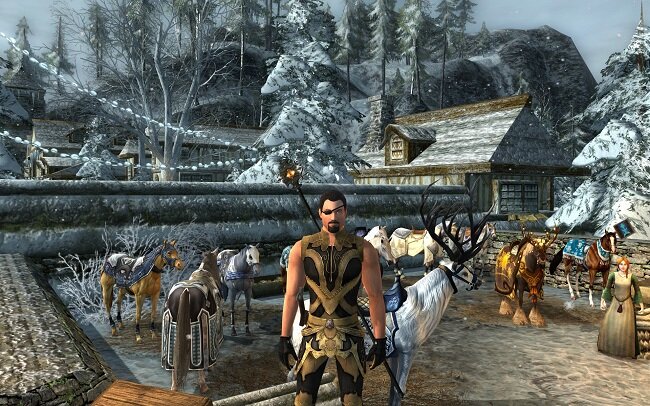




A Year in Technology
Getting older does have a few benefits. One of them, if you are fortunate enough to embrace the concept, is a degree of self awareness and the ability to be honest with yourself. Over the years I have tried to adjust my technological habits but ultimately I am a creature of habit. My use of technology and consumption of content has been determined by the decades I grew up in. Therefore, I am a PC user and prefer to sit in my office where I write, play games and peruse the internet. I have my desk set up in a way that suits my needs and I can go about my business in comfort. When away from my office, I rely heavily on my phone as an alternative platform. In some instances phone based apps offer a superior experience to the desktop or browser based PC alternatives. Banking being one example. For better or for worse this is how I do things and I am comfortable with these choices.
Getting older does have a few benefits. One of them, if you are fortunate enough to embrace the concept, is a degree of self awareness and the ability to be honest with yourself. Over the years I have tried to adjust my technological habits but ultimately I am a creature of habit. My use of technology and consumption of content has been determined by the decades I grew up in. Therefore, I am a PC user and prefer to sit in my office where I write, play games and peruse the internet. I have my desk set up in a way that suits my needs and I can go about my business in comfort. When away from my office, I rely heavily on my phone as an alternative platform. In some instances phone based apps offer a superior experience to the desktop or browser based PC alternatives. Banking being one example. For better or for worse this is how I do things and I am comfortable with these choices.
At present, possibly the most redundant piece of tech hardware I own is my Amazon Fire HD 10. It’s a nice size tablet and the specs were fairly robust back in Autumn 2018 when I bought it. But on a day to day basis I simply don’t use it. The Kindle book function was its main selling point but Audible has lured me into the world of audiobooks which I prefer. I would hazard a guess that I’ve probably only turned on this device 3 times during the course of 2021. I suspect I may sell this device in 2022, not because I’m averse to mobile “culture” per se but because my phone already meets all my needs in this respect. My Samsung Galaxy S10 5G, which I had since December 2019, is the most robust handset I’ve owned. It has a large screen and a powerful processor and outperforms the tablet in every respect.
Looking back over the last twelve months most of my technology based purchases have been either replacements or upgrades to existing items. I’ve written previously about how I seem to kill PC peripherals and 2021 was no exception. I had to replace an Xbox controller and a USB microphone this year. Sadly the latter still hasn’t been used in conjunction with the Bluetooth Earbuds. However, I am very pleased with the Soundbar I bought in the Summer and am impressed by the quality of the audio. It has certainly improved the cable management of my office desk. My recent acquisition of a laptop has also proven beneficial as I have had to spend an increasing amount of time at my parent house this year. I must reiterate my surprise at how much laptops have improved in recent years with regard to specifications, performance and weight.
As I write this post, the elephant in the room actually resides on the left hand side of my desk. The jury is still out as to whether the Nintendo Switch was a good purchase or not. It gets used for social gameplay, when we have guests (usually my granddaughters). I relocate the device to the lounge and connect it to the TV. However, I seldom use it for handheld gaming and I’m not even sure if this is down to not finding the right game. Fundamentally, I think that playing video games in this way just isn’t for me. Furthermore, if I were to obtain any other form of console, I suspect that I wouldn’t really get on with them either. For me gaming is done on the PC, predominantly with a keyboard and mouse. Anything else just doesn’t feel “right”. However, I shall keep the Switch and possibly buy a few more social games in 2022. Although I don’t use it that often it is very well received by my grandchildren.
At present, I have no immediate plans to buy any more tech in the New Year. A new television may well be required at some point in the next twelve months as the current one is reaching the end of its lifespan. There is also the possibility of our existing Internet Service Provider offering Fibre to the Premises in April. My dreams of a 100Mbps connection could become a reality. Apparently, I’m eligible for a mobile phone handset upgrade in February. A decade ago this would have thrilled me and I would have spent hours pawing over reviews and comparisons websites. At present the prospect elicits no more than a roll of the eyes. All of which is indicative of a shift in my relationship with technology. A relationship which I am now truly comfortable with. After all “the tail doesn’t wag the dog”.
A Year in Gaming
Usually in a post such as this, my primary focus would be writing about the games that I’ve played over the last twelve month and what it was about them that I specifically enjoyed. However, this year I feel that I must address the wider issues that have dominated the news regarding the video games industry. Simply put, several very high profile and successful triple A video game companies have been beset by scandals over the last twelve months. And these have been of such a nature that they have finally laid to rest the myth that some still cling to, that working “in video games” is somehow different from working in more traditional industries because it’s “cool”. It turns out that it has all the same failings as TV, music and film. The people at the top are abusive and broken and maltreat those at the coalface who do all the real work for precious little reward.
Usually in a post such as this, my primary focus would be writing about the games that I’ve played over the last twelve month and what it was about them that I specifically enjoyed. However, this year I feel that I must address the wider issues that have dominated the news regarding the video games industry. Simply put, several very high profile and successful triple A video game companies have been beset by scandals over the last twelve months. And these have been of such a nature that they have finally laid to rest the myth that some still cling to, that working “in video games” is somehow different from working in more traditional industries because it’s “cool”. It turns out that it has all the same failings as TV, music and film. The people at the top are abusive and broken and maltreat those at the coalface who do all the real work for precious little reward.
Hence, I feel that there is now a moral dilemma in buying games from certain companies and that their products are in a way “tainted”. The same way as there is shopping at certain stores that are known for their unethical practises. However, a consumer boycott is not always the most effective form of protest and on occasions can do more harm to those parties one wishes to demonstrate a degree of solidarity with. However, one can still voice one’s unhappiness with the situation and that is what seems to be happening at present. Negative PR seldom goes unnoticed and as and when it impacts upon share prices, the message eventually reaches the top of the food chain. Action gets taken sooner or later but what the Activision Blizzard, Ubisoft and Bungie scandals highlight are a wider societal malaise. The abhorrent behaviour that we’ve read about seems to be ingrained in specific socioeconomic stratas. Fixing that is a much harder issue than just replacing a few managers and CEOs.
Moving on from how shitty the video game industry seems to be, personally speaking this has not been the most exciting year for my relationship with video games. As 2021 draws to an end my PC’s hard drive is filled with games that I’ve abandoned and become bored with. Cyberpunk 2077, GreedFall and Days Gone are a few examples of games that showed promise but became somewhat routine and pedestrian. I did enjoy my first major foray into the Assassin’s Creed franchise. Black Flag proved to have an engaging story and an unusual setting, hence I completed the game. My gaming mainstays, the MMORPGs The Lord of the Rings Online and Star Trek Online, also kept me busy this year. This was mainly due to the way this genre lends itself to “quick fix” gaming. STO in particular continuously runs events that afford the player a reason to log in and undertake a quick task. Yet despite this engagement, I don’t feel I’ve done anything significant in either game.
The jury is still out as to whether my Nintendo Switch has been a good or bad investment. It gets used mainly when my granddaughters come to visit and then Mario Kart is a firm favourite. But personally I have yet to find a game that enthrals me. I think I’m just culturally conditioned to do my gaming on a PC. And in other news, my love hate relationship with Fall Guys: Ultimate Knockout continues. There is fun to be had playing this game but the moment specific races and events appear, they instantly kill my passion. I have still yet to win a crown. This failure to achieve this particular goal bothers the heck out of me. I suspect that overall, my relationship with gaming is shifting. As a pastime it is becoming very much like mainstream cinema. There’s no shortage of content but it’s all rather generic, formulaic and mediocre.
As for 2022, well for the present I shall just continue to push on with LOTRO and STO. I have nearly finished the new expansion in LOTRO, Fate of Gundabad and have reached the current level cap of 140. I finally got on top of the new Legendary Item system and have managed to create a rather robust new weapon. I think I may soon make a return to The Elder Scrolls Online and see what content I have waiting for me. I usually enjoy playing for a few months continuously and feel that subscribing improves the overall experience. I shall also keep a weather eye on the video game industry to see if and how it bounces back from the recent scandals assailing it. It already looks like the player uptake of NFTs is not going to be as easy as some publishers have anticipated. Maybe I’ll chance upon some hidden video game gems in the next 12 months and my enthusiasm will be restored. Time will tell.
A Christmas Carol (1954)
This 1954 adaptation of Charles Dickens’ A Christmas Carol is a distinctly studio bound US television production. It was in fact the fourth episode of an anthology variety show called A Shower of Stars. Originally filmed and broadcast in colour, only black and white prints now survive. The production boasts a script by noted American playwright Maxwell Anderson. Due to the 48 minute running time (without commercial breaks) the narrative is heavily abridged and often it is only the story’s most basic themes which are dramatically interpreted. It stars Fredric March who plays Scrooge as a cool and indifferent man, rather than the usual shrill old miser. However, despite his presence his performance cannot save the production. Most of the other cast members are far from accomplished and at times their acting borders on the amateur.
This 1954 adaptation of Charles Dickens’ A Christmas Carol is a distinctly studio bound US television production. It was in fact the fourth episode of an anthology variety show called A Shower of Stars. Originally filmed and broadcast in colour, only black and white prints now survive. The production boasts a script by noted American playwright Maxwell Anderson. Due to the 48 minute running time (without commercial breaks) the narrative is heavily abridged and often it is only the story’s most basic themes which are dramatically interpreted. It stars Fredric March who plays Scrooge as a cool and indifferent man, rather than the usual shrill old miser. However, despite his presence his performance cannot save the production. Most of the other cast members are far from accomplished and at times their acting borders on the amateur.
Music and song plays an integral part of this version. Although not a full blown musical, there is an itinerant group of carol singers that seem to grow in size, who regularly regale the viewers with expository songs. Plus many characters sing at some point. Others do not. It’s all rather inconsistent and confusing. The songs are mainly designed to underpin the story's themes. At times they are used as a means to bridge scenes or expedite the story without an excess of dialogue. Unfortunately the songs, also written by Maxwell Anderson, are weak and superfluous. Some are actually annoying. However, the orchestral score and incidental music by the great Bernard Herrmann is striking. At times it has a very eerie and foreboding quality, with its use of strings and choir vocalisation. But alas, there’s far too little of it.
There are very few original ideas featured in this adaptation. The Spirit of Christmas Past and The Spirit of Christmas Present look like Scrooge’s lost love Belle and nephew respectively. This is because they are played by the same actors. I initially thought this was a visual conceit used for narrative reasons but it is more than likely due to the budgetary restrictions. The screenplay attempts to focus on Scrooge’s failed relationship as the main cause of his abhorrent nature. Unfortunately, it dwells a little too long upon the matter. There’s an excruciating song that Belle and Scrooge sing at Fezziwig’s Christmas party. The Spirit of Christmas Yet to Come is not even shown. Scrooge merely “looks within himself” and has a revelatory vision of a graveyard with both his and Tiny Tim’s names upon the tombstones. This proves sufficient shock therapy to reform Scrooge’s nature.
Despite the presence of quality actors such as Fredric March and Basil Rathbone who plays Marley’s Ghost, this is a rather poor adaptation which is actually quite hard to sit through. Rathbone, covered in cobwebs, rambles through the poorly condensed dialogue. “I come out of torment. I come to help your soul avoid eternal misery”. Well, not watching this particular adaptation is possibly a good place to start. The contract TV actors chew the low budget scenery and incessantly assail you with tedious and never ending songs. And then to utterly mitigate the underlying theme of poverty, Scrooge invites himself to Bob Cratchit’s meagre Christmas Dinner. It is as illogical as it is risible. Hence, there is precious little to recommend about this version of A Christmas Carol. I would only suggest watching it if you are a completionist or a consummate fan of the two main leads. Casual viewers should seek out a more competent adaptation.





A Year in Social Media
I can’t speak for others but my relationship with social media has certainly changed over the last two years. Whenever new internet technologies emerge, there is a brief period when it feels like some sort of new frontier. Often such innovations become a means of empowering the marginalised and the voiceless. For a while new platforms can even be a force for good. But eventually commercial interests creep in along with rules and regulations. Hence, it all inevitably takes a turn for the worst. The frontier is finally tamed and ends up being just another corporate space. Social media is certainly not a forum for discussing social issues or politics, instead being a medium for tribalism and rancour. Because of these factors and others, I have moderated my use of social media and it has proven extremely beneficial to my state of mind.
I can’t speak for others but my relationship with social media has certainly changed over the last two years. Whenever new internet technologies emerge, there is a brief period when it feels like some sort of new frontier. Often such innovations become a means of empowering the marginalised and the voiceless. For a while new platforms can even be a force for good. But eventually commercial interests creep in along with rules and regulations. Hence, it all inevitably takes a turn for the worst. The frontier is finally tamed and ends up being just another corporate space. Social media is certainly not a forum for discussing social issues or politics, instead being a medium for tribalism and rancour. Because of these factors and others, I have moderated my use of social media and it has proven extremely beneficial to my state of mind.
A decade ago, I thought that using social media to promote my writing would be an invaluable tool and have positive results. Reflecting upon that now, I can't help but raise a wry smile at such naivety. Over the last twelve months, the amount of traffic to Contains Moderate Peril which is directly attributable to social media is just over 1%. Thus as a promotional tool, for me at least, it isn’t really worth the bother. Occasionally a Tweet about a game specific story may get a degree of traction with its player community but even then, it will only result in 100 or so additional visits to the post. Google is the primary source of people finding my writing and social media promotion has proven ineffective. Plus writing a blog doesn’t really lend itself to a presence on TikTok or Instagram. Platforms geared towards brevity and the concise delivery of targeted content, don’t really suit long from written material.
So after dabbling with instagram, I’ve ceased to actively participate on the platform. I mainly use it now to keep up to date with what my immediate family are doing, especially my granddaughters. Facebook is another medium I no longer use or check. I think the main reason I stopped using it was because rather than being a means to cross promote material, it simply became its own ecosystem which wasn’t especially helpful. As for older forms of social media such as forums and subreddits, they seem to be rapidly falling by the wayside. Many of the ones that I’ve used over the years, associated with specific games or types of fandom, have either closed down or dwindled into insignificance. Or they just become monopolised by a small cadre of dedicated posters who treat it as their own personal fiefdom. It often leads to an extremely partisan environment and hardly a suitable medium for debate and discussion.
Discord continues to be somewhat of a paradox, from my perspective. It’s a great way to chat and answer immediate enquiries. It’s also a solid foundation for a social group. However it is not exactly useful for archiving discussions and information. I feel it is a medium that deals in the here and now and although very useful it ultimately is very ephemeral. Yet many traditional gaming communities are moving to this platform, which I find somewhat confusing. Because it doesn’t offer the range of services that a traditional forum does. You can organise and manage events perfectly on Discord. But you cannot curate information and easily search for older content. I also feel that a Discord community over a certain size of active contributors is too hard to keep up with. You either follow it 24/7 or it eludes you.
As the year nears its end, I find myself using Twitter as my primary social media platform. I stopped following numerous twitter accounts earlier in spring, especially those associated with political and social commentary. I find that not having vast amounts of controversy and daily brouhahas flooding my timeline is extremely good for my psychological equilibrium. I mainly use Twitter now as a means of staying in touch with my online friends whose company I enjoy immensely. Overall, I’m finding the novelty of social media to be ebbing away and its practical benefits are overrated. Reaching large groups of potential customers is fine for business. Being exposed to excessive amounts of random members of the public is neither edifying, desirable or fun. I suspect that I shall continue to refine my social media experience in 2022.