
LOTRO: Abandoned Game Mechanics and Systems Part 1
According to Merlin, played by the great Nicol Williamson in the 1981 film Excalibur, “It is the doom of men that they forget”. A criticism that could be levelled both at me and Turbine/Standing Stone Games. The MMORPG The Lord of the Rings Online is littered with systems, game mechanics and features that have been introduced to the game, proven unsuccessful, unpopular or too complex to maintain and subsequently abandoned. I can’t help but think that the last reason is possibly the most common factor in determining the fate of a new game system. Cryptic removed The Foundry system of player created content from Star Trek Online because the sole member of staff that curated it left the company, proving this problem isn’t unique to LOTRO. However, as it’s been my main MMO of choice for 14 years, I shall be using it as a point of reference. Here are a few examples.
According to Merlin, played by the great Nicol Williamson in the 1981 film Excalibur, “It is the doom of men that they forget”. A criticism that could be levelled both at me and Turbine/Standing Stone Games. The MMORPG The Lord of the Rings Online is littered with systems, game mechanics and features that have been introduced to the game, proven unsuccessful, unpopular or too complex to maintain and subsequently abandoned. I can’t help but think that the last reason is possibly the most common factor in determining the fate of a new game system. Cryptic removed The Foundry system of player created content from Star Trek Online because the sole member of staff that curated it left the company, proving this problem isn’t unique to LOTRO. However, as it’s been my main MMO of choice for 14 years, I shall be using it as a point of reference. Here are a few examples.
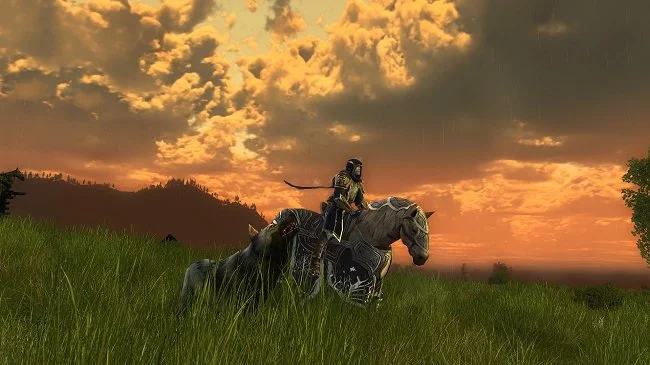
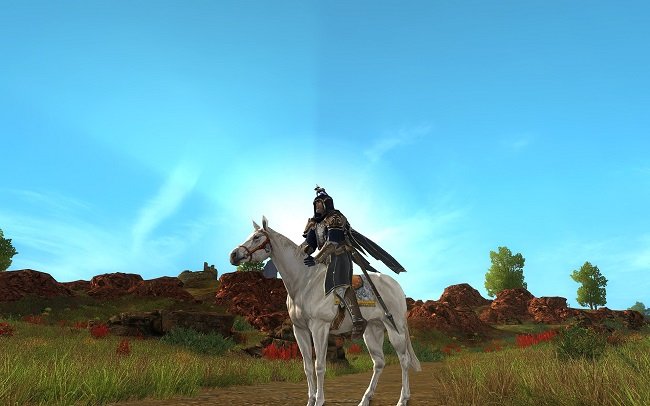
Mounted combat. This remains the most obvious “experiment” which was introduced to LOTRO in 2012 and persisted only while the story progressed through Rohan. Although there are still plenty of areas in which you can still ride your mount and kill mobs, it is no longer a requirement that is written into the story. Mounted combat remains a clumsy game mechanic, with unwieldy mounts and a huge disparity in its effectiveness depending upon your chosen class. It has proven so unpopular with players that the developers had to integrate additional story missions as an alternative to the mandatory mounted combat quests.
The War Wolf. Effectively this combat pet functions similarly to a skirmish soldier and is equally erratic. However it does have some useful attributes and can be used as an aggro magnet, affording a speedy getaway for the Lore-master that pulls too many mobs. If used wisely (IE by a more competent player than me) it can be quite effective. The War Wolf is unlocked by spending skill points on the yellow talent tree and accessing the "riding companion" ability. Turbine should have done more with this and tried to extend it to all classes. It made mounted combat a little more interesting.
Epic Battles. This is a system that was introduced in the Helm’s Deep expansion in 2013. Although far from popular, the developer’s persisted for another two years adding further epic battles in Gondor. It’s a great idea on paper, just like mounted combat but the reality is quite different. Epic battles only start to get interesting once you have amassed sufficient points to upgrade your Role Traits (Officer, Engineer and Vanguard). You then have skills that can make a difference during the 30 minute long battles. Many players never get that far. When you first start playing the enemy mobs pretty much ignore you and head straight for the ally NPCs. You’re left begging for someone to fight you like Connor MacLeod in the Highlander.
Skirmishes. Skirmishes which were added to LOTRO in 2010. They remain an excellent form of scaling instance with multiple achievements and goals. They can accommodate 1 or upto 6 players. They provide a great alternative means of levelling and the skirmish vendors also had a very robust range of intermediate gear upto level 105. Plus it is fun to have an AI companion. However, skirmishes stopped being added to the game after the Siege of Mirkwood, apart from some simple seasonal variations that accompany festivals. I suspect that Turbine was focused on other content at the time and later found that the staff with the requisite skills had left the company. Missions are now a watered down, poor relation to skirmishes which are far less exciting, only allow 2 players and offer war less of any worth.
Fellowship Manoeuvres. Players who are new to LOTRO may well forget that upon its release in 2007, the game was heavily based around group content. This MMO was meant to be played in balanced teams and much of the content could not be played solo. Also known as conjunctions, fellowship manoeuvres occur randomly, or are triggered by Burglars or Guardians. They require that the target be stunned or knocked down, in any group encounter with a signature or higher enemy. If the conditions are met a menu appears on screen and each player can contribute by selecting one of four skills. Specific combinations offer advantages such as a morale or power buff to the players, an increase in outgoing damage or they can debuff the enemy. They can contribute an invaluable supplement to group healing. However, as LOTRO became more focused upon solo PVE content over the years, this game system ceased to be relevant or even known about anymore.
To be continued.




LOTRO: The Hytbold Experiment
In 2012, developers Turbine embarked upon an interesting experiment as part of the Riders of Rohan expansion for the MMORPG The Lord of the Rings Online. I do not refer to mounted combat. Let us leave that debacle for another discussion. I was referencing the rebuilding of the burnt out village of Hytbold, which was promoted at the time as an alternative to raiding for solo players. Hytbold is a settlement located within the Sutcrofts in East Rohan, which was burned down in an attack by Orcs from the East Wall. Once a player reaches level 84 they can undertake repeatable daily quests, participate in mounted combat and other unique events. Over time a player can rebuild the two dozen buildings that make up Hytbold and access services such as Stable Master, Provisioner and Barber. The rewards for this task are class and trait-specific armour sets that are comparable to level 85 raid gear and the title of Thane of Rohan.
In 2012, developers Turbine embarked upon an interesting experiment as part of the Riders of Rohan expansion for the MMORPG The Lord of the Rings Online. I do not refer to mounted combat. Let us leave that debacle for another discussion. I was referencing the rebuilding of the burnt out village of Hytbold, which was promoted at the time as an alternative to raiding for solo players. Hytbold is a settlement located within the Sutcrofts in East Rohan, which was burned down in an attack by Orcs from the East Wall. Once a player reaches level 84 they can undertake repeatable daily quests, participate in mounted combat and other unique events. Over time a player can rebuild the two dozen buildings that make up Hytbold and access services such as Stable Master, Provisioner and Barber. The rewards for this task are class and trait-specific armour sets that are comparable to level 85 raid gear and the title of Thane of Rohan.
At the time, there was a great deal of debate on the Official LOTRO Forums regarding access to top tier gear and that the developers were pandering too much to raiders. Casual players and non raiders requested alternative ways to receive raid quality gear and rebuilding Hytbold allegedly provided a solution. However, just like raiding, rebuilding Hytbold requires a substantial investment of time. Former Senior Game Designer Joe Barry argued the point thus. “The overall time commitment is on par though with the amount of play hours and overall time it would take to get a raid armour set from a cluster. However, instead of spending 5+ hours once a week for 6-8 weeks raiding, you're instead spending 30-45 minutes a day doing soloable dailies for a similar amount of weeks”.
The main method of time-gating the rebuilding of Hytbold is via reputation factions. There are four in Riders of Rohan. The Wold, Norcofts, Sutcrofts and Entwash Vale. Reputation XP is gained through doing regional quests. Although Hytbold can be accessed with lower rep, some of the quests are gated behind Ally status. Regional quests will only provide rep XP upto a certain level, so if you want to reach kindred, then playing through Hytbold is mandatory. The fact that faction rep cannot be supplemented by tasks is a major hindrance. Managing the rebuilding of Hytbold is also quite complex in itself and shortly after release, several equally complex guides appeared on the forums (like this legendary one from Fredelas) as players tried to find an optimal selection of quests which could be completed quickly and efficiently on a daily basis.
As a dedicated LOTRO player at the time, I undertook the task of rebuilding Hytbold and if memory serves, I believe it took me about one and a half months. It was an enjoyable experience initially doing dailies and speculating about how Hytbold would look when rebuilt. The burned out buildings were replaced with new ones through phasing. However, after about twenty days or so, it became a chore, especially as some of the dailies were less enjoyable than others. Admittedly once complete it was rewarding to see the town rebuilt and to be able to purchase one of three class specific armour sets. But once this lengthy task was finished there was little or no reason to return to the town of Hytbold. Furthermore, twelve month later the next expansion Helm’s Deep saw an increase in level cap and so new sets of armour.
One of the worst failings of LOTRO is the way in which the game continuously invalidates gear and more importantly, the player’s hard work to obtain it as they progress through the game. I remember grinding through numerous Moria instances and raids to get a First Age Legendary Weapon back in Autumn 2009. I finally got my weapon a month before the release of Siege of Mirkwood. Once that expansion arrived it immediately became obsolete. My Hytbold gear suffered a similar fate although I did benefit from it a little longer. At present there are 221 stable-master in LOTRO. One of these is Hytbold and you only get it if you completely rebuild the village. I can’t remember the last time I went there but it’s a badge of honour that I have it. As LOTRO content doesn’t scale there often is no reason to go back to an older zone. Also because levelling is streamlined now, new players progressing through the game have no requirement to complete Hytbold if they don’t wish to.
Hytbold was an interesting experiment which genuinely attempted to address an issue that the player community had raised. Some people like progression, a clear path to a goal and repetition. Others don’t. Raiding doesn’t always guarantee obtaining the gear you seek but it probably offers a more exciting experience than the more structured path of Hytbold. Whatever your opinion, it should be noted that Turbine did not offer an alternative to raiding in later expansions. Perhaps they felt it was too much work or wasn’t particularly well received, just like mounted combat. Perhaps back in 2013, they were already considering an alternative system that could be monetised, as it is today with lootboxes and Embers of Enchantment. As for Hytbold, it remains one of many experimental systems that litter the game that have subsequently been abandoned. A curiosity from a decade ago.
LOTRO: The Pros and Cons of Complex Lore
Professor Tolkien has created one of the most complex and rich fictional mythologies found in twentieth century fiction. There is both detail and ambiguity to be found in his collected works. For example, the line of Númenórean Kings or the family tree of Elrond are clearly explored and catalogued. Yet there are many more obscure and esoteric references littering the various texts, that pique the imagination by alluding to more nebulous people and events. What was the fate of the two Blue Wizards, Alatar and Pallando? What was so special about Queen Berúthiel cats which she used as spies? Are there really Were-worms "the East of East"? It is this balance between richly detailed faux heraldry and vague apocrypha which makes Middle-earth such a credible and living world.
Professor Tolkien has created one of the most complex and rich fictional mythologies found in twentieth century fiction. There is both detail and ambiguity to be found in his collected works. For example, the line of Númenórean Kings or the family tree of Elrond are clearly explored and catalogued. Yet there are many more obscure and esoteric references littering the various texts, that pique the imagination by alluding to more nebulous people and events. What was the fate of the two Blue Wizards, Alatar and Pallando? What was so special about Queen Berúthiel cats which she used as spies? Are there really Were-worms "the East of East"? It is this balance between richly detailed faux heraldry and vague apocrypha which makes Middle-earth such a credible and living world.
Over the past twelve years Turbine and now Standing Stone Games have tapped into this vast wealth of lore and extrapolated it when writing the various narratives for their MMORPG. They have incorporated both the well known and the obscure. Broadly they have done this in a clever and respectful fashion. The central plot device for the initial game Shadows of Angmar is that the Witch-king's Steward, Mordirith, was once his greatest foe: Eärnur, King of Gondor. It’s a bold idea but not too outrageous to seem impossible. The writing is quite detailed and well researched so overall the idea is successful. Expanding Dunland and exploring the feuding clans and how Saruman exploited such a situation to his own benefit, is also a creative undertaking. Finding a village of Hobbits of Stoor antecedents in the region is also a nice lore-based reference that is expanded into a wider narrative. More recently, the Black Book of Mordor storyline has boldly addressed what happens after the War of the Ring, in the absence of Sauron’s controlling power. I enjoyed that the Cold Drake, Hrímil Frost-heart, was in fact a former ally of Morgoth, who eschewed his predecessor.
Yet building upon and adapting this complex lore is not always successful or well received by fans. For example, the recent Update 24: Vales of Anduin had an interesting plot line feature in the quest “The Stolen Gift”, in which it was explained that the Beornings shapeshifting ability was directly attributable to the wizard, Radagast the Brown. He allegedly bestowed them with a “gift” of knowledge allowing them to use this technique to take the form of Bears. Furthermore, it was a secret that was then stolen by the Gauredain, men of the wolf, and the Ungoledain, men of the spider. Such a plot device has opened up many further questions and not all are prepared to suspend their sense of disbelief to this degree. However, the debate that has ensued has interesting arguments on both side and certainly has encouraged LOTRO players to explore the source texts to seek further insight.
Another issue that has arisen in recent years is LOTRO developers being a slave to convention. The story of Beren and Luthien and their doomed relationship is well known in established Middle-earth canon. It is an important tale and naturally is relevant to the parallels between Aragon and Arwen, except this time round the relationship does not have such tragic overtones (the incompatibility of lifespans not withstanding). However, the writers at Turbine/Standing Stone Games now seem to habitually couch any sort of mixed race or even inter-generational relationship in “doomed terms”. Need I mention Calenglad and Gwindeth, Wynmar and Noriel or Nona and Horn? And let us not forget the struggles between Father and Daughter with such characters as Golodir and Lorniel as well as Laerdan and Narmeleth. I’ve wondered at time whether a staff writer had a bad relationship at a key time in their life and never got over it? As for Calenglad, he’s clearly trying to punch above his weight.
Fans like lore. It is part of the appeal of many franchises. Fans like to learn and become knowledgeable as a sign of their devotion to that which they love. But lore and canon are a double-edged sword and fandom is only a short step away from the myopia of fundamentalist zealotry. What some Tolkien fans forget at times is that the MMORPG The Lord of the Rings Online is an adaptation of the professor’s work and not a pure representation of them. To accommodate the requirements of the MMO game genre, a lot of concessions have to be taken onboard right from the get-go. Therefore I see both the pros and cons of strong lore in a franchise and see adaptation as being a means to experiment in presentation and interpretation, especially when the source material was intended to be as such. Hence, I can accommodate LOTRO’s iteration of Middle-earth and simultaneously enjoy the radical departure from accepted canon presented in a game such as Middle-earth Shadow of War. But that is not the way that everyone rolls so inevitably controversies will arise and opinions will differ.
Standing Stone Games: Is the Honeymoon Over?
I was not that surprised when Standing Stone Games announced that their Mordor expansion for LOTRO would be released at the end of July, just weeks after several open beta tests. This is something the developers have done for a while, with all their major updates. One has to remember that despite a change of name, to core team developing LOTRO has not radically changed since they extricated themselves from Turbine. Something that SSG went out of their way to stress when they formally announced their move, last December. The press releases and interviews at the time focused on a sense of continuity and implied that SSG was now free from the corporate yolk of Warner Bros. and Turbine. It led to a great deal of optimism among LOTRO players and sparked a resurgence in the game. The fact that the MMO has now reached the end of Tolkien’s story and is about to embark upon its own original narrative has been well received. Yet LOTRO has always been regarded both by the faithful and by those outside, as a game that never quite lived up to its potential. Perhaps the release of Mordor would remedy that?
I was not that surprised when Standing Stone Games announced that their Mordor expansion for LOTRO would be released at the end of July, just weeks after several open beta tests. This is something the developers have done for a while, with all their major updates. One has to remember that despite a change of name, to core team developing LOTRO has not radically changed since they extricated themselves from Turbine. Something that SSG went out of their way to stress when they formally announced their move, last December. The press releases and interviews at the time focused on a sense of continuity and implied that SSG was now free from the corporate yolk of Warner Bros. and Turbine. It led to a great deal of optimism among LOTRO players and sparked a resurgence in the game. The fact that the MMO has now reached the end of Tolkien’s story and is about to embark upon its own original narrative has been well received. Yet LOTRO has always been regarded both by the faithful and by those outside, as a game that never quite lived up to its potential. Perhaps the release of Mordor would remedy that?
Well it would appear that the honeymoon between Standing Stone Games and the LOTRO player base is now over. There were cracks appearing in the façade of mutual goodwill during the anniversary event, when it became clear that several activities were exclusional. However, it has been the debacle over the pricing structure of the Mordor expansion that has returned community relationships back to how they were previously. Many LOTRO players do not consider the itemisation and costs of the three different editions of the expansion to be equitable. Once again, the game developers appear to be taking their customers loyalty and support for granted. Something that was a regular complaint when LOTRO was administered under the auspices of Turbine. It would appear that LOTRO is still tied to a cycle of controversies, poor decision making and potentially biting the hand that feeds it. So much for the concept of “a new broom sweeps clean”.
For the last seven years, LOTRO players have been left to assume (often by the inference of Turbine themselves) that a lot of the problems associated with the MMOs development have been down to Warner Bros. interference. However, according to information garnered from staff who have either left Turbine or been laid off, it would appear that has not been the case. Turbine were left to run things pretty much as they liked by their corporate owner, who it would seem were merely interested in obtaining the licence. Thus, we must deduce that all the controversies that have happened with the game since 2010, such as the barter wallet, mounted combat and the skills tree revamp, can all be laid at Turbine’s door. It would appear that Standing Stone Games, despite separating themselves from Turbine per se, have brought with them the same business mindset because it was theirs to begin with.
As ever with matters of this kind, unless the public are given specific information gained from inside the company in question, it really comes down to deductive reasoning and making “educated guesses”. We do not know the exact details of the relationship between Daybreak Game Company and Standing Stone Games. Are they just a publisher or are more involved and control the purse strings? Did they have any say in deciding the pricing of the Mordor expansion? We do not know for certain. However, while these questions and others are debated on the forums and gaming websites, LOTRO players once again find themselves robustly supporting a game that still seems to be failing to meet its potential and at odds with a developer that doesn’t seem to listen as well as it claims. When one stands back and objectively looks at the life cycle of LOTRO, it really has dodged several major bullets mainly due to the goodwill of the players, who seem to be exceptionally forgiving. Perhaps too much so. If this MMO was an original IP with a different audience, then I do not think it would have lasted the ten years that it has.
LOTRO Server Issues
Monday’s datacentre migration has unsurprisingly proven problematic for Turbine. As a result major issues continue to affect LOTRO players with faults such as severe lag, bad rubberbanding and random crashes to desktop and server disconnects being common place. Players have also had to endure loss of housing items, loss of friend lists and disconnection from chat servers. Five days later, despite hotfixes and continuing maintenance many players still find the game “problematic”. Turbine are naturally trying their best to keep the community informed but the longer this problem persists the more damage it potentially does.
Monday’s datacentre migration has unsurprisingly proven problematic for Turbine. As a result major issues continue to affect LOTRO players with faults such as severe lag, bad rubberbanding and random crashes to desktop and server disconnects being common place. Players have also had to endure loss of housing items, loss of friend lists and disconnection from chat servers. Five days later, despite hotfixes and continuing maintenance many players still find the game “problematic”. Turbine are naturally trying their best to keep the community informed but the longer this problem persists the more damage it potentially does.
A side issue that has emerged from this situation is the fact that the five remaining European LOTRO servers will now not be relocated to Amsterdam. Instead they will be joining the five US servers in New Jersey in the new datacentre. Naturally players based outside of the US have already voiced concerns as to whether the increase in latency and exacerbates the ongoing technical problems. Furthermore Turbine have not yet confirmed a revised date for the proposed EU server move bringing in to question whether it was ever a genuine proposal.
Turbine have struggled in the past to make good on some of their promises and commitments. Like many businesses those dealing with the public are not necessarily privy to policy decisions being made at senior levels. It has been suggested by some more canny industry commentators that perhaps the company is reticent to move infrastructure to Europe in light of recent changes to consumer protection legislation, which are more robust and customer friendly than its US counterpart. Whether this is the case or not is uncertain at present but certainly both the change in decision regarding the servers and the impact that the migration has had is pause for thought for all concerned.
Downtime and login issues impact ultimately on the bottom line. A player that does not log in to the game is a player that is not spending and I have suspicion that LOTRO is a game that survives purely because it hits a specific financial target each quarter. Despite what some gamers may think there is seldom any sentiment in business and the moment the numbers aren’t favourable then hard decisions are made. Let us hope that the folk at Turbine can find a speedy solution to the ongoing issues currently affecting LOTRO. I cannot help but think that given the reduced size of the production team that they may have overreached themselves. Let us hope that is not the case.