
Peppa Pig World
Having twin granddaughters who are three years old makes our family prime candidates for Peppa Pig World. So, we decided to go this year, rather than leave it to next summer, only to find that the twin’s tastes have changed. Today was a beautiful autumnal day with plenty of sunshine, making it ideal for adventures in a theme park. Peppa Pig World is actually just part of Paultons Park, which has a broad variety of rides and entertainment. However, the girls age restricts them from a lot of these, so we remained at Peppa Pig World which proved sufficient to keep children and adults busy. We ended up spending seven hours, perusing the park and went on most rides. Despite the lateness of the season, Peppa Pig World was still well attended and there was a large crowd throughout the day. However, the theme park is very well organised and run so there were no major problems.
Having twin granddaughters who are three years old makes our family prime candidates for Peppa Pig World. So, we decided to go this year, rather than leave it to next summer, only to find that the twin’s tastes have changed. Today was a beautiful autumnal day with plenty of sunshine, making it ideal for adventures in a theme park. Peppa Pig World is actually just part of Paultons Park, which has a broad variety of rides and entertainment. However, the girls age restricts them from a lot of these, so we remained at Peppa Pig World which proved sufficient to keep children and adults busy. We ended up spending seven hours, perusing the park and went on most rides. Despite the lateness of the season, Peppa Pig World was still well attended and there was a large crowd throughout the day. However, the theme park is very well organised and run so there were no major problems.
Like most outdoor events, if you arrive early then you get the best parking. We secured places near to the entrance. Parking is martialled by stewards who are polite and helpful. We had pre-booked our tickets and received a substantial discount. There were four adults in our party which cost £110 and the children being under 1 metre, got in free. Regular tickets bought at the gate cost £34.25 each. On arrival the granddaughters were given green wristbands that designated which rides were suitable, through a colour code system. It was then a short five-minute walk through parts of Paultons Park before we got to Peppa Pig World which is a separate enclave. The moment you cross over the threshold, you’re acutely aware of various jingles, incidental music and of course the theme tune from Peppa Pig. Most children seem unconcerned by this pervasiveness. Adults may require opiates.
Some rides are more popular than others, so my advice to any family planning on visiting is to determine which ones are most important and go there first. For the first couple of hours of the day the average queue time is about 10 to 15 minutes but eventually this goes up to about 30 minutes by sheer weight of numbers. The rides are all fairly straight forward, sedate and very child friendly. They are mainly permutations of riding around in a themed vehicle or conveyance, through a semi interactive environment. The water-based rides such as Grandpa Pig’s Boat Trip and Grampy Rabbit’s Sailing Club are especially enjoyable, offering a more dynamic mode of transport. Peppa Pig’s Balloon Ride is also quite exciting, offering great views of the park and immediate area. Personally, I thought the most complex and involving ride was the Windy Castle. It lasted the longest, mainly to accommodate getting passengers on and off their respective “clouds.
As well as rides there are other attractions. There is a “meet and greet” with Peppa and George along with an accompanying stage show. As you can imagine, this is very popular, so if you arrive late, you’ll find yourself at the back of a large crowd, struggling to see. There are numerous photo opportunity such as Peppa Pig’s House and various animatronic displays. There also a soft play area that is very well provided for. As part of the wider attractions of Paultons Park, there is a penguin enclosure, which is directly adjacent to Peppa Pig World. The is a talk at feeding time, twice daily that is most informative. Like any theme park, there are numerous gift shops, eateries and kiosks, all designed to separate adults from their hard-earned cash. Sadly, the prices here are somewhat high and so feeding your family may prove expensive. We also noticed that the regular exits were closed, and we had to vacate the park via the gift shop, which was a little pervasive.
Overall, Peppa Pig World is a good day out for those with appropriately aged children. As we stayed from 10:00 AM to 5:00 PM, I felt is was value for money. We certainly didn’t run out of things to do and the queue times were not too excessive. The staff were very friendly, helpful and above all, good at their jobs. The logistical facilities, such toilets, information and “lost children” collection centres where all top notch and it would seem that the park can deal with any issues quickly. Unless you live relatively locally, I would advise potential guests to come down a day early and stay in one of the numerous hotels in the area. Hampshire has a good tourist industry and there’s accommodation available to suit all budgets. Certainly, our granddaughter had a great day out, but as I mentioned earlier, many theme parks are governed by a specific age window. I suspect that our visit was exactly at the “right time” and Disneyland Paris will more than likely be the next destination.









Where's That Fire? (1940)
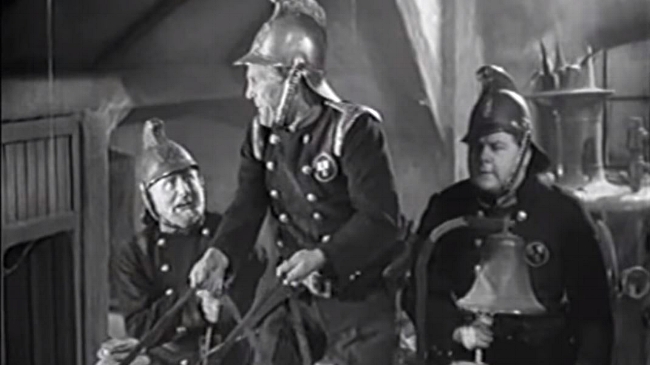
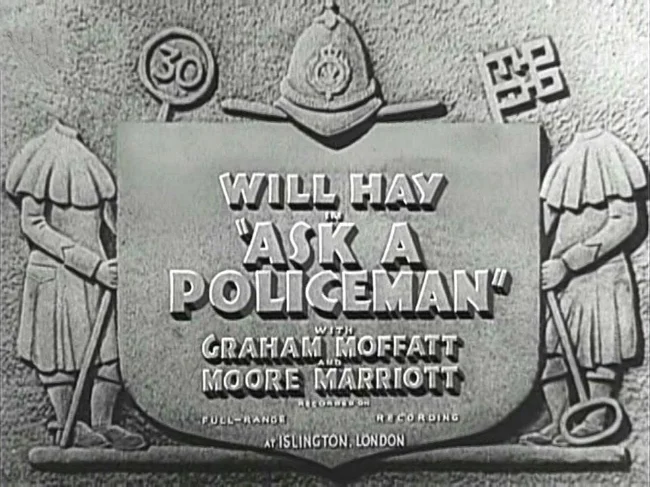
Until a copy was found by the BBC television in 1975, this was considered a lost film. Where's That Fire? is an often over looked comedy. Will Hay plays Captain Viking of the Bishop Wallop fire station in his usual seedy incompetent fashion. He and his trusty assistants Albert (Graham Moffatt) and Harbottle (Moore Marriott) run an antiquated Victorian fire tender but seldom put out any fires. After the Town Hall burns down they find that their jobs are on the line. Viking tries to solve their problems by inventing a new fire-retardant foam as well as renting the tender to a film production company, who may not be quite what they seem. It all ends in mayhem, with an attempted robbery of the Crown Jewels at The Tower of London.
Until a copy was found by the BBC television in 1975, this was considered a lost film. Where's That Fire? is an often over looked comedy. Will Hay plays Captain Viking of the Bishop Wallop fire station in his usual seedy incompetent fashion. He and his trusty assistants Albert (Graham Moffatt) and Harbottle (Moore Marriott) run an antiquated Victorian fire tender but seldom put out any fires. After the Town Hall burns down they find that their jobs are on the line. Viking tries to solve their problems by inventing a new fire-retardant foam as well as renting the tender to a film production company, who may not be quite what they seem. It all ends in mayhem, with an attempted robbery of the Crown Jewels at The Tower of London.
More ambitiously staged than most of the team's efforts, Where's That Fire? has several brilliantly orchestrated slapstick sequences. One has our trio trying to install their new firemen's pole, causing a traffic jam in the street, wrecking a china shop, bothering a man confined to bed with gout and finally demolishing his roof. Charles Hawtrey has an amusing cameo as a schoolboy “swot” who provides geometrical and linguistic advice. There is also an elaborate physical FX sequence when a local garage gets set ablaze. Harbottle mistakenly connects the fire hoses to the fuel pump instead of the water mains, with hilarious incendiary results.
Ultimately, the film succeeds because of the timeless characters that have been created. Some of the jokes may have dated somewhat, but the interaction between the three leads is still credible today. Hay's blustering inanity, Marriott's rambling Octogenarian and Moffatt's wide boy are all still accessible archetypes. The dialogue between them is loaded with that unique sense of British irony and sarcasm. Two visitors disbelieve that Hay is the Captain of the fire station. "Tell them what I am" he says to Graham Moffatt. "What? Out loud" he replies. Where's That Fire? is a wonderful piece of cinema, from a quieter, gentler time. Recommended to those seeking nostalgia and to those who may wish to familiarise themselves with the work of Will Hay.



Sherlock Holmes: A Game of Shadows (2011)
Sherlock Holmes: A Game of Shadows, is very much a film of two halves. The initial hour is filled with gunfights, explosions, and bullet time fist fights. Sherlock Holmes (Robert Downey, Jr.) and Dr. Watson (Jude Law) unravel the sinister plans of Professor Moriarty (Jared Harris) and proceed to deal with it in the idiom of Frank Martin, as director Guy Ritchie's pulls every visual trick he knows out of the bag. The pace is fast yet a fairly strong script and superb chemistry between central characters, makes this a cut above the usual PG-13 rated action fodder served to the masses at present. It is beneficial that the bulk of the original cast and crew returned for this sequel as it maintains a strong sense of continuity with it predecessor.
Sherlock Holmes: A Game of Shadows, is very much a film of two halves. The initial hour is filled with gunfights, explosions, and bullet time fist fights. Sherlock Holmes (Robert Downey, Jr.) and Dr. Watson (Jude Law) unravel the sinister plans of Professor Moriarty (Jared Harris) and proceed to deal with it in the idiom of Frank Martin, as director Guy Ritchie's pulls every visual trick he knows out of the bag. The pace is fast yet a fairly strong script and superb chemistry between central characters, makes this a cut above the usual PG-13 rated action fodder served to the masses at present. It is beneficial that the bulk of the original cast and crew returned for this sequel as it maintains a strong sense of continuity with it predecessor.
Inspector Lastrade (Eddie Marsan) is sidelined in this story and Holmes's love, Irene Adler (Rachel McAdams) is dispensed with quite early in the proceedings, leaving us with much more interaction between Holmes and Watson. A dynamic that is skewed by Watson's marriage, leading to an unconventional love triangle. Sadly, there are a few weaknesses in the finished film. Gypsy leader Madam Simza Heron (Noomi Rapace) has a great introduction then is left somewhat under developed. Also, the disgraced Colonel and crack shot, Sebastian Moran is similarly vague. He also drops out of the film towards the end, providing a suitable antagonist for a third instalment.
But these issues notwithstanding, the second half, quickly shifts from action to the traditional game of intellectual cat and mouse between our hero and his arch nemesis. It is during these verbal confrontations that the more traditional elements of Sir Arthur Conan Doyle's work come through. The final battle via a game of chess on a balcony overlooking the Reichenbach falls, is ingenious and enthralling. Guy Ritchie's has certainly found the right mix between old school cerebral sleuthing and contemporary action styles. He also understands that the linchpin of these films is the relationship between leads and he handles this dynamic skilfully. Hans Zimmer's soundtrack once gain embellishes the film and avoids the usual musical clichés associated with this unique sub-genre.
Sherlock Holmes: A Game of Shadows is very entertaining holiday fare and is certainly not an inferior sequel. Twice now director Guy Ritchie has exceeded expectations and made amends for previous sins (need we list them?). Plus, it is always a pleasure to see genre stalwart, rent-a-German and purveyor of Ferrero Roche, Wolf Kahler back on the screen. On a parting note, Sherlock Holmes: A Game of Shadows is quite surprisingly strong in content. It is interesting to see how Mr. Ritchie has carefully shot and choreographed the violence so as to secure a PG-13 rating/12 Certificate. I was quite surprised about one scene in which Sherlock Holmes is rather brutally interrogated. Although the unpleasantness is justified, viewers should be aware of this hard edge to the movie.







Sherlock Holmes (2009)
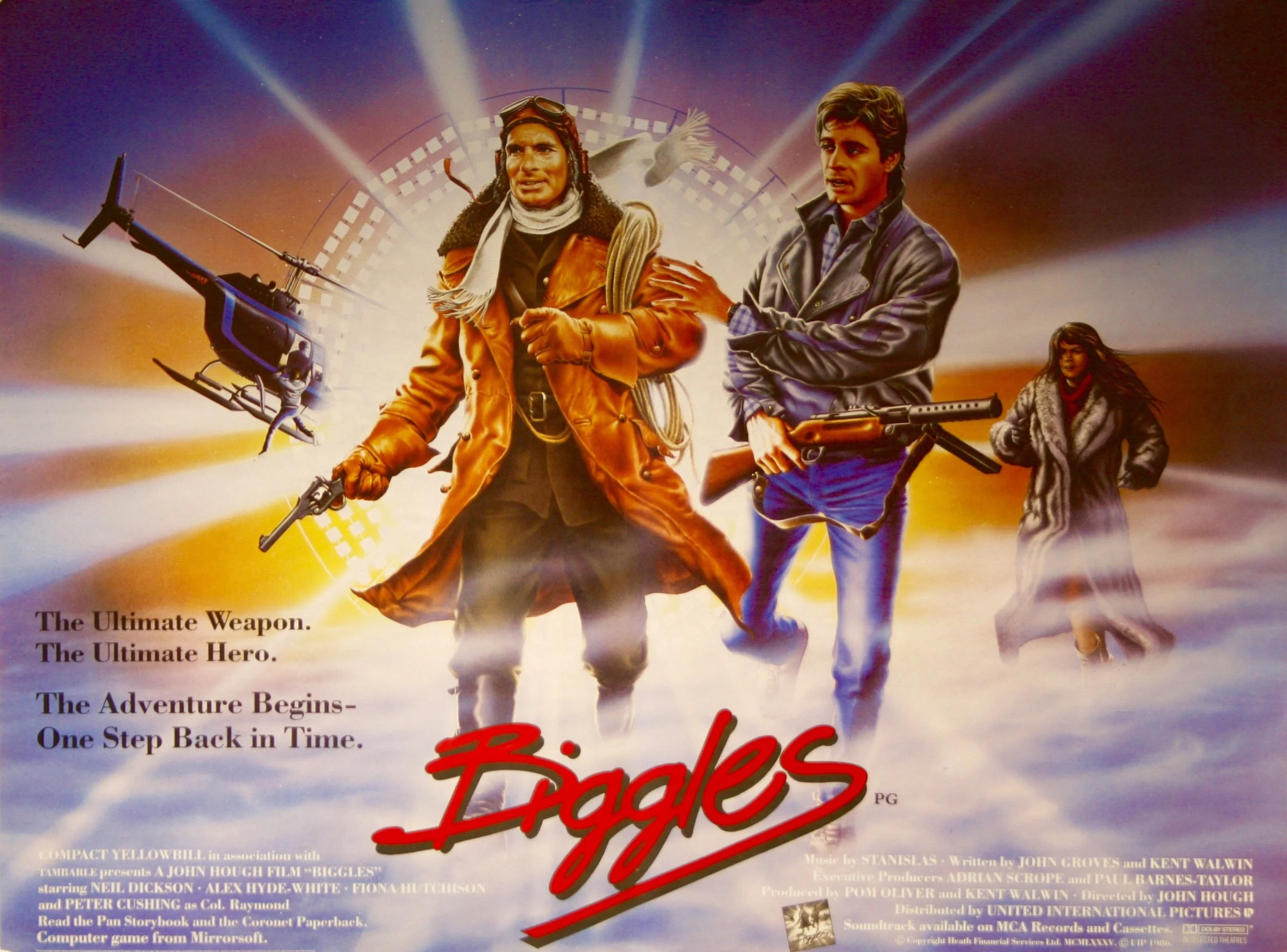
For me the inherent appeal of Conan Doyle’s great detective is the way in which it lends itself to continuous reinvention and interpretation. And so, I was greatly surprised by how well director Guy Ritchie handled the 2009 reboot. He in fact did so well, that you could argue it put his career back on track. You won’t find a deerstalker on the head of Robert Downey Jr’s Holmes. This is very much a Holmes for the current times, with bar knuckle boxing, explosions and frenetic chases around a stylised CGI London, but despite how it sounds it works extremely well. The pacing, tone and humour are just right and so the movie avoid becoming a caricature. Under all the modern trappings the screenplay retains the essential elements of source text, such as a densely plotted narrative, cunning mental gymnastics and of course the complex dynamics of the Holmes, Watson relationship.
For me the inherent appeal of Conan Doyle’s great detective is the way in which it lends itself to continuous reinvention and interpretation. And so, I was greatly surprised by how well director Guy Ritchie handled the 2009 reboot. He in fact did so well, that you could argue it put his career back on track. You won’t find a deerstalker on the head of Robert Downey Jr’s Holmes. This is very much a Holmes for the current times, with bar knuckle boxing, explosions and frenetic chases around a stylised CGI London, but despite how it sounds it works extremely well. The pacing, tone and humour are just right and so the movie avoid becoming a caricature. Under all the modern trappings the screenplay retains the essential elements of source text, such as a densely plotted narrative, cunning mental gymnastics and of course the complex dynamics of the Holmes, Watson relationship.
Robert Downey Jr is a far cry from Peter Cushing’s Holmes. He introduces a slovenly element to the character who’s continuously intellectually absorbed at the expense of others and worldly social niceties. Opium addiction is not mentioned this time round. He excels at the things that engage his intellect, including pugilism, so we have some solid set pieces, driven by Holmes pre-fight analysis. Jude Law’s Doctor Watson is an amiable and long-suffering foil, very much in the Danny Glover mould from Lethal Weapon. He offsets Holmes’s intellect perfectly with his common sense and sarcasm. As for the plot, it centres upon an aristocratic serial killer called Lord Blackwood (Mark Strong), who is caught and tried, sent to the gallows and placed in his family tomb. However, he subsequently appears to rise from the dead, and returns to his killing spree.
It’s all very fast paced and at times you can see how certain characters are introduced to simply expedite the plot and allow Holmes to do his quota of “sleuthing” before the next action sequence. Sarah Greenwood’s production design is a definite high point with here stylised, even borderline steampunk “Victoriana”. Ritchie attends to the proceeding well and balances the films elements, ensuring that just as things start to get a bit silly, he moves them on to another diversion. There is also a great score by Hans Zimmer which is radically different from the usual Violin driven motifs one associates with Holmes. Rachel McAdams, as American femme fatale Irene Adler, is more than the usual window-dressing female characters have in such movies and as ever Eddie Marsan is extremely watchable as the hang dog Inspector Lestrade.
Considering that Sherlock Holmes was released as the MCU was beginning to get traction with cinema audiences, it does well not to just repackage the great detective as yet another superhero. Yes, there are some very flashy visual affectations and contemporary editing techniques but there is still room for film to focus on the dynamics of Holmes and Watson relationship. There is a definite chemistry between both leads and it is the ongoing examination of relationship that once again underpins the story and makes it worth watching. This coupled with the right tone and visual embellishments meant that Sherlock Holmes found an audience and did well at the box office, with the cast and director returning for a sequel.
Evil Dead (2013)
Urugyan writer and director Fede Alvarez obviously has a great deal of passion for the horror genre and certainly understands it a lot better than may other mainstream film makers. Make no mistake, Evil Dead is an extremely hard R rated movie and is certainly not like the usual tame studio output we see so often these days. There is also an emphasis on physical effects rather than CGI. The film also endeavours to re-invent the movies iconic plot to avoid a scene-by-scene retread of Sam Raimi's original. The idea of a groups of friends electing to stay somewhere isolated to help one of the group go "cold turkey", is a clever one. Perhaps the smartest thing the production does is the removal of the character Ash. Replacing someone such as Bruce Campbell is virtually impossible.
Urugyan writer and director Fede Alvarez obviously has a great deal of passion for the horror genre and certainly understands it a lot better than may other mainstream film makers. Make no mistake, Evil Dead is an extremely hard R rated movie and is certainly not like the usual tame studio output we see so often these days. There is also an emphasis on physical effects rather than CGI. The film also endeavours to re-invent the movies iconic plot to avoid a scene-by-scene retread of Sam Raimi's original. The idea of a groups of friends electing to stay somewhere isolated to help one of the group go "cold turkey", is a clever one. Perhaps the smartest thing the production does is the removal of the character Ash. Replacing someone such as Bruce Campbell is virtually impossible.
They say that the road to hell is paved with good intentions, because despite all its positive points, Evil Dead still manages to fall short of the mark. Don't get me wrong, this is far from a poor film. It will meet a lot of horror fan’s needs, especially those looking for a fix of hardcore gore. It's just that once again we see that there’s a fine line between fandom and homage as opposed to what is in fact just a fan service by someone who is a little too close to the subject they love. Sadly, Evil Dead leans towards the latter to its detriment. There is an unnecessary prologue, Fede Alvarez and Rodo Sayagues screenplay falls very flat and the performances seem strained. Overall there is too much focus on production values, rather than the strong character interaction.
Violence and profanity are just two of the many tools a film maker has at their disposal. The key to using them effectively is to do so in a pertinent fashion that validates their presence. Watching something unpleasant happen to a character that you relate to in some capacity, has a great deal of impact. Viewing clinically accurate effects work, just for the sake of it, without the benefit of a wider context is less effective and possibly the biggest school boy mistakes you can make in the horror genre. When you consider the lengths that cinematographer Aaron Morton has gone to makes the woods in which Evil Dead is set in, seem genuinely malevolent, it is a shame that the atmosphere was not more directly linked to the physical on-screen horror.
Overall this reboot of Evil Dead has far more in common with the works of Eli Roth rather than Sam Raimi. Glimpses of invention and originality are ultimately lost in the frenetic third act when the focus shifts from suspense and horror to mayhem and mutilation. The joy of being scared is replaced with the challenge of enduring the repulsive. As the movie didn’t meet its full potential a new franchise did not materialise. The 2015 Starz TV show Ash vs Evil Dead further put pay to any further cinematic outings. Some degree of praise should be given to all concerned for at least trying to buck the current movie trend. Evil Dead has at least had the courage to try and please the traditional horror market rather than simply court the most commercially viable demographic.









Comfy Questions
Despite having written a blog posts claiming that there’s always something to write about, even I have days when I’m lacking inspiration. Or more to the point lacking in motivation to write. And today is a prime example. I’d much rather be doing something else, but I made a promise to myself to keep the blog content flowing. However, I discovered a selection of questions that have been doing the rounds, via Marathal over at Deez Words and decided to answer them. I’m sure you know the form. They’re a selection of “touchy-feely”, non-threatening questions designed to give the reader a simple thumbnail sketch of your “personality”. So, I thought to myself, “there’s today’s blog post”. I will try my best to answer sensibly and give as relevant answers as I can, but you know me.
Despite having written a blog posts claiming that there’s always something to write about, even I have days when I’m lacking inspiration. Or more to the point lacking in motivation to write. And today is a prime example. I’d much rather be doing something else, but I made a promise to myself to keep the blog content flowing. However, I discovered a selection of questions that have been doing the rounds, via Marathal over at Deez Words and decided to answer them. I’m sure you know the form. They’re a selection of “touchy-feely”, non-threatening questions designed to give the reader a simple thumbnail sketch of your “personality”. So, I thought to myself, “there’s today’s blog post”. I will try my best to answer sensibly and give as relevant answers as I can, but you know me.
How do I drink my tea? I don’t. Yes, that’s right I’m a British guy and I don’t like or drink tea. I usually drink bog standard black filter coffee. I don’t care for the whole Starbucks culture of taking beverages and infantilising/bastardising them with caramel, halloumi and chives. I like gin and try to drink that as often as I can.
Favourite dessert? I don’t really have favourites. There are something I like more than others, naturally, but why box yourself in with a favourite. Usually I like desserts that compliment the meal that I’ve just had. For example, after a spicy meal, I like something lemony or light and creamy to cleanse the palette.
Favourite season? My first answer about “favourite” notwithstanding, I prefer the summer co’s I like being warm. The cold and wet make me cranky.
What cheers me up? Humour, wit and good conversation. An episode of Yes Minister always lifts my spirits.
Dogs or Cats? I no longer have pets. In the past I’ve had cats, but they are parasitical bastards. But they look cute, so I guess it’s a quid pro quo.
Dream holiday? For me simply having a specific period of time where I am left to my own devices is a sufficient holiday for my needs.
How many kids do you want? I have one and that is sufficient. I have done my part keeping the species going, without excessively pillaging the environment. Yay Me. He’s an adult now and has his own family now.
Favourite weather? Warm weather, with clear skies and a light breeze. About 20-25 Celsius.
What would your last meal be? Hopefully something I like
If you could spend 24 hours anywhere, any year, where would you choose? Insert some cunningly contrived, time travel scheme here, where I could set up some sort of long-term investment plan that would pay off big time now.
If I were a ghost, who or where would you haunt? Jacob Marley. See how he liked it.
What is your family ancestry? My grandfather researched our family tree extensively during his lifetime. We have traced family back to the St. Bartholomew's Day massacre. Prior to that it’s not so clear but we have links to the Frankish kingdom and a Norman warlord.
What scares you? Wilful ignorance, the intellectual blackout that is spreading throughout western culture and the collapse of functional democratic politics and public discourse. I don’t dig spiders either.
What are you most grateful for? The baggage retrieval system they got at Heathrow. Oh, hang on, That was “worried about”. In that case I guess I’m grateful for my health. Enjoy it while you can.
Dream job? I’ve enjoyed the intellectual challenge that various jobs have provided me with over the years, but frankly I don’t like working, especially for others. I am not defined by what I do to get money. For me the dream is complete financial independence and thus not work ever again, just a life of leisure.
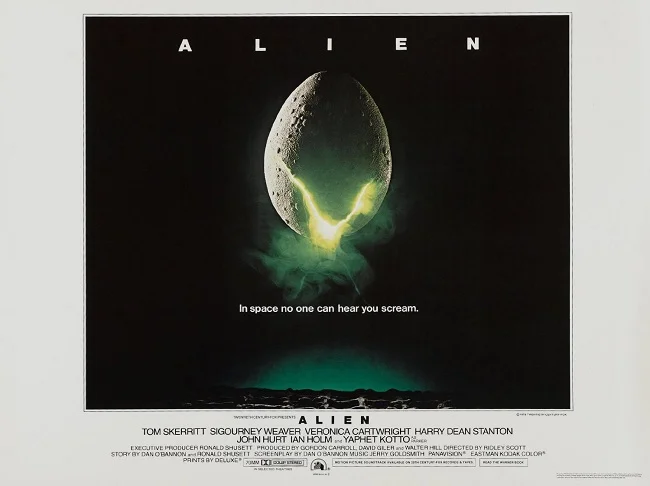
Do you believe in aliens? I believe the possibility that they may exist statistically.
Favourite sport? I don’t like sport, unless Mario Kart is a sport, then its Mario Kart.
How do I relax after a long day? A good meal, a fine wine, excellent company, an engaging film, a good book or video game. Any permutation of these will suffice.
If I could meet one historical figure, who would you choose and why? Again no one really. I’ve learned that meeting your heroes can be a real disappointment.
If I had to be a teacher, what subject would you teach? I would like to teach children aged about seven or so, about the realities of life. You know the sort of stuff. Point out why their painting isn’t good enough to go on the fridge or why they can’t actually be a Disney princess and how life is mainly tedium with brief moments of joy.
Describe your perfect day? Being left the fuck alone. It also helps if it involves gin, a mixed grill and some genoa cake.
Describe yourself in a sentence? Hungry.
Who makes me laugh the most? Witty and amusing, intelligent people. Raconteurs (not people who “think” they’re raconteurs).
What super power would you choose? The one that allows me to be left the fuck alone.
Favourite animal? The edible kind.
What is your biggest accomplishment? I’ve raised a child and they didn’t die.


















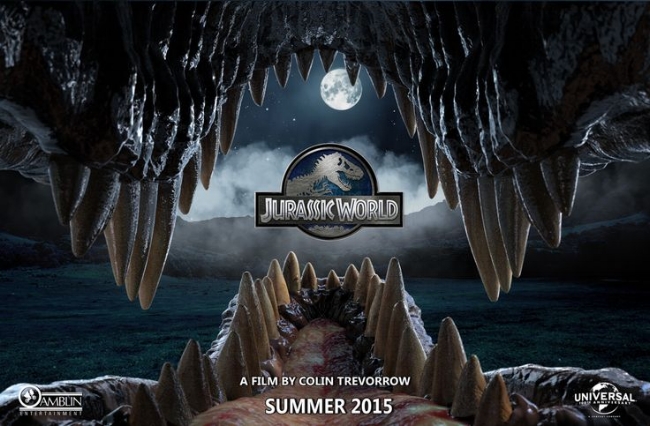
Jurassic World: Fallen Kingdom (2018)
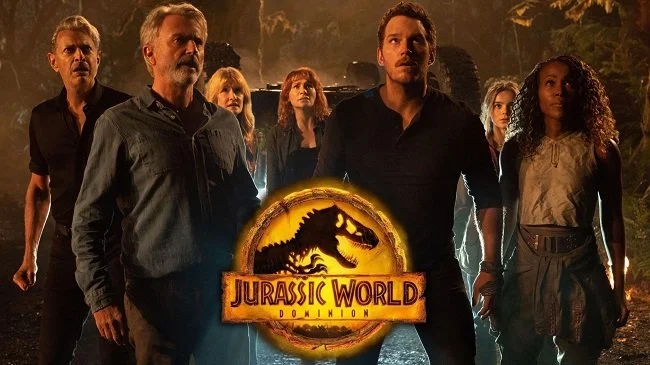
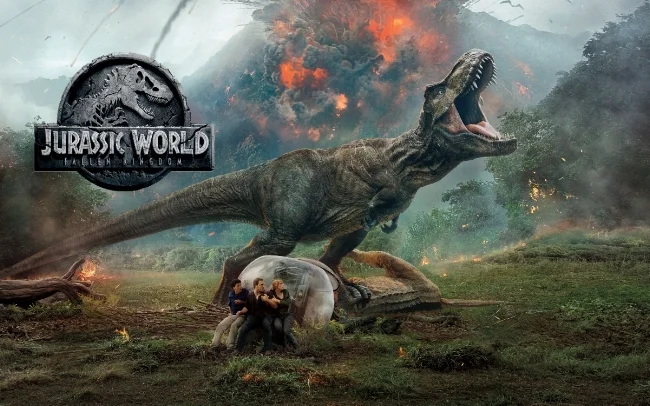
Critical opinion was very much split this summer when Jurassic World: Fallen Kingdom was released. However, the viewers were somewhat indifferent to the opinions of the professional critics and the movie made a healthy $1,303,476,615 globally, proving once again that the public’s’ continuing love affair with “all things dinosaur” shows no sign of abating. When you factor in the home media market into overall profits, the entire Jurassic Park franchise will have made $5 billion worldwide. So, bearing in mind the old adage that “money talks and bullshit walks”, I think it’s safe to say there’ll be more instalments in the years to come. When faced with such overwhelming box office popularity it seems somewhat pointless to dissect the latest movie, because the film seems to be bullet proof regardless of narrative flaws or ill-conceived plot devices. However, film criticism isn’t about box office popularity but about analysing the relative quality of a movie’s construction and its subsequent standing.
Critical opinion was very much split this summer when Jurassic World: Fallen Kingdom was released. However, the viewers were somewhat indifferent to the opinions of the professional critics and the movie made a healthy $1,303,476,615 globally, proving once again that the public’s’ continuing love affair with “all things dinosaur” shows no sign of abating. When you factor in the home media market into overall profits, the entire Jurassic Park franchise will have made $5 billion worldwide. So, bearing in mind the old adage that “money talks and bullshit walks”, I think it’s safe to say there’ll be more instalments in the years to come. When faced with such overwhelming box office popularity it seems somewhat pointless to dissect the latest movie, because the film seems to be bullet proof regardless of narrative flaws or ill-conceived plot devices. However, film criticism isn’t about box office popularity but about analysing the relative quality of a movie’s construction and its subsequent standing.
Jurassic World: Fallen Kingdom is a film of two distinct halves. The first follows a tried and tested formula and although technically accomplished, doesn’t really offer anything new. In fact, I’d go so far as to say it retreads a lot of ground previously covered in The Lost World: Jurassic Park (1997). As a U.S. Senate hearing in Washington, D.C. debates whether Isla Nublar's dinosaurs should be saved from an impending volcanic eruption, Owen Grady (Chris Pratt) and Claire Dearing (Bryce Dallas Howard) return to the island on behalf of business man Benjamin Lockwood (James Cromwell) who has offered the animals safe haven in a nature reserve. However, his aide, Eli Mills (Rafe Spall) has different plans, looking to sell off the dinosaurs to private investors. Which brings us neatly and conveniently to the second half of the film in which the dinosaurs are returned to Lockwood’s big country estate and the subsequently escape. There is also a further variation on a theme, where the bones of the deceased Indominus rex have been used to create a further hybrid using Velociraptor DNA harvested from “Blue”. Naturally this new beast, the Indoraptor, becomes the antagonist of the last hour of the film.
It is the second half of Jurassic World: Fallen Kingdom that is the most enjoyable, as it affords director J. A. Bayona the opportunity to be creative and take the franchise in a different direction to previous instalments. As an experienced director of supernatural dramas, the movie takes an interesting step into the Gothic horror genre. The Indoraptor escapes and stalks Lockwood’s granddaughter Maisie (Isabella Sermon) around the mansion, invoking a great deal of traditional horror imagery, tropes and homages. There is skilful use of silhouettes and flickering lights whilst prowling around a distinctly Gothic mansion, that looks like it came straight out of The Haunting of Hill House. The dinosaur is treated more as a traditional horror movie antagonist such as a vampire or ghost, rather than a beast in a classic “creature feature”. The climax set on a fragile glass atrium could have come straight out of a Hammer horror movie, during the studio’s heyday.
Once again, I wish to return to the subject of the PG-13 rating that seems to dominate the box office at present. A film that is predicated on big dinosaurs eating people is by its very nature going to have to show some degree of violence at some point. However, the parameters of the rating mean that such depictions are going to have to be less than graphic. Therefore, as ever the devil lies in the detail. Jurassic World: Fallen Kingdom works round this issue creatively. Firstly, sound is often used to bolster the onscreen violence, or relative lack of it. A dinosaur will stoop to devour someone in a relatively close shot, with the victim predominantly outside of the frame. Bone crunching noises, screams and tearing sounds are then used to embellish the scene. Furthermore, the death of second tier villain, Ted Levine, is a text book example of how to frame a rather unpleasant act of physical mutilation, without showing too much. It is incredibly clear what has happened, but it is not shown in explicit detail. These innovative workarounds of restraints of the rating are becoming increasingly common. For further details, go watch Kong: Skull Island and the latest Tomb Raider.
Now not all of these visual affectations discussed in the second half of Jurassic World: Fallen Kingdom work. There’s a noticeable tonal shift from the movies first hour and for some its a little too obvious, but I would argue that it’s all a welcome change to a franchise that up until now has been very set in its way. The ending of Jurassic World: Fallen Kingdom clearly indicates where the producers want to take things next. If the studio follows through, then the next instalment will be a far cry from the initial concept of dinosaurs in an amusement park. There is scope for an interesting and extensive exploration of the idea of the human race having to co-exist with another species. The ramifications both on land and at sea are ripe for dramatisation. In the meantime, if you simply want some big budget, glossy dinosaur fun then Jurassic World: Fallen Kingdom can provide that. If you dig deeper, you’ll discover an interesting franchise experiment brought about by the involvement of atypical director, which is a rare thing these days.
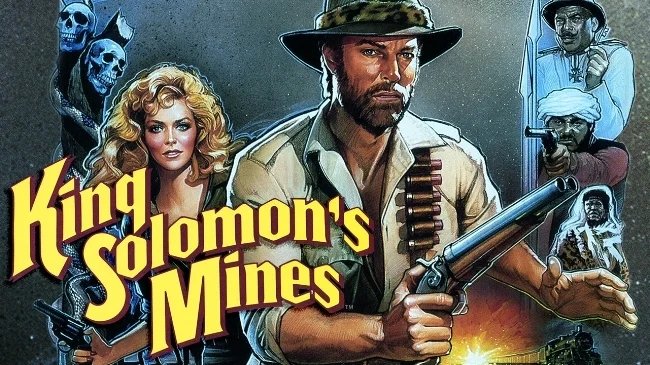
Classic Movie Themes: King Solomon's Mines
King Solomon’s Mines is a 1985 Cannon Films production based on the pulp works of H. Rider Haggard. It was quickly made to cash in on the ongoing success of Indiana Jones franchise, although the finished movie bears little resemblance to the classic original novel. Like most Cannon movies from that boom era, it was a cheap and fast enterprise that superficially sported a good cast, but ultimately didn’t do much with them. Veteran director J. Lee Thompson favoured a light and comic approach to the material, as the film’s budget could hardly sustain any major notable set pieces. Yet, it proved popular enough at the box office to warrant a sequel the following year. Allan Quatermain and the Lost City of Gold proved to be as equally silly but by then the public’s interest had waned.
King Solomon’s Mines is a 1985 Cannon Films production based on the pulp works of H. Rider Haggard. It was quickly made to cash in on the ongoing success of Indiana Jones franchise, although the finished movie bears little resemblance to the classic original novel. Like most Cannon movies from that boom era, it was a cheap and fast enterprise that superficially sported a good cast, but ultimately didn’t do much with them. Veteran director J. Lee Thompson favoured a light and comic approach to the material, as the film’s budget could hardly sustain any major notable set pieces. Yet, it proved popular enough at the box office to warrant a sequel the following year. Allan Quatermain and the Lost City of Gold proved to be as equally silly but by then the public’s interest had waned.
Set in 1910 in an unspecified part of colonial Africa, Allen Quartermain (Richard Chamberlin) is an adventurer and fortune hunter hired by Jesse Huston (Sharon Stone) to find her missing father. Professor Huston has been captured by a German military expedition led by Colonel Bockner (Herbert Lom) and Turkish slave-trader and adventurer, Dogati (John Rhys-Davies), who are searching for the legendary King Solomon’s Mines. Cliched adventures such as being chased by natives, wild animals and cooked in a pot ensue, along with modicum of cheap special effects. The screenplay is weak and tries to pass off a bunch of tired stereotypes as humour. Some viewers may find it a dumb, silly adventure. But for many it’s a tedious experience.
However, King Solomon’s Mines has one sole virtue in so far as it boasts a score by the legendary Jerry Goldsmith. Despite being intentionally composed in the idiom of John Williams Indiana Jones March, Goldsmith’s main title theme is sufficiently engaging in its own right. It exudes all of his usual sophistication and charm as well as being devilishly catchy. Despite being a musical caricature, the score, especially the title theme gets away with it in the same way as the The Rutles do. Once again it proves that Jerry Goldsmith could turn his hand to anything, musically speaking. Even when required to produce something “generic”, his work still remains a cut above the rest.






War for the Planet of the Apes (2017)
There are times when watching the third instalment of the contemporary Planet of the Apes franchise that you feel like your experiencing something akin to Terrence Malick's The Thin Red Line. There is a narrative depth and an intelligence to the screenplay that you seldom see these days coming from a major studio production. As with the original movies, the story makes multiple subtle points about the nature of humanity and our self-destructive tendencies. Yet it’s all done in a thought full and measured fashion. If you wish to treat War for the Planet of the Apes as simply a science fiction action movie then you will certainly be provided with such a film. However, if you choose to engage your intellect and ponder some of the deeper aspects of the story you’ll be rewarded with much more.
There are times when watching the third instalment of the contemporary Planet of the Apes franchise that you feel like your experiencing something akin to Terrence Malick's The Thin Red Line. There is a narrative depth and an intelligence to the screenplay that you seldom see these days coming from a major studio production. As with the original movies, the story makes multiple subtle points about the nature of humanity and our self-destructive tendencies. Yet it’s all done in a thought full and measured fashion. If you wish to treat War for the Planet of the Apes as simply a science fiction action movie then you will certainly be provided with such a film. However, if you choose to engage your intellect and ponder some of the deeper aspects of the story you’ll be rewarded with much more.
Set two years on from events of the previous film the battle between humans and apes, instigated by the traitorous Koba (Toby Kebbell), has rendered the world a wasteland. Primate protagonist Caesar (once again an extraordinary Andy Serkis) is intent on protecting his species with as little further bloodshed possible. "I didn't start this war," he rhetorically states, while reflecting on the immense loss of ape life. Yet fate leads him to an inevitable encounter with Woody Harrelson's Colonel McCullough when his wife and child are killed, sending him on a potentially self-destructive journey. Director Matt Reeves steers the proceedings at a steady pace, focusing on character over action and spectacle. Sharing a writing credit with Mark Bomback, Reeves does not stray from the central story. Unlike other big budget movies, despite the underlying technology that dominates such productions, there is little self-indulgence and excess. This is a story driven by characters and their choices and struggles.
Once again, creativity is the key to exploring the boundaries of the PG-13 rating. The scenes in the prison camp are grim and worryingly plausible. There are nods to both past and contemporary despotism. The action scenes are large in scope but lack the modern trend for frenetic editing. There is violence, but it’s shot in such a way where it is powerful, yet not inherently graphic. Tonally, the movie has a very dour and prophetic ambience. It is also clear exactly which side the audience should be rooting for. There are again further nods to other classic war movies. Anti-ape rhetoric adorns soldiers’ helmets with phrase such as "Monkey killer" and "Ape-ocalypse Now". It’s not too difficult to see hints of Colonel Kilgore in Woody Harrelson's despotic military leader.
There is also a subtle expansion of the world that makes War for the Planet of the Apes feel wider in scope than its predecessor. Overgrown decaying cities, disused railway tracks and abandoned Coca-Cola lorries hammer home the point that this is the near future and not the ancient wasteland that Charlton Heston endured in the original. Yet despite the broad canvas in which events take place, the plot rarely stray from Caesar, orangutan Maurice (Karin Konoval) and Bad Ape (Steve Zahn), who provides a reprieve from the otherwise sombre events. As for the ending of War for the Planet of the Apes, it is the only credible outcome, establishing the narrative that Caesar is the messianic saviour of his people. The audience is left to reflect upon the future of both human and ape society and whether they can coexist or not. However, that is a story for another day but considering the ground that has already been covered by the Planet of the Apes trilogy, possibly a superfluous one.





LOTRO: The Maps of Middle-earth
I logged into the third preview of Update 23 on Bullroarer test server this evening and perused the various changes that Standing Stone Games have made. For a lot of the “serious” LOTRO players, the focus of this latest build are the statistical changes to all the various classes. As I am not so au fait with this aspect of the game, I shall leave the matter until it is finalised then discuss it with my kinship who are more learned in these matters. My primary motivation for using the preview server is to get an advance look at any new region and to explore the environment. Standing Stone Games continue to do a sound job of realising the Third Age of Middle-earth and I enjoy the attention to detail they provide along with their adherence to the lore. One of the aspects of LOTRO that I’ve always enjoyed are the regional maps. In this latest preview build, all maps for the new region of Ered Mithrin are now available and the temporary placeholders for Erebor and The Steel Keep have been removed.
I logged into the third preview of Update 23 on Bullroarer test server this evening and perused the various changes that Standing Stone Games have made. For a lot of the “serious” LOTRO players, the focus of this latest build are the statistical changes to all the various classes. As I am not so au fait with this aspect of the game, I shall leave the matter until it is finalised then discuss it with my kinship who are more learned in these matters. My primary motivation for using the preview server is to get an advance look at any new region and to explore the environment. Standing Stone Games continue to do a sound job of realising the Third Age of Middle-earth and I enjoy the attention to detail they provide along with their adherence to the lore. One of the aspects of LOTRO that I’ve always enjoyed are the regional maps. In this latest preview build, all maps for the new region of Ered Mithrin are now available and the temporary placeholders for Erebor and The Steel Keep have been removed.
One of the things that attracted me to The Lord of the Rings when I first read it in the early eighties was the fact that the books came with maps. The hardback editions that I read via my local library had sumptuous fold out maps that clearly detailed the various regions. They help convey the sense of history of Middle-earth and depth of culture and lore that existed. The maps also gave a sense of scale to the Fellowship’s journey as well as context. They were integral to maintaining the illusion that Middle-earth was a living and ancient world. Hence the maps that feature in LOTRO serve a similar purpose beyond their immediate practical functionality. They don’t just provide a means of navigating from point A to point B but further embellish the games sense of immersion by showing a world populated by people in a broad variety of geographical locations. They also often reflect interesting details of lore, or minor comments from the source text.
Over the years, due to changes in the game and the streamlining of earlier zones, some maps have been replaced resulting in two distinct art styles. The contrast can be quite jarring at times. For example, the Bree-land map is one of the oldest in the game and is somewhat cluttered. However, if you then cross into the Barrow-downs the map was redesigned and sports a clearer style and breaks the zone up into two. As new content is added to the game, the newer map style naturally prevails. From an aesthetic point of view, I prefer the this to old. The maps are more functional and convey their respective information efficiently. Overall, I think they are an improvement, although I do still think they have some flaws. As to whether SSG intends to standardise all maps and thus replace those that have the older design remains to be scene.
Although the more contemporary LOTRO maps exude an appropriate art style and are easier to read, some still have a flaw with regard to conveying navigational data. Some of the maps do not always clearly show what route a player should take to enter a specific region. The other day, I decided on a whim to do some of the quests in Entwood. From memory I vaguely knew I could access the region from either Broadacres or Stonedean in West Rohan. Sadly, the maps lacked sufficient detail to give me a clear course to follow. Thus, I had to spend some time riding around the various hills that separate zones, until I found the right route. I believe access to Wildermore is similarly esoteric. Another problem are instance maps. They only become fully visible as you explore. If you leave and subsequently return to an instance, the process has to be repeated. Surely the logical thing would be to make it permanently available once the player had initially unlocked it.
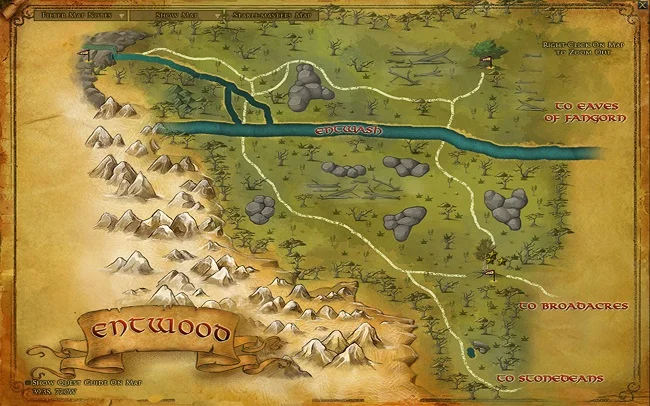
The maps in LOTRO are also poor at conveying data for regions that are set on multiple levels. Top down representations do not adequately express three-dimensional data, which can lead to confusion and frustration, especially in instances such as the Grand Stair in Moria. In the past when running this instance, I would have to rely on third party diagrams, outside of the game itself. Another map within LOTRO that is notoriously unintuitive when it comes to travelling around is the Misty Mountains. It displays what appear to be clear linear routes between key locations but fails to convey the topographical features that will impede you. Again, it is steep slopes or crevasses that bar your way. Now there may well be players who will take the view that these maps are not supposed to make things that easy for you and that their deliberate vagaries are designed to force the player to explore. That may well be true, but I find premeditated inconvenience to be poor game design choice. A map that doesn’t impart the necessary data you need to successfully navigate the area it represents, has fundamentally failed in its purpose as far as I’m concerned.
The key to success in getting the most out of the various regional maps in LOTRO is to familiarise yourself with both the pictorial representation of each zone and cross reference that with practical first-hand experience. Basically, learn your way around the physical foibles of an area and use that knowledge in conjunction with the map. The only downside of this strategy is that LOTRO is a big game so that’s a lot of information to commit to memory. Overall, I’m mainly familiar with the zone I’m currently questing through or those that I have a special affinity to. I haven’t really spent any time in South Mirkwood or parts of Rohan since those regions were released. Therefore, I often cannot immediately recall their subtleties or quirks. May be this is something else that can be added to the list of “bug” fixes and “quality of life improvements that SSG need to address. Clearer, more intuitive maps are only going to become more essential as the game continues to expand.

Dawn of the Planet of the Apes (2014)
Unlike so many other blockbusters Dawn of the Planet of the Apes is not just peddling a vacuous spectacle lacking any substance. The sequel to the 2011 reboot embraces both political and social concepts and attempts to explore them in a meaningful fashion. It is absorbing and intelligent, making its point without being too heavy handed. The motion captured performances and visual effects are outstanding, yet do not swamp the story or the subtleties of the actor’s performances. It is also surprising to see a mainstream Hollywood movie cultivate such a bleak and melancholic tone.
Unlike so many other blockbusters Dawn of the Planet of the Apes is not just peddling a vacuous spectacle lacking any substance. The sequel to the 2011 reboot embraces both political and social concepts and attempts to explore them in a meaningful fashion. It is absorbing and intelligent, making its point without being too heavy handed. The motion captured performances and visual effects are outstanding, yet do not swamp the story or the subtleties of the actor’s performances. It is also surprising to see a mainstream Hollywood movie cultivate such a bleak and melancholic tone.
I was not expecting great things from Dawn of the Planet of the Apes. I was raised on reruns of the original Planet of the Apes franchise and was frankly reticent to invest time in movies that were simply going to revisits old ground. However, Dawn of the Planet of the Apes has a greater depth to its narrative than I anticipated and is surprising critical of many contemporary political issues. The story not only explores the concept of institutionalised racism but wider societal inequality and the abuse of power that so often arises in all forms of politics. The thorny issue of gun control is alluded to, although obliquely.
Plot wise, Dawn of the Planet of the Apes takes a familiar story and simply tells it form a different perspective. Since the outbreak of the ALZ-113 virus, Caesar (Andy Serkis) and his genetically modified apes have been living peacefully in Muir Woods. When a band of wandering human survivors encounters them, both parties are equally surprised. After a violent incident, Caesar orders them to leave. However, the matter causes divisions in both human and ape societies. Koba (Toby Kebbell) wishes the apes to strike against humans while they still have the upper hand and likewise Dreyfus (Gary Oldman) wants the humans to deal with the simian threat, once and for all. However, not all humans takes such a hawkish stance. Malcolm (Jason Clarke) is curious about Caesar and feels an affinity towards him as both are struggling fathers.
Director Matt Reeves and screenwriters Rick Jaffa, Amanda Silver and Mark Bomback embellish the narrative with a great deal of thought and creativity. The apes use of sign language is innovative and appropriate. The sophisticated CGI does not impede the actor’s performance. Many of the apes have clear personalities and are strongly defined. The lack of dialogue in many scenes works very well, allowing cinematic art and the physical skill of the actors to tell the story. It's quite astonishing how far the motion capture technology has advanced when it comes to creating tangible characters that audiences can genuinely empathise with. Dawn of the Planet of the Apes is a superior movie to its predecessor, which although enjoyable, still felt very much like a prologue rather than a story in its own right.
However, Dawn of the Planet of the Apes does have a few inconsistencies. Gary Oldman is once again under used and liberal human leader Malcolm is a little bland. As ever with movies, it is the bad guys who are potentially the most interesting character. Yet I was left somewhat underwhelmed by the chimp Koba. It would have been interesting to see a greater exploration of his back story. I get the impression that the editing process left actor Toby Kebbell's performance somewhat choppy.
Overall, Dawn of the Planet of the Apes is an above average blockbuster movie that requires audiences to think and reflect, rather than just passively view. It moves the long-term story arc of the franchise forward into interesting new territory. It is quite hard hitting within the confines of its broad PG-13 rating and is surprisingly not afraid to pursue a sombre tone. The technical achievements of the production are prodigious and prove that motion capture performances are as relevant and meaningful as any other form of acting.
Rise of the Planet of the Apes (2011)
The greatest asset of Rise of The Planet of the Apes is the CGI chimpanzee, Caesar, played by Andy Serkis. It is also the films greatest hindrance. Too much focus is spent on the titular character at the expensive of the remainder of the cast. The pace is also purposely pedestrian to accommodate a list of cinematic pre-requisites that the producers felt must be included. These include moral dilemmas, relationship issues and contemporary ethical themes. If you were hoping that Rupert Wyatt’s Rise of The Planet of The Apes would be a more cerebral spectacle, then you may well be a little disappointed. It is functional and efficient entertainment, but no more than that.
The greatest asset of Rise of The Planet of the Apes is the CGI chimpanzee, Caesar, played by Andy Serkis. It is also the films greatest hindrance. Too much focus is spent on the titular character at the expensive of the remainder of the cast. The pace is also purposely pedestrian to accommodate a list of cinematic pre-requisites that the producers felt must be included. These include moral dilemmas, relationship issues and contemporary ethical themes. If you were hoping that Rupert Wyatt’s Rise of The Planet of The Apes would be a more cerebral spectacle, then you may well be a little disappointed. It is functional and efficient entertainment, but no more than that.
The CGI action scenes of rampaging apes, as shown in the trailer, are well executed but far smaller in scale than you would expect. They also arrive quite near to the films climax and are not as a substantial part of the movie as suggested. There are a few nods to the original series of films during the course of this reboot. But by and large this movie feels that it has been hemmed in and restrained by the need to establish a starting point for a new franchise. Once again, I suspect studio meddling and a continuous stream of memo’s suggesting adjustments based on focus groups and market research.
John Lithgow is good, but there again he is seldom bad. It is also nice to see humanity toppled from its pedestal. I have an inclination for any film that eschews the tired notion that the human race is the summit of evolution and somehow the metaphorical centre of the universe. It cannot be denied that the motion capture techniques certainly do set new standards. But ultimately, if Fox had spent more time focusing on a more even narrative, rather than being pleased with itself by all boxes they were ticking, this would be a better film. Let us hope that the next entry in the series will have a stronger director and a finely-honed screenplay.
The Omen (2006)
Director John Moore is no stranger to remakes, having produced a new version of The Flight of the Phoenix in 2004. Remakes per se are not necessarily a bad thing as long as they bring something new to the table and explores the narrative in a different fashion. This is why Gus Van Sant’s shot-by-shot remake of Hitchcock's Psycho is so universally reviled and deemed to be pointless, because it doesn’t do any of those things. Which brings me to The Omen which is not an exact copy of Richard Donner’s 1976 film, but it does follow the original screenplay. The movie treads a fine line, adding some additional embellishments to the proceeding such as the opening sequence set in the Vatican as the Pontiff considers the impending Biblical prophecy. Yet it still feels a little too familiar to those older viewers who are au fait with the original movie. Furthermore, the 1976 horror classic was a milestone in the horror genre. It was a big budget production, professionally made with a quality cast. Such a critical and commercial success casts a long shadow and remaking such a production is always going to be an uphill struggle.
Director John Moore is no stranger to remakes, having produced a new version of The Flight of the Phoenix in 2004. Remakes per se are not necessarily a bad thing as long as they bring something new to the table and explores the narrative in a different fashion. This is why Gus Van Sant’s shot-by-shot remake of Hitchcock's Psycho is so universally reviled and deemed to be pointless, because it doesn’t do any of those things. Which brings me to The Omen which is not an exact copy of Richard Donner’s 1976 film, but it does follow the original screenplay. The movie treads a fine line, adding some additional embellishments to the proceeding such as the opening sequence set in the Vatican as the Pontiff considers the impending Biblical prophecy. Yet it still feels a little too familiar to those older viewers who are au fait with the original movie. Furthermore, the 1976 horror classic was a milestone in the horror genre. It was a big budget production, professionally made with a quality cast. Such a critical and commercial success casts a long shadow and remaking such a production is always going to be an uphill struggle.
Moore’s The Omen is competently made, with good use of various European locations such as London and Rome. Malta doubles for Israel in the second act. There is also a strong cast of character actors such as Pete Postlethwaite, Michael Gambon and David Thewlis. What essentially carries the film is the central performance by Liev Shreiber as Robert Torn. He remains credible and behaves like he’s struggling to come to terms with the situation. His relationship with his wife Katherine (Julia Stiles) is also plausible. Mia Farrow adds her acting weight to the role of the sinister nanny Mrs Baylock. Horror fans will also be pleased to see genre stalwart Giovanni Lombardo Radice (AKA John Morghen) as Father Spiletto. The only weak link in the proceedings is Seamus Davey-Fitzpatrick as Damien. He is dressed, made up and shot to look sinister which broadly works but he doesn’t do anything particularly evil and thus doesn’t pose an effective threat.
There are flashes of creativity and an attempt to do more than what was done previously. For example, there is a good use of colour throughout the movie. Red is often a signifier off impending death. When Father Brennan senses that demonic forces are closing in during a storm, we see a person in a red raincoat run through the frame in the background. He also passes someone with a red umbrella. It’s a recurring motif throughout the films set pieces. The score is suitably atmospheric and composer Marco Beltrami wisely references Jerry Goldmsith iconic theme but largely does his own thing. Director John Moore also adds several visionary sequences that reflect the growing fear in both Katherine and Robert Thorn. These work as jump scare but more to the point, provide “omens” of the future and reinforce the idea that Damien’s existence is not just an immediate threat to them but has long term consequences for the future of man.
Overall, The Omen is still a little too close to the original and ultimately just adds a modern veneer to the story, rather than doing something substantially different. Then there is the issue of the death scenes which are one of the motifs of the franchise. The original film’s set pieces where ground breaking, in particular David Warner’s decapitation by a sheet of glass, which has now become a genre “treasure”. What made these scenes so visceral in back in 1976 was the fact that they were physical effects and stunts. This time round they’re simply CGI excesses. For example the roving camera follows the falling scaffolding pipe down from the church spire as it impales Father Brennan, in a manner that instantly negates any sense of credibility. Yes, it looks very photogenic, but the brain knows that such a shot is a technical deceit and as a result this sequence lacks the impact of the original. Similarly, the death of photographer Keith Jennings diminished due to it obvious digital construction.
If you have not seen the 1976 version of The Omen and therefore have no respective emotional baggage pertaining to it, then you’ll find the 2006 remake to be an adequate big budget horror movie that fulfils its own remit. For older viewers and horror aficionados, the main obstacle to enjoying the film is its perceived redundancy. Although well made in most respects it doesn’t quite do enough to set it apart from the original. Does it entertain? Yes, but that has to be offset against a strong sense of “so what”. It is interesting to note that The Omen cost $25 million to make and made an adequate $119,496,523 internationally. Yet despite this no sequel has been forthcoming and I suspect that the studio is a little too aware of the audience ambivalence towards such remakes. The cost of another instalment could finance at least two or three other original properties and given the return on investment the horror genre can provide (for example the Saw franchise) this is probably deemed the wiser course of action.
Megiddo: The Omega Code 2 (2001)
If at first you don’t succeed, try the exact same thing over again with more money. Megiddo: The Omega Code 2 is the follow up to the 1999 film The Omega Code. Technically, the film is a quasi-prequel (plot wise) which covers Politician, Industrialist and Antichrist Alexander Stone’s (Michael York) rise to power and his subsequent feud with his younger brother. It then deviates from the sequence of events in the first movie by ending in a large-scale battle at Megiddo between the forces or good and evil, both of whom favour the use of tanks and helicopter gunships. Megiddo: The Omega Code 2 benefits from a substantially larger budget and from superior direction by veteran film maker Brian Trenchard-Smith. It’s hardly a genre milestone but it’s a step in the right direction compared to its predecessor.
If at first you don’t succeed, try the exact same thing over again with more money. Megiddo: The Omega Code 2 is the follow up to the 1999 film The Omega Code. Technically, the film is a quasi-prequel (plot wise) which covers Politician, Industrialist and Antichrist Alexander Stone’s (Michael York) rise to power and his subsequent feud with his younger brother. It then deviates from the sequence of events in the first movie by ending in a large-scale battle at Megiddo between the forces or good and evil, both of whom favour the use of tanks and helicopter gunships. Megiddo: The Omega Code 2 benefits from a substantially larger budget and from superior direction by veteran film maker Brian Trenchard-Smith. It’s hardly a genre milestone but it’s a step in the right direction compared to its predecessor.
Sadly, the script is still weak and therefore the biggest flaw in the production and not even the tinkering of script doctor John Fasano cures it of its failings. Despite the overtly religious framing of the narrative there seems to be little insight into the forces of good. God and Jesus are seldom mentioned, and the plot still focuses on the rise of the beast. The production values are higher than its predecessor and some of the action scenes are okay. However, the use of CGI is variable ranging from adequate to poor. The destruction of the Coliseum in Rome is noticeably inept. In between the action we have a notable cast of international character actors such as Michael Biehn, David Hedison, Udo Kier and Franco Nero. In a fit of inspired casting, R Lee Ermey plays the president of the United States! They all spend their time looking earnest and moving the clumsy story line forward.
Considering the nature of the story, you would expect some flamboyant dialogue and clever theological cut and thrust. But such an approach is distinctly lacking. There are also several plot holes that must surely spring to mind to even the most casual viewer. For example, what is the Pope doing during these proceedings? Is he not Gods representative on earth? Surely the Catholic Church has a few thoughts on the rise of the Antichrist? Also, how does Islam react to these events? The screenplay chooses to omit these lines of enquiry. There is also no mention of the number of the beast, which tends to be a key point in the Book of Revelations. You do not have to be a major religious scholar to realise that Megiddo: The Omega Code 2 is simply cherry picking various religious texts to justify its own narrative. But then again this is a movie funded by evangelical Christians.
However, despite these shortcomings, this is by and large a more enjoyable film than the first instalment. The reliable cast do their best to tackle the screenplay and plot with stoic professionalism. Director Brian Trenchard-Smith stated that he treated the movie as a “a fun romp, not usually what happens with a religious film”. I still got the feeling that I was watching a sanitised version of a The Final Conflict but that is the price you have to pay to reach the widest audience with the ubiquitous PG-13 rating. Oh, and there's no reference to the code of the title in this particular movie. So, if you endured the first movie and feel the need for a second round, then Megiddo: The Omega Code 2 is a more rewarding experience. It still isn’t anywhere near as good as it could’ve been but it’s an improvement. Perhaps if there had been a third instalment, they may have got it right. However, poor box office returns brought this distinctly niche franchise to an end.
The Omega Code (1999)
Action-based faith movies are a curious and somewhat niche genre (“no shit” I hear you say). Apart from this movie and its sequel, the only other I can think of is Left Behind from 2014. There have been others, but they’ve tended to be very low budget affairs, made for Christian TV networks. The Omega Code, directed by Robert Marcarelli, was different, in so far it had a larger budget and managed to get a secure a theatrical release. The premillennialist plot revolves around a plan by industrialist politician and Antichrist Stone Alexander (Michael York) to take over the world using information hidden in the Bible via a hidden code. Casper Van Dien also stars as lifestyle guru Dr. Gillen Lane who unwittingly joins Stone to handle his public relations. The film is based on a novel written by televangelist Paul Crouch, head of the Trinity Broadcasting Network. The plot presents an Evangelical Christian view about the end of days and the rise of the Antichrist. Believe it or not, the box office returns for The Omega Code where greater than Fight Club on its opening weekend in 1999.
Action-based faith movies are a curious and somewhat niche genre (“no shit” I hear you say). Apart from this movie and its sequel, the only other I can think of is Left Behind from 2014. There have been others, but they’ve tended to be very low budget affairs, made for Christian TV networks. The Omega Code, directed by Robert Marcarelli, was different, in so far it had a larger budget and managed to get a secure a theatrical release. The premillennialist plot revolves around a plan by industrialist politician and Antichrist Stone Alexander (Michael York) to take over the world using information hidden in the Bible via a hidden code. Casper Van Dien also stars as lifestyle guru Dr. Gillen Lane who unwittingly joins Stone to handle his public relations. The film is based on a novel written by televangelist Paul Crouch, head of the Trinity Broadcasting Network. The plot presents an Evangelical Christian view about the end of days and the rise of the Antichrist. Believe it or not, the box office returns for The Omega Code where greater than Fight Club on its opening weekend in 1999.
So where to start? The Omega Code is a mess yet a fascinating one at that. The budget although small, is sufficient to portray the proceedings, although the effects work, computer graphics and action scenes are somewhat lacklustre. The direction is poor, the script clichéd and the plot very predictable. Yet a lot of research appear to have been done regarding the religious prophecies depicted. It’s a shame this aspect wasn’t explored more. There are some interesting performances, especially from York, who has a great time chewing the scenery. Genre favourite, Michael Ironside appears as a defrocked priest turned assassin which is as novel as is bizarre. In some respects, the movie come across as The Omen lite, but it struggles to hold the viewers interest. It raises many theological questions and yet for a faith driven movie there's a lot about Satan but precious little about Jesus. The PG-13 rating is not really justified and those looking for action will be disappointed.
A better director, tighter script and larger budget would have greatly improved The Omega Code. On mature reflection many of the films failing can be clearly attributed to the fact that many involved on the production side were not sufficiently experienced. In the right hands this could have been a engaging cult movie or cheesy genre film. Yet despite these factors the film still performed well in the US market. No doubt due to heavy promotion at a parish level. It spawned a prequel which attempted to address some of the criticisms of the first instalment. Overall The Omega Code has very limited appeal to both Christians and non-Christians. For those who like theological horror dealt with in a more traditional fashion, I'd recommend Holocaust 2000 from 1977 staring Kirk Douglas. It’s an interesting Italian cash in on The Omen, filled with visions of the apocalypse, lurid death scenes and yet another British actor (Simon York) playing the Antichrist.
Financing LOTRO
Back in December 2008, I bought a “compilation pack” that contained both the The Lord of the Rings Online: Shadow of Angmar base game, along with the newly released Mines of Moria expansion. I paid £20 for the lot. After the obligatory free months access, I then became a regular subscriber right up until about summer 2012. Since then I’ve subscribed and played whenever new content is released, meaning that for about six months of the year, I’m paying for the “luxury” of playing LOTRO. I’ve also purchased all the expansions over the years. Because I enjoy the game, I am not averse to buying additional LOTRO points when my monthly stipend doesn’t cover the cost of the items I want. I never availed myself of the opportunity to become a lifetime account holder, which is something I regret. It certainly would have been very good value for money, considering that LOTRO is over a decade old.
Back in December 2008, I bought a “compilation pack” that contained both the The Lord of the Rings Online: Shadow of Angmar base game, along with the newly released Mines of Moria expansion. I paid £20 for the lot. After the obligatory free months access, I then became a regular subscriber right up until about summer 2012. Since then I’ve subscribed and played whenever new content is released, meaning that for about six months of the year, I’m paying for the “luxury” of playing LOTRO. I’ve also purchased all the expansions over the years. Because I enjoy the game, I am not averse to buying additional LOTRO points when my monthly stipend doesn’t cover the cost of the items I want. I never availed myself of the opportunity to become a lifetime account holder, which is something I regret. It certainly would have been very good value for money, considering that LOTRO is over a decade old.
Although F2P games offer the benefit of reaching a wider market, I do believe that the business model is troublesome and causes more problems than it solves. Lootboxes similarly can break a game, as content is retrofitted to accommodate monetisation, rather than serve the exclusive needs of the customer. The monetisation per se of the gaming industry remains a perennial debate and one that is not going to be solved anytime soon to every one’s satisfaction. It is certainly a matter that is causing Standing Stone Games to tie themselves in knot at present. Lootboxes have been present in LOTRO for a while but they were never integral to progression through the game until the release of the Mordor expansion. Let it suffice to say that there has been a great deal of player push back against this decision and that SSG have been trying to address this matter in Update 23, which is due for release soon. However, the current proposals are complex and are very much a work in progress. They also seem to be causing a great deal of consternation among players.
I won’t attempt to summarise the latest “plan” at present as it’s being continuously “revised”. If you’re feeling stoic, then read the current thread on the official forums and you’ll see how difficult this matter is to sort out. However, I think the overall problem comes down to a fundamental difference in outlook over the financing of LOTRO, between the players, the publishers and lastly the developers SSG. LOTRO has a mature playerbase. A hardcore of thirty to fifty plus year olds, who all cut their teeth in an era where game monetisation was clear. You bought a game and paid for any additional expansions. In the MMO world, you bought the base game and subscribed. It was a simple “quid pro quo”. You paid money and got content. However, microtransactions, in-game currencies, season passes, paid DLC, lootboxes and “live services” have evolved over the last decade or so and have migrated from the mobile games market, over to console and PC gaming. Younger players who have grown up with mobile games has become “acclimatised” to such business practices. LOTRO players by and large don’t care for them.
And therein lies the rub for SSG or more to the point, their financial backers Daybreak Game Company. I suspect that there are financial targets set for LOTRO each quarter and that these are proving “challenging”. Because of the dedicated nature of many core LOTRO players it would appear that there are significant whales in the community. Yet it is the nature of the current games industry to seek whatever revenue that can possibly be generated and that the fate of a game will often come down to whether or not it yields the financial projections. Hence it become extremely difficult for SSG to find the right balance. Simply removing loot boxes and the LOTRO store from the game is not going to happen. The game is just too heavily dependent upon that business model. Some players have suggested cutting out the “middle man” of loot boxes and keys and just have a store where you buy everything that is offered. Sadly, whatever course of action is taken, it is bound to please one group and offend another. However, gating content or progression in LOTRO behind some kind of pay mechanic could well prove to be the straw that breaks the camel’s back. But I’m sure SSG knows this, so it will be interesting to see what compromise they arrive at by the time Update 23 launches.





Unfriended (2014)
Enjoyment of Unfriended depends heavily on the viewers familiarity with social media and its associated youth culture. If you are not “tech savvy”, then you may struggle with the films format, which is presented as an ongoing Skype call, with additional use of Google, You Tube and other sundry apps. I started watching Unfriended in my lounge but struggled to read the onscreen text even on a 40-inch TV screen. I eventually end up viewing the film at my desktop PC, sitting a lot closer to the screen. Watching the movie in the same way as you would consume real online content IE at a computer or via a laptop or tablet, does indeed enhance the viewing experience and give the story a greater sense of immediacy. I’m curious as to how Unfriended came across during its theatrical release and whether big screen digital projection added to the atmosphere or diminished it.
Enjoyment of Unfriended depends heavily on the viewers familiarity with social media and its associated youth culture. If you are not “tech savvy”, then you may struggle with the films format, which is presented as an ongoing Skype call, with additional use of Google, You Tube and other sundry apps. I started watching Unfriended in my lounge but struggled to read the onscreen text even on a 40-inch TV screen. I eventually end up viewing the film at my desktop PC, sitting a lot closer to the screen. Watching the movie in the same way as you would consume real online content IE at a computer or via a laptop or tablet, does indeed enhance the viewing experience and give the story a greater sense of immediacy. I’m curious as to how Unfriended came across during its theatrical release and whether big screen digital projection added to the atmosphere or diminished it.
The story is a clever variation on a well-established horror theme. Five high-school friends, Blaire, Mitch, Jess, Ken and Adam are chatting on Skype when an unexpected six person joins their call. The “guest” claims to Laura Barns, a friend who committed suicide a year ago after a video was posted on You Tube of her drunk and incontinent at a party. At first the friends simply suspect the caller to be a “internet troll” but it soon becomes clear that the person knows a great deal about them, as they begin to reveal their worst secrets. As the group starts to turn on each other, it becomes clear that that something distinctly supernatural is happening. Is the mysterious caller the ghost of Laura Barns, who has returned to seek revenge on those who wronged her? The friends try to disconnect the mysterious caller but are told that they must all remain online and participate in a game, or else one of them will die.
The structure and format of Unfriended is by far its best-selling point. Beyond the creativity of the medium used to tell the story, the film is standard supernatural revenge tale. The lead characters are far from likeable but very relatable and plausible. The screenplay by Nelson Greaves briefly touches upon that peculiarly American social foible of worrying about being perceived as “a good person”. Naturally in this case the cast are shown to be superficial, backstabbing, narcissists that are the embodiment of “generation consume”. The shocks are not anything special, but the narrative does successfully manage to sustain a strong atmosphere of disquiet. All performances are good in so far as the characters all come across as convincingly duplicitous and hypocritical. The ending is suitably hyperbolic and what you expect from such a specific genre movie.
I’m all in favour of the horror genre experimenting in such a fashion as this, because it is through this process that it remains relevant. Despite my own age related bias and my over familiarity with the horror genre, I enjoyed Unfriended far more than I expected. However, its success has already spawned a sequel and I wonder if social media-based horror is destined to go the same way as the found footage genre. I not sure if it can sustain such a level of interest before the novelty of presenting a story in such a fashion becomes old. However, horror cinema has proven to be a very robust medium so only time will tell. In the meantime, as younger viewers have taken to Unfriended like a duck to water, I would encourage the older open-minded horror fan to give it a go. They may find some virtue in it and enjoy how many classic horror tropes are given a new spin.
LOTRO: Tales from the Barter Wallet
One of the fun things about LOTRO is the way each player evolves their own personal way of navigating around Middle-earth. Although there is an extensive “stable” network throughout the game, I often find it quicker to use the various “Return to” skills, to get where I need to go. Turns out there’s a lot more in LOTRO than I realised. One of the most beneficial is “Return to Minas Tirith” which places you in the city before the Battle of the Pelennor Fields. The main advantage is that you arrive close to the stable-master who has an extensive list of travel destinations throughout Gondor. More so than his counterpart in the Minas Tirith after the battle. The skill “Return to Minas Tirith” is obtained from the Quartermaster (Defenders of Minas Tirith) at the Great Gate of Minas Tirith for 30 Minas Tirith Silver Pieces.
One of the fun things about LOTRO is the way each player evolves their own personal way of navigating around Middle-earth. Although there is an extensive “stable” network throughout the game, I often find it quicker to use the various “Return to” skills, to get where I need to go. Turns out there’s a lot more in LOTRO than I realised. One of the most beneficial is “Return to Minas Tirith” which places you in the city before the Battle of the Pelennor Fields. The main advantage is that you arrive close to the stable-master who has an extensive list of travel destinations throughout Gondor. More so than his counterpart in the Minas Tirith after the battle. The skill “Return to Minas Tirith” is obtained from the Quartermaster (Defenders of Minas Tirith) at the Great Gate of Minas Tirith for 30 Minas Tirith Silver Pieces.
Now you may wonder why I mention something that has existed in the game since October 2017 when Update 17 - The Siege of Minas Tirith was released. Well the above stemmed from me digging around in my in-game barter wallet and wondering whether any of the older reputation reward tokens were still of any practical use. I have one primary alt that I’ve invested a fair amount of time into. I usually end up doing all quests in each zone, so tend to have maximum rep with all factions and a surfeit of barter tokens. Naturally, armour from Enedwaith or Dunland is no longer relevant at current endgame and it is the nature of MMOs to produce gear that has its day in the sun, only to be consigned to oblivion twelve months later. So, it’s par for the course that LOTRO generates a wealth of tokens that simply fills up your barter wallet only to be forgotten. However, there is “gold” to be found if you take the time to look.
Pet, mount and cosmetic collectors would be well recommended to do some research. For example, the Bingo Boffin episodic quest chain yields a wealth of cosmetic pets. Who doesn’t want an Umber Goat? Again, the Defenders of Minas Tirith can supply a Striped Pelennor Pig for 50 Minas Tirith Silver Pieces. Then there’s a Rohirric Follower if you have full rep with the Riders of Rohan. Then there are the respective “Return to” skills to such places as Galtrev, Mirkwood and Snowbourn. If you purchase the right skill from the LOTRO store you can reduce the cooldown time on all of these to 30 minutes. And although I said that a lot of the faction gear becomes statistically obsolete as you progress through the game, you can still equip items cosmetically if you like the look of them.
A lot of items in your barter wallet can also be traded in for practical commodities like Scrolls of Empowerment and Essence and Relic removal Scrolls. These are always of use and it never does any harm to stockpile them. Also, some of the items that you can obtain via your barter wallet can then be sold via the Auction House. And then there are the skirmish marks. I’ve always enjoyed this particular aspect of LOTRO and have often used skirmishes as an alternative means of levelling. They offer short and convenient challenges and it’s surprising how you can build a large fortune of marks and medallions over time. I still use my Landscape Soldier and it’s easy and convenient to buy the tokens for their use, from the skirmish vendors.
If like me, you’ve been playing LOTRO for a while, you may well have equally built up a supply of rep tokens and sundry barter currencies. It is certainly worthwhile investigating what you can actually trade them for and enhance your game. Because of the way LOTRO has grown over the years, many of its game systems are somewhat esoteric and are often overlooked by all but the most dedicated player. However, there’s no real quick or convenient way to really discover what you can or cannot get, other than by visiting the vendors of each particular rep faction and simply trawling through their inventory. Alternatively, you can search through the LOTRO Wiki and just see what’s available in game. All things considered it’s well worthwhile investigating the far reaches of your barter wallet. It may well offer you something unexpected and convenient.
Super Mario Bros. (1993)
Twenty-five years ago, Super Mario Bros. was released upon an unsuspecting public and subsequently met with universal critical derision and box office failure. With the benefit of 20/20 hindsight is seems incredible that this project ever got given a green light. Yet at the time, not only was it granted a generous $48 million budget, but it boasted a cast and production team of the highest pedigree. Produced by Oscar nominated director Roland Joffé, the cinematography was by Dean Semmler and the editing was by Mark Goldblatt. The central characters of Mario and Luigi where played by Bob Hoskins and John Leguizamo and the icing on the cake was Dennis Hopper as King Koopa. You simply couldn't make it up.
Twenty-five years ago, Super Mario Bros. was released upon an unsuspecting public and subsequently met with universal critical derision and box office failure. With the benefit of 20/20 hindsight is seems incredible that this project ever got given a green light. Yet at the time, not only was it granted a generous $48 million budget, but it boasted a cast and production team of the highest pedigree. Produced by Oscar nominated director Roland Joffé, the cinematography was by Dean Semmler and the editing was by Mark Goldblatt. The central characters of Mario and Luigi where played by Bob Hoskins and John Leguizamo and the icing on the cake was Dennis Hopper as King Koopa. You simply couldn't make it up.
Apparently, the script was hawked around most of Hollywood as the production tried to secure a suitable A list director and some bankable box office names. Harold Ramis was initially linked to the project but opted to make Groundhog Day instead. A move I'm sure he has never regretted. Both Michael Keaton and Arnold Schwarzenegger passed on the chance to play King Koopa. The role of Mario was at first offered to Danny DeVito, but he would not commit to the movie until he had seen a complete script. Tom Hanks was then hired and let go, in favour of Bob Hoskins. Mr. Hoskins was subsequently traumatised by his experiences shooting this movie.
“The worst thing I ever did? Super Mario Bros. It was a fuckin’ nightmare. The whole experience was a nightmare. It had a husband-and-wife team directing, whose arrogance had been mistaken for talent. After so many weeks their own agent told them to get off the set! Fuckin’ nightmare. Fuckin’ idiots”.
Then there is of course the script. After numerous incarnations ranging from traditional fantasy, to a post-apocalyptic futuristic setting, it was decided to opt for a dystopic cyberpunk alternative reality where evolved dinosaurs ruled the world. Ed Solomon of Bill & Ted's Excellent Adventure fame was brought in to make further, “kiddy friendly” revisions to the plot. This caused major discrepancies with elements of the production that directors Annabel Jankel and Rocky Morton (of Max Headroom fame) had already created, such as costumes, prosthetics and character art.
As the primary shooting ended the original finale involving Mario climbing the Brooklyn Bridge and dropping a bomb on King Koopa and kicking him into the river, was replaced with alternative material where he was shot by a high-tech weapon that melted him. Directors Morton and Jankel were subsequently excluded from the editing process, in which a great deal of new material shot by the second unit was integrated into the film. As you would expect with such a production, the final cut was far from everyone’s expectations. The critics and fans were harsh and unforgiving. The nicest quote I could find was "doesn't have the jaunty hop-and-zap spirit of the Nintendo video game from which it takes – ahem – its inspiration."
Like so many epic failures, Super Mario Bros. seems to have acquired, some sort of cult following over the years. I think that is never does any harm to revisit any movie after a period of time and to attempt to re-evaluate it, although such a process does not guarantee a change of opinion. In the case of Super Mario Bros. the passage of time has not altered the fact that the movie is a mess.
Yet there is a degree of freak show fascination that makes the film compelling. It has an air of car crash cinema to a degree and is most certainly is a text book example of stripping a franchise of all its charm and selling points, while trying to bring it to the big screen. Perhaps one of the interesting aspects about the film, is that the mistakes that were made during its production are still regularly made today. No doubt they will happen again in the future. In the meantime, if you have a strong sense of curiosity and a high tolerance of bad cinema, then watch Super Mario Bros.as some sort of cinematic “Kobayashi Maru test”.

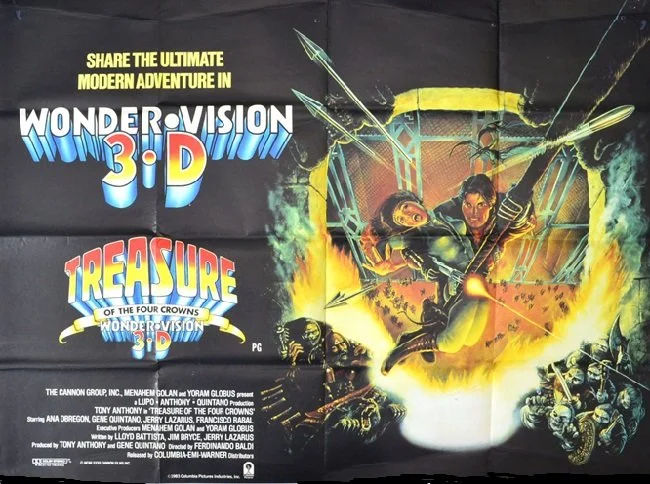
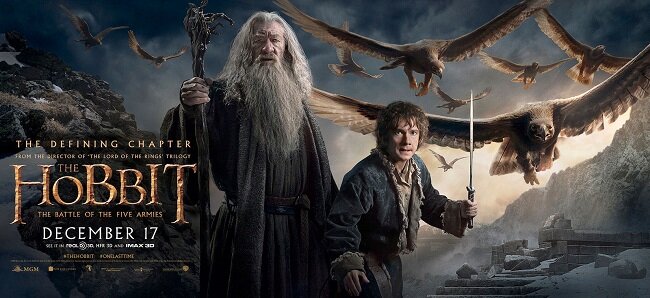
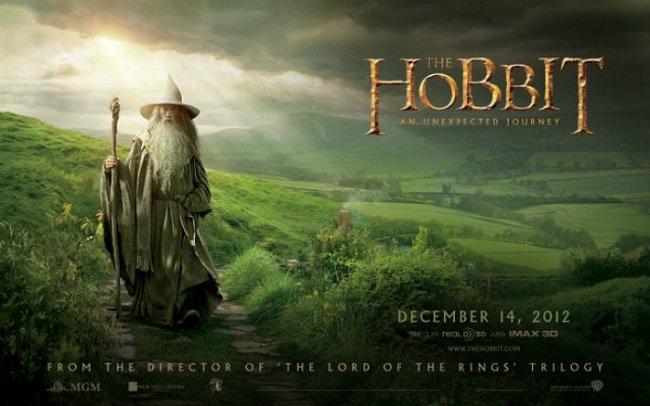
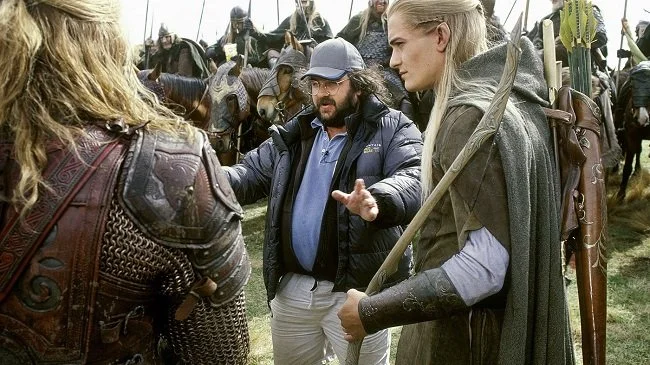

Red Lights (2012)
Rodrigo Cortés proved with Buried, that he was adept at creating a tense and involving drama with a modest budget and strong lead performances. With Red Lights he once again manages to craft a suspenseful story, in spite of the significantly larger production and inclusion of some A list talent. I say this because Red Lights is a bit top heavy with "actors" who seem to be intent on "acting". Robert De Niro presence does for example overwhelm the proceedings particularly in the last act, which becomes somewhat bombastic in tone. The movie is also a curious hybrid because despite being marketed as a supernatural chiller, it has an underlying theme that would be more at home in a political thriller.
Rodrigo Cortés proved with Buried, that he was adept at creating a tense and involving drama with a modest budget and strong lead performances. With Red Lights he once again manages to craft a suspenseful story, in spite of the significantly larger production and inclusion of some A list talent. I say this because Red Lights is a bit top heavy with "actors" who seem to be intent on "acting". Robert De Niro presence does for example overwhelm the proceedings particularly in the last act, which becomes somewhat bombastic in tone. The movie is also a curious hybrid because despite being marketed as a supernatural chiller, it has an underlying theme that would be more at home in a political thriller.
The plot is an old chestnut. Sigourney Weaver and Cillian Murphy are a pair of scientists, Dr Margaret Matheson and assistant Tom Buckley, who debunk mediums and psychics who prey on the public. When blind psychic Simon Silver (Robert De Niro), re-appears on the scene after a thirty-year absence, Tom takes a keen interest. His mentor is not only sceptical, but also somewhat perturbed advising Tom to act with caution with regard to Silver. Is he a fraud or does he actually have powers of a dangerous nature? Cortés steadily turns up the tension, as doors close on their own, lights blow, and birds become suicidal. Furthermore, the audience is presented with a challenging theme that being sceptical is often treated with more scorn these days than openly embracing the supernatural.
It all plays very well initially, with shades of Hitchcock and Brian De Plama, blended with M Night Shyamalan. There's even a hint of the Parallax View. Then for some reason in the last act, the director decides to turn it up to eleven and then Red Lights comes off the rails. The result is an ending that divides audiences and offers a point of debate. Stupid, pretentious, obtuse and ill-conceived are just some of the terms I’ve encountered with regard to this movie. Now it is never a bad thing for a film’s meaning or ending to become a talking point, if that discussion is a positive process. Unfortunately, I feel that in Red Lights case, that is not what has happened. This is a movie that does not travel to its ending by most direct route and the destination is may not be what you expected. Therefore adjust your expectations.