
The Humanoid (1979)
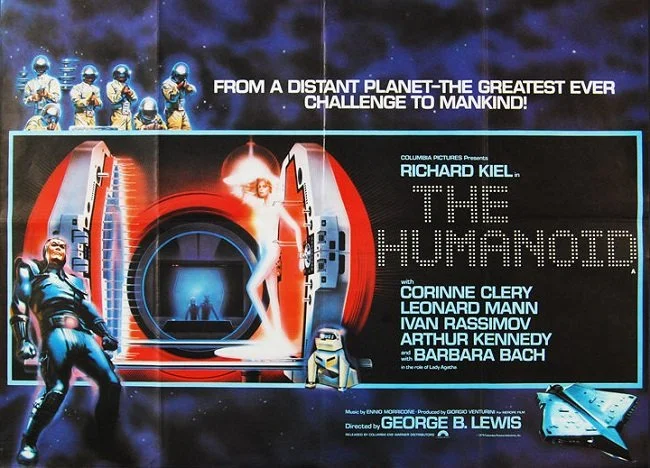
The Humanoid is one of many international Star Wars knock-offs that flooded cinemas in the late seventies and early eighties. Like so many others, it is derivative (even to the extent of replicating specific scenes from George Lucas’ movie), replete with awful dialogue and has somewhat basic production values. However, it does have an interesting cast including Richard Kiel, Barbara Bach, Arthur Kennedy and Corinne Cléry. Kiel gained a lot of media attention after his appearance as the steel-toothed villain Jaws in the 1977 Bond film, The Spy Who Loved Me. His stature made him the perfect fit for the titular character in this Italian science fiction production. Sadly, beyond a curious lineup of actors, The Humanoid has little to distinguish it from so many similar movies. For example, if you’ve seen Starcrash then you’ll be adequately prepared for this film.
The Humanoid is one of many international Star Wars knock-offs that flooded cinemas in the late seventies and early eighties. Like so many others, it is derivative (even to the extent of replicating specific scenes from George Lucas’ movie), replete with awful dialogue and has somewhat basic production values. However, it does have an interesting cast including Richard Kiel, Barbara Bach, Arthur Kennedy and Corinne Cléry. Kiel gained a lot of media attention after his appearance as the steel-toothed villain Jaws in the 1977 Bond film, The Spy Who Loved Me. His stature made him the perfect fit for the titular character in this Italian science fiction production. Sadly, beyond a curious lineup of actors, The Humanoid has little to distinguish it from so many similar movies. For example, if you’ve seen Starcrash then you’ll be adequately prepared for this film.
In the future, the planet Metropolis (formerly Earth) is a utopia led by a leader called The Great Brother. Peace is threatened when Lord Graal (Ivan Rassimov) escapes from a prison satellite in a stolen warship. He attacks the Grovan Institute on Metropolis and steals a rare and powerful element called Kapitron. The only survivor of the raid is a scientist, Barbara Gibson (Corinne Cléry), who is warned of the imminent danger by her mysterious pupil Tom Tom (Marco Yeh). Meanwhile, Lord Graal travels to his hidden base on the planet Noxon where he is joined by Lady Agatha (Barbara Bach), the world's tyrannical queen. She has enlisted the help of a mad scientist Dr. Kraspin (Arthur Kennedy) who plans to make an army of unstoppable supersoldiers called “Humanoids”, using the stolen Kapitron. He targets a passing spaceship, piloted by Golob (Richard Kiel), as his first test subject.
The Humanoid being an Italian exploitation movie, is a prime example of “what you see is what you get”. If you are expecting a film with comparable production values to Star Wars, then more fool you. The visual effects are mainly miniatures by industry stalwart, Anthonio Margheriti. Rather than optical compositing there are a lot of “in camera” techniques used. There are a few matte paintings and some rather good foreground models by the legendary Emilio Ruiz del Río. The score is by Ennio Morricone. The costume design, like so many Italian films from this era, is striking. Lord Graal’s troops have a S&M vibe to them. However, Kip, the film’s novelty robot dog is somewhat clunky and lacks credibility. There is also a lot of low level violence, with endless laser shootings and high falls. During a torture scene where a nameless victim has their life essence drained by a fiendish machine, there’s some nudity thrown in for “reasons”.
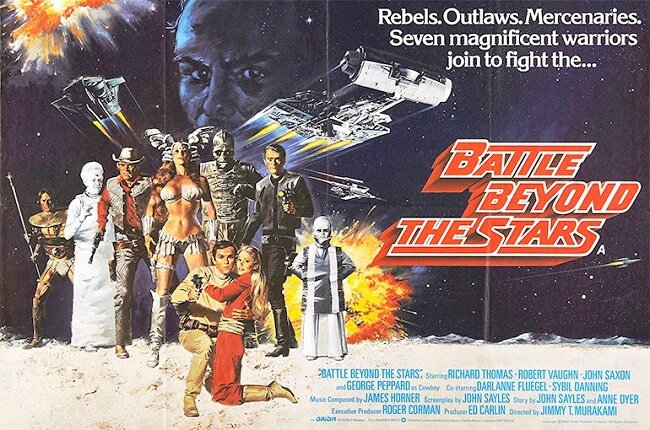
If you enjoy the curious subgenre that is Italian ripoff movies or flirt with the spurious notion that some films are so bad, they’re good, then you may well enjoy The Humanoid. The dialogue added in post production is ripe and performances are all turned up to eleven. Richard Kiel amiably lumbers through his role and the film does not overstay its welcome. The curious subplot regarding Tom Tom has a surprising resolution, which may elicit a cry of “what the hell has that got to do with the price of Brussel Sprouts?” from viewers. Or you may not give a shit. Director Aldo Lado doesn’t exactly distinguish himself with this movie although he had previously filmed several gallos that were well received. The Humanoid is very much a niche product and should be watched accordingly. Casual viewers may be better off watching Battle Beyond the Stars instead.








A Man For All Seasons (1966)
Contemporary viewer’s may be perplexed by a film such as A Man For All Seasons. Why make a two our motion picture about a Tudor lawyer, statesman and scholar and their subsequent moral objection to the reigning monarchs marital status? Yet, during the sixties, it was entirely possible for a mainstream studio to produce a film based upon a stage play that dramatised such specific historical events. Furthermore, a film like this that relied upon strong performances and an intelligent script (and little more) could find a mainstream audience and be both a critical and commercial success. Nowadays, such productions still exist but they are now mainly the province of streaming services. Furthermore, the cinematic format has been replaced by that of a high budget TV show, which explores the topic at hand over an eight to ten hour running time.
Contemporary viewer’s may be perplexed by a film such as A Man For All Seasons. Why make a two our motion picture about a Tudor lawyer, statesman and scholar and their subsequent moral objection to the reigning monarchs marital status? Yet, during the sixties, it was entirely possible for a mainstream studio to produce a film based upon a stage play that dramatised such specific historical events. Furthermore, a film like this that relied upon strong performances and an intelligent script (and little more) could find a mainstream audience and be both a critical and commercial success. Nowadays, such productions still exist but they are now mainly the province of streaming services. Furthermore, the cinematic format has been replaced by that of a high budget TV show, which explores the topic at hand over an eight to ten hour running time.
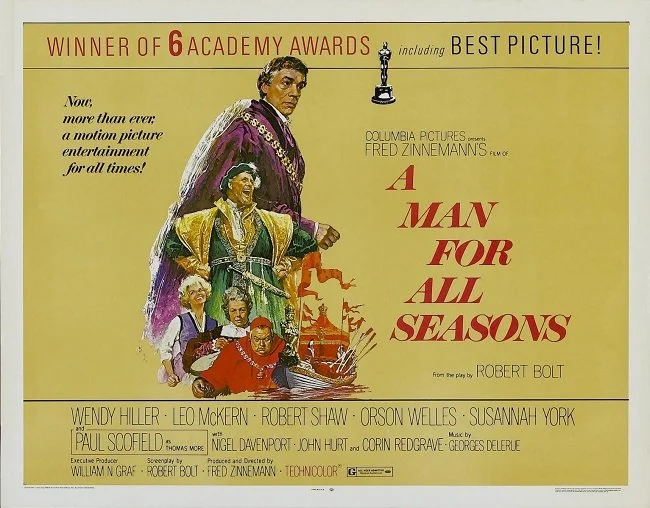
Directed by Fred Zinnemann (High Noon, From Here to Eternity) and adapted by Robert Bolt from his own play, A Man For All Seasons explores Sir Thomas More’s relationship with King Henry VIII at the time of the monarch’s divorce from Catherine of Aragon and remarriage to Anne Boleyn. A devout Roman Catholic, Sir Thomas More (Paul Scofield) has a crisis of conscience regarding the legality of the divorce and the subsequent break with the Church of Rome. The King (Robert Shaw) holds More in high regard and does not want to compel him to support his position, preferring that his public approval is given freely. Sadly it is not, leading to More risking his liberty and safety on a matter of principle. The screenplay is articulate and intelligent, placing great weight upon the importance of spiritual peril. The fate of one’s immortal soul was far from a trivial concern in Tudor England. There was no separation of church and state at the time and religion was an integral part of every aspect of life.
A Man For All Seasons is filled with outstanding British actors of the time, such as Leo McKern, Dame Wendy Hiller, Nigel Davenport and Susannah York. A young John Hurt makes his mark as the career driven Richard Rich. But it is Paul Scofield who dominates the proceedings as a man of principle trying to steer a fateful course without betraying his values. His failure to accommodate the political imperatives of the time is both laudable and tragic. His performance is poignant and dignified. The film is very much an exploration of the concept of identity and personal integrity. Director Fred Zinnemann wisely eliminates some of the Brechtian elements of the play, focusing on a more linear narrative and traditional presentation. He also skilfully uses historical locations in Oxfordshire and Hampshire to double for Hampton Court Palace and Parliament.
The film does make several changes to historical events as a means of providing the story with a more conventional cinematic arc. The screenplay features a more detailed backstory with regard to Richard Rich (John Hurt), the solicitor-general and his prior association with More. However, the nature of Rich’s perjury during More’s trial is in accord with historians’ consensus on events. The film stresses the point that Rich has accommodated Thomas Cromwell, the King’s most senior minister, and has been subsequently made attorney-general of Wales. This prompts a pithy retort from More “Why, Richard, it profits a man nothing to give his soul for the whole world, but for Wales”? Robert Bolts liberally peppers the script with similarly acerbic, yet erudite exchanges. It is one of the major elements that gives such a straightforward plot its weight and gravitas.
A Man For All Seasons is a well honed, efficient historical drama and thoughtful exploration of the frequent incompatibility of personal moral rectitude with any sort of long established political institution. Be it the Church or the monarchy. At the start of the film Cardinal Wolsey (Orson Welles) regrets he did not serve God as well as he served his king. Sir Thomas More, on the other hand, states before his execution that he remains “His majesty's good servant...but God's first”. It is a most thought provoking juxtaposition. The film also stands as a masterclass in acting and remains a textbook example of the art of writing a good screenplay. A Man For All Seasons went on to win six Academy Awards at a time when such awards were still credible and relevant. It is also worth noting that it was the sixth highest grossing film in North America in 1966.
Flow (2024)
With the proliferation of lore driven, franchise movies in recent years, a culture of analysis has developed online. Hence you will find a lot of YouTube videos that claim to “explain” the ending of specific films or provide clarification of their respective themes and subtexts. While critical debate and discussion about cinema is welcome, I think it is a mistake to always look for a specific meaning in cinema. Even clearly narrative films can be ambiguous. Art is ultimately a very subjective field of expression open to personal interpretation. Which brings me neatly to Flow, an animated feature film which tells a compelling story but raises more questions than it answers. It leaves the viewer to fill in a lot of the blanks themselves and the film is all the better for this approach. Flow is an extraordinary example of animation and a fascinating example of innovative, thought provoking filmmaking. Quite the rarity these days.
With the proliferation of lore driven, franchise movies in recent years, a culture of analysis has developed online. Hence you will find a lot of YouTube videos that claim to “explain” the ending of specific films or provide clarification of their respective themes and subtexts. While critical debate and discussion about cinema is welcome, I think it is a mistake to always look for a specific meaning in cinema. Even clearly narrative films can be ambiguous. Art is ultimately a very subjective field of expression open to personal interpretation. Which brings me neatly to Flow, an animated feature film which tells a compelling story but raises more questions than it answers. It leaves the viewer to fill in a lot of the blanks themselves and the film is all the better for this approach. Flow is an extraordinary example of animation and a fascinating example of innovative, thought provoking filmmaking. Quite the rarity these days.
In a forest, a black cat looks at their reflection in a puddle. A rabbit runs past being chased by a mixed pack of domestic dogs. The cat returns to an abandoned house, through a garden filled with wooden cat sculptures. A massive wooden cat statue overlooks the house from a hill. The house appears to be the former home of an artist. The next day the cat returns to the forest and is caught in a stampede of deer. A flash flood ensues and the cat manages to climb a tree branch and reach dry land. Returning to the house the cat is followed by a friendly labrador, who is part of the pack the cat saw previously. Both animals become aware that the water is rising and seek shelter. The labrador joins its pack in a oarless row boat, while the cat climbs to the top of the giant cat statue. Overwhelmed by the water the cat finds safety in a drifting sailboat, which contains a capybara.
Flow begins with a simple premise. A cat is adrift in a sailboat with a capybara during what appears to be an ecological apocalypse. Over the course of the film other animals seek safety onboard. The friendly labrador returns, there is also a kleptomaniac lemur and an enigmatic secretary bird. The animals squabble at times but cooperate, initially out of necessity and ultimately due to companionship. There is no dialogue and the story is not excessively didactic, although a lot of the imagery presented may appear symbolic and open to interpretation. The visual style is intriguing with the animators opting to use open-source software Blender and utilising a cel shaded aesthetic. Underpinning the onscreen journey is an enigmatic synths score that at times is reminiscent of the work of Vangelis and John Carpenter. The film is a succinct 84 minutes. No screen time is wasted but neither are events rushed.
If you have been raised exclusively on Disney animation, you will find Flow to be the antithesis of your expectations. Instead of being a product of a vast, monolithic commercial entertainment corporation, filtered through focus groups and market research, Flow is a labour of love and primarily an artistic endeavour. Written, directed and produced by Gints Zilbalodis, who also co-wrote the score and was the film’s cinematographer, Flow took over five years to make, gaining financial support and international distribution along the way. As a film it works on many levels. At its simplest, it is a timeless adventure in which a group of animals survive adversity through mutual help. As a work of art, Flow is open to a variety of interpretations. None of which are right or wrong. Some will see the film as a clear ecological warning, where others may see it as a faith based parable. It certainly raises many philosophical questions.
Sometimes, it is perfectly fine for a film to just “be”. After watching Flow and considering it, I’m not even sure what genre it is. However, although I spent some time reflecting upon some possible explanations to events and imagery in the film, I decided to abandon them. I prefer let the way the film made me feel, be its defining point. Flow is a unique production, unclouded and unspoilt by obvious contemporary commercial consideration. It is a beautiful, thought provoking piece of animation, proving yet again that the medium is not just a vehicle for children’s entertainment. It is profound and quite moving. Scarce qualities in filmmaking these days. If you look at viewer reviews on iMDb you will see a clear divide in opinion. Literalists may struggle with Flow. Such is their want. Those open to an experience driven more by feelings may fare better.








A Working Man (2025)
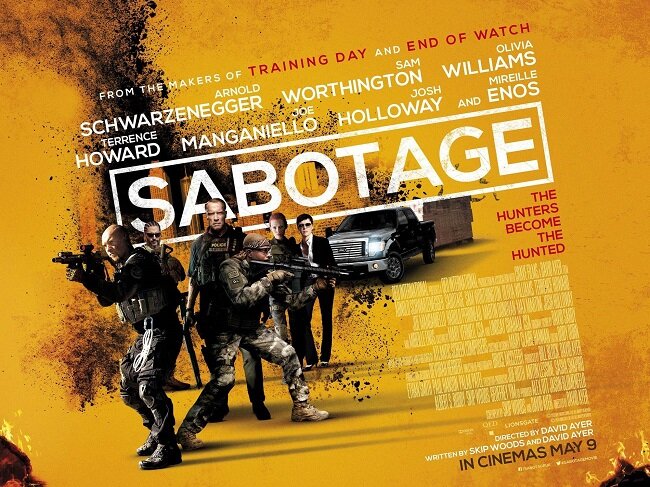
Levon Cade (Jason Staham) is a former Royal Marine Commando who has retired from military service and now works as the leader of a construction team in Chicago. He has a close relationship with Joe and Carla Garcia (Michael Peña and Noemi Gonzalez ) who run the company and considers them as family. Outside of work, Levon is involved in a bitter custody battle for his daughter, against her maternal grandfather, who blames Levon for his daughter’s suicide. When Garcia's teenage daughter Jenny (Arianna Rivas) goes missing, Levon reluctantly agrees to help her parents and get her back. Beginning his search at the nightclub where Jenny was last seen, he soon discovers that she was abducted by Russian traffickers. Furthermore, the culprit is Dimi Kolisnyk (Maximilian Osinski), the wayward son of a senior ranking gangster.
Levon Cade (Jason Staham) is a former Royal Marine Commando who has retired from military service and now works as the leader of a construction team in Chicago. He has a close relationship with Joe and Carla Garcia (Michael Peña and Noemi Gonzalez ) who run the company and considers them as family. Outside of work, Levon is involved in a bitter custody battle for his daughter, against her maternal grandfather, who blames Levon for his daughter’s suicide. When Garcia's teenage daughter Jenny (Arianna Rivas) goes missing, Levon reluctantly agrees to help her parents and get her back. Beginning his search at the nightclub where Jenny was last seen, he soon discovers that she was abducted by Russian traffickers. Furthermore, the culprit is Dimi Kolisnyk (Maximilian Osinski), the wayward son of a senior ranking gangster.
A Working Man is based upon the novel Levon's Trade by Chuck Dixon. The screenplay is by Sylvester Stallone and David Ayer who also directed the film. Stallone had originally intended the basic scenario of the book to be the basis of a television series but it was repurposed as a feature film. It was deemed a more marketable property due to the number of sequels written by the original author. Whether these ever see the light of day remains to be seen and is dependent upon the box office performance of A Working Man. The film has the solid production values associated with a medium budget feature film and a cast of dependable character actors in supporting roles. The action scenes are well conceived, realised but somewhat stylised. Firearms knock people off their feets and villains take multiple blows to the head before going down. Everything that you expect from the genre and the star is front and centre. Yet there is something missing.
A Working Man has a few interesting ideas, such as the lead character performing his own, amateur investigation. Ayer adds a few flamboyant touches, such as the leader of a drug dealing motorcycle gang who sits on a chrome throne made of exhaust pipes and fairings. There are also quite a lot of subplots for a film of this nature, with various elements of the Russian mafia working at odds with each other. Sadly, the main plot line about Jenny Garcia’s kidnapping founders as she decides to fight back and not to be a victim. By the climax of the film it has almost become an afterthought. Overall, A Working Man drags under the weight of a plot which pitches several ideas and then abandons them. Statham, as ever, does much of the heavy lifting through his screen presence and personality. However, compared to Ayer’s previous film The Beekeeper, this one fails to assert its difference, despite trying hard to do so. The word “adequate” springs to mind.







The Monkey (2025)
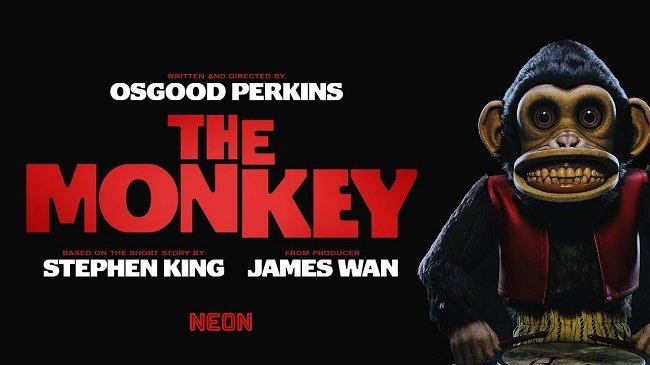
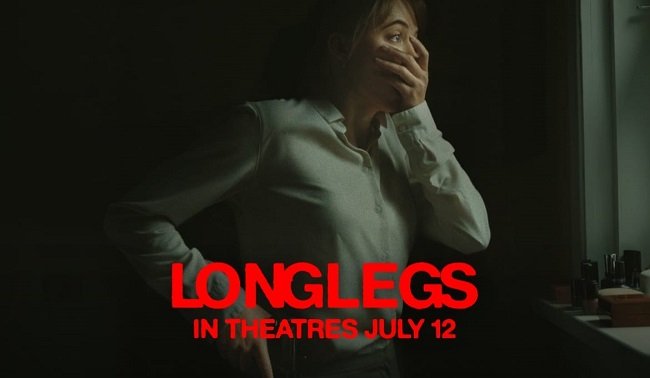
Osgood Perkins has a distinct visual style and tone to his films. It is why his previous film, Longlegs, was such a welcome change from standard genre outings. It was atmospheric both visually and tonally, demonstrating a keen understanding of horror cinema. Hence he is the perfect director to helm this adaptation of a Stephen King short story. The plot is greatly expanded and the screenplay takes a lot of liberties with the source material but the main themes of your past being inescapable and the power of guilt remain front and centre. Due to the extreme and bizarre nature of much of the onscreen deaths, the film wisely has a strong streak of gallows humour running through it which is extremely well handled. Comedy can often be used to defuse or mitigate violence which can be narratively dishonest (think Fred Krueger). Here it adds to the cruel and capricious nature of the random deaths.
Osgood Perkins has a distinct visual style and tone to his films. It is why his previous film, Longlegs, was such a welcome change from standard genre outings. It was atmospheric both visually and tonally, demonstrating a keen understanding of horror cinema. Hence he is the perfect director to helm this adaptation of a Stephen King short story. The plot is greatly expanded and the screenplay takes a lot of liberties with the source material but the main themes of your past being inescapable and the power of guilt remain front and centre. Due to the extreme and bizarre nature of much of the onscreen deaths, the film wisely has a strong streak of gallows humour running through it which is extremely well handled. Comedy can often be used to defuse or mitigate violence which can be narratively dishonest (think Fred Krueger). Here it adds to the cruel and capricious nature of the random deaths.
In 1999, airline pilot Petey Shelburn (Adam Scott) attempts to dispose of a drum-playing toy monkey at an antiques shop. He warns the proprietor that the automaton is evil and a death always occurs after it plays its drums. The monkey subsequently spontaneously plays its drum resulting in a bizarre accident where the shop owner is disemboweled by a harpoon gun. Shortly after this incident, Petey goes missing, leaving his wife, Lois, to raise their identical twin sons, Hal and Bill. The twins later find the monkey in a closet filled with their father’s mementos. They turn the key and again the monkey plays its drum. Later that evening the twin’s babysitter is killed in a freak accident at a hibachi restaurant. Further tragedies blight the twins lives, leaving them marginalised and estranged. 25 years later, despite being thrown down a well, the Monkey returns to dog the twins’ adult lives.
If you look beyond the over the top set pieces and wry humour, The Monkey attempts to explore various schools of thought surrounding the subject of death. It reflects upon the deterministic nature of our mortality and questions the relevance of human agency. The titular simian automaton is both scary and possibly symbolic. Is it an avatar of death itself? A biblically themed cameo at the film’s climax seems to imply such. Theo James gives two solid performances as the adult twin brothers and the film has several intriguingly quirky characters to enjoy. The gore is turned up to eleven and is both gross and amusing. Overall Osgood Perkins’ dark and droll approach to The Monkey is possibly for the best. If the story had been presented and explored in a more serious manner, it may well have been too po-faced or dour. Instead the film reacts to the absurdity of its antagonists’ random homicides in the only way it can. Namely, with ironic laughter.









Dog Man (2025)
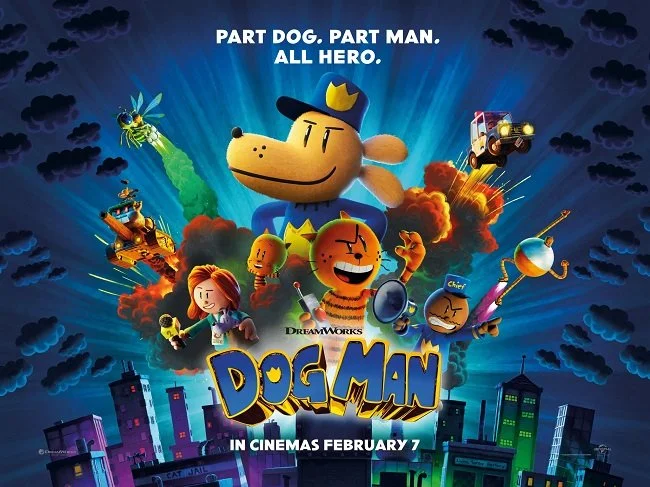
For those unfamiliar with Dav Pilkey’s graphic novel character Dog Man, he’s a half-dog, half-human police officer. This comic chimaera is the result of a surgical procedure carried out after Officer Knight and his trusty dog Greg are blown up while defusing a bomb. Greg’s head is grafted to Officer Knight's body. Post surgery, Dog Man (Peter Hastings) remains an officer of the law and continues to track his nemesis, Petey (Pete Davidson), an orange cat and criminal genius. However, despite positive media coverage and a high arrest rate, Dog Man incurs the ire of his Chief (Lil Rel Howery) who is jealous of his success. Furthermore, Dog Man becomes depressed due to the loss of his owner, girlfriend and former home. Meanwhile, Petey decides to clone himself in an attempt to find a worthy assistant and also plots to resurrect a deceased super villain, Flippy, who is an evil telekinetic fish.
For those unfamiliar with Dav Pilkey’s graphic novel character Dog Man, he’s a half-dog, half-human police officer. This comic chimaera is the result of a surgical procedure carried out after Officer Knight and his trusty dog Greg are blown up while defusing a bomb. Greg’s head is grafted to Officer Knight's body. Post surgery, Dog Man (Peter Hastings) remains an officer of the law and continues to track his nemesis, Petey (Pete Davidson), an orange cat and criminal genius. However, despite positive media coverage and a high arrest rate, Dog Man incurs the ire of his Chief (Lil Rel Howery) who is jealous of his success. Furthermore, Dog Man becomes depressed due to the loss of his owner, girlfriend and former home. Meanwhile, Petey decides to clone himself in an attempt to find a worthy assistant and also plots to resurrect a deceased super villain, Flippy, who is an evil telekinetic fish.
Dog Man is a visually impressive animated comedy that succeeds in being accessible to both children and adults. Kids will like the madcap humour and frenetic mayhem, where adults will smirk and guffaw at the abundant film references, pop culture humour and satire of commonplace cinematic tropes. Within the first seven minutes there is a homage to RoboCop and it is not an obvious one, clearly showing Peter Hastings’ (who also wrote and directed the film) movie literacy. There are continual sight gags, clever puns and good old-fashioned slapstick. The film has a bright colour palette and a very knowing style. It calls out its own use of a montage and continuously nods and winks at the audience. Dog Man is certainly well made and clever, especially with regard to the contrast between Dog Man’s boundless love and Petey’s cynical philosophy.
Despite all these good points, Dog Man starts to show its weaknesses after about 50 minutes. The fast pace of the story and the continuous barrage of jokes becomes a bit of a hindrance. The audience doesn’t get time to think or take stock. While you’re laughing at one gag, you potentially miss another. There’s also a celebrity voice actor cameo that doesn’t really add any value to the proceedings and stands out like a sore thumb. The secondary plot about Flippy feels like it’s a contrivance to get the plot from A to B, rather than a valid theme to be explored. Dog Man also feels like it’s lapsing into fan service at times. Hence, although there is much to enjoy both visually and narratively about this clever adaptation, the 90 minute running time can be quite taxing for adults. Children will probably have no issue with the fast pace and bombast.
Sting (2024)
When reviewing Sting, one critic stated that the small scale setting and thus, low stakes (IE only a few peoples lives are at risk), made the film not especially memorable. I consider this to be a somewhat spurious criticism. It is the very fact that Sting takes place in such a commonplace environment, with the main characters being everyday people that makes it different. There is a clear focus on well defined characters and their backstory. Unlike so many contemporary films, I actually gave a damn about the protagonists in Sting. An integral aspect of the horror genre is the ability to take a well known and familiar trope and provide a different and absorbing spin on it .It would appear that some audiences have been belaboured over the head by so many overblown and bombastic blockbusters, that the very notion of depicting small, localised and intimate events in a film, seems to bamboozle them.
When reviewing Sting, one critic stated that the small scale setting and thus, low stakes (IE only a few peoples lives are at risk), made the film not especially memorable. I consider this to be a somewhat spurious criticism. It is the very fact that Sting takes place in such a commonplace environment, with the main characters being everyday people that makes it different. There is a clear focus on well defined characters and their backstory. Unlike so many contemporary films, I actually gave a damn about the protagonists in Sting. An integral aspect of the horror genre is the ability to take a well known and familiar trope and provide a different and absorbing spin on it .It would appear that some audiences have been belaboured over the head by so many overblown and bombastic blockbusters, that the very notion of depicting small, localised and intimate events in a film, seems to bamboozle them.
Charlotte (Alyla Browne ), a rebellious 12-year-old, lives in a rundown apartment block with her overworked stepfather, Ethan (Ryan Corr), her mother Heather (Penelope Mitchell), and her infant half-brother, Liam. Frequently left to her own devices, Charlotte discovers an unusual spider which she catches and keeps in a jar. Unbeknown to Charlotte, the spider originated from a luminous meteor that landed in her great-aunt's apartment. Charlotte nurtures the spider, which she names Sting and it subsequently grows at an astonishing pace. Initially, she conceals its increasing size, but as it becomes more challenging to keep hidden, her stepfather and the neighbours begin to observe unusual happenings within the building. Sting's rapid growth and voracious appetite soon result in the demise of pets and residents alike. Is Charlotte’s family safe?
Director Kiah Roache-Turner, builds the tensions with some clever jump scares based around shadows and household objects being mistaken for Sting. As for the spider itself, it is very well realised by Weta Workshop, Cumulus Visual Effects, and Spectrum Films. The majority of the visual effects are practical. Sting manages to provide gallows humour, with its wise cracking exterminator and comedy pets, along with the required horror elements of a “creature feature”. However, what makes the film more interesting than standard genre outings are the characters and the central theme of a daughter reconciling with her stepfather. The human aspects of the story are well handled and have a Joe Dante-esque quality. As I’ve said before, not every film has to be a cinematic milestone. A small, focused story that is well done, is a perfectly entertaining proposition. Sting provides exactly that.
They Came to a City (1944)
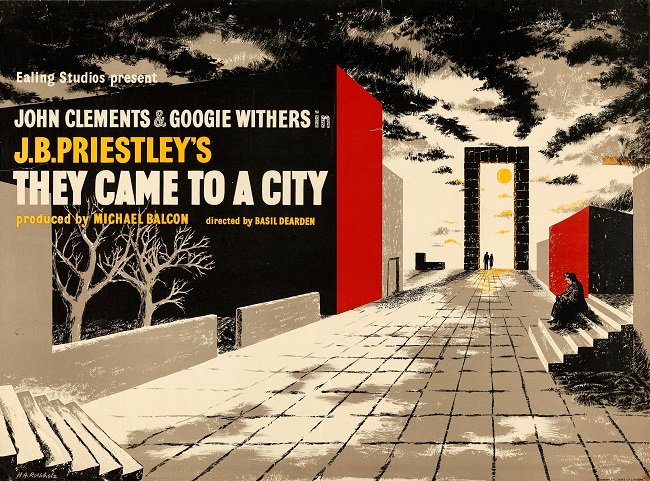
Humanity struggling to survive a dystopian future has been a mainstay of pop culture for several hundred years. They Came to a City, made in 1944 as World War II was drawing to a close, takes the opposite approach in which nine individuals are shown a utopian future and given a choice whether to join it or return to their existing lives. This experimental film based on a play by J. B. Priestly, is dialogue driven and struggles with its transition to cinema. Yet the striking minimalist set design and art direction by Michael Relph, along with the crisp and beautifully framed black and white cinematography by Stanley Pavey make it visually compelling. Functionally directed by Ealing Studios stalwart, Basil Dearden, They Came to a City is not a lost classic but it certainly is an unusually cerebral and socially outspoken piece of wartime cinema.
Humanity struggling to survive a dystopian future has been a mainstay of pop culture for several hundred years. They Came to a City, made in 1944 as World War II was drawing to a close, takes the opposite approach in which nine individuals are shown a utopian future and given a choice whether to join it or return to their existing lives. This experimental film based on a play by J. B. Priestly, is dialogue driven and struggles with its transition to cinema. Yet the striking minimalist set design and art direction by Michael Relph, along with the crisp and beautifully framed black and white cinematography by Stanley Pavey make it visually compelling. Functionally directed by Ealing Studios stalwart, Basil Dearden, They Came to a City is not a lost classic but it certainly is an unusually cerebral and socially outspoken piece of wartime cinema.
Nine people from the different UK social classes, find themselves mysteriously transported to a modernist walled city. They include Sir George Gedney (A. E. Matthews), a misanthropic aristocrat; Malcolm Stritton (Raymond Huntley), a politically dissatisfied bank clerk and his neurotic and domineering wife Dorothy (Renee Gadd); Alice Foster (Googie Withers), an unhappy and exploited waitress; Mr. Cudworth (Norman Shelley), a money-obsessed banker; Lady Loxfield (Mabel Terry Lewis) a needy and class conscious widow and her put upon daughter Philippa (Frances Rowe); Joe Dinmore (John Clements) a world weary, free-thinking seaman; and Mrs. Batley (Ada Reeve), a practical and philosophical charwoman. An opulent door opens allowing them to visit the unseen city, which is hinted to be a social paradise. However, they subsequently have to choose whether to stay forever in the city or to leave and never return.
At first glance this is an excessively verbose story, told through the medium of British acting of the time, which can be quite jarring to the modern audience. However, the dialogue is clever, telling and socially honest with the wisest person being the ageing charwoman. Performances are strong and honest. The political and social philosophising may seem somewhat naive to casual viewers but this was very much the mood of the nation in 1944. The horrors of World War II drove a robust public debate for social change, which was succinctly demonstrated by Winston Churchill's defeat in the 1946 General Election. Playwright, novelist and social commentator J. B. Priestley was a wartime correspondent and felt that the status quo needed to be addressed in a postwar settlement. However, he was wise enough to realise that there would be strong resistance to such ideas and They Came to a City includes characters who dislike the notion of any sort of change.
Critics at the time, as well as contemporary analysis, often cite the notion of any utopia as flawed, as it runs counter to human nature. As seaman Joe Dinmore states “They’ll tell us we can’t change human nature. That’s the oldest excuse in the world for doing nothing”. There are further prescient observations about bankers and finance. When Mr. Cudworth recounts how he told a citizen of the city that he worked in banking, they replied “we call that crime”. Again naysayers point out the “school boy socialism” of Priestley’s dialogue but here we are 80 years later and the same sentiments about the exploitative nature of untrammelled capitalism are still being made. Overall They Came to a City is a cinematic curate's egg but an engaging one. It should be viewed with the national mood of the time in mind, as context is key to enjoying this social fantasy.

The Lord of the Rings: The War of the Rohirrim (2024)
I have always found it curious that there haven't been more feature films set in Middle-earth, after the success of Peter Jackson’s The Lord of the Rings trilogy. However, a little research shows a very complex set of rights regarding Tolkien’s work, with different material being controlled and administered by different bodies. Hence, the market has not been saturated with officially licensed material. Thus, when The Lord of the Rings: The War of the Rohirrim was announced to be in production, it aroused a great deal of curiosity both among fans and those with an interest in the wider film industry. To base an entire feature film on something that is effectively just a few paragraphs in the appendices of The Lord of the Rings is quite intriguing. The producers claimed it afforded them greater artistic freedom not to be constrained by an excess of lore. Industry pundits theorised that the film was being produced solely to ensure that wider rights were retained.
I have always found it curious that there haven't been more feature films set in Middle-earth, after the success of Peter Jackson’s The Lord of the Rings trilogy. However, a little research shows a very complex set of rights regarding Tolkien’s work, with different material being controlled and administered by different bodies. Hence, the market has not been saturated with officially licensed material. Thus, when The Lord of the Rings: The War of the Rohirrim was announced to be in production, it aroused a great deal of curiosity both among fans and those with an interest in the wider film industry. To base an entire feature film on something that is effectively just a few paragraphs in the appendices of The Lord of the Rings is quite intriguing. The producers claimed it afforded them greater artistic freedom not to be constrained by an excess of lore. Industry pundits theorised that the film was being produced solely to ensure that wider rights were retained.
Setting aside the provenance of the production, The Lord of the Rings: The War of the Rohirrim is a competent anime fantasy film directed by Kenji Kamiyama. Set 183 years prior to the events of The Lord of the Rings, the film depicts the reign of Helm the Hammerhand, King of Rohan. During a council meeting with the Lords of Rohan, Freca Lord of Adorn requests that Helm’s daughter, Héra, marry his son Wulf to unite the Rohan. Freca being of part Dunlending blood and considered by many in Rohan as an outlander. However, Helm rejects the offer and rebuffs Freca. A fight ensues between the two leaders and Helm kills Freca with a single punch. Wulf leaves, vowing revenge and subsequently raises an army among the Dunlendings. A surprise attack on Edoras forces the Rohirrim to retreat to the Hornburg. With the death of her two brothers and her father stricken with grief, it falls to Héra to rally her people and turn the tide of the war.
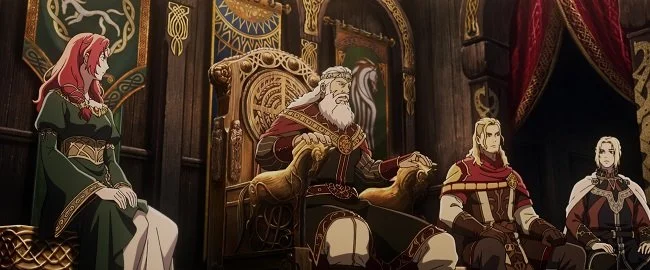
From a production perspective, there is much to praise about The Lord of the Rings: The War of the Rohirrim. The background art is sumptuous and vivid and there is a strong score by composer Stephen Gallagher. He cunningly uses classic themes by Howard Shore and further embellishes the soundtrack with solid material of his own. The animation is dynamic and doesn’t pull its punches. Limbs are severed and blood is spilt. The anime style works surprisingly well with the source material and certainly doesn’t look out of place. I am not a great fan of this medium but did not find it a deal breaker in any way. The voice acting is strong with the central characters having clear and distinct voices. The screenplay does not excessively diverge from established lore although it does make some changes for the sake of the narrative arc. Héra being an original character.
However, despite solid production values The Lord of the Rings: The War of the Rohirrim has two fundamental problems. The first is the story simply cannot sustain its two hour running time and the film could easily have been 30 minutes shorter. What is an interesting footnote in the source text, remains such as a feature film and nothing more. The second is the compulsion that new entries in a franchise often have, to try and directly link to events that occurred in a previous movie. For example there is a totally unnecessary action scene that is resolved by the appearance of a beast identical to the “watcher in the water” outside the West-gate of Moria. It doesn’t really hold up logically and seems very arbitrary. There are also several other clumsy references to both Orcs and Gandalf as the screenplay hamfistedly attempts to link to the forthcoming events of The Lord of the Rings.
Hardcore Tolkien fans may get more enjoyment from The Lord of the Rings: The War of the Rohirrim, than broader audiences. I found the film to be sufficiently entertaining but upon reflection it really doesn’t add much to the existing Tolkien cinematic universe. Also, as a Tolkien aficionado I can think of plenty of other stories referenced in the appendices of The Lord of the Rings, that would make a better feature film. I think The Lord of the Rings: The War of the Rohirrim would have fared better if it was part of a smaller scale television show called “Tales of Middle-earth” or something similar and the story was told over a more concise running time. As it stands, this 134 minute animated film falls between two stools. It is not bad but it is not anything more than adequate. When you consider the pedigree of the production and who is involved, you expect a lot more.
Five Films I Like
I was asked recently, what are my top five films of all time? This is one of those loaded questions that I don’t really like to answer. I enjoy lots of films across multiple genres. This includes acknowledged “classics” as well as low rent, exploitative trash. So why limit myself to just five films? Also, my answers would change regularly depending upon my mood and current cinematic interests. However, that doesn’t make for a pithy and interesting response to the original question. So I shall compromise. Here is a list of five films that I have an abiding love for and watch frequently. They always entertain me and there is a sense of comfort whenever revisiting them. That's not to say they are all good films. Possibly only one that is listed is considered a piece of noteworthy art. The rest are just entertaining to various degrees. Yet I have a strong emotional attachment to them all. Sometimes that’s all that matters.
I was asked recently, what are my top five films of all time? This is one of those loaded questions that I don’t really like to answer. I enjoy lots of films across multiple genres. This includes acknowledged “classics” as well as low rent, exploitative trash. So why limit myself to just five films? Also, my answers would change regularly depending upon my mood and current cinematic interests. However, that doesn’t make for a pithy and interesting response to the original question. So I shall compromise. Here is a list of five films that I have an abiding love for and watch frequently. They always entertain me and there is a sense of comfort whenever revisiting them. That's not to say they are all good films. Possibly only one that is listed is considered a piece of noteworthy art. The rest are just entertaining to various degrees. Yet I have a strong emotional attachment to them all. Sometimes that’s all that matters.
The Medusa Touch (1978)
An interesting adaptation of a popular seventies novel by Peter Van Greenaway. Novelist John Morlar is found in his flat, savagely beaten yet clinging to life. The subsequent Police investigation uncovers that Morlar has continuously encountered tragedy throughout his life and how many of those associated with him have died unexpectedly. After reading Morlar’s journals, Inspector Brunel (Lino ventura) begins to suspect that the injured novelist may be able to cause disasters. Although Richard Burton was not in the best of health when he made this film, he still delivers a powerful and charismatic performance as a misanthropic author. There is some eminently quotable dialogue and the tension steadily builds to a dramatic climax. The cathedral collapse at the end of the film is very well realised with practical effects and miniatures. The Medusa Touch is also a who's who of British character actors of the time.
Journey to the Far side of the Sun AKA Doppelgänger (1969)
This British science fiction film was produced by Gerry and Sylvia Anderson at the height of their success. However, one of Universal Studios financing requirements was that the film had to be directed by an established American director. Hence Robert Parrish got the job and clashed with Gerry Anderson. As a result many subplots within the script were cut from the final film. As a result the story, although intriguing and very akin to an episode of the Twilight Zone, struggles to sustain the film’s 100 minute running time. However the production design is stylish and in a very late sixties idiom. There's a sumptuous score by Barry Gray and the miniature effects by Derek Meddings are sublime. Especially the rocket launch. As ever with Gerry Anderson there is a casual and tonally unexpected use of violence and the film has a wonderfully bleak ending that no studio would countenance these days.
Krull (1983)
This hybrid fantasy movie started as sword and sorcery film but subsequently morphed into a Star Wars clone during its pre-production in a curious attempt to hedge its bet. At the time this was a very expensive movie using multiple sound stages at Pinewood Studios and location filming in both Spain and Italy. Krull is narratively and thematically somewhat of a mess due to the obvious changes made to the screenplay. However, it looks fantastic and features a wonderful cast of such character actors as Freddie Jones, Alun Armstrong and the great Bernard Bresslaw. There are also early appearances by Liam Neeson and Robbie Coltrane. Krull has developed quite a cult following over time. The Slayers and the Beast designs are quite scary and there is a superb score by James Horner that is very reminiscent of the halcyon Hollywood days of Erich Wolfgang Korngold and Miklós Rózsa.
Raise the Titanic (1980)
British media proprietor and impresario Lew Grade fared very well in television throughout the sixties and seventies. However, he was not so successful when he moved into film production. Raise the Titanic, based upon the novel by Clive Cussler, went through dozens of re-writes before it went into production, which accounts for why the final screenplay is so indifferent. The cast is curious and you get the impression that everyone they originally wanted was not available. Yet those actors who were eventually cast, Richard Jordan, Jason Robards and Alec Guiness are perfectly competent. However, the film was critically panned and bombed at the box office, effectively ruining ITC Productions. Irrespective of this, the miniature effects are outstanding and John Barry's portentous score does much of the heavy lifting, creating atmosphere, mystery and intrigue. It’s not a hidden gem but Raise the Titanic is far from the dog’s dinner some claim.
Night of the Demon AKA Curse of the Demon (1957)
Based on M R James' short story Casting the Runes, this is a horror masterpiece from director Jacque Tourneur. Beautifully shot in black and white by Ted Scaife, the film boasts an excellent production design by Ken Adam who subsequently went on to create all the huge sets for the sixties and seventies Bond films. The implied horror and tension is superbly handled and when the demon turns up it is suitably grim, despite its technical limitations. It was originally intended that the demon would be created by stop motion legend Ray Harryhausen but he was sadly unavailable. The optical smoke effects by FX wizard Wally Veevers are a marvel and were subsequently repeated in his last film The Keep in 1983. Night of the Demon is a bonafide horror classic due to its attention to detail and palpable atmosphere. Again a strong cast, including Dana Andrews, Peggy Cummings and Niall MacGinnis contributes substantially to the proceedings.
A Year in Movies
The last time I wrote A Year in Movies post was back in 2020. That was naturally an unusual year and it certainly had a radical impact upon the film industry and the way new movies are distributed. In many ways the pandemic accelerated the inevitable move towards cross platform, same day releases. 4 years on and it is quite usual for films to have a short cinema release before becoming available on streaming media. They often appear on physical media at the same time. Effectively you can go to the cinema, or simply watch at home on the platform of your choice if you prefer. Rent, buy or subscribe, the film studios still get their pound of flesh and everyone is happy. Sometimes if a film has failed to gain sufficient traction at the cinema, its release will be cut short and it will go to streaming even quicker. Direct to video from the eighties and nineties has been superseded with direct to streaming.
The last time I wrote A Year in Movies post was back in 2020. That was naturally an unusual year and it certainly had a radical impact upon the film industry and the way new movies are distributed. In many ways the pandemic accelerated the inevitable move towards cross platform, same day releases. 4 years on and it is quite usual for films to have a short cinema release before becoming available on streaming media. They often appear on physical media at the same time. Effectively you can go to the cinema, or simply watch at home on the platform of your choice if you prefer. Rent, buy or subscribe, the film studios still get their pound of flesh and everyone is happy. Sometimes if a film has failed to gain sufficient traction at the cinema, its release will be cut short and it will go to streaming even quicker. Direct to video from the eighties and nineties has been superseded with direct to streaming.
My personal cinema experience has greatly improved of late due to the opening of a new local independent cinema in Summer 2023. The Sidcup Storyteller has three screens which are best described as “petit” and “bijou”. However, this is advantageous as it tends not to attract a youthful audience seeking the latest multiplex fodder. Instead customers tend to be of an older age group who still cleave to old school cinema etiquette. The seats are roomy and the sound system is not turned up to 11 but instead is actually configured so dialogue is audible. Films are shown throughout the day which is convenient if you want to grab something to eat afterwards and still be home at a reasonable hour. Ticket prices are acceptable and on average are about £10, although there are often discounts and promotions that can reduce the price as low as £6.30 which is very reasonable.
I went to the cinema 3 times in 2024, which is possibly an all time low. A decade earlier I would go at least once a month and could always find something that I wanted to watch. Sadly this decline all comes down to the content that monopolises cinema chains these days. I’m tired of being charitable and advocating a live and let live policy. Franchise moves are a blight on quality film making. They indirectly condition their audience towards spectacle, rather than dialogue and story. Furthermore, they foster short attention spans. Through no fault of their own modern audiences are often incapable of watching anything outside of a narrow spectrum of material and are effectively cinematically illiterate. It is a sorry state of affairs and ultimately it’s the audience that loses out.
As for the three films that I saw at the cinema this year, they were as follows. One Life about the British humanitarian Nicholas Winton (Anthony Hopkins) and his involvement in the Kindertransport during World War II. It is a very low key film with the focus on performance. It doesn’t overreach itself by being too epic in scope and makes its point perfectly. Back to Black is a biography of singer Amy Winehouse. The plot is somewhat factually spurious but the central performance by Marisa Abela is sound, especially her singing. Finally, the last film of the year was Paddington in Peru. Not quite as good as the first two movies but it is still entertaining, mainly due to the strong supporting cast. Antonio Banderas being especially droll. I considered going to the cinema to see Blitz, Alien Romulus and Gladiator II but ultimately chose to watch them all at home.
Despite a decline in mainstream cinema, there are still plenty of good quality films available. You just have to look a little harder to find them. They are often buried in the streaming menus and need to be sought out. I find that word of mouth from friends and critics that I know and respect is often a reliable heads up. I found Robot Dreams that way, along with Longlegs. Both are entertaining genre offerings but very different films. Another solid film recommended by a reliable source is Juror #2, directed by Clint Eastwood. This was released without much fanfare but it is a no nonsense courtroom drama, filmed in Eastwood usual matter of fact style. It achieves exactly what it sets out to do, delivering a strong indictment of the US legal system. The fact that films such as these three are still made does give me hope that quality mainstream filmmaking is not quite dead and that good stories still appeal to audiences.

















Alien: Romulus (2024)
Some films are made with the intention of starting a franchise, others evolve into one after a surprise box office success and lucrative sequels. Alien (1979) falls into the latter category. A mid-budget science fiction horror film that was well crafted and then benefited immensely by being released at just the right time. Sadly, many franchises become derailed and enter into a death spiral due to competing artistic visions, cynical studio politics and cinematic ignorance. This has certainly afflicted all subsequent Alien films after James Cameron’s magnificent Aliens (1986). Sometimes, a franchise can correct its course and do something fresh with the source material. Prey (2022) is a fine example of this with director Dan Trachtenberg bringing fresh vigour and intelligence back to the Predator movies. I believe that was the intention with Alien Romulus (2024). Sadly, the road to hell is paved with good intentions.
Some films are made with the intention of starting a franchise, others evolve into one after a surprise box office success and lucrative sequels. Alien (1979) falls into the latter category. A mid-budget science fiction horror film that was well crafted and then benefited immensely by being released at just the right time. Sadly, many franchises become derailed and enter into a death spiral due to competing artistic visions, cynical studio politics and cinematic ignorance. This has certainly afflicted all subsequent Alien films after James Cameron’s magnificent Aliens (1986). Sometimes, a franchise can correct its course and do something fresh with the source material. Prey (2022) is a fine example of this with director Dan Trachtenberg bringing fresh vigour and intelligence back to the Predator movies. I believe that was the intention with Alien Romulus (2024). Sadly, the road to hell is paved with good intentions.
Rain Carradine (Cailee Spaeny) works and lives with her adoptive brother Andy (David Jonsson), a malfunctioning, reprogrammed android at the Jackson's Star colony on LV-410. After her work contract is forcibly extended by the Weyland-Yutani company, Rain's ex-boyfriend Tyler (Archie Renaux) persuades her to join an expedition with his pregnant sister Kay (Isabela Merced), their cousin Bjorn (Spike Fearn) and adoptive sister Navarro (Aileen Wu). They intend to loot a derelict spacecraft and retrieve cryostasis chambers so they can escape to the planet Yvaga. Andy's ability to interface with the onboard computer system is crucial for the expedition. Using an ageing hauler, the Corbelan IV, they dock with the space derelict to find it is a Weyland-Yutani research station. However, restoring the station’s gravity and power have unforeseen consequences, as the company has been experimenting with xenomorph biology. When they repair a damaged android called Rook, they learn the true nature of the danger they face.
I shall keep both my praise and criticisms for Alien Romulus short. This is a handsome production with good visual effects. The budget has been spent well. The film quickly sets out its stall, introducing the characters and setting up the plot. For the first forty minutes or so, Alien Romulus keeps the viewer onboard and focused. And then it sidelines all the ideas it briefly alluded to in the first act and just lapses into a rather trite fan service. It constantly refers to or tries to recreate classic scenes, tropes and dialogue from all previous Alien movies. It also tries to tie in numerous plot ideas from previous films, regardless of whether they’re a good fit with what is actually going on. Alien Romulus should have been able to stand on its own two feet and the only reason it was not allowed to do so is because it was decided by the studio that it was less risky if they just gave the audience a film version of a “greatest hits” album.
I won’t waste my breath or time discussing the failings of the existing film studio system or the way they treat the intellectual properties they hold. No film director sets out to make a bad film, so I see no reason to lambast director Fede Álvarez. I’m sure he did not have a free hand and had many constraints placed upon him. Sadly, Alien Romulus is a classic example of the “cakeism” mindset that blights Hollywood at present. Where a director or writer is brought in to allegedly shake things up but at heart the studio is far too risk averse to really do anything radical. Hence, they constantly interfere and mitigate any originality that is proposed, resulting in stupefying mediocrity. Perhaps the most egregious aspect of this business philosophy is the utter contempt it has for the audience. If you’ve never seen an Alien film before, you may find Alien Romulus mildly diverting. Fans of quality cinema and integrity in film making, will roll their eyes and be unsurprisingly disappointed.
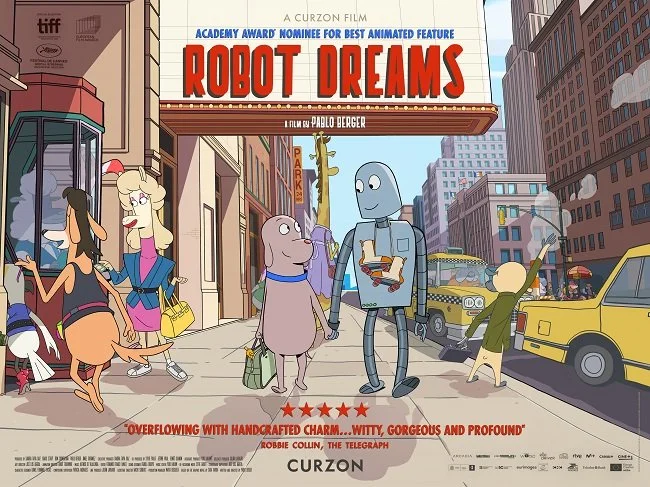
Robot Dreams (2023)
Whenever I feel that mainstream filmmaking is becoming increasingly bland and I grow despondent with it, along comes an animated film to prove that there is still greatness and art to be found through the medium of cinema. Robot Dreams begins as a tale of loneliness and then quickly becomes a eulogy to friendship and participating in life. The story then turns things on its head as it explores loss and finally concludes with a profoundly beautiful resolution, as it muses upon accepting change and new friends. Robot Dreams succeeds where so many other films fail by being honest, candid and sincere. Hence the emotions expressed by what is essentially a simple story are genuine and palpable. The film’s lack of dialogue is a blessing, with music doing a great deal of the narrative heavy lifting. This allows audiences to focus on the main characters without unnecessary distraction. The animation is uncomplicated but very specific in its style and setting. It utterly suits the tale being told.
Whenever I feel that mainstream filmmaking is becoming increasingly bland and I grow despondent with it, along comes an animated film to prove that there is still greatness and art to be found through the medium of cinema. Robot Dreams begins as a tale of loneliness and then quickly becomes a eulogy to friendship and participating in life. The story then turns things on its head as it explores loss and finally concludes with a profoundly beautiful resolution, as it muses upon accepting change and new friends. Robot Dreams succeeds where so many other films fail by being honest, candid and sincere. Hence the emotions expressed by what is essentially a simple story are genuine and palpable. The film’s lack of dialogue is a blessing, with music doing a great deal of the narrative heavy lifting. This allows audiences to focus on the main characters without unnecessary distraction. The animation is uncomplicated but very specific in its style and setting. It utterly suits the tale being told.
Set in an alternate incarnation of 1980s New York City populated with anthropomorphized animals, Dog lives alone in a Manhattan apartment. Tired of being lonely he orders a robot companion after seeing a TV advertisement. Upon arrival, Dog assembles his new friend, Robot and the pair embark on a series of adventures throughout the city. Robot’s innocent excitement and wonder at the world kindles a love of life in Dog and the two become inseparable. However, a trip to the beach at Coney Island goes awry and ends with Robot stranded on the sand. Dog unable to move him on his own, intends to return the next day but the beach is closed and fate then conspires to keep the two friends separated. Dog tries to go about his life, trying to fill the emotional void. Meanwhile, Robot dreams about being reunited with Dog and wonders about his own fate.
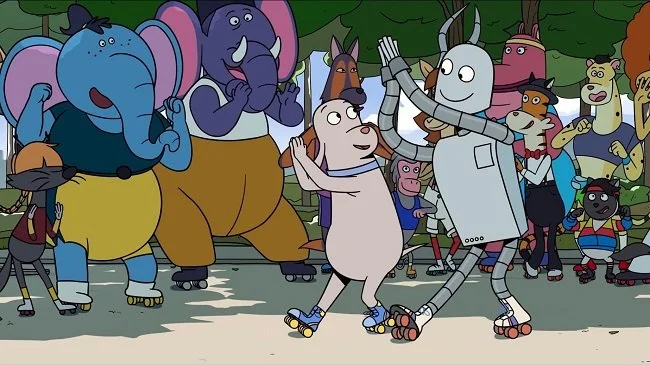
Based upon the 2007 comic of the same name by Sara Varon, director Pablo Berger executes his animated parable with aplomb and integrity. As well as being a superb piece of animation, Robot Dreams is also an extremely well observed love letter to the city of New York. Subtle details embellish every frame, from the period-specific graffiti to niche cultural references such as the inclusion of a VHS copy of The Wizard of Oz rented from Kim’s Video store. The choice of songs from Earth, Wind and Fire to Reagan Youth are very evocative of the era and there are clever homages to films of the time, as well as classics also set in New York. Watch carefully for references to A Nightmare on Elm Street and Manhattan. For a film that is in essence, very simple, there is a great deal of emotional and philosophical depth to Robot Dreams. It is never boring, consistently compelling and quite profound throughout its 98 minute running time. You may find yourself crying but in this case, that is a good thing.
Friday the 13th: The Final Chapter (1984)
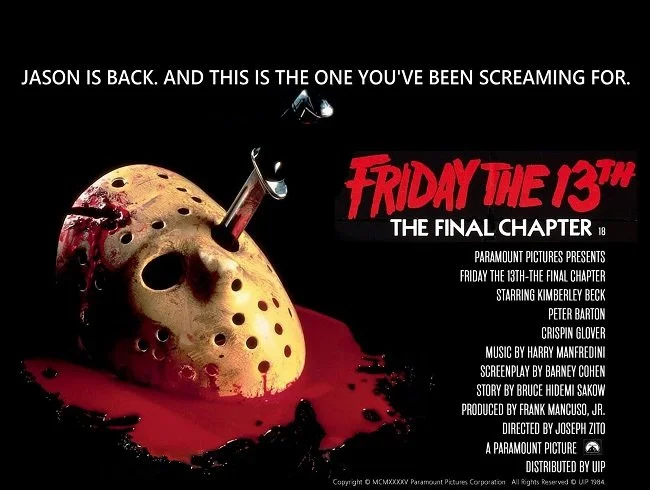
Friday the 13th: The Final Chapter is a popular entry among fans of the franchise. This is mainly due to the return of makeup artist, Tom Savini, who creates several notable death scenes and a bravura ending for Jason Voorhees. There is also an attempt by writer Barney Cohen to have a more involving story compared to previous entries in the series. Director Joseph Zito, who previously directed the above average slasher movie The Prowler AKA Rosemary’s Killer (1981), brings a harder edge to the proceedings, making Jason more menacing than in the previous instalment. As ever, the film was dismissed by the critics but performed well at the box office. Producer Frank Mancuso Jr fully intended for this film to be a definitive end to the series, as he was becoming increasingly concerned that his association with the franchise was having a negative impact upon his career.
Friday the 13th: The Final Chapter is a popular entry among fans of the franchise. This is mainly due to the return of makeup artist, Tom Savini, who creates several notable death scenes and a bravura ending for Jason Voorhees. There is also an attempt by writer Barney Cohen to have a more involving story compared to previous entries in the series. Director Joseph Zito, who previously directed the above average slasher movie The Prowler AKA Rosemary’s Killer (1981), brings a harder edge to the proceedings, making Jason more menacing than in the previous instalment. As ever, the film was dismissed by the critics but performed well at the box office. Producer Frank Mancuso Jr fully intended for this film to be a definitive end to the series, as he was becoming increasingly concerned that his association with the franchise was having a negative impact upon his career.
Opening immediately after the events of Part III, police arrive at the scene of Jason’s latest killing spree and are shocked to find him among the bodies. He is taken to the morgue but he soon revives, escaping from cold storage and killing two members of staff before returning to Crystal Lake. Meanwhile a group of teenagers arrive at a cabin they’ve rented for the weekend. This comprises two couples, Paul (Alan Hayes) and Sam (Judy Aronson), Sara (Barbara Howard) and Doug (Peter Barton), along with the awkward Jimmy (Crispin Glover) and joker Ted (Lawrence Monoson). The cabin is opposite the home of the Jarvis family, where the recently divorced Mrs Garvis (Joan Freeman) lives with her teenage daughter Trish (Kimberly Beck) and young son Tommy (Corey Feldman). It is not long before Jason makes his presence known and the bodycount begins.
Friday the 13th: The Final Chapter has a strong start with the police units descending on Jason’s previous crime scene at night. Illuminated by the searchlight of a helicopter, the paramedics take away the victims and the police remove the axe used on Jason Voorhees as evidence. There is a semi chaotic element to this scene which adds to its credibility as various law enforcement officials struggle to make sense of what has happened. Sadly, once Jaon’s body is taken to the morgue, we immediately encounter the first in a litany of obnoxious characters who will sorely try our patience for the next hour and a half. The first murder featuring a surgical saw is very inventive but once again, has been reduced to a bare minimum by the MPAA at the time. Once the story moves to the teenagers at the cabin, the film falls into its usual formula.
Two specific plot elements make things a little different this time round. The introduction of a camper, Rob Dier (E. Erich Anderson ), who is tracking Jason to seek revenge for his murdered sister. Then there is Tommy Jarvis, an intelligent yet somewhat isolated child who is destined to defeat Jason Voorhees. These storylines add a little more depth to the formulaic structure of the film. They also help alleviate from the grating improvised dialogue between Ted and Jimmy which is extremely wearing. Director Joseph Zito manages to make Jason a far more sinister threat than the previous film, where he simply was a lumbering death machine. Jason, played by veteran stuntman Ted White, appears to taunt his victims, often stopping and staring while stalking them. He also nails several corpses up to further terrorise the living.
Despite its title, the ending of Friday the 13th: The Final Chapter sends a clear signal that the story hasn’t quite ended. Subsequent box office returns of over $33 million meant that a sequel was inevitable. Although loved by fans, I find Friday the 13th: The Final Chapter to be a somewhat inconsistent film. It starts strong but quickly lapses into its own established cliches and excesses. Despite some interesting ideas, the film is hampered by possibly the most egregious group of teenagers thus far depicted in the franchise. It is also the most humourless entry. The original “shock” ending of the final girl Trish finding her dead mother in a bathtub was replaced for a more obvious scene implying all isn’t well with Tommy. Overall, despite many positive aspects Friday the 13th: The Final Chapter doesn’t quite meet its full potential. However, the franchise would face a major shake up with the next entry.
Friday the 13th Part III (1982)
Set directly after the events of the previous film, Friday the 13th Part III is again about a group of friends staying near Crystal Lake who encounter Jason Voorhees as he embarks upon another killing spree. Shot in 3D the film has a less sleazy tone than its predecessors although the formula remains the same. The set pieces and death scenes are more elaborate and less clinical, taking advantage of the 3D picture format. The film marks the first appearance of Jason's signature hockey mask, which subsequently became a trademark of both the character and the franchise. Originally conceived to be an end to the series of films, Friday the 13th Part III performed extremely well at the box office, earning $36.7 million on a budget of $2.2 million. As a result, the franchise was given a stay of execution and a further sequel was commissioned.
Set directly after the events of the previous film, Friday the 13th Part III is again about a group of friends staying near Crystal Lake who encounter Jason Voorhees as he embarks upon another killing spree. Shot in 3D the film has a less sleazy tone than its predecessors although the formula remains the same. The set pieces and death scenes are more elaborate and less clinical, taking advantage of the 3D picture format. The film marks the first appearance of Jason's signature hockey mask, which subsequently became a trademark of both the character and the franchise. Originally conceived to be an end to the series of films, Friday the 13th Part III performed extremely well at the box office, earning $36.7 million on a budget of $2.2 million. As a result, the franchise was given a stay of execution and a further sequel was commissioned.
First drafts of the screenplay for Friday the 13th Part III, focused upon the previous “final girl” Ginny Field (Amy Steel), who was trying to re-adjust to normal life after her traumatic experience at Crystal lake. However, Amy Steel declined the part and so writers Martin Kitrosser and Carol Watson opted to follow the established formula. Hence the story is about eight friends staying for a weekend at a holiday cabin near Crystal Lake. The property belongs to Chris Higgins (Dana Kimmel). Chris reveals to her boyfriend Rick (Paul Katka) that she was attacked by a deformed man two years earlier and has come home to face her fears. The other guests are Debbie (Tracie Savage), her boyfriend Andy (Jeffrey Rogers), prankster Shelly (Larry Zerner), his blind date Vera (Catherine Parks) and stoners Chuck (David Katims) and Chili (Rachel Howard).
As Friday the 13th Part III was filmed in 3D it had a higher budget than the two previous films. Director Steve Miner manages the pace well, providing two deaths early on to wet the audience’s appetite, then spending the next twenty five minutes on introducing the characters and building tension. The “teenagers” are not as grating as usual and there is minor comic relief from both Shelly and Chuck. The death scenes make good use of the 3D photography, with all manner of objects being hurled at the camera. The two kills that get the biggest audience reaction are Jason crushing a head with his bare hands, resulting in an eye popping out. Another character is bisected with a machete from his crotch to his navel, while walking on his hands. Harry Manfedini once again provides an appropriate score, with an especially funky theme during the opening credits.
Friday the 13th Part III is one of two instalments in the franchise that manages to rise above its exploitation roots. The other is the sixth, Jason Lives. The third instalment gained a veneer of quasi-respectability by being in 3D. It made the movie an “event” at the time of its release, as the revival of this format had not yet outstayed its welcome. From a continuity perspective the third film is all over the place. The events depicted are 24 hours after those of Part 2, technically making the film Saturday the 14th. Jason seems to have gained height and shaken off having a machete cleave his left shoulder. But none of it really matters. The film once again delivers what viewers want and this time in glorious 3D. It can even be argued that there is a degree of charm to it all or at least some sense of novelty. The film certainly suits the medium of 3D and it can be argued that it is the best in the series.
Friday the 13th Part 2 (1981)
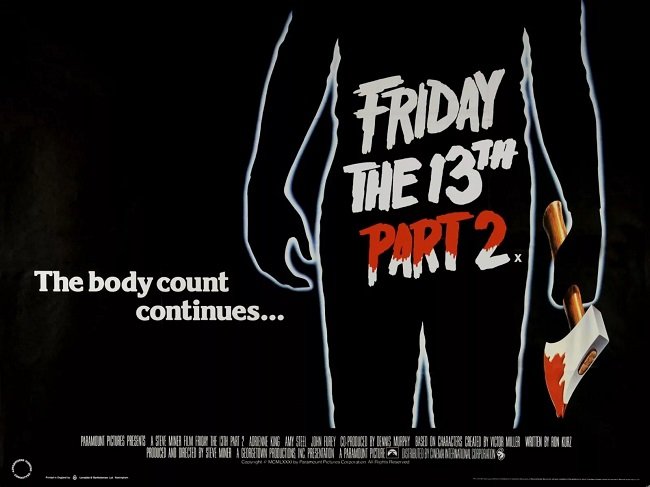
Originally, Friday the 13th Part 2 was intended to be an anthology film based on the superstition associated with the date. However, after the popularity of the original film's surprise ending, the producers opted to continue the story and mythology surrounding Camp Crystal Lake. This eventually became the parameters which all future films would broadly work within. Friday the 13th Part 2 is a more polished production than the first movie, benefitting from twice the budget of the original. The quick turnaround meant that Paramount Pictures could continue to capitalise on the popularity of the slasher genre. However, there was growing social pushback against these types of films, from Christian lobby groups and other “concerned parties”. Hence, Friday the 13th Part 2 ran into problems with the MPAA ratings board and cuts were imposed. Something that would continuously plague the franchise over the years.
Originally, Friday the 13th Part 2 was intended to be an anthology film based on the superstition associated with the date. However, after the popularity of the original film's surprise ending, the producers opted to continue the story and mythology surrounding Camp Crystal Lake. This eventually became the parameters which all future films would broadly work within. Friday the 13th Part 2 is a more polished production than the first movie, benefitting from twice the budget of the original. The quick turnaround meant that Paramount Pictures could continue to capitalise on the popularity of the slasher genre. However, there was growing social pushback against these types of films, from Christian lobby groups and other “concerned parties”. Hence, Friday the 13th Part 2 ran into problems with the MPAA ratings board and cuts were imposed. Something that would continuously plague the franchise over the years.
Second time round the film boasts a nominally stronger script by Ron Kurz with better defined characters. Amy Steel stars as camp counsellor Ginny Field and continues the tradition of a robust and dynamic “final girl”. Betsy Palmer makes a cameo appearance as the late Pamela Voorhees and prophet of doom, Crazy Ralph (Walt Gorney), returns briefly before an unpleasant demise. The boldest step in the screenplay is a major retcon of Jason Voorhees, who has now survived the drowning incident of his youth, having lived as a hermit in the woods for twenty five years. Like so many genre films, it’s best not to dwell too much on the plot details as they’re seldom logical. The larger budget meant better production values. The cinematography by Peter Stein is more atmospheric this time round. But the main focus of attention are the set pieces and death scenes.
Tom Savini passed on the opportunity to return and undertake the film’s makeup effects. Stan Winston was briefly involved in the production but then left due to scheduling conflicts. Finally Carl Fullerton, apprentice to the legendary Dick Smith, took on the project. He has crafted some excellent death scenes, two of which bear an uncanny similarity to those seen in Mario Bava’s A Bay of Blood. However, rather than this being a homage it would appear that they occurred purely by luck. Sadly most of these effects sequences were shortened by the MPAA to the point where it’s difficult to discern what is happening on screen. Thankfully the excellent new HD transfers by Shout Factory help with these details. I noticed for the first time that the throat cutting and the machete to the face scenes both use the wrong side of the weapon for safety reasons.
The final 25 minutes of Friday the 13th Part 2 are well conceived and executed. The chase between Jason and Ginny is well paced and tense. At one point Ginny hides from Jason under a bed and a rat scurries past her. It is discreetly implied that Ginny wets herself out of sheer fear, which is a curious but credible minor detail. The denouement in a dilapidated shack where Jason has a shrine to his dead mother Pamela Voorhees is suitably creepy. Due to the clarity of the Blu-ray transfer, details such as Alice’s body, the “final girl” from the previous movie, are far more apparent. Harry Manfredini’s score continues to be very effective, especially in the chase sequence. Overall this is a solid sequel, offering more of the same but with a little more attention to detail. Friday the 13th Part 2 lays the foundations for future instalments of the franchise. The only thing missing is Jason’s iconic hockey mask which doesn’t appear until the next film.
Friday the 13th (1980)
Writing any kind of review for the original Friday the 13th movie seems somewhat redundant, as it has been analysed and written about numerous times before. If you’re interested in the film’s production as well as its subsequent impact on US cinema at the time, then there is an excellent summary on Wikipedia. Having recently rewatched the entire franchise, courtesy of the Shout Factory’s Friday the 13th Collection Deluxe Edition, I have a few thoughts I’d like to share. The picture quality of all the films is very good, offering a lot more visual information compared to previous releases. The amount of “extras” included in the box set is prodigious. I suspect that these are the best versions that we’re ever likely to see. Fans hoping that one day all the cut footage will be found and re-integrated into each film are likely to remain disappointed. Some material has surfaced but sadly a lot of deleted and extended scenes have been destroyed.
Writing any kind of review for the original Friday the 13th movie seems somewhat redundant, as it has been analysed and written about numerous times before. If you’re interested in the film’s production as well as its subsequent impact on US cinema at the time, then there is an excellent summary on Wikipedia. Having recently rewatched the entire franchise, courtesy of the Shout Factory’s Friday The 13th Collection Deluxe Edition, I have a few thoughts I’d like to share. The picture quality of all the films is very good, offering a lot more visual information compared to previous releases. The amount of “extras” included in the box set is prodigious. I suspect that these are the best versions that we’re ever likely to see. Fans hoping that one day all the cut footage will be found and re-integrated into each film are likely to remain disappointed. Some material has surfaced but sadly a lot of deleted and extended scenes have been destroyed.
Made to capitalise on the success of John Carpenter’s Halloween (1978), Friday the 13th is a far more contrived and cynical piece of filmmaking. Director Sean S. Cunningham aimed to provide audiences with a cinematic “rollercoaster ride”. A horror experience which included all the things the target audience wanted. Specifically sex and violence. The screenplay by Victor Miller offers nothing more than the functional. The scene is set, the characters introduced and then the killing begins. There are a few red herrings along the way but there is little in the way of character development or thematic exploration. Instead we get a litany of stereotypes, although they are used effectively. The cinematography by Barry Abrams is simple, bordering on stark. The production was shot on a real Boy Scout Camp and it is suitably dilapidated giving the proceedings an authentic feel.
The film’s main innovation was the quality of the makeup effects and set pieces. These are jarringly clinical at times, courtesy of Tom Savini. The final revelation that the killer is in fact the mother of a boy who died at the summer camp is also a highpoint. Betsy Palmer’s performance is suitably unhinged. Several other members of the cast are of interest. Kevin Bacon appears as one of the camp counsellors and has possibly the best death scene. Bing Crosby’s son, Harry Crosby, also makes an appearance. Within a few years, he quit acting altogether and became an investment banker. Underpinning all of this is an atmospheric score by Harry Manfredini. Manfredini’s major innovation is a vocal motif, “ki ki ki ma ma ma”, which is played whenever the killer’s POV was used. Along with its use of strident strings during chase sequences, the score for Friday the 13th has become iconic.
Although made independently, Friday the 13th was distributed by Paramount Pictures. The studio was interested in the “youth market” during the late seventies and saw the film as a low risk investment. Paramount were not pleased by the negative reviews the film garnered and some senior executives did not like the studio being associated with such exploitation material. However, Friday the 13th grossed over $59 million at the box office worldwide. A significant achievement for a film that was made for half a million. Not only did it prove a sound investment for Paramount, it effectively started an entire sub-genre within horror movies. Film critics can sometimes find themselves at odds with audiences and Friday the 13th is a prime example of this. They failed to see that the film was a straightforward quid pro quo. Despite its rough edges, it gave audiences exactly what they wanted and they were happy to pay. It didn’t need to be any more than the sum of its parts.
Theatrical Version or Director's Cut?
Not all film director’s have the luxury of “final cut”. The right to ensure that the completed version of a film corresponds with their creative vision. Films are commercial undertakings and sometimes the producers, film studio or other interested parties get to assert their wishes over that of the director. Often this can be due to practical considerations such as running time or budget. On occasions, this can be down to major creative and artistic differences. Hence the theatrical release of a film may be considered flawed, unfinished or just plain wrong by the director, if changes have been imposed, regardless of the reasons. Therefore, a director’s cut of a film can offer a significantly different cinematic vision over the original theatrical release. They can present an opportunity to fix perceived problems or just put more narrative meat on the bones. This may lead to a film being critically reappraised.
Not all film director’s have the luxury of “final cut”. The right to ensure that the completed version of a film corresponds with their creative vision. Films are commercial undertakings and sometimes the producers, film studio or other interested parties get to assert their wishes over that of the director. Often this can be due to practical considerations such as running time or budget. On occasions, this can be down to major creative and artistic differences. Hence the theatrical release of a film may be considered flawed, unfinished or just plain wrong by the director, if changes have been imposed, regardless of the reasons. Therefore, a director’s cut of a film can offer a significantly different cinematic vision over the original theatrical release. They can present an opportunity to fix perceived problems or just put more narrative meat on the bones. This may lead to a film being critically reappraised.
However, it is erroneous to assume that a director’s cut is a superior version of a film by default. Sometimes, a filmmakers desire to return to a previous project and make alterations yields no significant results. Some director’s even develop a reputation as “serial tinkerers” who never seem to be satisfied, whatever the results. Francis Ford Coppola’s Apocalypse Now exists formerly in three distinct versions. Oliver Stone has released four versions of his film Alexander (2004). As for George Lucas, he stated in an interview that “films are never completed, they’re only abandoned”. He has famously revisited his body of work several times and not necessarily to their overall benefit. With all this in mind, here are three films, where popular opinion and critical acclaim favours the original theatrical version over the later released director’s cut.
Alien (1979). Ridley Scott is another well known director who always seems to revisit his work and make alterations. His reasons for re-editing vary and sometimes they do yield better movies. However, the original theatrical release of Alien is described by Scott himself as “the best he could possibly have made at the time”. Yet in 2003, he released a “director’s cut” despite stating that this was not his definitive version. The new version restored roughly four minutes of deleted footage, while cutting about five minutes of other material, leaving it approximately a minute shorter than the theatrical cut. The standout changes were to Brett’s death scene which shows more of the xenomorph and the infamous scene where Ripley finds Dallas “cocooned” and puts him out of his misery. Being no more than a fan service, this version has no additional value. In fact it can be argued that it only serves to contradict the xenomorph’s established biology.
Donnie Darko (2001). Richard Kelly had to compromise when making his off kilter science fiction movie. The main one being keeping the running time below two hours. In 2004, director Kelly, re-cut the film, added twenty minutes of previously deleted footage as well as new music and sound effects. This director's cut provides a clearer insight into many of the film's more ambiguous plot elements and makes the previously vague temporal mechanics less esoteric. However, critics and fans alike have stated that the charm of the theatrical release lies in its mysterious and ill defined nature. It is a deliberately enigmatic cinematic journey. Kelly’s second edit may well add clarity but in doing so neuters what so many viewers found endearing. Sometimes, less is indeed more.
The Warriors (1979). Walter Hill’s underrated, stylised gang drama has its roots in the writings of ancient Greek professional soldier Xenophon. The theme of a group of warriors trapped in hostile territory and trying to get home is cleverly transposed to seventies New York City. Made on a tight schedule by a studio that wasn’t especially enamoured with the material, Hill didn’t get to draw the exact parallels he originally wanted. Hence in 2005, he added a new opening scene with a voiceover describing how Xenophon’s army attempted to fight its way out of Persia and return home. He also inserted comic-book splash panel shots as a means to bridge various key scenes in the film. Sadly, this was a little too on the nose and too expository. Recent releases of The Warriors on Blu-ray and UHD have included both versions and the consensus remains that the theatrical release is more efficient, requiring no further embellishment.
Day of the Dead (2008)
George A. Romero's Day Of The Dead (1985) is a bleak and remorseless masterpiece. The final entry in his “Dead Trilogy”, its central theme is that in a world on the brink of destruction, man is still the biggest threat to his own existence. It is well scripted, clinically accurate in its observations on human nature and thought provoking, despite having its budget cut just weeks before production commenced. 40 years later it is revered as a genre milestone and is considered one of Romero’s finest works. Sadly, the 2008 “remake” directed by Steve Miner, who has a background in slasher and exploitation movies, takes a contrasting approach, to say the least. It certainly has very little to do with Romero’s film and one can’t help but assume that it is nothing more than a cynical cash in. Setting aside comparisons with the original, this is not in any way a standout zombie film in its own right.
George A. Romero's Day Of The Dead (1985) is a bleak and remorseless masterpiece. The final entry in his “Dead Trilogy”, its central theme is that in a world on the brink of destruction, man is still the biggest threat to his own existence. It is well scripted, clinically accurate in its observations on human nature and thought provoking, despite having its budget cut just weeks before production commenced. 40 years later it is revered as a genre milestone and is considered one of Romero’s finest works. Sadly, the 2008 “remake” directed by Steve Miner, who has a background in slasher and exploitation movies, takes a contrasting approach, to say the least. It certainly has very little to do with Romero’s film and one can’t help but assume that it is nothing more than a cynical cash in. Setting aside comparisons with the original, this is not in any way a standout zombie film in its own right.
A group of soldiers led by Captain Rhodes (Ving Rhames) seal off a remote town in Colorado, due to an alleged viral outbreak. Corporal Sarah Cross-Bowman (Mena Suvari) soon suspects that matters are much worse when the infected’s symptoms change from coughing and nosebleeds, to necrosis and a penchant for cannibalism. Has Doctor Logan (Matt Rippy) from the CDC, been sent to help or is he part of a covert project that has gone awry? Cue mayhem, death, bad acting and teenagers in peril. Absolutely no cliche is left unturned from “let's split up” to the ubiquitous wisecracking, African American comic relief. There are ludicrous levels of pseudoscience even by this genre’s standards and the curious addition of zombies climbing around walls and ceilings like Spider-Man, which just doesn’t work.
Filmed mainly in Sofia, Bulgaria Day Of The Dead has a somewhat low budget feel. Cinematographer Patrick Cady does his best to create an atmosphere and cover the modest nature of the production. Yet rather than innovate, the film takes an “everything bar the kitchen sink” approach. Every possible trope from the genre is included and then poorly executed. The make up effects and prosthetics are adequate but the film lacks any standout set pieces. The digital fiery denouement is over far too quickly due to budgetary restrictions, making the ending lacklustre. Perhaps the biggest mistake that Day Of The Dead makes is when Private Bud Crain (Stark Sands) is bitten and becomes a zombie. He eschews his undead nature because he was a vegetarian when alive. Perhaps writer Jeffrey Reddick thought he was making a clever point but regardless of the intent it simply comes off as risible.
Steve Miner has been involved with some interesting films over the years. I enjoyed his homage to creature features, Lake Placid and the gothic Warlock. Two Friday 13th sequels loom large in his body of work. But this is far from his finest hour. Zack Snyder's 2004 remake of Dawn Of The Dead may not be to everyone’s tastes but it cannot be accused of being a shallow, teen oriented exploitation piece. This film most definitely can be. It would appear that the distributors got wind of its shortcomings and so it bypassed cinemas and was released direct to video. If you’re looking for a clever reimagining of a seminal film, offering new perspectives on the zombie genre, then you won’t find it here. If you wish to waste 90 minutes of your time watching an uninspired, generic horror vehicle that seeks to capitalise on the kudos associated with the original, then this remake will meet those requirements.


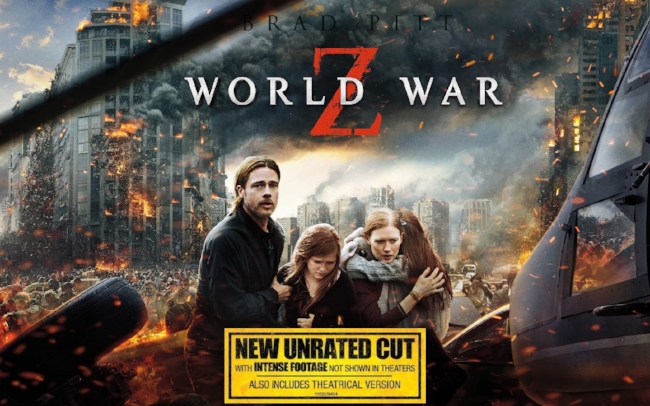
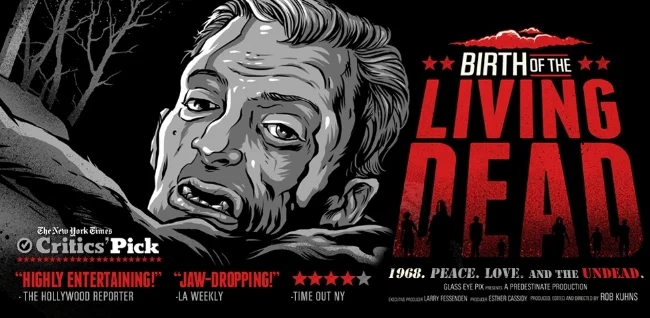
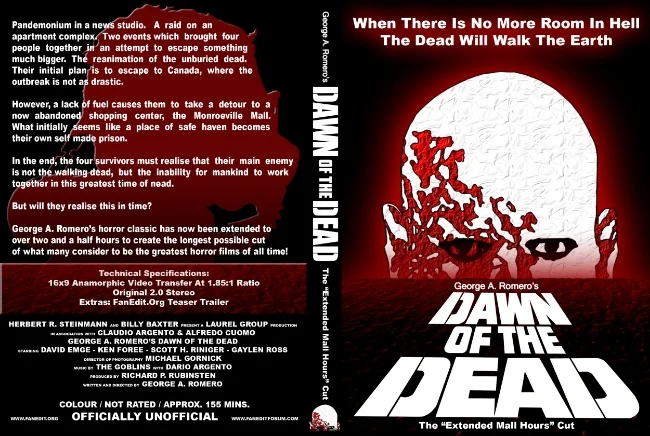
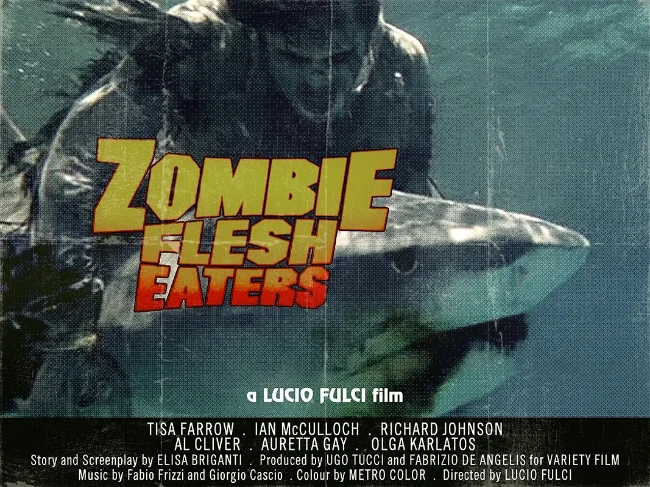
Caligula: The Ultimate Cut (1979)
There are many stories and anecdotes associated with the 1979 film Caligula. Many of which are apocryphal. However, there is absolutely no doubt that this was a troubled production, with artistic differences between the writer, director and producers. Hence the original theatrical release was not the arthouse, historical drama that it was intended to be. Instead Caligula ended up the most notorious multimillion dollar independent film of the seventies. Steeped in violence, hardcore pornography and acts of depravity, yet boasting an A list cast of British and European actors, a screenplay by the legendary Gore Vidal and an established Italian arthouse director, namely Giovanni “Tinto” Brass . This magnificent cinematic car crash of a film has maintained an interest with cult film enthusiasts, as well as scholars of cinema over the decades. This is mainly because there’s an optimistic school of thought that there is a far better film trying to get out.
There are many stories and anecdotes associated with the 1979 film Caligula. Many of which are apocryphal. However, there is absolutely no doubt that this was a troubled production, with artistic differences between the writer, director and producers. Hence the original theatrical release was not the arthouse, historical drama that it was intended to be. Instead Caligula ended up the most notorious multimillion dollar independent film of the seventies. Steeped in violence, hardcore pornography and acts of depravity, yet boasting an A list cast of British and European actors, a screenplay by the legendary Gore Vidal and an established Italian arthouse director, namely Giovanni “Tinto” Brass . This magnificent cinematic car crash of a film has maintained an interest with cult film enthusiasts, as well as scholars of cinema over the decades. This is mainly because there’s an optimistic school of thought that there is a far better film trying to get out.
For those unfamiliar with the film and its associated legend, Caligula was initially conceived as an historical drama about the rise and fall of the controversial Roman emperor. The film stars Malcolm McDowell in the title role, alongside Teresa Ann Savoy, Helen Mirren, Peter O'Toole, John Steiner, and John Gielgud. It was filmed in Rome at Dear Studios during 1976 and was intended to be a serious dramatic exploration of the theme that absolute power corrupts. Writer Gore Vidal wrote an original screenplay based upon historical sources to that effect. However, director Tinto Brass had other ideas and preferred the concept of Caligula being a born monster just waiting for an opportunity. Hence he rewrote the script with an emphasis on the sensational, although he kept much of the original dialogue. However, upon completion of principal photography, producer Bob Guccione (the publisher of Penthouse) took over editing of the film and shot additional pornographic scenes for inclusion in the theatrical cut. Controversy, outrage and lawsuits followed. Caligula then passed into cinematic legend.
Then in 2019, Thomas Negovan was hired to reconstruct a version of the film closer to the initial vision. Using the original camera negatives of 100 hours of footage unearthed in the Penthouse archive, along with an early draft of Gore Vidal’s script, Negovan has assembled a radically different cut of the film using alternate takes and abandoned footage. However, this has still proven a difficult undertaking as there is far from a consensus on what the original intentions of the production were. Was Caligula intended to be a pure historical drama or a stylised exploration of the themes of Roman decadence, filmed via the medium of Italian arthouse cinema? It would appear that Negovan has arrived somewhere between the two positions. There is now a clear thematic thread running through Caligula: The Ultimate Cut with the emperor portrayed as an anarchic free spirit who is consumed by his own desire to push the boundaries of his power. He is enabled by a coterie of sycophants and lackays, as well as political opportunists.
Film aficionados will spot the changes that Thomas Negovan has made immediately. The film opens with an impressive new animated title sequence featuring a young Caligula performing his eponymous dance. This has been created for the film by “Sandman” artist Dave McKean. Numerous key scenes are now shown in chronological order and many of the more infamous and salacious sequences make use of alternative takes. The new edit certainly presents a more nuanced performance by Malcolm McDowell and the actor himself is certainly pleased with the new edit. Helen Mirren has more screen time as Caligula’s wife, Caesonia, although the character is still somewhat underwritten. Overall there is a far more coherent narrative arc and the film no longer feels like a vehicle exclusively created for the depiction of debauchery and violence.

That being said, Caligula: The Ultimate Cut has not been thoroughly sanitised because it is impossible to do so. Hedonism and physical indulgence are baked into the film’s celluloid DNA. There is still a lot of male and female nudity, a double rape and a great deal of violence and tonal unpleasantness. In replacing certain shots with alternate material, the exploitative aspect of some scenes has been replaced with a somewhat colder and more clinical tone, which in some respects makes them more shocking. Especially the notorious fisting scene and the assassination at the end of the film, which involves an infanticide. Cinephiles will also lament the replacement of Bruno Nicolai’s original score along with the classical cues by Prokofiev and Khachaturian, with a new soundtrack by Troy Sterling Nies. It is nothing more than functional, where the original matched the baroque tone of the film.
Overall Caligula: The Ultimate Cut is probably the best cut of the film we’re ever likely to see. Has Thomas Negovan’s extensive reconstruction revealed a lost masterpiece amid the decadence and depravity of the previous theatrical edition? Not quite. The film remains a cinematic chimaera that veers between high drama and exploitative excess. It just does so in a far more coherent and efficient fashion this time round. It does highlight the baroque production design by Danilo Donati and showcase a far more rounded performance by Malcolm McDowell but this is never going to be a film that finds mass, mainstream appeal. This legendary production will remain a source of fascination for scholars of cinema but is ultimately too “out there” to become an accepted part of the established pantheon of arthouse masterpieces. It is a unique product of its time and now in this new version, a cinematic curate’s egg rather than a hot mess.