
An Angry Discourse
“Video game discourse has gotten me down lately. Why are some people so shitty about their favorite hobby?” This comment from Jake Baldino, a presenter over at Gameranx, appeared in my Twitter timeline today and garnered some interesting responses. A lot of people stated it was all down to a “loud minority” of gamers, which is a very common refrain. But I’m not so sure. Whereas I may well have trotted out such a response a decade ago, recent events seem to indicate otherwise. I have a sneaking suspicion that “people” aren’t as nice as we may have previously thought and that includes gamers. Yes, the anonymity of the internet does encourage some hostility among “keyboard warriors”, but you only have to turn on your TV to see people happily being bellicose and objectionable in public. So perhaps it’s not just a case of the “the squeaky wheel” getting noticed. May be there has been and continues to be, a major cultural shift in the way we interact with each other.
“Video game discourse has gotten me down lately. Why are some people so shitty about their favorite hobby?” This comment from Jake Baldino, a presenter over at Gameranx, appeared in my Twitter timeline today and garnered some interesting responses. A lot of people stated it was all down to a “loud minority” of gamers, which is a very common refrain. But I’m not so sure. Whereas I may well have trotted out such a response a decade ago, recent events seem to indicate otherwise. I have a sneaking suspicion that “people” aren’t as nice as we may have previously thought and that includes gamers. Yes, the anonymity of the internet does encourage some hostility among “keyboard warriors”, but you only have to turn on your TV to see people happily being bellicose and objectionable in public. So perhaps it’s not just a case of the “the squeaky wheel” getting noticed. May be there has been and continues to be, a major cultural shift in the way we interact with each other.
Contemporary politics has shown us that despite what a lot of us thought, we don’t all share the same values. Politics and the wider discussion to be had around it, has become far more partisan. There’s no longer seems to be any attempt to “agree to disagree”. A lot of the media are no longer concerned with balance. It’s all about clicks, viewing figures and “likes”. So pretty much everything in the news, be it politics, economics or social issues is just presented as a binary choice. You’re then invited to pick a side and scream, because we live in an age where we are encouraged to get angry and its fast becoming a national pastime. And this mindset then bleeds out into everything else. The work environment gets angrier as a result. People will fly off the handle while queuing at the supermarket. So it’s therefore hardly surprising to see such behaviour appear in out leisure activities.
Gaming is a broad church but two of its biggest defining features are competitiveness and social interaction. These are things that people become very passionate about. Furthermore, we live in an age of growing identity politics and defining who we are on our own terms. Gaming has therefore become a facet of personal identity for some, as opposed to just a leisure activity. When you mix such a mindset into a wider culture that is becoming increasingly adversarial, then you’ll eventually encounter problems. Despite what some people think, you cannot keep politics and social commentary out of gaming because it has become more than the sum of its parts. Whenever people interact and engage on masse, you’ll find pockets of an emergent communal identity. Groups then become mediums for wider ideas. But groups can also lead to hierarchies, power struggles and conflict.
It is also naïve to ignore the financial dynamic to gaming culture and the impact that it has. Becoming a cash cow in a relatively short period of time is not always as beneficial as you may think. Money has a habit of causing conflict. What gamers and game developers want are not necessarily the same thing. So when you add this to the seismic change in public interactions and the angry world that we now find ourselves in, it is hardly surprising that video games discourse has taken a reciprocal nose dive. Perhaps the eternal optimists among use need to recalibrate and come to terms with the fact that a lot of people aren’t inherently good. I’m not saying that the battle is lost and that we have to roll over and play dead. Human failings should be challenged and not ignored. But I think we need to come to terms with societal change and temper our expectations with regard to video games discourse, until the pendulum swings the other way again.
The Elder Scrolls Online and Addons
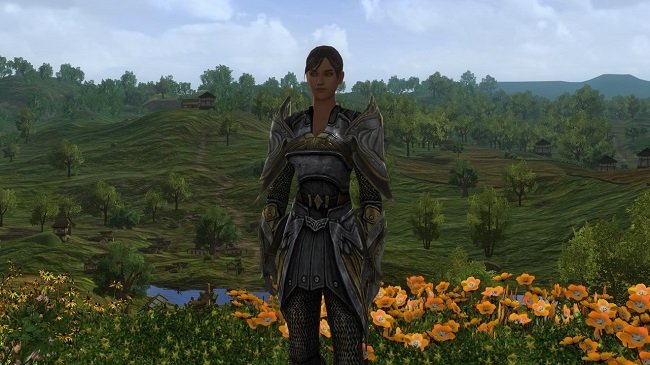
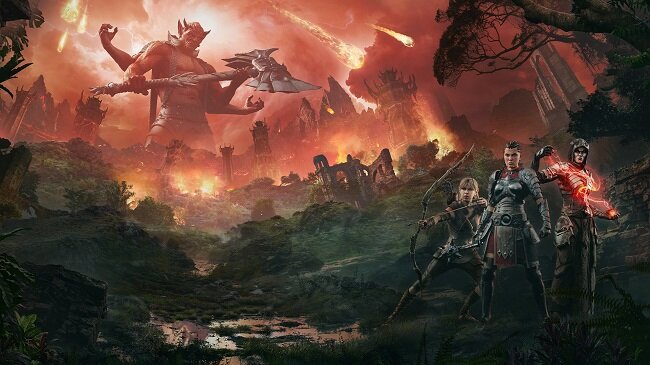
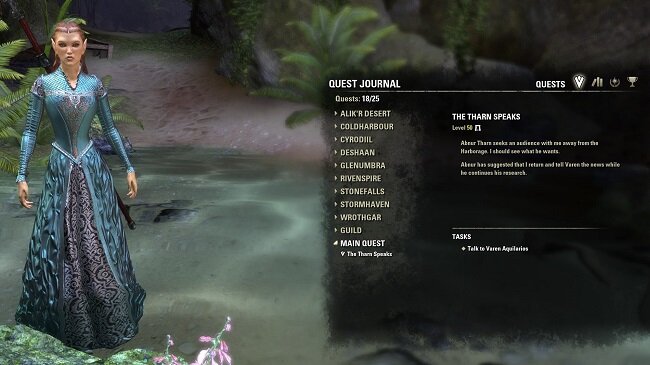
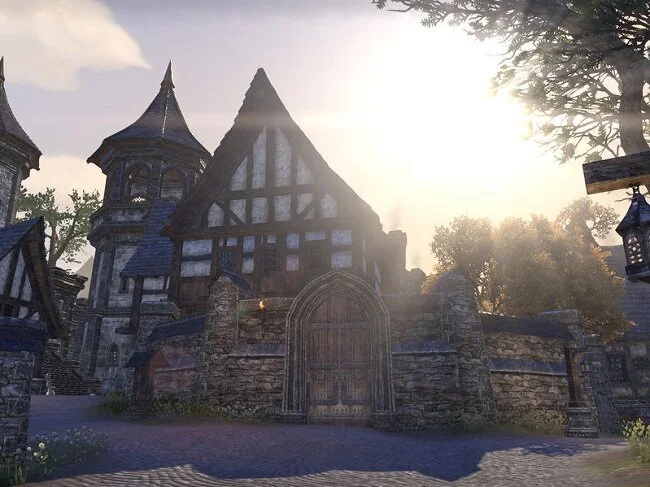
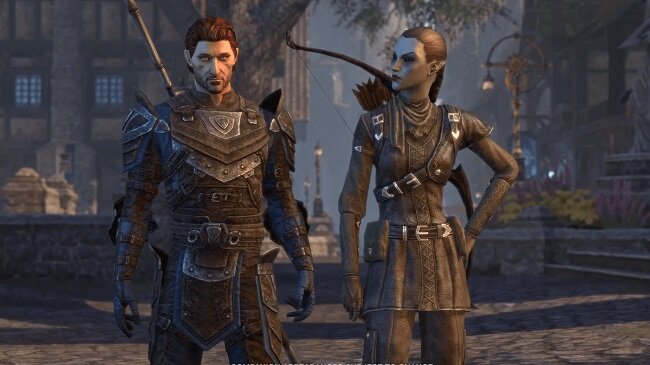
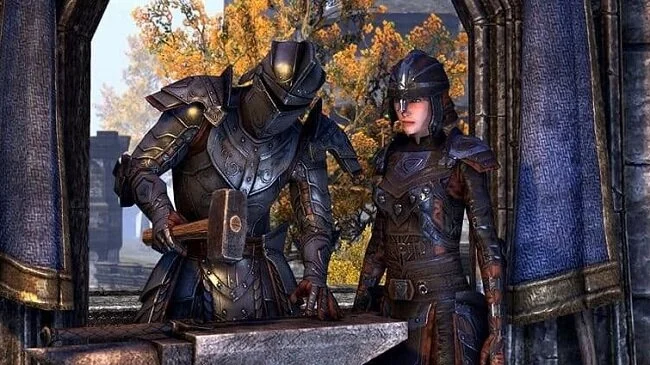
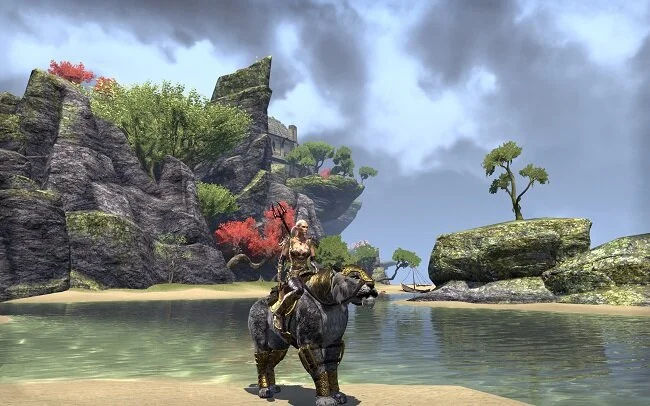
After recently watching several friends stream The Elder Scrolls Online, I have re-installed the game (funny how that often happens). I played quite consistently last spring and the game finally “clicked” for me. The narrative driven structure is something I enjoy, and I also like way you can pick and choose the content you undertake. So after letting the 70.9 GB game client download overnight, I fired up the game yesterday and found my level 50 High Elf Sorcerer in Auridon, where I left them last Easter. The first thing that immediately stood out was the plain vanilla default UI, which is minimalist to say the least. After a heavy sigh, I realised that if I wanted to continue efficiently playing ESO I would have to install a bunch of addons via Minion. The only minor problem was that after replacing my Hard Drive last November, despite backing up most data, I had not made a note of which addons I was using. Luckily, a friend who still had the game installed went through their current installation, so I was able to collate a suitable list.
After recently watching several friends stream The Elder Scrolls Online, I have re-installed the game (funny how that often happens). I played quite consistently last spring and the game finally “clicked” for me. The narrative driven structure is something I enjoy, and I also like way you can pick and choose the content you undertake. So after letting the 70.9 GB game client download overnight, I fired up the game yesterday and found my level 50 High Elf Sorcerer in Auridon, where I left them last Easter. The first thing that immediately stood out was the plain vanilla default UI, which is minimalist to say the least. After a heavy sigh, I realised that if I wanted to continue efficiently playing ESO I would have to install a bunch of addons via Minion. The only minor problem was that after replacing my Hard Drive last November, despite backing up most data, I had not made a note of which addons I was using. Luckily, a friend who still had the game installed went through their current installation, so I was able to collate a suitable list.
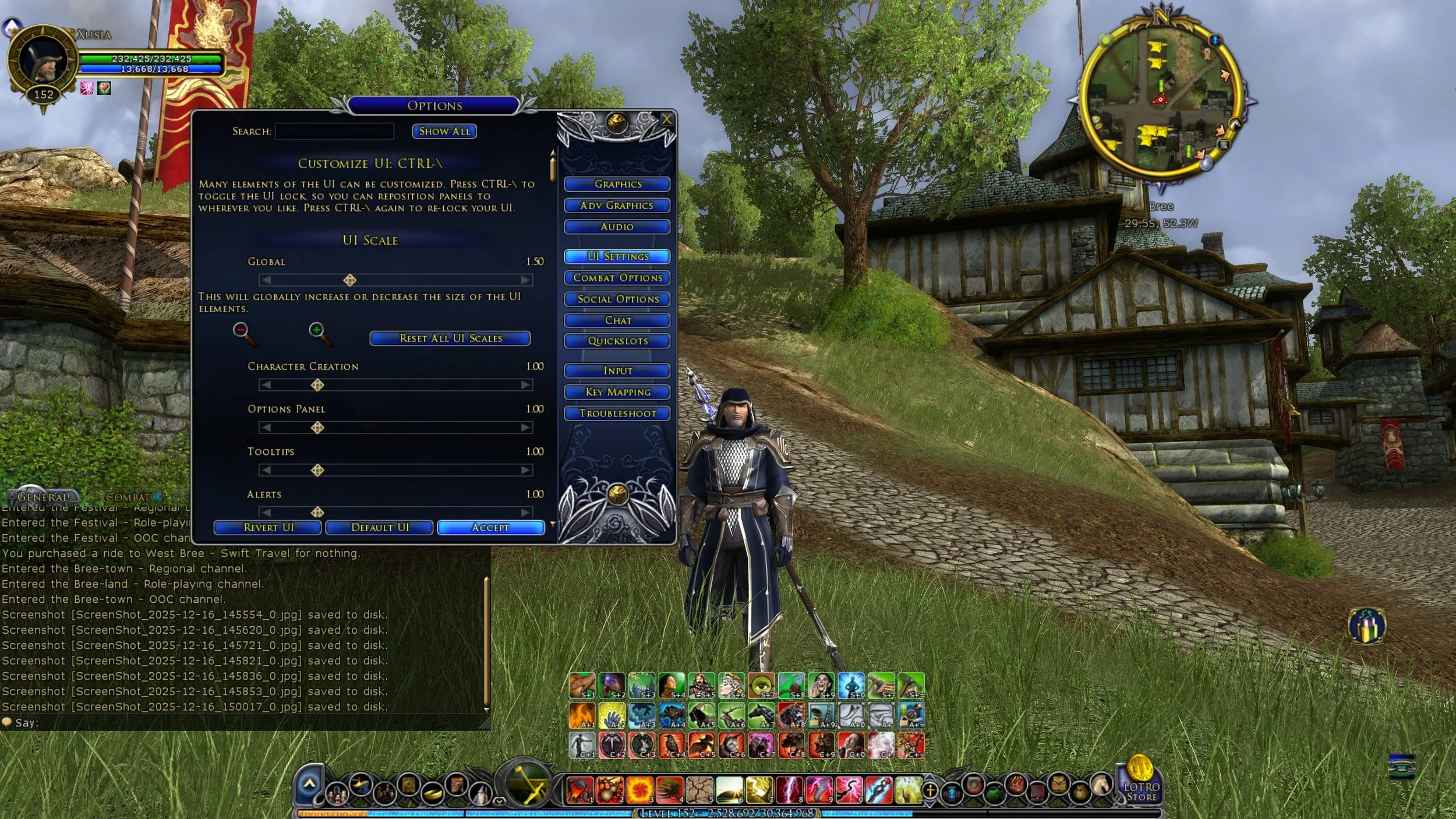
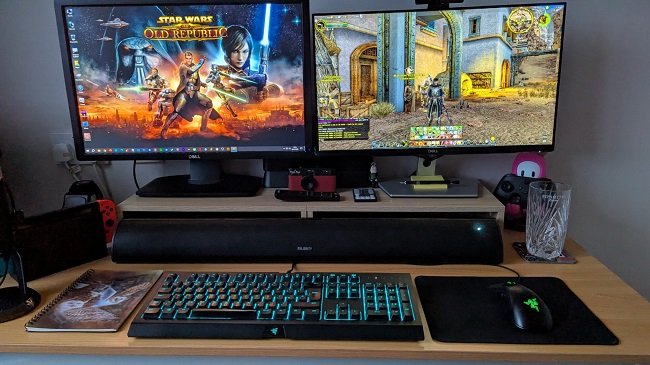
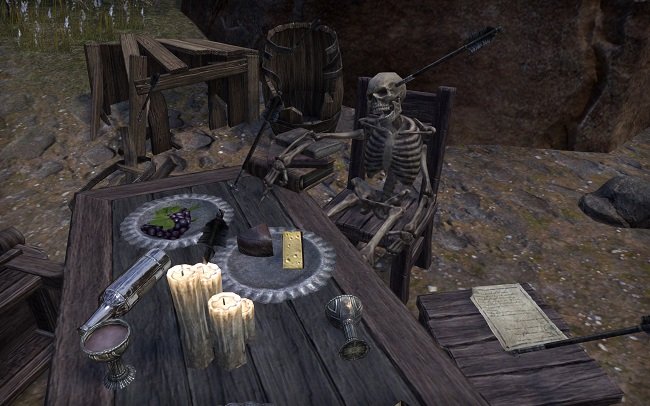
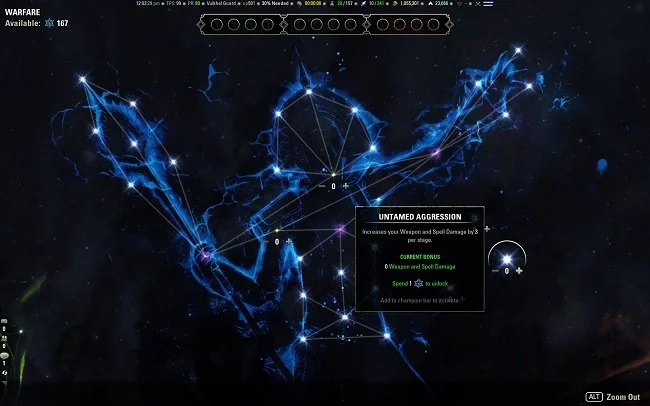
I don’t feel inclined to debate the rights and wrongs of addons in this post, simply let it suffice to say that they are a necessary evil in the case of ESO. Not having them makes playing a lot less efficient and frankly less enjoyable. However, third party addons need to be regularly updated and maintained but as their creators are not paid professionals, contractually bond to do so, they effectively become a lottery, to say the least. Then there is the issue of conflicts, UI errors and poor documentation, all leading to hours of tweaking settings and loading and unloading each add-on to get it to work as described. At present I have this tedious chore ahead of me because as you can see from the screen capture, my UI is an absolute dog’s dinner at present. However, once I’ve sorted the issue out according to my preferences, the presences of 16 addons should enhance my gameplay experience and I can get on with enjoying ESO.
Considering that ESO seems to be doing well within the MMO market and that developer ZeniMax are regularly producing new content and expansions for the game, I find it curious that there is still a reliance upon third party addons. Surely some time and attention could be spent improving and upgrading the UI, officially. Could ZeniMax not take a lead from the most popular addons and create something comparable and officially integrate them into the game? Doesn’t Blizzard Activision have a similar policy with World of Warcraft? It seems odd in an age of corporate control and the monetisation of all aspects of a game, that there is still a relatively free and unregulated culture of third-party addons allowed in some MMOs. Perhaps it’s a cultural hangover from the success of Skyrim? In the meantime I’ll get around to tweaking my own addons in ESO and hopefully won’t have to worry about them for a while. Not until the next expansion Elsweyr is released on June 4th and promptly breaks them all.



Emotes, the "Carlton Dance" and Copyright
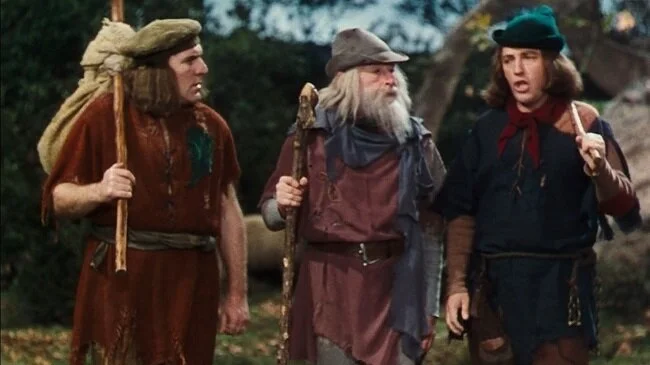
Actor Alfonso Ribeiro has been told he cannot copyright the "Carlton Dance" his character performed in the hit US sitcom Fresh Prince of Bel-Air. Ribeiro, who played Will Smith's pretentious cousin Carlton Banks in the popular TV show, had tried to sue both Take-Two Interactive and Epic Games over use of the routine as an emote in the video games NBA2K16 and Fortnite. The US Copyright Office's denial of the claim was revealed in a motion to dismiss Ribeiro's lawsuit against Take-Two Interactive. Although a court is not bound by the determination, it is very likely that it will take it into consideration. A hearing on the motion to dismiss the lawsuit is scheduled for 18th March. If successful it will effectively end any current legal action taken by Mr Ribeiro and potentially set a precedence for any future lawsuits of this nature. Or will it?
Actor Alfonso Ribeiro has been told he cannot copyright the "Carlton Dance" his character performed in the hit US sitcom Fresh Prince of Bel-Air. Ribeiro, who played Will Smith's pretentious cousin Carlton Banks in the popular TV show, had tried to sue both Take-Two Interactive and Epic Games over use of the routine as an emote in the video games NBA2K16 and Fortnite. The US Copyright Office's denial of the claim was revealed in a motion to dismiss Ribeiro's lawsuit against Take-Two Interactive. Although a court is not bound by the determination, it is very likely that it will take it into consideration. A hearing on the motion to dismiss the lawsuit is scheduled for 18th March. If successful it will effectively end any current legal action taken by Mr Ribeiro and potentially set a precedence for any future lawsuits of this nature. Or will it?
We live in curious times when existing laws regarding copyright and the protection of intellectual property struggle to keep up with the digital age. The Ribeiro case reminded me of brouhaha from late 2017 when singer Taylor Swift sought to copyright phrases from her album Reputation "in order to use them on a wide range of merchandise that includes everything from guitar picks to t-shirts". And then we have the ongoing culture war between Star Wars fans and Disney, regarding fan films and the like. Regardless of which side of the debate you support, these situations highlight the paradox of popular culture. People absorb and the re-iterate the tropes and motifs that appeal to them, but unlike traditional mediums such as the written word, determining who is the “owner” of the source content is far harder. There may well have to be a recalibration of such things in the not too distant future and like any big legal change it may prove to be an uphill struggle and will have substantial consequences.
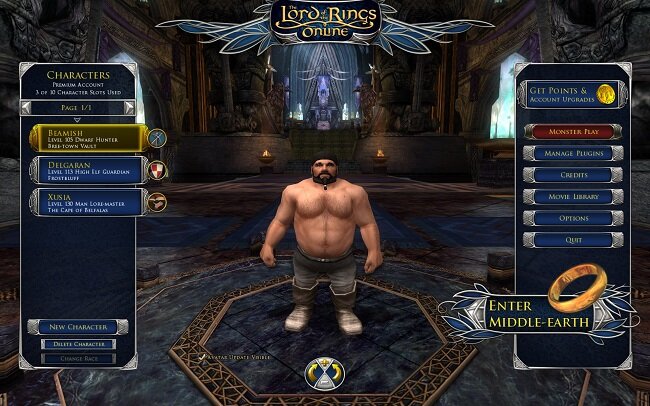
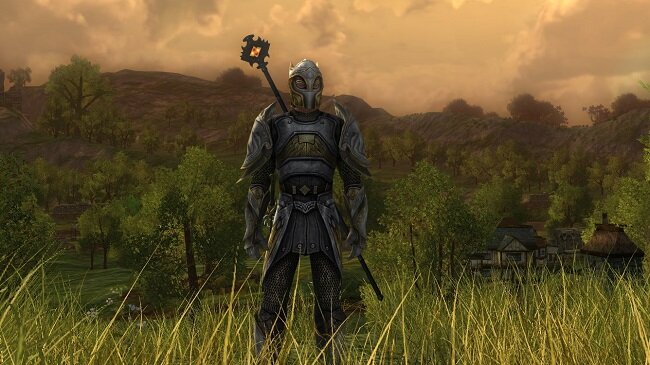
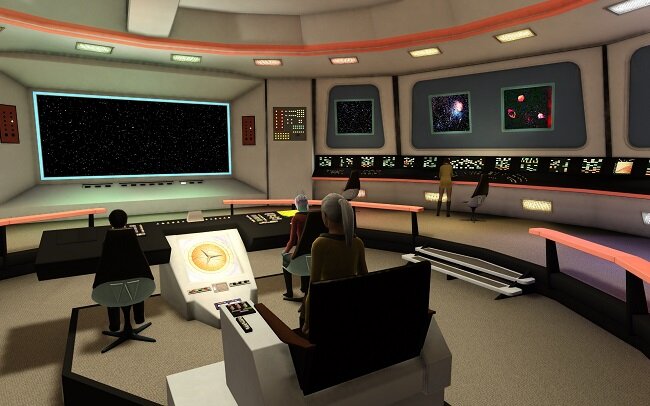
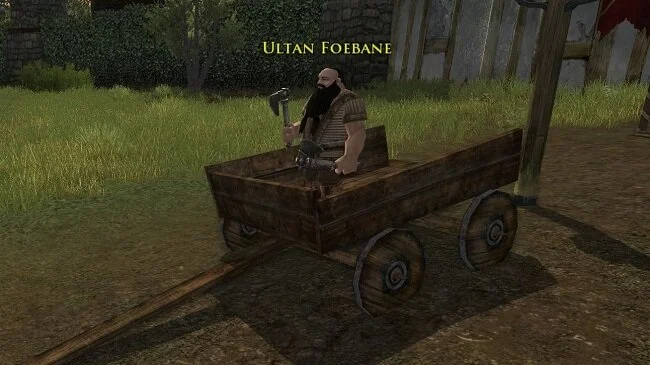
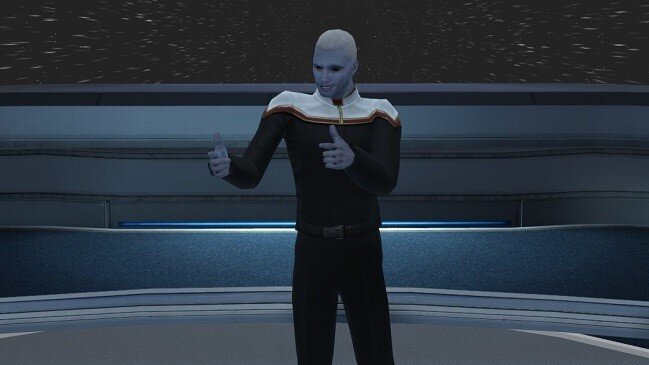
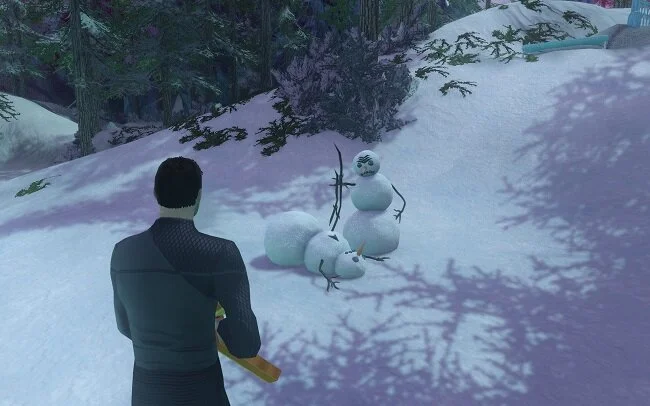
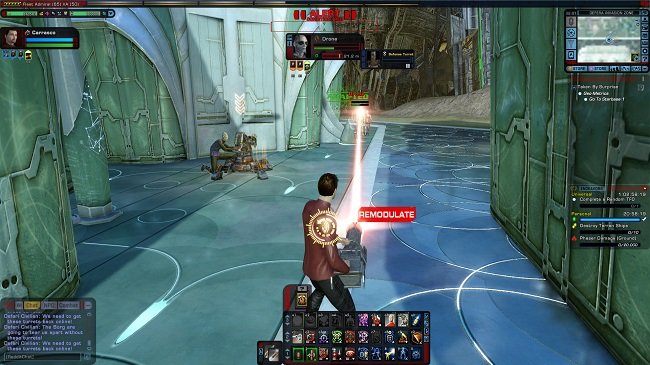
Which brings me back to video games and in particular emotes, that are so popular among players. I have no idea what the specific psychology is that makes these short-animated vignettes so enthralling, but gamers desire them and that is sufficient for them to be monetised and become valuable source of revenue to publishers. Furthermore, many of these emotes have their roots in pop culture, which makes Ribeiro case so interesting. Star Trek Online features a “Zombie” dance emote which obviously comes from Michael Jackson’s iconic Thriller dance routine. There’s also an “Unusual” dance emote that is suspiciously similar to the “Carlton Dance”. They’ve been there for a while and naturally haven’t garnered any attention as the MMO doesn’t have an audience comparable to that of Fortnite. But if these were to be removed from the game along with all the emotes in LOTRO, ESO and every other multiplayer title, then it would diminish the enjoyment of the games for a substantial group of players. It may not be a deal breaker for all, but the loss of emotes may well be an impediment for role-players. It would also mean a loss of revenue as so many emotes are granted via lootboxes.
If, for the sake of argument, emotes did become intellectual property and protected by copyright, then naturally some developers would remove them from their games to avoid paying potential licensing costs. Could such a situation lead to wider pop culture references becoming similarly subject to copyright law and eliminated from current products? Such a situation would certainly prove a headache for the likes of Blizzard and their flagship MMORPG World of Warcraft. We live in an age of increasingly bold business practices and a prevailing ethos of “if it can be monetised then do it”. Hence artists will look to all aspects of their work as a source of revenue, be it a dance unique to them, a catchphrase or even a style or aesthetic. And naturally video games as a “live service” want to include such things as emotes and cosmetic skins in their products. But although all parties like the idea of making financial charges, no one like to be on the receiving end of them. Ultimately, this all becomes a very difficult circle to square. I suspect that the Ribeiro case is not the last we shall here about this matter.
New Ships, Keybinds and Voice Acting
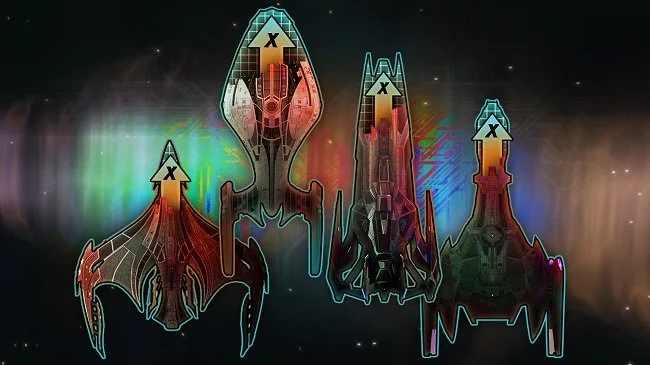
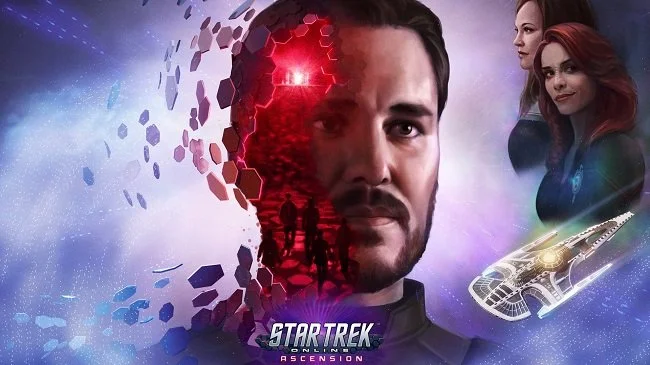
There has been a degree of controversy over the Discovery Operation Pack that has recently been made available for purchase in Star Trek Online. The bundle featuring ships, bridge officers, cosmetic items and more is displeasing some core players who feel that it is over priced and lacks anything relevant for Romulan and Klingon races. Personally, I’m only interested in two specific items from the pack, such as the Tier 6 Gagarin Miracle Worker Battlecruiser and the combat pet Tardigrade but at present they cannot be purchased separately. So, I shall not be parting with any money at present. The Gagarin Miracle Worker Battlecruiser is relatively similar to the Tucker Tactical Miracle Worker Cruiser, which I already own. However, it is an improvement aesthetically speaking (a subjective point, admittedly), so for me the obvious compromise is to purchase the fleet version and forgo the unique space trait and settle for an additional console slot. As I’m not a high-end player, the look and feel of a ship has as much appeal to me as its stats.
There has been a degree of controversy over the Discovery Operation Pack that has recently been made available for purchase in Star Trek Online. The bundle featuring ships, bridge officers, cosmetic items and more is displeasing some core players who feel that it is over priced and lacks anything relevant for Romulan and Klingon races. Personally, I’m only interested in two specific items from the pack, such as the Tier 6 Gagarin Miracle Worker Battlecruiser and the combat pet Tardigrade but at present they cannot be purchased separately. So, I shall not be parting with any money at present. The Gagarin Miracle Worker Battlecruiser is relatively similar to the Tucker Tactical Miracle Worker Cruiser, which I already own. However, it is an improvement aesthetically speaking (a subjective point, admittedly), so for me the obvious compromise is to purchase the fleet version and forgo the unique space trait and settle for an additional console slot. As I’m not a high-end player, the look and feel of a ship has as much appeal to me as its stats.
Although not as bad as some MMOs, STO does suffer from a degree of skills bloat, which means that space combat can be somewhat of a “clickfest” at times. Therefore, a lot of players, especially those who pursue high DPS, use keybinds to facilitate the efficient activation of skills. There are third party tools that allow multiple abilities to be assigned to a single hotkey. Most people tend to use the spacebar for this, which can then be quickly used to activate each skill, one after the other. It certainly removes extraneous mouse movement and furious clicking but after some recent experimentation, I have decided return to the old school approach. Manually picking skills and making tactical decisions is half of the fun of space combat and automating this process robs the game of some of its allure, or at least for me it does. Oddly enough, while doing some research as to how to use keybinds and what software to use, I discovered that the console version of STO allows players to automate skills use, as well as weapons fire. On the PC version, only the latter is available. I wonder if Cryptic intend to address this disparity?
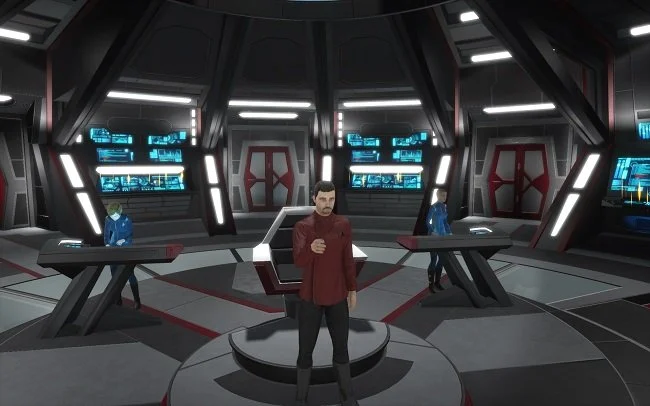
Finally, I read this week about allegations of sexual misconduct made against voice artists and actor Vic Mignogna. I am only familiar with the man through Star Trek Continues and his voice work in STO as Captain Isaac Garrett and was not aware that he was well known in the Anime community for his vocal talents. A few contributors to the STO subreddit have raised the question as to whether his dialogue should now be removed and replaced with an alternative actor. It certainly made me stop and think. I am by no means an advocate of kneejerk reactions, but I can also understand why companies, especially those based in leisure industries would want to distance themselves from such a situation until due process has run its course. It will be interesting to see what (if anything) developers Cryptic decided to do. Irrespective of Vic Mignogna’s respective innocence or guilt, the entire matter is escalating and potentially getting subsumed into the wider ongoing culture wars. #Animegate is sadly now a thing and as such I wouldn’t want to see that anywhere near STO or take root in its community.


Mirkwood, Enedwaith or The Great River?
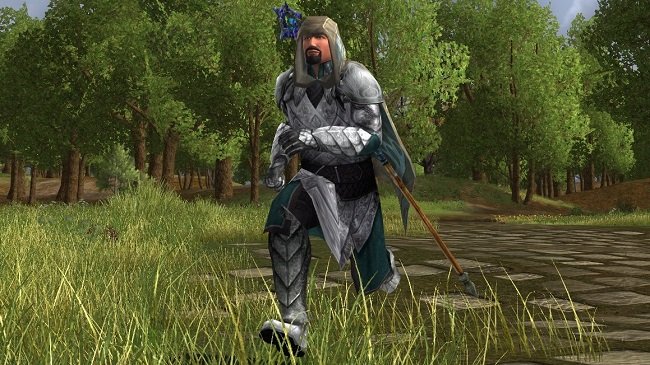
Due to the nerfed levelling curve of Shadows of Angmar and Mines of Moria, I recently completed the Epic Story up to Volume II, Book 8: Scourge of Khazad-dûm and reached level 64 without any major problems. Hence, I wrote about preparing to play through the Siege of Mirkwood expansion. Content that I haven’t touched since its release in 2009. Well to cut along story short I completed the prologue and travelled over the Anduin to the Malledhrim bridgehead and quickly remembered why I disliked the dark and dingy forest with its densely packed mobs. So I revised my plans and decided to go to Enedwaith as I was the right level to revisit that zone. I was not a big fan of the story, finding the feuds between Dunlending clans and the machinations of Saruman somewhat of a distraction. However, I did like the sub-plot about the Dwarf Nâr at the library at Zudrugund to be more engaging, so I headed South, rather than striking East.
Due to the nerfed levelling curve of Shadows of Angmar and Mines of Moria, I recently completed the Epic Story up to Volume II, Book 8: Scourge of Khazad-dûm and reached level 64 without any major problems. Hence, I wrote about preparing to play through the Siege of Mirkwood expansion. Content that I haven’t touched since its release in 2009. Well to cut along story short I completed the prologue and travelled over the Anduin to the Malledhrim bridgehead and quickly remembered why I disliked the dark and dingy forest with its densely packed mobs. So I revised my plans and decided to go to Enedwaith as I was the right level to revisit that zone. I was not a big fan of the story, finding the feuds between Dunlending clans and the machinations of Saruman somewhat of a distraction. However, I did like the sub-plot about the Dwarf Nâr at the library at Zudrugund to be more engaging, so I headed South, rather than striking East.
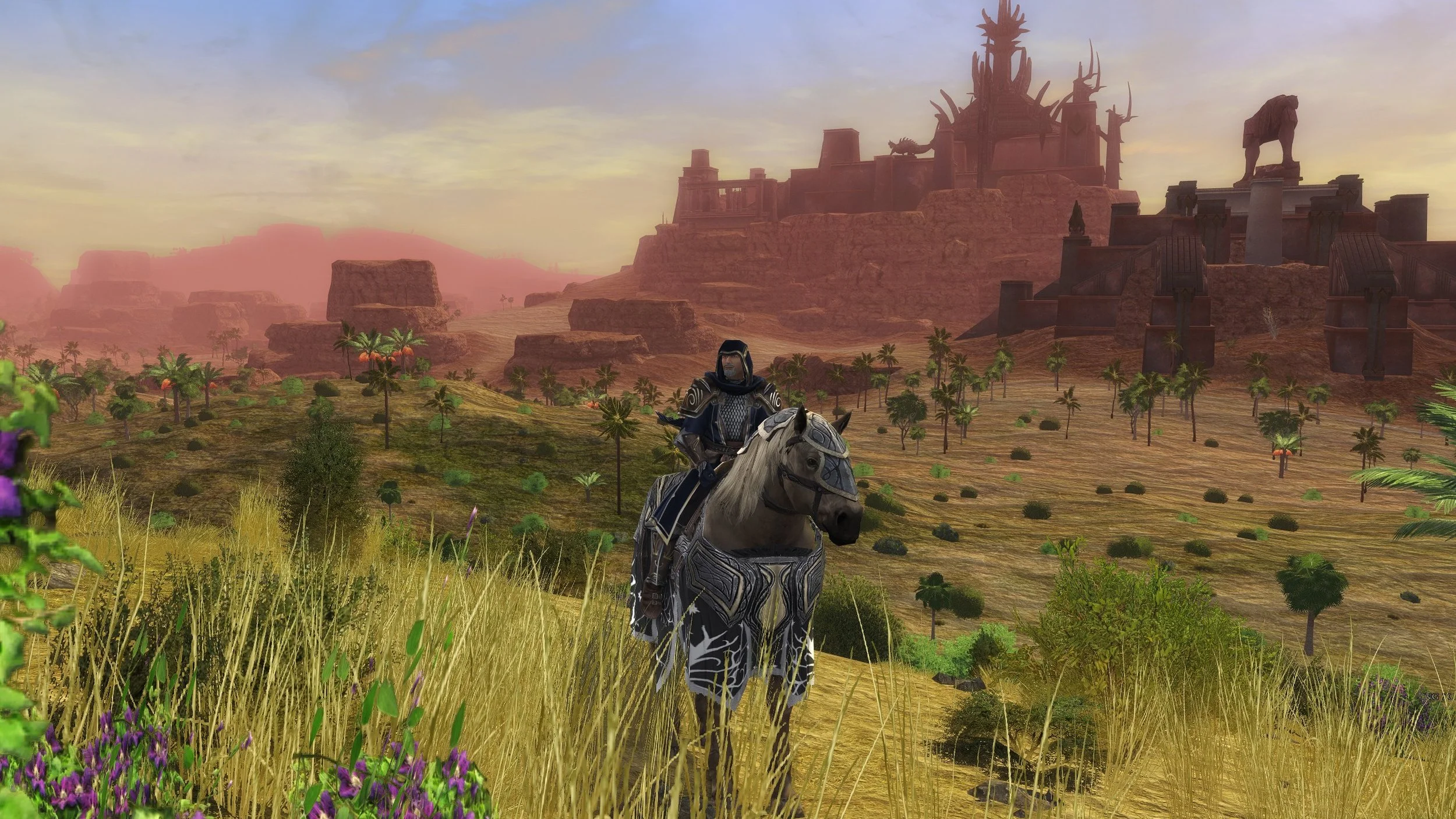
Enedwaith is a curious zone, made when the game transitioned to hybrid, free-to-play back in 2010. It looks very different from other regions and the terrain looks less European and more like North America in places. But frankly it makes for a nice break after trekking through Moria. So I started moving through the various quest hubs which are very linear. The XP flowed freely, and I soon gained another three levels. Yet due to my rather orderly approach to life, my subconscious started nagging me for bypassing Mirkwood. I must admit, I also got a little bit frustrated with some of the quests which did that classic LOTRO thing of sending you backward and forwards, continuously between two remote points, on a endless spree of spurious errand. Hence, I decided to move on, but did I go and join the Malledhrim? No, I promptly went to The Great River area, where the initial level 70 content gave out substantial XP.
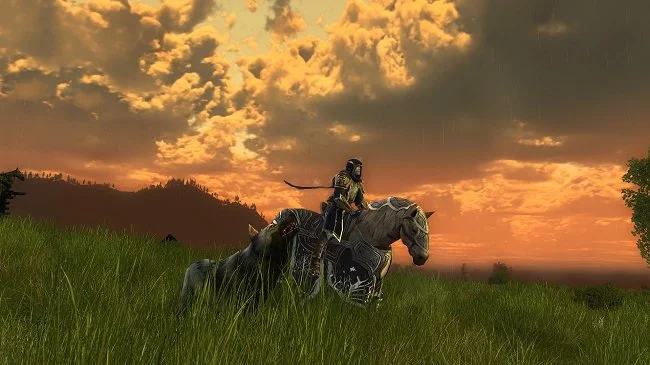
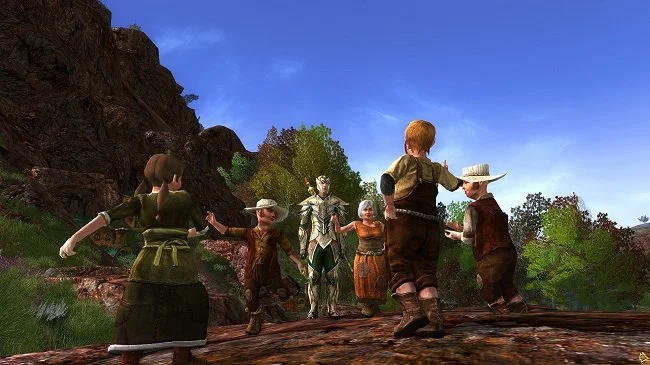
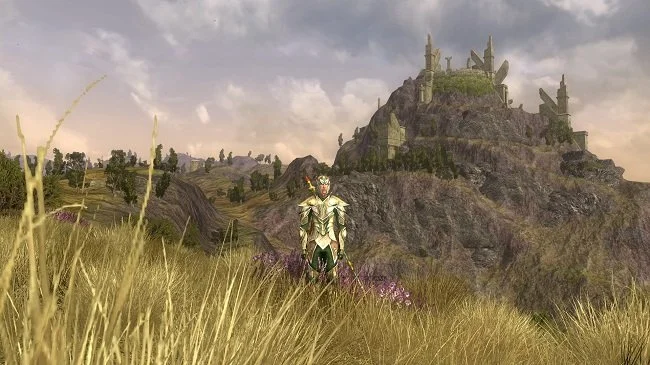
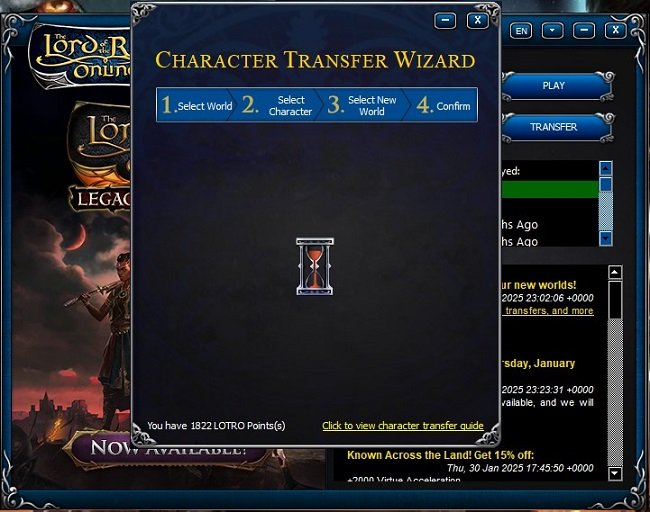
Naturally, if I had remained playing on the Legendary Server none of this would have been an issue but I stand by my choice to roll a new alt on Laurelin. So as a compromise, I have decided to do some skirmishes (the current event is good motivation for this) and then mop up some outstanding deeds in lower level zones. Hopefully this should get my Guardian up to 70 and then I shall bite the bullet and follow just the Epic Story through Southern Mirkwood. Then it will be time to tackle the journey of the Grey Company through Enedwaith and Dunland. However, I do find this “agony of choice” malaise to be a curious thing. I guess the reason I’ve never encountered it before is because I don’t usually level alts and have previously just played through all content on my primary character, as it was released. The fact that there weren’t options and choices in the past is why I simply blitzed through what was on offer. I also think that it’s preferable for me to stick with content in the order it’s intended, because having played quite intensively since last August, the narrative has made a lot more sense. You notice how minor characters reappear in the story later and tend to have more significance than you think. So to recap, I’m bound for Dol Guldur but reserve the right to contradict myself and change my mind, because gaming is about enjoying yourself.



Further Iniquities of the Video Games Industry
If you are naïve enough to think that the video games industry is an equal partnership between those a pursuing an artistic vision and their benevolent financial benefactors, then todays news that Activision Blizzard is laying off approximately 800 staff despite a enjoying a “record year”, must have comes as a surprise. For the rest of us who are fully conversant with the iniquities of the business, this sad news has an air of tedious inevitability to it. If you want a coherent distillation of the unsustainability of the triple A games industry, then Jim Sterling’s latest episode of The Jimquisition pretty much nails it. Simply put the current levels of revenue growth seen of late by a lot of the major publishers cannot be maintained and will eventually end in a hard crash, further job losses and a migration of venture capitalists looking to make a killing somewhere else. For those who work in games development it means job insecurity, stress and financial worries. For gamers it could lead to popular titles being shutdown because they don’t make “sufficient” revenue.
If you are naïve enough to think that the video games industry is an equal partnership between those a pursuing an artistic vision and their benevolent financial benefactors, then todays news that Activision Blizzard is laying off approximately 800 staff despite a enjoying a “record year”, must have comes as a surprise. For the rest of us who are fully conversant with the iniquities of the business, this sad news has an air of tedious inevitability to it. If you want a coherent distillation of the unsustainability of the triple A games industry, then Jim Sterling’s latest episode of The Jimquisition pretty much nails it. Simply put the current levels of revenue growth seen of late by a lot of the major publishers cannot be maintained and will eventually end in a hard crash, further job losses and a migration of venture capitalists looking to make a killing somewhere else. For those who work in games development it means job insecurity, stress and financial worries. For gamers it could lead to popular titles being shutdown because they don’t make “sufficient” revenue.
This problem is hardly unique to the video games industry, and you’ll find many other big corporations acting in a similar fashion. But the due to the social nature of gaming, many of the associated businesses find themselves confronting their demons in a far more public arena. As a result, today’s news seems to be appearing on even the most casual gamers radar. My Twitter timeline has been full of it this evening and there’s a lot of sympathy and “finger wagging” going on. This is essentially a good thing, as it means people care and recognise that behind the headlines there’s a very real human element to it all. 800 individuals are now directly affected by this and are having to actively seek new employment. Hopefully all concerned will secure new positions and do so with minimum inconvenience, but even such a positive outcome only addresses the symptoms and not the root cause of the problem.
Few businesses are ethical by default. Hoping that the “bad ones” will change their ways is a fool’s hope. Hectoring them from the wings is also a failing strategy as it simply becomes a PR battle. We sadly live in an age of spin doctors and “alternative facts” so being right is no guarantee of winning. The only real solution to this problem is a political one. Workers in the industry need to unionise, lobby for regulatory legislation and employer rights. All of which are an anathema to many workers (screams of “oh no, that’s socialism”), because such concepts have been maligned by decades of increasingly strident partisan politics. Sadly, modern governments are far too deferential towards corporate lobbying, so you cannot rely on them to universally embrace employee protection. So if people really want change then they must robustly campaign for it through collective bargaining, engaging with their political representatives and building up a head of steam. They must also promote such activities positively in the media to gain public support and win the moral high ground. The alternative is to simply complain about corporate greed, while piously hoping that you don’t get trampled underfoot by the likes of Activision Blizzard.
LOTRO: Ill Omens Skirmish Event
The following was included in last Monday’s LOTRO patch notes (Update 23.3 Release Notes). February 7th brings a new event: “Ill Omens” to Skirmishes throughout the game! Evil stirs in Minas Morgul, and harbingers of the Dead City spread across Middle-earth! Each day, your characters will have the chance to participate in a Skirmish Assault, which will send them to specific sets of existing Skirmishes in search of dangerous new foes. Characters who complete a Skirmish Assault will earn a special currency that can be exchanged for new equipment and cosmetic rewards. As for the most dedicated Skirmishers of Middle-earth, there are several new Deeds and titles to be earned during “Ill Omens”. In addition, characters who complete twelve Skirmish Assaults while the event is active will earn a powerful cap-level statted reward.
The following was included in last Monday’s LOTRO patch notes (Update 23.3 Release Notes). February 7th brings a new event: “Ill Omens” to Skirmishes throughout the game! Evil stirs in Minas Morgul, and harbingers of the Dead City spread across Middle-earth! Each day, your characters will have the chance to participate in a Skirmish Assault, which will send them to specific sets of existing Skirmishes in search of dangerous new foes. Characters who complete a Skirmish Assault will earn a special currency that can be exchanged for new equipment and cosmetic rewards. As for the most dedicated Skirmishers of Middle-earth, there are several new Deeds and titles to be earned during “Ill Omens”. In addition, characters who complete twelve Skirmish Assaults while the event is active will earn a powerful cap-level statted reward.
I finally got around to logging into LOTRO today, as I’m preparing my level 64 Guardian to enter Southern Mirkwood. So, after spending some additional points on my skirmish soldiers to boost their statistics, I decided to try the Ill Omens event. A new NPC, Nedda Pinleaf, has been added to the Southern Bree skirmish camp (as well the ones in the Twenty-first Hall and at Ost Galadh) who bestows both a daily and a meta quest. Effectively you’re required to run four out of five specified skirmishes and defeat the “Harbingers of the Dead” that now appear as an additional encounter. Completing this daily event earns you Tokens of Ill Omens which can be used like any other barter currency in the game. As ever the rewards are mainly cosmetic offering pets, cloaks and housing items. After completing 12 daily events successfully, players are rewarded with an Epic Level Essence of their choice.
I subsequently played through Defence of the Prancing Pony on my Guardian (with Archer Skirmish Soldier) and then Thievery and Mischief on my Lore-master (with Warrior Skirmish Soldier) to determine what (if any) difference adding the “Harbingers of the Dead” has made to these skirmishes. Although it is enjoyable to have an additional enemy included in the proceedings, it doesn’t significantly impact upon the difficulty. So far, the Harbingers that I have fought have been statistically comparable to standard encounter bosses. However, they may still present a challenge to the ill prepared player. Furthermore, it should be noted that for the daily quest to be completed you must undertake the required skirmish at your current level. If you reduce the difficulty level via the Instance Finder, then the quest will not register as completed, despite a successful outcome.
I have always enjoyed the Skirmish system in LOTRO and therefore welcome this event that highlights their presence in the game. Skirmishes are great for social, group gaming but can also provide a quick fix for the solo player who wants to get things done. The cosmetic rewards that the Ill Omens event offers are not that important to me, but I do welcome the opportunity to earn some high-end essences. At the current level cap, tweaking your build with replacement essences can make some interesting differences. Plus running skirmishes earns skirmish marks which are invaluable when levelling alts, due to their account wide availability. My Guardian is currently decked out in level 63 skirmish vendor gear. Plus, I think it is prudent to have regular events in an MMO, to keep players engaged. Being able to set achievable short terms goals is a mainstay of my approach to gaming
Are You a Team Player?
There’s an interesting post over on Tobold’s Blog, regarding how he personally had a successful game in World of Tanks, yet because his team mates didn’t perform as well, they failed to meet the overall group reward criteria. This all too familiar anecdote got me thinking about teams and group play mechanics that are still prevalent in many game genres. Over the years I have tempered my attitude towards teaming up with other gamers and being dependent on them to achieve a collective goal. I have moved from a social gaming mindset born out of my initial altruistic experiences playing MMOs, to a far more transactional outlook. I suspect that I’m not the only player who currently thinks this way.
Unless your team is full of incompetent fools…
There’s an interesting post over on Tobold’s Blog, regarding how he personally had a successful game in World of Tanks, yet because his team mates didn’t perform as well, they failed to meet the overall group reward criteria. This all too familiar anecdote got me thinking about teams and group play mechanics that are still prevalent in many game genres. Over the years I have tempered my attitude towards teaming up with other gamers and being dependent on them to achieve a collective goal. I have moved from a social gaming mindset born out of my initial altruistic experiences playing MMOs, to a far more transactional outlook. I suspect that I’m not the only player who currently thinks this way.
I suspect that the issue that Tobold faced in World of Tanks, was down to auto-grouping and teaming up with random players. I have had similar experiences in Star Trek Online when joining Task Force Operations. Although there is a Team Chat facility it tends not to get used in any useful fashion. Most of the PUGs I join tend to avoid discussing any strategy and assume that players know the accepted method for efficiently clearing the content. Naturally there are times when it’s a free for all and somewhat chaotic and on such occasions a suboptimal outcome is most likely. Such is the nature of PUGs as opposed to grouping with friends and playing co-operatively in a more organised and co-ordinated fashion.
A decade ago, games such as LOTRO required much of the content to be played as a group. Plus, MMOs still had an air of novelty to them and the community was possibly more socially orientated. I have written previously that this was a period of my life that lent itself to such gameplay. I had both the time and inclination to group, form a plan and play towards shared goals. In the case of LOTRO, we had a lot of high tier players in our kinship who were happy to group. So most of the time, instances and, raids usually went well. Therefore, if we failed, it wasn’t a major blow. Sadly, that mindset is no longer the default position. Time is now a premium and so it is desirable to ensure that any group activity is efficient, resulting in a positive outcome.
Gaming has changed in many ways in the last decade. For a while there was an egalitarian air to the MMO genre. The social dynamic was embraced, extolled and acted upon. But as gaming became more commercial and more “business like”, that community vibe slowly dissipated. That’s not to say it doesn’t exist. There are still plenty of social guilds and player who do everything as a team. There just seems to have been a major pendulum swing. I still join guilds in other games I play but they are a means to an end, rather than a specific social choice. Auto-grouping has become my default means of grouping because it’s quick and easy. Overall, I prefer to play solo and endeavour to do as much as I can that way. The main reason for this is time and not wishing to be dependent on others. Grouping despite its social benefits is not always an efficient use of game time.
I guess whether you’re a team player or not, comes down to several things. Are you disposed to such behaviour in real life? Do you play to specifically to interact with people? Do you feel that it’s tactically better to play as a group? Whatever the reasons, I’m not entirely sure that game developers looks at this social imperative in the same way as they use to. Auto-grouping is really just auto-facilitating. It simply allows players to loosely co-operate in the most basic of terms. It’s also a lot easier to implement in a game and thus leads to the ongoing evolution or dilution, depending of your perspective, of the MMO genre. And I’m not much help because I’m on the fence with this issue. There are occasions when I have the time and inclination, that I want full blown, old school group play. But most of the times, I just want to get stuff done via the path of least resistance. What about you? Are you a team player?
Regulate Online Influencers, Community Specialists and Game Ambassadors
Thomas Cheung (AKA Elvine), an employee of Hi-Rez game studio and a partnered Twitch streamer, was arrested last weekend in Brookhaven, Georgia in connection an ongoing child sex investigation. Police charged him with using a computer service “to seduce, solicit, lure or entice” a minor, which is a felony in the state. Cheung is a prominent member of the World of Warcraft community and is generally a known "influencer" in specific gaming quarters. As a result of the ongoing investigation and charges, his corporate sponsors, SteelSeries, have withdrawn their support and Hi-Rez studios are distancing themselves from Cheung who was a community specialist for both Smite and Paladins Strike. Obviously, it is not appropriate to speculate and comment unduly on an ongoing criminal investigation, but I would like to articulate some wider points. With an issue as harrowing and sensitive as child sex abuse, it is understandable to tread cautiously and choose one’s words wisely. We certainly wish to avoid arbitrary “knee jerk” reactions as these tend to do more harm than good. But we must not shy away from big issues such as this although it is something that the gaming industry has been doing for too long.
Thomas Cheung (AKA Elvine), an employee of Hi-Rez game studio and a partnered Twitch streamer, was arrested last weekend in Brookhaven, Georgia in connection an ongoing child sex investigation. Police charged him with using a computer service “to seduce, solicit, lure or entice” a minor, which is a felony in the state. Cheung is a prominent member of the World of Warcraft community and is generally a known "influencer" in specific gaming quarters. As a result of the ongoing investigation and charges, his corporate sponsors, SteelSeries, have withdrawn their support and Hi-Rez studios are distancing themselves from Cheung who was a community specialist for both Smite and Paladins Strike. Obviously, it is not appropriate to speculate and comment unduly on an ongoing criminal investigation, but I would like to articulate some wider points. With an issue as harrowing and sensitive as child sex abuse, it is understandable to tread cautiously and choose one’s words wisely. We certainly wish to avoid arbitrary “knee jerk” reactions as these tend to do more harm than good. But we must not shy away from big issues such as this although it is something that the gaming industry has been doing for too long.
In real life, any significant gathering of people sadly attracts criminality and predators. In the UK the Police regularly remind people attending events such as carnivals, concerts, or even demonstrations to be mindful. Furthermore, it has also become apparent that organisations that deal with people, especially those who are marginalised or vulnerable, similarly attract of percentage of individuals whose motivations are far from good. Hence, we saw last year a scandal involving the Red Cross and a small percentage of their aid workers who were also exploiting sexually the very people they were supposed to be helping. And of course, any social or sporting activity that involves children has to be especially careful as to who they employ. I myself have volunteered to do charitable work in the past and had to give plenty of advance notice to afford the organisers time to do suitable background checks.
Due to some very hard and tragic lessons in recent years, dealing with others or representing an organisation in a public environment has to be regulated, policed and reviewed to ensure the safety and welfare of all parties. We as a society have reticently grown to accept this. Many of us don’t want to think the worst of our teachers, social workers, sports coaches or scout leaders by default, but it is irresponsible not to make provision to ensure that predators don’t slip through the net. But although this sort of social auditing has become common place in the real world, it still seems to be neglected, overlooked or in some instance deliberately sidelined online. Gaming and other internet-based leisure industries still maintain a close and profitable relationship with third party “influencers”. Tapping into popular social media personalities and having them become ambassadors for your game or service is immensely beneficial. Yet it is becoming increasingly clear that many of these affiliate staff are not in anyway scrutinised, checked or held to any sort of standard or accountability. Such a rash policy is inevitably going to end in tears. Perhaps it already has and we’re simply going to find out when the fallout becomes public knowledge.
Big business seldom does the right thing as a default choice. Yes, there are a few examples of ethical companies out there, but I am not disposed towards thinking this is the norm. Far from it. Which is why in the real world we have regulatory bodies, legislation and processes that ensure that business does the right thing, whether they like it or not. It is time that similar institutions and procedures are introduced to ensure that online businesses and communities are held to a similar degree of accountability. It is bad enough that a games developer can “unwittingly” associates itself with Twitch Streamer who turns out to be a racist, because they could be bothered to invest in a more formal employment relationship which would guarantee security checks. But potentially enabling a sexual predator for similar reasons of “fiscal prudence” and general indifference, a disgraceful nadir in free market irresponsibility. And for those “libertarians” that eschew any governance on principle, consider this. If the games industry doesn’t get its house in order voluntarily or embrace measured changes, they may face the worse kind of panic legislation and witch hunt culture next time something really bad happens. If you make money off the backs of a community that you cultivate and nurture, you have a duty of care, especially so if that community includes minors. It infuriates me that online business, especially gaming is always playing catch up due to having dodged real-world rules. Redress the balance and proactively put this situation right.




















Anthem Open Demo
Before I start with my thoughts on the actual nuts and bolts of Anthem, let me just say that it’s nice that the concept of “the demo” still exists. There was a time when I use to buy various computer magazines in the late nineties, and they would all have a cover disk filled with game demos. I discovered many great games that way (MDK, Hidden and Dangerous), simply by having access to a few levels of a new title. Game developers seem ambivalent towards the concept of “try before you buy” these days. More often than not we get early access instead, which is not the same thing at all. But a functional demo that gives you a decent representation of the full product is a far better proposition. For the gamer at least. Because if you play it and like it, then you are sold. Unlike early access where you may see a product with prospects but whether it comes to fruition is another thing entirely. However, demos are a double edge sword, because may also come to a clear and unequivocal conclusion that you don’t like the game in question, or that is simply not for you.
Before I start with my thoughts on the actual nuts and bolts of Anthem, let me just say that it’s nice that the concept of “the demo” still exists. There was a time when I use to buy various computer magazines in the late nineties, and they would all have a cover disk filled with game demos. I discovered many great games that way (MDK, Hidden and Dangerous), simply by having access to a few levels of a new title. Game developers seem ambivalent towards the concept of “try before you buy” these days. More often than not we get early access instead, which is not the same thing at all. But a functional demo that gives you a decent representation of the full product is a far better proposition. For the gamer at least. Because if you play it and like it, then you are sold. Unlike early access where you may see a product with prospects but whether it comes to fruition is another thing entirely. However, demos are a double edge sword, because may also come to a clear and unequivocal conclusion that you don’t like the game in question, or that is simply not for you.
Because so many gamers see criticism and analysis as a personal attack on their opinions and therefore an assault upon themselves, let me make this first point very clear. I do not think Anthem is a bad game (from what I have seen). At its core, it is a fun, exciting experience. It does exactly what it sets out to do and appears to do it well. Got that? Good. Because a lot of the other stuff, IE the story, the characters, and the overall aesthetic are arbitrary. Again, let me stress they are not bad, just adequate. Up to a standard to coin a phrase. But far from unique, not outstanding or in any other way exceptional. I have written in the past about the misrepresentation of the word “adequate” and that not every game has to be a genre milestone. But this is a BioWare game being published by EA. It’s got multimillion-dollar, big bollocks, in your face, hyped up bullshit written all over it in large neon letters. If you want the full experience (Legion of Dawn Edition) it will cost you £70, all but a penny. Call me old fashioned but if I part with that amount of cash, I want more than what I’ve described.
Earlier today, I fired up the demo and quickly got into the game. There were no logon or server issues this time round. I found myself in a Fort Tarsis and quickly got funnelled to the expositonary NPC and quest bestower. As Anthem uses the Frostbite Engine, everything looks fancy although I found a lot of the production design to be somewhat generic. As it’s a limited demo I repeatedly got onscreen messages telling me that I cannot interact with NPCs and items. Nope BioWare wanted me to go get in my Javelin exo-suit and sod off and start shooting stuff. Now I noted that this first part of the game was all in first person. Whether that is the case in the full release I do not know. Let it suffice to say that if all the RPG elements are conducted in such a manner, then that’s another stumbling block for me. So, I subsequently donned my fancy armour and found myself with three other random players out in the combat zone. Everyone promptly ran off in different directions and started experimenting with the game controls. I was hoping there would be some semblance of a tutorial but no, you just have to figure shit out for yourself. It is however very intuitive and easy to work out.
Well let me save both you and I a lot of time. If you played Destiny 1 or 2 then the combat is pretty much the same. The only difference here is that you have thrusters to fly for limited periods and you have the benefits of a third person view. You have two ancillary weapons, which on the ranger class javelin are explosive projectiles and you have a melee skill. The game is fluid, requires situational awareness and robust twitch skills. The added verticality adds to the challenge requiring you to get above and behind enemies and objects, hover, shoot and move on. If you are young with good reactions, have played other games that require you to interact with similar three-dimensional environments and are adept with keyboard and mouse, or a games controller, then the combat in Anthem will really appeal to you. If you are of an older group, you may find it harder to keep up with the game. I played overall for three hours and during that time quickly got the measure of the game. Because while everyone else was flying around, shooting mobs and efficiently traversing the environment, I was adjusting my pince-nez, sipping my Amontillado, trying not to be distracted by the garrulous in-game voice over and trying to determine which key did what.
The thing is with Anthem, a player such as I will probably have to work twice as hard to train myself not to over steer, get disorientated and fall behind the group. Because the combat is pretty much the foundation of the game experience, you need to be proficient to get the most out of the game. I don’t think its strength will lie with its narrative, characters and production design. As I said, these are all adequate (from what I could see) but nothing more. A decade ago I would have been happy to put in the time and the effort to improve my performance and prove a point. But not now. I play to have fun primarily and if I’m not up to the task, then I am happy to move on. I don’t blame the game or myself and I’m not under any obligation to “git gud” to embrace some spurious philosophy that the only good game is a competitive challenge. So Anthem is not for me. Let those who enjoy the demo, purchase the full edition and go have their fun. I’ll find mine somewhere else. As for those who are expecting the much lauded BioWare storytelling experience, I’d be interested to know in a few months from now as whether it’s there or not.
Star Trek Online: Ninth Anniversary and Stuff
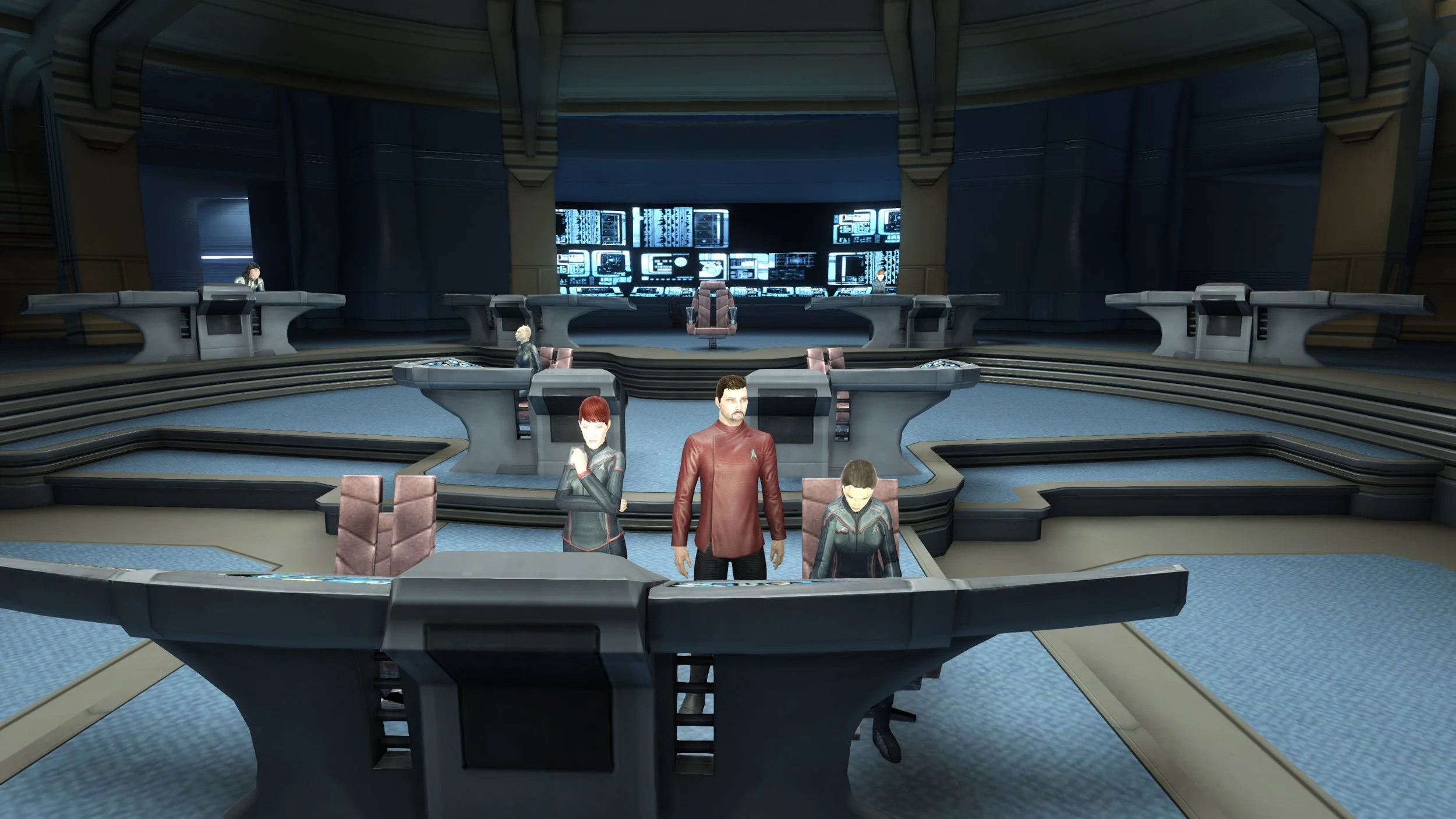
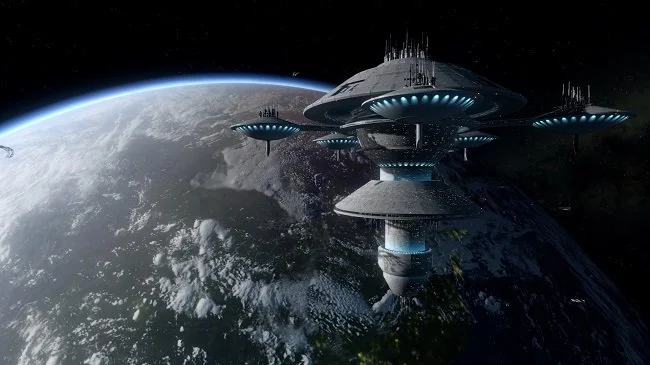
I have suffixed the title of this post “and stuff” so I can address several Star Trek Online related thoughts in a single blog post. Despite the fact that I frequently play STO it is does oddly get neglected in my writing. So, let us start with the issue of the ninth anniversary. As ever Q is back with the anniversary event and once again, we are stabilising Omega Molecules. This year’s reward is a Tier 6 Vulcan T’Pau Scout Ship. There are also emotes and sundry other items to earn during the duration of the festivities, but I more interested in the anniversary itself. Not many MMOs make it to nine years and if they do, they aren’t necessarily in as good shape as STO. The game has a stable and loyal playerbase and is currently tied-in to Star Trek: Discovery. Further established Trek actors are supplying voice acting and the game seems to be doing well across both PC and consoles. Like LOTRO, STO uses the IP well and seems to “fill in the gaps” in the existing lore as well as expand and extrapolate established canon. One of the best things about STO is that there’s always something to do in-game as well as new content in the pipeline. Perhaps this along with the handling of the IP is why the game endures.
I have suffixed the title of this post “and stuff” so I can address several Star Trek Online related thoughts in a single blog post. Despite the fact that I frequently play STO it is does oddly get neglected in my writing. So, let us start with the issue of the ninth anniversary. As ever Q is back with the anniversary event and once again, we are stabilising Omega Molecules. This year’s reward is a Tier 6 Vulcan T’Pau Scout Ship. There are also emotes and sundry other items to earn during the duration of the festivities, but I more interested in the anniversary itself. Not many MMOs make it to nine years and if they do, they aren’t necessarily in as good shape as STO. The game has a stable and loyal playerbase and is currently tied-in to Star Trek: Discovery. Further established Trek actors are supplying voice acting and the game seems to be doing well across both PC and consoles. Like LOTRO, STO uses the IP well and seems to “fill in the gaps” in the existing lore as well as expand and extrapolate established canon. One of the best things about STO is that there’s always something to do in-game as well as new content in the pipeline. Perhaps this along with the handling of the IP is why the game endures.
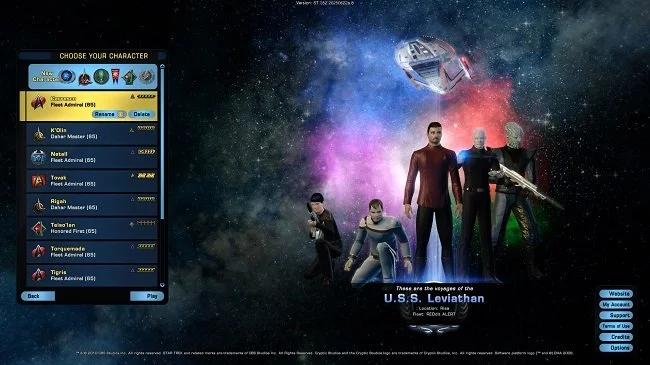
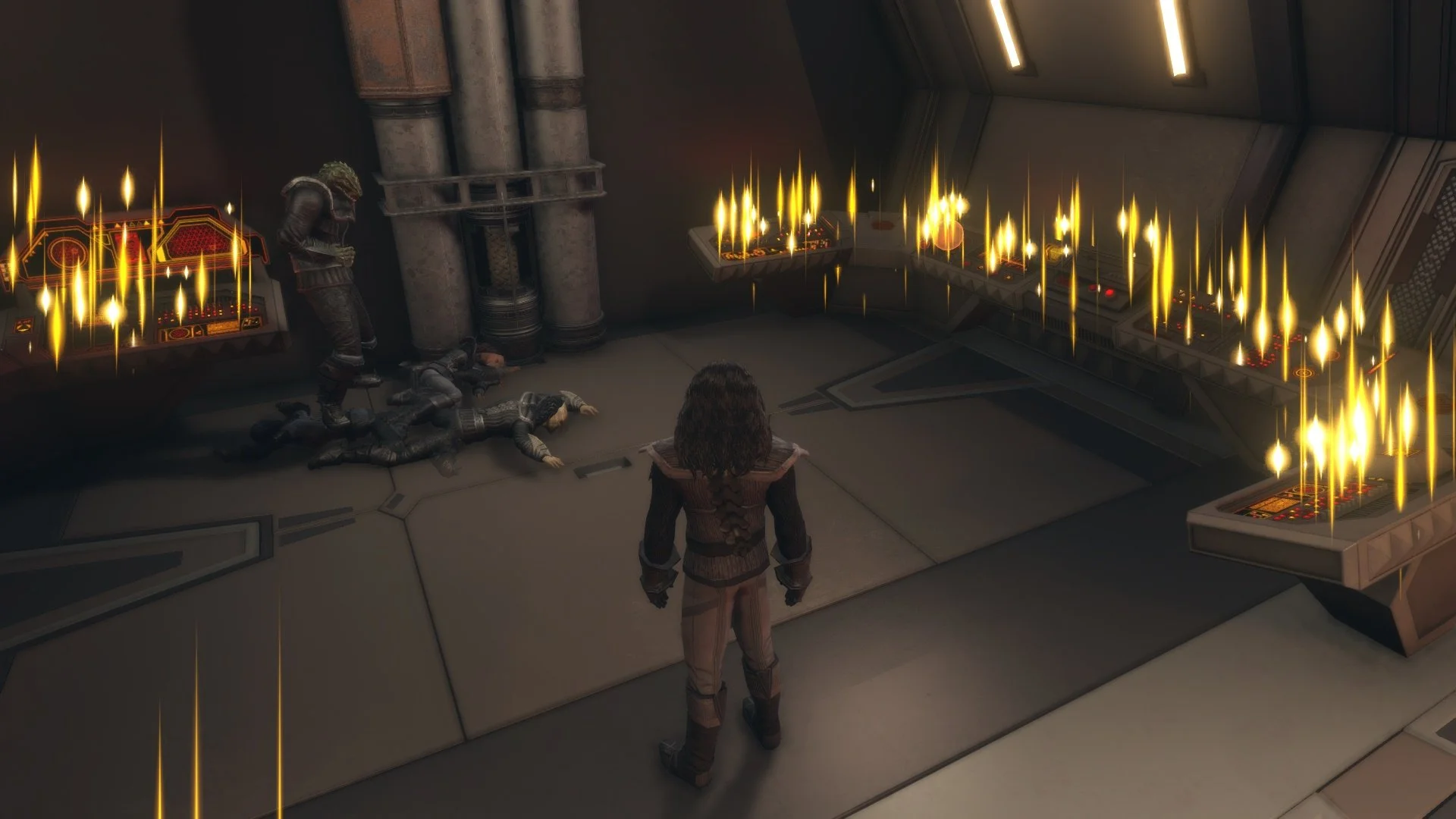
In October last year, Cryptic released a new Star Trek: Discovery themed “starting experience” that allows players to create characters from 2256. As ever there’s a fairly involved narrative which references Klingon lore from that era and the war with the Federation. There’s the added bonus of Jeffrey Combs playing Captain Thy'kir Shran, the great-grandson of Thy'lek Shran from Star Trek: Enterprise. However, due to the main story of STO being set in 2409, the writers have to once again fall back on that old tried and tested Trek “get out of jail card”, time travel. Hence, Agent Daniels makes a further appearance and uses more temporal shenanigans to bridge the timelines. It’s an acceptable plot device if you’re new to the game, but it’s already been previously used in 2016 in the Agents of Yesterday expansion. Plus, if you don’t create a new character and play through this specific tutorial, the follow up story set in the twenty fifth century that is available to established alts, is a little confusing to say the least.
Now I happen to enjoy Star Trek: Discovery and am therefore happy to have content from this era along with voice acting from Mary Wiseman added to the game. But there is a downside to this. In an attempt to streamline and coherently curate all the previous episodes of STO, Cryptic have had to alter their running order. Some stories have been taken out of the chronological sequence and categorised as Side Content: The Galaxy at Large. If you are a dedicated trek fan who starts playing the MMO from scratch, you may have to play a fair amount of content across multiple factions before everything falls into place. After nine years that game does seem to be sagging under its irregular narrative growth. But despite these occasional quirks the stories available do all have a strong Trek feel to them. Last summers Victory is Life expansion contained some of the best written material outside of the shows themselves. It certainly tapped into the best elements of Star Trek: Deep Space Nine. It’s a shame it is not officially canonical.
Another issue that Cryptic have been trying to address of late is encouraging players to participate more in the various group PVE missions or Task Force Operations as they have been renamed. This content provides among other rewards, rep tokens which are required for reputation faction advancement. In the past it would be difficult for players to find a group for some of the less popular TFOs, so the developers came up with the Universal Endeavor system. This offers daily TFO challenges along with bespoke rewards. They also added a facility to join a random TFO with enhanced loot. As of the 23rd January and the start of the 16th STO season, Personal Endeavors have been added to the game, offering three random tasks that can be completed by replaying missions, running TFO or visiting the various battlezones in the game. If you are presented with a task that is not to your liking, you can reroll another using tokens that are given as part of the Personal Endeavors rewards. The system also provides perk points that can be spent to unlock account-wide bonuses that apply to all characters equally. For the casual player this offers an enjoyable challenge, where the dedicated min-maxer will have yet a further set of options to tweak their build.
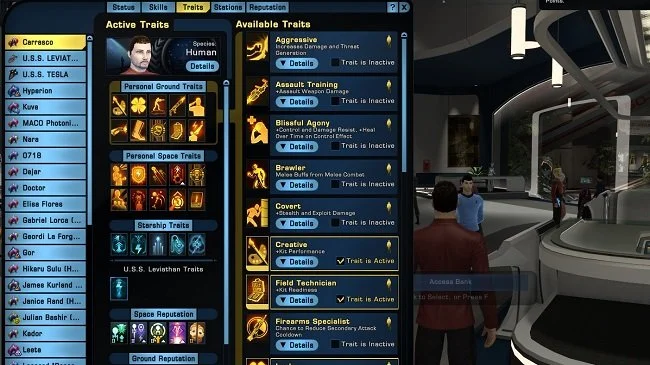
After a year of trying a variety of ships in STO I have returned to my Tucker Tactical Miracle Worker Cruiser. The prevailing game meta has changed once again and frankly I’m not quite au fait with the latest popular theories, so I have opted for a lore-based phaser beam weapons and selected gear for a standard Auxiliary to Battery build. Everything equipped is Mark XV and upgraded to Epic level. As I no longer have any DPs parsers installed and I’m not inclined to go down the rabbit hole, I have no idea what my “official numbers” are like, but stuff dies and dies quickly, and I no longer fly like a complete fool which helps a lot. Overall, I find myself well placed at present to enjoy STO. I bought the game on launch and it took both me and Cryptic a while to find our respective feet. I played the game on and off during it’s first four years and it wasn’t until the launch of the Delta Recruitment Event in May 2015 that it fully got a hold on me. By then a lot had been done to file down the rough edges. STO still has some that need attention but I’m glad that nine years on the game is still alive and kicking. I mean what other MMO has Horta combat pets or Gorn’s in Hawaiian shirts?
Too Many Online Game Stores?
I first created a Steam account and started purchasing games via digital download in January 2010. Back then, Steam pretty much had a monopoly on the market, and it was both novel and convenient to be able to purchase what seemed like “anything” just from one outlet and then download it and play, at any time of day. And then the rest of the video games industry woke up and decided they wanted a slice of the pie that was at the time exclusive to Valve. Hence, over the last eight years all the major “Triple A” publishers have developed their own game launcher software and online stores. This has led to titles being withdrawn from sale via Steam and a gradual fracturing of the market. That’s not to say that Steam is no longer a viable service. On the contrary. It still has a diverse range of products and there are always deals to be had. But it is no longer the first port of call when buying games online.
I first created a Steam account and started purchasing games via digital download in January 2010. Back then, Steam pretty much had a monopoly on the market, and it was both novel and convenient to be able to purchase what seemed like “anything” just from one outlet and then download it and play, at any time of day. And then the rest of the video games industry woke up and decided they wanted a slice of the pie that was at the time exclusive to Valve. Hence, over the last eight years all the major “Triple A” publishers have developed their own game launcher software and online stores. This has led to titles being withdrawn from sale via Steam and a gradual fracturing of the market. That’s not to say that Steam is no longer a viable service. On the contrary. It still has a diverse range of products and there are always deals to be had. But it is no longer the first port of call when buying games online.
The recent news that Epic Games is “aggressively” competing with Steam, with exclusive titles like Metro Exodus and major discounts on popular games, has put this issue of Online Game Stores back on my radar. I bought Assassin’s Creed: Odyssey last December so had to install Uplay to play it and keep it updated. There’s been a recent patch for Star Wars: Battlefront II, so I’ve also had to download Origins to check out the game. I need Battle.net to play Overwatch and Destiny 2 as well as Galaxy to efficiently manage the titles I’ve purchased from Good Old Games. And due to my curiosity over Epic Games market expansion, I ended up creating an account and using their software to peruse their wares. In total I have 6 bespoke client launchers and their associated online stores currently installed on my PC. All of which have logon and payment credentials that need to be securely managed. The dream of a one stop option via Steam has long gone.
If I step back and look at this situation from a business perspective, then I can see why the major publishers want their own specific presence in the online sales market. Furthermore a “theory” from fellow games blogger Wilhelm Arcturus may shed some light specifically on the Epic Games expansion. “The fun rumor I saw was that Tencent (which owns Epic and Riot) pushed Epic into creating this store, with all sorts of developer incentives, to hit back at Valve for bringing Steam to China with PWE rather than them. Big if true”. However, although I may be aware of businesses needs, they are not a major concern of mine. I identify more as a consumer than a “gamer” and I’m ultimately just looking to indulge my pastime as cheaply and efficiently as possible. Having multiple game launchers and stores to choose from has both benefits and inconveniences for me. I can potentially get good deals but also have to compartmentalise my gameplay to specific platforms. This means multiple friends lists, multiple social tools and multiple marketing emails. None of which are deal breakers, but low-level nuisances are still nuisances none the less.
My biggest concern about the current proliferation of online game stores is one of licensing and reciprocal arrangements with third parties. Video on demand services have gone the same way in recent years and I now find myself using several services with various add-ons. I often find that movies and TV shows that I’ve added to my “watchlist” vanish after a time as the licensing contract comes to an end. So far this has tended to be relatively low level content and I have not been inconvenienced over it. However, if Netflix stopped carrying Star Trek then the service would instantly become redundant as far as I’m concerned. Nothing like this has happened to me game wise yet. Although Steam stopped selling certain EA titles once they launched their own platform, I have not lost access to Mass Effect 1 and 2 that I bought from them. However, I am not fool enough to think that such a situation is beyond the realm of possibility. Business arrangements change, as does regional law. So I am cautious when it comes to what games I buy because I no longer believe I’ll have indefinite access to them As for online game stores, yes there are too many of them but I suspect they will ultimately just contribute to the further marginalisation of the market and may not yield the result their corporate owners hope for.
Screenshots
There is a strong social element to video games, regardless of the genre. Gamers like to share their thoughts and opinions with others via forums, blogs and videos because of their common interest. So, it is hardly surprising that video game enthusiasts like to take screenshots and preserve a record of their activities. Subsequently, the ability to capture an image from a game has now become an integral aspect of gaming culture and many titles now have a dedicated screenshot facility. This may range from a simple screenshot key to a comprehensive photo mode in which you can pause the game and pan the camera around the game environment. It’s a far cry from two decades ago when players would often have to rely on bespoke third-party programs such as FRAPS to take screenshots, or simply use the PrtScn button and then paste the image into a photo editor.
There is a strong social element to video games, regardless of the genre. Gamers like to share their thoughts and opinions with others via forums, blogs and videos because of their common interest. So, it is hardly surprising that video game enthusiasts like to take screenshots and preserve a record of their activities. Subsequently, the ability to capture an image from a game has now become an integral aspect of gaming culture and many titles now have a dedicated screenshot facility. This may range from a simple screenshot key to a comprehensive photo mode in which you can pause the game and pan the camera around the game environment. It’s a far cry from two decades ago when players would often have to rely on bespoke third-party programs such as FRAPS to take screenshots, or simply use the PrtScn button and then paste the image into a photo editor.
The MMO genre, with their rich persistent worlds, lends itself greatly to screenshots. Often the environments and the graphical design is reason enough to capture images. I have done this often in games such as LOTRO and STO and have folders filled with pictures of landscapes, vistas or battles. Screen captures also provide a convenient means to document achievements and social activities. Players will often take a group picture after a successful raid or at in-game events such as festivals. The convenience of this system also makes it ideal for collating data regarding builds and equipment. Taking a screenshot of your skills tree and how you’ve spent your points is so much easier than meticulously transcribing the details. And as game preservation and history becomes a more important subject, images taken over a period of years can be invaluable in documenting change. I have several hundred LOTRO screenshots taken over a period of nine years. Many show features and systems that have been altered or replaced.
There are specific aspects that contribute to a good screenshot. Like photography, these are based in composition, lighting and creativity. Furthermore, such images can be enhanced using standard photo editing software. Tweaking the brightness or contrast can make a difference and improve the overall presentation. However, in recent years, some games have gone a stage further and introduced a far more comprehensive photo mode that does more than just capture what is initially apparent. I first encountered this facility in Middle-earth: Shadow of Mordor. The player can pause the game at any time during proceedings, and then move the “camera” around the environment to either see the subject form an alternative angle, or as a means to explore aspects of the world not immediately clear. Different elements can be made the focus, while others reduced in clarity. The game UI can be removed, and the finished image framed with specific borders if chosen. There is a similar functionality in Assassin’s Creed: Odyssey and it produces some compelling screenshots.
However, there can be some problems associated with taking screenshots. Some contemporary triple A games have started using anti-tamper software that blocks third party apps such as FRAPS. I have experienced this with such titles as Star Wars: Battlefront II and Ghost Recon: Wildlands. One solution is to take a screen capture using the in-game overlay that is built into the client launcher, such as Origins or Uplay. The down side to this is that you have to customise settings of each launcher if you want to use a standard screen capture key. Alternatively, if you have a Nvidia graphics card then GeForce Experience software offers a universal screenshot facility. This not only works for games but can capture images from your desktop as well as videos played via VLC Player or similar software. But regardless of the technicalities as to how you take your screenshots, ultimately, they are a distillation of all the reasons why we game. Like conventional photographs they are a means of capturing a moment for posterity, that can later be shared and reflected upon.
LOTRO: Taking Stock of Progress
On Tuesday 27th November 2018, I created a new High Elf Guardian on Laurelin server. To date I have spent 122 hours 46 minutes 32 seconds on this character and have currently reached level 60, exactly halfway through current level cap of 120 in LOTRO. It has been a busy but very enjoyable two months. Overall the experience has revitalised my interest in LOTRO and the MMO genre. I have written several blog posts recently, highlighting the changes that have been made to the base game and first expansion over the years. Let it suffice to say that both Shadows of Angmar and Mines of Moria now offer a fast path through the games main content. My current levelling experience has been radically different to that I had when I started playing LOTRO back in 2008 and 2009. I believe it took me then nine months to reach the level cap of 60 on my primary alt. I achieved this just prior to the release of Siege of Mirkwood in September 2009.
On Tuesday 27th November 2018, I created a new High Elf Guardian on Laurelin server. To date I have spent 122 hours 46 minutes 32 seconds on this character and have currently reached level 60, exactly halfway through current level cap of 120 in LOTRO. It has been a busy but very enjoyable two months. Overall the experience has revitalised my interest in LOTRO and the MMO genre. I have written several blog posts recently, highlighting the changes that have been made to the base game and first expansion over the years. Let it suffice to say that both Shadows of Angmar and Mines of Moria now offer a fast path through the games main content. My current levelling experience has been radically different to that I had when I started playing LOTRO back in 2008 and 2009. I believe it took me then nine months to reach the level cap of 60 on my primary alt. I achieved this just prior to the release of Siege of Mirkwood in September 2009.
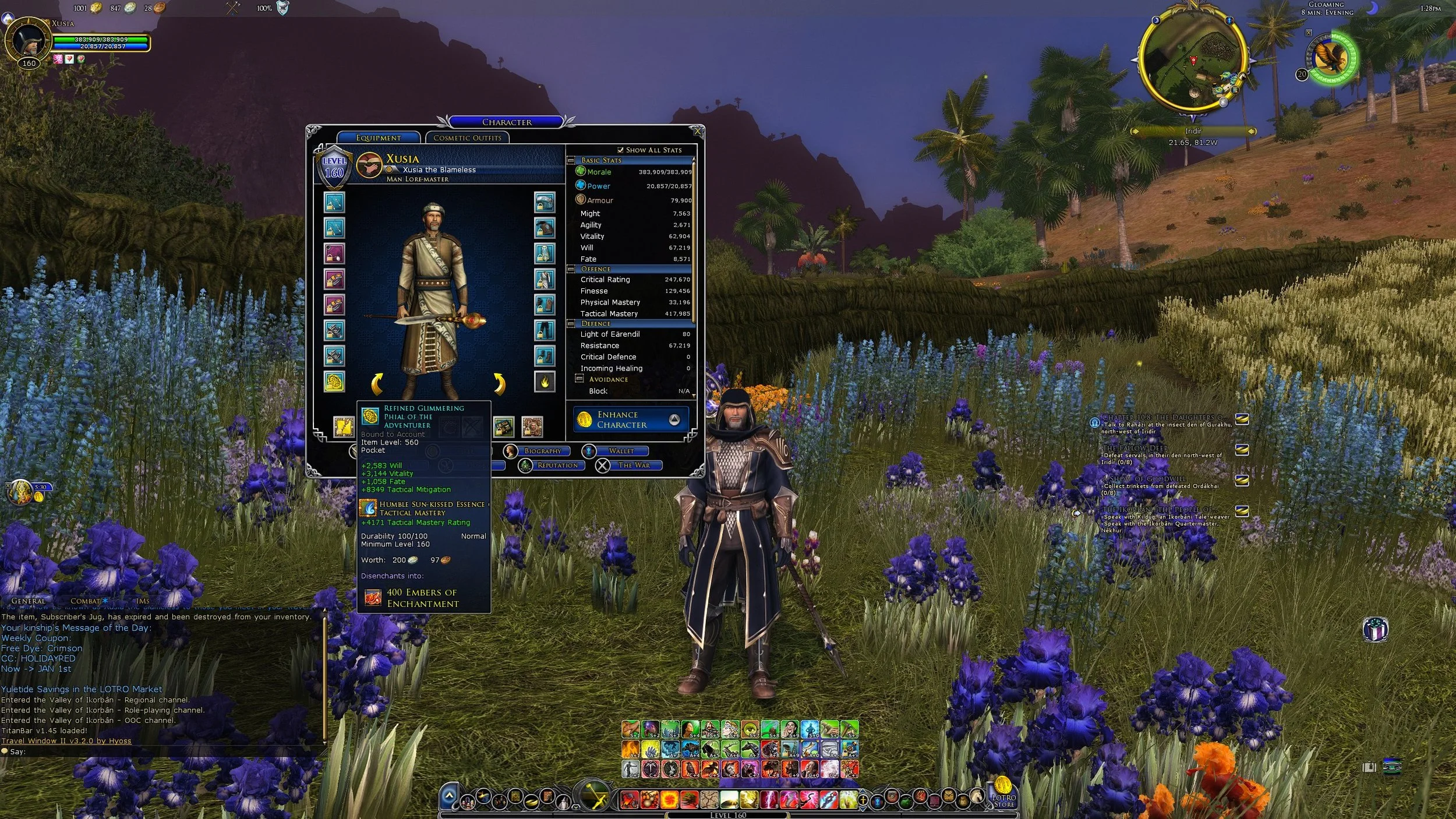
I am currently working through the Mines of Moria Epic Story but have already been given the prologue quests for the Siege of Mirkwood. At present I am taking stock of my progress through the game and planning ahead. I may take time to focus on deeds to increase my virtue traits and to ensure I’ve unlocked all my racial skills. I am also managing the Legendary Item system without actually using the weapons. As I progress through the game, I intend to level several LIs and then deconstruct them, thus ensuring that when I reach level 100, I can craft a First Age Guardians sword and belt and add the legacies that I want. Once this is done, I shall make use of the imbuing mechanic and then effectively forget about my Legendary Weapons apart from occasional upgrades. Having access to the account wide barter wallet has also allowed me to equip superior gear. I purchased The Shield Bearer’s Armour Set, early this week using Medallions of Moria I had earned nine years ago on my Lore-master. I intend to ensure my character is a robust as possible before travelling to Southern Mirkwood.
After doing some research it would appear that the Siege of Mirkwood has remained unaltered since its release. Therefore, there is going to be a noticeable change in level progression as I play through the PVE content. The mob density is high and the XP from quests is more than likely not going to be as generous as it has been up until now. I therefore wish to ensure that my character is as robust as they can be when entering this zone. If memory serves, I believe that Mirkwood was also the first expansion that made key quests and instances solo friendly. One of the most noticeable differences I’ve found with Shadows of Angmar and Mines of Moria since I first played through them, is how the need to group has been sidelined. It’s still there as an option but it’s no longer the only way to progress. I completed The Drowned Treasury instance this week and could happily solo my way through it, due to the “inspiration buff” and my over powered build. It was quite a contrast to my first play through in 2009, where I was assisted by my kinship. Back then, even with six experienced players, it proved quite a challenge.
The two aspects that made LOTRO special for me back when I first started playing, where the social dynamic and the underlying narrative. This was my first MMORPG and I was at a point in my life where I could accommodate the grouping requirement. Hence, I really enjoyed doing instances and activities with a close group of friends. Second time around and nearly a decade later this social imperative is no longer a necessity. I’d argue that actually finding another five people to join a fellowship to tackle an instance such as The Drowned Treasury would be a “big ask”. However, the story is still there, and it has been very rewarding to experience it a second time round and savour it’s details as well as the way so much of it dovetails into the existing canon. So, as I embark upon the next stage of my ongoing LOTRO journey, there is still much to look forward to. However, it is fair to say that although the experience will more than likely be fun, it will be subtly different this time round. Because time changes things. Both MMOs and people
When MMOs Die
Have you ever wondered exactly what happens when an MMO shuts down? Let's not use the phrase "shuttered" as it’s a public relations term intended to mitigate and defuse the reality of the situation. It is intended to take the sting out of the notion of a game closing; evoking imagery of a well-respected family business, closing up shop for the last time and retiring to Cheshire to keep bees. No that will not do at all, so we won't use it here. "Shut down" is far more accurate. It cuts to the chase, accommodating the economic and legal reasons, which are often the primary reason that a game is closing. It also has a far more definitive ring to it, where “shuttered” leaves room for hope. After all the shutters can come back down from the closed family business, if beekeeping doesn’t work out.
Have you ever wondered exactly what happens when an MMO shuts down? Let's not use the phrase "shuttered" as it’s a public relations term intended to mitigate and defuse the reality of the situation. It is intended to take the sting out of the notion of a game closing; evoking imagery of a well-respected family business, closing up shop for the last time and retiring to Cheshire to keep bees. No that will not do at all, so we won't use it here. "Shut down" is far more accurate. It cuts to the chase, accommodating the economic and legal reasons, which are often the primary reason that a game is closing. It also has a far more definitive ring to it, where “shuttered” leaves room for hope. After all the shutters can come back down from the closed family business, if beekeeping doesn’t work out.
So back to the original question, what is it actually like when a substantial MMORPG finally shuts down? I'm sure we all understand the fundamental concepts involved. The logistics of it are no different from when you're playing an active game online and it's taken down for patching. You receive a succession of on-screen notifications and then you're disconnected. What I'm talking about here is the emotional impact it has upon players and social groups. What is it like to be logged in to your game of choice in those final moments? To be surrounded by your friends in a virtual world that you love and have invested so much time into, knowing that within minutes it will be gone forever? To be moments away from a form of virtual bereavement and subsequent online homelessness?
The answer is ultimately very subjective. Most mature adults have an idea of their own emotional literacy and can probably imagine how they would react in a given situation. I can fully understand how heart breaking it could be for some players to see an integral part of their social life ignominiously dispensed with at the flick of a metaphorical switch. As for myself, I would see it as an inevitability and would therefore deal with it with a degree of emotional detachment. I would also ensure that I was "there when the lights went out”, just so I could experience first-hand what the final moments were actually like. Plus, there may be some last-minute fun and games as the developers turn on various events and gated activities or release a horde of mobs into the world. At the very least, the situation would certainly merit a blog post.
WildStar closed last November and a year prior to that so did Marvel Heroes. Other games such as Vanguard and Wizardry Online have also been shut down in recent years, all of which were for financial, licensing or administrative restructuring issues. All of these games had an active player base, that enjoyed and supported the games right up until the last moment. Subsequently, a cursory search online will produce a wealth of videos, screenshots and eulogies made by those who have become displaced by MMO closures and are still mourning their passing. If you have never played an MMO to any extent, then it will all seem a little perfunctory and a bit of a storm in a teacup to you. For those that have spent hours of their life in a virtual world, with friends they’ve made along the way, it is a far more emotionally compelling matter.
I'm a firm believer in the old adage "forewarned is forearmed". It may not come as any surprise to those who know me that I've made all the necessary arrangements for my own funeral. That's how I run my life. So, for me watching videos of the last moments of any MMO is a pertinent reminder that a similar fate will eventually come to those that I currently play. However, not everyone is like me and some people don't like to continence such things. Each to their own. We all deal with things in our own fashion. However, I would advise active MMO players to watch the video below, regarding WildStar, and subsequently reflect upon it. Perhaps it may teach us to be a little more appreciative of the games we currently enjoy, because time and tide waits for no man or MMO.
LOTRO: The Downside to Fast Levelling
NB. This post is a direct continuation of previous one, posted on 2nd January. As I’ve stated many times before in prior posts, there is a tangible sense of reward to be found in levelling in an MMORPG. Gaining experience and progressing from one level to another, inching further to the in-game cap, is a clear and uncomplicated goal. It’s far from a complex process. You play through content, gain loot and XP and then after a while, “ding”, you hit the next level and revel in a sense of achievement. There are naturally other goals to pursue that are more difficult to achieve, such as gaining a specific set of raid armour or obtaining maximum rep with all factions. But for many players, simply progressing by level per day (or some permutation thereof) is sufficient to keep them happy and make them feel that they are making headway within a specific game. And at present, this is exactly the approach that I take with LOTRO when playing on my new Guardian. Last night I reached level 57, while questing in Nanduhirion.
NB. This post is a direct continuation of previous one, posted on 2nd January. As I’ve stated many times before in prior posts, there is a tangible sense of reward to be found in levelling in an MMORPG. Gaining experience and progressing from one level to another, inching further to the in-game cap, is a clear and uncomplicated goal. It’s far from a complex process. You play through content, gain loot and XP and then after a while, “ding”, you hit the next level and revel in a sense of achievement. There are naturally other goals to pursue that are more difficult to achieve, such as gaining a specific set of raid armour or obtaining maximum rep with all factions. But for many players, simply progressing by level per day (or some permutation thereof) is sufficient to keep them happy and make them feel that they are making headway within a specific game. And at present, this is exactly the approach that I take with LOTRO when playing on my new Guardian. Last night I reached level 57, while questing in Nanduhirion.
Due to the drastically nerfed levelling curve and major revamp of both Shadows of Angmar and Mines of Moria, LOTRO players can fast path through a lot of the classic content if they see fit. Hence, I have focused mainly on the Epic Story and have subsequently powered through Moria to Dimrill Dale. Along the way, the legendary Item system has become available to me and I recently began levelling my second LI one-handed sword (Level 57). Now to cut along story short, the LI system is excessively complex and time consuming as well as being further hindered by different tiers of weapons. This makes any LI under level 100 somewhat redundant as they have a finite lifespan. Furthermore, some of the regular weapons I’m receiving as quest rewards have superior specifications that those on the LI I’m currently levelling. Therefore, until my Guardian hits level 100, I am levelling LI weapons but not equipping them. I will continue to use the Guardian’s Belt LI as there is no alternative to this. However, my approach pretty much sidelines the LI system for the meantime, making it a minor source of adjustment rather than a major game focus.
I’ve also noted that for a while now, low tier essences have dropped from time to time when playing through PVE content. However, I have not seen any quest rewards that offer socketed armour, nor has any randomly dropped. According to the LOTRO-Wiki the essence system becomes available at level 50, yet I have not seen any obvious means of using it at present. For the meantime I am finding a lot of the gear offered by quests to be more than satisfactory and as I have access to shared resources via the barter wallet, I can purchase specific sets from class vendors if I wish. Prior to entering Moria I purchased the High-protector's Armour (Item Level 50) from the Guardian Trainer in Rivendell. I have swapped out a few pieces but have retained four to maintain the set bonus. Again, I find that an aspect of the game that use to require some care and attention before making a choice has now been trivialised due to the wealth of options and shear volume of good quality quest rewards.
It is also worth noting that my brief flirtation with crafting has now ground to a halt. Unlocking the various tiers of the Metalsmith profession is far from difficult but the problem lies with the items required for critical success when crafting. For example, you don’t often find multiple copies of the Supreme Metalsmith's Journal available on Auction House. You therefore have to either pursue the Scholar profession on another alt or look towards your kinship for assistance. However, as both these options appear to fly in the face of the breakneck speed of progression through the game, you can simply opt not to craft and suffer no major inconvenience. And that sentiment is one that seems to prevail in the current iteration of LOTRO. It may well change when players reach Southern Mirkwood, as that area has not been revamped to my knowledge. But certainly, up until level 60 the levelling curve continues to marginalise certain game systems. It’s a shame in a way because all of these aspects of the game will play a key role at higher levels and many players will find that they may have some catching up to do at some point. Myself included. However, as I treat the MMO genre as a “live in the moment” experience, I’ll worry about such problems as and when they become apparent.
Too Much Information
While playing LOTRO recently, I helped random new player who was confused about virtue traits. I explained to them as well as I could, but the incident was a clear reminder of the complexity of the MMO genre and the perennial problem of how the can game developers effectively convey instructions to the player. If you are a long-term gamer and have tried numerous titles across multiple genres, you will often find common mechanics and systems. Hence when playing a new game, you can sometimes figure out the controls as you go. For example, WASD for movement, M for the map etc. But this is not always guaranteed. Because developers have to consider new players who may have no prior gaming experience, when designing their GUI and tutorials. So there’s scope for instructions that seem contradictory and unintuitive to veteran gamers. Porting titles to the PC that were primarily developed for consoles can also cause confusion. Simply put, teaching a player the basics of a game is a big challenge. Providing succinct information on more complex issues is even harder. Many gamer developers are still extremely bad at imparting knowledge and making viable tutorials. Here are some examples I’ve encountered.
While playing LOTRO recently, I helped random new player who was confused about virtue traits. I explained to them as well as I could, but the incident was a clear reminder of the complexity of the MMO genre and the perennial problem of how the can game developers effectively convey instructions to the player. If you are a long-term gamer and have tried numerous titles across multiple genres, you will often find common mechanics and systems. Hence when playing a new game, you can sometimes figure out the controls as you go. For example, WASD for movement, M for the map etc. But this is not always guaranteed. Because developers have to consider new players who may have no prior gaming experience, when designing their GUI and tutorials. So there’s scope for instructions that seem contradictory and unintuitive to veteran gamers. Porting titles to the PC that were primarily developed for consoles can also cause confusion. Simply put, teaching a player the basics of a game is a big challenge. Providing succinct information on more complex issues is even harder. Many gamer developers are still extremely bad at imparting knowledge and making viable tutorials. Here are some examples I’ve encountered.
Firstly, let us consider LOTRO, an established MMO that has some very good selling points along with some not so edifying ones. Legendary Items, weapons you acquire from level 50 onwards, were somewhat confusing when introduced into the game in 2008. Over the past decade the constant revisions, tinkering and attempted rationalisation of the system has left this entire aspect of the game bloated, time consuming and frankly bloody annoying. Last night I identified that I had sufficient relics and shards to manufacture a specific level appropriate gem for my Hunter. It was a moderate upgrade to the existing gem already in place. Let it suffice to say I spent the next half hour auto combining relics up to a certain point in the process and then constantly consulting the in-game menu to find the correct components required to complete crafting my desired item. It took concentration and patience. Furthermore, it seemed disproportionately complex for the reward that was offered. I know of many players who simply bypass this entire process and choose to use under specified weapons rather than indulging in this tedious enterprise.
Secondly, when playing The Elder Scrolls Online, I’ve encountered another variation of this problem. In this case it isn't a matter of being confused by learning new mechanics, but rather being overwhelmed by the wealth of choice. ESO purposefully doesn't funnel players from quest hub to quest hubs. Although it is not a true sandbox game, it is far more flexible in how the player proceeds through content. As you are travelling through a region dynamic content may appear or you may find yourself embroiled in other players activities. All of a sudden you can find yourself with multiple options. If you do not show some degree of self-discipline you will find yourself running around like a headless chicken. Also exploring such cities as Elden Root can be truly daunting, due to its vast size and rich detail. On occasions, I have been unable “to see the woods for the trees” and have had to ask a fellow player to literally guide me to a vendor, despite it being clearly marked on the map. Some folks are strong advocates of this style of "freedom" of content, but I now begin to understand why others may feel adrift without any imposed structure upon the gameplay.
Finally, while playing through the tutorial of Assassin’s Creed: Odyssey I had an identical experience to that when I started playing For Honor. Both games provide a lesson in basic combat moves. Initially, these are straightforward, and it is not hard to combine them effectively. However, the next stage combines attacks with parries and blocks. A successful parry then triggers a riposte which usually does significantly more damage. However, I feel that there’s insufficient time provided in both of these two tutorials to master the techniques being taught. Often there is dialogue playing over the audio and visual cues. Having to concentrate on multiple streams of data can be confusing, resulting in either failure and the player simply relying on basic moves already learnt to complete the task. Because these tutorials are linked to cinematics you cannot simply replay the specific aspects that you’ve missed. You can either quit and restart the entire process, or simply muddle through and come out the other end none the wiser. The other alternative is to tab out of the game itself and seek advice and guidance online. Yet I have always felt that if a game can’t be bothered to “school” you adequately and you have to defer to third parties, it is a failure of the developers. Shouldn’t their product be the first port of call for any information regarding its usage?
Some games thrive on complexity, while others are notoriously simple. Either way both game styles have a requirement to impart information to the player, be it via tutorials, on screen text boxes or voiceovers. This has to be done in an intuitive and user-friendly fashion or it will all end in tears. It is all too easy to sink under the volume of rules, skills and lore that you have to learn, especially with MMOs. There is simply too much information to assimilate at once and the flow and management of data needs to be skilfully handled. I appreciate that one’s tolerance to this situation is subjective and hinges on what sort of player you may be. I by my own admission am lazy and therefore do not warm to excessive learning curve, in what I see as a leisure activity. Other players find joy ploughing through spreadsheets and online wikis. Either way that information needs to be digestible and that is not always something that game developers succeed at. MMOs are an interesting microcosm of human interaction. Surely the clear and precise communication of instructions is equally as important to the genre as collaborative gameplay and engaging content? Can you have one without the other?
Gaming Nostalgia or Gaming Obsession?
If you frequent the Massively Overpowered website you frequently find comments and indeed posts by staff writers, lamenting the loss of those MMOs that have not survived the march of time. The site does on occasions write about Star Wars Galaxies and City of Heroes to name a few. They also advocate historical preservation of titles that are no longer commercially available. This sometimes segues into the thorny issue of emulators and “private servers” and often leads to debates about intellectual property versus player access and notions of the collective ownership of fandom. It’s all very interesting and the discussions are conducted in a measured and mature fashion. Today, there was a jovial post about “which dead MMO needs more coverage?”. Although it was a light-hearted question, I do have reservations regarding gaming nostalgia. Because the gaming community is not exactly known for its balanced, even-handed analysis and outlook on such subjects.
If you frequent the Massively Overpowered website you frequently find comments and indeed posts by staff writers, lamenting the loss of those MMOs that have not survived the march of time. The site does on occasions write about Star Wars Galaxies and City of Heroes to name a few. They also advocate historical preservation of titles that are no longer commercially available. This sometimes segues into the thorny issue of emulators and “private servers” and often leads to debates about intellectual property versus player access and notions of the collective ownership of fandom. It’s all very interesting and the discussions are conducted in a measured and mature fashion. Today, there was a jovial post about “which dead MMO needs more coverage?”. Although it was a light-hearted question, I do have reservations regarding gaming nostalgia. Because the gaming community is not exactly known for its balanced, even-handed analysis and outlook on such subjects.
Nostalgia is fine in moderation. Fondly reflecting upon past experiences in a game that is no longer with us can be a positive thing. Prior activities such as these impact upon our perception of the present. However, I do worry about some gamers who demonstrate an inability to move on or accept that a particular game is no more. There is a distinction between sentimental attachment and fixation. We sadly live in times where an increasing number of people seem to think that if you refute a fact, deny objective reality or generally not like a specific scenario, it can be overruled or somehow corrected by a mere belief, desire or a sense of need. This patently absurd mindset seems to have bled out into all areas of life and tends not to serve any good. It exists in the gaming community and can become a flag to rally around, irrespective of any likelihood to succeed. This can then subsequently lead to toxicity, because of the impossibility of the aspirations such ideas are founded upon.
Therefore, there is always an element of risk linked with gaming nostalgia. If you want further evidence, take a look at the ever-growing litany of failed game related crowdfunding projects. These also contribute to a growing atmosphere of false hope for some gamers and bolster the erroneous notion that commercial extinction can be easily overturned by collective finance. The net result is that a percentage of gamers simply cannot countenance not getting what they want, have no concept of being told “no” and become angry when an utterly spurious fictional promise is not delivered on. Now I’m sure that more responsible gamers will argue that the overall gaming zeitgeist is being driven from the bottom upwards and that the majority are again having to accommodate the least informed and flexible demographic. To which my answer is “yes”. But it’s like that in every other walk of life, so why should gaming be any different. It’s not as if we’re a community known for its measure attitudes and nuanced emotional literacy?
Are You a LOTRO Hoarder?
I was clearing out my vault the other day in LOTRO when I found Erebrandir's Horseshoe. This annoying item was the source of numerous theories back in September 2010 when it became available in Volume 3, Book 2 - Chapter 4: Riding South. Designed to be a “novelty” quest reward the horseshow was supposed to bring luck and many LOTRO players drove themselves crazy trying to ascertain its exact benefits. I just simply filed it in my vault at the time and haven’t given it a second thought until I came across it while doing some housekeeping. I found a lot of other crap that I’ve subsequently learned is of no value (the LOTRO Wiki is your friend) and this has got me thinking about the whole concept of hoarding loot. Because LOTRO is an old school MMORPG and very much a product of its time, the game offers a multitude of loot for players to stockpile and fret and fuss over at every opportunity. But is all of it necessary?
I was clearing out my vault the other day in LOTRO when I found Erebrandir's Horseshoe. This annoying item was the source of numerous theories back in September 2010 when it became available in Volume 3, Book 2 - Chapter 4: Riding South. Designed to be a “novelty” quest reward the horseshow was supposed to bring luck and many LOTRO players drove themselves crazy trying to ascertain its exact benefits. I just simply filed it in my vault at the time and haven’t given it a second thought until I came across it while doing some housekeeping. I found a lot of other crap that I’ve subsequently learned is of no value (the LOTRO Wiki is your friend) and this has got me thinking about the whole concept of hoarding loot. Because LOTRO is an old school MMORPG and very much a product of its time, the game offers a multitude of loot for players to stockpile and fret and fuss over at every opportunity. But is all of it necessary?
I think it’s fair to say that when you play an MMO, you bring a great deal of your own personality traits to the game. It certainly plays a part when choosing the class for your primary character. And then there’s naming your character. Depending on your mindset you may choose something based on lore or you may pick something humorous. The entire process of creating an alt and customising each aspect of it, is our way of expressing ourselves. So, bearing this faux psychology in mind, I think it’s logical to assume that your approach to storage and the management of loot is also determined by your personality. Now I take a very spartan approach to possessions and personal bric-a-brac in my personal life. I like order. I do not like clutter and excess baggage. Everything has a place. I subsequently bring that mindset to the LOTRO and other games that I play.
Therefore, if there is no immediate need or obvious use for something I have looted or been rewarded, then it gets sold ASAP. I am not the sort of player that keeps multiple armour and jewellery sets for specific instances. Therefore, as soon as I’ve acquired an item that is demonstrably better than what I currently have, the old one is replaced and either sold or deconstructed. Until recently I have not really crafted much in the game. Now I do stockpile hides, ore and wood but this is often spread around three alts or left in shared storage. However, this overall approach has been at times a double-edged sword. Frequently, I have seen players with items that have impressed me (I like to inspect those around me in MMOs). On enquiring where they obtained them, I have sometime discovered that they are standard drops from quests that I have already completed, and I therefore must have simply sold the items in my haste.
Of course, I know (as I'm sure we all do) many players who are the polar opposite to me. There are numerous LOTRO aficionados who have purchased every additional storage slot available and who own multiple houses simply for the chests. Then there's the use of the shared storage, the mail and even the auction house as a means of providing a convenient overflow system. I’m amazed at how often kin mates and friends complain about their bags being full. It usually turns out that they only had half of the space available to begin with, because the rest was being used as temporary storage for an alt. I even know a few dedicated players who have so many alts and so many saved resources, that they track it all by spreadsheet. Each to their own but this utterly horrifies me. It seems like far too much of a chore. I as you may guess, I like to travel light, with just a few potions and items of food in my bags. I do however have a “Visiting Banker” in my premium house, which provides convenient access to my Vault, Shared Vault and Wardrobe. This lootbox item has proven invaluable.
For the new player, LOTRO by default offers only limited storage and I have found many a thread on the official LOTRO forums about how frustrating some people find the initial storage limitations. Cautious players will also fall foul of “what if” syndrome and can end up holding onto many items based upon an assumed future need and a reticence to potentially hobble oneself. Certainly, for a while back in 2010, the Erebrandir's Horseshoe further increased this mindset, due to the items enigmatic purpose. However, time and a more streamlined development team has meant that such whimsy has not been perpetuated in the game. However, the potential to be a “pack rat” still exists in LOTRO due to the nature of the level and gear progression. It’s never likely to go away. However, part of the appeal of LOTRO is that you can play the game very much on your own terms and not suffer greatly as a consequence, despite what you may think. Hence you can hoard as much as you want or favour a leaner outlook. The only question you really need to ask is what play style suits you the best.
Pop Culture Tributes in MMOs
There are a wealth of pop culture tributes in the MMORPG, World of Warcraft. You’ll find nods, homages and quotes from movies, TV, fantasy literature and more littered throughout the game and its numerous expansions. For example, in the Mage Quarter of Stormwind, the Warlock trainers can be found in the basement of a pub called The Slaughtered Lamb which is a homage to the movie An American Werewolf in London. The fish vendor Old Man Heming in Booty Bay and the fishing achievement are references to Ernest Hemingway's novel The Old Man and the Sea. And in Dread Wastes resides a faction called The Klaxxi, that provide a large amount buffs as enchants and augmentations. These buffs all have names referring to specific heavy metal songs from the likes of Slayer, Queensrÿche and Manowar. There are dozens of others such references and I can certainly see the appeal of discovering them as you play through content and explore the virtual world.
There are a wealth of pop culture tributes in the MMORPG, World of Warcraft. You’ll find nods, homages and quotes from movies, TV, fantasy literature and more littered throughout the game and its numerous expansions. For example, in the Mage Quarter of Stormwind, the Warlock trainers can be found in the basement of a pub called The Slaughtered Lamb which is a homage to the movie An American Werewolf in London. The fish vendor Old Man Heming in Booty Bay and the fishing achievement are references to Ernest Hemingway's novel The Old Man and the Sea. And in Dread Wastes resides a faction called The Klaxxi, that provide a large amount buffs as enchants and augmentations. These buffs all have names referring to specific heavy metal songs from the likes of Slayer, Queensrÿche and Manowar. There are dozens of others such references and I can certainly see the appeal of discovering them as you play through content and explore the virtual world.
Having maintained such a tradition, it is hardly surprising that Blizzard have recently added a new NPC named Stanley to the capital city of Stormwind. This is, of course, a tribute to the late, great Stan Lee, the former writer, editor, and publisher of Marvel Comics who died in November. Stanley doesn’t do much other than take a long leisurely stroll around the keep and its surrounding grounds, but it provides fans with an opportunity to walk with the creator of Iron Man, the Hulk, and Spider-Man and reflect on the man’s work and achievements. During Stanley’s perambulations he hails passers-by with his signature greeting of “Excelsior!”. Blizzard included a similar tribute to actor Robin Williams, adding him to the game following his death in 2014. No doubt this practice will continue, and further distinguished pop culture icons will be added to the MMO in the years to come.
Star Trek Online, is similarly home to several tributes to late cast members. When news first broke of Leonard Nimoy’s death in May 2015, STO players gathered around a fountain on Vulcan to mourn. Cryptic Studios subsequently replaced the structure in the centre of the fountain with a stone statue of Spock, along with the inscription “live long and prosper”. New Romulus received a similar statue, but a different quote; “The needs of the many outweigh the needs of the few.” There is also a memorial plaque on the mezzanine at Earth Space Dock that also pays tribute to Nimoy along with Majel Barrett (Nurse Chapel), James Doohan (Scotty), DeForest Kelley (Bones), and Gene Roddenberry. Anton Yelchin (Checkov) was recently added. Players can interact with the names to read the dates of birth and death as well as a small quote from each.
Standing Stone Games, flagship MMO The Lord of the Rings Online has some interesting and somewhat esoteric references to JRR Tolkien as well as his literary colleagues. “The Bird and Baby” tavern in Michel Delving hosts a meeting of Hobbits, held in a small room at the back. This is a reference to the real-world tavern "Eagle and Child" in Oxford, England, which was frequented by the members of The Inklings literary discussion group which included J.R.R. Tolkien, and other well-known professors and authors. From 1939 to 1962, the Inklings members regularly met in a back room of the pub which is now known as the Rabbit Room. Several members of the Inklings are represented in the “The Bird and Baby” tavern. C.S. "Jack" Lewis (Jack Lewisdown), Owen Barfield (Owen Farfield), Charles Williams (Carlo Williams), and there is also a Rabbit. They refer to a fellow member of the Writing Club named Ronald Dwale, which is based upon Tolkien.
“Easter Eggs” and pop culture references on this nature have been accused of immersion breaking by some MMO gamers. But I would argue that these little conceits that the game developers add to the games, contribute greatly to the social aspect of the genre. Shared experiences and common interest are one of the central pillars of the MMORPG. As gamers often have common interests outside of the game, why not reference them and provide a talking point and a social touchstone. Also, are in-game tributes to those who are no longer with us, any less sincere than those published in more traditional mediums? I think not. Plus, a little bit of occasional frivolity can be a welcome antidote to a lot of the grind, seriousness and competitive aspects of gaming. Every now and then, I visit the cave of Caer Bannog in South Western Enedwaith while playing LOTRO, just to remind myself of this and to put a much-needed smile on my face.