
Immortals (2011)
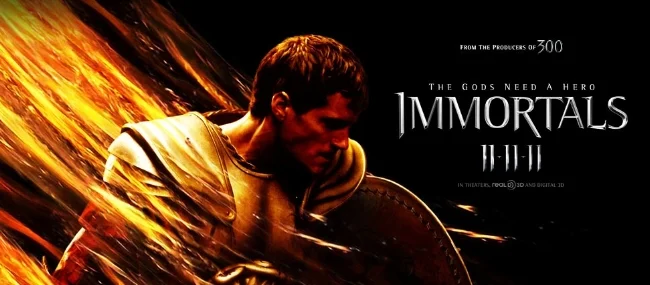
Tarsem Singh's Immortals follows in the wake of Zac Snyder’s 300 with a similar aesthetic and editing style. Despite an interesting cast, featuring the talents of John Hurt, Mickey Rourke and Henry Cavill, it’s a singularly uninspired film, devoid of any story telling of any substance. Immortals main selling points are glossy, stylised visuals and a striking production design which is very derivative of Italian cinema from the sixties. There are also liberal doses of violence and heaving oiled flesh to enliven the proceedings, but it is all feels somewhat arbitrary and a bit of a box ticking exercise. Overall what surprises me the most is how a film maker with all of the drama and excitement of Greek mythology at his disposal, can still make such a turgid and dull movie as this?
Tarsem Singh's Immortals follows in the wake of Zac Snyder’s 300 with a similar aesthetic and editing style. Despite an interesting cast, featuring the talents of John Hurt, Mickey Rourke and Henry Cavill, it’s a singularly uninspired film, devoid of any story telling of any substance. Immortals main selling points are glossy, stylised visuals and a striking production design which is very derivative of Italian cinema from the sixties. There are also liberal doses of violence and heaving oiled flesh to enliven the proceedings, but it is all feels somewhat arbitrary and a bit of a box ticking exercise. Overall what surprises me the most is how a film maker with all of the drama and excitement of Greek mythology at his disposal, can still make such a turgid and dull movie as this?
Years after the Gods defeated the Titans, a new evil threatens. King Hyperion (Mickey Rourke) scours Greece in search of the legendary Epirus Bow, a weapon of unimaginable power forged in the heavens by Ares. Once he possesses this bow he can unleash the Titans, who have been imprisoned deep within the bowels of Mount Tartaros. In Hyperion’s hands, the bow can also annihilate the Gods. But ancient law dictates the Gods must not intervene in man's conflict. Yet they can work through a proxy, so a peasant named Theseus (Henry Cavill) is chosen by Zeus, to save his people from Hyperion and his armies. Rallying a band of fellow outsiders, including visionary priestess Phaedra (Freida Pinto) and cunning slave Stavros (Stephen Dorff), Theseus must lead an uprising, or watch his homeland fall into ruin and the Gods vanish from the world.
Director Tarsem Singh has a noticeable visual style, developed during his earlier career where he made several very high-profile music videos. As a result, one cannot deny that Immortals looks impressive. The colour palette is vivid in it’s use of contrasting colours, especially in the end battle between Gods and Titans. Gold, red and black feature in a very striking fashion. There is also an ethereal quality to some of the supernatural elements of the story. I certainly felt that there was an element of Mario Bava and even Michael Powell and Emeric Pressburger in the proceedings. The action scenes are stylised and brutal yet lack any dramatic power due to their heavily orchestrated presentation. At times they seem like they’d be more at home in a Giallo, rather than a tale of Ancient Greece.
However, despite all the positive aspects of the production design, my biggest criticism of Immortals is that it wilfully neglects any attempt at true story telling and character development. Viewers are presented with the most arbitrary depictions of both heroes and villains and given no specific reason to care about them, apart from the fact that they’re merely archetypes. It feels like the main focus of this movie is the presentation, rather than the story. It seems to be an all too familiar complaint these days. Compared to thirty years ago, film makers nowadays have access to an array of tools that allow them to make the most visually impressive and technically accomplished productions. But there is a noticeable lack of humanity in this process and it becomes a very apparent when you finally watch the finished product. Immortals suffers in this way, saying precious little in the most lurid and bombastic fashion.



Sweeney Todd: The Demon Barber of Fleet Street (2007)
It is a curious fact that because of the way that the film was marketed and due the public's propensity for assumption, many people did not realise that Sweeney Todd: The Demon Barber of Fleet Street was in fact a musical upon its release. I find this strange, but then again not everyone is like me and shows the same degree of interest in cinema. It would appear that not everyone reads reviews or does any preliminary research on a movie before committing to watch it. Often viewers will make a snap decision based on the casting of a particular actor. Sometimes a film’s poster and promotional art can entice the public to take a punt on a movie. I must admit, I would be most interested to establish exactly what it was that some viewers were expecting in the case of Sweeney Todd. But then again, considering director Tim Burton’s body of work, that's a somewhat paradoxical question.
It is a curious fact that because of the way that the film was marketed and due the public's propensity for assumption, many people did not realise that Sweeney Todd: The Demon Barber of Fleet Street was in fact a musical upon its release. I find this strange, but then again not everyone is like me and shows the same degree of interest in cinema. It would appear that not everyone reads reviews or does any preliminary research on a movie before committing to watch it. Often viewers will make a snap decision based on the casting of a particular actor. Sometimes a film’s poster and promotional art can entice the public to take a punt on a movie. I must admit, I would be most interested to establish exactly what it was that some viewers were expecting in the case of Sweeney Todd. But then again, considering director Tim Burton’s body of work, that's a somewhat paradoxical question.
Sweeney Todd: The Demon Barber of Fleet Street is the story of Benjamin Barker (Johnny Depp), a barber, wrongly sentenced to a life of hard labour in Australia by debauched Judge Turpin (Alan Rickman), who covets Barker's wife, Lucy (Laura Michelle Kelly). Returning 15 years later, having escaped the Penal Colony, Barker adopts the alias of Sweeney Todd and says goodbye to his friend, sailor Anthony Hope (Jamie Campbell Bower), who rescued him from the sea. He then returns to his old flat above Nellie Lovett's (Helena Bonham Carter) pie shop on Fleet Street. She tells him that after his arrest Turpin raped his wife, and she poisoned herself out of humiliation. Turpin then took Barker's daughter Johanna in as his ward. After receiving this news, Todd vows revenge and reopens his barber shop in the upstairs flat. Throats are cut, corpses disposed of and pie sales increase!
This "Gothic" tale of revenge and cannibalism certainly lends itself to the big screen. It has been filmed several times before, with the 1936 version starring the aptly named Todd Slaughter being the most memorable. Yet the version that Tim Burton has chosen to bring to the big screen is Stephen Sondheim's 1979 musical. It was this fact that seems to have been downplayed in the studio's advertising campaign. As to why, it’s not really clear. Burton’s quirky films still manage to find and audience. If they weren’t confident that such a musical would be successful, then why exactly did they finance such a project? Irrespective of these questions, Sweeney Todd: The Demon Barber of Fleet Street works extremely well. Surprising as it may seem, the story lends itself very well to musical interpretation. The songs are very morose, bleak and bitter. However, they reflect the narrative perfectly and the lead stars perform them exceptionally well.
Mr. Depp exhibits an interesting vocal style that is reminiscent of both David Bowie and Anthony Newley. As usual with Tim Burton's work, the production design and costumes are very stylised and influenced by German Expressionism. There is also a very strong moral subtext to the entire proceedings that isn't necessarily the one you'd expect it to be. At time the tone seems more befitting of opera. I wholeheartedly recommend it. However, I would add as a proviso, only if you like the director’s previous work or have a love of the baroque, unusual and violent. The casual viewer should otherwise best avoid it, especially if they are not a fan of such off-kilter musicals.






Cockneys vs Zombies (2012)
Back in the summer of 2012, the red band trailer for Cockneys vs Zombies set a very high benchmark and certainly raised expectations for the final movie. The title itself was also somewhat of a gamble, either raising a wry smile among horror fans or eliciting a roll of the eyes and a deep sigh for a genre in decline. I was unable to attend the premier at Frighfest 2012, but the general feedback at the time was that that that the movie was extremely well received by horror fans. Finally, six years later, I finally caught up with the film on Amazon Prime and I’m happy to report that Cockneys vs Zombies does live up expectations and is a thoroughly entertaining, quirky and very British horror movie. It manages to balance both visceral horror with a healthy dose of black humour, which is no mean feat.
Back in the summer of 2012, the red band trailer for Cockneys vs Zombies set a very high benchmark and certainly raised expectations for the final movie. The title itself was also somewhat of a gamble, either raising a wry smile among horror fans or eliciting a roll of the eyes and a deep sigh for a genre in decline. I was unable to attend the premier at Frighfest 2012, but the general feedback at the time was that that that the movie was extremely well received by horror fans. Finally, six years later, I finally caught up with the film on Amazon Prime and I’m happy to report that Cockneys vs Zombies does live up expectations and is a thoroughly entertaining, quirky and very British horror movie. It manages to balance both visceral horror with a healthy dose of black humour, which is no mean feat.
Is Cockneys vs Zombies a ground-breaking genre classic with a subtext of social commentary like George Romero's Dawn of the Dead? Of course not. It’s a lot closer to Return of the Living Dead and Sean of the Dead with its comedy violence and offbeat, quirky characters. It does not redefine the genre, but it certainly embellishes it and offers entertaining new slant. The screenplay by James Moran is witty and packed with clever homages and references to both horror and gangster movies. The cast both young and old acquit themselves well and the visual effects and production design are impressive for a modest budget production. The undead meet a multitude of unpleasant demises, often accompanied by a pithy quip. Full marks go to director Matthias Hoene for correctly ascertaining what audiences want and delivering it in spades.
The central plot device (or MacGuffin) of Cockneys vs Zombies is a group of senior citizens fighting the undead and defending their residential care home. It’s a simple idea that works extremely well. The likes of Richard Briers, Dudley Sutton and Honor Blackman effortlessly inject humour and pathos in to their characters, demonstrating their collective acting talent. Alan Ford excels with a new variation of the traditional East End hard man that he has played many times before. It is with these actors that James Moran's screenplay really finds its stride. The dialogue is profane, dry and filled with the most tortuous Cockney rhyming slang ever. It is also well observed, honest and very entertaining. The secondary plot in which a group of younger protagonists attempts to rob a bank to raise fund for their grandparent’s care home, is not quite so compelling.
Cockneys vs Zombies achieves it aims because it does not over stretch itself. The movie is content to work within the parameters it sets and make great use of its London setting. So many horror films these days fail because they lose sight of what they are about or because they are made by people who fundamentally disrespect the genre. Cockneys vs Zombies is the complete opposite and is clearly a labour of love. There's no parody or self-referential postmodern pretension. Just honest humour and a lot of zombie-based gore. It’s far from subtle, but who wants subtlety in a zombie movie?







The Awakening (2011)
The Awakening has a strong opening with a scene involving a seance. Set in the post WWI years of the early twenties, the film explores the concept of a nation coming to terms with grief. It is here that we are introduced to Florence Cathcart (Rebecca Hall) a professional hoax exposer and paranormal investigator. Is she solely dedicated to debunking the supernatural or does she have a yearning to encounter something genuinely supernatural? This opening sequence is perhaps the highpoint in The Awakening, as it is clever and thought provoking and could have been developed into a story in itself. Although the narrative moves on and maintains a strong grip on the audience for the next two acts, it never quite recaptures the atmosphere and depth of its opening.
The Awakening has a strong opening with a scene involving a seance. Set in the post WWI years of the early twenties, the film explores the concept of a nation coming to terms with grief. It is here that we are introduced to Florence Cathcart (Rebecca Hall) a professional hoax exposer and paranormal investigator. Is she solely dedicated to debunking the supernatural or does she have a yearning to encounter something genuinely supernatural? This opening sequence is perhaps the highpoint in The Awakening, as it is clever and thought provoking and could have been developed into a story in itself. Although the narrative moves on and maintains a strong grip on the audience for the next two acts, it never quite recaptures the atmosphere and depth of its opening.
She is subsequently commissioned to investigate the strange happenings at a boarding school, by schoolmaster Robert Mallory (Dominic West). A boy has reportedly died of fright at seeing a ghostly apparition of a child with a "twisted face". Florence naturally suspects mass hysteria or some distinctly earthly subterfuge. Yet matters are obviously more complex that they first seem, and the plot unfolds into realms of PTS, sexual repression, self-harm. Along the way much ghostly literature is referenced (think M R James, Algernon Blackwood and Shirley Jackson) along with some classic films of a similar idiom, such The Orphanage, The others and The Devil's Backbone.
The Awakening is professionally constructed with a handsome production design and sinister atmosphere. The cast is exceptionally strong, and the film is dominated by Rebecca hall's performance. There are nods to other genre classic and a scene that appears to have been lifted directly from The Changeling, but we will consider this a homage rather than plagiarism. Yet the third act sees the film over reach itself and stray into the realm of incredulity. Considering how much the film initially gets right it is somewhat surprising that such a mistake could have been made at this point. The screenplay co-written by director Nick Murphy and Stephen Volk (Ghostwatch) is very much at fault here and perhaps the least experienced of the pair, Murphy, is the culprit. The twist ending is unfortunately not so much of a surprise and seem to rush to fill in the logical gaps in the plot.
However, despite its faults, I applaud The Awakening for daring to be more traditional in its approach to the genre and for eschewing cheap shocks and tricks that are so prevalent in contemporary horror. The period production design is also authentic and adds to the movies ambience. If you can forgive a somewhat flawed ending you will be rewarded with an atmospheric and thoughtful supernatural drama with solid performances and an understanding of the genre. This film with all its failings is still in a different league to that which Hollywood is currently producing.
Cinema, Risk Aversion and Creativity
Paramount Pictures’ recent decision to forgo a worldwide theatrical release for Alex Garland’s innovative science fiction movie Annihilation and to sell it directly to Netflix, is still a matter of debate. It raises a wealth of issues from the current culture of financial risk aversion that dominates Western society, right the way through to gender politics. It certainly highlights the fact that the bottom line is now the primary motivator of any mainstream studio film production. All other considerations be they artistic, socio-political or just telling a good story are now subordinate to whether or will not a movie will make a predefined return on investment. It can therefore be cogently argued that many classic films from the sixties and seventies such as Bullitt, Deliverance and Dog Day Afternoon or would not be approved for production if they were pitched to studios in the current climate.
Paramount Pictures’ recent decision to forgo a worldwide theatrical release for Alex Garland’s innovative science fiction movie Annihilation and to sell it directly to Netflix, is still a matter of debate. It raises a wealth of issues from the current culture of financial risk aversion that dominates Western society, right the way through to gender politics. It certainly highlights the fact that the bottom line is now the primary motivator of any mainstream studio film production. All other considerations be they artistic, socio-political or just telling a good story are now subordinate to whether or will not a movie will make a predefined return on investment. It can therefore be cogently argued that many classic films from the sixties and seventies such as Bullitt, Deliverance and Dog Day Afternoon or would not be approved for production if they were pitched to studios in the current climate.
In many respects this is about morality, principles and ethics. Things that are frequently common to directors, writers and actors, especially those just beginning their careers. But such qualities can be conspicuously absent in twenty first century businesses. And their scarcity subsequently impacts upon the scope and quality of movies currently in production. It is worth considering that if current attitudes had prevailed seventy-eight years ago, then Chaplin may well have never made one of the greatest political satires ever, The Great Dictator. Something he did at considerable risk to himself. The thing is that when cinema is at its best, it is art. Art has always been an invaluable means of challenging the status quo. It can highlight new ideas, critique social and political issues or simply just bring matters to the publics attention, for their consideration. Art is therefore political and very much a question of expressing an opinion. Sadly, to Hollywood politics and “opinions” are risky. Disney’s recent parting company with director James Gunn highlights this.
Not all movies meet the nebulous criteria to be deemed as art and many more are happy just to entertain and to provide audiences with an amusing diversion. But even a mainstream production can still have a positive impact on audiences’ opinions and influence change. For example I Am a Fugitive from a Chain Gang shed light on a topical issue at the time of its release in 1932, and helped instigate change with regard to such penal practices. The studio and the film makers behind the movie made political enemies as a result but it still did not deter them. It is this moral component that seems to be conspicuously absent these days. Perhaps such notions of ethics and social responsibility have finally been driven out of mainstream US film making. If that is the case, then it is a tragedy for both the industry and consumers alike.
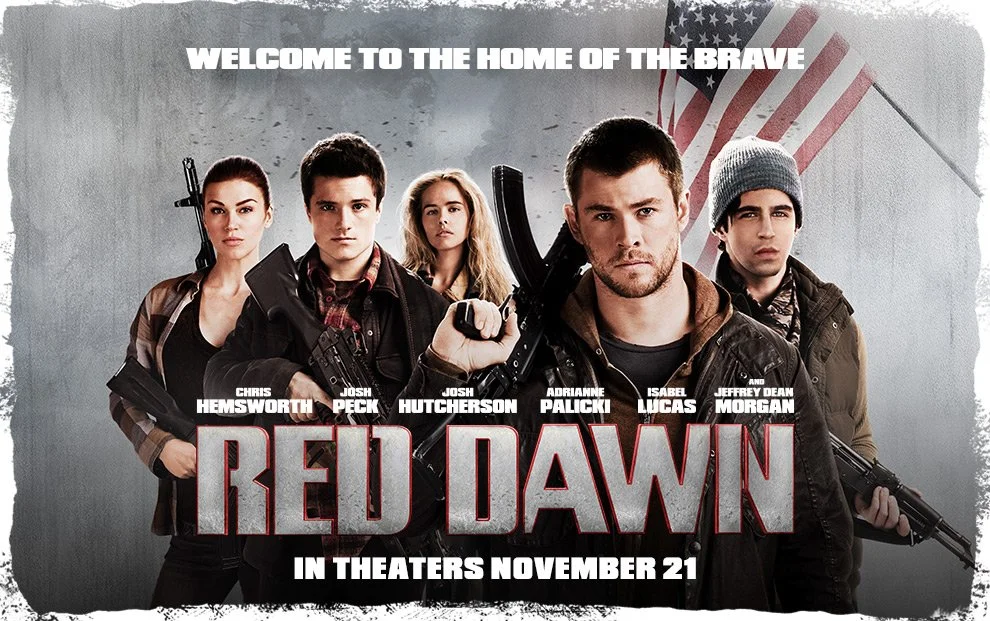
In recent decades we have scene a reversal of roles between TV and cinema. TV is now the home of cerebral, character driven narratives that explore complex and difficult themes. Commercial cinema is now about light and undemanding entertainment. Hence, we have seen the rise of the lucrative PG-13 rating, which has been tailored to satisfy the need for a degree of adult themes and violence, yet still accommodates broader audiences to ensure maximum box office returns. Yet demanding that movies conform to such a strict set of content criteria is extremely restrictive creatively. Furthermore, the growth of international markets, especially China, also impacts upon the scope and tone of movies. Striving to create a generic product that fits all international markets, usually means divesting them of local flavour and style. It can certainly impact upon content. The Red Dawn remake of 2010 sat of the shelf for two years after the collapse of MGM studios. When it was finally released in 2012, the Chinese market had grown lucrative, forcing the new owners to repurpose the film and change the main antagonist from China to North Korea. The final release is a dog’s dinner.
It would appear that this cultural reticence to engage with certain subjects, less they harm sales, is so great that even A list directors are now being shown the door. Hence, we find alternative platforms such as Netflix, providing an environment where a director can pursue a “higher risk” project more freely. Naturally independent film makers will still pursue their own agenda and will not be perturbed by commercial considerations and constraints. In the long term, the current culture of risk aversion versus creativity will result in films simply moving to the platforms and out lets that suit their needs best. However, while the current trend remains dominant, it does mean that mainstream choice will become increasingly homogenous. Yet such a policy is ultimately sowing the seeds of its own destruction. There will come a time when the market for Super Hero movies and Star Wars sequels will be saturated and once again, Hollywood will look to the independent sector to innovate and fill the gaps in the market. Movie making is after all, cyclical and governed by trends like all other leisure industries.
Classic Movie Themes: Basic Instinct
Paul Verhoeven has seldom made a movie without some semblance of controversy associated with it, and his 1992 neo-noir Basic Instinct was no different. Even before its US release, Basic Instinct courted controversy due over its overt sexuality and graphic depiction of violence. It was strongly opposed by gay rights activists, who criticised the film's depiction of homosexual relationships and the portrayal of a bisexual woman as a homocidal narcissistic psychopath. The opening murder with an icepick is still shocking twenty six years later and is an excellent showcase for makeup FX artists Rob Bottin.
Paul Verhoeven has seldom made a movie without some semblance of controversy associated with it, and his 1992 neo-noir Basic Instinct was no different. Even before its US release, Basic Instinct courted controversy due over its overt sexuality and graphic depiction of violence. It was strongly opposed by gay rights activists, who criticised the film's depiction of homosexual relationships and the portrayal of a bisexual woman as a homocidal narcissistic psychopath. The opening murder with an icepick is still shocking twenty six years later and is an excellent showcase for makeup FX artists Rob Bottin.
The plot is a text book example for the genre. Troubled police detective (Michael Douglas), returns from suspension to investigates a brutal murder, in which a manipulative and seductive woman (Sharon Stone) could be involved. Events quickly get out of hand as detective Nick Curran becomes personally involved in the case. The script by Joe Eszter has smoulders with sexual tension and is further punctuated by explosions of violence. Performances are universally good, elevating what is essentially a rather sleazy murder mystery into a far classier undertaking. The film also offers an interesting social commentary on contemporary US sexual politics. Let it suffice to say that beauty often harbours a dark heart.
Regardless of your views on the merit of the movie, Jerry Goldsmith score for Basic Instinct is absolute gem, finely balancing the suspense and the on-screen sexuality. He brilliantly blends mystifying strings, woodwinds, harp, along with piano to build a sense of tension. The soft, wistful title theme is both alluring as well as ominous; a subtle warning of the events that follow in the movies opening scene. The strings section carries the burden of the work, as they do for every other cue throughout the remainder of the score. Basic Instinct remains a text book example of the craft of the late Jerry Goldsmith, bringing distinct elements of class and maturity to the raw passion of the movie.







The Land That Time Forgot (1975)
I first saw The Land That Time Forgot way back in 1975 at the Odeon Isle of Wight, when it was first released. We were on holiday at the time, which was cause for celebration in itself, as these were few and far between during my youth, due to the state of the UK economy at the time. But to then go to the cinema and see a fantasy film, filled with action, adventure and monsters, was the icing on the cake for an over excited eight-year-old. Adapted by Michael Moorcock and James Cawthorn from the 1924 the novel by Edgar Rice Burroughs, The Land That Time Forgot is a classic example of high adventure on a low budget. Its technical shortcomings were even apparent to me as a child, yet there was a charm and honesty to this curious British production, that had the audacity to try and compete with the likes of more expensive US productions such as The Golden Voyage of Sinbad and Island at the Top of the World.
I first saw The Land That Time Forgot way back in 1975 at the Odeon Isle of Wight, when it was first released. We were on holiday at the time, which was cause for celebration in itself, as these were few and far between during my youth, due to the state of the UK economy at the time. But to then go to the cinema and see a fantasy film, filled with action, adventure and monsters, was the icing on the cake for an over excited eight-year-old. Adapted by Michael Moorcock and James Cawthorn from the 1924 the novel by Edgar Rice Burroughs, The Land That Time Forgot is a classic example of high adventure on a low budget. Its technical shortcomings were even apparent to me as a child, yet there was a charm and honesty to this curious British production, that had the audacity to try and compete with the likes of more expensive US productions such as The Golden Voyage of Sinbad and Island at the Top of the World.
The Land That Time Forgot has a rather unusual production pedigree as it was financed by Amicus Productions who were best known during the seventies for their series of portmanteau horror films such as Tales from the Crypt (1972), Asylum (1972). It boasts a robust cast of British characters such as the late Keith Barron (Captain Bradley), Susan Penhaligon and Anthony Ainley. Barron got the role because he bought a house from the producer John Dark, who was casting at the time. Seeking a “known quantity” for the US market, actor Doug McClure secured the lead role as Bowen Tyler. McClure was popular due to his regular appearance in the successful TV western series, The Virginian. British actor John McEnery who played U-Boat Captain Von Schoenvorts, was not deemed to be “sufficiently German” when the movie entered post-production and subsequently had all his dialogue re-dubbed by Anton Diffring.
The Land That Time Forgot is a fairly faithful big screen version of the source novel. Set during World War I, the survivors of a torpedoed British merchant ship manage to capture the German U-Boat that sunk them. However, the German second officer Dietz, sabotages the compass resulting in the U-Boat straying into uncharted waters. Low on fuel and supplies, the combined crew find a strange volcanic sub-continent amid the frozen sea. Captain Von Schoenvorts surmises that this may be the “lost” island of Caprona, which was referenced by Italian explorer Caproni in 1721. Finding an underwater channel, the U-Boats manages to penetrate the outer cliff wall only to find a lush tropical zone, populated by both Dinosaurs and prehistoric people. While Captain Von Schoenvorts and Biologist Lisa Clayton contemplate the mystery of Caprona’s curious ecosystem, Engineer Bowen Tyler searches for a viable source of oil that they can refine and so escape back to civilisation.

The Land That Time Forgot is very much a product of its time, being made on a very modest budget. Yet despite its technical shortcomings the movie holds up very well. Roger Dickens dinosaur effects, which are mainly rod puppets, have a certain charm about them. They are not as sophisticated as Ray Harryhausen’s stop frame animated marvels, but they get the job done. Praise was heaped upon Derek Meddings’ superb miniature effects at the time and they are still impressive today. But what The Land That Time Forgot manages to achieve that many modern equivalent movies fail to do, is being honest and respectful towards its source material. Just because the movie is based upon a pulp fiction novel, it isn’t trivialised or presented in an ironic and self-deprecating way. The cast obviously took their roles seriously and delivered a very sincere film, irrespective of its humble origins and restricted production values.
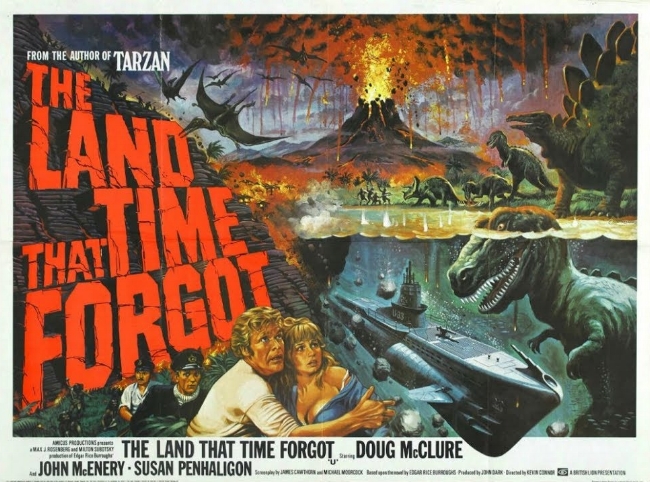
The Land That Time Forgot is an excellent example of low budget, but creative independent film making that was common place in the seventies. It has a simple plot, with clearly defined characters. The action scenes and dramatic scope of the film are ambitious considering the financial constraints and although casually violent, as so many family films ironically were at the time, it is never gratuitous. Susan Penhaligon’s role sadly reflects gender-based attitudes of the time. The movie doesn’t make any attempt to accurately reflect the state of geopolitics of the period. The hero is robust, masculine and decisive. The Germans are “bad” because the film requires an arbitrary set of antagonists. Naturally they also reflect the prevailing stereotypes and prejudices common to the UK society at the time. The film poster certainly overstates the scope of the production, promising action of a far more spectacular nature and a lot more dinosaurs. Yet it all works very well and is still very entertaining, if you accept it for what it is and when it was made.

The Games (1970)
The Games is the story of four marathon runners and their preparations for the Olympics. Harry Hayes (Michael Crawford) is a British runner with a highly demanding coach (Stanley Baker). US athlete Scott Reynolds (Ryan O’Neal) is reaching the end of his career and continues to run, even though it might kill him. Czechoslovakian world record holder Pavel Vendik (Charles Aznevour) is “encouraged” out of retirement to competes for the glory of his country, and then there’s Aboriginal Australian runner Sunny Pintubi (Athol Compton) who competes as a way of escaping his life of poverty and racial oppression. All come under media scrutiny and must confront their own demons before competing in the race that will possibly define their life.
The Games is the story of four marathon runners and their preparations for the Olympics. Harry Hayes (Michael Crawford) is a British runner with a highly demanding coach (Stanley Baker). US athlete Scott Reynolds (Ryan O’Neal) is reaching the end of his career and continues to run, even though it might kill him. Czechoslovakian world record holder Pavel Vendik (Charles Aznevour) is “encouraged” out of retirement to competes for the glory of his country, and then there’s Aboriginal Australian runner Sunny Pintubi (Athol Compton) who competes as a way of escaping his life of poverty and racial oppression. All come under media scrutiny and must confront their own demons before competing in the race that will possibly define their life.
X is an extremely interesting snapshot of the world of international sport during the early seventies. It is a fast paced, tightly edited movie (like many of Michael Winners movies) and features many international locations. The cast is eclectic but strong and the dialogue tight and to the point. It is a revelation to see Michael Crawford, best known in the UK for his seventies comedy hijinks, playing against such internationals stars as Ryan O’Neal and Stanley Baker. It was also the first time I’d seen Sam Elliot before he was grey and grizzled. Winner gets the most from his location shooting and creates a genuine feel for what it is life to actually participate in such an Olympic event. Although many of the characters are not particularly sympathetic there is a compelling quality to their respective stories and subsequent fate.
Michael Winner is not the first name you think of when considering a movie about sport, but his style compliments the subject matter. The Games manages to take what is essentially a not particularly interesting spectator sport and it into an intriguing and somewhat sleazy drama. The first two acts focus on the respective characters and their own personal challenges. As the main event draws near we see the financial and political pressure that comes to bear on each of them and how they each deal with it. The last act of the movie depicts the marathon through Rome as the gruelling endurance test that it is. Yet the editing and pacing build a strong sense of drama as to who will win the race. The depiction of drug abuse, along with the unbridled egos of some of the athletes still rings true today. As does the insidious influence of big business and corporate sponsorship.
Curiously enough the print of The Games that I recently watched sported the original BBFC rating which was curiously a U certificate. I do not think the movie would be so fortunate today. The use of habit forming performance enhancing drugs, the casual sexual undercurrent as well as depictions of institutional racism would possibly attract a higher rating. However, all of these themes are explored cogently. The depiction of aboriginal runner Sunny Pintubi (Athol Compton) was particularly good and was in some way the most interesting character in the movie. The way he turns the tables on those who seek to exploit him is suitably satisfying. Overall, The Games is an accurate assessment of the state on international athletics at the time, reflecting the political propaganda wars of the East and West. It also portrays the hubris of US sports from the era, as well as the blinkered and misplaced notion of English exceptionalism that still remained among some UK athletes.
Appaloosa (2008)
I have been revisiting the western genre and reacquainting myself with some of its more cerebral examples. Ulzanna’s Raid (1972) and Tom Horn (1980) certainly helped remind me of the diversity of themes and the scope of subjects that this genre has explored over the years. Obviously due to the westerns decline in popularity, there are fewer examples to cite from recent years, although I would single out Open Range (2003) and 3:10 to Yuma (2007). However, Appaloosa (2008) is a movie that embodies all the narrative qualities that a good western can achieve and furthermore it does so without the need to re-invent the wheel. In structural terms, this is old school cinema and all the better for it.
I have been revisiting the western genre and reacquainting myself with some of its more cerebral examples. Ulzanna’s Raid (1972) and Tom Horn (1980) certainly helped remind me of the diversity of themes and the scope of subjects that this genre has explored over the years. Obviously due to the westerns decline in popularity, there are fewer examples to cite from recent years, although I would single out Open Range (2003) and 3:10 to Yuma (2007). However, Appaloosa (2008) is a movie that embodies all the narrative qualities that a good western can achieve and furthermore it does so without the need to re-invent the wheel. In structural terms, this is old school cinema and all the better for it.
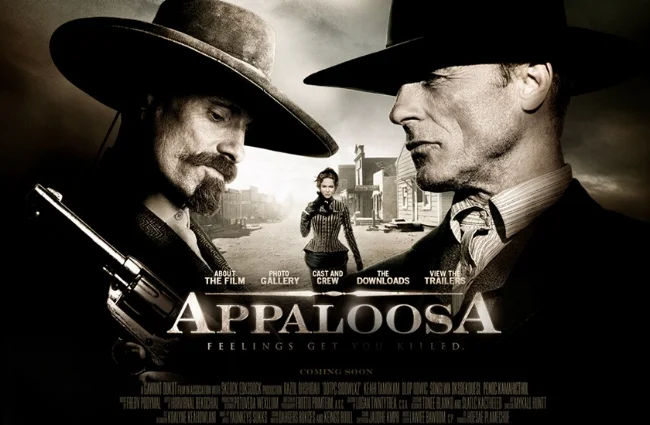
Ed Harris directs, co-writes, co-produces, sings (a ballad over the end credits) and stars in this traditional Western, based on a book by Robert B. Parker. Unlike other revisionist or deconstructionist westerns, Appaloosa feels more like a genre classic like John Ford’s My Darling Clementine. The film focuses on the characters rather than action and although there are shoot-outs, they are not overstated. The production feels very authentic (if there is such a thing to be found in the mythology of the cinematic western) and the cinematography by Dean Semler is outstanding, reflecting the harsh landscape and stark functional towns.
Central to this film is the friendship between Harris’ marshal, Virgil Cole, and Viggo Mortensen’s deputy, Everett Hitch. It’s the sort of deep understated relationship where one character can finish another’s sentences. Often more is conveyed by what’s not said. Such friendships are based on loyalty and this is an integral theme in Appaloosa. The status quo is sorely tested by the introduction of Widow Renée Zellweger and crooked rancher Jeremy Irons. Harris and Mortensen, who co-starred in A History of Violence (2005) are superb and there is solid support from the likes of Timothy Spall and the underrated Lance Henriksen.
Harris directs well and focuses on modern parallels, especially the distinction between enforcing the law and just killing people. His film extols the old-world virtues of honour and loyalty. He also explores the theme of a woman trying to survive in a man’s world and the tough choices she has to make to get by. The climatic showdown is more about the battle between a man and his conscience, rather than two dimensional notions of good versus evil. This is a thoughtful and somewhat old-fashioned film, that will suit those in a reflective mood, rather than action fans. It also clearly showcases why the western is such a broad and flexible genre that never grows old.

Outrage (2010)
Multi-talented Japanese actor, director and comedian Takeshi Kitano has gained a global reputation due to his cerebral exploration of Yakuza culture. In recent years he has moved away from this specific sub-genre and has focused his attentions on a series of human dramas, exploring such complex themes as the nature of reality and mortality. With Outrage (Autoreiji, 2010) he returns once gain to the subject of criminal clans. This time round, director Kitano has opted to reduce some of the more spiritual and philosophical elements of the narrative and has focused far more upon the brutal and political nature of Japanese organised crime. As a result, Outrage is horse of a very different colour, compared to earlier examples of his work, such as Boiling Point (1990) and Sonatine (1993).
Multi-talented Japanese actor, director and comedian Takeshi Kitano has gained a global reputation due to his cerebral exploration of Yakuza culture. In recent years he has moved away from this specific sub-genre and has focused his attentions on a series of human dramas, exploring such complex themes as the nature of reality and mortality. With Outrage (Autoreiji, 2010) he returns once gain to the subject of criminal clans. This time round, director Kitano has opted to reduce some of the more spiritual and philosophical elements of the narrative and has focused far more upon the brutal and political nature of Japanese organised crime. As a result, Outrage is horse of a very different colour, compared to earlier examples of his work, such as Boiling Point (1990) and Sonatine (1993).
The plot follows a struggle for power amongst Tokyo's Yakuza clans, who live in a curious world between legitimate business respectability and conventional criminal undertakings. The Sanmo-kai clan holds sway in the face of continuous betrayal and ever-changing allegiances from both other gangs as well as banks and corporations. The Sanmo-kai chairman learns that his deputy Ikemoto has struck an alliance with the drug-dealing Murase family and is displeased by this breach of discipline and etiquette. The ensuing retaliation triggers a wave of killings, territorial invasions and score settling while local law enforcement officers struggle to intervene, due to corruption and political conflicts. Takeshi Kitano plays an enforcer, Otomo, who finds himself caught amid these escalating events.
There is an almost clinical approach to the proceedings in Outrage and the introspective musings of Takeshi Kitano's earlier work are now replaced with a far slicker, rather stylised American approach to this particular genre. Hence the production boasts convoys of luxury vehicles and a cast clad solely in designer suits. This contrived designer aesthetic at times verges on parody. Frequently Outrage seems to play out in a faux and derivative representation of organised crime, which is itself already an artificial construct to begin with. Certainly, this aspect of the production does not greatly compensate for the films reduced narrative. The story mainly focuses on the traditional staples of the gangster genre. This is a study in greed, revenge and violence of which there is a lot and it is not for the squeamish. In a world were violence is common place, the film cleverly explores how ever-increasing acts of abhorrence are required to maintain the status quo.
Yet despite the films scaled down aspirations, it should be remembered that this is a Takeshi Kitano production and his work is streets ahead of many other mainstream directors, even when he's not on top form. The biggest saving grace of Outrage is the streak of gallows humour that runs through the entire film. As ever Kitano's performance is utterly compelling. This man has a quality that is hard to define but he definitely holds your attention. His can inspire loathing as equally as he can move us with his honest sentiment. Viewers who are new to this film makers work, should note that the prolonged sequences of people staring at each other or into the middle distance are perfectly normal and common place. They are also often precursors to acts of extreme violence or a major emotional outburst.
For western audiences, Outrage is very accessible, reminding me in a way of his earlier film Brother (2000) which was more tailored for the international market. But for those who are expecting the cerebral character studies of his earlier work, then you will not find it here. The film is a far more formulaic and somewhat predictable undertaking (apart from the end). It is a handsome if clichéd production but is bolstered by the presence of its director both in front and behind the camera. Fans of the Yakuza sub-genre and Japanophiles will still find much to enjoy. Note well that if you have more than a passing fear of the dentist and dental equipment then this movie may not be for you. For those who do find Outrage to be their “cup of tea”, then note that it is the first in a trilogy of movies.
Dream House (2011)
Despite being derivative of several other well-known notable genre films, Dream House has several positive attributes. With its strong cast and capable director, the movies offers a well-made and tense tale with solid production values. But like so many contemporary psychological thrillers and baroque stories with a twist, your overall enjoyment depends on how familiar you are with the genre. The biggest problem I encountered while watching Dream House was my own over familiarity with films of this kind. Hence, I saw the first major plot twist coming a mile off and subsequently accurately predicted the film’s outcome. Because of this it does make it somewhat difficult for me to be as objective as I should about Dream House. However, that is not to say that the movies multi-faceted plot won’t be a source of surprise to the more casual viewer.
Despite being derivative of several other well-known notable genre films, Dream House has several positive attributes. With its strong cast and capable director, the movies offers a well-made and tense tale with solid production values. But like so many contemporary psychological thrillers and baroque stories with a twist, your overall enjoyment depends on how familiar you are with the genre. The biggest problem I encountered while watching Dream House was my own over familiarity with films of this kind. Hence, I saw the first major plot twist coming a mile off and subsequently accurately predicted the film’s outcome. Because of this it does make it somewhat difficult for me to be as objective as I should about Dream House. However, that is not to say that the movies multi-faceted plot won’t be a source of surprise to the more casual viewer.
Will Atenton (Daniel Craig) quit his job as a publisher to spend more time with his wife Libby (Rachel Weisz), their two daughters (Taylor and Claire Geare) and start writing a novel. They move into a large new house, which unbeknown to them was the scene of a mass murder several years prior, in which a father allegedly murdered his entire family. Will subsequently learns that this man, Peter Ward, spent five years in a psychiatric hospital and has recently been released back into the community. Their neighbour, Ann Patterson (Naomi Watts), knows something about Peter Ward, but seems very reticent to discuss the matter with them. Wills daughters soon start seeing a stranger hanging around outside in the street and staring at their house. It’s not long before events take a sinister turn.
Director Jim Sheridan deliberately takes his time with the story telling, in an attempt to build tension and allow the audience to connect with the central characters. However, despite being an accomplished director of human dramas, he is burdened with a particular workman like script by David Loucka, which lacks any major polish. Still he manages to avoid a great many of the genre clichés that are rife in this type of movie and the production design, cinematography and general ambience are extremely competent. Dream House is therefore a very functional cinematic experience but not an especially atmospheric one. The strong cast (Elias Koteas, Marton Csokas) try their best to fill the narratives gaps but overall the premise and payoff are somewhat lacking in punch. The film does not push the boundaries of its PG-13/12 rating. There are some jolting moments and brief images of gunshot wounds. Prior to release the movies was re-edited from a “R” to a lower rating.
Dream House is very much a film of three very acts and sadly they don’t quite hang together as well as they could. The ending doesn’t quite provide the dramatic payoff that some may expect. There are also some logical plot holes that are best not pondered on too long. Once again these can all be attributed to the bland screenplay. Yet despite all these issues, the talented cast and professional production manage to keep the film afloat. So again, I return to my point that your familiarity with the genre will pretty much determine how much you’ll enjoy Dream House overall. For viewers who are not particularly well versed with similar films from the past thirty years years, the premise and twist ending of Dream House, and may prove adequate and sufficiently entertaining. For those who have more than a passing interest in the genre, there are shades of The Twilight Zone, and The Man Who Haunted Himself to be found.
The Silent House (2010)
The Silent House takes a very traditional haunted house story and develops it in a distinctly postmodern fashion. This Uruguayan horror film hinges on the concept of the entire film being shot in one take. Hence the tag line of “real fear in real time”. This takes the recent trend of filming with handheld digital cameras one step further, in an attempt to outdo the likes of Paranormal Activity and its subsequent sequel. It certainly creates a minimalist feel to the proceedings, similar to the myriad of supernatural reality shows that are currently popular on TV. By using the medium of digital cameras, smart phones and internet searches, the movies initially manages to sustain an authentic atmosphere. However, as the narrative proceeds the films flaws become more apparent.
The Silent House (La Casa Muda) takes a very traditional haunted house story and develops it in a distinctly postmodern fashion. This Uruguayan horror film hinges on the concept of the entire film being shot in one take. Hence the tag line of “real fear in real time”. This takes the recent trend of filming with handheld digital cameras one step further, in an attempt to outdo the likes of Paranormal Activity and its subsequent sequel. It certainly creates a minimalist feel to the proceedings, similar to the myriad of supernatural reality shows that are currently popular on TV. By using the medium of digital cameras, smart phones and internet searches, the movies initially manages to sustain an authentic atmosphere. However, as the narrative proceeds the films flaws become more apparent.
The plot is simple and revolves around Laura (Florencia Colucci) and her father Wilson (Gustavo Alonso) while they endeavour to renovate an old family home to prepare it for sale. Vacant and derelict, the house has no utilities, forcing them to rely on battery-operated lanterns to light their way. Laura becomes separated and soon finds she is trapped inside the house, with no contact with the outside world. It soon becomes clear that leaving may not be as easy as thought and that a supernatural presence is behind events. Director Gustavo Hernandez has technically constructed a competent production that certainly benefits from being set outside of the US. Minor cultural differences and references add an interesting veneer to a common place plot device and make it at first more palatable. However, once the initial premise has been set, the film fails to be anything more than be a series of well-executed set piece and never truly frightens in the manner the advertising suggests.
This seems to be the main problem with some contemporary horror cinema. It has lost the ability to illicit an emotional response from the viewer by the exploration of difficult themes and concepts. Instead those making the movies seem a little too focused on crafting a technical rollercoaster ride at the expense of character and emotional investment. Thus, with The Silent House we are simply subject to frequent acts of misdirection followed by an obligatory “boo” moment. It has been a substantial amount of time since I have seen a film that I found genuinely disturbing or suspenseful. I was hoping that this more obscure production would yield better results, but sadly it was not to be. What remains is a interesting international curiosity that squanders it's premise. The US remake that followed a year later maintains the same failings.
Executive Decision Re-Edited Blu-ray Version (1996)
Stuart Baird’s Executive Decision was one of the better action films of the late nineties, with a stronger narrative and emphasis on characters, rather than just pure mayhem. Sporting a robust cast including Kurt Russell, David Suchet (Quelle surprise, a British actor playing a villain) and a willingness to break with convention (Steven Seagal dies in the first 45 minutes), Executive Decision is still an entertaining genre piece. Therefore, its arrival on Blu-ray in 2011 was keenly anticipated. However, placed on the back of the packaging of the US region-free release was a short and initially somewhat innocuous statement. “This R-rated version contains material different from the original R-rated version”. Exactly what does this mean?
Stuart Baird’s Executive Decision was one of the better action films of the late nineties, with a stronger narrative and emphasis on characters, rather than just pure mayhem. Sporting a robust cast including Kurt Russell, David Suchet (Quelle surprise, a British actor playing a villain) and a willingness to break with convention (Steven Seagal dies in the first 45 minutes), Executive Decision is still an entertaining genre piece. Therefore, its arrival on Blu-ray in 2011 was keenly anticipated. However, placed on the back of the packaging of the US region-free release was a short and initially somewhat innocuous statement. “This R-rated version contains material different from the original R-rated version”. Exactly what does this mean?
Well it has subsequently become apparent that Warner Bros have sourced a re-edited version of the film for its US Blu-ray release (and in all other territories). Specifically, cuts have been made to scenes where various characters are shown holding and reading the Quran. Please note that these alterations should not be confused with cuts that were made to the UK DVD release in 1997, in which Steven Seagal’s knife work at the start of the movie was truncated to obtain a lower rating. These new edits for Blu-ray have been made to address (and remove) the presence of a religious text that is used within the movie as a prop. If one compares the original 1997 US DVD copy of the film which is uncut, with the Blu-ray release, you’ll find that the following changes have been made to the film.
At 10:38, the scene in which the suicide bomber enters the London restaurant has shots of him holding the Quran aloft removed.
Then at 1:04:50 when David Suchet is talking to Halle Berry, similar material has been deleted. This includes him holding and leafing through the holy book.
Finally, between 1:37:04 to 1:37:11, shots of David Suchet praying are missing. This includes a scene in which a copy of the Quran can be seen on top of some radio equipment, next to him.
From a narrative point of view, these alterations do not have any tangible impact upon the story, or the characters and their motivation. However, many will argue that this is not the point. This rather arbitrary approach by Warner Bros doesn’t really achieve anything of significance, especially in light of the fact that the uncut version of the film has been in circulation globally on DVD for 13 years. It also seems paradoxical to remove one element of a film that can be perceived as offensive, when the very premise of the entire story can also be viewed in a similar fashion? Exactly who are these cuts supposed to appease? I was not aware of any major campaign against Executive Decision during its theatrical release or subsequent lifecycle on DVD. Is this more a case of the distributors having a guilty conscience or simply covering themselves legally?
Warner Bros have subsequently replaced the uncut 1997 DVD version of the movie with a new release that features the same re-edited version of the movie as the Blu-ray disc. However, the uncut version of the film still remains in circulation and can still be bought from retailers who still hold residual stock. For more specific details as to what versions are available in which regions please visit the Rewind: DVD Compare website, which provides a comprehensive breakdown and analysis. It remains to be seen as to what version of the film is currently in use on video on demand platforms and TV networks around the world.
The world has changed quite radically since 1996 and certainly post 9/11 and Iraq War sensibilities have had an impact upon such arbitrary tropes as the depiction of Islamic Fundamentalist Terrorists in cinema. Simplistic action movies like Executive Decision have given way to more nuanced films like Green Zone or Eye in the Sky. However, this retro-active editing of Executive Decision remains a curious anomaly because I am not aware of any other action of this kind being taken against similar movies from the same period. But then again, I cannot easily recall a comparable movie that featured the Quran as a visible prop. As to the moral rectitude and reasoning behind making these cuts to Executive Decision, that is a sperate debate altogether.






Wisconsin Death Trip (1999)
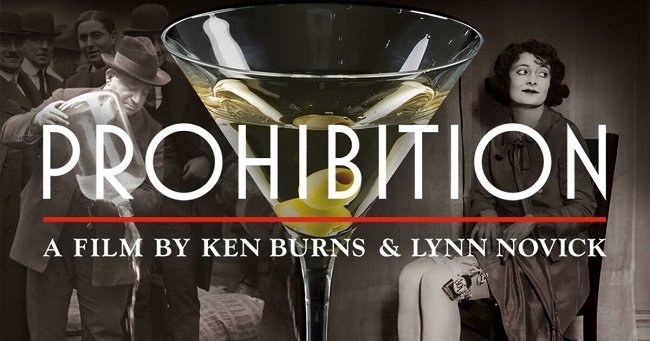
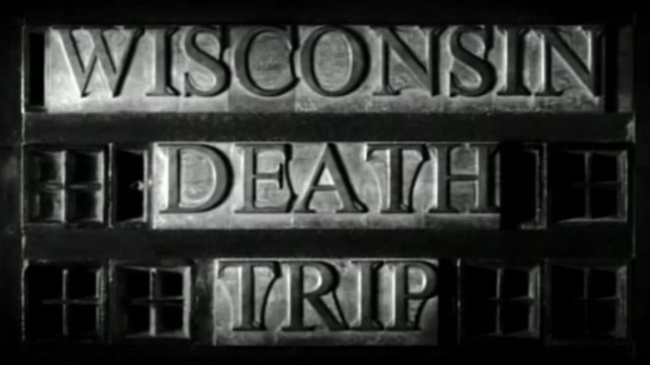
Wisconsin Death Trip is a strange, enigmatic, non-linear docudrama and that makes for compelling viewing for the open minded. It is based upon the 1973 non-fiction book Wisconsin Death Trip by Michael Lesy, which explores a collection of late 19th century photographs by Jackson County, photographer Charles Van Schaick. These are mainly taken in the city of Black River Falls. The authentic black and white pictures are further embellished by local news reports from the same period, predominantly taken from the Black River Falls newspaper. These articles emphasise the harsh aspects of Midwestern rural life under the pressures of crime, disease, mental illness, and urbanization. The book has been a source of influence over the years, with authors such as Stephen King and Rod Jones citing the impact its had upon their respective work. Film maker James Marsh has subsequently taken this curious microcosm of rural life and death and extrapolated it a compelling reflection upon mortality and the fragility of human existence.
Wisconsin Death Trip is a strange, enigmatic, non-linear docudrama and that makes for compelling viewing for the open minded. It is based upon the 1973 non-fiction book Wisconsin Death Trip by Michael Lesy, which explores a collection of late 19th century photographs by Jackson County, photographer Charles Van Schaick. These are mainly taken in the city of Black River Falls. The authentic black and white pictures are further embellished by local news reports from the same period, predominantly taken from the Black River Falls newspaper. These articles emphasise the harsh aspects of Midwestern rural life under the pressures of crime, disease, mental illness, and urbanization. The book has been a source of influence over the years, with authors such as Stephen King and Rod Jones citing the impact its had upon their respective work. Film maker James Marsh has subsequently taken this curious microcosm of rural life and death and extrapolated it a compelling reflection upon mortality and the fragility of human existence.
Wisconsin Death Trip is beautifully narrated in an understated, matter of fact fashion by Ian Holm. The docudrama avoids the traditional linear approach to exploring such subject matters and there are no explanations by historians or psychiatrists to account for the litany of deaths, murders and suicides. Director Marsh instead elects to blend the period photographs with recreation of the events being narrated. The matter of fact approach of the newspaper stories from the 1890s are quite a surprise. They lack the contemporary penchant for hyperbole and comes close to normalising what are inherently bizarre events. The original reports never seem to attempt to explore the motives for the various murders and suicides and seem to justify them with the most arbitrary of explanations. Yet the photos clearly speak for themselves about the reality of frontier life and the harsh existence that these immigrants endured. Dead babies in coffins, the Winnebago Indians suffering from small pox and the recently hung are all starkly shown.
The period stories are also intercut with colour scenes from present day Black River Falls, juxtaposing the hardship of life in the 1890s with the mundanity of contemporary small-town America. It makes for an interesting contrast. One minute we’re reflecting upon a jilted lover shooting the object of their affection and the next we’re watching modern kids playing in the streets and a local beauty pageant. Yet there is a distinct Lynchian undercurrent to the proceedings. Perhaps the inference is despite the calm and measured pace of twenty first century life in this sleepy rural town, it would only take some nominal changes in the climate or the loss of power to drive even a modern community to the edge of despair and the borders of insanity, as in the 1890s. It certainly makes you think, which seems to be the underlying point of Wisconsin Death Trip. It is an oddly fascinating 76 minutes that’s a far cry from your traditional documentary. Recommended to those who have an interest in the human condition and aren’t perturbed by the macabre.







The Boondock Saints Unrated Director's Cut (1999)
Writer and director Troy Duffy obviously set out to make The Boondock Saints a "cult" movie and to find a niche market audience that would champion it. Every thematic and cinematic attribute you associate with contemporary, "hip", independent film making is duly trotted out and used in an arbitrary fashion. The Boondock Saints is violent (in that very stylised Tarantino sense of the word), slick, contrived and deliberately controversial. It also perpetuates every possible cliché about the Irish as a race and the Roman Catholic church that you can think of. Yet despite these facts, there is still the germ of a good film at its core. Vigilanteism has always been an intriguing and emotive subject that can make for challenging cinema. Populist content such as this can also be the key to box office success.
Writer and director Troy Duffy obviously set out to make The Boondock Saints a "cult" movie and to find a niche market audience that would champion it. Every thematic and cinematic attribute you associate with contemporary, "hip", independent film making is duly trotted out and used in an arbitrary fashion. The Boondock Saints is violent (in that very stylised Tarantino sense of the word), slick, contrived and deliberately controversial. It also perpetuates every possible cliché about the Irish as a race and the Roman Catholic church that you can think of. Yet despite these facts, there is still the germ of a good film at its core. Vigilanteism has always been an intriguing and emotive subject that can make for challenging cinema. Populist content such as this can also be the key to box office success.
Two Irish Boston brothers, Connor and Murphy MacManus (Sean Patrick Flanery and Norman Reedus) fall foul of the Russian Mafia. After a questionable act of self-defence is "overlooked" by the local Police, the brothers conclude that they’re doing God's work and decide to clean up the town. Aided by a minor foot soldier of the local Mafia (David Della Rocco), who sees their crusade as a way to settle personal scores, the body count starts to increase. Enter FBI profiler Paul Smecker (Willem Dafoe), who after a time starts questioning his profession and sympathising with the murderous trio. The various conflicts of interest and upsetting of the criminal status quo, eventually leads to a standoff that seems to have an inevitable conclusion.
The Boondock Saints lurches from scene to scene with a lumbering sense of momentum, leaving occasional interesting ideas only partially explored. The opening half of the film is the most satisfactory as the story provides sufficient motive for the two brothers to pursue their killing spree. The proceeding become somewhat derailed once Rocco joins the team, as this contrived plot devices finally put pay to any originality. The introduction of an openly gay FBI agent embodies invokes possible stereotype and really does beggars belief. Profanities fly at unprecedented levels and the comic relief, such as the accidental shooting of a household pet, is unsubtle and crass. The gun battles are lovingly shot in slow motion and edited to a quasi-Irish folk, post-modern soundtrack. Mr. Duffy really wanted this film to be remembered by those enamoured with "cult" cinema and does everything he possibly can to achieve this.
Much has been made of the films violent content. The Director’s Cut of The Boondock Saints replaces all the death scenes from the theatrical version with alternative takes. One bullet hit becomes three and there is noticeably more blood splatter and injury detail. Even so, this is not anything ground breaking. We have all been here before and seen far more graphic material framed against far better narratives. There is also an attempt to imbue the action scenes with an artistic sense of style, of the "Peckinpah" idiom. There’s copious use of slow motion and cross cutting of subjects matters. However, as the overall film lacks the intellectual and emotional content The Wild Bunch or Bring Me the Head of Alfredo Garcia, then most of this visual posturing fall upon stony ground.
But despite all these faults, this chaotic mess still manages to entertain at some level. The ending is left conspicuously open and the credits roll over bogus news reports, conducting a vox pop relating to "the saints" activities. Regardless of the respective merits of this film, it garnered a big enough following via word of mouth and the internet for the director to make a sequel a decade later. Therefore, only watch The Boondock Saints if you are in a particularly forgiving mood and tolerant of fan boyish enthusiasm masquerading as genuine film making skill. Scholars of cinema may be curious just to see all the possible school boy mistakes that can be made during the course of one single action film.
Ready Player One (2018)
Where do I start with Ready Player One? Like so many contemporary blockbuster movies, beneath the hype, excess of visual effects and general self-indulgence of the production team, there are several good ideas and themes marbling the central premise of the film. Sadly, these are neglected in favour of numerous frenetic set pieces and a plethora of pop culture references. Although Ready Player One is essentially based upon a fan service novel, for it to fully succeed as a movie, it needed to temper such elements by focusing on the drama of it’s dystopian future and the plight of it’s central protagonists. Stephen Spielberg however, has not achieved this and the film is tonally inconsistent, light on character development and a little too pleased with itself with regard to its homages and tributes. The latter is a real stumbling block as it is, in many ways the selling point of the film. Yet by becoming the central conceit at the expense of everything else, turns what could have been a clever and relevant piece of film making into a very expensive cinematic version of “Now That’s What I Call Music”.
Where do I start with Ready Player One? Like so many contemporary blockbuster movies, beneath the hype, excess of visual effects and general self-indulgence of the production team, there are several good ideas and themes marbling the central premise of the film. Sadly, these are neglected in favour of numerous frenetic set pieces and a plethora of pop culture references. Although Ready Player One is essentially based upon a fan service novel, for it to fully succeed as a movie, it needed to temper such elements by focusing on the drama of it’s dystopian future and the plight of it’s central protagonists. Stephen Spielberg however, has not achieved this and the film is tonally inconsistent, light on character development and a little too pleased with itself with regard to its homages and tributes. The latter is a real stumbling block as it is, in many ways the selling point of the film. Yet by becoming the central conceit at the expense of everything else, turns what could have been a clever and relevant piece of film making into a very expensive cinematic version of “Now That’s What I Call Music”.
Let me address what I felt were the films inherent weakness. Firstly, there’s the rapidly edited action scenes, filled with vivid CGI and fluid camera movements. Modern visual effects have fallen victim to a form of conformity. They are bombastic, frenetic and frankly disorientating. The sheer quantity of audio and visual data to assimilate is overwhelming, headache inducing and fast becoming tedious. The “everything including the kitchen sink” approach is often done simply because it can be done, irrespective of whether is serves any wider purpose. Ready Player One has several keys scenes that fall into this category. I defy anyone to claim they absorbed everything on first viewing. Perhaps that’s the entire point. To encourage a second viewing or hours of analysis at home, watching the Blu-ray release on frame advance. Well sorry Hollywood, but I’m a firm believer in less is more and I’m so over visual FX show-reels masquerading as narrative cinema.
Secondly, the continuous stream of pop culture references as I mention earlier becomes a distraction. Some of the more obvious ones are relevant to the narrative and some of the obscure ones can certainly raise a wry smile. But other have no purpose other than to tick a box with certain demographic and please them. Essentially the problem here is knowing not to over egg something and flog a dead horse. If you want an example of when cameos, references and homages work well, then watch Who Framed Roger Rabbit, Dead Men Don’t Wear Plaid or even The Last Action Hero. Again, I suspect that this problem stems from the fact that this is a Steven Spielberg movie. Everyone in the chain of command assumes he knows his stuff and no one wants to be the person who says “no” to a film maker of his stature. Yet from what I’ve read he’s not a martinet and may even appreciate the occasional verbal check and balance.
Thirdly, contained within this very standard story of a dystopian future where people flee the reality to find meaning in a virtual world, there are some good ideas. Material that the writers should have got their teeth stuck into. If these had been developed more and featured more prominently in the proceedings then this could have been a far more impactful piece of cinema. For example, there is a minor scene where OASIS creators James "Anorak" Halliday (Mark Rylance) and Ogden Morrow (Simon Pegg), briefly disagree about the handling of their virtual world. Morrow postulates the need from rules and consequences. This mutual “Robert Oppenheimer moment” could have been so much more. Then there’s the characters of Sho (Philip Zhao) and Daito (Win Morisaki) who despite playing pivotal roles in the proceedings have precious little back story. The screenplay also veers from a very comic tone at times to something far bleaker. One moment we have a bounty hunter with a bag full of pithy quips, the next we have indentured slaves working till they die in what is effectively a high-tech debtors prison.
Because of these weaknesses Ready Player One fails to be the movie that it could be and misses its potential to be both a blockbuster and a movie of substance (something Spielberg has achieved with his earlier work). However, because of the director’s pedigree it is still has value if you’re prepared to simply take it as populist entertainment and nothing more. Certainly, younger viewers may revel in the some of the more contemporary video games references, tropes and memes. I must admit I laughed out loud at a business proposal to sell off to advertising “80% of an individual’s visual field before inducing seizures”. The film also benefits from quite a streamlined running time and unlike other tentpole movies of this kind, it doesn’t drag. The technology depicted is also quite grounded and thus helps the story tread that fine line between the audience maintaining their sense of disbelief and jumping the shark. For older viewers, there’s also a lot of solid eighties songs that intelligently embellish the production design and aesthetic of the film.
I came away from watching Ready Player One with some disappointment, but I was not surprised that it played out this way. When you invest $175 million into a project that is built upon concepts of nostalgia and geek culture, everyone involved is going to be adding fuel to the fire to ensure that the basic remit is met. In the rush to do so nuance and subtlety are quickly and possibly unintentionally side lined. I’m not a big one for glib distillations but I wrote in my notes as the credits rolled on Ready Player One, “Willy Wonka meets Tron, with pop culture references and a shit load of licensing costs”. I also reflected upon Yogi’s Gang which I remember from my childhood in the early seventies. It was a show that featured all your favourite Hanna-Barbera cartoon characters. On paper this was Hog Heaven for a kid, but the reality was the show often favoured certain characters or was just bogged down in showcasing everyone. There’s an element of that in Ready Player One and it’s cavalcade of in-jokes and references. If you can accept this flaw, then the fan service bias of the film won’t be an obstacle.





Rush (2013)
Being a child of seventies, I remember James Hunt being constantly in the Sunday Newspapers and a guest on talk shows. I knew who he was, what he did and that his antics frequently had my parents tutting, the same way as they would at contemporary pop stars shenanigans. But beyond that I wasn't that interested in the man, being obsessed by Star Wars at the time. As an adult I now frequently find myself revisiting this particular decade through books and documentaries and re-appraising events that took place. As a result, I get to put into perspective the things that were happening around me as a child that I didn't fully understand. The miner's strike, apartheid and the trial of Jeremy Thorpe (brilliantly dramatised recently by the BBC in A Very British Scandal). I was hoping to get a similar insight from Rush.
Being a child of seventies, I remember James Hunt being constantly in the Sunday Newspapers and a guest on talk shows. I knew who he was, what he did and that his antics frequently had my parents tutting, the same way as they would at contemporary pop stars shenanigans. But beyond that I wasn't that interested in the man, being obsessed by Star Wars at the time. As an adult I now frequently find myself revisiting this particular decade through books and documentaries and re-appraising events that took place. As a result, I get to put into perspective the things that were happening around me as a child that I didn't fully understand. The miner's strike, apartheid and the trial of Jeremy Thorpe (brilliantly dramatised recently by the BBC in A Very English Scandal). I was hoping to get a similar insight from Rush.
Ron Howard, a very talented director who can turn his hand to most genres and subject matters, has elected to paint a picture with very broad-brush strokes with Rush. If you’re looking for a historically accurate character study, then you may well be disappointed. Rush is a distillation of events, packaged in a very accessible way, aimed at broadest possible audience. That is not to say it is bad, because it is most certainly not. Performances are good, the narrative is very engaging, and the race sequences especially the crashes are utterly hair raising. Rush in many ways is a throwback to the golden age of Hollywood biopics and as a result is very entertaining.
Director Ron Howard successfully achieves making the essentially unlikeable characters of James Hunt and Niki Lauda, very watchable and turning a story of hedonism, egomania and recklessness into a compelling drama. The movie combines big studios’ production values and their predilection for action sequences with that British bent for storytelling. Not bad for an independent production. You would think that a movie pitched in such a fashion, with one eye very squarely on the US market that may not be so familiar with F1, would all be neatly packaged at a PG-13 rating. That is not the case. Rush does not skimp on the realities of the subject matter. Hunt's sexual appetite is starkly shown. There's also a fair amount of profanity in the screenplay and Lauda's crash in 1976 is quite graphic in depicting his extensive burns.
The movie also proves that there’s more to Chris Hemsworth than his action-star persona. I wish he did more material like this. Both he and Daniel Brühl acquit themselves very well. However, in some respects the real star of Rush is cinematographer Anthony Dod Mantle (127 Hours, Slumdog Millionaire) who creates a real sense of tension with his beautifully edited race sequences. Production designer Mark Digby and costumer designer Julian day also deserve commendation for faithfully trying to reproduce the look and feel of the time. But this is the decade that fashion and aesthetics forgot. Modern films no matter how much they try, never quite seem to capture how crap everything looked back then. They always seem to achieve a sort of shit-chic instead.
Rush is a mainstream movie no doubt, but it is exceedingly well crafted and still has lot to offer. I did balk at the rather clumsy voice-overs during the race scenes which are designed to provide exposition for those unfamiliar with F1 racing. However, this can be excused as a necessary concession required to market the film internationally. I must also applaud Ron Howard for the fact that after crafting a tale of rivalry for nearly two hours, he doesn't overtly depict either one as being the absolute winner or loser, especially in moral or philosophical terms. This is left for the audience to ponder upon. Clumsier directors would have made a less nuanced choice. Therefore, if you’re looking for a solid drama, with good performances, compelling action scenes, along with period flavour, then Rush is a sound choice.
Escape Plan 2: Hades (2018)
Direct-to-streaming is in some respects the direct-to-video market of the current decade. However, that comes with a few caveats, as sometimes if a studio gets cold feet about a movie they’ll ditch it to streaming, even if it’s a quality product. Alex Garland’s Annihilation being an example of this. However, that isn’t the case of Escape Plan 2: Hades which clearly falls into the category of a cheaper and inferior sequel. Both Sylvester Stallone and Curtis Jackson return respectively to their previous roles, but Arnold Schwarzenegger is conspicuously absent this time round. In other cast changes, Jamie King replaces Amy Ryan as Abigail Ross. Sadly, the marketing for the movie is deliberately misleading and despite featuring prominently in the advertising, Dave Bautista only has a support role, appearing in the final third of the movie. The director for this instalment is Steven C. Miller, whose body of work is predominantly direct-to-streaming action movies and low budget thrillers.
Direct-to-streaming is in some respects the direct-to-video market of the current decade. However, that comes with a few caveats, as sometimes if a studio gets cold feet about a movie they’ll ditch it to streaming, even if it’s a quality product. Alex Garland’s Annihilation being an example of this. However, that isn’t the case of Escape Plan 2: Hades which clearly falls into the category of a cheaper and inferior sequel. Both Sylvester Stallone and Curtis Jackson return respectively to their previous roles, but Arnold Schwarzenegger is conspicuously absent this time round. In other cast changes, Jamie King replaces Amy Ryan as Abigail Ross. Sadly, the marketing for the movie is deliberately misleading and despite featuring prominently in the advertising, Dave Bautista only has a support role, appearing in the final third of the movie. The director for this instalment is Steven C. Miller, whose body of work is predominantly direct-to-streaming action movies and low budget thrillers.
It quickly become apparent when watching Escape Plan 2: Hades that the movie is primarily a vehicle for Chinese star Xiaoming Huang (Ip Man 2) and not Sylvester Stallone. His character, Shu Ren, is a protege of professional escapologist Ray Breslin, who finds himself trapped in the titular high-tech prison Hades. Meanwhile, the rest of Breslin’s team sit around their Atlanta based office pondering why their friend has “vanished from the grid”. It soon becomes clear that Shu Ren’s brother-in-law Yusheng Ma (Chen Ta) is the reason for their incarceration. Yusheng Ma is a tech genius who owns several patents for next-generation satellites. Hades is actually a front for the Ruscho Corporation who want to control this new technology for their own nefarious reason. It’s all somewhat perfunctory and one can’t help but get the impression that the screenplay written by Miles Chapman, who co-wrote the original Escape Plan, has been retrofitted to accommodate the change of focus from a US leading man to a Chinese box office star.
I like many other viewers was not expecting a sequel to Escape Plan, let alone a franchise (there’s a clear indication that a third movie is on the way at the end of this one). Initially, the prospect of more was not inherently unappealing; I’ve seen far worse material get multiple instalments. However, the change of direction and star focus is a surprise. Escape Plan did well internationally, and a sizeable percentage of that box office was the Chinese market, so it’s hardly rocket science that this Chinese backed production has dovetailed a star from the home market into the proceedings. However, the budget for Escape Plan 2: Hades is demonstrably lower than the first movie and the production has that distinct direct-to-streaming look. The cinematography is vivid with a blue, red and green colour palette, but it cannot cover for the inherent cheap feel that permeates the movie. There is a pulsing synth score from The Newton Brothers helps up the ante, but it often drowns out the expositionary dialogue. The fight scenes are also poorly shot and edited, which is a damn shame because Xiaoming Huang clearly has talent. There’s also a plethora of digital blood spray and it’s stand out like a sore thumb.
Sadly, even the presence of Stallone and Bautista cannot save Escape Plan 2: Hades. Their joint input seems very contrived and workmanlike. Perhaps the producers should have eliminated all links to the previous movie and just made this a straight forward original vehicle for Xiaoming Huang. As it stands, the existing franchise baggage (and there’s a surprising lot) and US based scenes gets in the way of the prison-based action. So, all things considered, unless you like the lacklustre ambience of lower end of the action movie market, there isn’t really a lot to recommend Escape Plan 2: Hades. Although, I can’t help but smile at the hubris of the producers, in thinking they could make such radical changes to an established movie vehicle and think they could get away with it. It makes me just a little bit curious to see how contrived the threatened third instalment in the franchise is and whether Mr. Stallone decides to grace it with his presence.
Escape Plan (2013)
If you are over a certain age, there will be certain actors, TV shows and bands that you’ve grown up with and always enjoyed. Let us consider for a moment the latter. The Stranglers will be playing at the Looe Music Festival in Cornwall on the 23rd September. They’ve been touring and producing albums for nearly forty-five years. The majority of the audience who attend their gigs will be long term fans and they’ll not be there in the hope of hearing a bunch of new material from the latest album. No, they want a concert filled with familiar tunes and greatest hits. I'm pretty sure that is what they will get as well. Escape Plan is the cinematic equivalent of this. A movie that is driven by its two leads and tailor made so they can give their fans exactly what they want.
If you are over a certain age, there will be certain actors, TV shows and bands that you’ve grown up with and always enjoyed. Let us consider for a moment the latter. The Stranglers will be playing at the Looe Music Festival in Cornwall on the 23rd September. They’ve been touring and producing albums for nearly forty-five years. The majority of the audience who attend their gigs will be long term fans and they’ll not be there in the hope of hearing a bunch of new material from the latest album. No, they want a concert filled with familiar tunes and greatest hits. I'm pretty sure that is what they will get as well. Escape Plan is the cinematic equivalent of this. A movie that is driven by its two leads and tailor made so they can give their fans exactly what they want.
On paper Escape Plan is the sort of movie that may have gone straight to video, if it had been made in the eighties. It has a very black and white plot scenario, with a clear three act story structure. The set pieces drive the narrative forward and there’s plenty of boxes ticked. What elevates this formulaic piece of genre cinema is the presence of its two stars, Stallone and Schwarzenegger. I cannot stress how much this is a piece of entertainment whose success hinges upon your personal connection both actors. For some this movie will be like putting on a comfortable pair of old shoes or having that special meal that you always have, when you go to your favourite restaurant.
Security specialist Ray Breslin (Stallone) breaks out of prisons for a living. He is offered a job by the CIA to test a new top-secret facility but soon finds that he has been set up and trapped. Forced to team up with fellow prisoner Emil Rottmayer (Schwarzenegger), Breslin treads a fine line as he attempts to learn more about his surroundings, whilst having to contend with vicious guard Drake (Vinnie Jones) and prison warden William Hobbs (Jim Caviezel). During the two-hour running time there is much fist fighting, improvised "A" Team style device manufacture and hard-boiled dialogue. The prison production design is visually impressive and adds an innovative element to the traditional plot. There's a nice cameo from Sam Neil as the prison's Doctor. We also get to hear Arnie talking in his native tongue which is most discombobulating.
Director Mikael Hafstrom manages to strike the right balance between the light banter of his two stars and the dramatic intensity of the third act. The interaction between Stallone and Schwarzenegger is very organic and they carry the movie through their personal chemistry. There are a few clever nods to the eighties and homages to both stars earlier works. Overall it doesn't seem too forced. This is where the movies strength lies. If you look beyond its high concept foundation, then it is a rather well made but ultimately standard action movie. Returning to my band analogy, the same can be said about many famous songs by high profile artists. When analysed out of context they’re often far from exceptional. But when performed with enthusiasm by those who wrote them, they become something far more sublime. Escape Plan does pretty much the same.
The Poppy Is Also a Flower (1966)
I was aware that The Poppy Is Also a Flower (AKA Danger Grows Wild and a host of other titles) had a reputation as being cinematic oddity, but now having watched it, I would go further and say that it really is an utter mess of a film. Yet because of its movie pedigree both in front and behind the camera, it makes for morbidly fascinating viewing. The nuts and bolts of the plot certainly have legs; on paper at least. But the problems ultimately lie with the tonally inconsistent screenplay and the haphazard directing and editing. Despite the presence of Bond director Terence Young and a plethora of Hollywood stars from the time, the movie lurches from location to location, clumsily expediting the plot and extolling its anti-drug message with all the subtlety of a Rhinoceros horn up the backside. The score by Georges Auric sits uneasily with the on screen action and has been woefully integrated into the movie, quickly informing viewers that something is off about the entire production.
I was aware that The Poppy Is Also a Flower (AKA Danger Grows Wild and a host of other titles) had a reputation as being cinematic oddity, but now having watched it, I would go further and say that it really is an utter mess of a film. Yet because of its movie pedigree both in front and behind the camera, it makes for morbidly fascinating viewing. The nuts and bolts of the plot certainly have legs; on paper at least. But the problems ultimately lie with the tonally inconsistent screenplay and the haphazard directing and editing. Despite the presence of Bond director Terence Young and a plethora of Hollywood stars from the time, the movie lurches from location to location, clumsily expediting the plot and extolling its anti-drug message with all the subtlety of a Rhinoceros horn up the backside. The score by Georges Auric sits uneasily with the on screen action and has been woefully integrated into the movie, quickly informing viewers that something is off about the entire production.
The story begins with an undercover agent (Stephen Boyd) from the United Nations buying up the local opium harvest from a Nomadic Afghan Warlord. However, he is a captured and killed by the that crime syndicate that usually traffics the drug to Europe. The Iranian Army led by Colonel Salem (Yul Brynner) subsequently cross the border and irradiate the next opium shipment, so it can be tracked back to the cartel that distributes it. International Agents Sam Lincoln (Trevor Howard) and Coley Jones (E.G. Marshall) then follow the trail of the refined drugs through Italy, France and Monaco, encountering the victims it leaves in its wake. It soon becomes apparent that millionaire businessman Serge Marko (Gilbert Roland) is a major player in the drugs smuggling business, using his various companies as a front.
The Poppy Is Also a Flower was financed as part of a multi motion picture deal, designed to promote the varied work of the United Nations. Funding partly came via the Xerox company who had a reputation for being a big business with a social conscience who regularly supported philanthropic and moral endeavours. Due to the rectitude of the subject matter an extensive catalogue of international stars were recruited for a cavalcade of extended cameos. Allegedly the cast were paid just $1 each as their fee. Director Terence Young prematurely left filming Thunderball, leaving post production in the hands of Peter Hunt, so he could helm this high-profile project. The film was specifically designed for a TV release on the ABC network in the US, with a longer version produced for an international theatrical release. The theatrical print is currently available on DVD and video on demand.
Despite Terence Young’s track record for managing such international projects, the final results are choppy and lacking in focus. The initial story conceived by Ian Fleming, was then developed into a screenplay by Jo Eisinger. It lacks any major character development, due the extensive number of celebrity cameos. The nearest the story has to main protagonists are agents Lincoln and Jones. However, they seem somewhat miscast due to their respective ages at the time (both being in their mid-fifties). Despite the serious nature of the films central theme, these two agents regularly lapse into light hearted banter and settle decisions by rock, paper, scissors. It all seems at odds the ongoing sombre proceedings. Agents Lincolns amorous advances towards various female cast members also raises an eyebrow. Whenever the script tackles the issues of addiction and the iniquities of drugs, it is hardly nuanced in its approach. The dubbing also works against the English language version of the movie, with poor lip-syncing and questionable voice acting.
Considering the scope of the story with murderous drug gangs and the deprivations of addiction, The Poppy Is Also a Flower is quite restrained in what it shows. Most murders take place off screen and we are shown a few ravaged addicts in an Italian police station but nothing much else. The torture and murder of various agents, along with the consequences of heroin abuse are mainly talked about in government departments or in conference rooms. The marketing of the film focused very much upon the James Bond connection of Terence Young and Ian Fleming, but apart from the glossy European locations, the film lacks the slickness and dynamics of an 007 movie. The theatrical release features an oddly out of place female wrestling match in a sleazy nightclub and an extended (and excruciating) musical performance by Trini López at a gala charity event. The icing on the cake for this odd, misfire off a movie, is a fight scene on a train between Harold Sakata (best known as Odd job in Goldfinger) and a E.G. Marshall. It is rapidly edited to try and cover its incongruous nature and is more of a source of bemusement than excitement, which in many ways is a succinct distillation of The Poppy Is Also a Flower in its entirety.