
Strictly Come Dancing 2018: Part 1
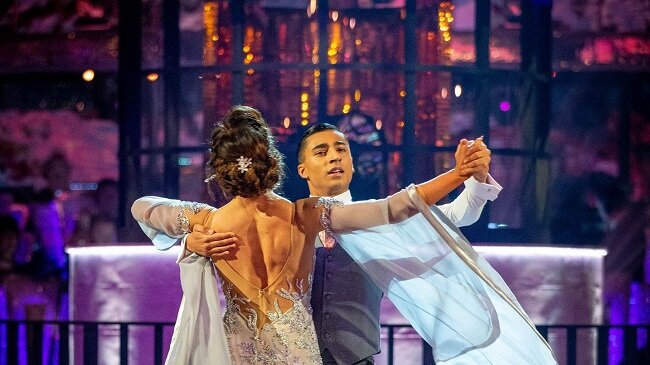
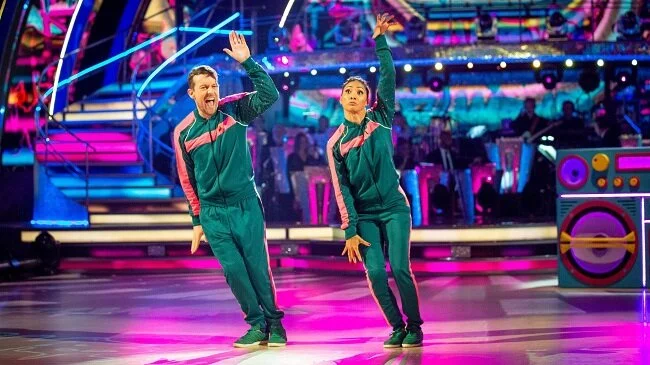
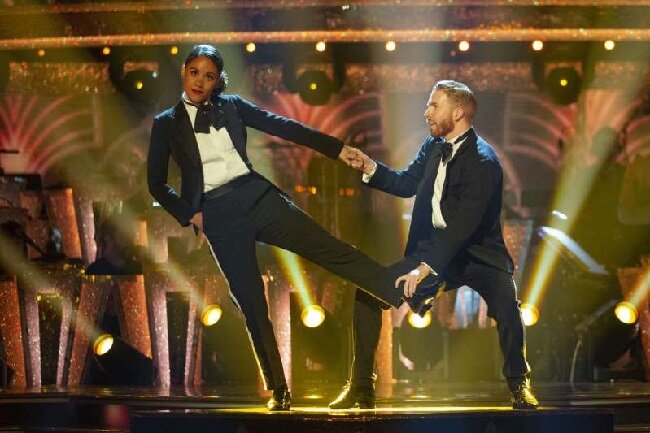
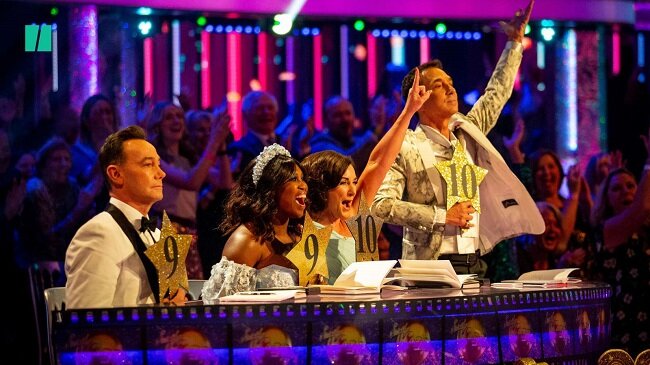
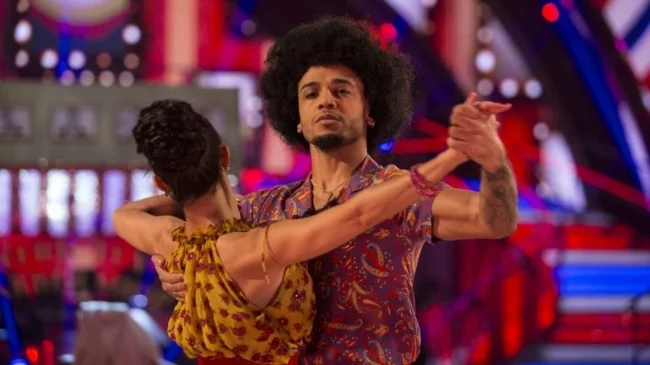
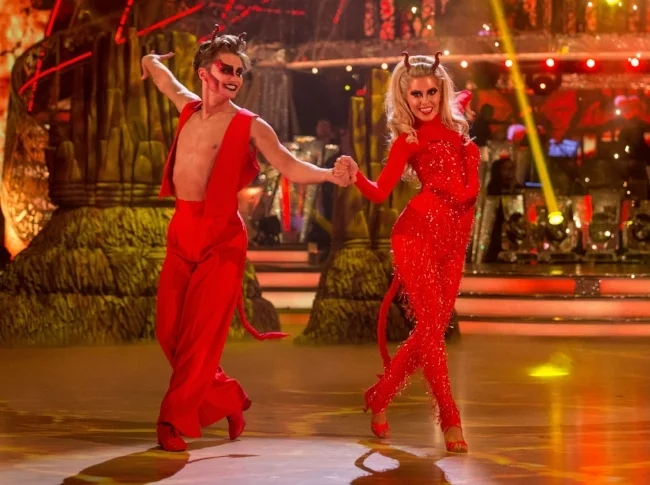
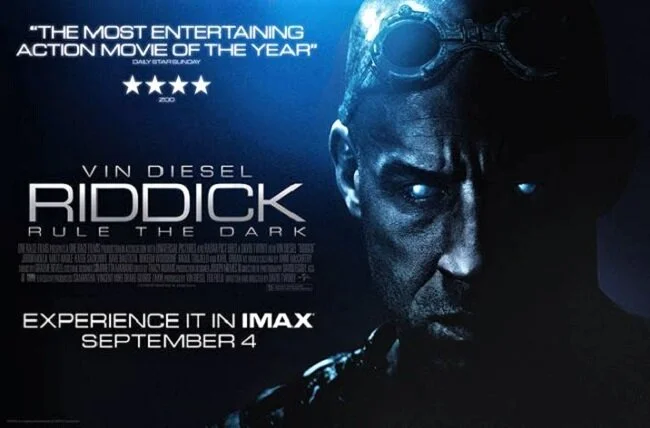
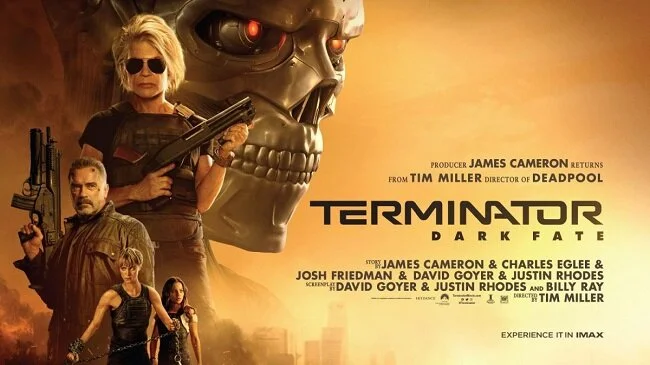
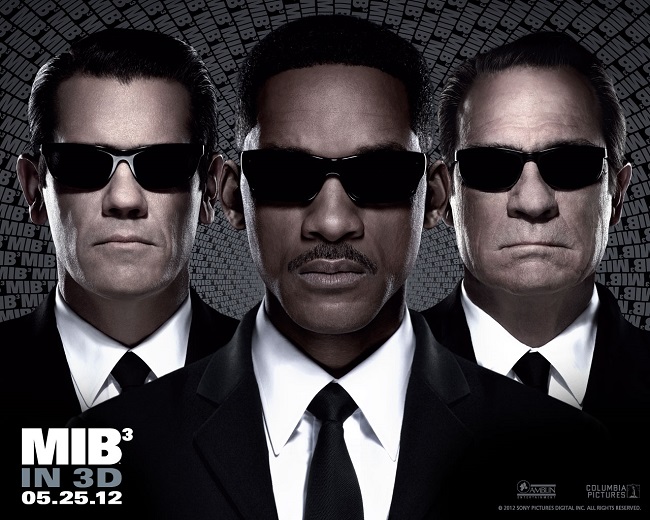
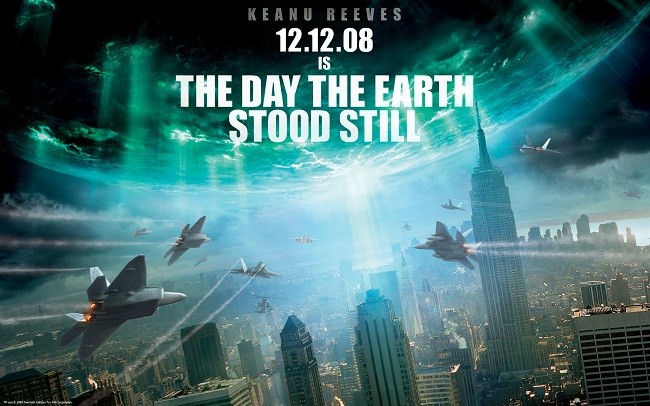
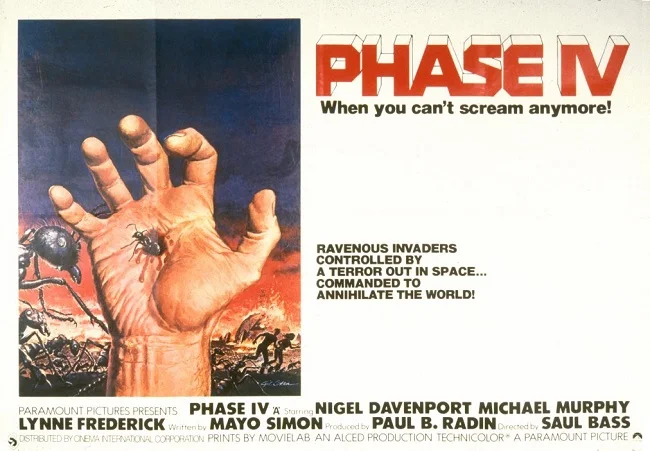
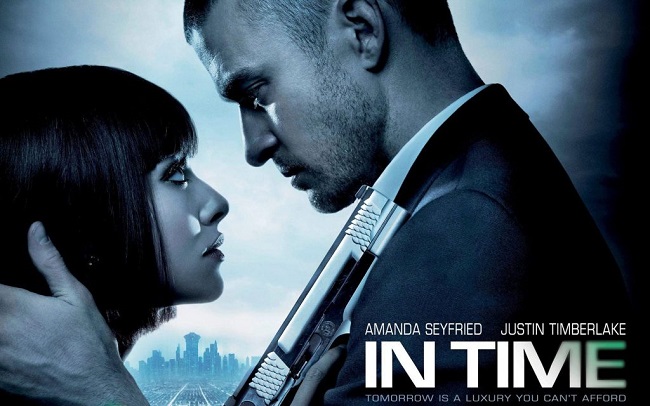
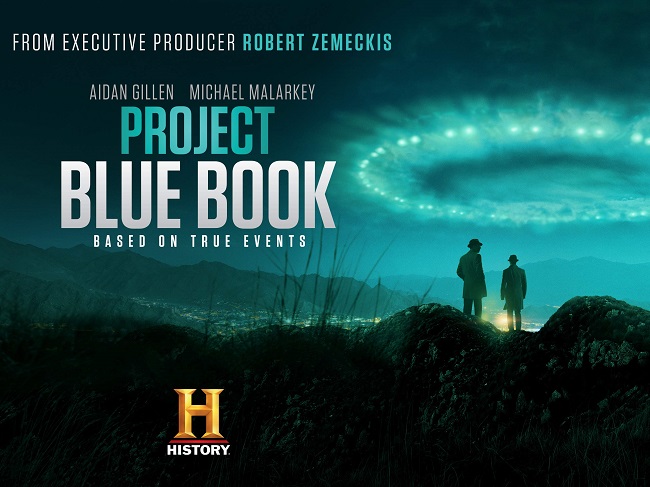
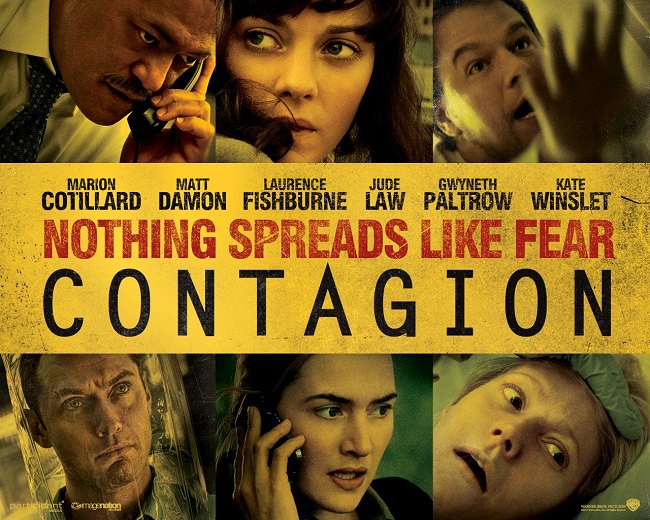
With each successive season of Strictly Come Dancing there appears to be more and more celebrity participants who seem to be “good”, right from the get-go. For many years now there have been ongoing debates about whether those from certain backgrounds, IE music, acting and possibly even sport, have an advantage over the usual chefs, astrologers and ageing minor celebrities. Although I can see the initial sense of such arguments, I don’t think they hold up to close scrutiny. Having performed a few arbitrary dance moves whilst touring or having done a stilted routine for a TV drama or play is not the same as the rigour and scrutiny that comes with Strictly Come Dancing. However, setting aside this perennial question, despite only being three weeks into series sixteen, we saw some extremely strong movie themed performances last night and the potential emergence of several dark horses. Subsequently tonight’s results were interesting.
With each successive season of Strictly Come Dancing there appears to be more and more celebrity participants who seem to be “good”, right from the get-go. For many years now there have been ongoing debates about whether those from certain backgrounds, IE music, acting and possibly even sport, have an advantage over the usual chefs, astrologers and ageing minor celebrities. Although I can see the initial sense of such arguments, I don’t think they hold up to close scrutiny. Having performed a few arbitrary dance moves whilst touring or having done a stilted routine for a TV drama or play is not the same as the rigour and scrutiny that comes with Strictly Come Dancing. However, setting aside this perennial question, despite only being three weeks into series sixteen, we saw some extremely strong movie themed performances last night and the potential emergence of several dark horses. Subsequently tonight’s results were interesting.
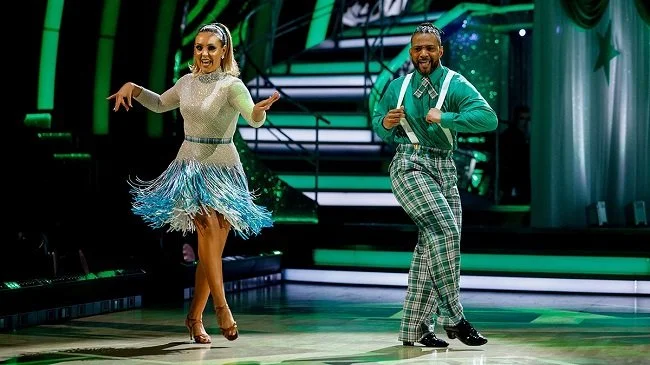
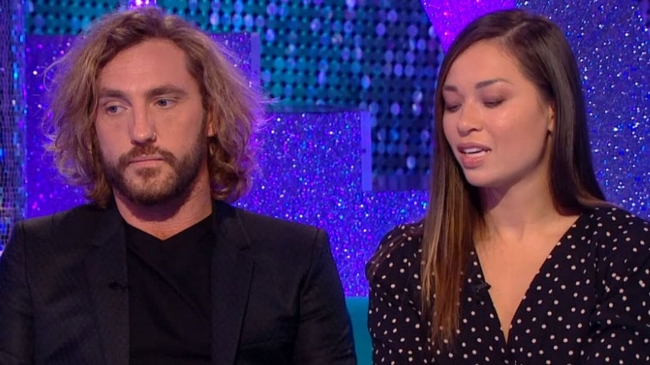
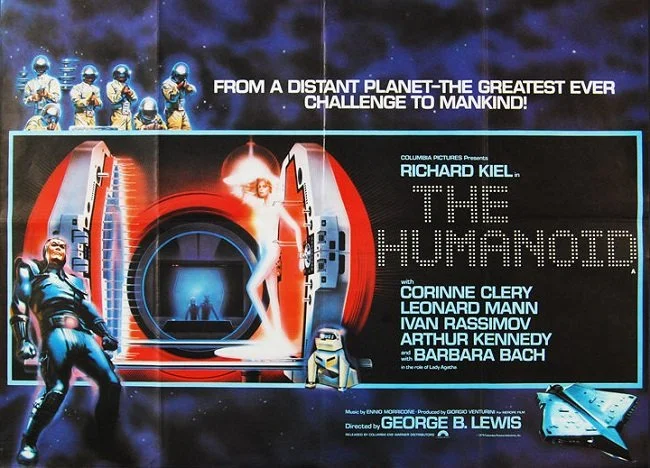
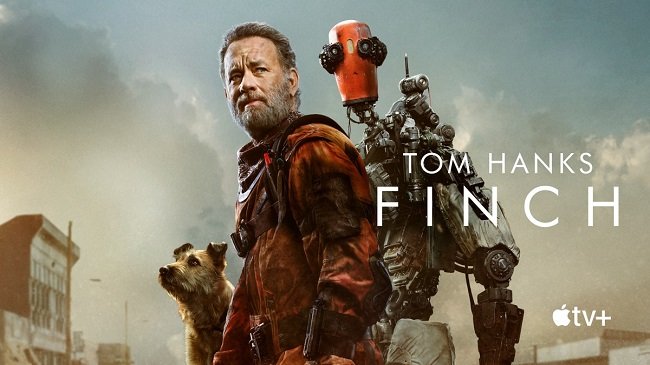
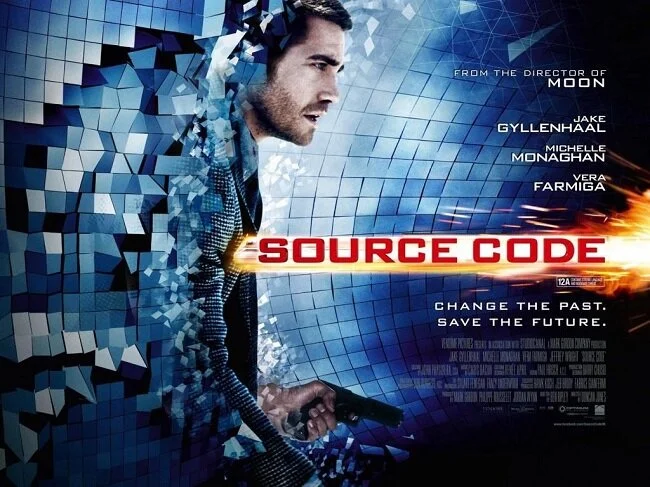
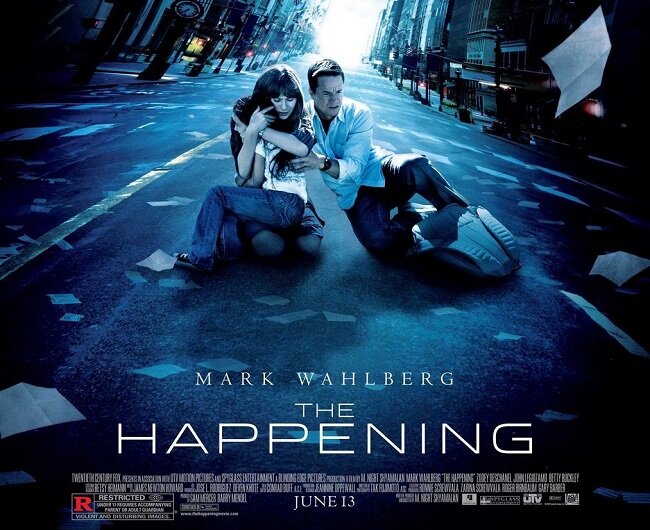
As many expected, the top of the leaderboard was occupied by Faye and Giovanni, along with Ashley and Pasha. Both couples delivered, innovative, polished and spirited performances with their respective Quick Step and Salsa. However, Vick Hope struggled with aspects of her Salsa and similarly Joe Sugg did not deliver a strong American smooth. Although commendable performances, the technical deficiencies were reflected in their scores, which was surprising considering both have been already identified as potential finalists. Conversely, several other couples who as of last week appeared to still be in the early stages of their Strictly Come Dancing journey, came out fighting with robust performances. Graeme and Oti’s Spider-man themed Charleston was both entertaining and delivered with style. Stacey and Kevin’s jive was also a major crowd pleaser. And just as pundits and online commentators were beginning to write off comedian Seann Walsh, he came back with an intense Paso Doble, cunningly choreographed by Katya Jones.
The net result of this was that a lot of couples that the public expected to do well were pushed further down the leaderboard and found themselves in danger of getting their marching orders. I was surprised to see both Lauren and Dr. Ranj so near the bottom. And as ever with Strictly Come Dancing, there is the public vote to consider which varies from being at times utterly predictable and at others a real wild card. Hence, I was not expecting to find Charles Venn in the dance off this evening. Despite his penchant to referring to himself in the third person I think he so far shown potential as a dancer and certainly has the performance as well as charisma parts covered. As for Lee Ryan, he’s had two problematic dances in a row. Yes, there has certainly been some technical issues, but he cannot be accused of not trying. But again, it comes down to the whether or not he has a fan base or not and it would appear that he has not. I am not aware of any major transgression he may have made in his personal life that may have upset the public but then again, I’m not of an age or mindset to be interested in the murky world of tabloid celebrity tittle-tattle.
So, as Mr Ryan leaves the show, I’m left thinking that we may have further upsets in the weeks to come. I suspect that Katie Piper may out stay her welcome by being championed by the public as this year’s underdog. She’s a lovely lady but I think her lack of confidence is here to stay. I also think Dr Ranj may also plateau quite quickly. Enthusiasm can only carry you so far if the ability doesn’t improve. Then there is the issue of specific professional dancers who sometimes make poor choices when it comes to creating routines. Too much content, trying too hard, and breaking rules with regards to lifts are common pitfalls. Such mistakes always antagonise me as they are not the celebrity partners fault, but they suffer. I suspect that AJ Pritchard will once again go down this road, instead of letting his partner find her confidence. But all of these aspects and considerations are part of the excitement and joy of the annual Strictly Come Dancing journey. Although the show has a formula, it’s nice to have these unpredictable elements from time to time. Roll on next Saturday.





Spock
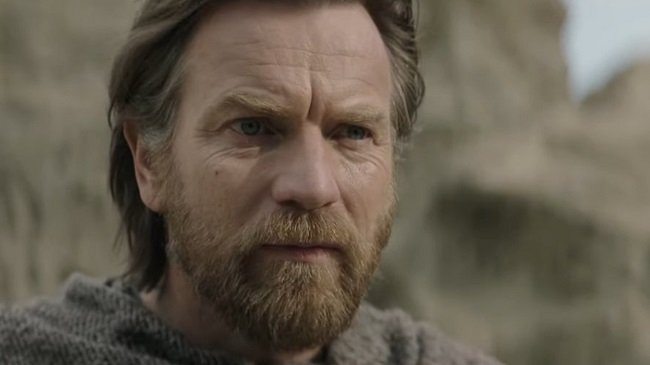
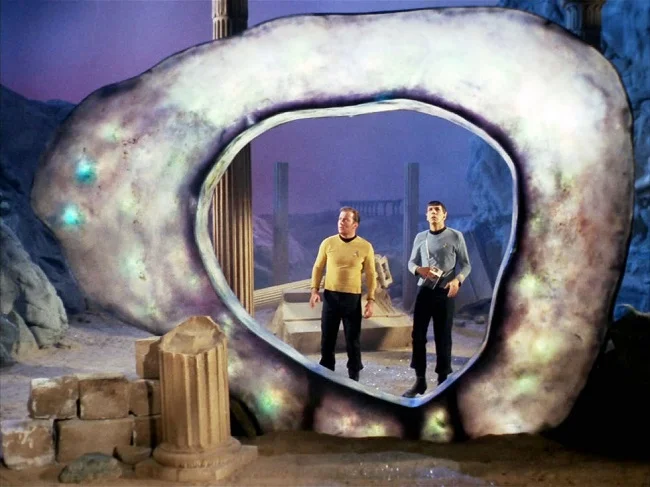
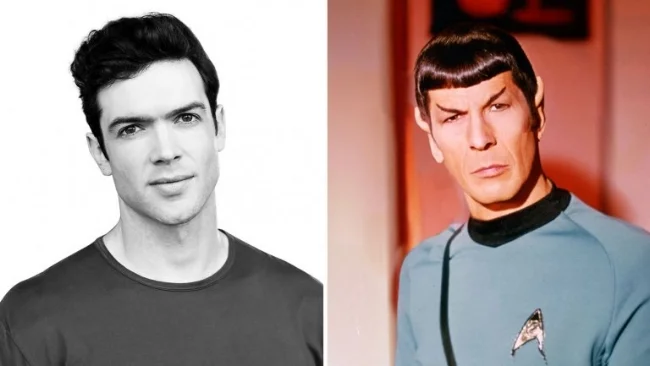
I’ve written in the past about the problems that can arise from untempered fandom. If enthusiasm and inspired love are not balanced by contextual reason and a healthy dose of reality, then it can get a little bit over zealous. Need I cite Star Wars fans and The Last Jedi as an example of unchecked fandom. However, I am now going to stray a little into the “Twilight Zone” of fandom myself, although I shall attempt to apply a healthy dose of realism into the proceedings. Because I want to discuss the fact that Ethan Peck has been cast to play one of the most iconic characters in popular culture. Yes, Gregory Peck’s grandson (and there’s plenty of “baggage” there) has been cast to play Spock in season two of Star Trek: Discovery. Furthermore, rather than be concerned, I am very excited by this development and I really look forward to seeing how this pans out.
I’ve written in the past about the problems that can arise from untempered fandom. If enthusiasm and inspired love are not balanced by contextual reason and a healthy dose of reality, then it can get a little bit over zealous. Need I cite Star Wars fans and The Last Jedi as an example of unchecked fandom. However, I am now going to stray a little into the “Twilight Zone” of fandom myself, although I shall attempt to apply a healthy dose of realism into the proceedings. Because I want to discuss the fact that Ethan Peck has been cast to play one of the most iconic characters in popular culture. Yes, Gregory Peck’s grandson (and there’s plenty of “baggage” there) has been cast to play Spock in season two of Star Trek: Discovery. Furthermore, rather than be concerned, I am very excited by this development and I really look forward to seeing how this pans out.
As a fan of not only Star Trek but wider popular culture, I believe that specific iconic characters are extremely pertinent and in their own way, beacons of hope and cultural touchstones for good in contemporary society. I personally believe that Spock as a fictious character is a positive force in the world, comparable to the likes of Sherlock Holmes. These characters are inspirational, provide hope and area source of introspection and self-reflection. The genius of Star Trek and other science fiction vehicles is that they provide alien characters and culture as a medium to examine the human condition. Leonard Nimoy struggled with this complex conundrum throughout his life, but he ultimately reconciled himself to the positive aspects of embracing such a multifaceted character as Spock, and saw him as a force for good. I sincerely hope that Ethan Peck has a similar opportunity, because we really need the wisdom and “humanity” of Spock in the wider world at the moment.
I like many others, was initially flummoxed by the aesthetic changes that came with Star Trek: Discovery. However, after a while I adjusted to this shift and focused upon the narrative of the new show and soon found that it embraced much of what I consider to be the core values of classic TOS. Considering the timeline and the specific lore that this new show has chosen to explore, ignoring Spock Prime is not really an option and I had a gut feeling that the character would have to be brought into the narrative at some point. It’s a bold move considering the esteem in which Spock is held by fans and the fact that only two other actors have ever played the character as an adult. I personally am not au fait with Ethan Peck’s previous work as an actor. However, I am prepared to continence the fact that the showrunners of Star Trek: Discovery are not going to doing anything rash when it comes to casting such a key role in Star Trek lore.
So rather than wringing my hands and focusing on the negative, I am prepared as a Star Trek fan to take a calculated gamble and remain positive about not only the casting of Ethan Peck, but the fact that the current writers wish to explore this legendary character further. So, I shall be looking forward to season two of Star Trek: Discovery when it premieres at the end of the year. I’m sure that the exploration of Spock’s career, prior to him meeting James T. Kirk will be insightful and informative. I believe that the essential character of Spock still has much to teach us and that this significant period of his life, associated with Captain Christopher Pike will be an most illuminating. As for actor Ethan Peck, welcome to the Star Trek family and I hope that this iconic role that you’ve bravely accepted will be both challenging and rewarding.






![Star Trek Discovery S01E01 The Vulcan Hello.mkv_snapshot_07.19_[2017.09.25_17.54.13].jpg](https://images.squarespace-cdn.com/content/v1/54e310f0e4b0f4a6ba3ac899/1506359625650-D976K1OBW47HSSSFN2S2/Star+Trek+Discovery+S01E01+The+Vulcan+Hello.mkv_snapshot_07.19_%5B2017.09.25_17.54.13%5D.jpg)



Classic TV Themes: Joe 90
You can write pages on Gerry Anderson's 1968 Supermarionation series Joe 90. There's the morally ambiguous premise of giving an emotionally immature nine-year-old the experiences of an adult. Then the psychological effects of allowing him to kill at will. Then there's the perennial issue of scientists prostituting their skills to the intelligence community. One can also reflect upon the absence of any major female characters in the series and how that may impact upon Joe himself. Finally, when one finally arrives she's a gold-digging bitch who tries to exploit Joe’s Dad, Professor McClaine. Joe 90 is certainly a psychiatrist’s dream subject.
You can write pages on Gerry Anderson's 1968 Supermarionation series Joe 90. There's the morally ambiguous premise of giving an emotionally immature nine-year-old the experiences of an adult. Then the psychological effects of allowing him to kill at will. Then there's the perennial issue of scientists prostituting their skills to the intelligence community. One can also reflect upon the absence of any major female characters in the series and how that may impact upon Joe himself. Finally, when one finally arrives she's a gold-digging bitch who tries to exploit Joe's Dad, Professor McClaine. Joe 90 is certainly a psychiatrist’s dream subject.
However, we won't dignify such pseudo-intellectual analysis here. Joe 90 simply has to be taken in context and viewed on its simple premise that every nine-year-old boy (at the time) wanted to be James Bond. If we apply modern sensibilities to everything made prior to 2000, then we’ll end up writing off everything. However, the most important aspect of Joe 90, that made the show so good was the get down funky theme tune, written by the immensely talented composer Barry Gray. Gerry Anderson wrote in his biography that the Joe 90 theme was a "dizzying piece of psychedelic pop art that could have been produced only in the late Sixties". A statement I whole heartedly concur with.
Curiously, when the series was syndicated internationally, changes were sometimes made. This was most noticeable for the Japanese release, where the catchy original title theme was completely replaced with a language specific song for that market. Now Japanese theme songs and pop music from the sixties is an entire sub-genre of its own, and I will not attempt explore this particular niche here. I will simply present you with both versions of the theme for your edification and entertainment. Feel free to comment.
1.) This is the original TV theme tune and not the commercial re-recording that was subsequently released as a single. This version includes the sound effects for the "BIG RAT" computer that gave Joe his special abilities.
2.) This is the Japanese theme song. If anyone can translate the lyrics, I would be very interested. It's not exactly Barry Gray, but it's kind of groovy in its own right.









M R James: Ghost Writer (2013)
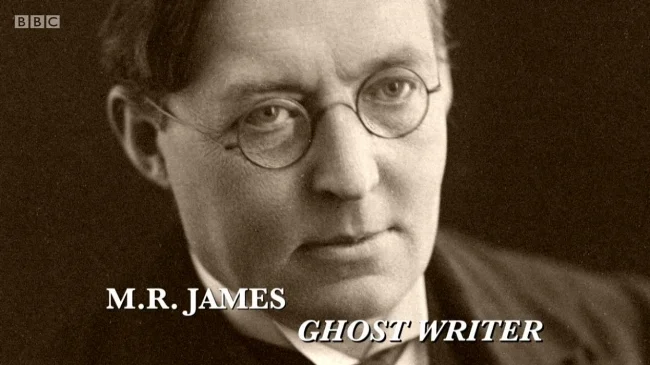
MR James: Ghost Writer is a sixty-minute documentary written and presented by Mark Gatiss, exploring the life of Britain's foremost ghost story writer. Gatiss, a long-time admirer of James, delves in to the life of the author from his devout Anglican upbringing and close-knit family life, through to his ascent to the summit of academia at King's college, Cambridge. The program seeks to discover what motivated this scholarly bachelor to create some of the most iconic and chilling ghost stories in English literature. By following in James’s footsteps, the documentary attempts to gain a greater insight in to the enigmatic author.
MR James: Ghost Writer is a sixty-minute documentary written and presented by Mark Gatiss, exploring the life of Britain's foremost ghost story writer. Gatiss, a long-time admirer of James, delves in to the life of the author from his devout Anglican upbringing and close-knit family life, through to his ascent to the summit of academia at King's college, Cambridge. The program seeks to discover what motivated this scholarly bachelor to create some of the most iconic and chilling ghost stories in English literature. By following in James’s footsteps, the documentary attempts to gain a greater insight in to the enigmatic author.
MR James: Ghost Writer explores in some depth the legacy of Mr James, emphasising his early life in Suffolk and the religious nature of his family. His academic prowess and near obsession with Medieval text and apocrypha clearly had an impact upon his writing, with much of the visual imagery from his writings being directly lifted from manuscripts he worked with on a daily basis. Only being familiar with James's work from a literary standing, I was greatly surprised by the great academic achievements of his life. His written treatise on illuminated Apocalypse manuscripts still remains an unparalleled achievement along with his rise to the office of provost and directorship of the Fitzwilliam Museum.
Despite the dry and formal nature of Victorian life, James was a surprising gregarious animal, taking an active part in college social life. Although he certainly reflected facets of the antiquarian characters that so often populated his stories, he was also a man of immense passion. His personal friendships were deep and of great importance to him, as correspondence with his inner circle demonstrate. His relationship with ex-pupil and illustrator James McBryde, succinctly demonstrates a profound platonic friendship of a type seldom seen these days. The documentary also addressed the impact of the "Great war" upon both James and the college and the subsequent way it influenced his later writing.
Perhaps the best aspect of Mark Gatiss's exploration of all things Jamesian, is the honest and fair way the subject of his "personal life" is explored. There is a trend in contemporary analysis to sometimes over zealously look for evidence modern schools of thought in those from prior eras. Several revisionist scholars seem to seize upon "examples" of a sexual subtext in the author's work and are then are happy to extrapolate this in to theories of suppressed homosexuality. Mr. Gatiss does not shy away from such notions but neither does he make any definitive conclusions. His interview with a former pupil of James whose father was also a close personal friend, perhaps sheds the most light upon the matter.
The visual and editing style of MR James: Ghost Writer is very compelling and follows a broadly linear narrative path, with many a tangential aside to explore illustrative points. Being a BBC commission project there a lot of use of footage from previous television adaptations in referencing James's literary work. The documentary effectively makes use of actor Robert Lloyd Parry, who recreates James celebrated readings of his stories at Christmas, to his fellow members of the " Chit Chat Club". Parry specialises in one-man performances of the work of M R James and provides some excellent readings from such stories as Canon Alberic's Scrapbook and A warning to the Curious.
Although it is an impossible task to definitively encapsulate a writer such as M R James in a single sixty-minute documentary, MR James: Ghost Writer certainly provides an interesting overview. Mark Gatiss has an obvious passion for the man and clearly identifies with him on many levels. However, this is far from an unobjective eulogy and depicts James as a man of his time with not particularly progressive attitudes on sexual equality or modernisation. I therefore whole heartedly recommend MR James: Ghost Writer not only established M R James fans but to wider scholars of the ghost stories who wish to learn more about one of the genres finest authors.







The Twilight Zone (1959-64)
Despite the wealth of new television shows that are currently available, a few month ago I chose to revisit The Twilight Zone. In the past I have watched occasional iconic episodes during late night re-runs, but I have never really applied myself to the show. Up to now, I have mainly been familiar with this iconic show through the books that I’ve read. So, in March I started watching season one and was immediately hooked. Contemporary TV shows are often frenetic, densely plotted and at times over long. The Twilight Zone frequently manages to make it’s point in just twenty-five minutes, with strong performances and intelligent dialogue. Yes, there are aspects of the show that are dated. The production values are sometimes constrained by the budget and the special effects are not always that special. The shows gender politics are very much of the time. But all five seasons feature a cavalcade of fine actors, some already established at the time and others who would go onto greater things. Many of the episodes have bespoke scores written by the likes of Bernard Herrmann and Jerry Goldsmith. But at its core The Twilight Zone stands out because of the superb writing of its creator Rod Serling.
Despite the wealth of new television shows that are currently available, a few month ago I chose to revisit The Twilight Zone. In the past I have watched occasional iconic episodes during late night re-runs, but I have never really applied myself to the show. Up to now, I have mainly been familiar with this iconic show through the books that I’ve read. So, in March I started watching season one and was immediately hooked. Contemporary TV shows are often frenetic, densely plotted and at times over long. The Twilight Zone frequently manages to make it’s point in just twenty-five minutes, with strong performances and intelligent dialogue. Yes, there are aspects of the show that are dated. The production values are sometimes constrained by the budget and the special effects are not always that special. The shows gender politics are very much of the time. But all five seasons feature a cavalcade of fine actors, some already established at the time and others who would go onto greater things. Many of the episodes have bespoke scores written by the likes of Bernard Herrmann and Jerry Goldsmith. But at its core The Twilight Zone stands out because of the superb writing of its creator Rod Serling.
The Twilight Zone frequently uses the medium of tales of suspense, science fiction and the paranormal to explore perennial themes of prejudice, love, war, and the social issues of US society at the time. Sometimes the stories are stark, hard hitting and challenging. Other times they can be whimsical, subtle or paternal in tone. The show's signature twist endings often made the stories all the more memorable. Many of the tropes and common place plot devices that we now take for granted or even satirise, hail from Serling’s trail blazing show. This was ground breaking television at the time. Aside from Serling, who wrote or adapted over half of the total episodes, The Twilight Zone features the work of such authors as Charles Beaumont, Ray Bradbury, Earl Hamner, Jr., George Clayton Johnson, Richard Matheson, Reginald Rose, and Jerry Sohl. Many episodes also featured contemporary adaptations of classic stories by such writers as Ambrose Bierce, Jerome Bixby, Damon Knight, John Collier, and Lewis Padgett.
Over the course of five seasons these writers frequently used the medium of science fiction and broader fantasy as a means for social commentary. This proved quite beneficial as the otherwise censorial network executives and more importantly sponsors often failed to see the “message” in such fantastic material. Hence, The Twilight Zone includes stories about nuclear war, McCarthyism, and mass hysteria. Such material if referenced in a more traditional dramatic fashion would more than likely have been watered down or simply rejected. Key episodes such as "The Monsters Are Due on Maple Street" and "I Am the Night—Color Me Black" offered direct commentary on prevailing social issues and were not afraid to contradict the establishment status quo. Other stories, such as "The Masks", "I Dream of Genie", or "Mr. Denton on Doomsday" were allegorical in nature and pondered moral and philosophical conundrums through modern day fables. The spectre of World War II still looms large in many episodes, with cautionary tales about the need to remain ever vigilant against extremism and fascism. One episode “He’s Alive” has become worryingly relevant again.
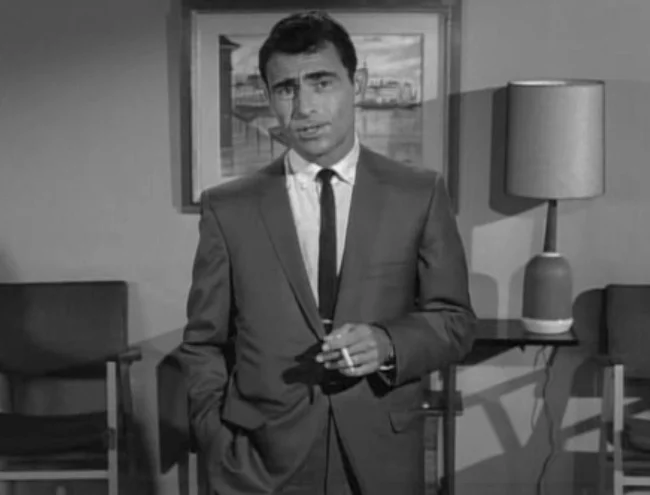
Despite running for five seasons, The Twilight Zone was not an easy sell and an immediate runaway success. The ratings were good but there was still a great deal of critical prejudice against the show, simply because science fiction was a marginalised genre. Many critics as well as studio executives did not feel the medium could offer any narrative depth beyond escapism and certainly did not see it as a means of providing adult drama. The conceit of Serling's appearances on the show to introduce each story, eventually became one of its most original and distinct features. But at the time some saw this an indulgence or a distraction. It was not Serling’s idea to do this initially and he was quite reticent take up this role in front of the cameras. Yet his concise, direct delivery and distillation of the impending plot has become iconic and is still widely imitated today. Serling’s narrations and the breaking of the “fourth wall” were an innovative device and he appeared on all episodes. However, in the episode "A World of His Own", Keenan Wynn plays a writer with the power to alter his reality. He overhears and objects to Serling's narration, promptly removing him from the proceedings.
To date, I have watched the first two seasons of The Twilight Zone and am currently halfway through the third. Season one and two I’ve watched on DVD and the shows are in their syndicated format. That is to say, they do not include the sponsorship messages given by Rod Serling at the end of each episode, along with his preview of the next instalment. However, the Blu-ray boxset of the entire series (via which I’m currently viewing season three) includes the commercial break title card midway through each show, along with the aforementioned sponsorship messages and preview preamble. There are occasionally additional advertisements for charities and such like after the end credits, along with trailers for Gunsmoke with James Arness. The Blu-ray release has been lovingly restored from the original 35mm negatives and look crisp and clear. Many of the episodes that are deemed “classic” have multiple commentary tracks by cast members, writers and film historians. This release is certainly the best way to watch The Twilight Zone.
It’s hard to write anything about The Twilight Zone without referencing certain episodes. But as this has been done many times before, by far more keen-sighted critics and writers, I will simply mention those that I’ve personally enjoyed. "The Invaders" written by Richard Matheson is a tense tale of a woman living in a remote cabin, terrorised by tiny alien invaders. As ever there’s a clever sting in the tail. "It's a Good Life" stars Billy Mumy as a child devoid of a moral compass, who has the ability to will anything into or out of existence. He subsequently holds sway over a rural farming community. Interestingly, this was the episode that Joe Dante chose to remake for Twilight Zone: The Movie in 1983. "The Monsters Are Due on Maple Street" intelligently documents how a suburban community quickly turns on itself during what appears to be an alien invasion. Claude Akins give a credible performance, but it is Rod Serling’s script that is the real star in this story. I also have a soft spot for the bitter sweet "Time Enough at Last", starring the great Burgess Meredith as a hen-pecked husband who just wants to be left alone to read. The final pay-off still has the power both to raise a wry smile and a pang of sadness. I’d also recommend "Long-Distance Call" about a child who speaks to their dead Grandma on a toy telephone. You can also see a young Richard Kiel as the alien Kanamit ambassador in "To Serve Man". After sharing their technology, along with curing disease and famine, human flock to join an exchange program and visit the Kanamit homeworld. But there’s a dark secret contained within a book left my the Kanamit ambassador. The ending is the stuff on TV legends.
The Twilight Zone had an unprecedented influence on movies, television and pop culture in the years after its original broadcast. Many of it’s twist endings, iconic lines of dialogue and premises have become internet memes and are lovingly referenced in other shows. The theme tune, by Marius Constant, has itself has entered common parlance and become a signifier of the weird, odd and baroque. Just hum the first few bars of the intro music and most people with quickly guess that something off kilter has occurred. Such is the standing of Rod Serling’s show. So, if you enjoy portmanteau movies or dark TV show such as Black Mirror, then why not checkout the series that started it all. You’ll frequently find a wealth of great character actors, such as Lee Marvin, Lee Van Cleef, Vera Miles, Cloris Leachman, Dennis Hopper, Carol Burnett and Robert Duvall. And at twenty-five minutes an episode (apart from season four when they decided to double the length) these make ideal late-night viewing, often providing a bizarre or curious tale to ponder before sleep. Assuming that you’ll get any after some episodes.








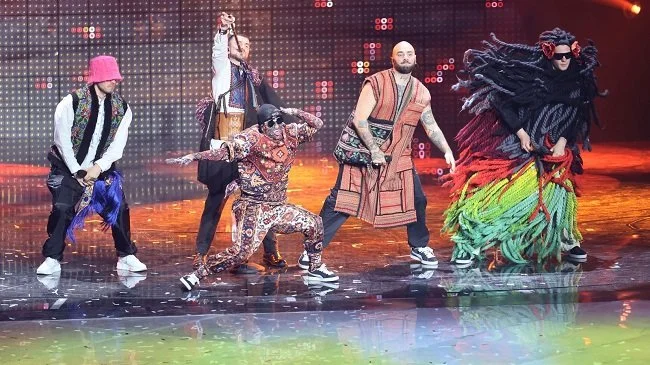
Eurovision 2018
I have watched the Eurovision Song Contest regularly throughout my life. As a very young child I enjoyed it purely as an opportunity to stay up late. In my teens I loathed it as it appeared to be the antithesis of my own musical tastes at the time. So I watched it purely to mock and deride. It is only in recent years that I have learned to love it for what it is and have finally understood its purpose. Sadly, the UK has a somewhat skewed outlook on many things, due to it’s history and island mentality. We’re often too blinded by our national achievements as well as burdened with a sense of pride and “self-importance by proxy”. As a nation our accomplishments our prodigious, so subsequently we have a tendency to over think matters. With regard to Eurovision we seem to focus on a “killer song”, rather than embrace the spirit of the competition. And that spirit is camp, kitsch and frivolous. Eurovision is theatrical. It’s about tapping into your countries heritage and expressing it as a light hearted, theatrical vocal meme.
I have watched the Eurovision Song Contest regularly throughout my life. As a very young child I enjoyed it purely as an opportunity to stay up late. In my teens I loathed it as it appeared to be the antithesis of my own musical tastes at the time. So I watched it purely to mock and deride. It is only in recent years that I have learned to love it for what it is and have finally understood its purpose. Sadly, the UK has a somewhat skewed outlook on many things, due to it’s history and island mentality. We’re often too blinded by our national achievements as well as burdened with a sense of pride and “self-importance by proxy”. As a nation our accomplishments our prodigious, so subsequently we have a tendency to over think matters. With regard to Eurovision we seem to focus on a “killer song”, rather than embrace the spirit of the competition. And that spirit is camp, kitsch and frivolous. Eurovision is theatrical. It’s about tapping into your countries heritage and expressing it as a light hearted, theatrical vocal meme.
Last night, I watched Eurovision 2018 while chatting with friends on Discord. Last year I had an equally good time doing similar but via Twitter. Eurovision is so much better if treated as a fun communal experience. It is not a song contest in the traditional sense, in so far that it is not the most technically excellent, or most intelligently written composition that wins. It’s about delighting the audience with a flamboyant performance and an insanely catchy hook. That is why Netta won and SuRie didn’t. The former gave a suitably over the top and colourful performance of a song that had a refrain not to dissimilar to Seven Nation Army. A perfect “earworm”. It simply wasn’t something you were going to forget. The latter, however, was hindered by a far more formal pop song written by people that seemed to be oblivious to the core tenets of Eurovision. Although I admire SuRie for continuing her performance despite the stage invasion, song wise it was very much a case of “bringing a knife to a gunfight”. Frankly my favourite songs from this year’s show were the silliest and most ostentatious, like Moldova’s entry. Oh, and as an aside, Moldova were robbed in 2017.
In recent years Eurovision has transcended its traditional geographical boundaries and started finding a truly international audience. It’s nice to see American colleague’s reaction to the unique nature of the show. The contest has become sufficiently well known globally, that 20th Century Fox have decided to make it one of the many subjects of the Deadpool 2 marketing campaign. Frankly, if Canada wants to participate I won’t object, but it’s not down to me. On a less cordial note, due to Brexit, knee jerk nationalism and misplaced anti-European sentiment, there are many in the UK who are naturally hostile toward Eurovision by default. Such individuals even manage to leech the enjoyment out of this glorious international pantomime by muddying the waters with their petulant politics of hatred. However, the best solution to such “rage” is simply to mute the appropriate twitter feeds, ignore the tabloid press and focus on the business in-hand, namely having fun. So, I will no doubt find myself back again in twelve months’ time, marvelling on social media with like minded friends at the delicious awfulness that is Eurovision. I may even put a tenner on Moldova in advance.




Classic TV Themes: Hawaii Five-O
I grew up during the seventies when network TV shows still put a lot of thought and effort into such things as their theme tune. It was a decade littered with memorable tracks that captured the essence of the shows they came from. Many have now become integral aspects of popular culture, leading to countless internet memes as well as becoming the ringtones of choice for many a fortysomething. However, things are very different now. You can have a staggeringly good theme for your show, but it can't possibly be longer than thirty seconds. And don’t think for a moment that viewers can listen to it again at the end, as it has now become standard practice to compress the credits into a third of the TV screen and preview what's coming next, while some link announcer spouts inanities. Mercifully, cable and streaming companies tend to treat their TV shows with greater respect. The lack of commercial advertising ensures a longer program duration and hence more focus on a theme tune. However, network TV still commands big audiences, yet hasn’t in recent years produced any TV show themes of note.
I grew up during the seventies when network TV shows still put a lot of thought and effort into such things as their theme tune. It was a decade littered with memorable tracks that captured the essence of the shows they came from. Many have now become integral aspects of popular culture, leading to countless internet memes as well as becoming the ringtones of choice for many a fortysomething. However, things are very different now. You can have a staggeringly good theme for your show, but it can't possibly be longer than thirty seconds. And don’t think for a moment that viewers can listen to it again at the end, as it has now become standard practice to compress the credits into a third of the TV screen and preview what's coming next, while some link announcer spouts inanities. Mercifully, cable and streaming companies tend to treat their TV shows with greater respect. The lack of commercial advertising ensures a longer program duration and hence more focus on a theme tune. However, network TV still commands big audiences, yet hasn’t in recent years produced any TV show themes of note.
For me the track that embodies the traditional notion of the TV theme tune and elevates it to an art form, is Morton Steven's Hawaii Five-O theme. I cannot think of a piece of music, born of a TV show that is quite as evocative and inspirational. For years there has not been an original recording available so fans and enthusiasts have had to slum it with indifferent cover versions (which I hate). However, in 2012 the only legitimate soundtrack album was finally re-released on CD. It contains a studio extended version of the main theme along with incidental music from one the episode Operation Smash. It is a crisp and tight arrangement of the theme and superior to all previous version in circulation.
In 2010 the show was rebooted and has proven to be surprisingly popular. It is currently in its 8th season. However, at the time the question on everyone’s lips was would the main theme be retained, or would it be jettisoned for something else? Luckily common sense prevailed so the classic iconic theme and title credits were cleverly recreated. But the process was not exactly problem free. Brian Tyler, a composer with a respectable pedigree in film and TV, was brought on-board to manage the soundtrack production. He initially toyed with idea of re-arranging Stevens seminal theme tune. Let it suffice to say that test audiences did not warm to it and after some overtly negative feedback the it was replaced with a more traditional arrangement. This recording even included some of the session musicians that worked on the original track in 1968. Sadly, the demands of modern TV broadcasting still had an impact on the completed piece of music. Modern title sequences on popular network shows are now no more than thirty second and so the theme was shortened to meet this requirement. However, the full version can be found on the official soundtrack album to season one and is version posted below along with the original from 1968.
Strictly Come Dancing 2017: Part 8
In recent week’s Joe McFadden has been widely tipped to win Strictly Come Dancing 2017, having crept up the leader board with a series technically polished and spirited performances. Labelled by head judge Shirley Ballas as a “dark horse” he has quickly become a thoroughbred in the eyes of most bookies’ to become this evenings favourite to win. Joes has proven not only to be a consistently good performer but a popular one too, as he was the only one of tonight’s finalist never to have been in the bottom two. He has in many ways been a classic example of the celebrity that embarks upon the “Strictly journey” and this evening, all the hard work paid off as he lifted the glitterball trophy for this years show. Let us not forget that this is also Katya Jones night as well. She has choreographed some incredible artistic and intelligent routines this season and has clearly understood what works best for her partner.
In recent week’s Joe McFadden has been widely tipped to win Strictly Come Dancing 2017, having crept up the leader board with a series technically polished and spirited performances. Labelled by head judge Shirley Ballas as a “dark horse” he has quickly become a thoroughbred in the eyes of most bookies’ to become this evenings favourite to win. Joes has proven not only to be a consistently good performer but a popular one too, as he was the only one of tonight’s finalist never to have been in the bottom two. He has in many ways been a classic example of the celebrity that embarks upon the “Strictly journey” and this evening, all the hard work paid off as he lifted the glitterball trophy for this years show. Let us not forget that this is also Katya Jones night as well. She has choreographed some incredible artistic and intelligent routines this season and has clearly understood what works best for her partner.
All that remains now is for the tabloid press to pick over the bones of the last 13 weeks in tomorrow’s newspapers. I’m sure they’ll still manage to dredge up some alleged sexual improprieties or imply that certain contestants where sabotaged. I’m sure they’ll be claims of bias, vote tampering and racism, as per usual. It’s a shame that every year when this show arrives to entertain a somewhat drained and fatigued British public, quarters of the UK press blight it with their “journalistic” race to the bottom and need to sell newspapers. But berating a parasite for being parasitical is foolhardy. Let us therefore put aside this unseemly facet of Strictly culture and focus on the wealth of good cheers that can be found online regarding the show. Like myself, there are countless of thousands of fans who have been thoroughly entertained this year.
Which leads me neatly to my final points. It is not a cliché but a fact to say that each year, the standard of celebrity dancing improves significantly on Strictly. 2017 has once again raised the bar even higher and it does make you stop and pause when considering where we go from here? Will we ever see a season where the standard of contestant is considerably lower and exactly how would the public react to such a situation. Also, will the producers and showrunners tweak with the format again, as they have this year? The four-pair finale worked well but would get a little clumsier if expanded any further. And it would be remiss of me not to mention Head Judge Shirley Ballas. I have enjoyed her measured, fair and supportive input this year and hope she does return in 2018. She compliments the existing team perfectly and has dispelled the memories of Len Goodman and his pickling proclivities. So as this year’s Strictly Come Dancing ends, it just remains for me to say “rest” and “shake it all out”. Or if you prefer “keep dancing”.
Strictly Come Dancing 2017: Part 7
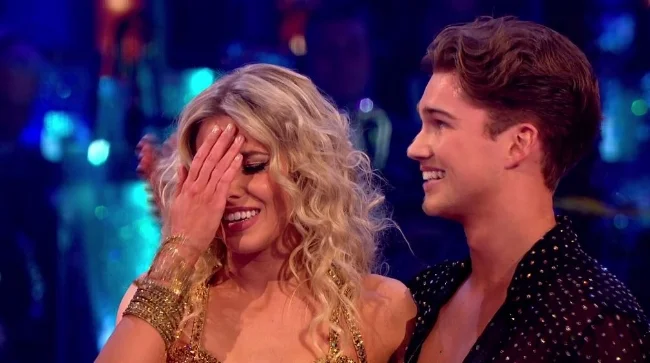
Singer Mollie King went into this week’s semi-final as the bookies' favourite to be voted off the show, and it has proven so. I appreciate that Mollie has been training hard and applied herself to the advice given to her by the judges. However, it would appear that she has plateaued with regard to her level of skill and performance several weeks agao. Sadly, nerves and the pressure of the night got the better of her on Saturday and her Samba was not well received. It was hesitant and lacked polish. She partially redeemed herself with an elegant waltz, although it is fair to say that she simply wasn’t in the same league as the other celebrity dancers. The judges seemed to be a little too generous with their marks for this dance, possibly to spare her any further distress because Mollie was visibly upset.
Singer Mollie King went into this week’s semi-final as the bookies' favourite to be voted off the show, and it has proven so. I appreciate that Mollie has been training hard and applied herself to the advice given to her by the judges. However, it would appear that she has plateaued with regard to her level of skill and performance several weeks agao. Sadly, nerves and the pressure of the night got the better of her on Saturday and her Samba was not well received. It was hesitant and lacked polish. She partially redeemed herself with an elegant waltz, although it is fair to say that she simply wasn’t in the same league as the other celebrity dancers. The judges seemed to be a little too generous with their marks for this dance, possibly to spare her any further distress because Mollie was visibly upset.
But this is the nature of Strictly Come Dancing. Although not a true dance competition, it still is a very demanding experience both physically and mentally. It also comes with a great deal of tabloid scrutiny. The rumours and gossip that stem from the show fuel a great deal of hyperbole and sensationalism in the popular press. Mollie’s alleged relationship with her professional dance partner AJ Pritchard has been a major “talking point” this year. Now this is not a problem as long as it remains external from the show. One can choose whether to read such tittle tattle or ignore it. Yet this year, the so-called “showmance” between the couple has bled through into the live show, being referenced by both hosts on several occasions. Was this done to try and gain leverage with the viewers and boost her support? If that was the case, it strikes me as being somewhat crass and arbitrary. A bit like playing the terminally ill grandparent card on The X Factor.
Either way, it’s a redundant point now as Mollie faced Gemma in the dance off and it became immediately clear that the judges would vote her off the show. Cue a tearful farewell and the standard claims that Mollie is an “amazing person” or some such other superlative. How that label has lost its value in recent decades. Now it’s just a case of preparing for next week’s final. Although I have a lot of time and respect for Debbie McGee and would be happy to see her win, I think Joe and Katya are in a strong position to take this year’s trophy. Katya has a knack for creative choreography that provides Joe with a character to explore and project. I have a suspicion that their show dance will be something spectacular and will win the hearts of viewers. Then again, I could be completely wrong. That is the nature of the show and the public vote.
Strictly Come Dancing 2017: Part 6
Strictly Come Dancing 2017 is proving to be quite the rollercoaster ride. Each week it seems that there is potential for an upset and Saturday night proved no different. The fact that Davood and Nadiya scored poorly with their Argentine Tango was quite a surprise. The relatively low spread of points put them squarely at the bottom of the leader board and made them prime candidates for the dance off. Personally, I thought this was a damn shame because Davood has significantly improved in recent weeks and has embraced the Strictly journey. However, it was a shock to see Alexandra and Gorka fighting to stay on the show once again. Sadly, the outcome of the dance off was a forgone conclusion. Alexandra was technically outstanding and gave a spirited performance. She had something to prove after last week's difficult Rhumba and I thought she came back with a vengeance. Sadly, the public thought otherwise. I’m sure being in the dance off yet again will be a disappointment for her. However, for the present she is safe.
Strictly Come Dancing 2017 is proving to be quite the rollercoaster ride. Each week it seems that there is potential for an upset and Saturday night proved no different. The fact that Davood and Nadiya scored poorly with their Argentine Tango was quite a surprise. The relatively low spread of points put them squarely at the bottom of the leader board and made them prime candidates for the dance off. Personally, I thought this was a damn shame because Davood has significantly improved in recent weeks and has embraced the Strictly journey. However, it was a shock to see Alexandra and Gorka fighting to stay on the show once again. Sadly, the outcome of the dance off was a forgone conclusion. Alexandra was technically outstanding and gave a spirited performance. She had something to prove after last week's difficult Rhumba and I thought she came back with a vengeance. Sadly, the public thought otherwise. I’m sure being in the dance off yet again will be a disappointment for her. However, for the present she is safe.
I'm of the opinion that despite being favoured by the judges and quarters of the press, Alexandra doesn't enjoy as big a fan base as some would surmise. The fact that she has been consistently good since week one may actually be working against her. Viewers like the narrative of progression and growing artistically. They want to champion a celebrity who blossoms and tire quickly of those who are good from the get go. It's a pattern we have seen before. There is also a school of thought that those at the top of the leader board will automatically attract votes, although this theory is often wrong. So, after considering the foibles of viewer voting and the precedents set by previous shows I think it is unlikely that Miss Burke will win Strictly Come Dancing 2017. I fully expect her to be a finalist but not lift the trophy. But winning is not necessarily everything. I would not be surprised to see her starring in a hit West End show a year from now.
Certainly, the dynamics of the remaining two episodes has now changed considerably. Davood’s departure is potentially good news for Debbie and Giovanni as well as Joe and Katya. Both of these pairs are now strong contenders to win. Voting by the public tends to increase in the final stages of the competition as people realise the importance of their vote. As for Mollie and A J, as well as Gemma and Alijaz, there future is somewhat less predictable. Mollie is steadily improving but still seems to lack a degree of stamina and more importantly confidence. Gemma has veered between exceptionally good performances and those that have been problematic. It is this inconsistency that presents a weakness. Can she put her own doubts behind her and produce a more polished performance? This is why It Takes Two is such essential viewing, during the week, as I believe it provides a good indication of how well the celebrities are taking to their new dances. It’s also a litmus test as to their state of mind, which is integral to their success.
Strictly Come Dancing 2017: Part 5
No one is safe. I’m sure it’s a thought that all remaining contestants on Strictly Come Dancing are currently thinking. Week 10 has been and gone and found front runner Alexandra Burke in the dance off against the delightful Susan Calman. Obviously, the moment this was announced, the outcome was a forgone conclusion. But it proves as I said last week that the spread of public votes may not be that wide and if a celebrity finds themselves in the middle of the linerboard then they are at serious risk. There can be no “bad weeks for the remaining contestants, from now on. Every dance now has to be undertaken with as much confidence and technical accuracy as possible. I suspect that unless Gemma raises her game and Mollie continues to improve they too may be potential dance off candidates next week. As for Alexandra, I would hazard a guess that she will focus very much on ironing out any technical issues and will return with a show stopping performance, next Saturday. The lady is extremely motivated and competitive.
No one is safe. I’m sure it’s a thought that all remaining contestants on Strictly Come Dancing are currently thinking. Week 10 has been and gone and found front runner Alexandra Burke in the dance off against the delightful Susan Calman. Obviously, the moment this was announced, the outcome was a forgone conclusion. But it proves as I said last week that the spread of public votes may not be that wide and if a celebrity finds themselves in the middle of the linerboard then they are at serious risk. There can be no “bad weeks for the remaining contestants, from now on. Every dance now has to be undertaken with as much confidence and technical accuracy as possible. I suspect that unless Gemma raises her game and Mollie continues to improve they too may be potential dance off candidates next week. As for Alexandra, I would hazard a guess that she will focus very much on ironing out any technical issues and will return with a show stopping performance, next Saturday. The lady is extremely motivated and competitive.
However, let us take a moment to reflect upon the departure of Susan Calman. Susan was one of the reasons I have returned to actively watching Strictly Come Dancing. Unlike other celebrities Susan has absolutely no prior dance experience and at first glance could have been labelled the “fun” contestant. Yet she has surprised us all, as well as herself, by her progression and improvement. Not only has she learnt how to dance but she has brought an unbridled joy to the show. In many respects she has embodied the essence of Strictly and represent all that is good and rewarding about the journey. Each year, the public will champion a celebrity that they perceive as an underdog and keep them in the show. Sometimes this is done for entertainment value and on occasions I believe this is done simply as pushback against the judge’s formal approach to marking performances. But I believe this year that Susan stayed on the show for so long simply because the public loved her and her genuine outlook. She will be missed.
Next Saturday is the Quarter Final of Strictly Come Dancing as well as being Musical Week. It presents the celebrities with an opportunity to really to sell themselves. Up and till now I’ve been voting intermittently, for those who have impressed me. But I haven’t consistently supported a specific couple. I believe from now that the voting will start to get very tribal and if you have a favourite celebrity, then your support will be essential for them. As I’ve said time and again over the years, Strictly Come Dancing is an entertainment show and the winner does not lift the trophy purely buy being technically the best. It often comes down to who the public thinks deserve to win, which puts a very different complexion on things. Both Joe and Davood are potential champions, whose good nature and self-improvement could prove a challenge to technically excellent front runner, Alexandra. Yet I still feel that Debbie McGee is a wild card and personally I would like to see her succeed and shatter the myth about Strictly always being the prerogative of the young. Roll on next Saturday.
Strictly Come Dancing 2017: Part 4
Blackpool always brings out the best in the celebrity dancers, due to its immense entertainment heritage and standing within the world of professional dancers. So, it wasn’t surprising to see some couples raise their game and make significant improvements with their routines. Gemma showed that she had listened to the judges’ comments and delivered a polished and elegant performance. She also appeared to have noticeably rediscovered her confidence. Mollie also delivered a far better routine which corrected many of the issues that have plagued her in previous weeks. I would argue that it was her best dance of the series. And once again, Susan poured her heart and soul into her time on the dance floor, delivering another spirited performance that found favour once again with the public, if not the judges.
Blackpool always brings out the best in the celebrity dancers, due to its immense entertainment heritage and standing within the world of professional dancers. So, it wasn’t surprising to see some couples raise their game and make significant improvements with their routines. Gemma showed that she had listened to the judges’ comments and delivered a polished and elegant performance. She also appeared to have noticeably rediscovered her confidence. Mollie also delivered a far better routine which corrected many of the issues that have plagued her in previous weeks. I would argue that it was her best dance of the series. And once again, Susan poured her heart and soul into her time on the dance floor, delivering another spirited performance that found favour once again with the public, if not the judges.
And once again there was an element of surprise when recent front runner Debbie McGee found herself in the dance off with people’s favourite Jonnie Peacock. However, I did feel that the outcome was somewhat arbitrary so didn’t feel that Debbie’s place on week ten’s show was under threat. But what this situation does demonstrate is the importance of public votes and that the potential distribution of them is possibly far closer than what people imagine. I suspect that although fans and supporters vote in large numbers there may not be anyone who has a demonstrable lead. I also suspect that some members of the public vote for multiple celebrities, having a clear favourite yet also acknowledging those who have done well and those they feel are being “picked on” by the judges. Public votes are often driven by emotion rather than an adherence to technical dance quality.
In the last few years, the BBC have been asked several times as to why they don’t release details of the public voting figures. I must admit, it would be very interesting to see such an analysis and to determine whether there is a clear pattern or whether it’s a far more reactionary process. However, when this question was last raised in 2016, a spokesperson for the show said “releasing voting figures could affect the way that people vote, and also have an impact on the participants. We therefore do not disclose the exact voting figures”. Both are good points. Knowing a contestant’s standing in a voting league table could indeed lead to tactical voting, plus it would add an additional layer of pressure for the celebrities to deal with. Ultimately, it is probably a sound decision to withhold this kind of information, at least during the duration of the current season.
Strictly Come Dancing 2017: Part 3
Well I said it last week that there was scope for a surprise elimination from Strictly Come Dancing and surely enough it has happened. Aston Merrygold, despite being tipped as a contender for the final, scored poorly with the judges last night and also failed to garner sufficient public support. He subsequently found himself in the dance off with Mollie King and despite correcting some of the technical issues that were present in his initial performance, he failed to sway the majority of the judges in his favour. Darcey and Bruno both voted to save him but Craig and Shirley (who as head judge has the casting vote) opted to save Mollie. Hence, bookies favourite Aston Merrygold has left the show, proving that no one can rest on the laurels. As you’d expect, there were vocal complaints from fans and supporters who felt that the judges had been unfair with their marks. However, I believe if anyone is to blame then it is Aston’s professional partner Janette Manrara.
Well I said it last week that there was scope for a surprise elimination from Strictly Come Dancing and surely enough it has happened. Aston Merrygold, despite being tipped as a contender for the final, scored poorly with the judges last night and also failed to garner sufficient public support. He subsequently found himself in the dance off with Mollie King and despite correcting some of the technical issues that were present in his initial performance, he failed to sway the majority of the judges in his favour. Darcey and Bruno both voted to save him but Craig and Shirley (who as head judge has the casting vote) opted to save Mollie. Hence, bookies favourite Aston Merrygold has left the show, proving that no one can rest on the laurels. As you’d expect, there were vocal complaints from fans and supporters who felt that the judges had been unfair with their marks. However, I believe if anyone is to blame then it is Aston’s professional partner Janette Manrara.
Last week, Aston and Janette were second from the top of the leader board with a robust score of 38 out of 40. Janette had cleverly choreographed a Paso Doble that blended traditional dance moves with more contemporary techniques. It was well received because it was a bold move that found the right balance between old and new. However, head judge Shirley Ballas did remark that she would have liked a little more traditional content, which is an important point to note. This week Janette took a similar gamble with a Viennese Waltz to Who’s Loving You by The Jackson 5. Again, she created a routine that placed a somewhat modern spin upon what is seen by some as a formal, traditional dance. If it was performed as a show dance, then I’m sure it would have fared better but as ever the judges scrutinised it on its technical merits. Both Craig and Shirley were not happy about its lack of Viennese Waltz content and thus marked accordingly. A view that the public may have also shared if you consider their votes.
So, Aston had little room to manoeuvre when he found himself in the dance off. He could obviously address some of the technical aspects of the routine but he couldn’t change the choreography. Mollie did give an improved performance second time round and the mistake that was made on Saturday’s show was not repeated. Furthermore, AJ wisely elected to keep her in-hold for as much of the routine as possible and minimised the potential for mistakes. Thus, there was no major reason when it came to decision time for judges Craig and Shirley to change their mind regarding Aston. I’m sure there will be those who disagree and even those who will trot out the usual arguments of subterfuge and prejudice. However, I believe the reality of the matter lies in the fact that approaching the Viennese Waltz in such a fashion was a fundamental mistake. Certainly, Aston’s departure at this stage alters the potential outcome of Strictly Come Dancing 2017. I’m thinking the smart money may should perhaps now be on Debbie McGee.
Strictly Come Dancing 2017: Part 2
I could be very philosophical about Strictly Come Dancing and describe how the judges scrutinise and mark the contestants on technique, viewing their performances through the prism of their own professional experiences. Conversely, the public react and elect to support the celebrities far more emotively; championing potential underdogs and showing solidarity with those they feel have been poorly treated. However, such Janusian analogies are unnecessary and ultimately pointless, because the show is primarily for entertainment and not a dancing competition, although the professional dancers may not see it that way. Also, as we saw demonstrated once again tonight, Strictly Come Dancing is a popularity contest and the only thing that really matters is convincing the public to vote for you.
I could be very philosophical about Strictly Come Dancing and describe how the judges scrutinise and mark the contestants on technique, viewing their performances through the prism of their own professional experiences. Conversely, the public react and elect to support the celebrities far more emotively; championing potential underdogs and showing solidarity with those they feel have been poorly treated. However, such Janusian analogies are unnecessary and ultimately pointless, because the show is primarily for entertainment and not a dancing competition, although the professional dancers may not see it that way. Also, as we saw demonstrated once again tonight, Strictly Come Dancing is a popularity contest and the only thing that really matters is convincing the public to vote for you.
This evening (well technically the show was recorded Saturday night), Mollie and AJ found themselves in the dance off along with Simon and Karen. Simon’s presence was far from a surprise. Despite his steadfast “have a go” attitude and pleasant manner, his level of attainment has plateaued of late, so it was only right, being bottom of the leader board, for him to be up for elimination. However, Mollie had scored a healthy 27 points, with her Cha Cha to "Better the Devil You Know" by Kylie Minogue. Furthermore, Mollie has shown improvement in her technique and is by no means one of the weakest celebrities in the show at present. Hence, the judges were somewhat surprised to see her in the dance off, although it can be clearly attributed to the public vote. However, this does raise the question why did the public not support her?
There are numerous reasons and potential theories as to why celebrities that perform well, still find themselves in the dance off. It has happened often enough over the last 15 seasons of the show for it not to be such a surprise, although it can still be quite jarring. The most obvious one that comes to mind is that the public assumes that those celebrities that perform well also have a strong fan base that will naturally support them. “I don’t need to vote for [insert series front runner here], they’ll be alright. I’ll vote for [insert name of alternative, possible underdog here], co’s they deserve a helping hand”. Then if we consider broader and possibly less charitable possibilities, people may vote tactically because they do not want someone to succeed. As I mentioned earlier a lot of viewers do react to the show very emotively. Furthermore, Strictly Come Dancing is reported heavily in the tabloid press which is happy perpetuate rumours and gossip. It could be a case that Mollie King doesn’t find favour with certain core viewer demographics.
I heard some people argue that Strictly Come Dancing is skewed by the public voting and it would be fairer if the judges to simply decide. I won’t discount such ideas but if that were the case, then the show would be far less popular. It is the public vote and audience interaction that is part of the program’s success and appeal. At a time when many people feel marginalised and having little control over their lives, the importance of a tangible public vote that demonstrably delivers results should not be discounted. The other thing that we shouldn’t ignore is the significance of the “journey”. Although it is great to see celebrities that take to dancing quickly, it does make for dull viewing if someone is habitually great every week. People like to see the celebrities grow and blossom. It’s a winning formula and accounts why some of the winners haven’t always been the bookies favourite. So, I suspect we may see a few more upsets like tonight’s in the weeks to come.
Peanuts, Charlie Brown and Vince Guaraldi
Growing up in the seventies, although a great deal of US pop culture bled through into British life through the medium of television, much of it remained abstract and somewhat obscure. Common place mainstays of American life such as Thanksgiving, Halloween, Baseball and Proms were social curiosities to many Brits. International travel beyond Europe was still not common place at the time and England still had one foot very much in it past and was loyal to its own parochial traditions. As a child, although explanations could be found in books for all these cultural “differences”, they seldom provided a sense of context or understanding. For me, that came via the medium of another child, albeit a fictitious one. Namely Charlie Brown and his friends, courtesy of Charles M. Schulz.
Growing up in the seventies, although a great deal of US pop culture bled through into British life through the medium of television, much of it remained abstract and somewhat obscure. Common place mainstays of American life such as Thanksgiving, Halloween, Baseball and Proms were social curiosities to many Brits. International travel beyond Europe was still not common place at the time and England still had one foot very much in its past and was loyal to its own parochial traditions. As a child, although explanations could be found in books for all these cultural “differences”, they seldom provided a sense of context or understanding. For me, that came via the medium of another child, albeit a fictitious one. Namely Charlie Brown and his friends, courtesy of Charles M. Schulz.
Peanuts was syndicated in several UK newspapers and one of these was delivered to my home every day of the week. This was how I was introduced to the iconic, four panel, cartoon strip. It depicted a world from the children’s perspective; adults existed but were usually only alluded to, rather than shown. The trials and tribulations of Charlie Brown and all the other characters showed me that there was a universal commonality to childhood throughout the world. We all struggled with the complex social dynamics of school and the way we interact with our peers. There was and remains a wholesome honesty about Peanuts. It doesn’t shy away from childhood trauma but wisely depicts the profound significance and restorative value of friendship.
Because Peanuts reflected the daily lives of its central characters it naturally embraced the zeitgeist of the times. It was here I discovered the significance of Thanksgiving and the customs associated with Halloween. To my surprise these were far from esoteric and not too dissimilar to some of the festivals found in British life. Because of the foibles of UK broadcasting at the time, I specifically associate the television adaptations of Peanuts, with the summer TV schedule and the winter holidays. Even as a child, I enjoyed the minimalist visual style of the animation. Although this was most likely driven by costs, it captured the matter of fact style of the cartoon strip and allowed for focus on the central characters. I always thought these shows benefitted greatly by using child voice actors. As for the sequences depicting the interactions between Snoopy and Woodstock, they’re sublime.
And of course, it would be utterly remiss of me to reference the sixties and seventies television adaptations, without mentioning the indispensable soundtracks by Jazz Pianist, Vince Guaraldi. His musical interpretation of Charlie Brown’s world left a profound impression upon me as a child, which remains to this day. I recently discovered that all his work from these shows is available to buy. Let it suffice to say that music is indeed a touchstone for memories and nostalgia. Within seconds of listening to the track Linus and Lucy, I was transported back to the seventies, my mind awash with thoughts and feeling from that time. So, thank you Peanuts, Charlie Brown and Vince Guaraldi. I am indebted to you Charles M. Schulz. You provided me with a wider view of the world and helped a child understand it.
Read the Label
Despite living in an age where access to information has never been easier, the concept of an informed choice still seems to elude a substantial percentage of the population. Take for example the new television show Gunpowder, which was broadcast last night at 9:10 PM on BBC One in the UK. The very fact that it is being broadcast after nine o’clock at night should be indicative of adult content. Otherwise it would have been broadcast prior to that time. The next logical step for any potential viewer, should have been to at the very least, to consult a TV Guide. This would have informed the audience of the show’s content. And being a drama set in a period of history in which Catholics were persecuted and publicly tortured, it would be logical to conclude that there may well be scenes of this nature. Furthermore, the first episode of the drama was prefixed by a warning about its content prior to broadcast. However, a small percentage of viewers were still surprised by the violent content and saw fit to complain about in either directly to the BBC or via twitter.
Despite living in an age where access to information has never been easier, the concept of an informed choice still seems to elude a substantial percentage of the population. Take for example the new television show Gunpowder, which was broadcast last night at 9:10 PM on BBC One in the UK. The very fact that it is being broadcast after nine o’clock at night should be indicative of adult content. Otherwise it would have been broadcast prior to that time. The next logical step for any potential viewer, should have been to at the very least, to consult a TV Guide. This would have informed the audience of the show’s content. And being a drama set in a period of history in which Catholics were persecuted and publicly tortured, it would be logical to conclude that there may well be scenes of this nature. Furthermore, the first episode of the drama was prefixed by a warning about its content prior to broadcast. However, a small percentage of viewers were still surprised by the violent content and saw fit to complain about in either directly to the BBC or via twitter.
It would appear that even in this day and age, there are still a lot of people that decide to watch programs blind. Therefore, it is not surprising that it is this group that frequently holds up their hands in horror at being exposed to something they do not care for. The fact that they brought the situation upon themselves seems to be conveniently ignored and typically the displeased viewer immediately seeks to find someone else to blame for this outrage. Take for example the latest series of the historical drama Victoria, currently being broadcast in the UK on ITV. A gay kiss prompted a small quantity of complaints that the tabloid newspapers were quick to capitalise on. We won’t stray into debating the homophobia but what amazes me is the fact that the inclusion of these scenes upset some people. Yet despite the scene being justifiable within the context of the drama, we still find a few voices claiming moral outrage and an erosion of “family values”. All too often one gets the sense that some folk are simply looking to be “offended” and that it’s become a national pastime.
Although we do live in broadly more tolerant times than we did forty years ago, a cursory trawl of the Internet shows a wealth of similar situations. There seems to be someone getting upset by what they’ve seen, read or heard, every day. Most of these incidences stem from the fact that people simply haven’t bothered to check what they are watching or what website they were visiting beforehand. This problem has reached such large proportions, that some organisations have seen fit to add an extra layer of consumer information in attempt to inform the public. One such example is the British Board of Film Classification, which are responsible for classifying and rating all cinema and video related material available in the UK. They call this additional tier of consumer advice on their website, “insight”. Often the detailed description of the movie’s content will include plot spoilers but once read a viewer would be under no illusion about the material included in the film. Below is the “insight” details for the horror movie Jigsaw.
Returning to the subject of television and the regulation of its content, people will argue that video on demand services such as Netflix negate the concept of the watershed. That is a valid point. Streaming allows continuous access to a broad range of material. This shift in viewing habits increasingly places the onus on the viewer to be even more aware of exactly what they are watching. It also demonstrates the importance of parental control over children’s viewing, a functionality that is built into most streaming platforms. Sadly, in an age where family and communal viewing is in decline and a television in every room is commonplace, too often such parental duties are neglected. “Will someone please think of the children” is a common refrain often heard after a child is upset by something they shouldn’t have seen. Yet if the parent or guardian had exercised their duties correctly to begin with, then the entire situation could have been avoided.
Of course, this problem also manifests itself in the world of video games. How often do we hear about parents who have gone to a retail outlet, purchased a game that clearly has a rating on the packaging stating that its intended for a mature audience, only to hand it over to a child? The fact that they have technically breached the law is always conspicuously overshadowed by their misplaced shock and indignation, when they subsequently see the nature of the game that their child is playing! The resultant outrage never ceases to amaze me. But of course, it’s always somebody else’s fault these days, isn’t it? And then the same problem spills out into music. A good many parents will have absolutely no idea of what their children may be listening to. Dare I mention reading material as well?
And therein lies the problem. You can provide the public with an indefinite amount of consumer advice but you cannot ensure that they’ll actually take heed of it. In a democratic society, there really isn’t an alternative way to tackle such problems. I do not like Draconian laws that favour the stupid minority at the inconvenience of the sensible majority. So, the only tactic we are left with is to continue to reiterate the message and to trust in attrition. In the meantime, next time some dumb ass complains in the public in the fashion I’ve described, I would strongly advocate that rather than give that missed guided individual the oxygen of publicity, we should simply point and laugh as loudly as we can. Stupidity may not be a crime but it is the ruination of Western civilisation and should be challenged wherever it appears.


















Strictly Come Dancing 2017: Part 1
Yes, we’re three weeks into this year’s season of the BBC’s flagship entertainment show, Strictly Come Dancing (that’s the UK version of Dancing with the Stars for the benefit of US readers). The tabloid press has already started obsessing, dissecting and outright lying about the antics of a handful of minor celebrities as they struggle with the rigours of learning to dance. From now until Christmas, prime time Saturday night viewing on the Beeb will be suffused with the superficial glamour of showbiz, a barrage of camp innuendo and a mixture of well-honed muscles and wayward flesh as well as far too much make-up. You also get to choose whether to laugh along with heavily scripted and contrived comments from the professional judges. If we’re particularly fortunate we may even be blessed with a professional dancer meltdown as they balk at a “ill deserved” poor score (yes, we’re looking at you Brendan Cole).
Yes, we’re three weeks into this year’s season of the BBC’s flagship entertainment show, Strictly Come Dancing (that’s the UK version of Dancing with the Stars for the benefit of US readers). The tabloid press has already started obsessing, dissecting and outright lying about the antics of a handful of minor celebrities as they struggle with the rigours of learning to dance. From now until Christmas, prime time Saturday night viewing on the Beeb will be suffused with the superficial glamour of showbiz, a barrage of camp innuendo and a mixture of well-honed muscles and wayward flesh as well as far too much make-up. You also get to choose whether to laugh along with heavily scripted and contrived comments from the professional judges. If we’re particularly fortunate we may even be blessed with a professional dancer meltdown as they balk at a “ill deserved” poor score (yes, we’re looking at you Brendan Cole).
Now I have watched Strictly Come Dancing since 2005. It is ideal family viewing and is better than other reality shows because at its core, it's about people learning a very difficult artistic skill. As long as you accept it for what it is, which is an entertainment show rather than a straight dance contest, there is a great deal of fun to be had. Or that's the theory. I’ve been somewhat burned out on Strictly Come Dancing for the last three years and the prospects of watching another season was not especially appealing earlier on in the year. Because of the nature and more importantly, the popularity of the show, it has become a somewhat slickly oiled machine which follows an established formula. As a result, the last few seasons have left very little impression on me. There have been some outstanding dances but the celebrities have been somewhat bland and there has been a lack of anyone having a distinctive “journey”.
The judges until recently, have all become caricatures of themselves, which is exactly what the audience wants. However, the recent replacement of Len Goodman with Shirley Ballas has somewhat redressed the balance. Shirley seems to be both technically astute, as well as understanding of the human factor. So far, she has shown no penchant for pickling walnuts. However, we have seen in the last three shows, a broad spectrum of scores. And as ever the judges tend to have their favourites and seem to be encouraged to show this. So, if you’re expecting a broadly non-partisan experience from Strictly Come Dancing then you’re barking up the wrong tree. Nothing goes down better with the Great British public than binary choices and believe me, this show can get very tribal when it comes to public support of the dancing couples.
Another facet of the Strictly formula are the celebrity contestants, who also seem to follow a clear pattern. To date, those from a sporting, musical or TV background seem to have the best chances of claiming the trophy. Age and physical fitness is also plays a key part. So, it becomes very easy to guess which specific role each of the celebrities will play. Who will be the front runner (s) exhibiting a natural ability right from the get go. Who is wild card and which non-professional will assume the role of the self-improver. It is these individuals who often have the best “journey”. Then there is the pivotal position of the crowd-pleasing fool with no sense of rhythm. As long as they give it their all they usually remain on the show as far as Blackpool. And of course, let us not forget those who just can't dance and aren't even amusing. Plus, the show offers a great opportunity to judge people for the heinous crime of ageing without due care and attention.
Until this year, I thought that even Schadenfreude has its limits, so I was expecting to end my love affair with Strictly Come Dancing. But we live in proverbial “interesting times” and the world of late has become a very bleak and dark place. Hope is a scarce commodity at present and it is in such circumstances that I see the virtue in populist entertainment. That and the fact I absolutely adore Susan Calman and her entire approach to the Strictly phenomenon. Plus, I have a gut feeling that we’re going to have a controversy of some kind, shortly. I do like a controversy, especially if it’s of the magnitude of Sargent-gate. If a crap performer is kept on the show by the public at the expense of a more talented dancer, then there is scope for a national tabloid meltdown. Questions may well be asked in parliament. Then there’s the whole celebrity tittle-tattle of who’s having a sordid sexual dalliance with whom. It’s worryingly entertaining. So just to re-iterate, I'm not yet done with Strictly Come Dancing despite what I initially thought. I look forward to this year’s wardrobe choice that pushes the boundaries of "public decency" and live in the pious hope that someone will slap the smug grin of A J Pritchard’s face. Long live prime time, Saturday night, light entertainment.
The Vietnam War (2017)
After watching several hours of the documentary, The Vietnam War, one has to wonder at the utter inability of the US government of the time, to think outside the box during the period of that conflict. Seldom does a military, political, and social analysis of an historical event go this deep. During its eighteen hour running time directors Ken Burns and Lynn Novick cover a wealth of issues associated with this conflict, exploring it from multiple perspectives. Not only do they shine a light upon the hubris and folly of both respective governments, they manage to keep a very intimate and human perspective. Personal stories from both sides are told and if there is a common theme, it is sadly one of tragedy and regret.
After watching several hours of the documentary, The Vietnam War, one has to wonder at the utter inability of the US government of the time, to think outside the box during the period of that conflict. Seldom does a military, political, and social analysis of an historical event go this deep. During its eighteen hour running time directors Ken Burns and Lynn Novick cover a wealth of issues associated with this conflict, exploring it from multiple perspectives. Not only do they shine a light upon the hubris and folly of both respective governments, they manage to keep a very intimate and human perspective. Personal stories from both sides are told and if there is a common theme, it is sadly one of tragedy and regret.
The Vietnam War attempts to seek answers and to do so, starts the tale with the French colonization of Indochina. Burns and Novick then progress through the policies of three U.S. Presidents: Kennedy, Johnson, and Nixon. But they also ensure that a Vietnamese perspective is maintained so they do not neglect the political turmoil and machinations of both North and South Vietnamese governments. There are numerous talking heads, both great and small during the course of the narrative. Soldiers, politicians and families provide candid insights into how the war impacted upon their lives. The documentary doesn’t forget the wider history of the time and there is much screen time dedicated to the US protest movement and how the war was greeted internationally.
There is a wealth of original news footage from the conflict, wisely chosen to highlight each point of discussion. It is often quite graphic and bleak. Yet this is how the news played out each night in homes around the world. The Vietnam War is not only a documentary about a military conflict but also one of how rolling news reshaped public opinion and brought an abstract, remote war starkly to the attention of the world. Something the US government did it best to contain but due to social and technological change, ultimately failed to do. There’s also a lot of audio recordings made by the US government, detailing meeting between the President LB Johnson, The secretary of Defence Robert McNamara and such like. These are utterly chilling because you soon get a sense that events have gone beyond their control, yet political considerations tie their hands and predetermine their course of action.
For me, what makes The Vietnam War stand out is the way it maintains a human perspective, despite the international nature of events. The story of Denton “Mogie” Crocker Jr runs throughout several episodes, following the honest dreams of a young man who believed in the moral rectitude of the war. Sadly, the reality of the situation soon became apparent to him and his tale ends in tragedy; just one tragedy among thousands on both sides. It’s a reoccurring theme, that so many soldiers were conscripted from small towns, frequently chosen from a specific social economic background and sent into a “no win” situation. Their commendable honesty and wholesome naivety is sharply contrasted by the hubris and obstinacy of both governments.
The Vietnam War is presented in ten substantial episodes. Like that definitive World War II documentary, The World at War, each strives to cover and explore a specific period of time and a particular milestone in the conflict. The events of the time are seen from multiple views and the documentary endeavours to be as even handed as it can. The soundtrack by Trent Reznor and Atticus Ross embellishes the proceeding without being too intrusive. There is also a healthy mix of popular music from the era, as well as news footage and commercials that help give the viewer a sense of the times. It would be remiss of me not to mention Peter Coyote’s narration, which never descends into melodrama. He clearly and succinctly describes the history of the war, subtly conveying the magnitude of events, allowing their own significance to give them weight. Overall, a major and often ignored part of American history is finally given the scrutiny that it deserves. It’s far from easy viewing but then again, the truth seldom is.
Star Trek: Discovery
Finally, it’s arrived. The first new Star Trek TV show for twelve years. Star Trek: Discovery became available for Netflix UK customers to watch at 8:00 AM this morning. Needless to say, I cleared my schedule in advance so I could sit down and watch this much-anticipated show. Furthermore, I made it my business to avoid Twitter and the internet until I had finished viewing the first two episodes because I knew in advance that Star Trek: Discovery was going to be controversial and divide fans. Having now seen The Vulcan Hello and Battle at the Binary Stars and taken time to reflect upon both episodes, I have reached the following conclusion. From what we’ve seen so far, the spirit and emotional heart of Star Trek, is reflected in the new show. I found the characters to be interesting and well defined. Lead performances by Michelle Yeoh, Sonequa Martin-Green and Doug Jones were good and there’s an intriguing crew dynamic. The story has already touched upon numerous canonical themes and I am eager to learn more about the main characters and the universe they inhabit. I therefore shall continue to watch Star Trek: Discovery. However, not everyone feels the same, as my subsequent forays online have shown. Much has changed in this new iteration of Star Trek and as we know, some fans do not like change in any way, shape, or form.
Finally, it’s arrived. The first new Star Trek TV show for twelve years. Star Trek: Discovery became available for Netflix UK customers to watch at 8:00 AM this morning. Needless to say, I cleared my schedule in advance so I could sit down and watch this much-anticipated show. Furthermore, I made it my business to avoid Twitter and the internet until I had finished viewing the first two episodes because I knew in advance that Star Trek: Discovery was going to be controversial and divide fans. Having now seen The Vulcan Hello and Battle at the Binary Stars and taken time to reflect upon both episodes, I have reached the following conclusion. From what we’ve seen so far, the spirit and emotional heart of Star Trek, is reflected in the new show. I found the characters to be interesting and well defined. Lead performances by Michelle Yeoh, Sonequa Martin-Green and Doug Jones were good and there’s an intriguing crew dynamic. The story has already touched upon numerous canonical themes and I am eager to learn more about the main characters and the universe they inhabit. I therefore shall continue to watch Star Trek: Discovery. However, not everyone feels the same, as my subsequent forays online have shown. Much has changed in this new iteration of Star Trek and as we know, some fans do not like change in any way, shape, or form.
Two standout alterations that become very apparent after watching Star Trek: Discovery are its narrative format and visual aesthetics. This new show has opted for longer-form, serialised storytelling, rather than the traditional, self-contained, story per episode format. Star Trek has always had long term narrative arcs, especially in later shows such as Deep Space Nine and Enterprise but this is different. Star Trek: Discovery has chosen to take a different route, opting to pitch a single and hopefully multi-faceted narrative split over fifteen episodes. However, it is the decision to deviate from the established aesthetic style that is proving to be the biggest stumbling block for purist fans. The visual design of specific races, ships, uniforms and period technology has been clearly established and maintained since the eighties. Thus, fans have specific pre-existing notions of what this period in Star Trek history should look like. This is the era of Christopher Pike, Captain of the Enterprise a decade before James T. Kirk. However, all of this has been effectively jettisoned. Klingons have been redesigned and look far more alien now. The aesthetic of the ships and technology looks far more like that seen in the Kelvin Timeline, despite the new show being set in the prime universe.
![Star Trek Discovery S01E02 Battle at the Binary Stars.mkv_snapshot_21.38_[2017.09.25_18.01.26].jpg](https://images.squarespace-cdn.com/content/v1/54e310f0e4b0f4a6ba3ac899/1506359677594-87VFFU39Q5TUG5SO42RX/Star+Trek+Discovery+S01E02+Battle+at+the+Binary+Stars.mkv_snapshot_21.38_%5B2017.09.25_18.01.26%5D.jpg)
Star Trek: Discovery has had a troubled journey to our screens. Show runner Bryan Fuller left after a “difficult relationship” with CBS. The production was delayed and there have been constant rumours about arguments over what direction the story should take. Certain executives have balked at being restrained by the established canon and it would appear that they have won the argument because Star Trek: Discovery has a very different look. However, there is a counter argument to be had for creating a show with a broader appeal, so as to guarantee the future of the franchise. Core Star Trek fans are ageing. New blood can revitalise a declining show. Take Doctor Who for example. From what we’ve seen so far from Star Trek: Discovery it has certainly not set the barrier to entry to high. The show is accessible to those who are not overly familiar with the lore. In fact, I have spoken to several colleagues who have opted to watch out of curiosity. So far, their feedback has been overwhelmingly positive. However, it is unrealistic to expect those purist fans who are unhappy about the changes that have been made, to simply shrug their shoulders and leave quietly. There will be social media drama.
I have always enjoyed Star Trek in all its manifestations. However, as a fan of this and other genre franchises, I find myself becoming less zealous in towing the perceived status quo, the older I get. If I was given a preference, then I would have liked to have seen a new Star Trek show set after The Next Generation. But I wasn’t and so I’ll content myself with what’s on offer. I consider myself, sufficiently mature and emotionally literate to be able to accommodate the stylistic changes the producers wish to make. As long as their current vision of Star Trek stays true to Gene Roddenberry’s ideals, as well as the socio-political tone that the show established throughout the eighties and nineties, then I can be flexible. Jettisoning the established aesthetic is a big ask but ultimately for me it is not a deal breaker. Sadly, for some it will be. Once again, we return us to the thorny issue of fandom and whether it does have any moral claim of influence over an intellectual property. Should a new show be made with fans in mind first and then a wider audience second, or vice versa? The answers to these and other questions are ultimately dependent on what audience figures are like. If Star Trek: Discovery proves to be a critical and commercial success, then the complaints of naysayers will fall upon stony ground. If the show alternatively bombs, then the future of Star Trek may well be in jeopardy.
Moral Relativism in Popular Culture
Contemporary Western culture is far from perfect. Although major positive changes have been made with regard to social attitudes, equality and tolerance, there is still much work to be done. Privilege is still rife, be it financial, political or societal. Just to put one’s cards on the table right from the outset, I am a white, middle class, British male in his late forties. I do not feel in any way, shape or form marginalised. At present I am in one of the most advantageous social economic groups in the UK. That statement is devoid of any emotional connotation. It is simply a statement of fact and a means of providing some context for this post. Although I am acutely aware of discrimination, I have seldom personally experienced it. I mention this because this post is about moral relativism in popular culture and thus it is only fair that I define the prism through which I experience the world.
Contemporary Western culture is far from perfect. Although major positive changes have been made with regard to social attitudes, equality and tolerance, there is still much work to be done. Privilege is still rife, be it financial, political or societal. Just to put one’s cards on the table right from the outset, I am a white, middle class, British male in his late forties. I do not feel in any way, shape or form marginalised. At present I am in one of the most advantageous social economic groups in the UK. That statement is devoid of any emotional connotation. It is simply a statement of fact and a means of providing some context for this post. Although I am acutely aware of discrimination, I have seldom personally experienced it. I mention this because this post is about moral relativism in popular culture and thus it is only fair that I define the prism through which I experience the world.
For most of history, there have been hierarchies that have perpetuated discrimination for personal advantage. The church, nations states and all manner of other social institutions have done this in the past and continue to do so to varying degrees today. Therefore, it is foolish and factually inaccurate to try and avoid depicting this in any narrative medium. The quasi medieval world of Game of Thrones is therefore potentially justified in depicting the unpleasantness of its faux era. However, accuracy is one thing, exploitation is another. The latter often sites the former as a reason to justify "showing all". Sadly, authenticity is not really the real motivation here. It's purely a case of sex and violence sells. So, it is important to consider context. The harsh realities of slavery are shown without titillation in a movie such a 12 Years A Slave. Can the same be said about Mandingo?
There is a difficult line to tread here. Sometimes showing the stark reality of something abhorrent is the best way to make a point and to inform your audience or start a debate on a specific matter. On other occasions, depicting the specific details may not necessarily achieve this. I am of an age where I still remember the debate as to whether the rape scene in the 1988 movie The Accused actually needed to be shown, to make the film’s point about the treatment of women by the US judicial system of the time. On mature reflection, I believe that it did. Showing the assault puts a human face upon the crime and brings home its magnitude. However, can the same be said for “sensational” airport massacre scene in Call of Duty: Modern Warfare 2? Its primary inclusion seems to be to titillate, rather than to make any wider dramatic point.
Some people have very strong moral and ethical world views. These may be driven by faith or politics and they are also shaped by the prevailing social ideas and customs of the times. For example I have very different views on some subjects compared to my eighty year old parents. They are very much products of their era, as I am of mine. As a result, I believe that it is simply illogical to deny the concept of moral relativism. There are some broad common concepts that most cultures can agree upon, such as murder and theft being wrong. However, there is not a globally accepted moral equivalent of the Beaufort Scale or Periodic Table. Hence, we see disparities between men and women’s status and rites in certain cultures and religions.
As a result of this diversity of opinion, it's pretty difficult to deal in absolutes (unless you are the tabloid press). Yet that doesn't stop people from trying. Some folk feel that there are limits on the exploration of specific subjects or that certain things are just taboo. You mustn’t joke about this, never be disrespectful about that, the list can get pretty long. I cautiously take the opposite view. I don't believe anything is truly out of bounds to explore in a democracy as long as it’s done within the confines of the law. However, one must question what ones motivations are for doing so and straying in to such minefields. For me, I use the litmus test that comedian Reginald D. Hunter suggested. "Was there hate in your heart" when the controversial statement in question was said. It may not be the most sophisticated of tools but I believe it is a strong starting point.
Because so much of our perception of the world around us is visual, humans have a strong tendency towards voyeurism; thus, many people find depictions of sex and violence alluring. This is not necessarily in a sinister or unwholesome sense but possibly more due to the cultural attraction of anything designated taboo. In the UK during the early eighties, the home video market was unregulated. Hysteria and panic lead to ill-conceived legislation, namely the 1984 Video Recordings Act, resulting in lot of movies gaining notoriety as they were removed from shelves. Let it suffice to say that this state of affairs made a lot of these titles essential viewing for many teenagers. It became a rite of passage to try to seek them out and endure them. In many respects this is no different from placing an age based embargo upon smoking, drinking and other sundry vices. There is some truth in the clichés regarding forbidden fruit. It's a curious thing that the appeal of such extreme material often wanes with age. Teenagers are still drawn to such movies such as The Human Centipede and A Serbian Film. I however recognise that there is no real benefit in seeing such unpleasant and extreme material. Subsequently I now have self-imposed limitations.
Gender is also an important factor within this debate. Reactions between the sexes can differ drastically on matters such as the depiction of sexual violence and the use of pejorative language. Sadly, most media based industries are far from a level playing field and there is often gender bias when dealing with certain material. Often it is this sort of content that proves most financially viable, regardless of its moral rectitude. It’s a matter that seems to be the bane of video games industry at present. Consider the debacles over Tracer’s sexuality in Overwatch and the aesthetics of female characters in Mass Effect: Andromeda. With regard to TV and specifically Game of Thrones which has often been criticised over its lurid content, I would love to have an accurate age and gender based break down of the viewing figures to determine what aspects of the show appealed to whom. Do you think there would be any major surprises? No, neither do I.
Following on from this, I think that we need to focus on the inherent duality of contemporary society with regard to current social issues. There is still a huge gulf between what people say in public when they’re conscious of maintaining an equitable moral and ethical position, as opposed to what they may think personally. We’re all guilty of this to a greater or lesser degree. Perhaps modern life exacerbates this phenomenon. For instance, most places of employment have clear policies regarding equality and discrimination these days and usually staff publicly endorse them. However, do all employees genuinely support such ideals or is it just expedient to do so? Until recently, the prevailing politically correct mindset has silenced certain quarters. In this post Trump, post Brexit world, a lot of people who previous kept their less inclusive views to themselves now are more comfortable sharing them publicly.
Then of course there is the fact that as a species we just seem to have a knack for failing to live up to our finer principles. Consider a commonly held notion such as not judging a person by their looks. Most people will strongly advocate such an ideal, again to possible project an acceptable public image. Yet despite this, so many of us still do the complete opposite, possibly because the ideal is contrary to our genetic imperatives. I'll freely admit that I regularly fail to live up to the standards that society and more importantly myself set. We live in a world where many of us embrace concepts and ideas in principle only; because we've realised that actually acting upon them requires effort, self-denial or having to step outside of our own personal comfort zone. Morality and ethics often go hand in hand with cognitive dissonance.
There is still much more to say and explore about moral relativism and its impact upon numerous social and ethical issues. It's interesting that many of these subjects manifest themselves in genres that are appealing to gamers, geeks and nerds. Games and comics still court controversy at times with the way they depict women or ethnic groups. The debate over the casting of the first female Doctor Who still rages on. The level of sexual content in shows as American Gods still causes tongues wagging. The BBC is about to embark upon its Gay Britannia season, celebrating 50th anniversary of The Sexual Offences Act 1967, which partially decriminalised gay sex. Expect outrage from specific newspapers. There are still mutterings from some fans over both the critical and financial success of Wonder woman at the box office. This is why we see push back as some see progressive ideals as threatening and don’t want them in their social spheres.
Context and the prevailing Zeitgeist have a bearing on representation of all subjects. Why should popular culture be any different? Therefore, we should not carte blanche deny the reality of moral relativism. However, we should not just use it as a “get out of jail” card to justify an “anything goes” mentality. Moral relativism is an academic debating tool and not a life defining philosophy. Just because something taboo can be shown on TV or a controversial subject used as a plot device, doesn’t mean that it automatically should. I would hope that such a decision was tempered by the application of a good many other criteria first. Because despite what some academics, critics and pundits may think, popular culture is not necessarily trivial by default. It is accessible to swathes of the population and can shape a great many opinions. As such it can be a very powerful medium. Whether it is a force for good or not, is down to us.