
The Legend of 1900 (La leggenda del pianista sull'oceano) (1998)
I first watched La Leggenda del pianista sull'oceano (released in US as The Legend of 1900) on the recommendation of a friend who was very enthusiastic about it. I must admit that I was profoundly moved at the time, in that way that only a thoroughly good film can do. I’d almost forgotten how powerful quality cinema can be. I feel justified in my assertion that film may be the greatest art form of the last and current century. Having watched the film again recently, this time on Blu-ray, I was again deeply impressed by the scope of the film and its timeless themes. The high-definition transfer makes the most of the film’s audio-visual excesses. The Legend of 1900 is a beautiful piece of cinema with a striking production design, rich cinematography and a marvellous score by the great Ennio Morricone. Tim Roth is utterly convincing in the lead role and excels in conveying the quirky foibles of the lead character.
I first watched La Leggenda del pianista sull'oceano (released in US as The Legend of 1900) on the recommendation of a friend who was very enthusiastic about it. I must admit that I was profoundly moved at the time, in that way that only a thoroughly good film can do. I’d almost forgotten how powerful quality cinema can be. I feel justified in my assertion that film may be the greatest art form of the last and current century. Having watched the film again recently, this time on Blu-ray, I was again deeply impressed by the scope of the film and its timeless themes. The high-definition transfer makes the most of the film’s audio-visual excesses. The Legend of 1900 is a beautiful piece of cinema with a striking production design, rich cinematography and a marvellous score by the great Ennio Morricone. Tim Roth is utterly convincing in the lead role and excels in conveying the quirky foibles of the lead character.
On the first day of the twentieth century, an abandoned child is discovered in the state room of the luxury liner Virginian. The Stoker (Bill Nunn) who discovers the child, names him 1900 or more accurately Danny Boodmann T.D. Lemon Nineteen-Hundred. Raised within the confines of the ship and never stepping foot on land, 1900 soon develops an ear for music and displays signs of being a child prodigy. It is implied that living among the multi-cultural crew and the rhythm of the engines has somehow shaped his abilities. As 1900 (Tim Roth) reaches adulthood, he becomes an integral part of the ships orchestra, with his sublime talents proving quite a hit with the first-class passengers. But it is with those in steerage that he finds his greatest inspiration. Using his talents to read a person by their look and manner and then to interpret that into music.
Directed by Giuseppe Tornatore (Cinema Paradiso) and based on a dramatic monologue by Italian novelist Alessandro Baricco, The Legend Of 1900 is a beautifully crafted fable and audio-visual metaphor. The sets designs and especially the beautiful cinematography by Lajos Koltai are a delight, reflecting the decadence and excess of sea travel at the time. The film embodies that visual creativity that is so integral to Italian cinema; actors are often cast primarily for the uniqueness of their faces. Polished surfaces reflect the opulent surroundings, yet distort the images, lending a subtle subtext to the dramatic themes. One standout scene sees 1900 playing a Grand Piano with the breaks off, as the ship is tossed in a storm. The instrument glides around the dance floor in the main state room, to the accompanying music. It’s a beautiful vignette and a clever metaphor for the wealthy elites of Europe pursuing their elegant lifestyle, while the sea of politics rages around them as they race headlong towards disaster.
However, visuals aside, it is the films musical score and the way that it is linked to the storyline, which stands out the most. Two of the most powerful scenes centre on how 1900 conveys his emotions through the piano. An apocryphal piano duel between 1900 and the equally legendary Jelly Roll Morton (the self-proclaimed creator of modern Jazz) showcases some incredible musical interpretations combined with innovative camera work. The music played are all genuine period pieces that push technical and artistic performance to its limits. The other scene takes place as 1900 makes his first and only audio recording. While improvising a piece at the piano, he sees a young girl through the porthole. His feelings shape the piece as he creates it, reflecting her beauty, naivety and innocence. This piece, Playing Love, composed by Ennio Morricone is sublime and one of his finest works. The scene is possibly one of the most genuinely moving pieces of cinema committed to film.
The Legend of 1900 suffers slightly through being an Italian film, with an international cast, shot in multiple languages. A lot of the dialogue was subsequently added in post-production by the original actors and voice artists. It was the director’s intention to try and reach a wider audience by not shooting in Italian. Sadly, the dubbing is noticeable at times and a minor distraction. Furthermore, the US distributors as usual failed to see anything beyond the bottom line and subsequently, removed 40 minutes from the films 160-minute running time. This shorter version is inferior to the director’s cut. Also, some of the films digital effects are not quite as polished as they could be, but they do not spoil the overall film. Giuseppe Tornatore also walks a tight rope with the use of sentimentality and dramatic pathos but succeeds where other directors would have failed. The key theme of a man of great talent and ability surrendering his life to the restrictions he has chosen for himself, is very tragic. 1900's world has clearly defined limits that he won’t venture beyond. Land represents for him a place without boundaries, where people can get lost.
“Take the piano. Keys begin, keys end. You know there are 88 of them. Nobody can tell you any different. They are not infinite. You're infinite... And on those keys, the music that you can make... is infinite. I like that. That I can live by. You rolled out in front of me a keyboard of millions of keys, millions and billions of keys that never end. And that's the truth Max, that they never end. That keyboard is infinite... and if that keyboard is infinite, then on that keyboard there is no music you can play. You're sitting on the wrong bench... That is God's piano”.
If you enjoy quality cinema and despair at its absence in the current climate then seek out The Legend Of 1900, especially the full 160-minute Italian version under its original title La Leggenda Del Pianista Sull'oceano. It is a thought provoking piece of cinema, that stays with you long after the film has finished. 1900 himself is an enigma which is never fully explained, although to do so would be to the films detriment. The story focuses on many themes such as loss and regret, but at its heart is the concept that it is ourselves that ultimately define the boundaries of our own life. Change is there, if we choose it, however, it always comes with a price. And if such philosophical themes do not appeal to you, then The Legend Of 1900 has a wealth of outstanding musical performances and set pieces to offer. Although the film ultimately belongs to Roth, whose off-kilter and deliberately vague performance underpins the narrative, just like that of Peter Sellers' in Being There.






Insidious: The Last Key (2018)
Insidious: The Last Key is the fourth instalment of the franchise, but it’s actually the sequel to a prequel. If you wish to watch these movies in chronological order order then 3, 4, 1, 2 is the correct sequence. However, it is not essential to be au fait with the lore of the series to follow the plot of Insidious: The Last Key, although there are a few in-jokes for fans. The film begins with a prologue that gives us the backstory of Elise (Lin Shaye), our psychic who protagonist. Her childhood is far from happy as she lives next to the state prison where her abusive father is the executioner on death row. Young Elise and her brother encounter several paranormal incidents, the last leaving Elise possessed. Her mother Audrey rescues her but dies in the process. The film then moves on to 2010, where Elise gets a call from a scared man currently living in her old house. Despite reservations, she agrees to meet him and confront the supernatural forces behind the haunting. Her two assistants, Tucker (Angus Sampson) and Specs (Leigh Whannell), accompany her and encounter a growing series of well executed but somewhat formulaic set-pieces.
Insidious: The Last Key is the fourth instalment of the franchise, but it’s actually the sequel to a prequel. If you wish to watch these movies in chronological order order then 3, 4, 1, 2 is the correct sequence. However, it is not essential to be au fait with the lore of the series to follow the plot of Insidious: The Last Key, although there are a few in-jokes for fans. The film begins with a prologue that gives us the backstory of Elise (Lin Shaye), our psychic who protagonist. Her childhood is far from happy as she lives next to the state prison where her abusive father is the executioner on death row. Young Elise and her brother encounter several paranormal incidents, the last leaving Elise possessed. Her mother Audrey rescues her but dies in the process. The film then moves on to 2010, where Elise gets a call from a scared man currently living in her old house. Despite reservations, she agrees to meet him and confront the supernatural forces behind the haunting. Her two assistants, Tucker (Angus Sampson) and Specs (Leigh Whannell), accompany her and encounter a growing series of well executed but somewhat formulaic set-pieces.
Insidious: The Last Key is similar to The Purge: Election Year, in so far as both are examples of a movies in a franchise that don’t move things forward but simply take a step sideways and offer more of the same. With Insidious: The Last Key, we are provided with another extended trip to “the Further” and another demonic being that strives to interfere with human affairs. As ever with this series of films, there has been a lot of thought and effort put into the design of the central demon and Key Face is certainly an innovative design. However, if this franchise has a weakness, it is the fact that the supernatural forces are always given the minimum of explanation. That’s not to say that screenwriter, Leigh Whannell, should spoon feed the audience but it would be interesting to learn a little more about the motivations of the demons and why the manifest the way they do.
There is no major graphic violence and once again, the emphasis is on tension and disquiet. There are the usual jump scares that still seem to be in vogue and the sound design is used to great effect. Where both Lin Shaye and Bruce Davidson (playing her adult, estranged brother Christian) have adequate dialogue and something specific to do with their characters, the rest of the cast are not so lucky. Elise conveniently has two young nieces who are mainly present for “women in peril” duty. Tucker and Specs are again mainly comic foils. However, despite being overall just an adequate entry in the series, Insidious: The Last Key still has Lin Shaye as its trump card. There are not many Hollywood franchises that have at their heart a 74-year-old lady and her character remains endearing and robust. The film also makes a stab at some emotional depth during its climax, when Elise confronts the spirits of her past and the script takes a somewhat compassionate turn.
Overall, I found Insidious: The Last Key to be acceptable and the end of the movie nicely dovetails into the set up for the first Insidious back in 2011. Because of the goodwill that the previous three films have generated, I consider this instalment to be an adequate ending to the series, but I really don’t think that there’s any mileage left for a fifth. I don’t see where else you can go with the character of Elise as her fate is already a known quantity. However, since when have narrative issues and a clearly concluded storyline ever stopped a studio from making more movies in a successful franchise? I have a sneaking suspicion that a Tucker and Specs spin-off is also a possibility, which is far too close to Scooby-Doo territory for my liking. However, irrespective of such speculation, Insidious: The Last Key provides formulaic shocks and a clear conclusion. It will probably play better at home, due to lower expecatations.







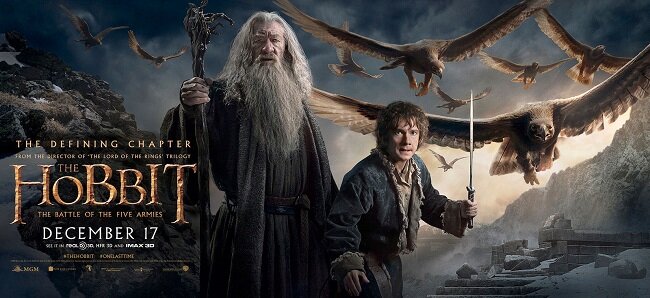
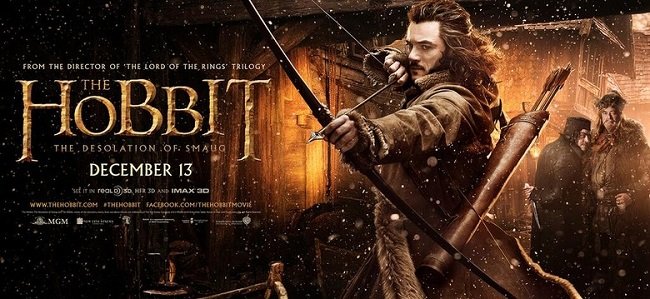
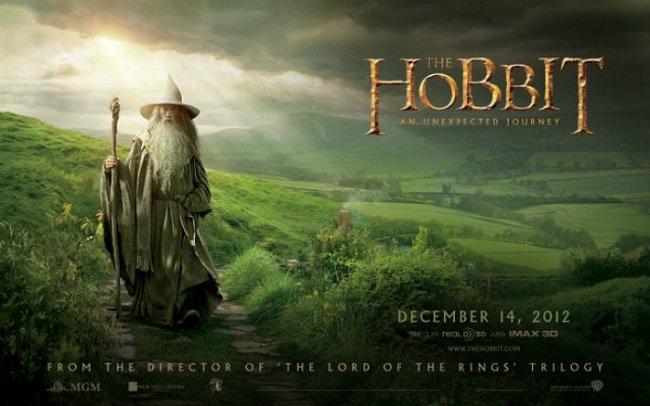
The Hobbit (1977)
The Hobbit (1977) is a curious beast. It’s a made for television animated film, which despite its budgetary constraints, strives to comprehensively adapted one of the most beloved children’s books of the last century. I remember reading an article about this television adaptation of The Hobbit, in Starburst Magazine during the late seventies. There were rumours that this Rankin/Bass production, which had already premièred on US network television, would gain a European cinema release. This was presumably to cash in on the success of Ralph Bakshi's animated feature film adaptation of The Lord of The Rings. However, this never happened to my knowledge. In fact, The Hobbit was not commercially available in the UK until 2001, when Warner Bros. released it on DVD to capitalise on the success of Peter Jackson’s The Fellowship of the Ring.
The Hobbit (1977) is a curious beast. It’s a made for television animated film, which despite its budgetary constraints, strives to comprehensively adapted one of the most beloved children’s books of the last century. I remember reading an article about this television adaptation of The Hobbit, in Starburst Magazine during the late seventies. There were rumours that this Rankin/Bass production, which had already premièred on US network television, would gain a European cinema release. This was presumably to cash in on the success of Ralph Bakshi's animated feature film adaptation of The Lord of The Rings. However, this never happened to my knowledge. In fact, The Hobbit was not commercially available in the UK until 2001, when Warner Bros. released it on DVD to capitalise on the success of Peter Jackson’s The Fellowship of the Ring.
Rankin/Bass productions had a pedigree in bringing traditional and familiar children's material to the small screen, with such titles as Frosty the Snowman and Rudolph the Red-Nosed Reindeer, so it was not unusual for them to take on such a project. However, a lot of the animation was sub contracted to Japanese studios, which was a standard practise at the time. This subsequently had a major impact on the production design and the aesthetics of the film. Rankin/Bass productions often included songs in their commercial output as it had proven to be a major selling point in the past. Naturally, original Tolkien's work with its abundance of songs and verse, lent itself to this very well. As a result, The Hobbit has a wealth of vocal tracks sung by popular folk singer, Glenn Yarbrough. They’re not to everyone’s taste but they do work, and some do stick quite faithfully to the source text.
The adaptation of the story is very simple. Some of the more complex plot details have been lost, such as the Arkenstone of Thrain, the skin-changer Beorn and the scheming master of Lake Town. Tolkien wrote this story for children and that is the way the film’s screenplay is pitched. The character designs range from the adequate to the bizarre. Gandalf is represented pretty much as you would expect, sticking to the usual old man with a pointy hat trope. Bilbo and the Dwarves reflect a more juvenile friendly interpretation. However, the Trolls and Goblins are not especially scary and lack any real sense of threat. It is in the design of the Elves that this production really fumbles the ball. This race of near perfect creatures with their angelic qualities, are simply ugly and emaciated. Someone definitely failed to understand the source text in this respect. Gollum is also poorly conceived and looks a little like a large Bullfrog. And all I'll say about the dragon Smaug, is that his feline quality is "unusual".
With these shortcomings, are there any positive attributes regarding this production? Well the minimalist water colour backgrounds work well, often drawing on Tolkien’s illustrations themselves. The voice casting has some strong performers, such as John Huston as Gandalf. However, some of the minor characters are played by well-known voice artists Don Messick and John Stephenson. As a result, you do feel that you’re watching an episode of Scooby Doo or The Arabian Nights at times. So where does this leave us? Well it's difficult to be objective, as any adaptation of Professor Tolkien's work tends to be over shadowed by the success of Peter Jackson's two trilogies, which have established an aesthetic standard. Therefore, this older version of The Hobbit suffers as a result, as it flies in the face of this. Overall, it’s a low budget, basic adaptation, with a variety of good and bad animation. It will probably find its most appreciative audience, among children, for whom it was intended.


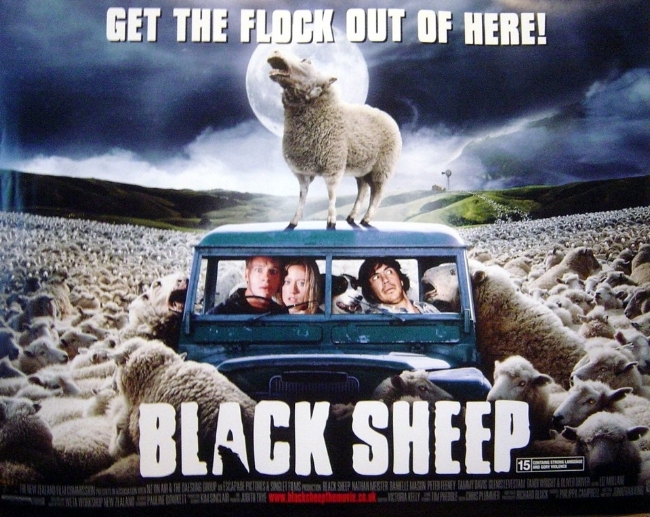
Black Sheep (2006)
Black Sheep is a high concept horror comedy from New Zealand. Featuring creative physical effects by Weta Workshop, this tale of genetically modified killer sheep, animal husbandry and environmentalism requires a very broad sense of humour and an abiding love for the “creature feature” sub-genre. It should be noted that the copy I watched was the unrated R1 DVD. This version is stronger in content than the R rated US theatrical release and yet was released at the UK cinemas with only a 15 rating from the BBFC. I suspect that the similarities in humour between the UK and New Zealand contributed to this somewhat low rating. That and the fact that horror comedy often gets a free pass because the humour always tends to mitigate the violence.
Black Sheep is a high concept horror comedy from New Zealand. Featuring creative physical effects by Weta Workshop, this tale of genetically modified killer sheep, animal husbandry and environmentalism requires a very broad sense of humour and an abiding love for the “creature feature” sub-genre. It should be noted that the copy I watched was the unrated R1 DVD. This version is stronger in content than the R rated US theatrical release and yet was released at the UK cinemas with only a 15 rating from the BBFC. I suspect that the similarities in humour between the UK and New Zealand contributed to this somewhat low rating. That and the fact that horror comedy often gets a free pass because the humour always tends to mitigate the violence.
The plot is somewhat rudimentary but appropriate to the genre. Two brothers grow up on a sheep farm. One, Henry Oldfield (Nathan Meister), becomes a sheepophobic (is that a proper word?) after his brother Angus (Peter Feeney) kills his pet and terrorises him with the carcass. Years later Henry discovers that his successful brother is conducting illegal genetic experiments with sheep. An experimental foetus is then accidentally unleashed after environmentalists (Oliver Driver and Danielle Mason) break into the farm. It's not long before those bitten by the monster sheep transform into sheep-human hybrids. Matters get worse as killer flocks rampage through the countryside, seeking human flesh.
Writer and director Jonathan King's debut feature is very matter of fact. You'll either love or hate this film and there is no middle ground. It's gory, crass and obvious. Yet there's some subtle digs at environmentalism, farming and political activism. There are some affectionate homages to the horror genre (one scene is straight out of An American Werewolf in London) and the whole enterprise is refreshingly unpretentious. There is also great cinematography by Richard Bluck and a wonderfully traditional soundtrack by Victoria Kelly which compliments the film greatly. Despite its subject matter and the occasional lapse into that theme we'd hope they wouldn't touch (i.e. sheep loving), Black Sheep is an amusing night's entertainment for those that approach it with the right state of mind. If you are easily offended and gore averse, best give it a miss.

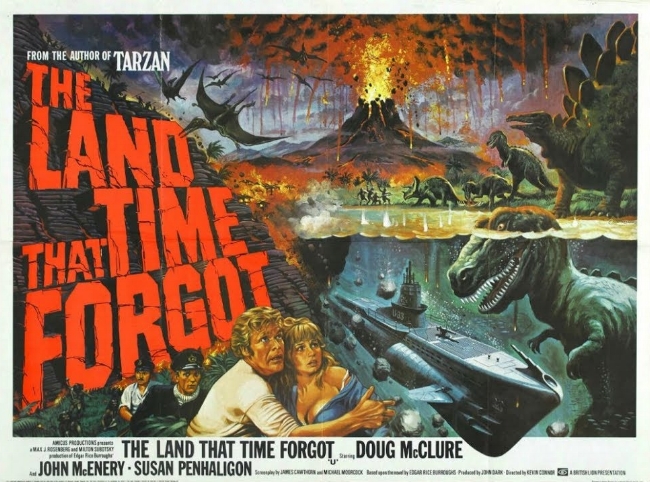
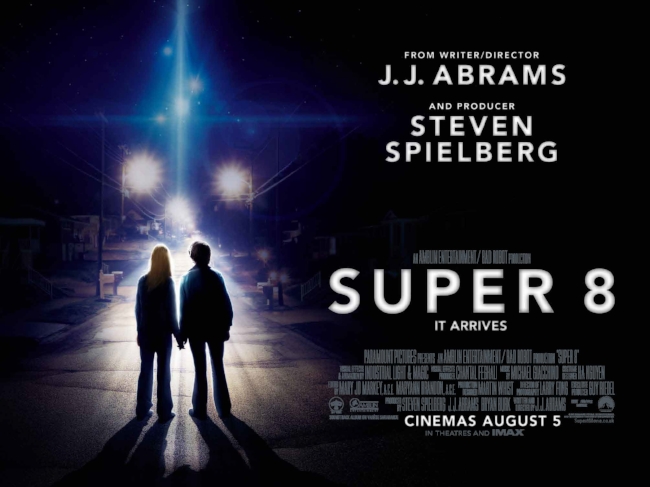
Punisher: War Zone (2008)
During the seventies, due to the soaring crime rate, failure of national politics and social backlash against the establishment, vigilante films and novels were very popular with the public. Michael Winner's Death Wish captured this sentiment perfectly. Although an exploitation film, it managed to maintain an intelligent and thoughtful edge, which certainly reflected the mood of the New York public of the times. Sadly, these issues where subsequently written out of most future screenplays due to the rise of the Hollywood action blockbuster. Moral subtexts and ethical conundrums were replaced by the sledge hammer ideology of might is right. Heroes were given badges and the official sanction of the establishment and destroyed two dimensional enemies, without any need for ethical reflection or inner introspection.
During the seventies, due to the soaring crime rate, failure of national politics and social backlash against the establishment, vigilante films and novels were very popular with the public. Michael Winner's Death Wish captured this sentiment perfectly. Although an exploitation film, it managed to maintain an intelligent and thoughtful edge, which certainly reflected the mood of the New York public of the times. Sadly, these issues where subsequently written out of most future screenplays due to the rise of the Hollywood action blockbuster. Moral subtexts and ethical conundrums were replaced by the sledge hammer ideology of might is right. Heroes were given badges and the official sanction of the establishment and destroyed two dimensional enemies, without any need for ethical reflection or inner introspection.
The Punisher started life in 1974, as minor character in The Amazing Spiderman comic. He was unique in the fact that he was not a traditional super hero with special powers. He was simply an ex-marine turned vigilante after his family were executed by the Mafia. Due to the mood of the times, he struck a chord with the readers and quickly became a franchise in his own right. Naturally, such a character was deemed to have box office potential and was subsequently adapted for the screen three times. Dolph Lundgren took the lead in Mark Goldblatt's competent 1989 production and Thomas Jane explored the character again in 2004 directed Jonathan Hensleigh's. However, these films strayed somewhat from the central character and tended to focus upon his emotional turmoil. Both make for interesting genre viewing but essentially miss the simplicity and enigma of the central theme.
In Punisher: War Zone, directed by Lexi Alexander, Ray Stevenson takes on the role of Frank Castle. Finally, the character gets the treatment they deserves, in a vehicle that truly captures the original spirit of the comics and graphic novels. Punisher: War Zone is a bleak, extremely violent action film which shows us a man who has lost his soul and functions only to punish the guilty. His work brings him no pleasure, redemption or salvation. It simply provides him with a reason to exist. The religious and philosophical aspects of this are touched on but not explored excessively. This is a film that does not delude itself or the public about what it is about. All the classic protagonists are present. There is a scarred crime boss called Jigsaw (Dominic West) who fills the role of nemesis. Then there is the collaborator and armourer Micro (Wayne Knight) who articulates the justification for our anti-hero. The voice of the establishment and public morality is represented in FBI Agent Paul Budiansky (Colin Salmon).
Despite having a very troubled production (which I won't go in to here), Punisher: War Zone is a professionally made genre picture with some strong action scenes. The cast and script are exactly right for this sort of film. Stevenson is given more to do with the role than you may expect and sells his performance perfectly. West does not attempt to go beyond what is required as Jigsaw. Unlike Heath Ledger's Joker he is not out to score psychological points but simply wants revenge. For the purist action movie fan this is as good as it gets. Shame the US critics didn't see it this way. They made the mistake of looking for more within the material, when more was not required. Perhaps political correct sensibilities demanded some sort of moral sub-text or epiphany. Sorry but you won't find them here. To have pandered to such themes would have totally mitigated the source material and have been an artistic insult.
Punisher: War Zone received a very limited release in the UK due to its poor US box office returns, back in 2008. The emotive nature of the entire subject, is something that often resonates with a good many members of the public. We live in a civilised society that has laws and courts and a process for dealing with crime. We ponder the motives of the guilty and we endeavour to treat them with more humanity than they did their victims. Yet, despite what our heads and moral compass tells us, somewhere in our hearts many off us crave for this kind of hard justice. We know that in reality it would not work, yet the concept of the righter of wrongs who deals in lead, is a potent one that does not go away easily. We live in times where our confidence in the system is sorely tested.
Punisher: War Zone is not for everyone and cannot be considered a mainstream film. It is however, honest enough to be exactly as it should. Why the executives over at Lions Gate picture decided to release this during the Christmas season of 2008 is beyond me. Again, I think this is another example of studio politics and how certain producers still lack confidence in R rated movies, preferring to explore more lucrative options. So, in one respect Punisher: War Zone is a minor milestone is so far as don’t see a picture of this kind too often. Eight years on, Deadpool is the most comparable comparison. As the rights to The Punisher have now returned to Marvel and the franchise has found a home on Netflix, it is highly unlikely we’ll see another cinematic outing again.






Feast (2005)
Feast is a low budget horror movie in which a remote redneck bar in Nevada, comes under siege from a group of carnivorous desert dwelling beasts. It’s hardly an original story but as always, the devil is in the detail. Where Feast differs from other similar films is that it offers you all the stereotypical characters and tropes that you expect to find in such a genre movie and then goes in completely in the opposite direction. The film is competently directed by John Gulager in a very contemporary style, with fast edits, deliberately obtuse protagonists and a liberal dose of gallows humour. Once the premise has been set, Feast does not waste a moment of its ninety-minute running time.
Feast is a low budget horror movie in which a remote redneck bar in Nevada, comes under siege from a group of carnivorous desert dwelling beasts. It’s hardly an original story but as always, the devil is in the detail. Where Feast differs from other similar films is that it offers you all the stereotypical characters and tropes that you expect to find in such a genre movie and then goes in completely in the opposite direction. The film is competently directed by John Gulager in a very contemporary style, with fast edits, deliberately obtuse protagonists and a liberal dose of gallows humour. Once the premise has been set, Feast does not waste a moment of its ninety-minute running time.
Feast takes a novel approach to its plot exposition. As we’re introduced to each character, there’s a freeze frame and a brief biography appears onscreen along with their projected life expectancy. This innovative approach is deliberately misleading and it’s not long before several cinematic sacred cows are profaned. Our hero is quickly defenestrated and decapitated and an “innocent” child also meets an unpleasant end. Subsequently, there are further amusing plot twists where characters behave contrary to genre convention. One individual who manages to reach a truck in the bar car park, does not return for their comrades but simply drives off.
It is this clever approach to its subject matter that makes Feast enjoyable and superior genre product. The cast (including Henry Rollins and Clu Gulager) are better than expected (and possibly what the movies deserves) but there are few characters that you feel sympathy for. Yet because of their erratic behaviour and flagrant disregard for horror movies tropes, you are kept involved. The marauding creatures are kept suitably off screen for a lot of the film. They wear dead animal skins and bones which also masks their appearance. Obviously, this is mainly due to budgetary reasons, but it also keeps them somewhat enigmatic. Exactly what they are and where they come from is left unanswered.
I watched a US unrated version of the film which contains a few extra seconds of violence here and there. Overall, this is a visceral horror movie containing eyeball violence, maggots, monster vomit, castration and a lot worse. It’s not intended for the casual viewer. However, what keeps Feast above average is its knowing contradiction of audience expectations and tongue in-cheek approach. The script was selected via the amateur filmmaking documentary series Project Greenlight. The producers include Matt Damon, Ben Affleck, Sean Bailey, and Chris Moore. As ever with the horror genre, the movie was far from a critical success but made sufficient money to generate two sequels. Feast makes for superior Friday night viewing and is therefore recommend purely as such.
The Sword and the Sorcerer (1982)
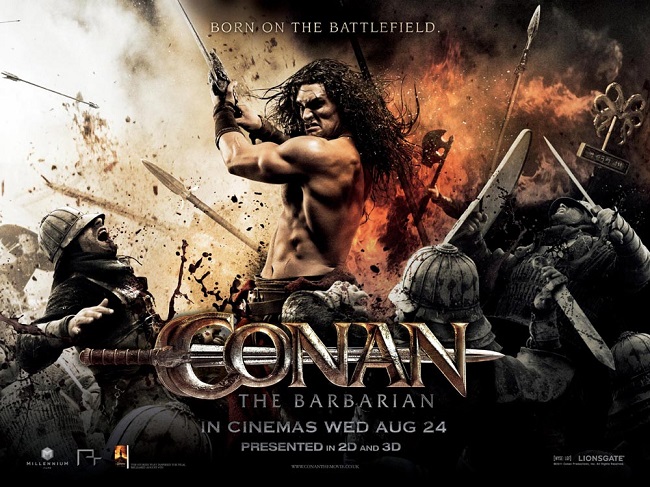
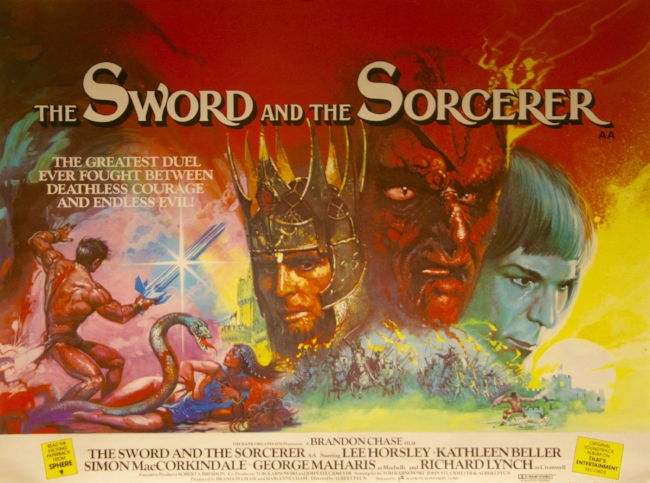
The early eighties saw an interesting mini boom in the sword and sorcery films. Studios have always been quick to jump on any bandwagon and the growing popularity of the Dungeons and Dragons role playing games showed a potential market. Subsequently, there was a glut of material from the fantasy genre. John Milius’ Conan the Barbarian (1982) remains the benchmark for such movies with its blend of high adventure and philosophical musing. Other films of note include John Boorman’s Excalibur (1981), Dragonslayer (1981), Legend (1985), Krull (1983) and The Beastmaster (1982) to name but a few. All of them have an interesting pedigree with regard to their respective cast and directors. As always there were numerous poor and substandard entries, but we will not catalogue them here.
The early eighties saw an interesting mini boom in the sword and sorcery films. Studios have always been quick to jump on any bandwagon and the growing popularity of the Dungeons and Dragons role playing games showed a potential market. Subsequently, there was a glut of material from the fantasy genre. John Milius’ Conan the Barbarian (1982) remains the benchmark for such movies with its blend of high adventure and philosophical musing. Other films of note include John Boorman’s Excalibur (1981), Dragonslayer (1981), Legend (1985), Krull (1983) and The Beastmaster (1982) to name but a few. All of them have an interesting pedigree with regard to their respective cast and directors. As always there were numerous poor and substandard entries, but we will not catalogue them here.
However, big budget studio productions were not always a guarantee of success at the box office. Low budget independent films could equally compete within this niche market and the more lucrative entries would often followed a tried and tested formula. Take a perfunctorily script loaded with generic genre tropes, some nominally well-known TV actors, include large amounts of sword play and violence, throw in some gratuitous nudity and see if can bluff your way through ninety minutes. The Sword and the Sorcerer exemplifies this model having all these requisite attributes in spades. Surprisingly the results are an engaging, violent, lurid, tongue in cheek, wannabe epic, that dared to start a franchise.
The film starts with a portentous expository narration where we learn that the evil Titus Cromwell (Richard Lynch) is waging war with the good King Richard (Christopher Cary) for control of the kingdom of Ehdan. Cromwell, having been previously defeated by King Richard, uses a witch to raise the ancient sorcerer Xusia of Delos (Richard Moll) from the dead. Cromwell bargains with Xusia, who then unleashes his sorcery on the armies of Ehdan. King Richard’s eldest son dies bringing news of the impending defeat and it is decided to evacuate the remaining members of the royal household. Cromwell, now victorious, takes the opportunity to murder Xusia while he is weak from his witchcraft.
The King's youngest son, Talon is entrusted with his father's tri-bladed sword and leaves to meet with his mother and sisters. He only just escapes after seeing his father put to the sword by Cromwell himself. Matters get worse as he arrives to leave with his family, only to be ambushed by Cromwell's men. His remaining kin are killed and he sustains a serious hand injury. Vowing revenge, he disappears, leaving the kingdom that is rightfully his in the hands of his enemy, who assume he is dead.
Years later, rumours arise on the borders of Ehdan of a mighty warrior with his sword is for hire. It is also revealed that sorcerer Xusia is not dead but has been slowly regenerating over the years and plotting his revenge against the treacherous Titus Cromwell. Meanwhile there is a growing underground movement to depose Cromwell, led Prince Mikah (Simon MacCorkindale) and his sister, Princess Alana (Kathleen Beller), being the nephew and niece to dead King Richard. Among their secret network of supporters is Count Machelli (George Maharis), Cromwell's War Chancellor, who feeds them news from inside the palace. It is not long before all these individuals come together in violent conflict. Who will prevail and win the throne of Ehdan?
As you can see the script for The Sword and the Sorcerer is quite ambitious. Most genre films would not attempt to create such a complex story, with plots, duplicity and intrigue. The execution of these ideas is rudimentary but this was director Albert Pyun’s directorial debut. There are also some attempts to create interesting characters. Talon (Lee Horsley) in particular is supposed to be a charming, irreverent rogue with a ready sense of humour in the Errol Flynn vein. Simon MacCorkindale gives probably the best performance of the film as Prince Mikah, the anguished, dutiful, heir to the throne. Richard Lynch gives a typical flamboyant performance as Cromwell, bringing that uneasy quality he naturally had. Even Kathleen Beller plays Princess Alana, in a suitably feisty manner. Don’t get me wrong, this is far from Shakespeare but there is an inherent sense of fun and the material is suitably camp as well as schlocky, without being disrespectful to the genre.
Special attention should be given to David Whitaker's score. The music is very grand considering the scope of the production, with generous use of strings and brass. It is heavily influenced by classics score from Miklos Rozsa and Erich Korngold. “The Sword and The Sorcerer Overture" is a good example, where we hear the heroic main theme for the first time (See track below). It is when the music gets more light-hearted that it gets really interesting and enjoyable, for example in "The Bordello", where the main theme gets an upbeat and almost humorous rendition. This is a soundtrack that offers a wide variety of styles and moods, and for a modest genre film, is a quite sophisticated.
Despite the low budget The Sword and The Sorcerer has some well-choreographed set pieces and action scenes. Sadly, stuntman Jack Tyree died during the making of the film, when a high fall went wrong. Part of that stunt can still be seen. Fight scenes are perfectly adequate and the editing is also competent improving the overall film. The production design is ambitious, with creative sets, and stylish lighting. There’s a nice homage to Michael Curtiz in one fight scene, were a brazier is knocked over and the action proceeds in slow motion silhouette. The prosthetic work is well handled by now established names like Greg Cannom and Mark Shostrom. Xusia's tomb and full body make up are good examples of the standard of work. There is also a nice head bisection and skin shedding scene. I would also draw your attention to the implausible death on one character who meets his end via a foot peddle driven grind stone. See if you can spot the flaw in the plan.
The Sword and the Sorcerer is what it is. A low budget genre movie, with liberal quantities of sex, violence and humour. It should be judged on its own merits because it isn’t cut from the same cloth as a massive studio production such as Krull. It should also be noted that the film performed surprising well at the box office and was in fact the highest grossing independent movie of 1982. Yet the proposed sequel which was advertised in the end credits, was delayed due to the director’s other commitments. In the meantime, public tastes changed and the sword and sorcery boom was replaced by the next trend. Despite this, The Sword and the Sorcerer has gained cult status in recent years. It’s playful quality and knowing tone can still entertain thirty-six years on. Few other low budget movies from this genre can make such a claim.



Battle: Los Angeles (2011)
I recently decided to catch up with Battle: Los Angeles. I didn’t bother to see this film upon its initial release, because it struck me as just another generic, sci-fi action movie and I didn’t feel that merited the price of a cinema ticket. However, there are times when you want some easy entertainment, so tracked the film down on one of the VOD platforms I subscribed to. As I suspected, Battle: Los Angeles is a broad, mainstream, big budget action film that requires you to check your brain and sense of incredulity at the door. If you do so, you will be presented with two hours of formulaic entertainment that has the occasional flash of inspiration. I won't bother to list the by the numbers characters and plot line. You can more than likely predict these yourself. I will in the spirit of fairness focus on what I think are the good points.
I recently decided to catch up with Battle: Los Angeles. I didn’t bother to see this film upon its initial release, because it struck me as just another generic, sci-fi action movie and I didn’t feel that merited the price of a cinema ticket. However, there are times when you want some easy entertainment, so tracked the film down on one of the VOD platforms I subscribed to. As I suspected, Battle: Los Angeles is a broad, mainstream, big budget action film that requires you to check your brain and sense of incredulity at the door. If you do so, you will be presented with two hours of formulaic entertainment that has the occasional flash of inspiration. I won't bother to list the by the numbers characters and plot line. You can more than likely predict these yourself. I will in the spirit of fairness focus on what I think are the good points.
In the early stages of the film there is a great deal of plot exposition regarding the invasion, done via faux news footage. This is far from a new idea but it works quite well in this instance. TV is the means by which most people become aware and experience major catastrophes these days and this angle certainly added some realism. Director Jonathan Liebesman's decision to focus on the story from the ground forces point of view is a smart one. Despite the films large budget, this approach makes the story far more small scale and intimate. There is also a rather clever scene where the Marines find a wounded invader and rather than go down the clichéd route of trying to communicate with it, they simply try to find its weak spots and major organs. They subsequently butcher it. Irrespective of moral and ethics, this is a credible plot development.
Unfortunately, these engaging elements of Battle: Los Angeles are somewhat spread out among less creative material. The reticence to show the invaders is taken a little too far and the PG-13 rating means that the action lacks any real threat or shock. There is also the recurring Hollywood predilection to depict soldiers in a somewhat ill-disciplined light. I'm sure this isn’t the case in reality, especially in the prestigious and select units such as the US Marine Corp. It is also probably best to not start listing the major plot holes especially with regard to the invaders tactics. I would also like to point out that the whole "shaky cam" technique is well past its sell by date. Yes, it can on occasions create an artificial sense of reality but if it is used to the extent where observing what is actually happening is impossible, then it has patently failed as a cinematic technique.
Battle: Los Angeles is the embodiment of disposable entertainment. A few novel ideas help make the whole experience a little more palatable. Aaron Eckhart is a sufficiently robust actor to be able to carry the story and Michelle Rodriguez is far less bellicose than here usual screen persona. The main selling point is the films focus on experiencing the alien invasion from a front-line soldier’s point of view. However, it can be argued that the opening and closing scenes of Gareth Edwards Monsters did an equally comparable job of a tenth of the budget. Battle: Los Angeles is adequate filler if you have a few hours to kill and you want some dynamic, visual effects driven entertainment that requires little or no thought. If you want more than this then best look elsewhere.





Inside Jaws (2013)
Once again Jamie Benning has created a filmumentary that is pretty much a definitive exploration of its subject matter. Inside Jaws contains a staggering amount of facts, details, insight and commentary about one of the greatest films ever made. Yet despite a wealth of information, it is presented in a way that is easily digestible and enhances the movie, rather than overwhelms it. As with Star Wars Begins, the original movie is annotated with on-screen text, commentary tracks and behind the scenes footage, which provide incisive overview into the movies production.
Once again Jamie Benning has created a filmumentary that is pretty much a definitive exploration of its subject matter. Inside Jaws contains a staggering amount of facts, details, insight and commentary about one of the greatest films ever made. Yet despite a wealth of information, it is presented in a way that is easily digestible and enhances the movie, rather than overwhelms it. As with Star Wars Begins, the original movie is annotated with on-screen text, commentary tracks and behind the scenes footage, which provide incisive overview into the movies production.
I cannot stress how much work Jamie has gone to in assembling this filmumentary. Not only has he trawled through hours of TV coverage, radio spots, press releases, news articles and biographies, he has also personally contacted and interviewed numerous people associated with the production. This has provided a lot of new and interesting anecdotes and personal stories about the movies lengthy production in 1974. Inside Jaws is the embodiment of a labour of love, yet it is far more than a fan film. Its measured, well thought out approach offers a documentary to rival that of any professional outlet. This is a production that is accessible to both ardent fans, scholars of cinema and those who are simply curious about one of the most successful movies of the seventies.
Throughout Inside Jaws running time, not a stone is left unturned with regard to the production. The screenplay, production design and casting are all explored. It also discretely handles the thorny issue of the authorship of Quint's USS Indianapolis speech; a subject that has been greatly debated over the years. Writers Howard Sackler and John Milius and Robert Shaw all had a hand in shaping the scene and ownership has always been contested. The documentary also shows that despite being a difficult and problematic production, Jaws was a blockbuster that was made with a great deal of integrity and artistic vision. Something I don't believe that can be said about a lot of modern day equivalents.
So, if you enjoy Steven Spielberg's movie on any level, do yourself a favour and watch it again through the unique medium of Jamie Benning's filmumentary. It can only enhance your enjoyment of one the best movies ever made. And when you’ve finished, check out Jamie’s other documentaries. Raiding the Lost Ark, Star Wars Begins, Building Empire and Returning to Jedi. All are available via his Vimeo channel and well worth viewing.










Star Wars Begins (2011)
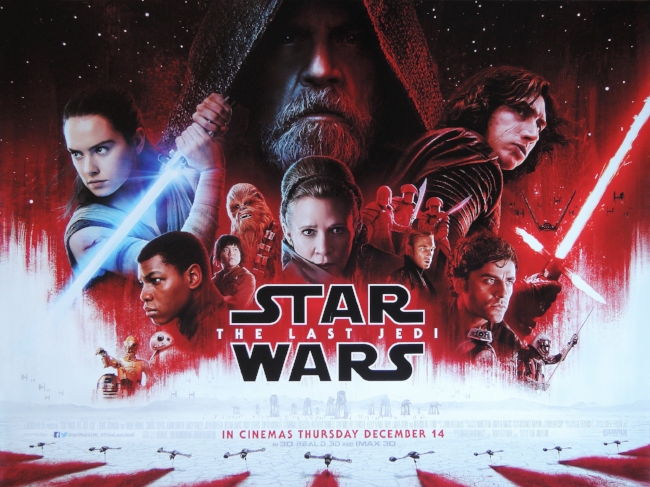
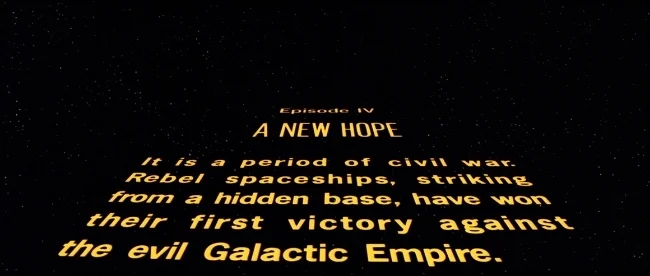
Star Wars Begins is a detailed documentary by film maker Jamie Benning that explores the creation of what is now considered to be the most iconic movie of the seventies; namely Star Wars. It features a wealth of deleted scenes, alternate takes, behind-the-scenes footage, bloopers, original on set audio recordings and a great deal of commentary by the original cast and crew. As far as I’m concerned, it is the most thorough and in-depth analysis of Star Wars I have yet to see. Frankly it beats hands down, any of the officially sanctioned documentaries that have appeared over the year on the various DVD and Blu-ray releases of the trilogy.
Star Wars Begins is a detailed documentary by film maker Jamie Benning that explores the creation of what is now considered to be the most iconic movie of the seventies; namely Star Wars. It features a wealth of deleted scenes, alternate takes, behind-the-scenes footage, bloopers, original on set audio recordings and a great deal of commentary by the original cast and crew. As far as I’m concerned, it is the most thorough and in-depth analysis of Star Wars I have yet to see. Frankly it beats hands down, any of the officially sanctioned documentaries that have appeared over the year on the various DVD and Blu-ray releases of the trilogy.
It is Benning’s feature-length approach of his documentary that follows the flow of the original movie, that makes it so compelling. As the Star Wars itself plays, all aspects of the production are crossed referenced and annotated as they appear on screen. The documentary is also a very illuminating insight into the US and British movie industry of the times. Despite having a prodigious wealth of information to convey, the documentary handles the pace of material well and the viewer has time to digest what is shown and discussed without getting overwhelmed. This is a considerable achievement for a documentary, which can be a difficult format to master. Star Wars Begins is most certainly a painstaking labour of love, but the hard work pays off with an even-handed film that finds the right balance between interesting facts and pacing.
The documentary also succeeds in catering to both hardcore fans and the more casual viewer. If you have not seen some of the famous deleted scenes, such as Han's original meeting with Jabba the Hutt or Luke's dialogue with his friend Biggs Darklighter then you are in for a treat. Some of the original on-set audio is extremely amusing such as actor Dave Prowse speaking Darth Vader's lines in a West Country accent. Overall what the documentary does is offer a totally fresh perspective on Star Wars which helps re-invigorate one’s enjoyment of the classic trilogy. Until Disney’s renewal of the franchise in recent years, the second trilogy of prequels did cast a shadow over the original three movies.
Another thing I've learned from Star Wars Begins is that some aspects of the original movie were intended to be more violent. This is something that has always been present in Lucas's work but certainly it didn't come to the forefront until the second trilogy. For example, stills from the Cantina set show that Ponda Baba's initial fate was meant to be far more unpleasant than just losing his arm. Then there is the matter of Han Solo shooting Greedo from under the table. The entire "Han shot first" debacle shows that the character was initially intended to be perceived in a very different way. Yet movies are often by nature evolutionary things, especially on big productions. Often scenes will be reshot if they don’t work out, or if a better idea is mooted. Plus, as Star Wars Begins points out, a production of this nature had never been done before and many of those involved were flying by the seat of their pants.
Director Benning has also made similar documentaries for both The Empire Strikes Back and Return of the Jedi. It should be noted that these ‘filmumentaries’ are unofficial and fall within a somewhat grey area with regard to their “status”. They are completely non-profit making and made with full acknowledgement to the appropriate copyright holders. So far, the new copyright holders Disney seem content to let sleeping dogs lie, however there is no guarantee that things will remain that way. Therefore, I would urge all fans of Star Wars to seek them out and watch them while they're still available on Jamie Benning's Vimeo channel because they are quite unique.











Paul (2011)
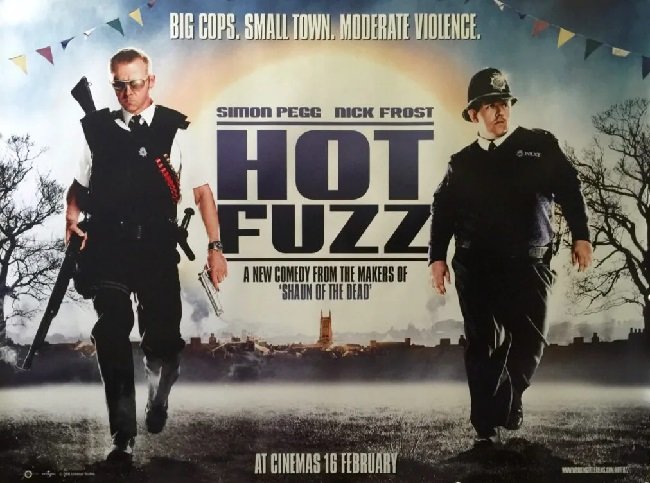
Critics were somewhat split over Paul when it was released in the UK in spring 2011. The absence of director Edgar Wright from the production, was cited as a weakness. Critics also felt the film was generally too mainstream and did not play sufficiently to Simon Pegg and Nick Frost's strengths. There were the usual claims of the whole premise being a self-indulgence. However, rather than cross reference Paul against similar films or compare it to material from the stars back catalogue of work, it should be judged on its own merit. On reflection, it is nowhere near as week as some claim it to be. You don’t often get big studio comedies that happily explores what is still considered a niche market genre. If approached with the right outlook, then Paul can be an entertaining diversion with plenty of laughs.
Critics were somewhat split over Paul when it was released in the UK in Spring 2011. The absence of director Edgar Wright from the production, was cited as a weakness. Critics also felt the film was generally too mainstream and did not play sufficiently to Simon Pegg and Nick Frost's strengths. There were the usual claims of the whole premise being a self-indulgence. However, rather than cross reference Paul against similar films or compare it to material from the stars back catalogue of work, it should be judged on its own merit. On reflection, it is nowhere near as week as some claim it to be. You don’t often get big studio comedies that happily explores what is still considered a niche market genre. If approached with the right outlook, then Paul can be an entertaining diversion with plenty of laughs.
Paul succeeds because it takes a very broad approach to its themes and subjects. Popular culture has absorbed enough sci-fi references to make a lot of the gags very accessible to the general public. Yet there is still much to satisfy the inner geek of the more hardcore fans. Frost and Pegg's natural chemistry together carries the film greatly, along with the traditional transatlantic culture clash. There are some clever references to convention culture and fandom itself, especially with a scene when our pair of heroes meets their favourite author. Paul himself is very well realised and perfectly voiced by Seth Rogen. He provides the sort of wise cracking cynicism audiences expect. The film's running time is ideal with seldom a lull in the pace. This is important with comedy as so many get it wrong.
Paul does have a few weaknesses though. There are more obvious concessions to the mainstream, such as clichéd gay jokes, generic car chases and a somewhat contrived and unconvincing romantic sub-plot. Luckily, these minor aspects are not enough to spoil the overall production and are minor quibbles rather than cardinal sins. Plus, a killer cameo performance by Sigourney Weaver, is more than enough to rectify and other deficiencies in the narrative. The visual FX are more than adequate, and the film looks fine for a mid-budget production. The final act is formulaic but not annoyingly so. You get pretty much what you expect from Paul and that’s not a bad thing. Sometime when viewing at home you want a easy choice and some undemanding viewing.
Ultimately, it is the basic plot device that is the films greatest asset. Paul an alien, finds himself reliant on two guys who are essentially aliens themselves within the country they're touring and society itself. The movie also explores the pros and cons of "geekdom" rather well and gently ribs the culture, rather than openly mocks. This is often a difficult thing to do, but director Greg Mottola gets the tone right. Paul certainly provides a platform for the English's love affair with profanity. Although it is not gratuitous, the choice words do come thick and fast at times. But overall, Paul proves to be a genuinely funny, well observed, accessible sci-fi comedy and I think that this film’s reputation will improve over the years to come.
The Commuter (2018)
There are action movies. There are subsets of action movies such as the martial arts, heroic bloodshed and the “Die Hard on a [insert mode of transport here]”sub-genre. And then there are Liam Neeson action movies which are a unique a form of films in their own right. Because few actors have achieved what Liam Neeson has done. Some actors start their careers stuck in low budget, exploitation films, only to claw their way up the greasy pole until the wow us with a serious performance and effectively re-invent themselves as a quality character actor. Liam Neeson has done the reverse. After making his mark as a serious actor, with an Oscar nomination under his belt, he then took a serious change in direction to become an action movie star in his mid-fifties. In doing so he found himself a completely new audience and proved a star at the box office. It’s a curious yet strangely laudable achievement. This leads us neatly onto The Commuter. It’s Neeson’s swansong to the action genre, as he has subsequently announced that he’s retiring from this type of movie.
There are action movies. There are subsets of action movies such as the martial arts, heroic bloodshed and the “Die Hard on a [insert mode of transport here]”sub-genre. And then there are Liam Neeson action movies which are a unique a form of films in their own right. Because few actors have achieved what Liam Neeson has done. Some actors start their careers stuck in low budget, exploitation films, only to claw their way up the greasy pole until the wow us with a serious performance and effectively re-invent themselves as a quality character actor. Liam Neeson has done the reverse. After making his mark as a serious actor, with an Oscar nomination under his belt, he then took a serious change in direction to become an action movie star in his mid-fifties. In doing so he found himself a completely new audience and proved a star at the box office. It’s a curious yet strangely laudable achievement. This leads us neatly onto The Commuter. It’s Neeson’s swansong to the action genre, as he has subsequently announced that he’s retiring from this type of movie.
Our titular commuter is an insurance manager named Michael McCauley. He rides the train every day to a somewhat perfunctory office job. When Michael is made redundant just as his son is about to apply for colleges, he and his wife (Elizabeth McGovern) face financial ruin. However, he is thrown a potential lifeline when a mysterious woman played by Vera Farmiga, offers him a deal of Faustian proportions. All he has to do is use his skills to identify a passenger on board “who doesn’t belong”, mark them with a tracker and then walk away with a large sum of money in cash. He is given no further details and told not seek them. As she leaves our mystery lady hints that she knows that prior to his career in insurance, that Michael was a cop. However, all is not as it seems and Michael soon learns that’s he doesn’t really have a choice in the matter, as his wife has been kidnapped. However, this is a Liam Neeson movie and naturally our hero is not going to capitulate to the bad guys demands. Punching and mayhem ensues, a solid supporting cast are given nothing to do and logic goes out the window. Overall it’s a bit silly. However, it is also incredibly entertaining too.
The Commuter begins with in an impressive opening montage which references the changing seasons and varying weather conditions while travelling to New York City. It’s quite an artsy start to the movie which briefly kindles a fool’s hope that this may be a more complex and cerebral action movie. However, the overly complex set up soon dispels any notions of this. Furthermore, once the tortuous plot has been established, it is quickly jettisoned and as the movie progresses, the narrative contradicts and confuses itself further. However, all of this is mitigated by Mr Neeson punching, hitting and bludgeoning sundry bad guys while wisecracking like a Roger Moore tribute act. In a selfless attempt to mitigate the sheer incredulity of a man of Neeson’s mature years fighting his way through an army of mercenaries, the screenplay features several scenes where he references his own age “ironically”. It’s all like an ultra-violent version of Poirot, whose suffering from existential angst. However, beating someone with an electric guitar proves to be somewhat therapeutic.
The Commuter marks the fourth collaboration between Neeson and director Jaume Collet-Serra; a curious film maker who seems to have created and filled a niche market in the action genre, somewhere between Tony Scott and Antoine Fuqua. His films, include Neeson’s Unknown (2011), Non-Stop (2014) and Run All Night (2015). The Commuter is an unashamed variation on an established theme. Not only does Collet-Serra plagiarise classic elements of the action genre but he even plunders his own back catalogue. To call The Commuter Hichcockian would be far too generous, possibly even libellous. If you take a moment to step back and logically assess what is happening, you will find yourself wondering how anyone would choose to finance such a preposterous load of arse gravy. Yet, there is a single mitigating factor that defuses any incredulity the viewer may have and absolves them of any guilt they may have for watching. And that is Liam Neeson; a man who punches wolves, is Lion Jesus and fights trains. I don’t know of any actor currently at work in Hollywood who has such public goodwill. So go see The Commuter and rejoice in the high-concept of a sexagenarian action star.
Cowboys & Aliens: Extended Edition (2011)
Jon Favreau’s genre mashup Cowboys & Aliens embodies Hollywood’s current penchant for the high concept movie. I imagine when this film was pitched to the executive board at the studio, it was only a matter of seconds before it was given the green light. The western in recent years has become a commercially viable genre once again. Plus, anything with aliens usually strikes gold at the box office. Put them together with a director who has a track record of producing commercial successful material (Iron Man, The Jungle Book) along with several bankable box office stars (Daniel Craig, Harrison Ford) and you’ll definitely have a winner on your hands? Except on this occasion the movie was received poorly by both the critics and the public alike. With a production cost of $163 million, Cowboys & Aliens only made $178 million worldwide. So what exactly went wrong?
Jon Favreau’s genre mashup Cowboys & Aliens embodies Hollywood’s current penchant for the high concept movie. I imagine when this film was pitched to the executive board at the studio, it was only a matter of seconds before it was given the green light. The western in recent years has become a commercially viable genre once again. Plus, anything with aliens usually strikes gold at the box office. Put them together with a director who has a track record of producing commercial successful material (Iron Man, The Jungle Book) along with several bankable box office stars (Daniel Craig, Harrison Ford) and you’ll definitely have a winner on your hands? Except on this occasion the movie was received poorly by both the critics and the public alike. With a production cost of $163 million, Cowboys & Aliens only made $178 million worldwide. So what exactly went wrong?
Cowboys & Aliens is a flawed movie. The two genres actually intersect far less on screen that you expect. The explanation for the alien incursion on earth is somewhat weak, even by the standard of these sorts of movies, involving their requirement for gold. Furthermore, as the story proceeds it gets diverted on side issues associated with secondary cast members. However, instead of embellishing the story, it tends to slow the pace and adds nothing of substance to the narrative. There are sequences when the blending of the sci-fi and westerns genres works well but they are mainly action scenes. Obviously with a film of this budget you cannot fault the technical aspects of the production. The alien design and associated culture is very well realised. Yet the movie ultimately doesn’t meet one’s expectations. If you think about other western crossover movies like Red Sun, which featured cowboys and samurai, that too fell down in the same fashion as this one. Both films fail to balance the elements of their respective genres and spend to much time setting up the narrative rather than pursuing it.
The cast are one of Cowboys & Aliens greatest assets, although some are somewhat squandered. Daniel Craig and Harrison Ford carry the production by their screen presence. One smoulders in a minimalist fashion, while the other exudes that gruff cynicism that seniority brings. The remainder of the quality cast are not quite so lucky as they’re given precious little to work with. They serve to expedite the story and no more. This is a criminal waste of fine character actors such as Keith Carradine, Clancy Brown and Sam Rockwell. And when we are presented with a scene that should be pivotal to the story arc and the emotional development of the characters, it tends to fall flat rather than resonate with any dramatic impact. Favreau seems to be far too interested in all aspects of the production, bar the performances. When you consider the writing credits, consisting of Roberto Orci, Alex Kurtzman, Damon Lindelof, Mark Fergus and Hawk Ostby, it does indicate that the screenplay has gone through numerous iterations and revisions. Certainly, the movie seems to have strayed from the source graphic novel.
Those who will get the most out of Cowboys & Aliens will be viewers who are less familiar with the sci-fi genre. So many of the ideas and concepts present in the film have been done before and unfortunately for this movie, done better. So many questions and ideas are raised by the story but go unexplored or are just glossed over. What it does provide is adequate genre movie making in the modern idiom, that is sufficiently entertaining for those who are undemanding. It sadly does nothing more which is a damn shame, as this could have been a far better movie in the hands of more experienced film makers. Someone with a track record of taking common ideas in new directions. Someone like Alex Cox, Walter Hill, or even Duncan Jones. What would they have brought to the proceedings? Sadly, at present Hollywood has too many directors who understand the mechanics of film making and can manage a complex effects driven production, but who seem to have lost a fundamental connection to the narrative cinema.
The theatrical version of Cowboys & Aliens ran for 119 minutes. The Extended Edition or Extended Director’s Cut at it was marketed in Europe, adds a further 16 minutes of material. This is mostly minor plot embellishments and character interactions. There are two additional scenes where wounds are treated but they are far from explicit. This longer version still falls within the parameters of a 12/PG-13 rating. Further details can be found at movie-censorship.com along with screen captures of the new material.
Insidious: Chapter 3 (2015)
Although I enjoyed Insidious: Chapter 2 it was somewhat constrained by the events of the first movie. It did it best to creatively extricate itself from the corner its predecessor had painted itself in to, but it didn’t really leave much scope for a direct sequel. Hence the producers wisely elected to follow the movie up with a prequel that explored an earlier case that crossed the path of psychic Elise Rainier (Lin Shaye). This change in direction proved surprisingly beneficial for the franchise providing an opportunity to meet new characters and a new antagonist. Despite being the third entry in the series, Insidious: Chapter 3 maintains the standard set by chapters one and two and proved to be a hit at the box office and with fans alike.
Although I enjoyed Insidious: Chapter 2 it was somewhat constrained by the events of the first movie. It did it best to creatively extricate itself from the corner its predecessor had painted itself in to, but it didn’t really leave much scope for a direct sequel. Hence the producers wisely elected to follow the movie up with a prequel that explored an earlier case that crossed the path of psychic Elise Rainier (Lin Shaye). This change in direction proved surprisingly beneficial for the franchise providing an opportunity to meet new characters and a new antagonist. Despite being the third entry in the series, Insidious: Chapter 3 maintains the standard set by chapters one and two and proved to be a hit at the box office and with fans alike.
Several years before The Lambert Haunting, retired psychic Elise Rainier reluctantly helps teenager Quinn Brenner (Stefanie Scott) contact her dead mother, Lillith, who died the year before. However, she urges Quinn not to try and contact her mother again after sensing a malevolent force. Subsequently, Quinn starts seeing a mysterious figure who waves to her. After attending an audition for a school for performing arts, Quinn is distracted by the figure, leading to her being knock down by a car, leaving her bed ridden with two broken legs. Further supernatural events occur, and it soon become apparent that “the man who cannot breathe” has sinister intentions. Quinn’s brother suggests that perhaps the amateur internet demonologists Specs and Tucker (Leigh Whannell and Alex Sampson) can help, but the case proves to be beyond their experience. As matters get worse, it becomes clear that the only person who can help Quinn is Elise.
Insidious: Chapter 3 creates a sinister atmosphere within its urban setting. The apartment block in which the story is set is suitably gothic in its state of disrepair. The new supernatural antagonist is surprisingly creepy and there are several scenes in which “the man who cannot breathe” is effectively used. The oily black foot prints that appear are eerily disturbing. As with many modern horror films, the emphasis is on jumps and scares rather than violence and these are delivered efficiently. What elevates Insidious: Chapter 3 above the average are an eclectic mix of characters that are surprisingly likeable. Stefanie Scott’s Quinn Brenner is not your standard caricature of a teenage girl and is a positive protagonist. Again, Lin Shaye does most of the heavy lifting as Elise Rainier. She once again delivers a compassionate, yet vulnerable performance and she holds viewers attention when on screen. There are also some droll moments with Specs and Tucker.
The movies strengths lie in the first two acts, with the building suspense and the sinister encroachment of the supernatural into an everyday environment. The denouement, which once again takes place in “the Further”, although well executed is a little too familiar. However, Insidious: Chapter 3 is overall an entertaining instalment in the series and certainly fairs better than the Ouija franchise. It is satisfying to see a genre of film that is heavily marketed towards a teen audience, prove successful due to the presence of an older character. The film also ends with a codicil that references the impending events of the first two movies and this circular narrative does provides a good sense of continuity. Considering all the commercial pressures that exist with regard to the horror genre these days, I do like The Insidious franchise and the way it has managed to create a niche for itself.
Unstoppable (2010)
Tony Scott seemed to specialise in loud, bombastic, high octane action films. He was the master of the hi-tech set piece. His body of work succinctly encapsulated what commercial Hollywood is about. Why understate, when you can overstate. Why circumnavigate, when you can blow it up. Why talk when, you can shout. Yet despite these qualities, he often managed to walk the fine line between entertainment and sensory overload. Through strong casting and hardboiled yet dry screenplays, his overblown tales were frequently engaging and would prove a hit with both the audience and critics alike. It’s quite an achievement to when you think about, maintaining commercial success and retaining public goodwill.
Tony Scott seemed to specialise in loud, bombastic, high octane action films. He was the master of the hi-tech set piece. His body of work succinctly encapsulated what commercial Hollywood is about. Why understate, when you can overstate. Why circumnavigate, when you can blow it up. Why talk when, you can shout. Yet despite these qualities, he often managed to walk the fine line between entertainment and sensory overload. Through strong casting and hardboiled yet dry screenplays, his overblown tales were frequently engaging and would prove a hit with both the audience and critics alike. It’s quite an achievement to when you think about, maintaining commercial success and retaining public goodwill.
So, bearing this in mind, I decided to watch Unstoppable, the last movie that Scott directed. We can dispense with a detailed plot analysis of Unstoppable. This is a runaway train movie. Every cliché you can think off associated with this situation and the disaster genre per se, is thrown into the mix. Chris Pine and Denzel Washington play the blue-collar heroes. It is the standard sensei and pupil relationship. Kevin Dunn is the corporate lickspittle for the train owners. Rosario Dawson, the feisty rail traffic controller. Shame they couldn't work Helen Hayes in somewhere. Breaks slip, trains race out of control, shouting ensues. It’s all exactly as you’d expect and what modern budgets and contemporary FXs will allow.
It serves no purpose to start picking holes in the plot, which are numerous. This is Hollywood and therefore the screenplay is not designed to be scrutinised rigorously. The film is allegedly based on real life events, but the similarity ends at the inclusion of a train and two members of staff. Beyond that, it all comes down to artistic license. Why have a rigorous, character driven narrative when you can drive a train into every conceivable obstacle imaginable. Such as other trains, fuel storage depots, school kids, the disabled, kittens. Okay it's not quite as bad as that but you get the idea. Of course, all of these threats result in people shouting at each other. Nothing telegraphs danger, angst and conflict more than raised voices. Right?
I'm sure it comes as no surprise to you, that it all ends as one would expect. Why wouldn't it? It would be box office suicide with this sort of product to spring some sort of left field plot device in the final act. Furthermore, the film does not out stay its welcome. The navigate their way through their performances with ease and are still good for this sort of film. Let's face it, Denzel Washington is seldom bad. So, in a nutshell, Unstoppable is the cinematic equivalent to a can of Red Bull. It's fine in small doses and provides a superficial, exhilarating jolt. There's nothing wrong with that, although I wouldn't want it all the time. I couldn't cope with all the shouting and I’m sure I’d go deaf in the long run.
Indie Game: The Movie (2012)
Indie Game: The Movie is a genuinely fascinating documentary not only about the machinations video games industry but also the blood, sweat and tears that go into any creative process. It is a film that really does give you pause for thought and encourages you to reflect upon what you may want in life. It clearly shows the true cost and the star reality of any labour of love. It should be required viewing in schools and colleges for any wannabe who dreams of being on a reality shows and achieving a fast path to their perceived heart’s desire. Such is the impact of the documentary’s message.
Indie Game: The Movie is a genuinely fascinating documentary not only about the machinations video games industry but also the blood, sweat and tears that go into any creative process. It is a film that really does give you pause for thought and encourages you to reflect upon what you may want in life. It clearly shows the true cost and the star reality of any labour of love. It should be required viewing in schools and colleges for any wannabe who dreams of being on a reality shows and achieving a fast path to their perceived heart’s desire. Such is the impact of the documentary’s message.
Indie Game: The Movie focuses on four independent game developers. One, Jonathan Blow has already achieved success via his game Braid. This thoughtful, introspective man who has fulfilled his dream, still feels that his work has not been fully understood by the wider public. It becomes very clear that the creation of his game was not a purely financial undertaking and that he sees it as a wider artistic endeavour. His experiences are subsequently cross referenced against three other developers, labouring to bring their magnum opus to the commercial markets.
Edward McMillen and Tommy Refenes, the creators of Super Meat Boy (which has subsequently proven very successful) are shown burning the midnight oil and moving heaven and earth to meet the rigorous timetable set for them by Microsoft. It becomes very clear that although they want their game to do well commercially, the main thing is to create something akin to the games they grew up with. That is by far the most important thing to them. It is a very personal statement and it should resonate with any writer, musician or film maker.
Phil Fish is shown taking his game Fez to the PAX trade show. Four years in the making and still incomplete, he has to deal with the legal fallout of failed business partnership, along with impatient fans who have gone from eager consumers to rabid, disaffected trolls. The stress is very evident with both sets of developers, although they face different issues. One has the immediate problem of his family getting into debt to keep his dream afloat, another face potential legal action. All stare failure directly in the eyes. These aren't corporate executives with alleged nerves of steel. These are real people like you and I and it is quite traumatic watch.
Indie Game: The Movie depicts the independent gaming world as being equally blighted by corporate bullshit as any other industry. There are deadlines, small print and ever-changing goal posts. The work required is prodigious and there is little or no advance funding. Tommy Refenes, a diabetic to begin with, does not look well for a great deal of this documentary. The reality of the situation is back breaking work, a crappy diet, no social life, and the only light at the end of the tunnel being the possibility of scoring a hit. It is not glamorous, hip or a bohemian lifestyle choice. It certainly makes the mundane nature a lot of nine to five jobs look a lot more appealing.
On a side note this is a beautifully crafted piece of film making. It is handsomely shot and well edited, presenting the material in a palatable story arc. It is not overtly biased and although it references the developer’s views on the mainstream commercial gaming industry, it does not offer any overt soap boxes. Overall Indie Game: The Movie is about people making a personal creative and artistic statement and the consequences of doing so. In that respects the documentary has appeal beyond the confines of gaming. It is one of the most emotionally engaging documentarys that I have seen, and I heartedly recommend it.
Darkest Hour (2017)
Darkest Hour, unlike many other biopics, focuses specifically on the initial weeks of Winston Churchill’s first term of office as Prime Minister, in May 1940. It paints a picture of an unwanted leader who inherits the role due to political expediency, rather than through universal support. Considered by the King as a dangerous adventurer and overshadowed by previous policy failures such as the Gallipoli landings and the Indian famine, Churchill is without allies and under pressure to appease the Germans. Director Joe Wright, sets the pieces on the chess board succinctly and within a few minutes audiences are brought up to speed with the prevailing historical situation. It is against this setting that that Darkest Hour then explores Churchills uphill struggle to rally a nation that appears to have no appetite for war and fend off political assassination. With the imminent defeat of the British Army in France and the prospect of a humiliating surrender at Dunkirk, should he seek a negotiated settlement with Germany, via Italian diplomatic sources?
Darkest Hour, unlike many other biopics, focuses specifically on the initial weeks of Winston Churchill’s first term of office as Prime Minister, in May 1940. It paints a picture of an unwanted leader who inherits the role due to political expediency, rather than through universal support. Considered by the King as a dangerous adventurer and overshadowed by previous policy failures such as the Gallipoli landings and the Indian famine, Churchill is without allies and under pressure to appease the Germans. Director Joe Wright, sets the pieces on the chess board succinctly and within a few minutes audiences are brought up to speed with the prevailing historical situation. It is against this setting that that Darkest Hour then explores Churchills uphill struggle to rally a nation that appears to have no appetite for war and fend off political assassination. With the imminent defeat of the British Army in France and the prospect of a humiliating surrender at Dunkirk, should he seek a negotiated settlement with Germany, via Italian diplomatic sources?
It becomes apparent quite quickly that Darkest Hour is not your typical historical drama nor a traditional exploration of Churchill. Although the screenplay references the political machinations of the time, it also delves into the Prime Minister’s personal life and the importance of his wife, Clementine (Kristin Scott Thomas) in tempering the more bombastic aspects of his personality. His new secretary Elizabeth Layton (Lily James) also provides a window into the world of the general public and offers him an invaluable reality check. However, at the heart of Darkest Hour is a sublime performance by Gary Oldman. Some actors may well lapse into a parody of Churchill, especially when working under so much prosthetics makeup effects. Oldman does not do this and projects a nuanced and very convincing interpretation of the man. It certainly is the very definition of an Oscar winning performance but is Darkest Hour itself, a movie of a comparable high standard?
There has been criticism that Darkest Hour at times makes the classic mistake of telling rather than showing. The screenplay by Anthony McCarten, has a lot of dialogue that serves as expositionary cues, providing nuggets of information for the viewers edification. For example, Churchill admits to Anthony Eden that King George VI has never forgiven him for supporting Edward VIII during the abdication. However, I consider this and other scenes to be a matter of accessibility. Not all viewers will be familiar with the historical and socio-economic outlook of the times. What some see as clumsy narrative exposition, I consider to be potentially useful facts designed to accommodate a global audience. I do agree that the so called “referendum on the underground” scene is somewhat contrived and possibly could have been handled in a less melodramatic fashion. Perhaps through correspondence that Churchill had received. Yet again, this plot device serves a purpose in distilling the mood of the British public into a quantifiable scene.
If you step back and judge Darkest Hour as a whole, it is a tremendously rousing film and an enthralling depiction of a key period of UK history. Gary Oldman offers us a flawed but likeable Winston Churchill that encapsulates many of the man’s foibles. Certainly, the screenplay references many of his infamous quips such as referring as to Clement Attlee as a “sheep in sheep’s clothing”. Then there is and the notorious jibe he made when he was interrupted while on the toilet, and informed that the Lord Privy Seal was waiting to see him. “I'm sealed on The Privy and can only deal with one shit at a time” was his response. However, where both Darkest Hour and Gary Oldman excel is during the final part of the film, when Churchill addresses Parliament and delivers his famous “fight them on the beaches” speech. It’s a superbly staged scene with the House of Commons swathed in symbolic shadows, punctuated with shafts of light. Churchill’s words win the day and so begins the slow turning of the tide in World War II. “What just happened?” asks a confused MP. “He just mobilised the English, language and sent it into battle” replies Lord Halifax.
Geostorm (2017)
Geostorm is a textbook example of the ongoing infantilization of mainstream, commercial film making. It’s a multimillion-dollar FX driven movie, whose plot is staggeringly trite, and screenplay is utterly puerile. This bloated mess also sees several quality character actors (Andy Garcia and Ed Harris) slumming it and phoning in their performances. Furthermore, Geostorm is bookended by one of the crassest narrations I’ve heard in a mainstream film. Delivered by a child actor, it espouses the worst sort of naïve geo-politics of the “why can’t we all just get along?” variety. Until watching this film, I had previously considered the 2014 disaster movie, Into the Storm, to be the most contrived, ill-conceived and intellectually insulting example of contemporary Hollywood film making. However, Geostorm takes stupidity to an entirely new level. It is morbidly fascinating to watch as it lumbers along its two-hour running time, but sadly morbid fascination is not the same as entertaining.
Geostorm is a textbook example of the ongoing infantilization of mainstream, commercial film making. It’s a multimillion-dollar FX driven movie, whose plot is staggeringly trite, and screenplay is utterly puerile. This bloated mess also sees several quality character actors (Andy Garcia and Ed Harris) slumming it and phoning in their performances. Furthermore, Geostorm is bookended by one of the crassest narrations I’ve heard in a mainstream film. Delivered by a child actor, it espouses the worst sort of naïve geo-politics of the “why can’t we all just get along?” variety. Until watching this film, I had previously considered the 2014 disaster movie, Into the Storm, to be the most contrived, ill-conceived and intellectually insulting example of contemporary Hollywood film making. However, Geostorm takes stupidity to an entirely new level. It is morbidly fascinating to watch as it lumbers along its two-hour running time, but sadly morbid fascination is not the same as entertaining.
It’s not often that I pick up my notebook to write down film dialogue. On the occasions that I do, it’s usually because I’m impressed with the credibility of an onscreen exchange or feel that the screenwriter(s) has created something profound. In this instance, it was due to something being so utterly insane, that I had to double check that I’d heard it correctly. In Geostorm, due to extreme weather brought about by climate change, “the world came to together and fought back”. If you are curious as to how one actually fights back against “the weather” you counteract the basic causes; heat, pressure and water. This done by firing micro-missiles, using lasers and microwaves. Yes, that’s right you blow weather up. Now, it not uncommon for Hollywood to indulge in what is currently known as “Science Woo” and it has often formed the basis for entertaining movies. However, cinema per se is predicated on the principle of “suspension of disbelief”. If audiences are willing to do that that then you can embark upon the most far-fetched of narratives. However, if viewers cannot do this or are jarred from such a state due to the plot, then it’s game over.
Geostorm is rife with plot details and minor asides that will continuously baffle the attentive viewer. This is not uncommon in blockbuster, popcorn movies but it seems to happen every five minutes in this case. To highlight this, I shall list some of the notes that I made while viewing, as bullet points. All of which I would classify as WTF moments.
- A “red shirt” character (a whistle blower) hides from Spec Op team in closet while they conduct a “thorough” search.
- The aforementioned “red shirt” character is run over, sustaining facial injuries but his glasses remain on his head and unbroken.
- An action set piece has a bikini clad lady, fleeing the beach in Rio as an approaching storm front freezes everything in its path. She runs into an alley and a Boeing 747 drops on here. She survives with minor injuries.
- They have firearms in a pressurised space station.
- The Secretary of State has an RPG in the boot/trunk of his car.
I could list many more examples but frankly the above is sufficient to verify the utter inanity of Geostorm.
Now there is a risk in me critiquing Geostorm, in that presenting examples of its stupidity out of context and possibly presenting them in a humorous light, it may lead to some thinking that the film falls into that esoteric niche market group of “it’s so bad, it’s good”. As I have stated before in several previous reviews I don’t hold with this philosophy and frequently find that films labelled as such are not. They’re just excruciatingly bad and trying to watch. Bearing this in mind, Geostorm is a chore to sit through and insultingly stupid. Now it is worth mentioning that the movie had a troubled production and Producer turned Director Dean Devlin delivered a cut of the movie that was received poorly by test audiences. Hence Danny Cannon was brought on board to reshoot numerous scenes and attempt to fashion a more acceptable product. This in itself raises some interesting questions. If the final cut is this bad, how poor was Dean Devlin’s initial version? However, irrespective of this the fundamental problems with Geostorm is that its premise is just unbelievable. It’s a prime example of the commodification of entertainment and shows all the hallmarks of a film born of focus groups and market research.
The infantilization of entertainment, especially cinema, is a big issue and not one I wish to tackle solely in this post. But Geostorm is exactly the sort of film this mindset spawns. And if you take a moment to reflect upon the dogma that drives such a way of thinking, it is utterly repellent and whole heartedly contemptuous of the very audience it seeks to cater too. Geostorm is stupid, loud, and vacuous because that’s what the producers think the public wants and more to the point, what they think the public are. Furthermore, the only practical way to stop Hollywood from churning out such stupid drivel, is for the public to shun such films. Financial failure is something that the film industry takes note of and will often kill a franchise or a trend dead in its tracks. So, it just remains to be seen as to whether or not the public lose their appetite for such films. I sincerely hope that it does, as an exclusive diet of material such as Geostorm is neither conducive to broadening audiences tastes or more to the point entertaining.
Raid on Entebbe (1977)
Raid on Entebbe was one of several movies (Victory at Entebbe, Operation Thunderbolt) to be made about the rescue of the hostages from Air France Flight 139, by Israeli Commandos in 1976. The film was initially made for US television, but was considered to be of sufficient quality to be released theatrically for the international market. Competently and efficiently directed by Irvin Kershner (The Empire Strikes Back, Eyes of Laura Mars), with a solid cast of quality character actors, it offers a broadly accurate summation of the events from the initial hijacking to the raid at Entebbe airport, Uganda. It does not attempt to explore the complexities of the geo-political situation of the Middle East at the time, although it does give a brief overview of Israeli diplomacy and internal government. Raid on Entebbe is a solid linear action movie based upon what were, at the time of the production, topical events.
Raid on Entebbe was one of several movies (Victory at Entebbe, Operation Thunderbolt) to be made about the rescue of the hostages from Air France Flight 139, by Israeli Commandos in 1976. The film was initially made for US television, but was considered to be of sufficient quality to be released theatrically for the international market. Competently and efficiently directed by Irvin Kershner (The Empire Strikes Back, Eyes of Laura Mars), with a solid cast of quality character actors, it offers a broadly accurate summation of the events from the initial hijacking to the raid at Entebbe airport, Uganda. It does not attempt to explore the complexities of the geo-political situation of the Middle East at the time, although it does give a brief overview of Israeli diplomacy and internal government. Raid on Entebbe is a solid linear action movie based upon what were, at the time of the production, topical events.
Raid on Entebbe exhibits a lot of the hallmarks of seventies action films. It takes a plain and straight forward approach to its action scenes which are not excessively edited. Rather than today’s fluid style of set pieces, the movie portarys events in a quasi-documentary fashion. Violence is depicted candidly without stylisation or sensationalism and there’s a clear respect for the subject matter. The cast of high profile actors does not overwhelm the story, but work in its favour, helping to guide the viewer through the ranks of Israeli Government and Military. The screenplay by Barry Beckerman is functional and without fuss. Key characters are defined, where others remain functional. Again, this lean approach works to the films benefit. Furthermore, Raid on Entebbe is not excessively politicised and doesn’t seek to hammer home any major moral or ethical points.
Although Charles Bronson is given prominent billing on the poster, he is not on screen as long as you may think. He does however put in a credible and measured performance, rather than his default tough guys persona. Martin Balsam, Jack Warden and the ubiquitous John Saxon are all up to their usual high standards, as you expect. Stephen Macht gives a sensitive and thoughtful portrayal of Yoni Netanyahu, the only Israeli military casualty from the raid. James Woods has a small role as a soldier on the assault team. But the film is stolen by Yaphet Kotto's inspired portrayal of “Field Marshall” Idi Amin, which he plays complete with all of the man’s bombastic eccentricities and underlying menace. David Shire's score is also a major asset to Raid on Entebbe, especially with his use and arrangement of traditional Hebrew hymns.
Forty years on, history takes a less romanticised view of the events in Uganda. Although, a military and more importantly a political success for the Israeli government, there were long term repercussions. The death of Dora Bloch led to the UK breaking off diplomatic relations with Uganda. Jews worldwide subsequently faced increased terrorist attacks by Pro-Palestinian forces. It will be interesting to see whether the new film, 7 Days in Entebbe, which is due for a release in March, will explore any of these wider issues. Will it be a contemporary action movie or a more cerebral revisionist depiction of a major event in a troubling era. In the meantime, if you want a functional and entertaining overview of “Operation Thunderbolt” then Raid on Entebbe can provide you with a suitable two-hour summary.
Jedi Junkies (2010)
Certain groups just lend themselves to ridicule from the media and in popular culture in general, irrespective of whether they deserve it or not. Star Wars fans are a prime example of this. Their love of the lore, predilection for cosplay and hunger for collectables at first glance makes them an easy target. Film maker Mark Edlitz, takes a decidedly different approach in his documentary Jedi Junkies. Instead of finger-pointing and making cheap jokes, Jedi Junkies puts a very human face on a group of enthusiasts, showing their passion to be in essence, no different to that of sports fans or other more mainstream hobbies and pastimes.
Certain groups just lend themselves to ridicule from the media and in popular culture in general, irrespective of whether they deserve it or not. Star Wars fans are a prime example of this. Their love of the lore, predilection for cosplay and hunger for collectables at first glance makes them an easy target. Film maker Mark Edlitz, takes a decidedly different approach in his documentary Jedi Junkies. Instead of finger-pointing and making cheap jokes, Jedi Junkies puts a very human face on a group of enthusiasts, showing their passion to be in essence, no different to that of sports fans or other more mainstream hobbies and pastimes.
Eduardo Sanchez with perosnal collection
The documentary follows a varied group of individuals as they indulge in their particular branch of fandom. We get to meet compulsive memorabilia collectors, the New York Jedis and their lightsabre displays, the tribute band Aerosith (that really made me chuckle) then the guy who decided to build a life-size replica of the Millennium Falcon in his yard. By and large, most of these fans come across very well, often showing a thoughtful and philosophical nature. However not all do though, with Mr Millennium Falcon being a little too self-satisfied. It isn't a particularly good replica anyway. But overall Jedi Junkies simply shows us people socialising among their peer groups, having fun through common interests. What could be more normal and healthy?
The New York Jedi lightsabre masterclass
Another thing that Mark Edlitz does in this film, is intersperse the footage of fans, with sound-bites from academics commenting on the nature of fandom, collecting and their respective social dynamics. What these professional opinions do is punctuate the documentary, allowing the viewer to make a considered opinion, rather than simply label the fans themselves. It’s a very important distinction. The section on cosplay, specifically the Leia Slave outfit is sensitively handled and certainly avoids condescension, objectification or simply being rude. These ladies surely get enough flak already.
Slave Leia cosplay
The wheel is slowly turning with regard to fandom. Niche market past times which previously were the prerogative of a few, are now high-profile moneymaking interests. It is curious how financial viability seems to eradicate traditional prejudice or scorn. However, fans have yet to reach the promised land and although Jedi Junkies is a measured look at their world, there are still people who will shake their heads at their choice of activities. It's a curious paradox that the fundamentals of collecting stamps are really no different to collecting Star Wars memorabilia and that the respective social acceptance of either group is arbitrary and subjective. Overall, I whole heartedly recommend Jedi Junkies. It is an excellent counterpoint to The People vs. George Lucas