
Air Fryers and Modern Cooking
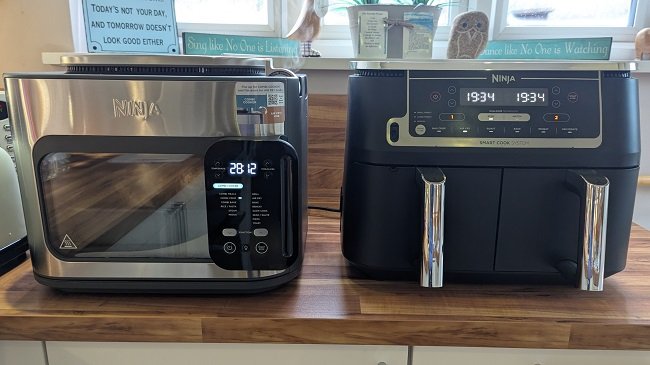
In October 2023, we bought an air fryer. Specifically the Ninja Foodi Max which was on special offer on QVC UK. We were intrigued by the possibilities and the convenience the device was alleged to offer. Fortunately, most of the hype proved correct and air fryers are quick and convenient. It takes awhile to determine cooking times but eventually you become as familiar and comfortable cooking with an air fryer, as you would using a conventional oven. They are also easy to clean. The baskets can be wiped down with hot, soapy water and the drip trays can be put in the dishwasher. Over a year later, we have grown attached to our air fryer due to its versatility and quick cooking times. Having one has substantially changed our cooking habits and the traditional oven is used far less.
In October 2023, we bought an air fryer. Specifically the Ninja Foodi Max which was on special offer on QVC UK. We were intrigued by the possibilities and the convenience the device was alleged to offer. Fortunately, most of the hype proved correct and air fryers are quick and convenient. It takes awhile to determine cooking times but eventually you become as familiar and comfortable cooking with an air fryer, as you would using a conventional oven. They are also easy to clean. The baskets can be wiped down with hot, soapy water and the drip trays can be put in the dishwasher. Over a year later, we have grown attached to our air fryer due to its versatility and quick cooking times. Having one has substantially changed our cooking habits and the traditional oven is used far less.
Just before Christmas 2024, we decided to buy a Ninja Combi Multi-Cooker. This purchase was again prompted by a promotion on QVC UK. This device can cook in 14 different ways, such as roasting, baking and steaming. At the flick of a switch it can also provide additional air frying services. Again its major selling points are speed and efficiency. A small chicken, cooked using the Combi Crisp setting, which steams and roasts simultaneously, takes about 30 minutes. The meat is thoroughly cooked but remains moist. If used in conjunction with our air fryer, a full roast dinner with three additional vegetables can be cooked in less than an hour (including the preparation time). Again, the mess is minimal and clearing up afterwards is straightforward. All of which makes cooking per se a lot easier.
During the course of my lifetime there have been several cultural shifts around home cooking. Our national diet in the UK has changed substantially with some traditional meals falling out of favour. Overall a broader continental approach to cooking has become prevalent. The other change being a move away from the exclusive use of ovens and hobs to cook. Microwaves ovens have become ubiquitous and can do a lot more than people think. Slow cookers are also a practical means to time-manage cooking. Air fryers and combi-ovens further contribute to this social change. Naturally there are a percentage of people who are happy to cook in a traditional fashion but I think this is becoming a smaller demographic group.
Despite the rise of modern cooking devices and techniques, convenience foods, ready meals and ultra processed products have sadly quelled a lot of peoples home cooking aspirations. Time is such an important factor in people’s decision making these days. With the modern work-life balance the way it is, a lot of people just don’t have the stamina to come home from work and cook, even if there are easier options than the traditional approach. It’s difficult to compete with a meal that is superficially tasty and ready in a matter of minutes. Cooking used to be a skill that was often passed down from parent to child. However, that is not necessarily the case nowadays, although the internet can provide an alternative source of information. Modern food products have made cooking skills non-essential.
That being said, there is a growing culture of trying to live a healthier lifestyle these days. For those who want to cook more themselves the air fryer does offer a practical stepping stone. Even if you’re not interested in cooking meals entirely from scratch, they can cook convenience food as quickly and easily as whole foods. In fact air fryers cooking times are now becoming quite common on food packaging along with standard instructions. Simply put, cooking today does not have to be the same as it was 30 years ago. The entire process can be approached in a far more casual manner and it is a lot easier to experiment. For those that are already enthused by “modern cooking” there are gadgets for everything. If you are looking to make a change and have simpler aspirations then I would recommend an air fryer as your first step.












An Uncertain World
I consider myself to be a grounded, rational individual. I am not excessively emotional. I like facts, data and reason as opposed to hyperbole, rhetoric and bluster. That being said, I am aware that the world is an imperfect place. Opinions are often not based upon empirical fact but personal perspective. Hence many people experience reality differently to me. They are driven by their feelings and other factors. However, despite these differences in philosophy, for most of my life the world has remained functional and over time slowly improved in subtle ways. Deference to expertise, a sense of community and basic pragmatism meant that people broadly pulled in the same direction. Of course there has always been dissent but it has been within a stable system. However, of late I feel that this era is now finally over. Things are no longer stable. We live in an uncertain world.
I consider myself to be a grounded, rational individual. I am not excessively emotional. I like facts, data and reason as opposed to hyperbole, rhetoric and bluster. That being said, I am aware that the world is an imperfect place. Opinions are often not based upon empirical fact but personal perspective. Hence many people experience reality differently to me. They are driven by their feelings and other factors. However, despite these differences in philosophy, for most of my life the world has remained functional and over time slowly improved in subtle ways. Deference to expertise, a sense of community and basic pragmatism meant that people broadly pulled in the same direction. Of course there has always been dissent but it has been within a stable system. However, of late I feel that this era is now finally over. Things are no longer stable. We live in an uncertain world.
Looking back at my youth, the seventies were economically and socially challenging. Not only here in the UK but across the western world. The energy crisis, war in the Middle East and the threat of nuclear attack were pressing concerns on top of the demands of day-to-day life. However, there was always the hope that cool heads would prevail. Changes in government meant that people with plans would strive to tackle and solve pressing issues. People broadly believed that public institutions were ultimately run by those who were suitably skilled. There was faith that the state worked and a degree of consensus regarding national aspiration. It wasn’t perfect by any means but the nation functioned and gave citizens a sense of stability. Democracy worked because people believed in it and understood their role. They also remembered the carnage of World War II and when democracy failed.
Today, I look around the UK and see a nation that is far from united. Politics, social debate and general interaction has become petty, nasty and ignorant. The cult of the individual rules and life is refracted through the prism of “what’s in it for me”. Everyone wants the benefits of first class public services but no one wants to pay for it. People no longer have any real grasp of how things work, be it the state or more tangible things like the internet. Critical thinking is in decline, as are attention spans. The world is becoming infantilised. People want change but lack the skills and patience to seek and implement any. Then there is the matter of wealth and power becoming further entrenched with an ever diminishing group of individuals. Inequality is rife, yet we still allow the wealthy to convince us that it is the most vulnerable in the world that are our enemy.
Such a state of affairs is worrying. I am no longer confident that the best of us will intercede and address the world’s problems. I believe that we’ll keep putting those who just make cheap promises in charge and they’ll just make things worse. This will then feed further decline. If certain politicians fail in the next 5 to 10 years, I can see the public giving up on democracy. Furthermore, I believe that a substantial percentage of the population are simply intellectually and emotionally unequipped to deal with any serious disruption to their normal life that may potentially occur. Trade wars, collapse of the global supply chain and terrorisms are all potential threats. Civil unrest is another possibility. Shortages, travel restrictions and disruptions to power and internet services would not be well received. As for the idea of ordnance being dropped on civilian targets, it would be beyond the comprehension of many.
I am not a blind optimist but I usually see the value in maintaining some sense of positive and practical hope that things will get better. Sadly, when 2025 arrived a few weeks ago I looked around and simply couldn’t see any sources of inspiration. In political terms the right is in ascendance across the western hemisphere and the centre ground and left are in retreat. I see no possibility of any sort of social or political reconciliation. We live in an age where everyone hates someone. History and reality demonstrate that populists seldom get anything done that is universally beneficial and they tend to break social and political institutions, making it very difficult for their successors to repair things. It pains me to say it but things are going to get a lot worse before they get any better, assuming that that is even a possibility at a later date.
Depressing isn’t it. As for the question “what are you going to do about it”, the answer is precious little. There is always activism, protest and lobbying but I suspect that such things are going to get a lot harder to do in the immediate future. For a lot of people, the current geopolitical situation is a mandatory train ride to the terminus, whether you like it or not. In the meantime you determine who you can trust, then keep your head down and try to get by. All of the various post war generations have been cosseted to a greater or lesser degree and it would be wise for them to adjust their expectations accordingly. As for hope, you must look for it in unexpected places and maintain your own personal morale the best you can. Take comfort in the fact that tyrants, fools and bullies are all mortal and eventually die. The darkness is not forever but it may be your children that see the dawn, not you.













Banks
I was having a discussion with extended family over Christmas and someone asked the interesting question “what is the most pointless shop in the high street”. Me being me, I asked for some clarification as to the parameters of this axiom, which I eventually got. The refined version of the question was to name a business that no longer enjoyed the custom that it did fifty years ago. This could be due to societal or technological change. There were some initial suggestions such as the newsagents but this was quickly dismissed. Newsagents don’t just sell newspapers anymore and are effectively small franchise, general purpose stores these days. Butchers were also put forward but subsequently rejected. They still exist and tend to be confined to more affluent areas. But I digress. The answer that was finally agreed upon were banks.
I was having a discussion with extended family over Christmas and someone asked the interesting question “what is the most pointless shop in the high street”. Me being me, I asked for some clarification as to the parameters of this axiom, which I eventually got. The refined version of the question was to name a business that no longer enjoyed the custom that it did fifty years ago. This could be due to societal or technological change. There were some initial suggestions such as the newsagents but this was quickly dismissed. Newsagents don’t just sell newspapers anymore and are effectively small franchise, general purpose stores these days. Butchers were also put forward but subsequently rejected. They still exist and tend to be confined to more affluent areas. But I digress. The answer that was finally agreed upon were banks.
I opened my first bank account in 1984, before I left school, in preparation for entering the job market. I visited my local branch of Lloyds Bank, where I provided my National Insurance Number as ID and deposited £10. Within a week I was sent a chequebook. At the time I worked casually and was paid cash, so I had to go to the bank every few weeks to pay money in. A few years later when I had left school and secured a full time job with the UK civil service, my wages were paid monthly, directly into my bank account. Hence my visits become less frequent. By this time ATMs were becoming commonplace, especially in major cities, so I started using these for my cash requirements. Throughout the nineties, I would visit a bank to deposit cash into a savings account and there would also be occasional visits to arrange a loan, mortgage or to purchase foreign currency for a holiday.
Since then I have embraced every new technological innovation that banks have offered and as result have used my local branch less and less. I no longer have a chequebook and very rarely pay one into my account. If I do it can be done via my phone. Today I have two bank accounts and two savings accounts. My primary interaction with any of them is always via a phone app or my desktop PC. Out of those four banks, two of them do not have any physical premises, existing as purely online entities. The other two “legacy” banks still have local branches throughout the UK but these are rapidly vanishing due to a lack of demand. Small businesses that handle cash and older customers still use the counter services provided at branch level but it’s not sustainable in the long term. Some bank chains would happily close all local branches immediately but decline to do so, as it has become a political hot potato.
Toscana Italian Restaurant, formerly a branch of Lloyds Bank
Domestic banking has traditionally been free in the UK. A basic bank account does not charge a customer for cash withdrawal or levy transaction fees. However, in recent years some banks have broadened their business model and there are now fees on high interest accounts or a requirement to maintain a minimum balance. There has also been an increase in foreign banks offering domestic banking services and these often do charge fees, especially for customers with low credit ratings. The financial landscape has also radically changed in my lifetime. The majority of the UK workforce now have their salary paid into their bank account on a monthly basis. Payment in cash is far less common and the use of cash in day-to-day transactions is also declining. Credit is far more readily available compared to the seventies. Saving has become less popular with many people having little or no reserves of money.
Hence, it would appear that for many people, especially the under 30s, banks are “the most pointless shop in the high street”. I last visited mine in March last year because I was dealing with the dispersal of funds from my late parents estate. I have not been again since then. Looking at my local highstreet, many of the “legacy” bank branches have closed. Due to their prime locations, many become bars. The branch of Lloyds where I opened my first account in 1984 is now a very good Italian restaurant. However, a few branches still persist, proving old habits die hard. Although I use a debit card, I still ensure I have cash on me, favouring a belt and braces approach. However, I suspect there will come a time in the not too distant future, when domestic banks will finally vanish from the high street and the UK finally becomes a cashless society as well.
Booking Tickets
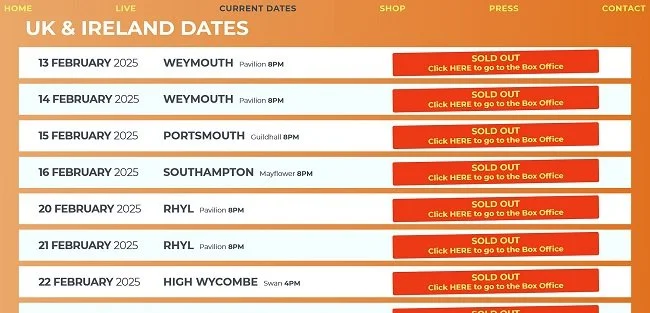
Last night Mrs P said apropos of nothing, “shall we go and see John Bishop”? For those who don’t know, John Bishop is an established UK comedian who is currently touring the country. So I went online and checked the details of his tour. We were quite happy to travel to see his show as it would provide an opportunity for a weekend away. Sadly, to cut a long story short we were unable to secure any tickets that suited our needs. From January to April, the tour is mainly using smaller venues such as local theatres and art centres. Later in the year during October and November, the tour moves to arenas, conference centres and stadiums. I find these very impersonal and don’t see any merit in sitting far away from the stage, watching an artist on a giant video screen. We had hoped we could get tickets at one of the smaller theatres but sadly we couldn’t find two seats together.
Last night Mrs P said apropos of nothing, “shall we go and see John Bishop”? For those who don’t know, John Bishop is an established UK comedian who is currently touring the country. So I went online and checked the details of his tour. We were quite happy to travel to see his show as it would provide an opportunity for a weekend away. Sadly, to cut a long story short we were unable to secure any tickets that suited our needs. From January to April, the tour is mainly using smaller venues such as local theatres and art centres. Later in the year during October and November, the tour moves to arenas, conference centres and stadiums. I find these very impersonal and don’t see any merit in sitting far away from the stage, watching an artist on a giant video screen. We had hoped we could get tickets at one of the smaller theatres but sadly we couldn’t find two seats together.
This anecdote illustrates two issues. The first being what do you need to do to keep up to date with tour information for bands, other musical artists and comedians? The second being the actual acquisition of tickets, which is frequently a far from equitable process. Because in the past and by that I mean the eighties and nineties, buying tickets went something like this. After spotting an advert for a forthcoming tour in the music press, I would either phone or visit the venue where the show was to be held and buy tickets from their box office. Alternatively, I would go to a third party ticket agent in Leicester Square and buy tickets there. Sometimes there would be a queue but if you were shrewd about the timing, there would be no major issues. However, this process was subsequently ruined by the internet and online booking services.
The most egregious problem associated with buying tickets nowadays is the rise of automated bots that buy en masse for touts. Another problem associated with the lottery that is the first come, first served approach, are the virtual queues that occur when tickets go on sale at designated times. I spent exactly 14 minutes in an online queue last year, in a vain attempt to buy two tickets for a popular podcast’s live recording. By the time I finally got to the front of the queue, I was greeted with a message that all tickets were sold out. How is this fair and equitable? Furthermore it is far from good PR for the artists in question. Last year’s sale of Oasis reunion tickets really caught the public's attention due to the poor way the process was handled. The question of regulating ticket sales has now even been raised in parliament.
Another issue that occurs, sometimes with smaller venues, is when there are limited tickets left. Some websites refuse to sell pairs of tickets if that sale leaves a single seat on its own. I noticed this when trying to buy two circle tickets from a local theatre recently. I received a pop up message that would not allow the purchase as it left an isolated seat that the venue would naturally find harder to sell. What I want to know is since when did the venue's business problems become mine? To add insult to injury, the ticket software subsequently encouraged me to purchase a third ticket and “bring a friend”. I was utterly flabbergasted by the hubris of this approach and was tempted to call the theatre in question personally. Upon reflection I decided why harass some minimum wage, box office clerk. It’s not as if they set the sales policy.
With regard to being notified in advance about upcoming tours, the obvious solution is to simply register for email notification from the artists respective website. It is also prudent to do the same with both small and large venues. However, I was told by a friend who works in the marketing industry that this approach isn’t quite as simple and foolproof as it would appear. Although bands and artists will notify fans in advance of tours, there exists within this process a two tier system. Those who have previously bought merchandise above a certain value are given priority and first access to ticket sales. A similar system exists with large venues such as the O2 Arena. “Valued” customers are notified in advance and again given access to priority ticket sales.
There are other issues arising that are worth considering. Third party brokers and their additional charges. Then there are the vagaries of the phrase “restricted view”. Some websites include a photo of the view from your seat. Others seem to go out of their way to be as vague as possible. Overall, it seems that ticket sales is a rather ethically questionable business. It may well serve the needs of the vendors but it doesn’t benefit consumers. Many artists try to distance themselves from this process, blaming the fact that it is run by third parties and thus not their fault. However, it would appear that this issue is getting greater scrutiny by the media and consumer groups. The industry may well be facing greater regulation this year. It certainly needs it. In the meantime I have learned from my experience and am better prepared for next time I wish to book tickets for an event.
Bluesky
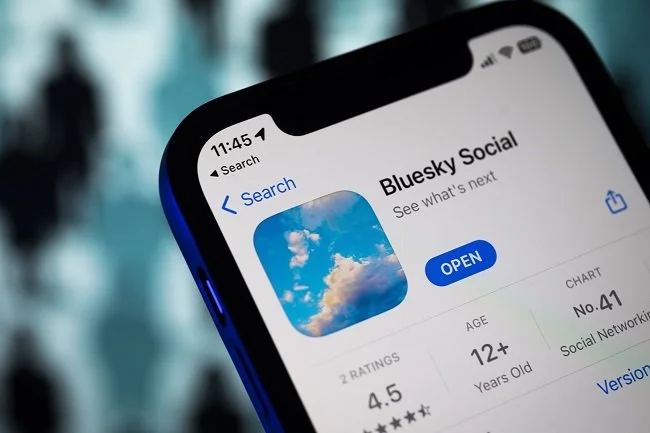
A couple of weeks ago I decided, like so many others, to create an account on Bluesky. My decision to do so wasn’t so much driven by a personal dislike of Twitter/X but because so many people that I follow had gone. I fully recognise that Twitter has been in decline since it was bought by Elon Musk but I still have found the social media platform useful, even during recent months. Through judicious use of the block and mute facilities, I have managed to keep my timeline relatively free of crap. However, the advertising has become more pervasive of late and most of the people whose Tweets I have enjoyed over the years have either migrated to other platforms or simply stepped away from social media altogether. It was the desire to spend time with a like minded community that ultimately prompted my move to Bluesky.
A couple of weeks ago I decided, like so many others, to create an account on Bluesky. My decision to do so wasn’t so much driven by a personal dislike of Twitter/X but because so many people that I follow had gone. I fully recognise that Twitter has been in decline since it was bought by Elon Musk but I still have found the social media platform useful, even during recent months. Through judicious use of the block and mute facilities, I have managed to keep my timeline relatively free of crap. However, the advertising has become more pervasive of late and most of the people whose Tweets I have enjoyed over the years have either migrated to other platforms or simply stepped away from social media altogether. It was the desire to spend time with a like minded community that ultimately prompted my move to Bluesky.
I joined Twitter in August 2010. Most of the people I started following I knew from the video games blogging community. Twitter was a great means at that point to promote one’s work and share material. Over time, I started following a broader spectrum of individuals and found Twitter to be a great source of breaking news. At its peak, the social media platform was a key source of both social activity and information. I used Tweeten as my Twitter client and had it running continuously on my second monitor throughout the day. When I was away from my desk, I had Hootsuite on my phone. For a while, Twitter was very much a focal part of my day. However, overtime, I learned that this wasn’t necessarily a good thing and I curtailed my enthusiasm. The loss of key individuals that I followed, contributed a lot to this change in mindset. Social media is only as good as the people you follow.
New technological mediums often start with innovative pioneers that create a new market and subsequently dominate it for a while. Twitter falls into that category, just like Steam and Netflix. All have had their day in the sun where they effectively enjoyed a monopoly. However, competitors and a fragmenting market ultimately have knocked them all off their respective pedestals. In the case of Twitter, management decisions have contributed to the diminishment of the brand. I suspect that in time, there will be several social media platforms that become the established leaders and people will make their choice depending on a multitude of personal factors. Politics may be one. Friends, community and the ability to carefully curate your timeline may be others. A year or two from now, what social media platform you use may become a key question in market research.
With regard to Bluesky, I find that its functionality is nearly identical to that of Twitter. I was very pleased to find so many old friends so quickly and at present, there are many familiar faces in my timeline. Plus I have discovered many new people to follow with similar interests and hobbies. I have already started proactively policing my timeline to ensure it suits my needs. There is a lot that you can do to mute words, block people and generally ensure that you’re not exposed to a load of tedious and unnecessary bullshit. Social media has the capacity to do a lot of harm to one’s mental wellbeing, therefore it is very important to ensure that it serves you and not the other way round. As for Twitter, I still have an account but I’m not especially active. It is sad how things have changed but that is just the nature of life. Keep moving forward. See you on Bluesky.







Being Organised
I recently “tooted” on Mastodon “sometimes it’s a real drag to be the person who always has their shit together”. Although meant humorously, there was an element of truth to the remark. Allow me to explain. I always have a shopping bag in my coat pocket. Our household always has a supply of those things that you often run out of or need occasionally. Such as AA batteries, stamps and envelopes. If Mrs P and I are going out for the day, we’ll check the weather and traffic before we set off. There’s always a spare toner and drum unit for the printer, as well as paper. We’ll book a table at our favourite restaurant in advance of going to the West End show. Why do we do these things? Because we’re organised. I’m not trying to be smug about it, that’s just our default position and how we were raised. Perhaps it’s a generational thing?
I recently “tooted” on Mastodon “sometimes it’s a real drag to be the person who always has their shit together”. Although meant humorously, there was an element of truth to the remark. Allow me to explain. I always have a shopping bag in my coat pocket. Our household always has a supply of those things that you often run out of or need occasionally. Such as AA batteries, stamps and envelopes. If Mrs P and I are going out for the day, we’ll check the weather and traffic before we set off. There’s always a spare toner and drum unit for the printer, as well as paper. We’ll book a table at our favourite restaurant in advance of going to the West End show. Why do we do these things? Because we’re organised. I’m not trying to be smug about it, that’s just our default position and how we were raised. Perhaps it’s a generational thing?
Do organised people attract each other? I’m not sure if that is always the case. However, it is with Mrs P and myself. We are both organised when it comes to admin and finances. We tend not to “put off to tomorrow what can be done today” and we both have a capacity to think ahead and anticipate things that can come up and thus plan for them. It’s seldom rocket science or anything tricky. If we’re collecting the grandchildren from school and looking after them for a few hours, it’s pretty obvious to have food in the freezer and a cupboard full of snacks. Mrs P is always good at remembering birthdays and buying suitable gifts. It isn’t some sort of quasi super power. She just listens to people and makes a note in her diary. I have learned from this and tend to use the calendar and notes features on my phone. Being organised is a lot easier these days with the tools we have.
However, despite the obvious benefits of being prepared, it does come with its own set of problems. Once you are identified by others as “having your shit together” you find that an ad hoc network grows around you. It ranges from those who become at a low level, semi dependent upon your organisational skills, to members of your family that just end up in some pain in ass, symbiotic relationship. This manifests itself in a spectrum of enquiries and requests. At one end you have low level stuff like “can you scan this for me and turn it into a PDF”? At the other extreme there’s “I’ve been accused of a heinous crime. Will you bank roll my legal defence”? This can all become a little frustrating. Don’t get me wrong, I believe that it is important that we all help each other as we journey towards the grave but it can get a little one sided at times.
I used to work with someone who would always ask me the same question every three months or so. The answer could easily be found in the administrative code manual. After a while I said to the person in question “why do you keep asking me this. You should have learned this by now”. They replied “I don’t need to learn it, as I have you”. They meant it sincerely and as a compliment but it really left me aghast because to me it was an appalling personal philosophy. To a degree, I feel this way at times with those who keep asking me “can I borrow your lawn mower”. It would be nice if those who seem dependent, could occasionally manage their own needs. Mrs P thinks I’m being a little harsh and so I usually end up relenting. Hence “sometimes it’s a real drag to be the person who always has their shit together”.
Newspapers
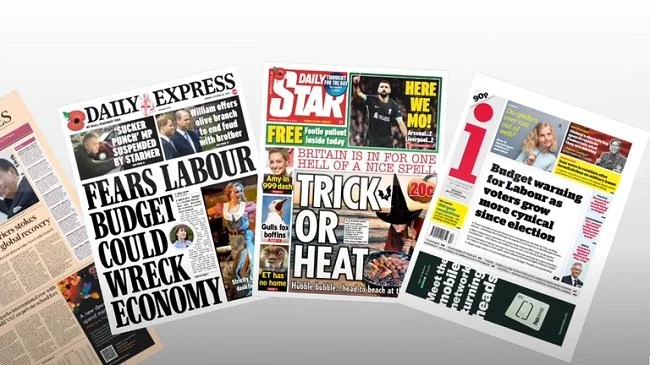
Newspapers were an integral part of UK culture in the seventies. During the week, they were delivered prior to going to work, so you would peruse them over breakfast. Alternatively you would buy one en route to your place of employment and read it on the bus or train. In a world before 24 hour, rolling news, they were the primary means of keeping the public abreast of events and as such, enjoyed a substantial audience. On occasions a newspaper story could make or break a political career or launch a crusading campaign to address a social ill. Newspapers were a force to be reckoned with and therefore a significant part of the socio-political landscape. However, due to a strong union presence within the workforce, the UKs newspapers often lagged behind other industries with regard to the technology.
A selection of UK newspapers
Newspapers were an integral part of UK culture in the seventies. During the week, they were delivered prior to going to work, so you would peruse them over breakfast. Alternatively you would buy one en route to your place of employment and read it on the bus or train. In a world before 24 hour, rolling news, they were the primary means of keeping the public abreast of events and as such, enjoyed a substantial audience. On occasions a newspaper story could make or break a political career or launch a crusading campaign to address a social ill. Newspapers were a force to be reckoned with and therefore a significant part of the socio-political landscape. However, due to a strong union presence within the workforce, the UKs newspapers often lagged behind other industries with regard to the technology.
Like so many other products, there has always been a hierarchy of newspapers in the UK. Different papers are targeted at specific demographics. The broadsheet newspapers tend to take a more intellectual approach with their journalism, whereas the tabloids are aimed at a more broader readership. I am reminded of a quote from the sitcom Yes, Minister which although 40 years old, still has a degree of truth about newspapers readership. “The Daily Mirror is read by people who think they run the country; The Guardian is read by people who think they ought to run the country; The Times is read by the people who actually do run the country; The Daily Mail is read by the wives of the people who run the country; The Financial Times is read by people who own the country; The Morning Star is read by people who think the country ought to be run by another country; and The Daily Telegraph is read by people who think it is”.
Daily Mail hyperbole
However, things change. Over the course of my life there has been a steady decline in newspaper sales. Dedicated television channels, providing 24 hour coverage is one reason. The internet is another. A story can be quickly disseminated online and be constantly updated as events unfold. Traditional print media lags behind and by the time it reaches the reader, is yesterday’s news. As a result modern newspapers tend to deal more in editorials and opinion pieces, rather than hard news. Sadly, the majority of the UK print media is owned by those with a right wing bias. Something that is at odds with the UK electorate which is broadly centrist. Hence the decline in sales. The only group that still cleaves to print media are over 65 and so the most popular newspapers, such as the Daily Mail and The Daily Express, exclusively cater to them. Neither of these two newspapers reflect a reality that I recognise.
Curiously, despite a decline in sales, there is still a perception that newspapers are at the cutting edge of journalism and have an influence on the wider news agenda. Television and radio news in the UK still often follows and expands upon headlines found in the popular press. Furthermore politicians still spend a considerable amount of time and effort trying to generate headlines in the newspapers. They go out of their way to cultivate relationships with political journalists and will often seek to disclose information to the press as part of the policy agenda. Similarly, newspapers will seek to influence politicians by directly and indirectly lobbying on specific subjects. The Brexit referendum of 2016, was heavily influenced by lengthy and substantive campaigning by the majority of the UK press. All of which were owned by individuals who had openly declared their support for leaving the EU.
Rupert Murdoch, owner of 33% of UK newspapers
Beyond the obvious political and philosophical bias, most tabloid newspapers nowadays are simply a vehicle for celebrity gossip, scandals and doom mongering. They also peddle conspiracy theories, bogus science and perhaps the biggest lie of all, that all of the problems in the UK are someone else’s fault. These publications are inherently parasitical and are not in any way a force for good. Yet in spite of these issues, there is still good journalism to be found within the UK, although much of it resides online. Some newspapers, such as the “i” are even bucking the trend and increasing their readership. Perhaps newspapers aren’t quite dead yet and despite their tawdry current state, people still believe in the noble qualities they remember from the past. Whether the tide will turn remains to be seen.
Supermarket Loyalty Cards
In the dim and distant past, UK supermarket loyalty cards used to be about earning points that could be traded for luxury items. This would be merchandise or services. Air Miles being a prime example. This changed over time and supermarkets moved to a system where you earned points via purchases that had a nominal financial value. The customer could then offset these accumulated points against their grocery bill. A couple of years ago, around the time the “cost of living crisis” began, some UK loyalty cards added an additional system and started offering discounted prices on specific products. For example a pack of 9 Andrex Complete Clean toilet rolls retails at the standard price of £5.95 but if you have a loyalty card, you can purchase it at the lower price of £4.65 instead.
In the dim and distant past, UK supermarket loyalty cards used to be about earning points that could be traded for luxury items. This would be merchandise or services. Air Miles being a prime example. This changed over time and supermarkets moved to a system where you earned points via purchases that had a nominal financial value. The customer could then offset these accumulated points against their grocery bill. A couple of years ago, around the time the “cost of living crisis” began, some UK loyalty cards added an additional system and started offering discounted prices on specific products. For example a pack of 9 Andrex Complete Clean toilet rolls retails at the standard price of £5.95 but if you have a loyalty card, you can purchase it at the lower price of £4.65 instead.
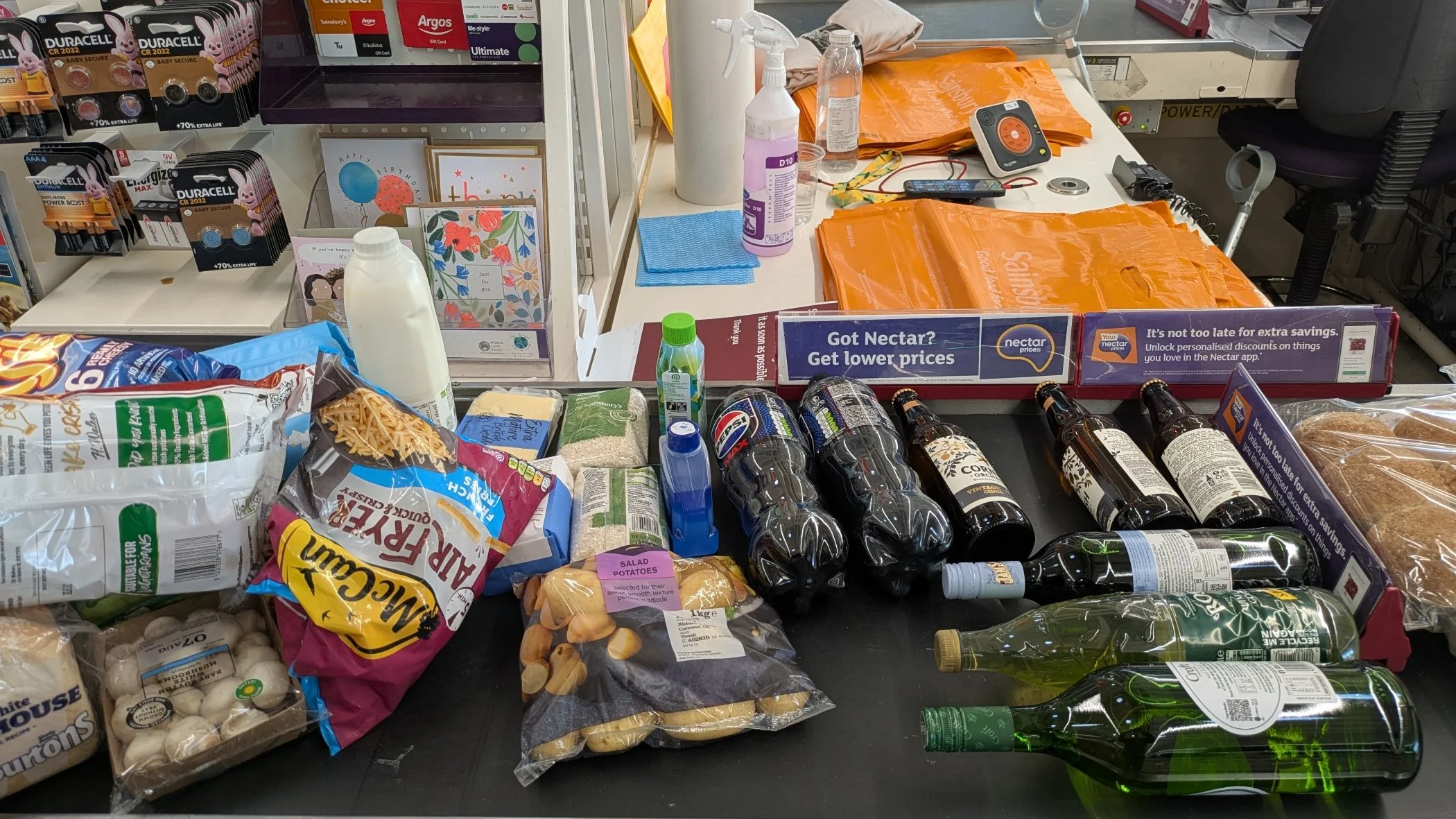
Although overall inflation is reducing in the UK, food inflation remains high, as do energy prices. These may well stay that way due to potential global factors that could come into play next year. Hence supermarket loyalty cards will continue to play a major role in keeping the price of a weekly or monthly grocery shop manageable. The discounts on offer are such that our household currently has four loyalty cards from the following stores. Tesco, Sainsbury’s Morrison’s and the Co-op. We shop at specific stores for particular products that are maintained at a discount price. We have found it possible to make savings of £40 or even £50 a month, if we keep an eye on prices across all four stores. Often this means having an app installed on my phone and being notified of offers.
Naturally, the increase in this loyalty card culture has generated a great deal of interest. How do the big supermarkets accommodate such competitive pricing? Is it simply a question of loss leading, or is it a case of inflating the original price and then offering the minimum retail price as the discount? Is this practice sustainable? There have also been claims that the system is unfair and biassed towards those who can afford to shop at the top tier supermarkets. The counter argument is that the budget stores are already offering discounted products by default, as it is essentially the foundation of their business model. Whatever the methodology and irrespective of the ethics of supermarket loyalty cards, it certainly isn’t impacting upon profits. Tesco, the UK’s number one supermarket chain, had a turnover of £48 billion in 2023.
Unless you are so wealthy that the cost of living is not a consideration, most people have some requirement to “shop smart” these days. We make use of loyalty scheme discount prices and buy some products in bulk from outlets such as Amazon. Tea has fluctuated in price over the last eighteen months, mainly due to adverse weather conditions in the countries of origin. As Mrs P is highly unlikely to stop drinking the stuff anytime soon, we tend to buy a half dozen boxes at a time. The panic buying we all saw at the start of the pandemic is another reason why we like to maintain a small stock of some products such as toilet rolls, cleaning products and pasta. Until the economic situation improves, we will continue to make use of any scheme or process that allows us to keep our grocery bill as low as reasonably possible. Perhaps we can gamify the process to stop it from becoming a chore.


Conversation
Daily life is often filled with small talk. Simple exchanges of pleasantries that make social interaction easier and modern life tolerable. Not every conversation needs to be a heavy weight and meaningful exchange. More often than not, all you have to do is politely listen, express an appropriate response and end the verbal exchange on a positive note. It’s not exactly rocket science but that’s not to say that it’s easy for everyone. Some people seem to have an innate talent for this sort of social discourse. Mrs P is very good at it. She remembers people’s names, what they may have said previously and most importantly she shows interest. I’m not so good at small talk. I can do it but I tend to find that a continuous diet of it is unrewarding. Being effectively “retired”, I mainly meet others who are no longer working but they tend to be at least ten years my senior. In the UK the biggest factor that currently determines differing opinions on all major issues is age.
Comedians Mel Smith and Griff Rhys Jones have one of their “head to head” conversations
Daily life is often filled with small talk. Simple exchanges of pleasantries that make social interaction easier and modern life tolerable. Not every conversation needs to be a heavy weight and meaningful exchange. More often than not, all you have to do is politely listen, express an appropriate response and end the verbal exchange on a positive note. It’s not exactly rocket science but that’s not to say that it’s easy for everyone. Some people seem to have an innate talent for this sort of social discourse. Mrs P is very good at it. She remembers people’s names, what they may have said previously and most importantly she shows interest. I’m not so good at small talk. I can do it but I tend to find that a continuous diet of it is unrewarding. Being effectively “retired”, I mainly meet others who are no longer working but they tend to be at least ten years my senior. In the UK the biggest factor that currently determines differing opinions on all major issues is age.
One of the few things that I miss about full time employment is talking to intelligent people. Although I’m not keen on small talk, I’ll happily listen at length to those who have interesting and informed insights based upon a wealth of experience. Such conversations do not have to be couched in academia. It is more of a case of talking to someone who just knows their job or subject well and they are at total ease when discussing it. They’re not merely sharing information. Rather they are relaying knowledge and imparting wisdom. Furthermore, such exchanges can come from all quarters. I remember two exceptional conversations I had in the early 2000s. One was with a senior operations officer of a steel plant and the other was with an air conditioning engineer who had previously been a military policeman. Both were knowledgeable, worldly, good communicators and I suppose you could possibly say charismatic.
Elvis famously advocated for a “little less conversation” but I consider such advice dubious
I also miss the conversations I had with my father. He similarly was an inexhaustible source of information, anecdotes and measured opinions. All of which had been born out of decades of reading, study and sober reflection. His most formative years had been during World War II as he was ten years old when it began and sixteen when it ended. He was at heart an academic and although he had feelings, in many matters he never let his heart rule his head. Hence he had a capacity to change his position on certain subjects over time, because new data or experiences logically required a re-evaluation. It’s a rare quality these days and I wish more people had such an adaptable outlook. Sadly he’s been gone four years now and it has left a significant conversational gap that has yet to be filled.
As a consequence of this conversational deficit, I find myself listening to a lot of podcasts, audiobooks and other content that is structured around a discussion. If I can’t find an engaging conversation of my own, I can at least listen to someone else's. Thanks to the internet, I can fill my day if need be with the musings of the finest minds, the wit of the funniest people and the badinage of the greatest raconteurs. However, despite the pleasure such material brings, there is a downside. One’s expectations of conversations in the real world have to be seriously adjusted. A chance encounter with someone at the bus stop will seldom result in an in depth analysis of Etruscan pottery or Cartesian dualism. Naturally it can be cogently argued that it is unreasonable to expect such things to begin with, however that doesn’t alter the fact that the heart wants what the heart wants.
“Man is humbled by the uncertainty of what he can know, but still has the itch to gain absolute knowledge, often with tragic consequences”. Jacob Bronowski
Something I’ve noticed about the nature of conversations, is how they evolve over the course of one’s life. I cast my mind back to my late teens and earlier twenties and recollect many a late night discussion, fueled by alcohol and couched in the certainty of youthful inexperience and ignorance. Nowadays when discussing weighty issues such as geopolitics or economics, the one thing that is conspicuously missing is any shred of certainty. The financial crisis of 2008, COVID and the ongoing war in the Middle East all go to show how the established status quo can alter quickly. At the age of 56, I now understand Socrates’ position of “I know that I know nothing” and I am extremely sceptical of anyone whose arguments and philosophical positions are presented as immutable truths.
However, in recent years a new source of engaging conversation and interesting inquiry has been my grandchildren. They are young, confident and curious about lots of things. Therefore they ask a lot of questions and assume I have all the answers. As well as being deadly earnest, they’re also very funny, though often unintentionally. Although there is a requirement to explain things in a manner that children can understand, you must never patronise or condescend to children. They’re far shrewder than you think. It is also a golden opportunity to impart to my grandchildren a love of engaging and enjoyable conversation. Because it is such an invaluable social tool. Conversation is good for building relationships, sharing ideas, resolving conflicts and creating trust. It is also beneficial for one’s mental health. And if you can’t find such conversations in real life, then seek them online.
The First Past the Post Electoral System
The First Past the Post (FPTP) electoral system used in the United Kingdom, as well as in several other countries such as the US and India, has both advantages and disadvantages. However, despite being a simple and straightforward system it has been abandoned by many democracies in favour of more proportional and equitable methods. The primary criticism against FPTP is that it allows a minority of the electorate to return a majority government. Since 1935, there have been majority governments 90% of the time, but not one of them had the support of a majority of voters. At present, the current UK government has a majority of seats with just 43.6% of the votes. In the 2019 election they gained an extra 48 seats despite an increase of only 1.2% of the vote share.
The First Past the Post (FPTP) electoral system used in the United Kingdom, as well as in several other countries such as the US and India, has both advantages and disadvantages. However, despite being a simple and straightforward system it has been abandoned by many democracies in favour of more proportional and equitable methods. The primary criticism against FPTP is that it allows a minority of the electorate to return a majority government. Since 1935, there have been majority governments 90% of the time, but not one of them had the support of a majority of voters. At present, the current UK government has a majority of seats with just 43.6% of the votes. In the 2019 election they gained an extra 48 seats despite an increase of only 1.2% of the vote share.
Under First Past the Post, the UK Parliament does not accurately reflect the way the electorate votes. Hence, millions of people do not get the representation they choose. In the 2024 general election, the combined vote share for Labour and the Conservatives reached a record low, with smaller parties doing well. Yet the election was highly disproportionate, as Labour won 63% of seats (411) with only 34% of the vote, while Reform won under 0.8% of seats (5) with 14.3% of the vote. The Liberal Democrats recorded their best ever seat result (72), despite receiving only around half the votes they did in 2010. A Parliament that fails to reflect how people vote can lack popular support and have its legitimacy questioned. However, such complaints have always been countered with arguments that FPTP delivers strong governments with the ability to implement their respective manifestos.
Here are some of the key pros and cons of the First Past the Post system :
Pros:
1. Simplicity: FPTP is a straightforward system where voters mark an "X" next to their preferred candidate, and the candidate with the most votes wins. The simplicity makes the electoral process easy to understand and administer.
2. Strong Government: FPTP often leads to a single-party majority in the House of Commons, which can result in a more stable and decisive government. This majority typically allows the winning party to implement its agenda without needing to form coalitions and compromise on key policies.
3. Local Representation: Each regional constituency is represented by a single elected member, which helps establish a direct link between constituents and their representative. This can enhance local representation and also provides the electorate with clear accountability.
4. Prevents Extreme Parties: FPTP tends to favour larger, more established parties, making it difficult for smaller or more extreme parties to gain representation. This can be seen as an advantage if stability and moderation are priorities.
Cons:
1. Disproportionate Representation: FPTP can lead to a significant mismatch between the proportion of votes a party receives nationally and the number of seats it wins. This can result in a parliament that does not accurately reflect the diverse political views of the population.
2. Wasted Votes: In FPTP, votes cast for losing candidates and those beyond the necessary majority for the winning candidate are considered “wasted”. This results in “safe seats” with an incumbent candidate who has an established majority. This can lead to a sense of disenfranchisement among voters whose preferred candidate or party does not win as their vote effectively doesn’t count.
3. Regional Biases: The system can reinforce regional biases, as parties may focus on winning in specific geographic areas rather than seeking support across the entire country. This can lead to neglect of certain regions and communities.
4. Limited Choice: FPTP tends to limit voters' choices to candidates from the major parties, as smaller parties may struggle to gain a foothold. This can result in a lack of diversity and stifled political competition. It also fosters a sense of dissatisfaction among the electorate if a substantial percentage vote for a particular party yet it gains no seats.
5. Tactical Voting: Voters may feel compelled to vote strategically rather than for their preferred candidate or party, especially if they believe that their preferred choice has little chance of winning. This can distort the true preferences of the electorate.
Ultimately, the choice of an electoral system involves a trade-off between various principles, such as simplicity, proportionality, and stability. Different systems prioritise different aspects, and no system is perfect. The debate over electoral systems often revolves around finding a balance that aligns with the values and goals of a particular society. At present, neither of the two main political parties have made any kind of electoral pledge to alter the UK voting system. Both benefit from FPTP as it currently stands, so it is only the smaller parties that advocate for change.
Political Language and Rhetoric
Politicians have a distinct way of talking when being interviewed or giving a press conference. It is often characterised by a strategic use of language, centred around rhetorical devices, persuasion techniques and a careful framing of messages. Direct answers to questions are usually avoided, with tangential responses being preferred. Opinions and specific perspectives are frequently presented as facts. There is also a propensity to focus on “problems” and apportioning blame, rather than “solutions”. It’s important to note that the use of language in politics is a complex and dynamic process influenced by various factors, including cultural context, media dynamics, and the evolving political landscape. Different politicians may employ different communication strategies based on their individual styles and objectives. Here are some key aspects of how politicians use language:
Politicians have a distinct way of talking when being interviewed or giving a press conference. It is often characterised by a strategic use of language, centred around rhetorical devices, persuasion techniques and a careful framing of messages. Direct answers to questions are usually avoided, with tangential responses being preferred. Opinions and specific perspectives are frequently presented as facts. There is also a propensity to focus on “problems” and apportioning blame, rather than “solutions”. It’s important to note that the use of language in politics is a complex and dynamic process influenced by various factors, including cultural context, media dynamics, and the evolving political landscape. Different politicians may employ different communication strategies based on their individual styles and objectives. Here are some key aspects of how politicians use language:
Persuasion and Rhetoric:
Emotional Appeals: Politicians often use emotionally charged language to connect with the audience. Appeals to fear, hope, anger, or empathy can be powerful tools for swaying public opinion.
Repetition: Politicians frequently repeat key phrases or slogans to reinforce their message and make it more memorable. This repetition can help shape public perception.
Framing:
Positive Framing: Politicians strive to present their policies, actions, or ideas in a positive light. They carefully choose words and phrases that cast their initiatives in the best possible way.
Negative Framing: Similarly, politicians may use negative framing to criticise opponents, policies, or situations. This can influence public perception and create a sense of urgency or concern.
Ambiguity and Vagueness:
Strategic Ambiguity: Politicians may use vague language to avoid committing to specific positions, especially on contentious issues. This allows them flexibility and can help them appeal to a broader audience.
Plausible Deniability: Vague language can also provide politicians with a degree of plausible deniability, making it harder for opponents to pin them down on particular statements.
Slogans and Catchphrases:
Memorable Messaging: Politicians often rely on catchy slogans and memorable catch phrases to encapsulate their key messages. These can serve as rallying cries and make complex issues more digestible for the public.
Euphemisms and Loaded Language:
Euphemisms: Politicians may use euphemisms to soften the impact of certain policies or decisions. This can make potentially unpopular actions more palatable to the public.
Loaded Language: The choice of words matters. Politicians might use loaded language to evoke strong emotions or to frame an issue in a particular way that aligns with their agenda.
Adaptation to Audience:
Tailoring Messages: Politicians often tailor their language to different audiences. The way they speak to a group of business leaders may differ from how they address a community gathering. This adaptability helps them connect with diverse constituencies.
Sound Bites and Media Interaction:
Media-Friendly Phrases: Politicians understand the importance of concise and media-friendly sound bites. They craft messages that can easily be quoted and shared in news coverage, ensuring that their perspectives are highlighted.
Understanding the way politicians use language can empower individuals to critically evaluate political discourse and understand the underlying messages being conveyed. It’s essential for the electorate of any country to be aware of how language is used to shape political narratives and to engage in informed and thoughtful analysis. Whether politicians should be expressing themselves in such a fashion is another matter altogether. It can be argued that the public has been tolerant for too long of what is essentially an oblique means of communication. In the UK, in recent years there has been a robust campaign to ensure that all government literature and websites are written in clear, plain English. It has proven very effective. Perhaps it is time for a similar lobby to be made regarding the manner in which politicians express themselves, seeking for a more clear and precise style.
Restaurants
I really like dining out. I always have. As a child it was considered an adventure, mainly due to its rarity. As an adult I enjoy dining out as an excellent social activity and way to get to know people. It is also a means to discover new types of cuisine and experience meals that you haven’t tried before. I am happy to dine indoors in an atmospheric restaurant or outside if the weather and surroundings justify it. I prefer to sit away from larger tables as they tend to be noisier, and have a leisurely conversation with those I’m dining with. You can catch up with news and gossip or set the world’s wrongs to right. Music can add to the ambience, especially if it is culturally appropriate. Occasionally it can be intrusive but again, if you choose your table wisely, it can be avoided in such circumstances. For me, dining out is more than a practical necessity but a desirable social activity. However, I have friends who take exactly the opposite view.
I really like dining out. I always have. As a child it was considered an adventure, mainly due to its rarity. As an adult I enjoy dining out as an excellent social activity and way to get to know people. It is also a means to discover new types of cuisine and experience meals that you haven’t tried before. I am happy to dine indoors in an atmospheric restaurant or outside if the weather and surroundings justify it. I prefer to sit away from larger tables as they tend to be noisier, and have a leisurely conversation with those I’m dining with. You can catch up with news and gossip or set the world’s wrongs to right. Music can add to the ambience, especially if it is culturally appropriate. Occasionally it can be intrusive but again, if you choose your table wisely, it can be avoided in such circumstances. For me, dining out is more than a practical necessity but a desirable social activity. However, I have friends who take exactly the opposite view.
In the UK, there was a growth in restaurants during the early 1930s to accommodate a growing need by the middle classes. Dining out became more popular after WWII during the 1950s. A greater variety of cuisines became available over time, both from Europe and the UK Commonwealth. As mentioned earlier, dining out at either a humble cafe or restaurant was a rarity in my youth during the seventies. This was mainly due to the prevailing economic climate at the time and the fact that inflation was high. By the time I started my working life during the early nineties, it had become far more commonplace. Many pubs began modernising for a more “family friendly” clientele and providing food. Also by this time, there was a greater variety of restaurants and fast food outlets available, catering for all tastes and budgets. Hence today, dining out is an everyday event. My grandchildren consider it a normal activity and something that happens about once a week.
I like a broad spectrum of restaurants. I’ll happily go to McDonalds or a Wetherspoons pub for breakfast or a quick, convenient and cheap meal. Similarly, I have no prejudice when it comes to local cafes or other fast food outlets. They all serve a useful purpose. I also like to visit restaurants at the other end of the spectrum. Especially when entertaining friends. About twenty years ago, I was working for a financial and economic research company in central London and they would often wine and dine their respective clients. I was often invited along to answer any technology based questions (which never came up). As a result I went to two of the city’s most upmarket restaurants. The Coq d'Argent at Poultry and the OXO Tower at Blackfriars. Both were memorable experiences as these were very formal establishments with outstanding cuisine.
Over the years Mrs P and I have had several favourite restaurants. Places where we have enjoyed not only the food but the ambience. We used to visit a modest, family run Italian restaurant in Cranbourne Street, London and would often book a table after we had seen a show or some such outing. Sadly, the pandemic put pay to this friendly and pleasant establishment. Fortunately, a new Italian restaurant opened locally quite recently. It has proved to be exceptional and is a fine example of a multigenerational family business. The food is simple but exceedingly well made and the atmosphere is cheery and welcoming. Similarly we have discovered a nearby Indian restaurant that does an outstanding Sunday buffet. It is part of a small local chain with three branches in the area. The food is by far the best of its kind I’ve ever had.
The hospitality industry is a competitive one and sadly many businesses don’t survive. Chain outlets often dominate, squeezing out independent vendors. There is also a great deal of snobbery associated with dining out. I was in South Kensington recently and passed what was effectively a cafe. It offered a standard breakfast but due to its location in fashionable West London, saw fit to charge triple the price. It is also worth noting that not everyone enjoys dining out. Some people are not comfortable dining in public or with social meals. I know someone who “doesn’t see the point of restaurants” and just prefers to dine at home. For some the expense is still an issue. It all comes down to what you’re used to and what you prefer to do. For me, dining out is a major part of my social activities and a source of great pleasure.
More DIY
I fitted a new toilet seat today because the old one was broken. To be pedantic, it was the lid over the seat that was actually broken. It would appear they don’t support the weight of a 56 year old man who is reaching for a rubber ducky. However, the complexities of the circumstances leading to the lid breaking are ultimately irrelevant. The problem needed to be addressed as there were dangerous sharp edges. Therefore, to make things easier, I ordered the exact same make and model of toilet seat that I had previously bought in April 2021. Upon subsequent reflection, I do wonder how often the average person changes their toilet seat? Is three years considered a high turnover by the toilet seat statistical community? Who knows? But I digress. The new seat arrived today and in a fit of hubris I thought I’d quickly install it in the morning after showering. I reckoned it would only take half an hour or so. How foolish of me.

I fitted a new toilet seat today because the old one was broken. To be pedantic, it was the lid over the seat that was actually broken. It would appear they don’t support the weight of a 56 year old man who is reaching for a rubber ducky. However, the complexities of the circumstances leading to the lid breaking are ultimately irrelevant. The problem needed to be addressed as there were dangerous sharp edges. Therefore, to make things easier, I ordered the exact same make and model of toilet seat that I had previously bought in April 2021. Upon subsequent reflection, I do wonder how often the average person changes their toilet seat? Is three years considered a high turnover by the toilet seat statistical community? Who knows? But I digress. The new seat arrived today and in a fit of hubris I thought I’d quickly install it in the morning after showering. I reckoned it would only take half an hour or so. How foolish of me.
Now the reason I wanted the same model as before is because it has a quick release mechanism for taking off the seat. Therefore I was hoping I could simply swap out the broken seat with the new one and not have to mess about installing any fittings. The new seat could just click onto the existing posts. So I unpacked the replacement seat, lined up the holes on the hinge with the posts and lowered it down expecting it to conveniently click into place. Except that it didn’t. The existing posts were too thick. Hence I had to get on my hands and knees and reach under the toilet bowl and unscrew the current fittings. Now you may or may not know this but getting on the floor and into confined spaces is a bitch when you’re 56. The problem was further compounded as the existing wingnuts were done up “finger tight” by my son, so they were disinclined to yield.
I find that most problems are easier to solve after lunch, so I took an extended break and had a midday meal along with a couple of pints of beer for medicinal reasons, at a local cafe. Feeling suitably fortified I returned to the job in hand and decided rather than try and unscrew the wingnuts, I’d rotate the posts using an adjustable spanner. This strategy worked and the fittings became loose. I was then able to unscrew the wingnuts and remove the posts. After another beer (I was thirsty by this point), I then installed the new fittings that came with the replacement toilet seat. The posts lined up with the holes in the hinge and this time round the seat clicked securely into place. I stepped back to admire my handy work and basked in the glory of my victory accordingly. I assume this is how Marcus Agrippa felt after the Battle of Actium or all those Amish people after they built that barn in the film Witness.
There was a time when working with your hands was part of most people’s daily life. Furthermore, being a skilled craftsman was venerated by one’s peers and the wider community. Sadly, the days of many of us having practical skills are long gone. We live in a world where we don’t fully understand how everything in our homes actually works and certainly don’t have the necessary skills to fix things. In fact our lifestyle has become so disposable that it often doesn’t even cross our minds whether something can be repaired. Too often we seek to replace by default. My clumsy struggle to fit a toilet seat is in some respects quite shameful. I may have technical skills but they can’t put up shelves or install a shower. My father, who was a practical man, would have rolled his eyes at my incompetence. But this is the world we live in and I am not alone in my lack of DIY skills.
Handwriting
I recently had to complete some formal paperwork which required me to fill in various information by hand, in black ink. I sat myself at the dining room table and subsequently started writing the necessary information. To my surprise this proved quite difficult. After a few minutes of trying to write neatly, my right hand started cramping. The more I tried to concentrate and “write casually”, the harder it became. By the time I completed the form, my writing had deteriorated considerably. I was somewhat ashamed of the way I had scrawled over this legal document. To make things worse, I then remembered having handwriting lessons as a child. Overall, I was somewhat perturbed at my apparent loss of the ability to write. However, after some further thought, I wondered when was the last time I wrote anything longhand? Exactly how often do I put pen to paper nowadays?
I recently had to complete some formal paperwork which required me to fill in various information by hand, in black ink. I sat myself at the dining room table and subsequently started writing the necessary information. To my surprise this proved quite difficult. After a few minutes of trying to write neatly, my right hand started cramping. The more I tried to concentrate and “write casually”, the harder it became. By the time I completed the form, my writing had deteriorated considerably. I was somewhat ashamed of the way I had scrawled over this legal document. To make things worse, I then remembered having handwriting lessons as a child. Overall, I was somewhat perturbed at my apparent loss of the ability to write. However, after some further thought, I wondered when was the last time I wrote anything longhand? Exactly how often do I put pen to paper nowadays?
Upon reflection, the last time I wrote anything longhand, would have been last Christmas. The personal messages that I wrote in a few cards to friends. Beyond that I had to complete some legal paperwork in February and March but it really was no more than writing my signature. In fact even writing my name has become a rarity these days. I don’t write cheques anymore. I think the last time I used such an instrument of payment was about twenty years ago. The UK dropped the requirement for signing when using your credit card, roundabout 2002 or so. Thinking further back, when I started my first job for the UK civil service at the end of the eighties, there was still quite a lot of manual written work. A decade later when I left, all written work was done via a PC. Hence, it would appear that for a lot of people, myself included, modern life has no requirement to write with a pen.
A quick Google search verifies my own experience. Handwriting is no longer considered to be as essential as it once was. However some academics argue that handwriting is still an important skill due to its wider cognitive benefits. Handwriting engages different parts of the brain compared to typing. It can help with memory retention such as learning the alphabet. Handwriting can also help develop artistic skills and can provide an opportunity for a child to develop aspects of their own character. However, children today tend to be digital natives and often their first experiences with letters and spelling can be via that medium. Formal handwriting comes later and is certainly no longer developed as a specific skill. Neural divergence is another reason why handwriting is not treated so formally.
Things change. All major cultural shifts have advantages and disadvantages. Technology makes writing a lot more accessible. The digital written word can be disseminated far more quickly and equitably. Yet without the medium of technology, those words cease to exist. However, we still have written words from over 5,000 years ago, written on clay tablets. Setting aside the practical arguments, handwriting as it existed in the past was often a thing of beauty. Consider the script on the US constitution or the UK Magna Carta. I also have letters written by my grandparents and there is an earthy and honest beauty to their personal handwriting. Perhaps we have lost something special by shedding the necessity to write longhand. However, there is nothing to stop anyone concerned by this societal shift, in taking up handwriting as a hobby. Perhaps our need to conserve our heritage may lead to a resurgence?
Spotify
I currently have over 152 GB of music on my PC. Approximately 26,000 songs or pieces of music. These are in MP3, Flac and other formats. The files have been sourced from various CDs that I have owned over the years and subsequently “ripped”. Others have been bought from Amazon or other similar sources. In the past I have copied music from friends’ collections and vice versa. The files are mainly categorised by artist or name which is sufficient for me to be able to trawl through them to find what I want. I use foobar2000 as my music player of choice, mainly because it is updated by its developer, plays all major file formats and has no adverts. The interface is verging on the spartan but I prefer this minimalist approach, as I do not require an excess of features.
I currently have over 152 GB of music on my PC. Approximately 26,000 songs or pieces of music. These are in MP3, Flac and other formats. The files have been sourced from various CDs that I have owned over the years and subsequently “ripped”. Others have been bought from Amazon or other similar sources. In the past I have copied music from friends’ collections and vice versa. The files are mainly categorised by artist or name which is sufficient for me to be able to trawl through them to find what I want. I use foobar2000 as my music player of choice, mainly because it is updated by its developer, plays all major file formats and has no adverts. The interface is verging on the spartan but I prefer this minimalist approach, as I do not require an excess of features.
For the last decade or so, this has been my default music set up. As I spend a lot of time in my office, at my desk, this is how I’ve mainly listened to music. A few years ago I ditched the ageing desktop speakers that were attached to my PC and bought a good quality soundbar. It has been a great improvement. I also have a pair of Sony WH-CH520 Wireless Bluetooth Headphones for those occasions when I need to keep the noise down, or for when I’m travelling. However, several things happened in the last year or so which made me question the status quo. The first was Mrs P buying a new car. It didn’t come with a CD player. The second occurred at one of my son’s barbecues. A playlist was collated within minutes with many guests contributing via their existing streaming music accounts. This ensured that there was an equitable representation of all kinds of music, negating any arguments.
Hence, when I received an email offering a 3 month free trial of Spotify last Christmas, I jumped at the chance. Needless to say the flexibility of the platform, along with its substantive music catalogue made it pretty much a no brainer. I lived through the album era and although I like sleeve art, I’ve always found records an inconvenience and never bought into the culture of reverence for them. Similarly, I feel the same way about CDs. So when the MP3 format started to gain traction in the earlier 2000s I quickly adopted it as it had the advantages of superior storage and easy access. Hence, streaming music services are a logical progression. Spotify is convenient and offers easy access. It’s on my PC, phone, smartspeaker. We can also access it when out or in the car.
Setting aside the practical benefits of its accessibility, the other major appeal of Spotify is collating and sharing playlists. Playlists are an excellent means of curating music for specific moods and occasions. As I have an organisational streak to begin with, creating bespoke lists of songs is something I can happily do for hours. I also find sharing other peoples playlists a very useful means of discovering new songs and artists. I can do this with friends and celebrities alike. I recently accessed a list of songs curated by film director Edgar Wright and it was very much to my tastes. However, if you still like to listen to a specific album in order the tracks appear, you can still do this. Spotify will also try and recommend comparable artists based upon your listening history. It’s not a perfect system but it can be quite creative in its choices at times.
The obvious downside to using a streaming service, as opposed to playing the music I already have stored, is the cost. However, I can justify that by the increased accessibility I now enjoy. Another issue that happens from time to time, is not being able to find a specific track. Spotify doesn’t claim to be a definitive music source but it does allow you to add files locally. I have also experienced a few glitches from time to time. Specific songs added to a playlist will sometimes default to alternative versions or mixes for no discernable reason. Material will sometimes be greyed out and unplayable. Presumably due to copyright issues. However, these are minor complaints. So far Spotify justifies its cost by its convenience and so I am happy to endure the expenditure. There are wider issues to consider such as the cultural shift away from “owning” music, to just “renting” it but that is a discussion for another blog post.






Dining and Table Manners
I saw a post on social media recently which featured a picture of a plate with three slices of cake, along with a cake fork (also known as a pastry fork or dessert fork). I made a comment about using the right tool for the job and then thought how unusual it was to see this particular piece of cutlery these days. I then remembered that my American friends refer to cutlery as silverware, which then got me thinking about table manners and the associated social etiquette around dining. The internet does an excellent job of making the world smaller and because international English and US pop culture are so ubiquitous, you can be fooled into thinking that we’re all somewhat homogeneous in our habits and customs. That, however, is not the case and I have always found these minor differences fascinating. Hence I thought it would be a good subject to explore.
I saw a post on social media recently which featured a picture of a plate with three slices of cake, along with a cake fork (also known as a pastry fork or dessert fork). I made a comment about using the right tool for the job and then thought how unusual it was to see this particular piece of cutlery these days. I then remembered that my American friends refer to cutlery as silverware, which then got me thinking about table manners and the associated social etiquette around dining. The internet does an excellent job of making the world smaller and because international English and US pop culture are so ubiquitous, you can be fooled into thinking that we’re all somewhat homogeneous in our habits and customs. That, however, is not the case and I have always found these minor differences fascinating. Hence I thought it would be a good subject to explore.
My Grandson, is three years old. He has recently discovered that when he comes to stay with myself and Mrs P, we have quite a lot of rules. Particularly at dinner time. During which, we all sit at the table and the TV goes off. We use our cutlery primarily to eat and our hands when appropriate. Everyone stays at the table while eating and you don’t get to wonder off. If you need to go to the toilet, then you politely excuse yourself from the table. We all remain seated until everyone has finished their meal. Finally, the most controversial rule is, if you don’t eat your dinner, then you don’t get dessert. However, these rules are tempered by common sense. Therefore, we will not serve things that are obviously unpleasant to a three year olds palette. I also see no sense in bullying a child into eating something they don’t enjoy. However, I won’t let our grandchildren dine exclusively just on the things they want.
These rules are a variation of those I learned from my parents. However, ours are far more equitable compared to theirs. My mother and father grew up during World War II and endured rationing. Hence they adopted a scorched earth policy with regard to wasting food or any kind of food fad. To their generation, table manners and indeed manners per se were a direct reflection of your personal character. Hence you used the right cutlery in the correct manner. You didn’t chew with your mouth open, nor eat noisily. Although such codes have good intentions, I do feel that ultimately much of the Edwardian culture surrounding manners that endured in the UK until the seventies, was more about reinforcing class division than just promoting politeness. Hence I take a more flexible approach to such things.
Returning to the specifics of dining etiquette, here are a few differences between the UK, Europe, and the US. Let us start with knife and fork usage. In the UK and Europe, the fork is held in the left hand and the knife in the right. The fork is kept in the left hand even when eating, and food is either pushed onto the back of the fork with the knife, or impaled on the fork. Americans often use the “zigzag” method. They cut food with the fork in the left hand and knife in the right, then switch the fork to the right hand to eat, setting the knife down. With regard to starting a meal, in the UK it is customary to wait for everyone to be served before starting the meal. In countries like Italy and Spain, it’s polite to wait for the host to say “Buon appetito” or something similar before beginning. In the US, while it’s polite to wait for others to be served, in casual settings, it's common to start eating as soon as your food arrives. Naturally none of these rules are set in stone and practices vary.
Modern life is very different from that of the seventies, or the early nineteen hundreds. Dining, although an important aspect of family life and social interaction, is far less formal. However, I do feel it plays a vital role in bringing people together and learning social dynamics. I also believe that dining together is the quickest way to get to know someone, especially those from a different background. However, not everyone has the same relationship with food as I do. Nor do all enjoy the social dynamic of dining with company. I can fully appreciate how people of an introverted nature and the neural divergent can find the various conventions associated with social dining to be smothering and frustrating. Hence, if you prefer to dine on your own in a casual fashion, free from rules and spoon draining people with big personalities, then so be it.
I however enjoy social dining, mainly due to my love of food and because I do believe in its virtues. I am comfortable eating informally, be it at a drive-through or barbeque, or at formal dinner parties or restaurant. I like meals that are leisurely paced, with an emphasis on enjoying conversation and good company. On my few trips to Europe, I have especially liked that dinner often started late in the evening and was a lengthy process. As for the rules relating to salad forks or fish knives, if you’re not sure then just ask. I was at a fancy restaurant once and ordered snails in garlic sauce as a starter. I asked one of the waiters how one tackled such a delicacy and he happily instructed me in the use of the “tools” that I was presented with.
Inevitably, the subject of dining and table manners, segues into other tangential matters such as napkins (and folding them into swans and gibbons), what condiments you prefer, as well as what drinks you serve with a meal. I will quickly make the following points regarding these. If you’re dining with children, then napkins, kitchen towel, or some sort of moist cleaning wipe are essential. Condiments are so much more than salt and pepper these days. Hence have whatever chutneys, sauces, relish or garnish you see fit. If you want ketchup on your steak, damn everyone else, you go for it. Same goes for what you drink with a meal. If you want red wine with fish, fine. It’s your meal after all. The only advice I’d ever give freely is watchout for grapefruit spoons. And if I were to pick one rule associated with table manners that I think should be set in stone, it’s to thank your host or whoever has prepared the meal.
Pot Plants
A week or so prior to Christmas, I bought a succulent in a decorative penguin pot. To be honest it was the pot that initially attracted me. I placed it on the window sill of my office to add some character. It resides next to a fossilised ammonite shell, my wallet, a small pot that has my door keys in it and a tortoise ornament. In the New Year, I bought a cactus and placed it at the other end of the window sill. I have a habit of naming various items in my home. Hence the cactus and succulent are known respectively as Burke and Hare. I won’t waste your time trying to explain how my mind works. I’m not usually the sort of person that likes an excess of clutter but I like the fact that the window sill has some degree of ornamentation. It makes what is essentially a functional room, a little more personal.
Burke
A week or so prior to Christmas, I bought a succulent in a decorative penguin pot. To be honest it was the pot that initially attracted me. I placed it on the window sill of my office to add some character. It resides next to a fossilised ammonite shell, my wallet, a small pot that has my door keys in it and a tortoise ornament. In the New Year, I bought a cactus and placed it at the other end of the window sill. I have a habit of naming various items in my home. Hence the cactus and succulent are known respectively as Burke and Hare. I won’t waste your time trying to explain how my mind works. I’m not usually the sort of person that likes an excess of clutter but I like the fact that the window sill has some degree of ornamentation. It makes what is essentially a functional room, a little more personal.
Eight months later, I am somewhat amazed that these two plants are still alive. I have watered them infrequently, mainly because I keep forgetting to do so. However, I think more through luck than judgement, I have treated them in a manner that is appropriate for their species. However, when dusting the window sill the other day, it occurred to me that they have grown somewhat and more than likely need to be repotted. As I am not a genocidal maniac by default, I decided in a fit of good humour to relocate Burke and Hare to more suitable accommodation. I was curious to see if I extended some degree of care, how much longer they would live and how big would they grow etc. Oh, the folly of hubris.
I mentioned that I was going to transplant my plants to Mrs P and she kindly bought me a new ornamental pot. She only managed to get one at the time. So today we went back to the garden centre and I bought another identical ornamental pot. In a fit of enthusiasm I also bought a small bag of potting mix that is suitable for both plants. I say small, it was 3 litres which is far more than I need. As it was getting near lunchtime, we left and I was feeling somewhat pleased with myself. However, that was all to change because like most things done on a whim, I hadn’t thought it through. Later in the afternoon, I decided to watch a couple of YouTube videos so I didn’t make any crass errors when it came to repotting Burke and Hare. Sadly, after watching the first video it became abundantly clear that I had already done so.
Hare
It turns out that both plants need to be in a suitably sized plant container with drainage holes at the bottom. These brown plastic pots are then placed inside the fancy, ornamental pots which serve a purely aesthetic purpose. I’m sure this is obvious to gardeners and people running cannabis farms but it really didn't occur to me. So I then had to measure the ornamental pots to ensure that I bought the correct size of inner pots. I managed to trackdown some that are 8.5 centimetres wide and 7 centimetres high. The catch was the minimum amount I could buy on Amazon was 10. Next I noticed on the YouTube videos that people often cover the potting mix with a small layer of decorative stones. Apparently this keeps insects from making a home in the soil. Again Amazon wanted to sell me an excessive quantity. I ended up buying a kilogram of the stuff.
It is now Sunday evening. For the present Burke and Hare remain in their old pots. So far a total of £27 has been spent in an attempt to relocate them. Hopefully the outstanding items purchased from Amazon will arrive tomorrow and I can attempt repotting in the evening. In the meantime, I’ve been watching more YouTube videos and have discovered further logistical issues that I will need to address. The biggest being how do you lift a cactus out of its pot without sustaining multiple injuries. So far I’ve been advised to use either bubble wrap or a pair of oven gloves. No wonder I have never previously been interested in gardening. This entire episode is a textbook example of what happens when you do things without prior research and a comprehensive plan. Nothing is ever easy. Furthermore, there are no such things as cheap hobbies.
More British Slang Words and Phrases
About a year ago, I wrote a post about British slang words and phrases. Using fifteen examples, I endeavoured to explain their definition, provenance and the context in which they are commonly used. I then provided an example sentence of each word or phrase for reference. This proved such a popular post (it didn’t), that I thought it would be beneficial if I gave some further examples (Again I didn’t. I just needed to write a quick blog post, with minimal effort). So here is another selection of slang words and phrases that are used in common parlance in the UK, for your amusement, edification and consideration. Some are relatively self explanatory. Others are somewhat tenuous and arcane in their origins.
Manor is a UK slang term for turf or territory
About a year ago, I wrote a post about British slang words and phrases. Using fifteen examples, I endeavoured to explain their definition, provenance and the context in which they are commonly used. I then provided an example sentence of each word or phrase for reference. This proved such a popular post (it didn’t), that I thought it would be beneficial if I gave some further examples (Again I didn’t. I just needed to write a quick blog post, with minimal effort). So here is another selection of slang words and phrases that are used in common parlance in the UK, for your amusement, edification and consideration. Some are relatively self explanatory. Others are somewhat tenuous and arcane in their origins.
All Right: A generic greeting that is used between friends and acquaintances. The standard response is to say “all right” back. It is not an invitation to say no and then list in detail all the reasons why you’re not all right. “All right Colin”. “All right Geoff”.
Dodgy: A person or object that is questionable or suspect in some fashion. The guy down the pub who sells stolen gear out of his van is what you’d call dodgy. Food can also be so. “Blimey Colin, you stink. Was that kabab you had last night dodgy?”
Faffing About: To waste precious time, expending an excessive amount of effort on a relatively simple task. “Oi Colin, stop faffing about. How long does it take to put on a clean duvet cover?”
Innit: A contraction of the phrase “isn't it” or “is it not”. Often used in a rhetorical fashion at the end of a sentence. Similar to how a bellicose American would say “Am I right?”
Jake the Peanut: A loud, brash, over confident person (usually a man) who suffers from the Dunning-Kruger effect. The same as Jack the Lad, Charlie Potato and Billy Big Bollocks. “Look at Colin with his Ray-Bans and corduroy flares. He thinks he’s Jake the Peanut”.
Kip: To sleep. “Colin, don’t forget to put some cream on the cat’s piles. I’m gonna have a kip for an hour”.
Leo Sayer’d: To be intoxicated by alcohol and sing in a high pitched manner, similar to the popular vocalist Leo Sayer.
Mate: An informal term of respect used when addressing a man or woman without using their name. Used instead of the more formal sir or madam. “Oi mate. You can’t park there”.
Muppet: An informal noun for stupid or foolish person. “Colin, flush the toilet after using it, you muppet”.
Pissed: To be intoxicated by alcohol. Not angry as in the US sense of the word. “Colin’s well pissed after that bottle of floor polish”.
Skive: To avoid work or duty by leaving early. “Where’s Colin? Has he skived off down the pub?”
Slag Off: To talk to someone in a deliberately rude or derogatory fashion. “Why are you always slagging off Colin?”
Taking the Piss: To mock or make fun of. “Colin’s fed up with everyone constantly taking the piss out of him”.
Wee Stooshie: A Scottish term for a small brawl. A difference of opinion that ends in violence. Often fueled by alcohol. “I see Colin had a wee stooshie with the Salvation Army band that were playing in the High Street”.
The English language is constantly evolving and as a result, words continuously come and go from the national lexicon. It can be argued that you can ascertain a person’s age by some of the phrases and slang that they use. Possibly their respective socioeconomic group as well. Posh folk (by which I mean the monied and titled upper classes) do seem to have a completely separate dialect. As do the under twenty fives but that has always been the case. As for the above words and phrases, I would hazard a guess that readers from Australia and New Zealand will find similarities between UK slang and their own. Europeans, who are often multilingual, will probably be likely to adapt to the curious foibles of colloquial English. As ever, please feel free to leave your thoughts below and share any interesting phrases or expressions of your own.
Coronary Heart Disease
This morning I had an appointment at the Cardiology Outpatients clinic at St. Thomas’ Hospital, in Southwark, London. The hospital, located across the Thames from the Houses of Parliament, is easily accessible from three nearby tube stations (subway), one major train station and numerous buses. As well as having an extensive A&E department, St. Thomas’ also provides a broad range of healthcare services such as maternal medicine, gastrointestinal surgery, ophthalmology, pain medicine and plastic surgery. The hospital specialises in cardiovascular care and was the first to perform a mitral valve replacement on a beating heart. It is also home to nursing and surgical colleges. The current site has served community needs since 1871. The hospital has existed in some shape or form since the 12th century. There is a pleasant ornamental garden outside the main entrance that overlooks the river and Lambeth bridge.
This morning I had an appointment at the Cardiology Outpatients clinic at St. Thomas’ Hospital, in Southwark, London. The hospital, located across the Thames from the Houses of Parliament, is easily accessible from three nearby tube stations (subway), one major train station and numerous buses. As well as having an extensive A&E department, St. Thomas’ also provides a broad range of healthcare services such as maternal medicine, gastrointestinal surgery, ophthalmology, pain medicine and plastic surgery. The hospital specialises in cardiovascular care and was the first to perform a mitral valve replacement on a beating heart. It is also home to nursing and surgical colleges. The current site has served community needs since 1871. The hospital has existed in some shape or form since the 12th century. There is a pleasant ornamental garden outside the main entrance that overlooks the river and Lambeth bridge.
I was at the hospital to have a stress echocardiogram. Two years ago I was diagnosed with coronary arteriosclerosis and this was a routine test to determine if there were any significant changes in my condition. Stress echocardiography is a test that uses ultrasound imaging to show how well your heart muscle is working to pump blood to your body while physical, pharmacological, or electrical stress is applied to the heart. In my case I was given the drug atropine to increase my heart rate, while I squeezed a pair of stress balls. The procedure took about an hour and was a little uncomfortable towards the end, due to the elevated heart rate. Fortunately, the results of the test showed only a minor progression of my ongoing heart disease, which can be managed within my current treatment strategy. The results have been sent to my local GP and I may or may not have my dosage of bisoprolol (beta blocker) increased.
There is absolutely nothing unusual about a man of my age (56) having coronary arteriosclerosis. It is a result of your heart's blood supply being blocked or interrupted by a build-up of fatty substances in the coronary arteries. Over time, the walls of the arteries can become furred up with fatty deposits. Furthermore, heart disease of this kind is caused by lifestyle factors, such as diet, smoking and regularly drinking excessive amounts of alcohol. Due to the fact that processed foods make up a substantial part of our diets nowadays, heart disease is very common in the UK. At present, there are around 7.6 million people living with heart and circulatory diseases. This statistic includes everything from conditions that are inherited, to those that develop later in life, such as coronary heart disease, atrial fibrillation, heart failure, stroke and vascular dementia. Here is some further information from the British Heart Foundation.
Around 4 million males and 3.6 million females are living with heart and circulatory diseases in the UK.
We estimate that in the UK more than half of us will get a heart or circulatory condition in our lifetime.
Around twice as many people are living with heart and circulatory diseases in the UK than with cancer and Alzheimer’s disease combined.
Heart and circulatory diseases cause around a quarter (27 per cent) of all deaths in the UK; that's more than 170,000 deaths a year, or 480 each day – one every three minutes.
Around 49,000 people under the age of 75 in the UK die from heart and circulatory diseases each year.
Whenever discussing medical matters, it is important to maintain an appropriate sense of perspective. Since the British Heart Foundation was established in 1961,the annual number of deaths from heart and circulatory diseases in the UK has fallen by nearly half. The UK is at the forefront of heart disease research and the NHS has a proven track record of diagnosing and treating it. I have found over the last two years that coronary arteriosclerosis is entirely manageable. A few sensible changes in diet and lifestyle, along with some common place medicines help maintain the status quo. I take the following tablets each day. Bisoprolol (25mg), atorvastatin (40mg) and aspirin (75mg). As a result, I can still pursue all the same activities that I always have. Sometimes I have to adjust the pace at which I do things and any activity at floor level is challenging but you simply develop techniques to work around these.
I am very fortunate that I live in the UK and as such medical treatment is free at the point of use. The only costs I have to pay for are my prescription fees, which are subsidised. My medication is supplied bi-monthly and I am charged a flat fee £9.90 per item. Hence I pay £19.80 for the bisoprolol and atorvastatin. I buy aspirin “over the counter” as they are cheaper that way. The only other aspect of my ongoing healthcare is a weight loss regime which is very much a work in progress. I say this because to celebrate the positive results of today’s test, I ended up at our local Italian restaurant, which may seem somewhat contradictory to my ongoing medical needs. However, as my heart consultant pointed out, preventative healthcare is about adjusting and managing lifestyles and not necessarily abandoning them by default. Everything in moderation, including moderation, as Oscar Wilde said.


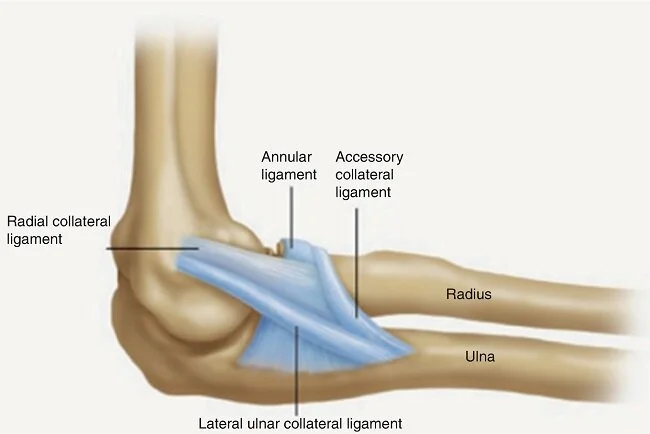




The Case for a Written UK Constitution
The United Kingdom is one of the few democratic countries in the world that does not have a single, written constitution. Others include Canada, New Zealand and Israel. To date, its constitution is a combination of written and unwritten sources, including statutes, common law, conventions and somewhat esoterically, royal prerogatives. The reason for this is predominantly historical. Since 1688, Britain has not experienced a revolution or regime change, which often leads to a constitutional initiative, such as the American or the French Revolution. Britain’s constitution has evolved slowly over time under relative stability and as such, it has never been deemed necessary to list the fundamental laws and principles of the country's political system.
The United Kingdom is one of the few democratic countries in the world that does not have a single, written constitution. Others include Canada, New Zealand and Israel. To date, its constitution is a combination of written and unwritten sources, including statutes, common law, conventions and somewhat esoterically, royal prerogatives. The reason for this is predominantly historical. Since 1688, Britain has not experienced a revolution or regime change, which often leads to a constitutional initiative, such as the American or the French Revolution. Britain’s constitution has evolved slowly over time under relative stability and as such, it has never been deemed necessary to list the fundamental laws and principles of the country's political system.
The current constitution is deficient for three reasons. Its lack of clarity, its failure to properly protect fundamental rights and the inadequacy of the current devolution settlement for Scotland and Wales. Firstly, the fact that the UK’s constitution is not codified in a single document means that the place of certain key governmental mechanisms lack clarity. For example, the legal status of referendums has never been properly set out. Secondly, although Britain does have a Human Rights Act, that legislation does not enjoy the same status as a list of fundamental rights in a codified constitution. As it is not entrenched, it does not have any special protection and can be amended or overturned. The current devolution settlement requires a written constitution that properly sets out the position of the devolved administrations of Scotland and Wales and their respective powers.
Bearing this in mind, here are some arguments in favour of the UK adopting a written constitution:
Clarity and Accessibility:
A written constitution would provide a clear and easily accessible document outlining the fundamental principles and rights of all UK citizens. This can enhance public understanding of their rights and the functioning of the government. It would also provide those in government with clear parameters within which they have to work.
Legal Certainty:
A formal constitution would bring legal certainty, as it would serve as a supreme law that can be referred to in all legal disputes. This contrasts with the current situation where constitutional principles are dispersed among various sources which often leads to confusion and misinterpretation (both willful and accidental).
Protection of Rights:
Explicitly enumerating individual rights within the framework of a written constitution, would provide a stronger legal basis for citizens to challenge any encroachments on their rights. This may contribute to a more robust protection of civil liberties and greater public awareness of said rights.
Limitation of Government Power:
A clearly written, unambiguous constitution could establish clear checks and balances on the powers of different branches of government. Thus limiting the potential for abuse of power and ensuring a more effective separation of powers.
Modernisation and Adaptability:
Another key benefit of a written constitution, is the ability to be able to make relevant amendments and updates that reflect changing societal values and circumstances. This adaptability is often considered crucial in a rapidly evolving world. New socio-political issues, especially those driven by technology and the global environment, often need to be addressed as quickly as they emerge.
International Reputation:
Having a written constitution could enhance the UK's international reputation by aligning its governance structure with the constitutional norms followed by most democratic nations. Many international institutions are built upon mutually held ideas and concepts. Enshrining commonly held values and ideas often affords diplomatic, political and commercial benefits.
Citizen Engagement:
Having a clear constitution can positively impact civic education and engagement. Citizens can become more aware of the mechanics of government as well as their constitutional rights and responsibilities. A better informed electorate can make more effective political choices and become more active in local and national government.
Reducing Constitutional Uncertainty:
The lack of a written constitution can lead to uncertainty, particularly during times of constitutional crisis. The events arising from the Brexit referendum and the political deadlock that reached a peak in 2019 being a clear example. Having a clear and precise constitutional framework could provide a clear route for resolving such situations.
Judicial Review:
A written constitution would enhance the role of the judiciary in interpreting and enforcing constitutional principles through judicial review. This would therefore provide a strong mechanism for holding the government accountable, aiding or sanctioning them when circumstances required. It would also facilitate definitive answers on constitutional interpretation, far more efficiently.
Symbolic Value:
It can be argued that there is a positive, symbolic value to adopting a written constitution. It signals a commitment to transparency, democracy and the rule of law. It provides a cultural foundation upon which to build and a degree of social stability in knowing that certain principles are enshrined in law.
It is important to note that this is not an exhaustive list and opinions on this matter will naturally vary. There are also arguments against adopting a written constitution, with some people favouring the flexibility and evolutionary nature of the UK's current constitutional arrangements. The debate over whether the UK should have a written constitution continues and any constitutional change would likely be a significant and complex process.