
Centurion (2010)
I have enjoyed Neil Marshall's body of work since his debut film Dog Soldiers back in 1999. Both it and his follow up movie The Descent were exceptional genre pieces. Doomsday was more of an indulgence, being a homage to similar such movies from the eighties. However, as I’m from the same generation as the director, I forgave this. Marshall is one of the few British film makers whose work maintains an inherent English perspective. Centurion continues to reflect this, tackling the enduring mystery of the demise of the Ninth Legion and offering an inventive explanation. Making good use of forest locations both in Surrey and Scotland, the film is a violent survivalist tale, with a few twists along the way.
I have enjoyed Neil Marshall's body of work since his debut film Dog Soldiers back in 1999. Both it and his follow up movie The Descent were exceptional genre pieces. Doomsday was more of an indulgence, being a homage to similar such movies from the eighties. However, as I’m from the same generation as the director, I forgave this. Marshall is one of the few British film makers whose work maintains an inherent English perspective. Centurion continues to reflect this, tackling the enduring mystery of the demise of the Ninth Legion and offering an inventive explanation. Making good use of forest locations both in Surrey and Scotland, the film is a violent survivalist tale, with a few twists along the way.

One again the director returns to the tried and tested theme of small group of individuals pit against a superior foe. After an efficient opening sequence which establishes the back story and sets the scene, we are presented with a Pictish assault upon the Ninth Legion. The battle is swift and decisive, leaving most of the men dead and the legion commander Gratus (Dominic West) captured by Celtic chieftain Gorlacon (Ulrich Thomsen). The plot then shifts its focus to an eclectic group of survivors led by Centurion Quintus Dias (Michael Fassbender) as they try to escape to the English border to warn the Roman forces of an impending attack. They are doggedly pursued by a Pict hunting party led by Etain (Olga Kurylenko), a mute woman seeks revenge for her murdered family who died at the hands of Imperial forces.
Centurion makes a school boy error in so far that it peaks in the first act of the film with its gritty ambush sequence. The plot fails to maintain exactly the same degree of intensity for the remainder of the movie. As a result, Centurion becomes noticeably less exciting as it progresses, slowing in the middle, to accommodate a romantic interlude between Quintus and a Pictish women (Imogen Poot) exiled for witchcraft. Like Doomsday before it, Marshall’s Centurion is more of a sequence of strong set-pieces rather than a cohesive linear story. The production design by Simon Bowles and cinematography by Sam McCurdy do however help compensate for the weakness of the narrative. Perhaps if the director had worked with an additional screen writer, the script may well have reached its full potential and had a greater depth.
Despite a strong cast, many of the support characters fail to meet their potential. West’s arrogant performance as a Roman officer counter balances Fassbender’s stalwart resolve. The pair easily carry the central roles well. Yet little is done with Olga Kurylenko's mute character beyond her superficial feral characteristics. It is a real shame because such a role has scope for a very interesting backstory. With a stronger screenplay, this could have been a superior action film, rather than simply a competent one. As it stands, Centurion is an acceptably entertaining historical action movie with solid set pieces and a steady pace. It is not the director’s strongest work but it is certainly with merit.






The Dark Tower (2017)
Stephen King’s body of work has proven to be an invaluable source of material for film and television over the last forty years. The results have often been as varied as the books themselves. Because of the inherent differences between the respective mediums, sometimes the complexity and sheer scope of King’s work can be lost in translation from one to the other. It’s happened before with several high-profile adaptations and it will no doubt happen again. The Dark Tower is a classic example failing to capture the essence of King’s work. Trying to distil and convey a mythos that is spread over eight volumes, into a single movie is a tall order for any director and screen writer. It can be cogently argued that material of this sort is better suited to television where lengthy, complex story arcs can be indulged and characters can be explored at leisure. In fact, during it’s time in development hell, The Dark Tower was at one point destined to be adapted for the small screen. However, the desire to create a lucrative film franchise ultimately prevailed.
Stephen King’s body of work has proven to be an invaluable source of material for film and television over the last forty years. The results have often been as varied as the books themselves. Because of the inherent differences between the respective mediums, sometimes the complexity and sheer scope of King’s work can be lost in translation from one to the other. It’s happened before with several high-profile adaptations and it will no doubt happen again. The Dark Tower is a classic example failing to capture the essence of King’s work. Trying to distil and convey a mythos that is spread over eight volumes, into a single movie is a tall order for any director and screen writer. It can be cogently argued that material of this sort is better suited to television where lengthy, complex story arcs can be indulged and characters can be explored at leisure. In fact, during it’s time in development hell, The Dark Tower was at one point destined to be adapted for the small screen. However, the desire to create a lucrative film franchise ultimately prevailed.
As an action fantasy, The Dark Tower is rather traditional in its themes, use of archetypes and narrative structure. Teenager Jake Chambers (Tom Taylor) has recurring dreams involving a Man in Black (Matthew McConaughey) who seeks to destroy a Tower and bring ruin to the universe. He also sees a Gunslinger (Indris Elba) who opposes him. Jake's mother (Katheryn Winnick) and stepfather believe that he has been traumatised by his father's death the previous year and arrange for him to be taken into psychiatric care. However, Jake recognizes the Doctor and her staff from his visions. They are in fact monsters wearing human skin, so he subsequently escapes. Finding a portal in an abandoned house, Jake travel to Mid-World where he meets the legendary Gunslinger Roland Deschain. However, Deschain is a broken man who only seeks revenge for the death of his father (Dennis Haysbert). Can Jake convince him to save the Dark Tower and universe that it protects?
Although I have read many of Stephen King’s book, I am not familiar with the source material in this instance, beyond its initial premise. Therefore, I approached The Dark Tower with little or no preconceptions and a distinct lack of fan based baggage. What became very apparent while watching the film, was the pacing of the story and the flow of the narrative, which were very fast. Characters were introduced, plot points were explained and the story arc was propelled forward at an unusually quick pace. All of which smacks of a movie that has been excessively re-edited and retooled. I suspect the original vision of the movie was changed in post-production and revised for a different demographic.The film as it currently stands has a very simplistic and linear trajectory. There is little or no depth to any of the central characters and no insight into Mid-World beyond what we are shown. As a result, the film lacks any tension or dramatic hold over the audience. The Dark Tower does look like a high budget movie but its overall narrative has precious little substance. Its ninety-five-minute running time is far too short and the film needs at least another twenty to thirty minutes to expand upon its themes.
There are only three action sequences of note in The Dark Tower but they lack impact due to their arbitrary nature. The movie is also somewhat shy of violence and I suspect that a lot material was edited out. The camera moves way from such content, rather than substituting it with more bloodless material, as is the norm with PG-13 rated movies. The devil is in the detail. At one point a sniper is shot through the telescopic sight of his rifle. The optics shatter, his head whips back and then there is a fast cut to the next step in the action scene. It feels like there is a specific bullet hit missing and the rhythm of the scene just feels off. The net result of this lack of gritty action, as well as the condensed narrative, is that the entire film is somewhat indifferent. Rather than feeling enthused by the characters and their fate, there’s a distinct air of “so what” when the film ends. It’s a shame because The Dark Tower could have been a welcome change to the usual fantasy and super hero driven franchises. However, it looks increasingly unlikely that we’ll see a sequel to this movie in the immediate future due to its poor box office and critical reception.
Operation Avalanche (2016)
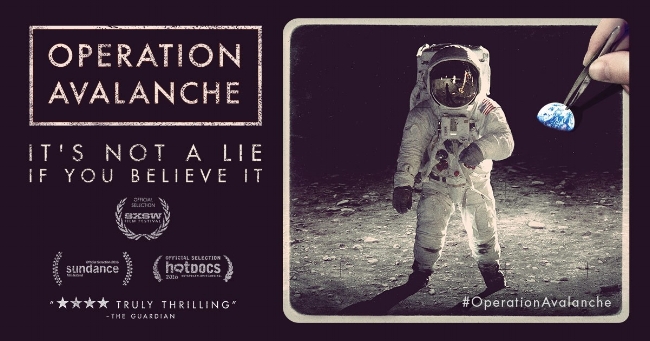
Conspiracy theories and found footage movies. Two genres with infinite scope to be tedious and uninspired on a low budget. Yet writer and director Matt Johnson manages to do something quite clever with both cinematic styles in his recent movie Operation Avalanche. He takes the basic conceit of the two formats and uses them to tell a tale based upon one of the most iconic moments of twentieth century history. Namely the moon landing of 1969. The results are surprising, intelligent and thought provoking, although a little uneven. Furthermore, I discovered this enjoyable curiosity via the GoodBadFlicks on You Tube. If you are interested in obscure and niche market genre creations then do check out this channel. It is informative, well presented and entertaining.
Conspiracy theories and found footage movies. Two genres with infinite scope to be tedious and uninspired on a low budget. Yet writer and director Matt Johnson manages to do something quite clever with both cinematic styles in his recent movie Operation Avalanche. He takes the basic conceit of the two formats and uses them to tell a tale based upon one of the most iconic moments of twentieth century history. Namely the moon landing of 1969. The results are surprising, intelligent and thought provoking, although a little uneven. Furthermore, I discovered this enjoyable curiosity via the GoodBadFlicks on You Tube. If you are interested in obscure and niche market genre creations then do check out this channel. It is informative, well presented and entertaining.
Back to Operation Avalanche. Director Matt Johnson, casts himself along with Owen Williams and Josh Boles as three graduate film makers hired by the CIA for their “A/V program”. Their work is not taken particularly seriously by senior staff and the trio soon find themselves facing dismissal. However, thy manage to talk their way into joining an ongoing operation searching for a Russian mole at NASA. Posing as an official government documentary crew they soon discover that there isn’t a mole but there is a major design flaw in the Lunar Module. This effectively makes the entire moon mission impossible and therefore a political and propaganda nightmare. It is at this point that Johnson’s character suggests that they fake the moon landing, thus guaranteeing the United States’ standing on the world stage. His bosses are initially sceptical but soon back the idea when they see how the plan can be carried out.
The central plot is great idea and the movie has sufficient plausibility to allow viewers to suspend their sense of disbelief for the first two acts. There are many popular culture and historical references during the course of the film which bolster the proceedings. Perhaps the cheekiest plot device is the referencing of Stanley Kubrick who is already a prime suspect among conspiracy theorists for “faking” the moon landings. In this instance, the team of CIA film makers pose as journalists and talk their way into an interview with Kubrick. A subsequent visit to the set of 2001: A Space Odyssey, allows them a chance to steal his special effects secrets and directly use them to help fabricate their own moon landing footage. I must admit this really did provoke an ironic chuckle from me. However, the estate of the late Stanley Kubrick did not see it this way and were singularly perturbed that his likeness had been used in such a fashion.
Unfortunately, the denouement of Operation Avalanche is somewhat disappointing. The CIA decides to clean house and eliminate any lose ends and the film develops into a formulaic chase scenario. This sadly mitigates the found footage angle of the plot. Up until this point the logic behind the plot device of continuously filming all that is happening is quite credible. Exactly why you would continue to do so when being pursued and shot at by government agents is questionable. Another minor niggle that works against the film is that the lead character, played by Matt Johnson, is not very likeable. He is bombastic, manipulative and a self-centred risk taker. These may well be necessary qualities in an agent but they’re hardly required traits in a cinematic hero. However, irrespective of its flaws, there’s a lot of creativity present in Operation Avalanche and it is sufficient to propel the movie forward at an entertaining pace. If we must have movies from such genres, then Operation Avalanche sets a solid precedence for the type we’d like more of.

The Purge: Anarchy (2014)
The Purge: Anarchy is an example of the curious and rare cinematic beast, a sequel that is superior to its predecessor. This time round the movie makes a greater effort to explore the themes associated around its premise and takes to the streets to show the impact of the purge upon the working class. It’s a far more political movie and all the better for it. You can’t have a story about a national event designed to implement social engineering in the most visceral of manners and try and keep it free from social commentary. Furthermore, The Purge: Anarchy features a far more agreeable and accessible group of protagonists this time round, creating a far more plausible sense of trepidation for audiences. The film is also more violent than the first instalment given the scope of its narrative.
The Purge: Anarchy is an example of the curious and rare cinematic beast, a sequel that is superior to its predecessor. This time round the movie makes a greater effort to explore the themes associated around its premise and takes to the streets to show the impact of the purge upon the working class. It’s a far more political movie and all the better for it. You can’t have a story about a national event designed to implement social engineering in the most visceral of manners and try and keep it free from social commentary. Furthermore, The Purge: Anarchy features a far more agreeable and accessible group of protagonists this time round, creating a far more plausible sense of trepidation for audiences. The film is also more violent than the first instalment given the scope of its narrative.
Shane (Zach Gilford) and Liz (Kiele Sanchez), a couple on the verge of splitting up, are driving home when their car breaks down just as the purge commences. They decide to try and make it across town, avoiding the various predatory gangs that are now roaming the streets. Meanwhile, waitress Eva (Carmen Ejogo), goes home to her sick father Rico (John Beasley) and teenage daughter Cali (Zoe Soul) and prepares to secure their apartment. She politely refuses offers of assistance from the building manager Diego. Later that night the tenement is assaulted by a paramilitary squad and Eva and Cali are captured. As they are being loaded into a truck, they are rescued by a rogue Police Sergeant (Frank Grillo) who is using the purge to seek revenge on the man who killed his son. Upon returning to the Sergeants car, they discover Shane and Liz hiding. The five people slowly make their way through the streets and attempt to survive the night in Los Angeles.
The Purge: Anarchy manages to maintain a credible air of tension. The set pieces are tight and because the lead characters are more than two dimensional, you can become emotionally invested in them. But the films greatest asset are the vignettes of associated purge culture that are offered to the audience. Eva’s father, Rico, sells himself to a rich family who wish to have a risk-free purge experience. In return his family receive a large cash sum. The movie goes on to highlight again and again that the poor are the group that bear the brunt of the purge. There are for example roving kidnap gangs that round up victims to be sold to the wealthy. The rich then auction off the prisoners so that they can be hunted in a controlled environment. However, the film does show that the door can swing both ways. While travelling through the financial district our protagonists come across a dead banker with a very contemporary message hung around his neck.
Out of the three movies that make up this franchise The Purge: Anarchy is by far the strongest. It tackles the subject of the purge effectively and through a series of dramatic threads, provides insight as to what the real ramifications of one night of state sanctioned anarchy would be. The disgruntled “super” Diego is a microcosm of all that is worse about the purge as a concept. He nurses a wealth of misconceived and unfounded grievances and uses them as a justification for his basest instincts. That is essentially where the horror of the purge lies. It shows how extremely thin the veneer of civilisation actually is and that abhorrent behaviour is not confined to any one specific demographic group.







Ouija (2014)
It boggles my mind that the American multinational toy and board game company Hasbro, currently holds the copyright and patent to a device that is essentially designed to communicate with the dead. How a tool of spiritualism became a commercial toy that was then marketed to a strongly Christian nation is a blog post in itself. However, this post is about the 2014 horror feature film based upon the Hasbro game. Hasbro like many leisure companies, has in recent years looked at ways to expand its business portfolio. Subsequently, in 2009 it set up a film division and licensed TV shows and movies based upon its toy and game back catalogue. Like their traditional products, these forays into film and television have proven lucrative. If you haven’t noticed, we’re already up to our fifth Transformers movie, with several more in pre-production.
It boggles my mind that the American multinational toy and board game company Hasbro, currently holds the copyright and patent to a device that is essentially designed to communicate with the dead. How a tool of spiritualism became a commercial toy that was then marketed to a strongly Christian nation is a blog post in itself. However, this post is about the 2014 horror feature film based upon the Hasbro game. Hasbro like many leisure companies, has in recent years looked at ways to expand its business portfolio. Subsequently, in 2009 it set up a film division and licensed TV shows and movies based upon its toy and game back catalogue. Like their traditional products, these forays into film and television have proven lucrative. If you haven’t noticed, we’re already up to our fifth Transformers movie, with several more in pre-production.
The box office success of Paranormal Activity back in 2009 has led to a wealth of low budget, PG-13 rated, jump scare horror movies. The production cost to earnings ratio of this niche genre is often very favourable. Thus, it was logical from a business perspective for Hasbro Films to try and adapt the “Ouija board game” into a potential box office franchise. However, Ouija proved to be a troubled production and the movie went through extensive reshoots after test audiences reacted poorly to the initial edit. If you watch the various teaser trailers for the movie there is evidence of material that has been deleted or replaced. Certainly, there are continuity issues present in the Blu-ray version that I watched. Most of these are related to the cast appearance and hairstyles and don’t have any serious impact upon the narrative, although that itself is not without flaws.
When teenager Debbie (Shelley Hennig) commits suicide unexpectedly, her five best friends are profoundly troubled. Laine (Olivia Cooke) discovers that Debbie has been using a Ouija board and recording her experiences. Suspecting that this may have contributed to Debbie’s death, she convinces the rest of the group to hold a séance so they can contact her. They succeed in communicating with a spirit that claims to be Debbie, however it soon becomes apparent that the group has roused a malevolent force instead. Laine strives to learn the origins of this evil spirit as her friends start to die, one by one. Research subsequently reveals that Debbie’s home was previously owned by a celebrated medium Alice Zander and her two daughters. Once of whom, Paulina (Lyn Shaye) is currently incarcerated in a psychiatric hospital. Is Paulina the key to the mystery and can Laine find a way to defeat the evil force that pursues her?
What is striking about Ouija is that is so noticeably contrived. The screenplay has obviously been retooled numerous times, to accommodate the reshoot and then to facilitate the plot devices and the set pieces that the producers wish to utilise. For example, Laine’s father is introduced and within minutes leaves town on business, providing a convenient reason as to why five teenagers can have a supernatural adventure, free from the interference of the usual authorities. Although there is some meat on the bones of the central characters, others are simply cinematic placeholders and present purely to provide an adequate body count. Furthermore, although Ouija does provide satisfactory scares within the parameters of its rating, the set pieces are devoid of any originality. The imagery is all very generic, with its emaciated computer-generated spectres and sinister ghost children.
Despite its problematic “film by committee” production, Ouija is not a bad movie per se. It is competently made, has a satisfactory pace with an appropriate amount of scares throughout its running time. However, it commits perhaps the worst sin a genre move can. It is dull, perfunctory and very disposable. By the time I got around to watching the inevitable sequel (which is in fact a prequel), I had forgotten most of the events of Ouija. I had to refresh my memory via Wikipedia. It is this homogenous nature that is most saddening because it speaks of a genre that is being distilled down to an ever-decreasing number of tropes. Simply making a movie by arbitrarily including these aspects, does not make for great cinema. Nor does it improve the wider public perceptions of the horror genre. Yet, irrespective of these criticisms, Ouija made over $100 million at the box office. It cost just $5 million to make.
Insidious: Chapter 2 (2013)
James Wan is a clever film maker who knows and fully understands the mechanics of his trade. Perhaps a little too well, because therein lies the problem with Insidious: Chapter 2. It is a succession of well-crafted set pieces that seamlessly follows on from the previous movie. Yet it is a little too enamoured with its own cleverness. I found myself frequently praising the director after a well-constructed shock, instead of revelling in the unease a horror movie is supposed to create. A great deal of scares and jumps are due to the clever sound design, superb editing and the creepy score by by Joseph Bishara, who previously collaborated with director James Wan on the first movie as well as The Conjuring. Fortunately, the film still provides viewers with a family that are likeable and an ensemble cast that help lift the story beyond its somewhat formulaic limitations. As I've mentioned before, Wan has an eye for depicting families.
James Wan is a clever film maker who knows and fully understands the mechanics of his trade. Perhaps a little too well, because therein lies the problem with Insidious: Chapter 2. It is a succession of well-crafted set pieces that seamlessly follows on from the previous movie. Yet it is a little too enamoured with its own cleverness. I found myself frequently praising the director after a well-constructed shock, instead of revelling in the unease a horror movie is supposed to create. A great deal of scares and jumps are due to the clever sound design, superb editing and the creepy score by by Joseph Bishara, who previously collaborated with director James Wan on the first movie as well as The Conjuring. Fortunately, the film still provides viewers with a family that are likeable and an ensemble cast that help lift the story beyond its somewhat formulaic limitations. As I've mentioned before, Wan has an eye for depicting families.
The original film’s twist ending suggested that the spirit which haunted Josh (Patrick Wilson) throughout out his life had finally possessed him. Insidious: Chapter 2 picks up the story immediately and the story has to deal with the narrative complexities that have been imposed upon it by the previous instalment. However, the movie expedites the plot quite well and we see via flashbacks how paranormal investigator Elise (Lin Shaye) first met Josh as a child and the subsequent investigation by the police regarding the exact circumstances of her death. The story then focuses on the Lambert family, who are now living with Grandma Lorraine’s (Barbara Hershey). It's not long before Josh's wife Renai (Rose Byrne) is seeing and hearing spirit manifestations, once again centred around their young son Dalton (Ty Simpkins).
As I mention earlier, there is a lot of well thought out and smart aspects to Insidious: Chapter 2. A key scene from the first movie is revisited and explored from a totally different perspective. It certainly adds to the sense of continuity between the two movies. There is also another foray into the "further" but this time with a subtle role reversal as it is Dalton this time, trying to rescue his Father. Despite the Scooby Doo like sub-plot as the family and paranormal investigators delve into the reasons behind the hauntings, there is still plenty of solid scares to be had. The protagonists are still well defined and the suburban setting adds to the unsettling atmosphere. Because the balance between scares and running time is equitable, most audiences may overlook the increasing silliness of the central story during the final act.
There is a tipping point in Insidious: Chapter 2, where the audience has a choice of whether to roll with the plot developments or not. It is to the credit of actor Patrick Wilson, that his performance does much to carry the movie forward after this point. Fans may also be disappointed to learn that the story this time round is more to do with the creepy old lady ghost, rather than the Darth Maul lookalike Demon. However, director James Wan and screenwriter Leigh Whannell (Saw, Dead Silence) still manage to craft a disturbing and unsettling experience, which eschews the obligatory clinical horror of recent years. These modern homages to the classic haunted house genres (think Legend of the Hell House and Poltergeist) are a laudable undertaking. For the more casual views Insidious: Chapter 2 will prove a scary experience. For the more jaded horror fan there is still a lot to enjoy in this well-crafted genre outing.
Insidious (2010)
Shortly after moving to a new house, parents Josh (Patrick Wilson) and Renée Lambert (Rose Byrne) life is shattered when their eldest son Dalton (Ty Simpkins) slips into a coma. Doctors are unable to explain their son’s medical condition and the family subsequently assailed by a series of supernatural happenings. Eventually, Josh’s Mother Lorraine (Barbara Hershey) invites paranormal investigator, Elise Rainer (Lin Shaye) and her team, to help the family. Her investigations soon determine that Dalton has the gift astral projection and has become trapped in “the further” by a demonic force. Lorraine reveals that Josh had a similar when he was a young, that he has subsequently forgotten about because it endangered his life. Can he revive his gift, enter "the further" and rescue Dalton before he his lost forever?
Shortly after moving to a new house, parents Josh (Patrick Wilson) and Renée Lambert (Rose Byrne) life is shattered when their eldest son Dalton (Ty Simpkins) slips into a coma. Doctors are unable to explain their son’s medical condition and the family subsequently assailed by a series of supernatural happenings. Eventually, Josh’s Mother Lorraine (Barbara Hershey) invites paranormal investigator, Elise Rainer (Lin Shaye) and her team, to help the family. Her investigations soon determine that Dalton has the gift astral projection and has become trapped in “the further” by a demonic force. Lorraine reveals that Josh had a similar when he was a young, that he has subsequently forgotten about because it endangered his life. Can he revive his gift, enter "the further" and rescue Dalton before he his lost forever?
Director James Wan seems to have an eye for interesting depictions of families or individuals under pressure. Both Saw and Death Sentence explored these themes, producing strong performances and genuine tension in each respective movie. With Insidious Wan once again returns to this subject, viewing it through the prism of a family being preyed upon by a malevolent supernatural force. The director demonstrates a good understanding of how to build atmosphere and tension, as well as coaxing strong performances from his cast. The script is tight and the characters are likeable, a trait so often absent from many current horror films. The shocks are well constructed and not over stated. It is not until the third act when the film adopts a more theatrical approach as the hero enters "the further", in a finale reminiscent of Tobe Hooper’s Poltergeist.
Insidious provides very traditional genre material packaged in a way that makes it more accessible to a mainstream contemporary audience. If you have not watched a great deal of horror films and are not familiar with specific classic titles from the seventies and eighties, then Insidious will certainly prove entertaining and scary. Viewers with a wider exposure to the genre will have to be content themselves with a polished, modern take on numerous tried and tested themes. I did enjoy Insidious and certainly think it is superior to a lot of the recent competition. I simply did not find it to be the "frightfest" that so many others claimed upon its initial release. However, others may well think otherwise.
Unlocked (2017)
CIA specialist interrogator Alice Rancine (Noomi Rapace) is on secondment to MI5 while she nurses her guilt over a previously failed operation that left civilians dead. Her old boss Eric Lasch (Michael Douglas) thinks it’s time she returned to what she does best. Rancine then receives a request from the CIA London Station to crack a terrorist courier who can provide access to a major cell. However, it soon becomes clear that the operation has not been officially sanctioned and Rancine has been duped by rogue elements within the Agency. Alone and on the run from the CIA, MI5 and independent contractors, Alice finds an unexpected ally in ex-Marine Jack Alcott (Orlando Bloom) who she finds robbing her apartment. Together, the pair pursue the lead she obtained while interrogating the courier and attempt to stop a biological attack from happening on UK soil.
CIA specialist interrogator Alice Rancine (Noomi Rapace) is on secondment to MI5 while she nurses her guilt over a previously failed operation that left civilians dead. Her old boss Eric Lasch (Michael Douglas) thinks it’s time she returned to what she does best. Rancine then receives a request from the CIA London Station to crack a terrorist courier who can provide access to a major cell. However, it soon becomes clear that the operation has not been officially sanctioned and Rancine has been duped by rogue elements within the Agency. Alone and on the run from the CIA, MI5 and independent contractors, Alice finds an unexpected ally in ex-Marine Jack Alcott (Orlando Bloom) who she finds robbing her apartment. Together, the pair pursue the lead she obtained while interrogating the courier and attempt to stop a biological attack from happening on UK soil.
Unlocked, despite having the veneer of a contemporary story is a somewhat old school thriller. That is not in itself a bad thing. It is directed by veteran film maker Michael Apted in a workman like fashion and is functionally entertaining. It contains all the usual tropes found in the espionage genre, yet the screenplay written by Peter O’Brien manages to add sufficient difference to keep viewers interest. For example, Alice Rancine works as a legal advisor, doing pro-bono work among London’s immigrant community. Her work allows her to do “some good” as well as gather intelligence. Subsequently Unlocked features some interesting location filming in some of the poorer parts of London. It is welcome break from the usual US-centric material we’ve come to expect from thriller of this kind. The film is bolstered by a solid and reliable cast, featuring the likes of Toni Collette and John Malkovitch. Their presence makes the narrative a little more plausible and palatable.
Critics were not so impressed by Unlocked upon release and it garnered mix reviews. Some accused director Michael Apted of being out of touch. His last foray into the traditional spy film genre was Gorky Park, back in 1983. The main handicap with a film of this nature trying to find a fresh perspective or approach. Sadly, the Middle-east narrative has been done to death over the last twenty-five years and it’s worn a little thin. However, despite this flaw Unlocked does compensate in other areas. The UK and European settings do add a different narrative perspective and visual aesthetic. Unlocked benefits greatly from Noomi Rapace’s performance. Female leads are still not so common place in this genre. Furthermore, Unlocked is yet another of a handful of recently released action movies that have not sought the box office comfort of the PG-13 rating. Bad things happen in the world of espionage and Unlocked is happy to show them.
The Driver (1978)
Walter Hill is a much underrated director, whose back catalogue is often overlooked. After several years as a writer, Hill moved into directing. His second major film, The Driver is a neo-noir, minimalist thriller, with characters named by their profession (The Detective, The Driver etc.) and a plot that extols Hills favourite theme, of a man being defined by his actions. The title character (Ryan O’Neal) a professional getaway driver, plays a game of cat and mouse with "The Detective" (Bruce Dern), who is determined to bring him down. “I’m gonna catch the cowboy that’s never been caught,” he tells "The Driver". "The Detective" becomes so obsessed with his foe, that he sets up a bank job in order to trap "The Driver". Yet the plan does not run smoothly and "The Driver" learns that he being set up. Does he walk away or does he take the bait and face the inevitable consequences?
Walter Hill is a much underrated director, whose back catalogue is often overlooked. After several years as a writer, Hill moved into directing. His second major film, The Driver is a neo-noir, minimalist thriller, with characters named by their profession (The Detective, The Driver etc.) and a plot that extols Hills favourite theme, of a man being defined by his actions. The title character (Ryan O’Neal) a professional getaway driver, plays a game of cat and mouse with "The Detective" (Bruce Dern), who is determined to bring him down. “I’m gonna catch the cowboy that’s never been caught,” he tells "The Driver". "The Detective" becomes so obsessed with his foe, that he sets up a bank job in order to trap "The Driver". Yet the plan does not run smoothly and "The Driver" learns that he being set up. Does he walk away or does he take the bait and face the inevitable consequences?
The Driver is a spartan film with a clear message about the people living by a code. It also contemplates another classic theme, that of the individual who has become an anachronism and is out of step with the world that they live in. The Driver is also a prime example of the cinematic philosophy of show don’t tell. Ryan O’Neal has only three hundred and fifty words of dialogue. His character’s is intriguing but enigmatic. Despite the large fees he commands for his skill, he lives a frugal life in cheap motels. Clearly, he is not in it just for the money. Bruce Dern's obsession drives him to break the very law he’s sworn to defend, in the tradition of Greek tragedy. Hill’s original cut of the film was over two hours, but he decided to pare the plot development and motivational back story to the bone, with a final running time of 91 minutes.
This is very much a product of its decade. The seventies were a time that allowed directors to experiment and pursue philosophical subtexts. The production design and cinematography by Harry Horner and Philip H. Lathrop are excellent. The stunt driving is superbly staged and edited. The scene where "The Driver" surgically dissects an orange Mercedes to prove his credentials is amazing. Sadly this sort of experimental film making just does not get made anymore. You cannot adequately compare a philosophical gem like this, with the vacuous, commercial, disposable film making that is The Fast and The Furious or Need for Speed. Sadly, box office returns suggest that the public no longer have an interest in allegorical films of this nature either.
Elysium (2013)
Dystopian futures, oppressive regimes and the inequalities between the haves and have nots, have been the mainstay of science fiction for decades. The political dimensions of such narratives are usually glossed over and seldom garner any attention from critics as they are simply plot devices, designed to set up a more specific story. Yet for some reason Neill Blomkamp's Elysium, seems to have been labelled "sci-fi socialism" upon its release by certain institutions. In today's unsophisticated language is meant to have negative connotations. Such comments should be dismissed as they frequently come from quarters that have a poor understanding of what exactly socialism is and little interest in genuine film reviews.
Dystopian futures, oppressive regimes and the inequalities between the haves and have nots, have been the mainstay of science fiction for decades. The political dimensions of such narratives are usually glossed over and seldom garner any attention from critics as they are simply plot devices, designed to set up a more specific story. Yet for some reason Neill Blomkamp's Elysium, seems to have been labelled "sci-fi socialism" upon its release by certain institutions. In today's unsophisticated language is meant to have negative connotations. Such comments should be dismissed as they frequently come from quarters that have a poor understanding of what exactly socialism is and little interest in genuine film reviews.
Elysium is simply a movie about inequality and the consequences that arise from such a state of affairs. It touches upon such weighty themes as faith, private healthcare and immigration. Yet rather than preach about these issues they are mainly plot devices to be explored cinematically. So, Elysium is filled with imagery such as a Los Angeles reduced to a favela and public services outsourced to robots. The depiction of poverty, segregation and crime is worryingly plausible as it is so clearly based upon contemporary news footage that we can see on any TV channels at any time of day. This is vividly contrast by the clinical beauty and corporate order of orbiting space station of Elysium, were the wealthy reside.
Enter Max De Costa (Matt Damon), a paroled professional thief, struggling to stay upon the straight and narrow. After an industrial accident renders him in need of healthcare that can only be found on Elysium, he reluctantly takes a job to kidnap an industrialist (William Fitchner). The plan is to steal data directly from his head that will allow earth-bound citizens access to Elysium. However, head of defence Secretary Delacourt (Jodie Foster) has no intention of seeing her exclusive community overwhelmed by illegal immigrants and dispatches sleeper agent Kruger (Sharlto Copley) to clear up any loose ends. What starts as a personal journey for Max, with his own life hanging in the balance, soon becomes a mission with far wider implications and much higher stakes.
Neill Blomkamp excels at setting up a vision of the future that is credible, despite showing quite little. There are some wide CGI shots of a decaying city but he mainly manages to reinforce the concept by the finer details of the production design. Litter strewn streets, smothered in graffiti, hospitals with precious few resources, overwhelmed by patients. Civic offices populated with automated machines dealing with endless lines of the public. Think of a downbeat version of Johnny Cab from Paul Verhoeven's Total Recall and you'll get the idea. The depiction of military technology is also based upon ongoing contemporary research, with a focus on drones and VTOL based weapons platforms. The CGI is particularly cutting edge, making the law enforcement robots worryingly realistic.
Although there are many familiar tropes and conventions used in Elysium, Neill Blomkamp brings a fresh eye to interpreting them. This is a pleasantly non-US-centric movie, with an international cast adding flavour to the plot. Los Angeles is shown to be predominantly Hispanic with a use of both English and Spanish. Elysium itself is also multicultural, with its President Patel reflecting the growing wealth of India. The final act does to a degree paint the story into a corner and leads to an outcome that is fairly predictable. Yet the ending raises a great many questions and certainly doesn't give the audience a convenient conclusion to all plot strands. It is worth reflecting upon Secretary Delacourt's final dialogue for example, as well as the potential corporate response to events in the final act.
Director Neill Blomkamp again proves that he is a film maker to keep an eye on. If you have not seen his previous Movie District 9, then do so. It is equally as innovative, international and thought provoking. Although far from perfect, with some instances of curious editing, Elysium still provides an above average character and plot driven science fiction movie. It also eschews the current trend for bland PG-13 rated action with a robust R rating. It certainly has the most memorable cinematic villain we’ve seen for a while.





Classic Movie Themes: Zeppelin
Zeppelin is an often overlooked, World War I action movie made in 1971. Michael York plays a British Officer of Bavarian decent, who goes under cover for British Intelligence to thwart a German plot involving a new prototype dirigible. It's a very straightforward ripping yarn, that benefits greatly from Alan Hume’s superb cinematography. The visual effects credits are a veritable "who's, who" of British artist from the time, featuring the likes of Cliff Richardson, Cliff Culley and Wally Veevers. One of the stand out elements of this movie is the fine score by Roy Budd. Budd was a completely self-taught musician who was hailed as a child prodigy. Over the course of his career Budd wrote a diverse selection of film scores and was adept at many different styles.
Zeppelin is an often overlooked, World War I action movie made in 1971. Michael York plays a British Officer of Bavarian decent, who goes under cover for British Intelligence to thwart a German plot involving a new prototype dirigible. It's a very straightforward ripping yarn, that benefits greatly from Alan Hume’s superb cinematography. The visual effects credits are a veritable "who's, who" of British artist from the time, featuring the likes of Cliff Richardson, Cliff Culley and Wally Veevers. One of the stand out elements of this movie is the fine score by Roy Budd. Budd was a completely self-taught musician who was hailed as a child prodigy. Over the course of his career Budd wrote a diverse selection of film scores and was adept at many different styles.
Roy Budd's score for Zeppelin is an exercise in smart minimalism with its leitmotif. The main theme with its simple melody, key change and use of military snare drums works wonderfully. It doesn't need to be more complicated than this and beautifully compliments the traditional approach of the movie. Sadly, the tapes of the original recording have subsequently been lost so the main theme is the only piece of music from the soundtrack currently available. It's a shame because the movie has some very robust cues such as the prelude to the German attack on the castle, as well as the assault itself. Perhaps a full re-recording may be made in the future.







The Darkest Hour (2011)
The Darkest Hour should have been more appropriately titled The Stupidest Hour, or Darwinian Natural Selection in Action. It really is a microcosm of all that is wrong with mainstream Hollywood at present and it saddens me that this film was made by director Chris Gorak. His previous movie Right at You Door was the exact opposite of The Darkest Hour, being intelligent, well scripted and focused. Prior to directing Gorak has had a successful career as an art director, working for such luminaries as David Fincher, the Coen brothers, and Terry Gilliam. His flair for the visual is present in The Darkest Hour but it would appear that the production design and visual effects were given priority over a good script. I shall endeavour to summarise the plot and provide a brief overview of the films respective merits, although there are precious little.
The Darkest Hour should have been more appropriately titled The Stupidest Hour, or Darwinian Natural Selection in Action. It really is a microcosm of all that is wrong with mainstream Hollywood at present and it saddens me that this film was made by director Chris Gorak. His previous movie Right at You Door was the exact opposite of The Darkest Hour, being intelligent, well scripted and focused. Prior to directing Gorak has had a successful career as an art director, working for such luminaries as David Fincher, the Coen brothers, and Terry Gilliam. His flair for the visual is present in The Darkest Hour but it would appear that the production design and visual effects were given priority over a good script. I shall endeavour to summarise the plot and provide a brief overview of the films respective merits, although there are precious little.
Americans Ben and Sean (Max Minghella and Emile Hirsch), a pair of two dimensional, uninteresting software engineers go to Moscow to look for investment in their smartphone app (oh how very modern). However, their Swedish business partner (Joel Kinnaman) and singularly unpleasant representative of humanity steals their intellectual property. Subsequently Ben and Sean seek comfort in a night club and meet two equally unedifying examples of womankind; Natalie (Olivia Thirlby), an American, and her Australian friend Anne (Rachael Taylor). It is at this point in the proceeding’s that invisible aliens decide to pop down to earth for a bit of an invasion and some global asset stripping, which proves to be a bit of an inconvenience. This unprepossessing bunch then lurch from cliché to cliché, continuously making bad choices. Imagine an episode of Scooby Doo in which all of the characters are recovering from major head trauma and you'll get the picture.
So, where to start? Well The Darkest Hour has a fundamentally bland and uninspired screenplay. The basic idea of energy beings is in principle better than the usual bipedal aliens that we see in such films. However, the idea runs out of steam quickly, especially when we see one outside of its invisible shield. They give the creatures anthropomorphic faces which immediately kills off any credibility. There is also no attempt to flesh out characters back story, beyond the functional. The Moscow setting although striking, doesn’t offer any new perspective on such standard genre material nor do the Russian characters. The films major flaw is that the plot is so unremittingly stupid it beggars belief. I appreciate that people do not always make the wisest decisions while under pressure but the most basic notions of rational thinking are jettisoned to create faux drama. The only innovation shown throughout the films eighty-nine-minute running time are the visual effects and the way the energy being are depicted. Apart from this, The Darkest Hour is pure dot to dot movie making.
The Darkest Hour feels like focus group film making. You can imagine someone standing at a whiteboard taking notes, as a room full of studio executives brainstormed what are the essential tropes of a PG-13 rated action sci-fi movie. As a result, the movie feels like it is working through a list of narrative points and lacks any personal connection of wider depth. What could have been an interesting variation on a theme, is simply an exercise in insincerity and stupidity. If a studio is happy to sell such a product then it doesn’t say much about what they think about their target audience. I hope in the future, director Chris Gorak distances himself from such companies and returns to producing material of the quality of his previous movie, Right at Your Door. Films such as The Darkest Hour do nothing for the genre apart from accelerate the pace of the race to the bottom.
Imagining the Worst
I was technically not old enough to see Outland when it was released in the UK in 1981. The film was rated AA, a now defunct certificate, which required the viewer to be 14 years or older and I was 13. I have strong memories of feeling quite tense going into the cinema. My expectations were based purely on what I had read in the press and from seeing the trailer just once, a few weeks prior. That is how it was before the internet age. You had less advance knowledge of a movie. Furthermore, at this point in time I had not become so inured to cinematic violence, as my viewing habits back then were very much dictated by my parents and the fact that there were only two televisions in our home. Although we had a VCR, we hadn’t yet got bitten by the renting bug. So, I went into the movie theatre expecting to be shocked by Outland based on the movies marketing which promised a head explosion. However, it turned out to be a thoroughly entertaining space western. Yet I vividly remember my sense of relief that its hadn’t been as shocking as I had imagined it would.
I was technically not old enough to see Outland when it was released in the UK in 1981. The film was rated AA, a now defunct certificate, which required the viewer to be 14 years or older and I was 13. I have strong memories of feeling quite tense going into the cinema. My expectations were based purely on what I had read in the press and from seeing the trailer just once, a few weeks prior. That is how it was before the internet age. You had less advance knowledge of a movie. Furthermore, at this point in time I had not become so inured to cinematic violence, as my viewing habits back then were very much dictated by my parents and the fact that there were only two televisions in our home. Although we had a VCR, we hadn’t yet got bitten by the renting bug. So, I went into the movie theatre expecting to be shocked by Outland based on the movies marketing which promised a head explosion. However, it turned out to be a thoroughly entertaining space western. Yet I vividly remember my sense of relief that its hadn’t been as shocking as I had imagined it would.
Over the years I’ve had numerous similar such experiences with other classic films and genre movies. Films such as Zombi 2, The Texas Chainsaw Massacre, Soldier Blue and Cannibal Holocaust, all have strong and controversial reputations. Often this is due to unpleasant acts or levels of violence. Yet after watching all of these films, I have always felt a sense of relief and possibly even disappointment, because of the gulf between what my expectations were and what was actually depicted. The New York Ripper for example does include acts of violence that in principle are totally abhorrent, yet the reality is that the film makeup effects are generally poor. I guess my fear has always been that I will see something so heinous that I’ll be traumatised, physically sick or worse. The latter is the biggest concern and the most nebulous. Somehow, exposure to such material will leave me altered on some level and not for the better.
To a degree this factor still effects a great deal of my viewing to this very day. However, I am now quite sceptical when I read a review which claims that the film in question has shocking scenes or breaks some terrible taboo. Mainstream Hollywood seldom does any of these things at present. The horrific imagery that I can conjure up in my mind’s eye, more often than not is never equalled by what the film-maker chooses to show. It is a perennial debate among film fans that less is more and what the viewer thinks they see is far more disturbing than anything that can be shown. I do agree with this to a degree, although I do feel that violence and graphic imagery can play a part if used appropriately and within context. Yet outside of the mainstream there are still film-makers prepared to the push boundaries that the big studios are not.
There have been several films recently that have courted a great deal of controversy with regard to their content. I have always held the opinion that you cannot effectively comment on films unless you’ve seen it. Therefore, for me to credibly write on such material, I would have to watch it. The problem is I really don’t wish to (more on that later). Two relatively recent examples which spring to mind are A Serbian Film and The Human Centipede II: Full Sequence. If you follow the links for both titles you can read the plot synopsis for each on Wikipedia. The descriptions of both films instantly sets my mind racing with regard to how graphic they can be? Again, it could be the case that my expectations are far worse, fuelled by my mind working overtime. However, it would appear that both these films are quite explicit or so I am told by trusted peers. Potentially, these films could challenge my theory and overturn it, by actually showing the unshowable.
I won’t get into an argument about the artistic merits of both these titles, as that is a separate debate for another time. Ultimately, I believe that my rule of thumb broadly holds true but because we now live in far more liberal times, there is scope for film makers to prove otherwise and depict acts that are worse than I imagine. However, that has not yet become the norm. In the case of the two films I’ve mentioned, I do not think I will benefit in any way from seeing either of them. To do so would be pure voyeurism and pandering to the conceits of the film makers. If horrific imagery is devoid of any context, meaning or the wider purpose, then I may as well just sit and watch the emergency services cut the corpses from car accidents. What sort of person does that for pleasure? As a teenager, I can remember the bragging rights associated with watching the grisliest horror movie one could find. Such puerile rites of passage are common place. However, adulthood comes with a sense of perspective and an ability to curb one’s excesses. It is a habit that I still like to maintain.
I do not feel it is my place to draw lines in the sand with regard to what film-makers can or cannot depict. However, I can and do draw such lines for myself, with respect to what I choose to watch. I therefore think that the feeling of expectation and trepidation I had as a 13-year-old, is a quality I wish to keep. If there comes a time when such a notion fails to enter my head, then I really will have become totally desensitised to cinematic violence. I think maintaining such an emotional safety valve is a healthy attribute to have. So, I've decided to skip A Serbian Film and The Human Centipede II: Full Sequence. They may well live up to the reputation they've gained or simply be an exercise in hype but I don't really want to taint myself or waste my precious time by finding out. I will never dismiss a film out of hand for having the gall to exist but I do feel that having the capacity to say "thanks but no thanks" is important and liberating.
Baby Driver (2017)
There’s rhythm in every scene of Baby Driver. And Michael Mann may want to consider early retirement because Edgar Wright lights his movies better. These are just some of the thoughts that crossed my mind during the films 113-minute running time. It becomes very apparent when watching Baby Driver that it’s not just a standard heist movie with car stunts and hard-boiled dialogue. This film is definitely something special and totally deserving of all the praise that has been heaped upon it. But then again, it’s not every day you get a story that bears all the hallmarks of a Hollywood musical, slickly and intelligently transplanted into a hybrid of the road and caper genres.
There’s rhythm in every scene of Baby Driver. And Michael Mann may want to consider early retirement because Edgar Wright lights his movies better. These are just some of the thoughts that crossed my mind during the films 113-minute running time. It becomes very apparent when watching Baby Driver that it’s not just a standard heist movie with car stunts and hard-boiled dialogue. This film is definitely something special and totally deserving of all the praise that has been heaped upon it. But then again, it’s not every day you get a story that bears all the hallmarks of a Hollywood musical, slickly and intelligently transplanted into a hybrid of the road and caper genres.
Ansel Elgort’s stars as the eponymous getaway driver, who uses music to continuously drown out the tinnitus he suffers from as a result of a childhood accident. Being on the spectrum he meticulously organises his life around his iPod playlists and records random sounds and dialogue on a Dictaphone which he then mixes with music. He is also a formidable driver who is indebted to local Atlanta criminal Doc (Kevin Spacey). Hence Baby is always “one more job” away from freedom. In his spare time Baby cares for his deaf foster father Joseph (CJ Jones) who worries about whether he’ll ever be able to get away from his obligation to Doc. Baby dreams of escaping with his waitress lover Debora (Lily James) but his plans are foiled when he called upon to drive for one more major robbery. He finds himself in the company of a worrying psychotic crew consisting of Buddy and Darling (Jon Hamm and Eiza González), a latter-day Bonnie and Clyde as well as Bats (Jamie Foxx), a career criminal who favours shooting first and asking questions later.
Baby Driver has it all. A classic boy meets girl narrative, troubled by all the usual cinematic relationship problems. Quirky characters with hard boiled dialogue and some of the most impressive car chases and stunt work I’ve seen in two decades. There’s precious little CGI on display as the Edgar Wright chose to do as much in camera as possible with his stunt co-ordination team (Darrin Prescott, Robert Nagle, Jeremy Fry). Director of photography Bill Pope lights each scene creatively and uses a vivid colour pallet. Furthermore, Baby Driver is comfortable in its own skin and make no concessions to ratings or wider commercial interests. Hence the movie is R rated (15 in UK) which it rightly should be considering its themes and settings.
![Baby Driver.mkv_snapshot_00.04.44_[2017.09.13_13.12.51].jpg](https://images.squarespace-cdn.com/content/v1/54e310f0e4b0f4a6ba3ac899/1505305131884-6JIPQQXD0YMSWRCCOM6V/Baby+Driver.mkv_snapshot_00.04.44_%5B2017.09.13_13.12.51%5D.jpg)
Music and sound are integral to Baby Driver and a great deal of love and attention has been invested in the sound design. Characters, tracking shots and even gun fire are syncopated to the various songs that play throughout the film. And what an intelligent and eclectic selection of classic and original material it is. The opening titles playout across Bob & Earl’s Harlem Shuffle, with the lyrics to the song appearing on walls and street signs. A major getaway after a bank job utilises The Damned’s Neat, Neat, Neat, which for me was a blast from the past and fun to see in a US studio production. And for those who are really anal about homages and obscure references, the soundtrack even sports some classic seventies Morricone lounge music, as the protagonists enter an elevator. Furthermore, the audience gets to share Baby’s tinnitus when he gets stressed and is unplugged from his iPod.
Often when directors set out to try and create a cult movie, their deliberate contrivances are painfully obvious, usually to the films detriments (I’m looking at you The Boondock Saints). Edgar Wright comfortably and confidently allows pop culture references to bleed through into his work, because they are an intrinsic part of who he is. He can dovetail dialogue such as “Don’t feed me any more lines from Monsters Inc… it pisses me off!” into the screenplay without it raising an eyebrow from viewers. An argument by the cast over the right sort of Michael Myers Halloween mask delights rather than rankles. The reason Baby Driver works so well is because it is filled with genuine creativity, genre love and geek passion from a film maker who is honestly trying to entertain, rather than indulge his ego. Do yourself a favour and watch Baby Driver and remind yourself how good cinema is when it’s fuelled by talent and wit.
The Limehouse Golem (2016)
In Victorian London, a serial killer dubbed The Limehouse Golem by the press, leaves a trail of victims in his wake. The seemingly random murders span across the social with the only clue being a series of cryptic messages written in the blood of his victims. With few leads and increasing public pressure, Scotland Yard assigns the case to Inspector Kildare (Bill Nighy), a seasoned detective who has a sneaking suspicion that he's being set up to fail. Kildare career has stalled due to rumours that “he’s not the marrying type. Investigations eventually yield a list of four potential suspects. The music hall actor Dan Leno, the author George Gissing and revolutionary Socialist Karl Marx. However, Kildare finds that the forth, John Cree, is already dead; poisoned by his wife Elizabeth (Olivia Cooke) who awaits trial for murder. Is the key to the Golem’s identity to be found through further investigation of his murders, or by solving the truth of the Cree case?
In Victorian London, a serial killer dubbed The Limehouse Golem by the press, leaves a trail of victims in his wake. The seemingly random murders span across the social with the only clue being a series of cryptic messages written in the blood of his victims. With few leads and increasing public pressure, Scotland Yard assigns the case to Inspector Kildare (Bill Nighy), a seasoned detective who has a sneaking suspicion that he's being set up to fail. Kildare career has stalled due to rumours that “he’s not the marrying type. Investigations eventually yield a list of four potential suspects. The music hall actor Dan Leno, the author George Gissing and revolutionary Socialist Karl Marx. However, Kildare finds that the fourth, John Cree, is already dead; poisoned by his wife Elizabeth (Olivia Cooke) who awaits trial for murder. Is the key to the Golem’s identity to be found through further investigation of his murders, or by solving the truth of the Cree case?
“Let us begin, my friends, at the end,” declares the music hall actor Dan Leno (Douglas Booth) as the curtain draws back upon both the theatre stage and the beginning of the story. What follows is a period whodunit, told in flashback and set against the backdrop of a dualistic Victorian world. The seat of empire harbours a dark underbelly of vice, depravity and murder. The Limehouse Golem explores the significance of the tabloid press and the role of the music hall in shaping and reflecting popular opinion. This is an age voyeurism and puritanical judgement. There are themes of how the disenfranchised yearn to leave a mark on the world as an act of defiance against their depressing and oppressed lives. The story also paints a picture of an incredibly harsh and unjust society towards women, homosexuals and children.
Jane Goldman (Kick-Ass, The Woman in Black) adapts Peter Ackroyd’s book well providing a screenplay that affords the ensemble cast a lot of scope to interpret their respective roles. Performances are universally good but you can seldom go wrong with the likes of such actors as Eddie Marsan and Daniel Mays. Director Juan Carlos Medina works within a handsome production design, vividly lit and photographed by Simon Dennis. There is more than a hint of Lamberto Bava in the looks and feel of the dark, foggy streets of London. The stylised aesthetic creates a suitable mood for the unfolding tale. Median also uses an interesting plot device in which Inspector Kildare dictates to each suspect what they should write. As each does so, we then see the previous murder from their perspective.
As a whodunit, The Limehouse Golem is a little obvious to the attentive viewer and it doesn’t go out of its way to obscure who the real murderer is. However, it can be argued that this is a movie about the journey to the truth and what impact the final revelation has upon the central characters. It is not so much the “who” that is the major foundation of the plot but “why”. If one looks beyond the circumstances of the “killer”, you find that the story is effectively putting an entire era with its associated socioeconomic and historical baggage on trial. The denouement is poignant with multiple parties having to deal with the fallout of the solved cased. Viewers are left with much to reflect upon as the credits roll, which in my mind is always a sign of quality cinema.
The Pact (2012)
The Pact is an enjoyable, yet simultaneously frustrating small budget independent horror movie. The UK poster is a prime example of this, as it clearly indicates that the film is of the horror genre but contains imagery that is not seen in the movie at all. The very title itself doesn't really have any bearing on the story. However, there are still aspects of the film that are noteworthy and overall The Pact shows more promise than a lot of the competition. The story is a traditional favourite of the horror genre. Annie (Caity Lotz) returns to her mother home to attend her funeral. On arrival, she finds that her sister has gone missing and that all is not as it seems at the family home. Family secrets and supernatural goings on slowly emerge.
The Pact is an enjoyable, yet simultaneously frustrating small budget independent horror movie. The UK poster is a prime example of this, as it clearly indicates that the film is of the horror genre but contains imagery that is not seen in the movie at all. The very title itself doesn't really have any bearing on the story. However, there are still aspects of the film that are noteworthy and overall The Pact shows more promise than a lot of the competition. The story is a traditional favourite of the horror genre. Annie (Caity Lotz) returns to her mother home to attend her funeral. On arrival, she finds that her sister has gone missing and that all is not as it seems at the family home. Family secrets and supernatural goings on slowly emerge.
Writer and director Nicholas McCarthy has remade his own short film and expanded it into this feature length presentation, taking many classic themes and tricks from the horror genre and giving them a modern makeover. Skype and Google Maps are used to deliver shocks instead of photos or mirrors. Research is carried out via the internet rather than using microfilm at the library. The movie takes place mainly in one house and has a strong claustrophobic atmosphere. Caity Lotz carries the story with a good performance as strong but socially isolated heroine. Casper Van Dien plays an understanding detective and there is a rather interesting turn by Haley Hudson as a blind medium.
The Pact takes an interesting change in direction in the third act where the supernatural plot-line segues into a new one featuring an earthly killer. The conclusion is formulaic but perfectly adequate and the movie is overall satisfying. Yet despite its positive attributes there are still a number of flaws in the proceedings. The transition from supernatural scares to physical violence is a change in direction that some may find too radical. The narrative strives to create a strong independent female lead then spend a lot of time continuously looking down her cleavage. The ending resolves the story perfectly well but then adds a rather illogical coda. Why do horror film makers feel obliged to do this?
The Pact did receive a UK release back in 2012 although it was somewhat limited. Although not perfect it does have some refreshingly honest scares to offer and is a welcome alternative to more contrived pictures such as The Devil Inside and the Paranormal Activity series. The horror genre needs to re-assert itself by returning to its roots. Many of the finest examples of the genre were made on low budgets, driven by passion and a true understanding of the medium. Nicholas McCarthy has shown with The Pact that he has talent and I certainly look forward to his next project. Let us hope that this movie can pave the way for other comparable material so we can escape the current obsession with found footage movies and Hollywood's current addiction to remaking and cannibalising it's past.
Children of Men (2006)
I missed Children of Men on its original release in 2006 and only caught up with recently. If memory serves, the reason the film wasn’t on my radar when it came out was due to the misleading advertising campaign which attempted to pigeon hole and market the film as a sort of post-apocalyptic thriller. Although Alfonso Cuarón's Children of Men explores a violent and dystopian future, it’s cerebral film, grounded in a tangible depiction of a future England and certainly bears little relation to the Mad Max subgenre that the publicity campaign alluded to. A similar mistake was made with the marketing of The Road in 2009 which was sold by Miramax as a post-apocalyptic action film, when it patently isn’t.
I missed Children of Men on its original release in 2006 and only caught up with recently. If memory serves, the reason the film wasn’t on my radar when it came out was due to the misleading advertising campaign which attempted to pigeon hole and market the film as a sort of post-apocalyptic thriller. Although Alfonso Cuarón's Children of Men explores a violent and dystopian future, it’s cerebral film, grounded in a tangible depiction of a future England and certainly bears little relation to the Mad Max subgenre that the publicity campaign alluded to. A similar mistake was made with the marketing of The Road in 2009 which was sold by Miramax as a post-apocalyptic action film, when it patently isn’t.
In 2027, in a socially decaying world in which women have become somehow infertile, a former activist Theo Faron (Clive Owen) agrees to help transport pregnant woman Kee (Clare-Hope Ashitey) to a sanctuary. They are pursued by both the UK government and revolutionaries who seek the baby for political gain. Intelligently written and credibly depicted Children of Men is a worryingly plausible tale. As the wider world crumbles, immigrants flock to the few remaining functional countries resulting in an increasingly authorisation government. Children of Men feels very contemporary indeed. The cast are capable and have ample material to work with. Michael Caine's performance was very engaging and it’s a shame that his character does not a have more screen time. It’s always good to see established actors playing against type. Caine allegedly drew on his experiences and friendship with John Lennon.
Cinema often uses the depiction of technology to establish its futuristic credentials. In the case of Children of Men implies that the technological advance of recent years has ground to a halt, due to the ongoing economic and political decline. What is shown in the way of futuristic technology is subtle and effective. The heads up display on car windscreens is both plausible and non-invasive. The use of small form factor PCs and screens is also credible. Much of this aspect of the production design is a clever extrapolation of hardware that we currently have at our disposal. The overall effect helps create a more convincing and grounded depiction of the near future.
Similarly, the depiction of urban decay in Children of Men is particularly well done. The images of a graffiti ridden, boarded up and burnt out Greater London has an uncomfortable similarity to Gaza or the shanty towns of Zimbabwe. The resulting lawlessness of the disenfranchised was also very well done, especially in light of the London riots of 2011. The trains and buses with wire mesh over the windows, along with the banditry of the Kent countryside have their roots in current global civil unrest. There was similar imagery of social decline in the 1979 TV series Quatermass.
The much praised "single take shots" are suitably engaging, although to facilitate such scenes, a high degree of digital post production work was required. However, in other respects the visual effects work is very low key and does not overwhelm the story, as so often is the case these days. The military assault on the refugee camp at Bexhill looks like a news report, shot on the move complete with shaky cam. It is a fascinatingly chaotic set piece and a welcome change to the usual overblown kind of Hollywood action sequence. The subsequent bombing of the camp by the RAF is seen through fog at a distant and is far more dramatic for it. Presenting the drama in such stark terms and avoiding spectacle, further elevates the movie from simple entertainment to serious drama.
As you would expect from serious movies of this nature that chooses to pursue a more grounded approach to the subject matter, there are few concessions made to populist conventions such as the “happy ending” or good prevailing over evil. Therefore, the ending does not come as a major surprise and is not out of place. Considering the large amount of religious symbolism and imagery in the film, it would have been erroneous to expect anything else under the circumstances. There's sufficient information supplied in the final five minutes of the film for the viewer to draw their own conclusion as to the chain of events that would potentially follow after the films ending. Cuarón is not a fan of excessive plot exposition and comprehensive back story. A philosophy that I often agree within the context of cinema.
Lucy (2014)
Lucy (Scarlett Johansson), a student studying in Taiwan, find herself an unwilling drug mule for crime boss Mr. Jang (Choi Min-sik). When she accidentally ingests the synthetic CPH4 which has been surgically implanted in her abdomen, she rapidly develops advance physical and mental abilities as the drug unlocks the unused parts of her brain. However, this process also puts her life in peril and she soon realises that she requires further doses of the CPH4 to stay alive. Striving to reconcile herself to her situation Lucy reaches out to Professor Samuel Norman (Morgan Freeman), a neuroscientist and expert in the hidden capabilities of the mind. Meanwhile, Mr.Jang does not take kindly to interference in his drug trafficking and sets out to hunt down Lucy.
Lucy (Scarlett Johansson), a student studying in Taiwan, find herself an unwilling drug mule for crime boss Mr. Jang (Choi Min-sik). When she accidentally ingests the synthetic CPH4 which has been surgically implanted in her abdomen, she rapidly develops advance physical and mental abilities as the drug unlocks the unused parts of her brain. However, this process also puts her life in peril and she soon realises that she requires further doses of the CPH4 to stay alive. Striving to reconcile herself to her situation Lucy reaches out to Professor Samuel Norman (Morgan Freeman), a neuroscientist and expert in the hidden capabilities of the mind. Meanwhile, Mr.Jang does not take kindly to interference in his drug trafficking and sets out to hunt down Lucy.
At first glance, the story for Lucy seems somewhat formulaic, based upon the popular misconception about the untapped potential of the human mind and how we as a species only use a small percentage of our brain capacity. However, Lucy is a movie, written and directed by Luc Besson, who brings a distinctly European aesthetic along with his own unique style to the proceedings. The exotic locations, the vivid colour palette and an eclectic international cast results in a curious ninety-minute genre hybrid that may polarise audiences. You will either buy into the far-fetched concept and enjoy the resulting cinematic journey or simply scoff in derision at the preposterous narrative. I happily chose the former option.
It takes a confident director to draw from such movies as Kubrick's 2001: A Space Odyssey and Terrence Malick’s The Tree of Life. Combining philosophical musings about the nature of consciousness with martial arts and gun play is another bold step. Yet it's all done with such aplomb that it broadly works. In an interesting plot twist, Lucy does not descend into megalomania when confronted with her god like powers. Instead the film explores her melancholic attitude towards the impending loss of her "humanity". There are parallels with character of Doctor Manhattan in Watchmen, who faces a similar crisis. Lucy also addresses modern day society's dependence upon the internet and social media, which is another timely theme. Especially in light of Stephen Hawking recent comments about AI and the potential impact it may have upon the world.
Lucy hinges upon the lead performance by Scarlett Johansson and she is extremely watchable as she slows down time, shoots sundry henchmen with pinpoint accuracy and merges with the digital world. The visual effects are striking and the entire film benefits from its rapid pace and overall French sense of panache. It is also pleasant to see such a storyline of this nature based around a female lead and I enjoyed the reference to Lucy sharing her name with the first human being. I feel it is a superior film to Bradley Cooper's 2011 movie, Limitless that shared a similar theme. Lucy also addresses the perennial (and tedious) question about whether a female lead can carry a modern action movie. The answer is a resounding yes.
Batman v Superman: Dawn of Justice Ultimate Edition (2016)
I have not seen the theatrical version of Batman v Superman: Dawn of Justice, although I’ve been informed that it was a somewhat confused and flawed edit of the film. The Ultimate Edition clocks in at three hours and three minutes; thirty-two minutes longer than the version shown in cinemas. That is over half an hour of more exposition and character development. More than enough to have a significant impact upon the movie, its themes and narrative. Judging purely by the version that I saw, along with the fact that I have no major familiarity or investment with either of these characters, beyond their cinematic depictions, I was entertained by Batman v Superman: Dawn of Justice. I thought it maintained the cerebral approach to DC Expanded Universe that we previously saw with Man of Steel. Furthermore, despite its sprawling nature and an overabundance of CGI driven action scenes, the film explores some very contemporary issues about societal paranoia and upsetting the political status quo.
I have not seen the theatrical version of Batman v Superman: Dawn of Justice, although I’ve been informed that it was a somewhat confused and flawed edit of the film. The Ultimate Edition clocks in at three hours and three minutes; thirty-two minutes longer than the version shown in cinemas. That is over half an hour of more exposition and character development. More than enough to have a significant impact upon the movie, its themes and narrative. Judging purely by the version that I saw, along with the fact that I have no major familiarity or investment with either of these characters, beyond their cinematic depictions, I was entertained by Batman v Superman: Dawn of Justice. I thought it maintained the cerebral approach to DC Expanded Universe that we previously saw with Man of Steel. Furthermore, despite its sprawling nature and an overabundance of CGI driven action scenes, the film explores some very contemporary issues about societal paranoia and upsetting the political status quo.
Having recently re-watched Man of Steel, the segue into Batman v Superman: Dawn of Justice was seamless and the movie picked up the previous story and instantly got cracking on expanding it. Several events from the climax of Man of Steel where subsequently shown from the perspective of Bruce Wayne. This then sets the plot of Batman siding with an ever increasingly paranoid establishment that see’s Superman as an uncontrollable threat. As ever, with any threat to the established order, it is the rich and powerful that fear the new, as it may rob them of their privilege. Yet the poor and the disenfranchised, see Superman as their advocate. In this respect, Director Zack Snyder has made a very political movie. He also ponders the vigilante aspects of Batman’s character, who at this time works outside the law and has established himself as judge, jury and indirect executioner. He brands his victims, which makes them clear targets when placed in a prison environment.
So far, the first two instalments of the DC Expanded Universe have been dark, dour and have not shied away from social commentary. Certainly, the themes explored are especially pertinent in the light of contemporary US politics. Presenting super hero stories in such a fashion certainly puts to bed the notion that comic book movies are kiddie fodder. The levels of violence in the Ultimate Edition are also unusual for this genre but completely justified considering the nature of the story and the noticeably more cerebral pitch the producers are trying to make. However, because this is a genre movie it still feels obliged to regularly punctuate the proceeding with major action based set piece. I find that is not the scope of these sequences, that are the problem. They often display arresting imagery and novel ideas. It is their duration that is the issue. There is a finite amount of destruction and mayhem one can endure, before it becomes tedious and bombastic. These sequences also slow up the narrative, which surprisingly enough, does become the selling point of the film.
Like Man of Steel before it, Batman v Superman: Dawn of Justice also has a controversial scene. In the previous movie, it was having Superman act out of character and take a life. As a plot device, it actually worked, taken in context of the films own internal logic. This time round, an armoured Batman defeats Superman, through the use of weaponised Kryptonite. Yet a single incidental remark, spoken in desperation by Superman, stays Batman’s hand and sets him upon a path of introspection. His subsequent epiphany shows Bruce Wayne exactly how far he has fallen, morally. This scene divided fans. Some felt that it was contrived and hokey. Again, I was content to go along with it and felt in principle it was an acceptable concept. Perhaps it could have been implemented a little better but I did not see it as a deal breaker in any way. Again, I think that my willingness to go along with the director vision, stems from my lack of personal baggage with the source material. Fans often forget that a movie is an invitation to share the film makers vision. You can blame a movie for perceived faults in its production but is patently unrealistic to complain that the studio has not made the film that you had in your head. That was never on offer to begin with.
There were several other facets of Batman v Superman: Dawn of Justice that I enjoyed. I was happy with all main performances. Jesse Eisenberg as Lex Luthor was a bold piece of casting. However, it was prudent to fly in the face of established depictions of the supervillain. This was a far more contemporary Lex Luthor, pertinent to the technology and the fears of our age. I also enjoyed the subplot regarding metahumans and the extended cameo by Gal Godot as Diana Prince. We were also given a far more “hands on” Alfred Pennyworth, who is technically adept and happy to put his employer, Bruce Wayne, in his place. Jeremy Irons is the sort of actor who can project this sort of moral authority. Another aspect of the film that improves its dramatic scope, is its global perspective. The events of the story do not just happen within an inward-looking US. Superman interacts with all people and nations. Catastrophic events also have international implications.
Even in this extended form, Batman v Superman: Dawn of Justice is not a perfect movie. It is somewhat bloated and has an uneven pace. Yet is it now narratively coherent and doesn’t suffer from the plot holes apparent in the theatrical release. It approaches its subject matter in a manner that is appropriate to our current world. We no longer live in the Fifties so it would be crass to depict the concept of metahumans in such a way. Superman is no longer a seen as a benevolent, extraterrestrial immigrant who has embraced the American dream. He is now viewed suspiciously by those who harbour an inherent fear of the unknown and that which they can’t control. Kal -El is no longer the bland, one dimensional embodiment of patriotism. He is now a potentially rogue messiah who is acutely aware of the divisions that he causes. Such ideas certainly make for interesting viewing and intellectual reflection. So far, because of the manner in which all these ideas have been handled, I am still sufficiently invested to pursue them further. Thus, I am looking forward to watching both Suicide Squad and Wonder Woman. Hopefully, these adult fantasies will continue to offer spectacle and food for thought in equal measure.
Man of Steel (2013)
Although I was one of the few that actually enjoyed Superman Returns back in 2006, I can appreciate why it failed at the box office. It made the mistake of trying to bridge the gap between the iconic Christopher Reeve era and the post 9/11 world and ended up falling between two stools. Zack Snyder's Man of Steel does not make this mistake and reboots the franchise in completely the right manner for a modern audience. The movie takes quite a cerebral approach to its exploration of the character and wrestles with several weighty themes that previous adaptations elected not to tackle. However, as this is a very specific genre movie, the production has to make concession towards its core audience. Therefore, there’s a requirement for mayhem and destruction. As result the film does at times feel like it's pulling in different directions and the third act is more predictable and ponderous than the first two.
Although I was one of the few that actually enjoyed Superman Returns back in 2006, I can appreciate why it failed at the box office. It made the mistake of trying to bridge the gap between the iconic Christopher Reeve era and the post 9/11 world and ended up falling between two stools. Zack Snyder's Man of Steel does not make this mistake and reboots the franchise in completely the right manner for a modern audience. The movie takes quite a cerebral approach to its exploration of the character and wrestles with several weighty themes that previous adaptations elected not to tackle. However, as this is a very specific genre movie, the production has to make concession towards its core audience. Therefore, there’s a requirement for mayhem and destruction. As result the film does at times feel like it's pulling in different directions and the third act is more predictable and ponderous than the first two.
Man of Steel starts with a visually impressive opening set on the planet Krypton. The pace of the narrative is very intense and there is a lot to assimilate. Russell Crowe is well cast as Jor-El and successfully moves the plot forward with regard to the destruction of Krypton and his infant son's exodus to Earth. It is the story of Clark Kent's youth, told in flashback which provides the movies strongest dramatic punch. The scenes with his foster parent Jonathan and Martha Kent (played by Kevin Costner and Diane Lane) is where the script excels. Both actors offer sublime performances, embodying the quintessential wholesomeness and decency of cinemas idealised notion of Midwestern America.
It is in the second act that Man of Steel finds its narrative depth. This goes beyond Spider-Man's "With great power comes great responsibility". Kal-El is a virtual deity but his fear stems from concerns that society will reject him, because humans inherently fear what they don't understand or more importantly can control. It is at this point Henry Cavill's performance moves up a gear and he becomes more than just the stereotypical national icon, with finely chiselled features. He is also provided with a better than average nemesis in the guise of General Zod, played by Michael Shannon. This character has a far greater depth than usually seen in this genre, driven by his genetic imperative. "No matter how violent, every action I take is for the greater good of my people" he menacingly states. When robbed of this purpose he becomes even more dangerous.
During the movies finale that Man of Steel settles into more familiar action adventure territory and suffers from one too many climaxes. It is at this point the story decides to focus on Perry White (Laurence Fishburne) and his team but because we have had little exposure to them it's hard to connect emotionally. I get the impression that during editing, Director Zack Snyder may well have been under studio pressure to make trade-offs between dialogue and spectacle. A lengthier version of the film with greater narrative continuity may flow more evenly and be more cohesive. Sadly, four years on a longer edit of the movie has yet to materialise. Either way the theatrical version of the film is still very good with far more positive aspects than negative. Writers David S.Goyer and Christopher Nolan have successfully taken a character that is in some ways two-dimensional and given him a soul and the depth required for today's world.
Finally, it is rather telling that the name "Superman" only used three time during Man of Steel and on one occasion it's done with a degree of irony. The movie's ending clearly sets up a franchise, with all the key players, redefined and in place. Zack Snyder, a film maker of extremes, has certainly surprised a good many people by finding the exactly the right tone for Man of Steel and stepping away from the traditional perception of Superman that is indelibly linked to the late, great Christopher Reeve. It would also be remiss of me not to mention the contribution made by composer Hans Zimmer. Once again, he demonstrates his affinity to the genre, with a dignified, portentous score. It's central bi-tonal motif is very effective and in total accord with the story and its overall themes. As the first entry into the DC Extended Universe Man of Steel takes a strong lead.