
Classic Movie Themes: The Black Hole
The Black Hole was a major gamble for Disney back in 1979 as they tried to capitalise of the post Star Wars sci-fi boom. Although audiences are still split over the strange mix of anthropomorphic robots, armchair philosophising and the one of the most metaphysical endings ever filmed, John Barry's score is universally praised. It features all his hallmark musical signatures and greatly embellishes the on-screen action with its stately and portentous style. There is also a substantial amount of music, with over an hour of cues for the ninety eight minute running time. This was the second space themed score that Barry wrote that year, the first being Moonraker, the eleventh Bond film.
The Black Hole was a major gamble for Disney back in 1979 as they tried to capitalise of the post Star Wars sci-fi boom. Although audiences are still split over the strange mix of anthropomorphic robots, armchair philosophising and the one of the most metaphysical endings ever filmed, John Barry's score is universally praised. It features all his hallmark musical signatures and greatly embellishes the on-screen action with its stately and portentous style. There is also a substantial amount of music, with over an hour of cues for the ninety eight minute running time. This was the second space themed score that Barry wrote that year, the first being Moonraker, the eleventh Bond film.
The "main title" theme for The Black Hole is in some ways one of the most compelling and grand themes crafted by veteran composer John Barry. It has an ominous majesty to it with its off-kilter waltz. It’s a skillful blending of orchestra with synthesisers which was quite an innovative style at the time. It has an altogether eerie ambience that neatly sets the tone for the movie, which was quite a bold experimental piece of studio cinema. Barry did not make the mistake of simply trying to replicate the grandeur of John Williams Star Wars theme but instead constructs something far more Gothic.
“Durant is Dead,” is a major shift in musical cue and it clearly signals the start of the movies climatic third act. Its pounding brass and substantial rhythm is unmistakably Barry. Once again the piece has a sinister overtone, forcing the audience to contemplate the fact that the heroes may not be able to avert disaster and events may not end well. It is important to remember that this was a Disney production so the target audience more than likely came to the theatre with clear preconceptions regarding style and tone. Barry's skill as a composer contributed to standing those notions on their head.



Mad Mad 2 (1982)
Mad Max 2, or The Road Warrior, as it is known in the US, is a milestone in the action film genre. For many this was their first exposure to Australian cinema, other than art house material from the likes of Peter Weir. It certainly put Mel Gibson on the map. It also started an entire sub-genre in its own right, branching off from the established post apocalypse formula. Drawing on the traditional western, the seventies anti-hero and the road movie, Mad Max 2 creates interesting (and at times camp) characters and has some of the best action sequences committed to film. Despite being 35 years old, it has recently been given a new lease of life through its Blu-ray release.
Mad Max 2, or The Road Warrior, as it is known in the US, is a milestone in the action film genre. For many this was their first exposure to Australian cinema, other than art house material from the likes of Peter Weir. It certainly put Mel Gibson on the map. It also started an entire sub-genre in its own right, branching off from the established post apocalypse formula. Drawing on the traditional western, the seventies anti-hero and the road movie, Mad Max 2 creates interesting (and at times camp) characters and has some of the best action sequences committed to film. Despite being 35 years old, it has recently been given a new lease of life through its Blu-ray release.
The Blu-ray disc features the original uncut Australian version of the film, as director George Miller intended. The opening narration and montage provide all the relevant back story required to bring new viewers up to speed. In fact, Mad Max 2 can easily be viewed as a standalone film. The plot is straight forward, the dialogue minimalist and the characters larger than life. The costume and production design our somewhat outrageous. Yet it works perfectly and starts at a terrific pace and never lets up during its ninety six minute running time. Performances are good. Gibson excels as the titular character. Established Australian actors such as Bruce Spence and Mike Preston provide sterling support. Composer Brain May (no, not that one) provides a fine score.
However it is the action scenes and car stunts that stand out the most. They seem even better today, by virtue of the fact that they are all genuine. Watch Mad Max 2 and then compare it to a recent release such as Death Race. The influences of the former on the latter are obvious. The violence and bleak ending also reflect the underlying sentiments of the time. The lack of any major studio involvement allowed producer and directer George Miller to remain true to his creativity. Unfortunately, this was not the case of the woeful sequel, which we shall not discuss here. Mad Max 2 remains an outstanding and iconic film, although a second viewing highlights the obvious influences of the times that spawned it. It’s curious how such a raw, visceral and dynamic film could be created by the director of Happy Feet and Babe.
Doctor Strange (2016)
Visually creative and sporting an ensemble cast, the 14th entry in the Marvel Cinematic universe is a curious yet satisfying blend of pseudo-science, eastern philosophy and soul searching boat load of vivid CGI. Despite being somewhat confined by the narrative framework of the “origin movie”, Doctor Strange is subtly different entry in to the Marvel pantheon, with it nods to Christopher Nolan’s Inception and the magic versus reality themes of the Harry Potter series. It effectively juggles the evolution of a flawed central character in to an equally flawed hero with the eye-popping visuals and set pieces. There’s a lot of intense brooding, witty quips and action. Furthermore, it has a great deal of flair and strikes an appropriate tone for such material. It comes close to being camp without stepping over the line.
Visually creative and sporting an ensemble cast, the 14th entry in the Marvel Cinematic universe is a curious yet satisfying blend of pseudo-science, eastern philosophy and soul searching boat load of vivid CGI. Despite being somewhat confined by the narrative framework of the “origin movie”, Doctor Strange is subtly different entry in to the Marvel pantheon, with it nods to Christopher Nolan’s Inception and the magic versus reality themes of the Harry Potter series. It effectively juggles the evolution of a flawed central character in to an equally flawed hero with the eye-popping visuals and set pieces. There’s a lot of intense brooding, witty quips and action. Furthermore, it has a great deal of flair and strikes an appropriate tone for such material. It comes close to being camp without stepping over the line.
Considering how such a movie could have gone drastically wrong, Doctor Strange is a very unique flower: visually arresting with quite a complex set of themes and undercurrents. Director Scott Derrickson, who also co-wrote the screenplay, makes the transition from his horror movie roots to this more flamboyant affair with considerable ease. The screenplay is surprisingly droll without negating the genuine drama as Doctor Steven Strange comes to terms with his own failings, ego and transgressions. Yet the director’s real achievement is in handling the mystical elements of the story in way where they don’t just come across as childish or the ramblings of one of your stoner friends from college.
The casting is certainly one of strongest assets of Doctor Strange. Benedict Cumberbatch is ideal as the brilliant and arrogant neurosurgeon whose career is brought to an abrupt end after a devastating car accident. Unlike Tony Stark who is equally as egotistical and self-absorbed, he lacks the interpersonal skills and humanity that the other inherently has. It’s quite a gamble to have a hero who is so unlikable, yet it is these very flaws that make him so interesting and unpredictable. Strange’s despair over the loss of his surgeon’s hands leads him to Nepal and to the secretive enclave headed by a guru known as the Ancient One (Tilda Swinton). It is here we slowly re-invents himself as he learns of a world of magic, that is equally as complex as his world of science.
Swinton delivers a solid performance as Strange’s mentor in the art of magic. She is both wise, practical and even a little cruel in her teaching methodology. She also has a more complex set of motives than the viewer first perceives. There is also robust support from Chiwetel Ejiofor as Mordo and Benedict Wong as Wong, who bring some emotional depth and dry banter to the story. If there is a flaw in the cast, its sadly Danish actor Mads Mikkelsen as Kaecilius. As a somewhat formulaic, renegade disciple he doesn’t really have as much to do as the rest of the characters and his story arc is somewhat linear. Doctor Strange’s trademark cloak also proves to be an amusing minor protagonist in itself, as it chooses to bond with Strange and robustly defends him. It is a pivotal part of one action scene and has by far the best gags.
Overall Doctor Strange is a strong and very different super hero movie. The performances and the focus on character development counter balance the striking yet very bombastic visual effects. They are very creative and psychedelic, yet for older and less patient viewers they do at times feel like you’re being beaten around the head with a kaleidoscope. And it would be most remiss of me not to mention Stan Lee’s latest cameo as a bus passenger perusing a copy of Aldous Huxley’s Doors of Perception. Well played whoever thought that one up. As ever there are several cinematic postscripts hinting at where Doctor Strange will be going next. Luckily, on the strength of this outing, I’m am well-disposed to towards the character and would welcome the opportunity to see more of his adventures.
Conan the Barbarian (2011)
On a superficial level the 2011 reboot of Conan the Barbarian provides two hours of perfunctory blood and thunder. For those seeking a quick fix of such material, who aren’t burdened by a strong affection of Robert E. Howard’s source material, the film will prove adequate. I suspect that Marcus Nispel’s offering will find a home with a younger viewers. Sadly, with regard to purists or those who have fond memories of John Milius’s 1982 version, then this is not the film you are looking for. Move along. To be honest, considering the directors track record, does this really come as any surprise? For those with a long memory, cast you mind back to Nispel’s 2007 movie Pathfinder. That Vikings versus Native Americans high concept movie had a lot of potential but was sadly chronically mishandled.
On a superficial level the 2011 reboot of Conan the Barbarian provides two hours of perfunctory blood and thunder. For those seeking a quick fix of such material, who aren’t burdened by a strong affection of Robert E. Howard’s source material, the film will prove adequate. I suspect that Marcus Nispel’s offering will find a home with a younger viewers. Sadly, with regard to purists or those who have fond memories of John Milius’s 1982 version, then this is not the film you are looking for. Move along. To be honest, considering the directors track record, does this really come as any surprise? For those with a long memory, cast you mind back to Nispel’s 2007 movie Pathfinder. That Vikings versus Native Americans high concept movie had a lot of potential but was sadly chronically mishandled.
This re-imagining of Conan loosely draws upon Robert E. Howard’s source material, as well as Schwarzenegger’s portrayal. The opening scenes focusing on Conan’s youth are by far the most engaging. They make an attempt at a narrative and character development. The brief insight into Cimmerian warrior culture makes for a strong start. But immediately after the death of Conan’s Father (Ron Perlman) it all lapses into by the numbers story telling. Evil Khalar Zym (Stephen Lang) along with sorceress daughter Marique (Rose McGowan), seek ancient an relic to facilitate their fiendish (and formulaic) plans. Throw in a plucky warrior monk named Tamara (Rachel Nichols) and the generic story is complete. Conan’s motivation is purely one of revenge but without the philosophical musings of the 1982 movie. Jason Momoa has sufficient charm and presence to hold an audience but the screenplay offers his character none of the depth you would hope.
Ultimately it is the script which lets the movie down. Jason Momoa’s mono-syllabic dialogue is purely reactive, serving as nothing more than an expositionary device. It is also delivered in a contemporary fashion. Nothing kills immersion for me more than period set dramas (be they based in fact or fantasy) utilising contemporary American parlance. Furthermore, potentially interesting characters are neglected and given little to do. Rachel Nichols is introduced as a strong female lead but is quickly sidelined as a damsel in distress. Both Stephen Lang and Rose McGowan fail to engage as antagonists. Both characters establish their evil nemesis credential simply by doing bad things. It’s a shame as their curious and dysfunctional relationship had scope to be far more interesting.
Overall Conan the Barbarian is totally the sum of its parts. And as those respective parts are bland, hollow and uninspired, that’s exactly the sort of movie that you get. For those just seeking some casual violence and bloodshed, then Conan the Barbarian may well prove sufficient. However, it is subject to an excess of CGI like so many films these days and the contemporary editing techniques rob the action scenes of any sense of wonder. The sequences with the sand spirits and under water creature, along with the films climax, fail to offer any real tension. Compared to the physical effects and sword play of the 1982 movie, this reboot simply can’t compete. When will those crafting action scenes learn that real threats, be they physical stunts or monsters that actually interact with actors, are infinitely superior to post production eye candy.
If Conan the Barbarian had simply been marketed under a different title and not linked to the franchise, perhaps critics would have been more forgiving. Had it just been “Wolgang Rippling Buttocks and the Sword of Kagnazax”, then it may well have been deemed acceptable. However, as it fails so notably to do any justice to Robert E. Howard’s work, it quite rightly merits harsher criticism. Furthermore, the points of failure are abundantly apparent. Director Nispel and the screen writers Thomas Dean Donnelly, Joshua Oppenheimer and Sean Hood are simply not up to the job. As a result, I think they may well have killed off any studio interest in this intellectual property for the immediate future
Classic Movie Themes: The 7th Voyage of Sinbad
The 7th Voyage of Sinbad (1958) directed by Nathan Juran, was the first of three Sinbad feature films produced by Columbia Pictures. The other two being The Golden Voyage of Sinbad (1974) and Sinbad and the Eye of the Tiger (1977). All three Sinbad films were a showcase for Ray Harryhausen’s stop motion animation special effects works, which was marketed as “Dynamation”. The 7th Voyage of Sinbad was the first of Harryhausen’s work to be filmed in colour. The somewhat arbitrary story has Captain Sinbad (Kerwin Mathews) returning to the island of Colossa to find a way to release Princess Parisa (Kathryn Grant) from a magic spell that has caused her to shrink. As ever with such movies, there is much chewing of the scenery and overwrought dialogue. However, the two elements of the film that excel are the excellent monsters and a superb score composed by Bernard Herrmann.
The 7th Voyage of Sinbad (1958) directed by Nathan Juran, was the first of three Sinbad feature films produced by Columbia Pictures. The other two being The Golden Voyage of Sinbad (1974) and Sinbad and the Eye of the Tiger (1977). All three Sinbad films were a showcase for Ray Harryhausen’s stop motion animation special effects works, which was marketed as “Dynamation”. The 7th Voyage of Sinbad was the first of Harryhausen’s work to be filmed in colour. The somewhat arbitrary story has Captain Sinbad (Kerwin Mathews) returning to the island of Colossa to find a way to release Princess Parisa (Kathryn Grant) from a magic spell that has caused her to shrink. As ever with such movies, there is much chewing of the scenery and overwrought dialogue. However, the two elements of the film that excel are the excellent monsters and a superb score composed by Bernard Herrmann.
The main opening theme (Overture as it’s titled on the soundtrack album) for The 7th Voyage of Sinbad is a bold and exciting fanfare. It’s features that dramatic mixture of brass and strings that only Herrmann could do. The fanfare has hints of Herrmann’s future work with its alternating sections of bombastic horns and soft, lyrical strings (think North by Northwest and even Psycho). Overall it is an extremely strong opening gambit and certainly builds expectations for the epic tale that follows. The second part of the cue The Fog is both ominous and mysterious. Once again it showcases Bernard Herrmann’s ability to exactly capture the mood and tone of a scene.
Over the years there have been several notable re-recordings of the soundtrack for The 7th Voyage of Sinbad, yet few have managed to fully capture the spirit of the cues used on the film itself. However, the original session tapes were recently rediscovered and remastered and are now available on CD. These recordings were made directly from the sheet music written by Herrmann himself, and arranged and conducted by Muir Mathieson. Here is the opening Overture followed by The Fog.
The Yakuza (1974)
Japan, its culture and heritage have always been a source of fascination for Hollywood. The Yakuza is a thriller that plays upon the fact that the West at the time was still broadly ignorant of life in post war Japan. As a result, it makes an excellent setting for a story of revenge and honour with its vivid landscape and contrasting culture. This character driven movie encompasses all the best aspects of a mature Hollywood. There are many who consider the period between 1964 – 1976 to be a golden age of American film making. It’s an idea that I find myself hard pressed to argue with as The Yakuza is a prime example of quality film making from that era.
Japan, its culture and heritage have always been a source of fascination for Hollywood. The Yakuza is a thriller that plays upon the fact that the West at the time was still broadly ignorant of life in post war Japan. As a result, it makes an excellent setting for a story of revenge and honour with its vivid landscape and contrasting culture. This character driven movie encompasses all the best aspects of a mature Hollywood. There are many who consider the period between 1964 – 1976 to be a golden age of American film making. It’s an idea that I find myself hard pressed to argue with as The Yakuza is a prime example of quality film making from that era.
The film portrays the clash of traditional Japanese values during the transition from the US occupation to the country’s economic success in the early 1970s. The story's themes are of moral indebtedness, obligation, loyalty, and personal sacrifice. Eastern and Western cultural values are starkly contrasted, in particular the notion of tradition versus modernity; a dilemma that was prevalent in post war industrial Japan. The film is driven by an incisive and thoughtful script by Paul Schrader and Robert Towne as well as excellent performances by Takakura Ken and Robert Mitchum. The pacing and editing are subtly different from contemporary movie making and reflect a slower more thoughtful pace.
The production is lavish for the times and portrays Japan as a beautiful but alien nation. There are dramatic contrasts between the traditional villages with their shrines and the harsh new modern industrial business centres. Similar themes were explored later by John Frankenheimer in The Challenge (1982). The Yakuza also showcases some succinct and well-choreographed action sequences but they never overwhelm the film or upstage the narrative. The ending is appropriate and credible. Hollywood often ensured at the time that plot realism was not outweighed by commercial demands. The films conclusion features a great deal of moral ambiguity and none of the central characters walks away with a guilt free conscience.
In the hands of such a skilled director such as Sydney Pollack, The Yakuza appeals on many levels. It should not be seen just as a Japanese based action vehicle. Instead it is a well-crafted and poignant character study that explores the meeting of two very different worlds. Forty-three years on its themes of cultural divides are still relevant. Hence, The Yakuza remains fine example of the cerebral film making that was prevalent at the time. A time when the concept of a good story was paramount. Action was simply a means of advancing or complementing the narrative and not the raison d'être of the film itself. Above all this was era when studios still credited the audience with some intelligence.
Classic Movie Themes: Krull
After the success of his nautically themed score for Star Trek II: The Wrath of Khan, composer James Horner was very much in demand. Columbia pictures subsequently hired him over the likes of John Williams and Jerry Goldsmith to compose the soundtrack for Krull (1983). The movie was to be the studios flagship fantasy title and their most expensive production to date, costing $50 million. Unfortunately, the curious mixture of science fiction and fantasy failed to find an audience and was a box office failure. The film most certainly does have flaws. The screenplay was constantly re-written and the lead actor, Ken Marshall is somewhat underwhelming. Yet the production and costume design are outstanding and the movie is beautifully shot.
After the success of his nautically themed score for Star Trek II: The Wrath of Khan, composer James Horner was very much in demand. Columbia pictures subsequently hired him over the likes of John Williams and Jerry Goldsmith to compose the soundtrack for Krull (1983). The movie was to be the studios flagship fantasy title and their most expensive production to date, costing $50 million. Unfortunately, the curious mixture of science fiction and fantasy failed to find an audience and was a box office failure. The film most certainly does have flaws. The screenplay was constantly re-written and the lead actor, Ken Marshall is somewhat underwhelming. Yet the production and costume design are outstanding and the movie is beautifully shot.
The film score composed by James Horner and performed by The London Symphony Orchestra and the Ambrosian Singers, is vibrant and rousing. It's swashbuckling approach is very reminiscent of the works of Erich Wolfgang Korngold. It features vibrant fanfares, a sumptuous love theme and an avant-garde use of string instruments to represent some of the more fantastical elements of the story. Krull represents some of the composers finest work from his early years with its rich and exuberant motifs. It is certainly one of the movies greatest assets and again shows the importance a films soundtrack in underpinning and reflecting the on-screen narrative.
Wrath of the Titans (2012)
A decade after his heroic defeat of the monstrous Kraken, Perseus-the demigod, son of Zeus, is attempting to live a quieter life. Meanwhile, a struggle for supremacy rages between the gods and the Titans. Dangerously weakened by humanity's lack of devotion, the gods are losing control of the imprisoned Titans and their ferocious leader, Kronos. Enlisting the help of the warrior Queen Andromeda, Poseidon's demigod son Argenor and fallen god Hephaestus, Perseus bravely embarks on a treacherous quest into the underworld to overthrow the Titans and save mankind. Or so Warner Bros. Pictures say in their 2012 press release for Wrath of the Titans.
A decade after his heroic defeat of the monstrous Kraken, Perseus-the demigod, son of Zeus, is attempting to live a quieter life. Meanwhile, a struggle for supremacy rages between the gods and the Titans. Dangerously weakened by humanity's lack of devotion, the gods are losing control of the imprisoned Titans and their ferocious leader, Kronos. Enlisting the help of the warrior Queen Andromeda, Poseidon's demigod son Argenor and fallen god Hephaestus, Perseus bravely embarks on a treacherous quest into the underworld to overthrow the Titans and save mankind. Or so Warner Bros. Pictures say in their 2012 press release for Wrath of the Titans.
Like so many of my age group, the works of Ray Harryhausen had a profound impact upon me. Films such as Jason and the Agronauts (1963) and Clash of the Titans (1981) although having very little basis in the classical literature, inspired me to read Homer’s the Iliad and The Odyssey. The myths of the ancient world offer rich veins of material that explore the fundamental aspects of life. Like the Western, this is a genre that can be adapted to reflect a multitude of themes. Yet despite this, director Jonathan Liebesman has managed craft a turgid melodrama which beyond the superficial contains very little narrative substance.
You would have thought that the basic premise of the Gods of Olympus facing death through a lack of human devotion would make for a strong and compelling storyline. Sadly it is underdeveloped and once the basic idea is clumsily telegraphed Wrath of the Titans simply lurches from action scene to action scene. A similar fate befell its predecessor, Clash of the Titans, which excised a substantial amount of content about the Gods relationship with man, from its final edit. Once again with Wrath of the Titans we see a movie edited in favour of spectacle at the expense of story and character development. An extra ten to fifteen minutes of dialogue, interspersed through the movie would have added more weight to the proceedings. It certainly would have made us care more.
Bill Nighy as Hephaestus briefly enlivens the movie, with his one sided conversations with a broken mechanical owl. Yes, at least the production got one thing right with another reference to Bubo from the original Clash of the Titans. It is also fair to say that the depiction of the Titan Kronos, as a behemoth made from cooling molten rock, is impressive. Yet beyond the fact that we are told that he is “bad” he really is nothing more than an arbitrary plot device. It’s a shame because I remember a time when cinematic bad guys use to be such fun.
I often feel that I am writing in an echo chamber as my complaints about Wrath of the Titans are the same that I’ve made about so many other contemporary mainstream studio pictures. However, irrespective of my concerns it would seem that there’s an audience for such things as Wrath of the Titans. So if you have a hankering to watch quality actors such as Ralph Fiennes and Liam Neeson ham it up in front of green screens then knock yourself out. Whether films such as these sustainable, well it’s difficult to say. Wrath of the Titans made a profit at the box office but it was down by over $150 million compared to the previous movie. To date a third instalment has not yet appeared.
Clash of the Titans (2010)
When I initially heard that Clash of the Titans was to be remade, I had mixed feelings. I grew up watch Ray Harryhausen movies and have a great affection for them. However, it can be argued that the 1981 original movie has hardly Harryhausens finest work. It was saddled with an uninspired script, a wooden lead and seemed very dated compared to comparable fantasy movies at the time, such as Dragonslayer. So, I chose to give the 2010 remake the benefit of the doubt. I was even prepared to overlook the fact that the movie had been retrofitted in to 3D during post-production. A pointless embellishment. Upon my first viewing, which I saw on a big screen West End theatre, I was left with mixed feelings. I recently decided to watch Clash of the Titans again to see if there were any aspects of the film that I had overlooked. Sadly, my conclusions remained the same.
When I initially heard that Clash of the Titans was to be remade, I had mixed feelings. I grew up watch Ray Harryhausen movies and have a great affection for them. However, it can be argued that the 1981 original movie has hardly Harryhausens finest work. It was saddled with an uninspired script, a wooden lead and seemed very dated compared to comparable fantasy movies at the time, such as Dragonslayer. So, I chose to give the 2010 remake the benefit of the doubt. I was even prepared to overlook the fact that the movie had been retrofitted in to 3D during post-production. A pointless embellishment. Upon my first viewing, which I saw on a big screen West End theatre, I was left with mixed feelings. I recently decided to watch Clash of the Titans again to see if there were any aspects of the film that I had overlooked. Sadly, my conclusions remained the same.
Clash of the Titans has a somewhat turgid script, loaded with lots of contemporary dialogue. I’m not a fan of this sort of screenplay. Not that I want faux Old English as that would be as equally lazy. I just feel that some modern terms and idioms should be absent and that dialogue should reflect the social norms of the time. As a result of the somewhat generic narrative, we have several A-list actors (Ralph Fiennes and Liam Neeson) chewing the scenery and generally giving the screenplay the Vincent Price treatment. Then we have Sam Worthington, who at this point hadn’t quite found his comfort zone with regard to his choice of film roles. As a result, he is a singularly uninteresting hero.
As for the visual effects work and digital creations, they’re very competent, yet the way they are implement means that they’re often overbearing rather than engaging. Clash of the Titans is also a very noisy film. Once again contemporary film makers fall in to the trap of thinking that rapid edits, excessive camera motion and sheer volume, are an easy way to create tension and excitement. Then there is the casual brutality instead of suspense that is so often casually thrown in to movies of this rating (PG-13), irrespective of whether its needed or not. Unfortunately Clash of the Titans has precious little to do with the source legends that allegedly inspire it. Even with generous concessions to artistic licence, this bears little relationship to the ancient world.
Yet despite all these obvious flaws, I still enjoyed Clash of the Titans on a simplistic level. It is exactly what it claims to be, IE a big budget popcorn movie made in the modern idiom. Actors such as Pete Postleswaite and Mads Mikkelsen are always watchable and effectively carry the movie. Liam Cunningham has some suitably dry quips and frequently raises a wry smile. The location photography is vivid and production design surprisingly inventive. Most importantly of all, the character "Bubo" from the 1981 original, has been omitted from the storyline. There is one self-referential scene that touches on this matter, in a very funny way (or at least I thought so). As a result this one aspect did much to redress the films other failings.
It is very easy to get disproportionately nostalgic about the past and make sacred cows out of films that have a special place in our hearts. But we have to check our emotional baggage at the door of the cinema (or lounge) and go in focused on judging a remake on its own merit. There are many factors that shape a film. We must consider not only the technical abilities of those involved in the production but the prevailing social attitudes and trends of the time. Often, to compare both old and new is a bit like comparing apples and pears. Clash of the Titans is a prime example of studio blockbuster fodder, tailored to today's market. But if you accept that from the outset, it can still be enjoyed despite what it is.
Classic Movie Themes: Conan the Barbarian
A well written film soundtrack does more than simply embellish the on-screen imagery. It permeates the very fabric of the film and becomes character itself, adding emotional content and driving forward the narrative. However, there is a fine line between enhancing the pace and atmosphere of a film and simply "telegraphing" imminent events in a melodramatic fashion. The score for Conan The Barbarian by the late Basil Poledouris is a rare example of the former and in itself totally sublime. Using the traditional style of the "leitmotif", a ninety-piece orchestra and twenty four voice choir, Poledouris creates "a continuous musical drama" that has now entered the pantheon of classic modern film scores.
A well written film soundtrack does more than simply embellish the on-screen imagery. It permeates the very fabric of the film and becomes character itself, adding emotional content and driving forward the narrative. However, there is a fine line between enhancing the pace and atmosphere of a film and simply "telegraphing" imminent events in a melodramatic fashion. The score for Conan The Barbarian by the late Basil Poledouris is a rare example of the former and in itself totally sublime. Using the traditional style of the "leitmotif", a ninety-piece orchestra and twenty four voice choir, Poledouris creates "a continuous musical drama" that has now entered the pantheon of classic modern film scores.
The opening credits of 1982 movie directed by John Milius, (infinitely superior to the 2011 reboot) depicts Conan's Father forging a sword and establishes the central plot device regarding the "Riddle of Steel." The sequence is beautifully complemented by Basil Poledouris's intense and bombastic title theme, the "Anvil of Crom". It is a powerful piece played by twenty French horns, strings and timpani and sets the tone eloquently for the remainder of the film. According to Poledouris, Milius envisioned Conan as an opera with very little or no dialogue. The movie therefore has musical accompaniment for most of its two hour plus running time.
Conquest of the Planet of the Apes - Unrated Version (1972)
I have always been a fan of the Planet of the Apes films since I saw them on TV as a child. At the time I enjoyed them on a very superficial level, where upon later viewing I became aware of their political and sociological subtext. I recently caught up with the alternative version of Conquest of the Planet of the Apes that is available on Blu-ray. Director J. Lee Thompson's original cut of the film was considered too bleak and was re-edited into the theatrical version that most viewers are familiar with. The differences were mainly substitutions hence both versions have the same running time.
I have always been a fan of the Planet of the Apes films since I saw them on TV as a child. At the time I enjoyed them on a very superficial level, where upon later viewing I became aware of their political and sociological subtext. I recently caught up with the alternative version of Conquest of the Planet of the Apes that is available on Blu-ray. Director J. Lee Thompson's original cut of the film was considered too bleak and was re-edited into the theatrical version that most viewers are familiar with. The differences were mainly substitutions hence both versions have the same running time.
The 2008 Blu-ray release includes both the theatrical version and an Unrated version with an alternate opening credits sequence as well as an alternate ending sequence. These were both re-edited and re-shot due to a poor test audience reaction. The studio also wished to secure a lower theatrical rating and thus maximize the potential box office returns. The subsequent changes make substantial impact upon the tone of the film and certainly take the narrative in a different direction.
In the opening, a police patrol tracks and kills a gorilla, which is shown to have numerous cuts and welts through maltreatment. Governor Breck later refers to a gorilla who turned on his master and was killed. In the ending, Caesar allows the apes to beat Breck and the other human’s prisoners to death. Breck does not cower, but faces his executioners. The Chimpanzee Lisa does not say "No" and Caesar makes no speech counselling compassion. There are also additional shots of apes and humans bleeding from gunshots, and apes stacking bodies of dead riot police.
Such violent material and a downbeat ending where not uncommon to seventies cinema. In fact you only have to look back three years prior to Beneath the Planet of the Apes for a prime example. However, Twentieth Century Fox were aware of the diminishing box office returns of the franchise and did not want to further harm profits with excessive political content that could further alienate an audience. In some respects this entry in the series is perhaps the most cerebral. Certainly this alternate version makes quite a powerful statement, has greater credibility and is Roddy Mc Dowall's best performance in the series.
Yet this cut of the film cannot stand as the definitive version as it effectively contradicts the premise for the next instalment. Battle for the Planet of the Apes begins with both apes and the human survivors attempting to live in peace. Something that could have hardly take place if there had been a massacre as depicted in the unrated version of Conquest of the Planet of the Apes. Therefore, this alternative version remains an interesting companion piece, rather than a replacement for the established theatrical
The Most Dangerous Game (1932)
“He talks of wine and women as a prelude to the hunt. We barbarians know that it is after the chase, and then only, that man revels. You know the saying of the Ogandi chieftains: "Hunt first the enemy, then the woman." It is the natural instinct. The blood is quickened by the kill. One passion builds upon another. Kill, then love! When you have known that, you have known ecstasy."
The concept of hunting people for sport is hardly a new cinematic idea. Over the years there have been numerous movies that have explored the subject. A Game of Death (1945) Run for the Sun (1954) and Surviving the Game (1994) to name but a few. However back in 1932, this was a bold plot device. Cinema was still a relatively unregulated industry (the Motion Picture Production Code didn’t start being enforced until 1934) and as a result was under increasing scrutiny for its increasingly salacious tendencies. However, such issues did not dissuade producers Merian C. Cooper and Ernest Schoedsack who were quick to see the potential of Richard Connell’s short story "The Hounds of Zaroff". It offered an opportunity to examine the “sin of Cain” with its plot about a reclusive Russian aristocrat who hunted men for pleasure on a private Caribbean island. And then there was scope to explore some of the more “adult” elements of the story (as the above quote alludes to).
“He talks of wine and women as a prelude to the hunt. We barbarians know that it is after the chase, and then only, that man revels. You know the saying of the Ogandi chieftains: "Hunt first the enemy, then the woman." It is the natural instinct. The blood is quickened by the kill. One passion builds upon another. Kill, then love! When you have known that, you have known ecstasy."
The concept of hunting people for sport is hardly a new cinematic idea. Over the years there have been numerous movies that have explored the subject. A Game of Death (1945) Run for the Sun (1954) and Surviving the Game (1994) to name but a few. However back in 1932, this was a bold plot device. Cinema was still a relatively unregulated industry (the Motion Picture Production Code didn’t start being enforced until 1934) and as a result was under increasing scrutiny for its increasingly salacious tendencies. However, such issues did not dissuade producers Merian C. Cooper and Ernest Schoedsack who were quick to see the potential of Richard Connell’s short story "The Hounds of Zaroff". It offered an opportunity to examine the “sin of Cain” with its plot about a reclusive Russian aristocrat who hunted men for pleasure on a private Caribbean island. And then there was scope to explore some of the more “adult” elements of the story (as the above quote alludes to).
The Most Dangerous Game was shot on the existing sets of King Kong (1933) thus giving the film a lush tropical environment without the inconvenience of a location shoot. The movie is also a surprisingly adult undertaking for the times with some very subtle themes about sexuality and the predatory nature of man. The cast is strong with Joel McCrea, (Bob Rainsford) Fay Wray, (Eve Trowbridge) and Leslie Banks (Count Zaroff). It should be noted that the acting style of the times was a lot more theatrical than it is today. However, this does not diminish the tone of the film or its brooding atmosphere. The cinematography is very innovative, featuring overhead tracking shots, often during action sequences. The use of the “close-up” was also a very novel device in 1932 and later became an integral tool in Italian and particularly Japanese cinema. Max Steiner's score is clever and compliments the film immensely.
The Most Dangerous Game is a grim film featuring an impaling, severed heads in jars and undercurrent of sexual menace. Do not be fooled by the quaint early thirties idioms and style, this is very much adult material. The Most Dangerous Game has a nasty streak running through its relatively short hour plus running time and is all the better for it. As a study of the baser aspects of human nature it has not dated and still makes a pertinent statement. It also showcases some early examples of special effects techniques such as matte paintings, foreground miniatures and travelling mattes. Contextually these are very good. This was a cutting-edge film upon its original release. The Most Dangerous Game is therefore required viewing for any scholar of cinema. It succinctly illustrates that sex and violence are by no means a modern cinematic invention and have been an integral part of film making since the birth of the industry.

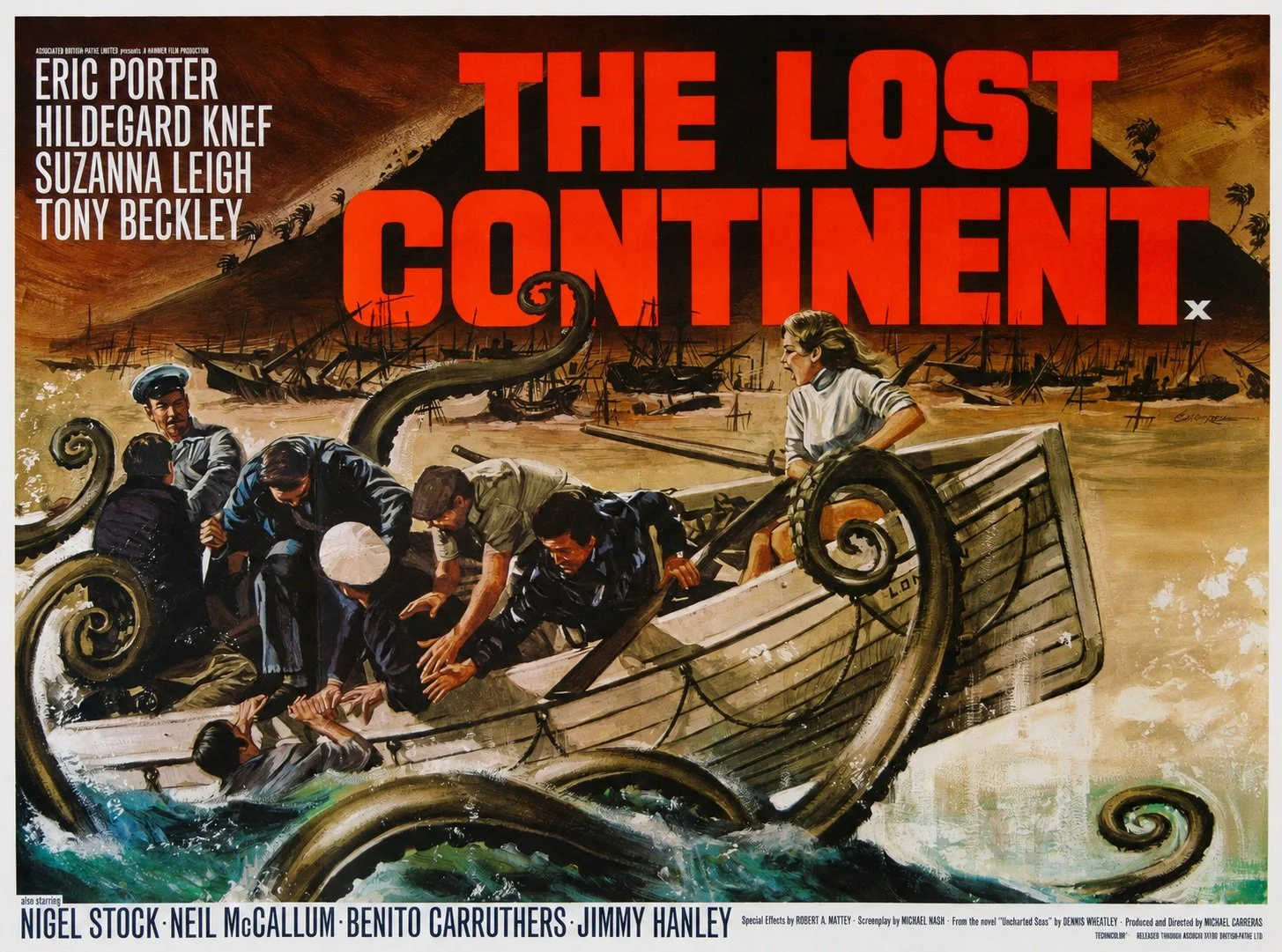
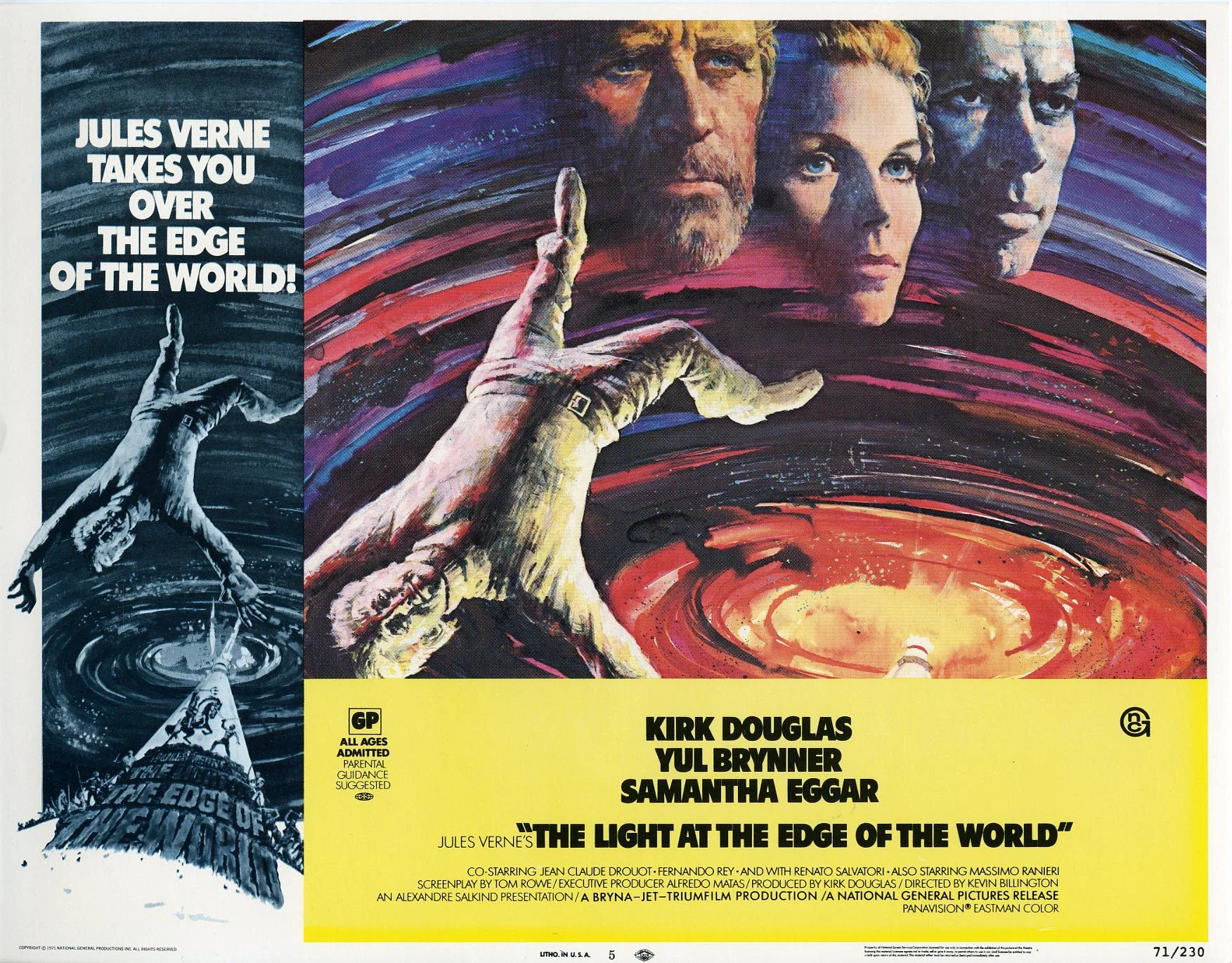


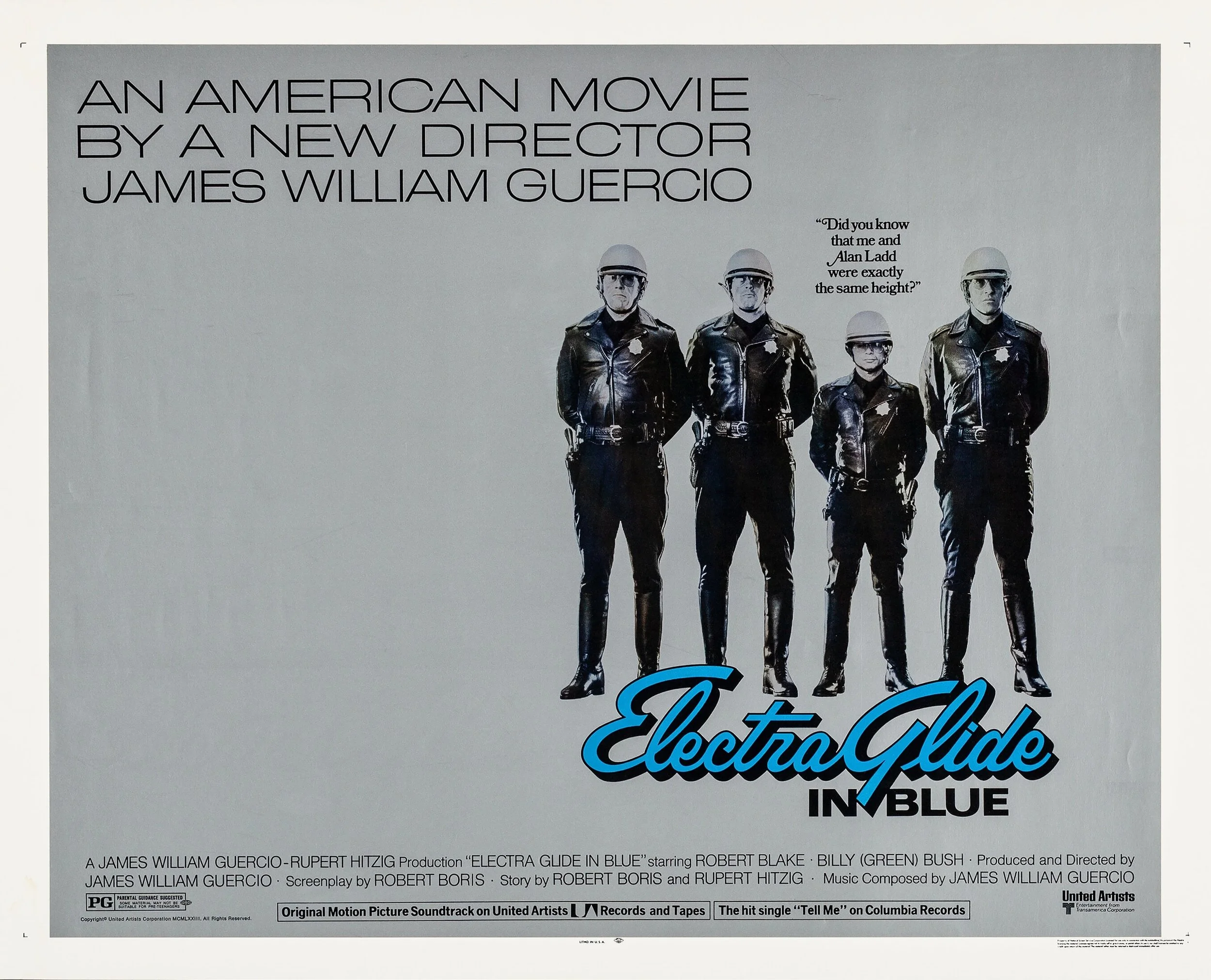
Warlords of Atlantis (1978)
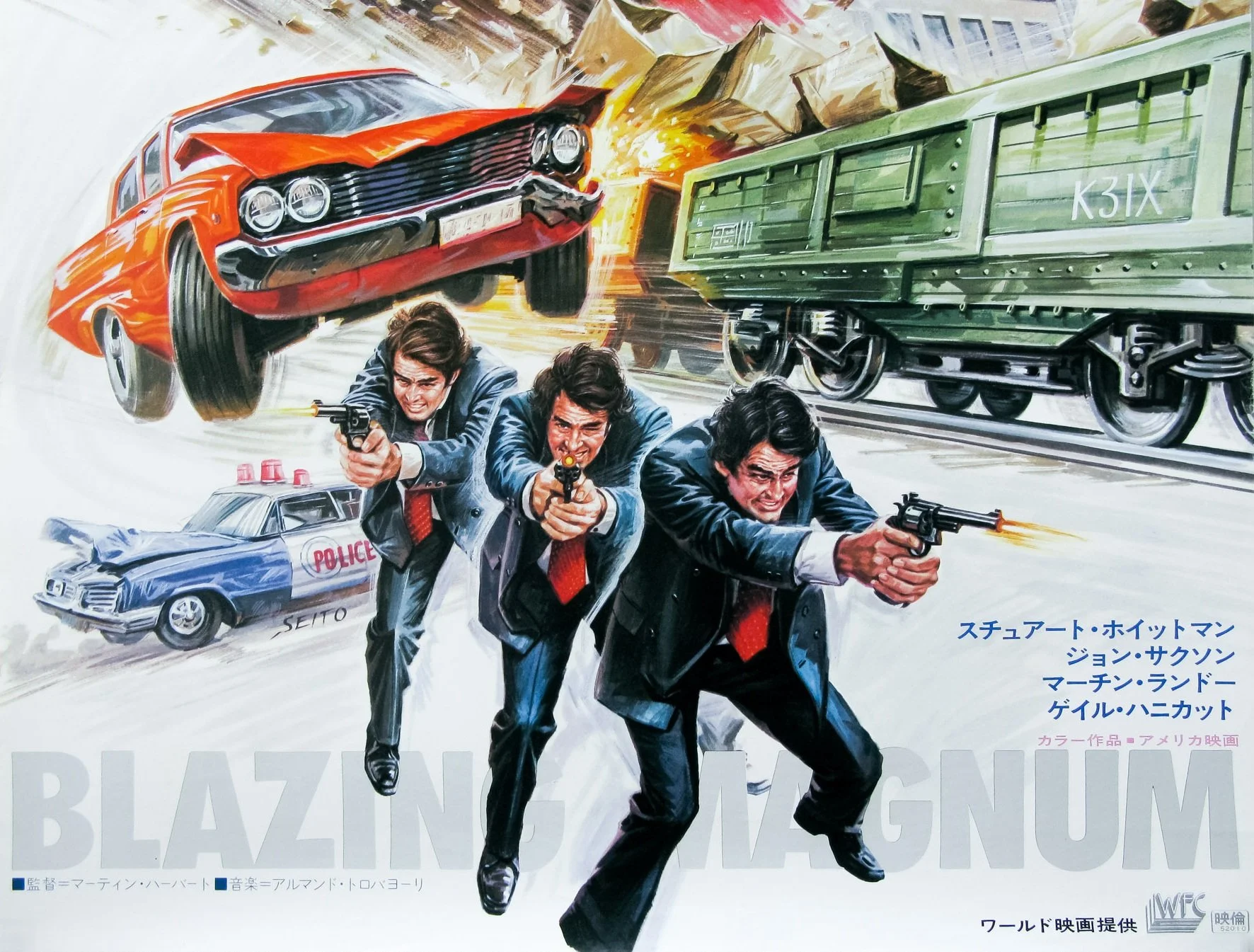
Being a child of the seventies I was raised on films. I saw a good many classic during my most formative years, usually on a Sunday afternoon, which I'd watch with my family. I also use to enjoy the adverts in the Evening Standard for the latest cinema releases. The poster art was lurid and exotic and would often promise so much. As video was not yet available to the domestic market, trips to the cinema were much more of an event than they are now. By 1978 I was already a firm fan of the fantasy genre (mainly thanks to the work of Ray Harryhausen) so when Warlords of Atlantis was released I was duly excited. I had seen all the previous films that John Dark had produced in this series. The Land That Time Forgot, At the Earth’s Core and The People That Time Forgot. Although cheap and cheerful, they were very entertaining, especially to younger audiences.
Being a child of the seventies I was raised on films. I saw a good many classic during my most formative years, usually on a Sunday afternoon, which I'd watch with my family. I also use to enjoy the adverts in the Evening Standard for the latest cinema releases. The poster art was lurid and exotic and would often promise so much. As video was not yet available to the domestic market, trips to the cinema were much more of an event than they are now. By 1978 I was already a firm fan of the fantasy genre (mainly thanks to the work of Ray Harryhausen) so when Warlords of Atlantis was released I was duly excited. I had seen all the previous films that John Dark had produced in this series. The Land That Time Forgot, At the Earth’s Core and The People That Time Forgot. Although cheap and cheerful, they were very entertaining, especially to younger audiences.
Now it is important to judge Warlords of Atlantis both within the historical context of the times and in accord with its budget. These movies were modest productions by the standards of the seventies and were certainly not in the same league as Harryhausen's fantasy films at the time. But Roger Dickens rod puppet monsters have a peculiar charm about them. They strive to beat the technical restrictions of their budgets. The miniature work is also good, but then again John Richardson was (and still is) an expert in his field, with a very distinguished pedigree. I would also draw attention to Mike Vickers score which is rather enjoyable. It adds an extra dimension of bogus quality to the proceedings.
The cast is packed with stalwarts of the industry and indeed this genre. Doug McClure was a man who could play himself with great intensity. Then there’s also Shane Rimmer, in-between his work for Gerry Anderson, as well as Michael Gothard and Peter Gilmore. All provide performances that are totally suitable for the material in question. Malta and Gozo once again provide the exotic location required for the mysterious undersea kingdom. Not being hindered by any progressive politics, there is also the ubiquitous ample breasted female. For an unreconstructed ten year old, raised during the pre-Thatcher era, this film just kept ticking the right boxes at the time. There is no laconic humour, or postmodern irony. The story is played straight and the better for it.
Unlike previous John Dark productions, Warlords of Atlantis was not based on the work of Edgar Rice Burroughs. The screenplay was the work of Brian Hayles, one of the bastions of British television. He wrote prolifically for early Doctor Who (The Celestial Toymaker, The Smugglers, The Ice Warriors, The Seeds of Death, The Curse of Peladon and The Monster of Peladon) and often explored socio-political themes. These are present in Warlords of Atlantis, with an elite class of oppressive Martians using a slave class to stave off the constant attack of mutations. I believe the film was originally entitled “Seven Cities of Atlantis” before being altered, to one that did not invoke such high budget imagery.
The market of the time was soon to be saturated by Star Wars rip-offs and as a result, this was the last of the Amicus productions in this vein. Their traditional approach may seem dated to today’s modern sensibilities and I doubt if a contemporary audience would see any virtue in them. I shudder to think what sort or "re-imagining" these films would require to reach the screen today. However, if you can look beyond the superficial, there is entertainment to be had from Warlords of Atlantis. Enjoy it for what it is. It's one hundred times better than any low budget equivalent you’d find these days on Syfy.
Watching Movies on Commercial TV Stations
The relevance of this post, comes down to how much you like and care about film. If movies are simply a transient form of entertainment to you, something you have no major investment in beyond killing time, then my following protestations will be water off a duck’s back. If like me, you consider film to be art, then hopefully you’ll concur with my sentiments. Because I do consider movies to be a the most immediate and significant art form of the twentieth century. There are no significant barriers to entry beyond the ability to see and they can convey thoughts, ideas and emotions to the broadest possible audience.
The relevance of this post, comes down to how much you like and care about film. If movies are simply a transient form of entertainment to you, something you have no major investment in beyond killing time, then my following protestations will be water off a duck’s back. If like me, you consider film to be art, then hopefully you’ll concur with my sentiments. Because I do consider movies to be a the most immediate and significant art form of the twentieth century. There are no significant barriers to entry beyond the ability to see and they can convey thoughts, ideas and emotions to the broadest possible audience.
Yesterday I watched Devil in a Blue Dress, for the first time. Carl Franklin’s socio-historic thriller enjoys a strong reputation as a neo-noir and is also considered an important piece of “Black Cinema”. It boasts a strong cast featuring the likes of Denzel Washington and Don Cheadle and offers a great deal of period detail. There's also a fine score by Elmer Bernstein. All things considered this is a film of note, dealing with important subjects such as institutional racism and personal friendship, told within the framework of a hard-boiled detective story. The narrative has many a twist and is squarely aimed at mature audiences with a sense of historical perspective.
Sadly AMC (UK), the channel that broadcast Devil in a Blue Dress on December 10th, decide to do so at 5:00 PM in the afternoon. I didn’t realise this initially as I was watching a recording on our DVR but it soon became apparent that the film had been edited to accommodate broadcast at such a time. These cuts where at time so ham-fisted that they stood out like a saw thumb. Edits to violence and a sex scene as well as sundry dialogue omissions were made to sanitise the film for broadcast. However, considering the nature of the plot and the era that the story was set in, such changes drastically altered the dramatic impact of the movie. One missing scene had a particular bearing on the narrative. Then there is the entire separate issue of interfering with the film makers artistic vision.
Unfortunately, such practises are common place on commercial television stations these days. Films are not only edited for content but shown in the wrong aspect ratio, plagued with commercial breaks every ten minutes and further blighted by onscreen graphics and logos. If you enjoy perusing the end credits you’ll often find these compromised in a similarly crass fashion. Often the picture quality of the source content is subpar and further degraded by the rigours of digital compression. Simply put, watching a film under such circumstances is often intolerable for film fans or aficionados. For those seeking out specific movies, as I were with Devil in a Blue Dress, it really can impact upon your enjoyment and critical judgement. I subsequently re-watched this film several hours later, via a superior source to improve my perception of it.
Overall such practises by commercial stations simply show they have no real interest in the movies they peddle. As ever it is simply a question of viewing figures and ad revenue that concerns them. Thus, they will more than likely continue with such practises irrespective of the few complaints that they may receive. Therefore, I have personally chosen that henceforth I shall no longer watch movies under these circumstances, unless there really is no other option available. Unless a film is extremely rare and unobtainable on any other platform, I shall only watch it via DVD, Blu-ray, Netflix, Amazon Prime or some other electronic file format. Adverts, digital branding, censorship and incorrect formatting is no longer acceptable and belong to the last century.
I’m sure there are some who will label me purist but I believe that all creative material is due a degree of respect with regards to the manner in which it is presented; and that should always be in the accordance with its creator. Tampering simply sends a message that there is no inherent value in that which is being shown. It is born of hubris and a lack of creative understanding. Therefore, broadcasters should never butcher films, talk across music or songs and generally interfere with art, simply for the convenience of their business model. Sadly, it is highly unlikely that those currently guilty of such things are going to support such a change in policy. Thus, we return to the concept of voting with our feet and seeking out quality cinema (and other art forms) via the best outlet possible. Why diminish your enjoyment? It is time to start treating these commercial stations with the same indifference they show to film.
Exodus: Gods and Kings (2014)
Epic adventure Exodus: Gods and Kings is the story of one man's daring courage to take on the might of an empire. Using state of the art visual effects and 3D immersion, Scott brings new life to the story of the defiant leader Moses as he rises up against the Egyptian Pharaoh Ramses, setting 600,000 slaves on a monumental journey of escape from Egypt and its terrifying cycle of deadly plagues. Written by 20th Century Fox.
So reads the marketing material for Exodus: Gods and Kings according to 20th Century Fox. However, the movie itself despite brimming with "state of the art visual effects and 3D immersion" lacks any emotional impact, has a choppy narrative and is completely devoid of any religious conviction. Do not mistake Ridley Scott's ponderous movie for a religious epic. It is more of a pseudo-historical blockbuster with some metaphysical overtones. By endeavouring to rationalise the faith based aspect of the story, we are left with a distinctly underwhelming costume drama.
Epic adventure Exodus: Gods and Kings is the story of one man's daring courage to take on the might of an empire. Using state of the art visual effects and 3D immersion, Scott brings new life to the story of the defiant leader Moses as he rises up against the Egyptian Pharaoh Ramses, setting 600,000 slaves on a monumental journey of escape from Egypt and its terrifying cycle of deadly plagues. Written by 20th Century Fox.
So reads the marketing material for Exodus: Gods and Kings according to 20th Century Fox. However, the movie itself despite brimming with "state of the art visual effects and 3D immersion" lacks any emotional impact, has a choppy narrative and is completely devoid of any religious conviction. Do not mistake Ridley Scott's ponderous movie for a religious epic. It is more of a pseudo-historical blockbuster with some metaphysical overtones. By endeavouring to rationalise the faith based aspect of the story, we are left with a distinctly underwhelming costume drama.
It soon becomes apparent while watching Exodus: Gods and Kings that this movie has been subject to the usual editing issues that plague the work of Ridley Scott. Key members of the cast such as Sigourney Weaver, Aaron Paul and Andrew Tarbet simply vanish from the story shortly after their introduction. There are obvious gaps in the narrative and many of the key characters feel poorly defined. The central relationship between Moses (Christian Bale) and Ramses (Joel Egerton) is very thin and there is little back story to their emerging rivalry. Possibly these gaps will be plugged in a future directors cut; something Ridley Scott is no stranger to.
Many critics joked that "at least the plagues are nice" when reviewing this movie. They are right in this respect. The digital effects work certainly paints an authentic picture of the Egyptian world and the subsequent plagues are brutal and unpleasant. The Crocodile attacks are particularly striking, yet tonally sit quite awkwardly with the rest of the film. The choice to down play the religious element of the plot and effectively sideline Moses's visions of God as the results of a head injury is somewhat counter-intuitive. As a result, Exodus: Gods and Kings feels distinctly lacking in any sort of conviction.
I often wonder if the reason so many "great" directors produce such weak work in their twilight years is because their fame and success has placed them in an echo chamber. It is either assumed that their creative vision is infallible or that all concerned parties are simply too scared to challenge any of the ideas that are presented. This is by far Scott's weakest movie for a long time and frankly I am not sufficiently enamoured to give another longer version a try, as and when it becomes available. Unless you are a Scott completest Exodus: Gods and Kings is best avoided. If you are a person of faith you may still wish to defer to Cecil B. DeMille's The Ten Commandments.
The Haunted Palace (1963)
Despite being marketed as yet another Gothic Horror based upon the works of Edgar Allan Poe, The Haunted Palace is in fact a lose adaptation of The Case of Charles Dexter Ward, by H. P. Lovecraft. The film's title is merely taken from a poem by Poe and is an example of the clever promotion often associated with the movies of Roger Corman. The poster's tagline as ever focuses on the more sensational aspects of the storyline, although audiences’ expectations are not exactly met. Yet there is often a great deal of merit to be found in Corman's output from this decade and as ever The Haunted Palace, like so many of his other movies transcends its modest budget with a sumptuous production design and atmosphere.
Despite being marketed as yet another Gothic Horror based upon the works of Edgar Allan Poe, The Haunted Palace is in fact a lose adaptation of The Case of Charles Dexter Ward, by H. P. Lovecraft. The film's title is merely taken from a poem by Poe and is an example of the clever promotion often associated with the movies of Roger Corman. The poster's tagline as ever focuses on the more sensational aspects of the storyline, although audiences’ expectations are not exactly met. Yet there is often a great deal of merit to be found in Corman's output from this decade and as ever The Haunted Palace, like so many of his other movies transcends its modest budget with a sumptuous production design and atmosphere.
Charles Dexter Ward (Vincent Price) and his wife Ann (Debra Paget) travel to Arkham to take custody of a palace he's inherited. Its previous owner was his great grandfather, Joseph Curwen, who was burned at the stake by local villages for practicing the black arts. Upon arrival the locals are hostile to Ward with the exception of Dr. Willet (Frank Maxwell). Many of the villagers are afflicted with birth defects that are attributed to a curse that Curwen made as he died. Ward soon finds that a portrait of his ancestor bears a striking similarity to himself. It is not long before he finds his own identity under threat from the malignant spirit of Curwen, who seeks revenge and to resume his ungodly pursuits.
The Haunted Palace certainly has some noteworthy aspects. This was the only time that iconic horror actor, Lon Chaney Jr. appeared in a Roger Corman movie. Although his role is somewhat under developed, his presence is still tangible and suitably creepy. As ever, the production does a great deal with very little. The set designs by Daniel Haller are intricate and have an authentic feel. Many were built in forced perspective to create the illusion of scale. Floyd Crosby's cinematography is stylish and make great use of the widescreen format. There are is also some simple but eerie makeup effects by Ted Coodley,
After a captivating opening, The Haunted Palace embarks upon a story of possession, revenge as well as arcane rituals. There are quite a lot of elements from Lovecraft's source text, including the infamous Necronomicon. The concept of the Elder Gods seeking earthly form by cross breeding with humans is quite bold for the times. The movie also has some quite strong death scenes. One villager is dragged into the fireplace and burnt alive at the hands of his own mutant son. Another hapless local is immolated in the streets, resulting in a grim incinerated corpse. The film has a sinister ambience, especially during the scene when Ward and his wife are menaced by a group of deformed villagers.
Sadly, the final act fails to sustain this momentum and the ending is somewhat abrupt and predictable, especially with regard to the inevitable twist. It also fails to account for the fate of certain characters. It's a shame because this production strives to do something different from other Corman horror movies. It excels in many aspects of the production but simply over reaches itself at the end and cannot adequately bring events to a satisfactory conclusion. However that is not to say that the movie isn't entertaining and frequently demonstrates low budget creativity. Many of today's horror directors today could benefit from a close study of Corman's approach to film making and his innovative techniques.
A Year in Multimedia
In the past, I’ve often written a summary of my experiences with gaming, movies and TV at the end of each year. Similarly, I usually reflect upon my activities in podcasting and blogging as well. However, 2016 has been unique in many respects. Political and social tides have changed in the West and there is much to reflect upon in the real world. Certainly, my appetite for creating content has taken a knock and I have at times stopped and wondered if it really is all worth the bother. But after such moments of introspection I still see the benefits of the written word or bellowing in to a microphone, so here we are once again. The only difference this time is rather than multiple posts, I can pretty much distil my thought on 2016 in one simple account.
In the past, I’ve often written a summary of my experiences with gaming, movies and TV at the end of each year. Similarly, I usually reflect upon my activities in podcasting and blogging as well. However, 2016 has been unique in many respects. Political and social tides have changed in the West and there is much to reflect upon in the real world. Certainly, my appetite for creating content has taken a knock and I have at times stopped and wondered if it really is all worth the bother. But after such moments of introspection I still see the benefits of the written word or bellowing in to a microphone, so here we are once again. The only difference this time is rather than multiple posts, I can pretty much distil my thought on 2016 in one simple account.
Gaming:
To things have had a major impact upon my gaming this year. A lack of time and too few new titles that aroused my interest. I started the year playing through Hearts of Stone, the first DLC for The Witcher III: Wild Hunt and continued with the second expansion, Blood and Wine when it was released in May. I waxed lyrical about the quality of this RPG last year and will continue to do so this time. The last DLC not only added yet another superbly crafted narrative but refined the game mechanics and system even further. I think it will be a long time before I find another game from this genre that offers anywhere near a comparable experience.
MMO wise I have continued to regularly log into Star Trek Online during 2016 as it has frequently had new content to explore. This year being the 50th Anniversary of Star Trek, the new expansion, Agents of Yesterday, offered an appropriate homage to the original series. The new lighting system has improved the overall aesthetic of the game and it’s clear that developers Cryptic have plenty more in store for the MMO. It’s recent port to consoles clearly indicates that the game is in a healthy state.
LOTRO has had a curious year. I took a six-month break from the game due to the repetitive and formulaic nature of the new content. Yet the Battle of Pelennor Fields brought me back, being surprisingly well realised given the restrictions of the ageing game engine. Update 19 released in October took the game one step closer to Mordor. As ever the epic central story continues to be written to a high standard and certainly compensates for other more pedestrian regional quests. Recent news that ex Turbine staff have formed a new independent company and taken over the development of the game does seem to have renewed interest in the MMO. I remain cautiously optimistic for LOTRO’s future.
It would be remiss of me if I didn’t mention Overwatch. I played the open beta out of idle curiosity and was greatly surprised by how accessible the game is. It has now become my game of choice whenever I want a quick fix of entertainment. I’m still amazed at how equitable this team based, first person shooter is and how anyone can find a role to play, regardless of the style or abilities. It continues to add content and new characters ensuring longevity. Something that Pokémon Go has failed to do. This was another title that I was drawn to out of nostalgia and curiosity but it quickly became apparent that it was unsustainable.
TV and Movies:
I only went to my local multiplex to see movies upon their release, six time this year, which is unusual for me. This is mainly due to there being precious little of interest for me these days. Cinemas seem choked with Blockbusters and Super Hero movies. A lot of the more niche market, independent films have limited releases and tend to be available on-demand very quickly. Those movies I did see were suitably entertaining. Deadpool provided audiences with exactly what they expected and proved that the R rating could still be economically viable. Star Trek Beyond finally saw the new stories set in the Kelvin Timeline hit their stride. It offered a good character driven story that finally tapped in to the soul of the original series. Fantastic Beast and Where to Find Them also proved to be a crowd pleaser with excellent production values and a decent storyline. I have high hopes for this off shoot of the Wizarding World franchise. Rogue One certainly met with my approval and filled a suitable gap in the Star Wars lore. I almost got as much fun out of the fan driven debates about the story as the film itself.
TV once again proved to be the home of more cerebral and densely plotted drama. Stranger Things was a wonderful homage to eighties genre cinema and popular culture. Finally embracing both Amazon Prime and Netflix certainly afforded our household with more choice and provided a respite from the scourge of advertising which just seems to become increasingly preposterous and crass. The Man in the High Castle provided a suitable bookend to the start and end of the year and continues to be both intriguing and entertaining. It has also been beneficial to have access to all previous series of Star Trek and work my way through those shows I’m less familiar with.
Network TV on both sides of the Atlantic has been entertaining. There are still far too many shows to keep up with and I’m constantly amazed at how many shows bite the dust after one lacklustre season. Elementary still maintains a high standard of writing and the central characters of Holmes and Watson still have engaging story arcs. The final season of Person of Interest was both succinct and fitting, providing a bitter sweet, yet plausible ending for the show. Blindpsot somehow made it to a second season and completely reinvented itself to try and escape the narrative knot it had go itself in to. Back in the UK, Endeavour once again proved to be both superbly acted and well written. It’s sedate pace and introspective themes continue to be captivating.
As a grandparent, I also watch a great deal of children’s television, especially those aimed at the pre-school demographic. Therefore, I would like to praise CBeebies for their continued quality programming and point out that Hey Duggee is a sublime show. If you are thirtysomething, then you’ll love the pop culture references that litter every episode. Plus, in the last few days, I also been caught up in the hype surrounding Guillermo del Toro’s Trollhunters. Let it suffice to say that it is charming and entertaining. It’s curious how some creative talents can handle sentimentality without tipping in to emotional overkill.
Blogging and Podcasting:
I stopped writing daily in 2016. I simply ran out of steam after five years and then real world changes meant that such a schedule was off the table for the immediate future. However, I managed to contribute to this year’s NBI and Blaugust, so I guess content creation wasn’t a complete write off (no pun intended). The Burton & Scrooge Podcast became The Burton & Scrooge Uncut Podcast and followed a somewhat erratic release pattern. I enjoy recording with my co-host Brian but I’m thinking we need to either seriously rethink the show format for 2017 or take a break for a while. I’m determined to get my movie related show in to production next year and I also need to return to writing my book, which ground to a halt this summer.
It would appear that real life and all that it contains caught up with many of my blogging and podcasting colleagues this year. Thus, there was reduced output from certain quarters and some went so far as to take a break. It’s sad but totally understandable. Yet it was not all doom and gloom. Syp over at Bio Break continues to write and podcast with great enthusiasm. The year also saw the launch of the Geek to Geek Podcast with Void and Beej. Their dedication and focus has been a source of inspiration and the show itself is thoroughly entertaining. It also reacquainted me with the concept that you can agree to disagree, cordially. Pam over at Cannot be Tamed also produced lots of quality content via blog post, podcast and You Tube. Joseph (formerly known as the MMO troll) kept creating his own unique brand of content with the Pthppt! podcast. It always raises a wry smile and I’ll happily listen to topics that I usually wouldn’t consider exploring.
Valedictory Remarks:
For me the overwhelming impression that 2016 leaves is ones of change. This has been reflected in politics, world events, within the entertainment industry per se and even my personal life. Yet change is an inherent part of life and cannot be avoided. Therefore, I intend to start 2017 with a positive outlook and rather than focus on what I can’t do, explore what can be achieved with the time and resources that I have. I’m also sure there will still be good content available in all mediums. It may simply be a case of having to broaden one’s search. I recently discovered to my surprise that there’s a fourth instalment of Sniper Elite arriving in spring and I’m still greatly looking forward to Star Trek Discovery. I shall also continue to blog and podcast in my own peculiar way. Perhaps I may even encourage others to do so. After all, you’ve got to have a project.
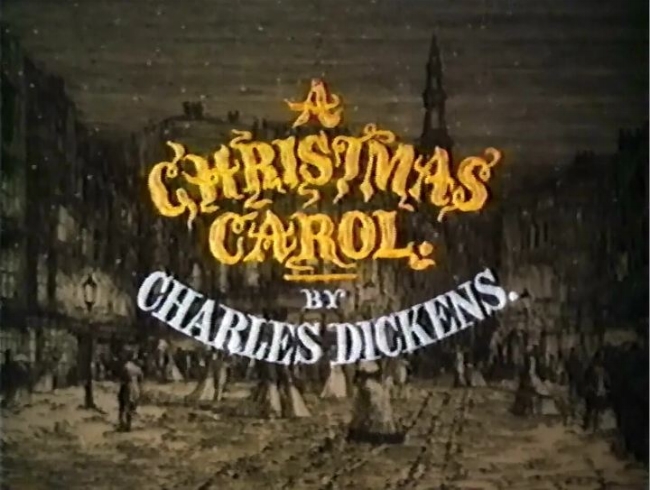
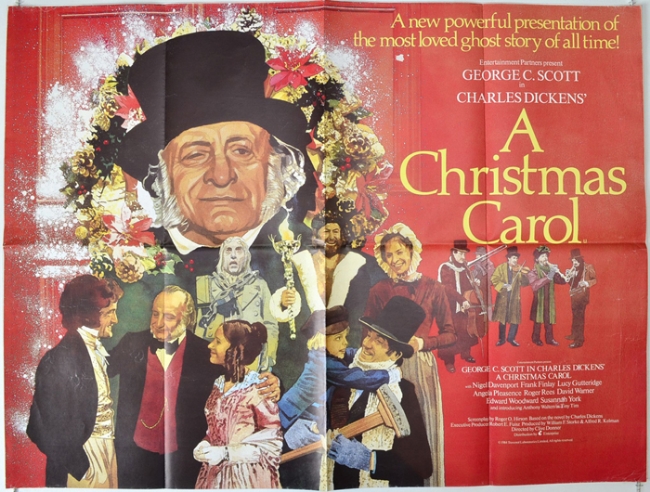
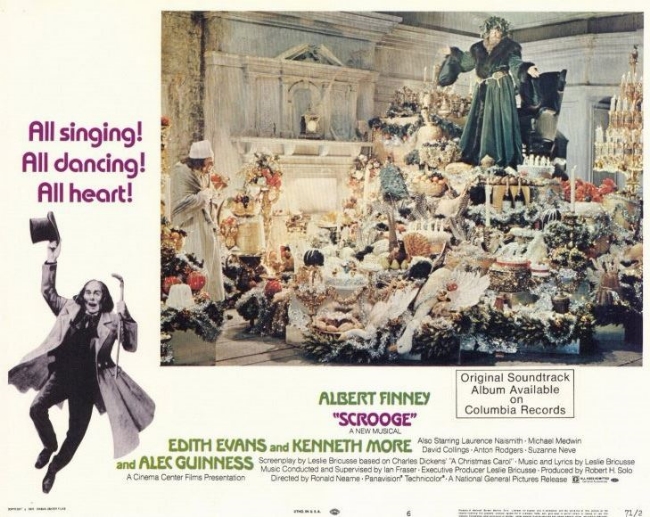
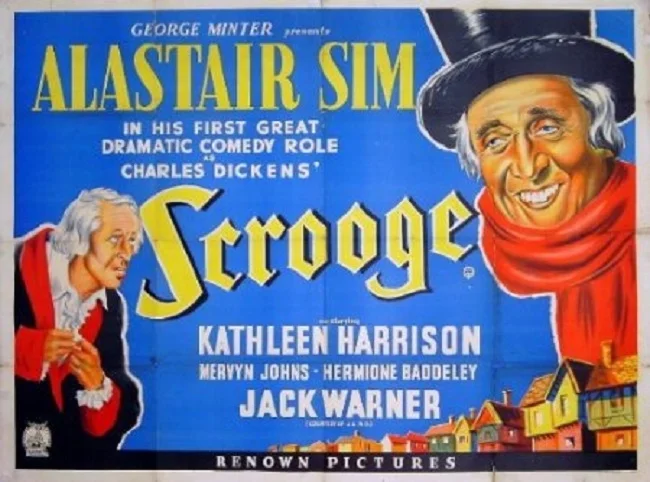
A Christmas Carol (1971)
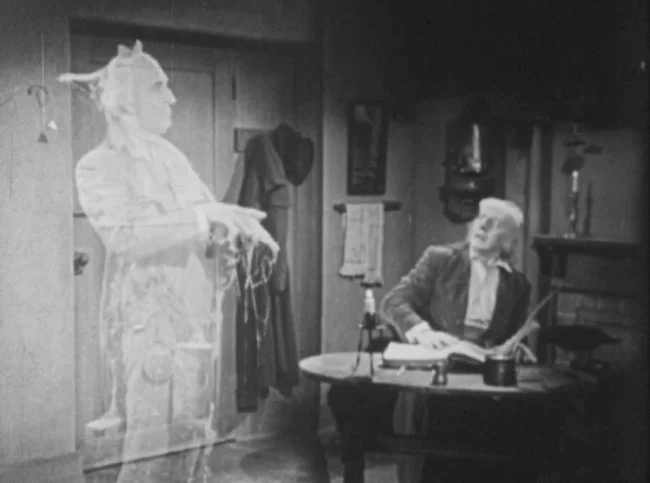
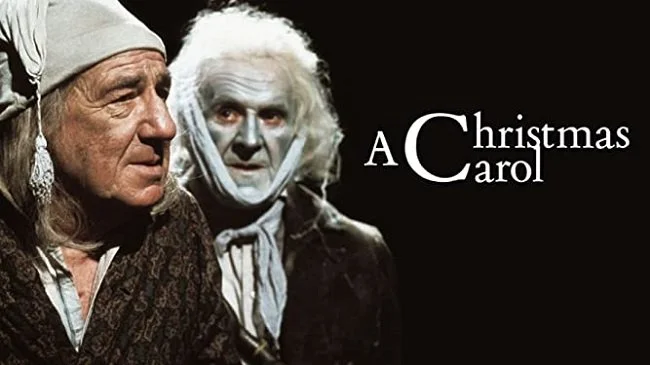
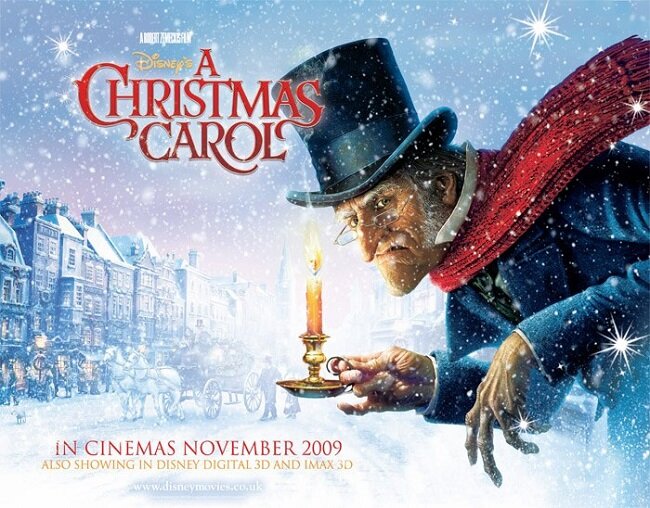
I have a great deal of affection for Charles Dickens' A Christmas Carol, not only because it’s a fine piece of literature but because it lends itself so well to dramatisation. I therefore have a keen interests in all the respective adaptation, of which there are many. Over the years there has been a trend to focus excessively on the sentimental aspect of the plot, resulting in a rather nauseating Disneyfication of the story. Although the redemption of the main protagonist is central to the narrative, the poverty and deprivations of the time are still very pertinent themes, especially in today's economic climate. I was therefore very gratified to rediscover the 1971 version of Charles Dickens' classic story which was originally shown on ABC. This short 25 minute animated feature realises the story superbly, capturing the tone of the book and accurately reflecting the darker aspects. Remember that A Christmas Carol is fundamentally a ghost story.
I have a great deal of affection for Charles Dickens' A Christmas Carol, not only because it’s a fine piece of literature but because it lends itself so well to dramatisation. I therefore have a keen interests in all the respective adaptation, of which there are many. Over the years there has been a trend to focus excessively on the sentimental aspect of the plot, resulting in a rather nauseating Disneyfication of the story. Although the redemption of the main protagonist is central to the narrative, the poverty and deprivations of the time are still very pertinent themes, especially in today's economic climate. I was therefore very gratified to rediscover the 1971 version of Charles Dickens' classic story which was originally shown on ABC. This short 25 minute animated feature realises the story superbly, capturing the tone of the book and accurately reflecting the darker aspects. Remember that A Christmas Carol is fundamentally a ghost story.
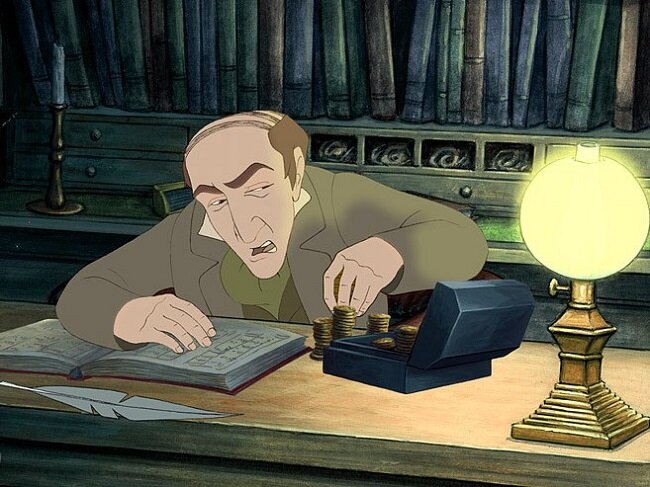
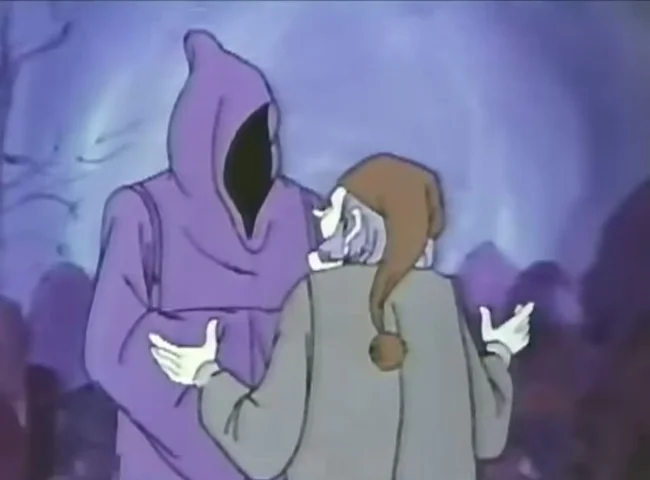
The TV special features Alastair Sim as the voice of Ebenezer Scrooge (a role Sim had previously performed in the 1951 live-action film Scrooge). Michael Hordern likewise reprised his 1951 performance as Marley's Ghost. Veteran animator Chuck Jones served as executive producer, while the great Richard Williams directed. This is a very distinguished pedigree for any animated production. The story is beautifully condensed considering the running time and captures the harsh winter environment of London in the 1843. The supernatural elements are intelligently realised, drawing directly from the source text. The scene where Marley's Ghost, removes the handkerchief that secures his jaw, so it drops to his chest terrified me as a child when I first saw it. The subsequent depiction of "Ignorance" and "Want" is also bleak and shocking.
Originally produced for television, A Christmas Carol won an Academy Award for best animated short subject in 1973; it remains the only film adaptation of the story to date to have done so. However, elements within Hollywood were unhappy that a TV show had won an Academy Award, which led to the Academy changing its policy, disqualifying any shorts that were shown on television first. Overall A Christmas Carol remains a benchmark for quality animations. The subtle line drawings and water colours bring Dicken's London to life wonderfully. The characters are vividly drawn and reflect a thoughtful design. The voice cast bring gravitas to the proceedings, resulting in a quality adaptation of the story. Unfortunately, this short animated film is not readily available. The VHS release is long obsolete and there is no mainstream DVD copy available. The film did feature on a limited edition DVD boxset of the work of Richard Williams. If you can track down a copy via the internet, then you will be well rewarded.





Rogue One (2016)
After watching Rogue One earlier today, I was suitably impressed. Once again Disney have used all the knowledge they've amassed from successfully running major franchises and applied it here, resulting in a finely tuned and polished entry into the Star Wars pantheon. The concept of standalone movies released in-between instalments of the classic story has now proven viable opens up a wealth of possibilities. Rogue One works well narratively and provides the spectacle that fans expect from the series. The continuity and attention to detail is outstanding continuously keeping viewers on their toes. Furthermore, the story itself is credible, dovetailing nicely into the lore.
After watching Rogue One earlier today, I was suitably impressed. Once again Disney have used all the knowledge they've amassed from successfully running major franchises and applied it here, resulting in a finely tuned and polished entry into the Star Wars pantheon. The concept of standalone movies released in-between instalments of the classic story has now proven viable opens up a wealth of possibilities. Rogue One works well narratively and provides the spectacle that fans expect from the series. The continuity and attention to detail is outstanding continuously keeping viewers on their toes. Furthermore, the story itself is credible, dovetailing nicely into the lore.
One of the movies greatest assets is its depiction of a galaxy at war. A point that sometimes gets lost in the original trilogy. The rebel alliance is shown as a less than perfect organisation with fragile alliances and rogue factions. Our protagonists are also flawed, some of whom have done questionable things in the name of their cause. It is these themes that bring a greater degree of maturity to Rogue One. The dark tone is more in keeping with that of The Empire Strikes Back, rather than A New Hope.
Technically the movie is a triumph, sporting the quality of computer effects one expects from the franchise. The dogfights in space and the ground assault on the Scarif are suitably impressive. ILM’s loving recreation of Peter Cushing is fascinating to see and also raises some interesting questions regarding the future use of digital actors. The film also showcases several ideas that were previously considered but not used, such as Darth Vader’s bacta chamber. However it is the sense of continuity in the production design and casting that is most striking; Rogue One looks and feels like a seventies production.
Despite a storyline that paves the ways for A New Hope, Rogue One manages to avoid being boxed in by its narrative and takes some interesting turns along the way. The casting works well offering a diverse team of protagonist, reflecting the inter-species nature of the Rebel Alliance. The Empire remains a haven for British character actors with seventies sideburns and as the story unfolds, takes on a credibly dark tone. Rogue One is essentially a war movie and like all good examples of the genre, does not explore the subject matter in binary terms.
Apparently director Gareth Edwards original cut of the movie was a little too dark and Disney decided to shoot additional material and retool the movies ending. Yet the final edit does not necessarily bear all the hallmarks of post-production tinkering. Perhaps Darth Vader’s personal intervention to retrieve the stolen plans at the movies climax is a little contrived but appears to have been well received by fans. The films conclusion is both credible and appropriate. Opting for a more “happily ever after” tone would have diminished the themes that Rogue One explores during its two hour plus running time.
Personally I feel that the bi-yearly standalone movies that Disney has planned offer a lot more scope than the continuation of the classic story. Although I’m curious to know the fate of Luke Skywalker, that tale doesn’t seem to offer as many possibilities. I am a firm believer in the concept that not every movie needs sequel and am looking forward to the forthcoming ad-hoc stories regarding various characters from the Star Wars pantheon. If future films maintain the standard set by Rogue One then fans certainly have nothing to fear and I’m sure Disney will continue to enjoy the commercial success.
The Damned (1963)
The Damned starts as a delinquent youth drama (a popular theme at the time) and then over the proceeding ninety minutes morphs into a menacing sci-fi plot that climaxes in a full blown conspiracy. It's a most unusual and experimental film that cannot easily be pigeon-holed, yet the same could be said about many other movies by veteran film director Joseph Losey (Boom!, Figures in a Landscape). It proved to be somewhat too "different" for Hammer studios who commissioned the movie and they subsequently shelved The Damned for two years. It was finally released in a heavily edited form under the alternative title of These are the Damned.
The Damned starts as a delinquent youth drama (a popular theme at the time) and then over the proceeding ninety minutes morphs into a menacing sci-fi plot that climaxes in a full blown conspiracy. It's a most unusual and experimental film that cannot easily be pigeon-holed, yet the same could be said about many other movies by veteran film director Joseph Losey (Boom!, Figures in a Landscape). It proved to be somewhat too "different" for Hammer studios who commissioned the movie and they subsequently shelved The Damned for two years. It was finally released in a heavily edited form under the alternative title of These are the Damned.
Set on the Dorset coast an American tourist Simon Wells (Macdonald Carey) on a boating holiday along England’s south coast, is assaulted by a gang of hoodlums led by the charismatic King (Oliver Reed). King's sister Joan (Shirley Anne Field) tries to make amends with Wells but incurs the wrath of her Brother. Both Wells and Joan escape the gang and hide in a network of caves and bunkers on the coast. They discover a group of strange children who have been kept isolated from the world by the military, in what appears to be some sinister government experiment. It soon becomes clear that military are not going to allow them to leave and risk the security of their top secret operation.
The Damned runs at its own pace and which is somewhat sedyte. Yet the shift between storylines midway through the proceedings is bold and quite compelling. The film explores several themes that would later be the foundation for other more notable movies, such as Stanley Kubrick’s A Clockwork Orange (1971). The most outstanding facet of this film is its overall tone. Government conspiracies where not such a common place plot devices at the time and the notion of sacrificing children for an advantage in the Cold War, made the distributors uncomfortable. The bleak ending further muddied the waters. Such material is far from controversial today but at the time this was quite radical.
It should be noted that this film is not a third instalment in the cinematic adaptation of John Wyndham's The Midwich Cuckoo. The story is based on the novel Children of the Light by H L Lawrence. It is alleged that Losey completely rewrote the script and that as well as being a statement about the Cold War, it was also a veiled criticism of his Hollywood blacklisting. Whether that is true or not remains to be seen. The Damned is mostly certainly an interesting curio with is wistful introspection and existential crisis. Dated in many respects (especially the opening song) it is still tonally a very experimental piece, especially if seen in its fully restored ninety seven minute running time.
The Planet of the Apes movie franchise took a radical change of course with its third entry in the series. The first two films were set in the future and benefited from high production values to help realise a post apocalyptic earth. However, due to a substantial reduction of budget, Escape from the Planet of the Apes uses a time travel plot device to bring the ape protagonists to present day Los Angeles (1971 in this case). The result is a film with a much smaller narrative scope. However, although it lacks the science fiction spectacle of its predecessors, it features an interesting satirical exploration of celebrity culture and ponders what it is like to be deemed an enemy of the state. As ever, Roddy McDowell and Kim Hunter provide exceptional lead performances as the Chimpanzees Cornelius and Zira. Escape from the Planet of the Apes also captures the pop culture vibe of seventies America.