
In the year 1860, Baron Victor Frankenstein (Peter Cushing) faces execution by guillotine for the murders perpetrated by the creature he created. With the assistance of a hunchback named Karl (Oscar Quitak) he avoids death by beheading the priest who came to give him the last rites. The priest’s body is then mistakenly buried by the authorities. Three years later, Victor, now using the name Doctor Stein, has established himself as a prosperous physician in Karlsbrück, serving both affluent patients and the poor at a paupers’ hospital. Hans Kleve (Francis Matthews), a junior member of the medical council, recognises Victor and being an admirer, seeks to become his apprentice. Victor and Hans then undertake an experiment to transplant Karl’s living brain into a new, more refined body, rather than a grotesque monstrosity the Baron has previously made. Karl is eager to have a new healthy body, especially after encountering Margaret Conrad (Eunice Gayson), the charming new assistant at the hospital.
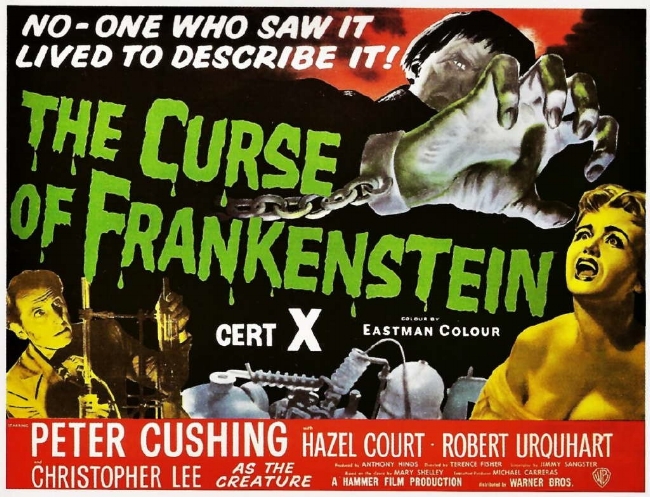
The Revenge of Frankenstein (1958) is a direct sequel to Hammer Films highly successful The Curse of Frankenstein, made the previous year. While it was well received both critically and at the box office at the time of its release, The Revenge of Frankenstein has tended to be overlooked in subsequent retrospectives of studios work. There are more lurid and more sensational films to consider, such as Frankenstein Must be Destroyed (1969) and Frankenstein and the Monster from Hell (1974). However, this oversight has been corrected in more recent years, with many contemporary reviews praising this production for its unique subversion of the traditional Frankenstein narrative. The focus of the story in The Revenge of Frankenstein is not the Baron’s creation of yet another creature but the Baron’s obsession and desire to continue his work. Yes there are moments of horror and tragedy but the film is driven by Peter Cushing’s presence.
Critics universally lauded Peter Cushing’s performance as Baron Victor Frankenstein in The Curse of Frankenstein in which the character was aloof, purely self-absorbed and utterly amoral. In the sequel, The Revenge of Frankenstein Jimmy Sangster’s script brilliantly shifts the character of Baron Frankenstein into a charming, deeply misguided and fiercely intelligent visionary. Cushing performance balances the characters inherent sociopathic tendencies with plenty of dry wit and a degree of charm. In many ways the focus of the audiences sympathy is the Baron and not his medical subjects. The Revenge of Frankenstein is a showcase for some of Peter Cushing’s finest acting work. Not only is his performance spot on but the film also illustrates the actors willingness and great ability with working with props, such as the complex electrical generator and chemical batteries that power his laboratory.
The Revenge of Frankenstein deliberately embraces its moral ambiguity with its “heroic villain” and general lack of a traditional hero to oppose the Baron and his experiments. The Baron helps the local poor while the medical council does nothing to help them. However, his virtue comes at a cost as he harvest organs and limbs. The absence of Christopher Lee is compensated by a sensitive performance by Michael Gwynn takes who plays Karl, post operation. He keeps the new creature deeply sympathetic, even as the plot devolves into cannibalism. Rather than non-stop action and cheap jump scares The Revenge of Frankenstein prefers to explore an increasingly dark series of plot element. Directed by Hammer’s legendary Terence Fisher, the film is well paced and suitably atmospheric. His creative decision to focus more upon the mad scientist rather than the monster makes this entry in the franchise both interesting and superior to some of its successors.


In the year 1860, Baron Victor Frankenstein (Peter Cushing) faces execution by guillotine for the murders perpetrated by the creature he created. With the assistance of a hunchback named Karl (Oscar Quitak) he avoids death by beheading the priest who came to give him the last rites. The priest’s body is then mistakenly buried by the authorities. Three years later, Victor, now using the name Doctor Stein, has established himself as a prosperous physician in Karlsbrück, serving both affluent patients and the poor at a paupers’ hospital. Hans Kleve (Francis Matthews), a junior member of the medical council, recognises Victor and being an admirer, seeks to become his apprentice. Victor and Hans then undertake an experiment to transplant Karl’s living brain into a new, more refined body, rather than a grotesque monstrosity the Baron has previously made. Karl is eager to have a new healthy body, especially after encountering Margaret Conrad (Eunice Gayson), the charming new assistant at the hospital.