
Host (2020)
In his review in the New York Times Kyle Turner states that the new horror movie Host “seems to speak to a collective id” and serves as “an analogy for mourning the recent past”. I’ve read several other critiques of this nature that both praise the film and make similar philosophical musings upon its nature. As a long standing horror aficionado I am always a little sceptical when a new movie quickly gains a lot of traction and a critical consensus swiftly forms. Especially when a genre product suddenly gains the attention of the mainstream media who subsequently stray into hyperbole and hype. This happened last year with Midsommar which was hailed as a groundbreaking horror movie and indicative of a renaissance in the genre. Although an intelligent and disturbing film, Midsommar is not without flaws and is far from universally accessible. It is also frustrating the way the mainstream media is oblivious to the ongoing financial and critical success of the horror genre that has existed since the inception of cinema.
In his review in the New York Times Kyle Turner states that the new horror movie Host “seems to speak to a collective id” and serves as “an analogy for mourning the recent past”. I’ve read several other critiques of this nature that both praise the film and make similar philosophical musings upon its nature. As a long standing horror aficionado I am always a little sceptical when a new movie quickly gains a lot of traction and a critical consensus swiftly forms. Especially when a genre product suddenly gains the attention of the mainstream media who subsequently stray into hyperbole and hype. This happened last year with Midsommar which was hailed as a groundbreaking horror movie and indicative of a renaissance in the genre. Although an intelligent and disturbing film, Midsommar is not without flaws and is far from universally accessible. It is also frustrating the way the mainstream media is oblivious to the ongoing financial and critical success of the horror genre that has existed since the inception of cinema.
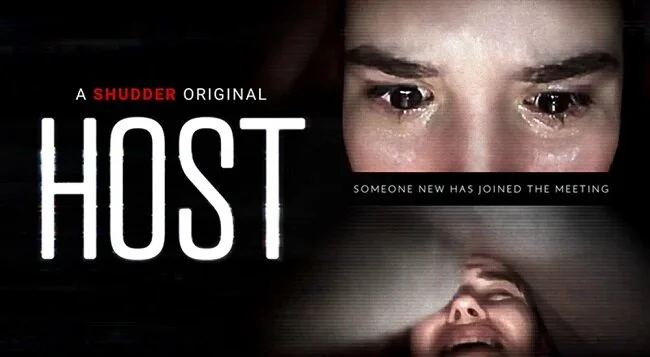
However, my ambivalence notwithstanding, in the past few days positive comments about Host have constantly appeared in my social media timelines, many of which come from grass roots sources that I trust (such as the Evolution of Horror podcast). Hence I signed up to a seven day free trial of the streaming service Shudder and watched Host under optimal conditions. IE knowing as little about the plot as possible and in a darkened room, late at night. Having had time to reflect upon my viewing and go through my notes, I believe that the popular consensus surrounding Host is certainly justified. The film is a finely honed 59 minutes, that is an intelligent reinvention of many classic horror tropes. Cleverly crafted, dovetailing modern fears and social angst with the traditional, it provides an array of scares while maintaining a tense atmosphere in that allegedly benign environment; the modern home. Is it a genre defining milestone? Not necessarily so but what it does do is tap into a lot of the psychological concerns prevalent in the current climate and integrate those into the established fear of the supernatural. Host is certainly very pertinent and “of the moment”.
Six friends, Haley, Jemma, Emma, Radina, Caroline and Teddy meet online via a Zoom video conference call. All are at home or living with partners during the ongoing lockdown. Rather than playing games or having a quiz Haley has hired a spiritual medium to hold a seance. Emma, Radina and Caroline are a little scared by the prospect of such a thing but Eddy and Jemma are both sceptical and prone to mocking it. Medium Seylan reminds the group to be respectful of the spirits and briefs them on managing their thoughts and most importantly how to correctly leave the “circle” if they become uncomfortable with the situation. As the seance progresses, Jemma screams when something touches her neck and she finds herself thinking of a friend from school called Jack who hung himself. Seylan is then disconnected from the call and one by one, each of the friends experience supernatural occurrences in their homes. Rather than contacting a benevolent spirit it becomes clear that they’ve enabled a far more malign force. Can they close the seance circle and dismiss the spectral guest?
One of the film’s greatest assets is the medium in which it is filmed. Buy using Zoom and phones on selfie sticks, there is a great sense of immediacy and the common place tech makes events more accessible. The narrative touches upon the frustrations and alien nature of the current lock down, something that is perhaps more keenly felt among the young. The characters are broadly likeable as well as plausible and the cast perform well. They’re behaviour is also in line with how people react in unknown situations. Some cope well, others go to pieces. As this is a UK production and there is a healthy dose of British colloquialisms and profanities. Where Host excels is in the effective use of its running time. The plot set up, introduction of the characters and dissent from normality into panic is perfectly paced. The idea of having the film last the length of a free Zoom call is sublime.
When supernatural events start to occur, they are initially small in scale and well implemented. Chairs move, a glass shatters and noises are heard off camera. There’s also an innovative use of the filters that come with contemporary phones and video conferencing software. In one scene the filter is triggered by the presence of the spirit and it is a genuinely scary and original sequence. Host handles the building tension well and has plenty of robust and jolting scares. If you are a long standing horror fan who has watched a prodigious amount of genre material, then you well may be able to predict some but not all. The creepy music box is an obviously telegraphed example but others will wrong foot you. The denouement is in some respects inevitable but that does not diminish its power. By the time it comes round you are so invested and engrossed in the proceedings that you still hope that things may work out.
Host is well made, inventive and exceedingly timely. It meets viewers expectations and delivers a white knuckle experience in spades. It’s also a textbook example of how the genre re-invents itself by taking its essential tropes and themes and interpreting in a way that is relevant for a modern audience. Host will especially resonate with the youth market but is still totally accessible to older horror fans who will recognise much that is traditional and de rigueur. I’m not sure if there is a universally accepted term for such movies as Host yet. Wikipedia classifies such productions as “computer screen films” and a subset of the “found footage” genre. However, I’m sure those associated with the production of Host such as director Rob Savage and writers Gemma Hurley and Jed Shepherd will find themselves much sought after. They’ll no doubt be a flood of inferior films in the months to come. But they won’t stand out like Host which has found an audience through talent, enterprise and a genuine appreciation of the genre.














Dawn of the Dead: Complete Cut (1978)
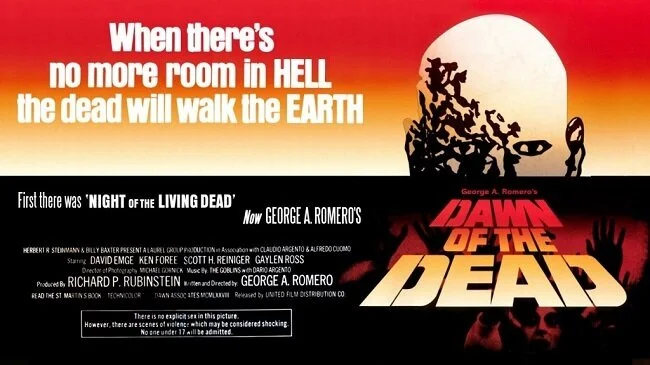
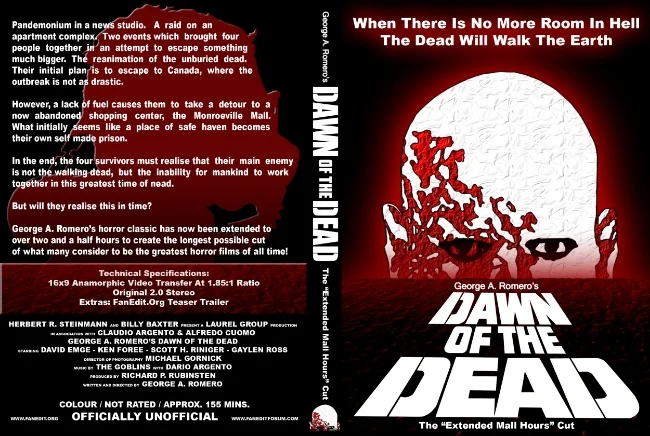
Five years ago, I wrote about a fan edit of George Romero’s horror classic Dawn of the Dead that attempted to recreate the original rough cut of the movie. The so-called “Extended Mall Hours” cut was composed of the 139 minute Cannes edit of the film and the 117 minute Dario Argento version. It was a very interesting project but as it consisted of DVD quality material (including deleted scenes) it was not an optimal presentation. Being a fan edit, there were obvious issues regarding legality, so I never really expected to see anything comparable to this version being officially sanctioned or released. So I was therefore most surprised to learn that a recent Blu-ray boxset release by Austrian distributors XT Video included a “Complete Cut” which similarly combines all available material. This is presented in 1080p, at a ratio of 1:85:1 and runs 155 minutes. It is superior in quality to the “Extended Mall Hours” cut and is most likely the nearest any fan is ever going to get to seeing Romero’s initial edit of the film.
Five years ago, I wrote about a fan edit of George Romero’s horror classic Dawn of the Dead that attempted to recreate the original rough cut of the movie. The so-called “Extended Mall Hours” cut was composed of the 139 minute Cannes edit of the film and the 117 minute Dario Argento version. It was a very interesting project but as it consisted of DVD quality material (including deleted scenes) it was not an optimal presentation. Being a fan edit, there were obvious issues regarding legality, so I never really expected to see anything comparable to this version being officially sanctioned or released. So I was therefore most surprised to learn that a recent Blu-ray boxset release by Austrian distributors XT Video included a “Complete Cut” which similarly combines all available material. This is presented in 1080p, at a ratio of 1:85:1 and runs 155 minutes. It is superior in quality to the “Extended Mall Hours” cut and is most likely the nearest any fan is ever going to get to seeing Romero’s initial edit of the film.
Having recently watched the “Complete Cut”, I again reiterate the same comments I made when watching the “Extended Mall Hours” fan edit. The film takes on a somewhat bleaker tone with some additional dialogue scenes between Peter and Stephen. The expanded “Biker Raid” adds to the action and certainly increases the threat that they pose to our protagonists. And there is a lot more additional zombie related violence. However, this version does a far better job of adjusting the soundtrack to accommodate the additional material. Some tracks by Goblin that were not used in previous edits of the film have been integrated back into the movie. Hence we do not get too much repetition of cues. The visual elements are of a superior quality this time round so there is no significant disparity between old and new material. The editing is also seamless and the addition of new content does not disrupt the narrative flow or the overall pacing of the film.
The addition of this version of Dawn of the Dead to the existing three cuts of the film raises the inevitable question of which is best? Although I often prefer the most comprehensive version of movies, I’d advise those who have not seen the film before to start with the standard theatrical version first. It has a sense of immediacy that makes it possibly the most accessible edit. Other versions are best watched once an opinion of the base movie has been established. Some of the material in the “Complete Cut” may mainly be of interest to completists who want to see additional zombie footage. However, some of the extra make up effects and action scenes are not quite as polished as those that have always been present, which may well be the reason that director George Romero removed them. However, if you are an aficionado then this version of the film is worth seeing for scholarly reasons. However, please note that the boxset that contains this cut was a limited edition and is now very expensive to obtain.



The Last Broadcast (1998)
The Last Broadcast is a curious beast that straddles both the “mockumentary” and “found footage” genres. Shot entirely on consumer level video equipment, it effectively captures the look and feel of public access cable TV from the times. Released before the massive commercial success of The Blair Witch Project, The Last Broadcast did not find a comparable mainstream audience at the time, although it remains a favourite with genre fans. However, the movie has been recently re-released on Amazon Prime and subsequently become a talking point once again. Elements of the plot have proven very prophetic, such as the popularity of “ghost hunting” reality shows and the integration of online interactivity into live television. But the one standout aspect of The Last Broadcast which polarises viewer opinion is its ending. This is often seen as either a clever “sting in the tail” or an ill considered “jumping the shark” cop out.
The Last Broadcast is a curious beast that straddles both the “mockumentary” and “found footage” genres. Shot entirely on consumer level video equipment, it effectively captures the look and feel of public access cable TV from the times. Released before the massive commercial success of The Blair Witch Project, The Last Broadcast did not find a comparable mainstream audience at the time, although it remains a favourite with genre fans. However, the movie has been recently re-released on Amazon Prime and subsequently become a talking point once again. Elements of the plot have proven very prophetic, such as the popularity of “ghost hunting” reality shows and the integration of online interactivity into live television. But the one standout aspect of The Last Broadcast which polarises viewer opinion is its ending. This is often seen as either a clever “sting in the tail” or an ill considered “jumping the shark” cop out.
Filmmaker David Leigh (David Beard) is making a documentary about the murders of the hosts and crew of a cable TV show called Fact or Fiction. Presenters Steven "Johnny" Avkast (Stefan Avalos) and Locus Wheeler (Lance Weiler), along with sound recordist Rein Clackin (Rein Clabbers) and psychic Jim Suerd (James Seward) travel to the Pine Barrens in search of the Jersey Devil. Only Jim Suerd returns in a state of disorientation. The police mount a search and subsequently find the mutilated bodies of Wheeler and Clackins. Avakast remains missing although his hat is found by a pool of blood. Subsequent viewing of the video footage shows tensions between Suerd and the others and physical evidence soon leads to a quick conviction. However, Suerd dies in custody under mysterious circumstances while his appeal is pending. David Leigh subsequently obtains tape footage that was missing from the police investigation. Although damaged he hires data retrieval expert Michelle Monarch (Michelle Pulaski) to search for any viable material. Will this content reveal the truth?
The Last Broadcast does a good job of establishing its central characters and building up a credible biography on each through faux interviews with friends and officials. It also accurately reflects the “home brew” nature of cable TV and public access TV from the era. The use of IRC as a means for viewers to interact with the show’s hosts is an interesting snapshot of the times. Another clever aspect of the plot is the way in which the supernatural is teased and then sidelined. The Fact or Fiction hosts go in search of the Jersey Devil but viewers are not given a summary of the associated legend nor does the story go out of its way to imply that the murders are of a supernatural nature. Far more time is spent exploring whether Jum Suerd is a gifted psychic or a deluded, dangerous loner. Documentary filmmaker David Leigh also remains an enigma, although on face value he is simply investigating a story and hence shouldn’t be the focus of his own film.
The Last Broadcast proceeds at a measured pace and is a slow burn. There are some minor jump scares when interviews with people suddenly cut to pictures of the crime scene but overall the focus is on maintaining a mysterious atmosphere. The elephant in the room is the film’s climax, in which a computer enhanced image reveals the solution to the mystery. There is then a major shift in the technical style of the remainder of the movie which will either delight viewers or prove to be a deal breaking WTF moment. To say any more would be an overt spoiler. It is also worth noting that it is this aspect of the film that has kept the movie on fans radar and often becomes the focal point of discussion. Irrespective of this, there are many other aspects of The Last Broadcast that were ahead of its time. If you are a fan of this genre or a movie aficionado, then I’d recommend a viewing so you can decide upon the merits of the controversial ending.

The Devil Inside (2012)
Following in the wake of The Last Exorcism (2010) which enjoyed box office success, The Devil Inside also includes two staples of horror cinema: supernatural possession and the found footage/faux documentary genre. On paper these themes have the potential to yield an interesting drama. Sadly that is not the case with The Devil Inside which excels at neither and is distinctly average at best. It lacks the gravitas and visceral power of The Exorcist and even the sensational shock value of Paranormal Activity. The plot focuses upon Isabella (Fernanda Andrade), an American woman who sets out to make a documentary about her mother who murdered three members of the clergy. She was judged insane and subsequently sent to a mental hospital in Italy. Isabella meets two priests, Father Ben Rawlings (Simon Quarterman) and Father David Keane (Evan Helmuth) who explain that her mother's condition may be due to demonic possession.
Following in the wake of The Last Exorcism (2010) which enjoyed box office success, The Devil Inside also includes two staples of horror cinema: supernatural possession and the found footage/faux documentary genre. On paper these themes have the potential to yield an interesting drama. Sadly that is not the case with The Devil Inside which excels at neither and is distinctly average at best. It lacks the gravitas and visceral power of The Exorcist and even the sensational shock value of Paranormal Activity. The plot focuses upon Isabella (Fernanda Andrade), an American woman who sets out to make a documentary about her mother who murdered three members of the clergy. She was judged insane and subsequently sent to a mental hospital in Italy. Isabella meets two priests, Father Ben Rawlings (Simon Quarterman) and Father David Keane (Evan Helmuth) who explain that her mother's condition may be due to demonic possession.
The Devil Inside explores an alleged Catholic conspiracy as well as the perceived conflicts between science and religion, through a very familiar classic plot device. The film subsequently proceeds to tick off many standard genre conventions such as physical contortions, torrents of verbal abuse, knowledge of secrets and of course sporadic bouts of violence. The story unfolds from the perspective of two priests who are the subject of a documentary film. The performances are adequate from a relatively unknown cast, although British actor Simon Quaerterman has subsequently gained wider exposure through his recurring role in HBO’s Westworld. The narrative has occasional elements of interest in-between the standard genre tropes. For example, it is nice to see a depiction of a priest who is not questioning his vocation for a change.
The Devil Inside is simply too insubstantial to carry any cinematic weight. There are a few jolts and jumps along the way, but they are often contrived and telegraphed. Plus most people will not accept the basic conceit of this film that the Catholic Church conducts exorcisms willy-nilly. However, I did find the denouement of this movie to be interesting. It is incredibly abrupt and for many viewers potentially unsatisfactory, leaving a multitude of unanswered questions. This sort of nihilistic ending is very reminiscent of seventies cinema. It is obvious that the contrived ending is driven more by marketing, as the movie closes with a statement that the case is still under investigation and provides a URL for further details. The website is now defunct but you can view an archived copy via the Wayback Machine.
The Devil Inside provides at most a minor diversion for casual viewers. It certainly is not going to win any fans among longterm horror fans. Yet the depressing fact remains that this sort of low budget, derivative exploitation fodder fares well at the box office. The viral marketing appeals to the youth market, who like these films due to their similarity to the “creepypasta” you find on YouTube. Hence The Devil Inside made $101,758,490 worldwide. Not bad for a movie that cost $1,000,000 to make. Therefore, if you are new to the horror genre, do yourself a favour and watch The Exorcist or even The Blair Witch Project rather than The Devil Inside. The commercial success of such movies may mislead new horror fans into thinking that this is as good as it gets.
Scary Stories to Tell in the Dark (2019)
I’m not familiar with the original series of children’s books that Scary Stories to Tell in the Dark is based upon. From what I’ve read, it would appear that the film manages to channel the spirit (if you’ll pardon the pun) of the short stories by Alvin Schwartz, via the four supernatural vignettes that feature in the movies plot. Furthermore, the illustrations featured in the original publications, by Stephen Gammell, have obviously influenced the visual effects and production design of the movie. However, despite being marketed as a portmanteau movie, Scary Stories to Tell in the Dark is much more than that. The framing story is more than just an arbitrary pair of cinematic bookends, designed to wrap around the proceedings. It is entwined into the central narrative and the four supernatural meta stories. Rather than being a pure anthology movie, Scary Stories to Tell in the Dark is at its heart, a film about the nature and inherent power of stories themselves.
I’m not familiar with the original series of children’s books that Scary Stories to Tell in the Dark is based upon. From what I’ve read, it would appear that the film manages to channel the spirit (if you’ll pardon the pun) of the short stories by Alvin Schwartz, via the four supernatural vignettes that feature in the movies plot. Furthermore, the illustrations featured in the original publications, by Stephen Gammell, have obviously influenced the visual effects and production design of the movie. However, despite being marketed as a portmanteau movie, Scary Stories to Tell in the Dark is much more than that. The framing story is more than just an arbitrary pair of cinematic bookends, designed to wrap around the proceedings. It is entwined into the central narrative and the four supernatural meta stories. Rather than being a pure anthology movie, Scary Stories to Tell in the Dark is at its heart, a film about the nature and inherent power of stories themselves.
Set in the small town of Mill Valley, Pennsylvania, in 1968, the plot focuses on three high school students. Stella (Zoe Colletti), Chuck (Austin Zajur) and Auggie (Gabriel Rush) go out to celebrate Halloween. When a prank goes wrong, they're chased by the school bully Tommy (Austin Abrams) and forced to hide at the local drive-in. A mysterious drifter Ramón (Michael Garza) let's them hide in his car and in return for his help, they decide to take him to the neighbourhood haunted house; the infamous Bellows Mansion. The town was founded by the Bellows family who grew rich from the paper mill they built. However, local legends state that the Bellows family incarcerated their daughter Sarah and kept her locked in a darkened room. She would whisper ghost stories through the wall to scare the local children. While investigating the derelict mansion, Stalla finds an old book which appears to be Sarah's. She takes it home and while reading it, a new story appears before her very eyes. It appears to be about the local bully Tommy. The following day he is reported as missing. Another story subsequently appears in the book. This time it’s about Auggie. Is the book hunting the three friends?
Scary Stories to Tell in the Dark makes the most of its $28 million budget. It has a stylised late sixties production design, along with vivid and colourful lighting. The visual aesthetic of Roman Osin’s cinematography greatly adds to the atmosphere. The youthful cast are engaging and deliver good performances. The screenplay by Dan and Kevin Hageman focuses upon their perspective of events and confines adults characters such as the local Sheriff (Gill Bellows) and Stella’s Father (Dean Norris) to the sidelines. The spectre of the Vietnam War, the national draft and the oppressive nature of small town life also hangs over the proceedings. Our protagonists are on the periphery of the adult world and their respective futures do not look especially good. Posters for Richard Nixon seeking election encapsulate this dismal period in US history. It is against this backdrop that the story explores the power of words and narratives. How they can have both a positive and negative effect. And that adult life is filled with ambiguity and this often manifests itself in the use of nuanced language.
The actual “scary stories” that befall the cast are grim and inherently creepy rather than overtly violent. Yet that is not to say that they are not disturbing. And therein lies the rub or at least has been a talking point associated with this movie. Scary Stories to Tell in the Dark despite being drawn from children’s literature, is too ghoulish and frightening for such a young demographic. Despite being rated PG-13 in the US, the BBFC saw fit to award it a 15 rating in the UK and a lot of that simply comes down to tone. Something that you cannot address by re-editing. Hence we have a story about teenagers having to deal with the supernatural, which is potentially of more interest to adult viewers, rather than its target audience. Gore hounds of all ages will be disappointed. However, despite this possible contradiction, the film still performed acceptably at the box office and may well garner a sequel. The story certainly has scope for one.
Because of the pedigree of all associated with this production, Scary Stories to Tell in the Dark makes for absorbing viewing and superior genre entertainment. The assured direction by André Øvredal (Trollhunter, The Autopsy of Jane Doe) offers not only a series of grim supernatural tales but also a degree of emotional intelligence and metaphorical depth. The adult world is not as black and white as our heroes think and coming of age is often bittersweet. Where The Monster Squad explored such themes through horror and humour, this movie achieves it with ghosts and melancholy. The ending resolves the immediate plot but does not deliver a textbook happy ending. The surviving characters are changed and realise that their future lies outside of Mill Valley. I would definitely like to know what happens next and see the central characters progress on their emotional journey. The answers to which lies in Sarah Bellow’s book of stories. I hope it is opened again.
Countdown (2019)
I believe that Countdown received an unnecessarily hard time from the US critics. Don’t get me wrong, I’m not saying that Countdown is a masterpiece. It is not. But it is adequate. A phrase that a lot of people could do with reacquainting themselves with. I won’t retread old ground, as I’ve written about this subject before. I simply think that many people (and critics are people) just have unrealistic expectations when it comes to movies. Not every film created should be, or can be a boundary pushing, cinematic masterpiece. Once again I will invoke my cuisine analogy. There are Michelin five star rated restaurants and then there are fast food franchises. Both serve a purpose, cater for a specific market and can provide relative pleasure. Therefore comparing “like for like” is a critical mistake and based upon a misplaced assumption of false equivalence. Which brings me onto Countdown. It is not The Shining. Nor is it Plan 9 from Outer Space. But it is as I said, “adequate”.
I believe that Countdown received an unnecessarily hard time from the US critics. Don’t get me wrong, I’m not saying that Countdown is a masterpiece. It is not. But it is adequate. A phrase that a lot of people could do with reacquainting themselves with. I won’t retread old ground, as I’ve written about this subject before. I simply think that many people (and critics are people) just have unrealistic expectations when it comes to movies. Not every film created should be, or can be a boundary pushing, cinematic masterpiece. Once again I will invoke my cuisine analogy. There are Michelin five star rated restaurants and then there are fast food franchises. Both serve a purpose, cater for a specific market and can provide relative pleasure. Therefore comparing “like for like” is a critical mistake and based upon a misplaced assumption of false equivalence. Which brings me onto Countdown. It is not The Shining. Nor is it Plan 9 from Outer Space. But it is as I said, “adequate”.
A group of friends download an app called "Countdown" that predicts when the user will die. When Courtney sees that she has just a couple of hours to live, she refuses a ride home from her drunken boyfriend Evan. She is later killed by a supernatural creature when the “countdown” app on her phone reaches zero. Evan crashes his car at the same time of her death. A branch pierces the passenger seat, where she would have sat. At the hospital, Evan tells nurse Quinn Harris (Elizabeth Lail) that he is afraid to have surgery as the app predicts that he will die at the same time. Sceptical of the teenagers concerns, the hospital staff decide to download the app and Quinn learns that she has only three days of life. When Evan mysteriously dies in an accident, Quinn buys a new phone only to find that the app is already installed. She subsequently meets Matt Monroe (Jordon Calloway) when leaving the phone store and learns that his imminent death has also been predicted by the app. So the pair team up and their subsequent investigations uncover a spate of deaths associated with it.
Countdown is a low budget, modern take on the classic ghost story Casting the Runes by M. R. James, with more than a nod towards the Final Destination franchise. Gone are scraps of parchment with runic symbols which are neatly replaced by phone app. This in a nutshell, is what Countdown has to offer; a modern spin on a classic and established plot concept. The film makes a decent attempt at creating a sense of atmosphere and the jump scares are efficiently delivered. There is a recurring visual device in which victims keep seeing an indistinct figure in reflections, which is never there when they turn and look directly. It is a simple device but effective. The mixing of modern technology and biblical demonology also works quite well as the screenplay by Justin Dec doesn’t overthink it, or try to explain every aspect of it. The lead protagonists are not obnoxious, as they so often are in this genre and some of the supporting characters are quite quirky and droll. Derek the cell phone store manager and Father John, the expert on the occult, being clear examples of this.
Countdown also widens its narrative scope by including a subplot about a senior doctor who’s a sexual predator. This brings some interesting and very contemporary moral and ethical questions into the story. Something that gets amplified in the final act, when it is mooted that maybe this abusive man could be used as a surrogate sacrifice, to save another “more deserving” persons life. Another bold piece of moral manoeuvring comes when the lead characters need to examine the terms and conditions of the “killer app”; something they naturally neglected to do themselves initially. So they persuade a drunken conspiracy theorist (who is also a Holocaust denier) to install the app, thus potentially putting him in harms way. I didn’t expect such a plot device and I quite enjoyed it. It’s an indication that Countdown is at least trying to do more than just retread familiar territory. The film’s resolution does “takes liberties” with its own rules and there is a set up for a possible sequel. However, if viewed as convenient and undemanding entertainment, then Countdown serves its purpose. You’ll find far worse horror movies available.
Doctor Sleep Director’s Cut (2019)
Bringing Doctor Sleep to the big screen is a tall order for any filmmaker. Yet director Mike Flanagan (who also wrote the screenplay) manages to tread boldly along this difficult cinematic path. He delivers not only a credible sequel to Kubrick’s unique movie but also manages to adapt Stephen King’s follow up book fairly coherently. Yes, compromises have been made as Kubrick’s version of The Shining strayed far from the source text and therefore trying to dovetail legacy lore into King’s multi-layered follow up novel is a difficult task. However, Flanagan manages to craft a thoughtful and character driven tale which advances the themes present in both the previous film and the source text of the original book and its follow up. Doctor Sleep is not a rollercoaster ride filled with jump scares and convenient gore. It is a slow burn that builds atmosphere and tension. It also offers a strong sense of continuity and fans of the previous instalment will enjoy the sense of nostalgia this new film provides with it’s litany of subtle homages and asides. It is not without flaws but it is an interesting example of a more cerebral horror movie.
Bringing Doctor Sleep to the big screen is a tall order for any filmmaker. Yet director Mike Flanagan (who also wrote the screenplay) manages to tread boldly along this difficult cinematic path. He delivers not only a credible sequel to Kubrick’s unique movie but also manages to adapt Stephen King’s follow up book fairly coherently. Yes, compromises have been made as Kubrick’s version of The Shining strayed far from the source text and therefore trying to dovetail legacy lore into King’s multi-layered follow up novel is a difficult task. However, Flanagan manages to craft a thoughtful and character driven tale which advances the themes present in both the previous film and the source text of the original book and its follow up. Doctor Sleep is not a rollercoaster ride filled with jump scares and convenient gore. It is a slow burn that builds atmosphere and tension. It also offers a strong sense of continuity and fans of the previous instalment will enjoy the sense of nostalgia this new film provides with it’s litany of subtle homages and asides. It is not without flaws but it is an interesting example of a more cerebral horror movie.
It becomes apparent quite quickly while watching Doctor Sleep, that this isn't your run of the mill horror film. The standard of writing, performances and general tone of the film is far more nuanced than most genre outings. The screenplay doesn’t shy away from showing Dan Torrence (Ewan McGregor) hitting rock bottom, as he becomes an alcoholic to drown out the “shining”. A one night stand, in which he robs the woman he’s slept with, has far reaching consequences. Yet far from alienating audiences, the clever writing fosters a sense of sympathy as Dan subsequently moves to a new town and meets Billy Freeman (Cliff Curtis), an ex-alcoholic who helps him turn his life around. As he embarks on a new voyage of self-discovery, Dan finds a positive use for his “gift” when he starts work in a Hospice. He comforts patients as they approach death, calming them with personal visions from their past.
Running in parallel with Dan Torrence’s story, is that of Abra Stone (Kyliegh Curran). Abra has a similar “shining” ability to Dan but of a far greater magnitude. It frightens her parents and alienates her from her school friends. As she reaches out with her psychic abilities, she attracts the attention of Rose the Hat, who is the leader of the cult the True Knot. Rose (Rebecca Furguson) and her group are psychic vampires that feed upon “steam” or psychic essence. The group kidnap, torture and kill children to feast upon their steam, as it keeps them young and fuels their supernatural powers. Once aware of Abra’s presence, Rose sets her sights on her as a potential limitless food supply. Inevitably, Dan crosses path with both Rose the Hat and Abra, leading to a confrontation that can only be resolved by revisiting the now deserted Overlook Hotel. Perhaps the demons that await Dan there, can serve another purpose.
Doctor Sleep has certainly more highs than lows and focuses on being a disturbing character study with a building atmosphere, rather than a gorefest. Apart from one murder which is very disturbing by its very nature, rather than what is actually shown, the film is not overly reliant on violence. Performances are good and there is some very clever casting of actors who have a comparable style and appearance to Shelley Duvall, Jack Nicholson and Scatman Crothers. Some plot elements such as Dan’s struggle to not become his Father are explored well. Abra brings something more to the proceedings, rather than just the standard trope of a teenager with a supernatural power. Sadly, Rose the Hat is somewhat lacking as a villain. This has nothing to do with Rebecca Furguson per se but mainly the way the character is realised. Simply put Rose is not threatening enough and doesn’t exude sufficient malevolence, despite her penchance for child murder. Yet despite these minor shortcomings, there is sufficient depth to Doctor Sleep to keep discerning horror fans engaged.
I did not see the theatrical cut of Doctor Sleep upon its release in UK cinemas. I watched the Director’s Cut which adds an additional 30 minutes of character development to the film. This version is well paced, brooding and encompasses a broad spectrum of plot elements. However, even this extended version still leaves some themes and characters underdeveloped. Dan’s recovery from alcoholism is somewhat swift and his job as an orderly is shown but not fully explored. Bruce Greenwood has an interesting cameo as Dr. John Dalton and it would be nice to find out more about the man. But Stephen King is notorious for multiple characters in his books and that cannot always be easily accommodated in the confines of a mainstream film. All things considered, Mike Flanagan could have ended up falling between two stools while trying to to justice to King’s intricate work and riffing off Kubrick’s seminal movie. The results are not 100% perfect but Doctor Sleep strives to do justice to both groups of fans. The film offers a reassuring sense of familiarity to those wedded to Kubrick’s vision and manages to take the characters forward and allow them to grow and tell a new story, rather than just retread old ground. Popular consensus is that the extended version is the more successful of the two edits.
The Stepfather (1987)
The evil stepparent is a common trope in cinema. One can argue that is does perpetuate a negative stereotype but then Hollywood has never been quick to reflect social change or been overly concerned about its depiction of certain aspects of society. However, as a plot device this is money for old rope. So dovetailing a murderous stepfather into a slasher movie was a logical step in 1987 when the genre was booming. In many respects The Stepfather is an arbitrary, low budget movie, with all the associated hallmarks. Its cinematography is functional but no more so and it is shot on low grade film stock. Hence the colour palette is somewhat lurid. It is mainly a housebound production with standard suburban exterior shots. The score is a typical eighties synthesiser offering, that both under performs and dates the proceedings. Yet one thing stands out and makes The Stepfather better than what it deserves. The central performance by Terry O'Quinn is compelling and drives the movie forward.
The evil stepparent is a common trope in cinema. One can argue that is does perpetuate a negative stereotype but then Hollywood has never been quick to reflect social change or been overly concerned about its depiction of certain aspects of society. However, as a plot device this is money for old rope. So dovetailing a murderous stepfather into a slasher movie was a logical step in 1987 when the genre was booming. In many respects The Stepfather is an arbitrary, low budget movie, with all the associated hallmarks. Its cinematography is functional but no more so and it is shot on low grade film stock. Hence the colour palette is somewhat lurid. It is mainly a housebound production with standard suburban exterior shots. The score is a typical eighties synthesiser offering, that both under performs and dates the proceedings. Yet one thing stands out and makes The Stepfather better than what it deserves. The central performance by Terry O'Quinn is compelling and drives the movie forward.
Jerry Blake (Terry O'Quinn) has recently married widow Susan Maine (Shelly Hack) after moving to a small town. He sells real estate and extols the virtues of the American Dream; of family, home and hard work. Yet his stepdaughter Stephanie (Jill Schoelen) is suspicious of him and still grieves for her natural father. She shares her fears with her therapist Dr. Bondurant (Charles Lanyer). Meanwhile, in the next town Jim Ogilvie (Stephen Shellen) searches for evidence regarding the murder of his sister and her family by the mysterious man she married. The police have no clues and the local press are disinclined to pursue the story any further. Jim suspects that there may be a serial killer travelling the state preying on widows and searching for the perfect family. Is Jerry Blake that man? Are Stephanie’s fears about him founded or is she just struggling to come to terms with the changes in her family.
The Stepfather has a good cold opening which clearly establishes where the plot is going. Although the rather formulaic screenplay by Donald E. Westlake unfolds in a somewhat expected fashion, it does have a few points of interest along the way. This is the era prior to DNA evidence and the proliferation of CCTV. Local police departments simply don’t have the manpower to undertake extensive door to door searches. If clues are not immediately forthcoming then a murder investigation quickly goes cold. Such a time obviously made moving around the country and changing one’s identity a lot easier. The film also touches upon the American love affair with small towns and how they represent all that is considered good and wholesome and about the American way of life. There are hints that the story by Brian Garfield (of Death Wish fame) is a metaphor for how this was considered under attack at the time, from social change.
The cast do the best they can and the screenplay endeavours to give some depth to the Mother and Daughter relationship and how it is unbalanced by the arrival of Jerry in their lives. But overall the proceeding are dominated by Terry O’Quinn. The way he veers from the quietly spoken Father figure to an angry sociopath is quite startling. There is not an excess of violence in The Stepfather but when it comes, it is powerfully handled. When Jerry finally snaps and has his iconic “who am I here” moment, where he momentarily forgets what identity he has currently assumed it remains a standout scene. Director Joseph Rueben gets as much mileage from his cast and the film’s 90-minute running time as possible. He refined this process even further to better result in 1991, when he made the similarly themed movie Sleeping with the Enemy with Julia Roberts.
The Banana Splits Movie (2019)
I was very surprised when I first saw a trailer for The Banana Splits Movie. It is unusual for a big studio such as Warner Bros. to allow one of its intellectual properties to be “repurposed” in this way. However, a little research online has yielded a few interviews in trade magazines where the inference is that this movie is a test. Naturally the studio wouldn’t take such a risk with a more popular franchise like The Flintstones or Scooby Doo, so The Banana Splits were chosen instead to see if they could successfully crossover into another genre. And the horror genre lends itself to low budget productions that can quickly be made, marketed and yield a satisfactory return on investment. It will be interesting to see if this gamble pays off and whether we’ll see a sequel or another beloved children’s show turned into a blood-soaked comedy horror.
I was very surprised when I first saw a trailer for The Banana Splits Movie. It is unusual for a big studio such as Warner Bros. to allow one of its intellectual properties to be “repurposed” in this way. However, a little research online has yielded a few interviews in trade magazines where the inference is that this movie is a test. Naturally the studio wouldn’t take such a risk with a more popular franchise like The Flintstones or Scooby Doo, so The Banana Splits were chosen instead to see if they could successfully crossover into another genre. And the horror genre lends itself to low budget productions that can quickly be made, marketed and yield a satisfactory return on investment. It will be interesting to see if this gamble pays off and whether we’ll see a sequel or another beloved children’s show turned into a blood-soaked comedy horror.
The Banana Splits Movie starts in a fairly innocuous fashion with an episode of The Banana Splits Show (which has been running in this movie universe since 1968) being recorded at the Taft Studios. But due to a change in programming policy the production is to be closed. Furthermore, the Banana Splits (who are robots for “some particular reason”) seem to be having problems with their latest software upgrade. Meanwhile young Harley Williams (Finlay Wojtak-Hissong) is visiting the studio with his Mother Beth (Dani Kind), older Brother Austin (Romeo Carare) and Stepfather Mitch (Steve Lund) to watch a live recording. It’s Harley’s birthday and he is a big fan of the show, although his parents worry that he’s a little old for such things. Since Harley’s Father died, he’s become very insular and Beth struggles to find one of his school friends to join his birthday celebrations. Zoe (Maria Nash) reluctantly comes along, although she finds the show somewhat “lame”. However, the Banana Splits have no intention of being cancelled and start reaping bloody revenge against both studio staff and the audience. After all, the show must go on. Will the Williams family survive?
The horror genre often lends itself to high-concept film making and The Banana Splits Movie falls clearly into this category. It has all the key ingredients required for such a movie, with its low budget, tongue in cheek approach and liberal quantities of gore. But this film has some of the flaws that are also inherent with these sorts of productions. The initial thirty minutes leading up to the first murder drag a little. The cast try hard and there is a little more backstory to the characters than you expect with such films, but performances are variable. Plus the screenplay by Jed Elinoff and Scott Thomas, dithers a little over what exactly to do with Fleagle, Bingo, Drooper and Snorky. There is no attempt to explain why they’ve gone “bad”, not that it is essential to the narrative. Horror movies have their own fluid, internal logic and audiences tend to indulge such things. There are also some editorial issues which leave some minor gaps in the narrative. A character loses some fingers off camera. During the end credits we see them lying on the floor. Has a greater significance been edited out?
If you adjust your expectations accordingly and keep in mind the realities of low budget horror movies, The Banana Splits Movie can be an amusing 90 minutes. The cast are sincere and there is an inherently creepy quality to the idea of something as benign as The Banana Splits behaving psychotically. Gore fans will not be disappointed as there are several quite detailed and grisly kills. If only the screenplay had focused more upon the interaction between Fleagle, Bingo, Drooper and Snorky. Naturally there are some obvious homages to The Terminator franchise and gamers will see clear parallels with Five Nights at Freddy’s. As for cries of “you’ve ruined my childhood” from the usual suspects, these can be dismissed as hyperbole from people who patently aren’t familiar with the writings of Marcus Aurelius. The Banana Splits Movie ends with plenty of scope for a follow up. It just remains to be seen whether this movie finds an audience who take it in the spirit it is intended.
NB Snorky is my favourite.
Midsommar (2019)
There are numerous visual and narrative clues that telegraph both the plot and themes of Misdommar. A painting seen in the protagonist’s apartment offers a clear indication as to what is to come. Director Ari Aster deliberately and painstakingly creates a cinematic metaphor in which the emotional turmoil and distress of the lead character brought about by her disintegrating personal life, are mirrored in the real-world events that overtake her. However, this is far from a traditional horror movie with jump scares but more of a psychological thriller with a growing sense of disquiet and helplessness. The audience are presented with a fait accompli in so far as its clear that things are going to turn bad for all concerned and there is no deeper explanation for events other than what we are presented with. And therein lies the rub. Midsommar goes all in on “the journey” and it is down to the viewer as to whether that is an enthralling experience or not.
There are numerous visual and narrative clues that telegraph both the plot and themes of Misdommar. A painting seen in the protagonist’s apartment offers a clear indication as to what is to come. Director Ari Aster deliberately and painstakingly creates a cinematic metaphor in which the emotional turmoil and distress of the lead character brought about by her disintegrating personal life, are mirrored in the real-world events that overtake her. However, this is far from a traditional horror movie with jump scares but more of a psychological thriller with a growing sense of disquiet and helplessness. The audience are presented with a fait accompli in so far as its clear that things are going to turn bad for all concerned and there is no deeper explanation for events other than what we are presented with. And therein lies the rub. Midsommar goes all in on “the journey” and it is down to the viewer as to whether that is an enthralling experience or not.
College student Dani Ardor (Florence Pugh) four-year relationship with anthropology student Christian (Jack Reynor) is in serious decline due to the emotional trauma of her parents’ murder at the hands of her bi-polar sister. Dani is grudgingly invited by Christian to attend a nine-day festival celebrating midsummer in rural Sweden. Along with three mutual friends, Josh (William Jackson Harper), Mark (Will Poulter) and Pelle (Vilhelm Blomgren) whose family comes from the region, they travel to Hälsingland. The Hårga community greet them and it initially seems to be a very traditional event, complete with white linen garments, floral motifs and copious amounts of folk music played on woodwind instruments. But the imbibing of hallucinogenic mushroom tea results in a bad trip for Dani and then a ritual takes very dramatic turn for the worse. The group try to rationalise events and Josh advocates staying as the festival is integral to his thesis. Yet matters continue to take a more sinister course and as they do Dani’s mental state becomes increasingly unsettled.
The second act of Midsommar in which the Hårga slowly become exactly what the audience suspected, is a long slow burn. The film is 147 minutes and revels in its languid pace. The clean, crisp beauty of the region is vividly capture by director of photography, Pawel Pogorzelski. The production is filled with geometric patterns, pagan symbolism and sun-drenched scenery. Often murals, artwork and the cultural history of the Hårga clearly indicate that our cast are doomed. Depending how you approach the film and your perception of the characters, dictates how quickly you start questioning the logic of their staying. You will either accept the western cultural propensity for people to eschew the bizarre and cling to the normalities of society. Or you will start yelling at the screen soon after the CGI drug trip. The dread and tension that is usually inherent in the way a genre movie is crafted, is optional here and dependent here on whether you choose to supply it yourself.
Regardless how you feel about some element of Midsommar, Florence Pugh is compelling as a woman trying to master her emotions as her mind and events spiral out of control. But the question remains as to whether this is really a horror movie or drama about mental health. The screenplay, also written by Ari Aster, manages to explore several cultural themes. It considers how commercial tourism commodifies and feeds off other countries culture. The central story of Dani and Christian is ultimately a rather vindictive breakup drama and is honest in showing that most relationships do not end “on good terms”, despite the pop culture narrative to the contrary. Ultimately, the Hårga community and its festival are simply a Hitchcockian "MacGuffin" to hang a series of contemporary social talking points upon. As mentioned, this is not a study of the pagan world versus modern society nor is it a traditional story with all the associated cinematic trappings. Midsommar paints a protracted vignette for your consideration and then ends.
Once again I find myself returning to a subject I have referenced before; my own overfamiliarity with not only the horror genre but cinema per se. For me Midsommar is a modern variation on a classic theme, presented in a semi-arthouse fashion. If you have not experienced anything like it before then it’s style, attitude and candour may well leave a marked impression. It certainly doesn’t pull its punches and it is also happy to provide a suitably bleak conclusion. But if you have a wider familiarity with the folk horror genre then it lacks the impact that some critics and fans are lauding. Naturally, the shadow of Robin Hardy’s The Wicker Man looms large and one cannot watch Midsommar without referencing that movie at some point in the proceedings. For me the film is an interesting curiosity. I was impressed by aspects of the production but also critical of its length and the indulgences of the director. Like his previous movie Hereditary, the enthusiasm and excitement of vocal genre fans has generated an expectation that is not necessarily going to be met among casual viewers. Horror movies have always been successful at the box office but the press is hellbent on claiming that there’s a genre renaissance at present. If you like the meat and two veg approach of the recent Pet Sematary remake, don’t watch Midsommar expecting the same. It is a nuanced and acquired taste that will not be to everyone’s liking. I don’t believe it was to mine.
Hellboy (2019)
Hellboy begins with a pre-credits prologue, set in the Dark Ages and establishing the basic premise of the movie. Milla Jovovich plays the Blood Queen Vivian Nimue who unleashes a plague upon England (for some particular reason). She is defeated by King Arthur, dismembered and her body parts scattered to the four corners of the isle. It’s a graphic opening that clearly states the movies intent to be different to its predecessor. This reboot of the franchise aims to be gritty with liberal helpings of ironic banter and dry humour to offset the grim world the characters traverse. For those familiar with Mike Mignola’s work, this vision of Hellboy tries to embrace many aspects of established canon. The story broadly follows the comic books Darkness Calls, The Wild Hunt, The Storm and the Fury. There’s also an attempt to reflect the aesthetic of Mignola’s style. Yet all of this, along with the patent desire to be a R rated movie and to set itself apart from Guillermo del Toro’s versions, makes for a sprawling film that sadly over reaches itself.
Hellboy begins with a pre-credits prologue, set in the Dark Ages and establishing the basic premise of the movie. Milla Jovovich plays the Blood Queen Vivian Nimue who unleashes a plague upon England (for some particular reason). She is defeated by King Arthur, dismembered and her body parts scattered to the four corners of the isle. It’s a graphic opening that clearly states the movies intent to be different to its predecessor. This reboot of the franchise aims to be gritty with liberal helpings of ironic banter and dry humour to offset the grim world the characters traverse. For those familiar with Mike Mignola’s work, this vision of Hellboy tries to embrace many aspects of established canon. The story broadly follows the comic books Darkness Calls, The Wild Hunt, The Storm and the Fury. There’s also an attempt to reflect the aesthetic of Mignola’s style. Yet all of this, along with the patent desire to be a R rated movie and to set itself apart from Guillermo del Toro’s versions, makes for a sprawling film that sadly over reaches itself.
Although Hellboy has clear faults, the casting of David Harbour is not one of them. Contrary to what a lot of people expected; he does handle the role well. He clearly grasps the stoical, everyman quality of the character and the way these personality foibles contradict the arcane fantasy world in which he exists. But where Harbour excels, the rest of the cast tend to tread water. Ian McShane steps into John Hurt’s shoes as Trevor Bruttenholm, Hellboy’s adopted father, but the role is hardly taxing for him and the screenplay offers his little to do beyond the arbitrary and expositionary. Milla Jovovich similarly is a very generic villain as Blood Queen Nimue. Her character wants revenge for her summary execution and the disruption of her plans but beyond this, there is no depth to her motivations. Ed Skrein was originally cast as Ben Daimio, but then stood down as he was cognisant of the controversy surrounding changing of the character's ethnicity. He was replaced by Daniel Dae Kim but after all the fuss, the role is still somewhat bland and is nothing more than functional.
The screenplay by comic book creator, film producer, and screenwriter Andrew Cosby, encompasses multiple elements from the comic books. This does lend itself to some enjoyable set pieces but it also results in a story that rapidly moves between multiple locations and characters, resulting in many plot strands simply vanishing from the story. The desire to do so much means that the core relationships which are the foundation of this franchise and whichwere so robust in del Toro’s films, are underdeveloped. And then there are the film’s visual effects which favour the digital over the physical. As ever with modern productions, numerous studios have been contracted to provide work, including Mr. X, Rhythm & Hues, Rise FX and Worldwide FX. Luminaries such as Steve Begg feature in the credits. However the results are varied and somewhat impersonal. Violence without context or emotional content, is often just a spectacle devoid of any cinematic impact.
I have enjoyed director Neil Marshall’s previous work. Dog Soldiers and The Descent were above average genre outings that showed a greater intelligence than their rivals. His absence from cinema in recent years has been due to him working in television and such shows as Game of Thrones, Black Sails and Westworld. Hence a lot of genre fans were quite excited when they learned that he’d be helming the Hellboy reboot. Yet, it would appear that Marshall was not given final edit over his movie and the film has the air of a production that has been continuously “tweaked” throughout its development. The involvement of five production companies may well be the reason for this. It’s a real shame because during the course of its 120-minute running time, there are hints that Hellboy could have been much better. Fantasy as a genre and super hero franchises often explore issues of “difference” and use their tropes as metaphors to scrutinise discrimination, or the difficulty of straddling two cultures. Such ideas are referenced in Hellboy but sadly sidelined in favour of action scenes. I have no problem with the idea of making Hellboy darker and more palatable for adult audiences but not at the expense of the characters soul. But that is sadly what has happened.
Overlord (2018)
For the first ten minutes or so, World War II action horror movie Overlord ticks a lot of boxes. The film has a surprisingly high budget ($38,000,000) for a niche genre product and as a result has a handsome production design. The cinematography by Laurie Rose and Fabian Wagner is striking, capturing the beauty of the French countryside as well as framing the various unpleasantness in a suitably Teutonic fashion. The visual effects both digital and practical are also of a high calibre, further adding to the authentic atmosphere. Yet despite all these positive points, Overlord is a somewhat slow and underwhelming affair, running fifteen to twenty minutes too long. Like so many modern movies, the focus of the production is on spectacle, rather than on character and script. Hence Overlords fails to meet its potential and makes for a somewhat frustrating viewing experience due to it squandering such a good opportunity.
For the first ten minutes or so, World War II action horror movie Overlord ticks a lot of boxes. The film has a surprisingly high budget ($38,000,000) for a niche genre product and as a result has a handsome production design. The cinematography by Laurie Rose and Fabian Wagner is striking, capturing the beauty of the French countryside as well as framing the various unpleasantness in a suitably Teutonic fashion. The visual effects both digital and practical are also of a high calibre, further adding to the authentic atmosphere. Yet despite all these positive points, Overlord is a somewhat slow and underwhelming affair, running fifteen to twenty minutes too long. Like so many modern movies, the focus of the production is on spectacle, rather than on character and script. Hence Overlords fails to meet its potential and makes for a somewhat frustrating viewing experience due to it squandering such a good opportunity.
On the eve of D-Day, a squad of crack paratroopers (are there any other type?) are tasked with destroying a German radio tower in an old church in France. Their plane is shot down before they can reach their target, leaving only four survivors; Corporal Ford (Wyatt Russell) and soldiers Boyce (Jovan Adepo), Tibbet (John Migaro), and Chase (Iain De Caestecker). A local villager, Chloe (Mathilde Ollivier), offers them shelter in her house where she looks after her younger brother and sick aunt. The unit subsequently learns how many of locals have been taken away to the laboratory under the church by SS Hauptsturmführer Wafner (Pilou Asbæk). What are the nature of the experiments that are conducted there by Dr. Schmidt (Erich Redman)? It soon becomes clear that the Third Reich is seeking to create a Übermensch, using a strange tar that is found under the foundations of the old church. Can Corporal Ford and his men foil this sinister (and extremely formulaic) plan and destroy the radio transmitter before the allied invasion commences?
Overlord is written by Billy Ray who has penned successful screenplays for The Hunger Games and Captain Phillips. During the movie’s production, genre writer Mark L. Smith was brought in to “polish” the existing script. Smith had previously garnered attention with his work on The Revenant. Sadly, despite their efforts the film’s dialogue, story and pacing are distinctly off. Now as this is a genre movie that expects us to embrace the concept of mutant Nazi’s, I’m not going to be too picky about some of the film’s historical inaccuracies. This is not meant to be an authentic historical recreation but an entertaining horror movie, so let’s not get bogged down in issues such as racial segregation that are conspicuously absent from the plot. No Overlords main failing is that not much happens for the first half of the movie. We’re simply presented with characters, a setting and a hint of sinister events. All of which could be established far quicker.
The two main antagonists are sadly two dimensional. For example, how do the writers establish that SS Hauptsturmführer Wafner is “evil”? By having him attempt to rape the only female character within five minutes of him being introduced into the narrative. As for our Mengele-esque Doctor Schmidt, he wanders around with a blood-stained apron and barks orders to verify his “baddy” credentials. It really is extremely lazy writing and a waste of a good cast. Everyone involved seems to be a cut above the standard journeyman genre actors that usually populate such movies. If the writers had taken some of the slack out of the initial story set up, they could have used the screen time to flesh out the various characters back stories. Especially the Nazis. Introducing racial tensions or focusing on the fact that one of the soldiers is a Jew could also have provided some further depth and interest in the proceedings.
There are some good action set pieces in Overlord but most of them are just regular combat sequences. The mutants have surprisingly little to do and appear on screen far too infrequently to be taken to heart as a tangible threat. The science, ideology and human suffering behind these ongoing experiments is never really explored. We briefly see a few “subjects” that have out lived their usefulness, put to the torch but as we don’t know who they were, the drama of the scene is diminished. When the horror elements finally do kick in, they are suitably grim and turned up to eleven. The cast do their best to engage with the story and are surprisingly polished given the paucity of the material. The quality of the production, along with dogged determination of certain cast members to deliver a “performance” irrespective of the scripts failing, is just enough to get things over the finishing line. Although not a complete dog’s dinner, you can’t help but feel that there is a part of the jigsaw missing from Overlord, and if that piece was found and added, you’d be left with a far superior movie.
Nightwing (1979)
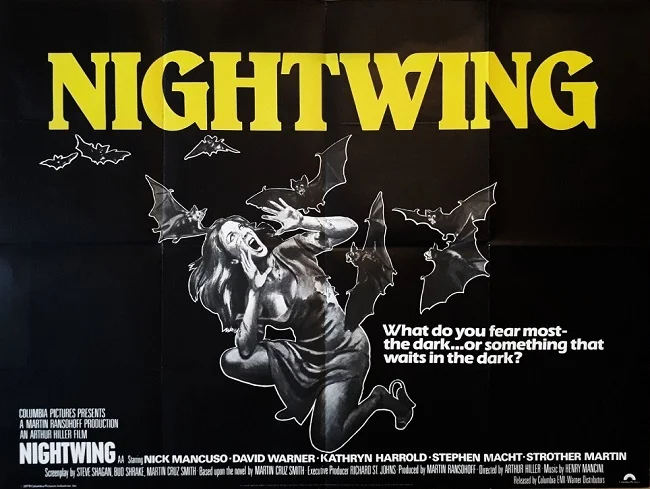
The seventies saw a minor boom in creature feature films after the box office success of Jaws. Hence, we had movies such as Orca (1977), Tentacles (1977), The Pack (1977) and Piranha (1978). If an animal could eat you or potentially pose any threat to people, someone somewhere would make a movie about it. Usually a bad one. A few of these even dared to stray into other hot topics of the time such as pollution and protecting the environment. Some would even invoke mysticism and folk lore to facilitate their protagonists. Nightwing is one such curious genre hybrid which combines vampire bats, shale oil mining and Native American culture in its clumsy and unsubtle plot. It’s a somewhat odd undertaking, directed by Arthur Hiller. His previous work included Love Story (1970) and Silver Streak (1976), so he was not the first person you’d expect to see associated with such material. The film doesn’t work well as either a horror movie or an exploration of social issues, but like so many movies from this era, it is of interest mainly due to its sheer incongruity.
The seventies saw a minor boom in creature feature films after the box office success of Jaws. Hence, we had movies such as Orca (1977), Tentacles (1977), The Pack (1977) and Piranha (1978). If an animal could eat you or potentially pose any threat to people, someone somewhere would make a movie about it. Usually a bad one. A few of these even dared to stray into other hot topics of the time such as pollution and protecting the environment. Some would even invoke mysticism and folk lore to facilitate their protagonists. Nightwing is one such curious genre hybrid which combines vampire bats, shale oil mining and Native American culture in its clumsy and unsubtle plot. It’s a somewhat odd undertaking, directed by Arthur Hiller. His previous work included Love Story (1970) and Silver Streak (1976), so he was not the first person you’d expect to see associated with such material. The film doesn’t work well as either a horror movie or an exploration of social issues, but like so many movies from this era, it is of interest mainly due to its sheer incongruity.
Youngman Duran (Nick Mancuso), a deputy on an Indian reservation in New Mexico, investigates the death of several horses on a local ranch. The bodies are covered in small bites, drained of blood and there is a strong smell of ammonia. Tribal Council chairman Walker Chee (Stephen Macht) is keen to keep the matter quiet, as he is trying to negotiate the mining rites to oil shale deposits that have recently been discovered in nearby canyons. Canyons that also happen to be sacred to the local population. Abner Tasupi (George Clutesi), an ageing medicine man and Duran’s uncle, tells him he’s unleashed forces that will remove the White Man from the land and restore things to how they use to be. Duran dismisses such ideas, but as further death occurs including his uncle, begins to think otherwise. However, the arrival of British scientist Philip Payne (David Warner) points to a more tangible answer. The caves in Maskai Canyon are home to a swarm of deadly vampire bats he’s been tracking.
Nightwing efficiently sets out its stall within the first fifteen minutes. The audience is presented with a beleaguered law enforcment official, a corrupt business man and an obsessed scientist. This is quickly followed by a heavy dose ersatz Indian mysticism and the ubiquitous love interest, via local nurse Anne Dillon (Kathryn Harrold), who runs the town clinic. It’s all formulaic content that’s common to genre movies. There is also an attempt to address some deeper issues regarding the treatment of indigenous peoples by the Federal Government, as well as some nods towards institutional racism. But it’s far from convincing and or subtle. Especially in light of the fact that so few of the main cast are of the correct ethnicity. The film then proceeds to offset the subsequent vampire bat attacks with wider supernatural explanations, but never fully commits to them. The use of datura root as a hallucinogenic offers a “get out of jail card” to the film’s mystic elements.
As for the vampire bat attacks, they’re initially kept off screen until the first major set piece of the movie. This involves a group of Christian missionaries who are visiting the reservation and considering making a substantial charitable investment. It is one of the better plot elements. The attack takes place at night around the camp fire and features animatronic bats created by Carlo Rambaldi (E.T and the 1976 version of King Kong). There is also an optical overlay of a swarm of bats that further adds to the scene. It doesn’t quite work and certainly the rather static close ups of Rambaldi’s bats are far from convincing. However, the effects work is of interest due to the technical limitations of the time. Certainly, the blood flows in this sequence with the victims panicking. One falls into the camp fire while another hides under the camper van, only for it to run over her. Later in the movie Duran, Payne and Dillon construct an anti-bat cage from steel scaffolding and wire mesh. The technical shortcomings of the animatronics are more apparent here.
There are some genre stalwarts in the cast. David warner is suitable driven and even has a Jaws-eque monologue about the inherent “evil” of vampire bats. Sadly, his character has little back story. Strother Martin also appears as the local store owner as does Charles Hallahan as one of the Christian missionaries. But overall the screenplay by Martin Cruz Smith, Steve Shagan and Bud Shrake does the bear minimum and lacks any depth, or standout features. Although the desert locations are strikingly shot at times by Charles Rosher Jr. there is no overt sense of danger from the environment. Nightwing may well have benefitted from a more experienced genre director at the helm, who could have focused more upon the horror elements, rather than trying to expand the scope of the story into wider socio-political themes. However, I still find movies of this kind that hail from the pre-digital age to be of interest. The seventies were a far more experimental time for cinema and studios were prepared to try different things and straddle multiple genres. Nightwing should therefore be filed under such.
The Satanic Rites of Dracula (1973)
The horror movie genre was changing rapidly in the late sixties and seventies, with films such as the Night of the Living Dead and Rosemary’s Baby moving away from traditional gothic settings and proving to be box office successes. After the success of Count Yorga, Vampire, a movie set in 1970s Los Angeles, Warner Bros commissioned Hammer Films to make two contemporary set Dracula films. The first of these was Dracula A.D. 1972. The film was loosely inspired by the Highgate Vampire case and proved to be moderately successful at the box office. The second being The Satanic Rites of Dracula; a curious hybrid vampire movie that mixes elements of the espionage genre along with traditional Hammer horror content. Sadly, this final outing for both Peter Cushing and Christopher Lee as Van Helsing and Dracula, was not well received by the public and has subsequently been written off in the annals of Hammer Films. Yet despite it’s flaws it does have a few points of interest to the more rigorous horror fan. The recent Blu-ray release via the Warner Archive Collection presented such an opportunity for reappraisal.
The horror movie genre was changing rapidly in the late sixties and seventies, with films such as the Night of the Living Dead and Rosemary’s Baby moving away from traditional gothic settings and proving to be box office successes. After the success of Count Yorga, Vampire, a movie set in 1970s Los Angeles, Warner Bros commissioned Hammer Films to make two contemporary set Dracula films. The first of these was Dracula A.D. 1972. The film was loosely inspired by the Highgate Vampire case and proved to be moderately successful at the box office. The second being The Satanic Rites of Dracula; a curious hybrid vampire movie that mixes elements of the espionage genre along with traditional Hammer horror content. Sadly, this final outing for both Peter Cushing and Christopher Lee as Van Helsing and Dracula, was not well received by the public and has subsequently been written off in the annals of Hammer Films. Yet despite it’s flaws it does have a few points of interest to the more rigorous horror fan. The recent Blu-ray release via the Warner Archive Collection presented such an opportunity for reappraisal.
The Satanic Rites of Dracula is a direct sequel to Dracula A.D. 1972. There is a degree of continuity with both characters and cast. Peter Cushing returns as Lorrimer Van Helsing, as does Michael Coles as Inspector Coles. Joanna Lumley replaces Stephanie Beecham as Jessica Van Helsing. Furthermore, the two movies are directed by Alan Gibson and written by Don Houghton. In an unusual twist the film starts very much as a spy drama, with a secret service agent escaping from the country mansion Pelham House, where cabinet ministers, industrialists and military chiefs indulge in satanic rites. Department head, Colonel Mathews (Richard Vernon) and Secret Service agent Torrence (William Franklyn) fear a major political scandal as well as foreign espionage. Due to the sensitivity of the situation they seek outside help from Special Branch Inspector Coles, who urges them to consult with occult expert Lorrimer Van Helsing. Investigations reveal that a leading scientist Julian Keeley (Freddie Jones) is also involved in the cult and that he is developing a deadly plague virus for the recluse business moghul, D. D. Denham.
The Satanic Rites of Dracula struggles to find its niche as the story veers between genres. Count Dracula doesn’t appear until thirty minutes into the movie and the screenplay is somewhat at a loss as to what to do with him, once he does. The story hinges upon the count having a curious existential crisis and tiring of his undead existence, hence the creation of a plague that will kill all life on earth, leaving him without any prey. It’s an interesting idea but one that is left underdeveloped. As for the horror elements of the film they’re somewhat modest. There are two staking scenes involving female vampires; one of which is now fully restored in the new Blu-ray copy. The remainder of the action is mainly shootouts with the curiously dressed security guards of Pelham house. They sport Afghan Waistcoats and Mauser pistols. Like most Hammer films from this period there’s a lot of cleavage and nudity to bolster the horror elements. Dracula’s demise at the end is suitably creative involving a Hawthorn bush and a picket fence. Les Bowie’s special effects are still enjoyable although far from sophisticated.
However, despite the vagueness of the script and the rather limited scope of action, there are still aspects to enjoy in The Satanic Rites of Dracula. The scenes between Peter Cushing and Freddie Jones are great, demonstrating that even with material as thin as this, both actors can hold the audience’s attention. The chemistry between Cushing and Lee is also present in the film denouement. The contemporary location scenes showing London in 1973 are also a source of interest. The car chase provides glimpses of The Strand and parts of Kensington, all of which have now been heavily redeveloped. But where this movie may appeal to the horror aficionado who has an abiding love with Hammer Films, you can objectively see why it failed at the box office. The studios attempt to move with the time are mainly superficial and beyond this, the film is just doing the same things as its predecessors. Furthermore, Christopher Lee had tired of the role of Dracula and so this was his final appearance as the iconic count for Hammer Films. Later in 1973, The Exorcist would change the horror genre completely, consigning the studio to further decline and inevitable closure. Hence, The Satanic Rites of Dracula was another nail in the coffin for Hammer’s Dracula franchise and a text book example of failing to move with the times.
Time Out 100 Best Horror Films - How Many Have You Seen?
I recently revisited the Time Out 100 Best Horror Films. I have a love hate relationship with movie lists of this kind, because of their binary nature and the sort of debates they generate. However, as this list is revised regularly, I thought why not go and have a look and see what has changed. Furthermore, this list is more credible than others because the one hundred titles listed have been selected by a group of contributors associated with the genre. These include Roger Corman, Guillermo del Toro, Simon Pegg, Clive Barker, Alice Cooper and Kim Newman. There is an interesting mix of titles from the traditional to the obscure as well as some interesting new additions such as A Quiet Place and Lake Mungo. I personally have seen 93 of the movies listed. However, there are a few movies that I more than likely will never see, due to my personal taste. Salò and Audition for example.
I recently revisited the Time Out 100 Best Horror Films. I have a love hate relationship with movie lists of this kind, because of their binary nature and the sort of debates they generate. However, as this list is revised regularly, I thought why not go and have a look and see what has changed. Furthermore, this list is more credible than others because the one hundred titles listed have been selected by a group of contributors associated with the genre. These include Roger Corman, Guillermo del Toro, Simon Pegg, Clive Barker, Alice Cooper and Kim Newman. There is an interesting mix of titles from the traditional to the obscure as well as some interesting new additions such as A Quiet Place and Lake Mungo. I personally have seen 93 of the movies listed. However, there are a few movies that I more than likely will never see, due to my personal taste. Salò and Audition for example.
Of course, there were a few titles that I'd like to have seen included on the list. Michael Reeve's Witchfinder General for example is conspicuously absent. Not only is it a deeply disturbing film with a palpable air of menace but is possibly one of the finest pieces of British cinema ever. Yet it continuously seems to be overlooked in favour of The Wickerman. I also think that Hammer Studios deserved more representation than just The Horror of Dracula. Their contribution to advancing the horror genre should not be underestimated. But this is the nature and possibly the purpose of such lists to stimulate debate. Half the fun comes from arguing with your friends about why Fulci's The New York Ripper is of greater artistic merit than say The Mark of the Devil or CHUD II: Bud the CHUD. Also, I’m both annoyed and delighted by the inclusion of Jaws. It is a beautifully constructed piece of cinema with a superb cast, but can it really be labelled a horror movie.
I guess, as I’ve raised the subject of lists of this nature, it is only fair that I provide one myself. So here are a few horror films that I consider to be or significance or merit. They are a mixed bunch and should not be directly compared to each other, as they represent different aspects of the genre and are aimed at different markets. Some are pure exploitation. Others are more cerebral and enjoy a more credible reputation and broader appeal. Ask me again in a months’ time and I may suggest a completely different set of titles. Feel free to share your own personal favourites or to "criticise" my choice. Also let me know how many of the Time Out list you have seen. I'd be very interested to know. If you are a genre fan who wishes to understand and appreciate it as best you can, I think it is important to be familiar with as broad a spectrum of material as possible.
The Uninvited (1944)
The Orphanage AKA El Orfanato (2007)
Nightbreed (1990) NB Try to see either the Cabal Cut or the Director’s Cut.
The Keep (1983)
The Devil Rides Out (1968)
The Man Who Laughs (1928)
Wolfen (1981)
Whistle and I'll Come to You (1968)
Lifeforce (1986)
Prophecy (1979)
Bird Box (2018)
The unfolding apocalypse and the unseen forces that bring it about are never fully explained in Bird Box. The movies also eschews overblown, CGI driven set pieces and spectacle. The scenario is simply the MacGuffin which director Susanne Bier uses to facilitate her exploration of the angst of motherhood and societal decay. This is superficially a genre movie but it’s mainly about people, performances and ideas. There have been some comparisons to A Quiet Place, but this movie is actually closer to The Mist. The film is at its best during the first act, when setting up its premise and at the start of “the event”. The second act remains above average mainly due to the strength of the cast, as they weather the ongoing storm. The denouement is somewhat functional and is possibly the weakest aspect of the film. Yet, the strength of what has gone before and as ever the robust nature of Sandra Bullock’s performance keeps things on track.
The unfolding apocalypse and the unseen forces that bring it about are never fully explained in Bird Box. The movies also eschews overblown, CGI driven set pieces and spectacle. The scenario is simply the MacGuffin which director Susanne Bier uses to facilitate her exploration of the angst of motherhood and societal decay. This is superficially a genre movie but it’s mainly about people, performances and ideas. There have been some comparisons to A Quiet Place, but this movie is actually closer to The Mist. The film is at its best during the first act, when setting up its premise and at the start of “the event”. The second act remains above average mainly due to the strength of the cast, as they weather the ongoing storm. The denouement is somewhat functional and is possibly the weakest aspect of the film. Yet, the strength of what has gone before and as ever the robust nature of Sandra Bullock’s performance keeps things on track.
Artists Malorie (Sandra Bullock) is pregnant and struggling to come to terms with her impending motherhood. While in hospital for a routine check-up, she and her sister Jessica (Sarah Paulson) witness an outbreak of mass psychosis. Driven by some unseen force, people start killing themselves. Fleeing the ensuing carnage, they escape by car only to crash due to the ongoing unrest. Malorie takes shelter along with others in a large house, owned by suburban house husband Greg (BD Wong). Among the survivors are Greg’s surly neighbour Douglas (John Malkovitch) and ex-soldier Tom (Trevante Rhodes). They theorise that the unseen force kills you by manifesting itself as your greatest fear or tricks you by pretending to be a loved one or friend. Trapped and with diminishing supplies the group realise that if they venture outside, they will have to remain blindfolded, rather than risk seeing the threatening malevolent presence.
The initial scenes of chaos and its rapid spread are well handled by director Susanne Bier. The depiction of people beating their heads against plate glass windows, stepping out into traffic and acts of self-immolation are genuinely shocking. Because the scope and scale of these events are far more localised, as opposed the grandiose aerial shots of the zombie apocalypse in Wold War Z, they are quite powerful. The focus on character during the scenes where the cast are secure in the house or when they venture out to the supermarket are also refreshing. Instead of excessive set pieces, we simply get a strong study of beleaguered people trying hard not to lose their grip on reality. Sometimes the script by Eric Heisserer (Arrival, Extinction) does become a little too expositionary. But there are enough succinct musings and philosophical introspection among the cast to keep things moving forward.
Bird Box presents viewers with two timelines, one set during the apocalypse and the other five years on. The first deals with the survivors and their struggle to secure their house. The second focuses on Malorie’s blindfolded journey down a river with two young children. Both are well crafted but the conspicuous absence in the latter timeline of some of the protagonists from the first, somewhat mitigates the tension, as most viewers will accurately surmise their fate. The final act is also predictable as the screenplay paints the narrative into a dramatic corner. Again, astute audiences will guess the way events will end and the conceit of the film conclusion. That is not to say that the story’s resolution is inadequate, but it is somewhat reduced in impact as a result of its lack of surprise. However, Sandra Bullock does a lot of heavy lifting here and carries the proceedings over the finish line.
Despite the inconsistencies of the script, Bird Box hits its stride when it focuses on the basics. By presenting us with a precarious safe place to hide from the apocalypse, it gives audiences an opportunity to muse upon how they would react under such circumstances. If also gives us a sufficient glimpse of “hell on earth” rather than belabouring us with endless CGI showreels. The enigmatic foe (or foes) are also an intriguing plot device. What the screenplay alludes to as to what is exactly happening, is just enough to oil the wheels of suspense. It’s a timely reminder that less can indeed be more. Finally, it should be noted that Netflix movies do not carry much overt information with regard to ratings. Bird Box is not a family friendly film and it would have certainly received a R rating if released theatrically. The lack of computer-generated spectacle does not mean an absence of violence.

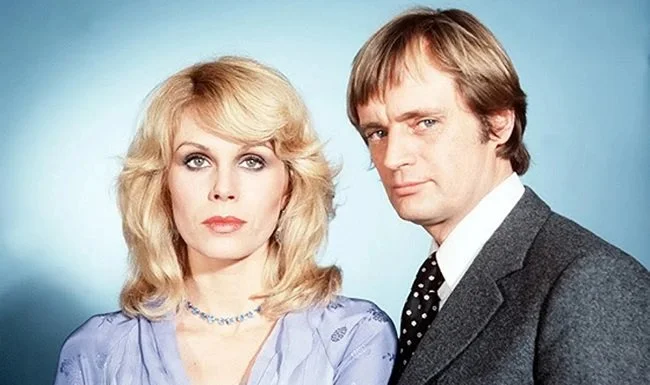





The Tractate Middoth (2013)
The BBC has a long and illustrious history of commissioning innovative adaptations of the works of M R James. Consider a moment the likes of Jonathan Miller's Whistle and I'll Come to You or The Ash Tree by Lawrence Gordon Clark. If you are unfamiliar with these short television dramas, then I strongly advise you to seek them out. They are the epitome of quality television forays into the world of the supernatural. The Tractate Middoth, written and directed by Mark Gatiss, once again demonstrates how well the finely crafted short stories of Monty James lend themselves to the medium of film. Mr. Gatiss has a clear understanding and passion for the horror genre and proves (as he did with Sherlock) that "adaptation" does not have to mean "bastardisation".
The BBC has a long and illustrious history of commissioning innovative adaptations of the works of M R James. Consider a moment the likes of Jonathan Miller's Whistle and I'll Come to You or The Ash Tree by Lawrence Gordon Clark. If you are unfamiliar with these short television dramas, then I strongly advise you to seek them out. They are the epitome of quality television forays into the world of the supernatural. The Tractate Middoth, written and directed by Mark Gatiss, once again demonstrates how well the finely crafted short stories of Monty James lend themselves to the medium of film. Mr. Gatiss has a clear understanding and passion for the horror genre and proves (as he did with Sherlock) that "adaptation" does not have to mean "bastardisation".
The Tractate Middoth relocates the events of the story from the Edwardian era, to the early Fifties but apart from this change the production remains remarkably faithful to the text. We meet young librarian Mr. Garnett (Sacha Dhawan) who has a rather disturbing experience while searching for an old tome of Hebrew text for an irascible academic John Eldred (John Castle). It would appear that a mysterious third part may have an interest in the book. While recovering from his shock, with a dose of country air, Mr. Garnett meets Mrs. Simpson (Louise Jameson) and her daughter Anne (Charlie Clemmow). They tell a strange tale of a missing last will and testament that would make them heir to a sizeable inheritance. Unfortunately, the document has been written in an obscure book. Could it be the very same volume that lead to Mr. Garnett's supernatural experience?
This delightful adaptation blends the erudition and macabre atmosphere of M R James with the wit and intelligence of Mark Gatiss. The two complement each other very well. M R James's liking for comedic minor officials and bureaucrats is embellished by Mark Gatiss, leading to some clever observational humour and comic asides. However, this is not done to the detriment of the brooding atmosphere or the central supernatural plot. The thirty-minute adaptation has a minimum of superfluous CGI, keeping as much effects work as possible in-camera, thanks to the stylish cinematography of Steve Lawes. The prosthetics for the central ghost are suitably ghoulish and very much in accord with the original story.
The period feel is authentic and still maintains M R James cardinal rule that a good ghost story should always be set in the past and related by those who have indirectly experienced it. Performances are universally good ensuring that characters do not descend in to genre caricatures. The handsome production design and art direction reflect the architectural and topographical detail that is synonymous with all of James's short stories. It is to the director’s credit that the supernatural climax is effectively carried out in broad daylight without losing any dramatic impact. The final sting in the tail, although a whim of Mark Gatiss, is far from out-of-place.
As with the BBC adaptations from the seventies, this latest production has a distinguished pedigree, sporting such names as Una Stubbs, Eleanor Bron and John Castle. There is also a clear sense that everyone involved has a love and respect for the work of Montague Rhodes James. The Tractate Middoth is text-book example of the sort of quality television that can be produced when the right people are involved and deferred to. Mark Gatiss has spoken of the freedom afford to him by the BBC Arts Department and it is clear that their trust in him has paid off. The Tractate Middoth, is well paced and lovingly crafted, delightfully unsettling. There are several jolts leading to a classic Jamesian Wallop (Thank you Will Ross and Mike Taylor for coining that phrase).
World War Z (2013)
Contrary to a lot of the pre-release doom and gloom regarding re-edits and extensive new footage being shot, World War Z turned out to be far from the disaster that some critics implied. Ultimately there were some good ideas and snatches of interesting dialogue. Some of the characters were unusual and there seems to have been an attempt do something different with the genre. All of these things are laudable. Unfortunately, despite these positive attributes the movie clearly shows the signs of post-production interference and material from the extensive re-shoot is all too apparent. That’s not to say that is bad because that is not the case. It’s because it is noticeably different in style and tone from the rest of the film.
Contrary to a lot of the pre-release doom and gloom regarding re-edits and extensive new footage being shot, World War Z turned out to be far from the disaster that some critics implied. Ultimately there were some good ideas and snatches of interesting dialogue. Some of the characters were unusual and there seems to have been an attempt do something different with the genre. All of these things are laudable. Unfortunately, despite these positive attributes the movie clearly shows the signs of post-production interference and material from the extensive re-shoot is all too apparent. That’s not to say that is bad because that is not the case. It’s because it is noticeably different in style and tone from the rest of the film.
World War Z performs best in the first act, in which the global disaster is convincingly set up. We are efficiently introduced to a likeable lead Gerry Lane (Brad Pitt) and his family and within minutes they are caught up in a major outbreak incident in Philadelphia. The movie excels at showing large scale and convincing scenes of destruction, scratching that perennial cinematic itch audiences seem to have for scenes of an apocalyptic nature. Yet even at this point, the narrative has moments of hesitation which undermine the overall movie. World War Z is reticent to clarify exactly whether this is a true Zombie scenario or some sort of viral outbreak. If this was done for dramatic effect, I can understand it as a plot point to reinforce the sense of national confusion. But I feel the ambiguity is actually a result of the movies re-editing.
The plot soon takes on a globetrotting sub plot as our World Health Organisation hero (Brad Pitt) travels from South Korea, to Israel and then to Wales in attempt to find patient zero. We meet many characters along the way, yet few of them have sufficient screen time to become anything more than just a means of exposition. The Navy seal officer who sacrifices himself, the ex-CIA agent turned arms trader, the Hispanic parents who become infected and turn on their own children, all show promise dramatically. The dialogue also has possibility, showing a leaning towards the more philosophical. Perhaps an extra twenty minutes of material could correct these deficiencies. Zombies hurling themselves at potential victims cannot sustain a movie.
As I stated earlier the final act, although interesting, doesn't sit well with the previous two. Set in a WHO laboratory in Wales, it is a far more sedate and traditional denouement. The absence of the shaky cam and lightning editing of the first hour is noticeable. There is also the incongruous casting of Peter Capaldi as a research scientist which, after years of seeing him as Malcolm Tucker in The Thick of It, it becomes hard to see him in a role where every other word is not a profanity. Furthermore, the movie's conclusion, although plausible within the context of the story, is derailed by it being solely the brain work of Gerry Lane. The whole point of World War Z is surely its global dimension and thus its resolution is based upon the involvement of multiple parties. The one man saves the day concept seems somewhat lazy.
Ultimately, despite promising concepts World War Z fails to satisfy any of its target audiences and demographics. The PG-13 rating forces too many restrictions upon a genre that by its very nature has to be visceral. Death is cruel and ugly, and zombies reflect this. Yet such a low rating has meant that the producers have had to obfuscate and fudge the violence and horror through rapid editing and out of shot framing. The movie does have a dark and brooding tone, but this is not enough to sustain the horror theme alone. Perhaps Max Brooks' book, which is very challenging to adapt, would have been better suited to a TV mini-series. But is that required in the wake of The Walking Dead? I certainly question whether Marc Forster was the right person to direct World War Z. In the mean time if you do elect to watch World War Z then seek out the unrated version which at least has a little more gore and an increase sense of urgency.
The Haunting of Hill House (2018)
Shirley Jackson’s 1959 novel The Haunting of Hill House is considered one of the best literary ghost stories published during the 20th century. It was adapted for film in 1963 by Nelson Gidding and directed by Robert Wise under the title The Haunting. Although only doing moderate box office upon release, the movie was moderately well received at the time and over the years has gained a critical reassessment. Contemporary critics consider it one of the finest genre movies of its era. Hence the prospect of a new ten-part television adaptation made exclusively for Netflix, was initially met with a great deal of scepticism. However, writer and director Mike Flanagan has wisely chosen not to retell the original story, but instead taken its themes and concepts and woven them into a compelling and very contemporary tale of a dysfunctional family traumatised by their collective experience at Hill House. Jettisoning the classic trope of a paranormal investigation into a haunted house, he instead presents us with two narratives that run in parallel and regular intersect with startling results.
Shirley Jackson’s 1959 novel The Haunting of Hill House is considered one of the best literary ghost stories published during the 20th century. It was adapted for film in 1963 by Nelson Gidding and directed by Robert Wise under the title The Haunting. Although only doing moderate box office upon release, the movie was moderately well received at the time and over the years has gained a critical reassessment. Contemporary critics consider it one of the finest genre movies of its era. Hence the prospect of a new ten-part television adaptation made exclusively for Netflix, was initially met with a great deal of scepticism. However, writer and director Mike Flanagan has wisely chosen not to retell the original story, but instead taken its themes and concepts and woven them into a compelling and very contemporary tale of a dysfunctional family traumatised by their collective experience at Hill House. Jettisoning the classic trope of a paranormal investigation into a haunted house, he instead presents us with two narratives that run in parallel and regular intersect with startling results.
Hugh and Olivia Crain (Henry Thomas and Carla Gugino) professionally renovate and refurbish dilapidated houses and “flip” them for resale. Both are gifted professionals; Hugh being the consummate problem solver and Olivia the creative and sensitive interior designer. The couple move into Hill House with their five children, Steve, Shirley, Theo, Luke and Nell only to find the building problematic in several ways. There are no accurate plans, there’s a hidden basement and a locked room that remains resolutely inaccessible. The children start to experience disquieting nocturnal phenomenon that their parents at first ignore or rationalise away. Yet over time Olivia begins to succumb to the malign atmosphere, culminating in a tragedy and the family fleeing the house. Years later each surviving member of the Crain family are dealing with the fallout of their respective experience. Nell suffers night terrors and sleep paralysis, while Luke struggles with drug addiction. Theo is a child therapist and Shirley has become a mortician. Steve the eldest who believes he never actually experience the supernatural and that his family is blighted by hereditary mental illness has become a successful author specialising in writing about the paranormal. Events start to occur which then draw them all inexorably back to Hill House.
The Haunting of Hill House unfold at a measured pace to facilitate focus upon the central characters. The first five episodes are designed to explore the backstory of each family member both in the present and in the past. Over time, several key events are shown from different perspectives, each adding another layer of complexity and nuance to the proceedings. The adults cast, and their child counterparts are universally good, providing strong and credible performances. Viewers need to keep the wits about them as there is often a lot going on at key moments, both front and centre and in the periphery of shots. There is often a palpable air of tension and the jump scare and shocks are well crafted. Several spectral characters such a “bent neck lady” and “bowler hat man” are well conceived and suitable ghoulish. Hill House itself has a grim and morose presence and although largely digital, the illusion of a decaying, malevolent and possibly sentient structure is well maintained. The screenplay frequently uses passages of classic dialogue from the source text at exactly the right moment. Iconic scenes are also expressed in interesting new ways, such as “who’s hand was I holding” and the seminal wall pounding sequence.
But the productions real strength is the way it uses the family in crisis trope as the foundation of the story. Not everyone is a sympathetic character but they’re all relatable. The female leads are especially strong, and their story arcs have the most substance to them. There are several genuinely emotional revelations that have real weight, rather than being just arbitrary kicks in the “feels”. The final resolution of the Crain family’s trial and tribulations is complex and dares to explore the paradoxical symbiosis between the supernatural and those who experience it. The only major criticism I can level against this production is that the languid pace may not be to everyone’s taste. Some viewers may want a more concise story, where I was content to let matters unfold at their own pace. This point notwithstanding, The Haunting of Hill House is a superior piece of dramatic, cerebral genre fare. It successfully takes something old, established and much loved and revitalises it with a healthy dose of imagination, creativity and human insight. It is features robust scares as well as moments of note and is superior to a great deal of its current cinematic counterparts.

Halloween (2018)
It is a bold move to write off six sequels and effectively retcon a major horror cinematic milestone after forty years. Yet that is exactly what Director and co-writer David Gordon Green has done, producing a follow up movie to John Carpenter’s 1978 original, that is distinctly more than the sum of its parts. And in the process of doing this, Halloween has attracted a great deal of media attention that has somewhat skewed subsequent reporting. There has been a great deal of hyperbole and marketing hype in the lead up to the film’s release which is concerning, because in an atmosphere of such exuberance and fan excitement, it can be difficult to accurately gauge the public mood. I have only ever experienced the one other deferred sequel that generated such a similar buzz and that was Psycho II back in 1983. Despite a lot of reservations, that proved to be a worthy successor to Hitchcock’s classic.
It is a bold move to write off six sequels and effectively retcon a major horror cinematic milestone after forty years. Yet that is exactly what Director and co-writer David Gordon Green has done, producing a follow up movie to John Carpenter’s 1978 original, that is distinctly more than the sum of its parts. And in the process of doing this, Halloween has attracted a great deal of media attention that has somewhat skewed subsequent reporting. There has been a great deal of hyperbole and marketing hype in the lead up to the film’s release which is concerning, because in an atmosphere of such exuberance and fan excitement, it can be difficult to accurately gauge the public mood. I have only ever experienced the one other deferred sequel that generated such a similar buzz and that was Psycho II back in 1983. Despite a lot of reservations, that proved to be a worthy successor to Hitchcock’s classic.
However, I am pleased to say that Halloween is as good as the early reviews indicated. It takes many of the essential themes of the original film and presents them from an alternative perspective. To summarise the uncomplex plot, Michael Myers escapes from custody while being transferred to a new psychiatric facility. Meanwhile, Laurie Strode now traumatised, fixated and estranged from her own daughter Karen (Judy Greer) and granddaughter Allyson (Andi Matichak), prepares for the inevitable return of her nemesis. Throughout its 106-minute running time Halloween frequently makes clever and wise nods to its predecessor. The movie has a very dark tone, but it knows when to lighten things with some humorous banter. There is a higher body count and certainly the mayhem is more graphic this time round, but this is not to the detriment of the movie and simply reflects the style and tastes of the contemporary horror genre and its consumers.
The film benefits from a strong and focused performances by all three female leads. Jamie Lee Curtis excels in her role, providing a fulcrum for the narrative. There is also a robust support role from Will Patton as local Sheriff Frank Hawkins. If there is a weak link it the character of Dr. Ranbir Sartain (Haluk Bilginer) who is the new “Sam Loomis” and telegraphs his intentions quite early in the story. However, his role is needed to expedite events and assemble everyone for the inevitable showdown. There are some excellent tracking shots by cinematographer Michael Simmonds and some cunningly contrived set pieces set around the alley ways and back entrances of suburban Haddonfield. The classic score from the original movie has been re-arranged and further embellished with some superb additional cues written by John Carpenter himself, his son Cody Carpenter and David Davies. Some of which stray into Goblin territory, which is magnificent.
Films of this nature that are directly connected to established and iconic cinematic milestones, need to do far more than recreated that which has gone before. They need to juxtapose classic scenes or sequences and explore content from a different perspective. The key element of this that features in Halloween, is the concept of predator and prey. It is cunningly reversed during the film’s climax and there are several scenes that mirror those from the 1978 movie but are done with a tangible difference. To reference them would be to spoil them, so I’ll simply say that fans of the original movie will recognise them when they see them and should hopefully be impressed by the new inflection that the director imbues them with. Overall, irrespective of the hype Halloween is a genuinely worthy successor to John Carpenter’s original. It is inventive, intelligent, suspenseful and knows when to hit the audience right between the eyes.