
Season of the Witch (2011)
After years of war, two 14th century Crusaders (Nicholas Cage and Ron Perlman) returns to a homeland devastated by the Black Plague. The church, deeming sorcery to be the source of the outbreak, tasks the knights to transport an accused witch (Claire Foy) to a remote abbey, where monks will perform a ritual in hopes of ending the pestilence. A priest, a grieving knight, a disgraced trader and an altar boy who dreams of becoming a knight, join the mission across a hostile wilderness. The group soon finds itself at odds with each other over the fate of the girl. When the embattled party finally arrives at the abbey, a horrific discovery jeopardises the knight's pledge to ensure the girl fair treatment, pitting them against an inexplicably powerful and destructive force. Will good or evil triumph?
After years of war, two 14th century Crusaders (Nicholas Cage and Ron Perlman) returns to a homeland devastated by the Black Plague. The church, deeming sorcery to be the source of the outbreak, tasks the knights to transport an accused witch (Claire Foy) to a remote abbey, where monks will perform a ritual in hopes of ending the pestilence. A priest, a grieving knight, a disgraced trader and an altar boy who dreams of becoming a knight, join the mission across a hostile wilderness. The group soon finds itself at odds with each other over the fate of the girl. When the embattled party finally arrives at the abbey, a horrific discovery jeopardises the knight's pledge to ensure the girl fair treatment, pitting them against an inexplicably powerful and destructive force. Will good or evil triumph?
Season of The Witch was submitted to the MPAA for rating twice, prior to release, as the studio tried to secure a “suitable” rating for the movie. The film itself spent an entire year between completion of the production and its theatrical release as various parties tinkered with its final edit. The script had been in development since 2000 and had been passed from both MGM and Columbia pictures before finally being produced by Relatively Media. Despite some striking location work around Eastern Europe, suitable castles and associated building from the required period could not be found. Thus, a great deal of material had to be shot against green screens and added digitally in post-production. However, budgetary restraints had an impact upon this work and its quality. All of these factors are usually indicative of a troubled production, resulting in a flawed film. Sadly, Season of the Witch very much fits that bill.
Season of The Witch is glaringly narratively and tonally inconsistent. The characters are insufficiently developed as are the themes. The story is very derivative and the content conspicuously edited to secure the commercially viable PG-13/12A rating. However, smitten by a fit of unusual generosity, I have to admit that I did enjoy the film. This is mainly because of Ron Pearlman's presence and a handsome production design that is very reminiscent of Hammer studios work and Roger Corman's Poe adaptations. Like 2012 release of Solomon Kane, the film manages to look a lot more sumptuous than it actually is due to its Hungarian and Croatian locations. Furthermore, although the action scenes and set pieces have been very tightly edited for rating reasons, they are still well conceived due to the presence of veteran stunt co-ordinator Vic Armstrong.
The story of two Teutonic Knights escorting a suspected witch to a remote castle for trial, through a world devastated by the Black Death, often comes across as pythonesque. This is mainly due to the similarities in the depiction of the Medieval world. I was also reminded of Terry Gilliam’s Jabberwocky that has a similar grimy depiction of the time. The story is episodic and offers very few surprises. It is entertaining in a very undemanding way and the night attack by wolves in the fog bound forest, is actually well executed. There are even some occasional nods to Ingmar Berman which seem curiously hubristic. However, overall Season of The Witch is an inconsistent viewing experience and a film that falls between several stools. It doesn’t seem to find a level that it is comfortable with, very much like director Dominic Sena's previous film Whiteout. Therefore, only watch is you are feeling tolerant, forgiving and are the most ardent Nicholas Cage fan.










The Purge: Anarchy (2014)
The Purge: Anarchy is an example of the curious and rare cinematic beast, a sequel that is superior to its predecessor. This time round the movie makes a greater effort to explore the themes associated around its premise and takes to the streets to show the impact of the purge upon the working class. It’s a far more political movie and all the better for it. You can’t have a story about a national event designed to implement social engineering in the most visceral of manners and try and keep it free from social commentary. Furthermore, The Purge: Anarchy features a far more agreeable and accessible group of protagonists this time round, creating a far more plausible sense of trepidation for audiences. The film is also more violent than the first instalment given the scope of its narrative.
The Purge: Anarchy is an example of the curious and rare cinematic beast, a sequel that is superior to its predecessor. This time round the movie makes a greater effort to explore the themes associated around its premise and takes to the streets to show the impact of the purge upon the working class. It’s a far more political movie and all the better for it. You can’t have a story about a national event designed to implement social engineering in the most visceral of manners and try and keep it free from social commentary. Furthermore, The Purge: Anarchy features a far more agreeable and accessible group of protagonists this time round, creating a far more plausible sense of trepidation for audiences. The film is also more violent than the first instalment given the scope of its narrative.
Shane (Zach Gilford) and Liz (Kiele Sanchez), a couple on the verge of splitting up, are driving home when their car breaks down just as the purge commences. They decide to try and make it across town, avoiding the various predatory gangs that are now roaming the streets. Meanwhile, waitress Eva (Carmen Ejogo), goes home to her sick father Rico (John Beasley) and teenage daughter Cali (Zoe Soul) and prepares to secure their apartment. She politely refuses offers of assistance from the building manager Diego. Later that night the tenement is assaulted by a paramilitary squad and Eva and Cali are captured. As they are being loaded into a truck, they are rescued by a rogue Police Sergeant (Frank Grillo) who is using the purge to seek revenge on the man who killed his son. Upon returning to the Sergeants car, they discover Shane and Liz hiding. The five people slowly make their way through the streets and attempt to survive the night in Los Angeles.
The Purge: Anarchy manages to maintain a credible air of tension. The set pieces are tight and because the lead characters are more than two dimensional, you can become emotionally invested in them. But the films greatest asset are the vignettes of associated purge culture that are offered to the audience. Eva’s father, Rico, sells himself to a rich family who wish to have a risk-free purge experience. In return his family receive a large cash sum. The movie goes on to highlight again and again that the poor are the group that bear the brunt of the purge. There are for example roving kidnap gangs that round up victims to be sold to the wealthy. The rich then auction off the prisoners so that they can be hunted in a controlled environment. However, the film does show that the door can swing both ways. While travelling through the financial district our protagonists come across a dead banker with a very contemporary message hung around his neck.
Out of the three movies that make up this franchise The Purge: Anarchy is by far the strongest. It tackles the subject of the purge effectively and through a series of dramatic threads, provides insight as to what the real ramifications of one night of state sanctioned anarchy would be. The disgruntled “super” Diego is a microcosm of all that is worse about the purge as a concept. He nurses a wealth of misconceived and unfounded grievances and uses them as a justification for his basest instincts. That is essentially where the horror of the purge lies. It shows how extremely thin the veneer of civilisation actually is and that abhorrent behaviour is not confined to any one specific demographic group.
Ouija (2014)
It boggles my mind that the American multinational toy and board game company Hasbro, currently holds the copyright and patent to a device that is essentially designed to communicate with the dead. How a tool of spiritualism became a commercial toy that was then marketed to a strongly Christian nation is a blog post in itself. However, this post is about the 2014 horror feature film based upon the Hasbro game. Hasbro like many leisure companies, has in recent years looked at ways to expand its business portfolio. Subsequently, in 2009 it set up a film division and licensed TV shows and movies based upon its toy and game back catalogue. Like their traditional products, these forays into film and television have proven lucrative. If you haven’t noticed, we’re already up to our fifth Transformers movie, with several more in pre-production.
It boggles my mind that the American multinational toy and board game company Hasbro, currently holds the copyright and patent to a device that is essentially designed to communicate with the dead. How a tool of spiritualism became a commercial toy that was then marketed to a strongly Christian nation is a blog post in itself. However, this post is about the 2014 horror feature film based upon the Hasbro game. Hasbro like many leisure companies, has in recent years looked at ways to expand its business portfolio. Subsequently, in 2009 it set up a film division and licensed TV shows and movies based upon its toy and game back catalogue. Like their traditional products, these forays into film and television have proven lucrative. If you haven’t noticed, we’re already up to our fifth Transformers movie, with several more in pre-production.
The box office success of Paranormal Activity back in 2009 has led to a wealth of low budget, PG-13 rated, jump scare horror movies. The production cost to earnings ratio of this niche genre is often very favourable. Thus, it was logical from a business perspective for Hasbro Films to try and adapt the “Ouija board game” into a potential box office franchise. However, Ouija proved to be a troubled production and the movie went through extensive reshoots after test audiences reacted poorly to the initial edit. If you watch the various teaser trailers for the movie there is evidence of material that has been deleted or replaced. Certainly, there are continuity issues present in the Blu-ray version that I watched. Most of these are related to the cast appearance and hairstyles and don’t have any serious impact upon the narrative, although that itself is not without flaws.
When teenager Debbie (Shelley Hennig) commits suicide unexpectedly, her five best friends are profoundly troubled. Laine (Olivia Cooke) discovers that Debbie has been using a Ouija board and recording her experiences. Suspecting that this may have contributed to Debbie’s death, she convinces the rest of the group to hold a séance so they can contact her. They succeed in communicating with a spirit that claims to be Debbie, however it soon becomes apparent that the group has roused a malevolent force instead. Laine strives to learn the origins of this evil spirit as her friends start to die, one by one. Research subsequently reveals that Debbie’s home was previously owned by a celebrated medium Alice Zander and her two daughters. Once of whom, Paulina (Lyn Shaye) is currently incarcerated in a psychiatric hospital. Is Paulina the key to the mystery and can Laine find a way to defeat the evil force that pursues her?
What is striking about Ouija is that is so noticeably contrived. The screenplay has obviously been retooled numerous times, to accommodate the reshoot and then to facilitate the plot devices and the set pieces that the producers wish to utilise. For example, Laine’s father is introduced and within minutes leaves town on business, providing a convenient reason as to why five teenagers can have a supernatural adventure, free from the interference of the usual authorities. Although there is some meat on the bones of the central characters, others are simply cinematic placeholders and present purely to provide an adequate body count. Furthermore, although Ouija does provide satisfactory scares within the parameters of its rating, the set pieces are devoid of any originality. The imagery is all very generic, with its emaciated computer-generated spectres and sinister ghost children.
Despite its problematic “film by committee” production, Ouija is not a bad movie per se. It is competently made, has a satisfactory pace with an appropriate amount of scares throughout its running time. However, it commits perhaps the worst sin a genre move can. It is dull, perfunctory and very disposable. By the time I got around to watching the inevitable sequel (which is in fact a prequel), I had forgotten most of the events of Ouija. I had to refresh my memory via Wikipedia. It is this homogenous nature that is most saddening because it speaks of a genre that is being distilled down to an ever-decreasing number of tropes. Simply making a movie by arbitrarily including these aspects, does not make for great cinema. Nor does it improve the wider public perceptions of the horror genre. Yet, irrespective of these criticisms, Ouija made over $100 million at the box office. It cost just $5 million to make.
Insidious: Chapter 2 (2013)
James Wan is a clever film maker who knows and fully understands the mechanics of his trade. Perhaps a little too well, because therein lies the problem with Insidious: Chapter 2. It is a succession of well-crafted set pieces that seamlessly follows on from the previous movie. Yet it is a little too enamoured with its own cleverness. I found myself frequently praising the director after a well-constructed shock, instead of revelling in the unease a horror movie is supposed to create. A great deal of scares and jumps are due to the clever sound design, superb editing and the creepy score by by Joseph Bishara, who previously collaborated with director James Wan on the first movie as well as The Conjuring. Fortunately, the film still provides viewers with a family that are likeable and an ensemble cast that help lift the story beyond its somewhat formulaic limitations. As I've mentioned before, Wan has an eye for depicting families.
James Wan is a clever film maker who knows and fully understands the mechanics of his trade. Perhaps a little too well, because therein lies the problem with Insidious: Chapter 2. It is a succession of well-crafted set pieces that seamlessly follows on from the previous movie. Yet it is a little too enamoured with its own cleverness. I found myself frequently praising the director after a well-constructed shock, instead of revelling in the unease a horror movie is supposed to create. A great deal of scares and jumps are due to the clever sound design, superb editing and the creepy score by by Joseph Bishara, who previously collaborated with director James Wan on the first movie as well as The Conjuring. Fortunately, the film still provides viewers with a family that are likeable and an ensemble cast that help lift the story beyond its somewhat formulaic limitations. As I've mentioned before, Wan has an eye for depicting families.
The original film’s twist ending suggested that the spirit which haunted Josh (Patrick Wilson) throughout out his life had finally possessed him. Insidious: Chapter 2 picks up the story immediately and the story has to deal with the narrative complexities that have been imposed upon it by the previous instalment. However, the movie expedites the plot quite well and we see via flashbacks how paranormal investigator Elise (Lin Shaye) first met Josh as a child and the subsequent investigation by the police regarding the exact circumstances of her death. The story then focuses on the Lambert family, who are now living with Grandma Lorraine’s (Barbara Hershey). It's not long before Josh's wife Renai (Rose Byrne) is seeing and hearing spirit manifestations, once again centred around their young son Dalton (Ty Simpkins).
As I mention earlier, there is a lot of well thought out and smart aspects to Insidious: Chapter 2. A key scene from the first movie is revisited and explored from a totally different perspective. It certainly adds to the sense of continuity between the two movies. There is also another foray into the "further" but this time with a subtle role reversal as it is Dalton this time, trying to rescue his Father. Despite the Scooby Doo like sub-plot as the family and paranormal investigators delve into the reasons behind the hauntings, there is still plenty of solid scares to be had. The protagonists are still well defined and the suburban setting adds to the unsettling atmosphere. Because the balance between scares and running time is equitable, most audiences may overlook the increasing silliness of the central story during the final act.
There is a tipping point in Insidious: Chapter 2, where the audience has a choice of whether to roll with the plot developments or not. It is to the credit of actor Patrick Wilson, that his performance does much to carry the movie forward after this point. Fans may also be disappointed to learn that the story this time round is more to do with the creepy old lady ghost, rather than the Darth Maul lookalike Demon. However, director James Wan and screenwriter Leigh Whannell (Saw, Dead Silence) still manage to craft a disturbing and unsettling experience, which eschews the obligatory clinical horror of recent years. These modern homages to the classic haunted house genres (think Legend of the Hell House and Poltergeist) are a laudable undertaking. For the more casual views Insidious: Chapter 2 will prove a scary experience. For the more jaded horror fan there is still a lot to enjoy in this well-crafted genre outing.
Insidious (2010)
Shortly after moving to a new house, parents Josh (Patrick Wilson) and Renée Lambert (Rose Byrne) life is shattered when their eldest son Dalton (Ty Simpkins) slips into a coma. Doctors are unable to explain their son’s medical condition and the family subsequently assailed by a series of supernatural happenings. Eventually, Josh’s Mother Lorraine (Barbara Hershey) invites paranormal investigator, Elise Rainer (Lin Shaye) and her team, to help the family. Her investigations soon determine that Dalton has the gift astral projection and has become trapped in “the further” by a demonic force. Lorraine reveals that Josh had a similar when he was a young, that he has subsequently forgotten about because it endangered his life. Can he revive his gift, enter "the further" and rescue Dalton before he his lost forever?
Shortly after moving to a new house, parents Josh (Patrick Wilson) and Renée Lambert (Rose Byrne) life is shattered when their eldest son Dalton (Ty Simpkins) slips into a coma. Doctors are unable to explain their son’s medical condition and the family subsequently assailed by a series of supernatural happenings. Eventually, Josh’s Mother Lorraine (Barbara Hershey) invites paranormal investigator, Elise Rainer (Lin Shaye) and her team, to help the family. Her investigations soon determine that Dalton has the gift astral projection and has become trapped in “the further” by a demonic force. Lorraine reveals that Josh had a similar when he was a young, that he has subsequently forgotten about because it endangered his life. Can he revive his gift, enter "the further" and rescue Dalton before he his lost forever?
Director James Wan seems to have an eye for interesting depictions of families or individuals under pressure. Both Saw and Death Sentence explored these themes, producing strong performances and genuine tension in each respective movie. With Insidious Wan once again returns to this subject, viewing it through the prism of a family being preyed upon by a malevolent supernatural force. The director demonstrates a good understanding of how to build atmosphere and tension, as well as coaxing strong performances from his cast. The script is tight and the characters are likeable, a trait so often absent from many current horror films. The shocks are well constructed and not over stated. It is not until the third act when the film adopts a more theatrical approach as the hero enters "the further", in a finale reminiscent of Tobe Hooper’s Poltergeist.
Insidious provides very traditional genre material packaged in a way that makes it more accessible to a mainstream contemporary audience. If you have not watched a great deal of horror films and are not familiar with specific classic titles from the seventies and eighties, then Insidious will certainly prove entertaining and scary. Viewers with a wider exposure to the genre will have to be content themselves with a polished, modern take on numerous tried and tested themes. I did enjoy Insidious and certainly think it is superior to a lot of the recent competition. I simply did not find it to be the "frightfest" that so many others claimed upon its initial release. However, others may well think otherwise.
Imagining the Worst
I was technically not old enough to see Outland when it was released in the UK in 1981. The film was rated AA, a now defunct certificate, which required the viewer to be 14 years or older and I was 13. I have strong memories of feeling quite tense going into the cinema. My expectations were based purely on what I had read in the press and from seeing the trailer just once, a few weeks prior. That is how it was before the internet age. You had less advance knowledge of a movie. Furthermore, at this point in time I had not become so inured to cinematic violence, as my viewing habits back then were very much dictated by my parents and the fact that there were only two televisions in our home. Although we had a VCR, we hadn’t yet got bitten by the renting bug. So, I went into the movie theatre expecting to be shocked by Outland based on the movies marketing which promised a head explosion. However, it turned out to be a thoroughly entertaining space western. Yet I vividly remember my sense of relief that its hadn’t been as shocking as I had imagined it would.
I was technically not old enough to see Outland when it was released in the UK in 1981. The film was rated AA, a now defunct certificate, which required the viewer to be 14 years or older and I was 13. I have strong memories of feeling quite tense going into the cinema. My expectations were based purely on what I had read in the press and from seeing the trailer just once, a few weeks prior. That is how it was before the internet age. You had less advance knowledge of a movie. Furthermore, at this point in time I had not become so inured to cinematic violence, as my viewing habits back then were very much dictated by my parents and the fact that there were only two televisions in our home. Although we had a VCR, we hadn’t yet got bitten by the renting bug. So, I went into the movie theatre expecting to be shocked by Outland based on the movies marketing which promised a head explosion. However, it turned out to be a thoroughly entertaining space western. Yet I vividly remember my sense of relief that its hadn’t been as shocking as I had imagined it would.
Over the years I’ve had numerous similar such experiences with other classic films and genre movies. Films such as Zombi 2, The Texas Chainsaw Massacre, Soldier Blue and Cannibal Holocaust, all have strong and controversial reputations. Often this is due to unpleasant acts or levels of violence. Yet after watching all of these films, I have always felt a sense of relief and possibly even disappointment, because of the gulf between what my expectations were and what was actually depicted. The New York Ripper for example does include acts of violence that in principle are totally abhorrent, yet the reality is that the film makeup effects are generally poor. I guess my fear has always been that I will see something so heinous that I’ll be traumatised, physically sick or worse. The latter is the biggest concern and the most nebulous. Somehow, exposure to such material will leave me altered on some level and not for the better.
To a degree this factor still effects a great deal of my viewing to this very day. However, I am now quite sceptical when I read a review which claims that the film in question has shocking scenes or breaks some terrible taboo. Mainstream Hollywood seldom does any of these things at present. The horrific imagery that I can conjure up in my mind’s eye, more often than not is never equalled by what the film-maker chooses to show. It is a perennial debate among film fans that less is more and what the viewer thinks they see is far more disturbing than anything that can be shown. I do agree with this to a degree, although I do feel that violence and graphic imagery can play a part if used appropriately and within context. Yet outside of the mainstream there are still film-makers prepared to the push boundaries that the big studios are not.
There have been several films recently that have courted a great deal of controversy with regard to their content. I have always held the opinion that you cannot effectively comment on films unless you’ve seen it. Therefore, for me to credibly write on such material, I would have to watch it. The problem is I really don’t wish to (more on that later). Two relatively recent examples which spring to mind are A Serbian Film and The Human Centipede II: Full Sequence. If you follow the links for both titles you can read the plot synopsis for each on Wikipedia. The descriptions of both films instantly sets my mind racing with regard to how graphic they can be? Again, it could be the case that my expectations are far worse, fuelled by my mind working overtime. However, it would appear that both these films are quite explicit or so I am told by trusted peers. Potentially, these films could challenge my theory and overturn it, by actually showing the unshowable.
I won’t get into an argument about the artistic merits of both these titles, as that is a separate debate for another time. Ultimately, I believe that my rule of thumb broadly holds true but because we now live in far more liberal times, there is scope for film makers to prove otherwise and depict acts that are worse than I imagine. However, that has not yet become the norm. In the case of the two films I’ve mentioned, I do not think I will benefit in any way from seeing either of them. To do so would be pure voyeurism and pandering to the conceits of the film makers. If horrific imagery is devoid of any context, meaning or the wider purpose, then I may as well just sit and watch the emergency services cut the corpses from car accidents. What sort of person does that for pleasure? As a teenager, I can remember the bragging rights associated with watching the grisliest horror movie one could find. Such puerile rites of passage are common place. However, adulthood comes with a sense of perspective and an ability to curb one’s excesses. It is a habit that I still like to maintain.
I do not feel it is my place to draw lines in the sand with regard to what film-makers can or cannot depict. However, I can and do draw such lines for myself, with respect to what I choose to watch. I therefore think that the feeling of expectation and trepidation I had as a 13-year-old, is a quality I wish to keep. If there comes a time when such a notion fails to enter my head, then I really will have become totally desensitised to cinematic violence. I think maintaining such an emotional safety valve is a healthy attribute to have. So, I've decided to skip A Serbian Film and The Human Centipede II: Full Sequence. They may well live up to the reputation they've gained or simply be an exercise in hype but I don't really want to taint myself or waste my precious time by finding out. I will never dismiss a film out of hand for having the gall to exist but I do feel that having the capacity to say "thanks but no thanks" is important and liberating.
The Pact (2012)
The Pact is an enjoyable, yet simultaneously frustrating small budget independent horror movie. The UK poster is a prime example of this, as it clearly indicates that the film is of the horror genre but contains imagery that is not seen in the movie at all. The very title itself doesn't really have any bearing on the story. However, there are still aspects of the film that are noteworthy and overall The Pact shows more promise than a lot of the competition. The story is a traditional favourite of the horror genre. Annie (Caity Lotz) returns to her mother home to attend her funeral. On arrival, she finds that her sister has gone missing and that all is not as it seems at the family home. Family secrets and supernatural goings on slowly emerge.
The Pact is an enjoyable, yet simultaneously frustrating small budget independent horror movie. The UK poster is a prime example of this, as it clearly indicates that the film is of the horror genre but contains imagery that is not seen in the movie at all. The very title itself doesn't really have any bearing on the story. However, there are still aspects of the film that are noteworthy and overall The Pact shows more promise than a lot of the competition. The story is a traditional favourite of the horror genre. Annie (Caity Lotz) returns to her mother home to attend her funeral. On arrival, she finds that her sister has gone missing and that all is not as it seems at the family home. Family secrets and supernatural goings on slowly emerge.
Writer and director Nicholas McCarthy has remade his own short film and expanded it into this feature length presentation, taking many classic themes and tricks from the horror genre and giving them a modern makeover. Skype and Google Maps are used to deliver shocks instead of photos or mirrors. Research is carried out via the internet rather than using microfilm at the library. The movie takes place mainly in one house and has a strong claustrophobic atmosphere. Caity Lotz carries the story with a good performance as strong but socially isolated heroine. Casper Van Dien plays an understanding detective and there is a rather interesting turn by Haley Hudson as a blind medium.
The Pact takes an interesting change in direction in the third act where the supernatural plot-line segues into a new one featuring an earthly killer. The conclusion is formulaic but perfectly adequate and the movie is overall satisfying. Yet despite its positive attributes there are still a number of flaws in the proceedings. The transition from supernatural scares to physical violence is a change in direction that some may find too radical. The narrative strives to create a strong independent female lead then spend a lot of time continuously looking down her cleavage. The ending resolves the story perfectly well but then adds a rather illogical coda. Why do horror film makers feel obliged to do this?
The Pact did receive a UK release back in 2012 although it was somewhat limited. Although not perfect it does have some refreshingly honest scares to offer and is a welcome alternative to more contrived pictures such as The Devil Inside and the Paranormal Activity series. The horror genre needs to re-assert itself by returning to its roots. Many of the finest examples of the genre were made on low budgets, driven by passion and a true understanding of the medium. Nicholas McCarthy has shown with The Pact that he has talent and I certainly look forward to his next project. Let us hope that this movie can pave the way for other comparable material so we can escape the current obsession with found footage movies and Hollywood's current addiction to remaking and cannibalising it's past.
The Purge (2013)
Despite having a very interesting premise, The Purge squanders its potential early on in the proceedings, leaving viewers with a rather turgid and formulaic home invasion movie. Written and directed by James DeMonaco, the film touches upon many themes and ideas that could have been developed into a more cerebral and thrilling experience. Sadly, The Purge quickly loses the audience as the main characters makes illogical decisions and test viewers “suspension of disbelief”. Rather than exploring the social and moral implications of its core idea, the production opts for clichéd jumps scares and a smattering of violence. The Purge is ultimately more of a frustrating movie than a bad one, which is all the more annoying.
Despite having a very interesting premise, The Purge squanders its potential early on in the proceedings, leaving viewers with a rather turgid and formulaic home invasion movie. Written and directed by James DeMonaco, the film touches upon many themes and ideas that could have been developed into a more cerebral and thrilling experience. Sadly, The Purge quickly loses the audience as the main characters makes illogical decisions and test viewers “suspension of disbelief”. Rather than exploring the social and moral implications of its core idea, the production opts for clichéd jumps scares and a smattering of violence. The Purge is ultimately more of a frustrating movie than a bad one, which is all the more annoying.
In the near future, the United States government sanctions a yearly, twelve hours “Purge” in which all crimes are legal. Effectively this is an officially endorsed crime spree in which anything goes and the emergency services take a back seat. Home security consultant (Ethan Hawke) hopes to wait out the purge with his wife Mary (Lena Headey), teen daughter Zoey (Adelaide Kane), and young son Charlie (Max Burkholder) from the comfort of their secure home. However, after their son allows a stranger (Edwin Hodge) into their house, the family find themselves under siege from a masked man (Rhys Wakefield) and his armed gang, who demand that the stranger is handed over to them. Tension mounts as does the body count when the family opts to protect their “guest” and defend their home.
There are so many themes and ideas that are ripe for exploration and exposition in The Purge. How exactly has the US reached this point? What is the political landscape of the time like? Is there some sort of ethical, philosophical or even religious element to this state sanctioned purge? What is the social fallout of such an event? Alas none of ideas feature in the screenplay which is rife with plot holes and inconsistencies. For example, why doesn’t the home security system have a standby generator? Would it not be easier to take your family on a vacation outside of the US for the period of the purge? Also, if this twelve-hour window of lawlessness still has rules, who enforces them and how?
It is quite shocking how so many movies seem to lose their way narratively speaking these days. Is this due to screenwriters having to continuously revise their material to satisfy the whims of producers and focus groups? Or is it simply a question that there are too many bad writers who have a poor grasp of the mechanics of cinema? Either way it all too often results in a movie with major flaws. In the case of The Purge, it main problem is that the central characters are just not particularly likeable. Without any emotional connection why should audiences care? Indifference hardly makes for an entertaining cinematic experience?




The Woman in Black (2012)
James Watkins’ 2012 adaptation of The Woman in Black is quite a radical adaptation of Susan Hill’s story, yet it still manages to remain true to its central themes. Jane Goldman of Kick-Ass, X-Men: First Class fame, has crafted a screenplay which is both innovative yet strangely traditional. She boldly revises the central character from contented husband to desolate widower; a move that adds a very bleak under current to the story. The more ghoulish elements of the narrative have been greatly enhanced and the film works the best when the eponymous character makes an appearance via jump scares. Despite a modest budget of $15 million, The Woman in Black went to make over $127,730,736 worldwide making it the most financially successful British horror film in 20 years.
James Watkins’ 2012 adaptation of The Woman in Black is quite a radical adaptation of Susan Hill’s story, yet it still manages to remain true to its central themes. Jane Goldman of Kick-Ass, X-Men: First Class fame, has crafted a screenplay which is both innovative yet strangely traditional. She boldly revises the central character from contented husband to desolate widower; a move that adds a very bleak under current to the story. The more ghoulish elements of the narrative have been greatly enhanced and the film works the best when the eponymous character makes an appearance via jump scares. Despite a modest budget of $15 million, The Woman in Black went to make over $127,730,736 worldwide making it the most financially successful British horror film in 20 years.
The biggest asset and potentially the biggest stumbling block for The Woman in Black upon its release was the casting of Daniel Radcliffe. Could the actor make a credible transition into adult roles and leave the emotional baggage of his cinematic past behind him? For me, the answer is a definite yes. He is pleasantly plausible as the young lawyer, Arthur Kipps, mourning the recent loss of his wife and struggling with his relationship with his only child. Commissioned to administer the estate of Eel Marsh, he soon experiences supernatural goings on at house and finds a local village consumed with fear over an unusually high child death rate. Considering his performance is geared to be predominantly reactive to his surroundings, he acquits himself well.
There is a strong supporting cast, with Ciarán Hinds as Sam Daily, a local landowner who strives to rationalise the ongoing events until it becomes impossible to reject their true cause. His wife played by Janet McTeer, convincingly depicts a fey and traumatised mother. The production design follows in the Hammer tradition of appearing sumptuous irrespective of the budget and the cinematography of Tim Maurice-Jones is exceptionally atmospheric. One of the strongest assets of The Woman in Black is that it is maintains a pervasive atmosphere of disquiet. Director Watkins creates an unsettling atmosphere that is cleverly punctuated with the jolts the genre requires. In his previous film Eden Lake he showed a great understanding of the threat of violence, a skill he refines here using terror and discord instead.
The only minor misstep The Woman in Black makes is its ending, which revises the books original nihilistic outcome and offers a more redemptive conclusion. It’s still a stark ending to the story but it offers a degree of hope and emotional closure. Perhaps the producers felt this alteration would make the film more marketable for the international market. Certainly, the casting of Daniel Radcliffe did attract a younger demographic and the consensus was that an excessively downbeat ending my not be viable for such an audience. However, this tonal change, it is certainly not enough to spoil the proceeding hour and a half, which provides exactly the sort of thrill and shocks that movies of this idiom should do. Furthermore, the critical and popular success of The Woman in Black has most certainly helped make the Hammer brand accessible to a new audience. Let us hope the production company continue to produce films of this calibre.
Dark Skies (2013)
Consider the Bourbon biscuit. It comprises of two dark chocolate biscuits sandwiching a chocolate fondant. It is a straight forward recipe made from standard elements. Yet multiple companies manufacture the Bourbon biscuit and they're all slightly different in texture and taste due to minor variations in the base ingredients. You can make the same point about baked beans. Dark Skies is the cinematic equivalent of these products. It is competently made, offers what you know and expect in a slightly different fashion. That doesn't sound such a bad thing, does it? Well let me put it another way. It's generic and predictable.
Consider the Bourbon biscuit. It comprises of two dark chocolate biscuits sandwiching a chocolate fondant. It is a straight forward recipe made from standard elements. Yet multiple companies manufacture the Bourbon biscuit and they're all slightly different in texture and taste due to minor variations in the base ingredients. You can make the same point about baked beans. Dark Skies is the cinematic equivalent of these products. It is competently made, offers what you know and expect in a slightly different fashion. That doesn't sound such a bad thing, does it? Well let me put it another way. It's generic and predictable.
Please ignore the movie poster. Dark Skies is certainly not a new horror phenomenon. It simply dovetails a home-invasion plot-line into a wider alien menace story and punctuates the proceedings with some neat but rather obviously telegraphed jolts. Furthermore, a lot of the best scenes are very derivative of existing genre classics. I suspect that once again it will come down to the viewers age or genre familiarity as to whether they spot them. The "vegetable" incident in the kitchen for example is not a million miles away from the fridge scene in Close Encounters and the geometric crockery stacking, is very reminiscent of the chairs in Poltergeist. Need I go on? Okay I will. They did the thing with the birds flying into the windows in Red Lights.
There are flashes of inspiration from Director Scott Stewart. The central family within the plot seem to be a microcosm of American Middle-Class angst, particularly in the current economic climate. Josh Hamilton’s performance as the marginalised head of the household is very plausible. Keri Russell has a more conventional role as his estate agent wife and traditional protective mother figure. But as always with such movies these days, the production seems to be far more concerned about making clever set pieces and smart twists, which despite the effort are not entirely successful. It beggars belief that when dealing with the subject of aliens and the infinite possibilities that such a theme offers, Hollywood is still locked in this arbitrary depiction of all extraterrestrial life as "greys".
So, we return to the Bourbon biscuit analogy once again. Despite their inherent culinary shortcomings, they do serve a purpose and are adequate in default of anything else. That pretty much sums up Dark Skies. If you watch this movie at home, when you are in an undemanding mood, accompanied by a cup of [insert beverage of choice here] then it may satisfy. However, the more familiar you become with a specific genre and with all its associated tropes and memes, the more it becomes apparent that Dark Skies is distinctly average and no more.
Sinister (2012)
Scott Derrickson’s Sinister is a curious blending of genres and classic plot devices. It certainly has some interesting ideas at the centre of its plot. Ethan Hawke plays a true-crime writer Ellison Oswalt, looking for his next big story and desperate to find fame again. After discovering a box full of Super 8 home movies in the attic of his new house, matters start to take a turn for the worst. The films appear to depict the real murders of several families and investigations lead to a series of strange unsolved crime and the possible involvement of supernatural forces. Could a pagan deity known as Bughuul, who allegedly preys upon the souls of children, be responsible? Is Oswalt’s own family in danger? Do bears conduct their personal business in deciduous forests?
Scott Derrickson’s Sinister is a curious blending of genres and classic plot devices. It certainly has some interesting ideas at the center of its plot. Ethan Hawke plays a true-crime writer Ellison Oswalt, looking for his next big story and desperate to find fame again. After discovering a box full of Super 8 home movies in the attic of his new house, matters start to take a turn for the worst. The films appear to depict the real murders of several families and investigations lead to a series of strange unsolved crime and the possible involvement of supernatural forces. Could a pagan deity known as Bughuul, who allegedly preys upon the souls of children, be responsible? Is Oswalt’s own family in danger? Do bears conduct their personal business in deciduous forests?
Sinister is a film of two very distinct halves. The opening set-up and subsequent plot exposition is technically well done, atmospheric and unnerving. The use of Super-8 film to show the murdered families, works very well and is constructed in a genuinely creepy manner. The found-footage sequences are a plot device within the main story, rather than the basis of the entire movie. This is by far the films best asset. Yet the tipping point comes when Bughuul physically manifests itself and the inferred threat becomes more immediate and less mysterious. At this point, Sinister becomes a far more perfunctory horror movie and heads towards a rather obvious bleak ending.
It saddens me to be so critical of Sinister, as watching a R rated horror movie is quite a rare experience these days. It’s a shame that the entire film could not be as convincingly scripted and compellingly filmed as the first half. Similar tonal inconsistencies featured in Director Scott Derrickson’s earlier movie, The Exorcism of Emily Rose. That too suffered dramatically once it made the conscious decision to show the supernatural rather than imply it. However, Sinister does benefit from Ethan Hawke who brings a little more to the role than expected and there are some adequate scares along the way. Yet these can't quite compensate for formulaic denouement, leaving viewers with a distinct feeling that Sinister has not reached its full potential.
Furthermore, whoever was responsible for the video marketing campaign for this movie certainly hasn’t done it any favours. The entire plot and virtually every scare were included in the various trailers and TV promos, totally mitigating any potential suspense the movie may have had upon release. It must be very frustrating for jobbing directors such as Scott Derrickson. Not only are they hamstrung by the commercial demands of the producers but any tricks that they may have up their sleeves are shamelessly given away by the marketing campaign. Yet despite these shortcomings the public found sufficient merit in Sinister to generate a healthy box office return. Thus, we were subsequently regaled with Sinister 2 in 2015. Sadly, it was not an improvement.
The Raven (2012)
The Raven is a high concept movie in which author Edgar Allan Poe discovers that a serial killer is copying his literary work. It mixes a traditional Gothic sense of style with postmodern depictions of violence and has a quirky, erudite and fun screenplay. The film has a strong streak of gallows humour running through it and a solid cast. It is however an unbalanced production that never quite hits its stride, despite its fast pace. Like director James McTeigue's earlier film V for Vendetta I suspect that The Raven may be another slow burner, finding its audience over time rather than initially.
The Raven is a high concept movie in which author Edgar Allan Poe discovers that a serial killer is copying his literary work. It mixes a traditional Gothic sense of style with postmodern depictions of violence and has a quirky, erudite and fun screenplay. The film has a strong streak of gallows humour running through it and a solid cast. It is however an unbalanced production that never quite hits its stride, despite its fast pace. Like director James McTeigue's earlier film V for Vendetta I suspect that The Raven may be another slow burner, finding its audience over time rather than initially.
The cast is strong with Luke Evans, Alice Eve and John Cusack as Poe. Brendan Gleeson sports a splendid pair of sideburns (grips) and as usual provides an assured performance as Poe's father-in-law. The cinematography is reminiscent of Hammer's baroque style with a hint of Argento thrown in, courtesy of DP Danny Ruhlmann. The dialogue is equally whippy and writers Ben Livingston and Hannah Shakespeare script is not without merit. Poe fans will enjoy spotting the many homages both great and small. Yet despite its virtues The Raven still doesn't quite reach the heights of the material it references.
A lot of the films shortcomings stem from the character of Poe himself. John Cusack’s performances is strong and he is very watchable but is perhaps a little too good looking compared to the alcoholic, drug addicted, dissipated reality of the author. Furthermore, the film pits Poe as a foil to Detective Emmett Fields, rather than making him the lead in the investigation. The dynamic although well-structured seems wrong. Shouldn't Poe, the creator of the great fictional detective Monsieur Dupin, not be taking the lead in the solving the ongoing crimes? The denouement when the killer is unmasked in true Scooby Doo fashion, also doesn't come as a major surprise.
The Raven, despite its uneven nature is still an enjoyable film and it is nice to see period set costume horror making a welcome return. If you liked V for Vendetta, I suspect that you may also embrace this movie. It has many of the former's strengths and weaknesses. Those who favour the current vogue of horror film making, as seen in the likes of Paranormal Activity or any of the recent reboots, may be disappointed. The Raven may well improve with a second viewing and I intend to do so at a later date. I shall not say anything further less I give in to my urge to say "nevermore" or make a reference to the Teletubbies.
Train to Busan (2016)
The horror genre has more than its fair share of bad movies. It’s the nature of the beast (no pun intended). Films of this type can be made quickly and cheaply but have the potential to make a tidy profit. Therefore, they attract not only burgeoning talent but those bereft of any as well. Furthermore, traditional formulas work, so any new innovative production is often followed by a wealth of copycats and knockoff films. To say that the genre is self-plagiarising is an understatement. Yet, from time to time, horror movies can surpass mainstream cinema with regard to social commentary, satire and intelligent adult narratives. Look no further than Dawn of the Dead, The Thing and The Descent if you want three solid examples. Horror is a versatile and malleable genre that can facilitate great stories and reflections upon the human condition.
The horror genre has more than its fair share of bad movies. It’s the nature of the beast (no pun intended). Films of this type can be made quickly and cheaply but have the potential to make a tidy profit. Therefore, they attract not only burgeoning talent but those bereft of any as well. Furthermore, traditional formulas work, so any new innovative production is often followed by a wealth of copycats and knockoff films. To say that the genre is self-plagiarising is an understatement. Yet, from time to time, horror movies can surpass mainstream cinema with regard to social commentary, satire and intelligent adult narratives. Look no further than Dawn of the Dead, The Thing and The Descent if you want three solid examples. Horror is a versatile and malleable genre that can facilitate great stories and reflections upon the human condition.
Although Train to Busan starts with a very tried and tested premise, it quickly establishes itself as more than just a standard horror offering. The emphasis is upon characters with credible foibles and traits. The film presents us with an interesting overview of South Korean socio-economic culture. Class, etiquette and morality are all touched upon in the screenplay but organically, not clumsily. Nor are viewers bludgeoned with any obvious social messages. What the film does well is show us how humans deal with adversity and come to terms with extraordinary circumstances. Unlike so many US horror movies, the protagonists are not obnoxious and as the cast is inevitably culled over the course of the film, we genuinely mourn each loss. Another interesting cultural difference is how the disposal of zombies becomes more complex when firearms are not common place.
Like so many zombie movies, the most engaging scenes are those that happen as the emerging apocalypse unfolds. Despite living in a world surrounded by the media, it’s fascinating how we can remain oblivious while being immersed in it. Something else that Train to Busan does very well is accurately catalogue human reactions to the totally incongruous. Often passengers look on utterly dumfounded, as zombies bite into people’s neck. However, once the magnitude of the situation finally registers, the passengers are innovative as they seek to save themselves. Wet newspaper is stuck on the windows to obscure them. Cell phone ringtones are used to distract the undead.
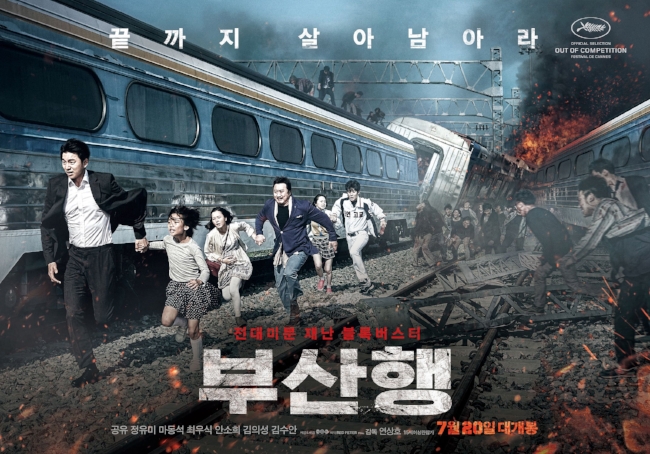
There are obvious stylistic similarities between Train to Busan and World War Z. The fast moving, aggressive zombies that transform their prey in seconds are again seen in this film. However, director Yeon Sang-ho does more with his smaller budget, making his undead horde far more threatening than the boiling CGI-fest of Word War Z. The zombies in this instance go semi dormant when cut off from the light. They are predominantly attracted to sound and seem to have lost most of their higher reasoning abilities. A closed sliding door is enough to outwit them and they do not use tools or their environment to their advantage. Train to Busan although tense and atmospheric, is not excessively gory. There are blood spurts and the bone crunching zombie transformations are ghoulish but the film does not rely on the extremely grotesque. Tension stems from the viewers concern for the casts wellbeing.
Performances are universally good in Train to Busan, although it would be remiss of me not to single out Kim Su-an as Soo-an. This young actress acquits herself extremely well as the young daughter of work obsessed fund manager. The film takes several bleak turns during the course of its story and I was concerned that it may end in a downbeat manner, similar to Romero’s Night of the Living Dead. However, the final resolution to the tale is poignant and certainly within the idiom of the proceeding one hundred minutes. Overall Train to Busan is an infinitely superior genre outing than most contemporary US mainstream horror films. It is engaging due to its international setting, moral integrity and cultural differences. Sadly, all these positive aspects will more than likely be lost when the US remake is released in 2018.



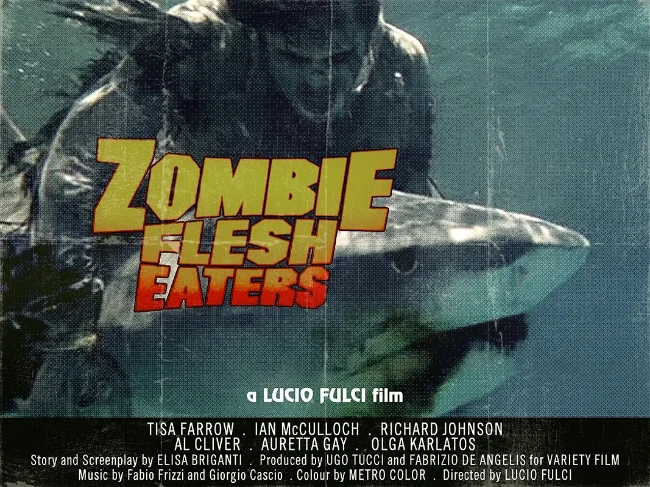
World War Z Unrated Cut (2013)
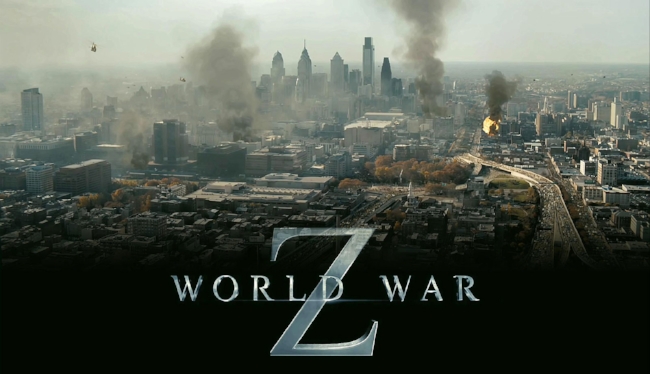
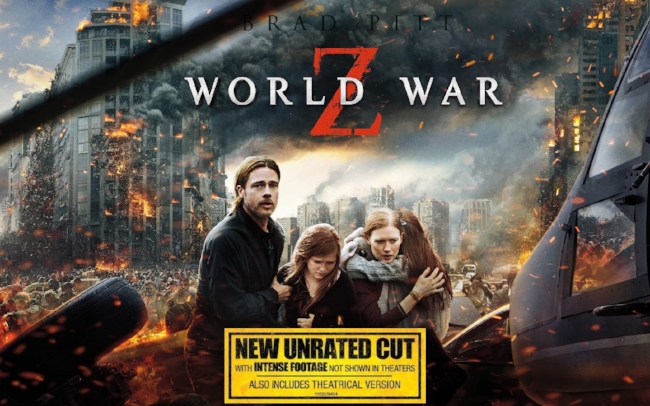
World War Z Unrated Cut runs seven minutes longer than the theatrical version of the movie and contains "intense footage not shown in theaters". The material consists of more violent alternative takes of existing action scenes and features mainly CGI effects work. There is no additional plot, although there may be some nominal changes to dialogue. Overall the unrated cut is an improvement over the theatrical print in so far it offers a more traditional zombie movie experience. However, compared to other examples of the genre, the unrated version of World War Z still remains relatively sedate in terms of violence. The movie focuses on the scale of the zombie outbreak, rather than the visceral mayhem of a George Romero film.
World War Z Unrated Cut runs seven minutes longer than the theatrical version of the movie and contains "intense footage not shown in theaters". The material consists of more violent alternative takes of existing action scenes and features mainly CGI effects work. There is no additional plot, although there may be some nominal changes to dialogue. Overall the unrated cut is an improvement over the theatrical print in so far it offers a more traditional zombie movie experience. However, compared to other examples of the genre, the unrated version of World War Z still remains relatively sedate in terms of violence. The movie focuses on the scale of the zombie outbreak, rather than the visceral mayhem of a George Romero film.
I thought it may be useful to post a selection of screen captures highlighting the major differences between the two versions of World War Z. Again, it is not in any way a comprehensive list but it broadly shows the major differences. If you require further details Movie-Censorship.com has produced a more thorough breakdown. My original opinion of the film itself still stands. World War Z is flawed but has good performances and explores some interesting concepts. The unrated cut of the movie certainly addresses one of the many criticisms levelled at the PG-13 theatrical release; namely that it was too tame. If you have yet to see World War Z, then this is the cut of the film I would recommend.
During the initial zombie outbreak in Philadelphia, we see more blood when people are bitten. Unfortunately, due to the colour palette that is currently in vogue with many film makers it is still not very clear.
Gerry shoots a zombie in the head while trying to find safety in the tenements of Newark. It is the only major head shot depicted in the movie.
Gerry is covered in more blood from the zombie he bayoneted in the stairwell.
In the unrated cut the camera clearly shows that it is Tommy that shoots the zombie attacking Gerry.
When Fassbach trips and accidentally shoots himself, we see the aftermath more clearly.
The imprisoned CIA operative pulls out one of his front teeth, while explaining how North Korea did this to its entire population in twenty four hours, to prevent the spread of the disease.
He then adds the tooth to a collection of others he has removed.
As the zombies overrun Jerusalem, we see more bullet hits as they are shot by Israeli soldiers.
Most of the gunshot wounds have been added in post production by CGI.
When an Israeli soldier uses his grenade, we see more explicit carnage caused by the explosion.
Further CGI blood and gunshot wounds are seen as the zombies are shot through the closed gate and railings.
A further grenade explosion shows more destruction to the zombies.
Segen's hand amputation is more graphic. Unlike the theatrical print it is obvious what Gerry has done.
Gerry binds Segen's wrist and waits to see if she becomes infected or not.
The zombie attack aboard the plane has a lot more CGI blood when victims are bitten.
Again due to lighting and editing, even the more explicit scenes are difficult to see clearly.
Another victim is bitten, prior to the plane explosively decompressing due to a grenade explosion.
Gerry's impalement injury is shown more clearly.
Gerry dodges the attacking zombie and hits it at the base of the spine with a crowbar.
He subsequently stamps on the zombie's face, crushing it.
30 Days of Night (2007)
Every once in while an established genre will get a new interpretation that gives it fresh impetus. 30 Days of Night did exactly that to the Vampire mythos ten years ago and is a very good horror film as well. Based on a well-known series of graphic novels by Steve Niles and Ben Templesmith, it tells how a remote Alaskan town falls under siege by a group of the undead, during the extended period of darkness that comes in winter; the thirty days of night of the title. Local Sheriff Josh Hartnett suspects something is wrong when the remote towns transport and telecommunications are sabotaged. Is the vagrant arrested for these crimes a lunatic or a “familiar” for more sinister forces?
Every once in while an established genre will get a new interpretation that gives it fresh impetus. 30 Days of Night did exactly that to the Vampire mythos ten years ago and is a very good horror film as well. Based on a well-known series of graphic novels by Steve Niles and Ben Templesmith, it tells how a remote Alaskan town falls under siege by a group of the undead, during the extended period of darkness that comes in winter; the thirty days of night of the title. Local Sheriff Josh Hartnett suspects something is wrong when the remote towns transport and telecommunications are sabotaged. Is the vagrant arrested for these crimes a lunatic or a “familiar” for more sinister forces?
What is refreshing in this instance is the fact that the Vampires back story is left suitably vague. There is also a complete omission of any religious inference. There are no crucifixes wielded here. The human characters are also likeable. The themes of death and how we face it are explored with people you have sympathy for. The production also has some solid special effects. Be warned, there is a lot of brutal violence. Heads are hacked off rather than swept of the neck with a single blow. 30 Days of Night also attempts to join that exclusive cinematic club of showing a child killing on screen. However, as the child is a Vampire, it does not quite have the same impact.
I haven't enjoyed a film of this kind as much since Blade 1 and 2 and the seminal Near Dark, which is the revisionist vampire film by which all others must be judged. It is good to see the undead treated in a way other than the traditional Eastern European idiom with all the psycho-sexual connotations. No capes, no bats or camp accents. In this instance, they are simply a force of nature that needs to be endured like the winter nights themselves. Be warned, if you are a fan of traditional romantic conclusions, then you may balk at 30 Days of Night ending. The film is hard edged and doesn't pull its punches. Don't say I didn't tell you.
The Asphyx (1973)
The Asphyx (AKA The Horror of Death) was released in 1973, just as the as the horror genre was about to be totally redefined by The Exorcist forever. William Friedkin’s magnum opus moved the genre away from its traditional Gothic based, literate and low budget roots and took the horror movie into the realm of the blockbuster. Special effects and shock proved to be more bankable than the old school approach of studios such as Hammer. That's one of the reasons why The Asphyx was a box-office flop. Fondly remembered by a few as a "thinking man's horror film" this cinematic curiosity’s greatest asset is also its Achilles Heel. The movie is perhaps too plot heavy and cerebral, failing to give even the most patient of audiences the shocks that they craved. Since its release this film has been seldom seen on television and has often been poorly treated on home media.
The Asphyx (AKA The Horror of Death) was released in 1973, just as the as the horror genre was about to be totally redefined by The Exorcist forever. William Friedkin’s magnum opus moved the genre away from its traditional Gothic based, literate and low budget roots and took the horror movie into the realm of the blockbuster. Special effects and shock proved to be more bankable than the old school approach of studios such as Hammer. That's one of the reasons why The Asphyx was a box-office flop. Fondly remembered by a few as a "thinking man's horror film" this cinematic curiosity’s greatest asset is also its Achilles Heel. The movie is perhaps too plot heavy and cerebral, failing to give even the most patient of audiences the shocks that they craved. Since its release this film has been seldom seen on television and has often been poorly treated on home media.
The film’s premise is simple but intriguing. A nineteenth century British philanthropist and amateur psychic researcher embarks on a fateful quest for immortality. Sir Hugo Cunningham (nicely played by Robert Stephens) after experimenting with taking photographs of dying people, discovers the presence of a nebulous spirit of the dead, known in mythology as the Asphyx. It appears at the moment of an individual’s death and is only visible via photographic plate. Sir Hugo becomes obsessed with capturing his own Asphyx and thus ensuring his immortality, so he can pursue a life of science. However, this enterprise does not progress as Sir Hugo expects and there are consequences both for himself and his family.
With its verbose, literate script, well defined characters and fascinating themes, The Asphyx is the epitome of the low budget style and creativity that became passé in the early to mid- seventies. The chills are subtle but effective under the direction of Peter Newbrook and the widescreen cinematography by Freddie Young adds polish as well as elegance to the proceedings. Filled with fa oreboding atmosphere and an accurate period production design, this is an intelligently conceived horror film that relies more on story than shocks. There is little violence and the only visual effects are those of the screaming Asphyx as Sir Hugo attempts to capture it. These are simplistic and brief.
The plot and themes of this film reflect the thinking of many psychic researchers of this period. Vaguely similar ideas were explored in the film Flatliners, however, one cannot compare the two in any other fashion. The Asphyx has a creative plot that avoids some of the usual cinematic and genre clichés. The drama between the central characters is well conceived and holds the audience's attention. The final codicil is haunting, memorable and somewhat sad. Overall The Asphyx is a minor horror classic that deserves far wider recognition. I therefore wholeheartedly recommended it to more discerning viewers that prefer plot driven narratives over cheap scares.
The Objective (2008)
Daniel Myrick has experience when it comes to low-budget productions, having co-written The Blair Witch Project. The Objective offers a promising science fiction story set in contemporary Afghanistan, hinting at both supernatural and extraterrestrial plot themes. The spartan, low budget production along with minimal use of special effects allows the story to be the focus of the movie. As with Pontypool, many questions are raised throughout the course of the plot and the attentive viewer is required to listen and consider what is presented, rather than just blindly accept everything on face value.
Daniel Myrick has experience when it comes to low-budget productions, having co-written The Blair Witch Project. The Objective offers a promising science fiction story set in contemporary Afghanistan, hinting at both supernatural and extraterrestrial plot themes. The spartan, low budget production along with minimal use of special effects allows the story to be the focus of the movie. As with Pontypool, many questions are raised throughout the course of the plot and the attentive viewer is required to listen and consider what is presented, rather than just blindly accept everything on face value.
It is the ambiguity of the story (which mixes Djinn mythology, British colonial history with elements of Erich von Däniken) and the way the protagonists struggle to come to grips with the ongoing events that proves so intriguing. A re-occurring theme throughout The Objective is how one’s personal frame of reference can sometimes limit how you interpret and quantify any new experience. Director Daniel Myrick utilises a classic plot device, in which the establishment tries to suppress events, fearing they will cause social unrest, if made known to the general public.
Although far from perfect, with average performances, clunky dialogue and a rather artificial narration, The Objective still manages to absorb and entertain. The low budget works to the films advantage, with action scenes feeling more like news footage. Instead of shocks there is an increasing atmosphere of disquiet which builds well over the ninety-minute running time. The mixture of genres works rather well and the films conclusion is suitably open ended and will definitely provoke debate. Overall, it’s best to file The Objective under “interesting curiosity”.
Wilderness (2006)
Independent British Horror films often showcase some of the best up and coming talent about. Neil Marshall was a prime example of this back in 2002 with his debut film Dog Soldiers. He has subsequently produced an interesting body of work in both cinema and television. Independent horror films offer a great deal of flexibility to writes and directors, affording them an opportunity to explore themes that larger studios simply will not touch. Happy endings, moral subtexts, glamorous leads are not de rigueur. In fact, they are potentially a hindrance. The genre is a platform for gritty and often unpleasant tales that explore the darker side of human nature. Michael J. Bassett's Wilderness falls squarely into this category, offering a grim but gripping story.
Independent British Horror films often showcase some of the best up and coming talent about. Neil Marshall was a prime example of this back in 2002 with his debut film Dog Soldiers. He has subsequently produced an interesting body of work in both cinema and television. Independent horror films offer a great deal of flexibility to writes and directors, affording them an opportunity to explore themes that larger studios simply will not touch. Happy endings, moral subtexts, glamorous leads are not de rigueur. In fact, they are potentially a hindrance. The genre is a platform for gritty and often unpleasant tales that explore the darker side of human nature. Michael J. Bassett's Wilderness falls squarely into this category, offering a grim but gripping story.
The somewhat lurid UK DVD packaging calls this film “Predator, meets Scum, meets Lord of the Flies” which rather succinctly breakdowns the story. There is also a major spoiler photo on the back sleeve which ruins the plot. However, considering the film features Sean Pertwee, an actor who always seems to meet a painful and unpleasant end in whatever he appears, may be this is not such a giveaway after all. The story follows a group of young offenders, with a list of unpleasant criminal traits, as they travel to a remote island for an outward-bound course and “team building” exercise. One by one they fall victim to a hidden homicidal manic. Is this merely a cruel chance of fate, or is there a more sinister motive behind these events.
On first look, Wilderness is hardly brimming with original ideas and director Michael J. Bassett treats us to numerous homages to famous genre films. However, what viewers do get as a bonus are some well-defined characters that you can actually identify with. So often these days we have to endure films exclusively populated by people we could not careless about. Not so here. The sociopath and the sex offender are particularly interesting roles with a surprising amount of depth. Performances are good all round and it’s that inherent British quality I mentioned earlier that gives this film a little more credibility and vitality. This is not a slick glossy production. Being so would be counterproductive. The stark quality to the production design means we focus on the narrative.
Be warned, this film has a “15” rating in the UK and it's a particularly strong one at that. The killer uses a crossbow, knife and hunting dogs to kill his prey. There is one death scene that stands out and may well make the casual viewer flinch. There is also some staged animal violence which may not be well received by dog lovers. The dialogue includes liberal doses of British colloquialism throughout the film but this is not out of step with the story or the characters. Wilderness is also well paced, balancing both plot exposition and shocks. Overall the one hundred minutes plus running time is used very well. It would also be remiss of me if I didn’t mention the excellent use of location photography in Scotland, Northern Ireland and the Republic of Ireland.
At a time when the US market seems incapable of making anything other than substandard remakes of classic films, foreign movies or just uninspired jump scare horror films; it is refreshing to find a British production that shows some creativity and difference. Yes, Wilderness is derivative in its basic premise but the formula provides an opportunity to present some valid characters and credible dialogue. It chooses to avoid arbitrary distinctions between good and bad, instead offering more nuanced ideas as to why people do terrible things. There is also a sincere approach to the entire film, showing the love of a genuine genre fan and not the cynical, contrived workmanship of a studio hack. Therefore, I would recommended Wilderness to anyone who enjoyed Dog Soldiers.
Dracula Untold (2014)
I passed on opportunity of seeing Dracula Untold at the cinema in late 2014, as I was not overly impressed by what I had seen from the trailers. I finally caught up with Universal's reboot of the franchise, hoping that a home viewing and tempered expectations would make me more cordially disposed towards the film. Sadly, the movie turned out exactly as I had surmised, proving to be a superficial under taking with no narrative depth. Furthermore, is was a bloodless action film, rather than a true horror movie, resulting in a very unsatisfying compromise. The fact that this movie made over $200 million globally at the box office saddens me.
I passed on opportunity of seeing Dracula Untold at the cinema in late 2014, as I was not overly impressed by what I had seen from the trailers. I finally caught up with Universal's reboot of the franchise, hoping that a home viewing and tempered expectations would make me more cordially disposed towards the film. Sadly, the movie turned out exactly as I had surmised, proving to be a superficial under taking with no narrative depth. Furthermore, is was a bloodless action film, rather than a true horror movie, resulting in a very unsatisfying compromise. The fact that this movie made over $200 million globally at the box office saddens me.
Dracula Untold benefits from the presence of Luke Evans as Vlad the Impaler. He is a likeable actor with old fashioned good looks. Sadly, there's is precious little for him to do during the films somewhat brief ninety-two-minute running time. The plot, dialogue and character development are perfunctory to say the least. Writers Matt Sazama and Burk Sharpless script offers no depth or sophistication, rendering everything binary and simplistic. Dominic Cooper has zero credibility as the villainous Turkish Sultan, Mehmed the Conqueror. He is simply "bad" because that's what we are told in the most pedestrian fashion. Similarly, the passionate relationship between Vlad and his wife, Mirena (Sarah Gadon) lacks any dramatic conviction.
As usual these days with movies that hope to start a teen friendly franchise, the entire production seems far more concerned with visual style and overall ambience. The effects are impressive but cannot ultimately sustain a movie of this nature. The lack of emotional content meant that I was fundamentally indifferent to the central character’s plight. Furthermore, I couldn't even take comfort in the action sequences as they're meticulously edited to the requirements of the rating. This is a bloodless vampire movie and with little or no suspense and unpleasantness. Not even the scenes with Charles Dance as the master vampire can save things. This is a woefully anaemic tale about the undead, which is contradictory in itself.
Perhaps the most saddening thing about Dracula Untold is the fact that I can't even summon the energy to get angry about what a poor movie it is. This is simply par for the course. The movie was conceived and pitched with a very specific market in mind. One that is young and unfamiliar with the superior cinematic heritage that exists. The tone, pacing and superficial nature of the film is tailor made for an audience that loves to consume such material. While this demographic continues to robustly support such material then the studios will naturally continue to churn it out. It will be interesting to see if Universal Studios reboot of The Mummy this summer is any improvement cinematically.
The Woman in Black: Angel of Death (2015)
The Woman in Black: Angel of Death is set forty years after the events of the first movie and despite the outbreak of World War II, malevolent spirit Jennet Humfrye is still haunting Eel Marsh House. The decaying mansion is now home to a group of evacuee children from London and it's not long before staff become aware of a ghostly presence. A mute child named Edward, who is bullied by the other children, seems to be the focal point of Jennet's supernatural interests. One of the teachers, Eve Parkins (Phoebe Fox) is protective towards the boy and subsequently incurs the wrath of the woman in black.
The Woman in Black: Angel of Death is set forty years after the events of the first movie and despite the outbreak of World War II, malevolent spirit Jennet Humfrye is still haunting Eel Marsh House. The decaying mansion is now home to a group of evacuee children from London and it's not long before staff become aware of a ghostly presence. A mute child named Edward, who is bullied by the other children, seems to be the focal point of Jennet's supernatural interests. One of the teachers, Eve Parkins (Phoebe Fox) is protective towards the boy and subsequently incurs the wrath of the woman in black.
The Woman in Black had the advantage of a central star driving the movie forward, but the producers compensate for the absence of Daniel Radcliffe by setting this sequel in a strong period setting. The cast drawn mainly from UK television is robust and appropriate. Phoebe Fox sustains the story as the plucky heroine and Jeremy Irvine is competent as a RAF pilot and romantic interest. The younger actors are equally convincing, enduring some grim shocks as they’re menace by the vengeful spirit. The production captures the era well and maintains a suitably brooding atmosphere.
Cinematographer George Steel creates a sombre and bleak aesthetic, working within a very dark colour scheme. The fog bound woods and tidal beaches are genuinely chilling and provide a ghoulish setting for the story to unfold. The Woman in Black: Angel of Death is not a gory film, instead relying upon a brooding atmosphere of fear and some well contrived jump scares. The absence of a major box office star meant that the distributors did not indulge in any horse trading over the rating this time round. In the UK the movie has subsequently been rated 15 due to its very dark tone and subject matter.
The Woman in Black: Angel of Death is a solid and professionally crafted movie that acquits itself well in the current sub-genre of “jump scare” based horror movies. It is not quite as good as the first movie, mainly because it doesn't do much more than provide viewers with more of the same. However, what it sets out to do, it does well. The change of setting and inventive sound design enhance the proceeding, making it superior to many of its contemporary set rivals. The movies greatest strength is still its bold subject matter. Infanticide is still a theme that many studios shy away from.