
Last week I completed Questa: Narrator Mode. This is a standalone accessibility-focused Windows utility in development for the MMORPG, The Lord of the Rings Online. Its purpose is to bring text based quest dialogue to life through natural-sounding spoken narration. At present there are several similar projects in development. Khazad Voice TTS and LOTRO TTS being two examples. Both broadly do the same thing although there are subtle technical distinctions between them. Questa is by default intended to be used with an English language installation of LOTRO. It is also designed around using the CPU to do most of the heavy lifting, rather than a GPU. The reasoning behind this decision is to try and make the minimum hardware requirements for Questa as broad as possible, thus allowing more LOTRO players to use it. Data regarding what are the average PC specs of LOTRO players are scarce but my gut tells me that not everyone has a top end gaming rig. Hence this needs to be considered.
Narrator Mode is the base version of Questa. It uses Kokoro TTS to read all quest bestowal dialogue, using a single default voice that can be chosen from eight. It runs from a standalone installation folder and is independent of LOTRO. There is a simple settings window where users can choose the voice they wish to use and select which monitor you play LOTRO on, if you have a multi-monitor set up. There is also an OCR correction and pronunciation editor, so that you can train Questa to read words and phrases correctly. Finally the settings menu allows you to toggle the narrator on and off. Questa identifies quest dialogue via OCR and then pulls the full bestowal text from a database that is sourced from the game client itself. To date that database is current with the latest game release. Future releases of Questa: Narrator Mode will have an update facility and a voice preview option.
Questa: Narrator Mode is currently undergoing a closed test before being made available on GitHub. I want to determine what are the best PC specifications for the utility to run optimally. At present TTS generation takes about between 3 to 5 seconds on my own PC which has a AMD Ryzen 7 5700X 8-Core Processor (3.40 GHz and 32.0GB of DDR4 SDRAMM. It works well within this environment, especially when NPCs have a some generic pre-recorded voice dialogue of their own (“the situation is dire”, “Welcome to Khazad-dûm” and such like). However, I recently tested Questa: Narrator Mode on my laptop which has a AMD Ryzen 5 3500U Processor with Radeon Vega 8 Graphics and 8 GB RAM. It worked perfectly but the narration took 30 seconds to be read, which is simply unviable. Not utilising the GPU comes with its own trade off. Users are not inconvenienced by not having a Nvidia graphics card but they will need a fairly robust processor instead.
Moving forward, I am now focusing on Questa: Character Mode. In this version, voices are dynamically assigned to NPCs, again from a library of eight. This number may increase in future builds but for the present keeping the voice pool modest is convenient. Broadening the scope of Questa in this way introduces a new problem to be solved. Specifically identifying the NPC bestowing the quest dialogue and determining what race and sex they are, so the right voice can be assigned. Quest text windows do not include the name of the NPC that is talking. Furthermore the database that provides the quest text does not simply link to a characters name but instead to a numerical ID. The number sometimes can be reconciled against a name but sometimes it is linked to a description of what the NPC does. For example Elrond can be clearly identified by his name in early quests found in Rivendell. Later in the game when he starts a quest chain for an instance in the Vale of Anduin, his numerical ID points to the name “Visitor”.
Hence, to accommodate identifying NPCs, I have had to expand the scope of the database used in Character Mode. The original database constructed to identify quest dialogue was produced via the game client. The expanded database that has to identify NPCs is being augmented with data provided by the LOTRO-Wiki. I believes that LOTRO TTS has done something similar, where as Khazad Voice TTS uses a Lua Plugin to identify NPCs. The expanded database for Character Mode can at present identify 16,161 NPCs out of 18,081 records. However, there remains 1,920 NPCs whose data does not yield obvious details on race and sex. Vendors and Stable Masters fall into these categories. As do some high profile characters such as Elrond, Aragorn and Legolas who bestow multiple quests over the course of the game. Hence a fall back identification method is required.
This is in some ways one of the most interesting aspects of developing Questa. I like brainstorming ideas so that practical solutions can be found. Hence I am currently exploring ideas such as quest region and zone mapping. Certain zones in LOTRO, such as Southern Mirkwood and Moria are broadly race specific as far as NPCs. However Bree is the classic example of a mixed quest hub, so this raises the possibility of race specific dialogue parsing to see if any keywords and phrases can be used to successfully establish race. Another idea was to analyse the pre-recorded dialogue that some NPC use (known as the Greeting Bark). The pitch may be relevant to determine sex. However, this adds a degree of complexity as ambient sound effects may mask the voice dialogue. I even flirted with the idea of using a VLM and training it to visually determine race and sex but it would mean adding a substantial new element to the existing production pipeline. However, an answer may lie within an NPCs Entity / Spawn records or even their animation frames.
Although I enjoy brainstorming potential solutions, it is often the most simplest that work and are used. I think a list of under 2,000 unidentified NPCs can be manually corrected, especially if that process can be partially automated. I would like to get the updated database sorted in the next few weeks. As it stands at present, the one I am currently working with can identify 89% of NPCs in LOTRO, which is more than sufficient for me to test the assignment of voices dynamically. As ever I will continue to record my various tests and post videos on YouTube. I am pleased to announce that there is now a Project Questa website which is being updated as development progresses. It will eventually be the place where all the files and documentation are held and the various versions of Questa can be downloaded. I will also continue to write in more detail about the ongoing development here. Thank you for the ongoing support I have received. It is greatly appreciated.
Thursday 29th October was a milestone for Project Questa. I completed the core build for the utility after copious testing. Over the last week several issues have come to light over such things as the size of the quest bestowal window, OCR mistaking punctuation for text and voice latency during narration. All of which have now been resolved to a degree that is acceptable. During the course of solving these problems a lot of ideas and considerations have emerged and as a result, I think it best to set out an overall scope of work for Questa. This is to avoid mission creep and to set out clearly what Questa will and will not offer. Furthermore this list is now effectively closed, so I have a clear path set before me. It is also worth noting that as this is a “one man band” project, I reserve the right to pack it all in, if circumstances dictate. I don’t plan to do so at present but life can play wild cards from time to time.
For the last six years, Echoes of Angmar, the “unofficial” server for the MMORPG The Lord of the Rings Online, has quietly gone about its business. Its existence has been a known quantity during this time but it has never really become a major talking point. Providing an iteration of LOTRO from November 2007, those who wished to play the “classic” version of the game did so and everyone else stuck with the official version. Middle-earth Enterprises issued a cease-and desist letter in August 2022 but I get the impression it was a formality rather than a serious endeavour to close this unofficial version of the game down. Since then, the two versions of the game have co-existed without any fuss. I briefly tried Echoes of Angmar when they were conducting stress tests and found it a pleasant nostalgia trip for a few days. Ultimately it was not something I wanted to play habitually but it was good to be reminded of how LOTRO was when I started playing in 2008.
I began work on Project Questa on the 27th of September, because I couldn’t get Khazad Voice TTS to work on my PC. Since then I’ve spent several days a week working on my AI narrator utility and have made steady progress. Last time I wrote about the project the production pipeline ran as follows. DXCam, OpenCV, Windows OCR and Microsoft Speech API (SAPI). Over time, I determined that Tesseract was a better OCR and that Kokoro TTS produced superior narration. However, in the last week I found that constant fine tuning across different aspects of the production process was not really producing any significant improvements. The main problems were capturing text from dialogue windows that required scrolling, as well as overall latency in producing narration. A delay over 5 seconds is too long in my assessment. Hence I decided to fundamentally change the overall approach to dialogue capture.
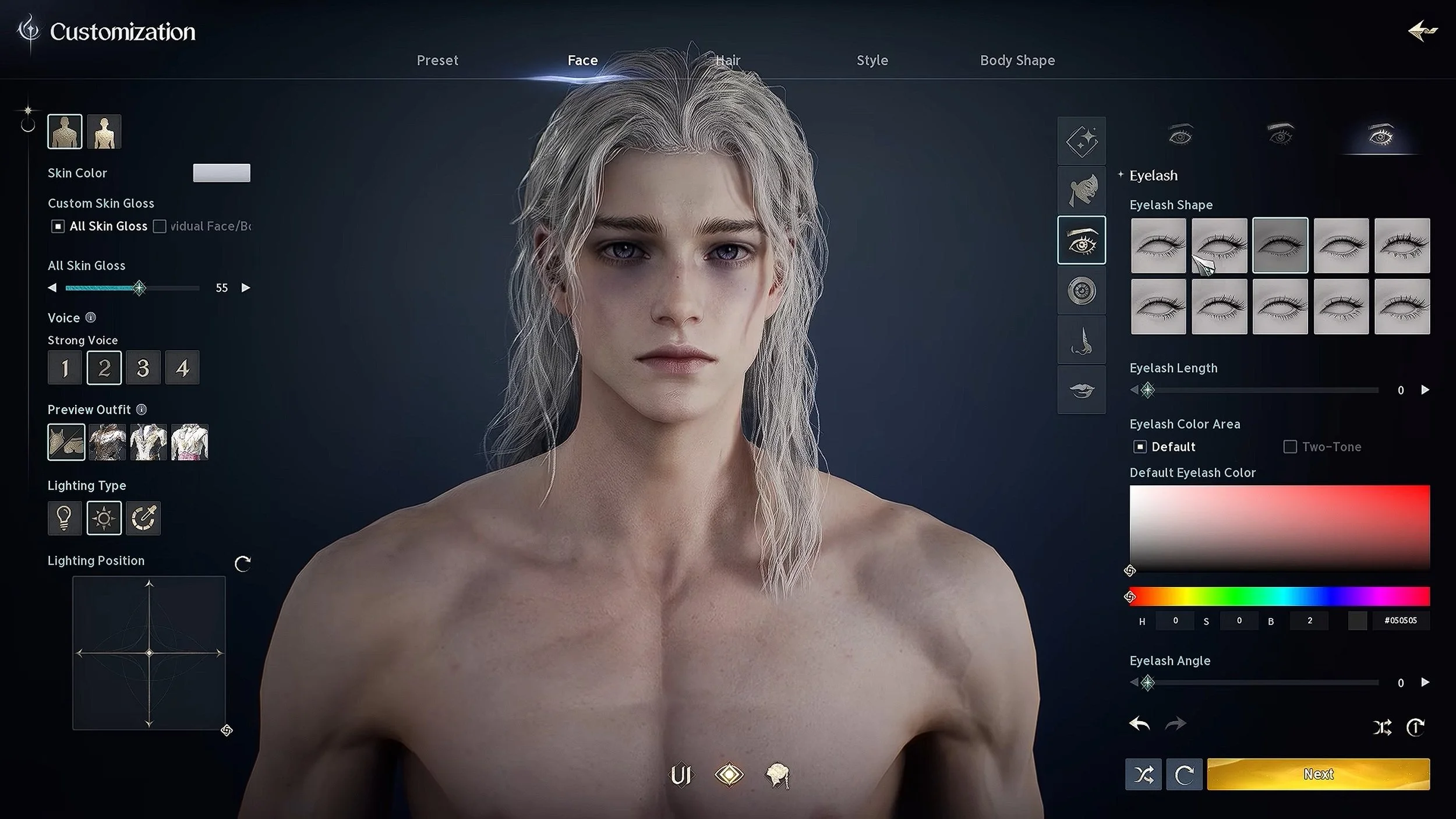
One of the things that I enjoy when playing a new video game is character customisation or character creation. I will spend hours trawling through settings, changing the most minute and consequential aspects of my avatars appearance. I am certain that there is a psychological aspect to this particular game mechanic and that it says something about you as a person. Are your creations shaped just by a need to look good in-game or is there more to it? Are they external manifestations of your sexual preferences or thoughts on body image. Do you treat them as characters from a book that exists in your mind. Do you aspire to recreate the likeness of people you know or admire? Do you strive to make your avatar look like you? Whatever the reasons, it would seem that character creation is something that a lot of gamers enjoy. Hence I am not alone in my borderline obsession. What you look like in-game is equally as important as your character’s name.
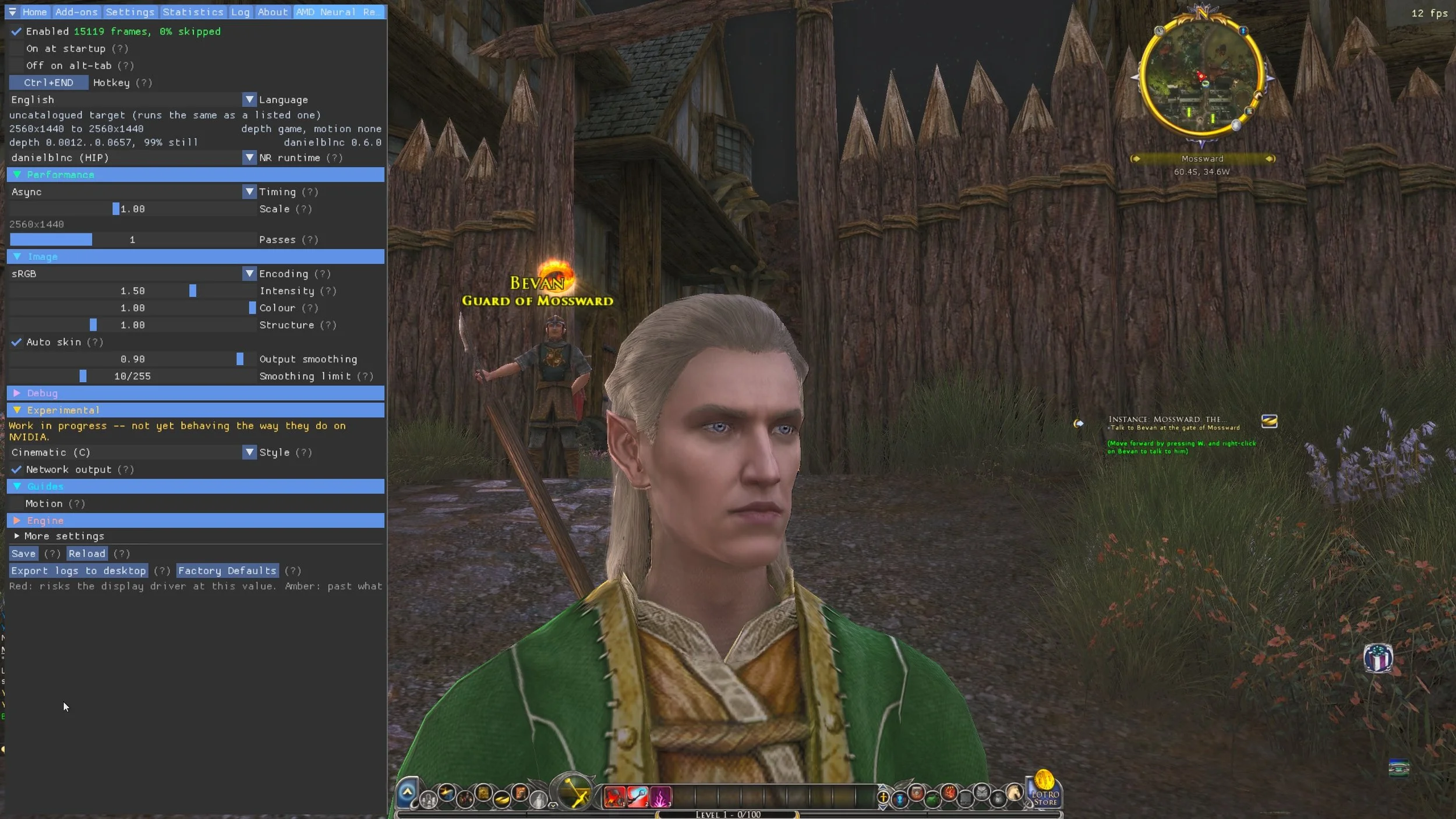
I recently tried to use DLSS 5 Manager with the MMORPG, The Lord of the Rings Online. Unfortunately, things didn’t work out. Today I undertook a similar experiment with AMD Neural Rendering, which is a broadly comparable product. Both utilities use 3D-Guided Neural Rendering, an AI technology that alters how lighting, reflections, and textures look in a game. Instead of just upscaling the image like older versions, DLSS 5 uses an AI network to instantly "re-render" lighting and material responses over the game's layout, achieving photorealistic details that would normally negatively impact a graphics card's performance. Or to put it in less fancy terms, the game graphics are enhanced and modified, although it is highly subjective as to whether the end results are an improvement. However, as a game such as LOTRO is unlikely to ever receive a major graphical overhaul, tools such as these are the nearest players will get to revised graphics.
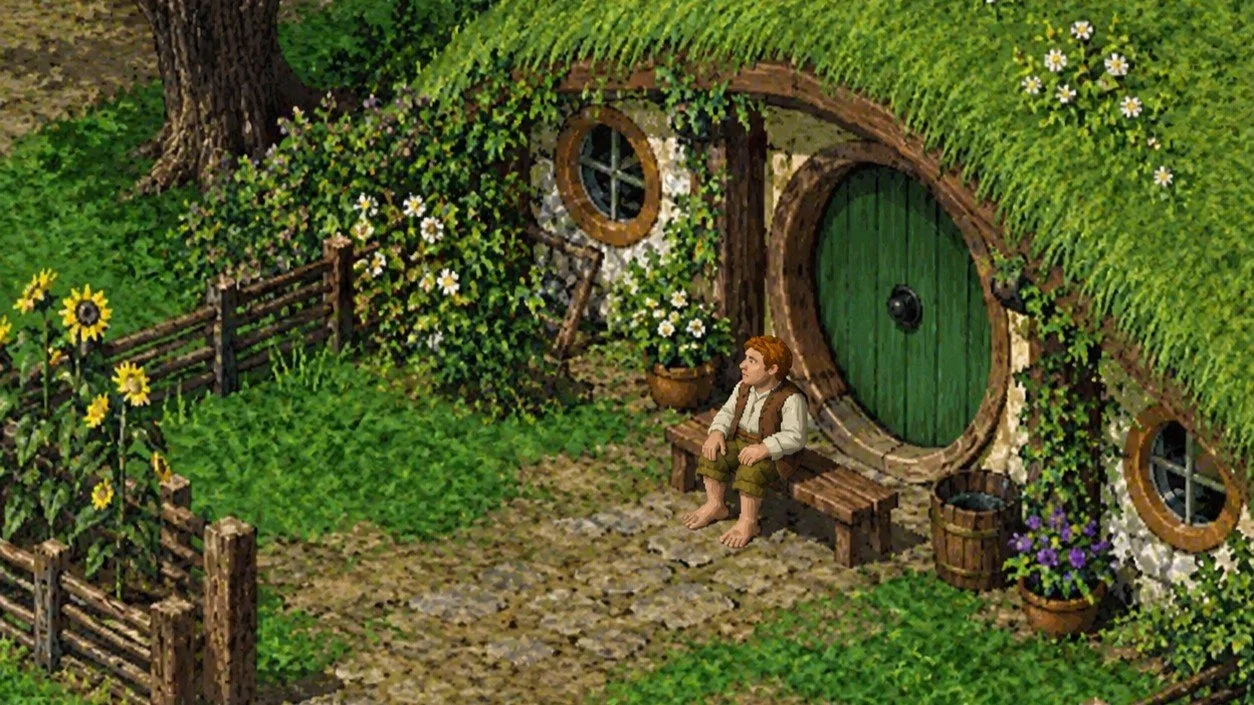
The core game code and engine for the MMORPG, The Lord of the Rings Online, is about 24 years old. LOTRO began originally as Middle-earth Online, developed by Sierra On-Line in 1998. Turbine took over full development of the project in 2003/2004 when their parent company, Vivendi Universal Games, acquired Sierra. The content that had already been developed by Sierra was abandoned and Turbine created a new game using structural elements such as the UI and game engine from their previous release Asheron’s Call 2 from 2002. The Lord of the Rings Online: Shadows of Angmar was officially released in April 2007. Hence, the active public release code is 19 years old. Despite continuous expansion and updates, along with a recent migration to 64-bit architecture, the foundations of LOTRO retains a nearly twenty year old legacy framework. This frequently contributes to modern technical hurdles and engine constraints.
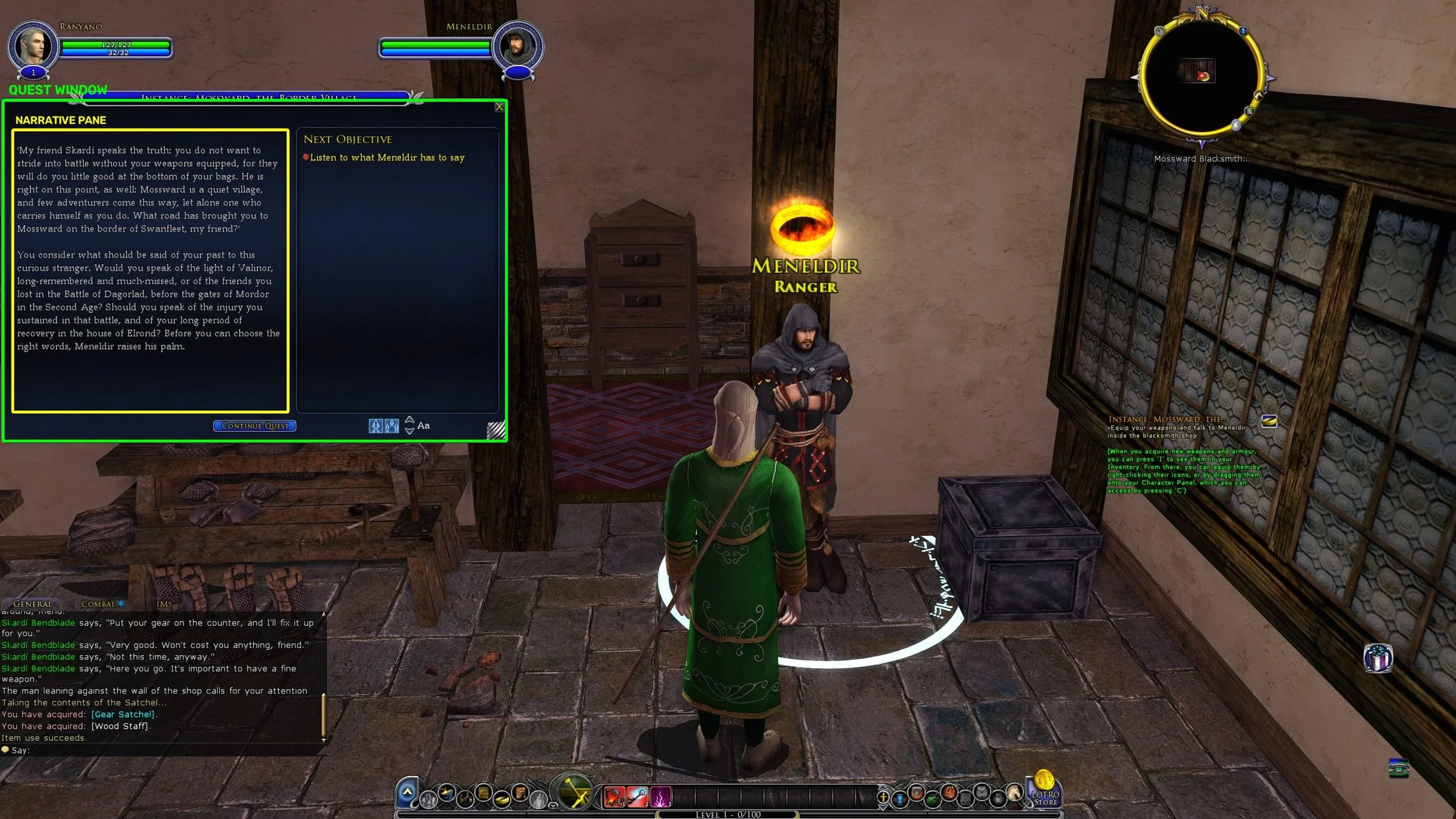
A few years ago, there was a fan created project to provide voice narration of NPC dialogue in the MMORPG, The Lord of the Rings Online. This mainly involved capturing the text in the quest dialogue windows and then sending it to OCR software, before using a text-to-speech program to read it. LOTROVoice as it was known, broadly worked but the creator stopped developing it as it proved troublesome to maintain. However, I recently discovered Khazad Voice TTS which is a separate project that does pretty much the same. I went so far as to install this “immersive AI narrator for LOTRO” after seeing a YouTube video of it being used successfully. Sadly I ran into issues configuring Khazad Voice TTS, because I have two monitors and LOTRO runs on the secondary (by my choice) and not the primary. I couldn’t “lasso” the dialogue windows in LOTRO during the calibration set up, which effectively prevented me from completing the process.
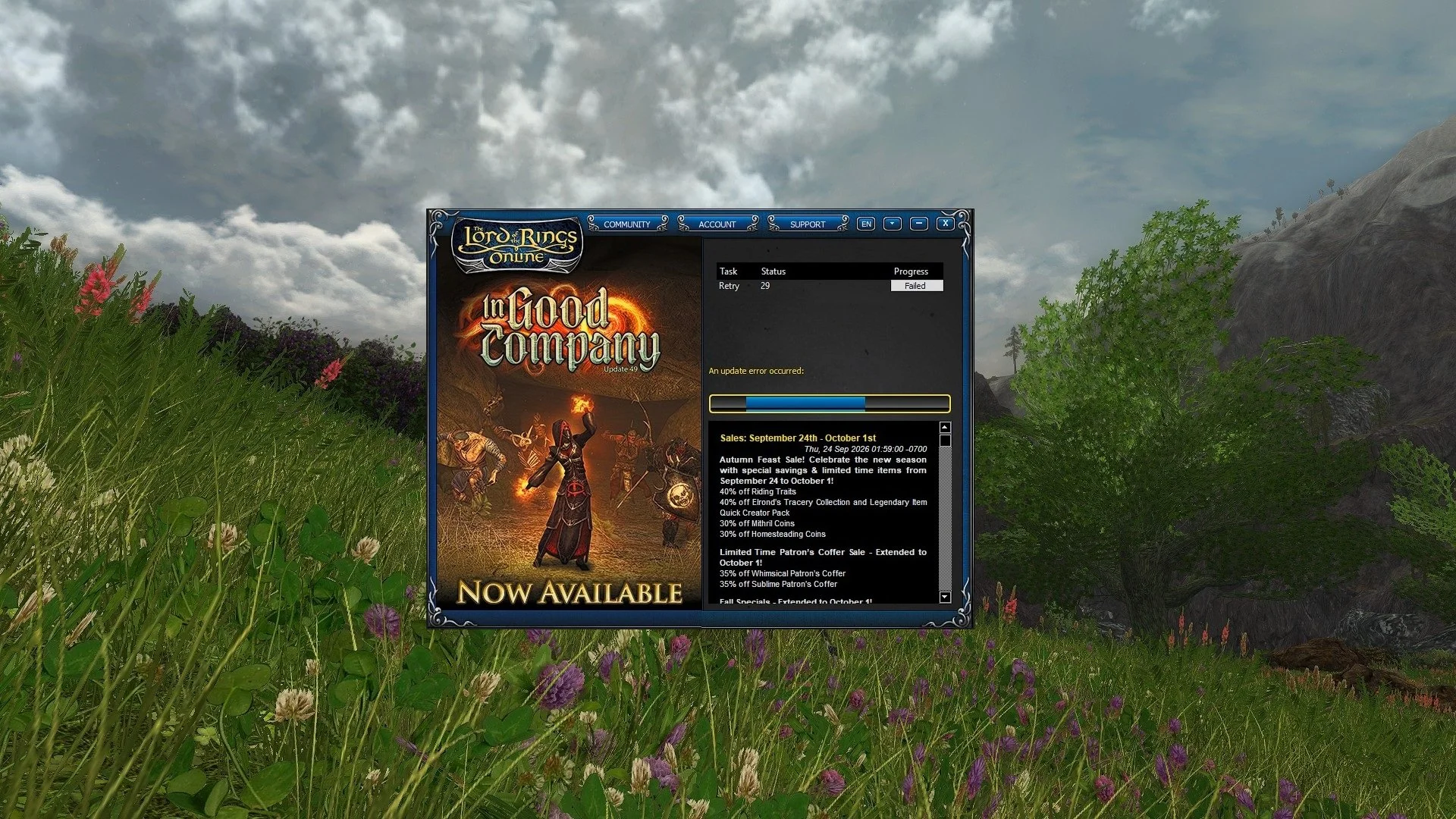
Throughout yesterday and early today, there was an issue logging in to the MMORPG, The Lord of the Rings Online. Upon starting the game launcher, it would attempt to connect to the patch server to download the latest game update. This process would start but then subsequently stall at 33%. The launcher would then attempt to reconnect to the patch server every 60 seconds but could not make any further progress. Some players found that if they left it long enough, it would eventually complete the download and the launcher then progress to the next screen where they could input their username and password. However, for the majority of LOTRO players the problem would simply persists and the launcher would be stuck in a loop. Some players attempted to reinstall the game or use the repair data facility in the launcher but neither of these proved to be successful workarounds. The patch sever needed to be bypassed to resolve the issue.

Two years ago I wrote a post about fine tuning your graphics in the MMORPG The Lord of the Rings Online. Apart from installing ReShade and using AMD Adrenalin, the options were somewhat limited, due to the game’s age and multiplayer status. Since then, I’ve been playing LOTRO with the game settings maxed out, a custom ReShade profile to make the colour palette more vivid and Radeon Image Sharpening enabled within the AMD software. The game looks clear, crisp and the draw distance is pretty good for an ageing game but I still wish the graphics could be tweaked further. Hence, I’ve been trawling the internet in a vain attempt to see if I can find any third party utilities that could be used to enhance LOTRO further. During the course of my search I stumbled across DLSS 5 Manager. This is an open-source, intelligent utility and one-click mod installer designed to inject and manage Nvidia's DLSS 5 neural rendering features, ReShade, and OptiScaler into PC games.
Are video games becoming easier? It’s a perennial subject that is frequently discussed by those who play them. Often the question of whether they have actually become easier is not the focus of the debate, as it seems to be broadly recognised that it is the case. Instead, discussion of this matter tend to drift into the rectitude of this change. Debate’s of this nature are usually awash with subjective opinions and personal preferences which are then put forward as objective facts. It’s not just a question of video games becoming easier, it’s the fact that making them easier is “wrong” and those who want them as such are “not proper gamers” etc. The hours that have been lost to this pointless, tedious debate are uncountable. However, I digress. Let us return to the matter of video games becoming easier, because although fans discuss this a lot and have plenty to say, you don’t often hear from the developers on this subject.
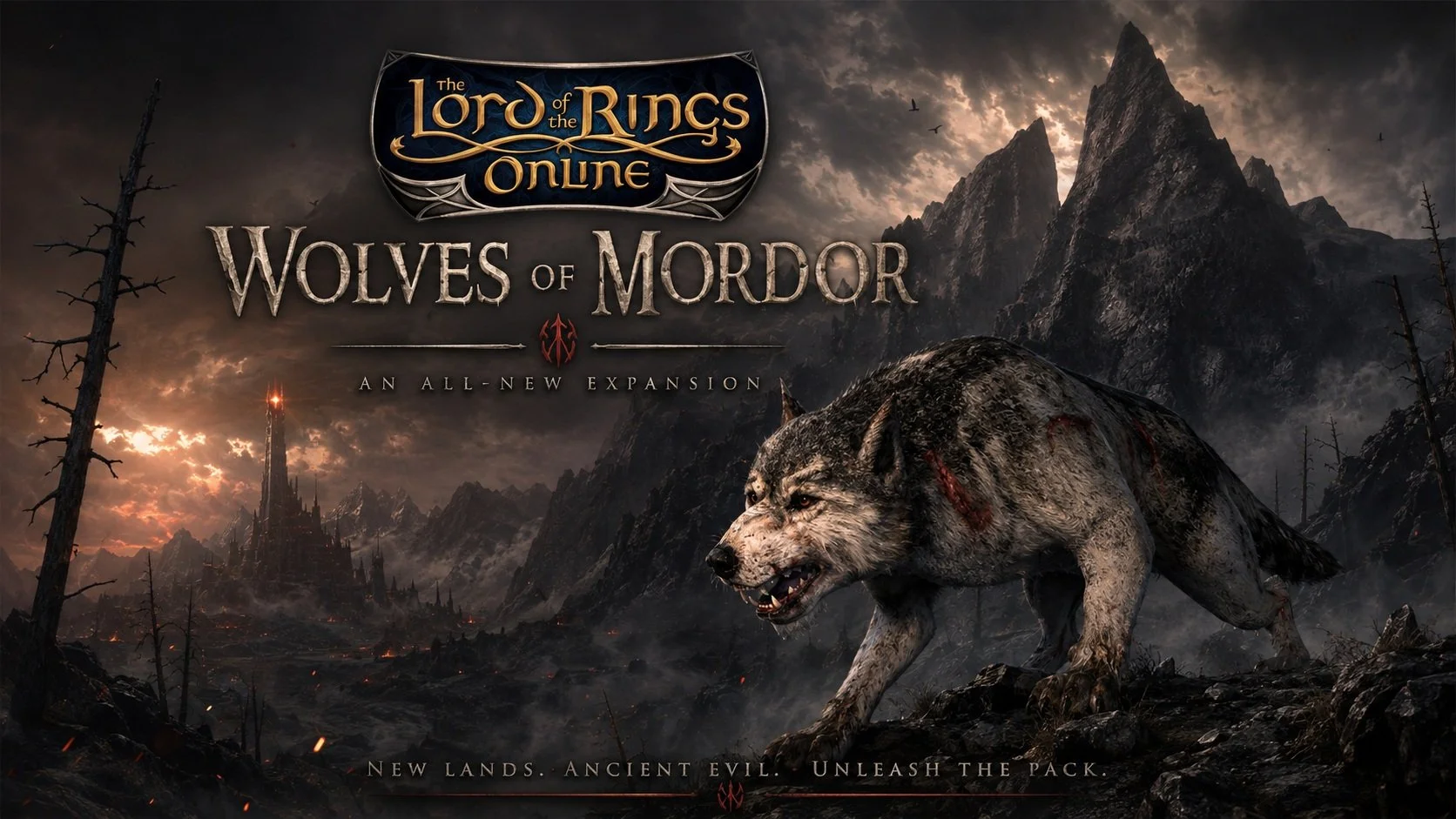
The next expansion for the MMORG, The Lord of the Rings Online, was announced on the 1st August, via the gaming website MMORPG.The Wolves of Mordor, which will launch later in the year, appears ambitious in scope as it will include two new game systems as well as the obligatory story update. This expansion takes place in Draugardh located in the North East of Mordor, beyond the Plateau of Gorgoroth. It includes the new zones of Heledhris, Parth Rhavas and Nan Ogol. These vary environmentally ranging from the arid, volcanic and semi-tropical. Players will encounter the Daugrim in these regions, Werewolves but not in the modern sense. This is not the lycanthropy of Eastern European legends but in the established Tolkien idiom of fell spirits inhabiting the bodies of Wolves. The region also sees the return of the Woses and players can expect to encounter Elves and scouts from Gondor. As ever with LOTRO expansions, there will be new instances as well as a raid.
I was recently perusing my archive of old blog posts, when it struck me how much I’ve written about the MMORPG genre over the years. Naturally, there was far more material from between 2008 and 2012 as that was period when I immersed myself in the genre and was very enthusiastic about it. I was at a point in my life when I had the time to dedicate to such games and I was happy to participate in the social aspect of they offered. I would regularly play through group content and spend time socialising online with fellow guild members. My experience remains a textbook example of how online games can be more than the sum of their parts and that where you are at in your life has a major impact upon your overall enjoyment. As I read though various old posts it became clear that my experiences where specific to this particular part of my life and that they cannot be repeated. My relationship with the genre is very different now and that’s fine.
Video games as a genre are extremely poor at explaining themselves. When you buy a new game you’ll often find little or no information regarding the basic systems and mechanics. The industry assumes that their customers are by default familiar with the fundamentals of playing a modern video game. Hence if a game has a tutorial, it is often based around videos rather than detailed verbal instructions. You are are briefly shown a clip of a specific move being successfully undertaken but it is seldom shown in a wider context. The industry also expects the fan community to take on the role of curating and disseminating information about its games. The move away from forums and bespoke websites to Discord highlights this. Discord is a primarily a real time communication tool and not good at maintaining a historical data archive. If you want an answer to a specific gaming question, you’ll more than likely find it on YouTube in a video made by a fellow gamer.
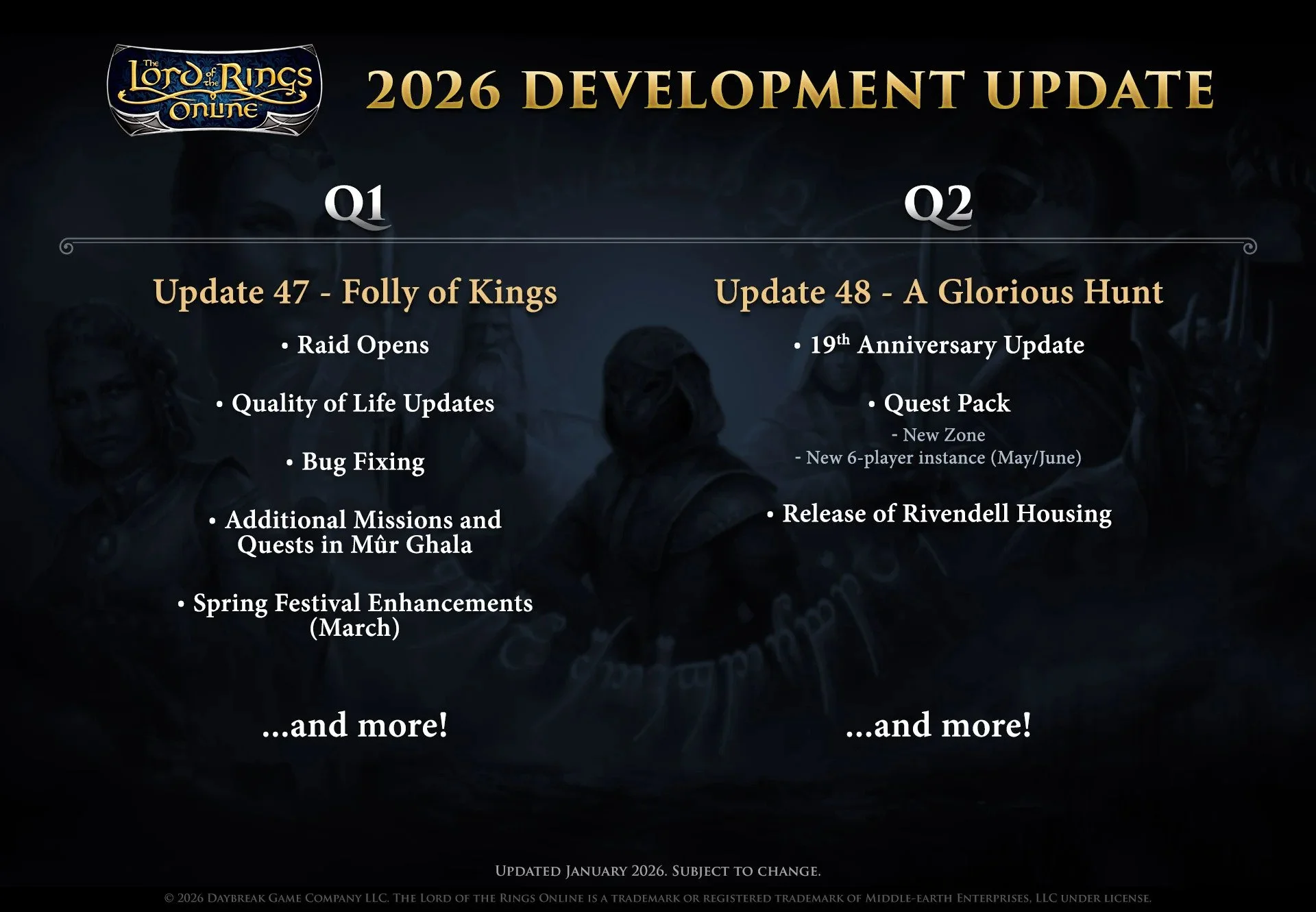
According to the recent “letter to the players”, Standing Stone Games will be adding a new zone to the MMORPG The Lord of the Rings Online in the second quarter of this year. Possibly around May or June. Having spent the last three expansions in the South of Middle-earth exploring the tropical Umbar and the deserts of Harad, I would certainly welcome a change of location. I have gradually warmed to these zones over the last eighteen months but I do find them so incongruous. They are so radically different to the European style content that has been the mainstay of the game for so long. Tolkien’s source text has plenty of detail regarding Eriador and Rhovanion. Information regarding Harad is scarce, hence it has afforded the developers a great deal of artistic freedom. Although exceedingly well realised these tropical zones have taken a while for me to get used to.
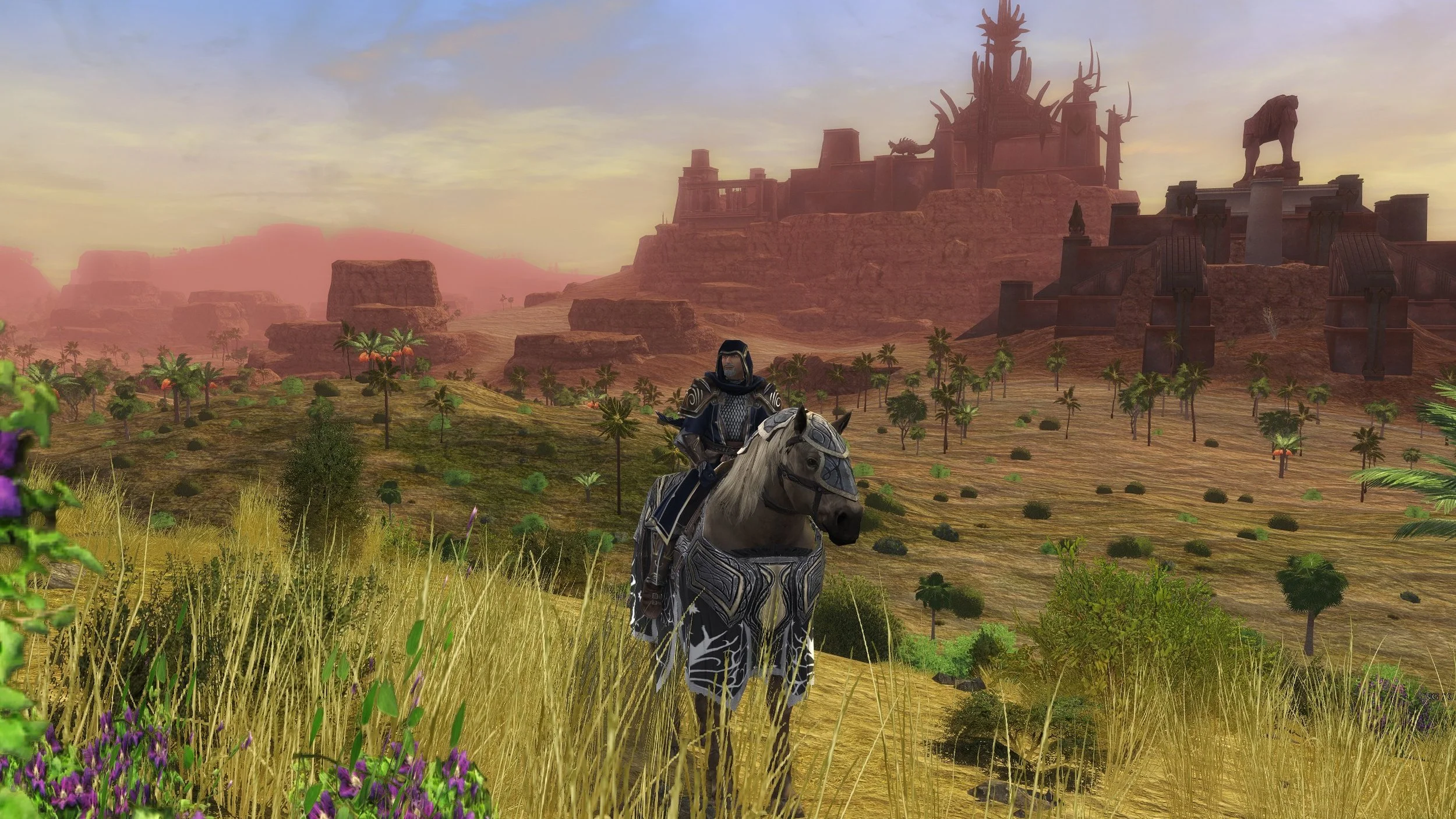
I’m not sure exactly when it started but I’ve recently noticed a graphical bug within the MMORPG The Lord of the Rings Online. This problem often occurs within caves or in areas where there are a lot of rocky surfaces. Hence it has become very apparent in the latest two expansions, set in Umbar and Harad. This graphical glitch causes some surface textures to appear to flash from light to dark intermittently. The resulting strobe effect is hard to ignore and very distracting. Fortunately, a quick online search showed that this is not a problem unique to my installation of LOTRO and is a known problem. Furthermore, there is a very simple workaround, which is to go into the Advanced Graphics setting and uncheck “Per Pixel Lighting”, which immediately remedies the problem. I have no idea why this has recently started to happen but at least it can be resolved.
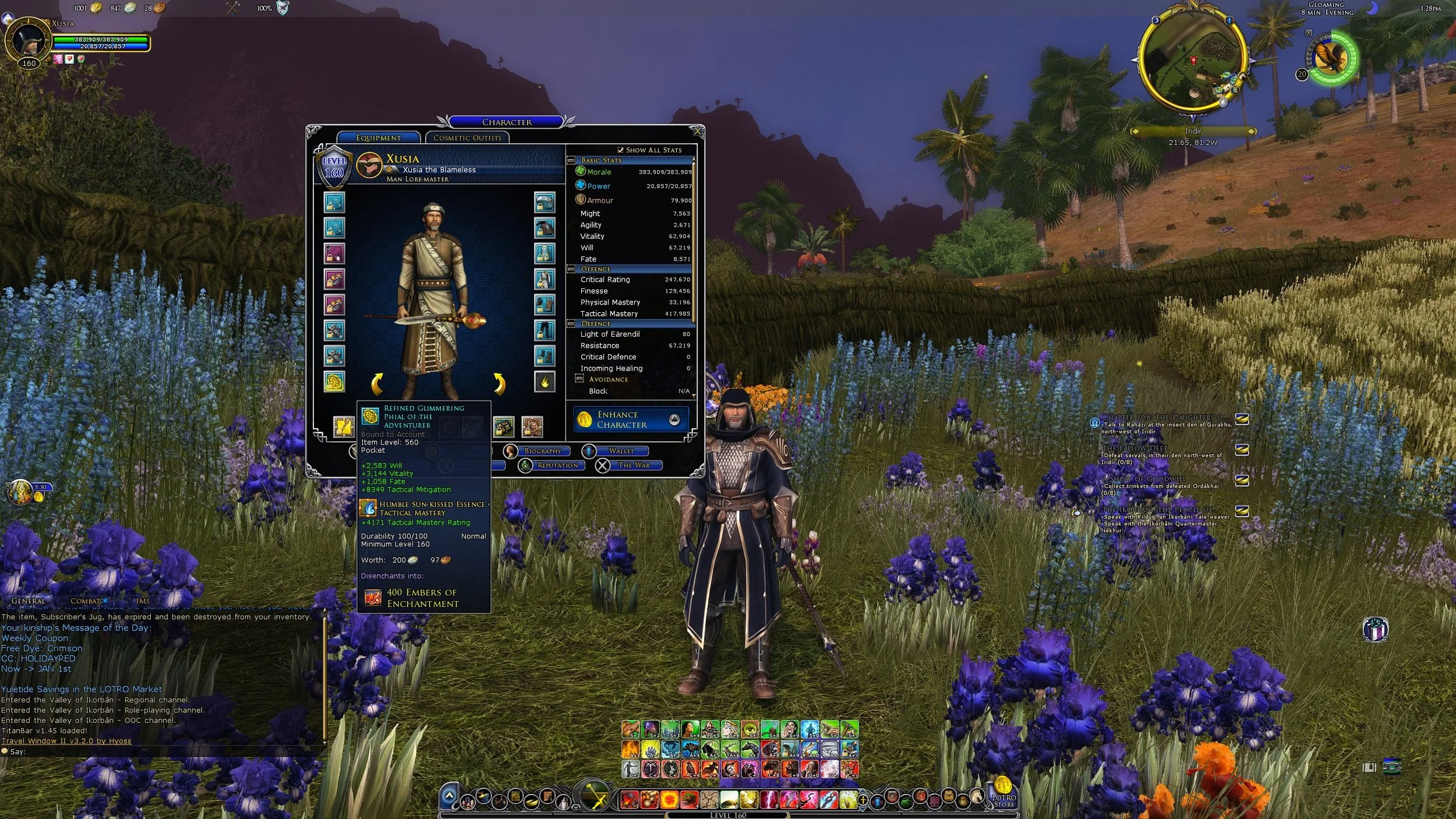
The latest expansion for the MMORPG The Lord of the Rings Online, Kingdoms of Harad, launched on December 3rd. With this release the level cap was raised from 150 to 160. It should also be noted that the cap for virtue traits was also raised from 96 to 100. Naturally these changes meant that there is a requirement to replace all armour and jewellery once the new cap is reached. Similarly Legendary Items have to be reforged and any traceries upgraded or replaced. If you follow the Epic Story it will lead you from quest hub to quest hub. The main quest rewards, along with those from side quests will provide adequate gear as you slowly progress towards the new level cap. The new raids, instances and missions/delvings then provide a means to acquire higher quality level 160 gear. LOTRO and indeed, many other MMOs are consistent in this methodology.
It is customary in a post such as this to list the various games that I’ve played over the last twelve months and share my thoughts on them. Wider analysis of the video game industry is also de rigeur. Unfortunately, I don’t really feel disposed to do either of those two things. My thoughts on the games I’ve played have already been published and can easily be accessed via the links at the bottom of this post. As for the video game industry, it suffers the same flaws as music, TV and cinema. There is creativity and innovation out there but it is often drowned out by mainstream products which are demonstrably inferior due to their inherent mediocrity. As for the business side of things, we once again clearly see the failings of the corporate management class. Sadly, they do not face the consequences of the mistakes that they make.
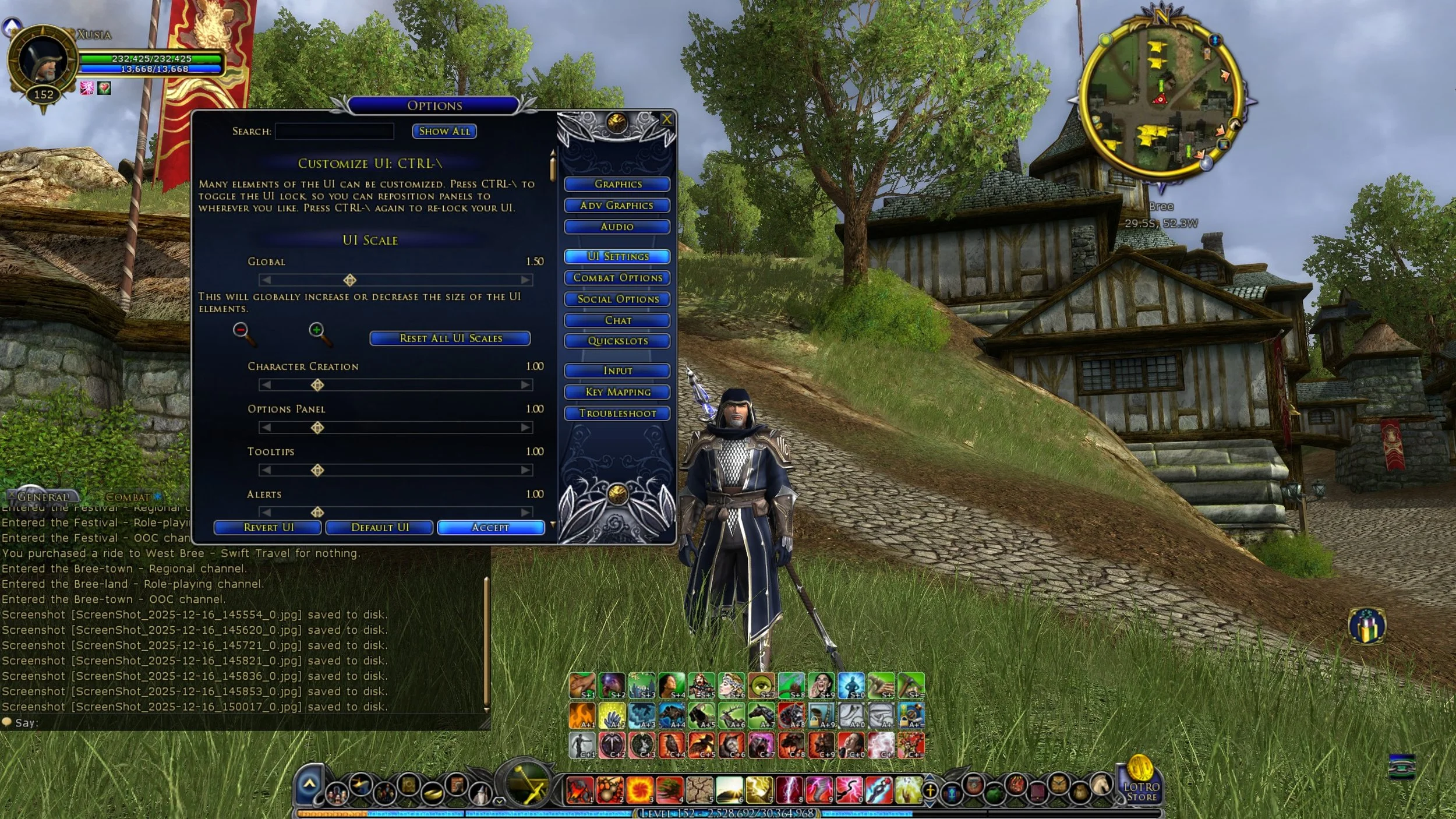
Today Standing Stone Games began beta testing Update 46.1 for the MMORPG The Lord of the Rings Online. The current preview on the Bullroarer test server is mainly for the new instance cluster that comes with the Kingdoms of Harad expansion which launched a few weeks ago. However, it would appear that this latest preview has another feature or note. One that should please LOTRO players. Contrary to what a lot of people thought, myself included, SSG have been working on a scaling UI for 2K and 4K monitors and the results are now available for testing from today Monday 15th through to Friday 19th December. Until now the main workaround to the lack of UI scaling has been to use either Nvidia or AMD graphics software to upscale the game from 1920 x 1080, or a third party app such as LosslessScaling. Having an official solution is a far better option.
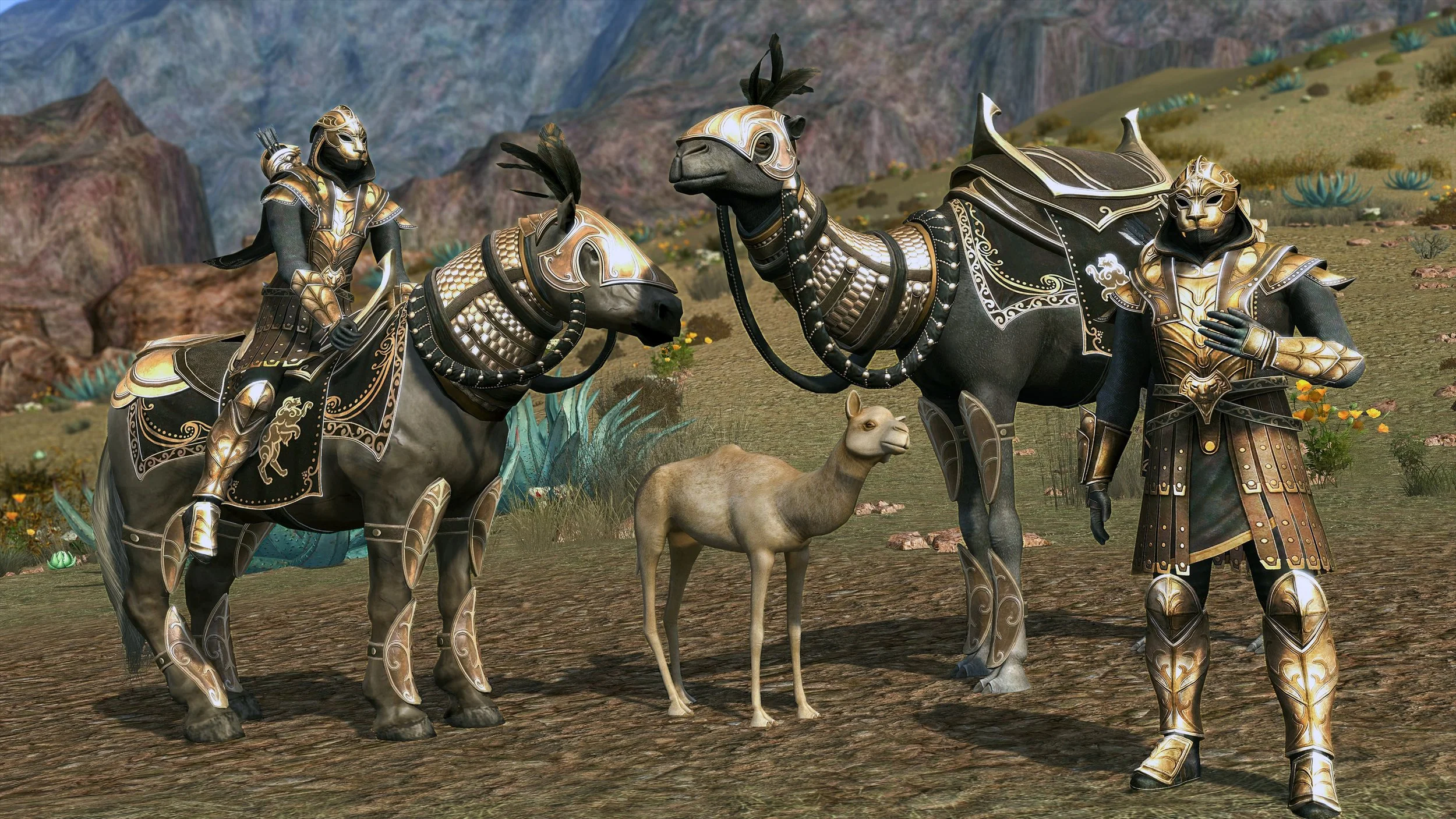
Kingdoms of Harad, the 13th expansion for the MMORPG The Lord of the Rings Online, was released today. Highlighting developer’s Standing Stone Games continuing commitment to this eighteen year old game. As 2025 draws to a close, I thought it would be prudent to reflect upon the current state of LOTRO and to consider what may come next year. Two words that I associated with this MMO are stable and consistent. The playerbase is loyal and dependable. Player numbers never greatly decline nor do they notably expand. LOTRO fills a very specific gaming niche and one of the reasons it retains its players is that there is no suitable alternative game. Although there is not a great deal of data in the public domain, it is generally accepted that LOTRO has an older player demographic and that many are consummate Tolkien fans.
The MMORPG The Lord of the Rings Online runs on a broad spectrum of PCs. From archaic laptops to high end gaming rigs, although it may require a bit of tweaking. At present, the optimal way to play the MMO is at a resolution of 1920x1080 (FHD) with the graphics setting maxed out. The graphics are sharp and the UI is readable. However, a growing number of gamers are now using 2K and 4K monitors. You can play LOTRO at higher resolutions such as 2560×1440 (QHD) and 3840x2160 (UHD) and the game looks great. However, the UI does not scale and so is very small on 2K and 4K monitors. The skill icons on the quickslots (shortcut bars) and the in-game text become difficult to see at these resolutions, which deters some players from using them. It is a known issue that Standing Stone Games are attempting to address but it is unlikely to be resolved any time soon.
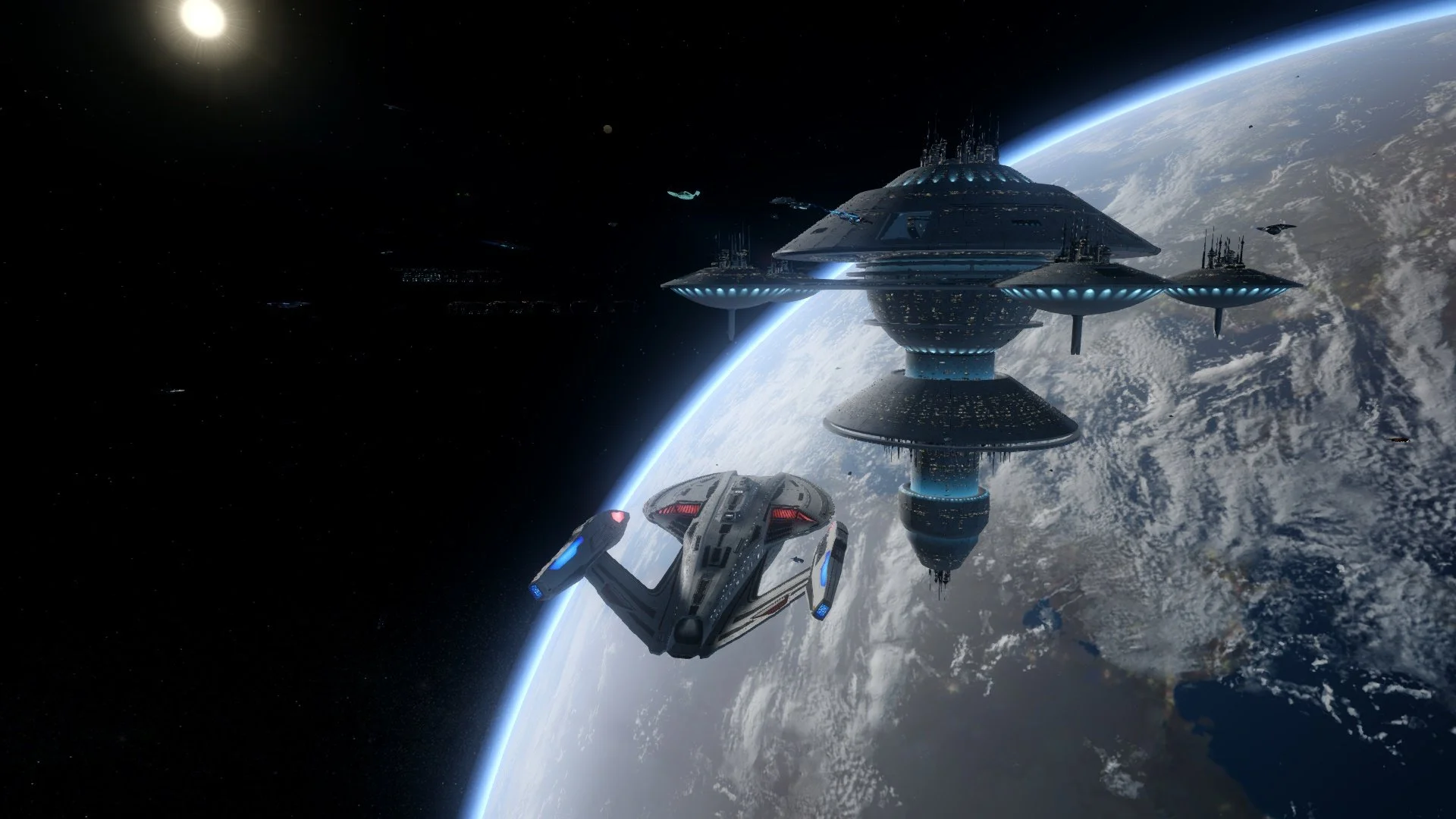
I recently read a post on Massively Overpowered about skills rotation in the MMORPG genre. I found the subsequent discussion in the comments fascinating. Mainly because I have never used a fixed rotation of skills in any of the MMORPGs that I play. I understand the reasoning behind such things and why some players want to optimise their combat performance. Using one’s skills in a specific order to maximise damage and manage their subsequent cooldown has a logical appeal. In Star Trek Online, some players go so far as to create keybinds for their rotations and assign it to a specific hotkey, which is then continuously pressed throughout combat. However, rotations are a blunt tool that lack flexibility, often being geared towards dealing with a single target or using an area of effect skill against a larger group. They may not be the optimal approach to combat when things do not go to plan.
Tolkien enthusiasts may recollect Athlon Games, a subsidiary of Leyou Technologies, announcing that it was developing a new MMORPG, based upon The Lord of the Rings, back in September 2018. The following summer, it was revealed that Amazon Game Studios was the partner developer for the project. In late 2020, Leyou Technologies (a Hong Kong-based company), was acquired by the Chinese conglomerate Tencent. This triggered a contract clause with the license holder, Middle-earth Enterprises, allowing them to terminate the existing arrangement if a new deal could not be met. Amazon and Tencent were unable to agree upon how to proceed with the project, leading Amazon to withdraw from negotiations. The project was subsequently scrapped. No details or images of the MMO have been released.
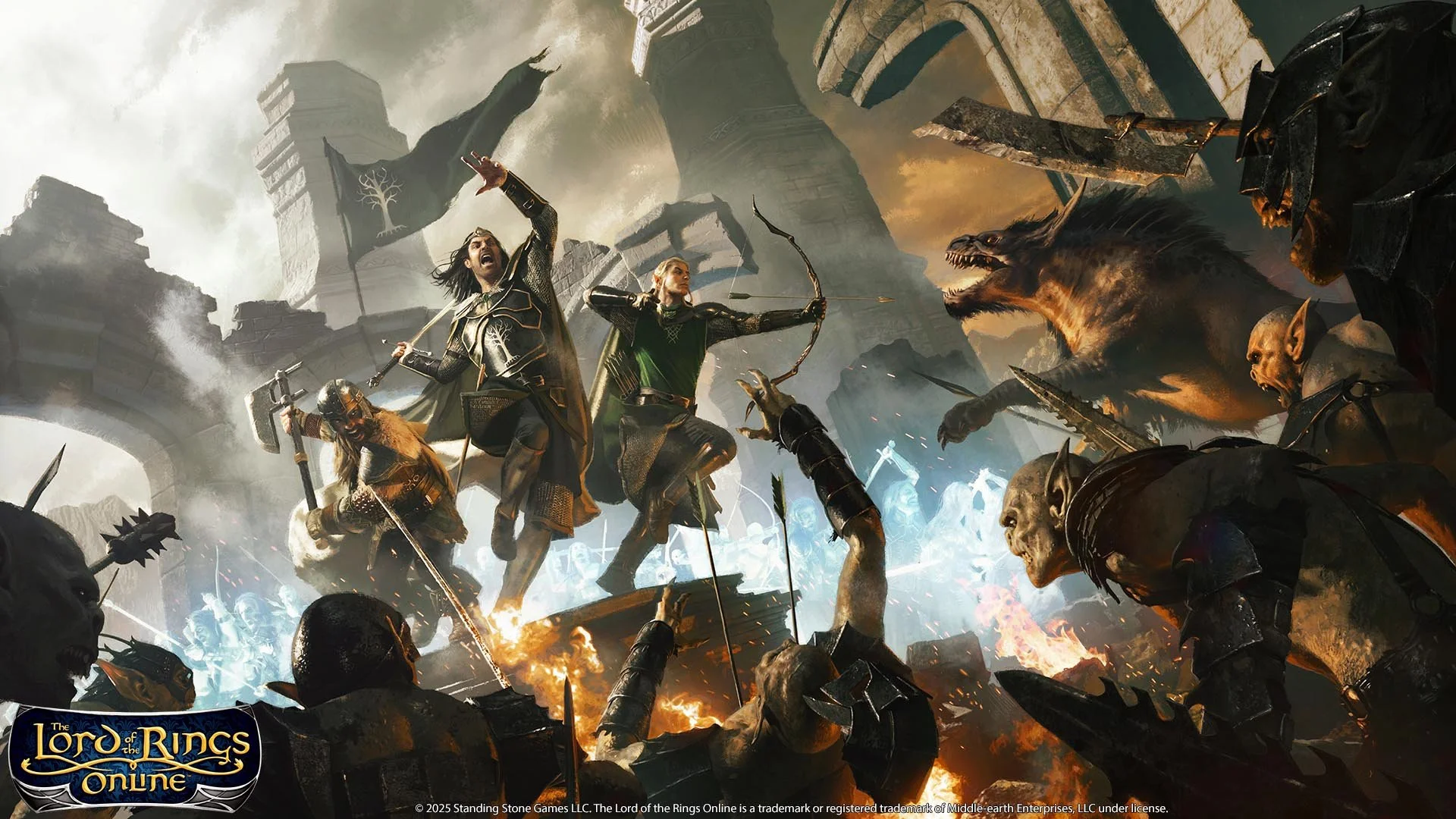
After a six month migration period, Standing Stone Games formally closed all their legacy 32-bit game servers for the MMORPG, The Lord of the Rings Online, on the 31st August 2025. Despite this planned closure being widely discussed via the game’s official forums, professional video game websites and fan blogs, many LOTRO players were unaware of this deadline. Hence many were unable to migrate their respective alts to the new 64-bit servers. Naturally those affected by these closures were upset, especially those with longstanding characters who didn’t relish the prospect of starting from scratch with a new alt. Thankfully, SSG have been true to their word and as of today, have re-opened these “dark worlds” to character transfers. If you have an alt trapped on one of the older game worlds, then now is the time to use the transfer wizard and move them to a new active game world.
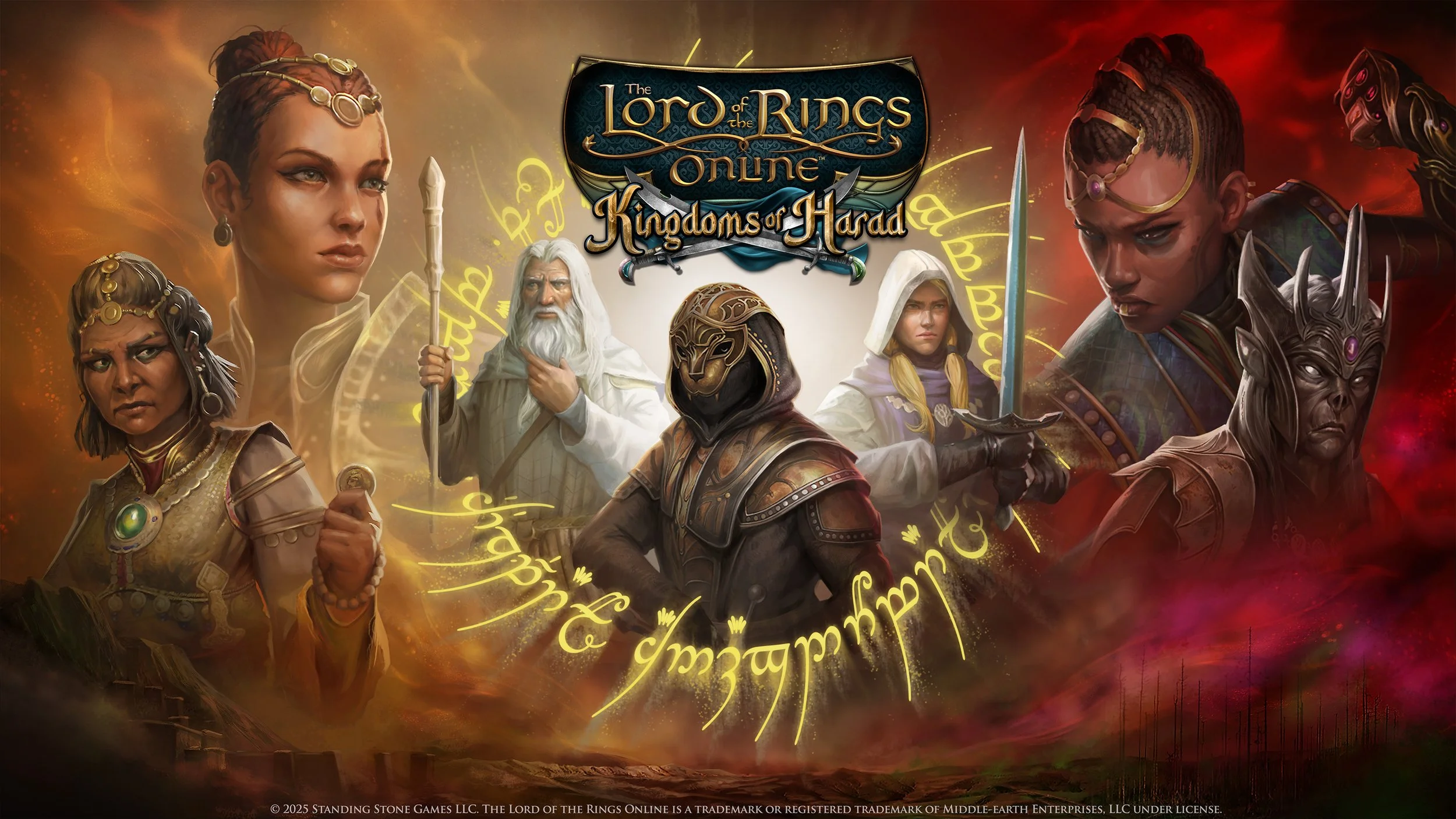
MMORPG announced earlier today and it was subsequently confirmed by Standing Stone games, that the new expansion for The Lord of the Rings Online will be Kingdoms of Harad and that it will launch later in the year. The expansion will see the conclusion of the epic Song of Waves and Wind storyline and the level cap raised from 150 to 160. There will be a new region to explore, Mûr Ghala, comprising four zones. Adagîm, Idagâl, An Shêru and Kighân. The latter contains the main trading hub of Zajâna. Players will travel into the region with Gandalf the White, along with allies of the Kindred of Coins and Mizadi as they seek to counter the regional power struggle brought about by the fall of Sauron. Canonically, this takes place three months after the destruction of the ring, hence King Elessar and Eomer are busy with domestic affairs in their respective kingdoms.
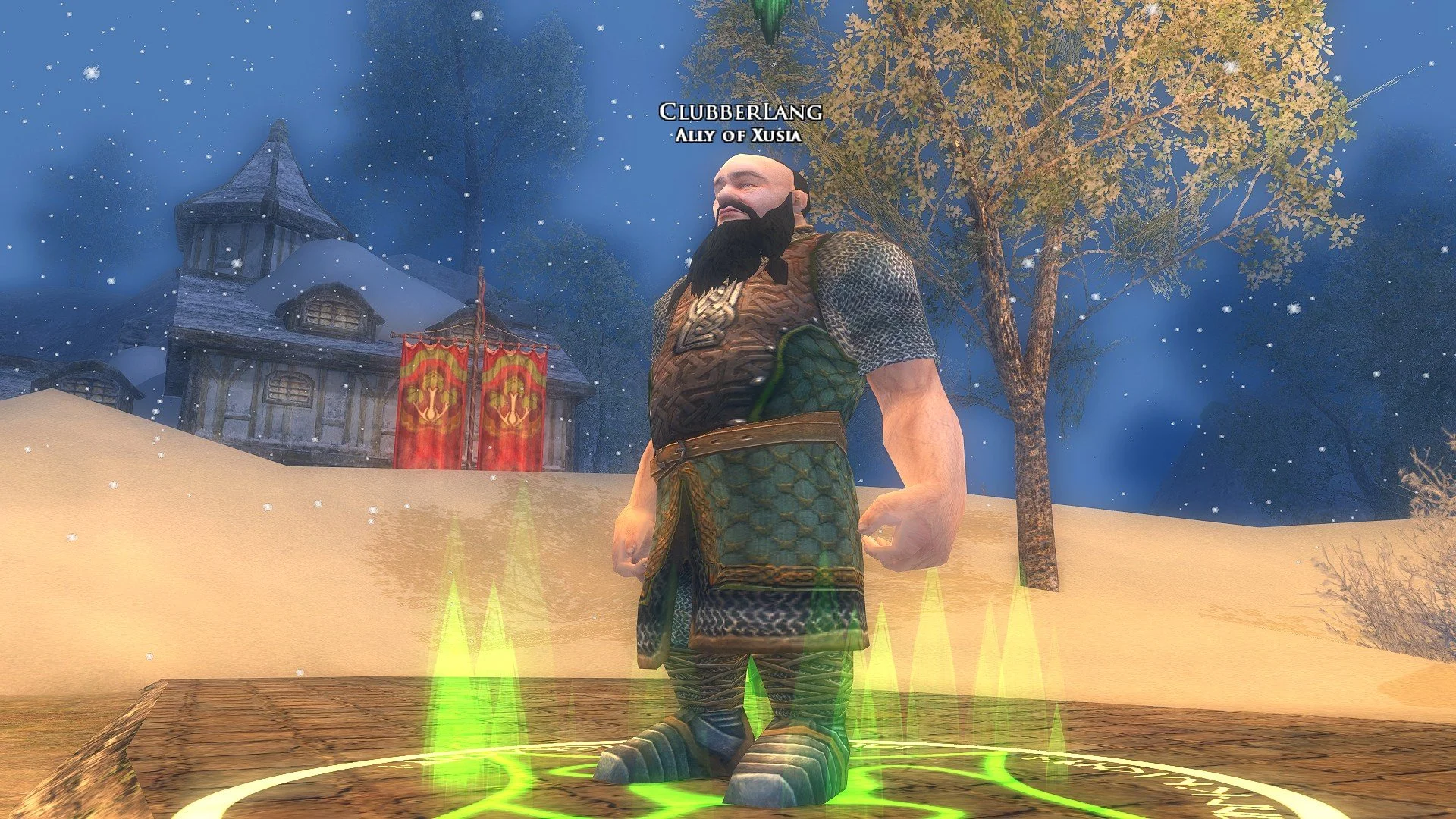
Skirmishes were added to the MMORPG The Lord of the Rings Online, in 2009 with the release of the Siege of Mirkwood expansion. Skirmishes are a repeatable and scalable combat system that allows players to access various instances for solo or group play from anywhere in the in-game world. Players can choose a Skirmish Soldier from a variety of classes to accompany them and provide healing, tank or additional DPS. On paper it’s a great system which is why many other MMOs offer something similar. I recently decided to tinker with my Skirmish Soldier build on my main character to see if I could optimise their performance. As my primary alt is a Lore-master, for the last few years I have had a Warrior as their Skirmish Soldier, to take some of the aggro from attacking mobs. I used the excellent guide by FibroJedi and swapped over a few Training and Personal Traits.
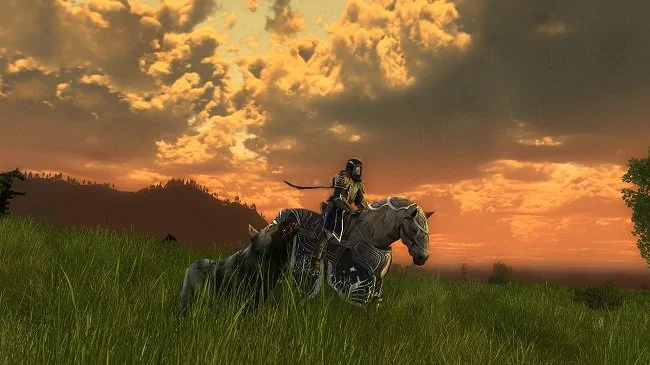
On 2nd August 2025, I was playing the MMORPG The Lord of the Rings Online, on my primary character, a level cap Lore-master. I decided to continue with one of the Allegiance Quest lines, specifically Durin’s Folk. I played through several quests and earned the appropriate tokens that advance the Allegiance system. I then handed these in to the NPC in the Hall Under the Mountain, expecting the next quest in the series “Chapter 3: Gimli’s Request” to be unlocked. An item appeared in my inventory that I then clicked on, which should have bestowed the quest. Unfortunately, nothing happened. Furthermore, the item vanished from my bag and therefore I could not attempt to click it again. I checked the LOTRO Wiki and then looked around the Hall Under the Mountain to see if any NPC had a ring icon above their head. As they did not, I surmised that this was a software glitch and logged a support ticket with Standing Stone Games.
Let’s start with a quote from a classic Walter Hill film, The Warriors. “Can you count, suckers?” says Sirus. The gang leader was referring to the number of Police in New York City at the time. Whereas, for the purpose of this post, I am referencing how many Delving Writs a player needs to acquire 6 pieces of level cap armour in LOTRO. Because, next to the gear you get from endgame instances and raids, Delving gear is a good alternative.. It is marginally better than the items you can get from lootboxes. Hence, Delving armour is a good source of high end gear for the solo player. Through the miracle of mathematics, the number of Delving writs required to acquire a full set of this armour is 9,000. At first glance, that seems like a lot. If you then do some further research to put the number in context, you realise it is indeed a lot and a substantial undertaking.
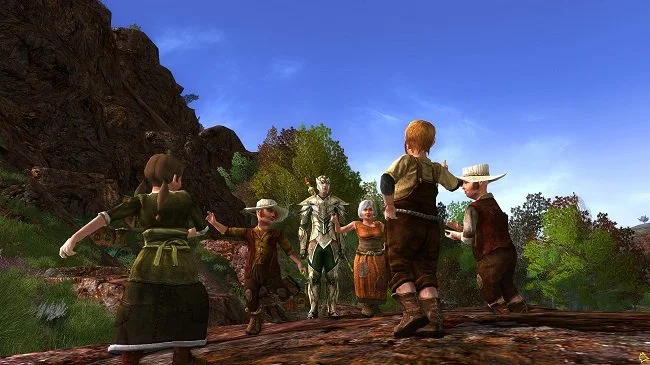
I am currently enjoying a renewed interest in the MMORPG The Lord of the Rings Online since I migrated all my characters from the old 32-bit servers to the new 64-bit replacements. I’ve created a new High Elf Lore-master on Peregrin server and am currently levelling them in a targeted play through of the Epic Story, supplemented by curated side quests. While playing recently, I realised the game UI on this alt wasn’t as I usually have it laid out. So I checked through the various documents on my PC and found a text file I had created many years ago that had a few hints and tips written down. I’ve added a few more and decided to share them as a blog post. I’m sure veteran players will be familiar with many of them but a lot of them are worth repeating. They may prove useful to those new to LOTRO or returning to the game after a long hiatus.
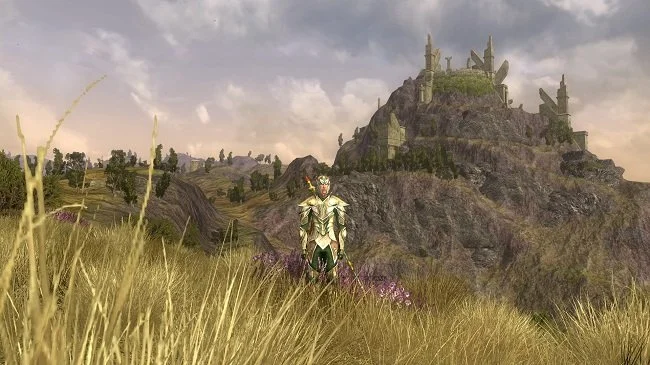
In mid-March, while the server migration debacle raged, I created a new alt for the MMORPG, The Lord of the Rings Online, on Peregrin server. The idea was to play casually through content focusing on enjoyment, rather than worrying about progression. I was to level at a pace that suited me and had no specific plans to develop my alt in any particular way. I have been playing LOTRO since 2008 and have a primary level-cap character that has been my main focus over the years. Hence I have previously experienced all story content from all the expansions and am therefore very familiar with what the game has to offer. Which is why I thought I’d do things differently this time. So I started my new Lore-master in Mossward in Swanfleet, the new starting area added to the game in 2022.

Last week I completed Questa: Narrator Mode. This is a standalone accessibility-focused Windows utility in development for the MMORPG, The Lord of the Rings Online. Its purpose is to bring text based quest dialogue to life through natural-sounding spoken narration. At present there are several similar projects in development. Khazad Voice TTS and LOTRO TTS being two examples. Both broadly do the same thing although there are subtle technical distinctions between them. Questa is by default intended to be used with an English language installation of LOTRO. It is also designed around using the CPU to do most of the heavy lifting, rather than a GPU. The reasoning behind this decision is to try and make the minimum hardware requirements for Questa as broad as possible, thus allowing more LOTRO players to use it. Data regarding what are the average PC specs of LOTRO players are scarce but my gut tells me that not everyone has a top end gaming rig. Hence this needs to be considered.