
The Day the Earth Stood Still (2008)
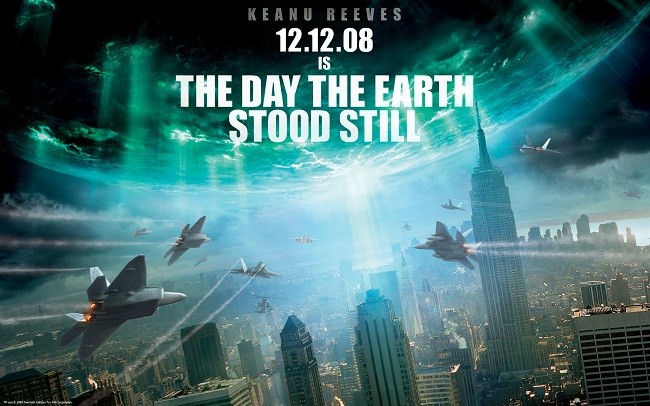
Fellow blogger and all round good guy Murf, posted an ode to Bill & Ted’s Excellent Adventure today. It is clearly a movie that he enjoys (Go read his review). He references how due to this movie (along with others), as well as being a decent person in real life, that actor Keanu Reeves enjoys a great deal of goodwill from fans and pop culture cognoscenti. Which is a good thing for Mr Reeves, because goodwill often means that folk are prepared to overlook past transgressions and misdemeanours. And in cinematic terms, Keanu has had a few. The Day the Earth Stood Still is definitely one of them. Now I’ve questioned before the wisdom and merits of writing a predominantly negative film review and believe me my thoughts on The Day the Earth Stood Still are most definitely so. However, I think that something positive can still be gained from scrutinising this film. It can be held up as a textbook example of how not to remake a classic.
Fellow blogger and all round good guy Murf, posted an ode to Bill & Ted’s Excellent Adventure today. It is clearly a movie that he enjoys (Go read his review). He references how due to this movie (along with others), as well as being a decent person in real life, that actor Keanu Reeves enjoys a great deal of goodwill from fans and pop culture cognoscenti. Which is a good thing for Mr Reeves, because goodwill often means that folk are prepared to overlook past transgressions and misdemeanours. And in cinematic terms, Keanu has had a few. The Day the Earth Stood Still is definitely one of them. Now I’ve questioned before the wisdom and merits of writing a predominantly negative film review and believe me my thoughts on The Day the Earth Stood Still are most definitely so. However, I think that something positive can still be gained from scrutinising this film. It can be held up as a textbook example of how not to remake a classic.
In a prologue sequence set in 1928, a solitary mountaineer encounters a glowing sphere. He loses consciousness after touching it and upon waking, he notices a scar on his hand where a sample of his DNA has been taken. Moving on to the present day, Dr. Helen Benson (Jennifer Connelly) is summoned to a military facility along with several other scientists when an alien spacecraft arrives in New York City. Aboard is a human-like alien (who looks like the earlier mountaineer) and a giant robot of immense size and power called Gort. The alien identifies himself as Klaatu (Keanu Reeves) and states he has “come to save the Earth”. The US Secretary of Defense Regina Jackson (Kathy Bates) sees him as a threat decides to have him interrogated more robustly. Dr. Benson considers this unethical and decides to facilitate Klaatu’s escape. However, when she learns exactly what his words mean, she tries to convince him to rethink his views on humanities iniquities and change his intentions.
When you consider this production’s budget, the quality of the support cast, along with the advances in visual effects, this movie could have been so much better. Director Scott Derrickson is far from a genre hack and I consider his previous work on The Exorcism of Emily Rose, Sinister, Doctor Strange to be of interest. I think his concept of retelling Robert Wise’s classic 1951 movie as a more benevolent tale, rather than an imperious threat, is a valid idea. Yet all these good intentions are lost due to a woefully inept screenplay by David Scarpa. One can’t help but feel that the narrative scope of the film tries too hard and that several well-intentioned casting decisions were ultimately a bad choice. Dr Benson’s stepson, played by Jaden Smith, is supposed to be conflicted due to the premature death of his father but comes off as simply intransigent and annoying. And then there is Keanu Reeves decision to try and play Klaatu in a similar disconnected idiom to David Bowie, in The Man Who Fell to Earth. Instead of being an understated performance it simply fails to convey any depth and conviction.
I’m a fan of unconventional casting when it works but Professor Barnhardt, played by a curiously deadpan John Cleese, whose character has won a Nobel prize for his work on "biological altruism” is too much of a stretch. As for the plot device of paranoid politicians, well if you want it to have any semblance of dramatic impact, then you really have to try and do something different with it. Sadly, such inspiration is sadly lacking and we’re just presented with the usual paranoid clichés about the military and our elected officials. Hence by the time the movie reaches its finale and the Robot Gort, transforms into a swarm of all consuming insect like nano-machines, the spectacular denouement lacks any emotional impact. Given what the audience has witnessed over the proceeding hour, I’m sure most right-minded people would say “fuck it, let humanity die, the bastards”. But at the last moment, Klaatu reverses his decision and sacrifices himself for the sake of humanity, thus ending an emotionally lacklustre and tonally deaf film.
The Day the Earth Stood Still lacks the portentous quality of its predecessor. Klaatu is no longer a biblical judge but a vaguely indifferent administrator, who is inconvenienced by humanity as he vacuum packs earth’s wildlife. Gort is robbed of his metaphorical status and is simply relegated to a MacGuffin designed to facilitate a spectacular ending. And the screenplay, instead of making the audience reflect upon the consequences of mankind’s propensity for violence and destruction, simply pays lip service to the environmental crisis and a few other token social issues. There is no conviction or gravitas present. Nor is there a soundtrack comparable to that of the original by Bernard Herrmann. This is big budget Hollywood science fiction, trying to be politically and socially relevant but refracted though the prism of a big studio that doesn’t really grasp either of those things. But returning to the original point, Keanu Reeves has firmly put this behind him and risen above it, thanks to impart to the John Wick Trilogy. Movies such as this have indefinitely stalled less fortunate actors’ careers.







Phase IV (1974)
Every now and then, a mainstream film studio employs an artisan director to helm some sort of experimental or vanity project. The studio executives often have very little understanding of the film maker or their body of work, beyond that their artistically respected by their peers. Hence there is the corporate hope that the resulting production will be both critically acclaimed and financially successful. However, what all too often happens is that the said director goes off and indulges themselves, or simply does what they’re hired to do and delivers a finished picture that is beyond the intellectual horizons of the studio. Sphincter’s subsequently tighten among executives; the director is denied final cut and the film is taken a way and re-edited in the hope of rendering it more commercially viable. In the worse cases, a second director is brought onboard and new material shot in the hope of “saving” the picture. The net result is usually acrimony among all involved parties and a film that fails to make its money back at the box office.
Every now and then, a mainstream film studio employs an artisan director to helm some sort of experimental or vanity project. The studio executives often have very little understanding of the film maker or their body of work, beyond that their artistically respected by their peers. Hence there is the corporate hope that the resulting production will be both critically acclaimed and financially successful. However, what all too often happens is that the said director goes off and indulges themselves, or simply does what they’re hired to do and delivers a finished picture that is beyond the intellectual horizons of the studio. Sphincter’s subsequently tighten among executives; the director is denied final cut and the film is taken a way and re-edited in the hope of rendering it more commercially viable. In the worse cases, a second director is brought onboard and new material shot in the hope of “saving” the picture. The net result is usually acrimony among all involved parties and a film that fails to make its money back at the box office.
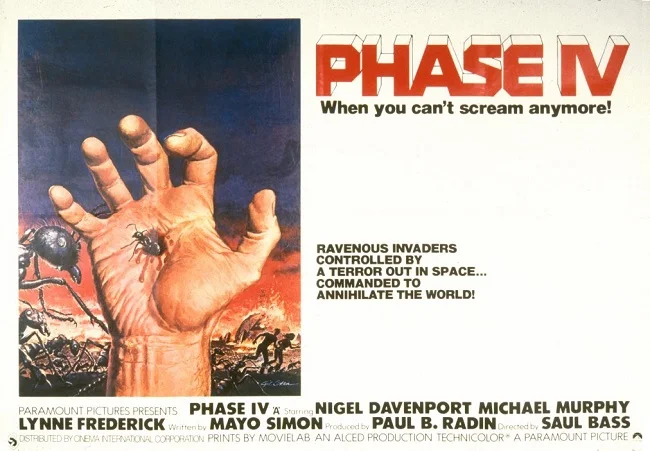
Phase IV is a textbook example of this phenomenon. It’s a cerebral science fiction movie with the emphasis on plot and the big ideas that underpin it. There are no major action driven set pieces, tempestuous romances or excessive sex and violence. It has a somewhat clinical setting, matter of fact performances by the two leads and the wider theme about next stage in human evolution has a lot in common with Kubrick’s 2001: A Space Odyssey. Plus the film originally ended with an experimental montage that depicts the next stages in human and myrmecine symbiosis. Needless to say this was the final straw for the studio who had already gotten cold feet. The montage was edited out and Phase IV was given a limited release and arbitrarily marketed as a “creature feature” which it patently is not. The film died at the box office and has only in recent years found the audience that it deserves, through showings at film festivals and broadcast on stations favoured by movie enthusiasts.
The creative talent behind Phase IV was Saul Bass. Bass is best known as a graphic designer who created numerous classic motion-picture title sequences, film posters, and corporate logos. During his career he collaborated with such cinematic luminaries as Alfred Hitchcock, Otto Preminger, Billy Wilder, Stanley Kubrick and Martin Scorsese. After acting as a “visual consultant” on pictures such as Spartacus and dabbling in short film making, it was inevitable that Bass would want to turn his hand to a full-length motion picture. Paramount Pictures, seeing an opportunity offered him a deal and Bass set about developing Phase IV. Being an artist first and foremost, Bass was not going to produce an arbitrary science fiction movie. He saw a much greater potential in Mayo Simon’s screenplay and instead decided to explore much deeper themes, other than the basic man versus nature premise.
The film starts with an unspecific stellar event, which visually implies some sort of alignment of celestial bodies and the release of some form of energy. Scientists theorise upon the consequences of these events. Dr. Ernest D. Hubbs (Nigel Davenport), notices a rapid change in ant activities in the Arizona desert. It would appear that all-natural predators of ants in the immediate area have mysteriously died and that multiple species of ants are co-operating instead of fighting. Furthermore, they have built several large, geometrically intricate towers, instead of their traditional mounds. This unusual behaviour generates both concern and curiosity among the scientific community, who fund Dr Hubbs to research the matter further. A computerised laboratory is established close to the ant towers and fellow scientist and cryptologist James Lesko (Michael Murphy) joins Hubbs as he aggressively investigates the ant’s behaviour.
In many ways the real star of Phase IV is wildlife photographer the Ken Middleham, who shot the insect sequences. Nowadays such material would more than likely be computer generated but back in 1974, these things were done the hard way. And so we get intricate shots inside of the ant’s nest and later on it the film, of the ants crawling around inside the computer equipment and air conditioning units in Hubb’s laboratory. By forming chains they deliberately short out equipment. Middleham cleverly focuses on noticeably different types of ants so they can be clearly identified by the audience, making several key characters in the proceedings. Because the subject matter is handled in an intelligent manner, the idea of a hive mind remains credible. The concept of a queen ant that ingests the very toxins designed to kill her so she can breed a new generation that are immune, is quite disturbing and atmospherically handled. The film also has an eerie electronic score by Brian Gascoigne which enhances the off-kilter mood.
Phase IV was the first and last feature film to be made by Saul Bass. He returned to his regular line of work after this project. The poor marketing, studio interference and meant that the film simply didn’t find the right audience. The US theatrical poster clearly shows an attempt to sell this thoughtful and well-crafted film as a monster movie. Those who paid expecting a more violent version of The Naked Jungle must have been bitterly disappointed. However, in more recent years the film has been re-evaluated by critics, especially since the director’s death. In 2012 the missing end montage was found, remastered and shown along with the theatrical print at several US film festivals. Perhaps it may be re-integrated into the film at some point in the future for Blu-ray release. Phase IV will certainly be of interest to those with a passion for obscure and more intellectually driven film making. Comparable films are seldom made by big studios these days and when they are, still often share the same fate.
Childhood's End (2015)
For anyone with a passing interest in literary science fiction, Arthur C. Clarke’s Childhood’s End is a seminal novel and considered an essential read. The story of humanity being shepherded into a utopian golden age by allegedly benevolent alien Overlords and the consequences it has upon society, was a radical departure from prevailing science fiction norms of the time. Over the years several film makers have expressed interest in adapting the story, but it has proven difficult to come to grips with. Stanley Kubrick initially wished to develop the novel but his subsequent collaboration with the author eventually lead to the making of 2001: A Space Odyssey. Since then there have been radio adaptations and audiobook versions, all of which seem to be a better medium for this episodic and contemplative tale. In late 2015 US cable and satellite channel Syfy broadcast a three-part miniseries based upon the 1953 story; something that past me by at the time. I recently caught up with this adaptation which seems to have provoked very mixed reactions among viewers. As ever, the controversy seems to stem from purists who favour a more slavish interpretation of the book.
For anyone with a passing interest in literary science fiction, Arthur C. Clarke’s Childhood’s End is a seminal novel and considered an essential read. The story of humanity being shepherded into a utopian golden age by allegedly benevolent alien Overlords and the consequences it has upon society, was a radical departure from prevailing science fiction norms of the time. Over the years several film makers have expressed interest in adapting the story, but it has proven difficult to come to grips with. Stanley Kubrick initially wished to develop the novel but his subsequent collaboration with the author eventually lead to the making of 2001: A Space Odyssey. Since then there have been radio adaptations and audiobook versions, all of which seem to be a better medium for this episodic and contemplative tale. In late 2015 US cable and satellite channel Syfy broadcast a three-part miniseries based upon the 1953 story; something that past me by at the time. I recently caught up with this adaptation which seems to have provoked very mixed reactions among viewers. As ever, the controversy seems to stem from purists who favour a more slavish interpretation of the book.
Childhood’s End has been updated and embellished to suit the requirements of contemporary television. The cold war setting has been replaced with our modern era, along with all its associated political and corporate problems. The opening scenes of the Overlords spaceships arriving at all the world’s major cities is very reminiscent of Independence Day, which itself was derived from Clarke’s original novel. It’s a classic situation of art imitating art. But far from being a hostile invasion, the visitors signify their intent by lowering all air traffic from the skies. They subsequently contact key personnel via manifestations of their deceased loved one and explain how they are here to eliminate disease, war, hunger, and pollution, setting the stage for the "Golden Age of Humanity". Midwestern farmer, Ricky Stormgren (Mike Vogel) is chosen by the supervising alien, Karellen (Charles Dance), and becomes his spokesman and go-between and facilitate the forthcoming changes.
However, not everyone views the alien intervention in earthly affairs as a good thing. Vested interests resent their loss of power and influence. Media mogul Hugo Wainwright (Colm Meaney) secretly organizes a counter-group dubbed the Freedom League which uses social media to spread distrust about the Overlords. However the broader public, especially the poor and disenfranchised welcome the seismic societal changes. When Milo Rodericks, a disabled youth from a poor neighbourhood, is shot and killed by a drug dealer, the Overlords intervene killing the attacker. Not only do they resurrect Milo but they cure him of his ailments and restore his ability to walk. And while the rest of the world begins to question longstanding religious beliefs, Peretta Jones still maintains her views on a Higher Power and becomes committed to finding answers about the Overlords. Exactly why have they chosen to share so much with humanity and why do they choose not to reveal themselves directly to the world, acting instead through intermediaries.
Clarke’s book has three distinct phases to its narrative structure. The Earth and the Overlords, The Golden Age and The Last Generation. These are broadly used to as the basis of each of the three instalments of this miniseries. The first and possibly best episode deals with the arrival of the Overlords and the way humanity reacts to the situation. The second part focuses on how the Earth has become a utopia with an end to war, poverty and social injustice. Yet it is a society that some feel is culturally stagnating. Adversity is often the driving force of progress. And it is at this point that the story begins to reveal the Overlords agenda, although it would be more accurate to describe it as an agenda they are tasked with implementing. The sting in the tail is far more subtle than The Twilight Zone episode, To Serve Man. It is an act of cosmic social engineering in which a new generation of humans with clairvoyance and telekinetic powers are born, with the ultimate goal of joining the Overmind, a collective intelligence made up of numerous intergalactic species. The final part sees the literal ascendency of these new humans and the collapse of the earth society as the Overlords prepare to leave. The ending is stark and whether it is a triumph or a tragedy depends on your perspective.
Writer Matthew Graham tries hard to try and put some meat on the bones of the human characters, as Clarke’s book is very much one of ideas and concepts, rather than immaculately penned individuals. Dragging the black and white, Cold War setting of the source text, into the modern world is a difficult task. Despite the inclusion of modern social issues and politics, the human element in this adaptation is still a little stilted. Osy Ikhile plays the disabled boy Milo who grows to be the scientist that bears witness to the great transition. His role is a little more interesting than others who are essentially archetypes of different aspects of human society. There’s no denying that Charles Dance steals the show as the alien, yet ultimately paternal Karellen. He masters all of the subtle aspects of the iconic character that are found in the book. Despite the multitude of practical and CGI effects, his performance shines through. The handsome production design also offers some much-needed visual imagery to try and make the weighty plot more accessible to causal viewers.
Childhood's End, like the book is a somewhat dour undertaking. Despite its modern sense of style and slick presentation is still dealing in deep existential, philosophical themes. It’s refutation of religion and beliefs, along with its penchant for societal Darwinism on a global scale may not sit well with those viewers who are governed more by their feelings. Yet it does successfully capture the core themes and ideas of Clarke’s novel and tries to present them in a positive fashion. Although the miniseries never maintains the strengths of the first episode and subsequently tries to counter the science and philosophy with emotional character journeys, the overall strength of the Clarke’s vision is maintained. Despite the pyrrhic ending in which mankind as we know it is lost, the thematic requiem is tempered with the knowledge that some of our species have transcended the material and joined the Overmind. Such ideas were quite radical back in 1953 and remain so today, especially in light of the growth of the consumerism and individualism. Childhood's End is a flawed but worthy adaptation of a novel that is objectively hard to dramatise and humanise.
The Andromeda Strain (2008)
I always cringe when I hear the phrase re-imagining. It's yet another contrived expression created by marketing bodies to justify the somewhat arbitrary process of remaking an established title. Often the re-imagined product has little to do with the source material and was chosen simply because of brand awareness. If you want a textbook example of a recent example of this somewhat cynical process then look no further than last year’s Death Wish reboot. It had nothing new to say on the subject and simply trotted out a generic and bland revenge thriller. So, when I discovered that Robert Wise's classic science fiction film, The Andromeda Strain had been remade as a TV miniseries (that had completely passed me by), I had great reservations as to whether this would be worth watching. However, the involvement of Tony and Ridley Scott piqued my interest, so I decided to take a calculated risk and give this 2008 A&E Network production a go.
I always cringe when I hear the phrase re-imagining. It's yet another contrived expression created by marketing bodies to justify the somewhat arbitrary process of remaking an established title. Often the re-imagined product has little to do with the source material and was chosen simply because of brand awareness. If you want a textbook example of a recent example of this somewhat cynical process then look no further than last year’s Death Wish reboot. It had nothing new to say on the subject and simply trotted out a generic and bland revenge thriller. So, when I discovered that Robert Wise's classic science fiction film, The Andromeda Strain had been remade as a TV miniseries (that had completely passed me by), I had great reservations as to whether this would be worth watching. However, the involvement of Tony and Ridley Scott piqued my interest, so I decided to take a calculated risk and give this 2008 A&E Network production a go.
This new version stays fairly true to basic premise of Michael Crichton’s novel, with a satellite returning to earth bringing with it a mystery virus of possible extraterrestrial origin. The small town of Piedmont soon falls victim to the contagion, leaving only two survivors, an alcoholic and a baby. The "wildfire" team of scientists are brought in by the government to tackle the outbreak and find a potential cure. There work is hampered by the virus’s ability to mutate to find new ways of spreading. The writer, Robert Schenkkan, has also added new elements that reflect contemporary culture and politics. The question of the virus' origin is intriguing and of course there are factions within the government who are not to be trusted. There is also a journalist seeking to expose the ongoing conspiracies. It is all somewhat generic but it is not a lazy as it sounds. Due to the credentials of those involved in the production, it offers a little more tension and drama than one expects from such miniseries.
The cast is robust, featuring Benjamin Bratt (Law & Order, Love in a time of Cholera), Rick Schroder (24, NYPD Blue), Eric McCormack (Will &Grace), Daniel Dae Kim (Lost) and Andre Braugher (City of Angels). Performances are okay given the inevitable formula of the vehicle. There are a lot more characters in this adaptation, given the need to expand the story over two episodes. Hence there are times when cast members come and go simply to facilitate moving the story forward. Production values are adequate with the confines of the budget, with creative set designs and interesting use of locations. The action is quite hard for a television miniseries, though some of these scenes do seem a little tonally out of place. Perhaps the director Mikael Salomon (who has been involved with several miniseries such as Rome, Salem’s Lot and Band of Brothers) feared making an excessively narrative driven drama, like the original feature film, so felt obliged to overstate certain plot elements to keep the interest of easily bored viewers. Admittedly by the end, there is a decline into cliché and several events that were obviously telegraphed earlier in the proceedings inevitably occur.
Those who have seen the 1970 feature film may well see this new version as somewhat intellectually diluted. Personally, I think one has to bear in mind historical context. The seventies were a time when the cinematic audience was more sophisticated and willing to invest in stories that made them think for themselves. The new version simply reflects what “sells” with today’s viewers and although there is more focus upon action, this adaptation still tries to keep the underlying science of story front and centre. All things considered The Andromeda Strain is better than expected. Given the nature of the system that made it, this actually exceeded my expectations, which I must admit were initially very low. It offers a different perspective on the source material and doesn’t outstay its welcome. Its two-part format is an appropriate length and is able to sustain the story. As ever with such productions some of the CGI is a little cheap and I’m not a fan of blood spatter added in post-production. Overall this is adequate entertainment. If you want something weightier then by all means watch the original, but this version fills a niche.
In Time (2011)
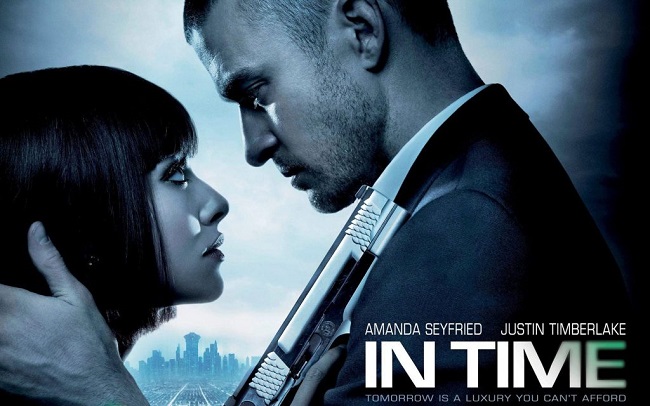
Time is quite literally money in the movie In Time, starring Amanda Seyfried and Justin Timberlake. Written and directed by Andrew Niccol, who previously wrote Gattaca and S1m0ne which both had similar dystopian themes, we are presented with a chilling scenario. What if you had to spend minutes or hours or perhaps days of your life in the same way you spend money? The movie offers a future where the population is genetically programmed to stop aging at twenty-five. If you're rich enough, you can purchase and trade this commodity, adding time to your life, making you effectively immortal. For the poor, the future is a far bleaker with most dying within a year of this hardcoded end date. Every transaction comes with a price in minutes and seconds.
Time is quite literally money in the movie In Time, starring Amanda Seyfried and Justin Timberlake. Written and directed by Andrew Niccol, who previously wrote Gattaca and S1m0ne which both had similar dystopian themes, we are presented with a chilling scenario. What if you had to spend minutes or hours or perhaps days of your life in the same way you spend money? The movie offers a future where the population is genetically programmed to stop aging at twenty-five. If you're rich enough, you can purchase and trade this commodity, adding time to your life, making you effectively immortal. For the poor, the future is a far bleaker with most dying within a year of this hardcoded end date. Every transaction comes with a price in minutes and seconds.
The beginning of In Time establishes a very bleak and divided world which reminded me of Alfonso Cuarón's Children of Men. Director Niccol competently establishes the Timekeepers, the police who enforce time management, as well as Minutemen, thugs who rob you of precious minutes. There are plenty of promising ideas referenced in the first act of the film. However, like so many high concept movies these days, In Time simply fails to develop these themes and elects to pursue a more traditional “chase and romance” approach to its narrative. It is this marked change of direction which derails the movie from its promising start. Viewers au fait with the genre classic Logan’s Run are will quickly predict the direction the film is taking and guess its respective outcome.
This change of gear is not sufficient to rob In Time of all its virtue. There are still some intersecting ideas to be had such as our hero redistributing time among the needy. It’s a minor nod towards the current social trend towards criticising capitalism, but it isn't explored sufficiently. Performances are also surprisingly better than expected. Mr Timberlake is not excessively wooden and has a reliable nemesis in Cillian Murphy. The action is adequately managed within the parameters of a PG-13 rated movie. In Time, like so many recent films, is a production pitched at a specific demographic by film makers. One they think is not that demanding. Thus we have a film that is somewhat superficial and light on content. It may warrant a casual viewing but does not require any in-depth analysis or further consideration.
Project Blue Book (2019)
Many years ago, I use to rush home from school to watch Project UFO. Based loosely on the real-life Project Blue Book, this show from 1978 featured two U.S. Air Force investigators, Maj. Jake Gatlin (William Jordan) and Staff Sgt. Harry Fitz (Caskey Swaim) and their subsequent investigation into alleged UFO sightings. Sometimes there would be rational explanations and on other occasions, there was clearly extraterrestrial involvement. By the second season out protagonists experienced a close encounter of their own. It wasn’t the most densely plotted of dramas and was produced and presented in the idiom of mainstream television of the time. However, for a ten-year-old boy it had some excellent miniature work (Brick Price Movie Miniatures) and anything about UFOs was always a source of interest. There was also a great and very seventies theme tune by Nelson Riddle. So when I discovered that History (formerly The History Channel) had produced a science fiction drama series called Project Blue Book, I became somewhat nostalgic and equally intrigued.
Many years ago, I use to rush home from school to watch Project UFO. Based loosely on the real-life Project Blue Book, this show from 1978 featured two U.S. Air Force investigators, Maj. Jake Gatlin (William Jordan) and Staff Sgt. Harry Fitz (Caskey Swaim) and their subsequent investigation into alleged UFO sightings. Sometimes there would be rational explanations and on other occasions, there was clearly extraterrestrial involvement. By the second season out protagonists experienced a close encounter of their own. It wasn’t the most densely plotted of dramas and was produced and presented in the idiom of mainstream television of the time. However, for a ten-year-old boy it had some excellent miniature work (Brick Price Movie Miniatures) and anything about UFOs was always a source of interest. There was also a great and very seventies theme tune by Nelson Riddle. So when I discovered that History (formerly The History Channel) had produced a science fiction drama series called Project Blue Book, I became somewhat nostalgic and equally intrigued.
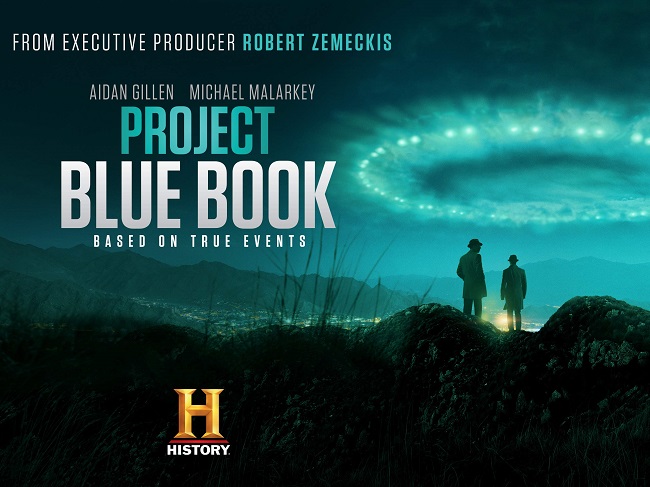
Set in the early fifties and loosely (now there's an understatement) based on the US government's real-life Project Blue Book investigations, the show centres on Captain Michael Quinn (Michael Malarkey) and Dr. Allen Hynek (Aidan Gillen). The pair are tasked by the US Air Force to investigate reports of UFOs and debunk them, or at least come up with rational explanations for them as a means to quash growing public concern. While Quinn, a career serviceman, doesn't care beyond carrying out his superiors’ instructions, the sceptical Hynek quickly becomes convinced that not everything is as it first appears. This brings him into conflict with General James Harding (Neal McDonough) whose involvement with the project is far more complex. Meanwhile, as Cold War paranoia spreads among the US population, Hynek's lonely wife Mimi (Laura Mennell) is befriended by a charismatic blonde Susie Miller (Ksenia Solo) who appears to be more than interested in her husbands work. As Quinn and Hynek investigate further cases, they encounter traumatised “encounter victims”, secret military experiments and are shadowed by a sinister man in black.
Having now watched the first six episodes of Project Blue Book, I do find myself somewhat conflicted with regard to the show. This is a high budget, quality production with great period detail, surprisingly good digital visual effects and a cast of reliable character actors. It ticks pretty much all the boxes you’d expect from this kind of TV show. Are there rational explanations for UFOs or is it all a government cover up? Are the military tinkering with recovered alien technology? Are extraterrestrials drawn to earth due to the human’s first tentative steps into space and the dawn of the nuclear age? Project Blue Book also adds some new elements such as focusing on Dr Hynek’s wife, who is frequently left alone and shut out of his work. The role of a “wife” from this era could easily sustain a drama in itself and is an interesting angle. So is the inclusion of Soviet spies in the local neighbourhood. Yet despite all these elements, it still feels like something is missing and then there is my over familiarity with this genre. Hence, I am still waiting for the show to reach a key moment where everything falls into place for me. At present each episode just increases the number of dramatic loose ends that are outstanding.
The old adage “there is nothing new under the sun” is particularly pertinent to television. However, the key to success when revisiting tried and tested territory, is to put a sufficiently new spin on things. Tell an old story from a new perspective, find new ways to explore and interpret the themes. Reverse roles, think outside the box and generally try not to simply do “more of the same”. So far there is precious little of this in Project Blue Book which seems to be falling into the standard, deep conspiracy plot device that was done to death in The X-Files. This leaves me with a choice to make. Cut my loses now and spend my time watching something else, or soldier on with the remaining episodes of season one (there are four more I believe) in the hope that it will improve and offer something new. I cannot say that I’m confident of the latter and I get frustrated with shows that chase their own tails or make it up as they go along (Lost and again The X-files). Still nostalgia is a powerful motivator and every now and then, Project Blue Book provides a fix. So I suspect I shall watch the remaining episodes and see if things improve, yet I have a nagging doubt that this may be the wrong choice.








Contagion (2011)
Director Steven Soderbergh is no stranger to complex narratives, shot in a near documentary style. And this is exactly this approach that he brings to bear upon Contagion. A movie that beneath its contemporary trappings, still has the air of an all-star disaster movie. Unlike so many current films which suffer from underdeveloped characters due to poor writing, Soderbergh makes conscious decision to focus more upon the mechanics and nature of a global pandemic than the main protagonists. This somewhat detached approach may not be to all viewers liking. But the format starkly scrutinises and catalogues events in an honest fashion and doesn’t shy away from the realities of the situation or get side tracked by the emotional aspects of the ongoing human tragedy.
Director Steven Soderbergh is no stranger to complex narratives, shot in a near documentary style. And this is exactly this approach that he brings to bear upon Contagion. A movie that beneath its contemporary trappings, still has the air of an all-star disaster movie. Unlike so many current films which suffer from underdeveloped characters due to poor writing, Soderbergh makes conscious decision to focus more upon the mechanics and nature of a global pandemic than the main protagonists. This somewhat detached approach may not be to all viewers liking. But the format starkly scrutinises and catalogues events in an honest fashion and doesn’t shy away from the realities of the situation or get side tracked by the emotional aspects of the ongoing human tragedy.
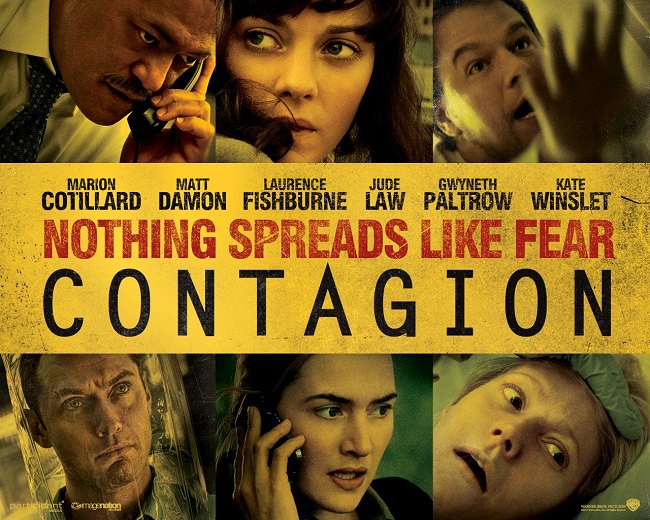
Although the movie is driven by the technicalities of the narrative, there is still a strong ensemble cast. This includes that includes Marion Cotillard, Bryan Cranston, Matt Damon, Laurence Fishburne, Jude Law, Gwyneth Paltrow, Kate Winslet, and Jennifer Ehle. But Contagion is mainly concerned with the logistics of managing an outbreak of global proportions. It also scrutinises the governmental procedures and protocols for dealing with public health issues. The story interestingly draws parallels between the spread of the virus and the resulting panic via social media and Internet. It clearly demonstrates that the weak link in any national strategy for containing a pandemic is the public themselves. The film excels at showing the transference of germs via the most innocuous means. You could also argue that the original source of contamination, made via a credit card, is a broader metaphor itself.
There are some very modern themes included into the story. The idea of blogging and social networks as a potentially negative force (within the confines of the plot) is a clever concept. There is also an exploration of homeopathy and the trend among certain areas of society to reject science and the look for solace elsewhere. The juxtaposition between the proliferation of technology and its failure to cope with the growing public health issue is handled well. Although a lot of traditional ideas and imagery associated with this subgenre are used, they are dealt with in a subtly different fashion from other movies of this idiom. The military response, the use of mass graves and the subsequent social unrest are not skewed by any moral stance. They are simply shown as cause and effect.
There were allegations of racism from some quarters, upon the film’s release, but I do not think this is the case. The fact that the virus originates in the Far East, simply reflects genuine issues that real countries face due to rapidly growing populations and industrialisation. The plot reflects genuine health scares of recent years and does not carry any subtext or message that I was aware of. Viewers have also questioned the irrational behaviour of cast, especially those representing the wider public. Has not history continuously shown us that people often make poor decisions in times of trouble? I would also argue that this is a plot device which enables the narrative to move forward and hence is a necessary evil.
Unlike Wolfgang Petersen’s Outbreak, Contagion purposely avoids an excess of human drama among the wider catastrophe. Rather than grim scenes of carnage, the film builds tension through depicting a credible disaster and remind viewers of the ongoing battle against the microscopic world that society fights every day. I enjoyed Steven Soderbergh’s somewhat cold approach and certainly did not feel that Contagion was a hectoring faux science documentary, as some is labelled it. This is not Irwin Allen. There are no noble sacrifices, broken relationships fixed upon the way, or valuable lessons learned about life. It is Soderbergh’s refusal to add any cinematic sweetener to the proceedings that makes Contagion so effective.
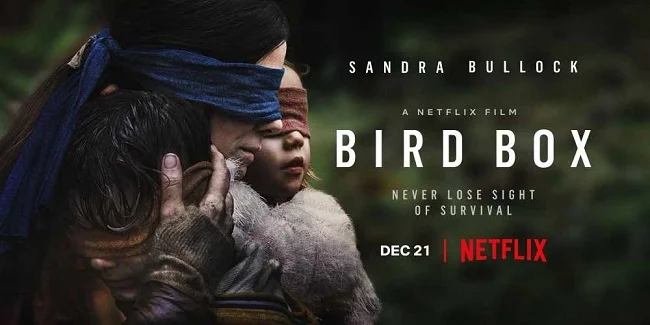
Bird Box (2018)
The unfolding apocalypse and the unseen forces that bring it about are never fully explained in Bird Box. The movies also eschews overblown, CGI driven set pieces and spectacle. The scenario is simply the MacGuffin which director Susanne Bier uses to facilitate her exploration of the angst of motherhood and societal decay. This is superficially a genre movie but it’s mainly about people, performances and ideas. There have been some comparisons to A Quiet Place, but this movie is actually closer to The Mist. The film is at its best during the first act, when setting up its premise and at the start of “the event”. The second act remains above average mainly due to the strength of the cast, as they weather the ongoing storm. The denouement is somewhat functional and is possibly the weakest aspect of the film. Yet, the strength of what has gone before and as ever the robust nature of Sandra Bullock’s performance keeps things on track.
The unfolding apocalypse and the unseen forces that bring it about are never fully explained in Bird Box. The movies also eschews overblown, CGI driven set pieces and spectacle. The scenario is simply the MacGuffin which director Susanne Bier uses to facilitate her exploration of the angst of motherhood and societal decay. This is superficially a genre movie but it’s mainly about people, performances and ideas. There have been some comparisons to A Quiet Place, but this movie is actually closer to The Mist. The film is at its best during the first act, when setting up its premise and at the start of “the event”. The second act remains above average mainly due to the strength of the cast, as they weather the ongoing storm. The denouement is somewhat functional and is possibly the weakest aspect of the film. Yet, the strength of what has gone before and as ever the robust nature of Sandra Bullock’s performance keeps things on track.
Artists Malorie (Sandra Bullock) is pregnant and struggling to come to terms with her impending motherhood. While in hospital for a routine check-up, she and her sister Jessica (Sarah Paulson) witness an outbreak of mass psychosis. Driven by some unseen force, people start killing themselves. Fleeing the ensuing carnage, they escape by car only to crash due to the ongoing unrest. Malorie takes shelter along with others in a large house, owned by suburban house husband Greg (BD Wong). Among the survivors are Greg’s surly neighbour Douglas (John Malkovitch) and ex-soldier Tom (Trevante Rhodes). They theorise that the unseen force kills you by manifesting itself as your greatest fear or tricks you by pretending to be a loved one or friend. Trapped and with diminishing supplies the group realise that if they venture outside, they will have to remain blindfolded, rather than risk seeing the threatening malevolent presence.
The initial scenes of chaos and its rapid spread are well handled by director Susanne Bier. The depiction of people beating their heads against plate glass windows, stepping out into traffic and acts of self-immolation are genuinely shocking. Because the scope and scale of these events are far more localised, as opposed the grandiose aerial shots of the zombie apocalypse in Wold War Z, they are quite powerful. The focus on character during the scenes where the cast are secure in the house or when they venture out to the supermarket are also refreshing. Instead of excessive set pieces, we simply get a strong study of beleaguered people trying hard not to lose their grip on reality. Sometimes the script by Eric Heisserer (Arrival, Extinction) does become a little too expositionary. But there are enough succinct musings and philosophical introspection among the cast to keep things moving forward.
Bird Box presents viewers with two timelines, one set during the apocalypse and the other five years on. The first deals with the survivors and their struggle to secure their house. The second focuses on Malorie’s blindfolded journey down a river with two young children. Both are well crafted but the conspicuous absence in the latter timeline of some of the protagonists from the first, somewhat mitigates the tension, as most viewers will accurately surmise their fate. The final act is also predictable as the screenplay paints the narrative into a dramatic corner. Again, astute audiences will guess the way events will end and the conceit of the film conclusion. That is not to say that the story’s resolution is inadequate, but it is somewhat reduced in impact as a result of its lack of surprise. However, Sandra Bullock does a lot of heavy lifting here and carries the proceedings over the finish line.
Despite the inconsistencies of the script, Bird Box hits its stride when it focuses on the basics. By presenting us with a precarious safe place to hide from the apocalypse, it gives audiences an opportunity to muse upon how they would react under such circumstances. If also gives us a sufficient glimpse of “hell on earth” rather than belabouring us with endless CGI showreels. The enigmatic foe (or foes) are also an intriguing plot device. What the screenplay alludes to as to what is exactly happening, is just enough to oil the wheels of suspense. It’s a timely reminder that less can indeed be more. Finally, it should be noted that Netflix movies do not carry much overt information with regard to ratings. Bird Box is not a family friendly film and it would have certainly received a R rating if released theatrically. The lack of computer-generated spectacle does not mean an absence of violence.
Attack the Block (2011)
A lot was written about Joe Cornish's Attack the Block upon its release back in May 2011. I'll let you know right now that I have no intention of contradicting the popular consensus. This is an innovative, thoughtful, violent and very British Sci-Fi horror film. The contemporary inner London setting, and urban protagonists provide a very interesting take on a tried and tested subject. Do not be misled by certain journalists who try to make political capital out of claiming that the film endorses hoodie culture. It does not. There is no validation or glamorisation of that kind present. It’s simply an alternative setting for a somewhat formulaic story. As ever the devil is in the detail, which is subsequently supplied in the screenplay.
A lot was written about Joe Cornish's Attack the Block upon its release back in May 2011. I'll let you know right now that I have no intention of contradicting the popular consensus. This is an innovative, thoughtful, violent and very British Sci-Fi horror film. The contemporary inner London setting, and urban protagonists provide a very interesting take on a tried and tested subject. Do not be misled by certain journalists who try to make political capital out of claiming that the film endorses hoodie culture. It does not. There is no validation or glamorisation of that kind present. It’s simply an alternative setting for a somewhat formulaic story. As ever the devil is in the detail, which is subsequently supplied in the screenplay.
Sam (Jodie Whittaker), an overworked, underpaid nurse is returning home from her shift, while talking to her mum on her phone. She finds herself surrounded by a gang of five teenagers, led by Moses (John Boyega). As they demand her valuables, something falls from the sky and crashes into a nearby car. In the ensuing mayhem, Sam escapes while Moses and his crew find themselves at odds with an unexpected visitor. Everyone takes refuge in the tower block in which they live, as more extraterrestrial visitors continue to fall to earth. A siege begins, and the residents of Wyndham Tower have to band together to deal with the threat. Moses and his gang are motivated by the financial gain that the aliens may offer, but it soon becomes clear that it is them who are primarily being targeted by the visitors.
Cornish clearly shows his love for the genre in virtually every aspect of the production. From the lighting of the tower blocks to the bio-luminescent teeth of the aliens, all clearly demonstrate the influence of eighties cinema that the director grew up on. The script finds a comfortable balance between humour and action with the group of young residents spouting copious amounts of comic, patois-based dialogue. This has become the new benchmark in cult quotable sound bites, among discerning movie nerds. The pace of the narrative is strong and the set pieces hard edged. Attack the Block also maintains that very clinical feel that you often find in the best of British urban dramas.
It is very reassuring to see that films such as this are still being made and are directly competing against the ongoing tide of Hollywood blockbusters. UK film makers can effectively turn their hands to anything but are all too often only associated with period costume dramas or worthy slice of life, social comedies. Attack the Block and the action film Hanna (both released in 2011) have helped contribute to a greater diversification of British film making and have helped alter perceptions. As for Joe Cornish, he has clearly shown his abilities and set a high standard. I look forward to his next project. In the meantime, see Attack the Block, preferably twice. Once to enjoy it, then again to clock all the references. Wyndham Tower indeed.
Chappie (2015)
In the near future, crime is patrolled by an oppressive mechanized police force. But now, the people are fighting back. When one police droid, Chappie, is stolen and given new programming, he becomes the first robot with the ability to think and feel for himself. As powerful, destructive forces start to see Chappie as a danger to mankind and order, they will stop at nothing to maintain the status quo and ensure that Chappie is the last of his kind. Sony Pictures Entertainment
There is much to praise about Chappie, which in turn makes me reticent to catalogue its subsequent failings. Once again Blomkamp uses a near-future Johannesburg to effectively paint a convincing picture of urban decay and social division. He manages to seamlessly integrate CGI with the physical and the overall design of all the paramilitary hardware on display is very credible. Image Engine once again created some solid visual effects and actor Sharlto Copley provides not only the voice for the titular Chappie but also a motion captured performance. The screenplay by Neil Blomkamp and Teri Tatchell makes a laudable attempt to explore the subject of Cartesian Dualism.
In the near future, crime is patrolled by an oppressive mechanized police force. But now, the people are fighting back. When one police droid, Chappie, is stolen and given new programming, he becomes the first robot with the ability to think and feel for himself. As powerful, destructive forces start to see Chappie as a danger to mankind and order, they will stop at nothing to maintain the status quo and ensure that Chappie is the last of his kind. Sony Pictures Entertainment
There is much to praise about Chappie, which in turn makes me reticent to catalogue its subsequent failings. Once again Blomkamp uses a near-future Johannesburg to effectively paint a convincing picture of urban decay and social division. He manages to seamlessly integrate CGI with the physical and the overall design of all the paramilitary hardware on display is very credible. Image Engine once again created some solid visual effects and actor Sharlto Copley provides not only the voice for the titular Chappie but also a motion captured performance. The screenplay by Neil Blomkamp and Teri Tatchell makes a laudable attempt to explore the subject of Cartesian Dualism.
Sadly, Chappie is tonally all over the place. It veers from Robocopesque violence one moment to Short Circuit sentimentality in another. Some of the plot devices are clumsy and contrived as the director struggles to take the narrative from points A to B. Many of the interesting ideas that the film raises are abandoned along the way. Then of course there are the Chappie's adopted parent, two criminals played by musical artists Ninja and Yolandi Visser. Neither are professional actors and although they have the appropriate deportment and atttitude by dint of their music careers, they fail to live up to their roles. The characters they play are also questionable and at times their manipulation of chappie is not far from child abuse.
Ultimately Chappie pursues an action-based climax and offers a semi twist ending designed to leave the audience musing upon the nature of consciousness, how parental responsibilities impact on society and the privatisation of law enforcement. Yet due to the uneven structure of the movie and its fundamental mistake of trying to be too many things at once, a lot of viewers may well end the movie dissatisfied or confused. Alex Garland's Ex Machina explored many similar themes far more effectively. Then of course the shadow of Steven Spielberg’s AI: Artificial Intelligence, looms large.
The trouble with scoring a hit with your debut picture, such as Blomkamp did with District 9, is that you're often hamstrung by your own previous success. The critics and public can be very unreasonable at times and simply expect lightning to strike twice. This is the second time that Neil Blomkamp appears to have fallen between two stools. The movie smacks of a picture that simply hasn't found the right edit and has already suffered from a lot of post-production tinkering. Apparently after initial shooting in Johannesburg, there was further re-shooting in British Columbia. So perhaps Chappie may benefit from an extended edition or a director’s cut sometime in the future. In the meantime, it remains an intriguing but uneven movie that doesn't meet its potential.
The Predator (2018)
It’s a fairly common habit for a film studio to seek out a particularly skilled director who has an established track record with regard handling specific types of movies, only to subsequently micro-manage and impede them as they go about the task they were employed to do. The net result is often a movie that falls between two stools and lacks any conviction. Furthermore, this is a malady that seems to happen far more often with genre movies. All too often you’ll read about film makers that endured tumultuous productions, running battles with studio executives and ultimately chose to disassociate themselves from the final cut of a movie. With The Predator, we have a curious situation where the opposite appears to be true. Genre luminaries Shane Black and Fred Dekker were both hired to write the screenplay and Black then went on to direct this fourth instalment in the franchise. The idea was to use their established talents to create something that would please core fans and return to the spirit of the first movie. Yet I can only describe the finished results as a classic case of trying too hard. The Predator feels like a caricature of its predecessors and fails to hit its mark.
It’s a fairly common habit for a film studio to seek out a particularly skilled director who has an established track record with regard handling specific types of movies, only to subsequently micro-manage and impede them as they go about the task they were employed to do. The net result is often a movie that falls between two stools and lacks any conviction. Furthermore, this is a malady that seems to happen far more often with genre movies. All too often you’ll read about film makers that endured tumultuous productions, running battles with studio executives and ultimately chose to disassociate themselves from the final cut of a movie. With The Predator, we have a curious situation where the opposite appears to be true. Genre luminaries Shane Black and Fred Dekker were both hired to write the screenplay and Black then went on to direct this fourth instalment in the franchise. The idea was to use their established talents to create something that would please core fans and return to the spirit of the first movie. Yet I can only describe the finished results as a classic case of trying too hard. The Predator feels like a caricature of its predecessors and fails to hit its mark.
Army Ranger sniper Quinn McKenna (Boyd Holbrook) and his team are attacked by a "classic" Predator while on a hostage retrieval mission. McKenna incapacitates the Predator and escapes with part of its armour as a government team arrive. McKenna suspecting the worse sends his evidence by courier to his former home address. After being arrested by government agent Will Traeger (Sterling K. Brown), he written off as "insane" and used as an alibi to cover the governments tracks. McKenna is subsequently shipped off with a bus full of other "troubled" ex-army members. This includes ex-Marine Gaylord "Nebraska" Williams, military veterans Coyle and Baxley, helicopter pilot Nettles, and Lynch, another ex-Marine. Meanwhile Traeger takes the captured Predator to a lab for experimentation and observation, recruiting evolutionary biologist Casey Bracket (Olivia Munn) to study it. The Predator awakes, breaks out of its bonds, and escapes so it can find it's missing equipment that is now in the hands of McKenna's autistic son, Rory (Jacob Tremblay). However, it becomes apparent that a second genetically enhanced Predator is en route, pursuing its own agenda.
It's difficult to know where to start, as there as so many aspects of the film that are problematic. Many of them have been raised by others already. But here are a few off the top of my head that stand out. The plot is tediously generic, simply falling back on an arbitrary trope to justify a “bigger and better” monster (which is neither). The protagonists (and antagonists) are cookie-cutter characters who have zero development. The dialogue strives to be hardboiled, punctuated by dry quips and banter, but sadly comes across as crass, unrelenting and strident, like teenagers trying to out gross each other. The film reeks of re-editing and frequent changes to the production. Characters and plot devices come and go, such as Jake Busey as Scientist Sean Keyes, the son of Peter Keyes from Predator 2 (played by his own father Gary Busey). The alien dog storyline also runs out of steam and ends up being killed quickly out of frame. Then there’s the unpleasant trend of portraying autism as some kind of super power or novelty ability. The action scenes are violent but soulless and of course the villain is underused. The list goes on and on.
What The Predator clearly needed was for the writers to be reined in and for each idea to be developed in a measured and relevant fashion. The “everything bar the kitchen sink” approach that permeates the movie quickly becomes wearing. I have only seen Boyd Holbrook previously in Logan; a role in which he was more of a plot device rather than a defining aspect of the movie. On the strength of The Predator I am far from convinced he can carry a film such as this. Even the score by Henry Jackman overreaches itself. It riffs on previous cues and themes by Alan Silvestri too frequently and the new material sounds more satirical than a homage. The only flashes of inspiration remain the Predator make up effects work by Tom Woodruff Jr (but only for the “classic” predator) and for the brief exchanges of dialogue between the school bullies (it reminded me so much of the Monster Squad). But these are just fleeting positive aspects during one hundred and six minutes of bad choices. I am still aghast that a studio such as Twentieth Century Fox could spend $88 million on an established franchise, employ the best in the genre writing and production wise, only to still fumble the ball so monumentally.
The Predator franchise has spawned numerous comics and novels that have endeavoured to approach the core story from new and innovative angles. Why have none of these been optioned or at least used as a premise for a bespoke screenplay? For example, setting Predator hunts in different periods of world history is a promising premise. Why not explore the backstory of the Predator culture and history? Are there other alien cultures that oppose Predator hunts? Is there any form of law enforcement body that intercedes in their activities? All of these ideas are better and more to the point, have the scope to be developed into something far superior to the sorry mess that is The Predator. Perhaps the studio will reflect upon such feedback before they proceed with yet another instalment. I won’t hold my breath however, as film studios are notoriously tone deaf when it comes to feedback and franchise management. The Predator despite all it’s failings still doubled its budget at the world box office. And the way the movie ends sets things up nicely for further sequels, although given the standard of this one and it’s childish cliffhanger, who would want more of the same?
Looper (2012)
Rian Johnson's Looper is a thoughtful, bleak and inventive new spin to the time travel genre. The first act quickly establishes the main protagonists and the economically ravaged future he inhabits. I won't burden you with another re-iteration of the plot, because any of the trailers available on YouTube can do that far more efficiently than I. Let it suffice that the central conceit is the paradox that arises from a hitman meeting his younger self. What I would like to point out that after watching so many poorly conceived films, with little or no narrative, Looper stands out as a piece of thought provoking, quality film making. Mainstream Hollywood needs to take a long hard look at this movie and reacquaint themselves with the proper and full potential of the science fiction genre.
Rian Johnson's Looper is a thoughtful, bleak and inventive new spin to the time travel genre. The first act quickly establishes the main protagonists and the economically ravaged future he inhabits. I won't burden you with another re-iteration of the plot, because any of the trailers available on YouTube can do that far more efficiently than I. Let it suffice that the central conceit is the paradox that arises from a hitman meeting his younger self. What I would like to point out that after watching so many poorly conceived films, with little or no narrative, Looper stands out as a piece of thought provoking, quality film making. Mainstream Hollywood needs to take a long hard look at this movie and reacquaint themselves with the proper and full potential of the science fiction genre.
Looper hinges on the dynamic between Bruce Willis and Joseph Gordon-Levitt which works very well. Willis always seems to give his best performances in genre productions, however I would concede that this really Gordon-Levitt's film. His characterisation and deportment is extremely good. The narrative veers from dry asides about the complexity of time travel movie to occasions of quite jolting violence, but keeps you guessing as to where it will ultimately end up. Looper does not make the mistake of wallowing in the excesses of its own scope of vision and has a minimal amount of effects work. Ultimately it is an exploration of whether you can escape your own destiny and a rather sombre, self-contemplative tale.
To say more would be to spoil Looper for those who have not yet seen it, and it is a movie that benefits from as little prior knowledge as possible. That is not to say that it is dependent on a major plot twist in the third act, because it is not. Viewers will however, benefit by reflecting upon what they have seen. Which of course is what quality film making is all about. Rather than being presented with a stereotypical dystopian future, we are shown an all to plausible scenario and characters who face exactly the same moral and ethical issues as we do. That is the movies greatest strength and also its most disturbing quality. The acknowledgement that no matter how much things change, they remain the same.
Classic Movie Themes: The Day the Earth Stood Still
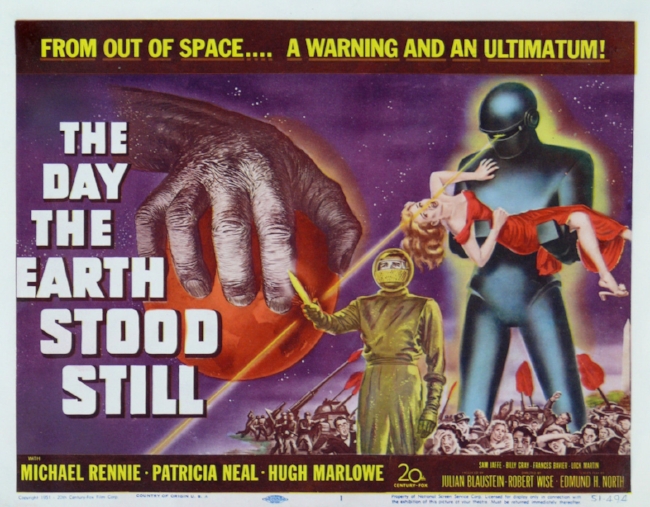
Film producer Julian Blaustein had a long-standing desire to make a film that addressed the fears and concerns of the post war Atomic Age. With the backing from Fox Studio Executive Darryl F. Zanuck, he hired screenwriter Edmund North to adapt the short story Farewell to the Master by Harry Bates. The screenplay provided a moral commentary about the ongoing arms race and featured an alien visitor with Christ like qualities who delivers an apocalyptic message. Veteran director Robert Wise was brought in head the project and a fine cast of established characters actors such as Michael Rennie, Patricia Neal Hugh Marlowe and Sam Jaffe was assembled. The finished movie has proven to be one of the greatest science fiction movies ever; it is The Day the Earth Stood Still made in 1951.
Film producer Julian Blaustein had a long-standing desire to make a film that addressed the fears and concerns of the post war Atomic Age. With the backing from Fox Studio Executive Darryl F. Zanuck, he hired screenwriter Edmund North to adapt the short story Farewell to the Master by Harry Bates. The screenplay provided a moral commentary about the ongoing arms race and featured an alien visitor with Christ like qualities who delivers an apocalyptic message. Veteran director Robert Wise was brought in head the project and a fine cast of established characters actors such as Michael Rennie, Patricia Neal Hugh Marlowe and Sam Jaffe was assembled. The finished movie has proven to be one of the greatest science fiction movies ever; it is The Day the Earth Stood Still made in 1951.
Alfred Newman was Director of Music at 20th Century Fox at the time and decided to assign the project to Bernard Herrmann, who has recently relocated to Los Angeles. Director Robert Wise had worked previously with Herrmann on The Magnificent Ambersons in 1942 and the pair had a good working relationship. So, he effectively gave him an open remit to create something different and special. Herrmann was far from a musical traditionalist and chose to craft an innovative soundscape to highlight the differences between the Alien Klaatu the bellicose and bombastic nature of humanity. He therefore elected to remove acoustic string and woodwind instruments from the orchestra and expanded the horn section. He then further embellished the sound of the film by adding such diverse instruments as an electric violin, Theremins, Hammond organs, vibraphones, and a celesta.
“Prelude and Outer Space” is a magnificent opening cue which highlights Herrmann genius in capturing the narratives emotional essence. The opening credits roll against a shifting panorama of stars and the sumptuously eerie main motif, featuring multi-tracked Theremin and tuba, juxtaposed by piano arpeggios, horns and crystalline harp. Herrmann further embellishes this portentous theme with a vibraphone played backwards. This cue is a masterpiece in both conception and execution. “Radar” offers another incredible track, which demonstrates Herrmann’s compositional aptitude. As the world watches on at the alien space ship, a harp glissando preludes a rapid duet between two pianos, one with bass and the other with vibraphone, which are octaves apart.
Bernard Herrmann was one of the most innovative composers of his generation who endeavoured to bring new and dynamic methods to the process of film scoring. His decision to remove the acoustic instruments from the string and woodwind sections of the orchestra and to augment his score with the abstract otherworldly sounds of the Theremin, vibraphone, and celesta was a bold move. Yet it proved to be a genre defining decision and adds another layer of subtlety to the storytelling. Over the years, many of the unique aspects of the film score have become standard genre tropes. You only have to listen to Danny Elfman’s main them for the 1996 Tim Burton movie, Mars Attacks to hear the reach of Herrmann’s influence.






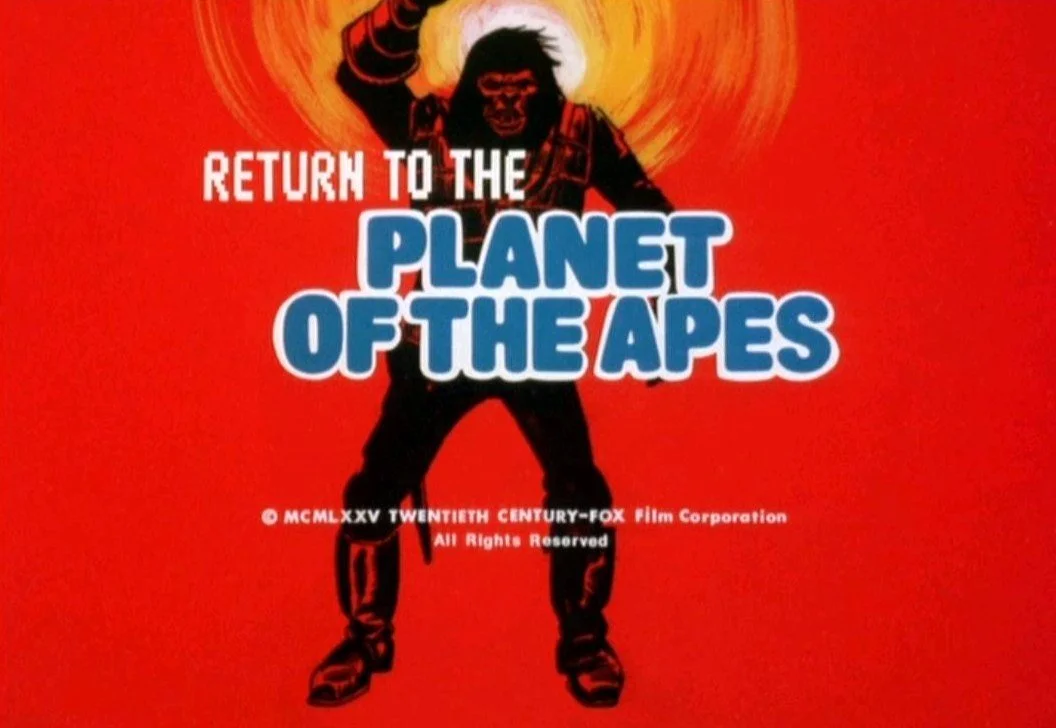
War for the Planet of the Apes (2017)
There are times when watching the third instalment of the contemporary Planet of the Apes franchise that you feel like your experiencing something akin to Terrence Malick's The Thin Red Line. There is a narrative depth and an intelligence to the screenplay that you seldom see these days coming from a major studio production. As with the original movies, the story makes multiple subtle points about the nature of humanity and our self-destructive tendencies. Yet it’s all done in a thought full and measured fashion. If you wish to treat War for the Planet of the Apes as simply a science fiction action movie then you will certainly be provided with such a film. However, if you choose to engage your intellect and ponder some of the deeper aspects of the story you’ll be rewarded with much more.
There are times when watching the third instalment of the contemporary Planet of the Apes franchise that you feel like your experiencing something akin to Terrence Malick's The Thin Red Line. There is a narrative depth and an intelligence to the screenplay that you seldom see these days coming from a major studio production. As with the original movies, the story makes multiple subtle points about the nature of humanity and our self-destructive tendencies. Yet it’s all done in a thought full and measured fashion. If you wish to treat War for the Planet of the Apes as simply a science fiction action movie then you will certainly be provided with such a film. However, if you choose to engage your intellect and ponder some of the deeper aspects of the story you’ll be rewarded with much more.
Set two years on from events of the previous film the battle between humans and apes, instigated by the traitorous Koba (Toby Kebbell), has rendered the world a wasteland. Primate protagonist Caesar (once again an extraordinary Andy Serkis) is intent on protecting his species with as little further bloodshed possible. "I didn't start this war," he rhetorically states, while reflecting on the immense loss of ape life. Yet fate leads him to an inevitable encounter with Woody Harrelson's Colonel McCullough when his wife and child are killed, sending him on a potentially self-destructive journey. Director Matt Reeves steers the proceedings at a steady pace, focusing on character over action and spectacle. Sharing a writing credit with Mark Bomback, Reeves does not stray from the central story. Unlike other big budget movies, despite the underlying technology that dominates such productions, there is little self-indulgence and excess. This is a story driven by characters and their choices and struggles.
Once again, creativity is the key to exploring the boundaries of the PG-13 rating. The scenes in the prison camp are grim and worryingly plausible. There are nods to both past and contemporary despotism. The action scenes are large in scope but lack the modern trend for frenetic editing. There is violence, but it’s shot in such a way where it is powerful, yet not inherently graphic. Tonally, the movie has a very dour and prophetic ambience. It is also clear exactly which side the audience should be rooting for. There are again further nods to other classic war movies. Anti-ape rhetoric adorns soldiers’ helmets with phrase such as "Monkey killer" and "Ape-ocalypse Now". It’s not too difficult to see hints of Colonel Kilgore in Woody Harrelson's despotic military leader.
There is also a subtle expansion of the world that makes War for the Planet of the Apes feel wider in scope than its predecessor. Overgrown decaying cities, disused railway tracks and abandoned Coca-Cola lorries hammer home the point that this is the near future and not the ancient wasteland that Charlton Heston endured in the original. Yet despite the broad canvas in which events take place, the plot rarely stray from Caesar, orangutan Maurice (Karin Konoval) and Bad Ape (Steve Zahn), who provides a reprieve from the otherwise sombre events. As for the ending of War for the Planet of the Apes, it is the only credible outcome, establishing the narrative that Caesar is the messianic saviour of his people. The audience is left to reflect upon the future of both human and ape society and whether they can coexist or not. However, that is a story for another day but considering the ground that has already been covered by the Planet of the Apes trilogy, possibly a superfluous one.
Dawn of the Planet of the Apes (2014)
Unlike so many other blockbusters Dawn of the Planet of the Apes is not just peddling a vacuous spectacle lacking any substance. The sequel to the 2011 reboot embraces both political and social concepts and attempts to explore them in a meaningful fashion. It is absorbing and intelligent, making its point without being too heavy handed. The motion captured performances and visual effects are outstanding, yet do not swamp the story or the subtleties of the actor’s performances. It is also surprising to see a mainstream Hollywood movie cultivate such a bleak and melancholic tone.
Unlike so many other blockbusters Dawn of the Planet of the Apes is not just peddling a vacuous spectacle lacking any substance. The sequel to the 2011 reboot embraces both political and social concepts and attempts to explore them in a meaningful fashion. It is absorbing and intelligent, making its point without being too heavy handed. The motion captured performances and visual effects are outstanding, yet do not swamp the story or the subtleties of the actor’s performances. It is also surprising to see a mainstream Hollywood movie cultivate such a bleak and melancholic tone.
I was not expecting great things from Dawn of the Planet of the Apes. I was raised on reruns of the original Planet of the Apes franchise and was frankly reticent to invest time in movies that were simply going to revisits old ground. However, Dawn of the Planet of the Apes has a greater depth to its narrative than I anticipated and is surprising critical of many contemporary political issues. The story not only explores the concept of institutionalised racism but wider societal inequality and the abuse of power that so often arises in all forms of politics. The thorny issue of gun control is alluded to, although obliquely.
Plot wise, Dawn of the Planet of the Apes takes a familiar story and simply tells it form a different perspective. Since the outbreak of the ALZ-113 virus, Caesar (Andy Serkis) and his genetically modified apes have been living peacefully in Muir Woods. When a band of wandering human survivors encounters them, both parties are equally surprised. After a violent incident, Caesar orders them to leave. However, the matter causes divisions in both human and ape societies. Koba (Toby Kebbell) wishes the apes to strike against humans while they still have the upper hand and likewise Dreyfus (Gary Oldman) wants the humans to deal with the simian threat, once and for all. However, not all humans takes such a hawkish stance. Malcolm (Jason Clarke) is curious about Caesar and feels an affinity towards him as both are struggling fathers.
Director Matt Reeves and screenwriters Rick Jaffa, Amanda Silver and Mark Bomback embellish the narrative with a great deal of thought and creativity. The apes use of sign language is innovative and appropriate. The sophisticated CGI does not impede the actor’s performance. Many of the apes have clear personalities and are strongly defined. The lack of dialogue in many scenes works very well, allowing cinematic art and the physical skill of the actors to tell the story. It's quite astonishing how far the motion capture technology has advanced when it comes to creating tangible characters that audiences can genuinely empathise with. Dawn of the Planet of the Apes is a superior movie to its predecessor, which although enjoyable, still felt very much like a prologue rather than a story in its own right.
However, Dawn of the Planet of the Apes does have a few inconsistencies. Gary Oldman is once again under used and liberal human leader Malcolm is a little bland. As ever with movies, it is the bad guys who are potentially the most interesting character. Yet I was left somewhat underwhelmed by the chimp Koba. It would have been interesting to see a greater exploration of his back story. I get the impression that the editing process left actor Toby Kebbell's performance somewhat choppy.
Overall, Dawn of the Planet of the Apes is an above average blockbuster movie that requires audiences to think and reflect, rather than just passively view. It moves the long-term story arc of the franchise forward into interesting new territory. It is quite hard hitting within the confines of its broad PG-13 rating and is surprisingly not afraid to pursue a sombre tone. The technical achievements of the production are prodigious and prove that motion capture performances are as relevant and meaningful as any other form of acting.
Rise of the Planet of the Apes (2011)
The greatest asset of Rise of The Planet of the Apes is the CGI chimpanzee, Caesar, played by Andy Serkis. It is also the films greatest hindrance. Too much focus is spent on the titular character at the expensive of the remainder of the cast. The pace is also purposely pedestrian to accommodate a list of cinematic pre-requisites that the producers felt must be included. These include moral dilemmas, relationship issues and contemporary ethical themes. If you were hoping that Rupert Wyatt’s Rise of The Planet of The Apes would be a more cerebral spectacle, then you may well be a little disappointed. It is functional and efficient entertainment, but no more than that.
The greatest asset of Rise of The Planet of the Apes is the CGI chimpanzee, Caesar, played by Andy Serkis. It is also the films greatest hindrance. Too much focus is spent on the titular character at the expensive of the remainder of the cast. The pace is also purposely pedestrian to accommodate a list of cinematic pre-requisites that the producers felt must be included. These include moral dilemmas, relationship issues and contemporary ethical themes. If you were hoping that Rupert Wyatt’s Rise of The Planet of The Apes would be a more cerebral spectacle, then you may well be a little disappointed. It is functional and efficient entertainment, but no more than that.
The CGI action scenes of rampaging apes, as shown in the trailer, are well executed but far smaller in scale than you would expect. They also arrive quite near to the films climax and are not as a substantial part of the movie as suggested. There are a few nods to the original series of films during the course of this reboot. But by and large this movie feels that it has been hemmed in and restrained by the need to establish a starting point for a new franchise. Once again, I suspect studio meddling and a continuous stream of memo’s suggesting adjustments based on focus groups and market research.
John Lithgow is good, but there again he is seldom bad. It is also nice to see humanity toppled from its pedestal. I have an inclination for any film that eschews the tired notion that the human race is the summit of evolution and somehow the metaphorical centre of the universe. It cannot be denied that the motion capture techniques certainly do set new standards. But ultimately, if Fox had spent more time focusing on a more even narrative, rather than being pleased with itself by all boxes they were ticking, this would be a better film. Let us hope that the next entry in the series will have a stronger director and a finely-honed screenplay.
The Twilight Zone (1959-64)
Despite the wealth of new television shows that are currently available, a few month ago I chose to revisit The Twilight Zone. In the past I have watched occasional iconic episodes during late night re-runs, but I have never really applied myself to the show. Up to now, I have mainly been familiar with this iconic show through the books that I’ve read. So, in March I started watching season one and was immediately hooked. Contemporary TV shows are often frenetic, densely plotted and at times over long. The Twilight Zone frequently manages to make it’s point in just twenty-five minutes, with strong performances and intelligent dialogue. Yes, there are aspects of the show that are dated. The production values are sometimes constrained by the budget and the special effects are not always that special. The shows gender politics are very much of the time. But all five seasons feature a cavalcade of fine actors, some already established at the time and others who would go onto greater things. Many of the episodes have bespoke scores written by the likes of Bernard Herrmann and Jerry Goldsmith. But at its core The Twilight Zone stands out because of the superb writing of its creator Rod Serling.
Despite the wealth of new television shows that are currently available, a few month ago I chose to revisit The Twilight Zone. In the past I have watched occasional iconic episodes during late night re-runs, but I have never really applied myself to the show. Up to now, I have mainly been familiar with this iconic show through the books that I’ve read. So, in March I started watching season one and was immediately hooked. Contemporary TV shows are often frenetic, densely plotted and at times over long. The Twilight Zone frequently manages to make it’s point in just twenty-five minutes, with strong performances and intelligent dialogue. Yes, there are aspects of the show that are dated. The production values are sometimes constrained by the budget and the special effects are not always that special. The shows gender politics are very much of the time. But all five seasons feature a cavalcade of fine actors, some already established at the time and others who would go onto greater things. Many of the episodes have bespoke scores written by the likes of Bernard Herrmann and Jerry Goldsmith. But at its core The Twilight Zone stands out because of the superb writing of its creator Rod Serling.
The Twilight Zone frequently uses the medium of tales of suspense, science fiction and the paranormal to explore perennial themes of prejudice, love, war, and the social issues of US society at the time. Sometimes the stories are stark, hard hitting and challenging. Other times they can be whimsical, subtle or paternal in tone. The show's signature twist endings often made the stories all the more memorable. Many of the tropes and common place plot devices that we now take for granted or even satirise, hail from Serling’s trail blazing show. This was ground breaking television at the time. Aside from Serling, who wrote or adapted over half of the total episodes, The Twilight Zone features the work of such authors as Charles Beaumont, Ray Bradbury, Earl Hamner, Jr., George Clayton Johnson, Richard Matheson, Reginald Rose, and Jerry Sohl. Many episodes also featured contemporary adaptations of classic stories by such writers as Ambrose Bierce, Jerome Bixby, Damon Knight, John Collier, and Lewis Padgett.
Over the course of five seasons these writers frequently used the medium of science fiction and broader fantasy as a means for social commentary. This proved quite beneficial as the otherwise censorial network executives and more importantly sponsors often failed to see the “message” in such fantastic material. Hence, The Twilight Zone includes stories about nuclear war, McCarthyism, and mass hysteria. Such material if referenced in a more traditional dramatic fashion would more than likely have been watered down or simply rejected. Key episodes such as "The Monsters Are Due on Maple Street" and "I Am the Night—Color Me Black" offered direct commentary on prevailing social issues and were not afraid to contradict the establishment status quo. Other stories, such as "The Masks", "I Dream of Genie", or "Mr. Denton on Doomsday" were allegorical in nature and pondered moral and philosophical conundrums through modern day fables. The spectre of World War II still looms large in many episodes, with cautionary tales about the need to remain ever vigilant against extremism and fascism. One episode “He’s Alive” has become worryingly relevant again.
Despite running for five seasons, The Twilight Zone was not an easy sell and an immediate runaway success. The ratings were good but there was still a great deal of critical prejudice against the show, simply because science fiction was a marginalised genre. Many critics as well as studio executives did not feel the medium could offer any narrative depth beyond escapism and certainly did not see it as a means of providing adult drama. The conceit of Serling's appearances on the show to introduce each story, eventually became one of its most original and distinct features. But at the time some saw this an indulgence or a distraction. It was not Serling’s idea to do this initially and he was quite reticent take up this role in front of the cameras. Yet his concise, direct delivery and distillation of the impending plot has become iconic and is still widely imitated today. Serling’s narrations and the breaking of the “fourth wall” were an innovative device and he appeared on all episodes. However, in the episode "A World of His Own", Keenan Wynn plays a writer with the power to alter his reality. He overhears and objects to Serling's narration, promptly removing him from the proceedings.
To date, I have watched the first two seasons of The Twilight Zone and am currently halfway through the third. Season one and two I’ve watched on DVD and the shows are in their syndicated format. That is to say, they do not include the sponsorship messages given by Rod Serling at the end of each episode, along with his preview of the next instalment. However, the Blu-ray boxset of the entire series (via which I’m currently viewing season three) includes the commercial break title card midway through each show, along with the aforementioned sponsorship messages and preview preamble. There are occasionally additional advertisements for charities and such like after the end credits, along with trailers for Gunsmoke with James Arness. The Blu-ray release has been lovingly restored from the original 35mm negatives and look crisp and clear. Many of the episodes that are deemed “classic” have multiple commentary tracks by cast members, writers and film historians. This release is certainly the best way to watch The Twilight Zone.
It’s hard to write anything about The Twilight Zone without referencing certain episodes. But as this has been done many times before, by far more keen-sighted critics and writers, I will simply mention those that I’ve personally enjoyed. "The Invaders" written by Richard Matheson is a tense tale of a woman living in a remote cabin, terrorised by tiny alien invaders. As ever there’s a clever sting in the tail. "It's a Good Life" stars Billy Mumy as a child devoid of a moral compass, who has the ability to will anything into or out of existence. He subsequently holds sway over a rural farming community. Interestingly, this was the episode that Joe Dante chose to remake for Twilight Zone: The Movie in 1983. "The Monsters Are Due on Maple Street" intelligently documents how a suburban community quickly turns on itself during what appears to be an alien invasion. Claude Akins give a credible performance, but it is Rod Serling’s script that is the real star in this story. I also have a soft spot for the bitter sweet "Time Enough at Last", starring the great Burgess Meredith as a hen-pecked husband who just wants to be left alone to read. The final pay-off still has the power both to raise a wry smile and a pang of sadness. I’d also recommend "Long-Distance Call" about a child who speaks to their dead Grandma on a toy telephone. You can also see a young Richard Kiel as the alien Kanamit ambassador in "To Serve Man". After sharing their technology, along with curing disease and famine, human flock to join an exchange program and visit the Kanamit homeworld. But there’s a dark secret contained within a book left my the Kanamit ambassador. The ending is the stuff on TV legends.
The Twilight Zone had an unprecedented influence on movies, television and pop culture in the years after its original broadcast. Many of it’s twist endings, iconic lines of dialogue and premises have become internet memes and are lovingly referenced in other shows. The theme tune, by Marius Constant, has itself has entered common parlance and become a signifier of the weird, odd and baroque. Just hum the first few bars of the intro music and most people with quickly guess that something off kilter has occurred. Such is the standing of Rod Serling’s show. So, if you enjoy portmanteau movies or dark TV show such as Black Mirror, then why not checkout the series that started it all. You’ll frequently find a wealth of great character actors, such as Lee Marvin, Lee Van Cleef, Vera Miles, Cloris Leachman, Dennis Hopper, Carol Burnett and Robert Duvall. And at twenty-five minutes an episode (apart from season four when they decided to double the length) these make ideal late-night viewing, often providing a bizarre or curious tale to ponder before sleep. Assuming that you’ll get any after some episodes.
Ready Player One (2018)
Where do I start with Ready Player One? Like so many contemporary blockbuster movies, beneath the hype, excess of visual effects and general self-indulgence of the production team, there are several good ideas and themes marbling the central premise of the film. Sadly, these are neglected in favour of numerous frenetic set pieces and a plethora of pop culture references. Although Ready Player One is essentially based upon a fan service novel, for it to fully succeed as a movie, it needed to temper such elements by focusing on the drama of it’s dystopian future and the plight of it’s central protagonists. Stephen Spielberg however, has not achieved this and the film is tonally inconsistent, light on character development and a little too pleased with itself with regard to its homages and tributes. The latter is a real stumbling block as it is, in many ways the selling point of the film. Yet by becoming the central conceit at the expense of everything else, turns what could have been a clever and relevant piece of film making into a very expensive cinematic version of “Now That’s What I Call Music”.
Where do I start with Ready Player One? Like so many contemporary blockbuster movies, beneath the hype, excess of visual effects and general self-indulgence of the production team, there are several good ideas and themes marbling the central premise of the film. Sadly, these are neglected in favour of numerous frenetic set pieces and a plethora of pop culture references. Although Ready Player One is essentially based upon a fan service novel, for it to fully succeed as a movie, it needed to temper such elements by focusing on the drama of it’s dystopian future and the plight of it’s central protagonists. Stephen Spielberg however, has not achieved this and the film is tonally inconsistent, light on character development and a little too pleased with itself with regard to its homages and tributes. The latter is a real stumbling block as it is, in many ways the selling point of the film. Yet by becoming the central conceit at the expense of everything else, turns what could have been a clever and relevant piece of film making into a very expensive cinematic version of “Now That’s What I Call Music”.
Let me address what I felt were the films inherent weakness. Firstly, there’s the rapidly edited action scenes, filled with vivid CGI and fluid camera movements. Modern visual effects have fallen victim to a form of conformity. They are bombastic, frenetic and frankly disorientating. The sheer quantity of audio and visual data to assimilate is overwhelming, headache inducing and fast becoming tedious. The “everything including the kitchen sink” approach is often done simply because it can be done, irrespective of whether is serves any wider purpose. Ready Player One has several keys scenes that fall into this category. I defy anyone to claim they absorbed everything on first viewing. Perhaps that’s the entire point. To encourage a second viewing or hours of analysis at home, watching the Blu-ray release on frame advance. Well sorry Hollywood, but I’m a firm believer in less is more and I’m so over visual FX show-reels masquerading as narrative cinema.
Secondly, the continuous stream of pop culture references as I mention earlier becomes a distraction. Some of the more obvious ones are relevant to the narrative and some of the obscure ones can certainly raise a wry smile. But other have no purpose other than to tick a box with certain demographic and please them. Essentially the problem here is knowing not to over egg something and flog a dead horse. If you want an example of when cameos, references and homages work well, then watch Who Framed Roger Rabbit, Dead Men Don’t Wear Plaid or even The Last Action Hero. Again, I suspect that this problem stems from the fact that this is a Steven Spielberg movie. Everyone in the chain of command assumes he knows his stuff and no one wants to be the person who says “no” to a film maker of his stature. Yet from what I’ve read he’s not a martinet and may even appreciate the occasional verbal check and balance.
Thirdly, contained within this very standard story of a dystopian future where people flee the reality to find meaning in a virtual world, there are some good ideas. Material that the writers should have got their teeth stuck into. If these had been developed more and featured more prominently in the proceedings then this could have been a far more impactful piece of cinema. For example, there is a minor scene where OASIS creators James "Anorak" Halliday (Mark Rylance) and Ogden Morrow (Simon Pegg), briefly disagree about the handling of their virtual world. Morrow postulates the need from rules and consequences. This mutual “Robert Oppenheimer moment” could have been so much more. Then there’s the characters of Sho (Philip Zhao) and Daito (Win Morisaki) who despite playing pivotal roles in the proceedings have precious little back story. The screenplay also veers from a very comic tone at times to something far bleaker. One moment we have a bounty hunter with a bag full of pithy quips, the next we have indentured slaves working till they die in what is effectively a high-tech debtors prison.
Because of these weaknesses Ready Player One fails to be the movie that it could be and misses its potential to be both a blockbuster and a movie of substance (something Spielberg has achieved with his earlier work). However, because of the director’s pedigree it is still has value if you’re prepared to simply take it as populist entertainment and nothing more. Certainly, younger viewers may revel in the some of the more contemporary video games references, tropes and memes. I must admit I laughed out loud at a business proposal to sell off to advertising “80% of an individual’s visual field before inducing seizures”. The film also benefits from quite a streamlined running time and unlike other tentpole movies of this kind, it doesn’t drag. The technology depicted is also quite grounded and thus helps the story tread that fine line between the audience maintaining their sense of disbelief and jumping the shark. For older viewers, there’s also a lot of solid eighties songs that intelligently embellish the production design and aesthetic of the film.
I came away from watching Ready Player One with some disappointment, but I was not surprised that it played out this way. When you invest $175 million into a project that is built upon concepts of nostalgia and geek culture, everyone involved is going to be adding fuel to the fire to ensure that the basic remit is met. In the rush to do so nuance and subtlety are quickly and possibly unintentionally side lined. I’m not a big one for glib distillations but I wrote in my notes as the credits rolled on Ready Player One, “Willy Wonka meets Tron, with pop culture references and a shit load of licensing costs”. I also reflected upon Yogi’s Gang which I remember from my childhood in the early seventies. It was a show that featured all your favourite Hanna-Barbera cartoon characters. On paper this was Hog Heaven for a kid, but the reality was the show often favoured certain characters or was just bogged down in showcasing everyone. There’s an element of that in Ready Player One and it’s cavalcade of in-jokes and references. If you can accept this flaw, then the fan service bias of the film won’t be an obstacle.
The X-Files: I Want to Believe (2008)
I always enjoyed watching The X-Files and was bitterly disappointed by the way the series ended. It was abrupt, lacklustre and inconclusive. So naturally I was interested when I heard that the franchise was to be resurrected for another cinematic outing in 2008. I, like so many fans, was curious to see how the characters would be developed and whether if any of the more famous story lines would be developed for this second cinematic outing. The fact that series creator, Chris carter, was to direct the film increased my expectations. However, the film that was finally released (at the height of the summer, amid so much competition) was quite different from what the public were expecting.
I always enjoyed watching The X-Files and was bitterly disappointed by the way the series ended. It was abrupt, lacklustre and inconclusive. So naturally I was interested when I heard that the franchise was to be resurrected for another cinematic outing in 2008. I, like so many fans, was curious to see how the characters would be developed and whether if any of the more famous story lines would be developed for this second cinematic outing. The fact that series creator, Chris carter, was to direct the film increased my expectations. However, the film that was finally released (at the height of the summer, amid so much competition) was quite different from what the public were expecting.
Former FBI spooks Mulder (David Duchovny) and Scully (Gillian Anderson) are reinstated to investigate the mysterious abduction of a young female agent. They are assisted by a psychic ex-priest who has been defrocked over child molestation (Billy Connolly). As the agents struggle to unravel the secrets of Father Joseph's visions they also have to confront some personal demons of their own. Whilst unravelling a plot involving bizarre experimentation, Mulder and Scully struggle with their relationship and a sceptical pair of FBI colleagues. There are no conspiracies, shoot outs, alien activity, CGI, or major explosions. The film is curiously low key in both its plot and production.
Unlike the first feature film, the plot does not focus on the series' established "mythos" and instead works as a standalone story, similar to many of the "monster of the week" episodes that were frequently seen in the TV series. This has been done in an attempt to appeal to a broader audience, but ultimately works against the film. It all seems a little too understated and un X-Files-ish. The only above average aspect of the movie is Billy Connolly's performance. But one good performance is not enough to sustain this sort of movie. Also, the major selling point of the original series was the unrequited relationship between the leads. This film ruins this mystique by finally settling the storyline. Mulder and Scully together as an item simply does not work.
The X-Files: I Want to Believe has a strong degree of moralising and religious debate, which is far from subtle. Connolly's character raises several ethical issues, but the script seems ill equipped to explore them to any satisfaction. All things considered, this really is a bit of a misfire. It does seem strange that a major studio such as Fox would bring a franchise out of retirement simply for such a basic film. I'm sure writer and director Carter was attempting to go back to basics and not be artistically fenced in by previous material. Unfortunately, I think he took too many steps back on this one and we are left with a film that is content to be no more in-depth than an average TV episode.
Interstellar (2014)
I have a suspicion that Interstellar is destined to be a movie that will polarise opinions for years to come. A quick visit to the IMDB already shows a divide between who hailed it as a masterpiece upon release in 2014 and others who left the movie theatre bitterly disappointed. I had mixed feeling about the film when I first saw it but was prepared to put aside its annoying foibles and embrace the bigger narrative picture. A recent second viewing has negated some of the problems I encountered first time round but overall, I still think it’s an enjoyable but cumbersome motion picture. Despite its science heavy plot and dialogue, Interstellar is very much a film about human nature. Director Christopher Nolan cleverly explores the perennial theme of how these two themes are seldom in accord.
I have a suspicion that Interstellar is destined to be a movie that will polarise opinions for years to come. A quick visit to the IMDB already shows a divide between who hailed it as a masterpiece upon release in 2014 and others who left the movie theatre bitterly disappointed. I had mixed feeling about the film when I first saw it but was prepared to put aside its annoying foibles and embrace the bigger narrative picture. A recent second viewing has negated some of the problems I encountered first time round but overall, I still think it’s an enjoyable but cumbersome motion picture. Despite its science heavy plot and dialogue, Interstellar is very much a film about human nature. Director Christopher Nolan cleverly explores the perennial theme of how these two themes are seldom in accord.
There is much to praise about Interstellar. The production design and effects are outstanding. The movie succeeds in visually realising the abstract nature of such phenomena as Black Holes, singularities and temporal anomalies. The robots that aid the crew are especially interesting as they are conspicuously non-anthropomorphic. Their design is functional as are their personalities. Christopher Nolan also wisely chooses to explore a very personal Father and Daughter relationship, set against the back drop of an ongoing global disaster. Although there are moments of spectacle in Interstellar, it is not at the expense of the human element that is essential to the story.
However, the film is flawed and at times struggles under the weight of its aspirations. The pace is languid, and where the leads get plenty of onscreen time, certain characters are woefully neglected and under developed. The final act cannot sustain itself and paints itself into a corner plot wise. After all its intellectual posturing, Interstellar settles for a rather generic Sci-fi plot device to resolve the story. There is a noticeable tonal shift and it may not sit comfortably with some viewers expectations. Imagine being beaten around the head with a science text book for two hours, only for it to be replaced by a philosophical tome at the last moment.
As with Inception, Christopher Nolan once again tries to raise the intellectual horizons of the blockbuster genre. Interstellar at time struggles to render its complex scientific themes into digestible dialogue but as experimental pictures of this nature are so few and far between, it would be short sighted to dismiss the film out of hand on these grounds. It deserves praise for trying to explore weighty themes with greater intellectual rigour than the average Hollywood movie. It should also be applauded for placing science at the heart of the plot. Especially as we live in times when critical thinking and rational thought are in decline. Knowledge and expertise are no longer exclusively viewed as laudable attributes and the “obsessed” scientist is no longer movie common movie trope.
It should be noted that Interstellar is not 2001: A Space Odyssey and doesn't strive to be so. Unlike Kubrick's movie, Christopher Nolan's is far more enamoured with the human condition. It's fundamentally about people and our nature as a species. However, it’s definitely not a movie for everyone and I would not recommend it as such. Don’t see it if you are expecting a space opera or just a story about exploration. Interstellar seeks to engage both your mind and emotions. Furthermore, it expects the audience to think. Although I found as much to dislike as I did to like, within the movie one hundred and sixty-nine-minute running time, I am glad that there are still film makers who are prepared to try something as bold as Interstellar. Sometimes a film that is imperfect can be just as engaging as one that is not.