
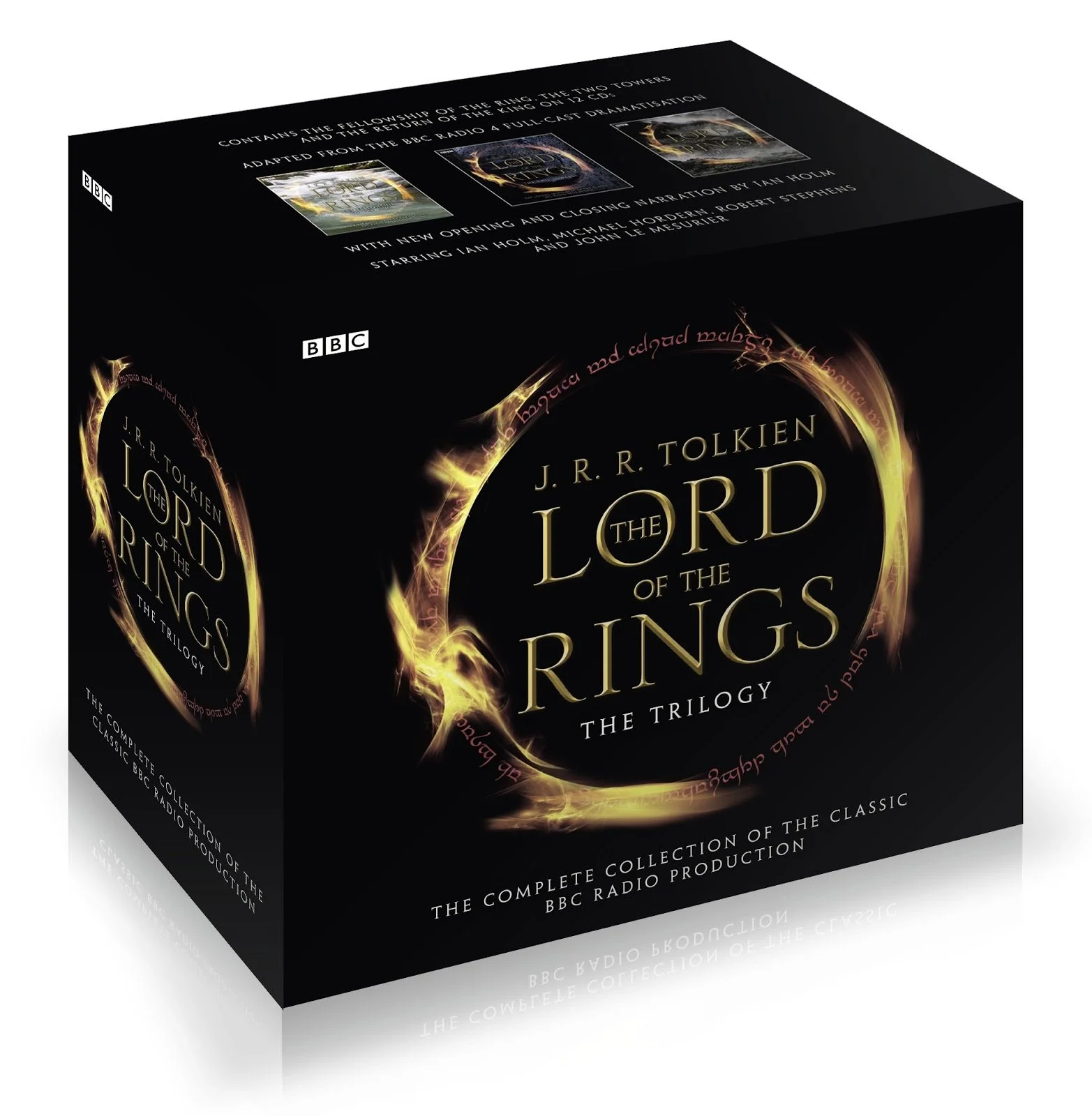
The Lord of the Rings - BBC Radio Adaptation (1981)
In 1981 BBC Radio 4 produced an ambitious adaptation of The Lord of the Rings, presenting Tolkien’s novel in twenty six, thirty minute episodes. As with all adaptations some material had to be removed, but overall the BBC production was not excessively abridged and followed the plot faithfully. The characterisations and dialogue were extremely well realised and music by composer Stephen Oliver was very much in the style and idiom of Tolkien. This was a production of the highest pedigree and a major event for the BBC at the time. The series was heavily promoted, receiving front page status in The Radio Times, the UK’s premier TV guide and bestselling magazine. Although initial reviews were varied, the series immediately gained a cult following with fans trading episodes recorded on cassette tape. Word of mouth and substantial listening figures soon lead to revised opinions from the press, along with the immortal slogan "Radio is Hobbit 4-ming".
In 1981 BBC Radio 4 produced an ambitious adaptation of The Lord of the Rings, presenting Tolkien’s novel in twenty six, thirty minute episodes. As with all adaptations some material had to be removed, but overall the BBC production was not excessively abridged and followed the plot faithfully. The characterisations and dialogue were extremely well realised and music by composer Stephen Oliver was very much in the style and idiom of Tolkien. This was a production of the highest pedigree and a major event for the BBC at the time. The series was heavily promoted, receiving front page status in The Radio Times, the UK’s premier TV guide and bestselling magazine. Although initial reviews were varied, the series immediately gained a cult following with fans trading episodes recorded on cassette tape. Word of mouth and substantial listening figures soon lead to revised opinions from the press, along with the immortal slogan "Radio is Hobbit 4-ming".
The trilogy was adapted for radio by the then novice writer Brian Sibley and veteran dramatist Michael Bakewell. It was directed by Jane Morgan and Penny Leicester, who were both experienced in radio dramas. The cast was made up of numerous fine British actors and voice artists such as Ian Holm as Frodo Baggins, John Le Mesurier as Bilbo Baggins and Sir Michael Horden as Gandalf. It also featured Robert Stephens as Aragorn and Peter Woodthorpe as Gollum. The adaptation excised a lot of the "excess fat" from the source text allowing the actors to concentrates on plot, character development and atmosphere. The attention to detail of this production was extremely high with Christopher Tolkien approving the scripts, leading to an authentic depiction of Middle Earth. Great care was taken with pronunciation of words and the delivery of dialogue spoken in Elvish and the Black Speech.
Upon its initial release each of the original twenty six episodes received two broadcasts per week, this remains standard practice for many BBC radio serials. After a successful first run the twenty six part series was subsequently edited into thirteen hour-long episodes, restoring some dialogue originally cut for timing, re-arranging some scenes for dramatic impact and adding linking narration and music cues. The re-edited version was released on both cassette tape and CD boxsets during the eighties and nineties and included bonus material such as the Stephen Oliver’s complete soundtrack for the series. It is this version of the BBC adaptation that has proven most popular and has been most commonly distributed and syndicated over the years.
In 2002 due to the commercial success of Peter Jackson's cinematic adaptations of The Lord of the Rings, the BBC re-issued a revised version of their 1981 series. This comprised of three CD sets corresponding to the three original book volumes (The Fellowship of the Ring, The Two Towers and The Return of the King). This version omitted the original episode divisions and included a new opening and closing narration recorded by Ian Holm. The re-edited version also included some additional music cues. However some fans felt that the re-arranging the material in this way actually spoilt the drama and the flow of the narrative. The original edit of the radio series was constructed so that the separate stories of Frodo and Sam ran in parallel to that of the rest of the Fellowship. It heightened the drama and afforded listeners a clearer understanding of the time line.
Tolkien's linear style proved to be a good fit for radio, with Sibley and Bakewell’s adaptation confidently staying true to the source text. Like Peter Jackson’s movies, some story elements have been cut, such as Tom Bombadil, along with the journey through the Old Forest and the Barrow Downs. However the Scouring of the Shire has been included, ensuring that Tolkien’s codicil is in place and therefore ending the tale correctly. One of the reasons this particular adaptation was so successful was due to the care and attention spent on the voice casting as well as the prudent use of music and song. Tolkien went to great pains to make both language and verse and integral part of Middle-earth and Sibley and Bakewell did not shy away from exploring this facet of the story. The BBC Radiophonic workshop also provided some pertinent sound effects and ambient sounds. As a result both the One Ring and the Nazgul have their own distinct audio characteristics.
Because the production elected to intercut the separate storylines to facilitate a more familiar style of narrative, there was a requirement to bridge a few expository gaps. Writers Brian Sibley and Michael Bakewell tackled this issue in an innovative fashion, adapting text from Tolkien’s later book Unfinished Tales which subsequently explained these literary grey areas. For example during the Nazgul’s quest for the One Ring, they visit Isengard and challenge Saruman over the whereabouts of The Shire. He advises them to pursue Gandalf. However as they follow Mithrandir’s trail they chance upon Grima Wormtongue, who is hurrying to Isengard with a message. It is he that gives up the location of the Shire upon threat of death. These narrative additions help with the flow of the story without breaking the lore.
This exceptional adaptation still remains accessible to both established Tolkien fans and those who have yet to read the trilogy. It is also a quintessential example of BBC Radio drama at its best. Although I enjoyed Peter Jackson’s movies upon their initial release, I feel that the BBC radio adaptation, despite being a different medium, is the better of the two. Peter Woodthorpe’s Gollum is a far more nuanced and sinister portrayal than Andy Serkis’s bi-polar performance. Also Jack May’s King Theoden is far more sympathetic and regal than Bernard Hill’s. Apart from reading the source text, this is the next best way to lose oneself in Tolkien’s classic story. It allows the listener to enjoy the outstanding vocal performances while conjuring up their own depictions of the characters in their mind’s eye. Where Peter Jackson’s movies are very much his interpretation of Middle-earth, the BBC radio adaptation of The Lord of the Rings is a far more faithful and nuanced dramatisation. Due to the medium of radio the strong story and characters are not overwhelmed or marginalised by spectacle.





Gaming Merchandise
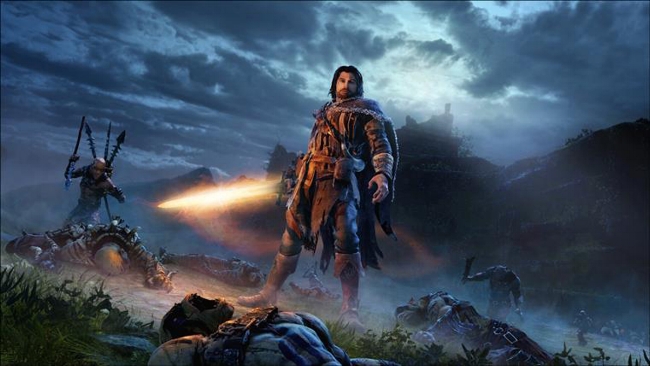
While watching the official LOTROstream recently, I noted that there was still a lot of LOTRO related merchandise adorning staff desks at Turbine’s offices. I recollect in the past that mouse mats, mugs and other items use to be available for sale in the Warner Bros. store. There was an initial marketing campaign associated with the launch of the game in 2007 and another in 2010 when the game converted to F2P, both of which required a stock of merchandise for promotional reasons. Sadly a search of the Warner Bros. store has shown that no such material is available any longer. Furthermore considering where LOTRO is in its lifespan, there is not likely to be any further stock produced.
While watching the official LOTROstream recently, I noted that there was still a lot of LOTRO related merchandise adorning staff desks at Turbine’s offices. I recollect in the past that mouse mats, mugs and other items use to be available for sale in the Warner Bros. store. There was an initial marketing campaign associated with the launch of the game in 2007 and another in 2010 when the game converted to F2P, both of which required a stock of merchandise for promotional reasons. Sadly a search of the Warner Bros. store has shown that no such material is available any longer. Furthermore considering where LOTRO is in its lifespan, there is not likely to be any further stock produced.
Merchandise such as T-shirts, mugs, mouse mats and stickers are often used as marketing tools when a game launches or new content is released. Take for example the Charr Plush that was in great demand back in August 2012 when Guild Wars 2 was first commercially available. The stock of such items are often limited and not always maintained over games lifespan. Thus these items go from being available to all, to the province of a collector in a very short period of time. Perhaps there is often no commercially sustainable long term market for such products and the initial batch is produced at a loss for the sole purpose of promotion.
However this is not always the case. Guild Wars 2 at present enjoys a healthy range of products. Mass Effect has been and gone, yet the franchise has evolved a strong following among gamers, very much akin to cult Movies and TV shows. The EA store still has a substantial amount of merchandise for sale including some expensive products such as collector’s edition models, hoodys and jackets. Activision has a similar line of apparel for the Call of Duty franchise; although this is far more understandable consider the financial success of the IP and the target demographic. There is also a wealth of merchandise associated with popular titles from the mobile gaming market, although I think this is a core aspect of the business model, rather than an addition to it as with MMOs.
One of the more interesting examples of game related merchandise is FigurePrints bespoke miniature figure service. The company can make a 3D replica of your in-game avatar from World of Warcraft or a section of your own world from Minecraft. Considering the passion that is prevalent among the LOTRO community with its emphasis upon roleplay, it’s a shame that such a service has never been implemented by Turbine for LOTRO or DDO. Perhaps the complexities of the licensing arrangement have something to do with this. Dealing with third party intellectual properties always comes with its own unique set of problems
Building a Tactical DPS Guardian Cruiser – Advice Required
I recently acquired a Mirror Universe Guardian Cruiser for the princely sum of £4, thanks to the recent Pop Culture Hero Coalition charity auction. It would appear that this is a well-regarded vessel within Star Trek Online and worth experimenting with as my primary ship. So I have spent some time (and energy credits) of late, trying to put together an adequate Tactical DPS build. However I am not particularly knowledgeable in this aspect of STO and have so far not exceeded 9K DPS. Although I’m not seeking to join the ranks of the elite, I would at least like to achieve about 10K DPS plus. However researching a suitable loadout is proving somewhat frustrating. Most Reddit threads on the matter are pitched at too high a level for me and often use jargon I’m not familiar with.
I recently acquired a Mirror Universe Guardian Cruiser for the princely sum of £4, thanks to the recent Pop Culture Hero Coalition charity auction. It would appear that this is a well-regarded vessel within Star Trek Online and worth experimenting with as my primary ship. So I have spent some time (and energy credits) of late, trying to put together an adequate Tactical DPS build. However I am not particularly knowledgeable in this aspect of STO and have so far not exceeded 9K DPS. Although I’m not seeking to join the ranks of the elite, I would at least like to achieve about 10K DPS plus. However researching a suitable loadout is proving somewhat frustrating. Most Reddit threads on the matter are pitched at too high a level for me and often use jargon I’m not familiar with.
So I’ve decided to put this matter into the public domain and solicit ideas for possible builds. I do have some stipulations though with regard to advice and suggestions. I have only been playing STO regularly since April and am therefore not sitting on a stockpile of resources. So I am seeking potential builds that are based upon equipment, weapons and consoles that can be sourced via the exchange, reputation rewards or running specific episodes. If the costs start to exceed 50,000,000 Energy Credits or 500,000 refined Dilithium then I won’t consider it viable. Therefore I’m not seeking to spend precious resources on upgrading gear from Mk XII to Mk XIV or spending Lobi Crystals. Although I play STO fairly regularly I do not want to turn working towards a manageable target, into an arduous chore.
So far I have equipped the Mirror Universe Guardian Cruiser with the following items. Please note that the choice was mainly driven by set bonuses and overall cost. I am happy to replace items if given a cogent reason:
Fore Weapons: 4 x Tetryon Beam Array Mk XIII (varying modifiers).
Aft Weapons: Kinetic Cutting Beam + see below.
Temporal Disentanglement Suite: Antichroniton Infused Tetryon Energy Weapon, Temporal Phase Overcharged Core, Temporal Disentanglement Console.
Sol Defence Set: Deflector, Impulse, Shield.
Universal Consoles: Sustained Radiant Field, Particle Conversion Matrix.
Tactical Console: 2 x Tetryon Pulse Generator Mk XII.
None of the above items have been upgraded and are therefore have base statistics.
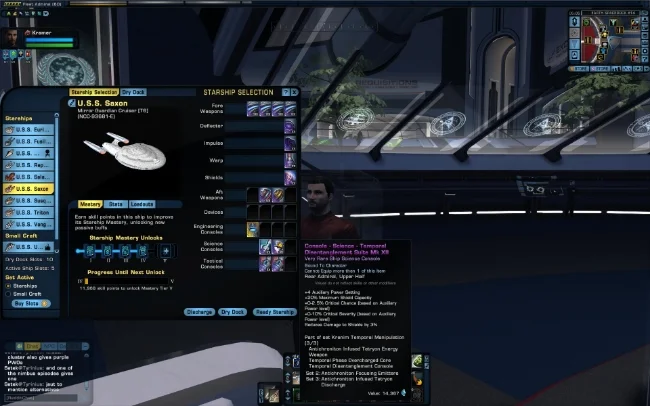
At present I have spent my skills point on a fairly generic tactical build I found on a Reddit thread. My choice of Starship traits are also fairly standard. I can publish the specific details if required but I am mainly hoping that someone can simply suggest a “shopping list” of items that I can then acquire and test. As I stated earlier I am not looking for an über build but merely the ability to be able to output 10K DPS or thereabouts. In principle that doesn’t sound like a big ask but you can never really tell when it comes to the esoteric art of Min-maxing.
The Lord of the Rings - The John Boorman Adaptation
n 1969 JRR Tolkien finally sold the film and merchandising rights of The Lord of the Rings to United Artists for approximately £104,000. A year later the studio asked director John Boorman if he could make the books into a viable film. Boorman, an established director with a track record of being experimental, set about developing a screenplay with his long term collaborator, Rospo Pallenberg. What emerged was a one hundred and fifty minute script and possibly the most radical adaptation of Tolkien's work. Some of the ideas and concepts it contained were extremely innovative but others where simply too radical a divergence from the source text. I’ve collated a few of these for your consideration. If you are familiar with Boorman's 1973 film Zardoz, then you will note both similarities and re-occurring themes.
In 1969 JRR Tolkien finally sold the film and merchandising rights of The Lord of the Rings to United Artists for approximately £104,000. A year later the studio asked director John Boorman if he could make the books into a viable film. Boorman, an established director with a track record of being experimental, set about developing a screenplay with his long term collaborator, Rospo Pallenberg. What emerged was a one hundred and fifty minute script and possibly the most radical adaptation of Tolkien's work. Some of the ideas and concepts it contained were extremely innovative but others where simply too much of a divergence from the source text. I’ve collated a few of these for your consideration. If you are familiar with Boorman's 1973 film Zardoz, then you will note both similarities and re-occurring themes.
1.) After the destruction of the Ringwraiths at the Fords of Bruinen, Frodo is carried into the sparkling palace of Rivendell, where in a vast amphitheatre full of chanting Elves he is laid naked on a crystal table and covered with green leaves. A thirteen-year-old Arwen surgically removes the Morgul-blade fragment from his shoulder with a red-hot knife under the threatening axe of Gimli, while Gandalf dares Boromir to try to take the Ring.
2.) The narrative of "The Council of Elrond" was to be visually interpreted as a fantastic medieval masque representing the history of the Rings. It was to combine elements of Kabuki theatre, rock opera, and circus performance.
3.) At the gates of Moria, the fellowship bury Gimli in a hole, throw a cape on him and beat him to a state of utter exhaustion to retrieve his unconscious ancestral memory. This ancient knowledge allows Gimli to recollect the word for entering Moria and gain insights about the ancient dwarf kingdom.
4.) Also in the Moria sequence, the orcs are slumbering or in some kind suspended animation. The fellowship runs over them and the rhythm of their footsteps start up their hearts.
5.) There was a proposed wizard’s duel between Gandalf and Saruman. This was inspired by an African idea of how magicians duel with words. The script reads:
Gandalf: Saruman, I am the snake about to strike!
Saruman: I am the staff that crushes the snake!
Gandalf: I am the fire that burns the staff to ashes!
Saruman: I am the cloudburst that quenches the fire!
Gandalf: I am the well that traps the waters!
6.) Perhaps the most provocative changes occur by introducing a sexual element. Not necessarily in a exploitative way but more of a metaphor exploring the nature of power. For example, before gazing into Galadriel's mirror, Frodo must have sex with her. Aragon's battlefield healing of Eowyn becomes a sexual analogy of the healing power of the king.
Needless to say, executives at United Artist failed to understand Boorman's script. The project was shelved indefinitely. When Ralph Bakshi approached the studio in 1976 with a proposal of adapting Tolkien's work in to an animated film, the script had to be purchased to acquire full artistic control. Boorman allegedly received $3,000,000 for his script. When Boorman later made his big screen adaptation of the Arthurian legend Excalibur in 1981, many parallels where drawn with The Lord of the Rings. It has often been suggested that several ideas from his the unused Tolkien screenplay made it in to that movie.
Star Wars Battlefront
A reoccurring theme in both my writing and podcasting at present is how age changes one’s personal perspective. This is something that particularly manifests itself with regard to gaming. A decade ago I would have been extremely enthusiastic about a title such as Star Wars Battlefront. I would have pre-ordered the most lavish version available, then waxed lyrical about the beta test and thrown myself wholeheartedly in to the game upon its release. Despite the fact that I’m notoriously poor at the FPS genre, I would have sunk hours in to such a game and done my up most to convince myself and others that I’d had a good time.
A reoccurring theme in both my writing and podcasting at present is how age changes one’s personal perspective. This is something that particularly manifests itself with regard to gaming. A decade ago I would have been extremely enthusiastic about a title such as Star Wars Battlefront. I would have pre-ordered the most lavish version available, then waxed lyrical about the beta test and thrown myself wholeheartedly in to the game upon its release. Despite the fact that I’m notoriously poor at the FPS genre, I would have sunk hours in to such a game and done my up most to convince myself and others that I’d had a good time.
Middle age has fortunately brought a keener insight in to the nature of marketing and as well as my own Pavlovian nature. Battlefront is simply another iteration of the Battlefield franchise from DICE with a veneer of Star wars added. It may well be very polished and a succinct distillation of everything that makes classic Star Wars enjoyable but once the initial euphoria has worn off, the player is left with a just another FPS game. Having read multiple reviews and watched numerous streams, it would seem that the game itself is actually lacking some of the usual progression mechanics found in this genre.
However for me the main issue that has kept me from considering purchasing Star Wars Battlefront is the egregious pricing model that EA has chosen to implement. Although I have come to terms with the concept of DLC and the ubiquitous season pass, I feel in this instance that EA have simply crossed a line with regard to an equitable division of the games content. Where a company such as DC Projekt Red seem to have found the right balance between launch content and future material, EA appear to have simply hobbled their base product at the expense of monetising the games long term life cycle. If I want access to all content in Star Wars Battlefront, both present and future, I have to spend £95.
I am a firm believer in the cost to fun ratio. I therefore if at a future date, I can secure Star Wars Battlefront at a discount price, I will overlook its alleged shortcomings and will more than likely have fun playing through the game. At present the price is prohibitive and frankly illogical. It is not a question of whether I can afford the cost, because I can. I simply do not believe the game justifies such a price tag. So for the present I will not be buying Star Wars Battlefront and because I no longer feel compelled to be an early adopter or be part of the “in crowd”, I am content to go without.
The Burton & Scrooge Guide to Podcasting
This is a somewhat self-indulgent post. I like to listen to podcasts as well as produce them myself. I have very particular tastes, not so much in respect of content but more with regard to presentation, style and quality of production. As a result I aspire to make the Burton & Scrooge podcast in a certain fashion and to a specific standard. But as everyone has their own personal tastes I fully understand that other podcasters may wish to do things differently. Hence this article is not being held up as a de facto guide. It is simply me sharing my process.
This is a somewhat self-indulgent post. I like to listen to podcasts as well as produce them myself. I have very particular tastes, not so much in respect of content but more with regard to presentation, style and quality of production. As a result I aspire to make the Burton & Scrooge podcast in a certain fashion and to a specific standard. But as everyone has their own personal tastes I fully understand that other podcasters may wish to do things differently. Hence this article is not being held up as a de facto guide. It is simply me sharing my process.
Format and structure versus informal chatting:
I listen to a lot of talk radio. It may be a sign of my age but I am beginning to prefer it to TV, especially with regard to news. Without visual input clouding the issue, you get to focus on the language. As a result, this very much shapes my view on podcasting. I like shows with a clear structure, a measured running time and the editorial strength to stay on topic. So I am a great advocate of planning, drafting show notes and discussing with my co-host Brian or any guests well in advance of recording. This does not mean that the entire show is mapped out in advance but it does allow points and counterpoints to be raised in an orderly fashion. It also allows the participants to marshal their thoughts. A good discussion is after all a logical process. A structured plan means that people know exactly what is being discussed and can craft an appropriate response. You can address the question that is being asked, rather than what you think is being asked, remain focused and not get side-tracked or derailed.
A planned approach also means that equal time can be given to all involved in the podcast. Balance is required because some people by the strength of their personality can sometimes dominate a conversation. That doesn't always make for good listening. However do not over do the planning or you can kill the natural conversational aspect of the show. Riffing off each other can be good and make a show more accessible. Informal chatting can make those speaking more "likeable" for want of another phrase. Although podcasting isn't a popularity competition your listeners do needs to be able to relate to you. So don't be too much of an asshole. If this is your "schtick, then you may find that you paint yourself in to a corner.
Do your research:
It's a simple point but it can elude us all at times. If you are going to reference anything in your show, make sure you have the relevant details in front of you when you discuss it. Never try to bluff or pull unsubstantiated facts out of your butt. If you have an opinion, then ensure you can back it up with some facts. Because if you don't there is no end to the armchair experts who will leave lengthy comments pointing out that you are wrong and that you should be burnt as a witch. Another thing worth remembering is to practise in advance any names or words that have unusual pronunciation. Write them down phonetically if need be. Gamers often have complex and esoteric handles. If someone has taken the trouble to write in or has done something worthy of discussion, then the least you can do is get their damn name right.
Using the right hardware in the right environment:
Let us be candid with regard to the technical quality of your podcast; there really is no excuse to producing a show that sounds shit these days. The tools of the trade use to be very expensive and only available to those who worked in the industry. This is no longer the case. With a decent quality gaming headset or desktop microphone, used in conjunction with Skype, Google Hangouts or Audacity, you can produce a show of an acceptable audio quality. Take some time to do some basic tests to ensure optimal sound performance. Don't just assume that whatever software you use to record is working. Double check it. Podcasting also requires the participants to focus and concentrate, so it's best to record in an environment free from distractions and ambient background noise. So turn your phone off or put in on silence. Don't have to TV running in the background. Make family, friends and anyone else you share a space with aware of the fact that you are recording so they don't disturb you. If you have a wireless headset, don't take a "comfort break" in the middle of the recording. It really isn't a pleasant thing to have to listen to. Take some time to have a warm up chat first, before recording or going live.
Editing:
Lots of people like to record their shows live. They then simply upload what has been recorded. This is perfectly fine approach that suits some shows style. I personally like order, structure and streamlined discussions. So I edit the shit out of the Burton & Scrooge podcast (despite trying to make things simpler so I don't have to). Brian and I often record twice as much material than what is actually used. I like to remove all the "ums" and such like from the final edit. I also like clear endings to discussions and neat segues in to the following piece where necessary. All of which requires rather intensive editing. Now the thing is editing is hard work and very time consuming. It is an activity that can sometimes curbs my enthusiasm for podcasting. Yet it can greatly improve the quality a show. It is wise to remove a joke that may not be understood, or cut a digression that takes the discussion off track. Imposing a running time upon the proceedings also forces you as an editor to keep only the most relevant material in the show. If for technical reasons, a part of a show is sub-standard, then lose it. This means making some tough calls sometimes.
Have fun and enjoy yourself:
Don’t forget to have fun while podcasting. If you are locked in to a regular schedule of recording, then the entire process of podcasting can become a bit of a chore. If you are not in the right frame of mind when recording this can become apparent to the listener. So don't half ass things. There is nothing wrong with taking a break or doing a shorter show. Ranting occasionally can be fun and even cathartic. But don't overdo it or you will simply lose credibility with your audience. If you are fortunate to produce a show that becomes popular, don't lose your sense of proportion. Don't get delusions of grandeur just because you do a show that a few people listen to.
Podcasting is great fun and an excellent opportunity to discuss, debate and hangout with likeminded people. It also offers a chance of a discourse that is not filtered by corporate interests or any other financially driven criteria. You can learn a lot by just listening to regular people chatting about the things they enjoy and feel passionately about. There are lot of different ways to podcast and my way may not be right or appropriate for everyone. However I think that my approach may prove suitable to some aspiring podcasters. As ever feel free to comment and share your thoughts. I'm always interested to hear the experiences of my fellow podcasters.
How to Explain Your Passion for Gaming to a Non-Gamer
Gaming is a pastime that is still viewed with scepticism by many people and gamers per se still endure a lot of bad press from those who like to perpetuate lazy stereotypes. If you are a well-adjusted gamer who enjoys gainful employment and a healthy social life, you may find yourself at some point having to explain your passion. Furthermore it could be to people who find your hobby utterly alien. Like most things in life there is no easy solution and there are numerous approaches to tackling such a line of enquiry.
Gaming is a pastime that is still viewed with scepticism by many people and gamers per se still endure a lot of bad press from those who like to perpetuate lazy stereotypes. If you are a well-adjusted gamer who enjoys gainful employment and a healthy social life, you may find yourself at some point having to explain your passion. Furthermore it could be to people who find your hobby utterly alien. Like most things in life there is no easy solution and there are numerous approaches to tackling such a line of enquiry.
The most logical starting point may be to give any curious third party a verbal overview on the merits of gaming; to attempt to convey the very things that you find engaging about gaming. However fans often cannot see the woods for the trees, so there’s a good chance that this approach could result in a lengthy diatribe, which fails in its good intentions and leaves one of the two individuals involved with their eyes glazed over. Can you guess which one?
Another approach may be to try and introduce this fictitious friend who is curious about gaming to some of the professional games coverage that is provided by the wider press. Mind you, this also comes with its own set of problems, as some of it can be very esoteric and niche market. It may only further bewilder and confuse, rather than illuminate. Plus the games media itself can at times be extremely blinkered and unwelcoming.
Overall I think the best way is to show the benefits of gaming. By that I don’t mean just demonstrate one of your favourite titles but how you personally experience it. Highlight the positive aspects of gaming that are common to other hobbies and pastimes, such as the social interactions and the friendships. A great example is the associated blogging community that stems from gaming. Many other hobbies have similar support networks and social portals. Perhaps the most obvious parallel that can be invoked is that of sports fandom. Demonstrating the common ground between the two may well prove beneficial.
The key is to break the stereotype of the gamer being an antisocial person indulging in something that has negative connotations. This is where the growth in casual gaming can work as a stepping stone between those who habitually game and those who do not. I’m not saying that the above is a comprehensive guide. As ever with human interaction, you need to adjust your pitch according to the situation. Yet if each of us manages to change at least ones persons mind about gaming, perhaps we can finally dispel some of the myths that still linger.
The Man from U.N.C.L.E. (2015)
Taking a popular franchise that is familiar to fortysomethings and remaking it for modern audiences is a difficult proposition and a calculated risk. More often than not such undertakings fail. Consider The Wild Wild West, The Avengers (no not that one, the other) and more recently The Lone Ranger. The problem lies in trying to make a film that can please all audiences. Often the finished product is too different from original material to appeal to the “get off my lawn” brigade. Younger viewers often have no connection to the franchise or knowledge of the era it came from. This results in the film failing to find a market and leads to box office failure. However it doesn’t necessarily indicate that the movie is poor per se.
Taking a popular franchise that is familiar to fortysomethings and remaking it for modern audiences is a difficult proposition and a calculated risk. More often than not such undertakings fail. Consider The Wild Wild West, The Avengers (no not that one, the other) and more recently The Lone Ranger. The problem lies in trying to make a film that can please all audiences. Often the finished product is too different from original material to appeal to the “get off my lawn” brigade. Younger viewers often have no connection to the franchise or knowledge of the era it came from. This results in the film failing to find a market and leads to box office failure. However it doesn’t necessarily indicate that the movie is poor per se.
The Man from U.N.C.L.E. is a text book example of this phenomenon, which is a shame. Guy Ritchie’s action comedy is far from a bad film. It’s stylish, sporting a wonderful stylised 60s production design and also has an amusing script. There are numerous homages and clever references to the spy genre, specifically those from the sixties. There’s more than a touch of Bond to the action scenes, international locations and some of the characters personal traits. The movies also boast a splendid cross section of international popular music from the period. The cast are also rather engaging. I was quite surprised by the lead performances from both Henry Cavill and Armie Hammer. I actually came away from watching The Man from U.N.C.L.E. quite entertained.
Yet I can totally understand why this movie was not commercially successful. For anyone unfamiliar with the original sixties TV show, this remake is just another comedy spy drama set in a period of history that is now just a chapter in a history book. An equivalent movie in a similar idiom such as Spy has the advantage of a contemporary setting and a broader rating. It is far more accessible and has no barriers to entry. Older viewers are similarly perplexed by The Man from U.N.C.L.E. as it is not an identical copy of what they are familiar with. The cast may not be known to them and the postmodern sensibilities of this film can be a major stumbling block. Nostalgia is sometimes a millstone.
Yet despite the odds being stacked against them, film studios still seem to back remakes of classic TV shows and movies. The allure of creating a franchise is strong and there are a handful of successful examples, such as the Mission Impossible movies, that appear to justify the risks involved. Therefore the recycling of “classic” content from the past five decades of TV and cinema is likely to continue. I have no doubt that the levels of success and failure will also remain the same.
Star Trek Online - Hearts and Minds
Star Trek is no stranger to the supernatural. The original series featured two episodes written by the reknown horror author Robert Bloch, namely "Catspaw" and "Wolf in the fold". Both of which nicely contrasted the shows central science based theme with elements of the paranormal. So I was pleased to see today that Cryptic were making the episode "Hearts and Minds" available in Star Trek Online, for a short 36 hour window to celebrate Friday the 13th. It’s a suitably atmospheric and cautionary tale which compliments the traditional story lines we see in STO. The story takes place in the Donatu sector of the Eta Eridani sector block, at a lunar research station in the Donatu system. Franklin Drake bestows the mission, thus suggesting that all is not as it seems.
Star Trek is no stranger to the supernatural. The original series featured two episodes written by the reknown horror author Robert Bloch, namely "Catspaw" and "Wolf in the fold". Both of which nicely contrasted the shows central science based theme with elements of the paranormal. So I was pleased to see today that Cryptic were making the episode "Hearts and Minds" available in Star Trek Online, for a short 36 hour window to celebrate Friday the 13th. It’s a suitably atmospheric and cautionary tale which compliments the traditional story lines we see in STO. The story takes place in the Donatu sector of the Eta Eridani sector block, at a lunar research station in the Donatu system. Franklin Drake bestows the mission, thus suggesting that all is not as it seems.
I've lost contact with an old . . . colleague. Doctor Sibak was a Vulcan priest, but he worked with the Vulcan science academy studying psionic phenomena. A few years ago he went into seclusion on a remote research station in the Donatu system. He hasn't been heard from in some time. I'd like someone to check up on him. Don't worry, He's just a typical Vulcan by himself. You shouldn't have any problems.
But of course there are. "Hearts and Minds" is a mini-mission that explores the consequences of Doctor Sibaks's unconventional research gone awry. This mission is a “story in one act,” and can easily be completed. It is enjoyably atmospheric in a creepy way. Missions initiated by Franklin Drake are always duplicitous and it is an interesting plot device to see a Vulcan character stray so radically from the path of logic. "Hearts and Minds" also rewards players with a unique duty officer upon completion. Not everyone is a fan of time restricted content but I like these episodes that only appear on specific occasions. If you cannot play through this particular mission during its current window of opportunity, you can rest assured that it will be available again in the future.
The Evolving Definition of MMORPG
A post over at Massively Overpowered postulated the question is an MMORPG still an MMORPG without gear progression? As you can imagine a broad debate ensued and at present there are over two hundred comments on the matter. I’m not going to debate the specifics of this particular question but would rather consider the following notion. That the term MMORPG is not immutable and has indeed evolved beyond its traditional definition. Furthermore unless some gamers embrace the concept of adaptive gaming semantics then they will continue to find themselves at odds with the prevailing ideas that are currently driving game developers.
A post over at Massively Overpowered postulated the question is an MMORPG still an MMORPG without gear progression? As you can imagine a broad debate ensued and at present there are over two hundred comments on the matter. I’m not going to debate the specifics of this particular question but would rather consider the following notion. That the term MMORPG is not immutable and has indeed evolved beyond its traditional definition. Furthermore unless some gamers embrace the concept of adaptive gaming semantics then they will continue to find themselves at odds with the prevailing ideas that are currently driving game developers.
Back in the heyday of Ultima Online the term Massively Multiplayer Online Role Playing Game had a very specific meaning that reflected the game mechanics and social requirements of the genre. For better or for worse that definition is no longer applicable. Today the MMORPG is a far broader church where players can pursue common goals collectively or on their own depending on their personal choice. Gear grinds, endgame raiding and mechanics such as the Holy Trinity are no longer essential to the genre. The formula for an MMORPG is now far more flexible, like the recipe for Chicken Tikka Masala or General Tso’s Chicken.
Yet many gamers have their personal perspective of the MMO shaped by their point of entry in to the genre. As a result a form of gaming first contact takes places that creates a rather entrenched mindset and a resistance to change. However games are first and foremost a business and market forces are there primary driving factor. Developers therefore will pursue whatever they consider to be financially viable options. Thus change is inevitable as well as desire able. Do we simply want a market saturated with identical products?
Change can be upsetting at times, especially if you feel it is to your personal detriment. Yet to resist it is ultimately futile. New players and revenue streams outweigh any loss from those who are unhappy. Gamers who want things to remain the same will eventually exile themselves from the very genre they enjoy. Is that a superior choice to trying something different, adapting and accepting change? I have an elderly relation who still obstinately refers to Zimbabwe as Rhodesia, due to some archaic world view that is now obsolete. All they really do by maintaining this stance is isolate themselves from others and look foolish. One could argue that those who stick rigidly to their own definition of the MMORPG are doing the same.
The Hobbit: The Battle of the Five Armies Extended Edition (2014)
The theatrical edition of The Hobbit: The Battle of the Five Armies was light on plot and heavy on action sequences. As a result it had many unresolved story lines. The extended editions once again attempts to address these deficiencies but sadly out of the twenty minutes of additional material that has been added, most are extended action scenes. There are moments of substance buried within this ponderous expanded edition but they are few and far between. Compared to other entries in the extended trilogy, this is the weakest as it really doesn’t add any major plot or narrative improvements. It does however add a lot more orc based violence.
The theatrical edition of The Hobbit: The Battle of the Five Armies was light on plot and heavy on action sequences. As a result it had many unresolved story lines. The extended editions once again attempts to address these deficiencies but sadly out of the twenty minutes of additional material that has been added, most are extended action scenes. There are moments of substance buried within this ponderous expanded edition but they are few and far between. Compared to other entries in the extended trilogy, this is the weakest as it really doesn’t add any major plot or narrative improvements. It does however add a lot more orc based violence.
If you are familiar with Peter Jackson’s earlier work such as Bad Taste and Braindead, then the splatter and CGI gore that has been added to The Hobbit: The Battle of the Five Armies will come as no surprise. As ever with his treatment of violence, Mr. Jackson tries to mitigate it’s over the top nature with a little slapstick humour. It may well me cunningly contrived and well-staged but it seems tonally out of place. Is this really Tolkien’s work? It’s a shame really because Peter Jackson is a very good film maker but he needs someone to curb his excesses and pull his focus back to the narrative when he becomes too enamoured with spectacle.
The new scenes added to The Hobbit: The Battle of the Five Armies are as follows.
Gandalf and Narya, The Ring of Fire.
The first new scene starts during Gandalf’s captivity in Dol Guldur. A large Uruk interrogates him regarding Narya the ring of fire. After brutally flinging him to the ground (shades of Pontius Pilate in The Life of Brian), the torturer attempts to sever the wizard’s hand.
Galadriel arrives and subsequently causes the Uruk to explode when revealing her power. Apparently this nameless Uruk, created via the use of an actor wearing prosthetics, was the original design for Azog.
Fighting the Ringwraiths and Radagast’s staff.
There are additional shots of Saruman and Elrond fighting the Ringwraith, which remains an entertaining but incredibly lore breaking sequence.
A more important scene is added after the expulsion of Sauron from Dol Guldur by the White Council. Radagast gives Gandalf his staff, as Mithrandir had lost his when confronting the Necromancer. Bunny Sled fans will enjoy its brief return during this expanded section.
Bilbo and Bofur.
One of the few strong points of this trilogy is the interaction between Bilbo and Bofur. During the night Bilbo decides to leave Erebor and go the Dale and give the Arkenstone to Bard and Thranduil to stop the ongoing conflict. Bofur mistakenly thinks that Bilbo is leaving for home again, as he did in the first movie. It’s a nice character driven vignette, that highlights the quality of the performances of both Martin Freeman and James Nesbitt.
Thorin considers Bard and Thranduil’s terms.
In this expanded scene Thorin ponders Bard and Thranduil’s terms, with regard to ransoming of the Arkenstone. This is a nice embellishment that showsThorin’s resolve wavering. There’s a nice lore based quip when Thranduil says to Bard “Ecthelion of Gondor will give you a good price for it”. However the arrival of a Raven on the wall informs Thorin that his Cousin Dáin Ironfoot has come and the negotiations swiftly end.
Send in the Goats.
In this considerably expanded section of the movie Dáin Ironfoot arrives with a sizeable army of Dwarves armed with Ballistas and Battle Rams in armour. After a pithy exchange with Thranduil, he decides to “send in the Goats” against the Elven Archers. It all ends in a scene very reminiscent of Braveheart with the Goats being skewered by a sheltron.
The Dwarves also deploy a Ballista based weapon that deals with the Elven arrow barrage very effectively. This new content adds gravitas to the decision by all parties to cease fighting when the Orc army arrives.
Bofur and the Troll.
After Thorin and company join the battle, there is new material involving the Dwarves. One such scene features a reoccurring joke involving a hand axe being thrown between Dwarves. This is the sort of embellishment that works very well and adds character to the proceedings.
Sadly shortly after this fun new addition, we get a completely over the top action sequence in which Bofur rides a Blind Troll and causes havoc among the Uruks.
The Dwarven War Chariot.
This next action scene is quite lengthy and is possibly the most controversial addition to the extended edition of the film. When Thorin decides to attack Azog at Ravenshill , he rides on a Battle Ram, with Kili Fili, Dwalin and Balin providing support in a Dwarven war Chariot. A hectic pursuit ensues as they are attacked by Wargs, Orcs and an armoured Troll.
This scene contains a lot of CGI splatter violence that may well have pushed the US rating from PG-13 to R. There is a short pause for a dialogue exchange between Dwalin and Balin which again shows that there is some depth to the little narrative there is.
The Death of Alfrid.
Alfrid (Ryan Gage) is an utterly contrived character and frankly serves no real purpose in this movie, beyond the functional. Did the story really need a comic foil? However in the extended edition at least we get to see his demise, which is equally phony and laboured. The scene benefits from some light relief as Gandalf tries to get the staff that Radagast gave him to work.
Bifur and the Axe in his Head.
I’ve always found the concept of Bifur having an axe embedded in his head a step too far. However this new scene does at least make use of this particular “MacGuffin”. After headbutting an Orc Bifur finds himself stuck. Both Bofur and Bombur wrestle to free him resulting in the axe head finally being removed from his skull. A zinger line follows, which I believe is the only piece of dialogue Bifur (William Kircher) has in all three films.
Legolas and the Gratuitous Action Scene.
If you are a fan of the scene in the theatrical version of the movie in which Legolas hung from a Gaint Vampire Bat, then you’ll love this expanded scene in which he dangles upside down and attacks an entire column of Uruks singlehandedly. It is staggeringly crass and frankly embarrassing to watch.
The Funeral.
Finally and perhaps in some ways the most important addition to the movie, we have the funeral for Thorin Oakenshield. This short and sombre scene does see the Arkenstone restored to Thorin as he as well as Kili and Fili lie in state on top of their stone tombs. The montage then cuts to Dáin Ironfoot being crowned king under the mountain.
Fans of this trilogy will no doubt enjoy this latest extended edition, as will those viewers who are not Tolkien aficionados and are just looking for come casual fantasy entertainment. However there are many who still feel that this adaptation of The Hobbit is deeply flawed and is very much a case of style over substance. This is very much Peter Jackson's interpretation of Middle-earth, rather than an authentic depiction of Tolkien's. However irrespective of your point of view this extended edition is ultimately superior to the theatrical release and remains the recommended version of the film.
Black Belt Jones (1974)
Among the many Blaxploitation films of the seventies, Black Belt Jones is certainly one of the best. Director Robert Clouse skilfully blends the action with humour and no cliché is left unturned. Jim Kelly proves very adept and his fighting style is both accomplished and enjoyable. Sporting cast of known genre names, such as Scatman Crothers, Gloria Hendry the film proves to be an entertaining eighty seven minutes. If you like this genre along with big Afro's, plaid pants and jive talking pimps, then Black Belt Jones ticks all the boxes. The plot is hardly complex drawing from stock story lines from the martial arts and action genres. However some of the dialogue is priceless with Malik Carter having all the best lines.
Among the many Blaxploitation films of the seventies, Black Belt Jones is certainly one of the best. Director Robert Clouse skilfully blends the action with humour and no cliché is left unturned. Jim Kelly proves very adept and his fighting style is both accomplished and enjoyable. Sporting cast of known genre names, such as Scatman Crothers, Gloria Hendry the film proves to be an entertaining eighty seven minutes. If you like this genre along with big Afro's, plaid pants and jive talking pimps, then Black Belt Jones ticks all the boxes. The plot is hardly complex drawing from stock story lines from the martial arts and action genres. However some of the dialogue is priceless with Malik Carter having all the best lines.
Pinky: "You see I got a couple of Bogarts coming in from Frisco".
Mafia Boss: "Bogarts? What are Bogarts?”
Pinky: "Treacherous Niggers".
The soundtrack is composed and performed by Dennis Coffey and Luchi De Jesus; the former a funk star in his own right, the latter an established composer within the Blaxploitation genre. Together the pair have produced some exceptional cues that mix guitars, funky basslines and traditional string orchestrations that reflect the musical idiom that was established by Shaft. The current soundtrack album nicely mixes together lines of dialogue and sound effects from the movie. The title theme itself is very memorable with its hip vocalisations, cool bass and blasting horns. If you enjoy this genre of movie and the music form this period, then soundtrack to Black Belt Jones is a solid investment.
Dawn of the Dead: The Extended Mall Hours Cut (1978)
In the last few years I’ve become acquainted with the concept of fan edits. Fan edit are versions of a film that has been modified by a viewer. This involves the removal, reordering, or the addition of new material to create a new interpretation of the film. Fan edits include the removal of scenes or dialogue, replacement of audio and visual elements, as well as adding material from sources such as deleted scenes or even other films. Due to the easy access to pro-quality software and high definition source material, such editions are often very professionally realised. Naturally fan edits often fall foul of copyright law.
In the last few years I’ve become acquainted with the concept of fan edits. Fan edit are versions of a film that has been modified by a viewer. This involves the removal, reordering, or the addition of new material to create a new interpretation of the film. Fan edits include the removal of scenes or dialogue, replacement of audio and visual elements, as well as adding material from sources such as deleted scenes or even other films. Due to the easy access to pro-quality software and high definition source material, such editions are often very professionally realised. Naturally fan edits often fall foul of copyright law.
I was introduced to this sub-genre when I was tipped off about an extended version of George A. Romero's classic Zombie movie Dawn of the Dead. After a little investigation on the internet I discovered Dawn of the Dead: The Extended Mall Hours Cut. This fan edit produced by the intriguingly named Officially Unofficial, uses the 139 minute Cannes Cut of the film and the 117 minute Dario Argento version. Effectively this is the closest approximation of Romero’s original rough cut of the movie and clocks in at a total running time of 155 minutes.
There is quite a lot of extra footage in this fan edit. As well as miscellaneous scenes of violence in the mall sequences, there are various dialogue extensions which enhance the narrative and give more weight to the story. When the bikers arrive at the movies finale, there is an expanded scene where we see them planning their “attack strategy”. There also some extended dialogue between Peter and Stephen after they return from “shopping” the first time. The pair argue over how they would deal with Fran if she was ever bitten. It is a very different version of the film with a more depressing tone to the theatrical cut. The new material is integrated into this edit seamlessly.
Dawn of the Dead is a genre milestone and there is no need to review the films merits here as they’re clearly established. This fan edit does add an interesting new aspect to the movies pedigree, offering a slightly more human perspective to the narrative. There’s a subtle shift in tone which implies a sense of futility to the lead characters fight for survival. I would be most curious to learn what George A. Romero himself thought of this edit, if he were ever to see it.
UPDATE: There is now an official Blu-ray release of Dawn of the Dead called “The Complete Cut” that comprises of all available footage. It effectively replaces the unofficial “Extended Mall Hours Cut”.
Classic Game Themes: Arcania - Gothic 4
Dynamedion are an award winning company and team of composers based in Germany. They specialize in soundtracks and game compositions, usually in the orchestral form. Over the years they have produced both musical scores and ambient sound designs for such titles as Ryse: Son of Rome, The Elder Scrolls Online and the Gothic series. Tilman Sillescu is both the co-founder of Dynamedion, as well as a prodigious composer in his own right. He previously taught at Mainz University. As Lead Composer and Creative Director at Dynamedion GbR, he has scored many exciting video game projects as well as writing and producing music for movie trailers, television and libraries.
Dynamedion are an award winning company and team of composers based in Germany. They specialize in soundtracks and game compositions, usually in the orchestral form. Over the years they have produced both musical scores and ambient sound designs for such titles as Ryse: Son of Rome, The Elder Scrolls Online and the Gothic series. Tilman Sillescu is both the co-founder of Dynamedion, as well as a prodigious composer in his own right. He previously taught at Mainz University. As Lead Composer and Creative Director at Dynamedion GbR, he has scored many exciting video game projects as well as writing and producing music for movie trailers, television and libraries.
The score for Arcania: Gothic 4 contains both ambient and thematic tracks which enrich the gameplay and overall atmosphere. The cue I have chosen plays over the games end credits and is listed on the games soundtrack CD as "credits song". It is an initially sombre piece that grows in power ending in a triumphant crescendo of brass. The vocalisation adds a semi-religious quality to the track and overall feels somewhat like a requiem. This particular music cue was written by Tilman Sillescu himself and is indicative of the level of quality that Dynamedion produce.
Gamer Spends $30,000 on Star Citizen
Over at PCGamer there’s an interview with a Star Citizen fan by the name of Chris (AKA Ozy311) who has to date spent $30,000 on the game. He owns all items that are currently available via the game store. Furthermore he has implied that he will continue to spend money on Star Citizen as more content become available. It would appear that Chris is an ardent gamer and has no concerns spending such sums of money on virtual products in a game that is still under development. Judging from the interview it seems that he has a well-paid job and is therefore simply exercising his right to spend his money how he sees fit.
Over at PCGamer there’s an interview with a Star Citizen fan by the name of Chris (AKA Ozy311) who has to date spent $30,000 on the game. He owns all items that are currently available via the game store. Furthermore he has implied that he will continue to spend money on Star Citizen as more content become available. It would appear that Chris is an ardent gamer and has no concerns spending such sums of money on virtual products in a game that is still under development. Judging from the interview it seems that he has a well-paid job and is therefore simply exercising his right to spend his money how he sees fit.
What I find fascinating about this story is not that a gamer has spent such a sum of money but the way the gaming community has reacted to this revelation. The comments section over at PCGamer (as well as on other similar sites) is rife with statements and value judgements based on limited data and the application of subjective personal morals. There is also a lot of bitterness and jealousy, as well as the usual straw man and ad hominem arguments that are de rigueur in such discussions. It would appear that some gamers are very unhappy with someone spending their own money in a particular way, but they’re not particularly good at articulating what they specifically object to.
When someone decides to place their personal activities in the public domain, they are courting opinion, be it directly or indirectly and they will have their actions judged. However beyond the facts, there really is no more to this story than what first meets the eye. Chris is a fan spending money on his particular passion. His expenditure is relative to his income. From what I’ve read he’s is not in any way negatively affecting anyone else with his purchases. The only unusual aspect of this whole affair is the relatively new concept of buying virtual goods and services. If Chris had bought a yacht he would still have one, irrespective of whether the manufacture ceased trading.
Once again I find that a percentage of the gamers seem to have a curious puritanical streak. As ever a lot of people’s personal opinions seem to be based upon nothing more than how they initially feel, rather than a logical analysis and measured consideration of the data. However that is something that we cannot lay exclusively at the door of the gaming community as it seems rife in every other social aspect of life. Perhaps I just notice the volume of white noise associated with gaming because I have an interest in it; I’m sure there’s just as much among sports fans. In the meantime it will be interesting to see if Star Citizen continues to attract such “big spenders”. I wouldn’t be surprised if it does.

The Lord of the Rings - The Mind's Eye Radio Adaptation (1979)
When discussing the various audio dramatizations of J. R. R. Tolkien's The Lord of the Rings, people often think of the BBC Radio adaptation by default. However it should be noted that it was not the first. An earlier version was made and broadcast in 1979 on US National Public Radio and was subsequently released as an audiobook. It was produced by The Mind's Eye, a company who were responsible for numerous adaptations of classic literature for radio at the time. The script written by Bernard Mayes is a somewhat abridged version of the book. The eleven hour running time focuses significantly on the dialogue, with much of the back history, lore and expositionary narration removed.
When discussing the various audio dramatizations of J. R. R. Tolkien's The Lord of the Rings, people often think of the BBC Radio adaptation by default. However it should be noted that it was not the first. An earlier version was made and broadcast in 1979 on US National Public Radio and was subsequently released as an audiobook. It was produced by The Mind's Eye, a company who were responsible for numerous adaptations of classic literature for radio at the time. The script written by Bernard Mayes is a somewhat abridged version of the book. The eleven hour running time focuses significantly on the dialogue, with much of the back history, lore and expositionary narration removed.
The production was very low budget, drawing upon local amateur actors and friends of the producer. There was extensive use of library music and homemade sound effects. Due to scheduling issues the cast often recorded their lines separately resulting in some curiously stilted exchanges of dialogue in key scenes. The voice cast also had to provide multiple character voices which at times causes a degree of confusion. It is also clear that none of the production were Tolkien scholars. The pronunciation of many names and places are often incorrect and the clumsy adaptation results in several plot holes and unresolved storylines.
However despite these flaws this production proved popular at the time of its broadcast. Its simplicity is actually quite a benefit, making this adaptation accessible for a younger audience or those with only a passing interest in Tolkien's work. It should also be noted that this production does not omit Tom Bombadil and presents his part of the story in quite an effective fashion. This production has been distributed by several audio book companies over the years and can even be found on "You Tube". Although purists may eschew The Mind’s Eye production for its obvious faults, there is still much to enjoy from this drama, if it is approached in the right fashion.
Bringing Godzilla Down to Size (2008)
I recently stumbled across the documentary Bringing Godzilla Down To Size, which was originally included on Classic Media’s DVD release of the genre classics War Of The Gargantuas and Rodan. This in-depth and surprisingly engaging film explores the history of the Japanese Godzilla franchise and focuses on the special effects and technical aspects that dominated these productions. Technicians and actors are interviewed, providing a wealth of insight into the complexities of the films. This documentary also demonstrates the very unique nature of the Japanese film industry and its obsessive attention to detail.
I recently stumbled across the documentary Bringing Godzilla Down To Size, which was originally included on Classic Media’s DVD release of the genre classics War Of The Gargantuas and Rodan. This in-depth and surprisingly engaging film explores the history of the Japanese Godzilla franchise and focuses on the special effects and technical aspects that dominated these productions. Technicians and actors are interviewed, providing a wealth of insight into the complexities of the films. This documentary also demonstrates the very unique nature of the Japanese film industry and its obsessive attention to detail.
The main question asked by this film is why is Godzilla still principally played a man in a suit? At a time when Hollywood’s uses CGI at every potential opportunity, Japanese sci-fi movies still rely heavily on old-school techniques. Miniatures, physical effects and actors in animatronic costumes are still commons. For over fifty years, Godzilla, Mothra, King Ghidorah and other giant creatures have been brought to life in this old fashion manner. Is the Japanese effects industry just as traditional as other aspects of their culture? The documentary’s answer is surprisingly simple. The old techniques work
Narrated by Godzilla fan boy extreme, Alex Cox (director of Repo Man, Sid And Nancy), the film celebrates the art and craft of the Japanese monsters genre and reflects on the future of Godzilla in the digital age. Bringing Godzilla Down To Size reveals through a multitude of interviews, the love and respect that the technicians and artists have for this series. The meeting between the three actor/stuntmen that have played Godzilla over the years is quite touching. The documentary manages to tread the narrow path between informed narrative and gushing fan boy eulogy. It also provides a very interesting overview into the world of pre-digital visual effects.
The Signalman & The Waiting Room – Middle Ground Theatre Company
The Signalman and The Waiting Room are two supernatural tales dramatically brought to life by the Middle Ground Theatre Company. Featuring an ensemble cast and minimalist set design, these character driven performances are extremely entertaining and make for suitable ghoulish entertainment at this time of year. I had the pleasure of seeing a performance tonight at the Orchard Theatre in Dartford, as the company currently tours the UK.
The Signalman and The Waiting Room are two supernatural tales dramatically brought to life by the Middle Ground Theatre Company. Featuring an ensemble cast and minimalist set design, these character driven performances are extremely entertaining and make for suitable ghoulish entertainment at this time of year. I had the pleasure of seeing a performance tonight at the Orchard Theatre in Dartford, as the company currently tours the UK.
The first tale, Robert Aickman’s The Waiting Room, is the story of George Pendlebury (Jack Shepherd) who after finding himself marooned has to spend the night in the waiting room of a station. Inclement weather and increasing cold soon take a toll upon the man. Is he subject to a vivid dream or a supernatural visitation? Furthermore is he merely an idle spectator or directly linked to the unfolding events? The second story, Charles Dickens’ The Signalman is the study of a man plagued by a recurring spectre. Each time the ghost appears outside of the railway tunnel by his signal box, death and disaster follows. Why has this entity chosen this particular signalman (Jack Shepherd again) to haunt? Is it the herald of further tragic events?
Both stories are inventively presented, slowly building an atmosphere of tension. There are a few well timed jump scares, which embellish the story arc without mitigating the drama. Performances are universally good and keep the audience focused on the proceedings. Director and set designer Michael Lunney creates a modest environment for the cast to perform in but it works extremely well. The use of lighting, ambient audio effects and projected visual FXs, enhances the presentation immensely giving the cast, especially Shepherd, credible apparitions to react to.
The two stories, separated by a short intermission, run approximately forty five minutes each and make maximum use of their respective running time. This performance driven play offers thought provoking entertainment, as both stories do not necessarily provide a definitive, black and white conclusion. Overall this was a thoroughly entertaining night out and I would certainly be interested in seeing further material produced by the Middle Ground Theatre Company, as they seem to have a clear understanding and respect for this genre of play.
Activision Blizzard Buys King Digital Entertainment
I found out about Activision Blizzard’s acquisition of King Digital Entertainment via the BBC Business website. From my perspective the notion of a leading US games developer that has a foothold in all major markets, buying in to the mobile sector hardly comes as a surprise. The price is perhaps the main talking point and does raise the question of the potential over valuing tech based companies. $5.9 Billion is after all a tidy sum of money. However what this deal does prove is the financial importance of the mobile gaming market.
I found out about Activision Blizzard’s acquisition of King Digital Entertainment via the BBC Business website. From my perspective the notion of a leading US games developer that has a foothold in all major markets, buying in to the mobile sector hardly comes as a surprise. The price is perhaps the main talking point and does raise the question of the potential over valuing tech based companies. $5.9 Billion is after all a tidy sum of money. However what this deal does prove is the financial importance of the mobile gaming market.
Gaming like many other pastimes has a social hierarchy among its fan base, which is rife with preconceptions, snobbery and self-aggrandisement. For many mobile gaming is still frowned upon and considered in some quarters not to be “proper” gaming. There will be a wealth of blog posts and commentary about this business deal, decrying it as foolhardy. A popular refrain will be how the money could be better spent producing a particular product that specific fans want. This is the nature of fandom; a tunnel vision perspective driven by one’s own desires.
The reality of the situation is very simple. Mobile gaming, irrespective of its perceived artistic and creative merits, is an extremely lucrative business. Therefore the opinion of those who are not part of the existing customer base is hardly of any major significance to developers. Those with entrenched views are hardly likely to succumb to marketing and therefore cease to be of any importance in any ongoing promotional campaign. Sadly logic seldom has any impact upon the white noise generated by “core gamers”.
Over time I have become increasingly more interested in the business side of the gaming industry. It is as fluid and intriguing as any other global market. Compared to the emotive and often self-absorbed tirades I see coming from the gaming community, the machinations of companies such as Activision Blizzard are far more interesting. This simply highlights the gulf between business and the imperatives of the market compared to the capricious nature of fans aspirations. Am I growing out of gaming? No but I may well be growing out of the community.
New Star Trek Series Premieres January 2017
The announcement that CBS has commissioned a new series of Star Trek is both a blessing and a curse. It’s a blessing in the sense that I have genuine affection for this franchise and therefore I welcome the prospect of a new incarnation of the show returning to TV. However I also consider this situation an absolute curse because well now have to endure at least eighteen months of idle speculation and an ongoing dissection of the entire production of a show before it is even released.
The announcement that CBS has commissioned a new series of Star Trek is both a blessing and a curse. It’s a blessing in the sense that I have genuine affection for this franchise and therefore I welcome the prospect of a new incarnation of the show returning to TV. However I also consider this situation an absolute curse because well now have to endure at least eighteen months of idle speculation and an ongoing dissection of the entire production of a show before it is even released.
Fans have the capacity to be a never ending wellspring of love, loyalty and support. The goodwill of the faithful can be an abject boon to a production company looking to resurrect an ailing franchise and tentatively venture in to virgin territory. Sadly the opposite can also be true. An obstinate, intransigent fan base can be a millstone around the neck of an established brand that is in transition. Every single innovation, change or casting decision can be subject to a wave of negativity and even hatred.
And then we have the press who will happily spend the intervening time publishing anything and everything to do with this production. Be it true or false, all information will be avidly received and trumpeted in suitably hyperbolic terms. Unless one invests a considerable amount of time and effort avoiding the ensuing hype, we’ll all inevitably arrive at the season premiere with unrealistic expectations and a sense of anti-climax. This is the reality of the modern cycle of marketing and promotion. It is the price we pay for living in an age of “choice” and market forces.
I will do my upmost over the next eighteen months to keep my exposure to information, leaks and “exclusives” about the new Star Trek TV series to a minimum. I’ve tried to maintain a similar policy with regard to Star Wars: The Force Awakens but it is very hard to do so. The most effective means is to cease all online activities but that is hardly a viable proposition these days. In the meantime I shall leave the fan base to their feeding frenzy and the corporate bean counters to their hype train and hope that the new show proves to be of sufficient quality once it arrives.