
Star Trek Online - Hearts and Minds
Star Trek is no stranger to the supernatural. The original series featured two episodes written by the reknown horror author Robert Bloch, namely "Catspaw" and "Wolf in the fold". Both of which nicely contrasted the shows central science based theme with elements of the paranormal. So I was pleased to see today that Cryptic were making the episode "Hearts and Minds" available in Star Trek Online, for a short 36 hour window to celebrate Friday the 13th. It’s a suitably atmospheric and cautionary tale which compliments the traditional story lines we see in STO. The story takes place in the Donatu sector of the Eta Eridani sector block, at a lunar research station in the Donatu system. Franklin Drake bestows the mission, thus suggesting that all is not as it seems.
Star Trek is no stranger to the supernatural. The original series featured two episodes written by the reknown horror author Robert Bloch, namely "Catspaw" and "Wolf in the fold". Both of which nicely contrasted the shows central science based theme with elements of the paranormal. So I was pleased to see today that Cryptic were making the episode "Hearts and Minds" available in Star Trek Online, for a short 36 hour window to celebrate Friday the 13th. It’s a suitably atmospheric and cautionary tale which compliments the traditional story lines we see in STO. The story takes place in the Donatu sector of the Eta Eridani sector block, at a lunar research station in the Donatu system. Franklin Drake bestows the mission, thus suggesting that all is not as it seems.
I've lost contact with an old . . . colleague. Doctor Sibak was a Vulcan priest, but he worked with the Vulcan science academy studying psionic phenomena. A few years ago he went into seclusion on a remote research station in the Donatu system. He hasn't been heard from in some time. I'd like someone to check up on him. Don't worry, He's just a typical Vulcan by himself. You shouldn't have any problems.
But of course there are. "Hearts and Minds" is a mini-mission that explores the consequences of Doctor Sibaks's unconventional research gone awry. This mission is a “story in one act,” and can easily be completed. It is enjoyably atmospheric in a creepy way. Missions initiated by Franklin Drake are always duplicitous and it is an interesting plot device to see a Vulcan character stray so radically from the path of logic. "Hearts and Minds" also rewards players with a unique duty officer upon completion. Not everyone is a fan of time restricted content but I like these episodes that only appear on specific occasions. If you cannot play through this particular mission during its current window of opportunity, you can rest assured that it will be available again in the future.
The Evolving Definition of MMORPG
A post over at Massively Overpowered postulated the question is an MMORPG still an MMORPG without gear progression? As you can imagine a broad debate ensued and at present there are over two hundred comments on the matter. I’m not going to debate the specifics of this particular question but would rather consider the following notion. That the term MMORPG is not immutable and has indeed evolved beyond its traditional definition. Furthermore unless some gamers embrace the concept of adaptive gaming semantics then they will continue to find themselves at odds with the prevailing ideas that are currently driving game developers.
A post over at Massively Overpowered postulated the question is an MMORPG still an MMORPG without gear progression? As you can imagine a broad debate ensued and at present there are over two hundred comments on the matter. I’m not going to debate the specifics of this particular question but would rather consider the following notion. That the term MMORPG is not immutable and has indeed evolved beyond its traditional definition. Furthermore unless some gamers embrace the concept of adaptive gaming semantics then they will continue to find themselves at odds with the prevailing ideas that are currently driving game developers.
Back in the heyday of Ultima Online the term Massively Multiplayer Online Role Playing Game had a very specific meaning that reflected the game mechanics and social requirements of the genre. For better or for worse that definition is no longer applicable. Today the MMORPG is a far broader church where players can pursue common goals collectively or on their own depending on their personal choice. Gear grinds, endgame raiding and mechanics such as the Holy Trinity are no longer essential to the genre. The formula for an MMORPG is now far more flexible, like the recipe for Chicken Tikka Masala or General Tso’s Chicken.
Yet many gamers have their personal perspective of the MMO shaped by their point of entry in to the genre. As a result a form of gaming first contact takes places that creates a rather entrenched mindset and a resistance to change. However games are first and foremost a business and market forces are there primary driving factor. Developers therefore will pursue whatever they consider to be financially viable options. Thus change is inevitable as well as desire able. Do we simply want a market saturated with identical products?
Change can be upsetting at times, especially if you feel it is to your personal detriment. Yet to resist it is ultimately futile. New players and revenue streams outweigh any loss from those who are unhappy. Gamers who want things to remain the same will eventually exile themselves from the very genre they enjoy. Is that a superior choice to trying something different, adapting and accepting change? I have an elderly relation who still obstinately refers to Zimbabwe as Rhodesia, due to some archaic world view that is now obsolete. All they really do by maintaining this stance is isolate themselves from others and look foolish. One could argue that those who stick rigidly to their own definition of the MMORPG are doing the same.
The Hobbit: The Battle of the Five Armies Extended Edition (2014)
The theatrical edition of The Hobbit: The Battle of the Five Armies was light on plot and heavy on action sequences. As a result it had many unresolved story lines. The extended editions once again attempts to address these deficiencies but sadly out of the twenty minutes of additional material that has been added, most are extended action scenes. There are moments of substance buried within this ponderous expanded edition but they are few and far between. Compared to other entries in the extended trilogy, this is the weakest as it really doesn’t add any major plot or narrative improvements. It does however add a lot more orc based violence.
The theatrical edition of The Hobbit: The Battle of the Five Armies was light on plot and heavy on action sequences. As a result it had many unresolved story lines. The extended editions once again attempts to address these deficiencies but sadly out of the twenty minutes of additional material that has been added, most are extended action scenes. There are moments of substance buried within this ponderous expanded edition but they are few and far between. Compared to other entries in the extended trilogy, this is the weakest as it really doesn’t add any major plot or narrative improvements. It does however add a lot more orc based violence.
If you are familiar with Peter Jackson’s earlier work such as Bad Taste and Braindead, then the splatter and CGI gore that has been added to The Hobbit: The Battle of the Five Armies will come as no surprise. As ever with his treatment of violence, Mr. Jackson tries to mitigate it’s over the top nature with a little slapstick humour. It may well me cunningly contrived and well-staged but it seems tonally out of place. Is this really Tolkien’s work? It’s a shame really because Peter Jackson is a very good film maker but he needs someone to curb his excesses and pull his focus back to the narrative when he becomes too enamoured with spectacle.
The new scenes added to The Hobbit: The Battle of the Five Armies are as follows.
Gandalf and Narya, The Ring of Fire.
The first new scene starts during Gandalf’s captivity in Dol Guldur. A large Uruk interrogates him regarding Narya the ring of fire. After brutally flinging him to the ground (shades of Pontius Pilate in The Life of Brian), the torturer attempts to sever the wizard’s hand.
Galadriel arrives and subsequently causes the Uruk to explode when revealing her power. Apparently this nameless Uruk, created via the use of an actor wearing prosthetics, was the original design for Azog.
Fighting the Ringwraiths and Radagast’s staff.
There are additional shots of Saruman and Elrond fighting the Ringwraith, which remains an entertaining but incredibly lore breaking sequence.
A more important scene is added after the expulsion of Sauron from Dol Guldur by the White Council. Radagast gives Gandalf his staff, as Mithrandir had lost his when confronting the Necromancer. Bunny Sled fans will enjoy its brief return during this expanded section.
Bilbo and Bofur.
One of the few strong points of this trilogy is the interaction between Bilbo and Bofur. During the night Bilbo decides to leave Erebor and go the Dale and give the Arkenstone to Bard and Thranduil to stop the ongoing conflict. Bofur mistakenly thinks that Bilbo is leaving for home again, as he did in the first movie. It’s a nice character driven vignette, that highlights the quality of the performances of both Martin Freeman and James Nesbitt.
Thorin considers Bard and Thranduil’s terms.
In this expanded scene Thorin ponders Bard and Thranduil’s terms, with regard to ransoming of the Arkenstone. This is a nice embellishment that showsThorin’s resolve wavering. There’s a nice lore based quip when Thranduil says to Bard “Ecthelion of Gondor will give you a good price for it”. However the arrival of a Raven on the wall informs Thorin that his Cousin Dáin Ironfoot has come and the negotiations swiftly end.
Send in the Goats.
In this considerably expanded section of the movie Dáin Ironfoot arrives with a sizeable army of Dwarves armed with Ballistas and Battle Rams in armour. After a pithy exchange with Thranduil, he decides to “send in the Goats” against the Elven Archers. It all ends in a scene very reminiscent of Braveheart with the Goats being skewered by a sheltron.
The Dwarves also deploy a Ballista based weapon that deals with the Elven arrow barrage very effectively. This new content adds gravitas to the decision by all parties to cease fighting when the Orc army arrives.
Bofur and the Troll.
After Thorin and company join the battle, there is new material involving the Dwarves. One such scene features a reoccurring joke involving a hand axe being thrown between Dwarves. This is the sort of embellishment that works very well and adds character to the proceedings.
Sadly shortly after this fun new addition, we get a completely over the top action sequence in which Bofur rides a Blind Troll and causes havoc among the Uruks.
The Dwarven War Chariot.
This next action scene is quite lengthy and is possibly the most controversial addition to the extended edition of the film. When Thorin decides to attack Azog at Ravenshill , he rides on a Battle Ram, with Kili Fili, Dwalin and Balin providing support in a Dwarven war Chariot. A hectic pursuit ensues as they are attacked by Wargs, Orcs and an armoured Troll.
This scene contains a lot of CGI splatter violence that may well have pushed the US rating from PG-13 to R. There is a short pause for a dialogue exchange between Dwalin and Balin which again shows that there is some depth to the little narrative there is.
The Death of Alfrid.
Alfrid (Ryan Gage) is an utterly contrived character and frankly serves no real purpose in this movie, beyond the functional. Did the story really need a comic foil? However in the extended edition at least we get to see his demise, which is equally phony and laboured. The scene benefits from some light relief as Gandalf tries to get the staff that Radagast gave him to work.
Bifur and the Axe in his Head.
I’ve always found the concept of Bifur having an axe embedded in his head a step too far. However this new scene does at least make use of this particular “MacGuffin”. After headbutting an Orc Bifur finds himself stuck. Both Bofur and Bombur wrestle to free him resulting in the axe head finally being removed from his skull. A zinger line follows, which I believe is the only piece of dialogue Bifur (William Kircher) has in all three films.
Legolas and the Gratuitous Action Scene.
If you are a fan of the scene in the theatrical version of the movie in which Legolas hung from a Gaint Vampire Bat, then you’ll love this expanded scene in which he dangles upside down and attacks an entire column of Uruks singlehandedly. It is staggeringly crass and frankly embarrassing to watch.
The Funeral.
Finally and perhaps in some ways the most important addition to the movie, we have the funeral for Thorin Oakenshield. This short and sombre scene does see the Arkenstone restored to Thorin as he as well as Kili and Fili lie in state on top of their stone tombs. The montage then cuts to Dáin Ironfoot being crowned king under the mountain.
Fans of this trilogy will no doubt enjoy this latest extended edition, as will those viewers who are not Tolkien aficionados and are just looking for come casual fantasy entertainment. However there are many who still feel that this adaptation of The Hobbit is deeply flawed and is very much a case of style over substance. This is very much Peter Jackson's interpretation of Middle-earth, rather than an authentic depiction of Tolkien's. However irrespective of your point of view this extended edition is ultimately superior to the theatrical release and remains the recommended version of the film.
Black Belt Jones (1974)
Among the many Blaxploitation films of the seventies, Black Belt Jones is certainly one of the best. Director Robert Clouse skilfully blends the action with humour and no cliché is left unturned. Jim Kelly proves very adept and his fighting style is both accomplished and enjoyable. Sporting cast of known genre names, such as Scatman Crothers, Gloria Hendry the film proves to be an entertaining eighty seven minutes. If you like this genre along with big Afro's, plaid pants and jive talking pimps, then Black Belt Jones ticks all the boxes. The plot is hardly complex drawing from stock story lines from the martial arts and action genres. However some of the dialogue is priceless with Malik Carter having all the best lines.
Among the many Blaxploitation films of the seventies, Black Belt Jones is certainly one of the best. Director Robert Clouse skilfully blends the action with humour and no cliché is left unturned. Jim Kelly proves very adept and his fighting style is both accomplished and enjoyable. Sporting cast of known genre names, such as Scatman Crothers, Gloria Hendry the film proves to be an entertaining eighty seven minutes. If you like this genre along with big Afro's, plaid pants and jive talking pimps, then Black Belt Jones ticks all the boxes. The plot is hardly complex drawing from stock story lines from the martial arts and action genres. However some of the dialogue is priceless with Malik Carter having all the best lines.
Pinky: "You see I got a couple of Bogarts coming in from Frisco".
Mafia Boss: "Bogarts? What are Bogarts?”
Pinky: "Treacherous Niggers".
The soundtrack is composed and performed by Dennis Coffey and Luchi De Jesus; the former a funk star in his own right, the latter an established composer within the Blaxploitation genre. Together the pair have produced some exceptional cues that mix guitars, funky basslines and traditional string orchestrations that reflect the musical idiom that was established by Shaft. The current soundtrack album nicely mixes together lines of dialogue and sound effects from the movie. The title theme itself is very memorable with its hip vocalisations, cool bass and blasting horns. If you enjoy this genre of movie and the music form this period, then soundtrack to Black Belt Jones is a solid investment.
Dawn of the Dead: The Extended Mall Hours Cut (1978)
In the last few years I’ve become acquainted with the concept of fan edits. Fan edit are versions of a film that has been modified by a viewer. This involves the removal, reordering, or the addition of new material to create a new interpretation of the film. Fan edits include the removal of scenes or dialogue, replacement of audio and visual elements, as well as adding material from sources such as deleted scenes or even other films. Due to the easy access to pro-quality software and high definition source material, such editions are often very professionally realised. Naturally fan edits often fall foul of copyright law.
In the last few years I’ve become acquainted with the concept of fan edits. Fan edit are versions of a film that has been modified by a viewer. This involves the removal, reordering, or the addition of new material to create a new interpretation of the film. Fan edits include the removal of scenes or dialogue, replacement of audio and visual elements, as well as adding material from sources such as deleted scenes or even other films. Due to the easy access to pro-quality software and high definition source material, such editions are often very professionally realised. Naturally fan edits often fall foul of copyright law.
I was introduced to this sub-genre when I was tipped off about an extended version of George A. Romero's classic Zombie movie Dawn of the Dead. After a little investigation on the internet I discovered Dawn of the Dead: The Extended Mall Hours Cut. This fan edit produced by the intriguingly named Officially Unofficial, uses the 139 minute Cannes Cut of the film and the 117 minute Dario Argento version. Effectively this is the closest approximation of Romero’s original rough cut of the movie and clocks in at a total running time of 155 minutes.
There is quite a lot of extra footage in this fan edit. As well as miscellaneous scenes of violence in the mall sequences, there are various dialogue extensions which enhance the narrative and give more weight to the story. When the bikers arrive at the movies finale, there is an expanded scene where we see them planning their “attack strategy”. There also some extended dialogue between Peter and Stephen after they return from “shopping” the first time. The pair argue over how they would deal with Fran if she was ever bitten. It is a very different version of the film with a more depressing tone to the theatrical cut. The new material is integrated into this edit seamlessly.
Dawn of the Dead is a genre milestone and there is no need to review the films merits here as they’re clearly established. This fan edit does add an interesting new aspect to the movies pedigree, offering a slightly more human perspective to the narrative. There’s a subtle shift in tone which implies a sense of futility to the lead characters fight for survival. I would be most curious to learn what George A. Romero himself thought of this edit, if he were ever to see it.
UPDATE: There is now an official Blu-ray release of Dawn of the Dead called “The Complete Cut” that comprises of all available footage. It effectively replaces the unofficial “Extended Mall Hours Cut”.
Classic Game Themes: Arcania - Gothic 4
Dynamedion are an award winning company and team of composers based in Germany. They specialize in soundtracks and game compositions, usually in the orchestral form. Over the years they have produced both musical scores and ambient sound designs for such titles as Ryse: Son of Rome, The Elder Scrolls Online and the Gothic series. Tilman Sillescu is both the co-founder of Dynamedion, as well as a prodigious composer in his own right. He previously taught at Mainz University. As Lead Composer and Creative Director at Dynamedion GbR, he has scored many exciting video game projects as well as writing and producing music for movie trailers, television and libraries.
Dynamedion are an award winning company and team of composers based in Germany. They specialize in soundtracks and game compositions, usually in the orchestral form. Over the years they have produced both musical scores and ambient sound designs for such titles as Ryse: Son of Rome, The Elder Scrolls Online and the Gothic series. Tilman Sillescu is both the co-founder of Dynamedion, as well as a prodigious composer in his own right. He previously taught at Mainz University. As Lead Composer and Creative Director at Dynamedion GbR, he has scored many exciting video game projects as well as writing and producing music for movie trailers, television and libraries.
The score for Arcania: Gothic 4 contains both ambient and thematic tracks which enrich the gameplay and overall atmosphere. The cue I have chosen plays over the games end credits and is listed on the games soundtrack CD as "credits song". It is an initially sombre piece that grows in power ending in a triumphant crescendo of brass. The vocalisation adds a semi-religious quality to the track and overall feels somewhat like a requiem. This particular music cue was written by Tilman Sillescu himself and is indicative of the level of quality that Dynamedion produce.
Gamer Spends $30,000 on Star Citizen
Over at PCGamer there’s an interview with a Star Citizen fan by the name of Chris (AKA Ozy311) who has to date spent $30,000 on the game. He owns all items that are currently available via the game store. Furthermore he has implied that he will continue to spend money on Star Citizen as more content become available. It would appear that Chris is an ardent gamer and has no concerns spending such sums of money on virtual products in a game that is still under development. Judging from the interview it seems that he has a well-paid job and is therefore simply exercising his right to spend his money how he sees fit.
Over at PCGamer there’s an interview with a Star Citizen fan by the name of Chris (AKA Ozy311) who has to date spent $30,000 on the game. He owns all items that are currently available via the game store. Furthermore he has implied that he will continue to spend money on Star Citizen as more content become available. It would appear that Chris is an ardent gamer and has no concerns spending such sums of money on virtual products in a game that is still under development. Judging from the interview it seems that he has a well-paid job and is therefore simply exercising his right to spend his money how he sees fit.
What I find fascinating about this story is not that a gamer has spent such a sum of money but the way the gaming community has reacted to this revelation. The comments section over at PCGamer (as well as on other similar sites) is rife with statements and value judgements based on limited data and the application of subjective personal morals. There is also a lot of bitterness and jealousy, as well as the usual straw man and ad hominem arguments that are de rigueur in such discussions. It would appear that some gamers are very unhappy with someone spending their own money in a particular way, but they’re not particularly good at articulating what they specifically object to.
When someone decides to place their personal activities in the public domain, they are courting opinion, be it directly or indirectly and they will have their actions judged. However beyond the facts, there really is no more to this story than what first meets the eye. Chris is a fan spending money on his particular passion. His expenditure is relative to his income. From what I’ve read he’s is not in any way negatively affecting anyone else with his purchases. The only unusual aspect of this whole affair is the relatively new concept of buying virtual goods and services. If Chris had bought a yacht he would still have one, irrespective of whether the manufacture ceased trading.
Once again I find that a percentage of the gamers seem to have a curious puritanical streak. As ever a lot of people’s personal opinions seem to be based upon nothing more than how they initially feel, rather than a logical analysis and measured consideration of the data. However that is something that we cannot lay exclusively at the door of the gaming community as it seems rife in every other social aspect of life. Perhaps I just notice the volume of white noise associated with gaming because I have an interest in it; I’m sure there’s just as much among sports fans. In the meantime it will be interesting to see if Star Citizen continues to attract such “big spenders”. I wouldn’t be surprised if it does.

The Lord of the Rings - The Mind's Eye Radio Adaptation (1979)
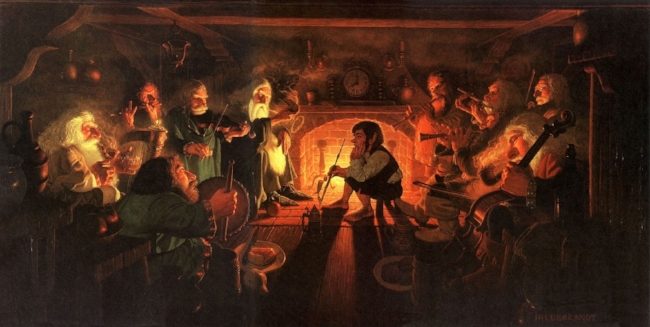
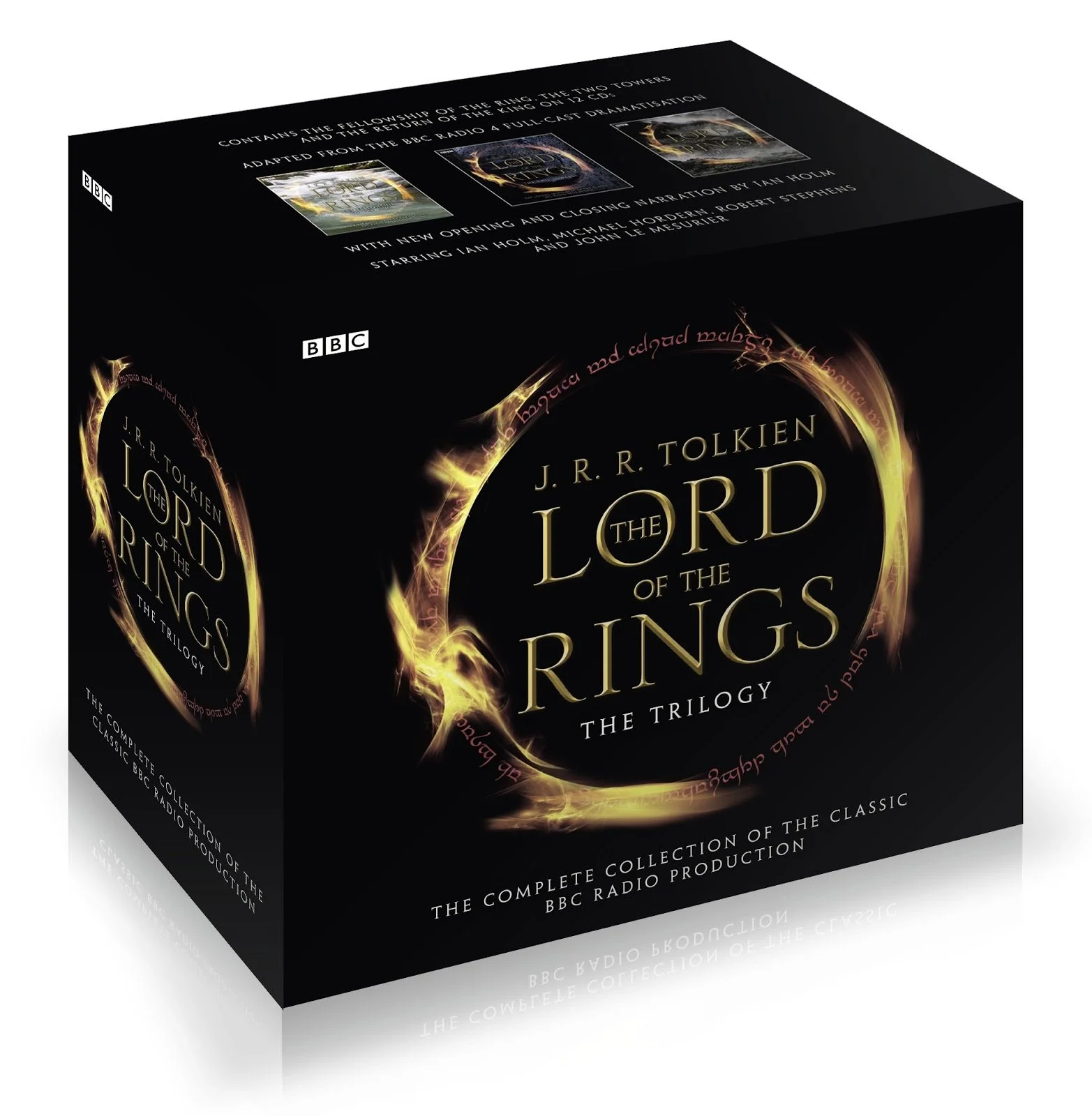
When discussing the various audio dramatizations of J. R. R. Tolkien's The Lord of the Rings, people often think of the BBC Radio adaptation by default. However it should be noted that it was not the first. An earlier version was made and broadcast in 1979 on US National Public Radio and was subsequently released as an audiobook. It was produced by The Mind's Eye, a company who were responsible for numerous adaptations of classic literature for radio at the time. The script written by Bernard Mayes is a somewhat abridged version of the book. The eleven hour running time focuses significantly on the dialogue, with much of the back history, lore and expositionary narration removed.
When discussing the various audio dramatizations of J. R. R. Tolkien's The Lord of the Rings, people often think of the BBC Radio adaptation by default. However it should be noted that it was not the first. An earlier version was made and broadcast in 1979 on US National Public Radio and was subsequently released as an audiobook. It was produced by The Mind's Eye, a company who were responsible for numerous adaptations of classic literature for radio at the time. The script written by Bernard Mayes is a somewhat abridged version of the book. The eleven hour running time focuses significantly on the dialogue, with much of the back history, lore and expositionary narration removed.
The production was very low budget, drawing upon local amateur actors and friends of the producer. There was extensive use of library music and homemade sound effects. Due to scheduling issues the cast often recorded their lines separately resulting in some curiously stilted exchanges of dialogue in key scenes. The voice cast also had to provide multiple character voices which at times causes a degree of confusion. It is also clear that none of the production were Tolkien scholars. The pronunciation of many names and places are often incorrect and the clumsy adaptation results in several plot holes and unresolved storylines.
However despite these flaws this production proved popular at the time of its broadcast. Its simplicity is actually quite a benefit, making this adaptation accessible for a younger audience or those with only a passing interest in Tolkien's work. It should also be noted that this production does not omit Tom Bombadil and presents his part of the story in quite an effective fashion. This production has been distributed by several audio book companies over the years and can even be found on "You Tube". Although purists may eschew The Mind’s Eye production for its obvious faults, there is still much to enjoy from this drama, if it is approached in the right fashion.





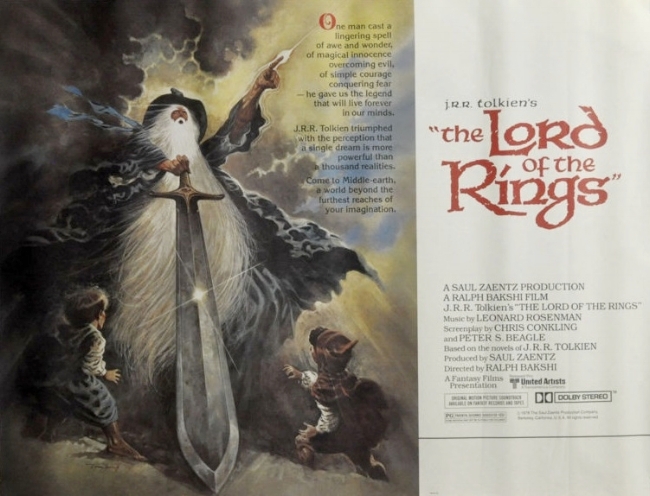

Bringing Godzilla Down to Size (2008)
I recently stumbled across the documentary Bringing Godzilla Down To Size, which was originally included on Classic Media’s DVD release of the genre classics War Of The Gargantuas and Rodan. This in-depth and surprisingly engaging film explores the history of the Japanese Godzilla franchise and focuses on the special effects and technical aspects that dominated these productions. Technicians and actors are interviewed, providing a wealth of insight into the complexities of the films. This documentary also demonstrates the very unique nature of the Japanese film industry and its obsessive attention to detail.
I recently stumbled across the documentary Bringing Godzilla Down To Size, which was originally included on Classic Media’s DVD release of the genre classics War Of The Gargantuas and Rodan. This in-depth and surprisingly engaging film explores the history of the Japanese Godzilla franchise and focuses on the special effects and technical aspects that dominated these productions. Technicians and actors are interviewed, providing a wealth of insight into the complexities of the films. This documentary also demonstrates the very unique nature of the Japanese film industry and its obsessive attention to detail.
The main question asked by this film is why is Godzilla still principally played a man in a suit? At a time when Hollywood’s uses CGI at every potential opportunity, Japanese sci-fi movies still rely heavily on old-school techniques. Miniatures, physical effects and actors in animatronic costumes are still commons. For over fifty years, Godzilla, Mothra, King Ghidorah and other giant creatures have been brought to life in this old fashion manner. Is the Japanese effects industry just as traditional as other aspects of their culture? The documentary’s answer is surprisingly simple. The old techniques work
Narrated by Godzilla fan boy extreme, Alex Cox (director of Repo Man, Sid And Nancy), the film celebrates the art and craft of the Japanese monsters genre and reflects on the future of Godzilla in the digital age. Bringing Godzilla Down To Size reveals through a multitude of interviews, the love and respect that the technicians and artists have for this series. The meeting between the three actor/stuntmen that have played Godzilla over the years is quite touching. The documentary manages to tread the narrow path between informed narrative and gushing fan boy eulogy. It also provides a very interesting overview into the world of pre-digital visual effects.
The Signalman & The Waiting Room – Middle Ground Theatre Company
The Signalman and The Waiting Room are two supernatural tales dramatically brought to life by the Middle Ground Theatre Company. Featuring an ensemble cast and minimalist set design, these character driven performances are extremely entertaining and make for suitable ghoulish entertainment at this time of year. I had the pleasure of seeing a performance tonight at the Orchard Theatre in Dartford, as the company currently tours the UK.
The Signalman and The Waiting Room are two supernatural tales dramatically brought to life by the Middle Ground Theatre Company. Featuring an ensemble cast and minimalist set design, these character driven performances are extremely entertaining and make for suitable ghoulish entertainment at this time of year. I had the pleasure of seeing a performance tonight at the Orchard Theatre in Dartford, as the company currently tours the UK.
The first tale, Robert Aickman’s The Waiting Room, is the story of George Pendlebury (Jack Shepherd) who after finding himself marooned has to spend the night in the waiting room of a station. Inclement weather and increasing cold soon take a toll upon the man. Is he subject to a vivid dream or a supernatural visitation? Furthermore is he merely an idle spectator or directly linked to the unfolding events? The second story, Charles Dickens’ The Signalman is the study of a man plagued by a recurring spectre. Each time the ghost appears outside of the railway tunnel by his signal box, death and disaster follows. Why has this entity chosen this particular signalman (Jack Shepherd again) to haunt? Is it the herald of further tragic events?
Both stories are inventively presented, slowly building an atmosphere of tension. There are a few well timed jump scares, which embellish the story arc without mitigating the drama. Performances are universally good and keep the audience focused on the proceedings. Director and set designer Michael Lunney creates a modest environment for the cast to perform in but it works extremely well. The use of lighting, ambient audio effects and projected visual FXs, enhances the presentation immensely giving the cast, especially Shepherd, credible apparitions to react to.
The two stories, separated by a short intermission, run approximately forty five minutes each and make maximum use of their respective running time. This performance driven play offers thought provoking entertainment, as both stories do not necessarily provide a definitive, black and white conclusion. Overall this was a thoroughly entertaining night out and I would certainly be interested in seeing further material produced by the Middle Ground Theatre Company, as they seem to have a clear understanding and respect for this genre of play.
Activision Blizzard Buys King Digital Entertainment
I found out about Activision Blizzard’s acquisition of King Digital Entertainment via the BBC Business website. From my perspective the notion of a leading US games developer that has a foothold in all major markets, buying in to the mobile sector hardly comes as a surprise. The price is perhaps the main talking point and does raise the question of the potential over valuing tech based companies. $5.9 Billion is after all a tidy sum of money. However what this deal does prove is the financial importance of the mobile gaming market.
I found out about Activision Blizzard’s acquisition of King Digital Entertainment via the BBC Business website. From my perspective the notion of a leading US games developer that has a foothold in all major markets, buying in to the mobile sector hardly comes as a surprise. The price is perhaps the main talking point and does raise the question of the potential over valuing tech based companies. $5.9 Billion is after all a tidy sum of money. However what this deal does prove is the financial importance of the mobile gaming market.
Gaming like many other pastimes has a social hierarchy among its fan base, which is rife with preconceptions, snobbery and self-aggrandisement. For many mobile gaming is still frowned upon and considered in some quarters not to be “proper” gaming. There will be a wealth of blog posts and commentary about this business deal, decrying it as foolhardy. A popular refrain will be how the money could be better spent producing a particular product that specific fans want. This is the nature of fandom; a tunnel vision perspective driven by one’s own desires.
The reality of the situation is very simple. Mobile gaming, irrespective of its perceived artistic and creative merits, is an extremely lucrative business. Therefore the opinion of those who are not part of the existing customer base is hardly of any major significance to developers. Those with entrenched views are hardly likely to succumb to marketing and therefore cease to be of any importance in any ongoing promotional campaign. Sadly logic seldom has any impact upon the white noise generated by “core gamers”.
Over time I have become increasingly more interested in the business side of the gaming industry. It is as fluid and intriguing as any other global market. Compared to the emotive and often self-absorbed tirades I see coming from the gaming community, the machinations of companies such as Activision Blizzard are far more interesting. This simply highlights the gulf between business and the imperatives of the market compared to the capricious nature of fans aspirations. Am I growing out of gaming? No but I may well be growing out of the community.
New Star Trek Series Premieres January 2017
The announcement that CBS has commissioned a new series of Star Trek is both a blessing and a curse. It’s a blessing in the sense that I have genuine affection for this franchise and therefore I welcome the prospect of a new incarnation of the show returning to TV. However I also consider this situation an absolute curse because well now have to endure at least eighteen months of idle speculation and an ongoing dissection of the entire production of a show before it is even released.
The announcement that CBS has commissioned a new series of Star Trek is both a blessing and a curse. It’s a blessing in the sense that I have genuine affection for this franchise and therefore I welcome the prospect of a new incarnation of the show returning to TV. However I also consider this situation an absolute curse because well now have to endure at least eighteen months of idle speculation and an ongoing dissection of the entire production of a show before it is even released.
Fans have the capacity to be a never ending wellspring of love, loyalty and support. The goodwill of the faithful can be an abject boon to a production company looking to resurrect an ailing franchise and tentatively venture in to virgin territory. Sadly the opposite can also be true. An obstinate, intransigent fan base can be a millstone around the neck of an established brand that is in transition. Every single innovation, change or casting decision can be subject to a wave of negativity and even hatred.
And then we have the press who will happily spend the intervening time publishing anything and everything to do with this production. Be it true or false, all information will be avidly received and trumpeted in suitably hyperbolic terms. Unless one invests a considerable amount of time and effort avoiding the ensuing hype, we’ll all inevitably arrive at the season premiere with unrealistic expectations and a sense of anti-climax. This is the reality of the modern cycle of marketing and promotion. It is the price we pay for living in an age of “choice” and market forces.
I will do my upmost over the next eighteen months to keep my exposure to information, leaks and “exclusives” about the new Star Trek TV series to a minimum. I’ve tried to maintain a similar policy with regard to Star Wars: The Force Awakens but it is very hard to do so. The most effective means is to cease all online activities but that is hardly a viable proposition these days. In the meantime I shall leave the fan base to their feeding frenzy and the corporate bean counters to their hype train and hope that the new show proves to be of sufficient quality once it arrives.
Crystal Lake Memories: The Complete History of Friday the 13th
Crystal Lake Memories: The Complete History of Friday the 13th is an incredibly in-depth documentary that explores the making of one of the landmark horror franchises of the twentieth century. The film analyses the series from its low budget 1980s origin at a New Jersey summer camp to the blockbuster release of its 2009 “reboot.” It combines hundreds of rare and never-before-seen photographs and film clips, as well as outtakes, archival documents, conceptual art and behind-the-scenes footage. There is also a wealth of interviews with more than one hundred and fifty cast and crew members, spanning all twelve films and the television series.
Crystal Lake Memories: The Complete History of Friday the 13th is an incredibly in-depth documentary that explores the making of one of the landmark horror franchises of the twentieth century. The film analyses the series from its low budget 1980s origin at a New Jersey summer camp to the blockbuster release of its 2009 “reboot.” It combines hundreds of rare and never-before-seen photographs and film clips, as well as outtakes, archival documents, conceptual art and behind-the-scenes footage. There is also a wealth of interviews with more than one hundred and fifty cast and crew members, spanning all twelve films and the television series.
This documentary is pretty much the last word on the Friday the 13th franchise. Clocking in at over five hours it follows a set pattern exploring each movies development, casting, production and subsequent release. Narrated by Corey Feldman (of Tommy Jarvis fame) it is presented in an engaging and informative fashion. The personal anecdotes from the cast and crew prove to be extremely interesting and often reflect the reality of low budget film making. The documentary also catalogues the regular battles the producers had with the MPAA and shows a variety of out-takes and deleted material. Sadly some of the more violent content has been lost forever, as a memo from Paramount ordering the destruction of surplus footage shows.
Crystal Lake Memories: The Complete History of Friday the 13th also shows the great sense of camaraderie among the actors and crew that worked on these movies. It is often erroneously thought that appearing in such material is a low point in any actor’s career but this is not the case. Many in the acting profession embrace the practical realities of their industry and see merit and virtue in the most humblest of their work. They also see value in being part of a wider fan culture. Stuntman and actor Kane Hodder is especially gracious about the importance of fans and honest about how seriously he takes his work. Friday the 13th is a franchise that has always been driven by the enthusiasm of its audience. It is a shame that the current rights holders seem to have forgotten that.
The director Daniel Farrands previously made His Name Was Jason: 30 Years of Friday the 13th, but this new documentary puts that to shame. The sheer volume of information here is prodigious. However due to the sheer running time of Crystal Lake Memories: The Complete History of Friday the 13th it is not for everyone. For those with only a passing interest and less time available I would recommend the directors previous work. For the more dedicated film fan or Friday the 13th aficionado Crystal Lake Memories: The Complete History of Friday the 13th is the ultimate tribute to one of horror’s most iconic and enduring franchises.
Have MMOs Made Me Antisocial?
I started playing my first MMO in late 2008. Until then it was the one genre that I had never tried. I initially considered buying World of Warcraft but when I found out there was a virtual version of Middle-Earth I chose to purchase The Lord of the Rings Online instead. Right from the outset I was hooked. My working pattern and domestic arrangements afforded me plenty of time to invest into this game and I did so willingly.
I started playing my first MMO in late 2008. Until then it was the one genre that I had never tried. I initially considered buying World of Warcraft but when I found out there was a virtual version of Middle-Earth I chose to purchase The Lord of the Rings Online instead. Right from the outset I was hooked. My working pattern and domestic arrangements afforded me plenty of time to invest into this game and I did so willingly.
I can remember one particular evening when I grouped up with two other players who were all attempting the same quest as me. We chatted and got on well together. After successfully clearing our quests we decided to meet up again the following night. Needless to say we continued to group together for the next year or so. At this time the majority of LOTRO’s content required people to play collaboratively. It was not an alien concept but a simple fact of life. The prevailing philosophy of the time was that MMO were all about grouping. The key to advancement was teamwork.
At the time I found that most people were friendly and approachable, so levelling through the game was very much a shared experience. Joining a kinship only enhanced this further. It was also nice to log on to the game, say “hi” to people in kin chat and shoot the breeze. Between November 2008 and December 2009 was one of the most pleasant times I’ve spent gaming. There was always something to do and someone to help. I didn’t see LOTRO as a time sink but as a positive leisure activity.
After the release of Siege of Mirkwood in December 2009, something started to change for me. This was not only due to the LOTRO expansion becoming more solo friendly but also because I started to play other MMOs. In early 2010 I managed to progress through Star Trek Online without the need to belong to a guild. Grouping was done automatically and I noticed for the first time that there was no necessity to play collaboratively in a traditional sense. The chat channel was mainly a platform for flame wars with hardcore fans debating the finer points of the franchise. So I played on my own, ignoring others players and was happy to do so.
And so the rot set in. When LOTRO went free to play in October 2010, it embarked on a radical redevelopment of material. Pursuing the free market and the casual player meant ensuring that content was accessible in easy bite size chunks. Turbine then set about making all prior zones soloable over the next 18 months. From my perspective, people continued to play but unless it involved endgame raiding, grouping became less and less common. Even the kinship I was in became more solo orientated. The common link was the group chat and we still ran instances but most of the time everyone seemed to be doing their own thing.
The benefits of solo orientated gameplay are the same nowadays as they were five years ago. There’s no time wasted organising a group, ensuring that everyone is adequately equipped and briefed; nor is there any dependency on other people’s performance. You simply do what you want, when you want. As a result, expectations increase and tolerance decreases. But there are also some negative side effects. Because you do not need anyone else, it can impact upon your level of your involvement within your guild. There may be a decline in communication. There may also be a decrease in the willingness to help out. Requests are no longer be greeted by multiple volunteers. Everyone is too busy doing their own thing. Altruism is an inconvenience.
The automated grouping of players via dynamic content that we see in Guild Wars 2 and Rift, is easy and seamless. It is also devoid of any meaningful social interaction. Players can pursue their own individual goals and simply tap into the benefits of group participation, as and when they want. When done they can go about their business, without saying a word. It is a curious paradox that sees a server full of people, playing a social game, alone.
Now this situation does not affect everyone, nor am I stating that it is the default position of all players. RP servers or guild based around hardcore raiding, fly in the face of this social decline. I am sure both such parties would strongly argue that they still maintain very high levels of social interaction. Yet I don’t think they represent the majority of the MMO population. Such strong team based dynamics only serve specific niche groups. I also believe that the F2P business model has also contributed to general social decline, with the percentage increase of "problematic" players that join the community. That has a big impact upon how we all interact with each other.
When this issue of social decline is raised, it often provokes emotive and judgemental responses. The gaming genre is steeped in nostalgia. Rightly or wrongly, such perspectives seldom have any impact upon business decisions. Game developers want to keep players engaged and using their products. Should customers be denied access to content and the opportunity to advance due to subjective notions of social interaction? Well the logical answer is no. However this move towards a player base that is following its own personal path, is not without flaws. We often see in-game an increasing amount of people who seem ill equipped to interact socially with others, just as we do in real life. Tolerance, consideration, and patience are abstract concepts to some. Social commentators often talk about the decline in the sense of community in the real world. Do also MMOs reflect this?
I personally have contributed to this shift in MMO culture, especially so with LOTRO. I do tend to focus a lot more on my own gaming needs nowadays, rather than with others in my kin. I argue that I've played my part and done my share in the past. However I think the reality is that I no longer have a dependency on others, so the notion of community spirit is diminished. I’m not saying that this is a good thing and I do have pangs of guilt occasionally and endeavour to be helpful. Ultimately, all kins have givers and takers. I've just moved my position between the two ends of the spectrum in recent years, as have many others.
This beggars the question, was the social heyday of MMO's really ever driven by altruism or purely by necessity? Is this decline in the social aspect of the genre inevitable, or can it be stemmed? I cannot answer these questions and only the future will tell. I do on occasions bump into people in-game who are very civil and helpful. LOTRO does to a degree still seems to be a good example of this, although its crown has slipped in recent years. Yet because group content has been watered down within many games or relegated to an afterthought with many new products, the incentive to communicate and collaborate is greatly reduced.
Whether this all stems from developers just chasing a buck or whether this is a wider reflection of contemporary human nature, I'll let you decide. I do think that MMOs and even the internet itself have lost their capacity to impress. Simply being surrounded by other people online no longer gets the “wow” reaction it did a decade ago. We’re also sadly accepting of the fact that social platforms tend be a race to the bottom these days. It is assumed by default that all online communities will have a percentage of assholes. And then there is the ascendancy of the cult of the individual and “me” culture; these to have impacted upon the concept of social gaming.
For me my personal MMO journey has been a question of time and place. I wanted to be social when I started playing this genre and had the resources to do so. If a new MMO was released tomorrow that had old school grouping mechanics and time requirements, I know for a fact I would not play it. It would be incompatible with my current lifestyle and mindset. Perhaps age is also a factor in this conundrum; the idealism of youth versus the pragmatism of old age.
So is there a conclusion to this discussion? I’m not sure there’s a definitive one. Overall it seems a little unrealistic to blame the developers solely for the decline in social gaming. I think if we’re honest we have to concede that we actively contributed to this situation ourselves. When the move towards solo play started did we complain and lobby as much as we could have? Perhaps the golden age of collaborative play is just a myth. We grouped because we had no choice. Can the situation change? Yes but only if we make it financially viable to do so.
Star Trek Online: New Dawn
Tuesday saw the release of the eleventh season of Star Trek Online. New Dawn includes not only the latest feature episode Sunrise but also the new admiralty system, a revamp of the Cardassian story arc along with a Badlands battlezone for level sixty players and above. There is also a new Terran Empire rep faction and associated rewards. Now it probably hasn’t escaped anyone’s notice that Cryptic are providing more of the same. However it’s a tried and tested formula so I guess they cannot be blamed for adopting a policy of “if it ain’t broke, don’t fix it”.
Tuesday saw the release of the eleventh season of Star Trek Online. New Dawn includes not only the latest feature episode Sunrise but also the new admiralty system, a revamp of the Cardassian story arc along with a Badlands battlezone for level sixty players and above. There is also a new Terran Empire rep faction and associated rewards. Now it probably hasn’t escaped anyone’s notice that Cryptic are providing more of the same. However it’s a tried and tested formula so I guess they cannot be blamed for adopting a policy of “if it ain’t broke, don’t fix it”.
After my recent disappointment with the Guild Wars 2 expansion Heart of Thorns, it’s been pleasant to return to the familiar routine of STO. After the conclusion of the Iconian war at the end of the last season, a new storyline based around exploration and first contact is a welcome change of pace. That’s not to say there isn’t any combat involved. It would seem that the Tholians are up to something in this latest episode and once again the plot relies on temporal meddling. As ever the narrative draws upon characters and plot devices from a specific episode of Star Trek: The Next Generation. But this is one of the game’s greatest strengths.
So having played through Sunrise, which I found to be totally agreeable, I decided to check out the new admiralty system. It didn’t take long for me to regret having deleted all the various ships I acquired while levelling. As a result I only have five vessels to use on my primary federation character. Naturally the various low and intermediate level ships that have been languishing on the exchange for months have all now massively increased in value. The system itself which is very similar to the duty officer system, is adequately entertaining but the cool down on missions seems somewhat long.
Although I am currently sharing my time between several MMOs, STO still seems to be the least problematic and trying of them all. It a curious thing that my relationship with this genre has reached a point where I even use such terms. However despite not being the most polished of MMOs, STO still manages to satisfy and engage. The IP is a major contributory factor and the game is extremely functional. Too many games creak under the weight of their own complexity. I suspect that STO will remain installed on my PC for the immediate future, whereas certain other titles may well have out lived there usefulness.
Heart of Thorns
In recent years I have made it my policy not to participate in beta testing of major new MMOs, nor to immerse myself in their marketing leading up to release. I don’t want to risk getting burnt out or build up too many unrealistic or erroneous expectations. Overall I want there to be an element of surprise when I finally around to playing a new product. Naturally I applied this philosophy to the Guild Wars 2 expansion Heart of Thorns and have made it my business to ignore a lot of the press, live streams and hype over the last quarter. So when I finally logged in today I didn’t really know what to expect. On mature reflection this was a mistake.
In recent years I have made it my policy not to participate in beta testing of major new MMOs, nor to immerse myself in their marketing leading up to release. I don’t want to risk getting burnt out or build up too many unrealistic or erroneous expectations. Overall I want there to be an element of surprise when I finally around to playing a new product. Naturally I applied this philosophy to the Guild Wars 2 expansion Heart of Thorns and have made it my business to ignore a lot of the press, live streams and hype over the last quarter. So when I finally logged in today I didn’t really know what to expect. On mature reflection this was a mistake.
The first thing that struck me about Heart of Thorns was how non-specific the quest tracker was in telling me where to go to access the expansion’s prologue. I needed to visit an area called The Silverwastes and had no idea where to go. I mistakenly assumed it was via the region of Dry Top which was added to the game with The Living Story Season 2. It took an hour to discover my mistake. I finally tabbed out of the game and did a Google search only to discover there was a portal in Fort Vandal. I always feel that having to leave a game to find necessary information is a major design flaw.
On arriving in The Silverwastes I happened upon a zerg that was going to the area I required. I was so busy trying to keep up that I failed to pay as much attention to the world around me as I should have. So it wasn’t until I reached the Verdant Brink region that I realised that Heart of Thorns is based heavily around a vertical gaming environment. This means that there is frequently no direct path to locations on the map. Furthermore many features essential to the game such as hero points are placed in elevated areas. Thus the game once again makes use of jumping mechanics as well as the newly introduced gliding skill.
I loathe jumping as a gaming mechanic. I lack the manual dexterity required to undertake it as well as the patience to persevere when I fail. Simply put if I had known in advance that this was a major part of Heart of Thorns I wouldn’t have purchased it. I play games for fun and this does not constitute as such by my yardstick. This is the exact same reason why I never finished any of the second season of The Living Story. That also had a dependency upon power ups to conduct jumps, slides and rolls to access specific areas. It is the reason why two outstanding hero points remain beyond my reach to this day.
Needless to say my interest in Heart of Thorns waned massively after discovering the nature of the expansion. I managed to unlock the gliding skill but wasn’t very impressed by that either. Until further upgrades are unlocked it remains nothing more than a glorified drogue shoot. As for the actual plot of Heart of Thorns I have never been a Guild wars 2 lore aficionado. I therefore have no clue as to what is going on and little investment in the characters that I interact with. Therefore I doubt if I Guild Wars 2 will still be on my PC by Christmas. However I have no one but myself to blame for this situation, having fallen victim of my own gaming practises.
Out With the Old
I’ve been blogging and podcasting for over half a decade and as a result I’ve left a trail of material scattered across the internet. Maintaining multiple sites and hosting old content costs both money and time. Although the world is treating me relatively well at present, I am not a man of limitless resources. Therefore I have decided that it is time to close some of these sites and archives.
I’ve been blogging and podcasting for over half a decade and as a result I’ve left a trail of material scattered across the internet. Maintaining multiple sites and hosting old content costs both money and time. Although the world is treating me relatively well at present, I am not a man of limitless resources. Therefore I have decided that it is time to close some of these sites and archives.
The first to go will be the back catalogue of Contains Moderate Peril podcasts. These are currently available via Libsyn, the old CMP website and iTunes. All one hundred and seventy three episodes will cease to be available after 31st October. If you wish to keep any for posterity, my advice is to download them now while you still can. This will also affect the Council of the Unwise podcast but there are only a few instalments of that show. Please note that the Burton & Scrooge podcast is still alive and kicking but is not subject to a regular schedule. Brian and I produce it strictly on an “as and when” basis.
I will be closing the old Contains Moderate Peril website at the end of this month. Rather than leave a trail of broken links I shall set up a global redirect so that wayward traffic finds its way to the current CMP blog. It’s a shame to lose an established presence on the internet but I feel that the current situations with two websites co-existing simultaneously, to be both confusing and detrimental to traffic. All previously posted content has been successfully exported and saved.
Despite what I and a lot of others people where told a few years back, you can function as a human being quite efficiently without Facebook and Google + accounts. Both are closed communities that require individual input, which creates more work. In the past I have simply reposted content to these platforms, which on mature reflection is counterproductive. If anything it takes traffic away from CMP, so I have terminated both of these services forthwith.
I would also like to reiterate that I shall no longer be directly involved in the running of the Newbie Blogger Initiative. I shall be closing the existing site and the forums at the end of this year and will not being renewing the domain name next May. If someone wishes to utilise the current .com address then they may wish to get in touch prior to the domain name lapsing.
It would seem that a lot of veteran content creators are currently facing similar issues to mine or at the very least trying to balance their creative desires with the realities of the real world. Unless your life remains static, there is no way you can avoid the shifting demands of modern life. I would not be surprised if we see several high profile community members scale back their online endeavours or even cease them entirely in the not too distant future.
SPECTRE (2015)
Sam Mendes brought a degree of depth to Skyfall which we've not seen in a Bond movie for a long time. SPECTRE continues in the same vein as its predecessor with an involving plot, fully rounded characters and some finely honed set pieces. I like this approach to Bond and feel that a more cerebral interpretation of the character is not only beneficial for the franchise but to the genre itself. If SPECTRE does turn out to be Daniel Craig’s swansong as James Bond then it will be a fitting epitaph.
Sam Mendes brought a degree of depth to Skyfall which we've not seen in a Bond movie for a long time. SPECTRE continues in the same vein as its predecessor with an involving plot, fully rounded characters and some finely honed set pieces. I like this approach to Bond and feel that a more cerebral interpretation of the character is not only beneficial for the franchise but to the genre itself. If SPECTRE does turn out to be Daniel Craig’s swansong as James Bond then it will be a fitting epitaph.
Much has been made of SPECTRE’s running time, which at one hundred and forty eight minutes makes it the longest entry in the franchise since On Her Majesties Secret Service. However none of that time is squandered and the production balances the pace well between action scene and narrative exposition. The plot is straight forward but allows for moments of introspection. MI6 is under threat of closure and replacement by surveillance and drones. Bond goes AWOL after receiving a posthumous message from the previous M (Judi Dench). The tip leads him to the nebulous crime organisation SPECTRE and a face from his past in the guise of sockless villain, Franz Oberhauser (Christophe Waltz).
Daniel Craig once again shows his total ownership of this role, bringing nuance and subtlety. Bond is a complex man and not just a hired assassin. He has convictions, loyalties and weaknesses. SPECTRE also affords an opportunity for the supporting cast to do more than usual. Ben Whishaw excels as Q and has the lion share of the movies amusing quips. Ralph Fiennes again shows that M is more than just a bureaucrat. But it is Léa Seydoux as Dr Madeleine Swann who adds weight to SPECTRE. It makes a change to see such a well-crafted female lead in a Bond movie. Christope Waltz is suitably menacing although his evil propensities are somewhat telegraphed by his Nehru jacket.
SPECTRE benefits greatly from concise action scenes. The opening helicopter fight is gripping and impressive without being bloated or excessive. The production once again uses minimal CGI FX work, relying on superb miniature and physical effects. The demolition of the MI6 headquarters at Vauxhall is particularly impressive, maintaining a sense of scale and mass. It should be noted that SPECTRE pushes the limits of the 12 rating (UK). It is tonally very bleak and has two scenes that contain surprisingly unpleasant violence (all of which is justified). Bond movies have never been family films irrespective of what some viewers may erroneously think.
If I have a criticism with SPECTRE then it lies with Thomas Newman’s score. The soundtrack is perfectly functional and provides an adequate ambient back ground track. But it is no more than an accompaniment and never asserts any personal identity upon the proceedings. John Barry wrote cues that not only embellished the Bond franchise but which stayed with you when you left the movie theatre. I enjoyed SPECTRE a lot but remember nothing of Newman’s score.
Skyfall set a new benchmark for Bond and although SPECTRE does not necessarily exceed that standard, it most definitely provides more of the same. Where many film makers are hamstrung by the perceived constraints of the PG-13 action movie market, Sam Mendes proves that it doesn't have to be an artistic or creative handicap. SPECTRE is a robust and entertaining entry in to the canon, tempered by a healthy streak of gallows humour. It will be very interesting to see where Bond goes from here.
The Witcher 3: Wild Hunt and Humour
The Witcher 3: Wild Hunt is not a game that strikes you as being light hearted at first glance. The plot is dour and brooding, set in a world of human (and non-human) misery and suffering. In many respects this is one of the game’s greatest assets because it’s all so worryingly plausible. The rich and powerful pursue their own goals, heedless of the cost to the rest the kingdom. Those at the very lowest strata of society live a precarious existence. Despite its fantasy setting the world of the Witcher is not that different from our own.
The Witcher 3: Wild Hunt is not a game that strikes you as being light hearted at first glance. The plot is dour and brooding, set in a world of human (and non-human) misery and suffering. In many respects this is one of the game’s greatest assets because it’s all so worryingly plausible. The rich and powerful pursue their own goals, heedless of the cost to the rest the kingdom. Those at the very lowest strata of society live a precarious existence. Despite its fantasy setting the world of the Witcher is not that different from our own.
However despite the overall tone of The Witcher 3: Wild Hunt, there are instances of humour to be found. Often these are discretely integrated in to the game via snatches of incidental dialogue, cryptic entries in the games bestiary or via the village notice boards. As ever with these sorts of things, the writers reference popular culture. However in this instance, CD Projekt RED proves to be more scholarly than other developers. Many of the quips, asides and homages refer to classical literature and scientific theory.
So here are four examples that I’ve found so far during my play though. I’m sure there are many more. All raised a wry smile when discovered and I now make it my business to trawl through all aspects of the game in pursuit of further hidden gems. Its embellishments such as these that add further depth and character to The Witcher 3: Wild Hunt. If only other developers took such time and care as CD Projekt RED.
A droll reference toErwin Schrödinger's famous thought experiment
Someone obviously likes the work of Herman Mellville
Star Wars. It permeates everything
A scholarly homage to Homer (not Simpson)
The Eagle Has Landed (1976)
The Eagle Has Landed was veteran director John Sturges' final movie, whose body of work includes such classics as Bad Day at Black Rock, The Magnificent Seven and The Great Escape. Based on the bestselling book by Jack Higgins and adapted by Tom Mankiewicz, the film is a curious beast. It’s an in-depth character driven drama you would expect from such a veteran director, with the succinct and violent action scenes that were prevalent during the seventies. Although the phrase “they don’t make them like that anymore” is somewhat of a cliché, it is quite apt in the case of The Eagle Has Landed. Many of the crew as well as the producers hailed from the golden age of Hollywood.
The Eagle Has Landed was veteran director John Sturges' final movie, whose body of work includes such classics as Bad Day at Black Rock, The Magnificent Seven and The Great Escape. Based on the bestselling book by Jack Higgins and adapted by Tom Mankiewicz, the film is a curious beast. It’s an in-depth character driven drama you would expect from such a veteran director, with the succinct and violent action scenes that were prevalent during the seventies. Although the phrase “they don’t make them like that anymore” is somewhat of a cliché, it is quite apt in the case of The Eagle Has Landed. Many of the crew as well as the producers hailed from the golden age of Hollywood.
The plot involving a unit of Germans infiltrating a coastal village in the guise of Polish soldiers is somewhat reminiscent of Went the Day Well? After the successful rescue of Mussolini, Col.Max Radl (Robert Duvall) is asked to prepare a feasibility study on kidnapping Winston Churchill. Chance intelligence indicates that Churchill will spend a weekend in the Norfolk village of Studley Constable, only a few miles from a deserted stretch of coastline. Suddenly a wild plan made for political reasons, becomes a viable operation. Col.Kurt Steiner (Michael Caine) and his crack unit of Paratroopers are subsequently parachuted into Norfolk to carry out the mission, aided by IRA sympathiser Liam Devlin (Donald Sutherland). They are also assisted by Joanna Grey (Jean Marsh), a German sleeper agent.
Like so many movies of the time, the emphasis is primarily on the plot and the central characters. In the international cut of the movie, we come to understand the full motives of Caine, Sutherland and Marsh. Larry Hagman provides an enjoyable cameo as Col. Pitt, a US officer desperate to see action before being side-lined by politics and the end of the war. Tom Mankiewicz’s screenplay dispenses with the framingstory set in the present featuring an aged Devlin as well as some other less pertinent characters from the original book. The action sequences featured in the second half of the movie and are efficient and credible. The production also takes full advantage of the village of Mapledurham and the surrounding estate, which doubles for the fictitious Studley Constable.
After filming finished in late summer 1976, director John Sturges effectively abdicated his responsibility for the movies post production. Editor Anne V. Coates however managed to fashion a respectable movie from the rough cut, which ran 145 minutes. However the producers wanted a leaner cut with a focus on the action, so the theatrical release was edited further to 135 minutes. This version is the most commonly available and has recently been released on Blu-ray in the US. The longer cut features some interesting additional scenes, several of which bolster the weakest element of the film, namely the romance between Molly Prior (Jenny Agutter) and Devlin.
Watching The Eagle Has Landed, highlights the difference between the depiction of violence during the seventies and how it is portrayed today. Ratings were more flexible and less delineated that they are today. The Eagle Has Landed was a movie that was intended for a wide audience. Yet in contains a fair amount of bullet hits and squib effects that would push it beyond a PG-13 rating these days. The recent Blu-ray release shows the incidental violence quite clearly. In one scene towards the end of the movie, a US Ranger is shot in the arm and the actor next to him is sprayed in the face by stage blood. Nowadays, studios are far more mindful of exactly what can and cannot be depicted for each respective rating and there is a huge amount of creative horse-trading with the MPAA and BBFC with regard to content.
As World War II becomes an increasingly remote event, I am curious as to how such movies as The Eagle Has Landed are perceived by contemporary audiences. Does this period in history have any more significance to today’s viewer, beyond being a convenient plot MacGuffin? Jack Higgins story as well as the movie adaptation hails from a time where the war was very much part of the publics memory. It provided a common experience that was frequently used to explore tales of courage and adventure. The concept of Churchill being assassinated and the impact it would have upon history would have chimed with viewers. However since the seventies, the war movie as a genre has declined. More recent explorations of the subject seem to be couched in far more political terms. If The Eagle Has Landed was made today it may be interpreted in a very different fashion.