
LOTRO 10th Anniversary: Remembering LOTRO Part 1
On Monday 22nd December 2008, I visited the Game store at Colliers Wood, South West London. I was working at St George’s Hospital in Tooting the time at and the nearby shopping centre was an ideal place to spend the lunch hour. As I perused the shelves in the PC gaming section, I spotted a “compilation pack” that contained not only the MMORPG The Lord of the Rings Online but it’s recently released expansion pack, Mines of Moria. Although I was aware of the MMO genre at the time, I had never played one beyond a trial of Star Wars: Galaxies. However, as I had recently moved and was living alone, I was in the perfect position to start playing such a game. So, I decided to take the plunge and buy LOTRO for the bargain price of twenty pounds. There was also a sizeable display for World of Warcraft in the shop, which was by far the market leader at the time. Yet because I’ve always been a Tolkien fan, I just naturally gravitated toward buying LOTRO and it never crossed my mind to buy another product.
On Monday 22nd December 2008, I visited the Game store at Colliers Wood, South West London. I was working at St George’s Hospital in Tooting the time at and the nearby shopping centre was an ideal place to spend the lunch hour. As I perused the shelves in the PC gaming section, I spotted a “compilation pack” that contained not only the MMORPG The Lord of the Rings Online but it’s recently released expansion pack, Mines of Moria. Although I was aware of the MMO genre at the time, I had never played one beyond a trial of Star Wars: Galaxies. However, as I had recently moved and was living alone, I was in the perfect position to start playing such a game. So, I decided to take the plunge and buy LOTRO for the bargain price of twenty pounds. There was also a sizeable display for World of Warcraft in the shop, which was by far the market leader at the time. Yet because I’ve always been a Tolkien fan, I just naturally gravitated toward buying LOTRO and it never crossed my mind to buy another product.
I installed and started playing the game that very night. It should be noted that the European version of LOTRO was distributed and administered under license by Codemasters at the time. So, I set up a subscription and on a whim decided to create my first character on Gilrain server, which met my language and social requirements. Having spent some time reading about the various classes in LOTRO, I can remember now that I was still a little confused by it all. Yet there was something about the Lore-master that just seemed to appeal to me. Perhaps it was the pets, or its semi-magical status. Although I wasn’t that au fait with control classes, I found the explanation of how the Lore-master fought intriguing. “The Lore-master uses his knowledge of ancient wisdom to stave off the advance of the shadow for a time. He can use his knowledge to attack his foes or to treat the wounds and suffering of his companions. He can even communicate with animals and request their aid”.
Let it suffice to say that the tutorial quickly got my orientated in the game. Having been a gamer prior to LOTRO, meant that the learning curve was not so steep. The other advantage I benefitted from by playing LOTRO at this particular time, eighteen months after its launch, was that there was a wealth of online resources for the game already in place. This proved invaluable because things were pretty different in LOTRO back in late 2008. For example, the location of quest objectives were not directly marked on the map. The quest bestowal details usually referred to a specific area which you then had to find and search. Sometimes this would be a very intuitive process but from time to time there would be frustration. Thus, fan sites and blog would often have map coordinates to aid this process. Obtaining a mount was also a challenge. A player didn’t become eligible to purchase a horse until level 35. It also cost a tidy sum of gold and was dependent on a somewhat convoluted quest.
Looking back now at these early days of LOTRO, the most pronounced difference was the fact that much of the game was designed to be completed in a group or fellowship. The Epic storyline frequently had group content as did a percentage of the regional quests. Zone chat was filled with requests for fellowships. Yet because of the volume of players in the game and that fact that Middle-earth had not yet grown to the size that it has now, finding a group was never an issue. There was also a prevailing sense of camaraderie. If a random stranger sent you a tell, you’d more than likely answer it. For the most part, the game was populated by mature Tolkien fans and as a result, things remained mainly civil. Plus, the concept of multiplayer gaming was still novel.
It took me nine months of to reach the then level cap of sixty. That meant playing most evenings and investing a considerable amount of time into LOTRO. There were occasions over weekends where I’d spend a whole day playing. There were also plenty of late nights, although I never did this at the expense of my personal life or work. However, let me be clear, LOTRO at the time became my primary means of entertainment and therefore I was happy to lavish it with attention. As I’m not the sort of player to experiment with multiple alts, this time was exclusively invested into my Lore-master. Lore-master crowd control skills were a key part of group play back then, so I found myself regularly grouping. As a result, friendships were formed and eventually I found the right kinship for me. Eight years on I’m still an active member of it.
Kinships always have been the heart and soul of LOTRO. They come in many shapes and sizes, catering to all types of gameplay. Yet they all have mutual support and friendship in common. What I particularly like about my kinship is its diversity and inherent good humour. It includes people from all over Europe and various walks of life. As a result, interacting with such a cross section of people has been a very positive experience and has certainly broadened my horizons. Then of course there’s the community outside of the game itself. The bloggers, podcasters, streamers and such like. Many are still active today but seven or eight years ago the scene was much bigger and very lively. Because of that community I changed my existing website to a LOTRO blog and instantly it got traction. LOTRO also inspired me to podcast. I can honestly say I’ve not encountered anything similar in all the subsequent MMOs that I’ve experienced.
To be continued.





The Geography of LOTRO: Part 3 Filling in the Gaps
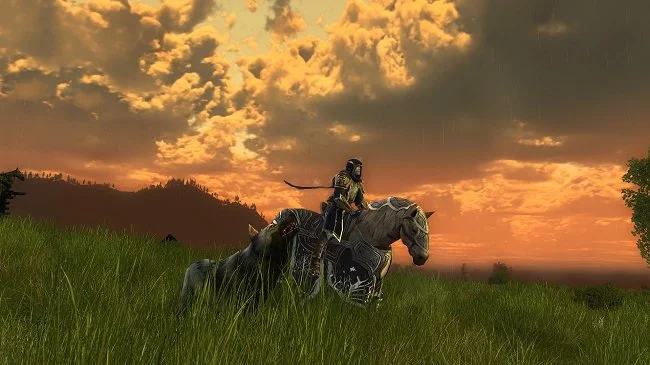
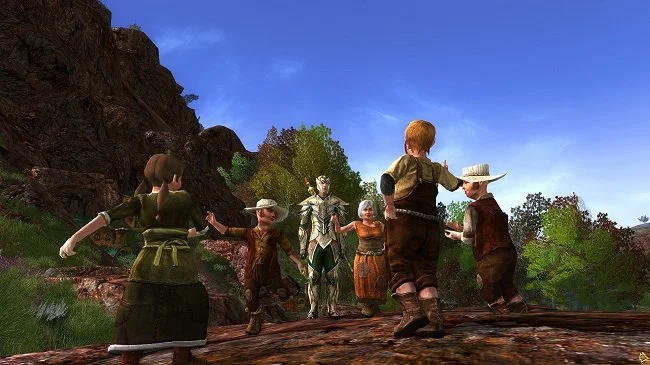
I would like to once again return to the matter of the geography of Middle Earth. David Braben, co-creator of seminal video game Elite, called truly open-ended game design and sandbox gaming environments "The Holy Grail" of modern video gaming. He cited games like Elite and the Grand Theft Auto series as early steps in that direction. For many gamers, the idea of being able to freely roam a virtual world without any deliberate restrictions is a very enticing one. For Tolkien fans, the notion of being given complete freedom of movement throughout Middle Earth would be a dream come true. However, due to the way that LOTRO has been designed, Standing Stone Games vision of Middle Earth, although well-conceived is not such an environment.
I would like to once again return to the matter of the geography of Middle Earth. David Braben, co-creator of seminal video game Elite, called truly open-ended game design and sandbox gaming environments "The Holy Grail" of modern video gaming. He cited games like Elite and the Grand Theft Auto series as early steps in that direction. For many gamers, the idea of being able to freely roam a virtual world without any deliberate restrictions is a very enticing one. For Tolkien fans, the notion of being given complete freedom of movement throughout Middle Earth would be a dream come true. However, due to the way that LOTRO has been designed, Standing Stone Games vision of Middle Earth, although well-conceived is not such an environment.
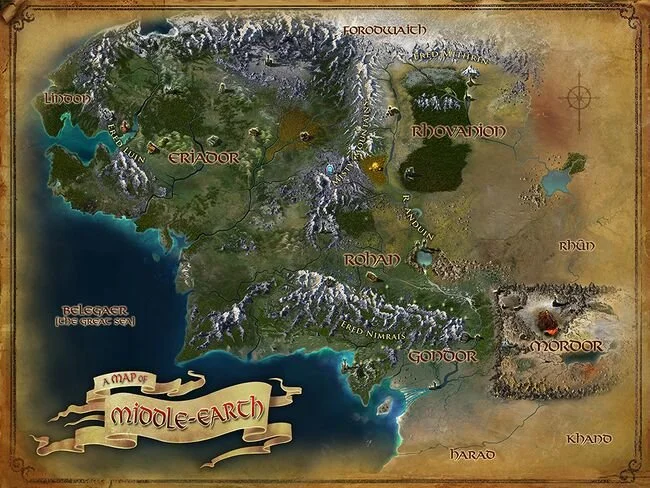
The latest stable map for LOTRO shows all the various regions that currently feature in the game. Furthermore, the map highlights a significant amount of Middle-earth that does not at present exist within the MMORPG. This includes areas in Eriador such as The Grey Havens, The South Farthing and Tharbad. When looking across the Misty Mountains to Rhovanion, even more noteworthy locations are conspicuously absent. Esgaroth, Mount Gundabad and The Iron Hills spring to mind. Until recently, LOTRO players and Tolkien aficionados have just written off these missing territories. Their omission is due to the realities of developing an MMO, set in a vast Lore filled world. However, more recently new developers Standing Stone Games have indicated that they have a game plan beyond the scope of the book and that there is a possibility of many “blanks” being filled in at a later date.
In the past, Turbine have taken a very practical approach to the way they have developed Middle Earth. The areas that have been included are all there to underpin the story. Regional quest hubs facilitate players advancement, then migrate them to new locations via the narrative. The game mechanic is heavily orientated towards playing through certain areas at specific levels. Simply put, any part of Middle Earth that does not have any relevance to the ongoing epic storyline has been somewhat ignored. Although, there are plenty of explorer deeds to be completed in each area, Turbine never really intended to make the game weighted towards players who simply wished to wander through Middle Earth. Due to the levelling mechanic and region phasing, you cannot simply travel from Ered Luin to Mirkwood just exploring.
Despite these restriction, there is still much to see in LOTRO and clearing regional quest is no guarantee of seeing all that Middle Earth has to offer. If you have a curious nature there are still many nooks and crannies to explore and little embellishments that the developers have added through their love of the source text. There are also scattered around Middle Earth, hidden villages that were created in the early devlopement of the game which were then removed from the final release. In the early days of LOTRO these could still be accessed but it would appear that Turbine have sealed these off now. One example was the hidden Hobbit villages, West of the Shire. There was another on the Western bank of Lake Evendim.
With LOTRO’s increased focus on themed festivals such as Winter-home and new events such as the treasure hunt, there is an opportunity to utilise these vacant areas of Middle Earth. Frostbluff for example seems to be located between Northern Ered Luin and Western Forochel. Furthermore the appearance of new locations and settlements can often now be spotted in advance of these areas being made available. Northcottons farms and Stoneheights were both copiously documented and discussed prior to Update 2 going live.
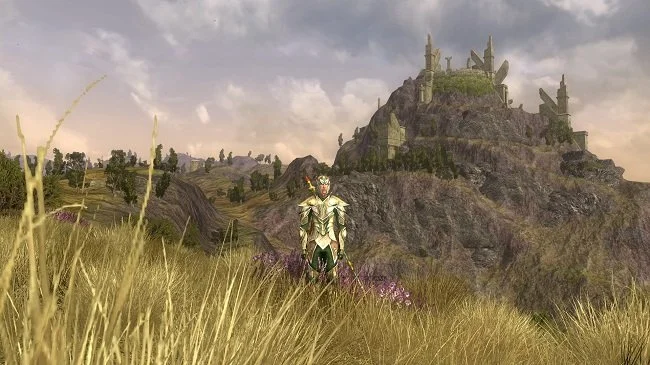
Although I very much enjoy the world that Turbine, now Standing Stone Games has created, I still find it a little saddening that there are some locations in Middle Earth that I cannot get a chance to visit and discover at present. For instance I would very much like to visit the Elf Towers to the West of The Shire. Whenever I am confronted with a barrier, be it a gate, a convenient range of mountains or cliff face, I always try to look beyond it. I am always curious to know how much landmass the developers actually created. I recently travelled to the South Farthing gate and by adjusting the camera perspective tried to see as much as what was beyond it. The view is very tantalising. In a true sandbox environment the road beyond would ultimately wind a path all the way down to Enedwaith.
As a gamer, I would like to see an MMO that allowed a player to choose a non-combat class and to simply be able to travel, explore, trade and move on again. It would be engaging to find quests and deeds specifically created around such characters, out in the wider world. Placing items or information in obscure locations could be an interesting game mechanic. Obviously, with a game such as LOTRO that now has an established methodology, the likelihood of adapting this may well be impossible , even if the developers were in favour of it. However, despite the restrictions that exist Standing Stone Games vision of Middle Earth still lends itself to a degree of exploration. New events can potentially open up the world. Narrative freedom beyond the end of text, offers even further opportunity. I think that in the years to come we may yet see many of these missing areas coming to life.
First Contact Day
Star Trek Online is an MMO that likes an event. They have numerous scheduled over the course of the year. The latest is to celebrate First Contact Day (5th April), when Humans and Vulcans first met on Earth. The event takes place at the Zefram Cochrane Memorial and Historical Museum and participants are tasked with building their own replica Phoenix ship. To build an effective vessel, players have to search the immediate vicinity for engine, hull and stabiliser parts. These vary in quality following the games standard colour coding system. Thus, in theory, purple colour parts will perform better. Once the Phoenix replicas are assembled, they are launched simultaneously, with the winner being the one that reaches the highest altitude.
Star Trek Online is an MMO that likes an event. They have numerous scheduled over the course of the year. The latest is to celebrate First Contact Day (5th April), when Humans and Vulcans first met on Earth. The event takes place at the Zefram Cochrane Memorial and Historical Museum and participants are tasked with building their own replica Phoenix ship. To build an effective vessel, players have to search the immediate vicinity for engine, hull and stabiliser parts. These vary in quality following the games standard colour coding system. Thus, in theory, purple colour parts will perform better. Once the Phoenix replicas are assembled, they are launched simultaneously, with the winner being the one that reaches the highest altitude.
As ever with STO, events run over a fixed period and can be played once every twenty hours. There is a reward at the end that requires a fixed number of vouchers to be handed in. Players receive both a voucher and a choice of rep marks each time the participate. Yet despite the competitive framing of the event and the mechanic involving variable part quality, the outcome is actually random. Phoenix replicas with blue and green parts frequently outperform those with purple parts. Furthermore, your place in the race results table has no impact upon the number of rep marks you receive as a reward. In fact, some players simply elect to join the event and then go AFK during its short duration. I tried this myself today, collecting no parts for my Phoenix. Although I came last I still got the event voucher and full rep marks of my choice, for doing nothing.
I don’t claim to be the most driven MMO player and do not like events or activities with excessive complex criteria. Yet even I balk at this situation that Cryptic has created. An event that allows you to simply sit and wait rather than participate is certainly ill-conceived. Plus, the random nature of the outcome totally contradicts the competitive aspect that the event implies. At least ensure that the quality of the parts that you use does have an actual bearing on race results. First Contact Day is only a six-day event, so it won’t remain a bone of contention for long but as a player of STO I don’t wish to see its flaws perpetuated in any future activities. Perhaps Cryptic will learn from this situation and tweak the event for next year, making it more equitable and removing the AFK flaw.

Am I a Whale?
Whenever reading about game monetisation, I often come across the term “whale” and their alleged importance to the free-to-play business model. Primarily they seem to be associated with the mobile gaming industry, due to the way the games are constructed. Paying does more than enhance game play, it is required to facilitate it. However, the whale is no stranger to the MMO genre. The proliferation of cash stores, lock boxes and cosmetic customisation means that there’s always something that people want. Furthermore, gaming in many respects can be a more economic form of entertainment compared to others. Therefore, occasional expenditure is often seen as providing value for money. Fans also like to support the developers that create the games that they enjoy, so again spending money is perceived as a positive thing.
Whenever reading about game monetisation, I often come across the term “whale” and their alleged importance to the free-to-play business model. Primarily they seem to be associated with the mobile gaming industry, due to the way the games are constructed. Paying does more than enhance game play, it is required to facilitate it. However, the whale is no stranger to the MMO genre. The proliferation of cash stores, lock boxes and cosmetic customisation means that there’s always something that people want. Furthermore, gaming in many respects can be a more economic form of entertainment compared to others. Therefore, occasional expenditure is often seen as providing value for money. Fans also like to support the developers that create the games that they enjoy, so again spending money is perceived as a positive thing.
I play at present three MMOs. Lord of the Rings Online, The Elder Scrolls Online and Star Trek Online. I subscribe in LOTRO and do not own a life time account. ESO is a buy to play title with an optional sub for access to additional content. At present, I have bought the base game only. STO is the one game in which I bought a life time account. All these titles have in-game stores offering cosmetic or convenience based items. As I’m relatively new to ESO, I’ve yet to determine if the store has anything I desire. In LOTRO, I have bought milestone skills, stat tomes and other items that improve “quality of life”. Beyond these items, I have purchased relatively little, despite receiving a monthly stipend of in-game currency. It is in STO that I have regularly spent the most money, mainly because they sell ships, weapons and equipment.
Over the course of 2016, I spent £143.89 in Star Trek Online buying Zen, one of many in-game currencies. I bought items from the C-Store that I either used, traded or converted into Dilithium. Compared to other games in which I spend very little, this can be seen a large amount. Does this make me a whale? Probably not within the STO community. My primary character in STO is part of the Reddit Alert Fleet and you’ll frequently find other members discussing their relative expenditure in the chat channel. In this fleet you’ll find a lot of high end players who will regularly buy new ships and often in the cross faction bundles. For example, prior to the launch of the Agents of Yesterday expansion, Cryptic marketed the Temporal Agents Pack, featuring a wealth of ships, gear and items. It retailed at the time at £99.99 and I was surprised at how many colleagues bought this.
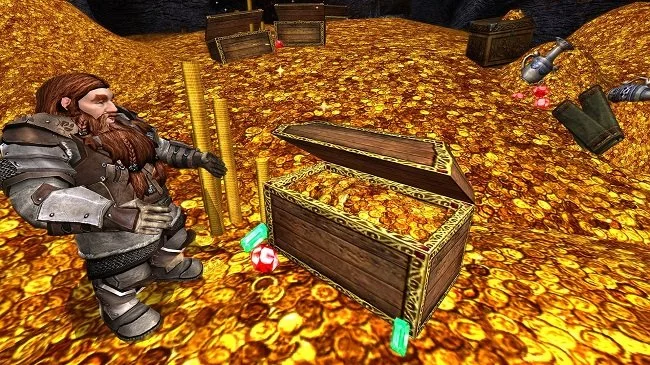
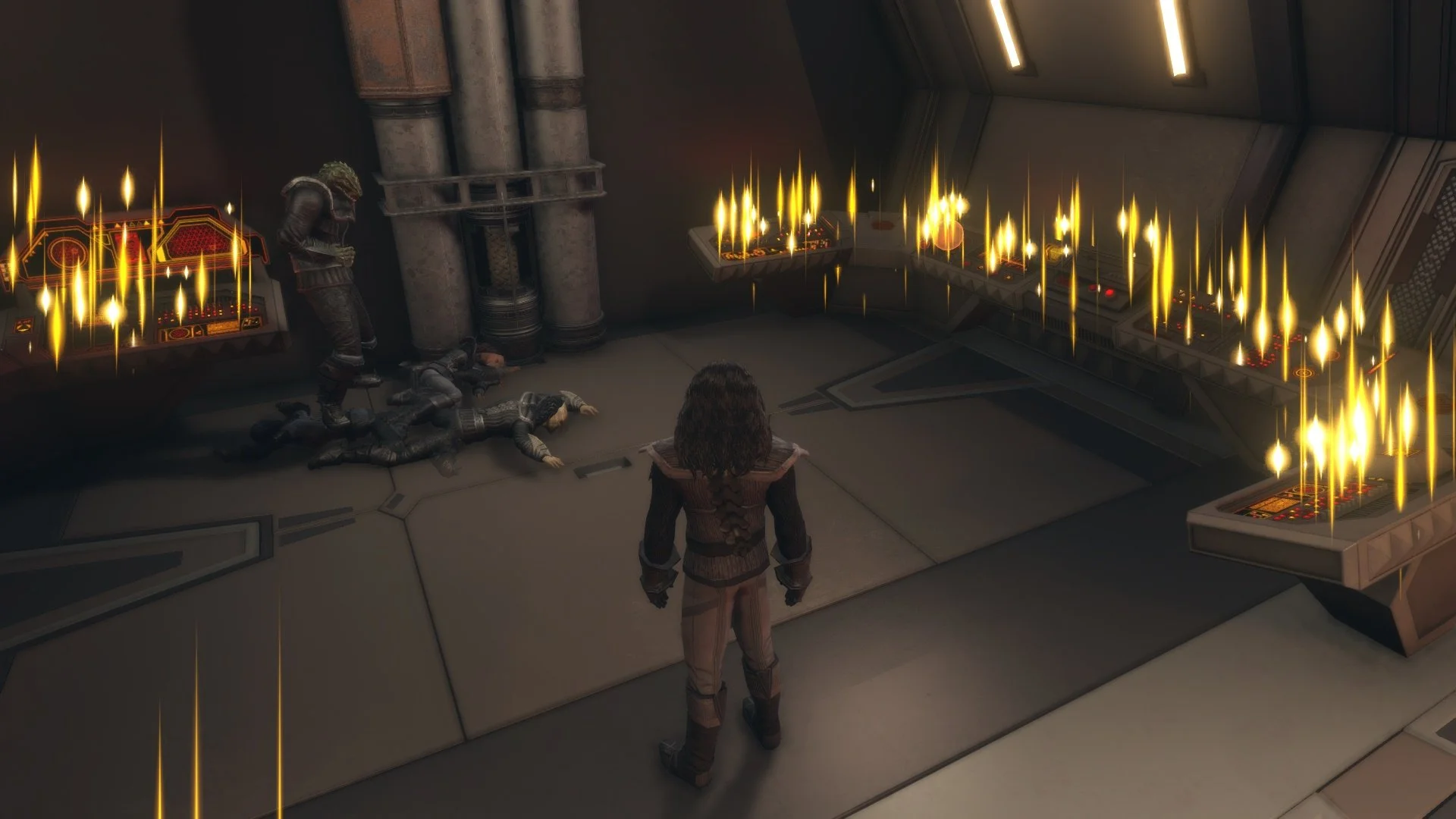
This picture is tenuously relevant. No clues. You figure it out.
Now regarding my non-whale status in STO, it should be noted that I spent a further £153.83 via the “grey” market. Bringing my total spend over the year to nearly £300. To put that number in to context, that averages out to broadly £6 per week. A comparable cost to coffee, sandwiches or beer. It is also unlikely that I will spend a similar amount of money on STO this year. I have maxed out my primary character and a lot of the items I’ve bought, are available account wide. However, what I think this minor analysis proves is that, if I deem it viable, I will spend money in a game. Therefore, I may well invest in another game at a future date if it suits my needs to do so. Considering that in most F2P games, the majority of the player base spend nothing, maybe I do have Cetacean tendencies after all. According to research 46% of all revenue comes from .22% of player base. If I am part of that group, all I can say is “Thar she blows of the starboard bow!”.
Star Trek Online: Beyond Endgame
The recent Arena of Sompek Event in STO was immense fun and presented me with an opportunity to fine tune the ground build on my primary character. Furthermore, the current return of the Phoenix Prize Pack has allowed me to spend a lot of my surplus Dilithium. I obtained a Kobali Samsar Cruiser [T6] last night which allowed me to complete the Kobali Space Set. It’s also nice to be able to finally own the iconic Red Matter Converter, which was only previously available in the Collector’s Edition of STO on launch. However, for me the best item available from the Phoenix Prize Pack is the special Phoenix Upgrade Tech (equivalent to multiple Universal Superior Tech Upgrades, with no Dilithium costs). I have used a hundred plus and have now managed to upgrade a lot of my gear to Epic quality. Finally, after months of tweaking and customising, I’ve broken the 30K DPS barrier.
The recent Arena of Sompek Event in STO was immense fun and presented me with an opportunity to fine tune the ground build on my primary character. Furthermore, the current return of the Phoenix Prize Pack has allowed me to spend a lot of my surplus Dilithium. I obtained a Kobali Samsar Cruiser [T6] last night which allowed me to complete the Kobali Space Set. It’s also nice to be able to finally own the iconic Red Matter Converter, which was only previously available in the Collector’s Edition of STO on launch. However, for me the best item available from the Phoenix Prize Pack is the special Phoenix Upgrade Tech (equivalent to multiple Universal Superior Tech Upgrades, with no Dilithium costs). I have used a hundred plus and have now managed to upgrade a lot of my gear to Epic quality. Finally, after months of tweaking and customising, I’ve broken the 30K DPS barrier.
Once you reach level cap in STO you quickly find that the bulk of the endgame is focused upon experimenting with builds and striving to increase your DPS. Although featured episodes and events are regularly added to the game, there are no traditional dungeons offering fancy gear as rewards. Gear is created through the reputation system and then upgrading it offers the opportunity to add modifiers. Events and PVE queues are effectively used as proving grounds. Once a player reaches a certain level of DPS, it requires a comprehensive program of subtle changes to see any further improvements. It also requires a great deal of in-game resources, such as Dilithium and Energy Credits to facilitate improvements. Success requires multiple alts to farm materials and a liking of spreadsheets and min-maxing.
Eighteen months ago, I wrote a post asking advice about a suitable tactical build for a Guardian Cruiser. I fortunately received none whatsoever, which then forced me to trawl through various subreddits and websites and learn about the mechanics of STO. I’ve now reach a DPS level that is certainly above average and I’m pleased with that achievement. However, I don’t see any reason to pursue any further increase because I suspect it will not be that much fun. So, I’ve decided to take heed of my recent return to LOTRO, where I am currently starting from scratch with a new alt. In the case of STO, rather than create a new character I already have three that remain incomplete. The most prudent one to focus upon is my Agents of Yesterday Federation Tactical Officer. Working my way through all the old content will yield multiple account unlocks that would be very beneficial. I can already craft Ultra Rare Mark XIII gear due on all my alts due to a reputation achievement on the AoY character.
Accolades, duty officer missions and cosmetic customisation are all other potential avenues of interest and fun to pursue in STO. Something else that is always overlooked is the fact that you can play through the various story arcs in the game in a group if you see fit. STO is an MMO yet I’ve spent so little time of the game in groups, apart from STFs and events. Playing through some of the stories with others can put a fresh perspective on them. Certainly, grouping in the Delta Quadrant will definitely give you an advantage and allow you to progress through the zone a lot more quickly. And of course, there is always the potential to role play, if that is your thing. Although, I find some of the activities and chat that goes on in Drozana Station and Risa beyond my ken.
As you can see, the endgame in STO doesn’t have to be DPScentric if you don’t want it to be. Like many MMOs, you get out of the game exactly what you put in. The people you associate with can also improve or kill the game for you. Finding the right fleet helps and there are plenty out there. There nothing wrong with taking your time and trying a few before committing to one. Also rushing to level cap is not essential second or third time round. There is plenty of detail and lore to be experienced along the way in the old content. So, I’m going to broaden my outlook and return to an older character and see where it takes me. If everything else fails I can always fall back upon cosmetic changes and goals for my away team. If you can’t be good be beautiful.
The Average LOTRO Player
Despite my claims to be a casual gamer, I tend to go all-in when a title takes my interest. Therefore, I will make it my business to read and learn about the various mechanics and systems in a game. I also like to be active in the wider community, so I write and podcast about the games I enjoy. Social media is an invaluable way to keep up-to-date with both developers and publishers. Forums and websites also play an integral role in keeping a player informed, by providing guides, press releases and a platform for sharing opinions. In recent years, many games have looked to Reddit as an additional way of communicating with their player base and fostering a community.
Despite my claims to be a casual gamer, I tend to go all-in when a title takes my interest. Therefore, I will make it my business to read and learn about the various mechanics and systems in a game. I also like to be active in the wider community, so I write and podcast about the games I enjoy. Social media is an invaluable way to keep up-to-date with both developers and publishers. Forums and websites also play an integral role in keeping a player informed, by providing guides, press releases and a platform for sharing opinions. In recent years, many games have looked to Reddit as an additional way of communicating with their player base and fostering a community.
When I started playing LOTRO in late 2008 the focal point for information and interaction between players and the development team was the official forums. Then in 2010 there was a brief time where the unofficial forums became essential reading. There were also a great many guides available online providing a wealth of information about armour, crafting and other facets of the MMO. In many respects, at the time of its free to play conversion, LOTRO was one of the most well documented MMOs around. Seven years on, the official forums can still answer most questions a new player may ask. You Tube also provides an alternative repository of information.
When you consider all these options, you’d be forgiven for thinking that the average LOTRO player is well informed. The latest news is even emblazoned on the game launcher. Yet something happened recently in kin chat that made me realise that this is not the case and that the official forum and twitter are more of a haven for active and vocal gamers. They are not really a true cross section of a games player base. The developers have said this many times in the past. The forums, the fansites and other sub-communities are populated by players affiliated to specific niche groups, such as raiders, role players, or ardent solo completionists. Yet my kinship on Laurelin is filled with people who do not fall into these categories.
With regard to the incident I mentioned, someone in kin chat referenced how they were looking forward to High Elves being added to the game. A point that was met with surprise by many other kinship members who were logged in. Needless to say, an interesting discussion followed. To cut a long story short, I would estimate that about two thirds of our kin are oblivious to the finer points of the last producers letter. Furthermore, most of them never go to either forums, read the developer diaries or do any sort of proactive research into the game. Fan blogs and guides are effectively ignored. The Bullroarer test server is also an unknown quantity to many that I talk to. Overall I believe the majority of our kinship on Laurelin, just play the game and have no major interest in everything else.
I’m of the opinion that there is nothing unique about our kinship and its approach to LOTRO. I’m persuaded to think that a lot of LOTRO players are of a similar mindset. Therefore, this beggars the question is there such a thing as an average LOTRO player? This is not a term that I mean in a pejorative way. It’s just that for all the ardent raiders and high achievement players, there are many others that are just content to play through the game in their own way and at their own pace. They work things out as they go along and take their pleasure along the way. So, I’ve been trying to collate ideas regarding the average LOTRO player to try to form a sort of profile, based around common attributes and habits. Here are a few bullet points of some that I’ve considered.
- LOTRO players are not always gamers per se. Most of my kinmates only play LOTRO and are simply not interested in any other games. They do not own high end gaming PCs or have fast broadband connections.
- By far the biggest selling point of LOTRO for such players is the IP. They are first and foremost Tolkien fans. The most common refrain I hear is that the game provides an opportunity to play as a Hobbit, Elf or Dwarf in Middle-earth. There is no alternative MMO or game that offers the same experience.
- Many of the players in our kinship, or those I have spoken to outside of it, have never participated in a raid of any kind, despite the opportunities to do so. The idea either does not interest them, they simply do not have the time or they are not disposed towards the perceived social pressures of such activities.
- For every member of my kin who has multiple alts at level cap, there is another who has a list of alts that have been abandoned or who are still work in progress. Again, this is mainly due to time commitments or the fact that some folk just like to roll new alts for fun, rather than to pursue a structured levelling path.
- The officers in kinships I’ve been involved with tend to be those who play a lot and to the highest level. It is these people who are often the most informed about the game and the kin looks to them for the dissemination of news. In our kin, if you want to know anything about anything, you ask a handful of senior players.
I spend a lot of time talking to other LOTRO players, both in and out of the game. From what I have discerned a large amount of the player base are satisfied with what the game has to offer. Infact they always have been. Despite the calls from the raiding and PVP communities for more content that favours their needs, many players are happy to play casually and just "potter" about LOTRO. They’re not fussed about statistical changes, the Flora barter system, grinding for essences or the complexities of imbuing your legendary items. The game as it stands provides them with exactly what they want. A Middle-earth themed environment for them to explore and hangout in. This seems especially true of the RP players. Bree appears to serves all their needs.
Furthermore, many players are not in any way aggrieved by the alleged “iniquities” of the LOTRO store. When the total cost of everything they have ever spent on LOTRO is averaged out, many still feel that it is an extremely cheap form of entertainment, compared to other real world activities such as going to the movies, or out for a meal. Overall LOTRO is looked upon as a pleasant means of relaxation, in a virtual environment that most find agreeable. It is common for players in my kin to come home from work, cook some food and then spend time in LOTRO unwinding from the pressures of the day and enjoying the company of their fellow kinmates. The importance of the social ties associated with the game cannot be stressed enough. Gear grinds or the tedium of crafting are actually considered positive things by many of the players I know. Some folk like structured goals.
So, after considering these points, I'd say that there are lots of players that are content with LOTRO and who have little concern or even knowledge of the various changes that are coming this year. The major alterations that caused furor on the official forums over LOTRO’s lifespan, such as the move away from raids to epic battles and the introduction of the class skills tree, have had little impact upon such players. As long as they can continue to do the things that keep them happy, then all is right in their virtual world. Such players will continue to play and pay LOTRO until the servers close. They do not have any major beefs with the development team or community manager because they simply do not move in the same circles.
There are many subsets of LOTRO players but I get the feeling that this relatively low profile group of quiet and content players are by far the largest. When the fancy take’s them they will use the store because it is not an ideological anathema to them. It offers fun and useful items that enhances their play. That should make them a very important demographic to developers Standing Stone Games. In the meantime, the official forums although a useful portal are in danger of slowly becoming an insular private members club, busy preaching to the converted. Although many good points are raised and debated there as well on such site as Massively OP, they never really never travel beyond their virtual confines.
So, the average player that I have described is potentially the majority group that is now bank rolling LOTRO. If that is the case, then all SSG needs to do is to keep producing content that meets their requirements. That means that the trend towards streamlining and refining LOTRO, rather than adding to its complexity, seems to be the way to go. Now naturally, there will be a percentage of players and ex-players who will state that it is this very process that is "killing the game". Ultimately it comes down to a question of taste of what you want in a MMO. However, if I am right in my summation about the average LOTRO player, I think it proves why the MMO is facing its tenth-year anniversary, where so many others have gone to the wall. It is this groups loyal support and quite pursuit of their own style of game play that is LOTRO’s foundation
Starting from Scratch
I was watching a LOTRO stream this week by Kaz Travio who is currently levelling a Dwarf Hunter on the EU server Laurelin. The Hunter class is both enjoyable and straightforward to play. It can satisfy your “pew pew” itch and doesn’t have a particularly steep learning curve. It’s porting and poison curing skills use to be invaluable. Overall, the Hunter is a great way for a new player to discover and explore the Lord of the Rings Online. This becomes very apparent in Kaz Travio’s stream. So, to cut a long story short, I decided to create a new Hunter myself and go tool around in Middle-earth.
I was watching a LOTRO stream this week by Kaz Travio who is currently levelling a Dwarf Hunter on the EU server Laurelin. The Hunter class is both enjoyable and straightforward to play. It can satisfy your “pew pew” itch and doesn’t have a particularly steep learning curve. It’s porting and poison curing skills use to be invaluable. Overall, the Hunter is a great way for a new player to discover and explore the Lord of the Rings Online. This becomes very apparent in Kaz Travio’s stream. So, to cut a long story short, I decided to create a new Hunter myself and go tool around in Middle-earth.
Much to my surprise, instead of being the five-minute wonder that I thought it would be, I’ve been quite engaged with my new character. It’s been a long time since I’ve spent some time in the starter zones of LOTRO. Due to the streamlining of much of the content in recent years by the developers, you can quickly out level a region and are encouraged to forge ahead. However, I have not felt disposed towards doing that. I particularly want to refresh my memory on some of the quest story lines, plus there’s a good chance there’s some new content in there that wasn’t about when I last breezed through these zones in 2009. So it would appear that my new Dwarf Hunter Gryg, is going to be around a while. However, that presents me with another problem.
I am mainly starting from scratch for narrative reasons; I’m here for the story. What I don’t especially enjoy in the early stages of LOTRO, is the gear, virtue and skills point treadmill. With 105 levels ahead of me, there’s a great deal of disposability with regard to armour, weapons, and jewellery. You’ll not find much of this kind of gear on the auction house nowadays. The alternatives are running skirmishes to barter for equipment or simply crafting it myself. Neither of these options appeal to me. So, I’m considering a different approach. I can purchase from the LOTRO store, either the Gift or the Blessing of the Valar and instant level to 50 or 95. That way I can return to the start of the game, overpowered and geared to a suitable level to bypass any grind or in-game obstacle.
Now I’m sure my approach will not suit everyone, which is fine. Some players are happy to do everything over again. If this delights them, then that’s fine by me. I just don’t want to be burdened with the usual game mechanics that you experience on your first play through of content. I want to be able to focus on the stories the game offers and not have to worry about my ability to perform. Yet my instant levelling solution does come with a price tag. The Gift of the Valar cost approximately £30 and the Blessing of the Valar about £40, which are not exactly pocket change. There is the option to earn the LOTRO points in-game but the effort it would entail would negate the need to buy the aforementioned items. By the time I had amassed sufficient points, I’d be level 60 or so.
As of yet, I have not made a decision as to what I shall do. I also think that my personal “dilemma” actually touches on a bigger issue. I think many players would like to create new characters and have access to classes they have not played before. However, many people, like myself, are not enamoured with the prospect of replaying 105 levels and all the content that goes with it. So, I’d like a fair and equitable means to create a level cap alt (or as near as damn it). Now I realise that means bypassing a lot of content and so I’m happy to consider some way of supporting Standing Stone Games, if they can accommodate my needs.
For example, in Star Trek Online once you’ve gained maximum reputation with a faction, you can create a token that you can use on one of your alts, that reduces the reputation experience required by 50%. How about introducing s similar system in LOTRO, allowing a player to similarity fast path an alt? I want to play LOTRO and logically it is to Standing Stone Game’s advantage if I continue to do so. I hope now that the company is free of the shackles of Warner bros. they will now pursue a more creative business policy. One that finds a way of accommodating long time players, such as myself. In the meantime, I shall continue to my Dwarf Hunter but I suspect the moment an obstacle emerges, be it a gear check or an especially difficult quest, I’ll more than likely stop. Fun is surprisingly not universal and very subjective. Convenience is king.
Arena of Sompek Special Event
Star Trek Online regularly runs short term events with unique rewards to keep the player base engaged. The latest of these, the Arena of Sompek Special Event, has just gone live today and will run until to February 27th at 9:00 AM PST (17:00 PM GMT). Level 50 to 60 Captains can queue publicly or form bespoke groups to battle in the ancient Klingon tradition of the qaD HoS; an endless battle against allies and enemies alike. Set in a holodeck, teams of six players face waves of ever increasingly powerful enemies as well as environmental hazards. There are infinite respawns as long as there’s one active player. Once all players are incapacitated, the event ends and rewards are distributed based on how many rounds are completed. These include a choice of reputation marks, Dilithium, crafting materials and a voucher once per day, that can be applied toward a special reward, The Sompek Lightning Universal Kit Module.
Star Trek Online regularly runs short term events with unique rewards to keep the player base engaged. The latest of these, the Arena of Sompek Special Event, has just gone live today and will run until to February 27th at 9:00 AM PST (17:00 PM GMT). Level 50 to 60 Captains can queue publicly or form bespoke groups to battle in the ancient Klingon tradition of the qaD HoS; an endless battle against allies and enemies alike. Set in a holodeck, teams of six players face waves of ever increasingly powerful enemies as well as environmental hazards. There are infinite respawns as long as there’s one active player. Once all players are incapacitated, the event ends and rewards are distributed based on how many rounds are completed. These include a choice of reputation marks, Dilithium, crafting materials and a voucher once per day, that can be applied toward a special reward, The Sompek Lightning Universal Kit Module.
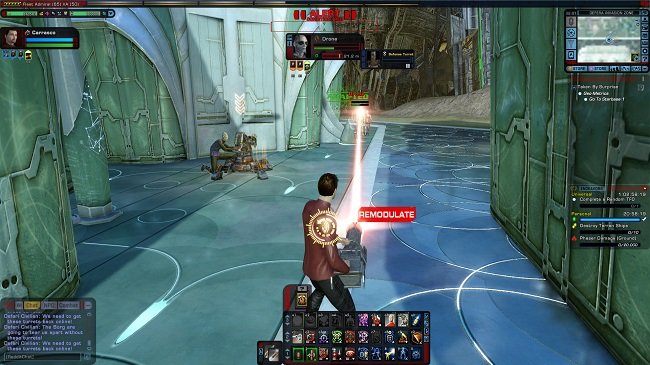
The Arena of Sompek is extremely enjoyable as well as quite challenging. I jumped straight in to this event today as soon as the servers came up after patching, joining a team via the group finder. Fortunately, all participants were well geared and soon came to grips with the event mechanics. Fire barriers, lighting strikes and the central zone becoming toxic, soon teach you to main your situational awareness and not to stay in one position. The enemies become increasingly stronger each time they spawn and can be from any of the factions, races and species that exist in the game. You may face the Borg so bring a frequency remodulator or a TR-116B rifle. Cover shields, overcharge turrets, solar gateways and other devices are invaluable. Teamwork helps.
Your success in this event very much depends upon who you group with. Therefore, you’ll likely to do better in an organised team rather than in a PUG. However, there is immense fun to be had irrespective of how you play the event. Our group managed to last twenty-six rounds on our first attempt which I thought was respectable. No one complained or was difficult in team chat which is always an added bonus these days. Furthermore, the STO community has been quick to post videos on You Tube and share tactics on the official subreddit. As ever the DPS focused community have already clocked in high round scores and doubtless a league table will follow. Yet this is an event that can be enjoyed by all STO players and is something Cryptic intend to make available regularly throughout the year, very much like “Hearts and Minds”. If they can tweak the time delay between rounds, they may well be on to a winner here.
Mordor or Bust: A Retrospective
My friend and regular podcast co-host, Brian, celebrates a significant birthday today. So first off let me wish him many happy returns of the day. Now while the Burton & Scrooge podcast is on hiatus, Brian has been pursuing his own side project; namely the Scrooge Uncut podcast. The latest episode is a retrospective look at Brian’s former LOTRO fansite and show, Mordor or Bust. The both these creative endeavours were a significant part of the LOTRO community, back in the halcyon days of the MMO. Brian had the unique experience of predicting LOTROs transition to F2P, days before Turbine’s announcement. He also caused a minor furore when he posted screenshots of every item in the LOTRO store while the beta test was going on.
My friend and regular podcast co-host, Brian, celebrates a significant birthday today. So first off let me wish him many happy returns of the day. Now while the Burton & Scrooge podcast is on hiatus, Brian has been pursuing his own side project; namely the Scrooge Uncut podcast. The latest episode is a retrospective look at Brian’s former LOTRO fansite and show, Mordor or Bust. The both these creative endeavours were a significant part of the LOTRO community, back in the halcyon days of the MMO. Brian had the unique experience of predicting LOTROs transition to F2P, days before Turbine’s announcement. He also caused a minor furore when he posted screenshots of every item in the LOTRO store while the beta test was going on.
This particular episode of Scrooge Uncut is a very personal recording. as Brian catalogues jumping in to the deep end of content creation without any prior experience. It is also a greats snapshot of what a fan community is like during a games heyday. What is so striking is the fact that Brian got so much traction with the game developers Turbine, over such a short period of time. The story of Mordor or Bust is a short one because the website and podcast endured for less than a year. Listening to Brian recount various anecdotes brings a lot of memories back for me as well. LOTRO has always had a very passionate community. Something that is lacking with other games over recent years. So much of the fan created content that use to fill blogs and podcasts, is now mainly corralled within official forums and sub-reddits.
On a personal note, I got in to podcasting due to Brian and his show, back in the summer of 2010. At the time, Turbine handled the North American release of LOTRO, while Codemasters dealt with the European market. I contacted Brian and offered to provide LOTRO news from across the pond and subsequently created short news segments that were used on the Mordor of Bust podcast. Because we got on so well, I soon joined both Brian and Fyurae, as a permanent presenter on the show. It was a lot of fun at the time, to be part of a very active community. Furthermore, 2010 was a very interesting year for LOTRO. So, enjoy Brian’s trip down memory lane. I think the show will resonate with a lot of listeners, especially those who were involved with the scene, circa 2010.
Star Trek Online and the MMO Trinity
Although I will happily espouse the virtues of Star Trek Online, the multiplayer element of this MMO is very much optional. The central mission arcs are all solo friendly and although you can play through this content in a group, there is no major incentive to do so. The only times I have grouped during standard PVE content has been to help another player new to the game and when replaying a specific mission for the rewards if offers. The latter can be done a lot faster when grouped. The space and ground queues that are available at level 50 are designed for 6, 10 or 20 players but again the multiplayer aspect of these is somewhat arbitrary. Players can either join a PUG via the group finding system or set up bespoke event themselves with friends of fellow Fleet members. Beyond that there is no compelling interaction between players.
Although I will happily espouse the virtues of Star Trek Online, the multiplayer element of this MMO is very much optional. The central mission arcs are all solo friendly and although you can play through this content in a group, there is no major incentive to do so. The only times I have grouped during standard PVE content has been to help another player new to the game and when replaying a specific mission for the rewards if offers. The latter can be done a lot faster when grouped. The space and ground queues that are available at level 50 are designed for 6, 10 or 20 players but again the multiplayer aspect of these is somewhat arbitrary. Players can either join a PUG via the group finding system or set up bespoke event themselves with friends of fellow Fleet members. Beyond that there is no compelling interaction between players.
This difference handling multiplayer content was highlighted recently when I played through a featured instance in LOTRO. Although most of the six players present were somewhat over powered, and could blitz through most of the trash mobs, the final boss did require players to fulfil specific roles. There was a need for a tank to hold aggro, DPS dealers to burn the boss down and the healers and control class to heal and debuff. LOTRO was a game conceived and created when the MMO industry was still very much focused on the traditional trinity of classes. What I find curious is that STO was developed at the same time and technically has class distinctions that would support multiplay in such a fashion. Yet it has either never been implemented within the game or has been removed over time via various updates and patches.
However, the fleet system in STO really does foster a community spirit. My primary Federation Captain is a member of Reddit Alert and I must say that the fleet chat is extremely sociable. Where the game may lack a compelling multiplayer aspect, the discussions, debates and advice that is available in chat is invaluable. Many fleet members frequently group for the pleasure of it or to help others achieve specific goals. In some respects, this is does offer a degree of compensation for the lack of traditional multiplayer elements within STO. Considering the nature of the source material you’d have thought that the game would have been created with content that had specific roles for each class. Such collaborative play would have certainly been lore friendly.
For good or ill, mainstream MMO content has moved away from complex class interdependency and an inherent need to group for content. The majority of games now focus on PVE content that is solo friendly and offer players builds that allow them to selfheal and adapt to the content requirements. Perhaps the home of such class interaction is now the MOBA or the team shooters such as Overwatch. Taking a specific role in a group content in Star Trek Online would be very gratifying in principle. It would help create the illusion of being part of a larger Star Fleet. However, I think it is highly unlikely for the developers Cryptic to take such a step and introduce this mechanic retrospectively. Frankly the way the community now focuses on DPS builds I don’t think you could have a Tank class that could hold threat.
To Grind or Not to Grind?
As soon as I returned to LOTRO last October I immediately started replacing my level 100 gear with more appropriate items. I finally started using slotted armour and essences, using mainly the gear that dropped from quests along the way. As ever it’s not the best but it’s better than what I had. I never started the Dol Amroth repeatable quests that yield armour sets and as the gear is now only level 100, I’ve decided against that option. As I no longer have the time to regularly run instances, I can’t get a set from the Throne of Dread Terror (T2). Luckily, Turbine (now Standing Stone Games) introduced the Flora Barter system with Update 19: March of the King, which provides an alternative method of obtaining level cap appropriate gear.
As soon as I returned to LOTRO last October I immediately started replacing my level 100 gear with more appropriate items. I finally started using slotted armour and essences, using mainly the gear that dropped from quests along the way. As ever it’s not the best but it’s better than what I had. I never started the Dol Amroth repeatable quests that yield armour sets and as the gear is now only level 100, I’ve decided against that option. As I no longer have the time to regularly run instances, I can’t get a set from the Throne of Dread Terror (T2). Luckily, Turbine (now Standing Stone Games) introduced the Flora Barter system with Update 19: March of the King, which provides an alternative method of obtaining level cap appropriate gear.
So, I spent some time recently gathering the various plants in North Ithilien that yield Phials of Extract; the barter items need for the gear set. However, because I’ve been focused on other in-game tasks I didn’t really consider how long it would take to meet the criteria to obtain the full set of Light Weave Padded Armour for my Lore-master. Today I sat down with a pen and paper and did the math(s). A full set comprises of 6 pieces (no cloak). Each item requires 2 Phials of Sapphire Extract and 4 Phials of Amber. So, in total to purchase this set you need 12 Phials of Sapphire and 24 Phials of Amber. To obtain Phials of Sapphire and Amber Extract you have to combine lesser extracts such as Umber, Verdant and Crimson, which come from picking plants in North Ithilien. Sapphire requires 250 lesser extracts and Amber 125. So, to summarise here is a breakdown of the numbers needed for a full set of armour, be it light, medium or heavy:
250 Phials of Umber, Verdant or Crimson Extract x 12 to yield sufficient Sapphire Extract.
125 Phials of Umber, Verdant or Crimson Extract x 24 to yield sufficient Amber Extract.
In total a player needs to have 6000 of the lesser extracts (Phials of Umber, Verdant or Crimson) to then trade in for the necessary Phials of Sapphire and Amber Extract.
Now I spent approximately 90 minutes today collecting extracts from plants such as Horsetail, Dwarfsbeard and Elfspear (others species are available) and I managed to obtain 200 or so. The plants grow in a level cap zone populated by appropriate mobs and animals. So, you do lose some time in combat while collecting. Furthermore, like ore nodes these Flora are contested and you’ll often find yourself competing with other playes for them. Therefore, when you consider all these factors, I estimate it will take a calendar month to gain sufficient stocks of flora extracts to purchase the set. That’s a calendar month playing every day and investing and hour and a half of your time just collecting. It should be noted that there are now some repeatable quests that award random extracts as a way of trying to shorten this process but it really doesn’t make that much of a difference.
So, after figuring this logistical problem out I now have to decide whether I wish to “grind” for this armour set. It comes down to whether you feel that the time invested justifies the reward, or if it is simply too much work. Furthermore, I’ve been burnt several times in the past by Turbine when pursuing other gear grinds. I finally obtained my First Age Weapon from running Moria instances a week before Siege of Mirkwood came out with a new set of gear and weapons that made mine obsolete. The same happened with all the stuff I earned from Hytbold. No doubt Update 21 which is the Mordor expansion may well see a level cap increase. I want to be able enjoy any level 105 armour I obtain for at least six month before it gets replaced. However, I can at times be quite goal orientated so I may well embark on this project. Ultimately the deciding factor with any MMO is one of time.
MMORPGs: A Recurring Talking Point
Last night, I hosted the recording of the latest TGEN Tribunal, a quarterly roundtable podcast made up of members of The Gaming and Entertainment Network. Myself, Syl, Braxwolf and Brian discussed several subjects, one of which was regarding the MMORPG genre. The initial question was quite specific but the discussion soon expanded to cover wider aspects of online multiplayer games. Overall it was an interesting debate, as all present have been playing MMOs for years and have certainly seen their relationship with them evolve. When we finished recording it occurred to me that the subject of MMOs has been a major theme of many of the podcasts I’ve been involved with over the years.
Last night, I hosted the recording of the latest TGEN Tribunal, a quarterly roundtable podcast made up of members of The Gaming and Entertainment Network. Myself, Syl, Braxwolf and Brian discussed several subjects, one of which was regarding the MMORPG genre. The initial question was quite specific but the discussion soon expanded to cover wider aspects of online multiplayer games. Overall it was an interesting debate, as all present have been playing MMOs for years and have certainly seen their relationship with them evolve. When we finished recording it occurred to me that the subject of MMOs has been a major theme of many of the podcasts I’ve been involved with over the years.
For myself and many others, the appeal of the MMORPG lies in the concept of a persistent world that can be shared and explored with others. Although the inherent novelty of the multiplayer aspect of the MMO may have lost its lustre over the last decade, I still from time to time pause and reflect, whenever in-game, that all the other avatars around me are players like myself, sitting at their computers and looking for fun and engagement. The MMO genre also lends itself to strong narratives, often stemming from the intellectual properties they create or license. This is a major attraction. Then there’s simply the fascination of people watching. MMOs mirror aspects of real life with their economies and social hierarchies.
Over the years the genre has evolved, as have the communities that spring from them. The MMO has changed from a complex, time sink that was funded by subscriptions to a more casual and flexible experience. Free to play caused outraged, as did a move away from “hard core raiding”. But the genre still survived and the player base adapted. Allowing more players to participate with alternative business models certainly did have an impact upon content and the quality of some players. Certain MMOs that prided themselves on the rectitude of their player base, found out the hard way that not everyone was amicable by default. Yet regardless of all the challenges that have emerged and numerous prophecies of impending doom, the MMO endures and along with it so does our interest.
I played my first MMO in winter 2008 and I was not exactly an early adopter. By then, many of my peers had cut their teeth on titles such as Ultima Online, EverQuest and World of Warcraft. However my initial MMO experience came at the right moment, when I had the time and inclination to indulge my passion. And because my initial experience with LOTRO was so positive, I subsequently tried all major MMOs that were released thereafter. Thus between 2009 and 2014 the MMO genre was effectively my game of choice. In light of such an admission, it hardly seems surprising to see that enjoyment and affection reflect in my writing and podcasting. In more recent years it has also become apparent that my relationship with the MMORPG has changed, as the demands on my time mean I can no longer commit to a game in the same manner as I did a decade ago.
So, is there a point to all this introspection? Yes there is. After last night’s recording, I decided to search through my archive of podcasts that I’ve created over the last seven years. I found a roundtable discussion, similar to yesterdays. It was recorded in summer 2012 and features my regular co-host Brian, Merric from A Casual Stroll to Mordor and Syp from Massively OP and Bio Break. The show was specifically about the “future of MMOs” and although it’s very much couched in the context of the time, it still has some interesting and relevant points to make. Listening to it again, has certainly highlighted how I’ve moved on in some regards, yet in others I’m still quite enthusiastic. One thing does stand out for me; the fact that LOTRO is still a constant.
So I’ve reposted the podcast. If memory serves, this show was well received upon its original release and now serves as a quasi-historical document, in so far as being a snapshot of the MMO fan base at the time. At the very least it may raise a wry smile from among those who originally participated in the recording. Perhaps we could even do a retrospective of our own show at some future date and discuss what we got right and what we got wrong. In the meantime the MMORPG still endures and adapts to the modern gaming market. Perhaps it is that propensity for survival that makes it such an interesting subject to return to and explore.
UI Customisation
Game complexity can be both a boon and a bane; a selling point and a source of irritation. There are many titles that I enjoy that have a wealth of systems and mechanics that add greatly to the overall immersion and entertainment. The MMORPG genre excels at this. However, this data all needs to be displayed visually, in an efficient and intuitive fashion. It has to be readily available and easy to navigate. Naturally, there’s a fine balance between making such a system accessible without becoming a source of distraction. This is the challenge that all developers face when designing a user interface. However this problem is compounded further by the human element. Regardless of how well crafted a game’s UI may be, players will always wish to change it to suit their own needs and requirements.
Game complexity can be both a boon and a bane; a selling point and a source of irritation. There are many titles that I enjoy that have a wealth of systems and mechanics that add greatly to the overall immersion and entertainment. The MMORPG genre excels at this. However, this data all needs to be displayed visually, in an efficient and intuitive fashion. It has to be readily available and easy to navigate. Naturally, there’s a fine balance between making such a system accessible without becoming a source of distraction. This is the challenge that all developers face when designing a user interface. However this problem is compounded further by the human element. Regardless of how well crafted a game’s UI may be, players will always wish to change it to suit their own needs and requirements.
What I often find in the MMO genre, is that the UI is streamlined at the beginning of a game with all the essential data that you need to play, evenly distributed around the screen. This grows exponentially as the game progresses, especially with older titles that frequently suffer from skills bloat. LOTRO is a classic example of this with a wealth of data swamping the screen when you reach level cap. I remember having similar issues when I was actively playing SWTOR. I encountered the same in STO recently, especially with regard to the skills hot bar. This was growing and intruding further towards the middle of the screen, impeding combat.
Mercifully most games have the ability to customise the UI, allowing players to indulge their preferences. Furthermore custom HUD settings can frequently be saved and then loaded when required. Monitor size and screen resolution also play a part in this matter and can have a positive impact if altered. Many games also have a cottage industry of players creating and sharing their own custom user interfaces. LOTROinterface has proven to be very popular over the years. The WoW and ESO communities also have multiple sites and resources for such changes. In the competitive genre of MOBAs, a common interface between team mates can be advantageous.
I currently have a 24 inch monitor with a resolution of 1920 x 1200. It provides a fairly large gaming canvas and allows me to spread the various elements of the UI to the borders of the screen. However an excess of data on the periphery of your vision can be distracting, especially if it flashes or attempts to alert you in some fashion. I also find it an impediment if my hot bars start to encroach towards the centre of the screen. I don't know if this is due to a foible of human vision but I find it draws my eyes away from where they need to be. I've had such problems in STO recently with my hot bar resembling a pyramid, resulting is some judicious customisation.
The ability to alter a games GUI, raises some interesting questions. The most obvious is whether or not you actually need everything on-screen. My view is if you're not using a specific element of the HUD, then remove it and that goes for skills as well. Then there is the matter of whether games developers are doing their best to accommodate the needs of players with disabilities. Resizing elements and changing colour schemes, as well as assigning audio alerts can all be incredibly beneficial. Fonts can also be a bone of contention, with some not lending themselves readily to being scaled. A simple change of this nature can often improve gaming.
Personally, I would like to see more customisation options added to games. The mod scene in Skyrim really set the standard. I also like the way that some MMOs such as LOTRO have built in voice chat and access to social media. STO allows players to utilise third party audio players while in-game and The Secret World has its own internal web browser as part of the narrative. Although it is to a developer’s advantage to keep the player focused and in-game, facilitating customisation and providing multiple tools aids this process. Flexibility and accommodating change needs to be more of a driving factors in games development because no two players are alike.
The Geography of LOTRO: Part 2 Bree and Bree-land
In the second part of our look at the geography of Middle Earth, we shall be focusing of the town of Bree. It has a pivotal role in the events of the book and subsequently play a similar part Standing Stone Games Lord of the Rings Online. Before we start, let us remind ourselves exactly what Tolkien writes when introducing Bree to the reader. The following quote is the opening paragraph of chapter nine; At the sign of the Prancing Pony from The Fellowship of the Ring.
In the second part of our look at the geography of Middle Earth (part 1 is here), we shall be focusing of the town of Bree. It has a pivotal role in the events of the book and subsequently play a similar part Standing Stone Games Lord of the Rings Online. Before we start, let us remind ourselves exactly what Tolkien writes when introducing Bree to the reader. The following quote is the opening paragraph of chapter nine; At the sign of the Prancing Pony from The Fellowship of the Ring.
"Bree was the chief village of the Bree-land, a small inhabited region, like an island in the empty lands round about. Besides Bree itself, there was Staddle on the other side of the hill, Combe in the deep valley a little further eastward and Archet on the edge of the Chetwood. Lying round Bree-hill and the villages was a small country of fields and tamed woodland only a few miles broad."
This is a very clear description and to the developers credit they have interpreted this rather literally in the game. Focusing first on the town of Bree itself, Turbine have constructed a settlement that broadly conforms to Tolkien’s details. As you enter through the West-gate and follow the path of "The East Road" you will see the Hobbit holes and small holdings on the slopes of the hill. The homes of men are mainly to the East. "The Prancing Pony" inn is located at the top of the road, abutting to Bree hill itself. The building consists of two wings, as in the source text, though only one is accessible.
Where the game differs is in scale. Bree in LOTRO has been expanded from a simple village to a more substantial centre of commerce. This adaptation allows them to encompass all the crafting and training halls, along with the vendors and sundry NPCs. The only embellishment I personally feel a little excessive, is the town hall itself. It seems a little too ambitious for such a small and insular community. A similar view could be taken on several of the fountains and statues that adorn the various squares. The 2012 revamp has certainly made Bree more populous. Again, perhaps to the detriment of the lore. However, the hedge and dike that surround Bree are very much in accordance with the books and seem authentic.
Moving immediately outside of Bree into Bree-Land itself, we find both Combe and Staddle in the right locations. These being the respective local enclaves of men and hobbits. As specific details are lacking , Turbines visualisations are perfectly acceptable and not in any way excessive. The village of Archet however, has been moved considerably further North. This is to accommodate the fact that the area is a race specific starter area in the game and has been isolated to suit the mechanics of the game. Such local features within the Archet area such as "Bronwe's Folly", "Sprigley's Farm" and "Blackwold Roost" are non-canonical. However none of these are in any way contrary to prevailing regional design.
The above map and the one immediately below have been created using the original books and the subsequent histories of Middle Earth as a guide. They both depict a more Spartan and less populous village of Bree and a far more expansive Chetwood that extends in to the North and NorthEast. The Midgewater marshes are such a distance away as to not even be included on both maps. As are both Andrath and the South Downs. These points highlight the fact that Bree was the last major settlement East of the Blue Mountains before entering the Lonelands. This was a region that was unsettled and thus to a degree barren.
Turbines original condensing of Middle Earth was and remains a necessary factor in creating a viable environment for collective gameplay. However, on occasions, although LOTRO excels at capturing the spirit of Tolkien’s world, there are inevitable trade-offs. The loss of scale particularly in this region is a little disappointing and for those who may not be familiar with the length of original journey, may be somewhat perplexing. For those who wish for more technically accurate cartography, I would recommend the following books. Journeys of Frodo by Barbara Strachey and The Atlas of Middle Earth by Karen Wynn Fonstad. Both depict the routes taken by the fellowship and contain exacting details relating to dates and even the phases of the moon and stars.
Damning the Elder Scrolls Online with Faint Praise?
I recently wrote about how about how I finally purchased The Elder Scrolls Online, two years after the games launch. As the purpose of this post is to contrast my thoughts on the MMO both then and now and how they may have potentially changed, I must first reiterate how I felt about ESO initially. As memory serves, here is a breakdown of my initial impressions. I participated in the beta testing in 2014 and although I broadly enjoyed the game, I was not in any way blown away by it. Overall things took several hours to hit their stride as far as gameplay and enjoyment. I also felt that the early levels seemed too focused on establishing the narrative at the expense of the player getting into the game. Eventually I did get that Elder Scrolls vibe but it was not immediately apparent. The action combat needed refining and the multiplayer element frankly felt redundant, unless you were focused on PVP.
I recently wrote about how about how I finally purchased The Elder Scrolls Online, two years after the games launch. As the purpose of this post is to contrast my thoughts on the MMO both then and now and how they may have potentially changed, I must first reiterate how I felt about ESO initially. As memory serves, here is a breakdown of my initial impressions. I participated in the beta testing in 2014 and although I broadly enjoyed the game, I was not in any way blown away by it. Overall things took several hours to hit their stride as far as gameplay and enjoyment. I also felt that the early levels seemed too focused on establishing the narrative at the expense of the player getting into the game. Eventually I did get that Elder Scrolls vibe but it was not immediately apparent. The action combat needed refining and the multiplayer element frankly felt redundant, unless you were focused on PVP.
Upon my return, I found that the starting zone was still very much a handholding exercise with regard to the game mechanics and the central story. These “nursery” areas are always tend to be problematic for the MMO genre, often falling between two stools. Some players will find them to too hemmed in and on rails, yet there is a need to teach those new to the genre the basic mechanics of the game. Once out of the starter area, things do pick up and it becomes clear that the game leans more towards Skyrim that to other traditional MMOs. If you elect to play ESO with the standard interface, then it’s incumbent upon you to explore the world and figure things out. If you want a more contemporary MMO experience with mini-maps and a wealth of prompts, then add-ons are your friend.
Second time around I felt far more confident about ESO. Certainly, two years’ worth of patches have ironed out a lot of bugs. The combat is more fluid and will provide you with tells if you so wish. The quest lines are well written and engaging, as is the voice acting. The colour scheme is still very muted and this is a far from vibrant game world. However, the games aesthetics suit the lore and match the previous iterations of the franchise. My experience this time round was also enhanced by the wealth of videos and FAQs that are now available for ESO. I had to watch about thirty minutes of video in total to get an adequate handle on the games systems and intricacies. So overall this was a better experience for me, thus proving the old adage about not being an early adopter. The only thing that remained conspicuously the same was the issue of other players. So far, I’ve had no compelling reason to group or interact with them.
Admittedly, I have only been playing for a few days and therefore ESO may well have further revelations for me that will radically change my opinion on the game. Yet I have a nagging concern that that may not be the case and I’m just going to get more of the same. Namely, an MMO with various systems to progress, gear to grind for and a wealth of well written quests to embark upon. All of which is perfectly acceptable but far from exceptional. To summarise everything so far is okay. In fact, one word can sum things up. Adequate. Now there’s a word that often misunderstood so let us remind ourselves with its dictionary definition. Adequate (adjective) satisfactory or acceptable in quality or quantity". This office is perfectly adequate for my needs". Synonyms: sufficient, enough, ample, requisite, apposite, appropriate, suitable.
Now this raises a very interesting point. Is there anything is wrong with a game being just adequate? Why does every new MMORPG have to be revelation and gaming epiphany? To find an answer to this question, let us consider the realities of our own lives. I doubt very few of us receive utter perfection from any of the services we pay for or products we buy. I drink some well-known but distinctly mainstream brands of beer and spirits. That is not to say that they are not enjoyable but they are not anything special. They are merely serviceable. Society does not overtly balk at the notion of adequacy in other industries. So why are gamers aspirations regarding the MMO genre so much higher than those in other aspects of their life?
Some may feel that the use of such words as "adequate" is simply damning ESO with faint praise and that it is far from a complement. I'm not so sure. I think that the primary reason for ESO’s continuing existence is the franchise itself. This is after all the most current iteration of the Elder Scrolls mythos and it satisfies fan’s needs. The quality of the game, which I am arguing is not all bad, is a secondary consideration. If this was an MMO stripped of the vestige of the IP, perhaps it would not enjoy the level of success that it currently does. Perhaps adequate proves that ESO is still a work in progress, on a continuing journey of self-improvement. Being deemed acceptable and workman like across a spectrum of game mechanics is ultimately preferable to a broken game or one that excels at something and fails at others. At present ESO adequacy is sufficient reason for me to continue playing. After all I’ve played many adequate games over the years and have still enjoyed them.
Housing in MMOs
Having recently returned to The Elder Scrolls Online, there is a lot of excitement within the community regarding the introduction of housing in the next major game update in February. So far from the information that is available, there’s a wide variety of house styles and customisation options available. Properties can be bought furnished or unfurnished and players can further embellish their respective dwellings by crafting specific items for them. Housing also includes the usual fast travel options to and from their location and access can be shared among friends and alts. There’s a more detailed breakdown at The Elder Scrolls Online website and so far, ZeniMax seem to be offering all a comprehensive version of the current popular MMO mechanic.
Having recently returned to The Elder Scrolls Online, there is a lot of excitement within the community regarding the introduction of housing in the next major game update in February. So far from the information that is available, there’s a wide variety of house styles and customisation options available. Properties can be bought furnished or unfurnished and players can further embellish their respective dwellings by crafting specific items for them. Housing also includes the usual fast travel options to and from their location and access can be shared among friends and alts. There’s a more detailed breakdown at The Elder Scrolls Online website and so far, ZeniMax seem to be offering all a comprehensive version of the current popular MMO mechanic.
LOTRO is also implementing a housing upgrade with its next update, allowing home contents to be placed where the player wants them, as opposed to relying on predefined “hooks”. Again, this is an improvement that has been long awaited by the LOTRO community. Over the years, previous developers Turbine frequently promised changes to the housing mechanic but sadly failed to implement them. At present homes and the homesteads in which they are located, simply offer the same services as the major towns and social hubs, with the benefit of some extra storage. In fact, as far as I’m aware there is no major social dynamic to any of the housing systems implemented in any of the top ranking MMOs.
It is this social element or the lack of thereof that is predominantly of interest to me. Let us not be diverted with questions regarding the purchase of in-game housing. In the modern MMO market making premium housing available for cash purchase is simply a no-brainer. What you can do with housing is a far more interesting talking point. At present housing mainly offers in the MMO genre additional storage, an opportunity for aesthetic customisation and convenient support services. For example, in LOTRO if you repair your gear from a vendor based in the homestead, there is a discount. STO and SWTOR can offer access to personal and account banks as well as the auction facilities. STO is a little different to other MMOs in so far as your ship is your home to all intents and purposes.
What housing across most MMOs fails to do is offer any additional social facilities or unique group content. Players can group together and generate their own social events but they can also do that in other areas such as Bree, Earth Spacedock or Divinities Reach. Considering how many MMOs have strong social communities, especially among roleplayers, you’d think that game developers would be quick to capitalise on such human resources. If there were more reasons for players to use their homes and spend time in the homestead areas, the demand for housing would increase, thus bringing more revenue to any game. Housing could also provide a potentially different way to play MMOs. If crafting became more accessible via housing, players could level by developing their own cottage industries.
However, it is only fair to consider the other side of the argument. Some players may well like and prefer the relative tranquillity of housing as it is currently implemented. Not everyone wants to find fifty plus players embarking on a lengthy social event next door to them, spamming emotes and indulging in shenanigans. And many of the more recent MMOs do not seem to be as actively social as the older ones. So far, I have seen no compelling reason to join a guild or interact with other players in The Elder Scrolls Online. Guild Wars 2 is also a game I have predominantly played alone and it still seems to lack any essential social mechanic. Perhaps dynamic grouping effectively renders more complex social interaction redundant.
From my perspective, I always like to have more options than less. I also like social functionality to be optional and not essential. Therefore, I welcome any improvement to housing for any MMO along with any bespoke future social content. As long as it comes with a toggle in the UI settings then I’ll deem it an equitable arrangement. If a big guild wants to use its housing to a higher degree and access potential in-game benefits, then it should be afforded such an option. But I would also ask the developers to make judicious use of the phasing mechanic or offer the option to buy a “remote house” for those of a more solitary disposition. I am neither a strong advocate of either mantra, “better together” or Hell is other people”. I believe that the truth lies somewhere between the two.
The Geography of LOTRO: Part 1 The Shire
One of the most engaging aspects of The Lord of the Rings is the expansive and detailed world that Tolkien has created. His love of maps combined with his detailed descriptions of the geography of Middle Earth, makes a credible and living environment. The Shire in particular is described in great depth, becoming a character in itself within the narrative. So, when Turbine developed LOTRO a decade ago, they were faced with an extremely difficult task of adapting this territory into a suitable MMO environment. However, the results have been well received and this region has remained a firm favourite with LOTRO players. So, I thought it would be interesting to look in more detail at selected areas of Middle Earth and explore the subtle differences between the game and the source text over a series of blog posts. So, let us start where the story begins, in The Shire.
One of the most engaging aspects of The Lord of the Rings is the expansive and detailed world that Tolkien has created. His love of maps combined with his detailed descriptions of the geography of Middle Earth, makes a credible and living environment. The Shire in particular is described in great depth, becoming a character in itself within the narrative. So, when Turbine developed LOTRO a decade ago, they were faced with an extremely difficult task of adapting this territory into a suitable MMO environment. However, the results have been well received and this region has remained a firm favourite with LOTRO players. So, I thought it would be interesting to look in more detail at selected areas of Middle Earth and explore the subtle differences between the game and the source text over a series of blog posts. So, let us start where the story begins, in The Shire.
One of the most important factors to consider with regard to an MMO map, is size. No matter how much of a Tolkien purist you are, I do not think that any game player would be happy with an exact scale realization of Middle Earth. It would mean taking days to travel anywhere, which far from practical for an MMO. Remember that it took Frodo, Sam and Pippin two and a half days to get from Hobbiton to Crickhollow on foot. So Turbine have reduced the scale in a measured and reasonable way. They have also morphed the in-game map to give locations a more even spread . This is quite noticeable in "The Shire". Green Hill Country has been drastically reduced in size and several northern settlements such as Oatbarton and Dwalling removed from the map and relocated to the next in-game area. It should also be noted that at present, the entire "South Farthing" is absent from the game. In light of Standing Stone Games recent acquisition of the game, perhaps this area will appear later in a future expansion.
Despite these adaptations, Turbine have still managed to recreate the spirit of The Shire. They have maintained the rustic feel with the farmlands, orchards and such embellishments as waterwheels and windmills. It is easy to balk at the encompassing mountains ranges that effectively fence in each gaming area but one is hard pressed to come up with a suitable alternative. As a gamer, I have never been a big fan of invisible barriers as they are jarring and can break immersion for some. The Shire is also filled with a wealth of features taken directly from the book, varying from the well-known to the subtle. Various taverns and farms can be found which most readers will be familiar with, as well as more esoteric landmarks such as Three Farthing Stone.
When you contrast the in-game map with one from the books, you discover much that is missing from LOTRO. As mentioned earlier, some may well feature in future expansions. Currently in LOTRO, The Shire has a gate not far from the homestead entrance, that separates the "South Farthing". Beyond this should lie such settlements as Hardbottle, Sackville and Longbottom. The latter being the main area for the cultivation of pipe-weed in The Shire. Another thing to consider is the substantial reduction in size of Green Hill Country. Although I can see the necessity to do so, it does mitigate a plot point. Unspoilt areas of forest such as the Woody End, were rare in this region of Middle-earth. This was a main reason that the High Elves still visited The Shire and is therefore of significance in terms of the story. It should also be noted that much of the infrastructure of the area (roads and bridges) were originally established by the Dunedain. The region was initially was a part of Arthedain, and as such a part of Arnor. It was at one time part of the farm land for that kingdom.
The Shire remains one of the most popular areas in LOTRO. Turbine managed to create a depiction of Tolkien's work, that despite practical compromises, has not been trivialised or suffered from "Disneyfication". It captures the essence of the source text, which in itself is based on pre-industrial West Midlands of England and offers a very striking visual interpretation. As one of the first areas made for the MMO, The Shire has a level of attention to detail that has been missing from some of the more recent zones. Perhaps that is why it resonates so well with the community. You’ll find region bustling with players throughout the year.
The Elder Scrolls Online, Again
I participated in the Beta testing of The Elder Scrolls Online in spring 2014. Overall I found the game agreeable enough but chose not to purchase it upon its release, due to the subscription model and a lack of time. Like many MMOs the initial launch was problematic and the game had numerous issues and bugs. Within a year, the game was re-branded with a buy-to-play business model and extensive patching made the overall game more equitable. As a result, I’ve had my eye on The Elder Scrolls Online: Tamriel Unlimited for a while and frequently toyed with the idea of buying it. Perhaps one of the reasons I’ve held off from purchasing the game is because I have such fond memories of Skyrim and therefore wonder if I’d prefer a new RPG to an MMO.
I participated in the Beta testing of The Elder Scrolls Online in spring 2014. Overall I found the game agreeable enough but chose not to purchase it upon its release, due to the subscription model and a lack of time. Like many MMOs the initial launch was problematic and the game had numerous issues and bugs. Within a year, the game was re-branded with a buy-to-play business model and extensive patching made the overall game more equitable. As a result, I’ve had my eye on The Elder Scrolls Online: Tamriel Unlimited for a while and frequently toyed with the idea of buying it. Perhaps one of the reasons I’ve held off from purchasing the game is because I have such fond memories of Skyrim and therefore wonder if I’d prefer a new RPG to an MMO.
However, to cut a long story short, a deal turned up recently on a key selling site and was still there a week later. So, I took advantage of this favourable offer tonight and bought The Imperial Edition of The Elder Scrolls Online for just under £14. This particular variant of the game comes with the following bonuses and extras:
Imperial Race: Play as an Imperial in any alliances.
Imperial White Horse: This in-game mount has the same stats as any other horses in the game.
Rings of Mara: Receive the blessing of Mara, the goddess of Love, who will bless your union with a partner of your choice (aka friend).
Mudcrab Vanity Pet: A self-explanatory cosmetic pet.
Another thing worth noting about The Elder Scrolls Online: Tamriel Unlimited, is that the game client is currently up to a whopping 38GB which is not an easy download, even for those with a decent fibre connection. The game also has an optional subscription service (ESO Plus) that allows access to the various DLC that have been released in the last year. These can be unlocked for a monthly cost of £8.99 or bought permanently using the in-game currency. For the meantime I shall defer both options. It remains to be seen whether I need additional content as there may be sufficient in the base game. The Crown stipend that comes with the sub is not a compelling bonus at the moment.
Because I’m the sort of gamer that likes to know in advance “what’s what”, I’ll probably read a few FAQs and websites before I jump in to the game. It may beneficial for me to join a US rather than European server, as I know several people that play The Elder Scrolls Online: Tamriel Unlimited and they are all in North America. Another major plus that this MMO offers, is the opportunity to write about a game again, which is something I’ve been struggling with recently. So, expect to see some posts regarding my initial experience in Tamriel over the next week or two. Hopefully it will be a positive one.
Standing Stone Games and LOTRO
To date one of LOTRO’s greatest weaknesses has been the way it’s been run and marketed. There are other flaws but these have been fully discussed over the years, so I see no reason to revisit them. Considering the games pedigree, the nine-year-old MMO has never reached its full potential but that is a criticism that can be levelled at many entries in this genre. In recent years LOTRO has limped forward, hobbled by an ever-diminishing development team and starved of resources by its corporate master. Yet because of the dedication of a core group of fans the game generates sufficient revenue to keep it from folding. Thus, despite continued predictions of closure from armchair experts such as myself, LOTRO endures, while other titles have sailed into the West.
To date one of LOTRO’s greatest weaknesses has been the way it’s been run and marketed. There are other flaws but these have been fully discussed over the years, so I see no reason to revisit them. Considering the games pedigree, the nine-year-old MMO has never reached its full potential but that is a criticism that can be levelled at many entries in this genre. In recent years LOTRO has limped forward, hobbled by an ever-diminishing development team and starved of resources by its corporate master. Yet because of the dedication of a core group of fans the game generates sufficient revenue to keep it from folding. Thus, despite continued predictions of closure from armchair experts such as myself, LOTRO endures, while other titles have sailed into the West.
Yesterday it was announced that Turbine would no longer be overseeing the development of LOTRO. In fact, the core team that has running both LOTRO and DDO over recent years, has formed their own new independent game studio called Standing Stone Games and have acquired both properties. Furthermore, Standing Stone Games have partnered with Daybreak Game Company who will provide global publishing services. Sundry press releases were made by both parties and a FAQ was posted to reassure existing customers of both MMOs. The separation process from Turbine and Warner Bros. Interactive Entertainment is ongoing but already LOTRO has been patched to add the Standing Stone Games logo.
Now whether you are a die-hard LOTRO fan or a casually interested bystander (I’m somewhere between these two positions), this change raises a lot of questions. As ever a lot of the answers will only be known to those at the top of each respective company and will not be addressed publicly. However, common sense and a degree of deductive reasoning will probably furnish some answers. For example, it is reasonable to assume that the licensing issue has been addressed and that LOTRO has gained an extension and will not close in 2017. Middle Earth Enterprises may well have become more relaxed about licensing per se since the recent death of Saul Zaentz. I certainly can’t see any company embarking on such a transfer of ownership for a product that had less than a year to live.
Warner Bros. Interactive Entertainment obviously didn’t see the need to hang on to LOTRO, which is hardly surprising as they’ve done precious little with the IP since they acquired Turbine in 2012. At the time, many LOTRO players envisaged a sizeable capital injection and an increase in game development but it never really happened. Warner’s were more than likely just acquiring studios and assets for licenses and patents. So, Standing Stone Games proposition was probably viewed as expedient and convenient. However, the most intriguing aspect of this transfer of ownership is the involvement of Daybreak Game Company. Their acquisition of SOE in early 2015 was surprise and their management of several online titles has been chequered to say the least. Exactly what impact (if any) will they have upon LOTRO?
As a publisher of an online game DGC will theoretically be responsible for things such as account systems, support services and server infrastructure. However, from what we’ve learned already it would appear that a lot of the existing facilities for LOTRO are to be maintained. However, there is the issue of the Turbine Store which no doubt will be quickly converted to reflect DGCs branding. Can we expect to see a change in the LOTROs monetisation policy? It’s very dependent upon Standing Stone Games relationship with Daybreak Game Company. As a new indie studio where did SSG get its funding. Is DGC bankrolling the development team? Or did they provide the capital for the game license which I’m sure did cost pocket change. If you follow the money you usually find out who calls the shots and that will surely impact upon the direction that LOTRO takes.
As ever with a change of this kind, speculation seems to be at both ends of the possible spectrum. LOTRO according to some is to enjoy some sort of renaissance and have a wealth of new content, or alternatively decline into lock box, money grab hell and be dead within six months. Realistically the truth is more than likely somewhere in the middle. Standing Stone Games is now in a better position to focus exclusively for content creation for both LOTRO and DDO without losing staff to other projects. If this transition is handled well then LOTRO can still deliver a modest and steady stream of revenue. DGC may well be pursuing a different endgame that is beyond LOTRO. Perhaps they have an eye on a longer-term relationship with SSG and future products. As ever only time will tell but in the meantime, it is wise to remain cautious. Perhaps this unseen news may even encourage some players to return to LOTRO. Either way my advice is to live in the present and enjoy LOTRO while you can.
Cosmetic Uniform Controversy in Star Trek Online
Star Trek Online like many MMOs uses multiple in-game currencies. Reputation, fleet equipment as well as cosmetic items are purchasable using a variety of energy credits, dilithium and reputation tokens. Cryptic have therefore placed various restrictions governing these items to ensure that the game economy remains functional. However many players still amass sizeable quantities of these currencies overtime; especially those with multiple alts and sufficient time to invest in the game. At present although dilithium ore can be earned in multiple ways, a daily cap allows only 8,000 units to be refined each day. It is refined dilithium that can be used as a tradeable currency.
Star Trek Online like many MMOs uses multiple in-game currencies. Reputation, fleet equipment as well as cosmetic items are purchasable using a variety of energy credits, dilithium and reputation tokens. Cryptic have therefore placed various restrictions governing these items to ensure that the game economy remains functional. However many players still amass sizeable quantities of these currencies overtime; especially those with multiple alts and sufficient time to invest in the game. At present although dilithium ore can be earned in multiple ways, a daily cap allows only 8,000 units to be refined each day. It is refined dilithium that can be used as a tradeable currency.
Five years on from its launch STO has a sizeable player base with a high percentage of veteran players. Because of the nature of the franchise, a lot of these are lifetime account holders who invest heavily in the game and make it their personal gaming focus. In a nutshell, a lot of folk have a ton of dilithium. Farming across multiple toons is a common practise and even I have a modest supply that is regularly topped up via four characters. So naturally the game developers from time to time, create new dilithium sinks as a way of reducing the surfeit of this in-game resource. Today Cryptic did just that and added some cosmetic outfits to the dilithium store; items that had previously been available in the Zen store and purchasable for real money.
As ever with matters of this nature, the decision has been met with disapproval from some quarters. The prices for these cosmetic uniforms range from one to two million dilithium. That equates to approximately 2,482 Zen at current exchange rates which would cost about £17/$22.50 in real money. The fact that these purchases are character bound and not unlockable across an entire account has also met with criticism. However it should be noted that cosmetic items and ships are already purchasable from the Lobi store for similar prices with comparable criteria, which does somewhat mitigate such complaints.
I personally have no objection to dilithium sinks of this nature and it can be cogently argued that nothing currently on sale in the dilithium store is essential to play STO. Perhaps Cryptic could offer a wider variety of items, such as some of the limited edition ships that were exclusively available from previously events. Items of this nature may well be perceived as better value than cosmetic uniforms. However offering previously exclusive items can similarly antagonise a percentage of the player base, proving yet again that you cannot please everyone in the MMO genre. Ultimately this particular “drama” will pass with time, like most others and do no major harm to the game. Furthermore the need for a dilithium sink will continue to occur through STO’s lifecycle.