
The Geography of LOTRO: Part 3 Filling in the Gaps
I would like to once again return to the matter of the geography of Middle Earth. David Braben, co-creator of seminal video game Elite, called truly open-ended game design and sandbox gaming environments "The Holy Grail" of modern video gaming. He cited games like Elite and the Grand Theft Auto series as early steps in that direction. For many gamers, the idea of being able to freely roam a virtual world without any deliberate restrictions is a very enticing one. For Tolkien fans, the notion of being given complete freedom of movement throughout Middle Earth would be a dream come true. However, due to the way that LOTRO has been designed, Standing Stone Games vision of Middle Earth, although well-conceived is not such an environment.
I would like to once again return to the matter of the geography of Middle Earth. David Braben, co-creator of seminal video game Elite, called truly open-ended game design and sandbox gaming environments "The Holy Grail" of modern video gaming. He cited games like Elite and the Grand Theft Auto series as early steps in that direction. For many gamers, the idea of being able to freely roam a virtual world without any deliberate restrictions is a very enticing one. For Tolkien fans, the notion of being given complete freedom of movement throughout Middle Earth would be a dream come true. However, due to the way that LOTRO has been designed, Standing Stone Games vision of Middle Earth, although well-conceived is not such an environment.
The latest stable map for LOTRO shows all the various regions that currently feature in the game. Furthermore, the map highlights a significant amount of Middle-earth that does not at present exist within the MMORPG. This includes areas in Eriador such as The Grey Havens, The South Farthing and Tharbad. When looking across the Misty Mountains to Rhovanion, even more noteworthy locations are conspicuously absent. Esgaroth, Mount Gundabad and The Iron Hills spring to mind. Until recently, LOTRO players and Tolkien aficionados have just written off these missing territories. Their omission is due to the realities of developing an MMO, set in a vast Lore filled world. However, more recently new developers Standing Stone Games have indicated that they have a game plan beyond the scope of the book and that there is a possibility of many “blanks” being filled in at a later date.
In the past, Turbine have taken a very practical approach to the way they have developed Middle Earth. The areas that have been included are all there to underpin the story. Regional quest hubs facilitate players advancement, then migrate them to new locations via the narrative. The game mechanic is heavily orientated towards playing through certain areas at specific levels. Simply put, any part of Middle Earth that does not have any relevance to the ongoing epic storyline has been somewhat ignored. Although, there are plenty of explorer deeds to be completed in each area, Turbine never really intended to make the game weighted towards players who simply wished to wander through Middle Earth. Due to the levelling mechanic and region phasing, you cannot simply travel from Ered Luin to Mirkwood just exploring.
Despite these restriction, there is still much to see in LOTRO and clearing regional quest is no guarantee of seeing all that Middle Earth has to offer. If you have a curious nature there are still many nooks and crannies to explore and little embellishments that the developers have added through their love of the source text. There are also scattered around Middle Earth, hidden villages that were created in the early devlopement of the game which were then removed from the final release. In the early days of LOTRO these could still be accessed but it would appear that Turbine have sealed these off now. One example was the hidden Hobbit villages, West of the Shire. There was another on the Western bank of Lake Evendim.
With LOTRO’s increased focus on themed festivals such as Winter-home and new events such as the treasure hunt, there is an opportunity to utilise these vacant areas of Middle Earth. Frostbluff for example seems to be located between Northern Ered Luin and Western Forochel. Furthermore the appearance of new locations and settlements can often now be spotted in advance of these areas being made available. Northcottons farms and Stoneheights were both copiously documented and discussed prior to Update 2 going live.
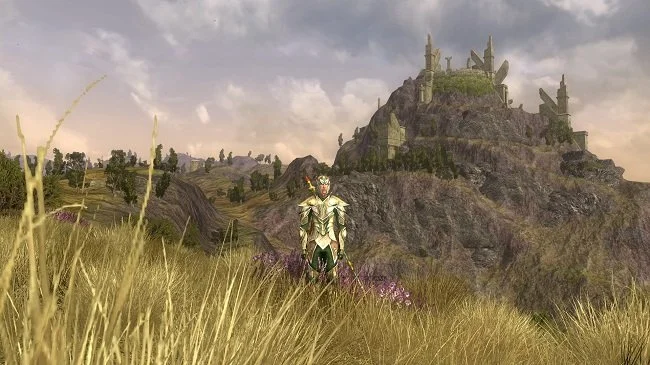
Although I very much enjoy the world that Turbine, now Standing Stone Games has created, I still find it a little saddening that there are some locations in Middle Earth that I cannot get a chance to visit and discover at present. For instance I would very much like to visit the Elf Towers to the West of The Shire. Whenever I am confronted with a barrier, be it a gate, a convenient range of mountains or cliff face, I always try to look beyond it. I am always curious to know how much landmass the developers actually created. I recently travelled to the South Farthing gate and by adjusting the camera perspective tried to see as much as what was beyond it. The view is very tantalising. In a true sandbox environment the road beyond would ultimately wind a path all the way down to Enedwaith.
As a gamer, I would like to see an MMO that allowed a player to choose a non-combat class and to simply be able to travel, explore, trade and move on again. It would be engaging to find quests and deeds specifically created around such characters, out in the wider world. Placing items or information in obscure locations could be an interesting game mechanic. Obviously, with a game such as LOTRO that now has an established methodology, the likelihood of adapting this may well be impossible , even if the developers were in favour of it. However, despite the restrictions that exist Standing Stone Games vision of Middle Earth still lends itself to a degree of exploration. New events can potentially open up the world. Narrative freedom beyond the end of text, offers even further opportunity. I think that in the years to come we may yet see many of these missing areas coming to life.


The Geography of LOTRO: Part 2 Bree and Bree-land
In the second part of our look at the geography of Middle Earth, we shall be focusing of the town of Bree. It has a pivotal role in the events of the book and subsequently play a similar part Standing Stone Games Lord of the Rings Online. Before we start, let us remind ourselves exactly what Tolkien writes when introducing Bree to the reader. The following quote is the opening paragraph of chapter nine; At the sign of the Prancing Pony from The Fellowship of the Ring.
In the second part of our look at the geography of Middle Earth (part 1 is here), we shall be focusing of the town of Bree. It has a pivotal role in the events of the book and subsequently play a similar part Standing Stone Games Lord of the Rings Online. Before we start, let us remind ourselves exactly what Tolkien writes when introducing Bree to the reader. The following quote is the opening paragraph of chapter nine; At the sign of the Prancing Pony from The Fellowship of the Ring.
"Bree was the chief village of the Bree-land, a small inhabited region, like an island in the empty lands round about. Besides Bree itself, there was Staddle on the other side of the hill, Combe in the deep valley a little further eastward and Archet on the edge of the Chetwood. Lying round Bree-hill and the villages was a small country of fields and tamed woodland only a few miles broad."
This is a very clear description and to the developers credit they have interpreted this rather literally in the game. Focusing first on the town of Bree itself, Turbine have constructed a settlement that broadly conforms to Tolkien’s details. As you enter through the West-gate and follow the path of "The East Road" you will see the Hobbit holes and small holdings on the slopes of the hill. The homes of men are mainly to the East. "The Prancing Pony" inn is located at the top of the road, abutting to Bree hill itself. The building consists of two wings, as in the source text, though only one is accessible.
Where the game differs is in scale. Bree in LOTRO has been expanded from a simple village to a more substantial centre of commerce. This adaptation allows them to encompass all the crafting and training halls, along with the vendors and sundry NPCs. The only embellishment I personally feel a little excessive, is the town hall itself. It seems a little too ambitious for such a small and insular community. A similar view could be taken on several of the fountains and statues that adorn the various squares. The 2012 revamp has certainly made Bree more populous. Again, perhaps to the detriment of the lore. However, the hedge and dike that surround Bree are very much in accordance with the books and seem authentic.
Moving immediately outside of Bree into Bree-Land itself, we find both Combe and Staddle in the right locations. These being the respective local enclaves of men and hobbits. As specific details are lacking , Turbines visualisations are perfectly acceptable and not in any way excessive. The village of Archet however, has been moved considerably further North. This is to accommodate the fact that the area is a race specific starter area in the game and has been isolated to suit the mechanics of the game. Such local features within the Archet area such as "Bronwe's Folly", "Sprigley's Farm" and "Blackwold Roost" are non-canonical. However none of these are in any way contrary to prevailing regional design.
The above map and the one immediately below have been created using the original books and the subsequent histories of Middle Earth as a guide. They both depict a more Spartan and less populous village of Bree and a far more expansive Chetwood that extends in to the North and NorthEast. The Midgewater marshes are such a distance away as to not even be included on both maps. As are both Andrath and the South Downs. These points highlight the fact that Bree was the last major settlement East of the Blue Mountains before entering the Lonelands. This was a region that was unsettled and thus to a degree barren.
Turbines original condensing of Middle Earth was and remains a necessary factor in creating a viable environment for collective gameplay. However, on occasions, although LOTRO excels at capturing the spirit of Tolkien’s world, there are inevitable trade-offs. The loss of scale particularly in this region is a little disappointing and for those who may not be familiar with the length of original journey, may be somewhat perplexing. For those who wish for more technically accurate cartography, I would recommend the following books. Journeys of Frodo by Barbara Strachey and The Atlas of Middle Earth by Karen Wynn Fonstad. Both depict the routes taken by the fellowship and contain exacting details relating to dates and even the phases of the moon and stars.
The Geography of LOTRO: Part 1 The Shire
One of the most engaging aspects of The Lord of the Rings is the expansive and detailed world that Tolkien has created. His love of maps combined with his detailed descriptions of the geography of Middle Earth, makes a credible and living environment. The Shire in particular is described in great depth, becoming a character in itself within the narrative. So, when Turbine developed LOTRO a decade ago, they were faced with an extremely difficult task of adapting this territory into a suitable MMO environment. However, the results have been well received and this region has remained a firm favourite with LOTRO players. So, I thought it would be interesting to look in more detail at selected areas of Middle Earth and explore the subtle differences between the game and the source text over a series of blog posts. So, let us start where the story begins, in The Shire.
One of the most engaging aspects of The Lord of the Rings is the expansive and detailed world that Tolkien has created. His love of maps combined with his detailed descriptions of the geography of Middle Earth, makes a credible and living environment. The Shire in particular is described in great depth, becoming a character in itself within the narrative. So, when Turbine developed LOTRO a decade ago, they were faced with an extremely difficult task of adapting this territory into a suitable MMO environment. However, the results have been well received and this region has remained a firm favourite with LOTRO players. So, I thought it would be interesting to look in more detail at selected areas of Middle Earth and explore the subtle differences between the game and the source text over a series of blog posts. So, let us start where the story begins, in The Shire.
One of the most important factors to consider with regard to an MMO map, is size. No matter how much of a Tolkien purist you are, I do not think that any game player would be happy with an exact scale realization of Middle Earth. It would mean taking days to travel anywhere, which far from practical for an MMO. Remember that it took Frodo, Sam and Pippin two and a half days to get from Hobbiton to Crickhollow on foot. So Turbine have reduced the scale in a measured and reasonable way. They have also morphed the in-game map to give locations a more even spread . This is quite noticeable in "The Shire". Green Hill Country has been drastically reduced in size and several northern settlements such as Oatbarton and Dwalling removed from the map and relocated to the next in-game area. It should also be noted that at present, the entire "South Farthing" is absent from the game. In light of Standing Stone Games recent acquisition of the game, perhaps this area will appear later in a future expansion.
Despite these adaptations, Turbine have still managed to recreate the spirit of The Shire. They have maintained the rustic feel with the farmlands, orchards and such embellishments as waterwheels and windmills. It is easy to balk at the encompassing mountains ranges that effectively fence in each gaming area but one is hard pressed to come up with a suitable alternative. As a gamer, I have never been a big fan of invisible barriers as they are jarring and can break immersion for some. The Shire is also filled with a wealth of features taken directly from the book, varying from the well-known to the subtle. Various taverns and farms can be found which most readers will be familiar with, as well as more esoteric landmarks such as Three Farthing Stone.
When you contrast the in-game map with one from the books, you discover much that is missing from LOTRO. As mentioned earlier, some may well feature in future expansions. Currently in LOTRO, The Shire has a gate not far from the homestead entrance, that separates the "South Farthing". Beyond this should lie such settlements as Hardbottle, Sackville and Longbottom. The latter being the main area for the cultivation of pipe-weed in The Shire. Another thing to consider is the substantial reduction in size of Green Hill Country. Although I can see the necessity to do so, it does mitigate a plot point. Unspoilt areas of forest such as the Woody End, were rare in this region of Middle-earth. This was a main reason that the High Elves still visited The Shire and is therefore of significance in terms of the story. It should also be noted that much of the infrastructure of the area (roads and bridges) were originally established by the Dunedain. The region was initially was a part of Arthedain, and as such a part of Arnor. It was at one time part of the farm land for that kingdom.
The Shire remains one of the most popular areas in LOTRO. Turbine managed to create a depiction of Tolkien's work, that despite practical compromises, has not been trivialised or suffered from "Disneyfication". It captures the essence of the source text, which in itself is based on pre-industrial West Midlands of England and offers a very striking visual interpretation. As one of the first areas made for the MMO, The Shire has a level of attention to detail that has been missing from some of the more recent zones. Perhaps that is why it resonates so well with the community. You’ll find region bustling with players throughout the year.
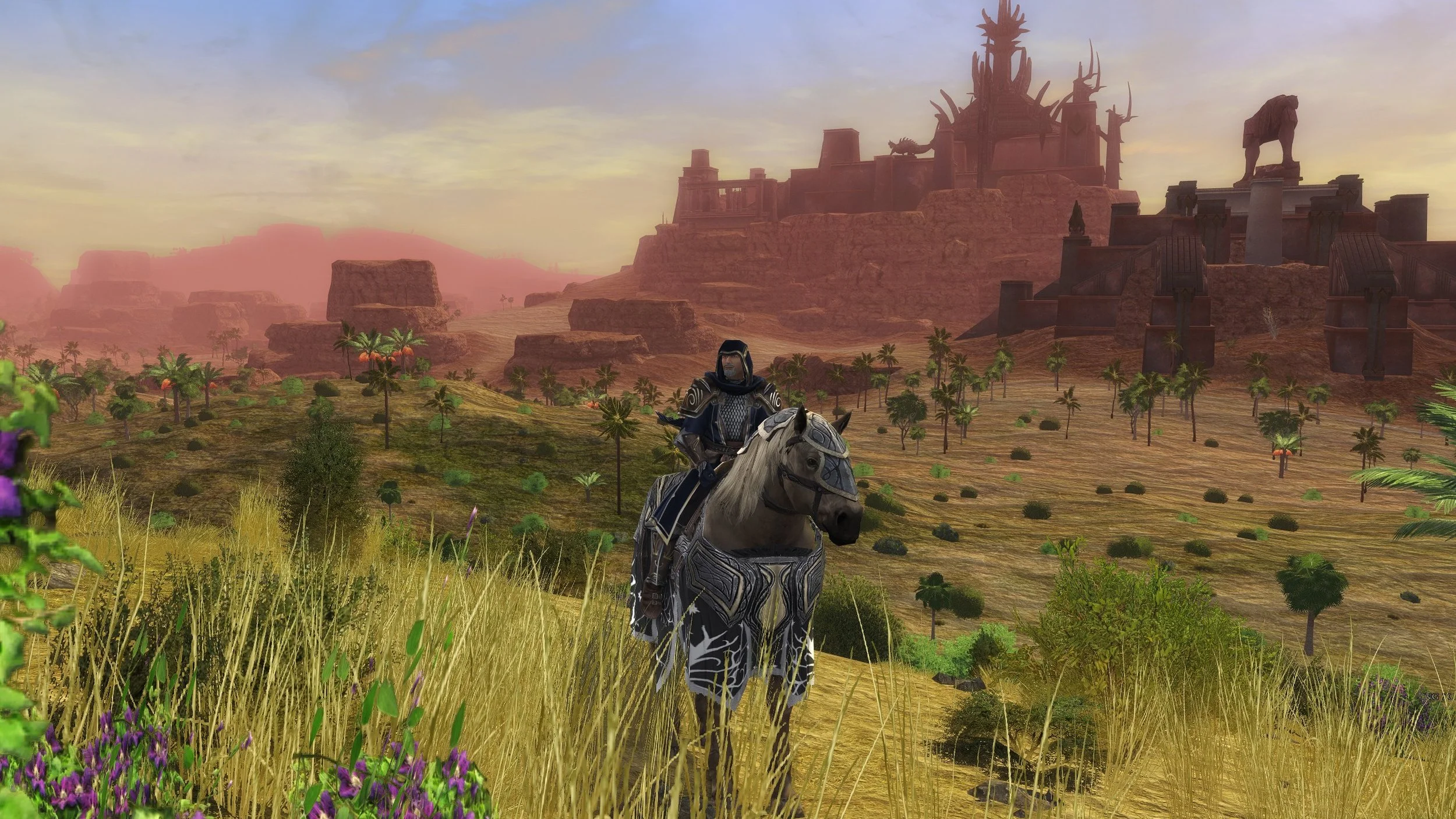
The next expansion for the MMORG, The Lord of the Rings Online, was announced on the 1st August, via the gaming website MMORPG.The Wolves of Mordor, which will launch later in the year, appears ambitious in scope as it will include two new game systems as well as the obligatory story update. This expansion takes place in Draugardh located in the North East of Mordor, beyond the Plateau of Gorgoroth. It includes the new zones of Heledhris, Parth Rhavas and Nan Ogol. These vary environmentally ranging from the arid, volcanic and semi-tropical. Players will encounter the Daugrim in these regions, Werewolves but not in the modern sense. This is not the lycanthropy of Eastern European legends but in the established Tolkien idiom of fell spirits inhabiting the bodies of Wolves. The region also sees the return of the Woses and players can expect to encounter Elves and scouts from Gondor. As ever with LOTRO expansions, there will be new instances as well as a raid.