Classic Movie Themes: Theatre of Blood
Theatre of Blood is a rather unique horror movie about crazed egotistical thespian named Edward Lionheart. Played by the great Vincent Price, this Shakespeare-obsessed actor commits suicide rather publicly, after being allegedly "cheated" out of an award. However when a spate of murders targeting theatre critics occurs, with each victim dispatched in an homage to the Bard, Scotland Yard begins to suspect the actor may have faked his death. This hilariously baroque revenge picture directed by Douglas Hickox, benefits from a great cast of some of Britain's finest character actors. The film also serves as a wonderful window in to the mid-seventies Britain.
Theatre of Blood is a rather unique horror movie about crazed egotistical thespian named Edward Lionheart. Played by the great Vincent Price, this Shakespeare-obsessed actor commits suicide rather publicly, after being allegedly "cheated" out of an award. However when a spate of murders targeting theatre critics occurs, with each victim dispatched in an homage to the Bard, Scotland Yard begins to suspect the actor may have faked his death. This hilariously baroque revenge picture directed by Douglas Hickox, benefits from a great cast of some of Britain's finest character actors. The film also serves as a wonderful window in to the mid-seventies Britain.
The proceeding are greatly enhanced by a fantastic score by Welsh composer Michael J. Lewis. For the Theatre of Blood soundtrack, composer Lewis crafts a sumptuous orchestral score, the main title theme being the most succinct example. From its gentle beginnings it grows in power reflecting the tumultuous disposition of the actor Edward Lionheart. Yet it maintains a melancholic quality that is very apt to the movie. Overall it's a fine example of the composers craft. It is also one of Vincent Price's better movies from this era.




Classic Movie Themes: The Black Hole
The Black Hole was a major gamble for Disney back in 1979 as they tried to capitalise of the post Star Wars sci-fi boom. Although audiences are still split over the strange mix of anthropomorphic robots, armchair philosophising and the one of the most metaphysical endings ever filmed, John Barry's score is universally praised. It features all his hallmark musical signatures and greatly embellishes the on-screen action with its stately and portentous style. There is also a substantial amount of music, with over an hour of cues for the ninety eight minute running time. This was the second space themed score that Barry wrote that year, the first being Moonraker, the eleventh Bond film.
The Black Hole was a major gamble for Disney back in 1979 as they tried to capitalise of the post Star Wars sci-fi boom. Although audiences are still split over the strange mix of anthropomorphic robots, armchair philosophising and the one of the most metaphysical endings ever filmed, John Barry's score is universally praised. It features all his hallmark musical signatures and greatly embellishes the on-screen action with its stately and portentous style. There is also a substantial amount of music, with over an hour of cues for the ninety eight minute running time. This was the second space themed score that Barry wrote that year, the first being Moonraker, the eleventh Bond film.
The "main title" theme for The Black Hole is in some ways one of the most compelling and grand themes crafted by veteran composer John Barry. It has an ominous majesty to it with its off-kilter waltz. It’s a skillful blending of orchestra with synthesisers which was quite an innovative style at the time. It has an altogether eerie ambience that neatly sets the tone for the movie, which was quite a bold experimental piece of studio cinema. Barry did not make the mistake of simply trying to replicate the grandeur of John Williams Star Wars theme but instead constructs something far more Gothic.
“Durant is Dead,” is a major shift in musical cue and it clearly signals the start of the movies climatic third act. Its pounding brass and substantial rhythm is unmistakably Barry. Once again the piece has a sinister overtone, forcing the audience to contemplate the fact that the heroes may not be able to avert disaster and events may not end well. It is important to remember that this was a Disney production so the target audience more than likely came to the theatre with clear preconceptions regarding style and tone. Barry's skill as a composer contributed to standing those notions on their head.
Classic Movie Themes: The 7th Voyage of Sinbad
The 7th Voyage of Sinbad (1958) directed by Nathan Juran, was the first of three Sinbad feature films produced by Columbia Pictures. The other two being The Golden Voyage of Sinbad (1974) and Sinbad and the Eye of the Tiger (1977). All three Sinbad films were a showcase for Ray Harryhausen’s stop motion animation special effects works, which was marketed as “Dynamation”. The 7th Voyage of Sinbad was the first of Harryhausen’s work to be filmed in colour. The somewhat arbitrary story has Captain Sinbad (Kerwin Mathews) returning to the island of Colossa to find a way to release Princess Parisa (Kathryn Grant) from a magic spell that has caused her to shrink. As ever with such movies, there is much chewing of the scenery and overwrought dialogue. However, the two elements of the film that excel are the excellent monsters and a superb score composed by Bernard Herrmann.
The 7th Voyage of Sinbad (1958) directed by Nathan Juran, was the first of three Sinbad feature films produced by Columbia Pictures. The other two being The Golden Voyage of Sinbad (1974) and Sinbad and the Eye of the Tiger (1977). All three Sinbad films were a showcase for Ray Harryhausen’s stop motion animation special effects works, which was marketed as “Dynamation”. The 7th Voyage of Sinbad was the first of Harryhausen’s work to be filmed in colour. The somewhat arbitrary story has Captain Sinbad (Kerwin Mathews) returning to the island of Colossa to find a way to release Princess Parisa (Kathryn Grant) from a magic spell that has caused her to shrink. As ever with such movies, there is much chewing of the scenery and overwrought dialogue. However, the two elements of the film that excel are the excellent monsters and a superb score composed by Bernard Herrmann.
The main opening theme (Overture as it’s titled on the soundtrack album) for The 7th Voyage of Sinbad is a bold and exciting fanfare. It’s features that dramatic mixture of brass and strings that only Herrmann could do. The fanfare has hints of Herrmann’s future work with its alternating sections of bombastic horns and soft, lyrical strings (think North by Northwest and even Psycho). Overall it is an extremely strong opening gambit and certainly builds expectations for the epic tale that follows. The second part of the cue The Fog is both ominous and mysterious. Once again it showcases Bernard Herrmann’s ability to exactly capture the mood and tone of a scene.
Over the years there have been several notable re-recordings of the soundtrack for The 7th Voyage of Sinbad, yet few have managed to fully capture the spirit of the cues used on the film itself. However, the original session tapes were recently rediscovered and remastered and are now available on CD. These recordings were made directly from the sheet music written by Herrmann himself, and arranged and conducted by Muir Mathieson. Here is the opening Overture followed by The Fog.
Classic Movie Themes: Krull
After the success of his nautically themed score for Star Trek II: The Wrath of Khan, composer James Horner was very much in demand. Columbia pictures subsequently hired him over the likes of John Williams and Jerry Goldsmith to compose the soundtrack for Krull (1983). The movie was to be the studios flagship fantasy title and their most expensive production to date, costing $50 million. Unfortunately, the curious mixture of science fiction and fantasy failed to find an audience and was a box office failure. The film most certainly does have flaws. The screenplay was constantly re-written and the lead actor, Ken Marshall is somewhat underwhelming. Yet the production and costume design are outstanding and the movie is beautifully shot.
After the success of his nautically themed score for Star Trek II: The Wrath of Khan, composer James Horner was very much in demand. Columbia pictures subsequently hired him over the likes of John Williams and Jerry Goldsmith to compose the soundtrack for Krull (1983). The movie was to be the studios flagship fantasy title and their most expensive production to date, costing $50 million. Unfortunately, the curious mixture of science fiction and fantasy failed to find an audience and was a box office failure. The film most certainly does have flaws. The screenplay was constantly re-written and the lead actor, Ken Marshall is somewhat underwhelming. Yet the production and costume design are outstanding and the movie is beautifully shot.
The film score composed by James Horner and performed by The London Symphony Orchestra and the Ambrosian Singers, is vibrant and rousing. It's swashbuckling approach is very reminiscent of the works of Erich Wolfgang Korngold. It features vibrant fanfares, a sumptuous love theme and an avant-garde use of string instruments to represent some of the more fantastical elements of the story. Krull represents some of the composers finest work from his early years with its rich and exuberant motifs. It is certainly one of the movies greatest assets and again shows the importance a films soundtrack in underpinning and reflecting the on-screen narrative.
Classic Movie Themes: Conan the Barbarian
A well written film soundtrack does more than simply embellish the on-screen imagery. It permeates the very fabric of the film and becomes character itself, adding emotional content and driving forward the narrative. However, there is a fine line between enhancing the pace and atmosphere of a film and simply "telegraphing" imminent events in a melodramatic fashion. The score for Conan The Barbarian by the late Basil Poledouris is a rare example of the former and in itself totally sublime. Using the traditional style of the "leitmotif", a ninety-piece orchestra and twenty four voice choir, Poledouris creates "a continuous musical drama" that has now entered the pantheon of classic modern film scores.
A well written film soundtrack does more than simply embellish the on-screen imagery. It permeates the very fabric of the film and becomes character itself, adding emotional content and driving forward the narrative. However, there is a fine line between enhancing the pace and atmosphere of a film and simply "telegraphing" imminent events in a melodramatic fashion. The score for Conan The Barbarian by the late Basil Poledouris is a rare example of the former and in itself totally sublime. Using the traditional style of the "leitmotif", a ninety-piece orchestra and twenty four voice choir, Poledouris creates "a continuous musical drama" that has now entered the pantheon of classic modern film scores.
The opening credits of 1982 movie directed by John Milius, (infinitely superior to the 2011 reboot) depicts Conan's Father forging a sword and establishes the central plot device regarding the "Riddle of Steel." The sequence is beautifully complemented by Basil Poledouris's intense and bombastic title theme, the "Anvil of Crom". It is a powerful piece played by twenty French horns, strings and timpani and sets the tone eloquently for the remainder of the film. According to Poledouris, Milius envisioned Conan as an opera with very little or no dialogue. The movie therefore has musical accompaniment for most of its two hour plus running time.
Classic Game Themes: Star Trek Online
MMORPG genre frequently benefits from a robust and charismatic score. It helps greatly in establishing specific races, classes and regions within the game, giving them a unique identity and characteristics. Music can be used to provide the player with audio cues about the environment and the quests they are undertaking. The use of a leitmotif can be invaluable in establishing a games tone as the story progresses. Therefore many games in this genre have sumptuous scores by established composers. As so many are set within a traditional fantasy setting, many soundtracks seem to follow a particular pattern. Star Trek Online however is one of a handful of science fiction based MMOs and as a result its soundtrack is subtly different.
MMORPG genre frequently benefits from a robust and charismatic score. It helps greatly in establishing specific races, classes and regions within the game, giving them a unique identity and characteristics. Music can be used to provide the player with audio cues about the environment and the quests they are undertaking. The use of a leitmotif can be invaluable in establishing a games tone as the story progresses. Therefore many games in this genre have sumptuous scores by established composers. As so many are set within a traditional fantasy setting, many soundtracks seem to follow a particular pattern. Star Trek Online however is one of a handful of science fiction based MMOs and as a result its soundtrack is subtly different.
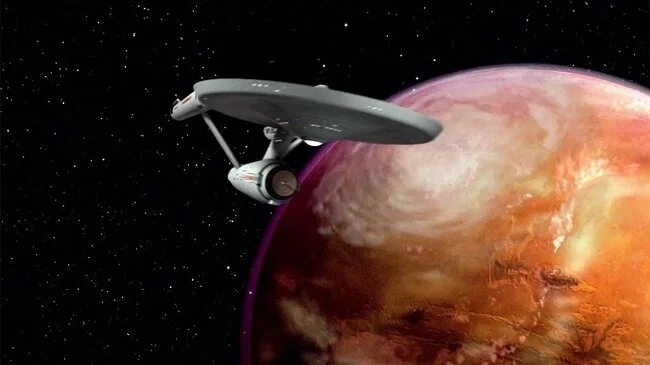
Many fans have had their musical association with Star Trek shaped by such composers as Sol Kaplan, Alexander Courage, Dennis McCarthy and Jay Chattaway, who contributed to the scores of the various TV shows. However it is the movie spinoffs and their iconic themes from the likes of James Horner and Jerry Goldsmith that perhaps have made the most lasting impressions. Naturally when Star Trek Online launched in 2010, players were expecting something inherently in the idiom of the established franchise and suitable epic considering the scope of the game. Thankfully composer Kevin Manthei musically literate score managed to address expectations and remains a very engaging and varied game soundtrack.
Kevin has a strong background in composing for games as well as television. He also studied at the University of Southern California under Jerry Goldsmith, which possibly gives him a further insight into the existing sound of Star Trek. Certainly a lot of his work for STO still retains an inherently nautical theme which both Goldsmith and Horner explored with their movie soundtracks. There is also a healthy dose of tribal percussion to cues associated with the Klingons. But it is in space and through the ambient music that plays whilst exploring that really seems to evoke the heart of Star Trek. Through a diverse selection of themes, the player really gets a sense of the enormity of respective quadrants and the thrill of boldly going where no one has gone before.
Classic Game Themes: Hidden & Dangerous 2
Hidden & Dangerous 2 is one of the most enjoyable, yet frustrating games I have encountered. There are some moments of brilliance to be had whilst playing it but sadly bugs and some questionable AI always seems to trip the proceedings up. Released late 2003 when World War II games were still very much in vogue, this third person squad based shooter still has many outstanding features to this day. One of which is the terrific score by Michal Szlavik and Martin Benes, performed by the Brno Philharmonic Orchestra from the Czech Republic.
Hidden & Dangerous 2 is one of the most enjoyable, yet frustrating games I have encountered. There are some moments of brilliance to be had whilst playing it but sadly bugs and some questionable AI always seems to trip the proceedings up. Released late 2003 when World War II games were still very much in vogue, this third person squad based shooter still has many outstanding features to this day. One of which is the terrific score by Michal Szlavik and Martin Benes, performed by the Brno Philharmonic Orchestra from the Czech Republic.
What makes the soundtrack so memorable is its musical idiom, which seems to reflect the styles and nuances we associate with classic war movies. The more than a hint of Ron Goodwin, Roy Budd and Elmer Bernstein permeating the score and it feels very appropriate. I have chosen two cues which I feel encapsulate composers best work from the game. The first plays out at the end of the North African campaign, as your team escapes from a remote airport with German fighters in hot pursuit. It really does have an authentic aerial feel to it, putting one in mind of cues from The Battle of Britain movie.
Please note that the short running time is due to the track being intended to be looped during the game to reflect the fluid nature of the action.
The second is the rousing cue that plays after the successful completion of a mission. It has a very uplifting and positive tone and again reflects the overall quality of the score, which is played with a full orchestra. Many games at the time and even now elect for a score using contemporary synthesizer and sequencers.
Classic Game Themes: Arcania - Gothic 4
Dynamedion are an award winning company and team of composers based in Germany. They specialize in soundtracks and game compositions, usually in the orchestral form. Over the years they have produced both musical scores and ambient sound designs for such titles as Ryse: Son of Rome, The Elder Scrolls Online and the Gothic series. Tilman Sillescu is both the co-founder of Dynamedion, as well as a prodigious composer in his own right. He previously taught at Mainz University. As Lead Composer and Creative Director at Dynamedion GbR, he has scored many exciting video game projects as well as writing and producing music for movie trailers, television and libraries.
Dynamedion are an award winning company and team of composers based in Germany. They specialize in soundtracks and game compositions, usually in the orchestral form. Over the years they have produced both musical scores and ambient sound designs for such titles as Ryse: Son of Rome, The Elder Scrolls Online and the Gothic series. Tilman Sillescu is both the co-founder of Dynamedion, as well as a prodigious composer in his own right. He previously taught at Mainz University. As Lead Composer and Creative Director at Dynamedion GbR, he has scored many exciting video game projects as well as writing and producing music for movie trailers, television and libraries.
The score for Arcania: Gothic 4 contains both ambient and thematic tracks which enrich the gameplay and overall atmosphere. The cue I have chosen plays over the games end credits and is listed on the games soundtrack CD as "credits song". It is an initially sombre piece that grows in power ending in a triumphant crescendo of brass. The vocalisation adds a semi-religious quality to the track and overall feels somewhat like a requiem. This particular music cue was written by Tilman Sillescu himself and is indicative of the level of quality that Dynamedion produce.
Classic Game Themes: Pirates of the Flying Fortress
Over the past few years I have been regularly writing about Classic Movie Themes and posting specific music cues that I particularly enjoy. Often the term “classic” is not necessarily applicable and it may be more appropriate to simply label them personal favourites. However “classic” is a better fit for headlines and search engines, so I shall continue to use that title. I’ve subsequently decided to post music from the games soundtracks that I feel are of note. The gaming industry has a multitude of talented composers and musicians who enhance games and bring virtual worlds to life with their ambient music and scores.
Over the past few years I have been regularly writing about Classic Movie Themes and posting specific music cues that I particularly enjoy. Often the term “classic” is not necessarily applicable and it may be more appropriate to simply label them personal favourites. However “classic” is a better fit for headlines and search engines, so I shall continue to use that title. I’ve subsequently decided to post music from the games soundtracks that I feel are of note. The gaming industry has a multitude of talented composers and musicians who enhance games and bring virtual worlds to life with their ambient music and scores.
Pirates of the Flying Fortress is a curious expansion pack, in so far that it’s actually an improvement on the original game, Two Worlds II. The game includes a simple sailing mechanic that adds an extremely enjoyable dimension to the proceedings. Furthermore it is accompanied by a appropriately nautical theme by Borislav “Glorian” Slavov and Victor Stoyanov, which adds an ambient seafaring undercurrent while navigating between islands and archipelagos featured in the game. The scores for both main game and expansion are strong and subtly different from traditional game soundtracks, favouring ambient pieces instead of reoccurring leitmotifs.
Pirates of the Flying Fortress is clever example of understated, low-key game composing. The music seamlessly fits with the narrative and provides an aural enhancement, rather than directly reflecting ongoing events with specific themes. There is an emphasis upon ambient ethnic or folk related tracks which add greatly to the atmosphere. There is also a broad range of instrumentation used to craft the soundcape. It’s a robust soundtrack in the context of the game. However some cues such as “Sails and Journeys” do have a pleasing quality to them that works outside of the game.
Cult Movie Soundtracks
There is a common consensus that a cult movie doesn’t necessarily have to be a good one. Badly written scripts, low budgets and curious casting are just some of the things that can contribute to making a film a cult classic. Many movies of this idiom have showcased talent that subsequently went on to better things. Sometimes films that are hailed as complete turkeys or financial disasters upon release are retrospectively deemed of merit. Often it is films soundtrack that can be its one saving grace. Take for example Ennio Morricone’s prodigious body of work. He is considered by many to be one of the finest (if not the finest) film composer alive. Yet some of his best work has been for incredibly poor, flawed or indifferent films. Consider Hundra, Treasure of the Four Crowns or Orca for example.
There is a common consensus that a cult movie doesn’t necessarily have to be a good one. Badly written scripts, low budgets and curious casting are just some of the things that can contribute to making a film a cult classic. Many movies of this idiom have showcased talent that subsequently went on to better things. Sometimes films that are hailed as complete turkeys or financial disasters upon release are retrospectively deemed of merit. Often it is films soundtrack that can be its one saving grace. Take for example Ennio Morricone’s prodigious body of work. He is considered by many to be one of the finest (if not the finest) film composer alive. Yet some of his best work has been for incredibly poor, flawed or indifferent films. Consider Hundra, Treasure of the Four Crowns or Orca for example.
With this idea in mind I've collated five films that are for various reasons are labelled “cult” and have suffered the “slings and arrows of outrageous fortune” over the years. All have scores of interest and note, though for different reasons. I have chosen a track from each soundtrack which I think highlights the musical excellence and integrity of the composers involved. The genres are varied as are the musical styles and nuances of each piece. All clearly demonstrate how a well-conceived score can embellish and enhance a movie, effectively becoming a character in its own right.
Much has been written about Sir Lew Grade’s 1980 adaptation of the popular Clive Cussler’s novel, Raise the Titanic and precious little is complimentary. Yet despite the films faults which mainly came from multiple script re-writes, the soundtrack by the late John Barry is an outstanding piece of work. It captures the mood of the film perfectly, especially during the underwater sequences. Often it is played against extensive miniature work with little human interaction, yet it vividly enhances these sequences and conveys sense of urgency and risk associated with undersea exploration. I have chosen the cue when the submersible Deep Quest finally locates the wreck of the Titanic. The music changes from the sombre themes of the search to one of elation. This is vintage John Barry at his best.
The Beastmaster is the embodiment of a cult movie. A low budget, independent production from the early eighties designed to cash-in on the sword and sorcery boom of the time, it features a quality score by Lee Holdridge. Holdridge is primarily known for his work on television on such shows as Moonlighting and Beauty and the Beast. His forays into the world of cinema are less frequent but often of note. The Beastmaster is the story of Dar, who by a quirk of his birth has gained the power to communicate with beasts. The fact that his Black Panther sidekick is in fact a Tiger that’s been dyed is neither here nor there. The main theme for the movie is rousing and of a standard seldom seen in movies of this genre.
I make no bones about the fact that I utterly love this car crash of a movie. Lifeforce is a text book example of a movie that endured a tumultuous production and a last minute re-edit. There are vast differences between the US release of the film and the international version. The Shorter American print features a re-scored soundtrack by Michael Kamen, a very popular composer at the time. The lengthier, more coherent and marginally better European cut included the full original soundtrack by none other than the great Henry Mancini. It's not a name that you immediately associate with the Sci-Fi genre. However Mancini manages to bring gravitas to the proceedings with several finely polished cues that nearly make you forget the preposterous nature of the film. The main theme is a sweeping orchestral piece that really should belong to a better film.
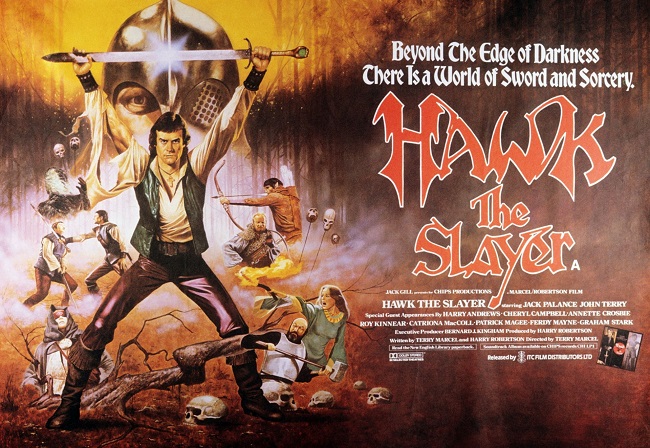
Any film that features a repeating crossbow, death by silly string and Bernard Bresslaw cannot be all bad. Hawk the Slayer is a wonderful piece of low budget, sword and sorcery hokum. It is also very British. Producer Harry Robertson also wrote the film score and it is the embodiment of early eighties UK synth-pop. Drawing upon such diverse influences as Jeff Wayne’s musical version of War of the Worlds and the work of Ennio Morricone (specifically Westerns) it’s kitsch yet an engaging score. It utterly suits the idiom of the film and is immense fun although possibly for all the wrong reasons. The cue below is re-iterated through the early stages of the film as Hawk gathers his band of warriors.
Finally Battle Beyond the Stars was one of James Horner’s earliest scores. Considering the low budget of the film, it was extremely ambitious for the producers to pursue a full orchestral soundtrack arrangement. Many others would have opted for an electronic score. Yet Horner’s iconic main theme is incredibly accomplished and imbues the film with a quality and ambience beyond its humbled origins. It was this score that caught the notice of Paramount studios and subsequently led to James Horner composing the soundtrack for Star Trek II: The wrath of Khan. The title theme of Battle Beyond the Stars contains all the hallmarks of Horner’s style. Its use of brass and rhythmic cadence are instantly captivating and convey the spirit of the narrative.