
Indiana Jones and the Kingdom of the Crystal Skull (2008)
For many fans and enthusiasts, there are the original trilogy of Indiana Jones movies, all made in the eighties when director Steven Spielberg was reaching the height of his film making creativity. And then you have Indiana Jones and the Kingdom of the Crystal Skull; the poorly regarded, Johnny-come-lately fourth instalment made nearly twenty years later, that jumped the shark, or in this instance “nuked the fridge” and for some viewers, pretty much pissed on the memory of its three predecessors. Make no mistake, over a decade on from the films theatrical release there is still a lot of ill will held towards the fourth Indiana Jones adventure. Let us not forget that South Park based an entire episode around the contempt they have for the movie. Yet despite all this hostility, it should be noted that Indiana Jones and the Kingdom of the Crystal Skull was the most commercially successful entry in the franchise, grossing $786,636,033 worldwide. It was the second most successful movie in 2008 (the first being Christopher Nolan’s The Dark Knight) and although not universally well received by fans, it did broadly garner critical success. However, within that spectrum of reviews there were some strong negative opinions. All things considered Indiana Jones and the Kingdom of the Crystal Skull is somewhat of an enigma, in so far as being financially successful but a movie that most people don’t admit to liking.
For many fans and enthusiasts, there are the original trilogy of Indiana Jones movies, all made in the eighties when director Steven Spielberg was reaching the height of his film making creativity. And then you have Indiana Jones and the Kingdom of the Crystal Skull; the poorly regarded, Johnny-come-lately fourth instalment made nearly twenty years later, that jumped the shark, or in this instance “nuked the fridge” and for some viewers, pretty much pissed on the memory of its three predecessors. Make no mistake, over a decade on from the films theatrical release there is still a lot of ill will held towards the fourth Indiana Jones adventure. Let us not forget that South Park based an entire episode around the contempt they have for the movie. Yet despite all this hostility, it should be noted that Indiana Jones and the Kingdom of the Crystal Skull was the most commercially successful entry in the franchise, grossing $786,636,033 worldwide. It was the second most successful movie in 2008 (the first being Christopher Nolan’s The Dark Knight) and although not universally well received by fans, it did broadly garner critical success. However, within that spectrum of reviews there were some strong negative opinions. All things considered Indiana Jones and the Kingdom of the Crystal Skull is somewhat of an enigma, in so far as being financially successful but a movie that most people don’t admit to liking.
So, what exactly is the proverbial beef with Indiana Jones and the Kingdom of the Crystal Skull. Let’s take a few moments to go over possible areas of contention. Plot wise the story is nothing special but then again, it’s hardly anything controversial. Indie seeks Akator, the mythical kingdom in the Amazon that may hold both great power and wealth. It’s the same basic sort of MacGuffin used in the previous instalments. The story actually does a good job updating the format from the thirties to the fifties. The nuggets of information we get about what Indy's been up to in the last 20 years are rather intriguing. Working for O.S.S. and becoming a decorated war hero for example, are touched upon but never over egged. We also learn the fate of both Marcus Brody (Denholm Elliott) and Henry Jones Senior (Sean Connery), both of whom have died. This is both credible and to a degree necessary because having too many cameos from prior characters can sometimes be as both a boon and a bane. The Soviet Union and Communists replacing Nazis is also a sound move and the way Indy falls foul of McCarthyism and loses his position at the university is a novel idea. It all adds to keeping the same vibe going yet playing it against a subtly different back drop. I even like the anecdote about Roswell, as it raised a wry smile. Overall, despite a superficial change from the supernatural to science fiction, Indy 4 is pretty much a case of same meat, different gravy, when it comes to the narrative.
As for casting, action scenes, pacing and general continuity, as well as visual aesthetics, Indiana Jones and the Kingdom of the Crystal Skull does remarkably well. Harrison Ford and Karen Allen genuinely recreate the chemistry that was present in the original movie. The fist fights and associated stunt work are still very good, leaning towards the gritty. This has always been a violent franchise, despite being sold a family entertainment. Editing is also invaluable cinematic tool for creating a sense of style and maintaining a sense of continuous ambience. Veteran editor Michael Kahn, who has worked on all Spielberg’s movies since 1979, does much to make the movie feel just like the others. Also, although Douglas Slocombe, the cinematographer of the original trilogy had long retired by 2008, Janusz Kamiński, who has shot all of the director's films since Schindler's List, made a conscious effort to recreate the previous visual style. Plus let us not overlook the immense contribution that composer John Williams has made to world of Indiana Jones. His score for the fourth movie is every bit the equal of the first three.
So, if it’s not an overt and specific facet of the production that is the problem, is it a case of something subtler being to blame? I believe the answer is yes. Hollywood is an industry that regularly resurrects franchises. If in doubt, revisit a tried and tested formula. Public good will and nostalgia will often guarantee decent box office returns. Sometimes this works as with Christopher Nolan's Batman Begins and Bryan Singer's Superman Returns. Others fails. Take I Spy, Starsky & Hutch, The Dukes of Hazard, and some may argue the latter three Star Wars prequels. It often comes down to a trade-off between pleasing existing fans and trying to capture a new market who may not be familiar with the original material. It sounds perfectly reasonable to make such a choice but endeavouring to reconcile these two aspirations is far harder to achieve than you think. Both markets have very different needs at times and certainly there are distinct variations in taste across generations.
Despite the familiar faces, music, production team and many other common elements to previous entries, Indiana Jones and the Kingdom of the Crystal Skull suffers from a weak screenplay. Although the story is straight forward, the various scenes don’t quite hang well together. New characters are introduced but none have enough back story. The fact that these roles are carried by quality actors helps, but they are not used to the best of their potential. You don’t have to write large swathes of dialogue to flesh out a fictional character. You just needs to write something intriguing, that makes you think. A detail that makes that individual seem less contrived and more like a real person. It can be an affectation, quirk or foible. Or they can reference a tragedy that shaped their character or show an interest in something you wouldn’t immediately assume. It’s a difficult thing to quantify, but you know it when you see it. Hans Gruber from Die Hard is a great bad guy for example. Because the screenplay in Indy 4 is inconsistent, the movie suffers from a tonal shift on several occasions. I actually liked the way Spielberg handles the relationship between Shia LaBeouf and Harrison Ford. The banter between the two, focusing very much on the age gap feels right. By contrast the female characters do not fare so well. Karen Allen is not given enough to do, which is an utter shame as her character has so much potential. Kate Blanchett is also rather imposing as the Russian villain. Equipped with borderline psychic powers and a penchant for fencing, you'd think she'd be a standout feature of the film. Alas, again there is not enough material to flesh out the role.
But perhaps the biggest Achilles heel of Indiana Jones and the Kingdom of the Crystal Skull is the action set pieces. This is ironic as next to the Bond franchise, Indiana Jones did much to refine and advance this aspect of film making. Yet it is this element of the movie that inadvertently hobbles it instead of embellishing it. Take a moment to reflect upon Raiders of the Lost Ark. The iconic scene at the beginning where Indy flees the collapsing temple pursued by the giant stone ball booby trap. The truck chase in which stuntman Terry Leonard created a modern variation of Yakima Canutt’s iconic set piece form Stagecoach. And of course, the fistfight with Pat Roach under the German flying wing. What made these scenes so great is that they were all done physically with very little or no post production effects. What optical effects there were, remained measured in scope. In many ways the technical limitations forced a degree of credibility on the proceedings. Of course, all movies require audiences to suspend their sense of disbelief, and more so with genre movies. Yet being grounded in these ways mean that the first film stays the right side of the “relative credibility line” and keeps the audience on board. Sadly, in each subsequent movie, the franchise subsequently broke this rule by greater degrees. Bailing out of a plane using an inflatable raft as parachute was a big ask in Indiana Jones and the Temple of Doom. A rear facing turret on a plane that does not have interrupter gear, thus enabling the machine gun to shoot its own rudder in Indiana Jones and the Last Crusade, again is a step too far. These examples are the tipping point where high adventure becomes a caricature of itself.
Indiana Jones and the Kingdom of the Crystal Skull made nearly two decades later from the original trilogy had all the “benefits” of computer-generated imagery and contemporary FX technology. Such limitless possibilities thus removed any remaining vestiges of credibility and the action scenes failed to wow because they were simply impossible and obviously “not real”. I have no problem with the nuclear test scene, but I dislike its resolution. It is just far too silly and instantly breaks a degree of immersion for the enthusiastic viewer. The much-protracted chase through the jungle between jeeps, trucks and amphibious vehicles is ruined by the digital sequences that depict acts so ludicrously implausible they’d be better off in a cartoon. If this scene had been scaled back, lost the Tarzan wine swinging references and had just confined itself to what could be done in camera, then it would have been vastly improved. And as for the alien revelation at the denouement, again it focuses too much on digital spectacle. Even the traditional fist fight with the signature heavy (Igor Jijikine) is spoilt by an excessively FX driven pay off.
Sadly, the aliens plot element and its impersonal CGI actions scenes all bear the clumsy handiwork of George Lucas. It was he who allegedly vetoed scripts from several respected writers, including Frank Darabont and was insistent on pursuing his penchant for spectacle over narrative. At its root the fundamental problem with Indiana Jones and the Kingdom of the Crystal Skull, is that Messrs Spielberg and Lucas were trying to recreate a franchise movie that hailed from an era when not only techniques and film making philosophy were fundamentally different, but so were both men. Trying to revisit your own past is inherently difficult so perhaps this instalment may have faired better if both individuals had deferred to other film makers to helm the project. Modern action blockbusters are a very different beast to those from the eighties and I can’t help feeling the modern corporate film making is too formulaic for the likes of franchise born of a more experimental and flexible era in movie making. Does Indiana Jones and the Kingdom of the Crystal Skull deserve the animosity it still receives from the viewing public. Perhaps not. There are many good aspects to the film. But it is definitely a compromise and like most compromises it doesn’t meet all parties’ expectations. Furthermore, in the last ten years or so the general public seems to be far less disposed toward anything other than getting exclusively what they want. If we do get a further Indiana Jones film in 2020, it will be interesting to see if there is a revision of opinion on Indiana Jones and the Kingdom of the Crystal Skull. That may depend on how bad the new one is because although Indy may well be able to get the better of both Nazis and aliens, he doesn’t seem to have survived modern studio film making too well.


Super 8 (2011)
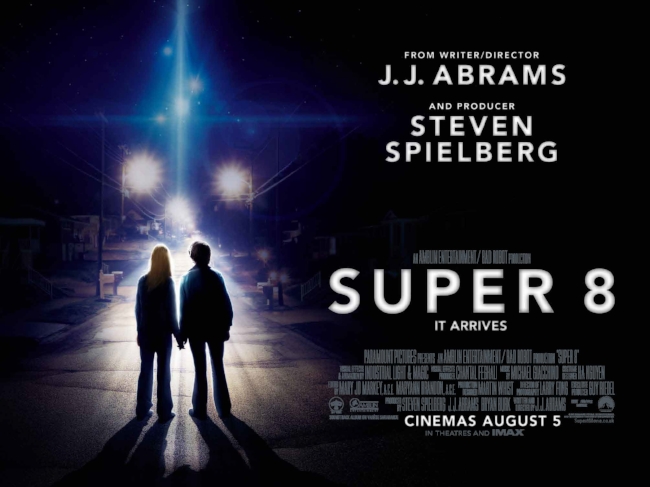
When you see the names of such cinematic luminaries as Steven Spielberg and J.J. Abrams together on the same movie poster, naturally your expectations are going to be high. Yet when watching the various trailers for Super 8, just prior to its release in 2011, I was somewhat cautious. I have discussed in the past at some length the ambiguous nature of trailers and that they can misrepresent a film. Yet even bearing this in mind at the time, I couldn’t help but feel that Super 8 seemed like a somewhat self-indulgent homage to Spielberg's earlier work. I subsequently saw the movie at the cinema in August that year and my suspicions were validated. However, over time I have spoken to several friends who are advocates of the movie, so I thought I’d watch it a second time. Sadly, I still find myself unable to label Super 8 as anything else other than adequate. Now I would hasten to add, that I use adequate within the context of both director’s body of work. An adequate film from either Mr Spielberg or Abrams is still superior to many of their competitors. But that's not the point. I simply expected better from such a project.
When you see the names of such cinematic luminaries as Steven Spielberg and J.J. Abrams together on the same movie poster, naturally your expectations are going to be high. Yet when watching the various trailers for Super 8, just prior to its release in 2011, I was somewhat cautious. I have discussed in the past at some length the ambiguous nature of trailers and that they can misrepresent a film. Yet even bearing this in mind at the time, I couldn’t help but feel that Super 8 seemed like a somewhat self-indulgent homage to Spielberg's earlier work. I subsequently saw the movie at the cinema in August that year and my suspicions were validated. However, over time I have spoken to several friends who are advocates of the movie, so I thought I’d watch it a second time. Sadly, I still find myself unable to label Super 8 as anything else other than adequate. Now I would hasten to add, that I use adequate within the context of both director’s body of work. An adequate film from either Mr Spielberg or Abrams is still superior to many of their competitors. But that's not the point. I simply expected better from such a project.
Super 8 is not a pure monster movie or creature feature. The alien aspect to the film is nothing more than a secondary plot device. This film is mainly about growing up in the seventies, adolescence and bereavement. A lot is done to try and recapture the look and feel of the decade, yet despite the production design and the cultural references, such as period music, CB radio and the use of period slang, the film doesn't quite work. Why? Because the central characters, although steeped in the superficial trappings of the time are a little bit too worldly, articulate, sensitive and thoughtful. They display to many modern sensibilities and concerns. Rather than producing an accurate portrayal of life at the times, Super 8 is very much Abrams homage to the era. And like most odes to a bygone era it paints a sentimental picture, rather than a credible one. That’s not to say that it is bad. It is simply unauthentic.
Don't get me wrong, the central characters played by Joel Courtney, Riley Griffiths and Elle Fanning, are very likeable. Too many movies churn out stereotypical depictions of children or go the opposite way and place them on pedestals. Super 8 features some amusing banter of the sort that kids of this era would have. All the actors involved give good performances. But they all seem a little too perfect, coming across more as archetypes rather than fully rounded characters. I am of a comparable age to J.J Abrams and my childhood was nowhere near as socially complex as that depicted in the movie. Nor were my friends overburdened with such talent or driven by such focused aspiration. What we have in Super 8 is very much an adult’s intellectual deconstruction of childhood, rather than a reflection of it. The boisterous shouting of The Goonies or the smart alec antics of The Monster Squad ring far truer to me.
However, looking beyond this tonal stumbling block, there are some very enjoyable cinematic references in Super 8, many of which seem to be from Mr Spielberg’s back catalogue. For example, a cars electrical system fails at a critical moment, only to come back on with a jolt. Then there's the iconic imagery of kids cycling round idyllic suburban neighbourhoods, free from parental control or interference. There are also subtle nods to films such as John Carpenter’s The Thing with electrical items vanishing, possibly to be utilised by the alien for some makeshift vehicle. There's also a nice theme that's developed in which all the local dogs flee the area. For me, it's these little creative anecdotes that if expanded upon would have given the movie more character and depth.
Yet director Abrams is content to leave these aspects unexplored, in favour of his child centric narrative. As this is the central theme of the film, I can understand why the adult characters are a lot less developed and given less screen time. As a plot device it actually strengthens the under lying theme of the lack of connection between father and son. However, Super 8 falls down quite considerably with regard to its lead villain, Airforce Colonel Nelec played by Noah Emmerich. He is purely arbitrary and denoted as evil purely by his military association and his penchant for killing people by lethal injection. Bad guys are often far more interesting than the virtuous heroes and it's a shame that we do not find out more about him in this instance.
J.J. Abrams has a strong visual sense, very much like Spielberg. There are some very clever images woven into Super 8 over its two-hour running time. The tanks driving through the children's playground for instance and the use of silhouettes. Michael Giacchino's score is very strong and underpins rather than overwhelms the proceedings. There is much to like about the film and if you are not disposed to be as analytical as I am, you will be entertained. But if it had broadened its remit and shied away from the perennial Hollywood trope of canonising beautiful, yet deceased mothers, it could have been a far more rewarding film. A more honest and less emotional depiction of the times, as well as a little more focus on characters and motive would have improved things greatly.

Mainstream films are easy to recommend to people. They’re usually formulaic, work within clear parameters and they’re not controversial. Most people, when viewing such film on someone else’s suggestion, are left with a fairly simply choice. Did they like it or not? Whatever the outcome, no feathers are ruffled. No one looks at you askance afterwards and says “why the hell did you think I’d like that piece of shit”? If something like this happens, then you have clearly not recommended a mainstream film. Perhaps you’ve suggested something that’s a little more of an acquired taste. Something niche, from a very specific sub-genre. Which brings me neatly to Blazing Magnum AKA Strange Shadows in an Empty Room (1976). The US title gives the impression that this film is a hard boiled cop thriller, like so many others that followed in the wake of Dirty Harry. But there’s a clue in the European title. Yes, this movie has more than just a whiff of a giallo about it.