
The Tower (2012)
Kim Ji-hoon's The Tower is an indirect remake of John Guillermin's 1974 disaster movie, The Towering Inferno. The plot centres on a fire that breaks out in a luxury skyscraper in central Seoul on Christmas Eve. However the director manages to put a very modern spin on the story while maintaining the human drama you would expect from such a genre movie. It’s also apparent that the events of 9/11 have had an influence on the narrative; something that some critics have taken umbrage at. Yet these parallels do not extend beyond the superficial and there is certainly no attempt at any wider commentary on that real life tragedy.
Kim Ji-hoon's The Tower is an indirect remake of John Guillermin's 1974 disaster movie, The Towering Inferno. The plot centres on a fire that breaks out in a luxury skyscraper in central Seoul on Christmas Eve. However the director manages to put a very modern spin on the story while maintaining the human drama you would expect from such a genre movie. It’s also apparent that the events of 9/11 have had an influence on the narrative; something that some critics have taken umbrage at. Yet these parallels do not extend beyond the superficial and there is certainly no attempt at any wider commentary on that real life tragedy.
The cultural and social differences between US and South Korean cinema are very apparent in The Tower. The first act of the movie has a light and frivolous tone, as we meet the cast of characters. For example, Junior cook Young-cheol (Jeon Bae-soo) hides an engagement ring for his girlfriend within an ice cream, which is inadvertently eaten by his manager. Friction between one of the wealthy residents and the cleaner also highlight the rather rigid class divide within South Korean society. However despite these nominal cultural differences there are many universal themes in The Tower that make the film accessible to those with an open mind.
The Tower features some visually arresting set pieces and the physical and visual effects are of a high standard. The two burning towers are linked via a glass walkway that inevitably has to be crossed. This naturally occurs at a point when the structure is close to collapse, yet despite being a very contrived scene it is quite tense and well handled. The director also strikes the right balance between suspense and some of the more horrific aspects you would associate with a fire. Stuntmen and women are set alight and blasted through windows. Panicking staff are cooked alive in an elevator stuck in the lift shaft. Sundry extras are crushed or impaled by failing masonry. Yet none of this carnage is dwelt on excessively.
As with the The Towering Inferno, no cliché is left unturned and the scientific aspects of the plot are flawed and do not stand up to close scrutiny. The Mayor is mainly concerned about rescuing the building richest residents (I was surprised it wasn't an election year). The Director of the company that owns the tower is happy to take risks just to satisfy the shareholders. Captain Kang Young-ki (Sol Kyung-gu) of the Fire Department is estranged from his wife. Plus the most common solution to the various firefighting problems that arise is to simply blow something up. However it really wouldn't be a disaster movie without these melodramatic plot indulgences.
The Tower is by no means an outstanding movie but it is certainly entertaining. The South Korean perspective affords an interesting and alternative window onto familiar cinematic territory. The central characters although somewhat formulaic are likeable and the action scenes are enthralling. As long as you do not have an aversion to reading curiously translated subtitles or are an inherent xenophobe, then The Tower can offer two hours of spectacle and entertainment.
From Paris with Love (2010)
Some people have made the mistake of confusing From Paris with Love with the thriller and have subsequently criticised it for its failings within that genre. The thing is it’s patently not a thriller or a spy drama. It’s a textbook action film and a throwback to the 1980s. As such its merits are rather straight forward and easy to define. If you are looking for a slick, formulaic, shoot ‘em up set against the backdrop of Paris, complete with wise-ass dialogue and two personable lead actors then director Pierre Morel delivers in spades. The ludicrous premise, flagrant breaking of possibly every French law in existence and the sheer volume of carnage should not be over analysed. Action movies are not intended to stimulate debate or provoke deep thought. Their job is to entertain.
Some people have made the mistake of confusing From Paris with Love with the thriller and have subsequently criticised it for its failings within that genre. The thing is it’s patently not a thriller or a spy drama. It’s a textbook action film and a throwback to the 1980s. As such its merits are rather straight forward and easy to define. If you are looking for a slick, formulaic, shoot ‘em up set against the backdrop of Paris, complete with wise-ass dialogue and two personable lead actors then director Pierre Morel delivers in spades. The ludicrous premise, flagrant breaking of possibly every French law in existence and the sheer volume of carnage should not be over analysed. Action movies are not intended to stimulate debate or provoke deep thought. Their job is to entertain.
Diplomatic aide James Reese (Jonathan Rhys Meyers) gets the opportunity to ingratiate himself with the CIA and potentially further his career, by “facilitating” special agent Charlie Wax (John Travolta) operation in Paris. The chalk and cheese pair clash as they rampage through the city, decimating sundry drug dealers, terrorists and suicide bombers. Bodies pile up, quips are made, mirth and merriment abounds (within the parameters of the action movie genre). Xenophobia is also exalted, national stereotypes are trotted out and every bullet hit is a fatal through and through. There are even some Pulp Fiction references. Yet all of these points work within the scope of the movie. The entire film is very much a knowing wink to the audience.
From Paris with Love does not re-invent the genre. But what it does do during its ninety minute running time, it does well. The action scenes and fights are well choreographed, filmed and edited. The characters although totally implausible are quite likeable. The only deviation from the norm happens in the third act when an element of pathos is introduced that I was not expecting. Still, it doesn’t derail the proceedings. This not a human drama about the pressure of working in the intelligence community, nor is it a dissertation of the nature of terrorism. It’s an action movie pure and simple and it is not ashamed to be so.
Although not as good as Taken or District 13, the director’s previous work, From Paris with Love is a perfectly acceptable genre offering, delivering the goods in a competent fashion. It also benefits from the added bonus of the disconcertingly watchable Travolta and a very picturesque Gallic setting. It also eschews the contemporary penchant for PG-13 rated action. This is an R rated movie complete with bullet hits and blood splatter; usually all over the walls and the supporting cast. From Paris with Love is a Friday night entertainment for sure but a solid example of the genre. If you want a serious political thriller with similar international locations, then you may be better off with one of the various movie adaptations of John le Carré’s work.
Some People (1962)
Some People offers a rather interesting insight in to early sixties youth culture, as well as touching upon the class divide in post war Britain. It focuses on a group of working class youths (Ray Brooks, David Hemmings and David Andrews) who after being banned from driving, are somewhat at a loose end and heading for trouble. Their fortunes change when a local choirmaster (Kenneth Moore) gives them an opportunity to use the church hall for band practice. However this is not a rags to riches story by any means. In many ways it’s quite the opposite as the narrative has a sense of inevitability about the protagonist’s long term prospects and overall fate.
Some People offers a rather interesting insight in to early sixties youth culture, as well as touching upon the class divide in post war Britain. It focuses on a group of working class youths (Ray Brooks, David Hemmings and David Andrews) who after being banned from driving, are somewhat at a loose end and heading for trouble. Their fortunes change when a local choirmaster (Kenneth Moore) gives them an opportunity to use the church hall for band practice. However this is not a rags to riches story by any means. In many ways it’s quite the opposite as the narrative has a sense of inevitability about the protagonist’s long term prospects and overall fate.
It is easy to be side tracked by some of the superficial aspects of Some People. Obviously the beat music is very much a product of the time and the rebellious shenanigans of the cast are somewhat tame by contemporary standards. Yet the film clearly demonstrates the restrictive society of the post war era. Some of the comments made by the magistrates during the court scene reflect the prevailing socio-economic politics of era. Vicars, youth leaders and pretty much any other adult featured in the film are portrayed as authority figures desperate to maintain the status quo. There is also a rather melancholic plot theme about the generation gap. Ray Brook's father regrets not knowing his own son and realises that there's precious little he can do about it.
There's also a very liberal streak running through Some People. The great Kenneth Moore plays a progressive single parent who tries to offer the young people a way of defining themselves. The film strongly advocates the Duke of Edinburgh's Award as a means of doing this. Moore also takes a very modern attitude to his daughter’s involvement with Ray Brooks, trusting her to do the "right thing". There is a clear subtext that the class differential means that the relationship will not last. It’s implied that Moore's liberalism is a result of his academia, as he is an electrical engineer working in the aviation industry. Conversely, the most blinkered character with regard to politics and social mobility is shown to be Bill, one of the three lead young men. He maintains a “not for the likes of use” attitude which was still common at the time.
Some People is in some ways quite unique, being one of the first "Kitchen sink dramas" aimed at the youth market. Previous movies focusing on this demographic had a tendency to be American and although there was much common ground, they weren't fully applicable to a UK audience. Some People offered the genuine article for the British market. Overall it is a quite bold film for its time, considering that it was made in an era when scripts for UK productions were submitted to the BBFC in advance for approval. Director Clive Donner strayed into similar pop culture territory again with Here We Go Round the Mulberry Bush but it lacked the earthy realism of Some People. Ironically five years later youth culture had evolved from a source of social concern into just a new commercial market.
Split Second (1992)
Split Second has great aspirations. Sadly they’re totally beyond the movies budget, the quality of screenplay and the ability of director Tony Maylam. The poster clearly demonstrates this with the rather bold tagline of "Blade Runner meets Alien". The reality is somewhat different. Furthermore Split Second seems to be from the wrong decade. Despite being a nineties sci-fi action movie it has all the hallmarks of one from ten years prior. The Director of Photography relies on a wealth of neon lighting to try and create a suitable atmosphere. The costume design is heavily based on leather clothing and outfits that accentuate the shoulders. There's also a drab and grating electronic score that was synonymous with this genre during the eighties. Overall Split Second certainly has a lot of strikes against it.
Split Second has great aspirations. Sadly they’re totally beyond the movies budget, the quality of screenplay and the ability of director Tony Maylam. The poster clearly demonstrates this with the rather bold tagline of "Blade Runner meets Alien". The reality is somewhat different. Furthermore Split Second seems to be from the wrong decade. Despite being a nineties sci-fi action movie it has all the hallmarks of one from ten years prior. The Director of Photography relies on a wealth of neon lighting to try and create a suitable atmosphere. The costume design is heavily based on leather clothing and outfits that accentuate the shoulders. There's also a drab and grating electronic score that was synonymous with this genre during the eighties. Overall Split Second certainly has a lot of strikes against it.
However the film has one trump card up its sleeve which it plays right from the get go; the presence of Dutch character actor and genre stalwart Rutger Hauer. He starts chewing the scenery immediately after the credits have finished and despite the movies many failings, manages to keep the film together. Hauer plays Harley Stone, a cop on the edge who’s become a loose cannon after losing his partner to a serial killer. He's the kind of guy who shoots first, asks questions later and swears profusely in his spare time. Writer Gary Scott Thompson obviously felt that a plethora of strong language could fill the gaps in the film's plot. Hauer even calls a dog a dickhead within the first five minutes of the film.
Split Second like so many other low budget genre movies seems to run on its own unique internal logic. Characters are ill defined and plot devices are often left underdeveloped. It's as if there was a production meeting and it was decided to throw in every possible cliché and trope in the hope that some of them would work. So we have an “Alien” style monster that has occult affiliations, prowling through a flooded London that has been brought about by global warming and pollution. Hearts are torn out, big guns are brandished and people swear copiously. The Police Chief shouts a lot and Hauer's new partner (Alistair Duncan) is a book worm who becomes gung-ho. Oh and there’s an obligatory and totally arbitrary love interest played by Kim Cattrall. The London locations and the finale set in an abandoned part of the Tube are convenient and cheap.
Now to the casual viewer this all adds up to a shoddy, poorly conceived movie with no redeeming features. However Split Second is not really the province of the causal viewer. Its core audience are viewers who love cheap and cheerful genre knock offs of this idiom. All the potential faults and flaws that I’ve catalogued are the very thing that fans enjoy. If you watch this movie on your own it may either raise a wry smile or annoy you. View it with a few like minded friends after a trip to the pub and its merit grows exponentially. See Split Second at a film festival with an audience of rabid B movie junkies and you'll have a totally different cinematic experience. It all comes down talent versus enthusiasm. Split Second is wanting in many respects but it has been made with a degree of love for the genre. Somehow that has managed to permeate the film and can be tapped into through shared viewing in the right circumstances.
Edge of Tomorrow (2014)
Edge of Tomorrow is based upon Hiroshi Sakurazaka book All You Need Is Kill, from 2004 and it's a shame that the movie did not retain that title. Edge of Tomorrow is a somewhat bland and generic moniker. Mercifully the film itself is a cut above your usual blockbuster Sci-fi release. The screenplay written by Christopher McQuarrie (The Usual Suspects) and Jez Butterworth (Jerusalem) offers a tight and gripping narrative which quickly establishes its premise and makes it continuously engaging. Dubbed "Groundhog D-Day" by certain pundits, the story of history repeating itself is presented in such a fashion as to be intriguing rather than repetitive.
Edge of Tomorrow is based upon Hiroshi Sakurazaka book All You Need Is Kill, from 2004 and it's a shame that the movie did not retain that title. Edge of Tomorrow is a somewhat bland and generic moniker. Mercifully the film itself is a cut above your usual blockbuster Sci-fi release. The screenplay written by Christopher McQuarrie (The Usual Suspects) and Jez Butterworth (Jerusalem) offers a tight and gripping narrative which quickly establishes its premise and makes it continuously engaging. Dubbed "Groundhog D-Day" by certain pundits, the story of history repeating itself is presented in such a fashion as to be intriguing rather than repetitive.
Tom Cruise plays a reluctant military officer William Cage who find himself leading a major offensive against a group of what appear to be bio-mechanical Cephalopoda, who are attacking worldwide. He is not a seasoned soldier, coming from a military PR background and subsequently dies in combat. However through a curious side effect of being exposed to the dead aliens precious bodily fluids, he find himself in a time loop in which he continuously repeats his final day. Furthermore he is cognisant of this temporal anomaly and tries to learn from his mistakes and change the outcome of the time line.
The first two thirds of Edge of Tomorrow are inventive and absorbing. The production design and overall ambience are well conceived. The battles look authentic as various global landmarks are reduced to rubble. It is also nice to see Tom Cruise play against type. He does not start the story as a generic hero and is in fact somewhat unlikeable. It is in the final act that the narrative becomes a little less logical and more contradictory. Prior to this point, Cage and his cohorts have persevered through meticulously learning from their prior mistakes. Suddenly their approach changes to one of greater improvisation, which does seem somewhat incongruous.
However director Doug Liman handles the film with sufficient originality making Edge of Tomorrow his best picture since The Bourne Identity (2002). The supporting cast featuring such quality character actors as Brendan Gleeson and Bill Paxton adds immensely to the proceedings. Furthermore Edge of Tomorrow is not just a cinematic vehicle for Tom Cruise. Emily Blunt more than holds her own in the role of Rita Vrataski, the seasoned veteran who he continuously learns from.
Overall Edge of Tomorrow is happy to be a smartly contrived Sci-fi action movie, that sticks to its own remit. Therefore viewers shouldn’t expect the wider social themes of films such a Minority Report and Starship Troopers. What you do get with Edge of Tomorrow is a surprisingly superior action movie featuring quality set pieces, good performances and an engaging narrative. Time travel can be a tricky plot device if poorly handled but that’s not a mistake that Edge of Tomorrow makes.
Vigilante (1985)
William Lustig, a director of low budget exploitation films, has a small but distinguished back catalogue. His 1983 foray into the revenge sub-genre is a curious beast but certainly not without merit. Far less sensational than The Exterminator or Death Wish II, it is still a stark and grimy look at urban crime and its impact on working class neighbourhoods. It is the minimalist style of Vigilante, along with parallel storylines and complete lack of moral judgement that makes it a surprisingly better film than it first appears. Considering the violent nature of the story the film is rather restrained, yet does includes a rather unpleasant child murder. Although not graphic, it is somewhat shocking. Such material would be handled a lot differently these days.
William Lustig, a director of low budget exploitation films, has a small but distinguished back catalogue. His 1983 foray into the revenge sub-genre is a curious beast but certainly not without merit. Far less sensational than The Exterminator or Death Wish II, it is still a stark and grimy look at urban crime and its impact on working class neighbourhoods. It is the minimalist style of Vigilante, along with parallel storylines and complete lack of moral judgement that makes it a surprisingly better film than it first appears. Considering the violent nature of the story the film is rather restrained, yet does includes a rather unpleasant child murder. Although not graphic, it is somewhat shocking. Such material would be handled a lot differently these days.
The plot focuses upon blue collar workers Robert Forster and Fred Williamson as they struggle to earn a living and support their families. Crime in the neighbourhood is on the increase and Mr Williamson pro-actively advocates "doing something about it". His friend Robert Forster takes a contrary view. When his family falls victim to a home invasion, he puts his faith in the court system and eschews offers of personal justice. However corrupt lawyers and plea bargaining sees his family’s killers set free and our hero facing thirty days in prison for contempt of court. After a reality check from veteran con Woody Strode, Robert Forster seeks the help of his friends to even the score.
Director William Lustig varies the standard genre formula and manages to avoid some of the more obvious clichés. Despite being a tale of revenge our protagonist finds no absolution. At the end of the movie his life and marriage are in ruins. His wife leaves him unable to cope with the death of their child. The film also avoids any strong moral stance and simply shows you the events and their consequences. The strong cast of genre stalwarts give honest performances and there is little or no histrionics. Vigilante also reflects the bleak environment of New York at the time of filming. It’s harsh and unforgiving. Perhaps the weakest aspect of the film is the street gang which seems somewhat derivative of Street Thunder from Assault on Precinct 13. There is no major attempt to explain their history or excessively violent nature.
Vigilante has an intriguing narrative style, showing Fred Williamson's small scale urban justice in parallel with his work colleagues tragedy and legal battle. For the first act of the film, it’s difficult to determine who the central protagonist is. The scale of the events also lends credibility to the proceedings, showing local people taking on local pimps and dealers, rather than single-handedly shutting down international cartels. The shortcoming of a legal system that actively seeks deals and plea bargains is explored quite well. Also the police are not so much depicted as incompetent but simply overwhelmed and demoralised. When a gang member is killed by the local vigilantes, it is the police who suffer the consequences.
Vigilante is certainly worth seeing for fans of seventies and eighties revenge movies. It is very much a product of its time and may certainly not appeal to those raised on the glossy contemporary equivalents such as Law Abiding Citizen. Yet it has an honesty that you see in low budget indie picture from this time. The subject of personal justice is a perennial favourite of the film industry and has been the basis for many a good movie. Vigilante is far from a great film, with some clumsy dialogue, logical omissions and plot inconsistencies but it still manages to tackle a thorny issue in quite an effective way. Its lack of any socio-political agenda is also worth noting. Rather than lecture viewers, Vigilante simply shows things as they were at the time and lets the audience reflect upon them.
Death Wish 3 (1985)
Michael Winner’s Death Wish (1974) was a gritty urban vigilante tale about how every-man Paul Kersey, took on the rising tide of crime that swept New York at the time. Despite its sensationalist style the film struck a topical nerve upon release and fared well at the box office. Featuring a strong central performance by Charles Bronson, Death Wish improved the standing of both its director and star. Death Wish II (1982) was a far more exploitative sequel, choosing to dwell on the violence rather than ponder the nature of vigilanteism. Its lurid rape scenes remain controversial to this day.
Michael Winner’s Death Wish (1974) was a gritty urban vigilante tale about how every-man Paul Kersey, took on the rising tide of crime that swept New York at the time. Despite its sensationalist style the film struck a topical nerve upon release and fared well at the box office. Featuring a strong central performance by Charles Bronson, Death Wish improved the standing of both its director and star. Death Wish II (1982) was a far more exploitative sequel, choosing to dwell on the violence rather than ponder the nature of vigilanteism. Its lurid rape scenes remain controversial to this day.
In 1985 Director Michael Winner returned to the franchise for a third outing. This time round any semblance of credibility was abandoned and replaced with mindless, near cartoon style action. The third instalment sees an ageing Bronson eliminating an entire New York street gang with an array of weapons and booby traps. It is by far the least plausible of the series, yet it in some ways the most enjoyable. The film’s modest budget meant that only a minimal amount of footage was shot on location in New York. The majority of the film along with the second unit direction was filmed in the UK around Lambeth and Brixton. Allegedly one tenth of the films entire budget was spent of Charles Bronson’s fee.
I recently revisited Death Wish 3 on Blu-ray and reacquainted myself with this high octane eighties action movie with its stereotypical and stylised street gang. This time round I noticed far more of the footage that was shot in the UK for budgetary reasons. The set designs and props, as well as Mr. Winners love of the zoom lens means that it's quite well disguised most of the time but the British architecture and street layouts betray the change in location. Yet this is just one of the factors that makes this movie so entertaining. Then there's Gavin O'Herlihy's reverse Mohican and early performances by Alex Winter and Marina Sirtis. Death Wish 3 also features a ridiculously high bodycount as well as the amusing plot device of pensioners with stock piles of WWII weapons. Plus it should be remembered that Charles Bronson was 64 at the time. Death Wish 3 is a bit of a dog’s dinner, yet somehow it still has a curious charm about it. It’s a quality that many Cannon movies have for some reason.
The improved picture quality of the Blu-ray release allows for a closer examination of the movie and affords some interesting details. For example, I noticed the following immediately after the Cuban (Ricco Ross) kills a rival gang member for being off his turf. As the crowd of gang members disperses, they can be seen carrying an array of weapons from knives, chains to baseball bats. One enterprising individual stoops and picks up a sink plunger and strides off sporting it in a threatening manner. With such deadly weapons falling into criminals hands, it’s hardly surprising that Mr. Bronson is forced to break out the .30 caliber M1919 Browning machine gun.
It is very easy to look at a movie such as Death Wish 3 with scathing, postmodern sensibilities. Yet to do so is rather foolish, as it misses the whole point of the film, which is to simply entertain. Death Wish 3 is not supposed to be an accurate portrayal of New York street crime in the mid-eighties. Nor is it supposed to be a cerebral critique of the judicial system. Michael Winner simply aimed to create a piece of escapist entertainment with its tongue firmly in its cheek. If the ever increasing bodycount of the films denouement along with the use of deadly sink plungers doesn’t convince you then you’re probably not the films target audience.
Dracula (1958)
Following the 2012 restored release of The Curse of Frankenstein, Hammer, Icon Film Distribution and Lionsgate jointly produced a Blu-ray restoration of another British classic. This time it was the 1958 version of Dracula directed by Terence Fisher. This is one of Hammer's finest films and not only gets a superb High Definition transfer but also sees the restoration of two lost scenes. Dracula literally re-invented the horror genre and the depiction of vampires in film. It also established the studio as a key player within the industry and made international stars of Peter Cushing and Christopher Lee. This new restoration finally does justice to the source material presenting it as it deserves to be seen.
Following the 2012 restored release of The Curse of Frankenstein, Hammer, Icon Film Distribution and Lionsgate jointly produced a Blu-ray restoration of another British classic. This time it was the 1958 version of Dracula directed by Terence Fisher. This is one of Hammer's finest films and not only gets a superb High Definition transfer but also sees the restoration of two lost scenes. Dracula literally re-invented the horror genre and the depiction of vampires in film. It also established the studio as a key player within the industry and made international stars of Peter Cushing and Christopher Lee. This new restoration finally does justice to the source material presenting it as it deserves to be seen.
The release contains two versions of the film, both of which can be accessed via seamless branching on the Blu-ray disc. There is the 2007 BFI restoration plus the new 2012 Hammer restoration, which adds additional footage that has been unavailable for decades, as well as the original UK title card. The additional footage comprises two of the scenes that were originally censored by the BBFC in 1958. The material was restored to the film from the infamous “Japanese reels” validating the long-held notion that more explicit prints existed for the far eastern market. The scenes depict Dracula’s seduction of Mina, which was considered too overtly sexual for the times. Then there is the infamous face clawing scene from Dracula’s final demise.
The film also boasts an outstanding commentary track from Hammer historian Marcus Hearn and author and critic Jonathan Rigby. For those who have an interest in Hammer Studios or cinema in general this is an extremely informative and enjoyable narrative. Both speakers have a wealth of interesting and relevant anecdotes. They offer a keen insight into the British film industry of the time and its relationship with the BBFC and the press. There is also an excellent discussion of each actors respective acting techniques. As a result I learned of Peter Cushing's famous finger acting; the repeated gesture of raising his index finger to emphasise an important point. I will always look out for it now.
Dracula is a vibrant, beautifully constructed movie with intelligent performances and a literate screenplay. The production design is outstanding as is the lush cinematography. The proceedings are further embellished by James Bernard's dramatic score which compliments the tense atmosphere and bouts of horror. It should be noted that what was once considered to be a pushing the boundaries of what was acceptable within the confines of a "X" certificate, now merits a more sedate "12" rating from the BBFC. Certainly Dracula will strike some people as being somewhat tame by today's standards. However if it viewed with an appropriate sense of historical context, Dracula is a fine example of British cinema at its best.
The Curse of Frankenstein (1957)
The 2012 Blu-ray release of Hammer Studio's The Curse of Frankenstein is a visual delight. The use of Eastman colour and the outstanding cinematography by Jack Asher are sumptuous and the new restoration does the film justice. This unique British horror movie introduced a new visceral style and brooding quality to the genre back in 1957. Despite a modest budget the creative production design evokes a truly Gothic horror atmosphere. The studio also introduced graphic violence along with a strong undercurrent of sexuality. These lurid aspects of the film proved particularly successful with the post war audience and became an integral part of the marketing campaign.
The 2012 Blu-ray release of Hammer Studio's The Curse of Frankenstein is a visual delight. The use of Eastman colour and the outstanding cinematography by Jack Asher are sumptuous and the new restoration does the film justice. This unique British horror movie introduced a new visceral style and brooding quality to the genre back in 1957. Despite a modest budget the creative production design evokes a truly Gothic horror atmosphere. The studio also introduced graphic violence along with a strong undercurrent of sexuality. These lurid aspects of the film proved particularly successful with the post war audience and became an integral part of the marketing campaign.
Previous versions of Frankenstein have tended to depict the Baron as misguided and ultimately overwhelmed with the magnitude his endeavours. Peter Cushing’s charming, obsessed and menacing Victor Frankenstein is an unusual and far more interesting exploration of the role. He seduces the maid, betrays his wife and blackmails his best friend Paul Krempe (Richard Urquhart). He is a far from a sympathetic character yet despite all this, Cushing still manages to make the audience pity him at the end. There is also an extraordinary performance from Christopher Lee, as the “monster”. Despite having no dialogue and little character development he still manages to convey an air of despair and confusion.
Some aspects of The Curse of Frankenstein have nominally dated. There is a tendency towards melodrama and the pace is somewhat leisurely but it’s still a potent and morally ambiguous film. It has a dour and morbid tone to it, which is reflected in the way it handles scenes of horror. The removal and disposal of a head in acid, along with the purchase of human eyeballs from morgue are depicted in a somewhat clinical and ghoulish manner rather than sensational. What The Curse of Frankenstein ultimately achieved was establish a clear blue print for future Hammer horror movies. They may well have become more explicit and lurid overtime but they always managed to maintain a degree of class. It was a winning formula that changed the genre permanently.
Fire in the Sky (1993)
After recently watching Communion, I decided to explore the alien abduction genre a little further. There are a lot of movies based on these phenomena but most are very poor. Then I remembered Fire in the Sky from 1993; a movie that got quite a lot of publicity at the time of its release and gained a reputation for being a quality drama rather than a low budget cash-in. So I dutifully watched it to see if it warranted the minor cult status it seems to have acquired. I was pleasantly surprised to find an interesting movie with good performances that took the material in a direction I hadn't entirely expected.
After recently watching Communion, I decided to explore the alien abduction genre a little further. There are a lot of movies based on these phenomena but most are very poor. Then I remembered Fire in the Sky from 1993; a movie that got quite a lot of publicity at the time of its release and gained a reputation for being a quality drama rather than a low budget cash-in. So I dutifully watched it to see if it warranted the minor cult status it seems to have acquired. I was pleasantly surprised to find an interesting movie with good performances that took the material in a direction I hadn't entirely expected.
Fire in the Sky is a dramatisation of Travis Walton's book "The Walton Experience". The abduction itself is not the focal point of the story until the last act. The film primarily focuses on the friendship between Travis Walton (D. B. Sweeney) and Mike Rogers (Robert Patrick) who were part of a logging crew contracted by the government. The drama arises after Walton goes missing and his friends report his "abduction" to the authorities. They instantly become the subject to a police investigation and fall under suspicion by the rest of the town. The doubt and ridicule, as well as loss of employment cause, immense strain on Rogers and his colleagues. His marriage starts to crumble as a result. However polygraph tests show that he is not lying.
Robert Patrick dominates the picture with an extremely good performance. D.B. Sweeney surprisingly has less to do despite top billing. The movie has steady direction from Robert Lieberman who maintains a level headed tone. It also captures the mid seventies surprisingly well. Veteran actor James Garner also turns in a solid performance as Lieutenant Frank Watters, who is tasked with solving the case. The production is mainly location based and gives a good sense of what it's like to live in a small town. The UFO encounter at the beginning of the film is minimalist and purposely ambiguous. It is not until the third act when Travis Walton returns after five days, that the tone of the story changes.
D.B Sweeney offers a credible interpretation of a returned abductee, playing the role like a veteran suffering from shell shock. The movie culminates with a flash back to the interior of the alleged spaceship and a subsequent examination of Walton by EBEs. These scenes are very professionally done and very creative (they also have little resemblance to what was written in Walton's book, but hey that's Hollywood for you). This sequence is genuinely shocking with a variety of metal probes and instruments being driven in to Walton's head. In some respects it feels a little out of place with the proceeding tone of the movie. However it serves to illustrate why Walton returns in such a state.
Fire in the Sky is a solid movie that does not fall in to needless sensationalism about its subject matter. The acting and script are sound, preferring to deal with the human fallout of the incident rather than wallow in the excesses of the extraterrestrial elements of the plot. It certainly doesn't attempt to answer any major questions, preferring to explore the nature of friendship under extreme circumstances. As a result it is a far better movie than you'd expect, proving that good actors with a decent script is always preferable to VFXs, bluster and noise.
Communion (1989)
Ambiguous is a very good word to describe the movie Communion. As are nebulous, circumspect, vague, inconclusive and confusing. However that is the entire point of the film. It doesn't provide a definitive answer because to this day, author Whitley Strieber, who's personal experiences the movie is based on, doesn't have one. Was he abducted? If so by whom and for what reason? Who can say? Communion is not so much a study of the abduction phenomenon but more of an exploration of coming to terms with an unquantifiable experience. There is a strong religious subtext to the proceedings as the title implies. Strieber did not automatically assume that the "visitors" were extraterrestrial and has been very careful to use neutral terms to describe them.
Ambiguous is a very good word to describe the movie Communion. As are nebulous, circumspect, vague, inconclusive and confusing. However that is the entire point of the film. It doesn't provide a definitive answer because to this day, author Whitley Strieber, who's personal experiences the movie is based on, doesn't have one. Was he abducted? If so by whom and for what reason? Who can say? Communion is not so much a study of the abduction phenomenon but more of an exploration of coming to terms with an unquantifiable experience. There is a strong religious subtext to the proceedings as the title implies. Strieber did not automatically assume that the "visitors" were extraterrestrial and has been very careful to use neutral terms to describe them.
Communion is defined and driven by the performance of Christopher Walken. As ever he is both eccentric and compelling. He seems determined to paint Whitley Strieber as a New York Bohemian. In reality the author looks more like an accountant. However the film works best when depicting Walken's mental collapse and the strain it put's upon his family. The abduction and subsequent flash backs are purposely stylised, giving them a dreamlike quality. The special effects are not supposed to show us living, breathing entities but caricatures. We do not see them for what they are but as how Strieber's mind interprets them. The "visitors" are wearing masks, hiding their true identities, which is a recurring theme within the narrative.
Does Communion work as a movie? Yes, although it stumbles along the way and revels a little too much in its own ambiguity. It does however tackle some very interesting questions and highlights that abduction experiences are not as black and white as some people on both sides of the debate seem to think. If you watch this movie expecting a traditional abduction account then you may be better off watching Fire in the Sky. Communion is a far more philosophical undertaking. It raises far more questions than it answers but that is Whitley Strieber's entire point. Sometimes it's not about getting answers but how we deal with the fact that there may not be any satisfactory one. The movies conclusion seems to be that agnosticism is by far the wisest default position.
The Soldier (1982)
The Soldier is a curious beast. This independently financed action film from the early eighties draws on Cold War themes and features sub Bond exploits, endeavouring to punch above its weight. It also had one of those trailers that really over sold the film. You know the kind. One that showed all the best action sequences and implied that there was a lot more content of that kind in the movie . The marketing also made a big deal about Klaus Kinski's, blink and you'll miss him, cameo. I remember the promotion of the film in my local video store during my teenage years. Specifically the high expectations I had (the director's previous movies was The Exterminator) and how the film never quite lived up to them. I wanted to like it so much but even back then it was clear that the movie was lacking.
The Soldier is a curious beast. This independently financed action film from the early eighties draws on Cold War themes and features sub Bond exploits, endeavouring to punch above its weight. It also had one of those trailers that really over sold the film. You know the kind. One that showed all the best action sequences and implied that there was a lot more content of that kind in the movie . The marketing also made a big deal about Klaus Kinski's, blink and you'll miss him, cameo. I remember the promotion of the film in my local video store during my teenage years. Specifically the high expectations I had (the director's previous movies was The Exterminator) and how the film never quite lived up to them. I wanted to like it so much but even back then it was clear that the movie was lacking.
After a second viewing of The Soldier some thirty four years later the flaws are more glaring obvious than ever but also far more understandable. Director, writer and producer James Glickenhaus simply ran out of money. The budget was mainly blown on the various action sequences and their respective international locations. This is why after such an initially promising premise the story fizzles out in the final act. Characters vanish and the ending is very underwhelming and over too quickly. This is very much a film of two halves. Still it is not without interest, featuring two standout stunts. The first being a spectacular high fall from an exploding cable car, a scene that turned up in several commercials at a later date. There's is also an excellent slow motion full burn, caused by a booby trapped light bulb.
Hardcore fans of action movies will enjoy the cast of The Soldier. Featuring eighties 'B' list action heroes, Ken Wahl and Steve James, performances fall exactly within the parameters you expect with such casting. The plot featuring renegade KGB agents hijacking a plutonium shipment and attempting to plant a nuclear device in the Saudi Arabian Ghawar oilfield, is somewhat impenetrable. However it doesn’t really matter. It’s just that sort of movie. The film curiously features a soundtrack by German electronic music collective Tangerine Dream, who scored a very eclectic selection of movies during the seventies and eighties. Overall I would only recommend The Soldier to fans of this niche sub-genre. The more casual viewer would be better off watching one of the more mainstream offerings from this period such as Nighthawks or 48 HRS.
The Outlaw Josey Wales (1976)
The Outlaw Josey Wales is often hailed as the last great western from the golden era of the genre. As a child when I first saw the movie, I failed to appreciate its subtleties, having been raised on a more traditional diet of movies from this genre such as El Dorado. It has only been in more recent years that I have revised my opinion of this finely crafted piece of cinema. It is radically different from the much of Clint Eastwood's earlier work and most certainly displays a quality in his film making that was not apparent previously.
The Outlaw Josey Wales is often hailed as the last great western from the golden era of the genre. As a child when I first saw the movie, I failed to appreciate its subtleties, having been raised on a more traditional diet of movies from this genre such as El Dorado. It has only been in more recent years that I have revised my opinion of this finely crafted piece of cinema. It is radically different from the much of Clint Eastwood's earlier work and most certainly displays a quality in his film making that was not apparent previously.
Actor and director Eastwood called The Outlaw Josey Wales, "an anti-war film". This western, set during the Civil War decade, certainly addresses themes that can be seen as allegorical of the Vietnam War. However upon repeated viewing the movie offers more and more, showing great depth with its exploration of racial politics, spiritual redemption and the burden of obligation. Once again the universal medium of the western genre provides a broad canvas for an interesting analysis of the human condition.
Eastwood is a very functional director and his earlier works are often quite linear and minimalist. The Outlaw Josey Wales on the surface offers simple story of revenge and reconciliation. Yet despite the subtlety of its narrative, the film provides a wealth of complex characters. The script by Philip Kaufman is lean yet there is a great deal of weight to most of the dialogue. The production benefits from a strong ensemble cast with memorable performances from John Vernon, Will Sampson and Paula Trueman. Yet it is Chief Dan George who steals the show as Lone Watie. His performance as a world weary Indian is an absolute delight.
What makes The Outlaw Josey Wales so different from contemporary movies is it's foundation in strong characterisation. Eastwood's functional approach to film making allows viewers to focus on the story and its protagonists. That's not to say that there aren't any good set pieces, because there are. However they are an embellishment, rather than a focal point and do not detract from the from the main story. The reason the movie works so well is because we care about those we are watching. This is something that is so often lacking from many of the movies I see nowadays.
Perhaps this movies master stroke is its ending which takes the concept of the classic showdown in a different direction and resolves the underlying conflict between Eastwood and Vernon is an unexpected way. It makes several thought provoking statements that give the viewer much to reflect on. Cinema is after all not quite the passive experience that some would have you believe. Such is the nature of quality film making and The Outlaw Josey Wales is a fine example of such. It certainly deserves its reputation and rates highly amongst Clint Eastwood's finest work.
The Time Machine (2002)
I never got round to seeing The Time Machine during its initial release. The marketing at the time placed a lot of significance upon the fact that the director, Simon Wells, was H G Wells grandson. This made me somewhat suspicious because apart from novelty value, this really has no bearing on the movie in any real capacity. Finally having finally watched the film, my immediate conclusion is that it falls between two stools. The Time Machine starts as a romantic drama and then later on tries to re-assert itself as an action driven adventure. Unfortunately it does not commit fully to either, resulting in a rather odd, melancholy film.
I never got round to seeing The Time Machine during its initial release. The marketing at the time placed a lot of significance upon the fact that the director, Simon Wells, was H G Wells grandson. This made me somewhat suspicious because apart from novelty value, this really has no bearing on the movie in any real capacity. Finally having finally watched the film, my immediate conclusion is that it falls between two stools. The Time Machine starts as a romantic drama and then later on tries to re-assert itself as an action driven adventure. Unfortunately it does not commit fully to either, resulting in a rather odd, melancholy film.
In the 1960 original, the Time Traveller (Rod Taylor) was driven by sciencetific zeal and found love along the way. In this re-imagining, our hero Dr. Alexander Hartdegen (Guy Pearce) embarks on his journey through time and space as the result of the death of his fiancée. After witnessing the partial destruction of the moon in 2030 Alexander arrives at a distant point in the earth's future where the surviving humans have become a homogeneous race, preyed upon by the mutant Morlocks. He meets a sympathetic woman from the Eloi tribe called Mara (Samantha Mumba) and subsequently has to decide whether to continue to try and change his past or accept his fate and stay with her in the future.
For once rather than being lumbered with a movie that out stays its welcome, The Time machine actually suffers from being a little too short. The characters he meets in the future are somewhat ill defined and could all benefit with a bit more development. As a result a lot of their motivations seem vague. Orlando Jones cameo as the holographic computer interface Vox 114 is also a rather clumsy plot device and is used purely for the purpose of plot exposition. Jeremy Irons’ brief appearance at the end of the final act as the Über Morlock, is rather reminiscent of Bond confronting Blofeld in his volcano lair. Why the villain of the movie would let our hero go seems somewhat illogical.
Yet it’s not all bad. Guy Pearce is very watchable and there are moments of humour when Orlando Jones is on screen. The attack upon the Eloi by the Morlocks is very well staged and quite scary. The final cannibalistic revelations are also quite ghoulish without being too obvious. Overall The Time Machine provides a lightweight evening’s entertainment, if you are undemanding. Just don't make the mistake of comparing it to the original as it really isn't the same sort of movie and don't scrutinise the plot too closely. There is a better film in there trying to get out. I suspect that there may have been some heavy handed editing made upon the initial workprint. Something that is increasingly common these days, when a studio finds itself with a movie they are not entirely sure what to do with.
The Ultimate Warrior (1975)
I discovered The Ultimate Warrior via an anecdote my Father told me, about a film that he had once seen in which "Telly Savalas got paid in cigars". I was somewhat flummoxed at the time but after a little research it became apparent that he meant Robert Clouse' 1975 science fiction movie. I finally got to see The Ultimate Warrior for myself in the late eighties on satellite. Turns out it was Yul Brynner and not Telly Savalas but it’s easy to get such iconic seventies slapheads confused. He was spot on about the payment in cigars though.
I discovered The Ultimate Warrior via an anecdote my Father told me, about a film that he had once seen in which "Telly Savalas got paid in cigars". I was somewhat flummoxed at the time but after a little research it became apparent that he meant Robert Clouse' 1975 science fiction movie. I finally got to see The Ultimate Warrior for myself in the late eighties on satellite. Turns out it was Yul Brynner and not Telly Savalas but it’s easy to get such iconic seventies slapheads confused. He was spot on about the payment in cigars though.
The seventies was a truly great time for intelligent and thought provoking science fiction. Environmental issues were very topical so it’s not surprising to see such themes as a biological apocalypse in movies such as No Blade of Grass and The Ultimate Warrior. Both films depict a very stark vision of the near future and the decline of civilisation. The latter is especially true of The Ultimate Warrior. Through the minimal use of matte paintings and still photographs, the viewer is shown a decaying New York, bereft of power, utilities or any semblance of government. Pockets of survivors live in scattered communes, whereas the streets belong to feral humans.
One such commune, led by The Baron (Max von Sydow) has managed to grow several strains of disease resistant vegetables. Yet despite this breakthrough the group is teetering on the edge of total disintegration, due to the dwindling food reserves and the constant attacks from a rival gang run by William Smith. Enter Yul Brynner as Carson, a fighter for hire. Upon accepting The Baron's offer of employment, he learns that he is not there to protect the community but to secretly take the precious supply of seeds to safety. The deal also includes the safe escort of The Baron's pregnant daughter.
Despite a somewhat simplistic plot, The Ultimate Warrior explores many ideas. Carson is not just a thug but a wordly and introspective character. The Baron is also a complex individual, feeling loyalty to a group of people who have long ceased to think for themselves. He knows that they will inevitably turn upon him but he maintains his role to the very end. Clouse directs competently and makes no attempt to soften the impact of the movies content. The fights are minimalist and efficient. There are no guns or steampunk weaponry. Carson uses a simple knife. The story offers little moral redemption. Humans quickly abandon the rules of society and become mere predators, just to live to see another day. It's bleak and worryingly plausible.
It is a curious thing that this relatively minor studio picture achieves a lot more in narrative terms than many contemporary equivalents. It is greatly assisted by the presence of two outstanding character actors. Brynner who was fifty five at the time, still comes across as an imposing and formidable street fighter. The artistic freedoms of the time are very apparent in the movies ending. Carson's personal sacrifice is a metaphor for society having to make tough decisions for the sake of the greater good. It is highly unlikely that such an end would appear in an equivalent film today. Ignore the superficial trappings of the time. The Ultimate Warrior still has a lot of credible things to say. Unlike other more recent depictions of the future, at least no one here is wearing a colander as a hat.
The Medusa Touch (1978)
The Medusa Touch is a paranormal thriller based on the novel by Peter Van Greenaway. It has been one of my favourite films since I first saw it on TV in the mid-eighties. It left a lasting impression upon my young mind with its very British sense of style and narrative understatement. Being a joint British and French co-production some interesting changes were made to the original story to suit an international audience. The British Police Inspector from the book becomes a French Officer (played by Lino Ventura) on administrative exchange. The gender of the psychiatrist Zondfield also changes from male to female to accommodate American actress Lee Remick. The screenplay also reduces the role of the church in the storyline and updates several topical references.
The Medusa Touch is a paranormal thriller based on the novel by Peter Van Greenaway. It has been one of my favourite films since I first saw it on TV in the mid-eighties. It left a lasting impression upon my young mind with its very British sense of style and narrative understatement. Being a joint British and French co-production some interesting changes were made to the original story to suit an international audience. The British Police Inspector from the book becomes a French Officer (played by Lino Ventura) on administrative exchange. The gender of the psychiatrist Zondfield also changes from male to female to accommodate American actress Lee Remick. The screenplay also reduces the role of the church in the storyline and updates several topical references.
Richard Burton plays John Morlar, the misanthropic novelist who refuses to die after being violently assaulted in his flat. As Inspector Brunel investigates, he discovers that Morlar has been surrounded by tragedy and disaster all his life. These include the death of his parents, the burning down of his school and his wife’s death in a road traffic accident. Furthermore the evidence indicates that Morlar's malevolence influence may have directly caused these events. Despite being critically injured and confined to a hospital bed, Morlar’s brain activity becomes stronger and stronger. Inspector Brunel becomes increasingly concerned that Morlar may well pose threat to the “establishment” that he hates so much.
Burton's performance in The Medusa Touch is everything that you would expect. He’s ideally cast as a bitter and cynical man, tortured by the gift for disaster that has dominated his life. The film further bolstered by a wealth of British character actors such as Harry Andrews, Gordon Jackson and Michael Horden. All acquit themselves well. The screenplay by John Briley (who also wrote Gandhi and Biko) is sombre and concise. The character of John Morlar has some splendid barbed and pithy dialogue. The strong narrative steadily builds a sense of tension, climaxing when Morlar's telekinetic powers cause "Minster Cathedral" to collapse. The air of mystery is maintained even at the films denouement and we are never fully given a comprehensive explanation of Morlar’s powers. To do so would diminish the movie.
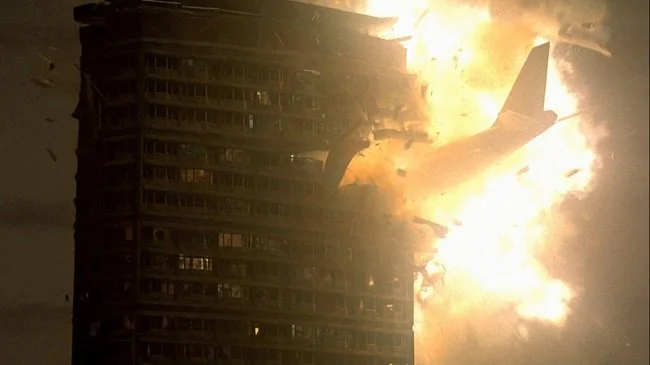
The Medusa Touch is well crafted film for its time and budget. Director Jack Gold gets the most from a strong cast and paces the story well. Although the film is not overtly violent it does have an inherently creepy quality to it. Michael J. Lewis's score is very evocative and very much a product of the time. However a major set piece of the film involving a jet plane crashing into a tower block, does now cause a little unease due to its prophetic nature. I remember UK national newspaper The Daily Mail featuring a centre page article as to how this sequence was filmed by stalwarts of the UK effects industry, Nick Allder and Brian Johnson. The collapsing cathedral in the films finale is relatively minimalist and shows sufficient to make its point.
The Medusa Touch reflects the style of genre film making of the times. A movie of this kind today would be loaded with extravagant set pieces and would need a strong hand in the director’s chair to rein in its excesses. Back in 1978, dialogue and performances were still considered far more effective tools to convey disastrous events. The bleak and cynical tone of The Medusa Touch along with Burton’s performance again show that film makers at the time didn’t feel compelled to provide the audience with a happy ending. So if you prefer a slow burn over shocks and violence then The Medusa Touch may well entertain you. It is an odd beast that straddles several genres, yet its earnest approach and Burton’s screen presence make it more than interesting.








Them! (1954)
Although the realities of the nuclear age where far from pleasant, for Hollywood it was a source of box office gold. Never mind radiation poisoning, cancer and birth defects; the atomic age was good for business. It meant super powers, mutations and giant big monsters. Such terrors offered a clumsy metaphor for the dangers of atomic energy and a source of terror, thrills and drama on the big screen. Them! was one of the first movies in this idiom and became a blueprint for the genre that followed in its wake. Featuring a colony of out sized ants, that initially terrorise New Mexico but eventually migrate to Los Angeles, Them! leaves a trail of destruction and dead B actors in its wake.
Although the realities of the nuclear age where far from pleasant, for Hollywood it was a source of box office gold. Never mind radiation poisoning, cancer and birth defects; the atomic age was good for business. It meant super powers, mutations and giant big monsters. Such terrors offered a clumsy metaphor for the dangers of atomic energy and a source of terror, thrills and drama on the big screen. Them! was one of the first movies in this idiom and became a blueprint for the genre that followed in its wake. Featuring a colony of out sized ants, that initially terrorise New Mexico but eventually migrate to Los Angeles, Them! leaves a trail of destruction and dead B actors in its wake.
Originally planned to be a 3D release, Them! was shot in 4:3 ratio and not Cinemascope to accommodate the process as well as the special effects. However due to technical and budgetary reasons the 3D process was dropped. The black and white film stock lends a faux documentary quality to the proceedings. The story is fast paced and not excessively complex. Lead performances by the great James Whitmore and James Arness are sincere and engaging. As you would expect the full size animatronic ants are somewhat dated by contemporary standards, yet they have their own unique charm and are shot in a way that gives them character. Their sound effects also add to the ambience.
On watching Them! It’s clear to see the influence the film had on James Cameron when he made Aliens. There are several thematic parallels, such as a traumatised child who has lost their parents and a secret lair where the Queen is laying her eggs. There are also Marines with flamethrowers clearing out the infestation. The more you watch old Hollywood B movies from the fifties, the more you'll find the source material that recent blockbusters have plundered. Sadly they usually only take the simplest of ideas and jettison any associated wit, style and drama.
Them! is still a very entertaining ninety four minutes, as long as you accept it for what it is and are aware of the context of the times. The entire genre of fifties monster movies is very interesting from a sociological point of view. They reflect the public concern over the atom bomb and the lack of understanding about the consequences of its use. They also provide a useful insight insight into how the major film studios where always willing to cater to emerging trends. Science Fiction and Horror where always considered to be second rate genres, yet over the next two decades where to prove two of the most lucrative forms of revenue. They also provided a springboard for a great deal of emerging talent.
Rolling Thunder (1977)
Incarcerated in a POW camp for eight years during the Vietnam War, Major Charles Rane returns back home as a national hero and is awarded a silver dollar for every day of his ordeal. Despite the positive press coverage of a returning hero, the reality is far different. Alienated from his family and institutionalised, he sleeps in the garage unable to adjust to normal life. An attack by criminals seeking the silver dollars leaves him maimed and his wife and son dead. He survives the ordeal and seeks revenge, knowing that it will bring him no peace or serve any purpose. It is simply the only option he has.
Incarcerated in a POW camp for eight years during the Vietnam War, Major Charles Rane returns back home as a national hero and is awarded a silver dollar for every day of his ordeal. Despite the positive press coverage of a returning hero, the reality is far different. Alienated from his family and institutionalised, he sleeps in the garage unable to adjust to normal life. An attack by criminals seeking the silver dollars leaves him maimed and his wife and son dead. He survives the ordeal and seeks revenge, knowing that it will bring him no peace or serve any purpose. It is simply the only option he has.
Vigilante and revenge films were big box office in the seventies. What makes Rolling Thunder a cut above the rest is that it was written by Paul Schrader. Overlooked on its initial release this low-budget gem boasts well defined characters and paints a credible picture of the psychological trauma suffered by US veterans. John Flynn's hard-hitting direction, aided by outstandingly performances by William Devane, Linda Haynes and Tommy Lee Jones, bleakly shows three disconnected souls trying to survive in a world that they can no longer function in.
Initially a human drama confronting the issues faced by returning Vietnam soldiers, it suddenly transforms into a brutal, nihilistic revenge film. Paradoxically, violence is never glamorised. It is simply shown as an inevitable consequence. The narrative is aided by Barry DeVorzon soundtrack and Jordan Cronenweth's stark photography. The deadpan script is sparse but still conveys the torment and bleakness of the central protagonists. This is a film with little sentiment although it does explore close friendships that are forged by common experience.
Rolling Thunder is an extremely well-acted, written and crafted film. It touches on many social issues but rather than moralising about them, merely shows them for what they are. The ending is dour and violent but could there have been any other possible outcome that was credible? Although originally scheduled to be released by Twentieth Century-Fox, the studio executives were perturbed by the violence in the final edit and the decision was made to sell it off to American International Pictures. It should also be noted that the lead role was initially offered to Kris Kristofferson.
The Captains (2011)
The Captains is a curious beast. If you’re expecting a traditional documentary where Bill Shatner simply indulges in a standard Q & A with other actors that have portrayed captains within the Star Trek franchise, then you will be disappointed. The Captains is a horse of a different colour entirely. Throughout its ninety minute duration, this documentary veers from personal reflections on acting, muses upon the nature of fame and even touches upon contemplating one’s own mortality. It certainly wasn’t what I was expecting and was subsequently a far more rewarding experience.
The Captains is a curious beast. If you’re expecting a traditional documentary where Bill Shatner simply indulges in a standard Q & A with other actors that have portrayed captains within the Star Trek franchise, then you will be disappointed. The Captains is a horse of a different colour entirely. Throughout its ninety minute duration, this documentary veers from personal reflections on acting, muses upon the nature of fame and even touches upon contemplating one’s own mortality. It certainly wasn’t what I was expecting and was subsequently a far more rewarding experience.
Some viewers may see Mr Shatner as an egotistical one trick pony and this film as a colossal self-indulgence. I do not. I genuinely think that he is a passionate man who has wrestled with the pitfalls of international fame. He certainly is quite candid about times when his popular persona was a burden to him. Through the cross examining of his guests (and that is a very apt term at times) he highlights the parallels of what he has come to terms with. The documentary is somewhat erratic and eclectic yet through all its muddled musings does have points to make.
The interviewees are a curious bunch, to boot. If The Captains does anything, it is to highlight that an actors onscreen persona can often be radically different to their own. Kate Mulgrew discusses how the strong authoritative character she portrayed was the complete opposite of her in her family life. Avery Brooks could not be further from Benjamin Sisko if he tried. A talented pianist and an individual with a clear artistic temperament, his personal reflections are often extremely philosophical and on occasion impenetrable. Yet all of this contributes to the underlying narrative thrust of the documentary. Exactly what impact did being a “captain” have upon each actor.
The Captains is a little too long and languid for the casual viewer. A re-edit would certainly help make it more accessible such an audience. For hardcore Trekkies/Trekkers or those who have a fascination with actors, this documentary is informative and of merit. Bill Shatner is a potent personality. The scenes showing him interacting with fans at conventions and working the crowd are fascinating. I think that he genuinely feels for his audience. Certainly the influence of his fame has become clear to him. He appears to be conspicuously aware of being in his twilight years and wishes to use them as well as he can.
Wild Geese II (1985)
The fortune of British film producer Euan Lloyds took a turn for the worst after the success of The Wild Geese in 1978. Both his subsequent movies The Sea Wolves and Who Dares Wins were critical failures and subject to diminished box office returns. Therefore Wild Geese II was conceived in hope that a new addition to the franchise would prove financially successful and restore Mr. Lloyd’s reputation as a top British producer. Former Bond director, Peter Hunt, was brought on board to oversee the proceedings, along with original star Richard Burton. The screenplay was again by Reginald Rose and soundtrack composed by Roy Budd.
The fortune of British film producer Euan Lloyds took a turn for the worst after the success of The Wild Geese in 1978. Both his subsequent movies The Sea Wolves and Who Dares Wins were critical failures and subject to diminished box office returns. Therefore Wild Geese II was conceived in hope that a new addition to the franchise would prove financially successful and restore Mr. Lloyd’s reputation as a top British producer. Former Bond director, Peter Hunt, was brought on board to oversee the proceedings, along with original star Richard Burton. The screenplay was again by Reginald Rose and soundtrack composed by Roy Budd.
However the production soon encountered problems, due to Burton's ill health. His role had to be substantially re-written to accommodate his lack of mobility. Thus the concept of the sniper was conceived as a plot device. Burton's death in August 1984 was major impediment but the production was too far forward to be cancelled. So Edward Fox was quickly secured to play the role of Burton's brother, Alex Faulkner. Story has it that the actor took the role to finance an extension to his home. It is also rumoured that the second lead was to be played but Lewis Collins but the role was deemed too similar to that he played in Who Dares Wins. The character then eventually evolved into a vehicle for Scott Glenn.
Upon release Wild Geese II was a box office failure. The story about a plot to rescue Rudolph Hess from Spandau prison was intriguing but poorly executed. The casting of Laurence Olivier as Hess was a bold idea but doesn’t quite work. The action scenes are shot in a very unflattering style and seem very hastily assembled. The contrast between principle photography and second unit direction is quite noticeable, clearly indicating that the film had a troubled production. Yet despite such flaws it is not devoid of any redeeming qualities. Wild Geese II serves as an interesting "snapshot" of the Cold War and a partitioned Berlin. It also features British actor, Derek Thompson, coming to yet another unpleasant cinematic end.
Wild Geese II is a subtly different film from its predecessor. It is more of an espionage thriller than an action film. It really needs to be viewed on its own merit, rather than in a direct comparison to its predecessor. It touches on many aspects of mid-eighties world politics, some of which are still with us, while others have long vanished. Certainly the power of global media corporations is still a relevant topic today. Despite a preposterous premise and a rather stark production design, Wild Geese II is a curious but entertaining film.