
Star Wars and Me
The seventies were a very curious time, especially in the UK. The post war world with its sensibilities, culture and etiquette was slowly slipping away. Sadly the future had not quite lived up to its scientific and cultural potential. Political, industrial and economic turmoil were rife. Even as a child I was aware that all was not right with the world. Then Star Wars was released and very quickly became a cultural phenomenon. I embraced it like many others and took it to my heart. It offered not only spectacle but a boundless galaxy filled with stories and possibilities, which captivated a child’s imagination. It had not only a strong sense of morality but a wider philosophical subtext. It provided a modern mythology just as George Lucas intended. Its optimism was in some ways an antidote to the prevailing cynicism of the times.
The seventies were a very curious time, especially in the UK. The post war world with its sensibilities, culture and etiquette was slowly slipping away. Sadly the future had not quite lived up to its scientific and cultural potential. Political, industrial and economic turmoil were rife. Even as a child I was aware that all was not right with the world. Then Star Wars was released and very quickly became a cultural phenomenon. I embraced it like many others and took it to my heart. It offered not only spectacle but a boundless galaxy filled with stories and possibilities, which captivated a child’s imagination. It had not only a strong sense of morality but a wider philosophical subtext. It provided a modern mythology just as George Lucas intended. Its optimism was in some ways an antidote to the prevailing cynicism of the times.
Because of Star Wars, I became aware of the concept of fandom and its sub-culture. It provided a gateway into other literary, cinematic and cultural works which I consumed with an equal passion. For the next twenty years Star Wars was ever present in my life and I was happy for it to be there. One of the greatest pleasures I’ve had as a Father was introducing my son to the classic version of the trilogy on Laserdisc in 1997. It was shortly after that the Special Editions were announced and the opportunity to see the films in the theatre again was sufficient to overrule my concerns over some of the changes that had been made.
Then came the new trilogy along with the accompanying hope and subsequent disappointment. It seemed that George Lucas had lost his way and had become sadly a victim of his own success. No one seemed willing to challenge him and by the time the new movies were made the damage was done. Furthermore this process took place during a decade when the marketing of the entire franchise reached new heights. Slowly it seemed that Star Wars was crossing the line from cultural phenomenon to pop culture ubiquity. Star Wars was simply another brand such as Coca-Cola or McDonalds. It was this transformation into a truly corporate product that tainted it for me and many others. When Disney acquired the rights to the franchise in October 2012 and promised us more, I just sighed.
Over the recent decades there have been substantial changes in the way we experience movies. In the seventies movies could only be seen at the cinema so unless they merited a re-release, once their initial run ended they were gone until they showed up on TV. This meant that fans had a very different relationship with the object of their affection. The rise of home video in the eighties changed this as did the internet in the nineties. Nowadays every aspect of a film is delineated and analysed, before it is even shown. Movies can be owned three months after release, offering a beautiful high definition experience along with a wealth of extras. Knowledge and expertise is no longer the province of the obsessive geek. It’s given away on a plate to anyone with the mildest interest.
It is this over familiarity that is perhaps the biggest factor with regard to my changing views on Star Wars. That and the recognition that our memories of are often specific to particular times in our lives. The Star Wars I experienced as a child has gone forever. Furthermore no matter how hard we try it is impossible to recreate those feelings we initially felt. For many people personal tastes change over time but this is just part of life and should not be feared. Therefore it would be unrealistic for me to still feel the same way about George Lucas’s movies after thirty eight years. In some respects the change in perspective is quite liberating, allowing me to revisit the movies with a more critical eye, as I have done so recently via Jamie Benning’s documentaries.
Of course not everybody will have necessarily had a similar experience to me and Star Wars still has a hardcore fanbase of unwavering loyalty. Devotion of this kind is arguably both a fans greatest asset and weakness. For me, I feel that my association with the Star Wars phenomenon has overall been a positive experience. Not in spite of my changing relationship but because of it. Perhaps the final lesson I have learned from that galaxy far, far away is the correct way to embrace nostalgia and to be comfortable with the notion of change. Whether those who now own the franchise understands this point is another matter entirely. Therefore I await the release of Star Wars: The Force Awakens with a degree of measured interest rather than unbridled passion. My expectations are realistic and I suspect that this may be the key to surviving the pending hype and marketing.
Cult Movie Soundtracks
There is a common consensus that a cult movie doesn’t necessarily have to be a good one. Badly written scripts, low budgets and curious casting are just some of the things that can contribute to making a film a cult classic. Many movies of this idiom have showcased talent that subsequently went on to better things. Sometimes films that are hailed as complete turkeys or financial disasters upon release are retrospectively deemed of merit. Often it is films soundtrack that can be its one saving grace. Take for example Ennio Morricone’s prodigious body of work. He is considered by many to be one of the finest (if not the finest) film composer alive. Yet some of his best work has been for incredibly poor, flawed or indifferent films. Consider Hundra, Treasure of the Four Crowns or Orca for example.
There is a common consensus that a cult movie doesn’t necessarily have to be a good one. Badly written scripts, low budgets and curious casting are just some of the things that can contribute to making a film a cult classic. Many movies of this idiom have showcased talent that subsequently went on to better things. Sometimes films that are hailed as complete turkeys or financial disasters upon release are retrospectively deemed of merit. Often it is films soundtrack that can be its one saving grace. Take for example Ennio Morricone’s prodigious body of work. He is considered by many to be one of the finest (if not the finest) film composer alive. Yet some of his best work has been for incredibly poor, flawed or indifferent films. Consider Hundra, Treasure of the Four Crowns or Orca for example.
With this idea in mind I've collated five films that are for various reasons are labelled “cult” and have suffered the “slings and arrows of outrageous fortune” over the years. All have scores of interest and note, though for different reasons. I have chosen a track from each soundtrack which I think highlights the musical excellence and integrity of the composers involved. The genres are varied as are the musical styles and nuances of each piece. All clearly demonstrate how a well-conceived score can embellish and enhance a movie, effectively becoming a character in its own right.
Much has been written about Sir Lew Grade’s 1980 adaptation of the popular Clive Cussler’s novel, Raise the Titanic and precious little is complimentary. Yet despite the films faults which mainly came from multiple script re-writes, the soundtrack by the late John Barry is an outstanding piece of work. It captures the mood of the film perfectly, especially during the underwater sequences. Often it is played against extensive miniature work with little human interaction, yet it vividly enhances these sequences and conveys sense of urgency and risk associated with undersea exploration. I have chosen the cue when the submersible Deep Quest finally locates the wreck of the Titanic. The music changes from the sombre themes of the search to one of elation. This is vintage John Barry at his best.
The Beastmaster is the embodiment of a cult movie. A low budget, independent production from the early eighties designed to cash-in on the sword and sorcery boom of the time, it features a quality score by Lee Holdridge. Holdridge is primarily known for his work on television on such shows as Moonlighting and Beauty and the Beast. His forays into the world of cinema are less frequent but often of note. The Beastmaster is the story of Dar, who by a quirk of his birth has gained the power to communicate with beasts. The fact that his Black Panther sidekick is in fact a Tiger that’s been dyed is neither here nor there. The main theme for the movie is rousing and of a standard seldom seen in movies of this genre.
I make no bones about the fact that I utterly love this car crash of a movie. Lifeforce is a text book example of a movie that endured a tumultuous production and a last minute re-edit. There are vast differences between the US release of the film and the international version. The Shorter American print features a re-scored soundtrack by Michael Kamen, a very popular composer at the time. The lengthier, more coherent and marginally better European cut included the full original soundtrack by none other than the great Henry Mancini. It's not a name that you immediately associate with the Sci-Fi genre. However Mancini manages to bring gravitas to the proceedings with several finely polished cues that nearly make you forget the preposterous nature of the film. The main theme is a sweeping orchestral piece that really should belong to a better film.
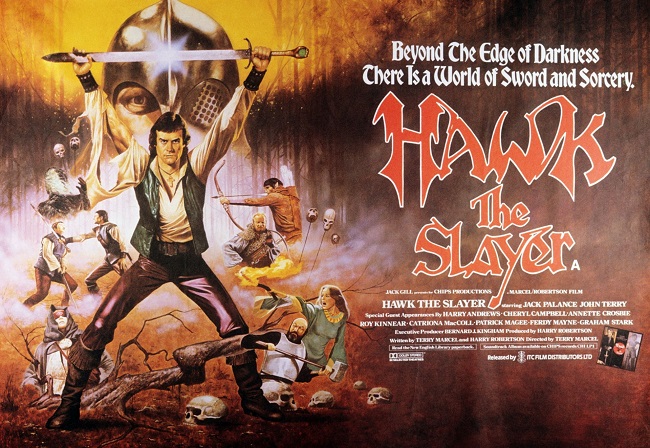
Any film that features a repeating crossbow, death by silly string and Bernard Bresslaw cannot be all bad. Hawk the Slayer is a wonderful piece of low budget, sword and sorcery hokum. It is also very British. Producer Harry Robertson also wrote the film score and it is the embodiment of early eighties UK synth-pop. Drawing upon such diverse influences as Jeff Wayne’s musical version of War of the Worlds and the work of Ennio Morricone (specifically Westerns) it’s kitsch yet an engaging score. It utterly suits the idiom of the film and is immense fun although possibly for all the wrong reasons. The cue below is re-iterated through the early stages of the film as Hawk gathers his band of warriors.
Finally Battle Beyond the Stars was one of James Horner’s earliest scores. Considering the low budget of the film, it was extremely ambitious for the producers to pursue a full orchestral soundtrack arrangement. Many others would have opted for an electronic score. Yet Horner’s iconic main theme is incredibly accomplished and imbues the film with a quality and ambience beyond its humbled origins. It was this score that caught the notice of Paramount studios and subsequently led to James Horner composing the soundtrack for Star Trek II: The wrath of Khan. The title theme of Battle Beyond the Stars contains all the hallmarks of Horner’s style. Its use of brass and rhythmic cadence are instantly captivating and convey the spirit of the narrative.







Brainstorm (1983)
Director Douglas Trumbull’s background in the special effects industry has given him a unique perspective on film making. It is said that he made Silent Running with its humane and environmental message as a direct response to Stanley Kubrick’s 2001: A Space Odyssey, which he saw as stark, cold and clinical. Brainstorm again takes a technological story and adds a very human angle. The production was delayed by the death of lead actress Natalie Wood and the studio was somewhat at a loss as how to sell this film once it was completed. Everyone else at the time was still making space operas and this cerebral piece of cinema was very much ahead of its time.
Director Douglas Trumbull’s background in the special effects industry has given him a unique perspective on film making. It is said that he made Silent Running with its humane and environmental message as a direct response to Stanley Kubrick’s 2001: A Space Odyssey, which he saw as stark, cold and clinical. Brainstorm again takes a technological story and adds a very human angle. The production was delayed by the death of lead actress Natalie Wood and the studio was somewhat at a loss as how to sell this film once it was completed. Everyone else at the time was still making space operas and this cerebral piece of cinema was very much ahead of its time.
Brainstorm is an innovate take on the traditional conflict between science and big business. Brilliant researchers Lillian Reynolds (Louise Fletcher) and Michael Brace (Christopher Walken) develop a system of recording people’s experiences, feelings and emotions. It is not long before this breakthrough attracts the attention of the military and Michael soon finds himself at odds with his employer. His devotion to his research also costs him his marriage. When his colleague suffers a fatal heart attack, she manages to record her dying experiences. Michael has to consider the risks to himself if he plays back the recording. In the meantime the Military have other ideas regarding both the tape and the future of the entire project.
Brainstorm is a thoughtful and somewhat sentimental film. Despite the technological setting, it deals with traditional themes such as love, death and taking responsibility for our own actions. Walken is ideally cast as the obsessive and driven scientist who neglects his family’s emotional welfare. Natalie Wood gives a warm performance as his estranged wife. The script is somewhat old school and adopts a rather conservative moral tone. The production design also reflects what was considered to be cutting edge technology in the early eighties. It’s interesting to see the reliance on telephony and mainframes in the days before the internet, as well as the lack of optical or solid state media.
Brainstorm features several sub plots that are not fully developed. This may be due to the re-editing that had to be done to accommodate Natalie Wood’s death. There is also a rather incongruous sequence where a production line is sabotaged. This descends into slapstick, with security personnel desperately trying to cope with the mayhem while wading around in a sea of fire retardant foam. Yet despite these minor criticisms, Brainstorm still manages to engage the mind in a thought provoking manner. The optical effects are outstanding for the pre-digital age. The ending with its glimpses of heaven and hell are very intriguing. Apparently a lot more footage was shot for these scenes but omitted from the final edit, possibly for ratings reasons. There is definitely footage in the trailer that is not in the theatrical release.
I saw Brainstorm on video on its initial release. At that time it was only available in 4:3 pan and scan format. The current Blu-ray release shows the film in two aspect ratios. 1.85:1 for the real world scenes and 2.20:1 for the “recording” of others peoples experiences. Sadly rather than switching between ratios, the print is formatted to the larger format and thus shows majority of the movie is a picture box presentation which is far from satisfactory. Douglas Trumbull wanted to film the entire movie in an experimental format that ran a 60FPS but studio vetoed this idea for financial reasons the. Despite a difficult production and it’s narrative inconsistencies Brainstorm still merits viewing and will appeal to the more thoughtful and discerning viewer.
Outland (1981)
Outland was one of the first AA rated movies I ever saw (which is now an obsolete rating in the UK). I remember that I was expecting the worst because the trailer implied that there was at least one exploding head featured during the film. Turns out there were two. Anyway the movie made a strong impression upon me at the age thirteen and I have revisited it numerous times since its release. I recently discovered that Outland had been given a Blu-ray release from Warner Brothers and decided to watch it once again but this time with a more critical eye rather than a nostalgic one.
Outland was one of the first AA rated movies I ever saw (which is now an obsolete rating in the UK). I remember that I was expecting the worst because the trailer implied that there was at least one exploding head featured during the film. Turns out there were two. Anyway the movie made a strong impression upon me at the age thirteen and I have revisited it numerous times since its release. I recently discovered that Outland had been given a Blu-ray release from Warner Brothers and decided to watch it once again but this time with a more critical eye rather than a nostalgic one.
The story is very straight forward being essentially a western in outer space. Federal Marshal O’Neil is beginning a year’s tour of duty at a major mining facility on Io, one of Jupiter’s moons. After a spate of suicides and random violent crimes, the Marshal discovers that General Manager Sheppard (Peter Boyle) is distributing drugs among the work force to increase productivity. The side effect of long term addiction leads to psychosis. Unable to trust his fellow officers the Marshal find his only ally is the facilities cynical chief medical officer, Dr. Lazarus (Frances Sternhagen). O’Neil’s investigations inevitably lead to him to a show down with two contract killers.
You would have to be an extremely causal viewer not to see shades of High Noon in this movie. But unlike the westerns of the 50’s with their sanitised depiction of the West, this frontier in space is grimy, seedy and altogether plausible. Writer/Director Peter Hyams creates a credible working environment, similar to that of an oilrig. Everything is functional and basic. There is no privacy or glamour. The future is run by big corporations and driven by return on investment. It’s a bleak and rather all too familiar world.
What elevates Outland above the standard of similar genre products from the time is the universally high standard in every aspect of the production. The script is tight, honest and plays to the strengths of the lead actors. The dynamic between Connery and Sternhagen is very plausible, with dry quips, cynicism and grudging respect. The sets are claustrophobic and depressingly credible. The technology on display hasn’t dated too much. Hyams did not make the usual genre mistakes such as exotic costumes and weaponry. The miniature work by Martin J. Bower is outstanding and the Introvision front projection effects works still look acceptable.
Peter Hyams has always been somewhat underrated as a director. All the hallmarks of his previous works are present in Outland. There is a well-crafted chase scene, the mythical “good cop” and corporate/political conspiracies. Of course the movie is not without fault. You can easily question some of the science and there are a few plot wholes. However, the sheer presence of Sean Connery overshadows these minor quibbles. The movie is a showcase for his acting talent which is often overlooked. Outland also demonstrates that can get a lot of mileage from a classic tale and if you are sufficiently inventive. By not involving aliens in this vision of the future and showing that man’s worst enemy in space is himself, the tale maintains credibility.
Outland still remains a finely crafted, character driven thriller. It transcends the usual limitations that some studios impose upon the genre to be a superior piece of film making. There’s not a slack moment in the narrative which is perfectly paced. It would also be remiss of me not to mention the atmospheric score by Jerry Goldsmith. Warner Brothers Blu-ray transfer is very good and the movie looks crisp and clear. Obsessive movie fans you can finally do a comprehensive frame by frame analysis of P.H. Moriarty’s head explosion. For a movie that is thirty one years old, it holds up very well and is still solid entertainment.
My Name is Nobody (1973)
As the Western waned in popularity in the seventies, the Italian market was still further revising this already stylised genre with a distinctly comedic element. The uniquely European approach to slapstick was introduced as a mean to try and explore the genre in new ways. Unlike US comedy Westerns such as The Hallelujah Trail and There Was a Crooked Man, their Italians counterparts seemed to have an allegorical theme and as ever a heavy political sub-text. They were also steeped in the unique audio and visual style of their makers.
As the Western waned in popularity in the seventies, the Italian market was still further revising this already stylised genre with a distinctly comedic element. The uniquely European approach to slapstick was introduced as a mean to try and explore the genre in new ways. Unlike US comedy Westerns such as The Hallelujah Trail and There Was a Crooked Man, their Italians counterparts seemed to have an allegorical theme and as ever a heavy political sub-text. They were also steeped in the unique audio and visual style of their makers.
My Name is Nobody (Il mio nome è Nessuno) is perhaps the most obvious example of this curious cinematic sub-category, pairing iconic Hollywood Western actor Henry Fonda with the visually charismatic Terence Hill (Mario Girotti). Upon first look this is a simple tale of an ageing gunman Jack Beauregard, who’s tired of his legendary reputation and the constant attempts upon his life from those who seek fame by killing him. Things take a curious turn when he meets an enigmatic Saddle Tramp (who claims to be “nobody”), with an unorthodox plan to take his crown. After a series of misadventures the unlikely pair find themselves facing The Wild Bunch; a gang of a hundred gunmen.
My Name is Nobody is a leisurely paced movie with many of the usual tropes of the genre. Gunfights are meticulously staged and shot (the opening scene was allegedly conceived and devised by Sergio Leone). There are also extensive slow motion montages of horseman riding, set to yet another outstandingly quirky Ennio Morricone Soundtrack. Director Tonino Valerii handles the simple slapstick humour with aplomb. Viewers have the option of ascribing a deeper meaning to the story, if they are of a philosophical bent.
This is an enjoyable Western, if approached with the right frame of mind. The humour is mainly visual and of a physical nature. Don’t go expecting anything like Blazing Saddles. As ever with a genre that is more interested in style and aesthetics rather than logic, there are several plot holes and tonal inconsistencies. Also be aware that there are a large amount of horse falls in the climatic action sequence. Such stunt work is not to everyone’s liking. Overall My Name is Nobody is a curious hybrid and in some ways that in itself makes it quite special. Such experimentation with an established genre is a rarity these days.
Pontypool (2009)
If you like your entertainment to be perfunctory, devoid of any requirement for you to think, or use your imagination then do not watch Pontypool. If you are expecting a bog standard zombie film, then Pontypool will not be for you. However if you are tired of the generic studio offerings that are slowly killing the genre, have an enquiring mind and fancy seeing a different take on an established theme, then do watch Pontypool. It's not without its faults and does sail close to the wind with regards to being pretentious. But then again, semiotics is a complex subject.
If you like your entertainment to be perfunctory, devoid of any requirement for you to think, or use your imagination then do not watch Pontypool. If you are expecting a bog standard zombie film, then Pontypool will not be for you. However if you are tired of the generic studio offerings that are slowly killing the genre, have an enquiring mind and fancy seeing a different take on an established theme, then do watch Pontypool. It's not without its faults and does sail close to the wind with regards to being pretentious. But then again, semiotics is a complex subject.
Pontypool is about a Talk Radio Shock Jock in the twilight of his career, who becomes aware of a possible zombie apocalypse that is unfolding during the course of his daily radio phone-in. However the story subsequently focuses on how we as a population react and consume news, rather than simply regaling us with the undead munching on the living. Set mainly in the radio studio, the atmosphere is claustrophobic and brooding. This is a character driven movies with the emphasis on themes rather than action. If you are looking for a wealth of blood and gore then you’ll not find it.
Stephen McHattie, an underrated actor, gives an engaging performance as DJ Grant Mazzy and director Bruce McDonald delivers a minimalist film that still manages to achieve both scientific and political satire. Ultimately more questions are raised than answered but you never feel that writer Tony Burgess is copping out. This is a movie about ideas and it is therefore logical that the production is intended to not only entertain you but make you think. The central theme of the movie about the power of words and how they become the literal medium for a virus is indeed thought provoking.
Pontypool is a rare find; a cerebral horror movie and as such it will not necessarily appeal to mainstream viewers looking for a quick fix of shocks and thrills. However the horror genre is far broader in scope than many consider and Pontypool proves that it can be a medium for more intelligent stories. It certainly puts many contemporary horror movie offerings such as the Paranormal Activity franchise in the shade. Therefore Pontypool is recommend to open minded movie fans seeking a more challenging ninety minutes.
The Many Faces of Sherlock Holmes
It may not come as a surprise to you that Sherlock Holmes is the most filmed fictional character in the history of cinema. His universal appeal has been embraced globally and the great detective has been continuously revisited and adapted over the years. You only have to look at the BBC show Sherlock, to see how the character has been seamlessly re-imagined for a new generation. It is this versatile quality that is perhaps Holmes’ greatest strength. We are all familiar with the logical thinking and prodigious intellect of the sleuth, yet the enigma surrounding his personal life and formative years provides endless scope for exploration. It has proven to be fertile ground for film makers over the last century.
It may not come as a surprise to you that Sherlock Holmes is the most filmed fictional character in the history of cinema. His universal appeal has been embraced globally and the great detective has been continuously revisited and adapted over the years. You only have to look at the BBC show Sherlock, to see how the character has been seamlessly re-imagined for a new generation. It is this versatile quality that is perhaps Holmes’ greatest strength. We are all familiar with the logical thinking and prodigious intellect of the sleuth, yet the enigma surrounding his personal life and formative years provides endless scope for exploration. It has proven to be fertile ground for film makers over the last century.
I therefore would like to focus on a selection of cinematic adaptations which although technically non-canonical, explore the more esoterical aspects of Conan Doyle’s character. Often these films endeavour to link him to iconic cases, notorious events from history or other famed literary characters. Most of these titles will not be of any surprise to hardcore Holmes fans, but may be of interest to those who are not so familiar with this particular movie sub-genre.
Let us begin with Billy Wilder’s The Private life of Sherlock Holmes released in 1970. This astute, erudite and wry exploration of Holmes most secret case and his personal life is beautifully realised. Robert Stephens and Colin Blakely are superbly paired as Holmes and Watson and the dialogue by I. A. L. Diamond is priceless. The narrative explores the distinction between the "real" Holmes and the character portrayed by Watson in his stories for The Strand magazine. The thorny issue of Holmes' sexuality is touched upon with a great deal of wit, sensitivity and wisdom, but there again this is a Billy Wilder film.
When the studio executives took custody of the finished three hour version of the film, they famously decide to excise two subplots and vignettes. Thus the film now only exists in its one hundred and twenty five minute theatrical version. Some of the missing material is available as extras on the current home media releases and is very intriguing. The Private life of Sherlock Holmes is a great achievement and reflects the pedigree of all involved, especially the superb score by Miklós Rózsa. Adapted from his Violin Concerto, Op. 24 it is simply integral to the films success. The music underpinning the film’s bittersweet ending is sublime.
The Seven-Per-Cent Solution, directed by Herbert Ross in 1976 is another movie where the complexities of Holmes’ past are explored. This time screenwriter Nicholas Meyer (who adapted his own novel) cooks up a clever scheme in which the great detective ends up on the couch of none other than Sigmund Freud, as he struggles to come to terms with his cocaine addiction. The truth turns out to be quite a revelation and may well raise a smile among Holmes aficionados.
Holmes (Nicol Williamson) and Freud (Alan Arkin) spark well of each other, both exhibiting the quirks and foibles of their characters. Robert Duvall, a fine actor, is curiously ill at ease with the role of Dr Watson, focusing mainly on his diction. The plot also conjectures a clever explanation for Holmes’ obsession with Professor Moriarty and also features some robust action scenes during the film’s climax. Again, it is the attention to detail that shows a real love of the source material by all concerned. The Seven-Per-Cent Solution is an unusual and creative take on Holmes mythology.
Bob Clark's 1979 movie, Murder by Decree, is an intelligent pastiche of both historical events and apocrypha as the Great Detective tackles the case of Jack the Ripper. This premise was the basis of A Study in Terror in 1965, though Clark’s movie is far more polished in terms of suspenseful storytelling and emotional impact. The plot touches upon several popular theories regarding the Whitechapel murders and hints at an establishment conspiracy. It is also a story that shows a very human side of Sherlock Holmes and flies in the face of the misanthropic depictions that film makers usually favour.
It is this deviation from the source material that often divides fans of this particular adaptation. Holmes, played by Christopher Plummer, in many ways flies in the face of preconceived notions of both the characters appearance and demeanour. Yet a colder more rational Holmes, of the ilk of Jeremy Brett or Basil Rathbone, would not have worked in this story with its social conscience and political subtext. However the director superbly counter balances his fiery Holmes with the most stoic and traditional portrayals of Doctor Watson, played with effortless ease by James Mason.
Finally let’s consider Disney Studios take on Arthur Conan Doyle’s character, in Basil the Great Mouse Detective. This innovative animated feature film helped steer the studio back on track, after the failure of The Black Cauldron at the box office. Well written, with a great voice cast featuring Vincent Price in one of his last roles, this film boasts handsome art work, along with an even balance of humour and pathos. It is also one of the first movies to boast computer generated imagery as many of the backgrounds were rendered in this fashion.
The plot centres on Basil of Baker Street who with the help of Dr. David Q. Dawson confronts his arch nemesis Rattigan, as he attempts to take control of all “Mousedom”. In this film, the mouse world seems to run in a curious parallel to Victorian England. Basil himself lives under the house of the great Sherlock Holmes and shares his skills in deductive reasoning. Although this is primarily a family feature film from Disney, there is a lot more depth to it than you would expect and there are many homages and nods to the source material.
As you can see, Sir Arthur Conan Doyle’s iconic detective inherently lends himself to constant reinvention and dramatic interpretation. Holmes remains a timeless character due to his mental complexity, fish-out-of-water persona and abiding friendship with John Watson. This tempers his brusque nature and acerbic wit. However Conan Doyle’s true genius lies in the gaps he purposely left in his characters back story, affording future generations the chance to fill those spaces with their own thoughts and ideas.
Discovering Music Through Games and Movies
Growing up in the seventies I was very fortunate to have exposure to a wide variety of music. My parents were older than most and therefore their personal frame of reference musically was the forties and fifties. During my youth there were a limited number of music programs on TV and radio, so I would often have to sit through an entire show just to hear the artists that I liked. As a result I have become familiar with a wide selection of musical genres and now have broad musical tastes. However although there is far more choice available these days, it doesn’t necessarily mean that audiences are more musically literate. Solely listening to a radio station or TV channel that exclusively plays a specific style or genre, can leave its listeners musically isolated.
Growing up in the seventies I was very fortunate to have exposure to a wide variety of music. My parents were older than most and therefore their personal frame of reference musically was the forties and fifties. During my youth there were a limited number of music programs on TV and radio, so I would often have to sit through an entire show just to hear the artists that I liked. As a result I have become familiar with a wide selection of musical genres and now have broad musical tastes. However although there is far more choice available these days, it doesn’t necessarily mean that audiences are more musically literate. Solely listening to a radio station or TV channel that exclusively plays a specific style or genre, can leave its listeners musically isolated.
Movies and games can often provide an invaluable window into types of music or songs from a specific era that the audience may not be familiar with. This is something I have become increasing aware of through the use of You Tube. The comments left under specific songs can be quite insightful and I’ve frequently read quotes along the lines of “I’m here because of [insert film or video game title here]”. I find it very reassuring that classic songs and music are finding new audiences in this manner and that people are widening their musical horizons as a result. So I thought it would be fun to list some examples of this.
The Ink Spots – I Don’t Want to Set the World on Fire
The Ink Spots were an American vocal group popular in the 1930s and 1940s. Their simple ballads were driven by tenor Bill Kenny while the rest of the band provided harmony backings. At a time when racial segregation was still common place in the US, The Ink Spots found popular acclaim across multiple communities. Their songs have featured in games such as Mafia II and Bio Shock 1 & 2. But it is in the Fallout series that their work has found a home. I Don’t Want to Set the World on Fire, one of their finest songs, was used on the trailer and opening credits for Fallout 3.
Tiny Tim – Tiptoe Through the Tulips
Tiny Tim (born Herbert Khaury) was an American singer, ukulele player, and musical archivist who became popular during the late sixties and early seventies. After several successful albums he enjoyed some success as a TV personality. His most well-known work is a rendition of Tiptoe Through the Tulips which he sung in a distinctive high falsetto voice with lots of vibrato. Like many artists his star inevitably waned and he died in 1996. However he achieved posthumous success once again in 2011 when Tiptoe Through the Tulips was featured in the horror film Insidious. It added greatly to the film’s atmosphere, despite seeming an incongruous fit.
Tchaikovsky – Melodié, Op. 42, No. 3
Mélodie is the third movement of Souvenir d’un lieu cher composed byTchaikovsky for the violin and piano. It has featured numerous times in Frogwares Sherlock Holmes video games series. In titles such as Sherlock Holmes: The Awakened, and Sherlock Holmes versus Jack the Ripper, Mélodie is played in the background during scenes set in 221B Baker Street. It’s an exquisite piece that is ideally suited for use with the great detective and greatly adds to the games ambience.
The video above features Eugene Ugorski (violin) & Konstantin Lifschitz (piano) and is one of the best interpretations of Mélodie that I’ve heard.
Sonny Rollins – St. Thomas
St. Thomas is possibly the most recognizable instrumental in the repertoire of American jazz saxophonist Sonny Rollins. I don’t claim to know a lot about jazz but Mr. Rollins is widely recognized as one of the most important and influential jazz musicians of his generation. If you want to become au fait with this genre of music then his body of work is a good starting point. St. Thomas featured as a track on the JNR 108.5 Radio Station in the video game Grand Theft Auto IV. It is a catchy and uplifting composition which suits the game curiously well.
Slim Whitman – I Remember You
Slim Whitman was an American country music singer, songwriter and instrumentalist. He was known for his yodelling abilities and his three octave range falsetto. His songs were often uncomplicated and focused on universal themes, yet his honest style and sublime vocals invariably made them true classics. He was greatly influential with a broad spectrum of artists from George Harrison to Michael Jackson. Rob Zombie chose to use I Remember You in his debut movie House of 1000 Corpses. It was a controversial choice but its use in such a film doesn’t in anyway detract from the succinct beauty of the song.
For Your Eyes Only (1981)
After the ludicrous (but fun) excesses of Moonraker, the twelfth James Bond film For Your Eyes Only took a “back to basics” approach to its plot. Former Bond editor John Glen was promoted to director and remained so for five movies. The movie is unusual compared to other Bond films in several ways. It directly references Tracy Bond, 007’s deceased wife, with an opening sequence showing Bond placing flowers on here grave. Apart from a passing comment in The Spy Who Loved Me, this has never been done since and has now been eliminated from the plot in the 2006 reboot of the franchise. For Your Eyes Only is also the first Bond movie to include the title song artist in the opening credits.
After the ludicrous (but fun) excesses of Moonraker, the twelfth James Bond film For Your Eyes Only took a “back to basics” approach to its plot. Former Bond editor John Glen was promoted to director and remained so for five movies. The movie is unusual compared to other Bond films in several ways. It directly references Tracy Bond, 007’s deceased wife, with an opening sequence showing Bond placing flowers on here grave. Apart from a passing comment in The Spy Who Loved Me, this has never been done since and has now been eliminated from the plot in the 2006 reboot of the franchise. For Your Eyes Only is also the first Bond movie to include the title song artist in the opening credits.
Bond regular John Barry was not available at the time to compose the film’s score, so personally recommended Bill Conti. Conti, famous for the soundtracks to the Rocky series, provided an interesting blend of traditional brass elements along with elements of funk and disco. It was not to everyone’s tastes and remains a hotly debated score within fan circles. This along with the producers decision to include some light comic relief with a scene featuring Prime Minister Margaret Thatcher (played by Janet brown) at the movies end, are the only weak points in an otherwise strong entry in the Bond canon.
The title song, written by Conti and Michael Leeson, was sung by Sheena Easton and proved to be a commercial success. However this was not the producer’s original choice. Blondie were initially sought to perform the title song and the band even went so far as to write an original track titled “For Your Eyes Only”. However they ultimately declined the offer to work on the movie as they would have been contractually bound to record a cover of Conti’s song, rather than use their own material. Blondie’s song subsequently appeared on their 1982 album The Hunter. The track displays all the hallmarks of singer Deborah Harry and guitarist/song writer Chris Stein and is radically different from Sheena Easton’s track. If used it certainly would have put a different inflection upon For Your Eyes Only.
The Adventures of Robin Hood (1938)
I had the pleasure of watching The Adventures of Robin Hood recently, a film I’ve seen many times over the years. I was first introduced to this movie as a child on a Sunday afternoon when the BBC would often show Hollywood classics. My father was very enthusiastic about this movie and waxed lyrical about Erich Wolfgang Korngold iconic score. It had a profound effect upon me upon my initial viewing and set the benchmark very high for subsequent swashbucklers I saw. It has shaped my views on how a good action/adventure movie should be constructed and the fact that no matter how many impressive set pieces you may have, a strong script, written in the appropriate idiom, is always required.
I had the pleasure of watching The Adventures of Robin Hood recently, a film I've seen many times over the years. I was first introduced to this movie as a child on a Sunday afternoon when the BBC would often show Hollywood classics. My father was very enthusiastic about this movie and waxed lyrical about Erich Wolfgang Korngold iconic score. It had a profound effect upon me upon my initial viewing and set the benchmark very high for subsequent swashbucklers I saw. It has shaped my views on how a good action/adventure movie should be constructed and the fact that no matter how many impressive set pieces you may have, a strong script, written in the appropriate idiom, is always required.
I won’t waste people’s time or insult your intelligence by attempting to write a review for The Adventures of Robin Hood. It is a total classic and milestone in the history of cinema. It should not be taken as an accurate historical depiction of the times, but more as the embodiment of the concept of high adventure. It is vivid and flamboyant piece of cinema with its use of Technicolor, sumptuous production design and remarkable set pieces. The cast is outstanding with Errol Flynn giving a casual yet strong performance. But it is Basil Rathbone who smoulders as the evil and love torn Sir Guy of Gisbourne. Olivia De Haviland is dignified and suitably virginal and there is solid support from Eugene Pallette, Alan Hale Sr. and Herbert Mundin.
Seventy seven years on from its original release, can The Adventures of Robin Hood still appeal to a modern audience? Yes it can, as long as you approach the movie understanding that acting, editing and the overall pacing was approached differently in the 1930’s. This very moral tale still has a compelling story arc and is in many respects not that different from a modern blockbuster. All the essential elements are there from the hero with a cause, a socially complex romance and the triumph of good over evil. It is a common mistake to think that films from this era were heavily constrained by the social morals of the time. This is not the case. Film makers were just more subtle and adept with their craft. There is sexual tension and violence in The Adventures of Robin Hood. It is simply not overstated. For example Much the Miller’s son is slapped around the ear by a knight wearing a mail gauntlet. He bleeds quite noticeably from this casual brutality, yet it is shown in a matter of fact fashion.
The 2008 Blu-ray release has finally done justice to this movies use of “Three-strip Technicolor”. The high definition transfer is simple gorgeous to watch. The picture is detailed and free from print damage and excessive grain. The colours are rich and heavy due to the Technicolor. It looks like it was shot yesterday. One of the things that struck me while watching the movie is the sophisticated and innovative camera work. There are superb tracking and crane shots that you seldom see outside of an Argento film. These are even more fascinating when you consider the fact that the cameras used where the size of fridges. The sound design is very distinct and it’s nice to see that Warner Brothers have not made the usual mistake of replacing the original Mono soundtrack with a multi-channel remix. Many of the sound effects are still used in the Warner sound library today. As mentioned earlier the Korngold score is a stand-out feature of this movie. It embellishes the story to the extent that it becomes a character in its own right.
There are also a wealth of extras which are extremely informative. This film was a massive financial undertaking for the studio at the time and it was far from a trouble free production. The replacing of the original director William Keighley with Michael Curtiz, must have been a colossal risk, yet does not seem to have impacted upon the movie in a detrimental manner. There is also a very nice demonstration reel, showcasing the talents of master archer Howard Hill. It’s a well-known fact (but one worth re-iterating) that Hill shot real arrows at the heavily padded stunt team, never once missing the beech wood blocks concealed within their costumes. The iconic splitting of an arrow by another, a feat they couldn't reproduce properly on Mythbusters, was done for real. It should be noted that not all stunts and set pieces went well. The double for Basil Rathbone fell awkwardly on his legs at the films denouement resulting in both being broken.
The Adventures of Robin Hood is a testament to the old adage that however much things change, they remain the same. Hollywood has always known what works well at the box office and each decade has its own examples of commercially successful movies that are also of artistic merit. We do still have them even today, yet they are often hidden among the reboots, sequels and general multiplex fodder. The Adventures of Robin Hood is a fine example of honest and well-conceived mainstream film making. It still has relevance today and I would urge those who may not be familiar with this film to acquaint themselves with it.
Capricorn One (1978)
In the middle seventies, America was forced to come to terms with the failure of the Vietnam War and the political fallout of the Watergate Conspiracy. It was a difficult time for the nation both socially and psychologically and naturally this manifested itself in the films of the time. The unquestioning faith in the establishment was replaced with an air of cynicism and the rise of the anti-hero. The enemy was not just the Soviet Union but potentially the national government as it pursued its own agenda. So the conspiracy theory was born and became an integral part of Hollywood.
In the middle seventies, America was forced to come to terms with the failure of the Vietnam War and the political fallout of the Watergate Conspiracy. It was a difficult time for the nation both socially and psychologically and naturally this manifested itself in the films of the time. The unquestioning faith in the establishment was replaced with an air of cynicism and the rise of the anti-hero. The enemy was not just the Soviet Union but potentially the national government as it pursued its own agenda. So the conspiracy theory was born and became an integral part of Hollywood.
Peter Hyam’s 1978 sci-fi action thriller Capricorn One, set its sights high and dared to tackle the mother of all conspiracies. Reflecting a public wane in interest in the space program, the film postulated the idea of a fake mission to mars. Astronauts James Brolin, Sam Waterston and O.J Simpson are literally taken out of the launch vehicle just moments before lift-off and informed by the program director, Hal Holbrook, that there is a major technical fault. Rather than publically admit to failure and risk the cancellation of all NASA funding (and worldwide humiliation), the powers that be decide to fake the landing.
Our protagonists are reluctant to participate, but fear for their families so grudgingly agree. The empty spaceship goes to Mars and returns while the live landing is faked in a studio. However a mistake on re-entry results in the capsule burning up, leaving NASA and sinister government forces with three live astronauts that they no longer need. Sensing that something is wrong, the crew escape and go on the run. Their only possible help comes from a persistent journalist who smells a rat.
Capricorn One is an all-star production littered with the finest character actors of the time. The script is tight with dry, laconic dialogue of the type you seldom see these days. Profanity is sparse but used effectively; there is wit, cynicism and monologues of the best calibre. Hyam’s cleverly taps into the spirit of the decade and builds the tension. The final chase sequence between a crop duster bi-plane and two military helicopters is still jaw dropping to this day. Furthermore it is the real deal and not a load of CGI fakery. The drama is aided by a tense and powerful score by the legendary Jerry Goldsmith.
Hollywood is incapable of making films like Capricorn One at present. They too often jump the shark and lose any subtlety to become the likes of Eagle Eye or Enemy of the State. Noise and bluster replace clever dialogue and bombastic hedonists are preferred over likeable but flawed characters. Capricorn One is not perfect and has some plot holes that are best not dwelt upon (I.E Wouldn’t a Mars landing would require a lifting body as it has an atmosphere and not a lunar module style lander). But it has class acting, a sense of purpose and that gritty, to the point 70s approach to film making. So watch, enjoy and remember “Keep your God damn head down”.
Killer Fish (1979)
Newton’s Third Law of Motion states that for every action, there is an equal and opposite reaction. Similarly in the world of cinema, for every successful movie there’s always a cheap Italian cash in version, usually of inverse quality. However unlike the laws of physics, the rules governing knock off films can sometimes be wrong and occasionally you’ll get an enjoyable title. Consider Lucio Fulci’s Zombi 2 AKA Zombie or Antonio Margheriti’s The Last Hunter (L’ultimo cacciatore). Both are quite good movies in their own right, despite being shameless copies of Dawn of the Dead and Apocalypse Now. They both are quite lurid and try to pack as much sensationalism into their running time as possible but they also make a decent attempt at a story. The productions also have an exotic European charm to them. The cinematography, soundtracks and general ambience is subtly different from their US counterparts. Killer Fish shares all these qualities and despite lapses in logic is an enjoyable heist and caper movie with some Piranha thrown in for good measure
Newton’s Third Law of Motion states that for every action, there is an equal and opposite reaction. Similarly in the world of cinema, for every successful movie there’s always a cheap Italian cash in version, usually of inverse quality. However unlike the laws of physics, the rules governing knock off films can sometimes be wrong and occasionally you’ll get an enjoyable title. Consider Lucio Fulci’s Zombi 2 AKA Zombie or Antonio Margheriti’s The Last Hunter (L’ultimo cacciatore). Both are quite good movies in their own right, despite being shameless copies of Dawn of the Dead and Apocalypse Now. They both are quite lurid and try to pack as much sensationalism into their running time as possible but they also make a decent attempt at a story. The productions also have an exotic European charm to them. The cinematography, soundtracks and general ambience is subtly different from their US counterparts. Killer Fish shares all these qualities and despite lapses in logic is an enjoyable heist and caper movie with some Piranha thrown in for good measure.
Robert Lasky (Lee Majors) and Kate Neville (Karen Black) lead a team of professional thieves who break into a mine and steal a stockpile of gemstones. They cause several explosions at a nearby oil refinery to cover their tracks. They return to Paul Diller (James Franciscus), an ex-employee of the mine who provided them with inside knowledge for the heist, to determine what to do next. The group, despite some initial disagreements, agree to wait for two months before dividing up their haul. However Diller does not trust his confederates and releases Piranha’s into the lake where the stones are stashed, as an “insurance policy”. Meanwhile model Gabrielle (Margaux Hemingway) arrives at a nearby resort, along with her manager Ann (Merisa Berenson) and photographer Ollie (Roy Brocksmith). It’s not long before a tropical storm brings all parties together on a sinking tour boat. With the dam breached and the Piranhas set lose, will anyone survive and make off with the gems?
Make no mistake about it, Killer Fish is as cheesy as the plot synopsis implies. Yet the movie makes the most of its Brazilian locations and exudes late seventies kitsch. Made at the height of Lee Majors fame, Killer Fish has safari suits, macho heroics and clichéd notions regarding fashion models and professional photographers. There’s a wealth of miniature effects work and explosions as dams and power plant are flooded. Then of course there are the Piranha attacks which although initially restrained, turn more gruesome towards the movies climax. These are a mixture of real footage of the fish feeding and animatronics. There are also some brief optical process shots of the fish massing which are a little clunky, but by and large the visuals are still adequate.
As with many international co-productions, the dubbing of some of the international actors can sometime be unintentionally hilarious. However the cast overall perform well considering the material. James Franciscus carries the story as the duplicitous mastermind behind the robbery. He’s quite happy to send everyone to their death including his own girlfriend. The late Karen Black is also very watchable. The underwater photography is also worth a mention, unlike the shrill title song by Disco Diva Ami Stewart. You may wish to turn the volume down or at least secure the ornaments when she starts to belt out “The Winner takes all”.
Killer Fish lacks the wit and satire of Joe Dante’s Piranha with its clever screenplay by John Sayles. After the explosive opening sequence the movie slows down while establishing the plot and central characters. However director Anthony Dawson AKA Antonio Margheriti picks up the pace again in the final act. It also packs a lot into its one hundred minute running time with its curious crossover of genres. It has a very European sense of style with its curious camera angles and gaudy seventies excess. Yet is it very comfortable in its own skin and can be very entertaining film if you’re prepared to accept it’s ludicrous premise, sexual stereotypes, colourful aesthetic and excess of flared trousers.
Zombi 2 (1979)
If you are a fan of horror movies then sooner or later Lucio Fulci’s Zombi 2 (also known as Zombie, Island of the Living Dead, Zombie Island, Zombie Flesh-Eaters and Woodoo) will appear on your radar. For good or ill, this movie looms large within the genre and has a mixed reputation. Even by current cinematic standards, this movie is a gore-fest and it still has the ability to make viewers squirm. It is a curious phenomenon that a relatively low budget and obscure Italian cash-in on George Romero’s Dawn of the Dead, has managed to achieve such an infamous, iconic and cult status.
If you are a fan of horror movies then sooner or later Lucio Fulci’s Zombi 2 (also known as Zombie, Island of the Living Dead, Zombie Island, Zombie Flesh-Eaters and Woodoo) will appear on your radar. For good or ill, this movie looms large within the genre and has a mixed reputation. Even by current cinematic standards, this movie is a gore-fest and it still has the ability to make viewers squirm. It is a curious phenomenon that a relatively low budget and obscure Italian cash-in on George Romero’s Dawn of the Dead, has managed to achieve such an infamous, iconic and cult status.
The film was released by Blue Underground on Blu-ray on 25 October 2011 with a 2K transfer. An alternative Blu-ray edition was released by UK distributors Arrow Films with a brand new high definition restoration of the original negative, recently. Both versions come with a wealth of interesting extras and documentaries about the movies production and chequered history. It’s rather ironic that a movie that at one time was labelled a “video nasty” in the UK and banned, is now subject to such a conscientious high definition transfer and scholarly analysis.
The relative merits of Zombi 2 ultimately come down to personal taste. I know fellow horror fans who hate the movie with a passion. It was rather interesting that Mark Gatiss’ recent Horror Europa documentary chose to not dwell on this or any of the director’s other movies. Personable I like the film although I do not consider it to be a cinematic masterpiece. Yet despite its obvious exploitation roots, Zombi 2 does have moments of creativity. The underwater zombie and its subsequent shark attack are truly surreal. The infamous splinter in the eye scene still shocks and it’s actually quite suspenseful. The film soundtrack by Fabio Frizzi and Georgio Cascio is very evocative and suits the movies ambience perfectly.
I have not yet seen the new UK restoration of the movie but I have seen the Blue Underground release. Zombi 2 has never looked so good and the lush tropical locations and mud caked, blood soaked, decaying corpses are extremely vivid. The high definition image does show some of the shortcomings of Gianetto De Rossi’ make up effects but considering the budgetary constraints and the environment the movie was shot in, he and his team worked miracles. To review this film in a formal fashion really is somewhat redundant. It has survived over thirty years of censorship, hyperbole and controversy and has proven to be indifferent to both criticism and praise. My advice is not to just see it but to “experience” it and then make your own mind up accordingly.
Hannibal Brooks (1969)
POW Stephen Brooks (Oliver Reed) is assigned to work in a Munich zoo, where he becomes the keeper of Lucy the elephant. After a heavy bombing raid, it is decided by the Zoo’s director to transfer Lucy to a safer location in Innsbrook. The journey must be done on foot, so Brooks is accompanied by two German soldiers and a female cook. Brooks however has other plans. He intends to follow in the footsteps of the Carthaginian general Hannibal and lead Lucy over the Alps, to Switzerland. Along the way, Brooks frequently runs into an American saboteur named Packy (Michael J Pollard) with his team of misfits and often ends up involved in the war he’s trying to escape.
POW Stephen Brooks (Oliver Reed) is assigned to work in a Munich zoo, where he becomes the keeper of Lucy the elephant. After a heavy bombing raid, it is decided by the Zoo’s director to transfer Lucy to a safer location in Innsbrook. The journey must be done on foot, so Brooks is accompanied by two German soldiers and a female cook. Brooks however has other plans. He intends to follow in the footsteps of the Carthaginian general Hannibal and lead Lucy over the Alps, to Switzerland. Along the way, Brooks frequently runs into an American saboteur named Packy (Michael J Pollard) with his team of misfits and often ends up involved in the war he’s trying to escape.
Hannibal Brooks is a film that straddles several genres. It‘s a post-modern war film with a lot of late sixties idiosyncrasies. One minute there are actions scenes and the next humour and pathos. Tonally it is somewhat inconsistent. I often wonder how this concept was sold to the financial backers. It may also come as a surprise that this film was directed by Michael Winner of Death Wish fame. Yet it does surprisingly work. Despite the narrative pulling in different directions, the film manages to stay the course through the sheer force of Oliver Reeds personality and his on screen chemistry with the elephant Lucy. Curiously the US distributors tried to sell this as a Michael J Pollard movie due to the recent success of Bonnie and Clyde.
Setting the story’s failings aside, the Bavarian landscape is beautiful. Director of photography Robert Paynter certainly captures the essence of the lush and verdant forests. There’s also a pleasant soundtrack by French composer Francis Lai. Again it has more of a sixties vibe to it, rather than a traditional military style but it works. It is also worth noting that a train crash is staged for real, something that you don’t see so often these days due to the proliferation of CGI. Overall the key to this movie is Reed himself, disproving the old adage about working with children and animals.
Director Michael Winner strays from several cinematic conventions with Hannibal Brooks. Firstly the German contingent of the cast predominantly speaks in their native tongue and the linguistic divide is used to dramatic and comedic effect in the screenplay. Secondly not all Germans are portrayed as Nazi sympathisers. In fact the film provides an interesting overview into German rural life showing how domestic affairs continue despite the ongoing war. Winner also briefly explores the notion of the average UK conscript who once captured, isn’t in a hurry to escape and re-joins the war. When Brooks’ volunteers to help out at the zoo, his CO is not that impressed , where Brooks sees it as a way to improve his current situation for the better.
Hannibal Brooks is as much of a curiosity now as it was at the time of its release in 1969. The World War II movie genre was no longer just a vehicle for historical exploration, as with The Battle of Britain released the same year. It was becoming broader and erring towards action and drama with big budget movies such as Where Eagles Dare. In some respects Hannibal Brooks shares similarities with Kelly’s Heroes in the way the popular culture of the decade that it was made, bleeds into the narrative. It is certainly one of Michael Winner's better movies. It also has appeal outside of its genre, simply because pairing Oliver Reed with an elephant is either an act of genius or utter madness. Either way it works resulting in a film that despite being a curate’s egg, is engaging and entertaining.
The Island (1980)
After the commercial success of Jaws and The Deep, Universal Studios decided to explore the works of Peter Benchley a little further and adapt his novel The Island. Benchley wrote the screenplay himself and director Michael Ritchie was given the job of bringing this rather dour tale to the screen. A substantial budget of $22 million was assigned to the production and a somewhat eclectic cast was assembled. The resulting movie was very poorly received and subsequently pilloried by the critics who found it both risible and revolting. 35 years on is The Island as bad as some would have you think?
After the commercial success of Jaws and The Deep, Universal Studios decided to explore the works of Peter Benchley a little further and adapt his novel The Island. Benchley wrote the screenplay himself and director Michael Ritchie was given the job of bringing this rather dour tale to the screen. A substantial budget of $22 million was assigned to the production and a somewhat eclectic cast was assembled. The resulting movie was very poorly received and subsequently pilloried by the critics who found it both risible and revolting. 35 years on is The Island as bad as some would have you think?
Upon watching The Island the first question that crosses one’s mind is did any of the studio executives have the vaguest inkling about the content of the source novel? Where they seeking a traditional swashbuckling “man versus pirates” action movie, with the pirates firmly being from the school of Robert Newton? I would surmise they were oblivious to the true nature of the book. Despite the film’s commercial failure, director Michael Ritchie delivered quite an honest adaptation that captures the unsavoury themes and elements of the novel. The key to appraising this movie’s merits depends on how you approach it.
Newspaper reporter Blair Maynard (Michael Caine) travels to the Caribbean to investigate a spate of missing boats and pleasure craft. His young son is far from happy with this change in itinerary, having been promised a trip to Disney World. The trail leads to an uncharted island where a group of pirates have lived in isolation from society for hundred years. This inbred, semi-literate group of murderer’s have remained faithful to their traditions of looting and pillaging. However, with their numbers dwindling due to their closed gene pool, they keep Maynard for breeding stock and look to his son as a possible future leader. As Justin (Jeffrey Frank) is slowly brainwashed and turned against his father, Maynard desperately tries to find a means of escape.
The pirates in The Island as a far removed from Jack Sparrow as can possibly be. They are a dirty, violent, unwholesome bunch led by David Warner and a curious array of British character actors like Don Henderson, Colin Jeavons and Dudley Sutton. Their credibility is bolstered not only by the quality of the cast but the fact that despite their nature, they do follow a code that has been passed down for generations. Australian actress Angela Punch McGregor is the sole female character, playing a widow to whom Michael Caine is given in compensation. It’s all rather sordid and unpleasant. The sort of film that makes you want to take a shower after watching. However it’s not sleaze for the sake of sleaze. There’s a curious air of honesty to it all; from the pitiful shanty town where the pirates live to their curious hybrid language.
Yet the movies tone and moral ambiguity ultimately alienated the alleged target audience. The advertising campaign for the movie was also ill conceived. Jaws and The Deep are the embodiment of high adventure. Universal obviously thought that was what they were going to get. Instead they took custody of a bleak, grotesque adult adventure that most certainly was (and still is) an acquired taste. Michael Caine is an unlikely hero playing a weekend Dad who puts his career over the needs of his parental obligations. The film is also quite violent. Although not excessively graphic, the oppressive atmosphere and sordid ambience does heighten the impact. There is a jarring axe attack at the beginning of the movie and the final plot resolution is hard hitting. The current vogue for romanticising pirates glosses over the fundamental reality that pirates were by nature, murderers, robber and rapists. The Island does not shy away from the truth.
The international nature of The Island does make the film a horse of a different colour. American director Michael Ritchie, French cinematographer Henri Decae and Italian composer Ennio Morricone along with a global cast all manage to pull in the same direction, offering a dark but coherent experience. The film also reflects the culture of the times. Journalism is driven by newspapers. The notion of isolated and uncharted island was still tangible due to the technological restraints of the time. There’s also a nice reference to contemporary drug culture. After the pirates raid a schooner they find a large stash of cocaine, which they have no need for. When asked what it is, Michael Caine informs them that it is a drug. “What does it cure” he is asked. “Insecurity” he replies.
I usually don’t like to make obvious comparisons to other movies and try to distil a film into a simply analogy. Under Siege, it’s Die Hard on boat for example. But if I were to cite a few examples of films with a similar vibe to The Island I would perhaps include Deliverance, The Naked Prey and The Light at the End of the World. Don’t be mistaken, The Island does not fall into the “hidden gem” category. It is a competently made piece of cinema that may be of interest to those viewers with a more robust constitution and tolerance for the bleak and grimy. For those expecting a comparable companion piece to Peter Benchley’s previous cinematic outings, you may prefer to look elsewhere.
The Naked Prey (1966)
In 1951 Hungarian-born Cornel Wilde became the second major Hollywood actor after Burt Lancaster to form his own production company. A travelled man, proficient in six languages, he considered the two-dimensional heroism of Hollywood an insult to audiences. Tiring of the studio system, Wilde wanted to make movies about characters with substance and stories that challenged, rather than preached, so he created Theodora Pictures.
In 1951 Hungarian-born Cornel Wilde became the second major Hollywood actor after Burt Lancaster to form his own production company. A travelled man, proficient in six languages, he considered the two-dimensional heroism of Hollywood an insult to audiences. Tiring of the studio system, Wilde wanted to make movies about characters with substance and stories that challenged, rather than preached, so he created Theodora Pictures.
The Naked Prey was originally conceived to tell the story of John Colter, a trapper with the 1809 Lewis and Clarke expedition who survived an altercation with Blackfoot Indians in Wyoming. When Wilde became aware of substantial co-production funds available in South Africa, he and screenwriters Clint Johnston and Don Peters reworked the “western” into an allegory set in the veldts of South African Zulu country. This was a controversial move that at first glance looked like shameless profiteering on the back of the apartheid system. However, the resulting film with its use of indigenous black actors and measured treatment of African culture is not your typical exploitation fodder.
Wilde plays a safari guide anticipating retirement after one last expedition. When his elephant-hunting client (Gert van den Bergh) refuses, despite his warnings, to comply with a Zulu warrior’s (Ken Gampu) demand for tribute, the expedition camp is promptly attacked. Due to the perceived “insult” the hunters are brutally slain. This leaves only the 54-year-old Wilde who is stripped naked and chased into the bush, where he must elude wild animals and his vengeful pursuers and attempt to return to “civilisation”. Because the Nguni dialect is not subtitled, we, like the hero, fail to understand all the considerations governing this “trial by ordeal”. Wilde’s is in mortal danger, but because he had argued in favour of paying tribute, the tribesmen afford him the honour of proving himself their equal as a warrior.
The Naked Prey is an important example of independent US film-making. It is too often ignored on several counts: its pulp-storyline, the matter of fact directorial style and its scarcity of dialogue. The stock footage of animal deaths and the bleak way it was marketed (see one of the original film posters below) also didn't win it many friends upon release. The post-modern sensibilities of many contemporary critics, has often led to wilful misinterpretation. This engrossing adventure is a serious statement about the nature of “civilisation” and a plea for racial understanding. But the prevailing political attitudes in 1966 (at least in the US) chose not to see this and simply took it to be an exploitation film.
Wilde’s directorship is sympathetic of the Zulu people and explores the nature of power and alpha male status. Yet the introduction of a female character, a young girl whose village is enslaved, counter balances the male-centric narrative. Although clumsily implemented, their ensuing friendship, despite a language barrier, is quite endearing. The spectacular South African vistas become an additional protagonist in the story that proves hostile to all parties. During the end credits Wilde’s character is identified simply as ‘The Man'; a clear metaphor reflecting man’s constant struggle with his environment and himself.
If you have an open mind and are not swayed by the propaganda that has dogged this film, you will find a rewarding and powerful piece of cinema. Films like this are not made any more, at least, not in Hollywood. You can see the clear influence this film had on Ruggero Deodato’s 1980 exploitation piece, Cannibal Holocaust. It is also worth considering what reception this film would have received, if it had stuck closer to the source story and had been a traditional western. The genre was at its height in the 1960s and attitudes towards the depiction of Native Americans in movies were changing.