
Rolling Thunder (1977)
Incarcerated in a POW camp for eight years during the Vietnam War, Major Charles Rane returns back home as a national hero and is awarded a silver dollar for every day of his ordeal. Despite the positive press coverage of a returning hero, the reality is far different. Alienated from his family and institutionalised, he sleeps in the garage unable to adjust to normal life. An attack by criminals seeking the silver dollars leaves him maimed and his wife and son dead. He survives the ordeal and seeks revenge, knowing that it will bring him no peace or serve any purpose. It is simply the only option he has.
Incarcerated in a POW camp for eight years during the Vietnam War, Major Charles Rane returns back home as a national hero and is awarded a silver dollar for every day of his ordeal. Despite the positive press coverage of a returning hero, the reality is far different. Alienated from his family and institutionalised, he sleeps in the garage unable to adjust to normal life. An attack by criminals seeking the silver dollars leaves him maimed and his wife and son dead. He survives the ordeal and seeks revenge, knowing that it will bring him no peace or serve any purpose. It is simply the only option he has.
Vigilante and revenge films were big box office in the seventies. What makes Rolling Thunder a cut above the rest is that it was written by Paul Schrader. Overlooked on its initial release this low-budget gem boasts well defined characters and paints a credible picture of the psychological trauma suffered by US veterans. John Flynn's hard-hitting direction, aided by outstandingly performances by William Devane, Linda Haynes and Tommy Lee Jones, bleakly shows three disconnected souls trying to survive in a world that they can no longer function in.
Initially a human drama confronting the issues faced by returning Vietnam soldiers, it suddenly transforms into a brutal, nihilistic revenge film. Paradoxically, violence is never glamorised. It is simply shown as an inevitable consequence. The narrative is aided by Barry DeVorzon soundtrack and Jordan Cronenweth's stark photography. The deadpan script is sparse but still conveys the torment and bleakness of the central protagonists. This is a film with little sentiment although it does explore close friendships that are forged by common experience.
Rolling Thunder is an extremely well-acted, written and crafted film. It touches on many social issues but rather than moralising about them, merely shows them for what they are. The ending is dour and violent but could there have been any other possible outcome that was credible? Although originally scheduled to be released by Twentieth Century-Fox, the studio executives were perturbed by the violence in the final edit and the decision was made to sell it off to American International Pictures. It should also be noted that the lead role was initially offered to Kris Kristofferson.
The Captains (2011)
The Captains is a curious beast. If you’re expecting a traditional documentary where Bill Shatner simply indulges in a standard Q & A with other actors that have portrayed captains within the Star Trek franchise, then you will be disappointed. The Captains is a horse of a different colour entirely. Throughout its ninety minute duration, this documentary veers from personal reflections on acting, muses upon the nature of fame and even touches upon contemplating one’s own mortality. It certainly wasn’t what I was expecting and was subsequently a far more rewarding experience.
The Captains is a curious beast. If you’re expecting a traditional documentary where Bill Shatner simply indulges in a standard Q & A with other actors that have portrayed captains within the Star Trek franchise, then you will be disappointed. The Captains is a horse of a different colour entirely. Throughout its ninety minute duration, this documentary veers from personal reflections on acting, muses upon the nature of fame and even touches upon contemplating one’s own mortality. It certainly wasn’t what I was expecting and was subsequently a far more rewarding experience.
Some viewers may see Mr Shatner as an egotistical one trick pony and this film as a colossal self-indulgence. I do not. I genuinely think that he is a passionate man who has wrestled with the pitfalls of international fame. He certainly is quite candid about times when his popular persona was a burden to him. Through the cross examining of his guests (and that is a very apt term at times) he highlights the parallels of what he has come to terms with. The documentary is somewhat erratic and eclectic yet through all its muddled musings does have points to make.
The interviewees are a curious bunch, to boot. If The Captains does anything, it is to highlight that an actors onscreen persona can often be radically different to their own. Kate Mulgrew discusses how the strong authoritative character she portrayed was the complete opposite of her in her family life. Avery Brooks could not be further from Benjamin Sisko if he tried. A talented pianist and an individual with a clear artistic temperament, his personal reflections are often extremely philosophical and on occasion impenetrable. Yet all of this contributes to the underlying narrative thrust of the documentary. Exactly what impact did being a “captain” have upon each actor.
The Captains is a little too long and languid for the casual viewer. A re-edit would certainly help make it more accessible such an audience. For hardcore Trekkies/Trekkers or those who have a fascination with actors, this documentary is informative and of merit. Bill Shatner is a potent personality. The scenes showing him interacting with fans at conventions and working the crowd are fascinating. I think that he genuinely feels for his audience. Certainly the influence of his fame has become clear to him. He appears to be conspicuously aware of being in his twilight years and wishes to use them as well as he can.
Wild Geese II (1985)
The fortune of British film producer Euan Lloyds took a turn for the worst after the success of The Wild Geese in 1978. Both his subsequent movies The Sea Wolves and Who Dares Wins were critical failures and subject to diminished box office returns. Therefore Wild Geese II was conceived in hope that a new addition to the franchise would prove financially successful and restore Mr. Lloyd’s reputation as a top British producer. Former Bond director, Peter Hunt, was brought on board to oversee the proceedings, along with original star Richard Burton. The screenplay was again by Reginald Rose and soundtrack composed by Roy Budd.
The fortune of British film producer Euan Lloyds took a turn for the worst after the success of The Wild Geese in 1978. Both his subsequent movies The Sea Wolves and Who Dares Wins were critical failures and subject to diminished box office returns. Therefore Wild Geese II was conceived in hope that a new addition to the franchise would prove financially successful and restore Mr. Lloyd’s reputation as a top British producer. Former Bond director, Peter Hunt, was brought on board to oversee the proceedings, along with original star Richard Burton. The screenplay was again by Reginald Rose and soundtrack composed by Roy Budd.
However the production soon encountered problems, due to Burton's ill health. His role had to be substantially re-written to accommodate his lack of mobility. Thus the concept of the sniper was conceived as a plot device. Burton's death in August 1984 was major impediment but the production was too far forward to be cancelled. So Edward Fox was quickly secured to play the role of Burton's brother, Alex Faulkner. Story has it that the actor took the role to finance an extension to his home. It is also rumoured that the second lead was to be played but Lewis Collins but the role was deemed too similar to that he played in Who Dares Wins. The character then eventually evolved into a vehicle for Scott Glenn.
Upon release Wild Geese II was a box office failure. The story about a plot to rescue Rudolph Hess from Spandau prison was intriguing but poorly executed. The casting of Laurence Olivier as Hess was a bold idea but doesn’t quite work. The action scenes are shot in a very unflattering style and seem very hastily assembled. The contrast between principle photography and second unit direction is quite noticeable, clearly indicating that the film had a troubled production. Yet despite such flaws it is not devoid of any redeeming qualities. Wild Geese II serves as an interesting "snapshot" of the Cold War and a partitioned Berlin. It also features British actor, Derek Thompson, coming to yet another unpleasant cinematic end.
Wild Geese II is a subtly different film from its predecessor. It is more of an espionage thriller than an action film. It really needs to be viewed on its own merit, rather than in a direct comparison to its predecessor. It touches on many aspects of mid-eighties world politics, some of which are still with us, while others have long vanished. Certainly the power of global media corporations is still a relevant topic today. Despite a preposterous premise and a rather stark production design, Wild Geese II is a curious but entertaining film.
Bubba Ho-Tep (2002)
Troy Duffy's The Boondock Saints desperately tries to be an instant cult classic, throwing in everything bar the kitchen sink to try and grasp that niche market status. However, Bubba Ho-Tep succeeds effortlessly with just an idea. The insanely plotted comedy horror, in which an ageing Elvis Presley battles an Mummy with help from former President John F Kennedy, strikes the right balance between satire and the ludicrous nature of its own premise. Horror-icon and underrated character actor Bruce Campbell gives an outstanding performance as "The King", spending his twilight years in the Shady Rest Convalescence Home. After the initial set up it’s not long be the audience is regaled with soul sucking cadavers, outsized insects and Elvis doing karate.
Troy Duffy's The Boondock Saints desperately tries to be an instant cult classic, throwing in everything bar the kitchen sink to try and grasp that niche market status. However, Bubba Ho-Tep succeeds effortlessly with just an idea. The insanely plotted comedy horror, in which an ageing Elvis Presley battles an Mummy with help from former President John F Kennedy, strikes the right balance between satire and the ludicrous nature of its own premise. Horror-icon and underrated character actor Bruce Campbell gives an outstanding performance as "The King", spending his twilight years in the Shady Rest Convalescence Home. After the initial set up it’s not long be the audience is regaled with soul sucking cadavers, outsized insects and Elvis doing karate.
Combining multiple genres, this creative and somewhat melancholic film explores themes such as fame, mortality and the way society treats the elderly. When done well comedy can make some very succinct social statements as well as entertain. By featuring such iconic characters, the movie makes some subtle digs at pop culture and the cult of premature death. However as this is a horror film there are still scares courtesy of the undead titular individual, as he preys on the old and vulnerable. Bubba Ho-Tep also has liberal helpings of killer dialogue from both Campbell and Ossie Davis, a black man who claims to be JFK. His change in ethnicity is all courtesy of a CIA plot.
Elvis: Ask not what your rest home can do for you. Ask what you can do for your rest home.
JFK: Hey, you're copying my best lines!
Elvis: Then let me paraphrase one of my own. Let's take care of business.
JFK: Just what are you getting at, Elvis?
Elvis: I think you know what I'm gettin' at Mr. President. We're gonna kill us a mummy.
Writer-director Don Coscarelli is quite candid about society’s treatment of the elderly, using Elvis's voiceover to move the narrative forward. "Get old, you can't even cuss someone and have it bother 'em. Everything you do is either worthless or sadly amusing." The proceedings are aided immensely by a superb score by Brian Tyler, which provides a great deal of emotional support. The overall result is a cinematic oddity that showcases Mr Campbell's impressive Presley impersonation, while exploring all possible historical references associated with the protagonists. Gags about Marilyn Monroe, Lyndon B Johnson and chocolate dingdongs, abound. Bubba Ho-Tep will certainly not be everyone cup of tea but will go down a storm with niche market film fans and admirers of director Don Coscarelli.
The Flight of the Phoenix (1965)
Gender representation in movies is a thorny issue at present. Certainly all male ensemble casts are a rarity these days. 12 Angry Men and John Carpenter's The Thing are two examples that spring to mind but by and large Hollywood still favours broad gender representation (if not equal status) for reasons of pure box office. However the all male cast of The Flight of the Phoenix simply reflects that nature of the oil industry at the time of filming and is not in any way a political statement. The absence of any romantic sub plot or any kind of sexual dynamics, allows the narrative to focus clearly on the theme of survival along and the psychological and emotional side effects.
Gender representation in movies is a thorny issue at present. Certainly all male ensemble casts are a rarity these days. 12 Angry Men and John Carpenter's The Thing are two examples that spring to mind but by and large Hollywood still favours broad gender representation (if not equal status) for reasons of pure box office. However the all male cast of The Flight of the Phoenix simply reflects that nature of the oil industry at the time of filming and is not in any way a political statement. The absence of any romantic sub plot or any kind of sexual dynamics, allows the narrative to focus clearly on the theme of survival along and the psychological and emotional side effects.
Veteran pilot Frank Towns (James Stewart) and navigator Lew Moran (Richard Attenborough) are flying a beaten up old transport from Jaghbub to Benghazi in Libya. On board are a motley group of oil workers and other assorted passengers. After encountering a sudden sandstorm the plane is forced to ditch in the desert. After an aborted attempt by some of the survivors to march to the nearest habitation, it soon becomes apparent that the food and water will only last a fortnight. With hope running out and petty squabbles increasing, the survivors must decide whether to pull together of fall apart.
Post war prejudice against the German plays an integral part in the Robert Aldrich' The Flight of the Phoenix. It was still a common mindset during the sixties, especially among those who had served. Therefore when Heinrich Dorfmann (Hardy Krüger) proposes to cannibalise the crashed Fairchild C-82 and build another plane to escape from the Sahara desert, it is met with scepticism among his fellow survivors. This is compounded by his cold scientific manner and logical thought process. He immediately chafes with Towns, a proud and old school flyer, who objects to his notion that the other men are simply a work force of expendable assets. The script by Lukas Heller cleverly never states each characters war record and leaves viewers to make up their own minds about their respective pasts.
Performances in The Flight of the Phoenix are universally outstanding due to the well-defined characters and tight screenplay. Ernest Borgnine excels as a psychologically disturbed foreman as does Ian Bannen as an irascible and sardonic oil worker. Peter Finch and Ronald Fraser play respectively a British Army Captain and a resentful Sargent. Their tenuous relationship quickly disintegrates under pressure, leading to potential murder through wilful neglect. It's all very powerful stuff and director Robert Aldrich makes no attempt to sugar the pill. The survivors skin burns and blisters. One injured man takes his own life in a particular moving scene which is sharply contrasted by Dorfmann's borderline callous indifference. Although not graphic, the movie is honest with its depiction of mental disintegration and death.
Like many other great films it is the little touches that embellish the story telling. Stewart's experience as a real life pilot makes his performance in the cockpit convincing. Attenborough's near hysterical laughter, when he learns Dorfmann's secret starkly depicts a man robbed of hope. The results of the Doctor’s and Captain’s negotiation with the Bedouin have a tragic inevitability about it. Aldrich directs with confidence. The artistic freedom and sensibilities of the times afforded him the opportunity to be honest and not have makes commercial concessions. A criticism I would level at the 2004 remake. The movie also benefits from physical effects rather than contemporary computer graphics, imbuing the arduous construction of the Phoenix with a tangible plausibility.
The Flight of the Phoenix is a movie with perennial themes. However these are enhanced when viewed within the context of the times. Aldrich makes a clear message that in desperate times, co-operation irrespective of personal likes, philosophy and dogma is the only practical option when facing disaster. It also explores the importance of hope and what can happen when that is removed. The movie is also a text book example of character acting and the importance of a strong screenplay. If a movie gets this right then the audience will happily follow the narratives twists and turns. Although its clichéd, they simply don't make them like this anymore. I think The Martian is the nearest I’ve seen to anything like The Flight of the Phoenix. It’s not because contemporary Hollywood lacks the talent. It is more of a case of that they lack the will.
Right at Your Door (2006)
I saw Right at Your Door upon its UK release in late 2006 and was impressed with the scope of the movie and the way it handled such an imposing subject matter. At the time the director Chris Gorak was still looking for a US distributor, which was proving somewhat difficult due to the subject matter and post 9/11 sensibilities. It was a full year before the movie finally got a limited theatrical release in North America. I recently saw the film again on UK network television and was further impressed with its exploration of a biological attack and the human cost. The movie has further relevance in light of current international events in the Middle East.
I saw Right at Your Door upon its UK release in late 2006 and was impressed with the scope of the movie and the way it handled such an imposing subject matter. At the time the director Chris Gorak was still looking for a US distributor, which was proving somewhat difficult due to the subject matter and post 9/11 sensibilities. It was a full year before the movie finally got a limited theatrical release in North America. I recently saw the film again on UK network television and was further impressed with its exploration of a biological attack and the human cost. The movie has further relevance in light of current international events in the Middle East.
Out of work musician Brad (Rory Cochrane) is at home when he learns of a series of explosions across Los Angeles, heralding a major terrorist attack. He attempts to drive down town to see if he can reach his wife Lexi (Mary McCormack) but is forced to turn back by the police. It is now apparent that the explosions are dirty bombs of some kind and that the ash from the burning buildings is potentially toxic. Brad returns home and seals himself in accordance with the authorities’ instructions. He is joined by Alvaro (Tony Perez), a maintenance man who was working at his neighbour’s house during the time of the attack. However matters are complicated when Lexi returns, apparently showing the symptoms of exposure to the toxins. Will Brad endanger himself by letting her in? Will she try to force entry into her home? Are the authorities trying to treat the public or are there more sinister motives to their strategy.
Director Gorak drives this contemporary survival drama with a tremendously brisk pace, highlighting the confusion, indecision and fear that accompany such a scenario. He makes very good use of overlapping dialogue, with radio and TV background chatter frequently providing further details on the nature of the attack. The main performances are very good and the characters are flawed, conflicted and very credible. It would have been far too much of a cop out to paint them as selfless martyrs. The movie also shows the blind and illogical nature of human emotions with a series of frantic phone calls between the central characters and their families. It shows how humans wilfully refuse to accept facts in an attempt to maintain a sense of hope.
The third act leads to a twist and possibly gimmicky ending but it does not undermine the overall narrative thrust of Right at Your Door. In the decade that have elapsed since the film's debut at the Sundance Festival, we have seen further evidence that the Government are not always well disposed towards their citizenry or doing the right thing. Consider the way Hurricane Katrina was handled and more recently the revelations about Project Prism. If anything the movies relevance has increased, irrespective of your personal politics. Overall Right at Your Door is a clever and concise directorial debut, which earned Chris Gorak a place on the Variety "directors to watch" list. Unfortunately this level of intensity and focus was conspicuously missing from his next film Darkest Hour.
Firefox (1982)
I read Craig Thomas's cold war novel Firefox in the spring of 1982 and was unaware that a film adaptation was in production at the time. Having enjoyed the novel immensely, I was pleasantly surprised at the quality of the adaptation. The screenplay stayed true to the story and large passages of the book made it directly into the films screenplay. Then there was the sublime casting of Clint Eastwood as Mitchell Gant, the veteran pilot suffering with Post traumatic stress syndrome. Even the author Craig Thomas approved. The movie proved to be very entertaining at the time (I was fourteen), with its action sequences and special effects.
I read Craig Thomas's cold war novel Firefox in the spring of 1982 and was unaware that a film adaptation was in production at the time. Having enjoyed the novel immensely, I was pleasantly surprised at the quality of the adaptation. The screenplay stayed true to the story and large passages of the book made it directly into the films screenplay. Then there was the sublime casting of Clint Eastwood as Mitchell Gant, the veteran pilot suffering with Post traumatic stress syndrome. Even the author Craig Thomas approved. The movie proved to be very entertaining at the time (I was fourteen), with its action sequences and special effects.
I recently discovered that Firefox is available on Blu-ray. The current US release has the movie paired with Heartbreak Ridge as part of a Clint Eastwood “double bill”. This region A disc features the shorter 124 minute print of the film. However there is a region B Norwegian Blu-ray available that has the longer 136 minute cut of the movie. I always this recommend version due to is expanded narrative and exposition. For those curious about the differences between the two versions, movie-censorship.com has a comprehensive photographic breakdown.
However regardless of which copy you see, there are some fundamental problems with both blu-ray transfers. The special effects sequences involving the MiG-31 utilised a process known as reverse bluscreen photography, pioneered by legendary effects supervisor John Dykstra. The high definition transfer unfortunately shows great deficiencies in the process and reveals an inordinate amount of image grain. Effects sequences such as AA missile launches and the rearward defence pod are also poorly realised, looking like just coloured cel animation. However the primary flying scenes featuring the MiG-31 still have a great sense of speed and there is some solid miniature work.
The main plot of Firefox is straightforward. The Russians have a plane that is technically superior to anything in the West, so the US intelligence services plan to steal one. Performances are low key and functional. Clint Eastwood does much to carry the film and Kenneth Colley is solid as Colonel Contarsky. Nigel Hawthorne is somewhat miscast as the dissident scientist and allegedly fell out with director Eastwood over his habit of filming rehearsals and using them as final takes. Firefox also features a very odd score by veteran composer Maurice Jarre which blends synthesiser based pieces with a traditional orchestral score. It often doesn't work and sits very uncomfortably with a lot of the movie. Yet the final suite of music played over the end credits is very engaging.
Firefox is very much a product of its time both cinematically and politically. Furthermore Clint Eastwood is a very lean film maker and some may find his approach to the narrative insufficiently exciting. Yet despite the movies age and the fact that the new hi-def transfer is unflattering to the optical process work, the real star of the movie is still the MiG-31. The design which is centred on stealth technology still looks plausible and extremely elegant. Regardless of the image grain, the sight of the plane flying over the ocean with the sunlight reflecting off its fuselage is still very impressive. Firefox is certainly not one of Clint Eastwood finest movies but it is one of his most curious, as it was a radical departure from the cop dramas and action comedy vehicles he had produced up to the time.
The Phantom Tollbooth (1970)
I first saw The Phantom Tollbooth during the early seventies, more than likely on a Sunday afternoon. I enjoyed it at the time but being a child its subtleties were lost on me. However I did get a distinct feeling that there was more to the movie than met the eye and it stuck in my mind as being different to the other animated films that I had seen at the time. Forty years on, I am now familiar with the legacy of Chuck Jones and the significance of his work. So when I recently acquired a copy of The Phantom Tollbooth on DVD I was very keen to revisit it and view it through the eyes of an adult.
I first saw The Phantom Tollbooth during the early seventies, more than likely on a Sunday afternoon. I enjoyed it at the time but being a child its subtleties were lost on me. However I did get a distinct feeling that there was more to the movie than met the eye and it stuck in my mind as being different to the other animated films that I had seen at the time. Forty years on, I am now familiar with the legacy of Chuck Jones and the significance of his work. So when I recently acquired a copy of The Phantom Tollbooth on DVD I was very keen to revisit it and view it through the eyes of an adult.
Made by MGM in 1969, The Phantom Tollbooth sat on the shelf for over a year due to internal studio problems. It was finally released to an indifferent public a year later. The story remains relatively faithful to Norton Juster's book, but clearly has the hallmark of animator Chuck Jones stamped on it along with a lot of late sixties ambience. The songs are clever and engaging although the title theme is very sub-Burt Bacharach. The movie starts with a live action opening sequence involvingMilo, (Butch Patrick), a bored young boy who lives in San Fransisco. He travels via the titular tollbooth to the Kingdom Of Wisdom where he must reunite the feuding realms ofDictionopolis and Digitopolis by rescuing the Princesses Rhyme and Reason from the Castle In The Air.
The transition from live action to animation is competently made and the film has a very experimental style and is artistically literate. The main characters are intriguing being either literary or mathematical idioms. There is Tock The Watchdog, Mr Humbug, The Spelling Bee, The Whetherman and his sister, The not so wicked Which. They're all a very likeable bunch (I defy you not to warm to Tock). The narrative reflects the positive outlook of the Kennedy era (the book was written in 1961) and infers that a balance between knowledge, science and art is the path to happiness and cultural harmony. However the stories greatest assets are also its Achilles heel. The puns, metaphors, word play and conundrums may well alienate the casual viewer.
However I am of the opinion that cinema is a two way street and that the viewer cannot always be spoon fed. The Phantom Tollbooth is an entertaining and thoughtful example of family entertainment, as well as a valuable historical window into the social attitudes of the time. The movie features a wealth of the best voice artists from the time such as Mel Blanc and Daws Butler as well as some beautiful word play ("You didactic drone") and credits its audience with both an imagination and a brain. If you get a chance to see it, then give it a go. If you have kids, then watch it with them and if they don't like it, hit them with a big dictionary while singing "Time is a Gift" (which is the best song in the movie).
Lake Mungo (2008)
Do not be fooled by the marketing and artwork for Lake Mungo. It is not a found footage movie but in fact a faux documentary. If you are looking for cheap scares, loud noises and unpleasant imagery, then you will be disappointed. Lake Mungo is not your standard exploitation fodder. If however you like well constructed movies that create a genuine sense of disquiet, then Lake Mungo is a must see. Once again Australian cinema has managed to produce an innovative and thoughtful entry to a popular sub-genre. The film demonstrates a great understanding of the mechanics of a ghost story and how they should be handled.
Do not be fooled by the marketing and artwork for Lake Mungo. It is not a found footage movie but in fact a faux documentary. If you are looking for cheap scares, loud noises and unpleasant imagery, then you will be disappointed. Lake Mungo is not your standard exploitation fodder. If however you like well constructed movies that create a genuine sense of disquiet, then Lake Mungo is a must see. Once again Australian cinema has managed to produce an innovative and thoughtful entry to a popular sub-genre. The film demonstrates a great understanding of the mechanics of a ghost story and how they should be handled.
The story centres around the Palmer family whose teenage daughter Alice drowned on a family holiday. The movie is shot in the style of a TV documentary, with talking heads, home video footage and recorded phone calls to the emergency services. The performances are very understated and very plausible. The opening scenes quickly establish a very credible depiction of a family coming to terms with loss. Performances by the three leads (Rosie Traynor, David Pledger and Martin Sharpe) are universally good as the Palmers. Shortly after Alice's funeral paranormal activity starts to happen within the house. The Mother is plagued by a recurring dream and the Father sees a manifestation of Alice. Matters are further confused by some photographic evidence that may indicate that Alice is not dead.
All these events are handled in a very understated and measured fashion. As the story progresses and the strain takes its toll on the Palmer family, we are introduced to a medium Ray (Steve Jodrell). Unlike other movies, this is a very sympathetic depiction of the profession and it adds a very different aspect to the narrative. The interview sessions and seances do not necessarily produce the results the viewer expects but like so many elements of Lake Mungo, these subtle sub-plots all have relevance and are tied up as the story progresses. There are several false positive events that occur as the film proceeds (one that particularly reminded me of Ghostwatch) which muddy the waters. This really helps add a credible element of doubt with the audience.
The pivotal plot moment occurs when Alice's Mother discovers her daughter’s secret. It is a terribly sad turn of events and it is purposely ambiguous in some of its details. One of the major themes of Lake Mungo is that of the transition of Alice Palmer; from a happy, outgoing teenage girl to a desperate and burdened soul. As well as the unsettling supernatural atmosphere, there is a great sense of tragedy to the movie. It also plays upon a parents fear of being powerless to help their child. Furthermore, even as the story reaches a point where you think it’s done, there are still several further twists in store. These widen the scope of the events and introduce some bolder ideas.
Lake Mungo is a film about grief, secrets, unfinished business and predestination. It conclusion is satisfactory and very melancholy. Alice Palmer is a very sympathetic character and there seems no justification for what happens to her. Like many things that occur in life, there is a great deal that is not explained. This is not because the writers are trying to be manipulative but because this is just the way of world. Director Joel Anderson maintains a steady pace and does not take liberties with the viewer’s suspension of disbelief. As the credits roll over a montage of photographs there is a further surprise, implying that the false positives we saw earlier were in fact genuine. It is a clever embellishment to end on and a validation of the movies merits.









Remo Williams: The Adventure Begins (1985)
Remo Williams: The Adventure Begins is based on "The Destroyer" pulp novels books from the seventies. Written by Richard Sapir and Warren Murphy, the stories catalogue the adventures of Remo Williams, an ex-cop brought back from the dead and trained in the obscure (and fictitious) Korean martial art of Sinanju. This esoteric fighting style enables an exponent to dodge bullets, cripple an opponent with blows to nerve endings and run across a beach without leaving footprints. On paper this was ideal material for an action movie franchise that could potentially fill a gap in the market between Bond movies. Yet this 1985 film struggled to find an audience upon release.
Remo Williams: The Adventure Begins is based on "The Destroyer" pulp novels books from the seventies. Written by Richard Sapir and Warren Murphy, the stories catalogue the adventures of Remo Williams, an ex-cop brought back from the dead and trained in the obscure (and fictitious) Korean martial art of Sinanju. This esoteric fighting style enables an exponent to dodge bullets, cripple an opponent with blows to nerve endings and run across a beach without leaving footprints. On paper this was ideal material for an action movie franchise that could potentially fill a gap in the market between Bond movies. Yet this 1985 film struggled to find an audience upon release.
Remo Williams: The Adventure Begins is both a curious and incongruous movie, containing elements of spoof as well as action. Perhaps it is the unusual tone that failed to engage viewers. It’s shame because there’s a lot to recommend and enjoy. Former Bond director Guy Hamilton manages the proceedings confidently and elements of Christopher Wood’s script are quite witty and entertaining. The underrated Fred Ward is very good as Remo Williams, as is Joel Grey as Chiun, his soap opera-loving Korean mentor. Some of the film's best scenes are there characters interactions. Carl Fullerton's make up effects turning Joel Grey into an aged Korean are outstanding. The action set pieces are very good, particularly a fight on the Statue of Liberty which was being restored at the time of filming. Again I’d like to highlight the fact that these are genuine stunts.
Unfortunately there are also weaknesses in the production. Kate Mulgrew's Major Rayner Fleming is given precious little to do and the villain of the piece, evil industrialist George Grove (Charles Cioffi ) is hardly an impressive adversary. Also some of the editing used to highlights Chiun's ability to dodge bullets and confuse his foes is poorly implemented. Instead of creating an effective illusion of speed and dexterity it simply looks “choppy”. But none of these aspect are sufficient to spoil the film overall. The humor of the film does not derail the preceding’s and there are a few grim sequences that are curious to see in a PG-13 rated move. This was a new rating at the time of release and had yet to fully find its feet.
Remo Williams: The Adventure Begins (retitled Remo - Unarmed & Dangerous for the British market) could in different circumstances become an interesting franchise. Unfortunately the prevailing tastes of the time wanted hard “R” rated action movies with high body counts. The frivolity and obvious seventies origin of the source material were deemed old hat. Casting a white actor to play an ethnic character is also anachronistic. It’s a shame really. Remo Williams: The Adventure Begins is no masterpiece but it’s not the disaster that some would have you believe. The truth lies somewhere in between. The film asks you to go beyond the usual limits of the suspension of disbelief. However due to the enjoyable dynamics between the two leads, I for one am happy to go there.
Spaceballs (1987)
There are some movies that you just never get around to seeing and they can remain an unknown quantity for many a year. If any of these films were a big event at the time, or have become a major part of pop culture, then catching up with them can presents its own set of problems. For example the status of some cinematic classics or cult movies inevitably raises expectations, which then may be hard to meet. Then there can also be pressure not to fly in the face of popular consensus, leaving the viewer obliged to like a film or find merit in some way. I had this experience myself recently when I finally caught up with Spaceballs.
There are some movies that you just never get around to seeing and they can remain an unknown quantity for many a year. If any of these films were a big event at the time, or have become a major part of pop culture, then catching up with them can presents its own set of problems. For example the status of some cinematic classics or cult movies inevitably raises expectations, which then may be hard to meet. Then there can also be pressure not to fly in the face of popular consensus, leaving the viewer obliged to like a film or find merit in some way. I had this experience myself recently when I finally caught up with Spaceballs.
Mel Brooks already amassed an impressive body of work when he made this movie in 1987. So I was expecting Spaceballs to be of his usual high standard. Instead I found myself watching a rather weak Star Wars parody (with a few nods to other science fiction classics), littered with poor puns, childish humour and tortuously contrived sight gags. It raised a smile but little more and certainly paled into into insignificance compared to other genre satires such as Galaxy Quest or Family Guy Star Wars Trilogy. I really felt that this movie suffered from "the emperor's new clothes" syndrome, due to its pedigree. The late John Candy can usually lift most movies by his presence but not here. Rick Moranis as Dark Helmet really is the only character of any note.
I was actually far more interested in the films production values which were high for a comedy. There were some rather good optical effects and outstanding matte paintings from Apogee Inc. There's a nice shot of a space diner with various intergalactic Winnebagos in the parking lot. One of which is none other than the Millennium Falcon. It's a shame that equal attention wasn't spent on the screenplay. Perhaps Brooks thought that the very act of satirising Star Wars would be funny enough in itself, as it was considered somewhat sacrosanct by fans at the time. Spaceballs was after all only made four years after Return of the Jedi.
After finally catching up with Spaceballs after twenty nine years I would argue that this is far from the classic that some ardent fans claim it to be. Perhaps the term cult may me more appropriate in this case. My viewing experience has certainly confirmed once again that broad popularity is no guarantee of a good movie. Furthermore fond affection by fans should not be construed as a definitive litmus test. Humour is a very subjective thing and for me Spaceballs was somewhat lacking. However that not to say it’s a terrible film and the very points that I struggled with may well delight others. Perhaps the lesson is that when viewing a film that has an established status, try your best to adjust your expectations and take into account, historical context and the fan factor.
Breakheart Pass (1975)
Breakheart Pass is a curious hybrid film even by the experimental standards of the seventies. Written by Alistair MacLean, it encompasses both the western and whodunit genres with a twisting tale of cholera epidemics, fugitive gunmen, corrupt politicians and Indian uprisings. Starring Charles Bronson at the peak of his career, this often overlooked film has many virtues. Its production design has an air of authenticity and the plot has more than a hint of Agatha Christie, endearing the film to both the casual viewers and more seasoned action fans.
Breakheart Pass is a curious hybrid film even by the experimental standards of the seventies. Written by Alistair MacLean, it encompasses both the western and whodunit genres with a twisting tale of cholera epidemics, fugitive gunmen, corrupt politicians and Indian uprisings. Starring Charles Bronson at the peak of his career, this often overlooked film has many virtues. Its production design has an air of authenticity and the plot has more than a hint of Agatha Christie, endearing the film to both the casual viewers and more seasoned action fans.
Breakheart Pass is very much a product of its time. Director Tom Gries, a veteran of many TV series, tackles the plot in the manner of a police procedural drama. The pace is measured and a stark contrast to contemporary film making. The cast is full of talented characters actors such as Ben Johnson, Ed Lauter and Richard Crenna, playing larger than life protagonists. The action scenes are effectively done, as this was the final film for legendary stunt man Yakima Cannutt. Lucien Ballard's cinematography is both striking as well as atmospheric and Jerry Goldsmith rounds off the movie with a lively and memorable score. All things considered Breakheart Pass has a good quality pedigree.
One particular facet of Breakheart Pass that is of note and worth reflecting upon is its abundance of physical effects and stunt work. If this was a contemporary movie, most of these sequences would be realised through the use of CGI. Back in 1975 these sorts of scenes were done for real. This makes the fight on the train roof over the trestle bridge all the more impressive. Two stunt doubles did this for real. Also the train carriage crash is also done without the use of miniatures or photographic effects. The proliferation of computer effects in the last two decades does seem to have diminished the concept of genuine set pieces and cinematic spectacle.
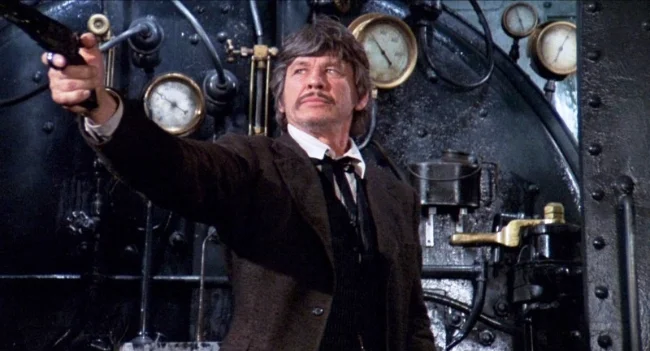
The western movie was in decline by the middle seventies and films such as Breakheart Pass strived to bring a fresh perspective to a tired genre. The film has a few flaws such as the episodic nature of the plot and the clichéd "cavalry to the rescue" ending but overall this is an honest adaptation of a mainstream bestseller. Alistair MacLean was the mainstay of many a Hollywood all-star action movie for over a decade with the likes of The Guns of Navarone and Where Eagles Dare. Breakheart Pass showcases why this was the case and all reiterates why Charles Bronson was so good at these minimalist anti-hero roles.
Blaugust – Thirty One Days of Movie Reviews
Blaugust is an annual writing event run by Belghast, designed to encourage bloggers to post content more often. Its original remit was to publish blog articles every day for a month but over the years it has become somewhat more flexible. When I relaunched Contains Moderate Peril a year ago, I decided to participate, despite my long term plan of reducing my content output. This year I’ve decided to join in yet again, although I shall be changing the focus of my writing. At present I’m not particularly inspired to write about gaming. Star Trek Online and Overwatch are the only titles I’m currently playing and I don’t have enough to say about either of those games to sustain a month worth of posts. So I’ve decided to return to my primary passion, cinema and the film industry.
Blaugust is an annual writing event run by Belghast, designed to encourage bloggers to post content more often. Its original remit was to publish blog articles every day for a month but over the years it has become somewhat more flexible. When I relaunched Contains Moderate Peril a year ago, I decided to participate, despite my long term plan of reducing my content output. This year I’ve decided to join in yet again, although I shall be changing the focus of my writing. At present I’m not particularly inspired to write about gaming. Star Trek Online and Overwatch are the only titles I’m currently playing and I don’t have enough to say about either of those games to sustain a month worth of posts. So I’ve decided to return to my primary passion, cinema and the film industry.
So I’m hoping to write about a broad selection of films from multiple genres over the month of August, depending on my personal circumstances which are somewhat fluid at present. I’m going to try and avoid mainstream contemporary blockbusters and focus more upon older, less well known titles. I often find when reading movie reviews by my peers that they don't seem to cover material from before the nineties. I personally like movies from the silent era right the way to the present and intend to explore films from all decades of the twentieth century. Hopefully in doing so, I can encourage some of my colleagues to broaden their cinematic horizons and discover some hidden gems.
This rekindling of my love of film is partly due to a list that film maker Edgar Wright published recently in which he named a thousand films that he has seen and considers to be of note. Many of those listed are favourites of mine and it makes for a welcome change from the usual top one hundreds movie articles that critics frequently produce. Mr Wright’s list has cinematic classics and art house films, cheek by jowl with exploitation movies and cult classics. It also reminded me that film is a subject I still have plenty to talk about and that it can provide a wealth of material for me to dissect and debate. So if all goes to plan I may well be able to write thirty one movie reviews over the forthcoming month, as well as some posts about the wider industry.
Cosmetic Uniform Controversy in Star Trek Online
Star Trek Online like many MMOs uses multiple in-game currencies. Reputation, fleet equipment as well as cosmetic items are purchasable using a variety of energy credits, dilithium and reputation tokens. Cryptic have therefore placed various restrictions governing these items to ensure that the game economy remains functional. However many players still amass sizeable quantities of these currencies overtime; especially those with multiple alts and sufficient time to invest in the game. At present although dilithium ore can be earned in multiple ways, a daily cap allows only 8,000 units to be refined each day. It is refined dilithium that can be used as a tradeable currency.
Star Trek Online like many MMOs uses multiple in-game currencies. Reputation, fleet equipment as well as cosmetic items are purchasable using a variety of energy credits, dilithium and reputation tokens. Cryptic have therefore placed various restrictions governing these items to ensure that the game economy remains functional. However many players still amass sizeable quantities of these currencies overtime; especially those with multiple alts and sufficient time to invest in the game. At present although dilithium ore can be earned in multiple ways, a daily cap allows only 8,000 units to be refined each day. It is refined dilithium that can be used as a tradeable currency.
Five years on from its launch STO has a sizeable player base with a high percentage of veteran players. Because of the nature of the franchise, a lot of these are lifetime account holders who invest heavily in the game and make it their personal gaming focus. In a nutshell, a lot of folk have a ton of dilithium. Farming across multiple toons is a common practise and even I have a modest supply that is regularly topped up via four characters. So naturally the game developers from time to time, create new dilithium sinks as a way of reducing the surfeit of this in-game resource. Today Cryptic did just that and added some cosmetic outfits to the dilithium store; items that had previously been available in the Zen store and purchasable for real money.
As ever with matters of this nature, the decision has been met with disapproval from some quarters. The prices for these cosmetic uniforms range from one to two million dilithium. That equates to approximately 2,482 Zen at current exchange rates which would cost about £17/$22.50 in real money. The fact that these purchases are character bound and not unlockable across an entire account has also met with criticism. However it should be noted that cosmetic items and ships are already purchasable from the Lobi store for similar prices with comparable criteria, which does somewhat mitigate such complaints.
I personally have no objection to dilithium sinks of this nature and it can be cogently argued that nothing currently on sale in the dilithium store is essential to play STO. Perhaps Cryptic could offer a wider variety of items, such as some of the limited edition ships that were exclusively available from previously events. Items of this nature may well be perceived as better value than cosmetic uniforms. However offering previously exclusive items can similarly antagonise a percentage of the player base, proving yet again that you cannot please everyone in the MMO genre. Ultimately this particular “drama” will pass with time, like most others and do no major harm to the game. Furthermore the need for a dilithium sink will continue to occur through STO’s lifecycle.
Star Trek Beyond (2016)
I am not a dogmatic fan. In fact as I get older, I become far more flexible and forgiving in my outlook. I certainly don’t buy into the concept that your “childhood can be ruined”. The only way something new can spoil the memories of something old that you hold dear, is if you allow it to. If you wish to explore this concept further, I’d suggest reading Marcus Aurelius. Back to the matter in hand. When I found out that Star Trek was to be rebooted via an alternative timeline plot device, I was content with this. I decided to ditch my personal baggage and try and be objective about the now named “Kelvin Timeline”. I make no bones about the fact I have liked the previous two Star Trek movies. Are they masterpieces? No. Are they entertaining? Yes. That is far more than some reboots have achieved.
I am not a dogmatic fan. In fact as I get older, I become far more flexible and forgiving in my outlook. I certainly don’t buy into the concept that your “childhood can be ruined”. The only way something new can spoil the memories of something old that you hold dear, is if you allow it to. If you wish to explore this concept further, I’d suggest reading Marcus Aurelius. Back to the matter in hand. When I found out that Star Trek was to be rebooted via an alternative timeline plot device, I was content with this. I decided to ditch my personal baggage and try and be objective about the now named “Kelvin Timeline”. I make no bones about the fact I have liked the previous two Star Trek movies. Are they masterpieces? No. Are they entertaining? Yes. That is far more than some reboots have achieved.
Since J.J. Abrams move from director to executive producer on the new movie franchise, I’ve been a little sceptical regarding the third instalment. Justin Lin is not a film maker I would have immediately thought of with regard to Star Trek. Thankfully, I am happy to say my personal misgivings have been proven wrong. The director’s frenetic signature set pieces are certainly present in Star Trek Beyond. But so is an obvious understanding of the source material. In many respects the film plays out like a big budget, extended episode of the original series. However far from being a criticism, this is a major compliment, showing that the entire production team fundamentally understands what makes the franchise great and what fans like the best.
The plot is relatively straightforward, involving the Enterprise being lured into an ambush within the confines of an uncharted nebula. Marooned on a nearby planet, most of the crew find themselves prisoner of Krall, an alleged alien warlord. However, Kirk, Chekov, Spock, McCoy and Scotty evade capture and plan to rescue their colleagues. It is here that the film comes into its own, with the focus on the crew interaction. The pairing of McCoy and Spock is very reminiscent of scenes from the original series and includes some classic banter between the two. I was very pleased to see Karl Urban given more onscreen time, as his portrayal of Doctor McCoy is spot on. Although at times reminiscent of DeForest Kelly, Urban manages to provide a contemporary spin on the character and make the role his own. The movie also comes to life when the classic trinity of Kirk, Spock and McCoy come together. It would also be remiss of me to not mention Simon Pegg who has an expanded role this time round. His pairing with another alien Jaylah (Sofia Boutella), who has also been marooned, provides a greater insight into the character. There is humour and pathos in his performance.
Star Trek Beyond also takes the time to ponder some wider issues pertaining to the franchise. I like the concept of a captain questioning the validity of the five year mission faced with the infinite nature of the universe. The screenplay written by Doug Jung and Simon Pegg also sensitively deals with death of Leonard Nimoy. The passing of Spock Prime causes his younger self to reflect of his various choices, such as joining Starfleet and his relationship with Uhura. It is a credible dilemma that could beset those who find themselves part of a diaspora. The movie’s only narrative weakness it with its villain Krall, played by Idris Elba. He lacks sufficient development and although we understand his motives, they are somewhat arbitrary. Perhaps some additional screen time could have remedied this minor deficiency.
It was announced last week by producer J.J. Abrams that the role of Chekov will not be recast after the tragic death of Anton Yelchin. However the franchise will see a further instalment with a plot featuring Kirk meeting his dead father, George. Despite some rather vocal naysayers, it would appear that these new movie set in the “Kelvin Timeline” are finding an audience and proving commercially viable. With Bryan Fuller recently revealing that his new TV shows will be called Star Trek Discovery, it looks like the entire Star Trek franchise is in good shape after fifty years. Star Trek Beyond certainly contributes to this current good standing and manages remain true to the spirit of Gene Roddenberry’s vision, despite an unlikely director.
My Home Entertainment System
The ongoing changes to the way we consume media is a common subject for discussion these days. In recent years I’ve written about it on this blog and discussed the matter at length with my co-host Brian on the podcast. The focus of these debates has usually been about the cultural shift away from fixed viewing schedules, to watching shows and movies on demand. For many people TV has broadly moved from a shared cultural experience defined by broadcast times, to a more isolated experience. One has to be doubly aware of spoiler etiquette these days, as friends and colleagues may well watch the same show but be a season ahead or behind.
The ongoing changes to the way we consume media is a common subject for discussion these days. In recent years I’ve written about it on this blog and discussed the matter at length with my co-host Brian on the podcast. The focus of these debates has usually been about the cultural shift away from fixed viewing schedules, to watching shows and movies on demand. For many people TV has broadly moved from a shared cultural experience defined by broadcast times, to a more isolated experience. One has to be doubly aware of spoiler etiquette these days, as friends and colleagues may well watch the same show but be a season ahead or behind.
However on this occasion I want to talk about the actual hardware that we use to consume media. My PC, tablet and phone are all used to varying degrees to watch videos and TV shows but the television in the lounge still remains the focal point for shared, family viewing. Today I made some minor changes to our home entertainment setup to try and make it more flexible with regard to our viewing needs. I could have spent several thousand pounds if I wanted to ensure I was at the bleeding edge of home entertainment but frankly I did not see the sense in that. Much of the hardware that’s currently in place is perfectly adequate so there was merely a need to augment rather than replacement. So that is exactly what I did.
The 38 inch Samsung TV that resides on the wall in the lounge is somewhat old but it’s only real deficiency has been up to now, it’s lack of online functionality. The attached BT YouView box provides access to both digital terrestrial television and premium IPTV services. It’s also a DVR and has a range of optional on demand services. Until today a LG Blu-ray/DVD player was the third device in this humble home entertainment system. It’s only additional function was playback of video files via a USB flashdrive. However in recent months a lack of access to You Tube, along with multi-region support for both DVDs and Blu-rays has proven inconvenient. An increased use of .mkv files has highlighted a need for network functionality.
With all this in mind, I decided to replace the LG player with a newer Panasonic model. The DMP-BD83 has the multi-region support I was looking for, as well as internet apps including You Tube. The player has an ethernet port at the rear and also reads external HDD of up to 4TB. As of today the new player has been installed and as a result we can now enjoy multiple forms of entertainment in one location. The only logistical problem was sourcing an additional ethernet cable to the location. The existing one which serves the IPTV box is connected to the internet router via twin powerline adapters. Rather than add more of these I just bought a mini switch and split the existing LAN connection. I even kept the cable management tidy.
I must admit I’m happy with the results of this nominal upgrade. Both items cost a total of £75 and I was fortunate enough to have a spare 1TB portable HDD available to connect to the new Panasonic player. This has allowed be to consolidate all my current TV shows and movies in one place and free up space on my PC. I also linked my phone to the new setup and can now easily search You Tube on my Samsung S6 but view the results via the TV. Overall the ageing Samsung television has now gained full smart TV functionality without incurring the cost of purchasing one. Furthermore the setup is not especially difficult to operate which is beneficial for my significant other, who is not a major fan of technology.
The only weak link left in the current setup is the audio quality. I have toyed with the idea of buying a soundbar but can’t find one that is the right size for the shelves. For the present I’m considering a single all-in-one wireless speaker as an alternative. Perhaps Google Home will offer an appropriate solution when it is launches later this year. In the meantime, what is currently in place is sufficient for our entertainment needs. Perhaps the next television we’ll buy will be 4K compatible. Certainly I’m sure they’ll be more online delivery platforms to consider in the future. However we’ll cross those bridges, as and when we come to them.
New Content or Rinse and Repeat?
Over the weekend I finally finished the Blood and Wine DLC for The Witcher 3: Wild Hunt. By which I mean I’ve completed the main story (and achieved the “best” of three possible outcomes) and all (allegedly) of the secondary quests. It’s hard to tell with this game; it may well still have surprises to spring within its open world. However pedantry aside, to all intents and purposes I’ve played through the game. This got me thinking about the thorny issue of game content because The Witcher 3: Wild Hunt and all its DLC contains a lot. Playable content is a subject that frequently comes up when discussing games because there is no standard quantity. Furthermore the nature of content itself varies. Some is meant to be unique where other is specifically designed to be repeated. Whatever a developers approach to this issue, a game’s content is certainly a key selling point.
Over the weekend I finally finished the Blood and Wine DLC for The Witcher 3: Wild Hunt. By which I mean I’ve completed the main story (and achieved the “best” of three possible outcomes) and all (allegedly) of the secondary quests. It’s hard to tell with this game; it may well still have surprises to spring within its open world. However pedantry aside, to all intents and purposes I’ve played through the game. This got me thinking about the thorny issue of game content because The Witcher 3: Wild Hunt and all its DLC contains a lot. Playable content is a subject that frequently comes up when discussing games because there is no standard quantity. Furthermore the nature of content itself varies. Some is meant to be unique where other is specifically designed to be repeated. Whatever a developers approach to this issue, a game’s content is certainly a key selling point.
Both the RPG and MMO genres are very much dependent on the volume of content that they contain. New releases need to ensure that the player has a viable amount of content to work through. It’s the same with expansions and DLC. Players want to feel they are getting “value for money” although that can prove a somewhat nebulous term to quantify. However creating quality new content for both these genres, is both expensive and time consuming. It requires input from writers, programmers and a plethora of other creative artists. Furthermore regardless how much is produced, players always seems to burn through it too quickly. Consumption and demand simply cannot be met.
One solution to this conundrum is to encourage players to replay old content. This is common in the MMO genre and is also applicable to RPGs. With a game such as The Witcher 3: Wild Hunt, due to the multiple story outcomes, there is a sufficient incentive to play again. Some MMOs will offer you a degree of new content if you play through old content with a new class or faction. SWTOR does this well, offering a bespoke central regardless of what character you choose to play. Guild Wars 2 also provides a similar degree of variety. Star Trek Online also does this to a degree, offering unique stories to each faction for the first third of the game. After that the remainder of content available is standardised. However Cryptic have cunningly devised ways to encourage players to repeat content. Last year saw the Delta Recruitment event and the current expansion, Agents of Yesterday, provides further incentives. Enhanced XP, bonus Dilithium, improved loot drops and account wide unlocks can encourage even the most reticent of STO players to do it all again.
Sadly there are many examples of games that are far from generous with their content. Star Wars Battlefront for example launched with a woefully poor amount of maps and game modes. Subsequent DLC has addressed this to a degree but that didn’t benefit those playing on day one of the game’s launch. Also many of the ageing MMOs suffer from a lack of new content. A declining player base means less revenue which inevitably means less frequent new content. LOTRO is a prime example of this. Since the game moved from paid expansions to free updates, most new content has just been variations on existing themes. It keeps the faithful quiet but does not bring new players to the game. Guild Wars 2 has also suffered from lack of regular new content. Last year’s expansion was aimed squarely at those players at level cap and the new content was far from universally well received. Beyond that the base game endured without any significant update for several years.
As a player, a simple solution to this problem is to not be an early adopter. Starting an MMO a year or so after launch often ensures a fair amount of content will be available. Once the game of the year edition of an RPG is released, twelve months after the initial launch, players often find the game bundled with all DLC and a lot of bug fixes. I tackled Skyrim in 2013, eighteen months after it’s release and as a result got over three hundred hours of enjoyment out of the game. However the issue of repeating content is a more difficult matter. Some players simply don’t like to play through material they’re already familiar with. It’s a position I have a degree of sympathy with as it’s not something I always enjoy. Certainly there is no incentive when it comes to older MMOs unless the games developers make it so. At present replaying through Rift, or Age of Conan: Unchained will not be significantly different experience to how it was five years ago.
Conversely music, books, films and TV can all be revisited at a later date after their original consumption, to varying degrees of success. This may be due to the respective depths of these mediums and the fact that content of these genres can be multi-layered and nuanced. Each visit can potentially yield something new or a broader meaning. The fact that we change with age and experience may also aid this process. Games may not necessarily follow suite. Gaming mechanics do not always offers such varied outcomes and unfortunately many games still suffer from poor narratives, especially the RPG and MMO genres. Overall I think that for the immediate future there is no long term solution to this problem. Content availability is still going to be a sticking point for both developers and gamers. Perhaps the future lies with games that side step this issue. Procedurally generated content is one option as is simply relying on non-narrative driven genres. Perhaps Pokémon GO and Overwatch ultimately offer greater longevity, due to their non-narrative nature. The content in these cases is the unique experience of actually playing the game. If that is the case we may need to rethink exactly what the definition of content is.
Pokémon GO – Ten Days Later
Ten days on from the launch of Pokémon Go the game has finally been officially released in the UK. However judging by the amount of gyms that have been claimed in my neighbourhood, it would seem that many people have already opted to download and install the client unofficially, like myself. Pokémon Go has gone beyond being just a popular mobile game and quickly morphed into a pop culture phenomenon. It’s everywhere at present and Nintendo are obviously enjoying the fruits of their labour. However it will be interesting to see in the weeks to come whether the level of enthusiasm the game currently enjoys can be sustained.
Ten days on from the launch of Pokémon Go the game has finally been officially released in the UK. However judging by the amount of gyms that have been claimed in my neighbourhood, it would seem that many people have already opted to download and install the client unofficially, like myself. Pokémon Go has gone beyond being just a popular mobile game and quickly morphed into a pop culture phenomenon. It’s everywhere at present and Nintendo are obviously enjoying the fruits of their labour. However it will be interesting to see in the weeks to come whether the level of enthusiasm the game currently enjoys can be sustained.
As for me, I’ve already dialled back by excitement for Pokémon Go. All the local Pokégyms are beyond my current level and none of my existing Pokémon are sufficiently robust enough to provide a significant challenge, so I’m mainly focused on collecting at present. Due to where I live, there are plenty of Pokéstops. It would appear that pubs, churches and parks all meet the games criteria to be a designated as such and there’s no shortage of these in South East London. Avery Hill Park next to the Halls of Residence for Greenwich University has over twelve Pokéstops and two gyms. The park itself can also offer a variety of Pokémon, which change according to the time of day.
The twenty minute walk that it takes to reach this particular open space, plus the time needed to walk round the entire park provides a great opportunity to hatch eggs. This is an additional facet of Pokémon Go that brings me pleasure, although it raised a curious look from Mrs Peril when I told her I was going out to incubate my eggs. It’s also the only aspect of the game that has so far made me contemplate spending money. I briefly thought it may be useful to purchase additional incubators but quickly shelved the idea. I already put enough money into several other games that I play and am still suspicious about the cost to fun ratio of mobile games. I also have a nagging doubt that I may get bored with Pokémon Go because I cannot invest the time that is needed to progress and succeed in the game.
One final part of Pokémon Go culture that is worth mentioning is the comradery. I was at the Crayford branch of Sainsbury’s yesterday and there was several families shopping while playing the game. A few friendly words were exchanged once everyone determined we were all doing the same thing, which makes for a pleasant change. I also noticed more people politely nodding and smiling when out and about. I guess the way we carry our phones and the manic grin is a bit of a giveaway that we’re all after the same rare Pokémon. Personally I find these minor but positive changes in social interaction a pleasant counterbalance to all the negative stories that have been associated with the game. It would seem that there are still many players who seem oblivious to their own and others safety.
Pokémon Go uses a popular franchise and combines it with the human compulsion to collect, as well as our love of gamifying the arbitrary and the mundane. I’m still not sure if the game is a stroke of genius or a case of the emperor’s new clothes. Certainly it has been nice to be part of a burgeoning craze while it actually happens, rather than being on the outside looking in. I also think that Augmented Reality may be the sleeper game format that gazumps the crown that Virtual Reality is striving for. We’ll just have to wait and see. In the meantime perhaps we should start placing bets on other popular franchises from the nineties that may be revived. My money is on Johnny Bravo.
Pokémon GO – The Madness Spreads
Well the world seems to be going crazy for Pokémon GO at present, myself included. I must admit the first thing I did today when I woke up was reach for my phone and log into the game. I ended up catching a Drowzee in my bedroom which came as a surprise to me. So much for me trying to temper my smart phone “addiction”. Just five days after the release of Pokémon GO, the Nintendo Corporation is enjoying a $7.5 billion increase in their market value. The game itself is certainly gaining a lot of media attention as well as traction with the player base, despite performance issues and bugs. I hope that Niantic release an updated client soon with various fixes.
Well the world seems to be going crazy for Pokémon GO at present, myself included. I must admit the first thing I did today when I woke up was reach for my phone and log into the game. I ended up catching a Drowzee in my bedroom which came as a surprise to me. So much for me trying to temper my smart phone “addiction”. Just five days after the release of Pokémon GO, the Nintendo Corporation is enjoying a $7.5 billion increase in their market value. The game itself is certainly gaining a lot of media attention as well as traction with the player base, despite performance issues and bugs. I hope that Niantic release an updated client soon with various fixes.
Although I applaud the notion of encouraging gamers to venture outdoors and exercise, it would seem that many of the problems that I and others pointed out last week, have indeed manifested themselves. PokéStops and Gyms are at times in inappropriate locations. Health and safety issues have also been raised over players pursuing their quarry. Sadly it’s the human factor that is the most upsetting and problematic. Stories have emerged of players behaving poorly in sensitive places such as cemeteries, churches and even the Holocaust Museum in Washington. The fact that some people don’t seem to have any grasp of social etiquette, decorum and old fashioned good manners both worries and angers me. Here are a few examples (and yes I know not everyone is an asshole but guess what, they’re far more than you think!)
Pokémon Go: Singapore company sacks Australian for rant
US Teens Accused Of Using Pokémon Go To Rob
Pokémon Go player finds dead body in Wyoming river while searching for a Pokéstop
However, it is not all doom and gloom. The Pokémon Company has since clarified that there is a system in place for buildings and businesses to be delisted from the game. "PokéStops and Gyms in Pokémon Go are found at publicly accessible places such as historical markers, public art installations, museums and monuments," a Pokémon Company spokesperson said. "If you want to report inappropriate locations or content, please submit a ticket on the Pokémon GO Support website https://support.Pokémongo.nianticlabs.com." In the meantime, let us hope that at least some of the offending individuals reflect upon the situation and moderate their behaviour.
Dark of the Sun AKA Mercenaries (1968)
British cinematographer Jack Cardiff had an extremely distinguished career working with the like of Powell & Pressburger, Hitchcock and John Huston. As a director he received acclaim for Intent to Kill (1958), Web of Evidence (1959) and Sons and Lovers (1960). However his 1968 adaptation of Wilbur Smith's novel Dark of the Sun (also known as Mercenaries) is often overlooked. In some respects this gritty action movie may have been a little before its time with regard to both its politics and depiction of the Simba Rebellion of 1964-65. It still packs a punch forty eight years later.
British cinematographer Jack Cardiff had an extremely distinguished career working with the like of Powell & Pressburger, Hitchcock and John Huston. As a director he received acclaim for Intent to Kill (1958), Web of Evidence (1959) and Sons and Lovers (1960). However his 1968 adaptation of Wilbur Smith's novel Dark of the Sun (also known as Mercenaries) is often overlooked. In some respects this gritty action movie may have been a little before its time with regard to both its politics and depiction of the Simba Rebellion of 1964-65. It still packs a punch forty eight years later.
Dark of the Sun is set during the Simba revolt when the Congo government recruited mercenaries to fight a Marxist insurgency. Rod Taylor and Jim Brown star as Captain Curry and Sergeant Ruffo, a pair of professional soldiers paid to retrieve a cash of diamonds. The story starts in a fairly formulaic fashion with the rag tag assortment of mercenaries being assembled, including racist ex-Nazi Henlein (Peter Carsten) and alcoholic Doctor Wreid (Kenneth More). As they travel by train into the Congo interior, they rescue Claire (Yvette Mimieux), a white settler and victim of the Simba revolt. On reaching the diamond mine, they find that the vault has a time lock and must wait several hours. Tension increases as the insurgent’s approach, especially as they have a reputation for committing atrocities.
What makes Dark of the Sun different from this point onward is its exploration of the polarised politics of Africa and its uncharacteristically harsh and brutal depiction of the atrocities. By the standards of mainstream cinema of the time, this was considered a hard edged movie for a studio such as MGM/UA. There are scenes of the Simba's raping a Nun and a man being dragged by a motorbike whilst having petrol poured on him. Another victim has a burning torch thrust in his face. There is also an inference of male rape, which was far from common place in US cinema at the time. The film also has several brutal fights between Taylor and Carsten which are still quite strong.
However it is not just these aspects that make the film so intriguing. Dark of the Sun also contains a subtle performance by Kenneth Moore. As an actor he always gravitated to bluff English stereotypes and has often been accused of simply playing himself; his screen persona being forever synonymous with his performances in Northwest Frontier and Reach for the Sky. Here he bucks the trend playing an alcoholic Doctor whose conscience gets the better of him. It’s a measured and thoughtful performance proving that Moore's had a far wider range than many thought. Doctor Wreid is a flawed man who struggles with his own failure, afforded a chance to do something right, no matter how futile it may ultimately be. If only Moore had chosen other such roles during his career.
There is an element of truth to Dark of the Sun, as the two lead characters are loosely based on real life mercenaries 'Mad' Mike Hoare and Siegfried Müeller. Although far from a historically correct depiction of events, the action scenes are robust and the location filming bolsters the authenticity of the narrative. There is also an air of melancholy to the film as it ponders the end of colonialism, the futility of war and the realities of international politics. I therefore recommend Dark of the Sun to action fans as an interesting late sixties exploration of the genre. Tonally it has similarities to Cornel Wilde's World War II movie Beach Red. It certainly showcases the talents of Jack Cardiff as an eclectic director.