
Taken 2 (2012)
If it worked once already, why not just do it all again irrespective of logic and statistical likelihood? Thus, in Taken 2 Ex-CIA operative (and mail order catalogue) Bryan Mills (Liam Neeson) is struggling to come to terms with his daughter Kim (Maggie Grace) growing up and his relationship with his ex-wife Lenore (Famke Janssen). If life wasn't complicated enough with being a Dad, Bryan finds himself up against a vengeful Albanian gang. It would appear that they're somewhat annoyed that he slaughtered their brethren in the previous instalment. Hence Bryan and Lenore are kidnapped whilst on vacation in Istanbul and face a grim death at the hands of the gang's patriarch, Murad Hoxha (Rade Šerbedžija). Once again, the criminal fraternity underestimates the resourcefulness of Mr. Mills and it is not long before the tables are turned.
If it worked once already, why not just do it all again irrespective of logic and statistical likelihood? Thus, in Taken 2 Ex-CIA operative (and mail order catalogue) Bryan Mills (Liam Neeson) is struggling to come to terms with his daughter Kim (Maggie Grace) growing up and his relationship with his ex-wife Lenore (Famke Janssen). If life wasn't complicated enough with being a Dad, Bryan finds himself up against a vengeful Albanian gang. It would appear that they're somewhat annoyed that he slaughtered their brethren in the previous instalment. Hence Bryan and Lenore are kidnapped whilst on vacation in Istanbul and face a grim death at the hands of the gang's patriarch, Murad Hoxha (Rade Šerbedžija). Once again, the criminal fraternity underestimates the resourcefulness of Mr. Mills and it is not long before the tables are turned.
Taken 2 is a tonally odd movie. It bookends the action content with what feels like a quasi-soap opera. A sort of "Life with the Mills family", where Bryan blunders through every stereotype about being a modern Dad. Again, there are plot holes a mile wide along with a total disregard for the laws of sovereign nations. It would appear that running gun battles, car chases and the use of hand grenades are not a big deal in Turkey, just like they weren't in Paris in the first movie. In this alternative universe, people also recover very quickly from traumatic, life altering events such as kidnapping, a near fatal wound and both physical and psychological torture. "Oh, those pesky Albanian gangsters really are a nuisance. Who wants an ice cream?"
Yet despite the complete stupidity of virtually every aspect of Taken 2, it still manages to shrug off all these criticisms and play a lone trump card that saves it. Yes, Liam Neeson manages to carry Taken 2, by the sheer force of his personality, irrespective of the ludicrous dialogue, crass narrative and total lack of internal logic. I don't quite know how to define it, but Mr. Neeson has a quality about him that somehow cancels out all these negative points. He commands the viewers’ attention by being a sort of alpha male, “pater familias”, sexy old death machine. A real achievement for a sixty-year-old man (at the time of filming).
There is a paradox regarding the action sequences in Taken 2. There are some very interesting techniques used, but they are somewhat difficult to discern due to the lightning editing. There is a telescopic baton fight of note and a climatic hand-to-hand battle that is very impressive. Again, I can only recommend the unrated version of the film. The theatrical version was reduced in content to obtain lower ratings on both sides of the Atlantic. Unlike the perfunctory nature of US action movies, there is a noticeable cruel streak running through Taken 2. Some may find this unpalatable. The torture of Lenore focuses very much upon her psychological suffering as the villain brandishes the instruments, he intends to use upon her.
Critics lined up to pour scorn on Taken 2 upon release. Director Olivier Megaton was quickly accused of being the French McG. The film certainly is quite spectacularly preposterous, yet still manages to entertain with it's interesting locations and the towering presence of Liam Neeson. Plus, any movie that advocates locating people by using a map, a bootlace, a pen and several hand grenades deserves some credit. So, I do not feel disposed to join others in beating of this particular cinematic piñata. We all choose to adopt some waif and stray or lost cause at some point. Taken 2 is mine.
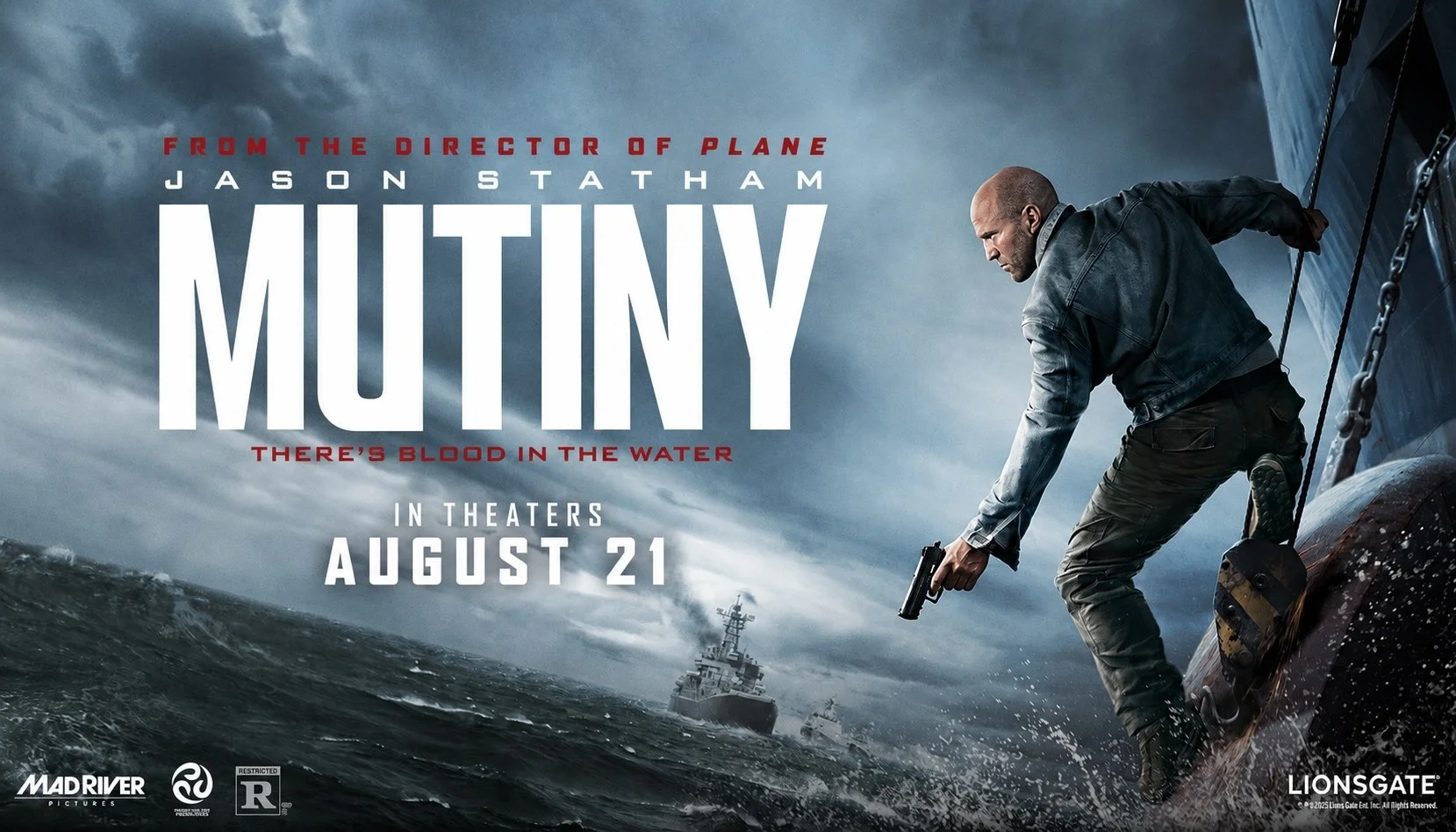
Jason Statham is an exemplar of the US mantra of “staying in your lane”. He makes action movies and occasionally strays into action comedies. His formula broadly works and is sufficiently lucrative to keep Mr. Statham employed. Therefore, if you watch a film in which he stars, you have a fairly good idea of what you’ll be getting. Of late, the criteria for his action vehicles have become more succinct. Jason Statham will play an innocuous character, such as a construction foreman or a bee keeper. Something terrible will subsequently befall another character who Mr. Statham has an emotional connection with in some capacity. He will subsequently hunt down those responsible and meet out death and violence. At some point the villain of the story will enquire as to how this innocuous person is so lethal. Research will then show that our Jason is in fact an ex-police officer/special forces operative/international assassin. There’s then a showdown and the villain dies. Job done.
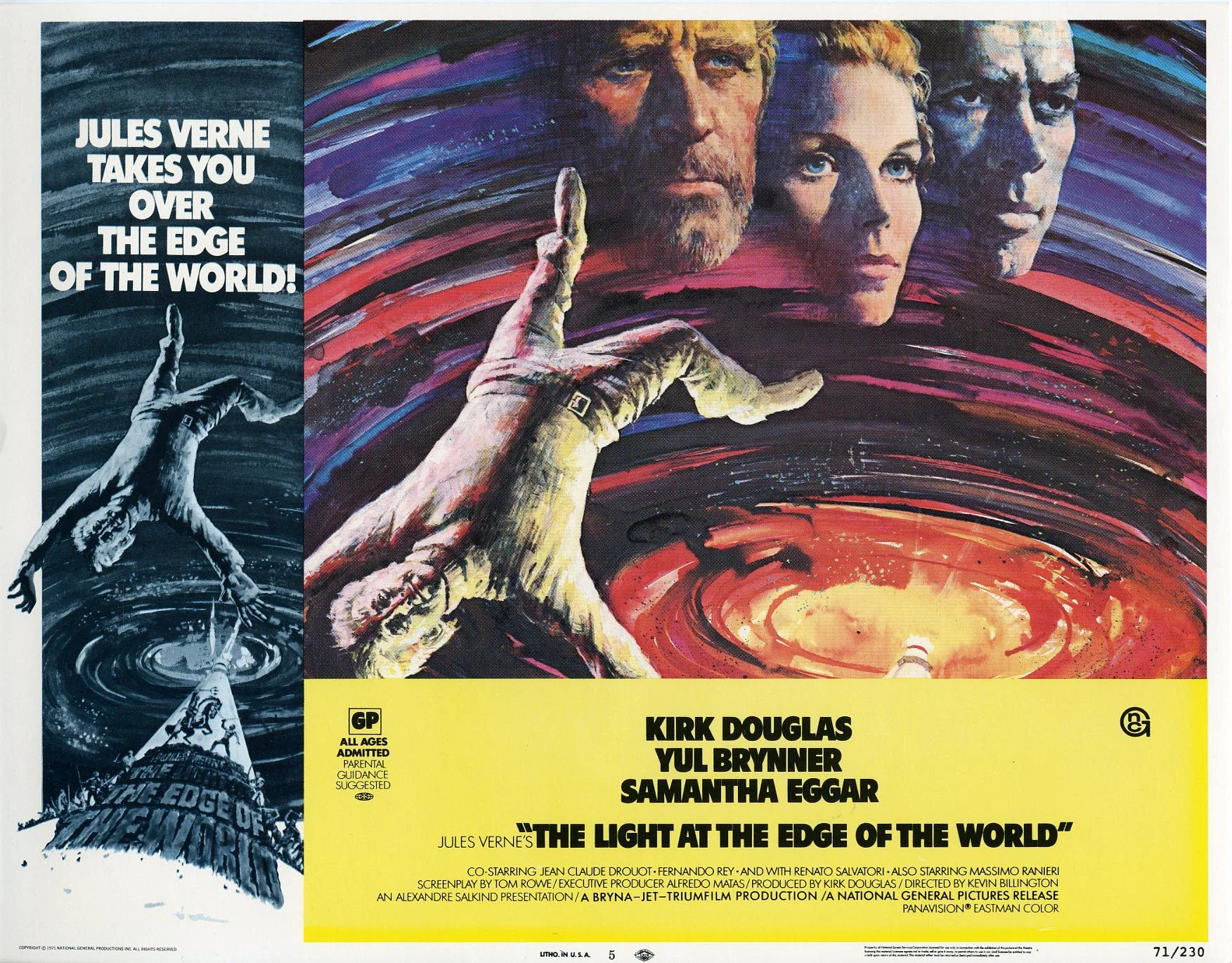
The Light at the Edge of the World presented itself as an action movie upon its release in 1971. Based upon a story by Jules Verne, the Spanish American co-production was driven by its star Kirk Douglas, who curiously hired British director Kevin Billington to helm the project. This tale of a lighthouse keeper fighting a war of attrition against a group of pirates that have captured his island, was market as an adventure film ostensibly in the idiom of the authors previous works and as a pirate movie. MGM bought the rights to distribute the film in the UK on the misunderstanding that it was a family friendly production. It was not and remains so. They subsequently had to cut 15 minutes of violence and torture as well as an undercurrent of sexual assault to secure a suitable rating. Conversely, the US distributors received an arbitrary PG rating, despite the fact this is one of a handful of films that honestly depicts pirates as murderers, rapists and worse.
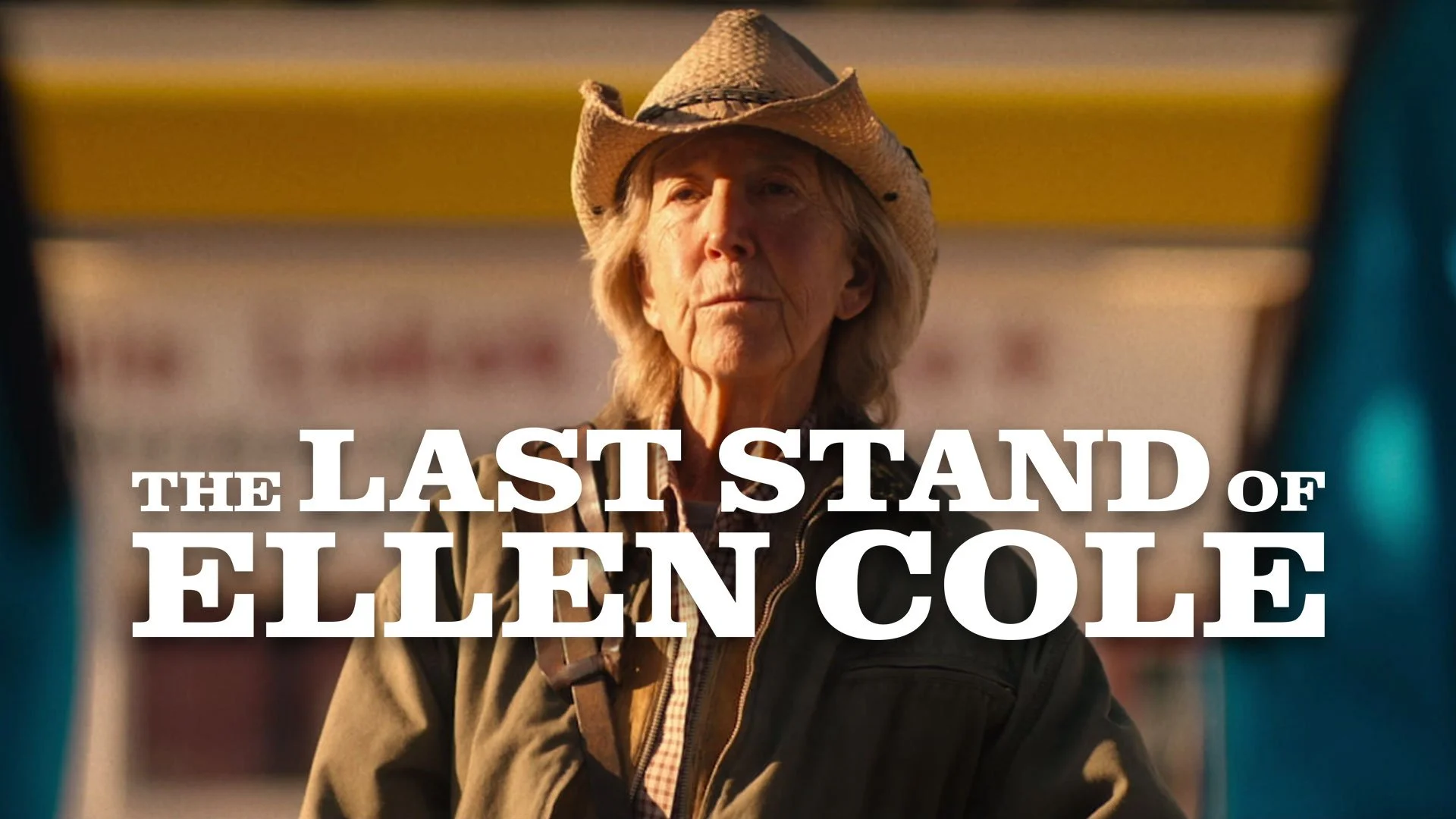
It’s an established action film trope. The fire team comprised of ex-military personnel, move in on their target. Only to have the tables turned by someone they don’t deem a threat. What makes it different in The Last Stand of Ellen Cole is a throwaway line of dialogue. The bested operative lies bleeding on the floor and the protagonists stands over them ready to finish them off. “Don’t, I have a cat” they feebly plead. For me that was the icing on the cake. The movie had already established it was taking the “same old, same old” and doing something different. Something fun, if taken in the right spirit. This scene tipped the balance and I embraced this film because it was being honest about what it is. This is a modern B movie that decides to give a very specific sub-genre a makeover. Furthermore, its clearly done with an affectionate wink, which is very different to sly wink. This isn’t deliberate self-knowing irony. Its just a film doing something different and possibly silly but it genuinely wants to have fun with it.
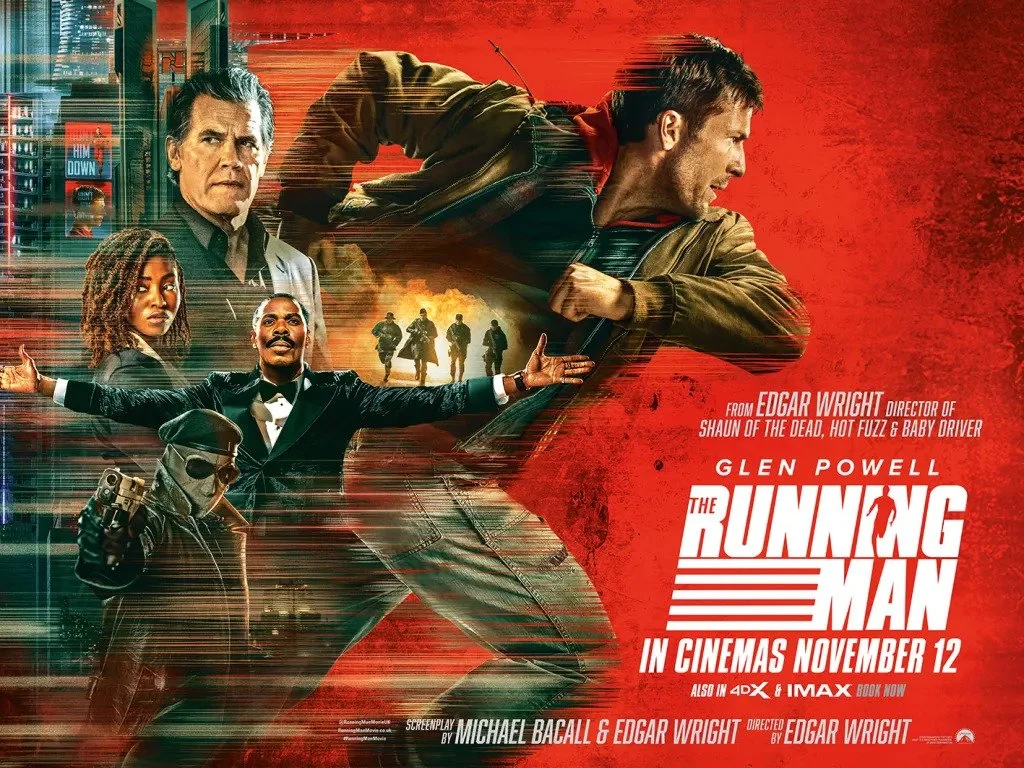
Stephen King’s dystopian story, The Running Man, was previously adapted very loosely in 1987, as a vehicle for Arnold Schwarzenegger. That version focused mainly on the “Battle Royale” element of the story and leaned heavily into Arnie’s personality, rather than the politics of the book. It also wasn’t well received by the author. Edgar Wright’s remake follows the source text a lot more closely and is far more interested in its political themes and wider social commentary. Furthermore, this version re-establishes the everyman quality of the hero of Ben Richards, rather than him being the muscle bound, ex-military hero as per Mr. Schwarzenegger’s prior interpretation. This time round, The Running Man uses a lot of the visual and narrative tropes of contemporary reality TV, making this forty three year old story very relevant to today’s viewers and couching the film in a style that is recognisable and accessible.
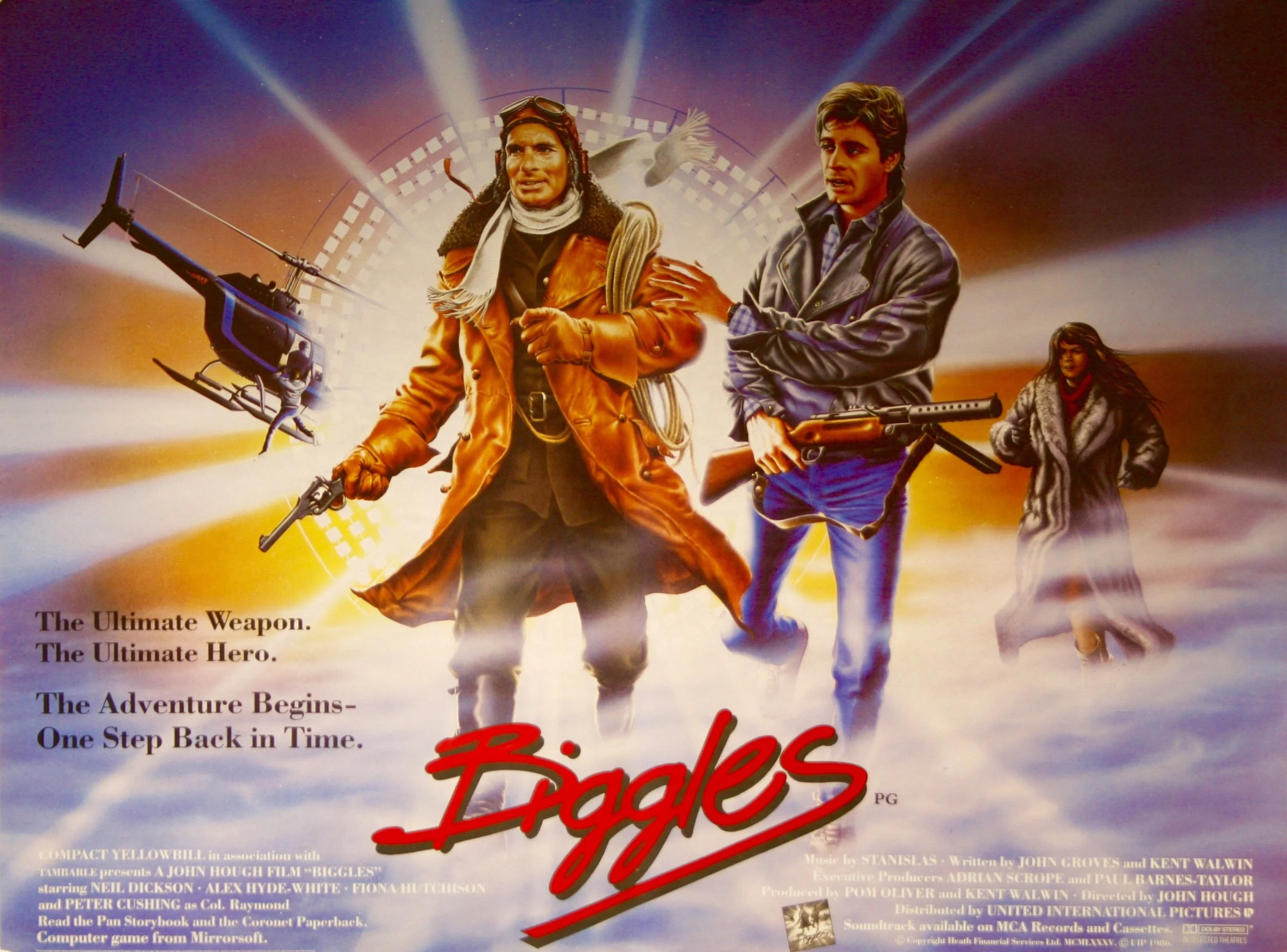
After the success of Raiders of the Lost Ark in 1981, filmmakers scrambled to find existing intellectual properties that they could use for similar films. Hence archaic heroes such as Alan Quatermain were hastily given a modern makeover and thrust into generic movies, in a vague attempt to replicate Steven Spielberg’s successful formula. Which brings us neatly on to James Charles Bigglesworth AKA “Biggles”, a fictional pilot and adventurer from a series of books written by W. E. Johns between 1932 and 1968. Several attempts had been made in the past to bring this character to the silver screen, including one by Disney but they all failed. However, the commercial and critical success of Indiana Jones provided sufficient impetus to greenlight a new film. However, due to some curious production choices, when Biggles was finally released it was far from just a period set, action movie.
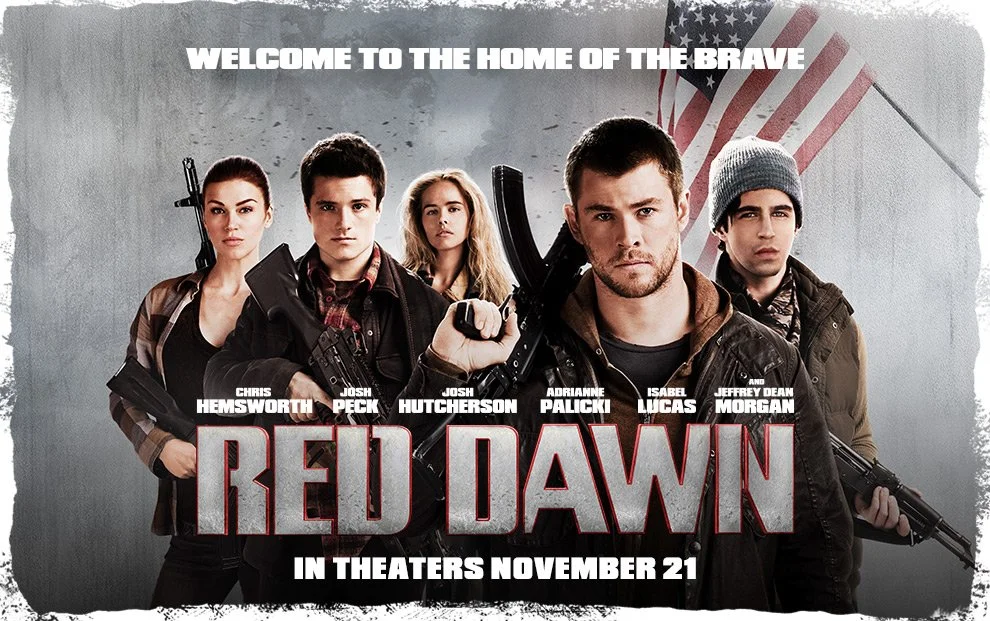
Setting aside the hubris of remaking a film such as Red Dawn, the 2012 reboot had a troubled production. Shot over the course of late 2009, on location in Michigan, MGM intended to release the film in September 2010. However, the studio’s financial problems became unsustainable over the course of that year and the film was shelved, while a financial solution was sought. Furthermore, while Red Dawn was in post production, there was a major economic shift within Hollywood due to the increasing importance of the Chinese market. This was a significant problem for MGM because the new version of Red Dawn had the Chinese invading the USA instead of Russia. Hence there were reshoots and the need for additional visual effects, so that the Chinese could be replaced with North Koreans. MGM eventually went bankrupt and the distribution rights to Red Dawn were sold off. The film was eventually released in 2012.
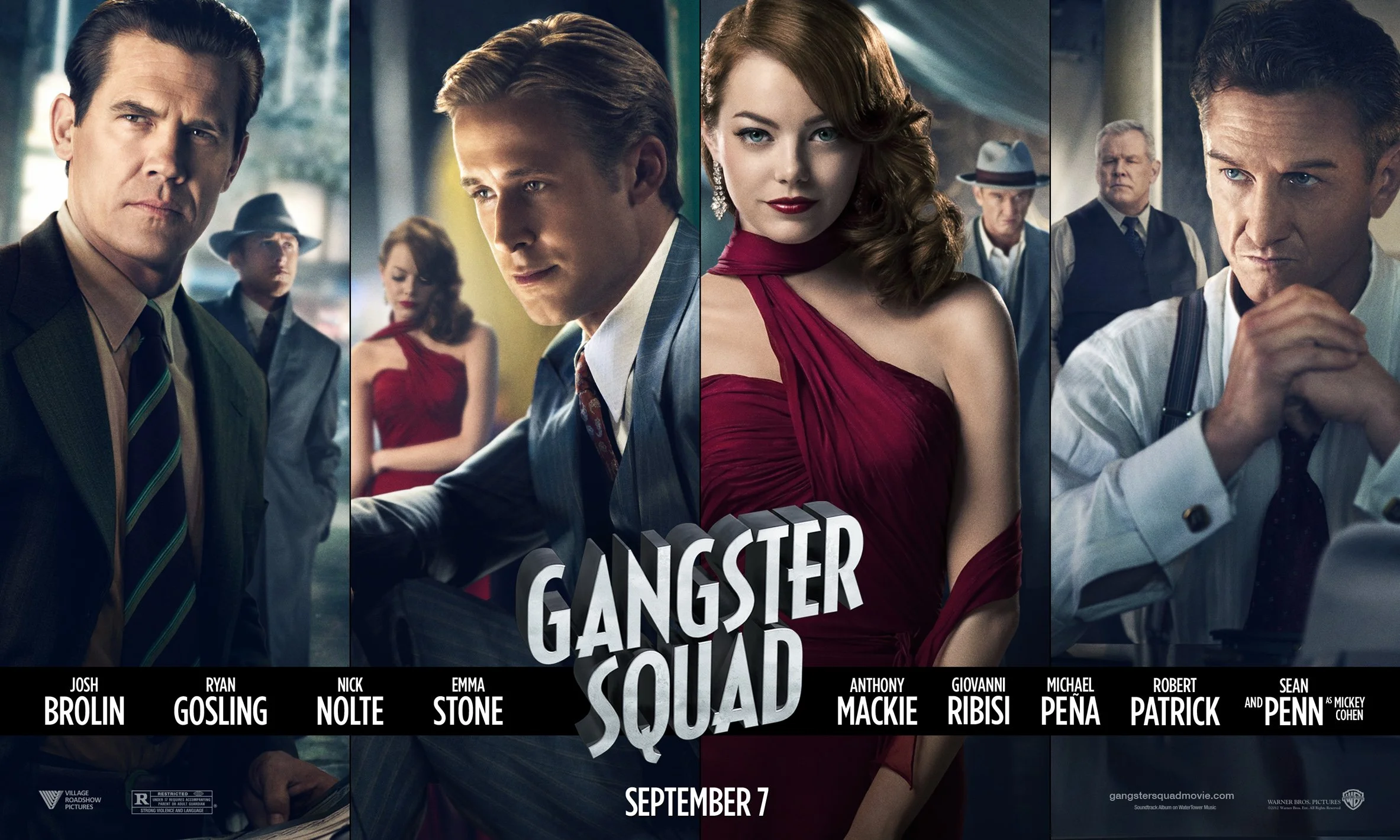
When I first saw the promotional trailer for Gangster Squad back in 2012, prior to its release, I wasn't especially impressed. I simply thought the film was another attempt to re-invent the gangster genre for a generation who were not especially familiar with it. I wasn't exactly overwhelmed with director Ruben Fleischer's resume either. I didn't particularly like Zombieland and haven't seen 30 Minutes Or Less. Then came the tragic mass shootings in Aurora, Colorado which led to the movie being delayed so that the original ending, which featured a shoot-out in a movie theatre, could be replaced. Hence when I finally watched this film recently, I wasn't expecting a movie up to the standards of say Once Upon A Time In America or Miller’s Crossing and it would seem that I was right do so. Gangster Squad is not especially noteworthy in any respect.

Levon Cade (Jason Staham) is a former Royal Marine Commando who has retired from military service and now works as the leader of a construction team in Chicago. He has a close relationship with Joe and Carla Garcia (Michael Peña and Noemi Gonzalez ) who run the company and considers them as family. Outside of work, Levon is involved in a bitter custody battle for his daughter, against her maternal grandfather, who blames Levon for his daughter’s suicide. When Garcia's teenage daughter Jenny (Arianna Rivas) goes missing, Levon reluctantly agrees to help her parents and get her back. Beginning his search at the nightclub where Jenny was last seen, he soon discovers that she was abducted by Russian traffickers. Furthermore, the culprit is Dimi Kolisnyk (Maximilian Osinski), the wayward son of a senior ranking gangster.
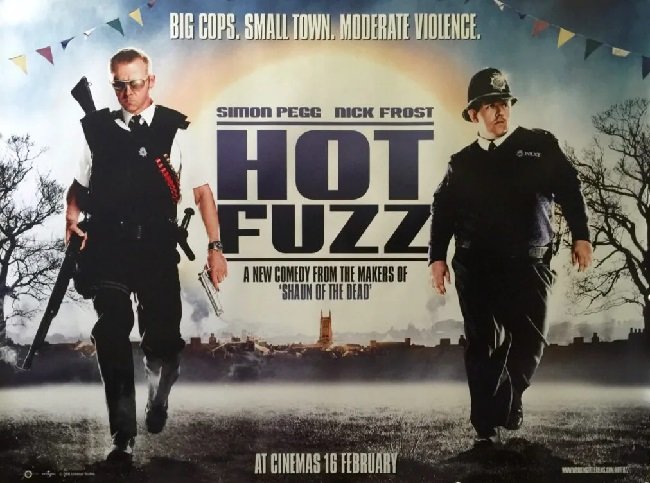
PC Nicholas Angel (Simon Pegg) is an exemplary Police Officer, with a strict adherence to the letter of the law. As a result of making the rest of the London Metropolitan Police look bad, he is transferred to the rural town of Sandford, Gloucestershire. On arrival, Angel finds that the local Inspector, Frank Butterman (Jim Broadbent), takes a far more laissez-faire approach to policing. His colleagues are incompetent and he is further hampered by the Neighbourhood Watch Alliance (NWA), who prioritise low crime statistics over law enforcement due to their desire to win the title of “Village of the Year”. Furthermore, Angel is partnered with the Inspector’s son, Constable Danny Butterman (Nick Frost), who is infatuated with “buddy cop” movies and is in awe of Angel’s London experience. “Have you ever fired two guns while jumping through the air?” However, a sudden spate of grisly accidents lead Angel to believe that there's more to the seemingly tranquil and picture-perfect community than meets the eye.
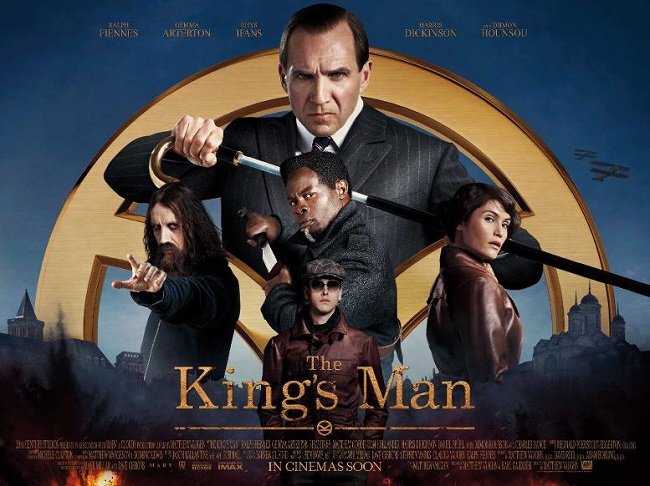
As a collection of history's worst tyrants and criminal masterminds gather to plot a war to wipe out millions, one man must race against time to stop them. Discover the origins of the very first independent intelligence agency in The King's Man. Based on the Comic Book “The Secret Service” by Mark Millar and Dave Gibbons. 20th Century Studios
Matthew Vaughn’s The King’s Man is an inconsistent film, both narratively and tonally. It veers between serious themes and stylised, hyperbolic action. At times it does quite a good job of exploring such complex subjects as global politics, mechanised warfare and colonialism. Sadly it then wrenches the viewer out of these cerebral reveries as it lapses into the sort of over the top action sequences that were notable in the two earlier films. It’s a shame because The King’s Man gets so many other aspects of the production right. The casting is very interesting, especially Ralph Fiennes as the “pacifist” Duke of Oxford. He is actually a very good fit for the action genre. Djimon Hounsou and Gemma Arterton are given little backstory beyond being respectively the faithful manservant and the family nanny but both are notable due to their own inherent acting chops and personal charisma. Rhys Ifans obviously has a great time as Grigori Rasputin, ensuring all the man’s vices are robustly depicted.
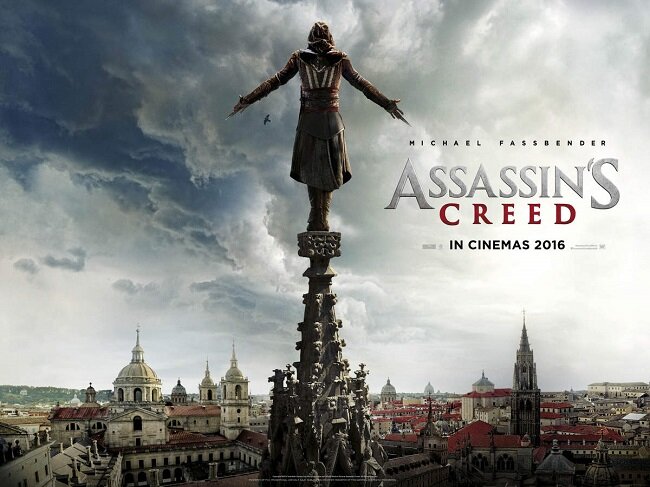
On paper, a video games franchise such as Assassin’s Creed lends itself perfectly to a cinematic adaptation. The parkour action scenes, the historical settings and the contemporary conspiracy theory themes are all elements that should play well with a modern youth audience. Hence with the backing of a major studio such as Twentieth Century Fox and a budget of $125 million, the 2016 movie should have been a guaranteed box office hit. The casting of Michael Fassbender, an actor who is comfortable with serious roles and big Hollywood franchises, should have carried this film comfortably over the finishing line. Director Justin Kurzel, who had found critical success with his adaptation of MacBeth a year previously, must have looked like a safe pair of hands to handle such a project. Sadly, that was not the case. Assassin’s Creed is not the sum of its parts, in fact many elements appear to be pulling in opposite directions. The resulting feature film is staggeringly dull, soulless and a chore to watch. A testament to how modern big budget franchise movies have become a production line, with all the art stripped from them.

300: Rise of an Empire is a curious beast, being neither a sequel nor a prequel. It is infact a tale that takes place simultaneously with those of the original movie. While Gerard Butler is busy making a last stand at the Battle of Thermopylae, fellow warrior and politician Themistokles, played by the singularly uncharismatic Sullivan Stapleton, leads a similar army of buffed Greeks against the Persian fleet. Once again we have a movie that is the epitome of style over substance, complete with a sound design that challenges what can physically be endured by human hearing. They say the first casualty of war is innocence but in this type of movie it's closely followed by historical accuracy and authentic depictions of ethnicity. 300: Rise of an Empire is a cinematic assault upon the senses but not in a good way like Mad Max: Fury Road.
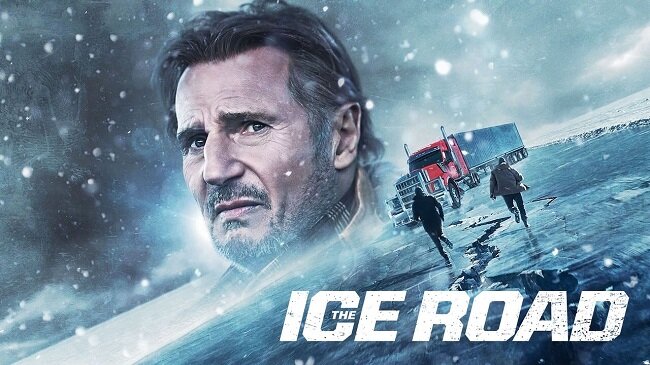
Back in September 2017, Liam Neeson stated in an interview with Sky News that he was retiring from the action genre, due to his age. He felt that audiences would question his credibility in such roles. After the release of The Commuter (2018) and Cold Pursuit (2019) Mr Neeson appeared to return to human dramas and films that focus on performance rather than punching man and beast. Ordinary Love and Made in Italy, both released in 2019, demonstrate the actor’s versatility and skill. People seem to forget that he is a thespian who was initially known for his character driven roles in films such as The Mission (1986), Rob Roy (1995 and Michael Collins (1996). It was only in 2008 that he reinvented himself as an action hero. It’s all a far cry from Schindler’s List and his performance that earned him an academy award nomination. The reason I mention all of this is because The Ice Road is the third action movie I’ve seen in 2021 that stars Liam Neeson.
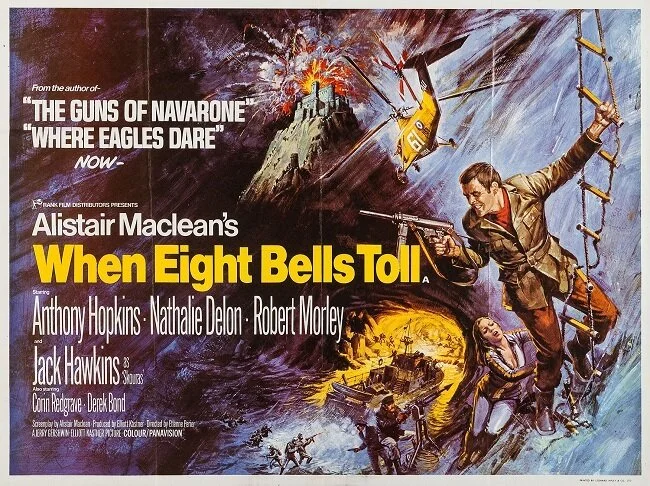
One of the stand out tropes of the modern action film is that the stakes are always cranked right up to 11. Terrorists, biological weapons and nuclear bombs are common threats in such movies with a hero or heroes trying to save the world from death and destruction or worse. However, back in the sixties and seventies, things were a little more straight forward and in some respects more credible. Take When Eight Bells Toll, released in 1971, for example. British Treasury secret agent Phillip Calvert investigates the theft of £8,000,000 in gold bullion by a gang of international smugglers. In the context of the times this was no small beer however it’s somewhat mundane compared to fighting super villains and their space lasers. Frankly I prefer these low key plot devices as they can make a film a little more plausible within the confines of the genre. A concept that is often forgotten today.
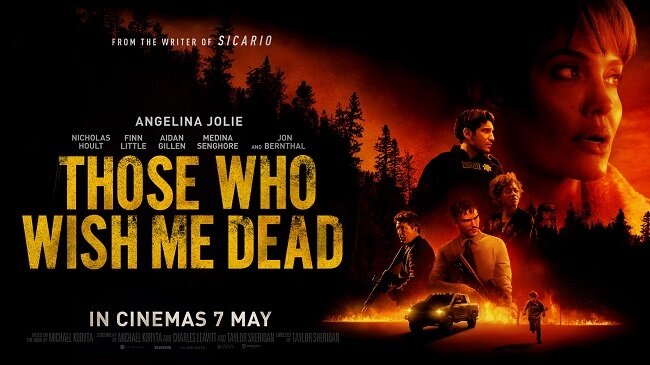
Forensic accountant Owen Casserly (Jake Weber) flees his home with his teenage son Connor (Finn Little) when he discovers he has been targeted by a pair of assassins (Nicholas Hoult and Aidan Gillen) who have been hired to stop him giving evidence in a major corruption case. Connor witnesses the murder of his father after their car is run off the road. Entrusted with important written evidence, he escapes into the dense forests of the Montana wilderness pursued by the killers. Seeking help he runs into smokejumper Hannah Faber (Angelina Jolie) who is stationed at a remote fire lookout tower. Hannah suffers from PTSD from a previous forest fire in which she was unable to save three young boys. Hannah attempts to lead Connor through the forest to safety. Meanwhile the assassins set fire to the forest to divert the attention of the authorities and cover their tracks.

I must admit that I did not have particularly high hopes for Paul W S Anderson's remake of the 1975 Roger Corman produced cult classic. Anderson’s work varies greatly. Event Horizon and Soldier are solid genre films but I still have not fully come to terms with Alien vs. Predator. Jason Statham is also a name that divides the public, with solid material such as The Transporter and unfathomable tosh like Revolver. But despite these considerations, Death Race is in fact quite a surprise and does not follow the path that so many remakes do. It takes the basic themes and concept associated with the original and tries to do something different with them. It doesn’t reinvent the wheel nor is it a genre milestone. But it does offer a different spin on things, have some engaging action scenes and provide some dumb but enjoyable entertainment. When combined with snacks and some beer this is a passable way to kill 111 minutes.
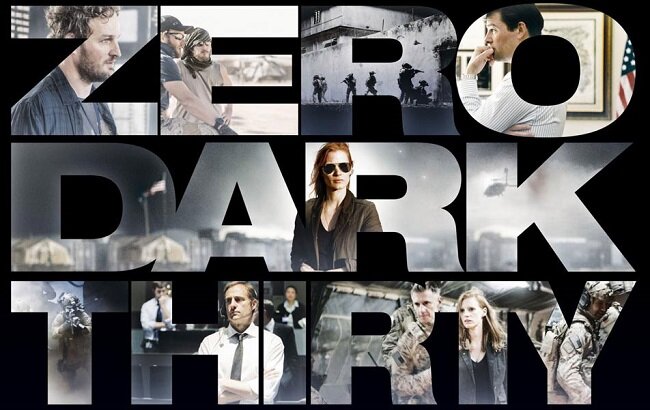
I did not watch Zero Dark Thirty upon its initial release, due to the politics surrounding it. I wanted to be able to view it free from bipartisan debate. Eight years on I believe this now achievable and although debate still exists it is now more measured and less strident. Zero Dark Thirty is certainly a compelling movie. It plays as a docudrama, providing an in-depth study of the US intelligence services hunt for Osama Bin Laden. It cannot be faulted on a technical level and the performances are very strong. It does not adopt a celebratory or triumphalist tone in its approach to the story. Director Kathryn Bigelow endeavours to keep the proceedings focused upon the intricacies of an intelligence driven manhunt. There is little or no tubthumping, jingoism. The decision to find Bin Laden is shown as a political and military exercise of foreign policy. The film solely focuses on the story from a US perspective but that is perfectly acceptable as it is not intended to be an exploration of geo-politics.
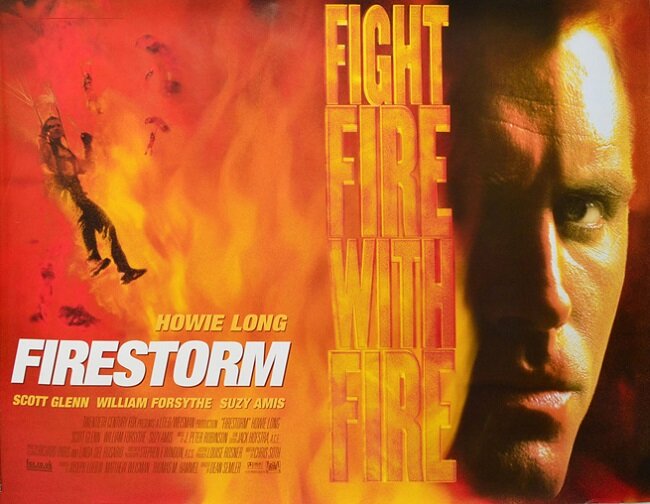
Firestorm was originally written as a vehicle for Sylvester Stallone, however when the production company Savoy Pictures went bankrupt the screenplay was bought by Twentieth Fox and the scope of the movie reduced to suit a lower budget. It’s broadly similar to Cliffhanger in so far as the lead character is a specialist in a certain field who runs afoul of criminals in a perilous environment. Whereas Cliffhanger is set in the Rocky Mountains, Firestorm takes place in the forests of Northern Wyoming. After the script was revised four times, the finished screenplay was given a final “polish” by Graham Yost who has considerable experience with the action movie genre. As stallone was no longer associated with the project and the production had been repurposed to be less extravagant, the movie was assigned to former NFL star Howie Long. Long had already appeared in the John Woo movie Broken Arrow (1996) and the Firestorm was seen as a means to give him a star vehicle.

The original French movies District 13 and its sequel District 13: Ultimatum, conceived and produced by Luc Besson, were enjoyable variations of the Escape from New York theme. Their charm lay in their European pedigree and the skilful use of parkour. The two leads, David Belle and Cyril Raffaelli, were eminently suited to the minimalist roles and the screenplays were fun. Half of these movies appeal was the fact that they were not mainstream US products. Brick Mansions is the Hollywood remake of District 13, as well as being Paul Walkers’ final movie. Sadly, this film is far from a fitting epitaph, being devoid of any charisma or innovations. It is blandly shot , poorly edited and has been stripped of everything that made the original entertaining.
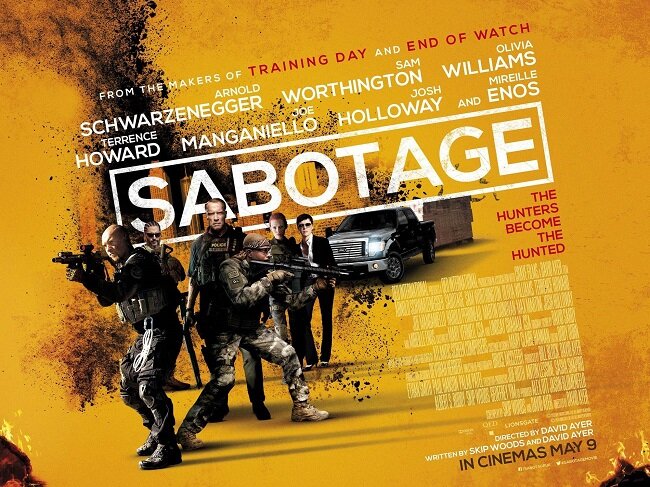
Arnold Schwarzenegger's return to the big screen after his political career has been uneven to say the least. His cameos in The Expendables and The Expendables 2 were well received, with their self referential charm and age related irony. Yet his first major movie The Last Stand, although competent, failed to find an audience. Escape Plan fared better at the box office but did not put Arnie back on the A list. Effectively there's a large percentage of the contemporary cinematic audience who were born after his heyday and are simply not overt fans of his work. His core audience is more than likely of the age group that consume most of their film entertainment at home. Which may explain why Sabotage tanked in the US upon release on March 28th 2014. It was the worst opening box office of Arnie's career. He used to break first day opening records.
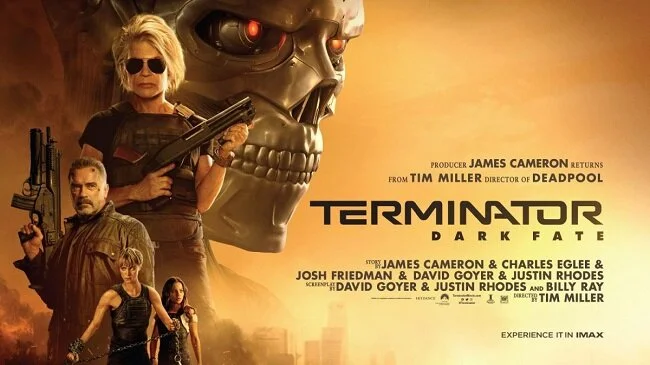
Sequels and reboots are hardly a new concept and have been a part of Hollywood culture since the 1930s. The success of the Universal Horror movies from that era being a prime example of direct follow ups and retconned movies. However, there is one fundamental rule that distinguishes a good sequel from a bad one. You should never mitigate, undermine or make irrelevant the events of the previous movie, just to provide your new film with a raison d'être. For example, the events of Aliens do not contradict or trivialise those that happened in Alien. In fact with that franchise there is a very clear logical progression between the two movies. The same is true for Mad Max and Mad Max 2 or Star Wars and The Empire Strikes Back. The key is to progress a story, enhance it or explore things from an alternative angle and bring something new to the cinematic table. Sadly this philosophy is all too often lost on corporate film making. Which means that many sequels are just tedious replays of prior films. Terminator: Dark Fate falls squarely into this category.

The enduring appeal of the character John Rambo in First Blood comes from the fact that he is a traumatised ex- service man who keeps himself to himself as he drifts from job to job, trying to come to terms with his wartime experiences. His poor treatment at the hands of a small-town Sheriff is a succinct metaphor for the social and political indifference that Vietnam veterans were shown upon their return to the US. He’s a man with a code in a world that no longer has any use for him. His simple and honest patriotism is not returned and he is in fact viewed with shame by many from the nation he loves. Furthermore, the first movie does not paint him as a cold-blooded killer. Despite provocation he is not the first person to shoot to kill. Rambo is in many ways a victim. A broken man, who society has asked to do unspeakable things. Now society wants nothing to do with him and fears the “monster” they created. Although clearly an action movie, First Blood had narrative depth and a flawed but sympathetic protagonist. 37 years and four movies later, such dramatic themes have long left the franchise. The central character is indeed a caricature of its former self.

It was hardly surprising that the movie adaptation of Chris Kyle's autobiography American Sniper, would cause controversy. The Iraq war, US Foreign Policy and national pride are seldom subjects that are discussed in a calm and measured fashion. And then there are the personal politics of director Clint Eastwood to consider. Hence there were claims from some quarters upon the movie’s release, that it was Islamophobic and counter claims that criticisms of the late Chris Kyle were unpatriotic. There still remain issues regarding the authenticity of events depicted in the source text and subsequently the movies screenplay by Jason Hall. Yet none of these factors have in anyway impacted upon the film's box office returns which currently stands at $247,900,417 worldwide.
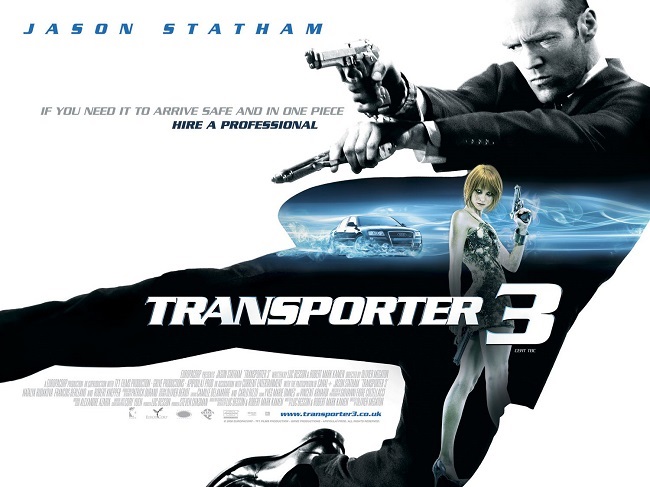
Do I really need to present you with some sort of plot synopsis for Transporter 3? No, I didn’t think so. More of the same as Frank Martin (Jason Statham) and his police chum, Inspector Tarconi (Francois Berleand) become embroiled in yet another high-octane escapade. There's fights, car stunts, exotic international locations and a strong sense of humour. This time, the disposable love interest is a Ukrainian girl named Valentina (Natalya Rudakova) who fulfils her role succinctly. The film benefits by being set back in Europe, after the mistake of basing Transporter 2 in the US. This time, the story takes us to such locations as Budapest and Odessa. The international film crew once again bring a veneer of panache to the production that is conspicuously absent in US action movies. For a modest budget fil, Transporter 3 it looks very good. Again the proceedings are given a boost by a pertinent soundtrack by Alexandre Azaria and a selection of European “tunes”.

Jason Bourne originally graced our screens for the first time seventeen years ago. The Bourne Identity was a gritty, minimalist take on the espionage genre and a welcome change from the excesses of the Pierce Brosnan Bond era. The story arc was sustained over three movies and ended efficiently and succinctly. After which Matt Damon moved on, as did the director of two of the movies, Paul Greengrass. Which leaves us with The Bourne Legacy; the tangential sequel that arrived in 2012. A film that exists because the money men and bean counters hate to pass up on a franchise until it has been squeezed utterly dry. Hence, they commissioned the writer of the series, Tony Gilroy, to come up with a screenplay and direct a spinoff movie. Jeremy Renner was cast in the lead role. Yet despite narrative and production continuity, The Bourne Legacy was not a Jason Bourne movie with the star appeal of Matt Damon. Although the film turned a profit, it had the lowest box office returns out of the entire franchise.
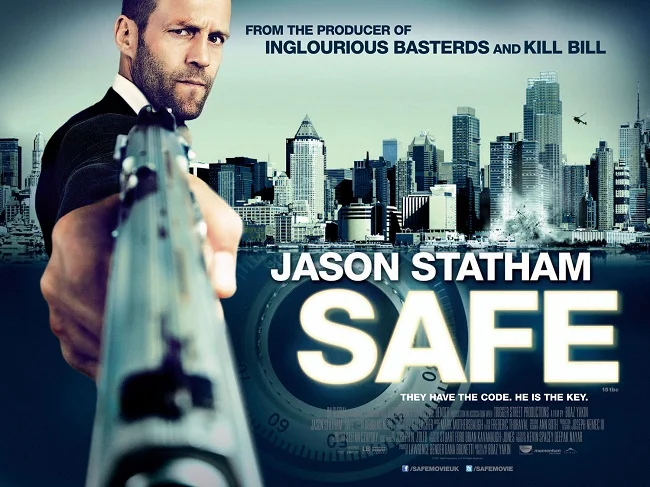
During the eighties there was a clear league table of action movie stars. By the mid-nineties this system fell into decline and the Hollywood lacked any clearly defined exponents of the genre. A decade later, due to the success of Luc Besson’s Transporter films, Jason Statham became a bankable box office star in this field. When you look at Statham's early work in Lock, Stock and Two Smoking Barrels it is hard to envisage the "mockney geezer" as an international action star. Yet he has successfully stepped into the role and enjoys a large following. I enjoy his work as he has a likeable on-screen persona. My 88-year-old Mum likes him to because "he wears nice suits". The action genre seldom reaches such a diverse demographic.
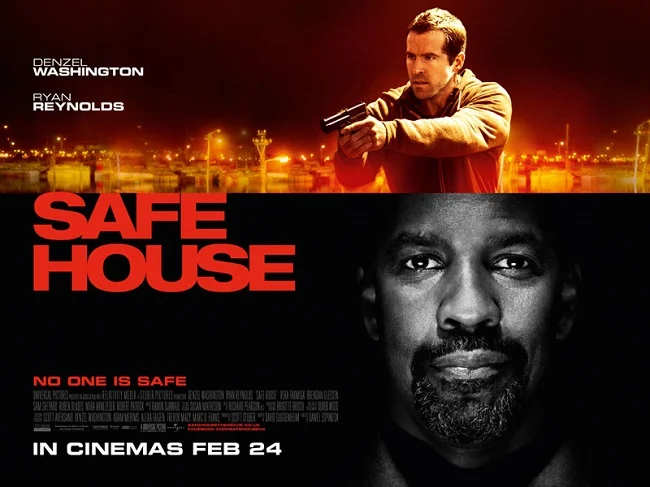
Before we start, I recollect that one well known UK critic described Safe House as sub-Tony Scott, upon its release. Now I’ve always been conflicted over Scott’s back catalogue, as I’ve always found his movies to be hampered by their own unique style. The subtleties of his characters and depth of his themes are all too often drowned out by his frenetic style and fast paced editing. Therefore a comment such as this really sets off alarm bells for me. Having recently watched The Equalizer 2, I wanted a further fix of Denzel Washington in a similar action vehicle. As Safe House was available on Netflix UK, I decided to kill a couple of hours and see what actually constitutes as “sub-Tony Scott”.
Taken (2008)
Sometimes when a movie chimes with the public is goes from being a box office success to becoming part of popular culture. The Taken franchise has done exactly that and a piece of iconic dialogue has now become a perennial internet meme. But if you look beyond this “baggage” and subsequently judge the film by the standards of the genre, you’ll find there’s more than meets the eye. On paper Taken is a fairly formulaic thriller. But it boasts a more interesting pedigree than other movies of this kind. Written by Luc Besson and directed by Pierre Morel (of District 13 fame), the action driven story set in Paris, has all the benefits that come from a European production. But the most intriguing aspect of Taken is the casting of the lead character Bryan Mills. Instead of relying on a known action star, the part ended up with Oscar nominated actor Liam Nesson. As you can imagine, the results are not as you would expect and as a result a serious actor re-invented himself as an action star.
Sometimes when a movie chimes with the public is goes from being a box office success to becoming part of popular culture. The Taken franchise has done exactly that and a piece of iconic dialogue has now become a perennial internet meme. But if you look beyond this “baggage” and subsequently judge the film by the standards of the genre, you’ll find there’s more than meets the eye. On paper Taken is a fairly formulaic thriller. But it boasts a more interesting pedigree than other movies of this kind. Written by Luc Besson and directed by Pierre Morel (of District 13 fame), the action driven story set in Paris, has all the benefits that come from a European production. But the most intriguing aspect of Taken is the casting of the lead character Bryan Mills. Instead of relying on a known action star, the part ended up with Oscar nominated actor Liam Nesson. As you can imagine, the results are not as you would expect and as a result a serious actor re-invented himself as an action star.
Bryan Mills (Liam Nesson), a retired US government agent, is trying to rebuild his relationship with his 17-year-old daughter Kim (Maggie Grace) who lives with his ex-wife (Famke Janssen) and her new husband. Kim, despite her father’s concerns, takes a trip to Paris with her friend Amanda on the pretext of seeing the sights. Her real motive is to follow U2 as they tour Europe. However, events take a bad turn when both girls are abducted by the Albanian Mafia who intend to sell them into slavery. But they do not realise that Kim's Father has a unique set of skills gained from his former line of work. He subsequently brings them to bear in rescuing his daughter. Naturally mayhem follows.
The plot is simple and doesn’t attempt to re-invent the wheel. There are numerous logical flaws, and some may argue that Taken trivialises the issue of human trafficking. But this is an action film and therefore its not obliged to serve as a serious analysis on contemporary social problems. What it does have is a lead actor who is skilled in his craft, bringing an element of credibility and gravitas to a genre known for poor performances. There is also the advantage of a French director who approaches the subject with a little more respect than average US studio. There is no smug humour, designed to mitigate the violence. There is also no moral agenda, self-justification or a requirement for redemption. The characters do what they do and are what they are.
Taken has its flaws. It ignores the laws of a sovereign nation and has an ending similar to that of the 1979 action film Ashanti, which also dealt with modern day slavery. But it also has exceptionally plausible fight scenes using credible techniques. Fight choreographer Olivier Schneider (Transporter, Kiss of The Dragon and District 13) utilises throat punches, wrist and elbow locks, along with realistic knife usage and accurate gun stances. Liam Neeson, an ex-boxer who is well over 6 foot, acquits himself well for a man of his age (he was 56 at the time of shooting). Taken and its subsequent sequels were all edited for a PG-13 rating when released theatrically in the US. However, uncut versions are available on DVD and Blu-ray and it is these editions that action fans should seek out.
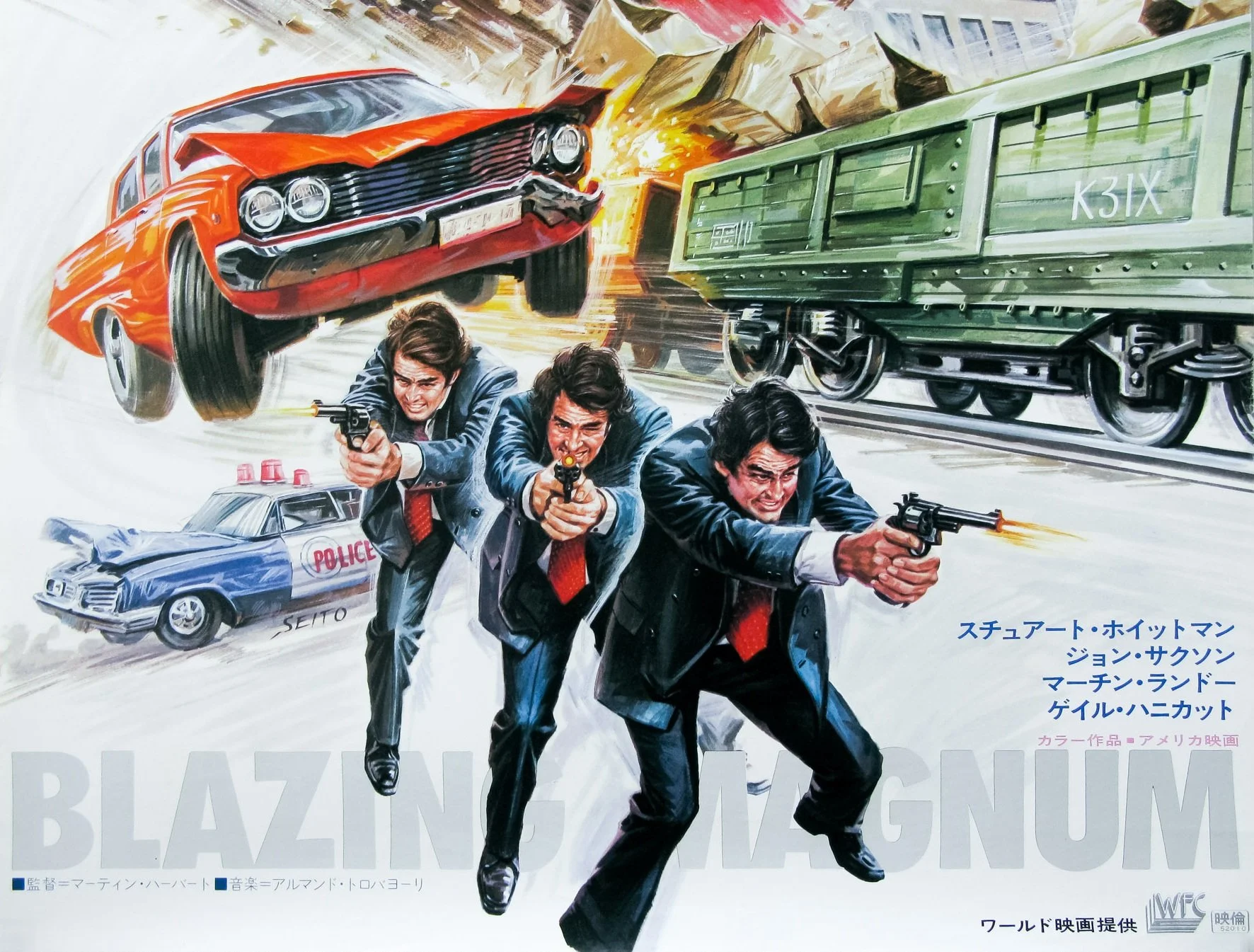
Mainstream films are easy to recommend to people. They’re usually formulaic, work within clear parameters and they’re not controversial. Most people, when viewing such film on someone else’s suggestion, are left with a fairly simply choice. Did they like it or not? Whatever the outcome, no feathers are ruffled. No one looks at you askance afterwards and says “why the hell did you think I’d like that piece of shit”? If something like this happens, then you have clearly not recommended a mainstream film. Perhaps you’ve suggested something that’s a little more of an acquired taste. Something niche, from a very specific sub-genre. Which brings me neatly to Blazing Magnum AKA Strange Shadows in an Empty Room (1976). The US title gives the impression that this film is a hard boiled cop thriller, like so many others that followed in the wake of Dirty Harry. But there’s a clue in the European title. Yes, this movie has more than just a whiff of a giallo about it.
Jason Statham is an exemplar of the US mantra of “staying in your lane”. He makes action movies and occasionally strays into action comedies. His formula broadly works and is sufficiently lucrative to keep Mr. Statham employed. Therefore, if you watch a film in which he stars, you have a fairly good idea of what you’ll be getting. Of late, the criteria for his action vehicles have become more succinct. Jason Statham will play an innocuous character, such as a construction foreman or a bee keeper. Something terrible will subsequently befall another character who Mr. Statham has an emotional connection with in some capacity. He will subsequently hunt down those responsible and meet out death and violence. At some point the villain of the story will enquire as to how this innocuous person is so lethal. Research will then show that our Jason is in fact an ex-police officer/special forces operative/international assassin. There’s then a showdown and the villain dies. Job done.
The Light at the Edge of the World presented itself as an action movie upon its release in 1971. Based upon a story by Jules Verne, the Spanish American co-production was driven by its star Kirk Douglas, who curiously hired British director Kevin Billington to helm the project. This tale of a lighthouse keeper fighting a war of attrition against a group of pirates that have captured his island, was market as an adventure film ostensibly in the idiom of the authors previous works and as a pirate movie. MGM bought the rights to distribute the film in the UK on the misunderstanding that it was a family friendly production. It was not and remains so. They subsequently had to cut 15 minutes of violence and torture as well as an undercurrent of sexual assault to secure a suitable rating. Conversely, the US distributors received an arbitrary PG rating, despite the fact this is one of a handful of films that honestly depicts pirates as murderers, rapists and worse.
It’s an established action film trope. The fire team comprised of ex-military personnel, move in on their target. Only to have the tables turned by someone they don’t deem a threat. What makes it different in The Last Stand of Ellen Cole is a throwaway line of dialogue. The bested operative lies bleeding on the floor and the protagonists stands over them ready to finish them off. “Don’t, I have a cat” they feebly plead. For me that was the icing on the cake. The movie had already established it was taking the “same old, same old” and doing something different. Something fun, if taken in the right spirit. This scene tipped the balance and I embraced this film because it was being honest about what it is. This is a modern B movie that decides to give a very specific sub-genre a makeover. Furthermore, its clearly done with an affectionate wink, which is very different to sly wink. This isn’t deliberate self-knowing irony. Its just a film doing something different and possibly silly but it genuinely wants to have fun with it.
Stephen King’s dystopian story, The Running Man, was previously adapted very loosely in 1987, as a vehicle for Arnold Schwarzenegger. That version focused mainly on the “Battle Royale” element of the story and leaned heavily into Arnie’s personality, rather than the politics of the book. It also wasn’t well received by the author. Edgar Wright’s remake follows the source text a lot more closely and is far more interested in its political themes and wider social commentary. Furthermore, this version re-establishes the everyman quality of the hero of Ben Richards, rather than him being the muscle bound, ex-military hero as per Mr. Schwarzenegger’s prior interpretation. This time round, The Running Man uses a lot of the visual and narrative tropes of contemporary reality TV, making this forty three year old story very relevant to today’s viewers and couching the film in a style that is recognisable and accessible.
After the success of Raiders of the Lost Ark in 1981, filmmakers scrambled to find existing intellectual properties that they could use for similar films. Hence archaic heroes such as Alan Quatermain were hastily given a modern makeover and thrust into generic movies, in a vague attempt to replicate Steven Spielberg’s successful formula. Which brings us neatly on to James Charles Bigglesworth AKA “Biggles”, a fictional pilot and adventurer from a series of books written by W. E. Johns between 1932 and 1968. Several attempts had been made in the past to bring this character to the silver screen, including one by Disney but they all failed. However, the commercial and critical success of Indiana Jones provided sufficient impetus to greenlight a new film. However, due to some curious production choices, when Biggles was finally released it was far from just a period set, action movie.
Setting aside the hubris of remaking a film such as Red Dawn, the 2012 reboot had a troubled production. Shot over the course of late 2009, on location in Michigan, MGM intended to release the film in September 2010. However, the studio’s financial problems became unsustainable over the course of that year and the film was shelved, while a financial solution was sought. Furthermore, while Red Dawn was in post production, there was a major economic shift within Hollywood due to the increasing importance of the Chinese market. This was a significant problem for MGM because the new version of Red Dawn had the Chinese invading the USA instead of Russia. Hence there were reshoots and the need for additional visual effects, so that the Chinese could be replaced with North Koreans. MGM eventually went bankrupt and the distribution rights to Red Dawn were sold off. The film was eventually released in 2012.
When I first saw the promotional trailer for Gangster Squad back in 2012, prior to its release, I wasn't especially impressed. I simply thought the film was another attempt to re-invent the gangster genre for a generation who were not especially familiar with it. I wasn't exactly overwhelmed with director Ruben Fleischer's resume either. I didn't particularly like Zombieland and haven't seen 30 Minutes Or Less. Then came the tragic mass shootings in Aurora, Colorado which led to the movie being delayed so that the original ending, which featured a shoot-out in a movie theatre, could be replaced. Hence when I finally watched this film recently, I wasn't expecting a movie up to the standards of say Once Upon A Time In America or Miller’s Crossing and it would seem that I was right do so. Gangster Squad is not especially noteworthy in any respect.
Levon Cade (Jason Staham) is a former Royal Marine Commando who has retired from military service and now works as the leader of a construction team in Chicago. He has a close relationship with Joe and Carla Garcia (Michael Peña and Noemi Gonzalez ) who run the company and considers them as family. Outside of work, Levon is involved in a bitter custody battle for his daughter, against her maternal grandfather, who blames Levon for his daughter’s suicide. When Garcia's teenage daughter Jenny (Arianna Rivas) goes missing, Levon reluctantly agrees to help her parents and get her back. Beginning his search at the nightclub where Jenny was last seen, he soon discovers that she was abducted by Russian traffickers. Furthermore, the culprit is Dimi Kolisnyk (Maximilian Osinski), the wayward son of a senior ranking gangster.
PC Nicholas Angel (Simon Pegg) is an exemplary Police Officer, with a strict adherence to the letter of the law. As a result of making the rest of the London Metropolitan Police look bad, he is transferred to the rural town of Sandford, Gloucestershire. On arrival, Angel finds that the local Inspector, Frank Butterman (Jim Broadbent), takes a far more laissez-faire approach to policing. His colleagues are incompetent and he is further hampered by the Neighbourhood Watch Alliance (NWA), who prioritise low crime statistics over law enforcement due to their desire to win the title of “Village of the Year”. Furthermore, Angel is partnered with the Inspector’s son, Constable Danny Butterman (Nick Frost), who is infatuated with “buddy cop” movies and is in awe of Angel’s London experience. “Have you ever fired two guns while jumping through the air?” However, a sudden spate of grisly accidents lead Angel to believe that there's more to the seemingly tranquil and picture-perfect community than meets the eye.
As a collection of history's worst tyrants and criminal masterminds gather to plot a war to wipe out millions, one man must race against time to stop them. Discover the origins of the very first independent intelligence agency in The King's Man. Based on the Comic Book “The Secret Service” by Mark Millar and Dave Gibbons. 20th Century Studios
Matthew Vaughn’s The King’s Man is an inconsistent film, both narratively and tonally. It veers between serious themes and stylised, hyperbolic action. At times it does quite a good job of exploring such complex subjects as global politics, mechanised warfare and colonialism. Sadly it then wrenches the viewer out of these cerebral reveries as it lapses into the sort of over the top action sequences that were notable in the two earlier films. It’s a shame because The King’s Man gets so many other aspects of the production right. The casting is very interesting, especially Ralph Fiennes as the “pacifist” Duke of Oxford. He is actually a very good fit for the action genre. Djimon Hounsou and Gemma Arterton are given little backstory beyond being respectively the faithful manservant and the family nanny but both are notable due to their own inherent acting chops and personal charisma. Rhys Ifans obviously has a great time as Grigori Rasputin, ensuring all the man’s vices are robustly depicted.
On paper, a video games franchise such as Assassin’s Creed lends itself perfectly to a cinematic adaptation. The parkour action scenes, the historical settings and the contemporary conspiracy theory themes are all elements that should play well with a modern youth audience. Hence with the backing of a major studio such as Twentieth Century Fox and a budget of $125 million, the 2016 movie should have been a guaranteed box office hit. The casting of Michael Fassbender, an actor who is comfortable with serious roles and big Hollywood franchises, should have carried this film comfortably over the finishing line. Director Justin Kurzel, who had found critical success with his adaptation of MacBeth a year previously, must have looked like a safe pair of hands to handle such a project. Sadly, that was not the case. Assassin’s Creed is not the sum of its parts, in fact many elements appear to be pulling in opposite directions. The resulting feature film is staggeringly dull, soulless and a chore to watch. A testament to how modern big budget franchise movies have become a production line, with all the art stripped from them.
300: Rise of an Empire is a curious beast, being neither a sequel nor a prequel. It is infact a tale that takes place simultaneously with those of the original movie. While Gerard Butler is busy making a last stand at the Battle of Thermopylae, fellow warrior and politician Themistokles, played by the singularly uncharismatic Sullivan Stapleton, leads a similar army of buffed Greeks against the Persian fleet. Once again we have a movie that is the epitome of style over substance, complete with a sound design that challenges what can physically be endured by human hearing. They say the first casualty of war is innocence but in this type of movie it's closely followed by historical accuracy and authentic depictions of ethnicity. 300: Rise of an Empire is a cinematic assault upon the senses but not in a good way like Mad Max: Fury Road.
Back in September 2017, Liam Neeson stated in an interview with Sky News that he was retiring from the action genre, due to his age. He felt that audiences would question his credibility in such roles. After the release of The Commuter (2018) and Cold Pursuit (2019) Mr Neeson appeared to return to human dramas and films that focus on performance rather than punching man and beast. Ordinary Love and Made in Italy, both released in 2019, demonstrate the actor’s versatility and skill. People seem to forget that he is a thespian who was initially known for his character driven roles in films such as The Mission (1986), Rob Roy (1995 and Michael Collins (1996). It was only in 2008 that he reinvented himself as an action hero. It’s all a far cry from Schindler’s List and his performance that earned him an academy award nomination. The reason I mention all of this is because The Ice Road is the third action movie I’ve seen in 2021 that stars Liam Neeson.
One of the stand out tropes of the modern action film is that the stakes are always cranked right up to 11. Terrorists, biological weapons and nuclear bombs are common threats in such movies with a hero or heroes trying to save the world from death and destruction or worse. However, back in the sixties and seventies, things were a little more straight forward and in some respects more credible. Take When Eight Bells Toll, released in 1971, for example. British Treasury secret agent Phillip Calvert investigates the theft of £8,000,000 in gold bullion by a gang of international smugglers. In the context of the times this was no small beer however it’s somewhat mundane compared to fighting super villains and their space lasers. Frankly I prefer these low key plot devices as they can make a film a little more plausible within the confines of the genre. A concept that is often forgotten today.
Forensic accountant Owen Casserly (Jake Weber) flees his home with his teenage son Connor (Finn Little) when he discovers he has been targeted by a pair of assassins (Nicholas Hoult and Aidan Gillen) who have been hired to stop him giving evidence in a major corruption case. Connor witnesses the murder of his father after their car is run off the road. Entrusted with important written evidence, he escapes into the dense forests of the Montana wilderness pursued by the killers. Seeking help he runs into smokejumper Hannah Faber (Angelina Jolie) who is stationed at a remote fire lookout tower. Hannah suffers from PTSD from a previous forest fire in which she was unable to save three young boys. Hannah attempts to lead Connor through the forest to safety. Meanwhile the assassins set fire to the forest to divert the attention of the authorities and cover their tracks.
I must admit that I did not have particularly high hopes for Paul W S Anderson's remake of the 1975 Roger Corman produced cult classic. Anderson’s work varies greatly. Event Horizon and Soldier are solid genre films but I still have not fully come to terms with Alien vs. Predator. Jason Statham is also a name that divides the public, with solid material such as The Transporter and unfathomable tosh like Revolver. But despite these considerations, Death Race is in fact quite a surprise and does not follow the path that so many remakes do. It takes the basic themes and concept associated with the original and tries to do something different with them. It doesn’t reinvent the wheel nor is it a genre milestone. But it does offer a different spin on things, have some engaging action scenes and provide some dumb but enjoyable entertainment. When combined with snacks and some beer this is a passable way to kill 111 minutes.
I did not watch Zero Dark Thirty upon its initial release, due to the politics surrounding it. I wanted to be able to view it free from bipartisan debate. Eight years on I believe this now achievable and although debate still exists it is now more measured and less strident. Zero Dark Thirty is certainly a compelling movie. It plays as a docudrama, providing an in-depth study of the US intelligence services hunt for Osama Bin Laden. It cannot be faulted on a technical level and the performances are very strong. It does not adopt a celebratory or triumphalist tone in its approach to the story. Director Kathryn Bigelow endeavours to keep the proceedings focused upon the intricacies of an intelligence driven manhunt. There is little or no tubthumping, jingoism. The decision to find Bin Laden is shown as a political and military exercise of foreign policy. The film solely focuses on the story from a US perspective but that is perfectly acceptable as it is not intended to be an exploration of geo-politics.
Firestorm was originally written as a vehicle for Sylvester Stallone, however when the production company Savoy Pictures went bankrupt the screenplay was bought by Twentieth Fox and the scope of the movie reduced to suit a lower budget. It’s broadly similar to Cliffhanger in so far as the lead character is a specialist in a certain field who runs afoul of criminals in a perilous environment. Whereas Cliffhanger is set in the Rocky Mountains, Firestorm takes place in the forests of Northern Wyoming. After the script was revised four times, the finished screenplay was given a final “polish” by Graham Yost who has considerable experience with the action movie genre. As stallone was no longer associated with the project and the production had been repurposed to be less extravagant, the movie was assigned to former NFL star Howie Long. Long had already appeared in the John Woo movie Broken Arrow (1996) and the Firestorm was seen as a means to give him a star vehicle.
The original French movies District 13 and its sequel District 13: Ultimatum, conceived and produced by Luc Besson, were enjoyable variations of the Escape from New York theme. Their charm lay in their European pedigree and the skilful use of parkour. The two leads, David Belle and Cyril Raffaelli, were eminently suited to the minimalist roles and the screenplays were fun. Half of these movies appeal was the fact that they were not mainstream US products. Brick Mansions is the Hollywood remake of District 13, as well as being Paul Walkers’ final movie. Sadly, this film is far from a fitting epitaph, being devoid of any charisma or innovations. It is blandly shot , poorly edited and has been stripped of everything that made the original entertaining.
Arnold Schwarzenegger's return to the big screen after his political career has been uneven to say the least. His cameos in The Expendables and The Expendables 2 were well received, with their self referential charm and age related irony. Yet his first major movie The Last Stand, although competent, failed to find an audience. Escape Plan fared better at the box office but did not put Arnie back on the A list. Effectively there's a large percentage of the contemporary cinematic audience who were born after his heyday and are simply not overt fans of his work. His core audience is more than likely of the age group that consume most of their film entertainment at home. Which may explain why Sabotage tanked in the US upon release on March 28th 2014. It was the worst opening box office of Arnie's career. He used to break first day opening records.
Sequels and reboots are hardly a new concept and have been a part of Hollywood culture since the 1930s. The success of the Universal Horror movies from that era being a prime example of direct follow ups and retconned movies. However, there is one fundamental rule that distinguishes a good sequel from a bad one. You should never mitigate, undermine or make irrelevant the events of the previous movie, just to provide your new film with a raison d'être. For example, the events of Aliens do not contradict or trivialise those that happened in Alien. In fact with that franchise there is a very clear logical progression between the two movies. The same is true for Mad Max and Mad Max 2 or Star Wars and The Empire Strikes Back. The key is to progress a story, enhance it or explore things from an alternative angle and bring something new to the cinematic table. Sadly this philosophy is all too often lost on corporate film making. Which means that many sequels are just tedious replays of prior films. Terminator: Dark Fate falls squarely into this category.
The enduring appeal of the character John Rambo in First Blood comes from the fact that he is a traumatised ex- service man who keeps himself to himself as he drifts from job to job, trying to come to terms with his wartime experiences. His poor treatment at the hands of a small-town Sheriff is a succinct metaphor for the social and political indifference that Vietnam veterans were shown upon their return to the US. He’s a man with a code in a world that no longer has any use for him. His simple and honest patriotism is not returned and he is in fact viewed with shame by many from the nation he loves. Furthermore, the first movie does not paint him as a cold-blooded killer. Despite provocation he is not the first person to shoot to kill. Rambo is in many ways a victim. A broken man, who society has asked to do unspeakable things. Now society wants nothing to do with him and fears the “monster” they created. Although clearly an action movie, First Blood had narrative depth and a flawed but sympathetic protagonist. 37 years and four movies later, such dramatic themes have long left the franchise. The central character is indeed a caricature of its former self.
It was hardly surprising that the movie adaptation of Chris Kyle's autobiography American Sniper, would cause controversy. The Iraq war, US Foreign Policy and national pride are seldom subjects that are discussed in a calm and measured fashion. And then there are the personal politics of director Clint Eastwood to consider. Hence there were claims from some quarters upon the movie’s release, that it was Islamophobic and counter claims that criticisms of the late Chris Kyle were unpatriotic. There still remain issues regarding the authenticity of events depicted in the source text and subsequently the movies screenplay by Jason Hall. Yet none of these factors have in anyway impacted upon the film's box office returns which currently stands at $247,900,417 worldwide.
Do I really need to present you with some sort of plot synopsis for Transporter 3? No, I didn’t think so. More of the same as Frank Martin (Jason Statham) and his police chum, Inspector Tarconi (Francois Berleand) become embroiled in yet another high-octane escapade. There's fights, car stunts, exotic international locations and a strong sense of humour. This time, the disposable love interest is a Ukrainian girl named Valentina (Natalya Rudakova) who fulfils her role succinctly. The film benefits by being set back in Europe, after the mistake of basing Transporter 2 in the US. This time, the story takes us to such locations as Budapest and Odessa. The international film crew once again bring a veneer of panache to the production that is conspicuously absent in US action movies. For a modest budget fil, Transporter 3 it looks very good. Again the proceedings are given a boost by a pertinent soundtrack by Alexandre Azaria and a selection of European “tunes”.
Jason Bourne originally graced our screens for the first time seventeen years ago. The Bourne Identity was a gritty, minimalist take on the espionage genre and a welcome change from the excesses of the Pierce Brosnan Bond era. The story arc was sustained over three movies and ended efficiently and succinctly. After which Matt Damon moved on, as did the director of two of the movies, Paul Greengrass. Which leaves us with The Bourne Legacy; the tangential sequel that arrived in 2012. A film that exists because the money men and bean counters hate to pass up on a franchise until it has been squeezed utterly dry. Hence, they commissioned the writer of the series, Tony Gilroy, to come up with a screenplay and direct a spinoff movie. Jeremy Renner was cast in the lead role. Yet despite narrative and production continuity, The Bourne Legacy was not a Jason Bourne movie with the star appeal of Matt Damon. Although the film turned a profit, it had the lowest box office returns out of the entire franchise.
During the eighties there was a clear league table of action movie stars. By the mid-nineties this system fell into decline and the Hollywood lacked any clearly defined exponents of the genre. A decade later, due to the success of Luc Besson’s Transporter films, Jason Statham became a bankable box office star in this field. When you look at Statham's early work in Lock, Stock and Two Smoking Barrels it is hard to envisage the "mockney geezer" as an international action star. Yet he has successfully stepped into the role and enjoys a large following. I enjoy his work as he has a likeable on-screen persona. My 88-year-old Mum likes him to because "he wears nice suits". The action genre seldom reaches such a diverse demographic.
Before we start, I recollect that one well known UK critic described Safe House as sub-Tony Scott, upon its release. Now I’ve always been conflicted over Scott’s back catalogue, as I’ve always found his movies to be hampered by their own unique style. The subtleties of his characters and depth of his themes are all too often drowned out by his frenetic style and fast paced editing. Therefore a comment such as this really sets off alarm bells for me. Having recently watched The Equalizer 2, I wanted a further fix of Denzel Washington in a similar action vehicle. As Safe House was available on Netflix UK, I decided to kill a couple of hours and see what actually constitutes as “sub-Tony Scott”.
X-Men: First Class (2011)
Falling somewhere between a sequel and a reboot, director Matthew Vaughn has managed to make X-Men: First Class a worthy entry in the X-Men franchise that successfully explores the origins of the characters as well as Christopher Nolan did with Batman Begins. X-Men: Last Stand painted the movie series into a difficult corner by killing off key characters. This movie provides a clever means of bypassing such issue by offering an origins story that subsequent leads in later sequels to an alternative timeline that redresses past mistakes. X-Men: First Class opens with a rather bleak and dark pre-credit sequence set in a WWII concentration camp that sets up the central protagonists and antagonist. It then maintains a steady pace and unlike other more recent bloated blockbusters, it's running time works in its favour and not against it.
Falling somewhere between a sequel and a reboot, director Matthew Vaughn has managed to make X-Men: First Class a worthy entry in the X-Men franchise that successfully explores the origins of the characters as well as Christopher Nolan did with Batman Begins. X-Men: Last Stand painted the movie series into a difficult corner by killing off key characters. This movie provides a clever means of bypassing such issue by offering an origins story that subsequent leads in later sequels to an alternative timeline that redresses past mistakes. X-Men: First Class opens with a rather bleak and dark pre-credit sequence set in a WWII concentration camp that sets up the central protagonists and antagonist. It then maintains a steady pace and unlike other more recent bloated blockbusters, it's running time works in its favour and not against it.
Underpinning the film are the central performances of James McAvoy and Michael Fassbender as Charles Xavier and Erik Lensherr. Both excel in their respective roles, and unusually for a genre piece, have been given a screenplay that doesn't merely paint them as black and white caricatures. The set pieces, especially the denouement set against the Cuban blockade, are impressive but do not overwhelm the story line. The plot device of setting the film in 1963, works surprisingly well and does not make the mistake of becoming some sort of sub Austin Powers cliché. There is even room for homages to such films as Goldfinger, The Odessa File and The Marathon Man, courtesy of the films Nazi sub-plot.
Despite its PG -13/12 rating, X-Men: First Class cunningly exploits as much adult material that the classification allows. The is a high emphasis on sexuality and some rather hard-edged action. I was amused to see the use of one major profanity, which was neatly designed to embellish a standout vignette featuring a clever cameo. Overall this is a superior mainstream comic adaptation that seems to knowingly cater for all viewing demographics. The film also fairs well due to the rather lacklustre previous entry in the franchise. It is hard not to be superior to the incredibly flat and by the numbers X-Men: Last Stand. The emphasis this time is on motivation, politics and revenge rather than a need to string together endless scenes of destruction.
Mainstream films are easy to recommend to people. They’re usually formulaic, work within clear parameters and they’re not controversial. Most people, when viewing such film on someone else’s suggestion, are left with a fairly simply choice. Did they like it or not? Whatever the outcome, no feathers are ruffled. No one looks at you askance afterwards and says “why the hell did you think I’d like that piece of shit”? If something like this happens, then you have clearly not recommended a mainstream film. Perhaps you’ve suggested something that’s a little more of an acquired taste. Something niche, from a very specific sub-genre. Which brings me neatly to Blazing Magnum AKA Strange Shadows in an Empty Room (1976). The US title gives the impression that this film is a hard boiled cop thriller, like so many others that followed in the wake of Dirty Harry. But there’s a clue in the European title. Yes, this movie has more than just a whiff of a giallo about it.
Jason Statham is an exemplar of the US mantra of “staying in your lane”. He makes action movies and occasionally strays into action comedies. His formula broadly works and is sufficiently lucrative to keep Mr. Statham employed. Therefore, if you watch a film in which he stars, you have a fairly good idea of what you’ll be getting. Of late, the criteria for his action vehicles have become more succinct. Jason Statham will play an innocuous character, such as a construction foreman or a bee keeper. Something terrible will subsequently befall another character who Mr. Statham has an emotional connection with in some capacity. He will subsequently hunt down those responsible and meet out death and violence. At some point the villain of the story will enquire as to how this innocuous person is so lethal. Research will then show that our Jason is in fact an ex-police officer/special forces operative/international assassin. There’s then a showdown and the villain dies. Job done.
The Light at the Edge of the World presented itself as an action movie upon its release in 1971. Based upon a story by Jules Verne, the Spanish American co-production was driven by its star Kirk Douglas, who curiously hired British director Kevin Billington to helm the project. This tale of a lighthouse keeper fighting a war of attrition against a group of pirates that have captured his island, was market as an adventure film ostensibly in the idiom of the authors previous works and as a pirate movie. MGM bought the rights to distribute the film in the UK on the misunderstanding that it was a family friendly production. It was not and remains so. They subsequently had to cut 15 minutes of violence and torture as well as an undercurrent of sexual assault to secure a suitable rating. Conversely, the US distributors received an arbitrary PG rating, despite the fact this is one of a handful of films that honestly depicts pirates as murderers, rapists and worse.
It’s an established action film trope. The fire team comprised of ex-military personnel, move in on their target. Only to have the tables turned by someone they don’t deem a threat. What makes it different in The Last Stand of Ellen Cole is a throwaway line of dialogue. The bested operative lies bleeding on the floor and the protagonists stands over them ready to finish them off. “Don’t, I have a cat” they feebly plead. For me that was the icing on the cake. The movie had already established it was taking the “same old, same old” and doing something different. Something fun, if taken in the right spirit. This scene tipped the balance and I embraced this film because it was being honest about what it is. This is a modern B movie that decides to give a very specific sub-genre a makeover. Furthermore, its clearly done with an affectionate wink, which is very different to sly wink. This isn’t deliberate self-knowing irony. Its just a film doing something different and possibly silly but it genuinely wants to have fun with it.
Stephen King’s dystopian story, The Running Man, was previously adapted very loosely in 1987, as a vehicle for Arnold Schwarzenegger. That version focused mainly on the “Battle Royale” element of the story and leaned heavily into Arnie’s personality, rather than the politics of the book. It also wasn’t well received by the author. Edgar Wright’s remake follows the source text a lot more closely and is far more interested in its political themes and wider social commentary. Furthermore, this version re-establishes the everyman quality of the hero of Ben Richards, rather than him being the muscle bound, ex-military hero as per Mr. Schwarzenegger’s prior interpretation. This time round, The Running Man uses a lot of the visual and narrative tropes of contemporary reality TV, making this forty three year old story very relevant to today’s viewers and couching the film in a style that is recognisable and accessible.
After the success of Raiders of the Lost Ark in 1981, filmmakers scrambled to find existing intellectual properties that they could use for similar films. Hence archaic heroes such as Alan Quatermain were hastily given a modern makeover and thrust into generic movies, in a vague attempt to replicate Steven Spielberg’s successful formula. Which brings us neatly on to James Charles Bigglesworth AKA “Biggles”, a fictional pilot and adventurer from a series of books written by W. E. Johns between 1932 and 1968. Several attempts had been made in the past to bring this character to the silver screen, including one by Disney but they all failed. However, the commercial and critical success of Indiana Jones provided sufficient impetus to greenlight a new film. However, due to some curious production choices, when Biggles was finally released it was far from just a period set, action movie.
Setting aside the hubris of remaking a film such as Red Dawn, the 2012 reboot had a troubled production. Shot over the course of late 2009, on location in Michigan, MGM intended to release the film in September 2010. However, the studio’s financial problems became unsustainable over the course of that year and the film was shelved, while a financial solution was sought. Furthermore, while Red Dawn was in post production, there was a major economic shift within Hollywood due to the increasing importance of the Chinese market. This was a significant problem for MGM because the new version of Red Dawn had the Chinese invading the USA instead of Russia. Hence there were reshoots and the need for additional visual effects, so that the Chinese could be replaced with North Koreans. MGM eventually went bankrupt and the distribution rights to Red Dawn were sold off. The film was eventually released in 2012.
When I first saw the promotional trailer for Gangster Squad back in 2012, prior to its release, I wasn't especially impressed. I simply thought the film was another attempt to re-invent the gangster genre for a generation who were not especially familiar with it. I wasn't exactly overwhelmed with director Ruben Fleischer's resume either. I didn't particularly like Zombieland and haven't seen 30 Minutes Or Less. Then came the tragic mass shootings in Aurora, Colorado which led to the movie being delayed so that the original ending, which featured a shoot-out in a movie theatre, could be replaced. Hence when I finally watched this film recently, I wasn't expecting a movie up to the standards of say Once Upon A Time In America or Miller’s Crossing and it would seem that I was right do so. Gangster Squad is not especially noteworthy in any respect.
Levon Cade (Jason Staham) is a former Royal Marine Commando who has retired from military service and now works as the leader of a construction team in Chicago. He has a close relationship with Joe and Carla Garcia (Michael Peña and Noemi Gonzalez ) who run the company and considers them as family. Outside of work, Levon is involved in a bitter custody battle for his daughter, against her maternal grandfather, who blames Levon for his daughter’s suicide. When Garcia's teenage daughter Jenny (Arianna Rivas) goes missing, Levon reluctantly agrees to help her parents and get her back. Beginning his search at the nightclub where Jenny was last seen, he soon discovers that she was abducted by Russian traffickers. Furthermore, the culprit is Dimi Kolisnyk (Maximilian Osinski), the wayward son of a senior ranking gangster.
PC Nicholas Angel (Simon Pegg) is an exemplary Police Officer, with a strict adherence to the letter of the law. As a result of making the rest of the London Metropolitan Police look bad, he is transferred to the rural town of Sandford, Gloucestershire. On arrival, Angel finds that the local Inspector, Frank Butterman (Jim Broadbent), takes a far more laissez-faire approach to policing. His colleagues are incompetent and he is further hampered by the Neighbourhood Watch Alliance (NWA), who prioritise low crime statistics over law enforcement due to their desire to win the title of “Village of the Year”. Furthermore, Angel is partnered with the Inspector’s son, Constable Danny Butterman (Nick Frost), who is infatuated with “buddy cop” movies and is in awe of Angel’s London experience. “Have you ever fired two guns while jumping through the air?” However, a sudden spate of grisly accidents lead Angel to believe that there's more to the seemingly tranquil and picture-perfect community than meets the eye.
As a collection of history's worst tyrants and criminal masterminds gather to plot a war to wipe out millions, one man must race against time to stop them. Discover the origins of the very first independent intelligence agency in The King's Man. Based on the Comic Book “The Secret Service” by Mark Millar and Dave Gibbons. 20th Century Studios
Matthew Vaughn’s The King’s Man is an inconsistent film, both narratively and tonally. It veers between serious themes and stylised, hyperbolic action. At times it does quite a good job of exploring such complex subjects as global politics, mechanised warfare and colonialism. Sadly it then wrenches the viewer out of these cerebral reveries as it lapses into the sort of over the top action sequences that were notable in the two earlier films. It’s a shame because The King’s Man gets so many other aspects of the production right. The casting is very interesting, especially Ralph Fiennes as the “pacifist” Duke of Oxford. He is actually a very good fit for the action genre. Djimon Hounsou and Gemma Arterton are given little backstory beyond being respectively the faithful manservant and the family nanny but both are notable due to their own inherent acting chops and personal charisma. Rhys Ifans obviously has a great time as Grigori Rasputin, ensuring all the man’s vices are robustly depicted.
On paper, a video games franchise such as Assassin’s Creed lends itself perfectly to a cinematic adaptation. The parkour action scenes, the historical settings and the contemporary conspiracy theory themes are all elements that should play well with a modern youth audience. Hence with the backing of a major studio such as Twentieth Century Fox and a budget of $125 million, the 2016 movie should have been a guaranteed box office hit. The casting of Michael Fassbender, an actor who is comfortable with serious roles and big Hollywood franchises, should have carried this film comfortably over the finishing line. Director Justin Kurzel, who had found critical success with his adaptation of MacBeth a year previously, must have looked like a safe pair of hands to handle such a project. Sadly, that was not the case. Assassin’s Creed is not the sum of its parts, in fact many elements appear to be pulling in opposite directions. The resulting feature film is staggeringly dull, soulless and a chore to watch. A testament to how modern big budget franchise movies have become a production line, with all the art stripped from them.
300: Rise of an Empire is a curious beast, being neither a sequel nor a prequel. It is infact a tale that takes place simultaneously with those of the original movie. While Gerard Butler is busy making a last stand at the Battle of Thermopylae, fellow warrior and politician Themistokles, played by the singularly uncharismatic Sullivan Stapleton, leads a similar army of buffed Greeks against the Persian fleet. Once again we have a movie that is the epitome of style over substance, complete with a sound design that challenges what can physically be endured by human hearing. They say the first casualty of war is innocence but in this type of movie it's closely followed by historical accuracy and authentic depictions of ethnicity. 300: Rise of an Empire is a cinematic assault upon the senses but not in a good way like Mad Max: Fury Road.
Back in September 2017, Liam Neeson stated in an interview with Sky News that he was retiring from the action genre, due to his age. He felt that audiences would question his credibility in such roles. After the release of The Commuter (2018) and Cold Pursuit (2019) Mr Neeson appeared to return to human dramas and films that focus on performance rather than punching man and beast. Ordinary Love and Made in Italy, both released in 2019, demonstrate the actor’s versatility and skill. People seem to forget that he is a thespian who was initially known for his character driven roles in films such as The Mission (1986), Rob Roy (1995 and Michael Collins (1996). It was only in 2008 that he reinvented himself as an action hero. It’s all a far cry from Schindler’s List and his performance that earned him an academy award nomination. The reason I mention all of this is because The Ice Road is the third action movie I’ve seen in 2021 that stars Liam Neeson.
One of the stand out tropes of the modern action film is that the stakes are always cranked right up to 11. Terrorists, biological weapons and nuclear bombs are common threats in such movies with a hero or heroes trying to save the world from death and destruction or worse. However, back in the sixties and seventies, things were a little more straight forward and in some respects more credible. Take When Eight Bells Toll, released in 1971, for example. British Treasury secret agent Phillip Calvert investigates the theft of £8,000,000 in gold bullion by a gang of international smugglers. In the context of the times this was no small beer however it’s somewhat mundane compared to fighting super villains and their space lasers. Frankly I prefer these low key plot devices as they can make a film a little more plausible within the confines of the genre. A concept that is often forgotten today.
Forensic accountant Owen Casserly (Jake Weber) flees his home with his teenage son Connor (Finn Little) when he discovers he has been targeted by a pair of assassins (Nicholas Hoult and Aidan Gillen) who have been hired to stop him giving evidence in a major corruption case. Connor witnesses the murder of his father after their car is run off the road. Entrusted with important written evidence, he escapes into the dense forests of the Montana wilderness pursued by the killers. Seeking help he runs into smokejumper Hannah Faber (Angelina Jolie) who is stationed at a remote fire lookout tower. Hannah suffers from PTSD from a previous forest fire in which she was unable to save three young boys. Hannah attempts to lead Connor through the forest to safety. Meanwhile the assassins set fire to the forest to divert the attention of the authorities and cover their tracks.
I must admit that I did not have particularly high hopes for Paul W S Anderson's remake of the 1975 Roger Corman produced cult classic. Anderson’s work varies greatly. Event Horizon and Soldier are solid genre films but I still have not fully come to terms with Alien vs. Predator. Jason Statham is also a name that divides the public, with solid material such as The Transporter and unfathomable tosh like Revolver. But despite these considerations, Death Race is in fact quite a surprise and does not follow the path that so many remakes do. It takes the basic themes and concept associated with the original and tries to do something different with them. It doesn’t reinvent the wheel nor is it a genre milestone. But it does offer a different spin on things, have some engaging action scenes and provide some dumb but enjoyable entertainment. When combined with snacks and some beer this is a passable way to kill 111 minutes.
I did not watch Zero Dark Thirty upon its initial release, due to the politics surrounding it. I wanted to be able to view it free from bipartisan debate. Eight years on I believe this now achievable and although debate still exists it is now more measured and less strident. Zero Dark Thirty is certainly a compelling movie. It plays as a docudrama, providing an in-depth study of the US intelligence services hunt for Osama Bin Laden. It cannot be faulted on a technical level and the performances are very strong. It does not adopt a celebratory or triumphalist tone in its approach to the story. Director Kathryn Bigelow endeavours to keep the proceedings focused upon the intricacies of an intelligence driven manhunt. There is little or no tubthumping, jingoism. The decision to find Bin Laden is shown as a political and military exercise of foreign policy. The film solely focuses on the story from a US perspective but that is perfectly acceptable as it is not intended to be an exploration of geo-politics.
Firestorm was originally written as a vehicle for Sylvester Stallone, however when the production company Savoy Pictures went bankrupt the screenplay was bought by Twentieth Fox and the scope of the movie reduced to suit a lower budget. It’s broadly similar to Cliffhanger in so far as the lead character is a specialist in a certain field who runs afoul of criminals in a perilous environment. Whereas Cliffhanger is set in the Rocky Mountains, Firestorm takes place in the forests of Northern Wyoming. After the script was revised four times, the finished screenplay was given a final “polish” by Graham Yost who has considerable experience with the action movie genre. As stallone was no longer associated with the project and the production had been repurposed to be less extravagant, the movie was assigned to former NFL star Howie Long. Long had already appeared in the John Woo movie Broken Arrow (1996) and the Firestorm was seen as a means to give him a star vehicle.
The original French movies District 13 and its sequel District 13: Ultimatum, conceived and produced by Luc Besson, were enjoyable variations of the Escape from New York theme. Their charm lay in their European pedigree and the skilful use of parkour. The two leads, David Belle and Cyril Raffaelli, were eminently suited to the minimalist roles and the screenplays were fun. Half of these movies appeal was the fact that they were not mainstream US products. Brick Mansions is the Hollywood remake of District 13, as well as being Paul Walkers’ final movie. Sadly, this film is far from a fitting epitaph, being devoid of any charisma or innovations. It is blandly shot , poorly edited and has been stripped of everything that made the original entertaining.
Arnold Schwarzenegger's return to the big screen after his political career has been uneven to say the least. His cameos in The Expendables and The Expendables 2 were well received, with their self referential charm and age related irony. Yet his first major movie The Last Stand, although competent, failed to find an audience. Escape Plan fared better at the box office but did not put Arnie back on the A list. Effectively there's a large percentage of the contemporary cinematic audience who were born after his heyday and are simply not overt fans of his work. His core audience is more than likely of the age group that consume most of their film entertainment at home. Which may explain why Sabotage tanked in the US upon release on March 28th 2014. It was the worst opening box office of Arnie's career. He used to break first day opening records.
Sequels and reboots are hardly a new concept and have been a part of Hollywood culture since the 1930s. The success of the Universal Horror movies from that era being a prime example of direct follow ups and retconned movies. However, there is one fundamental rule that distinguishes a good sequel from a bad one. You should never mitigate, undermine or make irrelevant the events of the previous movie, just to provide your new film with a raison d'être. For example, the events of Aliens do not contradict or trivialise those that happened in Alien. In fact with that franchise there is a very clear logical progression between the two movies. The same is true for Mad Max and Mad Max 2 or Star Wars and The Empire Strikes Back. The key is to progress a story, enhance it or explore things from an alternative angle and bring something new to the cinematic table. Sadly this philosophy is all too often lost on corporate film making. Which means that many sequels are just tedious replays of prior films. Terminator: Dark Fate falls squarely into this category.
The enduring appeal of the character John Rambo in First Blood comes from the fact that he is a traumatised ex- service man who keeps himself to himself as he drifts from job to job, trying to come to terms with his wartime experiences. His poor treatment at the hands of a small-town Sheriff is a succinct metaphor for the social and political indifference that Vietnam veterans were shown upon their return to the US. He’s a man with a code in a world that no longer has any use for him. His simple and honest patriotism is not returned and he is in fact viewed with shame by many from the nation he loves. Furthermore, the first movie does not paint him as a cold-blooded killer. Despite provocation he is not the first person to shoot to kill. Rambo is in many ways a victim. A broken man, who society has asked to do unspeakable things. Now society wants nothing to do with him and fears the “monster” they created. Although clearly an action movie, First Blood had narrative depth and a flawed but sympathetic protagonist. 37 years and four movies later, such dramatic themes have long left the franchise. The central character is indeed a caricature of its former self.
It was hardly surprising that the movie adaptation of Chris Kyle's autobiography American Sniper, would cause controversy. The Iraq war, US Foreign Policy and national pride are seldom subjects that are discussed in a calm and measured fashion. And then there are the personal politics of director Clint Eastwood to consider. Hence there were claims from some quarters upon the movie’s release, that it was Islamophobic and counter claims that criticisms of the late Chris Kyle were unpatriotic. There still remain issues regarding the authenticity of events depicted in the source text and subsequently the movies screenplay by Jason Hall. Yet none of these factors have in anyway impacted upon the film's box office returns which currently stands at $247,900,417 worldwide.
Do I really need to present you with some sort of plot synopsis for Transporter 3? No, I didn’t think so. More of the same as Frank Martin (Jason Statham) and his police chum, Inspector Tarconi (Francois Berleand) become embroiled in yet another high-octane escapade. There's fights, car stunts, exotic international locations and a strong sense of humour. This time, the disposable love interest is a Ukrainian girl named Valentina (Natalya Rudakova) who fulfils her role succinctly. The film benefits by being set back in Europe, after the mistake of basing Transporter 2 in the US. This time, the story takes us to such locations as Budapest and Odessa. The international film crew once again bring a veneer of panache to the production that is conspicuously absent in US action movies. For a modest budget fil, Transporter 3 it looks very good. Again the proceedings are given a boost by a pertinent soundtrack by Alexandre Azaria and a selection of European “tunes”.
Jason Bourne originally graced our screens for the first time seventeen years ago. The Bourne Identity was a gritty, minimalist take on the espionage genre and a welcome change from the excesses of the Pierce Brosnan Bond era. The story arc was sustained over three movies and ended efficiently and succinctly. After which Matt Damon moved on, as did the director of two of the movies, Paul Greengrass. Which leaves us with The Bourne Legacy; the tangential sequel that arrived in 2012. A film that exists because the money men and bean counters hate to pass up on a franchise until it has been squeezed utterly dry. Hence, they commissioned the writer of the series, Tony Gilroy, to come up with a screenplay and direct a spinoff movie. Jeremy Renner was cast in the lead role. Yet despite narrative and production continuity, The Bourne Legacy was not a Jason Bourne movie with the star appeal of Matt Damon. Although the film turned a profit, it had the lowest box office returns out of the entire franchise.
During the eighties there was a clear league table of action movie stars. By the mid-nineties this system fell into decline and the Hollywood lacked any clearly defined exponents of the genre. A decade later, due to the success of Luc Besson’s Transporter films, Jason Statham became a bankable box office star in this field. When you look at Statham's early work in Lock, Stock and Two Smoking Barrels it is hard to envisage the "mockney geezer" as an international action star. Yet he has successfully stepped into the role and enjoys a large following. I enjoy his work as he has a likeable on-screen persona. My 88-year-old Mum likes him to because "he wears nice suits". The action genre seldom reaches such a diverse demographic.
Before we start, I recollect that one well known UK critic described Safe House as sub-Tony Scott, upon its release. Now I’ve always been conflicted over Scott’s back catalogue, as I’ve always found his movies to be hampered by their own unique style. The subtleties of his characters and depth of his themes are all too often drowned out by his frenetic style and fast paced editing. Therefore a comment such as this really sets off alarm bells for me. Having recently watched The Equalizer 2, I wanted a further fix of Denzel Washington in a similar action vehicle. As Safe House was available on Netflix UK, I decided to kill a couple of hours and see what actually constitutes as “sub-Tony Scott”.
Bullet to the Head (2012)
Walter Hill is a director whose work is often overlooked or marginalised by critics who fail to appreciate its wider merits. Yet despite this, over the course of four decades he has consistently produced thoughtful, intelligent and sometimes positively subversive movies. He has a connection with the past and succeeds in creating stories that often reflect periods of transition and how such times effect the protagonists. There is no denying his flair for crating action sequences and frequently coaxes strong performances from actors, often with the minimum of dialogue. He also has a great understanding of the importance of a movies soundtrack and his collaboration with Ry Cooder has produced some memorable scores.
Walter Hill is a director whose work is often overlooked or marginalised by critics who fail to appreciate its wider merits. Yet despite this, over the course of four decades he has consistently produced thoughtful, intelligent and sometimes positively subversive movies. He has a connection with the past and succeeds in creating stories that often reflect periods of transition and how such times effect the protagonists. There is no denying his flair for crating action sequences and frequently coaxes strong performances from actors, often with the minimum of dialogue. He also has a great understanding of the importance of a movies soundtrack and his collaboration with Ry Cooder has produced some memorable scores.
So, it was Walter Hill's name on the credits for Bullet to the Head that was my main interest. He has not made many movies of late, having focused on his television and movie production work. Naturally seeing his credentials attached to an action picture offered great promise, especially in an age when the art of making such movies is waning. However, I was well aware that the production of Bullet to the Head had not been a straight forward enterprise and that many individuals involved with the project had come and gone. Therefore, I was not expecting a movie comparable to 48 Hrs or Southern Comfort.
The story centres around hit man James "Bobo" Bonomo (Stallone) who is double-crossed by his employers, leaving his partner Louis (Jon Seda) dead. Jimmy has to form an uneasy alliance with cop Taylor Kwon (Sung Kang) as they go up against crime lord Morel (Adewale Akinnuoye-Agbaje) and his enforcer Keegan (Jason Momoa). It's formulaic and strictly by the numbers with all the standard tropes of the buddy movie sub-genre. Cultural difference, borderline racism and snappy one liners. Bullet to the Head is exceeding conventional in its remit. Even the old plot device of a family member being kidnapped is thrown into the mix. Yet it is saved from totally mediocrity due to the charisma of Stallone, the banter between the main characters and the fact that even with such safe material, Walter Hill still manages to stamp his own brand on the action sequences.
The real selling points for Bullet to the Head are Adewale Akinnuoye-Agbaje and Jason Momoa who manage to achieve performances of interest, despite the fact that the screenplay gives them little to go on. Alessandro Camon’s adaptation of Alexis Nolent’s graphic novel is perfunctory to say the least. Things like the use of voice-over to bridge the narrative are tired clichés. Yet every now and then there is a spark in the dialogue between leads or a nod and a wink to the old days of the genre. Overall, there are enough positive attributes to Bullet to the Head to cancel out its own stupidity and down play its familiar nature. Without the direction of Walter Hill, this movie would have been a misfire. The director has a flair for the excessive that few other film makers can get away with (like an axe fight). As it is, it’s a step down from Red Heat, which itself was inferior to 48 Hrs.
Mainstream films are easy to recommend to people. They’re usually formulaic, work within clear parameters and they’re not controversial. Most people, when viewing such film on someone else’s suggestion, are left with a fairly simply choice. Did they like it or not? Whatever the outcome, no feathers are ruffled. No one looks at you askance afterwards and says “why the hell did you think I’d like that piece of shit”? If something like this happens, then you have clearly not recommended a mainstream film. Perhaps you’ve suggested something that’s a little more of an acquired taste. Something niche, from a very specific sub-genre. Which brings me neatly to Blazing Magnum AKA Strange Shadows in an Empty Room (1976). The US title gives the impression that this film is a hard boiled cop thriller, like so many others that followed in the wake of Dirty Harry. But there’s a clue in the European title. Yes, this movie has more than just a whiff of a giallo about it.
Jason Statham is an exemplar of the US mantra of “staying in your lane”. He makes action movies and occasionally strays into action comedies. His formula broadly works and is sufficiently lucrative to keep Mr. Statham employed. Therefore, if you watch a film in which he stars, you have a fairly good idea of what you’ll be getting. Of late, the criteria for his action vehicles have become more succinct. Jason Statham will play an innocuous character, such as a construction foreman or a bee keeper. Something terrible will subsequently befall another character who Mr. Statham has an emotional connection with in some capacity. He will subsequently hunt down those responsible and meet out death and violence. At some point the villain of the story will enquire as to how this innocuous person is so lethal. Research will then show that our Jason is in fact an ex-police officer/special forces operative/international assassin. There’s then a showdown and the villain dies. Job done.
The Light at the Edge of the World presented itself as an action movie upon its release in 1971. Based upon a story by Jules Verne, the Spanish American co-production was driven by its star Kirk Douglas, who curiously hired British director Kevin Billington to helm the project. This tale of a lighthouse keeper fighting a war of attrition against a group of pirates that have captured his island, was market as an adventure film ostensibly in the idiom of the authors previous works and as a pirate movie. MGM bought the rights to distribute the film in the UK on the misunderstanding that it was a family friendly production. It was not and remains so. They subsequently had to cut 15 minutes of violence and torture as well as an undercurrent of sexual assault to secure a suitable rating. Conversely, the US distributors received an arbitrary PG rating, despite the fact this is one of a handful of films that honestly depicts pirates as murderers, rapists and worse.
It’s an established action film trope. The fire team comprised of ex-military personnel, move in on their target. Only to have the tables turned by someone they don’t deem a threat. What makes it different in The Last Stand of Ellen Cole is a throwaway line of dialogue. The bested operative lies bleeding on the floor and the protagonists stands over them ready to finish them off. “Don’t, I have a cat” they feebly plead. For me that was the icing on the cake. The movie had already established it was taking the “same old, same old” and doing something different. Something fun, if taken in the right spirit. This scene tipped the balance and I embraced this film because it was being honest about what it is. This is a modern B movie that decides to give a very specific sub-genre a makeover. Furthermore, its clearly done with an affectionate wink, which is very different to sly wink. This isn’t deliberate self-knowing irony. Its just a film doing something different and possibly silly but it genuinely wants to have fun with it.
Stephen King’s dystopian story, The Running Man, was previously adapted very loosely in 1987, as a vehicle for Arnold Schwarzenegger. That version focused mainly on the “Battle Royale” element of the story and leaned heavily into Arnie’s personality, rather than the politics of the book. It also wasn’t well received by the author. Edgar Wright’s remake follows the source text a lot more closely and is far more interested in its political themes and wider social commentary. Furthermore, this version re-establishes the everyman quality of the hero of Ben Richards, rather than him being the muscle bound, ex-military hero as per Mr. Schwarzenegger’s prior interpretation. This time round, The Running Man uses a lot of the visual and narrative tropes of contemporary reality TV, making this forty three year old story very relevant to today’s viewers and couching the film in a style that is recognisable and accessible.
After the success of Raiders of the Lost Ark in 1981, filmmakers scrambled to find existing intellectual properties that they could use for similar films. Hence archaic heroes such as Alan Quatermain were hastily given a modern makeover and thrust into generic movies, in a vague attempt to replicate Steven Spielberg’s successful formula. Which brings us neatly on to James Charles Bigglesworth AKA “Biggles”, a fictional pilot and adventurer from a series of books written by W. E. Johns between 1932 and 1968. Several attempts had been made in the past to bring this character to the silver screen, including one by Disney but they all failed. However, the commercial and critical success of Indiana Jones provided sufficient impetus to greenlight a new film. However, due to some curious production choices, when Biggles was finally released it was far from just a period set, action movie.
Setting aside the hubris of remaking a film such as Red Dawn, the 2012 reboot had a troubled production. Shot over the course of late 2009, on location in Michigan, MGM intended to release the film in September 2010. However, the studio’s financial problems became unsustainable over the course of that year and the film was shelved, while a financial solution was sought. Furthermore, while Red Dawn was in post production, there was a major economic shift within Hollywood due to the increasing importance of the Chinese market. This was a significant problem for MGM because the new version of Red Dawn had the Chinese invading the USA instead of Russia. Hence there were reshoots and the need for additional visual effects, so that the Chinese could be replaced with North Koreans. MGM eventually went bankrupt and the distribution rights to Red Dawn were sold off. The film was eventually released in 2012.
When I first saw the promotional trailer for Gangster Squad back in 2012, prior to its release, I wasn't especially impressed. I simply thought the film was another attempt to re-invent the gangster genre for a generation who were not especially familiar with it. I wasn't exactly overwhelmed with director Ruben Fleischer's resume either. I didn't particularly like Zombieland and haven't seen 30 Minutes Or Less. Then came the tragic mass shootings in Aurora, Colorado which led to the movie being delayed so that the original ending, which featured a shoot-out in a movie theatre, could be replaced. Hence when I finally watched this film recently, I wasn't expecting a movie up to the standards of say Once Upon A Time In America or Miller’s Crossing and it would seem that I was right do so. Gangster Squad is not especially noteworthy in any respect.
Levon Cade (Jason Staham) is a former Royal Marine Commando who has retired from military service and now works as the leader of a construction team in Chicago. He has a close relationship with Joe and Carla Garcia (Michael Peña and Noemi Gonzalez ) who run the company and considers them as family. Outside of work, Levon is involved in a bitter custody battle for his daughter, against her maternal grandfather, who blames Levon for his daughter’s suicide. When Garcia's teenage daughter Jenny (Arianna Rivas) goes missing, Levon reluctantly agrees to help her parents and get her back. Beginning his search at the nightclub where Jenny was last seen, he soon discovers that she was abducted by Russian traffickers. Furthermore, the culprit is Dimi Kolisnyk (Maximilian Osinski), the wayward son of a senior ranking gangster.
PC Nicholas Angel (Simon Pegg) is an exemplary Police Officer, with a strict adherence to the letter of the law. As a result of making the rest of the London Metropolitan Police look bad, he is transferred to the rural town of Sandford, Gloucestershire. On arrival, Angel finds that the local Inspector, Frank Butterman (Jim Broadbent), takes a far more laissez-faire approach to policing. His colleagues are incompetent and he is further hampered by the Neighbourhood Watch Alliance (NWA), who prioritise low crime statistics over law enforcement due to their desire to win the title of “Village of the Year”. Furthermore, Angel is partnered with the Inspector’s son, Constable Danny Butterman (Nick Frost), who is infatuated with “buddy cop” movies and is in awe of Angel’s London experience. “Have you ever fired two guns while jumping through the air?” However, a sudden spate of grisly accidents lead Angel to believe that there's more to the seemingly tranquil and picture-perfect community than meets the eye.
As a collection of history's worst tyrants and criminal masterminds gather to plot a war to wipe out millions, one man must race against time to stop them. Discover the origins of the very first independent intelligence agency in The King's Man. Based on the Comic Book “The Secret Service” by Mark Millar and Dave Gibbons. 20th Century Studios
Matthew Vaughn’s The King’s Man is an inconsistent film, both narratively and tonally. It veers between serious themes and stylised, hyperbolic action. At times it does quite a good job of exploring such complex subjects as global politics, mechanised warfare and colonialism. Sadly it then wrenches the viewer out of these cerebral reveries as it lapses into the sort of over the top action sequences that were notable in the two earlier films. It’s a shame because The King’s Man gets so many other aspects of the production right. The casting is very interesting, especially Ralph Fiennes as the “pacifist” Duke of Oxford. He is actually a very good fit for the action genre. Djimon Hounsou and Gemma Arterton are given little backstory beyond being respectively the faithful manservant and the family nanny but both are notable due to their own inherent acting chops and personal charisma. Rhys Ifans obviously has a great time as Grigori Rasputin, ensuring all the man’s vices are robustly depicted.
On paper, a video games franchise such as Assassin’s Creed lends itself perfectly to a cinematic adaptation. The parkour action scenes, the historical settings and the contemporary conspiracy theory themes are all elements that should play well with a modern youth audience. Hence with the backing of a major studio such as Twentieth Century Fox and a budget of $125 million, the 2016 movie should have been a guaranteed box office hit. The casting of Michael Fassbender, an actor who is comfortable with serious roles and big Hollywood franchises, should have carried this film comfortably over the finishing line. Director Justin Kurzel, who had found critical success with his adaptation of MacBeth a year previously, must have looked like a safe pair of hands to handle such a project. Sadly, that was not the case. Assassin’s Creed is not the sum of its parts, in fact many elements appear to be pulling in opposite directions. The resulting feature film is staggeringly dull, soulless and a chore to watch. A testament to how modern big budget franchise movies have become a production line, with all the art stripped from them.
300: Rise of an Empire is a curious beast, being neither a sequel nor a prequel. It is infact a tale that takes place simultaneously with those of the original movie. While Gerard Butler is busy making a last stand at the Battle of Thermopylae, fellow warrior and politician Themistokles, played by the singularly uncharismatic Sullivan Stapleton, leads a similar army of buffed Greeks against the Persian fleet. Once again we have a movie that is the epitome of style over substance, complete with a sound design that challenges what can physically be endured by human hearing. They say the first casualty of war is innocence but in this type of movie it's closely followed by historical accuracy and authentic depictions of ethnicity. 300: Rise of an Empire is a cinematic assault upon the senses but not in a good way like Mad Max: Fury Road.
Back in September 2017, Liam Neeson stated in an interview with Sky News that he was retiring from the action genre, due to his age. He felt that audiences would question his credibility in such roles. After the release of The Commuter (2018) and Cold Pursuit (2019) Mr Neeson appeared to return to human dramas and films that focus on performance rather than punching man and beast. Ordinary Love and Made in Italy, both released in 2019, demonstrate the actor’s versatility and skill. People seem to forget that he is a thespian who was initially known for his character driven roles in films such as The Mission (1986), Rob Roy (1995 and Michael Collins (1996). It was only in 2008 that he reinvented himself as an action hero. It’s all a far cry from Schindler’s List and his performance that earned him an academy award nomination. The reason I mention all of this is because The Ice Road is the third action movie I’ve seen in 2021 that stars Liam Neeson.
One of the stand out tropes of the modern action film is that the stakes are always cranked right up to 11. Terrorists, biological weapons and nuclear bombs are common threats in such movies with a hero or heroes trying to save the world from death and destruction or worse. However, back in the sixties and seventies, things were a little more straight forward and in some respects more credible. Take When Eight Bells Toll, released in 1971, for example. British Treasury secret agent Phillip Calvert investigates the theft of £8,000,000 in gold bullion by a gang of international smugglers. In the context of the times this was no small beer however it’s somewhat mundane compared to fighting super villains and their space lasers. Frankly I prefer these low key plot devices as they can make a film a little more plausible within the confines of the genre. A concept that is often forgotten today.
Forensic accountant Owen Casserly (Jake Weber) flees his home with his teenage son Connor (Finn Little) when he discovers he has been targeted by a pair of assassins (Nicholas Hoult and Aidan Gillen) who have been hired to stop him giving evidence in a major corruption case. Connor witnesses the murder of his father after their car is run off the road. Entrusted with important written evidence, he escapes into the dense forests of the Montana wilderness pursued by the killers. Seeking help he runs into smokejumper Hannah Faber (Angelina Jolie) who is stationed at a remote fire lookout tower. Hannah suffers from PTSD from a previous forest fire in which she was unable to save three young boys. Hannah attempts to lead Connor through the forest to safety. Meanwhile the assassins set fire to the forest to divert the attention of the authorities and cover their tracks.
I must admit that I did not have particularly high hopes for Paul W S Anderson's remake of the 1975 Roger Corman produced cult classic. Anderson’s work varies greatly. Event Horizon and Soldier are solid genre films but I still have not fully come to terms with Alien vs. Predator. Jason Statham is also a name that divides the public, with solid material such as The Transporter and unfathomable tosh like Revolver. But despite these considerations, Death Race is in fact quite a surprise and does not follow the path that so many remakes do. It takes the basic themes and concept associated with the original and tries to do something different with them. It doesn’t reinvent the wheel nor is it a genre milestone. But it does offer a different spin on things, have some engaging action scenes and provide some dumb but enjoyable entertainment. When combined with snacks and some beer this is a passable way to kill 111 minutes.
I did not watch Zero Dark Thirty upon its initial release, due to the politics surrounding it. I wanted to be able to view it free from bipartisan debate. Eight years on I believe this now achievable and although debate still exists it is now more measured and less strident. Zero Dark Thirty is certainly a compelling movie. It plays as a docudrama, providing an in-depth study of the US intelligence services hunt for Osama Bin Laden. It cannot be faulted on a technical level and the performances are very strong. It does not adopt a celebratory or triumphalist tone in its approach to the story. Director Kathryn Bigelow endeavours to keep the proceedings focused upon the intricacies of an intelligence driven manhunt. There is little or no tubthumping, jingoism. The decision to find Bin Laden is shown as a political and military exercise of foreign policy. The film solely focuses on the story from a US perspective but that is perfectly acceptable as it is not intended to be an exploration of geo-politics.
Firestorm was originally written as a vehicle for Sylvester Stallone, however when the production company Savoy Pictures went bankrupt the screenplay was bought by Twentieth Fox and the scope of the movie reduced to suit a lower budget. It’s broadly similar to Cliffhanger in so far as the lead character is a specialist in a certain field who runs afoul of criminals in a perilous environment. Whereas Cliffhanger is set in the Rocky Mountains, Firestorm takes place in the forests of Northern Wyoming. After the script was revised four times, the finished screenplay was given a final “polish” by Graham Yost who has considerable experience with the action movie genre. As stallone was no longer associated with the project and the production had been repurposed to be less extravagant, the movie was assigned to former NFL star Howie Long. Long had already appeared in the John Woo movie Broken Arrow (1996) and the Firestorm was seen as a means to give him a star vehicle.
The original French movies District 13 and its sequel District 13: Ultimatum, conceived and produced by Luc Besson, were enjoyable variations of the Escape from New York theme. Their charm lay in their European pedigree and the skilful use of parkour. The two leads, David Belle and Cyril Raffaelli, were eminently suited to the minimalist roles and the screenplays were fun. Half of these movies appeal was the fact that they were not mainstream US products. Brick Mansions is the Hollywood remake of District 13, as well as being Paul Walkers’ final movie. Sadly, this film is far from a fitting epitaph, being devoid of any charisma or innovations. It is blandly shot , poorly edited and has been stripped of everything that made the original entertaining.
Arnold Schwarzenegger's return to the big screen after his political career has been uneven to say the least. His cameos in The Expendables and The Expendables 2 were well received, with their self referential charm and age related irony. Yet his first major movie The Last Stand, although competent, failed to find an audience. Escape Plan fared better at the box office but did not put Arnie back on the A list. Effectively there's a large percentage of the contemporary cinematic audience who were born after his heyday and are simply not overt fans of his work. His core audience is more than likely of the age group that consume most of their film entertainment at home. Which may explain why Sabotage tanked in the US upon release on March 28th 2014. It was the worst opening box office of Arnie's career. He used to break first day opening records.
Sequels and reboots are hardly a new concept and have been a part of Hollywood culture since the 1930s. The success of the Universal Horror movies from that era being a prime example of direct follow ups and retconned movies. However, there is one fundamental rule that distinguishes a good sequel from a bad one. You should never mitigate, undermine or make irrelevant the events of the previous movie, just to provide your new film with a raison d'être. For example, the events of Aliens do not contradict or trivialise those that happened in Alien. In fact with that franchise there is a very clear logical progression between the two movies. The same is true for Mad Max and Mad Max 2 or Star Wars and The Empire Strikes Back. The key is to progress a story, enhance it or explore things from an alternative angle and bring something new to the cinematic table. Sadly this philosophy is all too often lost on corporate film making. Which means that many sequels are just tedious replays of prior films. Terminator: Dark Fate falls squarely into this category.
The enduring appeal of the character John Rambo in First Blood comes from the fact that he is a traumatised ex- service man who keeps himself to himself as he drifts from job to job, trying to come to terms with his wartime experiences. His poor treatment at the hands of a small-town Sheriff is a succinct metaphor for the social and political indifference that Vietnam veterans were shown upon their return to the US. He’s a man with a code in a world that no longer has any use for him. His simple and honest patriotism is not returned and he is in fact viewed with shame by many from the nation he loves. Furthermore, the first movie does not paint him as a cold-blooded killer. Despite provocation he is not the first person to shoot to kill. Rambo is in many ways a victim. A broken man, who society has asked to do unspeakable things. Now society wants nothing to do with him and fears the “monster” they created. Although clearly an action movie, First Blood had narrative depth and a flawed but sympathetic protagonist. 37 years and four movies later, such dramatic themes have long left the franchise. The central character is indeed a caricature of its former self.
It was hardly surprising that the movie adaptation of Chris Kyle's autobiography American Sniper, would cause controversy. The Iraq war, US Foreign Policy and national pride are seldom subjects that are discussed in a calm and measured fashion. And then there are the personal politics of director Clint Eastwood to consider. Hence there were claims from some quarters upon the movie’s release, that it was Islamophobic and counter claims that criticisms of the late Chris Kyle were unpatriotic. There still remain issues regarding the authenticity of events depicted in the source text and subsequently the movies screenplay by Jason Hall. Yet none of these factors have in anyway impacted upon the film's box office returns which currently stands at $247,900,417 worldwide.
Do I really need to present you with some sort of plot synopsis for Transporter 3? No, I didn’t think so. More of the same as Frank Martin (Jason Statham) and his police chum, Inspector Tarconi (Francois Berleand) become embroiled in yet another high-octane escapade. There's fights, car stunts, exotic international locations and a strong sense of humour. This time, the disposable love interest is a Ukrainian girl named Valentina (Natalya Rudakova) who fulfils her role succinctly. The film benefits by being set back in Europe, after the mistake of basing Transporter 2 in the US. This time, the story takes us to such locations as Budapest and Odessa. The international film crew once again bring a veneer of panache to the production that is conspicuously absent in US action movies. For a modest budget fil, Transporter 3 it looks very good. Again the proceedings are given a boost by a pertinent soundtrack by Alexandre Azaria and a selection of European “tunes”.
Jason Bourne originally graced our screens for the first time seventeen years ago. The Bourne Identity was a gritty, minimalist take on the espionage genre and a welcome change from the excesses of the Pierce Brosnan Bond era. The story arc was sustained over three movies and ended efficiently and succinctly. After which Matt Damon moved on, as did the director of two of the movies, Paul Greengrass. Which leaves us with The Bourne Legacy; the tangential sequel that arrived in 2012. A film that exists because the money men and bean counters hate to pass up on a franchise until it has been squeezed utterly dry. Hence, they commissioned the writer of the series, Tony Gilroy, to come up with a screenplay and direct a spinoff movie. Jeremy Renner was cast in the lead role. Yet despite narrative and production continuity, The Bourne Legacy was not a Jason Bourne movie with the star appeal of Matt Damon. Although the film turned a profit, it had the lowest box office returns out of the entire franchise.
During the eighties there was a clear league table of action movie stars. By the mid-nineties this system fell into decline and the Hollywood lacked any clearly defined exponents of the genre. A decade later, due to the success of Luc Besson’s Transporter films, Jason Statham became a bankable box office star in this field. When you look at Statham's early work in Lock, Stock and Two Smoking Barrels it is hard to envisage the "mockney geezer" as an international action star. Yet he has successfully stepped into the role and enjoys a large following. I enjoy his work as he has a likeable on-screen persona. My 88-year-old Mum likes him to because "he wears nice suits". The action genre seldom reaches such a diverse demographic.
Before we start, I recollect that one well known UK critic described Safe House as sub-Tony Scott, upon its release. Now I’ve always been conflicted over Scott’s back catalogue, as I’ve always found his movies to be hampered by their own unique style. The subtleties of his characters and depth of his themes are all too often drowned out by his frenetic style and fast paced editing. Therefore a comment such as this really sets off alarm bells for me. Having recently watched The Equalizer 2, I wanted a further fix of Denzel Washington in a similar action vehicle. As Safe House was available on Netflix UK, I decided to kill a couple of hours and see what actually constitutes as “sub-Tony Scott”.
The Expendables 2 (2012)
After viewing The Expendables 2, I read back through my notes. They ran as follows: People were shot. Stuff exploded. Quips were made. Amusing. And that is pretty much all you need to know, because if you watch this movie expecting anything more, then you'll be disappointed (and possibly a fool). So, Barney Ross (Stallone) and co are back and this time they have a better (by genre standards) script which is a little more equitable with the screen time (Terry Crews and Randy Couture fans take note). Gallows humour and self-referential one-liners abound, and the plot is rife with over the top situations and features an absurdly named villain (Jean-Claude Van Damme). Mickey Rourke is replaced by Chinese star Yu Nan’s Maggie, and Liam Hemsworth. Oh, and there's lots of mayhem. The movie has the trademark high body count.
After viewing The Expendables 2, I read back through my notes. They ran as follows: People were shot. Stuff exploded. Quips were made. Amusing. And that is pretty much all you need to know, because if you watch this movie expecting anything more, then you'll be disappointed (and possibly a fool). So, Barney Ross (Stallone) and co are back and this time they have a better (by genre standards) script which is a little more equitable with the screen time (Terry Crews and Randy Couture fans take note). Gallows humour and self-referential one-liners abound, and the plot is rife with over the top situations and features an absurdly named villain (Jean-Claude Van Damme). Mickey Rourke is replaced by Chinese star Yu Nan’s Maggie, and Liam Hemsworth. Oh, and there's lots of mayhem. The movie has the trademark high body count.
Director Simon West provides the audience with a suitable homage to eighties action movies, that is a slicker, more robust and at ease with itself that its predecessor. He does not quite reach the heights of his Magnum Opus, Con-Air, but The Expendables 2 is a worthy genre piece. Furthermore, he presents the action is a way that is discernible to the viewer and fun. We are not subjected to a lot of shaky cam, lightning edited bilge, but actually get to see the carnage in all its glory (although a lot of that is CGI bullet hits). The physical stunts are top notch and the fights extremely well-choreographed.
The plot is standard with the team sent to collect the content of a crashed military airplane. Of course, it's not as easy as that, with other parties showing an interest in its plutonium cargo. The subsequent clash between groups results in the death of one of the team, making matters personal. You don't have to be a genius to figure out what happens next. Not only are we treated to one hundred minutes of old school action, but also a who's who of eighties action heroes. Furthermore, they are all happy to send themselves up. It's all a lot better this time round because the production team know what works and what doesn't. Dolph Lundgren steals the show with his banter and casual asides. It is this shift in tone that improves this outing over the first.
Not everything succeeds as well as it could, though. The climatic shootout is not as strong a set piece as some of the proceeding sequences and somehow, I expected the arrival of Schwarzenegger, Willis, and Chuck Norris to have a little more impact. That's not to say it's not good. I was just expected something more bombastic. Two of the three have been out of the acting game for a while (at the time of filming), so I guess we should cut them some slack. It is also curious to note that although the film has a lot of violence, the use of profanity is quite restrained. It is present but tends use a lot of milder terms. A concession of some kind perhaps? It certainly does not spoil The Expendables 2. I picked up on it just because bad language is so prevalent in this genre.
The Expendables 2 manages to find the right balance between loud action, tongue in-cheek humour and respect for the genre. It is also a most welcome change to modern PG-13 rated action movies that want to be hard hitting and tough but cannot countenance depicting violence for fear of tipping over into a higher rating. It is the honesty of The Expendables 2 that is one of its strongest assets, along with the fact that it does exactly what it sets out to do. That and of course Schwarzenegger and Willis in a Smart Car, shooting the crap out of things. When you add on top of that Chuck Norris quoting his own "facts" then you are in action movie hog heaven.
Mainstream films are easy to recommend to people. They’re usually formulaic, work within clear parameters and they’re not controversial. Most people, when viewing such film on someone else’s suggestion, are left with a fairly simply choice. Did they like it or not? Whatever the outcome, no feathers are ruffled. No one looks at you askance afterwards and says “why the hell did you think I’d like that piece of shit”? If something like this happens, then you have clearly not recommended a mainstream film. Perhaps you’ve suggested something that’s a little more of an acquired taste. Something niche, from a very specific sub-genre. Which brings me neatly to Blazing Magnum AKA Strange Shadows in an Empty Room (1976). The US title gives the impression that this film is a hard boiled cop thriller, like so many others that followed in the wake of Dirty Harry. But there’s a clue in the European title. Yes, this movie has more than just a whiff of a giallo about it.
Jason Statham is an exemplar of the US mantra of “staying in your lane”. He makes action movies and occasionally strays into action comedies. His formula broadly works and is sufficiently lucrative to keep Mr. Statham employed. Therefore, if you watch a film in which he stars, you have a fairly good idea of what you’ll be getting. Of late, the criteria for his action vehicles have become more succinct. Jason Statham will play an innocuous character, such as a construction foreman or a bee keeper. Something terrible will subsequently befall another character who Mr. Statham has an emotional connection with in some capacity. He will subsequently hunt down those responsible and meet out death and violence. At some point the villain of the story will enquire as to how this innocuous person is so lethal. Research will then show that our Jason is in fact an ex-police officer/special forces operative/international assassin. There’s then a showdown and the villain dies. Job done.
The Light at the Edge of the World presented itself as an action movie upon its release in 1971. Based upon a story by Jules Verne, the Spanish American co-production was driven by its star Kirk Douglas, who curiously hired British director Kevin Billington to helm the project. This tale of a lighthouse keeper fighting a war of attrition against a group of pirates that have captured his island, was market as an adventure film ostensibly in the idiom of the authors previous works and as a pirate movie. MGM bought the rights to distribute the film in the UK on the misunderstanding that it was a family friendly production. It was not and remains so. They subsequently had to cut 15 minutes of violence and torture as well as an undercurrent of sexual assault to secure a suitable rating. Conversely, the US distributors received an arbitrary PG rating, despite the fact this is one of a handful of films that honestly depicts pirates as murderers, rapists and worse.
It’s an established action film trope. The fire team comprised of ex-military personnel, move in on their target. Only to have the tables turned by someone they don’t deem a threat. What makes it different in The Last Stand of Ellen Cole is a throwaway line of dialogue. The bested operative lies bleeding on the floor and the protagonists stands over them ready to finish them off. “Don’t, I have a cat” they feebly plead. For me that was the icing on the cake. The movie had already established it was taking the “same old, same old” and doing something different. Something fun, if taken in the right spirit. This scene tipped the balance and I embraced this film because it was being honest about what it is. This is a modern B movie that decides to give a very specific sub-genre a makeover. Furthermore, its clearly done with an affectionate wink, which is very different to sly wink. This isn’t deliberate self-knowing irony. Its just a film doing something different and possibly silly but it genuinely wants to have fun with it.
Stephen King’s dystopian story, The Running Man, was previously adapted very loosely in 1987, as a vehicle for Arnold Schwarzenegger. That version focused mainly on the “Battle Royale” element of the story and leaned heavily into Arnie’s personality, rather than the politics of the book. It also wasn’t well received by the author. Edgar Wright’s remake follows the source text a lot more closely and is far more interested in its political themes and wider social commentary. Furthermore, this version re-establishes the everyman quality of the hero of Ben Richards, rather than him being the muscle bound, ex-military hero as per Mr. Schwarzenegger’s prior interpretation. This time round, The Running Man uses a lot of the visual and narrative tropes of contemporary reality TV, making this forty three year old story very relevant to today’s viewers and couching the film in a style that is recognisable and accessible.
After the success of Raiders of the Lost Ark in 1981, filmmakers scrambled to find existing intellectual properties that they could use for similar films. Hence archaic heroes such as Alan Quatermain were hastily given a modern makeover and thrust into generic movies, in a vague attempt to replicate Steven Spielberg’s successful formula. Which brings us neatly on to James Charles Bigglesworth AKA “Biggles”, a fictional pilot and adventurer from a series of books written by W. E. Johns between 1932 and 1968. Several attempts had been made in the past to bring this character to the silver screen, including one by Disney but they all failed. However, the commercial and critical success of Indiana Jones provided sufficient impetus to greenlight a new film. However, due to some curious production choices, when Biggles was finally released it was far from just a period set, action movie.
Setting aside the hubris of remaking a film such as Red Dawn, the 2012 reboot had a troubled production. Shot over the course of late 2009, on location in Michigan, MGM intended to release the film in September 2010. However, the studio’s financial problems became unsustainable over the course of that year and the film was shelved, while a financial solution was sought. Furthermore, while Red Dawn was in post production, there was a major economic shift within Hollywood due to the increasing importance of the Chinese market. This was a significant problem for MGM because the new version of Red Dawn had the Chinese invading the USA instead of Russia. Hence there were reshoots and the need for additional visual effects, so that the Chinese could be replaced with North Koreans. MGM eventually went bankrupt and the distribution rights to Red Dawn were sold off. The film was eventually released in 2012.
When I first saw the promotional trailer for Gangster Squad back in 2012, prior to its release, I wasn't especially impressed. I simply thought the film was another attempt to re-invent the gangster genre for a generation who were not especially familiar with it. I wasn't exactly overwhelmed with director Ruben Fleischer's resume either. I didn't particularly like Zombieland and haven't seen 30 Minutes Or Less. Then came the tragic mass shootings in Aurora, Colorado which led to the movie being delayed so that the original ending, which featured a shoot-out in a movie theatre, could be replaced. Hence when I finally watched this film recently, I wasn't expecting a movie up to the standards of say Once Upon A Time In America or Miller’s Crossing and it would seem that I was right do so. Gangster Squad is not especially noteworthy in any respect.
Levon Cade (Jason Staham) is a former Royal Marine Commando who has retired from military service and now works as the leader of a construction team in Chicago. He has a close relationship with Joe and Carla Garcia (Michael Peña and Noemi Gonzalez ) who run the company and considers them as family. Outside of work, Levon is involved in a bitter custody battle for his daughter, against her maternal grandfather, who blames Levon for his daughter’s suicide. When Garcia's teenage daughter Jenny (Arianna Rivas) goes missing, Levon reluctantly agrees to help her parents and get her back. Beginning his search at the nightclub where Jenny was last seen, he soon discovers that she was abducted by Russian traffickers. Furthermore, the culprit is Dimi Kolisnyk (Maximilian Osinski), the wayward son of a senior ranking gangster.
PC Nicholas Angel (Simon Pegg) is an exemplary Police Officer, with a strict adherence to the letter of the law. As a result of making the rest of the London Metropolitan Police look bad, he is transferred to the rural town of Sandford, Gloucestershire. On arrival, Angel finds that the local Inspector, Frank Butterman (Jim Broadbent), takes a far more laissez-faire approach to policing. His colleagues are incompetent and he is further hampered by the Neighbourhood Watch Alliance (NWA), who prioritise low crime statistics over law enforcement due to their desire to win the title of “Village of the Year”. Furthermore, Angel is partnered with the Inspector’s son, Constable Danny Butterman (Nick Frost), who is infatuated with “buddy cop” movies and is in awe of Angel’s London experience. “Have you ever fired two guns while jumping through the air?” However, a sudden spate of grisly accidents lead Angel to believe that there's more to the seemingly tranquil and picture-perfect community than meets the eye.
As a collection of history's worst tyrants and criminal masterminds gather to plot a war to wipe out millions, one man must race against time to stop them. Discover the origins of the very first independent intelligence agency in The King's Man. Based on the Comic Book “The Secret Service” by Mark Millar and Dave Gibbons. 20th Century Studios
Matthew Vaughn’s The King’s Man is an inconsistent film, both narratively and tonally. It veers between serious themes and stylised, hyperbolic action. At times it does quite a good job of exploring such complex subjects as global politics, mechanised warfare and colonialism. Sadly it then wrenches the viewer out of these cerebral reveries as it lapses into the sort of over the top action sequences that were notable in the two earlier films. It’s a shame because The King’s Man gets so many other aspects of the production right. The casting is very interesting, especially Ralph Fiennes as the “pacifist” Duke of Oxford. He is actually a very good fit for the action genre. Djimon Hounsou and Gemma Arterton are given little backstory beyond being respectively the faithful manservant and the family nanny but both are notable due to their own inherent acting chops and personal charisma. Rhys Ifans obviously has a great time as Grigori Rasputin, ensuring all the man’s vices are robustly depicted.
On paper, a video games franchise such as Assassin’s Creed lends itself perfectly to a cinematic adaptation. The parkour action scenes, the historical settings and the contemporary conspiracy theory themes are all elements that should play well with a modern youth audience. Hence with the backing of a major studio such as Twentieth Century Fox and a budget of $125 million, the 2016 movie should have been a guaranteed box office hit. The casting of Michael Fassbender, an actor who is comfortable with serious roles and big Hollywood franchises, should have carried this film comfortably over the finishing line. Director Justin Kurzel, who had found critical success with his adaptation of MacBeth a year previously, must have looked like a safe pair of hands to handle such a project. Sadly, that was not the case. Assassin’s Creed is not the sum of its parts, in fact many elements appear to be pulling in opposite directions. The resulting feature film is staggeringly dull, soulless and a chore to watch. A testament to how modern big budget franchise movies have become a production line, with all the art stripped from them.
300: Rise of an Empire is a curious beast, being neither a sequel nor a prequel. It is infact a tale that takes place simultaneously with those of the original movie. While Gerard Butler is busy making a last stand at the Battle of Thermopylae, fellow warrior and politician Themistokles, played by the singularly uncharismatic Sullivan Stapleton, leads a similar army of buffed Greeks against the Persian fleet. Once again we have a movie that is the epitome of style over substance, complete with a sound design that challenges what can physically be endured by human hearing. They say the first casualty of war is innocence but in this type of movie it's closely followed by historical accuracy and authentic depictions of ethnicity. 300: Rise of an Empire is a cinematic assault upon the senses but not in a good way like Mad Max: Fury Road.
Back in September 2017, Liam Neeson stated in an interview with Sky News that he was retiring from the action genre, due to his age. He felt that audiences would question his credibility in such roles. After the release of The Commuter (2018) and Cold Pursuit (2019) Mr Neeson appeared to return to human dramas and films that focus on performance rather than punching man and beast. Ordinary Love and Made in Italy, both released in 2019, demonstrate the actor’s versatility and skill. People seem to forget that he is a thespian who was initially known for his character driven roles in films such as The Mission (1986), Rob Roy (1995 and Michael Collins (1996). It was only in 2008 that he reinvented himself as an action hero. It’s all a far cry from Schindler’s List and his performance that earned him an academy award nomination. The reason I mention all of this is because The Ice Road is the third action movie I’ve seen in 2021 that stars Liam Neeson.
One of the stand out tropes of the modern action film is that the stakes are always cranked right up to 11. Terrorists, biological weapons and nuclear bombs are common threats in such movies with a hero or heroes trying to save the world from death and destruction or worse. However, back in the sixties and seventies, things were a little more straight forward and in some respects more credible. Take When Eight Bells Toll, released in 1971, for example. British Treasury secret agent Phillip Calvert investigates the theft of £8,000,000 in gold bullion by a gang of international smugglers. In the context of the times this was no small beer however it’s somewhat mundane compared to fighting super villains and their space lasers. Frankly I prefer these low key plot devices as they can make a film a little more plausible within the confines of the genre. A concept that is often forgotten today.
Forensic accountant Owen Casserly (Jake Weber) flees his home with his teenage son Connor (Finn Little) when he discovers he has been targeted by a pair of assassins (Nicholas Hoult and Aidan Gillen) who have been hired to stop him giving evidence in a major corruption case. Connor witnesses the murder of his father after their car is run off the road. Entrusted with important written evidence, he escapes into the dense forests of the Montana wilderness pursued by the killers. Seeking help he runs into smokejumper Hannah Faber (Angelina Jolie) who is stationed at a remote fire lookout tower. Hannah suffers from PTSD from a previous forest fire in which she was unable to save three young boys. Hannah attempts to lead Connor through the forest to safety. Meanwhile the assassins set fire to the forest to divert the attention of the authorities and cover their tracks.
I must admit that I did not have particularly high hopes for Paul W S Anderson's remake of the 1975 Roger Corman produced cult classic. Anderson’s work varies greatly. Event Horizon and Soldier are solid genre films but I still have not fully come to terms with Alien vs. Predator. Jason Statham is also a name that divides the public, with solid material such as The Transporter and unfathomable tosh like Revolver. But despite these considerations, Death Race is in fact quite a surprise and does not follow the path that so many remakes do. It takes the basic themes and concept associated with the original and tries to do something different with them. It doesn’t reinvent the wheel nor is it a genre milestone. But it does offer a different spin on things, have some engaging action scenes and provide some dumb but enjoyable entertainment. When combined with snacks and some beer this is a passable way to kill 111 minutes.
I did not watch Zero Dark Thirty upon its initial release, due to the politics surrounding it. I wanted to be able to view it free from bipartisan debate. Eight years on I believe this now achievable and although debate still exists it is now more measured and less strident. Zero Dark Thirty is certainly a compelling movie. It plays as a docudrama, providing an in-depth study of the US intelligence services hunt for Osama Bin Laden. It cannot be faulted on a technical level and the performances are very strong. It does not adopt a celebratory or triumphalist tone in its approach to the story. Director Kathryn Bigelow endeavours to keep the proceedings focused upon the intricacies of an intelligence driven manhunt. There is little or no tubthumping, jingoism. The decision to find Bin Laden is shown as a political and military exercise of foreign policy. The film solely focuses on the story from a US perspective but that is perfectly acceptable as it is not intended to be an exploration of geo-politics.
Firestorm was originally written as a vehicle for Sylvester Stallone, however when the production company Savoy Pictures went bankrupt the screenplay was bought by Twentieth Fox and the scope of the movie reduced to suit a lower budget. It’s broadly similar to Cliffhanger in so far as the lead character is a specialist in a certain field who runs afoul of criminals in a perilous environment. Whereas Cliffhanger is set in the Rocky Mountains, Firestorm takes place in the forests of Northern Wyoming. After the script was revised four times, the finished screenplay was given a final “polish” by Graham Yost who has considerable experience with the action movie genre. As stallone was no longer associated with the project and the production had been repurposed to be less extravagant, the movie was assigned to former NFL star Howie Long. Long had already appeared in the John Woo movie Broken Arrow (1996) and the Firestorm was seen as a means to give him a star vehicle.
The original French movies District 13 and its sequel District 13: Ultimatum, conceived and produced by Luc Besson, were enjoyable variations of the Escape from New York theme. Their charm lay in their European pedigree and the skilful use of parkour. The two leads, David Belle and Cyril Raffaelli, were eminently suited to the minimalist roles and the screenplays were fun. Half of these movies appeal was the fact that they were not mainstream US products. Brick Mansions is the Hollywood remake of District 13, as well as being Paul Walkers’ final movie. Sadly, this film is far from a fitting epitaph, being devoid of any charisma or innovations. It is blandly shot , poorly edited and has been stripped of everything that made the original entertaining.
Arnold Schwarzenegger's return to the big screen after his political career has been uneven to say the least. His cameos in The Expendables and The Expendables 2 were well received, with their self referential charm and age related irony. Yet his first major movie The Last Stand, although competent, failed to find an audience. Escape Plan fared better at the box office but did not put Arnie back on the A list. Effectively there's a large percentage of the contemporary cinematic audience who were born after his heyday and are simply not overt fans of his work. His core audience is more than likely of the age group that consume most of their film entertainment at home. Which may explain why Sabotage tanked in the US upon release on March 28th 2014. It was the worst opening box office of Arnie's career. He used to break first day opening records.
Sequels and reboots are hardly a new concept and have been a part of Hollywood culture since the 1930s. The success of the Universal Horror movies from that era being a prime example of direct follow ups and retconned movies. However, there is one fundamental rule that distinguishes a good sequel from a bad one. You should never mitigate, undermine or make irrelevant the events of the previous movie, just to provide your new film with a raison d'être. For example, the events of Aliens do not contradict or trivialise those that happened in Alien. In fact with that franchise there is a very clear logical progression between the two movies. The same is true for Mad Max and Mad Max 2 or Star Wars and The Empire Strikes Back. The key is to progress a story, enhance it or explore things from an alternative angle and bring something new to the cinematic table. Sadly this philosophy is all too often lost on corporate film making. Which means that many sequels are just tedious replays of prior films. Terminator: Dark Fate falls squarely into this category.
The enduring appeal of the character John Rambo in First Blood comes from the fact that he is a traumatised ex- service man who keeps himself to himself as he drifts from job to job, trying to come to terms with his wartime experiences. His poor treatment at the hands of a small-town Sheriff is a succinct metaphor for the social and political indifference that Vietnam veterans were shown upon their return to the US. He’s a man with a code in a world that no longer has any use for him. His simple and honest patriotism is not returned and he is in fact viewed with shame by many from the nation he loves. Furthermore, the first movie does not paint him as a cold-blooded killer. Despite provocation he is not the first person to shoot to kill. Rambo is in many ways a victim. A broken man, who society has asked to do unspeakable things. Now society wants nothing to do with him and fears the “monster” they created. Although clearly an action movie, First Blood had narrative depth and a flawed but sympathetic protagonist. 37 years and four movies later, such dramatic themes have long left the franchise. The central character is indeed a caricature of its former self.
It was hardly surprising that the movie adaptation of Chris Kyle's autobiography American Sniper, would cause controversy. The Iraq war, US Foreign Policy and national pride are seldom subjects that are discussed in a calm and measured fashion. And then there are the personal politics of director Clint Eastwood to consider. Hence there were claims from some quarters upon the movie’s release, that it was Islamophobic and counter claims that criticisms of the late Chris Kyle were unpatriotic. There still remain issues regarding the authenticity of events depicted in the source text and subsequently the movies screenplay by Jason Hall. Yet none of these factors have in anyway impacted upon the film's box office returns which currently stands at $247,900,417 worldwide.
Do I really need to present you with some sort of plot synopsis for Transporter 3? No, I didn’t think so. More of the same as Frank Martin (Jason Statham) and his police chum, Inspector Tarconi (Francois Berleand) become embroiled in yet another high-octane escapade. There's fights, car stunts, exotic international locations and a strong sense of humour. This time, the disposable love interest is a Ukrainian girl named Valentina (Natalya Rudakova) who fulfils her role succinctly. The film benefits by being set back in Europe, after the mistake of basing Transporter 2 in the US. This time, the story takes us to such locations as Budapest and Odessa. The international film crew once again bring a veneer of panache to the production that is conspicuously absent in US action movies. For a modest budget fil, Transporter 3 it looks very good. Again the proceedings are given a boost by a pertinent soundtrack by Alexandre Azaria and a selection of European “tunes”.
Jason Bourne originally graced our screens for the first time seventeen years ago. The Bourne Identity was a gritty, minimalist take on the espionage genre and a welcome change from the excesses of the Pierce Brosnan Bond era. The story arc was sustained over three movies and ended efficiently and succinctly. After which Matt Damon moved on, as did the director of two of the movies, Paul Greengrass. Which leaves us with The Bourne Legacy; the tangential sequel that arrived in 2012. A film that exists because the money men and bean counters hate to pass up on a franchise until it has been squeezed utterly dry. Hence, they commissioned the writer of the series, Tony Gilroy, to come up with a screenplay and direct a spinoff movie. Jeremy Renner was cast in the lead role. Yet despite narrative and production continuity, The Bourne Legacy was not a Jason Bourne movie with the star appeal of Matt Damon. Although the film turned a profit, it had the lowest box office returns out of the entire franchise.
During the eighties there was a clear league table of action movie stars. By the mid-nineties this system fell into decline and the Hollywood lacked any clearly defined exponents of the genre. A decade later, due to the success of Luc Besson’s Transporter films, Jason Statham became a bankable box office star in this field. When you look at Statham's early work in Lock, Stock and Two Smoking Barrels it is hard to envisage the "mockney geezer" as an international action star. Yet he has successfully stepped into the role and enjoys a large following. I enjoy his work as he has a likeable on-screen persona. My 88-year-old Mum likes him to because "he wears nice suits". The action genre seldom reaches such a diverse demographic.
Before we start, I recollect that one well known UK critic described Safe House as sub-Tony Scott, upon its release. Now I’ve always been conflicted over Scott’s back catalogue, as I’ve always found his movies to be hampered by their own unique style. The subtleties of his characters and depth of his themes are all too often drowned out by his frenetic style and fast paced editing. Therefore a comment such as this really sets off alarm bells for me. Having recently watched The Equalizer 2, I wanted a further fix of Denzel Washington in a similar action vehicle. As Safe House was available on Netflix UK, I decided to kill a couple of hours and see what actually constitutes as “sub-Tony Scott”.
The Last Stand (2012)
Upon release The Last Stands opening weekend box office returns were not as much as Lionsgate pictures had anticipated. The long-term worldwide gross was only $48 million, for a movie that had cost over $40 million. There was talk in the mainstream movie press of Arnie's comeback stalling and that the sky was falling for R rated action movies. Theatres at the time were thriving on “Jason Bourne” style thrillers and the ubiquitous Marvel Cinematic Universe. Critics were also mixed in their opinions regarding the film. Some were quite dismissive, citing the very things that an ageing Arnold Schwarzenegger brings to the table in The Last Stand, as faults. Exactly what were they expecting? It's like criticising a dog for barking.
Upon release The Last Stands opening weekend box office returns were not as much as Lionsgate pictures had anticipated. The long-term worldwide gross was only $48 million, for a movie that had cost over $40 million. There was talk in the mainstream movie press of Arnie's comeback stalling and that the sky was falling for R rated action movies. Theatres at the time were thriving on “Jason Bourne” style thrillers and the ubiquitous Marvel Cinematic Universe. Critics were also mixed in their opinions regarding the film. Some were quite dismissive, citing the very things that an ageing Arnold Schwarzenegger brings to the table in The Last Stand, as faults. Exactly what were they expecting? It's like criticising a dog for barking.
When I saw The Last Stand upon its UK release, it was well received by the audience. There was laughter at the one liners and at some of the death scenes. There was even a smattering of applause at the end. As we left the screening, knowing looks and nods were exchanged. By and large the consensus was one of a job well done, because The Last Stand provided everything that we expected. A modern action movie, with an ageing star, making copious amounts of references to his age and the incongruity of the situation in a humorous way. The set pieces were competent and hard edged, and the overall film was relatively low key compared to the excesses of the star’s former works, such as Total Recall. A recent second viewing has re-iterated my opinion that it was the right sort of comeback vehicle for such a star.
The story is a very traditional set up, that lends itself perfectly to delivering the sort of content that fans of this genre (and in particular this star) actually want. The head of a Mexican drug cartel (Eduardo Noriega) escapes FBI custody, leaving a senior agent (Forest Whitaker) pondering how he will get across the border. The trail points to the sleepy town of Sommerton Junction. As an army of hired mercenaries descend upon the town to facilitate their bosses return to Mexico, it falls to local Sheriff (Schwarzenegger) and his deputies, Jamie Alexander, Luis Guzman and Zach Gilford to thwart their plans. Assisted by eccentric local gun collector Lewis Dinkum (Johnny Knoxville) they barricade the main street and make their proverbial last stand.
The Last Stand is surprisingly a little more than just the sum of its parts. Director Kim Ji-woon brings a subtly different look and feel to the proceedings, taking what is essentially a western and tempering it with an Asiatic aesthetic and better than average script (as far as action movies go). The movie benefits from interesting characters who you can relate to and who are quite endearing. There are elements of emotional drama here, that you don't often get in this genre. Arnold Schwarzenegger is actually a better actor than a lot of people think, and his portrayal of world-weary sheriff Ray Owens is pretty good. When a particular cast member dies in the second act, it is handled well by all the cast and it is a surprisingly sad scene. It's not Shakespeare but is light years beyond a lot of movies these days, who are populated by disposable characters you are totally indifferent to.
The less is more (by Arnie standards) approach of The Last Stand works well. It is nice to see physical car stunts and action set pieces when they’re used in these sorts of productions. Yes, there are elements of CGI but not to the extent of other genre movies. It is also a pleasant change to see a production of this kind receiving a higher rating and nailing its colours firmly to the mast. Also, an action movie of this scope with a body count in the dozens rather than hundreds, seems to be far more appropriate for a man of Mr. Schwarzenegger age. The Last Stand is not a perfect movie, but it is certainly not the pedestrian misfire some would have you believe. However, Arnold Schwarzenegger appeal is a generational thing. Upon mature reflection, if this movie had been released on Netflix then it may well have found a wider audience among fans who grew up with his work.
Mainstream films are easy to recommend to people. They’re usually formulaic, work within clear parameters and they’re not controversial. Most people, when viewing such film on someone else’s suggestion, are left with a fairly simply choice. Did they like it or not? Whatever the outcome, no feathers are ruffled. No one looks at you askance afterwards and says “why the hell did you think I’d like that piece of shit”? If something like this happens, then you have clearly not recommended a mainstream film. Perhaps you’ve suggested something that’s a little more of an acquired taste. Something niche, from a very specific sub-genre. Which brings me neatly to Blazing Magnum AKA Strange Shadows in an Empty Room (1976). The US title gives the impression that this film is a hard boiled cop thriller, like so many others that followed in the wake of Dirty Harry. But there’s a clue in the European title. Yes, this movie has more than just a whiff of a giallo about it.
Jason Statham is an exemplar of the US mantra of “staying in your lane”. He makes action movies and occasionally strays into action comedies. His formula broadly works and is sufficiently lucrative to keep Mr. Statham employed. Therefore, if you watch a film in which he stars, you have a fairly good idea of what you’ll be getting. Of late, the criteria for his action vehicles have become more succinct. Jason Statham will play an innocuous character, such as a construction foreman or a bee keeper. Something terrible will subsequently befall another character who Mr. Statham has an emotional connection with in some capacity. He will subsequently hunt down those responsible and meet out death and violence. At some point the villain of the story will enquire as to how this innocuous person is so lethal. Research will then show that our Jason is in fact an ex-police officer/special forces operative/international assassin. There’s then a showdown and the villain dies. Job done.
The Light at the Edge of the World presented itself as an action movie upon its release in 1971. Based upon a story by Jules Verne, the Spanish American co-production was driven by its star Kirk Douglas, who curiously hired British director Kevin Billington to helm the project. This tale of a lighthouse keeper fighting a war of attrition against a group of pirates that have captured his island, was market as an adventure film ostensibly in the idiom of the authors previous works and as a pirate movie. MGM bought the rights to distribute the film in the UK on the misunderstanding that it was a family friendly production. It was not and remains so. They subsequently had to cut 15 minutes of violence and torture as well as an undercurrent of sexual assault to secure a suitable rating. Conversely, the US distributors received an arbitrary PG rating, despite the fact this is one of a handful of films that honestly depicts pirates as murderers, rapists and worse.
It’s an established action film trope. The fire team comprised of ex-military personnel, move in on their target. Only to have the tables turned by someone they don’t deem a threat. What makes it different in The Last Stand of Ellen Cole is a throwaway line of dialogue. The bested operative lies bleeding on the floor and the protagonists stands over them ready to finish them off. “Don’t, I have a cat” they feebly plead. For me that was the icing on the cake. The movie had already established it was taking the “same old, same old” and doing something different. Something fun, if taken in the right spirit. This scene tipped the balance and I embraced this film because it was being honest about what it is. This is a modern B movie that decides to give a very specific sub-genre a makeover. Furthermore, its clearly done with an affectionate wink, which is very different to sly wink. This isn’t deliberate self-knowing irony. Its just a film doing something different and possibly silly but it genuinely wants to have fun with it.
Stephen King’s dystopian story, The Running Man, was previously adapted very loosely in 1987, as a vehicle for Arnold Schwarzenegger. That version focused mainly on the “Battle Royale” element of the story and leaned heavily into Arnie’s personality, rather than the politics of the book. It also wasn’t well received by the author. Edgar Wright’s remake follows the source text a lot more closely and is far more interested in its political themes and wider social commentary. Furthermore, this version re-establishes the everyman quality of the hero of Ben Richards, rather than him being the muscle bound, ex-military hero as per Mr. Schwarzenegger’s prior interpretation. This time round, The Running Man uses a lot of the visual and narrative tropes of contemporary reality TV, making this forty three year old story very relevant to today’s viewers and couching the film in a style that is recognisable and accessible.
After the success of Raiders of the Lost Ark in 1981, filmmakers scrambled to find existing intellectual properties that they could use for similar films. Hence archaic heroes such as Alan Quatermain were hastily given a modern makeover and thrust into generic movies, in a vague attempt to replicate Steven Spielberg’s successful formula. Which brings us neatly on to James Charles Bigglesworth AKA “Biggles”, a fictional pilot and adventurer from a series of books written by W. E. Johns between 1932 and 1968. Several attempts had been made in the past to bring this character to the silver screen, including one by Disney but they all failed. However, the commercial and critical success of Indiana Jones provided sufficient impetus to greenlight a new film. However, due to some curious production choices, when Biggles was finally released it was far from just a period set, action movie.
Setting aside the hubris of remaking a film such as Red Dawn, the 2012 reboot had a troubled production. Shot over the course of late 2009, on location in Michigan, MGM intended to release the film in September 2010. However, the studio’s financial problems became unsustainable over the course of that year and the film was shelved, while a financial solution was sought. Furthermore, while Red Dawn was in post production, there was a major economic shift within Hollywood due to the increasing importance of the Chinese market. This was a significant problem for MGM because the new version of Red Dawn had the Chinese invading the USA instead of Russia. Hence there were reshoots and the need for additional visual effects, so that the Chinese could be replaced with North Koreans. MGM eventually went bankrupt and the distribution rights to Red Dawn were sold off. The film was eventually released in 2012.
When I first saw the promotional trailer for Gangster Squad back in 2012, prior to its release, I wasn't especially impressed. I simply thought the film was another attempt to re-invent the gangster genre for a generation who were not especially familiar with it. I wasn't exactly overwhelmed with director Ruben Fleischer's resume either. I didn't particularly like Zombieland and haven't seen 30 Minutes Or Less. Then came the tragic mass shootings in Aurora, Colorado which led to the movie being delayed so that the original ending, which featured a shoot-out in a movie theatre, could be replaced. Hence when I finally watched this film recently, I wasn't expecting a movie up to the standards of say Once Upon A Time In America or Miller’s Crossing and it would seem that I was right do so. Gangster Squad is not especially noteworthy in any respect.
Levon Cade (Jason Staham) is a former Royal Marine Commando who has retired from military service and now works as the leader of a construction team in Chicago. He has a close relationship with Joe and Carla Garcia (Michael Peña and Noemi Gonzalez ) who run the company and considers them as family. Outside of work, Levon is involved in a bitter custody battle for his daughter, against her maternal grandfather, who blames Levon for his daughter’s suicide. When Garcia's teenage daughter Jenny (Arianna Rivas) goes missing, Levon reluctantly agrees to help her parents and get her back. Beginning his search at the nightclub where Jenny was last seen, he soon discovers that she was abducted by Russian traffickers. Furthermore, the culprit is Dimi Kolisnyk (Maximilian Osinski), the wayward son of a senior ranking gangster.
PC Nicholas Angel (Simon Pegg) is an exemplary Police Officer, with a strict adherence to the letter of the law. As a result of making the rest of the London Metropolitan Police look bad, he is transferred to the rural town of Sandford, Gloucestershire. On arrival, Angel finds that the local Inspector, Frank Butterman (Jim Broadbent), takes a far more laissez-faire approach to policing. His colleagues are incompetent and he is further hampered by the Neighbourhood Watch Alliance (NWA), who prioritise low crime statistics over law enforcement due to their desire to win the title of “Village of the Year”. Furthermore, Angel is partnered with the Inspector’s son, Constable Danny Butterman (Nick Frost), who is infatuated with “buddy cop” movies and is in awe of Angel’s London experience. “Have you ever fired two guns while jumping through the air?” However, a sudden spate of grisly accidents lead Angel to believe that there's more to the seemingly tranquil and picture-perfect community than meets the eye.
As a collection of history's worst tyrants and criminal masterminds gather to plot a war to wipe out millions, one man must race against time to stop them. Discover the origins of the very first independent intelligence agency in The King's Man. Based on the Comic Book “The Secret Service” by Mark Millar and Dave Gibbons. 20th Century Studios
Matthew Vaughn’s The King’s Man is an inconsistent film, both narratively and tonally. It veers between serious themes and stylised, hyperbolic action. At times it does quite a good job of exploring such complex subjects as global politics, mechanised warfare and colonialism. Sadly it then wrenches the viewer out of these cerebral reveries as it lapses into the sort of over the top action sequences that were notable in the two earlier films. It’s a shame because The King’s Man gets so many other aspects of the production right. The casting is very interesting, especially Ralph Fiennes as the “pacifist” Duke of Oxford. He is actually a very good fit for the action genre. Djimon Hounsou and Gemma Arterton are given little backstory beyond being respectively the faithful manservant and the family nanny but both are notable due to their own inherent acting chops and personal charisma. Rhys Ifans obviously has a great time as Grigori Rasputin, ensuring all the man’s vices are robustly depicted.
On paper, a video games franchise such as Assassin’s Creed lends itself perfectly to a cinematic adaptation. The parkour action scenes, the historical settings and the contemporary conspiracy theory themes are all elements that should play well with a modern youth audience. Hence with the backing of a major studio such as Twentieth Century Fox and a budget of $125 million, the 2016 movie should have been a guaranteed box office hit. The casting of Michael Fassbender, an actor who is comfortable with serious roles and big Hollywood franchises, should have carried this film comfortably over the finishing line. Director Justin Kurzel, who had found critical success with his adaptation of MacBeth a year previously, must have looked like a safe pair of hands to handle such a project. Sadly, that was not the case. Assassin’s Creed is not the sum of its parts, in fact many elements appear to be pulling in opposite directions. The resulting feature film is staggeringly dull, soulless and a chore to watch. A testament to how modern big budget franchise movies have become a production line, with all the art stripped from them.
300: Rise of an Empire is a curious beast, being neither a sequel nor a prequel. It is infact a tale that takes place simultaneously with those of the original movie. While Gerard Butler is busy making a last stand at the Battle of Thermopylae, fellow warrior and politician Themistokles, played by the singularly uncharismatic Sullivan Stapleton, leads a similar army of buffed Greeks against the Persian fleet. Once again we have a movie that is the epitome of style over substance, complete with a sound design that challenges what can physically be endured by human hearing. They say the first casualty of war is innocence but in this type of movie it's closely followed by historical accuracy and authentic depictions of ethnicity. 300: Rise of an Empire is a cinematic assault upon the senses but not in a good way like Mad Max: Fury Road.
Back in September 2017, Liam Neeson stated in an interview with Sky News that he was retiring from the action genre, due to his age. He felt that audiences would question his credibility in such roles. After the release of The Commuter (2018) and Cold Pursuit (2019) Mr Neeson appeared to return to human dramas and films that focus on performance rather than punching man and beast. Ordinary Love and Made in Italy, both released in 2019, demonstrate the actor’s versatility and skill. People seem to forget that he is a thespian who was initially known for his character driven roles in films such as The Mission (1986), Rob Roy (1995 and Michael Collins (1996). It was only in 2008 that he reinvented himself as an action hero. It’s all a far cry from Schindler’s List and his performance that earned him an academy award nomination. The reason I mention all of this is because The Ice Road is the third action movie I’ve seen in 2021 that stars Liam Neeson.
One of the stand out tropes of the modern action film is that the stakes are always cranked right up to 11. Terrorists, biological weapons and nuclear bombs are common threats in such movies with a hero or heroes trying to save the world from death and destruction or worse. However, back in the sixties and seventies, things were a little more straight forward and in some respects more credible. Take When Eight Bells Toll, released in 1971, for example. British Treasury secret agent Phillip Calvert investigates the theft of £8,000,000 in gold bullion by a gang of international smugglers. In the context of the times this was no small beer however it’s somewhat mundane compared to fighting super villains and their space lasers. Frankly I prefer these low key plot devices as they can make a film a little more plausible within the confines of the genre. A concept that is often forgotten today.
Forensic accountant Owen Casserly (Jake Weber) flees his home with his teenage son Connor (Finn Little) when he discovers he has been targeted by a pair of assassins (Nicholas Hoult and Aidan Gillen) who have been hired to stop him giving evidence in a major corruption case. Connor witnesses the murder of his father after their car is run off the road. Entrusted with important written evidence, he escapes into the dense forests of the Montana wilderness pursued by the killers. Seeking help he runs into smokejumper Hannah Faber (Angelina Jolie) who is stationed at a remote fire lookout tower. Hannah suffers from PTSD from a previous forest fire in which she was unable to save three young boys. Hannah attempts to lead Connor through the forest to safety. Meanwhile the assassins set fire to the forest to divert the attention of the authorities and cover their tracks.
I must admit that I did not have particularly high hopes for Paul W S Anderson's remake of the 1975 Roger Corman produced cult classic. Anderson’s work varies greatly. Event Horizon and Soldier are solid genre films but I still have not fully come to terms with Alien vs. Predator. Jason Statham is also a name that divides the public, with solid material such as The Transporter and unfathomable tosh like Revolver. But despite these considerations, Death Race is in fact quite a surprise and does not follow the path that so many remakes do. It takes the basic themes and concept associated with the original and tries to do something different with them. It doesn’t reinvent the wheel nor is it a genre milestone. But it does offer a different spin on things, have some engaging action scenes and provide some dumb but enjoyable entertainment. When combined with snacks and some beer this is a passable way to kill 111 minutes.
I did not watch Zero Dark Thirty upon its initial release, due to the politics surrounding it. I wanted to be able to view it free from bipartisan debate. Eight years on I believe this now achievable and although debate still exists it is now more measured and less strident. Zero Dark Thirty is certainly a compelling movie. It plays as a docudrama, providing an in-depth study of the US intelligence services hunt for Osama Bin Laden. It cannot be faulted on a technical level and the performances are very strong. It does not adopt a celebratory or triumphalist tone in its approach to the story. Director Kathryn Bigelow endeavours to keep the proceedings focused upon the intricacies of an intelligence driven manhunt. There is little or no tubthumping, jingoism. The decision to find Bin Laden is shown as a political and military exercise of foreign policy. The film solely focuses on the story from a US perspective but that is perfectly acceptable as it is not intended to be an exploration of geo-politics.
Firestorm was originally written as a vehicle for Sylvester Stallone, however when the production company Savoy Pictures went bankrupt the screenplay was bought by Twentieth Fox and the scope of the movie reduced to suit a lower budget. It’s broadly similar to Cliffhanger in so far as the lead character is a specialist in a certain field who runs afoul of criminals in a perilous environment. Whereas Cliffhanger is set in the Rocky Mountains, Firestorm takes place in the forests of Northern Wyoming. After the script was revised four times, the finished screenplay was given a final “polish” by Graham Yost who has considerable experience with the action movie genre. As stallone was no longer associated with the project and the production had been repurposed to be less extravagant, the movie was assigned to former NFL star Howie Long. Long had already appeared in the John Woo movie Broken Arrow (1996) and the Firestorm was seen as a means to give him a star vehicle.
The original French movies District 13 and its sequel District 13: Ultimatum, conceived and produced by Luc Besson, were enjoyable variations of the Escape from New York theme. Their charm lay in their European pedigree and the skilful use of parkour. The two leads, David Belle and Cyril Raffaelli, were eminently suited to the minimalist roles and the screenplays were fun. Half of these movies appeal was the fact that they were not mainstream US products. Brick Mansions is the Hollywood remake of District 13, as well as being Paul Walkers’ final movie. Sadly, this film is far from a fitting epitaph, being devoid of any charisma or innovations. It is blandly shot , poorly edited and has been stripped of everything that made the original entertaining.
Arnold Schwarzenegger's return to the big screen after his political career has been uneven to say the least. His cameos in The Expendables and The Expendables 2 were well received, with their self referential charm and age related irony. Yet his first major movie The Last Stand, although competent, failed to find an audience. Escape Plan fared better at the box office but did not put Arnie back on the A list. Effectively there's a large percentage of the contemporary cinematic audience who were born after his heyday and are simply not overt fans of his work. His core audience is more than likely of the age group that consume most of their film entertainment at home. Which may explain why Sabotage tanked in the US upon release on March 28th 2014. It was the worst opening box office of Arnie's career. He used to break first day opening records.
Sequels and reboots are hardly a new concept and have been a part of Hollywood culture since the 1930s. The success of the Universal Horror movies from that era being a prime example of direct follow ups and retconned movies. However, there is one fundamental rule that distinguishes a good sequel from a bad one. You should never mitigate, undermine or make irrelevant the events of the previous movie, just to provide your new film with a raison d'être. For example, the events of Aliens do not contradict or trivialise those that happened in Alien. In fact with that franchise there is a very clear logical progression between the two movies. The same is true for Mad Max and Mad Max 2 or Star Wars and The Empire Strikes Back. The key is to progress a story, enhance it or explore things from an alternative angle and bring something new to the cinematic table. Sadly this philosophy is all too often lost on corporate film making. Which means that many sequels are just tedious replays of prior films. Terminator: Dark Fate falls squarely into this category.
The enduring appeal of the character John Rambo in First Blood comes from the fact that he is a traumatised ex- service man who keeps himself to himself as he drifts from job to job, trying to come to terms with his wartime experiences. His poor treatment at the hands of a small-town Sheriff is a succinct metaphor for the social and political indifference that Vietnam veterans were shown upon their return to the US. He’s a man with a code in a world that no longer has any use for him. His simple and honest patriotism is not returned and he is in fact viewed with shame by many from the nation he loves. Furthermore, the first movie does not paint him as a cold-blooded killer. Despite provocation he is not the first person to shoot to kill. Rambo is in many ways a victim. A broken man, who society has asked to do unspeakable things. Now society wants nothing to do with him and fears the “monster” they created. Although clearly an action movie, First Blood had narrative depth and a flawed but sympathetic protagonist. 37 years and four movies later, such dramatic themes have long left the franchise. The central character is indeed a caricature of its former self.
It was hardly surprising that the movie adaptation of Chris Kyle's autobiography American Sniper, would cause controversy. The Iraq war, US Foreign Policy and national pride are seldom subjects that are discussed in a calm and measured fashion. And then there are the personal politics of director Clint Eastwood to consider. Hence there were claims from some quarters upon the movie’s release, that it was Islamophobic and counter claims that criticisms of the late Chris Kyle were unpatriotic. There still remain issues regarding the authenticity of events depicted in the source text and subsequently the movies screenplay by Jason Hall. Yet none of these factors have in anyway impacted upon the film's box office returns which currently stands at $247,900,417 worldwide.
Do I really need to present you with some sort of plot synopsis for Transporter 3? No, I didn’t think so. More of the same as Frank Martin (Jason Statham) and his police chum, Inspector Tarconi (Francois Berleand) become embroiled in yet another high-octane escapade. There's fights, car stunts, exotic international locations and a strong sense of humour. This time, the disposable love interest is a Ukrainian girl named Valentina (Natalya Rudakova) who fulfils her role succinctly. The film benefits by being set back in Europe, after the mistake of basing Transporter 2 in the US. This time, the story takes us to such locations as Budapest and Odessa. The international film crew once again bring a veneer of panache to the production that is conspicuously absent in US action movies. For a modest budget fil, Transporter 3 it looks very good. Again the proceedings are given a boost by a pertinent soundtrack by Alexandre Azaria and a selection of European “tunes”.
Jason Bourne originally graced our screens for the first time seventeen years ago. The Bourne Identity was a gritty, minimalist take on the espionage genre and a welcome change from the excesses of the Pierce Brosnan Bond era. The story arc was sustained over three movies and ended efficiently and succinctly. After which Matt Damon moved on, as did the director of two of the movies, Paul Greengrass. Which leaves us with The Bourne Legacy; the tangential sequel that arrived in 2012. A film that exists because the money men and bean counters hate to pass up on a franchise until it has been squeezed utterly dry. Hence, they commissioned the writer of the series, Tony Gilroy, to come up with a screenplay and direct a spinoff movie. Jeremy Renner was cast in the lead role. Yet despite narrative and production continuity, The Bourne Legacy was not a Jason Bourne movie with the star appeal of Matt Damon. Although the film turned a profit, it had the lowest box office returns out of the entire franchise.
During the eighties there was a clear league table of action movie stars. By the mid-nineties this system fell into decline and the Hollywood lacked any clearly defined exponents of the genre. A decade later, due to the success of Luc Besson’s Transporter films, Jason Statham became a bankable box office star in this field. When you look at Statham's early work in Lock, Stock and Two Smoking Barrels it is hard to envisage the "mockney geezer" as an international action star. Yet he has successfully stepped into the role and enjoys a large following. I enjoy his work as he has a likeable on-screen persona. My 88-year-old Mum likes him to because "he wears nice suits". The action genre seldom reaches such a diverse demographic.
Before we start, I recollect that one well known UK critic described Safe House as sub-Tony Scott, upon its release. Now I’ve always been conflicted over Scott’s back catalogue, as I’ve always found his movies to be hampered by their own unique style. The subtleties of his characters and depth of his themes are all too often drowned out by his frenetic style and fast paced editing. Therefore a comment such as this really sets off alarm bells for me. Having recently watched The Equalizer 2, I wanted a further fix of Denzel Washington in a similar action vehicle. As Safe House was available on Netflix UK, I decided to kill a couple of hours and see what actually constitutes as “sub-Tony Scott”.
The Expendables Extended Director's Cut (2010)
If you are expecting more violence, explosions and sundry mayhem in the extended director's cut of The Expendables, then you'll find none. What you will discover is an additional ten minutes of character development and back story, which greatly improves the overall film. The theatrical cut was certainly not lacking in the action department but was a bit thin on narrative and back story. This extended version of the movie with over two hundred changes to the original cut, bolsters the dramatic elements of the plot. We get to know more about the team and as a result care a little more for them. You can find a comprehensive comparison over at moviecensorship.com of both versions of the movie.
If you are expecting more violence, explosions and sundry mayhem in the extended director's cut of The Expendables, then you'll find none. What you will discover is an additional ten minutes of character development and back story, which greatly improves the overall film. The theatrical cut was certainly not lacking in the action department but was a bit thin on narrative and back story. This extended version of the movie with over two hundred changes to the original cut, bolsters the dramatic elements of the plot. We get to know more about the team and as a result care a little more for them. You can find a comprehensive comparison over at moviecensorship.com of both versions of the movie.
A further improvement that has been made in the extended director's cut is that several of the action scenes have been re-edited. Not for any censorship reasons but mainly to improve the flow of the content. The water-boarding sequence now seems more relevant and clinical, rather than just brutal. The infamous knife twisting in the throat scene which was dropped from the UK theatrical print has been shortened in the extended cut. The hand amputation and decapitation that proceeded it, have had a few frames added and the entire sequence now seems to be structured better, allowing the viewer to follow what is happening on screen a lot more easily. I am not a fan of the modern style of lightning editing and felt that some sequences where quite jarring when I first saw The Expendables in the cinema. These revisions and others have addressed this issue. The style is still very fast but what is depicted can be visually assimilated a lot more easily.
Although there is much to enjoy about this film, one of its biggest shortcomings is its reliance on CGI FX over traditional physical effects. A lot of the bullet hits, knife wounds and blood splatter have been added in post-production. I'm sure time constraints and budgetary restrictions where deciding factors as to why the production chose this approach, but the reality is that these FX sequences often don't work. Take for the example the scene where the Somalia pirate gets blown in half by Dolph Lundgren. The sequence does not look at all credible and all the surrounding extras are conspicuously free from blood splatter. A simple physical effect using a prosthetic body would have been infinitely superior. Eric Roberts demise is similarly poorly realised, which is a shame because it diminishes the impact of the scene.
I don't expect to be schooled in military geo-politics by a movie such as The Expendables. Nor do I expect it to afford me any insight into the human condition, the horrors of war or the nature of the soul (although the scene where Mickey Rourke talks about how he failed to stop a suicide attempt was extremely well acted and somewhat out of place). What I do expect is hard edged action, quirky characters, witty banter and genuine love of the genre in question. The Expendables achieves all of these and does so with aplomb. Too often, equivalent movies fail to do this because they’re fundamentally dishonest. The soulless manner in which they’re contrived to retrofit a money-making formula shows nothing but contempt for their target audience. Whatever your view on the merits of The Expendables its heart is clearly in the right place, which is a rare quality these days.
Mainstream films are easy to recommend to people. They’re usually formulaic, work within clear parameters and they’re not controversial. Most people, when viewing such film on someone else’s suggestion, are left with a fairly simply choice. Did they like it or not? Whatever the outcome, no feathers are ruffled. No one looks at you askance afterwards and says “why the hell did you think I’d like that piece of shit”? If something like this happens, then you have clearly not recommended a mainstream film. Perhaps you’ve suggested something that’s a little more of an acquired taste. Something niche, from a very specific sub-genre. Which brings me neatly to Blazing Magnum AKA Strange Shadows in an Empty Room (1976). The US title gives the impression that this film is a hard boiled cop thriller, like so many others that followed in the wake of Dirty Harry. But there’s a clue in the European title. Yes, this movie has more than just a whiff of a giallo about it.
Jason Statham is an exemplar of the US mantra of “staying in your lane”. He makes action movies and occasionally strays into action comedies. His formula broadly works and is sufficiently lucrative to keep Mr. Statham employed. Therefore, if you watch a film in which he stars, you have a fairly good idea of what you’ll be getting. Of late, the criteria for his action vehicles have become more succinct. Jason Statham will play an innocuous character, such as a construction foreman or a bee keeper. Something terrible will subsequently befall another character who Mr. Statham has an emotional connection with in some capacity. He will subsequently hunt down those responsible and meet out death and violence. At some point the villain of the story will enquire as to how this innocuous person is so lethal. Research will then show that our Jason is in fact an ex-police officer/special forces operative/international assassin. There’s then a showdown and the villain dies. Job done.
The Light at the Edge of the World presented itself as an action movie upon its release in 1971. Based upon a story by Jules Verne, the Spanish American co-production was driven by its star Kirk Douglas, who curiously hired British director Kevin Billington to helm the project. This tale of a lighthouse keeper fighting a war of attrition against a group of pirates that have captured his island, was market as an adventure film ostensibly in the idiom of the authors previous works and as a pirate movie. MGM bought the rights to distribute the film in the UK on the misunderstanding that it was a family friendly production. It was not and remains so. They subsequently had to cut 15 minutes of violence and torture as well as an undercurrent of sexual assault to secure a suitable rating. Conversely, the US distributors received an arbitrary PG rating, despite the fact this is one of a handful of films that honestly depicts pirates as murderers, rapists and worse.
It’s an established action film trope. The fire team comprised of ex-military personnel, move in on their target. Only to have the tables turned by someone they don’t deem a threat. What makes it different in The Last Stand of Ellen Cole is a throwaway line of dialogue. The bested operative lies bleeding on the floor and the protagonists stands over them ready to finish them off. “Don’t, I have a cat” they feebly plead. For me that was the icing on the cake. The movie had already established it was taking the “same old, same old” and doing something different. Something fun, if taken in the right spirit. This scene tipped the balance and I embraced this film because it was being honest about what it is. This is a modern B movie that decides to give a very specific sub-genre a makeover. Furthermore, its clearly done with an affectionate wink, which is very different to sly wink. This isn’t deliberate self-knowing irony. Its just a film doing something different and possibly silly but it genuinely wants to have fun with it.
Stephen King’s dystopian story, The Running Man, was previously adapted very loosely in 1987, as a vehicle for Arnold Schwarzenegger. That version focused mainly on the “Battle Royale” element of the story and leaned heavily into Arnie’s personality, rather than the politics of the book. It also wasn’t well received by the author. Edgar Wright’s remake follows the source text a lot more closely and is far more interested in its political themes and wider social commentary. Furthermore, this version re-establishes the everyman quality of the hero of Ben Richards, rather than him being the muscle bound, ex-military hero as per Mr. Schwarzenegger’s prior interpretation. This time round, The Running Man uses a lot of the visual and narrative tropes of contemporary reality TV, making this forty three year old story very relevant to today’s viewers and couching the film in a style that is recognisable and accessible.
After the success of Raiders of the Lost Ark in 1981, filmmakers scrambled to find existing intellectual properties that they could use for similar films. Hence archaic heroes such as Alan Quatermain were hastily given a modern makeover and thrust into generic movies, in a vague attempt to replicate Steven Spielberg’s successful formula. Which brings us neatly on to James Charles Bigglesworth AKA “Biggles”, a fictional pilot and adventurer from a series of books written by W. E. Johns between 1932 and 1968. Several attempts had been made in the past to bring this character to the silver screen, including one by Disney but they all failed. However, the commercial and critical success of Indiana Jones provided sufficient impetus to greenlight a new film. However, due to some curious production choices, when Biggles was finally released it was far from just a period set, action movie.
Setting aside the hubris of remaking a film such as Red Dawn, the 2012 reboot had a troubled production. Shot over the course of late 2009, on location in Michigan, MGM intended to release the film in September 2010. However, the studio’s financial problems became unsustainable over the course of that year and the film was shelved, while a financial solution was sought. Furthermore, while Red Dawn was in post production, there was a major economic shift within Hollywood due to the increasing importance of the Chinese market. This was a significant problem for MGM because the new version of Red Dawn had the Chinese invading the USA instead of Russia. Hence there were reshoots and the need for additional visual effects, so that the Chinese could be replaced with North Koreans. MGM eventually went bankrupt and the distribution rights to Red Dawn were sold off. The film was eventually released in 2012.
When I first saw the promotional trailer for Gangster Squad back in 2012, prior to its release, I wasn't especially impressed. I simply thought the film was another attempt to re-invent the gangster genre for a generation who were not especially familiar with it. I wasn't exactly overwhelmed with director Ruben Fleischer's resume either. I didn't particularly like Zombieland and haven't seen 30 Minutes Or Less. Then came the tragic mass shootings in Aurora, Colorado which led to the movie being delayed so that the original ending, which featured a shoot-out in a movie theatre, could be replaced. Hence when I finally watched this film recently, I wasn't expecting a movie up to the standards of say Once Upon A Time In America or Miller’s Crossing and it would seem that I was right do so. Gangster Squad is not especially noteworthy in any respect.
Levon Cade (Jason Staham) is a former Royal Marine Commando who has retired from military service and now works as the leader of a construction team in Chicago. He has a close relationship with Joe and Carla Garcia (Michael Peña and Noemi Gonzalez ) who run the company and considers them as family. Outside of work, Levon is involved in a bitter custody battle for his daughter, against her maternal grandfather, who blames Levon for his daughter’s suicide. When Garcia's teenage daughter Jenny (Arianna Rivas) goes missing, Levon reluctantly agrees to help her parents and get her back. Beginning his search at the nightclub where Jenny was last seen, he soon discovers that she was abducted by Russian traffickers. Furthermore, the culprit is Dimi Kolisnyk (Maximilian Osinski), the wayward son of a senior ranking gangster.
PC Nicholas Angel (Simon Pegg) is an exemplary Police Officer, with a strict adherence to the letter of the law. As a result of making the rest of the London Metropolitan Police look bad, he is transferred to the rural town of Sandford, Gloucestershire. On arrival, Angel finds that the local Inspector, Frank Butterman (Jim Broadbent), takes a far more laissez-faire approach to policing. His colleagues are incompetent and he is further hampered by the Neighbourhood Watch Alliance (NWA), who prioritise low crime statistics over law enforcement due to their desire to win the title of “Village of the Year”. Furthermore, Angel is partnered with the Inspector’s son, Constable Danny Butterman (Nick Frost), who is infatuated with “buddy cop” movies and is in awe of Angel’s London experience. “Have you ever fired two guns while jumping through the air?” However, a sudden spate of grisly accidents lead Angel to believe that there's more to the seemingly tranquil and picture-perfect community than meets the eye.
As a collection of history's worst tyrants and criminal masterminds gather to plot a war to wipe out millions, one man must race against time to stop them. Discover the origins of the very first independent intelligence agency in The King's Man. Based on the Comic Book “The Secret Service” by Mark Millar and Dave Gibbons. 20th Century Studios
Matthew Vaughn’s The King’s Man is an inconsistent film, both narratively and tonally. It veers between serious themes and stylised, hyperbolic action. At times it does quite a good job of exploring such complex subjects as global politics, mechanised warfare and colonialism. Sadly it then wrenches the viewer out of these cerebral reveries as it lapses into the sort of over the top action sequences that were notable in the two earlier films. It’s a shame because The King’s Man gets so many other aspects of the production right. The casting is very interesting, especially Ralph Fiennes as the “pacifist” Duke of Oxford. He is actually a very good fit for the action genre. Djimon Hounsou and Gemma Arterton are given little backstory beyond being respectively the faithful manservant and the family nanny but both are notable due to their own inherent acting chops and personal charisma. Rhys Ifans obviously has a great time as Grigori Rasputin, ensuring all the man’s vices are robustly depicted.
On paper, a video games franchise such as Assassin’s Creed lends itself perfectly to a cinematic adaptation. The parkour action scenes, the historical settings and the contemporary conspiracy theory themes are all elements that should play well with a modern youth audience. Hence with the backing of a major studio such as Twentieth Century Fox and a budget of $125 million, the 2016 movie should have been a guaranteed box office hit. The casting of Michael Fassbender, an actor who is comfortable with serious roles and big Hollywood franchises, should have carried this film comfortably over the finishing line. Director Justin Kurzel, who had found critical success with his adaptation of MacBeth a year previously, must have looked like a safe pair of hands to handle such a project. Sadly, that was not the case. Assassin’s Creed is not the sum of its parts, in fact many elements appear to be pulling in opposite directions. The resulting feature film is staggeringly dull, soulless and a chore to watch. A testament to how modern big budget franchise movies have become a production line, with all the art stripped from them.
300: Rise of an Empire is a curious beast, being neither a sequel nor a prequel. It is infact a tale that takes place simultaneously with those of the original movie. While Gerard Butler is busy making a last stand at the Battle of Thermopylae, fellow warrior and politician Themistokles, played by the singularly uncharismatic Sullivan Stapleton, leads a similar army of buffed Greeks against the Persian fleet. Once again we have a movie that is the epitome of style over substance, complete with a sound design that challenges what can physically be endured by human hearing. They say the first casualty of war is innocence but in this type of movie it's closely followed by historical accuracy and authentic depictions of ethnicity. 300: Rise of an Empire is a cinematic assault upon the senses but not in a good way like Mad Max: Fury Road.
Back in September 2017, Liam Neeson stated in an interview with Sky News that he was retiring from the action genre, due to his age. He felt that audiences would question his credibility in such roles. After the release of The Commuter (2018) and Cold Pursuit (2019) Mr Neeson appeared to return to human dramas and films that focus on performance rather than punching man and beast. Ordinary Love and Made in Italy, both released in 2019, demonstrate the actor’s versatility and skill. People seem to forget that he is a thespian who was initially known for his character driven roles in films such as The Mission (1986), Rob Roy (1995 and Michael Collins (1996). It was only in 2008 that he reinvented himself as an action hero. It’s all a far cry from Schindler’s List and his performance that earned him an academy award nomination. The reason I mention all of this is because The Ice Road is the third action movie I’ve seen in 2021 that stars Liam Neeson.
One of the stand out tropes of the modern action film is that the stakes are always cranked right up to 11. Terrorists, biological weapons and nuclear bombs are common threats in such movies with a hero or heroes trying to save the world from death and destruction or worse. However, back in the sixties and seventies, things were a little more straight forward and in some respects more credible. Take When Eight Bells Toll, released in 1971, for example. British Treasury secret agent Phillip Calvert investigates the theft of £8,000,000 in gold bullion by a gang of international smugglers. In the context of the times this was no small beer however it’s somewhat mundane compared to fighting super villains and their space lasers. Frankly I prefer these low key plot devices as they can make a film a little more plausible within the confines of the genre. A concept that is often forgotten today.
Forensic accountant Owen Casserly (Jake Weber) flees his home with his teenage son Connor (Finn Little) when he discovers he has been targeted by a pair of assassins (Nicholas Hoult and Aidan Gillen) who have been hired to stop him giving evidence in a major corruption case. Connor witnesses the murder of his father after their car is run off the road. Entrusted with important written evidence, he escapes into the dense forests of the Montana wilderness pursued by the killers. Seeking help he runs into smokejumper Hannah Faber (Angelina Jolie) who is stationed at a remote fire lookout tower. Hannah suffers from PTSD from a previous forest fire in which she was unable to save three young boys. Hannah attempts to lead Connor through the forest to safety. Meanwhile the assassins set fire to the forest to divert the attention of the authorities and cover their tracks.
I must admit that I did not have particularly high hopes for Paul W S Anderson's remake of the 1975 Roger Corman produced cult classic. Anderson’s work varies greatly. Event Horizon and Soldier are solid genre films but I still have not fully come to terms with Alien vs. Predator. Jason Statham is also a name that divides the public, with solid material such as The Transporter and unfathomable tosh like Revolver. But despite these considerations, Death Race is in fact quite a surprise and does not follow the path that so many remakes do. It takes the basic themes and concept associated with the original and tries to do something different with them. It doesn’t reinvent the wheel nor is it a genre milestone. But it does offer a different spin on things, have some engaging action scenes and provide some dumb but enjoyable entertainment. When combined with snacks and some beer this is a passable way to kill 111 minutes.
I did not watch Zero Dark Thirty upon its initial release, due to the politics surrounding it. I wanted to be able to view it free from bipartisan debate. Eight years on I believe this now achievable and although debate still exists it is now more measured and less strident. Zero Dark Thirty is certainly a compelling movie. It plays as a docudrama, providing an in-depth study of the US intelligence services hunt for Osama Bin Laden. It cannot be faulted on a technical level and the performances are very strong. It does not adopt a celebratory or triumphalist tone in its approach to the story. Director Kathryn Bigelow endeavours to keep the proceedings focused upon the intricacies of an intelligence driven manhunt. There is little or no tubthumping, jingoism. The decision to find Bin Laden is shown as a political and military exercise of foreign policy. The film solely focuses on the story from a US perspective but that is perfectly acceptable as it is not intended to be an exploration of geo-politics.
Firestorm was originally written as a vehicle for Sylvester Stallone, however when the production company Savoy Pictures went bankrupt the screenplay was bought by Twentieth Fox and the scope of the movie reduced to suit a lower budget. It’s broadly similar to Cliffhanger in so far as the lead character is a specialist in a certain field who runs afoul of criminals in a perilous environment. Whereas Cliffhanger is set in the Rocky Mountains, Firestorm takes place in the forests of Northern Wyoming. After the script was revised four times, the finished screenplay was given a final “polish” by Graham Yost who has considerable experience with the action movie genre. As stallone was no longer associated with the project and the production had been repurposed to be less extravagant, the movie was assigned to former NFL star Howie Long. Long had already appeared in the John Woo movie Broken Arrow (1996) and the Firestorm was seen as a means to give him a star vehicle.
The original French movies District 13 and its sequel District 13: Ultimatum, conceived and produced by Luc Besson, were enjoyable variations of the Escape from New York theme. Their charm lay in their European pedigree and the skilful use of parkour. The two leads, David Belle and Cyril Raffaelli, were eminently suited to the minimalist roles and the screenplays were fun. Half of these movies appeal was the fact that they were not mainstream US products. Brick Mansions is the Hollywood remake of District 13, as well as being Paul Walkers’ final movie. Sadly, this film is far from a fitting epitaph, being devoid of any charisma or innovations. It is blandly shot , poorly edited and has been stripped of everything that made the original entertaining.
Arnold Schwarzenegger's return to the big screen after his political career has been uneven to say the least. His cameos in The Expendables and The Expendables 2 were well received, with their self referential charm and age related irony. Yet his first major movie The Last Stand, although competent, failed to find an audience. Escape Plan fared better at the box office but did not put Arnie back on the A list. Effectively there's a large percentage of the contemporary cinematic audience who were born after his heyday and are simply not overt fans of his work. His core audience is more than likely of the age group that consume most of their film entertainment at home. Which may explain why Sabotage tanked in the US upon release on March 28th 2014. It was the worst opening box office of Arnie's career. He used to break first day opening records.
Sequels and reboots are hardly a new concept and have been a part of Hollywood culture since the 1930s. The success of the Universal Horror movies from that era being a prime example of direct follow ups and retconned movies. However, there is one fundamental rule that distinguishes a good sequel from a bad one. You should never mitigate, undermine or make irrelevant the events of the previous movie, just to provide your new film with a raison d'être. For example, the events of Aliens do not contradict or trivialise those that happened in Alien. In fact with that franchise there is a very clear logical progression between the two movies. The same is true for Mad Max and Mad Max 2 or Star Wars and The Empire Strikes Back. The key is to progress a story, enhance it or explore things from an alternative angle and bring something new to the cinematic table. Sadly this philosophy is all too often lost on corporate film making. Which means that many sequels are just tedious replays of prior films. Terminator: Dark Fate falls squarely into this category.
The enduring appeal of the character John Rambo in First Blood comes from the fact that he is a traumatised ex- service man who keeps himself to himself as he drifts from job to job, trying to come to terms with his wartime experiences. His poor treatment at the hands of a small-town Sheriff is a succinct metaphor for the social and political indifference that Vietnam veterans were shown upon their return to the US. He’s a man with a code in a world that no longer has any use for him. His simple and honest patriotism is not returned and he is in fact viewed with shame by many from the nation he loves. Furthermore, the first movie does not paint him as a cold-blooded killer. Despite provocation he is not the first person to shoot to kill. Rambo is in many ways a victim. A broken man, who society has asked to do unspeakable things. Now society wants nothing to do with him and fears the “monster” they created. Although clearly an action movie, First Blood had narrative depth and a flawed but sympathetic protagonist. 37 years and four movies later, such dramatic themes have long left the franchise. The central character is indeed a caricature of its former self.
It was hardly surprising that the movie adaptation of Chris Kyle's autobiography American Sniper, would cause controversy. The Iraq war, US Foreign Policy and national pride are seldom subjects that are discussed in a calm and measured fashion. And then there are the personal politics of director Clint Eastwood to consider. Hence there were claims from some quarters upon the movie’s release, that it was Islamophobic and counter claims that criticisms of the late Chris Kyle were unpatriotic. There still remain issues regarding the authenticity of events depicted in the source text and subsequently the movies screenplay by Jason Hall. Yet none of these factors have in anyway impacted upon the film's box office returns which currently stands at $247,900,417 worldwide.
Do I really need to present you with some sort of plot synopsis for Transporter 3? No, I didn’t think so. More of the same as Frank Martin (Jason Statham) and his police chum, Inspector Tarconi (Francois Berleand) become embroiled in yet another high-octane escapade. There's fights, car stunts, exotic international locations and a strong sense of humour. This time, the disposable love interest is a Ukrainian girl named Valentina (Natalya Rudakova) who fulfils her role succinctly. The film benefits by being set back in Europe, after the mistake of basing Transporter 2 in the US. This time, the story takes us to such locations as Budapest and Odessa. The international film crew once again bring a veneer of panache to the production that is conspicuously absent in US action movies. For a modest budget fil, Transporter 3 it looks very good. Again the proceedings are given a boost by a pertinent soundtrack by Alexandre Azaria and a selection of European “tunes”.
Jason Bourne originally graced our screens for the first time seventeen years ago. The Bourne Identity was a gritty, minimalist take on the espionage genre and a welcome change from the excesses of the Pierce Brosnan Bond era. The story arc was sustained over three movies and ended efficiently and succinctly. After which Matt Damon moved on, as did the director of two of the movies, Paul Greengrass. Which leaves us with The Bourne Legacy; the tangential sequel that arrived in 2012. A film that exists because the money men and bean counters hate to pass up on a franchise until it has been squeezed utterly dry. Hence, they commissioned the writer of the series, Tony Gilroy, to come up with a screenplay and direct a spinoff movie. Jeremy Renner was cast in the lead role. Yet despite narrative and production continuity, The Bourne Legacy was not a Jason Bourne movie with the star appeal of Matt Damon. Although the film turned a profit, it had the lowest box office returns out of the entire franchise.
During the eighties there was a clear league table of action movie stars. By the mid-nineties this system fell into decline and the Hollywood lacked any clearly defined exponents of the genre. A decade later, due to the success of Luc Besson’s Transporter films, Jason Statham became a bankable box office star in this field. When you look at Statham's early work in Lock, Stock and Two Smoking Barrels it is hard to envisage the "mockney geezer" as an international action star. Yet he has successfully stepped into the role and enjoys a large following. I enjoy his work as he has a likeable on-screen persona. My 88-year-old Mum likes him to because "he wears nice suits". The action genre seldom reaches such a diverse demographic.
Before we start, I recollect that one well known UK critic described Safe House as sub-Tony Scott, upon its release. Now I’ve always been conflicted over Scott’s back catalogue, as I’ve always found his movies to be hampered by their own unique style. The subtleties of his characters and depth of his themes are all too often drowned out by his frenetic style and fast paced editing. Therefore a comment such as this really sets off alarm bells for me. Having recently watched The Equalizer 2, I wanted a further fix of Denzel Washington in a similar action vehicle. As Safe House was available on Netflix UK, I decided to kill a couple of hours and see what actually constitutes as “sub-Tony Scott”.
Sherlock Holmes: A Game of Shadows (2011)
Sherlock Holmes: A Game of Shadows, is very much a film of two halves. The initial hour is filled with gunfights, explosions, and bullet time fist fights. Sherlock Holmes (Robert Downey, Jr.) and Dr. Watson (Jude Law) unravel the sinister plans of Professor Moriarty (Jared Harris) and proceed to deal with it in the idiom of Frank Martin, as director Guy Ritchie's pulls every visual trick he knows out of the bag. The pace is fast yet a fairly strong script and superb chemistry between central characters, makes this a cut above the usual PG-13 rated action fodder served to the masses at present. It is beneficial that the bulk of the original cast and crew returned for this sequel as it maintains a strong sense of continuity with it predecessor.
Sherlock Holmes: A Game of Shadows, is very much a film of two halves. The initial hour is filled with gunfights, explosions, and bullet time fist fights. Sherlock Holmes (Robert Downey, Jr.) and Dr. Watson (Jude Law) unravel the sinister plans of Professor Moriarty (Jared Harris) and proceed to deal with it in the idiom of Frank Martin, as director Guy Ritchie's pulls every visual trick he knows out of the bag. The pace is fast yet a fairly strong script and superb chemistry between central characters, makes this a cut above the usual PG-13 rated action fodder served to the masses at present. It is beneficial that the bulk of the original cast and crew returned for this sequel as it maintains a strong sense of continuity with it predecessor.
Inspector Lastrade (Eddie Marsan) is sidelined in this story and Holmes's love, Irene Adler (Rachel McAdams) is dispensed with quite early in the proceedings, leaving us with much more interaction between Holmes and Watson. A dynamic that is skewed by Watson's marriage, leading to an unconventional love triangle. Sadly, there are a few weaknesses in the finished film. Gypsy leader Madam Simza Heron (Noomi Rapace) has a great introduction then is left somewhat under developed. Also, the disgraced Colonel and crack shot, Sebastian Moran is similarly vague. He also drops out of the film towards the end, providing a suitable antagonist for a third instalment.
But these issues notwithstanding, the second half, quickly shifts from action to the traditional game of intellectual cat and mouse between our hero and his arch nemesis. It is during these verbal confrontations that the more traditional elements of Sir Arthur Conan Doyle's work come through. The final battle via a game of chess on a balcony overlooking the Reichenbach falls, is ingenious and enthralling. Guy Ritchie's has certainly found the right mix between old school cerebral sleuthing and contemporary action styles. He also understands that the linchpin of these films is the relationship between leads and he handles this dynamic skilfully. Hans Zimmer's soundtrack once gain embellishes the film and avoids the usual musical clichés associated with this unique sub-genre.
Sherlock Holmes: A Game of Shadows is very entertaining holiday fare and is certainly not an inferior sequel. Twice now director Guy Ritchie has exceeded expectations and made amends for previous sins (need we list them?). Plus, it is always a pleasure to see genre stalwart, rent-a-German and purveyor of Ferrero Roche, Wolf Kahler back on the screen. On a parting note, Sherlock Holmes: A Game of Shadows is quite surprisingly strong in content. It is interesting to see how Mr. Ritchie has carefully shot and choreographed the violence so as to secure a PG-13 rating/12 Certificate. I was quite surprised about one scene in which Sherlock Holmes is rather brutally interrogated. Although the unpleasantness is justified, viewers should be aware of this hard edge to the movie.
Mainstream films are easy to recommend to people. They’re usually formulaic, work within clear parameters and they’re not controversial. Most people, when viewing such film on someone else’s suggestion, are left with a fairly simply choice. Did they like it or not? Whatever the outcome, no feathers are ruffled. No one looks at you askance afterwards and says “why the hell did you think I’d like that piece of shit”? If something like this happens, then you have clearly not recommended a mainstream film. Perhaps you’ve suggested something that’s a little more of an acquired taste. Something niche, from a very specific sub-genre. Which brings me neatly to Blazing Magnum AKA Strange Shadows in an Empty Room (1976). The US title gives the impression that this film is a hard boiled cop thriller, like so many others that followed in the wake of Dirty Harry. But there’s a clue in the European title. Yes, this movie has more than just a whiff of a giallo about it.
Jason Statham is an exemplar of the US mantra of “staying in your lane”. He makes action movies and occasionally strays into action comedies. His formula broadly works and is sufficiently lucrative to keep Mr. Statham employed. Therefore, if you watch a film in which he stars, you have a fairly good idea of what you’ll be getting. Of late, the criteria for his action vehicles have become more succinct. Jason Statham will play an innocuous character, such as a construction foreman or a bee keeper. Something terrible will subsequently befall another character who Mr. Statham has an emotional connection with in some capacity. He will subsequently hunt down those responsible and meet out death and violence. At some point the villain of the story will enquire as to how this innocuous person is so lethal. Research will then show that our Jason is in fact an ex-police officer/special forces operative/international assassin. There’s then a showdown and the villain dies. Job done.
The Light at the Edge of the World presented itself as an action movie upon its release in 1971. Based upon a story by Jules Verne, the Spanish American co-production was driven by its star Kirk Douglas, who curiously hired British director Kevin Billington to helm the project. This tale of a lighthouse keeper fighting a war of attrition against a group of pirates that have captured his island, was market as an adventure film ostensibly in the idiom of the authors previous works and as a pirate movie. MGM bought the rights to distribute the film in the UK on the misunderstanding that it was a family friendly production. It was not and remains so. They subsequently had to cut 15 minutes of violence and torture as well as an undercurrent of sexual assault to secure a suitable rating. Conversely, the US distributors received an arbitrary PG rating, despite the fact this is one of a handful of films that honestly depicts pirates as murderers, rapists and worse.
It’s an established action film trope. The fire team comprised of ex-military personnel, move in on their target. Only to have the tables turned by someone they don’t deem a threat. What makes it different in The Last Stand of Ellen Cole is a throwaway line of dialogue. The bested operative lies bleeding on the floor and the protagonists stands over them ready to finish them off. “Don’t, I have a cat” they feebly plead. For me that was the icing on the cake. The movie had already established it was taking the “same old, same old” and doing something different. Something fun, if taken in the right spirit. This scene tipped the balance and I embraced this film because it was being honest about what it is. This is a modern B movie that decides to give a very specific sub-genre a makeover. Furthermore, its clearly done with an affectionate wink, which is very different to sly wink. This isn’t deliberate self-knowing irony. Its just a film doing something different and possibly silly but it genuinely wants to have fun with it.
Stephen King’s dystopian story, The Running Man, was previously adapted very loosely in 1987, as a vehicle for Arnold Schwarzenegger. That version focused mainly on the “Battle Royale” element of the story and leaned heavily into Arnie’s personality, rather than the politics of the book. It also wasn’t well received by the author. Edgar Wright’s remake follows the source text a lot more closely and is far more interested in its political themes and wider social commentary. Furthermore, this version re-establishes the everyman quality of the hero of Ben Richards, rather than him being the muscle bound, ex-military hero as per Mr. Schwarzenegger’s prior interpretation. This time round, The Running Man uses a lot of the visual and narrative tropes of contemporary reality TV, making this forty three year old story very relevant to today’s viewers and couching the film in a style that is recognisable and accessible.
After the success of Raiders of the Lost Ark in 1981, filmmakers scrambled to find existing intellectual properties that they could use for similar films. Hence archaic heroes such as Alan Quatermain were hastily given a modern makeover and thrust into generic movies, in a vague attempt to replicate Steven Spielberg’s successful formula. Which brings us neatly on to James Charles Bigglesworth AKA “Biggles”, a fictional pilot and adventurer from a series of books written by W. E. Johns between 1932 and 1968. Several attempts had been made in the past to bring this character to the silver screen, including one by Disney but they all failed. However, the commercial and critical success of Indiana Jones provided sufficient impetus to greenlight a new film. However, due to some curious production choices, when Biggles was finally released it was far from just a period set, action movie.
Setting aside the hubris of remaking a film such as Red Dawn, the 2012 reboot had a troubled production. Shot over the course of late 2009, on location in Michigan, MGM intended to release the film in September 2010. However, the studio’s financial problems became unsustainable over the course of that year and the film was shelved, while a financial solution was sought. Furthermore, while Red Dawn was in post production, there was a major economic shift within Hollywood due to the increasing importance of the Chinese market. This was a significant problem for MGM because the new version of Red Dawn had the Chinese invading the USA instead of Russia. Hence there were reshoots and the need for additional visual effects, so that the Chinese could be replaced with North Koreans. MGM eventually went bankrupt and the distribution rights to Red Dawn were sold off. The film was eventually released in 2012.
When I first saw the promotional trailer for Gangster Squad back in 2012, prior to its release, I wasn't especially impressed. I simply thought the film was another attempt to re-invent the gangster genre for a generation who were not especially familiar with it. I wasn't exactly overwhelmed with director Ruben Fleischer's resume either. I didn't particularly like Zombieland and haven't seen 30 Minutes Or Less. Then came the tragic mass shootings in Aurora, Colorado which led to the movie being delayed so that the original ending, which featured a shoot-out in a movie theatre, could be replaced. Hence when I finally watched this film recently, I wasn't expecting a movie up to the standards of say Once Upon A Time In America or Miller’s Crossing and it would seem that I was right do so. Gangster Squad is not especially noteworthy in any respect.
Levon Cade (Jason Staham) is a former Royal Marine Commando who has retired from military service and now works as the leader of a construction team in Chicago. He has a close relationship with Joe and Carla Garcia (Michael Peña and Noemi Gonzalez ) who run the company and considers them as family. Outside of work, Levon is involved in a bitter custody battle for his daughter, against her maternal grandfather, who blames Levon for his daughter’s suicide. When Garcia's teenage daughter Jenny (Arianna Rivas) goes missing, Levon reluctantly agrees to help her parents and get her back. Beginning his search at the nightclub where Jenny was last seen, he soon discovers that she was abducted by Russian traffickers. Furthermore, the culprit is Dimi Kolisnyk (Maximilian Osinski), the wayward son of a senior ranking gangster.
PC Nicholas Angel (Simon Pegg) is an exemplary Police Officer, with a strict adherence to the letter of the law. As a result of making the rest of the London Metropolitan Police look bad, he is transferred to the rural town of Sandford, Gloucestershire. On arrival, Angel finds that the local Inspector, Frank Butterman (Jim Broadbent), takes a far more laissez-faire approach to policing. His colleagues are incompetent and he is further hampered by the Neighbourhood Watch Alliance (NWA), who prioritise low crime statistics over law enforcement due to their desire to win the title of “Village of the Year”. Furthermore, Angel is partnered with the Inspector’s son, Constable Danny Butterman (Nick Frost), who is infatuated with “buddy cop” movies and is in awe of Angel’s London experience. “Have you ever fired two guns while jumping through the air?” However, a sudden spate of grisly accidents lead Angel to believe that there's more to the seemingly tranquil and picture-perfect community than meets the eye.
As a collection of history's worst tyrants and criminal masterminds gather to plot a war to wipe out millions, one man must race against time to stop them. Discover the origins of the very first independent intelligence agency in The King's Man. Based on the Comic Book “The Secret Service” by Mark Millar and Dave Gibbons. 20th Century Studios
Matthew Vaughn’s The King’s Man is an inconsistent film, both narratively and tonally. It veers between serious themes and stylised, hyperbolic action. At times it does quite a good job of exploring such complex subjects as global politics, mechanised warfare and colonialism. Sadly it then wrenches the viewer out of these cerebral reveries as it lapses into the sort of over the top action sequences that were notable in the two earlier films. It’s a shame because The King’s Man gets so many other aspects of the production right. The casting is very interesting, especially Ralph Fiennes as the “pacifist” Duke of Oxford. He is actually a very good fit for the action genre. Djimon Hounsou and Gemma Arterton are given little backstory beyond being respectively the faithful manservant and the family nanny but both are notable due to their own inherent acting chops and personal charisma. Rhys Ifans obviously has a great time as Grigori Rasputin, ensuring all the man’s vices are robustly depicted.
On paper, a video games franchise such as Assassin’s Creed lends itself perfectly to a cinematic adaptation. The parkour action scenes, the historical settings and the contemporary conspiracy theory themes are all elements that should play well with a modern youth audience. Hence with the backing of a major studio such as Twentieth Century Fox and a budget of $125 million, the 2016 movie should have been a guaranteed box office hit. The casting of Michael Fassbender, an actor who is comfortable with serious roles and big Hollywood franchises, should have carried this film comfortably over the finishing line. Director Justin Kurzel, who had found critical success with his adaptation of MacBeth a year previously, must have looked like a safe pair of hands to handle such a project. Sadly, that was not the case. Assassin’s Creed is not the sum of its parts, in fact many elements appear to be pulling in opposite directions. The resulting feature film is staggeringly dull, soulless and a chore to watch. A testament to how modern big budget franchise movies have become a production line, with all the art stripped from them.
300: Rise of an Empire is a curious beast, being neither a sequel nor a prequel. It is infact a tale that takes place simultaneously with those of the original movie. While Gerard Butler is busy making a last stand at the Battle of Thermopylae, fellow warrior and politician Themistokles, played by the singularly uncharismatic Sullivan Stapleton, leads a similar army of buffed Greeks against the Persian fleet. Once again we have a movie that is the epitome of style over substance, complete with a sound design that challenges what can physically be endured by human hearing. They say the first casualty of war is innocence but in this type of movie it's closely followed by historical accuracy and authentic depictions of ethnicity. 300: Rise of an Empire is a cinematic assault upon the senses but not in a good way like Mad Max: Fury Road.
Back in September 2017, Liam Neeson stated in an interview with Sky News that he was retiring from the action genre, due to his age. He felt that audiences would question his credibility in such roles. After the release of The Commuter (2018) and Cold Pursuit (2019) Mr Neeson appeared to return to human dramas and films that focus on performance rather than punching man and beast. Ordinary Love and Made in Italy, both released in 2019, demonstrate the actor’s versatility and skill. People seem to forget that he is a thespian who was initially known for his character driven roles in films such as The Mission (1986), Rob Roy (1995 and Michael Collins (1996). It was only in 2008 that he reinvented himself as an action hero. It’s all a far cry from Schindler’s List and his performance that earned him an academy award nomination. The reason I mention all of this is because The Ice Road is the third action movie I’ve seen in 2021 that stars Liam Neeson.
One of the stand out tropes of the modern action film is that the stakes are always cranked right up to 11. Terrorists, biological weapons and nuclear bombs are common threats in such movies with a hero or heroes trying to save the world from death and destruction or worse. However, back in the sixties and seventies, things were a little more straight forward and in some respects more credible. Take When Eight Bells Toll, released in 1971, for example. British Treasury secret agent Phillip Calvert investigates the theft of £8,000,000 in gold bullion by a gang of international smugglers. In the context of the times this was no small beer however it’s somewhat mundane compared to fighting super villains and their space lasers. Frankly I prefer these low key plot devices as they can make a film a little more plausible within the confines of the genre. A concept that is often forgotten today.
Forensic accountant Owen Casserly (Jake Weber) flees his home with his teenage son Connor (Finn Little) when he discovers he has been targeted by a pair of assassins (Nicholas Hoult and Aidan Gillen) who have been hired to stop him giving evidence in a major corruption case. Connor witnesses the murder of his father after their car is run off the road. Entrusted with important written evidence, he escapes into the dense forests of the Montana wilderness pursued by the killers. Seeking help he runs into smokejumper Hannah Faber (Angelina Jolie) who is stationed at a remote fire lookout tower. Hannah suffers from PTSD from a previous forest fire in which she was unable to save three young boys. Hannah attempts to lead Connor through the forest to safety. Meanwhile the assassins set fire to the forest to divert the attention of the authorities and cover their tracks.
I must admit that I did not have particularly high hopes for Paul W S Anderson's remake of the 1975 Roger Corman produced cult classic. Anderson’s work varies greatly. Event Horizon and Soldier are solid genre films but I still have not fully come to terms with Alien vs. Predator. Jason Statham is also a name that divides the public, with solid material such as The Transporter and unfathomable tosh like Revolver. But despite these considerations, Death Race is in fact quite a surprise and does not follow the path that so many remakes do. It takes the basic themes and concept associated with the original and tries to do something different with them. It doesn’t reinvent the wheel nor is it a genre milestone. But it does offer a different spin on things, have some engaging action scenes and provide some dumb but enjoyable entertainment. When combined with snacks and some beer this is a passable way to kill 111 minutes.
I did not watch Zero Dark Thirty upon its initial release, due to the politics surrounding it. I wanted to be able to view it free from bipartisan debate. Eight years on I believe this now achievable and although debate still exists it is now more measured and less strident. Zero Dark Thirty is certainly a compelling movie. It plays as a docudrama, providing an in-depth study of the US intelligence services hunt for Osama Bin Laden. It cannot be faulted on a technical level and the performances are very strong. It does not adopt a celebratory or triumphalist tone in its approach to the story. Director Kathryn Bigelow endeavours to keep the proceedings focused upon the intricacies of an intelligence driven manhunt. There is little or no tubthumping, jingoism. The decision to find Bin Laden is shown as a political and military exercise of foreign policy. The film solely focuses on the story from a US perspective but that is perfectly acceptable as it is not intended to be an exploration of geo-politics.
Firestorm was originally written as a vehicle for Sylvester Stallone, however when the production company Savoy Pictures went bankrupt the screenplay was bought by Twentieth Fox and the scope of the movie reduced to suit a lower budget. It’s broadly similar to Cliffhanger in so far as the lead character is a specialist in a certain field who runs afoul of criminals in a perilous environment. Whereas Cliffhanger is set in the Rocky Mountains, Firestorm takes place in the forests of Northern Wyoming. After the script was revised four times, the finished screenplay was given a final “polish” by Graham Yost who has considerable experience with the action movie genre. As stallone was no longer associated with the project and the production had been repurposed to be less extravagant, the movie was assigned to former NFL star Howie Long. Long had already appeared in the John Woo movie Broken Arrow (1996) and the Firestorm was seen as a means to give him a star vehicle.
The original French movies District 13 and its sequel District 13: Ultimatum, conceived and produced by Luc Besson, were enjoyable variations of the Escape from New York theme. Their charm lay in their European pedigree and the skilful use of parkour. The two leads, David Belle and Cyril Raffaelli, were eminently suited to the minimalist roles and the screenplays were fun. Half of these movies appeal was the fact that they were not mainstream US products. Brick Mansions is the Hollywood remake of District 13, as well as being Paul Walkers’ final movie. Sadly, this film is far from a fitting epitaph, being devoid of any charisma or innovations. It is blandly shot , poorly edited and has been stripped of everything that made the original entertaining.
Arnold Schwarzenegger's return to the big screen after his political career has been uneven to say the least. His cameos in The Expendables and The Expendables 2 were well received, with their self referential charm and age related irony. Yet his first major movie The Last Stand, although competent, failed to find an audience. Escape Plan fared better at the box office but did not put Arnie back on the A list. Effectively there's a large percentage of the contemporary cinematic audience who were born after his heyday and are simply not overt fans of his work. His core audience is more than likely of the age group that consume most of their film entertainment at home. Which may explain why Sabotage tanked in the US upon release on March 28th 2014. It was the worst opening box office of Arnie's career. He used to break first day opening records.
Sequels and reboots are hardly a new concept and have been a part of Hollywood culture since the 1930s. The success of the Universal Horror movies from that era being a prime example of direct follow ups and retconned movies. However, there is one fundamental rule that distinguishes a good sequel from a bad one. You should never mitigate, undermine or make irrelevant the events of the previous movie, just to provide your new film with a raison d'être. For example, the events of Aliens do not contradict or trivialise those that happened in Alien. In fact with that franchise there is a very clear logical progression between the two movies. The same is true for Mad Max and Mad Max 2 or Star Wars and The Empire Strikes Back. The key is to progress a story, enhance it or explore things from an alternative angle and bring something new to the cinematic table. Sadly this philosophy is all too often lost on corporate film making. Which means that many sequels are just tedious replays of prior films. Terminator: Dark Fate falls squarely into this category.
The enduring appeal of the character John Rambo in First Blood comes from the fact that he is a traumatised ex- service man who keeps himself to himself as he drifts from job to job, trying to come to terms with his wartime experiences. His poor treatment at the hands of a small-town Sheriff is a succinct metaphor for the social and political indifference that Vietnam veterans were shown upon their return to the US. He’s a man with a code in a world that no longer has any use for him. His simple and honest patriotism is not returned and he is in fact viewed with shame by many from the nation he loves. Furthermore, the first movie does not paint him as a cold-blooded killer. Despite provocation he is not the first person to shoot to kill. Rambo is in many ways a victim. A broken man, who society has asked to do unspeakable things. Now society wants nothing to do with him and fears the “monster” they created. Although clearly an action movie, First Blood had narrative depth and a flawed but sympathetic protagonist. 37 years and four movies later, such dramatic themes have long left the franchise. The central character is indeed a caricature of its former self.
It was hardly surprising that the movie adaptation of Chris Kyle's autobiography American Sniper, would cause controversy. The Iraq war, US Foreign Policy and national pride are seldom subjects that are discussed in a calm and measured fashion. And then there are the personal politics of director Clint Eastwood to consider. Hence there were claims from some quarters upon the movie’s release, that it was Islamophobic and counter claims that criticisms of the late Chris Kyle were unpatriotic. There still remain issues regarding the authenticity of events depicted in the source text and subsequently the movies screenplay by Jason Hall. Yet none of these factors have in anyway impacted upon the film's box office returns which currently stands at $247,900,417 worldwide.
Do I really need to present you with some sort of plot synopsis for Transporter 3? No, I didn’t think so. More of the same as Frank Martin (Jason Statham) and his police chum, Inspector Tarconi (Francois Berleand) become embroiled in yet another high-octane escapade. There's fights, car stunts, exotic international locations and a strong sense of humour. This time, the disposable love interest is a Ukrainian girl named Valentina (Natalya Rudakova) who fulfils her role succinctly. The film benefits by being set back in Europe, after the mistake of basing Transporter 2 in the US. This time, the story takes us to such locations as Budapest and Odessa. The international film crew once again bring a veneer of panache to the production that is conspicuously absent in US action movies. For a modest budget fil, Transporter 3 it looks very good. Again the proceedings are given a boost by a pertinent soundtrack by Alexandre Azaria and a selection of European “tunes”.
Jason Bourne originally graced our screens for the first time seventeen years ago. The Bourne Identity was a gritty, minimalist take on the espionage genre and a welcome change from the excesses of the Pierce Brosnan Bond era. The story arc was sustained over three movies and ended efficiently and succinctly. After which Matt Damon moved on, as did the director of two of the movies, Paul Greengrass. Which leaves us with The Bourne Legacy; the tangential sequel that arrived in 2012. A film that exists because the money men and bean counters hate to pass up on a franchise until it has been squeezed utterly dry. Hence, they commissioned the writer of the series, Tony Gilroy, to come up with a screenplay and direct a spinoff movie. Jeremy Renner was cast in the lead role. Yet despite narrative and production continuity, The Bourne Legacy was not a Jason Bourne movie with the star appeal of Matt Damon. Although the film turned a profit, it had the lowest box office returns out of the entire franchise.
During the eighties there was a clear league table of action movie stars. By the mid-nineties this system fell into decline and the Hollywood lacked any clearly defined exponents of the genre. A decade later, due to the success of Luc Besson’s Transporter films, Jason Statham became a bankable box office star in this field. When you look at Statham's early work in Lock, Stock and Two Smoking Barrels it is hard to envisage the "mockney geezer" as an international action star. Yet he has successfully stepped into the role and enjoys a large following. I enjoy his work as he has a likeable on-screen persona. My 88-year-old Mum likes him to because "he wears nice suits". The action genre seldom reaches such a diverse demographic.
Before we start, I recollect that one well known UK critic described Safe House as sub-Tony Scott, upon its release. Now I’ve always been conflicted over Scott’s back catalogue, as I’ve always found his movies to be hampered by their own unique style. The subtleties of his characters and depth of his themes are all too often drowned out by his frenetic style and fast paced editing. Therefore a comment such as this really sets off alarm bells for me. Having recently watched The Equalizer 2, I wanted a further fix of Denzel Washington in a similar action vehicle. As Safe House was available on Netflix UK, I decided to kill a couple of hours and see what actually constitutes as “sub-Tony Scott”.
Sherlock Holmes (2009)
For me the inherent appeal of Conan Doyle’s great detective is the way in which it lends itself to continuous reinvention and interpretation. And so, I was greatly surprised by how well director Guy Ritchie handled the 2009 reboot. He in fact did so well, that you could argue it put his career back on track. You won’t find a deerstalker on the head of Robert Downey Jr’s Holmes. This is very much a Holmes for the current times, with bar knuckle boxing, explosions and frenetic chases around a stylised CGI London, but despite how it sounds it works extremely well. The pacing, tone and humour are just right and so the movie avoid becoming a caricature. Under all the modern trappings the screenplay retains the essential elements of source text, such as a densely plotted narrative, cunning mental gymnastics and of course the complex dynamics of the Holmes, Watson relationship.
For me the inherent appeal of Conan Doyle’s great detective is the way in which it lends itself to continuous reinvention and interpretation. And so, I was greatly surprised by how well director Guy Ritchie handled the 2009 reboot. He in fact did so well, that you could argue it put his career back on track. You won’t find a deerstalker on the head of Robert Downey Jr’s Holmes. This is very much a Holmes for the current times, with bar knuckle boxing, explosions and frenetic chases around a stylised CGI London, but despite how it sounds it works extremely well. The pacing, tone and humour are just right and so the movie avoid becoming a caricature. Under all the modern trappings the screenplay retains the essential elements of source text, such as a densely plotted narrative, cunning mental gymnastics and of course the complex dynamics of the Holmes, Watson relationship.
Robert Downey Jr is a far cry from Peter Cushing’s Holmes. He introduces a slovenly element to the character who’s continuously intellectually absorbed at the expense of others and worldly social niceties. Opium addiction is not mentioned this time round. He excels at the things that engage his intellect, including pugilism, so we have some solid set pieces, driven by Holmes pre-fight analysis. Jude Law’s Doctor Watson is an amiable and long-suffering foil, very much in the Danny Glover mould from Lethal Weapon. He offsets Holmes’s intellect perfectly with his common sense and sarcasm. As for the plot, it centres upon an aristocratic serial killer called Lord Blackwood (Mark Strong), who is caught and tried, sent to the gallows and placed in his family tomb. However, he subsequently appears to rise from the dead, and returns to his killing spree.
It’s all very fast paced and at times you can see how certain characters are introduced to simply expedite the plot and allow Holmes to do his quota of “sleuthing” before the next action sequence. Sarah Greenwood’s production design is a definite high point with here stylised, even borderline steampunk “Victoriana”. Ritchie attends to the proceeding well and balances the films elements, ensuring that just as things start to get a bit silly, he moves them on to another diversion. There is also a great score by Hans Zimmer which is radically different from the usual Violin driven motifs one associates with Holmes. Rachel McAdams, as American femme fatale Irene Adler, is more than the usual window-dressing female characters have in such movies and as ever Eddie Marsan is extremely watchable as the hang dog Inspector Lestrade.
Considering that Sherlock Holmes was released as the MCU was beginning to get traction with cinema audiences, it does well not to just repackage the great detective as yet another superhero. Yes, there are some very flashy visual affectations and contemporary editing techniques but there is still room for film to focus on the dynamics of Holmes and Watson relationship. There is a definite chemistry between both leads and it is the ongoing examination of relationship that once again underpins the story and makes it worth watching. This coupled with the right tone and visual embellishments meant that Sherlock Holmes found an audience and did well at the box office, with the cast and director returning for a sequel.
Mainstream films are easy to recommend to people. They’re usually formulaic, work within clear parameters and they’re not controversial. Most people, when viewing such film on someone else’s suggestion, are left with a fairly simply choice. Did they like it or not? Whatever the outcome, no feathers are ruffled. No one looks at you askance afterwards and says “why the hell did you think I’d like that piece of shit”? If something like this happens, then you have clearly not recommended a mainstream film. Perhaps you’ve suggested something that’s a little more of an acquired taste. Something niche, from a very specific sub-genre. Which brings me neatly to Blazing Magnum AKA Strange Shadows in an Empty Room (1976). The US title gives the impression that this film is a hard boiled cop thriller, like so many others that followed in the wake of Dirty Harry. But there’s a clue in the European title. Yes, this movie has more than just a whiff of a giallo about it.
Jason Statham is an exemplar of the US mantra of “staying in your lane”. He makes action movies and occasionally strays into action comedies. His formula broadly works and is sufficiently lucrative to keep Mr. Statham employed. Therefore, if you watch a film in which he stars, you have a fairly good idea of what you’ll be getting. Of late, the criteria for his action vehicles have become more succinct. Jason Statham will play an innocuous character, such as a construction foreman or a bee keeper. Something terrible will subsequently befall another character who Mr. Statham has an emotional connection with in some capacity. He will subsequently hunt down those responsible and meet out death and violence. At some point the villain of the story will enquire as to how this innocuous person is so lethal. Research will then show that our Jason is in fact an ex-police officer/special forces operative/international assassin. There’s then a showdown and the villain dies. Job done.
The Light at the Edge of the World presented itself as an action movie upon its release in 1971. Based upon a story by Jules Verne, the Spanish American co-production was driven by its star Kirk Douglas, who curiously hired British director Kevin Billington to helm the project. This tale of a lighthouse keeper fighting a war of attrition against a group of pirates that have captured his island, was market as an adventure film ostensibly in the idiom of the authors previous works and as a pirate movie. MGM bought the rights to distribute the film in the UK on the misunderstanding that it was a family friendly production. It was not and remains so. They subsequently had to cut 15 minutes of violence and torture as well as an undercurrent of sexual assault to secure a suitable rating. Conversely, the US distributors received an arbitrary PG rating, despite the fact this is one of a handful of films that honestly depicts pirates as murderers, rapists and worse.
It’s an established action film trope. The fire team comprised of ex-military personnel, move in on their target. Only to have the tables turned by someone they don’t deem a threat. What makes it different in The Last Stand of Ellen Cole is a throwaway line of dialogue. The bested operative lies bleeding on the floor and the protagonists stands over them ready to finish them off. “Don’t, I have a cat” they feebly plead. For me that was the icing on the cake. The movie had already established it was taking the “same old, same old” and doing something different. Something fun, if taken in the right spirit. This scene tipped the balance and I embraced this film because it was being honest about what it is. This is a modern B movie that decides to give a very specific sub-genre a makeover. Furthermore, its clearly done with an affectionate wink, which is very different to sly wink. This isn’t deliberate self-knowing irony. Its just a film doing something different and possibly silly but it genuinely wants to have fun with it.
Stephen King’s dystopian story, The Running Man, was previously adapted very loosely in 1987, as a vehicle for Arnold Schwarzenegger. That version focused mainly on the “Battle Royale” element of the story and leaned heavily into Arnie’s personality, rather than the politics of the book. It also wasn’t well received by the author. Edgar Wright’s remake follows the source text a lot more closely and is far more interested in its political themes and wider social commentary. Furthermore, this version re-establishes the everyman quality of the hero of Ben Richards, rather than him being the muscle bound, ex-military hero as per Mr. Schwarzenegger’s prior interpretation. This time round, The Running Man uses a lot of the visual and narrative tropes of contemporary reality TV, making this forty three year old story very relevant to today’s viewers and couching the film in a style that is recognisable and accessible.
After the success of Raiders of the Lost Ark in 1981, filmmakers scrambled to find existing intellectual properties that they could use for similar films. Hence archaic heroes such as Alan Quatermain were hastily given a modern makeover and thrust into generic movies, in a vague attempt to replicate Steven Spielberg’s successful formula. Which brings us neatly on to James Charles Bigglesworth AKA “Biggles”, a fictional pilot and adventurer from a series of books written by W. E. Johns between 1932 and 1968. Several attempts had been made in the past to bring this character to the silver screen, including one by Disney but they all failed. However, the commercial and critical success of Indiana Jones provided sufficient impetus to greenlight a new film. However, due to some curious production choices, when Biggles was finally released it was far from just a period set, action movie.
Setting aside the hubris of remaking a film such as Red Dawn, the 2012 reboot had a troubled production. Shot over the course of late 2009, on location in Michigan, MGM intended to release the film in September 2010. However, the studio’s financial problems became unsustainable over the course of that year and the film was shelved, while a financial solution was sought. Furthermore, while Red Dawn was in post production, there was a major economic shift within Hollywood due to the increasing importance of the Chinese market. This was a significant problem for MGM because the new version of Red Dawn had the Chinese invading the USA instead of Russia. Hence there were reshoots and the need for additional visual effects, so that the Chinese could be replaced with North Koreans. MGM eventually went bankrupt and the distribution rights to Red Dawn were sold off. The film was eventually released in 2012.
When I first saw the promotional trailer for Gangster Squad back in 2012, prior to its release, I wasn't especially impressed. I simply thought the film was another attempt to re-invent the gangster genre for a generation who were not especially familiar with it. I wasn't exactly overwhelmed with director Ruben Fleischer's resume either. I didn't particularly like Zombieland and haven't seen 30 Minutes Or Less. Then came the tragic mass shootings in Aurora, Colorado which led to the movie being delayed so that the original ending, which featured a shoot-out in a movie theatre, could be replaced. Hence when I finally watched this film recently, I wasn't expecting a movie up to the standards of say Once Upon A Time In America or Miller’s Crossing and it would seem that I was right do so. Gangster Squad is not especially noteworthy in any respect.
Levon Cade (Jason Staham) is a former Royal Marine Commando who has retired from military service and now works as the leader of a construction team in Chicago. He has a close relationship with Joe and Carla Garcia (Michael Peña and Noemi Gonzalez ) who run the company and considers them as family. Outside of work, Levon is involved in a bitter custody battle for his daughter, against her maternal grandfather, who blames Levon for his daughter’s suicide. When Garcia's teenage daughter Jenny (Arianna Rivas) goes missing, Levon reluctantly agrees to help her parents and get her back. Beginning his search at the nightclub where Jenny was last seen, he soon discovers that she was abducted by Russian traffickers. Furthermore, the culprit is Dimi Kolisnyk (Maximilian Osinski), the wayward son of a senior ranking gangster.
PC Nicholas Angel (Simon Pegg) is an exemplary Police Officer, with a strict adherence to the letter of the law. As a result of making the rest of the London Metropolitan Police look bad, he is transferred to the rural town of Sandford, Gloucestershire. On arrival, Angel finds that the local Inspector, Frank Butterman (Jim Broadbent), takes a far more laissez-faire approach to policing. His colleagues are incompetent and he is further hampered by the Neighbourhood Watch Alliance (NWA), who prioritise low crime statistics over law enforcement due to their desire to win the title of “Village of the Year”. Furthermore, Angel is partnered with the Inspector’s son, Constable Danny Butterman (Nick Frost), who is infatuated with “buddy cop” movies and is in awe of Angel’s London experience. “Have you ever fired two guns while jumping through the air?” However, a sudden spate of grisly accidents lead Angel to believe that there's more to the seemingly tranquil and picture-perfect community than meets the eye.
As a collection of history's worst tyrants and criminal masterminds gather to plot a war to wipe out millions, one man must race against time to stop them. Discover the origins of the very first independent intelligence agency in The King's Man. Based on the Comic Book “The Secret Service” by Mark Millar and Dave Gibbons. 20th Century Studios
Matthew Vaughn’s The King’s Man is an inconsistent film, both narratively and tonally. It veers between serious themes and stylised, hyperbolic action. At times it does quite a good job of exploring such complex subjects as global politics, mechanised warfare and colonialism. Sadly it then wrenches the viewer out of these cerebral reveries as it lapses into the sort of over the top action sequences that were notable in the two earlier films. It’s a shame because The King’s Man gets so many other aspects of the production right. The casting is very interesting, especially Ralph Fiennes as the “pacifist” Duke of Oxford. He is actually a very good fit for the action genre. Djimon Hounsou and Gemma Arterton are given little backstory beyond being respectively the faithful manservant and the family nanny but both are notable due to their own inherent acting chops and personal charisma. Rhys Ifans obviously has a great time as Grigori Rasputin, ensuring all the man’s vices are robustly depicted.
On paper, a video games franchise such as Assassin’s Creed lends itself perfectly to a cinematic adaptation. The parkour action scenes, the historical settings and the contemporary conspiracy theory themes are all elements that should play well with a modern youth audience. Hence with the backing of a major studio such as Twentieth Century Fox and a budget of $125 million, the 2016 movie should have been a guaranteed box office hit. The casting of Michael Fassbender, an actor who is comfortable with serious roles and big Hollywood franchises, should have carried this film comfortably over the finishing line. Director Justin Kurzel, who had found critical success with his adaptation of MacBeth a year previously, must have looked like a safe pair of hands to handle such a project. Sadly, that was not the case. Assassin’s Creed is not the sum of its parts, in fact many elements appear to be pulling in opposite directions. The resulting feature film is staggeringly dull, soulless and a chore to watch. A testament to how modern big budget franchise movies have become a production line, with all the art stripped from them.
300: Rise of an Empire is a curious beast, being neither a sequel nor a prequel. It is infact a tale that takes place simultaneously with those of the original movie. While Gerard Butler is busy making a last stand at the Battle of Thermopylae, fellow warrior and politician Themistokles, played by the singularly uncharismatic Sullivan Stapleton, leads a similar army of buffed Greeks against the Persian fleet. Once again we have a movie that is the epitome of style over substance, complete with a sound design that challenges what can physically be endured by human hearing. They say the first casualty of war is innocence but in this type of movie it's closely followed by historical accuracy and authentic depictions of ethnicity. 300: Rise of an Empire is a cinematic assault upon the senses but not in a good way like Mad Max: Fury Road.
Back in September 2017, Liam Neeson stated in an interview with Sky News that he was retiring from the action genre, due to his age. He felt that audiences would question his credibility in such roles. After the release of The Commuter (2018) and Cold Pursuit (2019) Mr Neeson appeared to return to human dramas and films that focus on performance rather than punching man and beast. Ordinary Love and Made in Italy, both released in 2019, demonstrate the actor’s versatility and skill. People seem to forget that he is a thespian who was initially known for his character driven roles in films such as The Mission (1986), Rob Roy (1995 and Michael Collins (1996). It was only in 2008 that he reinvented himself as an action hero. It’s all a far cry from Schindler’s List and his performance that earned him an academy award nomination. The reason I mention all of this is because The Ice Road is the third action movie I’ve seen in 2021 that stars Liam Neeson.
One of the stand out tropes of the modern action film is that the stakes are always cranked right up to 11. Terrorists, biological weapons and nuclear bombs are common threats in such movies with a hero or heroes trying to save the world from death and destruction or worse. However, back in the sixties and seventies, things were a little more straight forward and in some respects more credible. Take When Eight Bells Toll, released in 1971, for example. British Treasury secret agent Phillip Calvert investigates the theft of £8,000,000 in gold bullion by a gang of international smugglers. In the context of the times this was no small beer however it’s somewhat mundane compared to fighting super villains and their space lasers. Frankly I prefer these low key plot devices as they can make a film a little more plausible within the confines of the genre. A concept that is often forgotten today.
Forensic accountant Owen Casserly (Jake Weber) flees his home with his teenage son Connor (Finn Little) when he discovers he has been targeted by a pair of assassins (Nicholas Hoult and Aidan Gillen) who have been hired to stop him giving evidence in a major corruption case. Connor witnesses the murder of his father after their car is run off the road. Entrusted with important written evidence, he escapes into the dense forests of the Montana wilderness pursued by the killers. Seeking help he runs into smokejumper Hannah Faber (Angelina Jolie) who is stationed at a remote fire lookout tower. Hannah suffers from PTSD from a previous forest fire in which she was unable to save three young boys. Hannah attempts to lead Connor through the forest to safety. Meanwhile the assassins set fire to the forest to divert the attention of the authorities and cover their tracks.
I must admit that I did not have particularly high hopes for Paul W S Anderson's remake of the 1975 Roger Corman produced cult classic. Anderson’s work varies greatly. Event Horizon and Soldier are solid genre films but I still have not fully come to terms with Alien vs. Predator. Jason Statham is also a name that divides the public, with solid material such as The Transporter and unfathomable tosh like Revolver. But despite these considerations, Death Race is in fact quite a surprise and does not follow the path that so many remakes do. It takes the basic themes and concept associated with the original and tries to do something different with them. It doesn’t reinvent the wheel nor is it a genre milestone. But it does offer a different spin on things, have some engaging action scenes and provide some dumb but enjoyable entertainment. When combined with snacks and some beer this is a passable way to kill 111 minutes.
I did not watch Zero Dark Thirty upon its initial release, due to the politics surrounding it. I wanted to be able to view it free from bipartisan debate. Eight years on I believe this now achievable and although debate still exists it is now more measured and less strident. Zero Dark Thirty is certainly a compelling movie. It plays as a docudrama, providing an in-depth study of the US intelligence services hunt for Osama Bin Laden. It cannot be faulted on a technical level and the performances are very strong. It does not adopt a celebratory or triumphalist tone in its approach to the story. Director Kathryn Bigelow endeavours to keep the proceedings focused upon the intricacies of an intelligence driven manhunt. There is little or no tubthumping, jingoism. The decision to find Bin Laden is shown as a political and military exercise of foreign policy. The film solely focuses on the story from a US perspective but that is perfectly acceptable as it is not intended to be an exploration of geo-politics.
Firestorm was originally written as a vehicle for Sylvester Stallone, however when the production company Savoy Pictures went bankrupt the screenplay was bought by Twentieth Fox and the scope of the movie reduced to suit a lower budget. It’s broadly similar to Cliffhanger in so far as the lead character is a specialist in a certain field who runs afoul of criminals in a perilous environment. Whereas Cliffhanger is set in the Rocky Mountains, Firestorm takes place in the forests of Northern Wyoming. After the script was revised four times, the finished screenplay was given a final “polish” by Graham Yost who has considerable experience with the action movie genre. As stallone was no longer associated with the project and the production had been repurposed to be less extravagant, the movie was assigned to former NFL star Howie Long. Long had already appeared in the John Woo movie Broken Arrow (1996) and the Firestorm was seen as a means to give him a star vehicle.
The original French movies District 13 and its sequel District 13: Ultimatum, conceived and produced by Luc Besson, were enjoyable variations of the Escape from New York theme. Their charm lay in their European pedigree and the skilful use of parkour. The two leads, David Belle and Cyril Raffaelli, were eminently suited to the minimalist roles and the screenplays were fun. Half of these movies appeal was the fact that they were not mainstream US products. Brick Mansions is the Hollywood remake of District 13, as well as being Paul Walkers’ final movie. Sadly, this film is far from a fitting epitaph, being devoid of any charisma or innovations. It is blandly shot , poorly edited and has been stripped of everything that made the original entertaining.
Arnold Schwarzenegger's return to the big screen after his political career has been uneven to say the least. His cameos in The Expendables and The Expendables 2 were well received, with their self referential charm and age related irony. Yet his first major movie The Last Stand, although competent, failed to find an audience. Escape Plan fared better at the box office but did not put Arnie back on the A list. Effectively there's a large percentage of the contemporary cinematic audience who were born after his heyday and are simply not overt fans of his work. His core audience is more than likely of the age group that consume most of their film entertainment at home. Which may explain why Sabotage tanked in the US upon release on March 28th 2014. It was the worst opening box office of Arnie's career. He used to break first day opening records.
Sequels and reboots are hardly a new concept and have been a part of Hollywood culture since the 1930s. The success of the Universal Horror movies from that era being a prime example of direct follow ups and retconned movies. However, there is one fundamental rule that distinguishes a good sequel from a bad one. You should never mitigate, undermine or make irrelevant the events of the previous movie, just to provide your new film with a raison d'être. For example, the events of Aliens do not contradict or trivialise those that happened in Alien. In fact with that franchise there is a very clear logical progression between the two movies. The same is true for Mad Max and Mad Max 2 or Star Wars and The Empire Strikes Back. The key is to progress a story, enhance it or explore things from an alternative angle and bring something new to the cinematic table. Sadly this philosophy is all too often lost on corporate film making. Which means that many sequels are just tedious replays of prior films. Terminator: Dark Fate falls squarely into this category.
The enduring appeal of the character John Rambo in First Blood comes from the fact that he is a traumatised ex- service man who keeps himself to himself as he drifts from job to job, trying to come to terms with his wartime experiences. His poor treatment at the hands of a small-town Sheriff is a succinct metaphor for the social and political indifference that Vietnam veterans were shown upon their return to the US. He’s a man with a code in a world that no longer has any use for him. His simple and honest patriotism is not returned and he is in fact viewed with shame by many from the nation he loves. Furthermore, the first movie does not paint him as a cold-blooded killer. Despite provocation he is not the first person to shoot to kill. Rambo is in many ways a victim. A broken man, who society has asked to do unspeakable things. Now society wants nothing to do with him and fears the “monster” they created. Although clearly an action movie, First Blood had narrative depth and a flawed but sympathetic protagonist. 37 years and four movies later, such dramatic themes have long left the franchise. The central character is indeed a caricature of its former self.
It was hardly surprising that the movie adaptation of Chris Kyle's autobiography American Sniper, would cause controversy. The Iraq war, US Foreign Policy and national pride are seldom subjects that are discussed in a calm and measured fashion. And then there are the personal politics of director Clint Eastwood to consider. Hence there were claims from some quarters upon the movie’s release, that it was Islamophobic and counter claims that criticisms of the late Chris Kyle were unpatriotic. There still remain issues regarding the authenticity of events depicted in the source text and subsequently the movies screenplay by Jason Hall. Yet none of these factors have in anyway impacted upon the film's box office returns which currently stands at $247,900,417 worldwide.
Do I really need to present you with some sort of plot synopsis for Transporter 3? No, I didn’t think so. More of the same as Frank Martin (Jason Statham) and his police chum, Inspector Tarconi (Francois Berleand) become embroiled in yet another high-octane escapade. There's fights, car stunts, exotic international locations and a strong sense of humour. This time, the disposable love interest is a Ukrainian girl named Valentina (Natalya Rudakova) who fulfils her role succinctly. The film benefits by being set back in Europe, after the mistake of basing Transporter 2 in the US. This time, the story takes us to such locations as Budapest and Odessa. The international film crew once again bring a veneer of panache to the production that is conspicuously absent in US action movies. For a modest budget fil, Transporter 3 it looks very good. Again the proceedings are given a boost by a pertinent soundtrack by Alexandre Azaria and a selection of European “tunes”.
Jason Bourne originally graced our screens for the first time seventeen years ago. The Bourne Identity was a gritty, minimalist take on the espionage genre and a welcome change from the excesses of the Pierce Brosnan Bond era. The story arc was sustained over three movies and ended efficiently and succinctly. After which Matt Damon moved on, as did the director of two of the movies, Paul Greengrass. Which leaves us with The Bourne Legacy; the tangential sequel that arrived in 2012. A film that exists because the money men and bean counters hate to pass up on a franchise until it has been squeezed utterly dry. Hence, they commissioned the writer of the series, Tony Gilroy, to come up with a screenplay and direct a spinoff movie. Jeremy Renner was cast in the lead role. Yet despite narrative and production continuity, The Bourne Legacy was not a Jason Bourne movie with the star appeal of Matt Damon. Although the film turned a profit, it had the lowest box office returns out of the entire franchise.
During the eighties there was a clear league table of action movie stars. By the mid-nineties this system fell into decline and the Hollywood lacked any clearly defined exponents of the genre. A decade later, due to the success of Luc Besson’s Transporter films, Jason Statham became a bankable box office star in this field. When you look at Statham's early work in Lock, Stock and Two Smoking Barrels it is hard to envisage the "mockney geezer" as an international action star. Yet he has successfully stepped into the role and enjoys a large following. I enjoy his work as he has a likeable on-screen persona. My 88-year-old Mum likes him to because "he wears nice suits". The action genre seldom reaches such a diverse demographic.
Before we start, I recollect that one well known UK critic described Safe House as sub-Tony Scott, upon its release. Now I’ve always been conflicted over Scott’s back catalogue, as I’ve always found his movies to be hampered by their own unique style. The subtleties of his characters and depth of his themes are all too often drowned out by his frenetic style and fast paced editing. Therefore a comment such as this really sets off alarm bells for me. Having recently watched The Equalizer 2, I wanted a further fix of Denzel Washington in a similar action vehicle. As Safe House was available on Netflix UK, I decided to kill a couple of hours and see what actually constitutes as “sub-Tony Scott”.
Megiddo: The Omega Code 2 (2001)
If at first you don’t succeed, try the exact same thing over again with more money. Megiddo: The Omega Code 2 is the follow up to the 1999 film The Omega Code. Technically, the film is a quasi-prequel (plot wise) which covers Politician, Industrialist and Antichrist Alexander Stone’s (Michael York) rise to power and his subsequent feud with his younger brother. It then deviates from the sequence of events in the first movie by ending in a large-scale battle at Megiddo between the forces or good and evil, both of whom favour the use of tanks and helicopter gunships. Megiddo: The Omega Code 2 benefits from a substantially larger budget and from superior direction by veteran film maker Brian Trenchard-Smith. It’s hardly a genre milestone but it’s a step in the right direction compared to its predecessor.
If at first you don’t succeed, try the exact same thing over again with more money. Megiddo: The Omega Code 2 is the follow up to the 1999 film The Omega Code. Technically, the film is a quasi-prequel (plot wise) which covers Politician, Industrialist and Antichrist Alexander Stone’s (Michael York) rise to power and his subsequent feud with his younger brother. It then deviates from the sequence of events in the first movie by ending in a large-scale battle at Megiddo between the forces or good and evil, both of whom favour the use of tanks and helicopter gunships. Megiddo: The Omega Code 2 benefits from a substantially larger budget and from superior direction by veteran film maker Brian Trenchard-Smith. It’s hardly a genre milestone but it’s a step in the right direction compared to its predecessor.
Sadly, the script is still weak and therefore the biggest flaw in the production and not even the tinkering of script doctor John Fasano cures it of its failings. Despite the overtly religious framing of the narrative there seems to be little insight into the forces of good. God and Jesus are seldom mentioned, and the plot still focuses on the rise of the beast. The production values are higher than its predecessor and some of the action scenes are okay. However, the use of CGI is variable ranging from adequate to poor. The destruction of the Coliseum in Rome is noticeably inept. In between the action we have a notable cast of international character actors such as Michael Biehn, David Hedison, Udo Kier and Franco Nero. In a fit of inspired casting, R Lee Ermey plays the president of the United States! They all spend their time looking earnest and moving the clumsy story line forward.
Considering the nature of the story, you would expect some flamboyant dialogue and clever theological cut and thrust. But such an approach is distinctly lacking. There are also several plot holes that must surely spring to mind to even the most casual viewer. For example, what is the Pope doing during these proceedings? Is he not Gods representative on earth? Surely the Catholic Church has a few thoughts on the rise of the Antichrist? Also, how does Islam react to these events? The screenplay chooses to omit these lines of enquiry. There is also no mention of the number of the beast, which tends to be a key point in the Book of Revelations. You do not have to be a major religious scholar to realise that Megiddo: The Omega Code 2 is simply cherry picking various religious texts to justify its own narrative. But then again this is a movie funded by evangelical Christians.
However, despite these shortcomings, this is by and large a more enjoyable film than the first instalment. The reliable cast do their best to tackle the screenplay and plot with stoic professionalism. Director Brian Trenchard-Smith stated that he treated the movie as a “a fun romp, not usually what happens with a religious film”. I still got the feeling that I was watching a sanitised version of a The Final Conflict but that is the price you have to pay to reach the widest audience with the ubiquitous PG-13 rating. Oh, and there's no reference to the code of the title in this particular movie. So, if you endured the first movie and feel the need for a second round, then Megiddo: The Omega Code 2 is a more rewarding experience. It still isn’t anywhere near as good as it could’ve been but it’s an improvement. Perhaps if there had been a third instalment, they may have got it right. However, poor box office returns brought this distinctly niche franchise to an end.
Mainstream films are easy to recommend to people. They’re usually formulaic, work within clear parameters and they’re not controversial. Most people, when viewing such film on someone else’s suggestion, are left with a fairly simply choice. Did they like it or not? Whatever the outcome, no feathers are ruffled. No one looks at you askance afterwards and says “why the hell did you think I’d like that piece of shit”? If something like this happens, then you have clearly not recommended a mainstream film. Perhaps you’ve suggested something that’s a little more of an acquired taste. Something niche, from a very specific sub-genre. Which brings me neatly to Blazing Magnum AKA Strange Shadows in an Empty Room (1976). The US title gives the impression that this film is a hard boiled cop thriller, like so many others that followed in the wake of Dirty Harry. But there’s a clue in the European title. Yes, this movie has more than just a whiff of a giallo about it.
Jason Statham is an exemplar of the US mantra of “staying in your lane”. He makes action movies and occasionally strays into action comedies. His formula broadly works and is sufficiently lucrative to keep Mr. Statham employed. Therefore, if you watch a film in which he stars, you have a fairly good idea of what you’ll be getting. Of late, the criteria for his action vehicles have become more succinct. Jason Statham will play an innocuous character, such as a construction foreman or a bee keeper. Something terrible will subsequently befall another character who Mr. Statham has an emotional connection with in some capacity. He will subsequently hunt down those responsible and meet out death and violence. At some point the villain of the story will enquire as to how this innocuous person is so lethal. Research will then show that our Jason is in fact an ex-police officer/special forces operative/international assassin. There’s then a showdown and the villain dies. Job done.
The Light at the Edge of the World presented itself as an action movie upon its release in 1971. Based upon a story by Jules Verne, the Spanish American co-production was driven by its star Kirk Douglas, who curiously hired British director Kevin Billington to helm the project. This tale of a lighthouse keeper fighting a war of attrition against a group of pirates that have captured his island, was market as an adventure film ostensibly in the idiom of the authors previous works and as a pirate movie. MGM bought the rights to distribute the film in the UK on the misunderstanding that it was a family friendly production. It was not and remains so. They subsequently had to cut 15 minutes of violence and torture as well as an undercurrent of sexual assault to secure a suitable rating. Conversely, the US distributors received an arbitrary PG rating, despite the fact this is one of a handful of films that honestly depicts pirates as murderers, rapists and worse.
It’s an established action film trope. The fire team comprised of ex-military personnel, move in on their target. Only to have the tables turned by someone they don’t deem a threat. What makes it different in The Last Stand of Ellen Cole is a throwaway line of dialogue. The bested operative lies bleeding on the floor and the protagonists stands over them ready to finish them off. “Don’t, I have a cat” they feebly plead. For me that was the icing on the cake. The movie had already established it was taking the “same old, same old” and doing something different. Something fun, if taken in the right spirit. This scene tipped the balance and I embraced this film because it was being honest about what it is. This is a modern B movie that decides to give a very specific sub-genre a makeover. Furthermore, its clearly done with an affectionate wink, which is very different to sly wink. This isn’t deliberate self-knowing irony. Its just a film doing something different and possibly silly but it genuinely wants to have fun with it.
Stephen King’s dystopian story, The Running Man, was previously adapted very loosely in 1987, as a vehicle for Arnold Schwarzenegger. That version focused mainly on the “Battle Royale” element of the story and leaned heavily into Arnie’s personality, rather than the politics of the book. It also wasn’t well received by the author. Edgar Wright’s remake follows the source text a lot more closely and is far more interested in its political themes and wider social commentary. Furthermore, this version re-establishes the everyman quality of the hero of Ben Richards, rather than him being the muscle bound, ex-military hero as per Mr. Schwarzenegger’s prior interpretation. This time round, The Running Man uses a lot of the visual and narrative tropes of contemporary reality TV, making this forty three year old story very relevant to today’s viewers and couching the film in a style that is recognisable and accessible.
After the success of Raiders of the Lost Ark in 1981, filmmakers scrambled to find existing intellectual properties that they could use for similar films. Hence archaic heroes such as Alan Quatermain were hastily given a modern makeover and thrust into generic movies, in a vague attempt to replicate Steven Spielberg’s successful formula. Which brings us neatly on to James Charles Bigglesworth AKA “Biggles”, a fictional pilot and adventurer from a series of books written by W. E. Johns between 1932 and 1968. Several attempts had been made in the past to bring this character to the silver screen, including one by Disney but they all failed. However, the commercial and critical success of Indiana Jones provided sufficient impetus to greenlight a new film. However, due to some curious production choices, when Biggles was finally released it was far from just a period set, action movie.
Setting aside the hubris of remaking a film such as Red Dawn, the 2012 reboot had a troubled production. Shot over the course of late 2009, on location in Michigan, MGM intended to release the film in September 2010. However, the studio’s financial problems became unsustainable over the course of that year and the film was shelved, while a financial solution was sought. Furthermore, while Red Dawn was in post production, there was a major economic shift within Hollywood due to the increasing importance of the Chinese market. This was a significant problem for MGM because the new version of Red Dawn had the Chinese invading the USA instead of Russia. Hence there were reshoots and the need for additional visual effects, so that the Chinese could be replaced with North Koreans. MGM eventually went bankrupt and the distribution rights to Red Dawn were sold off. The film was eventually released in 2012.
When I first saw the promotional trailer for Gangster Squad back in 2012, prior to its release, I wasn't especially impressed. I simply thought the film was another attempt to re-invent the gangster genre for a generation who were not especially familiar with it. I wasn't exactly overwhelmed with director Ruben Fleischer's resume either. I didn't particularly like Zombieland and haven't seen 30 Minutes Or Less. Then came the tragic mass shootings in Aurora, Colorado which led to the movie being delayed so that the original ending, which featured a shoot-out in a movie theatre, could be replaced. Hence when I finally watched this film recently, I wasn't expecting a movie up to the standards of say Once Upon A Time In America or Miller’s Crossing and it would seem that I was right do so. Gangster Squad is not especially noteworthy in any respect.
Levon Cade (Jason Staham) is a former Royal Marine Commando who has retired from military service and now works as the leader of a construction team in Chicago. He has a close relationship with Joe and Carla Garcia (Michael Peña and Noemi Gonzalez ) who run the company and considers them as family. Outside of work, Levon is involved in a bitter custody battle for his daughter, against her maternal grandfather, who blames Levon for his daughter’s suicide. When Garcia's teenage daughter Jenny (Arianna Rivas) goes missing, Levon reluctantly agrees to help her parents and get her back. Beginning his search at the nightclub where Jenny was last seen, he soon discovers that she was abducted by Russian traffickers. Furthermore, the culprit is Dimi Kolisnyk (Maximilian Osinski), the wayward son of a senior ranking gangster.
PC Nicholas Angel (Simon Pegg) is an exemplary Police Officer, with a strict adherence to the letter of the law. As a result of making the rest of the London Metropolitan Police look bad, he is transferred to the rural town of Sandford, Gloucestershire. On arrival, Angel finds that the local Inspector, Frank Butterman (Jim Broadbent), takes a far more laissez-faire approach to policing. His colleagues are incompetent and he is further hampered by the Neighbourhood Watch Alliance (NWA), who prioritise low crime statistics over law enforcement due to their desire to win the title of “Village of the Year”. Furthermore, Angel is partnered with the Inspector’s son, Constable Danny Butterman (Nick Frost), who is infatuated with “buddy cop” movies and is in awe of Angel’s London experience. “Have you ever fired two guns while jumping through the air?” However, a sudden spate of grisly accidents lead Angel to believe that there's more to the seemingly tranquil and picture-perfect community than meets the eye.
As a collection of history's worst tyrants and criminal masterminds gather to plot a war to wipe out millions, one man must race against time to stop them. Discover the origins of the very first independent intelligence agency in The King's Man. Based on the Comic Book “The Secret Service” by Mark Millar and Dave Gibbons. 20th Century Studios
Matthew Vaughn’s The King’s Man is an inconsistent film, both narratively and tonally. It veers between serious themes and stylised, hyperbolic action. At times it does quite a good job of exploring such complex subjects as global politics, mechanised warfare and colonialism. Sadly it then wrenches the viewer out of these cerebral reveries as it lapses into the sort of over the top action sequences that were notable in the two earlier films. It’s a shame because The King’s Man gets so many other aspects of the production right. The casting is very interesting, especially Ralph Fiennes as the “pacifist” Duke of Oxford. He is actually a very good fit for the action genre. Djimon Hounsou and Gemma Arterton are given little backstory beyond being respectively the faithful manservant and the family nanny but both are notable due to their own inherent acting chops and personal charisma. Rhys Ifans obviously has a great time as Grigori Rasputin, ensuring all the man’s vices are robustly depicted.
On paper, a video games franchise such as Assassin’s Creed lends itself perfectly to a cinematic adaptation. The parkour action scenes, the historical settings and the contemporary conspiracy theory themes are all elements that should play well with a modern youth audience. Hence with the backing of a major studio such as Twentieth Century Fox and a budget of $125 million, the 2016 movie should have been a guaranteed box office hit. The casting of Michael Fassbender, an actor who is comfortable with serious roles and big Hollywood franchises, should have carried this film comfortably over the finishing line. Director Justin Kurzel, who had found critical success with his adaptation of MacBeth a year previously, must have looked like a safe pair of hands to handle such a project. Sadly, that was not the case. Assassin’s Creed is not the sum of its parts, in fact many elements appear to be pulling in opposite directions. The resulting feature film is staggeringly dull, soulless and a chore to watch. A testament to how modern big budget franchise movies have become a production line, with all the art stripped from them.
300: Rise of an Empire is a curious beast, being neither a sequel nor a prequel. It is infact a tale that takes place simultaneously with those of the original movie. While Gerard Butler is busy making a last stand at the Battle of Thermopylae, fellow warrior and politician Themistokles, played by the singularly uncharismatic Sullivan Stapleton, leads a similar army of buffed Greeks against the Persian fleet. Once again we have a movie that is the epitome of style over substance, complete with a sound design that challenges what can physically be endured by human hearing. They say the first casualty of war is innocence but in this type of movie it's closely followed by historical accuracy and authentic depictions of ethnicity. 300: Rise of an Empire is a cinematic assault upon the senses but not in a good way like Mad Max: Fury Road.
Back in September 2017, Liam Neeson stated in an interview with Sky News that he was retiring from the action genre, due to his age. He felt that audiences would question his credibility in such roles. After the release of The Commuter (2018) and Cold Pursuit (2019) Mr Neeson appeared to return to human dramas and films that focus on performance rather than punching man and beast. Ordinary Love and Made in Italy, both released in 2019, demonstrate the actor’s versatility and skill. People seem to forget that he is a thespian who was initially known for his character driven roles in films such as The Mission (1986), Rob Roy (1995 and Michael Collins (1996). It was only in 2008 that he reinvented himself as an action hero. It’s all a far cry from Schindler’s List and his performance that earned him an academy award nomination. The reason I mention all of this is because The Ice Road is the third action movie I’ve seen in 2021 that stars Liam Neeson.
One of the stand out tropes of the modern action film is that the stakes are always cranked right up to 11. Terrorists, biological weapons and nuclear bombs are common threats in such movies with a hero or heroes trying to save the world from death and destruction or worse. However, back in the sixties and seventies, things were a little more straight forward and in some respects more credible. Take When Eight Bells Toll, released in 1971, for example. British Treasury secret agent Phillip Calvert investigates the theft of £8,000,000 in gold bullion by a gang of international smugglers. In the context of the times this was no small beer however it’s somewhat mundane compared to fighting super villains and their space lasers. Frankly I prefer these low key plot devices as they can make a film a little more plausible within the confines of the genre. A concept that is often forgotten today.
Forensic accountant Owen Casserly (Jake Weber) flees his home with his teenage son Connor (Finn Little) when he discovers he has been targeted by a pair of assassins (Nicholas Hoult and Aidan Gillen) who have been hired to stop him giving evidence in a major corruption case. Connor witnesses the murder of his father after their car is run off the road. Entrusted with important written evidence, he escapes into the dense forests of the Montana wilderness pursued by the killers. Seeking help he runs into smokejumper Hannah Faber (Angelina Jolie) who is stationed at a remote fire lookout tower. Hannah suffers from PTSD from a previous forest fire in which she was unable to save three young boys. Hannah attempts to lead Connor through the forest to safety. Meanwhile the assassins set fire to the forest to divert the attention of the authorities and cover their tracks.
I must admit that I did not have particularly high hopes for Paul W S Anderson's remake of the 1975 Roger Corman produced cult classic. Anderson’s work varies greatly. Event Horizon and Soldier are solid genre films but I still have not fully come to terms with Alien vs. Predator. Jason Statham is also a name that divides the public, with solid material such as The Transporter and unfathomable tosh like Revolver. But despite these considerations, Death Race is in fact quite a surprise and does not follow the path that so many remakes do. It takes the basic themes and concept associated with the original and tries to do something different with them. It doesn’t reinvent the wheel nor is it a genre milestone. But it does offer a different spin on things, have some engaging action scenes and provide some dumb but enjoyable entertainment. When combined with snacks and some beer this is a passable way to kill 111 minutes.
I did not watch Zero Dark Thirty upon its initial release, due to the politics surrounding it. I wanted to be able to view it free from bipartisan debate. Eight years on I believe this now achievable and although debate still exists it is now more measured and less strident. Zero Dark Thirty is certainly a compelling movie. It plays as a docudrama, providing an in-depth study of the US intelligence services hunt for Osama Bin Laden. It cannot be faulted on a technical level and the performances are very strong. It does not adopt a celebratory or triumphalist tone in its approach to the story. Director Kathryn Bigelow endeavours to keep the proceedings focused upon the intricacies of an intelligence driven manhunt. There is little or no tubthumping, jingoism. The decision to find Bin Laden is shown as a political and military exercise of foreign policy. The film solely focuses on the story from a US perspective but that is perfectly acceptable as it is not intended to be an exploration of geo-politics.
Firestorm was originally written as a vehicle for Sylvester Stallone, however when the production company Savoy Pictures went bankrupt the screenplay was bought by Twentieth Fox and the scope of the movie reduced to suit a lower budget. It’s broadly similar to Cliffhanger in so far as the lead character is a specialist in a certain field who runs afoul of criminals in a perilous environment. Whereas Cliffhanger is set in the Rocky Mountains, Firestorm takes place in the forests of Northern Wyoming. After the script was revised four times, the finished screenplay was given a final “polish” by Graham Yost who has considerable experience with the action movie genre. As stallone was no longer associated with the project and the production had been repurposed to be less extravagant, the movie was assigned to former NFL star Howie Long. Long had already appeared in the John Woo movie Broken Arrow (1996) and the Firestorm was seen as a means to give him a star vehicle.
The original French movies District 13 and its sequel District 13: Ultimatum, conceived and produced by Luc Besson, were enjoyable variations of the Escape from New York theme. Their charm lay in their European pedigree and the skilful use of parkour. The two leads, David Belle and Cyril Raffaelli, were eminently suited to the minimalist roles and the screenplays were fun. Half of these movies appeal was the fact that they were not mainstream US products. Brick Mansions is the Hollywood remake of District 13, as well as being Paul Walkers’ final movie. Sadly, this film is far from a fitting epitaph, being devoid of any charisma or innovations. It is blandly shot , poorly edited and has been stripped of everything that made the original entertaining.
Arnold Schwarzenegger's return to the big screen after his political career has been uneven to say the least. His cameos in The Expendables and The Expendables 2 were well received, with their self referential charm and age related irony. Yet his first major movie The Last Stand, although competent, failed to find an audience. Escape Plan fared better at the box office but did not put Arnie back on the A list. Effectively there's a large percentage of the contemporary cinematic audience who were born after his heyday and are simply not overt fans of his work. His core audience is more than likely of the age group that consume most of their film entertainment at home. Which may explain why Sabotage tanked in the US upon release on March 28th 2014. It was the worst opening box office of Arnie's career. He used to break first day opening records.
Sequels and reboots are hardly a new concept and have been a part of Hollywood culture since the 1930s. The success of the Universal Horror movies from that era being a prime example of direct follow ups and retconned movies. However, there is one fundamental rule that distinguishes a good sequel from a bad one. You should never mitigate, undermine or make irrelevant the events of the previous movie, just to provide your new film with a raison d'être. For example, the events of Aliens do not contradict or trivialise those that happened in Alien. In fact with that franchise there is a very clear logical progression between the two movies. The same is true for Mad Max and Mad Max 2 or Star Wars and The Empire Strikes Back. The key is to progress a story, enhance it or explore things from an alternative angle and bring something new to the cinematic table. Sadly this philosophy is all too often lost on corporate film making. Which means that many sequels are just tedious replays of prior films. Terminator: Dark Fate falls squarely into this category.
The enduring appeal of the character John Rambo in First Blood comes from the fact that he is a traumatised ex- service man who keeps himself to himself as he drifts from job to job, trying to come to terms with his wartime experiences. His poor treatment at the hands of a small-town Sheriff is a succinct metaphor for the social and political indifference that Vietnam veterans were shown upon their return to the US. He’s a man with a code in a world that no longer has any use for him. His simple and honest patriotism is not returned and he is in fact viewed with shame by many from the nation he loves. Furthermore, the first movie does not paint him as a cold-blooded killer. Despite provocation he is not the first person to shoot to kill. Rambo is in many ways a victim. A broken man, who society has asked to do unspeakable things. Now society wants nothing to do with him and fears the “monster” they created. Although clearly an action movie, First Blood had narrative depth and a flawed but sympathetic protagonist. 37 years and four movies later, such dramatic themes have long left the franchise. The central character is indeed a caricature of its former self.
It was hardly surprising that the movie adaptation of Chris Kyle's autobiography American Sniper, would cause controversy. The Iraq war, US Foreign Policy and national pride are seldom subjects that are discussed in a calm and measured fashion. And then there are the personal politics of director Clint Eastwood to consider. Hence there were claims from some quarters upon the movie’s release, that it was Islamophobic and counter claims that criticisms of the late Chris Kyle were unpatriotic. There still remain issues regarding the authenticity of events depicted in the source text and subsequently the movies screenplay by Jason Hall. Yet none of these factors have in anyway impacted upon the film's box office returns which currently stands at $247,900,417 worldwide.
Do I really need to present you with some sort of plot synopsis for Transporter 3? No, I didn’t think so. More of the same as Frank Martin (Jason Statham) and his police chum, Inspector Tarconi (Francois Berleand) become embroiled in yet another high-octane escapade. There's fights, car stunts, exotic international locations and a strong sense of humour. This time, the disposable love interest is a Ukrainian girl named Valentina (Natalya Rudakova) who fulfils her role succinctly. The film benefits by being set back in Europe, after the mistake of basing Transporter 2 in the US. This time, the story takes us to such locations as Budapest and Odessa. The international film crew once again bring a veneer of panache to the production that is conspicuously absent in US action movies. For a modest budget fil, Transporter 3 it looks very good. Again the proceedings are given a boost by a pertinent soundtrack by Alexandre Azaria and a selection of European “tunes”.
Jason Bourne originally graced our screens for the first time seventeen years ago. The Bourne Identity was a gritty, minimalist take on the espionage genre and a welcome change from the excesses of the Pierce Brosnan Bond era. The story arc was sustained over three movies and ended efficiently and succinctly. After which Matt Damon moved on, as did the director of two of the movies, Paul Greengrass. Which leaves us with The Bourne Legacy; the tangential sequel that arrived in 2012. A film that exists because the money men and bean counters hate to pass up on a franchise until it has been squeezed utterly dry. Hence, they commissioned the writer of the series, Tony Gilroy, to come up with a screenplay and direct a spinoff movie. Jeremy Renner was cast in the lead role. Yet despite narrative and production continuity, The Bourne Legacy was not a Jason Bourne movie with the star appeal of Matt Damon. Although the film turned a profit, it had the lowest box office returns out of the entire franchise.
During the eighties there was a clear league table of action movie stars. By the mid-nineties this system fell into decline and the Hollywood lacked any clearly defined exponents of the genre. A decade later, due to the success of Luc Besson’s Transporter films, Jason Statham became a bankable box office star in this field. When you look at Statham's early work in Lock, Stock and Two Smoking Barrels it is hard to envisage the "mockney geezer" as an international action star. Yet he has successfully stepped into the role and enjoys a large following. I enjoy his work as he has a likeable on-screen persona. My 88-year-old Mum likes him to because "he wears nice suits". The action genre seldom reaches such a diverse demographic.
Before we start, I recollect that one well known UK critic described Safe House as sub-Tony Scott, upon its release. Now I’ve always been conflicted over Scott’s back catalogue, as I’ve always found his movies to be hampered by their own unique style. The subtleties of his characters and depth of his themes are all too often drowned out by his frenetic style and fast paced editing. Therefore a comment such as this really sets off alarm bells for me. Having recently watched The Equalizer 2, I wanted a further fix of Denzel Washington in a similar action vehicle. As Safe House was available on Netflix UK, I decided to kill a couple of hours and see what actually constitutes as “sub-Tony Scott”.
The Omega Code (1999)
Action-based faith movies are a curious and somewhat niche genre (“no shit” I hear you say). Apart from this movie and its sequel, the only other I can think of is Left Behind from 2014. There have been others, but they’ve tended to be very low budget affairs, made for Christian TV networks. The Omega Code, directed by Robert Marcarelli, was different, in so far it had a larger budget and managed to get a secure a theatrical release. The premillennialist plot revolves around a plan by industrialist politician and Antichrist Stone Alexander (Michael York) to take over the world using information hidden in the Bible via a hidden code. Casper Van Dien also stars as lifestyle guru Dr. Gillen Lane who unwittingly joins Stone to handle his public relations. The film is based on a novel written by televangelist Paul Crouch, head of the Trinity Broadcasting Network. The plot presents an Evangelical Christian view about the end of days and the rise of the Antichrist. Believe it or not, the box office returns for The Omega Code where greater than Fight Club on its opening weekend in 1999.
Action-based faith movies are a curious and somewhat niche genre (“no shit” I hear you say). Apart from this movie and its sequel, the only other I can think of is Left Behind from 2014. There have been others, but they’ve tended to be very low budget affairs, made for Christian TV networks. The Omega Code, directed by Robert Marcarelli, was different, in so far it had a larger budget and managed to get a secure a theatrical release. The premillennialist plot revolves around a plan by industrialist politician and Antichrist Stone Alexander (Michael York) to take over the world using information hidden in the Bible via a hidden code. Casper Van Dien also stars as lifestyle guru Dr. Gillen Lane who unwittingly joins Stone to handle his public relations. The film is based on a novel written by televangelist Paul Crouch, head of the Trinity Broadcasting Network. The plot presents an Evangelical Christian view about the end of days and the rise of the Antichrist. Believe it or not, the box office returns for The Omega Code where greater than Fight Club on its opening weekend in 1999.
So where to start? The Omega Code is a mess yet a fascinating one at that. The budget although small, is sufficient to portray the proceedings, although the effects work, computer graphics and action scenes are somewhat lacklustre. The direction is poor, the script clichéd and the plot very predictable. Yet a lot of research appear to have been done regarding the religious prophecies depicted. It’s a shame this aspect wasn’t explored more. There are some interesting performances, especially from York, who has a great time chewing the scenery. Genre favourite, Michael Ironside appears as a defrocked priest turned assassin which is as novel as is bizarre. In some respects, the movie come across as The Omen lite, but it struggles to hold the viewers interest. It raises many theological questions and yet for a faith driven movie there's a lot about Satan but precious little about Jesus. The PG-13 rating is not really justified and those looking for action will be disappointed.
A better director, tighter script and larger budget would have greatly improved The Omega Code. On mature reflection many of the films failing can be clearly attributed to the fact that many involved on the production side were not sufficiently experienced. In the right hands this could have been a engaging cult movie or cheesy genre film. Yet despite these factors the film still performed well in the US market. No doubt due to heavy promotion at a parish level. It spawned a prequel which attempted to address some of the criticisms of the first instalment. Overall The Omega Code has very limited appeal to both Christians and non-Christians. For those who like theological horror dealt with in a more traditional fashion, I'd recommend Holocaust 2000 from 1977 staring Kirk Douglas. It’s an interesting Italian cash in on The Omen, filled with visions of the apocalypse, lurid death scenes and yet another British actor (Simon York) playing the Antichrist.
Mainstream films are easy to recommend to people. They’re usually formulaic, work within clear parameters and they’re not controversial. Most people, when viewing such film on someone else’s suggestion, are left with a fairly simply choice. Did they like it or not? Whatever the outcome, no feathers are ruffled. No one looks at you askance afterwards and says “why the hell did you think I’d like that piece of shit”? If something like this happens, then you have clearly not recommended a mainstream film. Perhaps you’ve suggested something that’s a little more of an acquired taste. Something niche, from a very specific sub-genre. Which brings me neatly to Blazing Magnum AKA Strange Shadows in an Empty Room (1976). The US title gives the impression that this film is a hard boiled cop thriller, like so many others that followed in the wake of Dirty Harry. But there’s a clue in the European title. Yes, this movie has more than just a whiff of a giallo about it.
Jason Statham is an exemplar of the US mantra of “staying in your lane”. He makes action movies and occasionally strays into action comedies. His formula broadly works and is sufficiently lucrative to keep Mr. Statham employed. Therefore, if you watch a film in which he stars, you have a fairly good idea of what you’ll be getting. Of late, the criteria for his action vehicles have become more succinct. Jason Statham will play an innocuous character, such as a construction foreman or a bee keeper. Something terrible will subsequently befall another character who Mr. Statham has an emotional connection with in some capacity. He will subsequently hunt down those responsible and meet out death and violence. At some point the villain of the story will enquire as to how this innocuous person is so lethal. Research will then show that our Jason is in fact an ex-police officer/special forces operative/international assassin. There’s then a showdown and the villain dies. Job done.
The Light at the Edge of the World presented itself as an action movie upon its release in 1971. Based upon a story by Jules Verne, the Spanish American co-production was driven by its star Kirk Douglas, who curiously hired British director Kevin Billington to helm the project. This tale of a lighthouse keeper fighting a war of attrition against a group of pirates that have captured his island, was market as an adventure film ostensibly in the idiom of the authors previous works and as a pirate movie. MGM bought the rights to distribute the film in the UK on the misunderstanding that it was a family friendly production. It was not and remains so. They subsequently had to cut 15 minutes of violence and torture as well as an undercurrent of sexual assault to secure a suitable rating. Conversely, the US distributors received an arbitrary PG rating, despite the fact this is one of a handful of films that honestly depicts pirates as murderers, rapists and worse.
It’s an established action film trope. The fire team comprised of ex-military personnel, move in on their target. Only to have the tables turned by someone they don’t deem a threat. What makes it different in The Last Stand of Ellen Cole is a throwaway line of dialogue. The bested operative lies bleeding on the floor and the protagonists stands over them ready to finish them off. “Don’t, I have a cat” they feebly plead. For me that was the icing on the cake. The movie had already established it was taking the “same old, same old” and doing something different. Something fun, if taken in the right spirit. This scene tipped the balance and I embraced this film because it was being honest about what it is. This is a modern B movie that decides to give a very specific sub-genre a makeover. Furthermore, its clearly done with an affectionate wink, which is very different to sly wink. This isn’t deliberate self-knowing irony. Its just a film doing something different and possibly silly but it genuinely wants to have fun with it.
Stephen King’s dystopian story, The Running Man, was previously adapted very loosely in 1987, as a vehicle for Arnold Schwarzenegger. That version focused mainly on the “Battle Royale” element of the story and leaned heavily into Arnie’s personality, rather than the politics of the book. It also wasn’t well received by the author. Edgar Wright’s remake follows the source text a lot more closely and is far more interested in its political themes and wider social commentary. Furthermore, this version re-establishes the everyman quality of the hero of Ben Richards, rather than him being the muscle bound, ex-military hero as per Mr. Schwarzenegger’s prior interpretation. This time round, The Running Man uses a lot of the visual and narrative tropes of contemporary reality TV, making this forty three year old story very relevant to today’s viewers and couching the film in a style that is recognisable and accessible.
After the success of Raiders of the Lost Ark in 1981, filmmakers scrambled to find existing intellectual properties that they could use for similar films. Hence archaic heroes such as Alan Quatermain were hastily given a modern makeover and thrust into generic movies, in a vague attempt to replicate Steven Spielberg’s successful formula. Which brings us neatly on to James Charles Bigglesworth AKA “Biggles”, a fictional pilot and adventurer from a series of books written by W. E. Johns between 1932 and 1968. Several attempts had been made in the past to bring this character to the silver screen, including one by Disney but they all failed. However, the commercial and critical success of Indiana Jones provided sufficient impetus to greenlight a new film. However, due to some curious production choices, when Biggles was finally released it was far from just a period set, action movie.
Setting aside the hubris of remaking a film such as Red Dawn, the 2012 reboot had a troubled production. Shot over the course of late 2009, on location in Michigan, MGM intended to release the film in September 2010. However, the studio’s financial problems became unsustainable over the course of that year and the film was shelved, while a financial solution was sought. Furthermore, while Red Dawn was in post production, there was a major economic shift within Hollywood due to the increasing importance of the Chinese market. This was a significant problem for MGM because the new version of Red Dawn had the Chinese invading the USA instead of Russia. Hence there were reshoots and the need for additional visual effects, so that the Chinese could be replaced with North Koreans. MGM eventually went bankrupt and the distribution rights to Red Dawn were sold off. The film was eventually released in 2012.
When I first saw the promotional trailer for Gangster Squad back in 2012, prior to its release, I wasn't especially impressed. I simply thought the film was another attempt to re-invent the gangster genre for a generation who were not especially familiar with it. I wasn't exactly overwhelmed with director Ruben Fleischer's resume either. I didn't particularly like Zombieland and haven't seen 30 Minutes Or Less. Then came the tragic mass shootings in Aurora, Colorado which led to the movie being delayed so that the original ending, which featured a shoot-out in a movie theatre, could be replaced. Hence when I finally watched this film recently, I wasn't expecting a movie up to the standards of say Once Upon A Time In America or Miller’s Crossing and it would seem that I was right do so. Gangster Squad is not especially noteworthy in any respect.
Levon Cade (Jason Staham) is a former Royal Marine Commando who has retired from military service and now works as the leader of a construction team in Chicago. He has a close relationship with Joe and Carla Garcia (Michael Peña and Noemi Gonzalez ) who run the company and considers them as family. Outside of work, Levon is involved in a bitter custody battle for his daughter, against her maternal grandfather, who blames Levon for his daughter’s suicide. When Garcia's teenage daughter Jenny (Arianna Rivas) goes missing, Levon reluctantly agrees to help her parents and get her back. Beginning his search at the nightclub where Jenny was last seen, he soon discovers that she was abducted by Russian traffickers. Furthermore, the culprit is Dimi Kolisnyk (Maximilian Osinski), the wayward son of a senior ranking gangster.
PC Nicholas Angel (Simon Pegg) is an exemplary Police Officer, with a strict adherence to the letter of the law. As a result of making the rest of the London Metropolitan Police look bad, he is transferred to the rural town of Sandford, Gloucestershire. On arrival, Angel finds that the local Inspector, Frank Butterman (Jim Broadbent), takes a far more laissez-faire approach to policing. His colleagues are incompetent and he is further hampered by the Neighbourhood Watch Alliance (NWA), who prioritise low crime statistics over law enforcement due to their desire to win the title of “Village of the Year”. Furthermore, Angel is partnered with the Inspector’s son, Constable Danny Butterman (Nick Frost), who is infatuated with “buddy cop” movies and is in awe of Angel’s London experience. “Have you ever fired two guns while jumping through the air?” However, a sudden spate of grisly accidents lead Angel to believe that there's more to the seemingly tranquil and picture-perfect community than meets the eye.
As a collection of history's worst tyrants and criminal masterminds gather to plot a war to wipe out millions, one man must race against time to stop them. Discover the origins of the very first independent intelligence agency in The King's Man. Based on the Comic Book “The Secret Service” by Mark Millar and Dave Gibbons. 20th Century Studios
Matthew Vaughn’s The King’s Man is an inconsistent film, both narratively and tonally. It veers between serious themes and stylised, hyperbolic action. At times it does quite a good job of exploring such complex subjects as global politics, mechanised warfare and colonialism. Sadly it then wrenches the viewer out of these cerebral reveries as it lapses into the sort of over the top action sequences that were notable in the two earlier films. It’s a shame because The King’s Man gets so many other aspects of the production right. The casting is very interesting, especially Ralph Fiennes as the “pacifist” Duke of Oxford. He is actually a very good fit for the action genre. Djimon Hounsou and Gemma Arterton are given little backstory beyond being respectively the faithful manservant and the family nanny but both are notable due to their own inherent acting chops and personal charisma. Rhys Ifans obviously has a great time as Grigori Rasputin, ensuring all the man’s vices are robustly depicted.
On paper, a video games franchise such as Assassin’s Creed lends itself perfectly to a cinematic adaptation. The parkour action scenes, the historical settings and the contemporary conspiracy theory themes are all elements that should play well with a modern youth audience. Hence with the backing of a major studio such as Twentieth Century Fox and a budget of $125 million, the 2016 movie should have been a guaranteed box office hit. The casting of Michael Fassbender, an actor who is comfortable with serious roles and big Hollywood franchises, should have carried this film comfortably over the finishing line. Director Justin Kurzel, who had found critical success with his adaptation of MacBeth a year previously, must have looked like a safe pair of hands to handle such a project. Sadly, that was not the case. Assassin’s Creed is not the sum of its parts, in fact many elements appear to be pulling in opposite directions. The resulting feature film is staggeringly dull, soulless and a chore to watch. A testament to how modern big budget franchise movies have become a production line, with all the art stripped from them.
300: Rise of an Empire is a curious beast, being neither a sequel nor a prequel. It is infact a tale that takes place simultaneously with those of the original movie. While Gerard Butler is busy making a last stand at the Battle of Thermopylae, fellow warrior and politician Themistokles, played by the singularly uncharismatic Sullivan Stapleton, leads a similar army of buffed Greeks against the Persian fleet. Once again we have a movie that is the epitome of style over substance, complete with a sound design that challenges what can physically be endured by human hearing. They say the first casualty of war is innocence but in this type of movie it's closely followed by historical accuracy and authentic depictions of ethnicity. 300: Rise of an Empire is a cinematic assault upon the senses but not in a good way like Mad Max: Fury Road.
Back in September 2017, Liam Neeson stated in an interview with Sky News that he was retiring from the action genre, due to his age. He felt that audiences would question his credibility in such roles. After the release of The Commuter (2018) and Cold Pursuit (2019) Mr Neeson appeared to return to human dramas and films that focus on performance rather than punching man and beast. Ordinary Love and Made in Italy, both released in 2019, demonstrate the actor’s versatility and skill. People seem to forget that he is a thespian who was initially known for his character driven roles in films such as The Mission (1986), Rob Roy (1995 and Michael Collins (1996). It was only in 2008 that he reinvented himself as an action hero. It’s all a far cry from Schindler’s List and his performance that earned him an academy award nomination. The reason I mention all of this is because The Ice Road is the third action movie I’ve seen in 2021 that stars Liam Neeson.
One of the stand out tropes of the modern action film is that the stakes are always cranked right up to 11. Terrorists, biological weapons and nuclear bombs are common threats in such movies with a hero or heroes trying to save the world from death and destruction or worse. However, back in the sixties and seventies, things were a little more straight forward and in some respects more credible. Take When Eight Bells Toll, released in 1971, for example. British Treasury secret agent Phillip Calvert investigates the theft of £8,000,000 in gold bullion by a gang of international smugglers. In the context of the times this was no small beer however it’s somewhat mundane compared to fighting super villains and their space lasers. Frankly I prefer these low key plot devices as they can make a film a little more plausible within the confines of the genre. A concept that is often forgotten today.
Forensic accountant Owen Casserly (Jake Weber) flees his home with his teenage son Connor (Finn Little) when he discovers he has been targeted by a pair of assassins (Nicholas Hoult and Aidan Gillen) who have been hired to stop him giving evidence in a major corruption case. Connor witnesses the murder of his father after their car is run off the road. Entrusted with important written evidence, he escapes into the dense forests of the Montana wilderness pursued by the killers. Seeking help he runs into smokejumper Hannah Faber (Angelina Jolie) who is stationed at a remote fire lookout tower. Hannah suffers from PTSD from a previous forest fire in which she was unable to save three young boys. Hannah attempts to lead Connor through the forest to safety. Meanwhile the assassins set fire to the forest to divert the attention of the authorities and cover their tracks.
I must admit that I did not have particularly high hopes for Paul W S Anderson's remake of the 1975 Roger Corman produced cult classic. Anderson’s work varies greatly. Event Horizon and Soldier are solid genre films but I still have not fully come to terms with Alien vs. Predator. Jason Statham is also a name that divides the public, with solid material such as The Transporter and unfathomable tosh like Revolver. But despite these considerations, Death Race is in fact quite a surprise and does not follow the path that so many remakes do. It takes the basic themes and concept associated with the original and tries to do something different with them. It doesn’t reinvent the wheel nor is it a genre milestone. But it does offer a different spin on things, have some engaging action scenes and provide some dumb but enjoyable entertainment. When combined with snacks and some beer this is a passable way to kill 111 minutes.
I did not watch Zero Dark Thirty upon its initial release, due to the politics surrounding it. I wanted to be able to view it free from bipartisan debate. Eight years on I believe this now achievable and although debate still exists it is now more measured and less strident. Zero Dark Thirty is certainly a compelling movie. It plays as a docudrama, providing an in-depth study of the US intelligence services hunt for Osama Bin Laden. It cannot be faulted on a technical level and the performances are very strong. It does not adopt a celebratory or triumphalist tone in its approach to the story. Director Kathryn Bigelow endeavours to keep the proceedings focused upon the intricacies of an intelligence driven manhunt. There is little or no tubthumping, jingoism. The decision to find Bin Laden is shown as a political and military exercise of foreign policy. The film solely focuses on the story from a US perspective but that is perfectly acceptable as it is not intended to be an exploration of geo-politics.
Firestorm was originally written as a vehicle for Sylvester Stallone, however when the production company Savoy Pictures went bankrupt the screenplay was bought by Twentieth Fox and the scope of the movie reduced to suit a lower budget. It’s broadly similar to Cliffhanger in so far as the lead character is a specialist in a certain field who runs afoul of criminals in a perilous environment. Whereas Cliffhanger is set in the Rocky Mountains, Firestorm takes place in the forests of Northern Wyoming. After the script was revised four times, the finished screenplay was given a final “polish” by Graham Yost who has considerable experience with the action movie genre. As stallone was no longer associated with the project and the production had been repurposed to be less extravagant, the movie was assigned to former NFL star Howie Long. Long had already appeared in the John Woo movie Broken Arrow (1996) and the Firestorm was seen as a means to give him a star vehicle.
The original French movies District 13 and its sequel District 13: Ultimatum, conceived and produced by Luc Besson, were enjoyable variations of the Escape from New York theme. Their charm lay in their European pedigree and the skilful use of parkour. The two leads, David Belle and Cyril Raffaelli, were eminently suited to the minimalist roles and the screenplays were fun. Half of these movies appeal was the fact that they were not mainstream US products. Brick Mansions is the Hollywood remake of District 13, as well as being Paul Walkers’ final movie. Sadly, this film is far from a fitting epitaph, being devoid of any charisma or innovations. It is blandly shot , poorly edited and has been stripped of everything that made the original entertaining.
Arnold Schwarzenegger's return to the big screen after his political career has been uneven to say the least. His cameos in The Expendables and The Expendables 2 were well received, with their self referential charm and age related irony. Yet his first major movie The Last Stand, although competent, failed to find an audience. Escape Plan fared better at the box office but did not put Arnie back on the A list. Effectively there's a large percentage of the contemporary cinematic audience who were born after his heyday and are simply not overt fans of his work. His core audience is more than likely of the age group that consume most of their film entertainment at home. Which may explain why Sabotage tanked in the US upon release on March 28th 2014. It was the worst opening box office of Arnie's career. He used to break first day opening records.
Sequels and reboots are hardly a new concept and have been a part of Hollywood culture since the 1930s. The success of the Universal Horror movies from that era being a prime example of direct follow ups and retconned movies. However, there is one fundamental rule that distinguishes a good sequel from a bad one. You should never mitigate, undermine or make irrelevant the events of the previous movie, just to provide your new film with a raison d'être. For example, the events of Aliens do not contradict or trivialise those that happened in Alien. In fact with that franchise there is a very clear logical progression between the two movies. The same is true for Mad Max and Mad Max 2 or Star Wars and The Empire Strikes Back. The key is to progress a story, enhance it or explore things from an alternative angle and bring something new to the cinematic table. Sadly this philosophy is all too often lost on corporate film making. Which means that many sequels are just tedious replays of prior films. Terminator: Dark Fate falls squarely into this category.
The enduring appeal of the character John Rambo in First Blood comes from the fact that he is a traumatised ex- service man who keeps himself to himself as he drifts from job to job, trying to come to terms with his wartime experiences. His poor treatment at the hands of a small-town Sheriff is a succinct metaphor for the social and political indifference that Vietnam veterans were shown upon their return to the US. He’s a man with a code in a world that no longer has any use for him. His simple and honest patriotism is not returned and he is in fact viewed with shame by many from the nation he loves. Furthermore, the first movie does not paint him as a cold-blooded killer. Despite provocation he is not the first person to shoot to kill. Rambo is in many ways a victim. A broken man, who society has asked to do unspeakable things. Now society wants nothing to do with him and fears the “monster” they created. Although clearly an action movie, First Blood had narrative depth and a flawed but sympathetic protagonist. 37 years and four movies later, such dramatic themes have long left the franchise. The central character is indeed a caricature of its former self.
It was hardly surprising that the movie adaptation of Chris Kyle's autobiography American Sniper, would cause controversy. The Iraq war, US Foreign Policy and national pride are seldom subjects that are discussed in a calm and measured fashion. And then there are the personal politics of director Clint Eastwood to consider. Hence there were claims from some quarters upon the movie’s release, that it was Islamophobic and counter claims that criticisms of the late Chris Kyle were unpatriotic. There still remain issues regarding the authenticity of events depicted in the source text and subsequently the movies screenplay by Jason Hall. Yet none of these factors have in anyway impacted upon the film's box office returns which currently stands at $247,900,417 worldwide.
Do I really need to present you with some sort of plot synopsis for Transporter 3? No, I didn’t think so. More of the same as Frank Martin (Jason Statham) and his police chum, Inspector Tarconi (Francois Berleand) become embroiled in yet another high-octane escapade. There's fights, car stunts, exotic international locations and a strong sense of humour. This time, the disposable love interest is a Ukrainian girl named Valentina (Natalya Rudakova) who fulfils her role succinctly. The film benefits by being set back in Europe, after the mistake of basing Transporter 2 in the US. This time, the story takes us to such locations as Budapest and Odessa. The international film crew once again bring a veneer of panache to the production that is conspicuously absent in US action movies. For a modest budget fil, Transporter 3 it looks very good. Again the proceedings are given a boost by a pertinent soundtrack by Alexandre Azaria and a selection of European “tunes”.
Jason Bourne originally graced our screens for the first time seventeen years ago. The Bourne Identity was a gritty, minimalist take on the espionage genre and a welcome change from the excesses of the Pierce Brosnan Bond era. The story arc was sustained over three movies and ended efficiently and succinctly. After which Matt Damon moved on, as did the director of two of the movies, Paul Greengrass. Which leaves us with The Bourne Legacy; the tangential sequel that arrived in 2012. A film that exists because the money men and bean counters hate to pass up on a franchise until it has been squeezed utterly dry. Hence, they commissioned the writer of the series, Tony Gilroy, to come up with a screenplay and direct a spinoff movie. Jeremy Renner was cast in the lead role. Yet despite narrative and production continuity, The Bourne Legacy was not a Jason Bourne movie with the star appeal of Matt Damon. Although the film turned a profit, it had the lowest box office returns out of the entire franchise.
During the eighties there was a clear league table of action movie stars. By the mid-nineties this system fell into decline and the Hollywood lacked any clearly defined exponents of the genre. A decade later, due to the success of Luc Besson’s Transporter films, Jason Statham became a bankable box office star in this field. When you look at Statham's early work in Lock, Stock and Two Smoking Barrels it is hard to envisage the "mockney geezer" as an international action star. Yet he has successfully stepped into the role and enjoys a large following. I enjoy his work as he has a likeable on-screen persona. My 88-year-old Mum likes him to because "he wears nice suits". The action genre seldom reaches such a diverse demographic.
Before we start, I recollect that one well known UK critic described Safe House as sub-Tony Scott, upon its release. Now I’ve always been conflicted over Scott’s back catalogue, as I’ve always found his movies to be hampered by their own unique style. The subtleties of his characters and depth of his themes are all too often drowned out by his frenetic style and fast paced editing. Therefore a comment such as this really sets off alarm bells for me. Having recently watched The Equalizer 2, I wanted a further fix of Denzel Washington in a similar action vehicle. As Safe House was available on Netflix UK, I decided to kill a couple of hours and see what actually constitutes as “sub-Tony Scott”.
Skyscraper (2018)
I often find the arbitrary distillations of movies into a glib sentence to be a rather tedious trend. However, The Towering Inferno meets Die Hard is a fairly accurate assessment of Skyscraper. Sadly, the film has none of the drama or suspense of either of those two “classics”. Overall Skyscraper is a rather lacklustre affair, despite having two very personable leads (Dwayne Johnson and Neve Campbell). It suffers from a very superficial story and insubstantial characters, leaving only a handful of action set pieces to drive the narrative forward. It also makes the mistake of simply asking too much of its audience with regard to their suspension of disbelief and plays fast and loose with the laws of physics. In a nutshell this is a movie that aims for the “big, dumb and fun” market, but sadly only delivers on “big and dumb”. Not even the presence of Dwayne Johnson can elevate the proceedings.
I often find the arbitrary distillations of movies into a glib sentence to be a rather tedious trend. However, The Towering Inferno meets Die Hard is a fairly accurate assessment of Skyscraper. Sadly, the film has none of the drama or suspense of either of those two “classics”. Overall Skyscraper is a rather lacklustre affair, despite having two very personable leads (Dwayne Johnson and Neve Campbell). It suffers from a very superficial story and insubstantial characters, leaving only a handful of action set pieces to drive the narrative forward. It also makes the mistake of simply asking too much of its audience with regard to their suspension of disbelief and plays fast and loose with the laws of physics. In a nutshell this is a movie that aims for the “big, dumb and fun” market, but sadly only delivers on “big and dumb”. Not even the presence of Dwayne Johnson can elevate the proceedings.
After being invalided out of the services, former FBI Hostage Rescue Team leader Will Sawyer (Dwayne Johnson) now runs a private security company which specialises in skyscrapers and luxury buildings. After the world’s tallest building, “The Pearl” in Hong Kong, is set on fire by a team of international terrorists, Sawyer finds himself framed for arson and wanted by the police. Matters get worse when he learns that his wife Sarah (Neve Campbell) and children Georgia and Henry returned early from a day trip and are now trapped in the building above the fire. Scaling a crane next to the skyscraper and gaining access to the burning building, Sawyer has to play a game of cat and mouse with the terrorist leader Kores Botha (Roland Møller). Can he rescue his family, discover why Botha has targeted the building’s owner, Zhao Long Ji (Chin Han) and clear his name?
Usually these sorts of big budget summer action movies are lengthy undertakings, with self-indulgent running times of two hours plus. Skyscraper comes in at a lean 102 minutes. If you exclude the end credits, the film is about an hour and a half and therein lies one of its problems. The overall pacing is a little too quick, especially after the first act has established the plot and characters. The editing is somewhat “off” and you really get the impression that the film has been re-cut multiple times to try and stress certain aspects of the production and to meet the lucrative PG-13 rating it so obviously desired. Hence many of the support characters, such as Inspector Wu, Fire Chief Shen and Ajani Okeke, Zhao's head-of-security are left somewhat vague. Villains Kores Botha and Xia (Hannah Quinlivan) are similarly two dimensional and have no real impact or feel like a genuine threat.
But perhaps the biggest problem with Skyscraper is the actual conflagration itself. In Irwin Allen’s The Towering Inferno, the fire was in many respects a character that grew as a threat throughout the proceedings. Here it is merely a plot device that comes and goes, depending on when writer and director, Rawson Marshall Thurber, needs it. It never really has the dramatic impact it should have, as does the entire sub-plot about “The Pearl” being the worlds tallest building. This concept is just glossed over. And as ever with action movies of this nature, the technical accuracy of the what is presented is woefully inept, even for a genre that usually only flirts with reality. Quite early on in the film, when Will Sawyer decides to scale a huge crane, a line is crossed with regard to our suspension of disbelief. The following leap from crane to building with the obligatory “peddling in air” trope, simply jumps the shark.
Whereas Mr Johnson’s previous disaster movie, San Andreas, managed to stay on the right side of stupidity, Skyscraper sadly crosses the line. It is superficial, lacking in excitement and tonally inconsistent. Perhaps a longer edit with a greater focus on story may have improved matters. As it stands, not even Dwayne Johnson’s buoyant personality and easy-going charisma can really sustain this indifferent blockbuster. For a movie with such a large budget, international setting and cast, it really is a missed opportunity. The current trend in Hollywood of catering specifically to the Chinese film market, should afford film makers with a lot of new creative opportunities. Sadly, rather than weaving region character into the finished products, such productions frequently end up somewhat homogenous and devoid of any identity or charm. Beyond filling time on a flight, Skyscraper really doesn’t have much to offer, which is a shame because given its star and the underlying premise, it should have been far more entertaining.
Mainstream films are easy to recommend to people. They’re usually formulaic, work within clear parameters and they’re not controversial. Most people, when viewing such film on someone else’s suggestion, are left with a fairly simply choice. Did they like it or not? Whatever the outcome, no feathers are ruffled. No one looks at you askance afterwards and says “why the hell did you think I’d like that piece of shit”? If something like this happens, then you have clearly not recommended a mainstream film. Perhaps you’ve suggested something that’s a little more of an acquired taste. Something niche, from a very specific sub-genre. Which brings me neatly to Blazing Magnum AKA Strange Shadows in an Empty Room (1976). The US title gives the impression that this film is a hard boiled cop thriller, like so many others that followed in the wake of Dirty Harry. But there’s a clue in the European title. Yes, this movie has more than just a whiff of a giallo about it.
Jason Statham is an exemplar of the US mantra of “staying in your lane”. He makes action movies and occasionally strays into action comedies. His formula broadly works and is sufficiently lucrative to keep Mr. Statham employed. Therefore, if you watch a film in which he stars, you have a fairly good idea of what you’ll be getting. Of late, the criteria for his action vehicles have become more succinct. Jason Statham will play an innocuous character, such as a construction foreman or a bee keeper. Something terrible will subsequently befall another character who Mr. Statham has an emotional connection with in some capacity. He will subsequently hunt down those responsible and meet out death and violence. At some point the villain of the story will enquire as to how this innocuous person is so lethal. Research will then show that our Jason is in fact an ex-police officer/special forces operative/international assassin. There’s then a showdown and the villain dies. Job done.
The Light at the Edge of the World presented itself as an action movie upon its release in 1971. Based upon a story by Jules Verne, the Spanish American co-production was driven by its star Kirk Douglas, who curiously hired British director Kevin Billington to helm the project. This tale of a lighthouse keeper fighting a war of attrition against a group of pirates that have captured his island, was market as an adventure film ostensibly in the idiom of the authors previous works and as a pirate movie. MGM bought the rights to distribute the film in the UK on the misunderstanding that it was a family friendly production. It was not and remains so. They subsequently had to cut 15 minutes of violence and torture as well as an undercurrent of sexual assault to secure a suitable rating. Conversely, the US distributors received an arbitrary PG rating, despite the fact this is one of a handful of films that honestly depicts pirates as murderers, rapists and worse.
It’s an established action film trope. The fire team comprised of ex-military personnel, move in on their target. Only to have the tables turned by someone they don’t deem a threat. What makes it different in The Last Stand of Ellen Cole is a throwaway line of dialogue. The bested operative lies bleeding on the floor and the protagonists stands over them ready to finish them off. “Don’t, I have a cat” they feebly plead. For me that was the icing on the cake. The movie had already established it was taking the “same old, same old” and doing something different. Something fun, if taken in the right spirit. This scene tipped the balance and I embraced this film because it was being honest about what it is. This is a modern B movie that decides to give a very specific sub-genre a makeover. Furthermore, its clearly done with an affectionate wink, which is very different to sly wink. This isn’t deliberate self-knowing irony. Its just a film doing something different and possibly silly but it genuinely wants to have fun with it.
Stephen King’s dystopian story, The Running Man, was previously adapted very loosely in 1987, as a vehicle for Arnold Schwarzenegger. That version focused mainly on the “Battle Royale” element of the story and leaned heavily into Arnie’s personality, rather than the politics of the book. It also wasn’t well received by the author. Edgar Wright’s remake follows the source text a lot more closely and is far more interested in its political themes and wider social commentary. Furthermore, this version re-establishes the everyman quality of the hero of Ben Richards, rather than him being the muscle bound, ex-military hero as per Mr. Schwarzenegger’s prior interpretation. This time round, The Running Man uses a lot of the visual and narrative tropes of contemporary reality TV, making this forty three year old story very relevant to today’s viewers and couching the film in a style that is recognisable and accessible.
After the success of Raiders of the Lost Ark in 1981, filmmakers scrambled to find existing intellectual properties that they could use for similar films. Hence archaic heroes such as Alan Quatermain were hastily given a modern makeover and thrust into generic movies, in a vague attempt to replicate Steven Spielberg’s successful formula. Which brings us neatly on to James Charles Bigglesworth AKA “Biggles”, a fictional pilot and adventurer from a series of books written by W. E. Johns between 1932 and 1968. Several attempts had been made in the past to bring this character to the silver screen, including one by Disney but they all failed. However, the commercial and critical success of Indiana Jones provided sufficient impetus to greenlight a new film. However, due to some curious production choices, when Biggles was finally released it was far from just a period set, action movie.
Setting aside the hubris of remaking a film such as Red Dawn, the 2012 reboot had a troubled production. Shot over the course of late 2009, on location in Michigan, MGM intended to release the film in September 2010. However, the studio’s financial problems became unsustainable over the course of that year and the film was shelved, while a financial solution was sought. Furthermore, while Red Dawn was in post production, there was a major economic shift within Hollywood due to the increasing importance of the Chinese market. This was a significant problem for MGM because the new version of Red Dawn had the Chinese invading the USA instead of Russia. Hence there were reshoots and the need for additional visual effects, so that the Chinese could be replaced with North Koreans. MGM eventually went bankrupt and the distribution rights to Red Dawn were sold off. The film was eventually released in 2012.
When I first saw the promotional trailer for Gangster Squad back in 2012, prior to its release, I wasn't especially impressed. I simply thought the film was another attempt to re-invent the gangster genre for a generation who were not especially familiar with it. I wasn't exactly overwhelmed with director Ruben Fleischer's resume either. I didn't particularly like Zombieland and haven't seen 30 Minutes Or Less. Then came the tragic mass shootings in Aurora, Colorado which led to the movie being delayed so that the original ending, which featured a shoot-out in a movie theatre, could be replaced. Hence when I finally watched this film recently, I wasn't expecting a movie up to the standards of say Once Upon A Time In America or Miller’s Crossing and it would seem that I was right do so. Gangster Squad is not especially noteworthy in any respect.
Levon Cade (Jason Staham) is a former Royal Marine Commando who has retired from military service and now works as the leader of a construction team in Chicago. He has a close relationship with Joe and Carla Garcia (Michael Peña and Noemi Gonzalez ) who run the company and considers them as family. Outside of work, Levon is involved in a bitter custody battle for his daughter, against her maternal grandfather, who blames Levon for his daughter’s suicide. When Garcia's teenage daughter Jenny (Arianna Rivas) goes missing, Levon reluctantly agrees to help her parents and get her back. Beginning his search at the nightclub where Jenny was last seen, he soon discovers that she was abducted by Russian traffickers. Furthermore, the culprit is Dimi Kolisnyk (Maximilian Osinski), the wayward son of a senior ranking gangster.
PC Nicholas Angel (Simon Pegg) is an exemplary Police Officer, with a strict adherence to the letter of the law. As a result of making the rest of the London Metropolitan Police look bad, he is transferred to the rural town of Sandford, Gloucestershire. On arrival, Angel finds that the local Inspector, Frank Butterman (Jim Broadbent), takes a far more laissez-faire approach to policing. His colleagues are incompetent and he is further hampered by the Neighbourhood Watch Alliance (NWA), who prioritise low crime statistics over law enforcement due to their desire to win the title of “Village of the Year”. Furthermore, Angel is partnered with the Inspector’s son, Constable Danny Butterman (Nick Frost), who is infatuated with “buddy cop” movies and is in awe of Angel’s London experience. “Have you ever fired two guns while jumping through the air?” However, a sudden spate of grisly accidents lead Angel to believe that there's more to the seemingly tranquil and picture-perfect community than meets the eye.
As a collection of history's worst tyrants and criminal masterminds gather to plot a war to wipe out millions, one man must race against time to stop them. Discover the origins of the very first independent intelligence agency in The King's Man. Based on the Comic Book “The Secret Service” by Mark Millar and Dave Gibbons. 20th Century Studios
Matthew Vaughn’s The King’s Man is an inconsistent film, both narratively and tonally. It veers between serious themes and stylised, hyperbolic action. At times it does quite a good job of exploring such complex subjects as global politics, mechanised warfare and colonialism. Sadly it then wrenches the viewer out of these cerebral reveries as it lapses into the sort of over the top action sequences that were notable in the two earlier films. It’s a shame because The King’s Man gets so many other aspects of the production right. The casting is very interesting, especially Ralph Fiennes as the “pacifist” Duke of Oxford. He is actually a very good fit for the action genre. Djimon Hounsou and Gemma Arterton are given little backstory beyond being respectively the faithful manservant and the family nanny but both are notable due to their own inherent acting chops and personal charisma. Rhys Ifans obviously has a great time as Grigori Rasputin, ensuring all the man’s vices are robustly depicted.
On paper, a video games franchise such as Assassin’s Creed lends itself perfectly to a cinematic adaptation. The parkour action scenes, the historical settings and the contemporary conspiracy theory themes are all elements that should play well with a modern youth audience. Hence with the backing of a major studio such as Twentieth Century Fox and a budget of $125 million, the 2016 movie should have been a guaranteed box office hit. The casting of Michael Fassbender, an actor who is comfortable with serious roles and big Hollywood franchises, should have carried this film comfortably over the finishing line. Director Justin Kurzel, who had found critical success with his adaptation of MacBeth a year previously, must have looked like a safe pair of hands to handle such a project. Sadly, that was not the case. Assassin’s Creed is not the sum of its parts, in fact many elements appear to be pulling in opposite directions. The resulting feature film is staggeringly dull, soulless and a chore to watch. A testament to how modern big budget franchise movies have become a production line, with all the art stripped from them.
300: Rise of an Empire is a curious beast, being neither a sequel nor a prequel. It is infact a tale that takes place simultaneously with those of the original movie. While Gerard Butler is busy making a last stand at the Battle of Thermopylae, fellow warrior and politician Themistokles, played by the singularly uncharismatic Sullivan Stapleton, leads a similar army of buffed Greeks against the Persian fleet. Once again we have a movie that is the epitome of style over substance, complete with a sound design that challenges what can physically be endured by human hearing. They say the first casualty of war is innocence but in this type of movie it's closely followed by historical accuracy and authentic depictions of ethnicity. 300: Rise of an Empire is a cinematic assault upon the senses but not in a good way like Mad Max: Fury Road.
Back in September 2017, Liam Neeson stated in an interview with Sky News that he was retiring from the action genre, due to his age. He felt that audiences would question his credibility in such roles. After the release of The Commuter (2018) and Cold Pursuit (2019) Mr Neeson appeared to return to human dramas and films that focus on performance rather than punching man and beast. Ordinary Love and Made in Italy, both released in 2019, demonstrate the actor’s versatility and skill. People seem to forget that he is a thespian who was initially known for his character driven roles in films such as The Mission (1986), Rob Roy (1995 and Michael Collins (1996). It was only in 2008 that he reinvented himself as an action hero. It’s all a far cry from Schindler’s List and his performance that earned him an academy award nomination. The reason I mention all of this is because The Ice Road is the third action movie I’ve seen in 2021 that stars Liam Neeson.
One of the stand out tropes of the modern action film is that the stakes are always cranked right up to 11. Terrorists, biological weapons and nuclear bombs are common threats in such movies with a hero or heroes trying to save the world from death and destruction or worse. However, back in the sixties and seventies, things were a little more straight forward and in some respects more credible. Take When Eight Bells Toll, released in 1971, for example. British Treasury secret agent Phillip Calvert investigates the theft of £8,000,000 in gold bullion by a gang of international smugglers. In the context of the times this was no small beer however it’s somewhat mundane compared to fighting super villains and their space lasers. Frankly I prefer these low key plot devices as they can make a film a little more plausible within the confines of the genre. A concept that is often forgotten today.
Forensic accountant Owen Casserly (Jake Weber) flees his home with his teenage son Connor (Finn Little) when he discovers he has been targeted by a pair of assassins (Nicholas Hoult and Aidan Gillen) who have been hired to stop him giving evidence in a major corruption case. Connor witnesses the murder of his father after their car is run off the road. Entrusted with important written evidence, he escapes into the dense forests of the Montana wilderness pursued by the killers. Seeking help he runs into smokejumper Hannah Faber (Angelina Jolie) who is stationed at a remote fire lookout tower. Hannah suffers from PTSD from a previous forest fire in which she was unable to save three young boys. Hannah attempts to lead Connor through the forest to safety. Meanwhile the assassins set fire to the forest to divert the attention of the authorities and cover their tracks.
I must admit that I did not have particularly high hopes for Paul W S Anderson's remake of the 1975 Roger Corman produced cult classic. Anderson’s work varies greatly. Event Horizon and Soldier are solid genre films but I still have not fully come to terms with Alien vs. Predator. Jason Statham is also a name that divides the public, with solid material such as The Transporter and unfathomable tosh like Revolver. But despite these considerations, Death Race is in fact quite a surprise and does not follow the path that so many remakes do. It takes the basic themes and concept associated with the original and tries to do something different with them. It doesn’t reinvent the wheel nor is it a genre milestone. But it does offer a different spin on things, have some engaging action scenes and provide some dumb but enjoyable entertainment. When combined with snacks and some beer this is a passable way to kill 111 minutes.
I did not watch Zero Dark Thirty upon its initial release, due to the politics surrounding it. I wanted to be able to view it free from bipartisan debate. Eight years on I believe this now achievable and although debate still exists it is now more measured and less strident. Zero Dark Thirty is certainly a compelling movie. It plays as a docudrama, providing an in-depth study of the US intelligence services hunt for Osama Bin Laden. It cannot be faulted on a technical level and the performances are very strong. It does not adopt a celebratory or triumphalist tone in its approach to the story. Director Kathryn Bigelow endeavours to keep the proceedings focused upon the intricacies of an intelligence driven manhunt. There is little or no tubthumping, jingoism. The decision to find Bin Laden is shown as a political and military exercise of foreign policy. The film solely focuses on the story from a US perspective but that is perfectly acceptable as it is not intended to be an exploration of geo-politics.
Firestorm was originally written as a vehicle for Sylvester Stallone, however when the production company Savoy Pictures went bankrupt the screenplay was bought by Twentieth Fox and the scope of the movie reduced to suit a lower budget. It’s broadly similar to Cliffhanger in so far as the lead character is a specialist in a certain field who runs afoul of criminals in a perilous environment. Whereas Cliffhanger is set in the Rocky Mountains, Firestorm takes place in the forests of Northern Wyoming. After the script was revised four times, the finished screenplay was given a final “polish” by Graham Yost who has considerable experience with the action movie genre. As stallone was no longer associated with the project and the production had been repurposed to be less extravagant, the movie was assigned to former NFL star Howie Long. Long had already appeared in the John Woo movie Broken Arrow (1996) and the Firestorm was seen as a means to give him a star vehicle.
The original French movies District 13 and its sequel District 13: Ultimatum, conceived and produced by Luc Besson, were enjoyable variations of the Escape from New York theme. Their charm lay in their European pedigree and the skilful use of parkour. The two leads, David Belle and Cyril Raffaelli, were eminently suited to the minimalist roles and the screenplays were fun. Half of these movies appeal was the fact that they were not mainstream US products. Brick Mansions is the Hollywood remake of District 13, as well as being Paul Walkers’ final movie. Sadly, this film is far from a fitting epitaph, being devoid of any charisma or innovations. It is blandly shot , poorly edited and has been stripped of everything that made the original entertaining.
Arnold Schwarzenegger's return to the big screen after his political career has been uneven to say the least. His cameos in The Expendables and The Expendables 2 were well received, with their self referential charm and age related irony. Yet his first major movie The Last Stand, although competent, failed to find an audience. Escape Plan fared better at the box office but did not put Arnie back on the A list. Effectively there's a large percentage of the contemporary cinematic audience who were born after his heyday and are simply not overt fans of his work. His core audience is more than likely of the age group that consume most of their film entertainment at home. Which may explain why Sabotage tanked in the US upon release on March 28th 2014. It was the worst opening box office of Arnie's career. He used to break first day opening records.
Sequels and reboots are hardly a new concept and have been a part of Hollywood culture since the 1930s. The success of the Universal Horror movies from that era being a prime example of direct follow ups and retconned movies. However, there is one fundamental rule that distinguishes a good sequel from a bad one. You should never mitigate, undermine or make irrelevant the events of the previous movie, just to provide your new film with a raison d'être. For example, the events of Aliens do not contradict or trivialise those that happened in Alien. In fact with that franchise there is a very clear logical progression between the two movies. The same is true for Mad Max and Mad Max 2 or Star Wars and The Empire Strikes Back. The key is to progress a story, enhance it or explore things from an alternative angle and bring something new to the cinematic table. Sadly this philosophy is all too often lost on corporate film making. Which means that many sequels are just tedious replays of prior films. Terminator: Dark Fate falls squarely into this category.
The enduring appeal of the character John Rambo in First Blood comes from the fact that he is a traumatised ex- service man who keeps himself to himself as he drifts from job to job, trying to come to terms with his wartime experiences. His poor treatment at the hands of a small-town Sheriff is a succinct metaphor for the social and political indifference that Vietnam veterans were shown upon their return to the US. He’s a man with a code in a world that no longer has any use for him. His simple and honest patriotism is not returned and he is in fact viewed with shame by many from the nation he loves. Furthermore, the first movie does not paint him as a cold-blooded killer. Despite provocation he is not the first person to shoot to kill. Rambo is in many ways a victim. A broken man, who society has asked to do unspeakable things. Now society wants nothing to do with him and fears the “monster” they created. Although clearly an action movie, First Blood had narrative depth and a flawed but sympathetic protagonist. 37 years and four movies later, such dramatic themes have long left the franchise. The central character is indeed a caricature of its former self.
It was hardly surprising that the movie adaptation of Chris Kyle's autobiography American Sniper, would cause controversy. The Iraq war, US Foreign Policy and national pride are seldom subjects that are discussed in a calm and measured fashion. And then there are the personal politics of director Clint Eastwood to consider. Hence there were claims from some quarters upon the movie’s release, that it was Islamophobic and counter claims that criticisms of the late Chris Kyle were unpatriotic. There still remain issues regarding the authenticity of events depicted in the source text and subsequently the movies screenplay by Jason Hall. Yet none of these factors have in anyway impacted upon the film's box office returns which currently stands at $247,900,417 worldwide.
Do I really need to present you with some sort of plot synopsis for Transporter 3? No, I didn’t think so. More of the same as Frank Martin (Jason Statham) and his police chum, Inspector Tarconi (Francois Berleand) become embroiled in yet another high-octane escapade. There's fights, car stunts, exotic international locations and a strong sense of humour. This time, the disposable love interest is a Ukrainian girl named Valentina (Natalya Rudakova) who fulfils her role succinctly. The film benefits by being set back in Europe, after the mistake of basing Transporter 2 in the US. This time, the story takes us to such locations as Budapest and Odessa. The international film crew once again bring a veneer of panache to the production that is conspicuously absent in US action movies. For a modest budget fil, Transporter 3 it looks very good. Again the proceedings are given a boost by a pertinent soundtrack by Alexandre Azaria and a selection of European “tunes”.
Jason Bourne originally graced our screens for the first time seventeen years ago. The Bourne Identity was a gritty, minimalist take on the espionage genre and a welcome change from the excesses of the Pierce Brosnan Bond era. The story arc was sustained over three movies and ended efficiently and succinctly. After which Matt Damon moved on, as did the director of two of the movies, Paul Greengrass. Which leaves us with The Bourne Legacy; the tangential sequel that arrived in 2012. A film that exists because the money men and bean counters hate to pass up on a franchise until it has been squeezed utterly dry. Hence, they commissioned the writer of the series, Tony Gilroy, to come up with a screenplay and direct a spinoff movie. Jeremy Renner was cast in the lead role. Yet despite narrative and production continuity, The Bourne Legacy was not a Jason Bourne movie with the star appeal of Matt Damon. Although the film turned a profit, it had the lowest box office returns out of the entire franchise.
During the eighties there was a clear league table of action movie stars. By the mid-nineties this system fell into decline and the Hollywood lacked any clearly defined exponents of the genre. A decade later, due to the success of Luc Besson’s Transporter films, Jason Statham became a bankable box office star in this field. When you look at Statham's early work in Lock, Stock and Two Smoking Barrels it is hard to envisage the "mockney geezer" as an international action star. Yet he has successfully stepped into the role and enjoys a large following. I enjoy his work as he has a likeable on-screen persona. My 88-year-old Mum likes him to because "he wears nice suits". The action genre seldom reaches such a diverse demographic.
Before we start, I recollect that one well known UK critic described Safe House as sub-Tony Scott, upon its release. Now I’ve always been conflicted over Scott’s back catalogue, as I’ve always found his movies to be hampered by their own unique style. The subtleties of his characters and depth of his themes are all too often drowned out by his frenetic style and fast paced editing. Therefore a comment such as this really sets off alarm bells for me. Having recently watched The Equalizer 2, I wanted a further fix of Denzel Washington in a similar action vehicle. As Safe House was available on Netflix UK, I decided to kill a couple of hours and see what actually constitutes as “sub-Tony Scott”.
San Andreas (2015)
San Andreas makes the same mistake that most modern disaster movies tend to; namely the human story is simply drowned out by the size of the unfolding disaster. There seems to be some sort of curious inverse scale in this particular genre, in which the greater the magnitude of destruction, the less the audience gives a crap about those experiencing it on-screen. San Andreas is essentially a CGI FX showreel with some bland and indifferent narrative bolted on to it. It taps into societies morbid fascination with our own mortality and the fragile nature of our modern life style. It is odd how we seem to relish visions of our own destruction. I’m sure psychologists have a lot to say on this matter. However, beyond providing a spectacle San Andreas has precious little else to offer. Once again, the only redeeming aspect of the film is the presence of Dwayne Johnson.
San Andreas makes the same mistake that most modern disaster movies tend to; namely the human story is simply drowned out by the size of the unfolding disaster. There seems to be some sort of curious inverse scale in this particular genre, in which the greater the magnitude of destruction, the less the audience gives a crap about those experiencing it on-screen. San Andreas is essentially a CGI FX showreel with some bland and indifferent narrative bolted on to it. It taps into societies morbid fascination with our own mortality and the fragile nature of our modern life style. It is odd how we seem to relish visions of our own destruction. I’m sure psychologists have a lot to say on this matter. However, beyond providing a spectacle San Andreas has precious little else to offer. Once again, the only redeeming aspect of the film is the presence of Dwayne Johnson.
I like Dwayne Johnson; he's an amiable on-screen presence who sticks to what he does best. Yet San Andreas manages to tax an already forgiving audiences sense of disbelief by casting him as a search and rescue pilot. It’s not the first role you associate with him is it? The “stupidity meter” reading quickly increases once a series of earthquakes the West Coast destroying the Hoover Dam and spreading to Los Angeles. People start behaving illogically and according to the movie cliché hand book. The faux science espoused at this point is ludicrous. The rating then goes off the chart when Chief Raymond 'Ray' Gaines (Johnson) just happens to chance upon his ex-wife Emma (Carla Gugino), despite Los Angeles having a population of four million and rescues her in the ensuing mayhem.
If you like to play arbitrary plot device bingo, you're score card will be full by the time San Andreas finishes. These include such clichés as the serious actor playing an academic (Paul Giamatti), whose sole purpose is to facilitate narrative exposition and explain what’s happening next to the intellectually challenged. Then there's the news reporter who's always in the right place at the right time to “get the story”. Oh, and we even get the evil new boyfriend who works in real estate (to be honest it’s a good indicator). As the credits finally roll, you’ll more than likely be partially deaf and have a headache brought about by the hyperactive cinematography. However, despite being immensely stupid there are a few crumbs of entertainment to be had due to Mr Johnson. He is disarmingly watchable. If you need to keep the kids quiet and kill two hours, then San Andreas will fit the bill. Expect nothing more.
Mainstream films are easy to recommend to people. They’re usually formulaic, work within clear parameters and they’re not controversial. Most people, when viewing such film on someone else’s suggestion, are left with a fairly simply choice. Did they like it or not? Whatever the outcome, no feathers are ruffled. No one looks at you askance afterwards and says “why the hell did you think I’d like that piece of shit”? If something like this happens, then you have clearly not recommended a mainstream film. Perhaps you’ve suggested something that’s a little more of an acquired taste. Something niche, from a very specific sub-genre. Which brings me neatly to Blazing Magnum AKA Strange Shadows in an Empty Room (1976). The US title gives the impression that this film is a hard boiled cop thriller, like so many others that followed in the wake of Dirty Harry. But there’s a clue in the European title. Yes, this movie has more than just a whiff of a giallo about it.
Jason Statham is an exemplar of the US mantra of “staying in your lane”. He makes action movies and occasionally strays into action comedies. His formula broadly works and is sufficiently lucrative to keep Mr. Statham employed. Therefore, if you watch a film in which he stars, you have a fairly good idea of what you’ll be getting. Of late, the criteria for his action vehicles have become more succinct. Jason Statham will play an innocuous character, such as a construction foreman or a bee keeper. Something terrible will subsequently befall another character who Mr. Statham has an emotional connection with in some capacity. He will subsequently hunt down those responsible and meet out death and violence. At some point the villain of the story will enquire as to how this innocuous person is so lethal. Research will then show that our Jason is in fact an ex-police officer/special forces operative/international assassin. There’s then a showdown and the villain dies. Job done.
The Light at the Edge of the World presented itself as an action movie upon its release in 1971. Based upon a story by Jules Verne, the Spanish American co-production was driven by its star Kirk Douglas, who curiously hired British director Kevin Billington to helm the project. This tale of a lighthouse keeper fighting a war of attrition against a group of pirates that have captured his island, was market as an adventure film ostensibly in the idiom of the authors previous works and as a pirate movie. MGM bought the rights to distribute the film in the UK on the misunderstanding that it was a family friendly production. It was not and remains so. They subsequently had to cut 15 minutes of violence and torture as well as an undercurrent of sexual assault to secure a suitable rating. Conversely, the US distributors received an arbitrary PG rating, despite the fact this is one of a handful of films that honestly depicts pirates as murderers, rapists and worse.
It’s an established action film trope. The fire team comprised of ex-military personnel, move in on their target. Only to have the tables turned by someone they don’t deem a threat. What makes it different in The Last Stand of Ellen Cole is a throwaway line of dialogue. The bested operative lies bleeding on the floor and the protagonists stands over them ready to finish them off. “Don’t, I have a cat” they feebly plead. For me that was the icing on the cake. The movie had already established it was taking the “same old, same old” and doing something different. Something fun, if taken in the right spirit. This scene tipped the balance and I embraced this film because it was being honest about what it is. This is a modern B movie that decides to give a very specific sub-genre a makeover. Furthermore, its clearly done with an affectionate wink, which is very different to sly wink. This isn’t deliberate self-knowing irony. Its just a film doing something different and possibly silly but it genuinely wants to have fun with it.
Stephen King’s dystopian story, The Running Man, was previously adapted very loosely in 1987, as a vehicle for Arnold Schwarzenegger. That version focused mainly on the “Battle Royale” element of the story and leaned heavily into Arnie’s personality, rather than the politics of the book. It also wasn’t well received by the author. Edgar Wright’s remake follows the source text a lot more closely and is far more interested in its political themes and wider social commentary. Furthermore, this version re-establishes the everyman quality of the hero of Ben Richards, rather than him being the muscle bound, ex-military hero as per Mr. Schwarzenegger’s prior interpretation. This time round, The Running Man uses a lot of the visual and narrative tropes of contemporary reality TV, making this forty three year old story very relevant to today’s viewers and couching the film in a style that is recognisable and accessible.
After the success of Raiders of the Lost Ark in 1981, filmmakers scrambled to find existing intellectual properties that they could use for similar films. Hence archaic heroes such as Alan Quatermain were hastily given a modern makeover and thrust into generic movies, in a vague attempt to replicate Steven Spielberg’s successful formula. Which brings us neatly on to James Charles Bigglesworth AKA “Biggles”, a fictional pilot and adventurer from a series of books written by W. E. Johns between 1932 and 1968. Several attempts had been made in the past to bring this character to the silver screen, including one by Disney but they all failed. However, the commercial and critical success of Indiana Jones provided sufficient impetus to greenlight a new film. However, due to some curious production choices, when Biggles was finally released it was far from just a period set, action movie.
Setting aside the hubris of remaking a film such as Red Dawn, the 2012 reboot had a troubled production. Shot over the course of late 2009, on location in Michigan, MGM intended to release the film in September 2010. However, the studio’s financial problems became unsustainable over the course of that year and the film was shelved, while a financial solution was sought. Furthermore, while Red Dawn was in post production, there was a major economic shift within Hollywood due to the increasing importance of the Chinese market. This was a significant problem for MGM because the new version of Red Dawn had the Chinese invading the USA instead of Russia. Hence there were reshoots and the need for additional visual effects, so that the Chinese could be replaced with North Koreans. MGM eventually went bankrupt and the distribution rights to Red Dawn were sold off. The film was eventually released in 2012.
When I first saw the promotional trailer for Gangster Squad back in 2012, prior to its release, I wasn't especially impressed. I simply thought the film was another attempt to re-invent the gangster genre for a generation who were not especially familiar with it. I wasn't exactly overwhelmed with director Ruben Fleischer's resume either. I didn't particularly like Zombieland and haven't seen 30 Minutes Or Less. Then came the tragic mass shootings in Aurora, Colorado which led to the movie being delayed so that the original ending, which featured a shoot-out in a movie theatre, could be replaced. Hence when I finally watched this film recently, I wasn't expecting a movie up to the standards of say Once Upon A Time In America or Miller’s Crossing and it would seem that I was right do so. Gangster Squad is not especially noteworthy in any respect.
Levon Cade (Jason Staham) is a former Royal Marine Commando who has retired from military service and now works as the leader of a construction team in Chicago. He has a close relationship with Joe and Carla Garcia (Michael Peña and Noemi Gonzalez ) who run the company and considers them as family. Outside of work, Levon is involved in a bitter custody battle for his daughter, against her maternal grandfather, who blames Levon for his daughter’s suicide. When Garcia's teenage daughter Jenny (Arianna Rivas) goes missing, Levon reluctantly agrees to help her parents and get her back. Beginning his search at the nightclub where Jenny was last seen, he soon discovers that she was abducted by Russian traffickers. Furthermore, the culprit is Dimi Kolisnyk (Maximilian Osinski), the wayward son of a senior ranking gangster.
PC Nicholas Angel (Simon Pegg) is an exemplary Police Officer, with a strict adherence to the letter of the law. As a result of making the rest of the London Metropolitan Police look bad, he is transferred to the rural town of Sandford, Gloucestershire. On arrival, Angel finds that the local Inspector, Frank Butterman (Jim Broadbent), takes a far more laissez-faire approach to policing. His colleagues are incompetent and he is further hampered by the Neighbourhood Watch Alliance (NWA), who prioritise low crime statistics over law enforcement due to their desire to win the title of “Village of the Year”. Furthermore, Angel is partnered with the Inspector’s son, Constable Danny Butterman (Nick Frost), who is infatuated with “buddy cop” movies and is in awe of Angel’s London experience. “Have you ever fired two guns while jumping through the air?” However, a sudden spate of grisly accidents lead Angel to believe that there's more to the seemingly tranquil and picture-perfect community than meets the eye.
As a collection of history's worst tyrants and criminal masterminds gather to plot a war to wipe out millions, one man must race against time to stop them. Discover the origins of the very first independent intelligence agency in The King's Man. Based on the Comic Book “The Secret Service” by Mark Millar and Dave Gibbons. 20th Century Studios
Matthew Vaughn’s The King’s Man is an inconsistent film, both narratively and tonally. It veers between serious themes and stylised, hyperbolic action. At times it does quite a good job of exploring such complex subjects as global politics, mechanised warfare and colonialism. Sadly it then wrenches the viewer out of these cerebral reveries as it lapses into the sort of over the top action sequences that were notable in the two earlier films. It’s a shame because The King’s Man gets so many other aspects of the production right. The casting is very interesting, especially Ralph Fiennes as the “pacifist” Duke of Oxford. He is actually a very good fit for the action genre. Djimon Hounsou and Gemma Arterton are given little backstory beyond being respectively the faithful manservant and the family nanny but both are notable due to their own inherent acting chops and personal charisma. Rhys Ifans obviously has a great time as Grigori Rasputin, ensuring all the man’s vices are robustly depicted.
On paper, a video games franchise such as Assassin’s Creed lends itself perfectly to a cinematic adaptation. The parkour action scenes, the historical settings and the contemporary conspiracy theory themes are all elements that should play well with a modern youth audience. Hence with the backing of a major studio such as Twentieth Century Fox and a budget of $125 million, the 2016 movie should have been a guaranteed box office hit. The casting of Michael Fassbender, an actor who is comfortable with serious roles and big Hollywood franchises, should have carried this film comfortably over the finishing line. Director Justin Kurzel, who had found critical success with his adaptation of MacBeth a year previously, must have looked like a safe pair of hands to handle such a project. Sadly, that was not the case. Assassin’s Creed is not the sum of its parts, in fact many elements appear to be pulling in opposite directions. The resulting feature film is staggeringly dull, soulless and a chore to watch. A testament to how modern big budget franchise movies have become a production line, with all the art stripped from them.
300: Rise of an Empire is a curious beast, being neither a sequel nor a prequel. It is infact a tale that takes place simultaneously with those of the original movie. While Gerard Butler is busy making a last stand at the Battle of Thermopylae, fellow warrior and politician Themistokles, played by the singularly uncharismatic Sullivan Stapleton, leads a similar army of buffed Greeks against the Persian fleet. Once again we have a movie that is the epitome of style over substance, complete with a sound design that challenges what can physically be endured by human hearing. They say the first casualty of war is innocence but in this type of movie it's closely followed by historical accuracy and authentic depictions of ethnicity. 300: Rise of an Empire is a cinematic assault upon the senses but not in a good way like Mad Max: Fury Road.
Back in September 2017, Liam Neeson stated in an interview with Sky News that he was retiring from the action genre, due to his age. He felt that audiences would question his credibility in such roles. After the release of The Commuter (2018) and Cold Pursuit (2019) Mr Neeson appeared to return to human dramas and films that focus on performance rather than punching man and beast. Ordinary Love and Made in Italy, both released in 2019, demonstrate the actor’s versatility and skill. People seem to forget that he is a thespian who was initially known for his character driven roles in films such as The Mission (1986), Rob Roy (1995 and Michael Collins (1996). It was only in 2008 that he reinvented himself as an action hero. It’s all a far cry from Schindler’s List and his performance that earned him an academy award nomination. The reason I mention all of this is because The Ice Road is the third action movie I’ve seen in 2021 that stars Liam Neeson.
One of the stand out tropes of the modern action film is that the stakes are always cranked right up to 11. Terrorists, biological weapons and nuclear bombs are common threats in such movies with a hero or heroes trying to save the world from death and destruction or worse. However, back in the sixties and seventies, things were a little more straight forward and in some respects more credible. Take When Eight Bells Toll, released in 1971, for example. British Treasury secret agent Phillip Calvert investigates the theft of £8,000,000 in gold bullion by a gang of international smugglers. In the context of the times this was no small beer however it’s somewhat mundane compared to fighting super villains and their space lasers. Frankly I prefer these low key plot devices as they can make a film a little more plausible within the confines of the genre. A concept that is often forgotten today.
Forensic accountant Owen Casserly (Jake Weber) flees his home with his teenage son Connor (Finn Little) when he discovers he has been targeted by a pair of assassins (Nicholas Hoult and Aidan Gillen) who have been hired to stop him giving evidence in a major corruption case. Connor witnesses the murder of his father after their car is run off the road. Entrusted with important written evidence, he escapes into the dense forests of the Montana wilderness pursued by the killers. Seeking help he runs into smokejumper Hannah Faber (Angelina Jolie) who is stationed at a remote fire lookout tower. Hannah suffers from PTSD from a previous forest fire in which she was unable to save three young boys. Hannah attempts to lead Connor through the forest to safety. Meanwhile the assassins set fire to the forest to divert the attention of the authorities and cover their tracks.
I must admit that I did not have particularly high hopes for Paul W S Anderson's remake of the 1975 Roger Corman produced cult classic. Anderson’s work varies greatly. Event Horizon and Soldier are solid genre films but I still have not fully come to terms with Alien vs. Predator. Jason Statham is also a name that divides the public, with solid material such as The Transporter and unfathomable tosh like Revolver. But despite these considerations, Death Race is in fact quite a surprise and does not follow the path that so many remakes do. It takes the basic themes and concept associated with the original and tries to do something different with them. It doesn’t reinvent the wheel nor is it a genre milestone. But it does offer a different spin on things, have some engaging action scenes and provide some dumb but enjoyable entertainment. When combined with snacks and some beer this is a passable way to kill 111 minutes.
I did not watch Zero Dark Thirty upon its initial release, due to the politics surrounding it. I wanted to be able to view it free from bipartisan debate. Eight years on I believe this now achievable and although debate still exists it is now more measured and less strident. Zero Dark Thirty is certainly a compelling movie. It plays as a docudrama, providing an in-depth study of the US intelligence services hunt for Osama Bin Laden. It cannot be faulted on a technical level and the performances are very strong. It does not adopt a celebratory or triumphalist tone in its approach to the story. Director Kathryn Bigelow endeavours to keep the proceedings focused upon the intricacies of an intelligence driven manhunt. There is little or no tubthumping, jingoism. The decision to find Bin Laden is shown as a political and military exercise of foreign policy. The film solely focuses on the story from a US perspective but that is perfectly acceptable as it is not intended to be an exploration of geo-politics.
Firestorm was originally written as a vehicle for Sylvester Stallone, however when the production company Savoy Pictures went bankrupt the screenplay was bought by Twentieth Fox and the scope of the movie reduced to suit a lower budget. It’s broadly similar to Cliffhanger in so far as the lead character is a specialist in a certain field who runs afoul of criminals in a perilous environment. Whereas Cliffhanger is set in the Rocky Mountains, Firestorm takes place in the forests of Northern Wyoming. After the script was revised four times, the finished screenplay was given a final “polish” by Graham Yost who has considerable experience with the action movie genre. As stallone was no longer associated with the project and the production had been repurposed to be less extravagant, the movie was assigned to former NFL star Howie Long. Long had already appeared in the John Woo movie Broken Arrow (1996) and the Firestorm was seen as a means to give him a star vehicle.
The original French movies District 13 and its sequel District 13: Ultimatum, conceived and produced by Luc Besson, were enjoyable variations of the Escape from New York theme. Their charm lay in their European pedigree and the skilful use of parkour. The two leads, David Belle and Cyril Raffaelli, were eminently suited to the minimalist roles and the screenplays were fun. Half of these movies appeal was the fact that they were not mainstream US products. Brick Mansions is the Hollywood remake of District 13, as well as being Paul Walkers’ final movie. Sadly, this film is far from a fitting epitaph, being devoid of any charisma or innovations. It is blandly shot , poorly edited and has been stripped of everything that made the original entertaining.
Arnold Schwarzenegger's return to the big screen after his political career has been uneven to say the least. His cameos in The Expendables and The Expendables 2 were well received, with their self referential charm and age related irony. Yet his first major movie The Last Stand, although competent, failed to find an audience. Escape Plan fared better at the box office but did not put Arnie back on the A list. Effectively there's a large percentage of the contemporary cinematic audience who were born after his heyday and are simply not overt fans of his work. His core audience is more than likely of the age group that consume most of their film entertainment at home. Which may explain why Sabotage tanked in the US upon release on March 28th 2014. It was the worst opening box office of Arnie's career. He used to break first day opening records.
Sequels and reboots are hardly a new concept and have been a part of Hollywood culture since the 1930s. The success of the Universal Horror movies from that era being a prime example of direct follow ups and retconned movies. However, there is one fundamental rule that distinguishes a good sequel from a bad one. You should never mitigate, undermine or make irrelevant the events of the previous movie, just to provide your new film with a raison d'être. For example, the events of Aliens do not contradict or trivialise those that happened in Alien. In fact with that franchise there is a very clear logical progression between the two movies. The same is true for Mad Max and Mad Max 2 or Star Wars and The Empire Strikes Back. The key is to progress a story, enhance it or explore things from an alternative angle and bring something new to the cinematic table. Sadly this philosophy is all too often lost on corporate film making. Which means that many sequels are just tedious replays of prior films. Terminator: Dark Fate falls squarely into this category.
The enduring appeal of the character John Rambo in First Blood comes from the fact that he is a traumatised ex- service man who keeps himself to himself as he drifts from job to job, trying to come to terms with his wartime experiences. His poor treatment at the hands of a small-town Sheriff is a succinct metaphor for the social and political indifference that Vietnam veterans were shown upon their return to the US. He’s a man with a code in a world that no longer has any use for him. His simple and honest patriotism is not returned and he is in fact viewed with shame by many from the nation he loves. Furthermore, the first movie does not paint him as a cold-blooded killer. Despite provocation he is not the first person to shoot to kill. Rambo is in many ways a victim. A broken man, who society has asked to do unspeakable things. Now society wants nothing to do with him and fears the “monster” they created. Although clearly an action movie, First Blood had narrative depth and a flawed but sympathetic protagonist. 37 years and four movies later, such dramatic themes have long left the franchise. The central character is indeed a caricature of its former self.
It was hardly surprising that the movie adaptation of Chris Kyle's autobiography American Sniper, would cause controversy. The Iraq war, US Foreign Policy and national pride are seldom subjects that are discussed in a calm and measured fashion. And then there are the personal politics of director Clint Eastwood to consider. Hence there were claims from some quarters upon the movie’s release, that it was Islamophobic and counter claims that criticisms of the late Chris Kyle were unpatriotic. There still remain issues regarding the authenticity of events depicted in the source text and subsequently the movies screenplay by Jason Hall. Yet none of these factors have in anyway impacted upon the film's box office returns which currently stands at $247,900,417 worldwide.
Do I really need to present you with some sort of plot synopsis for Transporter 3? No, I didn’t think so. More of the same as Frank Martin (Jason Statham) and his police chum, Inspector Tarconi (Francois Berleand) become embroiled in yet another high-octane escapade. There's fights, car stunts, exotic international locations and a strong sense of humour. This time, the disposable love interest is a Ukrainian girl named Valentina (Natalya Rudakova) who fulfils her role succinctly. The film benefits by being set back in Europe, after the mistake of basing Transporter 2 in the US. This time, the story takes us to such locations as Budapest and Odessa. The international film crew once again bring a veneer of panache to the production that is conspicuously absent in US action movies. For a modest budget fil, Transporter 3 it looks very good. Again the proceedings are given a boost by a pertinent soundtrack by Alexandre Azaria and a selection of European “tunes”.
Jason Bourne originally graced our screens for the first time seventeen years ago. The Bourne Identity was a gritty, minimalist take on the espionage genre and a welcome change from the excesses of the Pierce Brosnan Bond era. The story arc was sustained over three movies and ended efficiently and succinctly. After which Matt Damon moved on, as did the director of two of the movies, Paul Greengrass. Which leaves us with The Bourne Legacy; the tangential sequel that arrived in 2012. A film that exists because the money men and bean counters hate to pass up on a franchise until it has been squeezed utterly dry. Hence, they commissioned the writer of the series, Tony Gilroy, to come up with a screenplay and direct a spinoff movie. Jeremy Renner was cast in the lead role. Yet despite narrative and production continuity, The Bourne Legacy was not a Jason Bourne movie with the star appeal of Matt Damon. Although the film turned a profit, it had the lowest box office returns out of the entire franchise.
During the eighties there was a clear league table of action movie stars. By the mid-nineties this system fell into decline and the Hollywood lacked any clearly defined exponents of the genre. A decade later, due to the success of Luc Besson’s Transporter films, Jason Statham became a bankable box office star in this field. When you look at Statham's early work in Lock, Stock and Two Smoking Barrels it is hard to envisage the "mockney geezer" as an international action star. Yet he has successfully stepped into the role and enjoys a large following. I enjoy his work as he has a likeable on-screen persona. My 88-year-old Mum likes him to because "he wears nice suits". The action genre seldom reaches such a diverse demographic.
Before we start, I recollect that one well known UK critic described Safe House as sub-Tony Scott, upon its release. Now I’ve always been conflicted over Scott’s back catalogue, as I’ve always found his movies to be hampered by their own unique style. The subtleties of his characters and depth of his themes are all too often drowned out by his frenetic style and fast paced editing. Therefore a comment such as this really sets off alarm bells for me. Having recently watched The Equalizer 2, I wanted a further fix of Denzel Washington in a similar action vehicle. As Safe House was available on Netflix UK, I decided to kill a couple of hours and see what actually constitutes as “sub-Tony Scott”.
Executive Decision Re-Edited Blu-ray Version (1996)
Stuart Baird’s Executive Decision was one of the better action films of the late nineties, with a stronger narrative and emphasis on characters, rather than just pure mayhem. Sporting a robust cast including Kurt Russell, David Suchet (Quelle surprise, a British actor playing a villain) and a willingness to break with convention (Steven Seagal dies in the first 45 minutes), Executive Decision is still an entertaining genre piece. Therefore, its arrival on Blu-ray in 2011 was keenly anticipated. However, placed on the back of the packaging of the US region-free release was a short and initially somewhat innocuous statement. “This R-rated version contains material different from the original R-rated version”. Exactly what does this mean?
Stuart Baird’s Executive Decision was one of the better action films of the late nineties, with a stronger narrative and emphasis on characters, rather than just pure mayhem. Sporting a robust cast including Kurt Russell, David Suchet (Quelle surprise, a British actor playing a villain) and a willingness to break with convention (Steven Seagal dies in the first 45 minutes), Executive Decision is still an entertaining genre piece. Therefore, its arrival on Blu-ray in 2011 was keenly anticipated. However, placed on the back of the packaging of the US region-free release was a short and initially somewhat innocuous statement. “This R-rated version contains material different from the original R-rated version”. Exactly what does this mean?
Well it has subsequently become apparent that Warner Bros have sourced a re-edited version of the film for its US Blu-ray release (and in all other territories). Specifically, cuts have been made to scenes where various characters are shown holding and reading the Quran. Please note that these alterations should not be confused with cuts that were made to the UK DVD release in 1997, in which Steven Seagal’s knife work at the start of the movie was truncated to obtain a lower rating. These new edits for Blu-ray have been made to address (and remove) the presence of a religious text that is used within the movie as a prop. If one compares the original 1997 US DVD copy of the film which is uncut, with the Blu-ray release, you’ll find that the following changes have been made to the film.
At 10:38, the scene in which the suicide bomber enters the London restaurant has shots of him holding the Quran aloft removed.
Then at 1:04:50 when David Suchet is talking to Halle Berry, similar material has been deleted. This includes him holding and leafing through the holy book.
Finally, between 1:37:04 to 1:37:11, shots of David Suchet praying are missing. This includes a scene in which a copy of the Quran can be seen on top of some radio equipment, next to him.
From a narrative point of view, these alterations do not have any tangible impact upon the story, or the characters and their motivation. However, many will argue that this is not the point. This rather arbitrary approach by Warner Bros doesn’t really achieve anything of significance, especially in light of the fact that the uncut version of the film has been in circulation globally on DVD for 13 years. It also seems paradoxical to remove one element of a film that can be perceived as offensive, when the very premise of the entire story can also be viewed in a similar fashion? Exactly who are these cuts supposed to appease? I was not aware of any major campaign against Executive Decision during its theatrical release or subsequent lifecycle on DVD. Is this more a case of the distributors having a guilty conscience or simply covering themselves legally?
Warner Bros have subsequently replaced the uncut 1997 DVD version of the movie with a new release that features the same re-edited version of the movie as the Blu-ray disc. However, the uncut version of the film still remains in circulation and can still be bought from retailers who still hold residual stock. For more specific details as to what versions are available in which regions please visit the Rewind: DVD Compare website, which provides a comprehensive breakdown and analysis. It remains to be seen as to what version of the film is currently in use on video on demand platforms and TV networks around the world.
The world has changed quite radically since 1996 and certainly post 9/11 and Iraq War sensibilities have had an impact upon such arbitrary tropes as the depiction of Islamic Fundamentalist Terrorists in cinema. Simplistic action movies like Executive Decision have given way to more nuanced films like Green Zone or Eye in the Sky. However, this retro-active editing of Executive Decision remains a curious anomaly because I am not aware of any other action of this kind being taken against similar movies from the same period. But then again, I cannot easily recall a comparable movie that featured the Quran as a visible prop. As to the moral rectitude and reasoning behind making these cuts to Executive Decision, that is a sperate debate altogether.
Mainstream films are easy to recommend to people. They’re usually formulaic, work within clear parameters and they’re not controversial. Most people, when viewing such film on someone else’s suggestion, are left with a fairly simply choice. Did they like it or not? Whatever the outcome, no feathers are ruffled. No one looks at you askance afterwards and says “why the hell did you think I’d like that piece of shit”? If something like this happens, then you have clearly not recommended a mainstream film. Perhaps you’ve suggested something that’s a little more of an acquired taste. Something niche, from a very specific sub-genre. Which brings me neatly to Blazing Magnum AKA Strange Shadows in an Empty Room (1976). The US title gives the impression that this film is a hard boiled cop thriller, like so many others that followed in the wake of Dirty Harry. But there’s a clue in the European title. Yes, this movie has more than just a whiff of a giallo about it.
Jason Statham is an exemplar of the US mantra of “staying in your lane”. He makes action movies and occasionally strays into action comedies. His formula broadly works and is sufficiently lucrative to keep Mr. Statham employed. Therefore, if you watch a film in which he stars, you have a fairly good idea of what you’ll be getting. Of late, the criteria for his action vehicles have become more succinct. Jason Statham will play an innocuous character, such as a construction foreman or a bee keeper. Something terrible will subsequently befall another character who Mr. Statham has an emotional connection with in some capacity. He will subsequently hunt down those responsible and meet out death and violence. At some point the villain of the story will enquire as to how this innocuous person is so lethal. Research will then show that our Jason is in fact an ex-police officer/special forces operative/international assassin. There’s then a showdown and the villain dies. Job done.
The Light at the Edge of the World presented itself as an action movie upon its release in 1971. Based upon a story by Jules Verne, the Spanish American co-production was driven by its star Kirk Douglas, who curiously hired British director Kevin Billington to helm the project. This tale of a lighthouse keeper fighting a war of attrition against a group of pirates that have captured his island, was market as an adventure film ostensibly in the idiom of the authors previous works and as a pirate movie. MGM bought the rights to distribute the film in the UK on the misunderstanding that it was a family friendly production. It was not and remains so. They subsequently had to cut 15 minutes of violence and torture as well as an undercurrent of sexual assault to secure a suitable rating. Conversely, the US distributors received an arbitrary PG rating, despite the fact this is one of a handful of films that honestly depicts pirates as murderers, rapists and worse.
It’s an established action film trope. The fire team comprised of ex-military personnel, move in on their target. Only to have the tables turned by someone they don’t deem a threat. What makes it different in The Last Stand of Ellen Cole is a throwaway line of dialogue. The bested operative lies bleeding on the floor and the protagonists stands over them ready to finish them off. “Don’t, I have a cat” they feebly plead. For me that was the icing on the cake. The movie had already established it was taking the “same old, same old” and doing something different. Something fun, if taken in the right spirit. This scene tipped the balance and I embraced this film because it was being honest about what it is. This is a modern B movie that decides to give a very specific sub-genre a makeover. Furthermore, its clearly done with an affectionate wink, which is very different to sly wink. This isn’t deliberate self-knowing irony. Its just a film doing something different and possibly silly but it genuinely wants to have fun with it.
Stephen King’s dystopian story, The Running Man, was previously adapted very loosely in 1987, as a vehicle for Arnold Schwarzenegger. That version focused mainly on the “Battle Royale” element of the story and leaned heavily into Arnie’s personality, rather than the politics of the book. It also wasn’t well received by the author. Edgar Wright’s remake follows the source text a lot more closely and is far more interested in its political themes and wider social commentary. Furthermore, this version re-establishes the everyman quality of the hero of Ben Richards, rather than him being the muscle bound, ex-military hero as per Mr. Schwarzenegger’s prior interpretation. This time round, The Running Man uses a lot of the visual and narrative tropes of contemporary reality TV, making this forty three year old story very relevant to today’s viewers and couching the film in a style that is recognisable and accessible.
After the success of Raiders of the Lost Ark in 1981, filmmakers scrambled to find existing intellectual properties that they could use for similar films. Hence archaic heroes such as Alan Quatermain were hastily given a modern makeover and thrust into generic movies, in a vague attempt to replicate Steven Spielberg’s successful formula. Which brings us neatly on to James Charles Bigglesworth AKA “Biggles”, a fictional pilot and adventurer from a series of books written by W. E. Johns between 1932 and 1968. Several attempts had been made in the past to bring this character to the silver screen, including one by Disney but they all failed. However, the commercial and critical success of Indiana Jones provided sufficient impetus to greenlight a new film. However, due to some curious production choices, when Biggles was finally released it was far from just a period set, action movie.
Setting aside the hubris of remaking a film such as Red Dawn, the 2012 reboot had a troubled production. Shot over the course of late 2009, on location in Michigan, MGM intended to release the film in September 2010. However, the studio’s financial problems became unsustainable over the course of that year and the film was shelved, while a financial solution was sought. Furthermore, while Red Dawn was in post production, there was a major economic shift within Hollywood due to the increasing importance of the Chinese market. This was a significant problem for MGM because the new version of Red Dawn had the Chinese invading the USA instead of Russia. Hence there were reshoots and the need for additional visual effects, so that the Chinese could be replaced with North Koreans. MGM eventually went bankrupt and the distribution rights to Red Dawn were sold off. The film was eventually released in 2012.
When I first saw the promotional trailer for Gangster Squad back in 2012, prior to its release, I wasn't especially impressed. I simply thought the film was another attempt to re-invent the gangster genre for a generation who were not especially familiar with it. I wasn't exactly overwhelmed with director Ruben Fleischer's resume either. I didn't particularly like Zombieland and haven't seen 30 Minutes Or Less. Then came the tragic mass shootings in Aurora, Colorado which led to the movie being delayed so that the original ending, which featured a shoot-out in a movie theatre, could be replaced. Hence when I finally watched this film recently, I wasn't expecting a movie up to the standards of say Once Upon A Time In America or Miller’s Crossing and it would seem that I was right do so. Gangster Squad is not especially noteworthy in any respect.
Levon Cade (Jason Staham) is a former Royal Marine Commando who has retired from military service and now works as the leader of a construction team in Chicago. He has a close relationship with Joe and Carla Garcia (Michael Peña and Noemi Gonzalez ) who run the company and considers them as family. Outside of work, Levon is involved in a bitter custody battle for his daughter, against her maternal grandfather, who blames Levon for his daughter’s suicide. When Garcia's teenage daughter Jenny (Arianna Rivas) goes missing, Levon reluctantly agrees to help her parents and get her back. Beginning his search at the nightclub where Jenny was last seen, he soon discovers that she was abducted by Russian traffickers. Furthermore, the culprit is Dimi Kolisnyk (Maximilian Osinski), the wayward son of a senior ranking gangster.
PC Nicholas Angel (Simon Pegg) is an exemplary Police Officer, with a strict adherence to the letter of the law. As a result of making the rest of the London Metropolitan Police look bad, he is transferred to the rural town of Sandford, Gloucestershire. On arrival, Angel finds that the local Inspector, Frank Butterman (Jim Broadbent), takes a far more laissez-faire approach to policing. His colleagues are incompetent and he is further hampered by the Neighbourhood Watch Alliance (NWA), who prioritise low crime statistics over law enforcement due to their desire to win the title of “Village of the Year”. Furthermore, Angel is partnered with the Inspector’s son, Constable Danny Butterman (Nick Frost), who is infatuated with “buddy cop” movies and is in awe of Angel’s London experience. “Have you ever fired two guns while jumping through the air?” However, a sudden spate of grisly accidents lead Angel to believe that there's more to the seemingly tranquil and picture-perfect community than meets the eye.
As a collection of history's worst tyrants and criminal masterminds gather to plot a war to wipe out millions, one man must race against time to stop them. Discover the origins of the very first independent intelligence agency in The King's Man. Based on the Comic Book “The Secret Service” by Mark Millar and Dave Gibbons. 20th Century Studios
Matthew Vaughn’s The King’s Man is an inconsistent film, both narratively and tonally. It veers between serious themes and stylised, hyperbolic action. At times it does quite a good job of exploring such complex subjects as global politics, mechanised warfare and colonialism. Sadly it then wrenches the viewer out of these cerebral reveries as it lapses into the sort of over the top action sequences that were notable in the two earlier films. It’s a shame because The King’s Man gets so many other aspects of the production right. The casting is very interesting, especially Ralph Fiennes as the “pacifist” Duke of Oxford. He is actually a very good fit for the action genre. Djimon Hounsou and Gemma Arterton are given little backstory beyond being respectively the faithful manservant and the family nanny but both are notable due to their own inherent acting chops and personal charisma. Rhys Ifans obviously has a great time as Grigori Rasputin, ensuring all the man’s vices are robustly depicted.
On paper, a video games franchise such as Assassin’s Creed lends itself perfectly to a cinematic adaptation. The parkour action scenes, the historical settings and the contemporary conspiracy theory themes are all elements that should play well with a modern youth audience. Hence with the backing of a major studio such as Twentieth Century Fox and a budget of $125 million, the 2016 movie should have been a guaranteed box office hit. The casting of Michael Fassbender, an actor who is comfortable with serious roles and big Hollywood franchises, should have carried this film comfortably over the finishing line. Director Justin Kurzel, who had found critical success with his adaptation of MacBeth a year previously, must have looked like a safe pair of hands to handle such a project. Sadly, that was not the case. Assassin’s Creed is not the sum of its parts, in fact many elements appear to be pulling in opposite directions. The resulting feature film is staggeringly dull, soulless and a chore to watch. A testament to how modern big budget franchise movies have become a production line, with all the art stripped from them.
300: Rise of an Empire is a curious beast, being neither a sequel nor a prequel. It is infact a tale that takes place simultaneously with those of the original movie. While Gerard Butler is busy making a last stand at the Battle of Thermopylae, fellow warrior and politician Themistokles, played by the singularly uncharismatic Sullivan Stapleton, leads a similar army of buffed Greeks against the Persian fleet. Once again we have a movie that is the epitome of style over substance, complete with a sound design that challenges what can physically be endured by human hearing. They say the first casualty of war is innocence but in this type of movie it's closely followed by historical accuracy and authentic depictions of ethnicity. 300: Rise of an Empire is a cinematic assault upon the senses but not in a good way like Mad Max: Fury Road.
Back in September 2017, Liam Neeson stated in an interview with Sky News that he was retiring from the action genre, due to his age. He felt that audiences would question his credibility in such roles. After the release of The Commuter (2018) and Cold Pursuit (2019) Mr Neeson appeared to return to human dramas and films that focus on performance rather than punching man and beast. Ordinary Love and Made in Italy, both released in 2019, demonstrate the actor’s versatility and skill. People seem to forget that he is a thespian who was initially known for his character driven roles in films such as The Mission (1986), Rob Roy (1995 and Michael Collins (1996). It was only in 2008 that he reinvented himself as an action hero. It’s all a far cry from Schindler’s List and his performance that earned him an academy award nomination. The reason I mention all of this is because The Ice Road is the third action movie I’ve seen in 2021 that stars Liam Neeson.
One of the stand out tropes of the modern action film is that the stakes are always cranked right up to 11. Terrorists, biological weapons and nuclear bombs are common threats in such movies with a hero or heroes trying to save the world from death and destruction or worse. However, back in the sixties and seventies, things were a little more straight forward and in some respects more credible. Take When Eight Bells Toll, released in 1971, for example. British Treasury secret agent Phillip Calvert investigates the theft of £8,000,000 in gold bullion by a gang of international smugglers. In the context of the times this was no small beer however it’s somewhat mundane compared to fighting super villains and their space lasers. Frankly I prefer these low key plot devices as they can make a film a little more plausible within the confines of the genre. A concept that is often forgotten today.
Forensic accountant Owen Casserly (Jake Weber) flees his home with his teenage son Connor (Finn Little) when he discovers he has been targeted by a pair of assassins (Nicholas Hoult and Aidan Gillen) who have been hired to stop him giving evidence in a major corruption case. Connor witnesses the murder of his father after their car is run off the road. Entrusted with important written evidence, he escapes into the dense forests of the Montana wilderness pursued by the killers. Seeking help he runs into smokejumper Hannah Faber (Angelina Jolie) who is stationed at a remote fire lookout tower. Hannah suffers from PTSD from a previous forest fire in which she was unable to save three young boys. Hannah attempts to lead Connor through the forest to safety. Meanwhile the assassins set fire to the forest to divert the attention of the authorities and cover their tracks.
I must admit that I did not have particularly high hopes for Paul W S Anderson's remake of the 1975 Roger Corman produced cult classic. Anderson’s work varies greatly. Event Horizon and Soldier are solid genre films but I still have not fully come to terms with Alien vs. Predator. Jason Statham is also a name that divides the public, with solid material such as The Transporter and unfathomable tosh like Revolver. But despite these considerations, Death Race is in fact quite a surprise and does not follow the path that so many remakes do. It takes the basic themes and concept associated with the original and tries to do something different with them. It doesn’t reinvent the wheel nor is it a genre milestone. But it does offer a different spin on things, have some engaging action scenes and provide some dumb but enjoyable entertainment. When combined with snacks and some beer this is a passable way to kill 111 minutes.
I did not watch Zero Dark Thirty upon its initial release, due to the politics surrounding it. I wanted to be able to view it free from bipartisan debate. Eight years on I believe this now achievable and although debate still exists it is now more measured and less strident. Zero Dark Thirty is certainly a compelling movie. It plays as a docudrama, providing an in-depth study of the US intelligence services hunt for Osama Bin Laden. It cannot be faulted on a technical level and the performances are very strong. It does not adopt a celebratory or triumphalist tone in its approach to the story. Director Kathryn Bigelow endeavours to keep the proceedings focused upon the intricacies of an intelligence driven manhunt. There is little or no tubthumping, jingoism. The decision to find Bin Laden is shown as a political and military exercise of foreign policy. The film solely focuses on the story from a US perspective but that is perfectly acceptable as it is not intended to be an exploration of geo-politics.
Firestorm was originally written as a vehicle for Sylvester Stallone, however when the production company Savoy Pictures went bankrupt the screenplay was bought by Twentieth Fox and the scope of the movie reduced to suit a lower budget. It’s broadly similar to Cliffhanger in so far as the lead character is a specialist in a certain field who runs afoul of criminals in a perilous environment. Whereas Cliffhanger is set in the Rocky Mountains, Firestorm takes place in the forests of Northern Wyoming. After the script was revised four times, the finished screenplay was given a final “polish” by Graham Yost who has considerable experience with the action movie genre. As stallone was no longer associated with the project and the production had been repurposed to be less extravagant, the movie was assigned to former NFL star Howie Long. Long had already appeared in the John Woo movie Broken Arrow (1996) and the Firestorm was seen as a means to give him a star vehicle.
The original French movies District 13 and its sequel District 13: Ultimatum, conceived and produced by Luc Besson, were enjoyable variations of the Escape from New York theme. Their charm lay in their European pedigree and the skilful use of parkour. The two leads, David Belle and Cyril Raffaelli, were eminently suited to the minimalist roles and the screenplays were fun. Half of these movies appeal was the fact that they were not mainstream US products. Brick Mansions is the Hollywood remake of District 13, as well as being Paul Walkers’ final movie. Sadly, this film is far from a fitting epitaph, being devoid of any charisma or innovations. It is blandly shot , poorly edited and has been stripped of everything that made the original entertaining.
Arnold Schwarzenegger's return to the big screen after his political career has been uneven to say the least. His cameos in The Expendables and The Expendables 2 were well received, with their self referential charm and age related irony. Yet his first major movie The Last Stand, although competent, failed to find an audience. Escape Plan fared better at the box office but did not put Arnie back on the A list. Effectively there's a large percentage of the contemporary cinematic audience who were born after his heyday and are simply not overt fans of his work. His core audience is more than likely of the age group that consume most of their film entertainment at home. Which may explain why Sabotage tanked in the US upon release on March 28th 2014. It was the worst opening box office of Arnie's career. He used to break first day opening records.
Sequels and reboots are hardly a new concept and have been a part of Hollywood culture since the 1930s. The success of the Universal Horror movies from that era being a prime example of direct follow ups and retconned movies. However, there is one fundamental rule that distinguishes a good sequel from a bad one. You should never mitigate, undermine or make irrelevant the events of the previous movie, just to provide your new film with a raison d'être. For example, the events of Aliens do not contradict or trivialise those that happened in Alien. In fact with that franchise there is a very clear logical progression between the two movies. The same is true for Mad Max and Mad Max 2 or Star Wars and The Empire Strikes Back. The key is to progress a story, enhance it or explore things from an alternative angle and bring something new to the cinematic table. Sadly this philosophy is all too often lost on corporate film making. Which means that many sequels are just tedious replays of prior films. Terminator: Dark Fate falls squarely into this category.
The enduring appeal of the character John Rambo in First Blood comes from the fact that he is a traumatised ex- service man who keeps himself to himself as he drifts from job to job, trying to come to terms with his wartime experiences. His poor treatment at the hands of a small-town Sheriff is a succinct metaphor for the social and political indifference that Vietnam veterans were shown upon their return to the US. He’s a man with a code in a world that no longer has any use for him. His simple and honest patriotism is not returned and he is in fact viewed with shame by many from the nation he loves. Furthermore, the first movie does not paint him as a cold-blooded killer. Despite provocation he is not the first person to shoot to kill. Rambo is in many ways a victim. A broken man, who society has asked to do unspeakable things. Now society wants nothing to do with him and fears the “monster” they created. Although clearly an action movie, First Blood had narrative depth and a flawed but sympathetic protagonist. 37 years and four movies later, such dramatic themes have long left the franchise. The central character is indeed a caricature of its former self.
It was hardly surprising that the movie adaptation of Chris Kyle's autobiography American Sniper, would cause controversy. The Iraq war, US Foreign Policy and national pride are seldom subjects that are discussed in a calm and measured fashion. And then there are the personal politics of director Clint Eastwood to consider. Hence there were claims from some quarters upon the movie’s release, that it was Islamophobic and counter claims that criticisms of the late Chris Kyle were unpatriotic. There still remain issues regarding the authenticity of events depicted in the source text and subsequently the movies screenplay by Jason Hall. Yet none of these factors have in anyway impacted upon the film's box office returns which currently stands at $247,900,417 worldwide.
Do I really need to present you with some sort of plot synopsis for Transporter 3? No, I didn’t think so. More of the same as Frank Martin (Jason Statham) and his police chum, Inspector Tarconi (Francois Berleand) become embroiled in yet another high-octane escapade. There's fights, car stunts, exotic international locations and a strong sense of humour. This time, the disposable love interest is a Ukrainian girl named Valentina (Natalya Rudakova) who fulfils her role succinctly. The film benefits by being set back in Europe, after the mistake of basing Transporter 2 in the US. This time, the story takes us to such locations as Budapest and Odessa. The international film crew once again bring a veneer of panache to the production that is conspicuously absent in US action movies. For a modest budget fil, Transporter 3 it looks very good. Again the proceedings are given a boost by a pertinent soundtrack by Alexandre Azaria and a selection of European “tunes”.
Jason Bourne originally graced our screens for the first time seventeen years ago. The Bourne Identity was a gritty, minimalist take on the espionage genre and a welcome change from the excesses of the Pierce Brosnan Bond era. The story arc was sustained over three movies and ended efficiently and succinctly. After which Matt Damon moved on, as did the director of two of the movies, Paul Greengrass. Which leaves us with The Bourne Legacy; the tangential sequel that arrived in 2012. A film that exists because the money men and bean counters hate to pass up on a franchise until it has been squeezed utterly dry. Hence, they commissioned the writer of the series, Tony Gilroy, to come up with a screenplay and direct a spinoff movie. Jeremy Renner was cast in the lead role. Yet despite narrative and production continuity, The Bourne Legacy was not a Jason Bourne movie with the star appeal of Matt Damon. Although the film turned a profit, it had the lowest box office returns out of the entire franchise.
During the eighties there was a clear league table of action movie stars. By the mid-nineties this system fell into decline and the Hollywood lacked any clearly defined exponents of the genre. A decade later, due to the success of Luc Besson’s Transporter films, Jason Statham became a bankable box office star in this field. When you look at Statham's early work in Lock, Stock and Two Smoking Barrels it is hard to envisage the "mockney geezer" as an international action star. Yet he has successfully stepped into the role and enjoys a large following. I enjoy his work as he has a likeable on-screen persona. My 88-year-old Mum likes him to because "he wears nice suits". The action genre seldom reaches such a diverse demographic.
Before we start, I recollect that one well known UK critic described Safe House as sub-Tony Scott, upon its release. Now I’ve always been conflicted over Scott’s back catalogue, as I’ve always found his movies to be hampered by their own unique style. The subtleties of his characters and depth of his themes are all too often drowned out by his frenetic style and fast paced editing. Therefore a comment such as this really sets off alarm bells for me. Having recently watched The Equalizer 2, I wanted a further fix of Denzel Washington in a similar action vehicle. As Safe House was available on Netflix UK, I decided to kill a couple of hours and see what actually constitutes as “sub-Tony Scott”.
The Boondock Saints Unrated Director's Cut (1999)
Writer and director Troy Duffy obviously set out to make The Boondock Saints a "cult" movie and to find a niche market audience that would champion it. Every thematic and cinematic attribute you associate with contemporary, "hip", independent film making is duly trotted out and used in an arbitrary fashion. The Boondock Saints is violent (in that very stylised Tarantino sense of the word), slick, contrived and deliberately controversial. It also perpetuates every possible cliché about the Irish as a race and the Roman Catholic church that you can think of. Yet despite these facts, there is still the germ of a good film at its core. Vigilanteism has always been an intriguing and emotive subject that can make for challenging cinema. Populist content such as this can also be the key to box office success.
Writer and director Troy Duffy obviously set out to make The Boondock Saints a "cult" movie and to find a niche market audience that would champion it. Every thematic and cinematic attribute you associate with contemporary, "hip", independent film making is duly trotted out and used in an arbitrary fashion. The Boondock Saints is violent (in that very stylised Tarantino sense of the word), slick, contrived and deliberately controversial. It also perpetuates every possible cliché about the Irish as a race and the Roman Catholic church that you can think of. Yet despite these facts, there is still the germ of a good film at its core. Vigilanteism has always been an intriguing and emotive subject that can make for challenging cinema. Populist content such as this can also be the key to box office success.
Two Irish Boston brothers, Connor and Murphy MacManus (Sean Patrick Flanery and Norman Reedus) fall foul of the Russian Mafia. After a questionable act of self-defence is "overlooked" by the local Police, the brothers conclude that they’re doing God's work and decide to clean up the town. Aided by a minor foot soldier of the local Mafia (David Della Rocco), who sees their crusade as a way to settle personal scores, the body count starts to increase. Enter FBI profiler Paul Smecker (Willem Dafoe), who after a time starts questioning his profession and sympathising with the murderous trio. The various conflicts of interest and upsetting of the criminal status quo, eventually leads to a standoff that seems to have an inevitable conclusion.
The Boondock Saints lurches from scene to scene with a lumbering sense of momentum, leaving occasional interesting ideas only partially explored. The opening half of the film is the most satisfactory as the story provides sufficient motive for the two brothers to pursue their killing spree. The proceeding become somewhat derailed once Rocco joins the team, as this contrived plot devices finally put pay to any originality. The introduction of an openly gay FBI agent embodies invokes possible stereotype and really does beggars belief. Profanities fly at unprecedented levels and the comic relief, such as the accidental shooting of a household pet, is unsubtle and crass. The gun battles are lovingly shot in slow motion and edited to a quasi-Irish folk, post-modern soundtrack. Mr. Duffy really wanted this film to be remembered by those enamoured with "cult" cinema and does everything he possibly can to achieve this.
Much has been made of the films violent content. The Director’s Cut of The Boondock Saints replaces all the death scenes from the theatrical version with alternative takes. One bullet hit becomes three and there is noticeably more blood splatter and injury detail. Even so, this is not anything ground breaking. We have all been here before and seen far more graphic material framed against far better narratives. There is also an attempt to imbue the action scenes with an artistic sense of style, of the "Peckinpah" idiom. There’s copious use of slow motion and cross cutting of subjects matters. However, as the overall film lacks the intellectual and emotional content The Wild Bunch or Bring Me the Head of Alfredo Garcia, then most of this visual posturing fall upon stony ground.
But despite all these faults, this chaotic mess still manages to entertain at some level. The ending is left conspicuously open and the credits roll over bogus news reports, conducting a vox pop relating to "the saints" activities. Regardless of the respective merits of this film, it garnered a big enough following via word of mouth and the internet for the director to make a sequel a decade later. Therefore, only watch The Boondock Saints if you are in a particularly forgiving mood and tolerant of fan boyish enthusiasm masquerading as genuine film making skill. Scholars of cinema may be curious just to see all the possible school boy mistakes that can be made during the course of one single action film.
Mainstream films are easy to recommend to people. They’re usually formulaic, work within clear parameters and they’re not controversial. Most people, when viewing such film on someone else’s suggestion, are left with a fairly simply choice. Did they like it or not? Whatever the outcome, no feathers are ruffled. No one looks at you askance afterwards and says “why the hell did you think I’d like that piece of shit”? If something like this happens, then you have clearly not recommended a mainstream film. Perhaps you’ve suggested something that’s a little more of an acquired taste. Something niche, from a very specific sub-genre. Which brings me neatly to Blazing Magnum AKA Strange Shadows in an Empty Room (1976). The US title gives the impression that this film is a hard boiled cop thriller, like so many others that followed in the wake of Dirty Harry. But there’s a clue in the European title. Yes, this movie has more than just a whiff of a giallo about it.
Jason Statham is an exemplar of the US mantra of “staying in your lane”. He makes action movies and occasionally strays into action comedies. His formula broadly works and is sufficiently lucrative to keep Mr. Statham employed. Therefore, if you watch a film in which he stars, you have a fairly good idea of what you’ll be getting. Of late, the criteria for his action vehicles have become more succinct. Jason Statham will play an innocuous character, such as a construction foreman or a bee keeper. Something terrible will subsequently befall another character who Mr. Statham has an emotional connection with in some capacity. He will subsequently hunt down those responsible and meet out death and violence. At some point the villain of the story will enquire as to how this innocuous person is so lethal. Research will then show that our Jason is in fact an ex-police officer/special forces operative/international assassin. There’s then a showdown and the villain dies. Job done.
The Light at the Edge of the World presented itself as an action movie upon its release in 1971. Based upon a story by Jules Verne, the Spanish American co-production was driven by its star Kirk Douglas, who curiously hired British director Kevin Billington to helm the project. This tale of a lighthouse keeper fighting a war of attrition against a group of pirates that have captured his island, was market as an adventure film ostensibly in the idiom of the authors previous works and as a pirate movie. MGM bought the rights to distribute the film in the UK on the misunderstanding that it was a family friendly production. It was not and remains so. They subsequently had to cut 15 minutes of violence and torture as well as an undercurrent of sexual assault to secure a suitable rating. Conversely, the US distributors received an arbitrary PG rating, despite the fact this is one of a handful of films that honestly depicts pirates as murderers, rapists and worse.
It’s an established action film trope. The fire team comprised of ex-military personnel, move in on their target. Only to have the tables turned by someone they don’t deem a threat. What makes it different in The Last Stand of Ellen Cole is a throwaway line of dialogue. The bested operative lies bleeding on the floor and the protagonists stands over them ready to finish them off. “Don’t, I have a cat” they feebly plead. For me that was the icing on the cake. The movie had already established it was taking the “same old, same old” and doing something different. Something fun, if taken in the right spirit. This scene tipped the balance and I embraced this film because it was being honest about what it is. This is a modern B movie that decides to give a very specific sub-genre a makeover. Furthermore, its clearly done with an affectionate wink, which is very different to sly wink. This isn’t deliberate self-knowing irony. Its just a film doing something different and possibly silly but it genuinely wants to have fun with it.
Stephen King’s dystopian story, The Running Man, was previously adapted very loosely in 1987, as a vehicle for Arnold Schwarzenegger. That version focused mainly on the “Battle Royale” element of the story and leaned heavily into Arnie’s personality, rather than the politics of the book. It also wasn’t well received by the author. Edgar Wright’s remake follows the source text a lot more closely and is far more interested in its political themes and wider social commentary. Furthermore, this version re-establishes the everyman quality of the hero of Ben Richards, rather than him being the muscle bound, ex-military hero as per Mr. Schwarzenegger’s prior interpretation. This time round, The Running Man uses a lot of the visual and narrative tropes of contemporary reality TV, making this forty three year old story very relevant to today’s viewers and couching the film in a style that is recognisable and accessible.
After the success of Raiders of the Lost Ark in 1981, filmmakers scrambled to find existing intellectual properties that they could use for similar films. Hence archaic heroes such as Alan Quatermain were hastily given a modern makeover and thrust into generic movies, in a vague attempt to replicate Steven Spielberg’s successful formula. Which brings us neatly on to James Charles Bigglesworth AKA “Biggles”, a fictional pilot and adventurer from a series of books written by W. E. Johns between 1932 and 1968. Several attempts had been made in the past to bring this character to the silver screen, including one by Disney but they all failed. However, the commercial and critical success of Indiana Jones provided sufficient impetus to greenlight a new film. However, due to some curious production choices, when Biggles was finally released it was far from just a period set, action movie.
Setting aside the hubris of remaking a film such as Red Dawn, the 2012 reboot had a troubled production. Shot over the course of late 2009, on location in Michigan, MGM intended to release the film in September 2010. However, the studio’s financial problems became unsustainable over the course of that year and the film was shelved, while a financial solution was sought. Furthermore, while Red Dawn was in post production, there was a major economic shift within Hollywood due to the increasing importance of the Chinese market. This was a significant problem for MGM because the new version of Red Dawn had the Chinese invading the USA instead of Russia. Hence there were reshoots and the need for additional visual effects, so that the Chinese could be replaced with North Koreans. MGM eventually went bankrupt and the distribution rights to Red Dawn were sold off. The film was eventually released in 2012.
When I first saw the promotional trailer for Gangster Squad back in 2012, prior to its release, I wasn't especially impressed. I simply thought the film was another attempt to re-invent the gangster genre for a generation who were not especially familiar with it. I wasn't exactly overwhelmed with director Ruben Fleischer's resume either. I didn't particularly like Zombieland and haven't seen 30 Minutes Or Less. Then came the tragic mass shootings in Aurora, Colorado which led to the movie being delayed so that the original ending, which featured a shoot-out in a movie theatre, could be replaced. Hence when I finally watched this film recently, I wasn't expecting a movie up to the standards of say Once Upon A Time In America or Miller’s Crossing and it would seem that I was right do so. Gangster Squad is not especially noteworthy in any respect.
Levon Cade (Jason Staham) is a former Royal Marine Commando who has retired from military service and now works as the leader of a construction team in Chicago. He has a close relationship with Joe and Carla Garcia (Michael Peña and Noemi Gonzalez ) who run the company and considers them as family. Outside of work, Levon is involved in a bitter custody battle for his daughter, against her maternal grandfather, who blames Levon for his daughter’s suicide. When Garcia's teenage daughter Jenny (Arianna Rivas) goes missing, Levon reluctantly agrees to help her parents and get her back. Beginning his search at the nightclub where Jenny was last seen, he soon discovers that she was abducted by Russian traffickers. Furthermore, the culprit is Dimi Kolisnyk (Maximilian Osinski), the wayward son of a senior ranking gangster.
PC Nicholas Angel (Simon Pegg) is an exemplary Police Officer, with a strict adherence to the letter of the law. As a result of making the rest of the London Metropolitan Police look bad, he is transferred to the rural town of Sandford, Gloucestershire. On arrival, Angel finds that the local Inspector, Frank Butterman (Jim Broadbent), takes a far more laissez-faire approach to policing. His colleagues are incompetent and he is further hampered by the Neighbourhood Watch Alliance (NWA), who prioritise low crime statistics over law enforcement due to their desire to win the title of “Village of the Year”. Furthermore, Angel is partnered with the Inspector’s son, Constable Danny Butterman (Nick Frost), who is infatuated with “buddy cop” movies and is in awe of Angel’s London experience. “Have you ever fired two guns while jumping through the air?” However, a sudden spate of grisly accidents lead Angel to believe that there's more to the seemingly tranquil and picture-perfect community than meets the eye.
As a collection of history's worst tyrants and criminal masterminds gather to plot a war to wipe out millions, one man must race against time to stop them. Discover the origins of the very first independent intelligence agency in The King's Man. Based on the Comic Book “The Secret Service” by Mark Millar and Dave Gibbons. 20th Century Studios
Matthew Vaughn’s The King’s Man is an inconsistent film, both narratively and tonally. It veers between serious themes and stylised, hyperbolic action. At times it does quite a good job of exploring such complex subjects as global politics, mechanised warfare and colonialism. Sadly it then wrenches the viewer out of these cerebral reveries as it lapses into the sort of over the top action sequences that were notable in the two earlier films. It’s a shame because The King’s Man gets so many other aspects of the production right. The casting is very interesting, especially Ralph Fiennes as the “pacifist” Duke of Oxford. He is actually a very good fit for the action genre. Djimon Hounsou and Gemma Arterton are given little backstory beyond being respectively the faithful manservant and the family nanny but both are notable due to their own inherent acting chops and personal charisma. Rhys Ifans obviously has a great time as Grigori Rasputin, ensuring all the man’s vices are robustly depicted.
On paper, a video games franchise such as Assassin’s Creed lends itself perfectly to a cinematic adaptation. The parkour action scenes, the historical settings and the contemporary conspiracy theory themes are all elements that should play well with a modern youth audience. Hence with the backing of a major studio such as Twentieth Century Fox and a budget of $125 million, the 2016 movie should have been a guaranteed box office hit. The casting of Michael Fassbender, an actor who is comfortable with serious roles and big Hollywood franchises, should have carried this film comfortably over the finishing line. Director Justin Kurzel, who had found critical success with his adaptation of MacBeth a year previously, must have looked like a safe pair of hands to handle such a project. Sadly, that was not the case. Assassin’s Creed is not the sum of its parts, in fact many elements appear to be pulling in opposite directions. The resulting feature film is staggeringly dull, soulless and a chore to watch. A testament to how modern big budget franchise movies have become a production line, with all the art stripped from them.
300: Rise of an Empire is a curious beast, being neither a sequel nor a prequel. It is infact a tale that takes place simultaneously with those of the original movie. While Gerard Butler is busy making a last stand at the Battle of Thermopylae, fellow warrior and politician Themistokles, played by the singularly uncharismatic Sullivan Stapleton, leads a similar army of buffed Greeks against the Persian fleet. Once again we have a movie that is the epitome of style over substance, complete with a sound design that challenges what can physically be endured by human hearing. They say the first casualty of war is innocence but in this type of movie it's closely followed by historical accuracy and authentic depictions of ethnicity. 300: Rise of an Empire is a cinematic assault upon the senses but not in a good way like Mad Max: Fury Road.
Back in September 2017, Liam Neeson stated in an interview with Sky News that he was retiring from the action genre, due to his age. He felt that audiences would question his credibility in such roles. After the release of The Commuter (2018) and Cold Pursuit (2019) Mr Neeson appeared to return to human dramas and films that focus on performance rather than punching man and beast. Ordinary Love and Made in Italy, both released in 2019, demonstrate the actor’s versatility and skill. People seem to forget that he is a thespian who was initially known for his character driven roles in films such as The Mission (1986), Rob Roy (1995 and Michael Collins (1996). It was only in 2008 that he reinvented himself as an action hero. It’s all a far cry from Schindler’s List and his performance that earned him an academy award nomination. The reason I mention all of this is because The Ice Road is the third action movie I’ve seen in 2021 that stars Liam Neeson.
One of the stand out tropes of the modern action film is that the stakes are always cranked right up to 11. Terrorists, biological weapons and nuclear bombs are common threats in such movies with a hero or heroes trying to save the world from death and destruction or worse. However, back in the sixties and seventies, things were a little more straight forward and in some respects more credible. Take When Eight Bells Toll, released in 1971, for example. British Treasury secret agent Phillip Calvert investigates the theft of £8,000,000 in gold bullion by a gang of international smugglers. In the context of the times this was no small beer however it’s somewhat mundane compared to fighting super villains and their space lasers. Frankly I prefer these low key plot devices as they can make a film a little more plausible within the confines of the genre. A concept that is often forgotten today.
Forensic accountant Owen Casserly (Jake Weber) flees his home with his teenage son Connor (Finn Little) when he discovers he has been targeted by a pair of assassins (Nicholas Hoult and Aidan Gillen) who have been hired to stop him giving evidence in a major corruption case. Connor witnesses the murder of his father after their car is run off the road. Entrusted with important written evidence, he escapes into the dense forests of the Montana wilderness pursued by the killers. Seeking help he runs into smokejumper Hannah Faber (Angelina Jolie) who is stationed at a remote fire lookout tower. Hannah suffers from PTSD from a previous forest fire in which she was unable to save three young boys. Hannah attempts to lead Connor through the forest to safety. Meanwhile the assassins set fire to the forest to divert the attention of the authorities and cover their tracks.
I must admit that I did not have particularly high hopes for Paul W S Anderson's remake of the 1975 Roger Corman produced cult classic. Anderson’s work varies greatly. Event Horizon and Soldier are solid genre films but I still have not fully come to terms with Alien vs. Predator. Jason Statham is also a name that divides the public, with solid material such as The Transporter and unfathomable tosh like Revolver. But despite these considerations, Death Race is in fact quite a surprise and does not follow the path that so many remakes do. It takes the basic themes and concept associated with the original and tries to do something different with them. It doesn’t reinvent the wheel nor is it a genre milestone. But it does offer a different spin on things, have some engaging action scenes and provide some dumb but enjoyable entertainment. When combined with snacks and some beer this is a passable way to kill 111 minutes.
I did not watch Zero Dark Thirty upon its initial release, due to the politics surrounding it. I wanted to be able to view it free from bipartisan debate. Eight years on I believe this now achievable and although debate still exists it is now more measured and less strident. Zero Dark Thirty is certainly a compelling movie. It plays as a docudrama, providing an in-depth study of the US intelligence services hunt for Osama Bin Laden. It cannot be faulted on a technical level and the performances are very strong. It does not adopt a celebratory or triumphalist tone in its approach to the story. Director Kathryn Bigelow endeavours to keep the proceedings focused upon the intricacies of an intelligence driven manhunt. There is little or no tubthumping, jingoism. The decision to find Bin Laden is shown as a political and military exercise of foreign policy. The film solely focuses on the story from a US perspective but that is perfectly acceptable as it is not intended to be an exploration of geo-politics.
Firestorm was originally written as a vehicle for Sylvester Stallone, however when the production company Savoy Pictures went bankrupt the screenplay was bought by Twentieth Fox and the scope of the movie reduced to suit a lower budget. It’s broadly similar to Cliffhanger in so far as the lead character is a specialist in a certain field who runs afoul of criminals in a perilous environment. Whereas Cliffhanger is set in the Rocky Mountains, Firestorm takes place in the forests of Northern Wyoming. After the script was revised four times, the finished screenplay was given a final “polish” by Graham Yost who has considerable experience with the action movie genre. As stallone was no longer associated with the project and the production had been repurposed to be less extravagant, the movie was assigned to former NFL star Howie Long. Long had already appeared in the John Woo movie Broken Arrow (1996) and the Firestorm was seen as a means to give him a star vehicle.
The original French movies District 13 and its sequel District 13: Ultimatum, conceived and produced by Luc Besson, were enjoyable variations of the Escape from New York theme. Their charm lay in their European pedigree and the skilful use of parkour. The two leads, David Belle and Cyril Raffaelli, were eminently suited to the minimalist roles and the screenplays were fun. Half of these movies appeal was the fact that they were not mainstream US products. Brick Mansions is the Hollywood remake of District 13, as well as being Paul Walkers’ final movie. Sadly, this film is far from a fitting epitaph, being devoid of any charisma or innovations. It is blandly shot , poorly edited and has been stripped of everything that made the original entertaining.
Arnold Schwarzenegger's return to the big screen after his political career has been uneven to say the least. His cameos in The Expendables and The Expendables 2 were well received, with their self referential charm and age related irony. Yet his first major movie The Last Stand, although competent, failed to find an audience. Escape Plan fared better at the box office but did not put Arnie back on the A list. Effectively there's a large percentage of the contemporary cinematic audience who were born after his heyday and are simply not overt fans of his work. His core audience is more than likely of the age group that consume most of their film entertainment at home. Which may explain why Sabotage tanked in the US upon release on March 28th 2014. It was the worst opening box office of Arnie's career. He used to break first day opening records.
Sequels and reboots are hardly a new concept and have been a part of Hollywood culture since the 1930s. The success of the Universal Horror movies from that era being a prime example of direct follow ups and retconned movies. However, there is one fundamental rule that distinguishes a good sequel from a bad one. You should never mitigate, undermine or make irrelevant the events of the previous movie, just to provide your new film with a raison d'être. For example, the events of Aliens do not contradict or trivialise those that happened in Alien. In fact with that franchise there is a very clear logical progression between the two movies. The same is true for Mad Max and Mad Max 2 or Star Wars and The Empire Strikes Back. The key is to progress a story, enhance it or explore things from an alternative angle and bring something new to the cinematic table. Sadly this philosophy is all too often lost on corporate film making. Which means that many sequels are just tedious replays of prior films. Terminator: Dark Fate falls squarely into this category.
The enduring appeal of the character John Rambo in First Blood comes from the fact that he is a traumatised ex- service man who keeps himself to himself as he drifts from job to job, trying to come to terms with his wartime experiences. His poor treatment at the hands of a small-town Sheriff is a succinct metaphor for the social and political indifference that Vietnam veterans were shown upon their return to the US. He’s a man with a code in a world that no longer has any use for him. His simple and honest patriotism is not returned and he is in fact viewed with shame by many from the nation he loves. Furthermore, the first movie does not paint him as a cold-blooded killer. Despite provocation he is not the first person to shoot to kill. Rambo is in many ways a victim. A broken man, who society has asked to do unspeakable things. Now society wants nothing to do with him and fears the “monster” they created. Although clearly an action movie, First Blood had narrative depth and a flawed but sympathetic protagonist. 37 years and four movies later, such dramatic themes have long left the franchise. The central character is indeed a caricature of its former self.
It was hardly surprising that the movie adaptation of Chris Kyle's autobiography American Sniper, would cause controversy. The Iraq war, US Foreign Policy and national pride are seldom subjects that are discussed in a calm and measured fashion. And then there are the personal politics of director Clint Eastwood to consider. Hence there were claims from some quarters upon the movie’s release, that it was Islamophobic and counter claims that criticisms of the late Chris Kyle were unpatriotic. There still remain issues regarding the authenticity of events depicted in the source text and subsequently the movies screenplay by Jason Hall. Yet none of these factors have in anyway impacted upon the film's box office returns which currently stands at $247,900,417 worldwide.
Do I really need to present you with some sort of plot synopsis for Transporter 3? No, I didn’t think so. More of the same as Frank Martin (Jason Statham) and his police chum, Inspector Tarconi (Francois Berleand) become embroiled in yet another high-octane escapade. There's fights, car stunts, exotic international locations and a strong sense of humour. This time, the disposable love interest is a Ukrainian girl named Valentina (Natalya Rudakova) who fulfils her role succinctly. The film benefits by being set back in Europe, after the mistake of basing Transporter 2 in the US. This time, the story takes us to such locations as Budapest and Odessa. The international film crew once again bring a veneer of panache to the production that is conspicuously absent in US action movies. For a modest budget fil, Transporter 3 it looks very good. Again the proceedings are given a boost by a pertinent soundtrack by Alexandre Azaria and a selection of European “tunes”.
Jason Bourne originally graced our screens for the first time seventeen years ago. The Bourne Identity was a gritty, minimalist take on the espionage genre and a welcome change from the excesses of the Pierce Brosnan Bond era. The story arc was sustained over three movies and ended efficiently and succinctly. After which Matt Damon moved on, as did the director of two of the movies, Paul Greengrass. Which leaves us with The Bourne Legacy; the tangential sequel that arrived in 2012. A film that exists because the money men and bean counters hate to pass up on a franchise until it has been squeezed utterly dry. Hence, they commissioned the writer of the series, Tony Gilroy, to come up with a screenplay and direct a spinoff movie. Jeremy Renner was cast in the lead role. Yet despite narrative and production continuity, The Bourne Legacy was not a Jason Bourne movie with the star appeal of Matt Damon. Although the film turned a profit, it had the lowest box office returns out of the entire franchise.
During the eighties there was a clear league table of action movie stars. By the mid-nineties this system fell into decline and the Hollywood lacked any clearly defined exponents of the genre. A decade later, due to the success of Luc Besson’s Transporter films, Jason Statham became a bankable box office star in this field. When you look at Statham's early work in Lock, Stock and Two Smoking Barrels it is hard to envisage the "mockney geezer" as an international action star. Yet he has successfully stepped into the role and enjoys a large following. I enjoy his work as he has a likeable on-screen persona. My 88-year-old Mum likes him to because "he wears nice suits". The action genre seldom reaches such a diverse demographic.
Before we start, I recollect that one well known UK critic described Safe House as sub-Tony Scott, upon its release. Now I’ve always been conflicted over Scott’s back catalogue, as I’ve always found his movies to be hampered by their own unique style. The subtleties of his characters and depth of his themes are all too often drowned out by his frenetic style and fast paced editing. Therefore a comment such as this really sets off alarm bells for me. Having recently watched The Equalizer 2, I wanted a further fix of Denzel Washington in a similar action vehicle. As Safe House was available on Netflix UK, I decided to kill a couple of hours and see what actually constitutes as “sub-Tony Scott”.
Escape Plan 2: Hades (2018)
Direct-to-streaming is in some respects the direct-to-video market of the current decade. However, that comes with a few caveats, as sometimes if a studio gets cold feet about a movie they’ll ditch it to streaming, even if it’s a quality product. Alex Garland’s Annihilation being an example of this. However, that isn’t the case of Escape Plan 2: Hades which clearly falls into the category of a cheaper and inferior sequel. Both Sylvester Stallone and Curtis Jackson return respectively to their previous roles, but Arnold Schwarzenegger is conspicuously absent this time round. In other cast changes, Jamie King replaces Amy Ryan as Abigail Ross. Sadly, the marketing for the movie is deliberately misleading and despite featuring prominently in the advertising, Dave Bautista only has a support role, appearing in the final third of the movie. The director for this instalment is Steven C. Miller, whose body of work is predominantly direct-to-streaming action movies and low budget thrillers.
Direct-to-streaming is in some respects the direct-to-video market of the current decade. However, that comes with a few caveats, as sometimes if a studio gets cold feet about a movie they’ll ditch it to streaming, even if it’s a quality product. Alex Garland’s Annihilation being an example of this. However, that isn’t the case of Escape Plan 2: Hades which clearly falls into the category of a cheaper and inferior sequel. Both Sylvester Stallone and Curtis Jackson return respectively to their previous roles, but Arnold Schwarzenegger is conspicuously absent this time round. In other cast changes, Jamie King replaces Amy Ryan as Abigail Ross. Sadly, the marketing for the movie is deliberately misleading and despite featuring prominently in the advertising, Dave Bautista only has a support role, appearing in the final third of the movie. The director for this instalment is Steven C. Miller, whose body of work is predominantly direct-to-streaming action movies and low budget thrillers.
It quickly become apparent when watching Escape Plan 2: Hades that the movie is primarily a vehicle for Chinese star Xiaoming Huang (Ip Man 2) and not Sylvester Stallone. His character, Shu Ren, is a protege of professional escapologist Ray Breslin, who finds himself trapped in the titular high-tech prison Hades. Meanwhile, the rest of Breslin’s team sit around their Atlanta based office pondering why their friend has “vanished from the grid”. It soon becomes clear that Shu Ren’s brother-in-law Yusheng Ma (Chen Ta) is the reason for their incarceration. Yusheng Ma is a tech genius who owns several patents for next-generation satellites. Hades is actually a front for the Ruscho Corporation who want to control this new technology for their own nefarious reason. It’s all somewhat perfunctory and one can’t help but get the impression that the screenplay written by Miles Chapman, who co-wrote the original Escape Plan, has been retrofitted to accommodate the change of focus from a US leading man to a Chinese box office star.
I like many other viewers was not expecting a sequel to Escape Plan, let alone a franchise (there’s a clear indication that a third movie is on the way at the end of this one). Initially, the prospect of more was not inherently unappealing; I’ve seen far worse material get multiple instalments. However, the change of direction and star focus is a surprise. Escape Plan did well internationally, and a sizeable percentage of that box office was the Chinese market, so it’s hardly rocket science that this Chinese backed production has dovetailed a star from the home market into the proceedings. However, the budget for Escape Plan 2: Hades is demonstrably lower than the first movie and the production has that distinct direct-to-streaming look. The cinematography is vivid with a blue, red and green colour palette, but it cannot cover for the inherent cheap feel that permeates the movie. There is a pulsing synth score from The Newton Brothers helps up the ante, but it often drowns out the expositionary dialogue. The fight scenes are also poorly shot and edited, which is a damn shame because Xiaoming Huang clearly has talent. There’s also a plethora of digital blood spray and it’s stand out like a sore thumb.
Sadly, even the presence of Stallone and Bautista cannot save Escape Plan 2: Hades. Their joint input seems very contrived and workmanlike. Perhaps the producers should have eliminated all links to the previous movie and just made this a straight forward original vehicle for Xiaoming Huang. As it stands, the existing franchise baggage (and there’s a surprising lot) and US based scenes gets in the way of the prison-based action. So, all things considered, unless you like the lacklustre ambience of lower end of the action movie market, there isn’t really a lot to recommend Escape Plan 2: Hades. Although, I can’t help but smile at the hubris of the producers, in thinking they could make such radical changes to an established movie vehicle and think they could get away with it. It makes me just a little bit curious to see how contrived the threatened third instalment in the franchise is and whether Mr. Stallone decides to grace it with his presence.
Mainstream films are easy to recommend to people. They’re usually formulaic, work within clear parameters and they’re not controversial. Most people, when viewing such film on someone else’s suggestion, are left with a fairly simply choice. Did they like it or not? Whatever the outcome, no feathers are ruffled. No one looks at you askance afterwards and says “why the hell did you think I’d like that piece of shit”? If something like this happens, then you have clearly not recommended a mainstream film. Perhaps you’ve suggested something that’s a little more of an acquired taste. Something niche, from a very specific sub-genre. Which brings me neatly to Blazing Magnum AKA Strange Shadows in an Empty Room (1976). The US title gives the impression that this film is a hard boiled cop thriller, like so many others that followed in the wake of Dirty Harry. But there’s a clue in the European title. Yes, this movie has more than just a whiff of a giallo about it.
Jason Statham is an exemplar of the US mantra of “staying in your lane”. He makes action movies and occasionally strays into action comedies. His formula broadly works and is sufficiently lucrative to keep Mr. Statham employed. Therefore, if you watch a film in which he stars, you have a fairly good idea of what you’ll be getting. Of late, the criteria for his action vehicles have become more succinct. Jason Statham will play an innocuous character, such as a construction foreman or a bee keeper. Something terrible will subsequently befall another character who Mr. Statham has an emotional connection with in some capacity. He will subsequently hunt down those responsible and meet out death and violence. At some point the villain of the story will enquire as to how this innocuous person is so lethal. Research will then show that our Jason is in fact an ex-police officer/special forces operative/international assassin. There’s then a showdown and the villain dies. Job done.
The Light at the Edge of the World presented itself as an action movie upon its release in 1971. Based upon a story by Jules Verne, the Spanish American co-production was driven by its star Kirk Douglas, who curiously hired British director Kevin Billington to helm the project. This tale of a lighthouse keeper fighting a war of attrition against a group of pirates that have captured his island, was market as an adventure film ostensibly in the idiom of the authors previous works and as a pirate movie. MGM bought the rights to distribute the film in the UK on the misunderstanding that it was a family friendly production. It was not and remains so. They subsequently had to cut 15 minutes of violence and torture as well as an undercurrent of sexual assault to secure a suitable rating. Conversely, the US distributors received an arbitrary PG rating, despite the fact this is one of a handful of films that honestly depicts pirates as murderers, rapists and worse.
It’s an established action film trope. The fire team comprised of ex-military personnel, move in on their target. Only to have the tables turned by someone they don’t deem a threat. What makes it different in The Last Stand of Ellen Cole is a throwaway line of dialogue. The bested operative lies bleeding on the floor and the protagonists stands over them ready to finish them off. “Don’t, I have a cat” they feebly plead. For me that was the icing on the cake. The movie had already established it was taking the “same old, same old” and doing something different. Something fun, if taken in the right spirit. This scene tipped the balance and I embraced this film because it was being honest about what it is. This is a modern B movie that decides to give a very specific sub-genre a makeover. Furthermore, its clearly done with an affectionate wink, which is very different to sly wink. This isn’t deliberate self-knowing irony. Its just a film doing something different and possibly silly but it genuinely wants to have fun with it.
Stephen King’s dystopian story, The Running Man, was previously adapted very loosely in 1987, as a vehicle for Arnold Schwarzenegger. That version focused mainly on the “Battle Royale” element of the story and leaned heavily into Arnie’s personality, rather than the politics of the book. It also wasn’t well received by the author. Edgar Wright’s remake follows the source text a lot more closely and is far more interested in its political themes and wider social commentary. Furthermore, this version re-establishes the everyman quality of the hero of Ben Richards, rather than him being the muscle bound, ex-military hero as per Mr. Schwarzenegger’s prior interpretation. This time round, The Running Man uses a lot of the visual and narrative tropes of contemporary reality TV, making this forty three year old story very relevant to today’s viewers and couching the film in a style that is recognisable and accessible.
After the success of Raiders of the Lost Ark in 1981, filmmakers scrambled to find existing intellectual properties that they could use for similar films. Hence archaic heroes such as Alan Quatermain were hastily given a modern makeover and thrust into generic movies, in a vague attempt to replicate Steven Spielberg’s successful formula. Which brings us neatly on to James Charles Bigglesworth AKA “Biggles”, a fictional pilot and adventurer from a series of books written by W. E. Johns between 1932 and 1968. Several attempts had been made in the past to bring this character to the silver screen, including one by Disney but they all failed. However, the commercial and critical success of Indiana Jones provided sufficient impetus to greenlight a new film. However, due to some curious production choices, when Biggles was finally released it was far from just a period set, action movie.
Setting aside the hubris of remaking a film such as Red Dawn, the 2012 reboot had a troubled production. Shot over the course of late 2009, on location in Michigan, MGM intended to release the film in September 2010. However, the studio’s financial problems became unsustainable over the course of that year and the film was shelved, while a financial solution was sought. Furthermore, while Red Dawn was in post production, there was a major economic shift within Hollywood due to the increasing importance of the Chinese market. This was a significant problem for MGM because the new version of Red Dawn had the Chinese invading the USA instead of Russia. Hence there were reshoots and the need for additional visual effects, so that the Chinese could be replaced with North Koreans. MGM eventually went bankrupt and the distribution rights to Red Dawn were sold off. The film was eventually released in 2012.
When I first saw the promotional trailer for Gangster Squad back in 2012, prior to its release, I wasn't especially impressed. I simply thought the film was another attempt to re-invent the gangster genre for a generation who were not especially familiar with it. I wasn't exactly overwhelmed with director Ruben Fleischer's resume either. I didn't particularly like Zombieland and haven't seen 30 Minutes Or Less. Then came the tragic mass shootings in Aurora, Colorado which led to the movie being delayed so that the original ending, which featured a shoot-out in a movie theatre, could be replaced. Hence when I finally watched this film recently, I wasn't expecting a movie up to the standards of say Once Upon A Time In America or Miller’s Crossing and it would seem that I was right do so. Gangster Squad is not especially noteworthy in any respect.
Levon Cade (Jason Staham) is a former Royal Marine Commando who has retired from military service and now works as the leader of a construction team in Chicago. He has a close relationship with Joe and Carla Garcia (Michael Peña and Noemi Gonzalez ) who run the company and considers them as family. Outside of work, Levon is involved in a bitter custody battle for his daughter, against her maternal grandfather, who blames Levon for his daughter’s suicide. When Garcia's teenage daughter Jenny (Arianna Rivas) goes missing, Levon reluctantly agrees to help her parents and get her back. Beginning his search at the nightclub where Jenny was last seen, he soon discovers that she was abducted by Russian traffickers. Furthermore, the culprit is Dimi Kolisnyk (Maximilian Osinski), the wayward son of a senior ranking gangster.
PC Nicholas Angel (Simon Pegg) is an exemplary Police Officer, with a strict adherence to the letter of the law. As a result of making the rest of the London Metropolitan Police look bad, he is transferred to the rural town of Sandford, Gloucestershire. On arrival, Angel finds that the local Inspector, Frank Butterman (Jim Broadbent), takes a far more laissez-faire approach to policing. His colleagues are incompetent and he is further hampered by the Neighbourhood Watch Alliance (NWA), who prioritise low crime statistics over law enforcement due to their desire to win the title of “Village of the Year”. Furthermore, Angel is partnered with the Inspector’s son, Constable Danny Butterman (Nick Frost), who is infatuated with “buddy cop” movies and is in awe of Angel’s London experience. “Have you ever fired two guns while jumping through the air?” However, a sudden spate of grisly accidents lead Angel to believe that there's more to the seemingly tranquil and picture-perfect community than meets the eye.
As a collection of history's worst tyrants and criminal masterminds gather to plot a war to wipe out millions, one man must race against time to stop them. Discover the origins of the very first independent intelligence agency in The King's Man. Based on the Comic Book “The Secret Service” by Mark Millar and Dave Gibbons. 20th Century Studios
Matthew Vaughn’s The King’s Man is an inconsistent film, both narratively and tonally. It veers between serious themes and stylised, hyperbolic action. At times it does quite a good job of exploring such complex subjects as global politics, mechanised warfare and colonialism. Sadly it then wrenches the viewer out of these cerebral reveries as it lapses into the sort of over the top action sequences that were notable in the two earlier films. It’s a shame because The King’s Man gets so many other aspects of the production right. The casting is very interesting, especially Ralph Fiennes as the “pacifist” Duke of Oxford. He is actually a very good fit for the action genre. Djimon Hounsou and Gemma Arterton are given little backstory beyond being respectively the faithful manservant and the family nanny but both are notable due to their own inherent acting chops and personal charisma. Rhys Ifans obviously has a great time as Grigori Rasputin, ensuring all the man’s vices are robustly depicted.
On paper, a video games franchise such as Assassin’s Creed lends itself perfectly to a cinematic adaptation. The parkour action scenes, the historical settings and the contemporary conspiracy theory themes are all elements that should play well with a modern youth audience. Hence with the backing of a major studio such as Twentieth Century Fox and a budget of $125 million, the 2016 movie should have been a guaranteed box office hit. The casting of Michael Fassbender, an actor who is comfortable with serious roles and big Hollywood franchises, should have carried this film comfortably over the finishing line. Director Justin Kurzel, who had found critical success with his adaptation of MacBeth a year previously, must have looked like a safe pair of hands to handle such a project. Sadly, that was not the case. Assassin’s Creed is not the sum of its parts, in fact many elements appear to be pulling in opposite directions. The resulting feature film is staggeringly dull, soulless and a chore to watch. A testament to how modern big budget franchise movies have become a production line, with all the art stripped from them.
300: Rise of an Empire is a curious beast, being neither a sequel nor a prequel. It is infact a tale that takes place simultaneously with those of the original movie. While Gerard Butler is busy making a last stand at the Battle of Thermopylae, fellow warrior and politician Themistokles, played by the singularly uncharismatic Sullivan Stapleton, leads a similar army of buffed Greeks against the Persian fleet. Once again we have a movie that is the epitome of style over substance, complete with a sound design that challenges what can physically be endured by human hearing. They say the first casualty of war is innocence but in this type of movie it's closely followed by historical accuracy and authentic depictions of ethnicity. 300: Rise of an Empire is a cinematic assault upon the senses but not in a good way like Mad Max: Fury Road.
Back in September 2017, Liam Neeson stated in an interview with Sky News that he was retiring from the action genre, due to his age. He felt that audiences would question his credibility in such roles. After the release of The Commuter (2018) and Cold Pursuit (2019) Mr Neeson appeared to return to human dramas and films that focus on performance rather than punching man and beast. Ordinary Love and Made in Italy, both released in 2019, demonstrate the actor’s versatility and skill. People seem to forget that he is a thespian who was initially known for his character driven roles in films such as The Mission (1986), Rob Roy (1995 and Michael Collins (1996). It was only in 2008 that he reinvented himself as an action hero. It’s all a far cry from Schindler’s List and his performance that earned him an academy award nomination. The reason I mention all of this is because The Ice Road is the third action movie I’ve seen in 2021 that stars Liam Neeson.
One of the stand out tropes of the modern action film is that the stakes are always cranked right up to 11. Terrorists, biological weapons and nuclear bombs are common threats in such movies with a hero or heroes trying to save the world from death and destruction or worse. However, back in the sixties and seventies, things were a little more straight forward and in some respects more credible. Take When Eight Bells Toll, released in 1971, for example. British Treasury secret agent Phillip Calvert investigates the theft of £8,000,000 in gold bullion by a gang of international smugglers. In the context of the times this was no small beer however it’s somewhat mundane compared to fighting super villains and their space lasers. Frankly I prefer these low key plot devices as they can make a film a little more plausible within the confines of the genre. A concept that is often forgotten today.
Forensic accountant Owen Casserly (Jake Weber) flees his home with his teenage son Connor (Finn Little) when he discovers he has been targeted by a pair of assassins (Nicholas Hoult and Aidan Gillen) who have been hired to stop him giving evidence in a major corruption case. Connor witnesses the murder of his father after their car is run off the road. Entrusted with important written evidence, he escapes into the dense forests of the Montana wilderness pursued by the killers. Seeking help he runs into smokejumper Hannah Faber (Angelina Jolie) who is stationed at a remote fire lookout tower. Hannah suffers from PTSD from a previous forest fire in which she was unable to save three young boys. Hannah attempts to lead Connor through the forest to safety. Meanwhile the assassins set fire to the forest to divert the attention of the authorities and cover their tracks.
I must admit that I did not have particularly high hopes for Paul W S Anderson's remake of the 1975 Roger Corman produced cult classic. Anderson’s work varies greatly. Event Horizon and Soldier are solid genre films but I still have not fully come to terms with Alien vs. Predator. Jason Statham is also a name that divides the public, with solid material such as The Transporter and unfathomable tosh like Revolver. But despite these considerations, Death Race is in fact quite a surprise and does not follow the path that so many remakes do. It takes the basic themes and concept associated with the original and tries to do something different with them. It doesn’t reinvent the wheel nor is it a genre milestone. But it does offer a different spin on things, have some engaging action scenes and provide some dumb but enjoyable entertainment. When combined with snacks and some beer this is a passable way to kill 111 minutes.
I did not watch Zero Dark Thirty upon its initial release, due to the politics surrounding it. I wanted to be able to view it free from bipartisan debate. Eight years on I believe this now achievable and although debate still exists it is now more measured and less strident. Zero Dark Thirty is certainly a compelling movie. It plays as a docudrama, providing an in-depth study of the US intelligence services hunt for Osama Bin Laden. It cannot be faulted on a technical level and the performances are very strong. It does not adopt a celebratory or triumphalist tone in its approach to the story. Director Kathryn Bigelow endeavours to keep the proceedings focused upon the intricacies of an intelligence driven manhunt. There is little or no tubthumping, jingoism. The decision to find Bin Laden is shown as a political and military exercise of foreign policy. The film solely focuses on the story from a US perspective but that is perfectly acceptable as it is not intended to be an exploration of geo-politics.
Firestorm was originally written as a vehicle for Sylvester Stallone, however when the production company Savoy Pictures went bankrupt the screenplay was bought by Twentieth Fox and the scope of the movie reduced to suit a lower budget. It’s broadly similar to Cliffhanger in so far as the lead character is a specialist in a certain field who runs afoul of criminals in a perilous environment. Whereas Cliffhanger is set in the Rocky Mountains, Firestorm takes place in the forests of Northern Wyoming. After the script was revised four times, the finished screenplay was given a final “polish” by Graham Yost who has considerable experience with the action movie genre. As stallone was no longer associated with the project and the production had been repurposed to be less extravagant, the movie was assigned to former NFL star Howie Long. Long had already appeared in the John Woo movie Broken Arrow (1996) and the Firestorm was seen as a means to give him a star vehicle.
The original French movies District 13 and its sequel District 13: Ultimatum, conceived and produced by Luc Besson, were enjoyable variations of the Escape from New York theme. Their charm lay in their European pedigree and the skilful use of parkour. The two leads, David Belle and Cyril Raffaelli, were eminently suited to the minimalist roles and the screenplays were fun. Half of these movies appeal was the fact that they were not mainstream US products. Brick Mansions is the Hollywood remake of District 13, as well as being Paul Walkers’ final movie. Sadly, this film is far from a fitting epitaph, being devoid of any charisma or innovations. It is blandly shot , poorly edited and has been stripped of everything that made the original entertaining.
Arnold Schwarzenegger's return to the big screen after his political career has been uneven to say the least. His cameos in The Expendables and The Expendables 2 were well received, with their self referential charm and age related irony. Yet his first major movie The Last Stand, although competent, failed to find an audience. Escape Plan fared better at the box office but did not put Arnie back on the A list. Effectively there's a large percentage of the contemporary cinematic audience who were born after his heyday and are simply not overt fans of his work. His core audience is more than likely of the age group that consume most of their film entertainment at home. Which may explain why Sabotage tanked in the US upon release on March 28th 2014. It was the worst opening box office of Arnie's career. He used to break first day opening records.
Sequels and reboots are hardly a new concept and have been a part of Hollywood culture since the 1930s. The success of the Universal Horror movies from that era being a prime example of direct follow ups and retconned movies. However, there is one fundamental rule that distinguishes a good sequel from a bad one. You should never mitigate, undermine or make irrelevant the events of the previous movie, just to provide your new film with a raison d'être. For example, the events of Aliens do not contradict or trivialise those that happened in Alien. In fact with that franchise there is a very clear logical progression between the two movies. The same is true for Mad Max and Mad Max 2 or Star Wars and The Empire Strikes Back. The key is to progress a story, enhance it or explore things from an alternative angle and bring something new to the cinematic table. Sadly this philosophy is all too often lost on corporate film making. Which means that many sequels are just tedious replays of prior films. Terminator: Dark Fate falls squarely into this category.
The enduring appeal of the character John Rambo in First Blood comes from the fact that he is a traumatised ex- service man who keeps himself to himself as he drifts from job to job, trying to come to terms with his wartime experiences. His poor treatment at the hands of a small-town Sheriff is a succinct metaphor for the social and political indifference that Vietnam veterans were shown upon their return to the US. He’s a man with a code in a world that no longer has any use for him. His simple and honest patriotism is not returned and he is in fact viewed with shame by many from the nation he loves. Furthermore, the first movie does not paint him as a cold-blooded killer. Despite provocation he is not the first person to shoot to kill. Rambo is in many ways a victim. A broken man, who society has asked to do unspeakable things. Now society wants nothing to do with him and fears the “monster” they created. Although clearly an action movie, First Blood had narrative depth and a flawed but sympathetic protagonist. 37 years and four movies later, such dramatic themes have long left the franchise. The central character is indeed a caricature of its former self.
It was hardly surprising that the movie adaptation of Chris Kyle's autobiography American Sniper, would cause controversy. The Iraq war, US Foreign Policy and national pride are seldom subjects that are discussed in a calm and measured fashion. And then there are the personal politics of director Clint Eastwood to consider. Hence there were claims from some quarters upon the movie’s release, that it was Islamophobic and counter claims that criticisms of the late Chris Kyle were unpatriotic. There still remain issues regarding the authenticity of events depicted in the source text and subsequently the movies screenplay by Jason Hall. Yet none of these factors have in anyway impacted upon the film's box office returns which currently stands at $247,900,417 worldwide.
Do I really need to present you with some sort of plot synopsis for Transporter 3? No, I didn’t think so. More of the same as Frank Martin (Jason Statham) and his police chum, Inspector Tarconi (Francois Berleand) become embroiled in yet another high-octane escapade. There's fights, car stunts, exotic international locations and a strong sense of humour. This time, the disposable love interest is a Ukrainian girl named Valentina (Natalya Rudakova) who fulfils her role succinctly. The film benefits by being set back in Europe, after the mistake of basing Transporter 2 in the US. This time, the story takes us to such locations as Budapest and Odessa. The international film crew once again bring a veneer of panache to the production that is conspicuously absent in US action movies. For a modest budget fil, Transporter 3 it looks very good. Again the proceedings are given a boost by a pertinent soundtrack by Alexandre Azaria and a selection of European “tunes”.
Jason Bourne originally graced our screens for the first time seventeen years ago. The Bourne Identity was a gritty, minimalist take on the espionage genre and a welcome change from the excesses of the Pierce Brosnan Bond era. The story arc was sustained over three movies and ended efficiently and succinctly. After which Matt Damon moved on, as did the director of two of the movies, Paul Greengrass. Which leaves us with The Bourne Legacy; the tangential sequel that arrived in 2012. A film that exists because the money men and bean counters hate to pass up on a franchise until it has been squeezed utterly dry. Hence, they commissioned the writer of the series, Tony Gilroy, to come up with a screenplay and direct a spinoff movie. Jeremy Renner was cast in the lead role. Yet despite narrative and production continuity, The Bourne Legacy was not a Jason Bourne movie with the star appeal of Matt Damon. Although the film turned a profit, it had the lowest box office returns out of the entire franchise.
During the eighties there was a clear league table of action movie stars. By the mid-nineties this system fell into decline and the Hollywood lacked any clearly defined exponents of the genre. A decade later, due to the success of Luc Besson’s Transporter films, Jason Statham became a bankable box office star in this field. When you look at Statham's early work in Lock, Stock and Two Smoking Barrels it is hard to envisage the "mockney geezer" as an international action star. Yet he has successfully stepped into the role and enjoys a large following. I enjoy his work as he has a likeable on-screen persona. My 88-year-old Mum likes him to because "he wears nice suits". The action genre seldom reaches such a diverse demographic.
Before we start, I recollect that one well known UK critic described Safe House as sub-Tony Scott, upon its release. Now I’ve always been conflicted over Scott’s back catalogue, as I’ve always found his movies to be hampered by their own unique style. The subtleties of his characters and depth of his themes are all too often drowned out by his frenetic style and fast paced editing. Therefore a comment such as this really sets off alarm bells for me. Having recently watched The Equalizer 2, I wanted a further fix of Denzel Washington in a similar action vehicle. As Safe House was available on Netflix UK, I decided to kill a couple of hours and see what actually constitutes as “sub-Tony Scott”.
Escape Plan (2013)
If you are over a certain age, there will be certain actors, TV shows and bands that you’ve grown up with and always enjoyed. Let us consider for a moment the latter. The Stranglers will be playing at the Looe Music Festival in Cornwall on the 23rd September. They’ve been touring and producing albums for nearly forty-five years. The majority of the audience who attend their gigs will be long term fans and they’ll not be there in the hope of hearing a bunch of new material from the latest album. No, they want a concert filled with familiar tunes and greatest hits. I'm pretty sure that is what they will get as well. Escape Plan is the cinematic equivalent of this. A movie that is driven by its two leads and tailor made so they can give their fans exactly what they want.
If you are over a certain age, there will be certain actors, TV shows and bands that you’ve grown up with and always enjoyed. Let us consider for a moment the latter. The Stranglers will be playing at the Looe Music Festival in Cornwall on the 23rd September. They’ve been touring and producing albums for nearly forty-five years. The majority of the audience who attend their gigs will be long term fans and they’ll not be there in the hope of hearing a bunch of new material from the latest album. No, they want a concert filled with familiar tunes and greatest hits. I'm pretty sure that is what they will get as well. Escape Plan is the cinematic equivalent of this. A movie that is driven by its two leads and tailor made so they can give their fans exactly what they want.
On paper Escape Plan is the sort of movie that may have gone straight to video, if it had been made in the eighties. It has a very black and white plot scenario, with a clear three act story structure. The set pieces drive the narrative forward and there’s plenty of boxes ticked. What elevates this formulaic piece of genre cinema is the presence of its two stars, Stallone and Schwarzenegger. I cannot stress how much this is a piece of entertainment whose success hinges upon your personal connection both actors. For some this movie will be like putting on a comfortable pair of old shoes or having that special meal that you always have, when you go to your favourite restaurant.
Security specialist Ray Breslin (Stallone) breaks out of prisons for a living. He is offered a job by the CIA to test a new top-secret facility but soon finds that he has been set up and trapped. Forced to team up with fellow prisoner Emil Rottmayer (Schwarzenegger), Breslin treads a fine line as he attempts to learn more about his surroundings, whilst having to contend with vicious guard Drake (Vinnie Jones) and prison warden William Hobbs (Jim Caviezel). During the two-hour running time there is much fist fighting, improvised "A" Team style device manufacture and hard-boiled dialogue. The prison production design is visually impressive and adds an innovative element to the traditional plot. There's a nice cameo from Sam Neil as the prison's Doctor. We also get to hear Arnie talking in his native tongue which is most discombobulating.
Director Mikael Hafstrom manages to strike the right balance between the light banter of his two stars and the dramatic intensity of the third act. The interaction between Stallone and Schwarzenegger is very organic and they carry the movie through their personal chemistry. There are a few clever nods to the eighties and homages to both stars earlier works. Overall it doesn't seem too forced. This is where the movies strength lies. If you look beyond its high concept foundation, then it is a rather well made but ultimately standard action movie. Returning to my band analogy, the same can be said about many famous songs by high profile artists. When analysed out of context they’re often far from exceptional. But when performed with enthusiasm by those who wrote them, they become something far more sublime. Escape Plan does pretty much the same.
Mainstream films are easy to recommend to people. They’re usually formulaic, work within clear parameters and they’re not controversial. Most people, when viewing such film on someone else’s suggestion, are left with a fairly simply choice. Did they like it or not? Whatever the outcome, no feathers are ruffled. No one looks at you askance afterwards and says “why the hell did you think I’d like that piece of shit”? If something like this happens, then you have clearly not recommended a mainstream film. Perhaps you’ve suggested something that’s a little more of an acquired taste. Something niche, from a very specific sub-genre. Which brings me neatly to Blazing Magnum AKA Strange Shadows in an Empty Room (1976). The US title gives the impression that this film is a hard boiled cop thriller, like so many others that followed in the wake of Dirty Harry. But there’s a clue in the European title. Yes, this movie has more than just a whiff of a giallo about it.
Jason Statham is an exemplar of the US mantra of “staying in your lane”. He makes action movies and occasionally strays into action comedies. His formula broadly works and is sufficiently lucrative to keep Mr. Statham employed. Therefore, if you watch a film in which he stars, you have a fairly good idea of what you’ll be getting. Of late, the criteria for his action vehicles have become more succinct. Jason Statham will play an innocuous character, such as a construction foreman or a bee keeper. Something terrible will subsequently befall another character who Mr. Statham has an emotional connection with in some capacity. He will subsequently hunt down those responsible and meet out death and violence. At some point the villain of the story will enquire as to how this innocuous person is so lethal. Research will then show that our Jason is in fact an ex-police officer/special forces operative/international assassin. There’s then a showdown and the villain dies. Job done.
The Light at the Edge of the World presented itself as an action movie upon its release in 1971. Based upon a story by Jules Verne, the Spanish American co-production was driven by its star Kirk Douglas, who curiously hired British director Kevin Billington to helm the project. This tale of a lighthouse keeper fighting a war of attrition against a group of pirates that have captured his island, was market as an adventure film ostensibly in the idiom of the authors previous works and as a pirate movie. MGM bought the rights to distribute the film in the UK on the misunderstanding that it was a family friendly production. It was not and remains so. They subsequently had to cut 15 minutes of violence and torture as well as an undercurrent of sexual assault to secure a suitable rating. Conversely, the US distributors received an arbitrary PG rating, despite the fact this is one of a handful of films that honestly depicts pirates as murderers, rapists and worse.
It’s an established action film trope. The fire team comprised of ex-military personnel, move in on their target. Only to have the tables turned by someone they don’t deem a threat. What makes it different in The Last Stand of Ellen Cole is a throwaway line of dialogue. The bested operative lies bleeding on the floor and the protagonists stands over them ready to finish them off. “Don’t, I have a cat” they feebly plead. For me that was the icing on the cake. The movie had already established it was taking the “same old, same old” and doing something different. Something fun, if taken in the right spirit. This scene tipped the balance and I embraced this film because it was being honest about what it is. This is a modern B movie that decides to give a very specific sub-genre a makeover. Furthermore, its clearly done with an affectionate wink, which is very different to sly wink. This isn’t deliberate self-knowing irony. Its just a film doing something different and possibly silly but it genuinely wants to have fun with it.
Stephen King’s dystopian story, The Running Man, was previously adapted very loosely in 1987, as a vehicle for Arnold Schwarzenegger. That version focused mainly on the “Battle Royale” element of the story and leaned heavily into Arnie’s personality, rather than the politics of the book. It also wasn’t well received by the author. Edgar Wright’s remake follows the source text a lot more closely and is far more interested in its political themes and wider social commentary. Furthermore, this version re-establishes the everyman quality of the hero of Ben Richards, rather than him being the muscle bound, ex-military hero as per Mr. Schwarzenegger’s prior interpretation. This time round, The Running Man uses a lot of the visual and narrative tropes of contemporary reality TV, making this forty three year old story very relevant to today’s viewers and couching the film in a style that is recognisable and accessible.
After the success of Raiders of the Lost Ark in 1981, filmmakers scrambled to find existing intellectual properties that they could use for similar films. Hence archaic heroes such as Alan Quatermain were hastily given a modern makeover and thrust into generic movies, in a vague attempt to replicate Steven Spielberg’s successful formula. Which brings us neatly on to James Charles Bigglesworth AKA “Biggles”, a fictional pilot and adventurer from a series of books written by W. E. Johns between 1932 and 1968. Several attempts had been made in the past to bring this character to the silver screen, including one by Disney but they all failed. However, the commercial and critical success of Indiana Jones provided sufficient impetus to greenlight a new film. However, due to some curious production choices, when Biggles was finally released it was far from just a period set, action movie.
Setting aside the hubris of remaking a film such as Red Dawn, the 2012 reboot had a troubled production. Shot over the course of late 2009, on location in Michigan, MGM intended to release the film in September 2010. However, the studio’s financial problems became unsustainable over the course of that year and the film was shelved, while a financial solution was sought. Furthermore, while Red Dawn was in post production, there was a major economic shift within Hollywood due to the increasing importance of the Chinese market. This was a significant problem for MGM because the new version of Red Dawn had the Chinese invading the USA instead of Russia. Hence there were reshoots and the need for additional visual effects, so that the Chinese could be replaced with North Koreans. MGM eventually went bankrupt and the distribution rights to Red Dawn were sold off. The film was eventually released in 2012.
When I first saw the promotional trailer for Gangster Squad back in 2012, prior to its release, I wasn't especially impressed. I simply thought the film was another attempt to re-invent the gangster genre for a generation who were not especially familiar with it. I wasn't exactly overwhelmed with director Ruben Fleischer's resume either. I didn't particularly like Zombieland and haven't seen 30 Minutes Or Less. Then came the tragic mass shootings in Aurora, Colorado which led to the movie being delayed so that the original ending, which featured a shoot-out in a movie theatre, could be replaced. Hence when I finally watched this film recently, I wasn't expecting a movie up to the standards of say Once Upon A Time In America or Miller’s Crossing and it would seem that I was right do so. Gangster Squad is not especially noteworthy in any respect.
Levon Cade (Jason Staham) is a former Royal Marine Commando who has retired from military service and now works as the leader of a construction team in Chicago. He has a close relationship with Joe and Carla Garcia (Michael Peña and Noemi Gonzalez ) who run the company and considers them as family. Outside of work, Levon is involved in a bitter custody battle for his daughter, against her maternal grandfather, who blames Levon for his daughter’s suicide. When Garcia's teenage daughter Jenny (Arianna Rivas) goes missing, Levon reluctantly agrees to help her parents and get her back. Beginning his search at the nightclub where Jenny was last seen, he soon discovers that she was abducted by Russian traffickers. Furthermore, the culprit is Dimi Kolisnyk (Maximilian Osinski), the wayward son of a senior ranking gangster.
PC Nicholas Angel (Simon Pegg) is an exemplary Police Officer, with a strict adherence to the letter of the law. As a result of making the rest of the London Metropolitan Police look bad, he is transferred to the rural town of Sandford, Gloucestershire. On arrival, Angel finds that the local Inspector, Frank Butterman (Jim Broadbent), takes a far more laissez-faire approach to policing. His colleagues are incompetent and he is further hampered by the Neighbourhood Watch Alliance (NWA), who prioritise low crime statistics over law enforcement due to their desire to win the title of “Village of the Year”. Furthermore, Angel is partnered with the Inspector’s son, Constable Danny Butterman (Nick Frost), who is infatuated with “buddy cop” movies and is in awe of Angel’s London experience. “Have you ever fired two guns while jumping through the air?” However, a sudden spate of grisly accidents lead Angel to believe that there's more to the seemingly tranquil and picture-perfect community than meets the eye.
As a collection of history's worst tyrants and criminal masterminds gather to plot a war to wipe out millions, one man must race against time to stop them. Discover the origins of the very first independent intelligence agency in The King's Man. Based on the Comic Book “The Secret Service” by Mark Millar and Dave Gibbons. 20th Century Studios
Matthew Vaughn’s The King’s Man is an inconsistent film, both narratively and tonally. It veers between serious themes and stylised, hyperbolic action. At times it does quite a good job of exploring such complex subjects as global politics, mechanised warfare and colonialism. Sadly it then wrenches the viewer out of these cerebral reveries as it lapses into the sort of over the top action sequences that were notable in the two earlier films. It’s a shame because The King’s Man gets so many other aspects of the production right. The casting is very interesting, especially Ralph Fiennes as the “pacifist” Duke of Oxford. He is actually a very good fit for the action genre. Djimon Hounsou and Gemma Arterton are given little backstory beyond being respectively the faithful manservant and the family nanny but both are notable due to their own inherent acting chops and personal charisma. Rhys Ifans obviously has a great time as Grigori Rasputin, ensuring all the man’s vices are robustly depicted.
On paper, a video games franchise such as Assassin’s Creed lends itself perfectly to a cinematic adaptation. The parkour action scenes, the historical settings and the contemporary conspiracy theory themes are all elements that should play well with a modern youth audience. Hence with the backing of a major studio such as Twentieth Century Fox and a budget of $125 million, the 2016 movie should have been a guaranteed box office hit. The casting of Michael Fassbender, an actor who is comfortable with serious roles and big Hollywood franchises, should have carried this film comfortably over the finishing line. Director Justin Kurzel, who had found critical success with his adaptation of MacBeth a year previously, must have looked like a safe pair of hands to handle such a project. Sadly, that was not the case. Assassin’s Creed is not the sum of its parts, in fact many elements appear to be pulling in opposite directions. The resulting feature film is staggeringly dull, soulless and a chore to watch. A testament to how modern big budget franchise movies have become a production line, with all the art stripped from them.
300: Rise of an Empire is a curious beast, being neither a sequel nor a prequel. It is infact a tale that takes place simultaneously with those of the original movie. While Gerard Butler is busy making a last stand at the Battle of Thermopylae, fellow warrior and politician Themistokles, played by the singularly uncharismatic Sullivan Stapleton, leads a similar army of buffed Greeks against the Persian fleet. Once again we have a movie that is the epitome of style over substance, complete with a sound design that challenges what can physically be endured by human hearing. They say the first casualty of war is innocence but in this type of movie it's closely followed by historical accuracy and authentic depictions of ethnicity. 300: Rise of an Empire is a cinematic assault upon the senses but not in a good way like Mad Max: Fury Road.
Back in September 2017, Liam Neeson stated in an interview with Sky News that he was retiring from the action genre, due to his age. He felt that audiences would question his credibility in such roles. After the release of The Commuter (2018) and Cold Pursuit (2019) Mr Neeson appeared to return to human dramas and films that focus on performance rather than punching man and beast. Ordinary Love and Made in Italy, both released in 2019, demonstrate the actor’s versatility and skill. People seem to forget that he is a thespian who was initially known for his character driven roles in films such as The Mission (1986), Rob Roy (1995 and Michael Collins (1996). It was only in 2008 that he reinvented himself as an action hero. It’s all a far cry from Schindler’s List and his performance that earned him an academy award nomination. The reason I mention all of this is because The Ice Road is the third action movie I’ve seen in 2021 that stars Liam Neeson.
One of the stand out tropes of the modern action film is that the stakes are always cranked right up to 11. Terrorists, biological weapons and nuclear bombs are common threats in such movies with a hero or heroes trying to save the world from death and destruction or worse. However, back in the sixties and seventies, things were a little more straight forward and in some respects more credible. Take When Eight Bells Toll, released in 1971, for example. British Treasury secret agent Phillip Calvert investigates the theft of £8,000,000 in gold bullion by a gang of international smugglers. In the context of the times this was no small beer however it’s somewhat mundane compared to fighting super villains and their space lasers. Frankly I prefer these low key plot devices as they can make a film a little more plausible within the confines of the genre. A concept that is often forgotten today.
Forensic accountant Owen Casserly (Jake Weber) flees his home with his teenage son Connor (Finn Little) when he discovers he has been targeted by a pair of assassins (Nicholas Hoult and Aidan Gillen) who have been hired to stop him giving evidence in a major corruption case. Connor witnesses the murder of his father after their car is run off the road. Entrusted with important written evidence, he escapes into the dense forests of the Montana wilderness pursued by the killers. Seeking help he runs into smokejumper Hannah Faber (Angelina Jolie) who is stationed at a remote fire lookout tower. Hannah suffers from PTSD from a previous forest fire in which she was unable to save three young boys. Hannah attempts to lead Connor through the forest to safety. Meanwhile the assassins set fire to the forest to divert the attention of the authorities and cover their tracks.
I must admit that I did not have particularly high hopes for Paul W S Anderson's remake of the 1975 Roger Corman produced cult classic. Anderson’s work varies greatly. Event Horizon and Soldier are solid genre films but I still have not fully come to terms with Alien vs. Predator. Jason Statham is also a name that divides the public, with solid material such as The Transporter and unfathomable tosh like Revolver. But despite these considerations, Death Race is in fact quite a surprise and does not follow the path that so many remakes do. It takes the basic themes and concept associated with the original and tries to do something different with them. It doesn’t reinvent the wheel nor is it a genre milestone. But it does offer a different spin on things, have some engaging action scenes and provide some dumb but enjoyable entertainment. When combined with snacks and some beer this is a passable way to kill 111 minutes.
I did not watch Zero Dark Thirty upon its initial release, due to the politics surrounding it. I wanted to be able to view it free from bipartisan debate. Eight years on I believe this now achievable and although debate still exists it is now more measured and less strident. Zero Dark Thirty is certainly a compelling movie. It plays as a docudrama, providing an in-depth study of the US intelligence services hunt for Osama Bin Laden. It cannot be faulted on a technical level and the performances are very strong. It does not adopt a celebratory or triumphalist tone in its approach to the story. Director Kathryn Bigelow endeavours to keep the proceedings focused upon the intricacies of an intelligence driven manhunt. There is little or no tubthumping, jingoism. The decision to find Bin Laden is shown as a political and military exercise of foreign policy. The film solely focuses on the story from a US perspective but that is perfectly acceptable as it is not intended to be an exploration of geo-politics.
Firestorm was originally written as a vehicle for Sylvester Stallone, however when the production company Savoy Pictures went bankrupt the screenplay was bought by Twentieth Fox and the scope of the movie reduced to suit a lower budget. It’s broadly similar to Cliffhanger in so far as the lead character is a specialist in a certain field who runs afoul of criminals in a perilous environment. Whereas Cliffhanger is set in the Rocky Mountains, Firestorm takes place in the forests of Northern Wyoming. After the script was revised four times, the finished screenplay was given a final “polish” by Graham Yost who has considerable experience with the action movie genre. As stallone was no longer associated with the project and the production had been repurposed to be less extravagant, the movie was assigned to former NFL star Howie Long. Long had already appeared in the John Woo movie Broken Arrow (1996) and the Firestorm was seen as a means to give him a star vehicle.
The original French movies District 13 and its sequel District 13: Ultimatum, conceived and produced by Luc Besson, were enjoyable variations of the Escape from New York theme. Their charm lay in their European pedigree and the skilful use of parkour. The two leads, David Belle and Cyril Raffaelli, were eminently suited to the minimalist roles and the screenplays were fun. Half of these movies appeal was the fact that they were not mainstream US products. Brick Mansions is the Hollywood remake of District 13, as well as being Paul Walkers’ final movie. Sadly, this film is far from a fitting epitaph, being devoid of any charisma or innovations. It is blandly shot , poorly edited and has been stripped of everything that made the original entertaining.
Arnold Schwarzenegger's return to the big screen after his political career has been uneven to say the least. His cameos in The Expendables and The Expendables 2 were well received, with their self referential charm and age related irony. Yet his first major movie The Last Stand, although competent, failed to find an audience. Escape Plan fared better at the box office but did not put Arnie back on the A list. Effectively there's a large percentage of the contemporary cinematic audience who were born after his heyday and are simply not overt fans of his work. His core audience is more than likely of the age group that consume most of their film entertainment at home. Which may explain why Sabotage tanked in the US upon release on March 28th 2014. It was the worst opening box office of Arnie's career. He used to break first day opening records.
Sequels and reboots are hardly a new concept and have been a part of Hollywood culture since the 1930s. The success of the Universal Horror movies from that era being a prime example of direct follow ups and retconned movies. However, there is one fundamental rule that distinguishes a good sequel from a bad one. You should never mitigate, undermine or make irrelevant the events of the previous movie, just to provide your new film with a raison d'être. For example, the events of Aliens do not contradict or trivialise those that happened in Alien. In fact with that franchise there is a very clear logical progression between the two movies. The same is true for Mad Max and Mad Max 2 or Star Wars and The Empire Strikes Back. The key is to progress a story, enhance it or explore things from an alternative angle and bring something new to the cinematic table. Sadly this philosophy is all too often lost on corporate film making. Which means that many sequels are just tedious replays of prior films. Terminator: Dark Fate falls squarely into this category.
The enduring appeal of the character John Rambo in First Blood comes from the fact that he is a traumatised ex- service man who keeps himself to himself as he drifts from job to job, trying to come to terms with his wartime experiences. His poor treatment at the hands of a small-town Sheriff is a succinct metaphor for the social and political indifference that Vietnam veterans were shown upon their return to the US. He’s a man with a code in a world that no longer has any use for him. His simple and honest patriotism is not returned and he is in fact viewed with shame by many from the nation he loves. Furthermore, the first movie does not paint him as a cold-blooded killer. Despite provocation he is not the first person to shoot to kill. Rambo is in many ways a victim. A broken man, who society has asked to do unspeakable things. Now society wants nothing to do with him and fears the “monster” they created. Although clearly an action movie, First Blood had narrative depth and a flawed but sympathetic protagonist. 37 years and four movies later, such dramatic themes have long left the franchise. The central character is indeed a caricature of its former self.
It was hardly surprising that the movie adaptation of Chris Kyle's autobiography American Sniper, would cause controversy. The Iraq war, US Foreign Policy and national pride are seldom subjects that are discussed in a calm and measured fashion. And then there are the personal politics of director Clint Eastwood to consider. Hence there were claims from some quarters upon the movie’s release, that it was Islamophobic and counter claims that criticisms of the late Chris Kyle were unpatriotic. There still remain issues regarding the authenticity of events depicted in the source text and subsequently the movies screenplay by Jason Hall. Yet none of these factors have in anyway impacted upon the film's box office returns which currently stands at $247,900,417 worldwide.
Do I really need to present you with some sort of plot synopsis for Transporter 3? No, I didn’t think so. More of the same as Frank Martin (Jason Statham) and his police chum, Inspector Tarconi (Francois Berleand) become embroiled in yet another high-octane escapade. There's fights, car stunts, exotic international locations and a strong sense of humour. This time, the disposable love interest is a Ukrainian girl named Valentina (Natalya Rudakova) who fulfils her role succinctly. The film benefits by being set back in Europe, after the mistake of basing Transporter 2 in the US. This time, the story takes us to such locations as Budapest and Odessa. The international film crew once again bring a veneer of panache to the production that is conspicuously absent in US action movies. For a modest budget fil, Transporter 3 it looks very good. Again the proceedings are given a boost by a pertinent soundtrack by Alexandre Azaria and a selection of European “tunes”.
Jason Bourne originally graced our screens for the first time seventeen years ago. The Bourne Identity was a gritty, minimalist take on the espionage genre and a welcome change from the excesses of the Pierce Brosnan Bond era. The story arc was sustained over three movies and ended efficiently and succinctly. After which Matt Damon moved on, as did the director of two of the movies, Paul Greengrass. Which leaves us with The Bourne Legacy; the tangential sequel that arrived in 2012. A film that exists because the money men and bean counters hate to pass up on a franchise until it has been squeezed utterly dry. Hence, they commissioned the writer of the series, Tony Gilroy, to come up with a screenplay and direct a spinoff movie. Jeremy Renner was cast in the lead role. Yet despite narrative and production continuity, The Bourne Legacy was not a Jason Bourne movie with the star appeal of Matt Damon. Although the film turned a profit, it had the lowest box office returns out of the entire franchise.
During the eighties there was a clear league table of action movie stars. By the mid-nineties this system fell into decline and the Hollywood lacked any clearly defined exponents of the genre. A decade later, due to the success of Luc Besson’s Transporter films, Jason Statham became a bankable box office star in this field. When you look at Statham's early work in Lock, Stock and Two Smoking Barrels it is hard to envisage the "mockney geezer" as an international action star. Yet he has successfully stepped into the role and enjoys a large following. I enjoy his work as he has a likeable on-screen persona. My 88-year-old Mum likes him to because "he wears nice suits". The action genre seldom reaches such a diverse demographic.
Before we start, I recollect that one well known UK critic described Safe House as sub-Tony Scott, upon its release. Now I’ve always been conflicted over Scott’s back catalogue, as I’ve always found his movies to be hampered by their own unique style. The subtleties of his characters and depth of his themes are all too often drowned out by his frenetic style and fast paced editing. Therefore a comment such as this really sets off alarm bells for me. Having recently watched The Equalizer 2, I wanted a further fix of Denzel Washington in a similar action vehicle. As Safe House was available on Netflix UK, I decided to kill a couple of hours and see what actually constitutes as “sub-Tony Scott”.
Dredd (2012)
Dredd is clearly a movie that has been made by people who fully understand and respect the source material. This is by far the films strongest asset and helps carry the production through some of its short comings. It should also be noted that this is one of the most gritty and violent comic adaptation you're likely to see. It was rated R in the US went so far as to achieve an 18 certificate in the UK. The 3D process that accompanied the theatrical release and which is also available on the Blu-ray disc does add a rather sensationalist element to the proceedings with bullets passing through people’s faces in slow motion and blood spattering across the screen. Yet it works quite well and is reminiscent of Judge Dredd's origin on the luridly coloured pages of 2000 AD.
Dredd is clearly a movie that has been made by people who fully understand and respect the source material. This is by far the films strongest asset and helps carry the production through some of its short comings. It should also be noted that this is one of the most gritty and violent comic adaptation you're likely to see. It was rated R in the US went so far as to achieve an 18 certificate in the UK. The 3D process that accompanied the theatrical release and which is also available on the Blu-ray disc does add a rather sensationalist element to the proceedings with bullets passing through people’s faces in slow motion and blood spattering across the screen. Yet it works quite well and is reminiscent of Judge Dredd's origin on the luridly coloured pages of 2000 AD.
As soon as the movie starts viewers are dragged into the decaying, overcrowded and squalid world of Mega-City One. Crime is rampant among the 800 million strong population and the Judges provide summary justice among the city's denizens. A new drug Slo-Mo is rife on the streets, with its reality slowing side effects. Judge Dredd (Karl Urban) along with rookie partner Judge Anderson (Olivia Thirby) investigate the source of the new narcotic. The trail leads to them to a two hundred storey tower block controlled by drug baron Ma-Ma (Lena Headey). After a violent confrontation begins, the judges face having to fight their way out through an army of criminals and killers.
The story is simple and totally in accord with its central character. It is a very targeted production which after opening with establishing shots of Cape Town doubling as Mega-City One, becomes confined mainly to the tower block and surrounding locations. The production design by Mark Digby is very creative and certainly does as much as it can with the movies modest budget. Cinematographer Anthony Dod Mantle creates an interesting visual style by contrasting the overall decay and squalor with the beauty of the slow-motion scenes when people partake of the drug Slo-Mo. The visual effects are stylised and better than I was expecting. CGI violence seldom can compete with physical effects, but it mainly works within this production, suiting the required style.
Alex Garland's script is minimalist and very much in the right idiom. As a result, we get a Judge Dredd who has little to say and remains somewhat of an enigma. The jury is still out as to whether he is an iconic old west style hero or an über fascist. Karl urban excels in the role and firmly keeps his helmet on, which will please the purists. For those looking for a greater character development, Olivia Thirby has somewhat more to do, but overall the narrative is lean on both plot and back story. One can argue that this is all that is required for such a movie, although I would point out that John Carpenter's Assault on Precinct 13 managed to explore similar themes with much more rounded protagonists.
Pete Travis directs with confidence an does not shy away from the nature of the central character. The main reason the 1995 adaptation of Judge Dredd failed, was because it stripped away all the harsher elements of the plot and replaced them with humour, pathos and optimism. It also made the star the focus of the movie and not the character. You'll find none of that here. However, despite all its good points, Dredd does have areas of weakness. Some of the location shots in Cape Town are populated with contemporary vehicles and props that break the immersion. The use of slow motion in some of the action scenes does become a little repetitive at times. The opening narration could have been better and perhaps a little more back story on some of the characters would have been beneficial for narrative reasons. Also, through no fault of its own, the storyline of Dredd bares a similarity to the action movie The Raid, which was released earlier the same year. Sadly this stole some of its thunder.
Ultimately, Dredd is a very solid action film and a rare example of a good comic adaptation. It sticks to its guns (no pun intended) and give the fan base what it wants. There was upon release and remains now, scope for a franchise, although to date this has not happened. As is stand Dredd is a commendable, honest and old school action movie that dares to buck the trend and go for a higher rating, rather than dilute its content in pursuit of wider commercial success. It once again proves that if you want to adapt a comic-based franchise successfully, you need to understand it fully and stay true to its core ethos. Hollywood take note. This is how it's done properly.
Mainstream films are easy to recommend to people. They’re usually formulaic, work within clear parameters and they’re not controversial. Most people, when viewing such film on someone else’s suggestion, are left with a fairly simply choice. Did they like it or not? Whatever the outcome, no feathers are ruffled. No one looks at you askance afterwards and says “why the hell did you think I’d like that piece of shit”? If something like this happens, then you have clearly not recommended a mainstream film. Perhaps you’ve suggested something that’s a little more of an acquired taste. Something niche, from a very specific sub-genre. Which brings me neatly to Blazing Magnum AKA Strange Shadows in an Empty Room (1976). The US title gives the impression that this film is a hard boiled cop thriller, like so many others that followed in the wake of Dirty Harry. But there’s a clue in the European title. Yes, this movie has more than just a whiff of a giallo about it.
Jason Statham is an exemplar of the US mantra of “staying in your lane”. He makes action movies and occasionally strays into action comedies. His formula broadly works and is sufficiently lucrative to keep Mr. Statham employed. Therefore, if you watch a film in which he stars, you have a fairly good idea of what you’ll be getting. Of late, the criteria for his action vehicles have become more succinct. Jason Statham will play an innocuous character, such as a construction foreman or a bee keeper. Something terrible will subsequently befall another character who Mr. Statham has an emotional connection with in some capacity. He will subsequently hunt down those responsible and meet out death and violence. At some point the villain of the story will enquire as to how this innocuous person is so lethal. Research will then show that our Jason is in fact an ex-police officer/special forces operative/international assassin. There’s then a showdown and the villain dies. Job done.
The Light at the Edge of the World presented itself as an action movie upon its release in 1971. Based upon a story by Jules Verne, the Spanish American co-production was driven by its star Kirk Douglas, who curiously hired British director Kevin Billington to helm the project. This tale of a lighthouse keeper fighting a war of attrition against a group of pirates that have captured his island, was market as an adventure film ostensibly in the idiom of the authors previous works and as a pirate movie. MGM bought the rights to distribute the film in the UK on the misunderstanding that it was a family friendly production. It was not and remains so. They subsequently had to cut 15 minutes of violence and torture as well as an undercurrent of sexual assault to secure a suitable rating. Conversely, the US distributors received an arbitrary PG rating, despite the fact this is one of a handful of films that honestly depicts pirates as murderers, rapists and worse.
It’s an established action film trope. The fire team comprised of ex-military personnel, move in on their target. Only to have the tables turned by someone they don’t deem a threat. What makes it different in The Last Stand of Ellen Cole is a throwaway line of dialogue. The bested operative lies bleeding on the floor and the protagonists stands over them ready to finish them off. “Don’t, I have a cat” they feebly plead. For me that was the icing on the cake. The movie had already established it was taking the “same old, same old” and doing something different. Something fun, if taken in the right spirit. This scene tipped the balance and I embraced this film because it was being honest about what it is. This is a modern B movie that decides to give a very specific sub-genre a makeover. Furthermore, its clearly done with an affectionate wink, which is very different to sly wink. This isn’t deliberate self-knowing irony. Its just a film doing something different and possibly silly but it genuinely wants to have fun with it.
Stephen King’s dystopian story, The Running Man, was previously adapted very loosely in 1987, as a vehicle for Arnold Schwarzenegger. That version focused mainly on the “Battle Royale” element of the story and leaned heavily into Arnie’s personality, rather than the politics of the book. It also wasn’t well received by the author. Edgar Wright’s remake follows the source text a lot more closely and is far more interested in its political themes and wider social commentary. Furthermore, this version re-establishes the everyman quality of the hero of Ben Richards, rather than him being the muscle bound, ex-military hero as per Mr. Schwarzenegger’s prior interpretation. This time round, The Running Man uses a lot of the visual and narrative tropes of contemporary reality TV, making this forty three year old story very relevant to today’s viewers and couching the film in a style that is recognisable and accessible.
After the success of Raiders of the Lost Ark in 1981, filmmakers scrambled to find existing intellectual properties that they could use for similar films. Hence archaic heroes such as Alan Quatermain were hastily given a modern makeover and thrust into generic movies, in a vague attempt to replicate Steven Spielberg’s successful formula. Which brings us neatly on to James Charles Bigglesworth AKA “Biggles”, a fictional pilot and adventurer from a series of books written by W. E. Johns between 1932 and 1968. Several attempts had been made in the past to bring this character to the silver screen, including one by Disney but they all failed. However, the commercial and critical success of Indiana Jones provided sufficient impetus to greenlight a new film. However, due to some curious production choices, when Biggles was finally released it was far from just a period set, action movie.
Setting aside the hubris of remaking a film such as Red Dawn, the 2012 reboot had a troubled production. Shot over the course of late 2009, on location in Michigan, MGM intended to release the film in September 2010. However, the studio’s financial problems became unsustainable over the course of that year and the film was shelved, while a financial solution was sought. Furthermore, while Red Dawn was in post production, there was a major economic shift within Hollywood due to the increasing importance of the Chinese market. This was a significant problem for MGM because the new version of Red Dawn had the Chinese invading the USA instead of Russia. Hence there were reshoots and the need for additional visual effects, so that the Chinese could be replaced with North Koreans. MGM eventually went bankrupt and the distribution rights to Red Dawn were sold off. The film was eventually released in 2012.
When I first saw the promotional trailer for Gangster Squad back in 2012, prior to its release, I wasn't especially impressed. I simply thought the film was another attempt to re-invent the gangster genre for a generation who were not especially familiar with it. I wasn't exactly overwhelmed with director Ruben Fleischer's resume either. I didn't particularly like Zombieland and haven't seen 30 Minutes Or Less. Then came the tragic mass shootings in Aurora, Colorado which led to the movie being delayed so that the original ending, which featured a shoot-out in a movie theatre, could be replaced. Hence when I finally watched this film recently, I wasn't expecting a movie up to the standards of say Once Upon A Time In America or Miller’s Crossing and it would seem that I was right do so. Gangster Squad is not especially noteworthy in any respect.
Levon Cade (Jason Staham) is a former Royal Marine Commando who has retired from military service and now works as the leader of a construction team in Chicago. He has a close relationship with Joe and Carla Garcia (Michael Peña and Noemi Gonzalez ) who run the company and considers them as family. Outside of work, Levon is involved in a bitter custody battle for his daughter, against her maternal grandfather, who blames Levon for his daughter’s suicide. When Garcia's teenage daughter Jenny (Arianna Rivas) goes missing, Levon reluctantly agrees to help her parents and get her back. Beginning his search at the nightclub where Jenny was last seen, he soon discovers that she was abducted by Russian traffickers. Furthermore, the culprit is Dimi Kolisnyk (Maximilian Osinski), the wayward son of a senior ranking gangster.
PC Nicholas Angel (Simon Pegg) is an exemplary Police Officer, with a strict adherence to the letter of the law. As a result of making the rest of the London Metropolitan Police look bad, he is transferred to the rural town of Sandford, Gloucestershire. On arrival, Angel finds that the local Inspector, Frank Butterman (Jim Broadbent), takes a far more laissez-faire approach to policing. His colleagues are incompetent and he is further hampered by the Neighbourhood Watch Alliance (NWA), who prioritise low crime statistics over law enforcement due to their desire to win the title of “Village of the Year”. Furthermore, Angel is partnered with the Inspector’s son, Constable Danny Butterman (Nick Frost), who is infatuated with “buddy cop” movies and is in awe of Angel’s London experience. “Have you ever fired two guns while jumping through the air?” However, a sudden spate of grisly accidents lead Angel to believe that there's more to the seemingly tranquil and picture-perfect community than meets the eye.
As a collection of history's worst tyrants and criminal masterminds gather to plot a war to wipe out millions, one man must race against time to stop them. Discover the origins of the very first independent intelligence agency in The King's Man. Based on the Comic Book “The Secret Service” by Mark Millar and Dave Gibbons. 20th Century Studios
Matthew Vaughn’s The King’s Man is an inconsistent film, both narratively and tonally. It veers between serious themes and stylised, hyperbolic action. At times it does quite a good job of exploring such complex subjects as global politics, mechanised warfare and colonialism. Sadly it then wrenches the viewer out of these cerebral reveries as it lapses into the sort of over the top action sequences that were notable in the two earlier films. It’s a shame because The King’s Man gets so many other aspects of the production right. The casting is very interesting, especially Ralph Fiennes as the “pacifist” Duke of Oxford. He is actually a very good fit for the action genre. Djimon Hounsou and Gemma Arterton are given little backstory beyond being respectively the faithful manservant and the family nanny but both are notable due to their own inherent acting chops and personal charisma. Rhys Ifans obviously has a great time as Grigori Rasputin, ensuring all the man’s vices are robustly depicted.
On paper, a video games franchise such as Assassin’s Creed lends itself perfectly to a cinematic adaptation. The parkour action scenes, the historical settings and the contemporary conspiracy theory themes are all elements that should play well with a modern youth audience. Hence with the backing of a major studio such as Twentieth Century Fox and a budget of $125 million, the 2016 movie should have been a guaranteed box office hit. The casting of Michael Fassbender, an actor who is comfortable with serious roles and big Hollywood franchises, should have carried this film comfortably over the finishing line. Director Justin Kurzel, who had found critical success with his adaptation of MacBeth a year previously, must have looked like a safe pair of hands to handle such a project. Sadly, that was not the case. Assassin’s Creed is not the sum of its parts, in fact many elements appear to be pulling in opposite directions. The resulting feature film is staggeringly dull, soulless and a chore to watch. A testament to how modern big budget franchise movies have become a production line, with all the art stripped from them.
300: Rise of an Empire is a curious beast, being neither a sequel nor a prequel. It is infact a tale that takes place simultaneously with those of the original movie. While Gerard Butler is busy making a last stand at the Battle of Thermopylae, fellow warrior and politician Themistokles, played by the singularly uncharismatic Sullivan Stapleton, leads a similar army of buffed Greeks against the Persian fleet. Once again we have a movie that is the epitome of style over substance, complete with a sound design that challenges what can physically be endured by human hearing. They say the first casualty of war is innocence but in this type of movie it's closely followed by historical accuracy and authentic depictions of ethnicity. 300: Rise of an Empire is a cinematic assault upon the senses but not in a good way like Mad Max: Fury Road.
Back in September 2017, Liam Neeson stated in an interview with Sky News that he was retiring from the action genre, due to his age. He felt that audiences would question his credibility in such roles. After the release of The Commuter (2018) and Cold Pursuit (2019) Mr Neeson appeared to return to human dramas and films that focus on performance rather than punching man and beast. Ordinary Love and Made in Italy, both released in 2019, demonstrate the actor’s versatility and skill. People seem to forget that he is a thespian who was initially known for his character driven roles in films such as The Mission (1986), Rob Roy (1995 and Michael Collins (1996). It was only in 2008 that he reinvented himself as an action hero. It’s all a far cry from Schindler’s List and his performance that earned him an academy award nomination. The reason I mention all of this is because The Ice Road is the third action movie I’ve seen in 2021 that stars Liam Neeson.
One of the stand out tropes of the modern action film is that the stakes are always cranked right up to 11. Terrorists, biological weapons and nuclear bombs are common threats in such movies with a hero or heroes trying to save the world from death and destruction or worse. However, back in the sixties and seventies, things were a little more straight forward and in some respects more credible. Take When Eight Bells Toll, released in 1971, for example. British Treasury secret agent Phillip Calvert investigates the theft of £8,000,000 in gold bullion by a gang of international smugglers. In the context of the times this was no small beer however it’s somewhat mundane compared to fighting super villains and their space lasers. Frankly I prefer these low key plot devices as they can make a film a little more plausible within the confines of the genre. A concept that is often forgotten today.
Forensic accountant Owen Casserly (Jake Weber) flees his home with his teenage son Connor (Finn Little) when he discovers he has been targeted by a pair of assassins (Nicholas Hoult and Aidan Gillen) who have been hired to stop him giving evidence in a major corruption case. Connor witnesses the murder of his father after their car is run off the road. Entrusted with important written evidence, he escapes into the dense forests of the Montana wilderness pursued by the killers. Seeking help he runs into smokejumper Hannah Faber (Angelina Jolie) who is stationed at a remote fire lookout tower. Hannah suffers from PTSD from a previous forest fire in which she was unable to save three young boys. Hannah attempts to lead Connor through the forest to safety. Meanwhile the assassins set fire to the forest to divert the attention of the authorities and cover their tracks.
I must admit that I did not have particularly high hopes for Paul W S Anderson's remake of the 1975 Roger Corman produced cult classic. Anderson’s work varies greatly. Event Horizon and Soldier are solid genre films but I still have not fully come to terms with Alien vs. Predator. Jason Statham is also a name that divides the public, with solid material such as The Transporter and unfathomable tosh like Revolver. But despite these considerations, Death Race is in fact quite a surprise and does not follow the path that so many remakes do. It takes the basic themes and concept associated with the original and tries to do something different with them. It doesn’t reinvent the wheel nor is it a genre milestone. But it does offer a different spin on things, have some engaging action scenes and provide some dumb but enjoyable entertainment. When combined with snacks and some beer this is a passable way to kill 111 minutes.
I did not watch Zero Dark Thirty upon its initial release, due to the politics surrounding it. I wanted to be able to view it free from bipartisan debate. Eight years on I believe this now achievable and although debate still exists it is now more measured and less strident. Zero Dark Thirty is certainly a compelling movie. It plays as a docudrama, providing an in-depth study of the US intelligence services hunt for Osama Bin Laden. It cannot be faulted on a technical level and the performances are very strong. It does not adopt a celebratory or triumphalist tone in its approach to the story. Director Kathryn Bigelow endeavours to keep the proceedings focused upon the intricacies of an intelligence driven manhunt. There is little or no tubthumping, jingoism. The decision to find Bin Laden is shown as a political and military exercise of foreign policy. The film solely focuses on the story from a US perspective but that is perfectly acceptable as it is not intended to be an exploration of geo-politics.
Firestorm was originally written as a vehicle for Sylvester Stallone, however when the production company Savoy Pictures went bankrupt the screenplay was bought by Twentieth Fox and the scope of the movie reduced to suit a lower budget. It’s broadly similar to Cliffhanger in so far as the lead character is a specialist in a certain field who runs afoul of criminals in a perilous environment. Whereas Cliffhanger is set in the Rocky Mountains, Firestorm takes place in the forests of Northern Wyoming. After the script was revised four times, the finished screenplay was given a final “polish” by Graham Yost who has considerable experience with the action movie genre. As stallone was no longer associated with the project and the production had been repurposed to be less extravagant, the movie was assigned to former NFL star Howie Long. Long had already appeared in the John Woo movie Broken Arrow (1996) and the Firestorm was seen as a means to give him a star vehicle.
The original French movies District 13 and its sequel District 13: Ultimatum, conceived and produced by Luc Besson, were enjoyable variations of the Escape from New York theme. Their charm lay in their European pedigree and the skilful use of parkour. The two leads, David Belle and Cyril Raffaelli, were eminently suited to the minimalist roles and the screenplays were fun. Half of these movies appeal was the fact that they were not mainstream US products. Brick Mansions is the Hollywood remake of District 13, as well as being Paul Walkers’ final movie. Sadly, this film is far from a fitting epitaph, being devoid of any charisma or innovations. It is blandly shot , poorly edited and has been stripped of everything that made the original entertaining.
Arnold Schwarzenegger's return to the big screen after his political career has been uneven to say the least. His cameos in The Expendables and The Expendables 2 were well received, with their self referential charm and age related irony. Yet his first major movie The Last Stand, although competent, failed to find an audience. Escape Plan fared better at the box office but did not put Arnie back on the A list. Effectively there's a large percentage of the contemporary cinematic audience who were born after his heyday and are simply not overt fans of his work. His core audience is more than likely of the age group that consume most of their film entertainment at home. Which may explain why Sabotage tanked in the US upon release on March 28th 2014. It was the worst opening box office of Arnie's career. He used to break first day opening records.
Sequels and reboots are hardly a new concept and have been a part of Hollywood culture since the 1930s. The success of the Universal Horror movies from that era being a prime example of direct follow ups and retconned movies. However, there is one fundamental rule that distinguishes a good sequel from a bad one. You should never mitigate, undermine or make irrelevant the events of the previous movie, just to provide your new film with a raison d'être. For example, the events of Aliens do not contradict or trivialise those that happened in Alien. In fact with that franchise there is a very clear logical progression between the two movies. The same is true for Mad Max and Mad Max 2 or Star Wars and The Empire Strikes Back. The key is to progress a story, enhance it or explore things from an alternative angle and bring something new to the cinematic table. Sadly this philosophy is all too often lost on corporate film making. Which means that many sequels are just tedious replays of prior films. Terminator: Dark Fate falls squarely into this category.
The enduring appeal of the character John Rambo in First Blood comes from the fact that he is a traumatised ex- service man who keeps himself to himself as he drifts from job to job, trying to come to terms with his wartime experiences. His poor treatment at the hands of a small-town Sheriff is a succinct metaphor for the social and political indifference that Vietnam veterans were shown upon their return to the US. He’s a man with a code in a world that no longer has any use for him. His simple and honest patriotism is not returned and he is in fact viewed with shame by many from the nation he loves. Furthermore, the first movie does not paint him as a cold-blooded killer. Despite provocation he is not the first person to shoot to kill. Rambo is in many ways a victim. A broken man, who society has asked to do unspeakable things. Now society wants nothing to do with him and fears the “monster” they created. Although clearly an action movie, First Blood had narrative depth and a flawed but sympathetic protagonist. 37 years and four movies later, such dramatic themes have long left the franchise. The central character is indeed a caricature of its former self.
It was hardly surprising that the movie adaptation of Chris Kyle's autobiography American Sniper, would cause controversy. The Iraq war, US Foreign Policy and national pride are seldom subjects that are discussed in a calm and measured fashion. And then there are the personal politics of director Clint Eastwood to consider. Hence there were claims from some quarters upon the movie’s release, that it was Islamophobic and counter claims that criticisms of the late Chris Kyle were unpatriotic. There still remain issues regarding the authenticity of events depicted in the source text and subsequently the movies screenplay by Jason Hall. Yet none of these factors have in anyway impacted upon the film's box office returns which currently stands at $247,900,417 worldwide.
Do I really need to present you with some sort of plot synopsis for Transporter 3? No, I didn’t think so. More of the same as Frank Martin (Jason Statham) and his police chum, Inspector Tarconi (Francois Berleand) become embroiled in yet another high-octane escapade. There's fights, car stunts, exotic international locations and a strong sense of humour. This time, the disposable love interest is a Ukrainian girl named Valentina (Natalya Rudakova) who fulfils her role succinctly. The film benefits by being set back in Europe, after the mistake of basing Transporter 2 in the US. This time, the story takes us to such locations as Budapest and Odessa. The international film crew once again bring a veneer of panache to the production that is conspicuously absent in US action movies. For a modest budget fil, Transporter 3 it looks very good. Again the proceedings are given a boost by a pertinent soundtrack by Alexandre Azaria and a selection of European “tunes”.
Jason Bourne originally graced our screens for the first time seventeen years ago. The Bourne Identity was a gritty, minimalist take on the espionage genre and a welcome change from the excesses of the Pierce Brosnan Bond era. The story arc was sustained over three movies and ended efficiently and succinctly. After which Matt Damon moved on, as did the director of two of the movies, Paul Greengrass. Which leaves us with The Bourne Legacy; the tangential sequel that arrived in 2012. A film that exists because the money men and bean counters hate to pass up on a franchise until it has been squeezed utterly dry. Hence, they commissioned the writer of the series, Tony Gilroy, to come up with a screenplay and direct a spinoff movie. Jeremy Renner was cast in the lead role. Yet despite narrative and production continuity, The Bourne Legacy was not a Jason Bourne movie with the star appeal of Matt Damon. Although the film turned a profit, it had the lowest box office returns out of the entire franchise.
During the eighties there was a clear league table of action movie stars. By the mid-nineties this system fell into decline and the Hollywood lacked any clearly defined exponents of the genre. A decade later, due to the success of Luc Besson’s Transporter films, Jason Statham became a bankable box office star in this field. When you look at Statham's early work in Lock, Stock and Two Smoking Barrels it is hard to envisage the "mockney geezer" as an international action star. Yet he has successfully stepped into the role and enjoys a large following. I enjoy his work as he has a likeable on-screen persona. My 88-year-old Mum likes him to because "he wears nice suits". The action genre seldom reaches such a diverse demographic.
Before we start, I recollect that one well known UK critic described Safe House as sub-Tony Scott, upon its release. Now I’ve always been conflicted over Scott’s back catalogue, as I’ve always found his movies to be hampered by their own unique style. The subtleties of his characters and depth of his themes are all too often drowned out by his frenetic style and fast paced editing. Therefore a comment such as this really sets off alarm bells for me. Having recently watched The Equalizer 2, I wanted a further fix of Denzel Washington in a similar action vehicle. As Safe House was available on Netflix UK, I decided to kill a couple of hours and see what actually constitutes as “sub-Tony Scott”.
Skyfall (2012)
There's nothing better than being proved wrong and having your fears allayed. Sam Mendes was absolutely the right choice to direct the twenty third James Bond movie and delivered a film that embraces both the old and the new. Skyfall was an outstanding way to celebrate fiftieth anniversary of the franchise. This is one of the few occasions when the actual movie managed to live up to the respective hype and marketing. Skyfall is 143 minutes of pure Bond and much more. Seldom has series had this depth of story, characterisation and intelligence. It is a lot closer to Goldfinger than it is Moonraker and offers a fresh perspective on the iconic agent. This is not about defeating some villain in his volcano lair. Skyfall is about the very nature of espionage and the effects upon those who work in its twilight world.
There's nothing better than being proved wrong and having your fears allayed. Sam Mendes was absolutely the right choice to direct the twenty third James Bond movie and delivered a film that embraces both the old and the new. Skyfall was an outstanding way to celebrate fiftieth anniversary of the franchise. This is one of the few occasions when the actual movie managed to live up to the respective hype and marketing. Skyfall is 143 minutes of pure Bond and much more. Seldom has series had this depth of story, characterisation and intelligence. It is a lot closer to Goldfinger than it is Moonraker and offers a fresh perspective on the iconic agent. This is not about defeating some villain in his volcano lair. Skyfall is about the very nature of espionage and the effects upon those who work in its twilight world.
After an exhilarating chase scene set in Turkey, which is totally free from shaky cam and lightning editing that still plagues contemporary cinema, the iconic title credits roll. There are many familiar names that have long been associated with the series over the previous decades. Stunts co-ordinator Gary Powell, miniature and physical effects by Chris Corbould for example. Veteran editor Stuart Baird ensures that you get to see what is actually going on (thank you Mr. Baird). The stunning titles, once again created by Daniel Kleinman. There is also a lot of new talent. Production designer Dennis Gassner brings a fresh and exciting feel to the movie. Roger Deakins' photography is stunning with a vivid colour palette. London has seldom looked so good. The only aspect of the film that didn’t quite chime with me is Thomas Newman contemporary score. It does however touch upon the traditional bond themes and musical idioms.
The plot is simple yet provides a far greater degree of character development and exploration of wider themes. M (Judi Dench) is thrown to the wolves after losing a vital hard drive containing operational data, along with one of her best filed agents. Her replacement Gareth Mallory (Ralph Fiennes) is already waiting in the wings to reform the department. Matters get worse when M becomes the target of vengeful agent Silva (Javier Bardom). Enter 007 (Daniel Craig) returning to MI6 after being presumed dead. However, Bond is not at the top of his game, yet is the only operative that M can trust to resolve the situation. The trail takes Bond from Shanghai, to Macau and then on to London. It becomes clear that Bond must take charge of the fight and returns to his family home of Skyfall to await a final confrontation with Silva.
Sam Mendes crafts a Bond movie that includes all the best aspects of the franchise. The locations, set pieces and glamour are all present. He also manages to bring Bond into the twenty-first century and make MI6 relevant in the current political climate. Skyfall succeeds in being quite thought provoking and showcases exceptionally strong performances from Dame Judi Dench and Daniel Craig. The dynamic between these two characters comes full circle and is both touching and sad. The original gallows humour that Connery brought to the series and that Moore turned into high camp, is present and exceedingly dry. There are moments of self-reference but rather than being indulgences work very well. Adele's theme song is also a welcome throwback.
Javier Bardom is a charismatic villain. His charm and flamboyance are deceptive and when he descends into violence, it is all the more disturbing. Whilst on the subject of content, it should be noted that Skyfall is quite a hard PG-13 (12 certificate) movie. The fights are superbly choreographed and shot. Violence is not trivialised or mitigated with a crass quip. The new Q (Ben Wishaw) is engaging and the film is not smothered by an excess of gadgetry, although it clearly shows the role that technology plays in the world of espionage. It would be a crime for me not to mention the outstanding cameo made by Albert Finney. Let it suffice to say only an actor of his calibre could play such a part.
Considering the evolution of the action movie genre over the last four decades, Skyfall is a prime example of quality film making in an old school idiom. It works so well because all involved truly understand the material and the nature of the audience. Skyfall is in many ways Bond finally coming of age. Is it the best entry in the series? Very possibly. It has so much more to offer than just the superficial, featuring robust performances and a strong narrative arc. Furthermore, the movie's resolution offers a great deal of scope for further exploration of this new and revitalised James Bond. The franchise has been markedly changed by Skyfall successfully combining populist entertainment with quality acting and new found narrative depth.
Bond has left active service and is enjoying a tranquil life in Jamaica. His peace is short-lived when his old friend Felix Leiter from the CIA turns up asking for help. The mission to rescue a kidnapped scientist turns out to be far more treacherous than expected, leading Bond onto the trail of a mysterious villain armed with dangerous new technology.
Universal Pictures
The twenty fifth Bond film is a horse of a different colour but then again that adage could be applied to the last five instalments of the franchise. Bond has never had a continuous story arc or any major narrative continuity until Daniel Craig’s tenure as 007. Two Roger Moore films briefly alluded to Bond’s previous marriage as depicted in On Her Majesty's Secret Service (1969). However, we should remember that Casino Royale (2006) was effectively a reboot of the entire franchise depicting Bond’s first mission as a recently commissioned 00 agent. As well as the tonal shift in the franchise regarding humour, violence and the role of agents in a modern world, the last five films have taken a far more personal interest into Bond. It has very much been about him as opposed to just his actions. Therein lies the rub as they say. Some fans have not warmed to this sort of character analysis, although the box office clearly shows that it has gone down well with the wider audience.
Over the Christmas Holidays, I inevitably watched a selection of James Bond movies because it is one of my seasonal rituals. As a child a Bond movie was always one of the TV highlights of Christmas or Boxing Day. Subsequently this habit has stuck with me over the years and so I dutifully watched On Her Majesty’s Secret Service, The Living Daylights and Licence to Kill. Naturally this raised my interest in all things Bond, so I decided to dust of the video game James Bond 007: Blood Stone. I originally bought this game upon release back in November 2010, unaware that the Bond franchise has always been an utter lottery when it comes to tie-in games. I initially played through it for a month or so, then deleted it from my hard drive. It was a classic example of me simply losing interest in a game and then removing it in one of my regular PC housekeeping exercises. To be fair I had a lot of other games on the go at the same time, so there was a good chance that I didn't give it the level of attention it deserved. So yesterday I decided to give it another go and re-installed the game via Steam. Thanks to the miracle of the internet, I downloaded the 9GB game in twenty minutes.
It's a curious thing that some of the most popular movie, TV and book franchises end up being made into the most tedious games. 007 Legends (released 2012) falls squarely into this category. It is woefully uninspired and lacking in any real substance. The previous game in the franchise, James Bond 007: Blood Stone released in 2010, was far from a masterpiece, but shines compared to the ineptitude of 007 Legends. Developers Eurocom seemed to have completely misjudged what it is about this particular intellectual property that the public enjoy. The results are a bastard hybrid FPS with just a thin veneer of 007 added to the proceedings. Curiously enough, this was the last game that Eurocom made before going out of business. Subsequently, 007 Legends has vanished from shelves and has been withdrawn from Steam. However, I still have a “hard” copy for the PC.
There's nothing better than being proved wrong and having your fears allayed. Sam Mendes was absolutely the right choice to direct the twenty third James Bond movie and delivered a film that embraces both the old and the new. Skyfall was an outstanding way to celebrate fiftieth anniversary of the franchise. This is one of the few occasions when the actual movie managed to live up to the respective hype and marketing. Skyfall is 143 minutes of pure Bond and much more. Seldom has series had this depth of story, characterisation and intelligence. It is a lot closer to Goldfinger than it is Moonraker and offers a fresh perspective on the iconic agent. This is not about defeating some villain in his volcano lair. Skyfall is about the very nature of espionage and the effects upon those who work in its twilight world.
Timothy Dalton is possibly the most technically accomplished and prestigious actor to have played the iconic MI5 agent, James Bond. He was in fact asked by Cubby Broccoli to play the role back in 1969 shortly after Connery's departure from the franchise. Broccoli had been impressed by Dalton’s performance in The Lion in Winter. However, Dalton himself felt he was too young for the job at the time. After Roger Moore retired from the role in 1985 it looked like Pierce Brosnan would certainly to get the part. However, due to contractual reasons and prior commitments, he was not unable to fulfil the proposed shooting schedule. So, Dalton landed what was at the time, the most prestigious action role in film making, by default.
Licence to Kill was the sixteenth instalment in the James Bond series and the last to star Timothy Dalton as MI6 agent James Bond. He sadly only made two and remains an underrated Bond. Licence to Kill was also the first official James Bond film to use a title not derived from either an Ian Fleming novel or a short story. However, it does contain characters and elements from Fleming's novel "Live and Let Die" and the short story "The Hildebrand Rarity". The film follows Bond's dismissal from MI6 and his vendetta against a South American drug baron. The film was originally due to be called "Licence Revoked" but was changed allegedly to avoid confusion with American audience
Becoming Bond is a curious documentary in so far as it’s totally dependent on whether the viewer believes the story that George Lazenby tells. Because George is obviously a well-practised raconteur one gets the impression that many of the anecdotes and vignettes he recounts have been embellished for artistic effect. He has that easy going, informal Australian charm and frequently smiles ironically, as director Josh Greenbaum, quizzes him off camera over the voracity of his tale. Mr. Lazenby also treads that fine line between being a likeable rogue and a bit of a dick, especially when he focuses on his youth. Yet he broadly keeps to the right side of this and maintains the audiences’ good will.
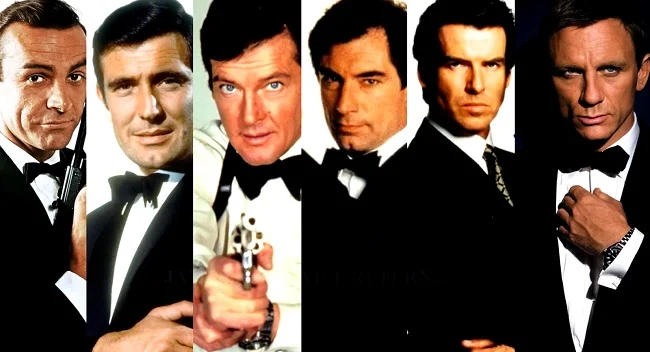
There are many subjects that when mentioned will quickly start an argument. Who’s the best Doctor Who? (and it isn’t David Tennant), do Balrogs have wings? (no, read the text again) and of course that old chestnut, “Data or Spock?”. Then there’s the thorny issue of Bond film title songs. We now have twenty-four to choose from. Obviously, your age group and musical preferences will shape your opinion. As well as when you started viewing the franchise. I personally have very particular views on the subject, hence this post. So here for your edification are five of my personal favourites, each with a few thoughts about why they are of merit. Feel free to leave comments with your own opinions. I’m sure we won’t fall out over the matter. Unless you like Sheryl Crow.
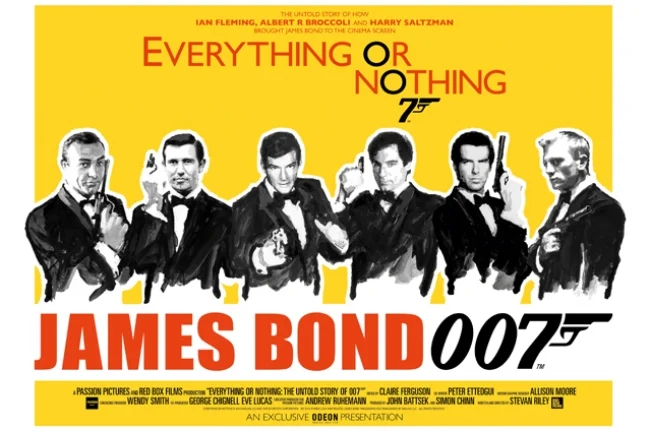
Everything or Nothing: The Untold Story of 007 is a lot more than just some bit of fluff, promotional documentary celebrating the 50th anniversary of the Bond movies. It is quite a frank insight into the history of the Bond franchise, although it is very much told from the perspective of EON productions. The movie title comes from the production company acronym “Everything or Nothing” which was formed by Harry Saltzman and Albert “Cubby” Broccoli. Although somewhat partisan in its tone, this is not a rose-tinted exploration of the staggering success of Ian Fleming’s iconic character. The documentary does in fact make you rethink many notions you may have had about certain high profile Hollywood stars and producers.
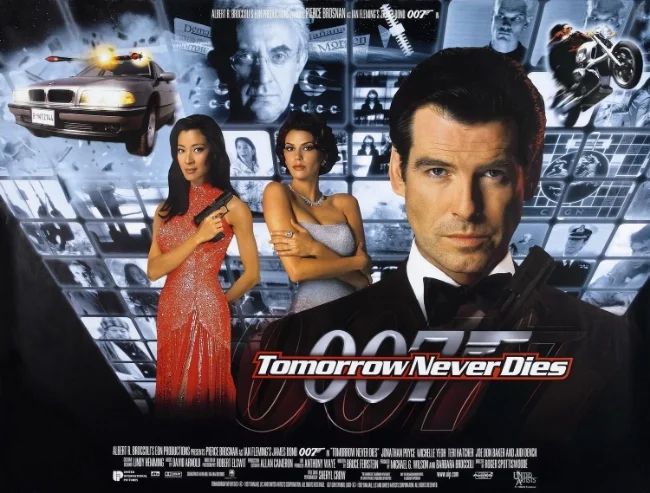
By the time the Bond franchise had reached its 18th incarnation in 1997 with Tomorrow Never Dies, the coveted opportunity to provide the title track was chosen through a competitive tender process. There were twelve submissions made for the movie, including songs from Swan Lee, Pulp, Saint Etienne, Marc Almond, Sheryl Crow and David Arnold. Arnold had already been personally recommended to compose the film’s soundtrack by Bond veteran John Barry, who had retired from the series in 1987.
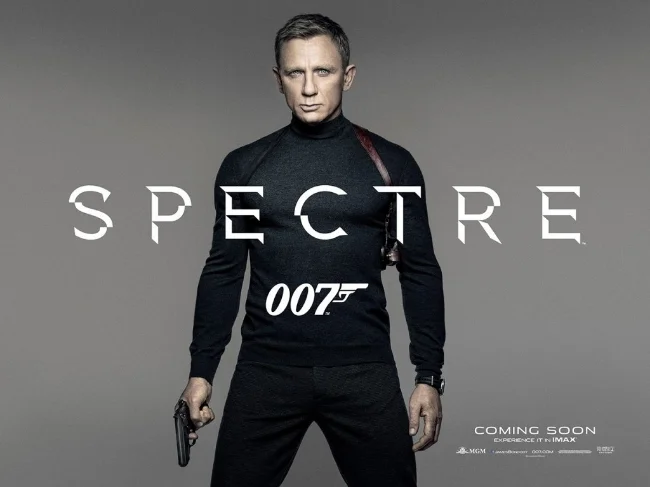
Sam Mendes brought a degree of depth to Skyfall which we've not seen in a Bond movie for a long time. SPECTRE continues in the same vein as its predecessor with an involving plot, fully rounded characters and some finely honed set pieces. I like this approach to Bond and feel that a more cerebral interpretation of the character is not only beneficial for the franchise but to the genre itself. If SPECTRE does turn out to be Daniel Craig’s swansong as James Bond then it will be a fitting epitaph.
I recently started reading fiction again after spending half a year focused upon academic subjects and ploughing my way through numerous non-fiction books. I’ve always been a fan of the Bond franchise so decided it was time to familiarise myself with Ian Flemings’ the source material. The results so far have proven to be quite surprising and not at all as I expected. I managed to purchase the first seven novels in the series from a second hand book shop and have so far completed five of them. I also have audio book version available of the all of Fleming’s stories should I need to consume them in such a fashion.

After the ludicrous (but fun) excesses of Moonraker, the twelfth James Bond film For Your Eyes Only took a “back to basics” approach to its plot. Former Bond editor John Glen was promoted to director and remained so for five movies. The movie is unusual compared to other Bond films in several ways. It directly references Tracy Bond, 007’s deceased wife, with an opening sequence showing Bond placing flowers on here grave. Apart from a passing comment in The Spy Who Loved Me, this has never been done since and has now been eliminated from the plot in the 2006 reboot of the franchise. For Your Eyes Only is also the first Bond movie to include the title song artist in the opening credits.
A Good Day to Die Hard (2013)
Having passed at the chance to see A Good Day to Die Hard during its theatrical I finally caught up with the movie recently. The version I saw was the US theatrical version and not the extended edition that includes three and a half minutes of additional material. It's a curious thing that in an age when blockbuster movies become ever longer and more bloated, frequently running over two and a half hours, that the latest instalment of Die Hard is a brief ninety-nine minutes. That's about an hour and a half once you remove ten minutes or so of CGI credits. Is such brevity to the benefit of the movie? In a nutshell, no. A Good Day to Die Hard is light on plot, character development and viewer engagement. Frankly it’s a caricature of its former self. The notion of the likeable every-man, out of his depth and fighting against incredible odds has given way to a loud-mouth, bullet proof xenophobic who effortlessly moves from one improbable CGI action sequence to another.
Having passed at the chance to see A Good Day to Die Hard during its theatrical I finally caught up with the movie recently. The version I saw was the US theatrical version and not the extended edition that includes three and a half minutes of additional material. It's a curious thing that in an age when blockbuster movies become ever longer and more bloated, frequently running over two and a half hours, that the latest instalment of Die Hard is a brief ninety-nine minutes. That's about an hour and a half once you remove ten minutes or so of CGI credits. Is such brevity to the benefit of the movie? In a nutshell, no. A Good Day to Die Hard is light on plot, character development and viewer engagement. Frankly it’s a caricature of its former self. The notion of the likeable every-man, out of his depth and fighting against incredible odds has given way to a loud-mouth, bullet proof xenophobic who effortlessly moves from one improbable CGI action sequence to another.
The movies first major action spectacle is a lengthy car chase through Moscow, involving an armoured car that destroys pretty much every vehicle that it encounters. The sequence quickly becomes tedious due to its excess and is further tainted by some rather unpleasant moral ambiguity. John McClane dodges an RPG which then destroys an innocent civilian’s vehicle. But of course, in Hollywood terms this doesn't matter at all, as it wasn't an US citizen. Once again, we see a sovereign nation treated with contempt as our hero simply swans around doing whatever he sees fit, irrespective of local law and authority. Well it's their own fault, they don't speak English.
For a movie that hinges on a father and son dynamic, there is no tangible chemistry between Jai Courtney and Bruce Willis. It's all rather perfunctory. I initially assumed that the theatrical version of the movie had been edited down to be low on dialogue high on action. When I heard that the Blu-ray release would include an extended edition I hoped that this would fill some of the narrative gaps. Unfortunately, the extra material is simply a few nominal dialogue scenes and an even longer version of the tiresome car chase. No further plot, or expositionary scenes. But I guess that's my fault for expecting anything more from director John Moore, who previously brought us the pointless remake of The Omen and the inextricable film adaptation of the video game Max Payne.
A Good Day to Die Hard has flashes of interest with villain Alik (Rasha Bukvic) who has a few curious quirks. Unfortunately, he is then effectively side-lined and removed from the narrative far too quickly. The denouement is both excessive and totally implausible, even by the standards of this particular genre. When will film makers learn that once you step over the line and the audience cease to suspend their sense of disbelief, then the battle to hold their attention is lost. We also happen to know by now that the most vulnerable part of a helicopter are both its rotors and that they are not the equivalent of industrial blenders. How dumb do you think we are? On mature reflection, perhaps it’s best not to answer that, as I was the one watching this movie through choice. Sometimes, brand loyalty is a double-edged sword.
There is little good to say about A Good Day to Die Hard. The only thing that made me sit up and take notice was the inclusion of some faux BBC new reports featuring real life news presenter Sophie Raworth. Remember in the nineties how it was always CNN or Sky News that were used in this way? However, overall the movie had nothing new to offer and even its R rating was disappointing. A few profanities and some minor bullet hits cannot recreate the hard edge and elegance of the original movie. Even Bruce Willis' signature kiss off line "Yippee-ki-yay, Motherfucker" is laboured. In all honesty Olympus Has Fallen is closer to the 1988 Die Hard than this shallow cinematic outing. I think it's time for this particular Cowboy to hang up his spurs and retire. Until the inevitable reboot.
Mainstream films are easy to recommend to people. They’re usually formulaic, work within clear parameters and they’re not controversial. Most people, when viewing such film on someone else’s suggestion, are left with a fairly simply choice. Did they like it or not? Whatever the outcome, no feathers are ruffled. No one looks at you askance afterwards and says “why the hell did you think I’d like that piece of shit”? If something like this happens, then you have clearly not recommended a mainstream film. Perhaps you’ve suggested something that’s a little more of an acquired taste. Something niche, from a very specific sub-genre. Which brings me neatly to Blazing Magnum AKA Strange Shadows in an Empty Room (1976). The US title gives the impression that this film is a hard boiled cop thriller, like so many others that followed in the wake of Dirty Harry. But there’s a clue in the European title. Yes, this movie has more than just a whiff of a giallo about it.
Jason Statham is an exemplar of the US mantra of “staying in your lane”. He makes action movies and occasionally strays into action comedies. His formula broadly works and is sufficiently lucrative to keep Mr. Statham employed. Therefore, if you watch a film in which he stars, you have a fairly good idea of what you’ll be getting. Of late, the criteria for his action vehicles have become more succinct. Jason Statham will play an innocuous character, such as a construction foreman or a bee keeper. Something terrible will subsequently befall another character who Mr. Statham has an emotional connection with in some capacity. He will subsequently hunt down those responsible and meet out death and violence. At some point the villain of the story will enquire as to how this innocuous person is so lethal. Research will then show that our Jason is in fact an ex-police officer/special forces operative/international assassin. There’s then a showdown and the villain dies. Job done.
The Light at the Edge of the World presented itself as an action movie upon its release in 1971. Based upon a story by Jules Verne, the Spanish American co-production was driven by its star Kirk Douglas, who curiously hired British director Kevin Billington to helm the project. This tale of a lighthouse keeper fighting a war of attrition against a group of pirates that have captured his island, was market as an adventure film ostensibly in the idiom of the authors previous works and as a pirate movie. MGM bought the rights to distribute the film in the UK on the misunderstanding that it was a family friendly production. It was not and remains so. They subsequently had to cut 15 minutes of violence and torture as well as an undercurrent of sexual assault to secure a suitable rating. Conversely, the US distributors received an arbitrary PG rating, despite the fact this is one of a handful of films that honestly depicts pirates as murderers, rapists and worse.
It’s an established action film trope. The fire team comprised of ex-military personnel, move in on their target. Only to have the tables turned by someone they don’t deem a threat. What makes it different in The Last Stand of Ellen Cole is a throwaway line of dialogue. The bested operative lies bleeding on the floor and the protagonists stands over them ready to finish them off. “Don’t, I have a cat” they feebly plead. For me that was the icing on the cake. The movie had already established it was taking the “same old, same old” and doing something different. Something fun, if taken in the right spirit. This scene tipped the balance and I embraced this film because it was being honest about what it is. This is a modern B movie that decides to give a very specific sub-genre a makeover. Furthermore, its clearly done with an affectionate wink, which is very different to sly wink. This isn’t deliberate self-knowing irony. Its just a film doing something different and possibly silly but it genuinely wants to have fun with it.
Stephen King’s dystopian story, The Running Man, was previously adapted very loosely in 1987, as a vehicle for Arnold Schwarzenegger. That version focused mainly on the “Battle Royale” element of the story and leaned heavily into Arnie’s personality, rather than the politics of the book. It also wasn’t well received by the author. Edgar Wright’s remake follows the source text a lot more closely and is far more interested in its political themes and wider social commentary. Furthermore, this version re-establishes the everyman quality of the hero of Ben Richards, rather than him being the muscle bound, ex-military hero as per Mr. Schwarzenegger’s prior interpretation. This time round, The Running Man uses a lot of the visual and narrative tropes of contemporary reality TV, making this forty three year old story very relevant to today’s viewers and couching the film in a style that is recognisable and accessible.
After the success of Raiders of the Lost Ark in 1981, filmmakers scrambled to find existing intellectual properties that they could use for similar films. Hence archaic heroes such as Alan Quatermain were hastily given a modern makeover and thrust into generic movies, in a vague attempt to replicate Steven Spielberg’s successful formula. Which brings us neatly on to James Charles Bigglesworth AKA “Biggles”, a fictional pilot and adventurer from a series of books written by W. E. Johns between 1932 and 1968. Several attempts had been made in the past to bring this character to the silver screen, including one by Disney but they all failed. However, the commercial and critical success of Indiana Jones provided sufficient impetus to greenlight a new film. However, due to some curious production choices, when Biggles was finally released it was far from just a period set, action movie.
Setting aside the hubris of remaking a film such as Red Dawn, the 2012 reboot had a troubled production. Shot over the course of late 2009, on location in Michigan, MGM intended to release the film in September 2010. However, the studio’s financial problems became unsustainable over the course of that year and the film was shelved, while a financial solution was sought. Furthermore, while Red Dawn was in post production, there was a major economic shift within Hollywood due to the increasing importance of the Chinese market. This was a significant problem for MGM because the new version of Red Dawn had the Chinese invading the USA instead of Russia. Hence there were reshoots and the need for additional visual effects, so that the Chinese could be replaced with North Koreans. MGM eventually went bankrupt and the distribution rights to Red Dawn were sold off. The film was eventually released in 2012.
When I first saw the promotional trailer for Gangster Squad back in 2012, prior to its release, I wasn't especially impressed. I simply thought the film was another attempt to re-invent the gangster genre for a generation who were not especially familiar with it. I wasn't exactly overwhelmed with director Ruben Fleischer's resume either. I didn't particularly like Zombieland and haven't seen 30 Minutes Or Less. Then came the tragic mass shootings in Aurora, Colorado which led to the movie being delayed so that the original ending, which featured a shoot-out in a movie theatre, could be replaced. Hence when I finally watched this film recently, I wasn't expecting a movie up to the standards of say Once Upon A Time In America or Miller’s Crossing and it would seem that I was right do so. Gangster Squad is not especially noteworthy in any respect.
Levon Cade (Jason Staham) is a former Royal Marine Commando who has retired from military service and now works as the leader of a construction team in Chicago. He has a close relationship with Joe and Carla Garcia (Michael Peña and Noemi Gonzalez ) who run the company and considers them as family. Outside of work, Levon is involved in a bitter custody battle for his daughter, against her maternal grandfather, who blames Levon for his daughter’s suicide. When Garcia's teenage daughter Jenny (Arianna Rivas) goes missing, Levon reluctantly agrees to help her parents and get her back. Beginning his search at the nightclub where Jenny was last seen, he soon discovers that she was abducted by Russian traffickers. Furthermore, the culprit is Dimi Kolisnyk (Maximilian Osinski), the wayward son of a senior ranking gangster.
PC Nicholas Angel (Simon Pegg) is an exemplary Police Officer, with a strict adherence to the letter of the law. As a result of making the rest of the London Metropolitan Police look bad, he is transferred to the rural town of Sandford, Gloucestershire. On arrival, Angel finds that the local Inspector, Frank Butterman (Jim Broadbent), takes a far more laissez-faire approach to policing. His colleagues are incompetent and he is further hampered by the Neighbourhood Watch Alliance (NWA), who prioritise low crime statistics over law enforcement due to their desire to win the title of “Village of the Year”. Furthermore, Angel is partnered with the Inspector’s son, Constable Danny Butterman (Nick Frost), who is infatuated with “buddy cop” movies and is in awe of Angel’s London experience. “Have you ever fired two guns while jumping through the air?” However, a sudden spate of grisly accidents lead Angel to believe that there's more to the seemingly tranquil and picture-perfect community than meets the eye.
As a collection of history's worst tyrants and criminal masterminds gather to plot a war to wipe out millions, one man must race against time to stop them. Discover the origins of the very first independent intelligence agency in The King's Man. Based on the Comic Book “The Secret Service” by Mark Millar and Dave Gibbons. 20th Century Studios
Matthew Vaughn’s The King’s Man is an inconsistent film, both narratively and tonally. It veers between serious themes and stylised, hyperbolic action. At times it does quite a good job of exploring such complex subjects as global politics, mechanised warfare and colonialism. Sadly it then wrenches the viewer out of these cerebral reveries as it lapses into the sort of over the top action sequences that were notable in the two earlier films. It’s a shame because The King’s Man gets so many other aspects of the production right. The casting is very interesting, especially Ralph Fiennes as the “pacifist” Duke of Oxford. He is actually a very good fit for the action genre. Djimon Hounsou and Gemma Arterton are given little backstory beyond being respectively the faithful manservant and the family nanny but both are notable due to their own inherent acting chops and personal charisma. Rhys Ifans obviously has a great time as Grigori Rasputin, ensuring all the man’s vices are robustly depicted.
On paper, a video games franchise such as Assassin’s Creed lends itself perfectly to a cinematic adaptation. The parkour action scenes, the historical settings and the contemporary conspiracy theory themes are all elements that should play well with a modern youth audience. Hence with the backing of a major studio such as Twentieth Century Fox and a budget of $125 million, the 2016 movie should have been a guaranteed box office hit. The casting of Michael Fassbender, an actor who is comfortable with serious roles and big Hollywood franchises, should have carried this film comfortably over the finishing line. Director Justin Kurzel, who had found critical success with his adaptation of MacBeth a year previously, must have looked like a safe pair of hands to handle such a project. Sadly, that was not the case. Assassin’s Creed is not the sum of its parts, in fact many elements appear to be pulling in opposite directions. The resulting feature film is staggeringly dull, soulless and a chore to watch. A testament to how modern big budget franchise movies have become a production line, with all the art stripped from them.
300: Rise of an Empire is a curious beast, being neither a sequel nor a prequel. It is infact a tale that takes place simultaneously with those of the original movie. While Gerard Butler is busy making a last stand at the Battle of Thermopylae, fellow warrior and politician Themistokles, played by the singularly uncharismatic Sullivan Stapleton, leads a similar army of buffed Greeks against the Persian fleet. Once again we have a movie that is the epitome of style over substance, complete with a sound design that challenges what can physically be endured by human hearing. They say the first casualty of war is innocence but in this type of movie it's closely followed by historical accuracy and authentic depictions of ethnicity. 300: Rise of an Empire is a cinematic assault upon the senses but not in a good way like Mad Max: Fury Road.
Back in September 2017, Liam Neeson stated in an interview with Sky News that he was retiring from the action genre, due to his age. He felt that audiences would question his credibility in such roles. After the release of The Commuter (2018) and Cold Pursuit (2019) Mr Neeson appeared to return to human dramas and films that focus on performance rather than punching man and beast. Ordinary Love and Made in Italy, both released in 2019, demonstrate the actor’s versatility and skill. People seem to forget that he is a thespian who was initially known for his character driven roles in films such as The Mission (1986), Rob Roy (1995 and Michael Collins (1996). It was only in 2008 that he reinvented himself as an action hero. It’s all a far cry from Schindler’s List and his performance that earned him an academy award nomination. The reason I mention all of this is because The Ice Road is the third action movie I’ve seen in 2021 that stars Liam Neeson.
One of the stand out tropes of the modern action film is that the stakes are always cranked right up to 11. Terrorists, biological weapons and nuclear bombs are common threats in such movies with a hero or heroes trying to save the world from death and destruction or worse. However, back in the sixties and seventies, things were a little more straight forward and in some respects more credible. Take When Eight Bells Toll, released in 1971, for example. British Treasury secret agent Phillip Calvert investigates the theft of £8,000,000 in gold bullion by a gang of international smugglers. In the context of the times this was no small beer however it’s somewhat mundane compared to fighting super villains and their space lasers. Frankly I prefer these low key plot devices as they can make a film a little more plausible within the confines of the genre. A concept that is often forgotten today.
Forensic accountant Owen Casserly (Jake Weber) flees his home with his teenage son Connor (Finn Little) when he discovers he has been targeted by a pair of assassins (Nicholas Hoult and Aidan Gillen) who have been hired to stop him giving evidence in a major corruption case. Connor witnesses the murder of his father after their car is run off the road. Entrusted with important written evidence, he escapes into the dense forests of the Montana wilderness pursued by the killers. Seeking help he runs into smokejumper Hannah Faber (Angelina Jolie) who is stationed at a remote fire lookout tower. Hannah suffers from PTSD from a previous forest fire in which she was unable to save three young boys. Hannah attempts to lead Connor through the forest to safety. Meanwhile the assassins set fire to the forest to divert the attention of the authorities and cover their tracks.
I must admit that I did not have particularly high hopes for Paul W S Anderson's remake of the 1975 Roger Corman produced cult classic. Anderson’s work varies greatly. Event Horizon and Soldier are solid genre films but I still have not fully come to terms with Alien vs. Predator. Jason Statham is also a name that divides the public, with solid material such as The Transporter and unfathomable tosh like Revolver. But despite these considerations, Death Race is in fact quite a surprise and does not follow the path that so many remakes do. It takes the basic themes and concept associated with the original and tries to do something different with them. It doesn’t reinvent the wheel nor is it a genre milestone. But it does offer a different spin on things, have some engaging action scenes and provide some dumb but enjoyable entertainment. When combined with snacks and some beer this is a passable way to kill 111 minutes.
I did not watch Zero Dark Thirty upon its initial release, due to the politics surrounding it. I wanted to be able to view it free from bipartisan debate. Eight years on I believe this now achievable and although debate still exists it is now more measured and less strident. Zero Dark Thirty is certainly a compelling movie. It plays as a docudrama, providing an in-depth study of the US intelligence services hunt for Osama Bin Laden. It cannot be faulted on a technical level and the performances are very strong. It does not adopt a celebratory or triumphalist tone in its approach to the story. Director Kathryn Bigelow endeavours to keep the proceedings focused upon the intricacies of an intelligence driven manhunt. There is little or no tubthumping, jingoism. The decision to find Bin Laden is shown as a political and military exercise of foreign policy. The film solely focuses on the story from a US perspective but that is perfectly acceptable as it is not intended to be an exploration of geo-politics.
Firestorm was originally written as a vehicle for Sylvester Stallone, however when the production company Savoy Pictures went bankrupt the screenplay was bought by Twentieth Fox and the scope of the movie reduced to suit a lower budget. It’s broadly similar to Cliffhanger in so far as the lead character is a specialist in a certain field who runs afoul of criminals in a perilous environment. Whereas Cliffhanger is set in the Rocky Mountains, Firestorm takes place in the forests of Northern Wyoming. After the script was revised four times, the finished screenplay was given a final “polish” by Graham Yost who has considerable experience with the action movie genre. As stallone was no longer associated with the project and the production had been repurposed to be less extravagant, the movie was assigned to former NFL star Howie Long. Long had already appeared in the John Woo movie Broken Arrow (1996) and the Firestorm was seen as a means to give him a star vehicle.
The original French movies District 13 and its sequel District 13: Ultimatum, conceived and produced by Luc Besson, were enjoyable variations of the Escape from New York theme. Their charm lay in their European pedigree and the skilful use of parkour. The two leads, David Belle and Cyril Raffaelli, were eminently suited to the minimalist roles and the screenplays were fun. Half of these movies appeal was the fact that they were not mainstream US products. Brick Mansions is the Hollywood remake of District 13, as well as being Paul Walkers’ final movie. Sadly, this film is far from a fitting epitaph, being devoid of any charisma or innovations. It is blandly shot , poorly edited and has been stripped of everything that made the original entertaining.
Arnold Schwarzenegger's return to the big screen after his political career has been uneven to say the least. His cameos in The Expendables and The Expendables 2 were well received, with their self referential charm and age related irony. Yet his first major movie The Last Stand, although competent, failed to find an audience. Escape Plan fared better at the box office but did not put Arnie back on the A list. Effectively there's a large percentage of the contemporary cinematic audience who were born after his heyday and are simply not overt fans of his work. His core audience is more than likely of the age group that consume most of their film entertainment at home. Which may explain why Sabotage tanked in the US upon release on March 28th 2014. It was the worst opening box office of Arnie's career. He used to break first day opening records.
Sequels and reboots are hardly a new concept and have been a part of Hollywood culture since the 1930s. The success of the Universal Horror movies from that era being a prime example of direct follow ups and retconned movies. However, there is one fundamental rule that distinguishes a good sequel from a bad one. You should never mitigate, undermine or make irrelevant the events of the previous movie, just to provide your new film with a raison d'être. For example, the events of Aliens do not contradict or trivialise those that happened in Alien. In fact with that franchise there is a very clear logical progression between the two movies. The same is true for Mad Max and Mad Max 2 or Star Wars and The Empire Strikes Back. The key is to progress a story, enhance it or explore things from an alternative angle and bring something new to the cinematic table. Sadly this philosophy is all too often lost on corporate film making. Which means that many sequels are just tedious replays of prior films. Terminator: Dark Fate falls squarely into this category.
The enduring appeal of the character John Rambo in First Blood comes from the fact that he is a traumatised ex- service man who keeps himself to himself as he drifts from job to job, trying to come to terms with his wartime experiences. His poor treatment at the hands of a small-town Sheriff is a succinct metaphor for the social and political indifference that Vietnam veterans were shown upon their return to the US. He’s a man with a code in a world that no longer has any use for him. His simple and honest patriotism is not returned and he is in fact viewed with shame by many from the nation he loves. Furthermore, the first movie does not paint him as a cold-blooded killer. Despite provocation he is not the first person to shoot to kill. Rambo is in many ways a victim. A broken man, who society has asked to do unspeakable things. Now society wants nothing to do with him and fears the “monster” they created. Although clearly an action movie, First Blood had narrative depth and a flawed but sympathetic protagonist. 37 years and four movies later, such dramatic themes have long left the franchise. The central character is indeed a caricature of its former self.
It was hardly surprising that the movie adaptation of Chris Kyle's autobiography American Sniper, would cause controversy. The Iraq war, US Foreign Policy and national pride are seldom subjects that are discussed in a calm and measured fashion. And then there are the personal politics of director Clint Eastwood to consider. Hence there were claims from some quarters upon the movie’s release, that it was Islamophobic and counter claims that criticisms of the late Chris Kyle were unpatriotic. There still remain issues regarding the authenticity of events depicted in the source text and subsequently the movies screenplay by Jason Hall. Yet none of these factors have in anyway impacted upon the film's box office returns which currently stands at $247,900,417 worldwide.
Do I really need to present you with some sort of plot synopsis for Transporter 3? No, I didn’t think so. More of the same as Frank Martin (Jason Statham) and his police chum, Inspector Tarconi (Francois Berleand) become embroiled in yet another high-octane escapade. There's fights, car stunts, exotic international locations and a strong sense of humour. This time, the disposable love interest is a Ukrainian girl named Valentina (Natalya Rudakova) who fulfils her role succinctly. The film benefits by being set back in Europe, after the mistake of basing Transporter 2 in the US. This time, the story takes us to such locations as Budapest and Odessa. The international film crew once again bring a veneer of panache to the production that is conspicuously absent in US action movies. For a modest budget fil, Transporter 3 it looks very good. Again the proceedings are given a boost by a pertinent soundtrack by Alexandre Azaria and a selection of European “tunes”.
Jason Bourne originally graced our screens for the first time seventeen years ago. The Bourne Identity was a gritty, minimalist take on the espionage genre and a welcome change from the excesses of the Pierce Brosnan Bond era. The story arc was sustained over three movies and ended efficiently and succinctly. After which Matt Damon moved on, as did the director of two of the movies, Paul Greengrass. Which leaves us with The Bourne Legacy; the tangential sequel that arrived in 2012. A film that exists because the money men and bean counters hate to pass up on a franchise until it has been squeezed utterly dry. Hence, they commissioned the writer of the series, Tony Gilroy, to come up with a screenplay and direct a spinoff movie. Jeremy Renner was cast in the lead role. Yet despite narrative and production continuity, The Bourne Legacy was not a Jason Bourne movie with the star appeal of Matt Damon. Although the film turned a profit, it had the lowest box office returns out of the entire franchise.
During the eighties there was a clear league table of action movie stars. By the mid-nineties this system fell into decline and the Hollywood lacked any clearly defined exponents of the genre. A decade later, due to the success of Luc Besson’s Transporter films, Jason Statham became a bankable box office star in this field. When you look at Statham's early work in Lock, Stock and Two Smoking Barrels it is hard to envisage the "mockney geezer" as an international action star. Yet he has successfully stepped into the role and enjoys a large following. I enjoy his work as he has a likeable on-screen persona. My 88-year-old Mum likes him to because "he wears nice suits". The action genre seldom reaches such a diverse demographic.
Before we start, I recollect that one well known UK critic described Safe House as sub-Tony Scott, upon its release. Now I’ve always been conflicted over Scott’s back catalogue, as I’ve always found his movies to be hampered by their own unique style. The subtleties of his characters and depth of his themes are all too often drowned out by his frenetic style and fast paced editing. Therefore a comment such as this really sets off alarm bells for me. Having recently watched The Equalizer 2, I wanted a further fix of Denzel Washington in a similar action vehicle. As Safe House was available on Netflix UK, I decided to kill a couple of hours and see what actually constitutes as “sub-Tony Scott”.
Mainstream films are easy to recommend to people. They’re usually formulaic, work within clear parameters and they’re not controversial. Most people, when viewing such film on someone else’s suggestion, are left with a fairly simply choice. Did they like it or not? Whatever the outcome, no feathers are ruffled. No one looks at you askance afterwards and says “why the hell did you think I’d like that piece of shit”? If something like this happens, then you have clearly not recommended a mainstream film. Perhaps you’ve suggested something that’s a little more of an acquired taste. Something niche, from a very specific sub-genre. Which brings me neatly to Blazing Magnum AKA Strange Shadows in an Empty Room (1976). The US title gives the impression that this film is a hard boiled cop thriller, like so many others that followed in the wake of Dirty Harry. But there’s a clue in the European title. Yes, this movie has more than just a whiff of a giallo about it.