
10 Sad Movie Death Scenes Part 2
Up (2009). The opening scenes of Up are a beautiful distillation of the life of Carl Fredricksen (Ed Asner), the movies main character. Comprising of a montage, we are shown him meeting his childhood sweatheart Ellie and there subsequent marriage. The narrative then explores the major events of their life together. The couple are not blessed with children and also have to sideline their ambitions to travel the world, due to the realities of work and married life. Ellie grows sick in her autumn years and dies leaving Carl a widower. The sequence plays out wordlessly against a winsome and understated score by Michel Giacchino. The emotional depth and craftsmanship apparent in these scenes are of a quality seldom seen in modern film making. They validate the skills of Pixar Animation Studios and the medium of animation.
Up (2009). The opening scenes of Up are a beautiful distillation of the life of Carl Fredricksen (Ed Asner), the movies main character. Comprising of a montage, we are shown him meeting his childhood sweatheart Ellie and there subsequent marriage. The narrative then explores the major events of their life together. The couple are not blessed with children and also have to sideline their ambitions to travel the world, due to the realities of work and married life. Ellie grows sick in her autumn years and dies leaving Carl a widower. The sequence plays out wordlessly against a winsome and understated score by Michel Giacchino. The emotional depth and craftsmanship apparent in these scenes are of a quality seldom seen in modern film making. They validate the skills of Pixar Animation Studios and the medium of animation.
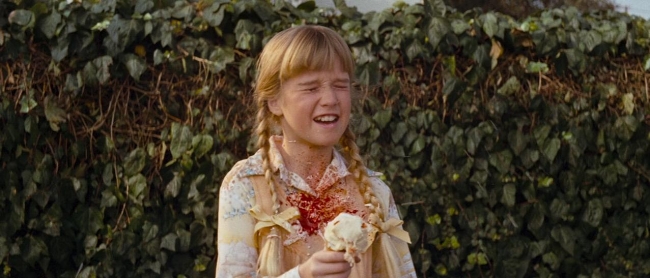
Assault on Precinct 13 (1976). The killing of a child on screen is still very much a cinematic taboo and very few film makers have the nerve to do it. The murder of Kathy (Kim Richards) as she buys an ice cream in Assault on Precinct 13 is still very shocking to this day. Yet director John Carpenter handles the scene in a very measured fashion and although he shows the shooting quite calmly he avoids excessive melodrama or voyeurism. The subsequent sequence where the girl's Father returns from the pay phone to find his child dead on the sidewalk is very powerful. The way actor Martin West blankly stares blankly ahead trying to make sense of what he sees is disturbingly plausible. I've always found the way he takes off his jacket and covers his daughters corpse very touching.
Red Sun (1971). Former Bond director Terence Young struggles with an international cast, bland screenplay and slipshod editing in the 1971 Western Red Sun. Starring Charles Bronson and Toshiro Mifune, beyond its initial appeal of mixing the genres, the film fails to meet it's potential. It is none the less still entertaining mainly through the performances of the two leads. Toshiro Mifune had an inherent gravitas that made him a compelling actor. As a child I was fascinated by the skill and dexterity of the Samurai Kuroda, along with his cultural sophistication. It was a stark contrast to the rather two dimensional caricature that Mr. Bronson was saddled with. Yet despite the obvious shortcomings of the screenplay the relationship that grows between the two is engaging. Kuroda's rather obvious death at the movies denouement always upset and annoyed me. It was unjust and simply just lazy writing.
Enemy Mine (1985). If you've ever seen John Boorman's Hell in the Pacific, then you'll quickly get the measure of Enemy Mine. Director Wolfgang Peterson does a competent job of crafting a tale of inter species conciliation, set against a science fiction back story. The movie had a very problematic production history and it is to everyone involved credit that it turned out as well as it did. Dennis Quaid and Louis Gossett Jr. deliver strong performances as Willis "Will" Davidge and Jeriba Shigan. Chris Walas does stirling work with the alien Drac prosthetic effects. There is a poignant duality to Jeriba Shigan's death scene as he dies in childbirth (Dracs reproduce asexually) and Davidge has to come to terms with promise he made to raise the child Zammis and return him to his homeworld.
The Mist (2007). Frank Darabont is a very astute director and he strongly resisted studio pressure to change the ending of The Mist. Based on a Stephen King novella, the movie centres around an eclectic group of survivors trapped in a supermarket by an mysterious mist. Once you look beyond the standard trappings of a creature feature, you'll find a rich and compelling character study of people desperately trying to cope and rationalise inconceivable events. The cast and performances are outstanding, especially Thomas Jane, Toby Jones and Marcia Gay Harden. Darabont skilfully shows how the superficial trappings of civilised society are quickly dispelled in a crisis. He also holds his nerve and offers the audience a terribly bleak yet compelling ending. Desperate, lost and out of hope survivor David Drayton, by mutual consent, turns his gun on his fellow companions (including his own son) to spare them a slow death. Out of ammunition and unable to kill himself, he contemplates the magnitude of what he has done. It is at this point that the mist clears and rescue is at hand. It is one of the most powerful and heartbreaking movie endings I have ever seen.

Mainstream films are easy to recommend to people. They’re usually formulaic, work within clear parameters and they’re not controversial. Most people, when viewing such film on someone else’s suggestion, are left with a fairly simply choice. Did they like it or not? Whatever the outcome, no feathers are ruffled. No one looks at you askance afterwards and says “why the hell did you think I’d like that piece of shit”? If something like this happens, then you have clearly not recommended a mainstream film. Perhaps you’ve suggested something that’s a little more of an acquired taste. Something niche, from a very specific sub-genre. Which brings me neatly to Blazing Magnum AKA Strange Shadows in an Empty Room (1976). The US title gives the impression that this film is a hard boiled cop thriller, like so many others that followed in the wake of Dirty Harry. But there’s a clue in the European title. Yes, this movie has more than just a whiff of a giallo about it.