
Thinking Out Loud
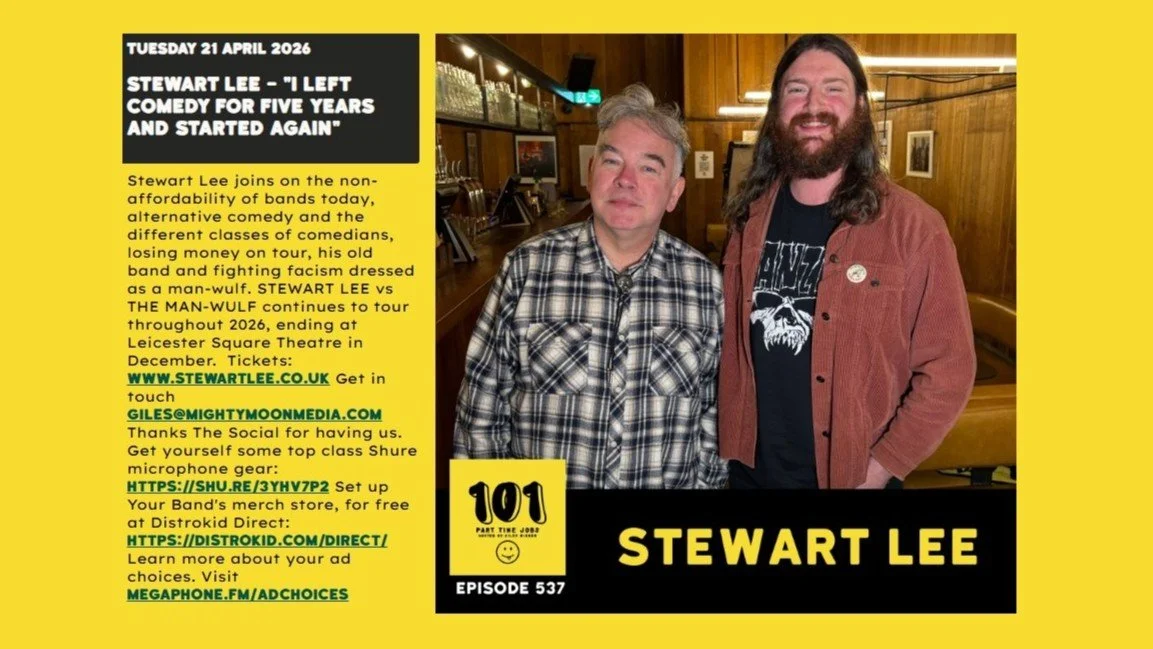
I was listening to a podcast recently in which comedian Stewart Lee talked about the comedy, music and local arts scene in London during the eighties. He highlighted how you could make a living out of music journalism at the times, albeit not an especially good one. He also talked about bands and comedians that lived from “hand to mouth” in shared properties and squats. Essentially it was still possible to pursue a career in the arts due to its standing within British culture which meant there was still some local funding as well as the revenue generated by those working in it and adjacent to it. The UK economy was such that is could “accommodate” working in the arts. Sadly, the internet and commodification culture has effectively killed such career avenues. You now need a regular job to fund your artistic ventures, which puts pay to such dreams for many people. You also have use social media to promote your work, which comes with its own set of full-time problems. The world changes but not all changes are for the better.
This post endeavours to curate a variety of random thoughts, diverse ideas and musings, then convey them clearly and concisely for your edification. Here are a few points on various topics that have occupied my mind lately. These may include talking points arising from the relentless news cycle or even those obscure ideas and musings that come to you while lying awake in bed. Many of which I feel do not warrant a comprehensive blog post or extensive analysis. Instead the idea is to provide a paragraph or two for your consideration and then see if any develop into a wider discussion. All of this is brought together under the title “Thinking Out Loud”, which has become a recurring feature on this blog. Please feel free to share your thoughts and insights on any of the topic included in this post, that may have piqued your interest.
Arts and the Economy
I was listening to a podcast recently in which comedian Stewart Lee talked about the comedy, music and local arts scene in London during the eighties. He highlighted how you could make a living out of music journalism at the times, albeit not an especially good one. He also talked about bands and comedians that lived from “hand to mouth” in shared properties and squats. Essentially it was still possible to pursue a career in the arts due to its standing within British culture which meant there was still some local funding as well as the revenue generated by those working in it and adjacent to it. The UK economy was such that is could “accommodate” working in the arts. Sadly, the internet and commodification culture has effectively killed such career avenues. You now need a regular job to fund your artistic ventures, which puts pay to such dreams for many people. You also have use social media to promote your work, which comes with its own set of full-time problems. The world changes but not all changes are for the better.
Family
I recently went to my Aunt’s funeral. She reached the grand age of 98. It was a very celebratory affair, rather than being excessively sad and possibly one of the most positive funerals I’ve attended. It was pleasant to catch up with my cousins and we all noted that we mainly just see each other at funerals, these days. On the journey home I reflected upon the fact that both my parents families, IE their immediate siblings, are now all deceased. Hardly surprising as all were born between 1925 and 1930. Listening to the service for my Aunt, it also struck me how she lived through times and experienced historical events that would strike many young people as utterly alien. Living abroad in a country that was part of the British Empire. Returning to the UK during WWII. Her devotion to the local church that she served for over 50 years. To coin a phrase it’s like something out of a (period) novel. I wonder if my personal history would be similarly considered abstract?
Projects
I started the year with several online projects approaching fruition. These included live streaming, posting regular YouTube videos and a new film review website. All were complete and ready to be launched upon an unsuspecting internet. However, upon reflection it struck me that none of them would yield the results that I wanted, within the time frame I wished. All of them would have to compete for an audience and take time and effort to grow. They would require promotion and marketing which are jobs in themselves. Furthermore, all these projects would eat into the finite amount of leisure time that I have available and have a financial cost. Simply put, I should have done all these things a decade ago when I was more disposed to “playing the game” required to be successful online. Hence the projects all got canned. The overall experience has not been a total right off. I’ve learned a lot. If there’s moral to this story it is don’t put off to tomorrow what you can do today.
Nick Clegg
Having recently read Nick Clegg’s book How to Save the Internet about his time working at Meta and his thoughts on the future of the internet, I decided to see what critics and other readers thought. Like myself, opinions were mixed on the overall content with many feeling him being a little too lenient and deferential to his former employer. However, many thought his arguments for maintaining a global, open internet were well made. Sadly, what I found all too often when reading reviews and readers thoughts, were the same, tedious, partisan criticisms from people who seem incapable of separating their own party politics from their analysis of the book. IE “I won’t engage any of the points raised in the book because I think Nick Clegg was a poor Deputy Prime Minister”. A classic example of “playing the man and not the ball”. Clegg seems to attract this more than some other ex-politicians, due to his liberal, centrist credentials. It saddens me how so many people are uninformed and incapable of critical thinking.
Postal Vote
There are local elections coming up in the UK on 7th May. Where I live we are voting for Councillors who run the Borough Council. When I was caring for my elderly parents, I changed to a postal ballot for practical reasons. Since their deaths, I have chosen not to change back to regular vote cast at a Polling Station. Hence, I have already voted early for these up and coming elections. One of the reasons I have retained a postal vote is because they are vilified by certain political parties, who spuriously claim that they are a means of widespread voter fraud. There is absolutely no data to support this, nor the notion of so called “family voting” and both are examples of deliberate political misinformation and dog whistle racism. Hence I maintain a postal ballot so if I am ever “doorstepped” by a politician or political market researcher, I can reference my means of voting and shutdown any ill conceived and pointless sound bites they choose to trot out.








Thinking Out Loud is a blog post series where I share random ideas and thoughts that have come to mind. Some of these could could lead to a full article in themselves but that’s not really the aim. Instead I see these thoughts as just starting points for broader discussions. Some of the ideas espoused can be quite serious, while others are light-hearted and trivial. Such is the nature of random thought. As ever there is no rhyme or reason to the various ideas that I’ve chosen or any significant point or concept linking them all. They are as they claim to be, random thoughts, born from thinking out loud. I do edit myself to ensure what I post here is suitable. It can get a but dark and grim inside my head, so I try to apply some degree of quality control to Thinking Out Loud but not too much. As ever, feel free to comment below if you have anything to add. The idea with this post is to start a conversation of at least provide something to think about.