
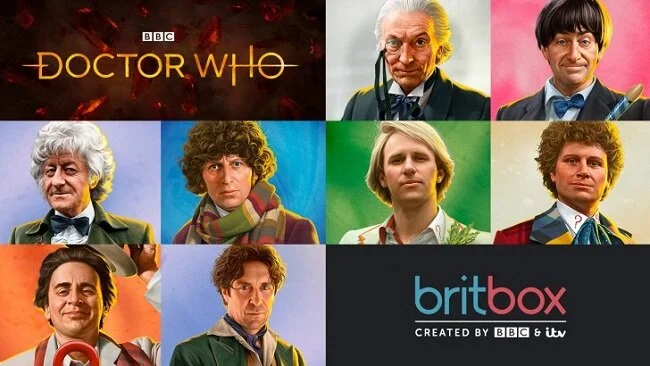
Back in July 2020, during the pandemic, I started rewatching “Classic” Doctor Who. At the time I focused on episodes from the third incarnation of the Doctor. Mainly because I had vague memories of watching some of these as a child. However, because I was very young I hadn’t retained much. I wrote my thoughts on the John Pertwee era in a blog post and intended to follow it up with a further one, focusing on the Tom Baker years. Like so many draft posts, it got postponed and subsequently forgotten about. I also stopped watching Doctor Who because my trial subscription for the streaming service BritBox came to an end. Five and a half years later, BritBox has been subsumed into the wider streaming service of ITVX which no longer has the rights to the show. However, the BBC have started making the Doctor Who back catalogue available on their own streaming platform, iPlayer. Furthermore, as a UK TV license holder, this service is free to me.
Hence I have recently started watching Doctor Who again, with the intent of revisiting selected episodic stories as recommended by various fan-sites. This served me well when re-watching content from the John Pertwee era. However, it soon became apparent that there are so many good story arcs to choose from. Mainly because Tom Baker’s seven year period as “The Doctor” is considered by many fans as pinnacle of the Classic era. Hence I had to do my research far more selectively. In total I watch about two dozen story arcs over a period of about four months. Here are the ten that I enjoyed the most. Once again the mixture of filmed exterior shots and video taped studio content is somewhat jarring. The visual effects are variable by the standards of the time but the writing and acting are top notch. The themes and subjects are often quite bold and thought provoking. The average audience during Tom Baker’s tenure was often between 9 and 11 million viewers.
The Ark in Space (Season 12, 1975). Humans awaken aboard a space station thousands of years in the future only to discover that something unpleasant has arrived before them and is consuming them. Some of the visual effects are inevitably very cheap such as the use of bubble wrap but the writing, atmosphere and ideas explored in the story are excellent and Baker's famous speech about humanity is quintessential Fourth Doctor. This brought story brought back a great deal of memories.
Genesis of the Daleks (Season 12, 1975). One of the defining Doctor Who stories. The Doctor is sent to prevent the creation of the Daleks and is confronted with the moral question of whether he has the right to destroy an entire species before it exists. It also introduces the creator of the Daleks, Davros, whose misplaced, scientific and ideological certainties provides an excellent counterpoint to the Doctors ethical dilemma. This is some of his finest dramatic material the show has produced as Baker wrestles with the notion of ethical genocide. Ian Marter amused me greatly as Harry Sullivan, a species of Englishman that has now vanished form the world.
Terror of the Zygons (Season 13, 1975). One of the best UNIT-era stories and arguably the Zygons' finest appearance. The Scottish setting, body-replacement premise and distinctive creature design give it a particularly strong identity. I remember distinctly being frighted by these creatures as a child. I had to watch these episodes on Blu-ray as they have been withdrawn from the BBC iPlayer due to the right expiring.
Pyramids of Mars (Season 13, 1975). Perhaps the purest example of the Gothic-horror style that characterised the early Baker years. Sutekh is an extraordinarily effective and interesting villain and Baker plays the Doctor as distinctly alien and genuinely frightened by what is at stake. The Mummy design is especially effective within the budget of the show.
The Brain of Morbius (Season 13, 1976). An unabashed Frankenstein pastiche featuring a disgraced Time Lord whose brain is being installed into a monstrous new body, complete with a giant crab claw and a brain in a jar.. It combines Gothic horror, black humour and some wonderfully theatrical performances. This is a prime example of how bold the show was for the time and how it gained its reputation for terrifying family audiences.
The Deadly Assassin (Season 14, 1976). An important piece of Doctor Who mythology because it takes the Doctor back to Gallifrey without a companion. Robert Holmes transforms the Time Lords from mysterious demigods into a recognisable political establishment full of bureaucracy, corruption and assassination. This story ruffled the feathers of the National Viewers' and Listeners' Association, whose head Mary Whitehouse strongly objected to a cliffhanger scene in which the Doctor appeared to have his head held underwater and drowned.
The Robots of Death (Season 14, 1977). Essentially an Agatha Christie murder mystery aboard a futuristic mining vessel. The art-deco production design, sinister robot servants and gradually mounting paranoia make it exceptionally atmospheric. The robot design is notable and very creepy, as our their monotone voices. As soon as I heard the words “Kill the Doctor”, I was immediately transported back to my youth. Again I was surprised by the violence when watching again.
The Talons of Weng-Chiang (Season 14, 1977). This story arc is historically regarded as one of the greatest not only of the To Baker era but from the Classic period. Robert Holmes's script, Victorian London atmosphere, dialogue and the double act of Jago and Litefoot are superb. However, it also contains racial stereotypes and yellowface casting that are extremely problematic by modern standards. I was able to contextualise these aspects and still enjoyed the proceedings and certainly wouldn’t omit it from my list but it may not be for everyone.
Horror of Fang Rock (Season 15, 1977). A superbly claustrophobic story set almost entirely inside a Victorian lighthouse. A small cast, isolated location and unseen threat make it one of the classic era’s most effective exercises in suspense. Again the visual effects are lacklustre by today’s standards but the atmosphere more than makes up for them.
City of Death (Season 17, 1979). Probably the most effortlessly entertaining Tom Baker story. Douglas Adams's influence is everywhere, with witty dialogue, a clever time-travel plot, beautiful Paris location filming and terrific chemistry between the Doctor and Romana. It is interesting how much I remembered about this story, especially how enigmatic Julian Glover performance is. I think it left such a strong impression because it is such a well conceived and executed story.
There are a few other stories worth mentioning. The Ribos Operation has great dialogue by Robert Holmes’s and a wonderful con-man character, Garron, played by Iain Cuthbertson. Logopolis, Baker's final story, is sombre, strange and unusually melancholic tale. It makes an excellent conclusion to the Tom baker era. The stories I have chose certainly show a steady evolution over time. Starting from a very dark and Gothic approach to both the writing and the characterisation during the Robert Holmes period, to the considerably more humorous Douglas Adams era. I very much enjoyed re-watching the Doctor Who of my youth. Yes, some aspects of the show are dated by their seventies sensibilities but as a character driven drama with complex, thought provoking and at times, quite bleak stories, these still have no direct modern equivalent or equal.

Back in July 2020, during the pandemic, I started rewatching “Classic” Doctor Who. At the time I focused on episodes from the third incarnation of the Doctor. Mainly because I had vague memories of watching some of these as a child. However, because I was very young I hadn’t retained much. I wrote my thoughts on the John Pertwee era in a blog post and intended to follow it up with a further one, focusing on the Tom Baker years. Like so many draft posts, it got postponed and subsequently forgotten about. I also stopped watching Doctor Who because my trial subscription for the streaming service BritBox came to an end. Five and a half years later, BritBox has been subsumed into the wider streaming service of ITVX which no longer has the rights to the show. However, the BBC have started making the Doctor Who back catalogue available on their own streaming platform, iPlayer. Furthermore, as a UK TV license holder, this service is free to me.