
The Elder Scrolls Online and the $1,000,000 Giveaway
In the past an MMO kept players engaged with their game by the psychology of the subscription model and providing content updates. Loyalty and the overall cost of running multiple games meant that most players dedicated themselves to one game and stuck with it. Free to play eliminated these ties and a lot of MMO players became a lot more itinerant. Developers therefore have had to become a lot more creative in finding ways to keep people logging into their games. Hence we now find many MMOs that feature daily rewards, content that has to be unlocked by claiming it and short term events that offer unique rewards.
In the past an MMO kept players engaged with their game by the psychology of the subscription model and providing content updates. Loyalty and the overall cost of running multiple games meant that most players dedicated themselves to one game and stuck with it. Free to play eliminated these ties and a lot of MMO players became a lot more itinerant. Developers therefore have had to become a lot more creative in finding ways to keep people logging into their games. Hence we now find many MMOs that feature daily rewards, content that has to be unlocked by claiming it and short term events that offer unique rewards.
The Elder Scrolls Online launched in April 2014 with a subscription based business model. By March 2015 the game went buy to play and was rebranded TESO: Tamriel Unlimited. Developers ZeniMax now find themselves in a very competitive gaming market in which MMORPGs are no longer the cash cow they were considered to be a decade ago. Like many companies they have been striving to maintain their share of the market and find a way to keep players logging in and playing, as well as encouraging perspective players to buy the base game. I must admit that their latest marketing campaign does have a novel approach and an interesting hook. Bethseda Softworks are to giveaway $1,000,000 to one lucky player, be they an existing or new customer.
The criteria for entry are at first glance somewhat straightforward. You need to log in to the game or complete an entry form available online by January 10th 2016. The winner will be drawn on 1st February and the funds duly paid. At present the base version of the game is currently retailing at its full price, although discounted keys can be found from reseller sites. I wouldn’t be surprised if there were another major Steam sale over the Christmas period. Needless to say the chance to win such a cash prize will definitely cause a spike in account logins. Whether returning players decide to stick around remains to be seen.
Like most competitions there’s a wealth of small print as well as terms and conditions. As each country has its own legislation governing giveways some geographical regions are excluded from entering. As you would expect this has caused those affected to protest most vocally online. As for myself, I briefly considered buying the game and entering but when you consider the initial cost and the approximate odds of winning, this is not a particularly sound gambling proposition. Sure I’d end up with a game that I could play but I have neither the time nor the inclination for another MMO at present. Part of me also thinks this stunt is a little tacky. I’d much rather be enticed to play a game because of some well-made new content. But this is how the gaming industry runs nowadays. Mass appeal has simply lead to greater commercialism. Makes you wonder what the next developer/publisher will do to top this?
Star Trek Online: Q's Winter Wonderland!
Regular readers probably know by now that I'm not a huge fan of festivals in MMOs. Mainly because they never seem to offer rewards that I want. Some folk love to collect cosmetic items and will happily repeat content to obtain them. I prefer a more tangible carrot on the end of the stick but sadly that seldom occurs. However Star Trek Online launched its seasonal festival today, namely Q's Winter Wonderland! This offers players the chance to claim a new Tier 6 ship, a Breen Rezreth Dreadnought Cruiser. This is quite a prize as the latest vessels sell for 3,000 Zen in the in-game store, which equates to about £20/$30.
Regular readers probably know by now that I'm not a huge fan of festivals in MMOs. Mainly because they never seem to offer rewards that I want. Some folk love to collect cosmetic items and will happily repeat content to obtain them. I prefer a more tangible carrot on the end of the stick but sadly that seldom occurs. However Star Trek Online launched its seasonal festival today, namely Q's Winter Wonderland! This offers players the chance to claim a new Tier 6 ship, a Breen Rezreth Dreadnought Cruiser. This is quite a prize as the latest vessels sell for 3,000 Zen in the in-game store, which equates to about £20/$30.
Now obviously Cryptic do not just give players this shiny new vessel on a plate. It has to be earned. Players have to repeat a special racing event that rewards 40 Winter Prize Vouchers, twenty five times before they can unlock their prize. The repeatable activity is far from hard though and simply requires players to beat the clock on a race course made of ice. The trick is to forward roll when taking corners to avoid sliding. I consider this even to be an equitable arrangement and as I am currently well disposed towards this MMO, will be "grinding" towards my goal.
There are of course plenty of other activities to partake of each day which give favours that can be exchanged for traditional cosmetic items such as a pets and winter wear. These are all winter themed and involve snowballs fights and an evil Borg assimilated snowmen invasion. I must admit I prefer the summer festival so I am at present simply working towards earning the new ship and not really partaking of the other activities. It may also be considered heresy but I’ve never been a fan of the character Q in Star Trek The Next Generation, having always found him somewhat trying and bombastic.
Overall I think ones attitude towards in-game events and festivals depends very much on your overall disposition towards the game itself. Since returning to STO in April I've been having a lot of fun which is what gaming is supposed to be about. Therefore I am more than happy to indulge Q's Winter Wonderland! Plus working towards a reward that has some practical benefits is sufficient motivation for me to continue with the required repeatable event. It's a shame that other MMOs don't take a leaf out of developer Cryptic's book, when it comes to viable festival rewards.
Blessing of the Valar
Boosts that auto-level a character in an MMO have always divided player opinion. Naturally when Turbine introduced the Gift of the Valar in late 2014, which instantly increases a character to Ievel fifty, there was a lot of debate in the wider community. It should be noted that at the time of release, Turbine stated they reserved the right to alter the level boost beyond fifty at a future date. On a live stream broadcast on 12th June 2014, it was stated that the boost may be raised to possibly seventy five. It would seem that in update 17.1 for LOTRO, Turbine have created a new boost called the Blessing of the Valar which will increase a character to level ninety five.
Boosts that auto-level a character in an MMO have always divided player opinion. Naturally when Turbine introduced the Gift of the Valar in late 2014, which instantly increases a character to Ievel fifty, there was a lot of debate in the wider community. It should be noted that at the time of release, Turbine stated they reserved the right to alter the level boost beyond fifty at a future date. On a live stream broadcast on 12th June 2014, it was stated that the boost may be raised to possibly seventy five. It would seem that in update 17.1 for LOTRO, Turbine have created a new boost called the Blessing of the Valar which will increase a character to level ninety five.
I do not consider such store based items to be a problem or harmful to the game and deem this one to be far more practical than its previous incarnation. I can understand why a LOTRO “altaholic” may tire of repeating PVE content for the umpteenth time and using such a boost to bring a new alt closer to level cap and endgame participation. That seems far more practical to me compared to the older boost that simple took you just halfway to level cap. However it is always good to have options so having multiple permutations of such a levelling boost seems very beneficial for both players and developers alike.
The price of 5995 Turbine points is somewhat high but then again LOTRO does have a high number of lifetime account holders who have sizeable stockpiles of this currency, due to the monthly stipend. LOTRO also has a lot of whales who are happy to spend money on the only Middle-earth themed game available. Turbine cannot really be chastised for trying to monetise an MMO that is in the final stages of its lifecycle. I wonder how long it will be before we see items such as high end armour and weapons available in the LOTRO store. For those who are sceptical about such things happening, wasn’t a similar opinion on levelling boosts held in the not so distant past?
Classic Game Themes: Hidden & Dangerous 2
Hidden & Dangerous 2 is one of the most enjoyable, yet frustrating games I have encountered. There are some moments of brilliance to be had whilst playing it but sadly bugs and some questionable AI always seems to trip the proceedings up. Released late 2003 when World War II games were still very much in vogue, this third person squad based shooter still has many outstanding features to this day. One of which is the terrific score by Michal Szlavik and Martin Benes, performed by the Brno Philharmonic Orchestra from the Czech Republic.
Hidden & Dangerous 2 is one of the most enjoyable, yet frustrating games I have encountered. There are some moments of brilliance to be had whilst playing it but sadly bugs and some questionable AI always seems to trip the proceedings up. Released late 2003 when World War II games were still very much in vogue, this third person squad based shooter still has many outstanding features to this day. One of which is the terrific score by Michal Szlavik and Martin Benes, performed by the Brno Philharmonic Orchestra from the Czech Republic.
What makes the soundtrack so memorable is its musical idiom, which seems to reflect the styles and nuances we associate with classic war movies. The more than a hint of Ron Goodwin, Roy Budd and Elmer Bernstein permeating the score and it feels very appropriate. I have chosen two cues which I feel encapsulate composers best work from the game. The first plays out at the end of the North African campaign, as your team escapes from a remote airport with German fighters in hot pursuit. It really does have an authentic aerial feel to it, putting one in mind of cues from The Battle of Britain movie.
Please note that the short running time is due to the track being intended to be looped during the game to reflect the fluid nature of the action.
The second is the rousing cue that plays after the successful completion of a mission. It has a very uplifting and positive tone and again reflects the overall quality of the score, which is played with a full orchestra. Many games at the time and even now elect for a score using contemporary synthesizer and sequencers.
Gaming Merchandise
While watching the official LOTROstream recently, I noted that there was still a lot of LOTRO related merchandise adorning staff desks at Turbine’s offices. I recollect in the past that mouse mats, mugs and other items use to be available for sale in the Warner Bros. store. There was an initial marketing campaign associated with the launch of the game in 2007 and another in 2010 when the game converted to F2P, both of which required a stock of merchandise for promotional reasons. Sadly a search of the Warner Bros. store has shown that no such material is available any longer. Furthermore considering where LOTRO is in its lifespan, there is not likely to be any further stock produced.
While watching the official LOTROstream recently, I noted that there was still a lot of LOTRO related merchandise adorning staff desks at Turbine’s offices. I recollect in the past that mouse mats, mugs and other items use to be available for sale in the Warner Bros. store. There was an initial marketing campaign associated with the launch of the game in 2007 and another in 2010 when the game converted to F2P, both of which required a stock of merchandise for promotional reasons. Sadly a search of the Warner Bros. store has shown that no such material is available any longer. Furthermore considering where LOTRO is in its lifespan, there is not likely to be any further stock produced.
Merchandise such as T-shirts, mugs, mouse mats and stickers are often used as marketing tools when a game launches or new content is released. Take for example the Charr Plush that was in great demand back in August 2012 when Guild Wars 2 was first commercially available. The stock of such items are often limited and not always maintained over games lifespan. Thus these items go from being available to all, to the province of a collector in a very short period of time. Perhaps there is often no commercially sustainable long term market for such products and the initial batch is produced at a loss for the sole purpose of promotion.
However this is not always the case. Guild Wars 2 at present enjoys a healthy range of products. Mass Effect has been and gone, yet the franchise has evolved a strong following among gamers, very much akin to cult Movies and TV shows. The EA store still has a substantial amount of merchandise for sale including some expensive products such as collector’s edition models, hoodys and jackets. Activision has a similar line of apparel for the Call of Duty franchise; although this is far more understandable consider the financial success of the IP and the target demographic. There is also a wealth of merchandise associated with popular titles from the mobile gaming market, although I think this is a core aspect of the business model, rather than an addition to it as with MMOs.
One of the more interesting examples of game related merchandise is FigurePrints bespoke miniature figure service. The company can make a 3D replica of your in-game avatar from World of Warcraft or a section of your own world from Minecraft. Considering the passion that is prevalent among the LOTRO community with its emphasis upon roleplay, it’s a shame that such a service has never been implemented by Turbine for LOTRO or DDO. Perhaps the complexities of the licensing arrangement have something to do with this. Dealing with third party intellectual properties always comes with its own unique set of problems
Building a Tactical DPS Guardian Cruiser – Advice Required
I recently acquired a Mirror Universe Guardian Cruiser for the princely sum of £4, thanks to the recent Pop Culture Hero Coalition charity auction. It would appear that this is a well-regarded vessel within Star Trek Online and worth experimenting with as my primary ship. So I have spent some time (and energy credits) of late, trying to put together an adequate Tactical DPS build. However I am not particularly knowledgeable in this aspect of STO and have so far not exceeded 9K DPS. Although I’m not seeking to join the ranks of the elite, I would at least like to achieve about 10K DPS plus. However researching a suitable loadout is proving somewhat frustrating. Most Reddit threads on the matter are pitched at too high a level for me and often use jargon I’m not familiar with.
I recently acquired a Mirror Universe Guardian Cruiser for the princely sum of £4, thanks to the recent Pop Culture Hero Coalition charity auction. It would appear that this is a well-regarded vessel within Star Trek Online and worth experimenting with as my primary ship. So I have spent some time (and energy credits) of late, trying to put together an adequate Tactical DPS build. However I am not particularly knowledgeable in this aspect of STO and have so far not exceeded 9K DPS. Although I’m not seeking to join the ranks of the elite, I would at least like to achieve about 10K DPS plus. However researching a suitable loadout is proving somewhat frustrating. Most Reddit threads on the matter are pitched at too high a level for me and often use jargon I’m not familiar with.
So I’ve decided to put this matter into the public domain and solicit ideas for possible builds. I do have some stipulations though with regard to advice and suggestions. I have only been playing STO regularly since April and am therefore not sitting on a stockpile of resources. So I am seeking potential builds that are based upon equipment, weapons and consoles that can be sourced via the exchange, reputation rewards or running specific episodes. If the costs start to exceed 50,000,000 Energy Credits or 500,000 refined Dilithium then I won’t consider it viable. Therefore I’m not seeking to spend precious resources on upgrading gear from Mk XII to Mk XIV or spending Lobi Crystals. Although I play STO fairly regularly I do not want to turn working towards a manageable target, into an arduous chore.
So far I have equipped the Mirror Universe Guardian Cruiser with the following items. Please note that the choice was mainly driven by set bonuses and overall cost. I am happy to replace items if given a cogent reason:
Fore Weapons: 4 x Tetryon Beam Array Mk XIII (varying modifiers).
Aft Weapons: Kinetic Cutting Beam + see below.
Temporal Disentanglement Suite: Antichroniton Infused Tetryon Energy Weapon, Temporal Phase Overcharged Core, Temporal Disentanglement Console.
Sol Defence Set: Deflector, Impulse, Shield.
Universal Consoles: Sustained Radiant Field, Particle Conversion Matrix.
Tactical Console: 2 x Tetryon Pulse Generator Mk XII.
None of the above items have been upgraded and are therefore have base statistics.
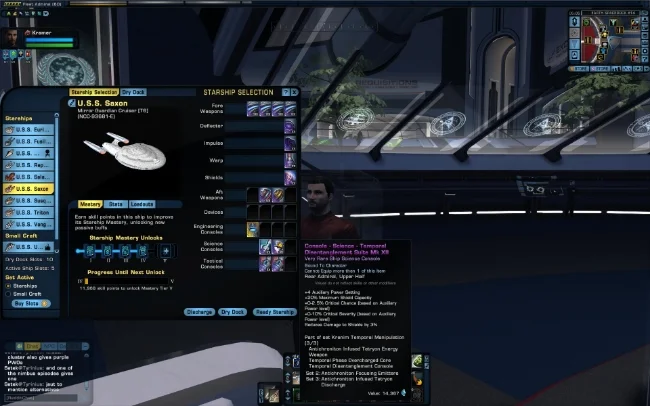
At present I have spent my skills point on a fairly generic tactical build I found on a Reddit thread. My choice of Starship traits are also fairly standard. I can publish the specific details if required but I am mainly hoping that someone can simply suggest a “shopping list” of items that I can then acquire and test. As I stated earlier I am not looking for an über build but merely the ability to be able to output 10K DPS or thereabouts. In principle that doesn’t sound like a big ask but you can never really tell when it comes to the esoteric art of Min-maxing.
Star Wars Battlefront
A reoccurring theme in both my writing and podcasting at present is how age changes one’s personal perspective. This is something that particularly manifests itself with regard to gaming. A decade ago I would have been extremely enthusiastic about a title such as Star Wars Battlefront. I would have pre-ordered the most lavish version available, then waxed lyrical about the beta test and thrown myself wholeheartedly in to the game upon its release. Despite the fact that I’m notoriously poor at the FPS genre, I would have sunk hours in to such a game and done my up most to convince myself and others that I’d had a good time.
A reoccurring theme in both my writing and podcasting at present is how age changes one’s personal perspective. This is something that particularly manifests itself with regard to gaming. A decade ago I would have been extremely enthusiastic about a title such as Star Wars Battlefront. I would have pre-ordered the most lavish version available, then waxed lyrical about the beta test and thrown myself wholeheartedly in to the game upon its release. Despite the fact that I’m notoriously poor at the FPS genre, I would have sunk hours in to such a game and done my up most to convince myself and others that I’d had a good time.
Middle age has fortunately brought a keener insight in to the nature of marketing and as well as my own Pavlovian nature. Battlefront is simply another iteration of the Battlefield franchise from DICE with a veneer of Star wars added. It may well be very polished and a succinct distillation of everything that makes classic Star Wars enjoyable but once the initial euphoria has worn off, the player is left with a just another FPS game. Having read multiple reviews and watched numerous streams, it would seem that the game itself is actually lacking some of the usual progression mechanics found in this genre.
However for me the main issue that has kept me from considering purchasing Star Wars Battlefront is the egregious pricing model that EA has chosen to implement. Although I have come to terms with the concept of DLC and the ubiquitous season pass, I feel in this instance that EA have simply crossed a line with regard to an equitable division of the games content. Where a company such as DC Projekt Red seem to have found the right balance between launch content and future material, EA appear to have simply hobbled their base product at the expense of monetising the games long term life cycle. If I want access to all content in Star Wars Battlefront, both present and future, I have to spend £95.
I am a firm believer in the cost to fun ratio. I therefore if at a future date, I can secure Star Wars Battlefront at a discount price, I will overlook its alleged shortcomings and will more than likely have fun playing through the game. At present the price is prohibitive and frankly illogical. It is not a question of whether I can afford the cost, because I can. I simply do not believe the game justifies such a price tag. So for the present I will not be buying Star Wars Battlefront and because I no longer feel compelled to be an early adopter or be part of the “in crowd”, I am content to go without.
How to Explain Your Passion for Gaming to a Non-Gamer
Gaming is a pastime that is still viewed with scepticism by many people and gamers per se still endure a lot of bad press from those who like to perpetuate lazy stereotypes. If you are a well-adjusted gamer who enjoys gainful employment and a healthy social life, you may find yourself at some point having to explain your passion. Furthermore it could be to people who find your hobby utterly alien. Like most things in life there is no easy solution and there are numerous approaches to tackling such a line of enquiry.
Gaming is a pastime that is still viewed with scepticism by many people and gamers per se still endure a lot of bad press from those who like to perpetuate lazy stereotypes. If you are a well-adjusted gamer who enjoys gainful employment and a healthy social life, you may find yourself at some point having to explain your passion. Furthermore it could be to people who find your hobby utterly alien. Like most things in life there is no easy solution and there are numerous approaches to tackling such a line of enquiry.
The most logical starting point may be to give any curious third party a verbal overview on the merits of gaming; to attempt to convey the very things that you find engaging about gaming. However fans often cannot see the woods for the trees, so there’s a good chance that this approach could result in a lengthy diatribe, which fails in its good intentions and leaves one of the two individuals involved with their eyes glazed over. Can you guess which one?
Another approach may be to try and introduce this fictitious friend who is curious about gaming to some of the professional games coverage that is provided by the wider press. Mind you, this also comes with its own set of problems, as some of it can be very esoteric and niche market. It may only further bewilder and confuse, rather than illuminate. Plus the games media itself can at times be extremely blinkered and unwelcoming.
Overall I think the best way is to show the benefits of gaming. By that I don’t mean just demonstrate one of your favourite titles but how you personally experience it. Highlight the positive aspects of gaming that are common to other hobbies and pastimes, such as the social interactions and the friendships. A great example is the associated blogging community that stems from gaming. Many other hobbies have similar support networks and social portals. Perhaps the most obvious parallel that can be invoked is that of sports fandom. Demonstrating the common ground between the two may well prove beneficial.
The key is to break the stereotype of the gamer being an antisocial person indulging in something that has negative connotations. This is where the growth in casual gaming can work as a stepping stone between those who habitually game and those who do not. I’m not saying that the above is a comprehensive guide. As ever with human interaction, you need to adjust your pitch according to the situation. Yet if each of us manages to change at least ones persons mind about gaming, perhaps we can finally dispel some of the myths that still linger.
Star Trek Online - Hearts and Minds
Star Trek is no stranger to the supernatural. The original series featured two episodes written by the reknown horror author Robert Bloch, namely "Catspaw" and "Wolf in the fold". Both of which nicely contrasted the shows central science based theme with elements of the paranormal. So I was pleased to see today that Cryptic were making the episode "Hearts and Minds" available in Star Trek Online, for a short 36 hour window to celebrate Friday the 13th. It’s a suitably atmospheric and cautionary tale which compliments the traditional story lines we see in STO. The story takes place in the Donatu sector of the Eta Eridani sector block, at a lunar research station in the Donatu system. Franklin Drake bestows the mission, thus suggesting that all is not as it seems.
Star Trek is no stranger to the supernatural. The original series featured two episodes written by the reknown horror author Robert Bloch, namely "Catspaw" and "Wolf in the fold". Both of which nicely contrasted the shows central science based theme with elements of the paranormal. So I was pleased to see today that Cryptic were making the episode "Hearts and Minds" available in Star Trek Online, for a short 36 hour window to celebrate Friday the 13th. It’s a suitably atmospheric and cautionary tale which compliments the traditional story lines we see in STO. The story takes place in the Donatu sector of the Eta Eridani sector block, at a lunar research station in the Donatu system. Franklin Drake bestows the mission, thus suggesting that all is not as it seems.
I've lost contact with an old . . . colleague. Doctor Sibak was a Vulcan priest, but he worked with the Vulcan science academy studying psionic phenomena. A few years ago he went into seclusion on a remote research station in the Donatu system. He hasn't been heard from in some time. I'd like someone to check up on him. Don't worry, He's just a typical Vulcan by himself. You shouldn't have any problems.
But of course there are. "Hearts and Minds" is a mini-mission that explores the consequences of Doctor Sibaks's unconventional research gone awry. This mission is a “story in one act,” and can easily be completed. It is enjoyably atmospheric in a creepy way. Missions initiated by Franklin Drake are always duplicitous and it is an interesting plot device to see a Vulcan character stray so radically from the path of logic. "Hearts and Minds" also rewards players with a unique duty officer upon completion. Not everyone is a fan of time restricted content but I like these episodes that only appear on specific occasions. If you cannot play through this particular mission during its current window of opportunity, you can rest assured that it will be available again in the future.
The Evolving Definition of MMORPG
A post over at Massively Overpowered postulated the question is an MMORPG still an MMORPG without gear progression? As you can imagine a broad debate ensued and at present there are over two hundred comments on the matter. I’m not going to debate the specifics of this particular question but would rather consider the following notion. That the term MMORPG is not immutable and has indeed evolved beyond its traditional definition. Furthermore unless some gamers embrace the concept of adaptive gaming semantics then they will continue to find themselves at odds with the prevailing ideas that are currently driving game developers.
A post over at Massively Overpowered postulated the question is an MMORPG still an MMORPG without gear progression? As you can imagine a broad debate ensued and at present there are over two hundred comments on the matter. I’m not going to debate the specifics of this particular question but would rather consider the following notion. That the term MMORPG is not immutable and has indeed evolved beyond its traditional definition. Furthermore unless some gamers embrace the concept of adaptive gaming semantics then they will continue to find themselves at odds with the prevailing ideas that are currently driving game developers.
Back in the heyday of Ultima Online the term Massively Multiplayer Online Role Playing Game had a very specific meaning that reflected the game mechanics and social requirements of the genre. For better or for worse that definition is no longer applicable. Today the MMORPG is a far broader church where players can pursue common goals collectively or on their own depending on their personal choice. Gear grinds, endgame raiding and mechanics such as the Holy Trinity are no longer essential to the genre. The formula for an MMORPG is now far more flexible, like the recipe for Chicken Tikka Masala or General Tso’s Chicken.
Yet many gamers have their personal perspective of the MMO shaped by their point of entry in to the genre. As a result a form of gaming first contact takes places that creates a rather entrenched mindset and a resistance to change. However games are first and foremost a business and market forces are there primary driving factor. Developers therefore will pursue whatever they consider to be financially viable options. Thus change is inevitable as well as desire able. Do we simply want a market saturated with identical products?
Change can be upsetting at times, especially if you feel it is to your personal detriment. Yet to resist it is ultimately futile. New players and revenue streams outweigh any loss from those who are unhappy. Gamers who want things to remain the same will eventually exile themselves from the very genre they enjoy. Is that a superior choice to trying something different, adapting and accepting change? I have an elderly relation who still obstinately refers to Zimbabwe as Rhodesia, due to some archaic world view that is now obsolete. All they really do by maintaining this stance is isolate themselves from others and look foolish. One could argue that those who stick rigidly to their own definition of the MMORPG are doing the same.
Classic Game Themes: Arcania - Gothic 4
Dynamedion are an award winning company and team of composers based in Germany. They specialize in soundtracks and game compositions, usually in the orchestral form. Over the years they have produced both musical scores and ambient sound designs for such titles as Ryse: Son of Rome, The Elder Scrolls Online and the Gothic series. Tilman Sillescu is both the co-founder of Dynamedion, as well as a prodigious composer in his own right. He previously taught at Mainz University. As Lead Composer and Creative Director at Dynamedion GbR, he has scored many exciting video game projects as well as writing and producing music for movie trailers, television and libraries.
Dynamedion are an award winning company and team of composers based in Germany. They specialize in soundtracks and game compositions, usually in the orchestral form. Over the years they have produced both musical scores and ambient sound designs for such titles as Ryse: Son of Rome, The Elder Scrolls Online and the Gothic series. Tilman Sillescu is both the co-founder of Dynamedion, as well as a prodigious composer in his own right. He previously taught at Mainz University. As Lead Composer and Creative Director at Dynamedion GbR, he has scored many exciting video game projects as well as writing and producing music for movie trailers, television and libraries.
The score for Arcania: Gothic 4 contains both ambient and thematic tracks which enrich the gameplay and overall atmosphere. The cue I have chosen plays over the games end credits and is listed on the games soundtrack CD as "credits song". It is an initially sombre piece that grows in power ending in a triumphant crescendo of brass. The vocalisation adds a semi-religious quality to the track and overall feels somewhat like a requiem. This particular music cue was written by Tilman Sillescu himself and is indicative of the level of quality that Dynamedion produce.
Gamer Spends $30,000 on Star Citizen
Over at PCGamer there’s an interview with a Star Citizen fan by the name of Chris (AKA Ozy311) who has to date spent $30,000 on the game. He owns all items that are currently available via the game store. Furthermore he has implied that he will continue to spend money on Star Citizen as more content become available. It would appear that Chris is an ardent gamer and has no concerns spending such sums of money on virtual products in a game that is still under development. Judging from the interview it seems that he has a well-paid job and is therefore simply exercising his right to spend his money how he sees fit.
Over at PCGamer there’s an interview with a Star Citizen fan by the name of Chris (AKA Ozy311) who has to date spent $30,000 on the game. He owns all items that are currently available via the game store. Furthermore he has implied that he will continue to spend money on Star Citizen as more content become available. It would appear that Chris is an ardent gamer and has no concerns spending such sums of money on virtual products in a game that is still under development. Judging from the interview it seems that he has a well-paid job and is therefore simply exercising his right to spend his money how he sees fit.
What I find fascinating about this story is not that a gamer has spent such a sum of money but the way the gaming community has reacted to this revelation. The comments section over at PCGamer (as well as on other similar sites) is rife with statements and value judgements based on limited data and the application of subjective personal morals. There is also a lot of bitterness and jealousy, as well as the usual straw man and ad hominem arguments that are de rigueur in such discussions. It would appear that some gamers are very unhappy with someone spending their own money in a particular way, but they’re not particularly good at articulating what they specifically object to.
When someone decides to place their personal activities in the public domain, they are courting opinion, be it directly or indirectly and they will have their actions judged. However beyond the facts, there really is no more to this story than what first meets the eye. Chris is a fan spending money on his particular passion. His expenditure is relative to his income. From what I’ve read he’s is not in any way negatively affecting anyone else with his purchases. The only unusual aspect of this whole affair is the relatively new concept of buying virtual goods and services. If Chris had bought a yacht he would still have one, irrespective of whether the manufacture ceased trading.
Once again I find that a percentage of the gamers seem to have a curious puritanical streak. As ever a lot of people’s personal opinions seem to be based upon nothing more than how they initially feel, rather than a logical analysis and measured consideration of the data. However that is something that we cannot lay exclusively at the door of the gaming community as it seems rife in every other social aspect of life. Perhaps I just notice the volume of white noise associated with gaming because I have an interest in it; I’m sure there’s just as much among sports fans. In the meantime it will be interesting to see if Star Citizen continues to attract such “big spenders”. I wouldn’t be surprised if it does.
Activision Blizzard Buys King Digital Entertainment
I found out about Activision Blizzard’s acquisition of King Digital Entertainment via the BBC Business website. From my perspective the notion of a leading US games developer that has a foothold in all major markets, buying in to the mobile sector hardly comes as a surprise. The price is perhaps the main talking point and does raise the question of the potential over valuing tech based companies. $5.9 Billion is after all a tidy sum of money. However what this deal does prove is the financial importance of the mobile gaming market.
I found out about Activision Blizzard’s acquisition of King Digital Entertainment via the BBC Business website. From my perspective the notion of a leading US games developer that has a foothold in all major markets, buying in to the mobile sector hardly comes as a surprise. The price is perhaps the main talking point and does raise the question of the potential over valuing tech based companies. $5.9 Billion is after all a tidy sum of money. However what this deal does prove is the financial importance of the mobile gaming market.
Gaming like many other pastimes has a social hierarchy among its fan base, which is rife with preconceptions, snobbery and self-aggrandisement. For many mobile gaming is still frowned upon and considered in some quarters not to be “proper” gaming. There will be a wealth of blog posts and commentary about this business deal, decrying it as foolhardy. A popular refrain will be how the money could be better spent producing a particular product that specific fans want. This is the nature of fandom; a tunnel vision perspective driven by one’s own desires.
The reality of the situation is very simple. Mobile gaming, irrespective of its perceived artistic and creative merits, is an extremely lucrative business. Therefore the opinion of those who are not part of the existing customer base is hardly of any major significance to developers. Those with entrenched views are hardly likely to succumb to marketing and therefore cease to be of any importance in any ongoing promotional campaign. Sadly logic seldom has any impact upon the white noise generated by “core gamers”.
Over time I have become increasingly more interested in the business side of the gaming industry. It is as fluid and intriguing as any other global market. Compared to the emotive and often self-absorbed tirades I see coming from the gaming community, the machinations of companies such as Activision Blizzard are far more interesting. This simply highlights the gulf between business and the imperatives of the market compared to the capricious nature of fans aspirations. Am I growing out of gaming? No but I may well be growing out of the community.
Have MMOs Made Me Antisocial?
I started playing my first MMO in late 2008. Until then it was the one genre that I had never tried. I initially considered buying World of Warcraft but when I found out there was a virtual version of Middle-Earth I chose to purchase The Lord of the Rings Online instead. Right from the outset I was hooked. My working pattern and domestic arrangements afforded me plenty of time to invest into this game and I did so willingly.
I started playing my first MMO in late 2008. Until then it was the one genre that I had never tried. I initially considered buying World of Warcraft but when I found out there was a virtual version of Middle-Earth I chose to purchase The Lord of the Rings Online instead. Right from the outset I was hooked. My working pattern and domestic arrangements afforded me plenty of time to invest into this game and I did so willingly.
I can remember one particular evening when I grouped up with two other players who were all attempting the same quest as me. We chatted and got on well together. After successfully clearing our quests we decided to meet up again the following night. Needless to say we continued to group together for the next year or so. At this time the majority of LOTRO’s content required people to play collaboratively. It was not an alien concept but a simple fact of life. The prevailing philosophy of the time was that MMO were all about grouping. The key to advancement was teamwork.
At the time I found that most people were friendly and approachable, so levelling through the game was very much a shared experience. Joining a kinship only enhanced this further. It was also nice to log on to the game, say “hi” to people in kin chat and shoot the breeze. Between November 2008 and December 2009 was one of the most pleasant times I’ve spent gaming. There was always something to do and someone to help. I didn’t see LOTRO as a time sink but as a positive leisure activity.
After the release of Siege of Mirkwood in December 2009, something started to change for me. This was not only due to the LOTRO expansion becoming more solo friendly but also because I started to play other MMOs. In early 2010 I managed to progress through Star Trek Online without the need to belong to a guild. Grouping was done automatically and I noticed for the first time that there was no necessity to play collaboratively in a traditional sense. The chat channel was mainly a platform for flame wars with hardcore fans debating the finer points of the franchise. So I played on my own, ignoring others players and was happy to do so.
And so the rot set in. When LOTRO went free to play in October 2010, it embarked on a radical redevelopment of material. Pursuing the free market and the casual player meant ensuring that content was accessible in easy bite size chunks. Turbine then set about making all prior zones soloable over the next 18 months. From my perspective, people continued to play but unless it involved endgame raiding, grouping became less and less common. Even the kinship I was in became more solo orientated. The common link was the group chat and we still ran instances but most of the time everyone seemed to be doing their own thing.
The benefits of solo orientated gameplay are the same nowadays as they were five years ago. There’s no time wasted organising a group, ensuring that everyone is adequately equipped and briefed; nor is there any dependency on other people’s performance. You simply do what you want, when you want. As a result, expectations increase and tolerance decreases. But there are also some negative side effects. Because you do not need anyone else, it can impact upon your level of your involvement within your guild. There may be a decline in communication. There may also be a decrease in the willingness to help out. Requests are no longer be greeted by multiple volunteers. Everyone is too busy doing their own thing. Altruism is an inconvenience.
The automated grouping of players via dynamic content that we see in Guild Wars 2 and Rift, is easy and seamless. It is also devoid of any meaningful social interaction. Players can pursue their own individual goals and simply tap into the benefits of group participation, as and when they want. When done they can go about their business, without saying a word. It is a curious paradox that sees a server full of people, playing a social game, alone.
Now this situation does not affect everyone, nor am I stating that it is the default position of all players. RP servers or guild based around hardcore raiding, fly in the face of this social decline. I am sure both such parties would strongly argue that they still maintain very high levels of social interaction. Yet I don’t think they represent the majority of the MMO population. Such strong team based dynamics only serve specific niche groups. I also believe that the F2P business model has also contributed to general social decline, with the percentage increase of "problematic" players that join the community. That has a big impact upon how we all interact with each other.
When this issue of social decline is raised, it often provokes emotive and judgemental responses. The gaming genre is steeped in nostalgia. Rightly or wrongly, such perspectives seldom have any impact upon business decisions. Game developers want to keep players engaged and using their products. Should customers be denied access to content and the opportunity to advance due to subjective notions of social interaction? Well the logical answer is no. However this move towards a player base that is following its own personal path, is not without flaws. We often see in-game an increasing amount of people who seem ill equipped to interact socially with others, just as we do in real life. Tolerance, consideration, and patience are abstract concepts to some. Social commentators often talk about the decline in the sense of community in the real world. Do also MMOs reflect this?
I personally have contributed to this shift in MMO culture, especially so with LOTRO. I do tend to focus a lot more on my own gaming needs nowadays, rather than with others in my kin. I argue that I've played my part and done my share in the past. However I think the reality is that I no longer have a dependency on others, so the notion of community spirit is diminished. I’m not saying that this is a good thing and I do have pangs of guilt occasionally and endeavour to be helpful. Ultimately, all kins have givers and takers. I've just moved my position between the two ends of the spectrum in recent years, as have many others.
This beggars the question, was the social heyday of MMO's really ever driven by altruism or purely by necessity? Is this decline in the social aspect of the genre inevitable, or can it be stemmed? I cannot answer these questions and only the future will tell. I do on occasions bump into people in-game who are very civil and helpful. LOTRO does to a degree still seems to be a good example of this, although its crown has slipped in recent years. Yet because group content has been watered down within many games or relegated to an afterthought with many new products, the incentive to communicate and collaborate is greatly reduced.
Whether this all stems from developers just chasing a buck or whether this is a wider reflection of contemporary human nature, I'll let you decide. I do think that MMOs and even the internet itself have lost their capacity to impress. Simply being surrounded by other people online no longer gets the “wow” reaction it did a decade ago. We’re also sadly accepting of the fact that social platforms tend be a race to the bottom these days. It is assumed by default that all online communities will have a percentage of assholes. And then there is the ascendancy of the cult of the individual and “me” culture; these to have impacted upon the concept of social gaming.
For me my personal MMO journey has been a question of time and place. I wanted to be social when I started playing this genre and had the resources to do so. If a new MMO was released tomorrow that had old school grouping mechanics and time requirements, I know for a fact I would not play it. It would be incompatible with my current lifestyle and mindset. Perhaps age is also a factor in this conundrum; the idealism of youth versus the pragmatism of old age.
So is there a conclusion to this discussion? I’m not sure there’s a definitive one. Overall it seems a little unrealistic to blame the developers solely for the decline in social gaming. I think if we’re honest we have to concede that we actively contributed to this situation ourselves. When the move towards solo play started did we complain and lobby as much as we could have? Perhaps the golden age of collaborative play is just a myth. We grouped because we had no choice. Can the situation change? Yes but only if we make it financially viable to do so.
Star Trek Online: New Dawn
Tuesday saw the release of the eleventh season of Star Trek Online. New Dawn includes not only the latest feature episode Sunrise but also the new admiralty system, a revamp of the Cardassian story arc along with a Badlands battlezone for level sixty players and above. There is also a new Terran Empire rep faction and associated rewards. Now it probably hasn’t escaped anyone’s notice that Cryptic are providing more of the same. However it’s a tried and tested formula so I guess they cannot be blamed for adopting a policy of “if it ain’t broke, don’t fix it”.
Tuesday saw the release of the eleventh season of Star Trek Online. New Dawn includes not only the latest feature episode Sunrise but also the new admiralty system, a revamp of the Cardassian story arc along with a Badlands battlezone for level sixty players and above. There is also a new Terran Empire rep faction and associated rewards. Now it probably hasn’t escaped anyone’s notice that Cryptic are providing more of the same. However it’s a tried and tested formula so I guess they cannot be blamed for adopting a policy of “if it ain’t broke, don’t fix it”.
After my recent disappointment with the Guild Wars 2 expansion Heart of Thorns, it’s been pleasant to return to the familiar routine of STO. After the conclusion of the Iconian war at the end of the last season, a new storyline based around exploration and first contact is a welcome change of pace. That’s not to say there isn’t any combat involved. It would seem that the Tholians are up to something in this latest episode and once again the plot relies on temporal meddling. As ever the narrative draws upon characters and plot devices from a specific episode of Star Trek: The Next Generation. But this is one of the game’s greatest strengths.
So having played through Sunrise, which I found to be totally agreeable, I decided to check out the new admiralty system. It didn’t take long for me to regret having deleted all the various ships I acquired while levelling. As a result I only have five vessels to use on my primary federation character. Naturally the various low and intermediate level ships that have been languishing on the exchange for months have all now massively increased in value. The system itself which is very similar to the duty officer system, is adequately entertaining but the cool down on missions seems somewhat long.
Although I am currently sharing my time between several MMOs, STO still seems to be the least problematic and trying of them all. It a curious thing that my relationship with this genre has reached a point where I even use such terms. However despite not being the most polished of MMOs, STO still manages to satisfy and engage. The IP is a major contributory factor and the game is extremely functional. Too many games creak under the weight of their own complexity. I suspect that STO will remain installed on my PC for the immediate future, whereas certain other titles may well have out lived there usefulness.
Heart of Thorns
In recent years I have made it my policy not to participate in beta testing of major new MMOs, nor to immerse myself in their marketing leading up to release. I don’t want to risk getting burnt out or build up too many unrealistic or erroneous expectations. Overall I want there to be an element of surprise when I finally around to playing a new product. Naturally I applied this philosophy to the Guild Wars 2 expansion Heart of Thorns and have made it my business to ignore a lot of the press, live streams and hype over the last quarter. So when I finally logged in today I didn’t really know what to expect. On mature reflection this was a mistake.
In recent years I have made it my policy not to participate in beta testing of major new MMOs, nor to immerse myself in their marketing leading up to release. I don’t want to risk getting burnt out or build up too many unrealistic or erroneous expectations. Overall I want there to be an element of surprise when I finally around to playing a new product. Naturally I applied this philosophy to the Guild Wars 2 expansion Heart of Thorns and have made it my business to ignore a lot of the press, live streams and hype over the last quarter. So when I finally logged in today I didn’t really know what to expect. On mature reflection this was a mistake.
The first thing that struck me about Heart of Thorns was how non-specific the quest tracker was in telling me where to go to access the expansion’s prologue. I needed to visit an area called The Silverwastes and had no idea where to go. I mistakenly assumed it was via the region of Dry Top which was added to the game with The Living Story Season 2. It took an hour to discover my mistake. I finally tabbed out of the game and did a Google search only to discover there was a portal in Fort Vandal. I always feel that having to leave a game to find necessary information is a major design flaw.
On arriving in The Silverwastes I happened upon a zerg that was going to the area I required. I was so busy trying to keep up that I failed to pay as much attention to the world around me as I should have. So it wasn’t until I reached the Verdant Brink region that I realised that Heart of Thorns is based heavily around a vertical gaming environment. This means that there is frequently no direct path to locations on the map. Furthermore many features essential to the game such as hero points are placed in elevated areas. Thus the game once again makes use of jumping mechanics as well as the newly introduced gliding skill.
I loathe jumping as a gaming mechanic. I lack the manual dexterity required to undertake it as well as the patience to persevere when I fail. Simply put if I had known in advance that this was a major part of Heart of Thorns I wouldn’t have purchased it. I play games for fun and this does not constitute as such by my yardstick. This is the exact same reason why I never finished any of the second season of The Living Story. That also had a dependency upon power ups to conduct jumps, slides and rolls to access specific areas. It is the reason why two outstanding hero points remain beyond my reach to this day.
Needless to say my interest in Heart of Thorns waned massively after discovering the nature of the expansion. I managed to unlock the gliding skill but wasn’t very impressed by that either. Until further upgrades are unlocked it remains nothing more than a glorified drogue shoot. As for the actual plot of Heart of Thorns I have never been a Guild wars 2 lore aficionado. I therefore have no clue as to what is going on and little investment in the characters that I interact with. Therefore I doubt if I Guild Wars 2 will still be on my PC by Christmas. However I have no one but myself to blame for this situation, having fallen victim of my own gaming practises.
The Witcher 3: Wild Hunt and Humour
The Witcher 3: Wild Hunt is not a game that strikes you as being light hearted at first glance. The plot is dour and brooding, set in a world of human (and non-human) misery and suffering. In many respects this is one of the game’s greatest assets because it’s all so worryingly plausible. The rich and powerful pursue their own goals, heedless of the cost to the rest the kingdom. Those at the very lowest strata of society live a precarious existence. Despite its fantasy setting the world of the Witcher is not that different from our own.
The Witcher 3: Wild Hunt is not a game that strikes you as being light hearted at first glance. The plot is dour and brooding, set in a world of human (and non-human) misery and suffering. In many respects this is one of the game’s greatest assets because it’s all so worryingly plausible. The rich and powerful pursue their own goals, heedless of the cost to the rest the kingdom. Those at the very lowest strata of society live a precarious existence. Despite its fantasy setting the world of the Witcher is not that different from our own.
However despite the overall tone of The Witcher 3: Wild Hunt, there are instances of humour to be found. Often these are discretely integrated in to the game via snatches of incidental dialogue, cryptic entries in the games bestiary or via the village notice boards. As ever with these sorts of things, the writers reference popular culture. However in this instance, CD Projekt RED proves to be more scholarly than other developers. Many of the quips, asides and homages refer to classical literature and scientific theory.
So here are four examples that I’ve found so far during my play though. I’m sure there are many more. All raised a wry smile when discovered and I now make it my business to trawl through all aspects of the game in pursuit of further hidden gems. Its embellishments such as these that add further depth and character to The Witcher 3: Wild Hunt. If only other developers took such time and care as CD Projekt RED.
A droll reference toErwin Schrödinger's famous thought experiment
Someone obviously likes the work of Herman Mellville
Star Wars. It permeates everything
A scholarly homage to Homer (not Simpson)
Gaming Communities
Fans are far more than just customers. Sadly not all of the gaming industry understands or more importantly appreciates this distinction. Consider this analogy; I am a customer of Vodafone. I use their services for a monthly fee and that is the extent of my relationship with them. I do not write about my experiences using their products, nor do I create guides regarding their use. Neither do I arrange social events around their services. Fans conversely do all these things for the games that they love. Furthermore they do not do these things solely for their own benefit. There is a lot of ultraism in fandom. It often contributes towards a vibrant community which is a great marketing and promotional asset for any games developer. Being free, it also has the best price.
Fans are far more than just customers. Sadly not all of the gaming industry understands or more importantly appreciates this distinction. Consider this analogy; I am a customer of Vodafone. I use their services for a monthly fee and that is the extent of my relationship with them. I do not write about my experiences using their products, nor do I create guides regarding their use. Neither do I arrange social events around their services. Fans conversely do all these things for the games that they love. Furthermore they do not do these things solely for their own benefit. There is a lot of ultraism in fandom. It often contributes towards a vibrant community which is a great marketing and promotional asset for any games developer. Being free, it also has the best price.
Communities often arise organically, with fans creating websites, podcasts or live streams. Bridges are built with other likeminded individuals and informal networks develop. Cross promotion and collaboration stems from such affiliations. Often specific groups or individuals gain prominence within these social groups, through their own hard work, dedication and content creation. More often than not these figureheads have not actively sought such a position. It simply occurs through the dynamics of human interaction.
Now this raises some interesting questions. Do such high profile individuals or groups have a burden of responsibility? As so called digital ambassadors is there a need for greater self-regulation? I believe there is to a degree. Creating guides, sharing experiences or collating data are benign and neutral undertakings. Providing news or opinion is far more complex and does require responsibility and self-moderation. However there is also a reciprocal requirement that those who read specific sites or follow certain individuals should exercise their common sense. It is a mistake to put people on pedestals.
In the past gaming communities have usually evolved independently of the commercial entities that run the games. Many resources reside outside of the official forums. For more recent titles such as Guild Wars 2, this process has been more centralised under the auspices of the developers. Information and content created by players but it is more often than not it is found within the official forums for that title. I may be wrong but I have never been aware of either SWTOR or Guild Wars 2 having the same sort of independent community as such titles as LOTRO or WoW. Fan based resources can be a great asset but when they reside within the purview of the developers or publishers then there is scope for problems.
In recent years many niche areas of fandom have grown in appeal. This usually happens when an activity or pastime gains mainstream attention and becomes more widely accessible. Cosplay for example is something that in recent years has become increasingly popular. It is no longer perceived as the prerogative of a small niche group and is beginning to become quite a major marketing and promotional tool. Some perceive this process as democratisation, where others see something they love being usurped by those that simply wish to exploit it for financial gain. Is the community simply growing or is it being reinvented at the expense of some and the advantage of others?
Fandoms and the resulting communities can be socially complex and highly fluid. They also seem to have distinct life cycles. With regard to gaming there most certainly is an expiry date for most communities. The natural attrition we have seen in the case of LOTRO and its fan base is a perfectly normal thing, linked to the games lifespan and individuals ongoing engagement. However during a community’s lifecycle, many players benefit from the services that are provided, via guides, podcasts and events. However it should be noted that the opposite can also occur. Dedication and enthusiasm can turn to bitterness and distain. Some forums and blogs maintain a very adversarial relationship with the former object of their affection.
Involvement in a community has its ups and downs and can be very hard work. However the rewards and the pleasure that it brings can outweigh any negatives. So I advocate involvement and participation for those who can. This can take all manner of forms. It is not mandatory that all blog, podcast or live stream. Just reading, supporting and expressing an opinion is a positive contribution. It is also prudent to temper ones emotional investment in such communities as nothing lasts indefinitely. Fan sites and podcasts come and go, as do the games, TV shows and source material that drive them.
Classic Game Themes: Pirates of the Flying Fortress
Over the past few years I have been regularly writing about Classic Movie Themes and posting specific music cues that I particularly enjoy. Often the term “classic” is not necessarily applicable and it may be more appropriate to simply label them personal favourites. However “classic” is a better fit for headlines and search engines, so I shall continue to use that title. I’ve subsequently decided to post music from the games soundtracks that I feel are of note. The gaming industry has a multitude of talented composers and musicians who enhance games and bring virtual worlds to life with their ambient music and scores.
Over the past few years I have been regularly writing about Classic Movie Themes and posting specific music cues that I particularly enjoy. Often the term “classic” is not necessarily applicable and it may be more appropriate to simply label them personal favourites. However “classic” is a better fit for headlines and search engines, so I shall continue to use that title. I’ve subsequently decided to post music from the games soundtracks that I feel are of note. The gaming industry has a multitude of talented composers and musicians who enhance games and bring virtual worlds to life with their ambient music and scores.
Pirates of the Flying Fortress is a curious expansion pack, in so far that it’s actually an improvement on the original game, Two Worlds II. The game includes a simple sailing mechanic that adds an extremely enjoyable dimension to the proceedings. Furthermore it is accompanied by a appropriately nautical theme by Borislav “Glorian” Slavov and Victor Stoyanov, which adds an ambient seafaring undercurrent while navigating between islands and archipelagos featured in the game. The scores for both main game and expansion are strong and subtly different from traditional game soundtracks, favouring ambient pieces instead of reoccurring leitmotifs.
Pirates of the Flying Fortress is clever example of understated, low-key game composing. The music seamlessly fits with the narrative and provides an aural enhancement, rather than directly reflecting ongoing events with specific themes. There is an emphasis upon ambient ethnic or folk related tracks which add greatly to the atmosphere. There is also a broad range of instrumentation used to craft the soundcape. It’s a robust soundtrack in the context of the game. However some cues such as “Sails and Journeys” do have a pleasing quality to them that works outside of the game.
Uninstalling Games
I’ve recently started reclaiming space on my hard drive and have subsequently started a gaming purge. Contemporary games are often very large and it doesn’t take long for a few titles to monopolise your storage capacity. As fickle gamers we can fall out of love with a game very quickly making these large client installations redundant. It’s a curious thing but the entire process of removing a game from your PC is quite therapeutic. It can be similar to bidding a fond farewell to a dear friend, or wiping some offending matter from the sole of your shoe. It all comes down to how you feel about the game in question.
I’ve recently started reclaiming space on my hard drive and have subsequently started a gaming purge. Contemporary games are often very large and it doesn’t take long for a few titles to monopolise your storage capacity. As fickle gamers we can fall out of love with a game very quickly making these large client installations redundant. It’s a curious thing but the entire process of removing a game from your PC is quite therapeutic. It can be similar to bidding a fond farewell to a dear friend, or wiping some offending matter from the sole of your shoe. It all comes down to how you feel about the game in question.
At present I have seventy eight games linked to my Steam account and a further dozen that run independently or via other platforms such as origin or Uplay. Yet out of those one hundred titles I currently have just seven installed. The only one that I’m actively playing at present is The Witcher 3: Wild Hunt, although I do check in once a week with LOTRO, STO and Guild Wars 2. It seems quite ironic that despite having a substantial collection of content to draw upon, very little of it is actually being used. I’ll probably never play at least half of the games that I have.
I guess this cavalier attitude reflects a broader change in gaming. Apart from pre-ordering and earlier adoption, gaming is no longer the premium priced pastime that it use to be. The vast majority of my gaming library is made up of titles that have been bought as discount bundles. Pricing does affect how a product is perceived and cheap games do smack of disposable items. A £75 pound investment usually garners some perseverance. A £2 pound game that fails to engage is given short thrift. My Steam library is somewhat akin to my sock draw, populated mainly by cheap and easily replaceable items.
I’ve reclaimed about two hundred gigabytes of disk space by uninstalling these games. As I stated earlier this has been more of a psychological exercise in “house cleaning” rather than a genuine search for more storage. It’s not as if hard drives are especially expensive these days. What remains to be seen is whether I replace these games with other discount titles that I won’t play over the remainder of the year. I suspect that I’ll be conducting this process again in spring.