
The House on the Borderland by William Hope Hodgson (2000)
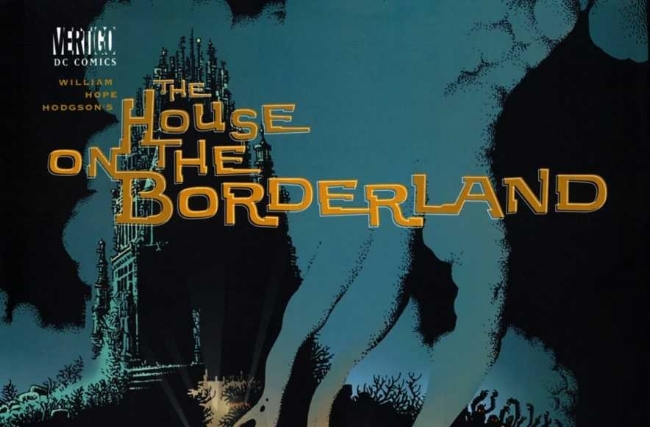
The House on the Borderland is a Vertigo comics graphic novel version of the 1908 baroque supernatural story by Edwardian writer, William Hope Hodgson. Adapted by Richard Corben and Simon Revelstroke, with illustrations are by Richard Corben of Hellblazer and Heavy Metal fame, The House on the Borderland proves to be a bold and innovative visual retelling of a rather densely narrated tale. The story tells a tale of two gentlemen on a week’s fishing holiday in the Irish village of Kraighten in the mid-fifties. Whilst exploring the local countryside they discover the ruins of a very curious house that appears to have been swallowed by a sinkhole. They subsequently find what appears to be the diary of its former owner. The torn pages seem to hint at an evil presence that was slowly and irresistibly encroaching upon the property. The author alludes to other events such as strange beasts in the ground at night and his own worsening nightmares. Is any of it to be believed, or is it simply the ravings of a deluded mind?
The House on the Borderland is a Vertigo comics graphic novel version of the 1908 baroque supernatural story by Edwardian writer, William Hope Hodgson. Adapted by Richard Corben and Simon Revelstroke, with illustrations are by Richard Corben of Hellblazer and Heavy Metal fame, The House on the Borderland proves to be a bold and innovative visual retelling of a rather densely narrated tale. The story tells a tale of two gentlemen on a week’s fishing holiday in the Irish village of Kraighten in the mid-fifties. Whilst exploring the local countryside they discover the ruins of a very curious house that appears to have been swallowed by a sinkhole. They subsequently find what appears to be the diary of its former owner. The torn pages seem to hint at an evil presence that was slowly and irresistibly encroaching upon the property. The author alludes to other events such as strange beasts in the ground at night and his own worsening nightmares. Is any of it to be believed, or is it simply the ravings of a deluded mind?
William Hope Hodgson’s original novel is an extremely difficult story to adapt to the graphic novel format. Most of the source text is written as diary entries, in which it describes arcane forces, astral projection and esoteric visions. Blending supernatural paranoia, fantasy and Lovecraftian horror in a first-person narrative that hints rather than discloses, it’s a tough book to crack. Yet Corben and Revelstroke make an inspired effort in condensing the text and visually extrapolating the complex descriptions. The artwork is innovative and does a good job of capturing the dark and eldritch tone of the story. The text adaptation strives to be as faithful to the source material as it can, yet inevitably has to relinquish on some of the more esoteric themes which are too difficult to render visually. However, the essential ideas of the original story are not only present but prove to be quite accessible. The understated approach of the artwork in keys scenes captures the menace conveyed by William Hope Hodgson in his original story.
Featuring an introduction by comics luminary Alan Moore that offers an affectionate appreciation of Hodgson's contribution to the horror genre, The House on the Borderland is a valiant attempt to bring a classic cerebral work to a wider audience via a very visual medium. Ultimately, the adaptation cannot offer the exact same experience as reading the original novel, but it must be applauded for bringing such material to a wider audience. It certainly succeeds in tapping into that disquieting quality that porcine horror can have, hinting at beasts who may well have a comparable intelligence to humans, while harbouring an inherent enmity to us as a species. Hopefully after reading The House on the Borderland, graphic novel horror fans will subsequently seek out and familiarise themselves with William Hope Hodgson’s other work, which is the equal to that of H.P. Lovecraft. I would certainly like to see further visual adaptations of the authors back catalogue.
Carnacki the Ghost-Finder by William Hope Hodgson (1913)
William Hope Hodgson (November 15, 1877 – April 1918) was an English author with a penchant for baroque and arcane horror, fantasy and science fiction. His style and insight drew heavily on his own colourful experiences. The son of a Priest he ran away to sea at an early age and travelled widely. He was a keen amateur photographer and achieved some renown as a bodybuilder and escapologist. He died in World War I at the age of 40. Although moderately successful during his lifetime it was not until after his death that his work, especially his short stories, received the acclaim they deserved. This was mainly due to posthumous publication of all the material regarding one Thomas Carnacki; investigator of the supernatural.
William Hope Hodgson (November 15, 1877 – April 1918) was an English author with a penchant for baroque and arcane horror, fantasy and science fiction. His style and insight drew heavily on his own colourful experiences. The son of a Priest he ran away to sea at an early age and travelled widely. He was a keen amateur photographer and achieved some renown as a body-builder and escapologist. He died in World War I at the age of 40. Although moderately successful during his lifetime it was not until after his death that his work, especially his short stories, received the acclaim they deserved. This was mainly due to posthumous publication of all the material regarding one Thomas Carnacki; investigator of the supernatural.
Hodgson’s work is in a similar vein to that of H.P. Lovecraft, M.R. James and Ambrose Bierce. He frequently hints at the horrific and implies that there are ancient and powerful forces at work. These are of a magnitude beyond human comprehension. Hodgson writes with such conviction you get the impression that he may have personally experienced the occult, something I have often suspected of Dennis Wheatley. Writing at the turn of the 19th century, Hodgson mixes modern science along with contemporary technology with the occult and the esoteric; a style later utilised to great success by Nigel Kneale.
The Carnacki stories are a variation on the tradition fictional detective such as Sherlock Holmes. Carnacki lives in a bachelor flat in Cheyne Walk, Chelsea. The stories are told from a first-person perspective by Dodgson, one of Carnacki’s four friends, very much in the style of John Watson. However where Conan Doyle never made use of the supernatural except as a red herring, its a pivotal theme of the Carnacki stories. The character of Carnacki was loosely inspired in part by Dr. Hesselius, scientist with a supernatural perspective, who appeared in short stories by the Irish fantasy writer Sheridan Le Fanu.
Hodgson’s short stories follow an established framework; Carnacki intermittently sends invitations to four friends, asking them to come to dinner and hear his latest exploits. One of these, Dodgson, then recounts the evening entertainment to us the reader. Carnacki avoids discussion of the case until after dinner, then lights his pipe, settles into his favourite chair and recounts the tale to his audience. Each of Carnacki’s adventures takes the form of an investigation into an unusual haunting, which Carnacki has been engaged to not only investigate but end. He employs a variety of scientific methods in his investigations, as well as resorting to more traditional folk-lore. He often uses such technology as photography as well as his own bespoke scientific device, the electric pentacle. He is not dogmatic and always uses evidence to establish conclusions, so in some stories he determines the haunting is real, while in others it is staged or faked by a third party. This variety and the exposure of an occasional hoax make the stories suspenseful. After the tale is complete, Carnacki usually answers a few questions from his guests, then unceremoniously turns them out onto the embankment to return to their respective homes.
What makes the Carnacki stories work so well is the credible and disquieting world of the supernatural he touches upon. He frequently refers to a fictional ancient text known as the Sigsand Manuscript, which is a source of information about protecting oneself from external forces and influences. Carnacki refers to Aeiirii and Saiitii manifestations, the latter being more dangerous and capable of overcoming Carnacki’s protective devices. There are several rites and ceremonies, including the Saaamaaa Ritual, with its mysterious eight signs and “unknown last line”. These are only invoked in times of abject crisis, when not only the physical life but the very soul is in danger. Then the forces that govern the fabric of space and time intervene to restore balance. These references to esoteric fictional occult writings are very much like H. P. Lovecraft’s Necronomicon.
If you like stories about the supernatural and traditional detective material, then Carnacki can provide a rather unique and interesting crossover. They offer an insight into the social and scientific attitudes of the Edwardian period; a time when scientific reason still struggled with entrenched religious dogma. They also serve as a great introduction to the works of William Hope Hodgson. His later novels are now considered to be milestones within the genre.
In 1989 Eclipse Comics produced a three-part adaptation of The Hobbit by Chuck Dixon, Sean Deming and illustrated by David Wenzel. A year later, due to public demand, this was subsequently re-issued as a single graphic novel that has remained in print ever since. The writers wisely chose to sensitively abridge Tolkien’s source text, rather than adapted the story and make any major changes. Hence this graphic novel version of The Hobbit retains much of the dialogue from the original novel and subsequently maintains the book’s inherent charm. There are no major plot omissions and the narrative flows well. The panel layouts are innovative and accommodate a wealth of written material without overwhelming the artwork.